
APPLICATION OF THE INTERIM ACCORD DU 13 SEPTEMBRE 1995
|
|
|
- Claudine Larose
- il y a 10 ans
- Total affichages :
Transcription
1 INTERNATIONAL COURT OF JUSTICE Reports of judgments, ADVISORY OPINIONS AND ORDERS APPLICATION OF THE INTERIM ACCORD OF 13 SEPTEMBER 1995 (THE FORMER YUGOSLAV REPUBLIC OF MACEDONIA v. GREECE) JUDGMENT OF 5 DECEMBER COUR INTERNATIONALE DE JUSTICE RECUEIL DES ARRÊTS, AVIS CONSULTATIFS ET ORDONNANCES APPLICATION DE L ACCORD INTÉRIMAIRE DU 13 SEPTEMBRE 1995 (EX RÉPUBLIQUE YOUGOSLAVE DE MACÉDOINE c. GRÈCE) ARRÊT DU 5 DÉCEMBRE CIJ1026.indb 1 20/06/13 08:41

2 Official citation : Application of the Interim Accord of 13 September 1995 (the former Yugoslav Republic of Macedonia v. Greece), Judgment of 5 December 2011, I.C.J. Reports 2011, p. 644 Mode officiel de citation : Application de l accord intérimaire du 13 septembre 1995 (ex République yougoslave de Macédoine c. Grèce), arrêt du 5 décembre 2011, C.I.J. Recueil 2011, p. 644 ISSN ISBN Sales number N o de vente: CIJ1026.indb 2 20/06/13 08:41

3 5 DECEMBER 2011 JUDGMENT APPLICATION OF THE INTERIM ACCORD OF 13 SEPTEMBER 1995 (THE FORMER YUGOSLAV REPUBLIC OF MACEDONIA v. GREECE) APPLICATION DE L ACCORD INTÉRIMAIRE DU 13 SEPTEMBRE 1995 (EX RÉPUBLIQUE YOUGOSLAVE DE MACÉDOINE c. GRÈCE) 5 DÉCEMBRE 2011 ARRÊT 5 CIJ1026.indb 3 20/06/13 08:41

4 644 INTERNATIONAL COURT OF JUSTICE December General List No. 142 YEAR December 2011 APPLICATION OF THE INTERIM ACCORD OF 13 SEPTEMBER 1995 (THE FORMER YUGOSLAV REPUBLIC OF MACEDONIA v. GREECE) Historical context and origin of the dispute. Break-up of Socialist Federal Republic of Yugoslavia Application for membership in United Nations submitted by Applicant on 30 July 1992 Opposition of Respondent to Applicant s admission Security Council resolution 817 (1993) Applicant admitted to membership in United Nations under provisional designation of the former Yugoslav Republic of Macedonia Interim Accord of 13 September 1995 Applicant s NATO candidacy considered at Bucharest Summit on 2 and 3 April 2008 Applicant not invited to begin talks on accession to NATO. * Jurisdiction of the Court and admissibility of Application. Scope of dispute Article 21, paragraph 2, of Interim Accord, as a basis for the Court s jurisdiction. Respondent s first objection to jurisdiction Contention that dispute is excluded from the Court s jurisdiction under Article 21, paragraph 2 Article 21, paragraph 2, excludes disputes regarding the difference over the definitive name Disputes regarding Respondent s obligation under Article 11, paragraph 1, within the Court s jurisdiction Objection cannot be upheld. Respondent s second objection to jurisdiction Contention that dispute relates to conduct attributable to NATO and its member States Applicant seeks to challenge Respondent s conduct and not NATO s decision No need to determine responsibility of NATO or of its member States Monetary Gold principle not relevant Objection cannot be upheld. 4 5 CIJ1026.indb 4 20/06/13 08:41
5 644 COUR INTERNATIONALE DE JUSTICE ANNÉE décembre décembre Rôle général n o 142 APPLICATION DE L ACCORD INTÉRIMAIRE DU 13 SEPTEMBRE 1995 (EX RÉPUBLIQUE YOUGOSLAVE DE MACÉDOINE c. GRÈCE) Contexte historique et origine du différend. Dissolution de la République fédérative socialiste de Yougoslavie Demande d admission à l Organisation des Nations Unies présentée par le demandeur le 30 juillet 1992 Opposition du défendeur à l admission du demandeur Résolution 817 (1993) du Conseil de sécurité Admission du demandeur à l Organisation des Nations Unies sous l appellation provisoire d «ex République yougoslave de Macédoine» Accord intérimaire du 13 septembre 1995 Candidature du demandeur à l OTAN ayant été examinée au sommet de Bucarest les 2 et 3 avril 2008 Demandeur n ayant pas été invité à entamer des discussions en vue d adhérer à l OTAN. * Compétence de la Cour et recevabilité de la requête. Portée du différend Paragraphe 2 de l article 21 de l accord intérimaire comme base de compétence de la Cour. Première exception d incompétence soulevée par le défendeur Argument selon lequel le différend est exclu de la compétence de la Cour par le paragraphe 2 de l article 21 Paragraphe 2 de l article 21 excluant les différends relatifs à la divergence au sujet du nom définitif Différends relatifs à l obligation qu impose au défendeur le paragraphe 1 de l article 11 entrant dans le champ de la compétence de la Cour Exception ne pouvant être retenue. Seconde exception d incompétence soulevée par le défendeur Argument selon lequel le différend a trait à un comportement imputable à l OTAN et à ses Etats membres Demandeur entendant tirer grief du comportement du défendeur et non de la décision de l OTAN Nul besoin de déterminer la responsabilité de l OTAN ou de ses Etats membres Principe de l Or monétaire dépourvu de pertinence Exception ne pouvant être retenue. 4 5 CIJ1026.indb 5 20/06/13 08:41
6 645 application of interim accord (judgment) Respondent s first objection to admissibility of Application Contention that Judgment would be incapable of effective application Applicant s claims relate to Respondent s conduct Judgment capable of being applied effectively by the Parties Objection cannot be upheld. Respondent s second objection to admissibility of Application Contention that the Court s Judgment would interfere with ongoing diplomatic negotiations Settlement of disputes by the Court not incompatible with diplomatic negotiations Objection cannot be upheld. The Court has jurisdiction Application is admissible. * Merits of the case. Contention by Applicant that Respondent failed to comply with the obligation under Article 11, paragraph 1, of the Interim Accord. Meaning of first clause of Article 11, paragraph 1 Parties did not intend to exclude NATO from scope of that provision Whether Respondent objected to Applicant s admission to NATO Resolution of difference over the name was the decisive criterion for Respondent to accept Applicant s admission to NATO Respondent objected to Applicant s admission to NATO. Effect of second clause of Article 11, paragraph 1 Ordinary meaning of terms employed Meaning of phrase to the extent Meaning of phrase to be referred to... differently than in paragraph 2 of Security Council resolution 817 (1993) Interim Accord did not require Applicant to use provisional designation in its dealings with Respondent No constraint on Applicant s practice of calling itself by its constitutional name Interpretation supported by object and purpose of Interim Accord Subsequent practice of the Parties in implementing Interim Accord No objection allowed on basis that Applicant is to refer to itself in an organization with its constitutional name No need to address travaux préparatoires or additional evidence regarding use of Applicant s constitutional name Respondent not entitled under second clause of Article 11, paragraph 1, to object to Applicant s admission to NATO. Contention of Respondent that any objection to Applicant s membership of NATO would be justified under Article 22 of Interim Accord Respondent s interpretation of Article 22 No requirement under the North Atlantic Treaty compelling the Respondent to object to admission of Applicant to NATO Respondent s attempt to rely on Article 22 unsuccessful. Respondent failed to comply with its obligation under Article 11, paragraph 1. * Additional justifications invoked by Respondent. Exceptio non adimpleti contractus Response to a material breach of a treaty Countermeasures Certain minimum conditions common to all three arguments. Respondent s allegations that Applicant failed to comply with its obligations under Interim Accord No breach by Applicant of second clause of Article 11, paragraph 1 Alleged breach by Applicant of Article 5, paragraph 1 Obli 5 5 CIJ1026.indb 6 20/06/13 08:41

7 application d accord intérimaire (arrêt) 645 Première exception du défendeur à la recevabilité de la requête Argument selon lequel l arrêt ne serait pas susceptible d application effective Prétentions du demandeur ayant trait au comportement du défendeur Arrêt susceptible d application effective par les Parties Exception ne pouvant être retenue. Seconde exception du défendeur à la recevabilité de la requête Argument selon lequel l arrêt de la Cour interférerait avec les négociations diplomatiques en cours Règlement des différends par la Cour n étant pas incompatible avec des négociations diplomatiques Exception ne pouvant être retenue. Cour se déclarant compétente Requête jugée recevable. * Fond. Argument du demandeur selon lequel le défendeur ne s est pas conformé à l obligation que lui impose le paragraphe 1 de l article 11 de l accord intérimaire. Sens de la première clause du paragraphe 1 de l article 11 Parties n ayant pas eu l intention d exclure l OTAN du champ d application de cette disposition Question de savoir si le défendeur «s est opposé» à l admission du demandeur à l OTAN Règlement de la divergence au sujet du nom ayant été le «critère décisif» pour que le défendeur accepte l admission du demandeur à l OTAN Défendeur s étant opposé à l admission du demandeur à l OTAN. Effet de la seconde clause du paragraphe 1 de l article 11 Sens ordinaire des termes employés Sens de l expression «dans la mesure où» Sens de la formule «doit être doté[] d une appellation différente [de] celle prévue au paragraphe 2 de la résolution 81t (1993) du Conseil de sécurité» Accord intérimaire n imposant pas au demandeur d utiliser l appellation provisoire dans ses relations avec le défendeur Rien ne s opposant à la pratique du demandeur consistant à se désigner lui même par son nom constitutionnel Interprétation étayée par l objet et le but de l accord intérimaire Pratique ultérieure des Parties en ce qui concerne l exécution de l accord intérimaire Perspective que le demandeur se désigne lui même dans une organisation par son nom constitutionnel n autorisant pas à s opposer à son admission Nul besoin d examiner les travaux préparatoires ou d autres éléments de preuve concernant l utilisation par le demandeur de son nom constitutionnel Seconde clause du paragraphe 1 de l article 11 n autorisant pas le défendeur à élever des objections à l admission du demandeur à l OTAN. Argument du défendeur selon lequel toute objection à l admission du demandeur à l OTAN serait justifiée aux termes de l article 22 de l accord intérimaire Interprétation de l article 22 donnée par le défendeur Aucune disposition du traité de l Atlantique Nord n obligeant le défendeur à s opposer à l admission du demandeur à l OTAN Tentative du défendeur de se fonder sur l article 22 ne pouvant aboutir. Non respect par le défendeur de l obligation que lui impose le paragraphe 1 de l article 11. * Justifications additionnelles invoquées par le défendeur. Exceptio non adimpleti contractus Réponse à une violation substantielle d un traité Contre mesures Certaines conditions minimales communes à ces trois arguments. Allégations du défendeur selon lesquelles le demandeur ne s est pas conformé aux obligations que lui impose l accord intérimaire Demandeur n ayant pas contrevenu à la seconde clause du paragraphe 1 de l article 11 Violation du 5 5 CIJ1026.indb 7 20/06/13 08:41
8 646 application of interim accord (judgment) gation to negotiate in good faith Respondent has not met its burden of demonstrating that Applicant breached its obligation under Article 5, paragraph 1 No breach by Applicant of Article 6, paragraph 2, prohibiting interference in Respondent s internal affairs No breach by Applicant of Article 7, paragraph 1, requiring Applicant to take effective measures to prohibit hostile activities or propaganda by State controlled agencies Alleged breach by Applicant of Article 7, paragraph 2 One instance in 2004 in which Applicant displayed a symbol prohibited by Article 7, paragraph 2 No breach by Applicant of Article 7, paragraph 3, regarding procedure to be followed in cases where symbols constituting part of one Party s historic or cultural patrimony are being used by other Party. Conclusions concerning additional justifications invoked by Respondent Conditions asserted by Respondent as necessary for application of the exceptio not satisfied Unnecessary for the Court to determine whether that doctrine forms part of contemporary international law Response to material breach Display of symbol in 2004 cannot be regarded as material breach within meaning of Article 60 of 1969 Vienna Convention Failure of Respondent to show that its conduct in 2008 was a response to 2004 breach Countermeasures Breach of Article 7, paragraph 2, by Applicant had ceased as of 2004 Respondent s objection cannot be justified as a countermeasure Additional justifications submitted by Respondent fail. * Interim Accord places Parties under a duty to negotiate in good faith with a view to resolving difference over name. * Remedies. Declaration that Respondent has violated its obligation to Applicant under Article 11, paragraph 1, of Interim Accord, constitutes appropriate satisfaction Not necessary to order Respondent to refrain from any future conduct that violates its obligation under Article 11, paragraph 1. JUDGMENT Present : President Owada ; Vice President Tomka ; Judges Koroma, Simma, Abraham, Keith, Sepúlveda Amor, Bennouna, Skotnikov, Cançado Trindade, Yusuf, Greenwood, Xue, Donoghue ; Judges ad hoc Roucounas, Vukas ; Registrar Couvreur. In the case concerning application of the Interim Accord of 13 September 1995, 6 5 CIJ1026.indb 8 20/06/13 08:41

9 application d accord intérimaire (arrêt) 646 paragraphe 1 de l article 5 qu aurait commise le demandeur Obligation de négocier de bonne foi Défendeur n ayant pas, comme il en avait la charge, démontré que le demandeur avait manqué à l obligation que lui impose le paragraphe 1 de l article 5 Demandeur n ayant pas contrevenu au paragraphe 2 de l article 6 interdisant l intervention dans les affaires intérieures du défendeur Demandeur n ayant pas contrevenu au paragraphe 1 de l article 7 qui lui impose de prendre des mesures efficaces aux fins d interdire des actes d hostilité ou de propagande par des organismes d Etat Violation du paragraphe 2 de l article 7 qu aurait commise le demandeur Seul cas, en 2004, dans lequel le demandeur a utilisé un symbole visé par l interdiction figurant au paragraphe 2 de l article 7 Demandeur n ayant pas contrevenu au paragraphe 3 de l article 7, qui a trait à la procédure devant être suivie dans les cas où des symboles faisant partie du patrimoine historique ou culturel de l une des Parties sont utilisés par l autre Partie. Conclusions concernant les justifications additionnelles invoquées par le défendeur Conditions qui, selon le défendeur, sont requises pour que l exceptio s applique n ayant pas été remplies Cour n ayant pas besoin de déterminer si cette théorie fait partie du droit international contemporain Réponse à une violation substantielle Utilisation du symbole en 2004 ne pouvant être considérée comme une violation substantielle au sens de l article 60 de la convention de Vienne de 1969 Défendeur n ayant pas démontré que son comportement de 2008 était une réponse à la violation de 2004 Contre mesures Violation par le demandeur du paragraphe 2 de l article 7 ayant pris fin en 2004 Objection du défendeur ne pouvant se justifier comme une contre mesure Justifications additionnelles invoquées par le défendeur ne pouvant être retenues. * Accord intérimaire mettant les Parties dans l obligation de négocier de bonne foi en vue de parvenir à un accord sur la divergence relative au nom. * Réparation. Déclaration à l effet que le défendeur a manqué à l obligation que lui impose envers le demandeur le paragraphe 1 de l article 11 de l accord intérimaire constituant une satisfaction appropriée Inutilité d ordonner au défendeur de s abstenir à l avenir de toute action contraire à l obligation que lui impose le paragraphe 1 de l article 11. ARRÊT Présents : M. Owada, président ; M. Tomka, vice président ; MM. Koroma, Simma, Abraham, Keith, Sepúlveda Amor, Bennouna, Skotnikov, Cançado Trindade, Yusuf, Greenwood, M mes Xue, Donoghue, juges ; MM. Roucounas, Vukas, juges ad hoc ; M. Couvreur, greffier. En l affaire relative à l application de l accord intérimaire du 13 septembre 1995, 6 5 CIJ1026.indb 9 20/06/13 08:41
10 647 application of interim accord (judgment) 7 between the former Yugoslav Republic of Macedonia, represented by H.E. Mr. Nikola Poposki, Minister for Foreign Affairs of the former Yugoslav Republic of Macedonia, H.E. Mr. Antonio Miloshoski, Chairman of the Foreign Policy Committee of the Assembly of the former Yugoslav Republic of Macedonia, as Agents ; H.E. Mr. Nikola Dimitrov, Ambassador of the former Yugoslav Republic of Macedonia to the Kingdom of the Netherlands, as Co Agent ; Mr. Philippe Sands, Q.C., Professor of Law, University College London, Barrister, Matrix Chambers, London, Mr. Sean D. Murphy, Patricia Roberts Harris Research Professor of Law, George Washington University, Ms Geneviève Bastid-Burdeau, Professor of Law, University of Paris I, Panthéon Sorbonne, Mr. Pierre Klein, Professor of International Law, Director of the Centre of International Law, Université Libre de Bruxelles, Ms Blinne Ní Ghrálaigh, Barrister, Matrix Chambers, London, as Counsel ; Mr. Saso Georgievski, Professor of Law, University Saints Cyril and Methodius, Skopje, Mr. Toni Deskoski, Professor of Law, University Saints Cyril and Methodius, Skopje, Mr. Igor Djundev, Ambassador, State Counsellor, Ministry of Foreign Affairs of the former Yugoslav Republic of Macedonia, Mr. Goran Stevcevski, State Counsellor, International Law Directorate, Ministry of Foreign Affairs of the former Yugoslav Republic of Macedonia, Ms Elizabeta Gjorgjieva, Minister Plenipotentiary, Deputy Head of Mission of the former Yugoslav Republic of Macedonia to the European Union, Ms Aleksandra Miovska, Head of Co ordination Sector, Cabinet Minister for Foreign Affairs of the former Yugoslav Republic of Macedonia, as Advisers ; Mr. Mile Prangoski, Research Assistant, Cabinet of Minister for Foreign Affairs of the former Yugoslav Republic of Macedonia, Mr. Remi Reichold, Research Assistant, Matrix Chambers, London, as Assistants ; Ms Elena Bodeva, Third Secretary, Embassy of the former Yugoslav Republic of Macedonia in the Kingdom of the Netherlands, as Liaison Officer with the International Court of Justice ; Mr. Ilija Kasaposki, Security Officer of the Foreign Minister of the former Yugoslav Republic of Macedonia, 5 CIJ1026.indb 10 20/06/13 08:41
11 application d accord intérimaire (arrêt) 647 entre l ex République yougoslave de Macédoine, représentée par S. Exc. M. Nikola Poposki, ministre des affaires étrangères de l ex-république yougoslave de Macédoine, S. Exc. M. Antonio Miloshoski, président de la commission de politique étrangère de l Assemblée de l ex-république yougoslave de Macédoine, comme agents ; S. Exc. M. Nikola Dimitrov, ambassadeur de l ex-république yougoslave de Macédoine auprès du Royaume des Pays Bas, comme coagent ; M. Philippe Sands, Q.C., professeur de droit à l University College de Londres, avocat, Matrix Chambers (Londres), M. Sean D. Murphy, professeur de droit à la George Washington University, titulaire de la chaire de recherche Patricia Roberts Harris, M me Geneviève Bastid-Burdeau, professeur de droit à l Université Panthéon Sorbonne (Paris I), M. Pierre Klein, professeur de droit international, directeur du centre de droit international de l Université libre de Bruxelles, M me Blinne Ní Ghrálaigh, avocat, Matrix Chambers (Londres), comme conseils ; M. Saso Georgievski, professeur de droit à l Université Saints Cyrille et Méthode de Skopje, M. Toni Deskoski, professeur de droit à l Université Saints Cyrille et Méthode de Skopje, M. Igor Djundev, ambassadeur, conseiller d Etat au ministère des affaires étrangères de l ex République yougoslave de Macédoine, M. Goran Stevcevski, conseiller d Etat au ministère des affaires étrangères de l ex République yougoslave de Macédoine, direction du droit international, M me Elizabeta Gjorgjieva, ministre plénipotentiaire, chef adjoint de la mission de l ex République yougoslave de Macédoine auprès de l Union européenne, M me Aleksandra Miovska, chef du département de la coordination au cabinet du ministre des affaires étrangères de l ex République yougoslave de Macédoine, comme conseillers ; M. Mile Prangoski, assistant de recherche au cabinet du ministre des affaires étrangères de l ex République yougoslave de Macédoine, M. Remi Reichold, assistant de recherche, Matrix Chambers (Londres), comme assistants ; M me Elena Bodeva, troisième secrétaire à l ambassade de l ex République yougoslave de Macédoine au Royaume des Pays Bas, comme attachée de liaison auprès de la Cour internationale de Justice ; M. Ilija Kasaposki, agent chargé de la sécurité du ministre des affaires étrangères de l ex République yougoslave de Macédoine, 7 5 CIJ1026.indb 11 20/06/13 08:41
12 648 application of interim accord (judgment) and the Hellenic Republic, represented by H.E. Mr. Georges Savvaides, Ambassador of Greece, Ms Maria Telalian, Legal Adviser, Head of the Public International Law Section of the Legal Department, Ministry of Foreign Affairs of Greece, as Agents ; Mr. Georges Abi Saab, Honorary Professor of International Law, Graduate Institute of International Studies, Geneva, member of the Institut de droit international, Mr. James Crawford, S.C., F.B.A., Whewell Professor of International Law, University of Cambridge, member of the Institut de droit international, Mr. Alain Pellet, Professor of International Law, University of Paris Ouest, Nanterre La Défense, member and former Chairman of the International Law Commission, associate member of the Institut de droit international, Mr. Michael Reisman, Myres S. McDougal Professor of International Law, Yale Law School, member of the Institut de droit international, as Senior Counsel and Advocates ; Mr. Arghyrios Fatouros, Honorary Professor of International Law, University of Athens, member of the Institut de droit international, Mr. Linos Alexandre Sicilianos, Professor of International Law, University of Athens, Mr. Evangelos Kofos, former Minister Counsellor, Ministry of Foreign Affairs of Greece, specialist on Balkan affairs, as Counsel ; Mr. Tom Grant, Research Fellow, Lauterpacht Centre for International Law, University of Cambridge, Mr. Alexandros Kolliopoulos, Assistant Legal Adviser, Public International Law Section of the Legal Department, Ministry of Foreign Affairs of Greece, Mr. Michael Stellakatos Loverdos, Assistant Legal Adviser, Public International Law Section of the Legal Department, Ministry of Foreign Affairs of Greece, Ms Alina Miron, Researcher, Centre de droit international de Nanterre (CEDIN), University of Paris Ouest, Nanterre La Défense, as Advisers ; H.E. Mr. Ioannis Economides, Ambassador of Greece to the Kingdom of the Netherlands, Ms Alexandra Papadopoulou, Minister Plenipotentiary, Head of the Greek Liaison Office in Skopje, Mr. Efstathios Paizis Paradellis, First Counsellor, Embassy of Greece in the Kingdom of the Netherlands, Mr. Elias Kastanas, Assistant Legal Adviser, Public International Law Section of the Legal Department, Ministry of Foreign Affairs of Greece, 8 5 CIJ1026.indb 12 20/06/13 08:41

13 application d accord intérimaire (arrêt) 648 et la République hellénique, représentée par S. Exc. M. Georges Savvaides, ambassadeur de Grèce, M me Maria Telalian, conseiller juridique, chef de la section de droit international public du département juridique du ministère des affaires étrangères de Grèce, comme agents ; M. Georges Abi Saab, professeur honoraire de droit international à l Institut universitaire des hautes études internationales de Genève, membre de l Institut de droit international, M. James Crawford, S.C., F.B.A., professeur de droit international à l Université de Cambridge, titulaire de la chaire Whewell, membre de l Institut de droit international, M. Alain Pellet, professeur de droit international à l Université de Paris Ouest, Nanterre-La Défense, membre et ancien président de la Commission du droit international, membre associé de l Institut de droit international, M. Michael Reisman, professeur de droit international à l Université Yale, titulaire de la chaire Myres S. McDougal, membre de l Institut de droit international, comme conseils principaux et avocats ; M. Arghyrios Fatouros, professeur honoraire de droit international à l Université nationale d Athènes, membre de l Institut de droit international, M. Linos-Alexandre Sicilianos, professeur de droit international à l Université nationale d Athènes, M. Evangelos Kofos, ancien ministre conseiller du ministère des affaires étrangères de Grèce, spécialiste des Balkans, comme conseils ; M. Tom Grant, collaborateur scientifique au Lauterpacht Centre for International Law de l Université de Cambridge, M. Alexandros Kolliopoulos, conseiller juridique adjoint à la section de droit international public du département juridique du ministère des affaires étrangères de Grèce, M. Michael Stellakatos-Loverdos, conseiller juridique adjoint à la section de droit international public du département juridique du ministère des affaires étrangères de Grèce, M me Alina Miron, chercheur au Centre de droit international de Nanterre (CEDIN), Université de Paris Ouest, Nanterre-La Défense, comme conseillers ; S. Exc. M. Ioannis Economides, ambassadeur de Grèce auprès du Royaume des Pays Bas, M me Alexandra Papadopoulou, ministre plénipotentiaire, chef du bureau de liaison de la Grèce à Skopje, M. Efstathios Paizis Paradellis, premier conseiller auprès de l ambassade de Grèce à La Haye, M. Elias Kastanas, conseiller juridique adjoint à la section de droit international public du département juridique du ministère des affaires étrangères de Grèce, 8 5 CIJ1026.indb 13 20/06/13 08:41

14 649 application of interim accord (judgment) Mr. Konstantinos Kodellas, Embassy Secretary, as Diplomatic Advisers ; Mr. Ioannis Korovilas, Embassy attaché, Mr. Kosmas Triantafyllidis, Embassy attaché, as Administrative Staff, The Court, composed as above, after deliberation, delivers the following Judgment : 1. On 17 November 2008, the former Yugoslav Republic of Macedonia (hereinafter the Applicant ) filed in the Registry of the Court an Application instituting proceedings against the Hellenic Republic (hereinafter the Respondent ) in respect of a dispute concerning the interpretation and implementation of the Interim Accord signed by the Parties on 13 September 1995, which entered into force on 13 October 1995 (hereinafter the Interim Accord ). In particular, the Applicant sought to establish the violation by the Respondent of its legal obligations under Article 11, paragraph 1, of the Interim Accord and to ensure that the Respondent abides by its obligations under Article 11 of the Interim Accord in relation to invitations or applications that might be made to or by the Applicant for membership of NATO or any other international, multilateral or regional organization or institution of which the Respondent is a member. 2. In its Application, the Applicant, referring to Article 36, paragraph 1, of the Statute, relied on Article 21, paragraph 2, of the Interim Accord to found the jurisdiction of the Court. 3. Pursuant to Article 40, paragraph 2, of the Statute, the Application was communicated forthwith to the Government of the Respondent by the Registrar ; and, in accordance with paragraph 3 of that Article, all States entitled to appear before the Court were notified of the Application. 4. Since the Court included upon the Bench no judge of the nationality of either of the Parties, each Party proceeded to exercise its right conferred by Article 31, paragraph 3, of the Statute to choose a judge ad hoc to sit in the case. The Applicant chose Mr. Budislav Vukas and the Respondent Mr. Emmanuel Roucounas. 5. By an Order dated 20 January 2009, the Court fixed 20 July 2009 and 20 January 2010, respectively, as the time limits for the filing of the Memorial of the Applicant and the Counter Memorial of the Respondent. The Memorial of the Applicant was duly filed within the time limit so prescribed. 6. By a letter dated 5 August 2009, the Respondent stated that, in its view, the Court manifestly lacks jurisdiction to rule on the claims of the Applicant in this case, but informed the Court that, rather than raising preliminary objections under Article 79 of the Rules of the Court, it would be addressing issues of jurisdiction together with those on the merits. The Registrar immediately communicated a copy of that letter to the Applicant. 9 5 CIJ1026.indb 14 20/06/13 08:41
15 application d accord intérimaire (arrêt) 649 M. Konstantinos Kodellas, secrétaire d ambassade, comme conseillers diplomatiques ; M. Ioannis Korovilas, attaché d ambassade, M. Kosmas Triantafyllidis, attaché d ambassade, comme personnel administratif, La Cour, ainsi composée, après délibéré en chambre du conseil, rend l arrêt suivant : 1. Le 17 novembre 2008, l ex République yougoslave de Macédoine (ci après dénommée le «demandeur») a déposé au Greffe de la Cour une requête introductive d instance contre la République hellénique (ci après dénommée le «défendeur») au sujet d un différend concernant l interprétation et l exécution de l accord intérimaire signé par les Parties le 13 septembre 1995 et entré en vigueur le 13 octobre 1995 (ci après l «accord intérimaire»). En particulier, le demandeur cherche «à établir que le défendeur a manqué aux obligations qui lui incombent aux termes du paragraphe 1 de l article 11 de l accord intérimaire et à obtenir que celui ci respecte ses obligations découlant de l article 11 de l accord intérimaire dans les cas où le demandeur serait invité à adhérer à l OTAN ou à toute autre organisation ou institution internationale, multilatérale ou régionale dont est membre le défendeur ou présenterait une demande d admission à l une d elles». 2. Dans sa requête, le demandeur, se référant au paragraphe 1 de l article 36 du Statut, invoque, pour fonder la compétence de la Cour, le paragraphe 2 de l article 21 de l accord intérimaire. 3. Conformément au paragraphe 2 de l article 40 du Statut, la requête a été immédiatement communiquée au Gouvernement du défendeur par le greffier ; conformément au paragraphe 3 de cet article, tous les Etats admis à ester devant la Cour ont par ailleurs été informés de la requête. 4. La Cour ne comptant sur le siège aucun juge de la nationalité des Parties, chacune d elles s est prévalue du droit que lui confère le paragraphe 3 de l article 31 du Statut de procéder à la désignation d un juge ad hoc pour siéger en l affaire. Le demandeur a désigné M. Budislav Vukas et le défendeur, M. Emmanuel Roucounas. 5. Par ordonnance en date du 20 janvier 2009, la Cour a fixé au 20 juillet 2009 et au 20 janvier 2010, respectivement, les dates d expiration du délai pour le dépôt du mémoire du demandeur et du contre mémoire du défendeur ; le mémoire du demandeur a été dûment déposé dans le délai ainsi prescrit. 6. Par lettre datée du 5 août 2009, le défendeur a indiqué avoir «acquis la conviction que la Cour n a[vait] manifestement pas compétence pour se prononcer sur les demandes de l Etat requérant dans cette affaire», ajoutant cependant que, plutôt que de soulever des exceptions préliminaires au titre de l article 79 du Règlement de la Cour, il «aborder[ait] les questions de compétence conjointement avec celles relatives au fond». Le greffier a immédiatement transmis une copie de cette lettre au demandeur. 9 5 CIJ1026.indb 15 20/06/13 08:41

16 650 application of interim accord (judgment) The Counter Memorial of the Respondent, which addressed issues relating to jurisdiction and admissibility as well as to the merits of the case, was duly filed within the time limit prescribed by the Court in its Order of 20 January At a meeting held by the President of the Court with the representatives of the Parties on 9 March 2010, the Co Agent of the Applicant indicated that his Government wished to be able to respond to the Counter Memorial of the Respondent, including the objections to jurisdiction and admissibility contained in it by means of a Reply. At the same meeting, the Agent of the Respondent stated that her Government had no objection to the granting of this request, in so far as the Respondent could in turn submit a Rejoinder. 8. By an Order of 12 March 2010, the Court authorized the submission of a Reply by the Applicant and a Rejoinder by the Respondent, and fixed 9 June 2010 and 27 October 2010 as the respective time limits for the filing of those pleadings. The Reply and the Rejoinder were duly filed within the time limits so prescribed. 9. In accordance with Article 53, paragraph 2, of the Rules of Court, the Court, after ascertaining the views of the Parties, decided that copies of the pleadings and documents annexed would be made accessible to the public on the opening of the oral proceedings. 10. Public hearings were held between 21 and 30 March 2011, at which the Court heard the oral arguments and replies of : For the Applicant : Mr. Antonio Miloshoski, mr. Philippe Sands, mr. Sean Murphy, mr. Pierre Klein, ms Geneviève Bastid-Burdeau, mr. Nikola Dimitrov. For the Respondent : ms Maria Telalian, Mr. Georges Savvaides, Mr. Georges Abi Saab, Mr. Michael Reisman, Mr. Alain Pellet, Mr. James Crawford. 11. At the hearings, a Member of the Court put a question to the Respondent, to which a reply was given in writing, within the time limit fixed by the President in accordance with Article 61, paragraph 4, of the Rules of Court. Pursuant to Article 72 of the Rules of Court, the Applicant submitted comments on the written reply provided by the Respondent. * 12. In the Application, the following requests were made by the Applicant : 10 The Applicant requests the Court : (i) to adjudge and declare that the Respondent, through its State organs and agents, has violated its obligations under Article 11, paragraph 1, of the Interim Accord ; (ii) to order that the Respondent immediately take all necessary steps to comply with its obligations under Article 11, paragraph 1, of the Interim 5 CIJ1026.indb 16 20/06/13 08:42

17 application d accord intérimaire (arrêt) 650 Le contre mémoire du défendeur, qui traite de questions relatives tant à la compétence et à la recevabilité qu au fond, a été dûment déposé dans le délai prescrit par la Cour dans son ordonnance du 20 janvier Au cours d une réunion que le président de la Cour a tenue le 9 mars 2010 avec les représentants des Parties, le coagent du demandeur a indiqué que son gouvernement désirait pouvoir répondre au contre mémoire du défendeur, et notamment aux exceptions d incompétence et d irrecevabilité qu il contient, dans une réplique. Lors de la même réunion, l agent du défendeur a déclaré que son gouvernement n avait pas d objection à ce qu il soit accédé à cette demande, pour autant que le défendeur puisse en réponse présenter une duplique. 8. Par ordonnance en date du 12 mars 2010, la Cour a autorisé la présentation d une réplique par le demandeur et d une duplique par le défendeur, et fixé au 9 juin 2010 et au 27 octobre 2010, respectivement, les dates d expiration des délais pour le dépôt de ces pièces. La réplique et la duplique ont été dûment déposées dans les délais ainsi prescrits. 9. Conformément au paragraphe 2 de l article 53 de son Règlement, la Cour, après s être renseignée auprès des Parties, a décidé que des exemplaires des pièces de procédure et documents annexés seraient rendus accessibles au public à l ouverture de la procédure orale. 10. Des audiences publiques ont été tenues du 21 au 30 mars 2011, au cours desquelles ont été entendus en leurs plaidoiries et réponses : Pour le demandeur : m. Antonio Miloshoski, M. Philippe Sands, M. Sean Murphy, M. Pierre Klein, M me Geneviève Bastid-Burdeau, M. Nikola Dimitrov. Pour le défendeur : M me Maria Telalian, m. Georges Savvaides, m. Georges Abi Saab, m. Michael Reisman, m. Alain Pellet, m. James Crawford. 11. A l audience, un membre de la Cour a posé une question au défendeur qui y a répondu par écrit, dans le délai fixé par le président conformément au paragraphe 4 de l article 61 du Règlement. En application de l article 72 du Règlement, le demandeur a présenté des observations sur la réponse écrite donnée par le défendeur. * 12. Dans la requête, les demandes ci après ont été formulées par le demandeur : «Le demandeur prie la Cour : i) de dire et juger que le défendeur, par l intermédiaire de ses organes d Etat et de ses agents, a manqué aux obligations que lui impose le paragraphe 1 de l article 11 de l accord intérimaire ; ii) d ordonner au défendeur de prendre immédiatement toutes les mesures nécessaires afin que celui ci respecte les obligations que lui impose le 10 5 CIJ1026.indb 17 20/06/13 08:42
18 651 application of interim accord (judgment) Accord, and to cease and desist from objecting in any way, whether directly or indirectly, to the Applicant s membership of the North Atlantic Treaty Organization and/or of any other international, multilateral and regional organizations and institutions of which the Respondent is a member, in circumstances where the Applicant is to be referred to in such organizations or institutions by the designation provided for in paragraph 2 of United Nations Security Council resolution 817 (1993). 13. In the written proceedings, the following submissions were presented by the Parties : On behalf of the Government of the Applicant, in the Memorial : On the basis of the evidence and legal arguments presented in this Memorial, the Applicant Requests the Court : (i) to adjudge and declare that the Respondent, through its State organs and agents, has violated its obligations under Article 11, paragraph 1, of the Interim Accord ; and (ii) to order that the Respondent immediately take all necessary steps to comply with its obligations under Article 11, paragraph 1, of the Interim Accord, and to cease and desist from objecting in any way, whether directly or indirectly, to the Applicant s membership of the North Atlantic Treaty Organization and/or of any other international, multilateral and regional organizations and institutions of which the Respondent is a member, in circumstances where the Applicant is to be referred to in such organization or institution by the designation provided for in paragraph 2 of United Nations Security Council resolution 817 (1993). in the Reply : On the basis of the evidence and legal arguments presented in this Reply, the Applicant Requests the Court : (i) to reject the Respondent s objections as to the jurisdiction of the Court and the admissibility of the Applicant s claims ; (ii) to adjudge and declare that the Respondent, through its State organs and agents, has violated its obligations under Article 11, paragraph 1, of the Interim Accord ; and (iii) to order that the Respondent immediately take all necessary steps to comply with its obligations under Article 11, paragraph 1, of the Interim Accord, and to cease and desist from objecting in any way, whether directly or indirectly, to the Applicant s membership of the North Atlantic Treaty Organization and/or of any other international, multilateral and regional organizations and institutions of which the Respondent is a member, in circumstances where the Applicant is to be referred to in such organization or institution by the designation provided for in paragraph 2 of United Nations Security Council resolution 817 (1993) CIJ1026.indb 18 20/06/13 08:42

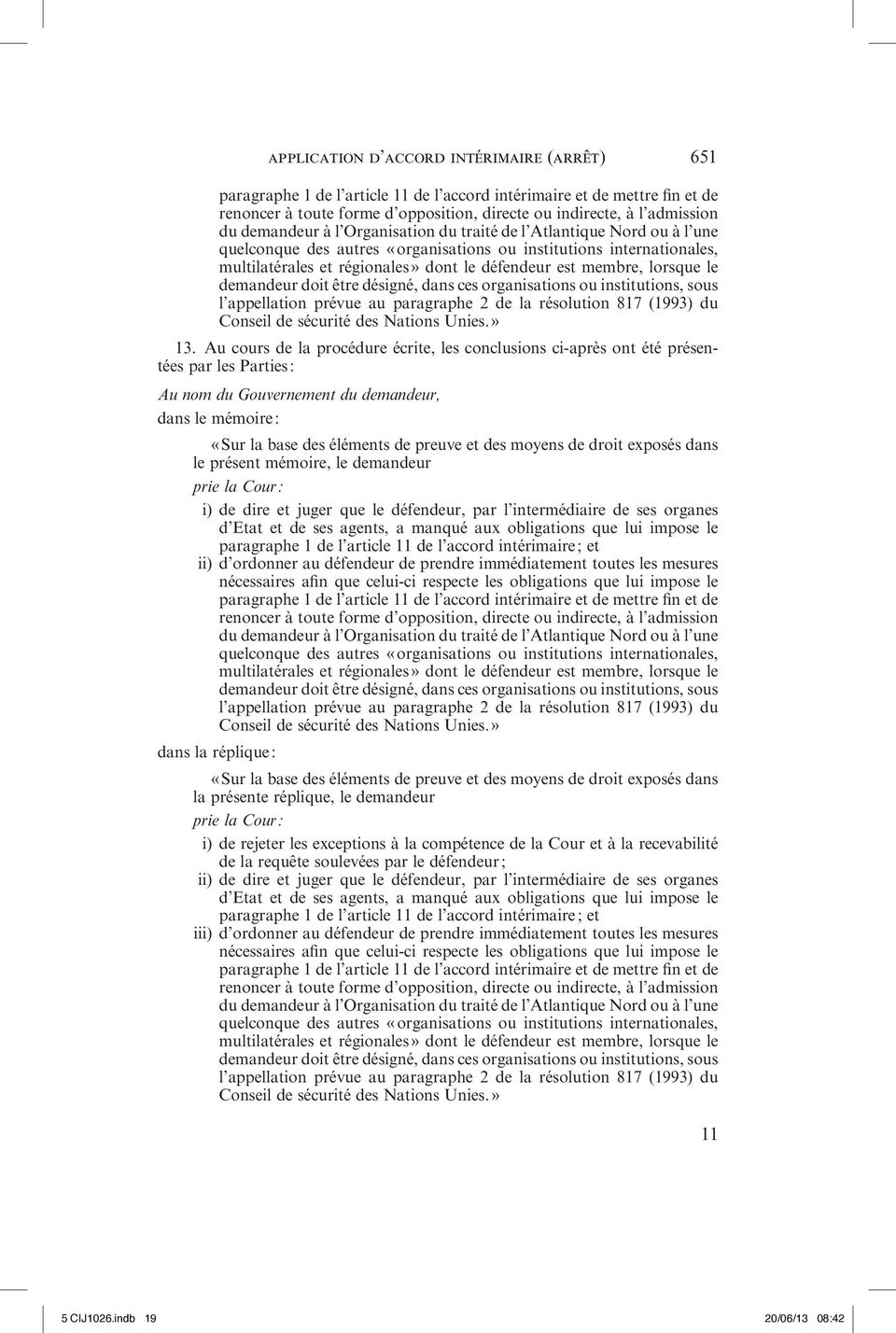
19 application d accord intérimaire (arrêt) 651 paragraphe 1 de l article 11 de l accord intérimaire et de mettre fin et de renoncer à toute forme d opposition, directe ou indirecte, à l admission du demandeur à l Organisation du traité de l Atlantique Nord ou à l une quelconque des autres «organisations ou institutions internationales, multilatérales et régionales» dont le défendeur est membre, lorsque le demandeur doit être désigné, dans ces organisations ou institutions, sous l appellation prévue au paragraphe 2 de la résolution 817 (1993) du Conseil de sécurité des Nations Unies.» 13. Au cours de la procédure écrite, les conclusions ci après ont été présentées par les Parties : Au nom du Gouvernement du demandeur, dans le mémoire : «Sur la base des éléments de preuve et des moyens de droit exposés dans le présent mémoire, le demandeur prie la Cour : i) de dire et juger que le défendeur, par l intermédiaire de ses organes d Etat et de ses agents, a manqué aux obligations que lui impose le paragraphe 1 de l article 11 de l accord intérimaire ; et ii) d ordonner au défendeur de prendre immédiatement toutes les mesures nécessaires afin que celui ci respecte les obligations que lui impose le paragraphe 1 de l article 11 de l accord intérimaire et de mettre fin et de renoncer à toute forme d opposition, directe ou indirecte, à l admission du demandeur à l Organisation du traité de l Atlantique Nord ou à l une quelconque des autres «organisations ou institutions internationales, multilatérales et régionales» dont le défendeur est membre, lorsque le demandeur doit être désigné, dans ces organisations ou institutions, sous l appellation prévue au paragraphe 2 de la résolution 817 (1993) du Conseil de sécurité des Nations Unies.» dans la réplique : «Sur la base des éléments de preuve et des moyens de droit exposés dans la présente réplique, le demandeur prie la Cour : i) de rejeter les exceptions à la compétence de la Cour et à la recevabilité de la requête soulevées par le défendeur ; ii) de dire et juger que le défendeur, par l intermédiaire de ses organes d Etat et de ses agents, a manqué aux obligations que lui impose le paragraphe 1 de l article 11 de l accord intérimaire ; et iii) d ordonner au défendeur de prendre immédiatement toutes les mesures nécessaires afin que celui ci respecte les obligations que lui impose le paragraphe 1 de l article 11 de l accord intérimaire et de mettre fin et de renoncer à toute forme d opposition, directe ou indirecte, à l admission du demandeur à l Organisation du traité de l Atlantique Nord ou à l une quelconque des autres «organisations ou institutions internationales, multilatérales et régionales» dont le défendeur est membre, lorsque le demandeur doit être désigné, dans ces organisations ou institutions, sous l appellation prévue au paragraphe 2 de la résolution 817 (1993) du Conseil de sécurité des Nations Unies.» 11 5 CIJ1026.indb 19 20/06/13 08:42
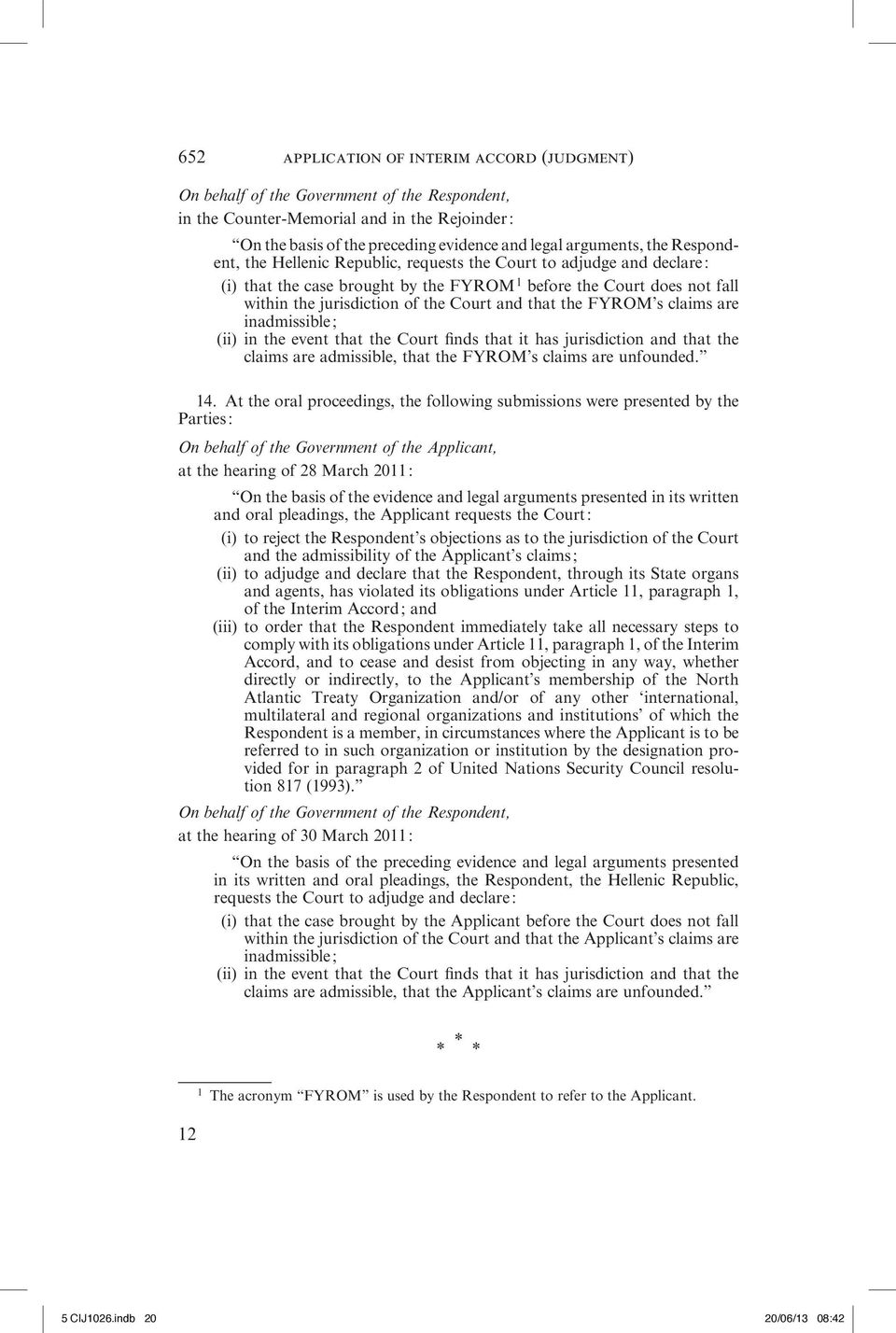
20 652 application of interim accord (judgment) On behalf of the Government of the Respondent, in the Counter Memorial and in the Rejoinder : On the basis of the preceding evidence and legal arguments, the Respondent, the Hellenic Republic, requests the Court to adjudge and declare : (i) that the case brought by the FYROM 1 before the Court does not fall within the jurisdiction of the Court and that the FYROM s claims are inadmissible ; (ii) in the event that the Court finds that it has jurisdiction and that the claims are admissible, that the FYROM s claims are unfounded. 14. At the oral proceedings, the following submissions were presented by the Parties : On behalf of the Government of the Applicant, at the hearing of 28 March 2011 : On the basis of the evidence and legal arguments presented in its written and oral pleadings, the Applicant requests the Court : (i) to reject the Respondent s objections as to the jurisdiction of the Court and the admissibility of the Applicant s claims ; (ii) to adjudge and declare that the Respondent, through its State organs and agents, has violated its obligations under Article 11, paragraph 1, of the Interim Accord ; and (iii) to order that the Respondent immediately take all necessary steps to comply with its obligations under Article 11, paragraph 1, of the Interim Accord, and to cease and desist from objecting in any way, whether directly or indirectly, to the Applicant s membership of the North Atlantic Treaty Organization and/or of any other international, multilateral and regional organizations and institutions of which the Respondent is a member, in circumstances where the Applicant is to be referred to in such organization or institution by the designation provided for in paragraph 2 of United Nations Security Council resolution 817 (1993). On behalf of the Government of the Respondent, at the hearing of 30 March 2011 : On the basis of the preceding evidence and legal arguments presented in its written and oral pleadings, the Respondent, the Hellenic Republic, requests the Court to adjudge and declare : (i) that the case brought by the Applicant before the Court does not fall within the jurisdiction of the Court and that the Applicant s claims are inadmissible ; (ii) in the event that the Court finds that it has jurisdiction and that the claims are admissible, that the Applicant s claims are unfounded. * * * 1 The acronym FYROM is used by the Respondent to refer to the Applicant CIJ1026.indb 20 20/06/13 08:42
21 application d accord intérimaire (arrêt) 652 Au nom du Gouvernement du défendeur, dans le contre mémoire et la duplique : «Sur la base des éléments de preuve et des moyens de droit exposés, la République hellénique, défendeur en l affaire, prie la Cour de dire et juger : i) que l instance introduite par l ERYM 1 ne relève pas de sa compétence et que ses demandes sont irrecevables ; ii) ou, dans l hypothèse où elle conclurait à sa compétence et à la recevabilité des demandes de l ERYM, que ces dernières sont dépourvues de fondement.» 14. Au cours de la procédure orale, les conclusions ci après ont été présentées par les Parties : Au nom du Gouvernement du demandeur, à l audience du 28 mars 2011 : «Sur la base des éléments de preuve et des arguments juridiques exposés dans ses écritures et plaidoiries, le demandeur prie la Cour : i) de rejeter les exceptions soulevées par le défendeur quant à la compétence de la Cour et à la recevabilité des prétentions du demandeur ; ii) de dire et juger que le défendeur, par l intermédiaire de ses organes d Etat et de ses agents, a manqué aux obligations que lui impose le paragraphe 1 de l article 11 de l accord intérimaire ; et iii) d ordonner au défendeur de prendre immédiatement toutes les mesures nécessaires afin que celui ci respecte les obligations que lui impose le paragraphe 1 de l article 11 de l accord intérimaire et de mettre fin et de renoncer à toute forme d opposition, directe ou indirecte, à l admission du demandeur à l Organisation du traité de l Atlantique Nord ou à l une quelconque des autres «organisations ou institutions internationales, multilatérales et régionales» dont le défendeur est membre, lorsque le demandeur doit être désigné, dans ces organisations ou institutions, sous l appellation prévue au paragraphe 2 de la résolution 817 (1993) du Conseil de sécurité des Nations Unies.» Au nom du Gouvernement du défendeur, à l audience du 30 mars 2011 : «Sur la base des éléments de preuve et des arguments juridiques exposés dans ses écritures et plaidoiries, la République hellénique, défendeur en l affaire, prie la Cour de dire et juger : i) que l instance introduite par le demandeur ne relève pas de sa compétence et que ses demandes sont irrecevables ; ii) dans l hypothèse où elle conclurait à sa compétence et à la recevabilité des demandes du demandeur, que ces dernières sont dépourvues de fondement.» * * * 1 Le défendeur emploie l acronyme «ERYM» pour désigner le demandeur CIJ1026.indb 21 20/06/13 08:42
22 653 application of interim accord (judgment) 13 I. Introduction 15. Before 1991, the Socialist Federal Republic of Yugoslavia comprised six constituent republics, including the Socialist Republic of Macedonia. In the course of the break-up of Yugoslavia, the Assembly of the Socialist Republic of Macedonia adopted (on 25 January 1991) the Declaration on the Sovereignty of the Socialist Republic of Macedonia, which asserted sovereignty and the right of self determination. On 7 June 1991, the Assembly of the Socialist Republic of Macedonia enacted a constitutional amendment, changing the name Socialist Republic of Macedonia to the Republic of Macedonia. The Assembly then adopted a declaration asserting the sovereignty and independence of the new State and sought international recognition. 16. On 30 July 1992, the Applicant submitted an application for membership in the United Nations. The Respondent stated on 25 January 1993 that it objected to the Applicant s admission on the basis of the Applicant s adoption of the name Republic of Macedonia, among other factors. The Respondent explained that its opposition was based inter alia on its view that the term Macedonia referred to a geographical region in south east Europe that included an important part of the territory and population of the Respondent and of certain third States. The Respondent further indicated that once a settlement had been reached on these issues, it would no longer oppose the Applicant s admission to the United Nations. The Respondent had also expressed opposition on similar grounds to the Applicant s recognition by the member States of the European Community. 17. On 7 April 1993, in accordance with Article 4, paragraph 2, of the Charter, the Security Council adopted resolution 817 (1993), concerning the application for admission to the United Nations of the Applicant. In that resolution, noting that a difference has arisen over the name of the [Applicant], which needs to be resolved in the interest of the maintenance of peaceful and good neighbourly relations in the region, the Security Council : 1. Urge[d] the parties to continue to co-operate with the Co Chairmen of the Steering Committee of the International Conference on the Former Yugoslavia in order to arrive at a speedy settlement of their difference; 2. Recommend[ed] to the General Assembly that the State whose application is contained in document S/25147 be admitted to membership in the United Nations, this State being provisionally referred to for all purposes within the United Nations as the former Yugoslav Republic of Macedonia pending settlement of the difference that has arisen over the name of the State; 3. Request[ed] the Secretary-General to report to the Council on the outcome of the initiative taken by the Co Chairmen of the Steering Committee of the International Conference on the Former Yugoslavia. 5 CIJ1026.indb 22 20/06/13 08:42
23 application d accord intérimaire (arrêt) 653 I. Introduction 15. Avant 1991, la République fédérative socialiste de Yougoslavie était constituée de six républiques, dont la «République socialiste de Macédoine». Au cours de la dissolution de la Yougoslavie, l Assemblée de la République socialiste de Macédoine adopta (le 25 janvier 1991) la «déclaration sur la souveraineté de la République socialiste de Macédoine», dans laquelle étaient affirmés la souveraineté et le droit à l autodétermination. Le 7 juin 1991, elle adopta un amendement constitutionnel rebaptisant «République de Macédoine» la «République socialiste de Macédoine». L Assemblée adopta alors une déclaration affirmant la souveraineté et l indépendance du nouvel Etat, lequel chercha à obtenir sa reconnaissance sur le plan international. 16. Le 30 juillet 1992, le demandeur présenta une demande d admission à l Organisation des Nations Unies. Le défendeur déclara le 25 janvier 1993 qu il s opposait à cette admission en raison notamment de l adoption par le demandeur du nom de «République de Macédoine». Il indiqua que son opposition était, entre autres choses, fondée sur le fait que le terme «Macédoine» désignait, selon lui, une région géographique du sud est de l Europe comprenant une partie importante du territoire et de la population du défendeur et de certains Etats tiers. Le défendeur ajouta qu il cesserait de s opposer à l admission du demandeur à l Organisation des Nations Unies dès que ces questions auraient été réglées. Il s était déjà, pour des motifs semblables, opposé à la reconnaissance du demandeur par les Etats membres de la Communauté européenne. 17. Le 7 avril 1993, conformément au paragraphe 2 de l article 4 de la Charte, le Conseil de sécurité adopta la résolution 817 (1993), qui concernait la «demande d admission [du demandeur] à l Organisation des Nations Unies». Dans cette résolution, notant qu «une divergence a[vait] surgi au sujet du nom d[u demandeur], qu il f[allait] régler dans l intérêt du maintien de relations pacifiques et de bon voisinage dans la région», le Conseil de sécurité «1. pri[ait] instamment les parties de continuer à coopérer avec les coprésidents du comité directeur de la conférence internationale sur l ex Yougoslavie afin de parvenir à un règlement rapide de la divergence qui existe entre elles ; 2. recommand[ait] à l Assemblée générale d admettre à l Organisation des Nations Unies l Etat dont la demande [était] formulée dans le document S/25147, cet Etat devant être désigné provisoirement, à toutes fins utiles à l Organisation, sous le nom d «ex République yougoslave de Macédoine» en attendant que soit réglée la divergence qui a[vait] surgi au sujet de son nom ; 3. pri[ait] le Secrétaire général de lui faire connaître l issue de l initiative prise par les coprésidents du comité directeur de la conférence internationale sur l ex Yougoslavie.» 13 5 CIJ1026.indb 23 20/06/13 08:42
24 654 application of interim accord (judgment) 18. On 8 April 1993, the Applicant was admitted to the United Nations, following the adoption by the General Assembly, on the recommendation of the Security Council, of resolution A/RES/47/225. On 18 June 1993, in light of the continuing absence of a settlement of the difference over the name, the Security Council adopted resolution 845 (1993) urging the parties to continue their efforts under the auspices of the Secretary General to arrive at a speedy settlement of the remaining issues between them. While the Parties have engaged in negotiations to that end, these negotiations have not yet led to a mutually acceptable solution to the name issue. 19. Following its admission to the United Nations, the Applicant became a member of various specialized agencies of the United Nations system. However, its efforts to join several other non United Nations affiliated international institutions and organizations, of which the Respondent was already a member, were not successful. On 16 February 1994, the Respondent instituted trade related restrictions against the Applicant. 20. Against this backdrop, on 13 September 1995, the Parties signed the Interim Accord, providing for the establishment of diplomatic relations between them and addressing other related issues. The Interim Accord refers to the Applicant as Party of the Second Part and to the Respondent as Party of the First Part, so as to avoid using any contentious name. Under its Article 5, the Parties agree[d] to continue negotiations under the auspices of the Secretary General of the United Nations pursuant to Security Council resolution 845 (1993) with a view to reaching agreement on the difference described in that resolution and in Security Council resolution 817 (1993). 21. In the Interim Accord, the Parties also addressed the admission of, and membership by, the Applicant in international organizations and institutions of which the Respondent was a member. In this regard, Article 11, paragraph 1, of the Interim Accord provides: Upon entry into force of this Interim Accord, the Party of the First Part agrees not to object to the application by or the membership of the Party of the Second Part in international, multilateral and regional organizations and institutions of which the Party of the First Part is a member ; however, the Party of the First Part reserves the right to object to any membership referred to above if and to the extent 2 the Party of the Second Part is to be referred to in such organization or institution differently than in paragraph 2 of United Nations 2 In the French version of the Interim Accord published in the United Nations Treaty Series the expression if and to the extent has been rendered by the sole conjunction si. For the purposes of this Judgment, the Court will however use, in the French text, the expression si [et dans la mesure où], which is a more literal translation of the original English version CIJ1026.indb 24 20/06/13 08:42
25 application d accord intérimaire (arrêt) Le 8 avril 1993, le demandeur fut admis à l Organisation des Nations Unies, à la suite de l adoption par l Assemblée générale, sur recommandation du Conseil de sécurité, de la résolution A/RES/47/225. La divergence relative au nom n étant pas encore réglée, le Conseil de sécurité adopta, le 18 juin 1993, la résolution 845 (1993), dans laquelle il priait instamment les Parties «de poursuivre les efforts qu elles m[enaient] sous les auspices du Secrétaire général en vue de parvenir à un règlement rapide des questions qu il leur rest[ait] à résoudre». Quoique les Parties aient engagé des négociations à cette fin, celles ci n ont pas encore permis d apporter une solution mutuellement acceptable à la question du nom. 19. Après son admission à l Organisation des Nations Unies, le demandeur devint membre de plusieurs institutions spécialisées du système des Nations Unies. L action qu il mena pour adhérer à diverses autres institutions et organisations internationales non affiliées à l Organisation des Nations Unies dont le défendeur était déjà membre se révéla cependant infructueuse. Le 16 février 1994, le défendeur imposa au demandeur des restrictions commerciales. 20. C est dans ce contexte que les Parties signèrent, le 13 septembre 1995, l accord intérimaire, qui prévoyait l établissement de relations diplomatiques entre elles et traitait de certaines questions connexes. Dans cet instrument, le demandeur est appelé «seconde Partie» et le défendeur «première Partie», et ce, afin d éviter l emploi de tout nom litigieux. Aux termes de l article 5 de l accord, les Parties «conv[enaient] de poursuivre les négociations sous les auspices du Secrétaire général de l Organisation des Nations Unies, conformément à la résolution 845 (1993) du Conseil de sécurité, en vue de parvenir à régler le différend mentionné dans cette résolution et dans la résolution 817 (1993) du Conseil». 21. Dans l accord intérimaire, les Parties traitaient aussi de la question de l admission et de la participation du demandeur à des organisations et institutions internationales dont le défendeur était membre. A cet égard, le paragraphe 1 de l article 11 de cet instrument dispose que, «[l]orsque le présent accord intérimaire sera entré en vigueur, la première Partie ne s opposera pas à la demande d admission de la seconde Partie dans des organisations et institutions internationales, multilatérales ou régionales dont la première Partie est membre, non plus qu à la participation de la seconde Partie à ces organisations et institutions ; toutefois, la première Partie se réserve le droit d élever des objections à une telle demande ou à une telle participation si [et dans la mesure où 2 ] la seconde Partie doit être dotée dans ces orga 2 L expression «if and to the extent», qui figure dans la version originale anglaise de l accord intérimaire publiée dans le Recueil des traités des Nations Unies, a été rendue dans la traduction française par la seule conjonction «si». Aux fins du présent arrêt, la Cour emploiera néanmoins l expression «si [et dans la mesure où]», qui constitue une traduction plus littérale de la version originale anglaise CIJ1026.indb 25 20/06/13 08:42
26 655 application of interim accord (judgment) Security Council resolution 817 (1993). (United Nations Treaty Series (UNTS), Vol. 1891, p. 7 ; original English.) 22. In the period following the adoption of the Interim Accord, the Applicant was granted membership in a number of international organizations of which the Respondent was already a member. On the invitation of the North Atlantic Treaty Organization, the Applicant in 1995 joined the Organization s Partnership for Peace (a programme that promotes cooperation between NATO and partner countries) and, in 1999, the Organization s Membership Action Plan (which assists prospective NATO members). The Applicant s NATO candidacy was considered in a meeting of NATO member States in Bucharest (hereinafter the Bucharest Summit ) on 2 and 3 April 2008 but the Applicant was not invited to begin talks on accession to the Organization. The communiqué issued at the end of the Summit stated that an invitation would be extended to the Applicant as soon as a mutually acceptable solution to the name issue has been reached. 15 II. Jurisdiction of the Court and Admissibility of the Application 23. In the present case, the Applicant maintains that the Respondent failed to comply with Article 11, paragraph 1, of the Interim Accord. The Respondent disagrees with this contention both in terms of the facts and of the law, that is, in regard to the meaning, scope and effect of certain provisions of the Interim Accord. In the view of the Court, this is the dispute the Applicant brought before the Court, and thus the dispute in respect of which the Court s jurisdiction falls to be determined. 24. The Applicant invokes as a basis for the Court s jurisdiction Article 21, paragraph 2, of the Interim Accord, which reads as follows : Any difference or dispute that arises between the Parties concerning the interpretation or implementation of this Interim Accord may be submitted by either of them to the International Court of Justice, except for the difference referred to in Article 5, paragraph As already noted (see paragraph 6 above), the Respondent advised the Court that, rather than raising objections under Article 79 of the Rules of Court, it would be addressing issues of jurisdiction and admissibility along with the merits of the present case. The Court addresses these issues at the outset of this Judgment. 26. The Respondent claims that the Court has no jurisdiction to entertain the present case and that the Application is inadmissible based on the 5 CIJ1026.indb 26 20/06/13 08:42
27 application d accord intérimaire (arrêt) 655 nisations ou institutions d une appellation différente [de] celle prévue au paragraphe 2 de la résolution 817 (1993) du Conseil de sécurité des Nations Unies». (La traduction française de l accord intérimaire, dont le texte authentique est en anglais, a été publiée dans le Recueil des traités des Nations Unies (RTNU), vol. 1891, p. 40.) 22. Dans la période qui suivit l adoption de l accord intérimaire, le demandeur fut admis au sein de plusieurs organisations internationales dont le défendeur était déjà membre. A l invitation de l Organisation du traité de l Atlantique Nord, il fut admis à participer, en 1995, au partenariat pour la paix de cette organisation (un programme qui vise à favoriser la coopération entre l OTAN et les pays partenaires), puis, en 1999, au plan d action pour l adhésion (qui aide les éventuels futurs membres de l organisation). La candidature du demandeur fut examinée à une réunion des Etats membres de l OTAN tenue à Bucarest (ci après le «sommet de Bucarest») les 2 et 3 avril 2008, mais le demandeur ne fut pas invité à entamer des discussions en vue de son adhésion. Dans le communiqué publié à l issue du sommet, il était précisé que le demandeur serait invité à adhérer «dès qu une solution mutuellement acceptable à la question de son nom aura[it] été trouvée». II. Compétence de la Cour et recevabilité de la requête 23. En la présente espèce, le demandeur affirme que le défendeur ne s est pas conformé au paragraphe 1 de l article 11 de l accord intérimaire. Le défendeur réfute cette allégation d un point de vue tant factuel que juridique, c est à dire en ce qui concerne le sens, la portée et l effet de certaines dispositions de l accord intérimaire. Tel est, selon la Cour, le différend que le demandeur a porté devant elle, et à l égard duquel elle doit maintenant déterminer si elle a compétence. 24. Le demandeur invoque, comme base de compétence de la Cour, le paragraphe 2 de l article 21 de l accord intérimaire, qui se lit comme suit : «A l exception de la divergence visée au paragraphe 1 de l article 5, l une ou l autre des Parties peut saisir la Cour internationale de Justice de toute divergence ou de tout différend qui s élèvent entre elles en ce qui concerne l interprétation ou l exécution du présent accord intérimaire.» 25. Ainsi que cela a été indiqué précédemment (voir paragraphe 6 ci-dessus), le défendeur a précisé à la Cour que, plutôt que de soulever des exceptions préliminaires au titre de l article 79 du Règlement, il aborderait les questions de compétence et de recevabilité conjointement avec celles relatives au fond. La Cour commencera par examiner les questions de compétence et de recevabilité. 26. Le défendeur prétend que la Cour n a pas compétence pour connaître de la présente espèce et que la requête est irrecevable pour les 15 5 CIJ1026.indb 27 20/06/13 08:42
28 656 application of interim accord (judgment) following reasons. First, the Respondent submits that the dispute concerns the difference over the name of the Applicant referred to in Article 5, paragraph 1, of the Interim Accord and that, consequently, it is excluded from the Court s jurisdiction by virtue of the exception provided in Article 21, paragraph 2. Secondly, the Respondent alleges that the dispute concerns conduct attributable to NATO and its member States, which is not subject to the Court s jurisdiction in the present case. Thirdly, the Respondent claims that the Court s Judgment in the present case would be incapable of effective application because it could not effect the Applicant s admission to NATO or other international, multilateral and regional organizations or institutions. Fourthly, the Respondent submits that the exercise of jurisdiction by the Court would interfere with ongoing diplomatic negotiations mandated by the Security Council concerning the difference over the name and thus would be incompatible with the Court s judicial function. 27. Moreover, the Respondent initially claimed that its action cannot fall within the jurisdiction of the Court since it did not violate any provision of the Interim Accord by operation of Article 22 thereof, which, according to the Respondent, super ordinates the obligations which either party to the Interim Accord may have under bilateral or multilateral agreements with other States or international organizations. Therefore, in the Respondent s view, its alleged conduct could not be a source of any dispute between the Parties. The Court notes, however, that as the proceedings progressed, the Respondent focused its arguments on Article 22 in its defence on the merits. Accordingly, the Court will address Article 22 if and when it turns to the merits of the case Whether the Dispute Is Excluded from the Court s Jurisdiction under the Terms of Article 21, Paragraph 2, of the Interim Accord, Read in Conjunction with Article 5, Paragraph Article 21, paragraph 2, of the Interim Accord (see paragraph 24 above) sets out that any difference or dispute as to the interpretation or implementation of the Interim Accord falls within the jurisdiction of the Court, with the exception of the difference referred to in Article 5, paragraph 1, of the Interim Accord, which reads as follows : The Parties agree to continue negotiations under the auspices of the Secretary General of the United Nations pursuant to Security Council resolution 845 (1993) with a view to reaching agreement on the difference described in that resolution and in Security Council resolution 817 (1993). 29. With regard to this difference, as stated above, Security Council resolution 817, in its preambular paragraph 3, refers to a difference [that] has arisen over the name of the State, which needs to be resolved 5 CIJ1026.indb 28 20/06/13 08:42
29 application d accord intérimaire (arrêt) 656 motifs suivants. Premièrement, il affirme que le différend se rapporte à la divergence au sujet du nom du demandeur visée au paragraphe 1 de l article 5 de l accord intérimaire, et est donc exclu de la compétence de la Cour aux termes de l exception énoncée au paragraphe 2 de l article 21 de ce même instrument. Deuxièmement, il avance que le différend a trait à un comportement imputable à l OTAN et à ses Etats membres, à l égard duquel la Cour n est pas compétente en l espèce. Troisièmement, il soutient qu un arrêt de la Cour en la présente affaire ne serait pas susceptible d application effective, puisqu il ne pourrait avoir d effet sur l admission du demandeur à l OTAN ou à d autres organisations ou institutions internationales, multilatérales et régionales. Quatrièmement, il affirme que l exercice par la Cour de sa compétence interférerait avec les négociations diplomatiques en cours sur la divergence au sujet du nom, prescrites par le Conseil de sécurité, et, partant, serait incompatible avec la fonction judiciaire de la Cour. 27. En outre, le défendeur a, dans un premier temps, fait valoir que ses actes ne sauraient relever de la compétence de la Cour car, par l effet de l article 22 qui prévoit, selon lui, que toute obligation incombant à chaque partie à l accord intérimaire en vertu d autres accords bilatéraux ou multilatéraux conclus avec d autres Etats ou organisations internationales l emporte sur les obligations contenues dans cet instrument, il n a violé aucune des dispositions de l accord intérimaire. Le défendeur estime donc que le comportement qui lui est imputé ne saurait être à l origine d un quelconque différend entre les Parties. La Cour observe cependant que le défendeur a, en cours d instance, exposé l essentiel de ses arguments relatifs à l article 22 en tant que moyens de défense au fond. Elle examinera donc l article 22 lorsqu elle abordera, le cas échéant, le fond de l affaire. 1. La question de savoir si le différend est exclu de la compétence que la Cour tient du paragraphe 2 de l article 21 de l accord intérimaire lu conjointement avec le paragraphe 1 de l article Aux termes du paragraphe 2 de l article 21 de l accord intérimaire (voir paragraphe 24 ci dessus), toute «divergence ou tout différend» concernant l «interprétation ou l exécution» de l accord intérimaire relève de la compétence de la Cour, à l exception de la «divergence» visée au paragraphe 1 de l article 5. Cette dernière disposition est ainsi libellée : «Les Parties conviennent de poursuivre les négociations sous les auspices du Secrétaire général de l Organisation des Nations Unies, conformément à la résolution 845 (1993) du Conseil de sécurité, en vue de parvenir à régler le différend mentionné dans cette résolution et dans la résolution 817 (1993) du Conseil.» 29. Ainsi que cela a été indiqué ci dessus, le troisième alinéa du préambule de la résolution 817 du Conseil de sécurité fait, à cet égard, référence à «une divergence [qui] a surgi au sujet du nom de l Etat, qu il faudrait 16 5 CIJ1026.indb 29 20/06/13 08:42
30 657 application of interim accord (judgment) in the interest of the maintenance of peaceful and good neighbourly relations in the region. This resolution [u]rges the parties to continue to co operate with the Co Chairman of the Steering Committee of the International Conference on the Former Yugoslavia in order to arrive at a speedy settlement of their difference (operative paragraph 1). 30. Following this resolution, the Security Council adopted resolution 845 of 18 June 1993 which, recalling resolution 817 (1993), also [u]rges the parties to continue their efforts under the auspices of the Secretary General to arrive at a speedy settlement of the remaining issues between them. 17 * 31. According to the Respondent s first objection to the Court s jurisdiction, the dispute between the Parties concerns the difference over the Applicant s name which is excluded from the Court s jurisdiction by virtue of Article 21, paragraph 2, read in conjunction with Article 5, paragraph 1. The Respondent contends that this exception is broad in scope and excludes from the Court s jurisdiction not only any dispute regarding the final resolution of the name difference, but also any dispute the settlement of which would prejudge, directly or by implication, the difference over the name. 32. The Respondent maintains that the Court cannot address the Applicant s claims without pronouncing on the question of the nonresolution of the name difference since this would be the only reason upon which the Respondent would have objected to the Applicant s admission to NATO. The Respondent also claims that the Court cannot rule upon the question of the Respondent s alleged violation of Article 11, paragraph 1, without effectively deciding on the name difference as it would be putting an end to any incentive the Applicant might have had to negotiate resolution of the difference as required by the Interim Accord and the Security Council. Finally, the Respondent maintains that the actual terms of the Bucharest Summit Declaration and subsequent NATO statements demonstrate that the main reason for NATO s decision to defer the Applicant s accession procedure was the name difference. Therefore, in the Respondent s submission, the exception provided for in Article 21, paragraph 2, of the Interim Accord applies. 33. The Applicant, for its part, argues that the subject of the present dispute does not concern either directly or indirectly the difference referred to in Article 5, paragraph 1, of the Interim Accord. The Applicant disagrees with the broad interpretation of the exception contained in Article 21, paragraph 2, proposed by the Respondent, submitting that it would run contrary to the very purpose of the Interim Accord, and that Article 11, paragraph 1, would be undermined if the Respondent s argument were upheld. The Applicant maintains that the present dispute does not require the Court to resolve or to express any view on the difference 5 CIJ1026.indb 30 20/06/13 08:42
31 application d accord intérimaire (arrêt) 657 régler dans l intérêt du maintien de relations pacifiques et de bon voisinage dans la région». Dans cette résolution, le Conseil de sécurité «[p]rie instamment les parties de continuer à coopérer avec les coprésidents du comité directeur de la conférence internationale sur l ex Yougoslavie afin de parvenir à un règlement rapide de la divergence qui existe entre elles» (paragraphe 1 du dispositif). 30. Dans sa résolution 845, adoptée le 18 juin 1993 dans le prolongement de la résolution précitée et où celle ci est rappelée, le Conseil de sécurité prie en outre «instamment les parties de poursuivre les efforts qu elles mènent sous les auspices du Secrétaire général en vue de parvenir à un règlement rapide des questions qu il leur reste à résoudre». * 31. Selon la première exception d incompétence soulevée par le défendeur, le différend entre les Parties porte sur la divergence relative au nom du demandeur, qui est exclue de la compétence de la Cour par l effet du paragraphe 2 de l article 21, lu conjointement avec le paragraphe 1 de l article 5. Le défendeur avance que cette exception a une large portée et exclut de la compétence de la Cour non seulement tout différend relatif au règlement définitif de la divergence au sujet du nom, mais aussi «tout différend qui, s il était réglé, préjugerait directement ou implicitement la divergence au sujet du nom». 32. Le défendeur soutient que la Cour ne peut examiner les prétentions du demandeur sans se prononcer sur la question du non règlement de la divergence relative au nom, puisque telle serait l unique raison pour laquelle il se serait opposé à l admission du demandeur à l OTAN. Il affirme en outre que la Cour ne peut statuer sur la question de la violation du paragraphe 1 de l article 11 qu il aurait commise sans trancher de facto la divergence relative au nom, «si bien que rien n inciterait plus le demandeur à négocier le règlement de la divergence conformément à l accord intérimaire et aux prescriptions du Conseil de sécurité». Enfin, le défendeur fait valoir qu il ressort des termes mêmes de la déclaration du sommet de Bucarest et des déclarations ultérieures de l OTAN que la décision de l organisation de surseoir à l admission du demandeur tenait essentiellement à la divergence relative au nom. Selon lui, l exception prévue au paragraphe 2 de l article 21 de l accord intérimaire trouve donc à s appliquer. 33. Le demandeur soutient, pour sa part, que l objet du présent différend ne se rapporte ni directement ni indirectement à la divergence visée au paragraphe 1 de l article 5 de l accord intérimaire. Il conteste l interprétation large du paragraphe 2 de l article 21 avancée par le défendeur, affirmant qu elle serait contraire à l objet même de l accord intérimaire, et que le paragraphe 1 de l article 11 serait privé d effet si cet argument du défendeur était retenu. Selon lui, l examen du présent différend n impose pas à la Cour de régler la divergence au sujet du nom à laquelle il est fait référence au paragraphe 1 de l article 5, ou d exprimer sur celle ci un 17 5 CIJ1026.indb 31 20/06/13 08:42
32 658 application of interim accord (judgment) over the name referred to in Article 5, paragraph 1, and is consequently not excluded by Article 21, paragraph 2. The Applicant also claims that the statement by NATO after the Bucharest Summit indicating that membership would be extended to the Applicant when a solution to the name issue has been reached does not transform the dispute before the Court into one about the name. * 34. The Court considers that the Respondent s broad interpretation of the exception contained in Article 21, paragraph 2, cannot be upheld. That provision excludes from the jurisdiction of the Court only one kind of dispute, namely one regarding the difference referred to in Article 5, paragraph 1. Since Article 5, paragraph 1, identifies the nature of that difference by referring back to Security Council resolutions 817 and 845 (1993), it is to those resolutions that one must turn in order to ascertain what the Parties intended to exclude from the jurisdiction of the Court. 35. Resolutions 817 and 845 (1993) distinguished between the name of the Applicant, in respect of which they recognized the existence of a difference between the Parties who were urged to resolve that difference by negotiation (hereinafter the definitive name ), and the provisional designation by which the Applicant was to be referred to for all purposes within the United Nations pending settlement of that difference. The Interim Accord adopts the same approach and extends it to the Applicant s application to, and membership in, other international organizations. Thus Article 5, paragraph 1, of the Interim Accord requires the Parties to negotiate regarding the difference over the Applicant s definitive name, while Article 11, paragraph 1, imposes upon the Respondent the obligation not to object to the Applicant s application to, and membership in, international organizations, unless the Applicant is to be referred to in the organization in question differently than in resolution 817 (1993). The Court considers it to be clear from the text of Article 21, paragraph 2, and of Article 5, paragraph 1, of the Interim Accord, that the difference referred to therein and which the Parties intended to exclude from the jurisdiction of the Court is the difference over the definitive name of the Applicant and not disputes regarding the Respondent s obligation under Article 11, paragraph 1. If the Parties had intended to entrust to the Court only the limited jurisdiction suggested by the Respondent, they could have expressly excluded the subject-matter of Article 11, paragraph 1, from the grant of jurisdiction in Article 21, paragraph Not only does the plain meaning of the text of Article 21, paragraph 2, of the Interim Accord afford no support to the broad interpretation advanced by the Respondent, the purpose of the Interim Accord as a whole also points away from such an interpretation. In the Court s 18 5 CIJ1026.indb 32 20/06/13 08:42
33 application d accord intérimaire (arrêt) 658 quelconque avis ; le différend en cause n est donc pas exclu de la compétence de la Cour par l effet du paragraphe 2 de l article 21. Le demandeur fait également valoir que la déclaration faite par l OTAN après le sommet de Bucarest aux termes de laquelle la qualité de membre de l organisation sera accordée au demandeur lorsqu une solution au problème du nom aura été trouvée ne transforme pas le différend dont la Cour a été saisie en un différend ayant pour objet la question du nom. * 34. La Cour estime que l interprétation large que fait le défendeur de l exception prévue au paragraphe 2 de l article 21 ne saurait être retenue. Cette disposition n exclut de sa compétence qu un seul type de différends, à savoir ceux ayant trait à la divergence visée au paragraphe 1 de l article 5. Ledit paragraphe précisant la nature de cette divergence par renvoi aux résolutions 817 et 845 (1993) du Conseil de sécurité, c est à ces textes qu il convient de se référer pour déterminer ce que les Parties entendaient exclure de la compétence de la Cour. 35. Dans les résolutions 817 et 845 (1993), une distinction a été établie entre le nom du demandeur, au sujet duquel est reconnue l existence d une divergence entre les Parties que celles ci sont instamment priées de régler par voie de négociation (ci-après le «nom définitif»), et l appellation provisoire sous laquelle le demandeur devait être désigné à toutes fins utiles à l Organisation des Nations Unies, en attendant que soit réglée ladite divergence. Cette distinction est reprise dans l accord intérimaire, qui l applique aux demandes d admission et à la participation du demandeur à d autres organisations internationales. Le paragraphe 1 de l article 5 de l accord intérimaire prescrit donc aux Parties de négocier au sujet de la divergence relative au nom définitif du demandeur, alors que le paragraphe 1 de l article 11 impose au défendeur de ne pas s opposer aux demandes d admission et à la participation du demandeur à des organisations internationales, à moins que celui ci n y soit doté d une appellation différente de celle prévue dans la résolution 817 (1993). La Cour estime qu il ressort clairement du libellé du paragraphe 2 de l article 21 et de celui du paragraphe 1 de l article 5 de l accord intérimaire que la «divergence» à laquelle il est fait référence, et que les Parties entendaient exclure de sa compétence, est celle qui concerne le nom définitif du demandeur et non les différends relatifs à l obligation incombant au défendeur en vertu du paragraphe 1 de l article 11. Si les Parties avaient eu pour intention de ne conférer à la Cour que la compétence limitée proposée par le défendeur, elles auraient pu exclure expressément l objet du paragraphe 1 de l article 11 de la compétence qu elles lui ont attribuée en vertu du paragraphe 2 de l article Outre que l interprétation large avancée par le défendeur n est aucunement étayée par le sens ordinaire du paragraphe 2 de l article 21 de l accord intérimaire, elle est infirmée par l objet de cet instrument dans son ensemble. Selon la Cour, l un des objectifs essentiels de l accord inté 18 5 CIJ1026.indb 33 20/06/13 08:42
34 659 application of interim accord (judgment) view, one of the main objectives underpinning the Interim Accord was to stabilize the relations between the Parties pending the resolution of the name difference. The broad interpretation of the exception under Article 21, paragraph 2, of the Interim Accord suggested by the Respondent would result in the Court being unable to entertain many disputes relating to the interpretation or implementation of the Interim Accord itself. As such, the name difference may be related, to some extent, to disputes the Parties may eventually have as to the interpretation or implementation of the Interim Accord. 37. The fact that there is a relationship between the dispute submitted to the Court and the name difference does not suffice to remove that dispute from the Court s jurisdiction. The question of the alleged violation of the obligation set out in Article 11, paragraph 1, is distinct from the issue of which name should be agreed upon at the end of the negotiations between the Parties under the auspices of the United Nations. Only if the Court were called upon to resolve specifically the name difference, or to express any views on this particular matter, would the exception under Article 21, paragraph 2, come into play. This is not the situation facing the Court in the present case. The exception contained in Article 21, paragraph 2, consequently does not apply to the present dispute between the Parties which concerns the Applicant s allegation that the Respondent breached its obligation under Article 11, paragraph 1, of the Interim Accord, as well as the Respondent s justifications. 38. Accordingly, the Respondent s objection to the Court s jurisdiction based on the exception contained in Article 21, paragraph 2, of the Interim Accord cannot be upheld. 2. Whether the Dispute Relates to the Conduct of NATO or Its Member States and whether the Court s Decision Could Affect Their Rights and Obligations 39. By way of objection to the Court s jurisdiction in the present case and the admissibility of the Application, the Respondent claims that the object of the Application relates to the conduct of NATO and its other member States, because the decision to defer the invitation to the Applicant to join the Organization was a collective decision taken by NATO unanimously at the Bucharest Summit, and not an individual or autonomous decision by the Respondent. Thus, it is argued that the act complained of is attributable to NATO as a whole and not to the Respondent alone. Moreover, in the view of the Respondent, even if the decision to defer the Applicant s admission to NATO could be attributed to the Respondent, the Court could not decide on this point without also deciding on the responsibility of NATO or its other members, over whom it has no jurisdiction. Accordingly, the Respondent argues that the interests of a third party would form the subject matter of any decision the Court may take. The Respondent further contends that, in accordance with the Monetary Gold 19 5 CIJ1026.indb 34 20/06/13 08:42
35 application d accord intérimaire (arrêt) 659 rimaire était de stabiliser les relations entre les Parties en attendant le règlement de la divergence relative au nom. L interprétation large de l exception énoncée au paragraphe 2 de l article 21 avancée par le défendeur empêcherait la Cour de connaître de nombreux différends relatifs à l interprétation ou à l exécution de l accord intérimaire. Il est en effet possible que des différends qui pourraient se faire jour entre les Parties concernant l interprétation ou l exécution de cet accord aient un certain lien avec la divergence relative au nom. 37. Le fait qu existe un lien entre le différend dont la Cour a été saisie et la divergence relative au nom ne suffit pas à soustraire ce différend à sa compétence. La question du manquement allégué à l obligation énoncée au paragraphe 1 de l article 11 est distincte de celle de savoir quel nom devra être convenu au terme des négociations que les Parties doivent mener sous les auspices des Nations Unies. C est seulement dans l hypothèse où il serait demandé à la Cour de trancher spécifiquement la divergence au sujet du nom, ou d exprimer un quelconque avis sur ce point particulier, que l exception énoncée au paragraphe 2 de l article 21 entrerait en jeu. Or, telle n est pas la situation dans laquelle la Cour se trouve en l espèce. L exception prévue au paragraphe 2 de l article 21 ne s applique donc pas au présent différend entre les Parties, qui a trait à l allégation du demandeur selon laquelle le défendeur a manqué à son obligation au titre du paragraphe 1 de l article 11 de l accord intérimaire et aux justifications que celui ci a présentées à cet égard. 38. En conséquence, il ne saurait être fait droit à l exception d incompétence que le défendeur fonde sur l exclusion résultant du paragraphe 2 de l article 21 de l accord intérimaire. 2. Les questions de savoir si le différend a trait au comportement de l OTAN ou de ses Etats membres et si la décision de la Cour peut affecter leurs droits et obligations 39. Pour contester la compétence de la Cour en la présente affaire et la recevabilité de la requête, le défendeur fait valoir que l objet de cette dernière renvoie au comportement de l OTAN et de ses autres Etats membres car la décision de reporter le moment où le demandeur serait invité à adhérer à l organisation a été une décision collective prise «à l unanimité» au sommet de Bucarest, et non une décision individuelle ou autonome du défendeur. Il soutient donc que l acte dont il est tiré grief est imputable à l OTAN dans son ensemble et non à lui seul. En outre, selon le défendeur, même si la décision de différer l admission du demandeur à l OTAN pouvait lui être attribuée, la Cour ne pourrait statuer sur ce point sans se prononcer également sur la responsabilité de l OTAN ou de ses autres membres, à l égard desquels elle n a pas compétence. En conséquence, affirme le défendeur, les intérêts de tiers formeraient l objet de toute décision que la Cour pourrait prendre. Le défendeur prétend en outre que, conformément à la jurisprudence de l Or monétaire, la Cour 19 5 CIJ1026.indb 35 20/06/13 08:42
36 660 application of interim accord (judgment) case law, the Court will not exercise jurisdiction where the legal interests of an absent third party form the very subject matter of the jurisdiction. 40. The Applicant, for its part, argues that its Application is directed solely at the Respondent s conduct and not at a decision by NATO or actions of other NATO member States. The Applicant claims that the Respondent s conduct is distinct from any decision of NATO. It contends that the Court does not need to express any view on the legality of NATO s decision to defer an invitation to the Applicant to join the Alliance. 20 * 41. In order to examine the Respondent s objection, the Court has to consider the specific object of the Application. The Applicant claims that the Respondent, through its State organs and agents, has violated its obligations under Article 11, paragraph 1, of the Interim Accord and requests the Court to make a declaration to this effect and to order the Respondent to take all necessary steps to comply with its obligations under Article 11, paragraph 1, of the Interim Accord. 42. By the terms of the Application, the Applicant s claim is solely based on the allegation that the Respondent has violated its obligation under Article 11, paragraph 1, of the Interim Accord, which refers specifically to the Respondent s conduct, irrespective of the consequences it may have on the actual final decision of a given organization as to the Applicant s membership. The Court notes that the Applicant is challenging the Respondent s conduct in the period prior to the taking of the decision at the end of the Bucharest Summit and not the decision itself. The issue before the Court is thus not whether NATO s decision may be attributed to the Respondent, but rather whether the Respondent violated the Interim Accord as a result of its own conduct. Nothing in the Application before the Court can be interpreted as requesting the Court to pronounce on whether NATO acted legally in deferring the Applicant s invitation for membership in NATO. Therefore, the dispute does not concern, as contended by the Respondent, the conduct of NATO or the member States of NATO, but rather solely the conduct of the Respondent. 43. Similarly, the Court does not need to determine the responsibility of NATO or of its member States in order to assess the conduct of the Respondent. In this respect, the Respondent s argument that the rights and interests of a third party (which it identifies as NATO and/or the member States of NATO) would form the subject matter of any decision which the Court might take, with the result that the Court should decline to hear the case under the principle developed in the case of the Monetary Gold Removed from Rome in 1943, is misplaced. The present case can be distinguished from the Monetary Gold case since the Respondent s conduct can be assessed independently of NATO s decision, and the rights 5 CIJ1026.indb 36 20/06/13 08:42
37 application d accord intérimaire (arrêt) 660 ne saurait «exercer sa compétence lorsque les intérêts d un tiers absent en constitu[ent] «l objet même»». 40. Le demandeur, quant à lui, affirme que sa requête vise exclusivement le comportement du défendeur et non une décision prise par l OTAN ou des actes d autres Etats membres de cette organisation. Il fait valoir que le comportement du défendeur est distinct de toute décision de l OTAN. Selon lui, la Cour n a pas à exprimer un quelconque avis sur la licéité de la décision de l OTAN de reporter le moment où il sera invité à adhérer à l Alliance. * 41. Aux fins d examiner l exception soulevée ici par le défendeur, la Cour doit se pencher sur l objet spécifique de la requête. Le demandeur affirme que «le défendeur, par l intermédiaire de ses organes d Etat et de ses agents, a manqué aux obligations que lui impose le paragraphe 1 de l article 11 de l accord intérimaire», et prie la Cour de faire une déclaration à cet effet et d ordonner au défendeur de «prendre toutes les mesures nécessaires afin que celui ci respecte les obligations que lui impose le paragraphe 1 de l article 11 de l accord intérimaire». 42. Au vu du libellé de la requête, la prétention du demandeur repose exclusivement sur l allégation selon laquelle le défendeur a méconnu l obligation que lui impose le paragraphe 1 de l article 11 de l accord intérimaire, qui a spécifiquement trait au comportement de celui ci, quelles que soient les conséquences que ce comportement puisse avoir sur la décision finalement prise par une organisation donnée au sujet de l adhésion du demandeur. La Cour relève que ce dernier conteste le comportement du défendeur dans la période antérieure à la décision qui a été prise à la fin du sommet de Bucarest, et non cette décision elle même. La question qu il incombe à la Cour de trancher n est donc pas de savoir si la décision de l OTAN peut être attribuée au défendeur mais si celui ci a, par son comportement propre, violé l accord intérimaire. Rien dans la requête qui a été présentée à la Cour ne peut être interprété comme tendant à ce que celle ci se prononce sur la licéité de la décision de l OTAN de reporter le moment où le demandeur sera invité à adhérer à l organisation. C est pourquoi, contrairement à ce que soutient le défendeur, le différend a trait non pas au comportement de l OTAN ou de ses Etats membres, mais seulement au sien propre. 43. De même, point n est besoin, aux fins d apprécier le comportement du défendeur, que la Cour détermine la responsabilité de l OTAN ou de ses Etats membres. A cet égard, la Cour estime que c est à tort que le défendeur affirme que les droits et intérêts de tiers (c est à dire, selon lui, l OTAN et/ou ses Etats membres) formeraient l objet de toute décision qu elle pourrait prendre ce qui impliquerait qu elle devrait refuser de connaître de la présente espèce, conformément au principe énoncé dans l affaire de l Or monétaire pris à Rome en La présente espèce se distingue en effet de l affaire de l Or monétaire en ce que le comportement du défendeur peut être apprécié indépendamment de la décision de l OTAN, 20 5 CIJ1026.indb 37 20/06/13 08:42
38 661 application of interim accord (judgment) and obligations of NATO and its member States other than Greece do not form the subject matter of the decision of the Court on the merits of the case (Monetary Gold Removed from Rome in 1943 (Italy v. France ; United Kingdom and United States of America), Preliminary Question, Judgment, I.C.J. Reports 1954, p. 19 ; East Timor (Portugal v. Australia), Judgment, I.C.J. Reports 1995, p. 105, para. 34) ; nor would the assessment of their responsibility be a prerequisite for the determination of the responsibility of the Respondent (Certain Phosphate Lands in Nauru (Nauru v. Australia), Preliminary Objections, Judgment, I.C.J. Reports 1992, p. 261, para. 55). Therefore, the Court considers that the conduct forming the object of the Application is the Respondent s alleged objection to the Applicant s admission to NATO, and that, on the merits, the Court will only have to determine whether or not that conduct demonstrates that the Respondent failed to comply with its obligations under the Interim Accord, irrespective of NATO s final decision on the Applicant s membership application. 44. The Court accordingly finds that the Respondent s objection based on the argument that the dispute relates to conduct attributable to NATO and its member States or that NATO and its member States are indispensable third parties not before the Court cannot be upheld. 3. Whether the Court s Judgment Would Be Incapable of Effective Application 45. The Respondent argues that a Court ruling in the present case would be devoid of any effect because the Court s Judgment would not be able to annul or amend NATO s decision or change the conditions of admission contained therein. It further contends that even if the Court were to find in the Applicant s favour, its Judgment would have no practical effect concerning the Applicant s admission to NATO. Accordingly, the Respondent claims that the Court should refuse to exercise its jurisdiction in order to preserve the integrity of its judicial function. 46. The Applicant, for its part, submits that it is seeking a declaration by the Court that the Respondent s conduct violated the Interim Accord, which in its view represents a legitimate request in a judicial procedure. The Applicant argues that it is only by misrepresenting the object of the Application that the respondent State can claim that a judgment of the Court would have no concrete effect. By contrast, the Applicant claims that a judgment of the Court would have a concrete legal effect, and in particular, it would result in the applicant State once more being placed in the position of candidate for NATO membership without running the risk of once again being blocked by an objection on grounds not covered in the Interim Accord (emphasis in the original). 21 * 5 CIJ1026.indb 38 20/06/13 08:42
39 application d accord intérimaire (arrêt) 661 que les droits et obligations de cette organisation et de ses Etats membres autres que la Grèce ne forment pas l objet de la décision de la Cour sur le fond de l affaire (Or monétaire pris à Rome en 1943 (Italie c. France ; Royaume-Uni et Etats Unis d Amérique), question préliminaire, arrêt, C.I.J. Recueil 1954, p. 19 ; Timor oriental (Portugal c. Australie), arrêt, C.I.J. Recueil 1995, p. 105, par. 34) et que la détermination de leur responsabilité n est pas «une condition préalable à la détermination de la responsabilité» du défendeur (Certaines terres à phosphates à Nauru (Nauru c. Australie), exceptions préliminaires, arrêt, C.I.J. Recueil 1992, p. 261, par. 55). La Cour considère donc que le comportement visé par la requête est l opposition alléguée du défendeur à l admission du demandeur à l OTAN, comportement dont elle devra seulement déterminer, en examinant l affaire au fond, s il démontre que le défendeur a manqué aux obligations qui lui incombent au titre de l accord intérimaire, indépendamment de la décision finalement prise par l OTAN au sujet de la demande d admission du demandeur. 44. En conséquence, la Cour conclut qu elle ne saurait faire droit à l exception du défendeur fondée sur l argument selon lequel le différend porterait sur un comportement imputable à l OTAN et à ses Etats membres et selon lequel cette organisation et ces Etats seraient des tiers à l instance dont la présence est indispensable. 3. La question de savoir si l arrêt de la Cour ne serait pas susceptible d application effective 45. Le défendeur fait valoir que toute décision de la Cour en la présente espèce serait sans effet car elle ne pourrait ni annuler ni modifier la décision de l OTAN, pas plus qu elle ne pourrait changer les conditions d admission qui y sont mentionnées. Il soutient en outre que, même s il était favorable au demandeur, l arrêt de la Cour n aurait concrètement aucun effet sur l admission de celui ci à l OTAN. Selon le défendeur, la Cour devrait donc, pour préserver l intégrité de sa fonction judiciaire, refuser d exercer sa compétence. 46. Le demandeur soutient pour sa part qu il cherche à obtenir une déclaration de la Cour à l effet que le défendeur a, par son comportement, violé l accord intérimaire ; pareille déclaration constitue, selon lui, une demande légitime dans le cadre d une procédure judiciaire. Selon le demandeur, «ce n est qu en livrant une présentation tronquée de l objet de cette demande que l Etat défendeur peut prétendre qu un arrêt de la Cour ne pourrait avoir d effet concret». Le demandeur soutient au contraire qu un arrêt de la Cour aurait bel et bien un effet juridique concret puisqu il «aurait [notamment] pour résultat de [le] remettre en position de candidat à l admission au sein de l OTAN sans risquer de se voir une nouvelle fois opposer une objection fondée sur des motifs autres que ceux prévus dans l accord intérimaire» (les italiques sont dans l original). * 21 5 CIJ1026.indb 39 20/06/13 08:42
40 662 application of interim accord (judgment) 47. As established in the Court s case law, an essential element for the proper discharge of the Court s judicial function is that its judgments must have some practical consequence in the sense that [they] can affect existing legal rights or obligations of the parties, thus removing uncertainty from their legal relations (Northern Cameroons (Cameroon v. United Kingdom), Preliminary Objections, Judgment, I.C.J. Reports 1963, p. 34). 48. In the present case, the Court recalls that, in its final submissions, the Applicant requests the Court, (i) to reject the Respondent s objections as to the jurisdiction of the Court and the admissibility of the Applicant s claims ; (ii) to adjudge and declare that the Respondent, through its State organs and agents, has violated its obligations under Article 11, paragraph 1, of the Interim Accord ; and (iii) to order that the Respondent immediately take all necessary steps to comply with its obligations under Article 11, paragraph 1, of the Interim Accord, and to cease and desist from objecting in any way, whether directly or indirectly, to the Applicant s membership of the North Atlantic Treaty Organization and/or of any other international, multilateral and regional organizations and institutions of which the Respondent is a member, in circumstances where the Applicant is to be referred to in such organization or institution by the designation provided for in paragraph 2 of United Nations Security Council resolution 817 (1993). 49. In its request, the Applicant asks the Court to make a declaration that the Respondent violated its obligations under Article 11, paragraph 1, of the Interim Accord. It is clear in the jurisprudence of the Court and its predecessor that the Court may, in an appropriate case, make a declaratory judgment (Northern Cameroons (Cameroon v. United Kingdom), Preliminary Objections, Judgment, I.C.J. Reports 1963, p. 37). The purpose of such declaratory judgment is to ensure recognition of a situation at law, once and for all and with binding force as between the Parties ; so that the legal position thus established cannot again be called in question in so far as the legal effects ensuing therefrom are concerned (Interpretation of Judgments Nos. 7 and 8 (Factory at Chorzów), Judgment No. 11, 1927, P.C.I.J., Series A, No. 13, p. 20). 50. While the Respondent is correct that a ruling from the Court could not modify NATO s decision in the Bucharest Summit or create any rights for the Applicant vis à vis NATO, such are not the requests of the Applicant. It is clear that at the heart of the Applicant s claims lies the Respondent s conduct, and not conduct attributable to NATO or its member States. The Applicant is not requesting the Court to reverse NATO s decision in the Bucharest Summit or to modify the conditions for membership in the Alliance. Therefore, the Respondent s argument that the Court s Judgment in the present case would not have any practi 22 5 CIJ1026.indb 40 20/06/13 08:42
41 application d accord intérimaire (arrêt) Ainsi que cela a été établi dans sa jurisprudence, l un des éléments essentiels pour que la Cour puisse s acquitter de sa fonction judiciaire est que ses arrêts «doi[vent] avoir des conséquences pratiques en ce sens qu il[s] doi[vent] pouvoir affecter les droits ou obligations juridiques existants des parties, dissipant ainsi toute incertitude dans leurs relations juridiques» (Cameroun septentrional (Cameroun c. Royaume Uni), exceptions préliminaires, arrêt, C.I.J. Recueil 1963, p. 34). 48. En la présente espèce, la Cour rappellera que, dans ses conclusions finales, le demandeur la prie : «i) de rejeter les exceptions soulevées par le défendeur quant à la compétence de la Cour et à la recevabilité des prétentions du demandeur ; ii) de dire et juger que le défendeur, par l intermédiaire de ses organes d Etat et de ses agents, a manqué aux obligations que lui impose le paragraphe 1 de l article 11 de l accord intérimaire ; et iii) d ordonner au défendeur de prendre immédiatement toutes les mesures nécessaires afin que celui-ci respecte les obligations que lui impose le paragraphe 1 de l article 11 de l accord intérimaire et de mettre fin et de renoncer à toute forme d opposition, directe ou indirecte, à l admission du demandeur à l Organisation du traité de l Atlantique Nord ou à l une quelconque des autres «organisations ou institutions internationales, multilatérales et régionales» dont le défendeur est membre, lorsque le demandeur doit être désigné, dans ces organisations ou institutions, sous l appellation prévue au paragraphe 2 de la résolution 817 (1993) du Conseil de sécurité des Nations Unies.» 49. Le demandeur prie donc la Cour de déclarer que le défendeur a méconnu les obligations qui lui incombent en application du paragraphe 1 de l article 11 de l accord intérimaire. Ainsi qu il ressort clairement de la jurisprudence de la Cour et de sa devancière, «la Cour peut, dans des cas appropriés, prononcer un jugement déclaratoire» (Cameroun septentrional (Cameroun c. Royaume Uni), exceptions préliminaires, arrêt, C.I.J. Recueil 1963, p. 37). Pareil jugement vise «à faire reconnaître une situation de droit une fois pour toutes et avec effet obligatoire entre les Parties, en sorte que la situation juridique ainsi fixée ne puisse plus être mise en discussion, pour ce qui est des conséquences juridiques qui en découlent» (Interprétation des arrêts n os 7 et 8 (usine de Chorzów), arrêt n o 11, 1927, C.P.J.I. série A n o 13, p. 20). 50. Quoique le défendeur ait raison de dire qu une décision de la Cour ne saurait modifier celle que l OTAN a prise au sommet de Bucarest ni créer pour le demandeur des droits envers cette organisation, telles ne sont pas les prétentions du demandeur. De toute évidence, c est le comportement du défendeur qui est au cœur de ces prétentions, et non un comportement imputable à l OTAN ou à ses Etats membres. Le demandeur ne demande pas à la Cour d annuler la décision que l OTAN a prise au sommet de Bucarest ou de modifier les conditions d adhésion à l Alliance. C est pourquoi l argument du défendeur selon lequel l arrêt de la 22 5 CIJ1026.indb 41 20/06/13 08:42
42 663 application of interim accord (judgment) cal effect because the Court cannot reverse NATO s decision or change the conditions of admission to NATO is not persuasive. 51. The Northern Cameroons case is to be distinguished from the present case. The Court recalls that, in the former case, Cameroon, in its Application, asked the Court to adjudge and declare... that the United Kingdom has, in the application of the Trusteeship Agreement of 13 December 1946, failed to respect certain obligations directly or indirectly flowing therefrom, and that, by the time the case was argued and decided in 1963, the Agreement had already been terminated. By contrast, in the present case, Article 11, paragraph 1, of the Interim Accord remains binding ; the obligation stated therein is a continuing one and the Applicant s NATO membership application remains in place. A judgment by the Court would have continuing applicability for there is an opportunity for a future act of interpretation or application of that treaty in accordance with any judgment the Court may render (Northern Cameroons (Cameroon v. United Kingdom), Preliminary Objections, Judgment, I.C.J. Reports 1963, pp ). 52. Similarly, the Respondent s reliance on the Nuclear Tests cases does not support its position. In these cases, the Court interpreted the Applications instituting proceedings before it, filed by Australia and New Zealand, as concerning future testing by France of nuclear weapons in the atmosphere. On the basis of statements by France which the Court considered to constitute an undertaking possessing legal effect not to test nuclear weapons in the atmosphere, the Court held that there was no longer a dispute about that matter and that the Applicants objective had in effect been accomplished ; thus no further judicial action was required (Nuclear Tests (Australia v. France), Judgment, I.C.J. Reports 1974, p. 271, para. 56 ; Nuclear Tests (New Zealand v. France), Judgment, I.C.J. Reports 1974, p. 476, para. 59). 53. The present dispute is clearly different from the latter cases : the Respondent has not taken any action which could be seen as settling the dispute over the alleged violation of Article 11, paragraph 1. Furthermore, a judgment of the Court in the present case would not be without object because it would affect existing rights and obligations of the Parties under the Interim Accord and would be capable of being applied effectively by them. 54. The Court accordingly finds that the Respondent s objection to the admissibility of the Application based on the alleged lack of effect of the Court s Judgment cannot be upheld Whether the Court s Judgment Would Interfere with Ongoing Diplomatic Negotiations 55. The Respondent contends that if the Court were to exercise its jurisdiction, it would interfere with the diplomatic process envisaged by the Security Council in resolution 817 (1993) and this would be contrary 5 CIJ1026.indb 42 20/06/13 08:42
43 application d accord intérimaire (arrêt) 663 Cour en la présente espèce serait dépourvu de tout effet pratique au motif que la Cour ne peut annuler cette décision ou modifier ces conditions n est pas convaincant. 51. L affaire du Cameroun septentrional doit être distinguée de la présente espèce. A cet égard, la Cour rappelle que le Cameroun lui avait à l époque, dans sa requête, demandé de «dire et juger que le Royaume Uni, dans l application de l Accord de Tutelle du 13 décembre 1946, n a[vait] pas respecté certaines obligations qui en découl[ai]ent directement ou indirectement», et que, au moment où il fut plaidé et statué en l affaire, en 1963, il avait déjà été mis fin à l accord en question. En la présente espèce, en revanche, le paragraphe 1 de l article 11 de l accord intérimaire demeure contraignant ; l obligation qui y est énoncée est inchangée, et le demandeur reste candidat à l OTAN. Par conséquent, l arrêt de la Cour «demeure[rait] applicable dans l avenir», étant donné qu existe la «possibilité que ce traité fasse à l avenir l objet d un acte d interprétation ou d application conforme à un jugement rendu par la Cour» (Cameroun septentrional (Cameroun c. Royaume Uni), exceptions préliminaires, arrêt, C.I.J. Recueil 1963, p ). 52. L invocation par le défendeur des affaires des Essais nucléaires n étaye pas davantage sa position. Dans ces affaires, la Cour avait estimé que les requêtes introductives d instance déposées par l Australie et la Nouvelle Zélande avaient trait à des essais futurs d armes nucléaires effectués par la France dans l atmosphère. Or, au vu des déclarations de la France, dont elle estimait qu elles constituaient un engagement ayant un effet juridique de ne pas effectuer pareils essais dans l atmosphère, la Cour avait conclu qu il n existait plus de différend sur ce point et que l objectif du demandeur avait, de fait, été atteint ; aucune autre action judiciaire n était donc nécessaire (Essais nucléaires (Australie c. France), arrêt, C.I.J. Recueil 1974, p. 271, par. 56 ; Essais nucléaires (Nouvelle Zélande c. France), arrêt, C.I.J. Recueil 1974, p. 476, par. 59). 53. La présente espèce se distingue nettement des affaires précitées, puisque le défendeur n a pris aucune mesure qui puisse être considérée comme ayant réglé le différend relatif à la violation alléguée du paragraphe 1 de l article 11. De plus, un arrêt de la Cour en l espèce ne serait pas sans objet dès lors qu il affecterait les droits et obligations des Parties au titre de l accord intérimaire et serait susceptible d application effective. 54. En conséquence, la Cour considère qu il ne saurait être fait droit à l exception d irrecevabilité soulevée par le défendeur au motif que l arrêt de la Cour serait dépourvu d effet. 4. La question de savoir si l arrêt de la Cour interférerait avec les négociations diplomatiques en cours 55. Le défendeur avance que, si elle exerçait sa compétence, la Cour interférerait avec le processus diplomatique prévu par le Conseil de sécurité dans sa résolution 817 (1993), ce qui serait contraire à sa fonction 23 5 CIJ1026.indb 43 20/06/13 08:42
44 664 application of interim accord (judgment) to the Court s judicial function. It argues that a judgment by the Court in favour of the Applicant would judicially seal a unilateral practice of imposing a disputed name and would thus run contrary to Security Council resolutions 817 (1993) and 845 (1993), requiring the Parties to reach a negotiated solution on this difference. The Respondent thus submits that, on the basis of judicial propriety, the Court should decline to exercise its jurisdiction. 56. In response, the Applicant argues that the Court, in determining the scope of Security Council resolution 817 (1993) and of the Interim Accord, would in no way settle the dispute over the name, or impose a conclusion on the ongoing negotiation process between the Parties on this subject since the object of its claim in the present case and the object of the negotiation process are different. The Applicant contends that the Respondent s argument is premised on a confused understanding of the object of the Applicant s claim. The Applicant contends that the existence of negotiations does not preclude the Court from exercising its judicial function. * 57. Regarding the issue of whether the judicial settlement of disputes by the Court is incompatible with ongoing diplomatic negotiations, the Court has made clear that the fact that negotiations are being actively pursued during the present proceedings is not, legally, any obstacle to the exercise by the Court of its judicial function (Aegean Sea Continental Shelf (Greece v. Turkey), Judgment, I.C.J. Reports 1978, p. 12, para. 29 ; see also United States Diplomatic and Consular Staff in Tehran (United States of America v. Iran), Judgment, I.C.J. Reports 1980, p. 20, para. 37). 58. As a judicial organ, the Court has to establish first, that the dispute before it is a legal dispute, in the sense of a dispute capable of being settled by the application of principles and rules of international law, and secondly, that the Court has jurisdiction to deal with it, and that that jurisdiction is not fettered by any circumstance rendering the application inadmissible (Border and Transborder Armed Actions (Nicaragua v. Honduras), Jurisdiction and Admissibility, Judgment, I.C.J. Reports 1988, p. 91, para. 52). The question put before the Court, namely, whether the Respondent s conduct is a breach of Article 11, paragraph 1, of the Interim Accord, is a legal question pertaining to the interpretation and implementation of a provision of that Accord. As stated above, the disagreement between the Parties amounts to a legal dispute which is not excluded from the Court s jurisdiction. Therefore, by deciding on the interpretation and implementation of a provision of the Interim Accord, a task which the Parties agreed to submit to the Court s jurisdiction under Article 21, paragraph 2, the Court would be faithfully discharging its judicial function CIJ1026.indb 44 20/06/13 08:42
45 application d accord intérimaire (arrêt) 664 judiciaire. Il soutient qu un arrêt favorable au demandeur «scellerait judiciairement une pratique unilatérale tendant à imposer l usage d un nom contesté et irait ainsi à l encontre des résolutions 817 (1993) et 845 (1993) du Conseil de sécurité, lesquelles exigent des Parties qu elles règlent cette divergence par la négociation». Selon le défendeur, l opportunité judiciaire voudrait que la Cour refuse d exercer sa compétence. 56. En réponse à cet argument, le demandeur fait valoir que, en précisant la portée de la résolution 817 (1993) du Conseil de sécurité et de l accord intérimaire, la Cour ne réglerait nullement la divergence relative au nom et ne déterminerait pas l issue des négociations entre les Parties sur ce point, étant donné que l objet de sa prétention en la présente espèce et celui de ces négociations sont différents. Il ajoute que l argument du défendeur repose sur une mauvaise compréhension de l objet de sa demande. Selon lui, l existence de négociations n empêche donc pas la Cour d exercer sa fonction judiciaire. * 57. En ce qui concerne la question de savoir si le règlement judiciaire des différends par la Cour est incompatible avec la poursuite de négociations diplomatiques, la Cour a clairement indiqué que «le fait que des négociations se poursuivent activement pendant la procédure [considérée] ne constitue pas, en droit, un obstacle à l exercice par la Cour de sa fonction judiciaire» (Plateau continental de la mer Egée (Grèce c. Turquie), arrêt, C.I.J. Recueil 1978, p. 12, par. 29 ; voir également Personnel diplomatique et consulaire des Etats Unis à Téhéran (Etats Unis d Amérique c. Iran), arrêt, C.I.J. Recueil 1980, p. 20, par. 37). 58. En tant qu organe judiciaire, la Cour doit déterminer «d une part si le différend qui lui est soumis est d ordre juridique, c est à dire s il est susceptible d être résolu par application des principes et des règles du droit international, et d autre part si elle a compétence pour en connaître et si l exercice de cette compétence n est pas entravé par des circonstances qui rendent la requête irrecevable» (Actions armées frontalières et transfrontalières (Nicaragua c. Honduras), compétence et recevabilité, arrêt, C.I.J. Recueil 1988, p. 91, par. 52). La question posée à la Cour, celle de savoir si le comportement du défendeur constitue une violation du paragraphe 1 de l article 11 de l accord intérimaire, est une question juridique relative à l interprétation et à l exécution d une disposition de cet accord. Ainsi que cela a été précisé ci dessus, le désaccord entre les Parties est un différend d ordre juridique qui n est pas exclu de la compétence de la Cour. En se prononçant sur l interprétation et l exécution d une disposition de l accord intérimaire tâche dont les Parties sont, en vertu du paragraphe 2 de l article 21, convenues qu elle relevait de sa compétence, la Cour s acquitterait donc strictement de sa fonction judiciaire CIJ1026.indb 45 20/06/13 08:42
46 665 application of interim accord (judgment) 59. The Parties included a provision conferring jurisdiction on the Court (Art. 21) in an agreement that also required them to continue negotiations on the dispute over the name of the Applicant (Art. 5, para. 1). Had the Parties considered that a future ruling by the Court would interfere with diplomatic negotiations mandated by the Security Council, they would not have agreed to refer to it disputes concerning the interpretation or implementation of the Interim Accord. 60. Accordingly, the Respondent s objection to the admissibility of the Application based on the alleged interference of the Court s Judgment with ongoing diplomatic negotiations mandated by the Security Council cannot be upheld. 5. Conclusion concerning the Jurisdiction of the Court over the Present Dispute and the Admissibility of the Application 61. In conclusion, the Court finds that it has jurisdiction over the legal dispute submitted to it by the Applicant. There is no reason for the Court to decline to exercise its jurisdiction. The Court finds the Application admissible. 25 III. Whether the Respondent Failed to Comply with the Obligation under Article 11, Paragraph 1, of the Interim Accord 62. The Court turns now to the merits of the case. Article 11, paragraph 1, of the Interim Accord provides : the Party of the First Part [the Respondent] agrees not to object to the application by or the membership of the Party of the Second Part [the Applicant] in international, multilateral and regional organizations and institutions of which the Party of the First Part is a member ; however, the Party of the First Part reserves the right to object to any membership referred to above if and to the extent the Party of the Second Part is to be referred to in such organization or institution differently than in paragraph 2 of United Nations Security Council resolution 817 (1993). The Parties agree that this provision imposes on the Respondent an obligation not to object to the admission of the Applicant to international organizations of which the Respondent is a member, including NATO, subject to the exception in the second clause of paragraph The Applicant contends that the Respondent, prior to, and during, the Bucharest Summit, failed to comply with the obligation not to object contained in the first clause of Article 11, paragraph The Respondent maintains that it did not object to the Applicant s admission to NATO. As an alternative, the Respondent argues that any 5 CIJ1026.indb 46 20/06/13 08:42
47 application d accord intérimaire (arrêt) Les Parties ont inclus une disposition conférant compétence à la Cour (art. 21) dans un accord qui leur prescrivait aussi de poursuivre les négociations sur le différend qui les oppose au sujet du nom du demandeur (art. 5, par. 1). Si elles avaient considéré que la décision future de la Cour interférerait avec les négociations diplomatiques prescrites par le Conseil de sécurité, elles ne seraient pas convenues de porter devant elle les différends touchant à l interprétation ou à l exécution de l accord intérimaire. 60. En conséquence, il ne saurait être fait droit à l exception d irrecevabilité soulevée par le défendeur au motif que l arrêt de la Cour interférerait avec les négociations diplomatiques en cours prescrites par le Conseil de sécurité. 5. Conclusion relative à la compétence de la Cour pour connaître du présent différend et à la recevabilité de la requête 61. La Cour conclut qu elle a compétence à l égard du différend juridique qui lui a été présenté par le demandeur, qu elle n a aucune raison de refuser d exercer cette compétence et que la requête est recevable. III. Question de savoir si le défendeur ne s est pas conformé à l obligation contenue dans le paragraphe 1 de l article 11 de l accord intérimaire 62. La Cour en vient maintenant au fond de l affaire. Le paragraphe 1 de l article 11 de l accord intérimaire est ainsi libellé : «la première Partie [le défendeur] ne s opposera pas à la demande d admission de la seconde Partie [le demandeur] dans des organisations et institutions internationales, multilatérales ou régionales dont la première Partie est membre, non plus qu à la participation de la seconde Partie à ces organisations et institutions ; toutefois, la première Partie se réserve le droit d élever des objections à une telle demande ou à une telle participation si [et dans la mesure où] la seconde Partie doit être dotée dans ces organisations ou institutions d une appellation différente [de] celle prévue au paragraphe 2 de la résolution 817 (1993) du Conseil de sécurité des Nations Unies». Les Parties s accordent à considérer que cette disposition impose au défendeur de ne pas s opposer à l admission du demandeur à des organisations internationales dont il est lui même membre, y compris l OTAN, sous réserve de l exception prévue dans la seconde clause du même paragraphe. 63. Le demandeur allègue qu avant et pendant le sommet de Bucarest le défendeur a méconnu l obligation, énoncée dans la première clause du paragraphe 1 de l article 11, de ne pas s opposer à son admission. 64. Le défendeur affirme qu il ne s est pas opposé à l admission du demandeur à l OTAN. A titre subsidiaire, il soutient que toute objection 25 5 CIJ1026.indb 47 20/06/13 08:42
48 666 application of interim accord (judgment) objection attributable to it at the Bucharest Summit does not violate Article 11, paragraph 1, because it would fall within the second clause of Article 11, paragraph 1. In support of this position, the Respondent asserts that the Applicant would have been referred to in NATO differently than in paragraph 2 of resolution 817. In addition, the Respondent argues that, even if it is found to have objected within the meaning of Article 11, paragraph 1, such an objection would not have been inconsistent with the Interim Accord because of the operation of Article 22 of the Interim Accord. 65. The Applicant counters with the view that the Respondent s objection does not fall within the scope of the second clause of Article 11, paragraph 1, of the Interim Accord and that the obligation not to object is not obviated by Article The Court will first address the two clauses of Article 11, paragraph 1, and then will consider the effect of Article The Respondent s Obligation under Article 11, Paragraph 1, of the Interim Accord not to Object to the Applicant s Admission to NATO A. The meaning of the first clause of Article 11, paragraph 1, of the Interim Accord 67. The first clause of Article 11, paragraph 1, of the Interim Accord obliges the Respondent not to object to the application by or membership of the Applicant in NATO. The Court notes that the Parties agree that the obligation not to object does not require the Respondent actively to support the Applicant s admission to international organizations. In addition, the Parties agree that the obligation not to object is not an obligation of result, but rather one of conduct. 68. The interpretations advanced by the Parties diverge, however, in significant respects. The Applicant asserts that in its ordinary meaning, interpreted in light of the object and purpose of the Interim Accord, the phrase not to object should be read broadly to encompass any implicit or explicit act or expression of disapproval or opposition, in word or deed, to the Applicant s application to or membership in an organization or institution. In the Applicant s view, the act of objecting is not limited to casting a negative vote. Rather, it could include any act or omission designed to oppose or to prevent a consensus decision at an international organization (where such consensus is necessary for the Applicant to secure membership) or to inform other members of an international organization or institution that the Respondent will not permit such a consensus decision to be reached. In particular, the Applicant notes that NATO members are admitted on the basis of unanimity of NATO member 26 5 CIJ1026.indb 48 20/06/13 08:42
49 application d accord intérimaire (arrêt) 666 qu il aurait élevée au sommet de Bucarest ne constituerait pas une violation du paragraphe 1 de l article 11 parce qu elle entrerait dans les prévisions de la seconde clause de cette disposition. A l appui de cette assertion, le défendeur avance que le demandeur aurait été doté à l OTAN «d une appellation différente [de]» celle prévue au paragraphe 2 de la résolution 817. Il affirme en outre que, même s il était établi qu il s est opposé au sens du paragraphe 1 de l article 11, cette objection n aurait pas, par l effet de l article 22 de cet instrument, été contraire à l accord intérimaire. 65. Le demandeur soutient, au contraire, que l opposition du défendeur n entre pas dans le champ de la seconde clause du paragraphe 1 de l article 11 de l accord intérimaire et que l article 22 de ce même instrument ne dispense pas le défendeur de l obligation de ne pas s opposer à son admission. 66. La Cour examinera tout d abord les deux clauses du paragraphe 1 de l article 11, puis l effet de l article L obligation de ne pas s opposer à l admission du demandeur à l OTAN qui incombe au défendeur au titre du paragraphe 1 de l article 11 de l accord intérimaire A. Le sens de la première clause du paragraphe 1 de l article 11 de l accord intérimaire 67. Aux termes de la première clause du paragraphe 1 de l article 11 de l accord intérimaire, le défendeur est tenu de ne pas s opposer «à la demande d admission» du demandeur à l OTAN, «non plus qu à la participation du demandeur» à cette organisation. La Cour relève que, de l avis des deux Parties, l obligation qui est faite au défendeur de «ne [pas] s opposer» n entraîne pas celle de soutenir activement l admission du demandeur à des organisations internationales. En outre, les Parties conviennent que l obligation de «ne [pas] s opposer» est une obligation de comportement et non de résultat. 68. Les interprétations avancées par les Parties divergent cependant à d importants égards. Le demandeur affirme que la formule «ne [pas] s opposer», prise dans son sens ordinaire et interprétée à la lumière de l objet et du but de l accord intérimaire, devrait avoir une large portée de manière à viser toute manifestation implicite ou explicite de désapprobation ou d opposition, en paroles ou en actes, à sa demande d admission dans une organisation ou institution ou à sa participation à une telle organisation ou institution. Selon le demandeur, le fait de s opposer ne se limite pas à l expression d un vote négatif. Il pourrait aussi englober toute action ou omission ayant pour but de s opposer à une décision par consensus au sein d une organisation internationale ou d empêcher qu une telle décision ne soit prise (lorsque le consensus est nécessaire pour l admission du demandeur), ou encore d informer les autres membres d une organisation ou institution internationale que le défendeur ne permettrait 26 5 CIJ1026.indb 49 20/06/13 08:42
50 667 application of interim accord (judgment) States, in accordance with Article 10 of the North Atlantic Treaty. That provision states, in the relevant part, as follows: The Parties may, by unanimous agreement, invite any other European State in a position to further the principles of this Treaty and to contribute to the security of the North Atlantic area to accede to this Treaty. (North Atlantic Treaty, 4 April 1949, Art. 10, UNTS, Vol. 34, p. 248.) 69. The Respondent interprets the obligation not to object more narrowly. In its view, an objection requires a specific, negative act, such as casting a vote or exercising a veto against the Applicant s admission to or membership in an organization or institution. An objection does not, under the Respondent s interpretation, include abstention or the withholding of support in a consensus process. As a general matter, the Respondent argues that the phrase not to object should be interpreted narrowly because it imposes a limitation on a right to object that the Respondent would otherwise possess. * 70. The Court does not accept the general proposition advanced by the Respondent that special rules of interpretation should apply when the Court is examining a treaty that limits a right that a party would otherwise have. Turning to the Respondent s specific arguments in regard to the first clause of Article 11, paragraph 1, the Court observes that nothing in the text of that clause limits the Respondent s obligation not to object to organizations that use a voting procedure to decide on the admission of new members. There is no indication that the Parties intended to exclude from Article 11, paragraph 1, organizations like NATO that follow procedures that do not require a vote. Moreover, the question before the Court is not whether the decision taken by NATO at the Bucharest Summit with respect to the Applicant s candidacy was due exclusively, principally, or marginally to the Respondent s objection. As the Parties agree, the obligation under the first clause of Article 11, paragraph 1, is one of conduct, not of result. Thus, the question before the Court is whether the Respondent, by its own conduct, did not comply with the obligation not to object contained in Article 11, paragraph 1, of the Interim Accord. 71. The Court also observes that the Respondent did not take the position that any objection by it at the Bucharest Summit was based on grounds unrelated to the difference over the name. Therefore, the Court need not decide whether the Respondent retains a right to object to the 27 5 CIJ1026.indb 50 20/06/13 08:42
51 application d accord intérimaire (arrêt) 667 pas qu une telle décision par consensus soit prise. En particulier, le demandeur fait observer que l admission à l OTAN procède d une décision des Etats membres de l organisation prise à l unanimité, conformément à l article 10 du traité de l Atlantique Nord. Cette disposition, dans sa partie pertinente, énonce ce qui suit : «Les Parties peuvent, par accord unanime, inviter à accéder au traité tout autre Etat européen susceptible de favoriser le développement des principes du présent traité et de contribuer à la sécurité de la région de l Atlantique Nord.» (Traité de l Atlantique Nord, 4 avril 1949, art. 10, RTNU, vol. 34, p. 249.) 69. Le défendeur fait une interprétation plus étroite de l obligation de «ne [pas] s opposer». Selon lui, une objection prend nécessairement la forme d un acte spécifique et négatif, comme l expression d un vote ou l opposition d un veto à l admission ou à la participation du demandeur à une organisation ou institution ; ni une abstention ni une absence de soutien dans le cadre d un processus régi par le consensus ne sauraient être qualifiées d objection. D un point de vue général, le défendeur avance que l expression «ne [pas] s opposer» doit être interprétée de manière étroite car elle limite un droit qu il détiendrait normalement. * 70. La Cour ne peut retenir l assertion générale du défendeur selon laquelle elle devrait appliquer des règles spéciales d interprétation lorsqu elle examine un traité limitant un droit que détiendrait normalement une partie. En ce qui concerne les arguments spécifiques que le défendeur a avancés relativement à la première clause du paragraphe 1 de l article 11, la Cour observe que rien dans le libellé de cette clause n indique que l obligation de ne pas s opposer incombant au défendeur s appliquerait seulement dans les organisations où la décision d admettre de nouveaux membres est prise par vote. Rien n indique non plus que les Parties aient eu l intention d exclure du champ d application du paragraphe 1 de l article 11 des organisations qui, telle l OTAN, suivent des procédures ne prévoyant pas de vote. De surcroît, la question qui se pose à la Cour n est pas de savoir si la décision prise par l OTAN au sommet de Bucarest à propos de la candidature du demandeur est exclusivement, principalement ou accessoirement due à l objection du défendeur. Ainsi que les Parties en conviennent, l obligation énoncée dans la première clause du paragraphe 1 de l article 11 est une obligation de comportement et non de résultat. La question qui se pose à la Cour est donc de savoir si le défendeur a, par son comportement propre, méconnu l obligation de ne pas s opposer à l admission du demandeur qui lui est faite au paragraphe 1 de l article 11 de l accord intérimaire. 71. La Cour relève également que le défendeur n a pas soutenu qu une quelconque objection à l admission du demandeur, élevée par lui au sommet de Bucarest, aurait été fondée sur des motifs sans rapport avec la divergence sur le nom. En conséquence, il n est pas nécessaire que la Cour détermine si 27 5 CIJ1026.indb 51 20/06/13 08:42
52 668 application of interim accord (judgment) Applicant s admission to international organizations on such other grounds. B. Whether the Respondent objected to the Applicant s admission to NATO 72. The Court now turns to the evidence submitted to it by the Parties, in order to decide whether the record supports the Applicant s contention that the Respondent objected to the Applicant s membership in NATO. In this regard, the Court recalls that, in general, it is the duty of the party that asserts certain facts to establish the existence of such facts (Pulp Mills on the River Uruguay (Argentina v. Uruguay), Judgment, I.C.J. Reports 2010 (I), p. 71, para. 162 ; Maritime Delimitation in the Black Sea (Romania v. Ukraine), Judgment, I.C.J. Reports 2009, p. 86, para. 68). Thus, the Applicant bears the burden of establishing the facts that support its allegation that the Respondent failed to comply with its obligation under the Interim Accord. 73. To support the position that the Respondent objected to its admission to NATO, the Applicant refers the Court to diplomatic correspondence of the Respondent before and after the Bucharest Summit and to statements by senior officials of the Respondent during the same period. The Respondent does not dispute the authenticity of these statements. The Court will examine these statements as evidence of the Respondent s conduct in connection with the Bucharest Summit, in light of its obligation under Article 11, paragraph 1, of the Interim Accord. 74. The Applicant referred to diplomatic correspondence from the Respondent to other NATO member States exchanged prior to the Bucharest Summit. An aide-memoire circulated by the Respondent to its fellow NATO member States in 2007 points to the ongoing negotiations between the Parties pursuant to resolution 817 and states that [t]he satisfactory conclusion of the said negotiations is a sine qua non, in order to enable Greece to continue to support the Euro atlantic aspirations of Skopje. The aide-memoire further states that the resolution of the name issue is going to be the decisive criterion for Greece to accept an invitation to FYROM to start NATO accession negotiations. 75. The Applicant also introduced evidence showing that, during the same period, the Respondent s Prime Minister and Foreign Minister stated publicly on a number of occasions that the Respondent would oppose the extension of an invitation to the Applicant to join NATO at the Bucharest Summit unless the name issue was resolved. On 22 February 2008, the Respondent s Prime Minister, speaking at a session of the Respondent s Parliament, made the following statement with regard to the difference between the Parties over the name : [W]ithout a mutually acceptable solution allied relations cannot be established, there cannot be an invitation to the neighbouring country to join the Alliance. No solution means no invitation. The record indicates that the Prime Minister reiterated this position publicly on at least three occasions in March CIJ1026.indb 52 20/06/13 08:42
53 application d accord intérimaire (arrêt) 668 le défendeur conserve le droit d élever, pour de tels autres motifs, des objections à l admission du demandeur à des organisations internationales. B. La question de savoir si le défendeur «s est opposé» à l admission du demandeur à l OTAN 72. La Cour considérera à présent les éléments de preuve que lui ont soumis les Parties, aux fins de déterminer s ils corroborent la thèse du demandeur selon laquelle le défendeur s est opposé à son admission à l OTAN. A cet égard, elle rappelle que c est, en règle générale, à la Partie qui avance certains faits d en démontrer l existence (Usines de pâte à papier sur le fleuve Uruguay (Argentine c. Uruguay), arrêt, C.I.J. Recueil 2010 (I), p. 71, par. 162 ; Délimitation maritime en mer Noire (Roumanie c. Ukraine), arrêt, C.I.J. Recueil 2009, p. 86, par. 68). Le demandeur a donc la charge d établir les faits qu il invoque à l appui de son allégation selon laquelle le défendeur ne s est pas conformé à son obligation au titre de l accord intérimaire. 73. Pour étayer sa position selon laquelle le défendeur s est opposé à son admission à l OTAN, le demandeur invite la Cour à se reporter à des pièces de correspondance diplomatique émanant de l Etat défendeur avant et après le sommet de Bucarest, ainsi qu à des déclarations faites par de hauts responsables de cet Etat au cours de la même période. Le défendeur ne conteste pas l authenticité de ces déclarations. La Cour les examinera en ce qu elles témoignent du comportement du défendeur relativement au sommet de Bucarest, au regard de l obligation énoncée au paragraphe 1 de l article 11 de l accord intérimaire. 74. Le demandeur s est référé à des pièces de correspondance diplomatique que le défendeur a adressées aux autres Etats membres de l OTAN avant le sommet de Bucarest. Ainsi, dans un aide mémoire distribué à ces Etats en 2007, le défendeur faisait état des négociations en cours entre les Parties en application de la résolution 817 et déclarait que «[l]a conclusion satisfaisante desdites négociations [était] une condition impérative pour que la Grèce puisse continuer de soutenir les aspirations euroatlantiques de Skopje». Il ajoutait que le règlement de la question du nom «sera[it] le critère décisif pour que la Grèce accepte que l ERYM soit invitée à engager des négociations en vue de son adhésion à l OTAN». 75. Le demandeur a aussi produit des éléments de preuve établissant que, durant la même période, le premier ministre et le ministre des affaires étrangères du défendeur avaient déclaré publiquement à plusieurs occasions que celui ci s opposerait à ce qu il soit invité à adhérer à l OTAN au sommet de Bucarest, à moins que la question du nom ne soit réglée. Le 22 février 2008, devant le Parlement du défendeur, le premier ministre de celui ci a, au sujet de la divergence entre les Parties relative au nom, fait la déclaration suivante : «Sans une solution mutuellement acceptable, nous ne saurions être alliés, et notre voisin ne peut être invité à adhérer à l Alliance. Pas de solution, pas d invitation.» Ainsi qu il ressort du dossier de l affaire, le premier ministre a réaffirmé publiquement cette position à trois reprises au moins en mars CIJ1026.indb 53 20/06/13 08:42
54 669 application of interim accord (judgment) 76. The Respondent s Foreign Minister also explained her Government s position prior to the Bucharest Summit. On 17 March 2008, she declared, referring to the Applicant, that [i]f there is no compromise, we will block their accession. Ten days later, on 27 March 2008, in a speech to the governing party s Parliamentary Group, she stated that until a solution is reached, we cannot, of course, consent to addressing an invitation to our neighbouring state to join NATO. No solution no invitation. We said it, we mean it, and everyone knows it. 77. The Applicant also points to the statement of the Respondent s Prime Minister, made on 3 April 2008 at the close of the Bucharest Summit in a message directed to the Greek people : It was unanimously decided that Albania and Croatia will accede to NATO. Due to Greece s veto, FYROM is not joining NATO. I had said to everyone in every possible tone and in every direction that a failure to solve the name issue will impede their invitation to join the Alliance. And that is what I did. Skopje will be able to become a member of NATO only after the name issue has been resolved. The Applicant notes that this characterization of events at the Summit is corroborated by other contemporaneous statements, including that of a NATO spokesperson. 78. In addition, the Applicant relies on diplomatic correspondence from the Respondent after the Bucharest Summit, in which the Respondent characterizes its position at the Summit. In particular, the Applicant introduced a letter, dated 14 April 2008, from the Respondent s Permanent Representative to the United Nations to the Permanent Representative of Costa Rica to the United Nations that included the following statement: At the recent NATO Summit Meeting in Bucharest and in view of the failure to reach a viable and definitive solution to the name issue, Greece was not able to consent to the Former Yugoslav Republic of Macedonia being invited to join the North Atlantic Alliance. The Applicant asserts that the Respondent sent similar letters to all other Members of the United Nations Security Council and to the United Nations Secretary General. The Respondent does not refute this contention. 79. On 1 June 2008, in an aide-memoire sent by the Respondent to the Organization of American States and its member States, the Respondent made the following statement : At the NATO s Summit in Bucharest in April 2008, allied leaders, upon Greece s proposal, agreed to postpone an invitation to FYROM to join the Alliance, until a mutually acceptable solution to the name issue is reached CIJ1026.indb 54 20/06/13 08:42
55 application d accord intérimaire (arrêt) Le ministre des affaires étrangères du défendeur aussi a, préalablement à la tenue du sommet de Bucarest, explicité la position de son gouvernement. Le 17 mars 2008, elle a ainsi déclaré à propos du demandeur : «s il n y a pas de compromis, nous ferons échec à son adhésion». Dix jours plus tard, le 27 mars 2008, dans un discours prononcé devant le groupe parlementaire du parti au pouvoir, elle a tenu les propos suivants : «Nous ne pouvons bien entendu consentir à adresser à notre voisin une invitation à adhérer à l OTAN [avant qu une solution ne soit trouvée]. Pas de solution, pas d invitation. Nous l avons dit, nous ne plaisantons pas et chacun le sait.» 77. Le demandeur appelle aussi l attention sur les propos tenus par le premier ministre du défendeur le 3 avril 2008, à l issue du sommet de Bucarest, dans un message adressé au peuple grec : «Il a été décidé à l unanimité que l Albanie et la Croatie adhéreraient à l OTAN. En raison du veto de la Grèce, tel ne sera cependant pas le cas de l ERYM. J avais informé tout le monde sur tous les tons et à la moindre occasion qu «un non règlement de la question du nom empêcherait [le demandeur] d être invité» à adhérer à l Alliance. Et c est bien ce que j ai fait. Skopje ne pourra devenir membre de l OTAN que lorsque cette question aura été réglée.» Le demandeur relève que cette présentation des événements qui se sont déroulés au sommet est confirmée par d autres déclarations faites à la même époque, notamment celle d un porte parole de l OTAN. 78. Le demandeur invoque en outre des pièces de correspondance diplomatique émanant du défendeur après le sommet de Bucarest, dans lesquelles celui ci précisait quelle avait été sa position au sommet. Il a notamment produit une lettre en date du 14 avril 2008, adressée par le représentant permanent de l Etat défendeur auprès de l Organisation des Nations Unies au représentant permanent du Costa Rica, qui contenait la déclaration suivante : «Au récent sommet de l OTAN à Bucarest, étant donné qu aucune solution viable et définitive n a pu être trouvée à la question du nom, la Grèce n a pas pu accepter que l ex République yougoslave de Macédoine soit invitée à adhérer à l Alliance nord atlantique.» Le demandeur affirme que le défendeur a adressé des lettres comparables à tous les autres membres du Conseil de sécurité ainsi qu au Secrétaire général de l Organisation des Nations Unies. Le défendeur ne le conteste pas. 79. Le 1 er juin 2008, dans un aide mémoire adressé à l Organisation des Etats américains et à ses Etats membres, le défendeur indiquait ce qui suit : «Au sommet de l OTAN qui s est tenu à Bucarest en avril 2008, les dirigeants des pays membres sont convenus, sur proposition de la Grèce, de différer le moment où l ERYM serait invitée à adhérer à l Alliance jusqu à ce qu une solution mutuellement acceptable soit trouvée au problème du nom.» 29 5 CIJ1026.indb 55 20/06/13 08:42
56 670 application of interim accord (judgment) 80. The Respondent stresses the absence of a formal voting mechanism within NATO. For that reason, the Respondent asserts that, irrespective of the statements by its government officials, there is no means by which a NATO member State can exercise a veto over NATO decisions. The Respondent further maintains that its obligation under Article 11, paragraph 1, does not prevent it from expressing its views, whether negative or positive, regarding the Applicant s eligibility for admission to an organization, and characterizes the statements by its government officials as speaking to whether the Applicant had satisfied the organization s eligibility requirements, not as setting forth a formal objection. The Respondent further contends that it was unanimously decided at the Bucharest Summit that the Applicant would not yet be invited to join NATO, and thus that it cannot be determined whether a particular State objected to the Applicant s membership. According to the Respondent, Greece did not veto the FYROM s accession to NATO... It was a collective decision made on behalf of the Alliance as a whole. (Emphasis in the original.) 30 * 81. In the view of the Court, the evidence submitted to it demonstrates that through formal diplomatic correspondence and through statements of its senior officials, the Respondent made clear before, during and after the Bucharest Summit that the resolution of the difference over the name was the decisive criterion for the Respondent to accept the Applicant s admission to NATO. The Respondent manifested its objection to the Applicant s admission to NATO at the Bucharest Summit, citing the fact that the difference regarding the Applicant s name remained unresolved. 82. Moreover, the Court cannot accept that the Respondent s statements regarding the admission of the Applicant were not objections, but were merely observations aimed at calling the attention of other NATO member States to concerns about the Applicant s eligibility to join NATO. The record makes abundantly clear that the Respondent went beyond such observations to oppose the Applicant s admission to NATO on the ground that the difference over the name had not been resolved. 83. The Court therefore concludes that the Respondent objected to the Applicant s admission to NATO, within the meaning of the first clause of Article 11, paragraph 1, of the Interim Accord. 2. The Effect of the Second Clause of Article 11, Paragraph 1, of the Interim Accord 84. The Court turns now to the question whether the Respondent s objection to the Applicant s admission to NATO at the Bucharest Summit fell within the exception contained in the second clause of Article 11, paragraph 1, of the Interim Accord. 5 CIJ1026.indb 56 20/06/13 08:42
57 application d accord intérimaire (arrêt) Le défendeur souligne qu il n existe pas de procédure formelle de vote à l OTAN. Il affirme que, nonobstant les déclarations faites par des membres de son gouvernement, les Etats membres de l OTAN ne disposent donc d aucun moyen d opposer un «veto» aux décisions de cette organisation. Le défendeur soutient en outre que l obligation qui est la sienne aux termes du paragraphe 1 de l article 11 ne lui interdit pas d exprimer ses vues, qu elles soient favorables ou défavorables, sur la question de savoir si le demandeur satisfait aux critères d adhésion à une organisation ; selon lui, lesdites déclarations portaient sur la question de savoir si le demandeur avait satisfait à ces critères en ce qui concerne l OTAN et ne visaient pas à exprimer une objection formelle. Le défendeur affirme en outre que, au sommet de Bucarest, il a été décidé «à l unanimité» que le demandeur ne serait pas encore invité à adhérer à l OTAN et que l on ne peut donc établir si un Etat donné «s est opposé» à son admission. Selon le défendeur, «la Grèce n a pas opposé son veto à l admission de l ERYM à l OTAN Il s agissait d une décision collective prise au nom de l Alliance dans son ensemble.» (Les italiques sont dans l original.) * 81. Au vu des éléments qui lui ont été soumis, la Cour estime que le défendeur a, dans sa correspondance diplomatique officielle et par la voie des déclarations de ses dirigeants, clairement indiqué avant, pendant et après le sommet de Bucarest que le règlement de la divergence au sujet du nom était le «critère décisif» pour qu il accepte l admission du demandeur à l OTAN. Au sommet de Bucarest, le défendeur a élevé des objections à cette admission, invoquant le fait que la divergence relative au nom de ce dernier n était toujours pas réglée. 82. En outre, la Cour ne peut admettre que les déclarations du défendeur concernant l admission du demandeur à l OTAN étaient non pas des objections mais de simples observations visant à appeler l attention des autres Etats membres de l organisation sur ses préoccupations quant à l aptitude du demandeur, au regard des conditions requises, à adhérer à celle ci. Il ressort clairement du dossier que le défendeur est allé au delà de telles observations pour faire obstacle à l admission du demandeur à l OTAN au motif que la divergence au sujet du nom n avait pas été réglée. 83. La Cour conclut que le défendeur s est opposé, au sens de la première clause du paragraphe 1 de l article 11 de l accord intérimaire, à l admission du demandeur à l OTAN. 2. L effet de la seconde clause du paragraphe 1 de l article 11 de l accord intérimaire 84. La Cour examinera à présent la question de savoir si l opposition que le défendeur a manifestée, au sommet de Bucarest, contre l admission du demandeur à l OTAN relève de l exception énoncée dans la seconde clause du paragraphe 1 de l article 11 de l accord intérimaire CIJ1026.indb 57 20/06/13 08:42
58 671 application of interim accord (judgment) 85. In this clause, the Parties agree that the Respondent reserves the right to object to any membership by the Applicant in an international, multilateral or regional organization or institution of which the Respondent is a member if and to the extent the [Applicant] is to be referred to in such organization or institution differently than in paragraph 2 of United Nations Security Council resolution 817 (1993). The Court recalls that paragraph 2 of resolution 817 recommends that the Applicant be admitted to membership in the United Nations, being provisionally referred to for all purposes within the United Nations as the former Yugoslav Republic of Macedonia pending settlement of the difference that has arisen over the name of the State. 86. The Applicant maintains that the exception in the second clause of Article 11, paragraph 1, applies only if the Applicant is to be referred to by the organization itself as something other than the former Yugoslav Republic of Macedonia. In its view, resolution 817 contemplated that the Applicant would refer to itself by its constitutional name ( Republic of Macedonia ) within the United Nations. The Applicant asserts that this has been its consistent practice since resolution 817 was adopted and that the Parties incorporated this practice into the second clause of Article 11, paragraph 1. The Applicant also cites evidence contemporaneous with the adoption of resolution 817 indicating, in its view, that it was understood by States involved in the drafting of that resolution that the resolution would neither require the Applicant to refer to itself by the provisional designation within the United Nations nor direct third States to use any particular name or designation when referring to the Applicant. On this basis, it is the Applicant s position that the Respondent s right to object pursuant to Article 11, paragraph 1, does not apply to the Applicant s admission to NATO because the same practice would be followed in NATO that has been followed in the United Nations. The Applicant asserts that the reference to how it will be referred to in an organization means, with respect to an organization such as NATO, inter alia : the way that it will be listed by NATO as a member of the organization ; the way that representatives of the Applicant will be accredited by NATO ; and the way that NATO will refer to the Applicant in all official NATO documents. 87. The Respondent is of the view that the Applicant s intention to refer to itself in NATO by its constitutional name, as well as the possibility that third States may refer to the Applicant by its constitutional name, triggers the exception in the second clause of Article 11, paragraph 1, and thus permitted the Respondent to object to the Applicant s admission to NATO. In the Respondent s view, resolution 817 requires the Applicant to refer to itself as the former Yugoslav Republic of Macedonia within the United Nations. The Respondent does not dispute the Applicant s claim of consistent practice within the United Nations, but contends that the Respondent engaged in a general practice of protests in regard to 31 5 CIJ1026.indb 58 20/06/13 08:42
59 application d accord intérimaire (arrêt) Aux termes de cette clause, les Parties conviennent que le défendeur «se réserve le droit d élever des objections [à toute] participation» du demandeur à des organisations et institutions internationales, multilatérales ou régionales dont le défendeur est membre «si [et dans la mesure où le demandeur] doit être doté dans ces organisations ou institutions d une appellation différente [de] celle prévue au paragraphe 2 de la résolution 817 (1993) du Conseil de sécurité des Nations Unies». La Cour rappelle que, au paragraphe 2 de la résolution 817, le Conseil de sécurité recommandait que le demandeur soit admis à l Organisation des Nations Unies et soit «désigné provisoirement, à toutes fins utiles à l Organisation, sous le nom d «ex République yougoslave de Macédoine» en attendant que soit réglée la divergence qui a[vait] surgi au sujet de son nom». 86. Le demandeur soutient que l exception énoncée dans la seconde clause du paragraphe 1 de l article 11 s applique seulement s il doit être désigné par l organisation elle-même sous une appellation autre qu «ex République yougoslave de Macédoine». Selon lui, la résolution 817 laisse envisager la possibilité qu il se désigne lui même par son nom constitutionnel («République de Macédoine») au sein de l Organisation des Nations Unies. Le demandeur affirme que telle est d ailleurs sa pratique constante depuis l adoption de la résolution 817 et que les Parties ont entériné cette pratique dans la seconde clause du paragraphe 1 de l article 11. Le demandeur se réfère également à des éléments de preuve remontant à l adoption de la résolution 817, dont il ressort, selon lui, que les Etats ayant participé à la rédaction de cette résolution considéraient que celle ci ne l obligerait pas à se désigner lui même par l appellation provisoire pas plus qu elle ne prescrirait aux Etats tiers l emploi d un nom ou d une appellation particulière pour le désigner. Dès lors, il estime que le droit d élever des objections en vertu du paragraphe 1 de l article 11 ne s applique pas à son admission à l OTAN parce que la pratique qui est suivie à l Organisation des Nations Unies serait également suivie à l OTAN. Il affirme que la manière dont il sera désigné «dans» une organisation renvoie notamment, en ce qui concerne une organisation telle que l OTAN, au nom sous lequel il figurera dans la liste des Etats membres, à la manière dont ses représentants seront accrédités et au nom que cette organisation utilisera dans tous ses documents officiels pour le désigner. 87. Le défendeur, pour sa part, estime que l intention du demandeur de se désigner lui même à l OTAN par son nom constitutionnel et l éventualité que des Etats tiers le désignent par ce même nom permettent d invoquer l exception énoncée dans la seconde clause du paragraphe 1 de l article 11 et l autorisaient donc à élever des objections à l admission du demandeur à l OTAN. De l avis du défendeur, la résolution 817 impose au demandeur de se désigner lui-même à l Organisation des Nations Unies par l appellation d «ex République yougoslave de Macédoine». Le défendeur ne conteste pas que le demandeur ait, comme il le soutient, suivi une pratique constante au sein de l Organisation des Nations Unies mais 31 5 CIJ1026.indb 59 20/06/13 08:42
60 672 application of interim accord (judgment) use of the Applicant s constitutional name, before and after the conclusion of the Interim Accord. To support this assertion, the Respondent submits evidence of eight instances during the period between the adoption of resolution 817 and the conclusion of the Interim Accord in which the Respondent claimed that the Applicant s reference to itself by the name Republic of Macedonia within the United Nations was inconsistent with resolution With respect to the text of Article 11, paragraph 1, the Respondent points out that the second clause of that Article applies when the Applicant is to be referred to in an organization, not only when the Applicant is to be referred to by the organization in a particular way. Moreover, the Respondent argues that the phrase if and to the extent that in the second clause means that Article 11, paragraph 1, is not merely an on/off switch. Instead, in the Respondent s view, the phrase to the extent makes clear that the Respondent may object in response to a limited or occasional use of a name other than the provisional designation (such as when the Applicant instigates the use of a different name by the officers of an organization or by other member States of the organization). In support of this interpretation the Respondent asserts that the phrase if and to the extent that would lack effet utile if it were not interpreted as the Respondent suggests, because this would render the words to the extent that without legal content. 32 * 89. The Court notes that the Parties agree on the interpretation of the second clause of Article 11, paragraph 1, in one circumstance : the exception contained in the second clause permits the Respondent to object to the Applicant s admission to an organization if the Applicant is to be referred to by the organization itself other than by the provisional designation. The Respondent also asserts that it has the right to object in two other circumstances : first, if the Applicant will refer to itself in the organization using its constitutional name and, secondly, if third States will refer to the Applicant in the organization by its constitutional name. The Applicant disagrees with both of these assertions. 90. Although the Parties articulate divergent views on the interpretation of the clause, i.e., whether the Respondent may object if third States will refer to the Applicant using its constitutional name, the Respondent does not pursue, as a factual matter, the position that any objection at the Bucharest Summit was made in response to the prospect that third States would refer to the Applicant in NATO using its constitutional name. Thus, in the present case, the Court need not decide whether the second clause would permit an objection based on the prospect that third States would use the Applicant s constitutional name in NATO. On the other 5 CIJ1026.indb 60 20/06/13 08:42
61 application d accord intérimaire (arrêt) 672 affirme avoir, quant à lui, eu pour «pratique de protester systématiquement», avant et après la conclusion de l accord intérimaire, contre l utilisation du nom constitutionnel du demandeur. A l appui de cette affirmation, le défendeur fournit des éléments de preuve se rapportant à huit cas, survenus pendant la période comprise entre l adoption de la résolution 817 et la conclusion de l accord intérimaire, dans lesquels il a affirmé que l emploi par le demandeur du nom de «République de Macédoine» pour se désigner à l Organisation des Nations Unies était contraire à la résolution Considérant le libellé de la seconde clause du paragraphe 1 de l article 11, le défendeur fait observer que celle-ci est applicable lorsque le demandeur doit être doté «dans» une organisation d une certaine appellation, et non pas seulement lorsqu il doit être désigné de cette manière «par» l organisation en question. De surcroît, le défendeur fait valoir que l expression «si [et dans la mesure où]», utilisée dans la seconde clause, signifie que le paragraphe 1 de l article 11 n exprime pas une simple alternative, mais qu elle indique clairement qu il peut élever des objections à l utilisation partielle ou occasionnelle d un nom différent de l appellation provisoire (comme par exemple lorsque le demandeur «encourage l utilisation» d un nom différent par les fonctionnaires d une organisation ou par d autres Etats membres de cette organisation). A l appui de cette interprétation, le défendeur affirme que la formule «si [et dans la mesure où]» n aurait aucun effet utile si elle était entendue différemment, parce que cela priverait de tout contenu juridique les termes «dans la mesure où». * 89. La Cour relève que les Parties s accordent sur l interprétation de la seconde clause du paragraphe 1 de l article 11 dans un cas : l exception énoncée dans cette clause permet au défendeur d élever des objections à l admission du demandeur dans une organisation internationale lorsque celui ci doit être désigné par l organisation elle même sous un nom différent de l appellation provisoire. Le défendeur affirme aussi avoir le droit d élever des objections dans deux autres cas, à savoir, premièrement, si le demandeur devait se désigner lui même par son nom constitutionnel au sein de l organisation et, deuxièmement, si des Etats tiers devaient désigner le demandeur par ce même nom. Le demandeur conteste ces deux affirmations. 90. Bien que les Parties donnent des interprétations divergentes de cette clause en ce qui concerne la question de savoir si le défendeur pourrait élever des objections dans le cas où des Etats tiers désigneraient le demandeur par son nom constitutionnel, le défendeur ne prétend pas, en fait, qu une éventuelle objection de sa part au sommet de Bucarest ait été motivée par cette perspective. La Cour n a donc pas besoin de déterminer, en la présente affaire, si la seconde clause permettrait d élever des objections fondées sur la perspective que des Etats tiers emploient le nom constitutionnel du demandeur à l OTAN. En revanche, les Parties s ac 32 5 CIJ1026.indb 61 20/06/13 08:42
62 673 application of interim accord (judgment) hand, the Parties agree that the Applicant intended to refer to itself within NATO, once admitted, by its constitutional name, not by the provisional designation set forth in resolution 817. Thus, the Court must decide whether the second clause of Article 11, paragraph 1, permitted the Respondent to object in that circumstance. 91. The Court will interpret the second clause of Article 11, paragraph 1, of the Interim Accord, in accordance with Articles 31 and 32 of the Vienna Convention on the Law of Treaties of 1969 (hereinafter the 1969 Vienna Convention ), to which both the Applicant and the Respondent are parties. The Court will therefore begin by considering the ordinary meaning to be given to the terms of the treaty in their context and in light of its object and purpose. 92. The Court observes that the Parties formulated the second clause using the passive voice : if and to the extent the [Applicant] is to be referred to... differently than in paragraph 2 of resolution 817. The use of the passive voice is difficult to reconcile with the Respondent s view that the clause covers not only how the organization is to refer to the Applicant but also the way that the Applicant is to refer to itself. As to the inclusion of the phrase to the extent, the Court recalls the Respondent s contention that the phrase lacks legal effect ( effet utile ) unless it is interpreted to mean that the Respondent s right to object is triggered not only by the anticipated practice of the organization, but also by the use of the constitutional name by others. The Court cannot agree that the phrase would have legal effect only if interpreted as the Respondent suggests. The phrase would still have a legal significance, for example, if it were interpreted to mean that the Respondent has a right to object for so long as the organization refers to the Applicant by the constitutional name. Accordingly, the Court rejects the Respondent s contention that the phrase to the extent is without legal effect unless the second clause of Article 11, paragraph 1, permits the Respondent to object to admission to an organization if the Applicant is to refer to itself in the organization by its constitutional name. 93. As for the phrase to be referred to... differently than in paragraph 2 of United Nations Security Council resolution 817 (1993), it will be recalled that the relevant text of that resolution recommends that the Applicant be admitted to membership in the United Nations, being provisionally referred to for all purposes within the United Nations as the former Yugoslav Republic of Macedonia pending settlement of the difference over the name. Thus, a central question for the Court is whether the prospect that the Applicant would refer to itself in NATO by its constitutional name means that the Applicant is to be referred to... differently than in paragraph 2 of Security Council resolution 817 (1993). The Court therefore examines the text of resolution 817 in relation to the second clause of Article 11, paragraph 1. That resolution was adopted 33 5 CIJ1026.indb 62 20/06/13 08:42
63 application d accord intérimaire (arrêt) 673 cordent à dire en l espèce que le demandeur avait l intention de se désigner lui même à l OTAN, une fois admis dans cette organisation, par son nom constitutionnel et non par l appellation provisoire prévue dans la résolution 817. La Cour doit donc déterminer si la seconde clause du paragraphe 1 de l article 11 permettait au défendeur d élever des objections dans ce cas. 91. La Cour interprétera la seconde clause du paragraphe 1 de l article 11 de l accord intérimaire conformément aux articles 31 et 32 de la convention de Vienne sur le droit des traités de 1969 (ci après la «convention de Vienne de 1969»), à laquelle tant le demandeur que le défendeur sont parties. Elle commencera donc par rechercher le sens ordinaire à attribuer aux termes de l accord considérés dans leur contexte et à la lumière de l objet et du but de cet instrument. 92. La Cour relève que les Parties ont libellé la seconde clause à la voix passive : «si [et dans la mesure où] [le demandeur] doit être doté d une appellation différente [de]» celle prévue au paragraphe 2 de la résolution 817. L emploi de la voix passive est difficilement conciliable avec l argument du défendeur selon lequel cette clause s applique non seulement à la façon dont l organisation doit désigner le demandeur mais aussi à la façon dont celui-ci doit se désigner lui-même. En ce qui concerne les termes «dans la mesure où», la Cour rappelle que le défendeur affirme qu ils n ont pas d effet utile, sauf à être interprétés comme signifiant que non seulement la pratique à prévoir de la part de l organisation mais aussi l emploi du nom constitutionnel par des tiers lui donnent le droit d élever des objections. La Cour ne saurait convenir que ces termes n auraient un effet juridique que s ils étaient interprétés comme l avance le défendeur. Tel serait aussi le cas, par exemple, s ils étaient interprétés comme signifiant que le défendeur a le droit d élever des objections aussi longtemps que l organisation désigne le demandeur par son nom constitutionnel. En conséquence, la Cour rejette l affirmation du défendeur selon laquelle les termes «dans la mesure où» n ont d effet utile que si la seconde clause du paragraphe 1 de l article 11 permet d élever des objections à l admission du demandeur à une organisation lorsque celuici doit se désigner lui-même par son nom constitutionnel dans cette organisation. 93. En ce qui concerne la formule «doit être doté d une appellation différente [de] celle prévue au paragraphe 2 de la résolution 817 (1993) du Conseil de sécurité des Nations Unies», il convient de rappeler que le Conseil de sécurité, dans la partie pertinente de cette résolution, recommande d admettre le demandeur à l Organisation des Nations Unies, celui ci devant être «désigné provisoirement, à toutes fins utiles à l Organisation, sous le nom d «ex République yougoslave de Macédoine»» en attendant que soit réglée la divergence sur le nom. Se pose donc à la Cour la question fondamentale de savoir si la perspective que le demandeur se désigne lui même à l OTAN par son nom constitutionnel signifie qu il «doit [y] être doté d une appellation différente [de] celle prévue au paragraphe 2 de la résolution 817 (1993) du Conseil de sécurité des 33 5 CIJ1026.indb 63 20/06/13 08:42
64 674 application of interim accord (judgment) pursuant to Article 4, paragraph 2, of the Charter of the United Nations, which states that admission of a State to membership in the Organization is effected by a decision of the General Assembly upon the recommendation of the Security Council. Thus, it could be argued that paragraph 2 of resolution 817 is directed primarily to another organ of the United Nations, namely the General Assembly, rather than to individual Member States. On the other hand, the wording of paragraph 2 of resolution 817 is broad for all purposes and thus could be read to extend to the conduct of Member States, including the Applicant, within the United Nations. 94. Bearing in mind these observations regarding the text of the second clause of Article 11, paragraph 1, and of resolution 817, the Court will now proceed to ascertain the ordinary meaning of the second clause of Article 11, paragraph 1, in its context and in light of the treaty s object and purpose. To this end, the Court will examine other provisions of the treaty and a related and contemporaneous agreement between the Parties. 95. Article 1, paragraph 1, of the Interim Accord, provides that the Respondent will recognize the Applicant as an independent and sovereign state and that the Respondent will refer to it by a provisional designation (as the former Yugoslav Republic of Macedonia ). Nowhere, however, does the Interim Accord require the Applicant to use the provisional designation in its dealings with the Respondent. On the contrary, the Memorandum on Practical Measures Related to the Interim Accord, concluded by the Parties contemporaneously with the entry into force of the Interim Accord, expressly envisages that the Applicant will refer to itself as the Republic of Macedonia in its dealings with the Respondent. Thus, as of the entry into force of the Interim Accord, the Respondent did not insist that the Applicant forbear from the use of its constitutional name in all circumstances. 96. The Court also contrasts the wording of the second clause of Article 11, paragraph 1, to other provisions of the treaty that impose express limitations on the Applicant or on both Parties. In Article 7, paragraph 2, for example, the Applicant agrees to cease the use of the symbol that it had previously used on its flag. This provision thus contains a requirement that the Applicant change its existing conduct. Additional provisions under the general heading of friendly relations and confidencebuilding measures namely, the three paragraphs of Article 6 are also framed entirely as commitments by the Applicant. By contrast, although the Parties were aware of the Applicant s consistent use of its constitutional name in the United Nations, the Parties drafted the second clause of Article 11, paragraph 1, without using language that calls for a change in the Applicant s conduct. If the Parties had wanted the Interim Accord to mandate a change in the Applicant s use of its constitutional name in international organizations, they could have included 34 5 CIJ1026.indb 64 20/06/13 08:42
65 application d accord intérimaire (arrêt) 674 Nations Unies». La Cour doit par conséquent examiner le texte de la résolution 817 en regard de la seconde clause du paragraphe 1 de l article 11. Cette résolution a été adoptée en vertu du paragraphe 2 de l article 4 de la Charte des Nations Unies, qui dispose que l admission d un Etat comme Membre de l Organisation se fait par décision de l Assemblée générale sur recommandation du Conseil de sécurité. On pourrait donc soutenir que le paragraphe 2 de la résolution 817 s adresse avant tout à un autre organe de l Organisation, à savoir à l Assemblée générale, plutôt qu aux Etats Membres individuellement. Il n en reste pas moins que le paragraphe 2 de la résolution 817 est libellé en des termes généraux «à toutes fins utiles» et qu il pourrait donc être interprété comme s appliquant au comportement des Etats Membres, parmi lesquels le demandeur, au sein de l Organisation des Nations Unies. 94. Compte tenu de ces observations concernant le libellé de la seconde clause du paragraphe 1 de l article 11 et celui de la résolution 817, la Cour cherchera maintenant à déterminer le sens ordinaire de cette clause considérée dans son contexte et à la lumière de l objet et du but de l accord intérimaire. A cette fin, elle examinera d autres dispositions de celui-ci, ainsi qu un accord connexe conclu à la même époque entre les Parties. 95. Le paragraphe 1 de l article premier de l accord intérimaire prévoit que le défendeur reconnaîtra le demandeur en tant qu «Etat indépendant et souverain» et le désignera sous une appellation provisoire («l ex République yougoslave de Macédoine»). Aucune disposition de l accord intérimaire n impose cependant au demandeur d utiliser cette appellation provisoire dans ses relations avec le défendeur. Dans le mémorandum relatif aux «dispositions pratiques» concernant l accord intérimaire, conclu par les Parties lorsque l accord est entré en vigueur, il est au contraire expressément prévu que le demandeur se désigne lui même comme la «République de Macédoine» dans ses relations avec le défendeur. Ainsi, au moment de l entrée en vigueur de l accord intérimaire, le défendeur n a pas insisté pour que le demandeur s abstienne, en toute circonstance, d employer son nom constitutionnel. 96. La Cour constate par ailleurs qu il existe un contraste entre le libellé de la seconde clause du paragraphe 1 de l article 11 et d autres dispositions de l accord intérimaire qui imposent expressément des conditions restrictives au demandeur ou aux deux Parties. Aux termes du paragraphe 2 de l article 7, par exemple, le demandeur accepte de «cesser» d utiliser le symbole qui figurait jusqu alors sur son drapeau national. Par cette disposition, le demandeur s engage donc à changer son comportement. D autres dispositions figurant sous la rubrique générale des «relations amicales et mesures de confiance» à savoir les trois paragraphes de l article 6 sont elles aussi intégralement formulées comme des engagements du demandeur. En revanche, alors qu elles n ignoraient pas l utilisation constante que le demandeur faisait de son nom constitutionnel à l Organisation des Nations Unies, les Parties ont rédigé la seconde clause du paragraphe 1 de l article 11 sans employer une formulation exigeant de la part de celui ci un changement de comporte 34 5 CIJ1026.indb 65 20/06/13 08:42
66 675 application of interim accord (judgment) an explicit obligation to that effect as they did with the corresponding obligations in Article 6 and Article 7, paragraph The significance of this comparison between the second clause of Article 11, paragraph 1, and other provisions of the Interim Accord is underscored by consideration of the overall structure of the treaty and the treaty s object and purpose. While each Party emphasizes different aspects of the treaty in describing its object and purpose, they appear to hold a common view that the treaty was a comprehensive exchange with the overall object and purpose of : first, providing for the normalization of the Parties relations (bilaterally and in international organizations) ; secondly, requiring good-faith negotiations regarding the difference over the name ; and, thirdly, agreeing on what the Respondent called assurances related to particular circumstances, e.g., provisions governing the use of certain symbols and requiring effective measures to prohibit political interference, hostile activities and negative propaganda. Viewed together, the two clauses of Article 11, paragraph 1, advance the first of these objects by specifying the conditions under which the Respondent is required to end its practice of blocking the Applicant s admission to organizations. Another component of the exchange the provisions containing assurances, including those that impose obligations on the Applicant to change its conduct appears elsewhere in the treaty. In light of the structure and the object and purpose of the treaty, it appears to the Court that the Parties would not have imposed a significant new constraint on the Applicant that is, to constrain its consistent practice of calling itself by its constitutional name by mere implication in Article 11, paragraph 1. Thus, the Court concludes that the structure and the object and purpose of the treaty support the position taken by the Applicant. 98. Taken together, therefore, the text of the second clause of Article 11, paragraph 1, when read in context and in light of the object and purpose of the treaty, cannot be interpreted to permit the Respondent to object to the Applicant s admission to or membership in an organization because of the prospect that the Applicant would refer to itself in that organization using its constitutional name. 99. The Court next examines the subsequent practice of the Parties in the application of Article 11, paragraph 1, of the Interim Accord, in accordance with Article 31, paragraph 3 (b), of the 1969 Vienna Convention. The Applicant asserts that between the conclusion of the Interim Accord and the Bucharest Summit, it joined at least 15 international organizations of which the Respondent was also a member. In each case, the Applicant was admitted under the provisional designation prescribed by paragraph 2 of resolution 817 and has been referred to in the organiza 35 5 CIJ1026.indb 66 20/06/13 08:42
67 application d accord intérimaire (arrêt) 675 ment. Si elles avaient voulu que l accord intérimaire impose au demandeur de ne plus utiliser son nom constitutionnel dans les organisations internationales, elles auraient pu y inclure une disposition explicite en ce sens, comme elles l ont fait dans le cas des obligations énoncées à l article 6 et au paragraphe 2 de l article 7 de l accord. 97. La prise en considération de la structure d ensemble de l accord intérimaire, ainsi que de son objet et de son but, confirme la pertinence de cette comparaison entre la seconde clause du paragraphe 1 de l article 11 et les autres dispositions dudit accord. Si chacune des Parties privilégie des aspects différents de l accord lorsqu elle en présente l objet et le but, l une et l autre semblent toutefois s accorder à considérer que cet instrument constituait un arrangement global dont l objet et le but étaient les suivants : premièrement, assurer la normalisation des relations entre les Parties (sur le plan bilatéral et dans les organisations internationales) ; deuxièmement, prévoir la tenue de négociations de bonne foi en ce qui concerne la divergence relative au nom ; et, troisièmement, s entendre sur ce que le défendeur a appelé «les assurances liées à des circonstances particulières», comme, par exemple, les dispositions régissant l utilisation de certains symboles ou prévoyant des mesures effectives visant à interdire toute ingérence politique, activité hostile ou propagande négative. Considérées conjointement, les deux clauses du paragraphe 1 de l article 11 visent le premier de ces objets en ce qu elles précisent les conditions dans lesquelles le défendeur est tenu de mettre fin à sa pratique consistant à faire obstacle à l admission du demandeur à des organisations. Un autre aspect de l arrangement à savoir les dispositions contenant des assurances, notamment celles qui imposent au demandeur de modifier son comportement apparaît ailleurs dans l accord. Compte tenu de la structure ainsi que de l objet et du but de celui ci, il ne semble pas à la Cour que les Parties auraient voulu imposer au demandeur une nouvelle contrainte importante visant à limiter sa pratique constante consistant à se désigner lui même par son nom constitutionnel sur la base d une simple implication du paragraphe 1 de l article 11. La Cour conclut donc que la structure de l accord intérimaire ainsi que son objet et son but étayent l interprétation avancée par le demandeur. 98. Par conséquent, le libellé de la seconde clause du paragraphe 1 de l article 11, considéré dans le contexte et à la lumière de l objet et du but de l accord, ne peut être interprété comme permettant au défendeur de s opposer à l admission ou à la participation du demandeur à une organisation lorsqu il est à prévoir que celui-ci utilisera son nom constitutionnel pour s y désigner. 99. La Cour examinera à présent la pratique ultérieure des Parties en ce qui concerne l application du paragraphe 1 de l article 11 de l accord intérimaire, conformément à l alinéa b) du paragraphe 3 de l article 31 de la convention de Vienne de Le demandeur affirme que, entre la conclusion de l accord intérimaire et le sommet de Bucarest, il a adhéré à au moins quinze organisations internationales dont le défendeur était membre. Dans chacune d entre elles, il a été admis sous l appellation provisoire spécifiée au paragraphe 2 de la résolution 817, et est désigné sous cette même appella 35 5 CIJ1026.indb 67 20/06/13 08:42
68 676 application of interim accord (judgment) tion by that name. However, the Applicant has continued to refer to itself by its constitutional name in its relations with and dealings within those international organizations and institutions. The Court notes, in particular, the Applicant s assertion that the Respondent did not object to its admission to any of these 15 organizations. This point went unchallenged by the Respondent. Although there is no evidence that the Respondent ever objected to admission or membership based on the prospect that the Applicant would use its constitutional name in such organizations, the Respondent does identify one instance in which it complained about the Applicant s use of its constitutional name in the Council of Europe after the Applicant had already joined that organization. The Respondent apparently raised its concerns for the first time only in December 2004, more than nine years after the Applicant s admission, returning to the subject once again in The Court also refers to evidence of the Parties practice in respect of NATO prior to the Bucharest Summit. For several years leading up to the Bucharest Summit, the Applicant consistently used its constitutional name in its dealings with NATO, as a participant in the NATO Partnership for Peace and the NATO Membership Action Plan. Despite the Applicant s practice of using its constitutional name in its dealings with NATO, as it did in all other organizations, there is no evidence that the Respondent, in the period leading up to the Bucharest Summit, ever expressed concerns about the Applicant s use of the constitutional name in its dealings with NATO or that the Respondent indicated that it would object to the Applicant s admission to NATO based on the Applicant s past or future use of its constitutional name. Instead, as detailed above, the evidence makes clear that the Respondent objected to the Applicant s admission to NATO in view of the failure to reach a final settlement of the difference over the name Based on the foregoing analysis, the Court concludes that the practice of the Parties in implementing the Interim Accord supports the Court s prior conclusions (see paragraph 98) and thus that the second clause of Article 11, paragraph 1, does not permit the Respondent to object to the Applicant s admission to an organization based on the prospect that the Applicant is to refer to itself in such organization with its constitutional name The Court recalls that the Parties introduced extensive evidence related to the travaux préparatoires of the Interim Accord and of resolution 817. In view of the conclusions stated above (see paragraphs 98 and 101), however, the Court considers that it is not necessary to address this additional evidence. The Court also recalls that each Party referred to additional evidence regarding the use of the Applicant s constitutional name, beyond the evidence related to the subsequent practice under the Interim Accord, which is analysed above. This evidence does not bear directly on the question whether the Interim Accord permits the Respondent to object to the Applicant s admission to or membership in an orga 36 5 CIJ1026.indb 68 20/06/13 08:42
69 application d accord intérimaire (arrêt) 676 tion. Il continue cependant d employer son nom constitutionnel pour se désigner lui même aux fins de ses relations avec ces organisations et institutions internationales, ainsi que dans le cadre de ses activités au sein de celles ci. La Cour relève en particulier l affirmation du demandeur selon laquelle le défendeur n a élevé d objection à son admission à aucune de ces quinze organisations. Ce point n a pas été contesté par le défendeur. Bien que rien n indique qu il ait jamais élevé d objection à l admission ou à la participation du demandeur à ces organisations au motif qu il était à prévoir que celui ci y emploierait son nom constitutionnel, le défendeur mentionne le cas d une organisation le Conseil de l Europe où il s est plaint de l utilisation par le demandeur de ce nom après que celui ci y avait adhéré. Le défendeur ne semble avoir exprimé ses préoccupations à cet égard pour la première fois qu en décembre 2004, soit plus de neuf ans après l admission du demandeur, revenant une nouvelle fois sur le sujet en La Cour se réfère également aux éléments de preuve qui se rapportent à la pratique des Parties à l égard de l OTAN avant le sommet de Bucarest. Pendant les années qui ont précédé ce sommet, le demandeur a toujours employé son nom constitutionnel dans ses relations avec l OTAN, en tant que participant au partenariat pour la paix et au plan d action pour l adhésion. Nonobstant cette pratique, qui est conforme à celle que le demandeur a suivie dans toutes les autres organisations internationales, rien n indique que le défendeur ait, dans la période qui a précédé le sommet de Bucarest, jamais exprimé de préoccupation au sujet de l emploi par le demandeur de son nom constitutionnel dans ses relations avec l OTAN ou qu il ait indiqué qu il élèverait des objections à l admission du demandeur à l OTAN en raison de l emploi passé ou futur par celui ci de ce nom. Ainsi que cela a été exposé ci dessus, les éléments de preuve démontrent en revanche clairement que le défendeur a élevé des objections à l admission du demandeur à l OTAN parce que la divergence relative au nom n avait pas été définitivement réglée Au vu de l examen qui précède, la Cour conclut que la pratique des Parties en ce qui concerne l application de l accord intérimaire étaye ses conclusions précédentes (voir paragraphe 98) et que, partant, la seconde clause du paragraphe 1 de l article 11 n autorise pas le défendeur à élever des objections à l admission du demandeur à une organisation au motif qu il est à prévoir que celui ci s y désignera lui même par son nom constitutionnel La Cour rappelle que les Parties ont présenté de nombreux éléments de preuve relatifs aux travaux préparatoires de l accord intérimaire et de la résolution 817. Toutefois, eu égard à la conclusion à laquelle elle est parvenue plus haut (voir paragraphes 98 et 101), la Cour estime qu il n est pas nécessaire d examiner ces éléments de preuve additionnels. La Cour rappelle par ailleurs que les deux Parties ne se sont pas limitées à invoquer la pratique ultérieure en application de l accord intérimaire, qui est examinée ci-dessus, se référant aussi à d autres éléments de preuve relatifs à l emploi du nom constitutionnel du demandeur. Ces éléments étant sans incidence directe sur la question de savoir si l accord intérimaire autorise le défendeur 36 5 CIJ1026.indb 69 20/06/13 08:42
70 677 application of interim accord (judgment) nization based on the Applicant s self reference by its constitutional name, and accordingly the Court does not address it. * 103. In view of the preceding analysis, the Court concludes that the Applicant s intention to refer to itself in an international organization by its constitutional name did not mean that it was to be referred to in such organization differently than in paragraph 2 of resolution 817. Accordingly, the exception set forth in the second clause of Article 11, paragraph 1, of the Interim Accord did not entitle the Respondent to object to the Applicant s admission to NATO Article 22 of the Interim Accord 104. Article 22 of the Interim Accord provides : This Interim Accord is not directed against any other State or entity and it does not infringe on the rights and duties resulting from bilateral or multilateral agreements already in force that the Parties have concluded with other States or international organizations The Applicant maintains that Article 22 is simply a factual statement. It does not address the rights and duties of the Respondent : it merely declares that the Interim Accord as a whole does not infringe on the rights and duties of third States or other entities. According to the Applicant, Article 22 expresses the rule set forth in Article 34 of the 1969 Vienna Convention... that [a] treaty does not create either obligations or rights for a third State without its consent. The Applicant notes that the Respondent s interpretation would render Article 11, paragraph 1, meaningless by allowing the Respondent to object simply by invoking an alleged right or duty under another agreement The Respondent takes the position that, even assuming that the Court were to conclude that the Respondent had objected to the Applicant s admission to NATO, in contravention of Article 11, paragraph 1, such objection would not breach the Interim Accord, because of the effect of Article 22. In the written proceedings, the Respondent construed Article 22 to mean that both the rights and the duties of a party to the Interim Accord under a prior agreement prevail over that party s obligations in the Interim Accord. In particular, the Respondent argued that it was free to object to the Applicant s admission to NATO because any rights of Greece under NATO, and any obligations owed to NATO or to the other NATO member States must prevail in case of a conflict with the restriction on the Respondent s right to object under Article 11, paragraph 1. The Respondent relied on its right under Article 10 of the North Atlantic 5 CIJ1026.indb 70 20/06/13 08:42
71 application d accord intérimaire (arrêt) 677 à élever des objections à l admission ou à la participation du demandeur à une organisation au motif que celui ci se désigne lui-même par son nom constitutionnel, ils ne seront pas davantage examinés par la Cour. * 103. Cette analyse porte la Cour à conclure que, si le demandeur avait l intention de se désigner lui même par son nom constitutionnel dans une organisation internationale, cela ne signifie pas qu il «d[eva]it être doté» dans cette organisation «d une appellation différente [de] celle prévue» au paragraphe 2 de la résolution 817. En conséquence, l exception énoncée dans la seconde clause du paragraphe 1 de l article 11 ne conférait pas au défendeur le droit d élever des objections à l admission du demandeur à l OTAN. 3. L article 22 de l accord intérimaire 104. L article 22 de l accord intérimaire est ainsi libellé : «Le présent accord intérimaire n est dirigé contre aucun autre Etat ou entité et il ne porte pas atteinte aux droits et aux devoirs découlant d accords bilatéraux et multilatéraux déjà en vigueur que les Parties ont conclus avec d autres Etats ou organisations internationales.» 105. Le demandeur soutient que l article 22 «est simplement une déclaration de fait» et que cette disposition «ne vise pas les droits et les devoirs du défendeur : elle indique seulement que l accord intérimaire dans son ensemble ne porte pas atteinte aux droits et devoirs d Etats tiers ou autres entités». Selon lui, l article 22 est l expression «de la règle énoncée à l article 34 de la convention de Vienne de 1969, selon laquelle «[u]n traité ne crée ni obligations ni droits pour un Etat tiers sans son consentement»». Le demandeur fait valoir que «le paragraphe 1 de l article 11 serait vidé de son sens» si l on retenait l interprétation du défendeur parce qu il suffirait à celui ci, pour élever des objections, d invoquer un prétendu droit ou une prétendue obligation qu il tiendrait d un autre accord Le défendeur soutient que, à supposer même que la Cour vienne à conclure qu il s est opposé à l admission du demandeur à l OTAN en contravention du paragraphe 1 de l article 11, cela ne constituerait pas, par l effet de l article 22, une violation de l accord intérimaire. Selon l interprétation de l article 22 que donne le défendeur dans ses écritures, cette disposition signifie que les droits et les devoirs d une partie à l accord intérimaire découlant d un accord antérieur l emportent sur les obligations de cette partie au titre de l accord intérimaire. En particulier, le défendeur soutient qu il était libre de s opposer à l admission du demandeur à l OTAN parce que «tous les droits détenus par la Grèce dans le cadre de l OTAN, et toutes ses obligations envers l OTAN ou ses Etats membres, doivent prévaloir en cas de conflit» avec la restriction de son droit d élever des objections énoncée au paragraphe 1 de l article 11. Il invoque à cet 37 5 CIJ1026.indb 71 20/06/13 08:42
72 678 application of interim accord (judgment) Treaty to consent (or not) to the admission of a State to NATO and its duty to engage actively and promptly in discussions of concern to the Organization. The Respondent argues that Article 22 is a legal provision (emphasis in the original) and not simply a factual statement and that the Applicant s interpretation of Article 22 that it restates the rule in Article 34 of the [1969 Vienna Convention] would render Article 22 essentially an exercise in redundancy In the course of the oral proceedings, however, the Respondent appears to have narrowed its interpretation of Article 22, stating that it has a right to object if, and only if, the rules and criteria of those organizations require objection in the light of the circumstances of the application for admission (emphasis added). From the fact that NATO is a limited membership organization with the specific objective of mutual defence, the Respondent also infers a duty to exercise plenary judgment in each membership decision. In the Respondent s view, each member State thus has not only a right but also a duty to raise its concerns if it believes that an applicant does not fulfil the organization s accession criteria. With respect to the content of those accession criteria as they relate to the Applicant, the Respondent relies principally on a NATO press release entitled Membership Action Plan (MAP), adopted at the close of the Washington, D.C. NATO Summit on 24 April 1999, stating that aspiring members would be expected, inter alia, to settle ethnic disputes or external territorial disputes including irredentist claims... by peaceful means and to pursue good neighbourly relations. 38 * 108. The Court first observes that if Article 22 of the Interim Accord is interpreted as a purely declaratory provision, as the Applicant suggests, that Article could under no circumstances provide a basis for the Respondent s objection Turning to the Respondent s interpretation of Article 22, the Court notes the breadth of the Respondent s original contention that its rights under a prior agreement (in addition to its duties ) take precedence over its obligation not to object to admission by the Applicant to an organization within the terms of Article 11, paragraph 1. That interpretation of Article 22, if accepted, would vitiate that obligation, because the Respondent normally can be expected to have a right under prior agreements with third States to express a view on membership decisions. The Court, considering that the Parties did not intend Article 22 to render meaningless the first clause of Article 11, paragraph 1, is therefore unable to accept the broad interpretation originally advanced by the Respondent. In this regard, the Court notes that the Court of Justice of the European Communities has rejected a similar argument. In particu 5 CIJ1026.indb 72 20/06/13 08:42
73 application d accord intérimaire (arrêt) 678 égard le droit, qu il tient de l article 10 du traité de l Atlantique Nord, de consentir (ou non) à l admission d un Etat à l OTAN, ainsi que son «devoir de participer activement et diligemment aux discussions concernant l organisation». Il soutient que l article 22 «est une disposition juridique» (les italiques sont dans l original), et non «une simple déclaration de fait», et que la lecture que fait le demandeur de cette disposition qui réaffirmerait la règle énoncée à l article 34 de la [convention de Vienne de 1969] «reviendrait essentiellement à rendre l article 22 redondant» Il apparaît cependant que le défendeur a, au cours de la procédure orale, adopté une interprétation plus étroite de l article 22, déclarant qu il avait le droit d élever des objections «si, et seulement si, les règles et les critères de ces organisations lui impos[ai]ent, compte tenu des circonstances de la demande d admission, l obligation d objecter» (les italiques sont de la Cour). Par ailleurs, constatant que l OTAN est une «organisation à composition limitée» dont l objectif spécifique est la défense collective, le défendeur en déduit qu il existe un devoir d «exercer tout son jugement dans chaque décision relative à l admission d un nouveau membre». Selon lui, chaque Etat membre a donc non seulement le droit, mais aussi le devoir, d exprimer ses préoccupations s il estime qu un candidat ne satisfait pas aux critères d adhésion de l organisation. S agissant du contenu de ces critères en ce qu ils s appliquent au demandeur, le défendeur invoque principalement un communiqué de presse de l OTAN intitulé «plan d action pour l adhésion (MAP)», adopté à l issue du sommet de l OTAN de Washington, D.C., le 24 avril 1999, indiquant que les pays candidats devraient notamment «régle[r] les différends ethniques ou les litiges territoriaux d ordre externe, y compris les revendications irrédentistes par des moyens pacifiques» et «recherche[r] des relations de bon voisinage». * 108. La Cour commence par faire observer que, si l article 22 de l accord intérimaire doit, ainsi que l avance le demandeur, être considéré comme une disposition strictement déclaratoire, il ne saurait en aucun cas servir de fondement aux objections élevées par le défendeur En ce qui concerne l interprétation de l article 22 que donne le défendeur, la Cour prend note de la très large portée de l affirmation initiale de celui-ci, selon laquelle ses «droits» (en plus de ses «devoirs») découlant d un accord antérieur prévalent sur l obligation qui lui incombe en vertu du paragraphe 1 de l article 11 de ne pas s opposer à l admission du demandeur à une organisation. Cette interprétation de l article 22, si elle était retenue, viderait de son sens ladite obligation car on peut normalement s attendre à ce que le défendeur ait, en vertu d accords antérieurs conclus avec des Etats tiers, le «droit» de se prononcer sur les décisions à prendre relativement à l admission de nouveaux membres. La Cour, considérant que les Parties n entendaient pas que la première clause du paragraphe 1 de l article 11 soit privée d effet par l article 22, ne peut souscrire à l interprétation large initialement avancée par le défendeur. A 38 5 CIJ1026.indb 73 20/06/13 08:42
74 679 application of interim accord (judgment) lar, that court has interpreted a provision of the Treaty establishing the European Economic Community which states that rights and obligations under prior agreements shall not be affected by the provisions of the treaty. The European Court has concluded that this language refers to the rights of third countries and the obligations of treaty parties, respectively (see Case 10/61 Commission v. Italy [1962] ECR, p. 10; see also Case C 249/06 Commission v. Sweden [2009] ECR I 1348, para. 34) The Court thus turns to the Respondent s narrower interpretation of Article 22, i.e., that duties under a prior treaty would take precedence over obligations in the Interim Accord. Accepting, arguendo, that narrower interpretation, the next step in the Court s analysis would be to evaluate whether the Respondent has duties under the North Atlantic Treaty with which it cannot comply without being in breach of its obligation not to object to the Applicant s admission to NATO. Thus, to evaluate the effect of Article 22, if interpreted in the manner suggested by the Respondent in the narrower and later version of its argument, the Court must also examine whether the Respondent has established that the North Atlantic Treaty imposed a duty on it to object to the Applicant s admission to NATO The Respondent offers no persuasive argument that any provision of the North Atlantic Treaty required it to object to the Applicant s membership. Instead the Respondent attempts to convert a general right to take a position on membership decisions into a duty by asserting a duty to exercise judgment as to membership decisions that frees the Respondent from its obligation not to object to the Applicant s admission to an organization. This argument suffers from the same deficiency as the broader interpretation of Article 22 initially advanced by the Respondent, namely, that it would erase the value of the first clause of Article 11, paragraph 1. Thus, the Court concludes that the Respondent has not demonstrated that a requirement under the North Atlantic Treaty compelled it to object to the admission of the Applicant to NATO As a result of the foregoing analysis, the Court concludes that the Respondent s attempt to rely on Article 22 is unsuccessful. Accordingly, the Court need not decide which of the two Parties interpretations is the correct one Conclusion concerning whether the Respondent Failed to Comply with Article 11, Paragraph 1, of the Interim Accord 113. Thus, the Court concludes that the Respondent failed to comply with its obligation under Article 11, paragraph 1, of the Interim Accord by objecting to the Applicant s admission to NATO at the Bucharest 5 CIJ1026.indb 74 20/06/13 08:42
75 application d accord intérimaire (arrêt) 679 cet égard, elle observe que la Cour de justice des Communautés européennes a rejeté un argument similaire. Cette juridiction a notamment interprété une disposition du traité instituant la Communauté économique européenne qui prévoyait que les «droits et obligations» découlant d accords antérieurs «ne ser[aie]nt pas affectés par» les dispositions de ce même instrument. La Cour européenne a conclu que les termes «droits et obligations» renvoyaient respectivement aux «droits» des Etats tiers et aux «obligations» des Etats parties (voir arrêt du 27 février 1962, Commission/Italie, C-10/61, Rec. p. 22 ; voir également arrêt du 3 mars 2009, Commission/Suède, C 249/06, Rec. p. I-1348, par. 34) La Cour en vient maintenant à l interprétation plus étroite de l article 22 faite par le défendeur, selon laquelle les «devoirs» découlant d un traité antérieur prévalent sur les obligations au titre de l accord intérimaire. A supposer, arguendo, qu elle retienne cette interprétation plus étroite, la prochaine étape de son examen consisterait à rechercher si le défendeur a, au titre du traité de l Atlantique Nord, des devoirs dont il ne peut s acquitter sans manquer à son obligation de ne pas s opposer à l admission du demandeur à l OTAN. Par conséquent, pour évaluer l effet de l article 22 tel qu interprété comme le suggère le défendeur dans la version ultérieure, plus étroite, de son argument, la Cour doit chercher à déterminer si celui ci a établi que le traité de l Atlantique Nord lui imposait de s opposer à l admission du demandeur à l OTAN Le défendeur n a présenté aucun argument convaincant tendant à démontrer qu une quelconque disposition du traité de l Atlantique Nord lui imposait de s opposer à l admission du demandeur à l OTAN. En réalité, il a tenté de transformer un «droit» d ordre général de se prononcer sur les décisions à prendre relativement à l admission de nouveaux membres en un «devoir», affirmant qu il avait en la matière un tel «devoir» et que cela le libérait de son obligation de ne pas s opposer à l admission du demandeur à une organisation. Cet argument souffre des mêmes faiblesses que l interprétation plus large de l article 22 initialement avancée par le défendeur, à savoir qu il ôterait toute valeur à la première clause du paragraphe 1 de l article 11. La Cour conclut donc que le défendeur n a pas démontré qu il était, aux termes du traité de l Atlantique Nord, tenu de s opposer à l admission du demandeur à l OTAN Au vu de l analyse qui précède, la Cour conclut que la tentative faite par le défendeur de se fonder sur l article 22 est vaine. En conséquence, elle n a pas à décider si l une ou l autre des interprétations données par les Parties est correcte. 4. Conclusion quant à la question de savoir si le défendeur ne s est pas conformé au paragraphe 1 de l article 11 de l accord intérimaire 113. La Cour conclut que le défendeur, en s opposant à l admission du demandeur à l OTAN au sommet de Bucarest, ne s est pas conformé à l obligation que lui impose le paragraphe 1 de l article 11 de l accord inté 39 5 CIJ1026.indb 75 20/06/13 08:42
76 680 application of interim accord (judgment) Summit. The prospect that the Applicant would refer to itself in NATO using its constitutional name did not render that objection lawful under the exception contained in the second clause of Article 11, paragraph 1. In the circumstances of the present case, Article 22 of the Interim Accord does not provide a basis for the Respondent to make an objection that is inconsistent with Article 11, paragraph 1. IV. Additional Justifications Invoked by the Respondent 114. As an alternative to its main argument that the Respondent complied with its obligations under the Interim Accord, the Respondent contends that the wrongfulness of any objection to the admission of the Applicant to NATO is precluded by the doctrine of exceptio non adimpleti contractus. The Respondent also suggests that any failure to comply with its obligations under the Interim Accord could be justified both as a response to a material breach of a treaty and as a countermeasure under the law of State responsibility. The Court will begin by summarizing the Parties arguments with respect to those three additional justifications The Parties Arguments with regard to the Respondent s Additional Justifications A. The Parties arguments with regard to the exceptio non adimpleti contractus 115. The Respondent states that the exceptio non adimpleti contractus is a general principle of international law that permits the Respondent to withhold the execution of its own obligations which are reciprocal to those not performed by [the Applicant]. According to the Respondent, the exceptio would apply in respect of the failure of one party to perform a fundamental provision of the Interim Accord. In the view of the Respondent, the exceptio permits a State suffering breaches of treaty commitments by another State to respond by unilaterally suspending or terminating its own corresponding obligations. In particular, the Respondent contends that its obligation not to object (under Article 11, paragraph 1) is linked in a synallagmatic relationship with the obligations of the Applicant in Articles 5, 6, 7 and 11 of the Interim Accord, and thus that under the exceptio, breaches by the Applicant of these obligations preclude the wrongfulness of any non performance by the Respondent of its obligation not to object to the Applicant s admission to NATO The Respondent also states that the conditions triggering the exception of non performance are different from and less rigid than the conditions for suspending a treaty or precluding wrongfulness by way of countermeasures. According to the Respondent, the exceptio does not 5 CIJ1026.indb 76 20/06/13 08:42
77 application d accord intérimaire (arrêt) 680 rimaire. La perspective que le demandeur emploie sa dénomination constitutionnelle pour se désigner lui même à l organisation ne rendait pas cette objection licite par l effet de l exception énoncée dans la seconde clause du paragraphe 1 de l article 11. Dans les circonstances de la présente espèce, le défendeur ne saurait fonder sur l article 22 de l accord intérimaire une objection contraire aux dispositions du paragraphe 1 de l article 11. IV. Justifications additionnelles invoquées par le défendeur 114. Subsidiairement à son argument principal, à savoir qu il s est conformé aux obligations que lui impose l accord intérimaire, le défendeur prétend que l illicéité de toute objection à l admission du demandeur à l OTAN serait exclue en vertu de la théorie de l exceptio non adimpleti contractus. Il donne également à entendre que tout manquement aux obligations que lui impose l accord intérimaire pourrait être justifié aussi bien comme une réponse à une violation substantielle d un traité que comme une contre mesure prise conformément au droit de la responsabilité de l Etat. La Cour commencera par résumer les arguments des Parties relatifs à ces trois justifications additionnelles. 1. Les arguments des Parties concernant les justifications additionnelles invoquées par le défendeur A. Les arguments des Parties concernant l exceptio non adimpleti contractus 115. Le défendeur considère que l exceptio non adimpleti contractus est un principe général de droit international l autorisant à «suspendre celles de ses obligations qui sont réciproques aux obligations que [le demandeur] n observe pas». Selon lui, l exceptio joue en cas de manquement par une partie à une «disposition fondamentale» de l accord intérimaire. Le défendeur considère que l exceptio permet à un Etat victime de manquements à des engagements conventionnels commis par un autre Etat d y répondre en suspendant l exécution de ses obligations corrélatives ou en y mettant fin. Il affirme en particulier qu il existe un lien synallagmatique entre son obligation de ne pas s opposer (énoncée au paragraphe 1 de l article 11 de l accord intérimaire) et les obligations assumées par le demandeur aux termes des articles 5, 6, 7 et 11 dudit accord, et que, par le jeu de l exceptio, le manquement par le demandeur à ces obligations exclut l illicéité de toute inobservation par le défendeur de son obligation de ne pas s opposer à son admission à l OTAN Le défendeur affirme également que «les conditions permettant d invoquer l exception d inexécution sont différentes de celles qui entraînent la suspension d un traité ou excluent l illicéité par le jeu des contre mesures, et [qu ]elles sont moins rigides». Selon lui, «il n y a pas 40 5 CIJ1026.indb 77 20/06/13 08:42
78 681 application of interim accord (judgment) have to be notified or proven beforehand... There are simply no procedural requirements to the exercise of the staying of the performance through the mechanism of the exceptio. The Respondent also points to several situations in which it maintains that it complained to the Applicant about the Applicant s alleged failure to comply with its obligations under the Interim Accord The Applicant asserts that the Respondent has failed to demonstrate that the exceptio is a general principle of international law. The Applicant also argues that Article 60 of the 1969 Vienna Convention provides a complete set of rules and procedures governing responses to material breaches under the law of treaties and that the exceptio is not recognized as justifying non performance under the law of State responsibility. The Applicant further disputes the Respondent s contention that the Applicant s obligations under Articles 5, 6 and 7 of the Interim Accord are synallagmatic with the Respondent s obligation not to object in Article 11, paragraph 1. The Applicant also takes the position that the Respondent did not raise the breaches upon which it now relies until after the Respondent objected to the Applicant s admission to NATO. B. The Parties arguments with regard to a response to material breach 118. The Respondent maintains that any disregard of its obligations under the Interim Accord could be justified as a response to a material breach of a treaty. The Respondent initially stated that it was not seeking to suspend the Interim Accord in whole or in part pursuant to the 1969 Vienna Convention, but later took the position that partial suspension of the Interim Accord is justified under Article 60 of the 1969 Vienna Convention (to which both the Applicant and Respondent are parties) because the Applicant s breaches were material. The Respondent took note of the procedural requirements contained in Article 65 of the 1969 Vienna Convention, but asserted that, if a State is suspending part of a treaty in answer to another party... alleging its violation, ex ante notice is not required The Applicant contends that the Respondent never alerted the Applicant to any alleged material breach of the Interim Accord and never sought to invoke a right of suspension under Article 60 of the 1969 Vienna Convention. The Applicant notes that the Respondent confirmed its non reliance on Article 60 in the Counter Memorial. In addition, the Applicant calls attention to the specific and detailed procedural requirements of Article 65 of the 1969 Vienna Convention and asserts that the Respondent has not met those. The Applicant further contends that prior to the Bucharest Summit, the Respondent never notified the Applicant of any ground for suspension 41 5 CIJ1026.indb 78 20/06/13 08:42
79 application d accord intérimaire (arrêt) 681 lieu de notifier [l invocation de l exceptio] ou d en prouver le bien fondé au préalable La suspension, sur la base de l exceptio, de l exécution d une obligation n est assujettie à aucune règle de procédure. Le défendeur cite aussi plusieurs cas où il affirme s être plaint auprès du demandeur du manquement de ce dernier à ses obligations au titre de l accord intérimaire Le demandeur soutient pour sa part que le défendeur n a pas démontré que l exceptio constituait un principe général de droit international. Il fait également valoir que l article 60 de la convention de Vienne de 1969 énonce un ensemble complet de règles et de procédures régissant la façon dont il convient de répondre à des violations substantielles en vertu du droit des traités et que le droit de la responsabilité de l Etat ne reconnaît pas l exceptio comme justifiant l inexécution d obligations. Il conteste en outre la position du défendeur selon laquelle les obligations que lui font les articles 5, 6 et 7 de l accord intérimaire et l obligation de ne pas s opposer que le paragraphe 1 de l article 11 de l accord impose au défendeur sont synallagmatiques. De plus, le demandeur fait valoir que le défendeur n a fait état des violations dont il tire maintenant argument qu après s être opposé à son admission à l OTAN. B. Les arguments des Parties concernant la réponse à une violation substantielle 118. Le défendeur soutient que toute méconnaissance de sa part des obligations que lui impose l accord intérimaire peut être justifiée comme étant une réponse à la violation substantielle d un traité. Après avoir commencé par déclarer qu il n entendait pas invoquer la convention de Vienne de 1969 pour obtenir la suspension de l application de l accord intérimaire, en totalité ou en partie, le défendeur a changé de position, soutenant que la suspension partielle de l application de l accord conformément à l article 60 de ladite convention (à laquelle le demandeur et le défendeur sont l un et l autre parties) était «justifiée» parce que les violations imputées au demandeur étaient substantielles. Tout en se déclarant conscient des obligations procédurales énoncées à l article 65 de la convention de Vienne de 1969, le défendeur soutient que, si un Etat suspend partiellement l application d un traité «en réponse à une autre partie qui allègue sa violation», la notification ex ante n a pas lieu d être Le demandeur affirme, quant à lui, que le défendeur ne l a jamais avisé qu il lui imputait une violation substantielle de l accord intérimaire et n a jamais cherché à invoquer le droit de suspension prévu à l article 60 de la convention de Vienne de Il fait observer que le défendeur a, dans son contre mémoire, confirmé qu il ne s appuyait pas sur l article 60. De plus, il appelle l attention sur «la procédure précise et détaillée» énoncée à l article 65 de la convention de Vienne de 1969 et affirme que le défendeur ne l a pas respectée. Le demandeur affirme en outre que, avant le sommet de Bucarest, le défendeur ne lui a jamais notifié qu il avait 41 5 CIJ1026.indb 79 20/06/13 08:42
80 682 application of interim accord (judgment) of the Interim Accord, of its view that the Applicant had breached the Interim Accord or that the Respondent was suspending the Interim Accord. C. The Parties arguments with regard to countermeasures 120. The Respondent also argues that any failure to comply with its obligations under the Interim Accord could be justified as a countermeasure. As with the Respondent s argument regarding suspension in response to a material breach, the Respondent s position on countermeasures evolved during the proceedings. Initially, the Respondent stated that it did not claim that any objection to the Applicant s admission to NATO was justified as a countermeasure. Later, the Respondent stated that its supposed objection would fulfil the requirements for countermeasures. The Respondent described the defence as doubly subsidiary, meaning that it would play a role only if the Court found the Respondent to be in breach of the Interim Accord and if it concluded that the exceptio did not preclude the wrongfulness of the Respondent s conduct The Respondent discusses countermeasures with reference to the requirements reflected in the International Law Commission Articles on State Responsibility (Annex to General Assembly resolution 56/83, 12 December 2001, hereinafter referred to as the ILC Articles on State Responsibility ). It asserts that the Applicant s violations were serious and that the Respondent s responses were consistent with the conditions reflected in the ILC Articles on State Responsibility, which it describes as requiring that countermeasures be proportionate, be taken for the purpose of achieving cessation of the wrongful act and be confined to the temporary non performance of the Respondent s obligation not to object. The Respondent also states that the Applicant was repeatedly informed of the Respondent s positions The Applicant calls attention to the requirements in the ILC Articles on State Responsibility that countermeasures must be taken in response to a breach by the other State, must be proportionate to those breaches and must be taken only after notice to the other State. In the view of the Applicant, none of these requirements were met. The Applicant further states its view that the requirements for the imposition of countermeasures contained in the ILC Articles on State Responsibility reflect general international law The Respondent s Allegations that the Applicant Failed to Comply with Its Obligations under the Interim Accord 123. The Court observes that while the Respondent presents separate arguments relating to the exceptio, partial suspension under Article 60 of the 1969 Vienna Convention, and countermeasures, it advances certain minimum conditions that are common to all three arguments. First, the 5 CIJ1026.indb 80 20/06/13 08:42
81 application d accord intérimaire (arrêt) 682 motif à suspendre l application de l accord intérimaire, qu il lui en imputait une violation ou qu il en suspendait l application. C. Les arguments des Parties concernant les contre-mesures 120. Le défendeur allègue également que tout défaut de conformité de sa part avec les obligations que lui fait l accord intérimaire peut être justifié en tant que contre mesure. De même que son argument au sujet de la suspension de l application de l accord en réponse à une violation substantielle, sa position sur les contre mesures a évolué en cours d instance. Après avoir déclaré ne pas prétendre que toute objection à l admission du demandeur à l OTAN était justifiée en tant que contre mesure, le défendeur a soutenu que sa «prétendue opposition remplirait les conditions requises pour constituer une contre mesure». Il a présenté ce moyen de défense comme «doublement subsidiaire», signifiant par là qu il n aurait à le faire valoir que si la Cour établissait qu il avait contrevenu à l accord intérimaire et si elle concluait que l exceptio ne pouvait pas être invoquée pour exclure l illicéité du comportement du défendeur Le défendeur s est penché sur les conditions auxquelles les articles de la Commission du droit international sur la responsabilité de l Etat (annexe de la résolution 56/83 de l Assemblée générale, du 12 décembre 2001 ; ci après dénommés «les articles de la CDI sur la responsabilité de l Etat») subordonnent l adoption de contre mesures. Il soutient que les violations qu il impute au demandeur sont graves et que la manière dont il y a répondu satisfait aux conditions prévues par les articles de la CDI sur la responsabilité de l Etat, dont il retient que les contre mesures doivent être proportionnées, être prises dans le but d obtenir la cessation du fait illicite et se limiter à l inexécution temporaire de son obligation de ne pas s opposer à l admission du demandeur à l OTAN. De plus, le défendeur affirme avoir, à maintes reprises, informé le demandeur de ses positions Le demandeur appelle pour sa part l attention sur les dispositions des articles de la CDI sur la responsabilité de l Etat stipulant que les contre mesures doivent constituer une réponse à des violations commises par un autre Etat, être proportionnées à ces violations et n être prises qu après notification à l autre Etat. Selon lui, aucune de ces conditions n a été remplie. Le demandeur considère également que les conditions énoncées dans les articles de la CDI sur la responsabilité de l Etat pour la mise en œuvre de contre mesures reflètent le «droit international général». 2. Les allégations du défendeur selon lesquelles le demandeur ne s est pas conformé à ses obligations au titre de l accord intérimaire 123. La Cour observe que le défendeur, s il a présenté séparément ses arguments relatifs, respectivement, à l exceptio, à la suspension partielle de l accord intérimaire en vertu de l article 60 de la convention de Vienne de 1969 et aux contre-mesures, a énoncé certaines conditions minimales qui, selon lui, 42 5 CIJ1026.indb 81 20/06/13 08:42
82 683 application of interim accord (judgment) Respondent bases each argument on the allegation that the Applicant breached several provisions of the Interim Accord prior to the Respondent s objection to the Applicant s admission to NATO. Secondly, each argument, as framed by the Respondent, requires the Respondent to show that its objection to the Applicant s admission to NATO was made in response to the alleged breach or breaches by the Applicant, in other words, to demonstrate a connection between any breach by the Applicant and any objection by the Respondent. With these conditions in mind, the Court turns to the evidence regarding the alleged breaches by the Applicant. As previously noted (see paragraph 72), it is in principle the duty of the party that asserts certain facts to establish the existence of such facts. A. Alleged breach by the Applicant of the second clause of Article 11, paragraph The Court begins with the Respondent s claim that the second clause of Article 11, paragraph 1, imposes an obligation on the Applicant not to be referred to in an international organization or institution by any reference other than the provisional designation (as the former Yugoslav Republic of Macedonia ). The Respondent alleges that the Applicant has failed to comply with such an obligation The Applicant, for its part, asserts that the second clause of Article 11, paragraph 1, does not impose an obligation on the Applicant, but instead specifies the single circumstance under which the Respondent may object to admission The Court notes that on its face, the text of the second clause of Article 11, paragraph 1, does not impose an obligation upon the Applicant. The Court further notes that, just as other provisions of the Interim Accord impose obligations only on the Applicant, Article 11, paragraph 1, imposes an obligation only on the Respondent. The second clause contains an important exception to this obligation, but that does not transform it into an obligation upon the Applicant. Accordingly, the Court finds no breach by the Applicant of this provision. B. Alleged breach by the Applicant of Article 5, paragraph The Court next considers the Respondent s allegation that the Applicant breached its obligation to negotiate in good faith. It will be recalled that Article 5, paragraph 1, of the Interim Accord provides : 43 The Parties agree to continue negotiations under the auspices of the Secretary General of the United Nations pursuant to Security Council resolution 845 (1993) with a view to reaching agreement on the difference described in that resolution and in Security Council resolution 817 (1993). 5 CIJ1026.indb 82 20/06/13 08:42
83 application d accord intérimaire (arrêt) 683 sont communes à ces trois arguments. Premièrement, il a fondé chacun d entre eux sur l allégation selon laquelle le demandeur avait violé plusieurs dispositions de l accord avant qu il n élève des objections à l admission de celui-ci à l OTAN. Deuxièmement, chacun de ces arguments, tel que présenté par le défendeur, suppose que ce dernier démontre que ses objections ont été élevées en réponse aux violations alléguées du demandeur ; autrement dit, il lui faut démontrer qu il existe un rapport entre lesdites violations et ses objections. En gardant à l esprit les conditions ainsi énoncées, la Cour examinera maintenant les éléments de preuve relatifs aux violations que le demandeur aurait commises. Ainsi qu il a été indiqué précédemment (voir paragraphe 72), c est en principe à la partie qui avance certains faits d en démontrer l existence. A. La violation de la seconde clause du paragraphe 1 de l article 11 qu aurait commise le demandeur 124. La Cour commencera par examiner l assertion du défendeur selon laquelle la seconde clause du paragraphe 1 de l article 11 impose au demandeur l obligation de ne pas être doté dans une organisation ou une institution internationale d une appellation autre que la dénomination provisoire (à savoir «l ex République yougoslave de Macédoine»). Le défendeur prétend que le demandeur ne s est pas conformé à cette obligation Le demandeur affirme, pour sa part, que la seconde clause du paragraphe 1 de l article 11 ne lui impose nullement une obligation, mais définit le seul cas où le défendeur peut s opposer à son admission La Cour observe que, telle qu elle est libellée, la seconde clause du paragraphe 1 de l article 11 n impose pas une obligation au demandeur. La Cour relève en outre que, tout comme d autres dispositions de l accord intérimaire imposent des obligations au seul demandeur, le paragraphe 1 de l article 11 en impose une au seul défendeur. La seconde clause énonce une importante exception à cette obligation, mais ne fait pas de cette exception une obligation à la charge du demandeur. La Cour estime donc que le demandeur n a pas contrevenu à cette disposition. B. La violation du paragraphe 1 de l article 5 qu aurait commise le demandeur 127. La Cour se penchera à présent sur l allégation du défendeur selon laquelle le demandeur a manqué à son obligation de négocier de bonne foi. Elle rappellera que le paragraphe 1 de l article 5 de l accord intérimaire est ainsi libellé : «Les Parties conviennent de poursuivre les négociations sous les auspices du Secrétaire général de l Organisation des Nations Unies, conformément à la résolution 845 (1993) du Conseil de sécurité, en vue de parvenir à régler le différend mentionné dans cette résolution et dans la résolution 817 (1993) du Conseil.» 43 5 CIJ1026.indb 83 20/06/13 08:42
84 684 application of interim accord (judgment) 128. The Respondent asserts that the Parties understood that the negotiations pursuant to Article 5, paragraph 1, have always been meant to reach agreement on a single name that would be used for all purposes. The Respondent contends that the Applicant has departed from this understanding by pressing for a dual formula whereby the negotiations are limited solely to finding a name for use in the bilateral relations of the Parties and thus has attempted unilaterally to redefine the object and purpose of [the] negotiations. The Respondent further contends that the Applicant s continuous use of its constitutional name to refer to itself and its policy of securing third State recognition under that name deprives the negotiations of their object and purpose. The Respondent also makes the more general allegation that the Applicant has adopted an intransigent and inflexible stance during the negotiations over the name The Applicant, on the other hand, is of the view that it gave no undertaking under resolution 817, the Interim Accord or otherwise to call itself by the provisional reference (emphasis in the original) and maintains that its efforts to build third State support for its constitutional name do not violate its obligation to negotiate in good faith, as required by Article 5, paragraph 1. The Applicant contends that the Interim Accord did not prejudge the outcome of the negotiations required by Article 5, paragraph 1, by prescribing that those negotiations result in a single name to be used for all purposes. In addition, the Applicant argues that it showed openness to compromises and that it was the Respondent that was intransigent The Court observes that it is within the jurisdiction of the Court to examine the question raised by the Respondent of whether the Parties were engaged in good faith negotiations pursuant to Article 5, paragraph 1, without addressing the substance of, or expressing any views on, the name difference itself, which is excluded from the Court s jurisdiction under Article 21, paragraph 2, of the Interim Accord (see paragraphs 28 to 38 above) At the outset, the Court notes that although Article 5, paragraph 1, contains no express requirement that the Parties negotiate in good faith, such obligation is implicit under this provision (see 1969 Vienna Convention, Art. 26 ; see also Delimitation of the Maritime Boundary in the Gulf of Maine Area (Canada/United States of America), Judgment, I.C.J. Reports 1984, p. 292, para. 87 ; Fisheries Jurisdiction (United Kingdom v. Iceland), Merits, Judgment, I.C.J. Reports 1974, pp , paras ; Fisheries Jurisdiction (Federal Republic of Germany v. Iceland), Merits, Judgment, I.C.J. Reports 1974, p. 202, para. 69 ; Nuclear Tests (Australia v. France), Judgment, I.C.J. Reports 1974, p. 268, para. 46 ; Nuclear Tests (New Zealand v. France), Judgment, I.C.J. Reports 1974, p. 473, para. 49 ; North Sea Continental Shelf (Federal Republic of Germany/Denmark ; Federal Republic of Germany/Netherlands), Judgment, I.C.J. Reports 1969, pp , para. 85) CIJ1026.indb 84 20/06/13 08:42
85 application d accord intérimaire (arrêt) Le défendeur soutient que, dans l esprit des deux Parties, les négociations menées en application du paragraphe 1 de l article 5 ont toujours eu pour objet de parvenir à un accord sur un nom unique, à employer à quelque fin que ce soit. Il affirme que le demandeur s est écarté de cette conception commune en insistant pour que soit retenue une «double formule», selon laquelle les négociations auraient «simplement pour but la détermination du nom à employer dans le cadre des relations bilatérales entre les Parties», et a ainsi tenté de «redéfinir unilatéralement l objet et le but des négociations». Le défendeur affirme en outre que, en employant constamment son nom constitutionnel pour se désigner luimême et en cherchant systématiquement à se faire reconnaître sous ce nom par les Etats tiers, le demandeur prive les négociations de leur objet et de leur but. Il soutient aussi, plus généralement, que le demandeur a adopté une position intransigeante et inflexible pendant les négociations sur le nom Le demandeur estime de son côté qu il «ne s est jamais engagé, que ce soit en vertu de la résolution 817, de l accord intérimaire ou d un autre texte, à se désigner lui même par l appellation provisoire» (les italiques sont dans l original) et soutient que, en cherchant à rallier les Etats tiers à l emploi de son nom constitutionnel, il n a pas manqué à l obligation de négocier de bonne foi que lui impose le paragraphe 1 de l article 5. Il fait valoir que l accord intérimaire ne préjuge pas l issue des négociations, le paragraphe 1 de l article 5 ne prescrivant pas que celles-ci doivent aboutir à l adoption d un nom unique à employer à quelque fin que ce soit. Le demandeur affirme en outre qu il s est montré disposé à transiger et que c est le défendeur qui a fait preuve d intransigeance La Cour fait observer qu elle a compétence sans aborder la divergence sur le nom au fond ni exprimer une quelconque opinion à ce sujet, ce qui est exclu de sa compétence en vertu du paragraphe 2 de l article 21 de l accord intérimaire (voir paragraphes 28 à 38 ci dessus) pour examiner la question, soulevée par le défendeur, de savoir si les Parties ont, en application du paragraphe 1 de l article 5, mené des négociations de bonne foi La Cour relève d emblée que, bien que le paragraphe 1 de l article 5 ne fasse pas expressément obligation aux Parties de négocier de bonne foi, cette obligation découle implicitement de ladite disposition (voir convention de Vienne de 1969, art. 26 ; voir aussi Délimitation de la frontière maritime dans la région du golfe du Maine (Canada/Etats Unis d Amérique), arrêt, C.I.J. Recueil 1984, p. 292, par. 87 ; Compétence en matière de pêcheries (Royaume Uni c. Islande), fond, arrêt, C.I.J. Recueil 1974, p , par ; Compétence en matière de pêcheries (République fédérale d Allemagne c. Islande), fond, arrêt, C.I.J. Recueil 1974, p. 202, par. 69 ; Essais nucléaires (Australie c. France), arrêt, C.I.J. Recueil 1974, p. 268, par. 46 ; Essais nucléaires (Nouvelle Zélande c. France), arrêt, C.I.J. Recueil 1974, p. 473, par. 49 ; Plateau continental de la mer du Nord (République fédérale d Allemagne/Danemark ; République fédérale d Allemagne/Pays Bas), arrêt, C.I.J. Recueil 1969, p , par. 85) CIJ1026.indb 85 20/06/13 08:42
86 685 application of interim accord (judgment) 132. The Court notes that the meaning of negotiations for the purposes of dispute settlement, or the obligation to negotiate, has been clarified through the jurisprudence of the Court and that of its predecessor, as well as arbitral awards. As the Permanent Court of International Justice already stated in 1931 in the case concerning Railway Traffic between Lithuania and Poland, the obligation to negotiate is first of all not only to enter into negotiations, but also to pursue them as far as possible, with a view to concluding agreements. No doubt this does not imply an obligation to reach an agreement (Railway Traffic between Lithuania and Poland, Advisory Opinion, 1931, P.C.I.J., Series A/B, No. 42, p. 116 ; see also Pulp Mills on the River Uruguay (Argentina v. Uruguay), Judgment, I.C.J. Reports 2010 (I), p. 68, para. 150), or that lengthy negotiations must be pursued of necessity (Mavrommatis Palestine Concessions, Judgment No. 2, 1924, P.C.I.J., Series A, No. 2, p. 13). However, States must conduct themselves so that the negotiations are meaningful. This requirement is not satisfied, for example, where either of the parties insists upon its own position without contemplating any modification of it (North Sea Continental Shelf (Federal Republic of Germany/Denmark ; Federal Republic of Germany/Netherlands), Judgment, I.C.J. Reports 1969, p. 47, para. 85 ; see also Pulp Mills on the River Uruguay (Argentina v. Uruguay), Judgment, I.C.J. Reports 2010 (I), p. 67, para. 146) or where they obstruct negotiations, for example, by interrupting communications or causing delays in an unjustified manner or disregarding the procedures agreed upon (Lake Lanoux Arbitration (Spain/France) (1957), Reports of International Arbitral Awards (RIAA), Vol. XII, p. 307). Negotiations with a view to reaching an agreement also imply that the parties should pay reasonable regard to the interests of the other (Fisheries Jurisdiction (United Kingdom v. Iceland), Merits, Judgment, I.C.J. Reports 1974, p. 33, para. 78). As for the proof required for finding of the existence of bad faith (a circumstance which would justify either Party in claiming to be discharged from performance), something more must appear than the failure of particular negotiations (Arbitration on the Tacna Arica Question (Chile/Peru) (1925), RIAA, Vol. II, p. 930). It could be provided by circumstantial evidence but should be supported not by disputable inferences but by clear and convincing evidence which compels such a conclusion (ibid.) The Court turns to examine whether the obligation to negotiate in good faith was met in the present case in light of the standards set out above The Court observes that the failure of the Parties to reach agreement, 16 years after the conclusion of the Interim Accord, does not itself establish that either Party has breached its obligation to negotiate in good faith. Whether the obligation has been undertaken in good faith cannot be measured by the result obtained. Rather, the Court must consider whether the Parties conducted themselves in such a way that negotiations may be meaningful CIJ1026.indb 86 20/06/13 08:42
87 application d accord intérimaire (arrêt) La Cour fait observer que la notion de négociation aux fins du règlement des différends, ou d obligation de négocier, a été clarifiée par sa jurisprudence et celle de sa devancière, ainsi que par des sentences arbitrales. Comme la Cour permanente de Justice internationale l a précisé dès 1931 dans l avis consultatif qu elle a donné sur la question du Trafic ferroviaire entre la Lithuanie et la Pologne, l obligation de négocier, avant tout, n est «pas seulement [celle] d entamer des négociations, mais encore [celle] de les poursuivre autant que possible, en vue d arriver à des accords». De toute évidence, cela n implique cependant ni «[l obligation] de s entendre» (Trafic ferroviaire entre la Lithuanie et la Pologne, avis consultatif, 1931, C.P.J.I. série A/B n o 42, p. 116 ; voir également Usines de pâte à papier sur le fleuve Uruguay (Argentine c. Uruguay), arrêt, C.I.J. Recueil 2010 (I), p. 68, par. 150) ni la nécessité de mener de longues négociations (Concessions Mavrommatis en Palestine, arrêt n o 2, 1924, C.P.J.I. série A n o 2, p. 13). Les Etats ont néanmoins l obligation de se comporter de telle sorte que «les négociations aient un sens». Il n est pas satisfait à cette condition lorsque, par exemple, l une ou l autre partie «insiste sur sa propre position sans envisager aucune modification» (Plateau continental de la mer du Nord (République fédérale d Allemagne/Danemark ; République fédérale d Allemagne/Pays Bas), arrêt, C.I.J. Recueil 1969, p. 47, par. 85 ; voir également Usines de pâte à papier sur le fleuve Uruguay (Argentine c. Uruguay), arrêt, C.I.J. Recueil 2010 (I), p. 67, par. 146) ou fait obstacle aux négociations, par exemple, en interrompant toute communication, en causant des retards injustifiés, en ne tenant pas compte des procédures convenues (Affaire du Lac Lanoux (Espagne/France) (1957), Recueil des sentences arbitrales (RSA), vol. XII, p. 307). La tenue de négociations en vue de parvenir à un accord implique également que chaque partie tienne raisonnablement compte de l intérêt de l autre (Compétence en matière de pêcheries (Royaume- Uni c. Islande), fond, arrêt, C.I.J. Recueil 1974, p. 33, par. 78). En ce qui concerne la preuve requise pour établir la mauvaise foi (ce qui fonderait l une ou l autre Partie à soutenir qu elle est libérée de son obligation d exécution), «le simple échec de certaines négociations ne constitue pas un élément suffisant» (arbitrage de Tacna-Arica (Chili/Pérou) (1925), RSA, vol. II, p. 930). Si ladite preuve peut être apportée par des éléments indirects, elle doit cependant être étayée «non par des déductions contestables mais par des éléments clairs et convaincants qui appellent nécessairement pareille conclusion» (ibid.) La Cour examinera maintenant la question de savoir si l obligation de négocier de bonne foi a été satisfaite en l espèce au regard des critères exposés ci dessus La Cour observe que le fait que les Parties ne sont toujours pas parvenues à s entendre seize ans après la conclusion de l accord intérimaire ne suffit pas, en soi, à établir que l une ou l autre a manqué à son obligation de négocier de bonne foi. La question de savoir si elles se sont acquittées de cette obligation ne peut être appréciée en fonction des résultats obtenus. Pour y répondre, la Cour doit rechercher si les Parties se sont comportées de telle sorte que les négociations puissent avoir un sens CIJ1026.indb 87 20/06/13 08:42
88 686 application of interim accord (judgment) 135. The record indicates that, during the course of the negotiations pursuant to Article 5, paragraph 1, the Applicant had resisted suggestions that it depart from its constitutional name and that the Respondent had opposed the use of Macedonia in the name of the Applicant. In addition, the record reveals that political leaders of both Parties at times made public statements that suggested an inflexible position as to the name difference, including in the months prior to the Bucharest Summit. Although such statements raise concerns, there is also evidence that the United Nations mediator presented the Parties with a range of proposals over the years and, in particular, expressed the view that, in the time period prior to the Bucharest Summit, the Parties were negotiating in earnest. Taken as a whole, the evidence from this period indicates that the Applicant showed a degree of openness to proposals that differed from either the sole use of its constitutional name or the dual formula, while the Respondent, for its part, apparently changed its initial position and in September 2007 declared that it would agree to the word Macedonia being included in the Applicant s name as part of a compound formulation In particular, in March 2008, the United Nations mediator proposed that the Applicant adopt the name Republic of Macedonia ( Skopje) for all purposes. According to the record before the Court, the Applicant expressed a willingness to put this name to a referendum. The record also indicates that it was the Respondent who rejected this proposed name The Court also notes that the United Nations mediator made comments during the period January-March 2008 that characterized the negotiations in positive terms, noting the Parties obvious desire to settle their differences Thus, the Court concludes that the Respondent has not met its burden of demonstrating that the Applicant breached its obligation to negotiate in good faith. C. Alleged breach by the Applicant of Article 6, paragraph Article 6, paragraph 2, provides: The Party of the Second Part hereby solemnly declares that nothing in its Constitution, and in particular in Article 49 as amended, can or should be interpreted as constituting or will ever constitute the basis for the Party of the Second Part to interfere in the internal affairs of another State in order to protect the status and rights of any persons in other States who are not citizens of the Party to the Second Part The Respondent s allegations under this heading relate principally to the Applicant s efforts to support or to advocate on behalf of persons now resident in the Applicant s territory (who are also, in some cases, the 46 5 CIJ1026.indb 88 20/06/13 08:42
89 application d accord intérimaire (arrêt) Il ressort du dossier de l affaire que, durant les négociations menées en application du paragraphe 1 de l article 5, le demandeur a refusé les propositions de s écarter de son nom constitutionnel et que le défendeur s est opposé à ce que le mot «Macédoine» figure dans le nom du demandeur. Le dossier révèle aussi que les dirigeants politiques des deux Parties ont parfois, notamment dans les mois qui ont précédé le sommet de Bucarest, fait des déclarations publiques qui laissaient entrevoir une position intransigeante sur la divergence relative au nom. Ces déclarations sont certes regrettables, mais certains éléments attestent également que le médiateur des Nations Unies a, au fil des années, présenté aux Parties différentes propositions et qu il a en particulier émis l avis selon lequel, durant la période qui a précédé le sommet de Bucarest, les Parties négociaient sérieusement. Considérés dans leur ensemble, les éléments de preuve de cette période indiquent que le demandeur n a pas totalement exclu l idée d examiner des propositions s écartant tant de l emploi exclusif de son nom constitutionnel que de la «double formule», tandis que le défendeur, modifiant apparemment sa position initiale, a déclaré en septembre 2007 qu il accepterait que le mot «Macédoine» soit inclus dans un nom composé par lequel serait désigné le demandeur En particulier, le médiateur des Nations Unies a, en mars 2008, proposé que le demandeur adopte le nom de «République de Macédoine (Skopje)» à quelque fin que ce soit. D après le dossier de l affaire, le demandeur a fait savoir qu il était disposé à soumettre l adoption de ce nom à un référendum. Il ressort également du dossier que c est le défendeur qui a rejeté le nom proposé La Cour note aussi que le médiateur des Nations Unies a, durant la période allant de janvier à mars 2008, formulé des commentaires favorables sur le déroulement des négociations, faisant état du désir manifeste des Parties de résoudre leurs divergences La Cour conclut donc que le défendeur n a pas, comme il en avait la charge, démontré que le demandeur avait manqué à son obligation de négocier de bonne foi. C. La violation du paragraphe 2 de l article 6 qu aurait commise le demandeur 139. Le paragraphe 2 de l article 6 est ainsi libellé : «La seconde Partie déclare solennellement qu aucune disposition de sa Constitution, en particulier l article 49 tel qu amendé, ne peut et ne doit être interprétée comme constituant et ne constituera jamais une raison d intervenir dans les affaires intérieures d un autre Etat en vue de protéger le statut et les droits de toutes personnes se trouvant dans d autres Etats qui ne sont pas citoyens de la seconde Partie.» 140. Les allégations du défendeur à cet égard portent principalement sur l action menée par le demandeur pour soutenir ou défendre les intérêts de personnes résidant aujourd hui sur le territoire du demandeur (dont des natio 46 5 CIJ1026.indb 89 20/06/13 08:42
90 687 application of interim accord (judgment) Applicant s nationals) who left or were expelled from the Respondent s territory in connection with its civil war in the 1940s (or who are the descendants of such persons) and who assert claims in relation to, among other things, abandoned property in the Respondent s territory. Some allegations on which the Respondent relies refer to events subsequent to the Bucharest Summit. Thus, the objection at the Summit could not have been a response to them. The Respondent also complains about the Applicant s alleged efforts to support a Macedonian minority in the Respondent s territory made up of persons who are also the Respondent s nationals For its part, the Applicant asserts that its concern for the human rights of minority groups in the Respondent s territory and for the human rights of its own citizens cannot reasonably be viewed as constituting interference in the Respondent s internal affairs The Court finds that the allegations on which the Respondent relies appear to be divorced from the text of Article 6, paragraph 2, which addresses only the Applicant s interpretation of its Constitution. The Respondent has presented no convincing evidence to suggest that the Applicant has interpreted its Constitution as providing a right to interfere in the Respondent s internal affairs on behalf of persons not citizens of the Applicant. The Court therefore does not find that the Applicant breached Article 6, paragraph 2, prior to the Bucharest Summit. D. Alleged breach by the Applicant of Article 7, paragraph Article 7, paragraph 1, provides: Each Party shall promptly take effective measures to prohibit hostile activities or propaganda by State controlled agencies and to discourage acts by private entities likely to incite violence, hatred or hostility against each other The Respondent alleges that the Applicant breached this provision based on its failure to take effective measures to prohibit hostile activities by State controlled agencies, citing, for example, allegations relating to the content of school textbooks. In that respect, the Respondent refers to history textbooks used in the Applicant s schools that depict a historic Greater Macedonia and that present certain historical figures as the ancestors of the Applicant s current population. According to the Respondent, these and other examples demonstrate that the Applicant has taken no measures to prohibit hostile activities directed against the Respondent and has actively engaged in such propaganda The Respondent also alleges that the Applicant breached a second obligation set forth in Article 7, paragraph 1 : the obligation to discourage acts by private entities likely to incite violence, hatred or hostility 47 5 CIJ1026.indb 90 20/06/13 08:42
91 application d accord intérimaire (arrêt) 687 naux de celui ci) après avoir quitté le territoire du défendeur ou en avoir été expulsées par suite de la guerre civile que ce dernier a connue dans les années 1940 (ou les intérêts de leurs descendants) et qui revendiquent notamment des biens fonciers abandonnés sis sur le territoire du défendeur. Certaines des allégations du défendeur renvoient à des événements postérieurs au sommet de Bucarest. Elles ne sauraient donc avoir été le motif de l opposition manifestée par le défendeur lors de ce sommet. Celui-ci tire aussi grief de l action selon lui menée par le demandeur pour soutenir, sur son territoire, «une minorité macédonienne» constituée de personnes qui sont ses nationaux Le demandeur soutient pour sa part que le fait qu il se soucie des droits de l homme de groupes minoritaires se trouvant sur le territoire du défendeur et de ceux de ses propres citoyens ne saurait raisonnablement être considéré comme constituant une ingérence dans les affaires intérieures du défendeur La Cour conclut que les allégations avancées par le défendeur semblent être sans rapport avec le libellé du paragraphe 2 de l article 6, qui traite uniquement de l interprétation par le demandeur de sa Constitution. Le défendeur n a pas présenté d éléments de preuve convaincants indiquant que le demandeur a interprété sa Constitution comme lui conférant le droit d intervenir dans ses affaires intérieures au nom de personnes qui ne sont pas des citoyens du demandeur. La Cour n estime donc pas que le demandeur a contrevenu au paragraphe 2 de l article 6 avant le sommet de Bucarest. D. La violation du paragraphe 1 de l article 7 qu aurait commise le demandeur 143. Le paragraphe 1 de l article 7 se lit comme suit : «Chaque Partie prendra rapidement des mesures efficaces aux fins d interdire des actes d hostilité ou de propagande par des organismes d Etat et de décourager les actes d entités privées susceptibles d inciter à la violence, à la haine ou à l hostilité mutuelles.» 144. Le défendeur allègue que le demandeur a violé cette disposition en ne prenant pas des mesures efficaces pour interdire les actes hostiles commis par des institutions contrôlées par l Etat, formulant notamment à cet égard des assertions concernant le contenu de certains manuels scolaires. Les manuels auxquels il fait référence sont des manuels d histoire utilisés dans les écoles du demandeur qui dépeignent une «Grande Macédoine» et présentent certains personnages historiques comme les ancêtres de la population actuelle du demandeur. Selon le défendeur, ces exemples, et d autres encore, démontrent que le demandeur n a pris aucune mesure pour interdire les actes d hostilité à l encontre du défendeur et s est livré activement à une propagande hostile Le défendeur allègue également que le demandeur a contrevenu à une seconde obligation énoncée au paragraphe 1 de l article 7, celle de décourager les actes d entités privées susceptibles d inciter à la violence, à 47 5 CIJ1026.indb 91 20/06/13 08:42
92 688 application of interim accord (judgment) against the Respondent. In particular, the Respondent cites an incident on 29 March 2008 (in the days prior to the Bucharest Summit) in which several outdoor billboards in Skopje depicted an altered image of the Respondent s flag. In addition, the Respondent alleges a consistent failure by the Applicant to protect the premises and personnel of the Respondent s Liaison Office in Skopje For its part, the Applicant asserts that the school textbooks reflect differences concerning the history of the region. It further claims that the billboards in Skopje in March 2008 were erected by private individuals and that it acted promptly to have them removed. The Applicant denies the allegations regarding the Respondent s diplomatic staff and premises and refers the Court to documents relating to its efforts to provide adequate protection to those diplomatic staff and premises and to investigate the incidents alleged by the Respondent Based on its review of the Parties arguments and the extensive documentation submitted in relation to these allegations, the Court finds that the evidence cannot sustain a finding that the Applicant committed a breach of Article 7, paragraph 1, prior to the Bucharest Summit. The textbook content described above does not provide a basis to conclude that the Applicant has failed to prohibit hostile activities or propaganda. Furthermore, the Respondent has not demonstrated convincingly that the Applicant failed to discourage acts by private entities likely to incite violence, hatred or hostility towards the Respondent. The Applicant s assertion that it took prompt action in response to the March 2008 billboards was not challenged by the Respondent, and the evidence shows that, at a minimum, the Applicant issued a statement seeking to distance itself from the billboards. The Court notes the obligation to protect the premises of the diplomatic mission and to protect any disturbance of the peace or impairment of its dignity contained in Article 22 of the Vienna Convention on Diplomatic Relations, and observes that any incident in which there is damage to diplomatic property is to be regretted. Nonetheless, such incidents do not ipso facto demonstrate a breach by the Applicant of its obligation under Article 7, paragraph 1, to discourage certain acts by private entities. Moreover, the Applicant introduced evidence demonstrating its efforts to provide adequate protection to the Respondent s diplomatic staff and premises. E. Alleged breach by the Applicant of Article 7, paragraph Article 7, paragraph 2, provides: Upon entry into force of this Interim Accord, the Party of the Second Part shall cease to use in any way the symbol in all its forms displayed on its national flag prior to such entry into force CIJ1026.indb 92 20/06/13 08:42
93 application d accord intérimaire (arrêt) 688 la haine ou à l hostilité envers lui. Il mentionne en particulier un incident survenu le 29 mars 2008 (soit quelques jours avant l ouverture du sommet de Bucarest) au cours duquel plusieurs affiches représentant une image altérée de son drapeau ont été placardées à Skopje. Le défendeur allègue en outre que le demandeur a constamment négligé de protéger le personnel et les locaux de son bureau de liaison à Skopje Le demandeur, quant à lui, affirme que les manuels scolaires incriminés reflètent des divergences quant à l histoire de la région. Il affirme par ailleurs que les affiches placardées à Skopje en mars 2008 l ont été par des particuliers, et qu il a agi rapidement pour les faire enlever. Il rejette l allégation concernant le personnel et les locaux diplomatiques du défendeur, et prie la Cour de se reporter aux documents attestant les dispositions qu il a prises pour assurer la protection adéquate de ce personnel et de ces locaux et enquêter sur les incidents allégués par le défendeur Au vu des arguments des Parties et de l abondante documentation qui lui a été soumise au sujet de ces allégations, la Cour estime que les éléments de preuve ne permettent pas d établir que le demandeur ait commis une violation du paragraphe 1 de l article 7 avant le sommet de Bucarest. Le contenu des manuels scolaires dont il est question ci dessus ne fournit pas matière à conclure que le demandeur n a pas interdit «des actes d hostilité ou de propagande». Qui plus est, le défendeur n a pas démontré de façon convaincante que le demandeur avait négligé de «décourager» les actes d entités privées susceptibles d inciter à la violence, à la haine ou à l hostilité envers lui. L assertion du demandeur selon laquelle il avait pris rapidement des mesures en réponse au placardage d affiches survenu en mars 2008 n a pas été contestée par le défendeur ; de plus, il ressort des éléments de preuve que le demandeur avait, à tout le moins, fait une déclaration par laquelle il cherchait à se distancier de ces affiches. La Cour rappelle l obligation, telle qu énoncée à l article 22 de la convention de Vienne sur les relations diplomatiques, de protéger les locaux d une mission diplomatique et d empêcher que la paix de celle-ci soit troublée ou sa dignité, amoindrie ; elle fait observer que tout incident au cours duquel des biens appartenant à une mission diplomatique sont endommagés est regrettable. Ce nonobstant, les incidents en question ne démontrent pas ipso facto que le demandeur ait manqué à l obligation que lui impose le paragraphe 1 de l article 7 de «décourager» certains actes d entités privées. En outre, le demandeur a produit des éléments attestant qu il s était efforcé d assurer la protection adéquate du personnel et des locaux diplomatiques du défendeur. E. La violation du paragraphe 2 de l article 7 qu aurait commise le demandeur 148. Le paragraphe 2 de l article 7 est ainsi libellé : «Lorsque le présent accord intérimaire entrera en vigueur, la seconde Partie cessera d utiliser de quelque façon que ce soit et sous toutes ses formes le symbole qui figurait sur son drapeau national avant l entrée en vigueur de l accord.» 48 5 CIJ1026.indb 93 20/06/13 08:42
94 689 application of interim accord (judgment) 149. The Respondent asserts that the Applicant has used the symbol described in Article 7, paragraph 2, in various ways since the Interim Accord entered into force, thus violating this provision The Respondent does not dispute that the Applicant has changed its flag, as required. The Respondent s allegations relate to the use of the symbol in other contexts, including an alleged use by a regiment of the Applicant s army depicted in a publication of the Applicant s Ministry of Defence in The record indicates that the Respondent raised its concerns to the Applicant about that use of the symbol at that time and the Applicant does not refute the claim that the regiment did use the symbol The Applicant asserts that the regiment in question was disbanded in 2004 (an assertion left unchallenged by the Respondent), and there is no allegation by the Respondent that the symbol continued to be used in that way after The Respondent also introduces evidence with respect to fewer than ten additional instances in which the symbol has been used in the territory of the Applicant in various ways, mainly in connection with either publications or public displays The Court observes that these allegations relate either to the activities of private persons or were not communicated to the Applicant until after the Bucharest Summit. Nevertheless, as previously noted, the record does support the conclusion that there was at least one instance in which the Applicant s army used the symbol prohibited by Article 7, paragraph 2, of the Interim Accord. F. Alleged breach by the Applicant of Article 7, paragraph Article 7, paragraph 3, provides: If either Party believes one or more symbols constituting part of its historic or cultural patrimony is being used by the other Party, it shall bring such alleged use to the attention of the other Party, and the other Party shall take appropriate corrective action or indicate why it does not consider it necessary to do so The Respondent asserts that Article 7, paragraph 3, means that each party should abstain from using the symbols referred to therein because such conduct could undermine the objectives of the Interim Accord. The Respondent further asserts that the Applicant has violated this provision in a variety of ways, including by issuing stamps, erecting statues and renaming the airport of the capital The Court notes that in contrast to Article 7, paragraph 2, the text of Article 7, paragraph 3, does not expressly prohibit the Applicant from using the symbols that it describes. Rather, it establishes a procedure for situations in which one Party believes the other Party to be using its historical or cultural symbols CIJ1026.indb 94 20/06/13 08:42
95 application d accord intérimaire (arrêt) Le défendeur soutient que, depuis l entrée en vigueur de l accord intérimaire, le demandeur a utilisé de diverses manières le symbole visé au paragraphe 2 de l article 7, violant ainsi cette disposition Le défendeur ne conteste pas que le demandeur a, comme il y était tenu, modifié son drapeau. Ses allégations portent sur l utilisation du symbole dans d autres contextes, notamment par un régiment de l armée du demandeur, que révèle une illustration figurant dans une publication de son ministère de la défense parue en Il ressort du dossier que le défendeur s est à l époque inquiété auprès du demandeur de cette utilisation du symbole, et que celui-ci ne réfute pas l assertion selon laquelle le régiment l a utilisé Le demandeur fait cependant valoir que le régiment en question a été dissous en 2004 (ce que le défendeur ne conteste pas), et le défendeur n a pas allégué que le symbole avait continué d être utilisé de la sorte après Le défendeur a également produit des éléments de preuve portant sur moins de dix autres cas où ledit symbole a été utilisé de diverses manières sur le territoire du demandeur, principalement dans des publications ou lors de manifestations publiques La Cour fait cependant observer que ces allégations ou bien visent les activités de particuliers, ou bien n ont été portées à l attention du demandeur qu après le sommet de Bucarest. Certes, comme elle l a relevé précédemment, le dossier de l affaire permet d établir que, dans un cas au moins, l armée du demandeur a utilisé le symbole que vise l interdiction figurant au paragraphe 2 de l article 7 de l accord intérimaire. F. La violation du paragraphe 3 de l article 7 qu aurait commise le demandeur 154. Le paragraphe 3 de l article 7 est ainsi libellé : «Si l une des Parties pense que l autre Partie utilise un ou plusieurs symboles faisant partie de son patrimoine historique ou culturel, elle portera cette question à l attention de l autre Partie et cette dernière soit prendra les mesures voulues pour remédier à la situation, soit indiquera pourquoi elle ne considère pas nécessaire de le faire.» 155. Selon le défendeur, le paragraphe 3 de l article 7 signifie que chacune des parties doit s abstenir d utiliser les symboles qui y sont visés car une telle utilisation pourrait aller à l encontre des objectifs de l accord intérimaire. Le défendeur soutient également que le demandeur a contrevenu de diverses manières à cette disposition, notamment en émettant des timbres, en érigeant des statues et en rebaptisant l aéroport de la capitale La Cour relève que, à la différence du paragraphe 2 de l article 7, le paragraphe 3 n interdit pas expressément au demandeur d utiliser les symboles qui y sont visés. Il énonce simplement la procédure à suivre lorsque l une des Parties pense que l autre utilise des symboles appartenant à son patrimoine historique ou culturel CIJ1026.indb 95 20/06/13 08:42
96 690 application of interim accord (judgment) 157. Because Article 7, paragraph 3, does not contain any prohibition on the use of particular symbols, the renaming of an airport could not itself constitute a breach. The threshold question is thus whether the Respondent brought its concern to the attention of the Applicant prior to the Bucharest Summit. The Respondent introduced evidence showing that in December 2006, the Respondent s Foreign Minister described the Applicant s conduct as not consistent with the obligations concerning good neighbourly relations that emanate from the Interim Agreement and as not serving Skopje s Euro Atlantic aspirations, without, however, referring expressly to the renaming of the airport. During a parliamentary meeting in February 2007, the Respondent s Foreign Minister expressly characterized the Applicant s renaming of the airport as a breach of the Interim Accord. There is no evidence of communication to the Applicant on this matter Although it does not appear that the Respondent brought its concern to the attention of the Applicant in a manner contemplated by Article 7, paragraph 3, the Applicant was aware of the Respondent s concern, and the Applicant s Foreign Minister explained the rationale behind the renaming of the airport in a January 2007 interview to a Greek newspaper On the basis of this record, the Court concludes that the Respondent has not discharged its burden to demonstrate a breach of Article 7, paragraph 3, by the Applicant. * 160. In light of this analysis of the Respondent s allegations that the Applicant breached several of its obligations under the Interim Accord, the Court concludes that the Respondent has established only one such breach. Namely, the Respondent has demonstrated that the Applicant used the symbol prohibited by Article 7, paragraph 2, of the Interim Accord in After the Respondent raised the matter with the Applicant in 2004, the use of the symbol was discontinued during that same year. With these conclusions in mind, the Court will next state its findings regarding each of the three justifications advanced by the Respondent. 3. Conclusions concerning the Respondent s Additional Justifications A. Conclusion concerning the exceptio non adimpleti contractus 161. Having reviewed the Respondent s allegations of breaches by the Applicant, the Court returns to the Respondent s contention that the exceptio, as it is defined by the Respondent, precludes the Court from finding that the Respondent breached its obligation under Article 11, paragraph 1, of the Interim Accord. The Court recalls that in all but one instance (the use of the symbol prohibited by Article 7, paragraph 2 (see 50 5 CIJ1026.indb 96 20/06/13 08:42
97 application d accord intérimaire (arrêt) Le paragraphe 3 de l article 7 n interdisant en rien l utilisation de tel ou tel symbole, le fait de rebaptiser un aéroport ne saurait en soi en constituer une violation. La question est de savoir si le défendeur a porté ses préoccupations «à l attention» du demandeur avant le sommet de Bucarest. Le défendeur a produit des éléments de preuve montrant que, en décembre 2006, son ministre des affaires étrangères avait qualifié le comportement du demandeur d «incompatible avec les obligations en matière de relations de bon voisinage qui découlent de l accord intérimaire» et de «contraire aux aspirations euro atlantiques de Skopje», sans toutefois faire expressément mention du changement de nom de l aéroport. En février 2007, devant le parlement, le ministre des affaires étrangères du défendeur a expressément qualifié de violation de l accord intérimaire le changement de nom de l aéroport par le demandeur. Rien n indique toutefois que le défendeur ait adressé à ce sujet une communication au demandeur Bien que le défendeur ne semble pas avoir porté ses préoccupations à l attention du demandeur, comme le prévoit le paragraphe 3 de l article 7, ce dernier en était conscient, et son ministre des affaires étrangères a expliqué le changement du nom de l aéroport dans une interview accordée en janvier 2007 à un journal grec A la lumière de ces éléments du dossier, la Cour conclut que le défendeur n a pas, comme il en avait la charge, démontré que le demandeur a contrevenu au paragraphe 3 de l article 7. * 160. Au vu de cet examen des allégations du défendeur selon lesquelles le demandeur a manqué à plusieurs obligations que lui impose l accord intérimaire, la Cour conclut que le défendeur n a établi qu un seul manquement de cette nature. Il a en effet démontré que le demandeur avait, en 2004, utilisé le symbole interdit par le paragraphe 2 de l article 7. Après que le défendeur eut appelé son attention sur cette question en 2004, le demandeur a mis fin à l utilisation dudit symbole cette même année. Sur la base de ce qui précède, la Cour énoncera maintenant ses conclusions concernant chacune des trois justifications invoquées par le défendeur. 3. Conclusions concernant les justifications additionnelles invoquées par le défendeur A. Conclusion concernant l exceptio non adimpleti contractus 161. Ayant examiné les allégations de violations que le défendeur a formulées à l encontre du demandeur, la Cour en revient à l argument du défendeur selon lequel, en vertu de l exceptio, telle que celui-ci la définit, elle ne saurait conclure qu il a manqué à l obligation que lui impose le paragraphe 1 de l article 11 de l accord intérimaire. Elle rappelle que, à une exception près (l interdiction d utiliser le symbole énoncée au para 50 5 CIJ1026.indb 97 20/06/13 08:42
98 691 application of interim accord (judgment) paragraph 153)), the Respondent failed to establish any breach of the Interim Accord by the Applicant. In addition, the Respondent has failed to show a connection between the Applicant s use of the symbol in 2004 and the Respondent s objection in 2008 that is, evidence that when the Respondent raised its objection to the Applicant s admission to NATO, it did so in response to the apparent violation of Article 7, paragraph 2, or, more broadly, on the basis of any belief that the exceptio precluded the wrongfulness of its objection. The Respondent has thus failed to establish that the conditions which it has itself asserted would be necessary for the application of the exceptio have been satisfied in this case. It is, therefore, unnecessary for the Court to determine whether that doctrine forms part of contemporary international law. B. Conclusion concerning a response to material breach 162. As described above (see paragraph 118), the Respondent also suggested that its objection to the Applicant s admission to NATO could have been regarded as a response, within Article 60 of the 1969 Vienna Convention, to material breaches of the Interim Accord allegedly committed by the Applicant. Article 60, paragraph 3 (b), of the 1969 Vienna Convention provides that a material breach consists in the violation of a provision essential to the accomplishment of the object or purpose of the treaty The Court recalls its analysis of the Respondent s allegations of breach at paragraphs 124 to 159 above and its conclusion that the only breach which has been established is the display of a symbol in breach of Article 7, paragraph 2, of the Interim Accord, a situation which ended in The Court considers that this incident cannot be regarded as a material breach within the meaning of Article 60 of the 1969 Vienna Convention. Moreover, the Court considers that the Respondent has failed to establish that the action which it took in 2008 in connection with the Applicant s application to NATO was a response to the breach of Article 7, paragraph 2, approximately four years earlier. Accordingly, the Court does not accept that the Respondent s action was capable of falling within Article 60 of the 1969 Vienna Convention. C. Conclusion concerning countermeasures 164. As described above (see paragraphs 120 and 121), the Respondent also argues that its objection to the Applicant s admission to NATO could be justified as a proportionate countermeasure in response to breaches of the Interim Accord by the Applicant. As the Court has already made clear, the only breach which has been established by the Respondent is the Applicant s use in 2004 of the symbol prohibited by Article 7, paragraph 2, of the Interim Accord. Having reached that conclusion and in the light of its analysis at paragraphs 72 to 83 concerning the reasons given by the Respondent 51 5 CIJ1026.indb 98 20/06/13 08:42
99 application d accord intérimaire (arrêt) 691 graphe 2 de l article 7 (voir paragraphe 153)), le défendeur n a pas démontré que le demandeur avait commis une quelconque violation de l accord intérimaire. De surcroît, le défendeur n a pas établi l existence d un rapport entre l utilisation du symbole par le demandeur en 2004 et son opposition à l admission de celui ci à l OTAN en 2008 ; autrement dit, il n a pas démontré qu il s était opposé à cette admission en réponse à l apparente violation du paragraphe 2 de l article 7 ou, plus généralement, parce qu il pensait que l exceptio excluait l illicéité de cette opposition. Le défendeur n a donc pas établi qu il avait été satisfait, en l espèce, aux conditions, énoncées par lui-même, qui seraient requises pour que l exceptio s applique. Dès lors, il n est pas nécessaire que la Cour détermine si cette théorie fait partie du droit international contemporain. B. Conclusion concernant la réponse à une violation substantielle 162. Comme indiqué ci-dessus (voir paragraphe 118), le défendeur a aussi avancé que son opposition à l admission du demandeur à l OTAN aurait pu être considérée comme une réponse, au sens de l article 60 de la convention de Vienne de 1969, à des violations substantielles de l accord intérimaire que le demandeur aurait, selon lui, commises. L alinéa b) du paragraphe 3 de cet article dispose qu une violation substantielle est constituée par «la violation d une disposition essentielle pour la réalisation de l objet et du but du traité» La Cour rappelle l analyse qu elle a faite aux paragraphes 124 à 159 ci dessus des allégations de violation formulées par le défendeur, ainsi que sa conclusion selon laquelle la seule violation établie concerne l utilisation d un symbole contrairement aux prescriptions du paragraphe 2 de l article 7 de l accord intérimaire, situation qui a pris fin en Elle estime que cet incident ne peut être considéré comme une violation substantielle au sens de l article 60 de la convention de Vienne de De surcroît, elle est d avis que le défendeur n a pas établi que l action menée par lui en 2008 relativement à la demande d admission du demandeur à l OTAN répondait à la violation du paragraphe 2 de l article 7 survenue environ quatre ans auparavant. En conséquence, la Cour n admet pas que l action du défendeur pouvait entrer dans les prévisions de l article 60 de la convention de Vienne de C. Conclusion concernant les contre mesures 164. Comme il a été indiqué ci dessus (voir paragraphes 120 et 121), le défendeur affirme aussi que son opposition à l admission du demandeur à l OTAN pourrait être justifiée en tant que contre-mesure proportionnée aux violations de l accord intérimaire qu il lui impute. Ainsi que la Cour l a déjà précisé, la seule violation que le défendeur ait établie est l utilisation par le demandeur en 2004 du symbole visé au paragraphe 2 de l article 7 de l accord intérimaire. Etant parvenue à cette conclusion, et compte tenu de son analyse présentée aux paragraphes 72 à 83 des raisons 51 5 CIJ1026.indb 99 20/06/13 08:42
100 692 application of interim accord (judgment) for its objection to the Applicant s admission to NATO, the Court is not persuaded that the Respondent s objection to the Applicant s admission was taken for the purpose of achieving the cessation of the Applicant s use of the symbol prohibited by Article 7, paragraph 2. As the Court noted above, the use of the symbol that supports the finding of a breach of Article 7, paragraph 2, by the Applicant had ceased as of Thus, the Court rejects the Respondent s claim that its objection could be justified as a countermeasure precluding the wrongfulness of the Respondent s objection to the Applicant s admission to NATO. Accordingly, there is no reason for the Court to consider any of the additional arguments advanced by the Parties with respect to the law governing countermeasures For the foregoing reasons, the additional justifications submitted by the Respondent fail. * * * 166. Lastly, the Court emphasizes that the 1995 Interim Accord places the Parties under a duty to negotiate in good faith under the auspices of the Secretary-General of the United Nations pursuant to the pertinent Security Council resolutions with a view to reaching agreement on the difference described in those resolutions. * * * 52 V. Remedies 167. The Court recalls that, in its final submissions pertaining to the merits of the present case, the Applicant seeks two remedies which it regarded as constituting appropriate redress for claimed violations of the Interim Accord by the Respondent. First, the Applicant seeks relief in the form of a declaration of the Court that the Respondent has acted illegally, and secondly, it requests relief in the form of an order of the Court that the Respondent henceforth refrain from any action that violates its obligations under Article 11, paragraph 1, of the Interim Accord As elaborated above, the Court has found a violation by the Respondent of its obligation under Article 11, paragraph 1, of the Interim Accord. As to possible remedies for such a violation, the Court finds that a declaration that the Respondent violated its obligation not to object to the Applicant s admission to or membership in NATO is warranted. Moreover, the Court does not consider it necessary to order the Respondent, as the Applicant requests, to refrain from any future conduct that violates its obligation under Article 11, paragraph 1, of the Interim Accord. As the Court previously explained, [a]s a general rule, there is no reason to suppose that a State whose act or conduct has been declared 5 CIJ1026.indb /06/13 08:42
101 application d accord intérimaire (arrêt) 692 qui, selon le défendeur, justifiaient son objection à l admission du demandeur à l OTAN, la Cour n est pas convaincue que ladite objection visait à contraindre le demandeur à cesser d utiliser le symbole prohibé par le paragraphe 2 de l article 7. Comme elle l a noté ci dessus, l utilisation dudit symbole, qui permet de conclure à une violation par le demandeur du paragraphe 2 de l article 7, a pris fin en En conséquence, la Cour rejette la prétention du défendeur selon laquelle son objection pourrait se justifier comme une contre mesure excluant l illicéité de l opposition manifestée par lui à l admission du demandeur à l OTAN. Elle n a donc pas à examiner les arguments supplémentaires que les Parties ont pu avancer au sujet du droit régissant les contre mesures Pour les motifs exposés ci-dessus, les justifications additionnelles invoquées par le défendeur ne peuvent être retenues. * * * 166. En dernier lieu, la Cour souligne que l accord intérimaire de 1995 met les Parties dans l obligation de négocier de bonne foi sous les auspices du Secrétaire général de l Organisation des Nations Unies conformément aux résolutions pertinentes du Conseil de sécurité, en vue de parvenir à un accord sur la divergence visée dans ces résolutions. * * * V. Réparation 167. La Cour rappelle que, dans ses conclusions finales sur le fond, le demandeur la prie de prendre deux mesures qui constituent selon lui une réparation appropriée pour les violations de l accord intérimaire qu il impute au défendeur. Il demande réparation, premièrement, sous la forme d une déclaration de la Cour à l effet que le défendeur a agi de façon illicite et, deuxièmement, sous la forme d une injonction de la Cour au défendeur de s abstenir à l avenir de toute action contraire à l obligation que lui impose le paragraphe 1 de l article 11 de l accord intérimaire A l issue de l examen exposé ci-dessus, la Cour a établi que le défendeur avait manqué à l obligation que lui impose le paragraphe 1 de l article 11 de l accord intérimaire. Quant à la forme que peut revêtir la réparation à accorder pour ce manquement, la Cour estime être fondée à déclarer que le défendeur a méconnu son obligation de ne pas s opposer à l admission du demandeur à l OTAN. En revanche, la Cour n estime pas nécessaire d ordonner au défendeur, comme le demandeur l en prie, de s abstenir à l avenir de toute action contraire à l obligation que lui impose le paragraphe 1 de l article 11 de l accord. Comme elle l a indiqué précédemment, «en règle générale, il n y a pas lieu de supposer que l Etat dont 52 5 CIJ1026.indb /06/13 08:42
102 693 application of interim accord (judgment) wrongful by the Court will repeat that act or conduct in the future, since its good faith must be presumed (Navigational and Related Rights (Costa Rica v. Nicaragua), Judgment, I.C.J. Reports 2009, p. 267, para. 150) The Court accordingly determines that its finding that the Respondent has violated its obligation to the Applicant under Article 11, paragraph 1, of the Interim Accord, constitutes appropriate satisfaction For these reasons, * * * The Court, (1) By fourteen votes to two, Finds that it has jurisdiction to entertain the Application filed by the former Yugoslav Republic of Macedonia on 17 November 2008 and that this Application is admissible ; in favour : President Owada ; Vice-President Tomka ; Judges Koroma, Simma, Abraham, Keith, Sepúlveda-Amor, Bennouna, Skotnikov, Cançado Trindade, Yusuf, Greenwood, Donoghue ; Judge ad hoc Vukas ; against : Judge Xue ; Judge ad hoc Roucounas ; (2) By fifteen votes to one, Finds that the Hellenic Republic, by objecting to the admission of the former Yugoslav Republic of Macedonia to NATO, has breached its obligation under Article 11, paragraph 1, of the Interim Accord of 13 September 1995 ; in favour : President Owada ; Vice-President Tomka ; Judges Koroma, Simma, Abraham, Keith, Sepúlveda-Amor, Bennouna, Skotnikov, Cançado Trindade, Yusuf, Greenwood, Xue, Donoghue ; Judge ad hoc Vukas ; against : Judge ad hoc Roucounas ; (3) By fifteen votes to one, Rejects all other submissions made by the former Yugoslav Republic of Macedonia. in favour : President Owada ; Vice-President Tomka ; Judges Koroma, Simma, Abraham, Keith, Sepúlveda-Amor, Bennouna, Skotnikov, Cançado Trindade, Yusuf, Greenwood, Xue, Donoghue ; Judge ad hoc Roucounas ; against : Judge ad hoc Vukas. Done in English and in French, the English text being authoritative, at the Peace Palace, The Hague, this fifth day of December, two thousand 5 CIJ1026.indb /06/13 08:42
103 application d accord intérimaire (arrêt) 693 un acte ou un comportement a été déclaré illicite par la Cour répétera à l avenir cet acte ou ce comportement, puisque sa bonne foi doit être présumée» (Différend relatif à des droits de navigation et des droits connexes (Costa Rica c. Nicaragua), arrêt, C.I.J. Recueil 2009, p. 267, par. 150) La Cour décide en conséquence que sa conclusion selon laquelle le défendeur a manqué à l obligation que lui impose envers le demandeur le paragraphe 1 de l article 11 de l accord intérimaire constitue une satisfaction appropriée. * * * 170. Par ces motifs, La Cour, 1) Par quatorze voix contre deux, Dit qu elle a compétence pour connaître de la requête déposée par l ex République yougoslave de Macédoine le 17 novembre 2008 et que cette requête est recevable ; pour : M. Owada, président ; M. Tomka, vice-président ; MM. Koroma, Simma, Abraham, Keith, Sepúlveda Amor, Bennouna, Skotnikov, Cançado Trindade, Yusuf, Greenwood, M me Donoghue, juges ; M. Vukas, juge ad hoc ; contre : M me Xue, juge ; M. Roucounas, juge ad hoc ; 2) Par quinze voix contre une, Dit que la République hellénique, en s opposant à l admission de l ex République yougoslave de Macédoine à l OTAN, a manqué à l obligation que lui impose le paragraphe 1 de l article 11 de l accord intérimaire du 13 septembre 1995 ; pour : M. Owada, président ; M. Tomka, vice-président ; MM. Koroma, Simma, Abraham, Keith, Sepúlveda Amor, Bennouna, Skotnikov, Cançado Trindade, Yusuf, Greenwood, M mes Xue, Donoghue, juges ; M. Vukas, juge ad hoc ; contre : M. Roucounas, juge ad hoc ; 3) Par quinze voix contre une, Rejette le surplus des conclusions de l ex République yougoslave de Macédoine. pour : M. Owada, président ; M. Tomka, vice-président ; MM. Koroma, Simma, Abraham, Keith, Sepúlveda Amor, Bennouna, Skotnikov, Cançado Trindade, Yusuf, Greenwood, M mes Xue, Donoghue, juges ; M. Roucounas, juge ad hoc ; contre : M. Vukas, juge ad hoc. Fait en anglais et en français, le texte anglais faisant foi, au Palais de la Paix, à La Haye, le cinq décembre deux mille onze, en trois exemplaires, 53 5 CIJ1026.indb /06/13 08:42
104 694 application of interim accord (judgment) and eleven, in three copies, one of which will be placed in the archives of the Court and the others transmitted to the Government of the former Yugoslav Republic of Macedonia and the Government of the Hellenic Republic, respectively. (Signed) Hisashi Owada, President. (Signed) Philippe Couvreur, Registrar. Judge Simma appends a separate opinion to the Judgment of the Court ; Judge Bennouna appends a declaration to the Judgment of the Court ; Judge Xue appends a dissenting opinion to the Judgment of the Court ; Judge ad hoc Roucounas appends a dissenting opinion to the Judgment of the Court ; Judge ad hoc Vukas appends a declaration to the Judgment of the Court. (Initialled) H.O. (Initialled) Ph.C CIJ1026.indb /06/13 08:42
105 application d accord intérimaire (arrêt) 694 dont l un restera déposé aux archives de la Cour et les autres seront transmis, respectivement, au Gouvernement de l ex République yougoslave de Macédoine et au Gouvernement de la République hellénique. Le président, (Signé) Hisashi Owada. Le greffier, (Signé) Philippe Couvreur. M. le juge Simma joint à l arrêt l exposé de son opinion individuelle ; M. le juge Bennouna joint une déclaration à l arrêt ; M me la juge Xue joint à l arrêt l exposé de son opinion dissidente ; M. le juge ad hoc Roucounas joint à l arrêt l exposé de son opinion dissidente ; M. le juge ad hoc Vukas joint une déclaration à l arrêt. (Paraphé) H.O. (Paraphé) Ph.C CIJ1026.indb /06/13 08:42
STATUS VIS-Av -VIS THE HOST STATE OF A DIPLOMATIC ENVOY TO THE UNITED NATIONS (COMMONWEALTH OF DOMINICA v. SWITZERLAND)
 9 JUNE 2006 ORDER STATUS VIS-Av -VIS THE HOST STATE OF A DIPLOMATIC ENVOY TO THE UNITED NATIONS (COMMONWEALTH OF DOMINICA v. SWITZERLAND) STATUT VIS-Av-VIS DE L ÉTAT HÔTE D UN ENVOYÉ DIPLOMA- TIQUE AUPRÈS
AFFAIRE DE LA FRONTIÈRE TERRESTRE ET MARITIME ENTRE LE CAMEROUN ET LE NIGÉRIA
 COUR INTERNATIONALE DE JUSTICE RECUEIL DES ARRÊTS, AVIS CONSULTATIFS ET ORDONNANCES AFFAIRE DE LA FRONTIÈRE TERRESTRE ET MARITIME ENTRE LE CAMEROUN ET LE NIGÉRIA (CAMEROUN C. NIGÉRIA) ORDONNANCE DU 30
AFFAIRE RELATIVE À DES QUESTIONS D'INTERPRÉTATION ET D'APPLICATION DE LA CONVENTION DE MONTRÉAL DE 1971 RÉSULTANT DE L'INCIDENT AÉRIEN DE LOCKERBIE
 COUR INTERNATIONALE DE JUSTICE RECUEIL DES ARRÊTS, AVIS CONSULTATIFS ET ORDONNANCES AFFAIRE RELATIVE À DES QUESTIONS D'INTERPRÉTATION ET D'APPLICATION DE LA CONVENTION DE MONTRÉAL DE 1971 RÉSULTANT DE
AFFAIRE RELATIVE À L'APPLICATION DE LA CONVENTION POUR LA PRÉVENTION ET LA RÉPREISSION DU CRIME DE GÉNOCIDE
 COLIR INTERNATIONALE DE JUSTICE RECUEIL DES ARRÊTS, AVIS CONSULTATIFS ET ORDONNANCES AFFAIRE RELATIVE À L'APPLICATION DE LA CONVENTION POUR LA PRÉVENTION ET LA RÉPREISSION DU CRIME DE GÉNOCIDE (C'ROATIE
Cheque Holding Policy Disclosure (Banks) Regulations. Règlement sur la communication de la politique de retenue de chèques (banques) CONSOLIDATION
 CANADA CONSOLIDATION CODIFICATION Cheque Holding Policy Disclosure (Banks) Regulations Règlement sur la communication de la politique de retenue de chèques (banques) SOR/2002-39 DORS/2002-39 Current to
Credit Note and Debit Note Information (GST/ HST) Regulations
 CANADA CONSOLIDATION CODIFICATION Credit Note and Debit Note Information (GST/ HST) Regulations Règlement sur les renseignements à inclure dans les notes de crédit et les notes de débit (TPS/ TVH) SOR/91-44
Support Orders and Support Provisions (Banks and Authorized Foreign Banks) Regulations
 CANADA CONSOLIDATION CODIFICATION Support Orders and Support Provisions (Banks and Authorized Foreign Banks) Regulations Règlement sur les ordonnances alimentaires et les dispositions alimentaires (banques
First Nations Assessment Inspection Regulations. Règlement sur l inspection aux fins d évaluation foncière des premières nations CONSOLIDATION
 CANADA CONSOLIDATION CODIFICATION First Nations Assessment Inspection Regulations Règlement sur l inspection aux fins d évaluation foncière des premières nations SOR/2007-242 DORS/2007-242 Current to September
Interest Rate for Customs Purposes Regulations. Règlement sur le taux d intérêt aux fins des douanes CONSOLIDATION CODIFICATION
 CANADA CONSOLIDATION CODIFICATION Interest Rate for Customs Purposes Regulations Règlement sur le taux d intérêt aux fins des douanes SOR/86-1121 DORS/86-1121 Current to August 4, 2015 À jour au 4 août
RULE 5 - SERVICE OF DOCUMENTS RÈGLE 5 SIGNIFICATION DE DOCUMENTS. Rule 5 / Règle 5
 RULE 5 - SERVICE OF DOCUMENTS General Rules for Manner of Service Notices of Application and Other Documents 5.01 (1) A notice of application or other document may be served personally, or by an alternative
Calculation of Interest Regulations. Règlement sur le calcul des intérêts CONSOLIDATION CODIFICATION. Current to August 4, 2015 À jour au 4 août 2015
 CANADA CONSOLIDATION CODIFICATION Calculation of Interest Regulations Règlement sur le calcul des intérêts SOR/87-631 DORS/87-631 Current to August 4, 2015 À jour au 4 août 2015 Published by the Minister
Loi sur la remise de certaines dettes liées à l aide publique au développement. Forgiveness of Certain Official Development Assistance Debts Act
 CANADA CONSOLIDATION CODIFICATION Forgiveness of Certain Official Development Assistance Debts Act Loi sur la remise de certaines dettes liées à l aide publique au développement S.C. 1987, c. 27 L.C. 1987,
Disclosure on Account Opening by Telephone Request (Trust and Loan Companies) Regulations
 CANADA CONSOLIDATION CODIFICATION Disclosure on Account Opening by Telephone Request (Trust and Loan Companies) Regulations Règlement sur la communication en cas de demande téléphonique d ouverture de
Règlement relatif à l examen fait conformément à la Déclaration canadienne des droits. Canadian Bill of Rights Examination Regulations CODIFICATION
 CANADA CONSOLIDATION CODIFICATION Canadian Bill of Rights Examination Regulations Règlement relatif à l examen fait conformément à la Déclaration canadienne des droits C.R.C., c. 394 C.R.C., ch. 394 Current
Practice Direction. Class Proceedings
 Effective Date: 2010/07/01 Number: PD - 5 Title: Practice Direction Class Proceedings Summary: This Practice Direction describes the procedure for requesting the assignment of a judge in a proceeding under
Borrowing (Property and Casualty Companies and Marine Companies) Regulations
 CANADA CONSOLIDATION CODIFICATION Borrowing (Property and Casualty Companies and Marine Companies) Regulations Règlement sur les emprunts des sociétés d assurances multirisques et des sociétés d assurance
Form of Deeds Relating to Certain Successions of Cree and Naskapi Beneficiaries Regulations
 CANADA CONSOLIDATION CODIFICATION Form of Deeds Relating to Certain Successions of Cree and Naskapi Beneficiaries Regulations Règlement sur la forme des actes relatifs à certaines successions de bénéficiaires
Export Permit (Steel Monitoring) Regulations. Règlement sur les licences d exportation (surveillance de l acier) CONSOLIDATION CODIFICATION
 CANADA CONSOLIDATION CODIFICATION Export Permit (Steel Monitoring) Regulations Règlement sur les licences d exportation (surveillance de l acier) SOR/87-321 DORS/87-321 Current to August 4, 2015 À jour
Disclosure on Account Opening by Telephone Request (Retail Associations) Regulations
 CANADA CONSOLIDATION CODIFICATION Disclosure on Account Opening by Telephone Request (Retail Associations) Regulations Règlement sur la communication en cas de demande téléphonique d ouverture de compte
Working Group on Implementation of UNGCP Meeting
 United Nations Guidelines on Consumer Protection Working Group on Implementation of UNGCP Meeting 24 March 2014 10 a.m. and 3.00 p.m. (Geneva time) SUMMARY OF THE MEETING Participants: - Chair: Permanent
INTERNATIONAL CRIMINAL COURT. Article 98 TREATIES AND OTHER INTERNATIONAL ACTS SERIES 03-415. Agreement between the UNITED STATES OF AMERICA and GABON
 TREATIES AND OTHER INTERNATIONAL ACTS SERIES 03-415 INTERNATIONAL CRIMINAL COURT Article 98 Agreement between the UNITED STATES OF AMERICA and GABON Effected by Exchange of Notes at Libreville February
Air Transportation Tax Order, 1995. Décret de 1995 sur la taxe de transport aérien CONSOLIDATION CODIFICATION
 CANADA CONSOLIDATION CODIFICATION Air Transportation Tax Order, 1995 Décret de 1995 sur la taxe de transport aérien SOR/95-206 DORS/95-206 Current to August 30, 2015 À jour au 30 août 2015 Published by
APPENDIX 2. Provisions to be included in the contract between the Provider and the. Holder
 Page 1 APPENDIX 2 Provisions to be included in the contract between the Provider and the Obligations and rights of the Applicant / Holder Holder 1. The Applicant or Licensee acknowledges that it has read
Input Tax Credit Information (GST/HST) Regulations
 CANADA CONSOLIDATION CODIFICATION Input Tax Credit Information (GST/HST) Regulations Règlement sur les renseignements nécessaires à une demande de crédit de taxe sur les intrants (TPS/ TVH) SOR/91-45 DORS/91-45
Ships Elevator Regulations. Règlement sur les ascenseurs de navires CODIFICATION CONSOLIDATION. C.R.C., c. 1482 C.R.C., ch. 1482
 CANADA CONSOLIDATION CODIFICATION Ships Elevator Regulations Règlement sur les ascenseurs de navires C.R.C., c. 1482 C.R.C., ch. 1482 Current to September 10, 2015 À jour au 10 septembre 2015 Last amended
Life Companies Borrowing Regulations. Règlement sur les emprunts des sociétés d assurance-vie CONSOLIDATION CODIFICATION
 CANADA CONSOLIDATION CODIFICATION Life Companies Borrowing Regulations Règlement sur les emprunts des sociétés d assurance-vie SOR/92-277 DORS/92-277 Current to August 4, 2015 À jour au 4 août 2015 Published
Appointment or Deployment of Alternates Regulations. Règlement sur la nomination ou la mutation de remplaçants CONSOLIDATION CODIFICATION
 CANADA CONSOLIDATION CODIFICATION Appointment or Deployment of Alternates Regulations Règlement sur la nomination ou la mutation de remplaçants SOR/2012-83 DORS/2012-83 Current to August 30, 2015 À jour
CONSOLIDATION CODIFICATION. Current to August 30, 2015 À jour au 30 août 2015
 CANADA CONSOLIDATION CODIFICATION Order Transferring to the Department of Supply and Services the Control and Supervision of the Government Telecommunications Agency and the Translation Bureau and Transferring
Ordonnance sur le paiement à un enfant ou à une personne qui n est pas saine d esprit. Infant or Person of Unsound Mind Payment Order CODIFICATION
 CANADA CONSOLIDATION CODIFICATION Infant or Person of Unsound Mind Payment Order Ordonnance sur le paiement à un enfant ou à une personne qui n est pas saine d esprit C.R.C., c. 1600 C.R.C., ch. 1600 Current
COUNCIL OF THE EUROPEAN UNION. Brussels, 18 September 2008 (19.09) (OR. fr) 13156/08 LIMITE PI 53
 COUNCIL OF THE EUROPEAN UNION Brussels, 18 September 2008 (19.09) (OR. fr) 13156/08 LIMITE PI 53 WORKING DOCUMENT from : Presidency to : delegations No prev. doc.: 12621/08 PI 44 Subject : Revised draft
BILL 13 PROJET DE LOI 13. certains droits relatifs à l approvisionnement en bois et à l aménagement forestier
 1st Session, 56th 58th Legislature New Brunswick 63-6456 Elizabeth II, II, 2014-2015 2007 1 re session, 56 58 e législature Nouveau-Brunswick 63-64 56 Elizabeth II, II, 2014-2015 2007 BILL 13 PROJET DE
Name Use (Affiliates of Banks or Bank Holding Companies) Regulations
 CANADA CONSOLIDATION CODIFICATION Name Use (Affiliates of Banks or Bank Holding Companies) Regulations Règlement sur l utilisation de la dénomination sociale (entités du même groupe qu une banque ou société
Loi sur l aide financière à la Banque Commerciale du Canada. Canadian Commercial Bank Financial Assistance Act CODIFICATION CONSOLIDATION
 CANADA CONSOLIDATION CODIFICATION Canadian Commercial Bank Financial Assistance Act Loi sur l aide financière à la Banque Commerciale du Canada S.C. 1985, c. 9 S.C. 1985, ch. 9 Current to September 10,
Import Allocation Regulations. Règlement sur les autorisations d importation CONSOLIDATION CODIFICATION
 CANADA CONSOLIDATION CODIFICATION Import Allocation Regulations Règlement sur les autorisations d importation SOR/95-36 DORS/95-36 Current to May 17, 2011 À jour au 1 er 17 mai 2011 Published by the Minister
Railway Operating Certificate Regulations. Règlement sur les certificats d exploitation de chemin de fer CODIFICATION CONSOLIDATION
 CANADA CONSOLIDATION CODIFICATION Railway Operating Certificate Regulations Règlement sur les certificats d exploitation de chemin de fer SOR/2014-258 DORS/2014-258 Current to September 10, 2015 À jour
PRACTICE DIRECTION ON THE LENGTH OF BRIEFS AND MOTIONS ON APPEAL
 Tribunal pénal international pour le Rwanda International Criminal Tribunal for Rwanda PRACTICE DIRECTION ON THE LENGTH OF BRIEFS AND MOTIONS ON APPEAL INTRODUCTION In accordance with Rule 107bis of the
Material Banking Group Percentage Regulations. Règlement fixant le pourcentage (groupe bancaire important) CONSOLIDATION CODIFICATION
 CANADA CONSOLIDATION CODIFICATION Material Banking Group Percentage Regulations Règlement fixant le pourcentage (groupe bancaire important) SOR/2008-163 DORS/2008-163 Current to August 30, 2015 À jour
Resident Canadian (Insurance Companies) Regulations. Règlement sur les résidents canadiens (sociétés d assurances) CONSOLIDATION CODIFICATION
 CANADA CONSOLIDATION CODIFICATION Resident Canadian (Insurance Companies) Regulations Règlement sur les résidents canadiens (sociétés d assurances) SOR/92-284 DORS/92-284 Current to August 4, 2015 À jour
General Import Permit No. 13 Beef and Veal for Personal Use. Licence générale d importation n O 13 bœuf et veau pour usage personnel CONSOLIDATION
 CANADA CONSOLIDATION CODIFICATION General Import Permit No. 13 Beef and Veal for Personal Use Licence générale d importation n O 13 bœuf et veau pour usage personnel SOR/95-43 DORS/95-43 Current to June
CONTINUING CONSOLIDATION OF STATUTES ACT LOI SUR LA CODIFICATION PERMANENTE DES LOIS. 1 In this Act,
 CONTINUING CONSOLIDATION OF STATUTES ACT LOI SUR LA CODIFICATION PERMANENTE DES LOIS Definitions 1 In this Act, Chief Legislative Counsel means that member of the public service appointed to this position
Bill 204 Projet de loi 204
 3RD SESSION, 37TH LEGISLATURE, ONTARIO 51 ELIZABETH II, 2002 3 e SESSION, 37 e LÉGISLATURE, ONTARIO 51 ELIZABETH II, 2002 Bill 204 Projet de loi 204 An Act to amend the Ontario Energy Board Act, 1998 to
Short-term Pooled Investment Fund Regulations. Règlement sur le fonds commun de placement à court terme CONSOLIDATION CODIFICATION
 CANADA CONSOLIDATION CODIFICATION Short-term Pooled Investment Fund Regulations Règlement sur le fonds commun de placement à court terme SOR/2006-245 DORS/2006-245 Current to September 27, 2015 À jour
de stabilisation financière
 CHAPTER 108 CHAPITRE 108 Fiscal Stabilization Fund Act Loi sur le Fonds de stabilisation financière Table of Contents 1 Definitions eligible securities valeurs admissibles Fund Fonds Minister ministre
Order Binding Certain Agents of Her Majesty for the Purposes of Part 1 of the Personal Information Protection and Electronic Documents Act
 CANADA CONSOLIDATION CODIFICATION Order Binding Certain Agents of Her Majesty for the Purposes of Part 1 of the Personal Information Protection and Electronic Documents Act Décret liant certains mandataires
LOI SUR LE PROGRAMME DE TRAVAUX COMPENSATOIRES L.R.T.N.-O. 1988, ch. F-5. FINE OPTION ACT R.S.N.W.T. 1988,c.F-5
 FINE OPTION ACT R.S.N.W.T. 1988,c.F-5 LOI SUR LE PROGRAMME DE TRAVAUX COMPENSATOIRES L.R.T.N.-O. 1988, ch. F-5 INCLUDING AMENDMENTS MADE BY S.N.W.T. 1997,c.3 S.N.W.T. 2003,c.31 In force April 1, 2004;
that the child(ren) was/were in need of protection under Part III of the Child and Family Services Act, and the court made an order on
 ONTARIO Court File Number at (Name of court) Court office address Applicant(s) (In most cases, the applicant will be a children s aid society.) Full legal name & address for service street & number, municipality,
CONSOLIDATION OF ABORIGINAL CUSTOM ADOPTION RECOGNITION ACT S.N.W.T. 1994,c.26 In force September 30, 1995; SI-009-95
 CONSOLIDATION OF ABORIGINAL CUSTOM ADOPTION RECOGNITION ACT S.N.W.T. 1994,c.26 In force September 30, 1995; SI-009-95 CODIFICATION ADMINISTRATIVE DE LA LOI SUR LA RECONNAISSANCE DE L ADOPTION SELON LES
ONTARIO Court File Number. Form 17E: Trial Management Conference Brief. Date of trial management conference. Name of party filing this brief
 ONTARIO Court File Number at (Name of court) Court office address Form 17E: Trial Management Conference Brief Name of party filing this brief Date of trial management conference Applicant(s) Full legal
CODIFICATION CONSOLIDATION. Current to August 30, 2015. À jour au 30 août 2015. Last amended on December 12, 2013
 CANADA CONSOLIDATION CODIFICATION Order Transferring to Shared Services Canada the Control and Supervision of Certain Portions of the Federal Public Administration in each Department and Portion of the
AUDIT COMMITTEE: TERMS OF REFERENCE
 AUDIT COMMITTEE: TERMS OF REFERENCE PURPOSE The Audit Committee (the Committee), assists the Board of Trustees to fulfill its oversight responsibilities to the Crown, as shareholder, for the following
Nordion Europe S.A. Incorporation Authorization Order. Décret autorisant la constitution de Nordion Europe S.A. CONSOLIDATION CODIFICATION
 CANADA CONSOLIDATION CODIFICATION Nordion Europe S.A. Incorporation Authorization Order Décret autorisant la constitution de Nordion Europe S.A. SOR/90-162 DORS/90-162 Current to June 9, 2015 À jour au
Acts 2011 THE DIVORCE AND JUDICIAL SEPARATION (MISCELLANEOUS PROVISIONS) ACT 2011. SIR ANEROOD JUGNAUTH 25 th April 2011 President of the Republic
 Divorce and Judicial Separation Act 2011 5/11/11 1:04 PM Page 2 2 THE DIVORCE AND JUDICIAL SEPARATION (MISCELLANEOUS PROVISIONS) ACT 2011 Act No. 2 of 2011 I assent SIR ANEROOD JUGNAUTH 25 th April 2011
LOI SUR LA RECONNAISSANCE DE L'ADOPTION SELON LES COUTUMES AUTOCHTONES ABORIGINAL CUSTOM ADOPTION RECOGNITION ACT
 ABORIGINAL CUSTOM ADOPTION RECOGNITION ACT ABORIGINAL CUSTOM ADOPTION RECOGNITION REGULATIONS R-085-95 In force September 30, 1995 LOI SUR LA RECONNAISSANCE DE L'ADOPTION SELON LES COUTUMES AUTOCHTONES
INDIVIDUALS AND LEGAL ENTITIES: If the dividends have not been paid yet, you may be eligible for the simplified procedure.
 Recipient s name 5001-EN For use by the foreign tax authority CALCULATION OF WITHHOLDING TAX ON DIVIDENDS Attachment to Form 5000 12816*01 INDIVIDUALS AND LEGAL ENTITIES: If the dividends have not been
APPENDIX 6 BONUS RING FORMAT
 #4 EN FRANÇAIS CI-DESSOUS Preamble and Justification This motion is being presented to the membership as an alternative format for clubs to use to encourage increased entries, both in areas where the exhibitor
LOI SUR LE RÉGIME D ASSURANCE COLLECTIVE DE LA FONCTION PUBLIQUE PUBLIC SERVICE GROUP INSURANCE BENEFIT PLAN ACT
 PUBLIC SERVICE GROUP INSURANCE BENEFIT PLAN ACT LOI SUR LE RÉGIME D ASSURANCE COLLECTIVE DE LA FONCTION PUBLIQUE Application of this Act 1(1) This Act applies to the following (a) persons employed by the
CASE CONCERNING APPLICATION OF THE INTERNATIONAL CONVENTION ON THE ELIMINATION OF ALL FORMS OF RACIAL DISCRIMINATION
 INTERNATIONAL COURT OF JUSTICE Reports of Judgments, Advisory Opinions and Orders CASE CONCERNING APPLICATION OF THE INTERNATIONAL CONVENTION ON THE ELIMINATION OF ALL FORMS OF RACIAL DISCRIMINATION (GEORGIA
FÉDÉRATION INTERNATIONALE DE NATATION Diving
 QUALIFICATION SYSTEM - 2 ND SUMMER YOUTH OLYMPIC GAMES - NANJING 2014 FÉDÉRATION INTERNATIONALE DE NATATION Diving A. Events (5) MEN S EVENTS (2) WOMEN S EVENTS (2) MIXED EVENTS (2) 3m individual springboard
Avis certifiant que des pays accordent les avantages du droit d auteur. Certification of Countries Granting Equal Copyright Protection Notice
 CANADA CONSOLIDATION CODIFICATION Certification of Countries Granting Equal Copyright Protection Notice Avis certifiant que des pays accordent les avantages du droit d auteur C.R.C., c. 41 C.R.C., ch.
THE LAW SOCIETY OF UPPER CANADA BY-LAW 19 [HANDLING OF MONEY AND OTHER PROPERTY] MOTION TO BE MOVED AT THE MEETING OF CONVOCATION ON JANUARY 24, 2002
![THE LAW SOCIETY OF UPPER CANADA BY-LAW 19 [HANDLING OF MONEY AND OTHER PROPERTY] MOTION TO BE MOVED AT THE MEETING OF CONVOCATION ON JANUARY 24, 2002](/thumbs/19/276456.jpg "THE LAW SOCIETY OF UPPER CANADA BY-LAW 19 [HANDLING OF MONEY AND OTHER PROPERTY] MOTION TO BE MOVED AT THE MEETING OF CONVOCATION ON JANUARY 24, 2002") 2-aes THE LAW SOCIETY OF UPPER CANADA BY-LAW 19 [HANDLING OF MONEY AND OTHER PROPERTY] MOTION TO BE MOVED AT THE MEETING OF CONVOCATION ON JANUARY 24, 2002 MOVED BY SECONDED BY THAT By-Law 19 [Handling
2-aes THE LAW SOCIETY OF UPPER CANADA BY-LAW 19 [HANDLING OF MONEY AND OTHER PROPERTY] MOTION TO BE MOVED AT THE MEETING OF CONVOCATION ON JANUARY 24, 2002 MOVED BY SECONDED BY THAT By-Law 19 [Handling
Règlement sur les baux visés à la Loi no 1 de 1977 portant affectation de crédits. Appropriation Act No. 1, 1977, Leasing Regulations CODIFICATION
 CANADA CONSOLIDATION CODIFICATION Appropriation Act No. 1, 1977, Leasing Regulations Règlement sur les baux visés à la Loi no 1 de 1977 portant affectation de crédits C.R.C., c. 320 C.R.C., ch. 320 Current
AMENDMENT TO BILL 32 AMENDEMENT AU PROJET DE LOI 32
 THAT the proposed clause 6(1), as set out in Clause 6(1) of the Bill, be replaced with the following: Trustee to respond promptly 6(1) A trustee shall respond to a request as promptly as required in the
Règlement sur le télémarketing et les centres d'appel. Call Centres Telemarketing Sales Regulation
 THE CONSUMER PROTECTION ACT (C.C.S.M. c. C200) Call Centres Telemarketing Sales Regulation LOI SUR LA PROTECTION DU CONSOMMATEUR (c. C200 de la C.P.L.M.) Règlement sur le télémarketing et les centres d'appel
donor which means an individual person who makes a charitable contribution to The Playhouse or one of its Clients;
 THE FREDERICTON PLAYHOUSE INC. PRIVACY POLICY Commitment to Respecting Privacy of Information The Fredericton Playhouse Inc. ( The Playhouse ) is committed to protecting the privacy of information about
AFFAIRE RELATIVE Av CERTAINES QUESTIONS CONCERNANT L ENTRAIDE JUDICIAIRE EN MATIEvRE PEuNALE
 COUR INTERNATIONALE DE JUSTICE RECUEIL DES ARRE TS, AVIS CONSULTATIFS ET ORDONNANCES AFFAIRE RELATIVE Av CERTAINES QUESTIONS CONCERNANT L ENTRAIDE JUDICIAIRE EN MATIEvRE PEuNALE (DJIBOUTI c. FRANCE) ARRE
Emergency Management Act. Loi sur la gestion des urgences CODIFICATION CONSOLIDATION. S.C. 2007, c. 15 L.C. 2007, ch. 15. À jour au 4 août 2015
 CANADA CONSOLIDATION CODIFICATION Emergency Management Act Loi sur la gestion des urgences S.C. 2007, c. 15 L.C. 2007, ch. 15 Current to August 4, 2015 À jour au 4 août 2015 Last amended on August 3, 2007
LE FORMAT DES RAPPORTS DU PERSONNEL DES COMMISSIONS DE DISTRICT D AMENAGEMENT FORMAT OF DISTRICT PLANNING COMMISSION STAFF REPORTS
 FORMAT OF DISTRICT PLANNING COMMISSION STAFF REPORTS LE FORMAT DES RAPPORTS DU PERSONNEL DES COMMISSIONS DE DISTRICT D AMENAGEMENT A Guideline on the Format of District Planning Commission Staff Reports
Public and European Business Law - Droit public et européen des affaires. Master I Law Level
 Public and European Business Law - Droit public et européen des affaires Stéphane de La Rosa Master I Law Level Delivered Lectures Jean Monnet Chair «Droit de l Union Européenne et Mutations de l intégration
Proclamation establishing three different time zones in Nunavut, for the purposes of the definition of standard time in the Interpretation Act
 CANADA CONSOLIDATION CODIFICATION Proclamation establishing three different time zones in Nunavut, for the purposes of the definition of standard time in the Interpretation Act Proclamation établissant
PROJET DE LOI. An Act to Amend the Employment Standards Act. Loi modifiant la Loi sur les normes d emploi
 2nd Session, 57th Legislature New Brunswick 60-61 Elizabeth II, 2011-2012 2 e session, 57 e législature Nouveau-Brunswick 60-61 Elizabeth II, 2011-2012 BILL PROJET DE LOI 7 7 An Act to Amend the Employment
NORME INTERNATIONALE INTERNATIONAL STANDARD. Dispositifs à semiconducteurs Dispositifs discrets. Semiconductor devices Discrete devices
 NORME INTERNATIONALE INTERNATIONAL STANDARD CEI IEC 747-6-3 QC 750113 Première édition First edition 1993-11 Dispositifs à semiconducteurs Dispositifs discrets Partie 6: Thyristors Section trois Spécification
has brought a motion to change the order of Justice, dated. the agreement between you and (name of party bringing this motion), dated.
 ONTARIO Court File Number SEAL at (Name of court) Court office address Form 15: Motion to Change the order of Justice dated the agreement for support between the parties dated filed with the court on Applicant(s)
Paxton. ins-20605. Net2 desktop reader USB
 Paxton ins-20605 Net2 desktop reader USB 1 3 2 4 1 2 Desktop Reader The desktop reader is designed to sit next to the PC. It is used for adding tokens to a Net2 system and also for identifying lost cards.
English version Legal notice
 English version Legal notice Legal information FCS Campus Paris-Saclay Espace Technologique - Bâtiment Discovery Route de l'orme aux Merisiers - RD 128 91190 Saint-Aubin Publication director : Dominique
Order Assigning to the Minister of the Environment, the Administration, Management and Control of Certain Public Lands
 CANADA CONSOLIDATION CODIFICATION Order Assigning to the Minister of the Environment, the Administration, Management and Control of Certain Public Lands Décret attribuant au ministre de l Environnement
Bill 12 Projet de loi 12
 1ST SESSION, 41ST LEGISLATURE, ONTARIO 63 ELIZABETH II, 2014 1 re SESSION, 41 e LÉGISLATURE, ONTARIO 63 ELIZABETH II, 2014 Bill 12 Projet de loi 12 An Act to amend the Employment Standards Act, 2000 with
Filed December 22, 2000
 NEW BRUNSWICK REGULATION 2000-64 under the SPECIAL PAYMENT TO CERTAIN DEPENDENT SPOUSES OF DECEASED WORKERS ACT (O.C. 2000-604) Regulation Outline Filed December 22, 2000 Citation..........................................
Archived Content. Contenu archivé
 ARCHIVED - Archiving Content ARCHIVÉE - Contenu archivé Archived Content Contenu archivé Information identified as archived is provided for reference, research or recordkeeping purposes. It is not subject
Application de la convention pour la prévention et la répression du crime de génocide. (Croatie c. Serbie).
 COUR INTERNATIONALE DE JUSTICE Palais de la Paix, Carnegieplein 2, 2517 KJ La Haye, Pays-Bas Tél : +31 (0)70 302 2323 Télécopie : +31 (0)70 364 9928 Site Internet : www.icj-cij.org Communiqué de presse
MELTING POTES, LA SECTION INTERNATIONALE DU BELLASSO (Association étudiante de lʼensaparis-belleville) PRESENTE :
 MELTING POTES, LA SECTION INTERNATIONALE DU BELLASSO (Association étudiante de lʼensaparis-belleville) PRESENTE : Housing system est un service gratuit, qui vous propose de vous mettre en relation avec
C H A P T E R 4 C H A P I T R E 4. (Assented to June 16, 2011) (Date de sanction : 16 juin 2011)
 C H A P T E R 4 C H A P I T R E 4 THE PRESCRIPTION DRUGS COST ASSISTANCE AMENDMENT ACT (PRESCRIPTION DRUG MONITORING AND MISCELLANEOUS AMENDMENTS) LOI MODIFIANT LA LOI SUR L'AIDE À L'ACHAT DE MÉDICAMENTS
CERTAIN ACTIVITIES CARRIED OUT BY NICARAGUA IN THE BORDER AREA CONSTRUCTION OF A ROAD IN COSTA RICA ALONG THE SAN JUAN RIVER
 INTERNATIONAL COURT OF JUSTICE REPORTS OF JUDGMENTS, ADVISORY OPINIONS AND ORDERS CERTAIN ACTIVITIES CARRIED OUT BY NICARAGUA IN THE BORDER AREA (COSTA RICA v. NICARAGUA) CONSTRUCTION OF A ROAD IN COSTA
ETABLISSEMENT D ENSEIGNEMENT OU ORGANISME DE FORMATION / UNIVERSITY OR COLLEGE:
 8. Tripartite internship agreement La présente convention a pour objet de définir les conditions dans lesquelles le stagiaire ci-après nommé sera accueilli dans l entreprise. This contract defines the
Application Form/ Formulaire de demande
 Application Form/ Formulaire de demande Ecosystem Approaches to Health: Summer Workshop and Field school Approches écosystémiques de la santé: Atelier intensif et stage d été Please submit your application
Fédération Internationale de Handball. b) Règlement du but
 Fédération Internationale de Handball b) Règlement du but Edition: Septembre 2007 Table des matières Page 1. Généralités 3 2. Caractéristiques techniques des buts de handball 3 3. Dimensions et schéma
Rule / Règle 62. (a) civil proceedings, and a) les instances civiles et
 APPEALS RULE 62 CIVIL APPEALS TO THE COURT OF APPEAL APPELS RÈGLE 62 APPELS EN MATIÈRE CIVILE DEVANT LA COUR D APPEL 62.01 Application of Rule 62.01 Champ d application de la règle This rule applies to
Natixis Asset Management Response to the European Commission Green Paper on shadow banking
 European Commission DG MARKT Unit 02 Rue de Spa, 2 1049 Brussels Belgium [email protected] 14 th June 2012 Natixis Asset Management Response to the European Commission Green
AVIS DE COURSE. Nom de la compétition : CHALLENGE FINN OUEST TOUR 3 Dates complètes : 14, 15 et 16 mai 2015 Lieu : Saint Pierre Quiberon
 AVIS DE COURSE Nom de la compétition : CHALLENGE FINN OUEST TOUR 3 Dates complètes : 14, 15 et 16 mai 2015 Lieu : Saint Pierre Quiberon Autorité Organisatrice : Société des Régates Saint Pierre Quiberon
Small Businesses support Senator Ringuette s bill to limit credit card acceptance fees
 For Immediate Release October 10, 2014 Small Businesses support Senator Ringuette s bill to limit credit card acceptance fees The Senate Standing Committee on Banking, Trade, and Commerce resumed hearings
Multiple issuers. La cotation des actions ROBECO ci-dessous est suspendue sur EURONEXT PARIS dans les conditions suivantes :
 CORPORATE EVENT NOTICE: Suspension de cotation Multiple issuers PLACE: Paris AVIS N : PAR_20141002_07393_EUR DATE: 02/10/2014 MARCHE: EURONEXT PARIS La cotation des fonds mentionnés ci-dessous sera suspendue
CONVENTION DE STAGE TYPE STANDART TRAINING CONTRACT
 CONVENTION DE STAGE TYPE STANDART TRAINING CONTRACT La présente convention a pour objet de définir les conditions dans lesquelles le stagiaire ci-après nommé sera accueilli dans l entreprise. This contract
Bill 69 Projet de loi 69
 1ST SESSION, 41ST LEGISLATURE, ONTARIO 64 ELIZABETH II, 2015 1 re SESSION, 41 e LÉGISLATURE, ONTARIO 64 ELIZABETH II, 2015 Bill 69 Projet de loi 69 An Act to amend the Business Corporations Act and the
IDENTITÉ DE L ÉTUDIANT / APPLICANT INFORMATION
 vice Direction des Partenariats Internationaux Pôle Mobilités Prrogrramme de bourrses Intterrnattiionalles en Mastterr (MIEM) Intterrnattiionall Mastterr Schollarrshiip Prrogrramme Sorrbonne Parriis Ciitté
Instructions Mozilla Thunderbird Page 1
 Instructions Mozilla Thunderbird Page 1 Instructions Mozilla Thunderbird Ce manuel est écrit pour les utilisateurs qui font déjà configurer un compte de courrier électronique dans Mozilla Thunderbird et
INVESTMENT REGULATIONS R-090-2001 In force October 1, 2001. RÈGLEMENT SUR LES INVESTISSEMENTS R-090-2001 En vigueur le 1 er octobre 2001
 FINANCIAL ADMINISTRATION ACT INVESTMENT REGULATIONS R-090-2001 In force October 1, 2001 LOI SUR LA GESTION DES FINANCES PUBLIQUES RÈGLEMENT SUR LES INVESTISSEMENTS R-090-2001 En vigueur le 1 er octobre
Bourses d excellence pour les masters orientés vers la recherche
 Masters de Mathématiques à l'université Lille 1 Mathématiques Ingénierie Mathématique Mathématiques et Finances Bourses d excellence pour les masters orientés vers la recherche Mathématiques appliquées
Université de XY University of XY. Faculté XY Faculty of XY
 Université de XY University of XY Faculté XY Faculty of XY Le présent supplément au diplôme suit le modèle élaboré par la Commission européenne, le Conseil d'europe et l'unesco/cepes. Le supplément vise