
PROSPECTUS CONTRACTS FOR DIFFERENCE (CFD)
|
|
|
- Geoffrey Malo
- il y a 10 ans
- Total affichages :
Transcription
1 PROSPECTUS CONTRACTS FOR DIFFERENCE (CFD) Avertissement: Les CFD sont des produits spéculatifs à effet de levier pouvant mener à une perte totale voire supérieure à l investissement initial quelque soit la durée de détention de l investissement. Avant tout investissement dans ce produit, il est recommandé à l investisseur de lire le prospectus et d analyser si ce produit est un investissement approprié à sa situation financière. L investissement en CFD requiert de pouvoir surveiller quotidiennement, voire durant la journée, les positions engagées en raison de la volatilité de cet investissement. Saxo Bank (Belgium), a branch of Saxo Banque (France) Mars
2 I. INFORMATION ABOUT RESPONSIBILITY FOR THIS PROSPECTUS... 6 II. RESUME... 8 A. Information sur l émetteur... 8 B. Présentation et caractéristiques des CFD Absence de maturité Produit OTC Cotation à l identique Sous-jacents Effet de levier Vente à découvert Intérêts reçus en position de vente de CFD Coûts d emprunt en position vendeuse au jour le jour Frais de financement en position d achat de CFD Pas de frais intra-day Impact des dividendes Net Free Equity C. Fonctionnement de la marge et de l effet de levier D. Coûts liés à la négociation et à la détention de CFD Les frais de transaction ou commission Les frais de financement Les ajustements de dividendes Les frais d abonnement Les coûts d emprunt Les coûts de liquidité Les net free equity costs E. Exemples de positions prises sur CFD actions F. Principaux facteurs de risques Risque lié à l'effet de levier Risque de marché Risque de contrepartie Risque de liquidité Saxo Bank (Belgium), a branch of Saxo Banque (France) Mars
3 5. Risque des ordres liés, take profit et stop loss non exécutés Risque de change Risque de saut (gap) Risque de liquidation forcée Risque technologique Risque lié à la suspension du cours du sous-jacent Risque de conflit d intérêt III. RISKS A. Risk warning B. Risks of trading C. Volatility of derivative markets D. Currency risk E. Counterparty risk F. Liquidity Risk Liquidity Risk about CFD Liquidity Risk of the Bank G. Leverage and margin IV. COMPANY INFORMATION A. Saxo Bank (Belgium) B. Saxo Banque (France) C. Saxo Bank Group D. Financial Data E. Auditor V. CFD FEATURES A. Definition B. CFD main features Leverage and margin Wide range of assets Short selling Interest received for a short position Scalability Saxo Bank (Belgium), a branch of Saxo Banque (France) Mars
4 6. Overnight financing for a long position No interest paid for intra-day trading Borrowing costs on short overnight positions Money management orders Net Free Equity C. CFD underlying assets CFD Single stocks CFD Exchange-traded funds CFD Stock index CFD Commodities CFD Forex CFD Bonds VI. CFD TRADING A. The trading platforms SaxoTrader SaxoWebTrader SaxoMobileTrader B. Available Orders Limit orders Stop Orders Stop Limit Order Trailing Stop order O.C.O orders C. CFD Trading hours D. CFD prices E. CFD costs Commissions on CFDs Borrowing costs on short overnight positions Overnight Financing Dividend adjustments Live Exchange Data fees Saxo Bank (Belgium), a branch of Saxo Banque (France) Mars
5 6. Liquidity cost Net Free equity F. Corporate actions G. Profits and losses H. Taxation Considerations Taxes on income and capital gains Withholding tax and other taxes and duties VII. CONDITIONS OF CFDs A. Information before opening a trading account B. Types of Account C. Minimum trade sizes D. Confirmations and statements E. Payments F. Monitoring the positions and account deficit G. Security of the account H. Conditions to close out a CFD position I. Additional Documents VIII. COMPLAINTS PROCEDURE IX. BEST EXECUTION AND CONFLICT OF INTEREST POLICIES A. Best execution policy B. Conflict of interest policy X. ADDITIONAL INFORMATION Saxo Bank (Belgium), a branch of Saxo Banque (France) Mars
6 I. INFORMATION ABOUT RESPONSIBILITY FOR THIS PROSPECTUS Saxo Bank (Belgium) branch of Saxo Banque France, based at 480 Avenue Louise 1050 Brussels Belgium, declares that, having taken all reasonable care to ensure that such is the case, the information contained in this prospectus is in accordance with the facts and contains no omissions likely to affect its import. Our aim is to inform all clients who trade with CFDs and to give them the fairest information. The distribution of this prospectus and the offer of CFDs may be restricted by law in certain jurisdictions. This prospectus does not constitute an offer to sell, or an invitation to purchase, the CFDs in any jurisdiction in which such offer or invitation would be unlawful. The date of this prospectus is 04 th March Saxo Bank (Belgium) is the trademark of Saxo Banque (France), a credit institution under French law acting in Belgium through its branch from Brussels. Saxo Bank (Belgium) branch of Saxo Banque France, based at 480 Avenue Louise 1050 Brussels Belgium declares that, having taken all reasonable care to ensure that such is the case, the information contained in this prospectus is in accordance with the facts and contains no omissions likely to affect its import. Our aim is to inform all clients who trade with CFDs and to give them the fairest information. This prospectus will be available to customers of Saxo Bank (Belgium) and will be posted on the website of Saxo Bank (Belgium) at the following link: and free copies will be available upon request by contacting Saxo Bank (Belgium) at the following number: Customer Service: The prospectus has been approved by the Belgian regulator on the date of 4 th of March The Belgian regulator is the Financial Services and Markets Authority (FSMA) which takes responsibility for the integrity of the financial markets and fair treatment of financial consumers. Saxo Bank (Belgium), a branch of Saxo Banque (France) Mars
7 Avertissements complémentaires Les CFD sont des produits dérivés à haut risque, qui ne sont pas appropriés à tous les clients. Toute mention dans une documentation decrivant des risques liés à un produit ou un service particulier ne peut pas et ne devrait être ni interprétée comme une divulgation complète ni une description complète de tous les risques liés à ces produits ou services, et partant, la banque encourage vivement tout bénéficiaire, compte tenu de l utilisation de ces produits et services, à consulter les conseillers financiers spécialisés avant la conclusion de tout investissement ou de toute transaction. Si un client veut ouvrir un compte de trading et entrer en relation commerciale avec la banque, il doit être conscient des risques encourus. Le client doit disposer de ressources financières suffisantes pour supporter les risques et doit appliquer une bonne gestion son argent et de ses risques. Chaque passage d ordre sur chaque CFD est soumis aux conditions générales de la Banque. Ces conditions générales et la liste des prix qui y sont mentionnées, remplaceront toute information qui peut être donnée ici à titre d'illustration. Saxo Bank (Belgium), a branch of Saxo Banque (France) Mars
8 II. RESUME A. Information sur l émetteur Saxo Bank (Belgium) est la succursale d un établissement de crédit français, Saxo Banque (France). Pour de plus amples informations sur Saxo Banque (France) au veuillez consulter la documentation légale et les conditions générales sur Saxo Banque (France) est une banque française régulée par l ACPR (Autorité de Contrôle Prudentiel et de Résolution) filiale de Saxo Bank A/S basée au Danemark. Le groupe Saxo Bank A/S a été fondé en 1992 et emploie près de 1600 salariés dans le monde. Pour de plus amples informations sur le groupe Saxo Bank A/S au sujet de ses rapports annuels ou tout autre document légal, veuillez consulter la documentation légale et les conditions générales sur Saxo Bank (Belgium) est inscrite auprès de la Banque Nationale de Belgique (Boulevard de Berlaimont 14, 1000 Bruxelles, sur la liste des établissements de crédit relevant du droit d un autre état membre de l espace économique européen ayant une succursale enregistrée en Belgique. Elle est habilitée à réaliser des opérations de change scriptural au comptant à effet de levier et à fournir les services de réception transmission d ordres pour le compte de tiers, d exécution d ordres, de tenue de compte, de conservation et de conseil en investissement. Elle permet aux investisseurs de négocier des devises et des CFD, par le biais de ses plateformes de trading en ligne. Créée en septembre 2011 Saxo Bank (Belgium) est établie Avenue Louise 480, 1050 Bruxelles, RPM (Bruxelles) TVA BE , Tel: (Standard) Fax: [email protected] ou [email protected] Saxo Bank (Belgium), a branch of Saxo Banque (France) Mars
9 Saxo Banque France joue le rôle d intermédiaires sur les opérations bancaires ; elle permet aux investisseurs institutionnels et aux particuliers de négocier directement sur les marchés des CFD. Elle se porte contrepartie des opérations effectuées par les clients. Saxo Bank Belgium propose d investir sur les CFD de Saxo Banque France : les CFD sur indices les CFD sur actions les CFD sur ETF les CFD sur matières premières (à date d échéance) les CFD sur devises (à date d échéance) les CFD sur bonds (à date d échéance) B. Présentation et caractéristiques des CFD Un CFD, ou Contract For Difference, est un instrument financier dérivé permettant de profiter des variations à la hausse ou à la baisse du cours d un sous-jacent (action, indice ou de tout autre actif) sans en être le propriétaire. Les deux parties s engagent d un commun accord sur la différence entre le prix d une position à l ouverture et son prix à la clôture. Dans le cas où le prix du sous-jacent augmente entre le moment où la position est ouverte et celui où elle est clôturée, l acheteur du CFD dégage un profit et le vendeur une perte (hors frais du courtier). Ce profit est alors égal à la variation du cours du sous-jacent sur la période considérée. Nous parlons de «position longue» lorsque le client se place à l achat sur le CFD en vue d une anticipation à la hausse du sous-jacent. Inversement, le vendeur du CFD dégage un profit et l acheteur une perte si le prix du sous-jacent baisse sur la période considérée. Nous parlons de «position courte» quand le client anticipe une baisse du sous-jacent. Le CFD est comme son nom l indique un contrat traité sur des marchés de gré à gré (Over the Counter OTC) entre un intermédiaire financier, la banque, et un client. Cela signifie que le client peut être exposé au risque de défaut de la banque. A ce titre, Saxo Banque France appartient au fonds de garantie des dépôts à hauteur de euros sur les dépôts. Saxo Bank (Belgium), a branch of Saxo Banque (France) Mars
10 Par ailleurs, les CFD sont des produits dérivés avec effet de levier qui permettent de démultiplier les performances du sous-jacent. L effet de levier peut aller jusqu à 200 sur certains actifs sous-jacents. A ce titre, si le client choisit un effet de levier de 100 et que le sous-jacent évolue de 1%, le client réalisera alors un gain ou une perte de 100% (hors frais de courtage). Les caractéristiques des CFDs sont les suivantes : 1. Absence de maturité Les CFD sur indices, sur actions et sur ETF ne comportent pas de date d échéance. Ainsi, le client est libre de rester en position aussi longtemps que le sous-jacent cotera et de déboucler sa position quand il le souhaite pendant les heures d ouverture des marchés concernés. 2. Produit OTC Les CFD ne sont pas traités sur les marchés réglementés mais sont livrés par des établissements spécialisés dans la négociation sur CFD. Le courtier en CFD est market maker (teneur de marché). Cela veut dire qu il est la contrepartie du client sur ce marché. Les CFD sont échangés entre le courtier et le client via la plateforme de trading. 3. Cotation à l identique Les CFD sur action, futures et ETF répliquent à l identique le cours du sous-jacent. Le prix d un CFD est donc le miroir exact du prix de son sous-jacent (hors spread du courtier). Sur les CFD sur stock index, la cotation est un dérivé du prix du future indiciel correspondant à l échéance la plus proche auquel on ajoute une base (différence entre Index et Future) et le spread du courtier. 4. Sous-jacents Les actions, les indices, les contrats à termes (matières premières, les devises, les taux d intérêts et les obligations) les ETF, sont négociables via les CFD. Saxo Bank (Belgium), a branch of Saxo Banque (France) Mars
11 5. Effet de levier Il permet au client d ouvrir une position plus importante que ne le permet les fonds disponibles sur son compte. Par exemple, si le compte du client a une valeur de et que le courtier autorise à utiliser un effet de levier de 100, i.e. que la marge exigée sur le produit traité est de 1% de la valeur nominale de la position CFD, le client peut alors prendre des positions à l achat ou à la vente jusqu à un montant de Le risque de l effet de levier résulte dans le fait qu il peut engendrer des pertes supérieures au capital initial. 6. Vente à découvert Les CFD peuvent être vendus à découvert, à savoir que le client peut profiter de la baisse d un sous-jacent. 7. Intérêts reçus en position de vente de CFD Les investisseurs peuvent recevoir des intérêts créditeurs lorsqu ils conservent leur position vendeuse sur plus d une journée si la différence entre taux d intérêt utilisé pour calculer les intérêts over night et le mark-up du courtier est positif. 8. Coûts d emprunt en position vendeuse au jour le jour Un coût d emprunt peut être appliqué aux CFD actions quand le client détient des positions vendeuses au jour le jour. Ce coût dépend de la liquidité du sous-jacent et peut être nul si la liquidité est très abondante. 9. Frais de financement en position d achat de CFD Les investisseurs payent des frais de financement lorsqu ils conservent leur position acheteuse sur plus d une journée. 10. Pas de frais intra-day Seulement une commission ou un spread est payé par le client quand il négocie en intra-day i.e. achat et vente d une position (longue ou courte) dans la même journée. Saxo Bank (Belgium), a branch of Saxo Banque (France) Mars
12 11. Impact des dividendes En traitant sur les CFD, le client ne détient pas l actif sous-jacent directement. Néanmoins, il perçoit une partie du dividende versé par l action, lorsqu il est acheteur de CFD. A l inverse lorsqu il est vendeur de CFD, il doit payer les dividendes versés par le sous-jacent. 12. Net Free Equity Des intérêts seront potentiellement payés/reçus par le client, en fonction du calcul de son Net Free Equity. Les détails de ce calcul sont repris p. 51 de ce prospectus. C. Fonctionnement de la marge et de l effet de levier Lorsqu un investisseur négocie des CFD, il n utilise qu une partie de son capital appelée «marge requise». Cette marge constitue un capital immobilisé sur le compte du client et qui n est donc plus disponible pour prendre de nouvelles positions. Le capital «restant» qui correspond au capital total du compte du client moins le capital immobilisé permet au client d assumer les pertes potentielles sur les positions en cours. Si les pertes latentes sur CFD réduisent la valeur du compte jusqu à égaler le capital immobilisé (marge requise), le client est en appel de marge. Il est donc bien à noter, que les pertes potentielles sur ses positions CFD peuvent être supérieures au capital immobilisé (marge requise). Les besoins en marge sur CFD ne correspondent qu à une fraction de la valeur de la position réellement prise. Ainsi, le client ne verse pas la totalité du montant de la position prise. Supposons que le capital du client s élève à et que le client anticipe une hausse de l action KBC, qui cote aujourd hui à 29,98 /30. Le client décide d acheter «au marché» CFD KBC pour Saxo Bank (Belgium), a branch of Saxo Banque (France) Mars
13 La marge requise demandée par la banque pour traiter sur un CFD KBC est de 5%. Le capital immobilisé pour cette position sera donc uniquement de 5% de la valeur nominale sur le CFD KBC. Concrètement, si le client décide d acheter CFD KBC au prix de 30, la valeur nominale de cette position est de La marge requise s élève à (5% x ). Par conséquent, pour cette position de sur le CFD KBC, le client a immobilisé uniquement de son capital. Autrement dit, si le client a seulement besoin de sur son compte pour prendre cette position de Si le cours KBC s apprécie à 31 /31,02 et que le client vend «au marché» ses CFD, le gain total réalisé sera de [(31-30 ) x CFD] (hors frais de courtage). Pour cet exemple, alors que l action KBC a augmenté de 3.3%, le client sur CFD KBC a réalisé un gain de 10% grâce à l effet de levier de 3 ( = 3 x ). Son compte s apprécie de à Si le cours KBC se déprécie à 29 /29,03 et que le client vend «au marché» ses CFD, la perte totale réalisée sera de [(29-30 ) x CFD] (hors frais de courtage). Pour cet exemple, alors que l action KBC a baissé de 3.3%, le client sur CFD KBC a réalisé une perte de 10% en raison de l effet de levier de 3 ( = 3 x ). Son compte se déprécie de à L effet de levier dépend de la marge requise. Le niveau de l effet de levier maximum (ou marge minimum requise) proposé par le courtier dépend des caractéristiques de l instrument sous-jacent du CFD. Plus le risque lié au sousjacent est important, plus la marge demandée est élevée et l effet de levier est moindre. Plus la marge est élevée, plus faible est l'effet de levier. Par exemple, une marge de 10% représente un effet de levier de 10, tandis qu'une marge de 1% correspond à un effet de levier de 100. Enfin, l effet de levier peut avoir un effet aussi bien à la hausse qu à la baisse. Le client doit surveiller l évolution de la marge disponible sur son compte et la maintenir au-dessus du minimum requis. L effet de levier peut amener à des Saxo Bank (Belgium), a branch of Saxo Banque (France) Mars
14 résultats positifs comme négatifs. Dans l exemple cité ci-dessus, si l action avait chuté à 29, le client aurait réalisé une perte de soit 10% de son capital. Dans le cas où le capital du client risque de ne plus couvrir ses positions, la banque peut déclencher un appel de marge. En pratique, la banque envoie un message au client lui indiquant qu il utilise sa marge au maximum et qu il ne peut plus prendre de positions supplémentaires. Trois solutions sont envisageables : Le client clôture tout ou une partie de sa position afin de ramener l utilisation de sa marge en dessous de 100% et pouvoir ainsi prendre, si il le désire, d autres positions sur le marché ; Réalimentation de son compte en liquidités pour faire diminuer l utilisation de sa marge ; Le client ne prête pas attention à cet appel et maintient sa position dans l espoir que le marché se retourne au risque que l émetteur déboucle sa position si le marché continue d aller dans le sens inverse de sa position. Dans l exemple ci-dessus, l utilisation de la marge atteint 100% quand le capital disponible est égal à la marge requise de C est-à-dire pour un compte de à l origine, la perte latente est de et les de marge requise pour sa position équivalent à 100% de son capital de départ. A partir de ce niveau de 100%, la banque avertit le client du niveau de risque excessif par mail et par message pop-up sur la plateforme de négociation et se réserve le droit de clôturer la position du client à tout moment. Le client voit alors l intégralité de ses positions sur CFD clôturées par la banque (perdantes ou gagnantes), il encaisse ses pertes (dans notre exemple avec une clôture à 100%, il encaisse de perte) et il lui reste les de marge qui se trouvent de nouveau disponible sur son compte de trading. Saxo Bank (Belgium), a branch of Saxo Banque (France) Mars
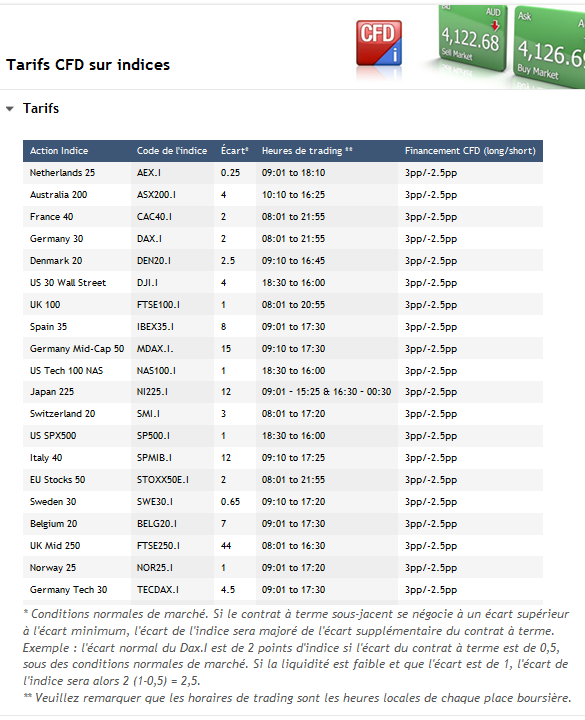
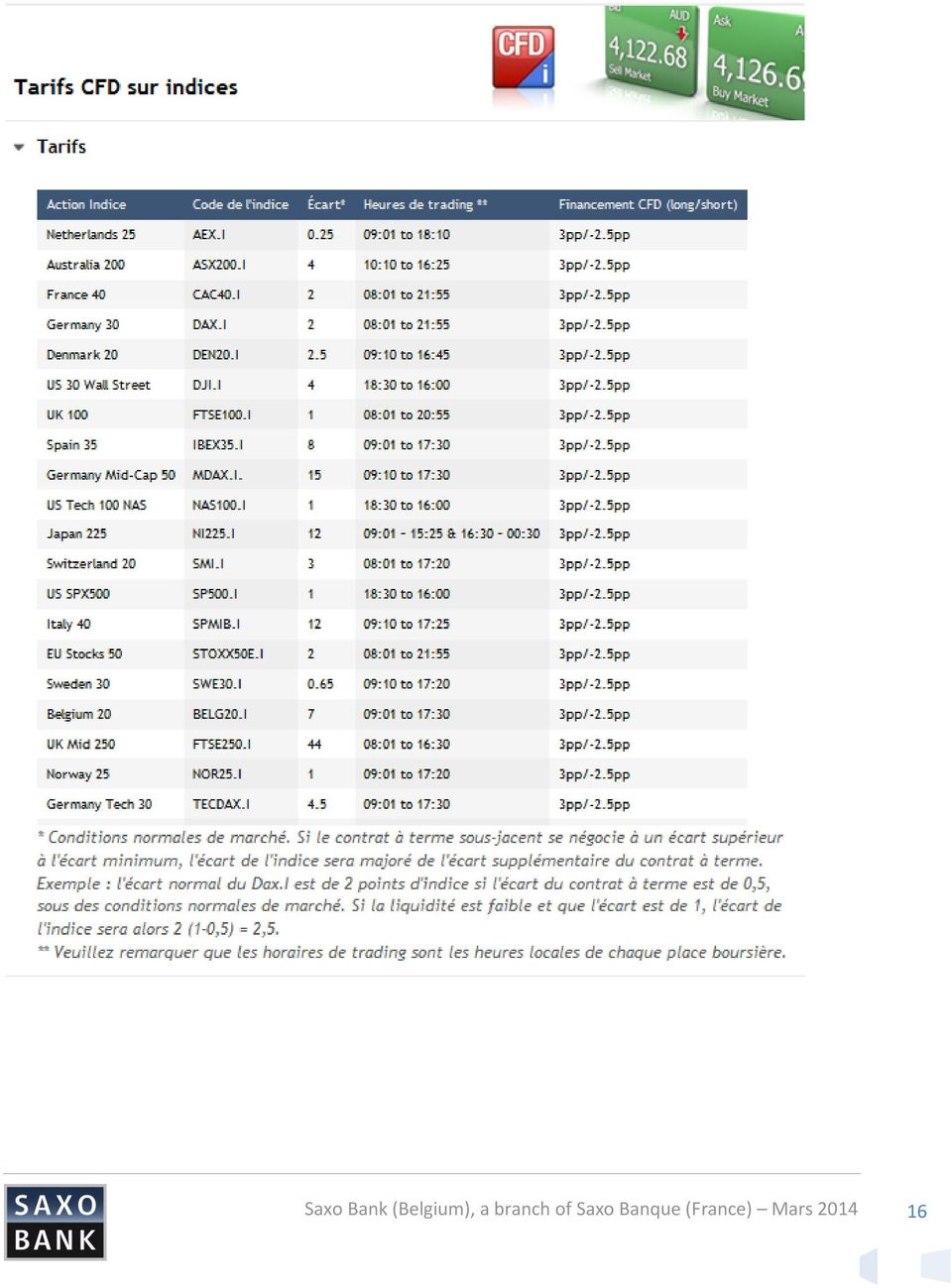
15 D. Coûts liés à la négociation et à la détention de CFD La liste exhaustive des coûts liés aux CFD est détaillée ci-dessous. Les tarifs et conditions données dans cette section sont indicatifs et sont susceptibles d évoluer. Les CFDs cotent toujours dans la devise du sous jacent avec le principe : 1 point = 1 de la devise du sous-jacent. (Exemple : le CFD C AC 40 cote en euros et 1 point de CFD CAC 40 vaut 1 ; le CFD Footsee 100 cote en livre sterling et 1 point de CFD Footsee 100 vaut 1 ) 1. Les frais de transaction ou commission Pour chaque transaction, le client se voit imputer des frais de transaction ou commission calculé, selon le type de CFD, sur la base d un spread ou d un pourcentage de la valeur nominale de la transaction ou encore de centimes rapportés au nombre d actions. Pour les CFD indices, les frais correspondent au spread c est-à-dire à l écart entre le bid et le ask fixé de manière unilatérale par la banque. La détermination du spread est établie par la banque. Par exemple, le client aura une cotation à l achat sur le CFD CAC 40 à 3700 points et une cotation à la vente à 3698 points. Le spread cible (dans des conditions normales de marché) est de 2 points soit 2 pour 1 CFD CAC40. Saxo Bank (Belgium), a branch of Saxo Banque (France) Mars
16 Saxo Bank (Belgium), a branch of Saxo Banque (France) Mars
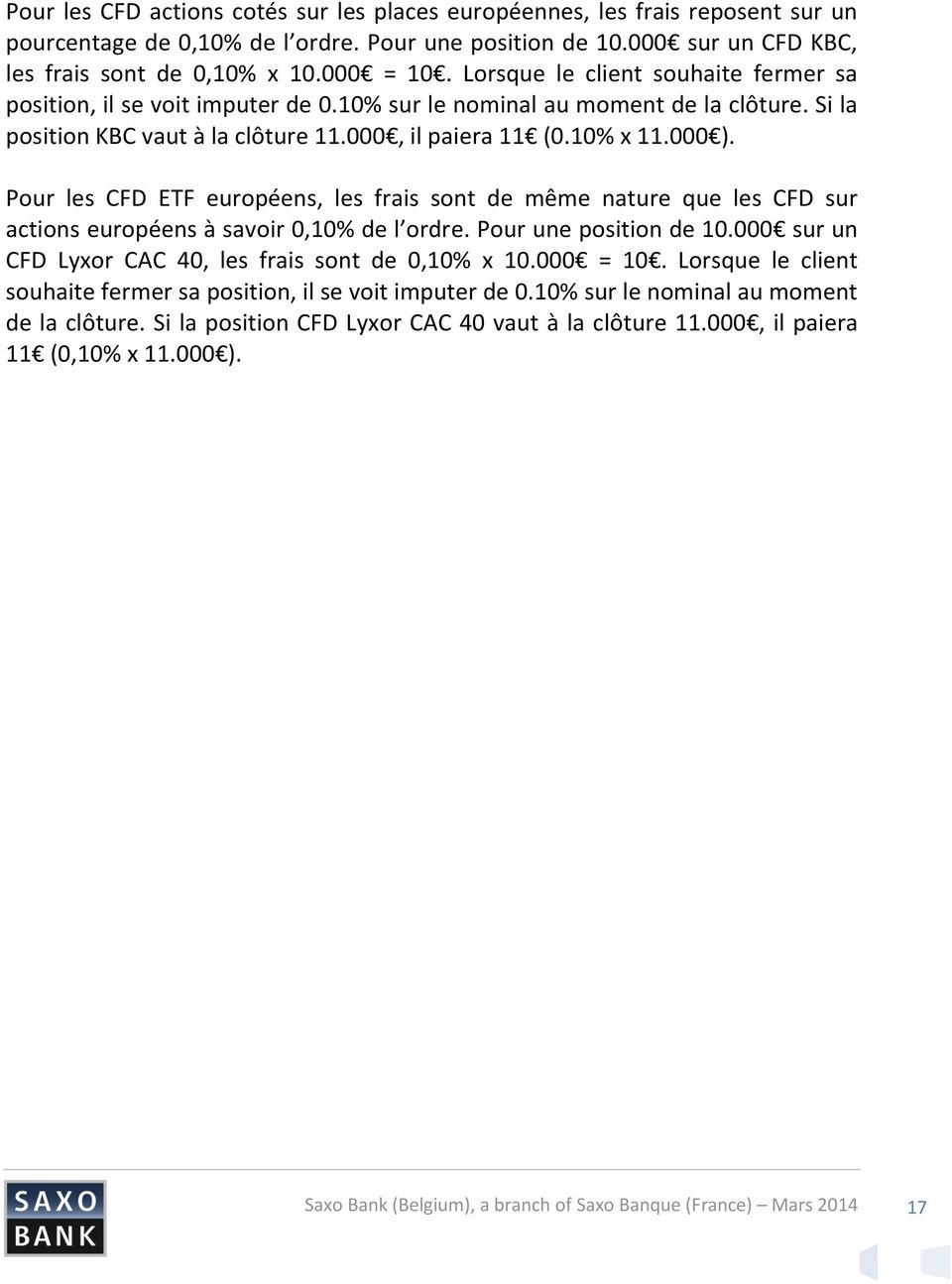
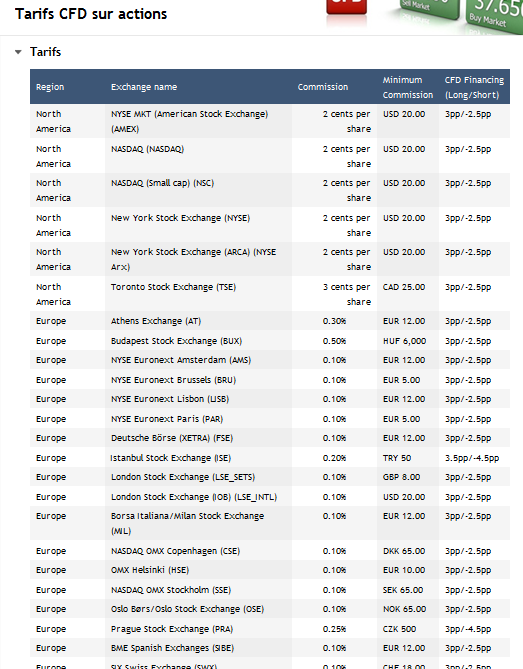
17 Pour les CFD actions cotés sur les places européennes, les frais reposent sur un pourcentage de 0,10% de l ordre. Pour une position de sur un CFD KBC, les frais sont de 0,10% x = 10. Lorsque le client souhaite fermer sa position, il se voit imputer de 0.10% sur le nominal au moment de la clôture. Si la position KBC vaut à la clôture , il paiera 11 (0.10% x ). Pour les CFD ETF européens, les frais sont de même nature que les CFD sur actions européens à savoir 0,10% de l ordre. Pour une position de sur un CFD Lyxor CAC 40, les frais sont de 0,10% x = 10. Lorsque le client souhaite fermer sa position, il se voit imputer de 0.10% sur le nominal au moment de la clôture. Si la position CFD Lyxor CAC 40 vaut à la clôture , il paiera 11 (0,10% x ). Saxo Bank (Belgium), a branch of Saxo Banque (France) Mars
18 Pour les CFD matières premières, les frais portent sur le spread c est-à-dire l écart entre le bid et l ask. Le spread dépend du sous - jacent matière première. A titre d exemple, le coût d un CFD Gold est le spread cible (dans des conditions normales de marché) de 0,8 points par aller/retour. Par exemple, pour un CFD Saxo Bank (Belgium), a branch of Saxo Banque (France) Mars
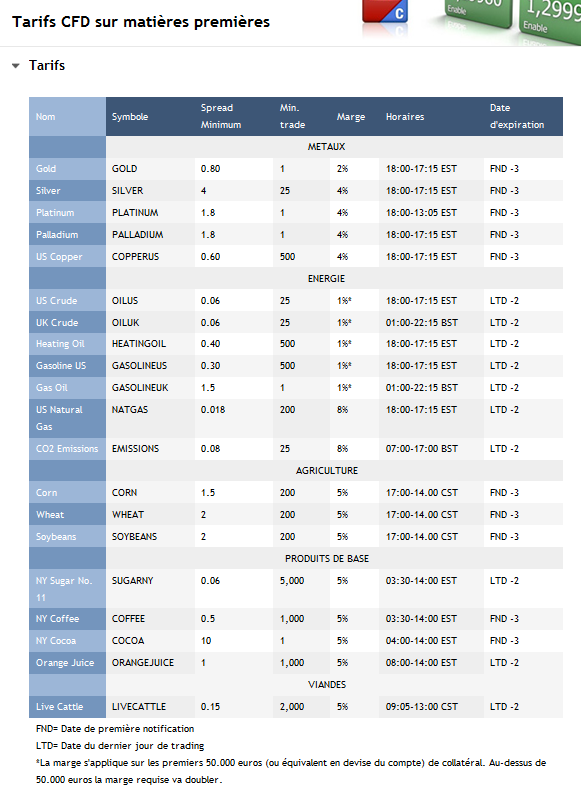
19 Gold, aura une cotation de 1299,20$ /1300$. L écart entre le prix de vente et le prix d achat cible est de 0,80 cts. Saxo Bank (Belgium), a branch of Saxo Banque (France) Mars
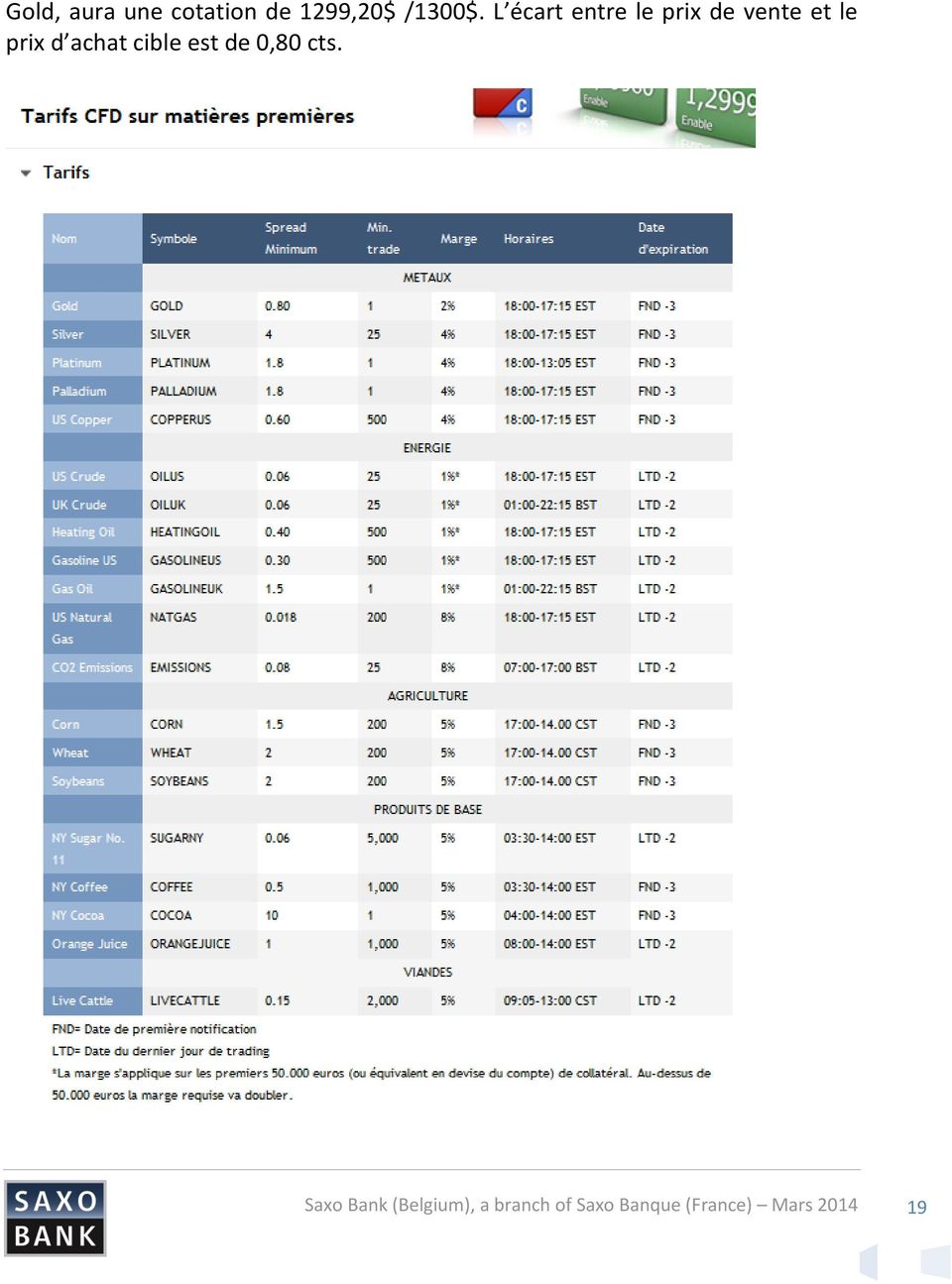
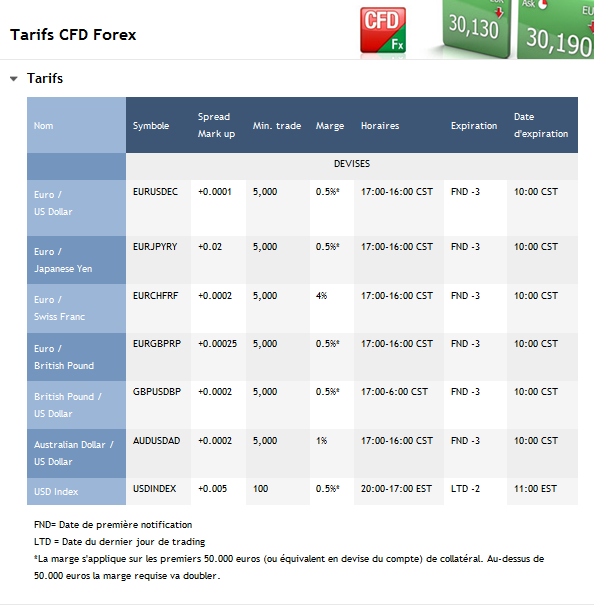
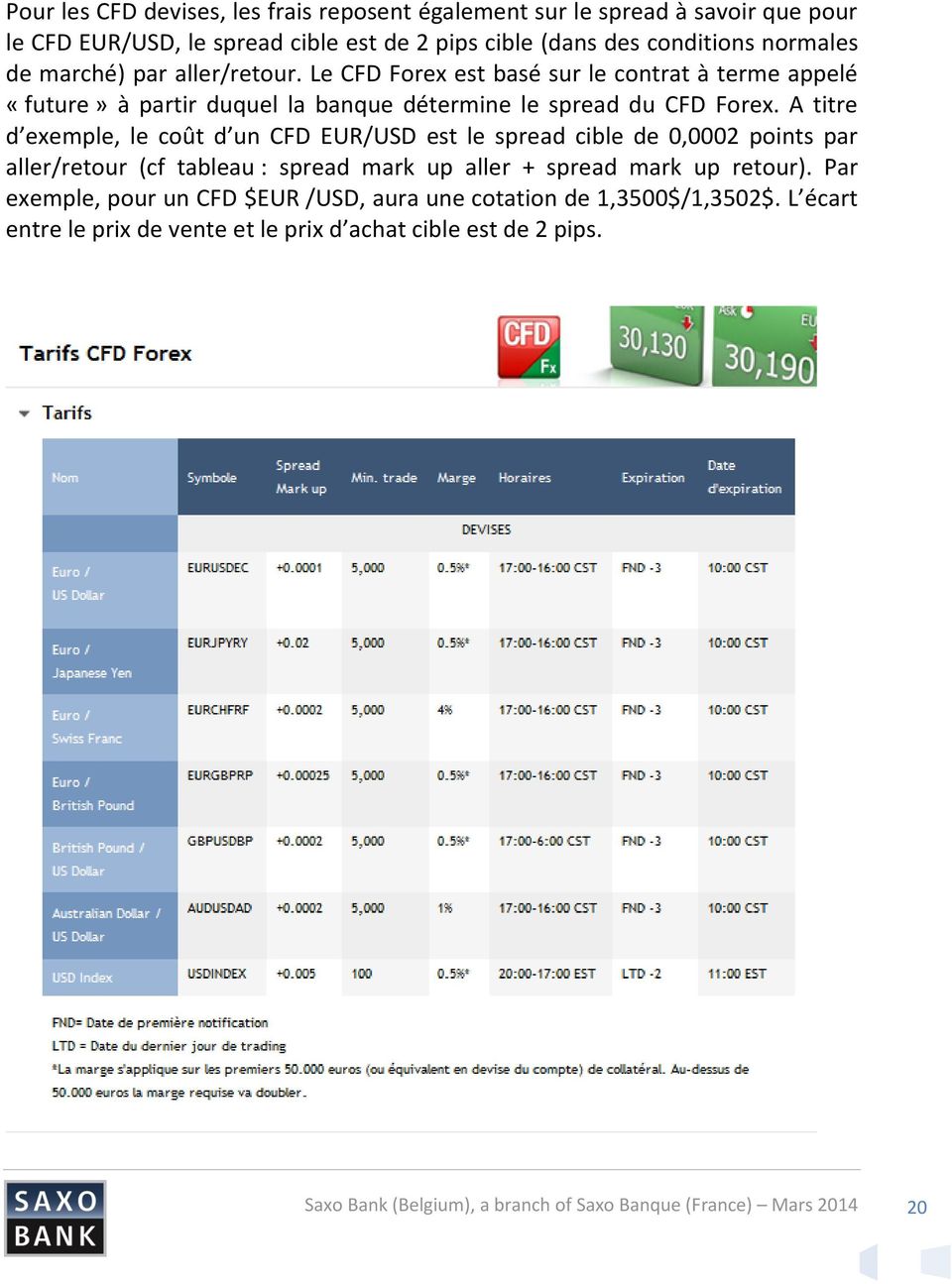
20 Pour les CFD devises, les frais reposent également sur le spread à savoir que pour le CFD EUR/USD, le spread cible est de 2 pips cible (dans des conditions normales de marché) par aller/retour. Le CFD Forex est basé sur le contrat à terme appelé «future» à partir duquel la banque détermine le spread du CFD Forex. A titre d exemple, le coût d un CFD EUR/USD est le spread cible de 0,0002 points par aller/retour (cf tableau : spread mark up aller + spread mark up retour). Par exemple, pour un CFD $EUR /USD, aura une cotation de 1,3500$/1,3502$. L écart entre le prix de vente et le prix d achat cible est de 2 pips. Saxo Bank (Belgium), a branch of Saxo Banque (France) Mars
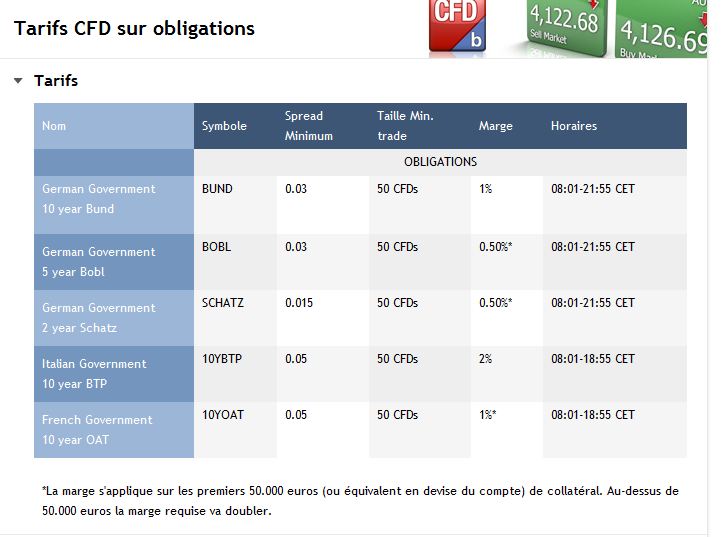
21 Pour les CFD bonds, les frais portent sur le spread qui dépend du sous-jacent contrat «future bond» correspondant. A titre d exemple, le CFD Bund Allemand se côte avec un spread cible (dans des conditions normales de marché) de 0,03 points par aller/retour. Un CFD Bund Allemand, aura une cotation de 141,12$/141,15$. L écart entre le prix de vente et le prix d achat cible est de 0,03 pts. Saxo Bank (Belgium), a branch of Saxo Banque (France) Mars
22 2. Les frais de financement L utilisation d un effet de levier sur des positions longues, conservées au-delà d une journée (appelé overnight ou au jour le jour), comporte un coût. En revanche, l utilisation de l effet de levier sur une position courte, va donner lieu à une rémunération supplémentaire sous forme d intérêt créditeur (sauf si le niveau des taux d intérêts crée les conditions d un intérêt débiteur). Lorsque le client est à l achat sur un CFD et qu il conserve sa position plus d un jour, son compte est débité en fin de mois des intérêts de financement de sa position. Si le taux de financement est de 4% et que la position est conservée 3 jours, il se verra imputer des frais de financement de 4% x valeur nominale x 3 jours / 360. Dans notre exemple ci-dessus, les frais de financement sont de 4% x x 3/360 = 3,33 Lorsque le client est à la vente sur un CFD et qu il conserve sa position plus d un jour, son compte est crédité chaque fin de mois des intérêts de sa position. Si le taux d intérêt est de 1% et que la position est conservée 3 jours, il se verra créditer des intérêts de 1% x valeur nominale x 3 jours / 360. Dans notre exemple ci-dessus, les intérêts sont de 1% x x 3/360 = 0,83. Le calcul des frais de financement en position longue provient du : (Taux euro libor + mark-up de l émetteur) x valeur nominale x n/360 Le calcul des intérêts créditeurs en position courte est : (Taux euro libid mark-down de l émetteur) x valeur nominale x n/360 Si le taux euro libid est inférieur au mark-down de l émetteur, le client ne recevra pas d intérêts créditeurs mais devra payer la différence. Dans les conditions de marché actuel (2013) avec des taux d intérêt bas le client paye ces intérêts. Saxo Bank (Belgium), a branch of Saxo Banque (France) Mars
23 3. Les ajustements de dividendes Lorsque des dividendes sont versés sur les actions sous-jacentes, les détenteurs de positions longues en CFD sont admissibles à un paiement partiel. L ajustement de dividende est calculé à partir de la position du client déduit du taux d imposition standard international lié aux CFD. Les détenteurs de positions courtes devront payer un montant égal à la totalité du dividende (brut) versé sur l'action sous-jacente. Les dividendes sur les positions CFD sont des ajustements de trésorerie payés ou débités par la banque et non par la société sous-jacente. Plus de détails dans la section «IV.5.4 Dividend adjustments». 4. Les frais d abonnement La configuration initiale de la plateforme de trading donne accès au prix des CFD sur action avec un décalage de 15 minutes. Pour obtenir les cotations en temps réel, les clients doivent souscrire à un abonnement mensuel. L ensemble des frais d abonnement est consultable sur notre site internet : 5. Les coûts d emprunt Un coût d emprunt peut être appliqué aux CFD actions quand le client détient des positions vendeuses en over night. Ce coût dépend de la liquidité du sous-jacent et peut être nul si la liquidité est très abondante. 6. Les coûts de liquidité Les coûts de liquidité sont dus au fait que sur chaque CFD, il existe un spread entre le prix demandé et le prix offert. Cela veut dire qu un client qui possède une position CFD perdra quoi qu il arrive la différence de la fourchette de prix, et ce, même si le prix du sous-jacent n a pas bougé entre l achat et la vente de la position. Saxo Bank (Belgium), a branch of Saxo Banque (France) Mars
24 Par exemple, si un client veut acheter un CFD action qui cote 10,00 /10,02. Il achètera au prix offert, i.e. 10,02. S il vend sa position directement, il vendra au cours demandé ; i.e. 10. Le client perdra donc 0,02 bien que le prix du sousjacent n aie pas changé. C est le coût de liquidité. On peut noter d ailleurs que ce coût de liquidité est différent des frais de commissions ou des frais de financements. 7. Les net free equity costs Voir p.51 E. Exemples de positions prises sur CFD actions Position «LONGUE» gagnante Si le client anticipe la hausse d un CFD action AB Inbev, il va prendre une position longue sur le CFD action AB Inbev. Le cours du CFD AB Inbev est de 66,60 /66,62. Il achète CFD au cours de 66,62. La valeur nominale est de (1.000*66,62 ). La marge requise pour ce CFD AB Inbev est de 5% équivalent à (5% de ). Le client immobilise uniquement de son capital pour prendre cette position. La marge de 5% est définie en fonction du risque lié au sous-jacent. En l occurrence pour AB Inbev, l effet de levier maximum est de 20 soit une marge requise de 5% (1/20). En termes de frais, Il paie les frais de transaction de 0.10% du nominal soit 66,62. S il garde sa position en overnight, il sera soumis au frais de financement au taux du LIBOR + mark-up de l émetteur (+/- 0,27144%+3% = 3,27144%). Dix jours plus tard, le CFD AB Inbev s apprécie à 70 et le client vend ses CFD à 70. Il paie 0.10% du nominal à soit 70 et se verra imputer en fin de mois des frais de financement de 60,54 ( x 3,27% x 10/360). Il réalise ainsi un gain net de 3.182,84. Le détail du calcul est indiqué dans le tableau ci-dessous : Saxo Bank (Belgium), a branch of Saxo Banque (France) Mars
25 Détails Calcul Montant ( ) Valeur nominale à x 66, l achat Marge requise x 5% Commission x 0,10% -66,62 Frais de financement 3,27144% x 10 days x / -60, Valeur nominale à la x vente Commission x 0,10% -70 Profit Total des frais 66, , ,16 Gain net , ,84 Position «LONGUE» perdante Avec un capital à , il décide d acheter CFD au prix de 66,62. La valeur nominale est de (1.000*66,62 ). La marge requise pour ce CFD AB Inbev est de 5% équivalent à (5% de ). La marge de 5% est définie en fonction du risque lié au sous-jacent. En l occurrence pour AB Inbev, l effet de levier maximum est de 20 soit une marge requise de 5% (1/20). Le client immobilise uniquement de son capital pour prendre cette position. Ainsi le capital immobilisé est de pour une position de Si le client souhaite prendre d autres positions, il aura par conséquent de capital disponible ( ). En termes de frais, il paie les frais de transactions de 0.10% de l ordre soit 66, jours plus tard, le CFD AB Inbev est de 63 et le client décide de clôturer sa position. Il paie 0.10% du nominal à , soit 63, et 60,54 de frais de financement. Il réalise ainsi une perte nette de 3.810,16. Saxo Bank (Belgium), a branch of Saxo Banque (France) Mars
26 Dans le cas où la marge requise est égale au capital, on dit que le client est en appel de marge. En effet, si la perte amène votre capital au même niveau que la marge requise, le compte est en appel de marge. Par exemple si mon capital initial de baisse à soit le niveau de ma marge requise, le compte est en appel de marge. A partir de ce moment et à tout moment, le client peut voir sa position déboucler par la banque car son capital n est plus suffisant pour conserver sa position. Le détail du calcul est indiqué dans le tableau ci-dessous : Détails Calcul Montant ( ) Valeur nominale à l achat x 66, Marge requise x 5% Commission x 0,10% -66,62 Frais de financement Valeur nominale à la vente 3,27144% x 10 days x / , x Commission x 0,10% -63 Perte Total des frais 66, , ,16 Perte nette , ,16 Position «COURTE» gagnante Le client anticipe la baisse d un CFD action. Il décide de shorter CFD Colruyt en prenant une position courte au prix de 36,69. La valeur nominale est de (2.000*36,69 ). La marge requise pour ce CFD Colruyt est de 5% équivalent à (5% de ). Le client immobilise uniquement de son capital pour prendre cette position. La marge de 5% Saxo Bank (Belgium), a branch of Saxo Banque (France) Mars
27 est définie en fonction du risque lié au sous-jacent. En l occurrence pour Colruyt, l effet de levier maximum est de 20 soit une marge requise de 5% (1/20). En termes de frais, la commission est de 0.10% de , soit 73,38. En fin de mois, il reçoit des intérêts créditeurs au taux du LIBID - mark-down de l émetteur (+/- 0,26561%-2,5%= -2,23439%). Actuellement les taux sont tellement bas que le client va subir des intérêts négatifs car le mark-down est supérieur au taux LIBID à hauteur de 2,23439%. Dix jours plus tard, le CFD Colruyt baisse à 34,50 et le client rachète ses CFD à 34,50. Il paie 0.10% du nominal à soit 69 et se voit imputer des frais de financement de 45,54 ( x 2,23% x 10/360). Il réalise ainsi un gain net de 4.192,08. Le détail du calcul est indiqué dans le tableau ci-dessous : Détails Calcul Montant ( ) Valeur nominale à la x 36, vente Marge requise x 5 % Commission x 0,10% -73,38 Frais de financement 2,23439% x 10 days x / -45, Valeur nominale à x 34, l achat Commission x 0,10% -69 Profit Total des frais 73, , ,92 Gain net , ,08 Saxo Bank (Belgium), a branch of Saxo Banque (France) Mars
28 Position «COURTE» perdante Le client anticipe une baisse du CFD Colruyt mais le cours du CFD Colruyt s apprécie. Il décide de vendre CFD à 36,69. Ce qui donne une valeur nominale de (2.000*36,69 ). La marge requise pour ce CFD Colruyt est de 5% équivalent à (5% de ). Le client immobilise uniquement de son capital pour prendre cette position. La marge de 5% est définie en fonction du risque lié au sous-jacent. En l occurrence pour Colruyt, l effet de levier maximum est de 20 soit une marge requise de 5% (1/20). En termes de frais il paie les frais de transactions de 0.10%, soit 73,38. Dix jours plus tard, le CFD Colruyt est à 38 et le client décide de couper ses positions. Il paie 0.10% du nominal à , soit 76 et 45,54 de frais de financement. Il réalise ainsi une perte nette de 2.814,92. Le détail du calcul est indiqué dans le tableau ci-dessous : Détails Calcul Montant ( ) Valeur nominale à la vente x 36, Marge requise x 5 % Commission x 0,10% -73,38 Frais de financement Valeur nominale à l achat 2,23439% x 10 days x / , x Commission x 0,10% -76 Perte Total des frais 73, , ,92 Perte nette , ,92 Saxo Bank (Belgium), a branch of Saxo Banque (France) Mars
29 Exemple de position impliquant le cout de liquidité lie au spread bid-ask Si le client décide de clôturer sa position alors que le cours du sous-jacent n a pas bougé, alors il se verra imputer du coût de liquidité reposant sur le spread bid-ask (hors frais de courtage). En effet, si le cours du CFD KBC côte à l achat (ask) et à la vente (bid) selon la loi de l offre et de la demande, le client subira une perte de 0.02 par CFD KBC. F. Principaux facteurs de risques 1. Risque lié à l'effet de levier L effet de levier sur les CFD utilisé par un client fonctionne autant à la hausse qu à la baisse et en position gagnante et perdante. L évolution de la position avec effet de levier est ainsi démultipliée et peut engendrer des pertes importantes en raison de l utilisation d un effet de levier excessif. Par exemple, si le cours baisse de 1% sur le CFD Bel20 et que le client anticipe une hausse du BEL20 avec un effet de levier de 50 la perte sera alors de 50%. Pour un effet de levier de 100, la perte sera de 100%. 2. Risque de marché L impact de l évolution des marchés sur un investissement en CFD est démultiplié par rapport à un investissement sur les actions ; par conséquent le risque de marché en est plus élevé. L'investissement en CFD pet engendrer une perte plus importante que le capital initialement investi. 3. Risque de contrepartie Le CFD est un contrat financier qui se négocie sur un marché de gré à gré et qui lie le client à une contrepartie, l'émetteur du CFD. Par conséquent, il existe un risque de contrepartie pour le client si la contrepartie ne peut assurer son engagement. Saxo Bank (Belgium), a branch of Saxo Banque (France) Mars
30 4. Risque de liquidité Un client voulant clôturer sa position CFD, peut être soumis à un risque de liquidité dans la mesure où, il peut ne pas pouvoir clôturer sa position au moment et au prix qu il souhaite. Les conditions de clôture sont définies par la contrepartie qui est la banque. La banque peut refuser de négocier ou proposer un prix moins intéressant. En effet, si la liquidité n est pas suffisante à un instant t, le client peut voir sa position non executée par la banque ou bien exécutée par palier en fonction du nombre de CFD échangés au prix demandé par le client (loi de l offre et de la demande). C est pourquoi il est important pour le client de vérifier la liquidité de l instrument sous-jacent, à savoir connaître le volume échangé sur le marché traité directement depuis la plateforme de trading dans la rubrique «volume». 5. Risque des ordres liés, take profit et stop loss non exécutés Il est souhaitable que le client fixe à l avance un objectif de gain (ordre take profit) et de perte (ordre stop loss). Le stop loss permet ainsi de définir un niveau de sortie en cas de perte sur la position. Mais il arrive que la contrepartie ne garantisse pas ce niveau de sortie automatique en raison du manque de liquidité (Cf. risque de liquidité). 6. Risque de change Pour les gains et les pertes sur des positions détenues dans une devise différente de celle du compte, le client peut être soumis à un risque de change, en cas d évolution défavorable de la devise. 7. Risque de saut (gap) Le client qui conserve des positions sur plus d une journée peut subir des écarts haussier ou baissier à l ouverture du marché le lendemain. Il arrive parfois que le cours de la veille ne soit pas exactement le même ou voire augmenté ou diminué de x% le lendemain en raison d ordres passés la veille ou d une annonce économique majeure survenu hors cotation de marché. Le client peut se voir ainsi soumis au risque de saut du cours du CFD et par conséquent subir d importantes pertes dues à l effet de levier. Saxo Bank (Belgium), a branch of Saxo Banque (France) Mars
31 8. Risque de liquidation forcée Lorsque le client se situe en appel de marge (100% d utilisation de marge), il peut être contraint de voir ses positions fermées par la contrepartie à tout moment. La marge requise est alors équivalente au capital disponible et ce dernier ne suffit plus pour maintenir l ensemble des positions. La contrepartie peut par conséquent estimer que le risque est excessif et déboucler les positions ouvertes du client. 9. Risque technologique Le client peut subir des problèmes liés au fonctionnement de sa plateforme de trading (lenteur d exécution, problèmes d affichage de cours, compatibilité ) en raison de la qualité de sa connexion internet par exemple. 10. Risque lié à la suspension du cours du sous-jacent Lorsque le cours du sous-jacent est suspendu, le CFD lié à ce même sous-jacent fait également l objet d une suspension. Le client qui détient ce CFD ne peut donc pas clôturer sa position, alors qu il continue à subir des frais de financement. 11. Risque de conflit d intérêt Dans la mesure où la contrepartie du client est également l émetteur du CFD, un conflit d intérêt peut exister car les parties peuvent avoir des intérêts divergents. D une manière générale, dans le cadre de son activité de fourniture de service d exécution d ordres et/ou de conseil en investissement, des situations de conflits d intérêt peuvent exister entre la banque et ses clients. Dans le cadre de sa procédure de prévention et gestion des conflits d intérêts, la banque a établi une liste non exhaustive de scénarios éventuels de conflits d intérêts. A titre d illustration, des conflits d intérêts pouvant survenir dans les situations suivantes : Saxo Bank (Belgium), a branch of Saxo Banque (France) Mars
32 i. La banque ou une personne concernée a des intérêts financiers auprès du client ; cette hypothèse englobe notamment le cas où la banque ou la personne concernée a des parts ou actions dans le capital du client qui souhaite ouvrir un compte ou réaliser des transactions avec ou par l intermédiaire de la banque; ii. iii. iv. La banque ou une personne concernée a des liens familiaux avec une personne concernée par le client ; il existe une politique de cadeaux adressés ou même reçus par la banque qui pourrait avantager un client au détriment d un autre ; La banque privilégie l offre de certains instruments financiers lui assurant une meilleure rémunération au détriment de l offre d autres instruments financiers adaptés à la situation de client lui assurant une rémunération moindre ; v. Une personne concernée achète ou prend une position sur des instruments financiers dont elle assure la distribution auprès de la clientèle ; vi. vii. viii. ix. La banque a conclu une convention de partenariat avec un tiers ; dans cette hypothèse, elle pourrait privilégier l intérêt de son partenaire plutôt que celui de son client ; La banque peut fournir un conseil à un client dont les intérêts peuvent être contraires ou concurrents à ceux d autres clients ; La banque peut avoir un intérêt contraire à celui de ses clients dans le cadre des transactions qu elle conclut avec ces derniers (par exemple, lorsque le client réaliser des transactions sur des marchés ou la banque agit en qualité de teneur de marché ou lorsque la banque envisage d investir dans un instrument financier similaire à celui du client) ; La banque, ses employés et sociétés affiliées peuvent avoir pris, changé ou mus une terme à des positions sur des titres financiers, sur des opérations de change ou sur d autres instruments financiers qui sont couvertes par une recommandation ou un conseil en investissement qu elle a fourni ; Saxo Bank (Belgium), a branch of Saxo Banque (France) Mars
33 La banque pourrait avoir un intérêt à augmenter le volume des transactions afin de maximiser les revenus engendrés par les commissions, lequel n est pas conforme à l intérêt du client de minimiser ses coûts de transaction. x. La banque peut octroyer à ses employés une rémunération variable dépendant du volume de transactions réalisées par les clients ; La banque peut recevoir ou verser des avantages ou rémunérations de la part de tiers au titre du référencement de nouveaux clients ou de nouveaux comptes clients. Par ailleurs, la banque prend toutes les mesures raisonnables, lui permettant de détecter et prévenir les situations de conflits d intérêts se posant dans le cadre de ses activités. A cet effet, plusieurs dispositifs organisationnels ont été mis en place, notamment: la mise en place d un organigramme au sein de la banque tenant compte du niveau d indépendance requis par certaines unités dans l exercice de leurs activités ; la mise en place de règles relatives à l accès et la diffusion d informations limitées aux seules nécessités professionnelles (édification de murailles de Chine) étant précis que la circulation d informations sensibles ou privilégiées est encadrée par une procédure précise ; La communication des publications de recherches d investissement à des clients, clients potentiels ou tiers à des fins informatives ou au titre de formation dans le cadre de leur activité d investissement et dans des circonstances ou la banque ne pourrait raisonnablement pas s attendre d avoir une influence significative sur la décision d investissement du client ou du tiers concerné ; Saxo Bank (Belgium), a branch of Saxo Banque (France) Mars
34 Le respect par tous les salariés de la banque des règles applicables en matière de secret professionnel et de partage en interne d informations confidentielles ; la loyauté dont tous les salariés doivent faire état à l égard de la banque et conformément à son code déontologique et l ensemble de ses procédures ; le traitement équitable de tous les clients de la banque le dispositif de versement de bonus des salariés de la banque n est pas affecté de manière significative au nombre ou volume de transactions des clients ; la mise en place d une politique de rémunération des collaborateurs exerçant des mandats sociaux au sein du groupe Saxo Bank ; La distribution en interne de publications de recherches ou de recommandations d investissement simultanément aux collaborateurs de la banque et aux clients. Les analystes financiers n étant pas autorisés à fournir aux équipes de «trading» d informations sur les dates de diffusion et le contenu des publications ou recommandations à venir. Avant l ouverture d un compte de trading, il est primordial de consulter cette note d information, de s informer sur les produits dérivés sur marge CFD et de tester en simulation à partir d un compte de trading fictif gratuit et sans engagement. En effet, les CFD sont des produits dérivés complexes qui présentent, en raison de leur effet de levier, un fort caractère spéculatif et peuvent exposer le client à des risques de pertes supérieures au montant investi. Ces produits sont destinés à une clientèle avisée pouvant surveiller ses positions de manière quotidienne et ayant les moyens financiers de supporter un tel risque. Les CFD sont par ailleurs des produits financiers sans date d échéance (exceptés sur les CFD matières premières, CFD Forex et CFD Bond) et qu il appartient à le client de déboucler ses positions. Saxo Bank (Belgium), a branch of Saxo Banque (France) Mars
35 Warning CFDs are derivative products with a high risk, which are not appropriate for all clients. Any mentioning in a publication of the risks pertaining to a particular product or service may not and should neither be construed as a comprehensive disclosure nor full description of all risks pertaining to such product or service and the bank strongly encourages any recipient considering trading in its products and services to employ and continuously consult suitable financial advisors prior to the conclusion of any investment or transaction. If the client wants to open a trading account and to enter into a trading relationship with the bank, he has to be aware of the risks involved. The client must have adequate financial resources to bear such risks and must apply good money management. Any trade on any CFD shall be subject to the Bank s General Conditions. Such General Conditions and the Price List referred to therein, shall supersede any information which may be given herein for illustrative purposes. Saxo Bank (Belgium), a branch of Saxo Banque (France) Mars
36 III. RISKS A. Risk warning You must carefully consider whether using CFDs is appropriate for you in the light of your circumstances and financial position. You should be aware that margin trading is a high risk geared investment strategy and we do not consider it suitable for many members of the public. CFDs carry a high degree of risk and the gearing or leverage obtainable means that losses can exceed your initial deposit. You should not deal in CFDs unless you understand the nature of the contract you are entering into and the extent of your exposure to risk from that contract. Please find hereunder some important information that you should consider before deciding to trade CFDs. Investing with CFDs requires monitoring at all times. If you don t have time to monitor your transactions, we advise you not to trade on CFDs. Holding a position overnight on CFD can expose to overnight risk exposure if markets next morning open far from close and it can lead to significant losses meaning more than the margin. CFDs (expect CFDs on futures) don t have expiry date, so you can close your CFD position when you want during the opening hours. For Long CFDs the maximum risk is for the price to drop until zero. For Short CFDs there is no maximum exposure, it is unlimited, as there is limitation to how far up the price can go. (The VW case in a nutshell) Margin Trading carries a high level of risk. It is appropriate only for persons who, if they trade on margin, can assume risk of loss in excess of their margin deposit. Therefore, investors must ensure that they fully understand the risks involved and seek independent advice if necessary before applying to open an account with the bank. Saxo Bank (Belgium), a branch of Saxo Banque (France) Mars
37 B. Risks of trading The client must carefully consider whether trading CFDs is appropriate for him in the light of his experience, objectives, financial resources and other relevant circumstances. He should be aware that margin trading is a geared investment strategy involving high risks. Hence, it is not suitable for all clients. The client should not trade CFDs unless he fully understands the nature of the contract he is entering into and the extent of his exposure to the risks arising from that contract. Indeed, CFDs involve different levels of exposure to risk, therefore in deciding whether to trade in such instruments, the client should be aware of the following points: Trading in CFDs carries a high degree of risk. The leverage involved in trading CFDs implies that a small initial margin payment can potentially lead to large losses. The geared nature of CFDs also means that CFD trading can carry greater risks than conventional share trading, which is generally not geared. A relatively small market movement can lead to a proportionately much larger movement in the value of the investment, and this can work against the client as well as for the client. The bank acts as a market maker in CFDs. As such, all CFDs are off-exchange derivatives and the bank is acting as the client s counterpart to the transaction. For these reasons, these off-exchange transactions may involve increased risks since the client can exclusively open and close his positions with the bank. Moreover, off-exchange transactions may be less regulated or subject to a separate regulatory regime. Therefore, before undertaking such transactions, the client should familiarize himself with applicable rules and attendant risks. Foreign markets involve different risks from those arising from than European markets. The potential for profit or loss from CFDs relating to a foreign market or denominated in a foreign currency will be affected by fluctuations in foreign exchange rates. The client may incur a loss if exchange rates change to his Saxo Bank (Belgium), a branch of Saxo Banque (France) Mars
38 detriment, even if the price of the instrument to which the CFD relates remains unchanged. The exchange rate risk is not incurred on the notional size of the position but only on the P&L as the notional value is not converted. CFDs are contingent liability transactions which are margined and require the client to make a series of payments against the purchase price, instead of paying the whole purchase price immediately. Moreover, CFDs may only be settled in cash. The client may sustain a total loss of his initial margin funds and any additional funds deposited with the bank, to establish or maintain a position. If the market moves against him and/or margin requirements are increased, he may be called upon to pay substantial additional margin at short notice. Failing to comply with a request for a deposit of additional funds within the required time, may result in closure of the client s position(s) on his behalf and he will be liable for any resulting loss or deficit. He will be deemed to have received a notice requiring the payment of such funds, even if he does not receive the messages left for him, if the notices are delivered to his nominated contact points. A CFD may still carry an obligation to make further payments under certain circumstances over and above any amount paid when the client entered into the contract. For example, this may occur when market conditions may not allow the execution of such an order (ex: during an opening gap or during a period of low liquidity).under certain trading conditions it may be difficult or impossible to liquidate a position. This may occur, for example, at times of rapid price movement if the price rises or falls in one trading session to such an extent that trading in the underlying market is suspended or restricted. There is no clearing house for CFDs, and the performance of a CFD is not guaranteed by an exchange or clearing house. The bank s insolvency or default may lead to the positions being liquidated or closed out without the client consent. While in such circumstances any deposits lodged with the bank would be totally protected as they are held on trust, any unrealized profits may not be fully recovered. The client would rank as an unsecured creditor of ours in relation to such unrealized profits. Saxo Bank (Belgium), a branch of Saxo Banque (France) Mars
39 C. Volatility of derivative markets Financial markets can be highly volatile. The prices of CFDs and the underlying securities, currencies, commodities, financial instruments or indices may fluctuate rapidly over wide ranges, in reflection of unforeseen events or changes in conditions, none of which can be controlled by the client. The prices of CFDs will be influenced by the same unpredictable events that affect all financial instruments including a change in supply and demand relationships, governmental, agricultural, and commercial and trade programs and policies, national and international political and economic events and the prevailing psychological characteristics of the relevant marketplace. D. Currency risk Balances in currencies other than Euro may be maintained by the client on his account and, when requested by the client and/or necessitated by his trading, conversions between currencies will be made at an exchange rate no more than 0.5% less favorable to the client than the prevailing interbank mid-market spot rate at the time of the conversion. For example, if the client opens a CFD on Apple stock, it will be priced in US dollars. Any crystallized profit or loss on the CFD will be calculated first in US dollars and then converted into Euros (again, at an exchange rate no more than 0,5% less favorable to the client than the current interbank mid-market spot rate) before being allocated to his account. A crystallized profit or loss that is realized in a currency other than the client base account currency will be converted daily. The client may choose to maintain his account in Euros or in US dollars or a number of other major currencies. E. Counterparty risk The clients open an account with Saxo Bank (Belgium), which is a branch of Saxo Banque (France). If Saxo Bank (Belgium) goes bankrupt, that is to say if Saxo Banque (France) goes bankrupt, the client s funds are guaranteed by the French Deposit Guarantee Fund (Fonds de Garantie des Dépôts) up to for cash deposits and for derivatives products like CFD and securities in compliance with Saxo Bank (Belgium), a branch of Saxo Banque (France) Mars
40 the new European directive in This Fund covers the client s losses if Saxo Bank (Belgium) becomes subject to compulsory winding-up. F. Liquidity Risk 1. Liquidity Risk about CFD The liquidity risk on a CFD is the risk that a CFD cannot be traded when the client want to buy or sell (to avoid a loss or make a profit). Due to low volume or low liquidity, the client s order or position might not be executed. The interest of the bank and the interest of the investor is the same: to have liquid CFD products. If the bank offers a CFD, it would always seek the maximum liquidity.. Indeed, if the client would face bad liquidity on its CFD position,the bank would find it difficult to hedge the risk that the position caused. 2. Liquidity Risk of the Bank The bank operates with a liquidity pool available at all times in the form of unencumbered, highly liquid securities and cash instruments to address the estimated potential cash needs during a liquidity crisis. The bank acknowledges the value of flexibility and the balance between the counterparty risks associated with holding cash during a liquidity crisis and the importance of being liquid during the first period of a liquidity crisis. The bank operates with the following main liquidity objectives: The bank has the capacity to fulfill all payment obligations as and when they fall due to their full extent and in the currency required; The bank continues as a going concern under its current business model in case of increasing cost of funding or even lack of funding The bank prevent that funding costs rise to disproportionate levels The bank has more obligations due on demand or within a short time frame than assets held by us maturing on demand or within a short time frame. In order to address this mismatch, the bank hold a buffer at all times in cash or cash like Saxo Bank (Belgium), a branch of Saxo Banque (France) Mars
41 securities to meet any outgoing demands based on reasonable estimates. Furthermore, the bank s policy requires keeping an appropriate liquidity pool available at all times to meet any other payment obligations in due time. G. Leverage and margin CFDs are traded on margin. This means that the client is able to leverage his investment by opening positions of larger size than the funds he has on his account on his account. The margin is the amount reserved on his trading account to cover any potential losses from an open CFD position. It is possible that a loss may exceed the required margin. Margin requirements vary from instrument to instrument and can be changed at the bank sole discretion to reflect market conditions. For larger re-ratings or changing of margin requirements for very popular instruments clients will be notified in advance where possible. Margin requirements by CFD type and instrument are always listed under the CFD Trading Conditions on the trading platforms but can also be seen on our website. Because of the effect of leverage and therefore the speed at which profits or losses can be incurred, it is important that the client monitors his positions closely. It is his responsibility to monitor his trades and while he has open trades he should always be in a position to do so. Upon opening a CFD, the client will be immediately required to make a payment of margin to the bank, which will be a set percentage of the value of the underlying transaction. The initial margin requirement must be placed on his account before a position is opened. For example, the client buys a CFD of ABC Group shares priced For this deal, he is required to pay margin of 10% to the bank. The initial margin payment he makes is therefore ( x 1.00 x 10%). The initial margin requirement for any particular equity CFD is calculated as a percentage of the value of the opening CFD. Margin percentages for particular shares vary according to volatility and market conditions, and are normally between 5% and 100%. The rating system for Stock Index Trackers and Single Stocks CFDS are as follows: Saxo Bank (Belgium), a branch of Saxo Banque (France) Mars
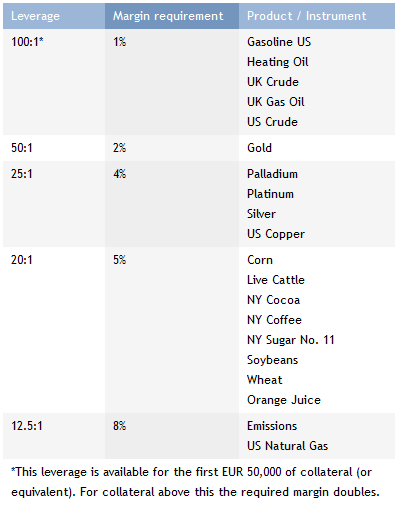
42 The maximum leverage for Commodities CFDs is set at set100:1 which corresponds to a margin requirement of only 1%. See the table below for full details. Saxo Bank (Belgium), a branch of Saxo Banque (France) Mars
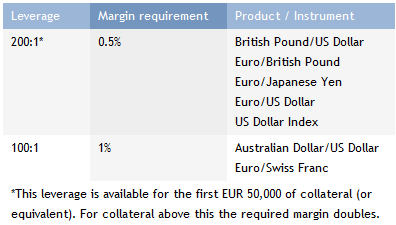
43 The maximum leverage available for Forex CFDs is 200:1 equal to just 0.5% of the notional value in margin. The bank reserves the right to increase margin requirements for large position sizes, including client portfolios considered to be of very high risk. In extreme conditions or situations, percentage or per-contract margin requirements higher than those shown in the Contract Details may apply. The client will be notified of the further amount of money required to keep the CFD open if the bank changes the margin percentage on an open CFD. The client should also be aware that if the bank increases margin rates; he may be required to deposit additional funds into his account to cover the increased margin rates. If he does not, he bank will be entitled to close all of his trades. It is the responsibility of the client to constantly monitor his open positions to ensure that he retains sufficient funds to cover the margin on open positions. To assess whether he is due to pay margin, he must add up the margin requirements for all open positions on his account. If the sum of the cash on the client s account and of the value of his open positions is less than the margin requirements on his account, he will be required to fund the shortfall. The amount for which he will be liable to pay will be sufficient to ensure that he has completely covered the margin requirements for all open positions on his account. The client s current margin position (and any deficit) will be displayed on his secure session on the Saxo Bank (Belgium), a branch of Saxo Banque (France) Mars
44 bank s trading platform, or can be obtained from the bank sales traders by telephone. The bank may call the client to inform him that he is liable to make an additional margin payment (a margin call );; however the bank s failure to make a margin call in no way negates his obligation to monitor his margin position and pay any shortfall. If he does not pay the shortfall immediately, the Customer Agreement gives the bank significant rights against the client that he should be fully aware of. These rights include, but are not limited to, closing his open positions without prior notice to him. The bank is entitled to do so, as soon as the client has a margin shortfall however large or small. Payments of margin are not a cost, per se, but the client should be aware that the bank will not pay interest on margin payments. Margin payments are required in the form of cleared funds in the bank account. All CFDs have an underlying transaction value and deposits and margins are based on this. For example, a buy CFD on 10,000 ABC Group shares at 1.00 has a transaction value of ( 1.00 x ). If the relevant deposit rate is 10% the required deposit would equal The margin requirements are marked to market ; if ABC Group share rises to 2 then the deposit needs to be (the overall margin of course going down because of the geared latent profit). Indeed, the margin deposit is a percentage (here 10%) of the nominal value. If the nominal value grows, the margin deposit also. Nevertheless, there will be no impact in terms of margin call because the account value will also grow as the margin will grow. The margin requirements for stock index CFDs may be found on our website and also readily available in the trading station of the client under Trading Conditions. Saxo Bank (Belgium), a branch of Saxo Banque (France) Mars
45 IV. COMPANY INFORMATION A. Saxo Bank (Belgium) Saxo Bank (Belgium) is the Belgian branch of Saxo Banque (France). Saxo Bank (Belgium) is the trademark of Saxo Banque (France), a credit institution under French law acting in Belgium through its branch from Brussels. Saxo Bank (Belgium) is based in Brussels with Company n : Avenue Louise Brussels Customer Service: Fax: Website: [email protected] The role of Saxo Bank (Belgium) is to promote FX and CFDs and to ensure that clients have supplied all information and completed all account-opening documentation in order to open an account for the client in accordance with the applicable regulations. Saxo Bank (Belgium) is a trademark of Saxo Banque France. Saxo Banque (France) acts as the legal counterparty of the clients; the price of any CFD is given by its parent company, Saxo Banque (France) and such parent company actually executes the CFD. Saxo Bank (Belgium) enables private clients to trade on FX (+150 currencies) and on more than CFDs: CFD Stock indices CFD Single stocks CFD Exchange-traded funds CFD Commodities CFD Forex currencies CFD Bonds Saxo Bank (Belgium), a branch of Saxo Banque (France) Mars
46 B. Saxo Banque (France) Saxo Banque (France) is a French bank licensed and controlled by the ACPR (Autorité de Contrôle Prudentiel et de Résolution), registered in Paris (number ) and located, 10 rue de La Paix PARIS France. Saxo Banque (France) is a subsidiary of Saxo Bank A/S based in Copenhagen in Denmark. Saxo Banque (France) offers more than financial products such as FX, CFDs, Equities, Futures, Options, ETF on more than 25 international stock exchanges including 9000 CFDs on a large number of individual shares of all major European, US stock indices and Asian stock exchanges. Saxo Banque (France) also offers the ability to trade CFDs on FX, indices, commodities, bonds and shares. The CEO is Pierre-Antoine Dusoulier and the Managing Director is Thomas Jégu. (November 2013) C. Saxo Bank Group Saxo Bank Group was founded in Denmark in 1992 and employs approximately staff worldwide. It is an international investment bank specializing in online trading and investment across global financial markets. Saxo Bank Group enables private clients and institutional clients to trade on derivative and listed products as FX, CFDs, ETFs, Stocks, Futures, Options and other derivatives via multi-award winning online trading platforms: the browser-based SaxoWebTrader, the downloadable SaxoTrader and the SaxoMobileTrader application available in over 20 languages. In addition, Saxo Bank Group offers professional portfolio and fund management. Safeguarding client information and securely controlling, executing and managing real-time internal systems are of utmost importance to the Bank. A significant team of experienced IT professionals works diligently to firmly secure all of Saxo Bank s information and operating systems. Since 1992, Saxo Bank Group has been a facilitator in the global capital markets aggregating liquidity, offering access to exchanges around the world and providing its powerful suite of products and platforms to private clients, institutions, banks and brokerages. A fully licensed and regulated European bank in Denmark, Saxo Bank Group supports a global base of individual retail clients, corporations and financial institutions from its headquarters in Denmark and numerous regional offices throughout Europe, Asia, Saxo Bank (Belgium), a branch of Saxo Banque (France) Mars
47 Middle East, Latin America and Australia. The two co-ceos and founders of Saxo Bank A/S are Kim FournaisFournay and Lars Seier Christensen.Kristensen. D. Financial Data All the annual reports of Saxo Bank Group are available for inspection (and copies can be obtained) on our website at the address: Financial information for Saxo Bank Group is available through this link: E. Auditor Saxo Bank Belgium s auditor is KMPG 40 Avenue du Bourget 1130 Brussels Belgium The independent auditor s report on Saxo Bank Group can be obtained at the following address: Saxo Bank (Belgium), a branch of Saxo Banque (France) Mars
48 V. CFD FEATURES A. Definition A Contract For Difference (CFD) is an agreement between two parties to exchange the difference in value of a particular financial instrument between the time at which the contract is opened and the time at which it is closed. There is no actual ownership of the underlying asset. A CFD is therefore a derivative product where the bank is the counterparty to the trade. Since the contract is not exchange traded, the product is said to be OTC (Over-the-Counter). A CFD is an investment product especially suited for risk seeking retail clients. B. CFD main features 1. Leverage and margin CFDs are traded on margin. This means that the client is able to leverage his investment by opening positions of larger size than the funds he has to place as margin collateral. The margin is the amount reserved on the client s trading account to cover any potential losses from an open CFD position. It is possible that a loss may exceed the required margin. Margin requirements vary from instrument to instrument and can be changed at any time to reflect market conditions. For larger re-ratings or changing of margin requirements for very popular instruments clients will be notified in advance where possible. Margin requirements by CFD type and instrument are always listed under the CFD Trading Conditions on the trading platforms. Saxo Bank (Belgium), a branch of Saxo Banque (France) Mars
49 Please note that the bank reserves the right to increase margin requirements for large position sizes, including client portfolios considered to be of very high risk. 2. Wide range of assets A broad range of markets and assets from Stocks, Stock indices, Commodities, ETFs, Forex to Government Bonds 3. Short selling CFDs can be sold short, opening up the possibility of showing a profit in a falling market and the efficient hedging of current positions. 4. Interest received for a short position Clients receive a financing interest charge when going short overnight. If the LIBID rate minus the relevant markup carries a negative interest. Holding Short positions after 17:00 EST (New York time) creates a financing credit which is calculated as follows: Index Value * Number of CFDs * (relevant Inter-Bank Bid Rate 2.50%) * (Actual Number of Days/360 or Actual Number of Days/365). If relevant Inter-Bank Bid Rate is < 2.50% the client pays financing interest charge. 5. Scalability CFDs on stock indexes and commodities allow clients to trade much smaller contract sizes than the underlying futures contracts. Saxo Bank (Belgium), a branch of Saxo Banque (France) Mars
50 6. Overnight financing for a long position Holding Long CFD Stock Index Tracker positions after 17:00 EST (New York time) incurs a financing charge which is calculated as follows: Index Value * Number of CFDs * (relevant Inter-Bank Offered Rate + 3%) * (Actual Number of Days/360 or Actual Number of Days/365) 7. No interest paid for intra-day trading Only commission or spread paid for intra-day position 8. Borrowing costs on short overnight positions A borrowing cost may be applied to short Single Stock CFD positions held overnight. This borrowing cost depends on the liquidity of the underlying Stocks and may be zero (0) for high liquidity Stocks. The specific borrowing rate for a Stock can be seen as the 'Borrowing Rate' under 'Account' > 'Trading Conditions' > 'CFD Stock/Index Instrument List' in the trading platforms. When selling a CFD, the borrowing cost for holding the position overnight is shown in the CFD Trade module in the 'Estimated borrowing cost per day' field. The borrowing rate will be fixed when the position is opened and will be charged on a monthly basis. Please be aware, that for certain corporate action events, the borrowing rate on the short position may be reset to the current rate in the market, upon the execution of the corporate action. If the client opens and closes a CFD position within the same trading day, the client is not subject to borrowing costs. A borrowing cost may be applied to short Single Stock CFD positions held overnight. This borrowing cost is dependent on the liquidity of the underlying Stocks and may be zero (0) for high liquidity Stocks. 9. Money management orders Take profit and stop loss orders are available to control and managed open positions. Saxo Bank (Belgium), a branch of Saxo Banque (France) Mars
51 10. Net Free Equity To determine whether an account should receive or pay interest, Saxo Banque calculates the net interest-eligible value of the account at the end of each business day. This value is the Net Free Equity of the account. The Account Value of an account is defined as the value-dated cash on account, adjusted for any unrealized profit and loss from open trades in margin instruments where the interest element of the profit or loss is not included in the daily processing. Applicable financing collateral required to support the client s open trades are deducted from the Account Value to derive the Net Free Equity amount. Hence when the financing collateral required exceed the eligible collateral available, the client in effect becomes a net borrower. The client is then said to have negative Net Free Equity. Saxo Banque facilitates this borrow in an automated and seamless fashion. However, this negative balance is subject to an interest charge. Here it is essential to understand that in the case of OTC products, Intrinsic Risk (and thereby margin requirement or leverage) is not aligned with financing collateral requirements. In other words, Saxo Banque may provide a level of leverage for the trading of a given instrument and may apply different collateral rates for the financing of the open positions in the same instrument. It is important to note the risk management perspective (trading margin available) is different from the eligible collateral required for financing the positions (Net free equity ratio). Saxo Bank (Belgium), a branch of Saxo Banque (France) Mars

52 For the financing of open positions in OTC products, Saxo Banque applies the following margin rates: Again, it is important to note that the NFE margin is different from the Trading Margin requirement. Please find some examples that illustrates this difference: FX Product Crosses NFE margin Margin risk requirement FX EURUSD 3% 0,5% FX GBPEUR 3% 1% FX USDJPY 3% 1% CFDs on Single Stocks and ETFs Product Rating NFE margin Margin risk requirement CFD 2 10% 5% CFD 3 10% 10% CFD 4 15% 15% CFD 5 20% 25% CFD 6 25% 50% Saxo Bank (Belgium), a branch of Saxo Banque (France) Mars
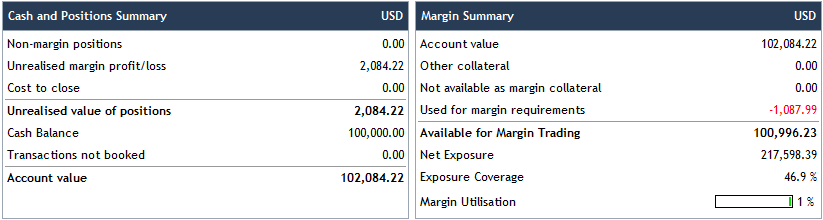
53 When the client s account shows a negative Net Free Equity at the end of a given trading day, interest is calculated at a rate defined as the relevant market ask rate plus a mark-up on a daily basis and charged on a monthly basis. In case the client s account shows a positive value as Net Free Equity and this value is in excess of EUR 15k (or equivalent), interest is calculated at a rate defined as the relevant market bid rate minus a mark-down on a daily basis and credited on a monthly basis. For positive Net Free Equity equal or less than EUR 15k (or equivalent), no interest is paid. Calculation Examples Example 1 Client A only has one position and is long 20 DAX CFDs as follows: The end of day account summary looks as follows: As a result, we can show the Net Free Equity situation of the client as below: Cash Balance: +USD 100,000 Profit/Loss from open positions in CFDs: +USD 2, Financing Collateral requirements: -USD 10, (20* *5%* ) = Net Free Equity = + USD 91, Saxo Bank (Belgium), a branch of Saxo Banque (France) Mars
54 The client has a positive NFE balance which is subject to credit interest if applicable. Example 2: Client B has the following portfolio at the end of a given trading day: The end of day account summary is shown below: As a result, we can show the Net Free Equity situation of the client as below: Cash Balance: +EUR 116, Profit/Loss from open positions in CFDs only: -EUR 2,820 Financing Collateral requirements: -EUR 158, i.e. (5, 0000,0000*3%)+(20*8,128.50*5%) = Net Free Equity =-EUR 44, The client now has a negative NFE balance which is subject to debit interest charged on a daily basis at the relevant ask rate plus a mark-up. Saxo Bank (Belgium), a branch of Saxo Banque (France) Mars
55 It is important to note that from a risk management perspective the client is effectively only using 23% of the trading margin available whilst the eligible collateral required for financing the positions is insufficient, and an interest charge is applied. Account Interest (Retail) The following interest rates apply to funds deposited with Saxo Bank: Net Free Equity above EUR 15,000 (or equivalent): Interest paid on the full amount on the account is market bid rates minus 3% Positive Net Free Equity up to EUR 15,000 (or equivalent): No account interest Negative Net Free Equity: Interest will be charged at market ask (libor) rates plus 8% C. CFD underlying assets The bank offers CFDs on single stocks, stock indexes, forex, commodity, bond and ETF. CFDs are quoted in the currency of the underlying instrument. For example, a CFD on Fortis shares will be quoted in Euros whilst a CFD on IBM shares will be quoted in US dollars. 1. CFD Single stocks A single stock CFD is a derivate product replicating the price of the underlying stock which gives the opportunity to take both long and short positions with leverage. Saxo Bank (Belgium), a branch of Saxo Banque (France) Mars
56 Examples: Short Position Notional Value 1/ Short position with net profit When the client expects the price of a stock to fall, he can choose to take a short position in a Single Stock CFD. In this example, he expects the Umicore share price to fall from its current 41.00/ offer level. The client decides to sell at market CFDs at the bid price of which gives him a position of (5.000* 41.00) in notional value. Financing costs are calculated on a daily basis and charged each end of month. The interest rate used is LIBID 2.5% ( %-2.5% = %). Since the rate is negative you effectively have to pay % overnight financing. 10 days later, the Umicore stock price has fallen to 35 and the client decides to buy at market CFDs Umicore. The trade details are summarized in the table below. transaction How to calculate Amount ( ) x 41, Margin used x 0, Trade commission x 0,10% -205 Overnight costs Notional Value transaction 2,23439% x 10 days x / -127, x Trade commission x 0,10% -175 Trade gain Total costs , ,22 Total gains , ,78 Saxo Bank (Belgium), a branch of Saxo Banque (France) Mars
57 2/Short position with net loss In this example, the client expects the Umicore share price to fall but the share price will rise. The client decides to sell at market 5,000 CFDs at the bid price of 41 which gives a position of (5,000* 41) 205,000 in notional value. Financing costs are calculated on a daily basis and charged each end of month. The interest rate used is LIBID 2.5% ( %-2.5% = %). Since the rate is negative you effectively have to pay % overnight financing. 10 days later, the Umicore share price has risen to 43 and the client decides to buy 5,000 CFDs. The trade details are summarized in the table below: Notional Value transaction How to calculate Amount ( ) 5,000 x ,000 Margin used 205,000 x ,250 Trade commission 205,000 x 0.10% -205 Overnight costs Notional Value transaction % x 10 days x 205,000 / ,000 x ,000 Trade commission 215,000 x 0.10% -215 Trade loss 215, ,000-10,000 Total costs Total losses ,22 Saxo Bank (Belgium), a branch of Saxo Banque (France) Mars
58 Long Position 1/ Long position with net profit When the client expects the price of a stock to go up, he can choose to take a long position in a Single Stock CFD. In this example, the client expects the Sanofi share price to rise from its current price of bid / ask. The client decides to buy CFDs at the asked price of which gives him a position of (1.000* 66.53) in notional value. Financing costs are calculated on a daily basis and charged each end of month. The interest rate used is LIBOR+3% (0, 27144%+3% = %). 10 days later, the Sanofi price has risen to 70, 53 and the client sells his CFDs. The trade details are summarized in the table below: How to calculate Amount ( ) Notional transaction x 66, Value Margin used x 0, Trade commission x 0,10% -66,53 Overnight costs 3,27144% x 10 days x / -60, Notional transaction x 70, Value Trade commission x 0,10% -70,53 Trade gain Total costs 66, ,45+ 70,53-197,51 Total gains , ,49 Saxo Bank (Belgium), a branch of Saxo Banque (France) Mars
59 2/ Long position with net loss If the price of a stock goes down whereas the client expected the price goes up by taking a long position, the client will realize a loss on his long position in a Single Stock CFD. In this example, the client expects the Sanofi share price to RISE from its current price is bid / The client decides to buy 1,000 CFDs at which gives him a position of (10,000* 66.53) 66,530 in notional value. Financing costs are calculated on a daily basis and charged each end of month. The interest rate used is LIBOR+3% ( %+3% = %). 10 days later, the Sanofi share price has fallen to and the client decides to sell at market his 1,000 CFDs. The trade details are summarized in the table below: Notional Value transaction How to calculate Amount ( ) 1,000 x ,530 Margin used 66,530 x ,326 Trade commission 66,530 x 0.10% Overnight costs Notional Transaction Value % x 10 days x 66530/ ,000 x ,530 Trade commission 64,530 x 0.10% Trade Loss 66,530 64,530-2,000 Total costs Total Losses 2, , Saxo Bank (Belgium), a branch of Saxo Banque (France) Mars
60 2. CFD Exchange-traded funds ETF stands for Exchange Traded Funds listed and traded on a stock exchange. ETFs generally aim to track the performance of an underlying benchmark, be it an equity index, fixed income index or any pre-defined basket of securities. ETFs can track the positive or negative performance of the underlying benchmark. Exchange-traded funds CFD allow the client to trade ETF with increased leverage. As a single stock CFD, an exchange-traded fund CFD can receive a dividend adjustment if the listed company decides to give a dividend. Example: Short Position 1/ Short position with net profit DELTA Tracker is quoted on Euronext Paris at 10/ and the client thinks the price is going to fall. The margin percentage requirement for this CFD ETF is 5%. He sells at market DELTA Tracker CFDs for a nominal value of The commission is 20 (0.1 % * ) and the margin requirement is (5%*20.000). Interest costs are calculated daily on client overnight positions by applying the applicable interest rate to the daily closing value of the position. The daily closing value is the number of trackers multiplied by the closing price. In this example, the interest rate is 1% (LIBID 25%) and the closing price of the DELTA Tracker of 8.98/ 9 for the first day. The closing nominal value is now of ( 9*2.000 CFD) and the interest rate of 0,5( 9*2.000*1%*1/360). Moreover, DELTA Tracker gives a dividend of 0,15 per share. Because the client has taken a short position, client s account is credited to reflect interest adjustments and debited to reflect any dividends. The next day, DELTA Tracker is quoted on Euronext Paris at 7.98/ 8 and he decides to close his position, to buy at market CFDs DELTA Tracker for a nominal value of The commission is 16 (0,1% * ). The Saxo Bank (Belgium), a branch of Saxo Banque (France) Mars
61 client position is now flat with a gross profit equal to (except commission, dividends and interest adjustment). Gross profit Total commission - 36 Interest Adjustment 0,5 Dividend adjustment Net profit 3.664,5 2/ Short position with net loss DELTA Tracker is quoted on Euronext Paris at 10/ and the client thinks the price is going to fall. The margin percentage requirement for this CFD ETF is 5%. He sells at market DELTA Tracker CFDs for a nominal value of The commission is 20 (0.1 % * ) and the margin requirement is (5%*20.000). Interest costs are calculated daily with an interest rate of 1% (LIBID 2.5%) and the closing price of DELTA Tracker of 11 for the first day. The closing nominal value is now of 22,000 ( 11*2,000CFD) and the overnight costs are 0.61( 11*2,000*1%*1/360). Moreover, DELTA Tracker gives a dividend of 0.15 per share. Because the client has taken a short position, his account is credited to reflect interest adjustments and debited to reflect any dividends. The next day, DELTA Tracker CFD is quoted on Euronext Paris 11.97/ 12 and he decides to close his position, to buy at market 2,000 CFDs DELTA Tracker for a nominal value of 24,000.The commission is 24 (0.1% * 24,000). His position is now flat with a loss equal to 4,000 (except commission, dividends and interest adjustment). Loss on trade - 4,000 Total commission - 44 Interest Adjustment 0.61 Dividend adjustment Net Loss - 4,343.4 Saxo Bank (Belgium), a branch of Saxo Banque (France) Mars
62 Long Position 1/ Long Position with net profit BETA Tracker is quoted on Euronext Paris 19.90/ 20 and the client thinks it price is going to rise. The margin percentage requirement for the CFD BETA Tracker is 10%. He buys at market CFDs at market for a nominal value of The commission is 100 (0.1 % * ) and the margin requirement is (10%* ). Interest costs are calculated daily on his overnight positions by applying the applicable interest rate to the daily closing value of the position. The daily closing value is the number of shares multiplied by the closing price. In this example, the interest rate is 4% (LIBOR + 3%) and the closing price of BETA Tracker is 21/ for the first day. The closing nominal value is now of ( 21*5.000CFD) and the overnight costs are ( 21*5,000*4%*1/360). Because the client has taken a long position, his account is debited to reflect interest adjustments. The next day, BETA Tracker is quoted on Euronext Paris 22/ 22,02 and he decides to close his position, to sell at market CFDs BETA Tracker CFDs for a nominal value of The commission is 110 (0,1% * ). His position is now flat with a gross profit equal to (except commission, dividends and interest adjustment). Gross profit Total commission Interest Adjustment - 11,67 Net profit 9.778,33 2/ Long Position with net loss BETA Tracker is quoted on Euronext Paris 19.90/ 20 and the client thinks it price is going to rise. The margin percentage requirement for this CFD is Saxo Bank (Belgium), a branch of Saxo Banque (France) Mars
63 10%. He buys at market 5,000 CFDs BETA Tracker for a nominal value of 100,000.The commission is 100 (0.1 % * 100,000) and the marge requirement is 10,000 (10%*100,000). The closing price intraday of BETA Tracker is 19/ and he decides to close his position the same day e.g. to sell 5,000 CFDs BETA Tracker at market for a nominal value of 95,000.The commission is 95 (0.1% *95,000). His position is now flat with a loss equal to 5,000. Loss on trade - 5,000 Total commission Net loss - 5, CFD Stock index Index CFDs are over-the-counter products with a price established by the bank. Index CFDs aim to reflect the price of the underlying index, but the actual bid and ask price may differ slightly from the actual index level. The spread may vary because of volatile market conditions and liquidity risk. Example Short Position 1/ Short Position with net profit CFD CAC40 index is quoted at 3,000/3,002 points and the client thinks it s going to fall. The value of the CFD CAC40 is calculated 1 point equals 1 euro. The margin percentage requirement for Index Tracking CFD is 0,5% 1. He sells at market 100 CAC40 CFD for a nominal value of The margin requirement is (0,5%* ). 1 The margin required of 0,5% applies for the first EUR of combined CFD margin collateral. Above EUR , the required margin doubles Saxo Bank (Belgium), a branch of Saxo Banque (France) Mars
64 Interest costs are calculated daily on his overnight positions by applying the applicable interest rate to the daily closing value of the position. The daily closing value is the number of CFD multiplied by the closing price. In this example, the interest rate is 1% (LIBID 2.5%) and the closing price of CFD CAC40 is 2.973/2.975 points for the first day. The closing nominal value is now of 297,500 ( 2.975*100 CFD) and the overnight costs are 8.26 ( 2.975*100*1%*1/360). Moreover, a Company that belongs to the CAC40 gives a dividend &equal to 1 per Index. Because the client has taken a short position, his account is credited to reflect interest adjustments and debited to reflect any dividends. The next day, CFD CAC40 is quoted at 2,948/2,950 points and the client decides to close his position, to buy at market 100 CAC40 CFDs for a nominal value of 295,000. His position is now flat with a gross profit equals to (except dividends and interest adjustment). Gross profit Interest Adjustment 8,26 Dividend adjustment Net profit (excluded spread) 4, / Short Position with net loss CFD CAC40 index is quoted at 3,000/3,002 points. This time, CAC40 index goes up whereas the client expected it to go down. The client sells 100 CAC40 CFDs at market for a nominal value of 300,000. The margin requirement is 1,500 (0.5%*300,000). Interest costs are calculated daily on his overnight positions by applying the applicable interest rate to the daily closing value of the position. The daily closing value is the number of CFD multiplied by the closing price. In this example, the interest rate is 1% and the closing price of CAC40 is 3,023/3,025 points for the first day. The closing nominal value is now of 302,500 ( 3,025*100CFD) and the overnight costs are 8.40( 3,025*100*1%*1/360). Moreover, a Company that belongs to the CAC40 gives a dividend equal to 1 per Index. Saxo Bank (Belgium), a branch of Saxo Banque (France) Mars
65 Because the client has taken a short position, his account is credited to reflect interest adjustments and debited to reflect any dividends. The next day, CFD CAC40 is quoted at 3,048/3,050 points and the client decides to close his position, to buy at market 100 CAC40 CFDs for a nominal value of 305,000. His position is now flat with a loss equal to 5,000 (except dividends and interest adjustment). Loss - 5,000 Interest adjustment 8.40 Dividend adjustment Net loss(excluded spread) - 5, Long Position 1/ Long Position with net profit CFD CAC40 is quoted at 3,498/3,500 points and the client thinks it s going to rise. The margin percentage requirement for Index Tracking CFDs is 0,5%. The client buys at market 200 CAC40 CFDs for a nominal value of (200*3,500). The margin requirement is (0.5%* ). Interest costs are calculated daily on his overnight positions by applying the applicable interest rate to the daily closing value of the position. The daily closing value is the number of CFDs multiplied by the closing price. In this example, the interest rate is 3% and the CFD CAC 40 closing is 3,348/3.550 points for the first day. The closing nominal value is now of ( 3,550*200CFD) and the overnight costs are 59.17( 3, 550*200*3%*1/360). Because the client has taken a long position, his account is debited to reflect interest adjustments. The next day, CAC40 is quoted 3,600/3,602 points and the client decides to close his position, to sell at market 200 CAC40 CFDs for a nominal value of Saxo Bank (Belgium), a branch of Saxo Banque (France) Mars
66 His position is now flat with a gross profit equal to (except dividends and interest adjustment). Gross profit Interest Adjustment - 59,17 Net profit(excluded spread) ,83 2/ Long Position with net loss CFD CAC 40 is quoted at 3,498/3,500 points but, this time, CAC40 will go down whereas the client expects it to go up. He buys at market 200 CAC40 CFDs for a nominal value of 700,000. The margin requirement is 3,000 (0.5%*700,000). The client decides to close his position the same day at 3,450 points. So, his closing nominal value is 690,000 ( 3,450*200CFD). Moreover, a Company that belongs to the CAC40 index gives a dividend equal to 1 per Index. Because the client has taken a long position, his account is credited to reflect any dividends. He receives 200 in dividend. His position is now flat with a loss equal to 10,000 (except dividends and interest adjustment). Loss on trade - 10,000 Dividend adjustment 200 Net loss (excluded spread) - 9, CFD Commodities Commodity CFDs are over-the-counter products with a price established by the bank. Commodity CFDs aim to reflect the price of the underlying commodity, but Saxo Bank (Belgium), a branch of Saxo Banque (France) Mars
67 the actual bid and ask price may differ slightly from the actual commodity level. The spread may vary because of volatile market conditions and liquidity risk Commodity CFDs track the price of the underlying futures contract. Commodity CFDs offered by the bank provide traders with an alternative to trading on Futures exchanges, with lower margin requirements. This reduced entry level, combined with lower trade unit sizes means flexible trading across the global commodities markets. Moreover, there is no need to roll CFD positions overnight and no financing charge is debited /credited from the initial opening price. At the expiration date, the CFD commodity is closed automatically by the bank but the client can close his position on CFD commodity before the expiration date. Examples: Short Position 1/ Short Position with net profit US CRUDE September CFD is quoted at $100/$ and the client thinks the price of US CRUDE September is going to fall. The margin percentage requirement for this commodity CFDs is 5%. The client sells at market 1,000 US CRUDE September CFD for a nominal value of $ The marge requirement is $5,000 (5%* ). There is no interest adjustment on commodity CFD but there is an expiry date. Five days later, US CRUDE September CFD is quoted at $89.93/$90 and he decides to close his position, to buy at market US CRUDE September CFDs for a nominal value of $ His position is now flat with a gross profit equal to $ (except spread). Gross profit $ Net profit (excluded spread) $10,000 Saxo Bank (Belgium), a branch of Saxo Banque (France) Mars
68 2/ Short Position with net loss US CRUDE September CFD is quoted at $100/$ and the client thinks that the price of US CRUDE September is going to fall. The margin percentage requirement for this commodity CFDs is 5%. The client sells at market 1,000 US CRUDE September CFD for a nominal value of $100,000. The margin requirement is $5,000 (5%*100,000). There is no interest adjustment on commodity CFD but there is an expiry date. Five days later, US CRUDE September CFD is quoted at $104.93/$105 and the client decides to close his position, to buy at market 1,000 US CRUDE September CFD for a nominal value of $105,000. His position is now flat with a loss equal to $5,000 (except spread). Loss on trade -$5,000 Net loss (excluded spread) -$5,000 Long Position 1/ Long Position with net profit WHEAT December CFD is quoted at $9.98/$10 and the client thinks that WHEAT December it s going to rise. The margin percentage requirement for this commodity CFD is 10%. The client buys WHEAT December CFDs for a nominal value of $ The margin requirement is $5.000 (10%*50.000). There is no interest adjustment on commodity CFDs but there is an expiry date. Five days later, WHEAT December CFD is quoted at $11/$11.02 and the client decides to close his position, to sell at market WHEAT December CFDs for a nominal value of $ His position is now flat with a gross profit equal to $ Gross profit $5.000 Net profit (excluded spread) $5.000 Saxo Bank (Belgium), a branch of Saxo Banque (France) Mars
69 2/ Long Position with net loss WHEAT December CFD is quoted at $9.98/$10 and the client thinks that WHEAT December it s going to rise. The margin percentage requirement for this commodity CFDs is 10%. The client buys at market 5,000 WHEAT December CFD for a nominal value of $50,000.The margin requirement is $5,000 (10%*50,000). There is no interest adjustment on commodity CFD but there is an expiry date. Five days later, WHEAT December CFD is quoted at $9/$9.02 and the client decides to close his position, to sell at market 5,000 WHEAT December CFD for a nominal value of $45,000. His position is now flat with a loss equal to $5,000. Loss on trade -$5,000 Net loss (excluded spread) -$5, CFD Forex FX CFDs are over-the-counter products with a price established by the bank. FX CFDs aim to reflect the price of the underlying FX, but the actual bid and ask price may differ slightly from the actual FX level. The spread may vary because of volatile market conditions and liquidity risk FX CFDs track the price of the underlying futures contract. FX CFDs provide traders with an alternative to trading on Futures exchanges, with lower margin requirements. This reduced entry level, combined with lower trade unit sizes means flexible trading across the global FX markets. Unlike trading FX on spot there is no need to roll CFD positions overnight and no financing charge is debited /credited from the initial opening price. Examples: Short Position 1/ Short Position with net profit Saxo Bank (Belgium), a branch of Saxo Banque (France) Mars
70 EUR/USD December CFD is quoted at $1.2500/$ and the client thinks EUR/USD December price is going to fall. The margin percentage requirement for Forex CFDs is 0.5%. The client sells at market EUR/USD December CFDs, for a nominal value of $ The margin requirement is $625 (0.5%* ). There is no interest adjustment on Forex CFD but there is an expiry date. Two days later, EUR/USD December CFD is quoted at $1.2398/$ and he decides to take his profit, e.g. to close his position so to buy at market EUR/USD December CFDs for a nominal value of $ His position is now flat with a gross profit equal to $1,000 Gross profit $1.000 Net profit (excluded spread) $ / Short Position with net loss EUR/USD December CFD is quoted at $1.2500/$ and the client thinks EUR/USD December price is going to fall whereas it will go up. He sells at market EUR/USD December CFDs, for a nominal value of $125,000.The the margin requirement is $625 (0.5%*125,000). There is no interest adjustment on Forex CFD but there is an expiry date. Two days later, EUR/USD December CFD is quoted at $1.2598/$ and the client decides to limit his loss, to close his position so to buy EUR/USD December CFDs for a nominal value of $126,000. His position is now flat with a gross loss equal to $1,000 Loss on trade -$1,000 Net loss (excluded spread) -$1,000 Long Position 1/ Long Position with net profit Saxo Bank (Belgium), a branch of Saxo Banque (France) Mars
71 EUR/USD December CFD is quoted at $1.2598/$ and the client thinks it s going to rise. The margin percentage requirement for Forex CFDs is 0.5%. He buys at market EUR/USD December CFDs, for a nominal value of $ The the margin requirement is $625 (0.5%* ). There is no interest adjustment on Forex CFDs but there is an expiry date. Two days later, EUR/USD December CFD is quoted at $1.2650/$ and he decides to close his position, to sell at market EUR/USD December CFDs for a nominal value of $ His position is now flat with a gross profit equal to $ Gross profit $1.000 Net profit (excluded spread) $ / Long Position with net loss EUR/USD December CFD is quoted at $1.2598/$ and the client thinks it s going to rise. The margin percentage requirement for Forex CFDs is 0.5%. He buys at market EUR/USD December CFDs, for a nominal value of $252,000.The margin requirement is $625 (0.5%*125,000). There is no interest adjustment on Forex CFD but there is an expiry date. Two days later, EUR/USD December CFD is quoted at $1.2550/$ and the client decides to sell at market EUR/USD December CFDs for a nominal value of $251,000. His position is now flat with a gross loss equal to $1,000. Loss on trade -$1,000 Net loss (excluded spread) -$1, CFD Bonds Bonds CFDs are over-the-counter products with a price established by the bank. Bonds CFDs aim to reflect the price of the underlying bonds, but the actual bid Saxo Bank (Belgium), a branch of Saxo Banque (France) Mars
72 and ask price may differ slightly from the actual bond level. The spread may vary because of volatile market conditions and liquidity risk Bond CFDs track the price of the underlying futures contract. Bond CFDs provide traders with an alternative to trading on Futures exchanges, with lower margin requirements. There is no need to roll CFD positions overnight and no financing charge is debited /credited from the initial opening price. Examples: Short Position 1/ Short Position with net profit German Government 10 year Bund December CFD is quoted at / and the client thinks it s going to fall. The margin percentage requirement for this Bund CFD is 1%. He sells at market German Government 10 year Bund December CFD, for a nominal value of The margin requirement is (1%* ). There is no interest adjustment on Bund CFD but there is an expiry date. Two days later, German Government 10 year Bund December CFD is quoted at / and he decides to close his position so to buy at market German Government 10 year Bund December CFD for a nominal value of His position is now flat with a gross profit equal to 700. Gross profit 700 Net profit (excluded spread) 700 2/ Short Position with net loss German Government 10 year Bund December CFD goes up whereas the client expected it to go down. He sells German Government 10 year Bund December CFD for a nominal value of The margin requirement is 1,377 (1%* ). There is no interest adjustment on this CFD but there is an expiry date. Two days later, German Government 10 year Bund December CFD is quoted at / and the client decides to limit his loss, to close his Saxo Bank (Belgium), a branch of Saxo Banque (France) Mars
73 position so to buy at market German Government 10 years Bund December CFD for a nominal value of His position is now flat with a gross loss equal to Loss on trade - 1,000 Net loss (excluded spread) - 1,000 Long Position 1/ Long Position with net profit German Government 10 year Bund December CFD is quoted at / and the client thinks that the price it s going to rise. The margin percentage requirement for this CFD is 1%. He buys at market German Government 10 year Bund December CFD for a nominal value of The margin requirement is (1%* ). There is no interest adjustment on this CFD but there is an expiry date. Two days later, EUR/USD December CFD is quoted at / and he decides to close his position, to sell at market German Government 10 years Bund December CFD for a nominal value of His position is now flat with a gross profit equal to Gross profit Net profit (excluded spread) / Long Position with net loss German Government 10 year Bund December CFD is quoted at / 138,00 and the client thinks the price it s going to rise. The margin percentage requirement for this CFD is 1%. He buys at market German Government 10 year Bund December CFD for a nominal value of Saxo Bank (Belgium), a branch of Saxo Banque (France) Mars
74 The margin requirement is (1%* ).There is no interest adjustment on this CFD but there is an expiry date. Two days later, German Government 10 year Bund December CFD is quoted at and the client decides to sell at market German Government 10 years Bund December CFD for a nominal value of His position is now flat with a gross loss equal to Loss on trade Net loss (excluded spread) Saxo Bank (Belgium), a branch of Saxo Banque (France) Mars
75 VI. CFD TRADING A. The trading platforms A trading account enables clients to take control of their trading by managing their entire portfolio from a single account through the bank s platforms: SaxoTrader platform, SaxoWebTrader or SaxoMobileTrader. All the information regarding the functioning of trading platforms (color coded trade buttons, active trading operations ) is available directly on the trading platform through the button Help. Furthermore, the client can join directly client s services when needed. 1. SaxoTrader This platform is fully downloadable. SaxoTrader provides traders with access to all of the market information, technical tools and features required to trade successfully. 2. SaxoWebTrader Providing traders with 24 hour access to markets, the SaxoWebTrader is a web based platform, requiring no download or installation and accessible from anywhere in the world. The SaxoWebTrader offers full interface customization, allowing individuals to choose from an array of charts, prices, market research, data sources and news feeds. 3. SaxoMobileTrader The client can take his trading with him by utilizing the SaxoMobileTrader, a portable yet comprehensive platform accessible through his mobile phone. The SaxoMobileTrader establishes an environment in which positions, open orders, investment news and account status can be monitored. Saxo Bank (Belgium), a branch of Saxo Banque (France) Mars
76 B. Available Orders 1. Limit orders Limit orders are commonly used to enter a market and to take profit at predefined levels. Limit orders to buy are placed below the current market price and are executed when the Ask price hits or breaches the price level specified. (If placed above the current market price, the order is filled instantly at the best available price below or at the limit price.) Limit orders to sell are placed above the current market price and are executed when the Bid price breaches the price level specified. (If placed below the current market price, the order is filled instantly at the best available price above or at the limit price.) When a limit order is triggered, it is filled as soon as possible at the price obtainable on the market. The price at which the order is filled may differ from the price the client sets for the order if the opening price of the market is better than his limit price. In the case of Futures, the order will be filled if possible, and any remaining volume will remain in the market as a limit order. In the case of CFDs, the order will be filled if possible, and any remaining volume will remain in the market as a limit order. 2. Stop Orders Stop orders are commonly used to exit positions and to protect investments in the event that the market moves against an open position. Stop orders to sell are placed below the current market level. Stops on single stock CFDs are executed when the stop price is traded. Stops on Commodity/Index CFDs are executed when the Bid price hits or breaches the price level specified. Stop orders to buy are placed above the current market level. Stops on single stock CFDs are executed when the stop price is traded. Stops on Saxo Bank (Belgium), a branch of Saxo Banque (France) Mars
77 Commodity/Index CFDs are executed when the Ask price hits or breaches the price level specified. But stop orders may be executed below the price specified by the clients for a long position and above the level specified for a short position when there is a high volatility or a gap at the market opening. 3. Stop Limit Order A Stop Limit order will be executed at a specified price (or better) after the specified Stop Price has been reached. Once the Stop Price is reached, the Stop Limit order becomes a Limit order to buy (or sell) at the Limit Price or better. 4. Trailing Stop order A Trailing Stop Order is a stop order with a trigger price which evolves with the spot price. If the market rises (for long positions), the stop price increases with the proportion defined by the user, but if the market is down, the stop price remains unchanged. This type of stop order allows the client to cap potential losses without limiting the possible gain on a position. It also reduces the need to constantly monitor market prices of open positions. 5. O.C.O orders Several types of related orders are available. An If Done order consists of two orders: A primary order that will be executed as soon as market conditions allow it, and a secondary order that will be activated only if the first one is executed. A One Cancels the Other (O.C.O.) order consists of two orders. If either one of the orders is executed, the related order is automatically cancelled. 3-way contingent orders are where 2 orders are placed if a primary (If done) order is executed. These orders are themselves related as O.C.O. orders allowing both a stop loss and a profit taking order to be placed around a position. Saxo Bank (Belgium), a branch of Saxo Banque (France) Mars
78 C. CFD Trading hours Single Stock CFD: Same trading hours than the underlying stock trading hours ETF CFD: Same trading hours than the underlying ETF trading hours Forex CFD Same trading hours than the underlying future forex trading hours Commodity CFD Same trading hours than the underlying future commodity trading hours Bond CFD Same trading hours than the underlying future bond trading hours Stock Index Tracker Stock Index Tracker Name Trading hours* US Tech 100 NAS 22 hours (18:01-16:00) US 30 Wall Street 22 hours (18:01-16:00) US SPX hours (18:01-16:00) Germany 30 08:01-21:55 UK :01-20:55 France 40 08:01-21:55 Australia :10-16:25 Switzerland 20 08:01-21:55 Italy 40 09:01-17:25 Spain 35 09:01-19:55 EU Stocks 50 08:01-21:55 Japan :01-00:30 Hong Kong 09:16-16:10 Netherlands 25 08:01-21:55 Sweden 30 09:01-17:25 Saxo Bank (Belgium), a branch of Saxo Banque (France) Mars
79 Norway 25 09:10-17:20 Belgium 20 09:10-17:30 Denmark 20 09:10-16:55 UK Mid :10-16:30 Germany Tech 30 09:10-17:30 Germany Mid-Cap 50 09:10-17:30 *Trading hours are stated in the local hours of the underlying exchange - please note that the Hong Kong trading session has a mid-session break between 12:00-13:00 and an evening break between 16:10-17:00, the trading session in Japan has a break between 3:25 pm and 4:15 pm and in Australia there is a break between 16:25 and 17:10: Exchange HSI.I Hang Seng - Trading Hours NI225.I Japan Trading Hours ASXSP200.I Australia Trading Hours Trading Break Trading Break Trading Trading Break Trading Trading Break Trading In some cases shorter opening hours may apply on days which are public holidays in the relevant jurisdiction. Saxo Bank (Belgium), a branch of Saxo Banque (France) Mars
80 D. CFD prices Most of CFDs prices depend on the underlying asset and the spread applied by the bank which is likely to be impacted by market volatility and liquidity. The CFD s prices are fixed for each instrument as follows: Single Stock and ETF CFD prices Same bid and ask prices as the underlying single stock and ETF. Forex CFD Same bid and ask prices as the underlying Forex futures + bank s spread. Commodity CFDTRADE Same bid and ask prices as the underlying Commodity futures + bank s spread. Bond CFD Same bid and ask prices as the underlying Bond futures + bank s spread. Stock Index Tracker CFD Stock indexes CFD are based on the underlying future with the nearest maturity + cash index basis + bank s spread. The cash index basis is the difference between the cash index (ex: CAC40) and the underlying future index with the nearest maturity (ex: FCE CAC40 Index). The client can have access to any information about the CFD underlying products by calling at any moment the client service desk. Index CFDs are over-the-counter products with a price established by the bank. Index CFDs aim to reflect the fair value of the underlying index, but the actual bid and ask price may differ slightly from the actual index level. The spread may vary because of volatile market conditions and liquidity risk. Saxo Bank (Belgium), a branch of Saxo Banque (France) Mars
81 E. CFD costs The complete list of costs associated with CFD is detailed below. ASSETS FEES Single Stock Stock Index ETF Commodities Currencies Bonds Commission X X Spread X X X X Overnight Financing X X X Dividend adjustment X X X Borrowing costs X X Liquidity costs X X X X X X Live exchange data X X 1. Commissions on CFDs Single Stock, ETF CFD Prices Similar to Single Stock CFDs for ETF CFDs trades below the 'Minimum Commission Threshold', a Minimum Ticket fee is charged. Minimum Ticket fees are listed under the "CFD Stock Trading Conditions" on the trading platforms. Single STOCK, ETF / ETC CFDs are priced the same way, i.e. when trading Single Stocks, ETF / ETC CFDs the client pay a fixed commission in percentage (%) on the notional value of the trade with a minimum for small trade sizes. For North American exchanges commission is calculated as cents per contract. Minimum ticket fee: CFDs for Single Stock, ETF trades below the 'Minimum Commission Threshold', a Minimum Ticket fee is charged. Minimum Ticket fees are listed under the "CFD Stock Trading Conditions" on the trading platforms. Saxo Bank (Belgium), a branch of Saxo Banque (France) Mars
82 Stock Index Tracker CFD Prices At Saxo Bank Index-tracking CFDs are traded at a minimum spread, which is defined as the spread you will see under normal market conditions. Volatile market conditions may affect the spreads shown on these instruments. Index-tracking CFDs are traded at a minimum spread, which is defined as the spread available on the bank website and on the trading platforms under normal market conditions. Volatile market conditions may affect the spreads shown on these instruments. Commodity CFD Prices Commodity CFDs are over-the-counter products with a price established by Saxo Bank as the Futures market spread plus a fixed mark-up. The mark-up can be seen under Contract Details and is always available in the Trading Conditions in the trading platforms. Bond CFD Prices Bond CFDs are over-the-counter products with a price established by the bank as the Futures market spread plus a fixed mark-up. The mark-up can be seen on the bank s website under Contract Details and is always available in the Trading Conditions in the trading platforms. Forex CFD Prices Forex CFDs are over-the-counter products with a price established by Saxo Bank as the Futures market spread plus a fixed mark-up. The mark-up can be seen under Contract Details and is always available in the Trading Conditions in the trading platforms. Saxo Bank (Belgium), a branch of Saxo Banque (France) Mars
83 2. Borrowing costs on short overnight positions A borrowing cost may be applied to short Single Stock CFD positions held overnight. This borrowing cost depends on the liquidity of the underlying Stocks and may be zero (0) for high liquidity Stocks. The specific borrowing rate for a Stock can be seen as the 'Borrowing Rate' under 'Account' > 'Trading Conditions' > 'CFD Stock/Index Instrument List' in the trading platforms. When selling a CFD, the borrowing cost for holding the position overnight is shown in the CFD Trade module in the 'Estimated borrowing cost per day' field. The borrowing rate will be fixed when the position is opened and will be charged on a monthly basis. Please be aware, that for certain corporate action events, the borrowing rate on the short position may be reset to the current rate in the market, upon the execution of the corporate action. If the client opens and closes a CFD position within the same trading day, the client is not subject to borrowing costs. 3. Overnight Financing Stock Index CFD As Index CFDs are margined products, the client finances the traded value through an overnight credit/debit charge. If the client opens and closes a CFD position within the same trading day, the client is not subject to overnight financing. When the client holds an Index CFD position overnight, client s CFD position will consequently be subject to the following credit or debit: Holding Long CFD Stock Index Tracker positions after 17:00 EST (New York time) incurs a financing charge which is calculated as follows: Index Value * Number of CFDs * (relevant Inter-Bank Offered Rate + 3%) * (Actual Number of Days/360 or Actual Number of Days/365) Saxo Bank (Belgium), a branch of Saxo Banque (France) Mars
84 Holding Short positions after 17:00 EST (New York time) creates a financing credit which is calculated as follows: Index Value * Number of CFDs * (relevant Inter-Bank Bid Rate 2.50%) * (Actual Number of Days/360 or Actual Number of Days/365) If the financing credit is negative it will be debited client s account. Single stock CFD As Single Stock CFDs are a margined product, the client finances the traded value through an overnight credit/debit charge.if the client opens and closes a CFD position within the same trading day, he is not subject to overnight financing. When he holds a Single Stock CFD position (or an ETF CFD position) overnight (i.e. have an open CFD position at close of market on the Stock Exchange, his CFD position will consequently be subject to the following credit or debit: When the client holds a long CFD position, he is subject to a debit calculated on the basis of the relevant Inter-Bank Offer Rate for the currency in which the underlying share is traded (e.g. LIBOR) plus a mark-up (times Actual Days/360 or Actual Days/365). When he holds a short CFD position, he receives a credit* calculated on the basis of the relevant Inter-Bank Bid Rate for the currency in which the underlying share is traded (e.g. LIBID) minus a mark-down (times Actual Days/360 or Actual Days/365). The credit/debit is calculated on the total nominal value of the underlying Stock(s) at the time the CFD contract is established (whether long or short). Should the relevant Inter-Bank Bid Rate minus the mark-down result in a debit as opposed to a credit, then he will pay the finance charge. As Single Stock CFDs are a margined product, the client finances the traded value through an overnight credit/debit charge. If a client opens and closes a CFD position within the same trading day, the client is not subject to overnight financing. Saxo Bank (Belgium), a branch of Saxo Banque (France) Mars
85 When a client holds a Single Stock CFD position (or an ETF CFD position) overnight (i.e. have an open CFD position at close of market on the Stock Exchange, the client s CFD position will consequently be subject to the following credit or debit: When the client holds a long CFD position, the client is subject to a debit calculated on the basis of the relevant Inter-Bank Offer Rate for the currency in which the underlying share is traded (e.g. LIBOR) plus a mark-up (times Actual Days/360 or Actual Days/365). When the client holds a short CFD position, the client receives a credit calculated on the basis of the relevant Inter-Bank Bid Rate for the currency in which the underlying share is traded (e.g. LIBID) minus a mark-down (times Actual Days/360 or Actual Days/365). The credit/debit is calculated on the total nominal value of the underlying Stock(s) at the time the CFD contract is established (whether long or short). Should the relevant Inter-Bank Bid Rate minus the mark-down result in a debit as opposed to a credit, then the client will pay the finance charge. Commodity, Bond, Forex CFD Trading Commodity CFDs will not incur any overnight financing charges. All costs are factored within the trading spread. Commodity, Bond, Forex CFDs will not incur any overnight financing charges. All costs are factored within the trading spread. 4. Dividend adjustments When dividends are paid on an underlying stock (ex: XYZ), holders of long CFD stock positions (ex: XYZ) will receive a proportional payout. The objective is to compensate the price drop on the CFD share due to the dividend payment. This compensation is made buy a cash adjustment, paid to the CFDs holder. This cash adjustment is calculated as the dividend size deducted the standard international tax rate. The fact that CFDs are international financial contract makes it Saxo Bank (Belgium), a branch of Saxo Banque (France) Mars
86 impossible to obtain reduced tax rates based on local exceptions. Holders of short CFD positions will have to pay an amount equal to the full (gross) dividend paid on the underlying share. All cash dividends for CFD positions are settled on pay date. Cash dividends are booked on ex-date to reflect the market price movement on the ex-date, but the actual value of the payment is settled on pay date. The ex-date is the date on or after which a share is traded without a previously declared dividend or distribution. The pay-date is the date when dividends, or shares from a split, are sent to shareholders. Dividends on CFD positions are cash adjustments paid or debited by the bank and not by the underlying company. Dividends paid on CFDs are not eligible for any preferential withholding tax rates sometimes associated with dividends paid on physical stocks and may therefore differ from the dividends payable on the underlying share. 5. Live Exchange Data fees When the client wants to trade CFD stocks, the prices he will have access to trade its will be delayed by 15 minutes. Nevertheless, the client can have access to realtime prices on CFD stocks by subscribing to each stock exchange on which the underlying stocks are quoted. The subscription fees are charged to the client s account immediately after the client subscribes to a service. The client is always charged for a full calendar month regardless of the date of subscription. The subscription process, the terms and conditions of each service subscribed are available online directly on the trading platforms. 6. Liquidity cost Liquidity cost is due to the fact that, on every CFDs, there is a spread between the bid price and the ask price. It means for a CFD holder that he will lose in any case the bid/ask spread. Even if the underlying asset has not moved, the client will lose this spread. Saxo Bank (Belgium), a branch of Saxo Banque (France) Mars
87 For example, if a client wants to buy a CFD stock which price is 10, 00/ 10, 02. He will buy it at the asked price of 10, 02. If he sales it right away with a bid/ask that has not changed ( 10, 00/ 10, 02), he will sale it at the bid price of 10, 00. The client will lose 0, 02, even the price of the underlying asset has not moved. This is the liquidity cost. Please notice liquidity cost is different form trading fees and financing costs. (See p.51) 7. Net Free equity F. Corporate actions When a corporate action happens on an underlying asset of a CFD, the CFD holder also benefits from the corporate action. Regarding to right issues, new CFD positions on the underlying instrument are granted and booked according to the ratio and the price of the underlying right issues on the Effective Date (Ex-date), with the value date as payment date. No election from the CFD holder is required. All details on corporate actions are described on our website: G. Profits and losses Profits originated from the client s trading activities increase the client s balance. All surplus funds may be withdrawn from the client s account upon request. Losses originated from the client s trading activities reduce the balance of the client s account, and therefore reduce the margin available to open new positions or to maintain existing open positions. Saxo Bank (Belgium), a branch of Saxo Banque (France) Mars
88 H. Taxation Considerations Please be advised that the following is intended as general information only and it does not purport to present any comprehensive or complete description of all aspects of Belgian tax laws which could be of relevance to a holder of CFDs. Prospective holders of CFDs should therefore consult their tax adviser regarding the tax consequences of any purchase, ownership or disposal of CFDs. 1. Taxes on income and capital gains Belgian Individuals acting in the framework of their private activities: The benefits derived from CFDs (including any capital gains realized on the disposal thereof) held by a Belgian individual will not be taxable in his hands to the extent that investing in a CFD will be considered as a transaction of normal management of the private estate. In the opposite scenario, in a case where investing in a CFD would be considered as a speculative or abnormal transaction which exceeds the normal management of the private estate, the benefits derived from CFDs will be taxable in the hands of a Belgian Individual at a separate rate of 33 percent. In such a case, the net income will be taxable, i.e. after deduction of costs incurred during the taxable period to acquire or conserve the income. The question of whether or not a transaction such as concluding a CFD relates to the normal management of the private estate has to be assessed on a case by case basis. Belgian Individuals acting in the framework of their business activities: Any benefits derived from CFDs (including any capital gains realized on the disposal thereof) that are attributable to a business activity from which a Belgian Individual earns benefits or profits are generally subject to income tax in the Belgian Individual's hands at a bracket progressive rate with a maximum of 50 percent. The commissions that would be payable in accordance with CFD provisions should in principle be tax deductible. However, under certain circumstances, the tax deductibility of such commissions could be challenged by the Belgian tax authorities based on the consideration that the commissions are not business expenses as regards the business being carried out. Saxo Bank (Belgium), a branch of Saxo Banque (France) Mars
89 Losses that would derive from CFDs should in principle be tax deductible. Belgian Corporate Entities: Any benefits derived from CFDs (including any capital gains realized on the disposal thereof) that are held by a Belgian Corporate Entity are generally subject to corporate income tax at the standard rate, currently 33 percent plus a 3 percent surtax, i.e. an effective tax rate of 33,99 percent. The commissions that would be payable in accordance with CFD provisions should in principle be tax deductible. However, under certain circumstances, the tax deductibility of such commissions could be challenged by the Belgian tax authorities based on the consideration that the commissions are not business expenses as regards the business being carried out. Losses that would derive from CFDs should in principle be tax deductible. 2. Withholding tax and other taxes and duties In principle, the income derived from CFDs will not be subject to withholding tax in Belgium. Moreover, no other taxes and duties (including stamp duty and VAT) will be due by or on behalf of a holder of CFDs in respect of or in connection with the purchase, ownership or disposal of CFDs. Saxo Bank (Belgium), a branch of Saxo Banque (France) Mars
90 VII. CONDITIONS OF CFDs A. Information before opening a trading account Before opening a trading account with the bank the client should trade in simulation with one of the bank trading platforms. The bank offers a demo platform for 20 days. It is very important to test the trading platform in simulation in order to understand the use of the trading platform and the mechanism of derivative products. The aim is to understand the risk of financial products available on the trading platform. After this test, the client must complete an Application Form and that has to be approved by the bank. Then, the client will have access to his live trading platform after his first funding will be received by the bank. The bank will only deal with the client if, in its sole judgment, the bank considers that the client has sufficient knowledge and experience to understand the risks associated with CFDs, or if the bank has warned the client that he has not but he has elected to continue nonetheless. B. Types of Account The bank offers two types of account: Trader Account Premium Account The Premium account offers more advantages than the trader account, such as free execution orders by phone, free access to the sales trading service and the opportunity to trade and to communicate with the trading room via electronic means(from the trading platform via Chat and ). C. Minimum trade sizes Minimum trade sizes for some CFDs are set out on the bank website. These may be varied and the client should check the bank website for up to date information. Saxo Bank (Belgium), a branch of Saxo Banque (France) Mars
91 For example, whilst all Commodity CFDs are priced in single units, often a minimum trade size will apply. Commodity CFDs are denominated in smaller lots than the underlying Futures contract. For example, the US Crude CFD minimum trade size is 25 barrels of oil, rather than barrels for the underlying Future contract. Each CFD is quoted as 1 unit of the underlying contract (e.g., 1 barrel), but there will be a minimum trade size. The client is able to reduce an open CFD position to below the minimum trade size. If the client has such a position he will be able to close it via either the Account Summary or by contacting the dealing desk. Concerning Forex CFDs, they carry a minimum trade size of which is significantly lower than the Futures Contract they track, e.g. 1 lot of Euro/US Dollar Future is EUR The minimum trade size of the US Index is 100 units. The minimum order value for European Single Stock CFDs is EUR 100 and USD 50 for American Single Stock CFDs. MINIMUM TRADE SIZE ON CFD Single Stock nominal value >100 on European market and nominal value >50$ on US market Stock Indices 1 ETF nominal value >100 on European market and nominal value >50$ on US market Commodities 1 on Gold/Platinum/Palladium, 25 on Silver, 25 barrels on Oil, 200 bushels on cereals Currencies D. Confirmations and statements If the client takes a position on CFDs, opening or closing, directly via the trading platform, this position will be confirmed on-screen via a pop-up. If the client takes a position calling to the client trading service, CFD positions will be confirmed during his conversation with the sales traders. All statements of the CFD open positions are also available on the trading platform under Account Statement. The account statement includes a summary of the financial positions and details of all transactions on the account for the statement period. The client can call the bank at any moment to have a confirmation of his financial statement. Saxo Bank (Belgium), a branch of Saxo Banque (France) Mars
92 E. Payments Customers may deposit funds through electronic transfer or by Credit/Debit card for the second fund transfer. Payments will be required in Euros or in Dollars. Customers should note that the bank will only accept payments into an account from the account holder and not from any third party. The client may request a fund transfer by debiting his trading account in favor of a personal and external banking account. Payment of any such amounts has to be validated by the bank back office. Indeed, the client has to leave enough funds in his trading account to cover any margin requirements or any other charges that might arise for any reason. The client must notice that all payments out must go directly to a personal and external account.. No third party transfer out will be allowed. A document called Client funds transfer request is available on our website. F. Monitoring the positions and account deficit The client is in charge of monitoring his positions and orders taken on the financial markets via trading platforms. He is also responsible for maintaining the required margin collateral at all times. If not, he may be required to make margin payments to cover his open positions at short notice, and he must be able to meet those obligations at all times. Moreover, he should follow key dates and events, such as important macroeconomic news such as rates of ECB, FED, BoE but also the expiry dates for particular CFDs on Forex and Commodities. For this reason, he must be contactable at all times. To conclude, he will not be allowed to deal in CFDs (other than to close or reduce his open positions) when there is a shortfall in the balance of his account. When the balance will become positive again, the client will be able to take new positions. G. Security of the account In terms of account security, the bank gives access to the live account through an account number (login ID) and a password. When a client connects for the first Saxo Bank (Belgium), a branch of Saxo Banque (France) Mars
93 time, on the downloadable platform SaxoTrader, the system will ask him to generate a security key. Then, the client will have to contact the back office department of the bank, to be identified and then be authorized and able to trade on the trading platform. The client is responsible for maintaining the security of his account details, including his ID and password. It is extremely important that the client keeps his ID and password confidential. If the client is aware or suspects that these details are no longer confidential, then the client should contact us as soon as practicable, so his password can be changed. The Bank will deem any CFD position opened or closed position by any person using an account number and password to be binding upon the client. H. Conditions to close out a CFD position In the case of an emergency or exceptional market conditions, we can modify the conditions of the contract between the client and the bank. If an extreme situation occurs such as the interruption of the market price on CFDs ( in the case of the suspension of on a stock exchange for example) the bank may suspend the quotation or the bank may change the margin percentage required on the open CFDs and or close out some or all of the open CFDs. Before acting, the bank will take all reasonable steps to inform the client if the bank determines that any such extreme events exist. I. Additional Documents If any of the information set out in this document becomes inaccurate or out of date, or if there is a material change in (or a significant event that affects) any of the matters referred to, the bank will issue an additional document or a new document. The bank reserves the right to do so by publishing the additional document or new document on its website. Saxo Bank (Belgium), a branch of Saxo Banque (France) Mars
94 VIII. COMPLAINTS PROCEDURE Any complaints will first be investigated by our Customer Services Department and, if they are unable to resolve the dispute, by our Compliance Department. If the client would like more information on how complaints are handled, he may contact our Customer Services Department. Saxo Bank (Belgium), a branch of Saxo Banque (France) Mars
95 IX. BEST EXECUTION AND CONFLICT OF INTEREST POLICIES A. Best execution policy Upon acceptance of a client order and when there is no specific client instruction regarding the execution method, the bank will execute an order in accordance with its Best Execution Policy. All client orders are executed by the bank, which is the client s counterparty. The bank will take all reasonable steps to obtain the most favorable terms while executing an order for the client. In doing so, the bank implemented a Best Execution Policy based on 3 key principles: an innovative technology to forward, monitor and execute client orders, a special emphasis on the execution order features taking into account the price, the costs, the speed, likelihood of execution and settlement, the size, the nature or any other consideration relevant to the execution of the order, A regular and rigorous review of the overall execution process quality. When considering the best executing factors, the bank takes into account: the client classification, the nature of the client order,, the characteristics of the financial instruments that are subject to that order ; and the characteristics of the execution venues to which that order can be directed. The bank uses automated systems to route and execute client orders. When a client order is received by the bank, it is routed to the execution venue considered by the bank as the option providing the Best Execution possible or kept in house, for products undertaken for the bank s own account (in particular, financial future instruments traded over the counter such as CFDs). Saxo Bank (Belgium), a branch of Saxo Banque (France) Mars
96 For CFDs, the bank can execute the orders received or route them to other market makers. The orders are exclusively routed to providers which comply with the display of limit orders and limit orders protection rules. Moreover, most of these providers, offer an automatic execution of the orders. B. Conflict of interest policy The bank implemented a procedure for managing and preventing conflicts of interests to comply with the regulatory framework in force: L du Code Monétaire et Financier, à du règlement général de l Autorité des Marchés Financiers. This procedure defines the general lines of the arrangements put in place, through the: definition of the principles for the prevention and management of conflicts of interests, setting up of an organizational structure which factors in the level of independence required by some departments in the ordinary course of their activities, implementation of Chinese wall to restrain the access and dissemination of sensitive and privileged information, mandatory disclosure of any actual or potential conflict of interest to the Compliance department, analysis and fair treatment of every situation of conflict of interested reported to the compliance department. On the basis of the bank s activities, the procedure implemented, identifies a range of circumstances which may give rise to a conflict of interest and potentially but not necessarily be detrimental to the interests of one or more clients such as: Saxo Bank (Belgium), a branch of Saxo Banque (France) Mars
97 The bank or any person directly or indirectly controlled by the bank or a client is likely to make a financial gain, or avoid a financial loss, at the expense of a client. The bank will manage conflicts of interest fairly, The bank may have an interest in maximizing trading volumes in order to increase its commission revenue, which is inconsistent with the client s personal objective of minimizing transaction costs. Furthermore, the bank maintains and regularly updates a record of the confirmed or potential conflicts of interest with a material risk of damage to the interests of the bank s clients. Saxo Bank (Belgium), a branch of Saxo Banque (France) Mars
98 X. ADDITIONAL INFORMATION The client will find the annual report 2011 of the Saxo Bank Group at Saxo Bank (Belgium), a branch of Saxo Banque (France) Mars
PROSPECTUS SPOT FORWARD OPTIONS FOREIGN EXCHANGE (FOREX)
 PROSPECTUS SPOT FORWARD OPTIONS FOREIGN EXCHANGE (FOREX) Avertissement: Les instruments financiers sur Foreign exchange (Forex) sont des instruments financiers spéculatifs à effet de levier pouvant mener
PROSPECTUS CONTRACTS FOR DIFFERENCE (CFD)
 PROSPECTUS CONTRACTS FOR DIFFERENCE (CFD) Avertissement: Les CFD sont des produits spéculatifs à effet de levier pouvant mener à une perte totale voire supérieure à l investissement initial quelque soit
PROSPECTUS SPOT FORWARD FOREIGN EXCHANGE (FOREX)
 PROSPECTUS SPOT FORWARD FOREIGN EXCHANGE (FOREX) Avertissement: Les instruments financiers sur Foreign exchange (Forex) sont des instruments financiers spéculatifs à effet de levier pouvant mener à une
PROSPECTUS SPOT FORWARD FOREIGN EXCHANGE (FOREX)
 PROSPECTUS SPOT FORWARD FOREIGN EXCHANGE (FOREX) Avertissement: Les instruments financiers sur Foreign exchange (Forex) sont des instruments financiers spéculatifs à effet de levier pouvant mener à une
I. Risques généraux s appliquant à l ensemble des instruments financiers
 I. Risques généraux s appliquant à l ensemble des instruments financiers 1. Risque de liquidité Le risque de liquidité est le risque de ne pas pouvoir acheter ou vendre son actif rapidement. La liquidité
OUVRIR UN COMPTE CLIENT PRIVÉ
 OUVRIR UN COMPTE CLIENT PRIVÉ LISTE DE VERIFICATION Pour éviter tous retards dans le traitement de votre application pour l ouverture d un compte avec Oxford Markets ( OM, l Entreprise ) Veuillez suivre
FORMULAIRE D OUVERTURE DE COMPTE ENTREPRISE
 FORMULAIRE D OUVERTURE DE COMPTE ENTREPRISE LISTE DE VERIFICATION Pour éviter tous retards dans le traitement de votre application pour l ouverture d un compte avec Oxford Markets ( OM, l Entreprise )
L unique CFD AutoStop
 L unique CFD AutoStop Une solution alternative aux certificats Avertissements : Les CFD sont des produits spéculatifs à effet de levier pouvant mener à une perte totale voire supérieure à l investissement
Nouveautés printemps 2013
 » English Se désinscrire de la liste Nouveautés printemps 2013 19 mars 2013 Dans ce Flash Info, vous trouverez une description des nouveautés et mises à jour des produits La Capitale pour le printemps
Πώς να κάνετε συναλλαγές και πώς να βάζετε εντολές
 Πώς να κάνετε συναλλαγές και πώς να βάζετε εντολές μέσα από την πλατφόρμα SAXO Trader INFORMATIONS GÉNÉRALES SUR LES DEVISES ET INSTRUCTIONS POUR TRADER Για περισσότερη βοήθεια επικοινωνήστε μαζί μας στο
AOF. Comment utiliser. les CFD? bourse. mini-guide. «Comment. investir en Bourse?
 AOF mini-guide bourse «Comment Comment utiliser investir en Bourse? les CFD? Juillet 2012 Comment utiliser les CFD? Sommaire Introduction 1. Qu est-ce qu un CFD? 2. Le fonctionnement des CFD 3. Les avantages
Natixis Asset Management Response to the European Commission Green Paper on shadow banking
 European Commission DG MARKT Unit 02 Rue de Spa, 2 1049 Brussels Belgium [email protected] 14 th June 2012 Natixis Asset Management Response to the European Commission Green
Politique d exécution des ordres
 Politique d exécution des ordres 1- Introduction Ce document de politique d exécution des ordres (ci-après «la Politique») vous est proposé (client ou futur client) en accord avec la «Provision des Services
Guide WHS FX options. Commencer à trader les options FX. Prevoyez la tendance sur les marchés des devises ou couvrez vos positions avec les options FX
 Commencer à trader les options FX Guide WHS FX options Prevoyez la tendance sur les marchés des devises ou couvrez vos positions avec les options FX Affinez votre style de trading et vos perspectives de
ING Turbos. Faible impact de la volatilité. Evolution simple du prix
 ING Turbos Produit présentant un risque de perte en capital et à effet de levier. Les Turbos sont émis par ING Bank N.V. et sont soumis au risque de défaut de l émetteur. ING Turbos ING a lancé les Turbos
Commerzbank AG Certificats Factors
 Commerzbank AG Certificats Factors Corporates & Markets Produits présentant un risque de perte en capital. Les instruments dérivés présentés sont soumis à des risques (voir les facteurs de risque sur la
P R E T S P R E F E R E N T I E L S E T S U B V E N T I O N S D I N T E R Ê T S
 P R E T S P R E F E R E N T I E L S E T S U B V E N T I O N S D I N T E R Ê T S Il est courant pour les employeurs d octroyer à leurs employés des prêts préférentiels ou des subventions d intérêts. L économie
ING Turbos Infinis. Avantages des Turbos Infinis Potentiel de rendement élevé. Pas d impact de la volatilité. La transparence du prix
 ING Turbos Infinis Produit présentant un risque de perte en capital et à effet de levier. Les Turbos sont émis par ING Bank N.V. et sont soumis au risque de défaut de l émetteur. ING Turbos Infinis Les
FUTURES COMPRENDRE VOTRE RELEVE DE COMPTE. WH SELFINVEST Est. 1998 Luxemburg, France, Belgium, Poland, Germany, Netherlands
 FUTURES COMPRENDRE VOTRE RELEVE DE COMPTE WH SELFINVEST Est. 1998 Luxemburg, France, Belgium, Poland, Germany, Netherlands Copyrigh 2007-2011: all rights attached to this guide are the sole property of
Avertissement sur les risques liés aux instruments financiers Clients professionnels
 Avertissement sur les risques liés aux instruments financiers Clients professionnels 07/10/2014 Le présent document énonce les risques associés aux opérations sur certains instruments financiers négociés
TURBOS JOUR : DES EFFETS DE LEVIER DE x20, x50, x100 jusqu à x300!
 TURBOS Jour TURBOS JOUR : DES EFFETS DE LEVIER DE x20, x50, x100 jusqu à x300! PRODUITS À EFFET DE LEVIER PRéSENTANT UN RISQUE DE PERTE DU CAPITAL Société Générale propose une nouvelle génération de Turbos,
TURBOS WARRANTS CERTIFICATS. Les Turbos Produits à effet de levier avec barrière désactivante. Produits non garantis en capital.
 TURBOS WARRANTS CERTIFICATS Les Turbos Produits à effet de levier avec barrière désactivante. Produits non garantis en capital. 2 LES TURBOS 1. Introduction Que sont les Turbos? Les Turbos sont des produits
L'Offre sera ouverte pendant 18 jours de bourse, à un prix par action de 152,30 EUR. BPCE International et Outre-Mer
 CORPORATE EVENT NOTICE: Offre publique d'achat simplifiée REUNION(BANQUE DE LA) PLACE: Paris AVIS N : PAR_20150402_02663_EUR DATE: 02/04/2015 MARCHE: EURONEXT PARIS Le 02/04/2015, l'autorité des marchés
Poursuivez, Atteignez, Dépassez vos objectifs
 Leverage & Short X5 Pétrole Brent et Or Poursuivez, Atteignez, Dépassez vos objectifs Produits présentant un risque de perte en capital, émis par société générale Effekten GmbH (société ad hoc de droit
La nouvelle façon d investir sur les marchés
 Holdings plc La nouvelle façon d investir sur les marchés Accédez aux CFD IG Markets 17 Avenue George V 75008 Paris Appel gratuit : 0805 111 366 * Tel : +33 (0) 1 70 70 81 18 Fax : +33 (0) 1 56 68 90 50
If the corporation is or intends to become a registered charity as defined in the Income Tax Act, a copy of these documents must be sent to:
 2014-10-07 Corporations Canada 9th Floor, Jean Edmonds Towers South 365 Laurier Avenue West Ottawa, Ontario K1A 0C8 Corporations Canada 9e étage, Tour Jean-Edmonds sud 365 avenue Laurier ouest Ottawa (Ontario)
THE LAW SOCIETY OF UPPER CANADA BY-LAW 19 [HANDLING OF MONEY AND OTHER PROPERTY] MOTION TO BE MOVED AT THE MEETING OF CONVOCATION ON JANUARY 24, 2002
![THE LAW SOCIETY OF UPPER CANADA BY-LAW 19 [HANDLING OF MONEY AND OTHER PROPERTY] MOTION TO BE MOVED AT THE MEETING OF CONVOCATION ON JANUARY 24, 2002](/thumbs/19/276456.jpg "THE LAW SOCIETY OF UPPER CANADA BY-LAW 19 [HANDLING OF MONEY AND OTHER PROPERTY] MOTION TO BE MOVED AT THE MEETING OF CONVOCATION ON JANUARY 24, 2002") 2-aes THE LAW SOCIETY OF UPPER CANADA BY-LAW 19 [HANDLING OF MONEY AND OTHER PROPERTY] MOTION TO BE MOVED AT THE MEETING OF CONVOCATION ON JANUARY 24, 2002 MOVED BY SECONDED BY THAT By-Law 19 [Handling
2-aes THE LAW SOCIETY OF UPPER CANADA BY-LAW 19 [HANDLING OF MONEY AND OTHER PROPERTY] MOTION TO BE MOVED AT THE MEETING OF CONVOCATION ON JANUARY 24, 2002 MOVED BY SECONDED BY THAT By-Law 19 [Handling
PAR_20141217_09543_EUR DATE: 17/12/2014. Suite à l'avis PAR_20141119_08654_EUR
 CORPORATE EVENT NOTICE: Emission avec maintien du droit préférentiel de souscription, d obligations convertibles en actions ordinaires nouvelles assorties de bons de souscription d action («OCABSA») -
CERTIFICATS TURBOS INFINIS BEST Instruments dérivés au sens du Règlement Européen 809/2004 du 29 avril 2004
 CERTIFICATS TURBOS INFINIS BEST Instruments dérivés au sens du Règlement Européen 809/2004 du 29 avril 2004 Emetteur : BNP Paribas Arbitrage Issuance B.V. Garant du remboursement : BNP Paribas S.A. POURQUOI
INDIVIDUALS AND LEGAL ENTITIES: If the dividends have not been paid yet, you may be eligible for the simplified procedure.
 Recipient s name 5001-EN For use by the foreign tax authority CALCULATION OF WITHHOLDING TAX ON DIVIDENDS Attachment to Form 5000 12816*01 INDIVIDUALS AND LEGAL ENTITIES: If the dividends have not been
Cours débutants Partie 1 : LES BASES DU FOREX
 Définition du FOREX : FOREX est l abréviation de Foreign Exchange market et désigne le marché sur lequel sont échangées les devises l une contre l autre. C est un des marchés les plus liquides qui soient.
Les Turbos. Guide Pédagogique. Produits à effet de levier avec barrière désactivante. Produits présentant un risque de perte en capital
 Les Turbos Guide Pédagogique Produits à effet de levier avec barrière désactivante Produits présentant un risque de perte en capital Les Turbos 2 Sommaire Introduction : Que sont les Turbos? 1. Les caractéristiques
Ask : Back office : Bar-chart : Bear : Bid : Blue chip : Bond/Junk Bond : Bull : Call : Call warrant/put warrant :
 Parlons Trading Ask : prix d offre ; c est le prix auquel un «market maker» vend un titre et le prix auquel l investisseur achète le titre. Le prix du marché correspond au prix le plus intéressant parmi
Prospectus Offre de contrats financiers pour la différence soit «Contracts For Difference» (CFD)
 Prospectus Offre de contrats financiers pour la différence soit «Contracts For Difference» (CFD) Avertissement: les CFD sont des produits spéculatifs à effet de levier pouvant mener à une perte totale
Produits complexes. Produits non complexes. Risques généraux liés aux opérations de trading
 Nous proposons un large éventail de produits d investissement présentant chacun des risques et des avantages spécifiques. Les informations ci-dessous offrent une description d ensemble de la nature et
Multiple issuers. La cotation des actions ROBECO ci-dessous est suspendue sur EURONEXT PARIS dans les conditions suivantes :
 CORPORATE EVENT NOTICE: Suspension de cotation Multiple issuers PLACE: Paris AVIS N : PAR_20141002_07393_EUR DATE: 02/10/2014 MARCHE: EURONEXT PARIS La cotation des fonds mentionnés ci-dessous sera suspendue
AVERTISSEMENT ET INFORMATION SUR LES RISQUES LIES A LA NEGOCIATION DES CONTRATS A TERME ET DES ACTIONS
 Le présent document énonce les risques associés aux opérations sur certains instruments financiers négociés par Newedge Group S.A. pour le compte d un client «le Client». Le Client est informé qu il existe
RICHEL SERRES DE FRANCE PAR_20120203_02432_ALT DATE: 03/02/2012
 CORPORATE EVENT NOTICE: Offre contractuelle de rachat RICHEL SERRES DE FRANCE PLACE: Paris AVIS N : PAR_20120203_02432_ALT DATE: 03/02/2012 MARCHE: Alternext Paris La société RICHEL SERRES DE FRANCE (la
CERTIFICATS TURBOS Instruments dérivés au sens du Règlement Européen 809/2004 du 29 avril 2004
 CERTIFICATS TURBOS Instruments dérivés au sens du Règlement Européen 809/2004 du 29 avril 2004 Emétteur : BNP Paribas Arbitrage Issuance B.V. Garant du remboursement : BNP Paribas S.A. POURQUOI INVESTIR
SERIOUS TRADING. WORLDWIDE. LE TRADING AVEC SAXO BANque SERVICE PROFESSIONNEL POUR INVESTISSEURS PRIVES
 SERIOUS TRADING. WORLDWIDE. LE TRADING AVEC SAXO BANque SERVICE PROFESSIONNEL POUR INVESTISSEURS PRIVES AVERTISSEMENT LÉGAL Ces pages contiennent des informations relatives aux services et produits de
BLUELINEA. 269.826,00 EUR composé de 1.349.130 actions de valeur nominale 0,20 EUR Date de création : 17/01/2006
 CORPORATE EVENT NOTICE: Inscription par cotation directe BLUELINEA PLACE: Paris AVIS N : PAR_20120221_02921_MLI DATE: 21/02/2012 MARCHE: MARCHE LIBRE A l'initiative du membre de marché ARKEON Finance agissant
INVESTMENT REGULATIONS R-090-2001 In force October 1, 2001. RÈGLEMENT SUR LES INVESTISSEMENTS R-090-2001 En vigueur le 1 er octobre 2001
 FINANCIAL ADMINISTRATION ACT INVESTMENT REGULATIONS R-090-2001 In force October 1, 2001 LOI SUR LA GESTION DES FINANCES PUBLIQUES RÈGLEMENT SUR LES INVESTISSEMENTS R-090-2001 En vigueur le 1 er octobre
AMENDMENT TO BILL 32 AMENDEMENT AU PROJET DE LOI 32
 THAT the proposed clause 6(1), as set out in Clause 6(1) of the Bill, be replaced with the following: Trustee to respond promptly 6(1) A trustee shall respond to a request as promptly as required in the
Comment tirer profit des CFD? Guide pratique d utilisation des CFD à l usage des investisseurs néophytes ou confirmés.
 Comment tirer profit des CFD? Guide pratique d utilisation des CFD à l usage des investisseurs néophytes ou confirmés *prenez position Editorial Lancés à l automne 2007 à l occasion de l entrée en vigueur
Cheque Holding Policy Disclosure (Banks) Regulations. Règlement sur la communication de la politique de retenue de chèques (banques) CONSOLIDATION
 CANADA CONSOLIDATION CODIFICATION Cheque Holding Policy Disclosure (Banks) Regulations Règlement sur la communication de la politique de retenue de chèques (banques) SOR/2002-39 DORS/2002-39 Current to
AUDIT COMMITTEE: TERMS OF REFERENCE
 AUDIT COMMITTEE: TERMS OF REFERENCE PURPOSE The Audit Committee (the Committee), assists the Board of Trustees to fulfill its oversight responsibilities to the Crown, as shareholder, for the following
CMC MARKETS UK PLC. Conditions Tarifaires CFDs. Plateforme Next Generation. Janvier 2015. RCS Paris: 525 225 918
 CMC MARKETS UK PLC Conditions Tarifaires CFDs Plateforme Next Generation Janvier 2015 RCS Paris: 525 225 918 Société immatriculée en Angleterre sous le numéro 02448409 Société agréée et réglementée par
22/09/2014 sur la base de 55,03 euros par action
 CORPORATE EVENT NOTICE: Amortissement d'orane Reprise de cotation PUBLICIS GROUPE S.A. PLACE: Paris AVIS N : PAR_20140902_06559_EUR DATE: 02/09/2014 MARCHE: EURONEXT PARIS Amortissement en titres et en
REVISION DE LA DIRECTIVE ABUS DE MARCHE
 REVISION DE LA DIRECTIVE ABUS DE MARCHE Principaux changements attendus 1 Le contexte La directive Abus de marché a huit ans (2003) Régimes de sanctions disparates dans l Union Harmonisation nécessaire
TARIFS ET CONDITIONS juillet 2015
 TARIFS ET CONDITIONS juillet 2015 Brochure tarifaire CARACTÉRISTIQUES DU COMPTE Accès à la plateforme en ligne accessible depuis votre ordinateur,votre mobile et votre tablette (SaxoTraderGO).................................................................................................................................
AVIS DE COURSE. Nom de la compétition : CHALLENGE FINN OUEST TOUR 3 Dates complètes : 14, 15 et 16 mai 2015 Lieu : Saint Pierre Quiberon
 AVIS DE COURSE Nom de la compétition : CHALLENGE FINN OUEST TOUR 3 Dates complètes : 14, 15 et 16 mai 2015 Lieu : Saint Pierre Quiberon Autorité Organisatrice : Société des Régates Saint Pierre Quiberon
TARIFS ET CONDITIONS
 TARIFS ET CONDITIONS Conditions Générales CARACTÉRISTIQUES DU COMPTE COMPTE CAPSTOCK TRADER Accès à la plateforme téléchargeable (CapstockTrader)... Accès à la plateforme par Internet (CapstockWebTrader)...
London Stock Exchange. Bourse de Casablanca le 12 mars 2011
 Le développement du marché d ETFs sur London Stock Exchange Bourse de Casablanca le 12 mars 2011 Programme Présentation du marché Croissance des produits ETFs & ETPs Renseignements opérationnels Admission
Négocier en direct vos Warrants, Turbos et Certificats
 Négocier en direct vos Warrants, Turbos et Certificats PRODUITS PRÉSENTANT UN RISQUE DE PERTE DU CAPITAL émis par Société Générale ou Société Générale Effekten GmbH (société ad hoc de droit allemand dont
Bill 12 Projet de loi 12
 1ST SESSION, 41ST LEGISLATURE, ONTARIO 63 ELIZABETH II, 2014 1 re SESSION, 41 e LÉGISLATURE, ONTARIO 63 ELIZABETH II, 2014 Bill 12 Projet de loi 12 An Act to amend the Employment Standards Act, 2000 with
TURBOS Votre effet de levier sur mesure
 TURBOS Votre effet de levier sur mesure Société Générale attire l attention du public sur le fait que ces produits, de par leur nature optionnelle, sont susceptibles de connaître de fortes fluctuations,
Confirmation du titulaire de la carte en cas de contestation de transaction(s) Cardholder s Certification of Disputed Transactions
 Confirmation du titulaire de la carte en cas de contestation de transaction(s) Cardholder s Certification of Disputed Transactions Informations personnelles Nom/Prénom Name / Firstname Numéro de la carte
Créé par Goldfing & Pblabla Créé le 02/05/2006 09:49:00. Guide pour la déclaration d impôt
 Créé par Goldfing & Pblabla Créé le 02/05/2006 09:49:00 Guide pour la déclaration d impôt Disclaimer Le présent document ne se substitue, en aucun cas, aux notices que l'on trouve sur le site des impôts
Bill 69 Projet de loi 69
 1ST SESSION, 41ST LEGISLATURE, ONTARIO 64 ELIZABETH II, 2015 1 re SESSION, 41 e LÉGISLATURE, ONTARIO 64 ELIZABETH II, 2015 Bill 69 Projet de loi 69 An Act to amend the Business Corporations Act and the
Association les DAUPHINS. Club des Dauphins. Régate des Bancs de Flandre 2015. Dunkerque 19 & 20 septembre 2015. Avis de course
 2015 Club des Dauphins Régate des Bancs de Flandre 2015 Dunkerque 19 & 20 septembre 2015 Avis de course www.dauphinsdk.org / www.lesbancsdeflandre.free.fr AVIS DE COURSE TYPE HABITABLES 2013-2016 Nom de
Calcul et gestion de taux
 Calcul et gestion de taux Chapitre 1 : la gestion du risque obligataire... 2 1. Caractéristique d une obligation (Bond/ Bund / Gilt)... 2 2. Typologie... 4 3. Cotation d une obligation à taux fixe... 4
CALCUL DE LA CONTRIBUTION - FONDS VERT Budget 2008/2009
 Société en commandite Gaz Métro CALCUL DE LA CONTRIBUTION - FONDS VERT Budget 2008/2009 Taux de la contribution au Fonds vert au 1 er janvier 2009 Description Volume Coûts Taux 10³m³ 000 $ /m³ (1) (2)
Contrats sur différence (CFD)
 Avertissement à l attention des investisseurs 28/02/2013 Contrats sur différence (CFD) Principales recommandations Les contrats sur différence (CFD) sont des produits complexes qui ne sont pas adaptés
EPARGNE SELECT RENDEMENT
 EPARGNE SELECT RENDEMENT Instrument financier non garanti en capital 1 Durée d investissement conseillée : 6 ans (en l absence d activation automatique du mécanisme de remboursement anticipé) Ce produit
Conditions tarifaires
 Conditions tarifaires CFD-Contracts for Difference Octobre 2013 Conditions Tarifaires Vous trouverez ci-dessous les conditions tarifaires applicables à votre Compte de trading. Les termes, utilisés dans
Credit Note and Debit Note Information (GST/ HST) Regulations
 CANADA CONSOLIDATION CODIFICATION Credit Note and Debit Note Information (GST/ HST) Regulations Règlement sur les renseignements à inclure dans les notes de crédit et les notes de débit (TPS/ TVH) SOR/91-44
Règlement sur le télémarketing et les centres d'appel. Call Centres Telemarketing Sales Regulation
 THE CONSUMER PROTECTION ACT (C.C.S.M. c. C200) Call Centres Telemarketing Sales Regulation LOI SUR LA PROTECTION DU CONSOMMATEUR (c. C200 de la C.P.L.M.) Règlement sur le télémarketing et les centres d'appel
APPENDIX 6 BONUS RING FORMAT
 #4 EN FRANÇAIS CI-DESSOUS Preamble and Justification This motion is being presented to the membership as an alternative format for clubs to use to encourage increased entries, both in areas where the exhibitor
JEU BOURSIER 2015. Séance d introduction à la plateforme de trading SaxoWebTrader. - Pour débutants -
 JEU BOURSIER 2015 Séance d introduction à la plateforme de trading SaxoWebTrader - Pour débutants - A partir d un ordinateur: a) Rends-toi sur le site suisse de SaxoBank: https://webtrader.saxobank.ch/sim/login/
Turbos & Turbos infinis
 & Turbos infinis L effet de levier en toute simplicité PRODUITS À EFFET DE LEVIER PRESENTANT UN RISQUE DE PERTE DU CAPITAL Avertissement : «PRODUITS A EFFET DE LEVIER PRESENTANT UN RISQUE DE PERTE DU CAPITAL»
LES TURBOS INFINIS. Investir avec un levier adapté à votre stratégie!
 LES TURBOS INFINIS Investir avec un levier adapté à votre stratégie! Produits présentant un risque de perte en capital, à destination d investisseurs avertis. Émetteur : BNP Paribas Arbitrage Issuance
TARGET ACTION TOTAL MARS 2015
 TARGET ACTION TOTAL MARS 2015 Titres de créance présentant un risque de perte en capital en cours de vie et à l échéance 1 Durée d investissement conseillée : 8 ans (hors cas de remboursement automatique
Titre de créance de droit français présentant un risque de perte en capital en cours de vie et à l échéance (1)
 alpha privilège Titre de créance de droit français présentant un risque de perte en capital en cours de vie et à l échéance Durée d investissement conseillée : 5 ans (hors cas de remboursement automatique
Performance creates trust
 Performance creates trust Vontobel Mini Futures Futures Investissement minimum, rendement maximum Vontobel Investment Banking Vontobel Mini Futures Investir un minimum pour un maximum de rendement Avec
GAIN Capital FOREX.com UK Ltd. POLITIQUE D EXÉCUTION pour la suite de plateformes Dealbook
 GAIN Capital FOREX.com UK Ltd. POLITIQUE D EXÉCUTION pour la suite de plateformes Dealbook 1) Introduction La Politique d exécution doit être lue en conjonction avec notre Contrat de compte ou nos Conditions
COMPTE DE RESULTAT PAR DESTINATION ET INFORMATION SECTORIELLE. Presentation de Mr. Christian MULLIEZ
 COMPTE DE RESULTAT PAR DESTINATION ET INFORMATION SECTORIELLE Presentation de Mr. Christian MULLIEZ Plan Rappel des impacts IFRS : - sur le chiffre d affaires... 4 - sur le résultat d exploitation. 5 -
TUTORIAL D UTILISATION ET DE COMPREHENSION PLATEFORME DE TRADING TRADMAKER
 P a g e 1 TUTORIAL D UTILISATION ET DE COMPREHENSION PLATEFORME DE TRADING TRADMAKER P a g e 2 TABLE DES MATIERES 1. TERMINOLOGIE DE BASE 1.1 Symboles 1.2 Taux Bid 1.3 Taux Ask 1.4 Spread 1.5 High Bid
Application Form/ Formulaire de demande
 Application Form/ Formulaire de demande Ecosystem Approaches to Health: Summer Workshop and Field school Approches écosystémiques de la santé: Atelier intensif et stage d été Please submit your application
Swap: Utilisation et risques Approche de gestion pour les consommateurs
 Paris 5 avril 2013 Swap: Utilisation et risques Approche de gestion pour les consommateurs Serge LESCOAT Associé INDAR ENERGY Conseiller en Investissements Financiers Membre du CNCIF Association agréé
de stabilisation financière
 CHAPTER 108 CHAPITRE 108 Fiscal Stabilization Fund Act Loi sur le Fonds de stabilisation financière Table of Contents 1 Definitions eligible securities valeurs admissibles Fund Fonds Minister ministre
produits non garantis en capital Négocier en direct vos Warrants, Turbos et Certificats
 Nouveau Négocier en direct vos Warrants, Turbos et Certificats négocier en direct vos Warrants, Turbos et Certificats Pour la première fois en France, il est possible de négocier en direct les Warrants,
Manuel de référence Options sur devises
 Manuel de référence Options sur devises Groupe TMX Actions Bourse de Toronto Bourse de croissance TSX TMX Select Equicom Produits dérivés Bourse de Montréal CDCC Marché climatique de Montréal Titres à
Les marchés du monde entier à portée de clic. Les CFD. Une nouvelle façon d investir en bourse
 Les marchés du monde entier à portée de clic Les CFD Une nouvelle façon d investir en bourse Sommaire Les CFD : un nouvel outil d investissement sur les marchés 3 Pourquoi investir avec les CFD? 5 La transparence
COUNCIL OF THE EUROPEAN UNION. Brussels, 18 September 2008 (19.09) (OR. fr) 13156/08 LIMITE PI 53
 COUNCIL OF THE EUROPEAN UNION Brussels, 18 September 2008 (19.09) (OR. fr) 13156/08 LIMITE PI 53 WORKING DOCUMENT from : Presidency to : delegations No prev. doc.: 12621/08 PI 44 Subject : Revised draft
Examen Final. Indications
 DANS LE SECTEUR BANQUE-ASSURANCE NOM : MATRICULE : PRENOM : Examen Final Problèmes Indications Veuillez respecter les indications suivantes: 1. Vous avez 3 heures à disposition 2. Veuillez vérifier que
Un système KYC robuste et sa valeur ajoutée commerciale
 MY JOURNEY BEGAN AT 19, WHEN I LANDED IN THE COLDEST PLACE I D EVER EXPERIENCED. MAJID AL-NASSAR BUSINESS OWNER AND PROPERTY INVESTOR. EVERY JOURNEY IS UNIQUE. Un système KYC robuste et sa valeur ajoutée
LOOKBACK TO MAXIMUM NOTE 2
 Société Générale (Paris) LOOKBACK TO MAXIMUM NOTE Un instrument de créance structuré émis par Société Générale S.A. (Paris) Durée de 8 ans. Mécanisme d observation annuelle dès la ème année égale à la
fast Objectifs d investissement Caractéristiques du support Fast Autocall
 fast Titre de créance présentant un risque de perte en capital en cours de vie et à l échéance (1) Durée d investissement conseillée : 3 ans (en l absence d activation automatique du mécanisme de remboursement
Archived Content. Contenu archivé
 ARCHIVED - Archiving Content ARCHIVÉE - Contenu archivé Archived Content Contenu archivé Information identified as archived is provided for reference, research or recordkeeping purposes. It is not subject
GUIDE DES WARRANTS. Donnez du levier à votre portefeuille!
 GUIDE DES WARRANTS Donnez du levier à votre portefeuille! Instrument dérivé au sens du Règlement Européen 809/2004 du 29 avril 2004 Produits non garantis en capital à effet de levier EN SAVOIR PLUS? www.listedproducts.cib.bnpparibas.be
Mathématiques pour la finance Définition, Evaluation et Couverture des Options vanilles Version 2012
 Mathématiques pour la finance Définition, Evaluation et Couverture des Options vanilles Version 2012 Pierre Andreoletti [email protected] Bureau E15 1 / 20 Objectifs du cours Définition
Indices CAC 40 Leverage et Short Leverage x 5 et x 7
 Indices Leverage et Short et x 7 Démultipliez par 5 et 7 les performances du, Produits à effet de levier présentant un risque de perte en capital. Ces instruments financiers sont une alternative à un placement
TARGET ACTION GDF SUEZ
 TARGET ACTION GDF SUEZ NOVEMBRE 2014 Titres de créance présentant un risque de perte en capital en cours de vie et à l échéance 1 Durée d investissement conseillée : 8 ans (hors cas de remboursement automatique
Floored Floater. Cette solution de produit lui offre les avantages suivants:
 sur le taux d intérêt LIBOR CHF à trois mois avec emprunt de référence «Sony» sur le taux d intérêt EURIBOR EUR à trois mois avec emprunt de référence «Sony» Dans l environnement actuel caractérisé par
Disclosure on Account Opening by Telephone Request (Trust and Loan Companies) Regulations
 CANADA CONSOLIDATION CODIFICATION Disclosure on Account Opening by Telephone Request (Trust and Loan Companies) Regulations Règlement sur la communication en cas de demande téléphonique d ouverture de
CFDs : introduction et présentation des produits et de la plateforme de négociation
 CFDs : introduction et présentation des produits et de la plateforme de négociation Module 1 CFD : introduction et présentation des produits et de la plateforme de négociation Ce module vous présente les