
Mot du directeur. Professeur Maria NICULESCU Directeur de l IFAG
|
|
|
- Agnès Dumais
- il y a 10 ans
- Total affichages :
Transcription
1 Mot du directeur L IFAG est une institution d enseignement supérieur et de recherche en administration et gestion de l Agence universitaire de la Francophonie (AUF). L Institut compte dix-huit promotions et un réseau de plus de 1500 anciens diplômés, reconnus pour leur esprit d initiative, leur sens de responsabilité et de la solidarité. Ces diplômés sont aujourd hui des cadres de haut niveau dans leurs pays d origine, dans des entreprises nationales ou des groupes internationaux. Les missions de l IFAG ont évolué en permanence à la lumière des nouveaux défis sociaux et économiques liés à l intégration européenne des pays de la région, mais aussi des exigences d un monde en pleine mutation. Ainsi, l IFAG a diversifié ses activités, a enrichi ses formations, a multiplié ses partenariats pour devenir un Pôle francophone d excellence de formationrecherche en économie et gestion, à vocation internationale. L IFAG organise des Masters 2, spécialisés dans des domaines de grand intérêt au niveau régional et international : la gestion d entreprises, l administration publique, la gestion des affaires européennes, le management du tourisme, l entrepreneuriat social et culturel. L IFAG a mis en place un Centre d appui à la recherche en économie et gestion (CEFAR). Ce centre se propose de réunir dans un pôle d excellence les chercheurs francophones de la région, de faciliter les échanges et de soutenir la formation à et par la recherche dans les domaines de l économie et de la gestion. Il assure également la promotion de la coopération scientifique dans la région de l Europe centrale et orientale, accroît la visibilité et l attractivité de la formation et de la recherche en langue française. Pour répondre aux besoins concrets des entreprises et des administrations publiques, l IFAG vient de créer un Département de formation continue, qui dispense des formations de pointe en économie et gestion (gestion des PME, gestion du changement, gestion de projets, gestion financière, gestion comptable, gestion publique européenne, etc.), assurées par des praticiens multidisciplinaires, consultants et professeurs d universités de renommée internationale venant de la communauté scientifique francophone de Belgique, Bulgarie, Canada, France, Roumanie, Suisse, et plus particulièrement des universitaires partenaires de Corse, Liège, Lyon 2, Marrakech et Nantes. L IFAG est l Institut francophone de la diversité. Avec une trentaine de nationalités présentes sur le site de l Institut et une dizaine de langues maternelles, l IFAG donne du sens à la diversité culturelle et linguistique, diffuse le savoir scientifique francophone et mondial, renforce les liens d amitié et de solidarité dans l espace francophone. Professeur Maria NICULESCU Directeur de l IFAG 1

2 Word from the Director The IFAG is an institution of higher education and research in administration and management of the Agence universitaire de la Francophonie (AUF). The Institute offers eighteen promotions and a network of over 1,500 alumni, known for their entrepreneurial spirit, their sense of responsibility and solidarity. These graduates are now senior executives in their countries of origin, national companies or international groups. IFAG missions have evolved continuously in response to the new social and economic challenges deriving from the European integration of the countries of this region, but also to the demands of a changing world. Thus, IFAG has diversified its activities, has enhanced its training and has multiplied its partnerships to become a French center of excellence for training and research in economics and management of international calling. IFAG organizes Master 2 degrees, specialising in areas of great interest at the regional and international levels: Business Management, Public Administration, European Business Management, Tourism Management, Social and Cultural Entrepreneurship. IFAG has established a Support Centre for Research in Economics and Management (CEFAR). This center aims to bring together Francophone researchers from the region in a center of excellence, to facilitate exchange and to support training in, and through, research in the fields of economics and management. It also promotes scientific cooperation in the region of Central and Eastern Europe, increases the visibility and attractiveness of training and research in French. To meet the practical needs of business and public administration, IFAG has created a Department of Continuing (Further) Education which provides advanced training in economics and management (SME management, change management, project management, financial management, accounting, European governance, etc.), provided by multidisciplinary practitioners, consultants and university professors of international repute from the Frenchspeaking research community of Belgium, Bulgaria, Canada, France, Romania, Switzerland and, in particular, the university partners of Corsica, Liège, Lyon 2, Marrakech and Nantes. IFAG is the French Institute of diversity. With thirty nationalities represented on the Institute website and a dozen native languages, IFAG gives meaning to cultural and linguistic diversity, disseminates Francophone and global scientific knowledge, strengthens the bonds of friendship and solidarity in the Francophone world. Professor Maria NICULESCU Director of IFAG 2
3 SOMMAIRE I. Présentation de l IFAG Mot du directeur p.1 Sommaire p.3 II. Formations diplômantes Master Administration des entreprises p.5 Master Management public p.9 Management des affaires européennes p.11 Management des institutions publiques p.13 Master en Entrepreneuriat social et culturel p.15 Économie sociale et solidaire p.17 Management et carrière d artiste p.19 Master Management du tourisme p.21 III. Formations continues Gestion des PME Comment mesurer et gérer les performances d une PME p.25 Comment développer et pérenniser son entreprise p.29 Tableaux de bord : outils de pilotage de l entreprise p.33 Gestion de projet p.37 Gestion du changement Mutations managériales et réformes administratives p.41 Impact sur la gestion locale des mutations économiques actuelles p.43 Politiques publiques environnementales et la ville durable p.45 Production des politiques publiques p.47 Management et gestion de projet dans les organisations prestataires de services publics... p.51 Gouvernement de l Union européenne p.55 Marketing Marketing - ventes p.59 Comment réussir votre marketing p.61 Contrôle de gestion Mieux calculer ses coûts pour mieux les maitriser p.63 Activity based costing p.67 IV. Ateliers de compétences professionnelles (ACP) Ateliers de compétences professionnelles (ACP) p.71 V. Activité d appui à la recherche (CEFAR) Centre francophone d appui a la recherche en economie et gestion (CEFAR) p.73 VI. Missions de l IFAG Missions de l IFAG p.75 3

4 SUMMARY I. Overview IFAG Word from the Director p. 2 Summary p. 4 II. Graduate Education Master Business Administration p. 6 Master Public Management p. 10 European Business Management p. 12 Management of Public Institutions p. 14 Master in Social and Cultural Entrepreneurship p. 16 Social and Solidarity Economy p. 18 Management and career as an artist p. 20 Master Management of Tourism p. 22 III. Continuing Education SME Management How to measure and manage the performance of SMEs p. 26 How to develop and sustain one s business p. 30 Dashboards: tools to manage the company p. 34 Project management p. 38 Change management Managerial changes and administrative reforms p. 42 Impact on local management of current economic changes p. 44 Public environmental policies and sustainable city p. 46 Production of public policies p. 48 Management and Project management in organisations providing public services p. 52 Government of the European Union p. 56 Marketing Marketing - Sales p. 60 How to be successful in your marketing p. 62 Management Control How to calculate costs better to control them better p. 64 Activity based costing p. 68 IV. Professional skills workshops (ACP) Professional skills workshops (ACP) p. 72 V. Research support activity (CEFAR) Francophone Centre for the Support of Research in Economics and Management (CEFAR) p. 74 VI. IFAG Missions Missions of IFAG p. 75 4
5 Formation diplômante Master Administration des entreprises Objectifs de la formation : Offrir aux étudiants possédant un diplôme universitaire de niveau Bac + 4 minimum (niveau Master 1) une formation en français à l administration des entreprises. Cette formation s adresse en priorité aux étudiants issus d autres filières de formation (sciences de l ingénieur, sciences sociales, sciences humaines, ) qui peuvent y acquérir une seconde compétence en management. Débouchés : Ce master est axé sur une logique de double compétence. Grâce au large éventail de connaissances acquises durant la formation, une grande variété d emplois s offre donc aux diplômés, plus particulièrement dans les domaines d activités correspondant à leur formation d origine. Partenaire académique et diplôme : La formation est organisée en partenariat avec l Institut d économie et de management (IEMN - IAE) de l Université de Nantes (France). Le diplôme délivré à l issue de la formation est le Master Droit-Economie-Gestion, spécialité Administration des entreprises, de l Université de Nantes (diplôme d Etat français). Enseignements : L enseignement se déroule à temps plein, du début du mois d octobre à la fin du mois de juin. L enseignement en présentiel est suivi par un stage de 3 à 6 mois. Stage : Le stage est une partie intégrante de la formation et une condition d obtention du diplôme. Il commence après la fin des cours et se déroule dans une entreprise, une administration publique ou une organisation non gouvernementale, opérant dans le pays d origine de l étudiant, en Bulgarie, en France ou en Belgique. Il est l objet d une convention tripartite, signée avant son début et aussi d un rapport de stage, que l étudiant doit écrire et soutenir avant le mois de décembre. Admission : Les conditions d admission à l IFAG sont disponibles sur le site web de l IFAG Inscription : Les étudiants de cette formation sont des étudiants régulièrement inscrits à l Université de Nantes, tout en bénéficiant du statut d étudiant bulgare pour la durée de leurs études. Financement : Le coût des formations assurées par l IFAG, comparable à celui des grandes écoles et universités européennes est subventionné intégralement par l Agence universitaire de la Francophonie. Seule une contribution à la vie étudiante (logement à la résidence universitaire, assurances, transport de la résidence à l Institut, etc.), à hauteur de 500 EUR par année universitaire, est à prendre en charge par l étudiant. 5
6 Graduate Education Master Business Administration Training Objectives: To offer students holding a university degree of at least Bac + 4 (Master 1) level training in business administration, in the French language. This course is primarily for students from other training courses (engineering sciences, social sciences, humanities) who can acquire a second competence in management. Opportunities: This master programme focuses on the logic of double competence. Thanks to the wide range of knowledge acquired during the training, a wide variety of jobs is thus open to the graduates, particularly in the areas of activities corresponding to their original field of competence. Academic partner and diploma: The training is organised in partnership with the Institute of Economics and Management (HEMP - IAE) of the University of Nantes (France). The degree awarded after training is the Master in Law, Economics and Management, special field: Business Administration, issued by the University of Nantes (French State Diploma). Teaching: Teaching is full time, from the beginning of October to the end of June. In-face teaching is followed by 3 to 6 month internships. Internship: The internship is an integral part of training and a condition of graduation. It starts after the end of the course and takes place in a business, governmental or non-governmental organisation operating in the country of origin of the student, in Bulgaria, France or Belgium. It is subject to a tripartite agreement signed at its onset, as well as to an internship report that the student must write and support not later than the month of December. Admission: The conditions for admission to IFAG are listed on the IFAG website: Registration: Students on this programme are regularly enrolled as students at the University of Nantes, while simultaneously enjoying the status of Bulgarian students for the duration of their studies. Funding: The cost of studies at IFAG, which is comparable to that of major European schools and universities, is covered in entirety by the Agence universitaire de la Francophonie. Only a contribution to student life (housing at the university residence, insurance, transportation from the residence to the Institute, etc..), amounting to EUR 500 per academic year, is to be borne by the student. 6
7 Formation diplômante Master Administration des entreprises Contenu pédagogique du Master Administration des entreprises : Unité d enseignement fondamentale (UEF) Introduction à la gestion Régulation de l activité économique Management d équipe, comportement organisationnel et droit du travail Droit des affaires et fiscalité Analyse comptable Marketing fondamental et spécialisé Stratégie, organisation, gestion des achats Informatique et multimédia Anglais des affaires Gestion des ressources humaines Analyse, gestion financière et marchés financiers Management de la production, des flux et de la qualité Systèmes d information Contrôle de gestion Analyse de données Entrepreneuriat Travaux tutorés/jeux d entreprise Stage/Rapport de stage Unité d enseignement découverte (UED) Insertion professionnelle Unité d enseignement libre (UEL) Préparation au TFE Techniques de communication Volume horaire : 600 heures environ 7

8 Graduate Education Master in Business Administration Educational Content of the Master in Business Administration: Basic Teaching Module (BTM) Regulation of Economic Activity Team Management, Organisational Behaviour and Labour Law Business Law and Tax System Financial Analysis Basic and Specialised Marketing Strategy, Organisation, Purchasing Management IT and Multimedia Business English Human Resource Management Analysis, Financial Management and Financial Markets Management of Production, Flow and Quality Information Systems Management Control Data Analysis Entrepreneurship Tutorials / Business Games Training / Internship Report Discovery Teaching Module (DTM) Employability Free Teaching Module (FTM) Preparation of GW Communication Skills Hours: about 600 hours 8

9 Formation diplômante Master Management public Objectifs de la formation : Développer les attitudes et les aptitudes à la prise de décision dans la fonction publique locale, régionale, nationale et internationale, notamment par une compréhension des spécificités de l environnement socio-économique, politique, juridique et financier. Débouchés : La formation prépare les étudiants à occuper des postes de cadre au sein des institutions publiques en général, aussi bien au niveau national qu international. Une attention particulière est portée au fonctionnement de l Union Européenne et aux principaux enjeux et défis à venir. Partenaire académique et diplôme : La formation est organisée en partenariat avec HEC École de gestion de l Université de Liège, Belgique. Cette université est classée dans les 300 meilleures universités par le classement de Shanghai, Le diplôme délivré à l issue de la formation est le Master en sciences de gestion, spécialité Management Public de l Université de Liège (diplôme de la Communauté française de Belgique) Enseignements : L ensemble des cours et des examens se déroulent du mois d octobre de l année en cours au mois de mai de l année suivante. Mémoire : La réalisation d un travail scientifique autour d une question de recherche ayant une orientation de gestion publique (politiques publiques ou management public) est obligatoire. Le mémoire de fin d études fait partie intégrante du diplôme et donne lieu à une soutenance devant un jury composé d un directeur de mémoire et de deux lecteurs. Stage : L institut a des partenariats avec plusieurs institutions publiques qui lui permettent de proposer 4 stages de 2 mois au sein du Ministère de la Région Wallonne et du Ministère de la Communauté française de Belgique. Admission : Les conditions d admission à l IFAG sont disponibles sur le site web de l IFAG Inscription : Les étudiants de cette formation sont des étudiants régulièrement inscrits à l Université de Liège, tout en bénéficiant du statut d étudiant bulgare pour la durée de leurs études. Financement : Le coût des formations assurées par l IFAG, comparable à celui des grandes écoles et universités européennes est subventionné intégralement par l Agence universitaire de la Francophonie. Seule une contribution à la vie étudiante (logement à la résidence universitaire, assurances, transport de la résidence à l Institut, etc.), à hauteur de 500 EUR par année universitaire, est à prendre en charge par l étudiant. 9

10 Graduate Education Master Public Management Training Objectives: To develop decision-making attitudes and skills for public service at local, regional, national and international level, including an understanding of the specifics of the socio-economic, political, legal and financial environment. Opportunities: The programme prepares students to occupy senior positions in public institutions in general, both nationally and internationally. Particular attention is paid to the functioning of the European Union and the major issues and challenges ahead. Academic partner and diploma: The training is organised in partnership with the School of Management, HEC (Ecole de Gestion), University of Liège, Belgium. This university is ranked in the top 300 universities by the Shanghai Ranking, The Diploma awarded at the end of the training is the Master in Management Sciences, specialty: Public Management, from the University of Liège (Diploma of the French Community in Belgium) Teaching: All courses and exams take place from October of the current year to May in the following year. Thesis: Conducting research work on a topic related to public administration (public policy or public management) is compulsory. The end of study thesis is an integral part of the diploma and is defended before a three-member jury: a thesis director and two lecturers. Internship: The Institute has partnerships with several public institutions that enable it to offer 4 courses of two months within the Ministry of the Walloon Region and the Ministry of the French Community of Belgium. Admission: The conditions for admission to IFAG are listed on the IFAG website Registration: Students on this course are regularly enrolled as students at the University of Liège, while simultaneously enjoying the status of Bulgarian students for the duration of their studies. Funding: The cost of studies at IFAG, which is comparable to that of major European schools and universities, is covered in entirety by the Agence universitaire de la Francophonie. Only a contribution to student life (housing at the university residence, insurance, transportation from the residence to the Institute, etc..), amounting to EUR 500 per academic year, is to be borne by the student. 10
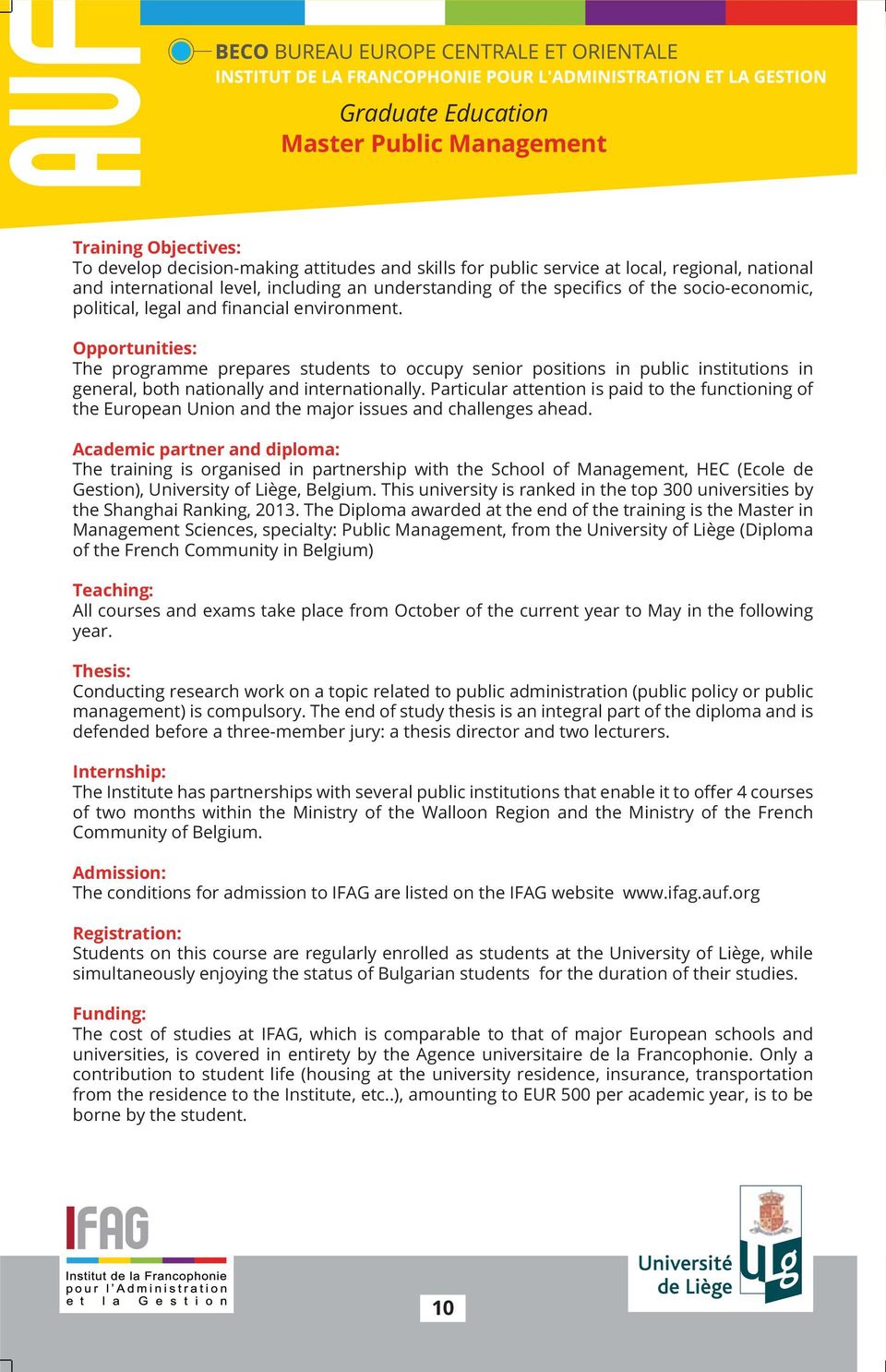
11 Formation diplômante Master Management public Contenu pédagogique du parcours Management des affaires européennes Tronc commun Management du secteur public Défis politiques, économiques et sociaux européens et internationaux Théorie économiques des finances publiques y compris les éléments de macroéconomie Gestion des ressources humaines dans le secteur public Marketing adapté au secteur public Travail de fin d études (TFE) - Mémoire Cours spécifiques au parcours Gouvernance et institutions européennes - Démocratie et gouvernance - Institutions européennes Droit européen Fonds structurels européens Politiques publiques européennes - Politique fiscale - Politiques sectorielles. Analyse et questions d actualité Management des projets européens - Montage des projets européens - Gestion opérationnelle des projets européens - Évaluation des projets européens Cours complémentaires : Introduction à la gestion Préparation au TFE Volume horaire : 400 heures environ 11
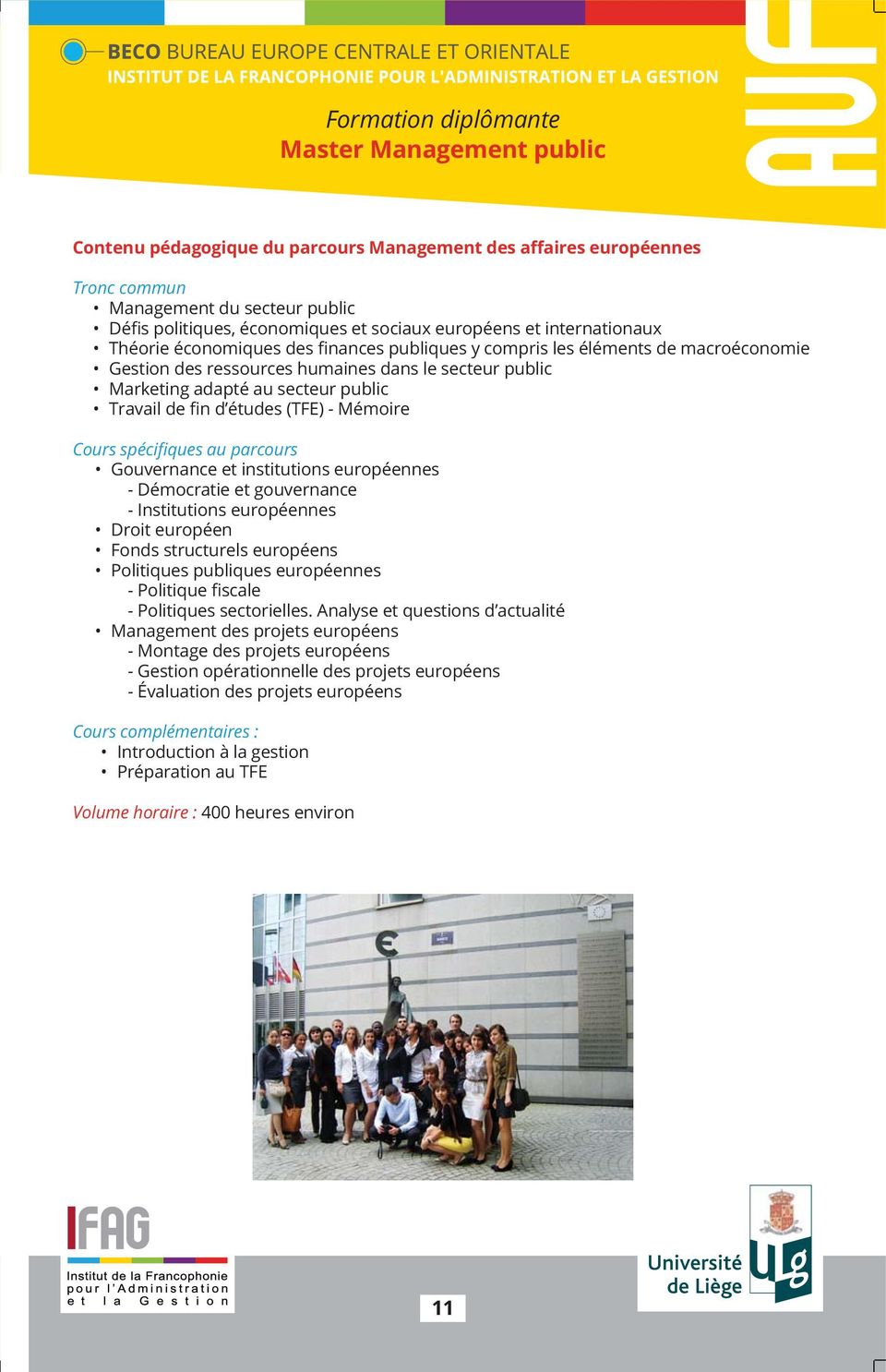
12 Graduate Education Master Public Management Educational content of the progamme European Business Management Common Core Public Sector Management European and international challenges : political, economic and social Economic theory of public finance, including elements of macroeconomics Human resources management in the public sector Marketing adapted to the public sector Graduation Work (GW) - Thesis Courses specific to the programme: Governance and European institutions - Democracy and Governance - European Institutions European Law EU Structural Funds European Public Policy - Fiscal Policy - Sectoral Policies. Analysis and Issues Management of European projects - Assembly of European projects - Operational management of European projects - Assessment of European projects Additional courses: Introduction to Management Preparation of GW Hours: about 400 hours 12

13 Formation diplômante Master Management public Contenu pédagogique du parcours Management des institutions publiques Tronc commun Management du secteur public Défis politiques, économiques et sociaux européens et internationaux Théorie économique des finances publiques y compris les éléments de macroéconomie Gestion des ressources humaines dans le secteur public Marketing adapté au secteur public Travail de fin d études (TFE) - Mémoire Cours spécifiques au parcours Management stratégique des institutions publiques - Organisation et décision des institutions publiques - Approche stratégique de l action publique - Management de la performance des institutions publiques Management des collectivités locales Droit public Comptabilité et gestion financière des institutions publiques Achats et marchés public Management des projets - Financement des projets - Montage des projets - Gestion opérationnelle et évaluation des projets Cours complémentaires : Introduction à la gestion Préparation au TFE Volume horaire : 400 heures environ 13
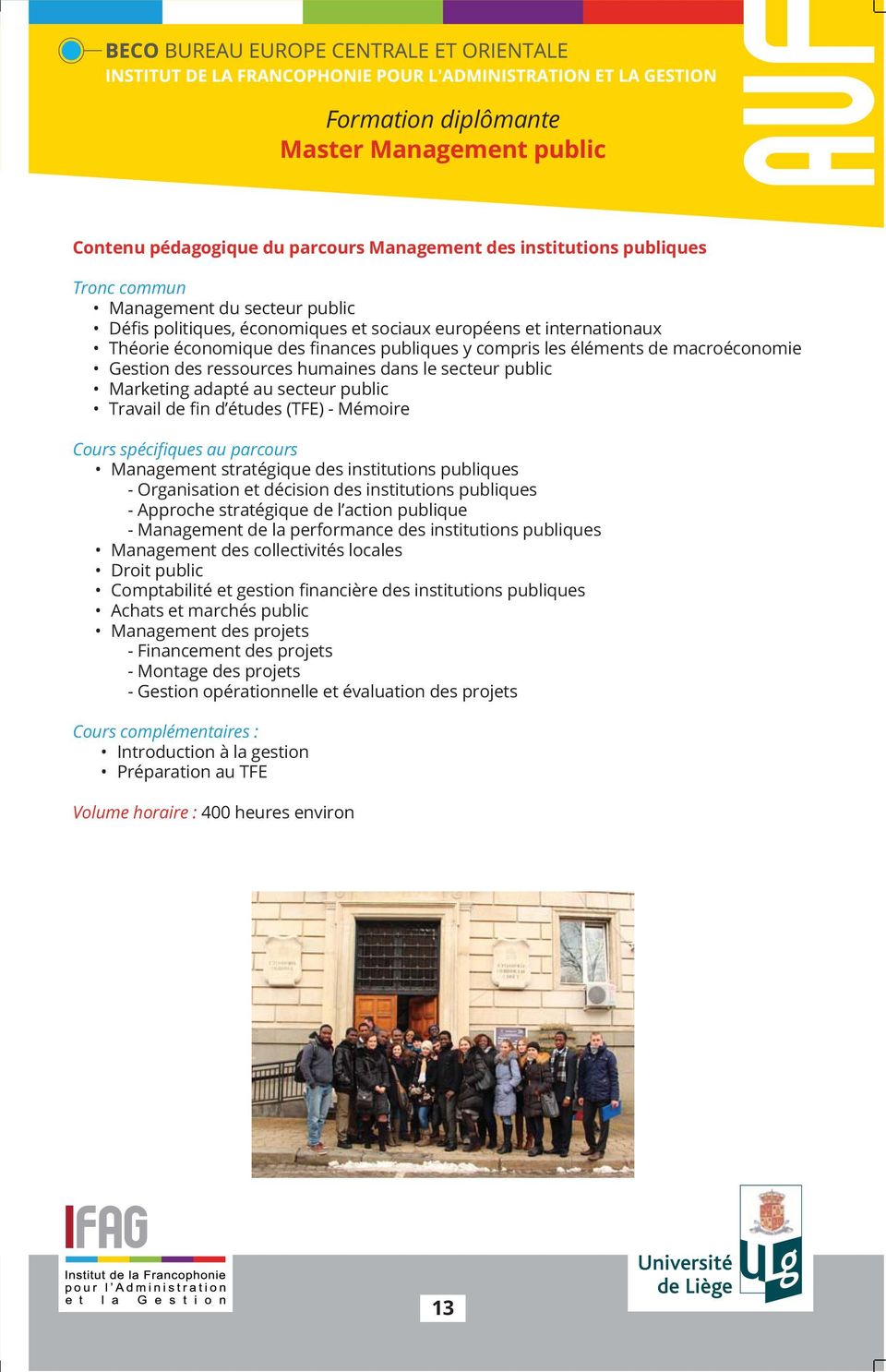
14 Graduate Education Master Public Management Educational content of the course Management of Public Institutions Common Core Public Sector Management European and international challenges: political, economic and social The economic theory of public finance, including elements of Macroeconomics Human resources management in the public sector Marketing adapted to the public sector Graduation Work (GW) - Thesis Courses specific to the programme Strategic management of public institutions - Organisation and decisions of public institutions - Strategic approach to public action - Management of the performance of public institutions Management of local communities Public Law Accounting and financial management of public institutions Purchasing and public procurement Project Management - Financing of projects - Editing projects - Operational management and evaluation of projects Additional courses: Introduction to Management GW Preparation Hours: about 400 hours 14
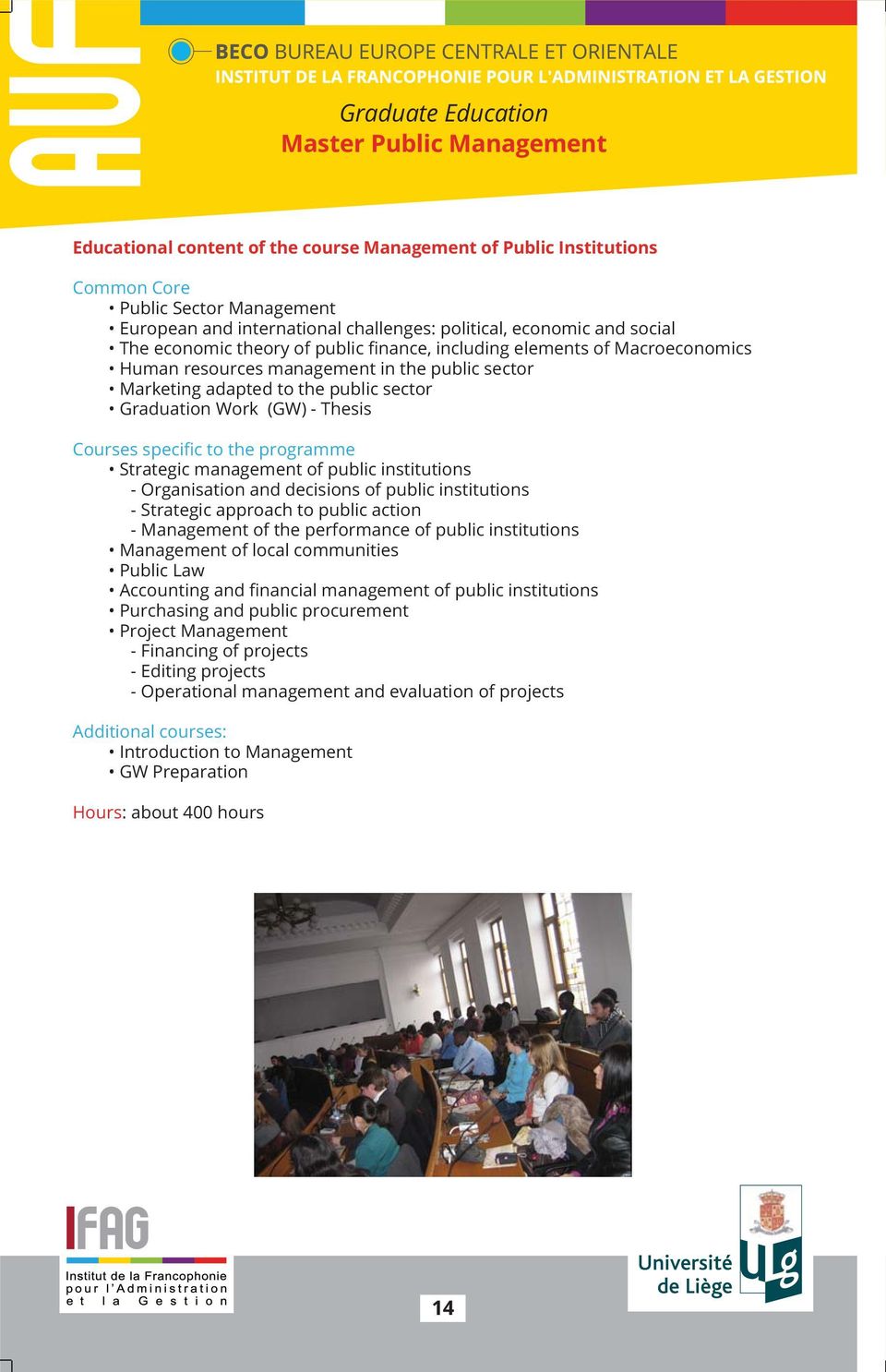
15 Formation diplômante Master en Entrepreneuriat social et culturel Objectifs de la formation : Former des intervenants qui participent activement à l animation et au développement des organisations et des réseaux de l économie sociale et solidaire. Le Master vise notamment à doter les candidats : - d une expertise dans la mise en relation des stratégies économiques et des interventions à caractère social pour la conduite de projets ; - d instruments et techniques aidant à la création d entreprises et d activités au service de l insertion sociale ; - des savoir-faire nécessaires à l administration de la coopération au développement, à la promotion des expériences dans les domaines de l action humanitaire, du développement durable, du commerce équitable, au niveau national et international. Débouchés : La formation prépare les étudiants à occuper des fonctions de conseillers en création d activités, de chefs de projets ou agents de développement capables de concevoir, conduire et animer des projets dans le domaine du développement local et de la solidarité internationale. Partenaire académique et diplôme : La formation est organisée en partenariat avec l Université Lumière Lyon 2 (France). Le diplôme délivré à l issue de la formation est le Master Droit-économie-gestion, spécialité Entrepreneuriat social et culturel de l Université Lumière Lyon 2 (diplôme d État français). Enseignements : L ensemble des cours et des examens se déroule du mois d octobre de l année en cours au mois de mai de l année suivante. Stage-mémoire : Le stage est une partie intégrante de la formation et une condition d obtention du diplôme. Il commence après la fin des cours et se déroule dans une entreprise, une administration publique ou une organisation non gouvernementale, opérant dans le pays d origine de l étudiant, en Bulgarie, en France ou en Belgique. Il est l objet d une convention tripartite, signée avant son début et aussi d un mémoire que l étudiant doit écrire et soutenir avant le mois de septembre. Admission : Les conditions d admission à l IFAG sont disponibles sur le site web de l IFAG Inscription : Les étudiants de cette formation sont des étudiants régulièrement inscrits à l Université Lumière Lyon 2, tout en bénéficiant du statut d étudiant bulgare pour la durée de leurs études. Financement : Le coût des formations assurées par l IFAG, comparable à celui des grandes écoles et universités européennes est subventionné intégralement par l Agence universitaire de la Francophonie. Seule une contribution à la vie étudiante (logement à la résidence universitaire, assurances, transport de la résidence à l Institut, etc.), à hauteur de 500 EUR par année universitaire, est à prendre en charge par l étudiant. 15
16 Graduate Education Master in Social and Cultural Entrepreneurship Training Objectives: Train stakeholders actively involved in the animation and development of organisations and social and solidarity economy networks. The Master aims to provide candidates with: - Expertise in linking economic strategies and social interventions for the conduction of projects; - Instruments and techniques to help in the creation of businesses and activities in the service of social inclusion; - Know-how necessary for the administration of development cooperation, promotion of experience in the fields of humanitarian action, sustainable development, fair trade, at national and international level. Opportunities: The programme prepares students for positions as advisors in activity creation project managers or development agents capable of designing, conducting and carrying out projects in the field of local development and international solidarity. Academic partner and diploma: The training is organised in partnership with the Université Lumière Lyon 2 (France). The degree awarded after training is the Master Law, Economics, Management, specialty: social and cultural entrepreneurship at the University Lumière Lyon 2 (French State degree). Courses: All courses and exams will take place from October of the current year to May of the following year. Internship-Thesis: The internship is an integral part of training and a condition of graduation. It starts after the end of the course and takes place in a business, governmental or non-governmental organisation operating in the country of origin of the student, in Bulgaria, France or Belgium. It is the subject of a tripartite agreement signed before the start along with a thesis that the student must have written and supported by September. Admission: The conditions for admission to IFAG are listed on the IFAG website Registration: Students on this course are regularly enrolled as students at the University of Liège, while simultaneously enjoying the status of Bulgarian students, for the duration of their studies. Funding: The cost of studies at IFAG, which is comparable to that of major European schools and universities, is covered in entirety by the Agence universitaire de la Francophonie. Only a contribution to student life (housing at the university residence, insurance, transportation from the residence to the Institute, etc..), amounting to EUR 500 per academic year, is to be borne by the student. Graduate Education 16
17 Formation diplômante Master en Entrepreneuriat social et culturel Contenu pédagogique du parcours Économie sociale et solidaire Tronc commun ENTREPREUNARIAT Entrepreneuriat : théories et pratiques Pratiques de la création d activités et d entreprises Structures juridiques et fiscales des entreprises en création Gestion financière OUTILS ET METHODES Informatique appliquée Techniques de documentation Méthodologie de projet Techniques de recherche d emploi Cours spécifiques au parcours ÉCONOMIE SOCIALE ET SOLIDAIRE Économie sociale et solidaire Management des organisations de l ESS Droit et fiscalité des acteurs et structures de l ESS Exclusion et liens financiers (Micro-finance) Économie du développement durable et humaine (séminaire Gestion de la santé) ENTREPRISES ET DEVELOPPEMENT LOCAL Développement local : acteurs et politiques Histoire et pratique de la politique de la ville Insertion sociale acteurs et politiques Responsabilité sociale des entreprises Audit social des organisations La diversité : acteurs, projets et politiques RELATIONS INTERNATIONALES ET COOPERATION Mondialisation et environnement Développement : projets, politiques et stratégies Géostratégie de l économie mondiale Commerce équitable Les nouveaux acteurs de la mondialisation : les ONG Mondialisation et action humanitaire La coopération décentralisée : projets et politiques STAGE Volume horaire : 400 heures environ 17

18 Graduate Education Master in Social and Cultural Entrepreneurship Educational content of the course Social and Solidarity Economy Common Core ENTREPRENEURSHIP Entrepreneurship: Theory and Practice Practice of the creation of activities and businesses Legal and tax structures of start-ups Financial Management TOOLS AND METHODS Applied Information Technology Documentation Techniques Project Methodology Job Search Techniques Courses specific to the programme SOCIAL AND SOLIDARITY ECONOMY Management of SSE organisations Law and Taxation of the actors and structures of the SSE Exclusion and financial linkages (Micro-finance) Economics of sustainable and humane development (Health Management seminar) COMPANIES AND LOCAL DEVELOPMENT Local development: actors and policies History and practice of urban policy Social inclusion actors and policies Corporate social responsibility Social audit of organisations Diversity: actors, projects and policies INTERNATIONAL RELATIONS AND COOPERATION Globalisation and the environment Development: projects, policies and strategies Geo-strategy of the global economy Fair Trade The new actors of globalisation: NGOs Globalisation and Humanitarian Action The decentralised cooperation projects and policies INTERNSHIP Hours: about 400 hours 18

19 Formation diplômante Master en Entrepreneuriat social et culturel Contenu pédagogique du parcours Management et carrière d artiste Tronc commun ENTREPREUNARIAT Entrepreneuriat : théories et pratiques Pratiques de la création d activités et d entreprises Structures juridiques et fiscales des entreprises en création Gestion financière OUTILS ET METHODES Informatique appliquée Techniques de documentation Méthodologie de projet Techniques de recherche d emploi Cours spécifiques au parcours ENVIRONNEMENT ECONOMIQUE ET INSTITUTIONNEL DE LA MUSIQUE Sociologie de la culture Economie de la musique Connaissance des institutions Dossier thématique Droit d auteur et contrats ENTREPRISES ET DEVELOPPEMENT LOCAL Marketing de la musique Commerce et musique, nouvelles technologies, diffusion internet Gestion du spectacle vivant et de la production phonographique STAGE Business plan Rapport de stage / mémoire Volume horaire : 400 heures environ 19
20 Graduate Education Master in Social and Cultural Entrepreneurship Educational content of the course Management and career as an artist Common Core ENTREPRENEURSHIP Entrepreneurship: Theory and Practice Practice of the creation of activities and businesses Legal and tax structures of start-ups Financial management TOOLS AND METHODS Applied Information Technology Documentation Techniques Project Methodology Job Search Techniques Courses specific to the programme ECONOMIC AND INSTITUTIONAL ENVIRONMENT OF MUSIC Sociology of Culture Economy of Music Knowledge of institutions Thematic File Copyright and Contracts COMPANIES AND LOCAL DEVELOPMENT Music marketing Trade and music, new technologies, internet diffusion Management of performing arts and phonographic production INTERNSHIP Business plan Internship report / thesis Hours: about 400 hours 20

21 Formation diplômante Master Management du tourisme Objectifs de la formation : Former des «managers» du développement touristique, capables d occuper, de créer et de diriger leur propre structure, mais aussi d occuper des fonctions d encadrement dans des organisations publiques ou privées. Le Master vise à doter les étudiants d une vision globale et intégrée du développement touristique, d instruments et techniques aidant à la création et au pilotage d entreprises du tourisme et des loisirs. Débouchés : La formation prépare les étudiants à occuper des fonctions de direction ou de chef de projets dans le secteur touristique, comme responsable d une structure d hébergement touristique, responsable marketing, chargé de développement dans un centre de loisirs, directeur d office de tourisme, chargé de mission dans une collectivité en charge du tourisme. Partenaire académique et diplôme : La formation est organisée en partenariat avec l Institut d Administration des Entreprises de l Université de Corse Pasquale Paoli et l Université Cadi Ayyad de Marrakech. Le diplôme délivré à l issue de la formation est le Master Développement Territorial Durable, spécialité Management du Tourisme et des loisirs. Enseignement : L enseignement se déroule à temps plein, du début du mois d octobre au mois de avril. L enseignement en présentiel est suivi par un stage/mémoire qui fait partie intégrante de la formation. Stage/mémoire : Les étudiants effectuent un stage d au moins 3 mois. Il est l objet d une convention qui identifie un tuteur dans l entreprise et un tuteur universitaire. Le stage donne lieu à un mémoire soutenu, à la fin du mois de septembre, devant un jury constitué d enseignants-chercheurs et de professionnels. Admission : Les conditions d admission à l IFAG sont disponibles sur le site web de l IFAG Inscription : Les étudiants de cette formation sont des étudiants régulièrement inscrits à l Université de Corse, tout en bénéficiant du statut d étudiant bulgare pour la durée de leurs études. Financement : Le coût des formations assurées par l IFAG, comparable à celui des grandes écoles et universités européenne est subventionné intégralement par l Agence universitaire de la Francophonie. Seule une contribution à la vie étudiante ( logement dans la résidence universitaire, assurances, transport de la résidence à l Institut, etc.), à hauteur de 500 EUR par année universitaire, est à prendre en charge par l étudiant. 21
22 Graduate Education Master Management of tourism Training Objectives: To train managers of tourism development, capable of occupying, creating and running their own structure, but also of occupying management positions in public or private organisations. The Master course aims to provide students with a comprehensive and integrated vision of tourism development, of tools and techniques to help in the creation and control of tourism and leisure businesses. Opportunities: The programme prepares students to take leadership or project manager positions in the tourism sector, as head of a tourist accommodation structure, head of marketing, development director in a leisure center, chargé de mission in a community in charge of tourism. Academic partner and diploma: The training is organised in partnership with the Institute of Business Administration of the University of Corsica Pasquale Paoli and the Cadi Ayyad University of Marrakech. The degree awarded after training is the Master in Sustainable Territorial Development, specialty in Tourism Management and Recreation. Teaching: Teaching is full time from the beginning of October to April. To-face teaching is followed by an internship / thesis, which is an integral part of the training. Internship / thesis: Students complete an internship of at least 3 months. It is the subject of an agreement that identifies a mentor in the company and a university tutor. The internship concludes with the support of a thesis at the end of September, before a jury of faculty and professionals. Admission: The conditions for admission to IFAG are listed on the IFAG website Registration: Students on this course are regularly enrolled as students at the University of Corsica, while simultaneously enjoying the status of Bulgarian students for the duration of their studies. Funding: The cost of studies at IFAG, which is comparable to that of major European schools and universities, is covered in entirety by the Agence universitaire de la Francophonie. Only a contribution to student life (housing at the university residence, insurance, transportation from the residence to the Institute, etc..), amounting to EUR 500 per academic year, is to be borne by the student. 22
23 Formation diplômante Master Management du tourisme Contenu pédagogique du Master Management du tourisme : Introduction Introduction en économie et gestion Trajectoires de développement des territoires touristiques Mobilités, lieux et pratiques touristiques (géographie du tourisme) Stratégies de développement des territoires touristiques Stratégie et organisation des PME touristiques Gestion et valorisation de la production touristique Techniques de vente / communication Création et commercialisation des produits touristiques Innovation produits et évènementiel Gestion et valorisation des territoires touristiques Patrimoines, tourisme et développement local Valorisation et gestion des sites et espaces ruraux touristiques Outils de valorisation des patrimoines Management des PME touristiques Marketing stratégique Techniques de GRH Analyse financière et contrôle de gestion de l entreprise Ingénierie de projets touristiques Montage et conduite de projets européens : les fondamentaux Montage et conduite de projets européens : réponse à des appels d offres Évaluation de projet : les fondamentaux Évaluation de projet : les outils Transversale Langues - français Stage : mémoire et soutenance Formations complémentaires Langues - anglais Séminaires Volume horaire : 500 heures environ 23
24 Graduate Education Master Management of Tourism Educational content of the Master in Management of Tourism: Introduction Introduction to Economics and Management Development trajectories of tourist areas Mobility, places and tourist practices (geography of tourism) Development strategies of tourist areas Strategy and organisation of tourism SMEs Management and valuation of tourism production Sales / Communication techniques Creation and marketing of tourism products Product innovation and events Management and development of tourist areas Heritage, tourism and local development Valuation and management of tourist sites and rural areas Heritage valuation tools Management of tourism SMEs Strategic Marketing HRM techniques Financial analysis and company management control Tourism projects engineering Setting up and management of European projects : basic Setting up and management of European projects in response to offer calls Project evaluation: basic Project Evaluation: Tools Transversal Languages -- French Internship: thesis and defense Additional training Languages - English Seminars Hours: about 500 hours 24
25 Formation continue Comment mesurer et gérer les performances d une PME I. Présentation de la formation Contexte : L'Institut de la Francophonie pour l'administration et la Gestion (IFAG) a pour mission de former des spécialistes de haut niveau en gestion des entreprises et des administrations impliquées activement dans la dynamique de changement de la région. A travers les formations continues, l'ifag se proposent de répondre à des besoins concrets des entreprises implantées en Bulgarie et dans la région, ainsi qu'aux demandes des organisations publiques. Objectifs de la formation : Les entrepreneurs et les responsables d organismes publics et privées sont sans cesse confrontés à des problématiques de gestion des performances. La connaissance des facteurs intrinsèques des performances dans un environnement fortement concurrentiel, des outils de mesure et de pilotage de l allocation et de la consommation des ressources constituent des préliminaires indispensables à tout engagement stratégique et pratique. Compétences acquises à l'issue de cette formation : Appréhender, définir et mesurer les différentes dimensions de la performance Comprendre les principes de la comptabilité financière et de gestion avec impact sur la performance Maîtriser les méthodes et outils pratiques de mesure et de contrôle de la performance Analyser les performances d une entreprise dans un contexte en mutation Public cible : Le cours s'adresse aux : Responsables des PME, Directeurs ou responsables administratifs et financiers, Entrepreneurs qui ont des projets à mener à bien, Contrôleurs de gestion, auditeurs internes. Gestion des PME II. Intervenants Alain Burlaud : expert international avec une grande expérience en audit, comptabilité financière et contrôle de gestion. Il a été pendant 30 ans commissaire aux comptes et expert-comptable. Par ailleurs, en tant que professeur des universités, il a constamment conceptualisé et diffusé ses pratiques en publiant de nombreux ouvrages et articles dont un certain nombre ont été traduits en roumain. Maria Niculescu : professeur d'université (Roumanie, France, etc) et expert international avec une grande expérience dans le conseil aux entreprises, acquise dans ses activités dans le cadre des organisations internationales (PNUD, CNUCED, UNESCO, OIF), dans des postes de responsabilité. Elle intervient essentiellement en Europe et en Afrique, dans l'enseignement supérieur et comme expert dans la gestion des projets internationaux. Auteur de nombreux ouvrages et articles en économie et gestion. L expérience acquise par les deux experts en tant que professeurs et responsables opérationnels leur permet d assurer un transfert concret de compétences 25
26 Continuing Education How to measure and manage the performance of SMEs I. Presentation of the course Background: The Francophone Institute for Administration and Management (IFAG) sets itself the task to train high level specialists in business and government, as well as administrators actively involved in the dynamics of change in the region. Through continuing education training, the IFAG proposes to meet the specific needs of firms in Bulgaria and the region, as well as requests from public organisations. Training Objectives: Entrepreneurs and managers of public and private organisations are constantly faced with problems of performance management. Knowledge of the intrinsic performance in a highly competitive environment, of measurement tools and control of the allocation and consumption of resources are necessary prior to any strategic commitment and practice. SME Management Skills acquired at the end of this training: To understand, define and measure out different dimensions of performance To understand the principles of financial accounting and management with impact on performance To master the practical methods and tools to measure and control the performance To analyse the performance of a business in a changing environment Target Audience: The course is intended for: Heads of SMEs, Administrative and financial heads and direct Contractors who have projects to complete, Management controllers, internal auditors. II. Lecturers Alain Burlaud: international expert with extensive experience in auditing, financial accounting and management control. He was for 30 years auditor and accounting expert. Moreover, in his capacity of professor, he has consistently conceptualised and diffused practices by publishing numerous books and articles, a number of which have been translated into Romanian. Maria Niculescu: university professor (Romania, France, etc.) and international expert with extensive experience in advising companies, acquired through her activities in the framework of international organisations (UNDP, UNCTAD, UNESCO, OIF), in positions of responsibility. She has worked mainly in Europe and Africa, in higher education and as an expert in the management of international projects. She is the author of numerous books and articles in economics and management. The experience gained by these two experts as lecturers and operations managers allows them to provide concrete skills transfer. 26
27 Formation continue Comment mesurer et gérer les performances d une PME (suite) III. Organisation de la formation Programme (16 heures) : Séance 1: Comment mesurer et piloter la performance? Mesurer la performance de l'organisation dans ses différentes dimensions ; Approches multidimensionnelles de la performance : comptable, financière, organisationnelle et humaine ; Le pilotage de la performance: pilotage global, pilotage décentralisé, la structure des centres de responsabilité. Séance 2: Comment allouer et piloter la gestion des ressources? Les méthodes de calcul des coûts et leurs implications sur la performance ; La gestion stratégique des coûts, des prix et des marges ; Les processus de planification et d élaboration des budgets ; La mise en œuvre des outils de pilotage "classiques" : de la planification au suivi budgétaire. Séance 3: Comment mesurer et évaluer les performances financières globales de l entreprise? Le langage comptable et la lecture des comptes annuels (bilan, compte de résultat) ; Les indicateurs financiers de performance ; La performance, la valeur d une entreprise et la valeur des capitaux propres ; Les actifs immatériels et la performance dans la société de la connaissance ; Les limites des indicateurs de performance financière. Séance 4: Comment concevoir et mettre en place des outils de contrôle et de pilotage de la performance? Déployer la stratégie et concevoir des indicateurs de pilotage ; Indicateurs de pilotage et systèmes d information ; Adaptation des outils de pilotage aux besoins des PME ; Le pilotage de la performance dans différents environnements : l industrie, les services, le secteur public... Conception et mise en œuvre de tableaux de pilotage et de balanced scorecard. Gestion des PME Modalités pédagogiques : Exposés interactifs Études de cas favorisant les échanges entre les participants Témoignages de professionnels de différents secteurs Conception des outils de pilotage concret de la performance, à partir des cas des auditeurs Mise à disposition de supports de cours (en français et en langue nationale) Une interprétation en langue nationale des exposés faits par des experts étrangers sera assurée Inscription : Pour vous inscrire à la formation contactez-nous au Lieu : La formation peut avoir lieu soit dans les locaux de l IFAG, soit dans les locaux de l entreprise. 27
28 Continuing Education How to measure and manage the performance of SMEs (continued) III. Organisation of the Training Programme (16 hours): Measuring the performance of the organisation in its different dimensions Multidimensional approaches to performance: accounting, financial, organisational and human Performance management: overall management, decentralised control, the structure of responsibility centers. Session 2: How to allocate and manage resources management? The methods of costing and their performance implications The strategic management of costs, prices and margins The process of planning and budgeting The implementation of classical management tools: from planning to budget monitoring SME Management Session 3: How to measure and assess the overall financial performance of the business? The accounting language and the reading of financial statements (balance sheet, income statement) The indicators of financial performance The performance and value of a company and its equity value Intangible assets and performance in the knowledge society The limits of financial performance indicators Session 4: How to design and develop tools to monitor and control the performance? Implementing the strategy and designing management indicators Indicators of control and information systems. Adaptation of management tools to SME needs Performance management in different environments: industry, services, the public sector... Design and implementation of scorecards and balanced scorecards. Teaching methods: Interactive presentations Case studies encouraging the exchange between participants Evidence of professionals from different sectors Designing specific performance management tools, from the case of auditors Provision of course materials (in French and in the national language) Interpretation in the national language of presentations by international experts will be provided Registration: To register for training, contact us at Location: Training can take place either on the premises of the IFAG or on the premises of the company. 28
29 Formation continue Comment développer et pérenniser son entreprise I. Présentation de la formation Contexte : L'Institut de la Francophonie pour l'administration et la Gestion (IFAG) a pour mission de former des spécialistes de haut niveau en gestion des entreprises et des administrations impliquées activement dans la dynamique de changement de la région. A travers les formations continues, l'ifag se proposent de répondre à des besoins concrets des entreprises implantées en Bulgarie et dans la région, ainsi qu'aux demandes des organisations publiques. Objectifs de la formation : Malgré une dynamique appréciable de création d entreprises dans la région, le tissu des PME est fragile, car les entreprises ont des difficultés à maîtriser leur développement. Les dirigeants et les cadres d entreprises doivent mieux connaître les leviers de création de valeur et faire des choix de développement en cohérence avec leurs forces et les opportunités de l environnement. Compétences acquises à l'issue de cette formation : Comprendre la situation financière de l entreprise Saisir les points clés d une analyse financière et proposer des pistes de développement Maîtriser les différentes étapes et modalités de développement d'une entreprise Mesurer les enjeux et les risques de chaque forme de développement Connaître les outils de communication financière Public cible : Le cours s'adresse aux : Dirigeants des PME Cadres des directions financières Cadres chargés de la stratégie Responsables d unités (filiales, succursales,..) Cadres de banques et d institutions financières Gestion des PME II. Intervenants Denis Dubois : expert financier et professeur des Universités au Conservatoire National des Arts et Métiers et à Paris-Dauphine. Membre du Haut Conseil Certificateur de l Autorité des Marchés Financiers et de nombreuses associations et sociétés savantes (SFAF, AFTE, DFCG, SFEV...), Denis Dubois a été conseiller économique d une des principales organisations professionnelle de transports routiers pendant plus de 30 ans et a accompagné de grands groupes industriels dans la mise en œuvre de leur stratégie financière (EDF, France Télécom, Thomson Multimédia, Sté des Ciments Français, Groupe Gefco...). Maria Niculescu : professeur d'université (Roumanie, France, etc) et expert international avec une grande expérience dans le conseil aux entreprises, acquise dans ses activités dans le cadre des organisations internationales (PNUD, CNUCED, UNESCO, OIF), dans des postes de responsabilité. Elle intervient essentiellement en Europe et en Afrique, dans l enseignement supérieur et comme expert dans la gestion des projets internationaux. Auteur de nombreux ouvrages et articles en économie et gestion. L expérience acquise par les deux experts en tant que professeurs et responsables opérationnels leur permet d assurer un transfert concret de compétences. 29
30 Continuing Education How to develop and sustain one s business I. Presentation of the programme Background: The Francophone Institute for Administration and Management (IFAG) has the mission to train high level specialists in business and government, as well as administrators actively involved in the dynamics of change in the region. Through continuous education training, IFAG proposes to meet the specific needs of firms established in Bulgaria and the region, as well as requests from public organisations. Training Objectives: Despite a significant dynamics of entrepreneurship in the region, the SME fabric is fragile, because companies have difficulties to control their development. Leaders and business executives need to better know the levers of value creation and make development choices consistent with their strengths and the opportunities of the environment. SME Management Skills acquired at the end of this training: Understanding the financial situation of the company Grasping the key points of a financial analysis and proposing directions for development Mastering the different steps and possibilities in developing a business Measuring the challenges and risks of each type of development Knowing the tools for financial communication Target Audience: The course is intended for: Executives of SMEs Financial direction staff Staff responsible for strategy Heads of units (branches, subsidiaries,..) Executives of banks and financial institutions II. Lecturers Denis Dubois: financial expert and university professor at the Conservatoire National des Arts et Métiers in Paris-Dauphine. Member of the High Certifying Council of the Authority for the Financial Markets and many associations and learned societies (FCAS, AFTE, DFCG, SFEV...) Denis Dubois was economic advisor to one of the major professional organisations for road transport for more than 30 years and has advised large industrial groups in the implementation of their financial strategy (EDF, France Telecom, Thomson Multimedia, Co Cement French, Gefco...) Maria Niculescu: university professor (Romania, France, etc.) and international expert with extensive experience in advising companies, acquired in her activities in the framework of international organisations (UNDP, UNCTAD, UNESCO, OIF), in positions of responsibility. Her activity has been mainly in Europe and Africa, in higher education and as an expert in the management of international projects. Author of numerous books and articles in economics and management. The experience gained by these two experts as teachers and business managers will allow them to provide concrete skills transfer. 30
31 Formation continue Comment développer et pérenniser son entreprise (suite) III. Organisation de la formation Programme (16 heures) : Séance 1: Comment identifier et assurer la pérennité financière de son entreprise? Quelles sont les contraintes et caractéristiques financières rattachées à chaque stade de développement? Comment mesurer et interpréter les indicateurs de rentabilité? Comment identifier et remédier aux risques de déséquilibre financier de l entreprise? Séance 2: Quelle est la valeur de son entreprise? Comment créer de la valeur? Quelles sont les différentes méthodes et la démarche de l évaluation d une entreprise? Quels sont les avantages et les limites des contextes particuliers : - d une entreprise à forte croissance - d une entreprise en difficulté - d une start-up Sur quels leviers d action agir pour augmenter la valeur de mon entreprise? Séance 3: Comment maîtriser son développement? Quels sont les principaux facteurs de croissance interne? Comment structurer son financement? Quel est le rôle des fonds propres? Comment gérer sa relation avec ses partenaires financiers? Comment se préparer et gérer une crise financière? Un exemple de montage financier pour le pilotage de la création de valeur. Séance 4: Les opérations de croissance externe : objectifs, aspects juridiques et conditions de succès Les différentes formes de croissance externe et le processus spécifique à chaque opération. Le financement de l acquisition et les techniques d acquisition à effet de levier et leurs dangers. La démarche et les aspects juridiques d une opération de croissance externe. Conditions de succès et risques d échec d une opération de croissance externe. Synthèse : exercice «les bilans aveugles». Evaluation et commentaires des participants. Gestion des PME Modalités pédagogiques : Exposés interactifs Applications numériques des concepts favorisant les échanges entre les participants Décryptage et comparaison des stratégies financières Mise à disposition de supports cours (en français et en langue nationale) Une interprétation en langue nationale des exposés faits par des experts étrangers sera assurée Inscription : Pour vous inscrire à la formation contactez-nous au Lieu : La formation peut avoir lieu soit dans les locaux de l IFAG, soit dans les locaux de l entreprise. 31
32 Continuing Education How to develop and sustain one s business (continued) III. Organization of training Programme (16 hours): Session 1: How to identify and ensure the financial sustainability of one s business? What are the financial constraints and characteristics associated with each stage of development? How to measure and interpret indicators of profitability? How to identify and address the risks of financial imbalance of the company? Session 2: What is the value of one s business? How to create value? What are the different methods and approaches in the evaluation of a company? What are the advantages and limitations of specific contexts: A fast-growing company Business in difficulty A start-up What levers should I use to increase the value of my business? SME Management Session 3: How do I control its development? What are the main factors of internal growth? How do I structure its funding? What is the role of capital? How do I manage its relationship with financial partners? How can I prepare for and manage a financial crisis? An example of a financial arrangement for controlling the creation of value Session 4: Operations of external growth (acquisitions): objectives, legal aspects and conditions for success The different forms of external growth and the processes that are specific to each operation The financing of the acquisition and the acquisition techniques with leverage effect, and potential dangers Legal steps and aspects of an external growth operation Success conditions and failure risks of an external growth operation Summary: exercise blind balances Evaluation and feedback from participants. Teaching methods: Interactive presentations; Digital applications of concepts promoting exchanges among participants; Decryption and comparison of financial strategies; Provision of course support (in French and in the national language); Interpretation in the national language of presentations by international experts will provided. Registration: To register for the training, please contact us at Location: Training can take place either on the premises of the IFAG or on the premises of the company. 32
33 Formation continue Tableaux de bord : outils de pilotage de l entreprise I. Présentation de la formation Contexte : L Institut de la Francophonie pour l Administration et la Gestion (IFAG) a pour mission de former des spécialistes de haut niveau en gestion des entreprises et des administrations impliquées activement dans la dynamique de changement de la région. A travers les formations continues, l IFAG se proposent de répondre à des besoins concrets des entreprises implantées en Bulgarie et dans la région, ainsi qu aux demandes des organisations publiques. Objectifs de la formation : Au cours de cette formation, les participants prendront conscience de l importance des tableaux de bord en tant qu outil de gestion et de pilotage de la performance globale. Tant les aspects relatifs à la forme qu au contenu seront développés. De retour dans leur entreprise, ils pourront ensuite appliquer la démarche de construction de tableaux de bord exposée au cours de la formation. Les participants découvriront aussi les concepts de base du Balanced Scorecard en le comparant aux autres outils de suivi de la performance. Public cible : Le cours s adresse aux: Dirigeants d entreprise Directeurs d unités principales (achat, production, ventes...) ou d unités fonctionnelles (RH, services financiers...) Cadres intermédiaires ayant une activité de pilotage dans des fonctions principales ou fonctionnelles. Gestion des PME Compétences acquises à l issue de cette formation : Cerner l importance d une approche globale de la performance (non limitée aux indicateurs financiers) Pouvoir appliquer une méthodologie pour l élaboration et la mise en place de tableaux de bord de gestion (de l approche stratégique à la mise en place des tableaux des bords en passant par le choix des indicateurs) Exploiter au mieux les principaux concepts du Balanced Scorecard II. Intervenant Anne CHANTEUX est chargée de cours de comptabilité analytique et contrôle de gestion à HEC Ecole de Gestion de l Université de Liège (Belgique), ainsi que professeur invité en contrôle de gestion à l Université Catholique de Rennes (ICR Rennes). Elle est aussi associée et gérante d une société de formation et de conseil en gestion d entreprise (spécialités : gestion financière, comptabilité, contrôle de gestion, pilotage de la performance) et auteur d ouvrages dans le domaine de la comptabilité. Ses atouts principaux sont le dynamisme, la connaissance variée du monde de l entreprise (petites/grandes entreprises, secteur privé / secteur public) et la capacité d écoute et de simplification. 33
34 Continuing Education Dashboards: tools to manage the company I. Presentation of the programme Background: The Francophone Institute for Administration and Management (IFAG) mission to train high level specialists in business and government actively involved in the dynamics of change in the region. Through ongoing training, IFAG propose to meet the specific needs of firms in Bulgaria and the region, as well as requests from public organizations. Training Objectives: During this training, participants will realize the importance of dashboards as a tool for management and monitoring of the overall performance. Both aspects of the form that content will be developed. Back in their business, they can then apply the approach to building dashboards exposed during training. Participants will also learn the basic concepts of the Balanced Scorecard by comparing it to other tools for monitoring performance. SME Management Target Audience: The course is intended for: Corporate Executives Directors of main units (purchasing, production, sales...) or functional units (HR, financial services...) Middle managers with activity in control of the main functions or functional. Skills acquired at the end of this training: Identify the importance of a comprehensive approach to performance (not limited to financial indicators) Ability to apply a methodology for the development and implementation of tables edge management (strategic approach to implementation tables edges through the selection of indicators) Exploiting the main concepts of the Balanced Scorecard II. Lecturer Anne CHANTEUX is lecturer of cost accounting and management control at HEC the Management School of the University of Liège (Belgium) and guest lecturer in management control at the Catholic University of Rennes (Rennes ICR). She is also partner and manager of a training and consultancy company in business management (specialty: financial management, accounting, management control, performance management) and author of books in the field of accounting. She stands out with her vibrant, diverse knowledge of the business world (small / large businesses, private / public sector) and her ability for listening and simplification. 34
35 Formation continue Tableaux de bord : outils de pilotage de l entreprise (suite) III. Organisation de la formation Programme (15 heures) : Séance 1: Pilotage de l entreprise et concept de performance Séance 2: Mesure «classique» de la performance financière : rappel des éléments fondamentaux (indicateurs de rentabilité, de liquidité et de solvabilité) Séance 3: Approche globale de la performance (financière et non financière par les tableaux de bord) Séance 4: Tableaux de bord de gestion (aussi appelés tableaux de bord opérationnels, traditionnels ou «à la française») Contenu et rôles des tableaux de bord Forme et principe gigogne Notion d indicateur de performance Etapes de la construction des tableaux de bord Pièges et erreurs à éviter Exemples d indicateurs de pilotage Séance 5: Balanced Scorecard (BSC) : outil de mesure de la performance Origine du BSC Définition et concepts de base du BSC BSC et mesure de la performance Avantages et inconvénients d une démarche BSC Comparaison tableaux de bord «à la française» versus BSC Gestion des PME Modalités pédagogiques : Les journées de formation seront ponctuées par une alternance : d exposés interactifs de mise à disposition de supports de cours (en français et en langue nationale) d une interprétation en langue nationale d explication de concepts théoriques d exemples concrets de cas d application (élaboration d un tableau de bord de gestion (en groupes sur base d un cas concret remis aux participants) de partage d expériences vécues Inscription : Pour vous inscrire à une formation contactez-nous au Lieu : La formation peut avoir lieu soit dans les locaux de l IFAG, soit dans les locaux de l entreprise. 35
36 Continuing Education Dashboards: tools to manage the company (continued) III. Organisation of training Program (15 hours): Session 1: Control of the company and the concept of performance Session 2: Classical measurement of the financial performance: a reminder of the fundamental elements (indicators of profitability, liquidity and solvency) Session 3: Global Approach to financial and non-financial performance (dashboards) SME Management Session 4: Management dashboards (also called operational, traditional or French style dashboards) Content and dashboard role Form and pull principle Notion of performance indicator Stages in the construction of dashboards Pitfalls and Mistakes to Avoid Examples of monitoring indicators Session 5: Balanced Scorecard (BSC): a tool for performance measurement Origin of BSC Definition and basic concepts of the BSC BSC and performance measurement Advantages and disadvantages of the BSC approach Comparison of dashboards: French style versus BSC Teaching methods: Training days will be punctuated by alternating: interactive presentations; the provision of course materials (in French and the national language); interpretation of a national language; explanation of theoretical concepts; concrete examples; case application (development of dashboard management (in groups - based on a concrete case presented to participants); sharing actual experiences. Registration: To register for training, contact us at Location: Training can take place either on the premises of the IFAG or on premises of the company. 36
37 Formation continue Gestion de projet I. Présentation de la formation Contexte : L Institut de la Francophonie pour l Administration et la Gestion (IFAG) a pour mission de former des spécialistes de haut niveau en gestion des entreprises et des administrations impliquées activement dans la dynamique de changement de la région. A travers les formations continues, l IFAG se proposent de répondre à des besoins concrets des entreprises implantées en Bulgarie et dans la région, ainsi qu aux demandes des organisations publiques. Objectifs de la formation : Les entrepreneurs et les responsables d organismes publics sont sans cesses confrontés à des problèmes de gestion de projet. Qu il s agisse de projets de transformation de l entreprise, de projets de recherche ou de simples affaires externalisées, leur préparation et leur pilotage par les priorités sont les facteurs clés de succès. Cette formation permet aux participants de s approprier des outils efficaces de gestion de projet, standards et normalisés internationalement. Compétences acquises à l issue de cette formation : démarche globale de la gestion de projet; processus de spécification; planification et Gestion des risques liés aux projets; processus d exécution, de pilotage, d évaluation et de clôture des projets; Public cible : Le cours s adresse aux gestionnaires de projet. Gestion des PME II. Intervenants Daniel Lecoeuvre : expert international avec une grande expérience dans le secteur industriel acquise dans ses postes de manager et chef de projets (IBM en France et aux USA) et de consultant international ICG) et dans les services publics (Conseiller technologique, professeur à l Université) Il intervient essentiellement en Europe dans le domaine de la gestion de projet, de l organisation, de la ré-ingénierie, de la qualité, de la conduite du changement, du management, de la gestion de production. Maria Niculescu : professeur d université (Roumanie, France, etc) et expert international avec une grande expérience dans le conseil aux entreprises, acquise dans ses activités dans le cadre des organisations internationales (PNUD, CNUCED, UNESCO, OIF), dans des postes de responsabilité. Elle intervient essentiellement en Europe et en Afrique, dans l enseignement supérieur et comme expert dans la gestion des projets internationaux. Auteur de nombreux ouvrages et articles en économie et gestion. L expérience acquise par les deux experts en tant que professeurs et responsables opérationnels leur permet d assurer un transfert concret de compétences. 37
38 Continuing Education Project management I. Presentation of the course Background: The Francophone Institute for Administration and Management (IFAG) has the mission to train high level specialists in business and government, as well as administrators actively involved in the dynamics of change in the region. Through continuing education training, IFAG proposes to meet the specific needs of firms in Bulgaria and the region, as well as requests from public organisations. Training Objectives: Entrepreneurs and managers of public organisations are at all time confronted with problems of project management. Whether we are dealing with transformation projects of the company, research projects or simple outsourcing, their priority preparation and management are key success factors. This training will enable participants to acquire efficient tools for project management -- standard and internationally standardised. SME Management Skills acquired at the end of this training: holistic approach to project management; specification process; planning and management of project risks; process of execution, control, evaluation and project closure; Target Audience: The course is intended for project managers. II. Lecturers Daniel Lecoeuvre: international expert with extensive experience in the industrial sector, gained in his positions of manager and project manager (IBM France and the USA) and ICG international consultant) and public services (Technology Advisor, Professor PAST at the University) He has worked mainly in Europe, in the fields of project management, organisation, re-engineering, quality, change management, management, production management. Maria Niculescu: university professor (Romania, France, etc.) and international expert with extensive experience in advising companies, acquired in the course of her activity in the framework of international organizations (UNDP, UNCTAD, UNESCO, OIF), in positions of responsibility. She has worked mainly in Europe and Africa, in higher education and as an expert in the management of international projects. Author of numerous books and articles on economics and management. The experience gained by these two experts as lecturers and business managers allows them to provide concrete skills transfer. 38
39 Formation continue Gestion de projet (suite) III. Organisation de la formation Programme (16 heures) : Séance 1: Démarche globale de la gestion des projets Définition du projet Déploiement des projets dans le temps (de la stratégie à l exécution) et dans l espace La systémique une réponse globale à la complexité La méthodologie projet : Lancement / Analyse / Conception / Mise en œuvre / Clôture Introduction aux 5 processus de gestion de projet, le triangle délais / coûts / qualité Séance 2: Processus de spécification Définition des attentes Introduction au cahier des charges fonctionnel normalisé Définition globale du projet (résumé, objectifs, hypothèses, risques, contraintes...) Mise en application en groupe sur les fils rouges. Séance 3: Planification et Gestion des risques liés aux projets Types des risques Identification des risques Planification : - Constitution de l Organigramme des tâches - Estimation des coûts - Ordonnancement (GANTT, AON retroplanning) - Planification des ressources et des coûts Gestion des risques Mise en application en groupe sur les fils rouges. Gestion des PME Séance 4: Processus d exécution, de pilotage, d évaluation et de clôture des projets Organisations spécifiques projets / rôle des acteurs / travail en groupe Gestion du temps / réunions efficaces Gestion des changements Pilotage du projet et Evaluation par le Comité de Pilotage Clôture et capitalisation par retour d expérience Initiation à un outil informatique de gestion de projet par la mise en application sur les fils rouges. Modalités pédagogiques : Exposés interactifs; Etudes de cas «fils rouges» (à partir des cas proposées par les participants qui seront débattus en groupe) Mise à disposition d un outil informatique de gestion de projets Mise à disposition des supports de cours (en français et en langue nationale) Mise à disposition des fiches standards de gestion, pour chaque étape Une traduction en langue nationale sera assurée Lieu : La formation peut avoir lieu soit dans les locaux de l IFAG, soit dans les locaux de l entreprise. Inscription : Pour vous inscrire à la formation contactez-nous au
40 Continuing Education Project management (continued) III. Organization of training Program (16 hours): Session 1: Global Approach to Project Management Project Definition Spreading of projects over time (from strategy to execution) and space Systemics a global response to complexity Project methodology: Launch / Analysis / Design / Implementation / Closing Introduction to the five project management processes, the triangle delay / cost / quality Session 2: Process Specification Defining expectations Introduction to standardised functional specifications Overall Project Definition (summary, objectives, assumptions, risks, constraints...) Red son group implementation. SME Management Session 3: Planning and Managing Project Risk Types of risk Identification of risks Planning: - Constitution of the tasks organigram - Cost Estimate - Scheduling (GANTT, AON - retroplanning) - Planning of resources and cost Risk Management Red son group implementation. Session 4: Process execution, control, evaluation and project closure Specific organisations projects/ role players / group work Time Management / efficient meetings Change Management Project management and evaluation by the Steering Committee Closing and capitalisation feedback Introduction to a computer tool for project management by red son implementation. Teaching methods: Interactive presentations; Red son case studies (cases proposed by the participants will be discussed in groups); Provision of an IT tool for project management; Provision of course materials (in French and the national language); Provision of standard record management records for each stage; A translation into national languages will be provided. Location: Training can take place either on the premises of the IFAG or on the premises of the company. Registration: To register for the training please contact us at
41 Formation continue Mutations managériales et réformes administratives I. Présentation de la formation Contexte : L Institut de la Francophonie pour l Administration et la Gestion (IFAG) a pour mission de former des spécialistes de haut niveau en gestion des entreprises et des administrations impliquées activement dans la dynamique de changement de la région. A travers les formations continues, l IFAG se proposent de répondre à des besoins concrets des entreprises implantées en Bulgarie et dans la région, ainsi qu aux demandes des organisations publiques. Objectifs de la formation : Décrypter les nouvelles logiques de réformes de l Etat et des collectivités territoriales afin de mieux adapter son positionnement tactique dans les relations avec les autorités publiques. Compétences acquises à l issue de cette formation : Comprendre la logique néo-managériale fondamentale à l oeuvre dans les réformes administratives partout en Europe Réfléchir à partir du cas de la «Réforme de l Etat» en France Exposer les enjeux de la nécessaire réforme des collectivités territoriales Construire des partenariats efficaces entre collectivités locales, Etat, Union européenne. Public cible : Cette formation s adresse aux fonctionnaires de l administration publique et parapublique. II. Intervenants Joseph Carles est Maître de Conférences en Gestion à Sciences Po Toulouse. Ancien consultant chez KPMG, il est premier-maire adjoint de la ville de Blagnac, chargé des finances et conseiller de la communauté urbaine du Grand Toulouse. Il a donc une grande expérience concrète de la gestion locale et des pratiques de management public dans le contexte des mutations lourdes de l environnement local et international. Jean-Michel Eymeri-Douzans est le Directeur-adjoint de Sciences Po Toulouse, où il dirige le Master 2 «Conseil-Expertise-Action publique». Expert de haut niveau, il a une vaste expérience de participation à des programmes de réformes institutionnelles, en France et dans de nombreux pays de l UE et associés. Professeur de Science politique, ses travaux de recherches portent sur la sociologie de l Etat, l analyse des politiques publiques, l étude comparée des administrations publiques en Europe, et sur les processus de gouvernement de l Union européenne. Gestion du changement III. Organisation de la formation Programme (16 heures) : Séance 1 : Logiques du New Public Management Séance 2 : Etude de cas de la «Réforme de l Etat» française Séance 3 : Les collectivités locales en nécessaire réforme Séance 4 : Le nouveau rôle des exécutifs locaux et des équipes de direction des collectivités dans la gouvernance territoriale d aujourd hui Modalités pédagogiques : Exposés interactifs, études de cas pratiques Mise à disposition de supports de cours (en français et en langue nationale) Mise en perspective et débats autour des problématiques soulevées Un interprétation en langue nationale des exposés 41
42 Continuing Education Managerial changes and administrative reforms Change management I. Presentation of the course Background: The Francophone Institute for Administration and Management (IFAG) has the mission to train high level specialists in business and government, as well as administrators actively involved in the dynamics of change in the region. Through continuing education training, IFAG proposes to meet the specific needs of firms in Bulgaria and the region, as well as requests from public organisations. Training Objectives: Deciphering the new reform logic of the state and local communities to better adapt their tactical positioning in relation to public authorities. Skills acquired at the end of this training: Understanding the basic neo-managerial logic at work in administrative reforms across Europe Considering using the case of the State Reform in France Describing the challenges of the necessary local government reform Building efficient partnerships between local communities, states and the European Union. Target Audience: This training is intended for officials of public and semi-public administration. II. Lecturers Joseph Carles is Senior Lecturer in Management at Sciences Po Toulouse. Former consultant with KPMG, he was named First-Deputy Mayor of the city of Blagnac, responsible for finance and advisor of the Urban Community of Greater Toulouse. He thus has great practical experience of local management and public management practices in the context of major shifts in the local and international environment. Jean-Michel Eymeri-Douzans is the Deputy Director of Sciences Po Toulouse, where he directs the Master 2 public-expertise-action Council. Senior expert, he has extensive experience of participation in institutional reform programs in France and in many EU countries and partners. Professor of Political Science, his research focuses on the sociology of the state, public policy analysis, comparative government study in Europe, and the processes of government of the European Union. III. Organisation of training Program (16 hours): Session 1: Logic of New Public Management. Session 2: Case Study of State Reform in France. Session 3: Local communities in need of reform. Session 4: The new role of local executives and management teams of communities in modern-day local governance. Teaching methods: Interactive presentations, practical case studies; Provision of course materials (in French and the national language); Putting things in perspective and debates on issues raised; Interpretation of presentations in the national language. 42
43 Formation continue Impact sur la gestion locale des mutations économiques actuelles I. Présentation de la formation Contexte : L Institut de la Francophonie pour l Administration et la Gestion (IFAG) a pour mission de former des spécialistes de haut niveau en gestion des entreprises et des administrations impliquées activement dans la dynamique de changement de la région. A travers les formations continues, l IFAG se proposent de répondre à des besoins concrets des entreprises implantées en Bulgarie et dans la région, ainsi qu aux demandes des organisations publiques. Objectifs de la formation : Appréhender la financiarisation de l économie et la problématique des dettes souveraines pour comprendre comment elles déplacent la mission des collectivités publiques créant ainsi les conditions de partenariat entre le secteur marchand et le secteur public. Compétences acquises à l issue de cette formation : Comprendre le passage de l ère industrielle à l ère du savoir et de la connaissance; Appréhender les enjeux de la gestion locale dans un environnement contraignant; Saisir les attentes des collectivités publiques au regard des partenariats avec le secteur marchand. Public cible : Cette formation s adresse aux fonctionnaires de l administration publique et parapublique, aux fonctionnaires des oblasts et aux agents des municipalités. II. Intervenant Joseph Carles est maître de conférences en gestion à Sciences Po Toulouse. Ancien consultant chez KPMG, il est Premier-Maire-Adjoint de la ville de Blagnac (riche agglomération toulousaine), chargé des finances et conseiller de la communauté urbaine du Grand Toulouse. Il a donc une grande expérience concrète de la gestion locale et des pratiques de management public dans le contexte des mutations lourdes de l environnement local et international. Gestion du changement III. Organisation de la formation Programme (15 heures) : Séance 1: L évolution du management dans les collectivités territoriales. Séance 2: La nouvelle donne financière du secteur public local. 1.L évolution des modes de financement bancaires des collectivités locales. 2.La réduction des transferts financiers de l Etat. Séance 3: Les effets de la nouvelle donne financière. 1.Une coopération renforcée. 2.Une coopération avec le secteur privée. 3.Des nouvelles pratiques de management. Modalités pédagogiques : Exposés interactifs; Étude de cas pratiques; Mise en perspective et débat autour des problématiques soulevées; Mise à disposition de supports de cours (en français et en langue nationale); Une interprétation en langue nationale. 43
44 Continuing Education Impact on local management of current economic changes I. Presentation of the course Background: The Francophone Institute for Administration and Management (IFAG) has the mission to train high level specialists in business and government, as well as administrators actively involved in the dynamics of change in the region. Through continuing education training, IFAG proposes to meet the specific needs of firms in Bulgaria and the region, as well as requests from public organisations. Training Objectives: Understanding the financialisation of the economy and the sovereign debt problem to understand how they move the mission of public authorities and creating the conditions for partnership between the business sector and the public sector. Change management Skills acquired at the end of this training: Understanding the transition from the industrial age to the age of knowledge; Understanding the issues of local management in a demanding environment; Grasping the expectations of public authorities in relation to partnerships with the merchant sector. Target Audience: This training is intended for officials of public and semi-public administration, officials oblast and municipal agents. II. Lecturer Joseph Carles is Senior Lecturer in Management at Sciences Po Toulouse. Former consultant with KPMG, he was named First-Deputy Mayor of the city of Blagnac (rich agglomeration of Toulouse), responsible for finance and advisor of the Urban Community of Greater Toulouse. He thus has great practical experience of local management and public management practices in the context of major shifts in the local and international environment. III. Organisation of training Program (15 hours): Session 1: The evolution of management in local authorities Session 2: The new financial imput to the local public sector 1.The changing patterns of bank financing of local authorities 2. The reduction of financial transfers from the state Session 3: The effects of the new financial situation 1.Enhanced cooperation 2.Cooperation with the private sector 3. New management practices Teaching methods: Interactive presentations; Study of practical cases; Putting it in perspective and debating the issues raised; Provision of course materials (in French and the national language); Interpretation in the national language. 44
45 Formation continue Politiques publiques environnementales et la ville durable I. Présentation de la formation Contexte : L Institut de la Francophonie pour l Administration et la Gestion (IFAG) a pour mission de former des spécialistes de haut niveau en gestion des entreprises et des administrations impliquées activement dans la dynamique de changement de la région. A travers les formations continues, l IFAG se proposent de répondre à des besoins concrets des entreprises implantées en Bulgarie et dans la région, ainsi qu aux demandes des organisations publiques. Objectifs de la formation : Comprendre la nécessité d élaborer des politiques environnementales au niveau des municipalités de façon à assurer un développement urbain soutenable et respectueux de l environnement - la «Ville durable». Compétences acquises à l issue de cette formation : Comprendre les grands enjeux soulevés par la notion de développement durable; Le développement des politiques spécialisées de protection de l environnement; Voir en quoi ces politiques de l environnement concernent de plus en plus d enjeux connexes comme la ville, la santé, l économie; Comprendre les grandes tendances que dessine le gouvernement des villes. Public cible : Cette formation s adresse aux fonctionnaires de l administration publique et parapublique nationale et locale, aux élus politiques locaux, aux cadres d entreprises prestataires de services aux municipalités, aux salariés d ONG environnementales. II. Intervenant Julien Weisbein est Maître de conférences en science politique à Sciences Po Toulouse ainsi que Directeur du LaSSP (Laboratoire des sciences sociales du politique). Ses recherches portent d une part sur la constitution d une «société civile européenne» et d autre part, sur la gestion publique des risques, notamment environnementaux. Il est coordinateur du parcours «Risques, Science, Environnement et Santé» pour la quatrième et la cinquième année du diplôme de Sciences Po Toulouse. Gestion du changement III. Organisation de la formation Programme (12 heures) : Séance 1 : Montée en puissance de la préoccupation environnementale : de la «protection de la nature» puis au «développement durable» et à la «lute contre le changement climatique» Séance 2 : L institutionnalisation des politiques environnementales dans les grands pays développés et l engagement de l UE dans ce domaine Séance 3 : Le nouvel agenda de la «ville durable» : déclinaisons territoriales Séance 4 : «Focus group» : débat sur l applicabilité au contexte national bulgare Modalités pédagogiques : Exposés interactifs Mises en perspectives par l enseignant Intervention d experts Mise à disposition de supports de cours (en français et en langue nationale) Une interprétation en langue nationale sera assurée 45
46 Continuing Education Public environmental policies and sustainable city I. Presentation of the course Background: The Francophone Institute for Administration and Management (IFAG) mission to train high level specialists in business and government actively involved in the dynamics of change in the region. Through ongoing training, IFAG propose to meet the specific needs of firms in Bulgaria and the region, as well as requests from public organisations. Training Objectives: Understanding the need to develop environmental policies at the municipal level to ensure sustainable urban development and environmentally friendly - the Sustainable City. Change management Skills acquired at the end of this training: Understand the major issues raised by the concept of sustainable development; The development of specialized policies to protect the environment; See how these policies affect the environment more and more issues related as the city, health, the economy; Understand the major trends that shape the city government. Target Audience: This training is intended for officials of national and local public and semi-public administration, local politicians, business executives, providers of services to municipalities, employees of environmental NGOs. II. Lecturer Julien Weisbein is a lecturer in political science at Sciences Po Toulouse and Director LaSSP (Laboratory of Social and Political Science). His research focuses in part on the creation of a European civil society and secondly, the public risk management, including environmental. He is coordinator of the course Risk, Science, Environment and Health for the fourth and fifth year of graduation Sciences Po Toulouse. III. Organisation of training Programme (12 hours): Session 1: Ramp environmental concern: from the protection of nature through sustainable development to fight against climate change. Session 2: The institutionalisation of environmental policies in major developed countries and the commitment of the EU in this field Session 3: The new sustainable city agenda: local variations Session 4: Focus group debate on applicability to the Bulgarian national context Teaching methods: Interactive presentations; Putting into perspective by the teacher; Presentation by experts; Provision of course materials (in French and the national language); Interpretation in the national language will be provided. 46
47 Formation continue Production des politiques publiques I. Présentation de la formation Contexte : L Institut de la Francophonie pour l Administration et la Gestion (IFAG) a pour mission de former des spécialistes de haut niveau en gestion des entreprises et des administrations impliquées activement dans la dynamique de changement de la région. A travers les formations continues, l IFAG se proposent de répondre à des besoins concrets des entreprises implantées en Bulgarie et dans la région, ainsi qu aux demandes des organisations publiques. Objectifs de la formation : Aider les participants à évaluer et améliorer leurs pratiques dans le cadre du processus d élaboration des politiques. Clarifier avec les participants les concepts de l élaboration des politiques publiques. Leur permettre d échanger sur leurs pratiques et expériences afin d en identifier les points forts et les points d amélioration. Compétences acquises à l issue de cette formation : Comprendre la complexité de l articulation politics-policies/«politique électoralepolitique des problèmes». Mieux évaluer les contraintes multiples pesant sur les décideurs publics. Apprécier les «marges de manœuvre» réelles du décideurs public. Se familiariser avec la méthodologie des études d impact. Public cible : Cette formation s adresse aux : fonctionnaires de l administration publique et parapublique, membres de cabinets politiques des ministres, membres du Parlement, maires et aux élus locaux, consultants et experts en programmes opérationnels. Gestion du changement II. Intervenant Jean-Michel Eymeri-Douzans est le Directeur-adjoint de Sciences Po Toulouse, où il dirige le Master 2«Conseil-Expertise-Action publique». Expert de haut niveau, il a une vaste expérience de participation à des programmes de réformes institutionnelles, en France et dans de nombreux pays de l UE et associés. Professeur de Science politique, ses travaux de recherches portent sur la sociologie de l Etat, l analyse des politiques publiques, l étude comparée des administrations publiques en Europe, et sur les processus de gouvernement de l Union européenne. III. Organisation de la formation Modalités pédagogiques: - Exposés interactifs; - Points de connaissances; - Études de cas; - Brainstorming, débats; - Mise à disposition de supports de cours (en français et en langue nationale) - Une interprétation en langue nationale sera assurée. 47
48 Continuing Education Production of public policies I. Presentation of the programme Background: The Francophone Institute for Administration and Management (IFAG) sets itself the mission to train high level specialists in business and government, as well as administrators actively involved in the dynamics of change in the region. Through continuing education training, IFAG propose to meet the specific needs of firms in Bulgaria and the region, as well as requests from public organisations. Change management Training Objectives: To help participants to evaluate and improve their practices in the policy-making process. To clarify, with the participants, the concepts of public policy. To allow participants to share their practices and experiences in order to identify strengths and areas for improvement. Skills acquired at the end of this training: Understanding of the complexity of the pairs politics-policy / electoral politicsproblem politics. Better assessing the multiple constraints on policy makers. Appreciating the actual leeway for public policy makers. Becoming familiar with the methodology of impact studies. Target Audience: This training is aimed at: Public officials and parastatal administration, Members of political cabinets of ministers, Members of Parliament Mayors and local elected officials, Consultants and experts in operational programmes. II. Lecturer Jean-Michel Eymeri-Douzans is the Deputy Director of Sciences Po Toulouse, where he directs the Master 2 in Counsel-Expertise-Public Action. Senior expert, he has extensive experience of participation in institutional reform programs in France and in many EU countries and partners. Professor of Political Science, his research focuses on the sociology of the state, public policy analysis, comparative government studies in Europe, and the processes of government of the European Union. III. Organisation of the programme Teaching methods: Interactive presentations Knowledge points Case studies Brainstorming discussions Provision of course materials (in French and the national language) Interpretation in the national language will be provided. 48
49 Formation continue Production des politiques publiques (suite) Programme (12 heures) : Séance 1 : Le processus d élaboration des politiques publiques. Définition des notions-clé : action publique (policies versus politics), programmes publics, cycle de l action publique et analyse séquentielle, modèles de mise à l agenda et dénis d agenda. Séance 2 : Les grandes logiques de prise de décisions publiques. Présentation et échange de points de vue autour de la rationalité limitée, des négociations et compromis intersectoriels, de l héritage en politiques publiques, de l incrémentalisme, etc. Séance 3 : Brainstorming avec les participants coordonné par le formateur. Approfondissement de la réflexion sur les particularités du processus décisionnel public dans les Etats d Europe centrale et orientale. Séance 4 : Présentation et mise en débat de la méthodologie des études d impact (Impact Assessment) comme méthode d amélioration de la production des programmes publics recommandée et mise en œuvre par la Commission européenne depuis la réforme ProdiKinnock de Lieu : La formation peut avoir lieu soit dans les locaux de l IFAG, soit dans les locaux de l entreprise. Inscription : Pour vous inscrire à une formation contactez-nous au Gestion du changement 49
50 Continuing Education Production of public policies (continued) Programme (12 hours): Session 1: The process of public policy processes elaboration Definition of key concepts: public action (policies versus politics), public programmess, public policy cycle and sequence analysis, models of agenda setting and agenda denial. Session 2: Major logics in public decision-making. Presentation and exchange of views about bounded rationality, negotiations and crosssector compromise, the public policy legacy, incrementalism, etc. Session 3: Brainstorming with participants, coordinated by the lecturer. Further reflection on the specifics of the public decision-making process in the countries of Central and Eastern Europe. Session 4: Presentation and discussion of the methodology of impact assessment studies as a method of improving the production of public programmes, recommended and implemented by the European Commission since the ProdiKinnock reform of Change management Location: Training can take place either on the premises of the IFAG or on the premises of the company. Registration: To register for training, contact us at
51 Formation continue Management et gestion de projet dans les organisations prestataires de services publics I. Présentation de la formation Contexte : L Institut de la Francophonie pour l Administration et la Gestion (IFAG) a pour mission de former des spécialistes de haut niveau en gestion des entreprises et des administrations impliquées activement dans la dynamique de changement de la région. A travers les formations continues, l IFAG se proposent de répondre à des besoins concrets des entreprises implantées en Bulgarie et dans la région, ainsi qu aux demandes des organisations publiques. Objectifs de la formation : Comprendre la directive européenne SSIG 2006 et les logiques de réformes contemporaines dans les secteurs de la prestation des services publics ou d utilité générale; Acquérir les langages et outils du management des organisations, élaboration d un budget prévisionnel, gestion des achats et des stocks, calculs de coûts complets, détermination d un seuil de rentabilité; Construire ses indicateurs de pilotage, outils de communication interne et externe; S initier aux outils modernes de la gestion de projet et du pilotage de l innovation. Public cible : La présente formation s adresse aux : cadres et dirigeants hospitaliers, médecins, responsables d établissements sociaux et des collectivités territoriales, qui ont besoin, dans le cadre de leur activité quotidienne, de gérer un budget, d animer une équipe, de construire et d animer des projets innovants. Gestion du changement Compétences acquises à l issue de cette formation : Langage et utilisation des outils modernes du management et de la stratégie Appropriation des logiques de réformes dans les services d utilité publique en Europe et en Bulgarie Capacité à construire ses outils de pilotage et à gérer des projets. II. Intervenant Diplômé de l Université de Nantes, Benoît Nautré a commencé sa carrière à Marseille dans les hôpitaux privés, puis à Nantes et depuis 1996 à Rennes où il dirige un groupe hospitalier installé en Bretagne et aux Pays de la Loire, et un institut universitaire. Docteur en sciences de gestion, directeur général d hôpitaux et structures sociales depuis 24 ans, enseignant chercheur en stratégie des organisations prestataires de services sociaux et d intérêt général, il s intéresse aux problèmes complexes du management de projets et de la coopération dans les grandes organisations publiques ou du secteur non marchand. 51
52 Continuing Education Management and project management in organisations providing public services I. Presentation of the programme Background: The Francophone Institute for Administration and Management (IFAG) sets itself the mission to train high level specialists in business and government, as well as administrators actively involved in the dynamics of change in the region. Through continuing education training, IFAG proposes to meet the specific needs of firms in Bulgaria and the region, as well as requests from public organisations. Change management Training Objectives: Understanding the European Directive 2006 SSGI and logic of contemporary reforms in the areas of public service delivery or utility General; Acquiring the languages and tools of organisational management, estimated budget elaboration, management of purchasing and inventory, calculation of full costs, breakeven margin definition; Forming one s management indicators, tools for internal and external communication; Introduction to modern tools of project management and direction of innovation. Target Audience: This course is aimed at: hospital executives and managers, doctors, heads of institutions and social local authorities who need, as part of their daily activities, to manage a budget, lead a team, create and conduct innovative projects. Skills acquired at the end of this training: Language and use of modern tools for management and strategy Adopting the logic of reforms in public utility services in Bulgaria and the rest of Europe. Ability to build one s management tools and to manage one s projects. II. Lecturer Graduate of the University of Nantes, Nautré Benedict began his career in Marseille, in private hospitals, then in Nantes and, from 1996, in Rennes, where he heads a hospital group based in Brittany and Pays de la Loire, as well as a university institute. PhD in Management, Managing Director of hospitals and social structures for 24 years, lecturing researcher in the strategy of organisations providing social services of general interest, he is interested in complex issues of project management and cooperation in large public organisations or the non-profit sector. 52
53 Formation continue Management et gestion de projet dans les organisations prestataires de services publics (suite) III. Organisation de la formation Modalités pédagogiques : Cours interactifs à partir d un support numérique, travaux et calculs sur tableur permettant d effectuer des simulations et de discuter à partir de situations stratégiques réelles Utilisation d exemples (situations réelles issues de projets réalisés en établissements) et discussions/simulations Accompagnement d un projet individuel et utilisable dans le contexte professionnel Mise en relation avec des organisations étrangères (associations, collectivités locales) dans des champs intéressant le participant. Programme : (Module de 15 heures de cours + 5 heures de projet individuel): s approprier les outils du management et de la stratégie; coûts complets, direct costing, direct costing évolué budgets, situations intermédiaires, gestion des stocks, capacités d autofinancement ; élaborer, communiquer à partir d indicateurs partagés ; comprendre les grandes réformes dans les services d utilité publique, étude et discussion autour de la directive SSIG 2006, quelques cas d application en EU et Bulgarie, le modèle du nouveau management public et ses applications ; construire ses outils de pilotage, l innovation et la gestion de projet dans les services d utilité publique, la méthode de Norton et Kaplan (BSC) et ses applications stratégiques, application sur un projet individuel. Inscription : Pour vous inscrire à une formation contactez-nous au Gestion du changement Lieu : La formation peut avoir lieu soit dans les locaux de l IFAG, soit dans les locaux de l entreprise. 53
54 Continuing Education Management and project management in organisationsproviding public services (continued) Change management III. Organisation of the programme Teaching methods: Interactive lessons from a digital media support and spreadsheet calculations allowing to conduct simulations and discussions based on actual strategic situations Use of examples (real situations from institutional projects) and discussions / simulations Support for individual and usable projects in the professional context Linking with foreign organisations (associations, local authorities) in fields of interest to the participant. Programme: (Module 15 hours of lectures + 5 hours for individual projects): adopting management tools and strategy; full costs, direct costing, direct costing evolved budgets, intermediate situations, inventory management, flow capacity; developing, communicating using shared indicators; understanding the major reforms in the public utility services, review and discussion of the 2006 SSGI Directive, several cases of application in Bulgaria and the EU, the New Public Management model and its applications; forming one s management tools, innovation and project management in pulic utility services, the method of Kaplan and Norton (BSC), its strategic applications and applications in individual projects. Registration: To register for training, contact us at Location: Training can take place either on the premises of the IFAG or on the premises of the company. 54
55 Formation continue Gouvernement de l Union européenne I. Présentation de la formation Contexte : L Institut de la Francophonie pour l Administration et la Gestion (IFAG) a pour mission de former des spécialistes de haut niveau en gestion des entreprises et des administrations impliquées activement dans la dynamique de changement de la région. A travers les formations continues, l IFAG se proposent de répondre à des besoins concrets des entreprises implantées en Bulgarie et dans la région, ainsi qu aux demandes des organisations publiques. Objectifs de la formation : La France est à l origine du projet politique d intégration européenne. Son gouvernement se fait désormais dans le cadre de l UE, et la dimension européenne est devenue une composante majeure de la gouvernance de nos territoires et du pilotage des politiques publiques. Le cas des politiques environnementales l illustre à merveille. Compétences acquises à l issue de cette formation : Comprendre les mécanismes institutionnels propres à l Union européenne Replacer les jeux inter-institutionnels ayant cours à Bruxelles dans le contexte de l histoire de la construction européenne mais aussi des situations politiques propres aux Etats-membres Comprendre en quoi «l Europe» cache des règles du jeu, formelles et informelles, très différentes selon les enjeux. Public cible : Cette formation s adresse aux : fonctionnaires de l administration publique et parapublique, diplomates, eurodéputés et à leur assistants parlementaires, consultants désireux de se spécialiser en programmes européens. Gestion du changement II. Intervenants Jean-Michel Eymeri-Douzans est le Directeur-adjoint de Sciences Po Toulouse, où il dirige le Master 2«Conseil-Expertise-Action publique». Expert de haut niveau, il a une vaste expérience de participation à des programmes de réformes institutionnelles, en France et dans de nombreux pays de l UE et associés. Professeur de Science politique, ses travaux de recherches portent sur la sociologie de l Etat, l analyse des politiques publiques, l étude comparée des administrations publiques en Europe, et sur les processus de gouvernement de l Union européenne. Julien Weisbein est Maître de conférences en science politique à Sciences Po Toulouse, ainsi que Directeur du LaSSP (Laboratoire des sciences sociales du politique). Ses recherches portent d une part sur la constitution d une «société civile européenne» et d autre part, sur la gestion publique des risques, notamment environnementaux. Il est coordinateur du parcours «Risques, Science, Environnement et Santé» pour la quatrième et la cinquième année du diplôme de Sciences Po Toulouse. 55
56 Continuing Education Government of the European Union I. Presentation of the course Background: The Francophone Institute for Administration and Management (IFAG) sets itself the mission to train high level specialists in business and government, as well as administrators actively involved in the dynamics of change in the region. Through continuing education training, the IFAG proposes to meet the specific needs of firms in Bulgaria and the region, as well as requests from public organisations. Training Objectives: France is the origin of the political project of European integration. Her government is now in the framework of the EU, and the European dimension has become a major component of the governance of her territories and the control of public policy. The case of environmental policy illustrates this point perfectly. Change management Skills acquired at the end of this training: Understanding the institutional mechanisms of the European Union Replacing the inter-institutional games carried out in Brussels in the context of the history of European integration but also of political situations relating to Member States Understanding where Europe hides rules of the game, formal and informal, very different depending on the issues and stakes. Target Audience: This training is aimed at: Public officials and parastatal administration, diplomats MEPs and their parliamentary assistants, consultants wishing to specialise in European programmes. II. Lecturers Jean-Michel Eymeri-Douzans is the Deputy Director of Sciences Po Toulouse, where he directs the Master 2 Counsel-Expertise-Public Action. Senior expert, he has extensive experience of participation in institutional reform programmes in France and in many EU countries and partners. Professor of Political Science, his research focuses on the sociology of the state, public policy analysis, comparative government study in Europe, and the processes of government of the European Union. Julien Weisbein is lecturer in political science at Sciences Po Toulouse, as well as Director of LaSSP (Laboratory of Social and Political Science). His research focuses in part on the creation of a European civil society and secondly, public risk management, including environmental risk. He is coordinator of the course Risk, Science, Environment and Health in the fourth and fifth years of the Sciences Po Toulouse graduation programme. 56
57 Formation continue Gouvernement de l Union européenne (suite) III. Modalités organisationnelles Programme (16 heuers) : Séance 1: Le processus d intégration européenne : historique Séance 2: Les acteurs de l Union européenne : équilibre des pouvoirs et processus décisionnel au sein de l UE Séance 3: La gouvernance multi-niveaux de l UE : l exemple de la coordination européenne au niveau des Etats-membres Séance 4: La gouvernance multi-niveaux de l UE : l approbation des programmes européens au niveau local. Exemple français et comparaison avec la Bulgarie. Modalités pédagogiques : Exposés interactifs; Points de connaissances; Études de cas (ex. négociation au Conseil des ministres); Brainstorming, débats; Mise à disposition de supports de cours (en français et en langue nationale) Interprétation en langue nationale sera assurée. Lieu : La formation peut avoir lieu soit dans les locaux de l IFAG, soit dans les locaux de l entreprise. Inscription : Pour vous inscrire à une formation contactez-nous au Gestion du changement 57
58 Continuing Education Government of the European Union (continued) III. Organisation of the programme Programme (16 hours) Session 1: The process of European integration : history Session 2: The actors of the European Union : balance of power and decision-making within the EU member states Session 3: The multi-level governance of the EU: the example of European-level coordination of the Member States Session 4: The multi-level governance in the EU: the approval of European programs at the local level. The example of France, in comparison with Bulgaria. Change management Teaching methods: Interactive presentations; Points of knowledge; Case studies (e.g. negotiations in the Council of Ministers); Brainstorming, discussions; Provision of course materials (in French and the national language) Interpretation will be provided in the national language. Location: Training can take place either on the premises of the IFAG or on the premises of the company. Registration: To register for training, contact us at
59 Formation continue Marketing - ventes I. Présentation de la formation Contexte : L Institut de la Francophonie pour l Administration et la Gestion (IFAG) a pour mission de former des spécialistes de haut niveau en gestion des entreprises et des administrations impliquées activement dans la dynamique de changement de la région. A travers les formations continues, l IFAG se proposent de répondre à des besoins concrets des entreprises implantées en Bulgarie et dans la région, ainsi qu aux demandes des organisations publiques. Objectifs de la formation : Comprendre les concepts clés et les techniques du marketing et de la vente, ainsi que leur application pratique dans un contexte spécifique. Compétences acquises à l issue de cette formation : être capable de structurer une démarche marketing complète être capable d ajuster un argumentaire de vente en fonction du client être capable d analyser et de développer des services pour les clients. Public cible : Cette formation s adresse aux : responsables ayant un contact directe avec la clientèle; responsables de la stratégie markéting de l entreprise; toute personne d une entreprise intéressée par les nouveautés dans le domaine du marketing. II. Intervenant Fabrice Clerfeuille est maître de conférences en Sciences de Gestion à l Université de Nantes Institut d Economie et de Management de Nantes - IAE. Spécialiste en Marketing avec une grande expérience dans l enseignement à l international et dans le conseil. Il a eu des responsabilités administratives significatives. Marketing III. Organisation de la formation Modalités pédagogiques: Exposés interactifs Mise à disposition de supports de cours (en français et en langue nationale) Travaux de groupe de mise en application des concepts présentés Une interprétation en langue nationale sera assurée Programme (15 heures): Séance 1: Comprendre les concepts clés du Marketing : SWOT Séance 2: Savoir segmenter un Marché : les différentes familles de variables Séance 3: Comprendre les techniques Marketing de fixation du prix d un produit/service Séance 4: Maîtriser la technique des enquêtes par questionnaire Séance 5: Typologie des clients et techniques de vente Séance 6: Appréhender les règles de base du Marketing des Services. 59
60 Continuing Education Marketing - Sales I. Presentation of the course Background: The Francophone Institute for Administration and Management (IFAG) sets itself the mission to train high level specialists in business and government, as well as administrators actively involved in the dynamics of change in the region. Through continuing education training, the IFAG proposes to meet the specific needs of firms in Bulgaria and the region, as well as requests from public organisations. Training Objectives: Understanding the key concepts and techniques of marketing and sales, as well as their practical application in specific contexts. Skills acquired at the end of this training: being able to put together a comprehensive marketing approach being able to adjust a customer sales pitch being able to analyse and develop services for customers. Marketing Target Audience: This training is aimed at: employees with direct customer contact; personnel responsible for the company s marketing strategy; anyone from the business world interested in novelty in the field of marketing II. Lecturer Fabrice Clerfeuille is Lecturer in Management Science at the University of Nantes the Institute of Economics and Management of Nantes - IAE. Marketing Specialist with extensive experience in teaching abroad and in the counselling, he has held positions of significant administrative responsibility. III. Organisation of the programme Teaching methods: Interactive presentations; Provision of course materials (in French and in the national language); Group work for the practical understanding/application of the concepts presented Interpretation in the national language will be provided. Programme (15 hours): Session 1: Understanding the key concepts of Marketing: SWOT Session 2: Knowing how to segment a market: different groups of variables Session 3: Understanding the techniques of Marketing pricing of a product / service Session 4: Mastering the art of questionnaire surveys Session 5: Customers typology and sales techniques Session 6: Understanding the basic rules of Service Marketing. 60
61 Formation continue Comment réussir votre marketing I. Présentation de la formation Contexte : L Institut de la Francophonie pour l Administration et la Gestion (IFAG) a pour mission de former des spécialistes de haut niveau en gestion des entreprises et des administrations impliquées activement dans la dynamique de changement de la région. A travers les formations continues, l IFAG se proposent de répondre à des besoins concrets des entreprises implantées en Bulgarie et dans la région, ainsi qu aux demandes des organisations publiques. Objectifs de la formation : Rejoignez-nous pour parcourir ensemble le trajet «Comment construire une stratégie commerciale gagnante!» Vous repartirez regonflés, pleins d optimisme et munis d une boîte à outils pratique et performante à mettre en œuvre immédiatement afin d optimiser vos succès commerciaux et de garantir la pérennité de votre entreprise. Public cible : Le cours s adresse aux Directeurs d entreprises, responsables marketing. Compétences acquises à l issue de cette formation : Détecter et saisir les opportunités de business qui sont à votre portée. Découvrir ce que vos clients et prospects recherchent vraiment. Concentrer votre énergie et vos ressources sur les clients-cibles qui en valent la peine. Construire la personnalité de votre marque, de votre service, de votre produit et distancer vos concurrents. II. Intervenant Jean Tondeur est professeur de marketing à HEC-Ulg et SBS-EM,ULB. Past-President UER Marketing HEC-ULg. Licencié en sciences économiques et maîtrise en gestion, Université Libre de Bruxelles (ULB). Marketing III. Organisation de la formation Programme (15 heures) : Séance 1: Résolution de cas réel d une PME soucieuse de construire son avenir commercial dans un environnement hyper-concurrentiel. Séance 2: Etude individuelle du dossier et analyses et prises de décisions collectives. Séance 3: Debriefings pléniers, courts exposés récapitulatifs illustrés d exemples, destinés à compléter la mallette à outils des participants et constitution d une dizaine de fiches-outils synthétiques. Modalités pédagogiques: Exposés interactifs Étude de cas pratiques Mise en perspective et débat autour des problématiques soulevées Mise à disposition de supports de cours (en français et en langue nationale) Interprétation en langue nationale 61
62 Continuing Education How to be successful in your marketing I. Presentation of the course Background: The Francophone Institute for Administration and Management (IFAG) sets itself the mission to train high level specialists in business and government, as well as administrators actively involved in the dynamics of change in the region. Through continuous education training, Management and project management in organisations providing public services he IFAG proposes to meet the specific needs of firms in Bulgaria and the region, as well as requests from public organisations. Training Objectives: Join us to walk together along the How to build a winning business strategy path! You will leave inspired, full of optimism and armed with a practical and efficient toolbox that you will be able to implement immediately so as to maximise your business success and to ensure the sustainability of your business. Target audience: The course is intended for managers of companies and marketers. Marketing Skills acquired at the end of this training: Detecting and seizing business opportunities that are at your fingertips. Finding out what your actual and prospective customers and really want. Focusing your energy and resources on the target customers worth addressing. Building the personality of your brand, your service, your product and keeping ahead of your competitors. II. Lecturer John Cropper is Professor of Marketing at HEC-ULg and SBS-EM, ULB. Past-President Marketing EBU HEC-ULg. Degree in Economics and Master of Science in Management, ULB. He sees his mission as taking the term marketing out of the bad words dictionary. The values he holds particularly are : freedom, equality, fraternity. III. Organisation of the programme Programme (15 hours): Session 1: Solving a real case of a SME intent on building its commercial future in a hypercompetitive environment. Session 2: Individual study and analysis of a record and collective decision-making. Session 3: Plenary debriefings, short summary presentations illustrated with examples, to complement the tool case of participants and build-up of a dozen factsheet tools. Teaching methods: Interactive presentations; Practical case studies; Putting issues raised in perspective, debating; Provision of course materials (in French and the national language); Interpretation in the national language. 62
63 Formation continue Mieux calculer ses coûts pour mieux les maîtriser! I. Présentation de la formation Contexte : L Institut de la Francophonie pour l Administration et la Gestion (IFAG) a pour mission de former des spécialistes de haut niveau en gestion des entreprises et des administrations impliquées activement dans la dynamique de changement de la région. A travers les formations continues, l IFAG se proposent de répondre à des besoins concrets des entreprises implantées en Bulgarie et dans la région, ainsi qu aux demandes des organisations publiques. Objectifs de la formation : Pour pouvoir agir sur le niveau des coûts et les maîtriser, il faut d abord les calculer et les analyser! La formation mettra en évidence les avantages et inconvénients des diverses méthodes de calcul des prix de revient et ce, notamment au travers d un cas pratique évolutif et comparatif. L accent sera également mis sur l utilisation de la comptabilité de gestion dans la prise de décisions et sur le suivi des coûts pour chercher à les maîtriser voire les réduire. Public cible : Le cours s adresse aux: Dirigeants d entreprise Cadres et responsables de départements / services Experts-comptables. Compétences acquises à l issue de cette formation : Devenir apte à choisir la méthode de calcul des coûts complets la plus appropriée à la situation Analyser de manière détaillée les coûts, les maîtriser et chercher à les réduire Utiliser les outils de comptabilité de gestion (coûts complets, seuil de rentabilité,...) dans le cadre de la prise de décisions Contrôle de gestion II. Intervenant Anne CHANTEUX est chargée de cours de comptabilité analytique et contrôle de gestion à HEC Ecole de Gestion de l Université de Liège (Belgique) ainsi que professeur invité en contrôle de gestion à l Université Catholique de Rennes (ICR Rennes). Elle est aussi associée et gérante d une société de formation et de conseil en gestion d entreprise (spécialités : gestion financière, comptabilité, contrôle de gestion, pilotage de la performance) et auteur d ouvrages dans le domaine de la comptabilité. Ses atouts principaux sont le dynamisme, la connaissance variée du monde de l entreprise (petites/grandes entreprises, secteur privé / secteur public) et la capacité d écoute et de simplification. III. Organisation de la formation Programme (15 heures): Introduction : objectifs du calcul et de la maîtrise des coûts Relations comptabilité générale / comptabilité de gestion 63
64 Continuing Assessment Calculate costs better to control them better! I. Presentation of the programme Management Control Background: The Francophone Institute for Administration and Management (IFAG) has the mission to train high level specialists in business and government, as well as administrators actively involved in the dynamics of change in the region. Through continuous education training, the IFAG proposes to meet the specific needs of firms in Bulgaria and the region, as well as requests from public organisations. Training Objectives: To act on the level of costs and control them, we must first calculate and analyze them! The training will highlight the advantages and disadvantages of various methods of calculating cost and, in particular, through an evolutionary and comparative case study. Emphasis will also be placed on the use of management accounting in decision-making and monitoring costs to seek to control or reduce them. Target Audience: The course is intended for: Corporate executives Managers and heads of departments / services Accountants. Skills acquired at the end of this training: Becoming capable of choosing the method of calculating full costs best suited to a situation Analysing costs in detail, controlling them and finding ways to reduce them Using the tools of management accounting (full cost breakeven,...) in the decisionmaking context. II. Lecturer Anne CHANTEUX is lecturer of cost accounting and management control at the HEC Management School of the University of Liège (Belgium) and guest lecturer o management control at the Catholic University of Rennes (Rennes ICR). She is also the partner and manager of a company for training and consultancy in business management (specialty: financial management, accounting, management control, performance management) and author in the field of accounting. She is remarkable for her vibrancy, extensive knowledge of the business world (small / large businesses, private / public sector) and her ability for listening and simplification. III. Organisation of the programme Programme (15 hours): Introduction: objectives of calculating and controlling costs General accounting relations / Accounting Management 64
65 Formation continue Mieux calculer ses coûts pour mieux les maîtriser! (suite) Classification des coûts (coûts réels/prévisionnels coûts variables/fixes coûts directs/ indirects) Seuil de rentabilité et prise de décisions Relations volume coûts profit Calcul du seuil de rentabilité Aide à la prise de décisions Méthodes de calcul des coûts complets Pourquoi calculer des coûts complets? Méthode des coefficients Méthode des sections (ou centres de frais) Méthode ABC (Activity Based Costing) Cas d application : comparaison des trois méthodes de calcul des coûts complets (y compris aspects d aide à la prise de décisions) Détection et réduction des coûts cachés. Modalités pédagogiques: Les journées de formation seront ponctuées par une alternance : d exposés interactifs; de mise à disposition de supports de cours (en français et en langue nationale); d une interprétation en langue nationale; d explication de concepts théoriques; d exemples concrets; de cas d application; de partage d expériences vécues. Inscription : Pour vous inscrire à une formation contactez-nous au Contrôle de gestion Lieu : La formation peut avoir lieu soit dans les locaux de l IFAG, soit dans les locaux de l entreprise. 65
66 Continuing Education Calculate costs better to control them better! (continued) Classification of costs (actual/forecast costs-variable/fixed costs-direct/indirect costs) Breakeven Analysis and Decision Making Relations volume-cost-benefit Breakeven calculation Decision-making aid Full cost calculation methods Why calculate full costs? Coefficients method Sections (or cost centers) method ABC (Activity Based Costing) method Case study: comparison of the three methods of calculating the full costs (including aspects of decision-making aid) Detection and reduction of hidden costs. Management Control Teaching methods: Training days are punctuated by alternating: Interactive presentations; the provision of course materials (in French and the national language); interpretation in the national language; explanation of theoretical concepts; concrete examples; cases of application; sharing actual experiences. Registration: To register for training, contact us at Location: Training can take place either in the premises of the IFAG or in the premises of the company. 66
67 Formation continue L abc de l abc activity based costing I. Présentation de la formation Contexte : L Institut de la Francophonie pour l Administration et la Gestion (IFAG) a pour mission de former des spécialistes de haut niveau en gestion des entreprises et des administrations impliquées activement dans la dynamique de changement de la région. A travers les formations continues, l IFAG se proposent de répondre à des besoins concrets des entreprises implantées en Bulgarie et dans la région, ainsi qu aux demandes des organisations publiques. Objectifs de la formation : La formation a pour objectifs de : découvrir ou approfondir la méthode ABC comparer l ABC aux méthodes classiques de calcul des coûts cerner les avantages et inconvénients de l ABC apprendre comment construire et mettre en place un système de calcul des coûts basé sur l ABC pour votre entreprise, découvrir les apports de la gestion sur base des activités (ABM) au-delà du calcul des coûts réalisé avec la méthode ABC. Public cible : Le cours s adresse aux: Directeurs financiers Responsables comptables Contrôleurs de gestion. Compétences acquises à l issue de cette formation : Réaliser une analyse critique de la méthode de calcul des coûts utilisée actuellement dans son entreprise Déterminer si l Activity Based Costing est la méthode la plus pertinente pour son entreprise Poser les premières bases de l Activity Based Costing Contrôle de gestion II. Intervenant Anne Chanteux est chargée de cours de comptabilité analytique et contrôle de gestion à HEC Ecole de Gestion de l Université de Liège (Belgique) ainsi que professeur invité en contrôle de gestion à l Université Catholique de Rennes (ICR Rennes). Elle est aussi associée et gérante d une société de formation et de consultance en gestion d entreprise (spécialités : gestion financière, comptabilité, contrôle de gestion, pilotage de la performance) et auteur d ouvrages dans le domaine de la comptabilité. Ses atouts principaux sont le dynamisme, la connaissance variée du monde de l entreprise (petites/grandes entreprises, secteur privé / secteur public) et la capacité d écoute et de simplification. 67
68 Continuing Education The ABC of the abc activity based costing I. Presentation of the programme Background: The Francophone Institute for Administration and Management (IFAG) sets itself the mission to train high level specialists in business and government, as well as administrators actively involved in the dynamics of change in the region. Through continuing education training, the IFAG proposes to meet the specific needs of firms in Bulgaria and the region, as well as requests from public organisations. Management Control Training Objectives: The training aims to: discover or deepen the ABC method compare ABC to conventional methods of costing identify the advantages and disadvantages of ABC learn how to build and implement a system based on ABC costing for your business explore the contribution of management based activities (ABM) beyond the calculation of costs achieved with the ABC method. Target Audience: The course is intended for: Financial Managers Accounting Managers Management Controllers. Skills acquired at the end of this training: Conducting a critical analysis of the method of calculating costs currently used in one s business Determining if Activity Based Costing is the most appropriate method for one s business Laying the foundations for an Activity Based Costing II. Lecturer Anne Chanteux is lecturer of cost accounting and management control at HEC - Management School of the University of Liège (Belgium) and guest lecturer in management control at the Catholic University of Rennes (Rennes ICR). She is also partner and manager of a company for and consultancy in business management (specialty: financial management, accounting, management control, performance management) and author in the field of accounting. She stands out for her vibrancy, extensive knowledge of the business world (small / large businesses, private / public sector) and her ability to listen and to simplify. 68
69 Formation continue L abc de l abc activity based costing (suite) III. Organisation de la formation Programme (15 heures): Introduction - Rappel de la classification des coûts (variables /fixes, directs / indirects) - Rappel des méthodes traditionnelles de répartition des charges indirectes et de calcul de coûts complets - Avantages et inconvénients des méthodes traditionnelles Principes et fonctionnement de la méthode ABC - Origine de la méthode - Concepts de base - Calcul des coûts avec la méthode ABC Conception et implémentation de la méthode ABC - Analyse de la situation existante - Elaboration de la méthode - Mise en place de l outil - Analyse des résultats, décisions, adaptations De l ABC à l ABM (gestion sur base des activités) - Concepts de base - Activités avec ou sans valeur ajoutée - Apports de l ABM - ABC puis ABM ou ABM puis ABC? Modalités pédagogiques: Les journées de formation seront ponctuées par une alternance : d exposés interactifs de mise à disposition de supports de cours (en français et en langue nationale) d une interprétation en langue nationale d explication de concepts théoriques d exemples concrets de cas d application (un cas évolutif montrant les avantages et inconvénients de la méthode ABC sera résolu avec les participants) de partage d expériences vécues Contrôle de gestion Inscription : Pour vous inscrire à une formation contactez-nous au Lieu : La formation peut avoir lieu soit dans les locaux de l IFAG, soit dans les locaux de l entreprise. 69
70 Continuing Education The ABC of the abc activity based costing (continued) III. Organisation of training Management Control Program (15 hours): Introduction - Recalling the classification of costs (variable / fixed, direct / indirect) - Recalling traditional methods of allocation of indirect costs and computing full costs - Advantages and disadvantages of traditional methods Principles and operation of the ABC method - Origin of the method - Basic Concepts - Costing with the ABC method Design and implementation of the ABC method - Analysis of the existing situation - Development of the method - Implementation of the tool - Analysis of results, decisions, adaptations From ABC to ABM (Activity based management) - Basic Concepts - Activities with or without added value - Contributions of the ABM - ABC, then ABM or ABM, then ABC? Teaching methods: Training days are punctuated by alternating: interactive presentations; the provision of course materials (in French and the national language); interpretation in the national language; explanation of theoretical concepts; concrete examples; cases of application (an active case in evolution showing the advantages and disadvantages of the ABC method will be solved with the participants) sharing actual experience. Registration: To register for training, contact us at Location: Training can take place either on the premises of the IFAG or on the premises of the company. 70
71 Ateliers de compétences professionnelles (ACP) Les ateliers de compétences professionnelles mis en place à l IFAG ont pour objectif de renforcer les compétences professionnelles des étudiants et des jeunes cadres d entreprises et de l administration publique, en complément des parcours pédagogiques habituels. Orientés vers la pratique, ces ateliers sont un cadre d accommodation et d application des connaissances acquises. Ils sont organisés pour des petits groupes de participants, afin d assurer un suivi personnalisé, une incitation à la créativité et à l innovation, une concrétisation de leurs esprit entrepreunarial. Les participants recevront une attestation de l IFAG, permettant de faire valoir ce cursus sur le marché de l emploi. Onze ateliers seront organisés en par l IFAG : Ateliers : Atelier 1. Création d entreprise. Simulation sur l ordinateur. Atelier 2. Évaluation des politiques Atelier 3. Étique des affaires Atelier 4. Communiquer avec les médias Atelier 5. Communication interne Atelier 6. Journalisme économique Atelier 7. Création et gestion d un réseau professionnel Atelier 8. Innovation pédagogique Atelier 9. Découvrir les institutions européennes Atelier 10. Français sur objectifs spécifiques Atelier 11. Anglais sur objectifs spécifiques 71
72 Professional skills workshops (ACP) The professional skills workshops set up at the IFAG aim to enhance the professional skills of students and young personnel in companies and public administration, in addition to the usual learning paths. Practice-oriented, these workshops offer a form of accommodation and application of knowledge. They are organized for small groups of participants to ensure personalised monitoring, to encourage creativity and innovation, a specific realisation of their entrepreneurial spirit. Participants will receive an IFAG certificate of IFAG giving value to this course on the labor market. Eleven workshops will be organized IFAG in : Workshops: Workshop 1. Setting up a business. Computer simulation. Workshop 2. Policy Evaluation Workshop 3. Business Ethics Workshop 4. Communicating with the Media Workshop 5. Internal Communication Workshop 6. Economic Journalism Workshop 7. Setting up and Management of a professional network Workshop 8. Teaching Innovation Workshop 9. Discovering the European institutions Workshop 10. French for Specific Purposes Workshop 11. English for Specific Purposes 72
73 Centre francophone d appui a la recherche en economie et gestion (CEFAR) Le Centre francophone d appui à la recherche en économie et gestion (CEFAR) met en place un ensemble d activités afin de contribuer au développement de l espace scientifique francophone par et à la recherche, dans les domaines de l économie et de la gestion, et plus globalement dans les sciences sociales. Il assure également la promotion de la coopération scientifique dans la région de l Europe centrale et orientale (ECO), accroît la visibilité et l attractivité de la formation et de la recherche en langue française. Le CEFAR a pour objectif de : Accompagner les jeunes chercheurs de la région dans leur démarche scientifique ; Contribuer au renforcement des compétences de jeunes chercheurs, par le développement de leur esprit critique, de leur capacité de modélisation des idées et de conceptualisation, de valorisation du savoir francophone et universel ; Favoriser la participation des chercheurs aux manifestations scientifiques, la publication et la valorisation des résultats de recherche ; Appuyer le travail des équipes structurées de recherche sur des thèmes d intérêt pour la région ; Faciliter l identification et les contacts des directeurs de thèse francophones souhaitant diriger des thèses en co-tutelle. Actions du CEFAR : Conférence annuelle en économie et gestion ayant pour thème «Gestion des ressources et gouvernance». Elle sera programmé chaque année, au mois de mai. Elle vise la mobilisation du plus grand nombre de chercheurs en sciences économiques et de gestion, et plus généralement en sciences sociales, dans une démarche de partenariat avec les filières francophones et les écoles doctorales francophones de la région ; «Revue francophone d économie et de gestion - REFEG», revue à comité de lecture à vocation régionale (sans exclure la participation des universitaires/ chercheurs d autres régions). Cette revue est conçue comme une opportunité de valorisation à l international des résultats des chercheurs de la région, ainsi que des communications annuelles dans le cadre de la conférence citée ci-dessus ; Cycle de conférences de l IFAG intitulé «La Francophonie du savoir et du partage», avec la participation en qualité d intervenants des personnalités du corps diplomatique de Sofia, des professeurs de l IFAG, des hommes d affaires, etc ; Cycle de séminaires «Épistémologie et méthodologie de la recherche», réalisés par l IFAG en concertation avec le Bureau Europe centrale et orientale de l AUF (BECO) et l Antenne de l AUF de Sofia. 73
74 Francophone Centre for the Support of Research in economics and management (CEFAR) The Francophone Centre for the Support of Research in Economics and Management (CEFAR) has set up a bundle of activities in view of contributing to the development of the French-speaking research space through and towards research in the fields of economy and management and, more generally, in the social sciences. It also promotes scientific cooperation in the region of Central and Eastern Europe (CEE), enhances the visibility and attractiveness of education and research in the French language. CEFAR aims are to: Support young researchers from the region in their research quests ; Contribute to the capacity building of young researchers by developing their critical thinking, their ability for modelling ideas and conceptualisations, as well as valuate Francophone and world knowledge ; Encourage the participation of researchers in scientific events, publish and exploitat research results ; Support the work of research teams organised on topics of interest for the region ; Facilitate the identification and contacts of Francophone thesis supervisors wishing to offer joint supervision. CEFAR Events: Annual Conference on Economics and Management with the theme Managing Resources and ggovernance, to be scheduled for each year, in May. The conference aims to mobilise the largest number of researchers in economics and management and, more generally, in the social sciences, in partnership with French channels and Francophone doctoral schools in the region ; Francophone Journal of Economics and Management - REFEG with regional focus peer review (without excluding the participation of academics / researchers from other regions). This review is designed as an opportunity for the international valorisation of research results in the area, as well as annual communications within the conference cited above ; IFAG Lecture Cycle entitled Francophony and knowledge sharing, with the participation, as speakers, of personalities from the diplomatic corps in Sofia, IFAG lecturers, businessmen, etc ; Seminar Series Epistemology and Research Methodology organised by IFAG jointly with the Office for Central and Eastern Europe of the AUF (BECO) and the Antenne de l AUF in Sofia. 74
75 Missions de l IFAG Former en langue française des spécialistes de haut niveau en gestion des administrations et des entreprises pour contribuer au développement des pays de la région Soutenir des projets d études et de recherche-développement concernant les problèmes liés au développement de la région et favoriser l émergence de jeunes équipes de recherche Promouvoir la langue française et les valeurs de la Francophonie Missions of IFAG Training in the French language of specialists holding high-level management positions in administration and businesses to contribute to the development of the countries in the region Support for research projects and Research & Development on issues related to the development of the region and promotion of the emergence of young research teams Promoting the French language and the Francophone values. 75
MSO MASTER SCIENCES DES ORGANISATIONS GRADUATE SCHOOL OF PARIS- DAUPHINE. Département Master Sciences des Organisations de l'université Paris-Dauphine
 MSO MASTER SCIENCES DES ORGANISATIONS GRADUATE SCHOOL OF PARIS- DAUPHINE Département Master Sciences des Organisations de l'université Paris-Dauphine Mot du directeur Le département «Master Sciences des
Quatre axes au service de la performance et des mutations Four lines serve the performance and changes
 Le Centre d Innovation des Technologies sans Contact-EuraRFID (CITC EuraRFID) est un acteur clé en matière de l Internet des Objets et de l Intelligence Ambiante. C est un centre de ressources, d expérimentations
Application Form/ Formulaire de demande
 Application Form/ Formulaire de demande Ecosystem Approaches to Health: Summer Workshop and Field school Approches écosystémiques de la santé: Atelier intensif et stage d été Please submit your application
MSO MASTER SCIENCES DES ORGANISATIONS GRADUATE SCHOOL OF PARIS- DAUPHINE. Département Master Sciences des Organisations de l'université Paris-Dauphine
 MSO MASTER SCIENCES DES ORGANISATIONS GRADUATE SCHOOL OF PARIS DAUPHINE Département Master Sciences des Organisations de l'université ParisDauphine Mot du directeur Le département «Master Sciences des
The space to start! Managed by
 The space to start! Managed by ESA Business Incubation Centers (ESA BICs) : un programme de soutien à la création d entreprises L Agence Spatiale Européenne (ESA) dispose d un programme de transfert de
Institut d Acclimatation et de Management interculturels Institute of Intercultural Management and Acclimatisation
 Institut d Acclimatation et de Management interculturels Institute of Intercultural Management and Acclimatisation www.terresneuves.com Institut d Acclimatation et de Management interculturels Dans un
ETABLISSEMENT D ENSEIGNEMENT OU ORGANISME DE FORMATION / UNIVERSITY OR COLLEGE:
 8. Tripartite internship agreement La présente convention a pour objet de définir les conditions dans lesquelles le stagiaire ci-après nommé sera accueilli dans l entreprise. This contract defines the
Provide supervision and mentorship, on an ongoing basis, to staff and student interns.
 Manager, McGill Office of Sustainability, MR7256 Position Summary: McGill University seeks a Sustainability Manager to lead the McGill Office of Sustainability (MOOS). The Sustainability Manager will play
UNIVERSITE DE YAOUNDE II
 UNIVERSITE DE YAOUNDE II The UNIVERSITY OF YAOUNDE II INSTITUT DES RELATIONS INTERNATIONALES DU CAMEROUN INTERNATIONAL RELATIONS INSTITUTE OF CAMEROON B.P. 1637 YAOUNDE -CAMEROUN Tél. 22 31 03 05 Fax (237)
CONVENTION DE STAGE TYPE STANDART TRAINING CONTRACT
 CONVENTION DE STAGE TYPE STANDART TRAINING CONTRACT La présente convention a pour objet de définir les conditions dans lesquelles le stagiaire ci-après nommé sera accueilli dans l entreprise. This contract
Enseignement Vocationnel sur les Operations de Business to Business
 Enseignement Vocationnel sur les Operations de Business to Business 2009-1-TR1-LEO05-08630 1 Information sur le projet Titre: Code Projet: Enseignement Vocationnel sur les Operations de Business to Business
G R O U P E E S C T O U L O U S E CATALOGUE DE COURS COURSE CATALOGUE
 G R O U P E E S C T O U L O U S E CATALOGUE DE COURS COURSE CATALOGUE FORMATION APPROFONDIE Semestres 3 et 4 FORMATION PROFESSIONNALISANTE Semestres 5 et 6 2011 / 2012 FORMATION APPROFONDIE SEMESTRE 3
46 000 Alumni. 15 Double Degrees. ESSEC Business School Global key figures. Founded in1907 AACSB, EQUIS. 4 400 Fulltime. BBA, Masters, MBA, PhD
 ESSEC s value MSc in Management vs. MBA Campus / Location & Transportation Courses Accommodation Events Places to visit in Paris Contacts Today s Agenda ESSEC Business School Global key figures Founded
BACHELOR'S DEGREE IN ECONOMICS AND MANAGEMENT
 BACHELOR'S DEGREE IN ECONOMICS AND MANAGEMENT ECTS CM TD Volume horaire Semester 1 30 161 109 288 UE1 Economics 9 48 32 80 Microeconomics 1: Central/Essential/Major Principles 24 16 40 Macroeconomics 1:
ESC Programme CORE COURSES (Master level) 2011/2012
 CORE COURSES (Master level) 2011/2012 Language (F : French - E : English) Semester (1 : Fall - 2 : Spring) M-ESC-4-06-99-10-E M-ESC-4-06-99-10-F M-ESC-4-05-99-05-F M-ESC-4-05-99-05-E M-ESC-4-02-99-03-E
affichage en français Nom de l'employeur *: Lions Village of Greater Edmonton Society
 LIONS VILLAGE of Greater Edmonton Society affichage en français Informations sur l'employeur Nom de l'employeur *: Lions Village of Greater Edmonton Society Secteur d'activité de l'employeur *: Développement
SMALL CITY COMMERCE (EL PEQUEÑO COMERCIO DE LAS PEQUEÑAS CIUDADES)
 CIUDADES) ES/08/LLP-LdV/TOI/149019 1 Project Information Title: Project Number: SMALL CITY COMMERCE (EL PEQUEÑO COMERCIO DE LAS PEQUEÑAS CIUDADES) ES/08/LLP-LdV/TOI/149019 Year: 2008 Project Type: Status:
Bourses d excellence pour les masters orientés vers la recherche
 Masters de Mathématiques à l'université Lille 1 Mathématiques Ingénierie Mathématique Mathématiques et Finances Bourses d excellence pour les masters orientés vers la recherche Mathématiques appliquées
Bienvenue / Welcome 27 mars 2014
 Bienvenue / Welcome HEC Executive Mission Mettre à jour et acquérir de nouvelles connaissances Update and expand your knowledge, learn new topics Obtenir des qualifications supplémentaires Obtain new or
PROFILS METIERS (Semestre 9)
 ENSEIGNEMENTS ACADEMIQUES DU DEPARTEMENT Management et Entrepreneuriat (2014-2015) PROFILS METIERS (Semestre 9) Ancré au cœur des connaissances transversales en sciences de gestion issues des deux premières
UN PEU DE VOTRE CŒUR EST TOUJOURS À LYON... A PIECE OF YOUR HEART IS FOREVER IN LYON...
 UN PEU DE VOTRE CŒUR EST TOUJOURS À LYON... A PIECE OF YOUR HEART IS FOREVER IN LYON... Diplômé(e)s et futur(e)s diplômé(e)s, les moments passés sur le campus d EMLYON ne s oublient pas... Etre membre
Formulaire de candidature pour les bourses de mobilité internationale niveau Master/ Application Form for International Master Scholarship Programme
 Formulaire de candidature pour les bourses de mobilité internationale niveau Master/ Application Form for International Master Scholarship Programme Année universitaire / Academic Year: 2013 2014 A REMPLIR
The UNITECH Advantage. Copyright UNITECH International Society 2011. All rights reserved. Page 1
 The UNITECH Advantage Copyright UNITECH International Society 2011. All rights reserved. Page 1 Two key aspects of UNITECH Distinctive by being selective Standing out while fitting in The Wide and Varied
Improving the breakdown of the Central Credit Register data by category of enterprises
 Improving the breakdown of the Central Credit Register data by category of enterprises Workshop on Integrated management of micro-databases Deepening business intelligence within central banks statistical
Mise en place d un système de cabotage maritime au sud ouest de l Ocean Indien. 10 Septembre 2012
 Mise en place d un système de cabotage maritime au sud ouest de l Ocean Indien 10 Septembre 2012 Les défis de la chaine de la logistique du transport maritime Danielle T.Y WONG Director Logistics Performance
Public and European Business Law - Droit public et européen des affaires. Master I Law Level
 Public and European Business Law - Droit public et européen des affaires Stéphane de La Rosa Master I Law Level Delivered Lectures Jean Monnet Chair «Droit de l Union Européenne et Mutations de l intégration
AXES MANAGEMENT CONSULTING. Le partage des valeurs, la recherche de la performance. Sharing values, improving performance
 AXES MANAGEMENT CONSULTING Le partage des valeurs, la recherche de la performance Sharing values, improving performance Abeille (apis) : les abeilles facilitent la pollinisation en passant d une fleur
Master 120 en Sciences de Gestion Nouveau track «Financial Management» Programme membre du «CFA University Recognition Program»
 Année académique 2014-2015 Master 120 en Sciences de Gestion Nouveau track «Financial Management» Programme membre du «CFA University Recognition Program» I. OBJECTIF Le monde de la finance connaît une
Master 120 en Sciences de Gestion Nouveau track «Financial Management» Programme membre du «CFA University Recognition Program»
 Année académique 2012 2013 Master 120 en Sciences de Gestion Nouveau track «Financial Management» Programme membre du «CFA University Recognition Program» I. OBJECTIF Le monde de la finance connaît une
IDENTITÉ DE L ÉTUDIANT / APPLICANT INFORMATION
 vice Direction des Partenariats Internationaux Pôle Mobilités Prrogrramme de bourrses Intterrnattiionalles en Mastterr (MIEM) Intterrnattiionall Mastterr Schollarrshiip Prrogrramme Sorrbonne Parriis Ciitté
A / BIOGRAPHY. 2005-2009 : Doctorat en Sciences Economiques et de Gestion (Ph.D.), Louvain School of Management Université catholique de Louvain
 Albert B.R. LWANGO, PhD. Finance, Innovation and Entrepreneurship Groupe ESC Troyes Contact address : 217 avenue Pierre Brossolette BP 710 10002 Troyes cedex - France Phone : +33(0)3 25 71 22 79 Mail :
Master Développement Durable et Organisations Master s degree in Sustainable Development and Organizations Dossier de candidature Application Form
 Master Développement Durable et Organisations Master s degree in Sustainable Development and Organizations Dossier de candidature Application Form M / Mr Mme / Mrs Nom Last name... Nom de jeune fille Birth
Master en Histoire Européenne Contemporaine. Master académique
 Master en Histoire Européenne Contemporaine Master académique an interdisciplinary faculty accompanying the development of society in its social, economic, cultural, political and educational aspects «une
Discours de Eric Lemieux Sommet Aéro Financement Palais des congrès, 4 décembre 2013
 Discours de Eric Lemieux Sommet Aéro Financement Palais des congrès, 4 décembre 2013 Bonjour Mesdames et Messieurs, Je suis très heureux d être avec vous aujourd hui pour ce Sommet AéroFinancement organisé
L outil FASEP Formation Professionnelle FASEP tool for vocational training. Development and sustainability of vocational water training centres
 L outil FASEP Formation Professionnelle FASEP tool for vocational training Forum mondial de l'eau Marseille 13 mars 2012 Development and sustainability of vocational water training centres FASEP Formation
AUDIT COMMITTEE: TERMS OF REFERENCE
 AUDIT COMMITTEE: TERMS OF REFERENCE PURPOSE The Audit Committee (the Committee), assists the Board of Trustees to fulfill its oversight responsibilities to the Crown, as shareholder, for the following
CURRENT UNIVERSITY EDUCATION SYSTEM IN SPAIN AND EUROPE
 CURRENT UNIVERSITY EDUCATION SYSTEM IN SPAIN AND EUROPE 1 st Cycle (1 Ciclo) (I livello) DEGREE (Grado) 240 ECTS (European Credit Transfer System) credits* over four years of university study). The equivalent
INSCRIPTION MASTER / MASTER S APPLICATION
 Section : Section Française English Section INSCRIPTION MASTER / MASTER S APPLICATION Choix du programme de Master à l Université La SAGESSE / Choice of Master s program at SAGESSE UNIVERSITY Programme
Language requirement: Bilingual non-mandatory - Level 222/222. Chosen candidate will be required to undertake second language training.
 This Category II position is open to all interested parties. Toutes les personnes intéressées peuvent postuler ce poste de catégorie II. Senior Manager, Network and Systems Services Non-Public Funds Information
UNIVERSITE LYON 3 (JEAN MOULIN) Référence GALAXIE : 4140
 UNIVERSITE LYON 3 (JEAN MOULIN) Référence GALAXIE : 4140 Numéro dans le SI local : Référence GESUP : 0202 Corps : Professeur des universités Article : 51 Chaire : Non Section 1 : 01-Droit privé et sciences
Celine BARREDY, PhD Associate Professor of Management Sciences
 Celine BARREDY, PhD Associate Professor of Management Sciences PUSG, UFR 413 35, avenue Abadie 33072 Bordeaux Cedex [email protected] TEL +33(0)685431233 Education 2005: PhD in Management Sciences
Teaching Sustainable Development in Paris 1 Master Environment and Sustainable Development
 Teaching Sustainable Development in Paris 1 Master Environment and Sustainable Development - federal - pluridisciplinary - focused on human and social sciences Federal Master Environment and Sustainable
Le French Cohort Program : au service des étudiants, de la recherche, de la communauté
 Le French Cohort Program : au service des étudiants, de la recherche, de la communauté L immersion au niveau universitaire : modèles, défis et perspectives ILOB, Université d Ottawa, 9 et 10 février 2012
Formulaire de candidature pour les bourses de mobilité internationale niveau Master/ Application Form for International Master Scholarship Program
 Formulaire de candidature pour les bourses de mobilité internationale niveau Master/ Application Form for International Master Scholarship Program Année universitaire / Academic Year: 2013 2014 INTITULE
Annex I Course Listing IBS Business School Paris Bordeaux - Chambery
 Annex I Course Listing IBS Business School Paris Bordeaux - Chambery Fall Semester: September - December Admittance: Upperclassmen or first year master students may be admitted to this program. Core Courses
UNIVERSITY OF MALTA FACULTY OF ARTS. French as Main Area in an ordinary Bachelor s Degree
 French Programme of Studies (for courses commencing October 2009 and later) YEAR ONE (2009/10) Year (These units start in and continue in.) FRE1001 Linguistique théorique 1 4 credits Non Compensatable
Préconisations pour une gouvernance efficace de la Manche. Pathways for effective governance of the English Channel
 Préconisations pour une gouvernance efficace de la Manche Pathways for effective governance of the English Channel Prochaines étapes vers une gouvernance efficace de la Manche Next steps for effective
EN UNE PAGE PLAN STRATÉGIQUE
 EN UNE PAGE PLAN STRATÉGIQUE PLAN STRATÉGIQUE EN UNE PAGE Nom de l entreprise Votre nom Date VALEUR PRINCIPALES/CROYANCES (Devrait/Devrait pas) RAISON (Pourquoi) OBJECTIFS (- AN) (Où) BUT ( AN) (Quoi)
Présentation par François Keller Fondateur et président de l Institut suisse de brainworking et M. Enga Luye, CEO Belair Biotech
 Présentation par François Keller Fondateur et président de l Institut suisse de brainworking et M. Enga Luye, CEO Belair Biotech Le dispositif L Institut suisse de brainworking (ISB) est une association
Marie Curie Individual Fellowships. Jean Provost Marie Curie Postdoctoral Fellow, Institut Langevin, ESCPI, INSERM, France
 Marie Curie Individual Fellowships Jean Provost Marie Curie Postdoctoral Fellow, Institut Langevin, ESCPI, INSERM, France Deux Soumissions de Projet Marie Curie International Incoming Fellowship Finance
8th EUA-CDE Annual Meeting The Future of Doctoral Education Where do we go from here? An introduction to Doctoral Education
 8th EUA-CDE Annual Meeting The Future of Doctoral Education Where do we go from here? An introduction to Doctoral Education Dr. Paule Biaudet Institute of Doctoral Education University Pierre and Marie
PHOTO ROYAUME DE BELGIQUE /KINDOM OF BELGIUM /KONINKRIJK BELGIE. Données personnelles / personal data
 1 ROYAUME DE BELGIQUE /KINDOM OF BELGIUM /KONINKRIJK BELGIE Service Public Fédéral Affaires Etrangères, Commerce et Coopération au développement Federal Public Service Foreign Affairs, External Trade and
Summer School * Campus d été *
 Agri-Cultures 2013 Summer School * Campus d été * French intensive courses and discovery of French culture and agriculture Français Langue Étrangère découverte de la culture et du monde agricole français
«Rénovation des curricula de l enseignement supérieur - Kazakhstan»
 ESHA «Création de 4 Ecoles Supérieures Hôtelières d'application» R323_esha_FT_FF_sup_kaza_fr R323 : Fiche technique «formation des enseignants du supérieur» «Rénovation des curricula de l enseignement
1 Les parcours proposés : Ce sont des filières de spécialisation proposées par les enseignants. Ils constituent un guide dans le choix des cours.
 1 Les parcours proposés : Ce sont des filières de spécialisation proposées par les enseignants. Ils constituent un guide dans le choix des cours. PARCOURS MARKETING A TROIS PARCOURS SPECIALISES PAR FONCTIONS
The assessment of professional/vocational skills Le bilan de compétences professionnelles
 The assessment of professional/vocational skills Le bilan de compétences professionnelles 03/06/13 WHAT? QUOI? Subject Sujet The assessment of professional/vocational skills (3 hours) Bilan de compétences
GLOBAL and DOMESTIC TRANSPORT MANAGEMENT
 Executive MBA GLOBAL and DOMESTIC TRANSPORT MANAGEMENT Groupe ENOES 62 rue de Miromesnil 75008 PARIS E.S.T. - École Supérieure des Transports GLOBAL and DOMESTIC TRANSPORT MANAGEMENT Executive MBA part
Must Today s Risk Be Tomorrow s Disaster? The Use of Knowledge in Disaster Risk Reduction
 Must Today s Risk Be Tomorrow s Disaster? The Use of Knowledge in Disaster Risk Reduction Website: https://dce.yorku.ca/crhn/ Submission information: 11th Annual Canadian Risk and Hazards Network Symposium
For the attention of all Delegations/ A l attention de toutes les Délégations
 Postal address Adresse postale F-67075 Strasbourg Cedex France With the compliments of the Human Resources Directorate 17 September 2013 Avec les compliments de la Direction des Ressources Humaines DRH(2013)529
UNIVERSITÉ PARIS-DAUPHINE
 UNIVERSITÉ PARIS-DAUPHINE An international University A small and friendly campus in the heart of PARIS The majority of students study at the central campus near the Arc de Triomphe 1500 students are in
Miroir de presse. International Recruitment Forum 9-10 mars 2015
 Miroir de presse International Recruitment Forum 9-10 mars 2015 Contenu 1. L Agefi, 9'510 ex., 02.03.2015 2. Market, online, 12.3.2015 3. Studyrama, online, 13.3.2015 4. Venture Magazine, online, 15.3.2015
We Generate. You Lead.
 www.contact-2-lead.com We Generate. You Lead. PROMOTE CONTACT 2 LEAD 1, Place de la Libération, 73000 Chambéry, France. 17/F i3 Building Asiatown, IT Park, Apas, Cebu City 6000, Philippines. HOW WE CAN
GLOSSAIRE PSYCHOLOGICAL AND BEHAVIORAL BARRIER
 GLOSSAIRE THEME CREST WP1 BARRIERE PSYCHOLOGIQUE ET COMPORTEMENTALE BATIMENT INTELLIGENT CAPTEURS CHANGEMENT CLIMATIQUE CHEMINEMENT EDUCATIF COMPORTEMENT CONSEIL ECHANGES PROFESSIONNELS ECO UTILISATION
Jean-Philippe DANGLADE
 Jean-Philippe DANGLADE Professor of Marketing Research Coordinator / Scientific Advisor BP 921 13288 Marseille cedex 9 France PROFESSIONAL +33 4 91 82 73 34 [email protected] EXPERIENCES
CEPF FINAL PROJECT COMPLETION REPORT
 CEPF FINAL PROJECT COMPLETION REPORT I. BASIC DATA Organization Legal Name: Conservation International Madagascar Project Title (as stated in the grant agreement): Knowledge Management: Information & Monitoring.
MANAGEMENT SOFTWARE FOR STEEL CONSTRUCTION
 Ficep Group Company MANAGEMENT SOFTWARE FOR STEEL CONSTRUCTION KEEP ADVANCING " Reach your expectations " ABOUT US For 25 years, Steel Projects has developed software for the steel fabrication industry.
iqtool - Outil e-learning innovateur pour enseigner la Gestion de Qualité au niveau BAC+2
 iqtool - Outil e-learning innovateur pour enseigner la Gestion de Qualité au niveau BAC+2 134712-LLP-2007-HU-LEONARDO-LMP 1 Information sur le projet iqtool - Outil e-learning innovateur pour enseigner
Archived Content. Contenu archivé
 ARCHIVED - Archiving Content ARCHIVÉE - Contenu archivé Archived Content Contenu archivé Information identified as archived is provided for reference, research or recordkeeping purposes. It is not subject
Enhancing cybersecurity in LDCs thru multi-stakeholder networking and free software
 WSIS cluster action line C5 22-23 may 2008 Pierre OUEDRAOGO, Institut de la Francophonie Numérique (IFN) [email protected] Enhancing cybersecurity in LDCs thru multi-stakeholder networking
Tier 1 / Tier 2 relations: Are the roles changing?
 Tier 1 / Tier 2 relations: Are the roles changing? Alexandre Loire A.L.F.A Project Manager July, 5th 2007 1. Changes to roles in customer/supplier relations a - Distribution Channels Activities End customer
Catella Asset Management
 Catella Asset Management Asset management immobilier Catella Asset Management se consacre aux activités d investissement, asset et property management immobiliers pour le compte de tiers Investisseurs
Le jeu d'apprentissage
 Le jeu d'apprentissage UK/07/LLP-LdV/TOI-009 1 Information sur le projet Titre: Code Projet: Le jeu d'apprentissage UK/07/LLP-LdV/TOI-009 Année: 2007 Type de Projet: Statut: Accroche marketing: Résumé:
Deadline(s): Assignment: in week 8 of block C Exam: in week 7 (oral exam) and in the exam week (written exam) of block D
 ICM STUDENT MANUAL French 2 JIC-FRE2.2V-12 Module Change Management and Media Research Study Year 2 1. Course overview Books: Français.com, niveau intermédiaire, livre d élève+ dvd- rom, 2ième édition,
Marc Haan. Belgian/Belge
 Marc Haan Belgian/Belge 41 years old/41 ans Partner/Associé Marc Haan has been promoted partner in the Advisory department of KPMG Luxembourg. He has gained extensive experience in the Investment Management
Sub-Saharan African G-WADI
 Sub-Saharan African G-WADI Regional chapter of the Global network on Water and Development Information for Arid Lands Prof. Cheikh B. Gaye G-WADI Workshop 20-21 April 2010 Dakar, Senegal 35 participants
Programme Bachelor Semestre d automne 2015
 Programme Bachelor Semestre d automne 2015 Catalogue de cours Droit International p. 2 International Marketing p. 3 Business Development Strategy p. 4 Analyse & Gestion Financière p. 5 Business Games I
THE OUAGADOUGOU RECOMMENDATIONS INTERNET INFRASTRUCTURE FOR AN AFRICAN DIGITAL ECONOMY 5-7 MARCH 2012
 THE OUAGADOUGOU RECOMMENDATIONS INTERNET INFRASTRUCTURE FOR AN AFRICAN DIGITAL ECONOMY 5-7 MARCH 2012 We, the participants, assembled in Ouagadougou, Burkina Faso, from 5-7 March 2012, for the meeting
SCHOLARSHIP ANSTO FRENCH EMBASSY (SAFE) PROGRAM 2015-2 APPLICATION FORM
 SCHOLARSHIP ANSTO FRENCH EMBASSY (SAFE) PROGRAM 2015-2 APPLICATION FORM APPLICATION FORM / FORMULAIRE DE CANDIDATURE Note: If there is insufficient space to answer a question, please attach additional
Management stratégique d affaires à l international
 Master of Science labellisé par la Conférence des Grandes Ecoles Management stratégique d affaires à l international International Business Project Manager en partenariat avec l'idrac Objectifs Se préparer
Master in Economics and Business
 Master in Economics and Business Préambule Le département d Economie de Sciences Po se développe à l image d une école, il est structuré par une faculté disciplinaire permanente, un portefeuille de masters
APPENDIX 2. Provisions to be included in the contract between the Provider and the. Holder
 Page 1 APPENDIX 2 Provisions to be included in the contract between the Provider and the Obligations and rights of the Applicant / Holder Holder 1. The Applicant or Licensee acknowledges that it has read
8. Cours virtuel Enjeux nordiques / Online Class Northern Issues Formulaire de demande de bourse / Fellowship Application Form
 F-8a-v1 1 / 7 8. Cours virtuel Enjeux nordiques / Online Class Northern Issues Formulaire de demande de bourse / Fellowship Application Form Nom de famille du candidat Langue de correspondance Français
NOUVEAU POSTE AU CRM CENTRE DE RECHERCHES MATHÉMATIQUES UNIVERSITÉ DE MONTRÉAL
 NOUVEAU POSTE AU CRM CENTRE DE RECHERCHES MATHÉMATIQUES UNIVERSITÉ DE MONTRÉAL Période d'affichage: 3 septembre au 15 octobre 2014 Affichage no FS 14-09-01 Titre du poste : Agent(e) de développement (partenariats)
Francoise Lee. www.photoniquequebec.ca
 Francoise Lee De: Francoise Lee [[email protected]] Envoyé: 2008 年 11 月 17 日 星 期 一 14:39 À: 'Liste_RPQ' Objet: Bulletin #46 du RPQ /QPN Newsletter #46 No. 46 novembre 2008 No. 46 November
PRESENTATION. CRM Paris - 19/21 rue Hélène Boucher - ZA Chartres Est - Jardins d'entreprises - 28 630 GELLAINVILLE
 PRESENTATION Spécialités Chimiques Distribution entreprise créée en 1997, a répondu à cette époque à la demande du grand chimiquier HOECHTS (CLARIANT) pour distribuer différents ingrédients en petites
Formation. Mastère Spécialisé en Sécurité des Systèmes Intégrés & Applications. Post-master s degree in Security of Integrated Systems & Applications
 Formation Mastère Spécialisé en Sécurité des Systèmes Intégrés & Applications Post-master s degree in Security of Integrated Systems & Applications Développer ses talents Ce mastère prépare à un emploi
Cours de didactique du français langue étrangère (*) French as a foreign language (*)
 FORMULAIRE DESTINE AUX DEMANDES DE BOURSE DURANT L ETE FORM TO BE USED FOR APPLICATIONS FOR A SUMMER SCHOLARSHIP Wallonie-Bruxelles International Service des Bourses d études 2, Place Sainctelette 1080
Natixis Asset Management Response to the European Commission Green Paper on shadow banking
 European Commission DG MARKT Unit 02 Rue de Spa, 2 1049 Brussels Belgium [email protected] 14 th June 2012 Natixis Asset Management Response to the European Commission Green
Lycée Français de Hong Kong French International School
 Lycée Français de Hong Kong French International School Présentation de la Filière Bilingue Collège, 11 mai 2010 Collège Bilingual Stream Presentation, May 11th 2010 Contenu de la Présentation/ Contents
NOM ENTREPRISE. Document : Plan Qualité Spécifique du Projet / Project Specific Quality Plan
 Document : Plan Qualité Spécifique du Projet Project Specific Quality Plan Référence Reference : QP-3130-Rev 01 Date Date : 12022008 Nombre de Pages Number of Pages : 6 Projet Project : JR 100 Rédacteur
POSITION DESCRIPTION DESCRIPTION DE TRAVAIL
 Supervisor Titre du poste de la superviseure ou du superviseur : Coordinator, Communications & Political Action & Campaigns Coordonnatrice ou coordonnateur de la Section des communications et de l action
Nouveautés printemps 2013
 » English Se désinscrire de la liste Nouveautés printemps 2013 19 mars 2013 Dans ce Flash Info, vous trouverez une description des nouveautés et mises à jour des produits La Capitale pour le printemps
Name of document. Audit Report on the CORTE Quality System: confirmation of the certification (October 2011) Prepared by.
 AUDIT REPORT ON THE CORTE QUALITY SYSTEM: CONFIRMATION OF THE CERTIFICATION (OCTOBER 2011) Name of document Prepared by Audit Report on the CORTE Quality System: confirmation of the certification (October
Cheque Holding Policy Disclosure (Banks) Regulations. Règlement sur la communication de la politique de retenue de chèques (banques) CONSOLIDATION
 CANADA CONSOLIDATION CODIFICATION Cheque Holding Policy Disclosure (Banks) Regulations Règlement sur la communication de la politique de retenue de chèques (banques) SOR/2002-39 DORS/2002-39 Current to
Integrated Music Education: Challenges for Teaching and Teacher Training Presentation of a Book Project
 Integrated Music Education: Challenges for Teaching and Teacher Training Presentation of a Book Project L enseignement intégré de la musique: Un défi pour l enseignement et la formation des enseignants
Liste des cours BAC+3 BAC+5 en Management & Leadership
 Liste des BAC+3 BAC+5 en Management & Leadership No 1 Math Mathématique 1 1 Mathématiques 1 Statistiques 1 No Mathematics 1 Statistics 1 5 ENG 120 en anglais, 2 1112 1113 Anglais pour le Leadership 2 Préparation