
RAPPORT DÉCLARATION DE RÉDUCTION DES ÉMISSIONS DES GAZ À EFFET DE SERRE (GES) POUR L ANNÉE 2012
|
|
|
- Sylvaine Simoneau
- il y a 10 ans
- Total affichages :
Transcription
1

2

3
4 RAPPORT DÉCLARATION DE RÉDUCTION DES ÉMISSIONS DES GAZ À EFFET DE SERRE (GES) POUR L ANNÉE 2012 Extraction et combustion des biogaz Lieu d enfouissement sanitaire (LES) de Laterrière «ÉMISSION FINALE» Réf. BPR : Janvier 2013 Révision 01

5
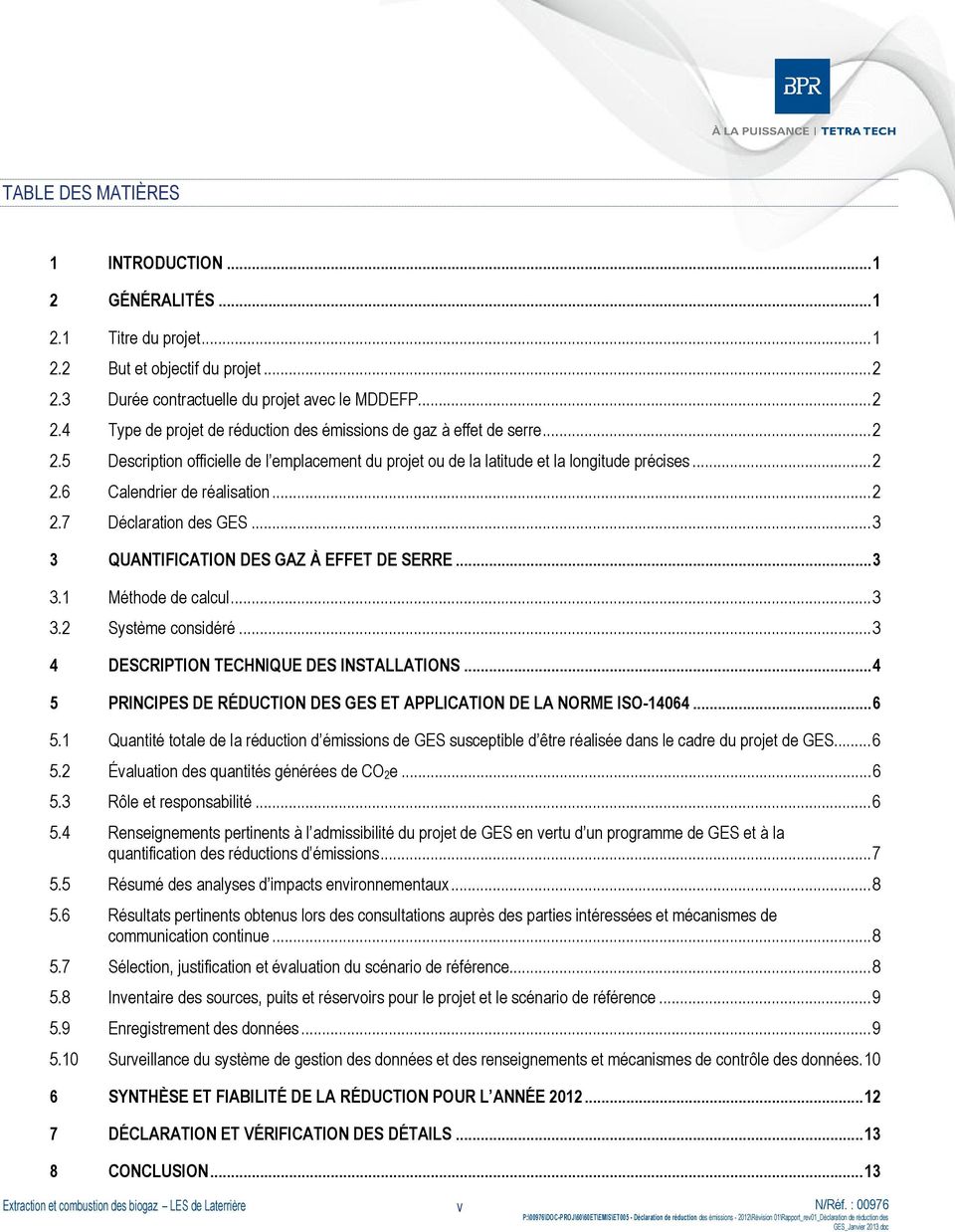
6 TABLE DES MATIÈRES 1 INTRODUCTION GÉNÉRALITÉS Titre du projet But et objectif du projet Durée contractuelle du projet avec le MDDEFP Type de projet de réduction des émissions de gaz à effet de serre Description officielle de l emplacement du projet ou de la latitude et la longitude précises Calendrier de réalisation Déclaration des GES QUANTIFICATION DES GAZ À EFFET DE SERRE Méthode de calcul Système considéré DESCRIPTION TECHNIQUE DES INSTALLATIONS PRINCIPES DE RÉDUCTION DES GES ET APPLICATION DE LA NORME ISO Quantité totale de la réduction d émissions de GES susceptible d être réalisée dans le cadre du projet de GES Évaluation des quantités générées de CO 2e Rôle et responsabilité Renseignements pertinents à l admissibilité du projet de GES en vertu d un programme de GES et à la quantification des réductions d émissions Résumé des analyses d impacts environnementaux Résultats pertinents obtenus lors des consultations auprès des parties intéressées et mécanismes de communication continue Sélection, justification et évaluation du scénario de référence Inventaire des sources, puits et réservoirs pour le projet et le scénario de référence Enregistrement des données Surveillance du système de gestion des données et des renseignements et mécanismes de contrôle des données.10 6 SYNTHÈSE ET FIABILITÉ DE LA RÉDUCTION POUR L ANNÉE DÉCLARATION ET VÉRIFICATION DES DÉTAILS CONCLUSION...13 Extraction et combustion des biogaz LES de Laterrière v N/Réf. : P:\00976\DOC-PROJ\60\60ET\EMIS\ET005 - Déclaration de réduction des émissions \Révision 01\Rapport_rev01_Déclaration de réduction des GES_Janvier 2013.doc
7 Liste des annexes Annexe A : Annexe B : Annexe C : Annexe D : Plan du réseau (sommaire) Plan de maintenance Écran de contrôle Fiches techniques Liste des figures Figure 1.1 : Figure 3.1 : Localisation du lieu d enfouissement sanitaire Définition du système considéré Liste des tableaux Tableau 2.1 : Calendrier de réalisation du projet Tableau 5.1 : Rôle et responsabilité Tableau 5.2 : Scénario de référence vs destruction du biogaz Tableau 5.3 : SPR du scénario de référence Tableau 5.4 : SPR du projet Tableau 5.5 : Exemple de données mensuelles Tableau 5.6 : Plan de surveillance Tableau 6.1 : Estimation des émissions du niveau de référence et calcul des réductions des émissions de GES Extraction et combustion des biogaz LES de Laterrière vi N/Réf. : P:\00976\DOC-PROJ\60\60ET\EMIS\ET005 - Déclaration de réduction des émissions \Révision 01\Rapport_rev01_Déclaration de réduction des GES_Janvier 2013.doc

8 1 INTRODUCTION Dans le cadre du programme «Biogaz » du ministère du Développement durable, de l Environnement, de la Faune et des Parcs (MDDEFP), Promotion Saguenay a signé une entente avec ce dernier visant à implanter un projet de réduction de gaz à effet de serre (GES). Ce projet est situé dans la ville de Saguenay, sur un ancien lieu d enfouissement sanitaire (LES) dans le secteur Laterrière. Ce site appartient maintenant à la Ville de Saguenay. Figure 1.1 Localisation du Lieu d enfouissement sanitaire En accord avec le propriétaire du site, Ville de Saguenay et Promotion Saguenay captent les biogaz formés suite à la biodégradation anaérobique des matières résiduelles enfouies. Des puits de captage ont été installés sur le site d enfouissement. Les biogaz, formés principalement de méthane (CH 4) et de dioxydes de carbone (CO 2) sont collectés dans un réseau de conduites souterraines et aspirés vers une torchère. La concentration du méthane, le débit du biogaz et la température de combustion sont parmi les valeurs qui sont mesurées et enregistrées en continu. Ceci permet donc d avoir un suivi adéquat pour subséquemment valider les quantités détruites en tout temps et la qualité de la combustion. Le présent rapport se veut une présentation des données pour la réduction des GES de l année 2012 selon les exigences de la norme ISO GÉNÉRALITÉS 2.1 Titre du projet Extraction et combustion des biogaz LES de Laterrière. Extraction et combustion des biogaz LES de Laterrière 1 N/Réf. : P:\00976\DOC-PROJ\60\60ET\EMIS\ET005 - Déclaration de réduction des émissions \Révision 01\Rapport_rev01_Déclaration de réduction des GES_Janvier 2013.doc

9 2.2 But et objectif du projet Ce projet s inscrit dans le programme «Biogaz Cadre normatif du programme d achat de réduction des émissions de gaz à effet de serre provenant du captage et de l élimination ou de la valorisation des biogaz générés par certains lieux d enfouissement du Québec» préparé par le MDDEFP. 2.3 Durée contractuelle du projet avec le MDDEFP Le contrat avec le MDDEFP dans le cadre du Programme Biogaz se termine le 31 décembre 2013 et pouvait débuter à tout moment en 2009, après la signature de novembre Type de projet de réduction des émissions de gaz à effet de serre Il s agit d un projet de captage et de destruction des biogaz composés de méthane, un gaz identifié dans la liste des GES. Ce GES est considéré être 21 fois plus nocif que le dioxyde de carbone (CO 2) en termes de potentiel de réchauffement planétaire. 2.5 Description officielle de l emplacement du projet ou de la latitude et la longitude précises Les coordonnées de l entrée du site d enfouissement sont les suivantes : latitude : " N; longitude : " O. Le lieu d enfouissement sanitaire désaffecté est situé au 4501, rang St-Paul à Laterrière. Il est localisé sur les lots 1, 2A, 2B, rang 8 Sud-Ouest, chemin Sydenham et les lots 7 et 24, rang Est, rivière Chicoutimi du cadastre du canton de Laterrière de la ville de Saguenay, dans la région administrative du Saguenay-Lac-Saint-Jean. 2.6 Calendrier de réalisation Voici les principales étapes franchies pour mener à terme ce projet. Date Tableau 2.1 Calendrier de réalisation du projet Étape 7 novembre 2008 Signature du contrat par les autorités du MDDEP 18 juin 2009 Certificat de la Municipalité 29 juillet 2009 Envoi complet de la demande de certificat d autorisation aux autorités du MDDEP 28 août 2009 Réception du certificat d autorisation du MDDEP Septembre 2009 Novembre 2009 Décembre 2009 Décembre 2009 Depuis 2010 Forage des puits et aménagement du réseau de captage Réception de la torchère au site Montage et essai des équipements et premier démarrage Ajustements des équipements Fonctionnement normal du système avec entretien lorsque requis et préparation de rapports de déclaration des GES, suivant la fin d année Extraction et combustion des biogaz LES de Laterrière 2 N/Réf. : P:\00976\DOC-PROJ\60\60ET\EMIS\ET005 - Déclaration de réduction des émissions \Révision 01\Rapport_rev01_Déclaration de réduction des GES_Janvier 2013.doc

10 2.7 Déclaration des GES Pour être admissibles, les réductions déclarées dans ce rapport sont : A. Réelles Réductions résultantes de la mise en place et de l opération d un réseau de captage, de pompage et de destruction du biogaz sur le lieu d enfouissement. B. Mesurables Le débit de biogaz capté et brûlé ainsi que la concentration de méthane sont mesurés en continu à l aide d un débitmètre et d un analyseur de gaz raccordé à un enregistreur de données. Il en est de même pour la température de la combustion. C. Vérifiables/vérifiées Les réductions réelles obtenues sont vérifiées et vérifiables à l aide de règles claires et précises. 3 QUANTIFICATION DES GAZ À EFFET DE SERRE 3.1 Méthode de calcul Selon les lignes directrices du Groupe d experts intergouvernemental sur l évolution du climat (GIEC), aux fins de calcul de réduction des émissions, le CO 2 émis directement du LES ou émis à partir de la combustion du biogaz n est pas comptabilisé dans l émission ou dans le total des réductions d émissions. Les limites de projet et de niveau de référence ainsi que la méthodologie de quantification présentées dans les sections suivantes sont tirées de la méthodologie adoptée pour les Nations Unies. Nous établissons dans ce rapport, à la section 5, le calcul du niveau de référence et la détermination du quantum de réduction de l année en cours. Ce calcul est réalisé en respect avec le système décrit à la section suivante. 3.2 Système considéré Le système considéré pour le calcul des GES captés et détruits par ce projet est relié directement à la combustion du méthane dans la torchère (rectangle du centre à la figure 3.1). Ainsi, le système considéré pour ce projet est limité à la capture du biogaz et sa destruction. Les activités citées ci-après sont quant à elles génératrices de GES à l intérieur et à l extérieur des limites du projet et leur impact est évalué. La figure ci-dessous montre les activités qui sont exclues du système et celles qui en font partie. SYSTÈME CONSIDÉRÉ Fabrication des équipements Décomposition des matières dans le site Démantèlement des Main d'œuvre Captage et destruction du Biogaz équipements Construction Entretien des systèmes Figure 3.1 Définition du système considéré Extraction et combustion des biogaz LES de Laterrière 3 N/Réf. : P:\00976\DOC-PROJ\60\60ET\EMIS\ET005 - Déclaration de réduction des émissions \Révision 01\Rapport_rev01_Déclaration de réduction des GES_Janvier 2013.doc

11 3.2.1 Activités susceptibles de générer des GES hors projet Dans le cadre de l élaboration de ce projet, quelques activités ont été susceptibles de dégager des GES. Principalement, voici les éléments générateurs de GES : construction des installations de captage de biogaz; transport des équipements vers le lieu d enfouissement; déplacements du personnel pour la construction du lieu d enfouissement. Toutefois, aucune de ces activités n a eu lieu en 2012, donc l apport en GES est nul Activités susceptibles de générer des GES à l intérieur des limites du projet Intrinsèquement au projet, certaines activités sont susceptibles de dégager des GES. Il s agit principalement des deux items suivants : le propane utilisé en cas de démarrage; l électricité du moteur de 7,5 kw installé dans le projet. En ce qui a trait au premier point, le fonctionnement de la torchère fait en sorte que le propane est très rarement utilisé et n est qu une solution d urgence. En effet, la torchère est généralement toujours en fonction et le démarrage est minimal. Le propane n est utilisé que pour l allumage du pilote de la torchère. La même bonbonne de propane de 100 litres est utilisée depuis le début de la mise en service du projet. L apport en GES venant de l usage du propane est donc considéré comme négligeable. Concernant le second item, comme l hydroélectricité génère une quantité négligeable de GES, nous n en tiendrons pas compte. De plus, il est à rappeler qu il est question d un moteur consommant uniquement 7,5 kw. Selon le site internet de Défi Climat ( consulté le 9 février 2012, le facteur d émission de GES de l hydroélectricité est de 0, kg/kwh. Donc, l apport en GES du moteur est considéré comme négligeable. 4 DESCRIPTION TECHNIQUE DES INSTALLATIONS Le site a été en opération de 1971 à 1995 (dernière année d enfouissement en 1995). Sa fermeture, incluant le recouvrement final, a été effectuée conformément au Règlement sur les déchets solides (RDS) en La technologie utilisée pour ce projet de destruction des biogaz consiste en un système de captage et de destruction des biogaz des cellules d enfouissement fermées à l aide d une torchère à flamme invisible. Le système d extraction consiste en un réseau de puits de captage verticaux reliés à des conduites collectrices. Plus spécifiquement, le système d extraction consiste en un réseau de 66 puits de captage verticaux de diamètres variant entre 200 mm et 400 mm. Ces puits sont forés dans les déchets jusqu à 75 % à 100 % de la profondeur estimée des déchets. Le réseau se termine à la plateforme de combustion. Celle-ci est composée, dans l ordre, des composantes principales suivantes : vanne d entrée principale; séparateur de gouttelettes; analyseur de gaz en continu; groupe moteur/surpresseur pour la dépression du champ gazier; débitmètre instantané; vanne antiretour des flammes; groupe allumeur, torchère et thermocouple pour température de combustion dans la torchère. Extraction et combustion des biogaz LES de Laterrière 4 N/Réf. : P:\00976\DOC-PROJ\60\60ET\EMIS\ET005 - Déclaration de réduction des émissions \Révision 01\Rapport_rev01_Déclaration de réduction des GES_Janvier 2013.doc

12 L ensemble de la plateforme de combustion comprend également les éléments suivants : entrée électrique principale; enregistreur de données (graphiques de la température de combustion, concentration de méthane, CO 2, O 2 et débit instantané). L analyseur de gaz en continu échantillonne le biogaz avant son entrée à la torchère. Les données sont envoyées à un enregistreur de données automatiques de type «Memograph». Les données sur les concentrations de CH 4, CO 2 et O 2 sont reproduites sur écran en tout temps. Des transmetteurs de débit et de température sont également placés avant la torchère. Ceux-ci permettent d enregistrer les données concernant le débit du gaz brûlé ainsi que sa température d entrée. La mesure de la température du gaz en continu à la sortie de la torchère assure que la combustion et la destruction se font adéquatement. L ensemble des données pertinentes inscrites sur l enregistreur de données est transféré en temps réel via le lien sans fil à un poste de surveillance localisé dans les locaux de Gazon Savard Saguenay inc., responsable de l exploitation et de la maintenance des installations. Ceci permet de suivre le fonctionnement de la torchère en continu et répondre rapidement si une intervention sur le terrain est requise. Les données sont également enregistrées sur disquette une fois par mois pour assurer des données continues en cas de bris du lien sans fil. Le plan de l annexe A présente sommairement les installations. Les photos suivantes révèlent quant à elles quelques composantes discutées préalablement. Photo n o 1 : Tête de puits préfabriquée Photo n o 2 : Vue d ensemble de la torchère Photo n 3 : Enregistreur de données Photo n 4 : Analyseur de gaz en continu Extraction et combustion des biogaz LES de Laterrière 5 N/Réf. : P:\00976\DOC-PROJ\60\60ET\EMIS\ET005 - Déclaration de réduction des émissions \Révision 01\Rapport_rev01_Déclaration de réduction des GES_Janvier 2013.doc

13 5 PRINCIPES DE RÉDUCTION DES GES ET APPLICATION DE LA NORME ISO Quantité totale de la réduction d émissions de GES susceptible d être réalisée dans le cadre du projet de GES Le méthane brûlé est transformé en CO 2 selon l équation suivante (combustion complète) : CH 4 + 2O 2 => CO 2 + 2H 2O Puisque le méthane est un GES considéré 21 fois plus nocif que le CO 2 une (1) tonne de méthane équivaut à 21 tonnes d équivalents CO 2. pour le potentiel de réchauffement planétaire, Pour l année 2012, le projet en question a permis de réduire de tonnes équivalentes de CO Évaluation des quantités générées de CO 2e Le site continuera de produire du méthane pendant plusieurs années. Les quantités générées ont été évaluées à l aide du logiciel LandGem de l United States Environmental Protection Agency (USEPA). Le détail de calcul a été approuvé par ABGG, validateur externe, et fourni lors de la soumission au MDDEFP. Cette évaluation a été faite en mai 2008 avec les paramètres de production gazière L 0 et k de l inventaire national d Environnement Canada. Les quantités réduites dans le cadre du projet sont comparées à celles estimées par simulation. L étude de comparaison est présentée au MDDEFP. 5.3 Rôle et responsabilité Le tableau 5.1 permet d énumérer les différents intervenants au projet selon leur rôle et leur responsabilité. Tableau 5.1 Rôle et responsabilité Rôle et responsabilité Nom Coordonnée Promoteur du projet Promotion Saguenay Représentant : Claude Bouchard Tél. : , rue Racine Est Chicoutimi (Québec) G7H 1S7 Exploitant du site Gazon Savard Saguenay inc. Représentante : Marcelle Tremblay Tél. : , rang Saint-Paul Chicoutimi (Québec) G7H 5B3 Personne ressource autorisée Éric Gauthier Tél. : , rue Racine Est Chicoutimi (Québec) G7H 1S7 Tél. : Personne autorisée à signer au nom Éric Gauthier 295, rue Racine Est de l organisation Chicoutimi (Québec) G7H 1S7 Personne chargée de rédiger le Maxime Bergeron Tel : , poste 225 rapport sur les GES Personne chargée de fournir les services de quantification Personne chargée d examiner le rapport sur les GES Personne chargée de gérer le contenu du rapport sur les GES Acquéreur Maxime Bergeron Consultants Enviroconseil inc. Jamil Jimmy Dib Gouvernement du Québec Courriel : [email protected] Tel : , poste 225 Courriel : [email protected] 5214, boul. Wilfrid-Hamel, bureau 200 Québec (Québec) G2E 2G9 Tel : Tel : Courriel : [email protected] Représentante : Guylaine Bouchard Courriel : [email protected] Extraction et combustion des biogaz LES de Laterrière 6 N/Réf. : P:\00976\DOC-PROJ\60\60ET\EMIS\ET005 - Déclaration de réduction des émissions \Révision 01\Rapport_rev01_Déclaration de réduction des GES_Janvier 2013.doc

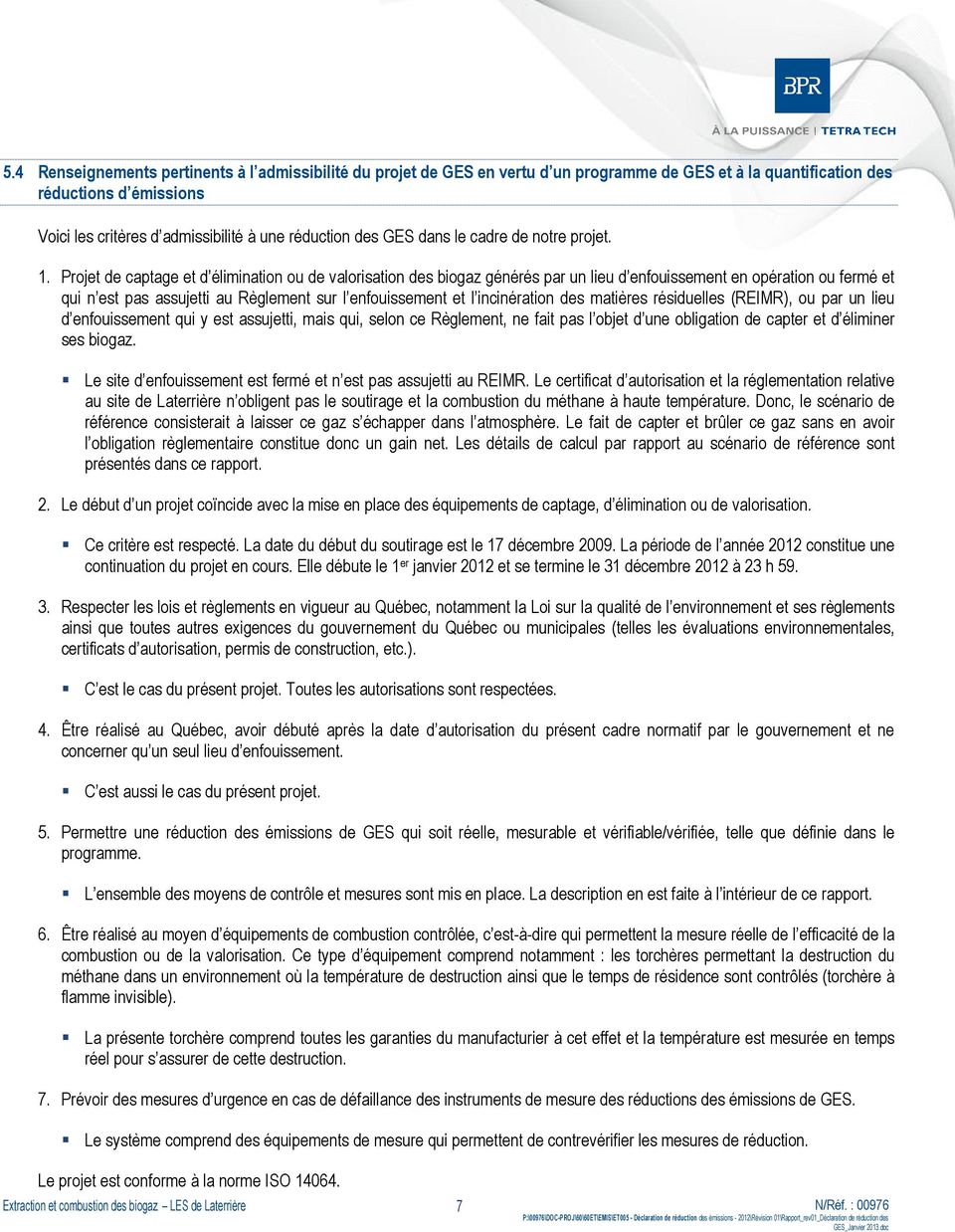
14 5.4 Renseignements pertinents à l admissibilité du projet de GES en vertu d un programme de GES et à la quantification des réductions d émissions Voici les critères d admissibilité à une réduction des GES dans le cadre de notre projet. 1. Projet de captage et d élimination ou de valorisation des biogaz générés par un lieu d enfouissement en opération ou fermé et qui n est pas assujetti au Règlement sur l enfouissement et l incinération des matières résiduelles (REIMR), ou par un lieu d enfouissement qui y est assujetti, mais qui, selon ce Règlement, ne fait pas l objet d une obligation de capter et d éliminer ses biogaz. Le site d enfouissement est fermé et n est pas assujetti au REIMR. Le certificat d autorisation et la réglementation relative au site de Laterrière n obligent pas le soutirage et la combustion du méthane à haute température. Donc, le scénario de référence consisterait à laisser ce gaz s échapper dans l atmosphère. Le fait de capter et brûler ce gaz sans en avoir l obligation règlementaire constitue donc un gain net. Les détails de calcul par rapport au scénario de référence sont présentés dans ce rapport. 2. Le début d un projet coïncide avec la mise en place des équipements de captage, d élimination ou de valorisation. Ce critère est respecté. La date du début du soutirage est le 17 décembre La période de l année 2012 constitue une continuation du projet en cours. Elle débute le 1 er janvier 2012 et se termine le 31 décembre 2012 à 23 h Respecter les lois et règlements en vigueur au Québec, notamment la Loi sur la qualité de l environnement et ses règlements ainsi que toutes autres exigences du gouvernement du Québec ou municipales (telles les évaluations environnementales, certificats d autorisation, permis de construction, etc.). C est le cas du présent projet. Toutes les autorisations sont respectées. 4. Être réalisé au Québec, avoir débuté après la date d autorisation du présent cadre normatif par le gouvernement et ne concerner qu un seul lieu d enfouissement. C est aussi le cas du présent projet. 5. Permettre une réduction des émissions de GES qui soit réelle, mesurable et vérifiable/vérifiée, telle que définie dans le programme. L ensemble des moyens de contrôle et mesures sont mis en place. La description en est faite à l intérieur de ce rapport. 6. Être réalisé au moyen d équipements de combustion contrôlée, c est-à-dire qui permettent la mesure réelle de l efficacité de la combustion ou de la valorisation. Ce type d équipement comprend notamment : les torchères permettant la destruction du méthane dans un environnement où la température de destruction ainsi que le temps de résidence sont contrôlés (torchère à flamme invisible). La présente torchère comprend toutes les garanties du manufacturier à cet effet et la température est mesurée en temps réel pour s assurer de cette destruction. 7. Prévoir des mesures d urgence en cas de défaillance des instruments de mesure des réductions des émissions de GES. Le système comprend des équipements de mesure qui permettent de contrevérifier les mesures de réduction. Le projet est conforme à la norme ISO Extraction et combustion des biogaz LES de Laterrière 7 N/Réf. : P:\00976\DOC-PROJ\60\60ET\EMIS\ET005 - Déclaration de réduction des émissions \Révision 01\Rapport_rev01_Déclaration de réduction des GES_Janvier 2013.doc
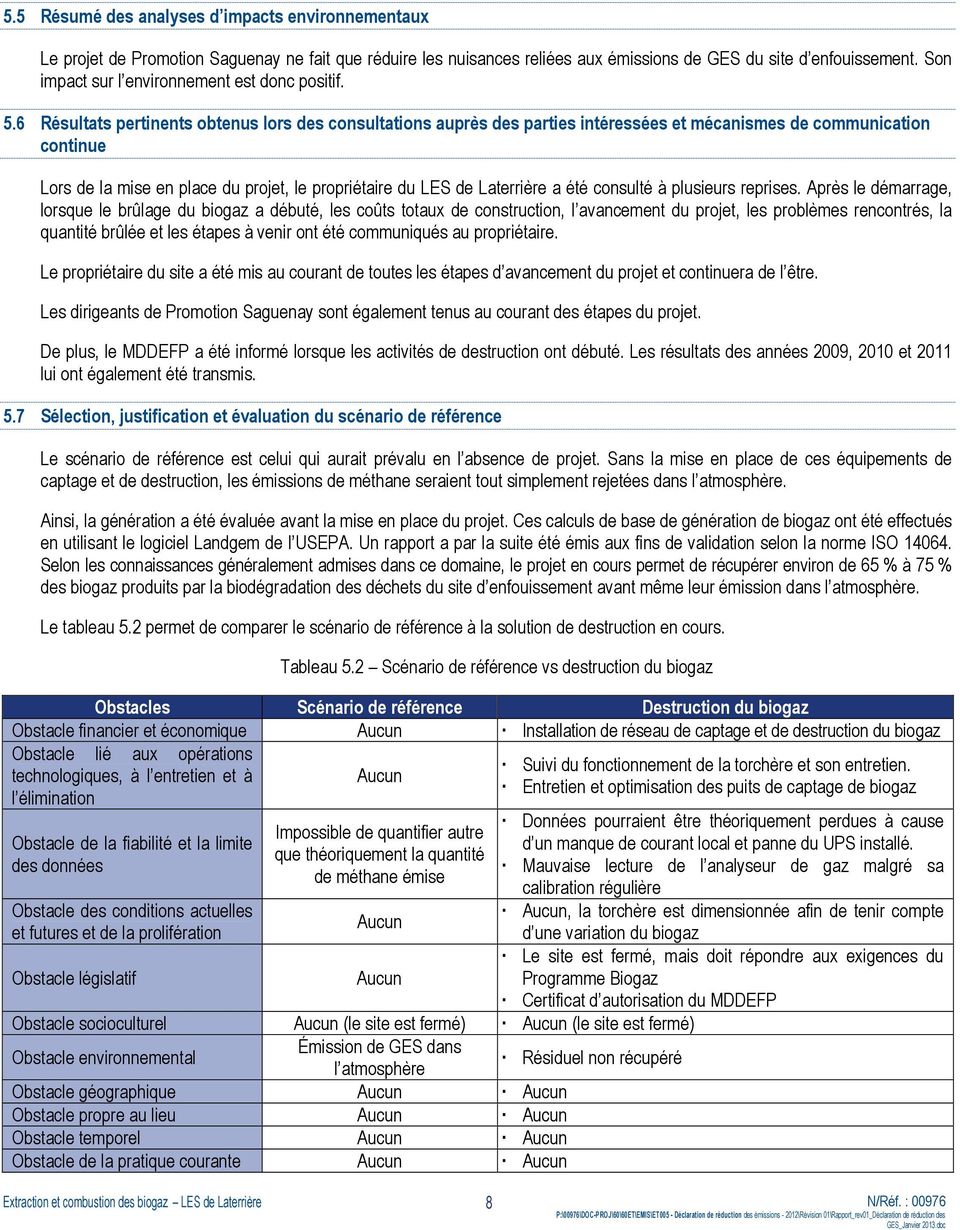
15 5.5 Résumé des analyses d impacts environnementaux Le projet de Promotion Saguenay ne fait que réduire les nuisances reliées aux émissions de GES du site d enfouissement. Son impact sur l environnement est donc positif. 5.6 Résultats pertinents obtenus lors des consultations auprès des parties intéressées et mécanismes de communication continue Lors de la mise en place du projet, le propriétaire du LES de Laterrière a été consulté à plusieurs reprises. Après le démarrage, lorsque le brûlage du biogaz a débuté, les coûts totaux de construction, l avancement du projet, les problèmes rencontrés, la quantité brûlée et les étapes à venir ont été communiqués au propriétaire. Le propriétaire du site a été mis au courant de toutes les étapes d avancement du projet et continuera de l être. Les dirigeants de Promotion Saguenay sont également tenus au courant des étapes du projet. De plus, le MDDEFP a été informé lorsque les activités de destruction ont débuté. Les résultats des années 2009, 2010 et 2011 lui ont également été transmis. 5.7 Sélection, justification et évaluation du scénario de référence Le scénario de référence est celui qui aurait prévalu en l absence de projet. Sans la mise en place de ces équipements de captage et de destruction, les émissions de méthane seraient tout simplement rejetées dans l atmosphère. Ainsi, la génération a été évaluée avant la mise en place du projet. Ces calculs de base de génération de biogaz ont été effectués en utilisant le logiciel Landgem de l USEPA. Un rapport a par la suite été émis aux fins de validation selon la norme ISO Selon les connaissances généralement admises dans ce domaine, le projet en cours permet de récupérer environ de 65 % à 75 % des biogaz produits par la biodégradation des déchets du site d enfouissement avant même leur émission dans l atmosphère. Le tableau 5.2 permet de comparer le scénario de référence à la solution de destruction en cours. Tableau 5.2 Scénario de référence vs destruction du biogaz Obstacles Scénario de référence Destruction du biogaz Obstacle financier et économique Aucun Installation de réseau de captage et de destruction du biogaz Obstacle lié aux opérations technologiques, à l entretien et à l élimination Obstacle de la fiabilité et la limite des données Obstacle des conditions actuelles et futures et de la prolifération Obstacle législatif Aucun Impossible de quantifier autre que théoriquement la quantité de méthane émise Aucun Aucun Obstacle socioculturel Aucun (le site est fermé) Aucun (le site est fermé) Obstacle environnemental Émission de GES dans l atmosphère Résiduel non récupéré Obstacle géographique Aucun Aucun Obstacle propre au lieu Aucun Aucun Obstacle temporel Aucun Aucun Obstacle de la pratique courante Aucun Aucun Suivi du fonctionnement de la torchère et son entretien. Entretien et optimisation des puits de captage de biogaz Données pourraient être théoriquement perdues à cause d un manque de courant local et panne du UPS installé. Mauvaise lecture de l analyseur de gaz malgré sa calibration régulière Aucun, la torchère est dimensionnée afin de tenir compte d une variation du biogaz Le site est fermé, mais doit répondre aux exigences du Programme Biogaz Certificat d autorisation du MDDEFP Extraction et combustion des biogaz LES de Laterrière 8 N/Réf. : P:\00976\DOC-PROJ\60\60ET\EMIS\ET005 - Déclaration de réduction des émissions \Révision 01\Rapport_rev01_Déclaration de réduction des GES_Janvier 2013.doc
16 5.8 Inventaire des sources, puits et réservoirs pour le projet et le scénario de référence Pour le scénario de référence présenté précédemment, le tableau 5.3 résume les sources, puits et réservoirs (SPR) selon les définitions des articles 2.2 à 2.4 de la norme ISO :2006. Tableau 5.3 SPR du scénario de référence Source Puits Réservoir Site d enfouissement Aucun Aucun Pour le projet en cours, le tableau 5.4 résume les SPR selon les définitions des articles 2.2 à 2.4 de la norme ISO :2006. Tableau 5.4 SPR du projet Source Puits Réservoir Système de captage et de destruction Aucun Aucun La vitesse du surpresseur et la présence de vannes permettent de contrôler la quantité soutirée de biogaz du site d enfouissement (source). L optimisation des puits de captage permet de contrôler la quantité de méthane à soutirer. Il est vrai que la production du méthane dépend des activités des micro-organismes présents dans le site, mais l optimisation des puits permet d équilibrer la succion par rapport à la production du méthane. 5.9 Enregistrement des données La méthode qui consiste à enregistrer les réductions de GES est basée sur l enregistreur de données en place qui enregistre en temps réel et continu le débit de biogaz qui est détruit à la torchère. Ce volume, ainsi que la concentration de méthane, laquelle est aussi mesurée en continu, permet d arriver à la quantité totale de méthane détruit. En tenant compte de la masse volumique du méthane et du facteur de 21 (potentiel de réchauffement climatique), nous calculons la quantité de tonnes de CO 2e captées et détruites par le système. Les données de débit sont exprimées en Nm 3 /heure. La transformation des données de m 3 en Nm 3 se fait automatiquement par le système de contrôle en fonction des conditions qui prévalent. Ainsi, la base de données et la programmation qui les intègre calculent un volume de méthane en temps réel. Nous contrevérifions ensuite nos données avec les moyennes journalières de débit, car il n'y a pas de grande variation quotidienne. Nous en tirons un débit journalier moyen et une concentration moyenne qui nous permettent de contrevérifier quotidiennement les données de captage et destruction. Extraction et combustion des biogaz LES de Laterrière 9 N/Réf. : P:\00976\DOC-PROJ\60\60ET\EMIS\ET005 - Déclaration de réduction des émissions \Révision 01\Rapport_rev01_Déclaration de réduction des GES_Janvier 2013.doc

17 Voici, sous forme de tableau, un exemple de calcul de ces données pour un mois donné. Jour Moyenne de concentration de CH 4 (%) Tableau 5.5 Exemple de données mensuelles Moyenne de débit de biogaz soutiré (Nm 3 /h) Volume journalier de CH 4 soutiré (Nm 3 ) Tonne d'équivalents CO 2 (tonne) 1 49,81 283, ,94 50, ,42 401, ,29 70, ,43 320, ,05 55, ,20 409, ,63 74, ,58 428, ,69 76,64 Total , ,11 La première colonne donne le jour du mois. La deuxième indique la concentration moyenne de CH 4 enregistrée pour le jour indiqué lorsque la torchère était en fonction. La troisième colonne montre le débit normalisé moyen du biogaz enregistré, tenant compte du pourcentage de fonctionnement de la torchère pour cette journée. La quatrième colonne calcule le volume de CH 4 brûlé selon la concentration moyenne et le débit moyen mesurés. Donc, pour le jour 1, 3 391,94 m³ de méthane ont été brûlés (283,74 x 49,81 % x 24). La masse de CH 4 soutirée par jour est le résultat de l équation suivante : volume journalier de CH 4 / (masse volumique du méthane). La masse d équivalent CO 2 est calculée à la dernière colonne. Pour le jour 1, 50,99 tonnes d équivalent CO 2 ont été réduites : [(3 391,94 m 3 CH 4) x (masse volumique du méthane)] x (21 tonnes CO 2/tonne CH 4). La masse volumique du méthane sous des conditions normalisées est de 0,716 kg/m³. Ceci peut être prouvé par la formule des gaz parfaits : PV = mrt Où : P : pression du gaz (kpa) V : volume du gaz (m³) m : masse du gaz (kg) R : constante du gaz (pour le méthane : 0,51835 kj/kg.k) T : température du gaz (K) De plus, nous savons que la masse volumique équivaut à la masse par le volume, donc l équation précédente peut être formulée comme suit : ρ = P / RT Sous des conditions normales, la masse volumique est donc de 0,716 kg/m³ [101,325 / (0,51835*273,15)] Surveillance du système de gestion des données et des renseignements et mécanismes de contrôle des données Toutes les données sont inscrites localement sur l enregistreur de données. Toutes les données enregistrées sont par la suite transférées en temps réel, via un réseau sans fil, à un poste de surveillance installé dans les locaux de Gazon Savard à Saguenay (ordinateur Gazon Savard). Ceci permet de suivre l évolution du fonctionnement de la torchère en tout temps et en cas de besoin, une intervention peut être faite plus rapidement. Extraction et combustion des biogaz LES de Laterrière 10 N/Réf. : P:\00976\DOC-PROJ\60\60ET\EMIS\ET005 - Déclaration de réduction des émissions \Révision 01\Rapport_rev01_Déclaration de réduction des GES_Janvier 2013.doc

18 Pour assurer l intégrité des données enregistrées sur l ordinateur de Gazon Savard, ce dernier a été sélectionné avec un double disque dur miroir d une capacité de 150 gigaoctets. De plus, il est muni d un UPS lui assurant un fonctionnement en cas de panne de courant, ainsi que d une protection contre les surintensités et les perturbations de réseaux électriques. Côté logiciel, une base de données SQL Server permet d enregistrer les valeurs de procédé aux deux (2) minutes. Une copie de sécurité de la base de données enregistrée sur la disquette est créée et archivée mensuellement sur les serveurs de BPR. La disquette initiale peut donc être réutilisée pour l enregistrement de nouvelles données. Un plan de maintenance (annexe C) a été élaboré selon les spécifications du fabricant permettant de garder le fonctionnement du système de la torchère à son meilleur. Les appareils sont donc entretenus selon la période suggérée par le fabricant. De plus, une fois par mois, les puits de captage des biogaz sont calibrés afin d optimiser la quantité de CH 4 à brûler. Afin de vérifier l intégrité des calculs, certaines journées sont choisies au hasard et recalculées manuellement. Une image de la vue de l écran de contrôle est jointe à l annexe D. La température de combustion est mesurée et surveillée en continu afin de s assurer que la température de combustion soit celle requise pour la destruction des composés organiques volatils (COV), soit plus élevée que 760 C, et ce, tel que suggéré par le REIMR. Quant au plan de surveillance, il se résume comme suit : SPR Tableau 5.6 Plan de surveillance Extraction et combustion des biogaz Paramètre des données Débit de biogaz brûlé Concentration de méthane Modélisation de l estimation, méthodes de mesure ou de calcul Température de combustion Surveillé Surveillée Surveillée Consignation des données Forme électronique Forme électronique Forme électronique Unité de donnée Nm 3 /h % C Sources/Origine Fréquence de la surveillance et mesure Description et justification de la méthode de surveillance Mesure directe avec équipement sur place (débit normalisé) Mesure directe avec équipement sur place Mesure directe avec équipement sur place Continue Continue Continue La méthode de mesure de ce paramètre est la plus précise, en prenant pour fait que l appareil de mesure est approprié. Nous faisons aussi fréquemment des vérifications avec un appareil portable. La méthode de mesure de ce paramètre est la plus précise, en prenant pour fait que l appareil est approprié et que la calibration est effectuée comme prescrit par le fabricant. Nous faisons aussi fréquemment des vérifications avec un appareil portable. La méthode de mesure de ce paramètre est la plus précise, en prenant pour fait que l entretien de l appareil de mesure est approprié. Extraction et combustion des biogaz LES de Laterrière 11 N/Réf. : P:\00976\DOC-PROJ\60\60ET\EMIS\ET005 - Déclaration de réduction des émissions \Révision 01\Rapport_rev01_Déclaration de réduction des GES_Janvier 2013.doc

19 Incertitude Détails sur toute déviation de la méthodologie, y compris la justification et le fondement L enregistreur de débits permet de confirmer les données et de réduire les incertitudes. Il demeure uniquement l incertitude intrinsèque à l instrument. La calibration permet d éliminer presque en totalité les incertitudes. La précision de lecture du thermomètre permet d être à l intérieur d une marge confortable par rapport à l exigence Sans objet Sans objet Sans objet Il est important de souligner que Gazon Savard Saguenay inc. s est muni d un analyseur portatif, le GEM 2000, qui permet de contrevérifier, lors de chacune des visites sur place, les données de l analyseur de gaz. De plus, une fois par mois, les puits de captage des biogaz sont échantillonnés afin d optimiser la quantité de CH 4 à brûler. L ouverture des vannes à chaque puits de captage est manuellement modulée selon les besoins. 6 SYNTHÈSE ET FIABILITÉ DE LA RÉDUCTION POUR L ANNÉE 2012 En 2012, une quantité totale de biogaz de tonnes d équivalents CO 2 a été comptabilisée en date du 31 décembre 2012 à 23 h 59. Afin de vérifier l intégrité des calculs effectués automatiquement, certaines journées sont choisies au hasard et recalculées manuellement par une personne responsable. De plus, lors des visites du technicien au chantier, celui-ci confirme la lecture locale avec les données transmises au bureau. En plus, nous prenons des données ponctuelles lors de nos visites sur place pour nous assurer de l intégrité et l exactitude des données entre celles locales et celles transmises à distance. Ainsi, la qualité de la communication et du transfert de données est constamment vérifiée. Enfin, nous nous assurons que la température de combustion est toujours au-dessus de 760 C. Elle est en général entre 850 C et 900 C. Il est à noter qu au-delà des 760 ºC, il est assuré que les COV sont détruits et la capacité de destruction de la torchère est presque de 100 %. Une revue systématique des données est réalisée. Dans la mesure où des doutes sur une lecture précise sont présents, la donnée est éliminée. Dans ce cas, une moyenne des valeurs amont et aval remplace la donnée éliminée. L incertitude du débitmètre est de moins de 2 %. L incertitude de l analyseur de biogaz est de moins de 1,5 %. L analyseur de gaz est calibré lors de visites sur le terrain. Les fiches techniques du débitmètre et de l analyseur sont jointes à l annexe E. Voyons maintenant en synthèse les données de 2012 du captage et destruction du méthane par rapport au scénario de référence et la donnée finale pour Tableau 6.1 Estimation des émissions du niveau de référence et calcul des réductions des émissions de GES Émissions du niveau de référence Émissions du projet Réduction des Émissions Émissions émissions Année Méthane Méthane Méthane Méthane émis GES à Méthane émis GES à généré généré capté et de GES à l atmosphère l atmosphère à l atmosphère l atmosphère (Nm³ (Nm³ détruit (tonnes (Nm³ CH CH 4/an) (tonnes (1)(2) (Nm³ CH 4/an) CH CO 2e/an) CO 4/an) (Nm³/an) 4/an) (tonnes 2e/an) CO 2e/an) Total (Hypothèse 1) : Efficacité de captage de 75 % (Hypothèse 2) : Sur l ensemble de l année, il est assumé que les équipements sont disponibles à 90 % du temps Extraction et combustion des biogaz LES de Laterrière 12 N/Réf. : P:\00976\DOC-PROJ\60\60ET\EMIS\ET005 - Déclaration de réduction des émissions \Révision 01\Rapport_rev01_Déclaration de réduction des GES_Janvier 2013.doc

20 7 DÉCLARATION ET VÉRIFICATION DES DÉTAILS Le présent rapport est réalisé en suivant les étapes requises et les exigences de la norme ISO et du Registre des GES ÉcoProjetsMD. Plus spécifiquement, il est élaboré en suivant le gabarit fourni par l'association canadienne de normalisation. La firme externe Consultants Enviroconseil a été retenue afin de mener à bien la vérification du projet selon la méthodologie de la norme ISO CONCLUSION Le projet de réduction des émissions à effet de serre consiste à extraire et à détruire le méthane présent dans le biogaz du lieu d enfouissement sanitaire de Laterrière appartenant à Ville de Saguenay. Le projet s inscrit dans le cadre du Programme Biogaz du MDDEFP. Les travaux d installation des systèmes de destruction des GES se sont effectués durant l année 2009, l exploitation régulière des systèmes continue depuis. Avant la mise en place du projet, les biogaz étaient tout simplement rejetés à l atmosphère. La mise en place du projet a permis de réduire les GES de tonnes d équivalents CO 2 pour l année 2012 entre le 1 er janvier et le 31 décembre Extraction et combustion des biogaz LES de Laterrière 13 N/Réf. : P:\00976\DOC-PROJ\60\60ET\EMIS\ET005 - Déclaration de réduction des émissions \Révision 01\Rapport_rev01_Déclaration de réduction des GES_Janvier 2013.doc
21 Annexe A Plan du réseau (sommaire)
22
23 Annexe B Plan de maintenance

24 Plan de maintenance rév. 00 Fréquence Activité de maintenance 1.0 Trappe de condensat de la torchère 1.1 S'assurer que la trappe est vide en regardant l'indicateur de niveau X 1.2 Control visuel du fonctionnement de la trappe, s'assurer qu'il n'y a pas d'aspiration d'air par le drain X 1.3 S'assurer que la fosse de rétention où se jette le liquide de condensat de la trappe n'est pas pleine X 2.0 Système de collecte de biogaz 2.1 Vérifier le réseau des conduites et les têtes de puits pour :. Points bas et poche d'eau X. Bris, dommage X. Tension excessive X 2.2 Vérifier le fonctionnement des trappes X 2.3 Vérifier le fonctionnement des vannes, dispositif d'insertion de l'anémomètre X 2.4 Aux puits, mesurer le débit, la pression, la concentration du CH4, la température et enregistrer les données X 2.5 Ajuster le système au besoin X 3.0 Surpresseur 3.1 Vérifier tout bruit anormal provenant du moteur (roulements) X 3.2 Vérifier la tension et l'état de la courroie (belt) X 3.3 Moteur New-York Blower - voir manuel X X X X 4.0 Torchère 4.1 Vérification générale de fonctionnement X 4.2 Ajustement des électrodes X 4.3 Remplacement des électrodes- Attention Haut Voltage, éteindre l'électricité X 4.4 Nettoyage du UV eye X 4.5 Remplacement des ampoules UV X 4.6 Nettoyage du flame arrester X 4.7 Vérifier et nettoyer la vanne du moteur X 4.8 Vérifier l'état du gaz sortant X 4.9 Vérifier les thermocouples et au besoin, remplacer (au moins tous les 3 ans) X 4.10 Vérifier l'état de l'isolation de la torchère (isolant - céramique) X 4.11 Vérifier la bonbonne de propane et remplir au besoin X 5.0 Contrôle 5.1 Monitoring du fonctionnement X 5.2 Sauvegarder le rapport de fautes X 5.3 Vérifier localement les données sur le panneau Yokogawa X 5.5 Faire un backup de la base de données distantes X 5.6 Émettre et vérifier rapport mensuel X 6.0 Général 6.1 Vérifier s'il y a des pertes de gaz (odeur) ou d'eau X 6.2 S'assurer que les lieux sont propres et en bon état X 6.3 Vérifier s'il y a un bris quelconque X 6.4 Calibrer l'analyseur et remplacer les cellules au besoin (généralement au 5 ans) X 6.5 Vérifier l'état des filtres pour la ventilation des panneaux de contrôle X 6.6 Vérifier la tension de sortie sur les blocs d'alimentation 24 VCC et ajuster X 6.8 Déneiger autour de la torchère et accès au cabanon en tout temps X Hebdomadaire Mensuelle 6 mois Annuelle \\sy2s055\prj_reg\00976\doc-proj\60\60et\rapport annuel vérification 2010\Annexes\Page 1
25 Annexe C Écran de contrôle
26
27 Annexe D Fiches techniques
28 Thermal Instrument Company / 9500 Insertion Probe Page 1 of In-line Meters Signal Processors Insertion Probes Model 62-9 MODEL 62-9 / TECHNICAL DATA How it Works Technical Data Dimension Chart Sizing Guide ENGINEERING SPECIFICATIONS Accuracy: +/-.50% of Full Scale, [or 2.0% of reading whichever is better. Full Scale over the calibrated range. [Process fluid temperature span +/- 50 F] Repeatability: +/- 0.2 % of Rate Response Time: Gases: 1 to 2 sec. Typical Liquids: Less than 500ms Pressure Rating: psig (Std) psig Dependent on meter size Mass Flow Rates: Gas: 40 to 50,000 SFPM Liquid:.02 to 20 FPS Note: maximum determined by pipe capacity Flow Range: 100:1 Std. Multiple ranges available Calibrated Temperature Range: Gas: -20 F to 350 F (-28 C to 162 C )STD. [-20 F to 1000 F] (-28 C to 538 C) Optional) Liquid: -20F to 350F (-28 C to 162 C ) STD. [ -20 F to 500 F](-28 C to 2691 C) Optional Wetted Materials: 316SS (STD). Consult the factory for other material requirements Mounting: Flange, Packing Gland, Triclover, Hot Tap Calibration Temperature Capability: -20 F to 1000 F(-29 C to 538 C) MICROPROCESSOR SPECIFICATIONS: Mounting: Integral to the Flow Transducer Remote to 4000 ft., Wall or Frame mount Signal Cable for Remote Design: 18 gauge, 2 pair with cable shield. Maximum distance, 4000 ft. MODEL NUMBERING SYSTEM: Base Model: = 9500 Electronics Mounting: I = Integral Mount R = Remote Mount F = Fluid G = Gas L = Liquid Probe Size: % to 2 (See Sizing Tables for Gas and Liquid). Material: 316SS = STD Other = Consult Factory Process Connection: PG = Packing Gland (Std.) FLG-150 =150# RF Flange (Std.Van stone) TC = Triclover FLG-Other = Consult Factory Other = Consult Factory Power: 24 = VDC, 1 AMP. 4 WIRE 120 = 120VAC, 50/60 HZ (STD.) 240 = 240VAC 50/60 HZ Output Signals: (Select One**) 0/5 = 0-5 VDC** 0/10 = 0-10 VDC**
29 Thermal Instrument Company / 9500 Insertion Probe Page 2 of EEPROM Memory: 64K Displays: 8 digit Flowrate and Totalizer (Optional) Communicator: Interface: RS-232 via Ribbon Connector Baud Rate: 9600 Filter Factor Flow Full Scale Flow Rate Decimal Point Flow Totalizer Decimal Point Flow Totalizer Flowrate Ratio 4/20 = 4-20 madc** into 750 ohms, Isolated std, Self Powered 4/20T = Opt Process Fluid Temp. 4-20mA Self Powered Other = Consult Factory Display: (Optional) ND = No Display D = Flowrate Display, 8 Digit 8T = Totalizer D/8T = Flowrate and Total Display, 8 digit Signal Cable for Remote Design: SC25 = 25 FT Supplied with remote configuration Power: 120/240 vat, 50/60 Hz. 24VDC, 1 Amp (Factory Set) Electrical Connections:3/4 FNPT Power & Signal Enclosure: Cast Aluminum, Epoxy Painted Environmental Ratings: Housing: Explosion Proof, Class 1, Div. 1, Groups, B, C D Weatherproof: Nema 4 Ambient Temperature: -25 to 60 C (-13 to 140 F) Storage Temperature: -40 to 70 C ( -40 to 158F ) T H E R M A L I N S T R U M E N T C O M P A N Y S T E R N E R M I L L R O A D T R E V O S E, P A N A T I O N A L I N S T I T U T E O F S T A N D A R D S & T E C H N O L O G Y I S A D I R E C T O R Y O F I N S T R U M E N T A T I O N C E R T I F I E D C A L I B R A T I O N S
30 INSTRUCTION MANUAL FOR NOVA MODEL 903C-CW OXYGEN, CO 2 AND CH 4 ANALYZER
31 GAS ANALYZER CALIBRATION AND DATA SHEET MODEL: 903C-CW SERIAL NO: 8279 P.O. NO.: DATE SHIPPED: SEPT. 18/09 TAG NO.: CUSTOMER: ADDRESS: JOHN ZINK TULSA, OK. APPLICATION: LANDFILL GAS ANALYSIS RANGE(S): 1. READOUT % O 2 2. READOUT % CO 2 3. READOUT % CH 4 4. READOUT OUTPUT(S): RANGE ma ISOL FOR % O 2 RANGE ma ISOL FOR % CO 2 RANGE ma ISOL FOR % CH 4 RANGE 4 FOR ALARM(S):HIGH SETTING NONE CONTACTS LOW SETTING CONTACTS SPECIAL ALARM FEATURES: ALARM FOR GENERAL FAULT, IN CAL, CAL FAIL. FAIL SAFE ALARM CONTACTS. POWER: FLOW RATE: 115 VAC, 60HZ 1 LPM CALIBRATION: ON AMBIENT AIR FOR CO 2 AND CH 4 ZERO AND O 2 SPAN. ON ANALYZED GAS MIXTURE OF 60% CH 4 WITH A BALANCE OF CO 2 FOR CO 2 /CH 4 SPAN AND O 2 ZERO. SPECIAL FEATURES: 1925 PINE AVENUE, NIAGARA FALLS, NY USA TEL: FAX: [email protected] WEBSITE:
32 SPECIFICATIONS FOR NOVA MODEL 903C-CW OXYGEN, CO 2 AND CH 4 ANALYZER METHOD OF DETECTION: RANGES AVAILABLE: READOUT: Customer replaceable electrochemical oxygen sensor. Microprocessor based NDIR (infra red) detector for CO 2 and CH % O 2, % CO 2 and % CH 4 LCD Graphics Display RESOLUTION: 0.1% on O 2, CO 2 and CH 4 ACCURACY AND REPEATABILITY: DRIFT: RESPONSE TIME (T-90): + 1% of full scale Less than 2% of full scale per month Less than 30 seconds not including sample line delay AMBIENT TEMP. RANGE: F (4-48 C). Lower temperatures (-5 F, -20 C) with Cold Weather Package. LINEARITY: SIZE & WEIGHT: POWER: OUTPUT OPTIONS: SAMPLE FLOW RATE: SAMPLE PRESSURE: CONNECTIONS: ±1% of full scale for each gas measured Approx. 24" H x 24" W x 10" 90 lbs (61 x 61 x kg) 115 VAC, 60 HZ Isolated 4-20 ma 1 LPM Maximum 50 PSI All connections 1/4" FNPT Stainless Steel connectors
33 TABLE OF CONTENTS INTRODUCTION... 1 OPERATION... 1 Sampling System... 1 Oxygen Sensor... 2 CO 2 and CH 4 Detector... 3 COLD WEATHER PACKAGE... 3 INSTALLATION... 4 STARTUP... 5 SETUP USING HMI SCREEN MENUS... 5 Graph... 6 Alarm... 6 PM Setup... 6 Setup... 6 Autocal Time... 7 Calibration... 7 PASSWORD... 8 DAC 4-20 ma OUTPUT ADJUSTMENT... 8 ONE-STEP CALIBRATION... 9 MAINTENANCE AND TROUBLESHOOTING... 9 Flow... 9 Pressure Condensate Discharge CO 2 and CH 4 Detector O 2 Sensor Countdown Bypass FACTORY SERVICE SPARE PARTS LIST FOR MODEL 903C-CW, S/N SCREENMAPS DRAWINGS Flow Diagram External Layout Internal Layout... 27
34 Wiring Diagram O 2 Sensor Diagram HM5000 Infrared Detector Diagram NGC-01 Microprocessor PCB Layout APPENDIX... 32
35 - 1 - INTRODUCTION The Nova 903C-CW O 2, CO 2 and CH 4 Analyzer is designed to continuously monitor the oxygen, carbon dioxide and methane gas recovered from landfill or biogas recovery sites. This sample is to be taken from the gas main after the blower (positive pressure). The 903C-CW analyzer is microprocessor based with a touch screen Human-Machine Interface (HMI). Calibration is automatic and controlled by the HMl. Alarm contacts are provided as standard for general fault, in-cal and cal fail. The oxygen sensor is a disposable electrochemical type not affected by hydrocarbons, CO 2, CO, H 2 S, SO 2, NOx or H 2 in the process gas stream. It produces a linear mv output over the entire range of 0-25% O 2. CO 2 and CH 4 are detected by a small, microprocessor based infrared detector. Both detectors are located in a temperature controlled box, which prevents any instability due to ambient temperature fluctuations. Oxygen, CO 2 and CH 4 concentration readings are located on the HMI (Human Machine Interface) touch screen display and are visible through a clear Lexan window in the door of the cabinet. Recorder outputs of 4-20 ma or a specified voltage range are also provided. Gas alarm contacts are optional. See the Calibration and Data Sheet. The analyzer has the special feature of beginning a manually initiated auto calibration by passing a magnetic wand (included) over the CAL NOW bezel. This can be initiated with the front cabinet door remaining closed so that the air purge will not be disturbed. OPERATION The 903C-CW analyzer is microprocessor based with a touch screen HMI (Human- Machine Interface). Calibration is completed by the microprocessor while it switches in a known calibration gas using electric solenoid valves. Sampling System The sampling system begins with a pre-filter that is mounted on a 12" stand pipe where the sample gas leaves the process at a point after the blower. This stand pipe allows the condensing liquids to run back down into the gas before they are filtered. See Page 25. Sample gas flows from the pre-filter to the analyzer cabinet. Here the gas sample enters the sample pump where its pressure is boosted up to approximately 6 PSI. This pressurization of the gas will cause further condensation of any excess moisture in the sample which will then fall into the condensate trap. At least 6 PSIG of pressure is required at all times to sufficiently compress the gas to remove moisture. A pressure 903C-CW-8279.doc, Rev. 9/18/2009
36 - 2 - gauge is present to confirm system pressure. A float switch inside the trap will eventually rise and cause the drain solenoid valve to open, discharging the condensate down to a lower level without allowing gas to escape. As the pressurized sample gas leaves the trap, it flows through the pressure regulator where it is allowed to expand to near atmospheric pressure. This action causes the gas to dry even further and is now ready for analysis. As a precaution against water intrusion into the analyzer, a secondary in-line filter and PTFE liquid blocker are provided. This liquid blocker will allow dry gas to pass through it, but will not allow liquids to pass through. After the liquid blocker, the gas then flows through an H 2 S scrubber, followed by the two calibration solenoid valves (SV1 and SV2), a pressure regulator, flow control valve, low flow switch, flow meter and then on to the gas detectors After the gas detectors the sample gas flows through a back pressure regulator before being vented from the analyzer. The 903C-CW analyzer also has a second pump that is used to draw in air from outside the cabinet through a large carbon filter to remove any H 2 S. This cleaned air is then used to purge the cabinet. This helps to keep harmful H 2 S gases out of the cabinet as long as the cabinet door is kept closed. The large carbon filter is mounted on the outside of the cabinet for easy access for replacement. This cleaned air is connected to the 3-way zero/purge solenoid valve (SV3) so that when the ZERO switch is selected, it opens along with SV1, which will supply clean air to the gas detectors for ZERO calibration. Span gas enters the cabinet through a separate port where it is pressure regulated down to less than 1 PSI. Once the span gas leaves the SPAN solenoid valve, it flows through a flow control valve, low flow switch, flow meter then on to the gas detectors. A separate flow control valve and vacuum gauge on the vent helps control pressure in the detectors whenever the gas is returned to a negative pressure area, such as the inlet to a blower. Oxygen Sensor Oxygen concentration is detected by a customer replaceable electrochemical sensor that produces a mv output proportional to the oxygen level. A typical O 2 sensor output is 0-12 mv between zero O 2 and air at 20.9% O 2. This mv output can be read at the terminal block TB5 on the side of the heated box, which encloses the sensors. See Page C-CW-8279.doc, Rev. 9/18/2009
37 - 3 - The output is directed to the NGC-01 Microprocessor board, which then corrects the reading for calibration and displays the results on the front panel HMI. The micro board also sends an RS 485 digital signal to the 4-20 ma output board, which in turn produces a 4-20 ma output to match the O 2 reading. CO 2 and CH 4 Detector CO 2 and CH 4 are detected by a small, dual channel microprocessor based NDIR detector that produces both RS 232 digital outputs and 0-5 V analog outputs. An infra-red beam is pulsed intermittently through a sample tube through which sample gas is flowing. A detector at the other end of the tube senses the amount of infra red falling upon it. An optical filter is placed in the infra-red beam. This optical filter only allows a 3.4µ wavelength of the infra-red spectrum to pass through it; the wavelength that CH 4 gas absorbs. If there is no CH 4 in the sample gas, all of the infra-red energy in the 3.4µ wavelength will reach the detector. This is then amplified and inverted so as to give us a zero output from the detector. As the level of CH 4 in the sample gas increases, it begins to absorb some of the infra red energy in this wavelength so that less energy reaches the detector. This now begins to increase the output from the MMB and with it the reading on the display meter. The MMB is able to correct the output zero and span through the use of a magnet. The corrected output is then shown on the HMI as percent CH 4. The corrected digital output is then directed to the 4-20 ma output board, where it is converted to analog 4-20 ma. This output is then available at the terminals TB1. See Page 9. COLD WEATHER PACKAGE If the Model number has a CW suffix it means that this analyzer has the optional cold weather package. In this version, an electric heater with a finned radiator has been installed near the bottom of the enclosure with an air circulation fan placed near the top of the cabinet. An electronic temperature controller with solid-state sensor will turn on the heater if the internal temperature of the cabinet falls below 50 F (10.0 C). In addition, the cabinet is insulated. Care must be taken to also make sure that the external filter and all tubing are also heat traced and insulated, including the vent line. 903C-CW-8279.doc, Rev. 9/18/2009
38 - 4 - INSTALLATION Mount the analyzer on a vertical surface in the desired area with the digital display approximately 64" (1600 mm) from the floor for best viewing. Connect AC power to the terminals marked L, N and GND on TB1. See Page 27. The correct voltage supply is shown on the Calibration and Data Sheet at the front of this manual. Connect the 4-20 ma outputs on TB1 to the PLC or recorder. Connect the 4-20 ma outputs into a receiving device or devices so that the total loop resistance does not exceed 500 ohms. The output ranges will be shown on the Calibration and Data Sheet at the front of this manual. All Nova analyzers produce this 4-20 ma output current at the analyzer. Do not connect a remote power supply to these output terminals or damage to the output circuits will result. This damage will not be covered under warranty. Connect any remote annunciators to the alarm contacts provided. The IN CAL contacts will close whenever the analyzer is performing an auto calibration. The CAL FAIL contacts will close if the analyzer fails to complete zero or span calibration. The GEN FLT contacts will close when there is low span gas or low gas flow. NOTE: All electrical conduits should have seals to prevent the cabinet air pressure from escaping up through the conduits. Install a ¾ or 1 standpipe about 12 (300 mm) long on the topside of the gas line ahead of the blower. This standpipe will allow any excess liquid to run back into the process line. Alternatively, a short section of ⅜ or ½ stainless steel tubing rising a minimum of 12 off the top of the main gas line may also be used. Install an isolation valve to the side of the standpipe near the top. Install the isolation valve as close as possible to the process line. For now, leave the isolation valve closed. Connect a ⅜" stainless steel tube between the sample outlet fitting of the isolation valve to the inlet of the analyzer cabinet. Connect a vent line to the vent fitting if desired; ⅜ stainless steel tubing is recommended. For best analyzer stability, the analyzer vent should go to a point at atmospheric pressure. See Page 25. Caution! Methane gas (CH 4 ) is flammable and CO 2 gas is highly toxic. Do not allow the vented gases to exhaust into a confined space. If the analyzer is located in an enclosed space, connect a vent line to the vent port and exhaust the sampled gases outside of the confined area. 903C-CW-8279.doc, Rev. 9/18/2009
39 - 5 - This analyzer has the automatic calibration feature which requires zero and span calibration gases to be connected to the analyzer at all times. A high pressure cylinder with a 0-30 PSI pressure regulators and containing the following gases is recommended for calibration: A mixture of 30% CO 2 and 70% CH 4 (methane) for span calibration. The analyzer will zero on ambient air. Connect the outlet of the span gas cylinder regulator to the port marked 'SPAN'; this gas will 'SPAN' the CH 4 reading while zeroing the O 2 reading. After these gases are connected to the analyzer, set the regulator output pressures to about 5-10 PSI. If the sample and/or vent tubing are subject to freezing ambient temperatures, either or both will have to be heat-traced for freeze protection. STARTUP Move the power switch to the 'ON' position. The HMI (Human-Machine Interface) will turn on and begin a warm up countdown of 30 minutes. During the startup sequence, the ZERO valve will automatically be opened and the air pump will run in order to zero the infrared detector. Once the countdown is complete, open the isolation valve at the process line. The LO FLOW warning will turn off and there will be a flow of approximately 1 LPM on the flow meter. After the warm up period is over, the screen will display the MAIN MENU. The readings on the HMI will now be very close to the content of the process gas. SETUP USING HMI SCREEN MENUS The analyzer's HMI is menu driven, allowing easy navigation of the analyzer's settings. Each screen has an exit or back button so that the operator may exit the menu or return to the previous screen. The Warm Up Screen 1-1 displays the Model and Serial number of the analyzer. After approximately 2 seconds a 30-minute count down will begin, indicating the warm up period. When the warm up period is complete, the main display screen 1-2 will appear, displaying the current gas readings. See Page 15. Note: For troubleshooting purposes only, the 30 minute countdown on start up may be bypassed by pressing the bottom left corner of the screen. This may be done at any time during the countdown. Bypassing the countdown before normal operation may cause the analyzer not to function correctly. From screen 1-2 choose any of the following: 903C-CW-8279.doc, Rev. 9/18/2009
40 - 6 - Graph 'GRAPH' displays the graph screen 1-5 to display 20 minutes of historical data for each gas in graph form. Alarm Touch ALARM to display the ALARM STATUS screen 1-4. This screen is used to view alarms that have been triggered. The Alarm status button turns RED when there are active alarms. Once the Alarm Status screen is accessed, only alarms that are active will appear. By pressing the active alarm button, the operator can view further information about the alarm, access troubleshooting information, and review a list of parts (with part numbers) that may need replacing. See Pages 15 and 22. PM Setup PM SETUP displays the Preventative Maintenance screen 1-6 where pre-scheduled analyzer filter/sensor checks can be viewed. The PM SET-UP button turns BLUE and the caption changes to PM ALERT when a preventative maintenance alert occurs. Once on the Preventative Maintenance Alert screen 1-6, all active PM alerts will be BLUE. The operator can view further information about the alert, including the location of the filter or sensor in question, by pressing the active alert button. See Page 23. If a filter or sensor is checked and is found to be acceptable, press the FILTER CHECKED button and the alert will be reset for another 3 months. If the filter is changed, press the FILTER CHANGED button and the alert will be reset by the preset alert frequency. These alerts are designed to proactively notify operators to check or change, if necessary, various sample and cabinet filters and sensors in the analyzer. Proper maintenance of the system filters is critical to the long-term reliability of the analyzer. The filter change frequency can be changed by the operator, but does require a password (please contact Nova). Setup To proceed to the analyzer setup, press 'SETUP' on screen 1-2. The 'SETUP' screen 1-3 will appear. Here there are 4 selections plus an EXIT. See Pages 15 and C-CW-8279.doc, Rev. 9/18/2009
41 - 7 - Autocal Time Select 'AUTOCAL TIME' screen Here the time between automatic calibrations in days and hours may be entered. Initially the auto cal time is factory preset to once per day. To alter this setting, touch the box that requires the change. A small keypad will pop up. Enter the new value then press 'ENT'. Press 'CLR', to clear the box if the number has been entered incorrectly. See Pages 16 and 17. Entering an interval of zero disables the timer and cancels all autocals. Pressing 'NEXT CAL' allows the operator to view when the next scheduled auto cal will occur. PURGING TIME is the duration of time that the zero and span gas is allowed to run through the analyzer before the new calibration settings are calculated. The PURGING TIME can be adjusted similarly to the AUTOCAL TIME. Nova does not recommend reducing the PURGING TIME below 2 minutes. Note: In order for an autocal to occur the analyzer must sense the span gas pressure at the span gas inlet port. Otherwise, it will retain the last auto cal correction settings. Press 'EXIT' to return to 'SETUP' menu 1-3. Calibration Select 'CALIBRATION' on screen 1-3 to enter the calibration menu This menu allows the operator to enter the SPAN gas settings as well as to automatically or manually zero/span the analyzer. Span Settings Touch 'SPAN SETTINGS' to go to menu as shown on Page 18. Here, the value of each gas in the span gas cylinder must be entered. In some cases, the O 2 span gas, which is drawn through the ZERO port, may come from a calibrated gas cylinder, rather than ambient air. Please be sure to double check the O 2 span setting. This setting may need to be adjusted to read that of a calibrated gas from a cylinder. The tag on each gas cylinder will indicate the value of each of the gases. Enter these values into the Span Setup menu by touching the appropriate box. A small keypad will appear when each box is touched. Enter the correct value, including the decimal place, then press 'ENT'. Press 'CLR', to clear the box if the number has been entered incorrectly. 903C-CW-8279.doc, Rev. 9/18/2009
42 - 8 - Once the span gas values have been entered they will not need to be entered again until the span gas cylinder is replaced. Cal Now Before performing an auto calibration on the analyzer, make sure the span gas is turned on and is connected to the analyzer. Press 'CAL NOW' on the Calibration screen See Page 18. The analyzer will now put itself through a complete zero and span calibration and set itself to the span gas values that were programmed into it. 'CAL NOW' will not alter the timed auto cal settings. Press 'ABORT' during a 'CAL NOW' auto calibration to cancel the auto calibration. Note: The CAL NOW button on the HMI performs the same function as the magnetically actuated CAL NOW sensor that is located below the HMI. Manual Zero and Span To manually reset zero on the analyzer without a full calibration, press 'ZERO' on the Calibration Screen See Page 19. The Zero Menu will appear and the zero gas will start to flow into the analyzer. Once the readings have stabilized, select 'ACCEPT' to zero CO 2 and CH 4 and span O 2 or 'ABORT' to cancel. After 15 seconds, the readings on the display will change to the O 2 span setting and zero CH 4. To manually reset span on the analyzer without a full calibration, press 'SPAN' on the Calibration Screen The Span menu will appear and the span gas will start to flow into the analyzer. Once the readings have stabilized, select 'ACCEPT' to span CO 2 and CH 4 and zero O 2 or 'ABORT' to cancel. After 15 seconds, the readings on the display will change to the O 2 zero setting and CO 2 and CH 4 span setting. PASSWORD The PASSWORD button is used by Nova for troubleshooting purposes and therefore these should not be altered or adjusted with out the aid of Nova Technical support. DAC 4-20 ma OUTPUT ADJUSTMENT The DAC (Digital Analog Converter) feature governs the 4-20 ma output calibration. Connect a multi-meter to the O ma output terminals to start. From the SETUP MENU (1-3), select DAC; Menu will appear. See Pages 16, 20 and 21. Each gas reading is converted to a digital number from zero to A zero gas reading is usually represented by a number around 750 and a full scale reading is 903C-CW-8279.doc, Rev. 9/18/2009
43 - 9 - usually a number around This allows a buffer zone at each end to allow for over and under range indication. The box displaying the number value may be pressed in order to display a keypad, which allows a different value to be entered. The left or right arrows may also be pressed to decrease or increase the value respectively. Adjust the value to produce the correct zero reading at the outputs. This value should be 4.0 ma in series with a load. For a 250-Ohm load the zero value should be 1.00 V across the load. Example: With a 250-Ohm load the output reads V. Using the left arrow, adjust the reading until 1.000V is displayed on the multi-meter. The first gas to be displayed will be O 2 zero. Press 'NEXT' to go to the CO 2 and CH 4 zero count. Follow the same procedure to correct the 20 ma span side voltage of each gas. Be sure to select the correct gas using 'NEXT' and then press 'SPAN' in order to adjust the span output. The output calibrations are now complete. ONE-STEP CALIBRATION A feature has been installed on this analyzer to allow it to be calibrated without opening the cabinet. A magnetic wand has been supplied with the analyzer; when it is passed over the 'CAL NOW' switch on the front panel, it will cause the analyzer to go through a complete auto calibration. See Page 26. This can be done whether or not the analyzer has been set for a timed auto calibration. Once the auto cal is complete, the analyzer will go back to reading sample gas. MAINTENANCE AND TROUBLESHOOTING Please note that some of the information below may also be included in the PM ALERT section of the analyzer HMI. Flow Once a day, check the flow meter for a flow of 1 LPM. Also check to make sure that there are no alarm indications in the display. If the flow is getting low, check the pre filter element (if supplied); it could be getting plugged up. Also try opening the flow control valve at the bottom of the flow switch and check the PTFE liquid block and the in-line filter (P/N IDN6G). The IDN6G in-line filter and liquid block filter are used to prevent fine dirt particles and water from entering the detector cell. If the desired flow cannot be obtained on the flow meter then check these filters. 903C-CW-8279.doc, Rev. 9/18/2009
44 The liquid block prevents water from accidentally entering the analyzer. If the liquid block filter stops water, the sample flow will also stop. This filter should then be removed and the water shaken out of it. If the membrane is still plugged, replace it. Note: The analyzer must not be operated without the IDN6G in-line filter or liquid blocker in place. Pressure If the pressure gauge reads less than 6 psig, the back pressure can be adjusted on the pressure regulator that is adjacent to the red aluminum condensate trap. Use a small slot head screwdriver to adjust the set screw on the pressure regulator counterclockwise until the pressure returns. Make the adjustments slowly, as the system flow will drop if the regulator setpoint is set too high. Condensate Discharge If liquid water is filling the water trap and is not discharging, shut off the gas supply to the analyzer and then remove the bowl. Check that the float moves freely up and down and that it causes the drain solenoid valve to operate. The float switch does not control the solenoid valve directly but rather connects to the NGC-01 main controller board, which in turn will operate the solenoid valve through the SSR board (Solid State Relay Board). This board acts as the interface between the NGC-01 and anything requiring a switching action, such as valves and relays. If the relays are commanding the solenoid valve to open, but the condensate is not discharging, the solenoid valve has become contaminated and will have to be replaced. CO 2 and CH 4 Detector The CO 2 and CH 4 detector is an optical device that does not deplete over time. This detector consists of two components the small cylindrical detector and a microprocessor board all housed in a temperature-controlled box. If the detector becomes contaminated, it will no longer function properly and it will need to be cleaned or exchanged for a refurbished one. To determine if the detector is faulty, the output of each channel may be read by using a voltmeter connected to the terminals on TB3 beside the heated box. See Page 27 for terminal locations. By introducing zero and span gases, the output voltages should change from zero to approx 3-5 V, depending on the span gas level and range. If there is no output change with calibration gases, then replace the detector. See the Appendix for replacement instructions. No routine maintenance is required, however cleaning of the infrared detector may be necessary if the analyzer's span adjustment is at its maximum and the analyzer is unable to read the correct level of CH 4 present in the span gas mixture. Erratic readings may be another symptom of foreign material in the detector. 903C-CW-8279.doc, Rev. 9/18/2009
45 Note: Cleaning should only be performed as a last resort and is not recommended on a regular basis. See the Appendix for detailed cleaning instructions. O 2 Sensor The O 2 sensor is an electrochemical sensor with life expectancies of approximately 1-3 years. The analyzer s O 2 reading will become unstable with the depletion of the O 2 sensor. A reading that behaves erratically (more than ± 0.5% oscillations) would indicate that a new sensor is required. See the Appendix for replacement instructions. Countdown Bypass For troubleshooting purposes only, the 30 minute countdown on start up may be bypassed by pressing the bottom left corner of the screen. This may be done at any time during the countdown. Bypassing the countdown before normal operation may cause the analyzer not to function correctly. FACTORY SERVICE If the analyzer must be returned to NOVA for repair under warranty, call for a return authorization number. For out of warranty repairs this is not necessary, but a purchase order number should follow once the cost of repairs has been determined. In either case, send the analyzer back prepaid with at least 4" of padding or foam chips surrounding it on all sides. 903C-CW-8279.doc, Rev. 9/18/2009
46 SPARE PARTS LIST FOR MODEL 903C-CW, S/N 8279 DESCRIPTION *Oxygen Sensor Pre-filter *Pre-filter Element CO And CH 4 Detector HMI Display PART NO. 903-KE25-F /4-30C C 903-HM5000-L 903-AIG05SQ04D 12 V Power Supply CFM60S V Power Supply CFM60S240 Flow Meter 903-MMF-0-1 Power Switch 903-S114 Fuse 903-ABC-1 1/2-R * In-Line Filter 903-IDN6G * Liquid Blocker Complete 903-ACRO50-PTFE Alarm Relay Heater Element for Heated Box Heated Box And Cabinet Temp. Controller Thermocouple Flow Control Valve Low Flow Switch Purge Pump Sample Pump Main Microprocessor Board Microprocessor Power Supply 903-SRFG-202/10P 903-DCL-33A-R/M 903-WTK-8-36-TT 903-CV1/4N1/8 903-LPH125-2A 903-TD3LS7 903-UNMP830KVDCB 903-NGC PS ma Output Board SM Solid State Relay Board 903-SSRC8 *H 2 S Scrubber 903-DIA-LN13X Calibration and Drain Solenoid Valves 903-NVKF334-6G-01T 903C-CW-8279.doc, Rev. 9/18/2009
47 Pressure Regulator Back Pressure Regulator Condensate Trap Float Switch 903-R7010-B1B1-W/OS U FS 903-PVC/PP Vacuum Gauge Pressure Gauge H2OVAC Air Scrubber Pressure Relief Valve Back Pressure Regulator PB0800H U-4 * Recommended spare parts. Please provide serial number of analyzer when ordering parts. 903C-CW-8279.doc, Rev. 9/18/2009
48 SCREENMAPS 903C-CW-8279.doc, Rev. 9/18/2009
49 MENU 1-0 MENU C SN 8279 MENU 1-1 MENU 1-2 MENU 1-2 O2 CO2 CH4 0.5 % 32.2 % 67.7 % C SN 8279 GRAPH ALARM PM SETUP SETUP MENU 1-5 MENU 1-4 MENU 1-6 ALARM PM SETUP BACK SETUP ZERO FAIL LOW FLOW SPAN FAIL LOW SPAN IR FAULT MENU 1-2 Button Turns Blue And Changes To PM Alert When Maintenance Alerts Occur Press Button for Alarm Status To View Alarms That Have Been Triggered
50 MENU MENU MENU MENU 1-6 MENU 1-3 MENU 1-6 MENU MENU 1-2 MENU 1-6 MENU 1-6
51 MENU MENU MENU 1-6 MENU AUTOCAL INTERVAL IS 0 AUTOCAL INTERVAL IS not 0 MENU MENU 1-6 MENU 1-6
52 MENU MENU AUTO CAL 01:59 O2 CO2 CH4 0.5 % MENU % 32.7 % ABORT MENU 1-2 MENU 1-2 MENU MENU SPAN SETUP O2 CO2 CH % 30.0 % 70.0 % EXIT MENU 1-6-2
53 MENU MENU ZERO O % CO2 0.1 % CH4 0.2 % ZERO IN 0 SECS O % CO2 0.0 % CH4 0.0 % MENU ACCEPT ABORT ABORT MENU 1-2 MENU 1-2 MENU MENU MENU 1-2 O2 CO2 CH4 SPAN 0.0 % 30.1 % 69.9 % SPAN IN 0 SECS O2 0.0 % CO % CH % ACCEPT ABORT ABORT MENU 1-2 MENU 1-2
54 MENU MENU ma ZERO CAL CO2 MENU MENU 1-6 MENU 1-6 MENU MENU ma ZERO CAL CO2 MENU 1-6 MENU 1-6
55 MENU ma ZERO CAL CO2 MENU ma ZERO CAL CH4 MENU MENU 1-6 MENU 1-6 MENU MENU ma ZERO CAL CO2 20 ma ZERO CAL CH4 MENU 1-6 MENU 1-6
56 ZERO FAIL ALARM If a reading of 20.9% O 2 can no longer be obtained when air is flowing through the analyzer, then the sensor needs to be changed. Disconnect small plug, unscrew sensor, replace O-ring on sensor and screw in new sensor. SPAN FAIL ALARM IR detector reading is >25% different from reading at previous calibration. Either cal. gas values have changed and need to be updated, or the detector has become contaminated and needs to be cleaned. If so, consult manual or contact NOVA. IR detector - HM5000-L O2 Sensor part #: KE25F3 BACK MENU 1-4 BACK MENU 1-4 LOW FLOW ALARM LOW SPAN ALARM Remove incoming sample line at analyzer. If flow resumes, change pre-filter and clean out line. If pre-filter is OK, check that sample pump is running and producing pressure. Verify that 5 PSI is showing on the pressure gauge at centre of analyzer. If the pump has pressure try Adjusting flow control valve at bottom of flow switch to increase flow to 1 LPM. MORE LOW FLOW ALARM If 1 LPM cannot be obtained, check liquid blocker and in-line filter after condensate trap for plugging. Change as required. THE ANALYZER MUST NOT BE RUN WITHOUT THESE FILTERS: Pre-filter element C Pump - UNMP830KVDCB Liquid Block ACRO50 In-line Filter IDN6G BACK MENU 1-4 ZERO FAIL LOW FLOW MENU 1-4 SPAN FAIL LOW SPAN IR FAULT MENU 1-2 The presence CH4 calibration gas is not being sensed at the SPAN gas port. Check that span gas cylinder is hooked up, opened and is not empty. If gas is present and hooked up correctly, the pressure sensor may have failed. Cal Gas: 60% CH4, bal CO2 Pressure sensor IR FAULT ALARM BACK IR detector reading is >50% different from reading at previous calibration. If cal gas values are correct and detector is clean, a solenoid valve may be sticking. Verify 12 V at SV1 & SV3 with Zero gas on. If CH4 is not zero, change ZeroSV1 MORE MENU IR FAULT ALARM Verify 12 V at SV2 with Span gas on. If O2 is not zero, change SV2. If all SV s are working, the IR detector may have failed. If so, contact NOVA. Sol. Valve - NVKF334-6G-01T IR detector - HM5000-CO2/CH4 BACK MENU 1-4
57 PRE-FILTER H2S SCRUBBER The pre-filter is found at the sample extraction point. Pre-filter element C Change frequency: 12 months Next change: 360 Days Filter Will reset Changed Next change Filter Will remove alert Checked for 3 months Highlight any alerts that have been activated The H2S scrubber is in the cabinet after the liquid block. H2S Scrubber DIA-LN13X Change frequency: 6 months Next change: 360 Days Filter Will reset Changed Next change Filter Will remove alert Checked for 6 months FINAL FILTER CABINET AIR FILTER The final filter is in the cabinet after the regulator. Final filter IDN6G Change frequency: 12 months Next change: 360 Days Filter Will reset Changed Next change Filter Will remove alert Checked for 3 months MENU 1-6 MAINTENANCE ALERTS PRE-FILTER FINAL FILTER LOW LIQUID PRESSURE BLOCK H2S SCRUBBER CABINETAIR FILTER O2 SENSOR The cabinet air filter is found outside the cabinet standing vertically Cabinet air filter Change frequency: 12 months Next change: 360 Days Filter Will reset Changed Next change Filter Will remove alert Checked for 6 months LIQUID BLOCK The liquid block is found in cabinet after the final filter and regulator. Liquid block ACRO50 Change frequency: 24 months Next change: 360 Days Filter Will reset Changed Next change Filter Will remove alert Checked for 6 months SET ALERT FREQUENCIES EXIT NOVA PASSWORD SCREEN SET MAINTENANCE ALERTS O2 SENSOR The O2 sensor is found in the heated box see manual to change O2 sensor KE25F3 Change frequency: 36 months Next change: 360 Days Filter Will reset Changed Next change Filter Will remove alert Checked for 6 months PRE-FILTER 12 H2S SCRUB 6 FINAL FILT LIQ. BLOCK AIR SCRUB O2 SENSOR 6 36 ALL FREQUENCIES IN MONTHS
58 DRAWINGS 903C-CW-8279.doc, Rev. 9/18/2009
59 PRE-FILTER (INVERTED) 12" STAND PIPE ISOLATION VALVE PROCESS LINE AFTER BLOWER 1/4" S.S. TUBING SAMPLE IN TEMPERATURE CONTROLLED CHAMBER KE-25F3 O2 SENSOR BACK PRESSURE REGULATOR VENT (TO BLOWER INLET) MMF-0-1 FLOWMETER HMIR CO2/CH4 DETECTOR PRESS. SW. 2A FLOW SW. FLOW CONTROL VALVE R B-1B PRESSURE REGULATOR E DE SV2 SPAN SPAN DIALN13XF8 0-15PSI PRESS. GAUGE A50 PTFE LIQUID BLOCK H2S SCRUBBER SV1 ZERO DE E UNMP830KVDCB SAMPLE PUMP P 7PSI RELIEF VALVE FLOAT SW. 360FS CONDENSATE TRAP R B-1B PRESSURE REGULATOR IDN6G FILTER SV3 PURGE/ZERO INSIDE CABINET PURGE E DE TD3LS7 P CABINET PUMP AIR SCRUBBER AIR IN /ZERO SV4 DRAIN DRAIN TITLE K.T. DRAWN BY PROD. APPR. ASSY. APPR. AUG '09 F DATE REV. MODEL 903C-CW FLOW DIAGRAM DRAWING NUMBER ANALYTICAL SYSTEMS 903C-CW-8279.doc, Rev. 9/18/2009
60 VIEWING WINDOW SAMPLE IN CABINET AIR SCRUBBER CABINET PURGE & ZERO AIR IN 115VAC 4-20mA ISOLATED OUTPUTS TOUCH SCREEN DISPLAY ALARM CONTACTS REMOTE CAL INPUT CAL NOW ON 2.5A VENT (TO BLOWER INLET) OFF SPAN DRAIN TITLE K.T. DRAWN BY PROD. APPR. ASSY. APPR. SEPT '09 MODEL 903C-CW EXTERNAL LAYOUT DIAGRAM DATE REV. F A DRAWING NUMBER ANALYTICAL SYSTEMS 903C-CW-8279.doc, Rev. 9/18/2009
61 R B-1B PRESSURE REGULATOR (SAMPLE) -12VDC +12VDC L N L N TB2 TB2 TB3 GND L N O2 CO2 CH4 C N.O N.C C N.O N.C GEN FLT IN CAL CAL FAIL C N.O N.C C N.O N.C HI O2 C N.O N.C LO CH4 115VAC 60Hz ALARM CONTACTS 4-20mA RECORDER OUTPUT DETECTOR CABINET CONTROLLER ZERO AC IN L1 SOLENOID VALVE SPAN SOLENOID VALVE 2A FLOW SW. FLOW CONTROL VALVE PURGE/ZERO SOLENOID VALVE R B-1B PRESSURE REGULATOR (CAL) TITLE K.T. MODEL 903C-CW INTERNAL LAYOUT DIAGRAM DRAWN BY PROD. APPR. ASSY. APPR. SEPT '09 F DATE REV B DRAWING NUMBER mA SSR8C ALARM PCB (420SM2 #2 & #1, NGC-01, PS-01 PCB'S BELOW) SERIAL CONVERTER PCB 360FS COND. TRAP (WITH FLOAT SW.) TB4 CFM60S120 POWER SUPPLY UNMP830KVDCB CABINET AIR PUMP TB4 SV4 DRAIN VALVE CFM60S240 POWER SUPPLY TB1 TEMPERATURE CONTROLLED ENCLOSURE TB5 BACK PRESSURE REGULATOR L1 L2 1 4 ANALYZER CABINET CONTROLLER L TO HTR AC IN L1 L2 1 4 L TO CAB HTR L FROM TB2 CAB HMIR BENCH CO2/CH4 DETECTOR IR L1 L2 FIELD L G L G N EQUIP N TYPE 'K' - + COM +CH4 SIG +C02 SIG 02 SIG L N - + TB5 N.O PRESSURE GAUGE FLOAT SW. C N.C N/C N/C + + CABINET PUMP SAMPLE PUMP - - DRAIN VALVE VDC GND GND Rx Tx TB6 SURGE SUPPRESSOR TB6 CAB FAN TB3 SV1/SV3 SV2 SPAN SW. + - FLOW SW. KE-25F3 O2 SENSOR TB7 L N CAB HTR UNMP830KVDCB SAMPLE PUMP CABINET HEATER TO GND TO CABINET FAN TYPE 'K' THERMOCOUPLE I/P'S ANALYTICAL SYSTEMS 903C-CW-8279.doc, Rev. 9/18/2009
62 L 115VAC 60Hz N POWER 2.5A CFM60S120 POWER SUPPLY +12VDC GND GND CFM60S VDC POWER GND SUPPLY MAIN CABINET HEAT TEMP CONTROLLER TYPE 'K' THERMOCOUPLE 5 6 HEATER FAN CABINET HEATER TYPE 'K' THERMOCOUPLE HMIR CABINET TEMP CONTROLLER HMIR CO2/CH4 DETECTOR RS232 PWR KE-25F3 O2 SENSOR +CO2 -CO2 +CH4 -CH4 +O2 -O2 ANALOG TEST POINTS LOW FLOW SW. CAL NOW o HALL SENSOR AA1B PCB 4 32 U1 J4 PS01 POWER SUPPLY PCB J2 UNMP830KVDCB SAMPLE PUMP P TD3LS7 CABINET PURGE /ZERO AIR PUMP P SPAN PRESS. SW. FLOAT SW. 24VDC GT-05 DISPLAY J8 J17 J12 3 J NGC-01 MICRO PCB P5 P1 SERIAL CONVERTER PCB P4 SSR8C SSR PCB P2 P P1 P3 O2 420SM2 #1 - OUTPUT PCB 3 + P2 4 CO2 ISOLATED 4-20mA P1 P2 420SM2 #2 OUTPUT PCB P CH4 HI O2 LO CH4 CAL FAIL IN CAL N.O C N.C N.O C N.C N.O C N.C N.O C N.C GEN. FAULT N.O C N.C SV4 SV1 SV2 SV3 PURGE ZERO SPAN DRAIN TITLE K.T. DRAWN BY PROD. APPR. ASSY. APPR. SEPT '09 DATE REV. MODEL 903C-CW INTERNAL WIRING DIAGRAM F DRAWING NUMBER ANALYTICAL SYSTEMS - 903C-CW-8279.doc, Rev. 9/18/2009
63 Signal Connector Side View Sensor Manifold Top View Positive (+) KE-25F3 Sensor Negative (-) "O" Ring Seal TITLE DRAWN BY PROD. APPR. ASSY. APPR. OCT '07 DATE REV. KE-25F3 OXYGEN SENSOR KE25F3 DRAWING NUMBER ANALYTICAL SYSTEMS 903C-CW-8279.doc, Rev. 9/18/2009
64 VDC ANALOG OUTPUT CONNECTIONS POWER CONNECTOR (HARD WIRED) OUTLET INLET TITLE K.T. DRAWN BY PROD. APPR. ASSY. APPR. NOV '06 DATE REV. HM5000 IR DETECTOR LAYOUT DIAGRAM A IRIND-051 DRAWING NUMBER ANALYTICAL SYSTEMS 903C-CW-8279.doc, Rev. 9/18/2009
65 J12 J14 TITLE K.T. J4 J3 J2 J1 J6 J8 J10 J9 J11 J15 J16 J J13 OPEN DRAWN BY PROD. APPR. ASSY. APPR. DATE REV. NGC-01 MICRO PCB LAYOUT DIAGRAM JAN '08 A NGC01LAY DRAWING NUMBER ANALYTICAL SYSTEMS J7 J5 903C-CW-8279.doc, Rev. 9/18/2009
66 APPENDIX 903C-CW-8279.doc, Rev. 9/18/2009
67 CLEANING OF AN HM5000 INFRA RED DETECTOR Note: Cleaning should only be performed as a last resort and is not recommended on a regular basis. Follow the following steps to dismantle and clean an HM5000 Infrared detector. See Figure 1 unless otherwise stated. 1. Remove the retaining bracket screw. Leave the bracket attached to the red end cap. The emitter wires pass through the bracket. Do not lose the screw or the nylon spacer washer under the bracket. RETAINING SCREW EMITTER END CAP OUTLET 'O' RING SEAL INLET IR DETECTOR NYLON WASHER SAPPHIRE WINDOW (UNDER BRACKET) INTERNAL 'O' RING SEAL RETAINING ANGLE BRACKET SAMPLE TUBE END CAP Figure 1 2. Remove the emitter plug from its socket. Use a pen tip to push in on the lock to remove the plug (Figure 2). 12VDC POWER CONNECTOR PUMP CONNECTOR BAROMETRIC PRESSURE SENSOR EMITTER CONNECTOR ANALOG OUTPUT CONNECTIONS DETECTOR CONNECTOR NYLON WASHER (UNDER BRACKET) TEMP SENSOR CONNECTOR INLET SERIAL OUTPUT CONNECTOR EMITTER RETAINING BRACKET OUTLET IR DETECTOR Figure 2 3. Lift up and pull the sample tube assembly away from the detector end. O2 SENSOR INPUT CONNECTOR 4. Each red end cap pushes on to the sample tube and is held by friction. There is an O ring inside each end cap which seals against the outside diameter of the tube. 903C-CW-8279.doc, Rev. 9/18/2009
68 Pull the detector end cap off the sample tube, and then separate the cap by unscrewing the two halves. Be careful that the sapphire window does not fall out. Remove the window and inspect it for dirt or a film coating; it should be very clear. If it is dirty, clean it with isopropyl alcohol or any solvent that will dissolve the deposits. Reassemble the end cap. 6. Pull the end cap off the other end of the sample cell. The bracket should stay with the end cap. Unscrew the two halves of the cap then inspect and clean the sapphire window in this cap. 7. Inspect the inside diameter of the sample tube; it should be clean and shiny. If it is not, clean it with alcohol and a cotton swab. If it cannot be cleaned or it is pitted due to corrosion, then replace it. Provide the exact length when ordering a new one. 8. Reassemble the emitter end cap then slide both red end caps onto the sample tube until they reach their end stops. Install the cell tube assembly back in place. 9. Place the small nylon spacer washer under the bracket hole, and then install the screw. 10. Replace the emitter plug back into its socket. If there was a small pump plug that was removed from the board, replace it (Figure 2). 11. Place the completed assembly back in service, power it up, allow it to auto zero itself on air, and then recalibrate the analyzer it was built into. HM5000 DETECTOR REPLACEMENT To remove the detector, first refer to the drawings shown on Pages 27 and 30. Begin by turning off the power switch then removing the box cover. Carefully remove the two sample lines from the detector. The plastic tubing barbs can break off if stressed too much. Make note of which port that each sample tube goes to. Next, remove the power plug and the output leads from the terminal block. Each lead wire should be marked. Next, remove the four mounting screws holding the circuit board down to the base plate. Replace with another detector in the reverse manner. Once it has been replaced, recalibrate the analyzer. 903C-CW-8279.doc, Rev. 9/18/2009
69 OXYGEN SENSOR REPLACEMENT The O 2 sensor is also located on the inside of the heated chamber. To gain access, remove the four top panel screws and swing the panel to the side. See Page 27. To replace it, remove the small plug in the top of the sensor, and then unscrew the sensor from its holder. See Figure 3. Signal Connector Positive (+) Top View KE-25F3 Sensor Negative (-) Side View "O" Ring Seal Sensor Manifold Figure 5 Replace the new sensor in the reverse manner, and then recalibrate the O 2 reading to 20.9% on air. 903C-CW-8279.doc, Rev. 9/18/2009
70 TERMS AND CONDITIONS OF SALE In the following terms and conditions, the company means Nova Analytical Systems Inc. QUOTATIONS: Written quotations are valid for 60 days from the date of the quotation. Quotations do not include tax and shipping unless specified. ORDERS: Orders are subject to acceptance in writing by the company. All orders must be in writing on a Customer s purchase order or letterhead. All orders must include pricing, delivery requirements and a description of products being purchased. If products are for resale or tax exempt, appropriate exemption certificates are required. PRICING: All prices are F.C.A. Niagara Falls, NY unless otherwise specified. Prices are subject to change without notice. PAYMENT & TERMS: Terms are Net 30. Credit shall be established prior to shipment. In the event terms are not granted, payment is accepted via Prepayment or by Visa or MasterCard. The company maintains the right to require partial or full payment in advance if the financial condition of the purchaser does not warrant net terms. No penalty clauses by the purchaser will be effective unless accepted by an officer of the company. A 2 % Finance Charge per month will apply on all past due amounts. There will be a $25.00 fee for any checks returned for non-sufficient funds DELIVERY: Shipping dates are approximate and are based upon prompt receipt by the company of all necessary information and prepayment if applicable. Partial shipments may be made unless you instruct us otherwise. All shipments, unless otherwise specified, will ship via UPS ground (prepay and add). This is 1 7 days within the U.S. We shall not be liable for delays in delivery which are due to causes beyond our reasonable control, including, but not limited to, delays due to: (1) acts of God, your acts, acts of civil or military authority; priorities, fires, strikes, floods, epidemics, war, riot, delays in transportation, car shortages, or the like; (2) inability to obtain necessary labor, materials, components or manufacturing facilities; (3) changes in specifications, directions or design requested by you or agreed to by you; or (4) your delay in approving documents. In the event of any such delay, the date of delivery shall be extended for a period equal to the time lost by the reason of the delay. LOSS OR DAMAGE IN TRANSIT: Our responsibility for damage to or loss of the product furnished hereunder ceases when we deliver it to the carrier at our plant. Any claim for the damage to or loss of this equipment in transit should be made by you against the carrier. Any product which you obtain from us to replace product that was damaged or lost in transit will be sold to you at our standard prices in effect at the time of such replacement. RETURNED ITEMS: NO product will be accepted without a prior Return Material Authorization Number (RMA #). All other returned products are subject to a 20% restocking charge plus all transportation charges. Product built to the purchaser s specifications may not be returned unless authorized by the officer of the company, in writing. REPAIR: Products returned for warranty repair must be accompanied by an RMA# and have description of fault(s) observed. Product repairs not under warranty will be billed on material and labor basis. If product returned is not in need of repair, a minimum charge of $ will be due and billed for labor. Product must be sent to company s factory prepaid. The company will not be responsible for damage due to improper packaging of product returned for repair. CANCELLATION OR DEFERRED DELIVERY: You may cancel your order only upon written notice to the company and only upon payment to the company of reasonable and proper charges incurred by the company in connection with the performance of contract up to date of cancellation. If you so request, we shall complete manufacture, invoice you for product and hold it for you at your risk and expense; subject to the terms of payment stated elsewhere herein. In addition to our other rights under applicable law, we may in the event of your insolvency or bankruptcy, or in the event that such appears to be imminent, cancel any order then outstanding and receive reimbursement for reasonable and proper cancellation charges, require payment in advance or on delivery defer shipments or ship on any other terms and conditions satisfactory to us. ADDITONAL COST: You agree to reimburse us for any additional costs attributable to changes in the specifications, directions, or design of the product furnished hereunder which are requested by or approved by you, at our standard prices in effect at the time such changes are ordered. WARRANTY: We warrant to you that the original product furnished hereunder will be free from defects in material and workmanship. This warranty does not cover damage or malfunction due to unspecified corrosive gases or liquids or by negligence of specified maintenance. This warranty is exclusive and, in lieu of, all other warranties whether written, oral or implied (including any warranty of merchantability of fitness for purpose). If it appears within 12 months from the date of invoice or 90 days from the date of repair, that this product does not meet the warranty specified above, and you notify us of this promptly, we shall correct any defect or any nonconformance to the specifications, either (at our option) by repairing any part or parts which are returned to us or by replacing the product. Or at Nova s option to credit the customer the original purchase price of the product. The conditions of that may be made. Our liability to you arising out of the supplying of this product, or its use, whether on warranty, contract, or negligence, shall not in any case exceed the cost of correcting defects in the product, as herein provided, and upon the expiration of the warranty period all such liability shall terminate. The foregoing shall constitute your sole remedy and our sole liability. In no event shall we be liable for special or consequential damages.
Fabricant. 2 terminals
 Specifications Fabricant Nominal torque (Nm) 65 Minimal torque (Nm) 0,63 Coil resistance - 20 C (ohms) 20 Rated current DC (A) 1 Rotor inertia (kg.m 2 ) 2.10-3 Weight (kg) 7,20 Heat dissipation continuous
03/2013. Mod: WOKI-60IP/TR. Production code: DTWIC 6000
 03/2013 Mod: WOKI-60IP/TR Production code: DTWIC 6000 ENCASTRABLE INDUCTION DROP IN INDUCTION 11/2011 TECHNICAL FEATURES DOCUMENTATION S.A.V. Notice d utilisation : FX00326-A Guide d intervention : ---
Contrôle d'accès Access control. Notice technique / Technical Manual
 p.1/18 Contrôle d'accès Access control INFX V2-AI Notice technique / Technical Manual p.2/18 Sommaire / Contents Remerciements... 3 Informations et recommandations... 4 Caractéristiques techniques... 5
Notice Technique / Technical Manual
 Contrôle d accès Access control Encodeur USB Mifare ENCOD-USB-AI Notice Technique / Technical Manual SOMMAIRE p.2/10 Sommaire Remerciements... 3 Informations et recommandations... 4 Caractéristiques techniques...
Paxton. ins-20605. Net2 desktop reader USB
 Paxton ins-20605 Net2 desktop reader USB 1 3 2 4 1 2 Desktop Reader The desktop reader is designed to sit next to the PC. It is used for adding tokens to a Net2 system and also for identifying lost cards.
Package Contents. System Requirements. Before You Begin
 Package Contents DWA-125 Wireless 150 USB Adapter CD-ROM (contains software, drivers, and manual) Cradle If any of the above items are missing, please contact your reseller. System Requirements A computer
Instructions pour mettre à jour un HFFv2 v1.x.yy v2.0.00
 Instructions pour mettre à jour un HFFv2 v1.x.yy v2.0.00 HFFv2 1. OBJET L accroissement de la taille de code sur la version 2.0.00 a nécessité une évolution du mapping de la flash. La conséquence de ce
Igloo. Congélateurs Ultra-Froid -45 o C & -86 o C Armoires & Coffres 370 à 830 litres
 Igloo Congélateurs Ultra-Froid -45 o C & -86 o C Armoires & Coffres 370 à 830 litres Igloo Plus d échantillons, moins d encombrement L espace dans un laboratoire est précieux. C o n t r a i r e m e n t
Guide d'installation rapide TFM-560X YO.13
 Guide d'installation rapide TFM-560X YO.13 Table of Contents Français 1 1. Avant de commencer 1 2. Procéder à l'installation 2 Troubleshooting 6 Version 06.08.2011 16. Select Install the software automatically
Garage Door Monitor Model 829LM
 Garage Door Monitor Model 829LM To prevent possible SERIOUS INJURY or DEATH from a closing garage door: NEVER permit children to operate or play with door control push buttons or remote control transmitters.
Cheque Holding Policy Disclosure (Banks) Regulations. Règlement sur la communication de la politique de retenue de chèques (banques) CONSOLIDATION
 CANADA CONSOLIDATION CODIFICATION Cheque Holding Policy Disclosure (Banks) Regulations Règlement sur la communication de la politique de retenue de chèques (banques) SOR/2002-39 DORS/2002-39 Current to
Instructions Mozilla Thunderbird Page 1
 Instructions Mozilla Thunderbird Page 1 Instructions Mozilla Thunderbird Ce manuel est écrit pour les utilisateurs qui font déjà configurer un compte de courrier électronique dans Mozilla Thunderbird et
Z-Axis Compliance Device Compliance en z
 Compensation for different vertical positions Collision recognition in Z-direction Protection of parts and work pieces Monitoring of the insertion forces during assembly operations Monitoring of the picking
APPENDIX 6 BONUS RING FORMAT
 #4 EN FRANÇAIS CI-DESSOUS Preamble and Justification This motion is being presented to the membership as an alternative format for clubs to use to encourage increased entries, both in areas where the exhibitor
Contents Windows 8.1... 2
 Workaround: Installation of IRIS Devices on Windows 8 Contents Windows 8.1... 2 English Français Windows 8... 13 English Français Windows 8.1 1. English Before installing an I.R.I.S. Device, we need to
WINTER BOAT STORAGE SYSTEM SYSTÈME DE REMISAGE HIVERNAL POUR BATEAU
 MANUAL / MANUEL VIDEO WINTER BOAT STORAGE SYSTEM SYSTÈME DE REMISAGE HIVERNAL POUR BATEAU ASSEMBLY INSTRUCTIONS GUIDE D ASSEMBLAGE NAVIGLOO 14-18½ ft/pi FISHING BOAT! RUNABOUT! PONTOON BOAT! SAILBOAT (SAILBOAT
Thank you for choosing the Mobile Broadband USB Stick. With your USB Stick, you can access a wireless network at high speed.
 Thank you for choosing the Mobile Broadband USB Stick. With your USB Stick, you can access a wireless network at high speed. Note: This manual describes the appearance of the USB Stick, as well as the
Software and Hardware Datasheet / Fiche technique du logiciel et du matériel
 Software and Hardware Datasheet / Fiche technique du logiciel et du matériel 1 System requirements Windows Windows 98, ME, 2000, XP, Vista 32/64, Seven 1 Ghz CPU 512 MB RAM 150 MB free disk space 1 CD
CALCUL DE LA CONTRIBUTION - FONDS VERT Budget 2008/2009
 Société en commandite Gaz Métro CALCUL DE LA CONTRIBUTION - FONDS VERT Budget 2008/2009 Taux de la contribution au Fonds vert au 1 er janvier 2009 Description Volume Coûts Taux 10³m³ 000 $ /m³ (1) (2)
Le No.1 de l économie d énergie pour patinoires.
 Le No.1 de l économie d énergie pour patinoires. Partner of REALice system Economie d énergie et une meilleure qualité de glace La 2ème génération améliorée du système REALice bien connu, est livré en
GIGABIT PCI DESKTOP ADAPTER DGE-530T. Quick Installation Guide+ Guide d installation+
 GIGABIT PCI DESKTOP ADAPTER Quick Installation Guide+ Guide d installation+ Check Your Package Contents Quick Installation Guide Gigabit Ethernet PCI Adapter CD with Manual and Drivers DO NOT insert the
NEW Fin Fan / Air cooled condenser cleaning
 Air cooled Condensers ( ACC ) Cleaning Air Cooled heat exchangers ( Finfan) Cleaning Cleaning Services Permanente installation NEW Fin Fan / Air cooled condenser cleaning New and revolutionnary high pressure
PVCHECK Rel. 2.02 09/11/12
 Metel: HV000PVC Pag 1 of 5 Multifunction instrument for safety, functionality and performance verifications on a PV plant The multifunction instrument PVCHECK performs prompt and safe electrical checks
Interest Rate for Customs Purposes Regulations. Règlement sur le taux d intérêt aux fins des douanes CONSOLIDATION CODIFICATION
 CANADA CONSOLIDATION CODIFICATION Interest Rate for Customs Purposes Regulations Règlement sur le taux d intérêt aux fins des douanes SOR/86-1121 DORS/86-1121 Current to August 4, 2015 À jour au 4 août
Classes of protection IP 65 / IP66 / IP 67 ATEX zone protection Eex "ia" Eex "ed" Eex "em" ATEX II2 G/D
 Contacts fin de course / Electrodistributeurs Limit switches / Solenoid valves Classes de protection IP 65 / IP66 / IP 67 en Eex " ia " Eex " ed " Eex " em " ATEX II2 G/D Classes of protection IP 65 /
NORME INTERNATIONALE INTERNATIONAL STANDARD. Dispositifs à semiconducteurs Dispositifs discrets. Semiconductor devices Discrete devices
 NORME INTERNATIONALE INTERNATIONAL STANDARD CEI IEC 747-6-3 QC 750113 Première édition First edition 1993-11 Dispositifs à semiconducteurs Dispositifs discrets Partie 6: Thyristors Section trois Spécification
How to Login to Career Page
 How to Login to Career Page BASF Canada July 2013 To view this instruction manual in French, please scroll down to page 16 1 Job Postings How to Login/Create your Profile/Sign Up for Job Posting Notifications
Support Orders and Support Provisions (Banks and Authorized Foreign Banks) Regulations
 CANADA CONSOLIDATION CODIFICATION Support Orders and Support Provisions (Banks and Authorized Foreign Banks) Regulations Règlement sur les ordonnances alimentaires et les dispositions alimentaires (banques
WEB page builder and server for SCADA applications usable from a WEB navigator
 Générateur de pages WEB et serveur pour supervision accessible à partir d un navigateur WEB WEB page builder and server for SCADA applications usable from a WEB navigator opyright 2007 IRAI Manual Manuel
RULE 5 - SERVICE OF DOCUMENTS RÈGLE 5 SIGNIFICATION DE DOCUMENTS. Rule 5 / Règle 5
 RULE 5 - SERVICE OF DOCUMENTS General Rules for Manner of Service Notices of Application and Other Documents 5.01 (1) A notice of application or other document may be served personally, or by an alternative
This is a preview - click here to buy the full publication NORME INTERNATIONALE INTERNATIONAL STAN DARD. Telecontrol equipment and systems
 NORME INTERNATIONALE INTERNATIONAL STAN DARD CEI IEC 870-3 Première édition First edition 1989-03 Matériels et systèmes de téléconduite Troisième partie: Interfaces (caractéristiques électriques) Telecontrol
Curve. Innover pour simplifier! Mistral signe les fontaines High Tech à hauteur adaptable. Mistral signs the High Tech coolers with adaptable height
 Innover pour simplifier! Ligne Professionnelle Professional Line Fontaines Réseau Drinking fountains Curve Mistral signe les fontaines High Tech à hauteur adaptable Mistral signs the High Tech coolers
INSTRUMENTS DE MESURE SOFTWARE. Management software for remote and/or local monitoring networks
 INSTRUMENTS DE MESURE SOFTWARE SOFTWARE Logiciel de supervision des réseaux locaux et/ou distants Management software for remote and/or local monitoring networks MIDAs EVO 4 niveaux de fonctionnalités
First Nations Assessment Inspection Regulations. Règlement sur l inspection aux fins d évaluation foncière des premières nations CONSOLIDATION
 CANADA CONSOLIDATION CODIFICATION First Nations Assessment Inspection Regulations Règlement sur l inspection aux fins d évaluation foncière des premières nations SOR/2007-242 DORS/2007-242 Current to September
Warning: Failure to follow these warnings could result in property damage, or personal injury.
 Western Steel & Tube 1 Storage Locker Extended Storage Locker Storage Cabinet Assembly And Use Instructions Warning: Failure to follow these warnings could result in property damage, or personal injury.
The new consumables catalogue from Medisoft is now updated. Please discover this full overview of all our consumables available to you.
 General information 120426_CCD_EN_FR Dear Partner, The new consumables catalogue from Medisoft is now updated. Please discover this full overview of all our consumables available to you. To assist navigation
Lavatory Faucet. Instruction Manual. Questions? 1-866-661-9606 [email protected]
 Lavatory Faucet Instruction Manual rev. 19-01-2015 Installation Manual You will need Adjustable Wrench Adjustable Pliers Plumber s Tape Hardware list (included) Allen Key Socket wrench tool Important Follow
Folio Case User s Guide
 Fujitsu America, Inc. Folio Case User s Guide I N S T R U C T I O N S This Folio Case is a stylish, lightweight case for protecting your Tablet PC. Elastic Strap Pen Holder Card Holders/ Easel Stops Figure
Le nouveau système de surveillance continue des émissions atmosphériques
 Le nouveau système de surveillance continue des émissions atmosphériques à l'incinérateur Mars 2010 Travaux publics Gestion des matières résiduelles CONTENU DE LA PRÉSENTATION 1. L incinérateur 2. Obligations
ASSEMBLY INSTRUCTIONS DIRECTIVES POUR L'ASSEMBLAGE ombre pendant lamp lampe suspendue à tons dégradés, chocolat
 ASSEMBLY INSTRUCTIONS DIRECTIVES POUR L'ASSEMBLAGE ombre pendant lamp lampe suspendue à tons dégradés, chocolat SKU 2728089 INSTRUCTIONAL MANUAL MANUEL D'INSTRUCTIONS 270/2707 COMPONENT LIST LISTE DES
SA-32 / SA-62 INSTRUCTION MANUAL - MANUEL D INSTRUCTIONS
 SA-32 / SA-62 INSTRUCTION MANUAL - MANUEL D INSTRUCTIONS 4 5 6 7 4 5 6 7 1. Telephone Paging Volume Control 1. Contrôle de volume Paging Téléphone 2. Microphone Volume Control 2. Contrôle volume du microphone
Règlement relatif à l examen fait conformément à la Déclaration canadienne des droits. Canadian Bill of Rights Examination Regulations CODIFICATION
 CANADA CONSOLIDATION CODIFICATION Canadian Bill of Rights Examination Regulations Règlement relatif à l examen fait conformément à la Déclaration canadienne des droits C.R.C., c. 394 C.R.C., ch. 394 Current
DOCUMENTATION - FRANCAIS... 2
 DOCUMENTATION MODULE SHOPDECORATION MODULE PRESTASHOP CREE PAR PRESTACREA INDEX : DOCUMENTATION - FRANCAIS... 2 INSTALLATION... 2 Installation automatique... 2 Installation manuelle... 2 Résolution des
Contrôle d accès Access control MOD-TCPIP-AI. Notice technique / Technical Manual
 Contrôle d accès Access control MOD-TCPIP-AI Notice technique / Technical Manual Notice technique Mod-TCPIP-AI 9 septembre 2008 v.1.0 p.2/16 Sommaire / Contents Sommaire / Contents...2 Remerciements...3
Logitech Tablet Keyboard for Windows 8, Windows RT and Android 3.0+ Setup Guide Guide d installation
 Logitech Tablet Keyboard for Windows 8, Windows RT and Android 3.0+ Setup Guide Guide d installation English.......................................... 3 Français.........................................
SYSTÈME DE GAINES À SPIRALE ET RACCORDS TOURNANTS
 SYSTÈME DE GAINES À SPIRALE ET RACCORDS TOURNANTS SPIRAL PVC CONDUIT SYSTEMS AND REVOLVING FITTINGS Gaines a Spirale Matufless...page 190 Matufless spiral PVC conduit Raccords Tournants Matufless...page
TABLE DES MATIERES A OBJET PROCEDURE DE CONNEXION
 1 12 rue Denis Papin 37300 JOUE LES TOURS Tel: 02.47.68.34.00 Fax: 02.47.68.35.48 www.herve consultants.net contacts@herve consultants.net TABLE DES MATIERES A Objet...1 B Les équipements et pré-requis...2
 Modifications par Drumco énergie pour le climat québécois - Ajout d un chauffe panne à l huile - Ajout d un chauffe-régulateur - Ajout d un chauffe-carburateur - Ajout d un Thermo-Cube (multiprises avec
POLICY: FREE MILK PROGRAM CODE: CS-4
 POLICY: FREE MILK PROGRAM CODE: CS-4 Origin: Authority: Reference(s): Community Services Department Cafeteria Services and Nutrition Education Division Resolution #86-02-26-15B.1 POLICY STATEMENT All elementary
ASSEMBLY INSTRUCTIONS DIRECTIVES POUR L'ASSEMBLAGE luster chandelier lamp chandelier à trois branches en verre lustré
 ASSEMBLY INSTRUCTIONS DIRECTIVES POUR L'ASSEMBLAGE luster chandelier lamp chandelier à trois branches en verre lustré SKU 2711592 INSTRUCTIONAL MANUAL MANUEL D'INSTRUCTIONS 270/2707 COMPONENT LIST LISTE
LOGICIEL D'ADMINISTRATION POUR E4000 & G4000 MANAGEMENT SOFTWARE FOR E4000 & G4000
 LOGICIEL D'ADMINISTRATION POUR E4000 & G4000 MANAGEMENT SOFTWARE FOR E4000 & G4000 TABLE DES MATIÈRES TITRE PAGE Présentation - - - - - - - - - - - - - - - - - - - - - - - - - - - - - - - - - - - -4 Le
If the corporation is or intends to become a registered charity as defined in the Income Tax Act, a copy of these documents must be sent to:
 2014-10-07 Corporations Canada 9th Floor, Jean Edmonds Towers South 365 Laurier Avenue West Ottawa, Ontario K1A 0C8 Corporations Canada 9e étage, Tour Jean-Edmonds sud 365 avenue Laurier ouest Ottawa (Ontario)
Nouveautés printemps 2013
 » English Se désinscrire de la liste Nouveautés printemps 2013 19 mars 2013 Dans ce Flash Info, vous trouverez une description des nouveautés et mises à jour des produits La Capitale pour le printemps
Disclosure on Account Opening by Telephone Request (Trust and Loan Companies) Regulations
 CANADA CONSOLIDATION CODIFICATION Disclosure on Account Opening by Telephone Request (Trust and Loan Companies) Regulations Règlement sur la communication en cas de demande téléphonique d ouverture de
Master4Light. Caractérisation Optique et Electrique des Sources Lumineuses. Equipement 2-en-1 : source de courant et spectrophotomètre
 DSF-M4L-Rev2.0-04/12 Master4Light Equipement 2-en-1 : source de courant et spectrophotomètre Interface graphique logicielle, connexion USB Configuration personnalisable : laboratoire et in-situ http://www.majantys.com
Stérilisation / Sterilization
 CONTENEURS Ecoster ecoster CONTAINERS Stérilisation / Sterilization Les conteneurs Ecoster aluminium sont prévus pour contenir des instruments et/ou des tissus pendant toute la durée de la stérilisation
Archived Content. Contenu archivé
 ARCHIVED - Archiving Content ARCHIVÉE - Contenu archivé Archived Content Contenu archivé Information identified as archived is provided for reference, research or recordkeeping purposes. It is not subject
Thank you for choosing the Mobile Broadband USB Stick. With your USB Stick, you can access a wireless network at high speed.
 Thank you for choosing the Mobile Broadband USB Stick. With your USB Stick, you can access a wireless network at high speed. Note: This manual describes the appearance of the USB Stick, as well as the
Tutoriel de formation SurveyMonkey
 Tutoriel de formation SurveyMonkey SurveyMonkey est un service de sondage en ligne. SurveyMonkey vous permet de créer vos sondages rapidement et facilement. SurveyMonkey est disponible à l adresse suivante
Vannes à boisseau sphérique Ball valves
 Vannes à boisseau sphérique Ball valves Gamme de produits et données techniques Product overview and technical data GESTION DES FLUIDES, VANNES, MESURE ET REGULATION VALVES, MEASUREMENT AND CONTROL SYSTEMS
Export Permit (Steel Monitoring) Regulations. Règlement sur les licences d exportation (surveillance de l acier) CONSOLIDATION CODIFICATION
 CANADA CONSOLIDATION CODIFICATION Export Permit (Steel Monitoring) Regulations Règlement sur les licences d exportation (surveillance de l acier) SOR/87-321 DORS/87-321 Current to August 4, 2015 À jour
INVESTMENT REGULATIONS R-090-2001 In force October 1, 2001. RÈGLEMENT SUR LES INVESTISSEMENTS R-090-2001 En vigueur le 1 er octobre 2001
 FINANCIAL ADMINISTRATION ACT INVESTMENT REGULATIONS R-090-2001 In force October 1, 2001 LOI SUR LA GESTION DES FINANCES PUBLIQUES RÈGLEMENT SUR LES INVESTISSEMENTS R-090-2001 En vigueur le 1 er octobre
Logitech Speaker System Z553 Setup Guide Guide d installation
 Logitech Speaker System Z553 Setup Guide Guide d installation Logitech Speaker System Z553 English................. 3 Français................ 10 www.logitech.com/support...19 2 Package contents Logitech
Guide d installation Deco Drain inc. DD200
 Guide d installation Deco Drain inc. DD200 Pour plus informations et pour télécharger les guides d installation en couleur, visitez notre site web. www.decodrain.com Soutien technique : Composez le : 514-946-8901
Credit Note and Debit Note Information (GST/ HST) Regulations
 CANADA CONSOLIDATION CODIFICATION Credit Note and Debit Note Information (GST/ HST) Regulations Règlement sur les renseignements à inclure dans les notes de crédit et les notes de débit (TPS/ TVH) SOR/91-44
Once the installation is complete, you can delete the temporary Zip files..
 Sommaire Installation... 2 After the download... 2 From a CD... 2 Access codes... 2 DirectX Compatibility... 2 Using the program... 2 Structure... 4 Lier une structure à une autre... 4 Personnaliser une
DOCUMENTATION - FRANCAIS... 2
 DOCUMENTATION MODULE CATEGORIESTOPMENU MODULE CREE PAR PRESTACREA INDEX : DOCUMENTATION - FRANCAIS... 2 INSTALLATION... 2 CONFIGURATION... 2 LICENCE ET COPYRIGHT... 3 SUPPORT TECHNIQUE ET MISES A JOUR...
Mesure chimique. Chemical measurement. Sonde de température Pt 1000 Inox Pt 1000 stainless steel. Ref : 703 262. Français p 1.
 Mesure chimique Chemical measurement Français p 1 English p 3 Sonde de température Pt 1000 Inox Pt 1000 stainless steel Version : 6010 Mesure chimique Sonde de température Pt 1000 Inox 1 Description La
Instructions d Installation & Maintenance KAPTIV PURGEUR DE CONDENSAT SANS PERTE D AIR 07/09
 Instructions d Installation & Maintenance KAPTIV PURGEUR DE CONDENSAT SANS PERTE D AIR 07/09 INFORMATIONS GENERALES Le KAPTIV est un purgeur électronique sans perte d air opérant sur base du niveau de
3615 SELFIE. http://graffitiresearchlab.fr HOW-TO / GUIDE D'UTILISATION
 3615 SELFIE http://graffitiresearchlab.fr HOW-TO / GUIDE D'UTILISATION Hardware : Minitel Computer DIN FM545 45 connector (http://www.gotronic.fr/art-fiche-din-fm545-4747.htm) Cable Arduino compatible
PARIS ROISSY CHARLES DE GAULLE
 GPS 2 34 1 E 49 0 46 N GPS* 2 56 56 E 49 0 12 N Votre contact / Your contact: et / and: Accueil : Cabines téléphoniques publiques Reception: Public telephone kiosks Navette Shuttle AÉROPORT DE TT CAR TRANSIT
Principe de TrueCrypt. Créer un volume pour TrueCrypt
 Sommaire : Principe de TrueCrypt...1 Créer un volume pour TrueCrypt...1 Premier montage...6 Réglages...8 Save Currently Mounted Volumes as Favorite...8 Settings > Preferences...9 TrueCrypt Traveller pour
AND / ET USER GUIDE UK HARDWIRED CONTROL PANEL UK GUIDE UTILISATEUR CENTRALE D ALARME FILAIRE F 496572 1
 AND / ET UK USER GUIDE HARDWIRED CONTROL PANEL UK F GUIDE UTILISATEUR CENTRALE D ALARME FILAIRE 496572 1 English UK Operator Controls and Displays On both control panel and remote keypad the LEDs display
PROJET DE LOI. An Act to Amend the Employment Standards Act. Loi modifiant la Loi sur les normes d emploi
 2nd Session, 57th Legislature New Brunswick 60-61 Elizabeth II, 2011-2012 2 e session, 57 e législature Nouveau-Brunswick 60-61 Elizabeth II, 2011-2012 BILL PROJET DE LOI 7 7 An Act to Amend the Employment
GASKET FOR TONER COLLECTION BOTTLE
 Technical Service Bulletin PRODUCT CREATED DATE MODIFIED DATE FILE ALL PRINTERS 08/07/2011 201108 REV A GASKET FOR TONER COLLECTION BOTTLE Voir version française dans la section suivante. Due to a manufacturing
Disclosure on Account Opening by Telephone Request (Retail Associations) Regulations
 CANADA CONSOLIDATION CODIFICATION Disclosure on Account Opening by Telephone Request (Retail Associations) Regulations Règlement sur la communication en cas de demande téléphonique d ouverture de compte
Application Form/ Formulaire de demande
 Application Form/ Formulaire de demande Ecosystem Approaches to Health: Summer Workshop and Field school Approches écosystémiques de la santé: Atelier intensif et stage d été Please submit your application
General Import Permit No. 13 Beef and Veal for Personal Use. Licence générale d importation n O 13 bœuf et veau pour usage personnel CONSOLIDATION
 CANADA CONSOLIDATION CODIFICATION General Import Permit No. 13 Beef and Veal for Personal Use Licence générale d importation n O 13 bœuf et veau pour usage personnel SOR/95-43 DORS/95-43 Current to June
COPYRIGHT Danish Standards. NOT FOR COMMERCIAL USE OR REPRODUCTION. DS/EN 61303:1997
 COPYRIGHT Danish Standards. NOT FOR COMMERCIAL USE OR REPRODUCTION. DS/EN 61303:1997 COPYRIGHT Danish Standards. NOT FOR COMMERCIAL USE OR REPRODUCTION. DS/EN 61303:1997 COPYRIGHT Danish Standards. NOT
WiFi Security Camera Quick Start Guide. Guide de départ rapide Caméra de surveillance Wi-Fi (P5)
 #45 #46 WiFi Security Camera Quick Start Guide Guide de départ rapide Caméra de surveillance Wi-Fi (P5) #47 Start Here 1 Is this you? TECH SUPPORT CTRL ALT DEL 2 If yes, turn to page three 1 3 If not,
Compléter le formulaire «Demande de participation» et l envoyer aux bureaux de SGC* à l adresse suivante :
 FOIRE AUX QUESTIONS COMMENT ADHÉRER? Compléter le formulaire «Demande de participation» et l envoyer aux bureaux de SGC* à l adresse suivante : 275, boul des Braves Bureau 310 Terrebonne (Qc) J6W 3H6 La
R.V. Table Mounting Instructions
 PTSS165 ACCESSORY MOUNTING INSTRUCTIONS Use these instructions in conjunction with your main manual to properly assemble your gas grill. Refer to the main manual for safety, operating, cleaning and maintenance
Editing and managing Systems engineering processes at Snecma
 Editing and managing Systems engineering processes at Snecma Atego workshop 2014-04-03 Ce document et les informations qu il contient sont la propriété de Ils ne doivent pas être copiés ni communiqués
FOURTH SESSION : "MRP & CRP"
 FOURTH SESSION : "MRP & CRP" Objectifs : Etre capable d analyser un plan directeur de fabrication (MPS). Pour cela il faut pouvoir : - exploser le plan en termes des différents composants, - Comprendre
MELTING POTES, LA SECTION INTERNATIONALE DU BELLASSO (Association étudiante de lʼensaparis-belleville) PRESENTE :
 MELTING POTES, LA SECTION INTERNATIONALE DU BELLASSO (Association étudiante de lʼensaparis-belleville) PRESENTE : Housing system est un service gratuit, qui vous propose de vous mettre en relation avec
Practice Direction. Class Proceedings
 Effective Date: 2010/07/01 Number: PD - 5 Title: Practice Direction Class Proceedings Summary: This Practice Direction describes the procedure for requesting the assignment of a judge in a proceeding under
Spécial Catégorie 6 Patch Cords
 Spécial Catégorie 6 Patch Cords Patent Pending Sommaire 1 - Préliminaires... 2 2 Qu est ce qu apporte la catégorie 6... 3 3 Qu est ce que l interopérabilité...3 4 Ce que PatchSee annonçait en septembre
Guide pour l Installation des Disques Durs SATA et Configuration RAID
 Guide pour l Installation des Disques Durs SATA et Configuration RAID 1. Guide pour l Installation des Disques Durs SATA.. 2 1.1 Installation de disques durs Série ATA (SATA).. 2 1.2 Créer une disquette
Multisplit premium Duo / DC Inverter
 Fiche technique YAZE2-18 Multisplit premium Duo / DC Inverter Solutions uniques FLEXY MATCH options de contrôle avancé YAZE2-18 compatible avec HJD SXE CNE dlf dls [ DONNéES TECHNIQUES ] Unité extérieure
Micro-ordinateurs, informations, idées, trucs et astuces utiliser le Bureau à distance
 Micro-ordinateurs, informations, idées, trucs et astuces utiliser le Bureau à distance Auteur : François CHAUSSON Date : 8 février 2008 Référence : utiliser le Bureau a distance.doc Préambule Voici quelques
F1 Security Requirement Check List (SRCL)
 F1 Security Requirement Check List (SRCL) Liste de vérification des exigences relatives à la sécurité (LVERS) Cyber Protection Supply Arrangement (CPSA) Arrangement en matière d approvisionnement en cyberprotection
Ordonnance sur le paiement à un enfant ou à une personne qui n est pas saine d esprit. Infant or Person of Unsound Mind Payment Order CODIFICATION
 CANADA CONSOLIDATION CODIFICATION Infant or Person of Unsound Mind Payment Order Ordonnance sur le paiement à un enfant ou à une personne qui n est pas saine d esprit C.R.C., c. 1600 C.R.C., ch. 1600 Current
Laboratory accredited by the French Home Office (official gazette date February 5 th, 1959, modified) Valid five years from August 27 th, 2013
 CLASSIFICATION REPORT OF REACTION TO FIRE PERFORMANCE IN ACCORDANCE WITH THE EUROPEAN STANDARD EN 350-+A: 203 and in compliance with the French Home Office Regulation dated November 2 st, 2002 concerning
Calculation of Interest Regulations. Règlement sur le calcul des intérêts CONSOLIDATION CODIFICATION. Current to August 4, 2015 À jour au 4 août 2015
 CANADA CONSOLIDATION CODIFICATION Calculation of Interest Regulations Règlement sur le calcul des intérêts SOR/87-631 DORS/87-631 Current to August 4, 2015 À jour au 4 août 2015 Published by the Minister
DOCUMENTATION MODULE BLOCKCATEGORIESCUSTOM Module crée par Prestacrea - Version : 2.0
 DOCUMENTATION MODULE BLOCKCATEGORIESCUSTOM Module crée par Prestacrea - Version : 2.0 INDEX : DOCUMENTATION - FRANCAIS... 2 1. INSTALLATION... 2 2. CONFIGURATION... 2 3. LICENCE ET COPYRIGHT... 3 4. MISES
Life Companies Borrowing Regulations. Règlement sur les emprunts des sociétés d assurance-vie CONSOLIDATION CODIFICATION
 CANADA CONSOLIDATION CODIFICATION Life Companies Borrowing Regulations Règlement sur les emprunts des sociétés d assurance-vie SOR/92-277 DORS/92-277 Current to August 4, 2015 À jour au 4 août 2015 Published
Air Transportation Tax Order, 1995. Décret de 1995 sur la taxe de transport aérien CONSOLIDATION CODIFICATION
 CANADA CONSOLIDATION CODIFICATION Air Transportation Tax Order, 1995 Décret de 1995 sur la taxe de transport aérien SOR/95-206 DORS/95-206 Current to August 30, 2015 À jour au 30 août 2015 Published by
sur le réseau de distribution
 EDF-R&D Département MIRE et Département EFESE 1, avenue du Général de Gaulle 92141 Clamart Impact qualité du site photovoltaïque "Association Soleil Marguerite" sur le réseau de distribution Responsable
that the child(ren) was/were in need of protection under Part III of the Child and Family Services Act, and the court made an order on
 ONTARIO Court File Number at (Name of court) Court office address Applicant(s) (In most cases, the applicant will be a children s aid society.) Full legal name & address for service street & number, municipality,
Borrowing (Property and Casualty Companies and Marine Companies) Regulations
 CANADA CONSOLIDATION CODIFICATION Borrowing (Property and Casualty Companies and Marine Companies) Regulations Règlement sur les emprunts des sociétés d assurances multirisques et des sociétés d assurance