
N 40, Autumn/Automne Proceedings of the Bruges Colloquium
|
|
|
- Solange Trudeau
- il y a 10 ans
- Total affichages :
Transcription
1 N 40, Autumn/Automne 2010 Proceedings of the Bruges Colloquium Armed Conflicts and Parties to Armed Conflicts under IHL: Confronting Legal Categories to Contemporary Realities 10 th Bruges Colloquium October 2009 Actes du Colloque de Bruges Conflits Armés, Parties aux Conflits Armés et DIH : les Catégories Juridiques face aux Réalités Contemporaines 10 ème Colloque de Bruges octobre 2009
2 Proceedings of the Bruges Colloquium Armed Conflicts and Parties to Armed Conflicts under IHL: Confronting Legal Categories to Contemporary Realities 10 th Bruges Colloquium October 2009 Actes du Colloque de Bruges Conflits Armés, Parties aux Conflits Armés et DIH : les Catégories Juridiques face aux Réalités Contemporaines 10 ème Colloque de Bruges octobre 2009
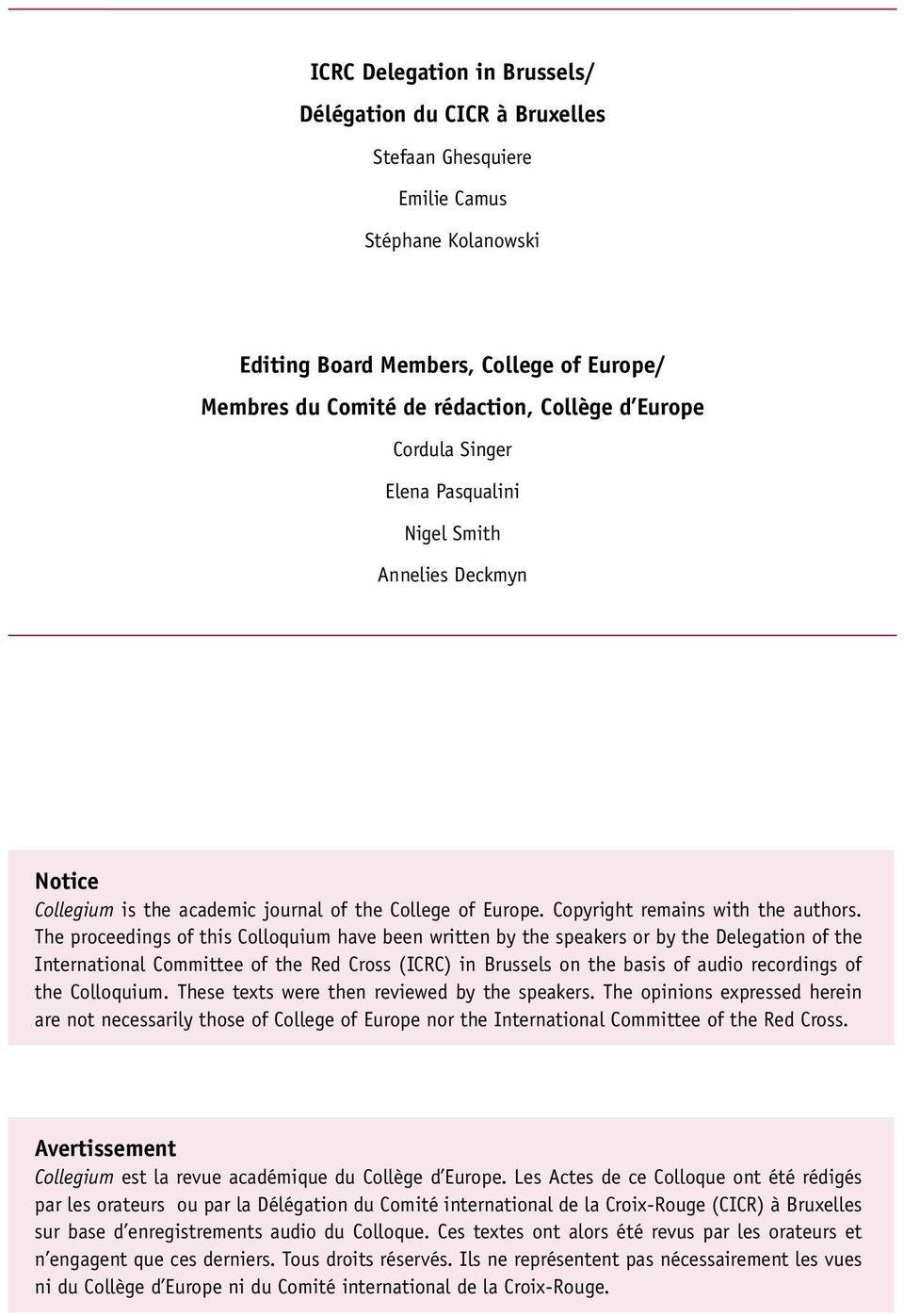
3 ICRC Delegation in Brussels/ Délégation du CICR à Bruxelles Stefaan Ghesquiere Emilie Camus Stéphane Kolanowski Editing Board Members, College of Europe/ Membres du Comité de rédaction, Collège d Europe Cordula Singer Elena Pasqualini Nigel Smith Annelies Deckmyn Notice Collegium is the academic journal of the College of Europe. Copyright remains with the authors. The proceedings of this Colloquium have been written by the speakers or by the Delegation of the International Committee of the Red Cross (ICRC) in Brussels on the basis of audio recordings of the Colloquium. These texts were then reviewed by the speakers. The opinions expressed herein are not necessarily those of College of Europe nor the International Committee of the Red Cross. Avertissement Collegium est la revue académique du Collège d Europe. Les Actes de ce Colloque ont été rédigés par les orateurs ou par la Délégation du Comité international de la Croix-Rouge (CICR) à Bruxelles sur base d enregistrements audio du Colloque. Ces textes ont alors été revus par les orateurs et n engagent que ces derniers. Tous droits réservés. Ils ne représentent pas nécessairement les vues ni du Collège d Europe ni du Comité international de la Croix-Rouge.
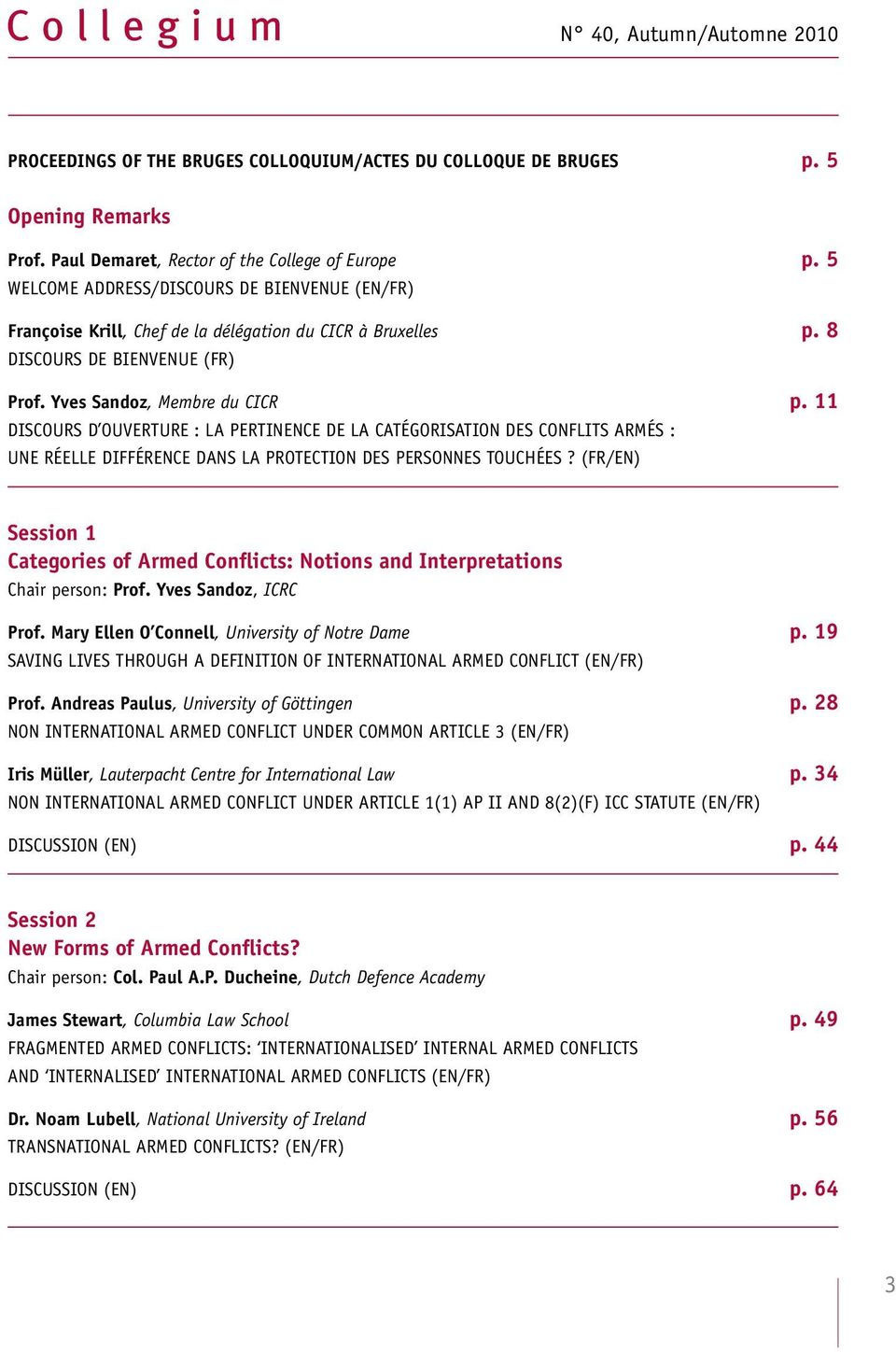
4 N 40, Autumn/Automne 2010 Proceedings of the Bruges Colloquium/Actes du Colloque de Bruges p. 5 Opening Remarks Prof. Paul Demaret, Rector of the College of Europe p. 5 WELCOME ADDRESS/DISCOURS DE BIENVENUE (EN/FR) Françoise Krill, Chef de la délégation du CICR à Bruxelles p. 8 DISCOURS DE BIENVENUE (FR) Prof. Yves Sandoz, Membre du CICR p. 11 DISCOURS D OUVERTURE : LA PERTINENCE DE LA CATÉGORISATION DES CONFLITS ARMÉS : UNE RÉELLE DIFFÉRENCE DANS LA PROTECTION DES PERSONNES TOUCHÉES? (Fr/EN) Session 1 Categories of Armed Conflicts: Notions and Interpretations Chair person: Prof. Yves Sandoz, ICRC Prof. Mary Ellen O Connell, University of Notre Dame p. 19 SAVING LIVES THROUGH A DEFINITION OF INTERNATIONAL ARMED CONFLICT (EN/FR) Prof. Andreas Paulus, University of Göttingen p. 28 NON INTERNATIONAL ARMED CONFLICT UNDER COMMON ARTICLE 3 (EN/FR) Iris Müller, Lauterpacht Centre for International Law p. 34 NON INTERNATIONAL ARMED CONFLICT UNDER ARTICLE 1(1) AP II AND 8(2)(F) ICC STATUTE (EN/FR) DISCUSSION (EN) p. 44 Session 2 New Forms of Armed Conflicts? Chair person: Col. Paul A.P. Ducheine, Dutch Defence Academy James Stewart, Columbia Law School p. 49 FRAGMENTED ARMED CONFLICTS: INTERNATIONALISED INTERNAL ARMED CONFLICTS AND INTERNALISED INTERNATIONAL ARMED CONFLICTS (EN/FR) Dr. Noam Lubell, National University of Ireland p. 56 TRANSNATIONAL ARMED CONFLICTS? (EN/FR) DISCUSSION (EN) p. 64 3
5 Session 3 Armed Conflict or Other Types of Violence? Chair person: Jeno Czuczai, General Secretariat of the Council, College of Europe Dr. Sylvain Vité, CICR p. 69 LA LUTTE CONTRE LA CRIMINALITÉ ORGANISÉE : PEUT-ON PARLER DE CONFLIT ARMÉ AU SENS OÙ L ENTEND LE DROIT INTERNATIONAL HUMANITAIRE? (Fr/En) Prof. Douglas Guilfoyle, University College of London p. 78 THE FIGHT AGAINST PIRACY (EN/FR) Prof. Derek Jinks, University of Texas p. 87 THE FIGHT AGAINST TERRORISM (EN/FR) DISCUSSION (EN) p. 95 Session 4 Qualification Questions Related to Multinational Operations Chair person: Dr. Marten Zwanenburg, Dutch Ministry of Defence Lt. Col. Darren Stewart, Institute of International Humanitarian Law, San Remo p. 101 WHEN DOES INTERNATIONAL HUMANITARIAN LAW APPLY TO MULTINATIONAL FORCES? (EN/FR) Gert-Jan Van Hegelsom, Council of the European Union p. 107 COALITION WARFARE: WHO IS A PARTY TO ARMED CONFLICT IN JOINT MISSIONS? (EN/FR) DISCUSSION (EN) p. 112 Panel Discussion Future Perspectives: Is there a Need to Adapt Legal Categories to Contemporary Realities? Chair person: Prof. Eric David, Université Libre de Bruxelles Prof. Françoise Hampson, Essex University (EN) p. 115 Kathleen Lawand, ICRC (EN) p. 119 Prof. Marco Sassòli, University of Geneva (EN) p. 122 Brig. Philip D. McEvoy, British Ministry of Defence (EN) p. 125 Concluding Remarks and Closure Françoise Krill, CICR p. 127 REMARQUES DE clôture (Fr/En) List of Participants/Liste des participants (EN/FR) p. 132 Programme (EN) p. 138 Speakers Bios/Biographies des orateurs (EN/FR) p
6 PROCEEDINGS OF THE BRUGES COLLOQUIUM ACTES DU COLLOQUE DE BRUGES Opening remarks WELCOME ADDRESS DISCOURS DE BIENVENUE Prof. Paul Demaret Rector of the College of Europe Madame la Chef de Délégation, chers Collègues, chers Participants, C est un honneur et un plaisir pour le Collège d Europe de vous accueillir ce matin ici au Collège et ici à Bruges. Je suis désolé de ne pas pouvoir vous accueillir avec le soleil, mais si cela peut vous réconforter, je pense que la ville de Bruges est la ville belge où il est le plus facile de supporter un temps pluvieux. Le thème choisi, «Conflits armés, parties aux conflits armés et DIH : les catégories juridiques face aux réalités contemporaines» sera présenté par une spécialiste du droit international humanitaire (DIH), Madame Françoise Krill, Chef de la délégation du Comité international de la Croix-Rouge (CICR) auprès de l Union européenne et de l OTAN à Bruxelles. Je ne m y aventurerai donc pas. What I would like to do during my short address, is first to say a few words about the College of Europe, followed by a few words about our cooperation with the International Committee of the Red Cross (ICRC) and the reasons why we value that cooperation so much. The College of Europe was created almost 60 years ago, in the wake of the Second World War. It was founded back in 1949, at the same time as the Council of Europe and the European Court of Human Rights. Therefore, the College of Europe predates the establishment of the first European Economic Communities. Its foundations lie with a Spanish intellectual, Salvador de Madariaga. The idea behind the creation of the College of Europe was to bring together in one place, after the World Wars, young European graduates and professors from all over Europe. Together, they would study European issues, not from a national, or worse, a nationalistic perspective, but from a truly European perspective. Moreover, the idea was that these people would also live together for a year in order to get to know each other and the different European cultures. Of course, the College of Europe has evolved since In the early days, there were something 5
7 like thirty, thirty-five or forty students, but now we have many more. Here in Bruges we run four specialised European Masters programmes. One deals with European Law, another with European Politics and Administration, a third with European Economics and in 2006, in anticipation of the establishment of an EU external action service, we launched a fully-fledged programme in EU International Relations and Diplomacy, which has proven successful. Around the early 90s, the College again reacted to a major event in European history, namely the fall of communism in Central and Eastern Europe. With the support of the Polish authorities and of the European Commission, the College set up its second campus in Natolin, Warsaw. In Natolin, our graduate students study the European integration process, not from a specialised perspective, but from a multi-disciplinary one. That means that we can also attract young graduates who do not have a degree in law, politics or economics but in history, philosophy or linguistics. In Natolin, we put the emphasis on the relations between the EU and its neighbours. By neighbours we do not just mean those countries who are part of the EU s Neighbourhood Policy but also countries like Russia and, for the time being, Turkey, as they are in fact the EU s two largest neighbours. Why are we interested in the cooperation with the ICRC? Firstly, in addition to its academic programmes, the College engages in various projects, training sessions, summer programmes and specific conferences, and among our best partners, we find the ICRC. Our solid and successful cooperation goes back to the year 2000 when the first Bruges Colloquium took place. Today we are at the 10 th Colloquium organised by the ICRC in cooperation with the College of Europe. Besides that annual international conference, our cooperation has known a new feature since 2004: each year at the end of the winter period, or in early spring, we organise a workshop together, which lasts two and a half or three days, where we try to introduce young students to International Humanitarian Law. Prof. Sandoz initiated these workshops with the support of the Heads of the ICRC Delegation to the EU and NATO in Brussels, first Mr. Thierry Germond, then Ms. Sylvie Junod, and now Ms. Françoise Krill. This workshop has met with great success, because we open it not only to the students of the College but also to students of neighbouring regions and countries (the Netherlands, Western Germany, Northern France, Southern England and also Eastern France). Thanks to the ICRC, we are able to organise this workshop in Warsaw as well, where it is open to students of various Polish universities. We hope that some of the young people attending these introductory workshops will feel called on to work in the field of International Humanitarian Law. We also hope that, through the support of the ICRC, we will be able to continue to organise such workshops. Quelles sont les raisons pour lesquelles le Collège d Europe est à ce point intéressé à coopérer avec le CICR? Tout d abord parce que le DIH, le produit des guerres européennes au 19 ème 6
8 siècle, a montré son utilité dans des circonstances tragiques ultérieures. Une raison particulière est que le DIH est d une certaine manière le produit du développement de la culture européenne au 18 ème siècle avec son accent sur la protection de l individu et sur la dignité de la personne humaine. A cet égard nous commémorons cette année-ci le 150 ème anniversaire de la bataille de Solferino de Enfin, une autre raison est évidemment que le DIH est un domaine qui est de plus en plus important pour l Union européenne (UE) et ses États membres puisqu ils sont (pas toujours tous ses États membres, mais souvent plusieurs parmi eux) impliqués de plus en plus souvent dans des opérations de maintien ou de rétablissement de la paix et de la sécurité, non seulement en Europe mais dans de différentes parties du monde. En plus, dans le Traité de Lisbonne, figurent plusieurs références au DIH. Le DIH est aussi l expression des valeurs que l UE se doit de promouvoir en Europe et ailleurs. En particulier, celui de la dignité de la personne humaine, en parallèle avec celui de la protection des droits fondamentaux qui restent nécessaires dans la réalité de nos jours. The elements I have just highlighted are the main reasons why the College of Europe appreciates its cooperation with the ICRC and I would like to take this opportunity to convey the gratitude of the College of Europe to the ICRC for renewing this corporation each year. To conclude I wish you all a successful 10 th Bruges Colloquium and I hope that many of you will want to come back for the next Colloquium. 7
9 DISCOURS DE BIENVENUE Francoise Krill Chef de la délégation, Comité international de la Croix-Rouge Monsieur le Recteur, Mesdames et Messieurs, J ai l honneur et le plaisir, au nom du Comité international de la Croix-Rouge (CICR), de vous accueillir pour ce 10 ème Colloque de Bruges, qui sera, cette année, consacré à l étude des notions des conflits armés et des parties à un conflit armé, notions essentielles pour déterminer l applicabilité du droit international humanitaire. Le Professeur Demaret vous a rappelé l étendue de la collaboration académique que le Collège d Europe et le CICR ont initiée, il y a dix ans. Cette année 2009 ne marque pas uniquement les 10 ans de cette collaboration, basée sur un intérêt commun au Collège et au CICR de promouvoir la connaissance du droit international humanitaire et de favoriser le débat portant sur des sujets d actualité, mais marque également deux anniversaires importants pour le Mouvement international de la Croix-Rouge et du Croissant-Rouge et pour le droit international humanitaire. C est en effet, il y a 150 ans que s est déroulée la célèbre bataille de Solférino, suite à laquelle Henry Dunant eut l idée de créer, ce qui est devenu le CICR et le Mouvement international de la Croix-Rouge et du Croissant-Rouge et qu il eut également l idée de promouvoir des conventions à vocation universelle, protégeant les victimes des conflits armés. C est enfin, il y a 60 ans que les États ont signé les quatre Conventions de Genève, qui constituent toujours aujourd hui les bases du droit international humanitaire et qui sont ratifiées par 194 États, soit la totalité des États reconnus par les Nations Unies. Si vous le permettez, je souhaiterais m attarder quelques instants sur ce dernier anniversaire. Il ne fait aucun doute que l adoption des quatre Conventions de Genève en 1949 a constitué une très grande avancée dans la protection des victimes des conflits armés. En même temps, il ne faut pas occulter les défis actuels qui se posent au droit international humanitaire, que cela soit en terme de diffusion, de respect ou de clarification de certaines notions, voire de développement de ce droit. Sur ce dernier point, si le droit international humanitaire se doit de rester un droit dynamique, en constante adéquation avec la réalité des conflits armés, son développement doit toujours se faire, en gardant à l esprit son but ultime, qui est de sauvegarder un minimum d humanité dans la barbarie et la cruauté des conflits armés. En effet, derrière le droit, se cachent les victimes. Le droit international humanitaire n aurait aucun sens s il ne cherchait à alléger les souffrances que subissent, quotidiennement, des 8
10 millions d êtres humains qui se trouvent pris dans la tourmente d un conflit armé. En cette année de commémoration des Conventions de Genève, le CICR a décidé de donner la parole aux victimes, sur la manière dont elles perçoivent la protection que leur accorde le droit international humanitaire. Dans ce but, le CICR a mené une vaste enquête dans huit pays en proie à un conflit armé ou à de la violence interne, à savoir l Afghanistan, la Colombie, la Géorgie, Haïti, le Liban, le Libéria, les Philippines et la République démocratique du Congo. Les résultats de cette enquête sur le terrain sont très parlants : 75 % des personnes interrogées estiment qu il doit y avoir des limites au comportement des parties au conflit. De même, 97 % des participants à l enquête estiment qu une claire distinction doit être faite entre combattants et civils. À la question de savoir si les civils doivent être totalement épargnés, c est principalement en Colombie, aux Philippines et en République démocratique du Congo qu il a été répondu positivement. Nous n avons pas le temps de nous pencher sur tous les résultats de cette vaste enquête, mais relevons encore un élément interpellant. 42 % des personnes interrogées, seulement, ont entendu parler des Conventions de Genève. Parmi celles-ci, seule la moitié estime que les Conventions de Genève ont un réel impact et limitent effectivement les souffrances des civils dans les conflits armés. Ces chiffres démontrent à l évidence l importance de la diffusion du droit international humanitaire et des efforts visant au respect sur le terrain de ces règles. Cette enquête nous rappelle que des débats juridiques, tels que nous les aurons durant ces deux jours, ne doivent pas se contenter d être de purs exercices académiques. Tout en gardant toute la rigueur juridique, ils ne doivent pas moins être en phase avec la réalité du terrain. Le 10 ème Colloque de Bruges nous amènera à débattre de questions fondamentales pour l application du droit international humanitaire, à savoir qu est-ce qu un conflit armé et qui en sont les parties? Comment distinguer un conflit armé d autres formes de violences? Si l on est effectivement en présence d un conflit armé, est-il international ou non-international? Quel est l impact sur la nature du conflit de la présence sur le terrain de forces multinationales et d une certaine implication de ces forces auprès de l une ou l autre partie? Enfin, nous discuterons de l épineuse question de savoir si la typologie des conflits armées, telle que prévue par le droit international humanitaire répond adéquatement aux diverses situations de conflits armés rencontrées à travers le monde. Avant de nous lancer dans la substance même de ce Colloque, je souhaiterais encore attirer votre attention sur deux points essentiels. Premièrement, déclarer qu une situation a atteint le seuil d un conflit armé ou déterminer qu une situation est un conflit armé international ou 9
11 non-international n est pas une démarche innocente. Cet exercice de qualification aura en effet des conséquences importantes sur le sort des victimes de ces situations. Deuxièmement, aujourd hui, si diverses formes de violence existent, dont la nature s apparente plus ou moins à un conflit armé ou dont la détermination de la typologie du conflit armé n est pas claire, il faut toutefois se garder de vouloir trop vite changer le droit existant et pertinent, sous prétexte que l exception pose des questions trop compliquées. Cela dit, si le CICR a organisé un colloque sur ce thème particulier, c est parce que nous n avons pas toutes les réponses à ces questions. Les nombreux experts que nous avons réunis sauront sans aucun doute nous éclairer et le CICR est impatient de vous écouter et de pouvoir échanger avec vous points de vue et idées sur cette problématique importante. Je ne saurais terminer sans remercier les participants d avoir été si nombreux à répondre favorablement à notre invitation à participer à ce 10 ème Colloque de Bruges. Il s agit d un record. Monsieur le Recteur, Mesdames et Messieurs, je me réjouis d avance des débats que nous allons avoir pendant ces deux jours qui s annoncent stimulants et fructueux et je vous remercie de votre attention. 10
12 DISCOURS D OUVERTURE : LA PERTINENCE DE LA CATÉGORISATION DES CONFLITS ARMÉS : UNE RÉELLE DIFFÉRENCE DANS LA PROTECTION DES PERSONNES TOUCHÉES? Prof. Yves Sandoz Membre du Comité international de la Croix-Rouge Summary in English At the outset of the Colloquium, it is important to highlight some key messages on International Humanitarian Law (IHL), which should guide the debates. The idea behind this Colloquium is not merely to debate the classification of armed conflicts. The main question is whether the body of IHL is still adequate for these conflicts in light of contemporary realities. To answer this question we must look at the rationale of IHL, which is to preserve the fundamental principle of humanity during armed conflict. In light of this principle, States agreed that certain actions of war were excessive and should be limited through, amongst others, the universal principle of distinction. Universality of this rule could however only be upheld if the rule were to the advantage of all parties involved in a conflict. It is in this regard that one needs to understand, for instance, the compromise of Additional Protocol I (AP I), which allowed parties in armed conflict to distinguish themselves from the civilian population only when undertaking acts of war. Today, it is again debated whether IHL and the principle of distinction still provides a win-win situation. The question is however, whether IHL can go further than the compromise of AP I, which would mean that a combatant would be allowed to feign civilian status even during acts of war. IHL reached its limits since it cannot absorb acts that amount to terrorism. The aim of this Colloquium is to search for an answer to the question of how to preserve the fundamental values of IHL in light of these realities, without asking the impossible of IHL. IHL is meant to alleviate suffering during armed conflicts, not to solve them; this is the role of the UN and the international community. Among the subjects of the Colloquium we must first focus on the existing categories of armed conflict, in particular on the concept of non-international armed conflict (NIAC) since today most conflicts are internal in nature. Discussions will focus on the difference in threshold of common Article 3 and Additional Protocol II (AP II) and their relationship towards human rights law. Equally, discussions will consider new situations such as international internal armed conflicts (IAC), to which the law seems to provide only a fragmented approach, encompassing aspects of the law of IAC and NIAC depending on the parties to the conflict. Political determination of a conflict situation will often influence this debate, which is a challenge for the apolitical character of IHL. 11
13 The easiest solution for the current difficulties of classification would be to create a single body of law applicable to all types of armed conflict. While a reconciliation of the rules of IAC and NIAC is visible regarding conduct of hostilities, it seems unlikely that the rules of IAC on combatant status or occupation could apply to NIAC. In addition to practical problems, states would refuse such application. Regarding the issue of detention, a moratorium on the death penalty could provide a compromise without the need to merge the law of IAC and NIAC. Another solution for classification problems could be an extension of the application of IHL to other types of violence such as organised crime. However, these situations are not generally covered by the definition of an armed conflict. In addition, an extension of IHL would mean early recourse to more permissible rules on the use of force. In conclusion, irrespective of the solutions proposed, the ultimate aim of the debates should focus on the protection of the civilian population. Pourquoi est-il important d aborder le thème de ce Colloque sur la pertinence de la typologie des conflits armés face aux réalités contemporaines? Loin de vouloir conclure le débat avant qu il ait eu lieu, j aimerais vous transmettre quelques réflexions à ce sujet. Tout d abord, il convient de souligner que derrière le thème de ce Colloque se pose une question beaucoup plus fondamentale, qui est celle de la pertinence du droit international humanitaire (DIH) face aux réalités contemporaines. L idée du DIH est de préserver des valeurs fondamentales d humanité au coeur des conflits armés. Dès le départ, les États ont accepté une restriction de certains moyens et de certaines méthodes de guerre, jugés excessifs et inadaptés. Certaines règles ont donc été fixées tant pour la conduite des hostilités que pour le traitement des personnes (blessés, prisonniers, civils). À cet égard, le principe de distinction (entre ceux qui se battent et les autres, entres ce qui est militaire et ce qui ne l est pas) a toujours été essentiel pour mettre en œuvre ces idées. Outre son universalité, un autre élément sous-tend le DIH même s il n en est pas constitutif : son respect est utile à toutes les parties sur le plan humanitaire et reste sans incidence à l issue du conflit. C est une entreprise «winwin», comme le disent les anglo-saxons : chacun est gagnant. Or, lors des négociations qui ont mené aux Protocoles additionnels en 1977, cette idée de base du DIH a été remise en cause. Trois fondements de ce droit ont alors été mis en péril. Son universalité d abord, car ces États n étaient pas prêts à accepter un DIH qui ne prendrait pas leurs revendications en cause ; l égalité des droits et devoirs de toutes les parties en conflit indépendamment de la cause défendue, ensuite, l indépendance de ce que l on appelle le ius ad bellum (régissant l usage de la force sur le plan international), d une part, et le ius in bello (réglant la manière d utiliser la force dans les conflits armés), d autre part ; et, enfin, le principe de distinction ci-dessus mentionné. Si, dans leur majorité, les États sont restés intran- 12
14 sigeants sur l égalité des droits et devoirs des combattants, deux concessions ont néanmoins été faites pour préserver l universalité du DIH. On a accepté d élever au niveau d un conflit armé international les guerres de libération nationale, donnant ainsi le statut de prisonnier de guerre aux membres capturés de Mouvements de libération et, donc, l immunité pour le seul fait d avoir pris part au conflit ; et, surtout c est là que le débat a été le plus délicat, l on a trouvé un compromis pour satisfaire une revendication fondamentale des États issus de la décolonisation, qui soutenaient, non sans arguments, que l application stricte des règles du DIH ne leur donnait aucune chance de vaincre face aux armées occidentales mieux organisées. Ces États exigeaient de ce fait que le DIH n exclue pas la possibilité pour les combattants de se dissoudre dans la population civile, mettant ainsi en péril le principe fondamental de distinction rappelé ci-dessus. Le compromis finalement trouvé pour satisfaire cette revendication (et donc préserver l universalité du DIH) sans pour autant toucher à son essence même en supprimant le principe de distinction : l on a reconnu le droit aux guérilleros de se mêler à la population civile quand ils ne se battaient pas, mais on leur a dénié le droit de feindre d avoir un statut protégé (civil, blessé) pour commettre des actes de guerre (principe du port ouvert des armes lors du combat). La question qui se pose aujourd hui est celle-ci: le DIH peut-il aller encore plus loin? Je suis convaincu du contraire sur ce point, le DIH ayant atteint les limites du possible en L étape suivante serait d accepter qu un combattant feigne d être une personne protégée pour commettre un acte de guerre. Cela reviendrait, en fait, à entériner le terrorisme, ce que le DIH ne saurait faire sans s autodétruire. Pourtant, dans les guerres dites «asymétriques» (soit des guerres qui opposent des armées aux forces totalement disproportionnées) certaines des entités qui luttent contre des armées possédant des moyens techniques et logistiques infiniment supérieurs aux leurs ont effectivement le sentiment que leur seule chance d ébranler l adversaire est d utiliser des méthodes terroristes. La population n est alors plus protégée et devient même, parfois, la cible des attaques. De telles pratiques, le terrorisme, sont et resteront toujours inacceptables, il faut l affirmer sans ambiguïté. Elles entraînent en outre inévitablement une dégradation générale de la situation sur le plan humanitaire, ceux qui sont victimes de telles attaques ayant tendance à se méfier de tout le monde, voyant dans tout civil un terroriste potentiel et touchant de ce fait eux aussi davantage de civils. Plus grave encore, l on a pu constater des dérapages «idéologiques», avec la tentation de justifier la torture ou la mise en détention secrète de personnes soupçonnées de terrorisme dans le cadre de la lutte contre celui-ci. On entre alors dans un cercle vicieux dans la mesure où ceux qui sont victimes d actes de terrorisme se mettent eux aussi à attenter à des valeurs fondamentales du DIH. 13
15 Comment, face à cette réalité, préserver les valeurs qui sont au cœur du DIH? Avant d entamer les débats sur cette question cruciale, je souhaiterais d abord passer un message d humilité. Ne demandons pas trop au DIH car les attentes seront alors déçues. Je fais notamment référence ici à la polémique qui entoure le rapport Goldstone sur l intervention israélienne à Gaza. Bien qu il soit nécessaire d analyser les faits et d identifier les violations du DIH et des droits de l homme qui ont été commises, l on doit aussi comprendre une certaine «usure» du DIH dans des conflits sans fin. Ce droit n est pas adapté à des conflits non résolus pendant des dizaines et des dizaines d années. Il n est qu un médicament qui soulage sans rien guérir et l efficacité d un médicament pris trop longtemps s estompe. Le mépris du droit international dans ces conflits non résolus finit par déteindre sur le DIH, qui est entraîné dans cette perte de crédibilité du droit international général. La réflexion nécessaire que l on doit avoir sur les conflits contemporains sort donc du seul cadre du DIH, que l on ne peut isoler d un débat plus large. Le monde est aujourd hui confronté à des problèmes planétaires, tels la croissance démographique, les migrations, l extrême pauvreté, l accès à l eau potable, la pollution, le réchauffement atmosphérique ou la grande criminalité internationale. Les multiples conflits armés doivent dès lors faire aussi partie de ce débat global et leur analyse individuelle et globale doit sortir du seul prisme de l humanitaire au sens étroit : la paix reste bien sûr une exigence liée aux souffrances insupportables des victimes de la guerre, mais elle devient également un impératif de survie pour l humanité. Il est donc essentiel de repenser le rôle de la communauté internationale, de l ONU, des États individuellement. Le DIH doit interpeller le droit international, la Croix-Rouge, l ONU, pour rappeler que leur fonction, modeste mais combien importante, de soulager les victimes de la guerre n est pas la panacée, ne saurait être un alibi, un substitut à la responsabilité de la communauté internationale d œuvrer sans relâche pour la paix. Revenons maintenant sur le sujet de notre Colloque. En lisant l ordre du jour, quelqu un qui ne connaîtrait pas le DIH se dirait sûrement, à juste titre, que tout cela semble très compliqué. Cette complexité s est inscrite dans le DIH dès lors que la notion de conflit armé non international (CANI) a été introduite une notion qui constituait toutefois une avancée fondamentale aux vues de la réalité des conflits contemporains, qui sont pour la plupart à caractère non international. Il résulte en effet de la création de cette deuxième branche du DIH, une confrontation entre, d une part, la logique traditionnelle du DIH (obligation d une partie à l égard de l autre), et d autre part, la logique des droits de l homme (obligation de l État à l égard de ses citoyens). Or les États, très sensibles à leur souveraineté nationale, n ont accepté qu un DIH «au rabais» pour les CANI. Le droit applicable aux CANI s est ensuite encore compliqué avec le Protocole additionnel II. Selon la doctrine dominante, le champ d application de ce Protocole est plus restrictif que celui de l Article 3 commun aux Conventions de Ge- 14
16 nève. Quant à cet article, il représente un socle minimum qui doit être complété non seulement par le Protocole II quand celui-ci est applicable, mais aussi, en toutes circonstances, par les normes des droits de l homme. La notion de conflit armé interne internationalisé, c est-à-dire l implication d un gouvernement étranger dans un conflit interne, pose également divers problèmes. En premier lieu il s agit de déterminer le degré nécessaire d implication d un État étranger pour que l on puisse parler d internationalisation. Une deuxième complication réside dans les conséquences de la participation d un gouvernement étranger, qui diffèrent selon que l intervention est faite du côté du gouvernement ou de celui des rebelles. Dans le cas où un État étranger soutient militairement des rebelles contre le gouvernement du pays concerné, il est évident que ce conflit constitue un conflit armé international (CAI). Si un État étranger combat aux côtés du gouvernement, la situation n a jamais été tout à fait clarifiée. Une troisième complication se trouve dans le fait que l internationalisation d un CANI n entraîne pas une application du DIH dans son ensemble. Si quelques auteurs suggèrent une telle approche, la Cour internationale de justice ne les a pas suivis et il en résulte donc une approche fragmentée : dans un même conflit, on peut avoir certains aspects du conflit couverts par le droit applicable aux CAI, et d autres aspects seulement par le droit des CANI. Il y a, enfin, la prétention de certains États de considérer comme un CANI une intervention contre des éléments non gouvernementaux qui se trouvent sur un territoire étranger et échappent au contrôle du Gouvernement. On pensera là particulièrement à l intervention d Israël au Liban en 2006, qui visait le Hezbollah. A côté de ceux qui prétendent qu il s agissait d un CANI, d autres, tout en souscrivant à cette thèse, ont prétendu qu il y avait toutefois, vu l ampleur de l intervention, également un CAI contre le Liban, en parallèle. Personnellement, je ne peux souscrire à aucune de ces thèses, estimant qu une intervention armée d un État dans un autre sans l accord de ce dernier est un conflit international quel que soit l objectif de cette intervention, mais l on ne peut les ignorer, vu le soutien qu elles ont rencontré. Ces exemples nous démontrent l importance de classer adéquatement les conflits et de s assurer que les parties au conflit se mettent d accord sur le droit applicable. C est le défi que le CICR cherche à relever. Toutefois, il faut être conscient que la question de la qualification est le talon d Achille du DIH. Malgré la vocation apolitique de celui-ci, il est très difficile de faire sortir la classification du débat politique. Il est dès lors essentiel de trouver des portes de sortie pour ne pas tomber dans des impasses et d éviter à tout prix qu aucune norme ne soit reconnue faute d un accord sur la qualification. Le CICR, au niveau institutionnel, a la chance d avoir un mandat conventionnel tant pour les CAI que pour les CANI, ainsi qu un mandat statutaire pour les troubles internes. Il peut donc proposer ses services en évitant un blocage en cas de divergence avec le Gouvernement concerné sur la qualification de la situation, quitte 15
17 à fonder son action sur les normes minimales applicables en toutes circonstances. Mais une analyse plus approfondie du droit applicable, en vue de son respect, dépend néanmoins de la qualification de la situation et cette composante politique du problème est certainement l une des questions à débattre lors de ce colloque. La solution la plus simple serait qu il n y ait qu un droit applicable à l ensemble des conflits armés une thèse défendue par James Stewart dans un article de la Revue internationale de la Croix-Rouge 1. Il est vrai que dans certains domaines du DIH, un rapprochement très net s est opéré entre le droit des CAI et celui des CANI, notamment par l extension coutumière de normes du premier au second A cet égard, on pensera particulièrement aux règles régissant la conduite des hostilités et aux normes concernant la répression sur le plan international des crimes commis lors des conflits internes. Cette évolution est notamment due à la jurisprudence des tribunaux pénaux internationaux ad hoc, qui ont montré la voie et ont été suivis par les États lors de l élaboration et du Statut de la Cour pénale internationale. Néanmoins, une fusion totale entre le droit des CAI et celui des CANI n est guère envisageable. Deux problèmes majeurs y font en tout cas obstacle, à savoir le statut des personnes capturées et l occupation. En ce qui concerne les personnes capturées, il est très difficile d envisager que les États acceptent d étendre le statut de prisonnier de guerre et l immunité en rapport à la participation aux hostilités à des rebelles dans un conflit interne. Prenant en compte cette réalité, il me paraît néanmoins important, sur le plan pratique en tout cas sinon sur le plan normatif, d obtenir au moins le gel de toute condamnation à mort, tout en rappelant que les droits de l homme doivent par ailleurs éclairer le droit international humanitaire quant au contenu des garanties fondamentales de traitement et judiciaires qui doivent être respectées. Quant à l occupation, la question qui se pose est celle-ci : les obligations larges et nombreuses qui sont celles d une puissance occupante non seulement à l égard de la sécurité, mais des systèmes de santé, de justice, d éducation pourraient-elles être attribuées aux rebelles si ceux-ci contrôlent un territoire pour une longue période. On sent bien que, dans ces cas, reconnaître de telles obligations, et donc une telle responsabilité, aux rebelles, serait certainement dans l intérêt de la population concernée. Mais il est illusoire de penser que les États acceptent d aller dans cette direction, de peur de donner aux rebelles sinon un statut, du moins une stature qui, de leur point de vue, risquerait de consolider et pérenniser une situation à laquelle ils s opposent par la force. J en arrive maintenant à une dernière question qui mériterait elle aussi, me semble-t-il d être débattue lors du présent colloque : le domaine couvert par le DIH devrait-il s étendre? La 1 IRRC, Vol.85, No.850, June
18 confrontation actuelle de certains États avec des puissants groupes criminels, disposant d imposants arsenaux, mais sans aucune ambition idéologique ni revendication politique, dont le seul but est de vivre du crime notamment le trafic d être humains, d armes ou de drogues n entre pas dans le schéma du DIH et doit nous interpeller. Je pense notamment à des pays comme le Mexique ou le Brésil, où de tels groupes armés sont si puissants que des moyens militaires sont utilisés à leur encontre. De telles situations soulèvent de multiples problèmes, parmi lesquels la corruption n est pas des moindres, et je ne saurais entrer ici dans leur analyse. Mais une réflexion à leur sujet me semble indispensable, malgré le danger, bien réel, que l on donne trop facilement le feu vert à des moyens d utilisation de la violence beaucoup plus étendus que ceux qui sont tolérés par les droits de l homme dans le cadre du maintien de l ordre. Mais ceux-ci sont-ils adaptés à de telles situations? Faut-il envisager une extension du DIH avec le risque de donner une reconnaissance, dans ce cadre, à des groupes qui agissent au mépris de normes fondamentales de ce droit? La réponse, on le comprend aisément, n est pas simple et je laisserai ces questions ouvertes. Pendant les discussions plus approfondies qui vont suivre, il me paraît en tout cas nécessaire de garder à l esprit le but ultime de ces débats, celui de trouver un système qui permette de préserver certaines valeurs fondamentales et de mieux protéger les non-combattants, la population civile, en cherchant à éviter les écueils et à surmonter les obstacles que je viens de rappeler. 17
19

20 Session 1 Categories of Armed Conflicts: Notions and Interpretations Chair person: Prof. Yves Sandoz, ICRC SAVING LIVES THROUGH A DEFINITION OF INTERNATIONAL ARMED CONFLICT Prof. Mary Ellen O Connell University of Notre Dame Résumé en français I. Conflit armé international En 2005, le Comité sur l utilisation de la force de la International Law Association, que préside l auteur de la présente intervention, a été chargé de rechercher, parmi les sources du droit international, une définition des conflits armés. En effet, aucune définition claire des conflits armés internationaux (CAI) n est inscrite dans les conventions relatives au droit international humanitaire (DIH). Ce choix délibéré du législateur visait à encourager une application plus large des principes du DIH, objectif qui, au vu du rapprochement entre droit international des droits de l homme et du DIH en matière de crime, a été en partie atteint. Il apparaît toutefois que certains États ont eu tendance à utiliser cette absence de définition pour revendiquer une plus grande latitude dans l utilisation de la force létale ainsi que dans la détention. II. Conflit armé international (CAI) versus conflit armé non-international (CANI) En DIH, certaines règles diffèrent selon qu un conflit armé est international ou non. Concernant la définition des CAI, le DIH donne d ailleurs quelques indications. Ainsi, l article 3 commun aux quatre conventions de Genève dispose qu un conflit armé à caractère non international doit surgir «sur le territoire de l une des Hautes Parties contractantes». A l inverse, un CAI implique la confrontation de deux États ou plus. A cet égard, il convient de noter qu un conflit armé peut être international même si les groupes armés organisés impliqués dans le conflit ne sont pas les forces armées régulières de l État. Il est également possible, en théorie tout au moins, qu un groupe armé organisé opérant sur le territoire d un État failli («failed state») attaque un autre État, ce qui serait alors constitutif d un CAI. Plus complexe est le fait qu un CAI puisse se transformer en CANI et inversement. Ce fût par exemple le cas en Afghanistan. Il existe également 19
21 des cas de CANI où un autre État apporte un soutien à des groupes armés combattant contre les autorités nationales, sans pour autant contrôler le groupe armé. Le CANI peut alors éventuellement être qualifié de CANI internationalisé, mais ce ne sera pas un CAI. Toutefois, le cœur du DIH applicable aux CAI, CANI et CANI internationalisé reste le même. Ainsi, la question de savoir quelle est la différence entre CAI et CANI n est pas aussi importante que celle de savoir s il existe un conflit armé ou non. III. Conflit armé Comme indiqué précédemment, les Conventions de Genève de 1949 ne donnent pas de définition des conflits armés. Seuls les commentaires aux Conventions de Genève de Jean Pictet indiquent que tout différend entre deux État impliquant le recours à la force armée est un conflit armé. En outre, le Protocole additionnel II aux Conventions de Genève (PAII) précise que les situations de violences, y compris les situations de «tensions internes, de troubles intérieurs, comme les émeutes, les actes isolés et sporadiques de violence et autres actes analogues», ne sont pas considérées comme des conflits armés. En 1995, le Tribunal international pénal pour l ex-yougoslavie (TPIY) dans l arrêt Tadic vient clarifier la définition de conflit armé pour les CAI et les CANI : un conflit armé existe «chaque fois qu il y a recours à la force armée entre États ou un conflit armé prolongé entre les autorités gouvernementales et des groupes armés organisés ou entre de tels groupes au sein d un État». Puis dans l arrêt Mucic en 1998 : «le recours à la force armée entre États suffit en soi à déclencher l application du droit international humanitaire». Toutefois, il a été observé à plusieurs reprises que certains incidents isolés, frontaliers ou en mer par exemple, n étaient pas considérés dans la pratique comme des conflits armés. De même, il semble que lors d engagements relativement mineurs des forces armées nationales, les règles de DIH ne soient pas systématiquement invoquées. Ainsi, au vu de la pratique des États, le Comité sur l utilisation de la force de la International Law Association a conclu que pour déterminer l existence d un conflit armé, deux caractéristiques devaient être réunies: (1) l existence de groupes armés organisés et (2) des combats d une certaine intensité. Cette deuxième caractéristique va toutefois à l encontre de l interprétation proposée dans les commentaires de Jean Pictet selon laquelle le seul recours à la force entre États suffit à déclencher l application du DIH (CAI). Il reste cependant clair qu un CAI implique forcément le recours à la force armée entre deux États ou plus. Under international law only lawful combatants engaged in situations of armed conflict may claim the right to kill without warning. This fact makes the definition of armed conflict one of the most critical definitions in all of international law. Certain international legal rules also 20
22 turn on whether an armed conflict is an international armed conflict (IAC) or a non-international conflict (NIAC). But this distinction is of less importance than the threshold definition that gives rise to a right to kill a right that does not exist outside an armed conflict. In my presentation, I will examine both the definition of armed conflict and the distinction between IAC and NIAC. In the years to come, the distinctions between armed conflict and peace as well as between IAC and NIAC may decline in importance. We are currently seeing considerable convergence between the law governing armed conflict, international humanitarian law (IHL), and human rights law. Should this convergence continue, we may find that all killing is subjected to law-enforcement rules. In particular, any use of lethal force may first require notice unless the situation is one of urgent necessity. 1 In the 2009 ICRC Interpretative Guidance on Direct Participation in Armed Conflict 2 the peacetime rule of necessity the principle that underlies peacetime law enforcement decisions to use lethal force is given greater emphasis in targeting decisions during armed conflict than had been the case in past discussions. 3 Similarly, the significance of the difference between IAC and NIAC is declining. The 2005 ICRC Customary Humanitarian Law Study finds considerable convergence of IHL rules applicable in IAC and NIAC, making the distinction between the two categories less important. 4 We also have near-consensus that international human rights law plays a role during armed conflict. The two groups of protective rules are no longer kept separate, which is, in turn, obviating the need to define armed conflict or IAC versus NIAC. When humanity reaches the point where all force is governed by necessity, we will not need a definition of armed conflict. But we are not there yet. There is still a need, if a diminishing 1 F.F. Martin, Using International Human Rights Law for Establishing a Unified Use of Force Rule in the Law of Armed Conflict, in Saskatchewan Law Review, 347 (2001) p.64. See also T Meron & A Rosas, A Declaration of Minimum Humanitarian Standards, in American Journal of International Law, 375 (1995) p N Melzer, Interpretative Guidance on the Notion of Direct Participation in Hostilities under International Humanitarian Law, (ICRC, May 2009). 3 Ibid., pp See also United Nations Basic Principles for the Use of Force and Firearms by Law Enforcement Officials, in UN Basic Principles (7 September 1990), which are widely adopted by police throughout the world, which provide in Article 9: Law enforcement officials shall not use firearms against persons except in self-defense or defense of others against the imminent threat of death or serious injury, to prevent the perpetration of a particularly serious crime involving grave threat to life, to arrest a person presenting such a danger and resisting their authority, or to prevent his or her escape, and only when less extreme means are insufficient to achieve these objectives. In any event, intentional lethal use of firearms may only be made when strictly unavoidable in order to protect life. 4 J-M. Henckaerts & L. Doswald-Beck (eds.), I & II Customary International Humanitarian Law (2005). 21
23 one, to be able to distinguish armed conflict situations from peacetime ones. And because there are still some differences between the IHL rules pertaining to IAC versus NIAC, there is still a need, if a diminishing one, to be able to identify IAC or NIAC. The purpose of this paper is to focus on the evidence from international law as to the definition of IAC. I. Background The IHL conventions do not provide a definition of IAC. The drafters deliberately omitted definitions in the hope of attracting more generous application of humanitarian principles. This hope is largely being fulfilled as we move to a merger of human rights and IHL rules on killing, given that the human rights rules on killing are more humane than the armed conflict rules. 5 There are also moves in the direction of providing greater due process to persons detained in armed conflict and with respect to seizing property. Nevertheless, a few States have taken advantage of the lack of definitions to assert broad rights to kill and detain. It is for this reason that the International Law Association (ILA) Committee on the Use of Force received a mandate to find in the sources of international law the definition of armed conflict. The Use of Force Committee spent three years in research and discussion. It presented its Initial Report on The Meaning of Armed Conflict in International Law in August 2008 at the ILA biennial meeting in Rio de Janeiro. 6 The final report is scheduled for submission in 2010 at the ILA biennial in The Hague. The Committee s goal is to define armed conflict for general purposes, not with respect to what conditions trigger IHL. Nevertheless, the findings are highly relevant to IHL as well as refugee law, treaty law, the law of neutrality, and other areas of international law that shift depending on whether the law is applied in a situation of armed conflict or peace. 7 IHL, including the combatant s privilege to kill, applies only within armed conflict, not outside it. The Committee found sufficient evidence in international law as to what situations count as armed conflict. Before dealing with that evidence, we consider the meaning of international versus non-international. II. International versus non-international As just stated above, IHL has a few rules that differ depending on whether the conflict is an IAC or an NIAC. IHL contains indications as to what is an IAC. The most helpful indications 5 See supra note 3. 6 Judith Gardam is the Committee s rapporteur. The Initial Report is posted at the Website of the ILA: For more on the Committee s work and its initial report, see also, M.E. O Connell Defining Armed Conflict, Journal of Conflict & Security Law 393 (Winter 2008) p During military occupation another set of rules distinct from those applicable in armed conflict and peace apply. But the rules with respect to killing are the peacetime, law enforcement rules so with respect to the main concern of this paper, occupation law is not relevant. See the Wall Advisory Opinion of the International Court of Justice, 2004, 22
24 are found in the express descriptions on NIAC. From these we can deduce the meaning of an IAC. The first indication in the 1949 Geneva Conventions of what constitutes an NIAC is found in Common Article 3 (CA3). While CA3 does not define NIAC, it does say that it must occur in the territory of one State. CA3 applies [i]n the case of armed conflict not of an international character occurring in the territory of one of the High Contracting Parties. (Emphasis added) Christopher Greenwood, writing sixty years later, picks up this key element of Common Article 3 but adds other elements: A non-international armed conflict is a confrontation between the existing governmental authority and groups of persons subordinate to this authority, which is carried out by force of arms within national territory and reaches the magnitude of an armed confrontation or a civil war. 8 By contrast, an IAC involves a confrontation of two or more States. Generally recognized IAC of the last twenty years include: the Gulf War of , Congo-Uganda at various times during the last 15 years, the Ethiopia-Eritrea War of , the Kosovo conflict of 1999, the Afghanistan War at least from 2001 to 2002, and the Iraq War at least from 2003 to 2004, the Israel-Lebanon conflict of 2006, the Ethiopia-Somalia conflict of , and the Russia-Georgia conflict of An armed conflict may be an IAC, involving two or more States even if the organised armed groups are not the regular armed forces of the States involved. This was the case in the Lebanon-Israel War of It is also theoretically possible for an organized armed group operating on the territory of a failed State (one without a functioning government) to attack another State, creating an IAC. I know of no examples or even claims of this occurring. When Ethiopia invaded Somalia in late 2006, it said it was responding to cross-border incursions that were the responsibility of the de facto government of Somalia, the Islamic Courts. 9 Even 8 C. Greenwood, Scope of Application of Humanitarian Law, in D. Fleck (ed.) The Handbook of Humanitarian Law in Armed Conflicts (Oxford: Oxford University Press, 2d ed. 2008), p.54. See also R. Arnold, Terrorism and IHL: A Common Denomination, in R. Arnold (ed.) International Humanitarian Law and the 21 st Century s Conflicts: Changes and Challenges (Lausanne: Editions Interuniversitaires Suisses Edis, 2005) 3, 11-12; R. Arnold, The ICC as a New Instrument for Repressing Terrorism (New York: Transnational Publishers, 2004), p.116; J. Peijic, Terrorist Acts and Groups: A Role for International Law? in British Yearbook of International Law, 71 (2004) p.75, citing M. Sassòli, The Status of Persons Held in Guantanamo under International Humanitarian Law, in Journal of International Criminal Justice 96, 100 (2004) p.2; L. Moir, The Law of Internal Armed Conflict (Cambridge: Cambridge University Press, 2002) pp For details of the conflict, see, S. Bloomfield, Somalia: The World s Forgotten Catastrophe, in The Independent, 9 February 2008, available at (last visited June 2, 2010). 23
25 if a State loses all effective government, it does not lose its status as a State; it does not, for example, lose its seat at the United Nations. Thus for the purposes of determining an IAC, it is the crossing of a recognized international border that matters most not the existence of an effective government. What does happen, and creates some complication in understanding IAC versus NIAC, is that an IAC can become NIAC and an NIAC can become IAC and back again. Starting on October 7, 2001, Afghanistan was the scene of an IAC. After the Loya Jurga chose Hamid Karzai as the Afghan leader and he gave consent to the continuing presence of foreign troops in Afghanistan, it became a NIAC. We may have seen it evolve again into an IAC with U.S. attacks into Pakistan emanating from Afghanistan without Pakistan s consent. We have had cases of NIAC where a second State provides support to armed groups fighting national authorities or offers them a safe haven. When these actions do not amount to controlling the armed group, the NIAC might be labelled an internationalised NIAC, but it would not be an IAC. At its core, IHL rules are the same for IAC, NIAC and internationalised NIAC. The distinction between IAC and NIAC is not as important as correctly identifying an armed conflict versus a non-armed conflict situation. It is to this topic that we next turn our attention. III. Armed conflict The 1949 Geneva Conventions famously do not define armed conflict despite the fact the Conventions are limited to application in war and armed conflict, as per Article 2. Pictet s Commentary says with respect to this omission in Common Article 2: This paragraph is entirely new. It fills the gap left in the earlier Conventions, and deprives the belligerents of the pretexts they might in theory invoke for evasion of their obligations. There is no longer any need for a formal declaration of war, or for recognition of the state of war, as preliminaries to the application of the Convention. The Convention becomes applicable as from the actual opening of hostilities. The existence of armed conflict between two or more Contracting Parties brings it automatically into operation. Pictet goes on to say: It remains to ascertain what is meant by armed conflict. The substitution of this much more general expression for the word war was deliberate. One may argue almost endlessly about the legal definition of war. A State can always pretend, when it commits a hostile act against another State, that it is not making war, but merely engaging in 24
26 a police action, or acting in legitimate self-defence. The expression armed conflict makes such arguments less easy. Any difference arising between two States and leading to the intervention of armed forces is an armed conflict within the meaning of Article 2, even if one of the Parties denies the existence of a state of war. It makes no difference how long the conflict lasts, or how much slaughter takes place. 10 Additional Protocol II (AP II) includes violent situations that the Protocol excludes from its scope as not being armed conflicts, including, internal disturbances and tensions, such as riots, isolated and sporadic acts of violence and other acts of a similar nature, as not being armed conflicts. In 1995, the International Criminal Tribunal for Yugoslavia (ICTY) clarified the definition of armed conflict in both IAC and NIAC. This definition is now widely replied upon. 11 According to the Appeals Chamber of the ICTY in the Tadic case, armed conflict exists whenever there is a resort to armed force between States or protracted armed violence between governmental authorities and organized armed groups or between such groups within a State. 12 In 1998, the ICTY said in Muciæ with respect to the Tadiæ test in relation to IAC that, the existence of armed force between States is sufficient of itself to trigger the application of international humanitarian law and that it was guided by the Commentary to the Fourth Geneva Convention, which considers that any difference arising between two States and leading to the intervention of members of the armed forces is an international armed conflict and it makes no difference how long conflict lasts, or how much slaughter takes place. 13 The Muciæ court, however, should not have relied on the Commentary for this point. Since 1949, States have not treated minor engagements of their armed forces as armed conflicts to which IHL applies. Karl Partsch recognized this when he said in his commentary on Additional Protocol I, that certain situations mentioned in Article 1 of AP II involving international violence similar to internal disturbances and tensions should also be excluded from the concept 10 J.S. Pictet (ed.) I Commentary on the Geneva Conventions of 12 August 1949 (footnote omitted) (Geneva: ICRC, 1960) p See, for example, the Rome Statute of the International Criminal Court art. 8, 17 July 1998, 37 ILM 999; European Commission for Democracy Through Law (Venice Commission) Opinion on the International Legal Obligations of Council of Europe Member States in Respect of Secret Detention Facilities and Inter- State Transport of Persons, 17 March 2006, Op. no. 363/2005, CDL-AD (2006)009 (Venice Commission Opinion). 12 Prosecutor v. Tadiæ, Case No. IT-94-1-T, Decision on Defense Motion for Interlocutory Appeal on Jurisdiction, 2 October 1995, para Prosecutor v Mucic et al, Case No. IT T, Judgement, 16 November 1998, paras.184,
27 of armed conflict as this term is used in Art. 1 of the first Protocol. 14 Christopher Greenwood, too, has observed that many isolated incidents, such as border clashes and naval incidents, are not treated as armed conflicts and that it may well be, therefore, that only when fighting reaches a level of intensity which exceeds that of such isolated clashes will it be treated as an armed conflict to which the rules of international humanitarian law apply. 15 And most recently Jelena Peijic has written that [i]nternational humanitarian law is the body of rules applicable when armed violence reaches the level of armed conflict, whether international or non-international. 16 In researching State practice on the meaning of armed conflict in international law, the ILA Committee on the Use of Force found many examples of minor engagement of national forces where States did not invoke IHL rules or provide other indications that the States involved recognized they were engaged in an armed conflict. One Committee returned to the cases with the aim of proving Pictet right. He found only a single case in which IHL was invoked in an incident where the armed forces of two States party to the Geneva Convention were engaged but no fighting took place. In 1983 an American pilot was shot down by Syria and held for about a month. An official U.S. spokesperson said the pilot should be held as a prisoner of war. Even in this single case, however, a week after the capture, President Ronald Reagan said, I don t know how you have a prisoner of war when there is no declared war between nations. I don t think that makes you eligible for the Geneva Accords. 17 This single, equivocal case stands in stark contrast to the over 20 cases the Committee found from the years 1952 to 2009 and from all regions of the world in which States did not invoke the Geneva Conventions or otherwise indicate that they recognized a situation of armed conflict despite the engagement of armed forces: Saudi-Arabia-Muscat and Oman (1952, 1955) 18, United Kingdom-Yemen (1957) 19, Egypt-Sudan (1958) 20, Afghanistan-Pakistan (1961) 21, 14 M. Bothe, K.J. Partsch and W.A. Solf, New Rules for Victims of Armed Conflicts: Commentary on the Two 1977 Protocols Additional to the Geneva Conventions of 1949 (Nijhoff, 1982), p C. Greenwood, Scope of Application of Humanitarian Law, in D. Fleck (ed.), The Handbook of Humanitarian Law in Armed Conflicts (Oxford: Oxford University Press, 1995), p.42, para J. Pejic, Terrorist Acts and Groups: A Role for International Law?, in British Year Book of International Law, 75 (2004), p Neutrality, the Rights of Shipping and the Use of Force in the Persian Gulf War (Part II), American Society of International Law Proceedings. 598, 610 (1988) p A.M. Weisburd, Use of Force: The Practice of States Since World War II (University Park, PA: Pennsylvania State University Press, 1997) pp , , 260, Ibid. 20 Ibid. 21 Ibid. 26
28 Denmark-United Kingdom (1961) 22, Iceland-Germany-U.K. (1970s) 23, Israel-Uganda (1976) 24, Sweden-Soviet Union (1981, 1982) 25, U.S.-Libya (1981) 26, El Salvador-Nicaragua (1980s) 27, U.S.-Egypt (1985) 28, France-New Zealand (1985) 29, Japan-North Korea (2001) 30, North-South Korea (2002) 31, China-Japan (2004) 32, Iran-U.K. (2007) 33, North-South Korea (2009). In comparing these cases and the many cases recognised as armed conflict since 1949, the ILA Committee has found evidence of at least two characteristics with respect to all armed conflict: 1) The existence of organised armed groups; 2) engaged in fighting of some intensity. The ILA Committee s Report, at the very least, shifts the presumption away from Pictet s commentary that any engagement of armed forces triggers IHL. The burden of proving a different definition is now on those who seek to assert the right to kill without warning or detain without trial persons outside of situations involving these characteristics. In conclusion, it is therefore clear that international law supports a definition of IAC that involves fighting between organised armed groups involving two or more States. 22 Red Crusader. 23 Fisheries Jurisdiction, ICJ. 24 Weisburd, supra note W.M. Reisman & A.R. Willard (eds.), International Incidents: The Law That Counts in World Politics (1998.) 26 Ibid. 27 Military and Paramilitary Activities in and against Nicaragua (Nicaragua v. U.S.) 1986 I.C.J. Rep.14, (Judgment of June 27). 28 Achille Lauro. 29 Rainbow Warrior. 30 K. Morikawa and R. Yamamoto Japan s Responses to the Missile Launches and the Nuclear Test by thedemocratic People s Republic of Korea (2006), in Japanese Annual of International Law, 50 (2007). 31 Ibid. 32 Ibid. 33 See, e.g., M. Stannard, What Law Did Tehran Break? Capture of British Sailors a Gray Area in Application of Geneva Conventions in San Francisco Chronicle 1 April 2007, A1. The British Foreign and Commonwealth Office reports that the United Kingdom did not take an official position respecting the application of the Geneva Conventions. message of 17 May 2007, on file with the ILA Use of Force Committee. 27
29 Non International Armed Conflict under Common Article 3 Prof. Andreas Paulus University of Göttingen Résumé en français En 1949 les États négociant les Conventions de Genève doutaient la nécessité de réguler dans un traité compréhensive international des situations de conflit interne. L opinion dominante était que le droit pénal national d un État souverain était bien équipé pour s occuper des situations de violence interne. Néanmoins, les États se mettaient d accord d inclure l article 3 commun aux Conventions de Genève, comme «convention miniature» applicable aux conflits armés noninternationaux (CANI). La notion de «conflit armé» dans l article 3 est importante pour son application et la mise en œuvre de la protection qu il y est offert. Différentes opinions existent à cet égard. La Chambre d appel du Tribunal pénal international pour l ex-yougoslavie a défini qu «un conflit armé existe chaque fois qu il y a recours à la force armée entre États ou un conflit armé prolongé entre les autorités gouvernementales et des groupes armés organisés ou entre de tels groupes au sein d un État», confirmant la distinction entre la notion dans un conflit armé international (CAI) ou dans un CANI. Le Comité sur le recours à la force de l International Law Association d autre part, défend une définition unique pour «conflit armé». Néanmoins, même une seule définition nécessiterait toujours une distinction au niveau de l évidence. En cas de conflit armé entre deux États, au-delà d un incident isolé, il est clair qu il s agit d un CAI auquel le DIH s applique. Contrairement, la détermination d un CANI exige plus d évidence pour éviter une exclusion préliminaire du système normal du rétablissement de l ordre public, c est-à-dire le droit national et les droits humains. Il est donc clair qu une définition de conflit armé qui garde la distinction entre CAI et CANI reste valable. Pourtant, depuis 1949 un rapprochement entre les règles du DIH applicables aux CAI et CANI a trouvé lieu bien qu il reste des défis quant aux notions d occupation et de la détention et aux nouvelles formes de conflit armé entre des parties difficiles à définir ou au-delà de la frontière d un État. En particulier la classification des nouvelles formes de conflit armé, comme des conflits armés transnationaux ou des conflits armés asymétriques, est au milieu des discussions. Certains défendent qu un conflit transnational, c est-à-dire un conflit armé entre un État et un acteur non étatique sur le territoire d un autre État, constitue un CAI. Mieux est de qualifier un tel conflit comme CANI dans le sens de l article 3 commun parce qu il s agit d un conflit non intra-étatique. En ce qui concerne l argument textuel que l article 3 prescrit qu un CANI ne peut avoir lieu que sur «le territoire de l une des Hautes Parties contractantes», une interprétation intermédiaire peut être une solution utile: un conflit armé doit se situer sur un territoire défini. Une telle 28
30 interprétation aurait l avantage d exclure le war on terror dans sa totalité comme conflit armé. En ce qui concerne des conflits asymétriques, certains estiment que le DIH est en difficulté suite au fait qu une asymétrie des obligations légales s est ajoutée à l asymétrie matérielle. Pourtant, il est généralement accepté que l article 3 commun impose des obligations minimums à toutes les parties d un conflit armé, y inclus les acteurs non étatiques. Par conséquence, bien les États que les acteurs non étatique sont obligés de respecter le DIH sur la base d une réciprocité des obligations de l article 3 commun, et donc pas sur la base d une réciprocité de la mise en œuvre de ces obligations, qui est une question de responsabilité pénale. En guise de conclusion, l article 3 s est montré flexible face aux développements du DIH, au-delà les intentions initiales de son inclusion aux Conventions de Genève en 1949, pour assurer une protection de base applicable à toute situation de conflit armé. Cet article servira comme point de départ pour de nouveaux développements dans l avenir. In my preparation for today s presentation, it occurred to me that it is not workable to address common Article 3 as such, without reference to the other subjects of this Colloquium. All of the speakers will probably deal with similar issues, but each time from a different perspective. I will now address the question of classification of armed conflict from the perspective of the law of non-international armed conflict (NIAC), in particular common Article 3 of the Geneva Conventions. Why cover non-international armed conflicts at all? You will be surprised to hear this question because most conflicts since the Second World War have been non-international in character. In 1949 however, this was a pertinent question. States used to be reluctant to recognise the existence of an internal armed conflict on their territory because this could be viewed as recognition of the government s inability to prevent civil war. Furthermore, since such conflicts were occurring on the territory of one single State, the prevailing view was that domestic criminal law of the sovereign State would deal with conflicts within its territory. As such, States were not in favour of regulating internal matters in a comprehensive international treaty. Therefore, there was strong opposition to proposals for common Article 3. Nonetheless, common Article 3 was eventually included in the final text of the Geneva Conventions, as a sort of convention en miniature on NIAC as distinct from international armed conflicts (IAC). Since this strong emphasis on the difference between IAC and NIAC, we have travelled a long way to arrive at the Tadic decision of the Appeals Chamber of the International Criminal Tribunal for the Former Yugoslavia, according to which: [w]hat is inhumane, and consequently proscribed, in international wars, cannot but be inhumane and inadmissible in civil strife. I 29
31 agree with the comments of Yves Sandoz in his introduction that this positive development comes with challenges, notably regarding the issues of detention and occupation. Other challenges come from new types of conflict, which include parties that are not clearly defined or which take place beyond the border of one State. These challenges are considerable. Think of the scene when the Chinese President visited George W. Bush and presented him a copy of The Art of War by Sun Tzu. The point was subtle, but the allusion clear: while Bush had sent a conventional army to Iraq to topple Saddam Hussein, the insurgency was waging another kind of war. Clausewitz was dethroned by Sun Tzu; conventional battle by insurgency tactics; a kind of warfare that a classical army educated in the spirit of Clausewitz could not cope with. Let us now look more closely to common Article 3, in particular to the definition of the term armed conflict to which Mary Ellen O Connell already referred, given her expertise as chair of the Committee on the use of force of the International Law Association. In its Tadic decision, the Appeals Chamber of the ICTY proposed a comprehensive definition of armed conflict, but making a distinction between IAC and NIAC. It found that an armed conflict exists whenever there is a resort to armed force between States or protracted armed violence between governmental authorities and organized armed groups or between such groups within a State. The ILA Committee recently proposed one single definition of armed conflict for both IAC and NIAC. While a single definition may not encompass all variants of contemporary armed conflicts, the need for a definition is nonetheless clear in order to ensure an effective extension of basic humanitarian guarantees to all types of armed conflicts. If we were to adopt one single definition, in my opinion we should still make one distinction: namely, a distinction with regard to evidence. If two States are involved in an IAC beyond an isolated incident it is clear that there is no evidentiary problem. IHL will apply immediately, since no other legal system can provide adequate protection given the clash of two domestic systems. On the other hand, in the case of an NIAC confined to one territory, domestic law and international human rights law continue to apply during the conflict. The evidence of an NIAC must therefore be stronger in order to prevent premature derivation from normal human rights protection. I agree with Mary Ellen O Connell, however, that the qualification of an armed conflict should remain the exception. This is also in line with State practice: e.g. Additional Protocol II (AP II) established a higher threshold than common Article 3; and the ICC Statute also distinguishes between common Article 3 and AP II situations. Allow me to further analyse the term protracted armed conflict of the Tadic definition. Protracted in the normal meaning of the word always is an extension in time. It does not refer to intensity, as is suggested by other scholars, in particular Marco Sassòli. The main argument of 30
32 these scholars is that a situation can be of such intensity that it changes the law enforcement paradigm to the application of the laws of war. Their main example are the 9/11 attacks, which lead the USA to apply the laws of war. I share the concerns expressed by Mary Ellen O Connell that a focus on intensity would trigger the application of IHL too soon, to the detriment of protection under human rights law (as were the dire post-9/11 consequences). In my view, extension of time is the proper basis for application of IHL in NIAC, in order to prevent its application to all situations of violence. However, one should not interpret this extension in time too strictly. Protractedness is a broad term that also encompasses recurrent events of violence. At some point, these events attain a critical mass, changing the situation from law enforcement to application of IHL, since human rights law is no longer suitable to control the new factual situation. Let us now turn to the distinction between IAC and NIAC, in particular in light of new types of armed conflicts. In my view, the distinction between the two types of conflict still exists, even if I very much approve the development of convergence of the substantive rules of both types. This position is certainly warranted given the emergence of new types of conflict, such as transnational armed conflicts and asymmetrical armed conflicts. Transnational armed conflict means a conflict between a State and a non-state actor beyond the borders of the State. One view among international lawyers contends that such type of conflict is international because it crosses international borders. However, in my view this type of conflict fits into the application of common Article 3. While this situation was not contemplated in 1949, the wording of common Article 3 is sufficiently general to accommodate transnational armed conflicts. If you read common Article 3 closely as did the US Supreme Court in the Hamdan case non-international means not between States. Therefore, a transnational armed conflict fits into the definition of NIAC. Additional arguments for this position flow from the difference in combatant status between IAC and NIAC. The combatant privilege (i.e. the right to kill and the right to be killed if I may phrase it that way) does not exist in NIAC. Even if a combatant-like status were to be introduced and as such, a right to attack the fact would remain that the State retains the authority under domestic law to punish non-state actors for waging war. Article 6 of AP II only encourages States to grant amnesties to non-state groups but it does not mandate amnesties. Therefore, the situation of a transnational armed conflict is clearly different from an IAC. One final problem in applying common Article 3 to transnational armed conflicts is a textual argument, which scholars often highlight: namely that common Article 3 requires that the armed conflict should occur in the territory of one of the High Contracting Parties. According to Marco Sassóli, this only means that the State on whose territory the conflict is taking 31
33 place has agreed to apply the Geneva conventions to its complete territory. Since practically all States have ratified the Geneva Conventions, this condition has become almost meaningless. Other scholars argue that this phrase requires that the whole conflict must take place in the territory of one single State Party. I would suggest an intermediate interpretation, namely that the conflict must take place on a defined territory. This intermediate solution excludes a global war on terror with no coherent conflict zone (which is the case of terrorist groups with loose networks such as Al Qaeda). However, it allows the application of common Article 3 to transnational armed conflicts such as the Syria-Lebanon war, the Israel-Hezbollah conflict (before occupation), and the current US operations from Afghanistan into Pakistan. In addition to common Article 3, customary IHL on conduct of hostilities which was not foreseen in common Article 3 should also apply to these armed conflicts beyond State borders. With regard to asymmetrical conflicts, some of my colleagues suggest that IHL is in difficulty when the concept of asymmetrical conflict does not merely refer to a factual difference of military capacity which may exist in any armed conflict but when both parties to an armed conflict are structured unequally and differently in a legal sense; in other words, when an armed group recognises neither the domestic law of the State it is fighting against, nor the rules of IHL. In their view, this lack of reciprocity of obligations endangers the application of IHL. In my view, this lack of reciprocity does not exist, since it is generally agreed that common Article 3 (and by extension Article 75 of AP I) applies to all parties to a conflict, including armed groups. This is also in line with the position taken by the International Court of Justice in its Advisory Opinion on the Legality of the Threat or Use of Nuclear Weapons. In its opinion, the Court stated that the fundamental rules of IHL are elementary considerations of humanity and that they constitute intransgressible principles of international customary law. One could debate the legal basis by which armed groups are bound, but it is not disputed that they are bound. Even the Taliban in Afghanistan, by recently drafting their own manual with their own peculiar interpretation of IHL, seem to agree that a minimum set of rules of IHL do apply, albeit not in line with the general understanding of IHL. To sum up, both States and armed groups will be required to apply minimum rules of IHL on the basis of reciprocity of obligations, and not reciprocity of implementation, which is a question of accountability. In conclusion, one could say that some of the State Parties initial ideas on common Article 3 are no longer valid. NIAC occur beyond the borders of one State and these conflicts are in the first place regulated by a set of international rules and not merely by domestic law. Interestingly enough, common Article 3 is written in a sufficiently broad way to be applicable beyond these initial ideas. Even if common Article 3 may not go far enough, it is the answer to the need for a basic set of norms applicable to anyone in any situation of armed conflict. More importantly, thanks to its open-textured provisions, common Article 3 is adaptable to new types 32
34 of conflicts. For example, on the basis of the requirement of judicial guarantees which are recognised as indispensable by civilised peoples, the US Supreme Court concluded that some of the military commissions at Guantanamo were unconstitutional. In my view, this example demonstrates that common Article 3 remains the cornerstone of the protection of civilians in a non-international armed conflict. 33
35 NON INTERNATIONAL ARMED CONFLICT UNDER ARTICLE 1(1) AP II AND 8(2)(F) ICC STATUTE Iris Müller Lauterpacht Centre for International Law Résumé en français I. Champ d application du Protocole additionnel II (PA II) aux Conventions de Genève Il convient tout d abord de déterminer le type de conflit armé non international (CANI) auquel le PA II s applique. A cet égard, l article 1(1) est particulièrement pertinent. En effet, article 1(1) clarifie la relation entre le PA II et l article 3 commun aux quatre Conventions de Genève relatif au CANI : le PA II ne modifie en aucun cas le champ d application de l article 3. Lorsque les conditions spécifiques du PA II sont réunies, le PA II et l article 3 s appliquent; dans le cas contraire, seul l article 3 s applique. En outre, sont exclus du champ d application du PA II les conflits armés internationaux (CAI). Concernant les CANI, les critères d application du PA II sont les suivants : le conflit armé doit (a) survenir sur le territoire d une Haute Partie contractante, (b) entre ses forces armées et des forces armées dissidentes ou des groupes armés organisés, qui (c) sous la conduite d un commandement responsable, (d) exercent sur une partie de son territoire un contrôle tel qu il leur permette de mener des opérations militaires continues et concertées et d appliquer le PA II. Ces critères doivent être appréhendés de manière objective: l application du PA II ne dépend pas d une décision subjective d un gouvernement mais de circonstances factuelles. Article 2(2) précise que le PA II «ne s applique pas aux situations de tensions internes et troubles intérieurs, comme les émeutes, les actes isolés et sporadiques de violence et autres actes analogues». Ainsi, à l instar de l article 3 commun aux quatre Conventions de Genève, l article 1 PA II est un compromis entre intérêt humanitaire et souveraineté étatique, même si les règles contenues dans le PA II sont plus nombreuses. Toutefois, si le caractère restrictif des conditions requises pour l application du PA II a rendu possible son adoption, celui-ci a donné naissance à une catégorie plus limitée de CANI. II. Les CANI et l article 8(2)(f) du Statut de Rome La création de la Cour pénale internationale (CPI) a donné aux États une nouvelle occasion de s exprimer sur la notion de CANI. Lors des négociations du Statut de Rome notamment, la question de savoir si la CPI était compétente pour connaître des crimes de guerre commis lors de CANI, a donné lieu à de nombreux débats. Finalement, l article 8(2)(c) parle de «violations graves de l article 3 commun aux quatre Conventions de Genève» en cas de conflit armé ne pré- 34
36 sentant pas un caractère international, et l article 8(2)(d) précise que sont excluent les «situations de troubles ou tensions internes telles que les émeutes, les actes de violence sporadiques ou isolés et les actes de nature similaire». En outre, l article 8(2)(e) établit la compétence de la CPI pour «les autres violations graves des lois et coutumes applicables aux conflits armés ne présentant pas un caractère international, dans le cadre établi du droit international». La liste des crimes à l article 8(2)(e), si elle est assez proche de celle de l article 8(2)(b) relatif aux CAI, est plus limitée. Enfin, l article 8(2)(f) définit les situations dans lesquelles l article 8(2)(e) est applicable, à savoir les CANI et non les «tensions internes et de troubles intérieurs comme les émeutes, les actes isolés et sporadiques de violence et autres actes analogues. Il s applique aux conflits armés qui opposent de manière prolongée sur le territoire d un État les autorités du gouvernement de cet État et des groupes armés organisés ou des groupes armés organisés entre eux». Le choix du terme «État» plutôt que «Haute Partie contractante» (PA II et article 3) indique clairement que la CPI est compétente, non seulement pour les crimes commis sur le territoire d un État partie, mais aussi pour ceux commis sur le territoire d un État non partie. En outre, à l inverse du PA II, le Statut de Rome reconnaît l existence d un CANI en cas de conflit armé entre groupes armés, c est-à-dire sans forcément l intervention des forces armées gouvernementales. Quant à la notion de conflit armé prolongé, celle-ci introduit-elle une troisième catégorie de CANI, en plus de celles prévues par le PA II et l article 3 commun aux quatre Conventions de Genève? Si diverses interprétations existent, il convient de noter que ce critère ne doit pas être interprété comme étant trop contraignant : «de manière prolongée» ne signifie pas que le conflit doit être ininterrompu ou continu. En effet, il semble que les conditions soient moins restrictives que celles d «opérations militaires continues» requises pour l application du PA II. Aussi, le critère de conflit prolongé est uniquement pertinent pour déterminer la juridiction de la CPI, et n a pas d impact sur l application ou non du DIH. Toutefois, il est important de garder à l esprit que le point de vue des États dans un domaine particulier du droit est susceptible d avoir des répercussions dans d autres domaines juridiques. Ladies and Gentlemen, Please let me first of all thank you for the invitation to this 10 th Bruges Colloquium on International Humanitarian Law (IHL). It is a great honour and pleasure for me to contribute to its discussions of categories of armed conflicts. Let me begin with a caveat: the views expressed in this presentation are my own and should not be attributed to the British Red Cross, the International Committee of the Red Cross (ICRC) or the Lauterpacht Centre. This morning, we have already heard about the notion of international armed conflict (IAC) and about non-international armed conflicts (NIAC) as conceived by common Article 3 of the 35
37 Geneva Conventions. In the following, I would like to describe how the concept of NIAC developed after 1949, and especially how it was further received in treaty law. Firstly, I will trace the origin and content of the notion of NIAC as contained in Article 1, Paragraph 1 of the 1977 Additional Protocol II to the Geneva Conventions (AP II). I will then turn to the genesis and impact of Article, 8 Paragraph 2 (f) of the 1998 Statute of the International Criminal Court. NIAC are certainly not an invention of the 20 th century. Nevertheless, as we have heard, it was only in 1949 that States agreed to include a provision specifically dealing with NIAC in international law treaties: Article 3, common to the four Geneva Conventions. While the regulation of inter-state relations has always been the natural domain and raison d être of international treaty law, the regulation of internal, domestic affairs of a State through international law has for centuries been seen as prevented by the barrier of State sovereignty. The inclusion of a common Article 3 in the four Geneva Conventions of 1949 was therefore a milestone in striking a balance between universal humanitarian concerns and considerations of up to that point more or less absolute State sovereignty. It is certainly no coincidence that at the same time, following the Second World War period, IHL also began to take a firm and prominent place in international law. In the years after the adoption of the 1949 Geneva Conventions, it thus soon became obvious that new rules on the conduct of hostilities had to be formulated. Furthermore, the limited scope of substantial rules in Article 3 common and problems regarding its timely application were often felt. The creation of AP II proved difficult however and only succeeded in The scope of application of this new Protocol on NIAC was one of the central difficulties. In summary, the alternatives were: a) a clearly defined scope of application based on criteria such as territory, duration or intensity, in combination with comprehensive and detailed substantive rules, or b) a generally defined scope of application, in combination with only a few general substantive rules. Overall, it became obvious that the tendency was towards a scope of application for the new Protocol which would be more restrictive than that of Article 3 common. So what is the scope of application of AP II, and to which NIAC does it apply? I. The scope of application of Additional Protocol II First of all, Article 1, Paragraph 1 clarifies the relation of AP II with common Article 3: the Protocol develops and supplements Article 3 common to the Geneva Conventions of 12 August 1949 without modifying its existing conditions of application. This formulation ensures that the scope of application of common Article 3 remains intact. Where the strict conditions specified in AP II are met, both Article 3 common and AP II apply. Where they are not met, common Article 3 applies. 36
38 Article 1, Paragraph 1 of AP II further defines the upper threshold of the Protocol s applicability: it shall apply to all armed conflicts which are not covered by Article 1 of AP I. IAC, as defined by the Geneva Conventions and AP I (with regard to wars of liberation), are thereby excluded. The last part of Article 1, Paragraph 1 contains the specific criteria characterising NIAC covered by AP II: the Protocol shall apply to armed conflicts which take place in the territory of a High Contracting Party between its armed forces and dissident armed forces or other organized armed groups which, under responsible command, exercise such control over a part of its territory as to enable them to carry out sustained and concerted military operations and to implement this Protocol. a) The armed conflict must take place in the territory of a High Contracting Party. This can simply be understood as stating the general legal prerequisite that in order for an international treaty to apply to a State, that State must be a party to the treaty in question. In view of discussions on phenomena such as transnational armed conflicts against non-state groups on the territory of a non-consenting third State, one might wonder whether the wording in the territory of a High Contracting Party instead of common Article 3 s wording in the territory of one of the High Contracting Parties was meant to reflect a more accommodating flexibility with regard to the territorial scope of the conflict. However, the terms of Article 1, Paragraph 1 probably show quite clearly that AP II was meant to apply to NIAC within a State: the armed conflict must take place in the territory of a High Contracting Party between its armed forces and dissident armed forces or other organized armed group. Against this background, one might also contend that, based on a strict treaty interpretation, AP II is not applicable as treaty law where a High Contracting Party assists another State in its fight against a non-state group, on the territory of that other state (even if the host State itself is or becomes a High Contracting Party). In this respect, however, it might at least be considered that, since 1977, High Contracting Parties subsequent practice in the invocation and application of AP II might have clarified the Protocol s interpretation, allowing such a wider application. b) Article 1, Paragraph 1 points out that AP II only applies to NIAC in which government armed forces are involved; unlike common Article 3, AP II does not technically apply in conflicts in which only non-state groups fight against each other. 37
39 c) Article 1, Paragraph 1 further requires the State s non-state opponent to be, at least, an organised armed group, confirming that unrelated acts of individuals are not covered by the Protocol. The provision further demands that the armed group opposing the government forces be under responsible comman : while this may not require the group to have a military hierarchy comparable to government armed forces, it certainly calls for some organisation. In this context, it should be noted that also Article 3 common, speaking of parties to a conflict, would imply a certain amount of organisation. d) Article 1, Paragraph 1 then demands that the organised armed groups, under responsible command, exercise such control over a part of its territory as to enable them to carry out sustained and concerted military operations and to implement this Protocol. The need for territorial control clearly sets the bar high for the application of AP II. While it is not specified how much of the State s territory needs to be under the group s control, it nevertheless needs to be sufficient to enable [it] to carry out sustained and concerted military operations and to implement this Protocol. This would certainly require a certain stability in the control of territory. Sustained military operations are not sporadic, but of a continuing character (the French text mentions opérations continues ); concerted operations require action in accordance with an agreed plan. Stable control of territory a safe haven facilitates such sustained and concerted operations, and in turn, such operations, when successful, stabilise control. Such stable territorial control then also allows the implementation of the Protocol, for example as regards the detention of persons and their treatment according to the Protocol. It should be noted that the criteria in Article 1, Paragraph 1 are understood to be objective: the application of AP II is not to be dependent on a government s subjective decision, but triggered by factual circumstances. In this respect, AP II follows the line of common Article 3. While the criteria contained in Article 1, Paragraph 1 may bring back distant memories of the conditions for belligerency, the subjective requirement of recognition of belligerency is not revived. On the other hand, it is sometimes pointed out that, in the past, once a government had recognised a belligerent party, the whole body of the laws and customs of war came to be applied to an internal conflict. While the application of AP II may be automatic, this only leads to the application of the relatively modest substantive rules contained in the Protocol. Article 1, Paragraph 2 explicitly clarifies the lower threshold of application: the Protocol shall not apply to situations of internal disturbances and tensions, such as riots, isolated and sporadic acts of violence and other acts of a similar nature, as not being armed conflicts. In this respect, Article 1, Paragraph 2 spells out what had only been implied by the formulation 38
40 of common Article 3: In the case of an armed conflict not of an international character (emphasis added). So how to judge the importance of Article 1 of AP II? Like Article 3 common, it is a compromise between humanitarian interests and interests of State sovereignty: its high threshold of application has allowed the adoption of AP II, which, compared to Article 3 common, contains some additional provisions. However, rather than clarifying and consolidating the notion of NIAC, a new, relatively restrictive category was created, in addition to that of common Article 3 (whose broader scope of application thankfully as kept intact). II. Non-international armed conflicts under Article 8(2)(f) ICC Statute A new, universal opportunity for States to formulate their ideas on NIAC came with the creation of the Statute of the International Criminal Court (ICC): through comments to the ILC Drafts, in the Ad-hoc Committee established by the UN General Assembly, in the Preparatory Committee, and finally during the negotiations in Rome in The question of whether the ICC should have jurisdiction over war crimes committed during NIAC was one of the most critical issues during negotiations. In view of the acceptability of the Statute, it was the intention of the negotiators to include only war crimes clearly reflecting customary law, namely acts seen as violations of customary IHL, which were also criminalised under customary law. At the same time, the inclusion of war crimes committed during NIAC was important for states hoping for a strong ICC. It was only in 1994, that the Statute adopted by the UN Security Council for the Rwanda Tribunal had, for the first time, explicitly established jurisdiction over violations of common Article 3 and AP II. And it was only in 1995, in the Tadic case, that the Appeals Chamber of the Yugoslavia Tribunal had decided that its jurisdiction over the laws and customs of war included violations committed during NIAC. In the end, it was as part of the package that the war crimes provisions were adopted during the final days of the Conference. With regard to war crimes in NIAC, the final proposal was a compromise between suggestions not to include any such crimes, only violations of common article 3, and a very comprehensive list of crimes. As a result, Article 8, Paragraph 2 (c) of the Statute deals with serious violations of common Article 3 committed in armed conflicts not of an international character, Article 8, Paragraph 2(d) clarifying what was only implied in common Article 3: namely that situations of internal disturbances and tensions, such as riots, isolated and sporadic acts of violence or other acts of a similar nature were excluded. 39
41 Article 8, Paragraph 2(e) of the Statute then established the ICC s jurisdiction over [o]ther serious violations of the laws and customs applicable in armed conflicts not of an international character, within the established framework of international law. The list of crimes in Article 8, Paragraph 2(e) is relatively close to, but shorter than, that of Article 8(2)(b), dealing with serious violations of the laws and customs applicable in IAC. As such, it reflects the war crimes whose existence under customary law also of NIAC was, at the time, deemed generally acceptable for States. Finally, Article 8, Paragraph 2 (f) of the Statute, defines the situations to which Article 8(2) (e) is applicable: Paragraph2 (e) applies to armed conflicts not of an international character and thus does not apply to situations of internal disturbances and tensions, such as riots, isolated and sporadic acts of violence or other acts of a similar nature. It applies to armed conflicts that take place in the territory of a State when there is protracted armed conflict between governmental authorities and organized armed groups or between such groups. Neither the ICC Statute nor the Elements of Crimes provide a detailed definition of armed conflict under Article 8, Paragraph 2 of the Statute; they do not contain a definition of the international or non-international character of such conflicts either. The Elements of Crimes only state that: [t]he elements for war crimes under article 8, Paragraph 2(c) and (e), are subject to the limitations addressed in article 8, Paragraph 2(d) and (f), which are not elements of crimes. The elements for war crimes under article 8, Paragraph 2, of the statute shall be interpreted within the established framework of the international law of armed conflict. So what does Article 8(2)(f) tell us about the scope of application of Article 8(2)(e)? a) Firstly, like Article 8(2)(d), it clarifies the lower threshold of application: Paragraph 2(e) applies to armed conflicts not of an international character and thus [ ] not [ ] to situations of internal disturbances and tensions, such as riots, isolated and sporadic acts of violence or other acts of a similar nature. b) Secondly, Article 8(2)(e) applies to armed conflicts that take place in the territory of a State. This certainly reaffirms the non-international character of the conflicts in question. One might wonder why Article 8(2)(f) simply uses territory of a State, and not territory of a High Contracting Party, as do common Article 3 and Article 1 AP II. This formulation was chosen to ensure the jurisdiction of the ICC, which applies not only to crimes committed in the territory of member States, but as in the case of crimes committed by 40
42 nationals of a Member State or a Security Council referral also to crimes committed in the territory of a non-member State. One might wish to note that in view of discussions on transnational conflicts of States against non-state groups, the formulation in the territory of a State, rather than one state, might be seen as also accommodating crimes committed during such transnational conflicts, outside the territory of the acting State. c) Article 8(2)(f) further provides that Paragraph 2(e) applies when there is protracted armed conflict between governmental authorities and organized armed groups or between such groups. Unlike Article 1 of AP I, the ICC Statute therefore also recognises NIAC fought only between armed groups, without the participation of governments. This wider scope of application was introduced based on a proposal by Sierra Leone; an earlier draft of the Statute still had contained the stricter condition of governmental involvement. The Sierra Leone proposal was certainly influenced by the jurisprudence of the ICTY. In the 1995 Tadic Jurisdiction decision mentioned earlier, the Appeals Chamber found that: an armed conflict exists whenever there is a resort to armed force between States or protracted armed violence between governmental authorities and organized armed groups or between such groups within a State. Furthermore, the Appeals Chamber had abandoned the AP II condition of territorial control by the non-state group. This approach was also followed in Article 8(2)(f) of the ICC Statute. The high threshold established for the application in AP II through the conditions of government involvement and territorial control was therefore rejected by states for the ICC Statute. d) Finally, of particular interest is a provision in Article 8(2)(f), according to which Paragraph 2(e) applies when there is protracted armed conflict between governmental authorities and organized armed groups or between such groups (emphasis added). In the 1997 Tadic case, the ICTY Trial Chamber explained: The test applied by the Appeals Chamber to the existence of an armed conflict for the purposes of the rules contained in Common Article 3 focuses on two aspects of a conflict; the intensity of the conflict and the organization of the parties to the conflict. In an armed conflict of an internal or mixed character, these closely related criteria are used solely for the purpose, as a minimum, of distinguishing an armed conflict from banditry, unorganized and short-lived insurrections, or terrorist activities, which are not subject to international humanitarian law. The ICTY therefore had identified two factors organisation of the parties and intensity of the conflict as decisive for distinguishing a common Article 3 NIAC from situations not reaching that threshold. Duration of the conflict was only one potential factor among others for the assessment of the intensity of a conflict. 41
43 So does the introduction of the notion of protracted NIAC in Article 8(2)(f) ICC Statute envisage a new, third type of NIAC, distinct from conflicts under common Article 3 and AP II? According to one interpretation, the introduction of a new category was not intended by the drafters of the ICC Statute. Protracted NIAC in the sense of Article 8(2)(f) would therefore be consistent with common Article 3 and its interpretation by the ICTY, with regard to the necessary organisation and intensity. The inclusion of the protracted criterion, according to this view, was only meant to prevent the incorporation of the strict AP II level, offering hesitant States an acceptable compromise formulation. According to another interpretation, the protracted armed conflict criterion in Article 8(2)(f) might even as lex posterior have replaced the NIAC category created by States in AP II. A third interpretation considers the protracted armed conflict as a new, intermediate, form of NIAC, situated between the broad scope of the application of common Article 3 and the strict conditions of AP II. After all, in the context of common Article 3 and in the case law of the ICTY, protractedness, i.e. duration of a conflict had been treated as only one potential factor of intensity. This interpretation might find support in the case law of the ICC. In 2007, Pre-Trial Chamber I stated in the Lubanga case: The Chamber notes that article 8(2)(f) of the Statute makes reference to protracted armed conflict between [ ] [organized armed groups]. In the opinion of the Chamber, this focuses on the need for the armed groups in question to have the ability to plan and carry out military operations for a prolonged period of time. In 2009, Pre-Trial Chamber II stated in Bemba: The Chamber further notes that the Statute and the Elements of Crimes do not provide for the definition of organized armed groups. The Chamber concurs with Pre-Trial Chamber I which, in the Lubanga decision concerning the concept of organized armed groups, stated that: [...] article 8(2)(f) of the Statute makes reference to protracted armed conflict between [...] [organized armed groups]. In the opinion of the Chamber, this focuses on the need for the armed groups in question to have the ability to plan and carry out military operations for a prolonged period of time (Paragraph 233) [ ]. The Chamber is also mindful that the wording of article 8(2)(f) of the Statute differs from that of article 8(2)(d) of the Statute, which requires the existence of a protracted armed conflict and thus may be seen to require a higher or additional threshold to be met a necessity which is not set out in article 8(2)(d) of the Statute. The argument can be raised as to whether this requirement may nevertheless be applied also in the context of article 8(2)(d) of the Statute. However, irrespective of such a possible interpretative approach, the Chamber does not deem 42
44 it necessary to address this argument, as the period in question covers approximately five months and is therefore to be regarded as protracted in any event. (Paragraph 235). In any case, however, the protracted criterion should not be seen as overly burdensome: protracted de manière prolongée in the French text need not mean uninterrupted, continuous. It would therefore seem that, for example, less is required than in the context of the assessment of a group s ability to carry out sustained military operations under AP II. And, in any event, the protracted criterion is as such only relevant for the jurisdiction of the ICC; it is not and cannot be decisive for triggering the application of IHL. Therefore, the criterion of protractedness in the ICC Statute and the ICC s case law does not have a direct impact on other areas of law such as IHL, although, of course, even in a world of fragmented international law, the manifestation of States views in one area of law, might at some point appear also in other areas. Thank you. 43
45 DISCUSSION SESSION 1: CATEGORIES OF ARMED CONFLICT: NOTIONS AND INTERPRETATIONS Can there be one single definition of the concept of armed conflict? Some participants suggested one single definition of the concept of armed conflict, which is also the position of the Committee on the Use of Force of the International Law Association. In their view, one single threshold applies to determine a situation as armed conflict. The distinction between non-international and international armed conflict deals with the rights and obligations applicable to a certain situation, but does not concern the concept of armed conflict. According to this position, the single threshold sets a high standard of the organisation and intensity of violence since it needs to prevent that the rules on IHL be applied too quickly, as these are generally more permissible in relation to killing and detention than human rights rules. As such, it excludes isolated incidents between States (cf. infra). Most participants however, defended the opinion that the concept of armed conflict is different between international and non-international armed conflict. The starting point of the majority position is that non-international armed conflict is defined in opposition to international armed conflict, and not the other way round. It is a conflict not of an international character, i.e. not between two, or more, States. Using this distinction, the threshold of violence between international and non-international armed conflict cannot be the same. Violence between States is an exceptional situation, which implies that as soon as there is violence between the armed forces of States even if only isolated incidents of violence that the threshold of international armed conflict is reached. In non-international armed conflict however, the threshold of violence is much higher since violence within a State happens all the time. Only if violence reaches a high level of intensity, out of the control of the normal law enforcement paradigm, does the situation escalate to become a non-international armed conflict. Determining the right threshold is often difficult and all participants agreed that one should not allow States to apply the laws of armed conflict too easily to situations of internal violence. Even in situations that are only just within common Article 3, States should not deviate from the generally accepted practice of applying human rights standards to such situations most often even without derogations. Such grey areas must therefore be decided on a case-by-case basis. 44
46 How should the wording protracted violence of the ICTY Tadic case be interpreted? According to most participants, protracted should be interpreted in its ordinary meaning, i.e. an extension in time. This was also the view of the International Criminal Tribunal for the Former Yugoslavia (ICTY) in its initial decisions and has been included in the International Criminal Court (ICC) Rome Statute. In response to supporters of this position, this interpretation does not prevent that a series of isolated incidents could be considered an armed conflict. Such a definition of armed conflict would follow when the mass of incidents within a certain territory attains the required threshold. Other participants however, defended the interpretation of protracted as indicating intensity, which was recently suggested by the ICTY in the Haradinaj case. According to them, the ordinary meaning of protracted as extension in time is not practical. To demonstrate this position, the example was raised of an attempted coup d état by part of the armed forces of a State. If the attempt were to fail within three days, the interpretation of extension in time would suggest that this was not an armed conflict. However, in order to stop the rebellious faction, the remaining armed forces would need to be deployed. Using the interpretation based on intensity, it would be absurd not to define this situation as an armed conflict, since the inevitable level of violence would reach the threshold of an armed conflict. More importantly, especially in light of a potential criminal trial afterwards, the Parties to the armed conflict would need to know whether they have to respect IHL. If a definition as armed conflict were only possible after an extension in time, for example only after the first ten days of a conflict, members of both sides would perhaps retroactively become war criminals because they violated IHL, not knowing they had to apply it. As such, following these examples, some participants concluded that for the application of common Article 3, Additional Protocol II and the ICC Statute the correct interpretation of protracted should be an assessment of intensity. While agreeing with the latter argument, one of the participants asked to what extent a qualitative factor determines definition as non-international armed conflict under Additional Protocol II, rather than an intensity factor. In this regard, he referred to Article 1 of Additional Protocol II, which limits the field of application of the Protocol to Parties which are able, among other things, to implement the Protocol. As such, he wondered whether a dispute can still be defined as an armed conflict in the sense of Additional Protocol II, if the requisite levels of violence and organisation are reached, but the group concerned has no intention whatsoever to apply IHL. In other words, could one consider this qualitative factor of implementation of IHL as decisive for definition as non-international armed conflict? 45
47 Can isolated incidents of violence between States trigger the threshold of violence of an international armed conflict? Strong differences of opinion existed between participants. According to some participants, isolated incidents of violence between States do not trigger the application of IHL. Otherwise this would allow premature application of more permissive rules of IHL on killing and detention in a situation where human rights law could continue to apply even extraterritorially if need be. Furthermore, resort to national or international criminal law (in particular crimes against humanity) remains a possibility. Supporters of this position base their position on State practice regarding isolated incidents such as the arrest of UK sailors by Iran in A study of the Committee on the Use of Force of the International Law Association revealed many other small incidents between States. In these cases, the States concerned refrained from officially determining the situation as an armed conflict, but instead publicly stated that national legislation was the appropriate legal framework for these incidents. Consequently, according to supporters of this position, if States do not want to apply IHL to low-level interactions of violence between States, the law should be interpreted accordingly. Other participants contented that IHL should apply immediately to any incident of violence between the armed forces of States, since it is the only body of law suitable for such situations. One of the participants used the example of a soldier of one State ordered to shoot a soldier across the border of another State. It is likely that the State issuing the order will be in violation of the ius contra bellum. Nonetheless, IHL is the only suitable body of law since otherwise the shooting soldier would illogically commit a summary execution, which is an extraditable crime. Executing the order falls exactly within the combatant privilege of the laws of international armed conflict. Therefore, following this view, the low threshold of international armed conflict, as described by Jean Pictet, should apply as soon as there is inter- State violence. In this regard, one of the participants mentioned the old concept of animus belli gerendae, which could help to distinguish between for example a mere stumbling over the border and the direct order to shoot a soldier across that same border. Supporters of immediate IHL application contended that if State practice does not appear to be in line with their position, this is rather because States do not always publicly say what they actually think, for reasons of political expediency. The ICRC, without being able to comment publicly on the specific issues of the ILA study, regularly experiences this in its confidential dialogue with governments. It will often internally qualify situations as armed conflict, triggering application of the four Geneva Conventions, and is in many circumstances able to share this information with the parties through the confidential dialogue. Finally, one participant mentioned another possible reason why IHL did not apply to the situations in the 46
48 ILA study, i.e. the fact that some of the inter-state skirmishes were without concrete effects that required regulation by IHL. The law of international and non-international armed conflicts: which branch provides the higher protection? One participant suggested that in a case where the State is willing to comply with the rules of IHL, it should always aim to provide the highest possible protection, which is, according to this participant, the law of international armed conflicts. In response to this suggestion, one of the speakers did not agree with the presumption that the law of international armed conflicts would always provide the highest protection, since it is difficult to determine what constitutes higher protection. For instance, the Hague regulations, which only apply to international armed conflicts, allow seizure of property. Furthermore, the fourth Geneva Convention (Articles 42, 43 and 78) allows administrative detention of security detainees to an extent that it does not necessarily coincide with the human rights standards applicable in non-international armed conflict. In addition, in a non-international armed conflict it is very likely that a fighter will not want POW status but on the contrary, will want to be tried and released. Therefore, according to the speaker, it is debatable whether the law of international armed conflicts will always provide the highest protection. 47
49
50 Session 2 New Forms of Armed Conflicts? Chair person: Col. Paul A.P. Ducheine, Dutch Defence Academy Fragmented Armed Conflicts: Internationalised Internal Armed Conflicts And InternaliSed International Armed Conflicts James Stewart University of British Columbia Résumé en français Un conflit armé interne internationalisé se définit comme un conflit armé non-international (CANI) qui est transformé en conflit armé international (CAI), généralement suite à l intervention d un autre État par voie d un groupe rebelle local comme proxy, soit par ses propres forces armées. Déterminer l existence d un tel conflit peut être difficile à cause de la confidentialité de toutes informations sur de telles opérations militaires, mais également à cause de la sensibilité politique d une telle détermination. Malgré les difficultés de la détermination, les conflits armés internes internationalisés deviendront de plus en plus courant à cause du fait que, suite aux besoins croissants de ressources naturelles peu abondantes, à la globalisation économique et aux incidents terroristes plus fréquents, les États auront plus de prétextes d intervenir dans des conflits internes. Ensuite, le processus inverse d un conflit armé interne internationalisé est un conflit armé international internalisé. Il concerne un CAI entre deux États par voie d un proxy, dans lequel l État soutenant le proxy décide de se retirer du conflit. Par conséquence, le régime légal applicable transforme d une situation de CAI en une situation de CANI. Le défi du DIH est la difficulté de classer ces deux notions politiques il est claire qu elles ne sont pas des notions juridiques parmi les catégories juridiques de CAI ou CANI, un processus important en vue des conséquences juridiques énormes. Bien qu un rapprochement entre les règles du DIH applicables aux CAI et CANI a trouvé lieu dans le domaine de la conduite des hostilités, dans d autres domaines, comme l occupation et le privilège de combattant, les différences restent nombreuses. Différents problèmes se sont posés à la qualification juridique des conflits armés internes internationalisés et des conflits armés internationaux internalisés, notamment par les tribunaux pénaux internationaux. Dans l affaire Tadic, la Chambre d appel du Tribunal pénal international pour l ex-yougoslavie a déclaré qu «il est indéniable qu un conflit armé est de caractère international s il oppose deux ou plusieurs États. De plus, un conflit armé interne 49
51 qui éclate sur le territoire d un État peut devenir international (ou, selon les circonstances, présenter parallèlement un caractère international) si i) les troupes d un autre État interviennent dans le conflit ou encore, si ii) certains participants au conflit armé interne agissent au nom de cet autre État». Les différents standards de cette décision sont controversés. Premièrement, l idée de coexistence d un CAI et d un CANI est parfaitement justifiable mais il reste très difficile différencier entre les aspects CAI et CANI dans la même situation de violence. Ensuite, l internationalisation d un conflit interne par voie d une intervention militaire d un autre État ne semble réaliste sous condition qu il y ait une association entre l État intervenant et le groupe armé non étatique. Troisièmement, la détermination comme agent est problématique suite à des informations confidentielles, des enjeux politiques et des relations souvent fluctueuses entre l État et son agent. Une solution à ces problèmes pourrait être trouvée dans le fusionnement de la distinction entre CAI et CANI. L avantage est qu en situation de conflit armé il n y ait qu un seul droit des conflits armés à appliquer, sans être obligé de se lancer dans le débat politique de qualification. Cette solution, bien qu avantageuse, aurait besoin de plus des réflexions, notamment en ce qui concerne les sujets de l occupation et du privilège du combattant, qui restent problématiques dans un système unifié. La question se pose notamment si les États accepteront l administration de leur territoire par un groupe rebelle ou l immunité pour des actes de guères. En plus, il semble qu à présent l atmosphère politique internationale ne soit pas fructueuse pour le débat sur un seul droit de guerre et mène à une protection diminuée. A présent il serait nécessaire de trouver un modus vivendi pour intégrer le concept de conflit armé interne internationalisé et de conflit armé international internalisé dans la classification juridique actuelle. My task is to speak to you about internationalised internal armed conflicts and internalised international armed conflicts. Let us first define both terms. An internationalised internal armed conflict is a conflict that starts as a non-international armed conflict (NIAC) but is transformed into an international armed conflict (IAC). This process of transformation can take several forms, but it is generally accepted that it happens in one of two ways. The first possibility is the intervention of a foreign State through a domestic proxy, usually a rebel group. The second means of internationalising an internal conflict is the intervention of military forces of the foreign State itself. However, identifying easy examples of an internationalised internal armed conflict that satisfy either of these standards is difficult. The information necessary for determination is often highly political and based on covert action. Literature generally refers to two examples as typifying internationalised conflicts, although both are controversial. The first example is the intervention of Rwanda and Uganda in the DRC in support of the Rassemblement congolais pour la démocratie (RDC) and the Mouvement de libération 50
52 du Congo (MLC) between 1998 and The second is the NATO intervention in support of the Kosovo Liberation Army in We can discuss whether identifying both examples as an internationalised internal armed conflict is a fair reflection. An internalised international armed conflict which is a new term is the reverse process of an internationalised internal armed conflict: two States are waging an IAC through a domestic proxy but at a certain point, the State supporting the domestic proxy withdraws its participation, leaving the proxy to continue an ongoing internal civil war. As a result, the applicable legal regime transforms from an IAC to an NIAC. Several examples of such an internalised international armed conflict have already been mentioned today: Afghanistan after the installation of a new government (which then invited the participation of the coalition forces) and Iraq, arguably after UN Security Council Resolution Another example, related to the end of the Cold War, is the Angolan conflict when the USA and South Africa decided that support to UNITA (União Nacional para a Independência Total de Angola) no longer served their interests. When their support of UNITA waned, the conflict continued in a modified internalised form. Before continuing my analysis, I would like to stress one point. In general, commentators presume that most conflicts since 1945 have been civil wars. While this might be true to a certain extent, one should not forget that during the Cold War a tremendous number of conflicts were actually internationalised internal armed conflicts. We only tend to refer to them as civil wars because it is highly politicised to describe, for example, the American support and control of UNITA as giving rise to an internationalised armed conflict, even though legally speaking that might be the formal consequence of applying legal standards to established facts. And although internationalised armed conflicts probably reached their zenith during the Cold War, the process of internationalised internal armed conflicts will probably continue into the future, as increasing scarcity of essential natural resources, ongoing globalisation of economic relations, greater incidents of terrorism in Western countries and a host of similar factors, create ongoing incentives for foreign States to intervene in internal wars. Coming now to a further analysis of the two subjects of this presentation, it is essential to understand that the terms internationalised internal armed conflict and internalised international armed conflict are political terms, not legal terms. As such, it is our task to determine under which category of the bifurcated system of IHL (i.e. the law of IAC or NIAC) the two concepts under scrutiny should fall. However, in many instances such a process will be arbitrary and unworkable, like trying to fit a circular prism into a square hole. In what follows, I will address three issues. Firstly, building upon some of the points that Professor Sandoz raised this morning, I want to describe the significance of deciding whether an internationalised internal armed conflict which by definition involves both States and non-state actors is 51
53 an IAC or an NIAC. Secondly, I want to outline the doctrine that has developed in recent years on internationalised internal armed conflict, particularly within the jurisprudence of the international tribunals. Finally, I want to talk about a possible solution, i.e a single law of armed conflict that encapsulates the two definitions of IAC and NIAC. Regarding the significance of the legal regime applicable, one has to look briefly into the differences between the law of IAC and NIAC. If you compare, as a superficial example, the provisions of the Geneva Conventions and the Additional Protocols, you will find that there are about 600 provisions governing IAC and only around 28 provisions for NIAC. On paper, this difference seems relatively stark but in recent years, evidently, customary international law has come to bridge this gap to a certain extent. Nonetheless, important differences remain. I would like to mention two of these differences in particular since they highlight the importance of classification of armed conflicts. First, the law of occupation applies in IAC but not NIAC. As such, although it is clear that say the United States was obliged to respect the laws governing belligerent occupation after their invasion of Iraq in 2003, the various protections owed by an occupying power do not apply to rebel administrations established in the DRC, nor to Côte d Ivoire or Sri Lanka because these conflicts are traditionally understood as civil wars. How we qualify conflicts that contain both international and internal elements is therefore vital in terms of determining the application of the laws of occupation. Occupation, in other words, is one of the key factors that make determining internationalisation important. The belligerent privilege and the idea of POW status with which it is linked is another key difference. For the purpose of this presentation, it suffices to say that what constitutes a legitimate use of force in an IAC will be prosecuted as treason, murder, kidnapping, and other domestic offences in an NIAC. Therefore, determining how we qualify an internationalised internal armed conflict which has both international and domestic elements has very serious legal implications for the status and privileges of individuals captured as part of hostilities. Secondly, let us look how the law has developed to differentiate internationalised internal armed conflict and internalised international armed conflict. In this regard, I quote the following paragraph of the Tadic judgment of the Appeals Chamber of the International Criminal Tribunal for the Former Yugoslavia (ICTY), which although controversial probably represents the orthodoxy within the discipline: It is indisputable that an armed conflict in international law is international if it takes place between two or more States. In addition, in case of an internal armed conflict breaking out on the territory of a State, it may become international (or, depending 52
54 upon the circumstances, be international in character alongside an internal armed conflict) if (i) another State intervenes in that conflict through its troops, or alternatively if (ii) some of the participants in the internal armed conflict act on behalf of that other State. Three propositions emerge from this statement. The first is that an IAC can coexist alongside an NIAC, which is reflective of what is described as a mixed view of qualification. While this position of coexistence is perfectly justifiable, many leading authorities oppose this idea because of the difficulty involved in differentiating international aspects of a conflict from those that are purely domestic. A number of authorities therefore advocate a global classification of internationalised conflict, which makes all hostilities within a territory subject to the laws applicable in international armed conflict as soon as a foreign army intervenes in a domestic war. This was for instance the position of the USA and the UN Commission of Experts (mandated to examine and analyse grave breaches of the Geneva Conventions as well as other violations of IHL) in the former Yugoslavia. In the context of the Vietnam War, even the ICRC was in favour of applying the law of IAC to all actors. The Tadic decision disagrees with these positions. The second proposition contained within the Tadic decision worthy of consideration is that an armed conflict can be internationalised through military intervention by a foreign State. The notion is no less controversial. Several problems arise if a pre-existing civil war is internationalised by a foreign intervention. For example, rebel groups in the DRC would suddenly have to consider themselves bound by the rules of occupation or detention of POW because the Rwandan militarily intervenes. But from a practical perspective, it would be highly improbable that the DRC would offer rebel groups POW status merely because Rwanda sent troops. The proposition is also theoretically troubling. When there is no agency relationship between the intervening State and the rebel group, acts of rebel groups cannot be considered as those of a foreign State. It is therefore confusing to what extent the nature of the civil war would change to an IAC merely because of this new conflict between two States. In addition, the question of threshold arises. If it is simply a cross-border shooting between two States, does that immediately internationalise all of the civil wars within the context? At present, there is no clear answer to these troublesome questions. Agency is the last standard articulated within the Tadic decision: a conflict is internationalised if a rebel group acts as a proxy for another State. Many armed conflicts during the Cold War were paradigmatic examples of both superpowers waging wars against each other through domestic proxies. It is not my intention to go into the contrasting opinions between the International Court of Justice and the ICTY on effective and overall control or the question of whether the respective standards of both judicial bodies apply to conflict qualification and 53
55 State responsibility. For the purpose of our discussion, I will follow the more orthodox definition with respect to qualification of armed conflicts, which requires overall control by the foreign State over the rebel group through, for instance, financing, providing logistics, gathering intelligence as well as some role in directing military operations. As I intend to explore briefly now, many problems arise with this standard of agency in practice. A first problem, to which I already alluded at the beginning of my intervention, is the fact that the information you need in order to determine the existence of an agency relationship is often derived from covert operations. This makes proving the elements of agency exceedingly difficult in practice, since states that are sponsoring and controlling foreign rebel groups tend to zealously withhold evidence of this role. As such, determining the relevance and application of important legal concepts such as POW status and occupation becomes highly problematic. A second problem is that this standard creates serious political tensions, since states are frequently reluctant to simply publicise their role in sponsoring foreign armed violence. As a result, one of the frequent features of internationalised armed conflicts is intractable disagreement between warring factions as to the applicable IHL. One ends up with a situation with relatively serious juridical ambiguities. A pertinent example is the Russian intervention in Afghanistan. Russia claimed it was invited by a legitimate entity into a situation that was at most an NIAC. Others stated that the situation was a full international armed conflict, since the Russian military presence was brought about by a communist Afghan government that was a mere front for the foreign State. A third problem is that the relationship between a foreign State and the rebel group often fluctuates. For international criminal tribunals, these shifts in allegiance and control over time pose less of a problem since the conflict has generally terminated allowing courts to consider overall control based on the entire history of hostilities. For a commander in the field, however, the inconsistent relationship between a foreign State and a rebel group renders the situation extremely difficult. In Afghanistan during the US-supported operations of the Northern Alliance, for instance, it would have been impossible to require the Northern Alliance to take POW one week where US command was fully in control and to release the same POW the next week, when US control was absent. Finally, following this overview of the different standards and their problems, allow me to lay the groundwork for a possible solution without ignoring some potential pitfalls. What I have advocated in the past is that we should abolish the distinction between IAC and NIAC. This would solve many of the problems mentioned above, which are the product of our historically bifurcated system of IHL. The main advantage of this solution is that in the case of armed 54
56 conflict, we can automatically apply one single set of rules of IHL, without having to deal with deep politicisation or legal controversies surrounding conflict qualification. While I still stand by this solution, it has to be qualified in two respects time and experience having influenced my position. A first issue is that the supporters of an abolition of the distinction have not sufficiently addressed the fundamental inconsistencies between the law of IAC and NIAC, in particular when it comes to occupation and belligerent status. In my view, the law of occupation would not be too difficult to apply to NIAC such as those in Côte d Ivoire, the DRC, the Turkish Republic of Northern Cyprus or the Republic of Srpska. The issue of belligerent privilege however, is more difficult. On the one hand, there is the problem that States will prove extremely reluctant to confer belligerent status on rebels within an NIAC since this would grant a rebel group the ability to legally destroy State military targets and to attack government soldiers. On the other hand, it remains very difficult to create incentives for non-state actors to respect IHL if there is no sort of equivalent to the belligerent privilege. Therefore, in my view it is necessary to have more creative thinking on these issues. One final overarching problem is that opening a debate on the content of a unified body of IHL would invite States to redefine the application of IHL and consequently their obligations both under IHL and human rights law. In light of the current debates on the relationship between IHL and counter-terrorism, a serious risk exists that undertaking this reinvention of IHL in the present political climate would result in a body of law that contains less humanitarian protection than we currently have. In conclusion, it is clear that the concepts of internationalised internal armed conflict and internalised international armed conflict are important areas that highlight some of the difficulties and inherited weaknesses of IHL. I leave for discussion whether we should attempt more radical solutions to these problems, or how we should try to find a modus vivendi in order to fit these concepts into the current architecture of IHL. 55
57 Transnational Armed Conflicts? Dr. Noam Lubell 1 National University of Ireland Résumé en français D un point de vue juridique, il n existe pas de conflits transnationaux. Toutefois, pour les besoins de cet exposé, nous considérerons «transnational» un conflit dans lequel un État combat un acteur non étatique à l extérieure de ses frontières. Le conflit transnational se distingue donc du conflit non international internationalisé en ce que l État territorial n est pas partie au conflit. I. Liens avec le ius ad bellum Afin de comprendre la problématique des conflits armés transnationaux en droit international humanitaire (DIH ius in bello), il est indispensable d étudier les autres cadres juridiques applicables et de déterminer si les questions soulevées peuvent avoir des conséquences sur la classification des conflits en DIH. Si, dans le cadre d un conflit armé, un État répond aux attaques d un acteur non étatique à partir du territoire d un autre État, il faut déterminer, en application du ius ad bellum, si l État extérieur a utilisé la force contre l État territorial et en quoi cela affecte la classification du conflit en DIH. Lorsque les attaques de l acteur non étatique sont attribuables à l État territorial, il est probable que l État extérieur ait en fait attaqué l État territorial; il s agira alors d un conflit armé international. En revanche, si les attaques ne sont pas imputables à l État territorial, l État extérieur qui a été attaqué pourrait alors se prévaloir d un droit d autodéfense, auquel cas certains critères devront être remplis (ex: critère de nécessité). Si l autodéfense est légitime, il n y a pas violation de l article 2(4) de la Charte des Nations unies qui interdit l usage de la force. Si l État territorial n est pas impliqué, le conflit oppose l acteur non étatique à l État extérieur, et sera donc considéré comme un conflit armé non international. Dans l hypothèse où l autodéfense n est pas légitime, mais que l État extérieur prétend que l action était contre l acteur non étatique, l État sera alors en violation de l article 2(4). Toutefois, si l État territorial reste en dehors du conflit, cela ne doit pas changer la classification du conflit en DIH. Alors que la violation du ius ad bellum est une question de relation entre les États, la classification selon le ius in bello dépend de l identité des parties effectivement engagées dans le conflit. 1 These are the presentation speaking notes. For detailed analysis and the list of variety of cases and publications used as sources, see the book from which this presentation draws, N. Lubell Extraterritorial Force Against Non-State Actors Oxford University Press,
58 II. Pourquoi appliquer le droit des conflits armés non internationaux? Le droit applicable à ces situations doit être celui des conflits armés non internationaux. Le raisonnement est le suivant : Lorsque l existence d un conflit est déterminée, celui-ci doit ensuite être qualifié : si le conflit armé n est pas entre États, il ne peut pas être international; il est donc non international et les règles applicables sont celles du droit des conflits armés non internationaux. Comment s inscrit alors un conflit transnational dans les règles d applicabilité du droit des conflits armés non internationaux? L article 3 commun aux Conventions de Genève mentionne le «territoire de l une des Hautes Parties contractantes». Toutefois, il n est pas indiqué que l État territorial doive forcément prendre part aux hostilités. Ainsi, tous les États étant parties aux Conventions, le conflit se déroulera toujours sur le territoire d un État partie. Pour ce qui est de l applicabilité au-delà des frontières étatiques, notons qu il est accepté dans d autres situations qu un conflit non international ne soit pas purement interne. Bien que la classification de conflit armé transnational dans la catégorie de conflit non international ne soit pas reconnue, le contenu des règles serait similaire. La Cour internationale de Justice (CIJ) a d ailleurs établi que l article 3 commun aux Conventions de Genève était un standard minimum applicable aussi aux conflits armés internationaux. Cette position est reprise par le Tribunal Pénal international pour l ex-yougoslavie (TPIY) dans l affaire Tadic eu égard aux nombreuses règles de DIH jugées applicables aux conflits armés non internationaux. C est aussi le raisonnement du Comité international de la Croix-Rouge (CICR) dans son étude sur le droit international humanitaire coutumier. On pourrait alors en déduire que la plupart des règles applicables aux conflits armés internationaux et non internationaux doit être considérés comme standard minimum pour toutes les nouvelles catégories de conflits. On en revient alors à utiliser les règles des conflits armés non internationaux. En outre, d autres questions se posent. En effet, un conflit armé transnational suppose l implication de plusieurs territoires. Ainsi, les opérations militaires sur différents territoires font-elles toutes partie d un même conflit? Notons que si l autre partie n est pas clairement identifiée, il devient alors difficile d établir l existence même d un conflit armé. Un acteur non étatique est-il toujours une partie au conflit? Si l acteur non étatique est en fait un individu qui a fui le conflit et qui n y prend plus part, une attaque sera illégale. À l inverse, si l acteur non étatique est toujours engagé dans le conflit et opère à partir du territoire d un autres État, alors le DIH doit être appliqué de la même manière que si l acteur opérait depuis le territoire d un seul État. Pour conclure, rappelons que, outre le DIH, se pose la question de l application du droit international des droits de l homme à ce type d opérations. On constate un soutien important en faveur de l application extraterritoriale du droit international des droits de l homme, notamment à l égard de l occupation ou de la détention. Il existe également une certaine jurisprudence qui suggère que le droit des droits de l homme doit s appliquer à certains aspects de tous les usages de la force. Lorsqu une situation donnée est une situation de conflit armé, celle-ci doit être 57
59 considérée à la lumière de l application parallèle du DIH qui pourrait potentiellement affecter l interprétation précise des obligations en vertu du droit international des droits de l homme. Compte tenu de la nature parfois ambiguë de certains conflits armés, la pertinence du droit international des droits de l homme ne doit pas être sous estimée. What is the meaning of transnational conflicts? Legally there is none. Another term even more commonly used but not truly being a legal category, is internationalised non-international. This usually refers to a non-international armed conflict in which an outside State is intervening. For the purpose of this talk, transnational conflicts will refer to conflicts in which a State is fighting against a non-state actor (NSA) outside its borders, and in some cases encompassing the territory of more than one other State. This is distinguished from internationalised non-international, in that the territorial State is not party to this conflict. However, it is not always clear how to determine involvement of the territorial State. Examples: Colombia bombed a guerrilla rebel base in Ecuador; Turkey was engaged in heavy military operations against Kurdish fighters in Iraq; The United States has carried out airstrikes and drone attacks targeting and killing individuals in Yemen and Pakistan; and in the summer of 2006, Israel was engaged in an armed conflict with Hezbollah in Lebanon. Also, there have been numerous incidents involving the Democratic Republic of Congo and many of its bordering countries which sent State forces to conduct cross-border operations against both State and non-state actors. I. Links to the ius ad bellum Whilst the objective currently before us is to understand these situations in the context of the ius in bello (international humanitarian law IHL), it is impossible to completely sever it from questions raised through other applicable legal frameworks (such as ius ad bellum and international human rights law), and the answer in one area of the law may have implications on another. IHL (ius in bello) and ius ad bellum: they are separate, but in this context we need to see whether the issues raised through the ius ad bellum might affect classification of conflict in IHL. If the territorial State authorised the operations then it is a different story. It will normally be an internationalised non-international armed conflict, though sometimes it is hard to determine whether authorisation is genuine (e.g. US strikes in Pakistan, Yemen). 58
60 Let us look at the scenario of a State responding to attacks by NSA operating from the territory of another State. For the purpose of this examination, let us assume the following: That the fighting intesifies to a level of armed conflict and satisfies the requirements of IHL; that the NSA can be capable of armed attack and that there is a right to self-defence against such armed attacks; that both States agree that the territorial State is not actively taking part in the conflict. Under ius ad bellum, we must determine whether the outside State has used force against the territorial State and how this affects the classification of the conflict with the NSA under ius in bello. To answer this question, several hypotheses should be taken into account. (a) (b) (c) Attacks by the non-state actor can be attributed to the territorial State; In this case, the outside State is in fact likely to be attacking the territorial State, and this would be an international armed conflict. Another way in which it could be an international armed conflict is if the territorial State took up arms against the outside State. Attacks by the non-state actor cannot be attributed to the territorial State; However, the State bears some form of responsibility on account of its relationship with the non-state actor; States can bear responsibility for harbouring, and even for use of force, even if acts of NSA are not attributed to the State. Although the territorial State has done no wrong, the non-state actor is nonetheless operating from within its territory. In (b) & (c) whether or not the territorial State did wrong, if the outside State was attacked, it may have both a need and a right to self-defence. The exercise of this right will however depend on fulfilment of certain criteria, including necessity (for example based on whether the territorial State is able and willing to stop the attacks by the NSA). There is a strong analogy with past rules on neutrality. If a belligerent uses the territory of a neutral State, and the neutral State cannot stop them, then the opposing party may have a right to take action. If it is genuine self-defence, then there is no violation of Article 2(4) of the UN charter, which prohibits the use of force. If the territorial State remains uninvolved, then the conflict is between the outside State and the NSA. As will be seen shortly, this should be considered as a non-international armed conflict since the violence is between a State and a non-state actor. If it is not legitimate self-defence, but the outside State still claims that the action is against the NSA, then the State would likely be in violation of Article 2(4). However, as long as the territorial State remains uninvolved, this should not change the classification under ius in bello. Moreover, even if it is determined that force was used illegally against the territorial 59
61 State under ius ad bellum, if it remains outside the circle of violence, it would be hard to say that it was a party to the conflict. The key to untangling this knot is in the understanding that there are two simultaneous relationships occurring. In essence, the ius ad bellum violation is a matter for the inter-state relationship, but ius in bello classification depends on the identity of the parties actually engaged in the conflict. II. Why apply the rules of non-international armed conflict? Some say these are new types of conflicts that need new rules a claim that is heard more from politicians than lawyers and military personnel. However, looking back over the past decades, these situations are not necessarily new. In addition, new factual situations do not automatically mean there is need for new legal categories. Existing laws may be able to handle new factual situations. The existing laws for these situations are the rules of non-international armed conflict for reasons I will explain. Firstly, we need to determine the existence of a conflict, i.e. the threshold of violence, and identify the existence of parties to the conflict, including the requisite level of organisation. In many cases, we would not pass this test. Secondly, we must classify the conflict. Since it is not a conflict between States, it cannot be an international armed conflict. Therefore, if the conflict is not international then it is noninternational. The rules applicable will thus be the rules of non-international armed conflict and not of international armed conflict. This is warranted since the rules of international armed conflict create provisions which are clearly designed for States and which an NSA cannot fulfil. However, we should still ask the question how a transnational armed conflict fits within non-international armed conflict rules of applicability? Common Article 3 of the Geneva Conventions references the territory of one of the High Contracting Parties. It could be argued that this refers to the need to ensure that rules are not forced upon non-state parties. Alternatively, one could argue on technicality, i.e. that common Article 3 does not say that the territorial State actually has to be taking part in the conflict. Consequently, since all States are Parties, it would always be in the territory of a Party. As such, the rules of applicability of common Article 3 would fit the situation. Additional Protocol II on the other hand cannot be applied, since it does require involvement of the territorial State. Finally, customary international law is unclear on rules of applicability (as opposed to substantive customary rules on conduct and protection). An additional issue regarding the rules of applicability of the law of non-international armed conflict concerns applicability beyond State borders. It is accepted in other situations, such 60
62 as internationalised non-international armed conflict or conflicts spilling across borders, that a non-international armed conflict is not only purely internal. You will not start giving POW status to rebels because they crossed the border. For similar reasons, even if the conflict did not start within the borders of one State, the rules of non-international armed conflict are those best designed for conflicts with NSA. Status issues are thus resolved appropriately. Additionally, non-international armed conflict rules are better suited to the context of the ability of NSA to implement IHL rules. I admit that problems remain, but the common Article 3 rules are more realistic than the POW demands of the third Geneva Convention. Even if one does not accept the classification of a transnational armed conflict as a noninternational armed conflict, the substance of the rules would be similar. The International Court of Justice (ICJ) said that Common Article 3 is a minimum yardstick applying also to international armed conflict. One could argue that according to that logic, minimum yardsticks should apply to any conflict, no matter how they are defined, whether old or new. The ICJ reasoning for Common Article 3 is similar to the reasoning by the International Criminal Tribunal for the former Yugoslavia in the case of Tadic, with regard to the many IHL rules being found applicable to non-international armed conflicts. The reasoning of both judicial bodies was also supported by the International Committee of the Red Cross Study on Customary International Humanitarian Law. Accordingly, one could argue that most rules found to apply in both international and non-international armed conflict, should apply as a minimum to any new category of conflict. This applies inter alia to rules prohibiting weapons causing superfluous injury and unnecessary suffering as well as prohibitions on attacking civilians. The rules that would not be transposed would be those on individual status, for example POW rules. In essence then, we are back to using the rules of non-international armed conflict. However, one area that is different from internal conflicts is that in internal conflicts, there is still domestic law that regulates responsibilities that might not be covered in IHL, including matters such as detailed rules on authority for detaining. One way to solve this might be through extraterritorial applicability of human rights law, which would cover aspects of the conflict that IHL might not regulate. Another challenge of transnational conflicts is that these may involve the territory of more than one State. This raises a number of questions. First, are these various armed operations all part of one conflict? The war on terror is an example that often comes up. If the claim is that the global war on terror is a transnational conflict, evidenced by attacks from Bali to London and Madrid, this would be extremely difficult to sustain. In many of these locations, 61
63 there is no armed conflict at all. One attack is not necessarily an armed conflict. Furthermore, there is scant evidence to support the claim that all these attacks are conducted by a single entity, which means there is no single identifiable opposing party. Without a party to the conflict, there can be no conflict. War is like a dance it takes two to tango. Without identifying against whom one is fighting, it becomes difficult to claim the existence of an armed conflict. In other words, if any of the single instances might be said to pass the threshold into conflict, they should be treated on their own and cannot be amalgamated into a single transnational conflict. To combine various situations into one, there must be a pre-existing connection through the identity of the parties. If however we are talking about connections that might exist with specific ongoing conflicts, this could be a different story. For example, the US operations in Pakistan might be argued to be part of the same conflict as is ongoing in Afghanistan. This would depend on whether the US operations in Pakistan are indeed directed against individuals who belong to the opposing party to the conflict in Afghanistan and are actively engaged in this conflict. The ius ad bellum will nevertheless still be of relevance in cases where this operation is taking place in the territory of a new State (e.g. Pakistan, or any other scenario). In such a case, the rules of the ius ad bellum would serve to assess the legality of the resort to a forcible operation on the soil of another State, and would be the primary framework for the inter-state relationship. The ius in bello laws, on the other hand, would serve as a source of rules for regulating the actual use of force against the NSA. Next, one might ask whether the classification of conflict and applicability of IHL follows the NSA wherever it goes. The answer involves breaking this down into a number of elements. A first question concerns the legality of resorting to force against the NSA in the territory of an additional State. This goes back to the earlier questions under ius ad bellum, and includes matters such as necessity and the question of whether other options exist to tackle the attacks (Al-Qaeda under the Taliban in Afghanistan is not the same as an Al-Qaeda cell in Hamburg in terms of the necessity). A further question is whether the NSA is indeed still a party to the conflict. If the NSA is in fact an individual who has fled the conflict and is no longer taking part, then an attack would be illegal. The State could ask for extradition and use criminal procedures. If the NSA is still engaging in the conflict, and operating from the territory of another State, then the ius in bello should be viewed in the same way as if operating from one State. 62
64 Finally, there is a need to recall that in addition to IHL, there is the question of international human rights law applying to these operations. There is strong support for the claim that international human rights law can apply extraterritorially. This is clear when it comes to occupation, but equally on issues such as detention. In addition, there is case law and reasoning to suggest that human rights law should apply to certain aspects of all use of force. So long as the situation is also an armed conflict, this must be seen in light of parallel applicability of IHL that could affect the precise interpretation of the human rights obligations. Nonetheless, given the questionable nature of some of these so-called armed conflicts, the relevance of international human rights law must not be underestimated. 63
65 DISCUSSION SESSION 2: NEW FORMS OF ARMED CONFLICT? If merging the concept of international and non-international armed conflicts which currently have a different threshold of application how is one consequently to determine the threshold between an armed conflict and internal disturbances? In response to this question, one speaker acknowledged that, in addition to the two problems indicated during his presentation, the question of threshold would pose an additional problem when merging the two concepts. The main problem is that, in accordance with the majority opinion, the determination of an international armed conflict (IAC) requires a very low threshold while the application of the law of non-international armed conflicts (NIAC) requires a threshold of high intensity. The speaker did not have a definite answer regarding this problem but he nonetheless encouraged more thinking on the idea he proposed that in NIAC one should focus solely on the nature of the entities involved in the conflict, in particular on military hierarchy, instead of the current requirement of both intensity and nature of the entities. To continue the discussion on the merging of the concept of IAC and NIAC, one of the participants made comments on the issue of occupation. According to this participant, the concept of occupation could not simply be applied to any given NIAC. One would have to distinguish different situations, depending on the parties involved. Regarding non-state actors, the participant noted three situations: Firstly, effective control by a non-state actor that is not ethnically distinct from the majority of the population on the territory under control; Secondly, an ethnically distinct group that is in charge of the area where it is the majority; a third rather theoretical situation is when a non-state actors operating outside its own territory, takes over a territory of another State. According to the participant, if the notion of occupation means control over a group of people who are seen as other, then it is difficult to see how the first two situations could be occupation. Only in the last situation, one could argue that the non-state actor is occupying the territory of the other State. Regarding States, it would be necessary to distinguish between two situations. Firstly, the situation where an inter-state armed conflict leads to the situation where a non-state actor is given authority by one of the parties to the conflict, such as the Turkish Cypriots in Northern Cyprus. A second situation arises when a group of fighters seeks to remove the State authority and invites the assistance of another State for that purpose. In response to these comments, one of the speakers acknowledged the need to analyse further the impact of the application of the law of occupation to NIAC. Nonetheless, in his opinion, there is scope to reassess the concept of occupation to apply to internal armed conflicts, not 64
66 least because some aspects of the law of occupation developed as early as the American civil war. His suggestion was that the law of occupation in NIAC situations should be as neutral as possible and should avoid a focus on ethnic control or minority. The determination of occupation in an NIAC should depend on the question of whether a non-state actor could effectively administer, following minimum standards, a portion of the territory. In this regard, the speaker gave the example of the Rassemblement congolais pour la démocratie in the DRC making reference to the strong links with Rwanda which established, among others, a Minister for Internal Affaires and a Minister of Mines, who were effectively in charge. In conclusion, one of the speakers agreed that it would not be the politically opportune moment to rethink the distinction between IAC and NIAC, but that this should not prevent academics thinking ahead to achieve a single body of law of armed conflict. Other participants did not share this need for one single body of law. One participant stated that the distinction between IAC and NIAC would only disappear the day States disappear. In his view, States rightly refused to abolish this distinction since the current world order is one of sovereign States. As such, he contended that an enormous difference exists between an inter-state armed conflict and an armed conflict between a State and a non-state actor which is not part of the club. Should a transnational armed conflict be governed by the law of international or noninternational armed conflicts? To what extent can a ius ad bellum / ius contra bellum determination be helpful? At the outset of the discussion, all participants agreed that the classification of armed conflicts is closely linked to the distinction between ius ad bellum and ius in bello. Especially during transnational armed conflicts this close relationship comes clearly into play, given the fact that a State is fighting a non-state actors on the territory of another State, which is generally no longer in control of parts of its territory. Strong disagreement existed however on the consequences of this close relationship. Discussions focussed especially on the question of whether qualification of aggression under ius ad bellum with perhaps the justification of self-defence would imply the existence of an IAC under ius in bello. The issue under ius ad bellum was clear for all participants. If a State crosses the border of another State, without the permission of the latter, to fight an armed group on the territory of the other State, there is a clear violation of Article 2(4) of the UN Charter irrespective of whether there is armed resistance by the invaded State. The invading State can of course attempt, in limited circumstances, to justify this violation through the argument of selfdefence, without however ignoring the role of the UN Security Council in this regard. Not all 65
67 participants agreed that invoking self-defence would be possible for actions against non-state actors. As mentioned above, major disagreement existed on the consequences under ius in bello following a violation of the UN Charter. According to some participants, the classification of an armed conflict under ius in bello should be a factual analysis and should not follow ipso facto from the qualification of aggression under ius ad bellum. This factual analysis should also include an analysis of the parties to the conflict, be they State or non-state actors. These participants based their position on the argument that the law of IAC is made for inter-state conflicts. As such, if only the invading State and a non-state actor are involved in the conflict, without any implication of the territorial State and without occupation by the invading State, it is difficult to see how one should apply the law of IAC. The territorial State might not approve the invasion but may decide nonetheless not to oppose it and therefore to stay outside the conflict. The main conclusion of this position is that the law of NIAC is best suited to this type of conflict so long as there is no occupation by the invading State. Applying the law of IAC, more particularly, requiring a non-state actor to apply the law of IAC, would not be appropriate and would be counterproductive for the respect for IHL. The majority of participants disagreed with this position and were of the opinion that the ius ad bellum determination had clear implications for the ius in bello classification. According to them, the mere fact that a State crosses the border of another State without permission of the latter turns the conflict into an IAC. Conversely, if the territorial State were to give permission for the actions against the non-state actor, the conflict would be an NIAC between the territorial State with the invading State as a proxy and the non-state actor. The intermediate solution that an aggression under ius ad bellum could remain an NIAC under ius in bello was not realistic for the majority. Many participants invoked examples, such as the Colombian military operation against a FARC training camp in Ecuador in March 2008, the US air strikes against Al Qaeda in Pakistan, or the 2006 Israeli invasion into Lebanon to fight Hezbollah. In all instances, the government of the territorial State did not approve the military operations but decided not to oppose them by military means. As some participants noted, it is impossible in such cases to deny the implication of the territorial State, through its territory, its infrastructure destroyed in the attacks (e.g. Lebanon s national airport and its harbours), or through the killing of its civilians. As such, applying the law of NIAC would not be adapted to the circumstances, although this point of view was not shared by all and the conclusion was disputed. The majority further contended that the fact that there is no armed resistance on the part of the territorial State should not exclude the qualification of an IAC. In this regard, one 66
68 participant mentioned the fictitious example of a British invasion of Iceland which has no defence forces to fight an armed group. Nobody would disagree with the fact that this constitutes an IAC. Another participant added a legal argument by way of Article 2 common to the Geneva Conventions, which states that the Geneva Conventions also apply to all cases of partial or total occupation of the territory [ ], even if the said occupation meets with no armed resistance. In conclusion, one of the participants stated that, while normally a strict distinction between ius ad bellum/ius contra bellum and ius in bello should be maintained, in the cqse of the classification of transnational armed conflicts ius ad bellum could provide useful and relatively easy criteria to determine a conflict as international or non-international. In this regard, he referred to Article 3(g) of the Definition of Aggression (UN General Assembly Resolution 3314 (XXIX), 14 December 1974), which states that the following act shall qualify as an act of aggression: The sending by or on behalf of a State of armed bands, groups, irregulars or mercenaries, which carry out acts of armed force against another State of such gravity as to amount to the acts listed above, or its substantial involvement therein. As such, if a State sends such an armed group or is strongly implied in the activities of such an armed group, there clearly is aggression and as such, the conflict should be considered international. 67
69
70 Session 3 Armed Conflict or Other Types of Violence? Chair person: Jeno Czuczai, General Secretariat of the Council, College of Europe LA LUTTE CONTRE LA CRIMINALITÉ ORGANISÉE : PEUT-ON PARLER DE CONFLIT ARMÉ AU SENS OÙ L ENTEND LE DROIT INTERNATIONAL HUMANITAIRE? Dr. Sylvain Vité 1 Comité international de la Croix-Rouge Summary in English Violence in the fight against organised crime or the violence between criminal organisations sometimes reaches the threshold of intensity of an armed conflict. The question thus arises whether these instances of violence could be qualified as armed conflicts to which the rules of IHL apply. In order to make such assessment it is necessary to define organised crime to the extent that this is possible in practice. For this presentation, organised crime means all illegal activities committed by either territorial gangs (groups that control a defined territory to run their criminal activities) or by criminal groups (groups specialised in specific illegal activities not limited to a defined territory). Criminal organisations share common characteristics with armed groups, i.e. parties to an armed conflict. Similar to such armed groups, criminal organisations are often well structured and use armed violence to attain their objectives. Regarding their objectives however, criminal groups are clearly different since they do not oppose the government of a State unless the latter hinders their activities. Criminal organisations do not have political aspirations but only aim to undertake criminal activities if need be with violence such as extortion, theft or murder. The question arises whether it is possible to qualify this type of violence as a non-international armed conflict (NIAC). The analysis for an NIAC depends on the factual assessment of two fundamental criteria, i.e. the level of organisation of the parties to the conflict and the level of intensity of violence. These criteria are necessary to distinguish an NIAC from internal tensions to which IHL does not apply. The ICTY has identified useful indicators not conditions sine qua 1 Bien que l auteur soit Conseiller juridique au CICR, les opinions exprimées dans cet article ne reflètent pas nécessairement le point de vue de cette organisation. 69
71 non that can help with the assessment of both criteria. Regarding the level of organisation, in practice, many armed groups will fulfil the requirement, as in proven by several examples in Brazil. Regarding the level of violence, it seems that this criterion is generally not fulfilled, especially since the frequency and nature of confrontations hardly ever reaches the required threshold. Nonetheless, it could be possible that some situations would reach the required threshold of violence. One could discuss whether these two criteria are sufficient to qualify the fight against organised crime as NIAC. Some commentators suggest that the intention of criminal groups should be taken into account in order to limit the application of IHL only to those groups with political objectives, and to exclude those with merely criminal objectives. However, at present, the body of IHL does not provide a basis for this additional criterion. Moreover, the ICTY in the Limaj case ruled out the existence of an additional criterion of political objective. Furthermore, it would be impractical to assess the objectives of an armed group, since their motivation is often hardly discernible. In conclusion, it is clear that the law of NIAC could only be applicable to the fight against organised crime if the requirement of organisation and intensity is fulfilled in a given situation. Even if one cannot exclude a priori the application of IHL to such situations, the question arises whether it would be feasible to apply IHL. The application of more permissible rules on the use of force under IHL would lead to less legal protection for the civilian population. Finally, it is questionable whether it would be realistic to apply the law of armed conflict to organised criminal groups. I. Introduction Il arrive que la violence découlant de la lutte contre la criminalité organisée atteigne dans certains contextes un niveau de haute intensité. Selon les cas, il est légitime de se demander si et dans quelle mesure ce phénomène peut être considéré comme un conflit armé au sens du droit international humanitaire et se voir appliquer en conséquence les règles pertinentes en matière. Après un bref rappel des principales caractéristiques de ce type de violence, cette note en proposera une analyse sur la base des critères permettant de définir la notion de conflit armé en droit international humanitaire. Il s agira par ailleurs de se demander si ces critères suffisent à qualifier juridiquement cette réalité de manière satisfaisante ou s il serait souhaitable d envisager une approche plus précise en identifiant un critère supplémentaire. L exemple de la lutte contre les gangs territoriaux dans certaines villes brésilienne sera utilisé pour illustrer ces réflexions. 70
72 II. La violence liée à la criminalité organisée Il est difficile de cerner avec exactitude le phénomène de la violence découlant de la criminalité organisée. En effet, ce phénomène peut prendre des formes très différentes en pratique. Aux fins de cette note, la criminalité organisée désigne l ensemble des activités illégales conduites soit par des «gangs territoriaux», soit par des «groupes criminels». Les gangs territoriaux cherchent à se rendre maîtres d un territoire principalement pour y gérer l ensemble des activités criminelles. Les groupes criminels, au contraire, tendent à se spécialiser dans une activité illégale spécifique, comme le trafic de drogue ou le racket. Pour les premiers une assise territoriale, essentiellement en milieu urbain, est ainsi primordiale, tandis que les seconds se caractérisent en principe par des ramifications sur l ensemble d un pays ou d une région, villes et campagnes. La distinction entre les gangs territoriaux et les groupes criminels n est toutefois pas toujours nette en pratique. Certaines organisations peuvent présenter des caractéristiques relevant des deux catégories ou passer de l une à l autre. Il arrive aussi que des groupes criminels fassent recours à des gangs pour assurer certains services. Les organisations criminelles partagent des caractéristiques communes avec les «groupes armés» parties à des conflits armés. Elles sont d une part structurées et fonctionnent selon un système préétabli de règles internes et elles recourent d autre part à la violence armée pour atteindre leurs objectifs. Elles se distinguent toutefois des groupes armés en ce qu elles ne s opposent à l État que lorsqu il porte atteinte à leurs activités criminelles. Celles-ci constituent ainsi leur objectif immédiat, la violence antigouvernementale ne se produisant qu incidemment. 2 Les groupes armés d opposition s affirment quant à eux par principe en rivaux de l État, soit en contestant son existence, soit s opposant à certaines de ses décisions. Contrairement aux organisations criminelles, ils mettent en avant une raison politique comme motivation de leur lutte. La violence engendrée dans ce contexte peut prendre différentes formes. Elle est d abord celle dont est directement victime la population établie dans les zones d influence de ces organisations criminelles. Celles-ci pratiquent notamment l extorsion, le viol ou l assassinat pour financer leurs activités et imposer leur autorité. La violence se manifeste aussi sous la forme d affrontements entre ces différentes organisations et les forces de l ordre. Enfin, la violence résulte aussi de confrontations entre les organisations criminelles elles-mêmes. Elle apparaît lorsque deux ou plusieurs d entre elles sont en compétition pour le contrôle d un territoire 2 M.G.Manwaring, A Contemporary Challenge to State Sovereignty: Gangs and Other Illicit Transnational Criminal Organizations in Central America, El Salvador, Mexico, Jamaica and Brazil (Strategic Studies Institute, United States Army War College, December 2007) pp
73 ou d un marché. 3 L intensité de ce phénomène de criminalité organisée est parfois telle que certains observateurs n hésitent pas à le considérer comme un conflit armé d un nouveau type, le qualifiant tantôt de «intra-state war» ou de «non-state war». 4 Il arrive que certaines organisations criminelles parviennent désormais à se substituer au pouvoir gouvernemental en imposant leur propre contrôle dans des territoires donnés. III. qualification de la violence liée à la criminalité organisée au regard du droit international humanitaire Le droit international humanitaire distingue deux catégories principales de conflits armés: les conflits armés internationaux et les conflits armés non internationaux. 1. Les conflits armés internationaux La première catégorie survient «chaque fois qu il y a recours à la force armée entre deux ou plusieurs États». 5 Dans la mesure où les situations qui nous intéressent dans le cadre de cette note n impliquent pas des affrontements interétatiques, il n est pas nécessaire de s attarder sur cette notion. La violence liée à la criminalité organisée ne peut en principe pas être qualifiée de conflit armé international, car elle suppose que l une au moins des parties impliquées soit non gouvernementale et qu elle ne soit pas téléguidée par un État. 2. Les conflits armés non internationaux Il est admis généralement que la notion de conflit armé non international doit être évaluée à l aune de deux critères fondamentaux: a) le niveau d organisation des parties en conflit et b) le degré d intensité de la violence. 6 Le recours à ces critères doit permettre de «distinguer un conflit armé du banditisme, d insurrections inorganisées et de courte durée ou d activités 3 Pour une analyse plus détaillée de la violence armée dans le contexte particulier des milieux urbains, voir «La violence, en particulier en milieu urbain» in La nécessité d une action basée sur la collaboration et de partenariats entre les États, les composantes du Mouvement international de la Croix-Rouge et du Croissant-Rouge et d autres acteurs en réponse aux défis humanitaires de préoccupation commune, XXXe Conférence internationale de la Croix-Rouge et du Croissant-Rouge, Document de référence, 30IC/07/5.1, octobre 2007, pp. 23ss. 4 M.G.Manwaring, op.cit., p. 6. Voir aussi le «Rapporteur spécial des Nations Unies sur les exécutions extrajudiciaires, sommaires ou arbitraires» qui qualifie certaines interventions policières dans les favelas au Brésil de «large-scale confrontational war style policing, in which excessive use of force results in the deaths of suspected criminals and bystander» in Mission to Brazil, 23 March 2009, A/ HRC/11/2/Add.2, par. 9). 5 CICR, Comment le terme «conflit armé» est-il défini en droit international humanitaire?, Prise de position, mars Voir aussi TPIY, Affaire Tadic, Decision on the Defence Motion for Interlocutory Appeal on Jurisdiction, IT-94-1-A, 2 October 1995, Paragraphe CICR, Ibid. 72
74 terroristes, qui ne relèvent pas du droit international humanitaire». 7 En d autres termes ils permettent de différencier les conflits armés non internationaux des situations de «tensions internes» ou de «troubles intérieurs» 8 auxquelles le droit international humanitaire ne s applique pas. 9 L évaluation de ces deux critères ne peut toutefois pas être effectuée abstraitement. Il faut procéder de cas en cas en mettant en balance une multitude de facteurs d appréciation. 10 Ces facteurs ont été identifiés progressivement dans la pratique du Tribunal pénal international pour l ex-yougoslavie (TPIY) sur la base des travaux préparatoires et des commentaires des Conventions de Genève de Ils ne constituent pas des conditions sine qua non dans l évaluation des deux critères, mais servent d indicateurs utiles. (1) L organisation des parties En ce qui concerne les autorités gouvernementales, leurs forces armées sont présumées satisfaire la condition d organisation minimale sans qu il soit nécessaire de procéder à une évaluation dans chaque cas. 12 Quant aux groupes armés non gouvernementaux, cette condition peut être analysée de cas en cas, en mettant en balance une série de facteurs d appréciation. Ces facteurs ont trait par exemple à l existence d une structure de commandement et d un règlement définissant le fonctionnement interne du groupe concerné, à la capacité de conduire des opérations militaires de manière coordonnée, à la faculté de recruter de nouveaux membres et de les former ou encore à la présence de mécanismes visant à assurer la discipline au sein du groupe. 13 En pratique, nombre d organisations criminelles peuvent être considérées comme suffisamment organisées à la lumière de ces indicateurs. Au Brésil, les groupes impliqués dans la violence urbaine sont parfois de large envergure. Les plus importants d entre eux comptent plusieurs centaines de membres. A Rio 14, trois factions principales se partagent et se disputent le contrôle de la plupart des favelas: le Comando Vermelho (CV), les Amigos dos Amigos (ADA) et le Terceiro Comando Puro (TCP). A São Paulo, en revanche, la situation est un peu différente, 7 TPIY, Affaire Tadic, IT-94-1-T, Jugement du 7 mai 1997, Paragraphe 462 et Affaire Limaj, IT T, Jugement du 30 novembre 2005, Paragraphe Selon la terminologie de l art. 1(2) PAII. 9 La position du CICR est que cette conclusion vaut tant pour le PAII que pour l Article 3 commun. Voir CICR, op. cit. 10 Voir notamment TPIY, Limaj, op. cit. Paragraphe 90 et TPIR, Affaire Rutaganda, ICTR-96-3, Jugement du 6 décembre 1999, Paragraphe TPIY, Affaire Boskoski, IT T, Trial Judgement, 10 July 2008, Paragraphe TPIY, Affaire Haradinaj, IT-04-84, Jugement du 3 avril 2008, Paragraphe TPIY, Boskoski, op. cit., Paragraphe Voir TPIY, Haradinaj, Ibid. 14 Rio de Janeiro, Brésil. 73
75 dans la mesure où un seul gang a su imposer son autorité, le Primeiro Comando da Capital (PCC). Il est estimé que celui-ci aurait entre et adhérents. Ces gangs ont une structure de type paramilitaire: Ils sont fortement hiérarchisés et chacun de leurs membres se voit attribuer une tâche spécifique pour laquelle il est rémunéré, avec des possibilités d avancement. Ils ont en outre la capacité de recruter de nouveaux adhérents et de les former aux techniques de combat. Dans ce but, ils n hésitent pas à solliciter les services de certains membres des forces armées. La police a saisi récemment des manuels de formation traitant des méthodes de la guérilla urbaine. Les plus importants de ces groupes ont aussi démontré leur capacité de conduire de vastes opérations armées. En 2006, le «Premier Commando de la Capitale» a lancé une attaque hautement coordonnée contre les centres névralgiques de São Paulo, ce qui paralysa la mégalopole pendant près d une semaine. 15 Enfin, ces groupes exercent aussi une domination quasi-politique sur la population des favelas. Parallèlement à leurs activités criminelles, ils assument certaines fonctions d administration territoriale, par exemple en matière sociale, commerciale, carcérale ou judiciaire. Ainsi, dans le cas du Brésil, il est légitime d admettre que les gangs territoriaux ont le degré d organisation requis au sens du droit international humanitaire. Sous l angle de ce seul critère, ces organisations criminelles ne se distinguent pas des groupes armés parties à un conflit armé non international. 16 (2) L intensité de la violence Divers facteurs indicatifs ont aussi été mis en évidence par la jurisprudence internationale pour décider si le critère d intensité de la violence est réalisé de cas en cas. Ces facteurs comprennent notamment l étendue des confrontations armées sur le territoire, leur durée, le nombre de membres des forces armées mobilisés, le type d armes utilisées, le nombre de civils tués, blessés ou contraints de fuir les zones de combats, le recours au siège ou aux bombardements comme méthode de combat, etc. 17 Au Brésil, l évaluation de ce second critère est délicate. Certains éléments laissent à penser que le phénomène de la violence urbaine s apparente à un conflit armé. Les gangs territoriaux 15 Voir Report of the Special Rapporteur on Extrajudicial, Summary or Arbitrary Executions, Philip Alston : addendum : Mission to Brazil, 23 March 2009, A/HRC/11/2/Add.2, Paragraphes 10ss. 16 Un autre groupe d acteurs incontournables dans la violence urbaine, mis à part les forces de l ordre, est constitué des milices privées. Ces milices sont généralement composées d anciens policiers ou militaires et se donnent pour mission d imposer leur pouvoir dans certains quartiers contrôlés par les gangs en vue d y restaurer l ordre et la sécurité. Malgré leur taille relativement limitée, chacune d entre elles comptant approximativement entre 5 et 30 membres, leur multiplication au cours des dernières années a contribué à leur donner un poids significatif dans le phénomène de la violence urbaine au Brésil. 17 TPIY, Boskoski, op. cit., Paragraphe 177. Pour un examen détaillé de la pratique du TPIY sur cette question, voir Haradinaj, op. cit., Paragraphes
76 utilisent en effet des armes de guerre dans leurs opérations. Les forces armées estiment que, pour la seule ville de Rio, ces gangs sont en possession de fusils militaires ainsi que de grandes quantités de munitions, de grenades, de mines terrestres, voire d explosifs à fragmentation. Quant à la réponse de l État, si elle est encore principalement le fait de troupes spécialisées de la police, et non des forces armées, les méthodes et moyens mis en place obéissent parfois à une logique militaire plutôt que policière. A Rio, par exemple, la police n hésite pas à utiliser des blindés et des hélicoptères au cours de ses opérations. Quant à la nature des affrontements, il peut arriver que certaines interventions policières consistent en de véritables tentatives de reconquérir des territoires échappant à l autorité de l État. 18 Dans ce cas, les affrontements qui en découlent s apparentent parfois à des hostilités relevant du conflit armé. Il arrive qu ils causent de nombreux morts et blessés, tant chez les parties en présence que dans la population. Lorsque les confrontations opposent des groupes non gouvernementaux (gang contre gang, ou gang contre milice), elles prennent ici aussi la forme de luttes pour le contrôle territorial aux conséquences humanitaires importantes. 19 Certains facteurs indicatifs tendent en revanche à montrer que la violence liée aux activités des gangs territoriaux ne relève en principe pas du conflit armé non international. La fréquence et la nature des affrontements ne semblent pas indiquer à ce stade que le niveau d intensité requis soit atteint. A Rio, par exemple, sur une période d environ deux ans (de mars 2006 à avril 2008), douze événements significatifs liés à la violence urbaine ont été répertoriés. À São Paulo, ce type d affrontement est moins fréquent, car un seul gang a su imposer son contrôle sur les activités criminelles dans la ville. Son autorité n est donc pas (ou peu) contestée par d autres groupes, la violence résultant pour l essentiel de confrontations avec les forces de l ordre. Quant à la nature de la violence, les cas ne relèvent en principe pas d hostilités caractéristiques d un conflit armé, mais d autres formes de violence (opérations de police, exécutions ciblées, torture). Par ailleurs, du point de vue territorial, même si les activités de gangs se développent parfois au-delà de leurs zones d implantation, la violence reste limitée à certains quartiers des grandes cités brésiliennes. Le territoire affecté est donc relativement circonscrit. Enfin, certaines méthodes de guerre fréquentes dans les conflits armés non internationaux, comme le bombardement des positions ennemies, n ont pas lieu dans le contexte de la lutte contre les gangs. Il faut ainsi probablement conclure que la violence liée à la criminalité organisée dans le cadre de l exemple brésilien n atteint pas, au stade actuel, le niveau d intensité requis aux fins de l application du droit international humanitaire. 18 Voir par exemple A/HRC/11/2/Add.2., op. cit., Le Rapporteur y décrit l opération des forces de l ordre du 27 Juin 2007 en vue de reprendre le contrôle du «Complexo de Alemao», un quartier de Rio (Paragraphes 16ss). 19 Pour des informations sur l exemple de São Paulo, voir M.G.Manwaring, op.cit., pp
77 (3) L intention des groupes armés Certains observateurs suggèrent que le degré d organisation ne suffit pas à définir les groupes armés non gouvernementaux en tant que parties à des conflits armés non internationaux. Ils considèrent que la motivation ou l intention de ces groupes devrait être prise en compte. Ne relèveraient de cette catégorie que les groupes visant à atteindre un objectif politique. Les organisations «purement criminelles», comme les mafias ou les gangs territoriaux, seraient ainsi écartées de cette catégorie et ne pourraient dès lors être considérées en aucun cas comme des parties à un conflit armé non international. C. Bruderlein retient par exemple trois caractéristiques principales pour définir un groupe armé, à savoir a) une structure de commandement de base; b) le recours à la violence à des fins politiques et c) l indépendance par rapport au contrôle de l État. 20 Concernant le deuxième critère, l auteur précise que le groupe «is engaged in a political struggle that is an attempt to redefine the political and legal basis of society through the use of violence. Violence is often employed not as a military tactic aiming for a takeover, but as a means to render the political status quo unsustainable». 21 En l état actuel du droit international humanitaire, cette condition additionnelle ne repose toutefois sur aucun fondement juridique. Le TPIY a eu l occasion de le rappeler en s interrogeant sur la nature des affrontements qui se déroulèrent en 1998 entre les forces serbes et l UCK 22. Dans l affaire Limaj, la défense avait en effet contesté que ces affrontements puissent être constitutifs d un conflit armé, en arguant que les opérations menées par les forces serbes ne visaient pas à vaincre l armée ennemie, mais à «nettoyer ethniquement» le Kosovo. Le Tribunal écarta cet argument en affirmant notamment que «the determination of the existence of an armed conflict is based solely on two criteria: the intensity of the conflict and organisation of the parties, the purpose of the armed forces to engage in acts of violence or also achieve some further objective is, therefore, irrelevant». 23 Par ailleurs, il serait sans doute contre-productif de prévoir que l objectif visé par les groupes armés parties à un conflit armé non international soit de nature politique. Les motivations de ces groupes ne sont en effet jamais uniformes ni toujours clairement identifiables. Nombre d entre eux exercent en effet bien souvent des activités de type criminel. Tel est le cas par 20 C. Bruderlein, The role of non-state actors in building human security: The case of armed groups in intrastate wars, Centre for Humanitarian Dialogue, Geneva, May Ibid. and D. Petrasek estime lui aussi que tous les groupes armés «have a recognizable political goal» in D. Petrasek, Ends and Means: Human Rights Approaches to Armed Groups, International Council on Human Rights Policy, p Armée de libération du Kosovo. 23 TPIY, Limaj, op. cit., Paragraphe
78 exemple des FARC 24 en Colombie qui n hésitent pas à recourir à l extorsion ou au trafic de stupéfiants. Inversement il arrive aussi que les organisations criminelles, en raison même de l influence qu elles parviennent à imposer à certains groupes sociaux, exercent un pouvoir qui relève de la sphère politique. IV. Conclusions La qualification juridique des situations de violence armée ne peut être effectuée qu en tenant compte des données spécifiques à chaque cas d espèce. Il n est donc pas possible de dire a priori si la violence liée à la criminalité organisée est ou non assimilable à un conflit armé non international aux fins de l application du droit international humanitaire. Tel sera le cas uniquement si les conditions d intensité de la violence et d organisation des groupes impliqués sont remplies dans une situation donnée. La perspective d appliquer le droit international humanitaire à certains phénomènes de violence liés à la criminalité organisée ne va pas sans soulever d importants défis du point de vue tant juridique que politique. Si le niveau d un conflit armé non international venait à se réaliser dans un contexte donné, le droit régissant les conditions du recours à la force armée deviendrait celui de la conduite des hostilités (droit international humanitaire), plutôt que celui du maintien de l ordre (droits de l homme). Tandis que l utilisation de la force létale doit répondre à une exigence de stricte nécessité sous l angle des droits de l homme, elle est plus largement admise en droit international humanitaire. L application de celui-ci aux situations examinées permettrait ainsi aux forces gouvernementales d attaquer directement les membres des branches armées des organisations criminelles et d accepter une marge de risques quant aux effets collatéraux de ces opérations. Le passage au stade de conflit armé non international implique ainsi un niveau de protection juridique plus faible pour les populations civiles concernées. On peut se demander par ailleurs s il serait réaliste de vouloir appliquer le droit des conflits armés non internationaux à des organisations criminelles. Nombre d États s y opposeraient sans doute fermement, craignant que cette évolution du champ d application personnel du droit international humanitaire contribue à conférer une certaine légitimité à ces organisations. 24 Forces armées révolutionnaires de Colombie. 77
79 THE FIGHT AGAINST PIRACY Dr. Douglas Guilfoyle University College London Résumé en français Selon le Docteur Guilfoyle, la lutte contre la piraterie est une opération de maintien de l ordre; les règles pertinentes sont donc celles applicables aux opérations de police. En effet, les pirates ne sont pas des combattants mais des criminels ordinaires. Toutefois, le droit des conflits armés pourrait potentiellement s appliquer à la piraterie, mais seulement dans certaines circonstances très limitées, qui ne semblent pas être réunies dans les situations actuelles de piraterie (Somalie principalement). Le droit des conflits armés n est pas applicable prima facie aux situations de piraterie. En effet, le droit de la guerre ne s applique qu en situation de conflit armé. Or, il y a conflit armé chaque fois qu un État recourt à la force armée contre un autre (conflit armé international) ou lorsqu un affrontement armé prolongé a lieu entre les autorités gouvernementales et des groupes armés organisés, ou entre de tels groupes au sein d un État (conflit armé non international). Deux critères doivent donc être pris en compte pour qualifier un conflit : (1) un critère d identité des parties impliquées et (2) un critère de degré de violence requis. Les pirates somaliens sont des groupes criminels qui agissent sans le consentement d un État et qui conduisent des attaques individuelles contre des vaisseaux de différentes nationalités. Ces attaques sont parfois dirigées à l encontre de navires étrangers, et sont parfois assorties de quelques tirs qui provoquent la mort de pirates. Les acteurs sont, d un côté, des parties privées disparates de nationalité somalienne, et de l autre, des forces militaires disparates de différentes nationalités. Lorsque des affrontements éclatent entre pirates et forces navales, ceux-ci sont sporadiques, brefs, et les échanges de tirs sont de faible intensité. Ni l identité des acteurs, ni le degré de violence de ces situations ne peuvent justifier la qualification de conflit armé international. En outre, les pirates ne correspondent pas non plus à la définition de bandes armées dans un conflit non international : ils ne sont pas suffisamment organisés, ne contrôlent aucun territoire, ne conduisent pas d hostilités en Somalie même, et les attaques ne sont dirigées ni contre des bandes armées, ni contre des forces gouvernementales, du moins pas de manière intentionnelle ou première. Les activités des pirates semblent davantage relever de situations telles que des actes isolés et sporadiques de violence qui sont en dessous du seuil requis pour établir l existence d un conflit armé. En outre, appliquer le droit des conflits armés aux pirates ne serait-il pas contre productif? Un principe fondamental du droit des conflits armés est la distinction entre combattants et civils. Or, 78
80 si les pirates étaient considérés comme des combattants, ils pourraient, en tant que participants au conflit, être la cible légitime d attaques létales, ce que le droit international applicable aux actions de police ne permettrait sûrement pas. Si, en revanche, on les considère comme des civils dans le cadre d un conflit, ils ne pourraient alors pas être ciblés du tout. Ainsi, il apparaît que le droit applicable est celui des opérations de maintien de l ordre. Le droit international public général confère aux forces navales toute l autorité nécessaire pour mener des opérations de contre piraterie en haute mer, et prévoit le recours à la force. Selon la définition de la piraterie dans la convention sur la haute mer (article 15), un acte de piraterie est commis à des fins privées, implique l attaque d un navire contre un autre, en haute mer ou dans un lieu ne relevant de la juridiction d aucun État. Si l on prend l exemple des pirates somaliens, les attaques ont lieu presque toujours en haute mer et entre 2 navires. Les pirates somaliens ne sont, à l heure actuelle, pas des insurgés. Selon l auteur, même si leurs actes étaient politiquement motivés, ils resteraient des actes de piraterie au sens de la Convention de 1958, toute violence qui n est pas publique étant privée. En outre, le droit applicable à la piraterie comprend suffisamment de dispositions relatives au recours à la force contre les pirates. En vertu de la Convention des Nations unies sur le droit de la mer, les navires de guerre ou aéronefs militaires sont autorisés à arraisonner et inspecter les bateaux soupçonnés de piraterie (article 110), et si les soupçons sont confirmés, à procéder, entre autres, à la saisie du navire ou aéronef pirate (article 105). Cette fonction est avant tout policière et les standards applicables se trouvent dans la jurisprudence. Dans ce cadre, le droit applicable sera celui du pays intervenant. Reste à savoir si les insurgés agissant dans le cadre du conflit interne somalien pourraient être considérés comme des pirates. Il ne peut être clairement établi que les groupes de combattants actifs dans le conflit interne agissent également comme pirates. Toutefois, si tel était le cas, cela ne modifierait en rien leur situation juridique, les mots «à des fins privées» ayant, selon M. Guilfoyle, été ajoutés à la définition de la piraterie dans le seul but d exclure les insurgés. En conclusion, il n y a, dans les faits, aucun élément permettant d établir que des pirates seraient engagés dans un conflit armé international. En outre, ils ne semblent pas non plus être des participants directs à un conflit armé non international. Même si cela était le cas, il n est pas évident que le droit régissant leurs attaques contre une embarcation d un État tiers devrait être le droit des conflits armés. Les règles existantes applicables aux pirates comportent suffisamment de dispositions relatives au recours à la force et aux droits de l homme. Il n y a aucun besoin de recourir au droit international humanitaire dans ces situations. Le cas de la piraterie en Somalie est simplement une opération de maintien de l ordre régie par le droit international et le droit pénal de l État concerné. 79
81 I. Is the law of armed conflict applicable to piracy? The answer to your question, gentlemen, is no. In Australian legal legend this was the sole answer given by a leading barrister asked a complex question by a board of directors. He then shook their hands and invited them to leave his office. I am tempted to adopt the same approach, but will nonetheless attempt to briefly outline my reasoning. I start from the proposition that the fight against piracy is a law-enforcement operation and that the applicable rules are those of police powers. Pirates are not combatants, they are ordinary criminals. This is not only my view, but the view of all governments engaged in counterpiracy operations in the Gulf of Aden. The laws of armed conflict could potentially apply to piracy only under the most limited conditions, none of which presently appear to be met. I will outline my reasoning in several steps: Firstly, why the laws of armed conflict are not prima facie applicable; Secondly, why the laws of armed conflict if they did govern piracy operations would simply be counter-productive or question-begging; Thirdly, I will suggest that there is an applicable lex specialis of law enforcement operations at sea that already covers the field so we do not need to have recourse to the laws of armed conflict to fill any legal black hole ; and Fourthly, I will briefly mention the historical debate as to the status of civil-war insurgents who take to the seas in their fight to overthrow a government. II. The laws of armed conflict are not prima facie applicable Despite the rhetoric of classical writers on this subject, denouncing the pirate as hostis humani generis (an enemy of all mankind), we cannot start from the presumption that we are at war with pirates. The laws of war only apply during an armed conflict. The existence of an international or non-international armed conflict is a question of fact: an armed conflict exists whenever there is a resort to armed force between States [i.e. an international armed conflict] or protracted armed violence between governmental authorities and organized armed groups or between such groups within a State [i.e. a non-international armed conflict]. 1 International armed conflicts occur when a certain level or scale of violence is reached between States. Non-international armed conflicts require protracted armed violence (which may be 1 Prosecutor v. Tadic, Decision on the Defence Motion for Interlocutory Appeal on Jurisdiction, 2 October 1995, Case No. IT-94-1-AR72, Paragraph
82 more a question of intensity than duration 2 ) involving armed groups organized along military lines. 3 Each classification thus turns on two criteria: a criterion of identity regarding the parties involved and a criterion as to the level of violence required. If these criteria are not met there is no armed conflict and the laws of armed conflict have no application. Let us consider the facts. Somali pirates are at best several different criminal groups acting without State sanction who have mounted a series of individual attacks against vessels of varying nationalities. These attacks are, on occasion, 4 seen off by foreign naval vessels with (on fewer occasions still) shots being exchanged and pirates killed as a result. The actors involved are disparate private parties of Somali nationality on the one side and disparate military forces of varying nationality on the other. When pirate/naval encounters take place they are sporadic, brief and usually involve only small-scale fire. Neither the actors involved, nor the level of violence reached could seriously justify characterisation as an international armed conflict. Nor do the pirates satisfy any of the usual definitions of armed bands engaged in a non-international armed conflict: they are not organised in any manner analogous to military discipline, they control no territory, 5 they conduct no hostilities within Somalia and their attacks are not made against other armed bands or government forces, at least not primarily or intentionally. (The episodes in which pirates have mistakenly attacked French and German naval vessels are at best comic, the results of their attack on the Indian Naval Ship Tabar tragic.) Pirate activity thus seems closest to situations... such as riots, [and] isolated and sporadic acts of violence falling below the threshold for the existence of any armed conflict. 6 2 Prosecutor v. Ramush Haradinaj, Idriz Balaj and Lahi Brahimaj, Judgement, 3 April 2008, Case No. IT T, Paragraph Geneva law is narrower that the approach in Tadic and would also require the armed group be in control of territory for a non-international conflict to exist: Article 1(1), Protocol Additional to the Geneva Conventions of 12 August 1949 (Additional Protocol I), 8 June. 1977; Article 1(1), Protocol relating to the Protection of Victims of Non-International Armed Conflicts (Additional Protocol II), 8 June January-April 2009 saw 26 military interventions in pirate attacks, 10 resulting in arrests (UNOSAT statistics). 5 As noted above, while Geneva law refers to control of territory as part of the definition of armed groups, Tadic does not, nor does Article 8(2)(f), Rome Statute of the International Criminal Court 1998, 2187 UNTS Article 1(2), Additional Protocol II; cf Article 8(2)(d) and (f), Rome Statute of the International Criminal Court. While it is sometimes argued that the minimum guarantees of Common Article 3 should apply in such cases, the argument is without merit. Governments are obliged not to torture, take hostages, etc. in suppressing riots and banditry by general human rights law, not the laws of armed conflict. See: L. Moir, The Law of Internal Armed Conflict (Cambridge: Cambridge University Press, 2002), pp
83 Does the fact that the rise in piracy has been directly or indirectly fuelled by the existence of a non-international armed conflict in Somalia change the situation? I will return to this question under the heading of the historical approaches to links between insurgency and piracy. 7 Could it be argued that the Chapter VII Security Council Resolutions authorising counterpiracy action in respect of Somalia somehow carry with them the laws of war? Before arriving at such a conclusion, we must carefully scrutinise the Resolutions themselves. UNSCRs 1816, 1838 and 1846 deal with the fight against piracy on the high seas or similar acts in the territorial sea of Somalia. Each authorises States to use all necessary means or the necessary means to this end, in accordance with the international law governing action against pirates as set out in the UN Law of the Sea Convention. 8 Thus the Resolutions only authorise the use of existing powers under the laws of peace or extend the reach of those powers to Somalia s territorial waters. The Resolutions do not authorise recourse to force on the scale of war. Security Council Resolution 1851 authorises States cooperating with the Transitional Federal Government to undertake all necessary measures within Somalia s land territory to suppress piracy at sea and provides that such action is to be taken consistently with applicable international humanitarian... law. 9 I stress the word applicable: IHL does not apply automatically under UNSCR 1851, its application must arise under the ordinary rules. No armed conflict, no IHL. The provision appears to be a savings clause included through an abundance of caution. If, however, pirates were also insurgents, or were defended or supplied by insurgents, then any foreign intervention force under UNSCR 1851 might find itself involved in an internal armed conflict where IHL would apply. 10 III. Applying the laws of armed conflict to pirates could be counterproductive A cardinal principle of the laws of war is obviously that of distinction: persons should be treated either as combatants or civilians. If pirates are considered combatants they could 7 However, let us consider the following: imagine persons displaced by civil war (not insurgents) cross a land border and begin hijacking trucks to make a living following the destruction of their farm lands. We would not seriously argue that these persons were in any sense acting as belligerents. 8 Preamble and operative Paragraph 7(b), UNSCR 1816 (2008); Preamble and operative Paragraph 2, UNSCR 1838 (2008); Preamble and operative Paragraph 10(b), UNSCR 1846 (2008). 9 Operative Paragraph In such cases international counter-piracy forces on land... [might be] considered forces intervening in an otherwise internal conflict at the invitation of the government : D Guilfoyle, Shipping Interdiction and the Law of the Sea (Cambridge: Cambridge University Press, 2009), p.70. While there have been recent strikes by foreign forces against insurgents in Somalia none of these have invoked the counterpiracy powers granted in UNSCR
84 legitimately be targeted with lethal force based on their status: participants in a conflict. The international law on the use of force in policing actions would certainly not permit a shoot to kill policy against pirates. Thus, invoking the law of armed conflict could justify using against criminals what would otherwise be excessive force. This would provide a lower standard of human rights protection than the laws of peace. Alternatively, if one considers that the laws of war apply but that pirates are civilians, then they may not be deliberately targeted at all. 11 Clearly, under international humanitarian law, the deliberate targeting of civilians as such is prohibited (except where they illegally take up arms and fire is returned in self-defence). Civilian casualties are only acceptable where proportionate in achieving a legitimate military objective, while in law-enforcement operations, reasonable force may be used to secure a range of objectives including the prevention of a serious crime. Invoking the laws of war in counter-piracy actions thus only confuses the issues involved. Clearer and less problematic standards are found in the rules applicable to policing operations. IV. The applicable law is that of law-enforcement operations General public international law grants all the authority needed for warships to engage in counter-piracy operations on the high seas and sets out rules on the use of force in those operations. Piracy is defined as: 12 (a) any illegal acts of violence or detention, or any act of depredation ; 13 (b) committed for private ends; (c) on the high seas or in a place outside the jurisdiction of any State; and (d) committed by the crew or passengers of a private craft, against another vessel or persons or property aboard. This definition has a number of limitations: it only applies to acts on the high seas ( the geographic limitation ); it does not cover the internal seizure of vessels ( the two boats requirement ); and piracy must be committed for private ends. The first two limitations are not relevant in the case of Somalia: the hijackings involved are never internal, are now almost 11 E. Kontorovich, International Legal Responses to Piracy off the Coast of Somalia, in ASIL Insights, vol. 13(2), 6 February 2009, 12 Article 15, Geneva Convention on the High Seas 1958, 450 UNTS 82 [hereinafter, High Seas Convention ]; Article 101, United Nations Convention on the Law of the Sea 1982, 1833 UNTS 3 [hereinafter, UNCLOS ]. This definition is accepted as customary international law. 13 The words any illegal act have been criticised as question-begging: Rubin, Law of Piracy, p. 344 and D.P. O Connell, in I.A. Shearer, (ed.) The International Law of the Sea, vol.2 (Oxford: Clarendon, 1984), p.969; contra D. Guilfoyle, Shipping Interdiction and the Law of the Sea (n.9), pp
85 invariably committed on the high seas, and the relevant UNSCRs have effectively removed the geographic limitation. Somali pirates are not, at present, insurgents or clearly linked to insurgents. If we assumed Somali hijackers were actually insurgents or politically motivated, would their acts be excluded from the definition of piracy by the private ends requirement? The common wisdom is that politically-motivated acts cannot be piracy. In my view the correct dichotomy is not private/political but private/public. 14 Thus all violence lacking State sanction (public violence) is violence for private ends. The private ends requirement only emphasises the point that States cannot commit piracy. Politically-motivated protestors have in recent decades, quite rightly, been found to have committed piracy. 15 More importantly, the law of piracy carries with it sufficient regime governing the use of force against pirates. The UN Law of the Sea Convention expressly provides that warships or government vessels 16 have the right: (a) to stop, visit and inspect vessels suspected of piracy (or suspected of being intended for use in future pirate attacks) 17 and, where those suspicions are confirmed, (b) to seize a pirate ship or a ship under the control of pirates, and arrest the persons and seize the property on board. The courts of the State which carried out the seizure may decide upon the penalties to be imposed. 18 The function is clearly a constabulary one: it is a power to arrest suspects and bring them to trial. The applicable standards on the use of force are then found in case law. The International Tribunal for the Law of the Sea has held that the basic rule is that in boarding, stopping and arresting a vessel, the use of force must be avoided as far as possible and, where unavoidable, it must not go beyond what is reasonable and necessary in the circumstances. Considerations of humanity must apply D. Guilfoyle, Shipping Interdiction and the Law of the Sea (n.9), pp Castle John v. NV Mabeco (Belgium, Court of Cassation, 1986) 77 ILR Article 107, UNCLOS. 17 Article 110, UNCLOS. The right to take action against vessels intending to commit future attacks arises from the definition of pirate ship in Article Article 105, UNCLOS. 19 M/V Saiga (No. 2) (Saint Vincent and the Grenadines v. Guinea), ITLOS Case No. 2, (1999) 38 ILM 1323, 1355, citing Red Crusader (1935) 3 RIAA 1609 and I m Alone (1962) 35 ILR 485, and as cited in Guyana v Suriname (2008) 47 ILM 164 where the Arbitral Tribunal (at Paragraph 445). See also: Tullio Treves, Piracy, Law of the Sea, and Use of Force: Developments off the Coast of Somalia (2009) 20 European Journal of International Law, pp ; D. Guilfoyle (n.11), pp
86 Within this general framework, the applicable law will be that of the intervening flag State. The UN Basic Principles on the Use of Force and Firearms by Law Enforcement Officials summarise the general position well: [l]aw enforcement officials shall not use firearms against persons except in self-defence or defence of others against the imminent threat of death or serious injury, [or] to prevent the perpetration of a particularly serious crime involving grave threat to life This is a fair reflection of the accepted standards in most national legal systems. These rules are clearly more restrictive than those which would apply under the laws of war in relation to combatants. In a policing operation this is entirely appropriate. While pirates may not simply be blown out of the water (standards of due process having moved on since the days of hanging them at the yardarm), they need not be treated with kid gloves either. Reasonable force may be used against pirates in self-defence, defence of others, or to prevent a serious crime being committed. V. Would civil-war insurgents be treated as pirates? Again, there is no direct evidence that combatant groups active in the Somali civil conflict are also acting as pirates. However, if this were the case, would it change matters? The words for private ends were first introduced into the definition of piracy: with the express intent of excluding civil war insurgents [from being considered pirates]. However, that intention must be read against... [the nineteenth century practice of granting] limited belligerent rights... [to] recognised insurgents. That is, it had sometimes been said that insurgents whose actions on the high seas were limited to attacking vessels of the government they were attempting to overthrow enjoyed a limited exception from being classed as pirates. The exemption could be understood as not being about [political] motive but the class of vessel attacked, being those that are legitimate targets for insurgents in the course of a civil conflict. 21 Whether an insurgency could claim rights opposable to neutral shipping was fiercely debated. 22 Nonetheless, even if insurgents taking to the seas could claim belligerent rights, including rights to enforce a blockade and seize contraband, this would not justify the practice of hijacking for ransom. Such an act by a non-state actor would clearly remain piracy, although it might simultaneously constitute a war crime. 20 Article 9, United Nations Basic Principles for the Use of Force and Firearms by Law Enforcement Officials, Adopted by the Eighth United Nations Congress on the Prevention of Crime and the Treatment of Offenders, Havana, Cuba, 27 August to 7 September 1990, www2.ohchr.org/english/law/firearms.htm. 21 D. Guilfoyle (n.11), D. P. O Connell in I.A. Shearer (ed.), The International Law of the Sea (Oxford: Clarendon, 1984), vol. 2, pp.975-6; H. Lauterpacht, Insurrection et piraterie (1939) 46 Revue Générale de Droit International Public 513; and L. Moir, The Law of Internal Armed Conflict (n.6), pp
87 VI. Conclusions My argument is that looking at the facts, there is no convincing case that pirates are engaged in an international armed conflict. Furthermore, they do not appear to be direct participants in an internal armed conflict. Even if the latter were the case, it is not obvious that the law governing their attacks on third-state shipping should be the laws of armed conflict. The laws of piracy carry with them adequate powers, rules regulating the use of force and though there has not been space to deal with it here human rights guarantees. There is no need to have recourse to humanitarian law in relation to the fight against piracy. While it might once have been said that as the pirate had reduced himself afresh to the savage state of nature, by declaring war against all mankind, all mankind must declare war against him 23, this is mere rhetoric and no basis upon which to consider the laws of armed conflict applicable. The case of Somali piracy is simply a law-enforcement operation governed by international law and the criminal law of relevant flag States. 23 W. Blackstone, Commentaries on the Laws of England ( ), vol. 4, pp
88 THE FIGHT AGAINST TERRORISM Prof. Derek Jinks 1 University of Texas Résumé en français Le droit international humanitaire (DIH) s applique-t-il à la lutte contre le terrorisme? En théorie, toute confrontation armée d une certaine intensité entre des parties dotées d une certaine organisation, est soumise aux règles du DIH. Le fait qu une des parties soit une organisation terroriste, que les objectifs qu elle poursuit soient politiques ou que les tactiques utilisées méprisent totalement le droit, est a priori sans conséquences quant à l applicabilité du DIH en général et des Conventions de Genève en particulier. Toutefois, le sujet reste discuté et il semble nécessaire d apporter quelques clarifications quant à l application du DIH aux activités de lutte contre le terrorisme. Tout d abord, il convient de rappeler la nécessaire distinction entre le jus ad bellum et le jus in bello. La raison d être des Conventions de Genève est de limiter les souffrances inutiles dues à la conduite d hostilités organisées. Le fait qu une des parties agisse en vertu du principe d autodéfense prévu par la Charte des Nations unies n influence en rien l applicabilité ou non du DIH. Ainsi, la question de savoir si, depuis le 11 septembre 2001, les États-Unis agissent par autodéfense conformément à la Charte des Nations unies n est pas pertinente dans le débat sur l applicabilité du DIH à la lutte contre le terrorisme. Il est, par ailleurs, essentiel de s assurer que l on cherche bien à appliquer le DIH lorsque pertinent, donc dans une situation de conflit armé. Ne pas l appliquer alors que l on se trouve face à une situation de conflit armé, ou chercher à tout prix à appliquer le DIH alors que les violences auxquelles on fait face ne sont pas constitutives d un conflit armé, nous amènerait à d importants problèmes de protection des victimes, mais également à des contraintes exagérées dans la lutte légitime contre le terrorisme. Les Conventions de Genève définissent le traitement qui doit être réservé aux personnes vulnérables dans un contexte de conflit armé. Par souci d humanité, elles prescrivent quelques règles de base telles que le traitement humain des combattants capturés et des civils internés tout en prenant en compte les nécessités militaires, ceci parce qu il n est pas réaliste d attendre des parties à un conflit qu elles observent des règles qui potentiellement augmentent leurs risques de défaite. 1 Charles H. Stockton Professor of International Law, U.S. Naval War College, ; Marrs McLean Professor in Law, University of Texas School of Law. The views expressed here are my own. 87
89 De même, dans le cas des États-Unis, les pouvoirs de guerre que le Président se voit octroyer en vertu de la Constitution américaine, aussi larges soient-ils, ne modifient en rien les conditions d applicabilité des Conventions de Genève. Dès lors, si, par exemple, les Conventions de Genève sont applicables et accordent une protection aux combattants ennemis capturés, les Conventions imposent une limite légale aux pouvoirs du Président. De manière générale, les Conventions, si elles sont applicables, ne déterminent ni n excluent l applicabilité d un autre corps de règles, que ce soit du droit constitutionnel, du droit pénal national ou du droit international des droits de l homme. De la même manière, des États ne peuvent rendre inapplicables les Conventions de Genève sous prétexte que d autres corps de règles s appliquent. Ainsi, la question de savoir si le DIH en général et les Conventions de Genève en particulier s appliquent à la lutte contre le terrorisme, revient à déterminer s il existe ou non un conflit armé, et donc si la lutte est suffisamment intense et organisée. Does international humanitarian law (IHL) apply in the fight against terrorism? This question, in the abstract, presents no great complications. Where and when the fight against terrorist organisations is properly classified as an armed conflict of some sort IHL applies to some extent. Where and when the fight does not cross the armed conflict threshold, IHL would not apply. Whether any particular situation is properly classified as an armed conflict would turn on the intensity of fighting and the degree of organisation of the parties. Sufficiently intense fighting between sufficiently organised parties is, in short, governed by IHL. That the fight is directed against terrorist organisations is of no moment at this abstract level. That these groups are typically non-state actors does not preclude the application of IHL. Of course, both Common Article 3 of the Geneva Conventions and Additional Protocol II (AP II) govern armed conflicts involving non-state actors. 2 Neither the political objectives nor the law-disregarding tactics of these groups preclude the application of IHL. In fact, there are no reciprocity constraints on the material field of application of Common Article 3. The relevant considerations, in the end, have little if anything to do with the fact that one or more party engages in terrorism. Where there is organised, intense violence where organised parties treat each other as enemies IHL prescribes the minimum standard of conduct. Despite this seemingly straightforward framework, controversy persists regarding whether, and the extent to which, IHL applies to the fight against terrorism. This controversy, in my view, often centers on considerations that are misplaced in any debate about the scope of application of IHL. 2 Additional Protocol I also governs a small subset of armed conflicts involving non-state actors. AP I, Art. 1(4). 88
90 What is needed is some conceptual clarification in the debate regarding when and where IHL should govern counter-terrorism. The balance of my comments identify several kinds of argument that ought not be part of this debate. My objective is to help re-center the debate on considerations appropriate to the text, structure, and function of IHL. Consider first the common argument that counter-terrorism is unnecessarily and otherwise unjustifiably militarised. The important (and widely debated) question of whether the war model is the most effective means of counter-terrorism should exert no weight on our enquiry into the applicability of rules governing the conduct of war. As a conceptual matter, the propriety of any given conflict has no bearing on whether a conflict in fact exists. Moreover, it is perverse to argue that a poorly justified war may be fought free of the constraints that would (presumably) govern wars fought for more sound reasons. In short, opposition to the war model is a bad reason to oppose application of IHL. Another example is the debate over the validity of the self-defense claim advanced by the United States in the wake of the September 11 attacks. The United Nations Charter generally prohibits the use of force by one state against another sovereign state. The most important exception to this rule is the inherent right of all states to use force in self-defense. Under the Charter, states have the right to use force in self-defense provided they have been subject to an armed attack. Whether attacks carried out by non-state actors ever constitute armed attacks is an important question related obliquely perhaps to the question of whether hostilities involving non-state actors constitute armed conflicts. First note that there is no clear relation between the armed attack requirement of the Charter and the armed conflict threshold in the Conventions. Indeed, some circumstances (even in the inter-state context) would clearly trigger the application of the Conventions without necessarily satisfying the armed attack requirement. A formal declaration of war unquestionably triggers application of the Geneva Conventions even though, without more (such as the assumption of an aggressive force posture), a declaration of war alone would not constitute an armed attack. And, of course, the existence of a non-international armed conflict confined to the territory of one state would not trigger the right to self-defense even though some aspects of the Conventions govern such circumstances. These divergent fields of application are the result of divergent policy objectives. The UN Charter self-defense rules seek to minimise international aggression these rules are part of a wider regime committed to the elimination of war as an instrument of national policy. As such, the primary concern is the over-application of the self-defense exception which tends to push the threshold of application higher. The Geneva Conventions, on the other hand, seek to minimise unnecessary suffering resulting from organised hostilities. Therefore, the primary worry in Geneva law is the under-application of humanitarian rules, which tends to push 89
91 the threshold for application lower. Because there is no necessary relationship between the optimal level of war and the optimal level of suffering in war, there is no necessary relation between the triggering conditions of these regimes. Indeed, any structural linkage of the two regimes risks frustrating the policy objectives of one (or both) of the regimes. Any structural relationship between the two regimes would tend to exert pressure in the opposite direction suggested by regime objectives. More importantly, the resolution of the armed attack issue turns on considerations unrelated to the applicability of the Geneva Conventions. Because the Charter issue arises only in the context of contemplated force against another state as was the case after 9/11 when the United States sought to justify the use of force against Afghanistan the central issue typically will be whether the attacks are attributable to a state. 3 The dispute over the validity of the U.S. self-defense claim is then, in the end, a disagreement about the circumstances in which states should be deemed responsible for the acts of private persons (or groups). Irrespective of the merits of these criticisms, the important point is that the debate does not turn on whether states have the right to defend themselves against the kind of attacks witnessed on 9/11. 4 The most important examples, though, are those that implicate the very values the Conventions purport to protect individual rights. Consider the example of emergency powers. The central point here is that the Convention rules do not define, directly or indirectly, when the President may invoke constitutional war powers. If, when, and to what extent the U.S. Constitution empowers the President to suspend civil liberties present questions that have little, if anything, to do with the applicability of the Conventions. The Conventions define the treatment due to vulnerable individuals in the context of organised hostilities. The problem addressed by the Conventions is the radical inhumanity that all too often characterises warfare. To address this problem, the Conventions prescribe a few simple rules that require humane treatment of captured enemy soldiers and civilians. The limiting principle for these rules is military necessity. Because it is unreasonable to expect warring parties to observe rules that increase the prospect of their defeat, the Conventions require only a modest level of protection a level that is consistent with the legitimate strategic imperatives of waging war. The Conventions, in this sense, establish minimum rules that apply even when arguably no other law does, shining the light of law, however dim, into the darkness of war. Given these limited ambitions, the Conventions should apply whenever fighting erupts between organised enemies. 3 Indeed, this is the formal rationale forwarded by the United States to the United Nations Security Council. See Letter from Ambassador Negroponte to the UN Secretary General and the President of the UN Security Council (October 7, 2001), available at 4 Any suggestion that the attacks are not the kind of injury against which states have the inherent right to defend is normatively suspect given the scale, sophistication, and purpose of the attacks. 90
92 The proper scope of presidential war powers, on the other hand, turns on other considerations. These powers, it is thought, promote national security by vesting the President with the authority necessary to wage war successfully. The idea is to empower the President, under certain circumstances, to act outside some of the ordinary constraints of law. This body of law, in this sense, defines when and to what extent the President may act contrary to the law. It may be, for example, that the President has the authority during a war to detain without charge or trial U.S. citizens who take up arms against the United States. Given these features, broad presidential war powers should be triggered only in a narrow range of carefully defined circumstances. Recent actions by the United States illustrate that the two legal concepts are distinct. The U.S. military, for example, had for some time prior to 9/11 mandated and observed the laws of war, including the Geneva Conventions, in all its operations irrespective of whether these operations were conducted in the context of an armed conflict. United States forces were deployed in Somalia in the early 1990s to secure UN-administered humanitarian assistance. The President, however, did not assert any extraordinary war powers during this operation. On the other hand, the President has asserted several special powers in the war on terrorism despite the administration s claim that the Geneva Conventions do not apply to the conflict with al-qaeda. The important point for our purposes is that the applicability of the Geneva Conventions need not have any bearing on the scope or content of presidential war powers. 5 Of course, this is not to say that the applicability of the Conventions in no way implicates the scope of executive power. If the Conventions apply, and if they accord humanitarian protection to captured enemy individuals, then the Conventions clearly impose a legal constraint on the scope of the President s power. This kind of concern, however, is not a collateral matter at all; rather, it is a direct challenge to the advisability of applying the Conventions. This kind of challenge is best evaluated through focused analysis of specific protections particularly when provided to specific categories of individuals. These issues, even if relevant policy considerations, have no bearing on whether IHL applies as a formal matter. It is, in other words, also crucial to distinguish between the issues of formal applicability and the costs/benefits of actual application. 5 The Geneva Conventions might have some direct or indirect interpretive significance, as a matter of domestic law, for the scope of presidential powers. For example, congressional authorisation to wage war might be implicitly or explicitly conditioned by the Geneva Conventions. Curtis A. Bradley & Jack L. Goldsmith, Congressional Authorization and the War on Terrorism, in 118 Harvard Law Review 2047, (2005). This point, though, proves only that some relevant domestic actors, through the legitimate exercise of some public authority, might render the Conventions relevant irrespective of whether the treaties would be relevant of their own force. See, for example, Ryan Goodman & Derek Jinks, International Law, U.S. War Powers, and the Global War on Terrorism in 118 Harvard Law Review 2653, n.3-4 (2005). 91
93 More generally, the Conventions, if applicable, do not displace or trigger the application of any other body of rules. Many of the variations of this criticism tacitly trade on the idea that application of the Conventions somehow precludes application of some more robust individual rights scheme such as ordinary constitutional law, criminal law, or even international human rights law generally. This assumption, however, is plainly inconsistent with the Conventions themselves and difficult to square with the purposes of humanitarian law generally. No rule in the Conventions requires the warring parties to abrogate any rights-protecting scheme otherwise recognised in its law. 6 In other words, the United States could accord, consistent with the Geneva Conventions, all captured al-qaeda fighters the full protections of international human rights law and the U.S. Code and Constitution. The applicability of the Conventions does not displace these other potentially applicable regimes. 7 Moreover, the inverse is clearly false-states cannot render the Conventions inapplicable simply by deciding to apply some other body of rules. 6 There is one important (potential) exception to this point though, properly understood, it is orthogonal to my argument here. The Geneva Civilian Convention prescribes rules for the government of occupied territory. One cluster of these rules requires the Occupying Power to preserve, to the extent practicable, the pre-existing criminal laws of the occupied state. GC, Art. 64. This rule, in some circumstances, might require the Occupying Power to administer and to enforce laws inconsistent with its own commitments to individual rights. The U.S. occupation of Iraq is an obvious example. The legal continuity rules of the Conventions arguably required the United States to enforce Iraqi criminal laws irrespective of whether these laws were inconsistent with U.S. conceptions of individual liberty. For a fuller consideration of this interesting problem, see Yoram Dinstein, The Dilemmas Relating to Legislation Under Article 43 of the Hague Regulations, and Peace-Building IHLRI Background Paper, (2004) available at (discussing the Geneva Convention scheme in light of its predecessor in the Hague Regulations). This rule, however, is a limit on the authority of Occupying Powers, limiting the degree to which the conquering state may impose its sovereign will on the civilians of the occupied power. As such, it is importantly different from the concern that motivates our discussion here. 7 This debate is complex and often unnecessarily so. My brief remarks cannot, as a consequence, address the full range of considerations. That said, one source of confusion on this point is the common conjecture that IHL is the lex specialis in time of armed conflict. Though obviously correct on one level clearly, the Geneva Conventions are applicable only in specific circumstances some commentators infer from this that from the Conventions displace much of international human rights law (which is, on this view, presumably part of the lex generalis). This inference is unwarranted for two reasons. First, the Conventions are not inconsistent with human rights law in that they do not require, or authorise, states to engage in conduct prohibited by human rights law. Therefore, even if it were correct to say that the Conventions displace inconsistent human rights law, there are no such inconsistencies. The meaning of human rights law might be largely determined by reference to IHL in time of armed conflict, but this interpretive lex specialis is emphatically not a displacement of human rights law. Second, international human rights law also purports to govern state action in times of armed conflict. Therefore, human rights law is not subject to displacement as part of the lex generalis. Advisory Opinion, Legal Consequences of the Construction of a Wall in the Occupied Palestinian Territories, 2004 I.C.J. 20, 159 (July 9); Extrajudicial, Summary or Arbitrary Executions: Report of the Special Rapporteur, UN ESCOR Comm n. Hum. Rts., 61st Sess., UN Doc. E/CN.4/2005/7 (2005). 92
94 Critics of my view might sensibly point out that the Conventions seemingly authorise states to restrict the rights of protected persons most notably, they permit the confinement of prisinor of wars (POW) and, in a more narrow range of circumstances, civilians. 8 Although accurate at one level, this point involves a categorical mistake. The Conventions do not authorise states to engage in practices otherwise forbidden in law in the way that a domestic statute authorises actors to exercise some power. 9 The Conventions simply are not an instrument that purports to confer authority where none exists. 10 The provision as a rule of international law and, more specifically, international humanitarian law cannot be read in the way that an analogous provision of domestic law might be read. Rather, the Conventions are designed to condition or prohibit the exercise of powers routinely associated with the conduct of war. Consider the relevant provision of the POW treaty. Remember that the Conventions protect only those persons who have fallen into the hands of the enemy. That is, the Conventions apply from the moment of capture (or surrender) to the time of release and repatriation. 11 It is, after all, a treaty governing the treatment of prisoners of war. The persons protected by the Convention and the period during which it applies underscore that the treaty governs the treatment of persons made prisoner by the enemy. The authorisation to intern is better understood as a limit on the kinds of force states do and will use to confine POWs. Internment is explicitly distinguished from detention (which involves the close confinement of individuals) and implicitly distinguished from killing. 12 States cannot detain or kill POWs as a means to prevent their return to the fight, but they may, though they need not, intern them. The sharp edge of the rule is what it prohibits, or how it qualifies the exercise of some power states will predictably seek to exercise in war. 13 Another example helps illustrate the same point. The Civilian Convention allows the detention of peaceful civilians 8 See, for example, GPW, Art. 21; GC, Arts , The Conventions provide that POWs and civilians retain their full civil capacity and they are allowed to exercise all rights compatible with their status. GPW, Art. 14; GC, Art On another level, the authorisation to confine objection involves a more fundamental category mistake. These would-be authorisations apply only in the context of an international armed conflict. There are no parallel provisions in the rules governing non-international armed conflicts. Compare GPW, Art. 3. As a consequence, these provisions are relevant to the war on terrorism only insofar as this conflict assumes an inter-state character. 11 This is, as a formal matter, an oversimplification. Some aspects of the Civilian Convention, for example, govern the targeting of certain civilian institutions and, of course, many provisions of that Convention govern the administration of occupied territory. The oversimplification presented in the text nevertheless helps illustrate the more general point that the Conventions do not augment state power to restrict the rights of persons subject to its authority. 12 Jean S. Pictet (ed.), Internationl Committee of the Red Cross, The Geneva Conventions of 12 August 1949 Commentary (1958), p The ICRC Commentary makes plain the background assumptions informing the rule. Id. 93
95 only when necessary to protect the security of the detaining state. 14 This provision, for all the reasons canvassed above, is best understood as a prohibition of the detention of civilians in circumstances not satisfying the standard or perhaps as recognising a right to release for all civilians not satisfying the standard but not as conferring on the detaining authority the legal power to detain. One important purpose of the Conventions, and IHL generally, is to define the minimum standard of acceptable treatment. The Conventions establish a floor below which the treatment of individuals may not fall even in time of war, even with respect to one s enemy. 15 The problem addressed by humanitarian law is that organised hostilities are often characterised by lawlessness and barbarity. The Conventions, then, prescribe the rules that must be observed even if no other rules apply. This is, of course, importantly different from the view that the Conventions prescribe rules that apply because no other rules apply. And it is manifestly inconsistent with the view that the Conventions prescribe rules that have the effect of displacing other rightsregarding rules. Whether IHL in general, or the Geneva Conventions in particular, apply to the fight against terrorism turns on the existence of an armed conflict which turns on whether this fight is sufficiently organised and intense. The kinds of claims canvassed in my remarks do not help us determine when and where this material field of application is present. And, more fundamentally, these kinds of considerations tend to distort the content, structure, and function of IHL. 14 GC, Art. 42, The Conventions encourage warring parties in multiple contexts to negotiate a higher standard of treatment. See, for example, GPW, Arts. 109, 111; GC, Arts. 7, 14,
96 DISCUSSION SESSION 3: ARMED CONFLICT OR OTHER TYPES OF VIOLENCE? Could the perpetrators of these other types of violence qualify as parties to an armed conflict? At the outset of the discussion, all participants agreed that the law of armed conflict could apply to situations of organised crime, piracy and terrorism if they take place during armed conflict. This follows logically from the fact that these types of violence occur regularly during armed conflicts. As one participant said, during an armed conflict, belligerents tend to name their adversaries often as terrorists or pirates. In addition, regarding organised crime, ordinary criminal actions, which would normally fall under domestic law, regularly occur during armed conflicts. However, one should not wish to extend the applicability of IHL too far. The existence of an act of piracy, terrorism or organised crime could not be a precondition for the determination of a situation as armed conflict, in particular since the persons committing these acts could hardly ever be considered as party to an armed conflict. To define this fundamental concept of IHL one of the participants cited the ICRC Report IHL and the Challenges of Contemporary Armed Conflicts for the 28th International Conference of the Red Cross and Red Crescent (December 2003): A party to an armed conflict is usually understood to mean armed forces or armed groups with a certain level of organisation, command structure and, therefore, the ability to implement IHL. The very logic underlying IHL requires identifiable parties [ ] because this body of law [ ] establishes equality of rights and obligations among them under IHL (not domestic law) when they are at war. Following this clarification, many participants contended that neither terrorists, pirates nor organised criminal gangs could normally qualify as party to an armed conflict for three reasons, although there are exceptions. Firstly, many of these groups are difficult to identify and lack a sufficient organised structure. In this regard, some participants mentioned the fragmented structure of Al-Qaeda. Other groups on the other hand, especially many criminal gangs in Latin America, can be perfectly identifiable and have strong organisational structures. Secondly, these actors have generally no intention of being responsible parties willing to implement IHL and accept accountability for actions of their members. As an exception, one participant mentioned the rare case of a Mexican criminal gang that asked the Mexican government to respect the principle of distinction during its law enforcement operations, in order to spare the civilian population. Thirdly, these actors themselves prefer not to be considered as party to an armed conflict. In this regard, participants debated on a possible criterion of 95
97 motivation. The majority of participants were of the opinion that such a criterion would not be more advantageous for the respect for IHL. One participant gave the example of Colombia: The Colombian government would simply qualify the FARC as drug dealers, while the FARC would claim political objectives. Introducing motivation criteria to be a party to an armed conflict would not be useful, according to most participants, since the fighting parties would never agree. In addition, motivations of the different groups are hardly ever clear. They could be fighting the government, merely to control a territory for their criminal enterprise, but it could equally be for reasons of opposition against their government. In this regard, one of the participants asked whether territorial control could play a role in qualifying the actors of these other types of violence as parties to the conflict. One speaker answered that territorial control limited as it can be is often a major objective for criminal gangs, as proven by the situation in Brazil. However, he firstly highlighted that territorial control is only a requirement for the application of Additional Protocol II (AP II) and not for common Article 3. As such, given that common Article 3 governs all non-international armed conflicts (NIAC), in most conflicts the issue of territorial control would not be a determining factor in the qualification of an actor as a party to the conflict. Nonetheless, even if not useful for such determination, the speaker contended that territorial control could still prove helpful in better identifying criminal groups. What are the sources of over-application of IHL? Participants highlighted different reasons for over-application of IHL. A first reason that was mentioned follows from the fact that many nations apply IHL to all their military operations, irrespective of the mandate. In this regard, some participants mentioned that IHL is often misused to determine as lawful any action that IHL does not prohibit. However, they stressed that in theory IHL is restrictive law, aiming to prohibit certain actions, and that it does not grant permission for everything it does not regulate. Nonetheless, participants regretted that in practice it is often treated otherwise. A second reason for over-application, closely related to the first, is that the rules of international armed conflict (IAC) are often applied by analogy to situations of NIAC. For instance, the law of NIAC does not contain procedural rules for detention which would normally require one to refer back to the lex generalis, i.e. human rights law. In practice however, and often for noble reasons of protection, many contend that the differences between the law of NIAC and IAC are minimal. As one participant mentioned, this is logical for rules on targeting, but it is not for detention. Nonetheless, he continued that if one considers fighters in NIAC as legitimate targets, i.e. not having protection of civilian status, it becomes difficult to main- 96
98 tain that these fighters are still civilians when it comes to detention. There will be a strong tendency to apply analogously the procedural rules on POW of IAC. This has clearly been the case in many counter-terrorism operations, where State security forces often relied on rules of IHL, wrongly calling the situation an armed conflict. Regarding counter-terrorism operations during armed conflict, many participants mentioned the position of the USA, which considers that in any armed conflict it can detain people without trial on the basis of the laws of war and the broad authority of the US President as commander in chief under US war power law. In this regard, all participants underlined that the so-called war on terror cannot be a global armed conflict. Determination as armed conflict can only follow if the legal criteria are met, as participants agreed for the operations in Afghanistan and Pakistan. One participant reiterated that the above-mentioned policy arguments for over-application could not change the qualification of an armed conflict. States often have the impression that IHL provides them with a more permissive body of law that excludes stricter law regulation of other bodies. Do States rely on overapplication for the wrong reasons? One of the speakers contended that over-application by a State would not mean that all instances of violence would be lawful. In this regard, he referred to the fact that IHL itself imposes restrictions on the use of force through its principle of military necessity. This principle prescribes that neutralising targets to weaken the enemy is only allowed when it effectively contributes to a legitimate military aim. Furthermore, he underlined that other bodies of law, such as domestic law or international human rights law, will still apply, even during overapplication of IHL. He mentioned that consequently, while killing could be permissible under IHL, it could still amount to arbitrary deprivation of life under human rights law. While States tend to forget this interplay between IHL and human rights in IAC, the situation is very clear in NIAC. Even if members of armed groups fully comply with the rules of common Article 3 and AP II, they can still entail individual criminal responsibility under the domestic law of the attacked State. As such, the speaker concluded that IHL is only one set of rules and is not a safe harbour for actions prohibited under other bodies of law. However, the speaker proposed one caveat: if a State were to abandon over-application, it would not necessarily mean that it would apply a normal law-enforcement paradigm. It might have recourse to a special enforcement regime. This would particularly be the case if the State were of the opinion that human rights law cannot apply extraterritorially. The argument to apply a special enforcement mechanism has often been advanced in the fight against terrorism. In this regard, the speaker mentioned the aftermath of 9/11, when the USA established national security courts and administrative detention. As the speaker said, those that privilege 97
99 high-security claims will contend that the normal domestic law system is insufficient in the fight against terror. The result of such argument is that certain categories of persons will lose all kind of protection since they are no longer considered as having right-bearing status. The speaker concluded with the question: when people slip through he cracks, what is the floor below going to be?. According to the other participants, the floor below should always be human rights law. Could extraterritorial application of human rights law overcome the problem of overapplication of IHL? Many participants suggested that the development of human rights law since 1949, and in particular its extraterritorial application, could overcome the problem of over-application of IHL. They suggested that extraterritorial application of human rights should be strengthened to prevent recourse to an over-application of IHL, which has the risk of diluting the protections of human rights law. This risk would be most pronounced in the case of NIAC that only reach the common Article 3 threshold. If one were to apply the customary legal rules of the means and methods of warfare to such NIAC, he would bring more permissible rules on violence to the level of a common Article 3 situation, since these customary rules do not distinguish between the high threshold of APII and the lower threshold of common Article 3. Nonetheless, one of the participants mentioned that this fear is premature since the outcome of the relationship between IHL and human rights will strongly depend on the operationalisation of this relationship by the human rights bodies. One of the speakers responded that the extraterritorial application of human rights law could indeed provide a solution, but that the problem remains that many States outside Europe (among others the USA) do not accept that their human rights obligations apply beyond their territory. As the speaker stated, even if this refusal is wrong, the lack of effective enforcement mechanisms remains a problem, since at present, the European Court of Human Rights is the only human rights body that can take binding decisions. Therefore, in these cases, over-application of IHL could still prove useful in providing some sort of effective protection. Since counter-piracy operations do generally not fall within the field of application of IHL, do the rules of human rights law apply extraterritorially to these operations? All participants agreed that extraterritorial application of human rights is also important in counter-piracy operations, since these operations do not generally fall within the definition of 98
100 an armed conflict. As such, the only rules that could apply would have to flow from international human rights law if it applies or from parts of domestic law that continue to apply to naval forces abroad. Regarding extraterritorial application of human rights to this type of operation, one of the speakers mentioned the case law of the European Court of Human Rights, which has found that the European Convention on Human Rights applies to maritime law-enforcement operations conducted by European States (e.g. the cases, Medvedyev and others v. France (3394/03) of 10 July 2008 and Rigopoulos v. Spain (37388/97) of ECtHR 12 January 1999). 99
101
102 Session 4 Qualification Questions Related to Multinational Operations Chair person: Dr. Marten Zwanenburg, Dutch Ministry of Defence When Does International Humanitarian Law Apply to Multinational Forces? Lt. Col. Darren Stewart International Institute of Humanitarian Law, San Remo Résumé en français En tant que praticien, l auteur de la présente intervention a choisi de se concentrer sur l application pratique et concrète du droit international humanitaire (DIH) sur le terrain. Cette problématique comporte deux aspects : d une part l applicabilité du DIH, et d autre part l application du DIH en fonction de la mission que les militaires ont à remplir. Ainsi, quand le DIH s applique-t-il aux opérations multinationales? En théorie, dans les situations de conflit armé international (CAI), le DIH s applique aux forces armées multinationales dans son intégralité (DIH conventionnel et coutumier). En cas de conflit armé à caractère non international (CANI), c est l article 3 commun aux quatre Conventions de Genève, éventuellement le Protocole additionnel II (PA II), et le DIH coutumier qui s appliquent. Toutefois, afin de déterminer les règles applicables, il convient également de déterminer individuellement, pour chaque État participant à la force multinationale, ses obligations propres en vertu du DIH applicable et en vertu d éventuels autres corps de droit. En effet, lorsque des États opèrent ensemble, comme c est le cas dans des opérations multinationales, le DIH n est pas le seul droit applicable. En particulier dans le cas d un CANI, les forces multinationales seront soumises non seulement aux obligations découlant du DIH, mais aussi au droit international des droits de l Homme. L articulation entre les deux peut présenter des difficultés, en particulier lorsqu il s agit d harmoniser les engagements politiques des États, et dès lors de clarifier l interopérabilité juridique entre les différents contingents. Les opérations multinationales peuvent être de différents types selon les contextes. Il y a tout d abord la traditionnelle coalition, qui regroupe des États autour d un objectif commun. On distingue ensuite les opérations multinationales régionales, telles que les missions de l Union européenne, les missions de l Union africaine, ou l OTAN, et les opérations onusiennes (opération 101
103 de maintien de la paix). Dans une situation de CAI, les traités auxquels les États sont partie et le DIH coutumier sont applicables à une opération multinationale. Si l on est en présence d un CANI, l article 3 commun aux quatre Conventions de Genève s applique, ainsi que le PA II et le DIH coutumier. Toutefois, les États appliqueront aussi certaines politiques spécifiques aux contextes multinationaux. Par exemple, l UE dispose d une politique relative aux documents du COJUR sur l application du DIH, qui correspond à une position commune adoptée par le Conseil de l UE que toutes les nations sont sensées respecter dans un contexte européen. De même, l OTAN se base sur certaines déclarations et l ONU sur une circulaire du Secrétaire général. Outre les obligations découlant du DIH et des différentes politiques, les règles d engagement des États permettent de définir le périmètre dans lequel leurs forces peuvent agir. Ainsi, elles constituent un autre moyen de déterminer le droit applicable aux opérations multinationales. Toutefois, des problèmes subsistent. En effet, les opérations multinationales sont affaires de compromis. Il s agit de parvenir à des dénominateurs communs, une série de règles de base, un cadre de mission dans lequel chaque État peut opérer en vue d atteindre l objectif commun. Les choses se compliquent lorsqu il s agit de mettre en oeuvre le DIH dans une force multinationale, notamment en matière d engagement de la responsabilité. Par exemple, lorsque qu on est en présence d États qui exercent leur propre responsabilité en vertu de leurs propres obligations internationales, il est difficile de savoir comment sera engagée la responsabilité d un commandant d une force multinationale. En effet, dans la majeure partie des cas, les États se comporteront selon leurs intérêts propres et donneront les instructions à leur contingent en fonction, lesquelles ne seront pas forcément en accord avec la ligne du commandant de la force. En conclusion, le DIH applicable aux opérations multinationales est relativement clair. Celui-ci dépend de la qualification du conflit. Lorsque plusieurs lectures sont possibles, les nations appliqueront, en fonction de la leur, différentes normes. En revanche, cela créé alors des problèmes significatifs en terme de responsabilité de la force multinationale ou de son commandant. Ainsi, toute tentative de parvenir à des standards communs concernant la mise en œuvre du DIH sera toujours réduite au plus petit dénominateur commun. The comments made by the present speaker do not necessarily reflect the opinion of the UK government or the San Remo International Institute of Humanitarian Law 1. I am not an academic but a practitioner, so I am focussing on the question how can we come to practical solutions for the application of IHL? which obviously includes compliance with 1 This contribution has been written on the basis of audio record and has not been reviewed by the speaker. 102
104 IHL but also includes enabling military commanders to fulfil a mission that they have been given. To that end I think the topic I am asked to speak on will cover two parts. Firstly, some thoughts on the concept of the applicable law (when does it apply?) and secondly, issues and questions from a multinational perspective which relate to the application of IHL and indeed to the question of whether it is right to focus purely on multinational operation as a concept when talking about the application of IHL. Does it really matter that you have the word multinational in front of your operation? Turning to the question of when does IHL apply to multinational operations, the simple answer would be that in International Armed Conflicts (IAC), the full body of IHL applies to multinational forces (Conventional law and customary IHL). In non-international Armed Conflict (NIAC), common Article 3, Additional Protocol II (if relevant) and customary IHL will apply. I could finish here. Certainly from a military officer s perspective, seeking clarity and certainty in the application of the law is essential. To my mind, that is the ideal scenario but I accept that in many instances this is not compatible with the issue of categorisation. There is indeed a considerable debate on the types of conflict that dominate for the moment; although NIAC are definitely predominant nowadays, armed conflicts are not exclusively NIAC, and IAC still exist. We should not forget that IHL for IAC still has an important role to play, not least for State to State conflict. I do not intend to engage in the categorisation debate, although it has significant implications for the commander and soldiers on the ground. Of course when it comes to determining whether something is an NIAC and what body applies, you immediately start defining for individual States that will come together to form a multinational entity, what their obligations are under IHL applicable to NIAC, plus other bodies of law which they consider to apply. This is a reality for multinational operations since it is not only IHL that applies when States are operating beside each other. Particularly in NIAC, they will apply International Human Rights Law (IHRL) in conjunction with IHL obligations. The points of friction where those two bodies of law come together and where clarity of description of responsibilities at State level is often lacking, is when we have to harmonise what States are prepared to do and where the issues of interoperability come to a head. I was heartened to hear comments from Noam Lubell and Andreas Paulus, when Noam mentioned that from his perspective in a context of transnational armed conflict, the starting point in terms of the applicable law is that of NIAC. To try to define another body of law in a situation which is not an easy set of circumstances, causes enormous difficulties for the 103
105 military having to operate on the ground where we need clarity and certainty on what rules to apply. Similarly I was heartened by Andreas comments in terms of working to one body of law based on common Article 3 which is the applicable law to NIAC and transnational armed conflicts. I accept the arguments that there are difficulties in achieving this. I come back to my mantra that is trying to receive clarity and certainty on the applicable law for the soldier on the ground. When we talk about multinational operations, of course there are a number of contexts that we are mentioning: there is the traditional coalition, nations that come together for a particular purpose. There are multinational operations based on a regional framework like the experiences in West Africa with ECOWAS, the EU missions, the AU missions and NATO (although it says it is not a regional organisation, I would put it in the category of a more established coalition, rather than the ad hoc coalition such as the first and second Gulf War or operation Enduring Freedom before most of it was taken over by the NATO ISAF mission). And then finally the UN operations, whether those mandated by the UN or those that are the traditional blue-helmeted peace operations. I use peace operations since that seems to be the term that the UN prefers instead of peacekeeping or peace enforcement in order to prevent the debate as to the categorisation of the conflict, or whether IHL applies to UN missions or not. When you come to the issue of whether IHL applies to a multinational operation or not, I would contend that in IAC, it is indisputably treaty law to which States are party and customary IHL (CIHL) that apply. Of course in NIAC, common Article 3 to the Geneva Conventions, Additional Protocol II (if ratified) and CIHL will apply. But in addition to that, nations will also apply, in a quasi-legal context, policies within a multinational framework. For example, the EU has a policy with respect to the COJUR documents on the application of IHL which is an agreed position by the EU Council in terms of the applicability of IHL, which you would expect all the nations participating within an EU context ought to apply. In a NATO context, you have statements, like that of Jamie Shea during the operation Allied Force in , where he stated that as matter of policy rather than law, NATO would apply the provisions of AP I with respect to targeting operations that were carried out at the time. This was also uncontroversial in the US since they all agreed that the rules on targeting in AP I coincide with CIHL, as described by the ICRC in the CIHL study. So, it is very easy for an international organisation such as NATO to say that the law applicable to its multinational force in the particular circumstances reflects effectively CIHL. In the UN context you have the Secretary General bulletin applying IHL to peace operations conducted by the UN. In addition to the obligations under IHL in IAC or NIAC are those that are applied in terms of policy. I mentioned only a few Rules of Engagement (RoE) are another area which nations 104
106 will rely upon to define the perimeters in which their forces can act upon. For example, in the NATO structure, the application of IHL through RoE is another means by which you can define the law for multinational operations. But they do create a number of concerns and problems: multinational operations are all about compromise, achieving lowest common denominators; it is achieving an agreed set or framework of principles and mission statements within which nations can effectively operate to achieve a common goal. On some occasions, it will be the case that that lowest common denominator will not be particularly high and therefore you will find that, e.g. in Afghanistan in terms of what IHL rules apply to ISAF, the agreed position is that what applies universally across the force is not higher than common Article 3. The reason for that is that the US is not a party to AP II. A number of nations will say that their obligations will go beyond AP II because of the way they would categorise the conflict. As a consequence, you have, from a multinational perspective, the need to apply a set of basic rules or common understandings upon which nations can build. That raises a lot of questions when it comes to the enforcement of IHL regarding a particular multinational force. My question is whether it is therefore a relevant discussion to have because of nations taking different stands and having different views within a multinational force? Is the debate in terms of command responsibility? It is in issue that is very challenging. Interestingly enough SACEUR, General Craddock, was addressing NATO legal advisors on interoperability at last year s NATO legal advisers meeting. He made the following comment: in each of the areas, use of force, detention and investigations, the NATO commander faces the challenges that he has the responsibilities of command without having the authority inherent to a national command: the authority to enforce rules regarding the conduct of military operations and compliance with the laws of armed conflict. In addition, the specific rules NATO commanders seeks to enforce may not be the same as national rules governing the activities of subordinate forces. He identified the fact that there is, when it comes to multinational operations and multinational commanders presiding over those, the principle that they should be accountable. But the reality of seeking that accountability to the commander when it comes to the ability to order investigations, to order disciplinary actions, to actually force nations when they participate in an investigation to be completely open and not rely on national security concerns, are in many senses problematic. The reality, and this is my own experience when it comes to Afghanistan, is that when it comes to enforcement in an international context when we are really relying upon States exercising their own responsibility in accordance with their international legal obligations, it is difficult to say how a multinational commander can be held, in practice, accountable. Principally be- 105
107 cause in the majority of instances, States will behave in accordance with their own interests and national policy instructions, and will not necessarily act in compliance with the multinational commander line when they disagree with it. This occurred on many occasions, less so in NATO because there is a strong desire for consensus meaning that aspirations and expectations will have to be much lower but we have certainly seen it in the case of UN operations where many troop-contributing nations are often seen as going off-road when it comes to trying to give a common approach to what the UN mission is trying to achieve. In brief, my contention is that when it comes to multinational operations, there is no great magic about what IHL applies. It applies depending on the categorisation of the conflict and where there are differing legal readings those nations will apply those different legal responsibilities. That in turn creates significant problems in terms of accountability for the multinational force and for the commander heading it. As a result of that, the attempt to achieve common standards within that multinational force in terms of applicability of IHL will always be pitched to the much lower level, the lowest common denominator. And so, although it is an interesting issue to discuss and it has some implications when it comes to the broader political strategic framework of IHL and its applicability, the reality check will be the possible leverage between nations participating together in a multinational operation and trying to raise the standard of other States. There is no magic and I will not suggest that there is any special body of law that would apply in any situation when it comes to multinational operations. 106
108 COALITION WARFARE: WHO IS A PARTY TO ARMED CONFLICT IN JOINT MISSIONS? Gert-Jan Van Hegelsom Council of the European Union Résumé en français Quatre éléments semblent caractériser une guerre de coalition : (a) une guerre de coalition implique plus qu un État, (b) on constate un manque de structures institutionnelles permanentes, (c) vu de l extérieur, les relations de commandement et de contrôle au sein de la coalition ne sont pas clairement définies, (d) les obligations de chaque membre de la coalition en vertu du droit international ne changent pas du fait qu ils soient regroupés au sein d une force de coalition. Qui peut être considéré comme partie au conflit? La question revêt une importance particulière dans certaines situations, par exemple dans le cadre de la lutte contre le terrorisme, ou en présence d États faillis («failed states») ou d États en fragmentation. En effet, la qualification de ces situations aura des conséquences quant à la détermination du droit applicable. Concernant les missions conjointes, il convient de déterminer si la manière dont sont conduites les opérations militaires a des conséquences sur l applicabilité du droit des conflits armés ou la détermination de qui est partie au conflit. Du point de vue de M. Van Hegelsom, le simple fait qu une coalition s engage dans des opérations militaires ne modifie en rien les droits et obligations des États ou des combattants pris individuellement. Une organisation internationale peut-elle être considérée comme une partie à un conflit armé? Traditionnellement, seuls les États ou groupes armés peuvent être considérés comme partie à un conflit armé et ont, en tant que tel, des droits et obligations clairement définis. Les organisations internationales, bien qu elles conduisent souvent des opérations militaires, ne peuvent pas être considérées comme partie à un conflit dans le droit traditionnel, et leurs droits et obligations ne sont pas clairement définis. Lorsqu une organisation est de facto partie à un conflit, ses obligations en vertu du droit international s articulent autour (a) des obligations individuelles des États membres de l organisation, et (b) des obligations des individus selon le droit des conflits armés. Pour ce qui est des opérations militaires sous l égide des Nations unies, le droit international humanitaire (DIH) est applicable depuis 1999 sur la base d un Bulletin du secrétaire général des Nations unies. Concernant les missions militaires de l Union européenne (UE), la question se pose de savoir si l UE pourrait se dégager de sa responsabilité en vertu du DIH alors même que les États membres ont tous accepté des obligations similaires. En effet, 107
109 certaines obligations de DIH ne sont techniquement pas applicables à un niveau multinational. A titre d exemple, l UE en tant qu organisation n est pas compétente pour poursuivre ses militaires pour violations du DIH. Selon M. Van Hegelsom, si une organisation est engagée dans des opérations militaires, celle-ci sera alors partie au conflit armé, et le fait pour une armée d être au sein d une coalition ne changera rien à cela. Or, s il est établi que l organisation est partie au conflit, ses obligations en vertu du DIH pourront être établies. Cette position correspond à la politique de l UE sur l utilisation de la force. Ce document confidentiel indique que si l UE venait à être partie à un conflit armé ce qui n a encore jamais été le cas, l UE appliquera le droit des conflits armé dans sa totalité. En conséquence, le besoin de développer une position officielle est réel, au moins à l échelle de l UE, sur les droits et les obligations du DIH applicables aux opérations multinationales. En effet, ces types d opérations militaires se multiplieront dans le futur; il est donc primordial d avoir un instrument officiel qui détermine clairement les règles applicables. Un autre problème se posera alors : celui des conséquences de l engagement de la responsabilité de la ligne de commandement militaire ou politique. Il sera alors particulièrement intéressant de suivre les discussions concernant la responsabilité du Haut Représentant de l UE pour les affaires étrangères ou celle du Président du Conseil. The difference in title between Darren Stewart s and this presentation is striking. Col Stewart s subject is about multinational forces while this is addressing coalition warfare, wording which is seemingly similar to multinational forces but nonetheless fundamentally different. I will therefore firstly analyse the title of my presentation, beginning with this concept of coalition warfare. In my view, there is a common understanding that coalition warfare has the following characteristics: firstly, it naturally involves more than one State; secondly, it implies that there is no standing institutional structure; thirdly, to the outsider, there is an absence of clarity of command and control relationships valid within the coalition ; fourthly, operating within a coalition force does not affect the international law obligations of each of the participants in that coalition. Each member of the coalition force is fully responsible for compliance with international law. The second element of the title is Party to armed conflict, which has already been debated during this Colloquium. Discussions on this issue focus in particular on new dimensions, which might have implications on the determination of the applicable law. These new dimensions are for instance the fight against terrorism (especially since 9/11), failed States and fragmenting States. Regarding failed States, the question arises whether such a State can be considered a Party to the conflict. In Somalia for instance, some consider the Transitional Federal Gov- 108
110 ernment (TFG) no longer a Party to the conflict, since they are only able to execute their government functions through protection by the African Union Mission in Somalia (AMISOM). For others however, the TFG remains a Party since it seems to be able to direct a number of security forces within Somalia. Therefore, the TFG is involved as a Party to the conflict against opposing forces as Al-Shabaab and Hizbul Al-Islam. As such, it remains a question of fact to determine whether a failed State is a Party to an armed conflict which consequently has implications for the rights and obligations of the other Parties to the conflict. Similar questions can be raised regarding fragmenting States. The third element of the title, joint missions, leads to the question of whether the form in which you conduct military operations affects the applicability of the law of armed conflict or the determination of who is a Party to the armed conflict. In my view, the mere fact that a coalition is embarking on a military operation does not change in any way the rights and obligations of the individual States or of the individual servicemen and women involved. In this regard, I will firstly explore the controversial concept of transnational armed conflict and secondly, I will focus on the question of whether an international organisation can be considered a Party to an armed conflict. The need for the term transnational armed conflict arose after 9/11 in an attempt to explain certain actions by certain parties and actors. The term itself is, in my view, problematic since it lacks a clear definition. Such clarity, which we used to have before 9/11, is necessary to determine what law is applicable to a situation. As Darren Stewart already mentioned, this is particularly important in the field. One could equally doubt the alleged need for the term transnational armed conflict. When the US launched its global war against Al Qaeda, instructions for the US armed forces consistently were required to abide by the law of armed conflict. It is therefore difficult to understand why this term of transnational armed conflict was necessary. In my view, the term was developed for the purpose of denial of protection of IHL. The US wanted to deny status to the opposing forces on the one hand, but preferred on the other hand to allow its own forces to use a level of violence similar to what is allowed in international armed conflict. As such, the term transnational armed conflict is not helpful. In addition, it is not necessary either since, in my view, the traditional distinction between international armed conflict and non-international armed conflict perfectly describes the rights and obligations of the Parties to the conflict. Therefore, the fact that you are fighting a transnational armed conflict does not change the existing rights and obligations under the law of armed conflict. Let us now turn to the question of international organisations as Party to armed conflicts. Traditionally, only States and armed groups can be Party to a conflict and have, as such, clear rights and obligations. For armed groups this is only possible under certain conditions. 109
111 Initially, this was only possible when they were associated with the armed forces of a State, but later on non-associated armed groups could equally qualify. However, in traditional law, international organisations cannot be Party to an armed conflict, despite the fact that they regularly run military operations. International organisations themselves have moreover avoided the question of whether they can be a Party to a conflict and generally take a detour to detail their obligations. When an organisation or institution is a Party in fact, its obligations to abide by the legal standards are generally construed on a double basis: on the one hand, the obligations of the individual member States of the organisation or institution and on the other hand, the obligation of the individual under the law of armed conflict. The most prominent example is the United Nations, which have been conducting military operations for over 40 years. Despite its involvement in many armed conflicts, it was not until 1999 it adopted the Secretary-General s Bulletin on the Observance by United Nations forces of international humanitarian law (ST/SGB/1999/13, ), a personal crusade of mine. For over 40 years, the UN conducted its operations on the basis of a memorandum of a UN commander in Korea, which determined that since the UN is not a party to the Geneva Conventions, it could not apply the conventions as if it were a State party. The UN position was that in cases where the forces have to use their weapons in accordance with their mandate, the principles and spirit of the rules of IHL should apply, as laid down in the Geneva Conventions of 1949, the Additional Protocols of 1977 and elsewhere. Within the EU and NATO, discussions on the applicability of IHL to multinational operations exist as well. Regarding the EU, the question arises as to whether the EU could deny its responsibilities under IHL while the EU Member States have all accepted similar treaty obligations a more luxurious position than NATO. One could argue that certain IHL obligations cannot be exercised at the multinational level due to technical constraints. The EU as such is for example not capable of prosecuting servicemen for violations of their obligations under the law of armed conflict, since it lacks the competence to do so. While it is true that the multinational level cannot implement several requirements under the Geneva Conventions and the Additional Protocol, we cannot detract from the basic principle that the organisation is under an obligation if not a legal one then at least a moral or political one to implement to the largest possible extent the laws of armed conflict. Consequently, responsibility for implementation will remain with the Member States only in the case of obligations which require competences that have not been attributed to the organisation. Even so, it is my opinion that discussions on the applicability of IHL to multinational operations do not affect the determination of whether the organisation qualifies as a Party to an armed conflict. If the organisation is engaged in military operations as combatants, it will be a Party to the armed conflict and the participation in coalition warfare will not affect this position. As such, if we 110
112 determine that the organisation is a Party to the conflict, we will equally be able to determine its rights and obligations under IHL. This position is in line with the EU policy on the use of force. This classified document states that if the EU becomes a Party to an armed conflict which has not been the case yet the organisation will apply the laws of armed conflict, in full and to the fullest extent. In conclusion, I strongly argue that we need to develop at least within the EU a formal position on the rights and obligations under IHL applicable to multinational operations. Such operations will be the military operations of the future since they will be the only forms of armed conflict with sufficient support from the international community and public opinion. Therefore, it is important to have formal instruments, beyond policy, with clear determination of the applicable rules. This would leave us then with one basic problem, i.e. the question as to the consequences for accountability of both the political and military chain of command. It is clear that discussions on the responsibility of, for instance, the EU High Representative for Foreign Affairs and Security Policy or the President of the European Council, will prove to be very interesting. 111
113 DISCUSSION SESSION 4: QUALIFICATION QUESTIONS RELATED TO MUL- TINATIONAL OPERATIONS What are the legal basis and applicable standards for detention by multinational forces under the law of non-international armed conflict? Can Article 3 common to the four Geneva Conventions permit internment within the meaning of the Fourth Geneva Convention? If so, is common Article 3 a sufficient basis or must it be complemented by other bodies of law such as human rights law or domestic law? Both speakers agreed that the legal framework for detention by multinational forces in noninternational armed conflicts (NIAC) is not clear. While force commanders have the authority to detain, they do not always receive indications regarding the legal consequences. The main reason is that States regularly operating in multinational forces do not agree on the applicable legal basis. The different positions are the following: some States contend that common Article 3 does provide the authority to detain, others find a legal basis in the force s mandate from UN Security Council resolutions and another group of States considers that both legal frameworks are insufficient. Before the conflict in Afghanistan, States did not effectively have to address this problem. In Kosovo in 1999 for example, while most States agreed that the relevant UN Security Council resolutions provided an adequate legal basis for regular detention, no problems of legal mandate arose since the Kosovar legal system was in place within a short space of time. Today in Afghanistan however, many European nations do not feel comfortable with the mandate of the UN Security Council resolutions as legal basis given the many judicial tensions. These tensions find their origin in the question of extraterritorial application of the European Convention on Human Rights (ECHR) and the International Covenant on Civil and Political Rights. Similar discussions exist regarding counter-piracy operations, to which of course the law of armed conflict does not apply. The speakers did not agree with an oft-cited solution for detention in Afghanistan, i.e. that the multinational forces are acting as agents for the Afghan government and should therefore abide by the standards of Afghan security laws. According to them, this suggestion does not take into account the factual situation, i.e. that persons are detained within the context of an armed conflict. In addition, full application of international human rights law would not provide a solution either since this legal framework is not fit for this level of intensity of violence. Both speakers therefore concluded that the current legal framework for detention in Afghanistan is problematic, since neither common Article 3 nor UN Security Council resolutions provide an adequate legal basis. However, multinational forces are clearly in need of a legal basis since they cannot simply kill the people in custody, as one speaker phrased it. 112
114 According to another, the current UN Security Council resolutions provide a limited basis for detention, but this will need further clarification. The first speaker suggested that, in particular regarding counter-piracy operations, one could consider that the scope of Article 5 of the ECHR (deprivation of liberty) does not include temporary measures of restraining an individual while awaiting his processing by the duly competent authority. Such solution for this form of detention which the French would call rétention to prevent connotations akin to judicial processes would especially be useful for detention of persons suspected of piracy far off the coast. To ensure sufficient protection for the detainee, the speaker immediately submitted that in such cases, multinational forces would have to develop an appropriate standard for detention, fully respecting the dignity of the persons concerned and allowing the basic elements of protection for the detainee. The speaker found support for his position in the recent case Medvedyev and others v. France before the European Court of Human Rights. What are the rights and obligations of private military and security companies if coalition forces contract them? Both speakers agreed that private military security companies (PMSC), which often engage in combatant-like activities, operate within an inadequate legal framework. In addition, they highlighted the problem of immunity of PMSC. Since PMSC have become essential to the military mission for reasons the speakers did not necessarily approve they are often included under the status of forces agreement, which renders them immune or exempt from national jurisdiction. One speaker mentioned that States, in particular the US, could have legal tools at their disposal to prosecute violations of the law by PMSC. For instance, he mentioned the fact that under US legislation, civilians accompanying the force are subject to the US code of military justice. Nonetheless, in general, an adequate legal framework for PMSC is still missing. In this regard, both speakers hoped for good results and broad attention for the Montreux document, an initiative of the Swiss government and the ICRC. One speaker also mentioned that it would be interesting if the ICC were to look into violations of PMSC, in case they are not held accountable. Could the type of mandate of a multinational operation i.e. a mandate for a peacekeeping mission or one for a peace enforcement mission influence the qualification of multinational forces as parties to the conflict? Both speakers agreed that in general the intention of the drafters of the mandate of a multinational operation could never be a yardstick to determine the application of the law of 113
115 114 armed conflict. The classification of a conflict or of the parties to that conflict should always depend on the factual situation. In this regard, one speaker pointed out that for political reasons, what States declare publicly is not always in representative of their actual position. For instance, during the Second Gulf War the Minister of Defence of the Netherlands declared that the Netherlands was not at war, while he had fully taken cognisance of the obligations of IHL of the Dutch armed forces participating in the operation. As such, political qualifications did not pose a problem for the speakers. The situation could be different however, regarding judicial decisions. In this regard, one speaker noted that one should closely follow the German judicial enquiry of the 2009 Kunduz air strike (a German ISAF officer ordered an air strike on two oil tankers, stolen by the Taliban in Kunduz, Afghanistan, leading to many civilian casualties). The speaker especially highlighted the questions on which body of law the German judicial authorities would apply and under what standard they should evaluate the close air support. The other speaker, while agreeing with these comments, preferred to conclude with the positive reflection that today in Afghanistan, all NATO member States apply the highest standard of targeting under IHL applicable to NIAC, as expressed in the ICRC studies on customary IHL. This means that some of the Member States apply the standard of the Addition Protocol I in fact and thus go beyond their strict legal obligations under treaty law.
116 Panel Discussion Future Perspectives: Is there a Need to Adapt Legal Categories to Contemporary Realities? Chair person: Prof. Eric David, Université Libre de Bruxelles Prof. Françoise Hampson 1 Essex University In answering the question of whether we need a new treaty changing the rules on the applicability of IHL that is new rules dealing with qualification my opinion is that there is no such need. If qualification genuinely were the problem, it would mean that the application of the existing rules would cause negative, punitive consequences. It would firstly imply that a situation would be called an armed conflict when it should not be and vice-versa. Secondly, it would mean that an armed conflict is wrongly called an international armed conflict (IAC) or a non-international armed conflict (NIAC). Allow me to address both issues. Regarding the first issue, States often deny applicability of the law of armed conflict for two reasons. Firstly, for political reasons, they worry that recognition of the existence of an armed conflict will cause internal political implications or will result in higher scrutiny from the international community. In Northern Ireland, for example, the British Foreign Office denied at all times that there was a NIAC, while, off the record, the Army Legal Service indicated that in their view, at certain times and in certain places, the situation did cross the threshold of common Article 3. The concerns of the British government were not based on the legal consequences of IHL applicability since the government allowed, for instance, the ICRC to visit people detained on account of the conflict. Nonetheless, the government feared that the qualification of the situation as an armed conflict had legal implications on the status of the parties to the conflict, which is however not the case following express legal provisions of common Article 3. Secondly, States deny application of IHL because they want to avoid what they claim would be inconvenient legal rules dealing with the conflict. However, in my experience, the armed forces are the first to demand clear rules rather than a lack of them. Politicians and civil servants are more likely to complain about the restrictions in the rules. In addition, I call into question whether calling a situation an NIAC as opposed to some form of disorder, would create more legal restrictions. 1 This contribution has been written on the basis of audio record and has not been reviewed by the speaker. 115
117 In my opinion the application of the law of NIAC is, to a certain extent, a help for States rather than a hindrance. If it is not applicable, domestic law and human rights law, possibly modified by derogation, will apply. Outside national territories, only limited parts of domestic law will continue to apply to armed forces, in addition to the rules of human rights law that would apply extraterritorially. The latter is a matter of discussion and leads to uncertainty for the forces on the ground. This is, however, not a classification problem. The problem focuses rather on the relationship between human rights law and the law of NIAC, and more particularly on the question of how the applicability of the rules of NIAC affects the normal rules of human rights law and domestic law. Before addressing this question, I wish to underline the difference in the law of NIAC between treaty law (common Article 3 and Additional Protocol II (AP II), if the threshold is met) and customary law. Common Article 3 and AP II are examples of what is generally called Geneva law. With their prohibitions and protection of victims, they are closer in nature to human rights law than Hague law, which covers the rules on the means and methods of warfare. The newly discovered rules of customary international law concern especially such means and methods of conducting an armed conflict. Coming back to the question of the relationship between IHL and human rights law, the International Court of Justice (ICJ) has determined that human rights law is applicable in all circumstances, subject only to derogations. Furthermore, it declared that IHL is only applicable in armed conflict, where it applies as lex specialis. The ICJ seems to imply that, surprisingly, the lex specialis applies to a body of rules rather than to individual rules. According to the ICJ, you can have three situations: one where only human rights law is applicable, another where only IHL is applicable, or thirdly a situation where both are applicable. The key problem regarding the relationship between IHL and human rights law will be the attitude of human rights bodies, especially those that deliver binding legal judgements. If a human rights body were to interpret a human rights provision subject to IHL which appears to be what the ICJ is suggesting it could reduce the existing level of protection in some circumstances. I take as an example the prohibition of arbitrary killing in human rights law. Under the International Covenant on Civil and Political Rights, in normal circumstances (i.e. a law and order paradigm) the rules on arbitrary killing concern the minimum use of force. In a situation of emergency, the Human Rights Committee interprets the meaning of arbitrary killing of course in a more flexible way. The position of the European Convention on Human Rights is more rigid because it lists exhaustively the only grounds on which a State can open fire a position that is unique in human rights instruments. Article 2 of the Convention allows States to invoke derogation as defence for a lawful act of war, but no State has made such 116
118 derogation. However, if the Human Rights Committee or the European Court of Human Rights were to interpret arbitrary killing subject to IHL, this would mean that a combatant could open fire on another combatant just because of this status, or on civilians taking direct part in hostilities. IHL does not require that people be killed but it does permit that people be killed in those circumstances. An additional problem regarding the relationship between IHL and human rights law will be whether these human rights rules apply extraterritorially. If one considers that human rights law does not apply outside a State s territory, only IHL will apply. If however, one considers that human rights law does apply extraterritorially, the same issues arise as in national territory, as explained above. If human rights law is applicable and is interpreted subject to IHL, the consequence is that no violation of human rights law exists unless there is a violation of IHL. This is especially worrisome if human rights bodies would apply the newly discovered rules of customary law on the means and methods of warfare, which do not differentiate between the threshold of AP II and common Article 3. This would definitely have the effect of lessening the existing protection, since it would bring the customary rules on the means and methods of armed conflict to the level of the common Article 3 threshold. As stated before, the problem is not with common Article 3 itself, which is very close to human rights law, but rather with the permissive rules on the use of force of Hague law. A solution I suggest is that human rights bodies should take Geneva law into account in all situations of NIAC, but should only refer to Hague law when a situation reaches the threshold of AP II. This would avoid many concerns of human rights groups. A similar problem of the relationship between IHL and human rights law occurs in the case where a State insists that a situation is an armed conflict when other States disagree. I am not aware of any other precedent for this situation other than the approach of the USA after 9/11. States agreed at the outset that operation Enduring Freedom was an IAC and the consequent ISAF operation an NIAC. States disagreed with the USA however, to qualify other operations in the framework of the War on Terror, such as the 2002 Yemen Predator strike, as armed conflict. They rightly were of the opinion that a qualification as armed conflict would depend on the particular circumstances. As such, it seems to me that the question of whether something is an armed conflict is not a legal problem. The main problem is again the issue of the relationship between IHL and human rights law, i.e. how this relationship can be operationalised and how human rights bodies will interpret it. Furthermore, there is real concern that if the new customary rules on means and methods are applied down to the threshold of common Article 3, this would have the effect of displacing human rights law. However, none of these concerns address the question of classification as armed conflict, which confirms my initial position that there is no need for new rules on classification of armed conflicts. 117
119 We arrive at the second problem, namely the problem arising out of the decision on whether an armed conflict is international or non-international. Again, if classification were the source of the problem, this would mean that the distinction between IAC and NIAC would cause negative effects flowing from the different legal consequences. This no longer seems to be the case. Before the ICRC customary IHL study, there were significant legal differences between IAC and NIAC. However, since the discovery of the different rules of customary law, it now appears that there are very few differences between the two categories of armed conflict. The only area where there remain major differences is the issue of detention. As such, classifying a conflict as international or non-international has again few negative legal consequences that would require new rules for classification. In conclusion, I would like to reiterate the key principle that the substantive rules applicable in a particular situation should suit the situation without obviously giving States the possibility to pick and choose. To understand the importance of this key principle, one has to consider the problems of the UNPROFOR mission in Croatia and Bosnia Herzegovina. The mission had been vested with a law and order mandate, when the occasion required a different mandate because UNPROFOR found itself caught up in fighting. The failure to take appropriate action, given mandate restrictions, led to greater casualties. Subject to my comment on how human rights bodies should take account of IHL, I stress again that classification is not the problem. In my view, there is firstly a problem with the attitude of the armed forces towards law. They seem to think that the law takes decisions for them and that it is a substitute for the exercise of military discretion. Secondly, there is a problem with the expectations of the civilian population, who seem to think that you can have casualty-free warfare. I will not deny that there also are legal problems, some of which are attributable to uncertainty and some that arise within IHL (e.g. the issue of direct participation in hostilities). Nonetheless, in my view, there is no legal problem with the classification of armed conflict itself and thus no need for new regulation in this regard. 118
120 Kathleen Lawand ICRC Regarding the question of whether there is a need to adapt legal categories to contemporary realities, I agree with most of what the previous panellists have said. Before answering the question directly, I will answer some of the arguments made during the colloquium that suggest that there is a need to adapt. Some participants argued that it is necessary to limit the definition of armed conflicts by raising the threshold of applicability of IHL, both for international armed conflict (IAC) and non-international armed conflict (NIAC). The principal justification for this was that IHL would be more permissive in terms of the degree of violence which it deems allowable. In other words, some participants suggested that international human rights law, i.e. the body of law that imposes limits on the use of force in situations other than an armed conflict, is more protective than IHL. Firstly, I wish to repeat the crucial distinction between IHL and international human rights law. It is generally agreed that IHL binds both governments and non-state actors (NSA), whereas human rights law based on a conventional interpretation binds only governments. With regard to whether customary IHL would displace human rights law as a complement to the application of common Article 3 in NIAC, my answer is that I would hope so. For me as an operational lawyer, as a matter of binding law I can only invoke rules of IHL vis-à-vis NSA, and not human rights law. As a result, I will invoke rules of customary IHL in my dialogue with NSA, which the ICRC regularly does. It is important to underline that until now the ICRC has not faced any major difficulty in our dialogue with parties to armed conflicts when we invoked customary rules of IHL. Many governments have accepted that these rules in particular the rules on the conduct of hostilities reflect customary law. Secondly, in my view, the debate on whether IHL or human rights law is more protective is flawed from the start. Each body of law has a very different rationale. While both are aimed at protecting the individual, each was designed for a fundamentally different situation. IHL recognises the reality of warfare by providing a balance between military needs and the principle of humanity. Furthermore, it is specifically designed to apply to sustained and organised violence of a nature and intensity that would render normal means and methods of law enforcement unsuccessful and insufficient, and therefore unsuitable to address the situation. In other words, to hold the parties to an armed conflict accountable under a law-enforcement paradigm would be unrealistic and would lead to less respect for the rule of law in such a situation. This is especially true regarding the IHL rules on the use of force, which are best adapted to the conduct of military operations, given the nature of the parties and the intensity of the 119
121 violence. Concerning the rules applying to the treatment of persons deprived of their liberty, I admit that the differences between IHL and human rights rules are minimal, in particular in NIAC (leaving aside the legal obstacle previously stated regarding the invocation of human rights vis-à-vis non-state actors). Nonetheless, there are key rules of IHL, which human rights law does not provide for in a law enforcement situation, for instance: the obligations to collect and care for wounded persons, to protect medical missions or to facilitate, within reason, rapid and unimpeded passage of humanitarian assistance. These are key rules that are best adapted to armed conflict and that are invoked on a daily basis by humanitarian actors in the field. On the other hand, the legal rules applying to law enforcement operations, based on international human rights law and soft law instruments, are designed to deal with situations of less intense violence. This body of law is best adapted to more isolated instances of violence that do not reach the level of intensity and organisation of the parties to qualify as an armed conflict. The more stringent restrictions on the use of force in such situations make perfect sense because with regard to violence outside of armed conflict, such as internal disturbances, riots and violent demonstrations, there is no need for a greater degree of force to achieve the aim of controlling the situation. The aim is to restore law and order and not to militarily defeat an enemy. Finally, I would like to add a caveat. While IHL allows a greater degree of force in armed conflicts than human rights law does in law enforcement situations, and in particular permits the use of lethal force, the right to use such force is not unlimited. IHL imposes significant restrictions on the use of force, such as the principles of distinction, proportionality and precautions in attack. These restrictions are first and foremost embodied in the rules of Additional Protocol I, which reflect customary IHL. In addition, as a previous speaker has emphasised, IHL does not give a blanket license to kill to the parties in an armed conflict. IHL only gives permission to kill in certain circumstances, restricting the kind and degree of force permissible to what is necessary in the prevailing circumstances to achieve legitimate military aims. This is the point of chapter IX of the ICRC Interpretative Guidance on the Notion of Direct Participation in Hostilities (ICRC, 2009), which many speakers and participants have referred to and some have criticised. A good example in practice would be the following: an unarmed rebel commander who is found shopping in a mall in the capital of his country should be apprehended, as a priori there would be no need to use lethal force to achieve the military aim of neutralising him. It could be tempting to conclude that these limits on the kind and degree of force permitted are inspired by human rights law. However, the roots of these limits in fact find their basis in IHL, the earliest articulations being St. Petersburg Declaration (St. Petersburg Declaration Renouncing the Use, in Time of War, of Explosive Projectiles Under 400 Grammes Weight, 1868) in the late 19 th century. This declaration states in its preamble that the only legitimate object 120
122 which States should endeavour to accomplish during war is to weaken the military forces of the enemy and that for this purpose it is sufficient to disable the greatest number of men. In conclusion, I want to underline that qualification of armed conflict is not an end in itself. It is a means to define the lawful limits of a situation of violence and to establish clarity and certainty on the rules that parties to an armed conflict must respect. I equally wish to stress that it is important to ensure that the law be realistic and adapted to the particular situation of violence. Realistic rules make it possible for the parties, whether they are governmental armed forces or armed non-state actors, to respect the applicable rules. As a previous speaker stated, this explains in part why the rules applying in NIAC are less developed than those applying in IAC (especially so with regard to detention), to take into account the obligations that armed non-state groups are capable of carrying out realistically. We should bear these realities in mind in any development of the law. In the end, in answer to the question of this panel, I do not believe there is a need to adapt the existing legal categories to contemporary realities. 121
123 Prof. Marco Sassòli University of Geneva I hope Brigadier McEvoy will argue that the existing law must be adapted to contemporary realities, because otherwise we are all very much on the same line. Nevertheless, I will mention that in an ideal world we would need other categories and some new legal instruments. However, while waiting for a better law (lex ferenda), we have to live with the existing law (lex lata), not in the least because changing international law is very difficult. In my presentation, I will therefore start by addressing some key issues of the existing law of armed conflicts and conclude with some reflections on the lex ferenda. In my view, it is important to keep the two existing categories of armed conflicts, in which we need to fit the infinite variety of today s realities. Regarding the threshold of non-international armed conflict (NIAC), I agree that the lower threshold should not be too low (especially in light of the development of human rights law) but equally not too high (which in my view is the case for the indicative criteria of the ICTY Haradinaj case, IT-04-84). Regarding the difference in threshold between common Article 3 and Additional Protocol II (AP II), I find myself in a minority position when stating that the higher threshold of territorial control under AP II is realistic. Armed groups without territorial control cannot respect many rules of AP II, and even less rules of customary law. Common article 3 on the other hand assures that some IHL applies to all armed conflicts. It is equally important to state that every armed conflict that is not an international armed conflict is a conflict not of an international character. Otherwise there would be a gap between the two categories, which would be completely incompatible with what States wanted. This implies that for the time being extraterritorial armed conflicts against armed groups are covered by the law of NIAC, simply following a correct interpretation of the wording and the object and purpose of Article 3 common, although I admit that States did not envision this situation when adopting common Article 3. Furthermore, once it is established that there is an armed conflict, it is important to stress that the law of armed conflict not only applies to the parties to the conflict but to everyone involved in hostilities, including to multinational operations. To create one unified IHL applicable to one single category of armed conflict is, in my view, neither possible nor desirable not even in mixed conflicts. One single category would certainly lead to loss of protection in genuine international armed conflicts, such as Ethiopia- Eritrea or Russia-Georgia, given the extensive rules of the law of IAC compared to the rules 122
124 of NIAC. The main problems of a single category would be the status of combatants and the issue of occupied territory. Regarding combatant status, I like to refer to the Westphalian system, which was a great progress in Europe compared to the old feudal system. In the Westphalian system, it is the State that has the monopoly on the use of force, preventing internal armed rivalry between feudal lords. Therefore, those fighting within a State against the government or against each other may be punished and have no combatant status. Today, those living in other regions of the world, like Somalia, would appreciate a system whereby the monopoly of the use of force lies in the hands of the State. Therefore, I would not wish to extend combatant status to NIAC. Regarding the issue of occupied territory, it would be difficult to define in an NIAC what constitutes an occupied territory for a State or an armed group. However, civilians who find themselves neither on their own territory nor on occupied territory (which are the territories to which the protection of the Fourth Geneva Convention is limited) would be devoid of protection, since no single rule would be applicable. Furthermore, the rules on one s own territory are simply not appropriate to a situation of an NIAC and even less to extraterritorial armed conflicts. Equally, applying the rules on occupied territories would be politically unrealistic, because how could one convince a State or a rebel group that it should treat the territory it considers its own, as occupied. Despite these problems, one could argue that a single category is possible since the customary rules of IAC and NIAC are virtually the same. In my view however, this argument is not helpful. While this may be scientifically true, it is impossible in practice to sell the full body of customary law to many common Article 3 armed groups. This leads us to the third argument against a unified law applicable in both IAC and NIAC. The enemy in an NIAC is an armed group with less capacity than States to comply with all the detailed rules of IHL of IAC. If an armed group cannot comply with a certain rule, without losing the conflict, it will not do so and this will undermine the credibility and protecting effect of other rules. Even if the distinction between IAC and NIAC is warranted, I admit there are serious problems of application. This is particularly the case in mixed conflicts, which may be internationalised internal armed conflicts or, what I call, extraterritorial NIAC. In particular, problems arise in relation to protected persons, transfer of persons (e.g. you cannot transfer a person protected by the law of IAC, to someone who is only bound by the law of NIAC) and the conduct of hostilities. Regarding the latter, and particularly the question of the targeting of objects, I agree with Kathleen Lawand that no distinction exists between the law of IAC and NIAC. However, I disagree when it comes to the targeting of persons. The ICRC Interpretative Guidance on Direct 123
125 Participation in Hostilities under IHL differentiates in my view correctly between who may be targeted in an IAC and NIAC. The problem arises especially when the law of both categories simultaneously applies to the same person, as would be the case for example for Hezbollah fighters in Lebanon. Such a fighter has no combatant status under IHL and is therefore a civilian. Can he be attacked when he directly participates in, (which is the law of IAC) or at any time while he is a member of, an enemy armed group, with a continuous fighting function (which is the law of NIAC as interpreted by the ICRC Interpretative Guidance)? Coming then to the lex ferenda, in an ideal world we would need a separate instrument, namely a subsidiary instrument for extraterritorial NIAC. The need exists for such a separate instrument, since many issues arise during this type of conflict that the law of NIAC does not address. The law of NIAC starts from the premise that a State operates on its own territory and can rely on its domestic laws and law enforcement institutions. During an extraterritorial NIAC however, a State does not possess these instruments. In addition, there is equally the question of how the invading State relates to the laws and institutions of the host State, which invited the invading State. When fighting abroad, armed forces may not necessarily bring their domestic law and law enforcement system with them. Furthermore, they may be unfamiliar with the domestic law of the territory where they are fighting, that law may be contrary to international standards or the domestic law-enforcement system may have collapsed. IHL of military occupation contains solutions for such a situation but in the contemporary world, no one wants to be an occupying power. Would it be possible to agree upon rules applicable, whenever IHL of military occupation does not apply, to any armed presence of a State involved in hostilities outside its borders? In addition to new instruments, it is necessary to clarify several issues scientifically. Firstly, regarding mixed conflicts, it would be useful to clarify the relationship between human rights law and IHL, as well as the relationship between the law of IAC and NIAC, in particular when it comes to determining the law applicable to those who are fighting. For the latter problem, I suggest applying a lex specialis rule. Using the example of the Hezbollah fighter, this would lead to the following solution: the question of detention would fall under the law of IAC, while the law of NIAC would cover targeting. Secondly, it may be appropriate to establish a sliding scale of the law of NIAC, based on intensity of the conflict and the degree of organisation of the non-state armed group(s) involved. This sliding scale would assure that the rules applicable are realistic and best fit a given situation. For a common Article 3 conflict, compliance with only a basic set of rules would be required. For more intense conflicts, additional rules would come into play, and in high intensity conflicts (e.g. the Spanish civil war), full application of almost all rules of IHL would be warranted and required to assure full protection. 124
126 Philip McEvoy UK Ministry of Defense The following presentation is entirely based on the experiences of the author and does in no way bind the UK Ministry of Defence 1. Is there a need to adapt legal categories of armed conflict to contemporary realities? I will approach this question from the point of view of a military lawyer who has been responsible for training soldiers for deployment in various operational theatres (such as Iraq, Afghanistan, Sierra Leone, Northern Ireland, Lebanon, Cyprus and the Former Yugoslavia). I have equally been responsible for training soldiers for counter-terrorism operations in the United Kingdom and, on occasion, overseas, such as operations like the McCann case in Gibraltar (note: The McCann case before the European Court of Human Rights, McCann and others v. The United Kingdom, deals with the killing of suspected members of the IRA by British SAS forces in Gibraltar). Another important guidance for my presentation is my current position as a military prosecutor. As a prosecutor, I deal with two categories of incidents, related to operations in Afghanistan and Iraq: i.e. the improper use of force (breaches of the rules of engagement) and the mistreatment of detainees. These two categories of incident reflect the most important obligations of all levels of command, from the tactical level (the individual soldier) over the operational and strategic level, up to the political level. Implementation of these obligations requires clarity, which is elementary for armed forces to execute their job properly. The discussion of the categorisation of armed conflict will be less important for the commander or the individual soldier in the field, who need clear instructions. Higher up in the chain of the military and political command, the question of classification becomes much more important. Allow me therefore to explain briefly the difficulties and requirements of each level of command. At the tactical level, the individual soldier will only be interested in knowing what he can do. At the beginning of my presentation, I deliberately refrained from using the phrase training soldiers in IHL or human rights law. Based on my experiences, soldiers can execute their job best if they have clear rules. Speaking about existing discussions or difficulties of IHL or human rights only overcomplicates the message. Similarly, if we change too frequently the determination of the situation on the ground and the related rules, the soldier will lose confidence in the rules to apply. Soldiers need firm rules. If you give them too much freedom of choice, the situation will turn into chaos. 1 This contribution has been written on the basis of audio record and has not been reviewed by the speaker. 125
127 At the operational and strategic level, the commander wants to know what his mission is and how he can execute it. His major task will generally be to defeat the enemy within the constraints of the mission. Political direction is necessary for this task. In wartime situations, the commander will have more means to execute his mission, including the permission to kill. However, he is trained to decide, on the basis of the political direction, whether it is opportune to use lethal force. In addition, within the permission to kill, the commander cannot forget the basic principles of distinction, proportionality and necessity. This brings us back to the two types of incidents I deal with as a prosecutor. The issues the commander is really going to address are the following. Firstly, he wants to know what force he can use, in other words, what his rules of engagement are. In this regard, it is important to know what his minimum and maximum limits of force are. The minimum limits are especially important during armed conflict, while the maximum limits matter especially during peace support operations. Secondly, the commander will equally want to know what he can do with captured personnel (be they POW, internees or detainees). The political level is, from a military point of view, the most difficult level, since it has to provide clarity to the commanders and soldiers in the field, if it wants them to execute their job properly. Several examples demonstrate the heavy burden for the commander when such clarity is lacking from the political side. For instance, in the recent fight against piracy in the Gulf of Aden sailors have only been told that they had the right to detain, without any further explanation on how to proceed after arrest. In Northern Ireland, the Army legal service had concerns on the legal status of the conflict, while the political level denied the existence of an armed conflict. Another more recent example is the second Iraq conflict. During this conflict, the military lawyers were certainly raising the question of occupation. At the political level however, the O word was hardly ever mentioned. Such hesitance at the political level places a heavy burden on the military commander to manage, without political direction, the resources to carry out his task. In conclusion, I think we can all agree that from a military perspective, the distinction between international and non-international armed conflict is not that important. What the military needs is a degree of clarity in order to function during today s conflicts. The perception of the military as merely a war-fighting organisation is no longer valid, since the traditional war-fighting concept of two uniform armies fighting over a defined geographical area no longer exists. Today the military is operating in an environment where constraints on the use of force and regard for the local population are extremely important. As such, the need for a more tempered approach to the conduct of hostilities should correspond with the need for clarity from the political side. 126
128 Concluding Remarks and Closure REMARQUES DE clôture Françoise Krill CICR Summary in English Discussions highlighted the importance of qualifying situations of violence. They stressed the need for objective and factual standards to overcome the reality that qualification is often highly political. Nonetheless, as the ICRC underlined, qualification is not an end in itself. Rather, it is a means to provide a starting point for discussions with parties to an armed conflict in order to gain access to and to provide the best protection for victims of armed conflict. During the first session, discussions focussed on the distinction between international armed conflicts (IAC) and non-international armed conflicts (NIAC). Despite the fact that the rules of IAC and NIAC have largely merged following the ICRC customary IHL study and case law of the international criminal tribunals, nevertheless the distinction remains important. In particular, armed opposition groups are not always capable of complying with all rules of IHL, notably the law of occupation or the requirement for a judicial system. In addition, such demand would be unrealistic and counterproductive. Regarding IAC, many participants raised the question of whether isolated incidents could constitute an IAC if State practice suggests otherwise. In this regard, participants underlined that what States declare publicly is not necessarily in line with their actual position, as the ICRC often experiences in its confidential dialogue with States. Regarding NIAC, all participants agreed that the different threshold between common Article 3 and Additional Protocol II is still valid. The second session focussed on new types of armed conflict and the fluctuating relationships between the parties concerned. Regarding the difficulties of the legal qualification of an internalised IAC or an internationalised NIAC, most participants did not accept the suggested solution of a merger of the law of NIAC and IAC. Issues like detention and occupation by non-state actors would remain difficult, in addition to the risk of loss of protection since a merger would focus on the lowest common denominator. Regarding transnational armed conflicts, the search for a definition proved difficult. The key issue for qualification would be the position of the State on whose territory the conflict takes place. This showed once more the political sensitivity of qualification, which often results in unclear and difficult rules for the forces on the ground. 127
129 During the third session, participants agreed that at present, other types of violence such as organised crime, piracy and terrorism, do not constitute an armed conflict, but could take place during an existing armed conflict. The main argument against qualification as armed conflict follows from the difficulty in determining the actors of these types of violence as parties to an armed conflict. Nonetheless, qualification of armed conflict could not be excluded since it depends on a factual analysis of a given situation. Regarding the fight against terrorism, participants underlined the risk of over- and under-application of IHL. The first hypothesis would lead to a premature militarisation of a law and order paradigm given more permissive rules on the use of force of IHL. The second hypothesis dealt with State practice of labelling armed opposition groups as terrorist groups, often placing them outside the existing legal system. Both hypotheses showed the risk of instrumentalising IHL for political purposes. The fourth session on qualification and multinational operations raised the problem that the applicable standard of IHL to such operations is often a compromise between the legal obligations of the participating States. Furthermore, the responsibility of the multinational force to apply rules of IHL rests with individual States. However, despite these legal questions, participants agreed that at least on a moral basis one would expect the multinational force to bear responsibility for respect for IHL, taking into account practical and legal problems on issues such as prosecution and detention. Finally, the last panel session concluded that there is currently no need to adapt the legal categories of IAC and NIAC to contemporary realities. All panellists agreed that current problems of IHL do not concern the issue of classification of armed conflicts. Problems are rather to be found in the relationship between human rights law and IHL, and between international criminal law and IHL. In addition, it was recalled that the use of force in an armed conflict is not a blanket license to kill but a means only to weaken the enemy. In conclusion, it was said that the balance between rights and obligations of parties to armed conflict remained essential to assure the best possible IHL protection of the victims of armed conflicts. Après ces deux jours de discussions fructueuses, il est difficile d aboutir à des «conclusions», et je me limiterai donc à faire quelques remarques générales sur les tendances qui se dégagent. Les interventions et les discussions ont montré toute l importance de la qualification d une situation de violence. L exercice qui devrait être un objectif, basé uniquement sur des faits, se révèle souvent être un exercice politique qui a des répercussions juridiques. Pour le Comité international de la Croix-Rouge (CICR) qui a pour mandat d appliquer, d interpréter, de diffuser, voire de développer le droit international humanitaire (DIH), un tel exercice n est pas 128
130 un but en soi, mais constitue le point de départ de ses démarches, notamment le rappel du droit aux différentes parties au conflit en vue d une meilleure protection des victimes. Vu le modus operandi du CICR, ces démarches ne sont pas toujours publiques d où les divergences de statistiques qui peuvent parfois apparaître, par exemple sur le nombre des conflits armés internationaux. Permettez-moi de vous présenter les éléments importants des débats en parcourant les différentes sessions de ce Colloque, évidemment en prenant en compte le fait que les différents sujets sont fortement liés. Lors de la première session sur la classification des conflits armés, la typologie de conflit armé international (CAI) et non - international (CANI) a été discutée. L applicabilité du DIH à des CAI lors d incidents brefs ou isolés, souvent en lien avec une dispute frontalière, a été débattue. L expérience du CICR montre que les États impliqués acceptent relativement facilement l application du DIH des CAI et accueillent favorablement l intervention du CICR, par exemple pour visiter les quelques prisonniers de guerre. La distinction entre les CAI et les CANI a également été abordée. Elle se justifie encore aujourd hui, même si on observe un certain rapprochement suite aux résultats de l étude sur le droit coutumier, à l évolution de la jurisprudence des tribunaux pénaux internationaux et à l adoption du statut de la Cour pénale internationale. Cette distinction reste cependant nécessaire afin de tenir compte des contraintes auxquelles font face les groupes d opposition sur le terrain qui n ont pas les moyens matériels et logistiques pour remplir des obligations équivalentes à celles des États. On voit en effet difficilement un groupe d opposition capable de remplir les obligations d une puissance occupante. De même, on voit mal des groupes d opposition mettre sur pied un système judiciaire conforme aux standards internationaux. L expérience a d ailleurs montré que de telles exigences pouvaient avoir des effets contre-productifs et aboutir à la peine de mort. Il ne faut, à cet égard, pas perdre de vue que le DIH se veut être un droit réaliste apportant une réponse adaptée à des situations exceptionnelles. Enfin, les discussions de la première session ont montré que la différence de seuil d applicabilité entre l article 3 commun et le Protocole additionnel II n a pas été contestée et que cette différence répond aux différentes obligations des parties. Pendant la deuxième session, les différentes formes de conflits armés et l évolution que peut subir un conflit en fonction des relations mouvantes entre parties ont été passées en revues. Dans les hypothèses de CAI internalisés et de CANI internationalisés, la question de l occupation éventuelle par un acteur non - étatique a également été discutée, même si il n y a pas vraiment de réponse claire à cette éventualité. Force est, aussi, de constater qu en cherchant à fondre CAI et CANI, il y a un risque d arriver au plus petit dénominateur commun. Même si théoriquement il serait intéressant de ne plus faire de distinction, il semble qu il faut garder la notion de fragmentation des conflits et accepter qu un CAI et un CANI peuvent coexister. 129
131 Quant aux conflits transnationaux, il n existe pas de définition de ce genre de situations. La question clé dans la qualification d une telle situation sera le comportement de l État sur le territoire duquel le conflit se déroule. Le cas d Israël et du Hezbollah/Liban reste très controversé et différentes opinions ont été exprimées, ce qui a, une fois de plus, démontré la difficulté de l exercice de qualification et son aspect très politique. Pour les responsables d opérations sur le terrain, la multiplication des catégories pose des problèmes pratiques et rend beaucoup plus difficile la transmission d ordres clairs aux troupes. Plusieurs orateurs ont donc relevé le danger de créer de nouvelles catégories. De nouvelles formes de violence et l ampleur de certaines formes de violence telles que le crime organisé, la piraterie ou le terrorisme ont également été débattues pendant la troisième session. A ce stade il est difficile de conclure que ces formes de violence constituent un conflit armé. Cela dit, il faut continuer l analyse et suivre ces formes de violence. C est la réalité du terrain et l évaluation des faits qui permettra de déterminer si on est en présence d un conflit armé. L importance de définir qui est partie à ces actes de violence pour déterminer si ce sont effectivement des parties à un conflit armé a été soulevée. En ce qui concerne la lutte contre le terrorisme, l article 3 commun, le Protocole additionnel II, voire l ensemble du droit des CAI peuvent s appliquer lorsque cette lutte prend la forme d un conflit armé. Il y a cependant deux dangers qui persistent: soit de surestimer le recours au DIH dans le cadre de cette lutte, soit de sous-estimer son rôle dans ce cadre. Dans la première hypothèse, on assiste à une militarisation de la réponse à une situation qui relève du maintien de l ordre, allant à l encontre du but même du DIH qui est d apporter une plus grande protection aux victimes est non de légitimer l usage de la force. Cela dit, la discussion a montré qu il y avait peu d espoir de changer cette approche fondée sur une instrumentalisation du droit à des fins politiques. Dans la deuxième hypothèse, on observe que les groupes d opposition sont facilement qualifiés de «terroristes» et par conséquent mis hors la loi, criminalisés et les autorités réagissent en recourant aux forces de maintien de l ordre et n entrent pas dans une logique de conflit interne et donc d application du DIH. Quant à la quatrième session sur la qualification et des opérations multinationales, il est clairement apparu que les opérations multinationales soulèvent des questions particulières. On rencontre différentes formes de forces multinationales sur le terrain, telles que, à titre d exemple l Economic Community Of West African States (ECOWAS), l Union africaine, les Nations unies, l OTAN ou encore l Union européenne. Il s agira bien souvent d arriver à un compromis et d établir le plus petit dénominateur commun dans la qualification et l application du DIH tout en gardant à l esprit le but du DIH qui est la protection des victimes. La question de la responsabilité des forces multinationales a été évoquée et force est de constater que ce sont toujours les États qui restent responsables de la bonne application du DIH et, éventuellement, 130
132 de prendre les mesures nécessaires en cas de violation du DIH. Les droits et obligations des États participant à une force multinationale ne doivent pas occulter ceux de l organisation internationale impliquée. Si, sur le plan juridique, des questions restent encore ouvertes, sur le plan moral il est difficile de nier les responsabilités de la force multinationale, même si des problèmes peuvent survenir dans la pratique, par exemple pour la poursuite et la condamnation d un individu pour crime de guerre. La détention par des forces multinationales soulève encore des défis qui doivent être relevés assez rapidement. Même si la détention des pirates, qui a été largement discutée, ne relève pas d un conflit armé, elle illustre parfaitement les difficultés pratiques et juridiques qui en découlent. Finalement, le dernier panel a répondu à la question de savoir s il est nécessaire d adapter les catégories juridiques aux réalités contemporaines. Les intervenants ont tous déclaré qu il n est pas nécessaire de développer le DIH en matière de classification des conflits armés et que la classification actuelle répond aux besoins du terrain. Il est bien clair que certaines clarifications sont nécessaires et que la classification actuelle ne devrait pas non plus présenter un obstacle pour les défenseurs des droits de l homme. A cet égard il a été proposé que d une part les forces armées disposent de meilleures connaissances dans le domaine des droits de l homme et, d autre part, que les praticiens des droits de l homme acquièrent une meilleure compréhension des situations dans lesquelles le DIH s applique, notamment concernant la conduite des hostilités et les principes d humanité, de nécessité, de proportionnalité et de précaution. Il est également important de clarifier la relation entre le DIH et les droits de l homme et de déterminer aussi bien les convergences (comme la prohibition de la torture) que les divergences (comme la protection spéciale des blessés et de la mission médicale). Je voudrais terminer par relever quelques affirmations qui sont ressorties du débat. Premièrement, il a été rappelé que l usage de la force dans un conflit armé a pour but d affaiblir l ennemi et n est donc pas une carte blanche pour tuer. Ensuite, si les participants ont salué le développement du DIH au niveau répressif, suite aux évolutions en droit pénal international, ils ont néanmoins mis en lumière les limites d une répression plus efficace. En effet, de nombreuses incriminations de violations dans des CANI ont été introduites sans qu aucun droit corollaire n ait été développé pour les groupes armés non étatiques. Cette évolution risque de perturber l équilibre essentiel entre droits et obligations qui est à la base du respect du DIH. Finalement, il a été relevé que la tendance de mettre fin trop vite à l application du DIH risque d avoir de graves conséquences, entre autres, pour les personnes en détention et pour la question des disparus. Je vous remercie de votre attention et vous invite d ores et déjà au 11 ème Colloque de Bruges qui aura lieu la troisième semaine d octobre
133 Participants List Liste des participants APRAXINE Pierre CICR Bruxelles BARIOLA Paola UN OCHA Brussels Liaison Office BARTELS Rogier ICTY / University of Amsterdam BERTHE Estelle ULG BLANCO Evangelina College of Europe BOUCHET-SAULNIER Françoise Médecins sans Frontières BOUTILIE Benoit NATO BRANDAO Caroline Croix-Rouge française BROLLOWSKI Hanna ICRC London CAREY Ciaran NATO CASIER Frédéric Croix-Rouge de Belgique Communauté francophone CRISP Anna International Crisis Group CIMORADSKY Jakub Delegation of the Czech Republic to NATO CLOUVEL Matthieu Ministère français des affaires étrangères COMIMBERTI Fabrizio International Crisis Group COLLIENNE Fleur ULG CZERSKA Sylwia Permanent Representation of Poland to the EU CZUCZAI Jeno Council of the European Union / College of Europe 132
134 DAMIAANS Sarah Ministry of Defence Air Force Belgium DAVID Eric Université Libre de Bruxelles De COCK Christian Ministry of Defence, Belgium DE GROOF Koen CIDSE DE SOLAGES Pierre Représentation militaire de la France auprès du Comité militaire de l Union DECKMYN Annelies College of Europe DEMARET Paul College of Europe DESCH Thomas Federal Ministry of Defence and Sports, Austria DIALLO Julie Synergie14 DOUCET Ghislaine Délégation du CICR en France DRYBOOMS Eric École Royale Militaire DUCHEINE Paul A.P. Dutch Defence Academy DUDA-KAWECKA Kamilla Permanent Representation of Poland to the EU FOERSCHLER Susi Ruprecht Karls University Heidelberg, Germany GAL Judit Hungarian Delegation to NATO BADET Jean-Pierre Swiss mission to NATO GÉRARD Antoine UN Office for the Coordination of Humanitarian Affairs Brussels GERMOND Thierry ex-cicr GHESQUIERE Stefaan CICR Bruxelles GIDRON Avner Amnesty international 133
135 GOES Benjamin SPF Chancellerie du Premier Ministre de la Belgique GOETZ Pierre CEIS GOSSELIN Caroline CICR Bruxelles GRASSET Luc Direction des affaires juridiques, ministère de la défense, France GUERRA Vincent Université de Liège (ULG) GUILFOYLE Douglas University College of London HAMPSON Françoise Essex University HECTOR Mireille Ministry of Foreign Affairs, International Law Division, the Netherlands HELINCK Pauline Université de Liège (ULG) HENNEAUX Benoit Ministère de la défense, Belgique HUSZTI ORBAN Krisztina Graduate Institute of International and Development Studies, Geneva HYSENBEGASI Kejda Albanian Delegation to NATO JINKS Derek University of Texas JULLIEN Gaelle Université de Liège (ULG) KELLER Klaus Ministry of Foreign Affairs, Germany KINK Kirke Permanent Mission of Estonia to EU KISS Zsuzsanna European Parliament KNUDSEN Morten Council of the EU KOLANOWSKI Stéphane CICR Bruxelles KOUTROULIS Vaios Université Libre de Bruxelles 134
136 KRAUZE Maris Ministry of Foreign Affairs, Latvia KRILL Françoise CICR Bruxelles LAWAND Kathleen CICR LECLERCQ Bruno Croix-Rouge de Belgique (Communauté francophone) LEHTMETS Elin Ministry of Defence, Estonia LIMPENS Pascal JFC HQ Brunssum LORIAUX Gérard Centre d Etude de Droit Militaire et de Droit de la Guerre LUBELL Noam National University of Ireland MAGLIA Laure NATO Head Quarters MALOVEC Michal European Parliament MASLEN Stuart Geneva Academy of International Humanitarian Law and Human Rights MARCJANIK Karolina NATO McEVOY Philip D. Ministry of Defence, UK MESTER Yoel Mission of Israel to the EU METELINA Olga Ministry of Foreign Affairs, Russia MILLER Mary-Leslie American Red Cross Müller Iris Lauterpacht Centre for International Law NGUYEN Lam CICR NIZET Guerline Synergie14 NOOTENS Laureline Croix-Rouge de Belgique (Communauté francophone) 135
137 OBERLI Christine CICR O CONNELL Mary Ellen University of Notre Dame O CONNOR Simon Norwegian Red Cross PAMPOULOV Dimitri Bulgarian Ministry of Foreign Affairs PARREIN Pieter-Jan Royal High Institute for Defence PATTUGALAN Gina United Nations World Food Programme PAULUS Andreas University of Göttingen POUW Eric Royal Netherlands Army PULLES Gerrit Netherlands Red Cross SANDOZ Yves CICR SASSÒLI Marco University of Geneva SCHALLENBERGH Klara Belgian Red Cross (Flanders) SCHOCKAERT Liesbeth Médecins Sans Frontières SHAHIDI CHUBIN Nanaz CICR SMYTH Declan Department of Foreign Affairs, Ireland SNYERS Anne-Marie SPF Affaires étrangères de la Belgique SOUSA Alejandro Embassy of Mexico STEWART James University of British Columbia STEWART Darren International Institute of Humanitarian Law STOIBER Benedikt NATO 136
138 STUERCHLER Nikolas Swiss Federal Department of Foreign Affairs THIBAULT Annabelle Université Panthéon Assas-Paris 2 THIZY Delphine Channel Research TOMAS Minarik Ministry of Defence of the Czech Republic TOTHOVA Klara SHAPE Legal Office TUFAY Eileen HPCR International VALLET Charley Advocatenkantoor Vallet VAN HEGELSOM Gert-Jan Council of the European Union VAN STEENBERGHE Raphaël Université Catholique de Louvain VANDECASTEELE Jean-Pierre H.A. Barreau de Bruges VANDEN DRIESSCHE Thomas CICR Bruxelles VANDEWOUDE Cécile SHAPE VANHAEVERBEKE Sophie European Commission DG ECHO VITÉ Sylvain CICR VON STADEN Andreas Institute of Political Science, TU Darmstadt WALDT Adrianne Belgian Red Cross (Flanders) ZWANENBURG Marten Ministry of Defence, the Netherlands 137
139 Programme: Armed Conflicts and Parties to Armed Conflicts under ihl: Confronting Legal Categories to Contemporary Realities Programme : Conflits armés, parties aux conflits armés et DIH : Les catégories juridiques face aux réalités contemporaines 10 th Bruges Colloquium, October ème Colloque de Bruges, octobre 2009 DAY 1: Thursday, 22 October Registration and Coffee WELCOME ADDRESS Prof. Paul Demaret, Rector of the College of Europe WELCOME ADDRESS Françoise Krill, Head of Delegation, ICRC KEYNOTE ADDRESS: THE RELEVANCE OF ARMED CONFLICTS CATEGORIES FOR THE PROTECTION OF AFFECTED PERSONS: DOES IT REALLY MAKE A DIFFERENCE IN PRACTICE? Prof. Yves Sandoz, Member of the ICRC Coffee break Session One: Categories of Armed Conflicts: Notions and Interpretations Chair person: Prof. Yves Sandoz, ICRC SAVING LIVES THROUGH A DEFINITION OF INTERNATIONAL ARMED CONFLICT Prof. Mary Ellen O Connell, University of Notre Dame NON INTERNATIONAL ARMED CONFLICT UNDER COMMON ARTICLE 3 Prof. Andreas Paulus, University of Göttingen 138
140 NON INTERNATIONAL ARMED CONFLICT UNDER ARTICLE 1(1) AP II AND 8(2) (F) ICC STATUTE Iris Müller, Lauterpacht Centre for International Law Discussion Sandwich lunch Session Two: New Forms of Armed Conflicts? Chair person: Col. Paul A.P. Ducheine, Dutch Defence Academy FRAGMENTED ARMED CONFLICTS: INTERNATIONALISED INTERNAL ARMED CONFLICTS AND INTERNALISED INTERNATIONAL ARMED CONFLICTS James Stewart, Columbia Law School TRANSNATIONAL ARMED CONFLICTS? Dr. Noam Lubell, National University of Ireland Discussion Coffee break Session Three: Armed Conflict or Other Types of Violence? Chair person: Jeno Czuczai, Council of the European Union, College of Europe THE FIGHT AGAINST ORGANISED CRIMINAL GROUPS Dr. Sylvain Vité, ICRC THE FIGHT AGAINST PIRACY Prof. Douglas Guilfoyle, University College of London THE FIGHT AGAINST TERRORISM Prof. Derek Jinks, University of Texas Discussion Dinner 139
141 DAY 2: Friday, 23 October Session Four: Qualification Questions Related to Multinational Operations Chair person: Dr. Marten Zwanenburg, Dutch Ministry of Defence WHEN DOES INTERNATIONAL HUMANITARIAN LAW APPLY TO MULTINATIONAL FORCES? Lt. Col. Darren Stewart, San Remo Institute of International Humanitarian Law COALITION WARFARE: WHO IS A PARTY TO ARMED CONFLICT IN JOINT MIS- SIONS? Gert-Jan Van Hegelsom, Council of the European Union Discussion Panel Discussion: Future Perspectives: Is there a Need to Adapt Legal Categories to Contemporary Realities? Chair person: Prof. Eric David, Université Libre de Bruxelles Panel Prof. Françoise Hampson, Essex University Kathleen Lawand, ICRC Prof. Marco Sassòli, University of Geneva Brig. Philip D. McEvoy, British Ministry of Defence Concluding Remarks and Closure Concluding remarks Françoise Krill, ICRC 140
142 SPEAKERS BIOS CURRICULUM VITAE DES ORATEURS Opening Session/Session introductive Paul Demaret est le Recteur du Collège d Europe. Il est Docteur en droit et Licencié en sciences économiques de l Université de Liège, où il a également obtenu un diplôme d études spécialisées en droit économique. Il a ensuite poursuivi ses études aux États-Unis : il est titulaire d un Master of Law de l Université Columbia et d un Doctor of Juridical Science de l Université de Californie à Berkeley. Le Professeur Demaret a enseigné des matières juridiques et économiques dans de nombreuses universités, notamment celles de Genève, Paris II, Pékin et Coimbra, ainsi qu à l Académie de droit européen de Florence et au Colegio de México. De 1981 à 2003, il a été Directeur du programme d études juridiques au Collège d Europe et Directeur de l Institut d études juridiques européennes à l Université de Liège. Il a enseigné le droit à l Université de Liège de 1982 à Spécialiste des aspects juridiques et économiques de l intégration européenne, Paul Demaret est l auteur de nombreux ouvrages et articles sur ces sujets. Son expertise en matière de commerce international a été sollicitée par diverses institutions, dont l Organisation mondiale du commerce, où il a servi dans deux panels. Françoise Krill has been Head of the International Committee of the Red Cross (ICRC) Delegation to the EU and NATO since June She holds a law degree as well as a lawyer certificate (Brevet d Avocat). She spent 4 years in the Swiss diplomatic service (from 1981 to 1984). Françoise has held numerous operational and legal positions at the ICRC, both in the field in Chad, Lebanon, Peru and South Africa (delegations where she was Delegate, Deputy Head of Delegation and Head of Delegation) and at Headquarters where she was, among other posts, Legal Advisor, Head of unit for the legal advisors to the Operations, and Deputy Director of Operations. Françoise has also taught International Human Rights Law (IHL) at the Institut international des Droits de l Homme in Strasbourg (France), and has been member of the jury of the Concours Pictet, a renowned international IHL competition. She is also a former member of the Fonds Paul Reuter awarding the IHL Paul Reuter prize. She has published many articles on humanitarian issues, mainly in the International Review of the Red Cross, especially on the protection of women, children and refugees during armed conflicts. Yves Sandoz est Professeur de droit de l Université de Neuchâtel et Membre du Comité international de la Croix-Rouge (CICR). Délégué du CICR entre 1968 et 1973, il a effectué des missions sur le terrain, notamment au Nigeria, en Israël et dans les Territoires occupés, au Bangladesh et au Yémen. Attaché au siège du CICR de 1975 à 2000, il a occupé la fonction du Directeur du droit international et de la doctrine. Il a aussi été membre de la Commission permanente de 141
143 la Croix-Rouge et du Croissant-Rouge et Président de la Commission académique de l Institut international de droit humanitaire de San Remo. Ayant achevé son parcours professionnel, il a contribué au lancement de l Académie de droit international humanitaire et de droits humains dans laquelle il tient depuis sa création en 2002, le cours général de droit international humanitaire. Il enseigne également à l Université de Fribourg, donne un séminaire au Collège d Europe et collabore avec de nombreuses autres Universités ou Hautes écoles. Le Professeur Sandoz est membre de l Institut international des droits de l homme ainsi que de l Institut international de droit humanitaire. Il est l auteur d une centaine de publications, essentiellement dans le domaine du droit international humanitaire. Session One/1 ère session Mary Ellen O Connell holds the Robert and Marion Short Chair in Law and is Research Professor of International Dispute Resolution Kroc Institute for Peace Studies at the University of Notre Dame. Professor O Connell chairs the Use of Force Committee of the International Law Association. She came to Notre Dame from The Ohio State University, where she held a joint appointment in the law school and the Mershon Center for International Security Studies. She has also taught for the United States Department of Defence at the George C. Marshall European Center for Security Studies in Garmisch-Partenkirchen, Germany and the Johns Hopkins University Nitze School for Advanced International Studies in Bologna, Italy. She is the author of, among other works, International Law and the Use of Force, Cases and Materials (2d ed. Foundation 2009), The Power and Purpose of International Law (Oxford University Press 2008), and Redefining Sovereignty, The Use of Force After the Cold War (with M. Bothe and N. Ronzitti, Transnational 2005). Andreas L. Paulus holds the Chair of Public and International Law and is director of the Institute of International and European Law at the Georg-August-University Göttingen. He teaches and writes in Public Law, International and European Law, Constitutional History and Legal Philosophy. In 2003/04, Paulus was Visiting Assistant Professor of Law at the University of Michigan Law School. From , he was assistant professor at the Ludwig-Maximilians- University Munich, where he also concluded his habilitation and received his doctorate. Paulus also served as counsel and advisor of the Federal Republic of Germany before the International Court of Justice in the LaGrand and other property cases. Iris Müller, Ass. iur., LL.M. (Geneva), is a researcher on the joint British Red Cross/International Committee of the Red Cross (ICRC) project to update the practice part of the ICRC s Study on Customary International Humanitarian Law, based at the Lauterpacht Centre for International Law, University of Cambridge. Ms Müller holds a law degree and certificates in French and Anglo-American law from the University of Heidelberg and is qualified for judicial 142
144 office in Germany. She also holds an LL.M. in international humanitarian law from the University of Geneva. Before joining the customary law project, she worked for the German Red Cross international law department and as legal attaché for the ICRC. Over the last years, Ms Müller has undertaken research for a PhD dissertation on the applicability of international humanitarian law, in particular against the background of the qualification of situations as international or non-international armed conflicts. Session Two/2 ème session Paul Ducheine, Colonel, PhD is Legal Advisor at the Netherlands Army Legal Service since He started his military career at the Royal Military Academy ( ), and served subsequently as an officer in the Engineer Corps ( ). Colonel Ducheine held positions as Chief Legal Advisor in Headquarters MND (SW) SFOR (Bosnia-Herzegovina), 1 Netherlands Division 7 December, and as an assistant legal advisor in Headquarters 1 (German/Netherlands) Corps (Germany). He holds a degree in Public Administration Sciences (Amsterdam Free University, 1993) and Law (University of Utrecht, 1998). In 2008, he successfully defended his PhD-thesis Armed Forces, Use of Force and Counter-Terrorism: a Study of the Legal Aspects of the Role of the Armed Forces in Combating Terror (org. Dutch) at the University of Amsterdam. In this respect, he conducted a follow-on field survey in Afghanistan (Uruzgan and Kandahar) in Colonel Ducheine is currently assigned as the Associate Professor of Military Law at the Netherlands Defence Academy. He is a lecturer (Constitutional Law & the Armed Forces) and researcher at the University of Amsterdam (Amsterdam Centre for International Law, ACIL). He is a guest lecturer on IHL (University of Amsterdam), and member of the Netherlands Research Forum on the Law of Armed Conflict and Peace Operations (LACPO). Colonel Ducheine is a board member of the Military Law Association of the Netherlands, a member of the editorial board of the Militaire Spectator (the oldest scientific journal in the Netherlands), and parttime judge at the District Court of Lelystad. James G. Stewart is an Assistant Professor of International Law at the University of British Columbia in Vancouver, Canada. He trained as lawyer in New Zealand, and has completed an LLM in International Humanitarian Law in Geneva. At present, he is completing a doctorate at Columbia University in New York, where he also taught for two years. As a practitioner, James worked for the Legal Division of the International Committee of the Red Cross, and as an Appeals Counsel for the Prosecution of the International Criminal Tribunal for the former Yugoslavia. Earlier in his career, he also worked on a prosecution team at the International Criminal Tribunal for Rwanda. He has published widely on issues of international humanitarian and criminal law, and is presently the Chair of the Journal of International Criminal Justice s Editorial Committee. 143
145 Noam Lubell is a Lecturer in international law at the Irish Centre for Human Rights, National University of Ireland, Galway. In previous years he was the Co-Director of an International Law Amicus Curiae Clinic at the Concord Research Centre in Israel, a Visiting Research Fellow at the Hebrew University, Jerusalem, and prior to that he was a Senior Researcher at the Human Rights Centre at the University of Essex. He has taught courses on international human rights law and the laws of armed conflict in a number of academic institutions, including the University of Essex, Oxford University, and as a Visiting Professor at Case Western Reserve University in the US. Alongside his academic work, Dr Lubell has worked with various human rights NGOs dealing with the Israeli/Palestinian conflict. He is also a member of the Executive Committee of Amnesty International (Ireland). He has provided consultancies and training in human rights law and the laws of armed conflict, for international bodies such as Amnesty International, various government bodies, and the BBC. Session Three/3 ème session Jeno Czuczai is currently Principal Jurist of the Legal Service of the Council of the European Union. He is responsible for general international law including international humanitarian law and human rights law. He holds a Doctorate degree of Legal and Political studies from the ELTE University, Budapest (1991), and pursued postgraduate studies in the US, UK, Russia, Italy, Belgium, and Austria. He has been a registered Attorney at law in the Hungarian Bar since He started his carrier as Head of Unit at the Prime Minister s Office, Hungary (1991), and then was Director of the Hungarian Privatization Agencies ( ). From , he was Legal Adviser at the Delegation of the European Commission in Hungary. From 2001 until 2006, he taught EU law in several Universities in Budapest. He was Vice-President of the European Law Academy, Hungary ( ) and President of the Committee on International Relations of the Hungarian Law Society ( ). He was censor on public international law in the State exam panel on civil service in the Prime Minister s Office, Budapest ( ). He has been a visiting Professor at the College of Europe (Bruges and Natolin) since He was visiting lecturers/professors in several European countries. He has published widely, mainly on EU public and constitutional law and on law of EU external relations. Sylvain Vité is Legal Advisor at the International Committee of the Red Cross (ICRC). Previous positions he has held include Senior Researcher and Lecturer at the University Centre for International Humanitarian Law (now Geneva Academy of International Humanitarian Law and Human Rights), as well as Deputy Coordinator/Programme Manager at the International Reference Centre for the Rights of Children deprived of their Family, International Social Service (ISS/IRC). Dr Vité received a Ph.D. from the University of Geneva and a Master of Laws (LL.M) in International Legal Studies from Washington College of Law. He has published on such topics as IHL, the law of occupation, and children s rights. 144
146 Douglas Guilfoyle joined the Faculty of Laws at University College London in 2007, where he teaches public law and public international law subjects, including international criminal law and law of the sea. He holds undergraduate degrees from the Australian National University and completed his LLM and PhD at the University of Cambridge. He has also worked as a litigation solicitor and judicial associate in Australia. His doctoral research on the high-seas law enforcement was published in August 2009 as Shipping Interdiction and the Law of the Sea (Cambridge University Press). He has frequently given talks or chaired panels on Somali piracy over the last year and has also prepared a report for the legal issues working group of the international Contact Group on Piracy off Somalia. Derek Jinks is the Charles H. Stockton Professor of International Law at the U.S. Naval War College for He is the Marrs McLean Professor in Law at the University of Texas School of Law and a Senior Fellow at the Robert S. Strauss Center for International Security and Law at the University of Texas. His research and teaching interests include: public international law, international humanitarian law, human rights law, and criminal law. Professor Jinks received a B.A. in anthropology from the University of Texas at Austin, M.A. and M.Phil. degrees in sociology from Yale University, and a J.D. from Yale Law School. Prior to entering law teaching, he clerked for Judge William C. Canby, Jr. of the U.S. Court of Appeals for the Ninth Circuit; worked in the Prosecutor s Office of the International Criminal Tribunal for the Former Yugoslavia; served as Senior Legal Advisor and United Nations Representative for the South Asia Human Rights Documentation Centre in India; and served in the delegation of the International Service for Human Rights at the Rome conference for the establishment of a permanent International Criminal Court. Since 2006, he has been a member of the U.S. Secretary of State s Advisory Committee on International Law. Session Four/4 ème session Marten Zwanenburg is a senior legal advisor with the Directorate of Legal Affairs, International and Legal Policy Affairs Section of the Ministry of Defence of the Netherlands, where he advises primarily on international law and military operational law issues. He also teaches a course on UN peacekeeping on the Master of Advanced Studies in International Public Law program at Leiden University. Marten has published widely on international humanitarian law and collective security law. His PhD dissertation Accountability of Peace Support Operations was published by Brill publishers in 2005, and received several prizes including the 2006 Paul Reuter prize of the International Committee of the Red Cross. Marten is an editor of the Military Law and the Law of War Review. Darren Stewart, Colonel, is Director of the Military Department of the International Institute of Humanitarian Law. He was commissioned into the Royal Regiment of Australian Artillery in 145
147 1988 before transferring to the Australian Army Legal Corps in As a Legal Officer in the Australian Army he fulfilled a number of staff appointments at Captain and Major level. He was the first legal adviser at the Australian HQ Special Operations. Transferring to the British Army in 1998, he served as the Army Legal Services training officer. He deployed to Kosovo in June 1999 as the legal adviser to the Commander of British Forces, for which he was awarded a UK Joint Commanders Commendation. A tour at the UK Permanent Joint HQ followed where Colonel Stewart saw further operational duty in Sierra Leone, the Balkans, the Middle East and Afghanistan acting as the legal adviser to Commanders of British Forces. In March 2003 he was posted to SHAPE as the Assistant Legal Adviser (UK). A tour as the Commander Legal, HQ Northern Ireland then followed. In August 2006 he was posted to HQ Allied Rapid Reaction Corps and deployed to Afghanistan as the Chief Legal Adviser, HQ International Security Assistance Force for Afghanistan (ISAF), returning with HQ ARRC to Rheindahlen, Germany in February Colonel Stewart holds a Postgraduate Diploma in Legal Practice and Bachelors Degrees in Economics and Laws. He is a Barrister of the Supreme Courts of Queensland and New South Wales and the High Court of Australia. He is a Solicitor of the Supreme Court of England and Wales. He was made an OBE in the 2003 Queens Birthday Honours List. Gert-Jan van Hegelsom is the dedicated Legal Adviser to the Director-General of the European Union Military Staff and the Representative of the Council Legal Service to the European Union Military Committee. He was born at Eindhoven, Netherlands, on 12 August He followed primary and secondary schooling education in Belgium and Luxembourg. He read law at Leiden University (specialised in Public International Law) and graduated in 1980 (LLM equivalent). He performed his military service as a reserve officer in the Royal Netherlands Navy, lecturing on public international law issues at the Naval War College in Den Helder and developing operational training modules. He joined the Directorate of Legal Affairs of the Ministry of Defence of the Kingdom of the Netherlands as a junior legal adviser in His final assignment here was as Head of the Department of International and Legal Policy Affairs of that Directorate, a position that he held from 1994 until February He joined the External Relations Team of the Legal Service of the Council of the European Union in Mr van Hegelsom is a graduate of the NATO Defence College (Course 68) and holds the Diploma Public International Law of the Hague Academy of International Law. He lectured at the University of Nice-Sophia Antipolis as a visiting Professor in He has published on legal aspects of military operations. Mr van Hegelsom is married to Ingrid de Bree and has one son, Maarten. Panel Discussion/Table ronde Eric David est Professeur émérite de l Université Libre de Bruxelles (ULB) depuis le 1 er octobre A l ULB, il continue à enseigner le droit des conflits armés, domaine dans lequel ses différentes publications font autorité. Président du Centre de droit international et de la Com- 146
148 mission consultative de DIH de la section francophone de la Croix-Rouge de Belgique, il est membre de la Commission internationale d établissement des faits (1er PA aux CG de 1949, art. 90) et il est aussi conseiller en droit international dans des affaires soumises à la Cour internationale de justice. Françoise Hampson is a Professor of Law at the Human Rights Centre of the University of Essex, where she teaches, amongst other things, courses on the international law of armed conflict. She was a member of the steering group and the group of experts for the Red Cross study on customary international humanitarian law. She has taught on courses and participated in conferences for members of the armed forces in Australia, Canada, Ghana, the UK and the USA, as well as at the International Institute of Humanitarian Law in San Remo, Italy. She was a member of the UN Sub-Commission on the Promotion and Protection of Human Rights from She is an expert on the European Convention on Human Rights and has been the legal representative of applicants before the European Court of Human Rights in many cases arising out of military operations. She produced an expert report for the Steering Committee on Human Rights of the Council of Europe on Human Rights Protection during Situations of Armed Conflict, Internal Disturbances and Tensions. Her publications are in the fields of the law of armed conflicts and human rights law. Kathleen Lawand is head of the International Committee of the Red Cross (ICRC) Legal Advisers to Operations, based in Geneva. Before, she was called to the Québec Bar in From 1990 to 1994, she practiced law in Canada, specialising in the status and rights of aboriginal peoples, and in constitutional and administrative law. In 1995, she obtained a masters degree (LL.M.) in public international law with distinction from the London School of Economics. From 1996 through 1999, she worked successively for the UN High Commissioner for Refugees (UNHCR), the International Criminal Tribunal for the Former Yugoslavia (ICTY) and the Organisation for the Prohibition of Chemical Weapons (OPCW). She joined ICRC in January For the ICRC she carried out missions in India (delegate) and in West Africa (regional legal adviser), and until January 2007 was legal adviser in the ICRC s Arms Unit in Geneva. She was posted to Afghanistan as legal adviser to the ICRC delegation in Kabul from January 2007 to July Marco Sassòli is Professor of International Law and director of the Department of Public International Law and International Organisation at the University of Geneva. He chairs the Board of Geneva Call, an NGO with the objective to engage armed non-state actors to adhere to humanitarian norms. He is also Vice-Chair of the board of the International Council of Human Rights Policy. From 2001 to 2003, he taught at the University of Quebec in Montreal, Canada, where he remains Associate Professor. He is also Associate Professor at the University 147
149 of Laval. Marco Sassòli obtained an LLD at the University of Basel (Switzerland) and is member of the Swiss bar. From 1985 to 1997, he worked for the International Committee of the Red Cross at its headquarters, inter alia as Deputy Head of its Legal Division, and in the Middle East and the Balkans. He has published on international humanitarian law, human rights law, international criminal law, international law and private actors, the sources of international law, and on state responsibility. Philip McEvoy, Brigadier, holds the position of Deputy Director Service Prosecutions since the formation of the Service Prosecuting Authority in January He read law at Liverpool University graduating in 1976 and qualified as a solicitor in In 1982, after two years of private practice, he was commissioned into the Army Legal Corps. Philip McEvoy attended the US Army Judge Advocate General s School in 1984 and was appointed an honorary member of the US Court of Military Review. After service in Wilton, Old Sarum and Northern Ireland he was posted to Germany where he was involved in the defence of soldiers at Court-Martial. He attended Junior Division Staff College in He was promoted to Lt Col in 1992 and posted to Headquarters British Forces Cyprus. During this tour he was appointed as Assistant Judge of the Sovereign Base Areas. There then followed a tour as Command Legal Headquarters Northern Ireland before being appointed as the Principal Staff Officer to the Director Army Legal Services. In 1998 he was promoted to Colonel and held the appointments of Colonel Advisory, Headquarters Directorate Army Legal Services, Deputy Assistant Chief of Staff Legal, Headquarters Land Command and Colonel Prosecutions, Army Prosecuting Authority UK before taking up the appointment of Colonel Operational law at the Land Warfare Centre. Whilst at Operational Law he was then promoted to Brigadier and became Brigadier Operational Law. In 2008 he was posted to the Army Prosecuting Service as Brigadier Prosecutions. 148
150 CICR-Bruxelles Rue Guimard 7, BE-1040 Brussels, Belgium Tel: +32 (0) Fax: +32 (0) [email protected] Development Office Dijver 11, BE-8000 Bruges, Belgium Tel: +32 (0) Fax: +32 (0) [email protected] ul. Nowoursynowska 84, Box 120, PL - 02/797, Warszawa 78, Poland Tel: Fax: [email protected]
COUNCIL OF THE EUROPEAN UNION. Brussels, 18 September 2008 (19.09) (OR. fr) 13156/08 LIMITE PI 53
 COUNCIL OF THE EUROPEAN UNION Brussels, 18 September 2008 (19.09) (OR. fr) 13156/08 LIMITE PI 53 WORKING DOCUMENT from : Presidency to : delegations No prev. doc.: 12621/08 PI 44 Subject : Revised draft
Application Form/ Formulaire de demande
 Application Form/ Formulaire de demande Ecosystem Approaches to Health: Summer Workshop and Field school Approches écosystémiques de la santé: Atelier intensif et stage d été Please submit your application
APPENDIX 6 BONUS RING FORMAT
 #4 EN FRANÇAIS CI-DESSOUS Preamble and Justification This motion is being presented to the membership as an alternative format for clubs to use to encourage increased entries, both in areas where the exhibitor
Comment le terme «conflit armé» est-il défini en droit international humanitaire?
 Comment le terme «conflit armé» est-il défini en droit international humanitaire? Comité international de la Croix-Rouge (CICR) Prise de position, mars 2008 Les États parties aux Conventions de Genève
that the child(ren) was/were in need of protection under Part III of the Child and Family Services Act, and the court made an order on
 ONTARIO Court File Number at (Name of court) Court office address Applicant(s) (In most cases, the applicant will be a children s aid society.) Full legal name & address for service street & number, municipality,
Natixis Asset Management Response to the European Commission Green Paper on shadow banking
 European Commission DG MARKT Unit 02 Rue de Spa, 2 1049 Brussels Belgium [email protected] 14 th June 2012 Natixis Asset Management Response to the European Commission Green
RULE 5 - SERVICE OF DOCUMENTS RÈGLE 5 SIGNIFICATION DE DOCUMENTS. Rule 5 / Règle 5
 RULE 5 - SERVICE OF DOCUMENTS General Rules for Manner of Service Notices of Application and Other Documents 5.01 (1) A notice of application or other document may be served personally, or by an alternative
Le passé composé. C'est le passé! Tout ça c'est du passé! That's the past! All that's in the past!
 > Le passé composé le passé composé C'est le passé! Tout ça c'est du passé! That's the past! All that's in the past! «Je suis vieux maintenant, et ma femme est vieille aussi. Nous n'avons pas eu d'enfants.
First Nations Assessment Inspection Regulations. Règlement sur l inspection aux fins d évaluation foncière des premières nations CONSOLIDATION
 CANADA CONSOLIDATION CODIFICATION First Nations Assessment Inspection Regulations Règlement sur l inspection aux fins d évaluation foncière des premières nations SOR/2007-242 DORS/2007-242 Current to September
STATUS VIS-Av -VIS THE HOST STATE OF A DIPLOMATIC ENVOY TO THE UNITED NATIONS (COMMONWEALTH OF DOMINICA v. SWITZERLAND)
 9 JUNE 2006 ORDER STATUS VIS-Av -VIS THE HOST STATE OF A DIPLOMATIC ENVOY TO THE UNITED NATIONS (COMMONWEALTH OF DOMINICA v. SWITZERLAND) STATUT VIS-Av-VIS DE L ÉTAT HÔTE D UN ENVOYÉ DIPLOMA- TIQUE AUPRÈS
PRACTICE DIRECTION ON THE LENGTH OF BRIEFS AND MOTIONS ON APPEAL
 Tribunal pénal international pour le Rwanda International Criminal Tribunal for Rwanda PRACTICE DIRECTION ON THE LENGTH OF BRIEFS AND MOTIONS ON APPEAL INTRODUCTION In accordance with Rule 107bis of the
Cheque Holding Policy Disclosure (Banks) Regulations. Règlement sur la communication de la politique de retenue de chèques (banques) CONSOLIDATION
 CANADA CONSOLIDATION CODIFICATION Cheque Holding Policy Disclosure (Banks) Regulations Règlement sur la communication de la politique de retenue de chèques (banques) SOR/2002-39 DORS/2002-39 Current to
UNIVERSITE DE YAOUNDE II
 UNIVERSITE DE YAOUNDE II The UNIVERSITY OF YAOUNDE II INSTITUT DES RELATIONS INTERNATIONALES DU CAMEROUN INTERNATIONAL RELATIONS INSTITUTE OF CAMEROON B.P. 1637 YAOUNDE -CAMEROUN Tél. 22 31 03 05 Fax (237)
APPENDIX 2. Provisions to be included in the contract between the Provider and the. Holder
 Page 1 APPENDIX 2 Provisions to be included in the contract between the Provider and the Obligations and rights of the Applicant / Holder Holder 1. The Applicant or Licensee acknowledges that it has read
Support Orders and Support Provisions (Banks and Authorized Foreign Banks) Regulations
 CANADA CONSOLIDATION CODIFICATION Support Orders and Support Provisions (Banks and Authorized Foreign Banks) Regulations Règlement sur les ordonnances alimentaires et les dispositions alimentaires (banques
LE FORMAT DES RAPPORTS DU PERSONNEL DES COMMISSIONS DE DISTRICT D AMENAGEMENT FORMAT OF DISTRICT PLANNING COMMISSION STAFF REPORTS
 FORMAT OF DISTRICT PLANNING COMMISSION STAFF REPORTS LE FORMAT DES RAPPORTS DU PERSONNEL DES COMMISSIONS DE DISTRICT D AMENAGEMENT A Guideline on the Format of District Planning Commission Staff Reports
Loi sur la Semaine nationale du don de sang. National Blood Donor Week Act CODIFICATION CONSOLIDATION. S.C. 2008, c. 4 L.C. 2008, ch.
 CANADA CONSOLIDATION CODIFICATION National Blood Donor Week Act Loi sur la Semaine nationale du don de sang S.C. 2008, c. 4 L.C. 2008, ch. 4 Current to June 9, 2015 À jour au 9 juin 2015 Published by the
AMENDMENT TO BILL 32 AMENDEMENT AU PROJET DE LOI 32
 THAT the proposed clause 6(1), as set out in Clause 6(1) of the Bill, be replaced with the following: Trustee to respond promptly 6(1) A trustee shall respond to a request as promptly as required in the
Instructions Mozilla Thunderbird Page 1
 Instructions Mozilla Thunderbird Page 1 Instructions Mozilla Thunderbird Ce manuel est écrit pour les utilisateurs qui font déjà configurer un compte de courrier électronique dans Mozilla Thunderbird et
AUDIT COMMITTEE: TERMS OF REFERENCE
 AUDIT COMMITTEE: TERMS OF REFERENCE PURPOSE The Audit Committee (the Committee), assists the Board of Trustees to fulfill its oversight responsibilities to the Crown, as shareholder, for the following
INDIVIDUALS AND LEGAL ENTITIES: If the dividends have not been paid yet, you may be eligible for the simplified procedure.
 Recipient s name 5001-EN For use by the foreign tax authority CALCULATION OF WITHHOLDING TAX ON DIVIDENDS Attachment to Form 5000 12816*01 INDIVIDUALS AND LEGAL ENTITIES: If the dividends have not been
Calculation of Interest Regulations. Règlement sur le calcul des intérêts CONSOLIDATION CODIFICATION. Current to August 4, 2015 À jour au 4 août 2015
 CANADA CONSOLIDATION CODIFICATION Calculation of Interest Regulations Règlement sur le calcul des intérêts SOR/87-631 DORS/87-631 Current to August 4, 2015 À jour au 4 août 2015 Published by the Minister
BILL 203 PROJET DE LOI 203
 Bill 203 Private Member's Bill Projet de loi 203 Projet de loi d'un député 4 th Session, 40 th Legislature, Manitoba, 63 Elizabeth II, 2014 4 e session, 40 e législature, Manitoba, 63 Elizabeth II, 2014
Lesson Plan Physical Descriptions. belle vieille grande petite grosse laide mignonne jolie. beau vieux grand petit gros laid mignon
 Lesson Plan Physical Descriptions Objective: Students will comprehend and describe the physical appearance of others. Vocabulary: Elle est Il est Elle/Il est Elle/Il a les cheveux belle vieille grande
BILL C-452 PROJET DE LOI C-452 C-452 C-452 HOUSE OF COMMONS OF CANADA CHAMBRE DES COMMUNES DU CANADA
 C-452 C-452 First Session, Forty-first Parliament, Première session, quarante et unième législature, HOUSE OF COMMONS OF CANADA CHAMBRE DES COMMUNES DU CANADA BILL C-452 PROJET DE LOI C-452 An Act to amend
Credit Note and Debit Note Information (GST/ HST) Regulations
 CANADA CONSOLIDATION CODIFICATION Credit Note and Debit Note Information (GST/ HST) Regulations Règlement sur les renseignements à inclure dans les notes de crédit et les notes de débit (TPS/ TVH) SOR/91-44
Frequently Asked Questions
 GS1 Canada-1WorldSync Partnership Frequently Asked Questions 1. What is the nature of the GS1 Canada-1WorldSync partnership? GS1 Canada has entered into a partnership agreement with 1WorldSync for the
Comprendre l impact de l utilisation des réseaux sociaux en entreprise SYNTHESE DES RESULTATS : EUROPE ET FRANCE
 Comprendre l impact de l utilisation des réseaux sociaux en entreprise SYNTHESE DES RESULTATS : EUROPE ET FRANCE 1 Objectifs de l étude Comprendre l impact des réseaux sociaux externes ( Facebook, LinkedIn,
For the attention of all Delegations/ A l attention de toutes les Délégations
 Postal address Adresse postale F-67075 Strasbourg Cedex France With the compliments of the Human Resources Directorate 17 September 2013 Avec les compliments de la Direction des Ressources Humaines DRH(2013)529
ETABLISSEMENT D ENSEIGNEMENT OU ORGANISME DE FORMATION / UNIVERSITY OR COLLEGE:
 8. Tripartite internship agreement La présente convention a pour objet de définir les conditions dans lesquelles le stagiaire ci-après nommé sera accueilli dans l entreprise. This contract defines the
Utiliser une WebCam. Micro-ordinateurs, informations, idées, trucs et astuces
 Micro-ordinateurs, informations, idées, trucs et astuces Utiliser une WebCam Auteur : François CHAUSSON Date : 8 février 2008 Référence : utiliser une WebCam.doc Préambule Voici quelques informations utiles
If you understand the roles nouns (and their accompanying baggage) play in a sentence...
 If you understand the roles nouns (and their accompanying baggage) play in a sentence...... you can use pronouns with ease (words like lui, leur, le/la/les, eux and elles)...... understand complicated
How to Login to Career Page
 How to Login to Career Page BASF Canada July 2013 To view this instruction manual in French, please scroll down to page 16 1 Job Postings How to Login/Create your Profile/Sign Up for Job Posting Notifications
Stéphane Lefebvre. CAE s Chief Financial Officer. CAE announces Government of Canada participation in Project Innovate.
 Stéphane Lefebvre CAE s Chief Financial Officer CAE announces Government of Canada participation in Project Innovate Montreal, Canada, February 27, 2014 Monsieur le ministre Lebel, Mesdames et messieurs,
Dans une agence de location immobilière...
 > Dans une agence de location immobilière... In a property rental agency... dans, pour et depuis vocabulaire: «une location» et «une situation» Si vous voulez séjourner à Lyon, vous pouvez louer un appartement.
CURRENT UNIVERSITY EDUCATION SYSTEM IN SPAIN AND EUROPE
 CURRENT UNIVERSITY EDUCATION SYSTEM IN SPAIN AND EUROPE 1 st Cycle (1 Ciclo) (I livello) DEGREE (Grado) 240 ECTS (European Credit Transfer System) credits* over four years of university study). The equivalent
Tex: The book of which I'm the author is an historical novel.
 page: pror3 1. dont, où, lequel 2. ce dont, ce + preposition + quoi A relative pronoun introduces a clause that explains or describes a previously mentioned noun. In instances where the relative pronoun
Contrôle d'accès Access control. Notice technique / Technical Manual
 p.1/18 Contrôle d'accès Access control INFX V2-AI Notice technique / Technical Manual p.2/18 Sommaire / Contents Remerciements... 3 Informations et recommandations... 4 Caractéristiques techniques... 5
MELTING POTES, LA SECTION INTERNATIONALE DU BELLASSO (Association étudiante de lʼensaparis-belleville) PRESENTE :
 MELTING POTES, LA SECTION INTERNATIONALE DU BELLASSO (Association étudiante de lʼensaparis-belleville) PRESENTE : Housing system est un service gratuit, qui vous propose de vous mettre en relation avec
L ESPACE À TRAVERS LE REGARD DES FEMMES. European Economic and Social Committee Comité économique et social européen
 L ESPACE À TRAVERS LE REGARD DES FEMMES 13 European Economic and Social Committee Comité économique et social européen 13 This publication is part of a series of catalogues published in the context of
Public and European Business Law - Droit public et européen des affaires. Master I Law Level
 Public and European Business Law - Droit public et européen des affaires Stéphane de La Rosa Master I Law Level Delivered Lectures Jean Monnet Chair «Droit de l Union Européenne et Mutations de l intégration
Practice Direction. Class Proceedings
 Effective Date: 2010/07/01 Number: PD - 5 Title: Practice Direction Class Proceedings Summary: This Practice Direction describes the procedure for requesting the assignment of a judge in a proceeding under
FÉDÉRATION INTERNATIONALE DE NATATION Diving
 QUALIFICATION SYSTEM - 2 ND SUMMER YOUTH OLYMPIC GAMES - NANJING 2014 FÉDÉRATION INTERNATIONALE DE NATATION Diving A. Events (5) MEN S EVENTS (2) WOMEN S EVENTS (2) MIXED EVENTS (2) 3m individual springboard
Dan Bar-On. Dialog as a means of dealing with conflicts Le dialogue comme modèle pour surmonter les conflits
 Dan Bar-On Dialog as a means of dealing with conflicts Le dialogue comme modèle pour surmonter les conflits Imbuto asbl - Memos AEPCSM International Peace Camp Rwanda 12-27.12.2005 Apprendre des expériences
CONVENTION DE STAGE TYPE STANDART TRAINING CONTRACT
 CONVENTION DE STAGE TYPE STANDART TRAINING CONTRACT La présente convention a pour objet de définir les conditions dans lesquelles le stagiaire ci-après nommé sera accueilli dans l entreprise. This contract
Le Cloud Computing est-il l ennemi de la Sécurité?
 Le Cloud Computing est-il l ennemi de la Sécurité? Eric DOMAGE Program manager IDC WE Security products & Solutions Copyright IDC. Reproduction is forbidden unless authorized. All rights reserved. Quelques
SCHOLARSHIP ANSTO FRENCH EMBASSY (SAFE) PROGRAM 2015-2 APPLICATION FORM
 SCHOLARSHIP ANSTO FRENCH EMBASSY (SAFE) PROGRAM 2015-2 APPLICATION FORM APPLICATION FORM / FORMULAIRE DE CANDIDATURE Note: If there is insufficient space to answer a question, please attach additional
AIDE FINANCIÈRE POUR ATHLÈTES FINANCIAL ASSISTANCE FOR ATHLETES
 AIDE FINANCIÈRE POUR ATHLÈTES FINANCIAL ASSISTANCE FOR ATHLETES FORMULAIRE DE DEMANDE D AIDE / APPLICATION FORM Espace réservé pour l utilisation de la fondation This space reserved for foundation use
Règlement relatif à l examen fait conformément à la Déclaration canadienne des droits. Canadian Bill of Rights Examination Regulations CODIFICATION
 CANADA CONSOLIDATION CODIFICATION Canadian Bill of Rights Examination Regulations Règlement relatif à l examen fait conformément à la Déclaration canadienne des droits C.R.C., c. 394 C.R.C., ch. 394 Current
Bureau 17 septembre 2013 à 18h00 GSD 211. Board September 17, 2013 at 6:00 PM GSD 211 ITEM. Appel à l ordre : 18h10. 1 Call to Order: 6:10 pm
 Procès verbal Bureau 17 septembre 2013 à 18h00 GSD 211 Appel à l ordre : 18h10 Présent.e.s: Interne, vie étudiante, externe, affaires universitaires, finances, Najib Khan, Nicholas Jobidon, coordonnateur
ONTARIO Court File Number. Form 17E: Trial Management Conference Brief. Date of trial management conference. Name of party filing this brief
 ONTARIO Court File Number at (Name of court) Court office address Form 17E: Trial Management Conference Brief Name of party filing this brief Date of trial management conference Applicant(s) Full legal
Railway Operating Certificate Regulations. Règlement sur les certificats d exploitation de chemin de fer CODIFICATION CONSOLIDATION
 CANADA CONSOLIDATION CODIFICATION Railway Operating Certificate Regulations Règlement sur les certificats d exploitation de chemin de fer SOR/2014-258 DORS/2014-258 Current to September 10, 2015 À jour
OUVRIR UN COMPTE CLIENT PRIVÉ
 OUVRIR UN COMPTE CLIENT PRIVÉ LISTE DE VERIFICATION Pour éviter tous retards dans le traitement de votre application pour l ouverture d un compte avec Oxford Markets ( OM, l Entreprise ) Veuillez suivre
INVESTMENT REGULATIONS R-090-2001 In force October 1, 2001. RÈGLEMENT SUR LES INVESTISSEMENTS R-090-2001 En vigueur le 1 er octobre 2001
 FINANCIAL ADMINISTRATION ACT INVESTMENT REGULATIONS R-090-2001 In force October 1, 2001 LOI SUR LA GESTION DES FINANCES PUBLIQUES RÈGLEMENT SUR LES INVESTISSEMENTS R-090-2001 En vigueur le 1 er octobre
Interest Rate for Customs Purposes Regulations. Règlement sur le taux d intérêt aux fins des douanes CONSOLIDATION CODIFICATION
 CANADA CONSOLIDATION CODIFICATION Interest Rate for Customs Purposes Regulations Règlement sur le taux d intérêt aux fins des douanes SOR/86-1121 DORS/86-1121 Current to August 4, 2015 À jour au 4 août
Nouveautés printemps 2013
 » English Se désinscrire de la liste Nouveautés printemps 2013 19 mars 2013 Dans ce Flash Info, vous trouverez une description des nouveautés et mises à jour des produits La Capitale pour le printemps
Bourses d excellence pour les masters orientés vers la recherche
 Masters de Mathématiques à l'université Lille 1 Mathématiques Ingénierie Mathématique Mathématiques et Finances Bourses d excellence pour les masters orientés vers la recherche Mathématiques appliquées
1.The pronouns me, te, nous, and vous are object pronouns.
 1.The pronouns me, te, nous, and vous are object pronouns.! Marie t invite au théâtre?!! Oui, elle m invite au théâtre.! Elle te parle au téléphone?!! Oui, elle me parle au téléphone.! Le prof vous regarde?!!!
Règlement sur le télémarketing et les centres d'appel. Call Centres Telemarketing Sales Regulation
 THE CONSUMER PROTECTION ACT (C.C.S.M. c. C200) Call Centres Telemarketing Sales Regulation LOI SUR LA PROTECTION DU CONSOMMATEUR (c. C200 de la C.P.L.M.) Règlement sur le télémarketing et les centres d'appel
Miroir de presse. International Recruitment Forum 9-10 mars 2015
 Miroir de presse International Recruitment Forum 9-10 mars 2015 Contenu 1. L Agefi, 9'510 ex., 02.03.2015 2. Market, online, 12.3.2015 3. Studyrama, online, 13.3.2015 4. Venture Magazine, online, 15.3.2015
RISK-BASED TRANSPORTATION PLANNING PRACTICE: OVERALL METIIODOLOGY AND A CASE EXAMPLE"' RESUME
 RISK-BASED TRANSPORTATION PLANNING PRACTICE: OVERALL METIIODOLOGY AND A CASE EXAMPLE"' ERTUGRULALP BOVAR-CONCORD Etwiromnental, 2 Tippet Rd. Downsviel+) ON M3H 2V2 ABSTRACT We are faced with various types
Francoise Lee. www.photoniquequebec.ca
 Francoise Lee De: Francoise Lee [[email protected]] Envoyé: 2008 年 11 月 17 日 星 期 一 14:39 À: 'Liste_RPQ' Objet: Bulletin #46 du RPQ /QPN Newsletter #46 No. 46 novembre 2008 No. 46 November
INTERNATIONAL CRIMINAL COURT. Article 98 TREATIES AND OTHER INTERNATIONAL ACTS SERIES 03-415. Agreement between the UNITED STATES OF AMERICA and GABON
 TREATIES AND OTHER INTERNATIONAL ACTS SERIES 03-415 INTERNATIONAL CRIMINAL COURT Article 98 Agreement between the UNITED STATES OF AMERICA and GABON Effected by Exchange of Notes at Libreville February
THE LAW SOCIETY OF UPPER CANADA BY-LAW 19 [HANDLING OF MONEY AND OTHER PROPERTY] MOTION TO BE MOVED AT THE MEETING OF CONVOCATION ON JANUARY 24, 2002
![THE LAW SOCIETY OF UPPER CANADA BY-LAW 19 [HANDLING OF MONEY AND OTHER PROPERTY] MOTION TO BE MOVED AT THE MEETING OF CONVOCATION ON JANUARY 24, 2002](/thumbs/19/276456.jpg "THE LAW SOCIETY OF UPPER CANADA BY-LAW 19 [HANDLING OF MONEY AND OTHER PROPERTY] MOTION TO BE MOVED AT THE MEETING OF CONVOCATION ON JANUARY 24, 2002") 2-aes THE LAW SOCIETY OF UPPER CANADA BY-LAW 19 [HANDLING OF MONEY AND OTHER PROPERTY] MOTION TO BE MOVED AT THE MEETING OF CONVOCATION ON JANUARY 24, 2002 MOVED BY SECONDED BY THAT By-Law 19 [Handling
2-aes THE LAW SOCIETY OF UPPER CANADA BY-LAW 19 [HANDLING OF MONEY AND OTHER PROPERTY] MOTION TO BE MOVED AT THE MEETING OF CONVOCATION ON JANUARY 24, 2002 MOVED BY SECONDED BY THAT By-Law 19 [Handling
«Rénovation des curricula de l enseignement supérieur - Kazakhstan»
 ESHA «Création de 4 Ecoles Supérieures Hôtelières d'application» R323_esha_FT_FF_sup_kaza_fr R323 : Fiche technique «formation des enseignants du supérieur» «Rénovation des curricula de l enseignement
CADRE JURIDIQUE INTERNATIONAL POUR LA DÉVELOPPEMENT DE PROGRAMMES CONTRE LA CORRUPTION
 CADRE JURIDIQUE INTERNATIONAL POUR LA DÉVELOPPEMENT DE PROGRAMMES CONTRE LA CORRUPTION International Legal Framework for Development of Anti-Corruption Programs 1 AUGMENTATION DES ACCORDS CONTRE LA CORRUPTION
IDENTITÉ DE L ÉTUDIANT / APPLICANT INFORMATION
 vice Direction des Partenariats Internationaux Pôle Mobilités Prrogrramme de bourrses Intterrnattiionalles en Mastterr (MIEM) Intterrnattiionall Mastterr Schollarrshiip Prrogrramme Sorrbonne Parriis Ciitté
Must Today s Risk Be Tomorrow s Disaster? The Use of Knowledge in Disaster Risk Reduction
 Must Today s Risk Be Tomorrow s Disaster? The Use of Knowledge in Disaster Risk Reduction Website: https://dce.yorku.ca/crhn/ Submission information: 11th Annual Canadian Risk and Hazards Network Symposium
Name Use (Affiliates of Banks or Bank Holding Companies) Regulations
 CANADA CONSOLIDATION CODIFICATION Name Use (Affiliates of Banks or Bank Holding Companies) Regulations Règlement sur l utilisation de la dénomination sociale (entités du même groupe qu une banque ou société
LOI SUR LA RECONNAISSANCE DE L'ADOPTION SELON LES COUTUMES AUTOCHTONES ABORIGINAL CUSTOM ADOPTION RECOGNITION ACT
 ABORIGINAL CUSTOM ADOPTION RECOGNITION ACT ABORIGINAL CUSTOM ADOPTION RECOGNITION REGULATIONS R-085-95 In force September 30, 1995 LOI SUR LA RECONNAISSANCE DE L'ADOPTION SELON LES COUTUMES AUTOCHTONES
Life Companies Borrowing Regulations. Règlement sur les emprunts des sociétés d assurance-vie CONSOLIDATION CODIFICATION
 CANADA CONSOLIDATION CODIFICATION Life Companies Borrowing Regulations Règlement sur les emprunts des sociétés d assurance-vie SOR/92-277 DORS/92-277 Current to August 4, 2015 À jour au 4 août 2015 Published
Deadline(s): Assignment: in week 8 of block C Exam: in week 7 (oral exam) and in the exam week (written exam) of block D
 ICM STUDENT MANUAL French 2 JIC-FRE2.2V-12 Module Change Management and Media Research Study Year 2 1. Course overview Books: Français.com, niveau intermédiaire, livre d élève+ dvd- rom, 2ième édition,
RETHINKING JACQUES ELLUL AND THE TECHNOLOGICAL SOCIETY IN THE 21ST CENTURY REPENSER JACQUES ELLUL ET LA SOCIETE TECHNICIENNE AU 21EME SIECLE
 CALL FOR PAPERS / APPEL A COMMUNICATIONS RETHINKING JACQUES ELLUL AND THE TECHNOLOGICAL SOCIETY IN THE 21ST CENTURY REPENSER JACQUES ELLUL ET LA SOCIETE TECHNICIENNE AU 21EME SIECLE The Conference Rethinking
SMALL CITY COMMERCE (EL PEQUEÑO COMERCIO DE LAS PEQUEÑAS CIUDADES)
 CIUDADES) ES/08/LLP-LdV/TOI/149019 1 Project Information Title: Project Number: SMALL CITY COMMERCE (EL PEQUEÑO COMERCIO DE LAS PEQUEÑAS CIUDADES) ES/08/LLP-LdV/TOI/149019 Year: 2008 Project Type: Status:
English Q&A #1 Braille Services Requirement PPTC 144918. Q1. Would you like our proposal to be shipped or do you prefer an electronic submission?
 English Q&A #1 Braille Services Requirement PPTC 144918 Q1. Would you like our proposal to be shipped or do you prefer an electronic submission? A1. Passport Canada requests that bidders provide their
GAME CONTENTS CONTENU DU JEU OBJECT OF THE GAME BUT DU JEU
 GAME CONTENTS 3 wooden animals: an elephant, a Polar bear and an African lion 1 Playing Board with two tree stumps, one red and one blue 1 Command Board double sided for two game levels (Green for normal
DOCUMENTATION MODULE BLOCKCATEGORIESCUSTOM Module crée par Prestacrea - Version : 2.0
 DOCUMENTATION MODULE BLOCKCATEGORIESCUSTOM Module crée par Prestacrea - Version : 2.0 INDEX : DOCUMENTATION - FRANCAIS... 2 1. INSTALLATION... 2 2. CONFIGURATION... 2 3. LICENCE ET COPYRIGHT... 3 4. MISES
Archived Content. Contenu archivé
 ARCHIVED - Archiving Content ARCHIVÉE - Contenu archivé Archived Content Contenu archivé Information identified as archived is provided for reference, research or recordkeeping purposes. It is not subject
Working Group on Implementation of UNGCP Meeting
 United Nations Guidelines on Consumer Protection Working Group on Implementation of UNGCP Meeting 24 March 2014 10 a.m. and 3.00 p.m. (Geneva time) SUMMARY OF THE MEETING Participants: - Chair: Permanent
Syllabus Dossiers d études
 Syllabus Dossiers d études General Course Details: Course No.: IBU 4090 Title: Dossiers d études Language: French Credits: ECTS 5 (1,5 weekly contact hours) Level: Advanced (Bachelor 6 th semester) Sessions:
Improving the breakdown of the Central Credit Register data by category of enterprises
 Improving the breakdown of the Central Credit Register data by category of enterprises Workshop on Integrated management of micro-databases Deepening business intelligence within central banks statistical
Consultation Report / Rapport de consultation REGDOC-2.3.3, Periodic Safety Reviews / Bilans périodiques de la sûreté
 Consultation Report / Rapport de consultation REGDOC-2.3.3, Periodic Safety Reviews / Bilans périodiques de la sûreté Introduction Regulatory document REGDOC-2.3.3, Periodic Safety Reviews, sets out the
Compléter le formulaire «Demande de participation» et l envoyer aux bureaux de SGC* à l adresse suivante :
 FOIRE AUX QUESTIONS COMMENT ADHÉRER? Compléter le formulaire «Demande de participation» et l envoyer aux bureaux de SGC* à l adresse suivante : 275, boul des Braves Bureau 310 Terrebonne (Qc) J6W 3H6 La
http://www.international.umontreal.ca/echange/cap-udem/guide.html#finaliser
 Requisitos de conocimiento de idioma* CANADÁ Université de Montréal http://www.international.umontreal.ca/echange/cap-udem/guide.html#finaliser Une attestation de votre connaissance du français, si ce
RAPID 3.34 - Prenez le contrôle sur vos données
 RAPID 3.34 - Prenez le contrôle sur vos données Parmi les fonctions les plus demandées par nos utilisateurs, la navigation au clavier et la possibilité de disposer de champs supplémentaires arrivent aux
Discours de Eric Lemieux Sommet Aéro Financement Palais des congrès, 4 décembre 2013
 Discours de Eric Lemieux Sommet Aéro Financement Palais des congrès, 4 décembre 2013 Bonjour Mesdames et Messieurs, Je suis très heureux d être avec vous aujourd hui pour ce Sommet AéroFinancement organisé
PROJET DE LOI. An Act to Amend the Employment Standards Act. Loi modifiant la Loi sur les normes d emploi
 2nd Session, 57th Legislature New Brunswick 60-61 Elizabeth II, 2011-2012 2 e session, 57 e législature Nouveau-Brunswick 60-61 Elizabeth II, 2011-2012 BILL PROJET DE LOI 7 7 An Act to Amend the Employment
Module Title: French 4
 CORK INSTITUTE OF TECHNOLOGY INSTITIÚID TEICNEOLAÍOCHTA CHORCAÍ Semester 2 Examinations 2010 Module Title: French 4 Module Code: LANG 6020 School: Business Programme Title: Bachelor of Business Stage 2
Contents Windows 8.1... 2
 Workaround: Installation of IRIS Devices on Windows 8 Contents Windows 8.1... 2 English Français Windows 8... 13 English Français Windows 8.1 1. English Before installing an I.R.I.S. Device, we need to
Exemple PLS avec SAS
 Exemple PLS avec SAS This example, from Umetrics (1995), demonstrates different ways to examine a PLS model. The data come from the field of drug discovery. New drugs are developed from chemicals that
Panorama des bonnes pratiques de reporting «corruption»
 Panorama des bonnes pratiques de reporting «corruption» L inventaire ci-après, présente des bonnes pratiques des entreprises du CAC40 ainsi que des bonnes pratiques étrangères et, est organisé dans l ordre
Form of Deeds Relating to Certain Successions of Cree and Naskapi Beneficiaries Regulations
 CANADA CONSOLIDATION CODIFICATION Form of Deeds Relating to Certain Successions of Cree and Naskapi Beneficiaries Regulations Règlement sur la forme des actes relatifs à certaines successions de bénéficiaires
CLIM/GTP/27/8 ANNEX III/ANNEXE III. Category 1 New indications/ 1 re catégorie Nouvelles indications
 ANNEX III/ANNEXE III PROPOSALS FOR CHANGES TO THE NINTH EDITION OF THE NICE CLASSIFICATION CONCERNING AMUSEMENT APPARATUS OR APPARATUS FOR GAMES/ PROPOSITIONS DE CHANGEMENTS À APPORTER À LA NEUVIÈME ÉDITION
La coopération dans un contexte de recherches doctorales Cooperation amongst PhD researchers. Josée Charbonneau Anne- Marie Merrien 28 mai 2014
 La coopération dans un contexte de recherches doctorales Cooperation amongst PhD researchers Josée Charbonneau Anne- Marie Merrien 28 mai 2014 Pourquoi sommes- nous ici? Étudiantes au doctorat, bourse
THE EVOLUTION OF CONTENT CONSUMPTION ON MOBILE AND TABLETS
 THE EVOLUTION OF CONTENT CONSUMPTION ON MOBILE AND TABLETS OPPA investigated in March 2013 its members, in order to design a clear picture of the traffic on all devices, browsers and apps. One year later
Package Contents. System Requirements. Before You Begin
 Package Contents DWA-125 Wireless 150 USB Adapter CD-ROM (contains software, drivers, and manual) Cradle If any of the above items are missing, please contact your reseller. System Requirements A computer
NORME INTERNATIONALE INTERNATIONAL STANDARD. Dispositifs à semiconducteurs Dispositifs discrets. Semiconductor devices Discrete devices
 NORME INTERNATIONALE INTERNATIONAL STANDARD CEI IEC 747-6-3 QC 750113 Première édition First edition 1993-11 Dispositifs à semiconducteurs Dispositifs discrets Partie 6: Thyristors Section trois Spécification
Discours du Ministre Tassarajen Pillay Chedumbrum. Ministre des Technologies de l'information et de la Communication (TIC) Worshop on Dot.
 Discours du Ministre Tassarajen Pillay Chedumbrum Ministre des Technologies de l'information et de la Communication (TIC) Worshop on Dot.Mu Date: Jeudi 12 Avril 2012 L heure: 9h15 Venue: Conference Room,
Editing and managing Systems engineering processes at Snecma
 Editing and managing Systems engineering processes at Snecma Atego workshop 2014-04-03 Ce document et les informations qu il contient sont la propriété de Ils ne doivent pas être copiés ni communiqués
Aspects de droit anglais
 UNIVERSITE PANTHEON-SORBONNE MASTER ETUDES JURIDIQUES COMPARATIVES EXAMEN TERMINAL ANNEE UNIVERSITAIRE 2009-2010 Tous documents autorisés Veuillez rédiger une réflexion comparative personnelle et critique