
1 INTRODUCTION IMPORTANT SAFETY INSTRUCTION... 5
|
|
|
- Paulette Lemieux
- il y a 10 ans
- Total affichages :
Transcription
1 CONTENTS EN CONTENTS 1 INTRODUCTION IMPORTANT SAFETY INSTRUCTION DESCRIPTION AND USE OF THE CONTROL Upper panel Setting the washing program and switching it on and off Switching on Selecting and starting the program End of program Interrupting a program Changing the current program Canceling the current program Options Switching off Additional functions Adjusting the water softener ENERGY SAVING AND ENVIRONMENTAL RESPECT Reducing the consumption of detergent and respecting the environment.21 5 REMOVING THE DISHES TROUBLESHOOTING INSTALLATION AND HOOK-UP OPERATING INSTRUCTIONS Using the water softening system Rev 0.0 1
2 EN 8.2 Using the rinse-aid and detergent dispensers Adding the rinse-aid Adjusting the rinse-aid dispenser system Adding the detergent General warnings and recommendations Using the racks Lower rack Cutlery basket Upper rack CLEANING AND USER-MAINTENANCE General warnings and recommendations Cleaning the water intake fi lter Cleaning the spray arms Cleaning the fi lter unit General warnings and recommendations for correct maintenance Troubleshooting minor problems TECHNICAL DATA Rev 0.0
3 INTRODUCTION EN 1 INTRODUCTION Thank you for choosing one of Fagor s products. To use this dishwasher correctly and safely, please read this manual carefully. The manual is divided into sections giving you a step-by-step guide to all your appliance s functions. The text is easy to understand and is complete with detailed illustrations. This user-friendly manual will provide answers to all your questions of the use of the dishwasher. Before using this dishwasher, carefully read chapter 2 Important safety instruction. For any other information about use and maintenance of the dishwasher, read the enclosed general manual carefully. This manual comprises the following sections: INTRODUCTION: general information about the manual. WARNINGS: a list of warnings concerning safety and use of the dishwasher. INSTALLATION INSTRUCTIONS: for the qualified technician who must carry out the installation, hook-up and testing of the appliance. USER INSTRUCTIONS: instructions on using the dishwasher programs and information about all the dishwasher functions. Nomenclature of figures and tables: The progressive number of each fi gure is shown in the bottom righthand corner of the relative box. An example of a progressive number is Fig. 4-01, where the fi rst number (4) indicates the section to which the fi gure belongs, while the second number (01) indicates the progressive number of the fi gure in section 4 (Fig is the fi rst fi gure in section 4). The tables are numbered in the same way, bearing in mind that Table is used instead of Fig. (e.g.: Table 4-01 is the fi rst table in section 4). If a table occupies more than one page, a letter is added after the progressive number (e.g.: Table 4-01a, Table 4-01b ). Rev 0.0 3
4 EN INTRODUCTION Symbols used in this manual (see table 1-01) DANGER. This symbol highlights information and warnings which, if not observed, may compromise personal safety or damage to appliance. DANGER OF ELECTROCUTION. This symbol highlights information and warnings of an electrical nature which, if not observed, may compromise personal safety or damage to appliance. This symbol highlights general information and warnings. Table Rev 0.0

5 WARNINGS EN 2 IMPORTANT SAFETY INSTRUCTION (Save this instructions) THIS MANUAL FORMS AN INTEGRAL PART OF THE APPLI- ANCE: IT MUST ALWAYS BE KEPT INTACT TOGETHER WITH THE DISHWASHER (INCLUDING THE INSTALLATION AND DESCRIP- TION OF CONTROLS MANUALS, IF ATTACHED). BEFORE USING THE APPLIANCE, CAREFULLY READ ALL THE INSTRUCTIONS CONTAINED IN THIS MANUAL. INSTALLATION MUST BE PER- FORMED BY A QUALIFIED TECHNICIAN, IN COMPLIANCE WITH THE REGULATIONS IN FORCE. THIS APPLIANCE IS INTENDED FOR DOMESTIC USE, AND COMPLIES WITH THE DIRECTIVES CURRENTLY IN FORCE, INCLUDING THE PREVENTION AND ELIMINATION OF RADIO FREQUENCY INTERFERENCE. THE AP- PLIANCE IS DESIGNED FOR THE FOLLOWING PURPOSE: WASH- ING AND DRYING OF DISHES; ANY OTHER USE SHALL BE CONSIDERED IMPROPER. THE MANUFACTURER DECLINES ALL RESPONSIBILITY FOR USES OTHER THAN THOSE DE- SCRIBED ABOVE. THE NAME PLATE FEATURING THE TECHNICAL DATA, SERIAL NUMBER AND MARKINGS IS VISIBLY POSITIONED ON THE IN- NER EDGE OF THE DOOR. THE NAME PLATE MUST NEVER BE REMOVED. THIS APPLIANCE IS NOT SUITABLE FOR USE ON BOATS, CARA- VANS OR THE LIKE. DISHWASHERS CERTIFIED FOR DOMESTIC USE ARE NOT SUIT- ABLE FOR AUTHORISED FOOD FACTORIES. CHECK THAT THE VOLTAGE, FREQUENCY AND PROTECTION OF THE DOMESTIC MAINS POWER SUPPLY MATCH THE RATINGS ON THE NAME PLATE OF THE APPLIANCE. DO NOT LEAVE DISCARDED PACKAGING MATERIALS UNSUPER- VISED WITHIN THE HOME. SEPARATE THE VARIOUS PACKAGING MATERIALS AND TAKE THEM TO THE NEAREST SORTED WASTE COLLECTION CENTRE. KEEP CHILDREN, PHYSICALLY AND/ OR MENTALLY IMPAIRED ADULTS, AND ANIMALS AWAY FROM PACKAGING WASTE; DANGER OF SUFFOCATION. Rev 0.0 5

6 EN WARNINGS BEFORE PROCEEDING WITH INSTALLATION, DISCONNECT THE MAINS POWER SUPPLY FROM THE WORK AREA. DO NOT USE EXTENSION CORDS, ADAPTORS OR SHUNT CON- NECTIONS IN ORDER TO AVOID THE POSSIBILITY OF OVERHEAT- ING OR BURNING OR PRODUCING A FIRE HAZARD. DURING INSTALLATION, TAKE CARE NOT TO INJURE YOURSELF ON THE SHARP EDGES OF THE APPLIANCE; WEAR SAFETY GLOVES. THE APPLIANCE MUST BE PROVIDED WITH AN EARTH CONNEC- TION IN ACCORDANCE WITH THE ELECTRICAL SAFETY REGU- LATIONS IN FORCE. IF IN DOUBT, HAVE THE SYSTEM CHECKED BY A QUALIFIED ELECTRICIAN (SEE ALSO THE WARNINGS INDI- CATED IN CHAPTER 7). THE MANUFACTURER DECLINES ALL RESPONSIBILITY FOR DAMAGE TO PERSONS OR PROPERTY RESULTING FROM THE FAILURE TO EARTH THE APPLIANCE OR FROM A DE- FECTIVE EARTH CONNECTION. ALWAYS SWITCH OFF THE DISHWASHER AFTER EACH USE TO AVOID WASTING ELECTRICITY. IN THE EVENT OF A FAULT, DISCONNECT THE DISHWASHER FROM THE ELECTRICAL POWER SUPPLY AND SHUT OFF THE WATER TAP. DO NOT USE APPLIANCES WHICH HAVE BEEN DAMAGED DUR- ING TRANSIT! IF IN DOUBT, CONSULT YOUR DEALER. THE APPLI- ANCE MUST BE INSTALLED AND CONNECTED IN ACCORDANCE WITH THE INSTRUCTIONS PROVIDED BY THE MANUFACTURER OR BY A QUALIFIED TECHNICIAN. ONLY USE DETERGENTS SPECIALLY FORMULATED FOR DISH- WASHERS. DO NOT USE DETERGENTS FORMULATED FOR WASHING DISHES BY HAND. ONLY USE RINSE-AID SPECIALLY FORMULATED FOR DOMESTIC DISHWASHERS. 6 Rev 0.0
7 WARNINGS EN DO NOT INHALE OR SWALLOW DETERGENT AS THIS MAY CAUSE BURNS AND/OR PERMANENT DAMAGE TO THE NOSE, MOUTH AND THROAT, AND EVEN LEAD TO SUFFOCATION; KEEP DETER- GENT AWAY FROM YOUR EYES. IF ONE OF THE ABOVE SITUA- TIONS OCCURS, SEEK MEDICAL ASSISTANCE IMMEDIATELY. TO PREVENT CHILDREN FROM COMING INTO CONTACT WITH DETERGENT, FILL THE DISHWASHER JUST BEFORE STARTING THE WASH PROGRAM AND THEN KEEP THE DETERGENT OUT OF THE REACH OF CHILDREN. THIS DISHWASHER MUST BE USED BY ADULTS. USE BY PER- SONS WITH REDUCED MENTAL AND/OR PHYSICAL CAPABILI- TIES IS ONLY PERMITTED UNDER THE SUPERVISION OF A PER- SON RESPONSIBLE FOR THEIR SAFETY. DO NOT ALLOW CHILDREN TO APPROACH AND/OR PLAY IN OR ON THE DISHWASHER. THE APPLIANCE MAY CONTAIN RESI- DUES OF DETERGENT WHICH CAN CAUSE PERMANENT DAM- AGE TO THE EYES, MOUTH AND THROAT, AS WELL AS POS- SIBLE DEATH BY SUFFOCATION; IF THE ABOVE OCCURS, SEEK MEDICAL ASSISTANCE IMMEDIATELY. BEWARE; IT IS POSSIBLE FOR CHILDREN TO GET TRAPPED IN- SIDE THE DISHWASHER! DO NOT INTRODUCE SOLVENTS SUCH AS ALCOHOL OR TUR- PENTINE WHICH MAY CAUSE AN EXPLOSION. DO NOT POUR POWDER AND/OR LIQUID DETERGENT INTO THE RINSE-AID CONTAINER AS THIS WILL DAMAGE THE CONTAINER. DO NOT POUR POWDER AND/OR LIQUID DETERGENT INTO THE WASTER SOFTENER TANK AS THIS WILL DAMAGE THE TANK. DO NOT USE INDUSTRIAL DETERGENTS AS THIS MAY DAMAGE THE APPLIANCE AND/OR TRIGGER VIOLENT CHEMICAL REAC- TIONS (E.G. EXPLOSIVE GAS). Rev 0.0 7
8 EN WARNINGS DO NOT LOAD DISHES THAT ARE SOILED WITH ASH, WAX OR PAINTS. DO NOT INTRODUCE ITEMS IN HEAT-SENSITIVE PLASTI C, SUCH AS DISPOSABLE CUTLERY OR PLATES, AS THESE MAY BECOME DEFORMED. DO NOT WASH OBJECTS IN PLASTIC UN- LESS THEY ARE MARKED DISHWASHER PROOF OR THE LIKE. FOR UNMARKED OBJECTS, FOLLOW THE INSTRUCTIONS OF THE MANUFACTURER; IF NO INFORMATION IS AVAILABLE, DO NOT WASH THESE OBJECTS IN THE DISHWASHER. DO NOT INTRODUCE ANIMALS INTO THE DISHWASHER. WHEN OPENING THE DISHWASHER DOOR DURING A CYCLE THERE IS A RISK OF SCALDING DUE TO THE HEAT CONTAINED INSIDE. DO NOT STAND IN OF THE STEAM THAT RISES FROM THE APPLIANCE AND DO NOT TOUCH THE COMPONENTS IN- SIDE. WAIT 20 MINUTES AFTER THE END OF THE WASHING CYCLE OR AFTER INTERRUPTING IT BEFORE REMOVING THE DISHES TO ALLOW THEM TO DRY. IN CERTAIN SITUATIONS, HYDROGEN MAY BE GENERATED IN- SIDE A HOT WATER SYSTEM THAT HAS NOT BEEN USED FOR OVER TWO WEEKS. HYDROGEN IS AN EXPLOSIVE GAS. IF THE HOT WATER SYSTEM HAS NOT BEEN USED FOR TWO WEEKS OR MORE, OPEN ALL THE HOT WATER TAPS AND ALLOW THE WATER TO RUN FOR A FEW MINUTES BEFORE USING THE DISH- WASHER. THIS WILL DISCHARGE ANY HYDROGEN BUILDUPS. AS THIS GAS IS FLAMMABLE, DO NOT SMOKE OR USE NA- KED FLAMES WHILE PERFORMING THIS OPERATION. LEANING OR SITTING ON THE DISHWASHER DOOR WHEN OPEN MAY CAUSE THE APPLIANCE TO OVERTURN, PUT- TING PEOPLE AT RISK. NEVER LEAVE THE DISHWASHER DOOR OPEN; PEOPLE MIGHT TRIP OVER IT. DO NOT LEAN AGAINST OR STAND ON THE DISHWASHER RACKS. 8 Rev 0.0
9 WARNINGS EN DO NOT DRINK THE WATER RESIDUES WHICH MAY BE PRESENT INSIDE THE DISHES OR DISHWASHER. KNIVES OR OTHER SHARP-ENDED COOKING UTENSILS MUST BE PLACED IN THE CUTLERY BASKET BLADE-DOWN, OR LAID HORIZONTAL IN THE UPPER RACK. TAKE CARE NOT TO CUT YOURSELF AND ENSURE THAT THEY DO NOT PROJECT FROM THE RACK. POSITION SHARP/POINTED OBJECTS SO AS TO PREVENT THEM FROM DAMAGING THE DOOR GASKETS. DO NOT OPERATE THE DISHWASHER UNLESS ALL THE OUTER PANELS HAVE BEEN POSITIONED CORRECTLY. DO NOT TAMPER WITH THE DISHWASHER CONTROLS. AQUASTOP MODELS; THE AQUASTOP DEVICE PREVENTS FLOODING IN THE EVENT OF A WATER LEAK. WHEN THE AQUA- STOP DEVICE IS TRIPPED (THE ERROR IS INDICATED ON THE DISPLAY), CALL IN A QUALIFIED TECHNICIAN TO IDENTIFY AND REPAIR THE PROBLEM. IN MODELS EQUIPPED WITH THE AQUA- STOP DEVICE, THERE IS A SOLENOID VALVE INSIDE THE WATER INTAKE HOSE. DO NOT CUT THE HOSE AND DO NOT ALLOW THE SOLENOID VALVE TO DROP INTO THE WATER. IN THE EVENT OF DAMAGE TO THE WATER INTAKE HOSE, DISCONNECT THE APPLIANCE FROM THE ELECTRICAL POWER SUPPLY AND FROM THE WATER SUPPLY. IMMEDIATELY AFTER INSTALLING THE DISHWASHER, PERFORM A QUICK TEST OF THE APPLIANCE (SEE INSTALLATION MAN- UAL). IF THE DISHWASHER FAILS TO OPERATE CORRECTLY, DISCONNECT IT FROM THE ELECTRICAL POWER SUPPLY AND CALL THE NEAREST TECHNICAL SERVICE CENTRE. DO NOT ATTEMPT TO REPAIR THE APPLIANCE. THE DISHWASHER MEETS ALL THE REQUIREMENTS SET OUT BY THE REGULATIONS IN FORCE CONCERNING SAFETY AND ELECTRICAL EQUIPMENT. ANY TECHNICAL CHECKS SHOULD BE CONDUCTED EXCLUSIVELY BY A TRAINED AND AUTHORIZED Rev 0.0 9
10 EN WARNINGS TECHNICIAN: REPAIRS CARRIED OUT BY UNAUTHORIZED PERSONS WILL INVALIDATE THE WARRANTY, AS WELL AS POSE A POTENTIAL HAZARD TO THE USER. BEFORE CLEANING OR SERVICING THE APPLIANCE, REMOVE THE PLUG OR TURN OFF THE MULTI-POLE SWITCH. REMOVE THE WASHING COMPARTMENT DOOR AND DISCON- NECT THE MAINS POWER SUPPLY WHEN REMOVING THE OLD DISHWASHER FOR MAINTENANCE OR DISPOSAL. THE SYMBOL ON THE PRODUCT, OR ON THE DOCUMENTS ACCOMPANYING THE PRODUCT, INDICATES THAT THIS APPLI- ANCE MAY NOT BE TREATED AS HOUSEHOLD WASTE. INSTEAD IT SHALL BE HANDED OVER TO THE APPLICABLE COLLECTION POINT FOR THE RECYCLING OF ELECTRICAL AND ELECTRONIC EQUIPMENT. DISPOSAL MUST BE CARRIED OUT IN ACCOR- DANCE WITH LOCAL ENVIRONMENTAL REGULATIONS FOR WASTE DISPOSAL. FOR MORE DETAILED INFORMATION ABOUT TREATMENT, RECOVERY AND RECYCLING OF THIS PRODUCT, PLEASE CONTACT YOUR LOCAL CITY OFFICE, YOUR HOUSE- HOLD WASTE DISPOSAL SERVICE OR THE SHOP WHERE YOU PURCHASED THE PRODUCT. BY ENSURING THIS PRODUCT IS DISPOSED OF CORRECTLY, YOU WILL HELP PREVENT POTENTIAL NEGATIVE CONSEQUENC- ES FOR THE ENVIRONMENT AND HUMAN HEALTH. THE MANUFACTURER DECLINES ALL RESPONSIBIL- ITY FOR DAMAGE TO PERSONS, ANIMALS OR PROPER- TY RESULTING FROM FAILURE TO OBSERVE THE ABOVE PRECAUTIONS, FROM TAMPERING WITH EVEN A SINGLE COMPONENT OF THE APPLIANCE, OR FROM THE USE OF UNORIGINAL SPARE PARTS. IF IN DOUBT ABOUT THE CONTENTS OF THIS MANUAL, CONTACT THE TECHNICAL ASSISTANCE CENTER. 10 Rev 0.0
11 USER INSTRUCTIONS EN 3 DESCRIPTION AND USE OF THE CONTROLS 3.1 Upper panel All the dishwasher controls are grouped on the upper panel (see fi g. 3-01). The dishwasher can only be switched on, programmed, switched off, etc. with the door open. A brief description (see table 3-01) of the various controls on the upper panel is provided on the table below. END AUTO P Sanitized FIG Rev
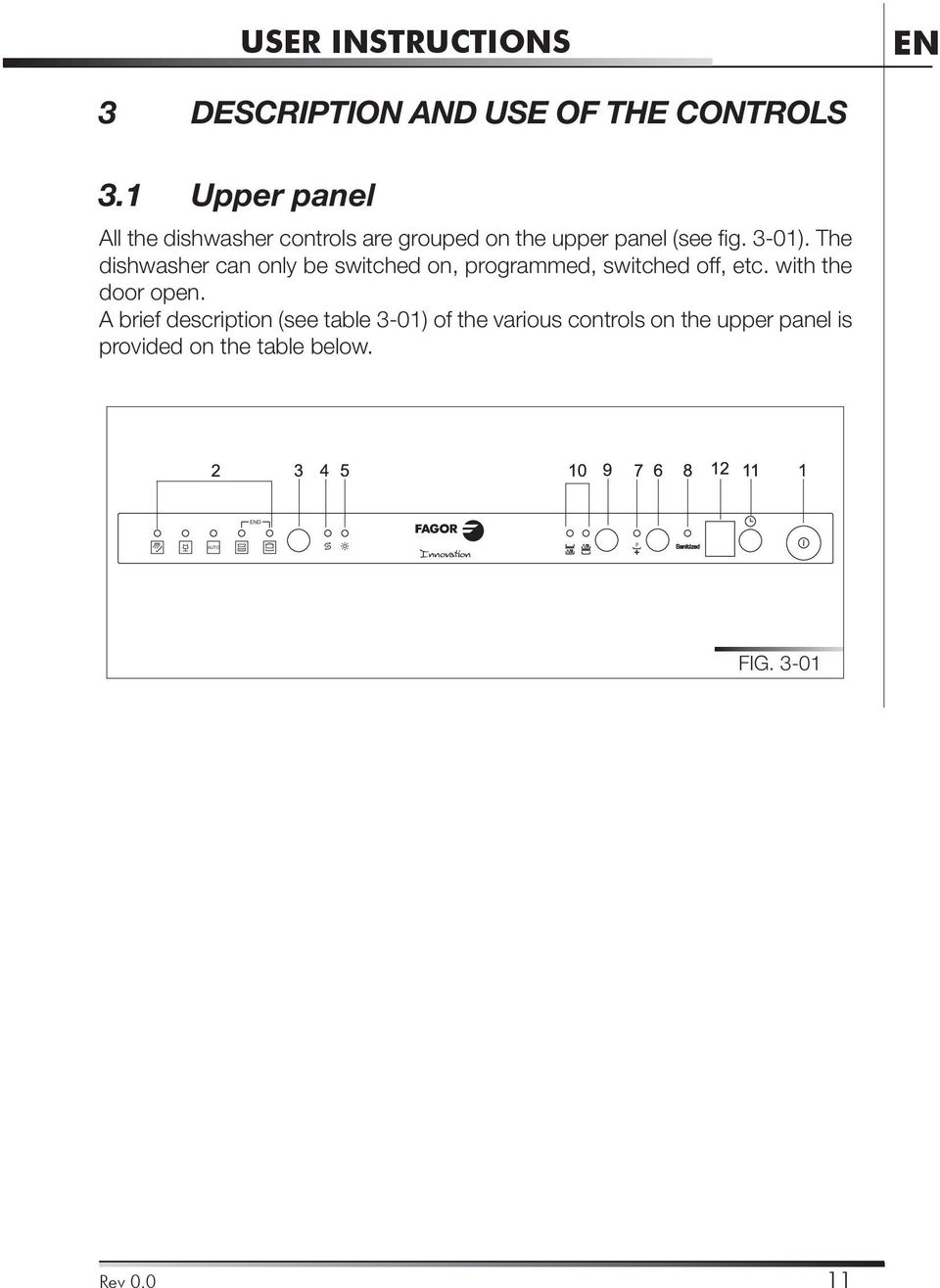
12 EN USER INSTRUCTIONS On/off button Press to power the appliance. Program indicator lights These show which program is selected and whether there are any troubleshootings (error messages). Program selection button Press in sequence to select the required program. Add salt indicator light Shows the appliance has run out of salt. Add rinse aid Shows the appliance has run out of rinse aid. Supplementary program button Press to select one of the fi ve supplementary programs (see table 3-02b). Supplementary program indicator light Shows that one of the fi ve supplementary programs will be run (see table 3-02b). Sanitation indicator light Shows that the function is active. Half-load wash button Press to select the half-load wash option. Half-load indicator lights One of the lights shines to show that the half-load wash function has been selected in the upper or lower rack. Program delay button Press to delay the start of the program up to 9 hours. 12 Information display (start delay, adjusting water softener) Table Setting the washing program and switching it on and off The dishwasher is equipped with a control panel (see fi g. 3-02) which is used to program the appliance and switch it on and off. a b END AUTO P Sanitized FIG Rev 0.0

13 USER INSTRUCTIONS EN To select the most suitable program to wash the dishes, consult the following table which specifi es the most appropriate type of washing sequence depending on the kind of dishes and how dirty they are (see tables 3-02a and 3-02b). STANDARD PROGRAMS DISHES AND NUMBER AND SYMBOL CUTLERY 1 DISH WARMING 2 CRYSTAL 3 AUTO AUTO SUPER WASH ETL SANITATION LISTED 4 NORMAL 5 EXTREME WASH ETL SANITATION LISTED Pans and dishes to rinse and dry Moderately dirty Moderately dirty, including dried-on residue Moderately dirty Very dirty pans and dishes, including dried-on residue PROGRAM SEQUENCE Rinse at 69 C (156.2 F) Dry. Wash at 45 C (113 F) Cold rinse. Rinse at 69 C (156.2 F) Dry. Cold pre-wash (depends on the type of dirt) Wash at 65 C (149 F). Cold rinse. Hot rinse at 70 C (158 F). Dry. Cold pre-wash. Wash at 55 C (131 F). Cold rinse. Rinse at 68 C (154.4 F). Dry. Pre-wash at 45 C (113 F). Wash at 70 C (158 F) 2 cold rinses Rinse at 70 C (158 F) Dry. TIME MINUTES (2) 50 min. 70 min min. 112 min. 122 min. CONSUMPTION WATER (1) 3.9 l 1.03 gal l 2.85 gal l gal l 3.91 gal l 4.83 gal. ENERGY kwh (2) Table. 3-02a Rev
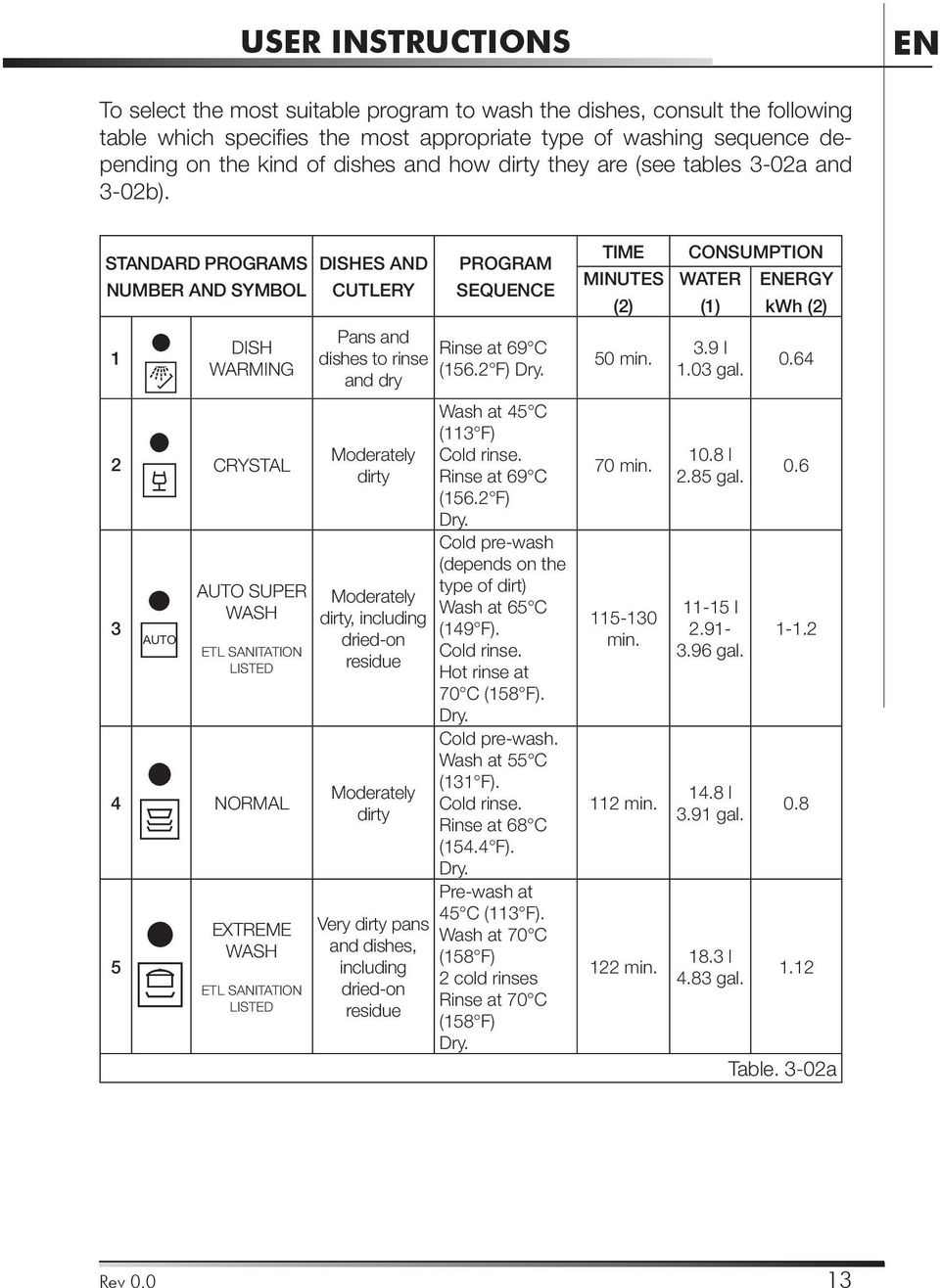
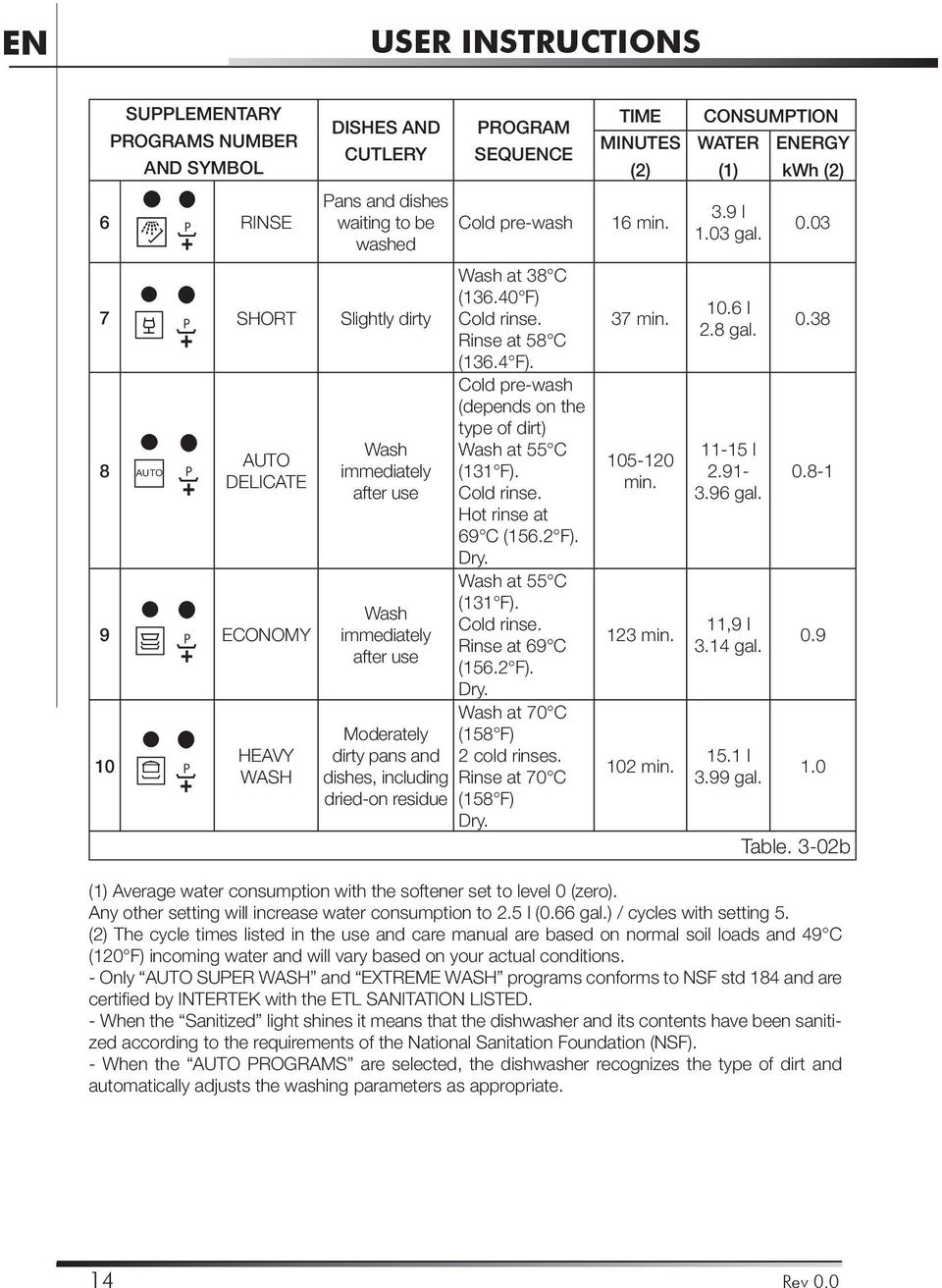
14 EN USER INSTRUCTIONS SUPPLEMENTARY PROGRAMS NUMBER AND SYMBOL 6 P RINSE DISHES AND CUTLERY Pans and dishes waiting to be washed 7 P SHORT Slightly dirty 8 AUTO P AUTO DELICATE 9 P ECONOMY 10 P HEAVY WASH Wash immediately after use Wash immediately after use Moderately dirty pans and dishes, including dried-on residue PROGRAM SEQUENCE Cold pre-wash Wash at 38 C ( F) Cold rinse. Rinse at 58 C (136.4 F). Cold pre-wash (depends on the type of dirt) Wash at 55 C (131 F). Cold rinse. Hot rinse at 69 C (156.2 F). Dry. Wash at 55 C (131 F). Cold rinse. Rinse at 69 C (156.2 F). Dry. Wash at 70 C (158 F) 2 cold rinses. Rinse at 70 C (158 F) Dry. TIME MINUTES (2) 16 min. 37 min min. 123 min. 102 min. CONSUMPTION WATER (1) 3.9 l 1.03 gal l 2.8 gal l gal. 11,9 l 3.14 gal l 3.99 gal. ENERGY kwh (2) Table. 3-02b (1) Average water consumption with the softener set to level 0 (zero). Any other setting will increase water consumption to 2.5 l (0.66 gal.) / cycles with setting 5. (2) The cycle times listed in the use and care manual are based on normal soil loads and 49 C (120 F) incoming water and will vary based on your actual conditions. - Only AUTO SUPER WASH and EXTREME WASH programs conforms to NSF std 184 and are certifi ed by INTERTEK with the ETL SANITATION LISTED. - When the Sanitized light shines it means that the dishwasher and its contents have been sanitized according to the requirements of the National Sanitation Foundation (NSF). - When the AUTO PROGRAMS are selected, the dishwasher recognizes the type of dirt and automatically adjusts the washing parameters as appropriate. 14 Rev 0.0
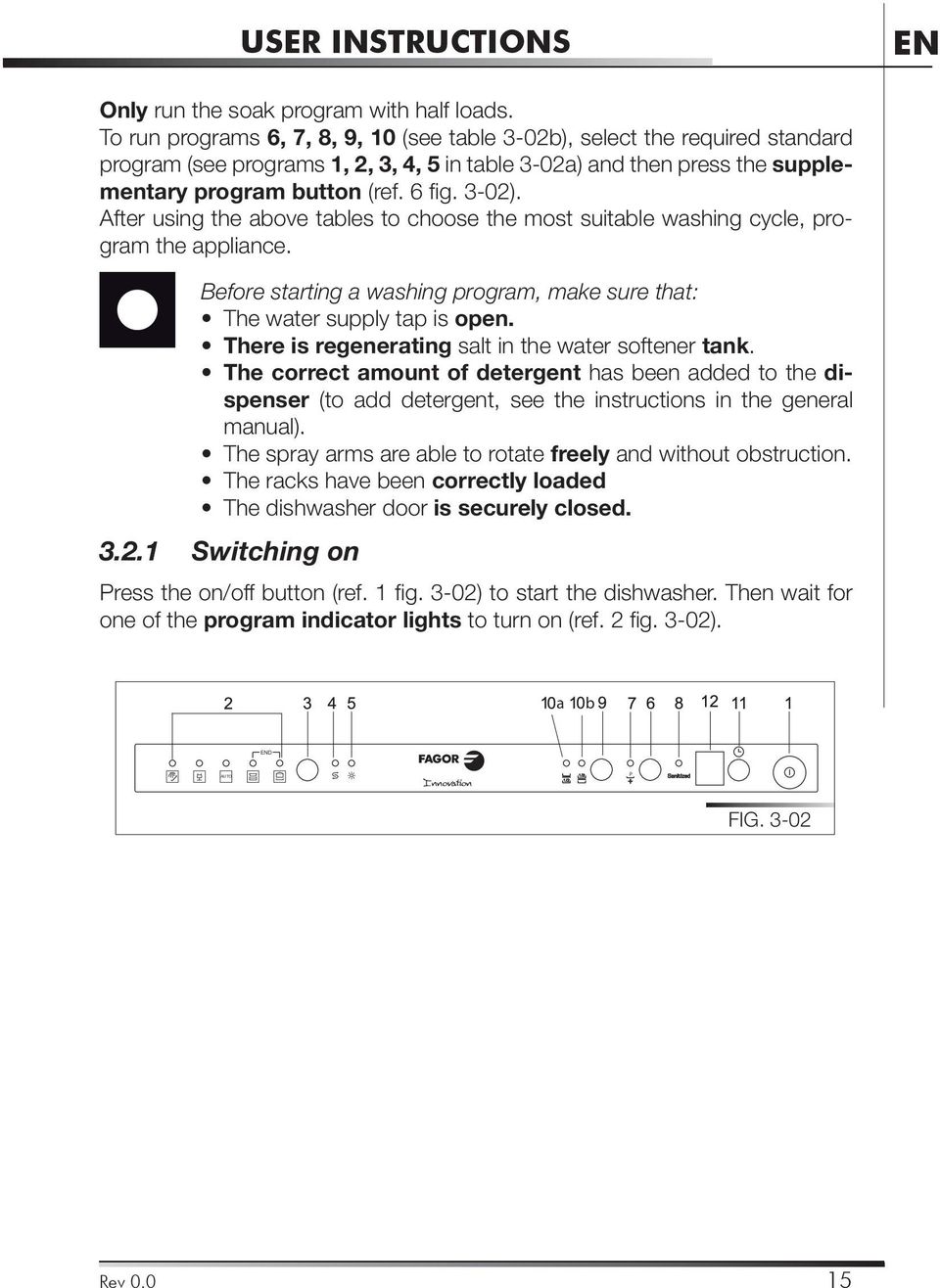
15 USER INSTRUCTIONS EN Only run the soak program with half loads. To run programs 6, 7, 8, 9, 10 (see table 3-02b), select the required standard program (see programs 1, 2, 3, 4, 5 in table 3-02a) and then press the supplementary program button (ref. 6 fi g. 3-02). After using the above tables to choose the most suitable washing cycle, program the appliance. Before starting a washing program, make sure that: The water supply tap is open. There is regenerating salt in the water softener tank. The correct amount of detergent has been added to the dispenser (to add detergent, see the instructions in the general manual). The spray arms are able to rotate freely and without obstruction. The racks have been correctly loaded The dishwasher door is securely closed Switching on Press the on/off button (ref. 1 fi g. 3-02) to start the dishwasher. Then wait for one of the program indicator lights to turn on (ref. 2 fi g. 3-02). a b END AUTO P Sanitized FIG Rev
16 EN USER INSTRUCTIONS Selecting and starting the program Press the program selection button (ref. 3 fi g. 3-02) several times until the indicator light corresponding to the required program turns on (ref. 2 fi g. 3-02); if required, press the relative buttons to select any complementary functions (e.g.: half-load, program delay ; see para options ); close the door; the program will start after about 2 seconds and the relative indicator light will fl ash throughout the cycle (program running signal). If the door of the dishwasher has not been closed or has been incorrectly closed, the washing cycle will not begin. SUPPLEMENTARY PROGRAMS The supplementary program button (ref. 6 fi g. 3-02) adds five extra programs to the ones that can be directly selected with the program selection button. Press the supplementary program button (the indicator light turns on) after selecting the main program (see 1, 2, 3, 4, 5 in table. 3-02a). As the function is memorized, press the button again (the indicator light turns off) if you wish to run one of the 5 main programs for the next cycle End of program The end of the program is signaled by a short beep. Additionally the indicator light of the standard and supplementary programs (marked end ) fl ash Interrupting a program To interrupt the current program simply open the door of the dishwasher; to restart the program, simply close the door again. The program restarts from where it was interrupted Changing the current program To change the current program, simply open the door of the dishwasher and select the new program. Close the door to run the new program automatically. 16 Rev 0.0
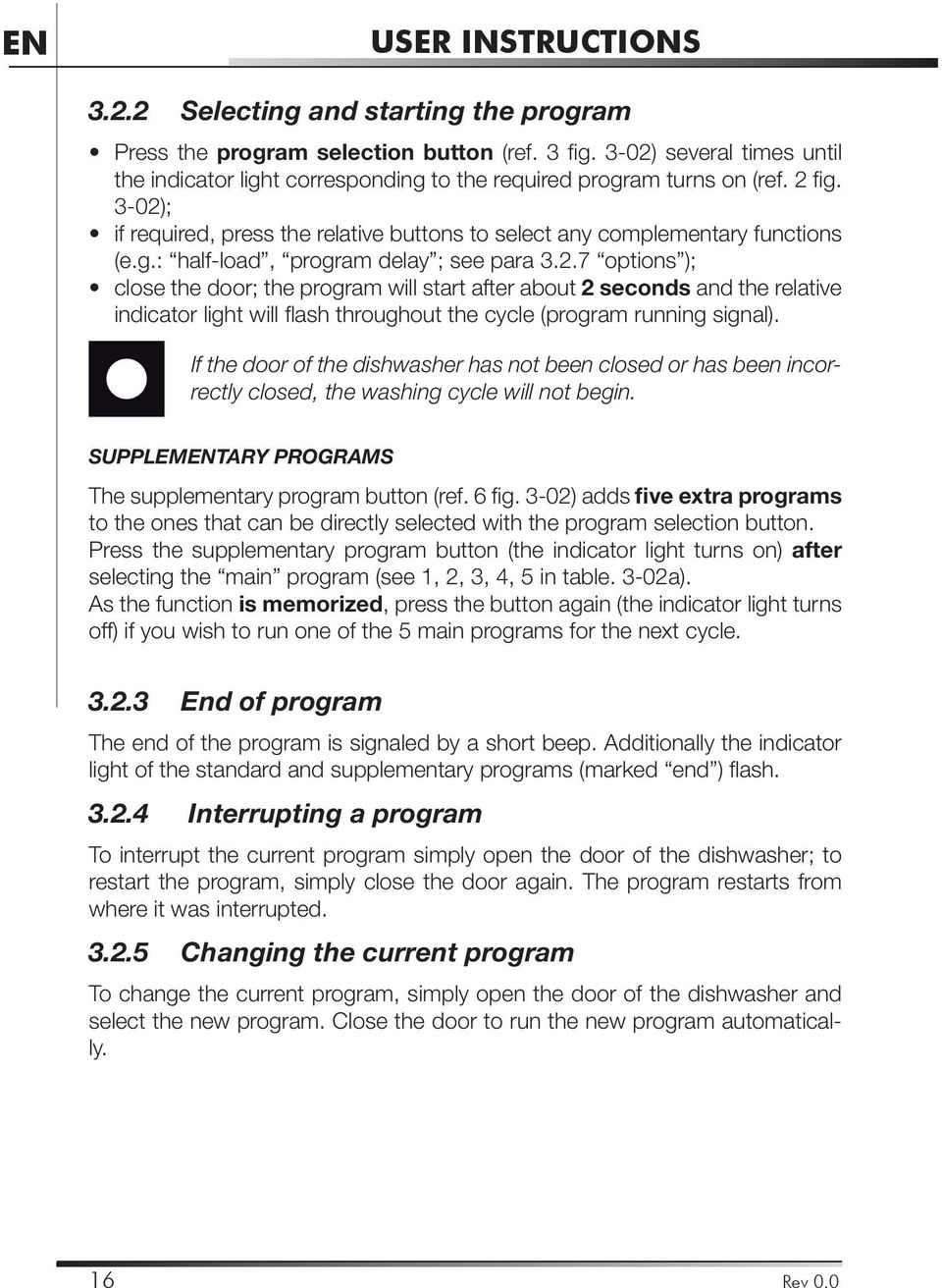
17 USER INSTRUCTIONS EN Canceling the current program To cancel the current program, open the door and press and hold down the program selection button (ref. 3 fi g. 3-02) for a few seconds until the indicator lights of the fourth and fi fth programs turn on (ref. pr. 4, pr. 5 fi g. 3-03). Close the door again. After about 1 minute, the dishwasher terminates the cycle and the indicator lights of the fourth and fi fth programs (ref. pr. 4, pr. 5 fi g. 3-03) start fl ashing. pr. 4 pr. 5 AUTO FIG Options HALF-LOAD This option is particularly suitable for reduced loads and saves on water and electricity. Before selecting the half-load wash option, open the dishwasher door and choose the required washing program (see para 3.2 Setting the washing program and switching it on and off ). The half-load wash cycle can be selected in two different ways using the halfload wash button (ref. 9 fi g. 3-02): press the button once to select washing in the upper rack. This is confi r- med by the appropiate indicator light (ref. 10a fi g. 3-02); press the button twice to select washing in the lower rack. This is confi r- med by the appropiate indicator light (ref. 10b fi g. 3-02); press the button three times to return to the standard full load condition (washing in both racks, both indicator lights off). When washing with just the lower rack is selected, the cutlery basket can be separated and just half used. Rev
18 EN USER INSTRUCTIONS PROGRAM DELAY (available for all programs except soak) The Program delay function delays the beginning of the washing program up to 9 hours from the moment in which programming takes place. This makes it possible to use the dishwasher at a certain time of day. Before programming a delay, open the door of the dishwasher, select the required washing program (see para 3.2 Setting the washing program and switching it on and off ). Select the day by pressing the Program delay button (ref. 11 fi g. 3-02); each time you press the button, the display increases the delay by 1 hour before the appliances starts. 18 Rev 0.0
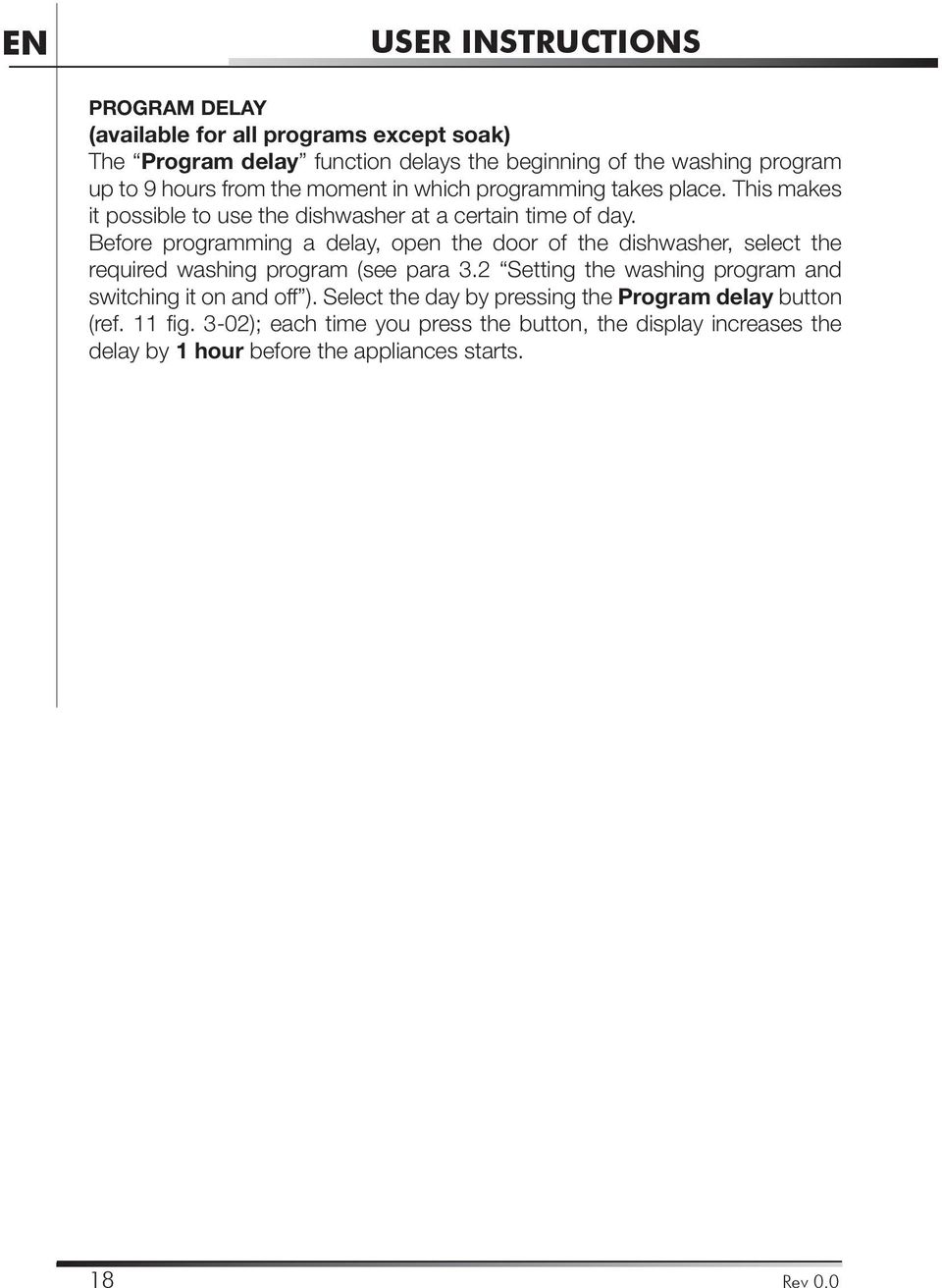
19 USER INSTRUCTIONS EN Switching off At the end of the program, the dishwasher sounds a short beep and the indicator lights of the fourth and fifth program (ref. pr. 4, pr. 5 fi g. 3-04) fl ash. Turn off the appliance by opening the door and pressing the on/off button (ref. 1 fi g. 3-02). pr. 4 pr. 5 AUTO FIG Additional functions Adjusting the water softener N.B.: a different washing program from soak must be used to make the following adjustment. Press and hold down the program delay button (ref. 11 fi g. 3-05) until the preset value appears followed by a dot (normally 3.). Release the button and then press it again and again until the required value is displayed, as indicated in the table (see table. 3-03). The 6 possible adjustment levels will appear in this sequence: 3., 4., 5., 0., 1., 2.. When the required value appears on the display, release the button; after 5 seconds the appliance automatically reverts to the program delay and the adjustment is set to the chosen value. Rev
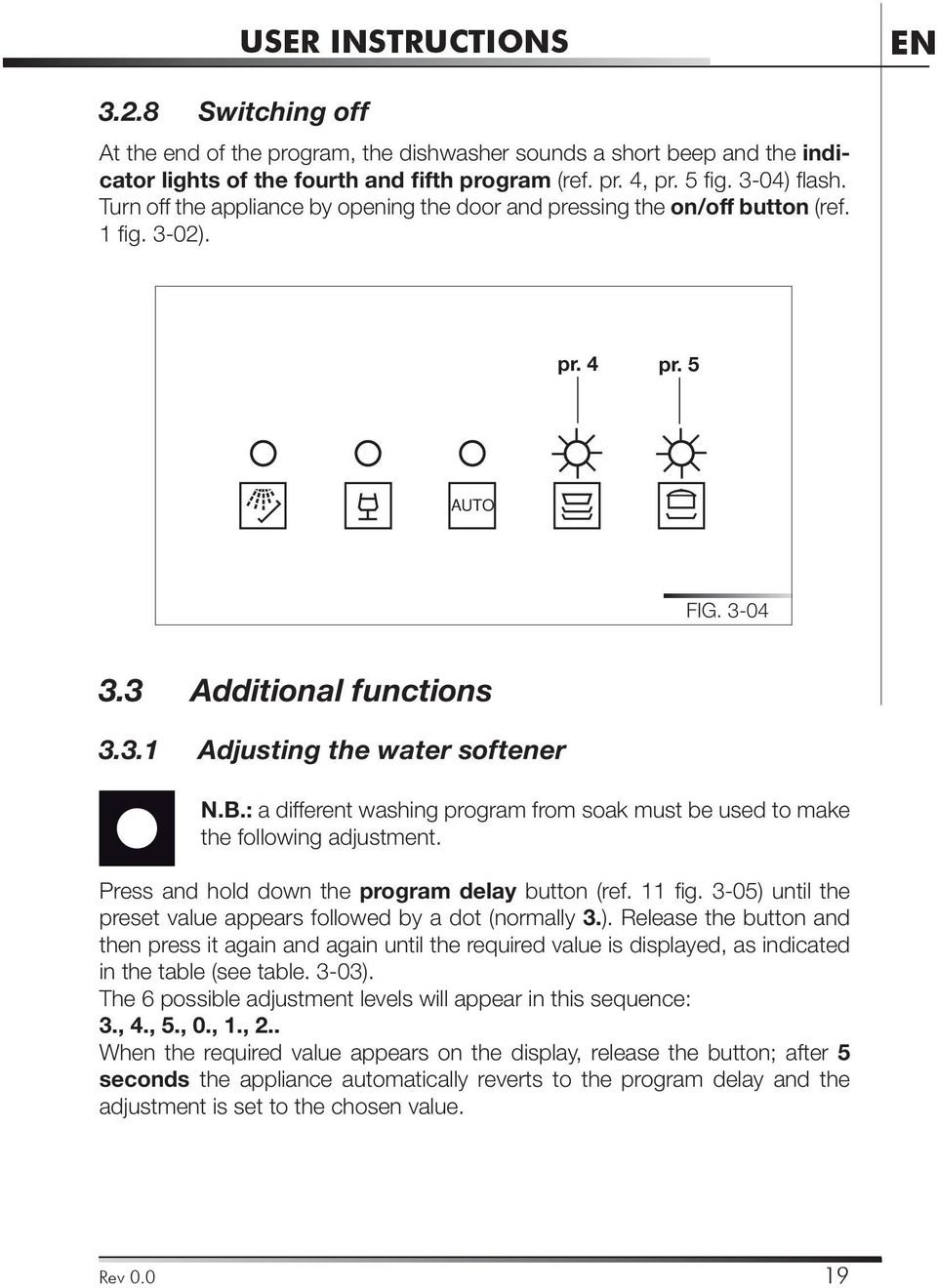
20 EN USER INSTRUCTIONS N.B.: the display indicates the water hardness adjustment and the program delay. A dot (.) after the number means that the water hardness adjustment is being displayed. If no dot (.) appears, the program delay is being displayed. END AUTO P Sanitized FIG Water hardness table (see table. 3-03) German degrees ( D) WATER HARDNESS French degrees ( F) American degrees grains/galls SETTING Table 3-03 Contact your local water board for information on the hardness of your water supply. If it is necessary to open the door during the washing cycle, the program will be interrupted, the relative indicator light will continue to fl ash and a beep will indicate that the cycle has not terminated. Wait for about 1 minute before closing the door and continuing with the program. When the door closes, the program will start from where it was interrupted. This operation should be performed only if necessary as it could cause irregular program performance. 20 Rev 0.0

21 USER INSTRUCTIONS EN 4 ENERGY SAVING AND ENVIRONMENTAL RESPECT Always try to run the dishwasher fully loaded. Do not wash the dishes under a running tap. Use the most suitable washing program for each type of load. Do not pre-rinse. If available, connect the dishwasher to a hot water system with a temperature of up to 60 C (140 F). When possible, skip the drying cycle by opening the door after washing: the air and the residue heat will dry the dishes to perfection. 4.1 Reducing the consumption of detergent and respecting the environment The phosphates contained in dishwasher detergents are harmful to the environment. To avoid using excessive amounts of detergent and to save on electricity: Separate the more delicate items from those that are more resistant to aggressive detergents and high temperatures; Do not pour the detergent directly onto the dishes. Rev
22 EN USER INSTRUCTIONS 5 REMOVING THE DISHES At the end of the washing program, wait at least 20 minute before removing the dishes in order to allow them to cool. To prevent any water droplets on the upper rack from falling onto the dishes in the lower rack, empty the lower rack fi rst and then the upper one. 22 Rev 0.0
23 USER INSTRUCTIONS EN 6 TROUBLESHOOTING The dishwasher can to signal a number of malfunctions by turning on various indicator lights, as described below (see following table): E1 E2 E3 E4 E5 FAULT AUTO AUTO AUTO AUTO AUTO DESCRIPTION Acquastop failure The anti-fl ooding system has tripped (only for models fi tted with this feature). Activates in case of water leaks. Contact the technical assistance center. Safety level The system limiting the water level in the dishwasher has tripped. Interrupt the current program. Switch off the dishwasher, switch it back on again, program a new cycle and press start. If the problem persists, contact the technical assistance center. Water heating malfunction The water is not heated or is incorrectly heated. Repeat the washing program; if the problem persists, contact the technical assistance center. Water temperature monitoring malfunction Interrupt the current program. Switch off the dishwasher, switch it back on again, program a new cycle and press start. If the problem persists, contact the technical assistance center. Water intake malfunction The appliance does not take in water or does so incorrectly. Make sure the water connections are correct, that the water supply tap is open and that the fi lter is not clogged. If the problem persists, contact the technical assistance center. Table 6-01a Rev
24 EN USER INSTRUCTIONS E6 E7 E8 E9 FAULT AUTO AUTO AUTO AUTO DESCRIPTION Water pump-out malfunction The appliance does not pump out the water or does so incorrectly. Make sure the drain hose is not kinked or crushed and that the siphon and fi lters are not clogged. If the problem persists, contact the technical assistance center. Turbine flow-regulator malfunction The appliance is unable to precisely measure the quantity of incoming water. Interrupt the current program and switch off the dishwasher. Switch it back on again, program a new cycle and press start. If the problem persists, contact the technical assistance center. Alternate washing system malfunction Interrupt the current program and switch off the dishwasher. Switch it back on again, program a new cycle and press start. If the problem persists, contact the technical assistance center. Water intake system malfunction Contact the technical assistance center. Table 6-01b Light off Light on Light flashing If an alarm situation occurs, the dishwasher interrupts the current program and signals the fault. Alarms E1, E2, E3, E4, E8, E9 immediately terminate the current program. Alarms E5, E6 interrupt the current program and, after the problem has been eliminated, resume the cycle. Alarm E7 is displayed at the end of the cycle which, however, is completed given that it does not jeopardize the operation of the dishwasher. To reset an alarm: open or close the door, or switch the appliance on and back off again. At this point, the dishwasher can be programmed again. If the fault persists, contact the Authorized Technical Assistance Center. 24 Rev 0.0
25 INSTALLATION INSTRUCTIONS EN 7 INSTALLATION AND HOOK-UP To install and hook up this appliance, consult the attached installation manual. Bear in mind the following warnings when installing and hooking up the dishwasher. DURING INSTALLATION, TAKE CARE NOT TO INJURE YOURSELF ON THE SHARP EDGES OF THE APPLIANCE; WEAR SAFETY GLOVES. INSTALLATION, REPAIRS AND SERVICING MUST BE PER- FORMED BY QUALIFIED AND AUTHORIZED TECHNICIANS. WORK CARRIED OUT BY UNAUTHORIZED PERSONS MAY GEN- ERATE HAZARDS, AS WELL AS INVALIDATING THE WARRANTY. INSTALLATION MUST BE PERFORMED IN COMPLIANCE WITH ALL THE DIRECTIVES IN FORCE IN THE COUNTRY OF INSTALLA- TION AND, IF THESE DO NOT EXIST: IN THE UNITED STATES THE NATIONAL ELECTRIC CODE; IN CANADA THE CANADIAN ELEC- TRIC CODE C LATEST EDITION/PROVINCIAL AND MUNICI- PAL CODES AND/OR LOCAL CODES. BUILDING-IN A DISHWASHER UNDERNEATH A CERAMIC HOB IS ABSOLUTELY FORBIDDEN. A DISHWASHER CAN BE BUILT-IN UNDERNEATH A CONVENTIONAL HOB PROVIDED THERE IS NO BREAK IN THE KITCHEN WORKTOP, AND THE DISHWASHER AND HOB ARE INSTALLED AND SECURED CORRECTLY, SO THAT NO HAZARDS ARE GENERATED. PREVENTING THE RISK OF CLOGGING OR DAMAGE: IF THE WATER PIPE IS NEW OR HAS NOT BEEN USED FOR A LONG TIME, BEFORE CONNECTING TO THE WATER SUPPLY CHECK THAT THE WATER IS CLEAR AND FREE OF IMPURITIES, TO PRE- VENT DAMAGE TO THE APPLIANCE. THE DISHWASHER MUST ALWAYS BE CONNECTED TO THE WATER SYSTEM WITH NEW HOSES; OLD OR USED HOSES MUST NEVER BE RE- USED. CHECK THAT THE VOLTAGE AND THE FREQUENCY OF THE MAINS MATCH THE RATINGS ON THE NAME PLATE OF THE AP- PLIANCE POSITIONED ON THE INNER EDGE OF THE DOOR. Rev
26 EN INSTALLATION INSTRUCTIONS IN THE EVENT OF DAMAGE TO THE SUPPLY CORD, HAVE IT REPLACED BY THE MANUFACTURER OR AN AUTHORIZED TECH- NICAL SERVICE CENTER. THIS APPLIANCE MUST BE EARTHED. IN CASE OF A MALFUNC- TION, THE EARTH REDUCES THE RISK OF ELECTROCUTION BY PROVIDING THE ELECTRICAL CURRENT WITH AN ALTERNATIVE, LESS RESISTANT PATH. BEFORE MAKING ELECTRICAL CONNECTIONS, DISCONNECT THE MAINS POWER SUPPLY FROM THE WORK AREA. CHECK THAT THE MAINS SUPPLY WHEN INSTALLING COMPLIES WITH THE REGULATIONS IN FORCE IN THE COUNTRY OF USE, AND THAT IT IS CORRECTLY EARTHED. THIS APPLIANCE IS FITTED WITH A SUPPLY CORD CONTAINING AN EARTH WIRE AND PLUG. FIT THE PLUG INTO A SUITABLE SOCKET, INSTALLED AND EARTHED IN COMPLIANCE WITH THE LAWS IN FORCE IN THE COUNTRY OF INSTALLATION. AN INCORRECTLY CONNECTED EARTH WIRE MAY CAUSE OF ELECTROCUTION. IF IN DOUBT AS TO THE CORRECT EARTHING OF THE APPLIANCE, CALL A QUALIFIED ELECTRICIAN OR THE TECHNICAL ASSISTANCE CENTER. DO NOT CHANGE THE PLUG ATTACHED TO THE APPLIANCE. IF THE PLUG IS NOT SUITABLE FOR THE SOCKET, CALL A QUALIFIED ELECTRICIAN TO FIT A SUITABLE PLUG. IN THE EVENT OF DAMAGE TO THE SUPPLY CORD, HAVE IT RE- PLACED BY THE MANUFACTURER OR AN AUTHORIZED TECHNI- CAL SERVICE CENTER IN ORDER TO AVOID ANY RISK. DO NOT USE EXTENSION CORDS, ADAPTORS OR SHUNT CON- NECTIONS IN ORDER TO AVOID THE POSSIBILITY OF OVERHEAT- ING OR BURNING, OR PRODUCING FIRE HAZARD. 26 Rev 0.0
27 USER INSTRUCTIONS EN 8 OPERATING INSTRUCTIONS BEFORE USING THE APPLIANCE, MAKE SURE YOU HAVE READ AND UNDERSTOOD ALL THE WARNINGS IN CHAPTER 2, IM- PORTANT SAFETY INSTRUCTIONS. Once the dishwasher has been correctly installed, prepare for use as follows: adjust the water softening system; add the regenerating salt; add the rinse-aid and detergent. Rev
28 EN USER INSTRUCTIONS 8.1 Using the water softening system The amount of scale contained in the water (water hardness index) can cause whitish staining on the dry dishes, which tend to become dull over time. The dishwasher is equipped with an automatic softening system which uses a special regenerating salt to reduce the hardness of the water. The dishwasher is factory set for water hardness level 3 (average hardness df dh / gpg). When using water of medium hardness, the regenerating salt container should be refi lled after approximately 20 washing cycles. The salt container can hold approximately 1.7 Kg (3.75 lb) of salt in grains. Some models are equipped with an optical no-salt indicator. In these models, the cap of the salt container contains a green fl oat which descends as the salt concentration in the water drops. When the green fl oat can no longer be seen, the container must be topped up with regenerating salt. The container is situated at the bottom of the dishwasher. After removing the lower rack, unscrew the salt container cap (ref. A fi g. 8-01) by turning it counter clockwise and pour in the salt using the funnel (ref. A fi g. 8-02) supplied with the dishwasher. Before replacing the cap (ref. A fi g. 8-01), remove any salt residues from around the opening. A Fig Rev 0.0
29 SALT USER INSTRUCTIONS EN A Fig When using the dishwasher for the fi rst time, in addition to the salt it is also necessary to add one liter of water to the container. Each time the salt container is refi lled, make sure that the cap (ref. A fig. 8-01) is securely closed. The mixture of water and detergent must never penetrate the salt container, as this would compromise the operation of the regeneration system. In the event of this occurring, the warranty will be invalidated. Only use regenerating salt specially formulated for domestic dishwashers. If using salt tablets, do not fill the container completely. Do not use table salt as it contains insoluble substances which, over time, may damage the water softening system. When necessary, refi ll the regenerating salt container before starting the washing program. This way, the excess saline solution will be immediately removed by the water; the prolonged presence of salt water inside the tank may lead to corrosion. BE CAREFUL NOT TO CONFUSE THE SALT AND DETERGENT PACKAGES; ADDING DETERGENT TO THE SALT CONTAINER WILL DAMAGE THE WATER SOFTENING SYSTEM. Rev
30 EN USER INSTRUCTIONS 8.2 Using the rinse-aid and detergent dispensers The detergent and rinse aid dispensers are situated on the inner part of the door: the detergent dispenser (ref. A fi g. 8-03) is on the left, and the rinseaid dispenser (ref. B fi g. 8-03) is on the right. A B Fig WITH THE EXCEPTION OF THE SOAK PROGRAM, BEFORE EV- ERY WASH CYCLE IT IS NECESSARY TO ADD THE REQUIRED AMOUNT OF DETERGENT TO THE DETERGENT DISPENSER. THE RINSE AID, ON THE OTHER HAND, SHOULD ONLY BE ADD- ED AS REQUIRED. 30 Rev 0.0
31 USER INSTRUCTIONS EN Adding the rinse-aid The rinse aid helps the dishes dry faster and prevents the formation of scale deposits and staining; it is automatically added to the water during the fi nal rinse cycle, from the container situated on the inner side of the door. B A C To add rinse aid: Open the door. Rotate the container cap (ref. A fi g. 8-04) counter clockwise by ¼ of a turn and remove it. Add the rinse aid until the container is full (approximately 4.7 oz). The optical level indicator (ref. B fi g. 8-04), on the side of the cap should be completely obscured. Refi ll the rinse aid when the optical level indicator becomes clear again, or when the rinse aid warning light illuminates (see para Description and use of controls ). Replace the cover (ref. A fi g. 8-04) by turning it in a clockwise direction until it is fully closed. Use a cloth to remove any spillage of rinse aid which might lead to the formation of excess foam Adjusting the rinse-aid dispenser setting Fig The rinse-aid dispenser can be set to one of 6 different levels. The dishwasher is factory set for medium water hardness (selector set to 3 ). To change the setting, turn the dispenser selector (ref. C fi g. 8-04) to the desired position: the amount of rinse-aid dispensed is proportional to the position of this selector. The minimum amount of rinse-aid (selector turned to 1 ) is approximately oz and the maximum amount (selector turned to 6 ) is approximately 0.2 oz. Rev
32 EN USER INSTRUCTIONS To adjust the rinse aid setting, rotate the dispenser cap (ref. A fi g. 8-04) a quarter turn in an counter clockwise direction and remove it. Then use a screwdriver to rotate the rinse aid selector to the desired position. Replace the cover (ref. A fi g. 8-04) by turning it in a clockwise direction until it is fully closed. The amount of rinse aid must be increased if the washed dishes appear dull or feature circular stains. If, on the other hand, the dishes are sticky or have white streaks, it is necessary to reduce the rinse aid setting Adding the detergent DO NOT INHALE OR SWALLOW DETERGENT AS THIS MAY CAUSE BURNS AND/OR PERMANENT DAMAGE TO THE NOSE, MOUTH AND THROAT, AND EVEN LEAD TO SUFFOCATION; KEEP DETER- GENT AWAY FROM YOUR EYES. IF ONE OF THE ABOVE SITUA- TIONS OCCURS, SEEK MEDICAL ASSISTANCE IMMEDIATELY. PREVENT CHILDREN FROM COMING INTO CONTACT WITH DE- TERGENT; KEEP THEM AWAY FROM THE DISHWASHER WHEN THE DOOR IS OPEN AS IT MAY CONTAIN DETERGENT RESIDUES. FILL THE DISHWASHER JUST BEFORE STARTING THE WASHING CYCLE AND THEN KEEP THE DETERGENT OUT OF THE REACH OF CHILDREN. To open the detergent dispenser cover, lightly press the relative button (ref. A fi g. 8-05). Add the detergent and close the cover carefully, pushing down on the arrow (ref. B fi g. 8-05). During the washing cycle, the dispenser will be opened automatically. A Fig Rev 0.0
33 USER INSTRUCTIONS EN A B Fig When a program with hot prewash is selected (see table 3-02a), extra detergent must be placed in the cavity (ref. A or B fi g. 8-06, depending on models). Only use dishwasher-specifi c detergents. For optimal washing results it is important to use a good quality detergent. The detergent packs must be sealed and stored in a dry place to prevent the formation of lumps which may negatively affect washing results. Once opened the detergent packs should not be kept for too long, otherwise the detergent loses its effectiveness. Do not use detergents formulated for washing dishes by hand, because they produce a great deal of foam and may negatively affect the operation of the dishwasher. Add the correct amount of detergent. An insuffi cient amount of detergent will result in a partial removal of dirt from the dishes, whereas an excessive amount is wasteful and does not improve the washing results. The market offers liquid and powder detergents with differing chemical compositions, which may contain phosphates, or be phosphate-free but contain natural enzymes. Detergents containing phosphates are more effective against grease and starch at temperatures above 60 C (140 F). Enzyme detergents, on the other hand, are also effective at lower temperatures (from 40 to 55 C / from 104 to 131 F) and are more easily biodegradable. With enzyme detergents it is possible to obtain at low temperatures comparable results to those which can only be achieved at 65 C (149 F) using traditional detergents. For the safeguarding of the environment we recommend the use of phosphates and chlorine-free detergents. Rev
34 EN USER INSTRUCTIONS When using detergent tabs, place them in the cutlery basket. The dispenser has been designed for powder or liquid detergent. As the cap does not open completely during the washing cycle, tabs are not fully released (and dissolved). This could generate the following problems: - insuffi cient detergent released during the cycle and poor washing results; - the detergent is compacted in the dispenser and is released during the fi nal rinse cycle. THE INTRODUCTION OF DETERGENT INTO THE RINSE AID DISPENSER, EVEN IN LIQUID FORM, WILL DAMAGE THE DISH- WASHER. 8.3 General warnings and recommendations Before using the dishwasher for the fi rst time, it is advisable to read the following recommendations concerning dish types to be washed and their loading. There are generally no constraints on the washing of domestic dishes, but in certain cases it is necessary to take their characteristics into account. Before loading the dishes into the racks it is necessary to: remove coarse food remains: e.g. bones, fi sh-bones, etc. which may clog the fi lter or damage the wash pump; soak any pots or pans with burnt-on food remains on the bottom to facilitate removal, then load them into the LOWER RACK. Use the ½ load wash option (if available) for washing small amounts of dishes; it saves water and electricity. When using this function, only load the rack selected for the ½ load wash; the other rack must remain empty. There is no need to pre-wash the dishes under running water before loading them into the racks since this only wastes water. Correct loading of the dishes helps ensure optimal washing results. WARNING! make sure that the dishes are securely in place so that they cannot tip over or obstruct the rotation of the spray arms during the washing cycle; do not place very small objects in the racks as these could fall and obstruct the spray arms or the wash pump; containers such as cups, bowls, glasses and pots should always be loaded with the opening facing downwards and with any cavities at an angle, to allow the water to drain out; do not stack dishes or place them in such a way that they cover one other; do not place glasses too close together because they may knock against each other and break, or there might be staining at the point where they touch. 34 Rev 0.0
35 USER INSTRUCTIONS EN MAKE SURE that the items being washed are dishwasher-safe. Items that are not dishwasher-safe: Wooden dishes, pots or pans: these may be damaged by the high washing temperatures. Handcrafted items: these are rarely suitable for washing in a dishwasher. The relatively high water temperatures and the detergents used may damage them. Lightweight objects: place lightweight objects in the upper rack where the water pressure is lower. Dishes and objects in copper, tin, zinc or brass: these tend to stain. Aluminum dishes: items made from anodized aluminum may lose their color. Silverware: silver items may stain. Glass and crystal: in general, glass and crystal objects can be washed in the dishwasher. However, certain types of glass and crystal may become dull and lose their clearness after many washings. Therefore, for these items we recommend using the least aggressive program available (see para Description and use of the controls ). Decorated items: the decorated objects available on the market are generally able to withstand washing in the dishwasher, although the colors may fade after a great many washes. If in doubt as to the fastness of the colors, it is advisable to wash just a few items at a time for approximately one month. Rev
36 EN USER INSTRUCTIONS 8.4 Using the racks The dishwasher has a capacity of 12 place-settings, including serving dishes. Examples of loading 12 place-settings in the upper rack (see fi g. 8-07) and in the lower rack (see fi g. 8-08) are shown below. Fig Fig Rev 0.0
37 USER INSTRUCTIONS EN Lower rack The lower rack receives the full force of the lower spray arm, and should therefore be used for the toughest items with a heavier degree of soiling. All types and combinations of loads are permitted, provided that the dishes, pots and pans are arranged with all the soiled surfaces exposed to the water jets coming from the bottom. To make the most of the space inside the rack when loading large items, is equipped with tip-up supports for plates (see fi g. 8-09). Fig Rev
38 EN USER INSTRUCTIONS Loading the lower rack (see fi g. 8-10) Carefully load fl at plates, soup plates, dessert and serving dishes, positioning them vertically. Pots, pans and their covers must be loaded upside down. When loading soup plates and dessert bowls, be sure to leave a gap between them. Esempi LOADING di caricamento: EXAMPLES: Disposizione 1/2 LOAD 1/2 carico (solo su alcuni modelli) Fig Rev 0.0
39 USER INSTRUCTIONS EN Cutlery basket (see fi g. 8-11) The cutlery basket can be removed to simplify unloading. Arrange the cutlery in an orderly manner inside the basket, with the handles pointing downwards and taking care not to injure yourself with the knife blades. The basket is suitable for all types of cutlery, except those long enough to interfere with the upper spray arm. Place long items (ladles, wooden spoons and cooking knives) that may interfere with the spray arm in the upper rack making sure that knife tips do not protrude. The dishwasher is complete with two cutlery baskets, which means that one of them can be removed, freeing space in the bottom rack, if there is not much cutlery to be washed, or if a ½ load program is being used (on models with this function). The baskets feature an exclusive system of independent sliding tip-up supports, offering a choice of combinations to allow optimum use of the space available. HORIZONTAL Inserto INSERT orizzontale CLOSED chiuso HORIZONTAL Inserto INSERT orizzontale OPEN aperto VERTICAL Inserti verticali INSERTS Movimento MOVEMENT REQUIRED per TO EXTRACT THE INSERTS l'estrazione degli inserti Fig Rev
40 EN USER INSTRUCTIONS Upper rack (see fi g. 8-12) It is recommended to load the upper rack with small or medium-sized items such as glasses, small plates, tea or coffee cups, shallow bowls and light objects made from heat resistant plastic. If the upper rack is used in the lowermost position, it can also be loaded with serving dishes, provided they are only slightly soiled. The top rack is fi tted, on the left, with two plastic racks which can be raised to make room for tall glasses, such as stem glasses. Fig Rev 0.0
41 USER INSTRUCTIONS EN Loading the upper rack (see fi g. 8-13) Load plates facing forward; cups, bowls etc. must always be facing down-wards. The left-hand side of the rack can be loaded with two layers of cups and glasses. The center can be fi lled with plates and side-plates, fi tted upright into the supports provided. LOADING EXAMPLES: Fig Rev
42 EN USER INSTRUCTIONS T he upper rack can be set in three different positions on both sides. The rack must be level on both sides. To raise the rack (ref. A fi g. 8-14), lift it with the two handles (e.g.: ref. B fi g. 8-14) to the fi rst or second catch depending on the height required. To lower it (ref. C fi g. 8-14), pull up the two release levers (e.g.: ref. D fi g. 8-14). This is also possible with the rack loaded, but in this case when lowering the rack it should be held steady with one hand to avoid knocking the dishes. A C B D Fig Rev 0.0
43 USER INSTRUCTIONS EN 9 CLEANING AND USER-MAINTENANCE BEFORE CARRYING OUT ANY WORK, ALWAYS DISCONNECT THE APPLIANCE FROM THE ELECTRICAL POWER SUPPLY. 9.1 General warnings and recommendation NEVER USE ABRASIVE AND/OR CORROSIVE DETERGENTS TO CLEAN THE APPLIANCE. Clean the outer surfaces and door-lining of the dishwasher regularly using a soft cloth moistened with a neutral detergent (not abrasive and/or corrosive) suitable for painted surfaces. Clean the door gaskets with a damp sponge. Periodically (once or twice a year) it is advisable to clean the tank and gaskets, using a soft cloth and water to remove any deposits. Do not clean the controls with too much water as this may leak onto the electronic components and damage them. After cleaning, dry the appliance with a soft, lint-free cloth. If stainless steel surfaces are preset, clean them with a non-abrasive product specifi c for stainless steel. To prevent stains, a nebulizer may also be used, though sparingly and at a moderate pressure. Rev
44 EN USER INSTRUCTIONS 9.2 Cleaning the water intake filter Clean the water inlet fi lter at regular intervals. After closing the delivery tap, unscrew the ring nut (ref. A fi g. 9-01) on the water inlet pipe (using a pair of pliers, if necessary) and delicately clean the fi lter, removing deposits or impurities. Then fi rmly fi x the pipe by tightening the ring nut (ref. A fi g. 9-01) (use a pair of pliers, if necessary). A 9.3 Cleaning the spray arms Fig The spray arms can be easily removed for periodic cleaning of the nozzles, to prevent possible clogging. Wash them under running water (at room temperature) and carefully replace them in their seats, checking that their rotary movement is in no way impeded; if this is not the case, make sure they have been mounted properly. Removing the spray arms To remove the upper spray arm (ref. A fi g. 9-02), unscrew the locking ring (ref. B fi g. 9-02) by turning it clockwise. After cleaning, remount the spray arm in its seat and tighten the locking ring by turning it anti-clockwise. To remove the lower spray arm (ref. A fi g. 9-03), simply lift it up, pulling by the central part (see fi g. 9-03). Then remount the lower spray arm into its seat and push it down slightly until it click into place (see fi g. 9-03). 44 Rev 0.0
45 USER INSTRUCTIONS EN A B Fig A Fig Rev
46 EN USER INSTRUCTIONS 9.4 Cleaning the filter unit Periodically inspect the fi lter unit (ref. A fi g. 9-04) and, if necessary, clean it under running water (at room temperature), using a stiff brush. To remove the fi lter, grip the tabs, turn counter clockwise and lift upwards; push the center fi lter (ref. A fi g. 9-05) from the underside to remove it from the micro-fi lter; separate the two parts which make up the plastic center fi lter by pressing the body of the fi lter in the zone shown by the arrows (ref. B fi g. 9-05); remove the center fi lter by lifting it upwards. after cleaning, remount the fi lter unit, joining the two parts comprising the centre fi lter by pushing slightly until they click into place; insert the centre fi lter into the micro-fi lter (see fi g. 9-05). Reposition the fi lter unit (ref. A fi g. 9-04) into its seat, turning it clockwise until it locks. A Fig A B B Fig Rev 0.0
47 USER INSTRUCTIONS EN 9.5 General warnings and recommendations for correct maintenance Clean the fi lters under running water (at room temperature) using a stiff brush. When removing the filter, take care that there are no food residues on it. If any residues fall into the washing pit (ref. A fi g. 9-06), they might block hydraulic components or foul the spray arm nozzles. It is essential to thoroughly clean the filters according to the above instructions: the dishwasher cannot function if the fi lters are clogged. Carefully replace the fi lters in their seats, to avoid damaging the wash pump. Fig Rev
48 EN USER INSTRUCTIONS Prolonged non-use recommendations Run the soak program twice in succession. Unplug the power cord from the socket. Leave the door slightly open in order to prevent the formation of unpleasant odors inside the washing tank. Fill the rinse-aid dispenser. Shut off the water supply tap. Before starting the dishwasher after prolonged non-use Check that there are no deposits of sludge or rust inside the water pipe: if there are, allow the water to run from the water supply tap for a few minutes. Plug the power cord back into the socket. Reconnect the water intake hose and open the tap again. 9.6 Troubleshooting minor problems In some cases it is possible to remedy minor problems by referring to the following instructions: If the program fails to start, check that: the dishwasher is connected to the electrical power supply; there is no power failure; the water tap is open; the dishwasher door is properly closed. If water remains inside the dishwasher, check that: the drain hose is not kinked the drain siphon is not obstructed; the dishwasher fi lters are not clogged. If the dishes do not come out clean, check that: the correct amount of detergent has been added; there is regenerating salt inside the special container; the dishes are being loaded correctly; the selected program is suitable for the dish types and their degree of soil; all the fi lters are clean and positioned correctly; the spray arm nozzles are not obstructed; there is no object obstructing the rotation of the spray arms. 48 Rev 0.0
49 USER INSTRUCTIONS EN If the dishes fail to dry or remain dull, check that: there is rinse aid inside the special container; the rinse-aid dispenser setting is correct; the detergent used is of good quality and has not lost its effectiveness (due to incorrect storage, for example, the box was left open without brackets). If the dishes show signs of streaking, staining, etc., check that: the rinse aid dispenser setting is not too high. If there are visible traces of rust inside the tank: the tank is made of steel, and therefore any rust marks are due to external elements (fragments of rust from the water pipes, pots, cutlery, etc.). Special products are commercially available to remove such marks. check that the amount of detergent being used is correct. Certain detergents can be more corrosive than others. check that the cap of the salt container is securely closed, and that the water softening setting is correct. IF AFTER PERFORMING THE ABOVE TROUBLESHOOTING IN- STRUCTIONS THE PROBLEM PERSISTS, CALL THE NEAREST TECHNICAL ASSISTANCE CENTER. WARNING: ANY OPERATIONS PERFORMED ON THE AP- PLIANCE BY AN UNAUTHORIZED PERSON ARE NOT COV- ERED BY THE WARRANTY AND SHALL BE PAID FOR BY THE USER. Rev
50 EN USER INSTRUCTIONS 10 TECHNICAL DATA (SEE TABLE 10-01) Width 59.7 cm 59.9 cm (23-1/ /64 ) Depth measured flush with the outer edge of the 55 cm (21-21/32 ) control panel Height from 86 cm to 91 cm (from 33-55/64 to 35-53/64 ) Capacity Water supply pressure 12 standard place-settings min. 7 - max. 130 PSI (min. 0.5 max. 9 bar) Electrical characteristics See rating plate Table Rev 0.0
51 SOMMAIRE FR SOMMAIRE 1 INTRODUCTION AVERTISSEMENT SUR LA SÉCURITÉ ET L UTILISATION DESCRIPTION ET UTILISATION DES COMMANDES Sélection du programme de lavage, mise en marche et arrêt Mise en marche Sélection et démarrage du programme Fin du programme Interruption d un programme Sélection d un autre programme Annulation du programme en cours d exécution Options Arrêt Fonctions supplémentaires Réglage de l adoucisseur POUR ÉCONOMISER DE L ÉNERGIE ET RESPECTER L ENVIRONNE- MENT Pour réduire les consommations de produit de lavage et respecter l environnement VIDER LE LAVE-VAISSELLE GUIDE DE DÉPANNAGE INSTRUCTIONS POUR L INSTALLATION ET LA POSE INSTRUCTION POUR L UTILISATION Utilisation de l adoucisseur d eau Rev 0.0 1
52 FR SOMMAIRE 8.2 Utilisation du distributeur de produit de lavage et du doseur de liquide de rinçage Ajout du liquide de rinçage Réglage du dosage du liquide de rinçage Chargement du produit de lavage Avertissements et conseils généraux Utilisation des paniers Panier inférieur Panier à couverts Panier supérieur INSTRUCTIONS POUR LE NETTOYAGE ET L ENTRETIEN Avertissements et conseils généraux Nettoyage du fi ltre d arrivée d eau Nettoyage des bras de lavage Nettoyage du groupe fi ltrant Instructions et conseils pour un entretien correct Élimination de petits inconvénients DONNÉES TECHNIQUES (VOIR TAB ) Rev 0.0
53 INTRODUCTION FR 1 INTRODUCTION Nous vous remercions d avoir choisi l un de nos produits. Pour connaître les conditions les plus appropriées pour une utilisation correcte et sûre de votre lave-vaisselle, lisez attentivement les instructions de ce manuel. Les paragraphes sont proposés de façon à faire connaître progressivement toutes les fonctions de l appareil ; les textes sont facilement compréhensibles et sont illustrés par des images détaillées. Ce manuel, d une consultation facile, est conçu pour offrir des réponses aux questions qui peuvent surgir lors de l utilisation du lave-vaisselle. Avant d utiliser le lave-vaisselle, lisez avec attention ce qui est reporté au chapitre 2 Avertissements pour la sécurité et l utilisation. Pour toute autre information concernant l utilisation et l entretien du lave-vaisselle, lisez attentivement le manuel général ci-joint. Le manuel comprend les sections suivantes : INTRODUCTION : cette section contient des informations génériques concernant le manuel. AVERTISSEMENTS : cette section contient une série d avertissements concernant la sécurité et l utilisation du lave-vaisselle. INSTRUCTIONS POUR L INSTALLATEUR : elles sont destinées au technicien qualifié qui doit effectuer l installation, la mise en service et l essai de l appareil. INSTRUCTIONS POUR L UTILISATEUR : cette section contient des conseils utiles sur l utilisation des paniers, bras de lavage, réservoirs et fi ltres. Nomenclature des figures et des tableaux : l encadré qui contient les fi gures reporte, en bas sur la droite, la numérotation progressive de celles-ci. Un exemple de numérotation est Fig. 4-01, où le premier chiffre (4) correspond au chapitre d appartenance de la fi gure, tandis que le deuxième chiffre (01) correspond au numéro progressif de la fi gure au sein du chapitre 4 (dans l exemple, la Fig correspond à la première fi gure du chapitre 4). La numérotation des tableaux suit le même principe avec, au lieu de Fig., la notation Tab. (par ex. Tab correspond au premier tableau du chapitre 4). Si un même tableau occupe plusieurs pages, une lettre est ajoutée après le chiffre progressif (par ex. Tab. 4-01a, Tab. 4-01b ). Rev 0.0 3
54 FR INTRODUCTION Symboles utilisés dans ce manuel (voir tab. 1-01) DANGER. Ce symbole indique des informations et avertissements qui doivent impérativement être respectés pour ne pas compromettre la sécurité des personnes ou endommager l appareil. DANGER ÉLECTRIQUE. Ce symbole indique des informations et avertissements concernant les circuits électriques qui doivent impérativement être respectés pour ne pas compromettre la sécurité des personnes ou endommager l appareil. Ce symbole indique des informations et avertissements de caractère général. Tab Rev 0.0
55 AVERTISSEMENT FR 2 AVERTISSEMENTS SUR LA SÉCURITÉ ET L UTILISATION (Conserver ces instructions) CE MANUEL FAIT PARTIE INTÉGRANTE DE L APPAREIL : IL DOIT ÊTRE CONSERVÉ INTACT ET ACCOMPAGNER LE LAVE- VAISSELLE (AVEC LES ÉVENTUELS MANUELS ANNEXÉS INS- TALLATION ET DESCRIPTION DES COMMANDES ). AVANT L UTILISATION, NOUS CONSEILLONS DE LIRE AVEC ATTENTION TOUTES LES INDICATIONS CONTENUES DANS LE MANUEL. L INSTALLATION DOIT ÊTRE EFFECTUÉE PAR DU PERSONNEL QUALIFIÉ, CONFORMÉMENT AUX NORMES EN VIGUEUR. CET APPAREIL EST PRÉVU POUR UNE UTILISATION DE TYPE DO- MESTIQUE ET RÉPOND AUX DIRECTIVES ACTUELLEMENT EN VIGUEUR, Y COMPRIS EN CE QUI CONCERNE LA PRÉVENTION ET L ÉLIMINATION DES PERTURBATIONS ÉLECTROMAGNÉTI- QUES. L APPAREIL EST FABRIQUÉ POUR EXÉCUTER LA FONC- TION SUIVANTE : LAVAGE ET SÉCHAGE DE LA VAISSELLE ; TOUTE AUTRE UTILISATION DOIT ÊTRE CONSIDÉRÉE COMME INCORRECTE. LE FABRICANT DÉCLINE TOUTE RESPONSABILITÉ POUR UNE UTILISATION AUTRE QUE DE CELLES INDIQUÉES. LA PLAQUE D IDENTIFICATION, AVEC LES DONNÉES TECHNI- QUES, LE NUMÉRO MATRICULE ET LE MARQUAGE, EST PO- SITIONNÉE DE FAÇON VISIBLE SUR LE BORD INTERNE DE LA PORTE DU LAVE-VAISSELLE. LA PLAQUE D IDENTIFICATION NE DOIT JAMAIS ÊTRE EN- LEVÉE. L APPAREIL N EST PAS ADAPTÉ POUR UNE UTILISATION MARI- TIME OU MOBILE COMME, PAR EXEMPLE, SUR DES CAMPING- CARS OU BATEAUX. LES LAVE-VAISSELLE CERTIFIÉS POUR UN USAGE DOMESTIQUE NE SONT PAS DESTINÉS AUX ÉTABLISSE- MENTS ALIMENTAIRES AUTORISÉS. CONTRÔLER QUE LA TENSION, LA FRÉQUENCE ET LA SENSIBI- LITÉ DE PROTECTION DE L INSTALLATION ÉLECTRIQUE GÉNÉ- RALE CORRESPONDENT AUX INDICATIONS REPORTÉES SUR LA PLAQUE D IDENTIFICATION DE L APPAREIL. Rev 0.0 5
56 FR AVERTISSEMENT NE PAS LAISSER DES RÉSIDUS D EMBALLAGE SANS SUR- VEILLANCE DANS L HABITATION. SÉPARER LES DIFFÉRENTS MATÉRIAUX DE L EMBALLAGE À JETER ET LES APPORTER DANS LE CENTRE DE COLLECTE SÉLECTIVE LE PLUS PROCHE. LES RÉSIDUS D EMBALLAGE NE DOIVENT PAS ÊTRE LAISSÉS À LA PORTÉE DES ENFANTS, DE PERSONNES AYANT DES CAPACI- TÉS PHYSIQUES ET/OU MENTALES RÉDUITES OU DES ANIMAUX AFIN D ÉVITER LE RISQUE D ASPHYXIE. AVANT DE PROCÉDER À L INSTALLATION, COUPER L ALIMENTA- TION ÉLECTRIQUE DANS LA ZONE DE POSITIONNEMENT. NE PAS UTILISER DES PROLONGATEURS, ADAPTATEURS OU DÉRIVATEURS, CAR ILS PEUVENT PROVOQUER DES SUR- CHAUFFES OU S ENFLAMMER EN ENTRAÎNANT DES RISQUES D INCENDIE. PENDANT L INSTALLATION, FAIRE ATTENTION AUX BORDS TRANCHANTS SUR LE LAVE-VAISSELLE ; POUR ÉVITER DE SE BLESSER, METTRE DES GANTS DE SÉCURITÉ. LA MISE À LA TERRE CONFORMÉMENT AUX MODALITÉS PRÉ- VUES PAR LES NORMES DE SÉCURITÉ DE L INSTALLATION ÉLECTRIQUE EST OBLIGATOIRE. EN CAS DE DOUTE, FAIRE CONTRÔLER L INSTALLATION PAR UN ÉLECTRICIEN QUALIFIÉ (VOIR ÉGALEMENT LES AVERTISSEMENTS REPORTÉS DANS LE CHAPITRE 7). LE FABRICANT DÉCLINE TOUTE RESPONSABILITÉ POUR LES ÉVENTUELS DOMMAGES AUX PERSONNES OU AUX CHOSES DÉRIVANT D UNE MISE À LA TERRE NON EXÉCU- TÉE OU DÉFECTUEUSE. APRÈS CHAQUE UTILISATION, METTRE HORS TENSION LE LAVE-VAISSELLE POUR ÉVITER UNE DISPERSION D ÉNERGIE ÉLECTRIQUE. 6 Rev 0.0
57 AVERTISSEMENT FR EN CAS D ANOMALIES DE FONCTIONNEMENT, DÉBRANCHER LE LAVE-VAISSELLE DU RÉSEAU ÉLECTRIQUE ET FERMER LE ROBINET D EAU. NE PAS UTILISER DES APPAREILS ENDOMMAGÉS PAR LE TRANSPORT! EN CAS DE DOUTE, CONSULTER LE REVENDEUR. L APPAREIL DOIT ÊTRE INSTALLÉ ET BRANCHÉ CONFORMÉ- MENT AUX INSTRUCTIONS FOURNIES PAR LE FABRICANT OU PAR DU PERSONNEL QUALIFIÉ. UTILISER UNIQUEMENT DES PRODUITS DE LAVAGE DÉCLARÉS ADAPTÉS POUR L USAGE DANS LES LAVE-VAISSELLE. NE PAS UTILISER DES PRODUITS DE LAVAGE POUR LE LAVAGE À LA MAIN. UTILISER UNIQUEMENT DU LIQUIDE DE RINÇAGE POUR LAVE-VAISSELLE DOMESTIQUES. NE PAS INHALER NI INGÉRER LE PRODUIT DE LAVAGE ; IL PEUT PROVOQUER DES BRÛLURES ET/OU DES LÉSIONS IRRÉPARA- BLES AU NEZ, À LA BOUCHE ET À LA GORGE ET MÊME PROVO- QUER L ASPHYXIE ; ÉVITER QUE LE PRODUIT DE LAVAGE ENTRE EN CONTACT AVEC LES YEUX. SI LES SITUATIONS SUSMEN- TIONNÉES SE PRODUISENT, FAIRE IMMÉDIATEMENT APPEL À UN MÉDECIN. AFIN D ÉVITER QUE LES ENFANTS ENTRENT EN CONTACT AVEC LES PRODUITS DE LAVAGE, CHARGER CEUX-CI JUSTE AVANT DE DÉMARRER LE PROGRAMME DE LAVAGE, PUIS LES RANGER HORS DE LEUR PORTÉE. LE LAVE-VAISSELLE DOIT ÊTRE UTILISÉ PAR DES ADULTES. SON UTILISATION PAR DES PERSONNES AVEC DES CAPACITÉS PHY- SIQUES ET/OU MENTALES RÉDUITES N EST ADMISE QUE SOUS LA SUPERVISION D UN RESPONSABLE POUR LEUR SÉCURITÉ. POUR ÉLIMINER LE RISQUE DE DOMMAGES AUX PERSONNES, NE PAS PERMETTRE AUX ENFANTS DE S APPROCHER DU LAVE- VAISSELLE ET/OU DE JOUER AVEC OU SUR CELUI-CI. DES RÉSI- DUS DE PRODUIT DE LAVAGE PEUVENT RESTER À L INTÉRIEUR DU LAVE-VAISSELLE ET PROVOQUER DES LÉSIONS IRRÉPARA- BLES AUX YEUX, À LA BOUCHE ET À LA GORGE ET MÊME PRO- Rev 0.0 7
58 FR AVERTISSEMENT VOQUER L ASPHYXIE ; SI LES SITUATIONS SUSMENTIONNÉES SE PRODUISENT, FAIRE IMMÉDIATEMENT APPEL À UN MÉDE- CIN. FAIRE ATTENTION : IL EXISTE LE RISQUE QUE LES ENFANTS S ENFERMENT À L INTÉRIEUR DU LAVE-VAISSELLE! NE PAS INTRODUIRE DE SOLVANTS COMME DE L ALCOOL OU DE LA TÉRÉBENTHINE, CAR ILS PEUVENT PROVOQUER DES EX- PLOSIONS. NE PAS VERSER DU PRODUIT DE LAVAGE EN POUDRE ET/OU LIQUIDE DANS LE RÉSERVOIR DU LIQUIDE DE RINÇAGE, CAR CELUI-CI PEUT S ENDOMMAGER. NE PAS VERSER DU PRODUIT DE LAVAGE EN POUDRE ET/OU LIQUIDE DANS LE RÉSERVOIR DE L ADOUCISSEUR, CAR CELUI- CI PEUT S ENDOMMAGER. NE PAS UTILISER DES PRODUITS DE LAVAGE POUR USAGE IN- DUSTRIEL ; ILS PEUVENT ENDOMMAGER LES MATÉRIAUX QUI CONSTITUENT L APPAREIL ET PROVOQUER DES RÉACTIONS CHIMIQUES VIOLENTES (PAR EX. GAZ EXPLOSIF). NE PAS INTRODUIRE DE LA VAISSELLE TACHÉE DE CENDRES, DE CIRE OU DE PEINTURE / VERNIS. NE PAS INTRODUIRE DANS L APPAREIL DE LA VAISSELLE EN PLASTIQUE SENSIBLE AUX TEMPÉRATURES ÉLEVÉES COMME, PAR EXEMPLE, DES COUVERTS OU RÉCIPIENTS JETABLES, CAR ILS PEUVENT SE DÉFORMER. NE PAS LAVER DES OBJETS EN PLASTIQUE S ILS NE REPORTENT PAS L INSCRIPTION LAVABLE AU LAVE-VAISSELLE OU UNE INDICATION SIMILAIRE. EN CAS D OBJETS NON MARQUÉS, CONTRÔLER LES INDICATIONS DU FABRICANT ; EN CAS D ABSENCE D INFORMATIONS, NE PAS LAVER CES OBJETS DANS LE LAVE-VAISSELLE. NE PAS INTRODUIRE D ANIMAUX DANS LE LAVE-VAISSELLE. 8 Rev 0.0
59 AVERTISSEMENT FR SI L ON OUVRE LA PORTE DU LAVE-VAISSELLE PENDANT LE FONCTIONNEMENT, IL EXISTE LE RISQUE DE BRÛLURES À CAU- SE DE LA CHALEUR PRÉSENTE À L INTÉRIEUR DE L APPAREIL ; NE PAS S EXPOSER À LA VAPEUR QUI SORT DU LAVE-VAISSEL- LE ET NE PAS TOUCHER LES COMPOSANTS QUI SE TROUVENT À L INTÉRIEUR. UNE FOIS LE PROGRAMME DE LAVAGE TERMINÉ OU APRÈS QU IL A ÉTÉ INTERROMPU, ATTENDRE AU MOINS 20 MINUTES AVANT DE VIDER LE LAVE-VAISSELLE, AFIN QUE LA VAISSELLE AIT LE TEMPS DE REFROIDIR. DANS CERTAINES SITUATIONS, DE L HYDROGÈNE PEUT SE FORMER DANS UN SYSTÈME FONCTIONNANT AVEC DE L EAU CHAUDE QUAND IL N EST PAS UTILISÉ PENDANT PLUS DE DEUX SEMAINES. L HYDROGÈNE EST UN GAZ EXPLOSIF. SI LE SYSTÈME À EAU CHAUDE N A PAS ÉTÉ UTILISÉ PENDANT DEUX SEMAINES OU PLUS, AVANT D UTILISER LE LAVE-VAIS- SELLE, IL FAUT OUVRIR TOUS LES ROBINETS DE L EAU CHAU- DE ET LAISSER L EAU COULER PENDANT QUELQUES MINUTES. CELA PERMET L ÉLIMINATION DES ÉVENTUELLES ACCUMULA- TIONS D HYDROGÈNE. CE GAZ ÉTANT INFLAMMABLE, NE PAS FUMER NI UTILISER DES FLAMMES NUES PENDANT CETTE OPÉRATION. SI L ON S APPUIE SUR LA PORTE OUVERTE DU LAVE-VAIS- SELLE OU QUE L ON MONTE DESSUS, LE LAVE-VAISSELLE PEUT SE RENVERSER, AVEC LES RISQUES CONSÉQUENTS POUR LES PERSONNES. NE PAS LAISSER LA PORTE DU LAVE-VAISSELLE OUVERTE, CAR ON PEUT LA HEURTER. NE PAS S APPUYER SUR LES PANIERS DU LAVE-VAISSELLE OU MONTER DESSUS. NE PAS BOIRE L EAU QUI EST ÉVENTUELLEMENT RESTÉE DANS LA VAISSELLE OU DANS LE LAVE-VAISSELLE. LES COUTEAUX ET LES AUTRES USTENSILES DE CUISINE AVEC DES POINTES TRANCHANTES DOIVENT ÊTRE PLACÉS DANS LE PANIER À COUVERTS AVEC LES POINTES TOURNÉES VERS LE BAS OU EN POSITION HORIZONTALE DANS LE PANIER SUPÉ- RIEUR, EN VEILLANT À NE PAS SE BLESSER ET À CE QU ILS NE Rev 0.0 9
60 FR AVERTISSEMENT DÉPASSENT PAS, DE FAÇON À ÉVITER LE RISQUE DE SE COU- PER. POSITIONNER LES OBJETS TRANCHANTS/POINTUS DE FAÇON À ÉVITER QU ILS ENDOMMAGENT LES JOINTS DE LA PORTE. NE PAS METTRE EN MARCHE LE LAVE-VAISSELLE SI LES PAN- NEAUX QUI LE FERMENT NE SONT PAS TOUS POSITIONNÉS CORRECTEMENT. NE PAS MODIFIER LES COMMANDES DU LAVE-VAISSELLE. MODÈLES DOTÉS D AQUASTOP : L AQUASTOP EST UN DIS- POSITIF QUI EMPÊCHE LE DÉBORDEMENT EN CAS DE FUITES D EAU. APRÈS L INTERVENTION DE L AQUASTOP (SIGNALÉE PAR L AFFICHAGE DE L ERREUR CORRESPONDANTE SUR L AF- FICHEUR), IL FAUT CONTACTER UN TECHNICIEN QUALIFIÉ POUR QU IL TROUVE CE QUI EST À L ORIGINE DE LA PANNE ET EFFEC- TUE LA RÉPARATION. DANS LES MODÈLES DOTÉS D AQUAS- TOP, LE TUYAU D ALIMENTATION EN EAU CONTIENT UNE ÉLEC- TROVALVE. NE PAS COUPER LE TUYAU ET NE PAS LAISSER TOMBER L ÉLECTROVALVE DANS L EAU. SI LE TUYAU D ALI- MENTATION EN EAU EST ENDOMMAGÉ, DÉBRANCHER L APPA- REIL DU RÉSEAU HYDRIQUE ET ÉLECTRIQUE. IMMÉDIATEMENT APRÈS L INSTALLATION, EFFECTUER UN BREF ESSAI DE L APPAREIL (VOIR MAN. INSTALLATION ). EN CAS DE DÉFAUT DE FONCTIONNEMENT, DÉBRANCHER L APPAREIL DU RÉSEAU ÉLECTRIQUE ET CONTACTER LE CENTRE SAV LE PLUS PROCHE. NE PAS ESSAYER DE RÉPARER L APPAREIL. LE LAVE-VAISSELLE SATISFAIT TOUTES LES EXIGENCES PRESCRITES PAR LES NORMES DE SÉCURITÉ EN VIGUEUR CONCERNANT LES APPAREILS ÉLECTRIQUES. LES ÉVENTUELS CONTRÔLES TECHNIQUES DOIVENT ÊTRE EFFECTUÉS PAR DU PERSONNEL SPÉCIALISÉ ET AUTORISÉ : LES RÉPARATIONS EFFECTUÉES PAR DU PERSONNEL NON AUTORISÉ COM- PORTENT NON SEULEMENT L ANNULATION DE LA GARAN- TIE, MAIS PEUVENT ÉGALEMENT ÊTRE UNE SOURCE DE RISQUE POUR L UTILISATEUR. 10 Rev 0.0
61 AVERTISSEMENT FR POUR LE NETTOYAGE ET L ENTRETIEN DE L APPAREIL : AVANT D EFFECTUER L ENTRETIEN DE L APPAREIL, DÉBRANCHER LA FICHE OU COUPER L ALIMENTATION AU MOYEN DU DISPOSITIF D INTERRUPTION OMNIPOLAIRE. IL FAUT ENLEVER LA PORTE DE LA CUVE DE LAVAGE ET COU- PER L ALIMENTATION ÉLECTRIQUE À L APPAREIL QUAND ON DÉPOSE UN ANCIEN LAVE-VAISSELLE POUR DES RÉPARATIONS OU POUR LE REMPLACEMENT DÉFINITIF. LE SYMBOLE PRÉSENT SUR L APPAREIL OU SUR LA DOCU- MENTATION QUI L ACCOMPAGNE INDIQUE QUE CE PRODUIT NE PEUT EN AUCUN CAS ÊTRE TRAITÉ COMME DÉCHET MÉNAGER. IL DOIT PAR CONSÉQUENT ÊTRE REMIS À UN CENTRE DE COL- LECTE DES DÉCHETS CHARGÉ DU RECYCLAGE DES ÉQUIPE- MENTS ÉLECTRIQUES ET ÉLECTRONIQUES. POUR LA MISE AU REBUT, RESPECTER LES NORMES RELATIVES À L ÉLIMINATION DES DÉCHETS EN VIGUEUR DANS LE PAYS D INSTALLATION. POUR OBTENIR DE PLUS AMPLES DÉTAILS AU SUJET DU TRAI- TEMENT, DE LA RÉCUPÉRATION ET DU RECYCLAGE DE CET AP- PAREIL, S ADRESSER AU BUREAU COMPÉTENT DE LA COMMU- NE, À LA SOCIÉTÉ DE COLLECTE DES DÉCHETS OU DIRECTEMENT AU REVENDEUR. EN PROCÉDANT CORRECTEMENT À LA MISE AU REBUT DE CET APPAREIL, ON CONTRIBUE À ÉVITER TOUTE CONSÉQUENCE NUISIBLE POUR L ENVIRONNEMENT ET LA SANTÉ DE L HOM- ME. LE FABRICANT DÉCLINE TOUTE RESPONSABILITÉ POUR LES DOMMAGES AUX PERSONNES, AUX CHOSES ET AUX ANIMAUX PROVOQUÉS PAR L INOBSERVANCE DES PRES- CRIPTIONS SUSMENTIONNÉES OU DÉRIVANT DE LA MO- DIFICATION ABUSIVE, NE SERAIT-CE QUE D UNE SEULE PARTIE, DE L APPAREIL ET DE L UTILISATION DE PIÈCES DE RECHANGE NON D ORIGINE. EN CAS DE DOUTES SUR LE CONTENU DU MANUEL, CONTACTER LE SERVICE APRÈS-VENTE. Rev
62 FR INSTRUCTIONS POUR L UTILISATEUR 3 DESCRIPTION ET UTILISATION DES COM- MANDES 3.1 Bandeau de commande Les commandes et les contrôles du lave-vaisselle sont réunis sur le bandeau de commande supérieur (voir fi g. 3-01). Toutes les opérations de mise en marche, programmation, arrêt, etc. doivent être exécutées avec la porte ouverte. Une brève description (voir tab. 3-01) des différentes commandes disponibles depuis le bandeau de commande est reportée ci-après. END AUTO P Sanitized Fig Rev 0.0
63 INSTRUCTIONS POUR L UTILISATEUR FR Touche marche/arrêt Quand on appuie sur cette touche, on met l appareil sous tension. Voyants programme sélectionné Le voyant allumé indique le programme sélectionné ; il est également utilisé pour signaler d éventuelles pannes (Guide de dépannage). Touche sélection programmes En appuyant sur cette touche, on peut sélectionner le programme désiré parmi ceux qui sont proposés en séquence. Voyant absence sel Quand il est allumé, le voyant signale l absence de sel dans le réservoir prévu à cet effet. Voyant absence liquide de rinçage Quand il est allumé, le voyant signale l absence de liquide de rinçage dans le réservoir prévu à cet effet. Touche programmes supplémentaires En appuyant sur cette touche, on peut sélectionner l un des cinq programmes supplémentaires (voir tableau 3-02b). Voyant programmes supplémentaires Le voyant allumé indique que c est l un des cinq programmes supplémentaires (voir tableau 3-02b) qui sera exécuté. Voyant désinfection Quand il est allumé, ce voyant indique que la fonction correspondante a été activée. Touche demi-charge Quand on appuie sur cette touche, on sélectionne l option lavage demi-charge. Voyants demi-charge Quand l un des deux voyants est allumé, il indique que le lavage demi-charge a été sélectionné pour le panier supérieur ou inférieur. Touche départ différé En appuyant sur cette touche, on peut différer le démarrage du programme d un temps allant jusqu à 9 heures. 12 Afficheur d informations Tab Sélection du programme de lavage, mise en marche et arrêt Le lave-vaisselle est doté d un bandeau de commande (voir fi g. 3-02) au moyen duquel il est possible d effectuer toutes les opérations de mise en marche, programmation et arrêt. a b END AUTO P Sanitized Fig Rev
64 FR INSTRUCTIONS POUR L UTILISATEUR Pour sélectionner le programme le plus adapté à la vaisselle à laver, se référer au tableau reporté ci-après : il indique le type de lavage le plus approprié également en fonction du type de vaisselle et du degré de saleté (voir tab. 3-02a, 3-02b). 1 NUMÉRO PROGRAMMES STANDARD ET SYMBOLE CHAUFFE- ASSIETTES 2 VERRES 3 AUTO LAVAGE SUPER AUTO ETL SANITATION LISTED 4 NORMAL 5 LAVAGE SUPER INTENSIF ETL SANITATION LISTED VAISSELLE ET COUVERTS Casseroles et vaisselle à rincer et sécher Vaisselle normalement sale Vaisselle normalement sale, y compris avec des résidus secs Vaisselle normalement sale Vaisselle et casseroles très sales, y compris avec des résidus secs EXÉCUTION PROGRAMME Rinçage à 69 C (156,2 F). Séchage. Lavage à 45 C (113 F). Rinçage à froid. Rinçage à 69 C (156,2 F). Séchage. Prélavage à froid (En fonction du type de salissures) Lavage à 65 C (149 F). Rinçage à froid. Rinçage à chaud à 70 C (158 F). Séchage. Prélavage à froid. Lavage à 55 C (131 F). Rinçage à froid. Rinçage à 68 C (154,4 F). Séchage. Prélavage à 45 C (113 F). Lavage à 70 C (158 F). 2 rinçages à froid Rinçage à 70 C (158 F). Séchage. DURÉE MINUTES (2) CONSOMMATION EAU (1) 3,9 l 1,03 gal. 10,8 l 2,85 gal l 2,91-3,96 gal 14,8 l 3,91 gal. 18,3 l 4,83 gal. ENERGY kwh (2) 0,64 0,6 1-1,2 0,8 1,12 Tab. 3-02a 14 Rev 0.0
65 INSTRUCTIONS POUR L UTILISATEUR FR NUMÉRO PROGRAMMES SUPPLÉMENTAIRES ET SYMBOLE 6 P RINÇAGE AUTO P P P BREF DÉLICAT AUTO ÉCONOMIE VAISSELLE ET COUVERTS EXÉCUTION PROGRAMME Casseroles et Prélavage à vaisselle en froid. attente du lavage Vaisselle peu sale Lavage immédiat après l utilisation Lavage immédiat après l utilisation Lavage à 38 C (136,4 F). Rinçage à froid. Rinçage à 58 C (136,4 F). Prélavage à froid (En fonction du type de salissures) Lavage à 55 C (131 F) Rinçage à froid. Rinçage à chaud à 69 C (156,2 F). Séchage. Lavage à 55 C (131 F). Rinçage à froid. Rinçage à 69 C (156,2 F). Séchage. DURÉE MINUTES (2) CONSOMMATION EAU (1) 3,9 l 1,03 gal. 10,6 l 2,8 gal l 2,91-3,96 gal. 11,9 l 3,14 gal. ENERGY kwh (2) 0,03 0,38 0,8-1 0,9 10 P LAVAGE INTENSIF Casseroles et vaisselle normalement sales, y compris avec des résidus secs Lavage à 70 C (158 F). 2 rinçages à froid. Rinçage à 70 C (158 F). Séchage ,1 l 3,99 gal. 1,0 Tab. 3-02b (1) Consommation d eau moyenne avec l adoucisseur réglé sur le niveau 0 (zéro). Toutes les autres sélections font augmenter la consommation d eau jusqu à un maximum de 2,5 l (0,66 gal.) / cycle en cas de sélection du niveau 5. (2) Les durées des cycles indiquées sur le manuel d utilisation et entretien sont calculées pour le lave-vaisselle chargé normalement et pour une température de l eau en entrée de 49 C (120 F). Elles peuvent varier en fonction des conditions réelles. - Seuls les programmes «LAVAGE SUPER AUTO» et «LAVAGE SUPER INTENSIF» sont conformes à la norme NSF 184 et sont certifi és par INTERTEK avec le label ETL SANITATION LISTED. - L allumage du voyant «Sanitized» signifi e que le lave-vaisselle et la vaisselle qui vient d être lavée ont été désinfectés conformément aux exigences de la National Sanitation Foundation (NSF). - Quand on sélectionne les programmes «AUTO», le lave-vaisselle reconnaît le type de salissures et adapte en conséquence les paramètres de lavage de façon automatique. Rev
66 FR INSTRUCTIONS POUR L UTILISATEUR Effectuer le trempage uniquement en demi-charge. Pour exécuter les programmes 6, 7, 8, 9, 10 (voir tab. 3-02b), il faut appuyer sur la touche programmes supplémentaires (réf. 6 fi g. 3-02) après avoir sélectionné le programme standard souhaité (voir programmes 1, 2, 3, 4, 5 sur tab. 3-02a). Après avoir choisi le programme de lavage le plus adapté en se référant aux tableaux prévus à cet effet, procéder à la programmation du lave-vaisselle. Avant de démarrer un programme de lavage, vérifi er que : le robinet de l eau auquel le lave-vaisselle est raccordé est ouvert ; il y a du sel régénérant dans le réservoir de l adoucisseur (pour l ajout du sel, voir les instructions sur le manuel général) ; le distributeur contient une dose adéquate de produit de lavage (pour l ajout du produit de lavage, voir les instructions sur le manuel général) ; les bras de lavage tournent librement et sans obstacles ; les paniers ont été chargés correctement (voir les instructions sur le manuel général) ; la porte du lave-vaisselle est fermée correctement Mise en marche Quand on appuie sur la touche marche/arrêt (réf. 1 fi g. 3-02), on met le lavevaisselle sous tension. Il faut ensuite attendre l allumage de l un des voyants programmes (réf. 2 fi g. 3-02). a b END AUTO P Sanitized Fig Rev 0.0
67 INSTRUCTIONS POUR L UTILISATEUR FR Sélection et démarrage du programme Appuyer sur la touche sélection programmes (réf. 3 fi g. 3-02) le nombre de fois qu il faut pour que le voyant correspondant au programme souhaité s allume (réf. 2 fi g. 3-02). Sélectionner éventuellement les options souhaitées (par ex. : sélection demi-charge, départ différé ; voir paragr options ) à l aide des touches prévues à cet effet. Fermer la porte ; après environ 2 secondes, le programme démarre. Le voyant correspondant (signalisation de programme en cours) clignote pendant son exécution. Si l on ne referme pas la porte du lave-vaisselle ou qu on ne la ferme pas correctement, le cycle de lavage ne démarre pas. PROGRAMMES SUPPLÉMENTAIRES La touche programmes supplémentaires (réf. 6 fi g. 3-02) permet d obtenir cinq autres programmes en plus de ceux que l on peut sélectionner directement à l aide de la touche sélection programmes. Il faut appuyer sur cette touche (le voyant s allume) après que l on a sélectionné le programme principal (voir 1, 2, 3, 4, 5 sur tab. 3-02a). La fonction reste mémorisée ; c est pourquoi il faut appuyer de nouveau sur la touche programmes supplémentaires (le voyant s éteint) si l on veut effectuer l un des 5 programmes principaux au cycle successif Fin du programme La fi n du programme est signalée par un bref signal acoustique et par les voyants des programmes normal et fort (indiquées avec end ) qui clignotent Interruption d un programme Pour interrompre un programme en cours d exécution, il suffi t d ouvrir la porte du lave-vaisselle ; pour continuer l exécution du programme, il suffi t de refermer la porte. Le programme reprend du point où il avait été interrompu Sélection d un autre programme Pour modifi er un programme en cours, il suffi t d ouvrir la porte du lave-vaisselle et de sélectionner le nouveau programme. Quand on ferme de nouveau la porte, le lave-vaisselle exécute automatiquement le nouveau programme. Rev
68 FR INSTRUCTIONS POUR L UTILISATEUR Annulation du programme en cours d exécution Pour annuler le programme en cours, il faut, après avoir ouvert la porte, appuyer sur la touche de sélection programmes (réf. 3 fi g. 3-02) et la maintenir appuyée pendant quelques secondes jusqu à ce que les voyants du quatrième et du cinquième programme s allument en même temps (réf. pr.4, pr.5 fi g. 3-03). Refermer la porte. Après environ 1 minute, le lave-vaisselle se porte à la fi n du cycle et les voyants du quatrième et du cinquième programme (réf. pr.4, pr.5 fi g. 3-03) commencent à clignoter. pr. 4 pr. 5 AUTO Options SÉLECTION DE L OPTION DEMI-CHARGE Cette fonction est spécialement indiquée en cas de charges réduites, elle permet de réaliser une économie d eau et d énergie électrique. Avant de sélectionner le lavage demi-charge, ouvrir la porte du lave-vaisselle et sélectionner le programme de lavage souhaité (voir paragr. 3.2 Sélection du programme de lavage, mise en marche et arrêt ). La sélection du lavage demicharge s effectue au moyen de la touche demi-charge (réf. 9 fi g. 3-02) selon deux options différentes : en appuyant une fois sur la touche, on sélectionne le lavage sur le panier supérieur ; cela est confi rmé par l allumage du voyant correspondant (réf. 10a fi g. 3-02) ; en appuyant deux fois sur la touche, on sélectionne le lavage sur le panier inférieur ; cela est confi rmé par l allumage du voyant correspondant (réf. 10b fi g. 3-02) ; en appuyant trois fois sur la touche, on revient à la condition normale de pleine charge (lavage sur les deux paniers, les deux voyants sont éteints). Fig Quand on sélectionne le lavage uniquement dans le panier inférieur, on peut séparer le panier à couverts et n en utiliser que la moitié. 18 Rev 0.0
69 INSTRUCTIONS POUR L UTILISATEUR FR DÉPART DIFFÉRÉ (disponible pour tous les programmes, sauf trempage) La fonction Départ différé permet de sélectionner un temps de retard pour le démarrage du programme de lavage allant jusqu à 9 heures à compter du moment où la programmation est effectuée. Cela permet de faire fonctionner le lave-vaisselle à l heure souhaitée. Avant de sélectionner le départ différé, ouvrir la porte du lave-vaisselle et sélectionner le programme de lavage souhaité (voir paragr. 3.2 Sélection du programme de lavage, mise en marche et arrêt ). La sélection du temps de retard s effectue en appuyant sur la touche Départ différé (réf. 11 fi g. 3-02) ; quand on appuie plusieurs fois sur la touche, l affi cheur visualise en séquence les temps de retard pour le démarrage du programme, à partir de 1 heure. Rev
70 FR INSTRUCTIONS POUR L UTILISATEUR Arrêt À la fi n du programme, le lave-vaisselle émet un bref signal acoustique et les voyants du quatrième et du cinquième programme (réf. pr.4, pr.5 fi g. 3-04) clignotent. Pour arrêter l appareil, ouvrir la porte et appuyer sur la touche marche/arrêt (réf. 1 fi g. 3-02). pr. 4 pr. 5 AUTO Fig Fonctions supplémentaires Réglage de l adoucisseur REMARQUE : pour effectuer ce réglage, il faut sélectionner un programme de lavage autre que le trempage. Appuyer sur la touche départ différé (réf. 11 fi g. 3-05) et la maintenir appuyée jusqu à ce que la valeur réglée précédemment apparaisse, suivie d un point (normalement, 3.). Relâcher la touche, puis appuyer de nouveau dessus le nombre de fois qu il faut pour affi cher la valeur désirée, à choisir en se référant au tableau (voir tab. 3-03). Les 6 niveaux de réglage possibles s affi chent dans la séquence suivante : 3., 4., 5., 0., 1., 2.. Relâcher la touche quand l affi cheur visualise la valeur désirée ; 5 secondes après, l appareil revient automatiquement à la sélection du départ différé tandis que la valeur de réglage sélectionnée est mémorisée. 20 Rev 0.0
71 INSTRUCTIONS POUR L UTILISATEUR FR REMARQUE : l affi cheur indique le réglage de la dureté de l eau et le départ différé. Le point (.) après le chiffre indique que la valeur affichée se réfère à la dureté de l eau. S il n y a pas de point (.), cela signifie qu elle se réfère au départ différé. END AUTO P Sanitized Fig Tableau de la dureté de l eau (voir tab. 3-03) Degrés Allemands ( D) DURETÉ DE L EAU Degrés Français ( F) Degrés USA grains/galls RÉGLAGE , ,6-14, ,6-23, , ,1-46, ,6-58,5 5. Tab Demander les informations relatives au degré de dureté de l eau à la société de distribution de l eau. Si l on ouvre la porte au cours de la phase de lavage, le programme est interrompu, tandis que le voyant correspondant continue à clignoter et qu un signal acoustique avertit que le cycle n est pas terminé. Avant de fermer la porte pour faire redémarrer le programme, il faut attendre environ 1 minute. Quand on ferme la porte, le programme reprend du point où il avait été interrompu. N effectuer cette opération que si elle est vraiment nécessaire, car elle peut provoquer des anomalies dans l exécution du programme. Rev
72 FR INSTRUCTIONS POUR L UTILISATEUR 4 POUR ÉCONOMISER DE L ÉNERGIE ET RESPECTER L ENVIRONNEMENT Essayer de toujours utiliser le lave-vaisselle en pleine charge. Ne pas rincer au préalable la vaisselle à l eau courante. Utiliser le programme de lavage le plus approprié à chaque type de charge. Ne pas effectuer de rinçages préliminaires. Lorsque cela est possible, raccorder le lave-vaisselle à une installation d eau chaude jusqu à 60 C (140 F). Lorsque cela est possible, exclure le séchage en laissant la porte entr ouverte à la fi n du lavage ; l air et la chaleur résiduelle sécheront parfaitement la vaisselle. 4.1 Pour réduire les consommations de produit de lavage et respecter l environnement Les phosphates présents dans le produit de lavage pour lave-vaisselle constituent un problème du point de vue écologique. Pour éviter une consommation excessive de produit de lavage, mais aussi d énergie électrique, il est conseillé : de séparer la vaisselle plus délicate de la vaisselle plus résistante aux produits de lavage agressifs et aux températures élevées ; de ne pas verser le produit de lavage directement sur la vaisselle. 22 Rev 0.0
73 INSTRUCTIONS POUR L UTILISATEUR FR 5 VIDER LE LAVE-VAISSELLE Une fois le programme de lavage terminé, attendre au moins 20 minutes avant de vider le lave-vaisselle, afi n que la vaisselle ait le temps de refroidir. Pour éviter que les éventuelles gouttes d eau restées dans le panier supérieur tombent sur la vaisselle qui se trouve encore dans le panier inférieur, il est conseillé de vider d abord le panier inférieur et ensuite le panier supérieur. Rev
74 FR INSTRUCTIONS POUR L UTILISATEUR 6 GUIDE DE DÉPANNAGE Le lave-vaisselle est en mesure de signaler une série d anomalies de fonctionnement à travers l allumage simultané de plusieurs voyants, selon les modalités indiquées dans le tableau reporté ci-après : E1 E2 E3 E4 E5 ANOMALIE AUTO AUTO AUTO AUTO AUTO DESCRIPTION Problème aquastop Intervention du système anti-débordement (uniquement pour les modèles qui en sont équipés). L Aquastop intervient en cas de fuites d eau. S adresser au service après-vente. Niveau de sécurité Intervention du système qui limite le niveau d eau dans le lave-vaisselle. Interrompre le programme en cours, arrêter le lave-vaisselle. Remettre sous tension le lavevaisselle, le programmer de nouveau et démarrer le cycle de lavage. Si le problème persiste, s adresser au service après-vente. Anomalie chauffage de l eau Le chauffage de l eau n est pas effectué ou est effectué d une façon anormale. Exécuter de nouveau le programme de lavage ; si le problème persiste, s adresser au service après-vente. Anomalie détection température de l eau. Interrompre le programme en cours, arrêter le lavevaisselle. Remettre sous tension le lave-vaisselle, le programmer de nouveau et démarrer le cycle de lavage. Si le problème persiste, s adresser au service après-vente. Anomalie arrivée de l eau L arrivée de l eau dans le lave-vaisselle ne s effectue pas ou s effectue d une façon anormale. Contrôler que les raccordements hydrauliques sont corrects, que le robinet d arrivée de l eau est ouvert et que le fi ltre n est pas obstrué. Si le problème persiste, s adresser au service après-vente. Tab. 6-01a 24 Rev 0.0
75 INSTRUCTIONS POUR L UTILISATEUR FR E6 E7 E8 E9 ANOMALIE AUTO AUTO AUTO AUTO DESCRIPTION Anomalie vidange La vidange n est pas exécutée ou est exécutée d une façon anormale. Contrôler que le tuyau d évacuation n est pas plié ou étranglé et que le siphon ou les fi ltres ne sont pas obstrués. Si le problème persiste, s adresser au service après-vente. Anomalie petite turbine La quantité d eau chargée n est pas mesurée de façon précise. Interrompre le programme en cours, arrêter le lave-vaisselle. Remettre sous tension le lave-vaisselle, le programmer de nouveau et démarrer le cycle de lavage. Si le problème persiste, s adresser au service après-vente. Anomalie système de lavage alterné. Interrompre le programme en cours, arrêter le lavevaisselle. Remettre sous tension le lave-vaisselle, le programmer de nouveau et démarrer le cycle de lavage. Si le problème persiste, s adresser au service après-vente. Anomalie système d arrivée de l eau. S adresser au service après-vente. Tab. 6-01b Voyant éteint Voyant allumé Voyant clignotant Quand une situation d alarme se produit, le lave-vaisselle interrompt le programme en cours en signalant l anomalie. Les alarmes E1, E2, E3, E4, E8, E9 provoquent la fi n immédiate du programme en cours. Les alarmes E5, E6 interrompent le programme en cours ; le programme reprend quand le problème à l origine de l interruption a été résolu. L alarme E7 est visualisée à la fi n du cycle, celui-ci n est pas interrompu car le fonctionnement du lave-vaisselle n est pas compromis. Pour réinitialiser une alarme, il faut : ouvrir et fermer la porte ou arrêter et remettre sous tension le lave-vaisselle. À ce point, il est possible de reprogrammer le lave-vaisselle. Si l anomalie persiste, appeler le Centre d Assistance Technique agréé. Rev
76 FR INSTRUCTIONS POUR L INSTALLATEUR 7 INSTRUCTIONS POUR L INSTALLATION ET LA POSE Pour le détail des opérations à exécuter pour l installation et la pose, consulter le manuel d installation ci-joint. Nous reportons ci-après quelques avertissements à respecter lors des phases d installation et pose du lave-vaisselle. PENDANT L INSTALLATION, FAIRE ATTENTION AUX BORDS TRANCHANTS SUR LE LAVE-VAISSELLE ; POUR ÉVITER DE SE BLESSER, METTRE DES GANTS DE SÉCURITÉ. L INSTALLATION ET LES INTERVENTIONS DE RÉPARATION OU ASSISTANCE DOIVENT ÊTRE EXÉCUTÉES PAR DU PER- SONNEL TECHNIQUE QUALIFIÉ ET AUTORISÉ. LES INTERVEN- TIONS EXÉCUTÉES PAR DU PERSONNEL NON AUTORISÉ PEU- VENT ÊTRE DANGEREUSES ET, DE PLUS, COMPORTENT LA PERTE DE LA GARANTIE. L INSTALLATION DOIT ÊTRE EXÉCUTÉE CONFORMÉMENT AUX DIRECTIVES DU PAYS D INSTALLATION DU LAVE-VAISSELLE ET, À DÉFAUT DE CELLES-CI : AUX ÉTATS-UNIS, LE NATIONAL ELECTRIC CODE ; AU CANADA, LE CANADIAN ELEC- TRIC CODE C LATEST EDITION/PROVINCIAL AND MUNICI- PAL CODES AND/OR LOCAL CODES. IL EST FORMELLEMENT INTERDIT D ENCASTRER LE LAVE- VAISSELLE SOUS UNE TABLE DE CUISSON EN VITROCÉRAMI- QUE. IL EST POSSIBLE D ENCASTRER LE LAVE-VAISSELLE SOUS UNE TABLE DE CUISSON TRADITIONNELLE À CONDITION QUE LE PLAN DE TRAVAIL DE LA CUISINE SOIT CONTINU ET QUE LE LAVE-VAISSELLE ET LA TABLE DE CUISSON SOIENT MONTÉS ET FIXÉS CORRECTEMENT, DE FAÇON À N ENTRAÎNER AUCUN RISQUE. PRÉVENIR LES RISQUES D ENGORGEMENT OU DE DOMMA- GE : SI LA TUYAUTERIE DE L EAU EST NEUVE OU QU ELLE EST RESTÉE INACTIVE PENDANT LONGTEMPS, AVANT DE PROCÉ- DER AU RACCORDEMENT AU RÉSEAU DE DISTRIBUTION D EAU, S ASSURER QUE L EAU QUI SORT EST CLAIRE ET SANS IMPU- RETÉS AFIN D ÉVITER D ENDOMMAGER L APPAREIL. POUR LE RACCORDEMENT DU LAVE-VAISSELLE AU RÉSEAU HYDRI- QUE, UTILISER EXCLUSIVEMENT DES TUYAUX NEUFS ; NE PAS RÉUTILISER DE VIEUX TUYAUX OU DES TUYAUX USÉS. 26 Rev 0.0
77 INSTRUCTIONS POUR L INSTALLATEUR FR CONTRÔLER QUE LES VALEURS DE TENSION ET DE FRÉQUEN- CE DE RÉSEAU CORRESPONDENT À CELLES REPORTÉES SUR LA PLAQUE D IDENTIFICATION DE L APPAREIL, PLACÉE SUR LE BORD INTERNE DE LA PORTE. SI LE CORDON D ALIMENTATION EST ENDOMMAGÉ, LE FAI- RE REMPLACER PAR LE FABRICANT OU PAR UN CENTRE SAV AGRÉÉ. L INSTALLATION DE CET APPAREIL ÉLECTROMÉNAGER DOIT PRÉVOIR SA MISE À LA TERRE. EN CAS DE PANNES, LA MISE À LA TERRE LIMITE LE RISQUE D ÉLECTRISATION, EN FOURNIS- SANT UN PARCOURS DE MOINDRE RÉSISTANCE AU COURANT ÉLECTRIQUE. AVANT DE PROCÉDER À L EXÉCUTION DU BRANCHEMENT ÉLECTRIQUE, COUPER L ALIMENTATION ÉLECTRIQUE DANS LA ZONE DE POSITIONNEMENT. CONTRÔLER QUE L INSTALLATION ÉLECTRIQUE DU LIEU D INS- TALLATION EST CONFORME AUX LOIS EN VIGUEUR DANS LE PAYS D UTILISATION DE L APPAREIL ET QU ELLE EST DOTÉE DE MISE À LA TERRE. CET APPAREIL ÉLECTROMÉNAGER EST MUNI D UN CORDON D ALIMENTATION DOTÉ DE CONDUCTEUR ET FICHE POUR LA MISE À LA TERRE. LA FICHE DOIT ÊTRE INSÉRÉE DANS UNE PRI- SE ADAPTÉE, INSTALLÉE ET BRANCHÉE À LA TERRE CONFOR- MÉMENT AUX LOIS EN VIGUEUR DANS LE PAYS D INSTALLA- TION. LE BRANCHEMENT INCORRECT DU CONDUCTEUR DE TERRE DE L APPAREIL ÉLECTROMÉNAGER PEUT ENTRAÎNER DES RIS- QUES D ÉLECTRISATION. EN CAS DE DOUTES SUR LA MISE À LA TERRE CORRECTE DE L APPAREIL, CONTACTER UN ÉLECTRI- CIEN QUALIFIÉ OU LE PERSONNEL DU SERVICE APRÈS-VENTE. NE PAS MODIFIER LA FICHE FOURNIE AVEC L APPAREIL ÉLEC- TROMÉNAGER. SI LA FICHE N EST PAS ADAPTÉE À LA PRISE, S ADRESSER À UN ÉLECTRICIEN QUALIFIÉ POUR FAIRE INSTAL- LER UNE PRISE ADAPTÉE. Rev
78 FR INSTRUCTIONS POUR L INSTALLATEUR LE REMPLACEMENT DU CORDON D ALIMENTATION DOIT ÊTRE EFFECTUÉ PAR LE FABRICANT OU PAR UN CENTRE SAV AGRÉÉ AFIN D ÉVITER TOUT RISQUE. NE PAS UTILISER DES PROLONGATEURS, ADAPTATEURS OU DÉRIVATEURS, CAR ILS PEUVENT PROVOQUER DES SUR- CHAUFFES EN ENTRAÎNANT DES RISQUES D INCENDIE. 28 Rev 0.0
79 INSTRUCTIONS POUR L UTILISATEUR FR 8 INSTRUCTION POUR L UTILISATION AVANT D UTILISER L APPAREIL, S ASSURER D AVOIR LU ET COMPRIS TOUS LES AVERTISSEMENTS REPORTÉS DANS LE CHAPITRE 2 AVERTISSEMENTS SUR LA SÉCURITÉ ET L UTILI- SATION. Après avoir installé correctement le lave-vaisselle, le mettre en service en effectuant les opérations suivantes : régler l adoucisseur d eau ; remplir de sel régénérant ; remplir de liquide de rinçage et charger le produit de lavage. Rev
80 FR INSTRUCTIONS POUR L UTILISATEUR 8.1 Utilisation de l adoucisseur d eau La quantité de calcaire contenu dans l eau (indice de dureté de l eau) est responsable des taches blanchâtres sur la vaisselle sèche qui, avec le temps, a tendance à devenir opaque. Le lave-vaisselle est équipé d un adoucisseur automatique qui, en utilisant du sel régénérant spécifi que, neutralise le calcaire. Le lave-vaisselle est réglé à l usine pour une dureté de niveau 3 (dureté moyenne df dh / 23,6-35 gpg). En utilisant de l eau d une dureté moyenne, il faut remettre du sel environ tous les 20 lavages. Le réservoir de l adoucisseur a une capacité d environ 1,7 kg (3,75 lb) de sel en grains. Certains modèles sont dotés d un indicateur optique du niveau du sel. Dans ces modèles, le bouchon du réservoir à sel contient un fl otteur de couleur verte qui descend lorsque la concentration de sel dans l eau diminue. Lorsque le fl otteur vert n est plus visible depuis le bouchon transparent, il faut ajouter le sel régénérant. Le réservoir est situé sur le fond du lave-vaisselle. Après avoir extrait le panier inférieur, enlever le bouchon (réf. A fi g. 8-01) du réservoir en le dévissant dans le sens inverse des aiguilles d une montre, puis verser le sel en utilisant l entonnoir (réf. A fi g. 8-02) fourni avec le lave-vaisselle. Avant de revisser le bouchon (réf. A fi g. 8-01), éliminer les éventuels résidus de sel près de l ouverture du goulot. A Fig Rev 0.0
81 INSTRUCTIONS POUR L UTILISATEUR FR SEL A Fig Lors de la première utilisation du lave-vaisselle, il faut également verser, en plus du sel, un litre d eau. Après chaque remplissage du réservoir, s assurer que le bouchon (réf. A fig. 8-01) est fermé correctement. Le mélange d eau et produit de lavage ne doit pas pénétrer dans le réservoir à sel car cela compromet le fonctionnement du système de régénération. De plus, cela entraîne la perte de la garantie. N utiliser que du sel régénérant spécifi que pour lave-vaisselle domestiques. Si l on utilise du sel en pastilles, ne pas remplir complètement le réservoir. Ne pas utiliser du sel alimentaire car il contient des substances non solubles qui, avec le temps, peuvent compromettre le fonctionnement de l adoucisseur. Quand cela est nécessaire, effectuer l opération de chargement du sel juste avant de démarrer le programme de lavage ; la solution saline en excès sera ainsi éliminée par l eau ; un contact prolongé de l eau salée avec l intérieur de la cuve de lavage peut provoquer des phénomènes de corrosion. FAIRE ATTENTION À NE PAS CONFONDRE LE SEL ET LE PRODUIT DE LAVAGE : L INTRODUCTION DE PRODUIT DE LA- VAGE DANS LE RÉSERVOIR À SEL ENDOMMAGE L ADOUCIS- SEUR. Rev
82 FR INSTRUCTIONS POUR L UTILISATEUR 8.2 Utilisation du distributeur de produit de lavage et du doseur de liquide de rinçage Le distributeur de produit de lavage et le doseur du liquide de rinçage se trouvent du côté interne de la porte : le distributeur à gauche (réf. A fi g. 8-03) et le doseur à droite (réf. B fi g. 8-03). A B Fig À L EXCEPTION DU PROGRAMME TREMPAGE, IL FAUT INTRO- DUIRE DANS LE DISTRIBUTEUR LA DOSE ADÉQUATE DE PRO- DUIT DE LAVAGE AVANT CHAQUE LAVAGE. LE LIQUIDE DE RIN- ÇAGE DOIT EN REVANCHE ÊTRE AJOUTÉ UNIQUEMENT QUAND CELA EST NÉCESSAIRE. 32 Rev 0.0
83 INSTRUCTIONS POUR L UTILISATEUR FR Ajout du liquide de rinçage Le liquide de rinçage accélère le séchage de la vaisselle et évite la formation de taches et de dépôts de calcaire ; il est automatiquement ajouté à l eau au cours du dernier rinçage depuis le réservoir qui se trouve sur le côté intérieur de la porte. B A C Pour ajouter le liquide de rinçage : ouvrir la porte du lave-vaisselle ; dévisser le bouchon (réf. A fi g. 8-04) du réservoir de ¼ de tour dans le sens inverse des aiguilles d une montre et l enlever ; verser le liquide de rinçage jusqu à remplir le réservoir (140 ml environ) ; l indicateur optique (réf. B fi g. 8-04) situé à côté du bouchon doit s obscurcir complètement ; rajouter du liquide de rinçage quand l indicateur optique devient clair ou que le symbole qui signale l absence de liquide de rinçage s allume sur l affi cheur (voir paragr. Description et utilisation des commandes ). Remettre le bouchon (réf. A fi g. 8-04) et le visser dans le sens des aiguilles d une montre jusqu à le fermer complètement. À l aide d un chiffon, nettoyer le liquide de rinçage qui a éventuellement débordé car il peut produire de la mousse Réglage du dosage du liquide de rinçage Fig Le dosage du liquide de rinçage peut être réglé sur 6 niveaux. À l usine, le lave-vaisselle est réglé sur le niveau moyen (indicateur du sélecteur positionné sur 3 ). Pour régler le dosage, tourner le sélecteur (réf. C fi g. 8-04) situé à l intérieur du doseur sur la position souhaitée. La dose sera proportionnelle à la position du sélecteur : la dose minimum de liquide de rinçage (indicateur du sélecteur positionné sur 1 ) est d environ 1 ml, tandis que la dose maximum (indicateur du sélecteur positionné sur 6 ) est d environ 6 ml. Rev
84 FR INSTRUCTIONS POUR L UTILISATEUR Pour accéder au réglage du doseur, il faut tourner le bouchon du réservoir (réf. A fi g. 8-04) du réservoir de ¼ de tour dans le sens inverse des aiguilles d une montre et l enlever. Ensuite, à l aide d un tournevis, tourner le sélecteur du dosage sur la position désirée. Remettre le bouchon (réf. A fi g. 8-04) et le visser dans le sens des aiguilles d une montre jusqu à le fermer complètement. La dose de liquide de rinçage doit être augmentée quand la vaisselle est opaque ou qu elle présente des taches circulaires. Si, en revanche, la vaisselle est collante ou qu elle présente des rayures blanchâtres, il faut réduire la dose de liquide de rinçage Chargement du produit de lavage NE PAS INHALER NI INGÉRER LE PRODUIT DE LAVAGE ; IL PEUT PROVOQUER DES BRÛLURES ET/OU DES LÉSIONS IRRÉPARA- BLES AU NEZ, À LA BOUCHE ET À LA GORGE ET MÊME PROVO- QUER L ASPHYXIE ; ÉVITER QUE LE PRODUIT DE LAVAGE ENTRE EN CONTACT AVEC LES YEUX. SI LES SITUATIONS SUSMEN- TIONNÉES SE PRODUISENT, FAIRE IMMÉDIATEMENT APPEL À UN MÉDECIN. IL FAUT ÉVITER QUE LES ENFANTS PUISSENT ENTRER EN CONTACT AVEC LE PRODUIT DE LAVAGE ; LES TENIR À L ÉCART DU LAVE-VAISSELLE OUVERT CAR IL PEUT CONTENIR DES RÉ- SIDUS DE PRODUIT DE LAVAGE. CHARGER LE PRODUIT DE LA- VAGE JUSTE AVANT DE DÉMARRER LE PROGRAMME DE LAVA- GE, PUIS LE RANGER HORS DE LEUR PORTÉE. Pour ouvrir le couvercle du distributeur de produit de lavage, appuyer légèrement sur le bouton prévu à cet effet (réf. A fi g. 8-05). Remplir le distributeur de produit de lavage et fermer correctement le couvercle. Le couvercle du distributeur s ouvre automatiquement durant le lavage. A Fig Rev 0.0
85 INSTRUCTIONS POUR L UTILISATEUR FR A B Fig Quand on sélectionne un programme avec le prélavage à chaud (lire le tableau 3-02a), ajouter une quantité supplémentaire de produit de lavage dans la cavité (réf. A ou B fi g. 8-06, selon les modèles). N utiliser que des produits de lavage spécifi ques pour lave-vaisselle. L emploi de produits de lavage de bonne qualité est important pour obtenir d excellents résultats de lavage. Ranger les emballages de produit de lavage bien fermés dans un endroit sec afi n d éviter la formation de grumeaux qui compromettraient les résultats de lavage. Après leur ouverture, les produits ne doivent pas être gardés trop longtemps car le produit de lavage perd de son effi cacité. Ne pas utiliser de produits de lavage pour laver la vaisselle à la main, car ils produisent beaucoup de mousse et peuvent compromettre le fonctionnement du lave-vaisselle. Doser correctement la quantité de produit de lavage, car une quantité insuffi sante provoque une élimination incomplète de la saleté, tandis qu une quantité excessive n augmente pas l effi cacité du lavage et ne constitue qu un gaspillage. Dans le commerce, il existe des produits de lavage liquides et en poudre qui se différencient par leur composition chimique : ils peuvent soit contenir des phosphates soit en être dépourvus mais contenir des enzymes naturelles. Les produits de lavage avec phosphates exercent une action plus effi cace sur les graisses et sur les amides au-delà de 60 C (140 F). Les produits de lavage enzymatiques exercent en revanche leur force nettoyante également aux basses températures (de 40 à 55 C / de 104 à 131 F) et sont plus facilement biodégradables. Ces produits de lavage permettent d atteindre, à de basses températures, les mêmes résultats de lavage que l on ne pourrait obtenir qu avec des programmes à 65 C (149 F). Rev
86 FR INSTRUCTIONS POUR L UTILISATEUR Pour la protection de l environnement, nous conseillons l emploi de produits de lavage sans phosphates ni chlore. Quand on utilise du produit de lavage en pastilles, celles-ci devraient être placées dans le panier à couverts. Le distributeur est conçu pour l emploi de produit de lavage en poudre ou liquide et le couvercle ne s ouvre pas complètement pendant le cycle de lavage ; ainsi, la pastille peut ne pas se dissoudre complètement. Cela peut déterminer : - une quantité insuffi sante de produit de lavage relâché pendant le cycle avec des résultats de lavage médiocres ; - l accumulation du produit de lavage dans le distributeur et son relâchement pendant le cycle de rinçage fi nal. L INTRODUCTION DE PRODUIT DE LAVAGE, MÊME LIQUIDE, DANS LE RÉSERVOIR DU LIQUIDE DE RINÇAGE ENDOMMAGE LE LAVE-VAISSELLE. 8.3 Avertissements et conseils généraux Avant de procéder au premier lavage avec le lave-vaisselle, il est conseillé de lire les paragraphes suivants concernant la nature de la vaisselle à laver et son positionnement dans les paniers. Il n existe généralement pas de limites quant au lavage de la vaisselle d usage domestique, mais dans certains cas il faut tenir compte de ses caractéristiques. Avant de mettre la vaisselle dans les paniers, il faut : éliminer les restes de nourriture les plus gros, comme les os ou les arêtes, qui pourraient non seulement engorger le fi ltre, mais aussi endommager la pompe de lavage ; faire tremper les casseroles ou les poêles qui présentent sur leur fond des résidus de nourriture brûlée afi n que ces derniers se détachent plus facilement ; les placer ensuite dans le PANIER INFÉRIEUR. Utiliser l option demi-charge (si présente) pour laver de petites quantités de vaisselle ; elle permet de réaliser une économie d eau et d énergie électrique. Dans ce cas, charger uniquement le panier sélectionné pour le lavage demi-charge, l autre panier doit rester vide. Effectuer un prélavage de la vaisselle sous l eau courante avant de la charger dans les paniers est un inutile gaspillage d eau. Une disposition correcte de la vaisselle assure de bons résultats de lavage. ATTENTION! S assurer que la vaisselle est positionnée de manière stable, qu elle ne peut pas se renverser et qu elle n entrave pas la rotation des bras de lavage durant le fonctionnement ; 36 Rev 0.0
87 INSTRUCTIONS POUR L UTILISATEUR FR ne pas introduire de petits objets dans les paniers ; en tombant, ils peuvent bloquer les bras de lavage ou la pompe de lavage ; les récipients tels que les tasses, les bols, les verres et les casseroles doivent toujours être disposés avec l ouverture vers le bas et, si possible, avec les cavités inclinées pour permettre l écoulement de l eau (par ex. le pied concave de certains verres) ; ne pas disposer les articles de vaisselle les uns dans les autres ou de sorte qu ils se couvrent réciproquement ; ne pas disposer les verres trop près les uns des autres car, en se touchant, ils peuvent se casser ou rester tachés. S ASSURER que la vaisselle est adaptée au lavage en lave-vaisselle. Nous reportons ci-après une liste de vaisselle non adaptée au lavage en lave-vaisselle. Casseroles et vaisselle en bois : elles peuvent s abîmer à cause des températures de lavage élevées. Objets d artisanat : ils peuvent rarement être lavés dans un lave-vaisselle. Les températures relativement élevées de l eau et les produits de lavage utilisés peuvent les endommager. Objets légers : les objets légers doivent être lavés dans le panier supérieur, où la pression de l eau est plus faible. Vaisselle et objets en cuivre, étain, zinc et laiton : ils tendent à se tacher. Vaisselle en aluminium : la vaisselle en aluminium anodisé peut se décolorer. Argenterie : la vaisselle en argent peut se tacher. Verre et cristal : en général, les objets en verre et en cristal peuvent être lavés dans un lave-vaisselle. Cependant, il existe certains types de verre et de cristal qui deviennent opaques et qui perdent leur transparence après un certain nombre de lavages ; pour ce type de matériaux, nous conseillons de toujours utiliser le programme le moins agressif du tableau des programmes (voir le paragr. Description et utilisation des commandes ). Vaisselle avec des décorations : les objets décorés que l on trouve dans le commerce ont généralement une bonne résistance aux lavages dans les lave-vaisselle, même s il peut arriver que leurs couleurs pâlissent après des lavages fréquents. En cas de doute sur la résistance des couleurs, il est conseillé de laver peu de pièces à la fois pendant environ un mois. Rev
88 FR INSTRUCTIONS POUR L UTILISATEUR 8.4 Utilisation des paniers Le lave-vaisselle a une capacité de 12 couverts, y compris la vaisselle de service. Nous reportons ci-après des exemples pour le chargement des 12 couverts sur le panier supérieur (voir fi g. 8-07) et sur le panier inférieur (voir fi g. 8-08). Fig Fig Rev 0.0
89 INSTRUCTIONS POUR L UTILISATEUR FR Panier inférieur Le panier inférieur reçoit l action du bras de lavage inférieur à l intensité maximale et doit donc contenir la vaisselle la plus diffi cile et la plus sale. Toutes les combinaisons et variétés de chargement sont permises à condition que l on prenne soin de disposer la vaisselle, les casseroles et les poêles de façon à ce que toutes les surfaces soient exposées aux jets d eau provenant du bas. Pour exploiter au maximum l espace dans le panier lorsque l on charge de la vaisselle de grandes dimensions, sont dotés de supports pour assiettes rabattables (voir fi g. 8-09). Fig Rev
90 FR INSTRUCTIONS POUR L UTILISATEUR Chargement du panier inférieur (voir fi g. 8-10) Disposer soigneusement et verticalement les assiettes plates, creuses, à dessert et les plats. Les casseroles, les poêles et leurs couvercles doivent être tournés vers le bas. Disposer les assiettes creuses et à dessert en ayant toujours soin de laisser un espace entre elles. EXEMPLES Esempi di DE caricamento: CHARGEMENT : DISPOSITION ½ CHARGE Fig Rev 0.0
91 INSTRUCTIONS POUR L UTILISATEUR FR Panier à couverts (voir fi g. 8-11) Le panier à couverts amovible facilite le prélèvement des couverts. Les couverts doivent être disposés dans le panier à couverts de façon homogène, avec les pointes dirigées vers le bas et en veillant à ne pas se blesser avec les lames des couteaux. Le panier est destiné à contenir toutes sortes de couverts, à l exception des couverts ayant une longueur qui pourrait empêcher la rotation du bras de lavage supérieur. Les couverts longs (louches, cuillers en bois, couteaux de cuisine) qui peuvent interférer avec le bras de lavage supérieur doivent être placés dans le panier supérieur, en veillant à ce que la pointe des couteaux ne dépasse pas du panier. Le lave-vaisselle est équipé de deux paniers à couverts, cette solution permet d en enlever un en libérant de l espace dans le panier inférieur quand les couverts sont peu nombreux ou que l on a choisi le programme demi-charge (sur les modèles qui ont cette fonction). Les paniers à couverts sont dotés d un système exclusif avec des inserts rabattables indépendants qui permettent une série de combinaisons utiles pour utiliser au mieux l espace disponible. INSERT Inserto HORIZONTAL orizzontale OUVERT chiuso Inserto INSERT HORIZONTAL orizzontale FERMÉ aperto INSERTS Inserti VERTICAUX MOUVEMENT POUR verticali Movimento per L EXTRACTION l'estrazione DES degli INSERTS inserti Fig Rev
92 FR INSTRUCTIONS POUR L UTILISATEUR Panier supérieur (voir fi g. 8-12) Il est conseillé de charger le panier supérieur avec de la petite vaisselle ou de la vaisselle d une grandeur moyenne, comme des verres, des petites assiettes, des tasses à café ou à thé, des bols et des objets légers en plastique résistant à la chaleur. Si le panier supérieur est utilisé dans la position la plus basse, on peut également y charger des plats à condition qu ils ne soient pas trop sales. Le panier supérieur est doté, sur la gauche, de deux grilles en plastique rabattables pour laisser la place à des verres hauts (par ex. des verres à pied). Fig Rev 0.0
93 INSTRUCTIONS POUR L UTILISATEUR FR Chargement du panier supérieur (voir fi g. 8-13) Mettre les assiettes tournées vers l avant ; les tasses et les récipients creux doivent être placés avec l ouverture orientée vers le bas. Le côté gauche du panier peut être chargé avec les tasses et les verres disposés sur deux niveaux. Au centre, on peut enfi ler les assiettes et les soucoupes verticalement, dans les supports prévus à cet effet. EXEMPLES DE CHARGEMENT : Fig Rev
94 FR INSTRUCTIONS POUR L UTILISATEUR Le panier supérieur peut être réglé sur trois positions différentes des deux côtés. Le panier doit être au même niveau des deux côtés. Pour relever le panier (réf. A fi g. 8-14), le soulever en le tirant par les deux poignées prévues à cet effet (ex. réf. B fi g. 8-14) jusqu au premier ou deuxième déclic, selon la hauteur désirée. Pour le baisser (réf. C fi g. 8-14), il faut en revanche tirer vers le haut les deux leviers de déblocage (ex. réf. D fi g. 8-14). Ces opérations peuvent également être effectuées avec le panier chargé ; dans ce cas, quand on le baisse, il est préférable de le retenir avec une main pour éviter que la vaisselle subisse des chocs. A C B D Fig Rev 0.0
95 INSTRUCTIONS POUR L UTILISATEUR FR 9 INSTRUCTIONS POUR LE NETTOYAGE ET L ENTRETIEN AVANT TOUTE INTERVENTION, IL FAUT COUPER L ALIMEN- TATION ÉLECTRIQUE À L APPAREIL. 9.1 Avertissements et conseils généraux ÉVITER IMPÉRATIVEMENT DE NETTOYER L APPAREIL AVEC DES PRODUITS DE LAVAGE ABRASIFS ET/OU CORROSIFS. Les surfaces extérieures et la contre-porte du lave-vaisselle doivent être nettoyées périodiquement à l aide d un chiffon doux et propre, humidifi é avec un nettoyant neutre normal (non abrasif et/ou corrosif) pour surfaces peintes. Les joints d étanchéité de la porte devront être nettoyés avec une éponge humide. Il est conseillé de nettoyer périodiquement (une ou deux fois par an) la cuve et les joints pour éliminer la saleté qui peut se déposer en utilisant un chiffon doux et de l eau. Éviter d utiliser trop d eau pour nettoyer les commandes ; l eau peut pénétrer dans la partie électronique et endommager les composants. Une fois le nettoyage terminé, essuyer l appareil avec un chiffon doux qui ne peluche pas. Si l appareil présente des surfaces en acier inox, elles peuvent être nettoyées avec un produit, non abrasif, spécifi que pour l acier inoxydable. Pour éviter la formation d auréoles, on peut également utiliser un vaporisateur, à utiliser cependant avec parcimonie et avec des pressions modérées. Rev
96 FR INSTRUCTIONS POUR L UTILISATEUR 9.2 Nettoyage du filtre d arrivée d eau Le fi ltre d arrivée d eau doit être nettoyé périodiquement. Après avoir fermé le robinet d eau, dévisser la bague (réf. A fi g. 9-01) du tuyau d arrivée d eau (utiliser une pince, si nécessaire), puis nettoyer délicatement le fi ltre en éliminant les dépôts et les impuretés. Une fois cette opération terminée, fi xer fermement le tuyau en vissant la bague de serrage prévue à cet effet (réf. A fi g. 9-01) (utiliser une pince, si nécessaire). A Fig Nettoyage des bras de lavage Les bras de lavage peuvent être facilement démontés pour permettre le nettoyage périodique des orifi ces afi n d éviter qu ils se bouchent. Les laver sous un jet d eau (à température ambiante) et les réintroduire avec précaution dans leurs sièges. S assurer qu ils tournent librement ; en cas contraire, contrôler qu ils ont été montés correctement. Démontage des bras de lavage Pour démonter le bras de lavage supérieur (réf. A fi g. 9-02), il faut dévisser la bague de retenue (réf. B fi g. 9-02) en la tournant dans le sens des aiguilles d une montre. Une fois le nettoyage exécuté, remonter le bras de lavage dans son siège, puis visser la bague de retenue en la tournant dans le sens inverse des aiguilles d une montre. Pour démonter le bras de lavage inférieur (réf. A fi g. 9-03), il suffi t de le tirer vers le haut, en le saisissant dans la partie centrale (voir fi g. 9-03). Une fois le nettoyage exécuté, remonter le bras de lavage orbital en le positionnant dans son siège et en exerçant une légère pression, de façon à l encastrer sur le bras de lavage inférieur. Ensuite, remonter le bras de lavage inférieur en le positionnant dans son siège et en exerçant une légère pression vers le bas, de façon à l encastrer (voir fi g. 9-03). 46 Rev 0.0
97 INSTRUCTIONS POUR L UTILISATEUR FR A B Fig A Fig Rev
98 FR INSTRUCTIONS POUR L UTILISATEUR 9.4 Nettoyage du groupe filtrant Il est conseillé de contrôler périodiquement le groupe fi ltrant (réf. A fi g. 9-04) et, si nécessaire, de le nettoyer sous l eau courante (à température ambiante) en utilisant une brosse dure. Pour l enlever, il faut saisir les languettes, tourner dans le sens inverse des aiguilles d une montre et tirer vers le haut ; pousser depuis le dessous le fi ltre central (réf. A fi g. 9-05) pour l extraire du microfi ltre ; séparer les deux pièces qui constituent le fi ltre central en appuyant sur le corps du fi ltre dans la zone indiquée par les fl èches estampillées (réf. B fi g. 9-05); retirer le fi ltre central en le soulevant. Une fois le nettoyage exécuté, remonter le groupe fi ltrant après avoir assemblé les deux pièces du fi ltre central en exerçant une légère pression de façon à ce qu elles s encastrent ; introduire le fi ltre central à l intérieur du microfi ltre (voir fi g. 9-05). Repositionner le groupe fi ltrant (réf. A fi g. 9-04) dans son siège en le tournant dans le sens des aiguilles d une montre pour le bloquer. A Fig A B B Fig Rev 0.0
99 INSTRUCTIONS POUR L UTILISATEUR FR 9.5 Instructions et conseils pour un entretien correct Les fi ltres doivent être nettoyés à l eau courante (à température ambiante) avec une brosse dure. Il faut contrôler qu il n y a pas de résidus alimentaires sur le fi ltre lorsqu on le retire. Ces résidus, en tombant dans la vidange (réf. A fi g. 9-06) pourraient bloquer certains composants hydrauliques ou obstruer les orifi ces des bras de lavage. Il est indispensable de nettoyer avec soin les filtres, conformément aux indications susmentionnées : le lave-vaisselle ne peut pas fonctionner si les fi ltres sont encrassés. Remettre correctement les filtres dans leur siège afi n d éviter d endommager la pompe de lavage. Fig Si le lave-vaisselle reste inutilisé pendant longtemps Effectuer le programme de trempage deux fois de suite. Débrancher la fiche de la prise de courant. Laisser la porte légèrement ouverte, de façon à empêcher la formation de mauvaises odeurs à l intérieur de la cuve de lavage. Remplir le doseur de liquide de rinçage. Fermer le robinet d eau. Rev
100 FR INSTRUCTIONS POUR L UTILISATEUR Avant de réutiliser le lave-vaisselle après un arrêt prolongé Contrôler qu il n y a pas de dépôts de boue ou de rouille dans la tuyauterie d arrivée ; si tel est le cas, laisser couler l eau du robinet d alimentation jusqu à ce que l eau qui sort soit claire. Rebrancher la fiche dans la prise de courant. Raccorder le tuyau flexible d alimentation en eau et rouvrir le robinet. 9.6 Élimination de petits inconvénients Il est possible d éliminer personnellement certains inconvénients en se référant aux instructions suivantes : Si le programme ne démarre pas, contrôler que : le lave-vaisselle est branché au réseau électrique ; la distribution d énergie électrique n est pas coupée ; le robinet d eau est ouvert ; la porte du lave-vaisselle est fermée correctement. Si de l eau stagne dans le lave-vaisselle, contrôler que : le tuyau d évacuation n est pas étranglé ; le siphon de vidange n est pas bouché ; les fi ltres du lave-vaisselle ne sont pas encrassés. Si la vaisselle n est pas propre, contrôler que : le produit de lavage a été introduit en quantité suffi sante ; il y a du sel régénérant dans le réservoir spécifi que ; la vaisselle a été disposée correctement ; le programme sélectionné est approprié au type et au degré de saleté de la vaisselle ; tous les fi ltres sont propres et correctement insérés dans leurs sièges ; les orifi ces de sortie de l eau des bras de lavage ne sont pas bouchés ; aucun objet n a bloqué la rotation des bras de lavage. Si la vaisselle ne sèche pas ou reste opaque, contrôler que : il y a du liquide de rinçage dans le réservoir spécifi que ; le réglage de la distribution du liquide de rinçage est correct ; le produit de lavage utilisé est de bonne qualité et qu il n a pas perdu ses caractéristiques (par exemple à cause d une conservation incorrecte avec l emballage ouvert). 50 Rev 0.0
101 INSTRUCTIONS POUR L UTILISATEUR FR Si la vaisselle présente des rayures, des taches contrôler que : le réglage du dosage du liquide de rinçage n est pas excessif. Si des traces de rouille sont visibles dans la cuve : la cuve est en acier inox résistant à la corrosion, les éventuelles taches de rouille sont donc dues à des éléments externes (traces de rouille provenant de conduites de l eau, de casseroles, de couverts, etc.). Pour éliminer ces taches, il existe dans le commerce des produits spécifi ques. Contrôler que les doses de produit de lavage utilisées sont correctes. Certains produits de lavage peuvent être plus corrosifs que d autres. Contrôler que le bouchon du réservoir à sel est fermé correctement et que le réglage de l adoucisseur d eau est correct. SI LES ANOMALIES DE FONCTIONNEMENT PERSISTENT MÊME APRÈS L APPLICATION DES INSTRUCTIONS SUSMENTIONNÉES, IL FAUT CONTACTER LE CENTRE SAV AGRÉÉ LE PLUS PRO- CHE. ATTENTION : LES INTERVENTIONS EFFECTUÉES PAR DU PERSONNEL NON AUTORISÉ NE SONT PAS COUVERTES PAR LA GARANTIE ET SONT DONC À LA CHARGE DE L USA- GER. Rev
102 FR INSTRUCTIONS POUR L UTILISATEUR 10 DONNÉES TECHNIQUES (VOIR TAB ) Largeur 59,7 cm 59,9 cm (23-1/ /64 ) Profondeur mesurée au profil extérieur du bandeau de commande 55 cm (21-21/32 ) Hauteur de 86 cm à 91 cm (de 33-55/64 à 35-53/64 ) Capacité Pression eau d alimentation Données électriques 12 couverts standards min.7 - max. 130 PSI (min. 0,5 max. 9 bar) Voir plaque des caractéristiques Tab Rev 0.0
103 SUMARIO ES SUMARIO 1 INTRODUCCIÓN ADVERTENCIAS PARA LA SEGURIDAD Y EL USO DESCRIPCIÓN DE LOS MANDOS Panel superior Confi guración del programa de lavado, encendido y apagado Encendido Selección e inicio del programa Fin del programa Interrupción de un programa Cambio del programa en ejecución Borrado del programa en ejecución Opciones Apagado Funciones suplementarias Regulación del descalcifi cador CÓMO AHORRAR ENERGÍA Y RESPETAR EL MEDIO AMBIENTE Cómo reducir el consumo de detergente y respetar el medio ambiente EXTRACCIÓN DE LA VAJILLA REMEDIOS PARA EVENTUALES ANOMALÍAS DE FUNCIONAMIENTO INSTRUCCIONES PARA LA INSTALACIÓN Y LA PUESTA EN OBRA Rev 0.0 1
104 ES 8 INSTRUCCIONES PARA EL USO Uso del descalcifi cador de agua Uso del dispensador de abrillantador y detergente Adición del abrillantador para el aclarado Regulación de la dosifi cación del abrillantador Carga del detergente Advertencias y consejos generales Uso de los cestos Cesto inferior Cesto para cubiertos Cesto superior INSTRUCCIONES PARA LA LIMPIEZA Y EL MANTENIMIENTO Advertencias y consejos generales Limpieza del fi ltro de entrada del agua Limpieza de las toberas de rociado Limpieza del grupo fi ltrante Advertencias y consejos para el correcto mantenimiento Eliminación de pequeños inconvenientes CARACTERÍSTICAS TÉCNICAS Rev 0.0
105 INTRODUCCIÓN ES 1 INTRODUCCIÓN Le agradecemos su confi anza al elegir uno de nuestros productos. Con el fi n de conocer las condiciones más adecuadas para un uso correcto y seguro de su lavavajillas, lea atentamente las instrucciones que fi guran en este manual. Los varios apartados se presentan de manera que se pueda avanzar paso a paso en el conocimiento de todas las funciones del aparato. Los textos son de fácil comprensión y están ilustrados con imágenes detalladas. Este manual, de fácil consulta, dará cumplida respuesta a todas las cuestiones que puedan surgir con respecto al uso del lavavajillas. Antes de utilizar el lavavajillas, lea con cuidado el capítulo 2 Advertencias para la seguridad y el uso. Para cualquier otra información sobre el uso y el mantenimiento del lavavajillas, lea con cuidado el manual general adjunto. El manual está compuesto por las siguientes secciones: INTRODUCCIÓN: contiene información general sobre el manual. ADVERTENCIAS: se indica una serie de advertencias sobre la seguridad y el uso del lavavajillas. INSTRUCCIONES PARA EL INSTALADOR: están destinadas al técnico competente que deberá llevar a cabo la instalación, la puesta en servicio y el control del aparato. INSTRUCCIONES PARA EL USUARIO: se ofrecen útiles consejos para la utilización de cestos, toberas de rociado, recipientes y fi l- tros. Nomenclatura de las figuras y las tablas: en el cuadro que contiene las fi guras se indica, en la parte inferior derecha, su numeración progresiva. Un ejemplo de numeración puede ser Fig. 4-01, donde la primera cifra (4) corresponde al capítulo al cual pertenece la fi gura, mientras que la segunda cifra (01) corresponde al número progresivo de la fi gura en el capítulo 4 (en el ejemplo la Fig corresponde a la primera fi gura del capítulo 4). La numeración de las tablas se gestiona del mismo modo, teniendo en cuenta que, en lugar de Fig., se utiliza la abreviatura Tab. (p.ej. Tab. 4-01, que corresponde a la primera tabla del capítulo 4). En caso de que la tabla ocupe diferentes páginas, se añadirá una letra después de la cifra progresiva (p.ej. Tab. 4-01a y Tab. 4-01b ). Rev 0.0 3
106 ES INTRODUCCIÓN Símbolos utilizados en este manual (véase la tab. 1-01) PELIGRO. Este símbolo se refi ere a información y advertencias cuyo incumplimiento puede perjudicar la seguridad de las personas o dañar el aparato. PELIGRO ELÉCTRICO. Este símbolo se refi ere a información y advertencias de tipo eléctrico cuyo incumplimiento puede perjudicar la seguridad de las personas o dañar el aparato. Este símbolo se refi ere a información y advertencias generales. Tab Rev 0.0
107 ADVENTERCIAS ES 2 ADVERTENCIAS PARA LA SEGURIDAD Y EL USO (CONSERVAR ESTAS INSTRUCCIONES) ESTE MANUAL ES UNA PARTE INTEGRANTE DEL APARATO: SE DEBERÁ CONSERVAR SIEMPRE EN BUENAS CONDICIONES DE INTEGRIDAD JUNTO AL LAVAVAJILLAS (INCLUYENDO LOS EVENTUALES MANUALES DE INSTALACIÓN Y DESCRIPCIÓN DE LOS MANDOS ADJUNTOS). ANTES DEL USO, LE ACONSE- JAMOS LEA DETENIDAMENTE TODAS LAS INDICACIONES CON- TENIDAS EN EL MISMO. LA INSTALACIÓN SE DEBERÁ ASIGNAR A PERSONAS COMPETENTES, EN EL RESPETO DE LAS NORMAS VIGENTES. ESTE APARATO SE HA REALIZADO PARA EL USO DO- MÉSTICO CON ARREGLO A LAS DIRECTIVAS ACTUALMENTE EN VIGOR, INCLUYENDO LA PREVENCIÓN Y LA ELIMINACIÓN DE LAS PERTURBACIONES RADIO. EL APARATO SE HA REALIZADO PARA LLEVAR A CABO LA SIGUIENTE FUNCIÓN: LAVADO Y SE- CADO DE VAJILLA; CUALQUIER OTRO TIPO DE USO SE DEBE CONSIDERAR IMPROPIO. EL FABRICANTE RECHAZA CUAL- QUIER RESPONSABILIDAD EN CASO DE EMPLEO DEL APA- RATO PARA TAREAS QUE NO SEAN LAS INDICADAS EN LAS PRESCRIPCIONES DE USO. LA PLACA DE IDENTIFICACIÓN, CON LAS CARACTERÍSTICAS TÉCNICAS, EL NÚMERO DE MATRÍCULA Y LA MARCA, ESTÁ SI- TUADA EN UNA POSICIÓN BIEN VISIBLE EN EL BORDE INTERIOR DE LA PUERTA DEL LAVAVAJILLAS. LA PLACA DE IDENTIFICACIÓN NO SE DEBERÁ ELIMINAR POR NINGUNA RAZÓN. EL APARATO NO ES ADECUADO PARA EL USO MARÍTIMO O MÓ- VIL COMO POR EJEMPLO EN CARAVANAS O BARCOS. LOS LA- VAVAJILLAS CERTIFICADOS PARA EL USO DOMÉSTICO NO ES- TÁN DESTINADOS A LOS ESTABLECIMIENTOS ALIMENTARIOS AUTORIZADOS. VERIFICAR QUE LA TENSIÓN, LA FRECUENCIA Y LA PROTEC- CIÓN DE LA INSTALACIÓN ELÉTRICA DE LA CASA CORRESPON- DAN A LAS INDICACIONES PRESENTES EN LA PLACA DE IDEN- TIFICACIÓN DEL APARATO. Rev 0.0 5
108 ES ADVENTERCIAS NO ABANDONE EVENTUALES RESIDUOS DE EMBALAJE EN EL AMBIENTE DOMÉSTICO. SEPARE LOS DISTINTOS MATERIALES DE DESPERDICIO DEL EMBALAJE Y ENTRÉGUELOS AL CENTRO DE RECOLECCIÓN SELECTIVA DE RESIDUOS MÁS CERCANO. LOS RESIDUOS DEL EMBALAJE NO DEBEN QUEDAR AL ALCAN- CE DE LOS NIÑOS, DE PERSONAS CON CAPACIDADES FÍSICAS Y/O MENTALES REDUCIDAS O DE ANIMALES; EXISTE EL PELI- GRO DE SOFOCACIÓN. ANTES DE REALIZAR LA INSTALACIÓN DESCONECTA LA ALI- MENTACIÓN ELÉCTRICA DEL ÁREA DE TRABAJO. NO UTILICE PROLONGADORES, ADAPTADORES O DERIVADO- RES YA QUE PODRÍAN PROVOCAR RECALENTAMIENTOS, O QUEMADURAS, CON EL CONSIGUIENTE PELIGRO DE INCEN- DIO. DURANTE LA INSTALACIÓN TENGA CUIDADO CON LOS BOR- DES CORTANTES PRESENTES EN EL LAVAVAJILLAS, PARA EVI- TAR HERIDAS; LLEVE GUANTES DE SEGURIDAD. ES OBLIGATORIO EFECTUAR LA CONEXIÓN DE TIERRA CON ARREGLO A LAS INDICACIONES SUMINISTRADAS POR LAS NORMAS DE SEGURIDAD DE LA INSTALACIÓN ELÉCTRICA. EN CASO DE DUDAS HAGA CONTROLAR LA INSTALACIÓN POR UN ELECTRICISTA COMPETENTE (VÉANSE TAMBIÉN LAS ADVER- TENCIAS DEL CAPÍTULO 7). EL FABRICANTE NO SE ASUME NINGUNA RESPONSABILI- DAD EN CASO DE DAÑOS A OBJETOS O PERSONAS PROVO- CADOS POR LA FALTA DE CONEXIÓN O POR LA CONEXIÓN DEFECTUOSA DE LA LÍNEA DE TIERRA. CUANDO TERMINE DE USAR EL APARATO, APAGUE EL LAVAVA- JILLAS PARA EVITAR LA DISPERSIÓN DE ENERGÍA ELÉCTRICA. EN CASO DE FUNCIONAMIENTO ANÓMALO DESCONECTE EL LAVAVAJILLAS DE LA RED ELÉCTRICA Y CIERRE LA LLAVE DEL AGUA. 6 Rev 0.0
109 ADVENTERCIAS ES NO UTILICE APARATOS QUE HAYAN SUFRIDO DAÑOS DURAN- TE EL TRANSPORTE! EN CASO DE DUDAS PÓNGASE EN CON- TACTO CON EL VENDEDOR. EL APARATO SE DEBERÁ INSTALAR Y CONECTAR SEGÚN LAS INSTRUCCIONES SUMINISTRADAS POR EL FABRICANTE Y POR PERSONAL COMPETENTE. UTILICE SOLAMENTE DETERGENTES DECLARADOS ADECUA- DOS PARA EL USO EN LAVAVAJILLAS. NO UTILICE DETERGEN- TES PARA EL LAVADO A MANO. UTILICE EXCLUSIVAMENTE ABRILLANTADOR PARA LAVAVAJILLAS DOMÉSTICOS. NO INHALE NI TRAGUE EL DETERGENTE; EL DETERGENTE PUE- DE CAUSAR QUEMADURAS Y/O DAÑOS IRREPARABLES A LA NARIZ, LA BOCA Y LA GARGANTA E INCLUSO LA SOFOCACIÓN; ASEGÚRESE DE QUE EL DETERGENTE NO ENTRE EN CONTAC- TO CON LOS OJOS. DE PRODUCIRSE LAS SITUACIONES QUE SE ACABA DE INDICAR, DIRÍJASE PRONTAMENTE A UN MÉDICO. PARA EVITAR QUE LOS NIÑOS ENTREN EN CONTACTO CON LOS DETERGENTES, CARGUE LOS DETERGENTES INMEDIATAMENTE ANTES DE INICIAR EL PROGRAMA DE TRABAJO, LUEGO MAN- TÉNGALOS LEJOS DEL ALCANCE DE LOS NIÑOS. EL LAVAVAJILLAS DEBE SER UTILIZADO POR PERSONAS ADUL- TAS. SU USO POR PARTE DE PERSONAS CON CAPACIDADES FÍSICAS Y/O MENTALES REDUCIDAS ESTÁ PERMITIDO SÓLO BAJO LA SUPERVISIÓN DE UN RESPONSABLE DE SU SEGURI- DAD. PARA ELIMINAR EL RIESGO DE DAÑOS A LAS PERSONAS, NO PERMITA A LOS NIÑOS ACERCARSE AL LAVAVAJILLAS Y/O JU- GAR CON O SOBRE EL MISMO. EN EL INTERIOR DEL LAVAVAJI- LLAS PODRÍAN QUEDAR RESIDUOS DE DETERGENTE QUE PUE- DEN CAUSAR DAÑOS IRREPARABLES A LA VISTA, LA BOCA Y LA GARGANTA E INCLUSO LA SOFOCACIÓN; DE PRODUCIRSE LOS PROBLEMAS QUE SE ACABA DE INDICAR, DIRÍJASE PRONTA- MENTE A UN MÉDICO. PRESTE ATENCIÓN: EXISTE EL PELIGRO DE QUE LOS NIÑOS SE PUEDAN CERRAR DENTRO DEL LAVAVAJILLAS! NO INTRODUZCA SOLVENTES COMO ALCOHOL O TREMENTINA QUE PUEDEN PROVOCAR LA EXPLOSIÓN DEL APARATO. Rev 0.0 7
110 ES ADVENTERCIAS NO VIERTA EL DETERGENTE EN POLVO Y/O LÍQUIDO EN EL COMPARTIMENTO DEL ABRILLANTADOR YA QUE LO DAÑARÍA. NO VIERTA EL DETERGENTE EN POLVO Y/O LÍQUIDO EN EL DE- PÓSITO DEL DESCALCIFICADOR YA QUE LO DAÑARÍA. NO UTILICE DETERGENTES PARA EL USO INDUSTRIAL; EXISTE EL RIESGO DE DAÑAR LOS MATERIALES QUE CONSTITUYEN EL APARATO Y EL PELIGRO DE REACCIONES QUÍMICAS VIOLENTAS (P.EJ. GAS EXPLOSIVO). NO PONGA EN EL APARATO VAJILLA QUE PRESENTE RESIDUOS DE CENIZA, CERA O PINTURA. NO PONGA EN EL APARATO VAJILLA DE PLÁSTICO SENSIBLE A LAS ALTAS TEMPERATURAS COMO POR EJEMPLO CUBIERTOS O RECIPIENTES DESECHABLES, YA QUE PODRÍAN DEFORMAR- SE. NO LAVE OBJETOS DE PLÁSTICO SI NO ESTÁN PROVISTOS DE LA ETIQUETA LAVABLE EN EL LAVAVAJILLAS U OTRA SIMI- LAR. PARA LOS OBJETOS QUE NO LLEVAN ESTA MARCA CON- TROLE LAS INDICACIONES DEL PRODUCTOR; DE NO TENER IN- FORMACIÓN, NO LAVE ESTOS OBJETOS EN EL LAVAVAJILLAS. NO PONGA ANIMALES EN EL LAVAVAJILLAS. DURANTE EL FUNCIONAMIENTO, CUANDO SE ABRE LA PUERTA DEL LAVAVAJILLAS, EXISTE EL PELIGRO DE QUEMADURAS CAU- SADAS POR EL CALOR PRESENTE EN SU INTERIOR; NO SE EX- PONGA AL VAPOR QUE EL LAVAVAJILLAS EMANA Y NO TOQUE LOS COMPONENTES PRESENTES EN SU INTERIOR. AL FINAL DEL PROGRAMA DE LAVADO, O EN CASO DE INTERRUPCIÓN, ESPERE POR LO MENOS 20 MINUTOS ANTES DE EXTRAIGA LA VAJILLA PARA EVITAR QUE SE ENFRÍE. EN ALGUNAS SITUACIONES, EN UN SISTEMA DE AGUA CALIEN- TE QUE NO SE HAYA UTILIZADO DURANTE MÁS DE DOS SEMA- NAS, ES POSIBLE QUE SE PRODUZCA GAS HIDRÓGENO. EL HI- DRÓGENO ES UN GAS EXPLOSIVO. SI EL SISTEMA DE AGUA CALIENTE NO SE HA UTILIZADO DURANTE DOS SEMANAS O UN PERIODO MÁS LARGO, ANTES DE USAR EL LAVAVAJILLAS ES NECESARIO ABRIR TODAS LAS LLAVES DEL AGUA CALIENTE Y 8 Rev 0.0
111 ADVENTERCIAS ES DEJAR CORRER EL AGUA POR ALGUNOS MINUTOS. DE ESTE MODO SE PERMITIRÁ LA ELIMINACIÓN DE POSIBLES ACUMU- LACIONES DE HIDRÓGENO. COMO ESTE GAS ES INFLAMA- BLE, NO FUME NI UTILICE LLAMAS ABIERTAS DURANTE ESTE PERIODO. NO SE APOYE NI SUBA A LA PUERTA ABIERTA DEL LAVAVA- JILLAS YA QUE EL APARATO SE PODRÍA VOLCAR PROVO- CANDO SITUACIONES PELIGROSAS PARA LAS PERSONAS. NO DEJE LA PUERTA DEL LAVAVAJILLAS ABIERTA YA QUE SE PODRÍA TROPEZAR CON ELLA. NO SE APOYE NI SUBA A LOS CESTOS DEL LAVAVAJILLAS. NO TOME EVENTUALES RESIDUOS DE AGUA PRESENTES EN LA VAJILLA O EN EL LAVAVAJILLAS. LOS CUCHILLOS Y LOS OTROS UTENSILIOS DE COCINA DE PUNTAS CORTANTES DEBEN COLOCARSE EN EL CESTO PARA CUBIERTOS CON LAS PUNTAS DIRIGIDAS HACIA ABAJO O BIEN EN POSICIÓN HORIZONTAL EN EL CESTO SUPERIOR, PRESTAN- DO ATENCIÓN A NO SUFRIR HERIDAS Y A QUE NO SOBRESAL- GAN DEL CESTO, EVITANDO ASÍ HERIDAS DE CORTE. SITÚE LOS OBJETOS CORTANTES/PUNTIAGUDOS DE TAL FOR- MA QUE SE EVITE DAÑAR LAS JUNTAS DE LA PUERTA. NO PONGA EN FUNCIONAMIENTO EL LAVAVAJILLAS SI TODOS LOS PANELES QUE LA CUBREN NO ESTÁN SITUADOS CORREC- TAMENTE. NO ALTERE LOS MANDOS DEL LAVAVAJILLAS. MODELOS PROVISTOS DE AGUASTOP; AGUASTOP ES UN DISPOSITIVO QUE IMPIDE EVENTUALES INUNDACIONES EN CASO DE PÉRDIDAS DE AGUA. EN CASO DE ACCIONAMIENTO DEL DISPOSITIVO AGUASTOP (INDICADO POR LA VISUALIZA- CIÓN DEL ERROR CORRESPONDIENTE EN EL DISPLAY) ES NE- CESARIO DIRIGIRSE A UN TÉCNICO COMPETENTE PARA QUE DETECTE Y RESUELVA LA AVERÍA. EN LOS MODELOS DOTADOS DE AGUASTOP EL TUBO DE ALIMENTACIÓN DEL AGUA CONTIE- NE UNA ELECTROVÁLVULA. NO CORTE EL TUBO Y NO DEJE Rev 0.0 9
112 ES ADVENTERCIAS CAER LA ELECTROVÁLVULA EN EL AGUA. EN CASO DE QUE SE PERJUDIQUE EL TUBO DE ALIMENTACIÓN DEL AGUA, DES- CONECTE EL APARATO DE LA RED HÍDRICA Y ELÉCTRICA. TERMINADA LA INSTALACIÓN, LLEVE A CABO ALGUNAS PRUE- BAS DEL APARATO (VÉASE EL MAN. INSTALACIÓN ). EN CASO DE QUE EL APARATO NO FUNCIONE, DESCONECTELO DE LA RED ELÉCTRICA Y DIRÍJASE AL CENTRO DE ASISTENCIA TÉCNICA MÁS CERCANO. NO TRATE DE REPARAR EL APARATO POR SU CUENTA. EL LAVAVAJILLAS HA SIDO FABRICADO CON ARREGLO A TODOS LOS REQUISITOS PREVISTOS POR LAS NORMAS DE SEGURIDAD VIGENTES EN MATERIA DE APARATOS ELÉCTRICOS. EVENTUA- LES CONTROLES TÉCNICOS SE DEBERÁN ASIGNAR A PERSONAL EXPERTO Y AUTORIZADO: LAS REPARACIONES REALIZADAS POR PERSONAS NO COMPETENTES HARÁN DECAER LAS CONDICIONES DE GARANTÍA Y PUEDEN CONVERTIRSE EN UNA FUENTE DE POTENCIAL PELIGRO PARA EL USUARIO. EN CASO DE LIMPIEZA Y MANTENIMIENTO DEL APARATO: ANTES DE EFECTUAR EL MANTENIMIENTO DEL APARATO, DESCONECTE EL ENCHUFE O BIEN DESCONECTE LA TENSIÓN MEDIANTE EL DISPOSITIVO DE INTERRUPCIÓN OMNIPOLAR. QUITE LA PUERTA DEL VANO DE LAVADO Y DESCONECTE LA ALI- MENTACIÓN ELÉCTRICA CUANDO DESMONTE EL VIEJO LAVAVA- JILLAS PARA FINES DE ASISTENCIA O SUSTITUCIÓN DEFINITIVA. EL SÍMBOLO EN EL PRODUCTO O EN LOS DOCUMENTOS QUE SE INCLUYEN CON EL PRODUCTO, INDICA QUE NO SE PUEDE TRATAR COMO RESIDUO DOMÉSTICO. ES NECESARIO ENTREGARLO EN UN PUNTO DE RECOGIDA PARA RECICLAR APARATOS ELÉCTRICOS Y ELECTRÓNICOS. DESÉCHELO CON ARREGLO A LAS NORMAS MEDIOAMBIENTALES PARA LA ELIMI- NACIÓN DE RESIDUOS. PARA OBTENER INFORMACIÓN MÁS DETALLADA SOBRE EL TRATAMIENTO, LA RECUPERACIÓN Y EL RECICLAJE DE ESTE PRODUCTO, PÓNGASE EN CONTACTO CON LA OFICINA LOCAL ESPECÍFICA, EL SERVICIO DE ELIMINA- CIÓN DE RESIDUOS DOMÉSTICOS O LA TIENDA DONDE ADQUI- RIÓ EL PRODUCTO. 10 Rev 0.0
113 ADVENTERCIAS ES ASEGURÁNDOSE DE QUE ESTE PRODUCTO SE ELIMINE DE MODO CORRECTO, EL USUARIO CONTRIBUYE A PREVENIR LAS POTENCIALES CONSECUENCIAS NEGATIVAS PARA EL MEDIO AMBIENTE Y LA SALUD. EL FABRICANTE NO SE ASUME NINGUNA RESPONSABILI- DAD EN CASO DE DAÑOS SUFRIDOS POR PERSONAS, CO- SAS Y ANIMALES, PROVOCADOS POR EL INCUMPLIMIEN- TO DE LAS PRESCRIPCIONES CITADAS O DEBIDOS A LA VIOLACIÓN DE ALGUNA PIEZA DEL APARATO O AL EMPLEO DE REPUESTOS NO ORIGINALES. EN CASO DE DUDAS SOBRE LO DESCRITO EN ESTE MA- NUAL, PÓNGASE EN CONTACTO CON EL SERVICIO DE ASISTENCIA TÉCNICA. Rev
114 ES INSTRUCCIONES PARA EL USUARIO 3 DESCRIPCIÓN DE LOS MANDOS 3.1 Panel superior Todos los mandos y los dispositivos de control del lavavajillas están situados en el panel superior (véase la fi g. 3-01). Las operaciones de encendido, programación, apagado, etc. se pueden ejecutar solamente con la puerta abierta. A continuación se describen brevemente (véase la tab. 3-01) los diferentes mandos presentes en el panel superior. END AUTO P Sanitized FIG Rev 0.0
115 INSTRUCCIONES PARA EL USUARIO ES Tasto de encendido/apagado Pulsando este pulsador se pone el aparato bajo tensión. Pilotos de programa seleccionado El piloto encendido indica el programa seleccionado y la presencia de eventuales averías. Pulsador de selección programas Pulsando este pulsador en secuencia es posible seleccionar el programa deseado. Piloto de falta de sal El piloto encendido indica que no hay sal en el aparato. Piloto de falta de abrillantador El piloto encendido indica que no hay abrillantador en el aparato. Pulsador de programas suplementarios Pulsando este pulsador es posible obtener uno de los cinco programas suplementarios (véase la tabla 3-02b). Piloto de programas suplementarios El piloto encendido indica que se ejecutará uno de los cinco programas suplementarios (véase la tabla 3-02b). Piloto de esterilización El piloto encendido indica que la función está activada. Pulsador de media carga Pulsando este pulsador se selecciona la opción de lavado a media carga. Pilotos de media carga Uno de los pilotos encendido indica que se ha seleccionado el lavado a media carga en el cesto superior o inferior. Pulsador de retraso del programa Pulsando este pulsador es posible retrasar el inicio del programa de hasta 9 horas. 12 Display de informaciones 3.2 Configuración del programa de lavado, encendido y apagado Tab El lavavajillas cuenta con un panel de mandos (véase la fi g. 3-02) que permite llevar a cabo todas las operaciones de encendido, programación y apagado. a b END AUTO P Sanitized FIG Rev
116 ES INSTRUCCIONES PARA EL USUARIO Para seleccionar el programa más adecuado para la vajilla que se debe lavar utilice la tabla representada a continuación, donde se indica el lavado más adecuado, teniendo en cuenta también el tipo de vajilla y el grado de suciedad (véanse las tab. 3-02a y 3-02b). 1 PROGRAMA STANDARD NÚMERO Y SÍMBOLO CALENTAMIENTO VAJILLAS 2 CRISTALES 3 LAVADO SUPER AUTO ETL SANITATION LISTED 4 NORMALE 5 AUTO LAVADO EXTREMO ETL SANITATION LISTED CARGA DE VAJILLA Y CUBIERTOS Ollas y vajilla que se deben aclarar y secar Vajilla con suciedad normal Vajilla con suciedad normal, también con residuos secos Vajilla con suciedad normal Ollas y vajilla muy sucias, también con residuos secos SECUENCIA PROGRAMA Aclarado a 69 C (156,2 F). Secado. Lavado a 45 C (113 F). Aclarado en frío. Aclarado a 69 C (156,2 F). Secado. Prelavado en frío (Según el tipo de suciedad) Lavado a 65 C (149 F). Aclarado en frío. Aclarado en calor a 70 C (158 F). Secado. Prelavado en frío. Lavado a 55 C (131 F). Aclarado en frío. Aclarado a 68 C (154,4 F). Secado. Prelavado a 45 C (113 F). Lavado a 70 C (158 F). 2 aclarados en frío. Aclarado a 70 C (158 F). Secado. DURACIÓN MINUTOS (2) CONSUMO AGUA (1) 3,9 litros 1,03 gal. 10,8 litros 2,85 gal litros 2,91 3,96 gal 14,8 litros 3,91 gal. 18,3 litros 4,83 gal. ENERGY kwh (2) 0,64 0,6 1-1,2 0,8 1,12 Tab. 3-02a 14 Rev 0.0
117 INSTRUCCIONES PARA EL USUARIO ES PROGRAMA CARGA DE DURACIÓN CONSUMO SECUENCIA SUPLEMENTARIOS VAJILLA Y MINUTOS AGUA ENERGY PROGRAMA NÚMERO Y SÍMBOLO CUBIERTOS (2) (1) kwh (2) Ollas y 3,9 6 vajilla a la espera litros ACLARADO Prelavado en frío. 16 P de un nuevo 1,03 0,03 lavado gal. 7 Lavado a 38 C (136,40 F). 10,6 Vajilla BREVE Aclarado en frío. 37 litros. P poco sucia Aclarado a 58 C 2,8 gal. 0,38 (136,4 F). 8 DELICADO AUTO 9 ECONOMY P 10 AUTO P P LAVADO INTENSO Vajilla lavada inmediatamente después del uso Vajilla lavada inmediatamente después del uso Ollas y vajilla con suciedad normal, también con residuos secos Prelavado en frío (Según el tipo de suciedad) Lavado a 55 C (131 F). Aclarado en frío. Aclarado en calor a 69 C (156,2 F). Secado. Lavado a 55 C (131 F). Aclarado en frío. Aclarado a 69 C (156,2 F). Secado. Lavado a 70 C (158 F). 2 aclarados en frío. Aclarado a 70 C (158 F). Secado litros 2,91-3,96 gal. 11,9 litros 3,14 gal. 15,1 litros 3,99 gal. 0,8-1 0,9 1,0 Tab. 3-02b (1) Consumo hídrico medio con un nivel de suavizante programado en 0 (cero). Cualquier otra programación hará aumentar el consumo hídrico hasta 2,5 l (0,66 gal.) / ciclo en caso de programación del nivel 5. (2) Las duraciones de los ciclos que se indican en el manual de uso y mantenimiento se calculan sobre las cargas ordinarias y una temperatura del agua en entrada de 49 C (120 F), pero cambiarán según las condiciones reales. - Sólo los programas LAVADO SUPER AUTO y LAVADO EXTREMO son conformes al estándar NSF 184 y están certifi cados por INTERTEK con la expresión ETL SANITATION LISTED. - Cuando está activo el led Sanitized signifi ca que el contenido del lavavajillas y el lavavajillas se han higienizado de conformidad con los requisitos de la National Sanitation Foundation (NSF). - En los casos de selección de los AUTO PROGRAMAS el lavavajillas reconoce el tipo de suciedad presente y regula los parámetros de lavado de forma apropiada y en automático. Rev
118 ES INSTRUCCIONES PARA EL USUARIO Lleve a cabo el ciclo de remojo únicamente cuando la carga sea parcial. Para ejecutar los programas 6,7,8,9 y 10 (véase la tab. 3-02b) es necesario pulsar, tras haber seleccionado el programa estándar correspondiente (véanse los programas 1, 2, 3, 4 y 5 en la tab. 3-02a), el pulsador de programas suplementarios (ref. 6 fi g. 3-02). Una vez que haya identifi cado el programa de lavado más adecuado mediante las tablas indicadas, realice la programación del lavavajillas. Antes de activar un programa de lavado, controle que: La llave del agua a la cual está conectado el lavavajillas esté abierta. En el depósito del descalcifi cador haya sal regeneradora (para la adición de la sal véanse las instrucciones en el manual general). En el dispensador se haya colocado la cantidad adecuada de detergente (para la adición del detergente véanse las instrucciones en el manual general). Las toberas de rociado giren libremente sin ningún atasco. Los cestos estén cargados correctamente (véanse las instrucciones en el manual general). La puerta del lavavajillas esté cerrada correctamente Encendido Pulsando el pulsador de encendido/apagado (ref. 1 fi g. 3-02) el lavavajillas se enciende. Luego, espere a que uno de los pilotos de programas se enciende (ref. 2 fi g. 3-02). a b END AUTO P Sanitized FIG Rev 0.0
119 INSTRUCCIONES PARA EL USUARIO ES Selección e inicio del programa Pulse varias veces el pulsador de selección de programas (ref. 3 fi g. 3-02) hasta que el piloto correspondiente al programa deseado se encienda (ref. 2 fi g. 3-02); utilice los pulsadores correspondientes para seleccionar las funciones complementarias deseadas (p.ej. Selección del lavado a media carga y Retraso del programa ; véase el apdo Opciones ); cierre la puerta; después de aproximadamente 2 segundos comenzará el programa y durante su ejecución el piloto correspondiente (señal de programa en ejecución) parpadeará. Si la puerta del lavavajillas está abierta o mal cerrada, no podrá comenzar el ciclo de lavado. PROGRAMAS SUPLEMENTARIOS El pulsador para programas suplementarios (ref. 6 fi g. 3-02) permite obtener cinco programas más, además de los que se pueden seleccionar directamente mediante el pulsador de selección programas. El pulsador se debe pulsar (el piloto se enciende) después de haber seleccionado el programa principal (véanse 1, 2, 3, 4 y 5 en la tab. 3-02a). La función permanece memorizada y, por lo tanto, será necesario pulsar nuevamente el pulsador (el piloto se apaga) si en el ciclo siguiente se desea ejecutar uno de los 5 programas principales Fin del programa El fi n del programa se indica con una breve señal acústica y, además, el piloto de los programas normal y fuerte (que se indican con end ) parpadean Interrupción de un programa Para interrumpir un programa en ejecución es sufi ciente abrir la puerta del lavavajillas; para permitir la prosecución del programa es sufi ciente cerrar la puerta. El programa empezará a funcionar desde el punto en que se había interrumpido Cambio del programa en ejecución Para modifi car un programa en ejecución es sufi ciente abrir la puerta del lavavajillas y seleccionar el nuevo programa. Al cerrar nuevamente la puerta, el lavavajillas ejecuta automáticamente el nuevo programa. Rev
120 ES INSTRUCCIONES PARA EL USUARIO Borrado del programa en ejecución Para anular el programa en ejecución es necesario, tras haber abierto la puerta, pulsar y mantener pulsado por algunos segundos el pulsador de selección de programas (ref. 3 fi g. 3-02) hasta que los pilotos del cuarto y quinto programa se enciendan simultáneamente (ref. pr. 4 y pr. 5 fi g. 3-03). Cierre la puerta. Después de aproximadamente 1 minuto el lavavajillas alcanza el fi n del ciclo; los pilotos del cuarto y quinto programa (ref. pr. 4 y pr. 5 fi g. 3-03) empiezan a parpadear. pr. 4 pr. 5 AUTO Opciones SELECCIÓN DEL LAVADO A MEDIA CARGA Esta función es ideal para las cargas reducidas y permite ahorrar agua y energía eléctrica. Antes de seleccionar el lavado a media carga, abra la puerta del lavavajillas y seleccione el programa de lavado deseado (véase el apdo. 3.2 Confi guración del programa de lavado, encendido y apagado ). La selección del lavado a media carga se gestiona mediante el pulsador de media carga (ref. 9 fi g. 3-02) con dos opciones: pulsando el pulsador por primera vez se selecciona el lavado en el cesto superior, que se confi rma mediante el encendido del piloto correspondiente (ref. 10a fi g. 3-02); pulsando el pulsador por segunda vez se selecciona el lavado en el cesto inferior, que se confi rma mediante el encendido del piloto correspondiente (ref. 10b fi g. 3-02); pulsando el pulsador por tercera vez se vuelve a la condición normal de plena carga (lavado en ambos cestos con ambos pilotos apagados). FIG Cuando se selecciona el lavado solamente en el cesto inferior es posible separar el cesto para cubiertos utilizando solamente la mitad. 18 Rev 0.0
121 INSTRUCCIONES PARA EL USUARIO ES RETRASO DEL PROGRAMA (disponible en todos los programas, excluyendo el remojo) La función Retraso del programa permite programar el retraso del inicio del programa de lavado hasta 9 horas desde el momento en que se efectúa la programación. De esta manera podrá hacer funcionar el lavavajillas en los horarios que le resulten más convenientes. Antes de programar el retraso del programa, abra la puerta del lavavajillas y seleccione el programa de lavado deseado (véase el apdo. 3.2 Confi guración del programa de lavado, encendido y apagado ). La selección del retraso se realiza pulsando el pulsador de Retraso del programa (ref. 11 fi g. 3-02); pulsando repetidas veces el pulsador, en el display se visualizará el retraso deseado para poner en marcha el aparato, a partir de 1 hora. Rev
122 ES INSTRUCCIONES PARA EL USUARIO Apagado Al fi nal del programa el lavavajillas emite una breve señal acústica y, además, los pilotos del cuarto y quinto programa (ref. pr. 4 y pr. 5 fi g. 3-04) parpadean. El apagado del aparato se obtiene abriendo la puerta y pulsando el pulsador de encendido/apagado (ref. 1 fi g. 3-02). pr. 4 pr. 5 AUTO FIG Funciones suplementarias Regulación del descalcificador NOTA: para realizar la siguiente regulación es necesario que el programa de lavado sea diferente al de remojo. Pulse y mantenga pulsado el pulsador de retraso del programa (ref. 12 fi g. 3-05) hasta que aparezca el valor predefi nido, seguido del punto (en general 3.). Suelte el pulsador, luego vuelva a pulsarlo repetidas veces para visualizar el valor deseado, según la tabla (véase la tab. 3-03). Los 6 niveles de regulación posibles aparecerán en esta secuencia: 3., 4., 5., 0., 1., 2.. Cuando en el display aparezca el valor deseado, suelte el pulsador; después de 5 segundos se vuelve automáticamente a la programación del retraso del programa y la regulación corresponderá al valor elegido. 20 Rev 0.0
123 INSTRUCCIONES PARA EL USUARIO ES NOTA: el display indica la regulación de la dureza del agua y el retraso del programa. El punto (.) después del número indica que se está visualizando la regulación de la dureza del agua. Si el punto (.) no aparece, significa que se está visualizando el retraso del programa. END AUTO P Sanitized FIG Tabla de dureza del agua (véase la tab. 3-03) DUREZA DEL AGUA Grados alemanes ( D) Grados franceses ( F) Grados estadounidenses grains/galls REGULACIÓNE , ,6-14, ,6-23, , ,1-46, ,6-58,5 5. Tab Solicite las informaciones relativas a la dureza del agua a la empresa hídrica de distribución. En caso de que fuera necesario abrir la puerta durante la fase de lavado, el programa será interrumpido, el piloto correspondiente seguirá parpadeando y una señal acústica avisará que el ciclo no está fi nalizado. Será necesario esperar por lo menos 1 minuto antes de cerrar la puerta para reiniciar el programa. Al cerrar la puerta, el programa empezará a funcionar desde el punto en que se había interrumpido. Se aconseja realizar esta operación solamente si es necesario, ya que podría causar irregularidades en el desarrollo del programa. Rev
124 ES INSTRUCCIONES PARA EL USUARIO 4 CÓMO AHORRAR ENERGÍA Y RESPETAR EL MEDIO AMBIENTE Trate de utilizar siempre el lavavajillas a plena carga. No lave la vajilla bajo el agua corriente. Utilizar el programa de lavado más adecuado para el tipo de carga. No enjuague previamente la vajilla. Si fuese posible, empalme el lavavajillas a una instalación de agua caliente hasta 60 C (140 F). Si fuese posible, deshabilite el secado dejando la puerta abierta al fi nal del lavado: el aire y el calor residual secarán la vajilla a la perfección. 4.1 Cómo reducir el consumo de detergente y respetar el medio ambiente Eventuales fosfatos presentes en los detergentes para lavavajillas representan un problema grave para la ecología. A fi n de evitar consumos excesivos de detergentes, e incluso de energía eléctrica, aconsejamos: Diferenciar la vajilla, separando la más delicada de la más resistente a los detergentes agresivos y a las altas temperaturas; No volcar el detergente directamente sobre la vajilla. 22 Rev 0.0
125 INSTRUCCIONES PARA EL USUARIO ES 5 EXTRACCIÓN DE LA VAJILLA Al fi nal del programa de lavado, espere por lo menos 20 minutos antes de sacar la vajilla, para dejar que se enfríe. Para evitar que eventuales gotas de agua del cesto superior caigan sobre la vajilla del cesto inferior, le aconsejamos vacíe primero el cesto inferior y luego el superior. Rev
126 ES INSTRUCCIONES PARA EL USUARIO 6 REMEDIOS PARA EVENTUALES ANOMALÍAS DE FUNCIONAMIENTO El lavavajillas está en condiciones de señalar una serie de funcionamientos anómalos mediante el encendido simultáneo de diferentes pilotos con el siguiente signifi cado (véase la tabla representada a continuación): E1 E2 E3 E4 E5 ANOMALÍA AUTO AUTO AUTO AUTO AUTO DESCRIPCIÓN Avería aguastop Se ha activado el sistema antidesbordamiento. Se activa en caso de pérdidas de agua. Es necesario ponerse en contacto con el servicio técnico de asistencia clientes. Nivel de seguridad Se ha activado el sistema que limita el nivel de agua en el lavavajillas. Interrumpa el programa en ejecución y apague el lavavajillas. Encienda y programe nuevamente el lavavajillas y active el ciclo de lavado. Si el problema persiste, se ponga en contacto con el servicio técnico de asistencia clientes. Anomalía en calentamiento agua No se obtiene el calentamiento del agua o se efectúa de modo anómalo. Active nuevamente el programa de lavado; si el problema persiste, se ponga en contacto con el servicio técnico de asistencia clientes. Anomalía en detección temperatura agua Interrumpa el programa en ejecución y apague el lavavajillas. Encienda y programe nuevamente el lavavajillas y active el ciclo de lavado. Si el problema persiste, se ponga en contacto con el servicio técnico de asistencia clientes. Anomalía en carga de agua No se obtiene la carga del agua o se verifi ca de modo anómalo. Controle que las conexiones hidráulicas se hayan efectuado correctamente, que el grifo de entrada del agua esté abierto y que el fi ltro no esté obstruido. Si el problema persiste, se ponga en contacto con el servicio técnico de asistencia clientes. Tab. 6-01a 24 Rev 0.0
127 INSTRUCCIONES PARA EL USUARIO ES E6 E7 E8 E9 ANOMALÍA AUTO AUTO AUTO AUTO DESCRIPCIÓN Anomalía en descarga del agua No se obtiene la descarga del agua o se verifi ca de modo anómalo. Controle que el tubo de descarga no esté doblado o aplastado y que el sifón o los fi ltros no estén obstruidos. Si el problema persiste, se ponga en contacto con el servicio técnico de asistencia clientes. Anomalía en la turbina La cantidad de agua cargada no se mide de modo preciso. Interrumpa el programa en ejecución y apague el lavavajillas. Encienda y programe nuevamente el lavavajillas y active el ciclo de lavado. Si el problema persiste, se ponga en contacto con el servicio técnico de asistencia clientes. Anomalía en el sistema de lavado alternado Interrumpa el programa en ejecución y apague el lavavajillas. Encienda y programe nuevamente el lavavajillas y active el ciclo de lavado. Si el problema persiste, se ponga en contacto con el servicio técnico de asistencia clientes. Anomalía en el sistema de carga del agua Es necesario contactarse con el servicio técnico de asistencia clientes. Tab. 6-01b Piloto apagado Piloto encendido Piloto parpadeante En caso de que se produzca una situación de alarma, el lavavajillas interrumpe el programa en ejecución señalando la anomalía. Las alarmas E1, E2, E3, E4, E8 y E9 provocan la fi nalización inmediata del programa en ejecución. Las alarmas E5 y E6 interrumpen el programa en ejecución y, una vez resuelta la causa, reanudan la ejecución del programa. La alarma E7 se visualiza al fi nal del ciclo, que de todos modos es llevado a cabo dado que no se perjudica el funcionamiento del lavavajillas. Para desactivar una alarma proceda de la siguiente manera: abra y vuelva a cerrar la puerta o bien apague y vuelva a encender el aparato. Luego podrá programar nuevamente el lavavajillas. En caso de que no logre resolver esta anomalía, recurra al Centro de Asistencia Técnica autorizado. Rev
128 ES INSTRUCCIONES PARA EL INSTALADO 7 INSTRUCCIONES PARA LA INSTALACIÓN Y LA PUESTA EN OBRA Para realizar las operaciones de instalación y puesta en obra, véase el manual de instalación adjunto. A continuación se dan algunas advertencias que se deben seguir durante la fase de instalación y puesta en obra del lavavajillas. DURANTE LA INSTALACIÓN TENGA CUIDADO CON LOS BORDES CORTANTES PRESENTES EN EL LAVAVAJILLAS, PARA EVITAR HE- RIDAS; LLEVE GUANTES DE SEGURIDAD. LA INSTALACIÓN Y LAS INTERVENCIONES DE REPARACIÓN O ASISTENCIA DEBEN SER REALIZADAS POR PERSONAL TÉCNICO COMPETENTE Y AUTORIZADO. LAS INTERVENCIO- NES REALIZADAS POR PERSONAL NO COMPETENTE PUEDEN SER PELIGROSAS E INVALIDAN LA GARANTÍA. LA INSTALACIÓN DEBE RESPETAR TODAS LAS DIRECTIVAS DEL PAÍS DONDE SE INSTALA EL LAVAVAJILLAS Y, EN CASO DE QUE FALTEN: EN ESTA- DOS UNIDOS EL NATIONAL ELECTRIC CODE; EN CANADÁ EL CA- NADIAN ELECTRIC CODE C LATEST EDITION/PROVINCIAL AND MUNICIPAL CODES AND/OR LOCAL CODES. ESTÁ ABSOLUTAMENTE PROHIBIDO EMPOTRAR EL LAVAVAJI- LLAS DEBAJO DE UNA ENCIMERA DE VITROCERÁMICA. ES PO- SIBLE EMPOTRAR EL LAVAVAJILLAS DEBAJO DE UNA ENCIMERA TRADICIONAL A CONDICIÓN DE QUE LA SUPERFICIE DE TRABAJO DE LA COCINA SEA CONTINUA Y EL LAVAVAJILLAS Y LA ENCI- MERA ESTÉN INSTALADOS Y FIJADOS CORRECTAMENTE, DE TAL MODO QUE NO PUEDAN ENGENDRAR UNA SITUACIÓN DE PELIGRO. PREVENGA EVENTUALES RIESGOS DE OBSTRUCCIÓN O AVERÍAS: SI LA TUBERÍA DEL AGUA FUESE NUEVA O QUEDA- RA INUTILIZADA POR MUCHO TIEMPO, ANTES DE CONECTAR EL APARATO A LA RED DE DISTRIBUCIÓN DEL AGUA, CONTROLE QUE EL AGUA SALGA BIEN LIMPIA Y SIN IMPUREZAS PARA EVITAR QUE SE VERIFIQUEN DESPERFECTOS EN EL APARATO. PARA LA CONEXIÓN DEL LAVAVAJILLAS A LA RED DE DISTRIBUCIÓN DEL AGUA, SÍRVASE EXCLUSIVAMENTE DE TUBOS NUEVOS; NUNCA VUELVA A UTILIZAR TUBOS VIEJOS O USADOS. 26 Rev 0.0
129 INSTRUCCIONES PARA EL INSTALADO ES CONTROLE QUE LOS VALORES DE TENSIÓN Y FRECUENCIA DE RED CORRESPONDAN A LOS QUE SE INDICAN EN LA PLACA DE IDENTIFICACIÓN DEL APARATO. ESTA PLACA ESTÁ FIJADA EN EL BORDE INTERIOR DE LA PUERTA. EN CASO DE DAÑARSE EL CABLE DE ALIMENTACIÓN, DE- BERÁ SER SUSTITUIDO POR EL FABRICANTE O POR UN CEN- TRO DE ASISTENCIA AUTORIZADO. LA INSTALACIÓN DE ESTE ELECTRODOMÉSTICO DEBE INCLUIR LA PUESTA A TIERRA. EN CASO DE ANOMALÍA, LA PUESTA A TIERRA REDUCIRÁ EL RIESGO DE ELECTROCUCIÓN, OFRECIEN- DO UN RECORRIDO DE MENOR RESISTENCIA A LA CORRIENTE ELÉCTRICA. ANTES DE REALIZAR LA CONEXIÓN ELÉCTRICA, DESCONECTE LA ALIMENTACIÓN ELÉCTRICA DEL ÁREA DE TRABAJO. VERIFIQUE QUE LA INSTALACIÓN ELÉCTRICA DEL LUGAR DE INSTALACIÓN SEA CONFORME A LOS REQUISITOS DE LA LEY EN VIGOR PREVISTOS EN EL PAÍS DE UTILIZACIÓN DEL APARA- TO Y QUE ESTÉ DOTADA DE UNA PUESTA A TIERRA APROPIA- DA. ESTE ELECTRODOMÉSTICO ESTÁ EQUIPADO CON UN CABLE DOTADO DE CONDUCTOR Y ENCHUFE PARA LA PUESTA A TIE- RRA. EL ENCHUFE SE DEBE INTRODUCIR EN UNA TOMA ADE- CUADA, INSTALADA Y CONECTADA A TIERRA CON ARREGLO A LAS LEYES VIGENTES EN EL PAÍS DE INSTALACIÓN. LAS CONEXIONES INAPROPIADAS DEL CONDUCTOR PARA LA PUESTA A TIERRA DEL ELECTRODOMÉSTICO PUEDEN PROVO- CAR RIESGOS DE ELECTROCUCIÓN. EN CASO DE DUDAS SO- BRE LA PUESTA A TIERRA CORRECTA DEL APARATO, PÓNGASE EN CONTACTO CON UN ELECTRICISTA COMPETENTE O UN EN- CARGADO DE LA ASISTENCIA TÉCNICA. NO MODIFIQUE EL EN- CHUFE QUE FORMA PARTE DEL EQUIPO BASE DEL ELECTRO- DOMÉSTICO. SI EL ENCHUFE NO ES ADECUADO PARA LA TOMA DE CORRIENTE, PÓNGASE EN CONTACTO CON UN ELECTRI- CISTA COMPETENTE PARA HACER INSTALAR UNA TOMA ADE- CUADA. Rev
130 ES INSTRUCCIONES PARA EL INSTALADO LA SUSTITUCIÓN DEL CABLE DE ALIMENTACIÓN DEBE SER EFECTUADA POR EL FABRICANTE O POR UN CENTRO DE ASIS- TENCIA AUTORIZADO A FIN DE PREVENIR TODO POSIBLE RIES- GO. NO UTILICE PROLONGADORES, ADAPTADORES O DERIVADO- RES YA QUE PODRÍAN PROVOCAR RECALENTAMIENTOS CON EL CONSIGUIENTE PELIGRO DE INCENDIO. 28 Rev 0.0
131 INSTRUCCIONES PARA EL USUARIO ES 8 INSTRUCCIONES PARA EL USO ANTES DE UTILIZAR EL APARATO, ASEGÚRESE DE HABER LEÍ- DO Y COMPRENDIDO TODAS LAS ADVERTENCIAS PRESENTES EN EL CAPÍTULO 2 ADVERTENCIAS PARA LA SEGURIDAD Y EL USO. Una vez instalado correctamente el lavavajillas, lleve a cabo las siguientes operaciones para que pueda funcionar correctamente: regule el descalcifi cador de agua; coloque la sal regeneradora; coloque el abrillantador y el detergente. Rev
132 ES INSTRUCCIONES PARA EL USUARIO 8.1 Uso del descalcificador de agua La cantidad de caliza contenida en el agua (índice de dureza del agua) es responsable de las manchas blancas en la vajilla seca que, con el tiempo, tiende a ponerse opaca. El lavavajillas se suministra con un descalcifi cador automático que, utilizando sal regeneradora específi ca, elimina eventuales sustancias endurecedoras presentes en el agua. El lavavajillas se suministra con una regulación de fábrica equivalente al nivel 3 del índice de dureza (dureza media df dh / 23,6-35 gpg). Utilizando agua de dureza media, deberá volver a colocar la sal regeneradora cada 20 lavados aproximadamente. El depósito del descalcifi cador tiene una capacidad de aprox. 1,7 kg (3,75 lb) de sal gruesa. Algunos modelos están equipados con un indicador óptico de falta de sal. En estos modelos, el tapón del compartimiento sal contiene un fl otador de color verde que baja al reducirse la concentración de sal en el agua. Cuando el indicador verde deja de estar visible se debe añadir sal. El depósito se encuentra en el fondo del lavavajillas. Tras haber sacado el cesto inferior, quite el tapón (ref. A fi g. 8-01) del depósito girándolo en sentido antihorario y coloque la sal utilizando el embudo (ref. A fi g. 8-02) que forma parte del equipo base del lavavajillas. Antes de volver a enroscar el tapón (ref. A fi g. 8-01) elimine los eventuales residuos de sal que se encuentren cerca de la abertura del depósito. A Fig Rev 0.0
133 INSTRUCCIONES PARA EL USUARIO ES SAL L A Fig Cuando utilice el lavavajillas por primera vez, además de la sal, deberá colocar en el mismo depósito también un litro de agua. Todas las veces que rellene el depósito de sal, controle que el tapón (ref. A fig. 8-01) esté cerrado correctamente. La mezcla de agua y detergente no debe penetrar en el depósito de la sal para no perjudicar el funcionamiento de la instalación de regeneración. En este caso la garantía perdería su validez. Utilice exclusivamente sal regeneradora para lavavajillas domésticos. En caso de que utilice sal en pastillas, no llene completamente el depósito. No utilice sal para alimentos, porque contiene sustancias no solubles que, con el tiempo, pueden perjudicar la instalación de descalcifi cación. Cuando sea necesario, lleve a cabo la operación de llenado de la sal antes de iniciar el programa de lavado; de esta manera, la solución salina excedente será eliminada inmediatamente por el agua; la permanencia prolongada del agua salada dentro de la cuba de lavado puede dar lugar a fenómenos de corrosión. PRESTE ATENCIÓN EN NO CONFUNDIR LOS ENVASES DE LA SAL CON LOS DE DETERGENTE: LA INTRODUCCIÓN DE DETERGENTE EN EL DEPÓSITO DE LA SALE PERJUDICA EL DESCALCIFICADOR. Rev
134 ES INSTRUCCIONES PARA EL USUARIO 8.2 Uso del dispensador de abrillantador y detergente El dispensador de detergente y el dosifi cador de abrillantador están situados en la parte interior de la puerta: a la izquierda se encuentra el dispensador (ref. A fi g. 8-03) y a la derecha el dosificador (ref. B fi g. 8-03). A B Fig EXCLUYENDO EL PROGRAMA DE REMOJO, ANTES DE CADA LAVADO SE DEBERÁ COLOCAR EN EL DISPENSADOR LA DO- SIS ADECUADA DE DETERGENTE. EL ABRILLANTADOR PARA EL ACLARADO, EN CAMBIO, SE DEBERÁ AÑADIR ÚNICAMENTE SE- GÚN LAS EXIGENCIAS. 32 Rev 0.0
135 INSTRUCCIONES PARA EL USUARIO ES Adición del abrillantador para el aclarado El abrillantador acelera el secado de la vajilla y previene la formación de manchas y depósitos calcáreos; la máquina añade el producto de forma automática al agua durante el último aclarado, tomándolo del depósito correspondiente, situado en la parte interior de la puerta. B A C Fig Para agregar el abrillantador: Abra la puerta del lavavajillas. Gire el tapón (ref. A fi g. 8-04) del depósito dándole ¼ de vuelta en sentido antihorario y retírelo de su lugar. Coloque el abrillantador hasta llenar el compartimento (140 ml aprox). El indicador óptico (ref. B fi g. 8-04), situado al lado del tapón se debe oscurecer completamente. Agregue nuevamente el abrillantador cuando el indicador óptico se ponga claro o cuando se ilumine el piloto que señala la falta de abrillantador, situado en el display (véase el man. descripción de los mandos ). Vuelva a situar el tapón (ref. A fi g. 8-04) y gírelo en sentido horario hasta cerrarlo completamente. Elimine con un paño eventuales residuos de abrillantador, ya que podrían provocar espuma Regulación de la dosificación del abrillantador La dosifi cación del abrillantador se puede programar en 6 niveles. El lavavajillas se suministra con la regulación media (indicador del selector situado en 3 ) programada en fábrica. Para regular la dosifi cación gire el selector (ref. C fi g. 8-04), presente en el dosifi cador, hasta alcanzar la posición necesaria; la dosis será proporcional a la posición del selector. Preste atención a que la dosis Rev
136 ES INSTRUCCIONES PARA EL USUARIO mínima de abrillantador (indicador del selector situado en 1 ) sea 1 ml aprox. y la dosis máxima de abrillantador (indicador del selector situado en 6 ) sea 6 ml aprox. Para regular la dosifi cación gire el tapón del depósito (ref. A fi g. 8-04) dándole ¼ de vuelta en sentido antihorario y retírelo de su lugar. Luego gire con un destornillador el selector de dosifi cación hasta alcanzar la posición deseada. Vuelva a situar el tapón (ref. A fi g. 8-04) girándolo en sentido horario hasta cerrarlo completamente. Aumente la cantidad de abrillantador cuando la vajilla lavada resulte opaca o presente manchas circulares. Reduzca la cantidad de abrillantador cuando la vajilla resulte pegajosa o presente manchas blancas estriadas Carga del detergente NO INHALE NI TRAGUE EL DETERGENTE; EL DETERGENTE PUE- DE CAUSAR QUEMADURAS Y/O DAÑOS IRREPARABLES A LA NARIZ, LA BOCA Y LA GARGANTA E INCLUSO LA SOFOCACIÓN; ASEGÚRESE DE QUE EL DETERGENTE NO ENTRE EN CONTAC- TO CON LOS OJOS. DE PRODUCIRSE LAS SITUACIONES QUE SE ACABA DE INDICAR, DIRÍJASE PRONTAMENTE A UN MÉDICO. IMPIDA A LOS NIÑOS ENTRAR EN CONTACTO CON EL DETER- GENTE; MANTÉNGALOS LEJOS DEL LAVAVAJILLAS ABIERTO YA QUE PODRÍAN QUEDAR RESIDUOS DE DETERGENTE. AGREGUE EL DETERGENTE INMEDIATAMENTE ANTES DE INICIAR EL PRO- CEDIMIENTO DE LAVADO Y LUEGO MANTÉNGALO LEJOS DEL ALCANCE DE LOS NIÑOS. Para abrir la tapa del dispensador de detergente pulse levemente el pulsador correspondiente (ref. A fi g. 8-05). Coloque el detergente y vuelva a cerrar la tapa con cuidado (ref. B fi g. 8-05). Durante el lavado el dispensador se abrirá automáticamente. 34 Rev 0.0
137 INSTRUCCIONES PARA EL USUARIO ES A Fig A B Fig Cuando se selecciona un programa con prelavado caliente (véase la tabla 3-02a), se deberá introducir una cantidad adicional de detergente en la cubeta (ref. A o B fi g. 8-06, según los modelos). Utilice exclusivamente detergentes específi cos para lavavajillas. El uso de detergentes de buena calidad es importante para conseguir excelentes resultados de lavado. Guarde los envases de detergente bien cerrados y en lugar seco para evitar que se formen grumos que comprometerían los resultados de lavado. Una vez abiertos los envases, trate de no conservarlos por mucho tiempo ya que el detergente suele perder efi cacia. No use detergentes para lavar los platos a mano ya que producen mucha espuma y pueden perjudicar el funcionamiento del lavavajillas. Rev
138 ES INSTRUCCIONES PARA EL USUARIO Coloque la dosis correcta de detergente. Una cantidad insufi ciente elimina la suciedad de forma parcial mientras que una cantidad excesiva no aumenta la efi cacia de lavado pero representa un desperdicio inútil de producto. El mercado ofrece detergentes líquidos y en polvo que se diferencian por su composición química: algunos contienen fosfatos, otros no pero están provistos de enzimas naturales. Los detergentes que contienen fosfatos eliminan con mayor efi cacia las grasas y el almidón a más de 60 C (140 F). Los detergentes que contienen enzimas, en cambio, ejercen su poder de limpieza incluso a baja temperatura (entre 40 y 55 C / entre 104 y 131 F) y son fácilmente biodegradables. Estos detergentes permiten alcanzar, a baja temperatura, los mismos resultados de lavado que sólo se podrían obtener con los programas de 65 C (149 F). Para el respeto al medio ambiente aconsejamos el uso de detergentes sin fosfatos y sin cloro. Cuando se utiliza el detergente en pastillas, las tabletas se deben situar en el cesto para cubiertos. El dispensador está concebido para utilizar detergente en polvo o líquido y la tapa no se abre completamente durante el ciclo de lavado. Por lo tanto, la tableta no se disuelve completamente. Esto podría provocar lo siguiente: - cantidad insufi ciente de detergente disuelto durante el ciclo con escasos resultados de lavado; - el detergente se compacta en el dispensador y se disuelve durante el ciclo de aclarado fi nal. LA INTRODUCCIÓN DE DETERGENTE, INCLUSO LÍQUIDO, EN EL DEPÓSITO DEL ABRILLANTADOR PERJUDICA EL LAVAVAJILLAS. 8.3 Advertencias y consejos generales Antes de realizar el primer lavado con el lavavajillas, lea detenidamente las siguientes sugerencias sobre el tipo de vajilla a lavar y la forma de colocarla dentro de la máquina. Por lo general no existen límites para el lavado de la vajilla de uso doméstico pero en algunos casos es oportuno tener en cuenta las características de la misma. Antes de colocar la vajilla en los cestos es necesario: eliminar los residuos más grandes de comida, como huesos y espinas que podrían obstruir el fi ltro y provocar daños en la bomba de lavado; poner en remojo las cacerolas o los sartenes que tengan residuos quemados de comida en el fondo para que se despeguen sin difi cultad, luego colocarlos en el CESTO INFERIOR. Utilizando la opción lavado a ½ carga (si está presente) para lavar cantidades reducidas de vajilla se obtendrá un ahorro de agua y energía eléctrica. En este caso se deberá cargar solamente el cesto correspondiente al 36 Rev 0.0
139 INSTRUCCIONES PARA EL USUARIO ES lavado a ½ carga, mientras que el otro cesto deberá permanecer vacío. El lavado previo de la vajilla bajo el agua corriente, antes de colocarla en los cestos, representa un desperdicio inútil de agua. La correcta colocación de la vajilla asegurará buenos resultados de lavado. ATENCIÓN! Asegúrese de que la vajilla esté bien fi rme, no se pueda volcar y deje girar libremente las toberas de rociado durante el funcionamiento; no ponga objetos muy pequeños en los cestos que, al caer, podrían bloquear las toberas de rociado o la bomba de lavado; los recipientes como tazas, tazones, vasos y cacerolas se deberán colocar siempre con la abertura hacia abajo y, si es posible, con las cavidades (p.ej. la base de apoyo cóncava de algunos vasos) en posición oblicua para que el agua pueda escurrir; no coloque la vajilla una dentro de otra o de manera que se cubra entre sí; no coloque los vasos pegados uno con otro ya que, estando en contacto, se podrían romper o quedar manchados. ASEGÚRESE de que la vajilla sea adecuada para el lavado en el lavavajillas. En la lista siguiente se indica la vajilla que no se puede lavar en el lavavajillas. Cacerolas y vajilla de madera: se pueden arruinar a causa de las altas temperaturas de lavado. Objetos artesanales: por lo general no se pueden lavar en el lavavajillas. Las altas temperaturas del agua y los detergentes pueden arruinarlos. Objetos livianos: los objetos livianos se deben lavar en el cesto superior donde la presión del agua es menor. Vajilla y objetos de cobre, estaño, cinc y latón: tienden a mancharse. Vajilla de aluminio: la vajilla de aluminio anodizado puede perder el color. Plata: la vajilla de plata se puede manchar. Vidrio y cristal: por lo general los objetos de vidrio y cristal se pueden lavar en el lavavajillas. Sin embargo, existen algunos tipos de vidrio y de cristal que, después de muchos lavados, se suelen poner opacos y perder transparencia; para estos materiales, aconsejamos siempre el programa menos agresivo entre los presentados en la tabla de programas (véase el capìtulo Descripción y uso de los mandos ). Vajilla con decoraciones: los objetos decorados que se encuentran actualmente a la venta suelen tener un buen nivel de resistencia al lavado en el lavavajillas. A pesar de ello, es posible que, después de lavados frecuentes, los colores pierdan vivacidad poniéndose pálidos. Si tuviese alguna duda sobre la resistencia de los colores, lave pocas piezas a la vez por un mes aproximadamente. Rev
140 ES INSTRUCCIONES PARA EL USUARIO 8.4 Uso de los cestos El lavavajillas tiene una capacidad de 12 cubiertos, incluyendo la vajilla de servir. A continuación se dan algunos ejemplos para la carga de los 12 cubiertos en el cesto superior (véase la fi g. 8-07) y en el cesto inferior (véase la fi g. 8-08). Fig Fig Rev 0.0
141 INSTRUCCIONES PARA EL USUARIO ES Cesto inferior El cesto inferior recibe la acción de la tobera de rociado inferior a la máxima intensidad, por lo tanto se deberá destinar a la vajilla más sucia y difícil de lavar. Están permitidas todas las combinaciones y variedades en la carga de la vajilla sucia, teniendo siempre cuidado de colocarla, junto a cacerolas y sartenes, de manera que todas las superfi cies sucias estén expuestas a los chorros de agua procedentes desde abajo. Para aprovechar al máximo el espacio dentro del cesto, en caso de vajilla de gran tamaño, cuentan con soportes para platos basculantes (véase la fi g. 8-09). Fig Rev
142 ES INSTRUCCIONES PARA EL USUARIO Cómo se carga el cesto inferior (véase la fi g. 8-10) Coloque con cuidado y en posición vertical los platos llanos, hondos, de postre y de servir. Las cacerolas, las ollas y sus tapas se deben colocar boca abajo. Coloque los platos hondos y los de postre teniendo cuidado de que quede siempre espacio entre los mismos. Esempi EJEMPLOS di caricamento: DE CARGA: Disposizione COLOCACIÓN 1/2 DE carico 1/2 (solo su CARGA alcuni modelli) Fig Rev 0.0
143 INSTRUCCIONES PARA EL USUARIO ES Cesto para cubiertos (véase la fi g. 8-11) El cesto para cubiertos amovible facilita la descarga de los cubiertos. Coloque los cubiertos dentro del cesto de manera uniforme, con las puntas dirigidas hacia abajo y teniendo especial cuidado de no herirse con las hojas de los cuchillos. Este cesto está destinado a cubiertos de todo tipo, excluyendo los que, por ser demasiado largos, lleguen a tocar la tobera de rociado superior. Los cubiertos largos (cucharones, cucharas de madera y cuchillos de cocina), que podrían tocar la tobera de rociado superior, se deben colocar en el cesto superior, teniendo cuidado de que la punta de las cuchillas no sobresalga del cesto. El lavavajillas está provisto de dos cestos para cubiertos, solución que permite retirar uno de ellos, dejando así espacio libre en el cesto inferior, para el caso de que los cubiertos a lavar sean pocos o en caso de utilizarse un programa de media carga. Los cestos están equipados con un exclusivo sistema con elementos abatibles corredizos independientes uno de otro, que permiten efectuar una serie de combinaciones útiles para aprovechar de la mejor forma el espacio disponible. SOPORTE Inserto HORIZONTAL orizzontale CERRADO chiuso SOPORTE Inserto HORIZONTAL orizzontale ABIERTO aperto Inserti SOPORTES verticali VERTICALES MOVIMIENTO Movimento per PARA LA l'estrazione EXTRACCIÓN degli DE LOS SOPORTES inserti Fig Rev
144 ES INSTRUCCIONES PARA EL USUARIO Cesto superior (véase la fi g. 8-12) Se aconseja cargar el cesto superior con vajilla de tamaño pequeño o medio, por ejemplo vasos, platos pequeños, tacitas de café o tazas de té, tazones que no sean muy hondos y objetos livianos de plástico pero que sean resistentes al calor. En caso de que utilice el cesto superior en la posición más baja, recuerde que lo podrá llenar incluso con platos de servir siempre que no estén muy sucios. El cesto superior está equipado (a la izquierda) con dos rejillas de plástico que se pueden levantar para dejar espacio a vasos altos (por ejemplo las copas). Fig Rev 0.0
145 INSTRUCCIONES PARA EL USUARIO ES Cómo se carga el cesto superior (véase la fi g. 8-13) Coloque los platos orientados hacia adelante; las tazas y los recipientes cóncavos se deberán colocar siempre con la abertura orientada hacia abajo. El lado izquierdo del cesto se podrá cargar con tazas y vasos dispuestos en dos pisos. En el centro se pueden colocar platos y platillos insertándolos verticalmente en los soportes correspondientes. EJEMPLOS DE CARGA: Fig Rev
146 ES INSTRUCCIONES PARA EL USUARIO El cesto superior se puede regular en tres diferentes posiciones por ambos lados. Los lados del cesto deben estar a la misma altura. Para alzar el cesto (ref. A fi g. 8-14) elévelo mediante las dos asas correspondientes (p.ej. ref. B fi g. 8-14), hasta el primero o segundo disparo según la altura deseada; para bajarlo (ref. C fi g. 8-14) es necesario tirar hacia arriba de las dos palancas de desbloqueo (p.ej. ref. D fi g. 8-14). Estas operaciones son posibles incluso con el cesto cargado; en este caso, al bajarlo es preferible retenerlo con una mano para evitar que se golpee la vajilla. A C B D Fig Rev 0.0
147 INSTRUCCIONES PARA EL USUARIO ES 9 INSTRUCCIONES PARA LA LIMPIEZA Y EL MANTENIMIENTO ANTES DE CADA OPERACIÓN DESCONECTE LA ALIMENTA- CIÓN ELÉCTRICA DEL APARATO 9.1 Advertencias y consejos generales EVITE ABSOLUTAMENTE EL USO DE DETERGENTES ABRASIVOS Y/O CORROSIVOS PARA LIMPIAR EL APARATO. Las superfi cies exteriores y la puerta del lavavajillas se deberán limpiar periódicamente con un paño suave y limpio, humedecido con un detergente neutro común (no abrasivo y/o corrosivo) para superfi cies pintadas. Las juntas de sellado de la puerta se deberán limpiar con una esponja humedecida en agua. Periódicamente (una o dos veces por año) limpie la cuba y las juntas eliminando eventuales residuos de suciedad con un paño suave y un poco de agua. No utilice una cantidad excesiva de agua para limpiar los mandos, ya que podría alcanzar la parte electrónica y dañar los componentes. Al fi nal de la limpieza, seque el aparato utilizando un paño suave del cual no se desprendan fi bras. Las eventuales superfi cies de acero inoxidable del aparato se pueden limpiar con un producto no abrasivo y específi co para el acero inoxidable. Para evitar cercos también se puede utilizar un vaporizador, pero sin exagerar y a presión moderada. Rev
148 ES INSTRUCCIONES PARA EL USUARIO 9.2 Limpieza del filtro de entrada del agua El fi ltro de entrada del agua necesita una limpieza periódica. Tras haber cerrado la llave de suministro, desenrosque la virola (ref. A fi g. 9-01) del tubo de carga del agua (utilice una pinza, si es necesario) y limpie delicadamente el fi ltro eliminando los depósitos o las impurezas. Al fi nalizar la operación, fi je fi rmemente el tubo, enroscando la virola de fi jación correspondiente (ref. A fi g. 9-01) (utilice una pinza, si es necesario). A Fig Limpieza de las toberas de rociado Las toberas de rociado se pueden retirar sin ninguna difi cultad para realizar la limpieza periódica de los inyectores y prevenir eventuales atascos. Lávelas bajo un chorro de agua (a temperatura ambiente) y vuelva a colocarlas con cuidado en su lugar, controlando que su movimiento circular no sufra ninguna obstrucción; de no ser así, compruebe que estén colocadas correctamente. Desmontaje de las toberas de rociado Para retirar la tobera de rociado superior (ref. A fi g. 9-02) desenrosque la virola de retención (ref. B fi g. 9-02) en sentido horario. Una vez efectuada la limpieza, vuelva a instalar la tobera de rociado situándola en su lugar y enroscando la virola de retención en sentido antihorario. Para retirar la tobera de rociado inferior (ref. A fi g. 9-03) se deberá simplemente levantar hacia arriba, tirando de la parte central (véase la fi g. 9-03). Una vez efectuada la limpieza, vuelva a instalar la tobera de rociado orbital situándola en su lugar y ejerciendo una ligera presión para permitir el encaje con la tobera de rociado inferior. Luego vuelva a instalar la tobera de rociado inferior situándola en su lugar y ejerciendo una ligera presión hacia abajo para permitir el encaje (véase la fi g. 9-03). 46 Rev 0.0
149 INSTRUCCIONES PARA EL USUARIO ES A B Fig A Fig Rev
150 ES INSTRUCCIONES PARA EL USUARIO 9.4 Limpieza del grupo filtrante Controle periódicamente el grupo fi ltrante (ref. A fi g. 9-04) y, si fuese necesario, límpielo bajo el agua corriente (a temperatura ambiente), utilizando un cepillo duro. Para sacarlo de su lugar, tome entre los dedos las lengüetas, gire en sentido antihorario y levante tirando hacia arriba; empuje desde abajo el fi ltro central (ref. A fi g. 9-05) para separarlo del microfi ltro; separe las dos partes que componen el fi ltro central de plástico empujando el cuerpo del fi ltro hacia la zona indicada por las fl echas presentes en el mismo (ref. B fi g. 9-05); retire el fi ltro central levantándolo; una vez efectuada la limpieza vuelva a instalar el grupo fi ltrante, uniendo las dos partes que componen el fi ltro central ejerciendo una ligera presión para permitir el encaje; introduzca el fi ltro central en el interior del microfi ltro (véase la fi g. 9-05). Vuelva a instalar el grupo fi ltrante (ref. A fi g. 9-04) en su lugar, girándolo en sentido horario para permitir su bloqueo. A Fig A B B Fig Rev 0.0
151 INSTRUCCIONES PARA EL USUARIO ES 9.5 Advertencias y consejos para el correcto mantenimiento Los fi ltros se deben limpiar bajo el agua corriente (a temperatura ambiente) con un cepillo duro. Al retirar el filtro se deberá controlar que en el mismo no hayan quedado residuos de alimentos. Posibles residuos, cayendo en el desagüe (ref. A fi g. 9-06), podrían bloquear algunos componentes hidráulicos u obstruir los inyectores de las toberas de rociado. Es indispensable que la limpieza de los filtros se lleve a cabo atentamente, según las indicaciones recién indicadas: el lavavajillas no puede funcionar con los fi ltros atascados. Vuelva a colocar los filtros en su lugar con mucho cuidado a fi n de evitar daños en la bomba de lavado. Si el lavavajillas permanece inutilizado por mucho tiempo Fig Lleve a cabo el programa de remojo dos veces consecutivas. Desconecte la clavija de la toma de corriente. Deje la puerta ligeramente abierta para evitar que se formen malos olores en la cuba de lavado. Llene el dosificador con el abrillantador para el aclarado. Cierre la llave del agua. Rev
152 ES INSTRUCCIONES PARA EL USUARIO Antes de volver a utilizar el lavavajillas después de mucho tiempo de inutilización Controle que en la tubería no se hayan depositado sedimentos de lodo o herrumbre. En este caso, deje correr el agua desde la llave de alimentación hasta que salga limpia. Vuelva a conectar la clavija a la toma de corriente. Empalme nuevamente el tubo flexible de alimentación del agua y vuelva a abrir la llave. 9.6 Eliminación de pequeños inconvenientes En algunos casos podrá eliminar personalmente algunos pequeños inconvenientes con la ayuda de las siguientes instrucciones: Cuando el programa no se active, controle que: el lavavajillas esté conectado a la red eléctrica; el suministro de energía eléctrica no esté cortado; la llave del agua esté abierta; la puerta del lavavajillas esté cerrada correctamente. Cuando el lavavajillas esté lleno de agua estancada, controle que: el tubo de descarga no esté doblado; el sifón de descarga no esté obstruido; los fi ltros del lavavajillas no estén obstruidos. Si la vajilla no queda limpia, controle que: haya colocado el detergente y en la cantidad adecuada; haya sal regeneradora en el depósito correspondiente; a vajilla esté colocada correctamente; el programa seleccionado sea adecuado para el tipo y el grado de suciedad de la vajilla; todos los fi ltros estén limpios y colocados correctamente en su lugar; los orifi cios de salida del agua de las toberas de rociado no estén obstruidos; algún objeto no bloquee la rotación de las toberas de rociado. Cuando la vajilla no se seque o quede opaca, controle que: haya abrillantador en el compartimento correspondiente; el suministro de abrillantador esté regulado correctamente; 50 Rev 0.0
153 INSTRUCCIONES PARA EL USUARIO ES el detergente utilizado sea de buena calidad y no haya perdido sus características (por ejemplo, porque el envase ha quedado abierto y no se ha conservado correctamente). Cuando la vajilla presente manchas estriadas o manchas en general controle que: la regulación de la dosis de abrillantador no sea excesiva. Cuando la cuba de lavado presente manchas de herrumbre: recuerde que la cuba es de acero, por lo tanto eventuales manchas de herrumbre se deben atribuir a elementos exteriores (pedacitos de herrumbre de las tuberías del agua, de cacerolas, cubiertos, etc.). Para eliminar estas manchas existen algunos productos específi cos. Controle que la cantidad de detergente sea adecuada, ya que algunos detergentes pueden ser más corrosivos que otros. Controle que el tapón del depósito de sal esté bien cerrado y que la regulación del descalcifi cador se haya efectuado correctamente. EN CASO DE QUE, A PESAR DE LAS INSTRUCCIONES ANTEDI- CHAS, NO HUBIESE LOGRADO ELIMINAR LAS ANOMALÍAS DE FUNCIONAMIENTO DE LA MÁQUINA, RECURRA AL CENTRO DE ASISTENCIA TÉCNICA AUTORIZADO MÁS CERCANO. ATENCIÓN: LAS OPERACIONES REALIZADAS EN EL APARA- TO POR PERSONAS NO AUTORIZADAS NO ESTÁN CUBIER- TOS POR LA GARANTÍA Y ESTÁN A CARGO DEL USUARIO. Rev
154 ES INSTRUCCIONES PARA EL USUARIO 10 CARACTERÍSTICAS TÉCNICAS (VÉASE LA TAB ) Anchura 59,7 cm 59,9 cm (23-1/ /64 ) Espesor medido al ras exterior del panel de 55 cm (21-21/32 ) mandos Altura de 86 cm a 91 cm (de 33-55/64 a 35-53/64 ) Capacidad Presión del agua de alimentación Características eléctricas 12 cubiertos estándar min.7 - max. 130 PSI (min. 0,5 max. 9 bar) Véase la placa de características Tab Rev 0.0
Paxton. ins-20605. Net2 desktop reader USB
 Paxton ins-20605 Net2 desktop reader USB 1 3 2 4 1 2 Desktop Reader The desktop reader is designed to sit next to the PC. It is used for adding tokens to a Net2 system and also for identifying lost cards.
GIGABIT PCI DESKTOP ADAPTER DGE-530T. Quick Installation Guide+ Guide d installation+
 GIGABIT PCI DESKTOP ADAPTER Quick Installation Guide+ Guide d installation+ Check Your Package Contents Quick Installation Guide Gigabit Ethernet PCI Adapter CD with Manual and Drivers DO NOT insert the
Lavatory Faucet. Instruction Manual. Questions? 1-866-661-9606 [email protected]
 Lavatory Faucet Instruction Manual rev. 19-01-2015 Installation Manual You will need Adjustable Wrench Adjustable Pliers Plumber s Tape Hardware list (included) Allen Key Socket wrench tool Important Follow
POLICY: FREE MILK PROGRAM CODE: CS-4
 POLICY: FREE MILK PROGRAM CODE: CS-4 Origin: Authority: Reference(s): Community Services Department Cafeteria Services and Nutrition Education Division Resolution #86-02-26-15B.1 POLICY STATEMENT All elementary
03/2013. Mod: WOKI-60IP/TR. Production code: DTWIC 6000
 03/2013 Mod: WOKI-60IP/TR Production code: DTWIC 6000 ENCASTRABLE INDUCTION DROP IN INDUCTION 11/2011 TECHNICAL FEATURES DOCUMENTATION S.A.V. Notice d utilisation : FX00326-A Guide d intervention : ---
MODE D EMPLOI USER MANUAL
 notice_cd 853:notice 9/01/08 15:08 Page 1 CAFETIÈRE À DOSETTES Coffee pad machine CD 853 GIACOMO MODE D EMPLOI USER MANUAL notice_cd 853:notice 9/01/08 15:08 Page 2 FRANÇAIS WHITE & BROWN vous félicite
Garage Door Monitor Model 829LM
 Garage Door Monitor Model 829LM To prevent possible SERIOUS INJURY or DEATH from a closing garage door: NEVER permit children to operate or play with door control push buttons or remote control transmitters.
Folio Case User s Guide
 Fujitsu America, Inc. Folio Case User s Guide I N S T R U C T I O N S This Folio Case is a stylish, lightweight case for protecting your Tablet PC. Elastic Strap Pen Holder Card Holders/ Easel Stops Figure
Thank you for choosing the Mobile Broadband USB Stick. With your USB Stick, you can access a wireless network at high speed.
 Thank you for choosing the Mobile Broadband USB Stick. With your USB Stick, you can access a wireless network at high speed. Note: This manual describes the appearance of the USB Stick, as well as the
Notice Technique / Technical Manual
 Contrôle d accès Access control Encodeur USB Mifare ENCOD-USB-AI Notice Technique / Technical Manual SOMMAIRE p.2/10 Sommaire Remerciements... 3 Informations et recommandations... 4 Caractéristiques techniques...
Contrôle d'accès Access control. Notice technique / Technical Manual
 p.1/18 Contrôle d'accès Access control INFX V2-AI Notice technique / Technical Manual p.2/18 Sommaire / Contents Remerciements... 3 Informations et recommandations... 4 Caractéristiques techniques... 5
ASSEMBLY INSTRUCTIONS DIRECTIVES POUR L'ASSEMBLAGE ombre pendant lamp lampe suspendue à tons dégradés, chocolat
 ASSEMBLY INSTRUCTIONS DIRECTIVES POUR L'ASSEMBLAGE ombre pendant lamp lampe suspendue à tons dégradés, chocolat SKU 2728089 INSTRUCTIONAL MANUAL MANUEL D'INSTRUCTIONS 270/2707 COMPONENT LIST LISTE DES
ASSEMBLY INSTRUCTIONS DIRECTIVES POUR L'ASSEMBLAGE luster chandelier lamp chandelier à trois branches en verre lustré
 ASSEMBLY INSTRUCTIONS DIRECTIVES POUR L'ASSEMBLAGE luster chandelier lamp chandelier à trois branches en verre lustré SKU 2711592 INSTRUCTIONAL MANUAL MANUEL D'INSTRUCTIONS 270/2707 COMPONENT LIST LISTE
Instructions Mozilla Thunderbird Page 1
 Instructions Mozilla Thunderbird Page 1 Instructions Mozilla Thunderbird Ce manuel est écrit pour les utilisateurs qui font déjà configurer un compte de courrier électronique dans Mozilla Thunderbird et
Thank you for choosing the Mobile Broadband USB Stick. With your USB Stick, you can access a wireless network at high speed.
 Thank you for choosing the Mobile Broadband USB Stick. With your USB Stick, you can access a wireless network at high speed. Note: This manual describes the appearance of the USB Stick, as well as the
APPENDIX 6 BONUS RING FORMAT
 #4 EN FRANÇAIS CI-DESSOUS Preamble and Justification This motion is being presented to the membership as an alternative format for clubs to use to encourage increased entries, both in areas where the exhibitor
Application Form/ Formulaire de demande
 Application Form/ Formulaire de demande Ecosystem Approaches to Health: Summer Workshop and Field school Approches écosystémiques de la santé: Atelier intensif et stage d été Please submit your application
Package Contents. System Requirements. Before You Begin
 Package Contents DWA-125 Wireless 150 USB Adapter CD-ROM (contains software, drivers, and manual) Cradle If any of the above items are missing, please contact your reseller. System Requirements A computer
Stainless Steel Solar Wall Light
 V 2.9 Stainless Steel Solar Wall Light User Manual Please read and understand all instructions before use.retain this manual for future reference. V 2.9 Stainless Steel Solar Wall Light SPECIFICATIONS
WINTER BOAT STORAGE SYSTEM SYSTÈME DE REMISAGE HIVERNAL POUR BATEAU
 MANUAL / MANUEL VIDEO WINTER BOAT STORAGE SYSTEM SYSTÈME DE REMISAGE HIVERNAL POUR BATEAU ASSEMBLY INSTRUCTIONS GUIDE D ASSEMBLAGE NAVIGLOO 14-18½ ft/pi FISHING BOAT! RUNABOUT! PONTOON BOAT! SAILBOAT (SAILBOAT
SA-32 / SA-62 INSTRUCTION MANUAL - MANUEL D INSTRUCTIONS
 SA-32 / SA-62 INSTRUCTION MANUAL - MANUEL D INSTRUCTIONS 4 5 6 7 4 5 6 7 1. Telephone Paging Volume Control 1. Contrôle de volume Paging Téléphone 2. Microphone Volume Control 2. Contrôle volume du microphone
Guide d'installation rapide TFM-560X YO.13
 Guide d'installation rapide TFM-560X YO.13 Table of Contents Français 1 1. Avant de commencer 1 2. Procéder à l'installation 2 Troubleshooting 6 Version 06.08.2011 16. Select Install the software automatically
Sécurité relative aux sièges auto et aux rehausseurs
 Sécurité relative aux sièges auto et aux rehausseurs Safety with Car Seats and Booster Seats Car crashes are the main cause of accidental death and serious injury of children. Correctly using a car or
TABLE DES MATIERES A OBJET PROCEDURE DE CONNEXION
 1 12 rue Denis Papin 37300 JOUE LES TOURS Tel: 02.47.68.34.00 Fax: 02.47.68.35.48 www.herve consultants.net contacts@herve consultants.net TABLE DES MATIERES A Objet...1 B Les équipements et pré-requis...2
Mesure chimique. Chemical measurement. Sonde de température Pt 1000 Inox Pt 1000 stainless steel. Ref : 703 262. Français p 1.
 Mesure chimique Chemical measurement Français p 1 English p 3 Sonde de température Pt 1000 Inox Pt 1000 stainless steel Version : 6010 Mesure chimique Sonde de température Pt 1000 Inox 1 Description La
DOCUMENTATION - FRANCAIS... 2
 DOCUMENTATION MODULE SHOPDECORATION MODULE PRESTASHOP CREE PAR PRESTACREA INDEX : DOCUMENTATION - FRANCAIS... 2 INSTALLATION... 2 Installation automatique... 2 Installation manuelle... 2 Résolution des
R.V. Table Mounting Instructions
 PTSS165 ACCESSORY MOUNTING INSTRUCTIONS Use these instructions in conjunction with your main manual to properly assemble your gas grill. Refer to the main manual for safety, operating, cleaning and maintenance
AND / ET USER GUIDE UK HARDWIRED CONTROL PANEL UK GUIDE UTILISATEUR CENTRALE D ALARME FILAIRE F 496572 1
 AND / ET UK USER GUIDE HARDWIRED CONTROL PANEL UK F GUIDE UTILISATEUR CENTRALE D ALARME FILAIRE 496572 1 English UK Operator Controls and Displays On both control panel and remote keypad the LEDs display
WEB page builder and server for SCADA applications usable from a WEB navigator
 Générateur de pages WEB et serveur pour supervision accessible à partir d un navigateur WEB WEB page builder and server for SCADA applications usable from a WEB navigator opyright 2007 IRAI Manual Manuel
Instructions pour mettre à jour un HFFv2 v1.x.yy v2.0.00
 Instructions pour mettre à jour un HFFv2 v1.x.yy v2.0.00 HFFv2 1. OBJET L accroissement de la taille de code sur la version 2.0.00 a nécessité une évolution du mapping de la flash. La conséquence de ce
Warning: Failure to follow these warnings could result in property damage, or personal injury.
 Western Steel & Tube 1 Storage Locker Extended Storage Locker Storage Cabinet Assembly And Use Instructions Warning: Failure to follow these warnings could result in property damage, or personal injury.
Guide d installation Deco Drain inc. DD200
 Guide d installation Deco Drain inc. DD200 Pour plus informations et pour télécharger les guides d installation en couleur, visitez notre site web. www.decodrain.com Soutien technique : Composez le : 514-946-8901
Gestion des prestations Volontaire
 Gestion des prestations Volontaire Qu estce que l Income Management (Gestion des prestations)? La gestion des prestations est un moyen de vous aider à gérer votre argent pour couvrir vos nécessités et
How to Login to Career Page
 How to Login to Career Page BASF Canada July 2013 To view this instruction manual in French, please scroll down to page 16 1 Job Postings How to Login/Create your Profile/Sign Up for Job Posting Notifications
Règlement sur le télémarketing et les centres d'appel. Call Centres Telemarketing Sales Regulation
 THE CONSUMER PROTECTION ACT (C.C.S.M. c. C200) Call Centres Telemarketing Sales Regulation LOI SUR LA PROTECTION DU CONSOMMATEUR (c. C200 de la C.P.L.M.) Règlement sur le télémarketing et les centres d'appel
Le No.1 de l économie d énergie pour patinoires.
 Le No.1 de l économie d énergie pour patinoires. Partner of REALice system Economie d énergie et une meilleure qualité de glace La 2ème génération améliorée du système REALice bien connu, est livré en
Contents Windows 8.1... 2
 Workaround: Installation of IRIS Devices on Windows 8 Contents Windows 8.1... 2 English Français Windows 8... 13 English Français Windows 8.1 1. English Before installing an I.R.I.S. Device, we need to
Using a Walker. 2. Move your injured or weak leg toward the walker first. If you have had surgery on both legs, use either leg to begin walking.
 Using a Walker Walking with a Walker 1. Lift the walker and place it at a comfortable distance in front of you with all four of its legs on the floor. This distance is often equal to an arm s length. 2.
First Nations Assessment Inspection Regulations. Règlement sur l inspection aux fins d évaluation foncière des premières nations CONSOLIDATION
 CANADA CONSOLIDATION CODIFICATION First Nations Assessment Inspection Regulations Règlement sur l inspection aux fins d évaluation foncière des premières nations SOR/2007-242 DORS/2007-242 Current to September
Fabricant. 2 terminals
 Specifications Fabricant Nominal torque (Nm) 65 Minimal torque (Nm) 0,63 Coil resistance - 20 C (ohms) 20 Rated current DC (A) 1 Rotor inertia (kg.m 2 ) 2.10-3 Weight (kg) 7,20 Heat dissipation continuous
accidents and repairs:
 accidents and repairs: putting the pieces together accidents et réparations : réunir le tout nobody can repair your Toyota like Toyota Unfortunately, accidents do happen. And the best way to restore your
NEW Fin Fan / Air cooled condenser cleaning
 Air cooled Condensers ( ACC ) Cleaning Air Cooled heat exchangers ( Finfan) Cleaning Cleaning Services Permanente installation NEW Fin Fan / Air cooled condenser cleaning New and revolutionnary high pressure
Principe de TrueCrypt. Créer un volume pour TrueCrypt
 Sommaire : Principe de TrueCrypt...1 Créer un volume pour TrueCrypt...1 Premier montage...6 Réglages...8 Save Currently Mounted Volumes as Favorite...8 Settings > Preferences...9 TrueCrypt Traveller pour
RULE 5 - SERVICE OF DOCUMENTS RÈGLE 5 SIGNIFICATION DE DOCUMENTS. Rule 5 / Règle 5
 RULE 5 - SERVICE OF DOCUMENTS General Rules for Manner of Service Notices of Application and Other Documents 5.01 (1) A notice of application or other document may be served personally, or by an alternative
Dans une agence de location immobilière...
 > Dans une agence de location immobilière... In a property rental agency... dans, pour et depuis vocabulaire: «une location» et «une situation» Si vous voulez séjourner à Lyon, vous pouvez louer un appartement.
Critères à l attention des fabricants et des fournisseurs de biens ou de services : dispositifs mécaniques pour bingo
 Alcohol and Gaming Commission des alcools Commission of Ontario et des jeux de l'ontario Gaming Registration & Lotteries Inscription pour les jeux et loteries 90 Sheppard Avenue East 90, avenue Sheppard
Utiliser une WebCam. Micro-ordinateurs, informations, idées, trucs et astuces
 Micro-ordinateurs, informations, idées, trucs et astuces Utiliser une WebCam Auteur : François CHAUSSON Date : 8 février 2008 Référence : utiliser une WebCam.doc Préambule Voici quelques informations utiles
Support Orders and Support Provisions (Banks and Authorized Foreign Banks) Regulations
 CANADA CONSOLIDATION CODIFICATION Support Orders and Support Provisions (Banks and Authorized Foreign Banks) Regulations Règlement sur les ordonnances alimentaires et les dispositions alimentaires (banques
Exemple PLS avec SAS
 Exemple PLS avec SAS This example, from Umetrics (1995), demonstrates different ways to examine a PLS model. The data come from the field of drug discovery. New drugs are developed from chemicals that
INSTITUT MARITIME DE PREVENTION. For improvement in health and security at work. Created in 1992 Under the aegis of State and the ENIM
 INSTITUT MARITIME DE PREVENTION For improvement in health and security at work Created in 1992 Under the aegis of State and the ENIM Maritime fishing Shellfish-farming Sea transport 2005 Le pilier social
APPENDIX 2. Provisions to be included in the contract between the Provider and the. Holder
 Page 1 APPENDIX 2 Provisions to be included in the contract between the Provider and the Obligations and rights of the Applicant / Holder Holder 1. The Applicant or Licensee acknowledges that it has read
that the child(ren) was/were in need of protection under Part III of the Child and Family Services Act, and the court made an order on
 ONTARIO Court File Number at (Name of court) Court office address Applicant(s) (In most cases, the applicant will be a children s aid society.) Full legal name & address for service street & number, municipality,
Free filter reminders! Sign up online at: santevia.com/filterease. need help? Contact Santevia! 1-866-943-9220 [email protected].
 Free filter reminders! Sign up online at: need help? Contact Santevia! -866-9-90 [email protected] Shower Filter English about our santevia Shower Filter Prevent leaks This shower filter employs NMC leading
DOCUMENTATION - FRANCAIS... 2
 DOCUMENTATION MODULE CATEGORIESTOPMENU MODULE CREE PAR PRESTACREA INDEX : DOCUMENTATION - FRANCAIS... 2 INSTALLATION... 2 CONFIGURATION... 2 LICENCE ET COPYRIGHT... 3 SUPPORT TECHNIQUE ET MISES A JOUR...
Quick Setup Guide Guide de configuration rapide. Tablet Device SGPT12 Series Tablette électronique Série SGPT12
 Quick Setup Guide Guide de configuration rapide Tablet Device SGPT12 Series Tablette électronique Série SGPT12 Welcome / Bienvenue Congratulations on your purchase of this Xperia Tablet S. This Quick Setup
Bill 204 Projet de loi 204
 3RD SESSION, 37TH LEGISLATURE, ONTARIO 51 ELIZABETH II, 2002 3 e SESSION, 37 e LÉGISLATURE, ONTARIO 51 ELIZABETH II, 2002 Bill 204 Projet de loi 204 An Act to amend the Ontario Energy Board Act, 1998 to
22/09/2014 sur la base de 55,03 euros par action
 CORPORATE EVENT NOTICE: Amortissement d'orane Reprise de cotation PUBLICIS GROUPE S.A. PLACE: Paris AVIS N : PAR_20140902_06559_EUR DATE: 02/09/2014 MARCHE: EURONEXT PARIS Amortissement en titres et en
Archived Content. Contenu archivé
 ARCHIVED - Archiving Content ARCHIVÉE - Contenu archivé Archived Content Contenu archivé Information identified as archived is provided for reference, research or recordkeeping purposes. It is not subject
Cheque Holding Policy Disclosure (Banks) Regulations. Règlement sur la communication de la politique de retenue de chèques (banques) CONSOLIDATION
 CANADA CONSOLIDATION CODIFICATION Cheque Holding Policy Disclosure (Banks) Regulations Règlement sur la communication de la politique de retenue de chèques (banques) SOR/2002-39 DORS/2002-39 Current to
GAME CONTENTS CONTENU DU JEU OBJECT OF THE GAME BUT DU JEU
 GAME CONTENTS 3 wooden animals: an elephant, a Polar bear and an African lion 1 Playing Board with two tree stumps, one red and one blue 1 Command Board double sided for two game levels (Green for normal
Laboratory accredited by the French Home Office (official gazette date February 5 th, 1959, modified) Valid five years from August 27 th, 2013
 CLASSIFICATION REPORT OF REACTION TO FIRE PERFORMANCE IN ACCORDANCE WITH THE EUROPEAN STANDARD EN 350-+A: 203 and in compliance with the French Home Office Regulation dated November 2 st, 2002 concerning
AMENDMENT TO BILL 32 AMENDEMENT AU PROJET DE LOI 32
 THAT the proposed clause 6(1), as set out in Clause 6(1) of the Bill, be replaced with the following: Trustee to respond promptly 6(1) A trustee shall respond to a request as promptly as required in the
WiFi Security Camera Quick Start Guide. Guide de départ rapide Caméra de surveillance Wi-Fi (P5)
 #45 #46 WiFi Security Camera Quick Start Guide Guide de départ rapide Caméra de surveillance Wi-Fi (P5) #47 Start Here 1 Is this you? TECH SUPPORT CTRL ALT DEL 2 If yes, turn to page three 1 3 If not,
ETABLISSEMENT D ENSEIGNEMENT OU ORGANISME DE FORMATION / UNIVERSITY OR COLLEGE:
 8. Tripartite internship agreement La présente convention a pour objet de définir les conditions dans lesquelles le stagiaire ci-après nommé sera accueilli dans l entreprise. This contract defines the
SYSTÈME JETS D AIR WISH WISH AIR JETS SYSTEM Système de massage à jets d air pour bains en polymère - Air jet massage system for polymer bathtubs
 SYSTME JETS D AIR WISH WISH AIR JETS SYSTEM Système de massage à jets d air pour bains en polymère - Air jet massage system for polymer bathtubs Manuel d installation - Installation manual 6835, RUE PICARD
Lesson Plan Physical Descriptions. belle vieille grande petite grosse laide mignonne jolie. beau vieux grand petit gros laid mignon
 Lesson Plan Physical Descriptions Objective: Students will comprehend and describe the physical appearance of others. Vocabulary: Elle est Il est Elle/Il est Elle/Il a les cheveux belle vieille grande
Deadline(s): Assignment: in week 8 of block C Exam: in week 7 (oral exam) and in the exam week (written exam) of block D
 ICM STUDENT MANUAL French 2 JIC-FRE2.2V-12 Module Change Management and Media Research Study Year 2 1. Course overview Books: Français.com, niveau intermédiaire, livre d élève+ dvd- rom, 2ième édition,
AUDIT COMMITTEE: TERMS OF REFERENCE
 AUDIT COMMITTEE: TERMS OF REFERENCE PURPOSE The Audit Committee (the Committee), assists the Board of Trustees to fulfill its oversight responsibilities to the Crown, as shareholder, for the following
PRESENTATION REMOTE TÉLÉCOMMANDE DE PRÉSENTATION. User Guide Manuel de l utilisateur
 PRESENTATION REMOTE TÉLÉCOMMANDE DE PRÉSENTATION User Guide Manuel de l utilisateur Targus Presentation Remote Introduction Thank you for your purchase of the Targus Presentation Remote. This cordless
Logitech Tablet Keyboard for Windows 8, Windows RT and Android 3.0+ Setup Guide Guide d installation
 Logitech Tablet Keyboard for Windows 8, Windows RT and Android 3.0+ Setup Guide Guide d installation English.......................................... 3 Français.........................................
INSTRUMENTS DE MESURE SOFTWARE. Management software for remote and/or local monitoring networks
 INSTRUMENTS DE MESURE SOFTWARE SOFTWARE Logiciel de supervision des réseaux locaux et/ou distants Management software for remote and/or local monitoring networks MIDAs EVO 4 niveaux de fonctionnalités
Le passé composé. C'est le passé! Tout ça c'est du passé! That's the past! All that's in the past!
 > Le passé composé le passé composé C'est le passé! Tout ça c'est du passé! That's the past! All that's in the past! «Je suis vieux maintenant, et ma femme est vieille aussi. Nous n'avons pas eu d'enfants.
USB 598. Quick Start Guide (Windows) Guide de démarrage rapide (Windows) USB Modem. Modem USB. www.sierrawireless.com
 USB 598 With Avec USB Modem Quick Start Guide (Windows) Modem USB Guide de démarrage rapide (Windows) www.sierrawireless.com This guide provides installation instructions for users of: Windows Vista Windows
Nouveautés printemps 2013
 » English Se désinscrire de la liste Nouveautés printemps 2013 19 mars 2013 Dans ce Flash Info, vous trouverez une description des nouveautés et mises à jour des produits La Capitale pour le printemps
Stainless Steel Deep Fryer HF 1030
 TM Stainless Steel Deep Fryer Friteuse en acier inoxydable 2012, HFEF-CAN US FR UK -10/12 1 Year Limited Warranty Un An De Garantie Limitée Thank you for purchasing the innovative Heaven Fresh Stainless
RAPID 3.34 - Prenez le contrôle sur vos données
 RAPID 3.34 - Prenez le contrôle sur vos données Parmi les fonctions les plus demandées par nos utilisateurs, la navigation au clavier et la possibilité de disposer de champs supplémentaires arrivent aux
Export Permit (Steel Monitoring) Regulations. Règlement sur les licences d exportation (surveillance de l acier) CONSOLIDATION CODIFICATION
 CANADA CONSOLIDATION CODIFICATION Export Permit (Steel Monitoring) Regulations Règlement sur les licences d exportation (surveillance de l acier) SOR/87-321 DORS/87-321 Current to August 4, 2015 À jour
Z-Axis Compliance Device Compliance en z
 Compensation for different vertical positions Collision recognition in Z-direction Protection of parts and work pieces Monitoring of the insertion forces during assembly operations Monitoring of the picking
calls.paris-neuroscience.fr Tutoriel pour Candidatures en ligne *** Online Applications Tutorial
 calls.paris-neuroscience.fr Tutoriel pour Candidatures en ligne Online Applications Tutorial 1/4 Pour postuler aux Appels d Offres de l ENP, vous devez aller sur la plateforme : calls.parisneuroscience.fr.
Comprendre l impact de l utilisation des réseaux sociaux en entreprise SYNTHESE DES RESULTATS : EUROPE ET FRANCE
 Comprendre l impact de l utilisation des réseaux sociaux en entreprise SYNTHESE DES RESULTATS : EUROPE ET FRANCE 1 Objectifs de l étude Comprendre l impact des réseaux sociaux externes ( Facebook, LinkedIn,
LOGICIEL D'ADMINISTRATION POUR E4000 & G4000 MANAGEMENT SOFTWARE FOR E4000 & G4000
 LOGICIEL D'ADMINISTRATION POUR E4000 & G4000 MANAGEMENT SOFTWARE FOR E4000 & G4000 TABLE DES MATIÈRES TITRE PAGE Présentation - - - - - - - - - - - - - - - - - - - - - - - - - - - - - - - - - - - -4 Le
3615 SELFIE. http://graffitiresearchlab.fr HOW-TO / GUIDE D'UTILISATION
 3615 SELFIE http://graffitiresearchlab.fr HOW-TO / GUIDE D'UTILISATION Hardware : Minitel Computer DIN FM545 45 connector (http://www.gotronic.fr/art-fiche-din-fm545-4747.htm) Cable Arduino compatible
SERVEUR DÉDIÉ DOCUMENTATION
 SERVEUR DÉDIÉ DOCUMENTATION Release 5.0.6.0 19 Juillet 2013 Copyright 2013 GIANTS Software GmbH, All Rights Reserved. 1/9 CHANGE LOG Correction de bug divers (5.0.6.0) Ajout d une option de relance automatique
Cliquez pour modifier les styles du texte du masque
 Cliquez pour modifier les styles du texte du Building & Utilities maintenance at SOLEIL Journée SINERGY 1 Utilities parameters The group Bât Infra guarantees the supply of the utilities in the SYNCHROTRON:
THE LAW SOCIETY OF UPPER CANADA BY-LAW 19 [HANDLING OF MONEY AND OTHER PROPERTY] MOTION TO BE MOVED AT THE MEETING OF CONVOCATION ON JANUARY 24, 2002
![THE LAW SOCIETY OF UPPER CANADA BY-LAW 19 [HANDLING OF MONEY AND OTHER PROPERTY] MOTION TO BE MOVED AT THE MEETING OF CONVOCATION ON JANUARY 24, 2002](/thumbs/19/276456.jpg "THE LAW SOCIETY OF UPPER CANADA BY-LAW 19 [HANDLING OF MONEY AND OTHER PROPERTY] MOTION TO BE MOVED AT THE MEETING OF CONVOCATION ON JANUARY 24, 2002") 2-aes THE LAW SOCIETY OF UPPER CANADA BY-LAW 19 [HANDLING OF MONEY AND OTHER PROPERTY] MOTION TO BE MOVED AT THE MEETING OF CONVOCATION ON JANUARY 24, 2002 MOVED BY SECONDED BY THAT By-Law 19 [Handling
2-aes THE LAW SOCIETY OF UPPER CANADA BY-LAW 19 [HANDLING OF MONEY AND OTHER PROPERTY] MOTION TO BE MOVED AT THE MEETING OF CONVOCATION ON JANUARY 24, 2002 MOVED BY SECONDED BY THAT By-Law 19 [Handling
Contrôle d accès Access control MOD-TCPIP-AI. Notice technique / Technical Manual
 Contrôle d accès Access control MOD-TCPIP-AI Notice technique / Technical Manual Notice technique Mod-TCPIP-AI 9 septembre 2008 v.1.0 p.2/16 Sommaire / Contents Sommaire / Contents...2 Remerciements...3
PROJET DE LOI. An Act to Amend the Employment Standards Act. Loi modifiant la Loi sur les normes d emploi
 2nd Session, 57th Legislature New Brunswick 60-61 Elizabeth II, 2011-2012 2 e session, 57 e législature Nouveau-Brunswick 60-61 Elizabeth II, 2011-2012 BILL PROJET DE LOI 7 7 An Act to Amend the Employment
CEPF FINAL PROJECT COMPLETION REPORT
 CEPF FINAL PROJECT COMPLETION REPORT I. BASIC DATA Organization Legal Name: Conservation International Madagascar Project Title (as stated in the grant agreement): Knowledge Management: Information & Monitoring.
INDIVIDUALS AND LEGAL ENTITIES: If the dividends have not been paid yet, you may be eligible for the simplified procedure.
 Recipient s name 5001-EN For use by the foreign tax authority CALCULATION OF WITHHOLDING TAX ON DIVIDENDS Attachment to Form 5000 12816*01 INDIVIDUALS AND LEGAL ENTITIES: If the dividends have not been
Propriétés de la matière. Material properties. Sonde de pression Pressure probe. Ref : 242 013. Français p 1. English p 3.
 Propriétés de la matière Material properties Français p 1 English p 3 Sonde de pression Pressure probe Version : 6010 Propriétés de la matière Sonde de pression 1 Principe et description 1.1 Principe La
Once the installation is complete, you can delete the temporary Zip files..
 Sommaire Installation... 2 After the download... 2 From a CD... 2 Access codes... 2 DirectX Compatibility... 2 Using the program... 2 Structure... 4 Lier une structure à une autre... 4 Personnaliser une
MELTING POTES, LA SECTION INTERNATIONALE DU BELLASSO (Association étudiante de lʼensaparis-belleville) PRESENTE :
 MELTING POTES, LA SECTION INTERNATIONALE DU BELLASSO (Association étudiante de lʼensaparis-belleville) PRESENTE : Housing system est un service gratuit, qui vous propose de vous mettre en relation avec
The new consumables catalogue from Medisoft is now updated. Please discover this full overview of all our consumables available to you.
 General information 120426_CCD_EN_FR Dear Partner, The new consumables catalogue from Medisoft is now updated. Please discover this full overview of all our consumables available to you. To assist navigation
Discours du Ministre Tassarajen Pillay Chedumbrum. Ministre des Technologies de l'information et de la Communication (TIC) Worshop on Dot.
 Discours du Ministre Tassarajen Pillay Chedumbrum Ministre des Technologies de l'information et de la Communication (TIC) Worshop on Dot.Mu Date: Jeudi 12 Avril 2012 L heure: 9h15 Venue: Conference Room,
MA Remote Controller PAR-21MAAU Instruction Book
 WT0605X0 English CITY MULTI Control System and Mitsubishi Mr. SLIM Air Conditioners MA Remote Controller PAR-2MAAU Instruction Book Français Contents TEMP. Please read these instructions carefully and
Import Allocation Regulations. Règlement sur les autorisations d importation CONSOLIDATION CODIFICATION
 CANADA CONSOLIDATION CODIFICATION Import Allocation Regulations Règlement sur les autorisations d importation SOR/95-36 DORS/95-36 Current to May 17, 2011 À jour au 1 er 17 mai 2011 Published by the Minister
ARP-090G / ARP-090K NOTICE D'EMPLOI INSTRUCTION MANUAL
 2 7 NOTICE D'EMPLOI INSTRUCTION MANUAL ARP-090G / ARP-090K Lire attentivement la notice avant d utiliser l appareil Before operating this product, please read user manual completely FRANCAIS EMPLACEMENT
DOCUMENTATION - FRANCAIS... 2
 DOCUMENTATION MODULE PRETTYSLIDER MODULE PRESTASHOP CREE PAR PRESTACREA INDEX : DOCUMENTATION - FRANCAIS... 2 INSTALLATION... 2 Installation automatique... 2 Installation manuelle... 2 Résolution des problèmes...
FCM 2015 ANNUAL CONFERENCE AND TRADE SHOW Terms and Conditions for Delegates and Companions Shaw Convention Centre, Edmonton, AB June 5 8, 2015
 FCM 2015 ANNUAL CONFERENCE AND TRADE SHOW Terms and Conditions for Delegates and Companions Shaw Convention Centre, Edmonton, AB June 5 8, 2015 Early-bird registration Early-bird registration ends April
CONVENTION DE STAGE TYPE STANDART TRAINING CONTRACT
 CONVENTION DE STAGE TYPE STANDART TRAINING CONTRACT La présente convention a pour objet de définir les conditions dans lesquelles le stagiaire ci-après nommé sera accueilli dans l entreprise. This contract