
THE EXPOSITORY SOCIETY:
|
|
|
- Brigitte St-Cyr
- il y a 10 ans
- Total affichages :
Transcription
1 THE EXPOSITORY SOCIETY: SPECTACLE, SURVEILLANCE, AND EXHIBITION IN THE NEOLIBERAL AGE OF BIG DATA *** English draft, followed by French version *** BERNARD E. HARCOURT COLUMBIA UNIVERSITY / EHESS Paper Presented at the Sciences Po Faculty Workshop in Political Theory Wednesday, November 19, 2014 An earlier draft is posted on-line and can be downloaded at SSRN: DRAFT: November 10, 2014 Bernard E. Harcourt All rights reserved
2 THE EXPOSITORY SOCIETY: SPECTACLE, SURVEILLANCE, AND EXHIBITION IN THE NEOLIBERAL AGE OF BIG DATA BERNARD E. HARCOURT 1 Winter Michel Foucault is struggling to theorize power relations in the wake of May 68 and the French state s authoritarian response. On the heels of the student and worker uprising, the French government outlaws a number of non-parliamentary leftist political parties, and arrests and imprisons hundreds of leftist militants. The incarceration of political prisoners exposes prison conditions, leading to an outbreak of prison riots across France in 1971 and 72 that leaves the country in a state of turmoil. 1 Not enough, though, to bring about any substantive political change. How is it, Foucault struggles to comprehend, how is it that we tolerate, so easily and so comfortably, the intolerable? In Paris, Foucault delivers his third lecture series at the Collège de France: a deeply historical and theoretical development of eighteenth and nineteenth century forms of social contestation, exclusion, and repression the latter two terms, expressions he would shed that year. 2 His analysis resonates with current events and directly challenges, sub silencio as is his way, the dominant Marxist theories of state apparatuses, repression, and superstructural power. 3 It is no accident that Foucault titles these lectures The Punitive Society with the emphasis on relations of power throughout society. In Rio de Janeiro, in May 1973, Foucault elaborates these themes in five conferences on Truth and Juridical Form this time placing special emphasis on the way in which various legal devices produce truth differently. One of these devices is penitential exclusion the prison. Both in Paris and in Rio, Foucault directs his audience to a certain Nicolaus Heinrich Julius, a doctor in medicine, prison reformer, professor at the University of Berlin, and colleague of Hegel. 4 This man, declares Foucault, this man named Julius, whom I highly recommend that you read, and who delivered for several years in Berlin 1 Isidor and Seville Sulzbacher Professor of Law, Columbia University; Directeur d études, École des hautes études en sciences sociales. These reflections were nourished by conversations and collaboration with my friend and colleague W. J. T. Mitchell, and we will be co-teaching a seminar on Spectacle and Surveillance jointly at Columbia University and the University of Chicago in the Winter of 2015 a digital-age, video-conferenced, virtual and viral, big data, Center for Disciplinary Innovation seminar at that. I would also like to thank François Ewald, Frédéric Gros, and Keally McBride for stimulating conversations, and Daniel Henry and Julian Azran for exceptional research assistance on this draft. 1

3 a course on prisons, is an extraordinary personality who had, at times, an almost Hegelian wisp [un souffle presque hégélien]. 5 This professor named Julius had discerned, during the 1820 s, a remarkable disruption in our technologies of knowing. He had identified an architectural mutation reflecting a profound transformation of power relations across society. Antiquity, Julius observed, had discovered the architectural form of the spectacle; but modern times had operated a fundamental shift from spectacle to surveillance. As Julius elaborated in his Lectures on Prisons in 1827, 6 in a passage that would become a keystone for Foucault in 1973 I am quoting Julius here: It is a fact worthy of the highest interest, not only in the history of architecture, but in that of the human mind in general: that in the earliest times, not only in classical antiquity, but even in the Orient, the genius mind conceived and then pleased itself to decorate with all the treasures of human magnificence buildings that were designed to make accessible to a large multitude of men the spectacle and inspection of a small number of objects, such as in temples, theaters, amphitheaters, where they would watch the blood of humans and animals flow. All the while, the human imagination never seems to have applied itself to provide a small number of men, or even a single man, the simultaneous view of a great multitude of men or objects. 7 Julius then adds jumping to his own time: It would be a task reserved to modern times (and I intend to develop this idea later), to a period marked by the growing influence of the state and of its many interventions deeper, day by day, into every detail and every relation of social life to ensure and perfect the grand goal of constructing and distributing edifices intended to simultaneously surveil [surveiller] at one and the same time a great multitude of men. 8 It is here that Foucault picks up the thread. Lecturing in Paris, in 1973, Foucault remarks: [T]his is precisely what happens in the modern era: the reversal of the spectacle into surveillance. We are in the process of inventing, says Julius, not only an architecture, an urbanism, but an entire disposition of the mind in general, such that, from now on, it will be men who will be offered in spectacle to a small number of people, at the limit to only one man destined to surveil them all. The spectacle turned into surveillance, the circle that citizens formed around the spectacle all that is reversed. We have here a completely different structure where men who are placed next to each other on a flat surface will be surveilled from above by someone who will become a kind of universal eye. 9 2

4 Foucault would return to this remarkable passage by Julius and develop it further in 1975 in his chapter on Panopticism in Discipline and Punish, where, again speaking of Julius, Foucault would declare: A few years after Bentham, Julius wrote the birth certificate of this [disciplinary] society. 10 Julius had discerned a reversal of the architecture of knowledge and power a reversal that he himself would put into effect in his capacity as penal theorist and prison reformer. Julius was a man of his times who both absorbed and disseminated the new technologies and architecture. He absorbed them during his several missions to England, Wales and Scotland in 1827, and to the United States in , where he became an admirer of the Philadelphia system. 11 Like Gustave de Beaumont and Alexis de Tocqueville whose famous report on American prisons, On the Penitentiary System in the United States and its Possible Application in France, he would translate into German 12 Julius would become an ardent proponent of the American penitentiary. He disseminated them both in his theoretical work and practical interventions. As Thomas Nutz notes, Julius became a leading figure in the science of prisons Gefängniskunde in German where his efforts were unmatched : He founded and edited two of the central German-language journals of Gefängniskunde, and wrote textbooks and travel reports which became standard works on the subject. 13 Julius also aided the King of Prussia in constructing prisons based on the modified Pennsylvania system of labor and solitary confinement, for which London s Pentonville prison served as a model. 14 His plans for prisons in four cities Berlin, Königsberg, Ratibor and Münster were completed in Interestingly, however, those plans were never fully realized. This was due in part to the revolution of 1848 (after which Julius was stripped of his bureaucratic functions). Mostly, however, it was because of an explosive increase in prison population after the new Prussian penal code, the Strafgesetzbuch für die Preußischen Staaten, came into force in 1851 making implementation of solitary confinement for all prisoners impracticable. 16 For Foucault, this professor Julius with his Hegelian wisp personified a historic reversal in technologies of power, and Julius s Lectures on Prisons would constitute one of the main sources that drew Foucault s attention to the modern form of surveillance. 17 But Foucault s repeated emphases on the reversal of spectacle into surveillance evidently signal that it was Guy Debord he was aiming at Debord, theorist of the spectacle, who had placed the form of the spectacle at the very center of his analysis of the present. 18 In contrast to Debord, Foucault would underscore that what defines modernity or at least the nineteenth century was not the spectacle, but rather its 3

5 eclipse and reversal into surveillance. Or, even more strikingly, the creation of a whole panoptic society, of a punitive society. Foucault s reference to un souffle presque hégélien to a Hegelian wisp may have been a clue of things to come. Only when the dusk starts to fall does the owl of Minerva spread its wings and fly. 19 Within a couple of years, perhaps even by 1976 with his discussion of biopower, 20 Foucault had already begun to move away from the idea that panoptic surveillance could serve as a model of power relations in contemporary society. Turning his attention more intensely to the rise of a neoliberal paradigm, Foucault began to articulate, during the latter part of the 1970s, a different form or rather a supplemental form of power relations, namely, security. 21 He would elaborate this in his lectures at the Collège de France on Security, Territory, Population in 1978 and The Birth of Biopolitics in The form security is tied to the arts of maximizing and minimizing to the competence of economists: reaching an equilibrium point for populations as a whole, not focused on the event in a spectacular way, nor on the individual in a disciplinary manner. Security differs markedly from surveillance. Discipline is centripetal, it focuses on minor disorder and seeks to eradicate. Security, by contrast, is centrifugal. It is tolerant of minor deviations and seeks to optimize, to minimize or maximize, rather than to eliminate. 22 And both differ from the juridical model, the form of law, which divides in a binary way between the permissible and the prohibited, and then penalizes the latter. 23 Foucault, however, never provided a single architectural schematic to visualize contemporary relations of power in a neoliberal age and he could hardly have imagined neoliberalism in its digital form. There was, to be sure, the tripartite series that Foucault presented in his lecture on January 11, 1978, in Security, Territory, Population: the juridical exclusion of lepers in the Middle Ages; the grid-like regulation and disciplinary quarantine of entire cities during the plague in the sixteenth and seventeenth centuries; and the medical campaign of security against smallpox in the eighteenth century. 24 Or, even closer to architecture, the tripartite series that Foucault discussed, also on January 11, 1978: the text of Alexandre Le Maître on La Métropolitée in the seventeenth century; the construction of artificial cities under Louis XIII and XIV; and the redevelopment of Nantes at the end of the eighteenth century. 25 All the same, we lack a precise schema akin to the arena for the spectacle or the Panopticon for surveillance to properly visualize security in a neoliberal digital age, in what we might call an age of digital security. We lack the representation that would help us better understand, first, how contemporary neoliberalism distributes power, 4

6 and, secondly, more punctually, how the digitization of neoliberalism how digital security affects those distributions and relations. 26 Neither spectacle, nor surveillance was fitted to the present. How then can we visualize neoliberalism in our current digital age? Before answering and proposing such a schema, though, let me present some anecdotes that help better identify the singularity of our present condition. 27 *** The Wall Street Journal broke the story in May 2011, well before the name Edward Snowden meant anything to anyone. 28 But the revelations have not seemed to draw much attention. They concern those little icons on most websites the thumbs up of Facebook s Like button, the birdie of Twitter s Tweet button, the multi-color Google widget, all those small icons that line and populate websites, YouTube videos, news articles, etc. It turns out that those little icons allow Facebook, Twitter, or Google to track your internet browsing on the various websites where those icons are placed, regardless of whether you are logged into those specific social networks. As long as you use those social networks and have been logged into them within the past month (and did not actively log out), your internet surfing on other sites that carry their icons is tracked and reported back to the social media. What s more, those little icons are on a lot of websites. Back in 2011, for instance, 33% of the top 1,000 most popular websites had the Facebook Like button, 25% had the Google widget, and 20% had the Twitter Tweet button. The icons are embedded in millions of websites today. The sequence is simple: Logging onto any one of those social media Facebook, Twitter, Google, etc. will install a cookie on your web browser that remains active even if you turn off your computer or shut the browser. It only turns off if you affirmatively log out of the social media. That cookie will then report back to the social media any time you are on a website that carries the buttons, regardless of whether you 5

7 click the button! Just being on a website with those embedded Like and Tweet buttons will allow those social media sites to track your browsing history so long as you have logged on and not affirmatively logged out in the past month. The Wall Street Journal goes on to report: Until recently, some Facebook widgets also obtained browsing data about Internet users who had never visited Facebook.com, though Facebook wouldn t know their identity. The company says it discontinued that practice, which it described as a bug, earlier this year after it was disclosed by Dutch researcher Arnold Roosendaal of Tilburg University. 29 Let s be more precise. This is how it all works. According to communications dating from 2011 between reporters for USA Today and five Facebook executives Arturo Bejar, Facebook's engineering director, Facebook spokesmen Andrew Noyes and Barry Schnitt, as well as engineering manager Gregg Stefancik and corporate spokeswoman Jaime Schopflin these are the technical details, as reported by USA Today: The company compiles tracking data in different ways for members who have signed in and are using their accounts, for members who are logged-off and for non-members. The tracking process begins when you initially visit a facebook.com page. If you choose to sign up for a new account, Facebook inserts two different types of tracking cookies in your browser, a session cookie and a browser cookie. If you choose not to become a member, and move on, you only get the browser cookie. From this point on, each time you visit a third-party webpage that has a Facebook Like button, or other Facebook plug-in, the plug-in works in conjunction with the cookie to alert Facebook of the date, time and web address of the webpage you've clicked to. The unique characteristics of your PC and browser, such as your IP address, screen resolution, operating system and browser version, are also recorded. Facebook thus compiles a running log of all your webpage visits for 90 days, continually deleting entries for the oldest day and adding the newest to this log. If you are logged-on to your Facebook account and surfing the Web, your session cookie conducts this logging. The session cookie additionally records your name, address, friends and all data associated with your profile to Facebook. If you are logged-off, or if you are a non-member, the browser cookie 6

8 conducts the logging; it additionally reports a unique alphanumeric identifier, but no personal information. 30 It is as simple as that! We know well other stories of how the retail giant Target mines its customers consumption data to predict pregnancy and other life-changing events in order to target coupons and advertising to them. 31 Target has excelled at data-mining, creating for each shopper a unique code, referred to as a Guest ID number, and capturing by its means all possible information about each shopper. As a marketing analyst at Target explained to The New York Times, If you use a credit card or a coupon, or fill out a survey, or mail in a refund, or call the customer help line, or open an we ve sent you or visit our Web site, we ll record it and link it to your Guest ID We want to know everything we can. 32 So Target links all this data for each Guest ID number to demographic data, marital status, residence, income level, etc., and analyzes it all to predict consumption and target marketing. Almost every major retailer, from grocery chains to investment banks to the U.S. Postal Service, has a predictive analytics department devoted to understanding not just consumers shopping habits but also their personal habits, so as to more efficiently market to them, Charles Duhigg reports. 33 And the best way for it all to work is not to let the targets know: not to let consumers onto the fact that they have been profiled and targeted. The best practice is to keep it all secret and randomly insert other coupons or advertisements precisely so that the consumers are not aware that they are being targeted. As the marketing analyst explained: as long as a pregnant woman thinks she hasn t been spied on, she ll use the coupons. She just assumes that everyone else on her block got the same mailer for diapers and cribs. As long as we don t spook her, it works. 34 So, Target will mix in ads for lawn mowers or wine glasses next to diapers and infant clothing. And as long as it looks or feels like the items are chosen by chance, the targeting pays dividends. The data collection, mining, and surveillance including the surreptitious targeting all of it is conducted for the purpose of commercial profit. Here is a second anecdote. The PRISM program of the National Security Agency (NSA), launched in 2007, allows access to all this data from Microsoft, Yahoo, Google, Facebook, PalTalk, YouTube, Skype, AOL, Apple, and more at a total program cost of only about $20 million per year. 35 In conjunction with other software, such as the XKeyscore program, PRISM allows officials to collect material including search history, the content of s, file transfers and live chats; 36 they can extract a person s contacts, user activities, webmail, as well as all contacts listed in the To, From, CC, BCC lines of s; using other programs and tools, like the DNI Presenter, they can read the content of stored s, read the content of Facebook chats or 7
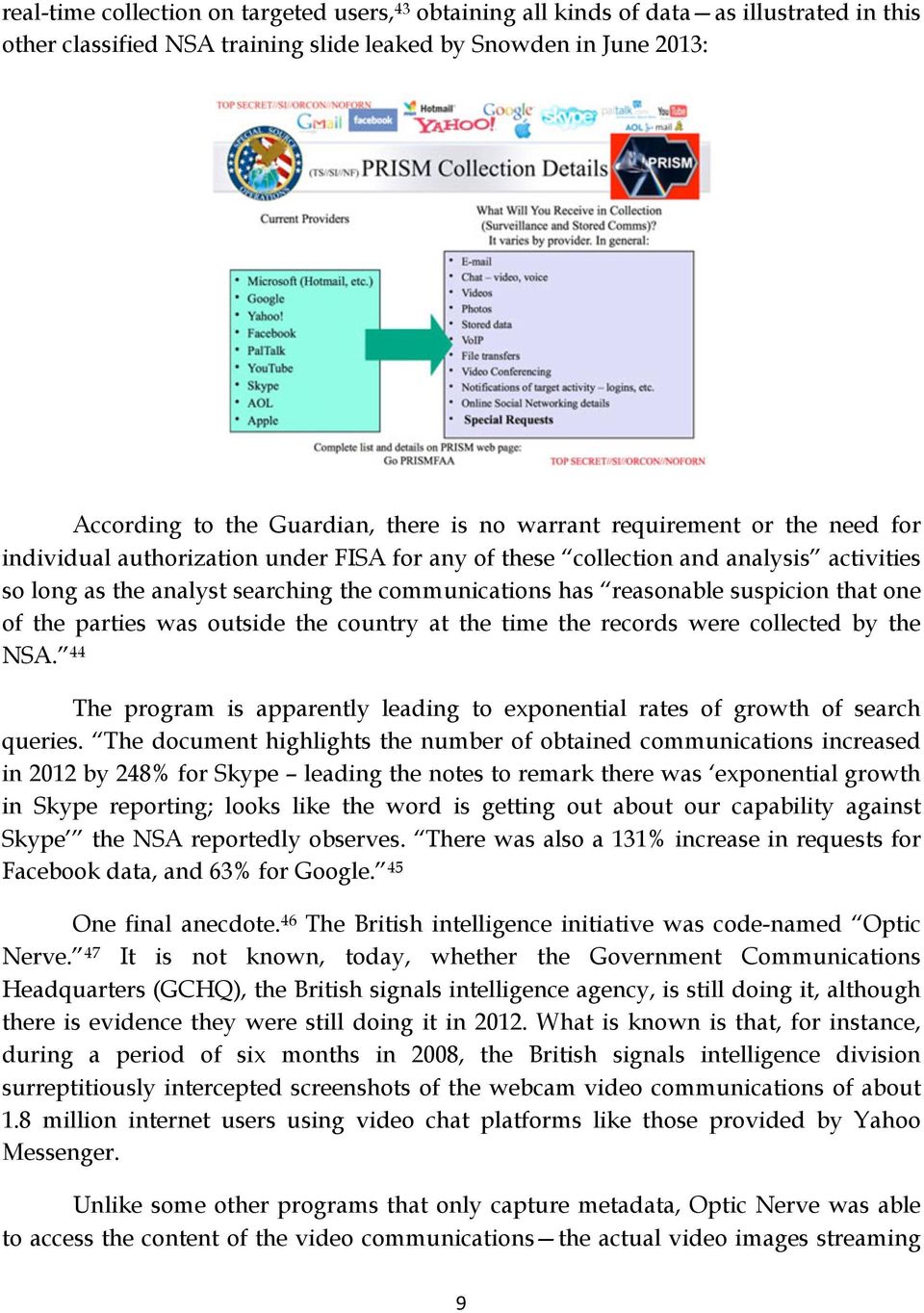
9 private messages and learn the IP addresses of every person who visits any website the analyst specifies. 37 Moreover, the NSA has developed methods to crack online encryption used to protect s, banking and medical records giving it access to all our private and legally-protected information. 38 The possibilities and the amounts of data are simply staggering. The Washington Post reported, back in 2010, that every day, collection systems at the [NSA] intercept and store 1.7bn s, phone calls and other type of communications. 39 The PRISM program gives the government access to individual s s, photos, videos, attachments, VoIP, etc. At practically no cost to the government, there is complete access to their digital lives. And although the NSA denies that is has immediate access to the data, the NSA documents leaked by Snowden state that the agency claims collection directly from the servers of major US service providers 40 as illustrated in this classified NSA training slide leaked by Edward Snowden in June 2013: As the Guardian reported, the Prism program allows the intelligence services direct access to the companies' servers. The NSA document notes the operations have assistance of communications providers in the US. 41 The Guardian adds that, based on an NSA document dating to April 2013, the PRISM program gives the NSA access without having to request them from the service providers and without having to obtain individual court orders. 42 With this program, the NSA is able to reach directly into the servers of the participating companies and obtain both stored communications as well as perform 8
![38 The possibilities and the amounts of data are simply staggering. The Washington Post reported, back in 2010, that every day, collection systems at the [NSA] intercept and store 1.](/docs-images/44/2001688/images/page_9.jpg "7bn emails, phone calls and other type of communications. 39 The PRISM program gives the government access to individual s e-mails, photos, videos, attachments, VoIP, etc.")
10 real-time collection on targeted users, 43 obtaining all kinds of data as illustrated in this other classified NSA training slide leaked by Snowden in June 2013: According to the Guardian, there is no warrant requirement or the need for individual authorization under FISA for any of these collection and analysis activities so long as the analyst searching the communications has reasonable suspicion that one of the parties was outside the country at the time the records were collected by the NSA. 44 The program is apparently leading to exponential rates of growth of search queries. The document highlights the number of obtained communications increased in 2012 by 248% for Skype leading the notes to remark there was exponential growth in Skype reporting; looks like the word is getting out about our capability against Skype the NSA reportedly observes. There was also a 131% increase in requests for Facebook data, and 63% for Google. 45 One final anecdote. 46 The British intelligence initiative was code-named Optic Nerve. 47 It is not known, today, whether the Government Communications Headquarters (GCHQ), the British signals intelligence agency, is still doing it, although there is evidence they were still doing it in What is known is that, for instance, during a period of six months in 2008, the British signals intelligence division surreptitiously intercepted screenshots of the webcam video communications of about 1.8 million internet users using video chat platforms like those provided by Yahoo Messenger. Unlike some other programs that only capture metadata, Optic Nerve was able to access the content of the video communications the actual video images streaming 9
11 on the chat. Apparently, it automatically downloaded the content of video communications taking a screenshot from the video feed every five minutes. 48 According to a secret report revealed by Snowden, British intelligence aspired to capture more images at a faster clip and hoped to get the full webcam videos at some point, at least for surveillance targets, intending to identify targets using automatic facial recognition software as they stared into their computer s webcams. 49 GCHQ was assisted, in these efforts, by the NSA: Webcam information was fed into NSA s XKeyscore search tool, and NSA research was used to build the tool which identified Yahoo s webcam traffic. 50 Apparently, the operation has netted a trove of X-rated images. An intelligence document on the program stated that It would appear that a surprising number of people use webcam conversations to show intimate parts of their body to the other person. According to one informal analysis, somewhere around seven to eleven percent of the recorded images contained undesirable nudity. 51 As the Associated Press reported, The collection of nude photographs also raises questions about potential for blackmail. America s National Security Agency has already acknowledged that some analysts have been caught trawling databases for inappropriate material on partners or love interests. Other leaked documents have revealed how U.S. and British intelligence discussed leaking embarrassing material online to blacken the reputations of their targets. 52 Other documents leaked by Snowden reveal that the NSA has been investigating the possibility of using other game console video communication as a way to intercept data: the NSA were exploring the video capabilities of game consoles for surveillance purposes, the Guardian reported. Microsoft, the maker of Xbox, faced a privacy backlash last year when details emerged that the camera bundled with its new console, the Xbox One, would be always-on by default. 53 *** 10

12 How then do we conceptualize and visualize relations of power in our digitized neoliberal age? Where can we find the architectural schematic to understand digital security? Both of the classic forms spectacle and surveillance seem no longer adequate, and to be honest, the contrast between the two may well have been drawn too sharply. As W.J.T. Mitchell presciently observes in The Spectacle Today, neither term can possibly be understood as mutually exclusive in our contemporary condition; rather, spectacle and surveillance should be seen, as Mitchell explains, as dialectical forces in the exertion of power and resistance to power. 54 I would go further, though, and suggest that both forms spectacle and surveillance are overshadowed or surpassed today, or ought to be complemented, by a third: exposure, or exposition, or, perhaps better, the exhibition. Today, we are not coerced into revealing our most intimate desires. There is no telescreen forcibly anchored into the wall of our apartments that we cannot turn off, 55 nor are we forcibly detained in a see-through cell within the omnipresent view of a central watchtower. We are neither forced into the arena, nor compelled to reveal our most intimate desires. 56 No, we are not being surveilled today, so much as we are exposing or exhibiting ourselves knowingly and willingly, with all our love, lust, and passion. The relation is now inversed: we, digital subjects, we homo digitalis, we digital persons, 57 we give ourselves up happily, voluntarily, in a mad frenzy of disclosure. We expose our most intimate details in play, in love, in desire, in consumption, in a stream of texts, Tweets, emoticons and Instagrams, s and Snapchats, Facebook posts, links, shares and likes throughout our digital lives, in our work, for our political convictions, to satisfy our appetites, to become ourselves. Even those of us who do not partake in the rich world of social media have no alternative but to share our intimate lives and political views in texts, s, and Skype conversations knowing that we are exposing ourselves. We write love notes and political comments, we share intimate photos and inside jokes, we throw ourselves onto the screen in our virtual spectacular forms often wishing more than anything to be seen, to be liked, to feel connected, or simply because it is the only way to communicate today. For most of us, our digital existence is our life it is practically the pulse, the bloodstream, the very current of our daily routines. We need to be plugged not just to feel fully alive, but to be human, all too human. Guy Debord spoke of the society of the spectacle. Foucault drew our attention instead to the punitive society. But it seems as if, today, we live in the expository society. How then can we visualize the architecture of this society of the exhibition? And recall that there are two key stages to visualize: first, the neoliberal moment, with its 11

13 mix of private and public, of consumption and consumerism, of responsibilization and reregulation, of maximizing and minimizing; and second, the digitization of every aspect of the neoliberal paradigm digital security. Let s turn first to the neoliberal aspect. How can we schematize relations of power in our neoliberal condition? What I would propose, as the architectural schema that best captures the neoliberal moment, is the amusement park or the theme park or more generally, the themed space. A private commercial space, for profit, that has been underwritten and made possible by state and municipal governments. A mixed private-public space or perhaps, more accurately, a space of private profit and public expenditures that practices a form of management or control of flows of populations, to maximize the number of visitors, to attract more advertising, to stimulate consumption, to facilitate spending. These are quintessential spaces that seek to optimize the movement of large populations in order to maximize their consumption, while at the same time minimizing labor and other expenditures. This is not just a spectacle, because everything is scattered. The goal is to distribute, not concentrate, the population. To avoid amassing consumers on any one spectacle. The goal is to optimize and redirect queues, to make them feel shorter than they are, to learn how to manage the patience of consumers who want to see, but who are, in fact, never, or almost never, sitting in the arena. To be sure, surveillance goes on; but that is only one dimension of the endeavor. There are, naturally, a large number of CCTV cameras. The watchful eye is everywhere. That is, in fact, what renders Disneyland so popular the feeling that everything is monitored, that everything is secure, that the children, or rather the parents have nothing to fear. There is continuous surveillance, but not in a panoptic form. We do not internalize the gaze, we are reassured by it. You will remember that amusement parks were the subject of remarkable theorizing in the 1980s and 90s. Recall the brilliant analysis of Jean Baudrillard on Disneyland the simulacra that becomes more real than reality itself. 58 Disneyland exists, Baudrillard wrote, in order to hide that it is the real country, all of real America that is Disneyland (a bit like prisons, Baudrillard emphasized in continuity with Foucault s The Punitive Society, are there to hide that it is the social in its entirety, in its banal omnipresence, that is carceral). 59 Or, as Baudrillard continued, Disneyland is presented as imaginary in order to make us believe that the rest is real, whereas all of Los Angeles and the America that surrounds it are no longer real, but belong to the hyperreal order and to the order of simulation. It is no longer a question of a false representation of reality (ideology) but of concealing the fact that the real is no longer real, and thus of saving the reality principle. 60 Recall the equally insightful analysis of Umberto Eco of theme parks as hyperreality, 61 or of Louis Marin as 12

14 degenerate utopia as ideology changed into the form of a myth. 62 And, conversely, recall the rich theorization of the new city, of strip malls, shopping malls, and gentrified architecture, of Orange County the exopolis, as Variations on a Theme Park. 63 Rather than rehearse these analyses, it may be more punctual to develop the line of thought developed in the texts of George Ritzer on the McDonaldization of society 64 and, by extension, the analysis by Alan Bryman of the McDisneyization of the social. 65 The four main elements of McDonaldization are present, as Bryman suggests, in the world of Disneyland and, I would add, in our contemporary neoliberal condition: first, the effectiveness of the management of large numbers of consumers; second, the control of their movements to increase their spending and to police their behaviors; third, the predictability of the experience; and finally, the computability, the calculability, the quantification, the measurability of each queue, each amusement ride, every game. Amusement parks are, in the words of Steven Miles, the quintessential physical manifestation of the consumer society, the ultimate commercial environment, and an expression of capitalism in perhaps its purest form. 66 They constitute mini-cities of consumption in their own right, Miles adds. 67 Disney has been marketing experiences and memories for profit for years with resounding success 68 : In 1998, overall revenues from the Disney theme parks were $6.1 billion, and above 50 per cent of that was from entrance fees. 69 In this sense, they capture well the guiding spirit of neoliberalism. Today, this is not only the case of amusement and theme parks, but of all those other themed spaces and venues such as the Hard Rock Café or Planet Hollywood or even the town of Celebration, Florida, built by Disney right next to its World Resort in Orlando, so marvelously dissected and theorized in Keally McBride s brilliant book, Collective Dreams. 70 Theming, says Miles, may be the most successful commercial architectural strategy of the twentieth century. 71 It gives full rein to our modern consumerist desires, imagination, and pleasures modern precisely in the sense of modern consumerism or what Colin Campbell describes as the distinctively modern faculty, the ability to create an illusion which is known to be false but felt to be true. 72 Walt Disney s objective was precisely to create a new kind of space free from the dirt and danger of the carnival world of freaks, barkers, and thrill rides. 73 For many, it worked and still does: Disney s transformation was a blessing, substituting clean, orderly, and family-oriented fun for the grimy disorder and working-class and minority crowds of America s declining urban amusement parks and seaside resorts. 74 In this 13
15 sense, Disneyland is the quintessential space of modern consumption more so, even, than a space of leisure. 75 Foucault had emphasized the importance of the role of consumption at the heart of neoliberalism, especially in the writings of Gary Becker 76 and Becker was well aware of this. As Becker would say in 2012, referring to Foucault s lectures on The Birth of Neoliberalism, He may dislike certain forms of neoliberalism, but he seemed to take seriously the so-called neoliberalism that was based upon human capital analysis, and a particular approach to understanding how individuals behave, both in the marketplace and in consumption. [I]t s a theory about how individuals behave under various circumstances, and quite clearly there were power relationships involved in these circumstances, and power of different types power of the law, etc. 77 Indeed, a theory of consumption is at the heart of contemporary neoliberalism and must also be at the center of the schemata of power relations. Themed consumption: if you live in the small town of Celebration, Florida, you will be treated during Christmas time to an hourly snowfall in the downtown area courtesy of Disney. 78 As Keally McBride suggests, Disney Imagineers are offering us fantasy as real life. We can buy it and move in permanently. 79 The themed ideals of the community have become commodified. They now exist as commodities. 80 And not just kitsch commodities at that it is an elite form of premier, themed consumption. As McBride notes, The array of architects who helped to plan Celebration is a virtual who s who of contemporary architecture. 81 Philip Johnson designed the town hall, Robert Venturi the town bank, Michael Graves the post office, Cesar Pelli the movie theatre, and Robert Stern developed the master plan. 82 It s a star studded cast, all intended to recreate an imaginary Main Street for us to consume and for Disney to profit with a model school and teaching academy (again courtesy of Disney) that does not dole out grades, but instead narrative assessments. 83 As McBride recounts, the principal boasts This is a place where nobody fails. 84 The themed space or, perhaps, variations on a theme park 85 as architectural representation of neoliberalism: that would be an idea to pursue. Perhaps we should go even further, exponentially, to the themed space of consumption par excellence: today s oversized shopping malls, in urban towers and in the suburbs the Water Tower in Chicago, Columbus Circle in Manhattan, or the Mall of America outside the Twin Cities. 86 In these gigantic spaces of consumption, the theme itself has become consumption consumption as the amusement, shopping as the entertainment. These are distilled themed spaces of consumption. Some of these malls, in fact, have physically absorbed the amusement park. The Mall of American, for instance, the most visited mall in the world, has its own amusement park inside its walls. These are ideas 14

16 to pursue. Less monstrous than the Panopticon as an image of the punitive society, but just as frightening, and focused exclusively on consumption, pleasure, desire. *** The further question is how to refresh this architectural schemata in our newly digitized age? How can we conceptualize neoliberalism in the digital era? How do we represent digital security? And to answer this question, I propose that we simply place ourselves in one of those digitized themed spaces today. For instance, in one of the omnipresent sports bars that everywhere surrounds us, with their multiple flat screen TVs, signed jerseys, and team insignia, where, at this very instance, we find ourselves watching a ball game, a World Series, a Super Bowl, a Premier League match, or even the World Cup where we tweet, drag, Instagram the match, post on Facebook, consume beer and chips, flirt, wear our favorite cap, text our friends, fantasize, etc. Naturally, there is in part a large element of spectacle. We are standing in front of the arena, if only virtually. We are in the space of agonistic struggle par excellence, complete with a globalized virtual gaze. A gaze of millions of viewers, all consuming in sports bars around the country, perhaps even around the globe surely for the World Cup. It is not only the physical spectacle that matters, nor is it just the singular location, since we are scattered across the city, in front of the plasma, with our iphones and tablets. We are not together, we are separated, segregated but everywhere at once in this digital age. There is also a large dose of surveillance including facial recognition technology, patrol officers and bouncers, and surveillance cameras. Space is controlled. Rival fans are kept apart to avoid disorder. Populations are strategically distributed, and self-select. But more than that, there is all the monitoring and surveillance ranging from Google to the NSA, that captures all our Tweets and our texts, our Facebook posts, the photos that we share, the apps we download, our internet surfing, how we spend, what we read, with whom we speak in short, all our activities are recorded, captured, analyzed in this big consumer fair, to better target us, to better punish us when appropriate. Bentham s prison is not entirely removed from the present digital condition. There was an asymmetry in Bentham s project that somehow resembles our forms of digital collection and mining, of constant capturing, of constant listening Foucault would note: Bentham in his first version of the Panopticon had also imagined an acoustic surveillance, through pipes leading from the cells to the central tower. 87 He goes on to add that Julius, with his Hegelian wisp, had tried to develop an asymmetric listening system
17 To this we can add the element of exhibition. This can be seen in the little personal flourishes, the face paint, the outbursts, the tattoos, the T-shirts or signs that draw attention and catch the camera s eye. The lucky ones get projected on the big screen. The bare chest, painted midriffs, the wigs, the muscle, the money. The exhibition to make visible, to be seen, to be filmed. The little theater of personal exposure, well managed and properly disseminated. A wily post on Facebook that might go viral, a clever Tweet that might get favorited you have to look in the camera to be seen, to be broadcast around the world. While others watch, simply to look, to observe, to examine, to contemplate those who are willing to expose themselves. Seeking someone they know, maybe their son or daughter at the ballgame, or just for fun, to see. We all meet, again, in front of the screen, spectators of the surveillance and the exhibition, viewers monitoring the performances and expositions, watched ourselves by means of our texts, our mobile apps, our photos, our Facebook posts, our Tweets, all our communications... A circuit which turns on itself in an infinite loop of spectacle, surveillance, and exhibition, that are all analyzed, dissected, labeled, mined, marketed, datafied, resold. For consumption. To sell more beer and jerseys. To increase viewership. To stimulate more consumption. To control as well and punish at times. Digital security becomes this space where, at every moment, we can expose ourselves to virtually everyone and simultaneously watch and be watched. A space where, at any moment, we can gaze at others, check their photos, look up their friends, observe, monitor, and stalk, take pleasure in watching them, follow them, like them, share them and our every keyboard stroke. In short, a space where we can exhibit ourselves and be the voyeur to their exhibitionism. And when we do this, we are never alone: social media and corporations follow us too, and the government, ready to punish, records it all. We must therefore add to the schema of exhibition, the voyeur, the profit-seeking vulture, and the sadistic punisher. What does that give us? Something like a virtual digital freak show? Sadistic in its exhibitionism? Or is it, rather, that we have been made to believe that we hold the reins to the amusement park? Like children who have taken over the deserted island in Lord of the Flies, we get to run the park. Some of us think that we are important or interesting enough to make our own show and draw our own crowds on YouTube or Vimeo, on Instagram. Others prefer to look, to watch, maybe even to stalk. We ve become the entertainment and the entertainers. I say we have been made to believe because there remains, of course, exchange and governing: our self-entertainment generates wealth through attention, through 16

18 clicks and views, through recommends and shares, which draws advertisers and publicists, and provides the raw material, the primary resource for intelligence services. Our political vaudevilles help expose our political inclinations in a way that is all revealing to the state. In a carnivalesque manner, we broadcast our every political contribution, we Tweet every political meeting, we Facebook our favorite political news articles with comments we expose all of our political leanings, inclinations, experimentations, every whim, rash thought, that should not have been sent, weakness, failing. Every one of these moments are made permanent. *** How did we become such exposing subjects, such an expository society, you may ask? How did we come so easily to exhibit ourselves? Perhaps it is connected to the apparently ephemeral nature of the digital medium. Today we almost feel as if we are giving our information to a cloud. An ephemeral cloud. Like a whisper. No one sees you when you do it. You give the information in the privacy of your enclosed office, or behind the locked doors of your home, you input it into an inanimate object. You do it quickly, discreetly. You slide your social security number to the IRS, or to your bank, believing that it will get lost in the stream of information, in the flood of digits that are gushing over the internet. It feels as if no one will even notice, no human will know, it is just data on a form. From times past from the analog age we had been conditioned to give our data, knowing that it would get lost in the mounds of paperwork. There was no way that anyone could go through all the files, the millions of pieces of paper, to connect the information, to trace it back to you, to use it against you. There was no way that the data you gave to the immigration authorities or customs or the police could possibly make it back to the fiscal or regulatory authorities, because there simply were too many forms that were filed, too many cabinets overflowing with paper, far too much for any human to manage. It feels today as if no one can see us. And in those moments of doubt, when we flinch at the disclosure, we nevertheless proceed, feeling that we have no choice, not knowing how not to give our information, how we would even go about the task, who we would talk to, how to get it done without the revelation. We feel we have no choice but to disclose. But although it may feel so ephemeral, it is permanent. The information we disclose is captured, recorded, etched into the stone of digital memory. It is seared into 17
19 the silicon. Engraved. It will not disappear. We think it is nothing more than a cloud, but it is tattooed on our subjectivity. Do we perhaps crave the permanence? Are these confessions? Avowals? Are they more than just ephemeral disclosures? Are we telling truth in some way, trying to let others know? Do we need to better understand the question of truth-telling in our digital era? In what manner, for instance, do we tell truth on Facebook? What is the confessional aspect of the digital? There is, isn t there, a sense that we want attention, that we want publicity. That we want others to like our photos and comments. These acts of self-revelation are perhaps just that, cries for attention. The urge is not new, the medium changes it though. It creates the kind of potential audience that could never have been imagined before an international, global audience. What then are the confessional dimensions of this digital age? Let me suggest some of the potential contours: n It is a public confession. It is being communicated to someone. It is not purely internal like the stoic examination of conscience at nighttime. 89 It is logged for others to see, or watch, or hear. n It has a certain element of permanence. It will be preserved somewhere forever. It is not fleeting or defined by its phenomenal presence. In this sense, it is burned on the digital in the same way that a particular mark of penitence might last forever. It is tattooed. n It is not necessarily about truth. There is no necessary claim of authenticity. It can be an identity that is entirely fabricated, but that one wants others to witness, perhaps even to believe. No one is forced to confess on the digital platform. There are no cold showers unlike those that Dr. Leuret inflicts on his patient A. And yet, the avowal has effects. It produces a knowledge of the other, perhaps, at times, of the self. This is not a situation where we cannot judge the accused because he has not said anything about himself. The proliferation of the avowing self, in fact, defies or undermines Foucault s story of the rise and fall, or the rise and collapse of the confession in the twentieth century. 90 Avowing, it turns out, is the dominant form of social interaction, made possible and magnified by the publicity and reach of the medium. *** 18
20 Let me conclude. Here is a list of good security questions for websites to ask and collect, in order to render more secure a user ID and password: What was your childhood nickname? In what city did you meet your spouse/significant other? What is the name of your favorite childhood friend? What street did you live on in third grade? What is your oldest sibling s birthday month and year? What is the middle name of your oldest child? What is your oldest sibling's middle name? What school did you attend for sixth grade? What was your childhood phone number including area code? What is your oldest cousin's first and last name? What was the name of your first stuffed animal? In what city or town did your mother and father meet? Where were you when you had your first kiss? What was the last name of your third grade teacher? In what city does your nearest sibling live? What is your oldest brother s birthday month and year? What is your maternal grandmother's maiden name? In what city or town was your first job? What is the name of the place your wedding reception was held? What is the name of a college you applied to but didn't attend? Where were you when you first heard about 9/11? What is the first name of the boy or girl that you first kissed? 91 If you know my answers to these questions, I suspect, you may know more of my secrets than my own companion of 25 years. You know my stories, my journey, my clues. Perhaps you even know me better than I can remember, myself, about myself about my self, full of desire and disobedience... of disobedience that is intercepted, recorded, mined, and then carved into the rock of the digital memory of our intelligence services. 19

21 NOTES 1 See generally Bernard E. Harcourt, Situation du cours, in Michel Foucault, La Société punitive. Cours au Collège de France (Paris : Gallimard 2013), at pp ; Fabienne Brion and Bernard E. Harcourt, The Louvain Lectures in Context, in Michel Foucault, Wrong-Doing-Truth-Telling: The Function of Avowal in Justice (Chicago: University of Chicago Press 2014), at pp See Foucault, La Société punitive, at p. 7 and p. 18 n.6. 3 See Bernard E. Harcourt, Situation du cours, in Foucault, La Société punitive, at pp As a physician, Julius worked on the staff of poorhouses and in the military. Norman Johnston, Forms of Constraint: A History of Prison Architecture. Chicago: University of Illinois Press, 2000: 180, n. 47. Julius was also a noted prison reformer. See Isidore Singer and Cyrus Adler, The Jewish Encyclopedia: A Descriptive Record of the History, Religion, Literature, and Customs of the Jewish People from the Earliest Times to the Present Day, Volume 7. New York: Funk and Wagnalls, 1916: M. Foucault, «La vérité et les formes juridiques», DE, II, n 139, éd. 1994, p / «Quarto», vol. I, p , à la page 607 / Quarto 1476 (conférences à l Université pontificale de Rio de Janeiro, en mai 1973). 6 Julius lectured in Berlin in 1827 under the auspices of the newly formed Verein für die Besserung der Stafgefangen, a prisoners aid society. These lectures were attended by Crown Prince Frederick William, who became interested in prison reform thereafter (though it is unclear from the text which Frederick William this actually was I believe there were two princes of that name in 1827.) See Johnston, 180, n N. H. Julius, Vorselungen über die Gefängnisskunde, Berlin, Stuhr, 1828, 2 vol. / Leçons sur les prisons, présentées en forme de cours au public de Berlin, en l année 1827, trad. (t. I) H. Lagarmitte, Paris, F. G. Levrault, 1831, p ; taken up again in M. Foucault, La société punitive, p («Il est un fait digne du plus haut intérêt, non seulement dans l histoire de l architecture, mais dans celle de l esprit humain en général : c est que dans les temps les plus reculés, je ne dis pas de l antiquité classique, mais même de l Orient, le génie a conçu et s est plu à décorer de tous les trésors de la magnificence humaine des édifices qui avaient pour but de rendre accessible[s] à une grande multitude d hommes le spectacle et l inspection d un petit nombre d objets, tels que des temples, des théâtres, des amphithéâtres, où l on regardait couler le sang des hommes et des animaux ; tandis que jamais l imagination humaine ne paraît s être appliquée à procurer à un petit nombre d hommes, ou même à un seul homme, la vue simultanée d une grande multitude d hommes ou d objets.») 8 Julius, Leçons sur les prisons, p. 385; taken up again in Foucault, La société punitive, p. 25 («C était aux temps modernes (et je me propose de développer cette idée plus tard), c était à l influence toujours croissante de l État, et à son intervention, de jour en jour plus profonde, dans tous les détails et toutes les relations de la vie sociale, qu il était réservé d en augmenter et d en perfectionner les garanties, en utilisant et en dirigeant vers ce grand but la construction et la distribution d édifices destinés à surveiller en même temps une grande multitude d hommes»). 9 Foucault, La société punitive, p. 25. («Or, c est précisément cela qui se produit à l époque moderne : ce renversement du spectacle en surveillance. On est en train d inventer, dit Julius, non seulement une architecture, un urbanisme, mais toute une disposition de l esprit en général, telle que, désormais, ce seront les hommes qui seront offerts en spectacle à un petit nombre de gens, à la limite à un seul homme destiné à les surveiller. Le spectacle retourné en surveillance, le cercle que les citoyens faisaient autour d un spectacle, tout cela est renversé. On a une structure tout à fait différente où les hommes déployés les uns à côté des autres dans un espace plat vont être surveillés d en haut par quelqu un qui sera une espèce d œil universel»). 10 Foucault, Surveiller et Punir, p See generally «Situation du Cours», La Société punitive, p. 39 n.2 ; N. H. Julius, Nord-amerikas sittliche Zustände, nach eigenen Anschauungen in den Jahren 1834, 1835 und 1836, Leip-zig, F. A. Brockhaus, 1839 / Du système pénitentiaire américain en 1836, trad. Victor Foucher, Paris, Joubert, 1837, p G. de Beaumont & A. de Tocqueville, Du système pénitentiaire aux États-Unis et de son application en France, suivi d un appendice sur les colonies pénales et de notes statistiques, Paris, H. Fournier Jeune, 1833, 3e éd. augmentée du «Rapport de M. de Tocqueville sur le projet de loi de Réforme des prisons», Paris, Librairie de Charles Gosselin, Cf. A. Krebs, «Julius, Nikolaus Heinrich», in Neue Deutsche Biographie, Bd. 10, 1974, p Thomas Nutz, Global Networks and Local Prison Reforms: Monarchs, Bureaucrats and Penological Experts in Early Nineteenth-Century Prussia. German History 23(4), 2005: 446. See also, Bert Vanhulle, Dreaming about the prison: Édouard Ducpétiaux and Prison Reform in Belgium ( ). Crime, History, & Societies 14(2), 2010:
22 14 Nutz, 454. After a self-financed 1825 trip to study British prison systems, Julius was hired by the Prussian King Frederick William III as an external inspector and adviser -- [t]he initiative for his engagement as an adviser, however, did not come from the Prussian state, but from Julius himself, who recommended himself in this role. (Nutz, 448) Julius was subsequently hired by Frederick William IV after another largely self-financed 1834 trip to the US to study innovations in American penitentiaries, a trip that produced the report Nordamerikas sittliche Zustände. Nach eigenen Anschauungen in den Jahren 1834, 1835 und (Nutz 448 and 440) 15 Nutz, Nutz, 455. In 1847, there had been 14,568 people serving sentences; by 1856, this figure had risen to 27,759. This meant that institutions originally built as prisons for separate confinement in Berlin (1849), Breslau (1852), Ratibor (1851) and Münster (1853) were not being used in the way they had been intended to be used. Cell walls were taken down and common work rooms built in order to make more space. Every possible available space, from the cellar to the attic, was pressed into service. Prisoners were not separated while taking exercise and attending church. Not even the silence demanded by the Rawicz rule, which was valued so highly by the Prussian authorities and was observed by all prisons in the monarchy, was enforced. In principle, the royal reform programme of the 1840s had failed See generally «Situation du cours,» La Société punitive, at p. 40 n Cf. G. Debord, La Société du spectacle, Paris, Buchet/Chastel, G.W.F. Hegel, Preface, Philosophy of Right (1820). 20 M. Foucault, La Volonté de savoir (1976). 21 I will use sécurité to refer to the term Foucault originally coined and later renamed gouvernementalité, and will reserve the term governmentality to refer to later work in governmentality studies. 22 Foucault 2004 STP, p. 46; 2004 STP, p Foucault 2004 STP, p Foucault 2004 STP, p Foucault 2004 STP, pp Colin Koopman refers to this new age under the rubric of infopolitics. Other commentators have proposed sleeker neologisms. See Colin Koopman, The Age of Infopolitics, The New York Times The Opinionator, January 26, For other anecdotes, see Bernard E. Harcourt, Governing, Exchanging, Securing: Big Data and the Production of Digital Knowledge (May 23, 2014). Columbia Public Law Research Paper No Available at SSRN: 28 Amir Efrati, Like Button Follows Web Users, Wall Street Journal, May 18, 2011, available at wsj&url=http%3a%2f%2fonline.wsj.com%2farticle%2fsb ht ml; Asher Moses, Facebook's privacy lie: Aussie exposes 'tracking' as new patent uncovered, The Sydney Morning Herald, October 4, 2011 available at 29 Id. 30 Byron Acohido, Facebook tracking is under scrutiny, USA TODAY, updated 11/16/2011, available here 31 Charles Duhigg, How Companies Learn Your Secrets, New York Times, February 16, 2012, available at 32 Charles Duhigg, How Companies Learn Your Secrets. 33 Charles Duhigg, How Companies Learn Your Secrets. 34 Charles Duhigg, How Companies Learn Your Secrets. 35 Glenn Greenwald and Ewen MacAskill, NSA Prism program taps in to user data of Apple, Google and others, The Guardian, June 6, 2013, accessed March 11, 2014, 36 Glenn Greenwald, NSA Prism program taps in to user data of Apple, Google and others, The Guardian, June 6, 2013, accessed March 11, 2014, 37 Glenn Greenwald, XKeyscore: NSA tool collects nearly everything a user does on the internet, The Guardian, July 31, 2013, accessed March 11, 2014, 21
23 38 Glenn Greenwald, Glenn Greenwald on Secret NSA Program to Crack Online Encryption, Democracy Now! interview with Amy Goodman and Juan Gonzalez, Sept. 9, 2013, accessed March 11, 2014, 39 Quoted in Glenn Greenwald, XKeyscore: NSA tool collects nearly everything a user does on the internet, The Guardian, July 31, 2013, accessed March 11, 2014, 40 Glenn Greenwald and Ewen MacAskill, NSA Prism program taps in to user data of Apple, Google and others, The Guardian, June 6, 2013, accessed March 11, 2014, 41 Id. 42 Id. 43 Id. 44 Id. 45 Id. 46 For other anecdotes, see Bernard E. Harcourt, Governing, Exchanging, Securing: Big Data and the Production of Digital Knowledge (May 23, 2014). Columbia Public Law Research Paper No Available at SSRN: 47 Spencer Ackerman and James Ball, Optic Nerve: millions of Yahoo webcam images intercepted by GCHQ, The Guardian, Thursday 27 February 2014, available at ; The Associated Press, British Spies Intercept Webcam Pictures, Report Says, Feb. 27, 2014, available at The New York Times at 48 Associated Press, British Spies Intercept Webcam Pictures, Report Says, Feb. 27, 2014, *2. 49 Associated Press, British Spies Intercept Webcam Pictures, Report Says, Feb. 27, 2014, *2; see also Spencer Ackerman and James Ball, Optic Nerve, *2. 50 Spencer Ackerman and James Ball, Optic Nerve, *2. 51 Spencer Ackerman and James Ball, Optic Nerve, *3; Associated Press, British Spies Intercept Webcam Pictures, Report Says, Feb. 27, 2014, *2 52 Associated Press, British Spies Intercept Webcam Pictures, Report Says, Feb. 27, 2014, * Spencer Ackerman and James Ball, Optic Nerve, *5. 54 William Jones Thomas Mitchell, The Spectacle Today: A Response to RETORT, Public Culture, 20 no. 3, 2008, excerpt available at In a marvelous forthcoming chapter of a book that will explore, in part, the way digitization has affected the architectural imaginary, Mitchell emphasizes, with Walter Benjamin, the importance of architectural schemata as ways to understand relationships of power in modern society. See Mitchell draft of Chapter 11, Back to the Drawing Board: Architecture, Sculpture, and the Digital Image. 55 George Orwell, New York: Random House, Inc., 2009: p In this respect, I agree entirely with François Ewald who writes, in a brilliant essay titled Omnes et singulatim. After Risk, in Carceral Notebooks Volume 7, p. 82 (2011), that one should not analyze power relations in the data world according to the patterns of the old state power with its technologies of surveillance, control and domination. 57 Cf. Daniel J. Solove, The Digital Person: Technology and Privacy in the Information Age, New York: New York University Press, Jean Baudrillard, Simulacra and Simulations, Chap. 1, The Precession of Simulacra, trans. Sheila Faria Glaser. (1981 original publication; 1994 translation). 59 Here: excerpt (the Disney part begins under the section The Hyperreal and the Imaginary ) is available at 60 Id. 61 Umberto Eco, Travels in Hyperreality (London: Pan, 1986). 62 Louis Marin, Utopics: Spatial Play, trans. by Robert A. Vollrath (Atlantic Park, NJ: Humanities, 1984), p See, generally, Michael Sorkin, ed., Variations on a Theme Park: The New American City and the End of Public Space (New York: Hill and Wang, 1992); also Edward W. Soja s chapter in that collected volume, Inside Exopolis: Scenes from Orange County, pp George Ritzer, The McDonaldization of Society (Newbury Park, CA: Pine Forge Press, 1993). 22
24 65 Alan Bryman, Theme Parks and McDonaldization, in Resisting McDonaldization, Barry Smart ed. London: Sage, e-book available through the university library at: 66 Steven Miles, Ch. 8, Themed Parks, in Spaces for Consumption: Pleasure and Placelessness in the Post- Industrial City, Steven Miles. Los Angeles: Sage, 2010, at p (e-book available through the university library at: 67 Miles, p Miles, p It is also a place of ritual and pilgrimage. See Alexander Moore, Walt Disney World: Bounded Ritual Space and the Playful Pilgrimage Center. Anthropological Quarterly 53(4), 1980: Id. 70 Keally McBride, Consuming Community, and Utopian Vision as Commodity Fetish, in Collective Dreams: Political Imagination and Community (University Park, PA: Pennsylvania State University Press, 2005) p. 86 et seq. 71 Miles, p Colin Campbell, The Romantic Ethic and the Spirit of Modern Consumerism (Oxford: Basil Blackwell, 1987), at p. 78 (quoted in McBride at p. 114). 73 Gary S. Cross and John K. Walton, The Disney Challenge, , in Gary S. Cross and John K. Walton, The Playful Crowd: Pleasure Places in the Twentieth Century. London: Sage, 2004, p Ibid. («free from the dirt and danger of the carnival world of freaks, barkers, and thrill rides.» Disney s transformation was a blessing, substituting clean, orderly, and family-oriented fun for the grimy disorder and working-class and minority crowds of America s declining urban amusement parks and seaside resorts. 75 Miles, p M. Foucault, The Birth of Biopolitics, p. 226 of the English edition ( I will not talk about it here, because it would take too long, but in Gary Becker there is a very interesting theory of consumption ) 77 Gary Becker, in Gary Becker, François Ewald, and Bernard E. Harcourt, Becker on Ewald on Foucault on Becker : American Neoliberalism & Michel Foucault s 1979 Birth of Biopolitics Lectures : A Conversation with Gary Becker, François Ewald, and Bernard Harcourt, The University of Chicago May 9, 2012, Carceral Notebooks, Vol. 7 (2011), at p See McBride, Collective Dreams at p. 90; see 79 McBride, Collective Dreams, p McBride, Collective Dreams, p Id., p Id., p Id., p Id., p I am borrowing the title here, of course, of an excellent collection of essays on themed spaces in the United States edited by Michael Sorkin. See Michael Sorkin, ed., Variations on a Theme Park: The New American City and the End of Public Space (New York: Hill and Wang, 1992). 86 Special thanks to both Tom Mitchell and Keally McBride who have encouraged me to explore further the shopping mall as schema of neoliberalism. Tom Mitchell has also drawn my attention to the new show windows in Potsdamer Platz in Berlin that have mannequins with televisual eyes that move and follow you as you pass an intriguing intersection of surveillance, spectacle and exhibition in these themed spaces of consumption. 87 Foucault, Surveiller et Punir, p. 203 n. 2 ; cf. aussi «La vérité et les formes juridiques», loc. cit. (DE, II), p / p Ibid. 89 The discussion here and that follows makes reference to several episodes from M. Foucault, Wrong-Doing, Truth- Telling: The Function of Avowal in Justice (Chicago 2014). 90 Ibid. 91 Taken from 23
25 LA SOCIETE EXPOSITIVE SPECTACLE, SURVEILLANCE, EXPOSITION A L ERE NUMERIQUE BERNARD E. HARCOURT 1 Hivers Foucault se confronte, directement, à la question du pouvoir question qui le tracasse depuis l après Mai A Paris, il livre son cours La Société punitive ; à Rio, son cours La vérité et les formes juridiques. Tant à Paris qu à Rio, Foucault présente à son auditoire un certain Nicolaus Heinrich Julius, docteur en médecine, réformateur des prisons, professeur à l Université de Berlin, collègue de Hegel 2. «Cet homme» nous dit Foucault, «cet homme, nommé Julius, dont je vous recommande la lecture, et qui a fait pendant plusieurs années un cours à Berlin sur les prisons, est un personnage extraordinaire qui avait à certains moments un souffle presque hégélien 3». Ce professeur Julius au souffle hégélien avait discerné, pendant les années 1820, un bouleversement de nos technologies de savoir et de pouvoir. Une mutation architecturale qui reflétait une transformation des relations de pouvoir dans la société toute entière. L Antiquité, selon Julius, avait découvert la forme architecturale du spectacle. Comme il l explique dans ses «Leçons sur les prisons» de , qui feront l objet d étude de Foucault au Collège en 1973 je cite donc Julius : «Il est un fait digne du plus haut intérêt, non seulement dans l histoire de l architecture, mais dans celle de l esprit humain en général : c est que dans les temps les plus reculés, je ne dis pas de l antiquité classique, mais même de l Orient, le génie a conçu et s est plu à décorer de tous les trésors de la magnificence humaine des édifices qui avaient pour but de rendre accessible[s] à une grande multitude d hommes le spectacle et l inspection d un petit nombre d objets, tels que des temples, des théâtres, des amphithéâtres, où l on regardait couler le sang des hommes et des animaux ; tandis que jamais l imagination humaine ne paraît s être appliquée à procurer à un petit nombre d hommes, ou même à un seul homme, la vue simultanée d une grande multitude d hommes ou d objets 5.» Julius continue : «C était aux temps modernes (et je me propose de développer cette idée plus tard), c était à l influence toujours croissante de l État, et à son intervention, de jour en jour plus profonde, dans tous les détails et toutes les relations de la vie sociale, qu il était réservé d en augmenter et d en perfectionner les garanties, en utilisant et en dirigeant vers ce grand but la construction et la distribution 1 Isidor and Seville Sulzbacher Professor of Law, Columbia University; Directeur d études, École des hautes études en sciences sociales. Je remercie infiniment Julien Larregue, Sacha Raoult, et Corentin Durand pour leur aide avec cette version française, ainsi que Daniel Henry et Julian Azran pour la recherche. 1
26 d édifices destinés à surveiller en même temps une grande multitude d hommes 6.» C est ici que Foucault reprendra le fil. A Paris, en 1973, il prononcera je cite donc ici Foucault dans La Société punitive : «Or, c est précisément cela qui se produit à l époque moderne : ce renversement du spectacle en surveillance. On est en train d inventer, dit Julius, non seulement une architecture, un urbanisme, mais toute une disposition de l esprit en général, telle que, désormais, ce seront les hommes qui seront offerts en spectacle à un petit nombre de gens, à la limite à un seul homme destiné à les surveiller. Le spectacle retourné en surveillance, le cercle que les citoyens faisaient autour d un spectacle, tout cela est renversé. On a une structure tout à fait différente où les hommes déployés les uns à côté des autres dans un espace plat vont être surveillés d en haut par quelqu un qui sera une espèce d œil universel 7.» Foucault reprendra cet extrait du texte de Julius et le développera quelques années plus tard dans Surveiller et Punir, au chapitre «Le panoptisme», où, parlant de Julius, il écrira : «Peu d années après Bentham, Julius rédigeait le certificat de naissance de cette société [disciplinaire] 8». Julius avait discerné un renversement de l architecture du pouvoir un renversement qu il mettrait lui-même en œuvre en tant que réformateur des prisons. Ce Julius au souffle hégélien était un homme de son temps qui à la fois absorbait et diffusait les nouvelles technologies de pouvoir multipliant ses missions d étude en Angleterre, au Pays de Galles, et en Écosse en 1827, et aux États-Unis en Comme Beaumont et Tocqueville (dont il avait traduit en allemand le Système pénitentiaire aux États-Unis et de son application en France 10 ), Julius se fit promoteur enthousiaste du système pénitentiaire américain. Si l on en croit Thomas Nutz, «les efforts» de Julius visant à «établir la science des prisons (Gefängniskunde) comme discipline à partir de la moitié des années 1820 étaient sans égal. Il a fondé et édité deux des revues germanophones centrales en Gefängniskunde, et a écrit des manuels et des rapports de voyage devenus des travaux classiques en ce domaine.» 11 Julius a aussi aidé le roi de Prusse à construire des prisons sur le «modèle modifié de Pennsylvanie», fondé sur le travail et le cellularisme/ l encellulement individuel strict. La prison londonienne de Pentonville en a fourni le modèle. 12 Des plans destinés à quatre villes Berlin, Königsberg, Ratibor and Münster ont été complétés en Cependant, ils n ont jamais été complètement achevés, en partie à cause de la révolution de 1848 (après laquelle Julius a été dépouillé de ses fonctions administratives) et de «l augmentation explosive» de la population détenue «après que le nouveau code pénal Prussien, le Strafgesetzbuchfür die 2
27 PreußischenStaaten, est entré en vigueur en 1851», rendant impossible la mise en œuvre du cellularisme pour tous les détenus. 14 Pour Foucault, c était un renversement historique. Et l on peut retrouver dans son analyse de l œuvre de Julius l une des sources principales de l intérêt porté par Foucault à la surveillance. 15 Mais il est assez évident que Foucault visait, avec ses références au «spectacle», une critique de Guy Debord, qui avait placé cette notion de spectacle au centre de son analyse du présent 16. En contraste avec Debord, Julius soulignait, plus d un siècle avant, que ce qui définit le moderne donc, le XIX ème siècle, ce n était pas l apparition du spectacle, mais plutôt l éclipse du spectacle et son renversement en surveillance, en panoptique : la création de toute une société punitive. *** Foucault s était déjà éloigné de cette notion de panoptisme comme modèle des relations de pouvoir dans la société contemporaine néolibérale en 1976, et, dès , avait déjà articulé une autre forme, ou une forme supplémentaire, celle de la sécurité 17 que nous connaissons bien, également, de ces cours Sécurité, Territoire, Population et Naissance de la biopolitique. Le modèle de la sécurité était tout autre : atteindre des points d équilibre pour une population dans son ensemble, ni concentré sur un évènement d une façon spectaculaire, ni sur l individu d une manière disciplinaire. La sécurité diffère de la discipline. La discipline est centripète, elle se concentre sur le désordre mineur et cherche à éradiquer ; la sécurité est au contraire centrifuge, elle tolère les déviations mineures et cherche à optimiser, à minimiser ou à maximiser plutôt qu à éliminer. 18 Et les deux diffèrent, comme nous le savons, du juridique, qui divise de manière binaire le permis et l interdit, et pénalise ce dernier. 19 Pourtant, Foucault ne nous a pas donné un modèle architectural, un schéma pour visualiser les relations de pouvoir sécuritaires néolibérales. Il y avait, bien entendu, la série esquissée le 11 janvier 1978, dans Sécurité, Territoire, Population, allant de l exclusion architecturale des lépreux au Moyen âge, à la réglementation quadrillée et à la mise en quarantaine des pestiférés au XVIe et XVIIe siècles, à la campagne médicale contre la variole à partir du XVIIIème siècle dont vous êtes, bien sûr, familiers 20. Ou, encore plus près de l architecture, la série des villes analysées cette fois encore le 11 janvier 1978 : série qui commence avec le texte d Alexandre Le Maître sur La Métropolitée au XVIIe siècle, qui se prolonge avec la construction de villes artificielles sous Louis XIII et XIV, et se termine avec l aménagement de Nantes à la fin du XVIIIe siècle. 21 3
28 Mais il nous manque, tout de même, une visualisation du néolibéralisme le pendant du spectacle ou du panoptisme pour bien en comprendre la nature, et, plus récemment, pour mieux saisir notre ère sécuritaire numérique. Pourtant, avant d en proposer une, permettez-moi d interrompre mon analyse pour partager quelques anecdotes qui pourraient nous aider à visualiser ce présent. *** Première anecdote, donc. Le Wall Street Journal a révélé l histoire en mai 2011, bien avant que le nom d Edward Snowden soit connu de quiconque. 22 Mais la révélation ne semble pas avoir attiré beaucoup d attention. Elle concernait ces petites icones présentes sur la plupart des sites internet le petit pouce en l air du bouton «J aime» de Facebook, le petit oiseau du bouton «Tweet» de Twitter, le petit widget multicolore de Google plus, toutes ces petites icones qui tendent à peupler les sites internet, les actualités, les vidéos, etc. Il s avère que ces petites icones permettent à Facebook, Twitter, ou Google de suivre votre navigation sur les sites où se trouvent ces icones, que vous soyez ou non connectés à ces réseaux sociaux. Tant que vous utilisez ces réseaux sociaux et que vous avez été connectés à ceux-ci durant le mois précédent (et que vous ne vous êtes pas activement déconnectés), votre navigation internet sur les autres sites qui contiennent ces icones est traquée et rapportée au réseau social. Et il s avère que ces icones sont présentes sur beaucoup de sites internet. En 2011, par exemple, 33% des 1000 sites internet les plus populaires contenaient le bouton «J aime» de Facebook, 25% avaient le widget Google, et 20% avaient le bouton «Tweet» de Twitter. Ces icones sont intégrées dans des millions de sites internet aujourd hui. La séquence est simple: se connecter à l un de ces réseaux sociaux Facebook, Twitter, Google, etc. installe un cookie sur votre navigateur internet qui reste actif même si vous éteignez votre ordinateur ou fermez le navigateur. Il s éteint seulement si vous vous êtes réellement déconnectés du réseau social. Ce cookie va ensuite rapporter que vous êtes sur un site qui contient ces boutons, que vous cliquiez dessus ou non! Le simple fait d être sur un site internet avec ces boutons «J aime» ou «Tweet» va permettre au réseau social de suivre votre navigation internet aussi longtemps que vous êtes connectés et que vous ne vous êtes pas affirmativement déconnectés durant le dernier mois. Selon le Wall Street Journal, Facebook et Google, qui ont un widget pour leur service de buzz de réseau social, disent qu ils «anonymisent» la navigation de données afin que 4
29 l information ne soit pas reliée à un utilisateur particulier. Facebook dit que les données sont supprimées dans un délai de 90 jours, tandis que Google dit que les données sont supprimées sous deux semaines. Facebook et Google disent qu ils utilisent l information pour mesurer l efficacité de leurs widgets et afin d aider d autres sites internet à attirer des visiteurs. 23 Il est toujours difficile, bien entendu, de connaître l ampleur de ces intrusions. Le Wall Street Journal a noté, en passant, que «Facebook affirme qu il place toujours un cookie sur l ordinateur de n importe quelle personne qui se rend sur la page d accueil Facebook.com, même si l utilisateur n est pas un membre.» 24 Cela suggérerait que l historique de navigation pourrait être accessible même pour ceux qui n ont pas de compte Facebook. L article poursuit : «Jusqu à récemment, certains widgets Facebook ont également obtenu des données de navigation d utilisateurs d internet qui n ont jamais visité la page Facebook.com, bien que Facebook ne connaîtrait pas leur identité. La compagnie dit qu elle a mis fin à cette pratique, qu elle a décrite comme un «bug» plus tôt dans l année après que cela ait été découvert par le chercheur Hollandais Arnold Roosendaal de l Université de Tilburg.» 25 Soyons donc plus précis. Selon des communications détaillées datant de 2011 entre des journalistes de USA Today et cinq cadres de Facebook Arturo Bejar, le directeur de l ingénierie, les porte-paroles de Facebook Andrew Noyes et Barry Schnitt, mais aussi le manager de l ingénierie Gregg Stefancik et la porte-parole de l entreprise Jaime Schopflin voici comment cela fonctionne, tel que reporté par USA Today: «L entreprise compile les données de suivi de différentes façons pour les membres qui se sont connectés et qui utilisent leur compte, pour les membres qui ne sont pas connectés et pour les non-membres. La procédure de suivi commence lorsque vous visitez initialement la page facebook.com. Si vous décidez de créer un nouveau compte, Facebook insère deux types différents de cookies de suivi dans votre navigateur, un «cookie de session» et un «cookie de navigateur». Si vous décidez de ne pas devenir membre de Facebook, et passez à autre chose, vous avez seulement le cookie de navigation. A partir de ce moment, chaque fois que vous visitez un page internet tierce qui contient le bouton «J aime» de Facebook, ou un autre plug-in Facebook, le plugin travaille conjointement avec le cookie pour alerter Facebook de la date, de l heure et de l adresse internet de la page sur laquelle vous avez cliqué. Les caractéristiques uniques de votre PC et de votre navigateur, telles que votre adresse IP, votre résolution d écran, votre système d exploitation et la version de votre navigateur, sont également enregistrées. 5
30 Facebook compile ainsi un journal actualisé de toutes vos visites de pages internet des 90 derniers jours, en supprimant continuellement les entrées les plus anciennes et en ajoutant les plus récentes à ce journal. Si vous êtes connectés à votre compte Facebook et surfez sur la toile, votre cookie de session prend en charge cette mise à jour. Le cookie de session enregistre en outre votre nom, votre adresse , vos amis et toute donnée associée à votre profil Facebook. Si vous êtes déconnectés, ou si vous n êtes pas membres, le cookie de navigateur prend en charge la mise à jour ; il enregistre en outre un identifiant alphanumérique unique, mais pas d informations personnelles». 26 Nous savons, bien sûr, comment d autres géants du commerce, comme la chaîne de grande distribution américaine Target, extraient les données de consommation de leurs clients pour prédire leur grossesse ou d autres évènements majeures afin de cibler l envoi de bons de réduction et de publicités. 27 Target excelle dans cette extraction de données, en créant pour chaque acheteur un code unique, appelé «numéro d identifiant d invité», et en captant par tous les moyens possibles des informations à propos de chaque acheteur. Comme un analyste marketing de Target l a expliqué au New York Times, «Si vous utilisez une carte de crédit ou un bon de réduction, ou remplissez un questionnaire, ou réclamez un remboursement par mail, ou téléphonez au service client, ou ouvrez un que nous vous avons envoyé, ou visitez notre site internet, nous l enregistrerons et le relierons à votre numéro d identifiant d invité. Nous voulons savoir tout ce qu il est possible de savoir.» 28 Target relie toutes les données pour chaque identifiant d invité aux données démographiques, au statut marital, à la résidence, au niveau de revenus, etc., et analyse l ensemble pour prédire la consommation et procéder à un marketing ciblé. «Pratiquement tous les grands commerçants, depuis les chaînes d épicerie jusqu aux banques d investissement et au service postal des Etats-Unis, ont un service d analyses prédictives consacré à la compréhension pas seulement des habitudes d achat des consommateurs mais également à celle de leurs habitudes personnelles, afin de les démarcher plus efficacement,» rapporte Charles Duhigg. 29 La meilleure façon pour que cela fonctionne, c est de ne pas laisser les cibles le savoir : il faut que les consommateurs ne sachent pas qu ils ont été profilés et ciblés. La meilleure pratique the best practices est de garder tout cela secret et d insérer aléatoirement d autres coupons ou publicités précisément pour que les consommateurs ne soient pas conscients qu ils soient ciblés. Comme l explique l analyste marketing de Target: «tant qu une femme enceinte pense qu elle n a pas été espionnée, elle utilisera les bons de réductions. Elle suppose que tout le monde dans son immeuble a reçu le même prospectus pour des couches et des berceaux. Tant que nous ne l avons pas effrayée, cela fonctionne.» 30 Pour cela, Target va mélanger des publicités pour des 6
31 tondeuses à gazon ou des verres à vin à celles pour des couches et des vêtements pour enfants. Et tant que l on a l impression ou le sentiment que les articles sont choisis au hasard, le ciblage porte ses fruits. Nous savons aussi que tous ces fournisseurs de services internet et médias sociaux fournissent leurs données au gouvernement américain. Seconde anecdote, donc. Le programme PRISM en est un bon exemple. Lancé en 2007, le programme PRISM permet à la NSA d accéder aux données de Microsoft, Yahoo, Google, Facebook, PalTalk, Youtube, Skype, AOL, Apple, et d autres pour un coût total du programme de seulement 20 millions de dollars par an. Voici la diapositive Powerpoint utilisée par la NSA pour décrire l histoire du programme PRISM, telle qu elle a été divulguée par Edward Snowden et publiée par le Guardian. Le programme PRISM donne accès au gouvernement aux s des individus, à leurs photos, vidéos, pièce-jointes, VoIP, etc. A un coût pratiquement nul pour le gouvernement, il fournit un accès presque complet aux vies numériques des individus. Et, bien que la NSA nie avoir un accès immédiat aux données, les documents de la NSA divulgués par Snowden établissent que l agence «revendique la collecte directement depuis les serveurs des plus grands fournisseurs des Etats-Unis». L éventail des données disponibles est large : Comme le Guardian le rapporte, «le programme PRISM permet aux services de renseignement d accéder directement aux serveurs des entreprises. Le document de la NSA note que les opérations ont l assistance des fournisseurs de communications des Etats-Unis». Selon le Guardian, en application du FISA (Foreign Intelligence Surveillance Act), il n est nécessaire d obtenir un mandat ou une autorisation individuelle pour aucune de 7
32 ces activités de collecte et d analyse, tant que l analyste cherchant les communications a «un doute raisonnable que l une des parties était en dehors du pays au moment où les enregistrements ont été collectés par la NSA». Le programme est apparemment en train de conduire à une augmentation exponentielle des requêtes de recherche. «Le document [de la NSA] met en lumière l augmentation du nombre de communications obtenues en 2012 de 248% pour Skype conduisant les notes à remarquer qu il y avait une croissance exponentielle dans les signalements Skype ; il semble que notre aptitude contre Skype commence à être connue» rapporte le Guardian. «Il y eu également une augmentation de 131% des requêtes pour les données Facebook, et de 63% pour Google». Bien même qu ils fournissent leurs données directement, la NSA les intercepte aussi elle-même. Ce qui est remis par Google, Facebook, etc., est aussi simplement saisi par l intermédiaire de techniques de duplication, qui réalisent des copies intégrales de tous les flux de communication. C est le programme NSA dénommé UPSTREAM : dans la salle 641A des locaux de la AT&T au 611 Folsom Street à San Francisco un établissement au sein duquel transitent la plupart des communications des territoires du Nord-Ouest des Etats-Unis, des câbles de fibre optique entrent dans le bâtiment, et un dispositif prismique duplique le faisceau entier de communications pour la NSA. En utilisant des logiciels et des équipements comme NARUS, développé par Boeing, la NSA peut ensuite utiliser des sélectionneurs pour rechercher n importe quelle communication intéressante. 31 UPSTREAM capture environ 80% de l information que la NSA collecte ; les 20% restants sont récupérés avec PRISM. 32 Selon William Binney, ancien haut fonctionnaire de la NSA qui a démissionné en signe de protestation en 2001 : «la NSA a établi entre dix et vingt de ces pièces secrètes pour dupliquer les communications de cette société de télécommunication à travers le pays.» 33 Les États-Unis sont un nœud central pour les communications : 1/3 de tous les appels téléphoniques mondiaux traversent les États-Unis ; 99% du trafic internet traverse les États-Unis. 34 Ce qui rend puissamment utile d être à même de dupliquer les flux de communications. Mais, comme vous le savez bien, ce n est pas que les États-Unis. Dernière anecdote. L initiative des services de renseignement britanniques avait pour nom de code «Optic Nerve» («Nerf Optique»). Nous ne savons pas aujourd hui si le GCHQ, l agence britannique de renseignement, la conduit encore, bien qu il y ait des preuves que c était toujours le cas en Ce que l on sait c est que, pendant une période de six mois au cours de l année 2008, par exemple, l agence britannique de renseignement a 8
33 intercepté des captures d écran des communications vidéos par webcam d environ 1.8 millions d utilisateurs d Internet se servant de plateformes de chat vidéo comme celles proposées par Yahoo Messenger. A l inverse d autres programmes qui ne capturent que des métadonnées, Optic Nerve a pu avoir accès au contenu des communications vidéo aux véritables images vidéo apparaissant lors de la conversation. Apparemment, le programme «téléchargeait automatiquement le contenu des communications vidéos prenant une capture d écran du flux vidéo toutes les cinq minutes». Selon un rapport secret dévoilé par Edward Snowden, les services de renseignement britanniques aspiraient à capturer plus d images à un rythme plus rapide et espéraient d obtenir la vidéo complète à un certain point, au moins pour les cibles des surveillances, avec l intention d «identifier les cibles en utilisant un logiciel de reconnaissance faciale automatique». Le GCHQ était aidé, dans ces efforts, par la NSA: «L information provenant des webcams était introduite dans l outil de recherche de la NSA XKeyscore, et les recherches de la NSA ont été utilisées afin de construire l outil qui a permis d identifier le trafic Webcam de Yahoo». Apparemment, l opération a permis de découvrir une mine d images classées X. Un document des renseignements anglais à propos du programme déclare qu «il semblerait qu un nombre surprenant de personnes utilisent les conversations webcam pour montrer des parties intimes de leur corps à d autres personnes» ; selon une analyse informelle, à peu près 7% des images enregistrées contenaient de la «nudité non-désirée» enfin, «non-désirée» par les hauts fonctionnaires des renseignements anglais (et même ). Comme le note l Associated Press, «La collection de photographies de personnes nues soulève aussi des questions à propos des possibilités de chantage offertes». D autres documents divulgués par Snowden révèlent que la NSA a étudié la possibilité d utiliser le système de communication vidéo des consoles de jeux comme moyen d intercepter des données: «la NSA exploraient les capacités vidéo des consoles de jeu à des fins de surveillance», selon le Guardian. «Microsoft, le constructeur de la Xbox, a dû faire face à une réaction violente sur le terrain de la vie privée l année dernière quand des détails sont apparus que la caméra fournie avec sa nouvelle console, la Xbox One, serait toujours activée par défaut». *** Comment, dès lors, pouvons-nous conceptualiser et visualiser ce nouvel univers du pouvoir à la fois numérique et néolibéral? Commençons, en un premier temps, avec 9
34 l élément néolibéral. Il ne serait pas correct de parler, ici, de spectacle bien que le spectacle ne soit pas entièrement absent ou si éloigné ; ni même de surveillance généralisée. Aujourd hui, je suggérerais plutôt que chacune de ces deux formes spectacle et surveillance sont éclipsées par une troisième: l exposition ou l exhibition. Aujourd hui, nous ne sommes pas forcés à révéler nos désirs les plus intimes. Il n y a pas d écran de télévision fixé au mur de notre appartement, que nous ne puissions éteindre. Il n y a plus cette image d «un immeuble ovale avec des fenêtres rectangulaires, et une petite tour devant», ressemblant à un panoptique, fixée au mur du dernier refuge de Winston et Julia dans 1984 de George Orwell, qui répète d une voix mécanique, «Vous êtes les morts.» 35 Nous ne sommes pas détenus par la force dans une cellule ouverte à la vue dans le champ de vision continu d une tour d observation centrale. Non, nous ne sommes aujourd hui pas tant surveillés dans cette ère néolibérale, que nous nous exposons ou pratiquons l exhibition de nous-mêmes, consciemment et volontairement, avec tout notre amour, notre désir, nos passion, nos opinions. La relation est maintenant inversée : nous, sujets numériques, nous, homo digitalis, nous, «personnes numériques», nous nous donnons nous-mêmes, contents, volontaires, dans la frénésie de la révélation. 36 Nous exposons nos détails les plus intimes, dans le jeu, en amour, dans le domaine du désir, dans la consommation, dans le social et dans le politique, tout au long de nos vies numériques à travers notre appétit et notre désir, dans notre travail, pour nos convictions politiques, pour devenir nous-mêmes. Même ceux d entre nous qui ne prennent pas part au monde riche des médias sociaux nous, les résistants de l exposition, les moines du désire numérique nous n avons pas d autres alternatives que de partager nos vie intime et opinions politiques dans des e- mails, des conversations Skype en sachant que nous nous exposons. Tout est maintenant numérisé afin de pouvoir facilement scanner, partager, transférer, copier, et envoyer dans le monde entier, aux personnes que l on aime, à nos enfants, parents, frères et sœurs, à nos partenaires, nos conjoints, nos camarades, nos collègues, nos ennemis, nos pensées et désirs les plus privés. Nous écrivons des mots d amour et des commentaires politiques, nous partageons des photos intimes et des blagues privées, nous nous projetons à l écran dans nos formes virtuelles spectaculaires en souhaitant souvent plus que d être simplement vus, mais aussi d être «aimés,» de se sentir connectés, ou simplement parce que c est la seule manière de communiquer aujourd hui. Pour la plupart d entre nous, notre existence numérique est notre vie c est pratiquement le pouls, le flux sanguin, la plus actuelle de nos routines journalières. Nous avons besoin d être branchés pas seulement pour nous sentir vivants, mais pour êtres humains, trop humains. Et puis certains d entre nous sont ensuite ciblé, arrêté, détenu, punit. 10
35 Guy Debord nous a proposé la société du spectacle. Foucault, la société punitive. Mais aujourd hui, il semble, nous vivons dans la société d exposition the expository society. Alors, s il fallait penser à une visualisation, ce serait peut-être ce qu on appelle aux États-Unis «the amusement park» ou «the theme park» le parc d attractions, comme le Parc Astérix ou Disneyland ici à Paris. Un espace privé, commercial («for-profit»), qui est évidemment subventionné par l État et les municipalités c est certainement le cas aux États-Unis, où les autorités municipales, étatiques, et fédérales encouragent ces structures, pour stimuler la construction, créer des emplois, inciter les affaires. C est donc un espace mixte privé-publique ou disons plutôt privé en ce qui concerne les profits, et publique en ce qui concerne les dépenses où se pratique une forme de management/régulation du flux de personnes, pour maximiser les entrées, les ventes de billets, pour augmenter le nombre de visiteurs, pour attirer plus de publicité («advertising»), pour accroitre les dépenses à l intérieur du parc, pour encourager la consommation, pour faciliter les achats. «The amusement park» représente donc un espace où l on gère le mouvement de populations dans le but de maximiser leur consommation, tout en en minimisant les dépenses de l entreprise. Ce n est pas simplement un spectacle, car tout est dispersé. Il faut distribuer la population, et non pas la concentrer. Il faut rediriger les files d attente, apprendre comment les faire fonctionner, et gérer la patience des consommateurs qui veulent voir, mais qui ne sont, effectivement, jamais, ou presque jamais, assis autour de l arène. En même temps, on surveille, bien évidemment, mais ce n est plus qu une dimension moindre de l entreprise. Bien sûr, il y a un grand nombre de caméras de vidéosurveillance. L œil vigilant est présent partout. C est du reste que qui a rendu Disneyland si populaire l idée que tout est surveillé, que tout est sécurisé, que les enfants, ou plutôt les parents n ont rien à craindre. Il y a donc une surveillance continue, mais pas sous une forme panoptique. Les parcs d attractions ont bien été l objet de théorisation pendant les années Nous connaissons l analyse brillante de Jean Baudrillard sur Disneyland comme simulacre le simulacre qui devient plus réel que la réalité même. 37 «Disneyland existe,» nous dit Baudrillard, «pour cacher que c est le pays réel, toute l Amérique réelle qui est Disneyland (un peu comme les prisons» -- souligne Baudrillard (dans la trame de Foucault et de La Société punitive) «sont là pour cacher que c est le social tout entier, dans son omniprésence banale, [qui est carcéral].» 38 Ou l analyse d Umberto Eco comme «hyper-réalité 39» ou de Louis Marin comme «utopie dégénérée»
36 Mais plutôt que de reprendre l analyse de Baudrillard, il est plus utile ici de développer la ligne de pensée que développent les textes de George Ritzer sur la «McDonaldization» de la société 41 et, par extension, l analyse d Alan Bryman sur la «McDisneyfication» du social. 42 Les quatre éléments principaux de cette McDonaldization sont présents dans l univers de Disneyland : l efficacité de la gestion de nombres importants de consommateurs ; le contrôle de leurs mouvements pour accroitre leurs dépenses et faire la police de leurs comportements ; la prédictibilité de l expérience ; et finalement, la calculabilité ou la quantification, la mesurabilité de chaque file d attente, chaque tour de manège, chaque jeux. 43 Les parcs d attractions sont, dans les mots de Steven Miles, «la manifestation physique quintessentielle de la société de consommation» et «l expression du capitalisme dans sa forme la plus pure». 44 Et ce n est pas seulement le cas des parcs, mais aussi, aujourd hui, de tous les espaces à thèmes, comme les Hard Rock Cafe, Planet Hollywood, La thématisation, nous dit Miles, «est peut-être la stratégie architecturale commerciale la plus réussite du XXème siècle 45.» «Disney a pour objet de commercialiser des expériences et des souvenirs. En 1998, la recette totale des parcs d attraction Disney s élevait à 6,1 milliards de dollars, et, comme cela a été souligné, plus de 50% de ces revenus provenait de la vente de billets pour entrer dans ces parcs (Wasko, 2001).» 46 L objectif de Walt Disney était de créer un nouveau genre d espace de loisir, libéré de la saleté et des dangers du monde carnavalesque des personnages étranges et monstrueux, des bonimenteurs et thrill rides.» 47 Et pour beaucoup de monde, «l innovation de Disney était une benediction, substituant des plaisirs propres, ordonnés et familiaux au désordre crasseux et aux foules populaires de toutes les couleurs du déclin des stations balnéaires et des parcs d attractions américains.» 48 Mais comme Miles le démontre bien, Disneyland est l espace quintessentiel de la consommation, plus que du loisir. 49 *** Le parc d attractions comme représentation architecturale de la sécurité néolibérale : une idée à poursuivre. Moins monstrueuse que la prison panoptique comme image de la société punitive, mais tout aussi effrayante, et exclusivement centrée sur le principe du plaisir, du désir, et de la consommation. La question qui se pose, aujourd hui, alors, ce serait : comment actualiser cette représentation architecturale dans notre ère numérique? Et pour répondre, faudrait-il peut-être simplement se situer dans le présent, dans un de nos parc à thème numérisé : 12
37 par exemple, dans un de ces cafés et bars, autour de nous, où, à l instant même, nous nous retrouvons pour regarder ensemble, pour Tweeter, texter, Instagramer, le match de la France contre la Suisse à la Coupe du Monde 2014 au Brésil. En partie, évidemment, un large élément de spectacle. Nous sommes devant l arène, par moment même dans l arène, virtuellement. Nous sommes dans l espace par excellence du combat agonistique. Avec un regard virtuel globalisé avec des millions de spectateurs, tous en train de consommer à travers le monde. Ce n est donc pas seulement le spectacle qui compte, ni le lieu singulier, puisque nous sommes éparpillés à travers le monde, dans nos café et bars, chez nous, avec nos iphone, même dans cette salle quelqu un devrait pouvoir me donner le score. Nous ne sommes pas réunis, nous sommes dispersés, nous sommes partout au numérique. Il y a aussi une grande dose de surveillance. Il doit y avoir, à l entrée du stade, de la technologie de reconnaissance faciale pour identifier les suspects. S ils ne l ont pas encore mis en place, au Brésil, c est une simple indication du fait que c est encore une puissance émergente. Et puis aussi des caméras de surveillance : il doit y en avoir pour assurer la sécurité des participants. On contrôle l espace, on localise certains supporteurs qui risquent de créer du désordre. Mais plus que ça, il y a toute la surveillance de Google à la NSA qui capte nos tweets et nos textos, nos publications sur Facebook, les photos que l on partage, les applications de la FIFA que l on «download», ce sur quoi l on surfe sur l Internet, comment on dépense, avec qui on parle bref, toutes nos activités sont enregistrées, captées, analysées dans cette grande foire à la consommation, pour mieux nous cibler, pour mieux nous punir le cas échéant. Ajoutons aussi le côté exhibitionniste : les petits éclats personnels pour se faire voir, pour être diffusé sur l écran télévisé du globe entier : l Astérix et l Obélix français au premier match, vous les avez peut-être vus? La perruque bleu- blanc-rouge? L exhibitio pour se rendre visible, pour être vu, pour être diffusé tout ce petit théâtre de l exposition personnelle, bien surveillée et bien diffusée. Une publication bien sentie sur Facebook, qui risque de devenir viral, un Tweet malin il faut regarder dans la pélicule pour se faire voir, pour se faire diffuser autours du monde. Pendant que d autres regardent, se plaisent simplement à observer, à scruter, à contempler les autres qui s exposent. Cherchant la personne qu ils connaissent, le fils ou l ami qui est au Brésil pour s amuser, pour voir, par amour. Nous nous retrouvons tous devant l écran, spectateurs de la surveillance et de l exposition, nous même surveillés par nos texto, nos applications mobiles, nos envois 13
38 de photos, nos Tweets, nos communications Un circuit qui se retourne sur lui-même dans une boucle infinie de spectacle, de surveillance et d exhibitionnisme, tout enregistré pour être analysé, disséqué, marqué et marketé, dataïfié et revendu et renseigné. Et cela, pour la consommation : pour vendre plus de produits FIFA, pour faire marcher les chaines de télé, pour vendre plus de bière Tout se dirige vers la consommation et les services de renseignements. Foucault avait discerné l importance de la théorie de la consommation au sein du néolibéralisme dans les travaux de Gary Becker et Becker s en était bien rendu compte. Becker disait en 2012: En lisant ces deux leçons mes connaissances sont donc limitées mais j ai attentivement écouté ce que François [Ewald] et Bernard [Harcourt] ont dit et cela me conforte dans ce que je pense j ai vu qu il n appréciait guère certaines formes de néolibéralisme, mais qu en revanche il semblait prendre au sérieux le type de néolibéralisme fondé sur l analyse en termes de capital humain, ainsi que cette approche particulière de la compréhension du comportement humain, dans le domaine du marché et dans celui de la consommation. Foucault dit qu il y a «dans Becker toute une théorie très intéressante de la consommation.» 50 Je pense que c est une théorie intéressante (rires). J apprécie le fait qu il m ait lu et qu il fasse ce commentaire. C est une théorie qui traite du comportement des individus dans différentes circonstances et, de manière évidente, cela implique des relations de pouvoir et différents types de pouvoir comme le pouvoir du droit par exemple. 51 Une théorie de la consommation est au cœur du néolibéralisme et de ce modèle de relations de pouvoir. Si le néolibéralisme se rapprochait du parc d attractions, notre ère numérique a aujourd hui simplement tout numérisé. C est un espace où, à n importe quel moment, nous pouvons nous exposer à pratiquement tout le monde ou faire semblant que nous limitons cette exposition, bien que cela puisse être vu par les entreprises et le gouvernement, et distribué par nos amis. Un espace où, à n importe quel moment, nous pouvons regarder les autres, les observer, les surveiller, prendre du plaisir à les surveiller, les suivre, les traquer, en bref, être le voyeur de leur exhibitionnisme. Nous pouvons faire cela, mais nous ne sommes pas les seuls : les entreprises qui nous traquent aussi, et le gouvernement, prêt à nous punir, aussi, peuvent le faire. Nous devons donc ajouter, au schéma exhibitionniste/voyeuriste, le vautour à la recherche de profit et le punisseur sadique. Qu est-ce que cela nous donne? Une sorte de foire aux monstres? Fabriqués pour les vices, la pègre. Sadiques dans leur exhibition. La prison de Bentham bien qu elle soit une idée bizarre, mais suffisamment déployée et utilisée en pratique pour qu elle ait servi de modèle à Foucault n a pas été entièrement supprimée de notre situation numérique actuelle. Il y 14
39 avait une asymétrie dans le projet de Bentham qui rappelle, en partie, nos formes actuelles de collecte de données numériques, de capture constante, d écoute À ce propos, Foucault ajoutera : «Bentham dans sa première version du Panopticon avait imaginé aussi une surveillance acoustique, par des tuyaux menant des cellules à la tour centrale. [ ] Julius essaya de mettre au point un système d écoute dissymétrique (Leçons sur les prisons, traduction française, 1831, p. 18) 52.» Ou peut-être, plutôt, avons-nous été amenés à croire que nous tenions les reines du parc d attractions? Comme les enfants qui ont pris le contrôle de l île déserte dans Sa majesté des mouches, nous parvenons à faire fonctionner ce parc. Certains d entre nous pensent que nous sommes assez importants et intéressants pour y faire notre propre spectacle et attirer notre propre public. D autres préfèrent regarder, observer, peut-être même traquer. Nous sommes devenus le divertissement et les divertisseurs. Je dis que «nous avons été amenés à croire» parce qu il reste encore, bien sûr, la recherche du profit et l Etat : notre auto-divertissement génère de la richesse par l attention, qui attire les publicitaires ; et il fournit la matière première, la ressource primaire, des services de renseignement. Nos propos vaudevilles politiques permettent d exposer nos inclinaisons politiques de manière à ce que l Etat puisse en avoir connaissance. De façon carnavalesque, nous diffusons chacune de nos contributions politiques, nous Tweetons toute rencontre politique, nous Facebookons nos articles d information politiques préférés avec des commentaires nous exposons tous nos penchants politiques, nos inclinations, nos expérimentations, chaque caprice, chaque pensée imprudente, des s qui n auraient pas dû être envoyés, nos faiblesses, nos échecs. Chacun de ces moments est rendu permanent. Comment sommes-nous devenus de tels sujets? Est-ce dû au caractère éphémère du moyen d expression? Nous croyons encore, aujourd hui, que le don d information est une chose éphémère. Comme un soupir. Personne ne vous voit, vous donnez l information dans l intimité de votre bureau fermé, l introduisant dans un objet inanimé. Rapidement. Vous donnez discrètement votre numéro de sécurité sociale au fisc ou à votre banque, avec l illusion qu il se perdra dans le flux d informations, le torrent de chiffres qui circulent sur internet. On pourrait croire, on veut croire que personne ne le remarquera jamais, qu aucun humain ne le saura jamais, qu il s agit simplement de données sur un formulaire. Depuis longtemps, depuis l analogique, nous avons été conditionnés à offrir nos données, en sachant qu elles se perdraient dans les tas de paperasseries. Il n y avait *** 15
40 aucun moyen pour quelqu un de parcourir tous les fichiers, les millions de morceaux de papier, de connecter l information, de la relier à vous, de l utiliser contre vous. Il n y avait aucun moyen pour que les données que vous aviez données au service de l immigration, aux douanes, ou à la police puissent parvenir aux autorités fiscales, parce qu il y avait simplement beaucoup trop de formulaires qui avaient été remplis, beaucoup trop de bureaux remplis de papiers, beaucoup trop pour qu aucun homme ne puisse le gérer. On pourrait croire, on veut croire que personne ne peut nous voir au milieu de la foule. Et dans ces moments de doute, lorsque nous tressaillons à l idée de sa divulgation, cette crainte ne parvient pas à nous retenir, malgré tout. Nous sentons que nous n avons pas le choix, nous ne savons pas comment ne pas donner ces informations, ni même ce qu il adviendrait de ce que nous avons à faire, ou avec qui nous pourrions encore être en mesure de communiquer, sans cette révélation. Nous avons l impression de n avoir d autres choix que celui de nous découvrir. Et ce qui semble si éphémère est en réalité terriblement permanent. L information que nous divulguons est capturée, enregistrée, gravée dans la roche de la mémoire numérique. Elle est gravée dans la silicone. Gravée. Elle ne disparaîtra pas. Nous pensons que ce n est rien de plus qu un nuage, mais c est un tatouage de notre subjectivité. Faudrait-il alors réexaminer la question de la production de la subjectivité et de la vérité dans notre ère numérique? Comment pouvons-nous dire vrai sur les réseaux sociaux? Comment disons-nous vrai sur Facebook, sur Twitter? Et quel est l aspect confessionnel de cet univers numérique? Ce sont des questions pour un autre jour il n y a plus assez de temps pour bien répondre. Pourtant, il me semble souvent que nous voulons l attention, que nous désirons la publicité. Ces actes d autorévélation ne sont pas anodins. L envie, bien entendu, n est pas nouvelle, mais le moyen de communication la modifie. Il crée le genre d audience potentielle que l on n aurait jamais pu imaginer auparavant une audience internationale, globale. Quelle est donc la dimension confessionnelle de cette ère numérique? Voici certains de ses contours : n C est une confession publique. C est communiqué à quelqu un. Ce n est pas purement interne comme l examen stoïque de la conscience la nuit venue. 53 C est connecté aux autres pour qu ils puissent voir, ou observer, ou entendre. n Cela a une certaine permanence. Ce sera conservé quelque part pour toujours. Ce n est pas passager ou défini par sa présence phénoménale. Dans ce sens, c est gravé sur le numérique de la même façon qu une marque particulière de pénitente pourrait durer pour toujours. C est tatoué. 16
41 n Cela n est pas nécessairement une question de vérité. Il n y a pas de revendication nécessaire d authenticité. Personne n est forcé à se confesser sur la plateforme numérique. Il n y a pas de douches froides à l inverse de la situation impliquant le Dr. Leuret et son patient A. 54 Et pourtant, l aveu produit des effets. Il produit un savoir sur l autre, peut-être parfois sur le moi. Ce n est pas la situation de Patrick Henry que nous ne pouvions juger car il n avait rien dit à propos de lui. La prolifération des auto-aveux, en fait, défie ou ébranle l histoire de Foucault sur l essor et le déclin, l ascension et l effondrement de la confession au XXème siècle. L aveu apparaît comme la forme dominante de l interaction sociale, rendu possible et magnifié par la publicité et la portée du moyen de communication. L exposition du moi. *** Permettez-moi de conclure. Voici une liste de «bonnes» questions de sécurité que les sites internet demandent et collectent, dans le but de rendre les identifiants et les mots de passe plus sécurisés : Dans quelle ville avez-vous rencontré votre époux/conjoint? Quel est le nom de votre meilleur ami d enfance? Dans quelle rue viviez-vous lorsque vous étiez en CE2? Quels sont le mois et l année de naissance de votre frère ou sœur le plus âgé? Quel est le deuxième prénom de votre enfant le plus âgé? Quel est le deuxième prénom de votre frère ou sœur le plus âgé? Dans quelle école étiez-vous en CM2? Quel était votre numéro de téléphone étant enfant, avec l indicatif? Quel est le nom et le prénom de votre cousin le plus âgé? Quel était le nom de votre premier animal de compagnie? Dans quelle ville vos parents se sont-ils rencontrés? Où étiez-vous lorsque vous avez embrassé quelqu un pour la première fois? Quel était le nom de famille de votre instituteur en CE2? Dans quelle ville habite votre sœur ou votre frère le plus proche? Quel est le nom de jeune fille de votre grand-mère? Dans quelle ville avez-vous occupé votre premier emploi? Quel est le nom de l endroit dans lequel votre réception de mariage s est tenue? Quel est le nom de l Université à laquelle vous avez candidaté mais ne vous êtes pas rendu? Où étiez-vous lorsque vous avez entendu parler du 11 septembre pour la première fois? 17
42 Quel est le prénom du premier garçon ou de la première fille que vous avez embrassé? 55 Si vous connaissez mes réponses à ces questions, vous connaissez plus de mes secrets, je soupçonne, que n en connaît ma propre compagne de 25 ans. Vous connaissez mon histoire, mes parcours, mes indices. Peut-être en savez-vous-même davantage que je ne peux moi-même me souvenir sur ce moi ce moi-même, plein de désirs et de désobéissances de désobéissances interceptées, enregistrées, analysées, gravées dans la roche de la mémoire numérique des services de renseignements. 18
43 NOTES 1 Cf. Bernard E. Harcourt, Situation du cours, in Michel Foucault, La Société punitive. Cours au Collège de France (Paris : Gallimard 2013), pp ; Fabienne Brion and Bernard E. Harcourt, The Louvain Lectures in Context, in Michel Foucault, Wrong-Doing-Truth-Telling: The Function of Avowal in Justice (Chicago: University of Chicago Press 2014), at pp Comme médecin, Julius «a travaillé dans des hospices pour pauvres et dans l armée.» Norman Johnston, Forms of Constraint: A History of Prison Architecture. Chicago: University of Illinois Press, 2000: 180, n. 47. Julius était également un célèbre réformateur des prisons. Voir Isidore Singer and Cyrus Adler, The Jewish Encyclopedia: A Descriptive Record of the History, Religion, Literature, and Customs of the Jewish People from the Earliest Times to the Present Day, Volume 7. New York: Funk and Wagnalls, 1916: M. Foucault, «La vérité et les formes juridiques», DE, II, n 139, éd. 1994, p / «Quarto», vol. I, p , à la page 607 / Quarto 1476 (conférences à l Université pontificale de Rio de Janeiro, en mai 1973). 4 Julius a enseigné à Berlin en 1827 «sous les auspices du nouvellement formé Vereinfür die Besserung der Stafgefangen, une société d aide aux prisonniers.» Ces conférences étaient attendues par le Prince héritier Frederick William, qui est «devenu intéressé par la réforme des prisons» par la suite. Voir Johnston, 180, n N. H. Julius, Vorselungenüber die Gefängnisskunde, Berlin, Stuhr, 1828, 2 vol. / Leçons sur les prisons, présentées en forme de cours au public de Berlin, en l année 1827, trad. (t. I) H. Lagarmitte, Paris, F. G. Levrault, 1831, p ; repris dans M. Foucault, La société punitive, p Julius, Leçons sur les prisons, p. 385 ; repris dans Foucault, La société punitive, p Foucault, La société punitive, p Foucault, Surveiller et Punir, p Cf. Foucault, La société punitive, p. 39 n G. de Beaumont & A. de Tocqueville, Du système pénitentiaire aux États-Unis et de son application en France, suivi d un appendice sur les colonies pénales et de notes statistiques, Paris, H. Fournier Jeune, 1833, 3e éd. augmentée du «Rapport de M. de Tocqueville sur le projet de loi de Réforme des prisons», Paris, Librairie de Charles Gosselin, Cf. A. Krebs, «Julius, Nikolaus Heinrich», in Neue Deutsche Biographie, Bd. 10, 1974, p Thomas Nutz, Global Networks and Local Prison Reforms: Monarchs, Bureaucrats and Penological Experts in Early Nineteenth-Century Prussia. German History 23(4), 2005: 446. Voir également, Bert Vanhulle, Dreaming about the prison: Édouard Ducpétiaux and Prison Reform in Belgium ( ). Crime, History, & Societies 14(2), 2010: Nutz, 454. Après un voyage auto-financé en 1825 pour visiter le système pénitentiaire britannique, Julius a été engage par «le Roi de Prusse Frederick William III en tant qu inspecteur extérieur et conseiller»--«[l] initiative de cet engagement comme conseiller, cependant, n est pas venue de l Etat Prussien, mais de Julius lui-même, qui s est recommandé dans ce rôle» (Nutz, 448) Julius a été par la suite engagé par Frederick William IV après un autre voyage aux Etats-Unis largement auto-financé pour étudier les innovations des pénitenciers Américains, voyage qui l a conduit à produire le rapport NordamerikassittlicheZustände. NacheigenenAnschauungen in den Jahren 1834, 1835 und (Nutz 448 and 440) 13 Nutz, Nutz, 455. «En 1847, il y avait personnes qui purgeaient une peine ; en 1856, ce nombre avait atteint Cela signifiait que les institutions originellement construites comme des prisons pour confinement séparé à Berlin (1849), Breslau (1852), Ratibor (1851 et Münster (1853) n étaient pas utilisées comme on avait prévu de le faire. Les murs des cellules étaient abattus et des salles de travail communes construites afin de gagner de la place. Tout espace disponible, depuis la cave jusqu au grenier, était mis en service. Les prisonniers n étaient pas séparés pendant qu ils faisaient de l exercice et aller à l église. Pas même le silence demandée par la règle Rawicz, qui était si importante pour les autorités Prussiennes et observé dans toutes les prisons de la monarchie, n était respecté. En principe, le programme de réforme royal des années 1840 a échoué.» Cf. «Situation du cours,» La Société punitive, p. 40 n Cf. G. Debord, La Société du spectacle, Paris, Buchet/Chastel, Je vais utiliser le terme «sécurité» pour me référer au terme que Foucault a inventé et plus tard renommé gouvernementalité, et réserverai le terme «gouvernementalité» pour me référer aux travaux postérieurs sur «l étude de la gouvernementalité». 19
44 18 Foucault 2004 STP, p. 46; 2004 STP, p Foucault 2004 STP, p Foucault 2004 STP, p Foucault 2004 STP, p Amir Efrati, Like Button Follows Web Users, Wall Street Journal, May 18, 2011, available at wsj&url=http%3a%2f%2fonline.wsj.com%2farticle%2fsb ht ml; Asher Moses, Facebook's privacy lie: Aussie exposes 'tracking' as new patent uncovered, The Sydney Morning Herald, October 4, 2011 available at 23 Amir Efrati, Like Button Follows Web Users. 24 Id. 25 Id. 26 Byron Acohido, Facebook tracking is under scrutiny, USA TODAY, updated 11/16/2011, available here 27 Charles Duhigg, How Companies Learn Your Secrets, New York Times, February 16, 2012, available at 28 Charles Duhigg, How Companies Learn Your Secrets. 29 Charles Duhigg, How Companies Learn Your Secrets. 30 Charles Duhigg, How Companies Learn Your Secrets. 31 James Bamford, They Know Much More Than You Think New York Review of Books, August 2013, p Bamford p Bamford p Bamford p George Orwell, New York: Random House, Inc., 2009: p Daniel J. Solove, The Digital Person: Technology and Privacy in the Information Age, New York: New York University Press, Jean Baudrillard, Simulacra and Simulations, Chap. 1, The Precession of Simulacra, trans. Sheila Faria Glaser. (1981 original publication; 1994 translation). 38 Translated : «Disneyland exists in order to hide that it is the real country, all of real America that is Disneyland (a bit like prisons are there to hide that it is the social in its entirety, in its banal omnipresence, that is carceral). Disneyland is presented as imaginary in order to make us believe that the rest is real, whereas all of Los Angeles and the America that surrounds it are no longer real, but belong to the hyperreal order and to the order of simulation. It is no longer a question of a false representation of reality (ideology) but of concealing the fact that the real is no longer real, and thus of saving the reality principle. Here: excerpt (the Disney part begins under the section The Hyperreal and the Imaginary ) is available at 39 Umberto Eco, Travels in Hyperreality (London: Pan, 1986). 40 Louis Marin, Utopics: Spatial Play, trans. by Robert A. Vollrath (Atlantic Park NJ: Humanities, 1984). 41 George Ritzer, The McDonaldization of Society (Newbury Park, CA: Pine Forge Press, 1993). 42 Alan Bryman, Theme Parks and McDonaldization, in Resisting McDonaldization, Barry Smart ed. London: Sage, e-book available through the university library at: 43 Bryman Steven Miles, Ch. 8, Themed Parks, in Spaces for Consumption: Pleasure and Placelessness in the Post- Industrial City, Steven Miles. Los Angeles: Sage, e-book available through the university library at: 45 Miles, p Miles, p. 16. It is also a place of ritual and pilgrimage. See Alexander Moore, Walt Disney World: Bounded Ritual Space and the Playful Pilgrimage Center. Anthropological Quarterly 53(4), 1980: Gary S. Cross and John K. Walton, The Disney Challenge, , in Gary S. Cross and John K. Walton, The Playful Crowd: Pleasure Places in the Twentieth Century. London: Sage, 2004, p Ibid. («free from the dirt and danger of the carnival world of freaks, barkers, and thrill rides.» Disney s transformation was a blessing, substituting clean, orderly, and family-oriented fun for the grimy disorder and working-class and minority crowds of America s declining urban amusement parks and seaside resorts. 20
45 49 Miles, p Ibid., p Traduction française par Stéphane Dufoix du commentaire de Gary Becker, in Gary Becker, François Ewald, and Bernard E. Harcourt, Becker on Ewald on Foucault on Becker : American Neoliberalism & Michel Foucault s 1979 Birth of Biopolitics Lectures : A Conversation with Gary Becker, François Ewald, and Bernard Harcourt, The University of Chicago May 9, 2012, Carceral Notebooks, Vol. 7 (2011), at p (en anglais, Becker avait dit: He may dislike certain forms of neoliberalism, but he seemed to take seriously the so-called neoliberalism that was based upon human capital analysis, and a particular approach to understanding how individuals behave, both in the marketplace and in consumption. At one point he says, Becker has a very interesting theory of consumption. I don t have time to go into that here. I think it is a pretty interesting theory. [Laughter]. But it is interesting that he read some of that and made that comment. So it s a theory about how individuals behave under various circumstances, and quite clearly there were power relationships involved in these circumstances, and power of different types power of the law, etc. ). Foucault avait dit, à la p. 226 de l édition anglaise: And I will not talk about it here, because it would take too long, but in Gary Becker there is a very interesting theory of consumption 52 Foucault, Surveiller et Punir, p. 203 n. 2 ; cf. aussi «La vérité et les formes juridiques», loc. cit. (DE, II), p / p Cette discussion, bien évidemment, dialogue avec M. Foucault, Mal faire, dire vrai. 54 Ibid
Utiliser une WebCam. Micro-ordinateurs, informations, idées, trucs et astuces
 Micro-ordinateurs, informations, idées, trucs et astuces Utiliser une WebCam Auteur : François CHAUSSON Date : 8 février 2008 Référence : utiliser une WebCam.doc Préambule Voici quelques informations utiles
Application Form/ Formulaire de demande
 Application Form/ Formulaire de demande Ecosystem Approaches to Health: Summer Workshop and Field school Approches écosystémiques de la santé: Atelier intensif et stage d été Please submit your application
Instructions Mozilla Thunderbird Page 1
 Instructions Mozilla Thunderbird Page 1 Instructions Mozilla Thunderbird Ce manuel est écrit pour les utilisateurs qui font déjà configurer un compte de courrier électronique dans Mozilla Thunderbird et
that the child(ren) was/were in need of protection under Part III of the Child and Family Services Act, and the court made an order on
 ONTARIO Court File Number at (Name of court) Court office address Applicant(s) (In most cases, the applicant will be a children s aid society.) Full legal name & address for service street & number, municipality,
Le passé composé. C'est le passé! Tout ça c'est du passé! That's the past! All that's in the past!
 > Le passé composé le passé composé C'est le passé! Tout ça c'est du passé! That's the past! All that's in the past! «Je suis vieux maintenant, et ma femme est vieille aussi. Nous n'avons pas eu d'enfants.
Dans une agence de location immobilière...
 > Dans une agence de location immobilière... In a property rental agency... dans, pour et depuis vocabulaire: «une location» et «une situation» Si vous voulez séjourner à Lyon, vous pouvez louer un appartement.
accidents and repairs:
 accidents and repairs: putting the pieces together accidents et réparations : réunir le tout nobody can repair your Toyota like Toyota Unfortunately, accidents do happen. And the best way to restore your
Tammy: Something exceptional happened today. I met somebody legendary. Tex: Qui as-tu rencontré? Tex: Who did you meet?
 page: pro10 1. quelqu'un, quelque chose 2. chacun vs. aucun 3. more indefinite pronouns A pronoun replaces a noun which has been mentioned or is obvious from context. An indefinite pronoun refers to people
How to Login to Career Page
 How to Login to Career Page BASF Canada July 2013 To view this instruction manual in French, please scroll down to page 16 1 Job Postings How to Login/Create your Profile/Sign Up for Job Posting Notifications
EN UNE PAGE PLAN STRATÉGIQUE
 EN UNE PAGE PLAN STRATÉGIQUE PLAN STRATÉGIQUE EN UNE PAGE Nom de l entreprise Votre nom Date VALEUR PRINCIPALES/CROYANCES (Devrait/Devrait pas) RAISON (Pourquoi) OBJECTIFS (- AN) (Où) BUT ( AN) (Quoi)
Règlement sur le télémarketing et les centres d'appel. Call Centres Telemarketing Sales Regulation
 THE CONSUMER PROTECTION ACT (C.C.S.M. c. C200) Call Centres Telemarketing Sales Regulation LOI SUR LA PROTECTION DU CONSOMMATEUR (c. C200 de la C.P.L.M.) Règlement sur le télémarketing et les centres d'appel
Institut français des sciences et technologies des transports, de l aménagement
 Institut français des sciences et technologies des transports, de l aménagement et des réseaux Session 3 Big Data and IT in Transport: Applications, Implications, Limitations Jacques Ehrlich/IFSTTAR h/ifsttar
Nouveautés printemps 2013
 » English Se désinscrire de la liste Nouveautés printemps 2013 19 mars 2013 Dans ce Flash Info, vous trouverez une description des nouveautés et mises à jour des produits La Capitale pour le printemps
Editing and managing Systems engineering processes at Snecma
 Editing and managing Systems engineering processes at Snecma Atego workshop 2014-04-03 Ce document et les informations qu il contient sont la propriété de Ils ne doivent pas être copiés ni communiqués
If you understand the roles nouns (and their accompanying baggage) play in a sentence...
 If you understand the roles nouns (and their accompanying baggage) play in a sentence...... you can use pronouns with ease (words like lui, leur, le/la/les, eux and elles)...... understand complicated
Gestion des prestations Volontaire
 Gestion des prestations Volontaire Qu estce que l Income Management (Gestion des prestations)? La gestion des prestations est un moyen de vous aider à gérer votre argent pour couvrir vos nécessités et
WEB page builder and server for SCADA applications usable from a WEB navigator
 Générateur de pages WEB et serveur pour supervision accessible à partir d un navigateur WEB WEB page builder and server for SCADA applications usable from a WEB navigator opyright 2007 IRAI Manual Manuel
THE EVOLUTION OF CONTENT CONSUMPTION ON MOBILE AND TABLETS
 THE EVOLUTION OF CONTENT CONSUMPTION ON MOBILE AND TABLETS OPPA investigated in March 2013 its members, in order to design a clear picture of the traffic on all devices, browsers and apps. One year later
Small Businesses support Senator Ringuette s bill to limit credit card acceptance fees
 For Immediate Release October 10, 2014 Small Businesses support Senator Ringuette s bill to limit credit card acceptance fees The Senate Standing Committee on Banking, Trade, and Commerce resumed hearings
INDIVIDUALS AND LEGAL ENTITIES: If the dividends have not been paid yet, you may be eligible for the simplified procedure.
 Recipient s name 5001-EN For use by the foreign tax authority CALCULATION OF WITHHOLDING TAX ON DIVIDENDS Attachment to Form 5000 12816*01 INDIVIDUALS AND LEGAL ENTITIES: If the dividends have not been
Lesson Plan Physical Descriptions. belle vieille grande petite grosse laide mignonne jolie. beau vieux grand petit gros laid mignon
 Lesson Plan Physical Descriptions Objective: Students will comprehend and describe the physical appearance of others. Vocabulary: Elle est Il est Elle/Il est Elle/Il a les cheveux belle vieille grande
Forthcoming Database
 DISS.ETH NO. 15802 Forthcoming Database A Framework Approach for Data Visualization Applications A dissertation submitted to the SWISS FEDERAL INSTITUTE OF TECHNOLOGY ZURICH for the degree of Doctor of
Natixis Asset Management Response to the European Commission Green Paper on shadow banking
 European Commission DG MARKT Unit 02 Rue de Spa, 2 1049 Brussels Belgium [email protected] 14 th June 2012 Natixis Asset Management Response to the European Commission Green
Cheque Holding Policy Disclosure (Banks) Regulations. Règlement sur la communication de la politique de retenue de chèques (banques) CONSOLIDATION
 CANADA CONSOLIDATION CODIFICATION Cheque Holding Policy Disclosure (Banks) Regulations Règlement sur la communication de la politique de retenue de chèques (banques) SOR/2002-39 DORS/2002-39 Current to
Academic Project. B2- Web Development. Resit Project. Version 1.0 Last update: 24/05/2013 Use: Students Author: Samuel CUELLA
 SUPINFO Academic Dept. Resit Project Academic Project B2- Web Development 2012-2013 Version 1.0 Last update: 24/05/2013 Use: Students Author: Samuel CUELLA Conditions d utilisations : SUPINFO International
RULE 5 - SERVICE OF DOCUMENTS RÈGLE 5 SIGNIFICATION DE DOCUMENTS. Rule 5 / Règle 5
 RULE 5 - SERVICE OF DOCUMENTS General Rules for Manner of Service Notices of Application and Other Documents 5.01 (1) A notice of application or other document may be served personally, or by an alternative
Quatre axes au service de la performance et des mutations Four lines serve the performance and changes
 Le Centre d Innovation des Technologies sans Contact-EuraRFID (CITC EuraRFID) est un acteur clé en matière de l Internet des Objets et de l Intelligence Ambiante. C est un centre de ressources, d expérimentations
Guide d'installation rapide TFM-560X YO.13
 Guide d'installation rapide TFM-560X YO.13 Table of Contents Français 1 1. Avant de commencer 1 2. Procéder à l'installation 2 Troubleshooting 6 Version 06.08.2011 16. Select Install the software automatically
PHOTO ROYAUME DE BELGIQUE /KINDOM OF BELGIUM /KONINKRIJK BELGIE. Données personnelles / personal data
 1 ROYAUME DE BELGIQUE /KINDOM OF BELGIUM /KONINKRIJK BELGIE Service Public Fédéral Affaires Etrangères, Commerce et Coopération au développement Federal Public Service Foreign Affairs, External Trade and
APPENDIX 2. Provisions to be included in the contract between the Provider and the. Holder
 Page 1 APPENDIX 2 Provisions to be included in the contract between the Provider and the Obligations and rights of the Applicant / Holder Holder 1. The Applicant or Licensee acknowledges that it has read
Eléments de statistique
 Eléments de statistique L. Wehenkel Cours du 9/12/2014 Méthodes multivariées; applications & recherche Quelques méthodes d analyse multivariée NB: illustration sur base de la BD résultats de probas en
CONVENTION DE STAGE TYPE STANDART TRAINING CONTRACT
 CONVENTION DE STAGE TYPE STANDART TRAINING CONTRACT La présente convention a pour objet de définir les conditions dans lesquelles le stagiaire ci-après nommé sera accueilli dans l entreprise. This contract
Module Title: French 4
 CORK INSTITUTE OF TECHNOLOGY INSTITIÚID TEICNEOLAÍOCHTA CHORCAÍ Semester 2 Examinations 2010 Module Title: French 4 Module Code: LANG 6020 School: Business Programme Title: Bachelor of Business Stage 2
Contrôle d'accès Access control. Notice technique / Technical Manual
 p.1/18 Contrôle d'accès Access control INFX V2-AI Notice technique / Technical Manual p.2/18 Sommaire / Contents Remerciements... 3 Informations et recommandations... 4 Caractéristiques techniques... 5
ETABLISSEMENT D ENSEIGNEMENT OU ORGANISME DE FORMATION / UNIVERSITY OR COLLEGE:
 8. Tripartite internship agreement La présente convention a pour objet de définir les conditions dans lesquelles le stagiaire ci-après nommé sera accueilli dans l entreprise. This contract defines the
Acce s aux applications informatiques Supply Chain Fournisseurs
 Acce s aux applications informatiques Supply Chain Fournisseurs Toujours plus de service pour vous ; rapide, pratique, sécurisé, écologique et gratuit! Vous vous connectez à notre site MESSIER BUGATTI
ONTARIO Court File Number. Form 17E: Trial Management Conference Brief. Date of trial management conference. Name of party filing this brief
 ONTARIO Court File Number at (Name of court) Court office address Form 17E: Trial Management Conference Brief Name of party filing this brief Date of trial management conference Applicant(s) Full legal
COUNCIL OF THE EUROPEAN UNION. Brussels, 18 September 2008 (19.09) (OR. fr) 13156/08 LIMITE PI 53
 COUNCIL OF THE EUROPEAN UNION Brussels, 18 September 2008 (19.09) (OR. fr) 13156/08 LIMITE PI 53 WORKING DOCUMENT from : Presidency to : delegations No prev. doc.: 12621/08 PI 44 Subject : Revised draft
Face Recognition Performance: Man vs. Machine
 1 Face Recognition Performance: Man vs. Machine Andy Adler Systems and Computer Engineering Carleton University, Ottawa, Canada Are these the same person? 2 3 Same person? Yes I have just demonstrated
POSITION DESCRIPTION DESCRIPTION DE TRAVAIL
 Supervisor Titre du poste de la superviseure ou du superviseur : Coordinator, Communications & Political Action & Campaigns Coordonnatrice ou coordonnateur de la Section des communications et de l action
APPENDIX 6 BONUS RING FORMAT
 #4 EN FRANÇAIS CI-DESSOUS Preamble and Justification This motion is being presented to the membership as an alternative format for clubs to use to encourage increased entries, both in areas where the exhibitor
AUDIT COMMITTEE: TERMS OF REFERENCE
 AUDIT COMMITTEE: TERMS OF REFERENCE PURPOSE The Audit Committee (the Committee), assists the Board of Trustees to fulfill its oversight responsibilities to the Crown, as shareholder, for the following
affichage en français Nom de l'employeur *: Lions Village of Greater Edmonton Society
 LIONS VILLAGE of Greater Edmonton Society affichage en français Informations sur l'employeur Nom de l'employeur *: Lions Village of Greater Edmonton Society Secteur d'activité de l'employeur *: Développement
UML : Unified Modeling Language
 UML : Unified Modeling Language Recommended: UML distilled A brief guide to the standard Object Modeling Language Addison Wesley based on Frank Maurer lecture, Univ. of Calgary in french : uml.free.fr/index.html
AIDE FINANCIÈRE POUR ATHLÈTES FINANCIAL ASSISTANCE FOR ATHLETES
 AIDE FINANCIÈRE POUR ATHLÈTES FINANCIAL ASSISTANCE FOR ATHLETES FORMULAIRE DE DEMANDE D AIDE / APPLICATION FORM Espace réservé pour l utilisation de la fondation This space reserved for foundation use
FCM 2015 ANNUAL CONFERENCE AND TRADE SHOW Terms and Conditions for Delegates and Companions Shaw Convention Centre, Edmonton, AB June 5 8, 2015
 FCM 2015 ANNUAL CONFERENCE AND TRADE SHOW Terms and Conditions for Delegates and Companions Shaw Convention Centre, Edmonton, AB June 5 8, 2015 Early-bird registration Early-bird registration ends April
Our recommendation engine has come up with some personalized suggestions for you.
 Purchase flow 1. 1. Product preview I want this! You'll get 10 files. Attribute Value 2. 2. Payment form Optimize for conversion (?) Require shipping information More information: Required Enter placeholder
UNIVERSITE DE YAOUNDE II
 UNIVERSITE DE YAOUNDE II The UNIVERSITY OF YAOUNDE II INSTITUT DES RELATIONS INTERNATIONALES DU CAMEROUN INTERNATIONAL RELATIONS INSTITUTE OF CAMEROON B.P. 1637 YAOUNDE -CAMEROUN Tél. 22 31 03 05 Fax (237)
Comprendre l impact de l utilisation des réseaux sociaux en entreprise SYNTHESE DES RESULTATS : EUROPE ET FRANCE
 Comprendre l impact de l utilisation des réseaux sociaux en entreprise SYNTHESE DES RESULTATS : EUROPE ET FRANCE 1 Objectifs de l étude Comprendre l impact des réseaux sociaux externes ( Facebook, LinkedIn,
Discours du Ministre Tassarajen Pillay Chedumbrum. Ministre des Technologies de l'information et de la Communication (TIC) Worshop on Dot.
 Discours du Ministre Tassarajen Pillay Chedumbrum Ministre des Technologies de l'information et de la Communication (TIC) Worshop on Dot.Mu Date: Jeudi 12 Avril 2012 L heure: 9h15 Venue: Conference Room,
Frequently Asked Questions
 GS1 Canada-1WorldSync Partnership Frequently Asked Questions 1. What is the nature of the GS1 Canada-1WorldSync partnership? GS1 Canada has entered into a partnership agreement with 1WorldSync for the
Deadline(s): Assignment: in week 8 of block C Exam: in week 7 (oral exam) and in the exam week (written exam) of block D
 ICM STUDENT MANUAL French 2 JIC-FRE2.2V-12 Module Change Management and Media Research Study Year 2 1. Course overview Books: Français.com, niveau intermédiaire, livre d élève+ dvd- rom, 2ième édition,
MELTING POTES, LA SECTION INTERNATIONALE DU BELLASSO (Association étudiante de lʼensaparis-belleville) PRESENTE :
 MELTING POTES, LA SECTION INTERNATIONALE DU BELLASSO (Association étudiante de lʼensaparis-belleville) PRESENTE : Housing system est un service gratuit, qui vous propose de vous mettre en relation avec
Bienvenue. #TwitterMobile
 Bienvenue #TwitterMobile #TwitterMobile Mobile App Promotion Agenda Panorama MAP Etudes de Cas Q&A 86 % du temps passé sur mobile se passe dans une app SOURCE Flurry Analytics, 2014 2M+ apps dans l'app
1.The pronouns me, te, nous, and vous are object pronouns.
 1.The pronouns me, te, nous, and vous are object pronouns.! Marie t invite au théâtre?!! Oui, elle m invite au théâtre.! Elle te parle au téléphone?!! Oui, elle me parle au téléphone.! Le prof vous regarde?!!!
MODERN LANGUAGES DEPARTMENT
 MODERN LANGUAGES DEPARTMENT Common Assessment Task 3 YEAR 9 Je m appelle Ma classe Mark 20 10 19 22 16 13 Total Effort Instructions For this extended piece of homework, you are going to learn and write
We Generate. You Lead.
 www.contact-2-lead.com We Generate. You Lead. PROMOTE CONTACT 2 LEAD 1, Place de la Libération, 73000 Chambéry, France. 17/F i3 Building Asiatown, IT Park, Apas, Cebu City 6000, Philippines. HOW WE CAN
Report: Memory Card Campaign Les Frères Plugg 02/02/2010
 Report: Memory Card Campaign Les Frères Plugg 02/02/2010 Objectives: Communicate on range of SD Cards: standard, SD Plus and mini SD standard & Plus Renew message on same product benefits- how? Generate
IDENTITÉ DE L ÉTUDIANT / APPLICANT INFORMATION
 vice Direction des Partenariats Internationaux Pôle Mobilités Prrogrramme de bourrses Intterrnattiionalles en Mastterr (MIEM) Intterrnattiionall Mastterr Schollarrshiip Prrogrramme Sorrbonne Parriis Ciitté
PAR RINOX INC BY RINOX INC PROGRAMME D INSTALLATEUR INSTALLER PROGRAM
 PAR RINOX INC BY RINOX INC PROGRAMME D INSTALLATEUR INSTALLER PROGRAM DEVENEZ UN RINOXPERT DÈS AUJOURD HUI! BECOME A RINOXPERT NOW OPTIMISER VOS VENTES INCREASE YOUR SALES VISIBILITÉ & AVANTAGES VISIBILITY
Notice Technique / Technical Manual
 Contrôle d accès Access control Encodeur USB Mifare ENCOD-USB-AI Notice Technique / Technical Manual SOMMAIRE p.2/10 Sommaire Remerciements... 3 Informations et recommandations... 4 Caractéristiques techniques...
Miroir de presse. International Recruitment Forum 9-10 mars 2015
 Miroir de presse International Recruitment Forum 9-10 mars 2015 Contenu 1. L Agefi, 9'510 ex., 02.03.2015 2. Market, online, 12.3.2015 3. Studyrama, online, 13.3.2015 4. Venture Magazine, online, 15.3.2015
Sustainability Monitoring and Reporting: Tracking Your Community s Sustainability Performance
 Sustainability Monitoring and Reporting: Tracking Your Community s Sustainability Performance Thursday, February 11 th, 2011 FCM Sustainable Communities Conference, Victoria, BC The Agenda 1. Welcome and
Contents Windows 8.1... 2
 Workaround: Installation of IRIS Devices on Windows 8 Contents Windows 8.1... 2 English Français Windows 8... 13 English Français Windows 8.1 1. English Before installing an I.R.I.S. Device, we need to
RAPID 3.34 - Prenez le contrôle sur vos données
 RAPID 3.34 - Prenez le contrôle sur vos données Parmi les fonctions les plus demandées par nos utilisateurs, la navigation au clavier et la possibilité de disposer de champs supplémentaires arrivent aux
Quel temps fait-il chez toi?
 Quel temps fait-il chez toi? -------------------------------------------------------------------------------------------------------------------------------------- Teacher s note: We have prepared a teaching
Paxton. ins-20605. Net2 desktop reader USB
 Paxton ins-20605 Net2 desktop reader USB 1 3 2 4 1 2 Desktop Reader The desktop reader is designed to sit next to the PC. It is used for adding tokens to a Net2 system and also for identifying lost cards.
ROYAUME DE BELGIQUE / KINGDOM OF BELGIUM / KONINKRIJK BELGIE
 1 ROYAUME DE BELGIQUE / KINGDOM OF BELGIUM / KONINKRIJK BELGIE Service Public Fédéral Affaires Etrangères, Commerce extérieur et Coopération au Développement Federal Public Service Foreign Affairs, External
Support Orders and Support Provisions (Banks and Authorized Foreign Banks) Regulations
 CANADA CONSOLIDATION CODIFICATION Support Orders and Support Provisions (Banks and Authorized Foreign Banks) Regulations Règlement sur les ordonnances alimentaires et les dispositions alimentaires (banques
Mon Service Public - Case study and Mapping to SAML/Liberty specifications. Gaël Gourmelen - France Telecom 23/04/2007
 Mon Service Public - Case study and Mapping to SAML/Liberty specifications Gaël Gourmelen - France Telecom 23/04/2007 Agenda Brief presentation of the "Mon Service Public" project (main features) Detailed
La solution idéale de personnalisation interactive sur internet
 FACTORY121 Product Configurator (summary) La solution idéale de personnalisation interactive sur internet FACTORY121 cité comme référence en «Mass Customization» au MIT et sur «mass-customization.de» Specifications
Syllabus Dossiers d études
 Syllabus Dossiers d études General Course Details: Course No.: IBU 4090 Title: Dossiers d études Language: French Credits: ECTS 5 (1,5 weekly contact hours) Level: Advanced (Bachelor 6 th semester) Sessions:
PRESENT SIMPLE PRESENT PROGRESSIF
 PRESENT SIMPLE PRESENT PROGRESSIF 1 Exercice 1 : Conjuguez les verbes suivants au présent simple et au Verbe Pronom Présent simple Présent Progressif Exemple : To fall They fall They are falling To think
WiFi Security Camera Quick Start Guide. Guide de départ rapide Caméra de surveillance Wi-Fi (P5)
 #45 #46 WiFi Security Camera Quick Start Guide Guide de départ rapide Caméra de surveillance Wi-Fi (P5) #47 Start Here 1 Is this you? TECH SUPPORT CTRL ALT DEL 2 If yes, turn to page three 1 3 If not,
SCHOLARSHIP ANSTO FRENCH EMBASSY (SAFE) PROGRAM 2015-2 APPLICATION FORM
 SCHOLARSHIP ANSTO FRENCH EMBASSY (SAFE) PROGRAM 2015-2 APPLICATION FORM APPLICATION FORM / FORMULAIRE DE CANDIDATURE Note: If there is insufficient space to answer a question, please attach additional
POLICY: FREE MILK PROGRAM CODE: CS-4
 POLICY: FREE MILK PROGRAM CODE: CS-4 Origin: Authority: Reference(s): Community Services Department Cafeteria Services and Nutrition Education Division Resolution #86-02-26-15B.1 POLICY STATEMENT All elementary
Qualité et ERP CLOUD & SECURITY (HACKING) Alireza MOKHTARI. 9/12/2014 Cloud & Security
 Qualité et ERP CLOUD & SECURITY (HACKING) Alireza MOKHTARI 9/12/2014 Cloud & Security Sommaire Rappel court de Cloud Pour quoi cette sujet est important? Données sensibles dans le Cloud Les risques Top
Compléter le formulaire «Demande de participation» et l envoyer aux bureaux de SGC* à l adresse suivante :
 FOIRE AUX QUESTIONS COMMENT ADHÉRER? Compléter le formulaire «Demande de participation» et l envoyer aux bureaux de SGC* à l adresse suivante : 275, boul des Braves Bureau 310 Terrebonne (Qc) J6W 3H6 La
MANAGEMENT SOFTWARE FOR STEEL CONSTRUCTION
 Ficep Group Company MANAGEMENT SOFTWARE FOR STEEL CONSTRUCTION KEEP ADVANCING " Reach your expectations " ABOUT US For 25 years, Steel Projects has developed software for the steel fabrication industry.
BNP Paribas Personal Finance
 BNP Paribas Personal Finance Financially fragile loan holder prevention program CUSTOMERS IN DIFFICULTY: QUICKER IDENTIFICATION MEANS BETTER SUPPORT Brussels, December 12th 2014 Why BNPP PF has developed
First Nations Assessment Inspection Regulations. Règlement sur l inspection aux fins d évaluation foncière des premières nations CONSOLIDATION
 CANADA CONSOLIDATION CODIFICATION First Nations Assessment Inspection Regulations Règlement sur l inspection aux fins d évaluation foncière des premières nations SOR/2007-242 DORS/2007-242 Current to September
Tier 1 / Tier 2 relations: Are the roles changing?
 Tier 1 / Tier 2 relations: Are the roles changing? Alexandre Loire A.L.F.A Project Manager July, 5th 2007 1. Changes to roles in customer/supplier relations a - Distribution Channels Activities End customer
AMENDMENT TO BILL 32 AMENDEMENT AU PROJET DE LOI 32
 THAT the proposed clause 6(1), as set out in Clause 6(1) of the Bill, be replaced with the following: Trustee to respond promptly 6(1) A trustee shall respond to a request as promptly as required in the
TABLE DES MATIERES A OBJET PROCEDURE DE CONNEXION
 1 12 rue Denis Papin 37300 JOUE LES TOURS Tel: 02.47.68.34.00 Fax: 02.47.68.35.48 www.herve consultants.net contacts@herve consultants.net TABLE DES MATIERES A Objet...1 B Les équipements et pré-requis...2
Tex: The book of which I'm the author is an historical novel.
 page: pror3 1. dont, où, lequel 2. ce dont, ce + preposition + quoi A relative pronoun introduces a clause that explains or describes a previously mentioned noun. In instances where the relative pronoun
Le projet WIKIWATER The WIKIWATER project
 Le projet WIKIWATER The WIKIWATER project Eau et assainissement pour tous Water and sanitation for all Faire connaitre facilement les moyens techniques, financiers, éducatifs ou de gouvernance pour faciliter
Francoise Lee. www.photoniquequebec.ca
 Francoise Lee De: Francoise Lee [[email protected]] Envoyé: 2008 年 11 月 17 日 星 期 一 14:39 À: 'Liste_RPQ' Objet: Bulletin #46 du RPQ /QPN Newsletter #46 No. 46 novembre 2008 No. 46 November
INVESTMENT REGULATIONS R-090-2001 In force October 1, 2001. RÈGLEMENT SUR LES INVESTISSEMENTS R-090-2001 En vigueur le 1 er octobre 2001
 FINANCIAL ADMINISTRATION ACT INVESTMENT REGULATIONS R-090-2001 In force October 1, 2001 LOI SUR LA GESTION DES FINANCES PUBLIQUES RÈGLEMENT SUR LES INVESTISSEMENTS R-090-2001 En vigueur le 1 er octobre
Quick Start Guide This guide is intended to get you started with Rational ClearCase or Rational ClearCase MultiSite.
 Rational ClearCase or ClearCase MultiSite Version 7.0.1 Quick Start Guide This guide is intended to get you started with Rational ClearCase or Rational ClearCase MultiSite. Product Overview IBM Rational
Package Contents. System Requirements. Before You Begin
 Package Contents DWA-125 Wireless 150 USB Adapter CD-ROM (contains software, drivers, and manual) Cradle If any of the above items are missing, please contact your reseller. System Requirements A computer
Institut d Acclimatation et de Management interculturels Institute of Intercultural Management and Acclimatisation
 Institut d Acclimatation et de Management interculturels Institute of Intercultural Management and Acclimatisation www.terresneuves.com Institut d Acclimatation et de Management interculturels Dans un
Stratégie DataCenters Société Générale Enjeux, objectifs et rôle d un partenaire comme Data4
 Stratégie DataCenters Société Générale Enjeux, objectifs et rôle d un partenaire comme Data4 Stéphane MARCHINI Responsable Global des services DataCenters Espace Grande Arche Paris La Défense SG figures
Practice Direction. Class Proceedings
 Effective Date: 2010/07/01 Number: PD - 5 Title: Practice Direction Class Proceedings Summary: This Practice Direction describes the procedure for requesting the assignment of a judge in a proceeding under
VTP. LAN Switching and Wireless Chapitre 4
 VTP LAN Switching and Wireless Chapitre 4 ITE I Chapter 6 2006 Cisco Systems, Inc. All rights reserved. Cisco Public 1 Pourquoi VTP? Le défi de la gestion VLAN La complexité de gestion des VLANs et des
Networking Solutions. Worldwide VSAT Maintenance VSAT dans le Monde Entretien. Satellite Communications Les Communications par Satellite
 www.dcs-eg.com DCS TELECOM SAE is an Egyptian based Information Technology System Integrator company specializes in tailored solutions and integrated advanced systems, while also excelling at consulting
The assessment of professional/vocational skills Le bilan de compétences professionnelles
 The assessment of professional/vocational skills Le bilan de compétences professionnelles 03/06/13 WHAT? QUOI? Subject Sujet The assessment of professional/vocational skills (3 hours) Bilan de compétences
CEPF FINAL PROJECT COMPLETION REPORT
 CEPF FINAL PROJECT COMPLETION REPORT I. BASIC DATA Organization Legal Name: Conservation International Madagascar Project Title (as stated in the grant agreement): Knowledge Management: Information & Monitoring.
Instructions pour mettre à jour un HFFv2 v1.x.yy v2.0.00
 Instructions pour mettre à jour un HFFv2 v1.x.yy v2.0.00 HFFv2 1. OBJET L accroissement de la taille de code sur la version 2.0.00 a nécessité une évolution du mapping de la flash. La conséquence de ce
Once the installation is complete, you can delete the temporary Zip files..
 Sommaire Installation... 2 After the download... 2 From a CD... 2 Access codes... 2 DirectX Compatibility... 2 Using the program... 2 Structure... 4 Lier une structure à une autre... 4 Personnaliser une
PIB : Définition : mesure de l activité économique réalisée à l échelle d une nation sur une période donnée.
 PIB : Définition : mesure de l activité économique réalisée à l échelle d une nation sur une période donnée. Il y a trois approches possibles du produit intérieur brut : Optique de la production Optique