
GCSE. Specification. French 4655
|
|
|
- Jeanne Meunier
- il y a 10 ans
- Total affichages :
Transcription
1 GCSE Specification French Full Course for exams June 2014 onwards and certification June 2014 onwards Short Course for exams June 2014 onwards and certification June 2014 onwards

2 GCSE Specification French 4655

3 This specification will be published annually on our website ( We will notify centres in writing of any changes to this specification. We will also publish changes on our website. The version of the specification on our website will always be the most up to date version, although it may be different from printed versions. Vertical black lines indicate a significant change or addition to the previous version of this specification. You can get further copies of this specification from: AQA Logistics Centre (Manchester) Unit 2 Wheel Forge Way Ashburton Park Trafford Park Manchester M17 1EH or you can download it from our website ( Copyright 2012 AQA and its licensors. All rights reserved. COPYRIGHT AQA retains the copyright on all its publications, including the specifications. However, registered centres for AQA are permitted to copy material from this specification booklet for their own internal use. The Assessment and Qualifications Alliance (AQA) is a company limited by guarantee registered in England and Wales (company number 64472) and a registered charity (number 1074). Registered address AQA, Devas Street, Manchester M15 6EX.

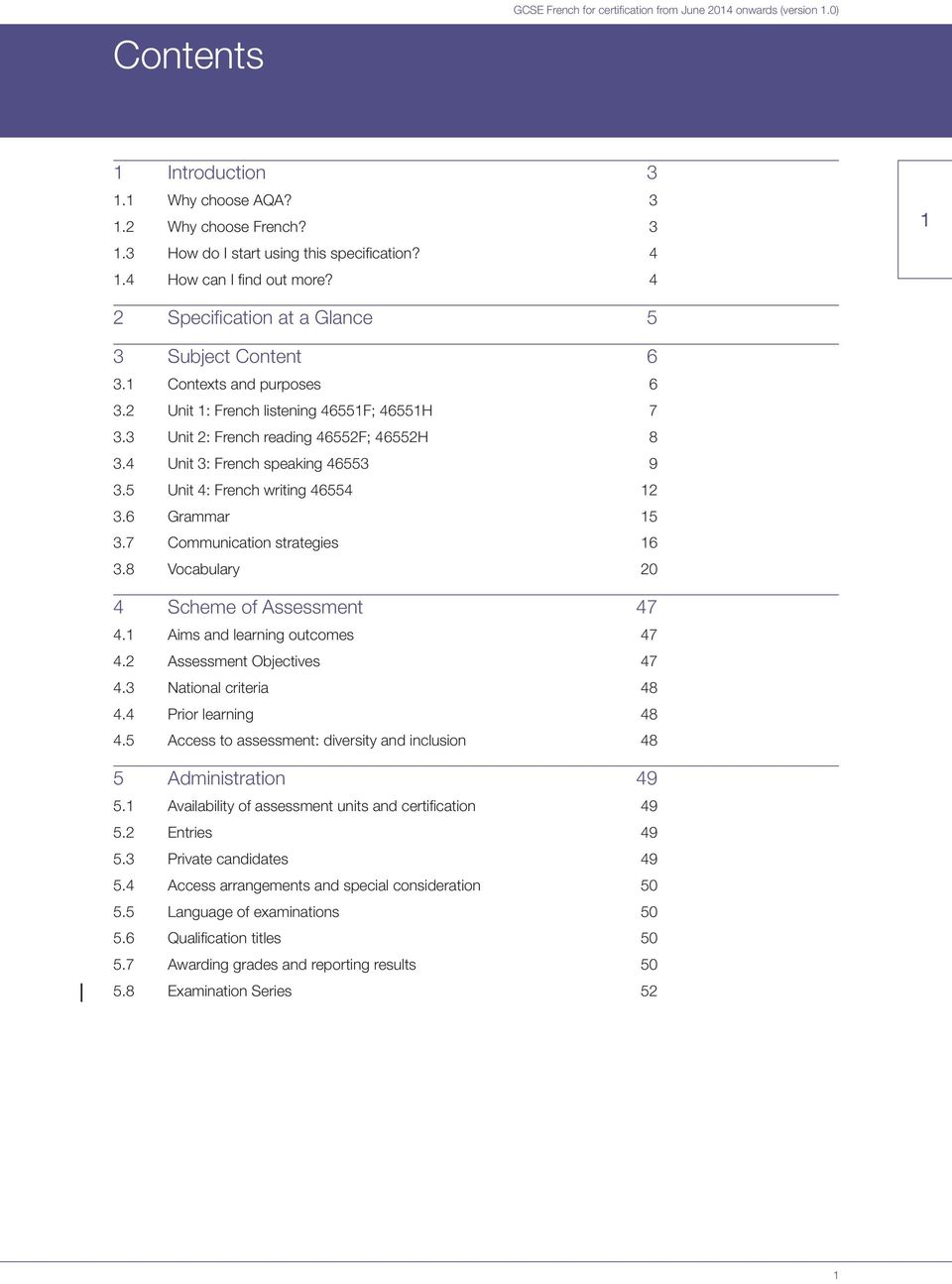
4 Contents GCSE French for certification from June 2014 onwards (version 1.0) 1 Introduction 1.1 Why choose AQA? 1.2 Why choose French? 1. How do I start using this specification? How can I find out more? Specification at a Glance 5 Subject Content 6.1 Contexts and purposes 6.2 Unit 1: French listening 46551F; 46551H 7. Unit 2: French reading 46552F; 46552H 8.4 Unit : French speaking Unit 4: French writing Grammar 15.7 Communication strategies 16.8 Vocabulary 20 4 Scheme of Assessment Aims and learning outcomes Assessment Objectives National criteria Prior learning Access to assessment: diversity and inclusion 48 5 Administration Availability of assessment units and certification Entries Private candidates Access arrangements and special consideration Language of examinations Qualification titles Awarding grades and reporting results Examination Series 52 1
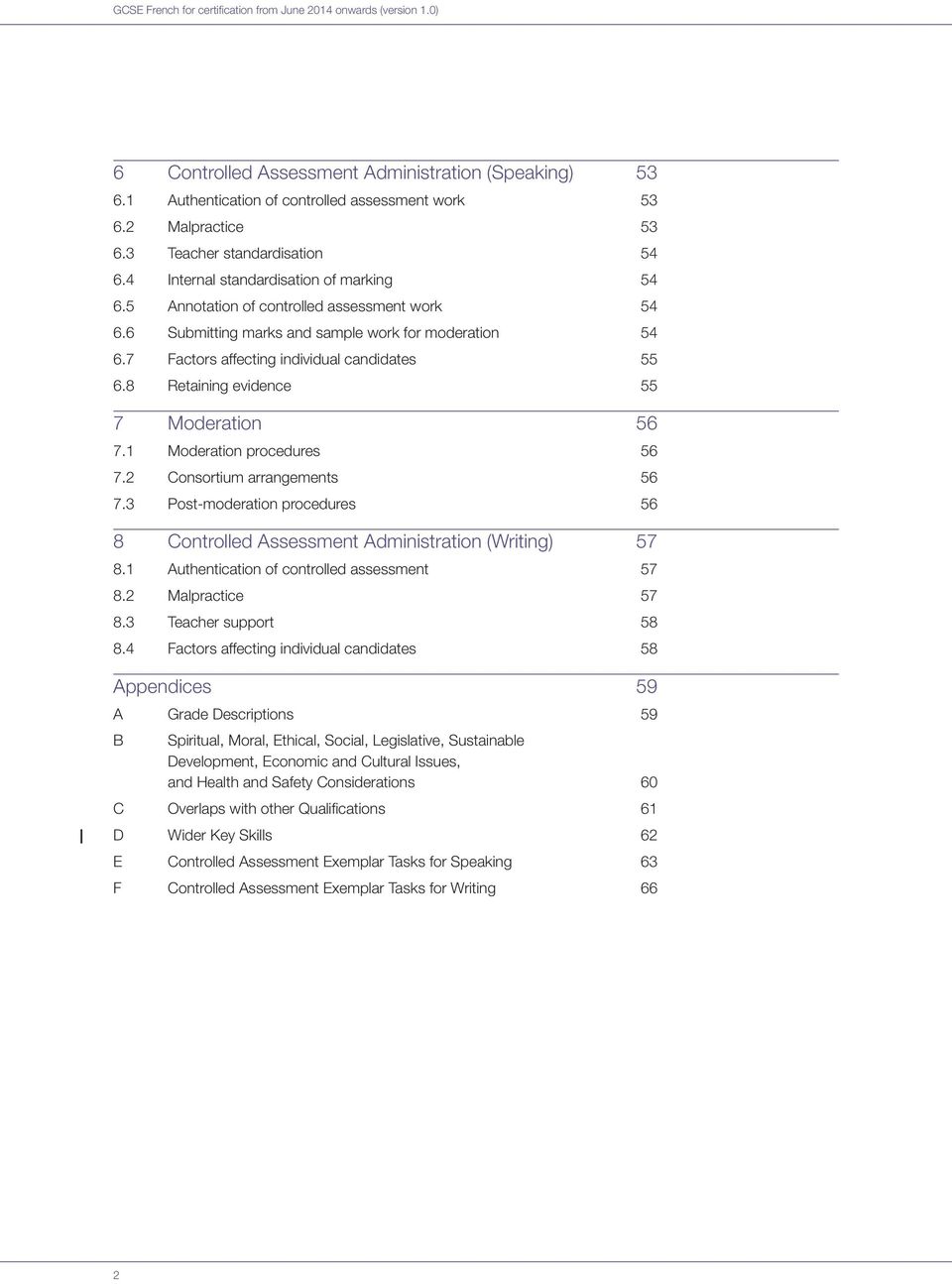
5 6 Controlled Assessment Administration (Speaking) Authentication of controlled assessment work Malpractice 5 6. Teacher standardisation Internal standardisation of marking Annotation of controlled assessment work Submitting marks and sample work for moderation Factors affecting individual candidates Retaining evidence 55 7 Moderation Moderation procedures Consortium arrangements Post-moderation procedures 56 8 Controlled Assessment Administration (Writing) Authentication of controlled assessment Malpractice Teacher support Factors affecting individual candidates 58 Appendices 59 A Grade Descriptions 59 B Spiritual, Moral, Ethical, Social, Legislative, Sustainable Development, Economic and Cultural Issues, and Health and Safety Considerations 60 C Overlaps with other Qualifications 61 D Wider Key Skills 62 E Controlled Assessment Exemplar Tasks for Speaking 6 F Controlled Assessment Exemplar Tasks for Writing 66 2
6 1 Introduction 1.1 Why choose AQA? AQA is the UK s favourite exam board and more students receive their academic qualifications from AQA than from any other board. But why is AQA so popular? AQA understands the different requirements of each subject by working in partnership with teachers. Our GCSEs: enable students to realise their full potential contain engaging content are manageable for schools and colleges are accessible to students of all levels of ability lead to accurate results, delivered on time are affordable and value for money. AQA provides a comprehensive range of support services for teachers: access to subject departments training for teachers including practical teaching strategies and approaches that really work presented by senior examiners personalised support for Controlled Assessment 24 hour support through our website and online Ask AQA past question papers and mark schemes comprehensive printed and electronic resources for teachers and students AQA is an educational charity focused on the needs of the learner. All our income goes towards operating and improving the quality of our specifications, examinations and support services. We don t aim to profit from education we want you to. If you are an existing customer then we thank you for your support. If you are thinking of moving to AQA then we look forward to welcoming you Why choose French? To develop language skills in a variety of contexts. Choice of contexts and purposes for Writing and Speaking units. Listening and Reading assessments carry forward structure of existing specification, offering continuity for teachers. Embraces opportunities offered by new subject criteria to lessen the stress of assessment in Speaking. Builds on the KS study and prepares students for further study, eg GCSE to AS; AS to A2 etc.

7 1. How do I start using this specification? 1 Already using the existing AQA French specification? Register to receive further information, such as mark schemes, past question papers, details of teacher support meetings, etc, at Information will be available electronically or in print, for your convenience. Tell us that you intend to enter students. Then we can make sure that you receive all the material you need for the examinations. This is particularly important where examination material is issued before the final entry deadline. You can let us know by completing the appropriate Intention to Enter and Estimated Entry forms. We will send copies to your Exams Officer and they are also available on our website: ( Not using the AQA specification currently? Almost all centres in England and Wales use AQA or have used AQA in the past and are approved AQA centres. A small minority are not. If your centre is new to AQA, please contact our centre approval team at [email protected] 1.4 How can I find out more? Ask AQA You have 24-hour access to useful information and answers to the most commonly-asked questions at If the answer to your question is not available, you can submit a query for our team. Our target response time is one day. Teacher Support Details of the full range of current Teacher Support and CPD courses are available on our web site at There is also a link to our fast and convenient online booking system for all of our courses at 4

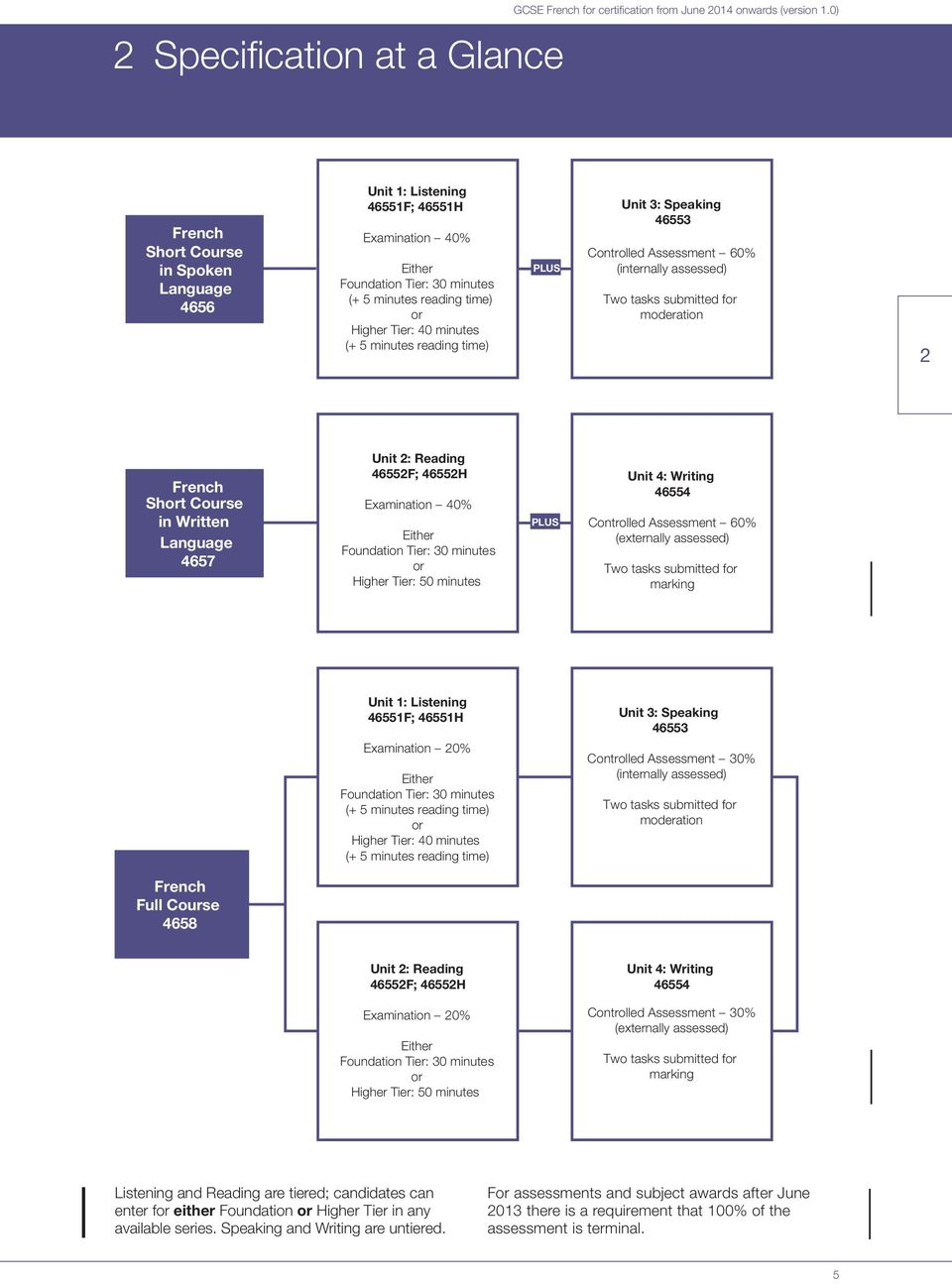
8 2 Specification at a Glance GCSE French for certification from June 2014 onwards (version 1.0) French Short Course in Spoken Language 4656 Unit 1: Listening 46551F; 46551H Examination 40% Either Foundation Tier: 0 minutes (+ 5 minutes reading time) or Higher Tier: 40 minutes (+ 5 minutes reading time) PLUS Unit : Speaking 4655 Controlled Assessment 60% (internally assessed) Two tasks submitted for moderation 2 French Short Course in Written Language 4657 Unit 2: Reading 46552F; 46552H Examination 40% Either Foundation Tier: 0 minutes or Higher Tier: 50 minutes PLUS Unit 4: Writing Controlled Assessment 60% (externally assessed) Two tasks submitted for marking Unit 1: Listening 46551F; 46551H Examination 20% Either Foundation Tier: 0 minutes (+ 5 minutes reading time) or Higher Tier: 40 minutes (+ 5 minutes reading time) Unit : Speaking 4655 Controlled Assessment 0% (internally assessed) Two tasks submitted for moderation French Full Course 4658 Unit 2: Reading 46552F; 46552H Unit 4: Writing Examination 20% Either Foundation Tier: 0 minutes or Higher Tier: 50 minutes Controlled Assessment 0% (externally assessed) Two tasks submitted for marking Listening and Reading are tiered; candidates can enter for either Foundation or Higher Tier in any available series. Speaking and Writing are untiered. For assessments and subject awards after June 201 there is a requirement that 100% of the assessment is terminal. 5
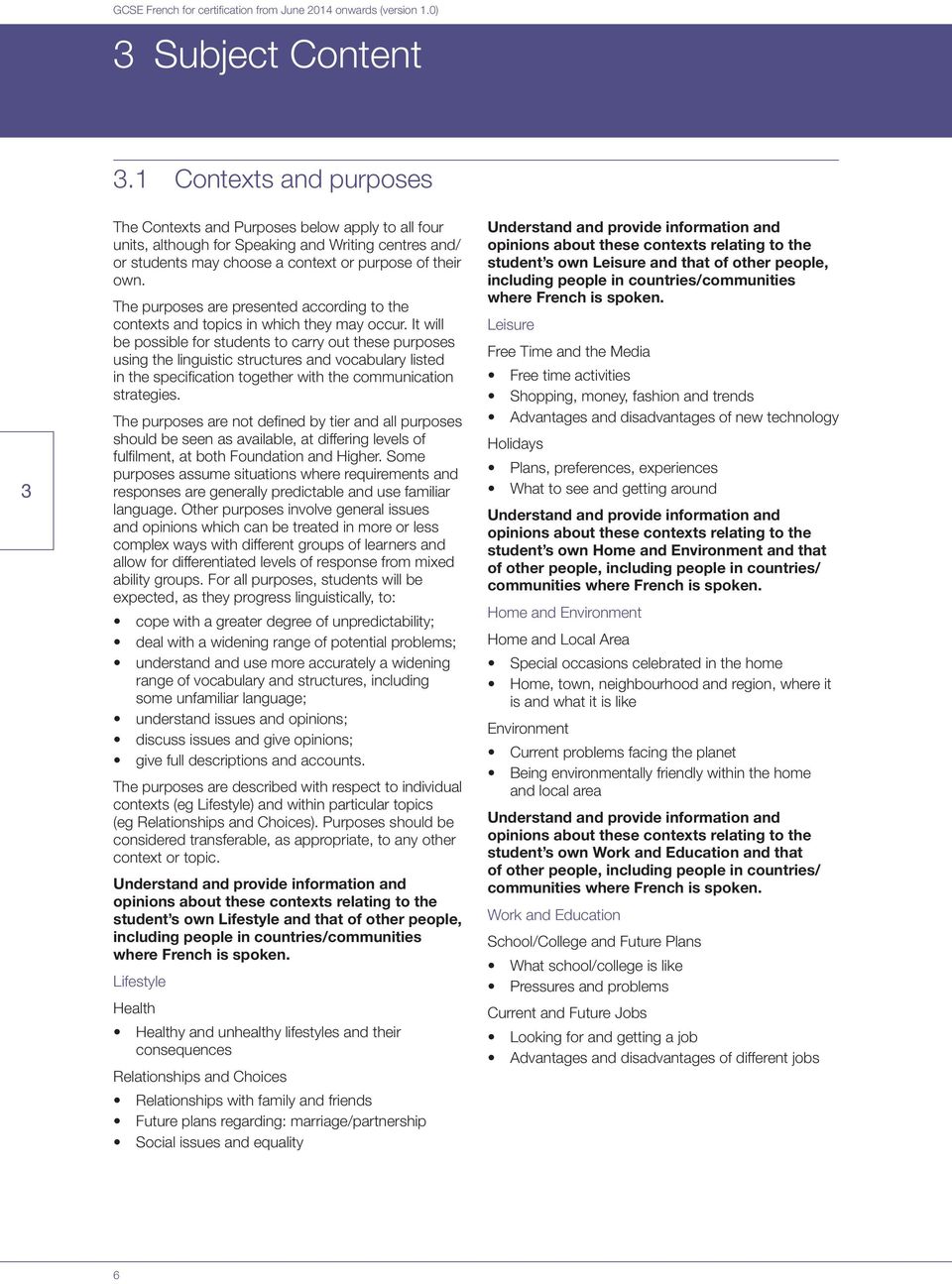
9 Subject Content.1 Contexts and purposes The Contexts and Purposes below apply to all four units, although for Speaking and Writing centres and/ or students may choose a context or purpose of their own. The purposes are presented according to the contexts and topics in which they may occur. It will be possible for students to carry out these purposes using the linguistic structures and vocabulary listed in the specification together with the communication strategies. The purposes are not defined by tier and all purposes should be seen as available, at differing levels of fulfilment, at both Foundation and Higher. Some purposes assume situations where requirements and responses are generally predictable and use familiar language. Other purposes involve general issues and opinions which can be treated in more or less complex ways with different groups of learners and allow for differentiated levels of response from mixed ability groups. For all purposes, students will be expected, as they progress linguistically, to: cope with a greater degree of unpredictability; deal with a widening range of potential problems; understand and use more accurately a widening range of vocabulary and structures, including some unfamiliar language; understand issues and opinions; discuss issues and give opinions; give full descriptions and accounts. The purposes are described with respect to individual contexts (eg Lifestyle) and within particular topics (eg Relationships and Choices). Purposes should be considered transferable, as appropriate, to any other context or topic. Understand and provide information and opinions about these contexts relating to the student s own Lifestyle and that of other people, including people in countries/communities where French is spoken. Lifestyle Health Healthy and unhealthy lifestyles and their consequences Relationships and Choices Relationships with family and friends Future plans regarding: marriage/partnership Social issues and equality Understand and provide information and opinions about these contexts relating to the student s own Leisure and that of other people, including people in countries/communities where French is spoken. Leisure Free Time and the Media Free time activities Shopping, money, fashion and trends Advantages and disadvantages of new technology Holidays Plans, preferences, experiences What to see and getting around Understand and provide information and opinions about these contexts relating to the student s own Home and Environment and that of other people, including people in countries/ communities where French is spoken. Home and Environment Home and Local Area Special occasions celebrated in the home Home, town, neighbourhood and region, where it is and what it is like Environment Current problems facing the planet Being environmentally friendly within the home and local area Understand and provide information and opinions about these contexts relating to the student s own Work and Education and that of other people, including people in countries/ communities where French is spoken. Work and Education School/College and Future Plans What school/college is like Pressures and problems Current and Future Jobs Looking for and getting a job Advantages and disadvantages of different jobs 6
10 .2 Unit 1: French listening 46551F; 46551H Students can be entered for either Foundation or Higher, but not both. 20% of the marks Foundation Tier 0 minutes 5 marks The test will be pre-recorded using native speakers. Only material which is appropriate to the spoken language will be used in the tests. Each item will be heard twice. Students comprehension will be tested by a range of question types, normally requiring non-verbal responses or responses in English. Students will be allowed to make notes during the test. Students will be given 5 minutes reading time at the beginning of the test, before the recording is played, to give them time to read the questions. The test will consist of items of varying length which will not place an undue burden on memory. Comprehension of announcements, short conversations, instructions, short news items and telephone messages will be required, together with some material which will be longer and may include reference to past, present and future events and some unfamiliar language. Students will be expected to identify main points and extract details and points of view. The use of dictionaries will not be permitted. The tests will consist of a number of discrete items and will be marked according to a detailed mark scheme. The student s performance will be assessed according to the effectiveness with which he/she is able to carry out the tasks based on what he/she has heard. The appropriate mark(s) will be awarded if the student has satisfactorily communicated his or her understanding, even though the response may contain some errors. Higher Tier 40 minutes 40 marks The test will be pre-recorded using native speakers. Only material which is appropriate to the spoken language will be used in the tests. Each item will be heard twice. Students comprehension will be tested by a range of question types, normally requiring non-verbal responses or responses in English. Students will be allowed to make notes during the test. Students will be given 5 minutes reading time at the beginning of the test, before the recording is played, to give them time to read the questions. The test will contain items common to those in Foundation and also material which will include some complex, unfamiliar language in a range of registers, together with non-factual and narrative material. Students will be expected to understand discussion of a wide range of issues. They will also need to understand gist and detail, identify and extract main points, use context and other clues to interpret meaning, draw conclusions and summarise what they have heard. The use of dictionaries will not be permitted. The tests will consist of a number of discrete items and will be marked according to a detailed mark scheme. The student s performance will be assessed according to the effectiveness with which he/she is able to carry out the tasks based on what he/she has heard. The appropriate mark(s) will be awarded if the candidate has satisfactorily communicated his or her understanding, even though the response may contain some errors. 7

11 . Unit 2: French reading 46552F; 46552H Students can be entered for either Foundation or Higher, but not both. 20% of the marks Foundation Tier 0 minutes 5 marks Only material which is appropriate to the written language will be used in the test. Students comprehension will be tested by a range of question types, normally requiring non-verbal responses or responses in English. The test will consist of short items testing comprehension of instructions, public notices and advertisements together with some longer extracts from brochures, guides, letters, newspapers, magazines, books, faxes, and web sites which may include reference to past, present and future events and will include some unfamiliar language. A number of questions will be set on the material to test students ability to identify key points and extract specific details. The use of dictionaries will not be permitted. The tests will consist of a number of discrete items and will be marked according to a detailed mark scheme. The student s performance will be assessed according to the effectiveness with which he/she is able to carry out the tasks based on what he/she has read. The appropriate mark(s) will be awarded if the student has satisfactorily communicated his or her understanding, even though the response may contain some errors. Higher Tier 50 minutes 45 marks Only material which is appropriate to the written language will be used in the test. Students comprehension will be tested by a range of question types, normally requiring non-verbal responses or responses in English. The test will contain items common to those in Foundation and also material which will include some complex, unfamiliar language in a range of registers, together with non-factual and imaginative material including narrative. Students will be expected to use their knowledge of grammar and structure in demonstrating understanding of specific points and of gist/the main message. They will also be expected to recognise points of view, attitudes and emotions and to draw conclusions. The use of dictionaries will not be permitted. The tests will consist of a number of discrete items and will be marked according to a detailed mark scheme. The student s performance will be assessed according to the effectiveness with which he/she is able to carry out the tasks based on what he/she has read. The appropriate mark(s) will be awarded if the student has satisfactorily communicated his or her understanding, even though the response may contain some errors. 8

12 .4 Unit : French speaking % of the marks 60 marks Students will complete two controlled assessment tasks. These tasks are untiered. Differentiation is by outcome, not by task. These may be drawn from the exemplar tasks we provide or they may be adapted by teachers for their students. Teachers may also devise their own tasks. Both tasks will be in the form of a dialogue. The tasks will be marked by the teacher and submitted to AQA for moderation. The work of individual students may be informed by working with others but they must provide an individual response. Where model answers are published, students must not reproduce any sections of continuous prose provided in such answers. Whilst students may use individual sentences from model answers, they must not reproduce several consecutive sentences from such answers in their own response. A student's response must not be identical to that of another student in the centre or to any published model answer. Students must not submit the same task for Speaking and Writing. Assessment Criteria Per Task Marks Communication 10 Range and Accuracy of Language Pronunciation and Intonation 5 Interaction and Fluency 5 10 TOTAL 0 Marks Communication 9 10 Very Good 7 8 Good 5 6 Sufficient 4 Limited 1 2 Poor Information, ideas and points of view are presented and explained with confidence. Can narrate events when appropriate. A good amount of information and points of view are conveyed and regularly developed. A reasonable amount of information and points of view are conveyed and sometimes developed. Some simple information and opinions are conveyed. Few responses are developed. Little relevant information communicated. Very few appropriate responses are developed. 0 No relevant information conveyed. A zero score. 9

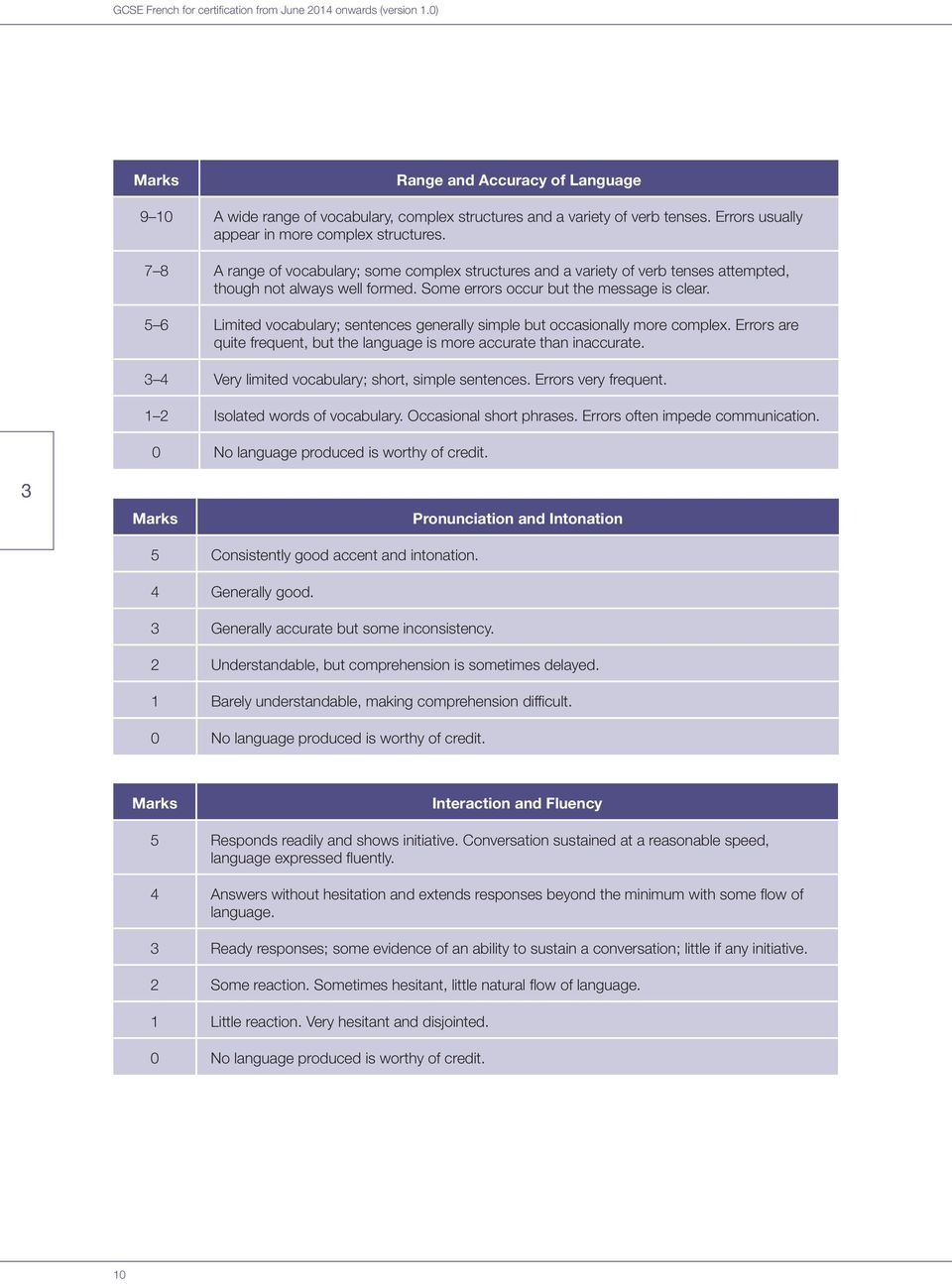
13 Marks Range and Accuracy of Language 9 10 A wide range of vocabulary, complex structures and a variety of verb tenses. Errors usually appear in more complex structures. 7 8 A range of vocabulary; some complex structures and a variety of verb tenses attempted, though not always well formed. Some errors occur but the message is clear. 5 6 Limited vocabulary; sentences generally simple but occasionally more complex. Errors are quite frequent, but the language is more accurate than inaccurate. 4 Very limited vocabulary; short, simple sentences. Errors very frequent. 1 2 Isolated words of vocabulary. Occasional short phrases. Errors often impede communication. 0 No language produced is worthy of credit. Marks Pronunciation and Intonation 5 Consistently good accent and intonation. 4 Generally good. Generally accurate but some inconsistency. 2 Understandable, but comprehension is sometimes delayed. 1 Barely understandable, making comprehension difficult. 0 No language produced is worthy of credit. Marks Interaction and Fluency 5 Responds readily and shows initiative. Conversation sustained at a reasonable speed, language expressed fluently. 4 Answers without hesitation and extends responses beyond the minimum with some flow of language. Ready responses; some evidence of an ability to sustain a conversation; little if any initiative. 2 Some reaction. Sometimes hesitant, little natural flow of language. 1 Little reaction. Very hesitant and disjointed. 0 No language produced is worthy of credit. 10
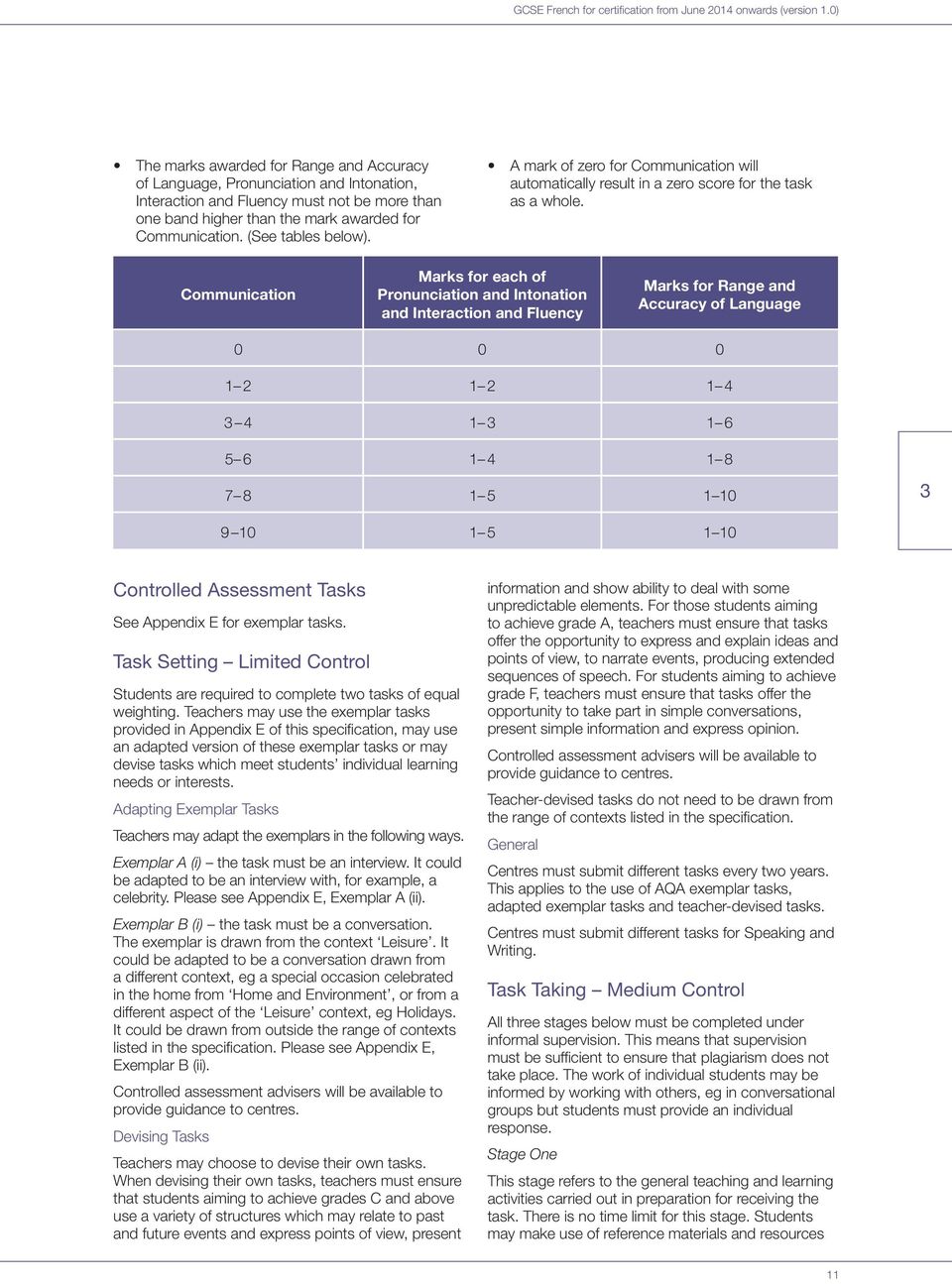
14 The marks awarded for Range and Accuracy of Language, Pronunciation and Intonation, Interaction and Fluency must not be more than one band higher than the mark awarded for Communication. (See tables below). A mark of zero for Communication will automatically result in a zero score for the task as a whole. Communication Marks for each of Pronunciation and Intonation and Interaction and Fluency Marks for Range and Accuracy of Language Controlled Assessment Tasks See Appendix E for exemplar tasks. Task Setting Limited Control Students are required to complete two tasks of equal weighting. Teachers may use the exemplar tasks provided in Appendix E of this specification, may use an adapted version of these exemplar tasks or may devise tasks which meet students individual learning needs or interests. Adapting Exemplar Tasks Teachers may adapt the exemplars in the following ways. Exemplar A (i) the task must be an interview. It could be adapted to be an interview with, for example, a celebrity. Please see Appendix E, Exemplar A (ii). Exemplar B (i) the task must be a conversation. The exemplar is drawn from the context Leisure. It could be adapted to be a conversation drawn from a different context, eg a special occasion celebrated in the home from Home and Environment, or from a different aspect of the Leisure context, eg Holidays. It could be drawn from outside the range of contexts listed in the specification. Please see Appendix E, Exemplar B (ii). Controlled assessment advisers will be available to provide guidance to centres. Devising Tasks Teachers may choose to devise their own tasks. When devising their own tasks, teachers must ensure that students aiming to achieve grades C and above use a variety of structures which may relate to past and future events and express points of view, present information and show ability to deal with some unpredictable elements. For those students aiming to achieve grade A, teachers must ensure that tasks offer the opportunity to express and explain ideas and points of view, to narrate events, producing extended sequences of speech. For students aiming to achieve grade F, teachers must ensure that tasks offer the opportunity to take part in simple conversations, present simple information and express opinion. Controlled assessment advisers will be available to provide guidance to centres. Teacher-devised tasks do not need to be drawn from the range of contexts listed in the specification. General Centres must submit different tasks every two years. This applies to the use of AQA exemplar tasks, adapted exemplar tasks and teacher-devised tasks. Centres must submit different tasks for Speaking and Writing. Task Taking Medium Control All three stages below must be completed under informal supervision. This means that supervision must be sufficient to ensure that plagiarism does not take place. The work of individual students may be informed by working with others, eg in conversational groups but students must provide an individual response. Stage One This stage refers to the general teaching and learning activities carried out in preparation for receiving the task. There is no time limit for this stage. Students may make use of reference materials and resources 11
15 of all kinds including course books, dictionaries and internet resources as part of these teaching and learning activities. The teacher s involvement is not limited at this stage. Stage Two This stage begins when students are given the task. The teacher should discuss the task with the students, including the kind of language they might need and how to use their preparatory work. There must be no other support from the teacher. Students may have access to reference materials including dictionaries, course books and internet resources. This research can be carried out outside the classroom. Further guidance is provided in the Controlled Assessment Handbook. Stage Three This stage is when students produce the final version. Duration Each task should last between 4 and 6 minutes. Further guidance is provided in the Controlled Assessment Handbook. Task Marking Medium Control Teachers must mark the controlled assessment tasks using the assessment criteria provided in this specification. Centres will be required to record an adequate sample of tasks to provide sufficient evidence for moderation. Further guidance is provided in the Controlled Assessment Handbook..5 Unit 4: French writing % of the marks 60 marks Students will complete two controlled assessment tasks. These tasks are untiered. Differentiation is by outcome, not by task. These may be drawn from the exemplar tasks we provide or they may be adapted by teachers for their students. Teachers may also devise their own tasks. The tasks will be marked by AQA. Students must complete all work independently. Students must have access to dictionaries while writing up their final version under supervision. Assessment Criteria Content Marks Criteria 1 15 Very Good Good Fully relevant and detailed response to the task. Sound ability to convey information clearly, express and explain ideas and points of view. Well organised structure. Mostly relevant response to the task and shows ability to convey a lot of information clearly, express and explain ideas and points of view. 7 9 Sufficient 4 6 Limited 1 Poor Response to the task is generally relevant with quite a lot of information clearly communicated. Points of view are expressed and ideas are developed. Limited response to the task with some relevant information conveyed. Simple opinions are expressed and there is some development of basic ideas. Very limited response to the task with little relevant information conveyed. No real structure. 0 The answer shows no relevance to the task set. A zero score will automatically result in a zero score for the answer as a whole. 12

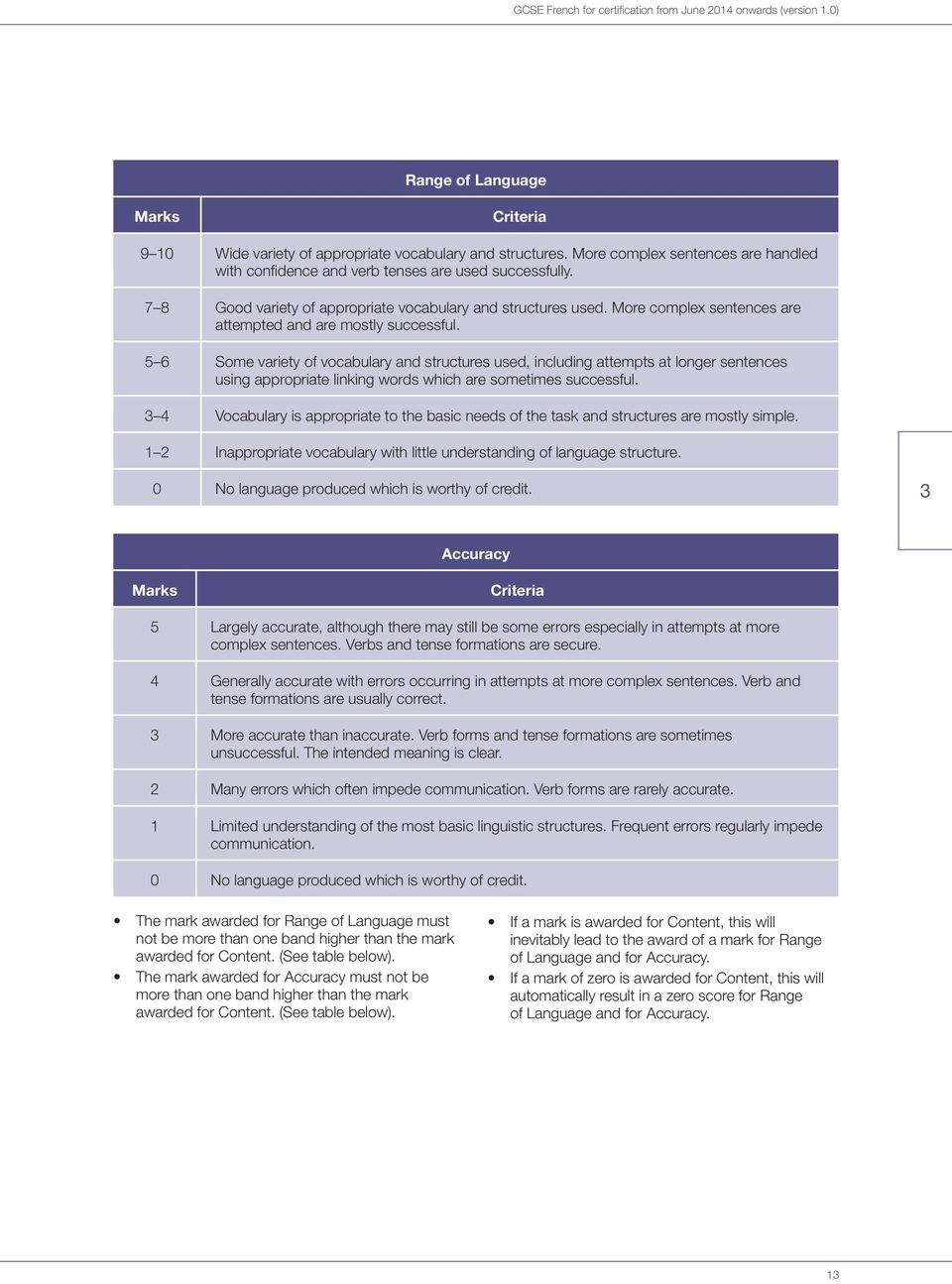
16 Range of Language Marks Criteria 9 10 Wide variety of appropriate vocabulary and structures. More complex sentences are handled with confidence and verb tenses are used successfully. 7 8 Good variety of appropriate vocabulary and structures used. More complex sentences are attempted and are mostly successful. 5 6 Some variety of vocabulary and structures used, including attempts at longer sentences using appropriate linking words which are sometimes successful. 4 Vocabulary is appropriate to the basic needs of the task and structures are mostly simple. 1 2 Inappropriate vocabulary with little understanding of language structure. 0 No language produced which is worthy of credit. Accuracy Marks Criteria 5 Largely accurate, although there may still be some errors especially in attempts at more complex sentences. Verbs and tense formations are secure. 4 Generally accurate with errors occurring in attempts at more complex sentences. Verb and tense formations are usually correct. More accurate than inaccurate. Verb forms and tense formations are sometimes unsuccessful. The intended meaning is clear. 2 Many errors which often impede communication. Verb forms are rarely accurate. 1 Limited understanding of the most basic linguistic structures. Frequent errors regularly impede communication. 0 No language produced which is worthy of credit. The mark awarded for Range of Language must not be more than one band higher than the mark awarded for Content. (See table below). The mark awarded for Accuracy must not be more than one band higher than the mark awarded for Content. (See table below). If a mark is awarded for Content, this will inevitably lead to the award of a mark for Range of Language and for Accuracy. If a mark of zero is awarded for Content, this will automatically result in a zero score for Range of Language and for Accuracy. 1
17 Content Mark Controlled Assessment Tasks See Appendix F for exemplar tasks. Task Setting Limited Control Students are required to complete two different types of task to ensure that they use language for different purposes. Teachers may use the exemplar tasks provided in Appendix F of this specification, may use an adapted version of these exemplar tasks or may devise tasks which meet students individual learning needs or interests. The tasks are equally weighted. Adapting Exemplar Tasks Teachers may adapt exemplar tasks in the following ways. Exemplar Task 1 My life as a celebrity could be adapted to My life as a teenager or My ideal day as a blog for a web page. Suggested content for A day in my life could be: introduce yourself how your day starts what you drink and eat the people you meet during the day how does your day end Exemplar Task Marks for Range of Language Marks for Accuracy Holidays a chance to win 2 weeks in the sun could be adapted to be An account of a special occasion produced for a family web page. Suggested content for An account of a special occasion could be: reason for the celebration where it took place the people involved and what you think about them what you had to eat and drink what else happened best memory of the day and why Controlled assessment advisers will be available to provide guidance to centres. Devising Tasks Centres may choose to devise their own tasks. When devising their own tasks, teachers must ensure that students aiming to achieve grades C and above include a variety of structures which may include different tenses or time frames and express points of view as well as communicate information. For those students aiming to achieve grade A, teachers must ensure that tasks offer the opportunity to express and explain ideas and points of view, producing a variety of vocabulary, structures and verb tenses. For students aiming to achieve grade F, teachers must ensure that tasks offer the opportunity to express simple opinions using simple sentences and usually convey the main points. Controlled assessment advisers will be available to provide guidance to centres. Teacher-devised tasks do not need to be drawn from the range of contexts listed in the specification. General Centres must submit different tasks every two years. This applies to the use of AQA exemplar tasks, adapted exemplar tasks and teacher-devised tasks. Centres must submit different tasks for Speaking and Writing. Task Taking High Control Stage One This stage refers to the general teaching and learning activities carried out in preparation for receiving the task. There is no time limit for this stage. Students may make use of reference materials of all kinds including course books, dictionaries and internet resources. The teacher s involvement is not limited at Stage One. Stage Two This stage begins when students are given the task. This stage must be completed under informal supervision. This means that supervision must be sufficient to ensure that plagiarism does not take place. The work of individual students may be informed by working with others but students must provide an individual response. Where model answers are published, students must not reproduce any sections of continuous prose provided in such answers. Whilst students may use individual sentences from model answers, they must not reproduce several consecutive sentences from such answers in their own response. A student's response must not be identical to that of another student in the centre or to any published model answer. During Stage Two, students may have access to reference materials including dictionaries, course books and internet resources. This research can be carried out outside the classroom. 14

18 Further guidance is provided in the Controlled Assessment Handbook. Stage Three This stage is when students produce the final version. Students must spend no more than 60 minutes, per task, on writing the final version. This must be completed in one single assessment session. Students aiming at grades G D should produce words across the two tasks; Students aiming at grades C A* should produce words across the two tasks. Students must be in the direct sight of the supervisor at all times when writing up the final version. Further guidance is provided in the Controlled Assessment Handbook. Task Marking High Level of Control The awarding body marks the controlled assessment..6 Grammar GCSE candidates will be expected to have acquired knowledge and understanding of French grammar during their course. In the examination they will be required to apply their knowledge and understanding, drawing from the following lists. The examples in brackets are indicative, not exclusive. For structures marked (R), only receptive knowledge is required. French (Foundation tier) Nouns: gender singular and plural forms Articles: definite, indefinite and partitive, including use of de after negatives Adjectives: agreement position comparative and superlative: regular and meilleur demonstrative (ce, cet, cette, ces) indefinite (chaque, quelque) possessive interrogative (quel, quelle) Adverbs: comparative and superlative regular interrogative (comment, quand) adverbs of time and place (aujourd hui, demain, ici, là-bas) common adverbial phrases Quantifiers/Intensifiers (très, assez, beaucoup, peu, trop) Pronouns: personal: all subjects, including on reflexive relative: qui relative: que (R) object: direct (R) and indirect (R) position and order of object pronouns disjunctive/emphatic demonstrative (ça, cela) indefinite (quelqu un) interrogative (qui, que) use of y, en (R) Verbs: regular and irregular verbs, including reflexive verbs all persons of the verb, singular and plural negative forms interrogative forms modes of address: tu, vous impersonal verbs (il faut) verbs followed by an infinitive, with or without a preposition tense: present perfect imperfect: avoir, être and faire other common verbs in the imperfect tense (R) immediate future future (R) conditional: vouloir and aimer pluperfect (R) passive voice: present tense (R) imperative present participle Prepositions: Conjunctions: Number, quantity, dates and time: including use of depuis with present time 15

19 French (Higher tier) All grammar and structures listed for foundation tier, as well as: Adjectives: comparative and superlative, including meilleur, pire Adverbs: comparative and superlative, including mieux, le mieux Pronouns: use of y, en relative: que relative: dont (R) object: direct and indirect position and order of object pronouns demonstrative (celui) (R) possessive (le mien) (R) Verbs: tenses: future imperfect conditional pluperfect passive voice: future, imperfect and perfect tenses (R) perfect infinitive present participle, including use after en subjunctive mood: present, in commonly used expressions (R) Time: including use of depuis with imperfect tense.7 Communication strategies Whilst it is useful for learners to concentrate on a core of key language for any given topic, it is impossible to predict all the linguistic elements they might meet when reading and listening to authentic French, or which they themselves might need to use. For this reason they will need to develop communication strategies which will greatly increase their ability to cope successfully with unknown words. There are two main types of strategy: those that relate to understanding (reading and listening) and those that relate to production (speaking and writing). Strategies for Understanding a. Ignoring words which are not needed for a successful completion of the task set. Many texts contain words which are not essential for an understanding of the main points of the text. Furthermore, what is important in the text is often presented more than once, in different ways: the learner may not understand a point in one form of words and understand it fully in another. Learners can be trained to read and listen in positive ways, seeking out in the text only the information they need to answer questions and to complete communication tasks and ignoring the rest. b. Using the visual and verbal context. The skilled reader can find many clues about the purpose and content of a text from a study of the layout, the title, the length, the type-face and any related pictures. This is why texts are presented in the examination in their original format as much as possible. When reading and listening, pupils can learn to infer the meaning of new words from the verbal context. So, for example, someone who did not know the word mancienne could, after some appropriate practice be expected to understand from the following context that it is some sort of tree: Il s est assis sous une mancienne: dans ses branches, un oiseau chantait. c. Making use of grammatical markers and categories. Learners will be helped to master all these strategies if, when reading and listening, they learn to use such clues as the plural forms of nouns or verbs, the ways verbs change to form tenses, word order and other such features which will help them to recognise to which category (verb, noun, adjective, etc.) an unknown word belongs. This can be a considerable help in making intelligent guesses about the meaning of the word. d. Making use of the social and cultural context. Another aid to correct inferencing is for the pupils to bear in mind that there are regularities in the real world which make it possible to anticipate what people may say or write about it. The ability to predict occurrences in the real world makes it possible sometimes to predict the words, and the meaning of the words, that represent these occurrences. This is one reason why it is important for a French course to develop knowledge and understanding of countries and communities where French is spoken (Section 4.1 of this specification). e. Using common patterns with French. Knowledge of the following patterns of word formation in French will be assumed. Candidates will be expected to be able to make use of these patterns in both directions: so, using the second bullet below, acknowledge of haut should permit understanding of hauteur ; 16

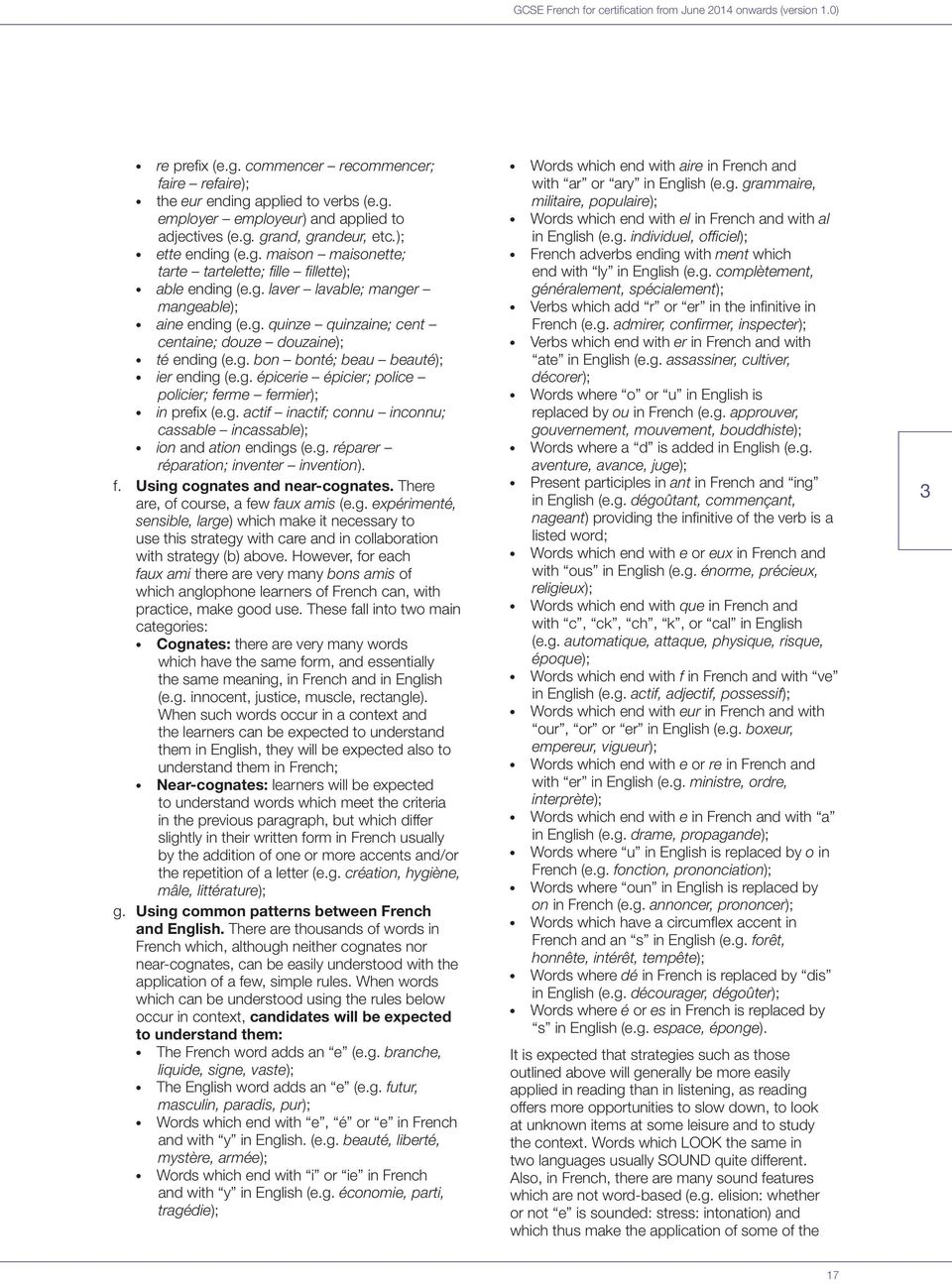
20 re prefix (e.g. commencer recommencer; faire refaire); the eur ending applied to verbs (e.g. employer employeur) and applied to adjectives (e.g. grand, grandeur, etc.); ette ending (e.g. maison maisonette; tarte tartelette; fille fillette); able ending (e.g. laver lavable; manger mangeable); aine ending (e.g. quinze quinzaine; cent centaine; douze douzaine); té ending (e.g. bon bonté; beau beauté); ier ending (e.g. épicerie épicier; police policier; ferme fermier); in prefix (e.g. actif inactif; connu inconnu; cassable incassable); ion and ation endings (e.g. réparer réparation; inventer invention). f. Using cognates and near-cognates. There are, of course, a few faux amis (e.g. expérimenté, sensible, large) which make it necessary to use this strategy with care and in collaboration with strategy (b) above. However, for each faux ami there are very many bons amis of which anglophone learners of French can, with practice, make good use. These fall into two main categories: Cognates: there are very many words which have the same form, and essentially the same meaning, in French and in English (e.g. innocent, justice, muscle, rectangle). When such words occur in a context and the learners can be expected to understand them in English, they will be expected also to understand them in French; Near-cognates: learners will be expected to understand words which meet the criteria in the previous paragraph, but which differ slightly in their written form in French usually by the addition of one or more accents and/or the repetition of a letter (e.g. création, hygiène, mâle, littérature); g. Using common patterns between French and English. There are thousands of words in French which, although neither cognates nor near-cognates, can be easily understood with the application of a few, simple rules. When words which can be understood using the rules below occur in context, candidates will be expected to understand them: The French word adds an e (e.g. branche, liquide, signe, vaste); The English word adds an e (e.g. futur, masculin, paradis, pur); Words which end with e, é or e in French and with y in English. (e.g. beauté, liberté, mystère, armée); Words which end with i or ie in French and with y in English (e.g. économie, parti, tragédie); Words which end with aire in French and with ar or ary in English (e.g. grammaire, militaire, populaire); Words which end with el in French and with al in English (e.g. individuel, officiel); French adverbs ending with ment which end with ly in English (e.g. complètement, généralement, spécialement); Verbs which add r or er in the infinitive in French (e.g. admirer, confirmer, inspecter); Verbs which end with er in French and with ate in English (e.g. assassiner, cultiver, décorer); Words where o or u in English is replaced by ou in French (e.g. approuver, gouvernement, mouvement, bouddhiste); Words where a d is added in English (e.g. aventure, avance, juge); Present participles in ant in French and ing in English (e.g. dégoûtant, commençant, nageant) providing the infinitive of the verb is a listed word; Words which end with e or eux in French and with ous in English (e.g. énorme, précieux, religieux); Words which end with que in French and with c, ck, ch, k, or cal in English (e.g. automatique, attaque, physique, risque, époque); Words which end with f in French and with ve in English (e.g. actif, adjectif, possessif); Words which end with eur in French and with our, or or er in English (e.g. boxeur, empereur, vigueur); Words which end with e or re in French and with er in English (e.g. ministre, ordre, interprète); Words which end with e in French and with a in English (e.g. drame, propagande); Words where u in English is replaced by o in French (e.g. fonction, prononciation); Words where oun in English is replaced by on in French (e.g. annoncer, prononcer); Words which have a circumflex accent in French and an s in English (e.g. forêt, honnête, intérêt, tempête); Words where dé in French is replaced by dis in English (e.g. décourager, dégoûter); Words where é or es in French is replaced by s in English (e.g. espace, éponge). It is expected that strategies such as those outlined above will generally be more easily applied in reading than in listening, as reading offers more opportunities to slow down, to look at unknown items at some leisure and to study the context. Words which LOOK the same in two languages usually SOUND quite different. Also, in French, there are many sound features which are not word-based (e.g. elision: whether or not e is sounded: stress: intonation) and which thus make the application of some of the 17
21 strategies for understanding unknown words more difficult. In particular, it must be remembered that grammatical markers in the spoken language are often quite different from those in the written one. The most obvious are the plural forms: Nouns and adjectives frequently have no plural forms: plurality is shown by a change in the pronunciation of the article or some other related word: le grand pont les grands ponts; Verbs either have no plural form at all: il donne/ils donnent: il chantait/ils chantaient or add a consonant: il vend/ils vendent: il finit/ils finissent. In order to hear accurately candidates should have the specific differences of the spoken language brought to their attention. However some of the general strategies for understanding listed above can, with practice, be used successfully in listening, namely: Ignoring words which are not needed for a successful completion of the task set; Using the (visual and) verbal context; Making use of the social and cultural context; Using common patterns within French. In addition, the following strategies are included for listening and understanding (in place of reading strategies (f) and (g)). h. Near-cognates Strictly speaking there are no French words which sound exactly like their English equivalents. There are a few near-cognates which are, however, relatively easily recognised. They are often words imported from other languages, e.g. whisky, ski. i. Other words which in reading cause no problem can be unrecognisable in speech e.g. specialisation has seven distinct syllables in French and five in English, it has five specific pronunciation differences in French and a complete change of stress pattern. Therefore the only unlisted words candidates will be expected to understand are those of one or two syllables in French which have only one obviously predominant meaning and to which one or more of the following communicative strategies can be applied. The sound [i] will always involve a French i, which in English may be a diphthong, e.g. pipe, mine; The sound [a] will always involve a French a which in English may be diphthong, e.g. nation; The termination [œr] is always eur which may be English -or or -er, e.g. acteur; The termination [sic] is always -tion or -sion and therefore English [ Ÿen], e.g. nation, passion; The termination [if] in French is -if and in English is often -ive e.g. actif; The termination [ik] in French is -ique and ic and in English is often -ic or -ical e.g. physique; The intervocalic [] is usually the English [d] e.g. juge, magique; The initial [Ÿ] is usually the English ch. e.g. chapelle, charme. In addition candidates will be expected to hear the termination [mα] which can be added to many of the adjectives in the lists to form the adverb. e.g. complètement; the termination [α] which can be added to the stem of listed verbs to give the present participle e.g. mangeant, gémissant. An approach to language teaching that develops the use of such strategies as those outlined above contributes to the Aims in Section 4.1 of this specification. Strategies for Production Research and experience show that people who communicate effectively in a foreign language tend to make good use of systematic efficient verbal and nonverbal strategies in order to get meaning across in spite of their imperfect command of the language. Candidates who use communication strategies which help them successfully to express themselves will be given credit. Individual candidates may fail to learn, or forget language items required by some test items, or they may wish to attempt to go beyond the demands of the specification in completing the task set. In these circumstances, the following strategies can prove useful. They fall into two main categories: nonverbal and verbal. The non-verbal strategies described below are clearly of limited value in the speaking tests of this examination which are recorded; they may, however, prove useful to the learner. Non-Verbal Strategies a. Pointing and demonstration, accompanied by some appropriate language (e.g. Comme ça... Qu est-ce que c est? Ça fait mal ici ). b. Expression and gesture, accompanied where appropriate with sounds (e.g. Oh! which, with appropriate intonation, facial expression and gestures can convey such attitudes and functions as pain, surprise, anger, fear, pleasure and admiration). c. Mime, which again can be accompanied by appropriate sounds and language, and can sometimes help communication to be maintained when it might otherwise break down (e.g.) Je peux vous aider? with a suitable mime if one has forgotten words such as balayer and essuyer. This strategy has obvious limitations in an 18
22 speaking test which is recorded and assessed on the basis of the recording d. Drawing can be an efficient strategy with some tasks (especially written) and can convey both attitude and information (e.g. J or L; or a diagram showing how to get from one point (e.g. a station) to another (e.g. a home). Verbal strategies a. Using a word which refers to a similar item to the one the speaker/writer wishes to refer to, but for which he/she has forgotten the word (e.g. montre for horloge, tasse for verre, fleur for rose or prêter for louer. This strategy is not always effective and its use would be assessed according to its effectiveness in a particular context. b. Description of physical properties to refer to something of which the name has been forgotten (e.g. c est rond... le fruit jaune... l objet qu on voit sur la table ). The physical properties refer, for example, to colour, size, material, position and shape. Again, the use of this strategy in an examination would be assessed according to its communicative effectiveness. c. Requests for help can include requests for translation (e.g. Comment dit-on chair en français...? Qu est-ce que cela veut dire en anglais? ) and questions which make no reference to English (e.g. Comment s appelle ce machin-là?... Ça s écrit comment? ). Use of this strategy in the examination will not allow candidates to be given full credit. However, it is clearly preferable to use such requests for help than for communication to collapse and its use will be assessed according to the context. When requests for help with specific problems occur, the teacher should maintain the role of a sympathetic native speaker and help accordingly. The teacher should, of course, avoid taking over from the candidate and carrying out the tasks set. d. Simplification, when a learner avoids the use of a form of which he/she is unsure (e.g. il faut que je m en aille.. je viendrai s il fait beau ) by using a form which he/she finds simpler, (e.g. Je dois partir... Je viens s il fait beau ). When such simple forms are used correctly and appropriately they will be awarded high marks. Correct and appropriate use of more complex forms will also be rewarded. A systematic use of simplified forms may reduce error, facilitate communication and increase fluency, but if overused, this strategy may result in pupils failing to make full use of their capabilities. e. Paraphrase, where the learner uses words and messages in acceptable French, avoiding the use of words which he/she has forgotten (e.g. Elle n est pas mariée for Elle est célibataire C est comme un... C est le contraire de... C est une sorte de Je voudrais une tranche de cette viande-là... ). When used well, this strategy communicates the message effectively to a sympathetic native speaker and such use in an examination would be assessed accordingly. f. Reference to specific features (e.g. L animal aux longues oreilles... La jeune fille qui porte des lunettes... ). This strategy is often quite effective and effective use would be assessed accordingly in an examination. g. Reference to the function of an object and the actions that can be performed with it (e.g. l objet qu on utilise pour ouvrir une bouteille ). This is a commonly used strategy which is usually effective in communicative terms. Another strategy sometimes used by language learners is word coinage, the creation of words based either on English or French words. This strategy usually produces words which do not exist in French or which, if they do exist, have a different meaning from the one intended. The use of this strategy is rarely effective in promoting communication and candidates would be well advised to use it only if all other strategies fail. Another commonly used strategy is topic avoidance, when the learner ignores or abandons a topic because of inability to deal with it. Use of this strategy in the examination will not allow the candidate to be given full credit. Use of it in a learning situation will reduce opportunities for the development or expansion of the learner s repertoire. It is, therefore, a strategy which should be discouraged, as a basic condition for communication strategies to have a potential learning effect is that they are governed by achievement, rather than avoidance behaviour. Approaches which lay more stress on correctness than on communication will tend to encourage the use of avoidance strategies. Appropriate use of the dictionary will help learners to tackle particular difficulties and help avoid the need to resort to avoidance. The evidence suggests that the availability of a range of strategies such as those outlined above, and flexibility in their use, represent an important advantage in overall communicative effectiveness. It also appears that the most effective strategies demand some linguistic proficiency and that the more proficient speakers are also better at using communication strategies effectively. The development of such strategies cannot, therefore, be seen as encouragement not to develop linguistic knowledge as much as possible! Strategic competence is not a substitute for vocabulary learning, for example, but a useful supplement. Indeed, all language users make use of communication strategies, even in their first language, and really successful strategies usually pass unnoticed. 19
23 .8 Vocabulary The minimum core Vocabulary Lists are primarily intended as a guide for teachers to assist in the planning of schemes of work. The Listening and Reading assessment tasks at Foundation Tier will be based on the Foundation List and the General Vocabulary List; students should also expect to encounter some unfamiliar vocabulary, but they will not be tested on it. The Listening and Reading assessment tasks at Higher Tier will be based on the Foundation and Higher Lists and the General Vocabulary List; in addition students should also expect to encounter some unfamiliar vocabulary, and may be tested on it, provided that it can be accessed through communication strategies. Vocabulary listed in the Grammar Section can also be tested but it is not listed in the minimum core Vocabulary Lists. Comparisons Comparative and superlative of adjectives plus moins plus que moins que bon meilleur le meilleur mauvais pire le pire Comparison and superlative of adverbs bien mieux le mieux mal plus mal le plus mal beaucoup plus le plus peu moins le moins Conjunctions and Connectives à cause de à part ainsi alors aussi car cependant c est-à-dire comme d un côté/de l autre côté donc ensuite évidemment et mais même si ou parce que par contre par exemple pendant que pourtant puis puisque quand sans doute si y compris Prepositions à à côté de à travers au bord de au bout de au-dessous de au-dessus de au fond de au lieu de au milieu de autour de avec contre dans de depuis derrière devant en en dehors de en face de entre Students will be expected to understand words which have the same or very similar form in the language as in the English, provided that such words have essentially the same meaning in both languages. Such words are not listed in the minimum core Vocabulary Lists. Students will be expected to be familiar with feminine forms of nouns/adjectives where these are not given. Students may use the minimum core Vocabulary Lists for their Speaking and Writing Controlled Assessment tasks, or they may prefer to choose vocabulary that suits their own contexts and purposes. General Vocabulary Students will be expected to use and understand the general vocabulary listed below. The vocabulary is not restricted to specific settings and can occur in any of the topic areas listed in the specification. jusqu à malgré parmi pour près de sans selon sous sur vers Negatives ne...jamais ne pas ne...personne ne...plus ne que ne rien ni ni pas encore The Numbers million Alphabet and accents Students are expected to know the letters of the alphabet and appropriate accents. Ordinal numbers Premier/première dixième Other number expressions dizaine douzaine nombre de 20
24 Asking questions combien? comment? est-ce que? où? pourquoi? quand? que? quel/quelle? qu est-ce que? qu est-ce qui? qu est-ce que c est? qui? quoi? Common Questions A quelle heure? Ça s écrit comment? C est combien? C est quelle date? C est quel jour? De quelle couleur? D où? Où ça? Où est? Pour combien de temps? Que veut dire? Quelle heure est-il? Greetings and Exclamations à bientôt à demain à tout à l heure allô amitiés au revoir au secours bien sûr bienvenue! bonjour bon anniversaire bon appétit bon voyage bonne année bonne chance bonne idée bonne nuit bonnes vacances bonsoir bravo ça va(?) d accord de rien désolé excusez-moi félicitations joyeux Noël meilleurs voeux merci non oui pardon quel dommage salut santé! s il te/vous plaît Opinions à mon avis absolument affreux agréable aimer amusant barbant bien bien entendu bon ça dépend ça m énerve ça me fait rire ça me plaît ça m est égal ça ne me dit rien ça suffit casse-pieds cher chouette comique comme ci comme ça compliqué content croire d accord désagréable désirer détester difficile dire drôle embêtant en général enchanté ennuyeux espérer étonné facile faible fantastique formidable franchement généralement génial grave habile intéressant (s ) intéresser à inutile incroyable inquiet joyeux marrant marre (en avoir) mauvais merveilleux mignon moche moderne (moi) non plus nouveau nul optimiste passionnant peine la penser pessimiste peut-être populaire positif/positive pratique préférer promettre regretter ridicule rigolo sage sembler sensass simple splendide stupide supporter superbe utile vouloir zut! 21
25 Expressions of time Days of the week lundi mardi mercredi jeudi vendredi samedi dimanche Seasons printemps été automne hiver Months of the year janvier février mars avril mai juin juillet août septembre octobre novembre décembre The Clock demi environ heure midi minuit minute moins quart seconde Other time expressions à la fois à l avenir à l heure à temps partiel an année après après-demain après-midi aujourd hui auparavant avant avant-hier bientôt d abord dans une minute d habitude de bonne heure début demain dernier de temps en temps déjà de nouveau en attendant en avance en retard en train de (être...) en même temps encore une fois enfin fin hier il y a jour journée lendemain longtemps maintenant matin mois moment (en ce moment) normalement nuit parfois passé pendant plus tard presque prochain quelquefois rarement récemment semaine seulement siècle soir soudain souvent suivant sur le point de (être...) tard tôt toujours tous les jours tout à coup tout de suite vite week-end Location and distance à droite à gauche banlieue centre-ville campagne chez de chaque côté de l autre côté en bas en haut est ici kilomètre là là-bas loin de nord nulle part ouest par partout quelque part situé sud tout droit tout près toutes directions ville Colour blanc bleu blond brun clair foncé gris jaune marron noir pourpre rose rouge roux vert Weights and measures assez bas 22
26 beaucoup boîte bouteille centimètre court demi encore de étroit gramme grand gros haut kilo large litre maigre mesurer mètre mince moitié morceau moyen nombre paquet pas mal de peser petit peu plein de pointure rien suffisamment taille tranche très trop Shape carré hauteur rond Weather averse briller brouillard chaleur chaud ciel climat couvert degré doux éclair éclaircie ensoleillé faire beau faire mauvais froid geler glace humide météo mouillé neige neiger nuage nuageux ombre orage orageux pleuvoir pluie sec soleil température tempête temps tonnerre tremper vent Access complet entrée libre fermé fermer interdit occupé ouvert ouvrir sortie Correctness avoir raison avoir tort corriger erreur faute faux il (me) faut juste nécessaire obligatoire parfait sûr se tromper vrai Materials argent = silver béton bois brique carton coton cuir fer laine métal or papier plastique soie verre Common abbreviations CDI centre de documentation et d information le CES collège d enseignement secondaire le EMT éducation manuelle et technique l (f) EPS éducation physique et sportive l (f) HLM habitation à loyer modéré l (f) SAMU service d aide médicale d urgence le SDF sans domicile fixe le SNCF société nationale des chemins de fer français la TGV train à grande vitesse le TVA taxe sur la valeur ajoutée la VTT vélo tout terrain le Foundation Tier LIFESTYLE Health abricot l (m) aider alcool l (m) alimentation l (f) aller bien/mieux (s ) arrêter baguette la banane la beurre le bière la bifteck le biscuit le bœuf le boire 2
27 bol le bonbon le café le carotte la céréales les (f) cerise la champignon le chips les (m) chocolat le chocolat chaud le chose la chou le chou-fleur le cidre le citron le coca le cœur le comprimé le confiture la couteau le crème la (solaire) crêpe la croissant le cuillère la cuisine la dangereux déjeuner le délicieux dîner le drogue la se droguer eau l (f) eau minérale l (f) eau potable/non potable l (f) en bonne forme en bonne santé envie l (f) (avoir envie de) équilibré faim la fatigant fatigué fort fourchette la frais fraise la framboise la frites les (f) fromage le fruits de mer les (m) fumer fumeur/non fumeur le gâteau le goût le goûter gras habitude l (f) haricot vert le hôpital l (m) hors-d œuvre l (m) huile l (f) (s ) inquiéter jambon le jus le (de fruit/d orange) lait le légume le limonade la liste la mal (avoir mal) malade maladie la manger médecin le médicament le nourriture la obésité l (f) odeur l (f) œuf l (m) ordinaire pain le paresseux pâté le pâtes les (f) pêche la = peach petit déjeuner le petits pois les (m) peur la plein poire la poisson le poivre le pomme la pomme de terre la porc le poulet le prendre raisin le régime le (se) relaxer repas le rester riz le rôti sain salade la sans santé la saucisse la saucisson le sauf saumon le sel le (se) sentir soif la soupe la spaghettis les (m) spécialité la sucré sucre le surtout tabac le tarte la thé le tomate la tomber tousser truite la vanille la végétarien verre le viande la vide vin le vitamine la vivre yaourt le Relationship and Choices adresse l (f) adulte l (m/f) âge l (m) aimable aîné ami/e l (m/f) amical amour l (m) anniversaire l (m) annonce l (f) (s ) appeler attendre avoir ans barbe la battre bavard bavarder beau/belle beau-frère le beau-père le 24
28 bébé le belle-mère la belle-sœur la bête bouclé carte d identité la célèbre chat le cher cheval le cheveux les (m) chien le chômage le cochon d Inde le connaître contribuer copain le copine la critiquer dame la date de naissance la demi-frère le demi-sœur la (se) disputer divorcé écrire égoïste enfant l (m/f) (s ) entendre fâché famille la femme la fille la fils le frère le garçon le gens les (m) gentil grand-mère la grand-père le grands-parents les (m) (s ) habituer à hésiter heureux homme l (m) identité l (f) il s agit de jeune joli lapin le lieu le loger lunettes les (f) (de soleil) madame mademoiselle malheureux maman la mari le marié (se) marier méchant mère la monsieur mort la naissance la nationalité la né nez le nom le (de famille) oiseau l (m) oncle l (m) papa le parents les (m) partenaire le/la (idéal(e)) passeport le pauvre pénible père le personnalité la personne la personnes défavorisées les (f) petit ami le petite amie la pleurer poisson rouge le poli porter prénom le rapports les (m) refuser religieux remercier rendez-vous le respecter responsabilité la riche rire sans travail sécurité la sens de l humour le séparé seul signer sœur la sondage le sourire souris la sympa tante la timide tranquille triste vandalisme le vérité la vieux visage le voisin le LEISURE Free Time and the Media accompagner achat l (m) acheter aller (s ) amuser à l appareil (m) appel l (m) argent l (m) (de poche) avantage l (m) ballon le bande dessinée la banque la basket le besoin le (avoir de) bijouterie la billet le blouson le bon marché boucherie la boucle d oreille la boulangerie la boules les (f) boutique la cadeau le caisse la carte de crédit la ceinture la centre commercial le centre de sport le chanson la chanter chanteur le chanteuse la chapeau le charcuterie la chaussette la 25
29 chaussure la chemise la choisir choix le cinéma le clavier le client le cliquer coiffeur le coiffeuse la coin le comédie la concours le confiserie la couleur la courir cravate la cyclisme le danser démodé dépenser désavantage le dessin animé le disque le (compact) documentaire le donner échanger écran l (m) émission l (f) (jeunesse/musicale/ sportive) ensemble entrée l (f) envoyer épicerie l (f) équipe l (f) équitation l (f) essayer faire des économies faire les courses faire les magasins fana le/la (être fana de) favori feuilleton le film d aventures le film d horreur le film de guerre le film de science-fiction le film policier le film romantique le gagner gant le gratuit groupe le guitare la gymnastique la hypermarché l (m) idée l (f) imper(méable) l (m) inconvénient l (m) jean le jeu le (de cartes/de société) jeu vidéo le jouer jouet le journal le jupe la laisser lecteur DVD le lecteur MP le lecture la librairie la libre lire livre sterling la magasin le maillot de bain le maison de la presse la manteau le maquillage le marchand le (de fruits et de légumes) marché le membre le mettre de l argent à côté mode la (à la mode) monnaie la montre la musique la ( classique/pop/rap/ rock) nager natation la numéro le (de téléphone) orchestre l (m) ordinateur l (m) paire la pantalon le parapluie le parfum le parfumerie la passe-temps le patin à roulettes le patinage le patiner patinoire la pâtisserie la pêche la = fishing pièce la = play pique-nique le piscine la planche à voile la poche la portable le portefeuille le porte-monnaie le poste la pousser prix le (se) promener publicité la pull le pyjama le rayon le recevoir réduit réduction la regarder remplir (se) rencontrer rentrer retourner risque le robe la rouge à lèvres le sac le (à main) sandale la sauter séance la série la shampooing le short le site le (aller sur un site) skate le ski nautique le (faire du...) soldes les (m) sortie la sortir sous-titré spectateur le sportif sports d hiver les (m) sports nautiques les (m) stade le supermarché le surf le (de neige) surfer surprise-partie la 26
30 sweat (shirt) le taper technologie la télé(vision) la temps libre le texto le théâtre le tirer toucher valeur la vedette la vendre venir version la (originale/française) veste la vêtements les (m) vitrine la voile la voir volley le VTT le Holidays addition l (f) aéroport l (m) Afrique l (f)/africain agence de voyages l (f) air l (m) (en plein) Algérie l (f)/algérien Allemagne l (f)/allemand aller retour l (m) aller simple l (m) Alpes les Amérique l (f)/américain Angleterre l (f)/anglais (s ) approcher arrivée l (f) ascenseur l (m) assiette l (f) Atlantique l (m) auberge de jeunesse l (f) Australie l (f)/australien auto l (f) autobus l (m) autoroute l (f) aventure l (f) avion l (m) bagages les (m) (se) baigner bain le balcon le bateau le Belgique la/belge boisson la bord (de la mer) le (se) bronzer bureau des renseignements le camion le Canada le/canadien car le caravane la carnet le carrefour le carte la carte postale la casser chambre la (double/de famille/pour une personne/à deux lits) château le chauffeur le chercher Chine la/chinois classe la colonie de vacances la commander composter compris conduire confirmer confort le consigne la côte la coûter demi-pension la départ le différence la différent dortoir le douane la douche la Douvres drapeau le durer Ecosse l (f)/écossais Edimbourg employé(e) l (m/f) encore endroit l (m) entrée l (f) Espagne l (f)/espagnol essence l (f) Etats-Unis les (m) étoile l (f) étranger l (m) (à ) expliquer feux rouges les (m) gare la gare routière la (se) garer gîte le Grande-Bretagne la/britannique guichet le horaire l (m) hôtel l (m) Inde l (f)/indien Irlande l (f) (du Nord)/irlandais Italie l (f)/italien Japon le/japonais lac le lavabo le lentement ligne la location la (de voitures) logement le loisir le Londres louer Manche la marcher Maroc le/marocain Méditerranée la même menu le (à prix fixe/touristique) mer la (se) mettre en route mixte mobylette la monde le moto la office de tourisme l (m) partager partir passager le passant le pays le Pays de Galles le/gallois péage le pension complète la permis le (de conduire) pièce d identité la pied le (à ) piéton le piste la plage la plan de ville le plat le (du jour/principal) 27
31 Pologne la/polonais Portugal le/portugais pourboire le pressé prêt projet le promenade la (faire une promenade) quai le quitter randonnée la rapide recommander région la renseignements les (m) réservation la réserver retour le revenir rond-point le rue la sable le sac de couchage le saison la salle d attente la salle de bains la savon le séjour le sens interdit sens unique service compris le servir sortie la (...de secours) spectacle le station service la stationner Suisse la/suisse suivre supplément le syndicat d initiative le tarif le (réduit) tasse la tente la tourisme le touriste le/la tourner Tunisie la/tunisien vacances les (f) valise la véhicule le visite la (guidée) visiter voiture la vol le = flight voler = fly voyage le voyager voyageur le vraiment vue la (de mer) HOME AND ENVIRONMENT Home and Local Area appartement l (m) arbre l (m) armoire l (f) arrêt l (m) (d autobus) (s ) asseoir bâtiment le bibliothèque la boîte de nuit la boum la bowling le bruit le bureau le calme cathédrale la cave la chaise la champ le clé la club des jeunes le code postal le colline la commissariat le confortable (se) coucher couloir le cuisinière la déménager descendre dormir église l (f) entrer escalier l (m) espace l (m) étage l (m) faire du babysitting faire du jardinage faire le ménage faire la vaisselle fenêtre la ferme la fête la feu le fleur la four le ( à micro-ondes) frigo le garder habitant l (m) habiter historique hôtel de ville l (m) île l (f) immeuble l (m) industrie l (f) industriel jardin le jardin publique le lampe la lave-vaisselle le (se) laver laver la voiture se lever lit le mairie la maison la (individuelle/jumelée) mariage le métro le mettre meuble le miroir le montagne la monter montrer mur le musée le nettoyer Noël Nouvel An le Pâques parc le parking le pelouse la pièce la = room placard le place la plafond le plante la pont le porte la (d entrée) privé quartier le réveil le (se) réveiller rez-de-chaussée le 28
32 rideau le rivière la Saint-Valentin la salle à manger la salle de séjour la salon le serviette la sous-sol le tableau le tapis le téléphone le téléphoner terrain le (de camping/de sport) terrasse la toit le trottoir le (se) trouver usine l (f) vache la vestibule le vie la Environment boîte la (en carton) centre de recyclage le circulation la cultiver déchets les (m) environnement l (m) jeter pétrole le piste cyclable la pollué poubelle la problème le propre protéger recyclable recycler sac en plastique le sale sans plomb sauver transports en commun les (m) zone la (piétonne) WORK AND EDUCATION School/college and future plans affaires les (f) apprendre apprenti/e l (m/f) apprentissage l (m) bac le biologie la cahier le calculatrice la carrière la chimie la collège le commencer comprendre copier cour la cours le crayon le défense de demander dessin le dessiner détail le détester devoir devoirs les (m) dictionnaire le difficile difficulté la directeur le directrice la discuter droit le échange l (m) école l (f) (primaire/secondaire) écouter élève l (m/f) emploi du temps l (m) en première en seconde en sixième en terminale encourager études les (f) étudiant l (m) étudier examen l (m) exemple l (m) facile faire attention finir français le géographie la histoire l (f) informatique l (f) inquiet instituteur I (m) institutrice l (f) laboratoire le langue la leçon la livre le lycée le (technique) math(s) les (f) mathématiques les (f) matière la mot le note la organiser oublier parler passer pause la penser perdre photocopie la physique la poser pouvoir préparer professeur le récréation la règle la règlement le rentrée la répéter répondre réponse la résultat le réviser salle de classe la savoir scolaire stylo le tableau le (blanc interactif) travailler travailleur trimestre le uniforme l (m) université l (f) utiliser vocabulaire le Current and Future Jobs acteur I (m) actrice l (f) avenir l (m) bien payé boîte aux lettres la boucher le 29
33 boulanger le boulot le caissier le caissière la candidat le certainement certificat le chef le collègue le/la conférence la décider devenir distribuer docteur le électricien l (m) emploi l (m) entreprise l (f) enveloppe l (f) épicier l (m) facteur le fermier le formulaire le hôtesse de l air l (f) infirmier l (m) infirmière l (f) ingénieur l (m) lettre la livrer mal payé mécanicien le musicien le paquet le patron le plombier le policier le programmeur le propriétaire le/la (se) rappeler rêve le salaire le secrétaire le/la serveur le serveuse la stage le (en entreprise) technicien le timbre le travail le varié vendeur le vendeuse la Higher Tier LIFESTYLE Health à la carte à peine à point accro activité physique l (f) agneau l (m) ail l (m) alcoolique alcoolisé alcoolisme l (m) alimentation saine l (f) amer ananas l (m) apéritif l (m) avertir bien cuit canard le casse-croûte le casserole la concombre le côtelette la crevette la crise cardiaque la cru crudités les (f) dégoûtant dégustation la désintoxiquer (se) détendre douleur la (s ) entraîner épais épicé épuiser escargot l (m) faire la grasse matinée farine la foie le gâcher hors d haleine huître l (f) ivre laitue la matières grasses les (f) mener noix la oignon l (m) ouvre-boîte l (m) pamplemousse le piquant piqûre la poumon le prune la renoncer reprendre connaissance respirer revendeur le saignant salé sauvegarder savoureux sommeil le (avoir sommeil) tabagisme le tire-bouchon le toxicomane le/la tuer veau le veine la vinaigre le voler = steal Relationship and Choices actif ado l (m/f) agresser alliance l (f) animé attaque l (f) bague la baiser bande la bonheur le brutaliser cacher caractère le célibataire le chrétien compréhensif compter sur consacrer conseil le coupable de mauvaise humeur (se) débrouiller déçu déprimé déranger dette la douter droits de l homme les (m) 0
34 effrayant égal égalité l (f) élégant enlèvement l (m) ennui l (m) enquête l (f) envahir épouser espoir l (m) esprit l (m) étonnant étrange éviter exclus les (m/f) exprès féliciter fêter fiançailles les (f) fiancé fier fou gâter gêner humilier illégal immigré l (m) inconnu jaloux jeunesse la jugement le juif jumeau le jumelle la laid libertés civiques les (f) lutter maigre maladroit manifestation la menacer (se) mettre en colère monoparental moral le mosquée la mourir musulman naître nerveux neveu le nièce la noces les (f) nostalgie la organisation caritative l (f) pauvreté la petite-fille la petit-fils le (se) plaindre plaire plaisir le racaille la racisme le raide réaliser reconnaissant réfléchir réfugié le retraite la (à la retraite) rêver sans ressources sans-abri les (m/f) sentiment le (se) séparer sida le surveiller témoin le tomber amoureux de travail bénévole le veuf le veuve la vif vol le = theft voyou le LEISURE Free Time and the Media actualités les (f) alpinisme l (m) annuler anonyme antenne l (f) bijou le bloggeur le boîte aux lettres électronique la (blé) bouton le caméscope le canoë kayak le chaîne la chariot le chemisier le commencement le commerçant le comptoir le console de jeu la contrôler courrier électronique le course la cybercafé le déchirer dérouler (en bas/en haut) deviner distractions les (f) distributeur automatique le écharpe l (f) échecs les (m) écran tactile l (m) effacer emballer emprunter (s ) ennuyer enregistrer escalade l (f) être remboursé événement l (m) faire du lèche-vitrine fermeture la (annuelle) feu d artifice le feuilleter fléchettes les (f) fleuriste le/la genre le grande surface la grille de sécurité la gymnase le icône l (f) imprimer jour férié le lancer libre-service le lien le lourd magnétoscope le marquer (un but) mettre en ligne mi-temps la moniteur le mots croisés les (m) musculation la (faire de la musculation) page d accueil la pédagogique piercing le (à l oreille) pile la planche de surf la platine laser la plongée sous-marine la 1
35 poissonnerie la poste de travail le prise la pull à capuche le quotidien réclame la (en réclame) reçu le rembourser remplacer remporter (un prix) réseau le reste le réunion la sommet le suggérer tatouage le télécharger téléspectateur le tournée la traitement de texte le Holidays aire de repos l (f) atterrir avis l (m) bistro le bloc sanitaire le brasserie la casque le chambre d hôte la chemin de fer le climatisation la correspondance la croisière la décoller déviation la diriger doubler en provenance de état l (m) frontière la indiquer loyer le manquer marée la niveau le panneau le paraître parc d attractions le passage à niveau le paysage le perte la ralentir remarquer routier le station balnéaire la station de ski la tour la trajet le traversée la HOME AND ENVIRONMENT Home and Local Area allumer appuyer arrondissement l (m) baptême le bricolage le bruyant concierge le/la couverture la couvrir donner sur dur échelle l (f) entouré espaces verts les (m) étagère l (f) éteindre fauteuil le feuille la fontaine la forêt la grenier le haie la herbe l (f) horloge l (f) inondation l (f) jardin zoologique le jour de l an le jumelé lits superposés les (m) moquette la palais le pittoresque ranger robinet le Saint-Sylvestre la sans intérêt spacieux terre la tiroir le Toussaint la volet le Environment augmenter charbon le consommation la (modérée) construire couche d ozone la croire déboisement le détritus les (m) détruire disparaître effet de serre l (m) emballage l (m) embouteillage l (m) endommager espe `ce l (f) gaz carbonique le gaz d échappement le guerre la heures d affluence les (f) incendie l (m) lumière la mondial ordures les (f) paix la produire ramasser réchauffement de la terre le renouvelable surpeuplé tremblement de terre le trou d ozone le vague la WORK AND EDUCATION School/College and Future Plans bien équipé car de ramassage le confiance la connaissance la couramment diplôme le doué échouer empêcher enseigner enthousiasme l (m) explication l (f) faculté la frapper incivilités les (m) 2
36 instruction civique l (f) instruction religieuse l (f) langues vivantes les (f) licence la mal équipé maternelle la mentir permettre progrès les (m) redoubler retenue la réussir salle d informatique la salle des professeurs la souci le surchargé tâche la (se) taire thème le traduire troisième âge le utiliser victime la Current and Future Jobs améliorer annuaire l (m) assurer auteur l (m) avertissement l (m) avocat l (m) cadre le comptable le contrat le cours professionnel le demande d emploi la écrivain l (m) enrichissant entretien l (m) épreuve l (f) femme de ménage la foire d exposition la homme au foyer l (m) informaticien l (m) interprète l (m/f) jardinier le licencier loi la maçon le mannequin le offre d emploi l (f) ouvrier l (m) programme de formation le soigner soin le vétérinaire le/la Alphabetical Vocabulary List Foundation A à à bientôt à cause de à côté de à demain à droite à gauche à l appareil à l avenir à l étranger à l heure à mon avis à part à partir de à peu près à pied à quelle heure? à toute à l heure à vrai dire abricot l (m) absolument accompagner achat l (m) acheter acteur l (m) actrice l (f) addition l (f) adresse l (f) adulte l (m/f) aéroport l (m) affaires les (f) affreux africain Afrique l (f) âge l (m) âgé agence de voyages l (f) agent de police l (m) agréable aider aimable aimer aîné ainsi alcool l (m) Algérie l (f) algérien alimentation l (f) Allemagne l (f) allemand aller aller bien/mieux aller retour l (m) aller simple l (m) aller sur un site allô Alpes les alors américain Amérique l (f) ami l (m) amie l (f) amical amitiés les (f) amour l (m) amusant (s ) amuser an l (m) anglais Angleterre l (f) animé année l (f) anniversaire l (m) annonce l (f) août appartement l (m) appel l (m) (s ) appeler appétit l (m) apprendre apprenti/e l (m/f) apprentissage l (m) après après-demain après-midi l (m/f) (s ) approcher arbre l (m) argent l (m) (de poche) armoire l (f) arrêt l (m) (d autobus) (s ) arrêter arrivée l (f) ascenseur l (m) (s ) asseoir assez assiette l (f) Atlantique l (m) attendre
37 au bord de au bout de au fond de au milieu de au moins au revoir au secours auberge de jeunesse l (f) aujourd hui auparavant aussi Australie l (f) australien auto l (f) autobus l (m) automne l (m) autoroute l (f) autour de autre avant avantage l (m) avant-hier avec avec plaisir avenir l (m) aventure l (f) avion l (m) avoir avril B bac le bagages les (m) baguette la (se) baigner bain le balcon le ballon le banane la bande dessinée la banque la barbant barbe la bas basket le bateau le bâtiment le battre bavard bavarder beau beaucoup beau-frère le beau-père le bébé le belge Belgique la belle-mère la belle-sœur la besoin le (avoir de) bête béton le beurre le bibliothèque la bien bien sûr bien payé bientôt bienvenue! bière la bifteck le bijouterie la billet le biologie la biscuit le blanc bleu blond blouson le bœuf le boire bois le boisson la boîte la (en carton) boîte aux lettres la boîte de nuit la bol le bon bon anniversaire bon appétit bon marché bon voyage bonbon le bonjour bonne année bonne chance bonne fête bonne idée bonne nuit bonnes vacances bonsoir bord (de la mer) le boucher le boucherie la bouclé boucle d oreille la boulanger le boulangerie la boules les (f) boulot le boum la bouteille la boutique la bowling le bravo brique la britannique (se) bronzer brouillard le bruit le brun bureau le bureau des renseignements le C ça ça dépend ça m énerve ça s écrit comment? ça va (?) cadeau le café le cahier le caisse la caissier le caissière la calculatrice la calme camion le campagne la Canada le canadien candidat le car car le caravane la carnet le carotte la carrefour le carrière la carte la carte la (de crédit/bancaire/ d identité) carte postale la carton le casse-pieds casser 4
38 cathédrale la cave la ceinture la célèbre centimètre le centre commercial le centre de recyclage le centre de sport le centre-ville le cependant céréales les (f) cerise la certainement certificat le CES le c est combien? c est dommage c est quel jour? c est quelle date? c est-à-dire chaise la chambre la (double/de famille/pour une personne/à deux lits) champ le champignon le chance la chanson la chanter chanteur le chanteuse la chapeau le charcuterie la chat le château le chaud chauffeur le chaussette la chaussure la chef le chemise la cher chercher cheval le cheveux les (m) chez chien le chimie la Chine la chinois chips les (m) chocolat le chocolat chaud le choisir choix le chômage le chose la chou le chou-fleur le chouette cidre le ciel le cinéma le circulation la citron le clair classe la clavier le clé la client le cliquer climat le club des jeunes le coca le cochon d Inde le code postal le cœur le coiffeur le coiffeuse la coin le collège le collègue le/la colline la colonie de vacances la combien comédie la comique commander comme comme ci comme ça commencer comment commissariat le complet compliqué composter comprendre comprimé le compris concours le conduire conférence la confirmer confiserie la confiture la confort confortable connaître consigne la content contre contribuer copain le copine la copier corriger côte la coton le (se) coucher couleur la (de quelle couleur?) couloir le cour la courir cours le court couteau le coûter cravate la crayon le crème la (solaire) crêpe la critiquer croissant le cuillère la cuisine la cuisinière la cultiver cyclisme le D d abord d accord d habitude d un côté dame la dangereux dans danser date de naissance la de de bonne heure de chaque côté de l autre côté de rien de temps en temps début le décembre déchets les (m) 5
39 décider défense de degré le déjà déjeuner le délicieux demain demander déménager demi demi-frère le demi-pension la demi-sœur la démodé départ le dépenser depuis dernier derrière désagréable désavantage le descendre désirer désolé dessin le dessin animé le dessiner détail le détester devant devenir devoir devoirs les (m) différence la différent difficile difficulté la dimanche dîner le dire directeur le directrice la discuter (se) disputer disque le (compact) distribuer divorcé dizaine la docteur le documentaire le dommage le donc donner dormir dortoir le douane la douche la Douvres doux douzaine la drapeau le drogue la (se) droguer droit le droite la (à droite) drôle durer E eau l (f) eau minérale l (f) eau potable/non potable l (f) échange l (m) échanger école l (f) (primaire/secondaire) économies les (f) (faire des...) écossais Ecosse l (f) écouter écran l (m) écrire Edimbourg église l (f) égoïste électricien l (m) élève l (m/f) émission l (f) (jeunesse/musicale/ sportive) emploi l (m) emploi du temps l (m) employé(e) l (m/f) en en avance en bas en bonne forme en dehors de en face de en général en haut en même temps en plein air en première en retard en seconde en sixième en terminale en train de enchanté encore encore de encore une fois encourager endroit l (m) enfant l (m/f) enfin ennuyeux ensemble ensoleillé ensuite (s ) entendre entre entrée l (f) (libre) entreprise l (f) entrer enveloppe l (f) envie l (f) (avoir envie de) environ environnement l (m) envoyer EPS (éducation physique et sportive) l (f) épicerie l (f) épicier l (m) équilibré équipe l (f) équitation l (f) erreur l (f) escalier l (m) espace l (m) Espagne l (f) espagnol espérer essayer essence l (f) est l (m) est-ce que? et étage l (m) Etats-Unis les (m) été l (m) étoile l (f) étonné étranger l (m) (à...) être étroit études les (f) 6
40 étudiant l (m) étudier examen l (m) (s ) excuser excusez-moi exemple l (m) expliquer extra F fâché facile facteur le faible faim la faire faire attention faire beau faire des économies faire du babysitting faire du jardinage faire la vaisselle faire le ménage faire les courses faire les magasins faire mauvais famille la fana le/la (être fana de) fantastique fatigant fatigué faute la faux favori félicitations femme la fenêtre la ferme la fermé fermer fermier le fête la feuilleton le feu le feux rouges les (m) février fille la film d aventures le film de guerre le film d horreur le film de science-fiction le film policier le film romantique le fils le fin la finir fleur la fois la foncé forme la formidable formulaire le fort four le (à micro-ondes) fourchette la frais fraîche fraise la framboise la français franchement frère le frigo le frites les (f) froid fromage le fruits de mer les (m) fumer fumeur/non-fumeur le G gagner gallois gant le garçon le garder gare la gare routière la (se) garer gâteau le gauche geler généralement génial gens les (m) gentil géographie la gîte le glace la goût le goûter le gramme le grand Grande-Bretagne la grand-mère la grands-parents les (m) grand-père le gras gratuit grave gris gros groupe le guichet le guitare la gymnastique la H habile habitant l (m) habiter habitude l (f) (s ) habituer à haricot vert le haut hauteur la hésiter heure l (f) heureux hier histoire l (f) historique hiver l (m) homme l (m) hôpital l (m) horaire l (m) hors-d œuvre l (m) hôtel l (m) hôtel de ville l (m) hôtesse de l air l (f) huile l (f) humide hypermarché l (m) I ici idée l (f) identité l (f) île l (f) il (me) faut il s agit de il y a immeuble l (m) imper(méable) l (m) inconvénient l (m) Inde l (f) indien individuel industrie l (f) 7
41 industriel infirmier l (m) infirmière l (f) informatique l (f) ingénieur l (m) inquiet (s ) inquiéter instituteur l (m) institutrice l (f) interdit intéressant (s ) intéresser à inutile irlandais Irlande l (f) (du Nord) Italie l (f) italien J jamais jambon le janvier Japon le japonais jardin le jardin public le jardinage le jaune jean le jeter jeu le (de cartes/de société) jeudi jeune jeu vidéo le joli jouer jouet le jour le journal le journée la joyeux (joyeux Noël) juillet juin jupe la jus le (de fruit/d orange) jusqu à juste K kilo le kilomètre le L là là-bas laboratoire le lac le laine la laisser lait le lampe la langue la lapin le large lavabo le lave-vaisselle le (se) laver laver la voiture leçon la lecteur DVD le lecteur MP le lecture la légume le lendemain le lentement lettre la (se) lever librairie la libre ligne la limonade la lire liste la lit le litre le lieu le livre le livre sterling la livrer location la (de voitures) logement le loger loin loisir le Londres longtemps louer lundi lunettes les (f) (de soleil) lycée le (technique) M madame mademoiselle magasin le mai maillot le (de bain) maintenant mairie la mais maison la (individuelle/jumelée) maison des jeunes la maison de la presse la mal (avoir mal) mal payé malade maladie la malheureux maman la Manche la manger manteau le maquillage le marchand le (de fruits et de légumes) marché le marcher mardi mariage le mari le marié (se) marier Maroc le marocain marron mars math(s) les (f) mathématiques les (f) matière la matin le mauvais mécanicien le méchant médecin le médicament le Méditerranée la meilleur meilleurs voeux membre le même même si menu le (à prix fixe/touristique) mer la merci mercredi mère la merveilleux mesurer métal le météo la métier le 8
42 mètre le métro le mettre mettre à la poste (se) mettre en route mettre de l argent à côté meuble le midi mieux mignon mince minuit minute la miroir le mixte mobylette la moche mode la (à la mode) moderne moins moins que mois le moment le (en ce moment) monde le monnaie la monsieur montagne la monter montre la montrer morceau le mort la mot le moto la moyen mur le musée le musicien le musique la (classique/pop/rap/ rock) N nager naissance la natation la nationalité la né ne jamais ne pas ne personne ne rien nécessaire neige la neiger nettoyer nez le ni Noël noir nom le (de famille) nombre le non non plus (moi... ) nord le normalement note la nourriture la nouveau Nouvel An le novembre nuage le nuit la nul numéro le (de téléphone) O obésité l (f) obligatoire occupé octobre odeur l (f) œuf l (m) office de tourisme l (m) oiseau l (m) oncle l (m) optimiste orchestre l (m) ordinaire ordinateur l (m) organiser ou où oublier ouest l (m) oui ouvert ouvrir P pain le (grillé) paire la pantalon le papa le papier le Pâques paquet le par par chance par contre par exemple parapluie le parc le parce que pardon parents les (m) parfait parfois parfum le parfumerie la parking le parler paresseux partager partenaire le/la (idéal(e)) partir partout pas pas encore pas mal de passager le passé le passant le passeport le passer un examen passer (le temps à) passe-temps le passionnant pâté le pâtes les (f) patin à roulettes le patinage le patiner patinoire la pâtisserie la patron le pause la pauvre pays le Pays de Galles le péage le pêche la = fishing; peach peine la pelouse la pendant pendant que pénible penser pension complète la 9
43 perdre père le permis le (de conduire) personnalité la personne la personnes défavorisées les (f) peser pessimiste petit petit ami le petite amie la petit déjeuner le petits pois les (m) pétrole le peu peur la peut-être photocopie la physique la pièce la = room; play pièce d identité la pied le (à... ) piéton le pique-nique le piscine la piste la piste cyclable la placard le place la plafond le plage la plan de ville le planche à voile la plante la plastique le plat le (du jour/principal) plein pleurer pleuvoir plombier le pluie la plus plus tard plus que poche la pointure la poire la poisson le (rouge) poivre le poli policier le pollué Pologne la polonais pomme la pomme de terre la pont le populaire porc le portable le porte la (d entrée) portefeuille le porte-monnaie le porter portugais Portugal le poser (des questions) positif/positive poste la poubelle la poulet le pour pourboire le pourquoi pousser pouvoir pratique préférer premier prendre prénom le préparer près de presque pressé prêt printemps le privé prix le problème le prochain professeur le programmeur le projet le promenade la (faire une promenade) (se) promener propre propriétaire le/la protéger publicité la puis puisque pull le pyjama le Q quai le quand quart quartier le qu est-ce que? qu est-ce qui? qu est-ce que c est? que que veut dire? quel /quelle quelle heure est-il? quelquefois qui quitter quoi R raisin le raison la (avoir raison) randonnée la ranger rapide (se) rappeler rapports les (m) rayon le récemment recevoir recommander récréation la recyclable recycler réduction la réduit refuser regarder régime le région la règle la règlement le regretter (se) relaxer religieux remercier remplir (se) rencontrer rendez-vous le renseignements les (m) rentrée la rentrer repas le 40
44 répéter répondre réponse la réservation la réserver respecter responsabilité la rester résultat le retour le retourner réveil le (se) réveiller rêve le revenir réviser rez-de-chaussée le riche rideau le ridicule rien rire (ça me fait rire) risque le rivière la riz le robe la rond rond-point le rose rôti rouge rouge à lèvres le rue la S sable le sac le (à main/en plastique) sac de couchage le sage sain Saint-Valentin la saison la salade la salaire le sale salle à manger la salle d attente la salle de bains la salle de classe la salle de séjour la salon le salut samedi sandale la sans sans plomb sans travail santé! santé la (en bonne santé) saucisse la saucisson le sauf saumon le sauter sauver savoir savon le science-fiction la scolaire séance la sec secondaire seconde la secrétaire le/la secours le sécurité la séjour le sel le semaine la sembler sens de l humour le sens interdit sens unique sensass (se) sentir séparé septembre série la serveur le serveuse la serviette la service compris le servir seul seulement shampooing le short le si signer s il te/vous plaît simple site le situé skate le ski nautique le (faire du ) SNCF la sœur la soif la (avoir soif) soir le soldes les (m) soleil le sondage le sortie la (... de secours) sortir soudain soupe la sourire souris la sous sous-sol le sous-titré souvent spaghettis les (m) spécialité la spectacle le spectateur le splendide sportif sports d hiver les (m) sports nautiques les (m) stade le stage le (en entreprise) stationner station-service la stupide stylo le sucre le sucré sud le suffisamment Suisse la suisse suivant suivre superbe supermarché le supplément le supporter sur sûr sur le point de surf le (de neige) surfer surprise-partie la surtout sweat (shirt) le sympa 41
45 syndicat d initiative le T tabac le tableau le (blanc interactif) taille la tante la taper tapis le tarif le (réduit) tard tarte la tasse la technicien le technologie la téléphone le téléphoner télévision la température la tempête la temps le temps libre le tente la terrain le (de camping/de sport) terrasse la texto le TGV le thé le théâtre le timbre le timide tirer toit le tomate la tomber tort le (avoir tort) tôt toucher toujours tourisme le touriste le/la touristique tourner tous les jours tousser tout tout à coup tout de suite tout droit tout le monde tout près toutes directions tranche la tranquille transports en commun les (m) travail le travailler travailleur très trimestre le triste (se) tromper trop trottoir le (se) trouver truite la Tunisie la tunisien U uniforme l (m) université l (f) usine l (f) utile utiliser V vacances les (f) vache la valeur la valise la vandalisme le vanille la varié vedette la végétarien véhicule le vendeur le vendeuse la vendre vendredi venir vent le vérité la verre le vers version la (française/originale) vert veste la vestibule le vêtements les (m) viande la vide vie la vieux ville la vin le visage le visite la (guidée) visiter vitamine la vite vitrine la vivre vocabulaire le voile la voir voisin le voiture la vol le = flight voler = fly volley le vouloir voyage le voyager voyageur le vrai vraiment VTT le vue la (de mer) W week-end le Y y yaourt le Z zone la (piétonne) zut! Alphabetical Vocabulary List Higher A à la carte à la fois à peine à point à temps partiel à travers accro actif activité physique l (f) actualités les (f) ado l (m/f) agneau l (m) agresser ail l (m) aire de repos l (f) alcoolique 42
46 alcoolisé alcoolisme l (m) alimentation saine l (f) alliance l (f) allumer alpinisme l (m) améliorer amer ananas l (m) animé annuaire l (m) annuler anonyme antenne l (f) apéritif l (m) appuyer argent l (m) = silver arrondissement l (m) assurer attaque l (f) atterrir aucun augmenter au lieu de au-dessous de au-dessus de auteur l (m) averse l (f) avertir avertissement l (m) avis l (m) avocat l (m) B bague la baiser bande la banlieue la baptême le bien cuit bien équipé bien entendu bijou le bistro le bloc sanitaire le bloggeur le boîte aux lettres électronique la (blé) bonheur le bouton le brasserie la bricolage le briller brutaliser bruyant C ça me fait rire ça me plaît ça m est égal ça ne me dit rien ça suffit cacher cadre le caméscope le canard le canoë kayak le car de ramassage le caractère le carré casque le casse-croûte le casserole la CDI le célibataire chaîne la chaleur la chambre d hôte la charbon le chariot le chemin de fer le chemisier le chrétien climatisation la commencement le commerçant le compréhensif comptable le compter sur comptoir le concierge le/la concombre le confiance la connaissance la consacrer conseil le console de jeu la consommation la (modérée) construire contrat le correspondance la contrôler côtelette la couche d ozone la coupable couramment courrier électronique le cours professionnel le course la couvert couverture la couvrir crevette la crise cardiaque la croire croisière la cru crudités les (f) cuir cybercafé le D de mauvaise humeur de nouveau déboisement le (se) débrouiller déchirer décoller déçu dégoûtant dégustation la demande d emploi la déprimé déranger dérouler (en bas/en haut) désintoxiquer (se) détendre détritus les (m) détruire dette la déviation la deviner diplôme le diriger disparaître distractions les (f) distributeur automatique le donner sur doubler doué douleur la douter droits de l homme les (m) dur E écharpe l (f) échecs les (m) 4
47 échouer échelle l (f) éclair l (m) éclaircie l (f) écran tactile l (m) écrivain l (m) effet de serre l (m) effacer effrayant égal égalité l (f) élégant emballage l (m) emballer embêtant embouteillage l (m) empêcher emprunter EMT l (f) en attendant en provenance de endommager enlèvement l (m) ennui l (m) (s ) ennuyer enquête l (f) enregistrer enrichissant enseignement l (m) enseigner enthousiasme l (m) entouré (s ) entraîner entretien l (m) envahir épais épicé épouser épreuve l (f) EPS l (f) épuiser escalade l (f) escargot l (m) espaces verts les (m) espe `ce l (f) espoir l (m) esprit l (m) étagère l (f) état l (m) éteindre étonnant étrange être en train de étre remboursé être sur le point de événement l (m) évidemment éviter exclus les (m/f) explication l (f) expre `s F fac(ulté) la faire la grasse matinée faire du lèche-vitrine farine la fauteuil le féliciter femme de ménage la fer le fermeture la (annuelle) fêter feu d artifice le feuille la feuilleter fiançailles les (f) fiancé fier fléchettes les (f) fleuriste le/la foie le foire d exposition la fontaine la forêt la fou frapper frontière la G gâcher gâter gaz carbonique le gaz d échappement le gêner genre le grande surface la grenier le grille de sécurité la guerre la gymnase le H HLM l haie la herbe l (f) heures d affluence les (f) homme au foyer l (m) horloge l (f) hors d haleine huître l (f) humilier I icône l (f) illégal immigré l (m) imprimer incendie l (m) incivilités les (f) inconnu incroyable ïndiquer informaticien l (m) inondation l (f) instruction civique l (f) interprète l (m/f) ivre J jaloux jardin zoologique le jardinier le jeunesse la jour de l an le jour férié le jugement le juif jumeau le jumelé jumelle la L laid laitue la lancer langues vivantes les (f) libertés civiques les (f) libre-service le licence la licencier lien le lits superposés les (m) loi la lourd loyer le lumière la lutter M maçon le 44
48 magnétoscope le maigre mal équipé maladroit malgré manifestation la mannequin le manquer marée la marquer un but marrant marre (en avoir) maternelle la matières grasses les (f) menacer mener mentir mettre en ligne (se) mettre en colère mi-temps la moitié la mondial moniteur le monoparental moquette la moral le mosquée la mots croisés les (m) mouillé mourir musculation la (faire de la musculation) musulman N naître ne aucun ne...plus ne que nerveux neveu le nièce la niveau le noces les (f) noix la nostalgie la nuageux nulle part O offre d emploi l (f) oignon l (m) ombre l (f) or l (m) orage l (m) orageux ordures les (f) organisation caritative l (f) ouvre-boîte l (m) ouvrier l (m) P page d accueil la paix la palais le pamplemousse le panneau le paraître parc d attractions le parmi passage à niveau le pauvreté la paysage le pédagogique permettre perte la petite-fille la petit-fils le piercing le (à l oreille) piquant pile la piqûre la pittoresque (se) plaindre plaire plaisir le planche de surf la platine laser la plongée sous-marine la poissonnerie la poste de travail le poumon le pourpre pourtant prise la produire programme de formation le progrès les (m) promettre prune la pull à capuche le Q quelque part quotidien R racaille la racisme le raide ralentir ramasser rarement réaliser réclame la (en réclame) réchauffement le (de la terre) reconnaissant reçu le redoubler réfléchir réfugié le remarquer rembourser remplacer remporter (un prix) renoncer renouvelable reprendre connaissance réseau le respirer reste le retenue la retraite la (à la retraite) réunion la réussir revendeur le rêver rigolo robinet le routier le roux S saignant Saint-Sylvestre la salé salle d informatique la salle des professeurs la SAMU le sans-abri les (m/f) sans doute sans intérêt sans ressources sauvegarder savoureux SDF le selon sentiment le (se) séparer sida le siècle le 45
49 soie la soigner soin le sommeil le (avoir sommeil) sommet le souci le souffrir spacieux station balnéaire la station de ski la suggérer surchargé surpeuplé surveiller T tabagisme le tâche la (se) taire tatouage le télécharger téléspectateur le témoin le terre la thème le tire-bouchon le tiroir le tomber amoureux de tonnerre le tour la tournée la Toussaint la toxicomane le/la traduire traitement de texte le trajet le travail bénévole le traversée la tremblement de terre le tremper troisième âge le trou d ozone le tuer TVA la V vague la veau le veine la vétérinaire le/la veuf le veuve la victime la vif vinaigre le vol le = theft voler = steal volet le voyou le Y y compris 46
50 4 Scheme of Assessment GCSE French for certification from June 2014 onwards (version 1.0) 4.1 Aims and learning outcomes GCSE specifications in French should encourage learners to derive enjoyment and benefit from language learning, and be inspired, moved and changed by following a broad, coherent, satisfying and worthwhile course of study. Learners should recognise that their linguistic knowledge, understanding and skills help them to take their place in a multilingual global society and also provide them with a suitable basis for further study and practical use of French. GCSE specifications in French should prepare learners to make informed decisions about further learning opportunities and career choices. GCSE courses based on this specification should encourage candidates to: develop understanding of French in a variety of contexts develop knowledge of French and language learning skills develop the ability to communicate effectively in French develop awareness and understanding of countries and communities where French is spoken. 4.2 Assessment Objectives (AOs) The assessment units will assess the following assessment objectives in the context of the content and skills set out in Section (Subject Content). AO1 AO2 AO AO4 Understand spoken language Communicate in speech Understand written language Communicate in writing Quality of Written Communication (QWC) In this specification quality of written communication in English will not be assessed. 4 Weighting of Assessment Objectives for GCSE Short Course The table below shows the approximate weighting of each of the Assessment Objectives in the GCSE Short Course units. Assessment Objectives Unit Weightings (%) Unit 1 or 2 Unit or 4 Overall Weighting of AOs (%) AO1 or AO AO2 or AO Overall Weighting of Units (%)
51 Weighting of Assessment Objectives for GCSE Full Course The table below shows the approximate weighting of each of the Assessment Objectives in the GCSE units. Assessment Objectives Unit Weightings (%) Unit 1 Unit 2 Unit Unit 4 Overall Weighting of AOs (%) AO AO2 0 0 AO AO4 0 0 Overall Weighting of Units (%) National criteria 4 This specification complies with the following. The Subject Criteria for French including the rules for Controlled Assessment Code of Practice The GCSE Qualification Criteria The Arrangements for the Statutory Regulation of External Qualifications in England, Wales and Northern Ireland: Common Criteria The requirements for qualifications to provide access to Levels 1 and 2 of the National Qualification Framework. 4.4 Prior learning There are no prior learning requirements. However, any requirements set for entry to a course following this specification are at the discretion of centres. 4.5 Access to assessment: diversity and inclusion GCSEs often require assessment of a broader range of competences. This is because they are general qualifications and, as such, prepare candidates for a wide range of occupations and higher level courses. The revised GCSE qualification and subject criteria were reviewed to identify whether any of the competences required by the subject presented a potential barrier to any candidates regardless of their ethnic origin, religion, gender, age, disability or sexual orientation. If this was the case, the situation was reviewed again to ensure such competences were included only where essential to the subject. The findings of this process were discussed with groups who represented the interests of a diverse range of candidates. Reasonable adjustments are made for disabled candidates in order to enable them to access the assessments. For this reason, very few candidates will have a complete barrier to any part of the assessment. Further details are given in Section
52 5 Administration GCSE French for certification from June 2014 onwards (version 1.0) 5.1 Availability of assessment units and certification Examinations and certification for this specification are available as follows: Availability of Units Availability of Certification Unit 1 Unit 2 Unit Unit 4 Short Course Full Course June 2012 Jan 201 June 201 Jan 2014 June 2014 Ofqual s revisions to the Code of Practice mean that from June 2014: assessments (both external assessments and moderation of controlled assessment) will only be available once a year in June with 100% of the assessment being taken in the examination series in which the qualification is awarded. 5.2 Entries Please refer to the current version of Entry Procedures and Codes for up to date entry procedures. You should use the following entry codes for this qualification. Unit F; 46551H Unit F; 46552H Unit 4655 Unit GCSE Short Course: spoken language certification 4656 GCSE Short Course: written language certification 4657 GCSE certification 4658 Candidates have to enter all the assessment units at the end of the course, at the same time as they enter for the subject award Private candidates This specification is available to private candidates under certain conditions. Because of the nature of the controlled assessment, candidates must be attending an AQA centre which will supervise and assess the controlled assessment. Private candidates should write to AQA for a copy of Supplementary Guidance for Private Candidates. 49
53 5.4 Access arrangements and special consideration We have taken note of equality and discrimination legislation and the interests of minority groups in developing and administering this specification. We follow the guidelines in the Joint Council for Qualifications (JCQ) document: Access Arrangements, Reasonable Adjustments and Special Consideration: General and Vocational Qualifications. This is published on the JCQ website ( or you can follow the link from our website ( Access arrangements We can make arrangements so that candidates with special needs can access the assessment. These arrangements must be made before the examination. For example, we can produce a Braille paper for a candidate with a visual impairment. Special consideration We can give special consideration to candidates who have had a temporary illness, injury or indisposition at the time of the examination. Where we do this, it is given after the examination. Applications for access arrangements and special consideration should be submitted to AQA by the Examinations Officer at the centre. 5.5 Language of examinations We will provide units for this specification in English only Qualification titles Qualifications based on this specification are: AQA GCSE Short Course in French: spoken language AQA GCSE Short Course in French: written language AQA GCSE in French 5.7 Awarding grades and reporting results The GCSE and GCSE short course qualifications will be graded on an eight-grade scale: A*, A, B, C, D, E, F and G. Candidates who fail to reach the minimum standard for grade G will be recorded as U (unclassified) and will not receive a qualification certificate. We will publish the minimum raw mark for each grade, for each unit, when we issue candidates results. We will report a candidate s unit results to centres in terms of uniform marks and qualification results in terms of uniform marks and grades. 50
54 For each unit, the uniform mark corresponds to a grade as follows. Listening (maximum uniform mark = 60) Speaking (maximum uniform mark = 90) Grade Uniform Mark Range Grade Uniform Mark Range A* A 48 5 B C 6 41 D 0 5 E F 18 2 G U 0 11 Reading (maximum uniform mark = 60) A* A B 6 71 C D 45 5 E 6 44 F 27 5 G U 0 17 Writing (maximum uniform mark = 90) Grade Uniform Mark Range Grade Uniform Mark Range A* A 48 5 B C 6 41 D 0 5 E F 18 2 G U 0 11 A* A B 6 71 C D 45 5 E 6 44 F 27 5 G U
55 We calculate a candidate s total uniform mark by adding together the uniform marks for the units. We convert this total uniform mark to a grade as follows. Short Course (maximum uniform mark = 150) Full Course (maximum uniform mark = 00) Grade Uniform Mark Range Grade Uniform Mark Range A* A B C D E F G 0 44 U 0 29 A* A B C D E F G U Examination series Candidates have to enter all the assessment units at the end of the course, at the same time as they enter for the subject award. As a consequence of the move to linear assessment, candidates will be allowed to carry forward their controlled assessment unit result(s) following the initial moderation and aggregation during the lifetime of the specification. Candidates will not be allowed to carry forward unit results from a short course in order to aggregate to a full course. 52
56 6 Controlled Assessment Administration (Speaking) GCSE French for certification from June 2014 onwards (version 1.0) The Head of Centre is responsible to AQA for ensuring that controlled assessment work is conducted in accordance with AQA s instructions and JCQ instructions. 6.1 Authentication of controlled assessment work In order to meet the requirements of Code of Practice AQA requires: candidates to sign the Candidate Record Form to confirm that the work submitted is their own teachers/assessors to confirm on the Candidate Record Form that the work assessed is solely that of the candidate concerned and was conducted under the conditions laid down by the specification centres to record marks of zero if candidates cannot confirm the authenticity of work submitted for assessment. The completed Candidate Record Form for each candidate should be attached to his/her work. All teachers who have assessed the work of any candidate entered for each component must sign the declaration of authentication. If teachers/assessors have reservations about signing the authentication statements, the following points of guidance should be followed. If it is believed that a candidate has received additional assistance and this is acceptable within the guidelines for the relevant specification, the teacher/assessor should award a mark which represents the candidate s unaided achievement. The authentication statement should be signed and information given on the relevant form If the teacher/assessor is unable to sign the authentication statement for a particular candidate, then the candidate s work cannot be accepted for assessment. If, during the external moderation process, there is no evidence that the work has been properly authenticated, AQA will set the associated mark(s) to zero. 6.2 Malpractice Teachers should inform candidates of the AQA Regulations concerning malpractice. Candidates must not: submit work which is not their own lend work to other candidates allow other candidates access to, or the use of, their own independently sourced source material (this does not mean that candidates may not lend their books to another candidate, but candidates should be prevented from plagiarising other candidates research) include work copied directly from books, the internet or other sources without acknowledgement and attribution These actions constitute malpractice, for which a penalty (for example disqualification from the examination) will be applied. If malpractice is suspected, the Examinations Officer should be consulted about the procedure to be followed. Where suspected malpractice in controlled assessments is identified by a centre after the candidate has signed the declaration of authentication, the Head of Centre must submit full details of the case to AQA at the earliest opportunity. The form JCQ/M1 should be used. Copies of the form can be found on the JCQ website ( Malpractice in controlled assessments discovered prior to the candidate signing the declaration of authentication need not be reported to AQA, but should be dealt with in accordance with the centre s internal procedures. AQA would expect centres to treat such cases very seriously. Details of any work which is not the candidate s own must be recorded on the Candidate Record Form or other appropriate place. 6 5
57 6. Teacher standardisation AQA will hold annual standardising meetings for teachers, usually in the autumn term, for controlled assessment. At these meetings we will provide support in the application of the marking criteria. If your centre is new to this specification, you must send a representative to one of the meetings. If you have told us you are a new centre, either by submitting an intention to enter and / or an estimate of entry or by contacting the subject team, we will contact you to invite you to a meeting. AQA will also contact centres if: the moderation of controlled assessment work from the previous year has identified a serious misinterpretation of the controlled assessment requirements; inappropriate tasks have been set, or a significant adjustment has been made to a centre s marks. In these cases, centres will be expected to send a representative to one of the meetings. For all other centres, attendance is optional. If a centre is unable to attend and would like a copy of the written materials used at the meeting, they should contact the subject administration team at [email protected]. It is likely that during the lifetime of this specification AQA will move to online teacher standardisation. 6.4 Internal standardisation of marking Centres must standardise marking to make sure that all candidates at the centre have been marked to the same standard. One person must be responsible for internal standardisation. This person should sign the Centre Declaration Sheet to confirm that internal standardisation has taken place. Internal standardisation may involve: all teachers marking some trial pieces of work and identifying differences in marking standards discussing any differences in marking at a training meeting for all teachers involved in the assessment referring to reference and archive material such as previous work or examples from AQA s teacher standardising meetings. 6.5 Annotation of controlled assessment work 6 The Code of Practice states that the awarding body must require internal assessors to show clearly how the marks have been awarded in relation to the marking criteria defined in the specification and that the awarding body must provide guidance on how this is to be done. The annotation will help the moderator to see as precisely as possible where the teacher considers that the candidates have met the criteria in the specification. Work could be annotated by means of summative comments on the work, referencing precise sections in the work. 6.6 Submitting marks and sample work for moderation The total mark for each candidate must be submitted to AQA and the moderator on the mark forms provided, by the specified date (see Centres will normally be notified which candidates work is required in the sample to be submitted to the moderator (please refer to section 7.1 for further guidance on submitting samples). 54
58 6.7 Factors affecting individual candidates Teachers should be able to accommodate the occasional absence of candidates by ensuring that the opportunity is given for them to make up missed controlled assessments. If work is lost, AQA should be notified immediately of the date of the loss, how it occurred, and who was responsible for the loss. Centres should use the JCQ form JCQ/LCW to inform AQA Centre and Candidate Support Services of the circumstances. Where special help which goes beyond normal learning support is given, AQA must be informed through comments on the Candidate Record Form so that such help can be taken into account when moderation takes place. Candidates who move from one centre to another during the course sometimes present a problem for a scheme of controlled assessment work. Possible courses of action depend on the stage at which the move takes place. If the move occurs early in the course the new centre should take responsibility for controlled assessment work. If it occurs late in the course it may be possible to arrange for the moderator to assess the work through the Educated Elsewhere procedure. Centres should contact AQA at the earliest possible stage for advice about appropriate arrangements in individual cases. 6.8 Retaining evidence The centre must retain the work of all candidates, with Candidate Record Forms attached, under secure conditions, from the time it is assessed, to allow for the possibility of an enquiry about results. The work may be returned to candidates after the deadline for enquiries about results. If an enquiry about a result has been made, the work must remain under secure conditions in case it is required by AQA. 6 55
59 7 Moderation 7.1 Moderation procedures Moderation of the Speaking is by inspection of a sample of candidates work, sent from the centre to a moderator appointed by AQA. The centre marks must be submitted to AQA and to the moderator by the specified deadline (see Centres entering fewer candidates than the minimum sample size should submit the work of all of their candidates. Centres entering larger numbers of candidates will be notified of the candidates whose work will be required in the sample to be submitted for moderation. Following the re-marking of the sample work, the moderator s marks are compared with the centre marks to determine whether any adjustment is needed in order to bring the centre s assessments into line with standards generally. In some cases it may be necessary for the moderator to call for the work of additional candidates in the centre. In order to meet this possible request, centres must retain under secure conditions and have available the controlled assessment work and Candidate Record Forms of every candidate entered for the examination and be prepared to submit it on demand. Mark adjustments will normally preserve the centre s order of merit, but where major discrepancies are found, AQA reserves the right to alter the order of merit. 7.2 Consortium arrangements If there are a consortium of centres with joint teaching arrangements (ie where candidates from different centres have been taught together but where they are entered through the centre at which they are on roll), the centres must inform AQA by completing the JCQ/ CCA form. The centres concerned must nominate a consortium co-ordinator who undertakes to liaise with AQA on behalf of all centres in the consortium. If there are different co-ordinators for different specifications, a copy of the JCQ/CCA form must be submitted for each specification. AQA will allocate the same moderator to each centre in the consortium and the candidates will be treated as a single group for the purpose of moderation. 7. Post-moderation procedures On publication of the results, we will provide centres with details of the final marks for the controlled assessment work. The candidates work will be returned to the centre after the examination. The centre will receive a report, at the time results are issued, giving feedback on the accuracy of the assessments made, and the reasons for any adjustments to the marks. We may retain some candidates work for awarding, archive or standardising purposes. 7 56
60 8 Controlled Assessment Administration (Writing) GCSE French for certification from June 2014 onwards (version 1.0) The Head of Centre is responsible to AQA for ensuring that controlled assessment work is conducted in accordance with AQA s instructions and JCQ instructions Authentication of controlled assessment In order to meet the requirements of Code of Practice AQA requires candidates to sign the Candidate Record Form to confirm that the work submitted is their own, and teachers to confirm on the Candidate Record Form that the work is solely that of the candidate concerned and was conducted under the conditions laid down by the specification. The completed Candidate Record Form for each candidate should be attached to his/her work. If teachers have reservations about signing the authentication statements, the following points of guidance should be followed. If it is believed that a candidate has received additional assistance and this is acceptable within the guidelines for the relevant specification, the authentication statement should be signed and information given on the relevant form. If the teacher is unable to sign the authentication statement for a particular candidate, then the candidate s work cannot be accepted for assessment. If, during the marking process, there is no evidence that the work has been properly authenticated, AQA will set the associated mark(s) to zero. 8.2 Malpractice Teachers should inform candidates of the AQA Regulations concerning malpractice. Candidates must not: submit work which is not their own; lend work to other candidates; allow other candidates access to, or the use of, their own independently sourced source material (this does not mean that candidates may not lend their books to another candidate, but candidates should be prevented from plagiarising other candidates research); include work copied directly from books, the internet or other sources without acknowledgement and attribution; submit work typed or word-processed by a third person without acknowledgement. These actions constitute malpractice, for which a penalty (for example disqualification from the examination) will be applied. If malpractice is suspected, the Examinations Officer should be consulted about the procedure to be followed. Where suspected malpractice in controlled assessments is identified by a centre after the candidate has signed the declaration of authentication, the Head of Centre must submit full details of the case to AQA at the earliest opportunity. The form JCQ/M1 should be used. Copies of the form can be found on the JCQ website ( Malpractice in controlled assessments discovered prior to the candidate signing the declaration of authentication need not be reported to AQA, but should be dealt with in accordance with the centre s internal procedures. AQA would expect centres to treat such cases very seriously. Details of any work which is not the candidate s own must be recorded on the Candidate Record Form or other appropriate place. 57
61 8. Teacher support 8 AQA makes marked exemplar work available to centres. Controlled Assessment Advisers are appointed to provide guidance to centres. 8.4 Factors affecting individual candidates Teachers should be able to accommodate the occasional absence of candidates by ensuring that the opportunity is given for them to make up missed controlled assessments. If work is lost, AQA should be notified immediately of the date of the loss, how it occurred, and who was responsible for the loss. Centres should use the JCQ form JCQ/LCW to inform AQA Centre and Candidate Support Services of the circumstances. Where special help which goes beyond normal learning support is given, AQA must be informed through comments on the Candidate Record Form so that such help can be taken into account when marking takes place. Candidates who move from one centre to another during the course sometimes present a problem for a scheme of controlled assessment work. Possible courses of action depend on the stage at which the move takes place. If the move occurs early in the course the new centre should take responsibility for controlled assessment work. Centres should contact AQA at the earliest possible stage for advice about appropriate arrangements in individual cases. 58
62 Appendices GCSE French for certification from June 2014 onwards (version 1.0) A Grade Descriptions Grade descriptions are provided to give a general indication of the standards of achievement likely to have been shown by candidates awarded particular grades. The descriptions should be interpreted in relation to the content outlined in the specification; they are not designed to define that content. The grade awarded will depend in practice upon the extent to which the candidate has met the assessment objectives (see Section 4) overall. Shortcomings in some aspects of the candidates performance may be balanced by better performances in others. Grade A C F Description Candidates show understanding of a variety of spoken language that contains some complex language and relates to a range of contexts. They can identify main points, details and points of view and draw simple conclusions. They initiate and develop conversations and discussions, present information and narrate events. They express and explain ideas and points of view, and produce extended sequences of speech using a variety of vocabulary, structures and verb tenses. They speak confidently, with reasonably accurate pronunciation and intonation. The message is clear but there may be some errors, especially when they use more complex structures. They show understanding of a variety of written texts relating to a range of contexts. They understand some unfamiliar language and extract meaning from more complex language and extended texts. They can identify main points, extract details, recognise points of view, attitudes and emotions and draw simple conclusions. They write for different purposes and contexts about real or imaginary subjects. They express and explain ideas and points of view. They use a variety of vocabulary, structures and verb tenses. Their spelling and grammar are generally accurate. The message is clear but there may be some errors, especially when they write more complex sentences. Candidates show understanding of different types of spoken language that contain a variety of structures. The spoken material relates to a range of contexts, including some that may be unfamiliar, and may relate to past and future events. They can identify main points, details and opinions. They take part in conversations and simple discussions and present information. They express points of view and show an ability to deal with some unpredictable elements. Their spoken language contains a variety of structures and may relate to past and future events. Their pronunciation and intonation are more accurate than inaccurate. They convey a clear message but there may be some errors. They show understanding of different types of written texts that contain a variety of structures. The written material relates to a range of contexts, including some that may be unfamiliar and may relate to past and future events. They can identify main points, extract details and recognise opinions. They write for different contexts that may be real or imaginary. They communicate information and express points of view. They use a variety of structures and may include different tenses or time frames. The style is basic. They convey a clear message but there may be some errors. Candidates show some understanding of simple language spoken clearly that relates to familiar contexts. They can identify main points and extract some details. They take part in simple conversations, present simple information and can express their opinion. They use a limited range of language. Their pronunciation is understandable. There are grammatical inaccuracies but the main points are usually conveyed. They show some understanding of short, simple written texts that relate to familiar contexts. They show limited understanding of unfamiliar language. They can identify main points and some details. They write short texts that relate to familiar contexts. They can express simple opinions. They use simple sentences. The main points are usually conveyed but there are mistakes in spelling and grammar. A 59
63 B Spiritual, Moral, Ethical, Social, Legislative, Sustainable Development, Economic and Cultural Issues, and Health and Safety Considerations AQA has taken great care to ensure that any wider issues, including those particularly relevant to the education of students at Key Stage 4, have been identified and taken into account of in the preparation of this specification. They will only form part of the assessment requirements where they relate directly to the specific content of the specification and have been identified in Section : Content. Understanding of spiritual, moral, ethical and social issues can be developed through the following contexts and topics: Lifestyle: Health; Relationships and Choices. It will not, however, be assessed. Understanding of economic issues can be developed through the following contexts and topics: Leisure:Free Time and the Media. It will not, however, be assessed. Understanding of cultural issues can be developed through the study of all contexts and topics. It will not, however, be assessed. European Dimension AQA has taken account of the 1988 Resolution of the Council of the European Community in preparing this specification and associated specimen units. Understanding of European development can be developed through all of the contexts and topics since these relate to the countries/communities where the language is spoken. It will not, however, be assessed. Environmental Education AQA has taken account of the 1988 Resolution of the Council of the European Community and the Report Environmental Responsibility: An Agenda for Further and Higher Education 199 in preparing this specification and associated specimen units. Understanding of environmental issues can be developed through the following contexts and topics: Home and Environment: Environment. It will not, however, be assessed. Avoidance of Bias AQA has taken great care in the preparation of this specification and specimen units to avoid bias of any kind. B 60
64 C Overlaps with other Qualifications There are no overlaps with other qualifications at Levels 1 and 2 of the qualifications framework. C 61
65 D Wider Key Skills The replacement of Key Skills with Functional Skills The Key Skills qualifications have been replaced by the Functional Skills. However, centres may claim proxies for Key Skills components and/or certification in the following series: January, March and June The Administration Handbook for the Key Skills Standards 2012 has further details. All Examination Officers in centres offering AQA Key Skills and Wider Key Skills have been sent a letter outlining the details of the end dates of these subjects. Copies of the letters have also been sent to the Head of Centre and Key Skills coordinator. This is a brief outline of that information. It is correct as at August 2011 and replaces the information on the same subject found in other documents on the AQA website: Key Skills Levels 1, 2 and Test and Portfolio The final opportunity for candidates to enter for a level 1, 2 or Key Skills test or portfolio was June 2011 with the last certification in Key Skills Level 4 The last series available to candidates entering for the Key Skills Level 4 test and portfolio was June 2010 with the last certification in the June series Basic Skills Adult Literacy Levels 1 and 2, Adult Numeracy Levels 1 and 2 AQA Basic Skills qualifications will now be available until, at least, the June 2012 series. Funding We have received the following advice on the funding of learners undertaking these qualifications: Currently the Skills Funding Agency funds Basic Skills in literacy and numeracy for adult, 19 plus, learners only. There are various support funds for learners aged administered by the Young People s Learning Agency (YPLA). These include EMA (until the end of the 2010/11 academic year), Care to Learn and discretionary learner support hardship funding for learners living away from home. This information is correct at the time of publication. If you would like to check the funding provision post-june 2011, please call the Skills Funding Agency helpdesk on Wider Key Skills The AQA Wider Key Skills qualifications are no longer available. The last portfolio moderation took place in June Further updates to this information will be posted on the website as it becomes available. wider_noticeboard.php D 62
66 E Controlled Assessment Exemplar Tasks for Speaking Task: Interview with a Homeless Person Speaking Exemplar Task A i) Cross Context You are being interviewed by your teacher. You will play the role of a homeless person and the teacher will play the role of the interviewer. Your teacher will ask you the following; tell me about yourself personal information, name, age etc. why are you homeless/living on the streets? what is a typical day like for you? what is the main problem for young people living on the streets and how do you deal with it? what would you like to be doing in 5 years time?!! Remember, at this point, you will have to respond to something you have not yet prepared. The dialogue will last between 4 and 6 minutes. Notes for Teachers! The unpredictable task could be: What is the best thing that has happened to you as a homeless person? Task: Interview with a Celebrity Exemplar Task A ii) Cross Context You are being interviewed by your teacher. You will play the role of a celebrity and your teacher will play the role of the interviewer. Your teacher will ask you the following; tell me about yourself personal information, name, age etc. what is a typical day like for you? how do you spend your free time? what were your ambitions when you were younger? how do you feel about the publicity you receive? what would you like to be doing in 5 years time?!! Remember, at this point, you will have to respond to something you have not yet prepared. The dialogue will last between 4 and 6 minutes. Notes for Teachers! The unpredictable task could be: What are the best things about being a celebrity? E 6
67 Task: Cinema Exemplar Task B i) Leisure You are going to have a conversation with your teacher about the cinema. Your teacher will ask you the following; what sort of films do you like and why? who is your favourite actor/actress? Describe him/her. what is your opinion on going to the cinema? do you think it is better to go to the cinema or to hire a DVD? Why? describe your last visit to the cinema. what are your plans for next weekend?!! Remember, at this point, you will have to respond to something you have not yet prepared. The dialogue will last between 4 and 6 minutes. Notes for Teachers! The unpredictable task could be: What do you plan to see at the cinema in the near future? Task: Holidays Exemplar Task B ii) Leisure You are going to have a conversation with your teacher about holidays. Your teacher will ask you the following; what is your favourite type of holiday and why? do you think holidays are important? Why/why not? do you think people have too many holidays? Why/why not? describe your last holiday. what do you like doing on holiday and why?!! Remember, at this point, you will have to respond to something you have not yet prepared. The dialogue will last between 4 and 6 minutes. Notes for Teachers! The unpredictable task could be: Where will you go on your next holiday and why? E 64
68 Task: Part time Jobs Exemplar Task C Work and Education You are going to have a conversation with your teacher about part time jobs and work experience. Your teacher will ask you the following; do you have a part time job at the moment? What do you do? When do you do it? How much do you earn? do you like your job? Why? where did you go for your work experience? do you think that work experience is a good idea? Why? what job would you like to do in the future? Why? what are the advantages and disadvantages of your chosen career? is unemployment a problem for young people? Explain your point of view.!! Remember, at this point, you will have to respond to something you have not yet prepared. The dialogue will last between 4 and 6 minutes. Notes for Teachers! The unpredictable task could be: What jobs/work experience do your friends do? E 65
69 F Controlled Assessment Exemplar Tasks for Writing Task: My life as a celebrity Writing Exemplar Task 1 Home and Environment You are a celebrity and have been asked to write a short magazine article about yourself. You could include: personal information; your daily routine at home; what you enjoy doing and why; who is the most important influence in your life and why; your best achievement in life so far; your ambitions for the future. Remember, in order to score the highest marks you must answer the task fully, developing your response where it is appropriate to do so. Task: Comparing my community and another Exemplar Task 2 Cross Context Compare the different lifestyle and customs between your own community and a very different community. You could include: the people; their daily life; their attitudes and beliefs; their clothes; their homes; their food and drink; their free time; their education/work. Remember, in order to score the highest marks you must answer the task fully, developing your response where it is appropriate to do so. F 66
70 Task: Holidays Exemplar Task Leisure You decide to enter a competition for the chance of winning a two week holiday to Europe. You have to write an account of your holiday experiences and preferences. You could include: a description of a recent holiday you have been on where you stayed, how you got there, when you went etc; what you did whilst you where there; your opinion of the holiday; what type of holidays you like best and why; your plans for your holiday next year; why you think you should win the competition. Remember, in order to score the highest marks you must answer the task fully, developing your response where it is appropriate to do so. F 67
71 GCSE French Teaching from September 2012 onwards Qualification Accreditation Number: 500/4470/9, 500/4616/0 (SC Written) and 500/4614/7 (SC Spoken) Every specification is assigned a national classification code indicating the subject area to which it belongs. The classification code for this specification is Centres should be aware that candidates who enter for more than one GCSE qualification with the same classification code will have only one grade (the highest) counted for the purpose of the School and College Performance Tables. Centres may wish to advise candidates that, if they take two specifications with the same classification code, schools and colleges are very likely to take the view that they have achieved only one of the two GCSEs. The same view may be taken if candidates take two GCSE specifications that have different classification codes but have significant overlap of content. Candidates who have any doubts about their subject combinations should check with the institution to which they wish to progress before embarking on their programmes. To obtain free specification updates and support material or to ask us a question register with Ask AQA: Support meetings are available throughout the life of the specification. Further information is available at: Copyright 2012 AQA and its licensors. All rights reserved. The Assessment and Qualifications Alliance (AQA) is a company limited by guarantee registered in England and Wales (company number 64472) and a registered charity (registered charity number 1074). Registered address: AQA, Devas Street, Manchester M15 6EX. MIG
Application Form/ Formulaire de demande
 Application Form/ Formulaire de demande Ecosystem Approaches to Health: Summer Workshop and Field school Approches écosystémiques de la santé: Atelier intensif et stage d été Please submit your application
Le passé composé. C'est le passé! Tout ça c'est du passé! That's the past! All that's in the past!
 > Le passé composé le passé composé C'est le passé! Tout ça c'est du passé! That's the past! All that's in the past! «Je suis vieux maintenant, et ma femme est vieille aussi. Nous n'avons pas eu d'enfants.
Deadline(s): Assignment: in week 8 of block C Exam: in week 7 (oral exam) and in the exam week (written exam) of block D
 ICM STUDENT MANUAL French 2 JIC-FRE2.2V-12 Module Change Management and Media Research Study Year 2 1. Course overview Books: Français.com, niveau intermédiaire, livre d élève+ dvd- rom, 2ième édition,
If you understand the roles nouns (and their accompanying baggage) play in a sentence...
 If you understand the roles nouns (and their accompanying baggage) play in a sentence...... you can use pronouns with ease (words like lui, leur, le/la/les, eux and elles)...... understand complicated
OVERALL EXPECTATIONS. read short, simple written materials and demonstrate understanding through oral and very brief written responses;
 En avant Séries 1-4 correlated to Grade 1 Ontario Ministry of Education learning outcomes in French Immersion: Oral Communication, Reading, and Writing OVERALL EXPECTATIONS listen and respond to short,
Instructions Mozilla Thunderbird Page 1
 Instructions Mozilla Thunderbird Page 1 Instructions Mozilla Thunderbird Ce manuel est écrit pour les utilisateurs qui font déjà configurer un compte de courrier électronique dans Mozilla Thunderbird et
Module Title: French 4
 CORK INSTITUTE OF TECHNOLOGY INSTITIÚID TEICNEOLAÍOCHTA CHORCAÍ Semester 2 Examinations 2010 Module Title: French 4 Module Code: LANG 6020 School: Business Programme Title: Bachelor of Business Stage 2
ETABLISSEMENT D ENSEIGNEMENT OU ORGANISME DE FORMATION / UNIVERSITY OR COLLEGE:
 8. Tripartite internship agreement La présente convention a pour objet de définir les conditions dans lesquelles le stagiaire ci-après nommé sera accueilli dans l entreprise. This contract defines the
IDENTITÉ DE L ÉTUDIANT / APPLICANT INFORMATION
 vice Direction des Partenariats Internationaux Pôle Mobilités Prrogrramme de bourrses Intterrnattiionalles en Mastterr (MIEM) Intterrnattiionall Mastterr Schollarrshiip Prrogrramme Sorrbonne Parriis Ciitté
1.The pronouns me, te, nous, and vous are object pronouns.
 1.The pronouns me, te, nous, and vous are object pronouns.! Marie t invite au théâtre?!! Oui, elle m invite au théâtre.! Elle te parle au téléphone?!! Oui, elle me parle au téléphone.! Le prof vous regarde?!!!
MODERN LANGUAGES DEPARTMENT
 MODERN LANGUAGES DEPARTMENT Common Assessment Task 3 YEAR 9 Je m appelle Ma classe Mark 20 10 19 22 16 13 Total Effort Instructions For this extended piece of homework, you are going to learn and write
How to Login to Career Page
 How to Login to Career Page BASF Canada July 2013 To view this instruction manual in French, please scroll down to page 16 1 Job Postings How to Login/Create your Profile/Sign Up for Job Posting Notifications
Tammy: Something exceptional happened today. I met somebody legendary. Tex: Qui as-tu rencontré? Tex: Who did you meet?
 page: pro10 1. quelqu'un, quelque chose 2. chacun vs. aucun 3. more indefinite pronouns A pronoun replaces a noun which has been mentioned or is obvious from context. An indefinite pronoun refers to people
Syllabus Dossiers d études
 Syllabus Dossiers d études General Course Details: Course No.: IBU 4090 Title: Dossiers d études Language: French Credits: ECTS 5 (1,5 weekly contact hours) Level: Advanced (Bachelor 6 th semester) Sessions:
Dans une agence de location immobilière...
 > Dans une agence de location immobilière... In a property rental agency... dans, pour et depuis vocabulaire: «une location» et «une situation» Si vous voulez séjourner à Lyon, vous pouvez louer un appartement.
Gestion des prestations Volontaire
 Gestion des prestations Volontaire Qu estce que l Income Management (Gestion des prestations)? La gestion des prestations est un moyen de vous aider à gérer votre argent pour couvrir vos nécessités et
Comprendre l impact de l utilisation des réseaux sociaux en entreprise SYNTHESE DES RESULTATS : EUROPE ET FRANCE
 Comprendre l impact de l utilisation des réseaux sociaux en entreprise SYNTHESE DES RESULTATS : EUROPE ET FRANCE 1 Objectifs de l étude Comprendre l impact des réseaux sociaux externes ( Facebook, LinkedIn,
Lesson Plan Physical Descriptions. belle vieille grande petite grosse laide mignonne jolie. beau vieux grand petit gros laid mignon
 Lesson Plan Physical Descriptions Objective: Students will comprehend and describe the physical appearance of others. Vocabulary: Elle est Il est Elle/Il est Elle/Il a les cheveux belle vieille grande
Academic Project. B2- Web Development. Resit Project. Version 1.0 Last update: 24/05/2013 Use: Students Author: Samuel CUELLA
 SUPINFO Academic Dept. Resit Project Academic Project B2- Web Development 2012-2013 Version 1.0 Last update: 24/05/2013 Use: Students Author: Samuel CUELLA Conditions d utilisations : SUPINFO International
OBJECT PRONOUNS. French III
 OBJECT PRONOUNS French III Les pronoms objets roulent!!! Complément d'objet direct (COD) SubjectS do the action, objects receive the action Direct objects are the people or things in a sentence which receive
UNIVERSITE DE YAOUNDE II
 UNIVERSITE DE YAOUNDE II The UNIVERSITY OF YAOUNDE II INSTITUT DES RELATIONS INTERNATIONALES DU CAMEROUN INTERNATIONAL RELATIONS INSTITUTE OF CAMEROON B.P. 1637 YAOUNDE -CAMEROUN Tél. 22 31 03 05 Fax (237)
AMENDMENT TO BILL 32 AMENDEMENT AU PROJET DE LOI 32
 THAT the proposed clause 6(1), as set out in Clause 6(1) of the Bill, be replaced with the following: Trustee to respond promptly 6(1) A trustee shall respond to a request as promptly as required in the
that the child(ren) was/were in need of protection under Part III of the Child and Family Services Act, and the court made an order on
 ONTARIO Court File Number at (Name of court) Court office address Applicant(s) (In most cases, the applicant will be a children s aid society.) Full legal name & address for service street & number, municipality,
COUNCIL OF THE EUROPEAN UNION. Brussels, 18 September 2008 (19.09) (OR. fr) 13156/08 LIMITE PI 53
 COUNCIL OF THE EUROPEAN UNION Brussels, 18 September 2008 (19.09) (OR. fr) 13156/08 LIMITE PI 53 WORKING DOCUMENT from : Presidency to : delegations No prev. doc.: 12621/08 PI 44 Subject : Revised draft
THE SUBJUNCTIVE MOOD. Twenty-nineth lesson Vingt-neuvième leçon
 THE SUBJUNCTIVE MOOD Twenty-nineth lesson Vingt-neuvième leçon SOMMAIRE 1) Definition 2) Uses 2.1) Common expressions of doubt 2.2) Common expressions of necessity 2.3) Common expressions of desirability
APPENDIX 2. Provisions to be included in the contract between the Provider and the. Holder
 Page 1 APPENDIX 2 Provisions to be included in the contract between the Provider and the Obligations and rights of the Applicant / Holder Holder 1. The Applicant or Licensee acknowledges that it has read
MELTING POTES, LA SECTION INTERNATIONALE DU BELLASSO (Association étudiante de lʼensaparis-belleville) PRESENTE :
 MELTING POTES, LA SECTION INTERNATIONALE DU BELLASSO (Association étudiante de lʼensaparis-belleville) PRESENTE : Housing system est un service gratuit, qui vous propose de vous mettre en relation avec
Règlement sur le télémarketing et les centres d'appel. Call Centres Telemarketing Sales Regulation
 THE CONSUMER PROTECTION ACT (C.C.S.M. c. C200) Call Centres Telemarketing Sales Regulation LOI SUR LA PROTECTION DU CONSOMMATEUR (c. C200 de la C.P.L.M.) Règlement sur le télémarketing et les centres d'appel
First Nations Assessment Inspection Regulations. Règlement sur l inspection aux fins d évaluation foncière des premières nations CONSOLIDATION
 CANADA CONSOLIDATION CODIFICATION First Nations Assessment Inspection Regulations Règlement sur l inspection aux fins d évaluation foncière des premières nations SOR/2007-242 DORS/2007-242 Current to September
English Q&A #1 Braille Services Requirement PPTC 144918. Q1. Would you like our proposal to be shipped or do you prefer an electronic submission?
 English Q&A #1 Braille Services Requirement PPTC 144918 Q1. Would you like our proposal to be shipped or do you prefer an electronic submission? A1. Passport Canada requests that bidders provide their
Institut français des sciences et technologies des transports, de l aménagement
 Institut français des sciences et technologies des transports, de l aménagement et des réseaux Session 3 Big Data and IT in Transport: Applications, Implications, Limitations Jacques Ehrlich/IFSTTAR h/ifsttar
Support Orders and Support Provisions (Banks and Authorized Foreign Banks) Regulations
 CANADA CONSOLIDATION CODIFICATION Support Orders and Support Provisions (Banks and Authorized Foreign Banks) Regulations Règlement sur les ordonnances alimentaires et les dispositions alimentaires (banques
Discours du Ministre Tassarajen Pillay Chedumbrum. Ministre des Technologies de l'information et de la Communication (TIC) Worshop on Dot.
 Discours du Ministre Tassarajen Pillay Chedumbrum Ministre des Technologies de l'information et de la Communication (TIC) Worshop on Dot.Mu Date: Jeudi 12 Avril 2012 L heure: 9h15 Venue: Conference Room,
CONVENTION DE STAGE TYPE STANDART TRAINING CONTRACT
 CONVENTION DE STAGE TYPE STANDART TRAINING CONTRACT La présente convention a pour objet de définir les conditions dans lesquelles le stagiaire ci-après nommé sera accueilli dans l entreprise. This contract
APPENDIX 6 BONUS RING FORMAT
 #4 EN FRANÇAIS CI-DESSOUS Preamble and Justification This motion is being presented to the membership as an alternative format for clubs to use to encourage increased entries, both in areas where the exhibitor
French Continuers. Centre Number. Student Number. Total marks 80. Section I Pages 2 7
 Centre Number Student Number 2013 H I G H E R S C H O O L C E R T I F I C A T E E X A M I N A T I O N French Continuers Total marks 80 Section I Pages 2 7 General Instructions Reading time 10 minutes Working
Institut d Acclimatation et de Management interculturels Institute of Intercultural Management and Acclimatisation
 Institut d Acclimatation et de Management interculturels Institute of Intercultural Management and Acclimatisation www.terresneuves.com Institut d Acclimatation et de Management interculturels Dans un
UML : Unified Modeling Language
 UML : Unified Modeling Language Recommended: UML distilled A brief guide to the standard Object Modeling Language Addison Wesley based on Frank Maurer lecture, Univ. of Calgary in french : uml.free.fr/index.html
SCHOLARSHIP ANSTO FRENCH EMBASSY (SAFE) PROGRAM 2015-2 APPLICATION FORM
 SCHOLARSHIP ANSTO FRENCH EMBASSY (SAFE) PROGRAM 2015-2 APPLICATION FORM APPLICATION FORM / FORMULAIRE DE CANDIDATURE Note: If there is insufficient space to answer a question, please attach additional
http://www.international.umontreal.ca/echange/cap-udem/guide.html#finaliser
 Requisitos de conocimiento de idioma* CANADÁ Université de Montréal http://www.international.umontreal.ca/echange/cap-udem/guide.html#finaliser Une attestation de votre connaissance du français, si ce
Quatre axes au service de la performance et des mutations Four lines serve the performance and changes
 Le Centre d Innovation des Technologies sans Contact-EuraRFID (CITC EuraRFID) est un acteur clé en matière de l Internet des Objets et de l Intelligence Ambiante. C est un centre de ressources, d expérimentations
iqtool - Outil e-learning innovateur pour enseigner la Gestion de Qualité au niveau BAC+2
 iqtool - Outil e-learning innovateur pour enseigner la Gestion de Qualité au niveau BAC+2 134712-LLP-2007-HU-LEONARDO-LMP 1 Information sur le projet iqtool - Outil e-learning innovateur pour enseigner
Formulaire de candidature pour les bourses de mobilité internationale niveau Master/ Application Form for International Master Scholarship Programme
 Formulaire de candidature pour les bourses de mobilité internationale niveau Master/ Application Form for International Master Scholarship Programme Année universitaire / Academic Year: 2013 2014 A REMPLIR
EN UNE PAGE PLAN STRATÉGIQUE
 EN UNE PAGE PLAN STRATÉGIQUE PLAN STRATÉGIQUE EN UNE PAGE Nom de l entreprise Votre nom Date VALEUR PRINCIPALES/CROYANCES (Devrait/Devrait pas) RAISON (Pourquoi) OBJECTIFS (- AN) (Où) BUT ( AN) (Quoi)
FCM 2015 ANNUAL CONFERENCE AND TRADE SHOW Terms and Conditions for Delegates and Companions Shaw Convention Centre, Edmonton, AB June 5 8, 2015
 FCM 2015 ANNUAL CONFERENCE AND TRADE SHOW Terms and Conditions for Delegates and Companions Shaw Convention Centre, Edmonton, AB June 5 8, 2015 Early-bird registration Early-bird registration ends April
POSITION DESCRIPTION DESCRIPTION DE TRAVAIL
 Supervisor Titre du poste de la superviseure ou du superviseur : Coordinator, Communications & Political Action & Campaigns Coordonnatrice ou coordonnateur de la Section des communications et de l action
AUDIT COMMITTEE: TERMS OF REFERENCE
 AUDIT COMMITTEE: TERMS OF REFERENCE PURPOSE The Audit Committee (the Committee), assists the Board of Trustees to fulfill its oversight responsibilities to the Crown, as shareholder, for the following
Natixis Asset Management Response to the European Commission Green Paper on shadow banking
 European Commission DG MARKT Unit 02 Rue de Spa, 2 1049 Brussels Belgium [email protected] 14 th June 2012 Natixis Asset Management Response to the European Commission Green
Cheque Holding Policy Disclosure (Banks) Regulations. Règlement sur la communication de la politique de retenue de chèques (banques) CONSOLIDATION
 CANADA CONSOLIDATION CODIFICATION Cheque Holding Policy Disclosure (Banks) Regulations Règlement sur la communication de la politique de retenue de chèques (banques) SOR/2002-39 DORS/2002-39 Current to
RULE 5 - SERVICE OF DOCUMENTS RÈGLE 5 SIGNIFICATION DE DOCUMENTS. Rule 5 / Règle 5
 RULE 5 - SERVICE OF DOCUMENTS General Rules for Manner of Service Notices of Application and Other Documents 5.01 (1) A notice of application or other document may be served personally, or by an alternative
Nouveautés printemps 2013
 » English Se désinscrire de la liste Nouveautés printemps 2013 19 mars 2013 Dans ce Flash Info, vous trouverez une description des nouveautés et mises à jour des produits La Capitale pour le printemps
Tex: The book of which I'm the author is an historical novel.
 page: pror3 1. dont, où, lequel 2. ce dont, ce + preposition + quoi A relative pronoun introduces a clause that explains or describes a previously mentioned noun. In instances where the relative pronoun
SMALL CITY COMMERCE (EL PEQUEÑO COMERCIO DE LAS PEQUEÑAS CIUDADES)
 CIUDADES) ES/08/LLP-LdV/TOI/149019 1 Project Information Title: Project Number: SMALL CITY COMMERCE (EL PEQUEÑO COMERCIO DE LAS PEQUEÑAS CIUDADES) ES/08/LLP-LdV/TOI/149019 Year: 2008 Project Type: Status:
calls.paris-neuroscience.fr Tutoriel pour Candidatures en ligne *** Online Applications Tutorial
 calls.paris-neuroscience.fr Tutoriel pour Candidatures en ligne Online Applications Tutorial 1/4 Pour postuler aux Appels d Offres de l ENP, vous devez aller sur la plateforme : calls.parisneuroscience.fr.
Improving the breakdown of the Central Credit Register data by category of enterprises
 Improving the breakdown of the Central Credit Register data by category of enterprises Workshop on Integrated management of micro-databases Deepening business intelligence within central banks statistical
Utiliser une WebCam. Micro-ordinateurs, informations, idées, trucs et astuces
 Micro-ordinateurs, informations, idées, trucs et astuces Utiliser une WebCam Auteur : François CHAUSSON Date : 8 février 2008 Référence : utiliser une WebCam.doc Préambule Voici quelques informations utiles
Cette Leçon va remplir ces attentes spécifiques du curriculum :
 Dev4Plan1 Le Plan De Leçon 1. Information : Course : Français Cadre Niveau : Septième Année Unité : Mes Relations Interpersonnelles Thème du Leçon : Les Adjectifs Descriptifs Date : Temps : 55 minutes
Integrated Music Education: Challenges for Teaching and Teacher Training Presentation of a Book Project
 Integrated Music Education: Challenges for Teaching and Teacher Training Presentation of a Book Project L enseignement intégré de la musique: Un défi pour l enseignement et la formation des enseignants
Le Présent: The Present Tense (Associated with Chapitre 1)
 Le Présent: The Present Tense (Associated with Chapitre 1) The present tense describes: current actions and situations, e.g. J écoute le prof: I listen/i am listening to the teacher. habitual actions,
Contents Windows 8.1... 2
 Workaround: Installation of IRIS Devices on Windows 8 Contents Windows 8.1... 2 English Français Windows 8... 13 English Français Windows 8.1 1. English Before installing an I.R.I.S. Device, we need to
Acce s aux applications informatiques Supply Chain Fournisseurs
 Acce s aux applications informatiques Supply Chain Fournisseurs Toujours plus de service pour vous ; rapide, pratique, sécurisé, écologique et gratuit! Vous vous connectez à notre site MESSIER BUGATTI
accidents and repairs:
 accidents and repairs: putting the pieces together accidents et réparations : réunir le tout nobody can repair your Toyota like Toyota Unfortunately, accidents do happen. And the best way to restore your
I. COORDONNÉES PERSONNELLES / PERSONAL DATA
 DOSSIER DE CANDIDATUREAPPLICATION FORM 2012 Please tick the admission session of your choice FévrierFebruary SeptembreSeptember MASTER OF ART (Mention the subject) MASTER OF SCIENCE (Mention the subject)
Class contents and exam requirements. French Language
 Class contents and exam requirements French Language Codes 20366-20372 and 20416 Learning Path B1 business Head Teacher: Prof. Bianca Maria SAN PIETRO Introduction pag. 2 Program pag. 2 Set and recommended
EnerSys Canada Inc. Policy on. Accessibility Standard For Customer Service
 EnerSys Canada Inc. Policy on Accessibility Standard For Customer Service The customer service standard applies to every organization that provides goods and services to the public or third parties and
Quel temps fait-il chez toi?
 Quel temps fait-il chez toi? -------------------------------------------------------------------------------------------------------------------------------------- Teacher s note: We have prepared a teaching
DOCUMENTATION - FRANCAIS... 2
 DOCUMENTATION MODULE SHOPDECORATION MODULE PRESTASHOP CREE PAR PRESTACREA INDEX : DOCUMENTATION - FRANCAIS... 2 INSTALLATION... 2 Installation automatique... 2 Installation manuelle... 2 Résolution des
INSTRUCTIONS. Comment compléter le formulaire. How to complete this form. Instructions
 Instructions INSTRUCTIONS Objet du formulaire Ce formulaire vise à documenter l équivalence de stage d un candidat au permis de géologue par l obtention de diplômes de cycle supérieur. Une déclaration
Yes, you Can. Travailler, oui c est possible! Work!
 Yes, you Can Travailler, oui c est possible! Work! Qu est-ce que le programme IPS? IPS (Individual Placement and Support) est un programme qui offre un suivi intensif individualisé à la recherche d emploi,
DOCUMENTATION - FRANCAIS... 2
 DOCUMENTATION MODULE CATEGORIESTOPMENU MODULE CREE PAR PRESTACREA INDEX : DOCUMENTATION - FRANCAIS... 2 INSTALLATION... 2 CONFIGURATION... 2 LICENCE ET COPYRIGHT... 3 SUPPORT TECHNIQUE ET MISES A JOUR...
WEB page builder and server for SCADA applications usable from a WEB navigator
 Générateur de pages WEB et serveur pour supervision accessible à partir d un navigateur WEB WEB page builder and server for SCADA applications usable from a WEB navigator opyright 2007 IRAI Manual Manuel
Present Tense (1) masc = masculine fem = feminine sing = singular pl = plural
 Present Tense (1) Each of the questions asks you to make a sentence in the present tense. In each case, you need to pick an appropriate subject ("je", tu" etc), pick the correct verb from the list to the
Provide supervision and mentorship, on an ongoing basis, to staff and student interns.
 Manager, McGill Office of Sustainability, MR7256 Position Summary: McGill University seeks a Sustainability Manager to lead the McGill Office of Sustainability (MOOS). The Sustainability Manager will play
Compléter le formulaire «Demande de participation» et l envoyer aux bureaux de SGC* à l adresse suivante :
 FOIRE AUX QUESTIONS COMMENT ADHÉRER? Compléter le formulaire «Demande de participation» et l envoyer aux bureaux de SGC* à l adresse suivante : 275, boul des Braves Bureau 310 Terrebonne (Qc) J6W 3H6 La
Practice Direction. Class Proceedings
 Effective Date: 2010/07/01 Number: PD - 5 Title: Practice Direction Class Proceedings Summary: This Practice Direction describes the procedure for requesting the assignment of a judge in a proceeding under
Disclosure on Account Opening by Telephone Request (Trust and Loan Companies) Regulations
 CANADA CONSOLIDATION CODIFICATION Disclosure on Account Opening by Telephone Request (Trust and Loan Companies) Regulations Règlement sur la communication en cas de demande téléphonique d ouverture de
The new consumables catalogue from Medisoft is now updated. Please discover this full overview of all our consumables available to you.
 General information 120426_CCD_EN_FR Dear Partner, The new consumables catalogue from Medisoft is now updated. Please discover this full overview of all our consumables available to you. To assist navigation
Editing and managing Systems engineering processes at Snecma
 Editing and managing Systems engineering processes at Snecma Atego workshop 2014-04-03 Ce document et les informations qu il contient sont la propriété de Ils ne doivent pas être copiés ni communiqués
Instructions pour mettre à jour un HFFv2 v1.x.yy v2.0.00
 Instructions pour mettre à jour un HFFv2 v1.x.yy v2.0.00 HFFv2 1. OBJET L accroissement de la taille de code sur la version 2.0.00 a nécessité une évolution du mapping de la flash. La conséquence de ce
Bourses d excellence pour les masters orientés vers la recherche
 Masters de Mathématiques à l'université Lille 1 Mathématiques Ingénierie Mathématique Mathématiques et Finances Bourses d excellence pour les masters orientés vers la recherche Mathématiques appliquées
THE LAW SOCIETY OF UPPER CANADA BY-LAW 19 [HANDLING OF MONEY AND OTHER PROPERTY] MOTION TO BE MOVED AT THE MEETING OF CONVOCATION ON JANUARY 24, 2002
![THE LAW SOCIETY OF UPPER CANADA BY-LAW 19 [HANDLING OF MONEY AND OTHER PROPERTY] MOTION TO BE MOVED AT THE MEETING OF CONVOCATION ON JANUARY 24, 2002](/thumbs/19/276456.jpg "THE LAW SOCIETY OF UPPER CANADA BY-LAW 19 [HANDLING OF MONEY AND OTHER PROPERTY] MOTION TO BE MOVED AT THE MEETING OF CONVOCATION ON JANUARY 24, 2002") 2-aes THE LAW SOCIETY OF UPPER CANADA BY-LAW 19 [HANDLING OF MONEY AND OTHER PROPERTY] MOTION TO BE MOVED AT THE MEETING OF CONVOCATION ON JANUARY 24, 2002 MOVED BY SECONDED BY THAT By-Law 19 [Handling
2-aes THE LAW SOCIETY OF UPPER CANADA BY-LAW 19 [HANDLING OF MONEY AND OTHER PROPERTY] MOTION TO BE MOVED AT THE MEETING OF CONVOCATION ON JANUARY 24, 2002 MOVED BY SECONDED BY THAT By-Law 19 [Handling
Below are the answers to question(s) submitted in regards to the above noted RFP as of August 5 th, 2014
 REQUEST FOR PROPOSAL ADDENDUM # 02 NRFP #CTC-2014-NK-04 Social Media Analytics Close Date/Time: August 11 th, 2014 14:00 hours Pacific Time Issue Date: August 7 th, 2014 From: CTC Procurement To: All Vendors
Archived Content. Contenu archivé
 ARCHIVED - Archiving Content ARCHIVÉE - Contenu archivé Archived Content Contenu archivé Information identified as archived is provided for reference, research or recordkeeping purposes. It is not subject
INDIVIDUALS AND LEGAL ENTITIES: If the dividends have not been paid yet, you may be eligible for the simplified procedure.
 Recipient s name 5001-EN For use by the foreign tax authority CALCULATION OF WITHHOLDING TAX ON DIVIDENDS Attachment to Form 5000 12816*01 INDIVIDUALS AND LEGAL ENTITIES: If the dividends have not been
Forthcoming Database
 DISS.ETH NO. 15802 Forthcoming Database A Framework Approach for Data Visualization Applications A dissertation submitted to the SWISS FEDERAL INSTITUTE OF TECHNOLOGY ZURICH for the degree of Doctor of
PHOTO ROYAUME DE BELGIQUE /KINDOM OF BELGIUM /KONINKRIJK BELGIE. Données personnelles / personal data
 1 ROYAUME DE BELGIQUE /KINDOM OF BELGIUM /KONINKRIJK BELGIE Service Public Fédéral Affaires Etrangères, Commerce et Coopération au développement Federal Public Service Foreign Affairs, External Trade and
Mon Service Public - Case study and Mapping to SAML/Liberty specifications. Gaël Gourmelen - France Telecom 23/04/2007
 Mon Service Public - Case study and Mapping to SAML/Liberty specifications Gaël Gourmelen - France Telecom 23/04/2007 Agenda Brief presentation of the "Mon Service Public" project (main features) Detailed
CEPF FINAL PROJECT COMPLETION REPORT
 CEPF FINAL PROJECT COMPLETION REPORT I. BASIC DATA Organization Legal Name: Conservation International Madagascar Project Title (as stated in the grant agreement): Knowledge Management: Information & Monitoring.
affichage en français Nom de l'employeur *: Lions Village of Greater Edmonton Society
 LIONS VILLAGE of Greater Edmonton Society affichage en français Informations sur l'employeur Nom de l'employeur *: Lions Village of Greater Edmonton Society Secteur d'activité de l'employeur *: Développement
AIDE FINANCIÈRE POUR ATHLÈTES FINANCIAL ASSISTANCE FOR ATHLETES
 AIDE FINANCIÈRE POUR ATHLÈTES FINANCIAL ASSISTANCE FOR ATHLETES FORMULAIRE DE DEMANDE D AIDE / APPLICATION FORM Espace réservé pour l utilisation de la fondation This space reserved for foundation use
Sustainability Monitoring and Reporting: Tracking Your Community s Sustainability Performance
 Sustainability Monitoring and Reporting: Tracking Your Community s Sustainability Performance Thursday, February 11 th, 2011 FCM Sustainable Communities Conference, Victoria, BC The Agenda 1. Welcome and
Demande d inscription
 Demande d inscription Section Viti-Vini "Films Techniques & d'entreprise" du Festival international de films sur la vigne et le vin Oenovidéo Madame, Monsieur, Vous envisagez de participer à la Section
Credit Note and Debit Note Information (GST/ HST) Regulations
 CANADA CONSOLIDATION CODIFICATION Credit Note and Debit Note Information (GST/ HST) Regulations Règlement sur les renseignements à inclure dans les notes de crédit et les notes de débit (TPS/ TVH) SOR/91-44
Formulaire d inscription (form also available in English) Mission commerciale en Floride. Coordonnées
 Formulaire d inscription (form also available in English) Mission commerciale en Floride Mission commerciale Du 29 septembre au 2 octobre 2015 Veuillez remplir un formulaire par participant Coordonnées
NOM ENTREPRISE. Document : Plan Qualité Spécifique du Projet / Project Specific Quality Plan
 Document : Plan Qualité Spécifique du Projet Project Specific Quality Plan Référence Reference : QP-3130-Rev 01 Date Date : 12022008 Nombre de Pages Number of Pages : 6 Projet Project : JR 100 Rédacteur
MASSEY COLLEGE & UNIVERSITY OF TORONTO
 MASSEY COLLEGE & UNIVERSITY OF TORONTO The William Southam Journalism Fellowships Les Bourses d études de Journalisme William Southam Application Form Formule de demande Application deadline March 2 limite
Railway Operating Certificate Regulations. Règlement sur les certificats d exploitation de chemin de fer CODIFICATION CONSOLIDATION
 CANADA CONSOLIDATION CODIFICATION Railway Operating Certificate Regulations Règlement sur les certificats d exploitation de chemin de fer SOR/2014-258 DORS/2014-258 Current to September 10, 2015 À jour
Disclosure on Account Opening by Telephone Request (Retail Associations) Regulations
 CANADA CONSOLIDATION CODIFICATION Disclosure on Account Opening by Telephone Request (Retail Associations) Regulations Règlement sur la communication en cas de demande téléphonique d ouverture de compte
Interest Rate for Customs Purposes Regulations. Règlement sur le taux d intérêt aux fins des douanes CONSOLIDATION CODIFICATION
 CANADA CONSOLIDATION CODIFICATION Interest Rate for Customs Purposes Regulations Règlement sur le taux d intérêt aux fins des douanes SOR/86-1121 DORS/86-1121 Current to August 4, 2015 À jour au 4 août
Projet de réorganisation des activités de T-Systems France
 Informations aux medias Saint-Denis, France, 13 Février 2013 Projet de réorganisation des activités de T-Systems France T-Systems France a présenté à ses instances représentatives du personnel un projet