
Section de. Microtechnique TRAVAUX DE MASTER. présentés dans la section de microtechnique Sélection non exhaustive
|
|
|
- Sarah St-Cyr
- il y a 10 ans
- Total affichages :
Transcription
1 Section de Microtechnique TRAVAUX DE MASTER présentés dans la section de microtechnique Sélection non exhaustive
2 2 LISTE DES PROJETS Laboratoire d'optique Appliquée, Prof. René Salathé Switching of surface properties by applying an alternating Electric field on interdigitated structured electrodes, Bambad Afra 5 Laboratoire d'optique Biomédicale, Prof. Theo Lasser Combined OCT and fluorescence imaging, Cédric Blatter 6 Denoising of MRS Signals Using Wavelet Methods, Nicole Brüschweiler 7 Laboratoire d Imagerie Biomédicale, Prof. Michaël Unser Fitting of 3D-PSF models to fluorescent microbead stacks, Raphael Frey 8 Deconvolution en 3D Une extension ImageJ, Guillaume Schmit 9 Laboratoire de Microsystèmes, Prof. Martin Gijs Development of a Microfluidic Chip Including a Nanochannel for Resistive Pulse Detection, Mariam Benabderrazik 11 Realization of a microfluidic chip for optical detection of glucose / oxygen, Jonas Flueckiger 11 Laboratoire de Microsystèmes, Prof. Philippe Renaud Création d un modèle physiologique pour l amélioration de l encodage de la musique dans les implants cochléaires (IC), Florent Cosandier 12 Design, Fabrication et Caractérisation de micro-miroirs MEMS à actionnement magnétique, Camille Gabioud 13 Design and Fabrication of a Test Board for Electrophysiology Monitoring and MLS Dielectric Spectroscopy of Neurons on a 120-Electrodes MEA Biochip, David Schmid 14 Intégration de biocapteurs on chip pour l analyse d échantillons d eau contaminée en arsenic, Joël Theytaz 15 Laboratoire des microsystèmes pour les technologies spatiales, Prof. Herbert Shea Biologically inspired micro-drill for future planetary exploration, François Guélat 16 Laboratoire de Production Microtechnique, Prof. Jacques Jacot Conception d une nouvelle mire de calibration pour des systèmes de vision, Lionel Flaction 17 Système de vision pour le contrôle d état de surface de lames par scattering, Jonas Hiller 18 Mesure 3D par vision pour composants SMD à géométrie complexe, Stefan Perren 19 Concept of a sensor system for pastic film metallization, Stefan Schibli 20 Laboratoire de Production Microtechnique, Prof. Peter Ryser Characterization of a magnetic control system for a glucose biosensor, Céline Ramoni 21 Data fusion module, Patrick Schoeneich 22 Laboratoire de Systèmes Robotiques, Prof. Hannes Bleuler Design and development of a haptic interface for assistive manipulation of an electrostatic contactless gripper, Benjamin Burns, 23 Alternative Power Sources for Airplane Electrical Systems, Felipe Diaz 24 Investigation on material removal process in SACE glass machining Design of a force measuring set-up, Pascal Maillard 25 Modeling of an optical MEMS, Yoram Mass 26 Formal parameter estimation of active magnetic bearings, Selim Megzari 27 Modular all-terrain ingenious platform, Florian Vaussard 28

3 3 Laboratoire de Systèmes Robotiques, Prof. Reymond Clavel Scanner 3D pour l'analyse de semelles, Daniel Dörig 29 Dispositif de plusieurs micros robots mobiles contrôlés par un projecteur, Christophe Groux 30 Caractérisation et optimisation d une machine parallèle 3-axes d ultra-haute précision à articulations flexibles : concept MinAngle, Philipp Kobel 31 Réalisation d un Delta linéaire pour l assemblage horloger, Jérôme Parent 32 Porte trocart partie active NeuroGlide, Michaël Sigrist 33 Conception and Construction of a 3 DOF Optical Precision Sensor Integrated in Micro-Robots, Leos Urbanek 34 Porte-endoscope à lames flexibles (structure «Trilame»), Marc Weibel 35 Laboratoire de Systèmes Intelligents, Prof. Dario Floreano In Silico Evolution of Biochemical Networks, Fanny Riedo 36 Biologically Inspired Swarms of MAVs for Radio Communication Relay, Laurent Winkler 37 Laboratoire de nanophotonique et métrologie, Prof. Olivier Martin Simulation of Long-Range Surface Plasmons with the Finite Element Method, Claudio Dellagiacoma 38 Calculs des forces générées par des plasmons de surface sur des nano fils en or, Elodie Lamothe 39 Laboratoire d'actionneurs Intégrés, Prof. Yves Perriard SwissCube inertia wheel assembly mechanical part, Gavrilo Bozovic 40 Lost step detection on a stepper motor, Sébastien Huberti 41 SwissCube Inertia Wheel Assembly Electronics, Omar Scaglione 42 Precise Velocity Control of a Hard Disk Drive, Jan Stoeckli 43 Sunraycing-Optimisation du moteur électrique, Alex Vulliemin 44 Institut de Production et Robotique, Prof. Marcel Jufer EPFL Sunraycing Team: Project Management, Fundraising & Logistics, Friedrich Michael 45 Laboratoire de Microtechnique UNINE, Prof. Nico de Rooij Infrared Lock-In Thermography (LIT) of Thin Film Silicon Solar Cells, Lucie Castens 46 Online calibration method for an in situ ATP measurement device, Lukas Glutz 47 Space Center, Prof. Maurice Borgeaud System Engineering and development and test of the ADCS breadboard for SwissCube, Bastien Despont 48 SwissCube structural design and flight system configuration, Guillaume Roethlisberger 49 Laboratoire de gestion et procédés de production, Prof. Rémy Glardon Identification des stratégies commerciales d une entreprise par les modèles de files d attente, Mohammed-Bilal Chaabi 50 Optimisation du processus de gestion dans un réseau collaboratif suisse-chinois et développement d'une méthode d'évaluation pour des nouveaux membres, Mario Greber 51 Recherche de paramètres pour le frittage sélectif par laser de poudres métalliques, Raphaël Mollien 52 Analyse des paramètres opérationnels pour la fabrication par SLS d épreuves de contraintes résiduelles, Julien Moulin 53 Laboratoire des outils informatiques pour la conception et la production en mécanique, Prof. Paul Xirouchakis Simplified tilt, Frédéric Rochat 54

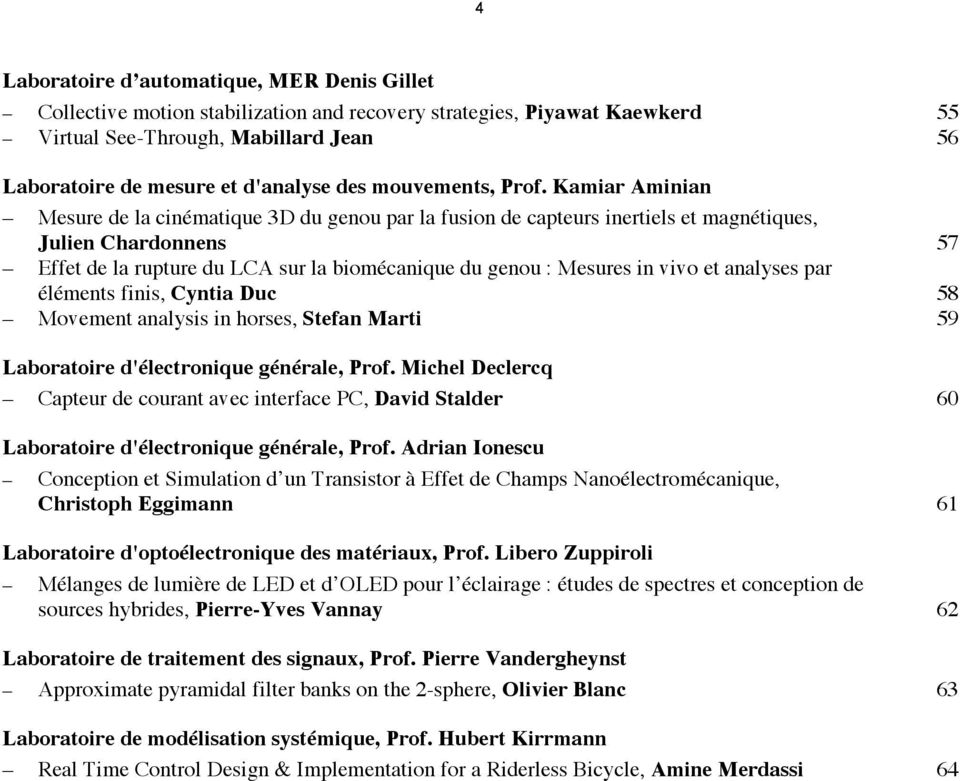
4 4 Laboratoire d automatique, MER Denis Gillet Collective motion stabilization and recovery strategies, Piyawat Kaewkerd 55 Virtual See-Through, Mabillard Jean 56 Laboratoire de mesure et d'analyse des mouvements, Prof. Kamiar Aminian Mesure de la cinématique 3D du genou par la fusion de capteurs inertiels et magnétiques, Julien Chardonnens 57 Effet de la rupture du LCA sur la biomécanique du genou : Mesures in vivo et analyses par éléments finis, Cyntia Duc 58 Movement analysis in horses, Stefan Marti 59 Laboratoire d'électronique générale, Prof. Michel Declercq Capteur de courant avec interface PC, David Stalder 60 Laboratoire d'électronique générale, Prof. Adrian Ionescu Conception et Simulation d un Transistor à Effet de Champs Nanoélectromécanique, Christoph Eggimann 61 Laboratoire d'optoélectronique des matériaux, Prof. Libero Zuppiroli Mélanges de lumière de LED et d OLED pour l éclairage : études de spectres et conception de sources hybrides, Pierre-Yves Vannay 62 Laboratoire de traitement des signaux, Prof. Pierre Vandergheynst Approximate pyramidal filter banks on the 2-sphere, Olivier Blanc 63 Laboratoire de modélisation systémique, Prof. Hubert Kirrmann Real Time Control Design & Implementation for a Riderless Bicycle, Amine Merdassi 64
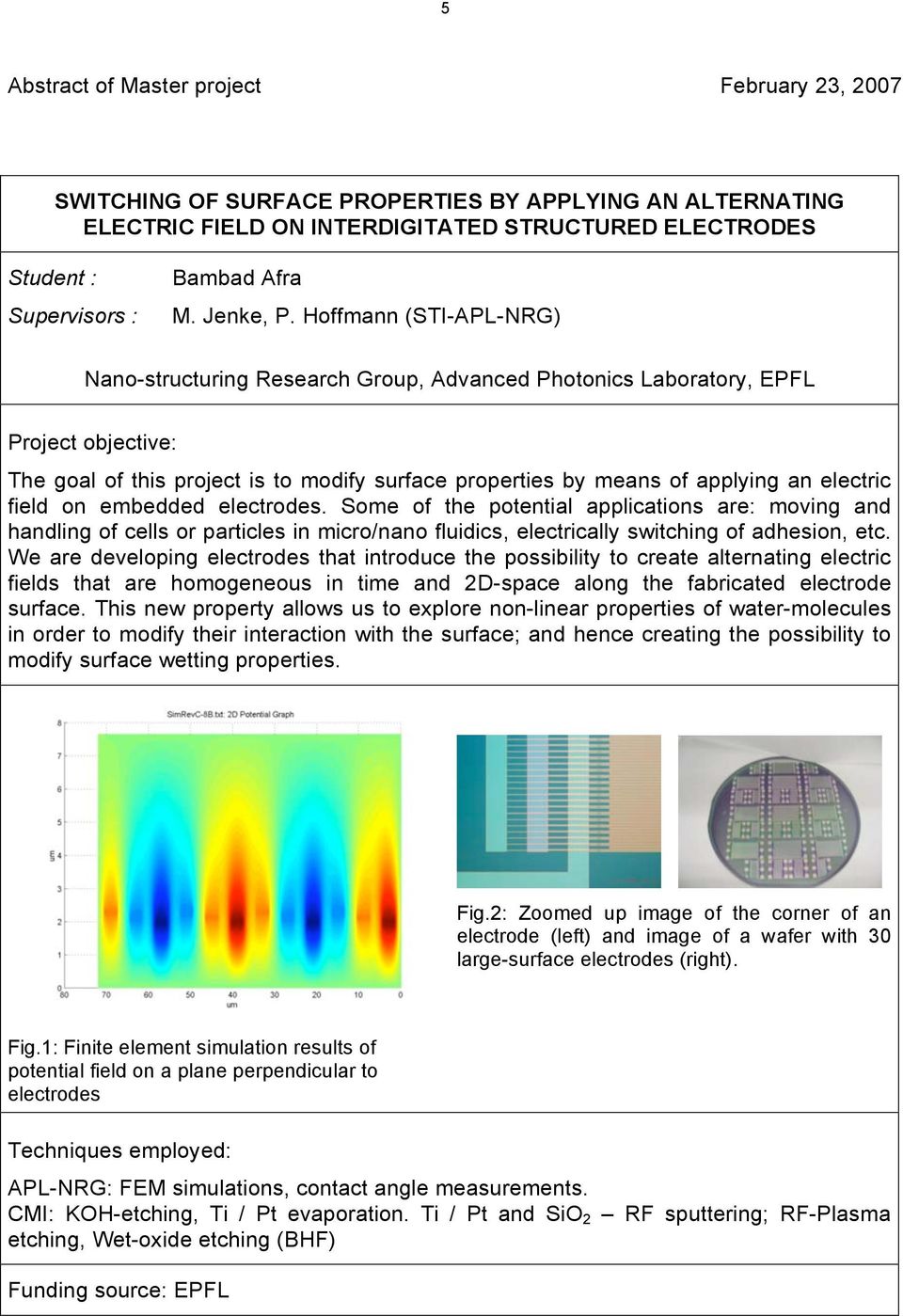
5 5 Abstract of Master project February 23, 2007 SWITCHING OF SURFACE PROPERTIES BY APPLYING AN ALTERNATING ELECTRIC FIELD ON INTERDIGITATED STRUCTURED ELECTRODES Student : Supervisors : Bambad Afra M. Jenke, P. Hoffmann (STI-APL-NRG) Nano-structuring Research Group, Advanced Photonics Laboratory, EPFL Project objective: The goal of this project is to modify surface properties by means of applying an electric field on embedded electrodes. Some of the potential applications are: moving and handling of cells or particles in micro/nano fluidics, electrically switching of adhesion, etc. We are developing electrodes that introduce the possibility to create alternating electric fields that are homogeneous in time and 2D-space along the fabricated electrode surface. This new property allows us to explore non-linear properties of water-molecules in order to modify their interaction with the surface; and hence creating the possibility to modify surface wetting properties. Fig.2: Zoomed up image of the corner of an electrode (left) and image of a wafer with 30 large-surface electrodes (right). Fig.1: Finite element simulation results of potential field on a plane perpendicular to electrodes Techniques employed: APL-NRG: FEM simulations, contact angle measurements. CMI: KOH-etching, Ti / Pt evaporation. Ti / Pt and SiO 2 RF sputtering; RF-Plasma etching, Wet-oxide etching (BHF) Funding source: EPFL
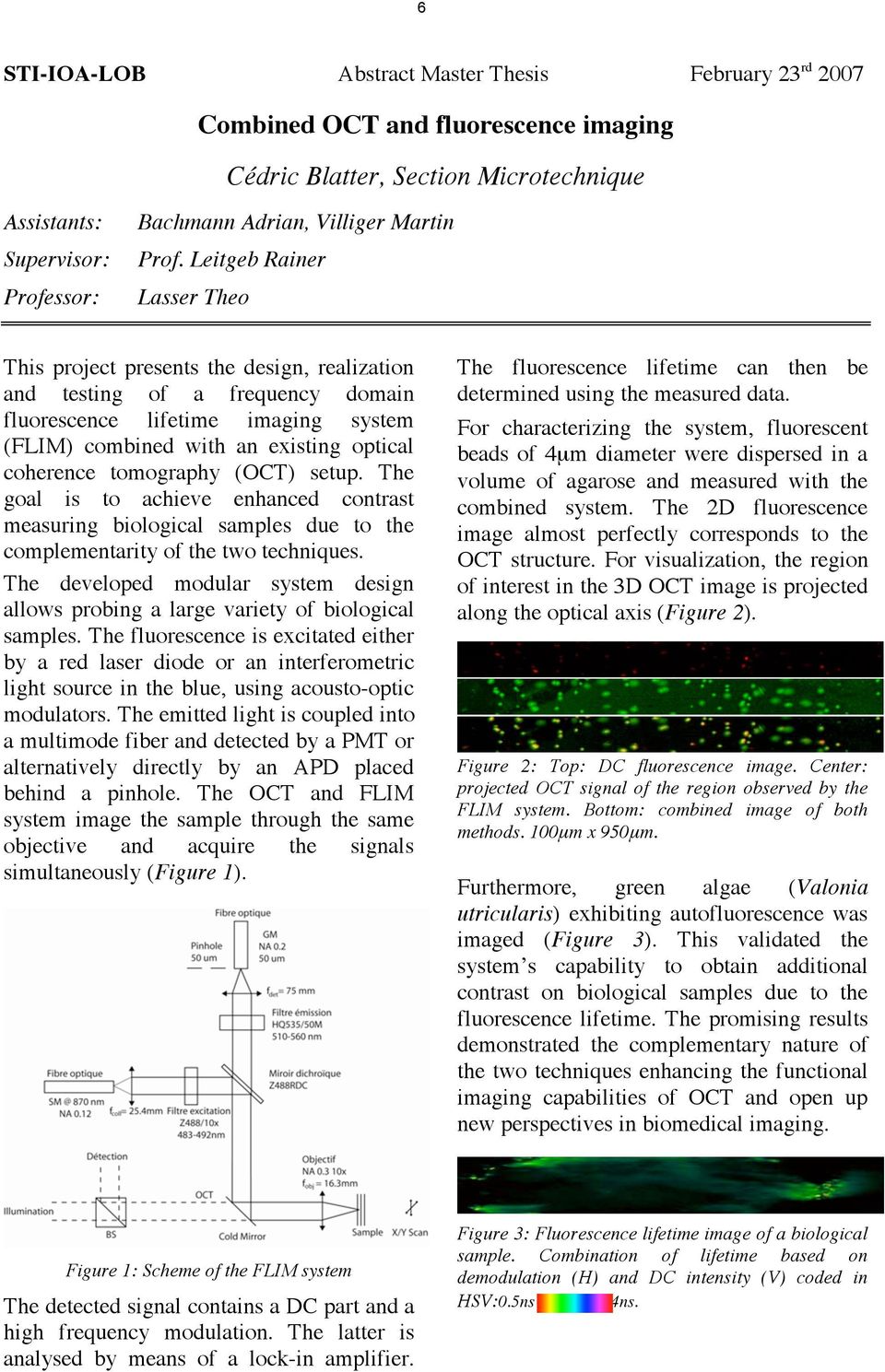
6 6 STI-IOA-LOB Abstract Master Thesis February 23 rd 2007 Combined OCT and fluorescence imaging Cédric Blatter, Section Microtechnique Assistants: Supervisor: Professor: Bachmann Adrian, Villiger Martin Prof. Leitgeb Rainer Lasser Theo This project presents the design, realization and testing of a frequency domain fluorescence lifetime imaging system (FLIM) combined with an existing optical coherence tomography (OCT) setup. The goal is to achieve enhanced contrast measuring biological samples due to the complementarity of the two techniques. The developed modular system design allows probing a large variety of biological samples. The fluorescence is excitated either by a red laser diode or an interferometric light source in the blue, using acousto-optic modulators. The emitted light is coupled into a multimode fiber and detected by a PMT or alternatively directly by an APD placed behind a pinhole. The OCT and FLIM system image the sample through the same objective and acquire the signals simultaneously (Figure 1). The fluorescence lifetime can then be determined using the measured data. For characterizing the system, fluorescent beads of 4µm diameter were dispersed in a volume of agarose and measured with the combined system. The 2D fluorescence image almost perfectly corresponds to the OCT structure. For visualization, the region of interest in the 3D OCT image is projected along the optical axis (Figure 2). Figure 2: Top: DC fluorescence image. Center: projected OCT signal of the region observed by the FLIM system. Bottom: combined image of both methods. 100!m x 950!m. Furthermore, green algae (Valonia utricularis) exhibiting autofluorescence was imaged (Figure 3). This validated the system s capability to obtain additional contrast on biological samples due to the fluorescence lifetime. The promising results demonstrated the complementary nature of the two techniques enhancing the functional imaging capabilities of OCT and open up new perspectives in biomedical imaging. Figure 1: Scheme of the FLIM system The detected signal contains a DC part and a high frequency modulation. The latter is analysed by means of a lock-in amplifier. Figure 3: Fluorescence lifetime image of a biological sample. Combination of lifetime based on demodulation (H) and DC intensity (V) coded in HSV:0.5ns 4ns.
7 7 BIG Summary of the Master s project 23rd February 07 Denoising of MRS Signals Using Wavelet Methods Nicole Brüschweiler, Microengineering Assistants: Ildar Khalidov and Florian Luisier (EPFL), Anke Henning and Betina Schnepf (ETHZ) Professors: Unser Michael (EPFL), Bösiger Peter (ETHZ) Project Description In vivo Magnetic Resonance Spectroscopy (MRS) is a non-invasive method that provides wealthy information on the metabolites of the subject. It can be used to monitor biochemical changes in tumors, stroke and epilepsy. Fig. 1: Noisy MR-Spectrum (in blue) and denoised spectrum (in red). The denoising was done using the SURE-algorithm and a Haar wavelet. The denoising algorithms were compared using the standard SNR and the weakest level of detection as a performance measure specific to MRS. It was further investigated if the denoising of MRS signals would lead to a better quantification of the metabolite concentrations. A further task of the project was to create a Graphical User Interface. The GUI allows the user to perform zero- and first-order phase correction, and to denoise the MRS signals using one of the investigated wavelet methods. Results The validation showed that the recently developed SURE algorithm presented a better performance in almost all the experiences. It further could be noticed, that the denoising algorithms performed better on the real-valued spectrum than on the complex FID. In this master project, denoising algorithms based on wavelets were applied to MRS signals. Besides the already well known wavelet shrinkage method, also a recently developed SURE-algorithm was implemented. The denoising was done on the complex FID and the real spectrum using standard wavelets and the newly developed Exponential Spline Wavelet. Prior to the validation of the denoising methods, the influence of the poles of the ESWs had to be investigated. Fig. 2: Part of the User Interface allowing performing zero- and first-order phase correction.

8 8 LIB Résumé de Travail pratique de Master Fitting of 3D-PSF models to fluorescent microbead stacks Raphael Frey, Section Microtechnique Assistants: Professeur: Cédric Vonesch, François Aguet Michael Unser Introduction Pour comprendre les processus cellulaires à l échelle moléculaire, la recherche dans le domaine biologique dépend largement de la microscopie optique. Dans quelques cas même des appareilles sophistiqués comme la microscope confocal ne fournissent pas une résolution suffisante. Dans ces cas on va traiter ces images par des processus de traitement d image par exemple avec une algorithme de déconvolution. Pour une déconvolution optimale on a besoin de connaître les propriétés de formation d images d un microscope. Ces propriétés se laissent bien décrire par la réponse impulsionelle (point-spread function PSF) du système optique du microscope. De plus on peut obtenir une telle réponse en regardant des billes fluorescentes sous un microscope. Une telle PSF est montré dans la Figure 1 (à gauche). Figure 1 : L image d une bille fluorescent section x-z (à gauche) et la simulation d une PSF (à droite) Modèle d une PSF 3D Une PSF analytique découle de la théorie de Maxwell sur les ondes électromagnétique. Dans sa forme finale la PSF se laisse décrire avec la formule suivante : Equation1 : Equation pour une PSF, où r et z représentent les coordonnées cylindrique, NA représente l ouverture numérique de l objective, W est l aberration sphérique de l objective et! est le rayon maximale de la pupille d entrée. J 0 est une fonction de Bessel. Adaptation de la PSF à un stack 3D des billes fluorescente Dans la suite on essaie de minimiser l erreur quadratique entre des acquisitions réelles et la PSF analytique. On a essayé de trouver ce minimum de l erreur avec un algorithme décrite par Newton/Raphson. Finalement c était possible de trouver avec cet algorithme les paramètres clés d un système optique. Notamment la position d une bille, son amplitude, et l ouverture numérique et l aberration sphérique de l objective utilisé. Au cas montré dans la Figure 1 par exemple, on a trouvé les valeurs suivantes : NA=1.477 et W=-363nm. La valeur nominal de NA était Si on pouvait adapter une PSF analytique aux images pris par le microscope, on aurait accès aux caractéristiques du système optique.

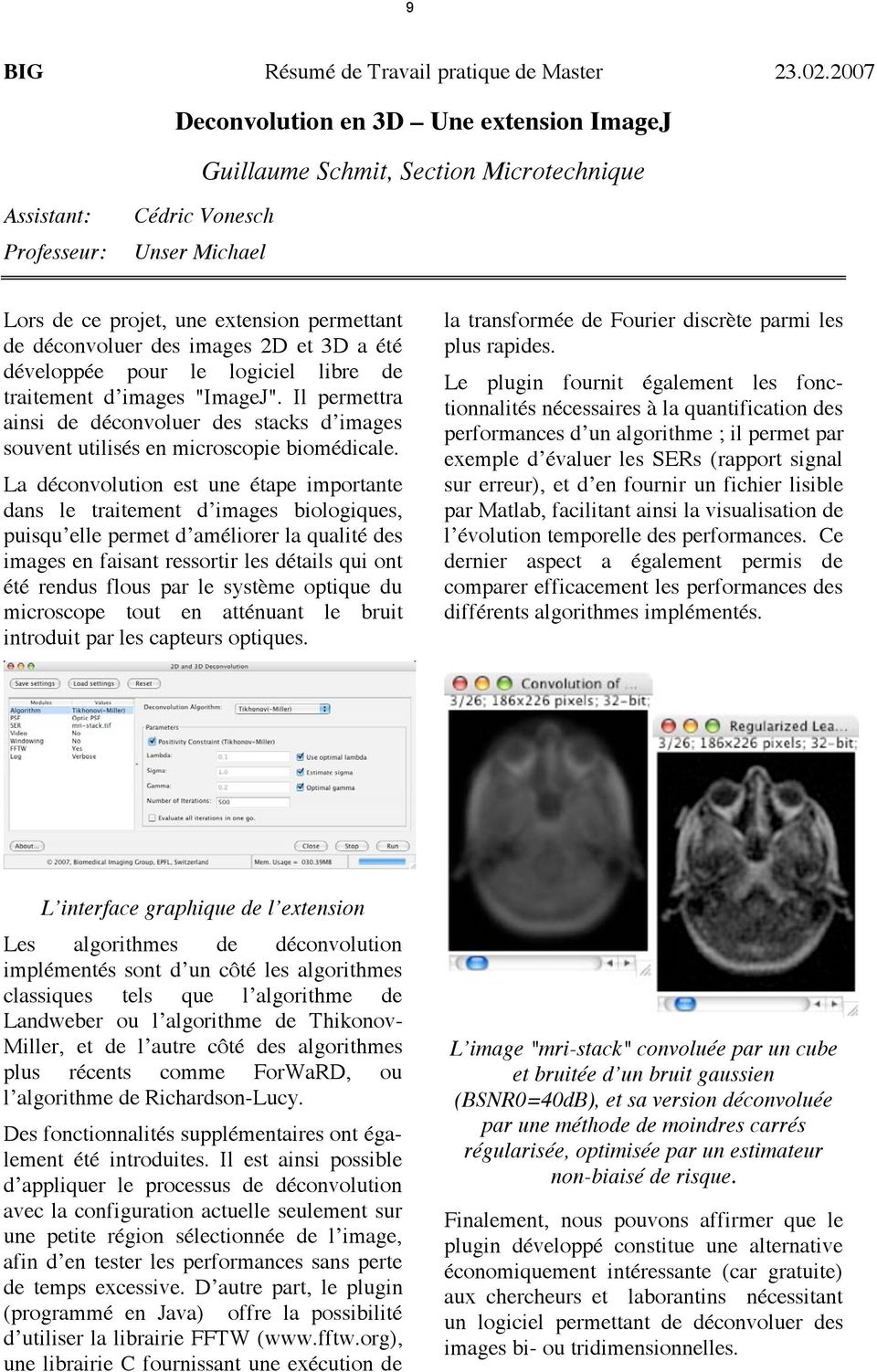
9 9 BIG Résumé de Travail pratique de Master Deconvolution en 3D Une extension ImageJ Guillaume Schmit, Section Microtechnique Assistant: Professeur: Cédric Vonesch Unser Michael Lors de ce projet, une extension permettant de déconvoluer des images 2D et 3D a été développée pour le logiciel libre de traitement d images "ImageJ". Il permettra ainsi de déconvoluer des stacks d images souvent utilisés en microscopie biomédicale. La déconvolution est une étape importante dans le traitement d images biologiques, puisqu elle permet d améliorer la qualité des images en faisant ressortir les détails qui ont été rendus flous par le système optique du microscope tout en atténuant le bruit introduit par les capteurs optiques. la transformée de Fourier discrète parmi les plus rapides. Le plugin fournit également les fonctionnalités nécessaires à la quantification des performances d un algorithme ; il permet par exemple d évaluer les SERs (rapport signal sur erreur), et d en fournir un fichier lisible par Matlab, facilitant ainsi la visualisation de l évolution temporelle des performances. Ce dernier aspect a également permis de comparer efficacement les performances des différents algorithmes implémentés. L interface graphique de l extension Les algorithmes de déconvolution implémentés sont d un côté les algorithmes classiques tels que l algorithme de Landweber ou l algorithme de Thikonov- Miller, et de l autre côté des algorithmes plus récents comme ForWaRD, ou l algorithme de Richardson-Lucy. Des fonctionnalités supplémentaires ont également été introduites. Il est ainsi possible d appliquer le processus de déconvolution avec la configuration actuelle seulement sur une petite région sélectionnée de l image, afin d en tester les performances sans perte de temps excessive. D autre part, le plugin (programmé en Java) offre la possibilité d utiliser la librairie FFTW ( une librairie C fournissant une exécution de L image "mri-stack" convoluée par un cube et bruitée d un bruit gaussien (BSNR0=40dB), et sa version déconvoluée par une méthode de moindres carrés régularisée, optimisée par un estimateur non-biaisé de risque. Finalement, nous pouvons affirmer que le plugin développé constitue une alternative économiquement intéressante (car gratuite) aux chercheurs et laborantins nécessitant un logiciel permettant de déconvoluer des images bi- ou tridimensionnelles.
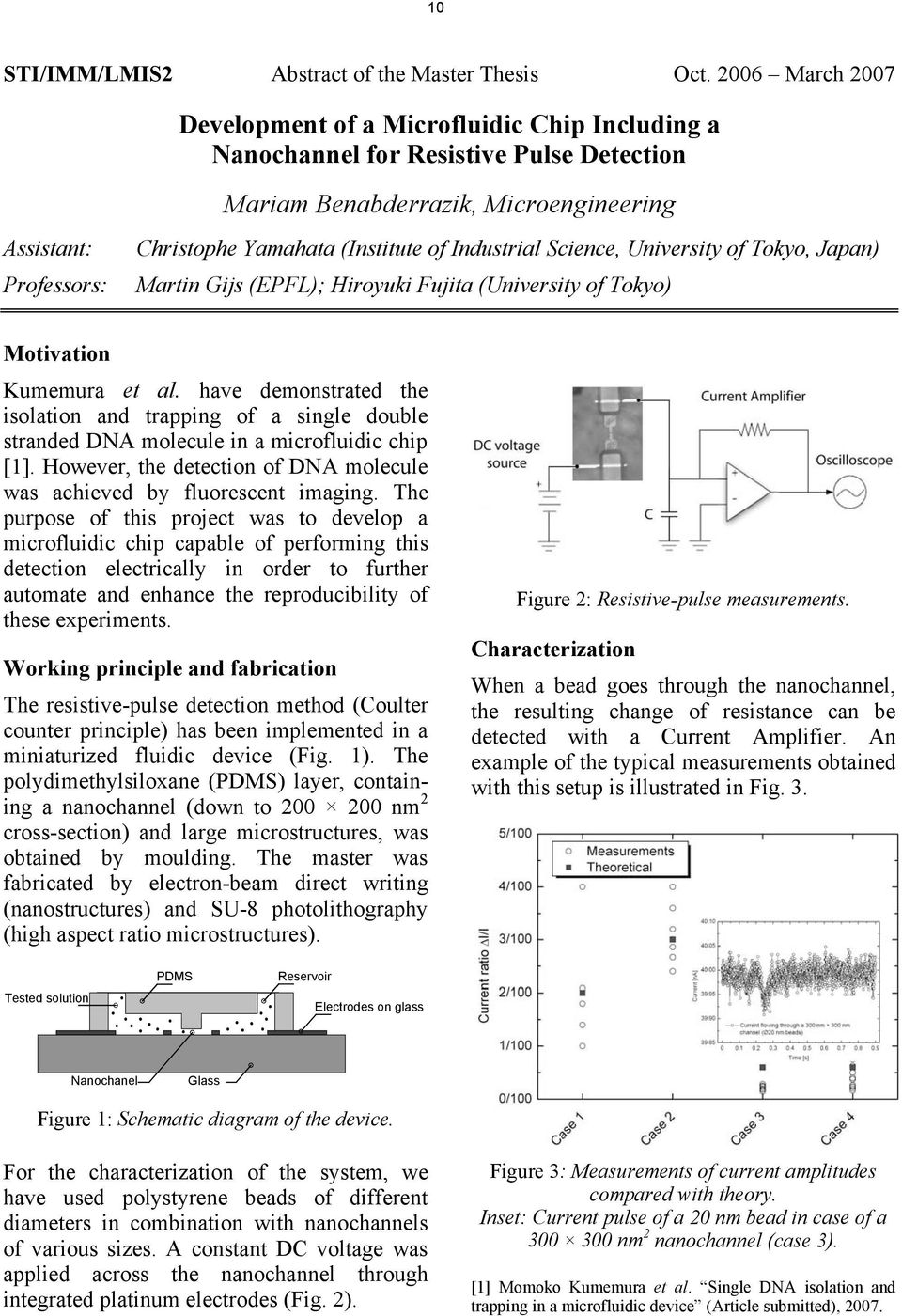
10 10 STI/IMM/LMIS2 Abstract of the Master Thesis Oct March 2007 Development of a Microfluidic Chip Including a Nanochannel for Resistive Pulse Detection Mariam Benabderrazik, Microengineering Assistant: Professors: Christophe Yamahata (Institute of Industrial Science, University of Tokyo, Japan) Martin Gijs (EPFL); Hiroyuki Fujita (University of Tokyo) Motivation Kumemura et al. have demonstrated the isolation and trapping of a single double stranded DNA molecule in a microfluidic chip [1]. However, the detection of DNA molecule was achieved by fluorescent imaging. The purpose of this project was to develop a microfluidic chip capable of performing this detection electrically in order to further automate and enhance the reproducibility of these experiments. Working principle and fabrication The resistive-pulse detection method (Coulter counter principle) has been implemented in a miniaturized fluidic device (Fig. 1). The polydimethylsiloxane (PDMS) layer, containing a nanochannel (down to nm 2 cross-section) and large microstructures, was obtained by moulding. The master was fabricated by electron-beam direct writing (nanostructures) and SU-8 photolithography (high aspect ratio microstructures). Figure 2: Resistive-pulse measurements. Characterization When a bead goes through the nanochannel, the resulting change of resistance can be detected with a Current Amplifier. An example of the typical measurements obtained with this setup is illustrated in Fig. 3. Tested solution PDMS Reservoir Electrodes on glass Nanochanel Glass Figure 1: Schematic diagram of the device. For the characterization of the system, we have used polystyrene beads of different diameters in combination with nanochannels of various sizes. A constant DC voltage was applied across the nanochannel through integrated platinum electrodes (Fig. 2). Figure 3: Measurements of current amplitudes compared with theory. Inset: Current pulse of a 20 nm bead in case of a nm 2 nanochannel (case 3). [1] Momoko Kumemura et al. Single DNA isolation and trapping in a microfluidic device (Article submitted), 2007.
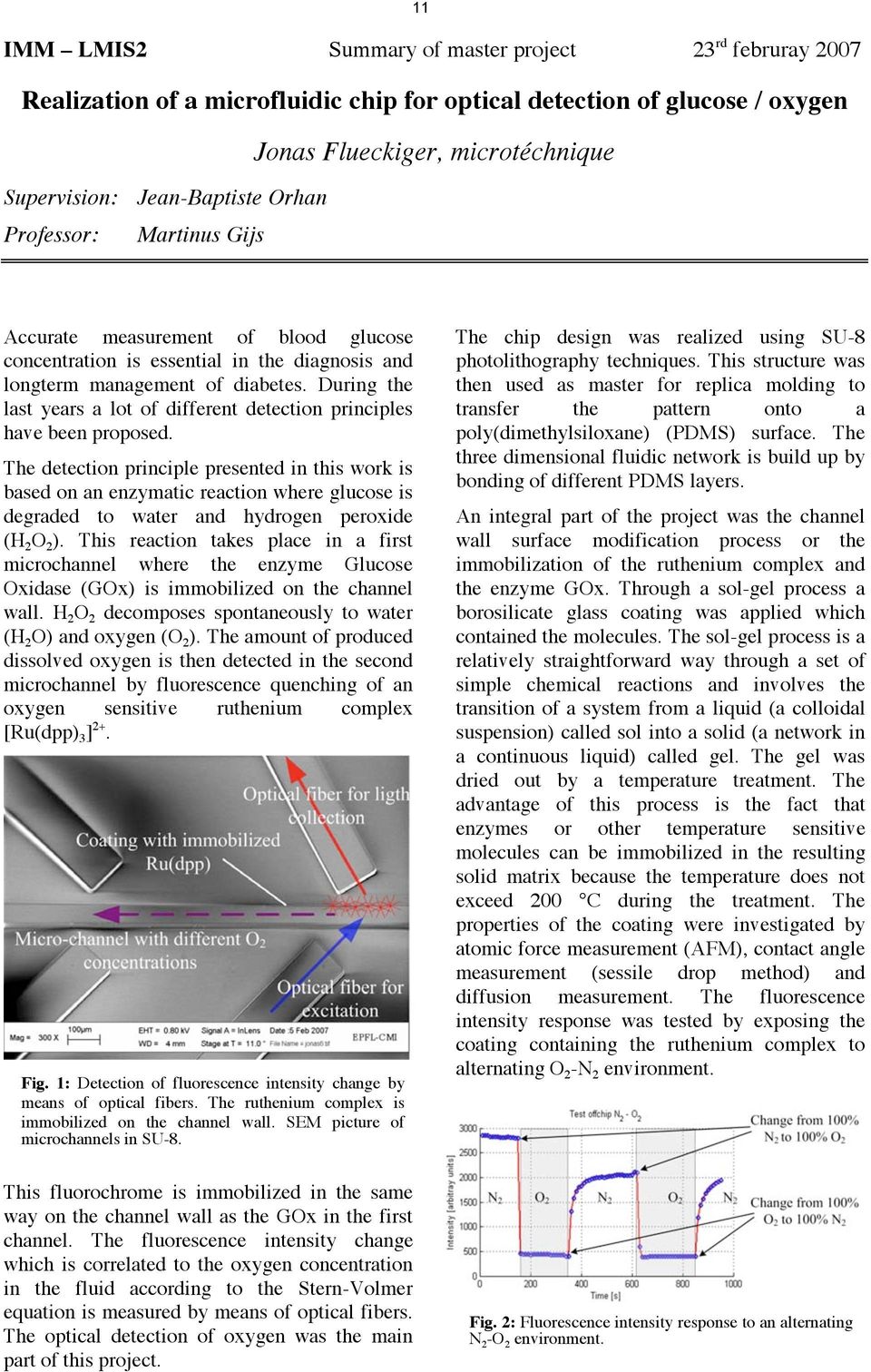
11 11 IMM LMIS2 Summary of master project 23 rd februray 2007 Realization of a microfluidic chip for optical detection of glucose / oxygen Jonas Flueckiger, microtéchnique Supervision: Jean-Baptiste Orhan Professor: Martinus Gijs Accurate measurement of blood glucose concentration is essential in the diagnosis and longterm management of diabetes. During the last years a lot of different detection principles have been proposed. The detection principle presented in this work is based on an enzymatic reaction where glucose is degraded to water and hydrogen peroxide (H 2 O 2 ). This reaction takes place in a first microchannel where the enzyme Glucose Oxidase (GOx) is immobilized on the channel wall. H 2 O 2 decomposes spontaneously to water (H 2 O) and oxygen (O 2 ). The amount of produced dissolved oxygen is then detected in the second microchannel by fluorescence quenching of an oxygen sensitive ruthenium complex [Ru(dpp) 3 ] 2+. Fig. 1: Detection of fluorescence intensity change by means of optical fibers. The ruthenium complex is immobilized on the channel wall. SEM picture of microchannels in SU-8. This fluorochrome is immobilized in the same way on the channel wall as the GOx in the first channel. The fluorescence intensity change which is correlated to the oxygen concentration in the fluid according to the Stern-Volmer equation is measured by means of optical fibers. The optical detection of oxygen was the main part of this project. The chip design was realized using SU-8 photolithography techniques. This structure was then used as master for replica molding to transfer the pattern onto a poly(dimethylsiloxane) (PDMS) surface. The three dimensional fluidic network is build up by bonding of different PDMS layers. An integral part of the project was the channel wall surface modification process or the immobilization of the ruthenium complex and the enzyme GOx. Through a sol-gel process a borosilicate glass coating was applied which contained the molecules. The sol-gel process is a relatively straightforward way through a set of simple chemical reactions and involves the transition of a system from a liquid (a colloidal suspension) called sol into a solid (a network in a continuous liquid) called gel. The gel was dried out by a temperature treatment. The advantage of this process is the fact that enzymes or other temperature sensitive molecules can be immobilized in the resulting solid matrix because the temperature does not exceed 200 C during the treatment. The properties of the coating were investigated by atomic force measurement (AFM), contact angle measurement (sessile drop method) and diffusion measurement. The fluorescence intensity response was tested by exposing the coating containing the ruthenium complex to alternating O 2 -N 2 environment. Fig. 2: Fluorescence intensity response to an alternating N 2 -O 2 environment.
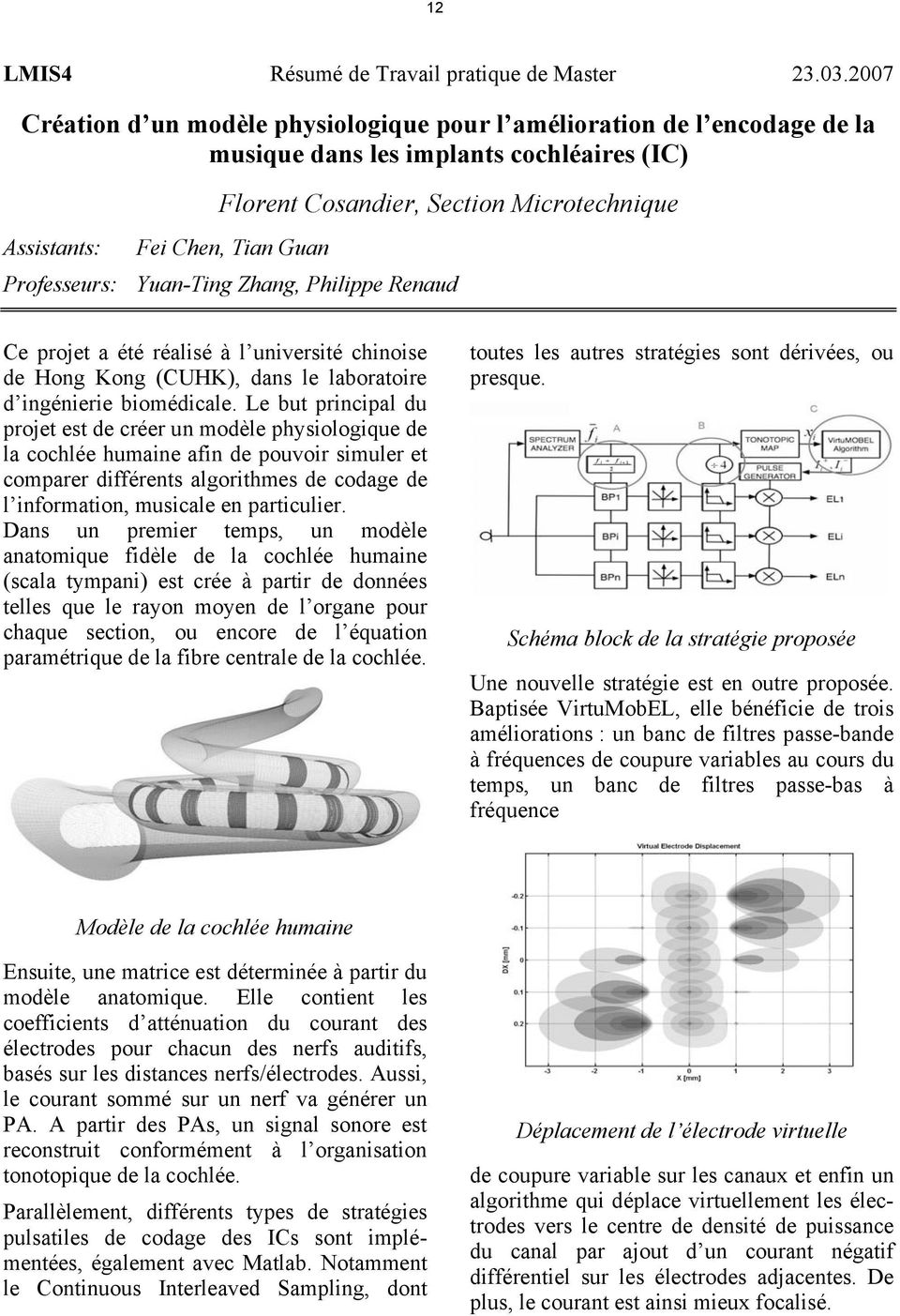
12 12 LMIS4 Résumé de Travail pratique de Master Création d un modèle physiologique pour l amélioration de l encodage de la musique dans les implants cochléaires (IC) Assistants: Florent Cosandier, Section Microtechnique Fei Chen, Tian Guan Professeurs: Yuan-Ting Zhang, Philippe Renaud Ce projet a été réalisé à l université chinoise de Hong Kong (CUHK), dans le laboratoire d ingénierie biomédicale. Le but principal du projet est de créer un modèle physiologique de la cochlée humaine afin de pouvoir simuler et comparer différents algorithmes de codage de l information, musicale en particulier. Dans un premier temps, un modèle anatomique fidèle de la cochlée humaine (scala tympani) est crée à partir de données telles que le rayon moyen de l organe pour chaque section, ou encore de l équation paramétrique de la fibre centrale de la cochlée. toutes les autres stratégies sont dérivées, ou presque. Schéma block de la stratégie proposée Une nouvelle stratégie est en outre proposée. Baptisée VirtuMobEL, elle bénéficie de trois améliorations : un banc de filtres passe-bande à fréquences de coupure variables au cours du temps, un banc de filtres passe-bas à fréquence Modèle de la cochlée humaine Ensuite, une matrice est déterminée à partir du modèle anatomique. Elle contient les coefficients d atténuation du courant des électrodes pour chacun des nerfs auditifs, basés sur les distances nerfs/électrodes. Aussi, le courant sommé sur un nerf va générer un PA. A partir des PAs, un signal sonore est reconstruit conformément à l organisation tonotopique de la cochlée. Parallèlement, différents types de stratégies pulsatiles de codage des ICs sont implémentées, également avec Matlab. Notamment le Continuous Interleaved Sampling, dont Déplacement de l électrode virtuelle de coupure variable sur les canaux et enfin un algorithme qui déplace virtuellement les électrodes vers le centre de densité de puissance du canal par ajout d un courant négatif différentiel sur les électrodes adjacentes. De plus, le courant est ainsi mieux focalisé.
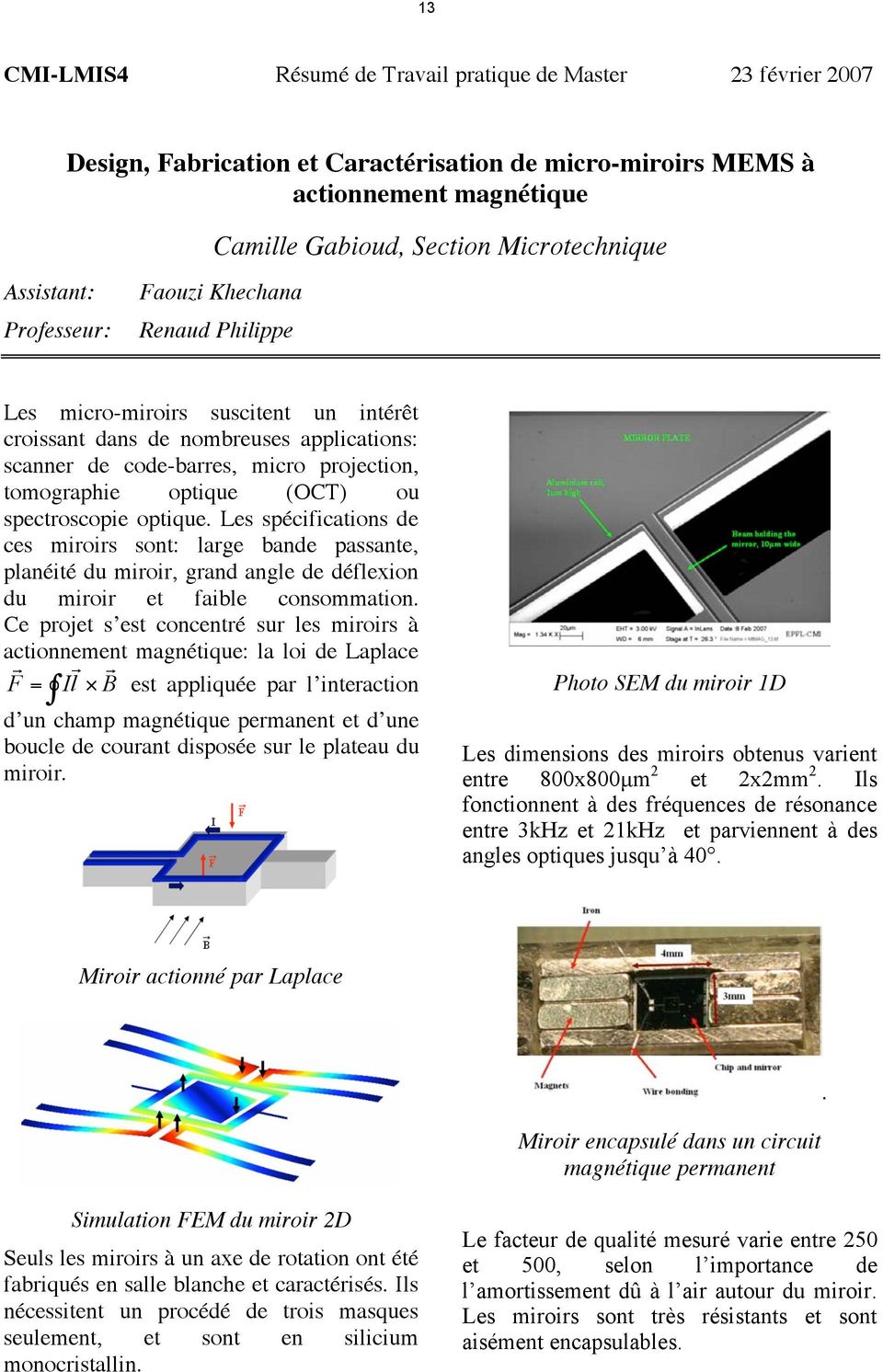
13 13 CMI-LMIS4 Résumé de Travail pratique de Master 23 février 2007 Design, Fabrication et Caractérisation de micro-miroirs MEMS à actionnement magnétique Camille Gabioud, Section Microtechnique Assistant: Professeur: Faouzi Khechana Renaud Philippe Les micro-miroirs suscitent un intérêt croissant dans de nombreuses applications: scanner de code-barres, micro projection, tomographie optique (OCT) ou spectroscopie optique. Les spécifications de ces miroirs sont: large bande passante, planéité du miroir, grand angle de déflexion du miroir et faible consommation. Ce projet s est concentré sur les miroirs à actionnement magnétique: la loi de Laplace r r r F =! Il " B est appliquée par l interaction d un champ magnétique permanent et d une boucle de courant disposée sur le plateau du miroir. Photo SEM du miroir 1D Les dimensions des miroirs obtenus varient entre 800x800µm 2 et 2x2mm 2. Ils fonctionnent à des fréquences de résonance entre 3kHz et 21kHz et parviennent à des angles optiques jusqu à 40. Miroir actionné par Laplace. Miroir encapsulé dans un circuit magnétique permanent Simulation FEM du miroir 2D Seuls les miroirs à un axe de rotation ont été fabriqués en salle blanche et caractérisés. Ils nécessitent un procédé de trois masques seulement, et sont en silicium monocristallin. Le facteur de qualité mesuré varie entre 250 et 500, selon l importance de l amortissement dû à l air autour du miroir. Les miroirs sont très résistants et sont aisément encapsulables.
14 14 LMIS4 Résumé de Travail Pratique de Master Design and Fabrication of a Test Board for Electrophysiology Monitoring and MLS Dielectric Spectroscopy of Neurons on a 120-Electrodes MEA Biochip David Schmid, Section Microtechnique Assistants: Professeur: Marc Heuschkel, Shady Gawad Philippe Renaud This project describes the conception, design and fabrication of a test-board for Electro- Physiology (EP) and Dielectric Spectroscopy (DS) monitoring of living cells on a electrodes multi-electrode array (MEA) biochip. The aim is to combine two monitoring techniques into a high content screening platform. The test-board has different configurations, which have to be analysed to find the best concept for each monitoring principle. One configuration is the multiplexed EP measurement where the signal enters an analog multiplexer non-amplified or after a pre-amplification stage. A classic EP stage is as well implemented to compare the new concept to the existing one. A differential and a simple dielectric spectroscopy stage are also mounted to measure the physical aspects of the cell. The stimulation of the cell can be done through the large ground electrode in each well. The signal can either be created with a LCR meter or by a maximum length sequence (MLS). It is possible to stimulate each electrode separately for evoked EP recording or to measure the specific resistance of all electrodes. The adaptor PCB and the test-board have been realized and a program for control of the digital outputs has been written. Preliminary tests have shown that the multiplexers work well but that still some debugging work has to be done to fully characterize the resulting system. Resulting test-board including chip-holder and different EP and DS recording concepts on one single platform. Modified MEA biochip interface (PCB) for compatibility with the test-board.

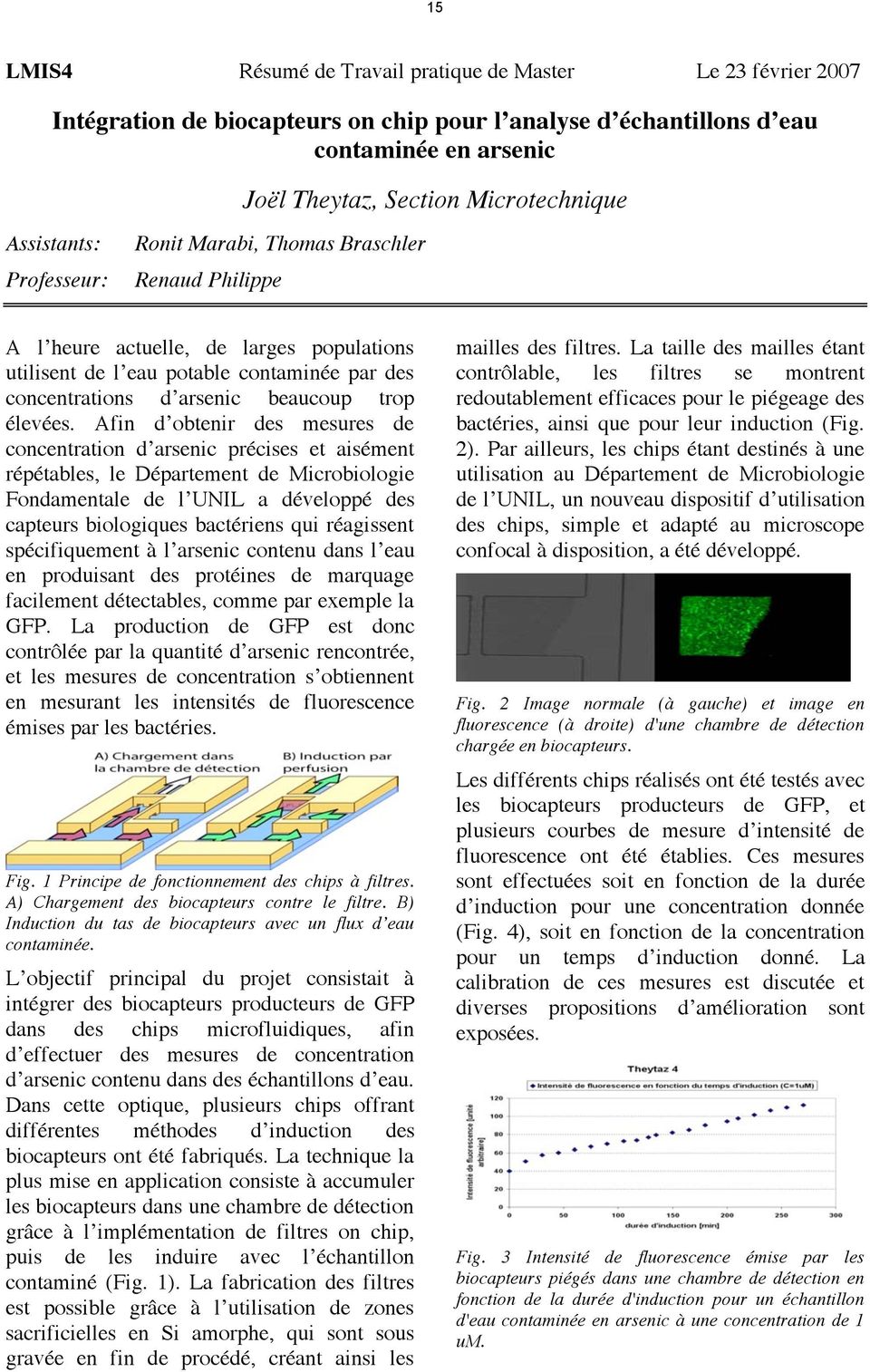
15 15 LMIS4 Résumé de Travail pratique de Master Le 23 février 2007 Intégration de biocapteurs on chip pour l analyse d échantillons d eau contaminée en arsenic Joël Theytaz, Section Microtechnique Assistants: Professeur: Ronit Marabi, Thomas Braschler Renaud Philippe A l heure actuelle, de larges populations utilisent de l eau potable contaminée par des concentrations d arsenic beaucoup trop élevées. Afin d obtenir des mesures de concentration d arsenic précises et aisément répétables, le Département de Microbiologie Fondamentale de l UNIL a développé des capteurs biologiques bactériens qui réagissent spécifiquement à l arsenic contenu dans l eau en produisant des protéines de marquage facilement détectables, comme par exemple la GFP. La production de GFP est donc contrôlée par la quantité d arsenic rencontrée, et les mesures de concentration s obtiennent en mesurant les intensités de fluorescence émises par les bactéries. Fig. 1 Principe de fonctionnement des chips à filtres. A) Chargement des biocapteurs contre le filtre. B) Induction du tas de biocapteurs avec un flux d eau contaminée. L objectif principal du projet consistait à intégrer des biocapteurs producteurs de GFP dans des chips microfluidiques, afin d effectuer des mesures de concentration d arsenic contenu dans des échantillons d eau. Dans cette optique, plusieurs chips offrant différentes méthodes d induction des biocapteurs ont été fabriqués. La technique la plus mise en application consiste à accumuler les biocapteurs dans une chambre de détection grâce à l implémentation de filtres on chip, puis de les induire avec l échantillon contaminé (Fig. 1). La fabrication des filtres est possible grâce à l utilisation de zones sacrificielles en Si amorphe, qui sont sous gravée en fin de procédé, créant ainsi les mailles des filtres. La taille des mailles étant contrôlable, les filtres se montrent redoutablement efficaces pour le piégeage des bactéries, ainsi que pour leur induction (Fig. 2). Par ailleurs, les chips étant destinés à une utilisation au Département de Microbiologie de l UNIL, un nouveau dispositif d utilisation des chips, simple et adapté au microscope confocal à disposition, a été développé. Fig. 2 Image normale (à gauche) et image en fluorescence (à droite) d'une chambre de détection chargée en biocapteurs. Les différents chips réalisés ont été testés avec les biocapteurs producteurs de GFP, et plusieurs courbes de mesure d intensité de fluorescence ont été établies. Ces mesures sont effectuées soit en fonction de la durée d induction pour une concentration donnée (Fig. 4), soit en fonction de la concentration pour un temps d induction donné. La calibration de ces mesures est discutée et diverses propositions d amélioration sont exposées. Fig. 3 Intensité de fluorescence émise par les biocapteurs piégés dans une chambre de détection en fonction de la durée d'induction pour un échantillon d'eau contaminée en arsenic à une concentration de 1 um.
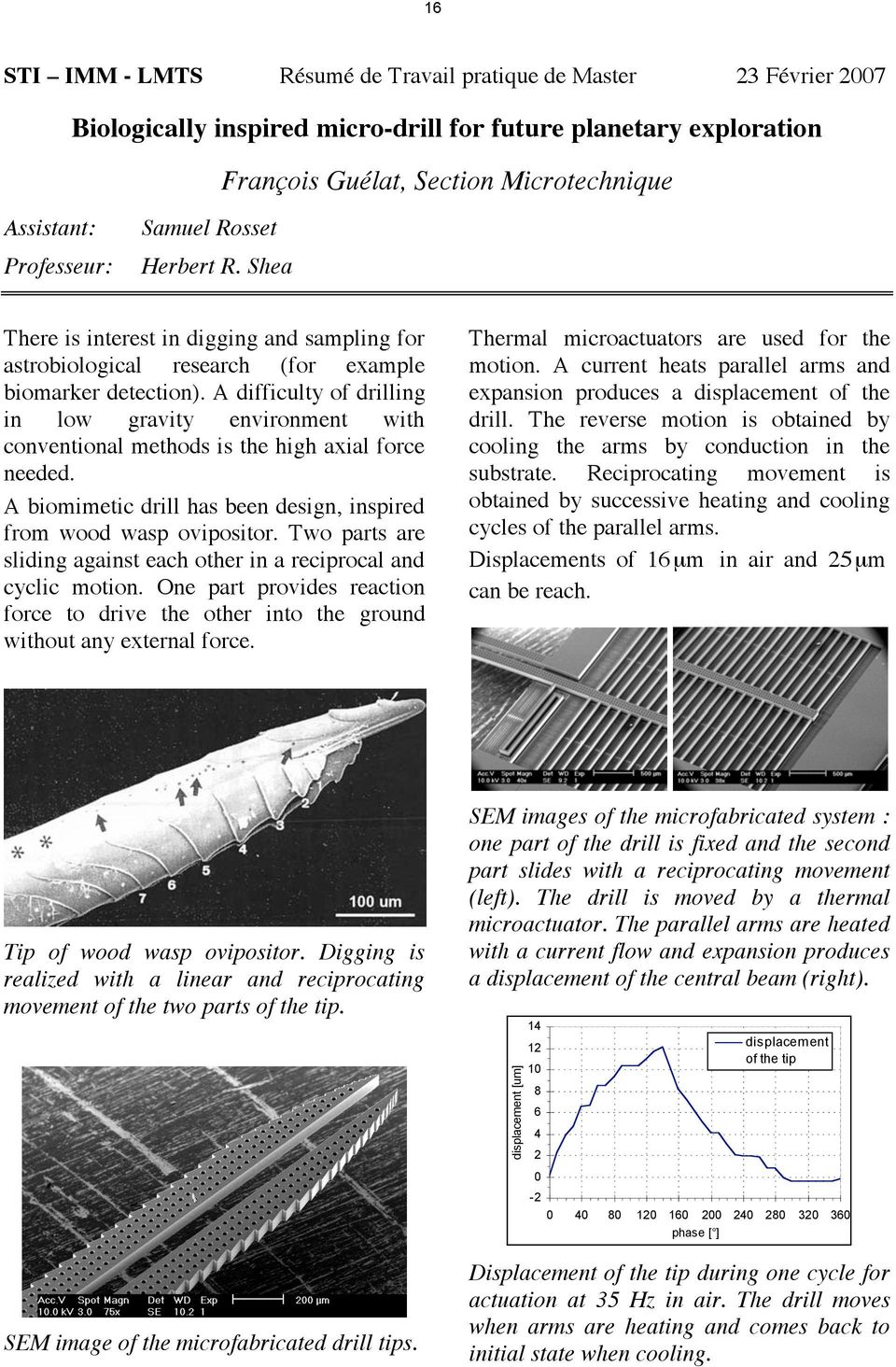
16 16 STI IMM - LMTS Résumé de Travail pratique de Master 23 Février 2007 Biologically inspired micro-drill for future planetary exploration François Guélat, Section Microtechnique Assistant: Professeur: Samuel Rosset Herbert R. Shea There is interest in digging and sampling for astrobiological research (for example biomarker detection). A difficulty of drilling in low gravity environment with conventional methods is the high axial force needed. A biomimetic drill has been design, inspired from wood wasp ovipositor. Two parts are sliding against each other in a reciprocal and cyclic motion. One part provides reaction force to drive the other into the ground without any external force. Thermal microactuators are used for the motion. A current heats parallel arms and expansion produces a displacement of the drill. The reverse motion is obtained by cooling the arms by conduction in the substrate. Reciprocating movement is obtained by successive heating and cooling cycles of the parallel arms. Displacements of 16µ m in air and 25µ m can be reach. Tip of wood wasp ovipositor. Digging is realized with a linear and reciprocating movement of the two parts of the tip. SEM image of the microfabricated drill tips. SEM images of the microfabricated system : one part of the drill is fixed and the second part slides with a reciprocating movement (left). The drill is moved by a thermal microactuator. The parallel arms are heated with a current flow and expansion produces a displacement of the central beam (right). displacement [um] displacement of the tip phase [ ] Displacement of the tip during one cycle for actuation at 35 Hz in air. The drill moves when arms are heating and comes back to initial state when cooling.
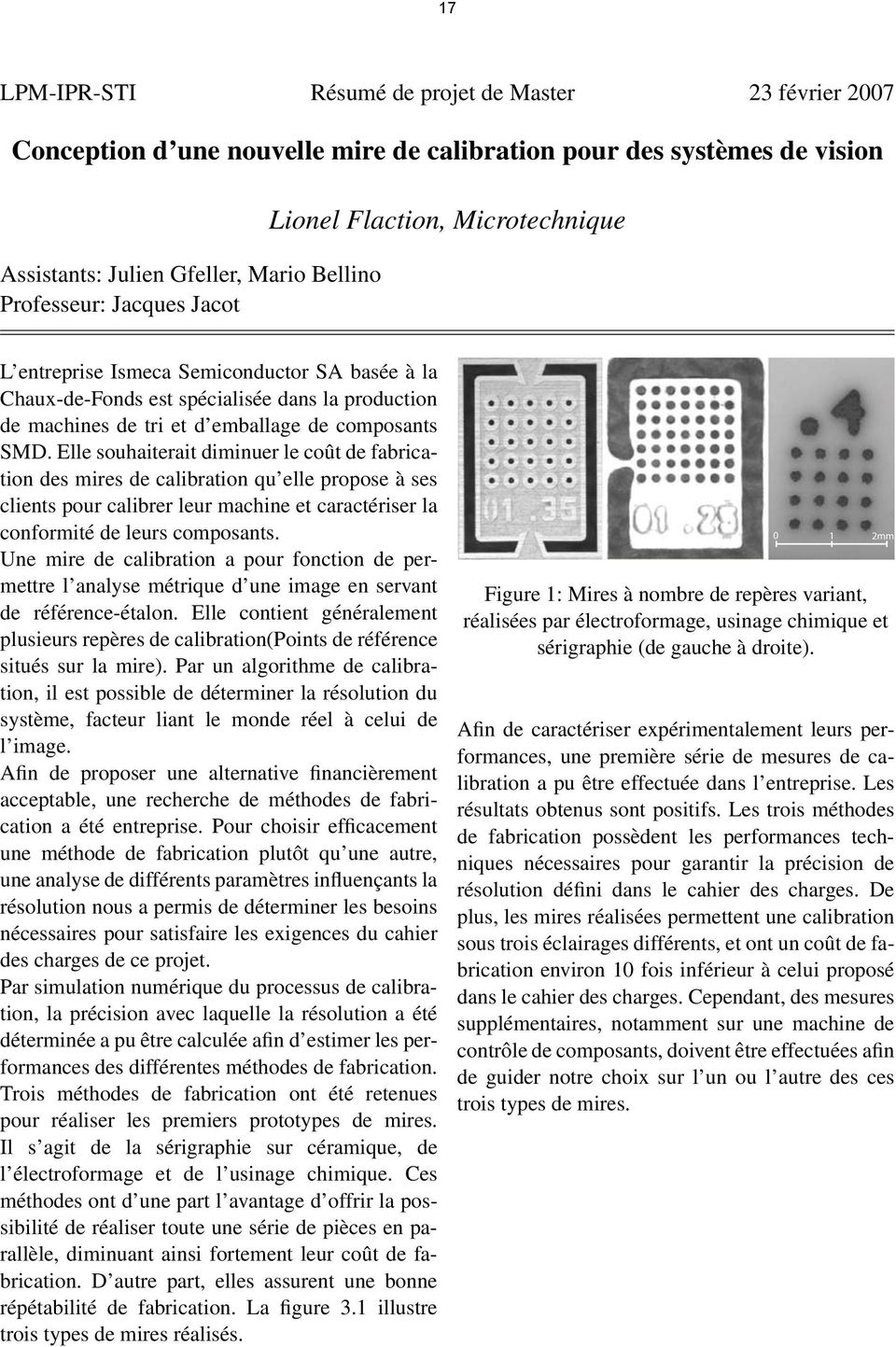
17 17 LPM-IPR-STI Résumé de projet de Master 23 février 2007 Conception d une nouvelle mire de calibration pour des systèmes de vision Assistants: Julien Gfeller, Mario Bellino Professeur: Jacques Jacot Lionel Flaction, Microtechnique L entreprise Ismeca Semiconductor SA basée à la Chaux-de-Fonds est spécialisée dans la production de machines de tri et d emballage de composants SMD. Elle souhaiterait diminuer le coût de fabrication des mires de calibration qu elle propose à ses clients pour calibrer leur machine et caractériser la conformité de leurs composants. Une mire de calibration a pour fonction de permettre l analyse métrique d une image en servant de référence-étalon. Elle contient généralement plusieurs repères de calibration(points de référence situés sur la mire). Par un algorithme de calibration, il est possible de déterminer la résolution du système, facteur liant le monde réel à celui de l image. Afin de proposer une alternative financièrement acceptable, une recherche de méthodes de fabrication a été entreprise. Pour choisir efficacement une méthode de fabrication plutôt qu une autre, une analyse de différents paramètres influençants la résolution nous a permis de déterminer les besoins nécessaires pour satisfaire les exigences du cahier des charges de ce projet. Par simulation numérique du processus de calibration, la précision avec laquelle la résolution a été déterminée a pu être calculée afin d estimer les performances des différentes méthodes de fabrication. Trois méthodes de fabrication ont été retenues pour réaliser les premiers prototypes de mires. Il s agit de la sérigraphie sur céramique, de l électroformage et de l usinage chimique. Ces méthodes ont d une part l avantage d offrir la possibilité de réaliser toute une série de pièces en parallèle, diminuant ainsi fortement leur coût de fabrication. D autre part, elles assurent une bonne répétabilité de fabrication. La figure 3.1 illustre trois types de mires réalisés mm Figure 1: Mires à nombre de repères variant, réalisées par électroformage, usinage chimique et sérigraphie (de gauche à droite). Afin de caractériser expérimentalement leurs performances, une première série de mesures de calibration a pu être effectuée dans l entreprise. Les résultats obtenus sont positifs. Les trois méthodes de fabrication possèdent les performances techniques nécessaires pour garantir la précision de résolution défini dans le cahier des charges. De plus, les mires réalisées permettent une calibration sous trois éclairages différents, et ont un coût de fabrication environ 10 fois inférieur à celui proposé dans le cahier des charges. Cependant, des mesures supplémentaires, notamment sur une machine de contrôle de composants, doivent être effectuées afin de guider notre choix sur l un ou l autre des ces trois types de mires.
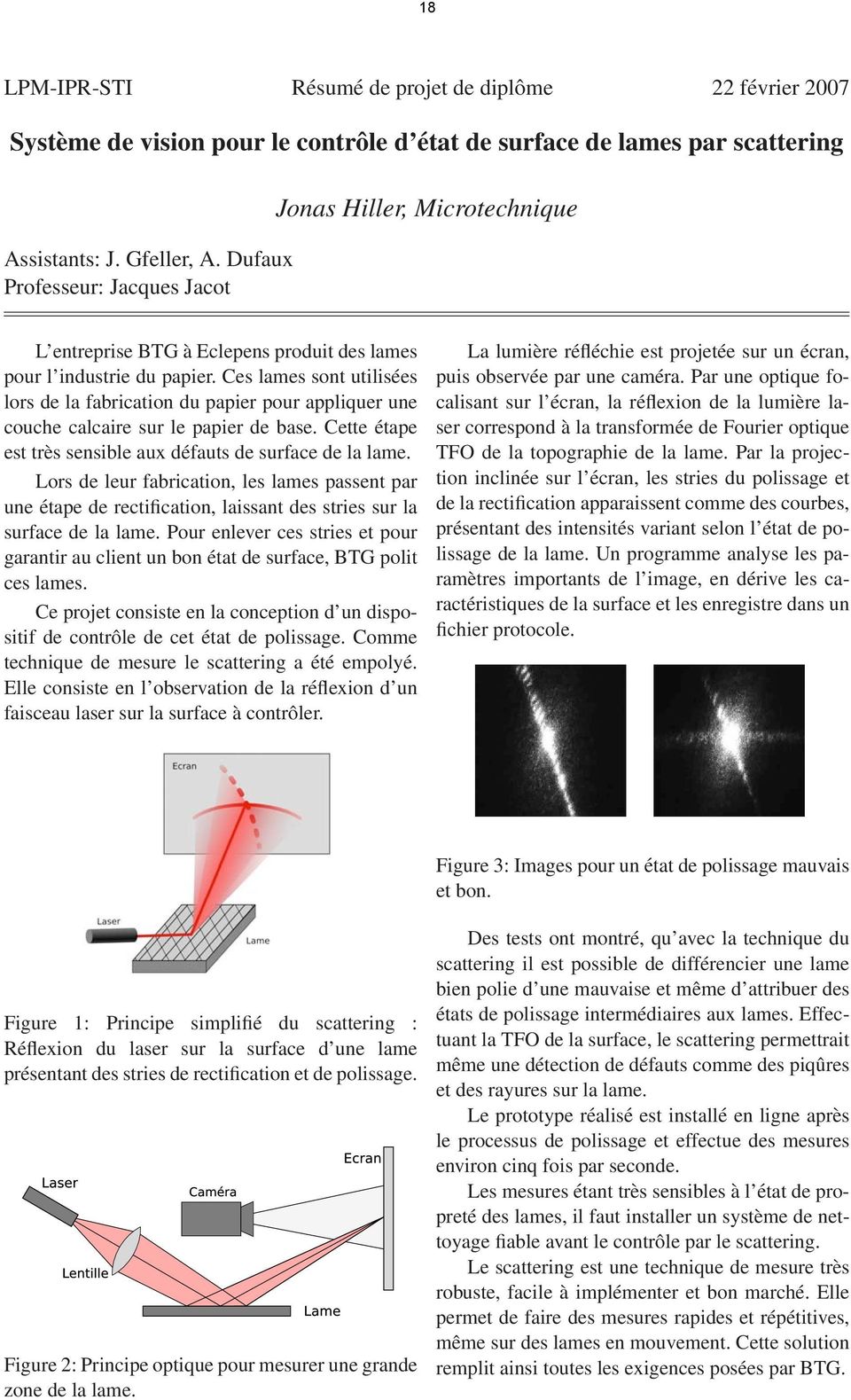
18 18 LPM-IPR-STI Résumé de projet de diplôme 22 février 2007 Système de vision pour le contrôle d état de surface de lames par scattering Assistants: J. Gfeller, A. Dufaux Professeur: Jacques Jacot Jonas Hiller, Microtechnique L entreprise BTG à Eclepens produit des lames pour l industrie du papier. Ces lames sont utilisées lors de la fabrication du papier pour appliquer une couche calcaire sur le papier de base. Cette étape est très sensible aux défauts de surface de la lame. Lors de leur fabrication, les lames passent par une étape de rectification, laissant des stries sur la surface de la lame. Pour enlever ces stries et pour garantir au client un bon état de surface, BTG polit ces lames. Ce projet consiste en la conception d un dispositif de contrôle de cet état de polissage. Comme technique de mesure le scattering a été empolyé. Elle consiste en l observation de la réflexion d un faisceau laser sur la surface à contrôler. La lumière réfléchie est projetée sur un écran, puis observée par une caméra. Par une optique focalisant sur l écran, la réflexion de la lumière laser correspond à la transformée de Fourier optique TFO de la topographie de la lame. Par la projection inclinée sur l écran, les stries du polissage et de la rectification apparaissent comme des courbes, présentant des intensités variant selon l état de polissage de la lame. Un programme analyse les paramètres importants de l image, en dérive les caractéristiques de la surface et les enregistre dans un fichier protocole. Figure 3: Images pour un état de polissage mauvais et bon. Figure 1: Principe simplifié du scattering : Réflexion du laser sur la surface d une lame présentant des stries de rectification et de polissage. Figure 2: Principe optique pour mesurer une grande zone de la lame. Des tests ont montré, qu avec la technique du scattering il est possible de différencier une lame bien polie d une mauvaise et même d attribuer des états de polissage intermédiaires aux lames. Effectuant la TFO de la surface, le scattering permettrait même une détection de défauts comme des piqûres et des rayures sur la lame. Le prototype réalisé est installé en ligne après le processus de polissage et effectue des mesures environ cinq fois par seconde. Les mesures étant très sensibles à l état de propreté des lames, il faut installer un système de nettoyage fiable avant le contrôle par le scattering. Le scattering est une technique de mesure très robuste, facile à implémenter et bon marché. Elle permet de faire des mesures rapides et répétitives, même sur des lames en mouvement. Cette solution remplit ainsi toutes les exigences posées par BTG.
19 19 LPM-IPR-STI Résumé de projet de Master 23 février 2007 Mesure 3D par vision pour composants SMD àgéométrie complexe Assistant: Julien Gfeller Professeur: Jacques Jacot Stefan Perren, Microtechnique Ce projet consiste en la modélisation et l analyse d un système de mesure 3D par vision pour des composants SMD à géométrie complexe. L entreprise Ismeca souhaitant avoir à disposition un appareil de mesure tridimensionnel flexible et performant, un nouveau modèle pour le caractériser a été développé. De plus, l influence des paramètres inhérents au système sur la résolution de mesure a été analysée. Il s agit des paramètres liés à la géométrie et au système optique ainsi que des caractéristiques de l élément structurant la lumière et de la caméra. lumière caméra structuration plan Plan lumière Figure 1: Principe de la mesure 3D par projection de lumière structurée. La figure 1 montre le principe de la projection de lumière structurée pour la mesure de la troisième dimension. La nouvelle modélisation se base sur le fait qu un point de mesure dans l espace est défini par l intersection de deux objets géométriques. Il s agit de l intersection entre un plan, qui correspond à une rangée de pixels de l élément structurant, et une droite correspondant à un pixel de la caméra (voir figure 2). En utilisant un algorithme de lancer de rayons exacts ( Exact Ray Tracing ) pour déterminer ces objets géométriques dans l espace, on prend directement en compte les paramètres géométriques et optiques (par exemple les aberrations) du système. Les paramètres suivants et leur influence sur la résolution de mesure en hauteur ont été analysés : l angle entre l axe optique de projection et la verticale la télécentricité, les aberrations optiques, la pro- Figure 2: Intersection entre un plan et une droite. fondeur de champ et la fonction de transfert de modulation du système optique la résolution et la discrétisation en intensité de l élément structurant la lumière et de la caméra Il a pu être démontré que la résolution en hauteur se trouve entre deux limites : une limite supérieure définie par la discrétisation spatiale de l élément structurant ainsi qu une limite inférieure donnée par le nombre de niveaux de gris de la caméra. La valeur exacte de la résolution dépend du montage choisi et doit être déterminée expérimentalement. Le démonstrateur réalisé permet de faire des premiers tests de répétabilité et de précision basés sur le nouveau modèle. Des séries de mesures d une différence de hauteur de 100µm (figure 3) ont démontrées que l on se trouve entre les deux limites prédites. z [µm] mesure Figure 3: Deux séries de mesure à deux hauteurs différentes ( z = 100µm), précision : 7µm.

20 20
21 21 IPR-LPM Abstract of Master Project 22 February 2007 Characterization of a magnetic control system for a glucose biosensor Céline Ramoni, Microengineering Assistants: Professor: Julien Chassot, Sadasing Kowlessur, Eric Meurville Peter Ryser Introduction LPM is currently developing an implantable glucose biosensor that would be an alternative to painful finger pricking operation performed several times a day by diabetic patients in order to determine the exact amount of insulin they should take. The capsule contains a sensitive liquid whose viscosity changes straightforwardly with the variation of the concentration of glucose that permeates from the surrounding tissue interstitial fluid through a selective nanoporous membrane. This viscosity can then be measured by a rotating magnet immersed in this liquid. The contact less drive is done by a second magnet inside of the control unit. Interstitial fluid Capsule Drive Hall sensor Skin Control unit Overview of the biosensor mechanism Project Objectives The drive magnet has been evaluated to work with a particularly Hall sensor, but this association has never been tested before in final conditions. The aim of this project is to confirm that the biosensor will be operational within the actual conditions and what are the exact tolerances in the placement and use of these elements. In a second time, some exploration about the coupling effect will be done: what happens when driving the capsule magnet or reading its speed if the capsule and the control unit are not perfectly aligned? Methodology A 5 DOF mechanical setup is designed to run tests on a simplified system. Motor Simplified system Static tests (magnet rotation at a constant speed) are performed on several Hall sensors in order to analyse their global behaviour. The sensors output variations along the 5 DOF (in term of amplitude, phase shift, frequency) are compared through a MATLAB script. Preliminary tests on the coupling effects are made using a two drive magnets. Results The actual drive magnet and sensor have a workspace delimitation that corresponds well to the sensor manufacturer recommendations. The positioning of the drive in it is not critical for the manufacturing process of the biosensor. The tests on the coupling effect showed a very limited workspace. But this result is fundamentally linked to the material used (magnets, type of lube oil). Future work Dynamic tests (implementation of speed profiles) must be performed in order to create a complete and more realistic simulation of the biosensor mechanism. These tests will give more precisions about the command and detection abilities of the concept.
22 22 IPR-LPM Abstract of Master project February 23, 2007 Data Fusion Module Patrick Schoeneich, Microengineering section Assistant: Eric Meurville External Expert: Frédéric Holzmann (Siemens VDO) Professor: Peter Ryser Introduction The goal of the SPARC project is to increase the traffic safety for vehicles using intelligent drive-by-wire technology. This will be done by creating an assistant system, which will help the driver and improve the vehicle command when required. For this purpose, many sensors are needed to monitor the state of the vehicle and the environment. The goal of this project is to create a high level sensor fusion module. Measures from all sensors will be combined, and thus a better precision and robustness will be achieved. A multiple object tracking algorithm will be implemented to monitor the vehicles/pedestrian around the vehicle, as well as a position tracking algorithm to monitor the vehicle displacements. Kalman filter. Finally, the centers are associated with the correct tracked objects, which are updated with a dynamic Kalman filter (see figure 1). The position tracking algorithm is implemented with an extended Kalman filter. The Ackerman steering model is used for the dynamics. Measures coming from the different sensors (lane tracking, steering angle, tachymeter, gyroscope and GPS) are combined to get an estimate of the position. Results Figure 2 shows the results of the tracking algorithm. Measures are coming from the two radars while driving. An object in front of the vehicle is accelerating. The object is well tracked, but measures from road side objects are difficult to interpret (street light, pedestrian,...). Vision is thus needed, but was not available for tests. Figure 1: Tracks management Work Both algorithms are based on the Kalman filter, which can fuse measurements coming from different sensors, taking their variance into account. The multiple object tracking is done by firstly clustering the measures coming from the different sensors (radars, lidar and camera) at the same time step. This allows regrouping measures originating from the same objects. The centers of each cluster are then computed, using a Figure 2: Tracked objects time evolution Position tracking tests were done with simulated measures, due to the unavailability of real data. The lane change case was studied to get a faster reaction of the filter. Conclusion The algorithms showed good behaviors. Tests still need to be done with all available sensors.
23 23 EPFL - LSRO Résumé de projet de diplôme Master (80 h/sem) Design and development of a haptic interface for assistive manipulation of an electrostatic contact-less gripper Assistant 1: Ewoud van West Assistant 2 : François Barrot Professeur: Benjamin Burns, Microtechnique Hannes Bleuler et Akio Yamamoto Ce projet consiste à développer et construire une interface haptique pour la manipulation de wafers en silicone tenus en lévitation électrostatique. La lévitation a pour but de réduire les contraintes néfastes dans la microstructure du wafer pendant les opérations de déplacement. Eviter le contact réduit la possibilité de contamination du device. Parce que l espace entre le wafer et la pince électrostatique est très petit (310µm) l interface haptique est nécessaire pour compenser les erreurs de mouvement de l opérateur. Un catalogue des solutions contenant une analyse des structures mécaniques, des guidages linéaires et des moteurs a été rédigé pour comparer différentes possibilités. Une structure scara a été choisie pour sa réponse en fréquence verticale, sa maniabilité pour l opérateur et pour sa résolution constante dans le déplacement vertical. Un moteur (pulse command) vis-écrou à connextion directe entre moteur et vis a été choisi pour son poids et sa précision. La base de l appareil est en acier pour augmenter sa raideur. Le bras est conçu de deux tubes en aluminium (diminution des forces d inertie) liés par des tiges en acier qui elles sont guidées par des roulements. La poignée de l opérateur (contenant le capteur de force) est montée sur l écrou du moteur vis-écrou. La pince électrostatique est reliée à l écrou par des tiges. Construction finale de l interface haptique Pour tester le comportement haptique de l appareil, une interface virtuelle a été conçue. Une balle virtuelle est sensée tomber du haut de l écran, passer par une région visqueuse pour finalement rebondir sur un mur. Le mouvement de la balle (poignée) est activé par une force appliquée sur le capteur de force. Région visqueuse virtuelle Design final de l interface haptique avec schéma du workspace Le moteur a été monté en fin de chaîne cinématique pour compenser les erreurs accumulées dans la mécanique. Le design final est montré dans la figure ci-dessus. Balle virtuelle Mur virtuel Interface graphique représentant une balle, une région visqueuse et un mur virtuel
24 24 EPFL - LSRO Abstract Masters Project Alternative Power Sources for Airplane Electrical Systems Felipe Diaz, Microengineering Assistant 1: Assistant 2: Professor: François Barrot Jan Sandtner Hannes Bleuler Commercial aviation is expected to grow at about 5% per year and the environment regulations are also expected to become more constraining concerning pollutant emissions. The price of fuel will also keep rising in the future as it becomes increasingly rare. Considering this, airplane manufacturers need to put more efforts in developing more efficient airplanes. By building a More Electric Airplane (MEA), the Boeing Company with the new 787 makes the first step in the direction of more efficient and reliable airplanes. The substitution of the pneumatic and hydraulic systems by electrical ones goes towards the direction of using a cleaner, more reliable and more efficient power system on board of an aircraft. By introducing the MEA, a new way of effectively producing electrical power needs to be found and fuel cell systems with the combination of fuel efficiency and high environmental performances, show a high potential for this application. Basically, two types of fuel cells seem to be the best candidates for this application, i.e. the low temperature Proton Exchange Membrane Fuel Cell (PEMFCs) and the high temperature Solid Oxide Fuel Cells (SOFCs). Relative emissions of a fuel cell system In the present paper, a 1.2kW PEMFC has been studied. Based on the standard for the power requirements for airplane systems, a series of tests were performed on the fuel cell and the results were analyzed in a way to observe if the power quality of the fuel cell can match the requirements of the standard. The tests showed that this type of fuel cell has the capability of fulfilling these requirements under certain conditions. Depending on the load, the temperature of the fuel cell and other parameters, the results can be significantly different. Result of a transient test One of the biggest issues concerning this fuel cell may arise when considering the way the fuel is stored to run the system. PEM fuel cells require highly pure hydrogen and in the present case this was achieved by using a compressed cylinder of hydrogen. This could become an important consideration for implementation of such a system on board an airplane. An alternative way of storing the fuel within the airplane will have to be found if the PEM fuel cell system is to be used. Nevertheless, the results of the tests prove that PEM fuel cell systems have the ability of producing power in a quiet, efficient and clean way that matches the power quality of the airplane power systems. Additionally, more effective and cleaner ways of storing the energy have been investigated as an important complement to the use of fuel cell technology in future airplanes.
25 25 EPFL LSRO Abstract Master Project Investigation on material removal process in SACE glass machining - Design of a force measuring set-up Pascal Maillard Microtechnique Professors : Hannes Bleuler (EPFL) and Rolf Wüthrich (Concordia University) Supervisor : Ulrich Spaelter Spark Assisted Chemical Engraving (SACE) is a technology for micro-machining several types of materials like glass quartz, polymers and some ceramics using electrical discharges. The aim of this project is to increase the understanding of the material removal mechanism during drilling and consequently the quality and repeatability of the machining. This is done by three complementary approaches:!" Developing a model of material removal rate!" FT-IR analysis of the machined surface!" Studying the force exerted on the tool during constant feed drilling Gravity-feed drilling model The new model describes the drilling evolution taking into account the presence of the discharge and hydrodynamic regimes. a sample by measuring the absorption of various infrared light wavelengths by the material of interest. FT-IR spectrum of the microscope slide. In black is the area that has been immersed in the electrolyte and the grey spectrum represent the machined area (i.e. channel) Changes of the reflectance spectrum in the machined area highlight the chemical etching by the OH radicals. ' ' OH ( ) Si ' O ' Si ) * ) SiO ( ) SiOH Force exerting on the tool during drilling A new set-up is designed, characterized and implemented in order to measure the force exerted on the tool and thus increase the understanding of the machining process and confirm the results obtained help to the modelling of the gravity-feed drilling. Comparison between model prediction and measured data (400#m diameter tool, solution 30% NaOH) It results in the identification of the limiting parameters and their origins and thus an improved description of the complete mechanism. The temperature in the machining zone Tm could be estimated to be about 600 C and the viscosity of the melted material about 8 1.4& 10 $ Pa& s%. FT-IR analysis Infrared spectroscopy detects the vibration characteristics of chemical functional groups in Scheme of the implemented set-up Zero displacement force measurement is realized with the help of a controller implemented on open source operating system Linux Ubuntu. Block diagram of the closed-loop control
26 26
27 27 EPFL/UVa - LSRO Summary of Master thesis Formal parameter estimation of active magnetic bearings Selim Megzari, Microengineering Advisor: Professor: Eric Maslen (University of Virginia, USA) Hannes Bleuler A new method for position estimation in self-sensing magnetic bearings has been developed at University of Virginia by Prof. Eric Maslen. The formal paramater estimation method uses a Lyapunov approach to design adaptive laws for magnetic flux and position estimation. The goal of this project was to evaluate the performance of two estimators already developed by implementing them on a FPGA and testing them on a balance beam test rig. An estimator modeling magnetic saturation was also investigated. The first position estimator without eddy current or magnetic saturation modeling has been implemented onto a Virtex-4 FPGA using System Generator, Xilinx s development environment in Simulink. The hardware design was tested in simulation and was compiled to a bitstream that performed correctly in co-simulation. also performed correctly in simulation and co-simulation, but its estimation parameters require further tuning. Simulations have been carried out to evaluate the performance of the estimator including magnetic saturation. Even when excited by high frequency signals, the estimator cannot track position whenever current exhibits saturation. After modeling the test rig to derive appropriate constants for the estimator, the FPGA was inputted real current and voltage signals. Experimental results indicate that the basic position estimator tracks position properly. However, due to problems with the impedance of the analog-to-digital converters, some modifications must be made to the experimental setup before definite conclusions can be made on the estimator s performance. A first convergence time of 45 [ms] has been measured but use of actual switching amplifiers as well as optimization of the estimation parameters will decrease significantly this time. Simulation of the hardware design: the estimator converges to the real position The second estimator with eddy current modeling but without magnetic saturation Comparison between position sensor output (red) and position estimate (blue)
28 28 LSRO-IPR-STI Master project summary February 23, 2007 Modular all-terrain ingenious platform Florian Vaussard, Microengineering Assistants: Michael Bonani, Francesco Mondada Professor: Hannes Bleuler This Master project is related to the new marxbot robot, which is part of the European project Swarmanoid. The goal is to conceive, realize and control heterogeneous, dynamically connected, small autonomous robots. The marxbot is the all-terrain version robot, which is an enhanced version of the S-bot robot of the Swarm-bot project. The goal of this Master project is to design and implement the low-level electronic of the marxbot robot. This consists in particular in protection and electronic management of the battery pack, power management, with hot-swapping battery capability, powering and control of the two direct current motors, proximity and ground sensors, inertial measurement unit (IMU), And possibly other sensors, like sound,... The battery management circuit, directly included in the battery pack, is able to monitor the battery current / voltage, and protect the dual Li-ion cells from any damage. This feature is part of the advanced power managing architecture defined during this project. Prototype of the battery pack The hot-swap system is based on supercapacitors cells, which act as secondary power supply, and a commutation system which detects the removal of the battery. This feature can provide power for about fifteen seconds to a 2W load. The motor control module is based on the new generation dspic33f microcontroller and is able to control a small power ( 2W ) direct current motor. The proximity module is also based on a dspic33f and is able to drive 24 TCRT1000 proximity sensors and 8 TCND 5000 ground sensors. Finally, the IMU has been designed, but not implemented due to lack of time. Five different circuits have been realized and a fully functional prototype of the marxbot robot s mobile base has been built. Prototype of the marxbot robot All the required functionalities have been implemented, programmed and successfully tested. A complete doxygen documentation of the source code is also available. The result of this project is a research platform for the future projects of the laboratory. Other parts are to be developed in order to built the complete robot, for example the sound sensors or the processor card.
29 29 IPR LSRO Résumé de Travail pratique de Master 23 février 2007 Scanner 3D pour l'analyse de semelles Daniel Dörig, Microtechnique Assistant(s): Gaëtan Marti, Maurice Hälg Professeur: Reymond Clavel La Suisse a beaucoup de problèmes liés aux crimes en série. La plupart des ces crimes sont des cambriolages. Avec les traces des chaussures on peut faire le lien entre ces crimes. La faculté de droit et des sciences criminelles de l'unil cherche à avoir un scanner 3D pour scanner les traces moulées dans le plâtre et des chaussures des suspects. Une évaluation est faite, pour trouver la meilleure façon de scanner des semelles. L'évaluation est faite avec des méthodes utilisant une caméra, deux caméras, une caméra avec un laser et une méthode utilisant deux caméras avec un laser. La meilleure méthode trouvée est celle employant deux caméras avec un laser. travaille avec les caméras du scanner. Pour celui-là il y a un dessin d'encodage imprimé sur le verre du scanner. Ce dessin est filmé avec les caméras et le système détermine grâce à ce dessin la position des caméras. Le système détermine la position avec un calcul de corrélation entre le dessin filmé et le dessin primitif. La troisième grande partie du projet est la détection du laser. Pour trouver le laser dans l'image, on fait d'abord deux fois une approche avec un algorithme de programmation dynamique. A partir de cette approche on détecte le laser colonne par colonne dans l'image. La dernière grande partie du système est la reconstruction 3D. La position des points dans l'espace est calculée par triangulation entre le plan du laser et la ligne de fuite du point laser dans l'image. Fig. 1: Scanner à deux caméras avec laser Ce projet traite la partie software du scanner 3D. Il y a quatre grandes parties dans ce software. Premièrement la calibration du système pour qu'il y ait une relation entre les images des caméras et le monde extérieur. Deuxièmement l'encodage ; pour diminuer le prix du système et la complexité de la mécanique, on a développé un encodeur, qui Fig. 2: Résultat de la reconstruction 3D De plus on a projeté la reconstruction 3D sur un plan de référence pour que le service technique de la police puisse facilement comparer les traces du lieu du crime avec les semelles scannées.
30 30 IPR LSRO Résumé du projet de master 21 février 2007 Dispositif de plusieurs micros robots mobiles contrôlés par un projecteur Christophe Groux, Microtechnique Assistants: Professeur: Walter Driesen Reymond Clavel Le but de ce projet est de tester le principe du «friction drive» sur des micro-robots avec un minimum de composants «on board»: Force de contact variable Robot Table vibrante Fig. 1 Principe du «Friction drive» Le «friction drive» est une utilisation d une vibration horizontale et d un changement, par différents moyens, de la force de contact entre le robot et sa surface de guidage. Le but de ce projet est de développer un dispositif capable de tester ce principe en utilisant une table vibrante en XY pour la vibration horizontale et une force électrostatique pour varier la force de contact. La table réalise des translations dans le plan XY selon des cercles de 0,1 à 4 mm de rayon avec une fréquence de 15 Hz. Elle est montée sur des lames pour la maintenir dans un plan horizontal. La commande des robots est faite au travers d un projecteur vidéo. Les robots sont munis d électrodes pour le serrage électrostatique sur le dessous et de cellules solaires pour la mise sous tension de ces électrodes sur le dessus. Le support du robot est un wafer de verre découpé au moyen d une scie et troué par le biais d un jet de sable au travers d un masque. Les électrodes en argent sont déposées par sérigraphie et recouvertes d une couche de diélectrique de 7!m environ. Cellules solaires Electrodes Fig. 3 Photo d un robot Un programme permet de commander de manière synchrone le mouvement de la table et de projeter les images voulues. Fig. 2 Dessin de la table vibrante Fig. 4 Schéma du principe d avance du robot Le cercle décrit par la table est divisé en quatre parties que nous pouvons éclairer séparément. La fréquence d affichage du projecteur est ainsi de 60 Hz. Les tests ont montré que le principe fonctionne dans des conditions très précises. L excentricité de la table, la propreté du support et l humidité doivent être très bien maîtrisés. La vitesse du robot est de l ordre de 5 mm/s.
31 31 IPR LSRO Résumé de Travail pratique de Master 23 février 2007 Caractérisation et optimisation d une machine parallèle 3-axes d ultra-haute précision à articulations flexibles : concept MinAngle Philipp Kobel, Microtechnique Assistants: Professeur: Mohamed Bouri et Patric Pham Reymond Clavel Description : Ce projet se base sur un prototype réalisé nommé MinAngle. Il s agit d un système 3-axes (" x, " y et translation en z) entièrement parallèle et constitué d articulations flexibles de type pivot. Le robot est conçu pour effectuer de grands angles (± 15 sur les deux axes) en RCM (Reomote Center of Motion). Actuellement les axes linéaires qui sont récupérés d un projet précédent ne permettent pas d exploiter toute la capacité du robot. Le robot MinAngle Objectifs : Ce projet a comme but de caractériser et de calibrer le prototype existant. Ainsi un système de mesure est conçu pour mesurer précisément les rotations " x et " y et les déplacements en RCM. Un système adéquat est aussi développé pour les axes linéaires. Pour la défense du projet une démonstration sera mise en place mettant en valeur les capacités du robot. La démonstration montrera les caractéristiques principales et les améliorations par le calibrage. Résultats : Le tableau suivant contient des données techniques du robot MinAngle actuel. Les valeurs sont soit mesurées soit calculées en utilisant le modèle géométrique. Les axes linéaires Erlic 85 Course ± 5 mm Résolution 250 nm Répétabilité ± 0.3 µm Hystérèse < 0.6 µm Rigidité axiale 10 N / µm MinAngle Course en Z ± 5 mm Course en! x et! y ± 4.8 Déplacement parasite en X-Y < 140 µm Résolution en! x et! y 0.7 arcsec Répétabilité en! x et! y ± 0.6 arcsec Hystérèse en! x et! y 1.6 arcsec Rigidité en X et Y 3 N / µm Rigidité en Z 9.5 N / µm Rigidité en! x et! y 0.40 N / arcsec 1 ère fréquence propre 400 Hz Les performances du MinAngle La caractérisation de l organe terminal contient les points : rigidité, fréquence propre, répétabilité, hystérèse et déplacement parasite. Le calibrage considère la linéarité des axes Erlic 85, la précision de détection des switches, l erreur de position des switches et le déplacement du RCM en Z associé à une inclinaison de la nacelle. Travail futur : La caractérisation du robot a confirmé qu il faudrait utiliser d autres axes linéaires afin d améliorer les performances du système.
32 32 IPR LSRO Résumé de Travail pratique de Master 23 février 2007 Réalisation d un Delta linéaire pour l assemblage horloger Jérôme Parent, Microtechnique Assistant(s): Benoit Lorent, Willy Maeder, Mohamed Bouri Professeur: Reymond Clavel Dans le cadre d une collaboration avec une entreprise active dans le milieu de l automatisation de mouvements, une gamme de robots «Delta linéaire» va être conçue pour l assemblage et la prise-dépose de petits composants en particulier pour le domaine horloger. Ce projet porte sur un robot dédié au chassage et se déroule en deux étapes. Dans un premier temps, les facteurs influents sur la précision du chassage sont mis en évidence. Dans un deuxième temps, la conception des axes motorisés qui seront intégrés dans le robot est effectuée. lente comprise entre 5 à 15 mm/s avec une haute rigidité dans les éléments. La boucle de mesure doit faire part d une grande attention : le nombre d interfaces doit être limité et la boucle doit être la plus courte possible. Prototype Delta Linéaire pour le chassage Profil de force lors d un chassage Différentes stratégies de chassage sont élaborées à l aide d un banc expérimental équipé d un servomoteur et instrumenté pour la mesure de force et de position (palpeurs). Un pic de force d environ 50N à l entrée de la goupille et un effort moyen de 30N sont mis en évidence lors des expériences réalisées. La précision de chassage obtenue avec ce banc est de l ordre de 8!m. Pour réaliser un chassage de qualité, on suggère une vitesse Le robot sera composé de trois axes linéaires verticaux disposés à 120 et développe un effort de chassage maximal de 300N. La raideur souhaitée est de l ordre de N/m. La cadence du robot souhaitée du robot est d un chassage toute les deux secondes. Chaque axe est motorisé par un servomoteur équipé d un encodeur, toutefois on se réserve la possibilité d installer une règle de mesure optique. Les vis et les guidages doivent être à recirculation de rouleaux. L utilisation d éléments roulants à rouleaux est choisie pour permettre d obtenir une grande rigidité comparée à un système identique à billes.
33 33 IPR LSRO Résumé de Travail pratique de Master 23 février 2007 Assistant(s): Patrick Helmer, Charles Baur Professeur: Reymond Clavel Porte trocart partie active NeuroGlide Michael Sigrist, Microtechnique Lors d une opération consistant à poser des vis dans les vertèbres C1/C2 (transarticulaires) selon une trajectoire prédéfinie, un trocart (tube) est positionné dans l espace. Sa fonction est d amener les vis jusqu au point d entrée de la vertèbre C2. z x NeuroGlide consiste en deux bras de sortie se déplaçant dans deux plans parallèles, perpendiculaires à l axe d insertion de la vis. Le déplacement différentiel entre les deux bras permet au porte trocart d effectuer des translations en X et Z ainsi que des rotations autour de ces mêmes axes. P1 y x z Schéma illustrant la trajectoire d insertion de la vis et son point d entrée ( P1) dans la vertèbre C2 Un porte-outil semi actif à 7 degrés de liberté (DDL) avait été conçu. 3 DDL sont utilisés pour positionner grossièrement le trocart et les 4 autres assurent le réglage fin. Ce projet consiste à rendre actifs les 4 degrés de liberté du réglage fin. Plusieurs structures cinématiques ont été étudiées lors du projet. La demande de l irréversibilité et de l adaptabilité à la morphologie unique de chaque patient a fait ressortir la structure NeuroGlide. y Structure NeuroGlide construite Les quatre guidages linéaires sur lesquels les bras de sortie sont montés sont entraînés par un système vis-écrou qui garantit l irréversibilité de la structure. Un prototype de NeuroGlide est en cours de fabrication. Des tests sur cadavre permettront d évaluer les performances réelles du système. Avec NeuroGlide, un robot de précision à grandes courses idéal pour la pose de vis transarticulaires a été développé. De plus, toute application où l on cherche à positionner une droite dans l espace est envisageable, notamment la biopsie.
34 34 IPR LSRO Diploma Project s Summary February 23 rd, 2007 Conception and Construction of a 3 DOF Optical Precision Sensor Integrated in Micro-Robots Leos Urbanek, Micro-Engineering Assistants: Professor: Fabian Kaegi, Thomas Cimprich Reymond Clavel Today s mobile micro robots can achieve very high resolutions. However, there is virtually no 3 DOF sensor that allows to measure a large range in "+ z (360 ) that is cheap and small and that can be integrated in these robots. We obtain a position noise resolution in X and Y of ±186nm and an angular noise of 1.4. A processing speed of 8.4Hz is obtained on a Pentium IV processor. The decoding algorithm takes only 1.4ms to calculate the position out of a pretreated image. Construction of the proposed 3DOF sensor We develop a sensor with a range of 30x30mm 2 in x and y (for our application). However, this range can be easily extended. An angular range of 360 is obtained. We minimize the sensor thickness by not using the camera optics. This forces us to use high aspect ratio holes in order to get a high contrast image. Range Resolution (noise) x, y 30x30mm 2 <±186,m + z Range and obtained noise The absolute position is coded by an array of units, whose coarse position is given by the relative position of two holes in comparison to the regular part of the unit. The absolute position code; the relative position of the two absolute position markers defines the position of the unit Detection of the different components of the absolute code on a target
35 35 IPR LSRO Résumé de Travail pratique de Master 23 février 2007 Porte-endoscope à lames flexibles (structure «Trilame») Marc Weibel, Microtechnique Assistant(s): Charles Baur, Patrick Helmer Professeur: Reymond Clavel Lors d une opération neurochirurgicale par voie minimale invasive le chirurgien doit manipuler avec précision plusieurs instruments chirurgicaux dans une zone relativement étroite. Un endoscope est utilisé pour visualiser la zone d intervention. La présence d une 3 ème main robotisée qui porte et manipule l endoscope est une aide précieuse pour le chirurgien dans le positionnement de ces outils. Ce projet consiste en une amélioration et une extension d un prototype de la structure robotique proposée lors d un projet de semestre précédent. Cette structure consiste en des éléments flexibles et est une réalisation d un nouveau principe cinématique parallèle du nom de «Trilame». L extension consiste en l ajout de 4 degrés de liberté à la structure proposée, afin que l endoscope puisse être non seulement déplacé par petites courses dans l espace mais également orienté et inséré dans la zone opératoire. Pour l actionnement du nouveau robot Trilame5, un actionneur spécifique a été construit. Cet actionneur est basé sur un système de transmission vis-écrou irréversible particulièrement compact. Actionneur spécifiquement construit pour le nouveau robot Trilame5 La simplicité des éléments de la chaîne principale de l ancien prototype a conduit à une double réutilisation de celle-ci pour les deux degrés de liberté en rotation supplémentaires tout en restant dans l esprit «Trilame». Une optimisation au niveau arrangement et imbrication du nouvel actionneur ainsi que des deux chaînes ajoutées a rendu possible de minimiser l encombrement du nouveau robot Trilame5 en garantissant de bonnes performances statiques. LNouveau ors d une robot étude Trilame5 sur le principe à 5DDL cinématiq construitue des deux DDL d insertion à grande course un nouveau système de transmission différentiel très prometteur a été inventé. Celui-ci, se basant l utilisation multiple du principe de transmission vis-écrou, permet d arriver à un système de deux degrés de liberté d une translation et d une rotation d axes coïncidents qui sont les deux mécaniquement irréversibles. Une réalisation de ce système est prévue dans le proche futur de ce projet de diplôme.
36 36 STI-I2S-LIS Master Project Abstract 23 rd February 2007 In Silico Evolution of Biochemical Networks Fanny Riedo, Section Microtechnique Assistants: Professor: Marbach Daniel, Mattiussi Claudio Floreano Dario The goal of this work is to study the evolution of robustness (phenotypic insensitivity to mutations) in Gene Regulatory Networks (GRN). A widespread hypothesis is that stabilizing selection allows evolution of the robustness; Previous work by Mark Siegal and Aviv Bergman in Waddington s canalization revisited: developmental stability and evolution show that this selection, though sufficient, is not necessary. We performed experiments with and without stabilizing selection, as Siegal and Bergman, but added the possibility for the networks to vary in size and topology. The topology of a network can indeed have more influence on the robustness than the exact numerical values of the parameters. Their model include a weight matrix W, representing the influences of the genes on each other, and a state vector S(t) representing the expression level of each gene at time t. An iterative equation gives the state for the next time step. Histograms of the obtained robustness with stabilizing selection (up) without (down) compared to random individuals robustness Results were compared with robustness of random individuals to determine whether robustness had evolved. The weight matrix and state vector are linked by a non linear iterative relation The network has to reach a stable state to be viable. This steady state will then be used to compute the fitness with stabilizing selection. Stabilizing selection is made by comparing the evolved steady state to an optimal steady state, created by randomly generating a target individual. In our experiments we did indeed observe evolution of robustness with stabilizing selection, but not without. We also noted that results were highly dependant on the chosen model, so it is certainly not only one condition that brings the evolution of robustness.
37 37 LIS Résumé de Travail pratique de Master Biologically Inspired Swarms of MAVs for Radio Communication Relay Laurent Winkler, Section Microtechnique Assistant: Professeur: Hauert Sabine, Mitri Sara Floreano Dario The goal of the Swarming MAVs project is to create a controller for a group of lightweight aircraft that are deployed to build a highrate communication network. The launching and recovery of the swarm should be simple enough to be performed by unqualified staff. Once initiated the agents are fully autonomous and no maintenance effort is required. They use simple low-cost devices and information available through local communication to organize and induce swarming behavior. Swarm of MAVs used as communication relays Each MAV is equipped with simple sensors such as cardinal compass, altimeter and speed sensors, accelerometer and gyros and RF communication equipment. It should be noted that no real position sensor is mounted such as GPS or laser range-finders. Instead we must rely on communication ranges and network topology to build the swarm. Ant navigating on a grid (each cell contains a pheromone value) The goal of this project is to improve the swarming behavior by adapting the stigmergic mechanism used by army ants during foraging to these flying robots. Giving that they are no common map or physical support for depositing pheromone, a novel mechanism for stigmergy had to be defined. This was achieved by separating the MAVs in two categories, node-mavs, on which pheromone can be deposited through local communication and ant-mavs that can navigate through the network of node- MAVs. The need for communication between ant- and node-mavs lead to the choice of organizing the nodes on a spatial lattice where each node has a specific position and unique coordinate. The second part of the project was focused on a performance improvement by increasing the robustness of this lattice. By synchronizing the orbit of neighboring nodes and allowing them to adapt their positions, we have stabilized the swarming behavior and strengthened the communication links between agents.
38 38 NAM Summary of Master Project March 1, 2007 Simulation of Long-Range Surface Plasmons with the Finite Element Method Claudio Dellagiacoma, Section Microtechnique Assistant: Aloyse Degiron Professeurs: David Smith (Duke University), Olivier Martin (EPFL) Finite element method simulations of straight and curved rectangular plasmonic waveguides (see fig. 1) based on using the commercial eigenmode solver Comsol are presented. Fig. 1: The plasmonic waveguide: a thin metal strip (Ag or Au) embedded in a dielectric. The outer black layer is the absorbing perfectly matched layer (PML). The computation domain is the cross-section perpendicular to the metal strip. In a first part, the accuracy and the convergence of the results have been verified. The simulation of straight longrange surface plasmon-polariton (LRSPP) waveguides is in excellent agreement with the literature. We have seen that obtaining accurate results critically depends on the mesh density, particularly around the field singularities at the corners of the structure. Using field overlap integrals, we simulated mode transitions between different structures. This method was validated by comparing with P. Berini's end fire coupling experiment. Additionally, we could experimentally confirm the approach by simulating and measuring the coupling of dielectric slab waveguides at microwave frequencies. In a second part, we simulated curved LRSPP waveguides. We followed two approaches that were initially developed for simulating dielectric waveguides. They both lead to the same results, thus confirming their relevance in the context of LRSPPs. Due to the high radiation of bent LRSPPs, the main simulation issues were reducing reflections at the perfectly matched layer (PML). The standard PMLs in Comsol were insufficient, thus the redesign of the PMLs was required. The comparison with the literature of the total loss of curved LRSPP waveguides as a function of bending radius was in very good agreement. In addition, our simulations are supported by experimental data (see fig. 2). Finally, we showed that a lateral offset of two waveguides of different bending radii can increase the coupling efficiency. Our results demonstrate that using a mode solver together with transition mode coupling calculations is a flexible and expandable method. Since reliable results within measurement tolerances are found, this method can be used to help further engineer integrated plasmonic waveguides. Fig. 2: Simulated and measured total loss of curved plasmonic waveguides of different radii. The dimensions of the simulated metal strips are given in the legend.
39 39 NAM Résumé de Travail pratique de Master 23 février 2007 Calculs des forces générées par des plasmons de surface sur des nano fils en or Lamothe Elodie, Section Microtechnique Assistant: Dr. Gaëtan Lévêque Professeur: Martin Olivier L interaction d un champ électromagnétique avec des nano-particules métalliques aux dimensions inférieures à la longueur d onde peut sous certaines conditions exciter des modes de résonance appelés modes de plasmons de surface. Ils sont associés à un couplage entre les charges libres du conducteur et le champ électromagnétique. Ce projet de diplôme est consacré à l étude des forces exercées sur deux nano fils en or à la résonance plasmon. Pour cela, on se place dans une géométrie bidimensionnelle constituée de deux parallélépipèdes identiques, de section S = nm², de longueur infinie et séparés par une distance d variable. Ce système est illuminé par une onde plane où les vecteurs kˆ i et E! i sont situés dans le plan de section principale des deux fils (fig.1). E! i kˆ -./0 i -ext + d y O Figure 1 L étude des spectres d extinction du système en fonction de l angle d incidence et de l espacement d a permis de déterminer le nombre et les longueurs d onde des résonances plasmons. Nous avons mis en évidence deux régimes en fonction de la distance d, un de champ proche (d < 170 nm) et un de champ lointain (d > 200 nm). On a ensuite analysé l origine de l interaction des deux fils aux différentes résonances pour ces deux régimes. Pour cela, on s est appuyé sur x l étude des cartes du champ électrique et du vecteur de Poynting. Un exemple est donné sur la figure 2. Il représente la carte du champ électrique diffracté par le système pour une distance d = 20 nm à la résonance la plus intense. Figure 2 Dans cette configuration, les deux dipôles se couplent de manière antisymétrique (fig.2), engendrant des forces attractives entre les deux particules (fig.3). y F! 1 F! 2 Figure 3 Une application donnant suite à cette étude des forces serait la maîtrise de la manipulation de nano-particules métalliques. x
40 40 LAI Résumé de Travail pratique de Master 24 février 2007 SwissCube inertia wheel assembly mechanical part Gavrilo Bozovic, Microtechnique Assistants: Professor: Christian Koechli, Patrick Ragot Perriard Yves Specifications The goal of this project is to develop and build an electric motor to drive the inertia wheel of the SwissCube satellite. This system should provide angular stability to the satellite and allow its control. The operational speeds range from 5000 to [rpm]. The main constraints are the mass, 32 [g], and the average available power, 100 [mw] (including the electronics, developed in another project). Design After selecting the motor type, its parameters have been optimized by the means of a nonlineal optimization program, given our constraints. The drive s parameters have been validated using finite elements. Two different designs have been produced, in three prototypes. The two first were dummies necessary for mechanical tests, and the final prototype was used for electrical testing. Final prototype Tests allowed to check the good respect of the mechanical tolerances and of the weight constraints. It was also possible to compare the electrical behavior of two different motor types (4 poles and 8 poles), rejecting the 4 pole motor because of higher torque oscillations. Figure 2: final assembled drive on support Figure 1: Induction in the motor yokes According to the optimizations, the drive should have an efficiency over 98%, allowing to run a full work cycle with an average power of 29 [mw]. These parameters have been converted to a mechanical design, which has been produced. Unfortunately, due to shortage of time and to the absence of vacuum proof ball bearings, full testing has not been possible. Nevertheless, the first results showed promising performances. Further testing will be necessary to fully characterize the drive and to validate it for space.
41 41 LAI / Overview Ltd. Masters Project summary February 23 rd, 2007 Professor: Yves Perriard Assistant: Christian Köchli Lost step detection on a stepper motor Sébastien Huberti, section of Microengineering This project was carried out at Overview Ltd., a London company which specialises in high precision video-surveillance equipment. Overview produces devices that include a camera driven by two stepper motors, and an image-processing unit. Magnetic encoders are used to detect external disturbances and failures. Overview is willing to develop an algorithm capable of detecting lost steps, and in the longer term, capable of giving precise position related information without using encoders. This work was divided into three main steps: designing the acquisition hardware, programming the acquisition software on a DSP, and processing the signals to extract useful information. It turned out that the most reliable way of detecting a stall state from a running state is the Fourier Transform of the back EMF curve. Figure 1: Back EMF The DFT properties introduce certain requirements in the acquisition method and the signal processing. The FFT 0-Hz value is a reliable factor, and combined with other mathematical tools such as maxima, lost steps can be detected with a tolerance lower than 10% on one phase. Figure 2: Back EMF FFT The acquisition hardware for one phase includes a differential amplifier, two 4-pole filters, and an analogue differentiator. The acquisition software includes, in addition to all the settings and the main loop, an interrupt in which A-D conversions results are processed to obtain back EMF values. First, the DSP was programmed for signal sampling only, and the whole signal processing took place in Matlab. Then, signal processing was progressively transferred in the DSP, until performance limits were reached. An FFT algorithm was implemented, but its execution is too time-consuming to ensure that no samples are missed. Nyquist and practical criteria require that we keep the sampling frequency at 100µs. Sensorless lost step detection was reached with an error lower than 10% on the KA50KM2 motor, but not in real time mode. This implies that back EMF values have to be processed with Matlab for FFT computing and lost step counting. The acquisition hardware is currently being printed on a PCB to allow for two-phase sampling. The software is being adapted, and the uncertainty is expected to decrease to very promising levels.
42 42
43 43 LAI Résumé de Travail pratique de Master 23 février 2007 Precise Velocity Control of a Hard Disk Drive Jan Stoeckli, Section Microtechnique Assistant: Paolo Germano Responsables: Vertemara Carlo, Himpe Vincent, Bonvin Frederic Professeur: Perriard Yves The ramp technology was integrated in the Hard Disk Drive a couple of years ago, this technology allows a safer parking position for the heads, but also allow the heads to fly closer from the media, increasing the data density. The Load and Unload operations need a precise velocity control of the Voice Coil Motor (VCM) to avoid permanent damage of the heads and the media. This velocity control has, of course, to be achieved without sensors. 1. Parking Position 2. HDD operating Fig. 1 Ramp technology The aim of this project was to develop and characterize a new solution using a resistor network to bring the velocity regulation without the problems of the existing solutions. First, the system was studied using simulation tools. A new motor model was designed and tested on the existing regulation loop then the new velocity control was simulated. The simulation results have shown that the idea works perfectly but has a very high sensibility with temperature. Fig. 2 Velocity, position and Driver s Output during an Unload A new calibration process was thus developed to make up with the temperature dependence. This calibration was designed to be efficient in every case, even in a power off situation where the heads have to be retracted as soon as possible. A new PCB was also designed to demonstrate the new idea using an existing ST s chip (Altair) and an existing evaluation board. The characterization had shown that the velocity control is very efficient, the velocity is easily programmable and constant during all the unload/load as the Figure 2 shows. Some surprising time constants have been observed but the last PCB/circuit, still under construction, should prove the good behavior of the system. This project was carried out at STMicroelectronics, San Jose, CA. The velocity regulation loop should be implemented on the next generation of chips.
44 44 EPFL-STI-IPR-LAI Résumé de Travail pratique de Master 23 février 2007 Sunraycing-Optimisation du moteur électrique Alex Vulliemin, Section Microtechnique Assistant: Professeur: Miroslav Markovic Yves Perriard Le but de ce projet est d effectuer l optimisation d un moteur électrique pour une voiture solaire. Dans l espoir de participer au World Solar Challenge en Australie (course de voiture solaire). Le choix du moteur s est porté sur un moteur synchrone à aimants permanents pour son haut rendement et pour son couple élevé, dans le but de minimiser la masse du moteur. Le travail s est déroulé de la manière suivante (fig. 1) : la première phase a été la création d un modèle analytique décrivant le moteur tant au niveau magnétique, électrique, thermique que mécanique. Sur la base de ce modèle on réalise l optimisation (logiciel Pro@Design) dans le but de minimiser la masse et de maximiser le rendement. Le moteur retenu pour la course possède 48 encoches et 20 paires de pôles (fig. 2). Le couple nominal est de 14.5 Nm pour une vitesse de rotation de 988,2 t/min ce qui correspond à 95 km/h pour la voiture. L encombrement total du moteur (sans la jante, partie active) est de 374 mm de diamètre pour une épaisseur de 13 mm. A l aide des éléments finis (logiciel Flux2D), on vérifie le modèle et on ajoute les données manquantes pour caractériser complètement le moteur (pertes aimants, ). Figure 1 : Déroulement du projet. Figure 2 : Vue éclatée du moteur retenu. La réalisation mécanique du moteur qui comprend les plans des différentes pièces réalisant le lien entre la partie active du moteur et la voiture ainsi que les méthodes d assemblage (collage des aimants, ajustement) sont aussi décrite dans une partie plus théorique. Ceci dans le but de voir un jour rouler la voiture solaire avec ce moteur.
45 45 CDM / ILEMT / LEM Abstract of Master Project EPFL Sunraycing Team: Project Management, Fundraising & Logistics Friedrich Michael, Section Microtechnique Assistant: Professor: Dr. Philippe Wieser, Chaire de logistique, économie et management LEM Prof. Marcel Jufer, Institut de production et robotique IPR The EPFL Sunraycing Team was as student initiated and student led effort to build a high performance solar car for successfully participating at the Panasonic World Solar Challenge This event is the emblematic solar car race in the world and takes place every odd year in Australia. About thirty student teams from the leading technical universities in the world are regularly entering the competition. With record average speeds above 100 km/h, and maximum speeds reaching 160 km/h, the competition is all about performance and reliability. Production and tests Mission planning and logistics Fundraising Marketing and public relations The team consisted of 24 active students from 7 fields of studies and 5 levels of advancement in curriculum. The project was fully endorsed by the upper administration of EPFL, which was contributing about one third to the total project budget of CHF 3.2m. The route of the competition: Starting in Darwin and finishing in Adelaide after 3 000km on public Stuart Highway As a founder and leader of the team, my responsibility was the overall management of the project. This included the planning and partly the execution of the following aspects: Project management Systems engineering Top: View of exterior with complete shape Bottom: View of interior with structures The project had been stopped on February 8, 2007 for reasons described in this Master Thesis. The car which was supposed to enter production beginning of March 2007 had a clearly higher performance than the winner of the 2005 competition due to new shape, better energy management, modern composites form Solar Impulse, better solar cells
46 46 IMT PVLAB Summary of Master Project Infrared Lock-In Thermography (LIT) of Thin Film Silicon Solar Cells Lucie Castens, Section Microtechnique Assistant: Professors: Fabrice Jeanneret De Rooij N. F., Ballif Christophe Shunts are sites of leakage currents in solar cells, decreasing the parallel resistance and thereby the fill factor of the device. LIT is an established tool to detect and localize such defects. In this master project the quantitative analysis of thermographs has been studied. LIT has also been used to optimize the patterning of test cells by laser scribing, avoiding shunts due to the scribes. Tendency of shunt resistance Rp of scribed cells as a function of average laser power; higher Rp correspond to a better device Thermograph of test cell with shunts due to laser scribing In a first approach, a proportionality factor between the energy dissipated in a shunt and the intensity of the shunt on the thermograph has been researched. It could only be determined within an order of magnitude. In a second approach, the application of the integration method on thin film solar cells has been verified. This method allows the estimation of the power distribution over the cell without knowing the exact proportionality factor. Observations of shunt locations by microscopy and SEM indicate that shunts on laser scribes are principally due to molten ZNO that forms bridges between front and back-contact. Scribed amorphous silicon cells with good characteristics have been obtained by decreasing the laser power and the spot overlap. The type of the solar cell (amorphous or microcrystalline) and the ZNO contact layers play an important role. To scribe cells with thicker ZNO contacts or microcrystalline cells high powers are necessary, leading to scribes with a lot of ZNO bridges. Shunts in the corners or on single misshapen spots are difficult to avoid. An etching using diluted acetic acid has been successfully applied to remove shunts on laser scribes. Fill Factors at low illumination (0.4%) increased from 30% to 70%. This result supports the hypothesis of molten ZNO as cause of shunts on scribes.
47 47 Uni. Neuchâtel / LMT Abstract of the Master s Thesis Oct.2006 Mar.2007 Online calibration method for an in situ ATP measurement device Lukas Glutz, Microengineering Assistant: Professors: Dr. Tatsuhiro Fukuba (IIS, University of Tokyo) de Rooij Nico (LMT, EPFL) and Fujii Teruo (IIS, University of Tokyo) Motivation The determination of biomass activity in oceans can be determined by analyzing the concentration of intracellular microbial adenosine triphosphate (ATP). This is done with the luciferin-luciferase bioluminescent assay (LL), which gives a light intensity function of ATP concentration. The goal of this thesis is to design and evaluate a microchannel device and to characterize an online calibration method that operates in situ based on caged-atp. Therefore, no external sensors are required for calibration. effects, interacts with LL. An additional signal due to the calibration signal is measured. The quenching or enhancing effects can be calculated and therefore, the real amount of ATP contained in seawater can be characterized. Calibration principle The microchannel device consists of three inlets. A planar spiral shaped inlet for caged- ATP is covered with a high power UV-LED. The two other inlets are for water sample and LL. The three flows are mixed by diffusion in a 2m long spiral channel for bioluminescent reaction. The light is measured with a photomultiplier tube. A G Excitation part E B C F Detection part Schematic diagram of the system. The internal calibration is initiated by a short UV light duration that photorelease a known and reproducible amount of ATP from caged- ATP. This additional ATP is mixed to the seawater flow and in regards to the inhibitive D Interaction of NaCl on the calibration signal. Characterization In this thesis, the design considerations, simulations and the electronic device for UV- LED allowed to integrate on the microfluidic device an accurate and reproducible system for the stable release amount of ATP for calibration over hours. The device was characterized in function of the measurable ATP, the concentration of caged-atp, temperature and to the extreme values which are pure water and 3%NaCl water to demonstrate the working capabilities of the system under ionic strength. Limitations are the chemical toxicity and temperature above 30 C that completely destroys the LL, and/or ATP.
48 48 EPFL Space Center Abstract of Master Project Assistant: Professor: System Engineering and development and test of the ADCS breadboard for SwissCube Muriel Noca Borgeaud Maurice Bastien Despont, Micro Engineering The EPFL Space Center is currently developing the first entirely Swiss satellite, called SwissCube. The satellite is built following the CubeSat standards, cubic external shape, one kilogram maximal mass and one liter maximal volume. The SwissCube scientific task is to take pictures of the AirGlow, a light emitting phenomenon occurring in the low Earth atmosphere. The satellite will be launched in 2008 on a low Earth orbit between 400 and 1000 kilometers team makes sure that all the subsystems are compatible and come to a system. ADCS The main part of the master project concerns the development of a breadboard for the ADCS with the sensors and the actuators. The SwissCube shall be able to determine and control its attitude on the three axes to take the pictures. For the determination, three types of sensors are used, magnetometers, gyroscopes and sun sensors. The determination algorithm will use the sensor data to compute the state vector of the satellite. For the control of the satellite three perpendicular magnetic coils are used as the main actuators. They interact with the Earth magnetic field to generate torques. The control algorithm will generate the command values for the actuators. SwissCube This master project focuses on two different subjects, system engineering tasks and the development of a breadboard for the Attitude Determination and Control Subsystem (ADCS) for the SwissCube. System engineering The satellite is composed of seven different subsystems, power, thermal, structure & configuration, command & data management, communication, attitude determination & control and a payload. The system engineering ADCS development board
49 49 EPFL Space Center Abstract of the Master Project SwissCube structural design and flight system configuration Guillaume Roethlisberger, Section Microtechnique Advisor: Professeur: Muriel Noca Maurice Borgeaud The EPFL Space Center in partnership with the LMTS is leading the development of a small satellite, to be launched mid This satellite follows the CubeSat standard (1kg cube with a 1 liter volume) providing a fast and affordable access to space. The primary objective of this satellite is to provide a dynamic and realistic learning environment for students. The secondary objective is to take optical measurements and characterize the Airglow phenomena, a light emitting phenomenon occurring in the low Earth atmosphere (see Figure 1) Figure 2 3D exploded view of SwissCube. Vibration tests (sinusoidal and random) have been performed on a structural model of the satellite in order to confirm FEA results, as well as to validate the design of the SwissCube structure and configuration. Figure 1 Airglow phenomena. The purpose of the structural subsystem for the SwissCube is to provide a simple sturdy structure that will survive launch loads and a suitable environment for the operation of all subsystems (see Figure 2). Finite element analysis (FEA) was used to estimate the deformations and stresses that the SwissCube will experience under a variety of different loads and freedom cases (see Figure 3). Figure 3 14th natural frequency of the model.
50 50 IPR LGPP Résumé de Travail pratique de Master 23 février 2007 Identification des stratégies commerciales d une entreprise par les modèles de files d attente Mohammed-Bilal Chaabi, Section Microtechnique Assistants responsables: Naoufel Cheikhrouhou, Max-Olivier Hongler, Luca Canetta Ce projet se propose d'étudier, à l'aide d un modèle de simulation, la dynamique de clients dans un système fermé de deux serveurs en compétition. Ces deux serveurs représentent deux canaux de ventes, le canal de vente électronique S e et traditionnel S t. L objectif étant d évaluer la dynamique derrière le choix entre un canal traditionnel et un canal e-commerce dans le cadre des transactions B2B, de manière à expliquer les phénomènes de cannibalisation ainsi que la croissance soutenue de la part de marché des canaux électroniques. introduire des boucles de feedback à la sortie de chaque serveur. La décision des clients d'utilisé ou non la boucle de feedback d'un canal est basée sur leurs temps d'attente, W i (t,) associés à un coût d'attente, ainsi que sur un coût de brand représentant l'écart entre la qualité recherchée par ces clients et celle offerte par le canal emprunté. La satisfaction d un client est donc basée sur sa fonction Cost ( x, t) = c x! x c W ( t) (i = e,t), où i br i + c w est la constante de coût d attente par unité de temps et c br la constante de coût de brand par unité de distance. La dynamique résultante présente des oscillations ou alors une stabilisation du nombre de clients dans chaque file d'attente, fonction des paramètres du système et de la politique de décision des clients. w i Figure 1: Système fermé de deux canaux de vente en compétition réparties "spatialement" sur un marché borné sur[ "!, +! ] Les deux serveurs sont placés dans un marché linéaire borné sur un segment $ : = [# ", +" ]! R,! > 0. Les "positions" des serveurs sont respectivement dénotées par #! " x t " xe " +! et symbolisent une qualité du service offerte par les serveurs. De plus, une file d attente est associée à chaque canal. Comme on s intéresse au concept de "fidélisation des clients", on va Figure 2:Oscillations du nombre de clients dans chacune des deux files d'attente de S e et S t, dans le cas d'une politique de décision basée sur un coût supporté fixe. Ce modèle se propose d aider à identifier la meilleure stratégie commerciale de l entreprise en question.
51 51 LGPP Résumé de Travail pratique de Master OPTIMISATION DU PROCESSUS DE GESTION DANS UN RESEAU COLLABORATIF SUISSE-CHINOIS ET LE DEVELOPPEMENT D'UNE METHODE D'EVALUATION POUR DES NOUVEAUX MEMBRES Mario Greber, Section Microtechnique Assistant: Professeur: Michel Pouly Rémy Glardon Choix d'un réseau approprié L'idée du projet était d'avancer la création d'un réseau collaboratif entre des entreprises chinoises et de créer un lien avec un réseau suisse existant. Une analyse des différences de cultures et de la mentalité chinoise nous a montré que pour le moment un réseau centralisé est le meilleur choix.! Les difficultés de créer confiance, sont simplifiées par la motivation d un profit direct des entreprises locales. Etapes pour la collaboration entre le réseau suisse (décentralisé) et chinois (centralisé) Réseau collaboratif centralisé, comme solution optimale pour la Chine En combinaison avec une entreprise internationale et fiable (élément centrale), cette solution permet de résoudre les plus grands problèmes dans une collaboration avec des entreprises chinoises:! Le problème de l évaluation des compétences des entreprises membres du réseau est résolu par l'expérience de l'entreprise centrale.! Les lacunes de la sécurité juridique sont remplies par le fait que les clients étrangers n entrent pas en contact direct avec les entreprises chinoises. Évaluation des entreprises Une évaluation détaillée d'une entreprise centrale et des entreprises potentielles pour le réseau a été faite sur la base d'un tableau de compétences (opérations faisables avec dimensions et précisions correspondants) Concept de collaboration Basé sur une modélisation des temps de délais supplémentaires pour une collaboration en réseau, nous avons développé un concept pour réduire le temps de réaction et pour augmenter la fiabilité. Une stricte régulation des étapes à suivre et un système de confirmations ont été mis en place.
52 52 IPR LGPP Résumé de Travail pratique de Master Février 2007 Recherche de paramètres pour le frittage sélectif par laser de poudres métalliques Raphaël Moillen, Section Microtechnique Assistant: Professeur: Eric Boillat Rémy Glardon Le frittage sélectif par laser, ou SLS (Selective Laser Sintering), est une technique de fabrication couche par couche, où un laser vient solidifier les régions d une couche de poudre préalablement déposée (Figure 1). isolément les paramètres de construction, les expériences se sont poursuivies en dépose manuelle. Au vu des difficultés rencontrées, une poudre Ti-6Al-4V (6% Aluminium, 4% Vanadium), plus favorable, a ensuite été utilisée. Les pièces construites, de l'ordre de 1 à 4 couches de 25 à 100 µm, ont été observées au MEB et mesurées au profilomètre (Figure 2), afin d'en juger la qualité (respect des dimensions et rugosité). Profil d'une pièce de 4 couches de 70 µm (11A-2kHz) Mesures Moyenne Figure 1 -Principe de la SLS Ce projet a pour but de définir une série de paramètres permettant la construction de pièces avec différentes poudres métalliques. Parmi les conditions opérationnelles influant sur le processus, citons entre autres : courant et fréquence laser, épaisseur de couche, vitesse et stratégie de balayage laser. Des mesures sur la nouvelle unité laser ont été effectuées, mettant en évidence certaines limitations de l installation, comme l impossibilité de commande du laser en mode continu à partir du logiciel, ou l instabilité du mode fondamental TEM 00. Les premières expérimentations, visant à fritter une poudre de titane pure, ont mis en évidence des problèmes de dépose automatique et ont abouti à des couches solidifiées d'épaisseur nettement plus importante que désirée. Afin d'examiner Figure 2 - Profil d'une pièce SLS Les expériences de construction de pièces ont permis d établir que la clé d un bon frittage réside en un habile compromis entre puissance suffisante pour que la couche de poudre adhère aux précédentes, et puissance assez faible pour respecter les tolérances dimensionnelles selon l'axe z et garantir un état de surface correct. La conciliation de ces deux conditions n a malheureusement été atteinte avec aucune des poudres utilisées. Les dernières expériences, réduisant progressivement la puissance sur les premières couches, ont abouti à des pièces de qualité sensiblement meilleure. Cette voie mériterait à notre sens d'être explorée.
53 53 IPR LGPP Résumé de Travail pratique de Master Février 2007 Assistant: Professeur: Analyse des paramètres opérationnels pour la fabrication par SLS d épreuves de contraintes résiduelles Eric Boillat Rémy Glardon Julien Moulin, Section Microtechnique Le frittage sélectif par laser, ou SLS, est un procédé de construction rapide. Son principe, proche de la stéréolithographie consiste à empiler des couches. Celles-ci sont formées de poudres métalliques consolidées localement par un laser. Figure 1 -Principe de la SLS Le projet vise l obtention de paramètres opérationnels capables de réaliser des pièces en titane. Dans un second temps il devrait mesurer les contraintes résiduelles dans ces pièces. Elles sont la conséquence des gradients de température générés par la chaleur appliquée par le laser. Plusieurs stratégies de balayage sont envisageables. Leur influence sur les contraintes résiduelles devrait être déterminée. L acquisition d un nouveau laser pour équiper la station expérimentale a nécessité sa caractérisation. Cette dernière a essentiellement révélé que le laser ne fonctionne pas en continu et que le mode fondamental n est pas stable. Des problèmes dans la dépose automatique sont aussi à relever. Dans un premier temps, des poudres de titane pur ont été frittées. Une grande difficulté de réglage de la puissance a ainsi été révélée. En effet, la clé de la réussite du procédé est un compromis de puissance, entre son abaissement, pour ne pas fondre la poudre et créer des surcouches, et son augmentation, pour lier les couches entre elles. La faible conductivité thermique du titane amplifie la difficulté de compromis, au point qu aucun paramètre de frittage correct n a été trouvé. L alliage Ti-6Al-4V (6% Aluminium, 4% Vanadium) plus conducteur a ensuite été utilisé. Son frittage a révélé par le biais d un profilomètre et d un MEB des résultats comportant d importantes surcouches et surtout une porosité et une rugosité trop signifiantes pour juger les pièces comme bonnes. Au cas par cas, les paramètres semblaient proches de l optimal. (Figure 2). Figure 2 Microstructure, rugosité 8 m Les conclusions du projet mettent en avant que le procédé SLS, tel qu il est utilisé dans le laboratoire, nécessite d être complexifié pour le frittage de poudres peu conductrices. Par exemple, des techniques faisant varier la puissance durant le lasage ou selon les couches pourraient constituer une bonne solution. Les contraintes résiduelles par contre n ont pas pu être mesurées, faute à la difficulté de réalisation de pièces.
54 54 LICP Résumé de Travail pratique de Master 23 février 2007 Simplified tilt Frédéric Rochat, Section Microtechnique Assistants: Rickard Persson (Bombardier), Sebastian Stichel (Bombardier), Vincent Capponi Professeurs: Xirouchakis Paul, Persson Jan-Gunnar (KTH Stockholm) This project was led on behalf of Bombardier Transportation in Västerås, Sweden, in collaboration with KTH Stockholm. This project is connected to the developpement of a new and simplified tilt for rail vehicles. Growing competitition from other means of transporation has forced railway companies thoughout the world to search for increased performances. Travelling time is the most obvious performance indicator that may be improved by introducing high-speed trains. They require very large curve radii and long transitions curves not to impair ride comfort, another performance indicator. Building new tracks adapted to high speed trains is very costly and can only be justified where the passenger base is large. maintenance cost. As the conventional trains increase their speed in curves, the performance advantage of tilting trains is reduced while their prize is still kept significantly higher and constant. Morever, tilting trains often suffer from bad reputation regarding reliabilty and motion sickness. Hanging pendulum, X2000, Bombardier X2000 cruising, Bombardier Trains with the capability to tilt the bodies inwards the curve is a more cost efficient alternative. The tilt inwards reduces the lateral force felt by the passengers allowing the train to pass curves at enhanced speed with maintained ride comfort but increases the frequency of motion sickness. The benefits of tilting trains are improved speed capability in curves and enhanced passengers comfort, but at higher buying and This work presents a state of the art of tilting trains mainly focused on their mechanisms, but also taking in consideration control and activation. New and simplified solutions have been researched and are presented in comparison with existing embodiments. Exisiting solutions are expected to stay advantageous and available on the market. A new possible solution is proposed and requires further investigations to verify its feasabilty. No change is expected concerning activation. It is foreseen that complex control algorithms using onboard track data and train position are going to be usual technology.
55 55 LA Master s Practical Work Abstract 23 February 2007 Collective motion stabilization and recovery strategies Piyawat Kaewkerd, Section Microtechnique Assistants: Professors: Philippe Müllhaupt, Christopher Peek (University of Florida) Gillet Denis, Crisalle Oscar D. (University of Florida) Abstract Swarm intelligence has been a growing area of research these past few years due to its many possible applications, such as for victim search and rescue or in the military domain. This work deals with two problems in this field: collective motion stabilization (or flocking control) and recovery strategies. The control laws for collective motion that have been developed in this work are based on the novel one-vehicle controller described in Velocity Scheduling Controller for a Nonholonomic Mobile Robot: Theoretical and Experimental Results, which can be used for stabilization or for trajectory tracking. This controller has been generalized to address the flocking problem, which refers to having multiple agents with similar control laws follow a trajectory in a predefined formation. Several collective motion stabilization techniques are presented, with either a virtual or a real leader. Recovery strategies are needed to deal with unpredictable events, such as a failure of a vehicle, or for the vehicles to simply get into formation from random positions without colliding. They have to perform two tasks: avoid collisions with obstacles or uncontrollable vehicles while keeping cohesion among the platoon, and restore the formation once the group is out of danger. In order to keep the good behavior provided by the aforementioned stabilization controllers when there is no risk of collision, a switching technique has been chosen. Collision avoidance schemes are only activated when an obstacle is within a certain radius of a vehicle. Two potentialbased approaches have been developed, a discontinuous one, and a continuous one that yields smoother control inputs. All those solutions were tested on a dedicated simulation environment. Leader-follower formation Platoon of three vehicles with discontinuous potential-based collision avoidance scheme
56 56 Automatic Control Lab Master Project Abstract Virtual See-Through Mabillard Jean, Microengineering Assistants: Professor: Damien Perritaz, Christophe Salzmann Gillet Denis This project is a part of a research project called 6 th Sense whose goal is to develop a wearable supervision system for industrial plants. Virtual See-Through project focuses on video transmission and particularly on adapting the video encoder parameters to respect the network bandwidth constraint while maximizing the user Quality of Perception (QoP). Video quality adaptation mechanisms generally indicate how the bit rate of a video should be adjusted in response to a network variation, but does not address the video perception. In the same way video quality evaluation measures the quality of the video as perceived by the users, but is not designed for adaptive transmissions. The goal of this project is to link these two concepts. Figure 1. The first step of the project is to identify the video codec system for the selected encoding parameters. Then a perception model is built using subjective tests methodology, where subjects are asked to evaluate their perception of the video stream for several encoding parameters. The perception model corresponds to an Optimal Adaptation Path (OAP) in the parameters space (cf. Figure 2). The model proposed is developed for the chemical plant context. Finally a closed-loop control system, which takes advantage of the perception model, is proposed to control the codec bit rate by modifying the frame rate and quality parameters. The controller aims at compensating modeling error and at rejecting video perturbations generated by the video content itself. Figure 1: Closed-loop control system In order to follow the bit rate, which can be seen as a reference trajectory, two adjustable encoding parameters are chosen: the frame rate and the compression rate. Hence, the system not only has to satisfy the bandwidth in real time but it also should give the best possible perception quality for the chosen parameters. This impose to find a perception model based on the Human Visual System (HVS), which shall provide the optimal encoding parameters for a given bit rate. In term of closed-loop control the system can be seen as presented in Figure 2: Perception Model
57 57 IBME LMAM Résumé de Travail pratique de Master Mesure de la cinématique 3D du genou par la fusion de capteurs inertiels et magnétiques Julien Chardonnens, Section Microtechnique Assistant: Professeur: Julien Favre Kamiar Aminian En orthopédie et en réhabilitation, il devient primordial de pouvoir mesurer les rotations 3D des articulations lors des activités quotidiennes. Bien que beaucoup de systèmes de mesure du mouvement existent, aucun n en est actuellement capable. Cette étude propose un nouveau système couplant une unité inertielle de mesure avec un système magnétique afin de mesurer la rotation 3D du genou. Ce système permet une mesure précise, ambulatoire et de longue durée. algorithme complexe impliquant plusieurs filtres de Kalman. Systèmes magnétique et inertiel Le système magnétique (Minuteman, Polhemus), composé d un boîtier et de deux marqueurs, permet la mesure de l orientation différentielle avec une précision moyenne. De plus ce système n est pas utilisable à proximité de métaux. L unité inertielle, composé d un système d acquisition (Physilog, BioAGM) et de deux modules gyroscopiques, permet la mesure des vitesses angulaires. L orientation obtenue par intégration de ces vitesses angulaires est péjorée par une dérive. Ces deux systèmes, complémentaires, sont couplés au travers d un Erreur d orientation (et son zoom) obtenue lors de la simulation d une marche avec période de distorsion Les résultats obtenus en simulation pour ce nouveau système montrent une diminution de l erreur de 84% par rapport celle du système magnétique. Il est à noter que ce système magnétique est actuellement le seul appareil capable de réaliser une acquisition ambulatoire. De plus, en cas de distorsion, le système proposé permet une mesure de l orientation avec une dérive statistique de 0.07 /sec. Cette étude propose ainsi un système portable permettant la mesure précise et en temps réel de l orientation différentielle. Grace à la fusion proposée, ce système doit permettre des mesures de longue durée et à haute fréquence dans un environnement quotidien.
58 58
59 59 LMAM Résumé de Travail pratique de Master Movement analysis in horses Stefan Marti, Section Microtechnique Assistant: Professeur: Brian Coley Dr. Kamiar Aminian In this work a movement analysis in horses was developed by means of an inertial sensor system. The initial and terminal contacts of all four legs were detected by processing the gyroscopic data of the legs. Furthermore other parameters like the stance phase or the range of motion in some leg joints were evaluated. These parameters were mainly designed to detect lameness. On the trunk and head level the vertical acceleration data was analyzed to define three other lameness detecting parameters. Each of them was based on another principle. A first one was based on the amplitudes of the signal, the second one used an autocorrelation function and the third one was based on a spectral analysis. Moreover two models were applied to estimate the propagation velocity and finally a spectral analysis was done to anticipate the gait of the horse. In 98.6% of all tests the difference between the forelimb initial contacts of the reference system (Figure 1) and the estimated forelimb initial contacts of the ASUR system had a standard deviation less than 10ms. For the terminal contact of the forelimbs this percentage was at 97.8% and for the hindlimbs this indicator of reliability was at 96.7% and 95% for the initial and terminal contact respectively. Figure 2. Spectral based lameness analysis: The approximated vertical displacement of one gait cycle on the trunk or head (blue) was decomposed in a fundamental wave (green) designating an asymmetry and the first harmonic wave (red) representing the natural 1-2 gait of a trotting horse. The stance phase difference analysis and the spectral based analysis (Figure 2) detected all present lamenesses even if they were not seen by visual examination. The localization of these pathologies was in almost all cases possible. Figure 1. An instrumented treadmill system was used as reference system for the validation of our results. All gait estimations were right and the speed estimation models gave consistent results.
60 60 LEG Résumé de Travail pratique de Master Capteur de courant avec interface PC David Stalder, Section Microtechnique Assistants: Professeur: Dr. Catherine Dehollain, Dr Norbert Jöhl Declercq Michel Dans ce projet un capteur de courant avec interface PC a été développé pour la mesure du courant moyenne des souris sans fils de Logitech. Les souris à mesurer ont une consommation du courant de nature «pulsé» (Fig. 1), dont les pulses peuvent aller jusque à 400 milliampères. La durée des pulses varie selon le modèle et est dans l ordre de grandeur de quelques dizaines microsecondes. Il doit être possible d évaluer le courant moyenne sur différent temps d évaluations dont la plus courte durée sur laquelle la moyenne du courant soit évaluée doit être inférieure ou égal à une microseconde. L instrument de mesure doit avoir la possibilité de communiquer avec l ordinateur à travers un bus bidirectionnelle. Comme ça on peut afficher le courant graphiquement sur l écran et aussi donner des commandes à l instrument. On mesure le courant à l aide d une résistance qu on met en amont de la régulation de tension. On utilise un filtrage passe-bas avant la conversion analogiquedigital. Ceci nous permet d abaisser la fréquence d échantillonnage du convertisseur AD. A l entrée de celui on met un amplificateur différentiel programmable qui permet de réduire considérablement la résolution de l AD requis (Fig. 2). Fig. 1 : Caractéristique de consommation des souris Le courant moyenne mesuré doit avoir une résolution de 5 microampères et respecter une précision de 2% sur le résultat. Fig. 2 : Schéma bloc de la solution finale On utilise un microcontrôleur pour commander les différentes modules et pour la communication de type RS-232 vers l ordinateur.
61 61 LEG Résumé de Travail pratique de Master Conception et Simulation d un Transistor à Effet de Champs Nanoélectromécanique Christoph Eggimann, Section Microtechnique Assistant: Professeur: Dr. Dimitrios Tsamados Prof. Adrian Ionescu Un nouveau transistor nanoélectromécanique (NEMFET) à été conçu et simulé pendant ce travail, montrant le potentiel de ce dispositif pour de futures systèmes VLSI à basse puissance, basse tension et haute performance. Ce travail examine le potentiel de minimiser le Suspended Gate Field Effect Transisor (SG-FET), développé au laboratoire LEG (fig. 1a). Les propriétés physiques à l échelle nanométrique ont été étudiés et des nanostructures unidimensionelles, inclus les nanotubes de carbone et les nanofils en silicium, sont examiné comme bloc constitutif d un NEMFET. Une étude systématique des architectures NEMFET possibles est faite et les designs sont comparés d un point de vue fonctionnel et fabrication. Un design prometteur est présenté qui utilise des NEMFETs complémentaires avec grille commune, implémentant directement la charactéristique d un inverseur. Le comportement du switch NEMFET est étudié en utilisant des simulations par éléments finis et un modèle analytique dérivé dans ce travail. Le NEMFET est capable de commuter mécaniquement dans la région subthreshold, ce qui permet d avoir une pente subthreshold supérieure et un courant-off diminué comparé avec les exigences d un nœud ITRS avancé (fig.2). Fig. 2) Charactéristiques I d -V g d un NEMFET Une implémentation en Verilog-A d un modèle NEMFET a permis d étudier les propriétés d un inverseur complémentaire NEMFET (fig 1b) pour la première fois (fig. 3). Une consommation de puissance statique et de court-circuit réduite ainsi que des marges de bruit augmentés à cause d un comportement hystéretique font que la logique NEMFET complémentaire est un candidat prometteur pour des systèmes VLSI à basse puissance. Fig.1) a) structure d un NEMFETb) Inverseur NEMFET Fig 3) Charactéristiques d un inverseur NEMFET
62 62 LOMM Résumé de Travail pratique de Master Mélanges de lumière de LED et d OLED pour l éclairage : études de spectres et conception de sources hybrides Pierre-Yves Vannay, Section Microtechnique Assistants: Professeur: Dr S. Huber, Dr R. Ferrini, M. Schaer, P. Bugnon Zuppiroli Libero Dans l intérêt de réaliser des sources de lumière à rendement énergétique élevé ainsi que des sources de qualité, l idée de mélanger des couleurs primaires (rouge, vert, bleu) de LED et d OLED a été étudiée. La colorimétrie ainsi que les sources de lumière blanche actuellement utilisées pour l éclairage sont passées en revue dans les deux premiers chapitres. Dans la troisième partie sont abordés les aspects liés au mélange des couleurs. Les caractéristiques optiques des sources disponibles au laboratoire sont passées en revue. couleurs (figure 1). Il est montré qu une source blanche à base de deux OLED uniquement, (rouge et verte) peut assurer l éclairage intérieur des foyers, pour lesquels les exigences de qualité sont élevées. Fig. 2 : Spectres de référence et spectres obtenus pour un système à 2 OLED et 1 LED pour 2 températures de couleur différentes. Fig. 1 : Meilleurs compromis entre rendement et qualité pour diverses configurations. S ensuit une étude théorique sur les spectres à base de LED et d OLED présentant le meilleur compromis entre l indice de rendu des couleurs (CRI) et l efficacité lumineuse (LER). Cette étude met en évidence l avantage des spectres larges des OLED par rapport au LED en termes de rendu des Dans la quatrième partie, les réalisations pratiques de sources blanches ainsi que les mesures expérimentales d écart de couleur sont exposées. Associé à cette recherche expérimentale a été développé un programme de simulation de tracé de rayons comme aide à la conception des lampes. Les résultats simulés et expérimentaux sont en bonne concordance. Bien que la brillance des OLED, dû à leur manque de maturité, soit encore trop faible pour assurer un éclairage d une intensité suffisante, les sources réalisées ont toutes exhibé un spectre de bonne qualité (figure 2).
63 63 LTS2 Résumé de Travail pratique de Master 23 Février 2007 Approximate pyramidal filter banks on the 2-sphere Olivier Blanc, Section Microtechnique Assistant: Professeur: Yves Wiaux Pierre Vandergheynst On introduit ici une méthode de transformation en ondelettes adaptée à des images sphériques. On adapte également à la sphère une méthode de conception d'ondelettes dyadiques dans le plan. Schéma de l'algorithme Cartographie du fond diffus cosmologique En astrophysique, l'étude du fond diffus est un domaine extrêmement actif depuis déjà plusieurs décénnies. Des satellites (Cobe, WMAP, et bientôt Planck) cartographient l'espace qui les entoure avec une résolution toujours plus grande, et produisent donc des images sphériques à haute résolution. Le formalisme des ondelettes, parce qu'il permet une analyse à différentes échelles d'un signal est un outil adapté à l'analyse de ce genre d'image. Bien que localement il soit possible d'approximer une sphère par un plan, il est nécessaire de tenir comptes des propriétés géométriques de celle-ci pour une analyse globale. Dans ce projet, on développe une méthode de transformée en ondelettes dyadique adaptée à des images définies sur une sphère. On développe un algorithme en cascade de faible complexité, fournissant une représentation légèrement redondante du signal de départ. L'implémentation de la transformation en Fourier permet de rendre l'algorithme rapide en évitant les convolutions. Dans un deuxième temps, on traduit sur la sphère une méthode de conception d'ondelettes dyadique approchée définie dans le plan à partir d'une transformation continue. On montre que contrairement au cas euclidien, la transformation ainsi créée sur la sphère est exacte, quels que soient les filtres de départ utilisés.
64 64 ABB Corporate Research Ltd. 23 February 2007 Abstract of Master Thesis Project Real Time Control Design & Implementation for a Riderless Bicycle Amine Merdassi, Robotics and Autonomous Systems Supervisor: Professor: Dacfey Dzung (ABB Corporate Research Ltd.) Hubert Kirrmann (EPFL and ABB Corporate Research Ltd.) The motivation for this project comes from the desire to implement on an unmanned riderless bicycle, a real time controller for balance stabilization and trajectory following. In fact, ABB Corporate Research Ltd runs ``The Riderless Bicycle" project in order to build a demonstrator of real time control, using an ABB PLC (AC-80PEC) and associated sensors and actuators. This diploma work includes a mechatronic implementation of the system, based on first theoretical work by ABB and a theoretical extension in order to increase the bike control functionalities. The riderless bicycle was treated in terms of modelling and control approaches with a mechatronic implementation. The modelling was described using benchmarked equations of motion of an uncontrolled bicycle. The control part presented an LQR control for the balance stabilization and a PID controller for reference trajectories following. AC 80PEC Development Flow. Finally, some practical tests and challenges have been described and analyzed in order to show how so far our implemented real time control system can succeed on controlling the riderless bicycle. Riderless Bicycle Simulation. A mechatronic implementation including mechanical design was done using the ABB AC- 80PEC hardware and the associated sensors and actuators. The AC-80PEC control software and the Matlab/Simulink engineering software were also used to implement our real time controller. The Final Riderless Bicycle Configuration.
Forthcoming Database
 DISS.ETH NO. 15802 Forthcoming Database A Framework Approach for Data Visualization Applications A dissertation submitted to the SWISS FEDERAL INSTITUTE OF TECHNOLOGY ZURICH for the degree of Doctor of
Z-Axis Compliance Device Compliance en z
 Compensation for different vertical positions Collision recognition in Z-direction Protection of parts and work pieces Monitoring of the insertion forces during assembly operations Monitoring of the picking
Editing and managing Systems engineering processes at Snecma
 Editing and managing Systems engineering processes at Snecma Atego workshop 2014-04-03 Ce document et les informations qu il contient sont la propriété de Ils ne doivent pas être copiés ni communiqués
Lean approach on production lines Oct 9, 2014
 Oct 9, 2014 Dassault Mérignac 1 Emmanuel Théret Since sept. 2013 : Falcon 5X FAL production engineer 2011-2013 : chief project of 1st lean integration in Merignac plant 2010 : Falcon 7X FAL production
Design and Realization of Fiber. Monitoring Applications
 Design and Realization of Fiber Integrated Grating Taps for Performance Monitoring Applications THÈSE N O 3882 (2007) PRÉSENTÉE le 24 août 2007 À LA FACULTÉ DES SCIENCES ET TECHNIQUES DE L'INGÉNIEUR LABORATOIRE
sur le réseau de distribution
 EDF-R&D Département MIRE et Département EFESE 1, avenue du Général de Gaulle 92141 Clamart Impact qualité du site photovoltaïque "Association Soleil Marguerite" sur le réseau de distribution Responsable
The new consumables catalogue from Medisoft is now updated. Please discover this full overview of all our consumables available to you.
 General information 120426_CCD_EN_FR Dear Partner, The new consumables catalogue from Medisoft is now updated. Please discover this full overview of all our consumables available to you. To assist navigation
Fabricant. 2 terminals
 Specifications Fabricant Nominal torque (Nm) 65 Minimal torque (Nm) 0,63 Coil resistance - 20 C (ohms) 20 Rated current DC (A) 1 Rotor inertia (kg.m 2 ) 2.10-3 Weight (kg) 7,20 Heat dissipation continuous
Fabrication, Simulation and Characterization of Tunable Plasmonic Nano Antennas.
 Diss. ETH No. 21847 Fabrication, Simulation and Characterization of Tunable Plasmonic Nano Antennas. A dissertation submitted to ETH ZURICH for the degree of Doctor of Sciences presented by OLIVIER SCHOLDER
Exemple PLS avec SAS
 Exemple PLS avec SAS This example, from Umetrics (1995), demonstrates different ways to examine a PLS model. The data come from the field of drug discovery. New drugs are developed from chemicals that
Analysis of Water Transport in Polymer Electrolyte Fuel Cells using Neutron Imaging
 DISS. ETH NO. 20548 Analysis of Water Transport in Polymer Electrolyte Fuel Cells using Neutron Imaging A dissertation submitted to ETH ZURICH for the degree of Doctor of Sciences presented by Pierre Oberholzer
PEINTAMELEC Ingénierie
 PEINTAMELEC Ingénierie Moteurs de productivité Drivers of productivity Automatisation de systèmes de production Informatique industrielle Manutention Contrôle Assemblage Automating production systems Industrial
Quatre axes au service de la performance et des mutations Four lines serve the performance and changes
 Le Centre d Innovation des Technologies sans Contact-EuraRFID (CITC EuraRFID) est un acteur clé en matière de l Internet des Objets et de l Intelligence Ambiante. C est un centre de ressources, d expérimentations
Macro-to-Microchannel Transition in Two-Phase Flow and Evaporation
 Macro-to-Microchannel Transition in Two-Phase Flow and Evaporation THÈSE N O 4674 (2010) PRÉSENTÉE LE 30 AVRIL 2010 À LA FACULTÉ SCIENCES ET TECHNIQUES DE L'INGÉNIEUR LABORATOIRE DE TRANSFERT DE CHALEUR
Institut français des sciences et technologies des transports, de l aménagement
 Institut français des sciences et technologies des transports, de l aménagement et des réseaux Session 3 Big Data and IT in Transport: Applications, Implications, Limitations Jacques Ehrlich/IFSTTAR h/ifsttar
03/2013. Mod: WOKI-60IP/TR. Production code: DTWIC 6000
 03/2013 Mod: WOKI-60IP/TR Production code: DTWIC 6000 ENCASTRABLE INDUCTION DROP IN INDUCTION 11/2011 TECHNICAL FEATURES DOCUMENTATION S.A.V. Notice d utilisation : FX00326-A Guide d intervention : ---
ADHEFILM : tronçonnage. ADHEFILM : cutting off. ADHECAL : fabrication. ADHECAL : manufacturing.
 LA MAÎTRISE D UN MÉTIER Depuis plus de 20 ans, ADHETEC construit sa réputation sur la qualité de ses films adhésifs. Par la maîtrise de notre métier, nous apportons à vos applications la force d une offre
NORME INTERNATIONALE INTERNATIONAL STANDARD. Dispositifs à semiconducteurs Dispositifs discrets. Semiconductor devices Discrete devices
 NORME INTERNATIONALE INTERNATIONAL STANDARD CEI IEC 747-6-3 QC 750113 Première édition First edition 1993-11 Dispositifs à semiconducteurs Dispositifs discrets Partie 6: Thyristors Section trois Spécification
Revision of hen1317-5: Technical improvements
 Revision of hen1317-5: Technical improvements Luca Felappi Franz M. Müller Project Leader Road Safety Consultant AC&CS-CRM Group GDTech S.A., Liège Science Park, rue des Chasseurs-Ardennais, 7, B-4031
Photoactivatable Probes for Protein Labeling
 Photoactivatable Probes for Protein Labeling THÈSE N O 4660 (2010) PRÉSENTÉE LE 26 MARS 2010 À LA FACULTÉ SCIENCES DE BASE LABORATOIRE D'INGÉNIERIE DES PROTÉINES PROGRAMME DOCTORAL EN CHIMIE ET GÉNIE CHIMIQUE
Contrôle d'accès Access control. Notice technique / Technical Manual
 p.1/18 Contrôle d'accès Access control INFX V2-AI Notice technique / Technical Manual p.2/18 Sommaire / Contents Remerciements... 3 Informations et recommandations... 4 Caractéristiques techniques... 5
REMOTE DATA ACQUISITION OF EMBEDDED SYSTEMS USING INTERNET TECHNOLOGIES: A ROLE-BASED GENERIC SYSTEM SPECIFICATION
 REMOTE DATA ACQUISITION OF EMBEDDED SYSTEMS USING INTERNET TECHNOLOGIES: A ROLE-BASED GENERIC SYSTEM SPECIFICATION THÈSE N O 2388 (2001) PRÉSENTÉE AU DÉPARTEMENT D'INFORMATIQUE ÉCOLE POLYTECHNIQUE FÉDÉRALE
L. Obert, T. Lascar, A. Adam
 Améliorer la consolidation des tubérosités grâce au système OMS (Offset Modular System) et l autogreffe Improving tuberosity consolidation using the OMS system (Offset Modular System) L. Obert, T. Lascar,
Application Form/ Formulaire de demande
 Application Form/ Formulaire de demande Ecosystem Approaches to Health: Summer Workshop and Field school Approches écosystémiques de la santé: Atelier intensif et stage d été Please submit your application
AUDIT COMMITTEE: TERMS OF REFERENCE
 AUDIT COMMITTEE: TERMS OF REFERENCE PURPOSE The Audit Committee (the Committee), assists the Board of Trustees to fulfill its oversight responsibilities to the Crown, as shareholder, for the following
WEB page builder and server for SCADA applications usable from a WEB navigator
 Générateur de pages WEB et serveur pour supervision accessible à partir d un navigateur WEB WEB page builder and server for SCADA applications usable from a WEB navigator opyright 2007 IRAI Manual Manuel
Instructions Mozilla Thunderbird Page 1
 Instructions Mozilla Thunderbird Page 1 Instructions Mozilla Thunderbird Ce manuel est écrit pour les utilisateurs qui font déjà configurer un compte de courrier électronique dans Mozilla Thunderbird et
Once the installation is complete, you can delete the temporary Zip files..
 Sommaire Installation... 2 After the download... 2 From a CD... 2 Access codes... 2 DirectX Compatibility... 2 Using the program... 2 Structure... 4 Lier une structure à une autre... 4 Personnaliser une
Des MOEMS dans les instruments astronomiques du futur
 Des MOEMS dans les instruments astronomiques du futur Frederic Zamkotsian 1, Patrick Lanzoni 1, Michael Canonica 2, Wilfried Noell 2, Laurent Marchand 3 Laboratoire d Astrophysique de Marseille, France
NEW Fin Fan / Air cooled condenser cleaning
 Air cooled Condensers ( ACC ) Cleaning Air Cooled heat exchangers ( Finfan) Cleaning Cleaning Services Permanente installation NEW Fin Fan / Air cooled condenser cleaning New and revolutionnary high pressure
Networking Solutions. Worldwide VSAT Maintenance VSAT dans le Monde Entretien. Satellite Communications Les Communications par Satellite
 www.dcs-eg.com DCS TELECOM SAE is an Egyptian based Information Technology System Integrator company specializes in tailored solutions and integrated advanced systems, while also excelling at consulting
Présentation par François Keller Fondateur et président de l Institut suisse de brainworking et M. Enga Luye, CEO Belair Biotech
 Présentation par François Keller Fondateur et président de l Institut suisse de brainworking et M. Enga Luye, CEO Belair Biotech Le dispositif L Institut suisse de brainworking (ISB) est une association
Master4Light. Caractérisation Optique et Electrique des Sources Lumineuses. Equipement 2-en-1 : source de courant et spectrophotomètre
 DSF-M4L-Rev2.0-04/12 Master4Light Equipement 2-en-1 : source de courant et spectrophotomètre Interface graphique logicielle, connexion USB Configuration personnalisable : laboratoire et in-situ http://www.majantys.com
iqtool - Outil e-learning innovateur pour enseigner la Gestion de Qualité au niveau BAC+2
 iqtool - Outil e-learning innovateur pour enseigner la Gestion de Qualité au niveau BAC+2 134712-LLP-2007-HU-LEONARDO-LMP 1 Information sur le projet iqtool - Outil e-learning innovateur pour enseigner
APPENDIX 6 BONUS RING FORMAT
 #4 EN FRANÇAIS CI-DESSOUS Preamble and Justification This motion is being presented to the membership as an alternative format for clubs to use to encourage increased entries, both in areas where the exhibitor
ERA-Net Call Smart Cities. CREM, Martigny, 4 décembre 2014 Andreas Eckmanns, Responsable de la recherche, Office Fédéral de l énergie OFEN
 ERA-Net Call Smart Cities CREM, Martigny, 4 décembre 2014 Andreas Eckmanns, Responsable de la recherche, Office Fédéral de l énergie OFEN Une Smart City, c est quoi? «Une Smart City offre à ses habitants
INSTITUT MARITIME DE PREVENTION. For improvement in health and security at work. Created in 1992 Under the aegis of State and the ENIM
 INSTITUT MARITIME DE PREVENTION For improvement in health and security at work Created in 1992 Under the aegis of State and the ENIM Maritime fishing Shellfish-farming Sea transport 2005 Le pilier social
THÈSE. présentée à TÉLÉCOM PARISTECH. pour obtenir le grade de. DOCTEUR de TÉLÉCOM PARISTECH. Mention Informatique et Réseaux. par.
 École Doctorale d Informatique, Télécommunications et Électronique de Paris THÈSE présentée à TÉLÉCOM PARISTECH pour obtenir le grade de DOCTEUR de TÉLÉCOM PARISTECH Mention Informatique et Réseaux par
Improving the breakdown of the Central Credit Register data by category of enterprises
 Improving the breakdown of the Central Credit Register data by category of enterprises Workshop on Integrated management of micro-databases Deepening business intelligence within central banks statistical
This is a preview - click here to buy the full publication NORME INTERNATIONALE INTERNATIONAL STAN DARD. Telecontrol equipment and systems
 NORME INTERNATIONALE INTERNATIONAL STAN DARD CEI IEC 870-3 Première édition First edition 1989-03 Matériels et systèmes de téléconduite Troisième partie: Interfaces (caractéristiques électriques) Telecontrol
Monitor LRD. Table des matières
 Folio :1/6 Table des matières 1.Installation du logiciel... 3 2.Utilisation du logiciel... 3 2.1.Description de la fenêtre de commande... 3 2.1.1.Réglage des paramètres de communication... 4 2.1.2.Boutons
Mise en place d un système de cabotage maritime au sud ouest de l Ocean Indien. 10 Septembre 2012
 Mise en place d un système de cabotage maritime au sud ouest de l Ocean Indien 10 Septembre 2012 Les défis de la chaine de la logistique du transport maritime Danielle T.Y WONG Director Logistics Performance
BILL 203 PROJET DE LOI 203
 Bill 203 Private Member's Bill Projet de loi 203 Projet de loi d'un député 4 th Session, 40 th Legislature, Manitoba, 63 Elizabeth II, 2014 4 e session, 40 e législature, Manitoba, 63 Elizabeth II, 2014
RAPID 3.34 - Prenez le contrôle sur vos données
 RAPID 3.34 - Prenez le contrôle sur vos données Parmi les fonctions les plus demandées par nos utilisateurs, la navigation au clavier et la possibilité de disposer de champs supplémentaires arrivent aux
Biosensor Microprobe Arrays for In Vivo Monitoring of Neurotransmitters
 Biosensor Microprobe Arrays for In Vivo Monitoring of Neurotransmitters THÈSE N O 4614 (2010) PRÉSENTÉE LE 11 MARS 2010 À LA FACULTÉ SCIENCES ET TECHNIQUES DE L'INGÉNIEUR LABORATOIRE DE CAPTEURS, ACTUATEURS
SCHOLARSHIP ANSTO FRENCH EMBASSY (SAFE) PROGRAM 2015-2 APPLICATION FORM
 SCHOLARSHIP ANSTO FRENCH EMBASSY (SAFE) PROGRAM 2015-2 APPLICATION FORM APPLICATION FORM / FORMULAIRE DE CANDIDATURE Note: If there is insufficient space to answer a question, please attach additional
POSITION DESCRIPTION DESCRIPTION DE TRAVAIL
 Supervisor Titre du poste de la superviseure ou du superviseur : Coordinator, Communications & Political Action & Campaigns Coordonnatrice ou coordonnateur de la Section des communications et de l action
CEPF FINAL PROJECT COMPLETION REPORT
 CEPF FINAL PROJECT COMPLETION REPORT I. BASIC DATA Organization Legal Name: Conservation International Madagascar Project Title (as stated in the grant agreement): Knowledge Management: Information & Monitoring.
Frequently Asked Questions
 GS1 Canada-1WorldSync Partnership Frequently Asked Questions 1. What is the nature of the GS1 Canada-1WorldSync partnership? GS1 Canada has entered into a partnership agreement with 1WorldSync for the
Judge Group: P Title: Quel est meilleur: le compost ou le fertilisant chimique? Student(s): Emma O'Shea Grade: 6
 Project No.1114 Title: Quel est meilleur: le compost ou le fertilisant chimique? Level: Student(s): Emma O'Shea Grade: 6 This progect compares the results of compost, chemical fertilizer and normal earth
IDENTITÉ DE L ÉTUDIANT / APPLICANT INFORMATION
 vice Direction des Partenariats Internationaux Pôle Mobilités Prrogrramme de bourrses Intterrnattiionalles en Mastterr (MIEM) Intterrnattiionall Mastterr Schollarrshiip Prrogrramme Sorrbonne Parriis Ciitté
NOM ENTREPRISE. Document : Plan Qualité Spécifique du Projet / Project Specific Quality Plan
 Document : Plan Qualité Spécifique du Projet Project Specific Quality Plan Référence Reference : QP-3130-Rev 01 Date Date : 12022008 Nombre de Pages Number of Pages : 6 Projet Project : JR 100 Rédacteur
RISK-BASED TRANSPORTATION PLANNING PRACTICE: OVERALL METIIODOLOGY AND A CASE EXAMPLE"' RESUME
 RISK-BASED TRANSPORTATION PLANNING PRACTICE: OVERALL METIIODOLOGY AND A CASE EXAMPLE"' ERTUGRULALP BOVAR-CONCORD Etwiromnental, 2 Tippet Rd. Downsviel+) ON M3H 2V2 ABSTRACT We are faced with various types
Plateforme Technologique Innovante. Innovation Center for equipment& materials
 Plateforme Technologique Innovante Innovation Center for equipment& materials Le Besoin Centre indépendant d évaluation des nouveaux produits, procédés et services liés à la fabrication des Micro-Nanotechnologies
COPYRIGHT Danish Standards. NOT FOR COMMERCIAL USE OR REPRODUCTION. DS/EN 61303:1997
 COPYRIGHT Danish Standards. NOT FOR COMMERCIAL USE OR REPRODUCTION. DS/EN 61303:1997 COPYRIGHT Danish Standards. NOT FOR COMMERCIAL USE OR REPRODUCTION. DS/EN 61303:1997 COPYRIGHT Danish Standards. NOT
Tier 1 / Tier 2 relations: Are the roles changing?
 Tier 1 / Tier 2 relations: Are the roles changing? Alexandre Loire A.L.F.A Project Manager July, 5th 2007 1. Changes to roles in customer/supplier relations a - Distribution Channels Activities End customer
MANAGEMENT SOFTWARE FOR STEEL CONSTRUCTION
 Ficep Group Company MANAGEMENT SOFTWARE FOR STEEL CONSTRUCTION KEEP ADVANCING " Reach your expectations " ABOUT US For 25 years, Steel Projects has developed software for the steel fabrication industry.
François Louesse Comment rédiger un bon projet de R&D européen? Bien choisir son programme
 François Louesse Comment rédiger un bon projet de R&D européen? Bien choisir son programme Bien choisir son programme européen de R,D&I Principes généraux des programmes européens Les différentes opportunités
Nouveautés printemps 2013
 » English Se désinscrire de la liste Nouveautés printemps 2013 19 mars 2013 Dans ce Flash Info, vous trouverez une description des nouveautés et mises à jour des produits La Capitale pour le printemps
Cheque Holding Policy Disclosure (Banks) Regulations. Règlement sur la communication de la politique de retenue de chèques (banques) CONSOLIDATION
 CANADA CONSOLIDATION CODIFICATION Cheque Holding Policy Disclosure (Banks) Regulations Règlement sur la communication de la politique de retenue de chèques (banques) SOR/2002-39 DORS/2002-39 Current to
Préconisations pour une gouvernance efficace de la Manche. Pathways for effective governance of the English Channel
 Préconisations pour une gouvernance efficace de la Manche Pathways for effective governance of the English Channel Prochaines étapes vers une gouvernance efficace de la Manche Next steps for effective
PARIS ROISSY CHARLES DE GAULLE
 GPS 2 34 1 E 49 0 46 N GPS* 2 56 56 E 49 0 12 N Votre contact / Your contact: et / and: Accueil : Cabines téléphoniques publiques Reception: Public telephone kiosks Navette Shuttle AÉROPORT DE TT CAR TRANSIT
physicien diplômé EPFZ originaire de France présentée acceptée sur proposition Thèse no. 7178
 Thèse no. 7178 PROBLEMES D'OPTIMISATION DANS LES SYSTEMES DE CHAUFFAGE A DISTANCE présentée à l'ecole POLYTECHNIQUE FEDERALE DE ZURICH pour l'obtention du titre de Docteur es sciences naturelles par Alain
Paxton. ins-20605. Net2 desktop reader USB
 Paxton ins-20605 Net2 desktop reader USB 1 3 2 4 1 2 Desktop Reader The desktop reader is designed to sit next to the PC. It is used for adding tokens to a Net2 system and also for identifying lost cards.
Folio Case User s Guide
 Fujitsu America, Inc. Folio Case User s Guide I N S T R U C T I O N S This Folio Case is a stylish, lightweight case for protecting your Tablet PC. Elastic Strap Pen Holder Card Holders/ Easel Stops Figure
RÉSUMÉ DE THÈSE. L implantation des systèmes d'information (SI) organisationnels demeure une tâche difficile
 RÉSUMÉ DE THÈSE L implantation des systèmes d'information (SI) organisationnels demeure une tâche difficile avec des estimations de deux projets sur trois peinent à donner un résultat satisfaisant (Nelson,
Règlement sur le télémarketing et les centres d'appel. Call Centres Telemarketing Sales Regulation
 THE CONSUMER PROTECTION ACT (C.C.S.M. c. C200) Call Centres Telemarketing Sales Regulation LOI SUR LA PROTECTION DU CONSOMMATEUR (c. C200 de la C.P.L.M.) Règlement sur le télémarketing et les centres d'appel
Guide d installation Deco Drain inc. DD200
 Guide d installation Deco Drain inc. DD200 Pour plus informations et pour télécharger les guides d installation en couleur, visitez notre site web. www.decodrain.com Soutien technique : Composez le : 514-946-8901
COUNCIL OF THE EUROPEAN UNION. Brussels, 18 September 2008 (19.09) (OR. fr) 13156/08 LIMITE PI 53
 COUNCIL OF THE EUROPEAN UNION Brussels, 18 September 2008 (19.09) (OR. fr) 13156/08 LIMITE PI 53 WORKING DOCUMENT from : Presidency to : delegations No prev. doc.: 12621/08 PI 44 Subject : Revised draft
Cliquez pour modifier les styles du texte du masque
 Cliquez pour modifier les styles du texte du Building & Utilities maintenance at SOLEIL Journée SINERGY 1 Utilities parameters The group Bât Infra guarantees the supply of the utilities in the SYNCHROTRON:
Cedric Dumoulin (C) The Java EE 7 Tutorial http://docs.oracle.com/javaee/7/tutorial/doc/
 Cedric Dumoulin (C) The Java EE 7 Tutorial http://docs.oracle.com/javaee/7/tutorial/doc/ Webographie The Java EE 7 Tutorial http://docs.oracle.com/javaee/7/tutorial/doc/ Les slides de cette présentation
1.The pronouns me, te, nous, and vous are object pronouns.
 1.The pronouns me, te, nous, and vous are object pronouns.! Marie t invite au théâtre?!! Oui, elle m invite au théâtre.! Elle te parle au téléphone?!! Oui, elle me parle au téléphone.! Le prof vous regarde?!!!
SAINT-GOBAIN. DSI Groupe. Un outil ITSM pour renforcer la Gouvernance. V. Broussin 26 février 2013
 SAINT-GOBAIN DSI Groupe Un outil ITSM pour renforcer la Gouvernance V. Broussin 26 février 2013 Saint-Gobain, parmi les cent principaux groupes industriels dans le monde PRÉSENT DANS 64 PAYS Chiffre d
$SSOLFDWLRQGXNULJHDJHSRXUOD FDOLEUDWLRQPRWHXU
 $SSOLFDWLRQGXNULJHDJHSRXUOD FDOLEUDWLRQPRWHXU Fabien FIGUERES [email protected] 0RWVFOpV : Krigeage, plans d expériences space-filling, points de validations, calibration moteur. 5pVXPp Dans le
INSTRUMENTS DE MESURE SOFTWARE. Management software for remote and/or local monitoring networks
 INSTRUMENTS DE MESURE SOFTWARE SOFTWARE Logiciel de supervision des réseaux locaux et/ou distants Management software for remote and/or local monitoring networks MIDAs EVO 4 niveaux de fonctionnalités
ASSURER LA QUALITE DES RESULTATS D ESSAI ET D ETALONNAGE Assuring the quality of test and calibration results
 ASSURER LA QUALITE DES RESULTATS D ESSAI ET D ETALONNAGE Assuring the quality of test and calibration results Soraya Amarouche Armelle Picau Olivier Pierson Raphaël Deal Laboratoire National de Métrologie
We Generate. You Lead.
 www.contact-2-lead.com We Generate. You Lead. PROMOTE CONTACT 2 LEAD 1, Place de la Libération, 73000 Chambéry, France. 17/F i3 Building Asiatown, IT Park, Apas, Cebu City 6000, Philippines. HOW WE CAN
Comprendre l impact de l utilisation des réseaux sociaux en entreprise SYNTHESE DES RESULTATS : EUROPE ET FRANCE
 Comprendre l impact de l utilisation des réseaux sociaux en entreprise SYNTHESE DES RESULTATS : EUROPE ET FRANCE 1 Objectifs de l étude Comprendre l impact des réseaux sociaux externes ( Facebook, LinkedIn,
Stratégie DataCenters Société Générale Enjeux, objectifs et rôle d un partenaire comme Data4
 Stratégie DataCenters Société Générale Enjeux, objectifs et rôle d un partenaire comme Data4 Stéphane MARCHINI Responsable Global des services DataCenters Espace Grande Arche Paris La Défense SG figures
that the child(ren) was/were in need of protection under Part III of the Child and Family Services Act, and the court made an order on
 ONTARIO Court File Number at (Name of court) Court office address Applicant(s) (In most cases, the applicant will be a children s aid society.) Full legal name & address for service street & number, municipality,
An Ontology-Based Approach for Closed-Loop Product Lifecycle Management
 An Ontology-Based Approach for Closed-Loop Product Lifecycle Management THÈSE N O 4823 (2010) PRÉSENTÉE LE 15 OCTOBRE 2010 À LA FACULTÉ SCIENCES ET TECHNIQUES DE L'INGÉNIEUR LABORATOIRE DES OUTILS INFORMATIQUES
Eléments de statistique
 Eléments de statistique L. Wehenkel Cours du 9/12/2014 Méthodes multivariées; applications & recherche Quelques méthodes d analyse multivariée NB: illustration sur base de la BD résultats de probas en
Product Overview Présentation produits
 011 Product Overview Présentation produits 3 In tune with the needs of our clients A fi eld as demanding as the Energy Sector requires the maximum level of cooperation among all those of us that form a
Development of a water hydraulics remote handling system for ITER maintenance
 Development of a water hydraulics remote handling system for ITER maintenance Greg Dubus [email protected] IARP/EURON RISE 08 Benicàssim, 8 th January 2008 1 Agenda Overview of the CEA-List Interactive
Don't put socks on the Hippopotamus. Bill BELT Emmanuel DE RYCKEL
 Don't put socks on the Hippopotamus Bill BELT Emmanuel DE RYCKEL BEECHFIELD ASSOCIATES 2009 or you will screw up your Supply Chain. BEECHFIELD ASSOCIATES 2009 HIPPO ATTITUDE - inappropriate behavior -
First Nations Assessment Inspection Regulations. Règlement sur l inspection aux fins d évaluation foncière des premières nations CONSOLIDATION
 CANADA CONSOLIDATION CODIFICATION First Nations Assessment Inspection Regulations Règlement sur l inspection aux fins d évaluation foncière des premières nations SOR/2007-242 DORS/2007-242 Current to September
VERS L EXCELLENCE DANS LA FORMATION PROGRAMME D APPUI A LA QUALITE AMELIORATION SUPERIEUR DE LA QUALITE DE L ENSEIGNEMENT TITRE DU PROJET
 PROGRAMME D APPUI A LA QUALITE AMELIORATION DE LA QUALITE DE L ENSEIGNEMENT SUPERIEUR TITRE DU PROJET VERS L EXCELLENCE DANS LA FORMATION ETABLISSEMENT GESTIONNAIRE DU PROJET ISET DE NABEUL JUILLET 2009
Object Oriented Parallel Discrete Event Simulation: The PROSIT Approach
 INSTITUT NATIONAL DE RECHERCHE EN INFORMATIQUE ET AUTOMATIQUE Object Oriented Parallel Discrete Event Simulation: The PROSIT Approach Lionel Mallet and Philippe Mussi N 2232 Avril 1994 PROGRAMME 1 Architectures
How to Login to Career Page
 How to Login to Career Page BASF Canada July 2013 To view this instruction manual in French, please scroll down to page 16 1 Job Postings How to Login/Create your Profile/Sign Up for Job Posting Notifications
Agile&:&de&quoi&s agit0il&?&
 Association Nationale des Directeurs des Systèmes d Information &:&de&quoi&s agit0il&?& Pierre Delort, Président, Association Nationale des DSI http://www.andsi.fr/tag/delort/ Document confidentiel Ne
COULEE D ALLIAGES METALLIQUES : MODELISATION DES STRUCTURES ET SEGREGATIONS CHIMIQUES
 Formation doctorale: Science et Génie des Matériaux OU Mécanique Numérique COULEE D ALLIAGES METALLIQUES : MODELISATION DES STRUCTURES ET SEGREGATIONS CHIMIQUES Contexte La figure ci-dessous donne une
Natixis Asset Management Response to the European Commission Green Paper on shadow banking
 European Commission DG MARKT Unit 02 Rue de Spa, 2 1049 Brussels Belgium [email protected] 14 th June 2012 Natixis Asset Management Response to the European Commission Green
Notice Technique / Technical Manual
 Contrôle d accès Access control Encodeur USB Mifare ENCOD-USB-AI Notice Technique / Technical Manual SOMMAIRE p.2/10 Sommaire Remerciements... 3 Informations et recommandations... 4 Caractéristiques techniques...
Laboratory accredited by the French Home Office (official gazette date February 5 th, 1959, modified) Valid five years from August 27 th, 2013
 CLASSIFICATION REPORT OF REACTION TO FIRE PERFORMANCE IN ACCORDANCE WITH THE EUROPEAN STANDARD EN 350-+A: 203 and in compliance with the French Home Office Regulation dated November 2 st, 2002 concerning
From Smart-1 to Galileo G2, Snecma is designing, developing and operating optimized HET propulsion architectures
 From Smart-1 to Galileo G2, Snecma is designing, developing and operating optimized HET propulsion architectures G.TURIN [email protected] A.LORAND [email protected] INTRODUCTION For more than
What s New. Sun ONE Application Server. Version 7, Enterprise Edition
 What s New Sun ONE Application Server Version 7, Enterprise Edition 817-2142-10 September 2003 Sun Microsystems, Inc. 4150 Network Circle Santa Clara, CA 95054 U.S.A. Copyright 2003 Sun Microsystems, Inc.
Motivations (many2many) Motivations (many2one) Sur le thème de la Version. La gestion de version. La gestion de configuration.
 À la recherche de la qualité Motivations (one2one) Développer : 1 utilisateur 1 fichier/classe/package Cycle prog: 1ère version tests correction bugs version corrigée tests difficiles/fonctionnels version
Face Recognition Performance: Man vs. Machine
 1 Face Recognition Performance: Man vs. Machine Andy Adler Systems and Computer Engineering Carleton University, Ottawa, Canada Are these the same person? 2 3 Same person? Yes I have just demonstrated
Les lières. MSc in Electronics and Information Technology Engineering. Ingénieur civil. en informatique. MSc in Architectural Engineering
 Ingénieur civil Ingénieur civil Les lières MSc in Electronics and Information Technology Engineering MSc in Architectural Engineering MSc in Civil Engineering MSc in Electromechanical Engineering MSc