
OWNER'S MANUAL ISSUED JULY 2012 REVISED AUGUST 2012
|
|
|
- Josiane Denis
- il y a 10 ans
- Total affichages :
Transcription
1 OWNER'S MANUAL ISSUED JULY 2012 REVISED AUGUST 2012

2 WELCOME Thank you for purchasing this vehicle. Before driving the vehicle, we ask you to spend some time reading this Owner s Guide. This guide contains the information that will assist you in maintaining this highly reliable vehicle. Some illustrations may show items that are optional for your vehicle. This guide covers the operation of several vehicles; therefore, some illustrations may not represent your vehicle. Physical differences in controls will be illustrated. Most of the service procedures in this guide can be accomplished using common, automotive hand tools. Contact your service representative on servicing the vehicle in accordance with the Periodic Service Schedule. Repair or replacement parts are available through your BAD BOY BUGGIES retailer. The following information is needed when contacting us concerning service or parts for your vehicle: Vehicle Model VIN or Serial Number
3 OWNER S GUIDE HYBRID UTILITY VEHICLES AMBUSH Starting Model Year 2013 Never modify the vehicle in any wat that will alter the weight distribution of the vheicle, decrease its stability or increase the speed beyond the factory specifications. Such modifications can cause serious personal injury or death. Bad Boy Buggies prohibits and disclaims responsibility for any such modifications or any other alteration which would adversely affect the safety of the vehicle. BB Buggies Inc. reserves the right to incorporate engineering and design changes to products in this manual, without obligation to include these changes on units sold previously. The information contained in this manual may be revised periodically by BB Buggies Inc., and therefore is subject to change without notice. BB Buggies Inc. DISCLAIMS LIABILITY FOR ERRORS IN THIS MANUAL, and SPECIFICALLY DISCLAIMS LIABILITY FOR INCIDENTAL AND CONSEQUEN- TIAL DAMAGES resulting from the use of the information and materials in this Manual. TO CONTACT US Bad Boy Buggies 1451 Marvin Griffin Rd. Augusta, GA FAX: [email protected] For parts and repair contact your local dealer. To locate a local dealer please go online to our website: Page i
4 GENERAL INFORMATION This vehicle has been designed and manufactured in the United States of America (USA) as a World Vehicle. The Standards and Specifications listed in the following text originate in the USA unless otherwise indicated. The use of non Original Equipment Manufacturer (OEM) approved parts may void the warranty. Overfilling battery may void the warranty. Tampering with or adjusting the governor to permit vehicle to operate at above factory specifications will void the vehicle warranty. When servicing engines, all adjustments and replacement components must be per original vehicle specifications in order to maintain the United States of America Federal and State emission certification applicable at the time of manufacture. BATTERY PROLONGED STORAGE All batteries will self discharge over time. The rate of self discharge varies depending on the ambient temperature and the age and condition of the batteries. A fully charged battery will not freeze in winter temperatures unless the temperature falls below -75 F (-60 C). For winter storage, the batteries must be clean, fully charged and disconnected from any source of electrical drain. The battery charger and the controller are both sources of electrical drain. Unplug the battery charger DC plug from the vehicle receptacle. As with all electric vehicles, the batteries must be checked and recharged as required or at a minimum of 30 day intervals. BATTERY DISPOSAL Lead-acid batteries are recyclable. Return whole scrap batteries to distributor, manufacturer or lead smelter for recycling. For neutralized spills, place residue in acid-resistant containers with absorbent material, sand or earth and dispose of in accordance with local, state and federal regulations for acid and lead compounds. Contact local and/or state environmental officials regarding disposal information. WARRANTY Separate inserts supplied in packaging with the vehicle provide information on Product Warranty and on Emissions Warranty. Failure to follow instructions for emission parts replacement may violate Federal Law (40 CFR part (b)) and be subject to fines and other penalties as described in the Clean Air Act. Page ii
5 TABLE OF CONTENTS SECTION PAGE NO. SAFETY GENERAL SPECIFICATIONS INTRODUCTION OPERATING PROCEDURES MAINTENANCE APPENDIX A...A-1 Page iii

6 TABLE OF CONTENTS Notes: Page iv

7 SAFETY TITLE PAGE NO. GENERAL NOTICES, CAUTIONS, WARNINGS, AND DANGERS GENERAL OPERATION MAINTENANCE VENTILATION LABELS AND PICTOGRAMS Page 1-1
8 1 SAFETY This manual has been designed to assist in maintaining the vehicle in accordance with procedures developed by the manufacturer. Adherence to these procedures and troubleshooting tips will ensure the best possible service from the product. To reduce the chance of personal injury or property damage, the following must be carefully observed: Certain replacement parts can be used independently and/or in combination with other accessories to modify an E-Z- GO-manufactured vehicle to permit the vehicle to operate at or in excess of 20mph. When an E-Z-GO-manufactured vehicle is modified in any way by the Distributor, Dealer or customer to operate at or in excess of 20mph, UNDER FEDERAL LAW the modified product will be a Low Speed Vehicle (LSV) subject to the strictures and requirements of Federal Motor Vehicle Safety Standard In these instances, pursuant to Federal law the Distributor or Dealer MUST equip the product with headlights, rear lights, turn signals, seat belts, top, horn and all other modifications for LSV s mandated in FMVSS , and affix a Vehicle Identification Number to the product in accordance with the requirements of FMVSS Pursuant to FMVSS , and in accordance with the State laws applicable in the places of sale and use of the product, the Distributor, Dealer or customer modifying the vehicle also will be the Final Vehicle Manufacturer for the LSV, and required to title or register the vehicle as mandated by State law. E-Z-GO will NOT approve Distributor, Dealer or customer modifications converting E-Z-GO products into LSV s. The Company, in addition, recommends that all E-Z-GO products sold as personal transportation vehicles BE OPER- ATED ONLY BY PERSONS WITH VALID DRIVERS LICENSES, AND IN ACCORDANCE WITH APPLICABLE STATE REQUIREMENTS. This restriction is important to the SAFE USE AND OPERATION of the product. On behalf of E-Z- GO, I am directing that E-Z-GO Branch personnel, Distributors and Dealers advise all customers to adhere to this SAFETY RESTRICTION, in connection with the use of all products, new and used, the Distributor or Dealer has reason to believe may be operated in personal transportation applications. Information on FMVSS can be obtained at Title 49 of the Code of Federal Regulations, section , or through the Internet at the website for the U.S. Department of Transportation - at Dockets and Regulation, then to Title 49 of the Code of Federal Regulations (Transportation). GENERAL All vehicles can be used for a variety of tasks beyond the original intended use of the vehicle; therefore, it is impossible to anticipate and warn against every possible combination of circumstances that may occur. No warning can take the place of good common sense and prudent driving practices. Good common sense and prudent driving practices do more to prevent accidents and injury than all of the warnings and instructions combined. E-Z-GO strongly suggests that all users and maintenance personnel read this entire manual paying particular attention to the CAUTIONS, WARNINGS and DANGERS contained therein. If you have any questions regarding this vehicle, contact your E-Z-GO Dealer or write to the address on the back cover of this publication, Attention: Customer Care Department. E-Z-GO reserves the right to make design changes without obligation to make these changes on units previously sold and the information contained in this manual is subject to change without notice. E-Z-GO IS NOT LIABLE FOR ERRORS IN THIS MANUAL. E-Z-GO IS NOT LIABLE FOR INCIDENTAL OR CONSE- QUENTIAL DAMAGES THAT RESULT FROM THE USE OF THE MATERIAL IN THIS MANUAL. This vehicle conforms to the current applicable standard(s) for safety and performance requirements. These vehicles are designed and manufactured for off-road use. They DO NOT conform to Federal Motor Vehicle Safety Standards of the United States of America (USA) and are not equipped for operation on public streets. Some communities may permit these vehicles to be operated on their streets on a limited basis and in accordance with local ordinances. With electric powered vehicles, be sure that all electrical accessories are grounded directly to the battery (-) post. Never use the chassis or body as a ground connection EXCEPT for grounding the gas engine starting battery. Refer to GENERAL SPECIFICATIONS for vehicle seating capacity. Page 1-2

9 SAFETY Never modify the vehicle in any way that will alter the weight distribution of the vehicle, decrease its stability or increase the speed or extend the stopping distance beyond the factory specification. Such modifications can result in serious personal injury or death. Do not make modifications or changes, E-Z-GO prohibits and disclaims responsibility for any such modifications or any alterations which would adversely affect the safety of the vehicle. Vehicles that are capable of higher speeds must limit their speed to no more than the speed of other vehicles when used in a golf course environment. Additionally, speed should be further moderated by the environmental conditions, terrain and common sense. Operation of the vehicle is limited to persons above the height of 59 inches (150 cm). 1 GENERAL OPERATION ALWAYS: Use the vehicle in a responsible manner and maintain the vehicle in safe operating condition. Read and observe all warnings and operation instruction labels affixed to the vehicle. Follow all safety rules established in the area where the vehicle is being operated. Leave the vehicle when there is a risk of lightning. Reduce speed to compensate for poor terrain or conditions. Apply service brake to control speed on steep grades. Maintain adequate distance between vehicles. Reduce speed in wet areas. Use extreme caution when approaching sharp or blind turns. Use extreme caution when driving over loose terrain. Use extreme caution in areas where pedestrians are present. ALWAYS: MAINTENANCE Maintain the vehicle in accordance with the manufacturer s periodic service schedule. Ensure that repairs are performed by those that are trained and qualified to do so. Follow the manufacturer s maintenance procedures for the vehicle. Be sure to disable the vehicle before performing any maintenance. Disabling includes removing the key from the key switch and removal of a battery wire. Insulate any tools used within the battery area in order to prevent sparks or battery explosion caused by shorting the battery terminals or associated wiring. Remove the battery or cover exposed terminals with an insulating material. Check the polarity of each battery terminal and be sure to rewire the batteries correctly. Use specified replacement parts. Never use replacement parts of lesser quality. Use recommended tools. Determine that tools and procedures not specifically recommended by the manufacturer will not compromise the safety of personnel nor jeopardize the safe operation of the vehicle. Support the vehicle using wheel chocks and jack stands. Never get under a vehicle that is supported by a jack. Lift the vehicle in accordance with the manufacturer s instructions. Maintain the vehicle in an area away from exposed flame or persons who are smoking. Be aware that a vehicle that is not performing as designed is a potential hazard and must not be operated. Test drive the vehicle after any repairs or maintenance. All tests must be conducted in a safe area that is free of both vehicular and pedestrian traffic. Page 1-3
10 SAFETY 1 Replace damaged or missing warning, caution or information labels. Keep complete records of the maintenance history of the vehicle. The manufacturer cannot anticipate all situations, therefore people attempting to maintain or repair the vehicle must have the skill and experience to recognize and protect themselves from potential situations that could result in severe personal injury or death and damage to the vehicle. Use extreme caution and, if unsure as to the potential for injury, refer the repair or maintenance to a qualified mechanic. VENTILATION Hydrogen gas is generated in the charging cycle of batteries and is explosive in concentrations as low as 4%. Because hydrogen gas is lighter than air, it will collect in the ceiling of buildings necessitating proper ventilation. Five air exchanges per hour is considered the minimum requirement. NEVER charge a vehicle in an area that is subject to flame or spark. Pay particular attention to natural gas or propane gas water heaters and furnaces. Chargers must be installed and operated in accordance with charger manufacturers recommendations or applicable electrical code (whichever is higher). ALWAYS: Store gasoline vehicles in a well ventilated area to prevent gasoline fumes from accumulating Fuel vehicle in an area free from flame or spark, pay particular attention to natural gas or propane water heaters and furnaces Work on or operate the vehicle in a well ventilated area to prevent the accumulation of exhaust gases such as carbon monoxide Always use a dedicated circuit for each battery charger. Do not permit other appliances to be plugged into the receptacle when the charger is in operation Page 1-4

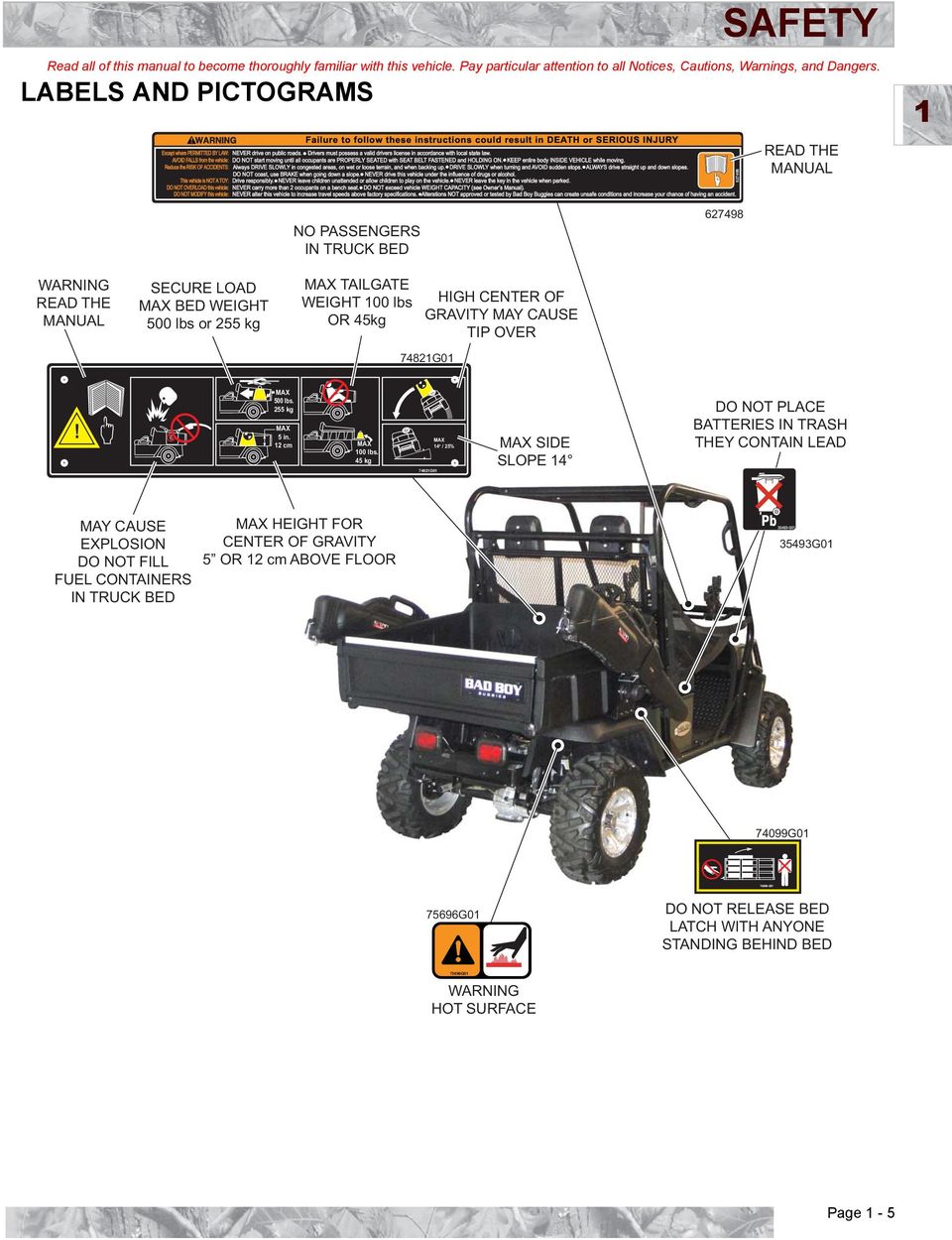
11 SAFETY LABELS AND PICTOGRAMS Failure to follow these instructions could result in DEATH or SERIOUS INJURY Except where PERMITTED BY LAW: NEVER drive on public roads. Drivers must possess a valid drivers license in accordance with local state law. AVOID FALLS from the vehicle: DO NOT start moving until all occupants are PROPERLY SEATED with SEAT BELT FASTENED and HOLDING ON. KEEP entire body INSIDE VEHICLE while moving. Reduce the RISK OF ACCIDENTS: Always DRIVE SLOWLY in congested areas, on wet or loose terrain, and when backing up. DRIVE SLOWLY when turning and AVOID sudden stops. ALWAYS drive straight up and down slopes. DO NOT coast, use BRAKE when going down a slope. NEVER drive this vehicle under the influence of drugs or alcohol. This vehicle is NOT A TOY: Drive responsibly. NEVER leave children unattended or allow children to play on the vehicle. NEVER leave the key in the vehicle when parked. DO NOT OVERLOAD this vehicle: NEVER carry more than 2 occupants on a bench seat. DO NOT exceed vehicle WEIGHT CAPACITY (see Owner s Manual). DO NOT MODIFY this vehicle: NEVER alter this vehicle to increase travel speeds above factory specifications. Alterations NOT approved or tested by Bad Boy Buggies can create unsafe conditions and increase your chance of having an accident READ THE MANUAL 1 NO PASSENGERS IN TRUCK BED WARNING READ THE MANUAL SECURE LOAD MAX BED WEIGHT 500 lbs or 255 kg MAX TAILGATE WEIGHT 100 lbs OR 45kg HIGH CENTER OF GRAVITY MAY CAUSE TIP OVER 74821G01 P P MAX 500 lbs. 255 kg MAX 5 in. 12 cm MAX 100 lbs. 45 kg 74821G01 MAX 14 o / 25% MAX SIDE SLOPE 14 DO NOT PLACE BATTERIES IN TRASH THEY CONTAIN LEAD MAY CAUSE EXPLOSION DO NOT FILL FUEL CONTAINERS IN TRUCK BED MAX HEIGHT FOR CENTER OF GRAVITY 5 OR 12 cm ABOVE FLOOR 35493G G G G01 DO NOT RELEASE BED LATCH WITH ANYONE STANDING BEHIND BED 75696G01 WARNING HOT SURFACE Page 1-5
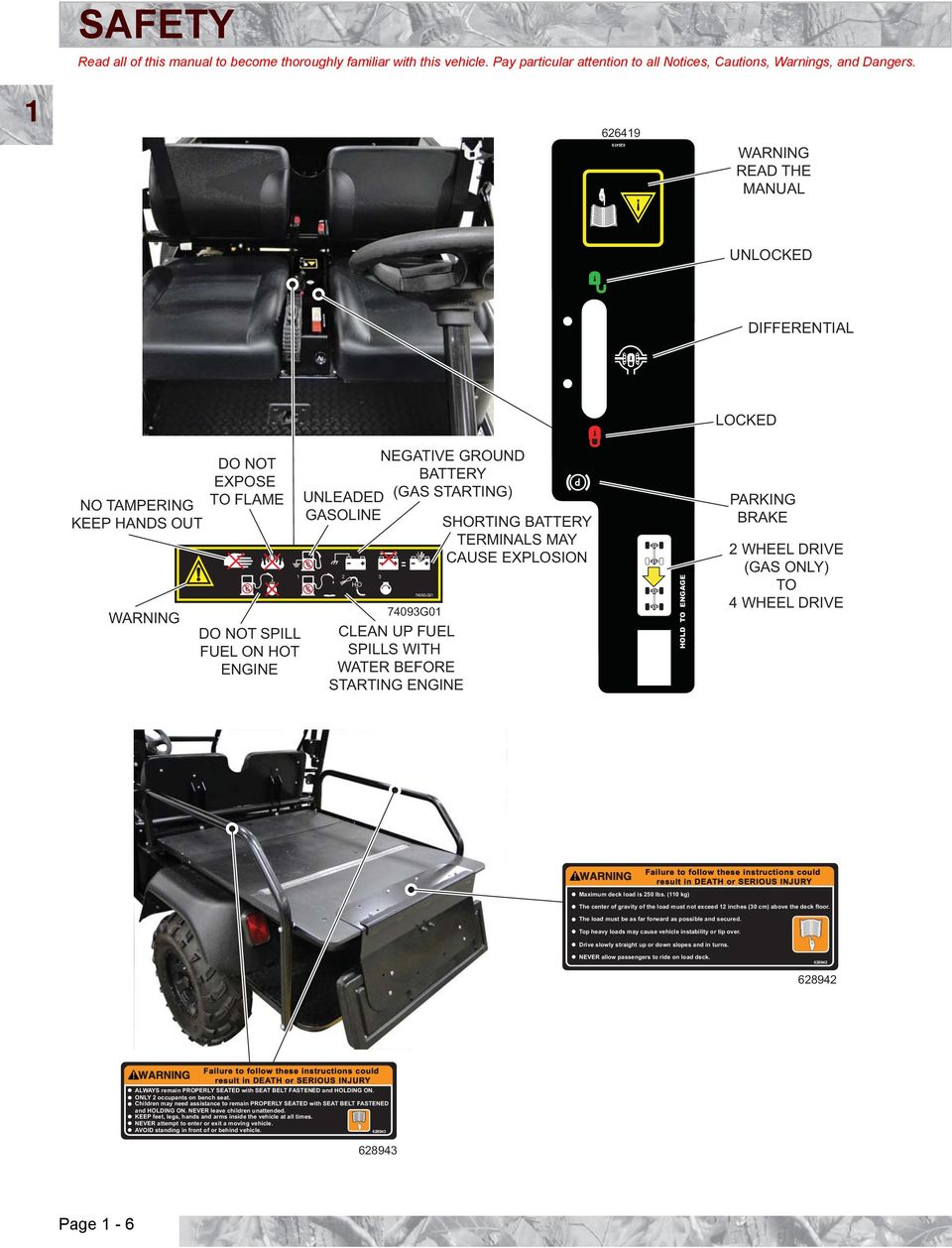
12 SAFETY WARNING READ THE MANUAL UNLOCKED DIFFERENTIAL LOCKED NO TAMPERING KEEP HANDS OUT WARNING DO NOT EXPOSE TO FLAME P P DO NOT SPILL FUEL ON HOT ENGINE UNLEADED GASOLINE P H 2 O P P P NEGATIVE GROUND BATTERY (GAS STARTING) G G01 CLEAN UP FUEL SPILLS WITH WATER BEFORE STARTING ENGINE SHORTING BATTERY TERMINALS MAY CAUSE EXPLOSION P HOLD TO ENGAGE PARKING BRAKE 2 WHEEL DRIVE (GAS ONLY) TO 4 WHEEL DRIVE Failure to follow these instructions could result in DEATH or SERIOUS INJURY Maximum deck load is 250 lbs. (110 kg) The center of gravity of the load must not exceed 12 inches (30 cm) above the deck floor. The load must be as far forward as possible and secured. Top heavy loads may cause vehicle instability or tip over. Drive slowly straight up or down slopes and in turns. NEVER allow passengers to ride on load deck Failure to follow these instructions could result in DEATH or SERIOUS INJURY ALWAYS remain PROPERLY SEATED with SEAT BELT FASTENED and HOLDING ON. ONLY 2 occupants on bench seat. Children may need assistance to remain PROPERLY SEATED with SEAT BELT FASTENED and HOLDING ON. NEVER leave children unattended. KEEP feet, legs, hands and arms inside the vehicle at all times. NEVER attempt to enter or exit a moving vehicle. AVOID standing in front of or behind vehicle Page 1-6
13 SPECIFICATIONS TITLE PAGE NO. AMBUSH VEHICLE SPECIFICATIONS AMBUSH VEHICLE DIMENSIONS Page 2-1

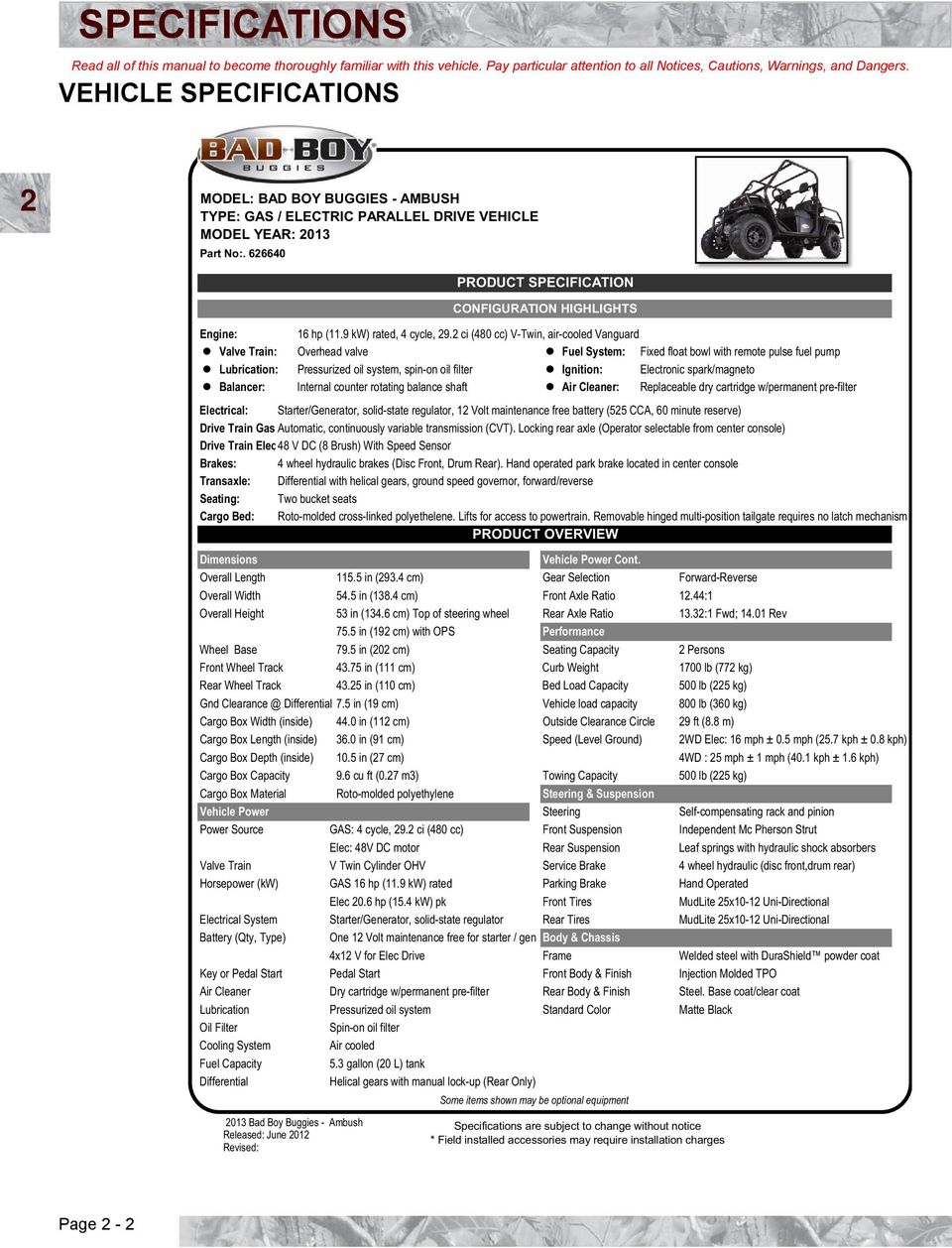
14 SPECIFICATIONS VEHICLE SPECIFICATIONS 2 MODEL: BAD BOY BUGGIES - AMBUSH TYPE: GAS / ELECTRIC PARALLEL DRIVE VEHICLE MODEL YEAR: 2013 Part No: Engine: 16 hp (11.9 kw) rated, 4 cycle, 29.2 ci (480 cc) V-Twin, air-cooled Vanguard Valve Train: Overhead valve Fuel System: Fixed float bowl with remote pulse fuel pump Lubrication: Pressurized oil system, spin-on oil filter Ignition: Electronic spark/magneto Balancer: Internal counter rotating balance shaft Air Cleaner: Replaceable dry cartridge w/permanent pre-filter Electrical: Starter/Generator, solid-state regulator, 12 Volt maintenance free battery (525 CCA, 60 minute reserve) Drive Train Gas Automatic, continuously variable transmission (CVT). Locking rear axle (Operator selectable from center console) Drive Train Elec48 V DC (8 Brush) With Speed Sensor Brakes: 4 wheel hydraulic brakes (Disc Front, Drum Rear). Hand operated park brake located in center console Transaxle: Differential with helical gears, ground speed governor, forward/reverse Seating: Two bucket seats Cargo Bed: Roto-molded cross-linked polyethelene. Lifts for access to powertrain. Removable hinged multi-position tailgate requires no latch mechanism PRODUCT OVERVIEW Dimensions Vehicle Power Cont. Overall Length in (293.4 cm) Gear Selection Forward-Reverse Overall Width 54.5 in (138.4 cm) Front Axle Ratio 12.44:1 Overall Height 53 in (134.6 cm) Top of steering wheel Rear Axle Ratio 13.32:1 Fwd; Rev 75.5 in (192 cm) with OPS Performance Wheel Base 79.5 in (202 cm) Seating Capacity 2 Persons Front Wheel Track in (111 cm) Curb Weight 1700 lb (772 kg) Rear Wheel Track in (110 cm) Bed Load Capacity 500 lb (225 kg) Gnd Differential 7.5 in (19 cm) Vehicle load capacity 800 lb (360 kg) Cargo Box Width (inside) 44.0 in (112 cm) Outside Clearance Circle 29 ft (8.8 m) Cargo Box Length (inside) 36.0 in (91 cm) Speed (Level Ground) 2WD Elec: 16 mph ± 0.5 mph (25.7 kph ± 0.8 kph) Cargo Box Depth (inside) 10.5 in (27 cm) 4WD : 25 mph ± 1 mph (40.1 kph ± 1.6 kph) Cargo Box Capacity 9.6 cu ft (0.27 m3) Towing Capacity 500 lb (225 kg) Cargo Box Material Roto-molded polyethylene Steering & Suspension Vehicle Power Steering Self-compensating rack and pinion Power Source GAS: 4 cycle, 29.2 ci (480 cc) Front Suspension Independent Mc Pherson Strut Elec: 48V DC motor Rear Suspension Leaf springs with hydraulic shock absorbers Valve Train V Twin Cylinder OHV Service Brake 4 wheel hydraulic (disc front,drum rear) Horsepower (kw) GAS 16 hp (11.9 kw) rated Parking Brake Hand Operated Elec 20.6 hp (15.4 kw) pk Front Tires MudLite 25x10-12 Uni-Directional Electrical System Starter/Generator, solid-state regulator Rear Tires MudLite 25x10-12 Uni-Directional Battery (Qty, Type) One 12 Volt maintenance free for starter / gen Body & Chassis 4x12 V for Elec Drive Frame Welded steel with DuraShield powder coat Key or Pedal Start Pedal Start Front Body & Finish Injection Molded TPO Air Cleaner Dry cartridge w/permanent pre-filter Rear Body & Finish Steel. Base coat/clear coat Lubrication Pressurized oil system Standard Color Matte Black Oil Filter Spin-on oil filter Cooling System Air cooled Fuel Capacity 5.3 gallon (20 L) tank Differential Helical gears with manual lock-up (Rear Only) Some items shown may be optional equipment 2013 Bad Boy Buggies - Ambush Released: June 2012 Revised: PRODUCT SPECIFICATION CONFIGURATION HIGHLIGHTS Specifications are subject to change without notice * Field installed accessories may require installation charges Page 2-2
15 SPECIFICATIONS VEHICLE DIMENSIONS (192 cm) 53 (134.6 cm) (110 cm) rear wheels (111 cm) front wheels (293.4 cm) 79.5 (202 cm) 54.5 (138.4 cm) Maximum Recommended Ramp Grade 25% or 14 Max. Maximum Recommended Side Tilt 25% or 14 Max. Page 2-3

16 SPECIFICATIONS Notes: 2 Page 2-4

17 INTRODUCTION TITLE PAGE NO. OPERATOR CONTROLS Key Switch / Direction Selector Mode Switch Accelerator Pedal Brake Pedal Park Brake Choke Momentary 4 Wheel Drive Differential Lock FEATURES State of Charge Meter Fuel Gauge Low Oil Pressure Indicator Light Headlight / Blackout Switch Winch Switch Accessory Switch Location Volt Power Outlet Charger Receptacle Electric Lift Switch Winch Remote Receptacle Truck Bed Latch Truck Bed Tail Lights Rear Seat / Load Deck Side Net Page 3-1

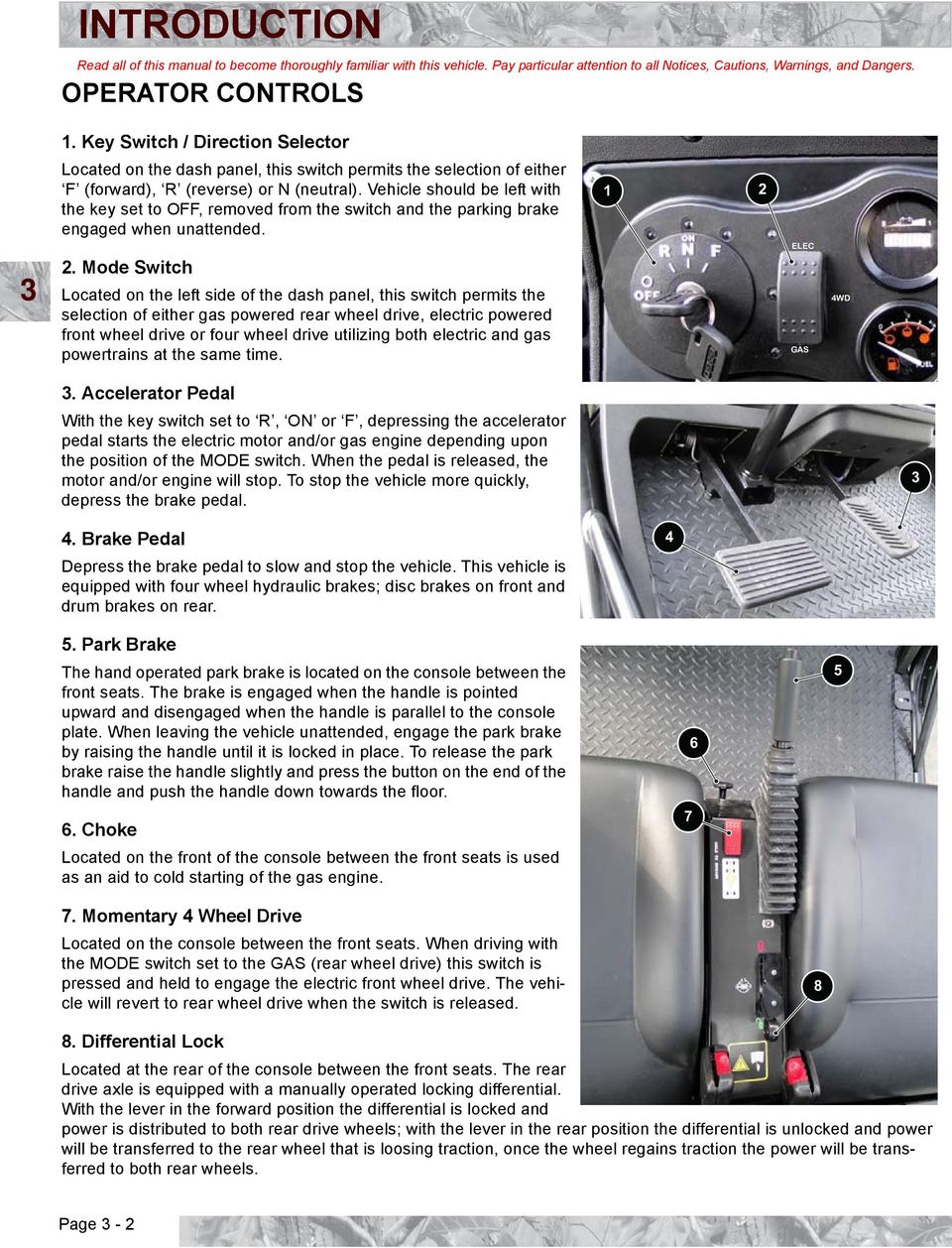
18 INTRODUCTION OPERATOR CONTROLS 1. Key Switch / Direction Selector Located on the dash panel, this switch permits the selection of either F (forward), R (reverse) or N (neutral). Vehicle should be left with the key set to OFF, removed from the switch and the parking brake engaged when unattended Mode Switch Located on the left side of the dash panel, this switch permits the selection of either gas powered rear wheel drive, electric powered front wheel drive or four wheel drive utilizing both electric and gas powertrains at the same time. ELEC GAS 4WD 3. Accelerator Pedal With the key switch set to R, ON or F, depressing the accelerator pedal starts the electric motor and/or gas engine depending upon the position of the MODE switch. When the pedal is released, the motor and/or engine will stop. To stop the vehicle more quickly, depress the brake pedal Brake Pedal Depress the brake pedal to slow and stop the vehicle. This vehicle is equipped with four wheel hydraulic brakes; disc brakes on front and drum brakes on rear Park Brake The hand operated park brake is located on the console between the front seats. The brake is engaged when the handle is pointed upward and disengaged when the handle is parallel to the console plate. When leaving the vehicle unattended, engage the park brake by raising the handle until it is locked in place. To release the park brake raise the handle slightly and press the button on the end of the handle and push the handle down towards the floor. 6. Choke Located on the front of the console between the front seats is used as an aid to cold starting of the gas engine Momentary 4 Wheel Drive Located on the console between the front seats. When driving with the MODE switch set to the GAS (rear wheel drive) this switch is pressed and held to engage the electric front wheel drive. The vehicle will revert to rear wheel drive when the switch is released Differential Lock Located at the rear of the console between the front seats. The rear drive axle is equipped with a manually operated locking differential. With the lever in the forward position the differential is locked and power is distributed to both rear drive wheels; with the lever in the rear position the differential is unlocked and power will be transferred to the rear wheel that is loosing traction, once the wheel regains traction the power will be transferred to both rear wheels. Page 3-2
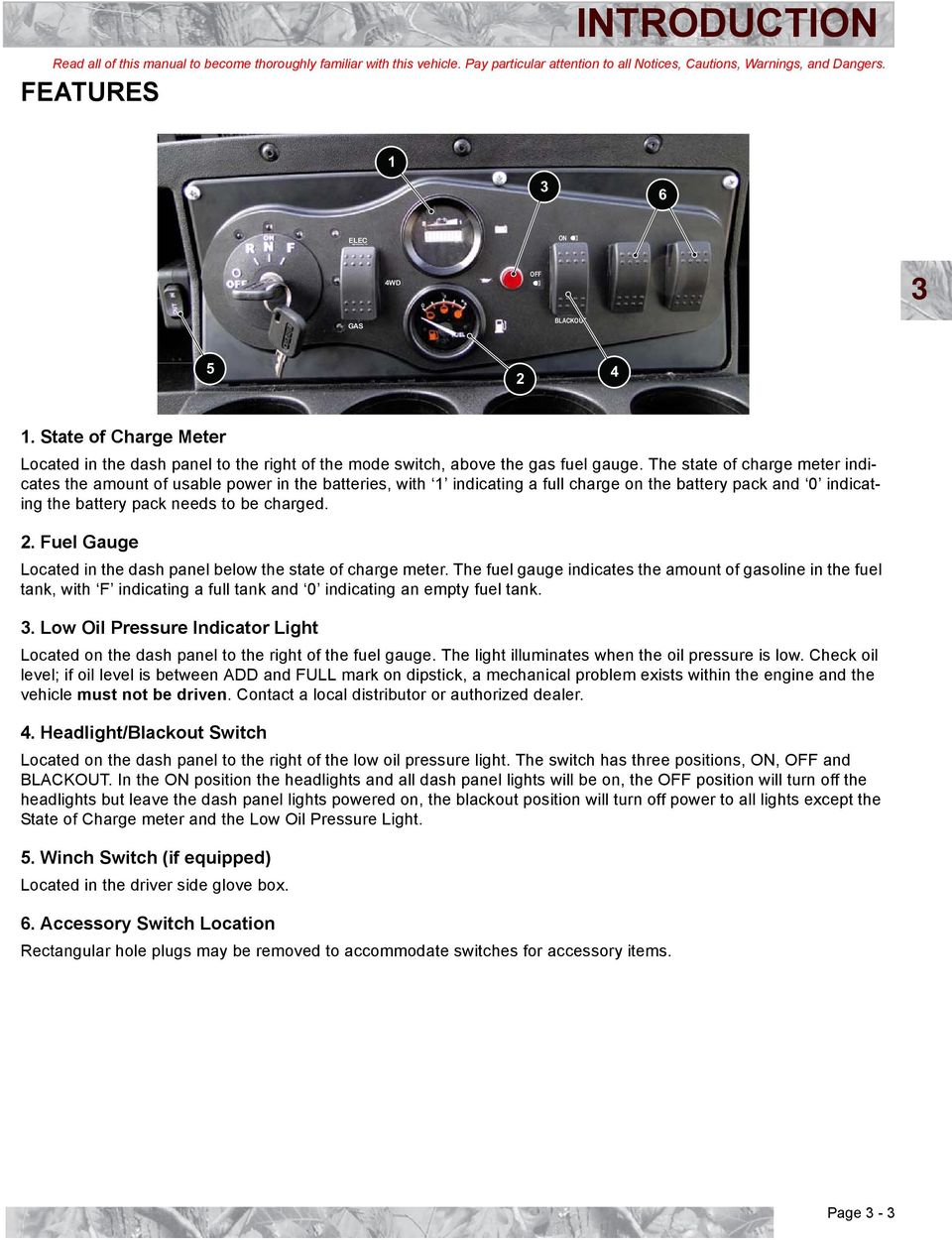
19 INTRODUCTION FEATURES ELEC ON 4WD OFF 3 GAS BLACKOUT State of Charge Meter Located in the dash panel to the right of the mode switch, above the gas fuel gauge. The state of charge meter indicates the amount of usable power in the batteries, with 1 indicating a full charge on the battery pack and 0 indicating the battery pack needs to be charged. 2. Fuel Gauge Located in the dash panel below the state of charge meter. The fuel gauge indicates the amount of gasoline in the fuel tank, with F indicating a full tank and 0 indicating an empty fuel tank. 3. Low Oil Pressure Indicator Light Located on the dash panel to the right of the fuel gauge. The light illuminates when the oil pressure is low. Check oil level; if oil level is between ADD and FULL mark on dipstick, a mechanical problem exists within the engine and the vehicle must not be driven. Contact a local distributor or authorized dealer. 4. Headlight/Blackout Switch Located on the dash panel to the right of the low oil pressure light. The switch has three positions, ON, OFF and BLACKOUT. In the ON position the headlights and all dash panel lights will be on, the OFF position will turn off the headlights but leave the dash panel lights powered on, the blackout position will turn off power to all lights except the State of Charge meter and the Low Oil Pressure Light. 5. Winch Switch (if equipped) Located in the driver side glove box. 6. Accessory Switch Location Rectangular hole plugs may be removed to accommodate switches for accessory items. Page 3-3
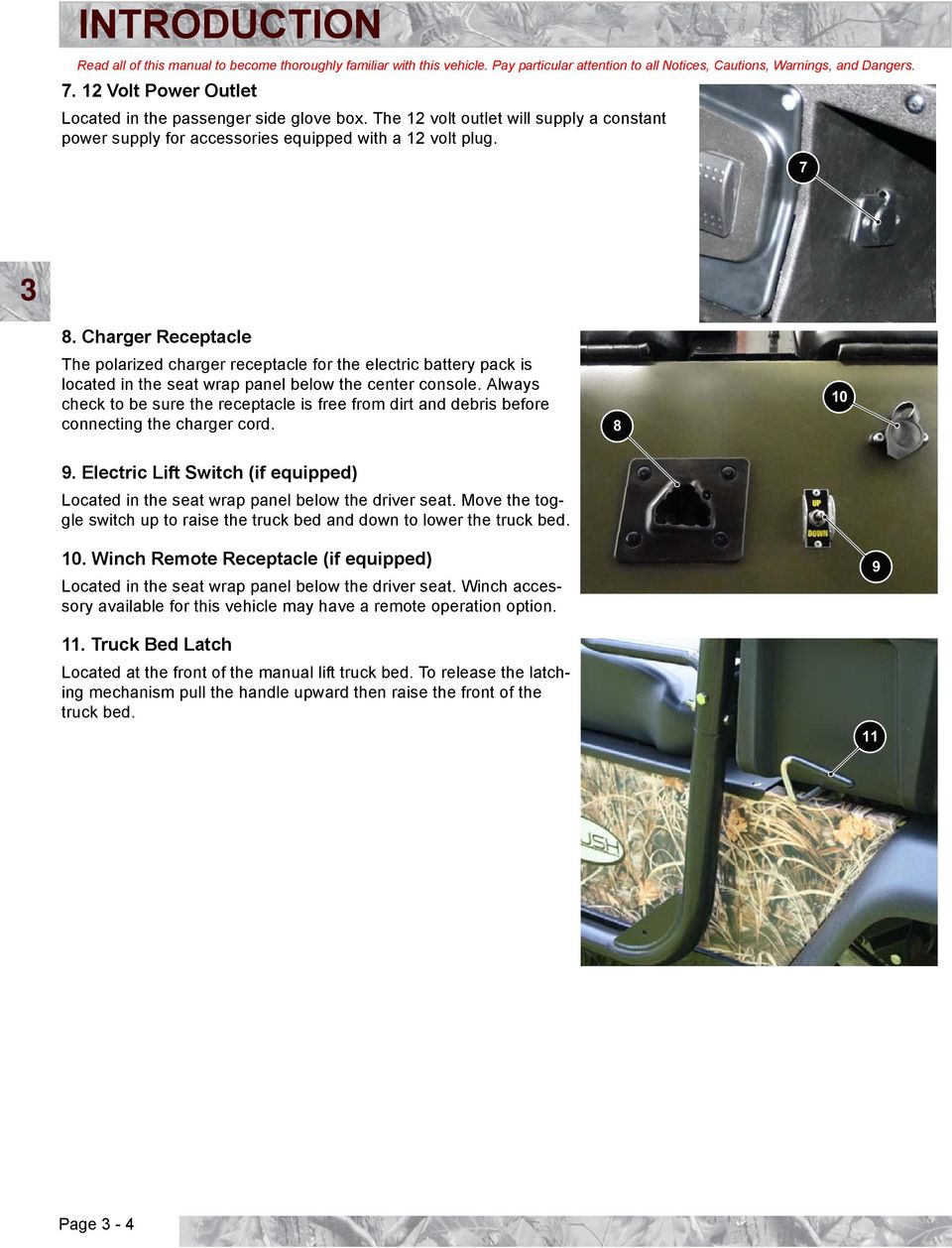
20 INTRODUCTION Volt Power Outlet Located in the passenger side glove box. The 12 volt outlet will supply a constant power supply for accessories equipped with a 12 volt plug Charger Receptacle The polarized charger receptacle for the electric battery pack is located in the seat wrap panel below the center console. Always check to be sure the receptacle is free from dirt and debris before connecting the charger cord Electric Lift Switch (if equipped) Located in the seat wrap panel below the driver seat. Move the toggle switch up to raise the truck bed and down to lower the truck bed. 10. Winch Remote Receptacle (if equipped) Located in the seat wrap panel below the driver seat. Winch accessory available for this vehicle may have a remote operation option. 11. Truck Bed Latch Located at the front of the manual lift truck bed. To release the latching mechanism pull the handle upward then raise the front of the truck bed Page 3-4
21 INTRODUCTION 12. Truck Bed Two truck beds are available, a molded plastic bed or an aluminum bed. 13. Tail Lights The tail lights are located in the rear below the truck bed, they are controlled by the headlight switch on the dash panel Rear Seat / Load Deck (if equipped) The rear facing seat is designed for two occupants, one on each side of the seat. The load deck is created by unfolding the rear facing seat. 15. Side Net Side nets are a standard safety feature provided with the vehicle and must be properly secured before operating vehicle Page 3-5
22 INTRODUCTION Notes: 3 Page 3-6
23 OPERATION TITLE PAGE NO. VIN AND SERIAL NUMBER LOCATION BEFORE INITIAL USE PORTABLE CHARGER Using the Charger Understanding the Charger LED Operation Codes LED Fault Codes OPERATING THE VEHICLE STARTING AND DRIVING Electric Powertrain Gas Powertrain Cold Starting Starting On A Hill RUN-IN MOMENTARY 4 WHEEL DRIVE STARTING VEHICLE WITH DISCHARGED BATTERY COASTING FUEL BATTERY TOP AND WINDSHIELD TERRAIN DUMP BED REAR FACING SEAT/LOAD DECK WINCH Winch Application Page 4-1
24 OPERATION Notes: 4 Page 4-2
25 OPERATION VIN AND SERIAL NUMBER LOCATION The VIN plate is riveted to the top of the cowl on the driver side. Two serial number and manufacture date code plates are on the vehicle. One is placed on the steering column, the other is located on the chassis under the driver seat bottom. Design changes take place on an ongoing basis. In order to obtain correct components for the vehicle, the VIN number, manufacture date code, serial number, vehicle model manufacture date code, must be provided when ordering service parts. Improper use of this vehicle could result in severe injury or death. The AMBUSH is a light duty utility vehicle, NOT an All Terrain Vehicle (ATV). To reduce the possibility of severe injury or death resulting from loss of vehicle control the following warnings must be observed: When driving vehicle, consider the terrain, traffic conditions and the environmental factors which affect the terrain and the ability to control the vehicle. Use extra care and reduced speed when driving on poor surfaces, such as loose dirt, wet grass, gravel, etc... Maintain a safe speed when driving up or down a hill. Use service brake to control speed when traveling down an incline. A sudden stop or change of direction may result in loss of control. To prevent loss of control, do not move the vehicle direction selector while the vehicle is in motion. moving the direction selector will result in a sudden slowing of the vehicle. Slow down before and during turns. All turns should be made at reduced speed. Do not drive through water that is over 12 inches deep. To prevent inadvertent movement when the vehicle is to be left unattended, engage the parking brake, turn key to OFF position and remove key. Make sure the key switch/direction selector is set to the Forward or Reverse before attempting to start the vehicle. Always bring the vehicle to a complete stop before shifting the direction selector. Do not take vehicle out of gear while in motion (coast). Check area behind vehicle before operating in reverse. All occupants must be seated with seat belts fastened and front side nets latched. Keep entire body inside vehicle and hold on while vehicle is in motion. 4 Page 4-3
26 OPERATION BEFORE INITIAL USE NOTICE Record the four digit key number and store in a safe place. Individual keys can only be replaced if the key number is known. Without a key number, the entire ignition switch will have to be replaced if keys are lost. Make a note of the key number in the event that new keys must be ordered. The key number is stamped into the key and on the face of the ignition switch. Both numbers must match. 4 Be sure you understand the vehicle, its equipment and how to use it safely. Read, understand and follow the safety and operation label on the lower OPS cross bar. Although the vehicle has been designed to provide safe and reliable operation, maintaining good performance depends, to a large extent, on the operator. If this vehicle is to be operated above 5000 ft. a high altitude kit will need to be installed in the carburetor. Key Number Before a new vehicle is put into operation, the items shown in the INITIAL SERVICE CHART must be performed. Remove the battery charger for the electric motor battery set. Read the operation instructions for the charger before charging the battery set. Vehicle batteries, both the battery for the gas engine and the battery set that powers the electric motor, must be fully charged before initial use. Check for correct tire inflation. See GENERAL SPECIFI- CATIONS. Check the hydraulic brake fluid level. Check the fuel tank under the passenger seat and fill with unleaded gasoline (10% Ethanol blend is permissible). Check for oil or fuel leaks that could have developed in shipment from the factory. ITEM Battery Charger Batteries Seats Brakes Tires Fuel Engine Key Remove the protective clear plastic, that protect the seat bottom and back rest during shipping, before placing the vehicle in service. SERVICE OPERATION Remove from vehicle and read operating instructions. Charge battery for gas engine and battery set for electric motor. Remove protective plastic covering. Check operation, adjust if necessary. Check hydraulic brake fluid level. Check air pressure, adjust if necessary. See vehicle specifications for tire pressure. Fill with correct fuel, regular unleaded, 10% or less Ethanol blend is permissible Check oil level (Initial change after 5-8 hours) Record key number, store in safe location Initial Service Chart Hydrogen gas is generated as a natural part of the lead acid battery charging process. A 4% concentration of hydrogen gas is explosive and could cause severe injury or death. Charging must take place in an area that is adequately ventilated (minimum of 5 air exchanges per hour). To reduce the chance of battery explosion that could result in severe injury or death, never smoke around or charge batteries in an area that has open flame or electrical equipment that could cause an electrical arc. Page 4-4
27 OPERATION Hydrogen gas is generated in the charging cycle of batteries and is explosive in concentrations as low as 4%. Because hydrogen gas is lighter than air, it will collect in the ceiling of buildings necessitating proper ventilation. Five air exchanges per hour is considered the minimum requirement. Never charge a vehicle in an area that is subject to flame or spark. Pay particular attention to natural gas or propane water heaters and furnaces. PORTABLE CHARGER The portable charger will charge ONLY the battery set for the electric motor, not the single battery used for starting the gas engine. Installation Provide Protection From Elements 4 Hanging Holes Keep cooling fins clean and free of dirt and debris NEMA 15-5R Grounded AC Receptacle VAC. Dedicated 15 AMP Circuit Locations outside the US and Canada: Reference appropriate local electrical code and charger manufacturer recommendations for AC power requirements Mounting Holes 3.1" (7.89 cm) Use charger ONLY on 48 volt battery systems. Other usage may cause personal injury and damage. Lead acid batteries may generate explosive hydrogen gas during normal operation. Keep sparks, flames, and smoking materials away from batteries. Provide adequate ventilation during charging. Never charge a frozen battery. Study all battery manufacturers specific precautions such as recommended rates of charge and removing or not removing cell caps while charging. Page 4-5
28 OPERATION Risk of electric shock. Connect charger power cord to an outlet that has been properly installed and grounded in accordance with all local codes and ordinances. A grounded outlet is required to reduce risk of electric shock do not use ground adapters or modify plug. Do not touch uninsulated portion of output connector or uninsulated battery terminal. Disconnect the DC supply before making or breaking the connections to the battery while charging. Do not open or disassemble charger. Do not operate charger if the AC supply cord is damaged or if the charger has received a sharp blow, been dropped, or otherwise damaged in any way refer all repair work to qualified personnel. Not for use by children. 4 Portable chargers are shipped with the vehicles. Prior to vehicle or charger operation, the charger must be removed and mounted on a platform or wall above the ground to permit maximum air flow around and underneath the charger. A dedicated circuit is required for the charger. Refer to the charger manual for appropriate circuit protection. For optimum performance and shortest charge times, place the charger in an area with adequate ventilation. The charger should also be placed in an area that will be relatively free of dirt, mud, or dust since accumulations within the fins of the charger will reduce their heat-dissipating qualities. Optimal cooling also occurs when the charger is placed on a horizontal surface with the fins vertical. More airflow from below the charger will help cool the fins, so placement above open areas or areas with cut-outs for airflow is desirable. If the charger is operated in an outdoor location, rain and sun protection must be provided. The charger may get hot during operation and must be placed such that risk of contact by people is reduced. The charger may be mounted on a wall or shelf using #10-M5 screws. The charger s status display must be visible to the user. NOTICE Looping the DC cord through the steering wheel when charging serves as a good reminder to store the cord out of the way when finished with charging. The DC plug can be damaged by driving over or catching the cord on the vehicle when driving away. An ungrounded electrical device may become a physical hazard that could result in an electrical shock or electrocution. Using the Charger The charger may remain plugged into the AC outlet when not in use. To charge the vehicle refer to the instruction labels on the charger. Insert the polarized DC plug completely into the vehicle receptacle. The charger will automatically start a few seconds after the plug is in place. The charger will automatically stop when the batteries are fully charged and the DC plug can be removed to permit use of the vehicle. Understanding the Charger Plugging the charger into the vehicle s charger receptacle will lock the vehicle out of operation. When the charger is plugged into the vehicle s charger receptacle, the charger will automatically turn on and the charger s LED and the vehicle receptacle s LED will start flashing GREEN to indicate the batteries are charging. Once a minimum battery voltage of 2 volts per cell (Vpc) is reached, the charger s output current will change from a full current charge to the trickle rated charging current. The length of charge time will vary by how depleted the batteries are, the input AC voltage, and/or charger ambient temperatures. The charger s LED will give a SHORT flash if the charge is less than 80% and a LONG flash if the charge is greater than 80%. If the charger s LED is a steady GREEN the batteries are fully charged and the charger may be unplugged, although not necessary. The charger may be left plugged in for long periods of time to maintain the batteries charge level. If a fault occurred anytime during the charging the charger s LED will quickly flash RED. The specific fault is indicated by the number of RED flashes that occur, there will be a pause and then the flashes will repeat again. There are several possible conditions that will generate errors. Some errors will require human intervention to first resolve the problem and then reset the charger by unplugging the DC cord from the vehicle. Page 4-6
29 OPERATION If the AC voltage is interrupted and restored, the charger will turn back on automatically. LED Operation Codes: SHORT GREEN FLASH = less than 80% charged LONG GREEN FLASH = more than 80% charged SOLID GREEN = 100% charged RED FLASH = fault code LED Fault Codes: RED FLASH: Light turns on briefly, but does not flash after that - check for valid AC voltage. ONE RED FLASH: One flash, a pause and then again one flash and a pause - Charge Enable Fault: poor contact in the DC connector or dirty contacts or Battery Temperature Fault: battery temperature is greater than 122 F (50 C) or less than 14 F (-10 C). TWO RED FLASHES: Two flashes, a pause and then again two flashes and a pause - Battery Voltage Fault: Battery pack is less than 48.0 Volts or more than 67.2 Volts. Battery pack is too discharged or over charged for the charger to work. THREE RED FLASHES: Three flashes, a pause and then again three flashes and a pause - Battery Charge Time-out: Charge time exceeded 24 hours. This may indicate a problem with the battery pack or that the charger output current was severely reduced due to high ambient temperatures. FOUR RED FLASHES: Four flashes, a pause and then again four flashes and a pause - Battery Fault: Charge time exceeded. This indicates a problem with the battery pack voltage not reaching the required nominal level within the maximum time allowed. SIX RED FLASHES: Six flashes, a pause and then again six flashes and a pause - Charger Fault: An internal fault has been detected. If this fault is displayed again after unplugging the charger s DC power cord and plugging it back in, the charger must be taken to a qualified service center. 4 To prevent a physical hazard that could result in an electrical shock or electrocution, be sure that the charger plug is not damaged and is inserted into a grounded receptacle. The power (AC) cord is equipped with a grounded plug. Do not attempt to pull out, cut or bend the ground post. The charging (DC) cord is equipped with a polarized connector that fits into a matching receptacle on the vehicle. The receptacle is located in the seat panel below the center console. Page 4-7
30 OPERATION OPERATING THE VEHICLE Improper use of the vehicle or the lack of proper maintenance may result in damage or decreased performance. Read and understand the following warnings before attempting to operate the vehicle. 4 To reduce the possibility of severe injury or death resulting from loss of vehicle control, the following warnings must be observed: When driving vehicle, consider the terrain, traffic conditions and the environmental factors which effect the terrain and the ability to control the vehicle. Use extra care and reduced speed when driving on poor surfaces, such as loose dirt, wet grass, gravel, etc. Maintain a safe speed when driving down hill. Use service brake to control speed when traveling down an incline. A sudden stop or change of direction may result in loss of control. Slow down before and during turns. All turns should be made at reduced speed. Never drive vehicle up, down, or across an incline that exceeds 14 (25% grade). To reduce the possibility of severe injury or death resulting from improper vehicle operation, the following warnings must be observed: Refer to GENERAL SPECIFICATIONS for seating capacity. Depressing accelerator pedal may cause inadvertent vehicle movement. Turn the key to the OFF position whenever the vehicle is parked. To prevent inadvertent movement when the vehicle is to be left unattended, engage the park brake, move direction selector to forward position, turn key to OFF position and remove key. Make sure that the direction selector is in correct position before attempting to start the vehicle. Always bring the vehicle to a complete stop before shifting the direction selector. Do not take vehicle out of gear while in motion (coast). Check the area behind the vehicle before operating in reverse. All occupants must be seated and wearing their seat belts front side nets must be latched. Keep entire body inside vehicle and hold on while vehicle is in motion. STARTING AND DRIVING This vehicle has two separate powertrains that may be operated individually to provide two wheel drive or at the same time to provide four wheel drive. When the MODE switch is set to ELEC (top of switch pressed) only the front drive axle is engaged, drawing power from the battery set. With the MODE switch set to GAS (bottom of switch pressed) only the rear axle is engaged powered by the gas engine. With the MODE switch set to 4WD (switch in neutral position) both the electric and gas powertrains are engaged for four wheel drive. When the vehicle is operated in GAS mode (rear wheel drive) the driver can quickly engage four wheel drive for a short period of time by pressing and holding the MOMENTARY 4 WD (red button) on the console between the front seats. When the button is released the vehicle will return to two wheel drive powered by the gas engine. Page 4-8
31 OPERATION While operating in GAS mode (rear wheel drive) the vehicle can be changed on the fly from 2 wheel rear drive to full time 4 wheel drive by setting the Mode Switch on the instrument panel to the 4WD (middle) position. To reduce the possibility of roll-back which could result in severe injury or vehicle damage, do not release service brake until engine has started. Electric Powertrain To operate the vehicle in electric only mode: Set the Mode Switch (2) to ELEC. Place the key in the key switch and turn it to the ON/N position. The green LED above the N and the LED above the left corner of the Mode Switch should be lit unless the light switch has been set to BLACKOUT. Turn the key to the desired direction; F for forward or R for reverse. The green LED above the direction letter should be lit to indicate the vehicle is ready to drive unless the light switch has been set to BLACKOUT. Press the brake pedal and hold it down. Release the parking brake. Slowly press the accelerator pedal to start the electric motor while releasing pressure on the brake pedal. When the accelerator pedal is released the motor will stop and the vehicle will slow down and eventually stop. To stop the vehicle more quickly, press the brake pedal. 1 2 ELEC GAS 4WD 4 Gas Powertrain To operate the vehicle in gas engine only mode: Set the Mode Switch (2) to GAS. Use of the choke may be required if the engine is cold, see Cold Starting. Place the key in the key switch and turn it to the ON/N position. The green LED above the N and the LED above the left corner of the Mode Switch should be lit unless the light switch has been set to BLACKOUT Press the brake pedal and hold it down. Release the parking brake. Turn the key to the desired direction; F for forward or R for reverse. The green LED above the direction letter should be lit to indicate the vehicle is ready to drive unless the light switch has been set to BLACKOUT. Release the parking brake. Slowly press the accelerator pedal to start the gas engine while releasing the pressure on the brake pedal. When the accelerator pedal is released the engine will stop and the vehicle will slow down and eventually stop. To stop the vehicle more quickly, press the brake pedal. Page 4-9
32 OPERATION Cold Starting Starting a cold engine may require use of the choke. Depress the accelerator approximately 1" (2.5 cm) or until the starter just begins to operate. Pull the choke out if required. Accelerate slowly and push the choke in completely when the engine runs smoothly. To operate this vehicle above 5000 ft. a High Altitude Kit will need to be installed in the carburetor. 4 Do not allow the starter to operate continuously for more than 10 seconds. Allow 30 seconds between starting attempts. If the vehicle does not start on the third attempt, turn the key switch off and determine the cause of the problem. If the vehicle had been running and the engine does not start within 10 seconds, use the choke. Starting The Vehicle On A Hill To reduce the possibility of roll-back which could result in severe injury or vehicle damage, do not release service brake until engine has started. Do not hold vehicle on hill by using accelerator and motor/engine. This will cause premature and excessive wear to drive train components. To reduce the possibility of permanent damage to the drive system, it is important to prevent excessive roll-back when starting the vehicle on a hill. Place left foot on service brake and release the park brake. Depress accelerator with right foot and release the service brake by lifting left foot. RUN-IN Check for oil or fuel leaks that could have developed in shipment from the factory. Avoid full throttle starts and rapid acceleration until the engine has achieved operating temperature. All engines consume more oil than normal during the first hours of operation. As internal moving parts are run-in, oil consumption should gradually decrease until the rate of consumption stabilizes. Check the oil level per the Periodic Service Schedule. Add oil if the level on the dipstick indicates that oil is in the add oil range. Fill Cold Engine To This Point Add Oil Safe Operating Range Hot Engine Maximum Oil Level For Hot Engine Do Not Overfill Check Oil Level on Dipstick Do not overfill engine. Too much oil may cause smoking or allow oil to enter the air filter enclosure. NOTICE The oil dipstick/fill cap must be in place before operating the engine. Failure to install the dipstick/fill cap will result in oil becoming contaminated and/or being discharged into the engine compartment. Page 4-10
33 OPERATION The oil should be changed in accordance with the Periodic Service Schedule while the engine is warm. See SERVICE AND MAINTENANCE and Appendix A (Briggs & Stratton Engine Manual) for checking oil level and changing oil procedures. MOMENTARY 4 WHEEL DRIVE When the gas powertrain is in use the Momentary 4 Wheel Drive button may be pressed to provide 4 wheel drive by temporarily activating the front powertrain. The electric powertrain will operate as long as the button is pressed; when the button is released the vehicle will return to 2 wheel drive powered by the gas engine. STARTING THE VEHICLE WITH DISCHARGED BATTERY 4 Do not attempt to jump start a vehicle using another vehicle. The vehicle is equipped with a starter/generator. When starting the engine, the starter/generator functions as a starter and with the engine running, it functions as a generator. Since the engine stops when the accelerator is released, do not attempt jump starting. With the running times associated with this kind of vehicle, the generator is more than adequate to maintain the battery charge level. The generator is not designed to charge a discharged battery. If the vehicle is equipped with additional lights and/or a strobe light that is used when the vehicle is not in motion, the starter/generator may not be adequate to maintain battery charge. If the vehicle battery has become discharged, it must be charged using a 12V charger that is rated at 10 amps or less. Observe all instructions provided by the manufacturer of the charger. COASTING To reduce the possibility of severe injury or death from coasting at above recommended speeds, limit speed with service brake. On steep hills, it is possible for the vehicle to coast at greater than normal speeds encountered on a flat surface. To reduce the possible loss of vehicle control and severe drivetrain damage, speeds should be limited to no more than the maximum governed speed on level ground (see GENERAL SPECIFICATIONS). Limit speed by applying pressure to the brake pedal. FUEL To reduce the possibility of severe injury or death from improper fuel handling: Do not smoke near the fuel tank. Do not refuel near open flame or electrical items which could produce a spark. Always handle gasoline in a well ventilated area. Always wear eye protection to protect against splashed fuel and fuel vapors. Page 4-11
34 OPERATION Always allow adequate space for the expansion of gasoline. Leave at least 1" (2.5 cm) space below bottom of filler neck. Inspect fuel cap, tank and other components for leaks or deterioration that could cause a hazardous condition. The fuel tank is located under the seat on the passenger side of the vehicle. Make sure the spark shield mat is covering the battery located just in front of the fuel tank. Fill the tank with fresh, clean, automotive grade gasoline. High altitude or heavy use/ load applications may benefit from higher octane gasoline. Do not use gasoline which contains Methanol. Fuel 1" Min. (2.5 cm) 4 Some fuels, called oxygenated or reformulated gasoline, are gasoline blended with alcohols or ethers. Excessive amounts of these blends can damage the fuel system or cause performance Spark Shield problems. If any undesirable operating symptoms occur, use gasoline with a lower percentage of alcohol or ether. Use fresh regular grade unleaded fuel. Ethanol blend fuel up to 10% is permissible. BATTERY If the gas engine starting battery has become discharged, it must be charged using a 12 volt charger that is rated at 10 amps or less and in accordance with all instructions provided by the manufacturer of the charger. TOP AND WINDSHIELD (if equipped) The top does not provide protection from roll over or falling objects. The windshield does not provide protection from tree limbs or flying objects. To prevent damage to the vehicle, do not hold on to sun top struts and stand on body panels. The sun top and windshield provide some protection from the elements; however, they will not keep the operator and passenger dry in a downpour. This vehicle is equipped with seat belts and an OPS (operator protection system) the sun top has not been designed to provide roll over protection. In addition, the sun top does not protect against falling objects nor does the windshield protect against flying objects and tree limbs. Keep arms and legs inside of vehicle while it is moving. TOWING A TRAILER The vehicle is equipped with a receiver that can be fitted with a standard 1 7/8 ball. The trailer and its load must not exceed 500 lbs (227 kg) and no more than 50 lbs (23 kg) tongue weight may be attached to the hitch. Remember that the overall capacity of the vehicle, operator, passenger, contents of load bed and accessories must be reduced to compensate for the trailer and load. The range of motion of the trailer is limited by the ball and hitch. The trailer should not be used on rough trails or over objects such as logs, large rocks, holes, etc. Never install baskets or extensions using the hitch receivers. Such items will change the performance characteristics of vehicle and result in unsafe handling, possible roll over or vehicle damage. Page 4-12
35 OPERATION TERRAIN The vehicle is NOT designed for use on public roads. The vehicle may be used on established trails or open terrain that is free from stumps, large rocks or holes. The vehicle should not be used to cross water that is more than 12 inches (30 cm) deep or fast moving water. Be aware of steep slopes, overhanging limbs or danger of fire when the gas engine is operated over dry combustible material. Consult dealer for an available spark arrestor for this vehicle. When traveling up or down steep slopes do not attempt to turn the vehicle around on the slope. Vehicle stopping distance increases when driving on wet gras, dirt roads or loose surfaces. DUMP BED Passengers should never be allowed to ride in the dump bed. Severe injury or death could result if they should fall out or the vehicle is involved in an accident or sudden maneuver. Be careful when loading the vehicle. Secure loads to prevent shifting. Do not overload vehicle. A dump bed warning label is affixed to the inside of the bed on the front panel. This label must be understood and observed at all times for safe operation of the vehicle. The dump bed is limited to a maximum load of 500 lbs. The load must be positioned in the bed as far forward as possible, it s center of gravity must not be higher than 12" above the bed floor, and securely fastened down. Failure to follow these instructions could cause personal injury, damage to the vehicle and/or cause the vehicle to tip over. Operate the vehicle with awareness of the load. Do not drive the vehicle with the dump bed raised or with the tailgate unsupported. When using the optional electric dump, be sure to avoid backing up to the edge of a drop off, such as a loading dock or ravine. A misjudgment of distance or an unstable surface could result in the vehicle falling backwards. Always insure that no one is behind or close to the dump bed while the electric dump mechanism is being operated. 4 REAR FACING SEAT / LOAD DECK Passengers should never be allowed to ride on the load deck. Severe injury or death could result if they should fall out or the vehicle is involved in an accident or sudden maneuver. The rear facing seat will accommodate two passengers with a combined weight of less than 400 pounds or, the seat bottom may be folded out to form a load deck. When using the load deck, position the load as far forward as possible and securely fastened down. The maximum load is 250 lbs and the center of gravity must not be higher than 12 above the load deck. WINCH OPERATION (if equipped with winch) This vehicle may be equipped with an optional winch. Read, understand and follow all of the information supplied with the winch on the operation and use of the winch before attempting to operate it. The winch may have a remote control that plugs into the receptacle on the driver side of the seat support Winch Application A winch may be used for a number of purposes, including pulling the vehicle if it loses traction on unsuitable terrain. Receptacle Remote Control Page 4-13
36 OPERATION Improper use of the winch could result in a number of conditions that could cause severe injury or death to operator, occupants of vehicle or bystander. It is impossible to predict all conditions that the winch could be used, therefore the following warnings should not be considered as complete. Before operating the winch, consider the possible dangers and take precautions to protect yourself, your passenger and any bystanders. 4 To prevent severe injury or death to operator, occupants or bystanders, select the object to which the cable is attached with the following considerations: Make sure the object cannot be pulled over or otherwise damaged. The object the winch cable is attached to could fall on the vehicle and it s occupants. If attaching the winch to a dead tree, a section could fall. When pulling vehicle with winch, pull straight only. Do not permit the cable to contact the side of the drum. Do not pull vehicle at an angle. If the vehicle is pulled at an angle, it could turn over causing severe injury or death to anyone in the area. The winch cable could also become overstressed and break causing severe injury or death to anyone struck by the cable. The rear drive axle is equipped with a manually operated locking differential. With the differential unlocked, if one drive wheel looses traction, all available power is transferred to that wheel until it regains traction. In normal driving this is not a problem. However, if the vehicle becomes hung up on an object, the vehicle will stop. With the differential locked, power is distributed to both drive wheels at all times. If both drive wheels lose traction as a result of the vehicle becoming hung up on an object, the vehicle will stop. If the vehicle cannot be pushed off the obstruction, it will have to be pulled off using the winch. To prevent severe injury or death, read and understand the following before attempting to use the winch: The winch is not intended to be used in any hoisting operation. The rolling load capacity of the winch decreases with the steepness of the slope. The winch is designed for intermittent duty only. The electric motor should not be allowed to become excessively hot. If the motor becomes uncomfortably hot to the touch, stop winching and allow the motor to cool. Always wear thick leather gloves when handling the wire cable. Replace frayed wire cable with a direct factory replacement only. Never operate the winch with less than five (5) full turns of cable around the drum. If the winch motor stalls from overloading, do not continue to activate the winch remote control. The wire cable may become overstressed. Do not attempt to pull loads exceeding the manufacturers maximum load rating. Page 4-14
37 OPERATION Have all persons and pets leave the area while operating winch. Never allow anyone to remain in the vehicle. To prevent damage to the wire cable, never hook the cable to itself.always use a nylon sling. Stay clear of the winch, the cable and the cable hook. Place a heavy cloth, jacket or blanket over the cable to act as a damper should the cable break when operating the winch. When operating the winch, keep the entire area in view. Never release the free spool clutch while the cable is under load. Never work around the winch drum or the winch cable while it is under tension. Unplug the winch switch before working on the winch drum in order to prevent inadvertent operation. When operating winch, take up slack slowly. Stop winch before cable becomes tight and inspect all winching connections. Check winch attachment, hook attachment, nylon sling (if required) and load attachment. Do not pull at an angle. This will cause the wire cable to pile up on one end of the winch. This may jam the winch causing damage to the cable and/or the winch. Pulling the vehicle at an angle can cause damage to the front suspension and may cause the vehicle to overturn. When pulling vehicle, pull straight only. If the vehicle is being used as an anchor to winch a load, it should have the parking brake set and chocks installed on all wheels. Never use the winch to lift people or other overhead loads. Do not use the winch to secure loads. Use a tie down designed for the job. Do not apply shock loads to the winch. Do not attempt to modify or weld the winch. Nylon Sling Do Not Hook Cable to Itself Damper Use a Nylon Sling and Install a Damper when Winching Correct Incorrect 4 Do Not Pull at Angle Page 4-15
38 OPERATION Notes: 4 Page 4-16
39 MAINTENANCE TITLE PAGE NO. VEHICLE CLEANING AND CARE ROUTINE MANITENANCE LIFTING THE VEHICLE WHEELS AND TIRES Tire Repair Wheel Installation Unidirectional Tires LIGHT BULB REPLACEMENT Headlight and Front Turn Signal Tail Light / Brake Light BRAKES Master Cylinder GAS POWERTRAIN Engine Starter / Generator Belt Tension Adjusting the Belt ELECTRIC POWERTRAIN System Test AXLES Checking the Lubricant Level BATTERY CHARGING AND MANITENANCE Safety Battery Disposal Battery Maintenance At Each Charging Cycle Monthly Electrolyte Level and Water Battery Cleaning Battery Removal and Replacement Battery Charging AC Voltage Troubleshooting HYDROMETER Using A Hydrometer PROLONGED STORAGE Page 5-1
40 MAINTENANCE Battery Set And Gas Starting Battery Gas Engine PERIODIC SERVICE SCHEDULE CAPACITIES AND REPLACEMENT PARTS HARDWARE Page 5-2
41 MAINTENANCE VEHICLE CLEANING AND CARE When pressure washing vehicle, do not use pressure in excess of 700 psi or spray directly onto controls and switches. To prevent cosmetic damage, do not use any abrasive or reactive solvents to clean plastic parts. It is important that proper techniques and cleaning materials be used. Normal cleaning of vinyl seats and plastic or rubber trim requires the use of a mild soap solution applied with a sponge or soft brush and wipe with a damp cloth. Removal of oil, tar, asphalt, shoe polish, etc. will require the use of a commercially available vinyl/rubber cleaner. The painted surfaces of the vehicle provide attractive appearance and durable protection. Frequent washing with lukewarm or cold water is the best method of preserving the painted surfaces. Do not use hot water, strong soap or harsh chemical detergents. Rubber parts should be cleaned with non-abrasive household cleaner. Occasional cleaning and waxing with non-abrasive products designed for clear coat automotive finishes will enhance the appearance and durability of the painted surfaces. Corrosive materials can collect on the underbody of the vehicle. These materials will accelerate corrosion of underbody parts. It is recommended that the underbody be flushed occasionally with plain water. Thoroughly clean any areas where mud or other debris can collect. Sediment packed in closed areas should be loosened to ease it s removal, taking care not to chip or otherwise damage paint. 5 Page 5-3
42 MAINTENANCE ROUTINE MAINTENANCE Preventive maintenance, applied at recommended intervals, is the best guarantee for keeping the vehicle dependable. This vehicle will give years of satisfactory service, providing it receives regular maintenance. Refer to the PERIODIC SERVICE SCHEDULE for appropriate service intervals. LIFTING THE VEHICLE Tool List Qty. Floor Jack... 1 Jack Stands... 4 Wheel Chocks To reduce the possibility of severe injury or death from a vehicle falling from a jack: Always place chocks in front and behind the wheels not being raised. Be sure the vehicle is on a firm and level surface. Never get under a vehicle while it is supported by a jack. Use jack stands and test the stability of the vehicle on the stands. Use extreme care since the vehicle is extremely unstable during the lifting process. Lifting Points When lifting the vehicle, position the jacks and jack stands at the areas indicated. Remove payload from vehicle before lifting. No person(s) should be in or on the vehicle while lifting. To raise the entire vehicle, install the wheel chocks in front and behind each front wheel. Center the jack under rear differential skid plate, raise the vehicle and position jack stands under the frame just in front of each pair of leaf spring mounting brackets welded to the frame. Lower jack and test stability of the vehicle on two jack stands. Place the jack under the center front skid plate, raise the vehicle and position jack stands under each front frame rail just behind the front cross piece. Lower jack and test stability of vehicle on all four jack stands. To lower the vehicle reverse the lifting sequence. Page 5-4
43 MAINTENANCE WHEEL AND TIRES A tire explosion can cause severe injure or death. never exceed the inflation pressure rating on the tire sidewall. To reduce the possibility of tire explosion, pressurize the tire with small amounts of air applied intermittently to seat beads. Due to the low volume of the small tires, over inflation can occur in seconds. Never exceed the tire manufacturer s recommendation when seating a bead. Protect face and eyes from escaping aire when removing a valve core. Use caution when inflating tires. Over inflation could cause the tire to separate from the wheel or cause the tire to explode, either of which could cause severe injury. To reduce the possibility of severe injury caused by a broken socket, use only sockets designed for impact wrench use for removal and installation of wheels. Tire Repair Tool List Qty. Tool List Qty. Lug Wrench, 3/4...1 Impact Socket, 3/4...1 Impact Wrench...1 Torque Wrench, ft. lbs Generally, the most cost effective way to repair a flat tire resulting from a puncture in the tread portion is to use a commercial tire plug. If the tire is flat, raise vehicle and remove wheel. Refer to Lifting the Vehicle for proper lifting procedure and safety information. Inflate tire to the maximum recommended pressure, immerse tire in water to locate the leak and mark the leak with chalk. Insert tire plug in accordance with manufacturer s specifications. Use caution when inflating tires. Due to the low volume of the small tires, over inflation can occur in seconds. Over inflation could cause the tire to separate from the wheel or cause the tire to explode. See GENERAL SPECIFICATION section for recommended tire inflation pressure. Under no condition should inflation pressure be higher than recommended on tire sidewall. All four tires should have the same pressure for optimum handling characteristics. Be sure to install the valve stem cap after checking or inflating tires. The vehicle is fitted with low volume tubeless tires mounted on one piece wheel rims Wheel Installation To reduce the possibility of component damage, do not tighten lug nuts to more than 85 ft. lbs. (115 Nm) torque. NOTICE It is important to flow the cross sequence pattern when installing lug nuts. This will assure even seating of the wheel against the hub. With the valve stem to the outside, mount the wheel onto the hub with lug nuts (1). Finger tighten lug nuts in a cross sequence [pattern. Tighten all lug nuts to ft. lbs ( Nm) torque in 20 ft. lbs (27 Nm) increments following the cross sequence pattern. Tire style may vary Rotation 1 Front of Vehicle 1 Valve Stem Cap Cross Sequence Page 5-5
44 MAINTENANCE Unidirectional Tires Unidirectional tires may be identified by a directional arrow on the sidewall. Be sure to position the wheel on the hub correctly with the arrow indicating the direction of rotation when moving forward. LIGHT BULB REPLACEMENT To reduce the possibility of premature bulb failure, do not touch new bulbs with bare fingers. Use clean, dry tissue or paper towel to handle the glass portion of the bulb. Headlight and Front Turn Signal 5 For vehicles equipped with lights mounted in the cowl, locate bulb socket on backside of light and turn bulb socket a quarter turn counterclockwise to unlock and pull out bulb and socket. Insert new bulb and rotate socket a quarter turn clockwise to secure. Similarly replace the turn signal light bulb, locate bulb socket on backside of light bar and turn bulb socket a quarter turn counterclockwise to unlock and pull out bulb and socket. Insert new bulb and rotate socket a quarter turn clockwise to secure. Inside of Cowl Headlight Bulb Tail Light/Brake Light To replace the tail and brake light bulb, roll the rubber bezel from around the edge of the taillight and remove lens. Install replacement bulb and replace lens. Roll Rubber Bezel Away From Bracket Brake/Tail Light BRAKES This vehicle is equipped with four wheel hydraulic brakes; rear drum brakes and front disc brakes, the parking brake is hand operated. Check the fluid level at intervals specified in the PERIODIC SERVICE SCHEDULE; if fluid leaks are noticed or the brake pedal seems soft check the fluid level immediately. Master Cylinder The master cylinder is located under the front of the vehicle, the reservoir is located behind the instrument panel in the dash. To access the master cylinder reservoir remove three phillips head screws securing the instrument panel in place, tilt the panel forward and down. Before removing either reservoir cap, clean any dirt or debris from around the reservoir and caps. Check fluid level in both reservoir sections, the fluid level should be between the MAX and MIN lines. Page 5-6
45 MAINTENANCE To fill the reservoir, remove the cap to expose the rubber diaphragm, remove the diaphragm making sure to keep it clean. Add enough brake fluid to bring the level up to the MAX line. Collapse and replace the diaphragm and install the reservoir cap. Repeat the process for the second reservoir. Clean any spilled brake fluid from the area. Replace the instrument panel and secure it to the dash with three phillips head screws. Engine GAS POWERTRAIN This vehicle is powered by a 16hp Briggs & Stratton V Twin Cylinder OHV engine. For all maintenance procedures for the gas engine refer to the Briggs & Stratton Manual located in Appendix A of this owner s guide. Starter/Generator Belt Tension Tool List Qty. Tool List Qty. Belt Tension Gauge...1 Wrench, 3/4...1 Wrench, 1/2...2 Hex Bit, 1/4...1 Ratchet...1 Socket, 3/4...1 Socket, 1/2...1 Pry Bar...1 Torque Wrench, ft. lbs The starter/generator belt tension should be checked after the first hours of operation and set to lbs. (34-36 kg). Tighten a new starter/generator belt to lbs. (52-57 kg) tension when a gauge is applied half way between the two pulleys. Although not as accurate, the belt may be depressed with a finger. A maximum deflection of 3/8 (1 cm) is acceptable for a new belt. Tighten an existing belt to lbs. (34-36 kg) tension using the same technique. A maximum deflection of 1/2 (1.3 cm) is acceptable. 3/8 (1 cm) Max. Deflection for New Belt 1/2 (1.3 cm) Max Deflection for Existing Belt Adjusting the Belt Loosen front and back pivot bolts of starter/generator. Loosen adjusting bolt. Use pry bar to force starter/generator towards front of vehicle until proper belt tension is achieved. Hold starter/generator in place and tighten adjusting bolt. Tighten pivot bolts to 25 ft. lbs. (35 Nm) torque. Adjusting Bolt Pivot Bolt Page 5-7
46 MAINTENANCE ELECTRIC POWERTRAIN 5 To reduce the possibility of severe injury or death from improper servicing techniques: DO NOT attempt any type of servicing operations before reading all notes, cautions and warnings in this manual. Any servicing requiring adjustments to be made to the powertrain while the motor is running must be made with both drive wheels raised and vehicle properly supported on jack stands. To reduce the possibility of motor damage, never operate vehicle at full throttle for more than 4-5 seconds while vehicle is in a no load condition. Reduce the possibility of accidental starting by disconnecting battery at negative terminal before servicing. Wear eye protection when working on the vehicle. Use extra care when working around batteries, or using solvents or compressed air. To reduce the possibility of causing an electrical arc, which could result in a battery explosion, turn off all electrical loads from the battery before removing battery wires. Wrap wrenches with vinyl tape to reduce the possibility of a dropped wrench shorting out a battery, which could result in an explosion. The electrolyte in a battery is an acid solution which can cause severe burns to the skin and eyes. Treat all electrolyte spills to the body and eyes with extended flushing with clear water. Contact a physician immediately. Any electrolyte spills should be neutralized with a solution of 2 teaspoons (10 ml) sodium bicarbonate (baking soda) dissolved in 1 quart (1 liters) of water and flushed with water. Aerosol containers of battery terminal protectant must be used with extreme care. Insulate metal container to reduce the possibility of can contacting battery terminals which could result in an explosion. System Test At monthly intervals, test the controller by setting the MODE switch to ELEC and allowing the vehicle to roll down an incline with the accelerator pedal released. Braking force should be felt at approximately 2 mph (3 kph) indicating that the system is functioning. If vehicle speed continues to rise, press on the brake pedal to stop the vehicle and have the vehicle inspected by a trained mechanic. AXLES The only maintenance required for the first five years is the periodic inspection of the axles for lubricant leakage. Unless leakage is evident, the lubricant need only be replaced after five years, more often if vehicle is used in harsh environments. Refer to the Service and Repair manual for the fluid replacement procedure. The front and rear axle do NOT use the same lubricant. Extreme care should be used when topping off or refilling the axles. The axles use different lubricant, do NOT mix oils in an axle. The front axle contains 13.8 ounces of 90 weight gear oil, the rear axle contains 48 ounces of SAE 30 weight oil. Page 5-8
47 MAINTENANCE Checking the Lubricant Level Clean the area around the check/fill plug and remove the plug. The correct lubricant level is just below the bottom of the threaded hole. If lubricant is low, add lubricant as required. Add lubricant slowly until it starts to seep from the hole. Install the check/fill plug. BATTERY CHARGING AND MAINTENANCE Safety Always observe the following warnings when working on or near batteries. To prevent battery explosion that could result in severe personal injury or death, keep all smoking materials, open flames or sparks away from the batteries. Hydrogen gas is formed when charging batteries. Do not charge batteries without adequate ventilation. A 4% concentration of hydrogen gas is explosive. Be sure that the key switch is off and all electrical accessories are turned off before starting work on the vehicle. Never disconnect a circuit under load at a battery terminal. Batteries are heavy. Use proper lifting techniques when moving them. Always lift the battery with a commercially available battery lifting device. Use care not to tip batteries when removing or installing them; spilled electrolyte can cause burns and damage. The electrolyte in a storage battery is an acid solution which can cause severe burns to the skin and eyes. Treat all electrolyte spills to the body and eyes with extended flushing with clear water. Contact a physician immediately. Always wear a safety shield or approved safety goggles when adding water or charging batteries. Any electrolyte spills should be neutralized with a solution of 1/4 cup (60 ml) sodium bicarbonate (baking soda) dissolved in 1 1/2 gallons (6 liters) of water and flushed with water. Overfilling batteries may result in electrolyte being spilled from the battery during the charge cycle. Expelled electrolyte may cause damage to the vehicle and storage facility. Aerosol containers of battery terminal protectant must be used with extreme care. Insulate metal container to prevent can from contacting battery terminals which could result in an explosion. Wrap wrenches with vinyl tape to prevent the possibility of a dropped wrench from shorting out a battery, which could result in an explosion and severe personal injury or death. 5 Battery Disposal Lead-acid batteries are recyclable. Return whole scrap batteries to distributor, manufacturer or lead smelter for recycling. For neutralized spells, place residue in acid-resistant containers with absorbent material, sand or earth and dispose of in accordance with local, state and federal regulations for acid and lead compounds. Contact local and/or state environmental officials regarding disposal information. Page 5-9
48 MAINTENANCE Battery A battery is defined as two dissimilar metals immersed in an acid. If the acid is absent or if the metals are not dissimilar, a battery has not been created. The batteries most commonly used in these vehicles are lead acid. A battery does not store electricity, but is able to produce electricity as the result of a chemical reaction which releases stored chemical energy in the form of electrical energy. The chemical reaction takes place faster in warm conditions and slower in cold conditions. Temperature is important when conducting tests on a battery and test results must be corrected to compensate for temperature differences. As a battery ages, it still performs adequately except that its capacity is diminished. Capacity describes the time that a battery can continue to provide its design amperes from a full charge. A battery has a maximum life, therefore good maintenance is designed to maximize the available life and reduce the factors that can reduce the life of the battery. 5 Battery Maintenance Tool List Qty. Tool List Qty. Insulated Wrench, 9/ Battery Carrier... 1 Hydrometer... 1 Battery Maintenance Kit P/N G Battery Protective Spray... 1 At Each Charging Cycle To reduce the possibility of fire, never attach a battery charger to a vehicle that is to be unattended beyond the normal charging cycle. Overcharging could cause damage to the vehicle batteries and result in extreme overheating. The charger should be checked after 24 hours and unplugged after the charge cycle is complete. Before charging the batteries, inspect the plug of the battery charger and vehicle receptacle housing for dirt or debris. Charge the batteries after each day s use. Monthly Inspect all wiring for fraying, loose terminations, corrosion or deterioration of insulation. Check that the electrolyte level is correct and add suitable water as required. Clean the batteries and wire terminations. Coat battery terminals with commercially available protectant. Electrolyte Level and Water The correct level of the electrolyte is 1/2 (13 mm) above the plates in each cell. This level will leave approximately 1/4-3/8 (6-10 mm) of space between the electrolyte and the vent tube. The electrolyte level is important since any portion of the plates exposed to air will be ruined beyond repair. Also avoid filling with too much water, which will result in electrolyte being forced out of the battery due to gassing and a decrease in volume of the electrolyte that results from the charging cycle. DO NOT overfill batteries. The charging cycle will expel electrolyte and result in component damage. Page 5-10
49 MAINTENANCE A battery being charged will gas with the majority of the gassing taking place at the end of the charging cycle. This gas is hydrogen with is lighter than air. Water and sulfuric acid droplets will be carried out of the battery vents by the hydrogen gas, however, this loss is minimal. If the battery electrolyte level is too high, the electrolyte will block the vent tube and the gas will force it out of the vent tube and battery cap. The water will evaporate but the sulfuric acid will remain where it can damage vehicle components and the storage facility floor. Sulfuric acid loss will weaken the concentration of acid within the electrolyte and reduce the life of the battery, Over the life of the battery, a considerable amount of water is consumed. It is important that the water used be pure and free of contaminants that could reduce the life of the battery by reducing the chemical reaction. The water must be distilled or purified by an efficient filtration system. Water that is not distilled should be analyzed and, if required, filtration installed to permit the water to meet the requirements of the water purity table. Even if the water is colorless, odorless, tasteless and fit for drinking, the water should be analyzed to see that it does not exceed the impurity levels specified in the table. Impurity Color Suspended Total Solids Calcium & Magnesium Oxides Iton Ammonia Organic & Volatile Matter Nitrites Nitrates Chloride Water Purity Table Parts Per Million Clear Trace Expansion Space 1/4 to 3/8 (6 mm to 10mm) Plates Vent Cap Gas Vent Vent 1/2 (13 mm) Electrolyte level should be at least 1/2 (13mm) above the plates and 1/4 to 3/8 (6 to 10 mm) below vent Correct Electrolyte Level 5 The electrolyte in a storage battery is an acid solution which can cause severe burns to the skin and eyes. Treat all electrolyte spills to the body and eyes with extended flushing with clear water. Contact a physician immediately. Any electrolyte spills should be neutralized with a solution of 1/4 cup (60 ml) sodium bicarbonate (baking soda) dissolved in 1 1/2 gallons (6 liters) of water and flushed with water. Battery Cleaning Always wear a safety shield or approved safety goggles when adding water or charging batteries. To prevent battery damage, be sure that all battery caps are tightly installed. Page 5-11
50 MAINTENANCE To reduce the possibility of damage to vehicle or floor, neutralize acid before rinsing battery. To reduce the possibility of damage to electrical components while cleaning, do not use a pressure washer. Cleaning should take place per the Periodic Service Schedule. When cleaning the outside of the batteries and terminals, do not use a water hose without first spraying the batteries with a solution of baking soda (sodium bicarbonate) and water to neutralize any acid deposits. Use of a water hose without first neutralizing the acid will move the acid from the top of the batteries to another area of the vehicle or storage facility, where it will attack the metal structure or the concrete/asphalt floor. After hosing down the batteries, a residue will be left on the batteries which is conductive and will contribute to the discharge of the batteries. 5 To reduce the possibility of battery explosion that could result in severe injury or death, do not use metallic spray wand to clean battery and keep all smoking materials, open flame or sparks away from the battery. The correct cleaning technique is to spray the top and sides of the batteries with a solution of baking soda and water. This solution is best applied with a garden-type sprayer equipped with a non-metallic spray wand or plastic spray bottle. The solution should consist of 1/4 cup (60 ml) of baking soda mixed with 1 1/2 gallons (6 liters) of clear water. In addition to the batteries special attention should be paid to metallic components adjacent to the batteries, these should also be sprayed with the baking soda solution. Allow the solution to set for at least three minutes; use a soft bristle brush or cloth to wipe the tops of the batteries in order to remove any residue that could cause the self-discharge of the battery. Rinse the entire area with low pressure clear water. All of the items required for complete battery cleaning and watering are contained in the Battery Maintenance Kit (P/N G01). Cleaning should take place once a month or more often under extreme conditions. After batteries are clean and dry, the terminals should be coated 1/4 Cup (60 ML) Baking Soda 1 1/2 GAL (6 Liters) Water NOTICE Non-Metalic Wand 2 GAL (8 Liters) Gargen Sprayer (1 1/2 GAL (6 Liters) Baking Soda Solution Preparing Acid Neutralizing Solution with a commercially available protectant. Aerosol containers of battery terminal protectant must be used with extreme care. Insulate the metal container to prevent the can from contacting the battery terminals. OR 1 quart (1 liter) Clear Water 2 Teaspoons (10 ml) Sodium Bicarbonate (Baking Soda) Plastic Spray Bottle Page 5-12
51 MAINTENANCE Battery Removal and Replacement Remove battery hold downs and cables. Lift out batteries with a commercially available lifting device. To Controller B- If the batteries have been cleaned and any acid in the battery rack areas neutralized as recommended, no corrosion to the battery racks or surrounding area should be present. Any corrosion 4 found should be immediately removed with a putty knife and a wire brush. The area should be washed with a solution of sodium bicarbonate (baking soda) and water and thoroughly dried before priming and painting with a corrosion 3 resistant paint. The batteries should be placed into the battery racks and the battery hold downs tightened to 45 To Slow Blow Fuse - 55 in. lbs. (5-6 Nm) torque, to prevent movement but not tight enough to cause distortion of the battery cases. Inspect all wires and terminals. Clean any corrosion from the battery terminals or the wire termi- 1 nals with a solution of sodium bicarbonate (baking soda) and brush clean if required. 2 Use care to connect the battery wires as shown. Tighten the battery post hardware to in. lbs. (6-8 Nm) torque. Do not over-torque the terminal stud nut, this will cause a mushroom BATTERY CONNECTIONS effect on the battery post which will prevent the terminal nut from being properly tightened.protect the battery terminals and battery wire terminals with a commercially available coating. 5 To prevent battery explosion that could result in severe personal injury or death, extreme care must be used with aerosol containers of battery terminal protectant. Insulate the metal container to prevent the metal can from contacting battery terminals which could result in an explosion. Page 5-13
52 5 MAINTENANCE In winter conditions, the battery must be fully charged to prevent the possibility of freezing. A fully charged battery will not freeze in temperatures above -75 F (-60 C). Although the chemical reaction is slowed in cold temperatures, the battery must be stored fully charged, and disconnected from any circuit that could discharge the battery. The controller should be disconnected from the batteries by setting the Run-Tow/Maintenance/Storage switch, located under the passenger seat, to the TOW/MAINTENANCE/STORAGE position. For portable chargers, disconnect the charging plug from the vehicle receptacle. For on-board chargers, disconnect the charging harness from the batteries. The batteries must be cleaned and all deposits neutralized and removed from the battery case to prevent self discharge. The batteries should be tested or recharged at thirty day minimum intervals. Battery Charging The battery charger is designed to fully charge the battery set. If the batteries are severely deep cycled, some automatic battery chargers contain an electronic module that may not activate and the battery charger will not function. Automatic chargers will determine the correct duration of charge to the battery set and will shut off when the battery set is fully charged. Always refer to the instructions of the specific charger used. Before charging, the following should be observed: E L E C T R O LY T E T E M PE R A T U R E O F O C SPECIFIC GRAVITY ELECTROLYTE FREEZING POINT Do not overfill batteries. The charging cycle will expel electrolyte and result in component damage. The electrolyte level in all cells must be at the recommended level and cover the plates. The charging must take place in an area that is well ventilated and capable of removing the hydrogen gas that is generated by the charging process. A minimum of five air exchanges per hour is recommended. The charging connector components must be in good condition and free from dirt or debris. The charger connector must be fully inserted into the vehicle receptacle. The charger connector/cord set is protected from damage and is located in an area to prevent injury that may result from personnel running over or tripping over the cord set. The charger is automatically turned off during the connect/disconnect cycle and therefore no electrical arc is generated at the DC plug/receptacle contacts. In some portable chargers, there will be a rattle present in the body of the charger DC plug. This rattle is caused by an internal magnet contained within the charger plug. The magnet is part of the interlock system that prevents the vehicle from being driven when the charger plug is inserted in the vehicle charging receptacle. AC Voltage Battery charger output is directly related to the input voltage. If multiple vehicles are receiving an incomplete charge in a normally adequate time period, low AC voltage could be the cause and the power company should be consulted. Troubleshooting NOTICE In general, troubleshooting will be done for two distinct reasons. First, a battery that performs poorly and is outside of the manufacturers specification should be identified in order to replace it under the terms of the manufacturer s warranty. Different manufacturers have different requirements. Consult the battery manufacturer or the manufacturer s representative for specific requirements. Page 5-14
53 MAINTENANCE The second reason is to determine why a particular vehicle does not perform adequately. Performance problems may result in a vehicle that runs slowly or in a vehicle that is unable to operate for the time required. A new battery must mature before it will develop its maximum capacity. Maturing may take up to 100 charge/discharge cycles. After the maturing phase, the older a battery gets, the lower the capacity. The only way to determine the capacity of a battery is to perform a load test using a discharge machine following manufacturer s recommendations. A cost effective way to identify a poorly performing battery is to use a hydrometer to identify a battery in a set with a lower than normal specific gravity. Once the particular cell or cells that are the problem are identified, the suspect battery can be removed and replaced. At this point there is nothing that can be done to salvage the battery; however, the individual battery should be replaced with a good battery of the same brand, type and approximate age. HYDROMETER A hydrometer is used to test the state of charge of a battery cell. This is performed by measuring the density of the electrolyte, which is accomplished by measuring the specific gravity of the electrolyte. The greater the concentration of sulfuric acid, the more dense the electrolyte becomes. The higher the density, the higher the state of charge. Cylinder Thermometer Add to Float Reading Bulb Float 5 To prevent battery explosion that could result in severe personal injury or death, never insert a metal thermometer into a battery. Use a hydrometer with a built in thermometer that is designed for testing batteries. Subtract from Float Reading Specific gravity is the measurement of a liquid that is compared to a baseline. The baseline is water which is assigned Weight a base number of The concentration of sulfuric acid to water in a new golf car battery is which means that the Hydrometer electrolyte weighs times the weight of the same volume of water. A fully charged battery will test at while a discharged battery will read in the range. NOTICE Do not perform a hydrometer test on a battery that has just been watered. The battery must go through at least one charge and discharge cycle in order to permit the water to adequately mix with the electrolyte. The temperature of the electrolyte is important since the hydrometer reading must be corrected to 80 F (27 C). High quality hydrometers are equipped with an internal thermometer that will measure the temperature of the electrolyte and will include a conversion scale to correct the float reading. It is important to recognize that the electrolyte temperature is significantly different from the ambient temperature if the vehicle has been operated. Page 5-15
54 5 MAINTENANCE Using A Hydrometer 1. Draw electrolyte into the hydrometer several times to permit the thermometer to adjust to the electrolyte temperature and note the reading. Examine the color of the electrolyte. A brown or gray coloration indicates a problem with the battery and is a sign that the battery is nearing the end of its life. 2. Draw the minimum quantity of electrolyte into the hydrometer to permit the float to float freely without contacting the top or bottom of the cylinder. 3. Hold the hydrometer in a vertical position at eye level and note the reading where the electrolyte meets the scale on the float. 4. Add or subtract four points (.004) to the reading for every 10 F (6 C) the electrolyte temperature is above or below 80 F (27 C). Adjust the reading to conform with the electrolyte temperature, e.g., if the reading indicates a specific gravity of and the electrolyte temperature is 90 F (32 C), add four points (.004) to the which gives a corrected reading of Similarly if the temperature was 70 F (21 C), subtract four points (.004) from the to give a corrected reading of Test each cell and note the readings (corrected to 80 F or 27 C). A variation of fifty points between any two cell readings (example ) indicates a problem with the low reading cell(s). As a battery ages the specific gravity of the electrolyte will decrease at full charge. This is not a reason to replace the battery providing all cells are within fifty points of each other. Since the hydrometer test is in response to a vehicle exhibiting a performance problem, the vehicle should be recharged and the test repeated. If the results indicate a weak cell, the battery or batteries should be removed and replaced with a good battery of the same brand, type and approximate age. ELECTROLYTE TEMPERATURE F C EXAMPLE #1 ELECTROLYTE TEMPERATURE Above 80 F (27 C) AMBIENT TEMPERATURE Above 80 F (27 C) ELECTROLYTE TEMPERATURE Above 90 F (32 C) HYDROMETER READING = CORRECTED SPECIFIC GRAVITY READING EXAMPLE #2 ELECTROLYTE TEMPERATURE Above 80 F (27 C) AMBIENT TEMPERATURE Above 80 F (27 C) ELECTROLYTE TEMPERATURE Above 70 F (21 C) HYDROMETER READING = CORRECTED SPECIFIC GRAVITY READING Hydrometer Temperature Correction PROLONGED STORAGE Battery Set and Gas Starting Battery During periods of storage, the batteries will need attention to keep them maintained and prevent discharge. In high temperatures the chemical reaction is faster, while low temperatures cause the chemical reaction to slow down. A vehicle that is stored at 90 F (32 C) will lose.002 of specific gravity each day. If a fully charged battery has a specific gravity of 1.275, and the battery is allowed to sit unused, it will become partially discharged. When it reaches 1.240, which it will do in less than twenty days, it should be recharged. If a battery is left in a discharged state, sulfating takes place on and within the plates. This condition is not reversible and will cause permanent damage to the battery. In order to prevent damage, the battery should be recharged. A hydrometer can be used to determine the specific gravity and therefore the state of charge of a battery. Page 5-16
55 MAINTENANCE Gas Engine To reduce the possibility of severe injury or death resulting from a possible explosion: Do not handle fuel in an area that is not adequately ventilated. Do not smoke near the fuel tank or refuel near open flame or electrical items which could produce a spark. Store vehicle in a clean, dry area. Do not store in same area as a stove, furnace, water heater, or other appliance that uses a pilot light or has a device that can create a spark. When refueling, inspect the fuel cap for leaks or breaks that could result in fuel spillage. Always wear safety glasses while refueling to prevent possible eye injury from gasoline or gasoline vapor. Keep hands, clothing and jewelry away from moving parts. Use care not to contact hot objects. Raise the rear of the vehicle and support on jack stands before attempting to run the engine. Preparing the engine for a prolonged storage period (30 days or more) calls for a few simple steps to prevent a build up of varnish and gum in the carburetor and corrosion in the engine. Turn the Key Switch to OFF position, and leave the Forward/Reverse switch in the NEUTRAL position during storage. Perform all required routine maintenance per the Periodic Service Schedule. Properly inflate the tires to recommended pressure (psi) stated on sidewall of tires. Place the Forward/Reverse handle in the NEUTRAL position engage the neutral lock, see page Turn the fuel shut-off valve to the closed (OFF) position. With proper ventilation, run engine until the remaining fuel in carburetor and fuel lines is depleted and the engine stalls. Return the neutral lock to the OPERATE position Loosen, but do not remove the carburetor drain screw. Drain any fuel remaining in bowl into an approved container and pour the fuel collected into the vehicle fuel tank. Add Sea Foam (4 oz. for a full tank of fuel) to stabilize fuel and install the tank cap securely. Tighten the carburetor drain screw. Fuel Shut-off Valve Turn to OFF Position Remove spark plug and pour about 1/2 oz. (15 ml) of SAE weight oil or Fogging oil into the cylinder. Rotate the crankshaft by hand several times, then install the spark plug. Do not engage the park brake, but secure the car from rolling While engine is still warm, change oil. Clean body, chassis and engine of debris, mud, chaff or grass. 5 Page 5-17
56 MAINTENANCE PERIODIC SERVICE SCHEDULE - CHECK C&A - CHECK & ADJUST CL - CLEAN R - REPLACE 5 REMARKS before each use DAILY WEEKLY 20 hrs 100 miles/160 kms MONTHLY 60 hrs 300 miles/500 kms QUARTERLY 125 hrs 600miles/1000 kms SEMI-ANNUAL 250 hrs 1200miles/2000 kms ANNUAL Tires - pressure, condition of tires & rims Hardware - loose or missing Reverse Warning Indicator Overall Vehicle Condition Battery Pack - state of charge, condition, loose terminals, corrosion, hold down & hardware CL CL CL CL Brake Pedal - smooth operation Brakes - check fluid level in master cylinder 5 YEARS PAGE Brakes - aggressive stop test C&A C&A C&A C&A Park Brake - operation, does it hold on a hill C&A C&A C&A C&A Accelerator - smooth operation Charger / Receptacle - inspect charger connector and receptacle at each charge Wiring - loose connections, broken or missing insulation Carburetor Linkage - attachment C&A C&A C&A C&A Carburetor CL Direction Selector - attachment and mechanism C&A C&A C&A C&A Cooling Fan - build up of debris inside blower housing C&A C&A C&A C&A C&A Engine Oil ** - oil level C&A C&A C&A C&A C&A Engine Oil **& Filter - drain and change R R Engine - noise, vibration, acceleration, oil leaks C&A C&A C&A C&A Valves - check cold - Ref: Repair & Service Manual C&A Cylinder Head & Pistons - remove carbon CL Choke Cable - smooth movement & adjustment C&A C&A C&A C&A Cooling Fan - build-up of foreign matter inside housing & fins CL CL CL CL Steering Assembly - excessive play, loose or missing hardware Tie Rods - excessive play, bent rods, loose or missing hardware Axle - fluid level, oil leakage, noise, loose or missing hardware NOTE: Some maintenance items must be serviced more frequently on vehicles used under severe driving conditions. Page 5-18
57 MAINTENANCE REMARKS before each use DAILY WEEKLY 20 hrs 100 miles/160 kms MONTHLY 60 hrs 300 miles/500 kms QUARTERLY 125 hrs 600miles/1000 kms SEMI-ANNUAL 250 hrs 1200miles/2000 kms ANNUAL 5 YEARS PAGE Axles - drain & replace fluid Rear Suspension - shock oil leakage, worn bushings, loose or missing hardware R Front Suspension - strut oil leakage, excessive play in hubs or kingpins, worn bushings, loose or missing hardware Front Wheel Alignment - unusual tire wear C&A C&A C&A Throttle/Governor Linkage - operation & governed speed Air Filter Element - check & replace as necessary Drive Belt - cracks, frayed, excessive wear 5 NOTE: Some maintenance items must be serviced more frequently on vehicles used under severe driving conditions. CAPACITIES AND REPLACEMENT PARTS The front and rear axles do NOT use the same oil. Fuel Tank / Fuel Engine Oil Front Axle Oil Rear Axle Oil Brake Fluid CAPACITIES 5.3 gal (20 liters) / 87 Octane Min. 48 oz. synthetic oil 5W oz. 90 wt. gear oil 48 oz. SAE 30 wt. oil DOT 3 REPLACEMENT PART NUMBERS Oil Filter See Appendix A Air Filter See Appendix A Spark Plug See Appendix A Starter/Generator Belt p/n 75690G01 LED Headlight Bulb Turn Signal Bulb Tail Light Bulb p/n p/n #1157 p/n 21759G1 Page 5-19
58 MAINTENANCE HARDWARE Periodically, the vehicle should be inspected for loose fasteners. Use care when tightening fasteners, refer to the Technician s Repair and Service Manual for specific torque values. Generally, three classes of standard hardware and two classes of metric hardware are used in the vehicle. Grade 5 hardware can be identified by the three marks on the hex head and grade 8 hardware is identified by six marks on the head. metric hardware is marked on the head with 8.8 or Unmarked hardware is Grade 2. 5 ALL TORQUE FIGURES ARE IN FT. LBS. (Nm) Unless otherwise noted in text, tighten all hardware in accordance with this chart. This chart specifies 'lubricated' torque figures. Fasteners that are plated or lubricated when installed are considered 'wet' and require approximately 80% of the torque required for 'dry' fasteners. BOLT SIZE Grade 2 Grade 5 Grade 8 1/4" 5/16" 3/8" 7/16" 1/2" 9/16" 5/8" 3/4" 7/8" 1" 4 (5) 6 (8) 6 (8) 8 (11) 13 (18) 18 (24) 15 (20) 23 (31) 35 (47) 24 (33) 35 (47) 55 (75) 35 (47) 55 (75) 80 (108) 55 (75) 80 (108) 110 (149) 75 (102) 110 (149) 170 (230) 130 (176) 200 (271) 280 (380) 125 (169) 320 (434) 460 (624) 190 (258) 480 (651) 680 (922) BOLT SIZE Class 5.8 (Grade 2) Class 8.8 (Grade 5) Class 10.9 (Grade 8) M4 M5 M6 M8 M10 M12 M14 1 (2) 2 (3) 3 (4) 2 (3) 4 (6) 6 (8) 4 (6) 7 (10) 10 (14) 10 (14) 18 (24) 25 (34) 20 (27) 35 (47) 49 (66) 35 (47) 61 (83) 86 (117) 55 (76.4) 97 (131) 136 (184) Torque Specifications and Bolt Grades Page 5-20
59 APPENDIX A TITLE PAGE NO. BRIGGS & STRATTON OPERATOR S MANUAL... 1 General Information...5 Power Rating...5 Operator Safety...5 Features and Controls...6 Operation...7 Oil Recommendations...7 How To Check/Add Oil...7 Oil Pressure...7 Fuel Recommendations...7 High Altitude...7 How To Add Fuel...7 How To Start The Engine...7 How To Stop The Engine...8 Maintenance...8 Emissions Control...8 Maintenance Chart...8 Carburetor Adjustment...8 How To Replace The spark Plug...9 Inspect Muffler And Spark Arrestor...9 How To Change The Oil...9 Remove Oil...9 Change The Oil Filter (if equipped)...9 Add Oil...9 How To Service The Air filter...9 How To Replace The Fuel Filter...9 How To Clean The Air Cooling System...9 Storage...10 A Specifications...10 Briggs & Stratton Engine Warranty Policy The Briggs & Stratton Owner s Manual ( Revision D) is included in this manual (without changes or editing) with the permission of Briggs & Stratton Corporation. Copying or reprinting of this manual is prohibited. Page A - 1
60 APPENDIX A Notes: A Page A - 2
61 en es fr Operator s Manual Manual del Operario Manuel de l opérateur Model Vanguardt Gasoline Model Vanguardt Gasoline Model Vanguardt Gasoline Model Vanguardt Gasoline Copyright E 2012 Briggs & Stratton Corporation, Milwaukee, WI, USA. All rights reserved. Briggs & Stratton is a registered trademark of Briggs & Stratton Corporation. Form No TRI Revision: D English en Español es Français fr
62 1 C N V M P Q F E L A B S K D T J O H V U E C R N B K W I G 2 VanguardEngines.com
63 2 3 A C E A A C B B 4 F D A E C C F B C D F 5 A 6 B B 7 C A A B A B D A B C 3
64 8 E D D F A 9 10 C B B C B C D A C B B D A E D C E G G F F 4 VanguardEngines.com
65 General Information This manual contains safety information to make you aware of the hazards and risks associated with engines and how to avoid them. It also contains instructions for the proper use and care of the engine. Because Briggs & Stratton Corporation does not necessarily know what equipment this engine will power, it is important that you read and understand these instructions and the instructions for the equipment. Save these original instructions for future reference. For replacement parts or technical assistance, record below the engine model, type, and code numbers along with the date of purchase. These numbers are located on your engine (see the Features and Controls page). Date of purchase: Engine model: Model: MM/DD/YYYY Type: Code: Power Rating The gross power rating for individual gas engine models is labeled in accordance with SAE (Society of Automotive Engineers) code J1940 (Small Engine Power & Torque Rating Procedure), and rating performance has been obtained and corrected in accordance with SAE J1995 (Revision ). Torque values are derived at 3060 RPM; horsepower values are derived at 3600 RPM. The gross power curves can be viewed at Net power values are taken with exhaust and air cleaner installed whereas gross power values are collected without these attachments. Actual gross engine power will be higher than net engine power and is affected by, among other things, ambient operating conditions and engine--to--engine variability. Given the wide array of products on which engines are placed, the gas engine may not develop the rated gross power when used in a given piece of power equipment. This difference is due to a variety of factors including, but not limited to, the variety of engine components (air cleaner, exhaust, charging, cooling, carburetor, fuel pump, etc.), applicationlimitations, ambient operating conditions (temperature, humidity, altitude), and engine--to--engine variability. Due to manufacturing and capacity limitations, Briggs & Stratton may substitute an engine of higher rated power for this Series engine. Operator Safety Fire Fast Choke Hazardous Chemical SAFETY AND CONTROL SYMBOLS Moving Parts Stop On Off Read Manual Oil Explosion Fuel Shutoff Hot Surface Toxic Fumes Shock Kickback Frostbite Slow Fuel Wear Eye Protection The safety alert symbol is used to identify safety information about hazards that can result in personal injury. A signal word (DANGER, WARNING, or CAUTION) is used with the alert symbol to indicate the likelihood and the potential severity of injury. In addition, a hazard symbol may be used to represent the type of hazard. DANGER indicates a hazard which, if not avoided, will result in death or serious injury. WARNING The engine exhaust from this product contains chemicals known to the State of California to cause cancer, birth defects, or other reproductive harm. WARNING Briggs & Stratton Engines are not designed for and are not to be used to power: fun-karts; go-karts; children s, recreational, or sport all-terrain vehicles (ATVs); motorbikes; hovercraft; aircraft products; or vehicles used in competitive events not sanctioned by Briggs & Stratton. For information about competitive racing products, see For use with utility and side-by-side ATVs, please contact Briggs & Stratton Engine Application Center, Improper engine application may result in serious injury or death. NOTICE: This engine was shipped from Briggs & Stratton without oil. Before you start the engine, make sure you add oil according to the instructions in this manual. If you start the engine without oil, it will be damaged beyond repair and will not be covered under warranty. WARNING Fuel and its vapors are extremely flammable and explosive. Fire or explosion can cause severe burns or death. When Adding Fuel Turn engine off and let engine cool at least 2 minutes before removing the fuel cap. Fill fuel tank outdoors or in well-ventilated area. Do not overfill fuel tank. To allow for expansion of the fuel, do not fill above the bottom of the fuel tank neck. Keep fuel away from sparks, open flames, pilot lights, heat, and other ignition sources. Check fuel lines, tank, cap, and fittings frequently for cracks or leaks. Replace if necessary If fuel spills, wait until it evaporates before starting engine. When Starting Engine Ensure that spark plug, muffler, fuel cap and air cleaner (if equipped) are in place and secured. Do not crank engine with spark plug removed. If engine floods, set choke (if equipped) to OPEN/RUN position, move throttle (if equipped) to FAST position and crank until engine starts. When Operating Equipment Do not tip engine or equipment at angle which causes fuel to spill. Do not choke the carburetor to stop engine. Never start or run the engine with the air cleaner assembly (if equipped) or the air filter (if equipped) removed. When Changing Oil When you drain the oil from the top oil fill tube, the fuel tank must be empty or fuel can leak out and result in a fire or explosion. When Tipping Unit for Maintenance When performing maintenance that requires the unit to be tipped, the fuel tank must be empty or fuel can leak out and result in a fire or explosion. When Transporting Equipment Transport with fuel tank EMPTY or with fuel shut-off valve OFF. When Storing Fuel Or Equipment With Fuel In Tank Store away from furnaces, stoves, water heaters or other appliances that have pilot lights or other ignition sources because they can ignite fuel vapors. WARNING indicates a hazard which, if not avoided, could result in death or serious injury. CAUTION indicates a hazard which, if not avoided, could result in minor or moderate injury. NOTICE indicates a situation that could result in damage to the product. WARNING Certain components in this product and its related accessories contain chemicals known to the State of California to cause cancer, birth defects, or other reproductive harm. Wash hands after handling. WARNING Starting engine creates sparking. Sparking can ignite nearby flammable gases. Explosion and fire could result. If there is natural or LP gas leakage in area, do not start engine. Do not use pressurized starting fluids because vapors are flammable. en 5
66 WARNING Engines give off carbon monoxide, an odorless, colorless, poison gas. Breathing carbon monoxide can cause nausea, fainting or death. Start and run engine outdoors. Do not start or run engine in enclosed area, even if doors or windows are open. WARNING Unintentional sparking can result in fire or electric shock. Unintentional start-up can result in entanglement, traumatic amputation, or laceration. Fire hazard WARNING Rapid retraction of starter cord (kickback) will pull hand and arm toward engine faster than you can let go. Broken bones, fractures, bruises or sprains could result. When starting engine, pull the starter cord slowly until resistance is felt and then pull rapidly to avoid kickback. Remove all external equipment/engine loads before starting engine. Direct-coupled equipment components such as, but not limited to, blades, impellers, pulleys, sprockets, etc., must be securely attached. WARNING Rotating parts can contact or entangle hands, feet, hair, clothing, or accessories. Traumatic amputation or severe laceration can result. Operate equipment with guards in place. Keep hands and feet away from rotating parts. Tie up long hair and remove jewelry. Do not wear loose-fitting clothing, dangling drawstrings or items that could become caught. Before performing adjustments or repairs: Disconnect the spark plug wire and keep it away from the spark plug. Disconnect battery at negative terminal (only engines with electric start.) Use only correct tools. Do not tamper with governor spring, links or other parts to increase engine speed. Replacement parts must be of the same design and installed in the same position as the original parts. Other parts may not perform as well, may damage the unit, and may result in injury. Do not strike the flywheel with a hammer or hard object because the flywheel may later shatter during operation. When testing for spark: Use approved spark plug tester. Do not check for spark with spark plug removed. WARNING Running engines produce heat. Engine parts, especially muffler, become extremely hot. Severe thermal burns can occur on contact. Combustible debris, such as leaves, grass, brush, etc. can catch fire. Allow muffler, engine cylinder and fins to cool before touching. Remove accumulated debris from muffler area and cylinder area. It is a violation of California Public Resource Code, Section 4442, to use or operate the engine on any forest-covered, brush-covered, or grass-covered land unless the exhaust system is equipped with a spark arrester, as defined in Section 4442, maintained in effective working order. Other states or federal jurisdictions may have similar laws. Contact the original equipment manufacturer, retailer, or dealer to obtain a spark arrester designed for the exhaust system installed on this engine. 6 VanguardEngines.com
67 Features and Controls Compare the illustration 1 with your engine to familiarize yourself with the location of various features and controls. A. Engine Identification Model Type Code B. Spark Plug C. Air Cleaner (without Fuel Tank) D. Air Cleaner (with Fuel Tank) E. Dipstick F. Oil Fill G. Oil Filter (optional) H. Oil Drain Plug I. Oil Pressure Sensor J. Finger Guard K. Electric Starter L. Rewind Starter (optional) M. Carburetor N. Muffler (optional) O. Fuel Pump P. Starter Switch * Q. Throttle Control * R. Choke Control * S. Fuel Filter (optional) T. Fuel Tank (optional) U. Fuel Shut Off (optional) * V. Stop Switch (optional) * W. Oil Cooler (optional) * Some engines and equipment have remote controls. See the equipment manual for location and operation of remote controls. Operation Oil capacity (see the Specifications section) Oil Recommendations We recommend the use of Briggs & Stratton Warranty Certified oils for best performance. Other high-quality detergent oils are acceptable if classified for service SF, SG, SH, SJ or higher. Do not use special additives. Outdoor temperatures determine the proper oil viscosity for the engine. Use the chart to select the best viscosity for the outdoor temperature range expected. 3. Remove the dipstick and check the oil level. It should be at the top of the full indicator (B) on the dipstick. 4. If low, add oil slowly into the engine oil fill (C). Do not overfill. After adding oil, wait one minute and then recheck the oil level. 5. Fully insert the dipstick. Oil Pressure If the oil pressure is too low, a pressure switch (if equipped) will either stop the engine or activate a warning device on the equipment. If this occurs, stop the engine and check the oil level with the dipstick. If the oil level is below the ADD mark, add oil until it reaches the FULL mark. Start the engine and check for proper pressure before continuing to operate. If the oil level is between the ADD and FULL marks, do not start the engine. Contact an Authorized Briggs & Stratton Dealer to have the oil pressure problem corrected. Fuel Recommendations Fuel must meet these requirements: Clean, fresh, unleaded gasoline. A minimum of 87 octane/87 AKI (91 RON). High altitude use, see below. Gasoline with up to 10% ethanol (gasohol) is acceptable. CAUTION: Do not use unapproved gasolines, such as E15 and E85. Do not mix oil in gasoline or modify the engine to run on alternate fuels. Use of unapproved fuels will damage the engine components and void the engine warranty. To protect the fuel system from gum formation, mix a fuel stabilizer into the fuel. See Storage. All fuel is not the same. If starting or performance problems occur, change fuel providers or change brands. This engine is certified to operate on gasoline. The emissions control system for this engine is EM (Engine Modifications). High Altitude At altitudes over 5,000 feet (1524 meters), a minimum 85 octane/85 AKI (89 RON) gasoline is acceptable. To remain emissions compliant, high altitude adjustment is required. Operation without this adjustment will cause decreased performance, increased fuel consumption, and increased emissions.see an authorized Briggs & Stratton Dealer for high altitude adjustment information. Operation of the engine at altitudes below 2,500 feet (762 meters) with the high altitude kit is not recommended. How To Add Fuel - Figure 3 WARNING Fuel and its vapors are extremely flammable and explosive. Fire or explosion can cause severe burns or death. F C SAE 30 10W-30 * Below 40 F (4 C) the use of SAE 30 will result in hard starting. ** Above 80 F (27 C) the use of 10W-30 may cause increased oil consumption. Check oil level more frequently. Synthetic 5W-30 5W-30 When Adding Fuel Turn engine off and let engine cool at least 2 minutes before removing the fuel cap. Fill fuel tank outdoors or in well-ventilated area. Do not overfill fuel tank. To allow for expansion of the fuel, do not fill above the bottom of the fuel tank neck. Keep fuel away from sparks, open flames, pilot lights, heat, and other ignition sources. Check fuel lines, tank, cap, and fittings frequently for cracks or leaks. Replace if necessary If fuel spills, wait until it evaporates before starting engine. 1. Clean the fuel cap area of dirt and debris. Remove the fuel cap (A, Figure 3). 2. Fill the fuel tank (B) with fuel. To allow for expansion of the fuel, do not fill above the bottom of the fuel tank neck (C). 3. Reinstall the fuel cap. How To Start The Engine - Figure 4 How To Check/Add Oil - Figure 2 Before adding or checking the oil Place engine level. Clean the oil fill area of any debris. 1. Remove the dipstick (A) and wipe with a clean cloth (Figure 2). 2. Fully insert the dipstick. en WARNING Rapid retraction of starter cord (kickback) will pull hand and arm toward engine faster than you can let go. Broken bones, fractures, bruises or sprains could result. When starting engine, pull the starter cord slowly until resistance is felt and then pull rapidly to avoid kickback. 7
68 WARNING Fuel and its vapors are extremely flammable and explosive. Fire or explosion can cause severe burns or death. Maintenance We recommend that you see any Briggs & Stratton Authorized Dealer for all maintenance and service of the engine and engine parts. NOTICE: All the components used to build this engine must remain in place for proper operation. When Starting Engine Ensure that spark plug, muffler, fuel cap and air cleaner (if equipped) are in place and secured. Do not crank engine with spark plug removed. If engine floods, set choke (if equipped) to OPEN/RUN position, move throttle (if equipped) to FAST position and crank until engine starts. WARNING Engines give off carbon monoxide, an odorless, colorless, poison gas. Breathing carbon monoxide can cause nausea, fainting or death. Start and run engine outdoors. Do not start or run engine in enclosed area, even if doors or windows are open. NOTICE: This engine was shipped from Briggs & Stratton without oil. Before you start the engine, make sure you add oil according to the instructions in this manual. If you start the engine without oil, it will be damaged beyond repair and will not be covered under warranty. Note: Some engines and equipment have remote controls. See the equipment manual for location and operation of remote controls. 1. Check the oil level. See the How To Check/Add Oil section. 2. Make sure equipment drive controls, if equipped, are disengaged. 3. Turn the fuel shut-off valve (A), if equipped, to the on position (Figure 4). 4. Push the stop switch (F), if equipped, to the on position. 5. Move the throttle control (B) tothefast position. Operate the engine in the fast position. 6. Move the choke control (C) to the choke position. Note: Choke is usually unnecessary when restarting a warm engine. 7. Rewind Start: Turn the key switch (D), if equipped, to the run position. 8. Rewind Start: Firmly hold the starter cord handle (E). Pull the starter cord handle slowly until resistance is felt, then pull rapidly. Note: If the engine does not start after repeated attempts, go to VanguardEngines.com or call (in USA). WARNING: Rapid retraction of the starter cord (kickback) will pull your hand and arm toward the engine faster than you can let go. Broken bones, fractures, bruises or sprains could result. When starting engine, pull the starter cord slowly until resistance is felt and then pull rapidly to avoid kickback. 9. Electric Start: Turn the electric start switch (D) to the on/start position. Note: If the engine does not start after repeated attempts, go to VanguardEngines.com or call (in USA). NOTICE: To extend the life of the starter, use short starting cycles (five seconds maximum). Wait one minute between starting cycles. 10. As the engine warms up, move the choke control (C) totherun position. How To Stop The Engine - Figure 4 WARNING: When performing maintenance that requires the unit to be tipped, the fuel tank must be empty or fuel can leak out and result in a fire or explosion. Emissions Control Maintenance, replacement, or repair of the emissions control devices and systems may be performed by any non-road engine repair establishment or individual. However, to obtain no charge emissions control service, the work must be performed by a factory authorized dealer. See the Emissions Warranty. WARNING Unintentional sparking can result in fire or electric shock. Unintentional start-up can result in entanglement, traumatic amputation, or laceration. Fire hazard Before performing adjustments or repairs: Disconnect the spark plug wire and keep it away from the spark plug. Disconnect battery at negative terminal (only engines with electric start.) Use only correct tools. Do not tamper with governor spring, links or other parts to increase engine speed. Replacement parts must be of the same design and installed in the same position as the original parts. Other parts may not perform as well, may damage the unit, and may result in injury. Do not strike the flywheel with a hammer or hard object because the flywheel may later shatter during operation. When testing for spark: Use approved spark plug tester. Do not check for spark with spark plug removed. Maintenance Chart First 5 Hours Change oil Every8HoursorDaily Check engine oil level Clean area around muffler and controls Every 100 Hours or Annually Clean or change air filter * Clean pre-cleaner (if equipped) * Change engine oil and filter Replace spark plug Check muffler and spark arrester Every 250 Hours or Annually Check valve clearance. Adjust if necessary. WARNING Fuel and its vapors are extremely flammable and explosive. Fire or explosion can cause severe burns or death. Do not choke the carburetor to stop engine. Every 400 Hours or Annually Change air filter Replace fuel filter Clean air cooling system * Clean oil cooler fins * * In dusty conditions or when airborne debris is present, clean more often. 1. With the throttle control (B) in the slow position, turn the key switch (D) tothe off position (Figure 4). Remove the key and keep in a safe place out of the reach of children. 2. Push the stop switch (F) to the off position. 3. After the engine stops, turn the fuel shut-off valve (A), if equipped, to the closed position. Carburetor Adjustment Never make adjustments to the carburetor. The carburetor was set at the factory to operate efficiently under most conditions. However, if adjustments are required, see a Briggs & Stratton Authorized Dealer for service. NOTICE: The manufacturer of the equipment on which this engine is installed specifies the top speed at which the engine will be operated. Do not exceed this speed. 8 VanguardEngines.com
69 How To Replace The Spark Plug - Figure 5 Check the gap (A, Figure 5) with a wire gauge (B). If necessary, reset the gap. Install and tighten the spark plug to the recommended torque. For gap setting or torque, see the Specifications section. Note: In some areas, local law requires using a resistor spark plug to suppress ignition signals. If this engine was originally equipped with a resistor spark plug, use the same type for replacement. How To Service The Air Filter - Figure WARNING Fuel and its vapors are extremely flammable and explosive. Fire or explosion can cause severe burns or death. Inspect Muffler And Spark Arrester - Figure 6 Never start or run the engine with the air cleaner assembly (if equipped) or the air filter (if equipped) removed. WARNING Running engines produce heat. Engine parts, especially muffler, become extremely hot. Severe thermal burns can occur on contact. Combustible debris, such as leaves, grass, brush, etc. can catch fire. Allow muffler, engine cylinder and fins to cool before touching. Remove accumulated debris from muffler area and cylinder area. It is a violation of California Public Resource Code, Section 4442, to use or operate the engine on any forest-covered, brush-covered, or grass-covered land unless the exhaust system is equipped with a spark arrester, as defined in Section 4442, maintained in effective working order. Other states or federal jurisdictions may have similar laws. Contact the original equipment manufacturer, retailer, or dealer to obtain a spark arrester designed for the exhaust system installed on this engine. Remove accumulated debris from muffler area and cylinder area. Inspect the muffler (A, Figure 6) for cracks, corrosion, or other damage. Remove the spark arrester (B), if equipped, and inspect for damage or carbon blockage. If damage is found, install replacement parts before operating. WARNING: Replacement parts must be of the same design and installed in the same position as the original parts. Other parts may not perform as well, may damage the unit, and may result in injury. How To Change The Oil - Figure 8 9 Used oil is a hazardous waste product and must be disposed of properly. Do not discard with household waste. Check with your local authorities, service center, or dealer for safe disposal/recycling facilities. Remove Oil 1. With engine off but still warm, disconnect the spark plug wire (A) and keep it away from the spark plug (Figure 8). 2. Remove the oil drain plug (B, Figure 9). Drain the oil into an approved container. 3. After the oil has drained, install and tighten the oil drain plug. Change The Oil Filter (if equipped) Some models are equipped with oil filter. For replacement intervals, see the Maintenance chart. 1. Drain the oil from the engine. See Remove Oil section. 2. Remove the oil filter (C) and dispose of properly. See Figure Before you install the new oil filter, lightly lubricate the oil filter gasket with fresh, clean oil. 4. Install the oil filter by hand until the gasket contacts the oil filter adapter, then tighten theoilfilter1/2to3/4turns. 5. Add oil. See Add Oil section. 6. Start and run the engine. As the engine warms up, check for oil leaks. 7. Stop the engine and check the oil level. It should be at the top of the full indicator (F) on the dipstick (Figure 8). Add Oil Place engine level. Clean the oil fill area of any debris. See the Specifications section for oil capacity. 1. Remove the dipstick (D) and wipe with a clean cloth (Figure 8). 2. Pour the oil slowly into the engine oil fill (E). Do not overfill. After adding oil, wait one minute and then check the oil level. 3. Install and tighten the dipstick. 4. Remove the dipstick and check the oil level. It should be at the top of the full indicator (F) on the dipstick. 5. Install and tighten the dipstick. en NOTICE: Do not use pressurized air or solvents to clean the filter. Pressurized air can damage the filter and solvents will dissolve the filter. Two types of air filter sytems are shown. See the Maintenance Chart for service requirements. 1. Models without Fuel Tank: Open the latches (A) and remove the cover (B). See Figure Models with Fuel Tank: Remove the knob (C) and the cover (B). See Figure Remove the nut (D) and the retainer (E). See Figure 11 and Remove the air filter (F). 5. Remove the pre-cleaner (G), if equipped, from the air filter. 6. To loosen debris, gently tap the air filter on a hard surface. If the air filter is excessively dirty, replace with a new air filter. 7. Wash the pre-cleaner in liquid detergent and water. Then allow it to thoroughly air dry. Do not oil the pre-cleaner. 8. Assemble the dry pre-cleaner to the air filter. 9. Install the air filter and secure with retainer and nut. 10. Install and secure the cover. How To Replace The Fuel Filter - Figure 7 WARNING Fuel and its vapors are extremely flammable and explosive. Fire or explosion can cause severe burns or death. Keep fuel away from sparks, open flames, pilot lights, heat, and other ignition sources. Check fuel lines, tank, cap, and fittings frequently for cracks or leaks. Replace if necessary. Before replacing the fuel filter, drain the fuel tank or close the fuel shut-off valve. Replacement parts must be the same and installed in the same position as the original parts. If fuel spills, wait until it evaporates before starting engine. 1. Before replacing the fuel filter (A, Figure 7), if equipped, drain the fuel tank or close the fuel shut-off valve. Otherwise, fuel can leak out and cause a fire or explosion. 2. Use pliers to squeeze tabs (B) on the clamps (C), then slide the clamps away from the fuel filter. Twist and pull the fuel lines (D) off the fuel filter. 3. Check the fuel lines for cracks or leaks. Replace if necessary. 4. Replace the fuel filter with an original equipment replacement filter. 5. Secure the fuel lines with the clamps as shown. Note: Engines equipped with a factory mounted fuel tank may have a fuel tank strainer (E),seeFigure3. How To Clean The Air Cooling System - Figure 10 WARNING Running engines produce heat. Engine parts, especially muffler, become extremely hot. Severe thermal burns can occur on contact. Combustible debris, such as leaves, grass, brush, etc. can catch fire. Allow muffler, engine cylinder and fins to cool before touching. Remove accumulated debris from muffler area and cylinder area. NOTICE: Do not use water to clean the engine. Water could contaminate the fuel system. Use a brush or dry cloth to clean the engine. This is an air cooled engine. Dirt or debris can restrict air flow and cause the engine to overheat, resulting in poor performance and reduced engine life. Use a brush or dry cloth to remove debris from the finger guard (A). Keep linkage, springs and controls (B) clean. Keep the area around and behind the muffler (C) freeof any combustible debris (Figure 10). Make sure that the oil cooler fins (D) are free of dirt and debris. 9
70 Storage WARNING Fuel and its vapors are extremely flammable and explosive. Fire or explosion can cause severe burns or death. When Storing Fuel Or Equipment With Fuel In Tank Store away from furnaces, stoves, water heaters or other appliances that have pilot lights or other ignition sources because they can ignite fuel vapors. Fuel System Fuel can become stale when stored over 30 days. Stale fuel causes acid and gum deposits to form in the fuel system or on essential carburetor parts. To keep fuel fresh, use Briggs & Stratton Advanced Formula Fuel Treatment & Stabilizer, available wherever Briggs & Stratton genuine service parts are sold. For engines equipped with a FRESH START fuel cap, use Briggs & Stratton FRESH START available in a drip concentrate cartridge. There is no need to drain gasoline from the engine if a fuel stabilizer is added according to instructions. Run the engine for 2 minutes to circulate the stabilizer throughout the fuel system before storage. If gasoline in the engine has not been treated with a fuel stabilizer, it must be drained into an approved container. Run the engine until it stops from lack of fuel. The use of a fuel stabilizer in the storage container is recommended to maintain freshness. Engine Oil While the engine is still warm, change the engine oil. Troubleshooting Need Assistance? Go to VanguardEngines.com or call Engine Specifications Model Specifications Engine Specifications Model Displacement ci (479 cc) Displacement ci (570 cc) Bore in (68 mm) Bore in (72 mm) Stroke in (66 mm) Stroke in (70 mm) Oil Capacity oz ( L) Oil Capacity oz ( L) Engine Specifications Model Engine Specifications Model Displacement ci (479 cc) Displacement ci (627 cc) Bore in (68 mm) Bore in (75.5 mm) Stroke in (66 mm) Stroke in (70 mm) Oil Capacity oz ( L) Oil Capacity oz ( L) Tune-up Specifications * Model , Tune-up Specifications * Model , Spark Plug Gap in (0.76 mm) Spark Plug Gap in (0.76 mm) Spark Plug Torque 180 lb-in (20 Nm) Spark Plug Torque 180 lb-in (20 Nm) Armature Air Gap in ( mm) Armature Air Gap in ( mm) Intake Valve Clearance in ( mm) Intake Valve Clearance in ( mm) Exhaust Valve Clearance in ( mm) Exhaust Valve Clearance in ( mm) * Engine power will decrease 3.5% for each 1,000 feet (300 meters) above sea level and 1% for each 10 F(5.6 C) above 77 F(25 C). The engine will operate satisfactorily at an angle up to 15. Refer to the equipment operator s manual for safe allowable operating limits on slopes. Common Service Parts n Service Part Part Number Service Part Part Number Air Filter -- with fuel tank Air Filter -- except model Air Filter -- model Air Filter Pre-cleaner -- with fuel tank Air Filter Pre-cleaner -- except model Air Filter Pre-cleaner -- model Oil -- SAE Oil Filter -- 6 cm long Fuel Filter -- with fuel tank Fuel Filter -- with fuel pump Fuel Filter -- without fuel pump Fuel Additive 5041 Resistor Spark Plug Long Life Platinum Spark Plug 5066 Spark Plug Wrench Spark Tester Oil Filter -- 9 cm long n We recommend that you see any Briggs & Stratton Authorized Dealer for all maintenance and service of the engine and engine parts. 10 VanguardEngines.com
71 BRIGGS & STRATTON ENGINE WARRANTY POLICY April 2012 LIMITED WARRANTY Briggs & Stratton warrants that, during the warranty period specified below, it will repair or replace, free of charge, any part that is defective in material or workmanship or both. Transportation charges on product submitted for repair or replacement under this warranty must be borne by purchaser. This warranty is effective for and is subject to the time periods and conditions stated below. For warranty service, find the nearest Authorized Service Dealer in our dealer locator map at BRIGGSandSTRATTON.COM. The purchaser must contact the Authorized Service Dealer, and then make the product available to the Authorized Service Dealer for inspection and testing. There is no other express warranty. Implied warranties, including those of merchantability and fitness for a particular purpose, are limited to one year from purchase, or to the extent permitted by law. All other implied warranties are excluded. Liability for incidental or consequential damages are excluded to the extent exclusion is permitted by law. Some states or countries do not allow limitations on how long an implied warranty lasts, and some states or countries do not allow the exclusion or limitation of incidental or consequential damages, so the above limitation and exclusion may not apply to you. This warranty gives you specific legal rights and you may also have other rights which vary from state to state and country to country **. STANDARD WARRANTY TERMS * Y Brand/Product Type Consumer Use Commercial Use Vanguardt J 3 years 3 years Commercial Turf Seriest 2 years 2 years Extended Life Seriest; I/C ; Intekt I/C ; Intekt Pro; Professional Seriest with Dura-Boret Cast Iron Sleeve; 850 Seriest with Dura-Boret Cast Iron Sleeve; Snow Series MAXt with Dura-Boret Cast Iron Sleeve All Other Briggs & Stratton Engines Featuring Dura-Boret Cast Iron Sleeve 2 years 1 year All Other Briggs & Stratton Engines 2 years 90 days * These are our standard warranty terms, but occasionally there may be additional warranty coverage that was not determined at time of publication. For a listing of current warranty terms for your engine, go to BRIGGSandSTRATTON.COM or contact your Briggs & Stratton Authorized Service Dealer. ** In Australia -- Our goods come with guarantees that cannot be excluded under the Australian Consumer Law. You are entitled to a replacement or refund for a major failure and for compensation for any other reasonably foreseeable loss or damage. You are also entitled to have the goods repaired or replaced if the goods fail to be of acceptable quality and the failure does not amount to a major failure. For warranty service, find the nearest Authorized Service Dealer in our dealer locator map at BRIGGSandSTRATTON.COM, or by calling , or by ing or writing to [email protected], Briggs & Stratton Australia Pty Ltd, 1 Moorebank Avenue, Moorebank, NSW, Australia, Y J Home Standby Generator applications: 2 years consumer warranty only. No commercial warranty. This warranty does not apply to engines on equipment used for prime power in place of a utility. Engines used in competitive racing or on commercial or rental tracks are not warranted. Vanguard installed on standby generators: 2 years consumer use, no warranty commercial use. Vanguard installed on utility vehicles: 2 years consumer use, 2 years commercial use. Vanguard 3-cylinder liquid cooled: see Briggs & Stratton 3/LC Engine Warranty Policy. The warranty period begins on the date of purchase by the first retail consumer or commercial end user, and continues for the period of time stated in the table above. Consumer use means personal residential household use by a retail consumer. Commercial use means all other uses, including use for commercial, income producing or rental purposes. Once an engine has experienced commercial use, it shall thereafter be considered as a commercial use engine for purposes of this warranty. No warranty registration is necessary to obtain warranty on Briggs & Stratton products. Save your proof of purchase receipt. If you do not provide proof of the initial purchase date at the time warranty service is requested, the manufacturing date of the product will be used to determine the warranty period. en About Your Warranty Briggs & Stratton welcomes warranty repair and apologizes to you for being inconvenienced. Any Authorized Service Dealer may perform warranty repairs. Most warranty repairs are handled routinely, but sometimes requests for warranty service may not be appropriate. To avoid misunderstanding which might occur between the customer and the dealer, listed below are some of the causes of engine failure that the warranty does not cover. Normal wear: Engines, like all mechanical devices, need periodic parts service and replacement to perform well. Warranty will not cover repair when normal use has exhausted the life of a part or an engine. Warranty would not apply if engine damage occurred because of misuse, lack of routine maintenance, shipping, handling, warehousing or improper installation. Similarly, warranty is void if the serial number of the engine has been removed or the engine has been altered or modified. Improper maintenance: The life of an engine depends upon the conditions under which it operates, and the care it receives. Some applications, such as tillers, pumps and rotary mowers, are very often used in dusty or dirty conditions, which can cause what appears to be premature wear. Such wear, when caused by dirt, dust, spark plug cleaning grit, or other abrasive material that has entered the engine because of improper maintenance, is not covered by warranty. This warranty covers engine related defective material and/or workmanship only, and not replacement or refund of the equipment to which the engine may be mounted. Nor does the warranty extend to repairs required because of: 1 Problems caused by parts that are not original Briggs & Stratton parts. 2 Equipment controls or installations that prevent starting, cause unsatisfactory engine performance, or shorten engine life. (Contact equipment manufacturer.) 3 Leaking carburetors, clogged fuel pipes, sticking valves, or other damage, caused by using contaminated or stale fuel. 4 Parts which are scored or broken because an engine was operated with insufficient or contaminated lubricating oil, or an incorrect grade of lubricating oil (check and refill when necessary, and change at recommended intervals). OIL GARD may not shut down running engine. Engine damage may occur if oil level is not properly maintained. 5 Repair or adjustment of associated parts or assemblies such as clutches, transmissions, remote controls, etc., which are not manufactured by Briggs & Stratton. 6 Damage or wear to parts caused by dirt, which entered the engine because of improper air cleaner maintenance, re-assembly, or use of a non-original air cleaner element or cartridge. At recommended intervals, clean and/or replace the filter as stated in the Operator s Manual. 7 Parts damaged by over-speeding, or overheating caused by grass, debris, or dirt, which plugs or clogs the cooling fins, or flywheel area, or damage caused by operating the engine in a confined area without sufficient ventilation. Clean engine debris at recommended intervals as stated in the Operator s Manual. 8 Engine or equipment parts broken by excessive vibration caused by a loose engine mounting, loose cutter blades, unbalanced blades or loose or unbalanced impellers, improper attachment of equipment to engine crankshaft, over-speeding or other abuse in operation. 9 A bent or broken crankshaft, caused by striking a solid object with the cutter blade of a rotary lawn mower, or excessive v-belt tightness. 10 Routine tune-up or adjustment of the engine. 11 Engine or engine component failure, i.e., combustion chamber, valves, valve seats, valve guides, or burned starter motor windings, caused by the use of alternate fuels such as, liquified petroleum, natural gas, gasoline formulated with ethanol greater than 10%, etc. Warranty service is available only through Briggs & Stratton Authorized Service Dealers. Locate your nearest Authorized Service Dealer in our dealer locator map on BRIGGSandSTRATTON.COM or by calling
72 California, U.S. EPA, and Briggs & Stratton Corporation Emissions Control Warranty Statement Your Warranty Rights And Obligations January 2012 The California Air Resources Board, U.S. EPA, and Briggs & Stratton (B&S) are pleased to explain the emissions control system warranty on your Model Year engine/equipment. In California, new small off-road engines and large spark ignited engines less than or equal to 1.0 liter must be designed, built, and equipped to meet the State s stringent anti-smog standards. B&S must warrant the emissions control system on your engine/equipment for the periods of time listed below provided there has been no abuse, neglect, or improper maintenance of your engine or equipment. Your emissions control system may include parts such as the carburetor or fuel injection system, fuel tank, ignition system, and catalytic converter. Also included may be hoses, belts, connectors, sensors, and other emissions-related assemblies. Where a warrantable condition exists, B&S will repair your engine/equipment at no cost to you including diagnosis, parts, and labor. Manufacturer s Warranty Coverage: Small off-road engines and large spark ignited engines less than or equal to 1.0 liter are warranted for three years. If any emissions-related part on your engine/equipment is defective, the part will be repaired or replaced by B&S. Owner s Warranty Responsibilities: As the engine/equipment owner, you are responsible for the performance of the required maintenance listed in your owner s manual. B&S recommends that you retain all receipts covering maintenance on your engine/equipment, but B&S cannot deny warranty solely for the lack of receipts or your failure to ensure the performance of all scheduled maintenance. As the engine/equipment owner, you should however be aware that B&S may deny you warranty coverage if your engine/equipment or a part has failed due to abuse, neglect, improper maintenance, or unapproved modifications. You are responsible for presenting your engine/equipment to a B&S distribution center, servicing dealer, or other equivalent entity, as applicable, as soon as a problem exists. The warranty repairs should be completed in a reasonable amount of time, not to exceed 30 days. If you have any questions regarding your warranty rights and responsibilities, you should contact B&S at (414) Briggs & Stratton Emissions Control Warranty Provisions The following are specific provisions relative to your Emissions Control Warranty Coverage. It is in addition to the B&S engine warranty for non-regulated engines found in the Operator s Manual. 1. Warranted Emissions Parts Coverage under this warranty extends only to the parts listed below (the emissions control systems parts) to the extent these parts were present on the B&S engine and/or B&S supplied fuel system. a. Fuel Metering System Cold start enrichment system (soft choke) Carburetor and internal parts Fuel pump Fuel line, fuel line fittings, clamps Fuel tank, cap and tether Carbon canister b. Air Induction System Air cleaner Intake manifold Purge and vent line c. Ignition System Spark plug(s) Magneto ignition system d. Catalyst System Catalytic converter Exhaust manifold Air injection system or pulse valve e. Miscellaneous Items Used in Above Systems Vacuum, temperature, position, time sensitive valves and switches Connectors and assemblies 2. Length of Coverage For a period of three years from date of original purchase, B&S warrants to the original purchaser and each subsequent purchaser that the engine is designed, built, and equipped so as to conform with all applicable regulations adopted by the Air Resources Board; that it is free from defects in material and workmanship that could cause the failure of a warranted part; and that it is identical in all material respects to the engine described in the manufacturer s application for certification. The warranty period begins on the date the engine is originally purchased. The warranty on emissions-related parts is as follows: Any warranted part that is not scheduled for replacement as required maintenance in the owner s manual supplied, is warranted for the warranty period stated above. If any such part fails during the period of warranty coverage, the part will be repaired or replaced by B&S at no charge to the owner. Any such part repaired or replaced under the warranty will be warranted for the remaining warranty period. Any warranted part that is scheduled only for regular inspection in the owner s manual supplied, is warranted for the warranty period stated above. Any such part repaired or replaced under warranty will be warranted for the remaining warranty period. Any warranted part that is scheduled for replacement as required maintenance in the owner s manual supplied, is warranted for the period of time prior to the first scheduled replacement point for that part. If the part fails prior to the first scheduled replacement, the part will be repaired or replaced by B&S at no charge to the owner. Any such part repaired or replaced under warranty will be warranted for the remainder of the period prior to the first scheduled replacement point for the part. Add on or modified parts that are not exempted by the Air Resources Board may not be used. The use of any non exempted add on or modified parts by the owner will be grounds for disallowing a warranty claim. The manufacturer will not be liable to warrant failures of warranted parts caused by the use of a non exempted add on or modified part. 3. Consequential Coverage Coverage shall extend to the failure of any engine components caused by the failure of any warranted emissions parts. 4. Claims and Coverage Exclusions Warranty claims shall be filed according to the provisions of the B&S engine warranty policy. Warranty coverage does not apply to failures of emissions parts that are not original equipment B&S parts or to parts that fail due to abuse, neglect, or improper maintenance as set forth in the B&S engine warranty policy. B&S is not liable for warranty coverage of failures of emissions parts caused by the use of add-on or modified parts. Look For Relevant Emissions Durability Period and Air Index Information On Your Small Off-Road Engine Emissions Label Engines that are certified to meet the California Air Resources Board (CARB) small off-road Emissions Standard must display information regarding the Emissions Durability Period and the Air Index. Briggs & Stratton makes this information available to the consumer on our emissions labels. The engine emissions label will indicate certification information. The Emissions Durability Period describes the number of hours of actual running time for which the engine is certified to be emissions compliant, assuming proper maintenance in accordance with the Operating & Maintenance Instructions. The following categories are used: Moderate: Engine is certified to be emissions compliant for 125 hours of actual engine running time. Intermediate: Engine is certified to be emissions compliant for 250 hours of actual engine running time. Extended: Engine is certified to be emissions compliant for 500 hours of actual engine running time. For example, a typical walk-behind lawn mower is used 20 to 25 hours per year. Therefore, the Emissions Durability Period of an engine with an intermediate rating would equate to 10 to 12 years. Briggs & Stratton engines are certified to meet the United States Environmental Protection Agency (USEPA) Phase 2 or Phase 3 emissions standards. The Emissions Compliance Period referred to on the Emissions Compliance label indicates the number of operating hours for which the engine has been shown to meet Federal emissions requirements. For engines less than 225 cc displacement. Category C = 125 hours, Category B = 250 hours, Category A = 500 hours For engines of 225 cc or more displacement. Category C = 250 hours, Category B = 500 hours, Category A = 1000 hours 12 VanguardEngines.com
73 Información General Este manual contiene información de seguridad para que usted tome conciencia de los peligros y riesgos asociados con los motores, y cómo evitarlos. También contiene instrucciones para el uso y cuidado apropiados del motor. Ya que Briggs & Stratton Corporation no conoce necesariamente cuál equipo impulsará este motor, es importante que usted lea y entienda estas instrucciones y las instrucciones del equipo. Guarde estas instrucciones para consultarlas en el futuro. Para conseguir repuestos o asistencia técnica registre los números de modelo, tipo y código de su motor junto con la fecha de compra. Estos números los encuentra localizados en su motor (consulte la página de Características y Controles). ADVERTENCIA Ciertos componentes en este producto y sus accesorios relacionados contienen químicos que el Estado de California considera que ocasionan cáncer, defectos congénitos y otros daños en el aparato reproductivo. Lávese las manos después de manejarlos. Fecha de compra: Modelo del motor: Modelo: MES/DIA/AÑO Tipo: Código: ADVERTENCIA La descarga de escape que expele este motor por este producto contiene químicos conocidos para el Estado de California que pueden ocasionar cáncer, defectos de nacimiento u otros daños que pueden ser perjudiciales para la reproducción. Clasificación de Potencia La clasificación de potencia total para los modelos individuales de motores a gas se etiqueta de acuerdo con el código J1940 de SAE (Sociedad de Ingenieros Automotrices) (Procedimiento de Clasificación de Potencia & Torque del Motor Pequeño) y la clasificación de desempeño se ha obtenido y se ha corregido de acuerdo con SAE J1995 (Revisión ).Los valores de Torque se derivan a 3060 RPM; los valores de potencia se derivan a 3600 RPM. Las curvas de potencia bruta se puede ver en Los valores netos de potencia se toman con escape y filtro de aire instalado mientras que los valores de potencia total se recogen sin estos accesorios. La potencia total real del motor puede ser mayor que la potencia neta del motor y estar afectada por, entre otras cosas, condiciones ambientales de operación y variabilidad de motor a motor. Dado el amplio conjunto de productos en los cuales son puestos los motores, el motor a gas podría no desarrollar la potencia total nominal cuando sea usado en una parte dada del equipo acoplado. Esta diferencia se debe a una variedad de factores que incluyen, sin limitarse a, l avierdad de componentes del motor (filtro de aire, sistema de escape, sistema de carga, sistema de enfriamiento, carburador, bomba de combustible, etc.), limitaciones de la aplicación, condiciones ambientales de operación (temperatura, humedad, altitud), y a la variabilidad de motor a motor. Debido a las limitaciones de fabricación y capacidad Briggs & Stratton puede sustituir un motor de potencia nominal más alta por esta Serie de motor. Seguridad del Operario Fuego Fast Estrangulador Químico Peligroso SÍMBOLOS DE SEGURIDAD Y CONTROL Partes en Movimiento Parar On Off Lea el Manual Aceite Explosión Válvula de Paso de Combustible Superficie Caliente Gases Tóxicos Descarga Eléctrica Contragolpe Congelado es Slow Combustible Protección Para los Ojos El símbolo de aviso de seguridad se utiliza para identificar la información de seguridad relacionada con los peligros que pueden ocasionar lesiones personales. Se señaliza con una palabra (PELIGRO, ADVERTENCIA o PRECAUCIÓN) con el símbolo de aviso para indicar la probabilidad de una lesión y su gravedad potencial. Además, un símbolo de peligro puede ser utilizado para representar el tipo de peligro. PELIGRO indica un peligro que si no es evitado, ocasionará la muerte o heridas graves. ADVERTENCIA indica un peligro que si no es evitado, podría ocasionar la muerte o heridas graves. PRECAUCIÓN indica un peligro que, si no es evitado, podría ocasionar lesiones menores o moderadas. NOTIFICACIÓN indica una situación que podría ocasionar daños al producto. ADVERTENCIA Los motores Briggs & Stratton no están diseñados ni deben ser uilizados para impulsar karts para diversión/recreo, vehículos para niños, recreacionales o vehículos deportivos todo terreno (ATVs), bicicletas motorizadas, aerodeslizadores, productos para aviación o vehículos para uso en eventos competitivos no autorizados por Briggs & Stratton. Para información acerca de productos para carreras de competencia refiérase a Para la utilización con ATVs utilitarios y lado a lado, por favor póngase en contacto con Briggs & Stratton Engine Application Center, La aplicación inadecuada del motor puede tener como resultado lesiones graves o incluso la muerte. NOTIFICACIÓN: Este motor fue despachado de Briggs & Stratton sin aceite. Antes de darle arranque al motor, asegúrese de agregar aceite de acuerdo con las instrucciones de este manual. Si da arranque al motor sin que éste tenga aceite, se dañará hasta tal punto que no podrá ser reparado y no será cubierto por la garantía. ADVERTENCIA El combustible y sus vapores son extremadamente inflamables y explosivos. Un incendio o una explosión pueden causar graves quemaduras o la muerte. Cuando Aprovisione con Combustible Apague el motor y deje que el motor se enfríe por lo menos 2 minutos antes de remover la tapa de combustible. Llene el tanque de combustible en exteriores o en un área bien ventilada. No llene demasiado el tanque de combustible. Para permitir la expansión del combustible no llene por encima de la parte inferior del cuello del tanque de combustible Mantenga el combustible a distancia de chispas, llamas abiertas, testigos piloto, calor y otras fuentes de encendido. Compruebe con frecuencia si existen grietas o fugas en las mangueras de combustible, el tanque, la tapa y en los accesorios. Cámbielos si es necesario Si se derramó combustible, espere hasta que se haya evaporado antes de darle arranque al motor. Cuando le de Arranque al motor Asegúrese que la bujía, el mofle, la tapa de combustible y el filtro de aire (si está equipado) estén en su lugar, y firmemente asegurados. No haga girar el motor si removió la bujía. Si el motor se inunda, ajuste el estrangulador (si está equipado) en la posición OPEN/RUN, coloque el acelerador (si está equipado) en la posición FAST y haga girar el motor hasta que de arranque. Cuando Opere El Equipo No incline el motor ni el equipo a un ángulo que pueda ocasionar derrames de combustible. No use el estrangulador para detener el motor. Nunca arranque u opere el motor si removió el conjunto del filtro de aire (si está equipado) o el filtro de aire (si está equipado). Cuando cambie el aceite Si drena el aceite desde el tubo superior de llenado de aceite, el tanque de combustible debe estar vacío o de lo contrario podría presentarse una fuga de combustible que podría ocasionar un incendio o una explosión. Al inclinar la unidad para trabajos de mantenimiento Al realizar trabajos de mantenimiento que requieran inclinar la unidad, el tanque de combustible debe estar desocupado o podría haber una fuga de combustible y generar un incendio o una explosión. Cuando Transporte el Equipo Transpórtelo con el tanque de combustible VACÍO o con la válvula de paso de combustible en la posición OFF. Cuando Almacene el Combustible o el Equipo con Combustible en el Tanque Almacene a distancia de hornos, estufas, calentadores de agua u otros aparatos que utilicen testigos piloto u otras fuentes de encendido ya que estos pueden encender los vapores combustibles. 13
74 ADVERTENCIA ADVERTENCIA Dar arranque al motor crea chispeo. El chispeo puede encender los gases inflamables cercanos. Podría ocurrir una explosión o un incendio. Si hay una fuga de gas natural o gas propano LP en el área, no le de arranque al motor. No use líquidos de arranque presurizado ya que los vapores son inflamables. ADVERTENCIA Los motores emiten monóxido de carbono, un gas venenoso que carece de olor y de color. Respirar monóxido de carbono puede ocasionar náuseas, desmayos olamuerte. Dele arranque al motor y opérelo en exteriores. No le de arranque al motor ni lo opere en un área encerrada, aun cuando las puertas o las ventanas se encuentren abiertas. El funcionamiento de los motores produce calor. Las partes de los motores, especialmente el mofle, se calientan demasiado. Pueden ocurrir graves quemaduras a causa de su contacto. Desechos combustibles, tal como hojas, grama, maleza, etc. pueden alcanzar a encenderse. Deje que el mofle, el cilindro y las aletas del motor se enfríen antes de tocarlos. Remueva los desechos acumulados en el área del mofle y en el área del cilindro. Usar u operar el motor en un terreno que contenga bosques, arbustos o pasto es una violación al Código de Recursos Públicos de California, Sección 4442, a menos que el sistema de escape esté equipado con un atrapachispas, según se define en la Sección 4442, mantenido en excelente estado de funcionamiento. Otros estados o jurisdicciones federales pueden tener leyes similares. Contacte al fabricante, comerciante o distribuidor del equipo original para obtener un atrapachispas diseñado para el sistema de escape instalado en este motor. ADVERTENCIA La retracción rápida de la cuerda de arranque (contragolpe) le halará la mano y el brazo hacia el motor más rápido de lo que usted la pueda dejar ir. Podrían ocasionarse roturas de huesos, fracturas, moretones o torceduras. Cuando le de arranque al motor, hale lentamente la cuerda hasta que se sienta resistencia y después hálela rápidamente para evitar un contragolpe. Remueva todas las cargas externas del equipo/motor antes de darle arranque al motor. Los componentes de acople directo del equipo tal como, pero sin limitarse a, cuchillas, impulsores, poleas, dientes de piñones, etc. se deben asegurar firmemente. ADVERTENCIA Las partes rotantes pueden tener contacto o enredar las manos, los pies, el cabello, la ropa o los accesorios. Puede producirse una traumática amputación o una grave laceración. Opere el equipo con los protectores en su lugar. Mantenga sus manos y sus pies a distancia de las partes rotantes. Recójase el cabello largo y quítese las joyas. No use ropa floja, tiras que cuelguen ni artículos que puedan ser agarrados. ADVERTENCIA Un chispeo involuntario puede producir un incendio o una descarga eléctrica. Una puesta en marcha involuntaria puede ocasionar un enredo, una amputación traumática o una laceración. Peligro de incendio Antes de hacer ajustes o reparaciones: Desconecte el cable de la bujía y mántegalo a distancia de la bujía. Desconecte la batería en la terminal negativa (únicamente motores con arranque eléctrico). Use únicamente las herramientas correctas. No manipule los resortes del regulador, las varillas u otras partes para incrementar la velocidad del motor. Los repuestos deben ser del mismo diseño y ser instalados en la misma posición que tenían las partes originales. Es posible que otros repuestos no funcionen tan bien, dañen la unidad y hasta pueden ocasionar lesiones. No golpee la volante con un martillo ni con un objeto pesado ya que la volante podría astillarse más adelante durante la operación. Cuando compruebe chispa: Utilice un probador aprobado. No compruebe chispa si removió la bujía. 14 VanguardEngines.com
75 Características y Controles Compare la ilustración 1 con su motor para que se familiarice con la ubicación de las diversas características y controles. A. Identificación del motor Modelo, Tipo y Código. Ejemplo: B. Bujía C. Filtro de aire (sin tanque de combustible) D. Filtro de aire (con tanque de combustible) E. Varilla Indicadora Nivel de Aceite F. Llenado de Aceite G. Filtro de Aceite (opcional) H. Tapón Drenaje Aceite I. Sensor de Presión de Aceite J. Protector de Dedos K. Arranque eléctrico L. Arranque retráctil (opcional) M. Carburador N. Mofle (opcional) O. Bomba de Combustible P. Suiche de Arranque * Q. Control del Acelerador * R. Control del estrangulador * S. Filtro de Combustible (opcional) T. Tanque de Combustible (opcional) U. Cierre de combustible (opcional) * V. Suiche de parada (opcional) * W. Enfriador del aceite (opcional) * Algunos motores y equipos tienen controles remotos. Vea el manual del equipo para la ubicación y operación de los controles remotos. Operación Capacidad de aceite (vea la sección de Especificaciones) Recomendaciones de Aceite Se recomienda el uso de aceites Certificados por la Garantía Briggs & Stratton para mejor rendimiento. Otros aceites detergentes de alta calidad son aceptables si están clasificados para servicio SF, SG, SH, SJ o superior. No utilice aditivos especiales. Las temperaturas exteriores determinan la viscosidad del aceite apropiada para el motor. Utilice el cuadro para seleccionar la mejor viscosidad para el rango de temperatura exterior esperado. F C 1. Remueva la varilla indicadora de nivel de aceite (A) y límpiela con un trapo limpio (Figura 2). 2. Inserte completamente la varilla indicadora de nivel de aceite. 3. Remueva la varilla indicadora de nivel de aceite y compruebe el nivel de aceite. El aceite debe llegar arriba del indicador de (B) en la varilla indicadora de nivel de aceite. 4. Si el nivel de aceite es bajo, añada aceite lentamente por dentro del tubo de llenado de aceite (C). No llene excesivamente. Después de aprovisionar con aceite, espere un minuto y después vuelva a comprobar el nivel de aceite. 5. Inserte completamente la varilla indicadora de nivel de aceite. Presión de Aceite Si la presión de aceite es muy baja, un suiche de presión (si está equipado) detendrá el motor o activará un dispositivo de advertencia en el equipo. Si esto ocurre, detenga el motor y compruebe el nivel de aceite con la varilla indicadora de nivel de aceite. Si el nivel de aceite está por debajo de la marca ADD, agregue aceite hasta que alcance la marca FULL. De arranque al motor y compruebe que tenga la presión correcta antes de continuar la operación. Si el nivel de aceite está entre las marcas ADD y FULL, no de arranque al motor. Contacte un Distribuidor Autorizado Briggs & Stratton para corregir el problema de presión de aceite. Recomendaciones para el Combustible El combustible debe cumplir con estos requerimientos: Gasolina limpia, fresca y libre de plomo. Un mínimo de 87 octanos/87 AKI (91 RON). Para uso a alta altitud vea a continuación. El uso de gasolina hasta con el 10% de ethanol (gasohol) es aceptable. PRECAUCIÓN: No use gasolina que no haya sido aprobada, tal como E15 ó E85. No mezcle el aceite con la gasolina, ni modifique el motor para operarlo con combustibles alternos. La utilización de combustibles inapropiados dañará los componentes del motor e invalidará la garantía del motor. Para proteger el sistema de combustible de la formación de depósitos de goma, mézclele un estabilizador de combustible cuando le añada combustible. Consulte el aparte: Bodegaje. Todos los combustibles no son los mismos. Si se presentan problemas de arranque o de rendimiento cambie de proveedor de combustible o de marca. Este motor está certificado para operar con gasolina. El sistema de control de emisiones para este motor es EM (Modificaciones del Motor). Alta Altitud A alturas superiores a 5,000 pies (1524 metros), es aceptable una gasolina con un mínimo de 85 octanos/85 AKI (89 RON). Es necesario realizar ajustes para uso en altura para seguir cumpliendo con los límites de emisiones. Si no se realiza este ajuste, podría disminuir el desempeño y aumentar el consumo de combustible y las emisiones. Para obtener información sobre el ajuste para uso en altura, consulte con un Distribuidor de Servicio Autorizado Briggs & Stratton. No se recomienda operar el motor a altitudes inferiores a pies (762 metros) con el kit para alta altitud. Cómo agregar combustible - Figura 3 SAE 30 10W-30 * El uso de aceite SAE 30 a temperaturas inferiores a 40 F (4 C) producirá dificultad de arranque. ** El uso de aceite 10W-30 a temperaturas superiores a 80 F (27 C) puede producir un incremento en el consumo de aceite. Compruebe el nivel de aceite con mayor frecuencia. 5W-30 Sintético 5W-30 ADVERTENCIA El combustible y sus vapores son extremadamente inflamables y explosivos. Un incendio o una explosión pueden causar graves quemaduras o la muerte. Cuando Aprovisione con Combustible Apague el motor y deje que el motor se enfríe por lo menos 2 minutos antes de remover la tapa de combustible. Llene el tanque de combustible en exteriores o en un área bien ventilada. No llene demasiado el tanque de combustible. Para permitir la expansión del combustible no llene por encima de la parte inferior del cuello del tanque de combustible Mantenga el combustible a distancia de chispas, llamas abiertas, testigos piloto, calor y otras fuentes de encendido. Compruebe con frecuencia si existen grietas o fugas en las mangueras de combustible, el tanque, la tapa y en los accesorios. Cámbielos si es necesario Si se derramó combustible, espere hasta que se haya evaporado antes de darle arranque al motor. Cómo verificar/añadir aceite - Figura 2 Antes de aprovisionar con aceite o de comprobar el nivel de aceite Coloque el motor a nivel. Limpie el área de llenado de aceite de todo desecho. es 1. Limpie el área de la tapa de combustible de polvo y desechos. Retire la tapa de combustible (A). (Figura 3). 2. Llene el tanque de combustible (B) con combustible. Para permitir la expansión de la gasolina, no lo llene por encima de la parte inferior del cuello del tanque de combustible (C). 3. Re-instale la tapa de combustible. 15
76 Cómo Darle Arranque al Motor - Figura 4 ADVERTENCIA La retracción rápida de la cuerda de arranque (contragolpe) le halará la mano y el brazo hacia el motor más rápido de lo que usted la pueda dejar ir. Podrían ocasionarse roturas de huesos, fracturas, moretones o torceduras. Cuando le de arranque al motor, hale lentamente la cuerda hasta que se sienta resistencia y después hálela rápidamente para evitar un contragolpe. ADVERTENCIA El combustible y sus vapores son extremadamente inflamables y explosivos. Un incendio o una explosión pueden causar graves quemaduras o la muerte. Cuando le de Arranque al motor Asegúrese que la bujía, el mofle, la tapa de combustible y el filtro de aire (si está equipado) estén en su lugar, y firmemente asegurados. No haga girar el motor si removió la bujía. Si el motor se inunda, ajuste el estrangulador (si está equipado) en la posición OPEN/RUN, coloque el acelerador (si está equipado) en la posición FAST y haga girar el motor hasta que de arranque. ADVERTENCIA Los motores emiten monóxido de carbono, un gas venenoso que carece de olor y de color. Respirar monóxido de carbono puede ocasionar náuseas, desmayos olamuerte. Dele arranque al motor y opérelo en exteriores. No le de arranque al motor ni lo opere en un área encerrada, aun cuando las puertas o las ventanas se encuentren abiertas. NOTIFICACIÓN: Este motor fue despachado de Briggs & Stratton sin aceite. Antes de darle arranque al motor, asegúrese de aprovisionar con aceite de acuerdo con las instrucciones de este manual. Si le da arranque al motor sin que esté provisto de aceite, éste se dañará más allá de la reparación y no será cubierto por la garantía. Nota: Algunos motores y equipos tienen controles remotos. Vea el manual del equipo para la ubicación y operación de los controles remotos. 1. Compruebe el nivel de aceite. Vea la sección Cómo Comprobar/Aprovisionar con Aceite. 2. Asegúrese de que los controles de accionamiento del equipo, si está equipado, se encuentren desengranados. 3. Gire la válvula de cierre de combustible (A), si está equipado, hacia la posición on (Figura 4). 4. Mueva el suiche de parada (F), si está equipado, a la posición on. 5. Mueva el control del acelerador (B) hacia la posición fast. Opere el motor con el control del acelerador en la posición fast. 6. Mueva la palanca del estrangulador (C) hacia la posición choke. Nota: Generalmente el estrangulador no es necesario cuando se enciende un motor caliente. 7. Arranque retráctil: Gire el suiche de llave (D), si está equipado, hacia la posición run. 8. Arranque retráctil: Sostenga firmemente la manija de la cuerda de arranque (E). Jale lentamente la cuerda de arranque hasta que se sienta resistencia, después jálela rápidamente. Nota: Si el motor no arranca después de varios intentos, visite VanguardEngines.com o llame al (en los EE.UU.). ADVERTENCIA: La retracción rápida de la cuerda de arranque (contragolpe) le halará la mano y el brazo hacia el motor más rápido de lo que usted la pueda dejar ir. Podrían ocasionarse roturas de huesos, fracturas, moretones o torceduras. Cuando le de arranque al motor, hale lentamente la cuerda hasta que se sienta resistencia y después hálela rápidamente para evitar un contragolpe. 9. Arranque eléctrico: Gire el suiche del arranque eléctrico (D) hacia la posición on/start. Nota: Si el motor no arranca después de varios intentos, visite VanguardEngines.com o llame al (en los EE.UU.). NOTIFICACIÓN: Para prolongar la duración del arrendador, utilice ciclos de arranque cortos (máximo de cinco segundos). Espere un minuto entre ciclos de arranque. 10. A medida que el motor se calienta, mueva el control del estrangulador (C) ala posición run. Cómo Detener el Motor - Figura 4 ADVERTENCIA El combustible y sus vapores son extremadamente inflamables y explosivos. Un incendio o una explosión pueden causar graves quemaduras o la muerte. No use el estrangulador para detener el motor. 1. Mueva el control del acelerador (B) hacia la posición slow,gireelsuichede llave (D) hacia la posición off (Figura 4). Retire la llave y guárdela en un lugar seguro fuera del alcance de los niños. 2. Mueva el suiche de parada (F), si está equipado, a la posición off. 3. Después de que se detenga el motor, gire la válvula de cierre de combustible (A), si está equipado, a la posición cerrada. Mantenimiento Recomendamos contactar un Distribuidor Autorizado Briggs & Stratton para todo lo relacionado con el mantenimiento y el servicio del motor y sus partes. NOTIFICACIÓN: Todos los componentes utilizados para fabricar este motor deben mantenerse en su lugar para una correcta operación. ADVERTENCIA: Al realizar trabajos de mantenimiento que requieran inclinar la unidad, el tanque de combustible debe estar desocupado o podría haber una fuga de combustible y generar un incendio o una explosión. Control de Emisiones El mantenimiento, cambio o reparación de los dispositivos y sistemas del control de emisiones pueden ser realizados por cualquier establecimiento o persona que repare motores todo terreno. Sin embargo, para obtener servicio de control de emisiones sin costo, la labor debe ser realizada por un distribuidor autorizado por la fábrica. Vea la Garantía de Emisiones. ADVERTENCIA Un chispeo involuntario puede producir un incendio o una descarga eléctrica. Una puesta en marcha involuntaria puede ocasionar un enredo, una amputación traumática o una laceración. Peligro de incendio Antes de hacer ajustes o reparaciones: Desconecte el cable de la bujía y mántegalo a distancia de la bujía. Desconecte la batería en la terminal negativa (únicamente motores con arranque eléctrico). Use únicamente las herramientas correctas. No manipule los resortes del regulador, las varillas u otras partes para incrementar la velocidad del motor. Los repuestos deben ser del mismo diseño y ser instalados en la misma posición que tenían las partes originales. Es posible que otros repuestos no funcionen tan bien, dañen la unidad y hasta pueden ocasionar lesiones. No golpee la volante con un martillo ni con un objeto pesado ya que la volante podría astillarse más adelante durante la operación. Cuando compruebe chispa: Utilice un probador aprobado. No compruebe chispa si removió la bujía. 16 VanguardEngines.com
77 Cuadro de Mantenimiento Las Primeras 5 horas Cambie aceite ADVERTENCIA: Los repuestos deben ser del mismo diseño y ser instalados en la misma posición que tenían las partes originales. Es posible que otros repuestos no funcionen tan bien, dañen la unidad y hasta pueden ocasionar lesiones. Cada 8 Horas o Diariamente Compruebe el nivel de aceite del motor. Limpie el área alrededor del mofle y los controles Cada 100 horas o anualmente Limpie o cambie el filtro de aire * Limpie el pre-filtro (si está equipado) * Cambie el aceite y el filtro del motor Cambie la bujía Compruebe el mofle y el atrapachispas Cada 250 horas o anualmente Compruebe la tolerancia de la válvula. Ajuste si es necesario. Cada 400 horas o anualmente Cambie el filtro de aire Reemplace el filtro de combustible Limpie el sistema de enfriamiento de aire * Limpie las aletas del refrigerador de aceite * * Limpie con mayor frecuencia en condiciones de mucho polvo o cuando el aire contenga muchas partículas. Ajuste del Carburador Nunca le haga ajustes al carburador. El carburador ha sido ajustado de fábrica para operar eficientemente bajo la mayoría de las condiciones. Sin embargo, si se requiere que éste sea ajustado, consulte cualquier Distribuidor de Servicio Autorizado Briggs & Stratton. NOTIFICACIÓN: El fabricante del equipo en el cual es instalado el motor especifica la velocidad máxima en la cual será operado el motor. No exceda esta velocidad. Cómo reemplazar la bujía - Figura 5 Compruebe el entrehierro (A, Figura 5) con un calibrador de alambre (B). Si es necesario, reajuste el entrehierro. Instale y apriete la bujía al par de apriete recomendado. Para el ajuste del entrehierro o el par de apriete, consulte la sección de Especificaciones. Nota: En algunas áreas, las leyes locales requieren el uso de una bujía con resistencia para suprimir las señales de encendido. Si este motor vino originalmente equipado con una bujía con resistencia, utilice el mismo tipo de bujía para el cambio. Inspección del Mofle y el Atrapachispas - Figura 6 Cómo cambiar el aceite - Figura 8 9 El aceite usado es un producto de desecho peligroso y se debe disponer de éste adecuadamente. No lo descarte en la basurera de la casa. Verifique con sus autoridades locales, con el centro de servicio, o con su distribuidor para obtener información acerca de las facilidades seguras para su destrucción/reciclaje. Remoción del Aceite 1. Con el motor apagado pero aún caliente, desconecte el cable de la bujía (A) y manténgalo a distancia de la bujía (Figura 8). 2. Remueva el tapón de drenaje de aceite (B, Figura 9). Drene el aceite a un recipiente aprobado. 3. Después de haber drenado el aceite del motor, instale y apriete el tapón de drenaje de aceite. Cambie el Filtro de Aceite (si está equipado) Algunos modelos están equipados con un filtro de aceite. Para saber cada cuánto requiere ser reemplazado, consulte el cuadro de Mantenimiento. 1. Drene el aceite del motor. Consulte la sección Remoción del Aceite. 2. Remueva el filtro de aceite (C) y deséchelo de manera adecuada. Vea la Figura Antes de instalar el nuevo filtro de aceite, lubrique un poco el empaque del filtro de aceite con aceite fresco y limpio. 4. Instale manualmente el filtro de aceite de hasta que el empaque haga contacto con el adaptador del filtro de aceite, luego apriete el filtro de aceite dándole 1/2 a 3/4 de giro. 5. Añada aceite. Consulte la sección Aprovisionamiento de Aceite. 6. De arranque y opere el motor. A medida que el motor se caliente compruebe si hay fugas de aceite. 7. Detenga el motor y compruebe el nivel de aceite. El aceite debe llegar arriba del indicador de (F) en la varilla indicadora de nivel de aceite (Figura 8). Aprovisionamiento de Aceite Coloque el motor a nivel. Limpie el área de llenado de aceite de todo desecho. Consulte la sección de Especificaciones para la capacidad de aceite. 1. Remueva la varilla indicadora de nivel de aceite (D) y límpiela con un trapo limpio (Figura 8). 2. Vierta el aceite lentamente por dentro del tubo de llenado de aceite (E). No lo llene excesivamente. Después de aprovisionar con aceite, espere un minuto y vuelva a comprobar el nivel de aceite. 3. Coloque y ajuste la varilla indicadora. 4. Remueva la varilla indicadora de nivel de aceite y compruebe el nivel de aceite. El aceite debe llegar arriba del indicador de (F) en la varilla indicadora de nivel de aceite. 5. Coloque y ajuste la varilla indicadora. Cómo mantener el filtro de aire - Figura ADVERTENCIA El funcionamiento de los motores produce calor. Las partes de los motores, especialmente el mofle, se calientan demasiado. Pueden ocurrir graves quemaduras a causa de su contacto. Desechos combustibles, tal como hojas, grama, maleza, etc. pueden alcanzar a encenderse. Deje que el mofle, el cilindro y las aletas del motor se enfríen antes de tocarlos. Remueva los desechos acumulados en el área del mofle y en el área del cilindro. Constituye una violación del Código de Recursos Públicos de California, Sección 4442, el utilizar u operar el motor en terrenos cubiertos con bosques, maleza o grama, a menos que el sistema de escape esté equipado con un atrapachispas, tal como se define en la Sección 4442, mantenido en correcto orden de funcionamiento. Otros estados pueden tener leyes similares. Póngase en contacto con el fabricante, minorista o distribuidor del equipo original para obtener un atrapachispas diseñado para el sistema de escape instalado en este motor. Remueva los desechos acumulados en el área del mofle y en el área del cilindro. Inspeccione el mofle (A, Figura 6) en busca de grietas, corrosión u otros daños. Remueva el atrapachispas (B), en caso de estar equipado, e inspeccione en búsqueda de daños u obstrucciones de carbón. Si se encuentran daños, instale los repuestos antes de operar. es ADVERTENCIA El combustible y sus vapores son extremadamente inflamables y explosivos. Un incendio o una explosión pueden causar graves quemaduras o la muerte. Nunca arranque u opere el motor si removió el conjunto del filtro de aire (si está equipado) o el filtro de aire (si está equipado). NOTIFICACIÓN: No use aire a presión ni solventes para limpiar el filtro. El aire a presión puede dañar el filtro y los solventes pueden disolverlo. Se muestran dos tipos de sistemas de filtro del aire. Consulte el Cuadro de Mantenimiento para los requerimientos de servicio. 1. Modelos sin tanque de combustible: Abra los seguros (A) y remueva la tapa (B). VealaFigura Modelos con tanque de combustible: Remueva la perilla (C) y la tapa (B). Vea la Figura Remueva la tuerca (D) y el retenedor (E). Vea la Figura 11 y Remueva el filtro de aire (F). 5. Remueva el pre-filtro (G), si está equipado, del filtro de aire. 6. Para aflojar los desechos, golpee suavemente el filtro sobre una superficie dura. Si el filtro está excesivamente sucio, reemplácelo por un filtro nuevo. 7. Lave el pre-filtro en detergente líquido y agua. Luego permita que se seque completamente al aire. No aceite el pre-filtro. 17
78 8. Instale el pre-filtro seco sobre el filtro de aire. 9. Instale el filtro de aire y asegúrelo con el retenedor y la tuerca. 10. Instale y asegure la cubierta. Cómo reemplazar el filtro de combustible - Figura 7 ADVERTENCIA El combustible y sus vapores son extremadamente inflamables y explosivos. Un incendio o una explosión pueden causar graves quemaduras o la muerte. Mantenga el combustible a distancia de chispas, llamas abiertas, testigos piloto, calor y otras fuentes de encendido. Compruebe con frecuencia si existen grietas o fugas en las mangueras de combustible, el tanque, la tapa y en los accesorios. Cámbielos si es necesario. Antes de reemplazar el filtro, drene el tanque de combustible o cierre la válvula de paso de combustible. Los repuestos deben ser iguales e instalarse en la misma posición que tenían las partes originales. Si se derramó combustible, espere hasta que se haya evaporado antes de darle arranque al motor. 1. Antes de reemplazar el filtro de combustible (A, Figura 7), si está equipado, drene el tanque de combustible o cierre la válvula de paso de combustible. De no hacerlo, se podría presentar una fuga de combustible y generar un incendio o una explosión. 2. Utilice alicates para agarrar las pestañas (B) en las abrazaderas (C), luego aleje las abrazaderas del filtro de combustible. Gire y hale las mangueras de combustible (D) separándolas del filtro de combustible. 3. Revise las mangueras de combustible para comprobar si hay grietas o fugas. Reemplácelas en caso de ser necesario. 4. Reemplace el filtro de combustible con un filtro de repuesto genuino. 5. Asegure las mangueras de combustible con las abrazaderas según lo indicado. Nota: Los motores equipados con una tanque de combustible instalado en la fábrica pueden tener un filtro del tanque de combustible (E),vealaFigura3. Cómo Limpiar el Sistema de Enfriamiento de Aire - Figura 10 ADVERTENCIA El funcionamiento de los motores produce calor. Las partes de los motores, especialmente el mofle, se calientan demasiado. Pueden ocurrir graves quemaduras a causa de su contacto. Desechos combustibles, tal como hojas, grama, maleza, etc. pueden alcanzar a encenderse. Deje que el mofle, el cilindro y las aletas del motor se enfríen antes de tocarlos. Remueva los desechos acumulados en el área del mofle y en el área del cilindro. NOTIFICACIÓN: No use agua para limpiar el motor. El agua podría contaminar el sistema de combustible. Utilice un cepillo o un trapo seco para limpiar el motor. Este es un motor enfriado por aire. Las suciedades o los desechos pueden restringir el flujo de aire y ocasionar recalentamiento en el motor, produciendo un desempeño pobre y una vida del motor reducida. Utilice un cepillo o un trapo seco para remover los desechos del protector de dedos (A). Mantenga las varillas, los resortes y los controles (B) limpios. Mantenga el área alrededor y por detrás del mofle (C) libre de todo desecho combustible (Figura 10). Asegúrese que las aletas del refrigerador de aceite (D) estén libres de mugre y de desechos. Bodegaje ADVERTENCIA El combustible y sus vapores son extremadamente inflamables y explosivos. Un incendio o una explosión pueden causar graves quemaduras o la muerte. Cuando Almacene el Combustible o el Equipo con Combustible en el Tanque Almacene a distancia de hornos, estufas, calentadores de agua u otros aparatos que utilicen testigos piloto u otras fuentes de encendido ya que estos pueden encender los vapores combustibles. Sistema de Combustible El combustible puede pasarse si se lo almacena por más de 30 días. El combustible pasado provoca la formación de depósitos de ácido y goma en el sistema de combustible o en partes esenciales del carburador. Para mantener el combustible fresco, utilice el Estabilizador y tratamiento de combustible con fórmula avanzada de Briggs & Stratton, disponible donde se venden partes de servicio legítimas de Briggs & Stratton. Para motores equipados con una tapa de combustible FRESH START, utilice el estabilizador de combustible FRESH START de Briggs & Stratton, disponible en forma de cartucho concentrado de goteo. Si el estabilizador se agrega de acuerdo a las instrucciones, no es necesario drenar la gasolina del motor. Haga andar el motor durante 2 minutos par hacer circular el estabilizador por el sistema de combustible antes de preceder al almacenamiento. Si la gasolina en el motor no ha sido tratada con un estabilizador de combustible, debe ser drenada a un recipiente aprobado. Deje que el motor opere hasta que se detenga por la falta de combustible. Se recomienda el uso de un estabilizador de combustible en el recipiente de almacenamiento para mantener la frescura. Aceite del Motor Cambie el aceite del motor mientras que el motor se encuentre todavía caliente. Detección de Fallas Necesita Asistencia? Vaya a VanguardEngines.com o marque el teléfono VanguardEngines.com
79 Especificaciones del Motor Modelo Especificaciones Especificaciones del Motor Modelo Desplazamiento 29,23 in 3 (479 cm 3 ) Desplazamiento 34,78 in 3 (570 cm 3 ) Diámetro Interno del Cilindro 2,677 in (68 mm) Diámetro Interno del Cilindro 2,835 in (72 mm) Carrera 2,598 in (66 mm) Carrera 2,756 in (70 mm) Capacidad de Aceite oz (1, ,42 L) Especificaciones del Motor Modelo Desplazamiento 29,23 in 3 (479 cm 3 ) Capacidad de Aceite oz (1, ,42 L) Especificaciones del Motor Modelo Desplazamiento 38,26 in 3 (627 cm 3 ) Diámetro Interno del Cilindro 2,677 in (68 mm) Diámetro Interno del Cilindro 2,972 in (75,5 mm) Carrera 2,598 in (66 mm) Carrera 2,756 in (70 mm) Capacidad de Aceite oz (1, ,42 L) Capacidad de Aceite oz (1, ,42 L) Especificaciones de Ajuste * Modelo , Especificaciones de Ajuste * Modelo , Entrehierro de la Bujía 0,030 in (0,76 mm) Entrehierro de la Bujía 0,030 in (0,76 mm) Torque de la Bujía 180 lb-in (20 Nm) Torque de la Bujía 180 lb-in (20 Nm) Entrehierro Inducido 0,008-0,012 in (0,20-0,30 mm) Entrehierro Inducido 0,008-0,012 in (0,20-0,30 mm) Tolerancia de la Válvula de Admisión 0,004-0,006 in (0,10-0,15 mm) Tolerancia de la Válvula de Admisión 0,004-0,006 in (0,10-0,15 mm) Tolerancia de la Válvula de Escape 0,004-0,006 in (0,10-0,15 mm) Tolerancia de la Válvula de Escape 0,004-0,006 in (0,10-0,15 mm) * La potencia del motor disminuirá 3.5% por cada 1,000 pies (300 metros) sobre el nivel del mar y un 1% por cada 10 F(5.6 C) por encima de 77 F(25 C). El motor operará satisfactoriamente a un ángulo de hasta 15. Refiérase al manual del operador del equipo para obtener información acerca de los límites de operación permitidos en pendientes. Partes de Servicio Comunes n Parte de Servicio Numero de parte Parte de Servicio Numero de parte Filtro de aire -- con tanque de combustible Filtro de aire -- excepto el modelo Filtro de aire-- modelo Pre-filtro filtro de aire - con tanque de combustible Pre-filtro filtro de aire - excepto el modelo Pre-filtro filtro de aire - modelo Aceite -- SAE Filtro de Aceite - 6 cms de largo Filtro de combustible -con tanque de combustible Filtro de combustible -con bomba de combustible Filtro de combustible - sin bomba de combustible Aditivo de Combustible 5041 Bujía con Resistencia Bujía de Platino de Larga Vida 5066 Llave de Bujía Probador de Chispa Filtro de Aceite - 9 cms de largo n Recomendamos que contacte a cualquier Distribuidor de Servicio Autorizado Briggs & Stratton para todo lo relacionado con el mantenimiento y el servicio del motor y sus partes. es 19
80 PÓLIZA DE GARANTIA PARA EL MOTOR BRIGGS & STRATTON Abril 2012 GARANTIA LIMITADA Briggs & Stratton Corporation garantiza que durante el período de grantí especificado más adelante reparará o reemplazará, sin costo alguno, cual(es)quier parte(s) del motor considerada(s) como defectuosas en material, mano de obra o ambos. Los gastos de transporte del producto sometido a reparación o cambio bajo esta Garantía deben ser abonados por el comprador. Esta garantía tiene vigencia y está sujeta a los períodos y condiciones establecidos a continuación. Para recibir servicio de garantía, contacte el Distribuidor de Servicio Autorizado más cercano en nuestro mapa de localización de distribuidores en BRIGGSandSTRATTON.COM. El comprador debe ponerse en contacto con el Distribuidor de Servicio Autorizado, y luego poner el producto a disposición del Distribuidor de Servicio Autorizado para la inspección y pruebas. No existe ninguna otra garantia expresa. Las garantias implicitas, incluso aquellas de mercantibilidad o adaptabilidad para un fin determinado quedan limitadas a un año a partir de la fecha de compra o a la extensión permitida por la ley, quedando excluidas todas las demás garantias implicitas. la responsabilidad por daños fortuitos o consecuentes bajo cualquier y todas las garantias queda excluida en la medida que dicha exclusion sea permitida por la ley. Algunos países o estados no contemplan limitaciones en cuanto a la duración de una garantía implícita, y otros países o estados no permiten la exclusión o limitación de daños consecuentes o incidentales, en cuyo caso la limitación y la exclusión anteriores pueden no ser aplicables para usted. Esta garantía le da derechos legales específicos, pudiendo tener a su vez otros derechos que varían de un estado a otro y de un país a otro **. TÉRMINOS ESTÁNDAR PARA GARANTÍA * Y Marca/Tipo de Producto Uso Privado Uso Comercial Vanguardt J 3 años 3años Serie comercial para céspedt 2 años 2 años Serie Larga Vidat; I/C ; Intekt I/C ; Intekt Pro; t 2 años 1año Serie Professionalt con Funda de Hierro Colado Dura-Boret; Serie 850t con Funda de Hierro Colado Dura-Boret; Serie Snow MAXt con Funda de Hierro Colado Dura-Boret Todos los otros motores Briggs & Stratton que incorporan Funda de Hierro Colado Dura-Boret Todos los otros motores Briggs & Stratton 2 años 90 días * Éstos son nuestros términos de garantía estándares, pero de vez en cuando puede existir una cobertura adicional de la garantía que no fue determinada en el momento de la publicación. Para obtener un listado de los términos de garantía corrientes para su motor, vaya a BRIGGSandSTRATTON.COM o póngase en contacto con su Distribuidor de Servicio autorizado de Briggs & Stratton. ** En Australia - Nuestros productos cuentan con garantías que no pueden ser excluidas en virtud de la Ley del Consumidor de Australia. Usted tiene derecho aun reemplazo o un reembolso en caso de una falla grave y a una compensación por cualquier pérdida o daño razonablemente previsible. Usted también tiene derecho a que se le reparen o reemplacen los productos si no son de calidad aceptable y la falla no tiene como consecuencia una falla grave. Para el servicio en garantía, ubique el Distribuidor de Servicio Autorizado más cercano en nuestro mapa de ubicación de distribuidores en BRIGGSandSTRATTON.COM, o llamando al , o enviando un correo electrónico o una carta a [email protected], Briggs & Stratton Australia Pty Ltd, 1 Moorebank Avenue, Moorebank, NSW, Australia, Y Aplicaciones de Generadores Domésticos: 2 años como garantía del consumidor solamente. No hay garantía comercial. Esta garantía no se aplica a motores en equipos usados para energía principal en lugar de un servicio. Los motores usados en eventos competitivos o en pistas comerciales o de renta no están cubiertos por la garantía. J Vanguard instalado en generadores standby: 2 años de uso por el consumidor, la garantía solo aplica para generadores en uso privado. Vanguard instalado en vehículos de servicio: 2 años de uso por el consumidor, 2 años para uso comercial. Para Vanguard de 3 cilindros enfriado por líquido: ver la Póliza de Garantía para Motor 3/LC de Briggs & Stratton. El período de garantía comienza a partir de la fecha en la cual lo compró el consumidor detallista original o usuario final comercial, y continúa por el período de tiempo establecido en la tabla anterior. Uso privado significa uso doméstico personal por el consumidor detallista original. Uso Comercial significa todos los otros usos, incluyendo fines comerciales o que produzcan ingresos o renta. Una vez que el motor haya experimentado uso comercial, será considerado en adelante como motor de uso comercial para fines de esta garantía. No es necesario registrar la garantía para obtener servicio en los productos Briggs & Stratton. Guarde su recibo de compra. Si no aporta la prueba de la fecha de compra inicial, se utilizará la fecha de fabricación del producto para determinar el período de garantía. Acerca de su Garantía Briggs & Stratton recibe con agrado las reparaciones en garantía y le pide disculpas por las molestias causadas. Cualquier Distribuidor de Servicio Autorizado puede efectuar reparaciones en garantía. La mayoría de las reparaciones en garantía se gestionan normalmente, pero a veces las solicitudes para servicio de garantía pueden no ser las apropiadas. Para evitar cualquier malentendido que pudiera presentarse entre el cliente y el distribuidor, se enumeran a continuación algunas de las causas de fallas del motor que la garantía no cubre. Desgaste Normal: Los motores necesitan, como todos los dispositivos mecánicos, el cambio y el servicio periódico de las partes para desempeñarse bien. La garantía no cubrirá la reparación cuando el uso normal haya agotado la vida de una parte o del motor. La garantía no podría aplicarse si el daño del motor ocurrió debido a abuso, falta del mantenimiento habitual, transporte, manejo, bodegaje o instalación inapropiados. De igual manera se invalidará la garantía si el número serial del motor ha sido removido o si el motor ha sido alterado o modificado. Mantenimiento Incorrecto: La vida útil de un motor depende de las condiciones bajo las cuales opere el motor y del cuidado que éste reciba. Algunas aplicaciones, tales como cultivadoras, bombas y máquinas cortacésped rotantes, se utilizan con mucha frecuencia en condiciones de mucho polvo o en condiciones muy sucias, las cuales pueden hacer que parezca un desgaste prematuro del motor. Tal desgaste, cuando es ocasionado por suciedad, polvo o por el hecho de limpiar la bujía con chorro de arena, o porque otro material abrasivo haya entrado al motor debido a un mantenimiento no apropiado, no será cubierto por la garantía. Esta garantía cubre únicamente, material defectuoso y/o mano de obra relacionados con el motor, y no el cambio o reembolso del equipo en el cual haya sido montado el motor. Ni extenderá la garantía a reparaciones requeridas debido a: 1 Problemas ocasionados por el uso de partes que no sean partes originales Briggs & Stratton. 2 Controles del equipo o instalaciones que impidan el arranque, ocasionando un rendimiento poco satisfactorio del motor, o que acorten la vida del motor. (Contacte el fabricante del equipo.) 3 Carburadores con fugas, conductos de combustible obstruidos, válvulas atascadas u otros daños causados por el uso de combustible contaminado o pasado. 4 Partes que se hayan rayado o reventado por operar el motor con aceite lubricante insuficiente o contaminado, o por el uso del grado de viscosidad de aceite incorrecto (compruebe el nivel de aceite y termine de aprovisionar cuando sea necesario, y cambie aceite según los intervalos recomendados.) El dispositivo protector del aceite OIL GARD no se puede apagar durante la operación del motor. Se podrían presentar daños en el motor si el nivel de aceite no se mantiene correctamente. 5 Reparación o ajuste de partes asociadas o conjuntos tales como embragues, transmisiones, controles remoto, etc., los cuales no son fabricados por Briggs & Stratton. 6 Daño o desgaste de partes causado por la entrada de suciedades al motor debido al mantenimiento incorrecto del filtro de aire, montaje incorrecto, o por el uso de un elemento o cartucho para el filtro de aire que no sea original. Limpie y/o cambie el filtro según los intervalos recomendados de acuerdo a lo establecido en el Manual del Operador. 7 Partes dañadas por velocidad excesiva o recalentamiento causado por residuos de grama, desechos o suciedades los cuales taponan u obstruyen las aletas de enfriamiento, o el área de la volante, o por daños causados por operar el motor en un área confinada sin la suficiente ventilación. Limpie los desechos del motor según os intervalos recomendados de acuerdo a lo establecido en el Manual del Operador. 8 Partes del motor o del equipo quebradas por vibración excesiva causada por un montaje flojo del motor, cuchillas de corte flojas, cuchillas o impulsores flojos o no balanceados, fijación incorrecta del equipo al cigüeñal del motor, velocidad excesiva u otro abuso en la operación. 9 Un cigüeñal deformado o quebrado causado por golpear con un objeto sólido la cuchilla de corte de una máquina cortacésped rotante, o por tensión excesiva de las correas en v. 10 Afinación o ajuste de rutina del motor. 11 Descuido del motor o de los componentes del motor, es decir, cámara de combustión, válvulas, asientos de válvulas, guías de válvulas o bobinados del motor de arranque quemados, causado por el uso de combustibles alternos tales como, gas propano, gas natural, gasolina con un contenido de etanol mayor del 10%, etc. El servicio de garantía está disponible solamente a través de los Distribuidores de Servicio Autorizados por Briggs & Stratton. Póngase en contacto con su Distribuidor de Servicio Autorizado más cercano en nuestro mapa de localización de disribuidores en BRIGGSandSTRATTON.COM, o llamando al VanguardEngines.com
81 Declaración de Garantía sobre Control de Emisiones de California, U.S. EPA, y Briggs & Stratton Corporation Sus Derechos y Obligaciones bajo la Garantía Enero 2012 La Junta de Recursos Ambientales de California (CARB), la U.S. EPA y Briggs & Stratton (B&S) se complacen en explicarles la garantía del sistema de control de emisiones en su motor/equipo Modelo En California, los motores pequeños todo terreno y los motores grandes con encendido por chispa de menos que o igual a 1,0 litros nuevos deben ser diseñados, fabricados y equipados para cumplir los estrictos estándares anti-smog del Estado. B&S debe garantizar el sistema de control de emisiones en su motor/equipo por el período de tiempo listado abajo, teniendo en cuenta que no haya habido abuso, negligencia o mantenimiento incorrecto en su motor o equipo. Su sistema de control de emisiones incluye partes tales como: el carburador o sistema de inyección de combustible, el tanque de combustible, el sistema de encendido y el convertidor catalítico. También puede incluir mangueras, correas, conectores y otros conjuntos relacionados con el sistema de control de emisiones. Siempre que exista una condición de garantía, B&S reparará su motor/equipo sin ningún costo para usted incluyendo el diagnóstico, las partes y la mano de obra. Cobertura de la garantía del fabricante: Los motores pequeños todo terreno y los motores grandes con encendido por chispa de menos que o igual a 1,0 litros se garantizan durante un período de tres (3) años. Si alguna de las partes relacionadas con emisiones en su motor/equipo se encuentra defectuosa, la parte será reparada o reemplazada por B&S. Responsabilidades del Propietario de la Garantía: Como propietario del motor/equipo, usted es responsable de que se lleve a cabo el mantenimiento requerido el cual se indica en su manual del propietario. B&S le recomienda guardar todos sus recibos que cubran el mantenimiento en su motor/equipo, pero B&S no solo puede negar la garantía por la falta de recibos sino por su omisión al asegurar la realización de todo el mantenimiento programado. Como propietario del motor/equipo, usted tiene que darse cuenta que B&S puede negarle la cobertura de la garantía si su motor/equipo o una de sus partes ha fallado debido a abuso, negligencia, mantenimiento incorrecto o modificaciones no aprobadas. Usted tiene la responsabilidad de llevar su motor/equipo a un centro de distribución de B&S, concesionario de servicio, o entidad equivalente, según el caso, tan pronto como exista un problema. Las reparaciones bajo garantía deben realizarse dentro de un período razonable, no superior a 30 días. Si usted tiene alguna pregunta sobre sus derechos y responsabilidades en cuanto a garantía, debe ponerse en contacto con B&S al (414) Provisiones de la Garantía del Sistema de Control de Emisiones de Briggs & Stratton Corporation Las siguientes son provisiones específicas relativas a la Cobertura de la Garantía del Sistema de Control de Emisiones. Es un agregado a la garantía del motor B&S para los motores no-regulados que figuran en el Manual del Operador. 1. Partes relacionadas con emisión garantizadas La cobertura bajo esta garantía se extiende únicamente a las partes listadas abajo (partes de los sistemas de control de emisiones) en el grado en que estas partes estaban presentes en el motor B&S y/o el sistema de combustible suministrado por B&S. a. Sistema de Medición de Combustible Sistema de Enriquecimiento de Arranque en Frío (estrangulación suave) Carburador y Partes Internas Bomba de Combustible Tubo de combustible, aditamentos tubo de combustible, abrazaderas Tanque de combustible, cubierta y correa de sujeción Filtro de carbón b. Sistema de Inducción de Aire Filtro de Aire Múltiple de Admisión Manguera de purga y ventilación c. Sistema de Encendido Bujía(s) Sistema de Encendido con Magneto d. Sistema Catalizador Convertidor Catalítico Múltiple de Escape Sistema de Inyección de Aire o Válvula de Pulsación e. Items Varios Usados en los Sistemas Anteriores Vacío, Temperatura, Posición, Válvulas Sensitivas de Tiempo y Suiches Conectores y Conjuntos 2. Duración de la Cobertura Durante un período de tres (3) años a partir de la fecha original de compra, B&S garantiza al comprador original y a cada comprador subsiguiente que el motor ha sido diseñado, construido y equipado de manera que cumpla con todas las normas adoptadas por la Junta de Recursos Ambientales de California (CARB); que está libre de defectos de materiales y mano de obra que podrían causar la falla de una pieza garantizada; y que es idéntico en todos los aspectos importantes al motor descrito en la solicitud para certificación del fabricante. El período de garantía comienza en la fecha de la compra original del motor. La garantía sobre las partes relacionadas con las emisiones es la siguiente: Cualquier parte garantizada la cual no esté programada para cambio de acuerdo con el mantenimiento requerido en el manual del propietario está garantizada durante el período de garantía antes mencionado. Si una parte tal falla durante el período de cobertura de la garantía, la pieza será reparada o sustituida por B&S sin costo alguno para el propietario. Cualquier parte reparada o sustituida de acuerdo con la garantía, estará garantizada por el resto del período de la garantía. Cualquier parte garantizada que esté programada únicamente para la inspección periódica en el manual del propietario suministrado está garantizada durante el período de garantía antes mencionado. Cualquier parte reparada o sustituida de acuerdo con la garantía, estará garantizada por el resto del período de la garantía. Cualquier parte garantizada la cual esté programada para cambio de acuerdo con el mantenimiento requerido en el manual del propietario suministrado está garantizada por el período previo al primer punto de reemplazo programado para esa parte. Si la parte falla antes del primer reemplazo programado, la pieza será reparada o sustituida por B&S sin costo alguno para el propietario. Cualquier pieza reparada o sustituida de acuerdo con la garantía, se garantizará por el resto del período con anterioridad al primer punto de reemplazo programado para esa pieza. Las partes adicionales o modificadas que no estén exentos por la Junta de Recursos Ambientales no pueden ser utilizadas. El uso de cualquier accesorio no exento o de partes modificadas por el propietario será motivo para desestimar una reclamación de garantía. El fabricante no se hace responsable por las fallas de partes garantizadas causadas por la utilización de un accesorio no exento o una parte modificada. 3. Cobertura Consecuente La cobertura se extenderá hasta la falla de cualquiera de los componentes del motor ocasionada por la falla de cualesquier partes relacionadas con emisión que se encuentren bajo garantía. 4. Reclamos y Exclusiones de la Cobertura Los reclamos de la garantía se completarán de acuerdo con las provisiones de la política sobre garantía del motor B&S. La cobertura de la garantía estará excluida para fallas de las partes relacionadas con emisiones que no sean partes originales B&S o para partes que fallen debido a abuso, negligencia o mantenimiento incorrecto según se establece en la política de garantía del motor B&S. B&S no se hace responsable de cubrir fallas de partes relacionadas con emisiones ocasionadas por el uso de partes adicionales o partes modificadas. Busque el Período de Durabilidad de Emisiones y la Información del Índice de Aire Pertinentes en la Etiqueta de Emisiones de su Motor Pequeño Todo Terreno Los motores que son certificados porque cumplen con las Normas de Emisiones para motores pequeños todo terreno de la Junta de Recursos Ambientales de California (CARB) deben mostrar la información referente al Período de Durabilidad de Emisiones y al Índice de Aire. Briggs & Stratton hace que esta información esté disponible para el consumidor en nuestras etiquetas de emisiones. La etiqueta de emisiones del motor indicará la información de certificación. El Período de Durabilidad de Emisiones describe el número de horas del tiempo real de operación para el cual el motor tiene certificación de conformidad de emisiones, asumiendo un mantenimiento apropiado de acuerdo con las Instrucciones de Mantenimiento y Operación. Se utilizan las siguientes categorías: Moderado: El motor tiene certificación de conformidad de emisiones por 125 horas del tiempo real de operación del motor. Intermedio: El motor tiene certificación de conformidad de emisiones por 250 horas del tiempo real de operación del motor. es Extendido: El motor tiene certificación de conformidad de emisiones por 500 horas del tiempo real de operación del motor. Por ejemplo, una máquina cortacésped típica de arrastrar es usada de 20 a 25 horas por año. Por lo tanto, el Período de Durabilidad de Emisiones de un motor con una clasificación intermedia debería ser equivalente de 10 a 12 años. Se certifica que los motores Briggs & Stratton cumplen con las normas de emisiones Fase2oFase3delaAgencia de Protección Ambiental de los Estados Unidos (USEPA). El Período de Conformidad de Emisiones al cual se refiere la Etiqueta de Conformidad de Emisiones indica el número de horas de operación para las cuales el motor ha demostrado que cumple con los requerimientos Federales sobre emisiones. Para motores con un desplazamiento inferior a 225 cc. Categoría C = 125 horas, Categoría B = 250 horas, Categoría A = 500 horas Para motores con un desplazamiento de 225 cc o superior. Categoría C = 250 horas, Categoría B = 500 horas, Categoría A = 1000 horas 21
82 Informations générales Ce manuel contient des informations concernant la sécurité visant à attirer l attention des usagers sur les dangers et les risques associés aux moteurs. Il contient aussi des instructions d utilisation et d entretien appropriées à ce moteur. Briggs & Stratton Corporation ne sachant pas forcément sur quel équipement ce moteur est monté, il est important de lire et de comprendre ces instructions ainsi que celles concernant l équipement utilisé. Conserver ces instructions originales pour un usage ultérieur. Pour obtenir des pièces de rechange ou une assistance technique, reporter ici les numéros de Modèle, Type et Code du moteur ainsi que la date d achat. Ces numéros sont situés sur le moteur (voir la page Caractéristiqueset commandes). Date d achat: Modèle de moteur: Modèle: JJ/MM/AAAA Type: Code: Puissance théorique La puissance théorique brute pour chaque modèle de moteur à essence est indiquée conformément à la norme J1940 (procédure de calcul de la puissance et du couple des petits moteurs) de la SAE (Society of Automotive Engineers) et les performances théoriques ont été obtenues et corrigées selon SAE J1995 (révision ). Les valeurs de couple sont définies à 3060 tr/min et les valeurs de puissance sont définies à 3600 tr/min. Vous trouverez les courbes de puissance brute sur Les valeurs nettes de puissance sont établies avec l échappement et le filtre à air installés tandis que les valeurs brutes de puissance sont définies sans ces accessoires. La puissance brute réelle du moteur sera supérieure à la puissance nette et est influencée notamment par les conditions ambiantes de fonctionnement et les variations d un moteur à l autre. Compte tenu de la grande variété de machines sur lesquelles nos moteurs sont utilisés, il se peut que le moteur à essence ne développe pas sa puissance brute théorique une fois qu il est monté sur une machine particulière. Cette différence s explique par un grand nombre de facteurs, tels que (liste non limitative), les accessoires (filtre à air, échappement, admission, refroidissement, carburateur, pompe à essence, etc.), les limites d utilisation, les conditions ambiantes d utilisation (température, humidité, altitude) et les variations d un moteur à l autre. Pour des raisons de fabrication et de capacité limitées, Briggs & Stratton est susceptible de remplacer un moteur par une version plus puissante pour ces moteurs de série. Sécurité de l utilisateur Incendie Fast Starter SYMBOLES DE SÉCURITÉ ET DE COMMANDE Produits chimiques dangereux Pièces en mouvement Arrêter Marche Arrêt Lire le manuel Huile Explosion Robinet d essence Fumées toxiques Choc Retour brutal Surface très chaude Slow Essence Porter des lunettes Engelures Le symbole d alerte de sécurité est utilisé pour identifier des informations sur des risques qui peuvent entraîner des blessures. Un mot (DANGER, AVERTISSEMENT, ATTENTION) est utilisé avec le symbole d alerte pour indiquer le risque de blessure. En outre, un signal de danger peut être utilisé pour représenter le type de risque. DANGER indique un risque qui, s il n est pas éliminé, entraînera la mort ou des blessures très graves. AVERTISSEMENT indique un risque qui, s il n est pas éliminé, pourrait entraîner la mort ou des blessures très graves. ATTENTION indique un risque qui, s il n est pas éliminé, pourrait entraîner des blessures mineures ou légères. AVERTISSEMENT Certains composés de ce produit et de ses accessoires contiennent des produits chimiques connus dans l État de Californie pour provoquer des cancers et des troubles de la procréation. Se laver les mains après chaque manipulation. AVERTISSEMENT Les gaz d échappement de ce moteur contiennent des substances chimiques pouvant causer des cancers, des malformations fœtales ou d autres problèmes de fécondation. AVERTISSEMENT Les moteurs Briggs & Stratton ne sont pas conçus et ne doivent pas être utilisés pour alimenter les karts de loisir, les véhicules tout-terrain à destination des enfants ou usage récréatif ou sportif, les motocyclettes, les aéroglisseurs, les aéroplanes ou les véhicules utilisés au cours de compétitions non approuvées par Briggs & Stratton. Pour plus d informations sur les produits destinés à la compétition, prière de consulter Pour une utilisation avec les véhicules tout-terrain utilitaires et biplace côte à côte (SSV), prière de contacter Briggs & Stratton Engine Application Center, Une application inappropriée du moteur peut entraîner des blessures graves ou mortelles. AVIS: Ce moteur a été expédié par Briggs & Stratton sans huile. Avant de le démarrer, s assurer d avoir fait le plein d huile selon les instructions de ce manuel. Si le moteur est démarré sans huile, il sera endommagé irrémédiablement et ne sera pas couvert par la garantie. AVERTISSEMENT Le combustible et ses vapeurs sont extrêmement inflammables et explosifs. Un incendie ou une explosion peut entraîner des blessures très graves ou même la mort. Pour faire le plein Couper le moteur et le laisser refroidir au moins 2 minutes avant d ouvrir le bouchon du réservoir. Remplir le réservoir de carburant à l extérieur ou dans un local extrêmement bien ventilé. Ne pas trop remplir le réservoir. Pour permettre la dilatation du carburant, ne pas remplir plus haut que le bas du col du réservoir. Maintenir le carburant à l écart des étincelles, des flammes directes, des veilleuses, de la chaleur et des autres sources d étincelles. Contrôler que les durites, le réservoir, le bouchon et les raccords de carburant ne présentent ni fissures ni fuites. Remplacer si nécessaire. Si du carburant a été renversé, attendre son évaporation complète avant de démarrer le moteur. Pour démarrer le moteur S assurer que la bougie, le bouchon du réservoir de carburant et le filtre à air sont le cas échéant montés et solidement fixés. Ne pas faire tourner le moteur avec la bougie enlevée. Si le moteur est noyé, placer le starter (le cas échéant) sur OPEN/RUN, amener l accélérateur sur FAST et lancer le moteur jusqu à ce qu il démarre. Lors de l utilisation de l équipement Ne pas faire basculer le moteur ou l équipement au-delà d un angle qui provoquerait le renversement du carburant. Ne pas actionner le starter pour arrêter le moteur. Ne pas démarrer ou faire fonctionner un moteur sans filtre à air ou avec le filtre à air enlevé (le cas échéant). Vidange d huile Pour vidanger l huile du tube de remplissage, le réservoir de carburant doit être vide. Le carburant risque sinon de couler et de provoquer un incendie ou une explosion. En cas de basculement de l unité pour l entretien S il est nécessaire de basculer l unité au cours de l entretien, le réservoir de carburant doit être vide, sinon le carburant risque sinon de couler et de provoquer un incendie ou une explosion. Pour transporter l équipement Transporter avec le réservoir de carburant VIDE et le robinet de carburant en position FERMÉE. Pour stocker du carburant ou l équipement avec un réservoir plein Les ranger loin des chaudières, cuisinières, chauffe-eau ou tout autre appareil comportant une veilleuse ou une source susceptible de produire une étincelle, car ils pourraient enflammer les vapeurs de carburant. AVIS indique une situation qui pourrait endommager l appareil. 22 VanguardEngines.com
83 AVERTISSEMENT AVERTISSEMENT Le démarrage du moteur produit des étincelles. Les étincelles peuvent enflammer les gaz inflammables à proximité. Ceci pourrait provoquer une explosion ou un incendie. S il y a une fuite de gaz naturel ou de GPL à proximité, ne pas démarrer le moteur. Ne pas utiliser de liquides de démarrage sous pression car leurs vapeurs sont inflammables. AVERTISSEMENT Les moteurs produisent du monoxyde de carbone, qui est un gaz toxique inodore et invisible. L inhalation de monoxyde de carbone peut provoquer des nausées, un évanouissement et entraîner la mort. Démarrer et faire fonctionner le moteur à l extérieur. Ne pas démarrer ou faire fonctionner le moteur dans un local fermé, même si les portes et les fenêtres sont ouvertes. Un moteur en marche produit de la chaleur. Les pièces du moteur, et plus particulièrement le silencieux, deviennent extrêmement chaudes. Les toucher peut provoquer des brûlures sévères. Les débris combustibles comme les feuilles, l herbe, les broussailles peuvent s enflammer. Laisser le silencieux, le cylindre du moteur et les ailettes refroidir avant de les toucher. Retirer les débris accumulés autour du silencieux et du cylindre. La Section 4442 du California Public Resource Code (Code des ressources publiques de Californie) interdit l utilisation ou le fonctionnement du moteur dans des espaces recouverts de forêts, de broussailles ou d herbe sauf si le système d échappement est équipé d un pare-étincelles, tel que défini dans la Section 4442, en bon état de fonctionnement. D autres états ou juridictions fédérales peuvent appliquer des lois similaires. Contacter le fabricant, le distributeur ou le fournisseur d origine de l équipement pour obtenir un pare-étincelles conçu pour le système d échappement installé sur ce moteur. AVERTISSEMENT La rétraction rapide de la corde de lanceur (retour brutal) tirera votre main et votre bras vers le moteur beaucoup plus vite que vous ne pourrez les laisser partir. Ceci pourrait entraîner des fêlures, des fractures, des ecchymoses ou des foulures. Pour démarrer le moteur, tirer lentement sur la corde jusqu à sentir une résistance et tirer alors rapidement afin d éviter l effet de rétraction. Retirer tout équipement extérieur/charge avant de démarrer le moteur. Les composants directement couplés à l équipement, tels que lames, turbines, poulies, engrenages, etc. sans que cette liste soit limitative, devront être fermement arrimés. AVERTISSEMENT Les pièces en rotation peuvent toucher ou saisir les mains, les pieds, les cheveux, les vêtements ou les accessoires. Le résultat peut en être une amputation ou une lacération grave. Ne faire fonctionner l équipement qu avec les protections en place. Ne pas approcher les mains ou les pieds des pièces en mouvement. Attacher les cheveux longs et retirer les bijoux. Ne pas porter de vêtements amples, de ceintures larges pendantes ou tout vêtement pouvant être saisi. AVERTISSEMENT Une étincelle accidentelle peut provoquer un incendie ou un choc électrique. Un démarrage accidentel peut causer un étranglement, l amputation ou la lacération d un membre. Risque d incendie Avant d effectuer des réglages ou des réparations Débrancher le fil de bougie et l attacher à bonne distance de la bougie. Débrancher le câble Négatif de la batterie (seulement pour les moteurs à démarrage électrique). N utiliser que les outils corrects. Ne pas modifier les ressorts du régulateur, les tringles et autres pièces pour augmenter le régime du moteur. Les pièces de rechange doivent être strictement identiques et être installées dans la même position que les pièces d origine. Des pièces autres risquent de ne pas fonctionner aussi bien, d endommager l unité et d entraîner des blessures. Ne pas taper sur le volant moteur avec un marteau ou un objet dur cela pourrait entraîner une rupture ultérieure du volant pendant que le moteur fonctionne. Contrôle de l étincelle Utiliser un contrôleur homologué. Ne pas contrôler l étincelle avec la bougie retirée. fr 23
84 Caractéristiques et commandes Comparer l illustration 1 avec le moteur pour se familiariser avec l emplacement des différents composants et commandes. A. Identification du moteur Modèle Type Code B. Bougie C. Filtre à air (sans réservoir de carburant) D. Filtre à air (avec réservoir de carburant) E. Jauge à huile F. Remplissage d huile G. Filtre à huile (en option) H. Bouchon de vidange I. Capteur de pression d huile J. Protège-doigts K. Démarreur électrique L. Lanceur à rappel automatique (en option) M. Carburateur N. Silencieux d échappement (en option) O. Pompe d alimentation P. Contacteur du démarreur * Q. Commande d accélération * R. Commande de starter * S. Filtre à carburant (en option) T. Réservoir de carburant (en option) U. Robinet d alimentation d essence (en option) * V. Bouton d arrêt (en option) * W. Refroidisseur d huile (en option) * Certains moteurs et équipements disposent de commandes à distance. Consulter le manuel de l équipement concernant l emplacement et le fonctionnement de ces commandes. Fonctionnement Capacité d huile (voir la section Spécifications) Recommandations concernant l huile Nous recommandons l utilisation des huiles certifiées par la garantie Briggs & Stratton pour obtenir les meilleures performances. D autres huiles détergentes sont acceptables si elles sont classées SF, SG, SH, SJ ou supérieur. Ne pas utiliser d additifs pour huile. La température extérieure détermine la viscosité de l huile. Utiliser le tableau pour sélectionner la viscosité qui correspond à la gamme de température attendue. F C SAE 30 10W-30 Synthétique 5W-30 5W Introduire la jauge à fond. Pression d huile Si la pression de l huile est trop basse, un contacteur de pression (le cas échéant) arrête le moteur ou active un dispositif sonore sur l équipement. Dans ce cas, arrêter le moteur et vérifier le niveau d huile avec la jauge. Si le niveau d huile est situé au-dessous du repère ADD, verser de l huile jusqu au repère FULL. Démarrer le moteur et vérifier que la pression est correcte avant de continuer. Si le niveau d huile est situé entre les repères ADD et FULL, ne pas démarrer le moteur. Contacter un Réparateur Agréé Briggs & Stratton pour corriger le problème de pression de l huile. Recommandations concernant le carburant Le carburant doit répondre aux critères suivants: Essence fraîche, propre, sans plomb. Un indice minimum d Octane de 87/87 AKI (91 RON). En cas d utilisation en altitude, voir ci-après. L essence contenant jusqu à 10 % d éthanol (bioéthanol) est acceptable. ATTENTION: ne pas utiliser d essence non approuvée, comme la E15 et la E85. Ne pas mélanger d huile à l essence ni modifier le moteur pour fonctionner avec des carburants alternatifs. L utilisation de carburants non autorisés endommagera le moteur et annulera la garantie moteur. Pour protéger le système d admission d essence contre la formation de gomme, mélanger un stabilisateur à l essence. Voir le stockage. Tous les carburants ne sont pas les mêmes. En cas de difficultés à démarrer ou de problèmes de fonctionnement, changer de fournisseur ou de marque d essence. Ce moteur est certifié pour fonctionner à l essence. Le système de contrôle des émissions de ce moteur est EM (Modifications Moteur). Haute altitude À des altitudes supérieures à 1524mètres, une essence ayant un indice minimum de 85 octane/85 AKI (89 RON) est acceptable. Pour rester conforme aux normes d émissions, un réglage pour haute altitude est nécessaire. Le fonctionnement sans effectuer ce réglage entraîne une réduction de la performance et une augmentation de la consommation d essence et des émissions. Consulter un Réparateur Agréé Briggs & Stratton pour plus d informations sur le réglage pour haute altitude. Le fonctionnement du moteur à une altitude inférieure à 762mètres avec le kit haute altitude n est pas recommandé. Plein d essence - Figure 3 AVERTISSEMENT Le combustible et ses vapeurs sont extrêmement inflammables et explosifs. Un incendie ou une explosion peut entraîner des blessures très graves ou même la mort. Pour faire le plein Couper le moteur et le laisser refroidir au moins 2 minutes avant d ouvrir le bouchon du réservoir. Remplir le réservoir de carburant à l extérieur ou dans un local extrêmement bien ventilé. Ne pas trop remplir le réservoir. Pour permettre la dilatation du carburant, ne pas remplir plus haut que le bas du col du réservoir. Maintenir le carburant à l écart des étincelles, des flammes directes, des veilleuses, de la chaleur et des autres sources d étincelles. Contrôler que les durites, le réservoir, le bouchon et les raccords de carburant ne présentent ni fissures ni fuites. Remplacer si nécessaire. Si du carburant a été renversé, attendre son évaporation complète avant de démarrer le moteur. * L emploi d huile SAE 30 au-dessous de 4 C rend le démarrage difficile. ** L utilisation d une huile 10W-30 à des températures supérieures 27 C entraînera une consommation d huile supérieure à la normale. Vérifier le niveau d huile plus souvent. Vérification/Plein d huile - Figure 2 Avant de vérifier ou de faire le plein d huile Mettre le moteur de niveau. Nettoyer le pourtour de l orifice de remplissage de tout débris. 1. Sortir la jauge (A) et nettoyer avec un chiffon propre (Figure 2). 2. Introduire la jauge à fond. 3. Retirer la jauge et vérifier le niveau. L huile doit être au ras de l indicateur de niveau maximum (B) de la jauge. 4. S il est plus bas, verser doucement de l huile dans l orifice de remplissage du moteur (C). Ne pas trop remplir. Après avoir ajouté de l huile, attendre une minute et revérifier le niveau d huile. 1. Nettoyer le pourtour du bouchon d essence de la poussière et des débris. Enlever le bouchon d essence (A, Figure 3). 2. Faire le plein (B) de carburant. Pour permettre la dilatation du carburant, ne pas remplir au-delà du bas du col de remplissage (C). 3. Remettre le bouchon du réservoir en place. Démarrage du moteur - Figure 4 AVERTISSEMENT La rétraction rapide de la corde de lanceur (retour brutal) tirera la main et le bras de l opérateur vers le moteur beaucoup plus vite qu il ne pourra les laisser partir. Ceci pourrait entraîner des fêlures, des fractures, des ecchymoses ou des foulures. Pour démarrer le moteur, tirer lentement sur la corde jusqu à sentir une résistance et tirer alors rapidement afin d éviter l effet de rétraction. 24 VanguardEngines.com
85 AVERTISSEMENT Le combustible et ses vapeurs sont extrêmement inflammables et explosifs. Un incendie ou une explosion peut entraîner des blessures très graves ou même la mort. Pour démarrer le moteur S assurer que la bougie, le bouchon du réservoir de carburant et le filtre à air sont le cas échéant montés et solidement fixés. Ne pas faire tourner le moteur avec la bougie enlevée. Si le moteur est noyé, placer le starter (le cas échéant) sur OPEN/RUN, amener l accélérateur sur FAST et lancer le moteur jusqu à ce qu il démarre. AVERTISSEMENT Les moteurs produisent du monoxyde de carbone, qui est un gaz toxique inodore et invisible. L inhalation de monoxyde de carbone peut provoquer des nausées, un évanouissement et entraîner la mort. Démarrer et faire fonctionner le moteur à l extérieur. Ne pas démarrer ou faire fonctionner le moteur dans un local fermé, même si les portes et les fenêtres sont ouvertes. AVIS: Ce moteur a été expédié de chez Briggs & Stratton sans huile. Avant de le démarrer, s assurer d avoir fait le plein d huile selon les instructions de ce manuel. Si le moteur est démarré sans huile, il sera endommagé irrémédiablement et ne sera pas couvert par la garantie. Remarque: Certains moteurs et équipements disposent de commandes à distance. Consulter le manuel de l équipement concernant l emplacement et le fonctionnement de ces commandes. 1. Vérifier le niveau d huile. Voir la section Vérification/Plein d huile. 2. Le cas échant, s assurer que l entraînement de l équipement est débrayé. 3. Placer le robinet d essence (A), le cas échéant, sur la position ON (Figure 4). 4. Mettre l interrupteur d arrêt (F), s il existe, en position ON. 5. Déplacer la commande d accélération (B) sur la position FAST.Faire fonctionner l équipement en position FAST. 6. Placer le starter (C) sur la position STARTER. Remarque: Le starter est généralement superflu pour redémarrer un moteur chaud. 7. Lanceur: Tourner le contacteur à clé (D), le cas échéant, sur la position RUN. 8. Lanceur: Prendre en main la poignée du lanceur (E). Tirer lentement sur la corde jusqu à sentir une résistance, puis tirer rapidement. Remarque : Si le moteur ne démarre pas après plusieurs tentatives, consulter le site VanguardEngines.com ou appeler le (aux États-Unis). AVERTISSEMENT: La rétraction rapide de la corde de lanceur (retour brutal) tirera la main et le bras de l opérateur vers le moteur beaucoup plus vite qu il ne pourra les laisser partir. Ceci pourrait entraîner des fêlures, des fractures, des ecchymoses ou des foulures. Pour démarrer le moteur, tirer lentement sur la corde jusqu à sentir une résistance et tirer alors rapidement afin d éviter l effet de rétraction. 9. Démarreur électrique: Mettre le contact du démarreur électrique (D) sur la position ON/START. Remarque : Si le moteur ne démarre pas après plusieurs tentatives, consulter le site VanguardEngines.com ou appeler le (aux États-Unis). AVIS: Pour préserver l usage du démarreur, ne l utiliser que pendant des cycles courts (cinq secondes maximum). Attendre une minute avant de recommencer. 10. Au fur et à mesure du réchauffement du moteur, ramener le starter (C) sur la position RUN. Arrêt du moteur - Figure 4 AVERTISSEMENT Le combustible et ses vapeurs sont extrêmement inflammables et explosifs. Un incendie ou une explosion peut entraîner des blessures très graves ou même la mort. Ne pas actionner le starter pour arrêter le moteur. 1. Placer la commande d accélération (B) sur la position SLOW, tourner le contacteur à clé (D) sur la position OFF (Figure 4). Retirer la clé et la conserver dans un endroit sûr, hors de la portée des enfants. 2. Mettre l interrupteur (F), le cas échéant, en position OFF. 3. Quand le moteur est arrêté, placer le robinet d essence (si équipé) (A) en position fermée. fr Entretien Nous recommandons de voir un Réparateur Agréé Briggs & Stratton pour tout l entretien de votre moteur et l acquisition de pièces. AVIS: Tous les composants de ce moteur doivent rester à leur place d origine pour que le moteur fonctionne correctement. AVERTISSEMENT: S il est nécessaire de basculer l unité au cours de l entretien, le réservoir de carburant doit être vide, sinon le carburant risque sinon de couler et de provoquer un incendie ou une explosion. Contrôle des émissions L entretien, le remplacement ou la réparation des dispositifs et des systèmes de contrôle des émissions gazeuses peut être effectué par tout établissement ou individu spécialisé dans la réparation des moteurs autres que les moteurs automobiles. Néanmoins, pour que les réparations soient prises en charge par Briggs & Stratton au titre de la garantie, l intervention doit être effectuée par un Réparateur Agréé. Voir la garantie des émissions. AVERTISSEMENT Une étincelle accidentelle peut provoquer un incendie ou un choc électrique. Un démarrage accidentel peut causer un étranglement, l amputation ou la lacération d un membre. Risque d incendie Avant d effectuer des réglages ou des réparations Débrancher le fil de bougie et l attacher à bonne distance de la bougie. Débrancher le câble Négatif de la batterie (seulement pour les moteurs à démarrage électrique). N utiliser que les outils corrects. Ne pas modifier les ressorts du régulateur, les tringles et autres pièces pour augmenter le régime du moteur. Les pièces de rechange doivent être strictement identiques et être installées dans la même position que les pièces d origine. Des pièces autres risquent de ne pas fonctionner aussi bien, d endommager l unité et d entraîner des blessures. Ne pas taper sur le volant moteur avec un marteau ou un objet dur cela pourrait entraîner une rupture ultérieure du volant pendant que le moteur fonctionne. Contrôle de l étincelle Utiliser un contrôleur homologué. Ne pas contrôler l étincelle avec la bougie retirée. Tableau d entretien Après les 5 premières heures Vidanger l huile Toutes les 8 heures ou chaque jour Vérifier le niveau d huile du moteur. Nettoyer aux alentours du silencieux et des commandes Toutes les 100 heures ou une fois par an Nettoyer ou changer le filtre à air * Nettoyer le pré-filtre (le cas échéant) * Vidanger l huile moteur et changer le filtre Remplacer la bougie Inspecter le silencieux d échappement et l écran pare-étincelles Toutes les 250 heures ou une fois par an Contrôler le jeu des soupapes. Régler si nécessaire. Toutes les 400 heures ou une fois par an Changer le filtre à air Remplacer le filtre à carburant Nettoyer le système de refroidissement par air * Nettoyer les ailettes du refroidisseur d huile * * Nettoyer plus souvent dans des conditions d utilisation en atmosphère poussiéreuse ou chargée de débris aériens. Réglage du carburateur Ne pas procéder à des réglages inutiles du carburateur. Il a été réglé en usine pour fonctionner efficacement dans la plupart des applications. Néanmoins, si des réglages sont nécessaires, les confier à un Réparateur Agréé Briggs & Stratton. AVIS: Le fabricant de l équipement sur lequel est monté ce moteur a spécifié le régime maximum à vide d utilisation du moteur. Ne pas dépasser ce régime maximum. Remplacement de la bougie - Figure 5 Vérifier l écartement des électrodes (A, Figure 5) avec une jauge à fil (B). Le cas échéant, régler l écartement. Remettre la bougie et la serrer au couple recommandé. Pour régler l écartement et trouver le couple de serrage, voir la section Spécifications. 25
86 Remarque: Dans certains pays, la législation impose l emploi de bougies à résistance pour supprimer les parasites de l allumage. Si ce moteur était équipé d une bougie avec résistance, utiliser le même type de bougie lors de son remplacement. Inspection du silencieux d échappement et de l écran pare-étincelles - Figure 6 AVERTISSEMENT Un moteur en marche produit de la chaleur. Les pièces du moteur, et plus particulièrement le silencieux, deviennent extrêmement chaudes. Les toucher peut provoquer des brûlures sévères. Les débris combustibles comme les feuilles, l herbe, les broussailles peuvent s enflammer. Laisser le silencieux, le cylindre du moteur et les ailettes refroidir avant de les toucher. Retirer les débris accumulés autour du silencieux et du cylindre. La Section 4442 du California Public Resource Code (Code des ressources publiques de Californie) interdit l utilisation ou le fonctionnement du moteur dans des espaces recouverts de forêts, de broussailles ou d herbe sauf si le système d échappement est équipé d un pare-étincelles, tel que défini dans la Section 4442, en bon état de fonctionnement. D autres états ou juridictions fédérales peuvent appliquer des lois similaires. Contacter le fabricant, le distributeur ou le fournisseur d origine de l équipement pour obtenir un pare-étincelles conçu pour le système d échappement installé sur ce moteur. Retirer les débris accumulés autour du silencieux et du cylindre. Inspecter le silencieux (A, Figure 6) à la recherche de fissures, de corrosion ou autre dommage. Enlever le pare-étincelles (B), le cas échéant, et inspecter s il est endommagé ou obstrué par des dépôts de carbone. En présence de pièces endommagées, les remplacer avant toute utilisation. Entretien du filtre à air - Figure AVERTISSEMENT Le combustible et ses vapeurs sont extrêmement inflammables et explosifs. Un incendie ou une explosion peut entraîner des blessures très graves ou même la mort. Ne pas démarrer ou faire fonctionner un moteur sans filtre à air ou avec le filtre à air enlevé (le cas échéant). AVIS: Ne pas utiliser d air comprimé ni de solvant pour nettoyer le filtre à air. L air comprimé peut endommager le filtre, les solvants le dissoudre. Deux types de systèmes de filtre à air sont illustrés. Se reporter au Tableau d entretien pour connaître les conditions de service. 1. Modèles sans réservoir de carburant: Ouvrir les languettes (A) et retirer le couvercle (B). Voir Figure Modèles avec réservoir: Retirer l écrou papillon (C) et le couvercle (B). Voir Figure Retirer l écrou (D) et le support (E). Voir Figures 11 et Retirerlefiltreàair(F). 5. Retirer le pré-filtre (G), le cas échéant, du filtre à air. 6. Pour le nettoyer, le tapoter doucement contre une surface dure. Si le filtre à air est excessivement encrassé, le remplacer par un neuf. 7. Nettoyer le pré-filtre dans de l eau additionnée de détergent liquide. Ne pas graisser le pré-filtre. 8. Assembler le pré-filtre sec sur le filtre à air. 9. Installer le filtre à air et le fixer avec un support et un écrou. 10. Installer et fixer le couvercle. Remplacement du filtre à essence - Figure 7 AVERTISSEMENT: Les pièces de rechange doivent être strictement identiques et être installées dans la même position que les pièces d origine. Des pièces autres risquent de ne pas fonctionner aussi bien, d endommager l unité et d entraîner des blessures. Changement d huile - Figure 8 9 L huile usagée est un produit dangereux. S en débarrasser correctement. Ne pas la jeter avec les ordures ménagères. Vérifier le lieu de collecte ou de recyclage avec les autorités locales, le/centre de services ou le vendeur. Vidange de l huile 1. Quand le moteur est arrêté mais encore chaud, débrancher le fil de bougie (A) et l éloigner de la bougie (Figure 8). 2. Retirer le bouchon de vidange (B, Figure 9). Vidanger l huile dans un récipient approuvé. 3. Quand l huile a été vidangée, remettre le bouchon de vidange. Le serrer. Changer le filtre à huile (le cas échéant) Certains modèles sont équipés d un filtre à huile. Pour connaître les intervalles de maintenance, se reporter au Tableau d entretien. 1. Vidanger l huile du moteur. Voir la section Vidange de l huile. 2. Enlever le filtre à huile (C) et le jeter correctement. Voir Figure Avant d installer le nouveau filtre à huile, lubrifier légèrement le joint du filtre avec de l huile neuve. 4. Installer le filtre à huile à la main jusqu à ce que le joint soit au contact de l adaptateur du filtre puis visser le filtre de 1/2 à 3/4 tours. 5. Ajouter de l huile. Voir la section Faire le plein d huile. 6. Démarrer puis faire tourner le moteur. Lorsque le moteur chauffe, détecter les éventuelles fuites d huile. 7. Arrêter le moteur et vérifier le niveau d huile. L huile doit être au ras de l indicateur de niveau maximum (F) de la jauge (Figure 8). Faire le plein d huile Mettre le moteur de niveau. Nettoyer le pourtour de l orifice de remplissage de tout débris. Voir la capacité d huile dans la section Spécifications. 1. Sortir la jauge (D) et nettoyer avec un chiffon propre (Figure 8). 2. Verser doucement l huile dans l orifice de remplissage (E). Ne pas trop remplir. Après avoir fait le plein d huile, attendre une minute et revérifier le niveau d huile. 3. Installer et serrer la jauge. 4. Retirer la jauge et vérifier le niveau. L huile doit être au ras de l indicateur de niveau maximum (F) de la jauge. 5. Installer et serrer la jauge. AVERTISSEMENT Le combustible et ses vapeurs sont extrêmement inflammables et explosifs. Un incendie ou une explosion peut entraîner des blessures très graves ou même la mort. 26 VanguardEngines.com Maintenir le carburant à l écart des étincelles, des flammes directes, des veilleuses, de la chaleur et des autres sources d étincelles. Contrôler que les durites, le réservoir, le bouchon et les raccords de carburant ne présentent ni fissures ni fuites. Remplacer si nécessaire. Avant de remplacer le filtre à essence, vidanger le réservoir d essence ou fermer le robinet d essence. Les pièces de rechange doivent être d origine et installées de la même façon que les pièces précédentes. Si du carburant a été renversé, attendre son évaporation complète avant de démarrer le moteur. 1. Avant de remplacer le filtre à carburant (A, Figure 7), s il existe, vidanger le réservoir de carburant ou fermer le robinet d essence. Dans le cas contraire, le carburant risque de couler et provoquer un incendie ou une explosion. 2. Utiliser des pinces pour serrer les languettes (B) sur les colliers (C) puis retirer les colliers du filtre à carburant. Tourner puis ôter les Durits (D) du filtre à carburant. 3. Vérifier que les Durits ne présentent ni fissures ni fuites. Les remplacer si nécessaire. 4. Remplacer le filtre à carburant par un filtre d origine. 5. Fixer les Durits avec les colliers comme indiqué. Remarque: Les moteurs équipés d un réservoir à essence monté en usine peuvent comporter une crépine (E), cf. Figure 3. Nettoyage du système de refroidissement par air - Figure 10 AVERTISSEMENT Un moteur en marche produit de la chaleur. Les pièces du moteur, et plus particulièrement le silencieux, deviennent extrêmement chaudes. Les toucher peut provoquer des brûlures sévères. Les débris combustibles comme les feuilles, l herbe, les broussailles peuvent s enflammer. Laisser le silencieux, le cylindre du moteur et les ailettes refroidir avant de les toucher. Retirer les débris accumulés autour du silencieux et du cylindre. AVIS: Ne pas utiliser d eau pour nettoyer le moteur. L eau peut contaminer le système d alimentation en essence. Utiliser une brosse ou un chiffon sec pour nettoyer le moteur. Ce moteur est refroidi par air. De la poussière ou des débris peuvent affecter le débit d air et faire chauffer le moteur, ce qui réduit ses performances et sa durée de vie.
87 Utiliser une brosse ou un chiffon sec pour enlever les débris du protège doigts (A). Nettoyer les biellettes, les ressorts et les commandes (B). Ne pas laisser les débris combustibles s accumuler autour et derrière le silencieux d échappement (C) (Figure 10). Vérifier que les ailettes du refroidisseur d huile (D) sont exemptes de saletés et de débris. Stockage AVERTISSEMENT Le combustible et ses vapeurs sont extrêmement inflammables et explosifs. Un incendie ou une explosion peut entraîner des blessures très graves ou même la mort. Pour stocker du carburant ou l équipement avec un réservoir plein Les ranger loin des chaudières, cuisinières, chauffe-eau ou tout autre appareil comportant une veilleuse ou une source susceptible de produire une étincelle, car ils pourraient enflammer les vapeurs de carburant. Système d alimentation L essence peut s éventer lorsqu elle est conservée plus de 30jours. L essence périmée provoque la formation de dépôts d acide et de gomme dans le système d alimentation ou sur des pièces essentielles du carburateur. Pour maintenir l essence propre, utiliser le la formule avancée de stabilisation et de traitement de l essence de Briggs & Stratton disponible dans tous les points de vente des pièces de rechange Briggs & Stratton d origine. Pour les moteurs équipés d un bouchon d essence FRESH START, utiliser le stabilisateur FRESH START de Briggs & Stratton disponible en cartouche de concentré à écoulement progressif. Il n est pas nécessaire de vidanger l essence du moteur si un stabilisateur est ajouté conformément aux instructions. Faire fonctionner le moteur pendant 2 minutes pour faire circuler le stabilisateur dans le système d alimentation avant le remisage. Si l essence n a pas été traitée avec un stabilisateur, elle doit être vidangée dans un récipient approuvé. Faire fonctionner le moteur jusqu à ce qu il s arrête en panne sèche. L utilisation d un stabilisateur d essence dans le réservoir de stockage est recommandée pour en conserver la fraîcheur. Huile moteur Pendant que le moteur est encore chaud, changer l huile du moteur. Dépannage Besoin d aide? Aller sur VanguardEngines.com ou appeler au Spécifications du moteur Modèle Spécifications Spécifications du moteur Modèle Cylindrée 29,23 ci (479 cc) Cylindrée 34,78 ci (570 cc) Alésage 2,677 in (68 mm) Alésage 2,835 in (72 mm) Course 2,598 in (66 mm) Course 2,756 in (70 mm) Capacité d huile oz (1, ,42 L) Capacité d huile oz (1, ,42 l) Spécifications du moteur Modèle Spécifications du moteur Modèle Cylindrée 29,23 ci (479 cc) Cylindrée 38,26 ci (627 cc) Alésage 2,677 in (68 mm) Alésage 2,972 in (75,5 mm) Course 2,598 in (66 mm) Course 2,756 in (70 mm) Capacité d huile oz (1, ,42 L) Capacité d huile oz (1, ,42 l) Spécifications de réglage * Modèle , Spécifications de réglage * Modèle , Écartement des électrodes 0,030 in (0,76 mm) Écartement des électrodes 0,030 in (0,76 mm) Couple de serrage de la bougie 180 lb-in (20 Nm) Couple de serrage de la bougie 180 lb-in (20 Nm) Entrefer bobine 0,008-0,012 in (0,20-0,30 mm) Entrefer bobine 0,008-0,012 in (0,20-0,30 mm) Jeu de soupape d admission 0,004-0,006 in (0,10-0,15 mm) Jeu de soupape d admission 0,004-0,006 in (0,10-0,15 mm) Jeu de soupape d échappement 0,004-0,006 in (0,10-0,15 mm) Jeu de soupape d échappement 0,004-0,006 in (0,10-0,15 mm) * La puissance du moteur décroît de 3,5% par 300 mètres d altitude au-dessus du niveau de la mer et de 1% par 5,6 C au-delà de 25 C. Le moteur fonctionne normalement jusqu à 15 d inclinaison. Voir le manuel d utilisation de l équipement pour les limites autorisées de fonctionnement en pente. Pièces d entretien courant n Pièce d entretien Référence Pièce d entretien Référence Filtre à air -- avec réservoir de carburant Filtre à air -- sauf modèle Filtre à air -- modèle Pré-filtre du filtre à air -- avec réservoir de carburant Pré-filtre du filtre à air -- sauf modèle Pré-filtre du filtre à air -- modèle Huile - SAE Filtre à huile -- 6 cm long Filtre à essence -- avec réservoir de carburant Filtre à essence -- avec pompe à essence Filtre à essence -- sans pompe Additif pour l essence 5041 Bougie à résistance Bougie en platine longue durée 5066 Clé à bougie Éclateur Filtre à huile-- 9 cm long n Nous recommandons de voir un Réparateur Agréé Briggs & Stratton pour tout l entretien du moteur et de ses pièces. fr 27
88 APPLICATION DE LA GARANTIE SUR LES MOTEURS BRIGGS & STRATTON Avril 2012 GARANTIE LIMITÉE Briggs & Stratton garantit que, pendant la période de garantie spécifiée ci-dessous, il remplacera ou réparera gratuitement toute pièce du moteur présentant un défaut de matière ou de fabrication ou les deux. Tous les frais de transport du produit destiné à être remplacé ou réparé au titre de la présente garantie restent à charge de l acheteur. Cette garantie est applicable pendant la période et aux conditions prévues dans le présent document. Pour toute intervention sous garantie, cherchez le Réparateur Agréé Briggs & Stratton le plus proche dans la liste des Réparateurs Agréés sur notre site Internet BRIGGSandSTRATTON.COM. L acheteur doit contacter le Réparateur Agréé puis mettre le moteur ou le produit à sa disposition pour inspection et essais. Il n existe aucune autre garantie expresse. Les garanties implicites, y compris celles de la valeur marchande et d adaptation à un objectif particulier, sont limitées à un an à partir de la date d achat ou à la période légale admise. Toute autre garantie implicite est exclue. Notre responsabilité pour les dégâts provoqués par l équipement ou les dommages-intérêts accessoires est exclue dans la limite des exclusions autorisées par la loi. Certains pays ou États/provinces n autorisent aucune restriction sur la durée d une garantie implicite, et certains pays ou États/provinces n autorisent pas l exclusion ou la limitation des dommages accessoires ou indirects. Par conséquent, les restrictions et exclusions décrites ci-dessus pourraient ne pas s appliquer dans certains cas. La présente garantie accorde légalement à l utilisateur certains droits spécifiques auxquels peuvent également s ajouter d autres droits qui varient d un pays ou d un État à l autre**. CONDITIONS DE GARANTIE STANDARD * Y Marque/Type de produit Usage privé Usage professionnel Vanguardt J 3 ans 3ans Commercial Turf Seriest 2 ans 2 ans Extended Life Seriest; I/C ; Intekt I/C ; Intekt Pro; t Professional Seriest avec chemise en fonte Dura-Boret; 850 Seriest avec chemise en fonte Dura-Boret; Snow Series MAXt avec chemise en fonte Dura-Boret Tous les autres moteurs Briggs & Stratton comportant une chemise en fonte Dura-Boret 2 ans 1an Tous les autres moteurs Briggs & Stratton 2 ans 90 jours * Ces conditions sont nos conditions de garantie standard. Néanmoins, dans certains cas, nos produits peuvent bénéficier d une couverture supplémentaire qui n était pas déterminée au moment de la publication. Pour consulter les conditions de garantie actuelles de votre moteur, rendez-vous sur BRIGGSandSTRATTON.COM ou contactez le Réparateur Agréé Briggs & Stratton. ** En Australie -- Nos produits disposent de garanties qui ne peuvent être exclues dans le cadre du droit de la consommation australien. Vous êtes en droit de bénéficier d un remplacement ou d un remboursement pour une défaillance majeure, ou d un dédommagement pour toute autre perte ou tout autre dommage raisonnablement prévisible. Vous êtes aussi en droit de bénéficier de la réparation ou du remplacement des produits si ceux-ci s avèrent ne pas être de qualité acceptable et si la défaillance n est pas majeure. Pour toute intervention sous garantie, chercher le Réparateur Agréé Briggs & Stratton le plus proche en consultant la liste des Réparateurs sur BRIGGSandSTRATTON.COM, en composant le , en envoyant un message électrique à [email protected], ou en écrivant directement à Briggs & Stratton Australia Pty Ltd, 1 Moorebank Avenue, Moorebank, NSW, Australie, Y Groupes électrogènes stationnaires: 2ans de garantie en usage privé. Pas de garantie en usage professionnel. Les équipements utilisés pour une alimentation principale en remplacement du réseau public d électricité ne sont pas couverts par la présente garantie. Les moteurs utilisés en compétition ou avec un but d exploitation commerciale ou de location ne sont pas garantis. J Vanguard installés sur les groupes électrogènes stationnaires: 2ans de garantie en usage privé, pas de garantie en usage professionnel. Vanguard installés sur des véhicules utilitaires: 2ans de garantie en usage privé, 2ans de garantie en usage professionnel. Vanguard 3cylindres refroidis à eau: consulter l application de la garantie sur les moteurs Briggs & Stratton 3/LC. La période de garantie débute à la date d achat par l acheteur particulier initial ou l utilisateur professionnel final et continue pendant la période indiquée dans le tableau ci-dessus. «Usage privé» signifie utilisation pour l entretien de sa résidence personnelle par un acheteur particulier. «Usage commercial» couvre toutes les autres utilisations, y compris dans un but commercial, de rentabilité ou de location. Dès qu un moteur a servi à un usage commercial, il sera considéré comme moteur à usage commercial dans le cadre de la présente garantie. Pour tous les équipements fabriqués par Briggs & Stratton, l enregistrement de la garantie n est pas obligatoire pour qu elle prenne effet. Conserver le reçu comme preuve d achat. Si, lors dune demande d intervention sous garantie, la date initiale d achat ne peut être fournie, la date de fabrication du produit sert de référence pour déterminer la période de garantie. Au sujet de la garantie Briggs & Stratton se fera un plaisir d effectuer une réparation en garantie tout en déplorant les inconvénients qu elle peut vous occasionner. Tout Réparateur Agréé peut effectuer des réparations en garantie. La plupart des réparations en garantie sont effectuées sans discussion mais il peut arriver que la demande de réparation en garantie soit injustifiée. Afin d éviter tout malentendu entre les propriétaires de moteurs et les Réparateurs Agréés Briggs & Stratton, nous indiquons ci-après quelques-unes des causes de défaillance des moteurs pour lesquelles le remplacement ou la réparation ne sont pas couverts par la garantie. Usure normale: Les moteurs, comme tous les dispositifs mécanisés, nécessitent un entretien régulier et le remplacement des pièces d usure pour fonctionner correctement. Cette garantie ne couvre pas la réparation de pièces ou d équipements usés par un usage normal. La garantie ne s applique pas quand la défaillance du moteur est due à un abus, un manque d entretien courant, l expédition, la manutention, l entreposage ou une mauvaise installation. Il en va de même si le numéro de série du moteur a été éliminé ou que le moteur a été modifié ou trafiqué. Entretien inadéquat: La longévité d un moteur dépend des conditions dans lesquelles il est utilisé et de l entretien qu il reçoit. Certaines applications, comme les motoculteurs, les pompes et les tondeuses, sont souvent utilisées dans un environnement poussiéreux ou sale, ce qui peut être la cause d une usure pouvant paraître prématurée. Une telle usure, lorsqu elle est consécutive à l entrée de poussière, sable ou autre produit abrasif à cause d un mauvais entretien, n est pas couverte par la garantie. Cette garantie couvre uniquement les pièces défectueuses et/ou la main d œuvre et pas le remplacement ou le remboursement de l équipement sur lequel est monté le moteur. La garantie ne s applique pas non plus aux réparations dues a: 1 Des problèmes provoqués par l emploi de pièces non d origine Briggs & Stratton. 2 Les commandes de l équipement ou les dispositifs qui empêchent le démarrage, perturbent le fonctionnement du moteur ou abrègent sa durée de vie. (Contactez le fabricant de l équipement.) 3 Les fuites de carburateur, l obstruction des Durits d alimentation, le gommage des soupapes ou autres dommages provoqués par une essence contaminée ou trop vieille. 4 Les pièces qui seraient rayées ou cassées du fait du fonctionnement du moteur avec un manque d huile ou d une huile polluée, ou encore d un indice de viscosité de l huile inadéquat (vérifier et refaire le niveau quand c est nécessaire et vidanger aux périodes recommandées). Le dispositif OIL GARD peut ne pas couper un moteur en marche. Le moteur peut être endommagé si le niveau d huile n est pas maintenu régulièrement. 5 La réparation ou le réglage de pièces ou d un groupe de pièces associées tels que les embrayages, transmissions, commandes à distance, etc., qui ne sont pas fabriqués par Briggs & Stratton. 6 Les dommages ou l usure de pièces provoqués par la pénétration de poussière due au manque d entretien ou au mauvais montage du filtre à air ou à l emploi d un élément ou d une cartouche de filtre à air non d origine. Aux intervalles recommandés, nettoyer et/ou remplacer le filtre comme indiqué dans le manuel d utilisation. 7 Les pièces endommagées suite à un surrégime ou une surchauffe provoqués par l obstruction des ailettes de refroidissement et de la zone du volant par des débris d herbe ou de la poussière ou par l utilisation du moteur dans un local fermé insuffisamment ventilé. Nettoyer les débris aux intervalles recommandés comme indiqué dans le manuel d utilisation. 8 Le bris de pièces du moteur ou de l équipement dû à des vibrations excessives résultant d un serrage insuffisant des boulons de fixation du moteur, d une lame ou d une turbine desserrée ou mal équilibrée, d une mauvaise adaptation de l équipement sur le vilebrequin du moteur, d un surrégime ou d une mauvaise utilisation. 9 Vilebrequin faussé ou cassé suite au choc de la lame d une tondeuse rotative sur un corps dur, ou d une courroie trapézoïdale trop tendue. 10 Réglage ou mise au point normale du moteur. 11 La défaillance du moteur ou des pièces du moteur, telles que la chambre de combustion, les soupapes, sièges de soupapes, guides de soupapes ou bobinages du démarreur grillés, suite à l emploi de carburants de substitution tels que du pétrole liquéfié, du gaz naturel, de l essence formulée avec de l éthanol à plus de 10 %, etc. Les interventions sous garantie ne sont effectuées que par les Réparateurs Agréés de Briggs & Stratton. Recherchez-les dans la liste des Réparateurs Agréés Briggs & Stratton sur notre site Internet BRIGGSandSTRATTON.com ou en composant le VanguardEngines.com
89 Déclaration de garantie du système de contrôle des émissions de l État de Californie, de l U.S. EPA et de Briggs & Stratton Corporation Droits et obligations du propriétaire au titre de la garantie janvier 2012 Le California Air Resources Board (CARB), l U.S. EPA et Briggs & Stratton (B&S) ont le plaisir de vous expliquer la garantie du système de contrôle des émissions pour votre moteur/équipement fabriqué En Californie, les petits moteurs à usage non routier et les gros moteurs à explosion d un litre ou moins, neufs, doivent être conçus, fabriqués et équipés pour répondre aux normes sévères anti-effet de serre de l État. B&S doit garantir le système de contrôle des émissions de votre moteur/équipement pendant les durées indiquées ci-après, en supposant que le moteur ou l équipement n ait pas fait l objet d abus, de négligence ou d un mauvais entretien. Le système de contrôle des émissions peut comprendre des pièces comme le carburateur ou le système d injection de carburant, le réservoir de carburant, le système d allumage et le convertisseur catalytique. Des durites, des courroies, des connecteurs, des capteurs et d autres assemblages impliqués dans les émissions peuvent aussi en faire partie. Si la condition de garantie est remplie, B&S réparera gratuitement votre moteur/équipement y compris le diagnostic, les pièces et la main-d œuvre. Couverture de la garantie du fabricant: Les petits moteurs à usage non routier et les gros moteurs à explosion d un litre ou moins sont garantis pendant une période de trois (3) ans. Si une pièce liée aux émissions de votre moteur/équipement est défectueuse, Briggs & Stratton la réparera ou la remplacera. Responsabilités du propriétaire au titre de la garantie: En tant que propriétaire d un moteur/équipement, vous êtes responsable de l entretien nécessaire indiqué dans le manuel d utilisation. B&S recommande de conserver toutes les factures de maintenance de votre moteur/équipement mais B&S ne peut renier la garantie uniquement à cause de l absence de factures ou parce que tous les entretiens n ont pas été effectués en temps prévu. En tant que propriétaire d un moteur/équipement, vous devez néanmoins savoir que B&S peut refuser d appliquer la garantie si la défectuosité de votre moteur/équipement ou d une partie de celui-ci est due à un abus, une négligence, un entretien non correct ou des modifications non approuvées. Vous avez la responsabilité de confier votre moteur/équipement à un centre de distribution, un Réparateur Agréé ou toute entité équivalente de B&S, selon la solution applicable, dès que le problème apparaît. Les réparations effectuées sous garantie doivent l être en un temps raisonnable qui ne doit pas excéder trente (30) jours. Si vous avez des questions concernant vos droits et vos responsabilités au titre de la garantie, contactez B&S au (414) Dispositions de la garantie du système de contrôle des émissions de Briggs & Stratton Suivent les dispositions particulières de la couverture de la garantie du système de contrôle des émissions. Elles viennent en complément de la garantie des moteurs B&S pour les moteurs non réglementés qui se trouve dans le manuel d utilisation. 1. Pièces relatives au contrôle des émissions garanties La couverture au titre de cette garantie ne s étend qu aux pièces énumérées ci-dessous (celles du système de contrôle des émissions) dans la mesure où ces pièces étaient présentes sur le moteur B&S et/ou le circuit d alimentation prévu par B&S. a. Système de dosage du carburant Système d enrichissement pour démarrages à froid (starter) Carburateur et pièces internes Pompe à carburant Durit et raccords de carburant, colliers Réservoir de carburant, bouchon et câble d attache Réservoir à charbon activé b. Système d admission d air Filtre à air Collecteur d admission Conduite de vidange et de mise à l air c. Système d allumage Bougie(s) Système d allumage par volant magnétique d. Système catalytique Convertisseur catalytique Collecteur d échappement Système d injection d air ou soupape d impulsion e. Pièces diverses utilisées dans les systèmes ci-dessus Soupapes et contacteurs de dépression, de température, de position et de durée Raccords et assemblages 2. Durée de la couverture Pendant une période de trois (3) ans à compter de la date de l achat initial, B&S garantit à l acheteur initial et à chaque acheteur suivant que le moteur est conçu, fabriqué et équipé de manière à être en conformité avec toutes les réglementations applicables adoptées par l Air Resources Board, qu il est exempt de tout défaut de matière ou de construction susceptible d entraîner la défaillance d une pièce garantie et qu il est matériellement identique en tous points au moteur décrit dans la demande de certification du fabricant. La période de garantie démarre à la date de l achat initial du moteur. La garantie sur les pièces liées aux émissions est comme suit: Toute pièce garantie dont le remplacement n est pas prévu dans le cadre de la maintenance obligatoire indiquée dans le manuel d utilisation fourni est garantie pendant la période susmentionnée. Si cette pièce se révélait être défectueuse au cours de la période de garantie, elle serait réparée ou remplacée par B&S sans aucun frais pour le propriétaire. La pièce ainsi réparée ou remplacée sera garantie pour la période restante. Toute pièce garantie dont seule une inspection régulière est prévue dans le manuel d utilisation fourni est garantie pendant la période susmentionnée. La pièce réparée ou remplacée dans le cadre de la garantie sera garantie pour la période restante. Toute pièce garantie dont le remplacement est prévu dans le cadre de la maintenance obligatoire indiquée dans le manuel d utilisation fourni est garantie pendant la période précédant le premier remplacement prévu de cette pièce. Si cette pièce se révélait être défectueuse avant le premier remplacement prévu, elle serait réparée ou remplacée par B&S sans aucun frais pour le propriétaire. La pièce ainsi réparée ou remplacée sera garantie pour la période restante précédant le premier remplacement prévu de ladite pièce. Les pièces ajoutées ou modifiées qui ne sont pas exemptées par l Air Resources Board ne peuvent être utilisées. L utilisation par le propriétaire de pièces ajoutées ou modifiées non exemptées sera un motif de rejet de toute réclamation. Le fabricant ne peut en aucun cas être tenu de garantir les défaillances de pièces garanties dues à l utilisation de pièces non exemptées ajoutées ou modifiées. 3. Couverture des conséquences La présente couverture s étend à la défaillance de tout composant du moteur due à la défaillance d une pièce liée aux émissions garantie. 4. Réclamations et exclusions de garantie Les réclamations sous garantie seront présentées selon les dispositions de la police de garantie des moteurs de B&S. La garantie ne couvre pas les défaillances de pièces liées aux émissions qui ne sont pas des pièces B&S d origine ou les défaillances de pièces qui ont fait l objet d abus, de négligence ou d un mauvais entretien ainsi qu indiqué dans la police de garantie des moteurs de B&S. B&S n est pas tenu de couvrir la garantie des défaillances des pièces liées aux émissions dues à l utilisation de pièces rajoutées ou modifiées. Consultez les informations sur la période de durabilité des émissions et l indice d air sur l étiquette d émissions du petit moteur à usage non routier Les moteurs qui sont certifiés conformes à la norme d émissions relatives aux petits moteurs à usage non routier du California Air Resources Board (CARB) doivent afficher l information concernant la période de durabilité des émissions et l indice d air. Cette information est indiquée sur les étiquettes apposées sur les moteurs par Briggs & Stratton. L étiquette du moteur indique les informations de certification. La période de durabilité des émissions indique le nombre d heures d utilisation normale pour lequel le moteur est certifié conforme aux normes d émissions sous réserve d un entretien approprié tel qu indiqué dans le manuel d utilisation et d entretien. Les catégories suivantes sont utilisées: Modéré: le moteur est certifié conforme pour 125 heures d utilisation normale. Intermédiaire: le moteur est certifié conforme pour 250 heures d utilisation normale. Étendu: le moteur est certifié conforme pour 500 heures d utilisation normale. Par exemple, une tondeuse à conducteur marchant classique est utilisée 20 à 25 heures par an. Par conséquent, la période de durabilité des émissions d un moteur de catégorie intermédiaire équivaudrait à une douzaine d années. Les moteurs Briggs & Stratton sont certifiés conformes aux normes environnementales d émissions de la United States Environmental Protection Agency (U.S. EPA) Phase 2 ou Phase 3. La période de conformité d émissions mentionnée sur les étiquettes indique le nombre d heures d utilisation pour lequel le moteur est en conformité avec les normes fédérales. Pour les moteurs de cylindrée inférieure à 225 cm 3. Catégorie C = 125 heures, catégorie B = 250 heures et catégorie A = 500 heures. fr Pour les moteurs de plus de 225 cm 3. Catégorie C = 250 heures, catégorie B = 500 heures et catégorie A = 1000 heures. 29
90 30 VanguardEngines.com
91 31
92
93
94 Bad Boy Buggies 1451 Marvin Griffin Road, Augusta, Georgia USA TO CONTACT US For parts and repair contact your local dealer. To locate a local dealer please go online to our website: E-Z-GO Division of Textron Inc. This manual may not be reproduced in whole or in part without the express permission of E-Z-GO Division of Textron Inc. Technical Communications Department
Sécurité relative aux sièges auto et aux rehausseurs
 Sécurité relative aux sièges auto et aux rehausseurs Safety with Car Seats and Booster Seats Car crashes are the main cause of accidental death and serious injury of children. Correctly using a car or
R.V. Table Mounting Instructions
 PTSS165 ACCESSORY MOUNTING INSTRUCTIONS Use these instructions in conjunction with your main manual to properly assemble your gas grill. Refer to the main manual for safety, operating, cleaning and maintenance
Contrôle d'accès Access control. Notice technique / Technical Manual
 p.1/18 Contrôle d'accès Access control INFX V2-AI Notice technique / Technical Manual p.2/18 Sommaire / Contents Remerciements... 3 Informations et recommandations... 4 Caractéristiques techniques... 5
Fabricant. 2 terminals
 Specifications Fabricant Nominal torque (Nm) 65 Minimal torque (Nm) 0,63 Coil resistance - 20 C (ohms) 20 Rated current DC (A) 1 Rotor inertia (kg.m 2 ) 2.10-3 Weight (kg) 7,20 Heat dissipation continuous
Notice Technique / Technical Manual
 Contrôle d accès Access control Encodeur USB Mifare ENCOD-USB-AI Notice Technique / Technical Manual SOMMAIRE p.2/10 Sommaire Remerciements... 3 Informations et recommandations... 4 Caractéristiques techniques...
Paxton. ins-20605. Net2 desktop reader USB
 Paxton ins-20605 Net2 desktop reader USB 1 3 2 4 1 2 Desktop Reader The desktop reader is designed to sit next to the PC. It is used for adding tokens to a Net2 system and also for identifying lost cards.
GIGABIT PCI DESKTOP ADAPTER DGE-530T. Quick Installation Guide+ Guide d installation+
 GIGABIT PCI DESKTOP ADAPTER Quick Installation Guide+ Guide d installation+ Check Your Package Contents Quick Installation Guide Gigabit Ethernet PCI Adapter CD with Manual and Drivers DO NOT insert the
Package Contents. System Requirements. Before You Begin
 Package Contents DWA-125 Wireless 150 USB Adapter CD-ROM (contains software, drivers, and manual) Cradle If any of the above items are missing, please contact your reseller. System Requirements A computer
Institut français des sciences et technologies des transports, de l aménagement
 Institut français des sciences et technologies des transports, de l aménagement et des réseaux Session 3 Big Data and IT in Transport: Applications, Implications, Limitations Jacques Ehrlich/IFSTTAR h/ifsttar
03/2013. Mod: WOKI-60IP/TR. Production code: DTWIC 6000
 03/2013 Mod: WOKI-60IP/TR Production code: DTWIC 6000 ENCASTRABLE INDUCTION DROP IN INDUCTION 11/2011 TECHNICAL FEATURES DOCUMENTATION S.A.V. Notice d utilisation : FX00326-A Guide d intervention : ---
Garage Door Monitor Model 829LM
 Garage Door Monitor Model 829LM To prevent possible SERIOUS INJURY or DEATH from a closing garage door: NEVER permit children to operate or play with door control push buttons or remote control transmitters.
Instructions Mozilla Thunderbird Page 1
 Instructions Mozilla Thunderbird Page 1 Instructions Mozilla Thunderbird Ce manuel est écrit pour les utilisateurs qui font déjà configurer un compte de courrier électronique dans Mozilla Thunderbird et
Warning: Failure to follow these warnings could result in property damage, or personal injury.
 Western Steel & Tube 1 Storage Locker Extended Storage Locker Storage Cabinet Assembly And Use Instructions Warning: Failure to follow these warnings could result in property damage, or personal injury.
Using a Walker. 2. Move your injured or weak leg toward the walker first. If you have had surgery on both legs, use either leg to begin walking.
 Using a Walker Walking with a Walker 1. Lift the walker and place it at a comfortable distance in front of you with all four of its legs on the floor. This distance is often equal to an arm s length. 2.
Thank you for choosing the Mobile Broadband USB Stick. With your USB Stick, you can access a wireless network at high speed.
 Thank you for choosing the Mobile Broadband USB Stick. With your USB Stick, you can access a wireless network at high speed. Note: This manual describes the appearance of the USB Stick, as well as the
APPENDIX 6 BONUS RING FORMAT
 #4 EN FRANÇAIS CI-DESSOUS Preamble and Justification This motion is being presented to the membership as an alternative format for clubs to use to encourage increased entries, both in areas where the exhibitor
WEB page builder and server for SCADA applications usable from a WEB navigator
 Générateur de pages WEB et serveur pour supervision accessible à partir d un navigateur WEB WEB page builder and server for SCADA applications usable from a WEB navigator opyright 2007 IRAI Manual Manuel
Thank you for choosing the Mobile Broadband USB Stick. With your USB Stick, you can access a wireless network at high speed.
 Thank you for choosing the Mobile Broadband USB Stick. With your USB Stick, you can access a wireless network at high speed. Note: This manual describes the appearance of the USB Stick, as well as the
Lavatory Faucet. Instruction Manual. Questions? 1-866-661-9606 [email protected]
 Lavatory Faucet Instruction Manual rev. 19-01-2015 Installation Manual You will need Adjustable Wrench Adjustable Pliers Plumber s Tape Hardware list (included) Allen Key Socket wrench tool Important Follow
Folio Case User s Guide
 Fujitsu America, Inc. Folio Case User s Guide I N S T R U C T I O N S This Folio Case is a stylish, lightweight case for protecting your Tablet PC. Elastic Strap Pen Holder Card Holders/ Easel Stops Figure
How to Login to Career Page
 How to Login to Career Page BASF Canada July 2013 To view this instruction manual in French, please scroll down to page 16 1 Job Postings How to Login/Create your Profile/Sign Up for Job Posting Notifications
accidents and repairs:
 accidents and repairs: putting the pieces together accidents et réparations : réunir le tout nobody can repair your Toyota like Toyota Unfortunately, accidents do happen. And the best way to restore your
ASSEMBLY INSTRUCTIONS DIRECTIVES POUR L'ASSEMBLAGE ombre pendant lamp lampe suspendue à tons dégradés, chocolat
 ASSEMBLY INSTRUCTIONS DIRECTIVES POUR L'ASSEMBLAGE ombre pendant lamp lampe suspendue à tons dégradés, chocolat SKU 2728089 INSTRUCTIONAL MANUAL MANUEL D'INSTRUCTIONS 270/2707 COMPONENT LIST LISTE DES
ASSEMBLY INSTRUCTIONS DIRECTIVES POUR L'ASSEMBLAGE luster chandelier lamp chandelier à trois branches en verre lustré
 ASSEMBLY INSTRUCTIONS DIRECTIVES POUR L'ASSEMBLAGE luster chandelier lamp chandelier à trois branches en verre lustré SKU 2711592 INSTRUCTIONAL MANUAL MANUEL D'INSTRUCTIONS 270/2707 COMPONENT LIST LISTE
Application Form/ Formulaire de demande
 Application Form/ Formulaire de demande Ecosystem Approaches to Health: Summer Workshop and Field school Approches écosystémiques de la santé: Atelier intensif et stage d été Please submit your application
WINTER BOAT STORAGE SYSTEM SYSTÈME DE REMISAGE HIVERNAL POUR BATEAU
 MANUAL / MANUEL VIDEO WINTER BOAT STORAGE SYSTEM SYSTÈME DE REMISAGE HIVERNAL POUR BATEAU ASSEMBLY INSTRUCTIONS GUIDE D ASSEMBLAGE NAVIGLOO 14-18½ ft/pi FISHING BOAT! RUNABOUT! PONTOON BOAT! SAILBOAT (SAILBOAT
that the child(ren) was/were in need of protection under Part III of the Child and Family Services Act, and the court made an order on
 ONTARIO Court File Number at (Name of court) Court office address Applicant(s) (In most cases, the applicant will be a children s aid society.) Full legal name & address for service street & number, municipality,
POLICY: FREE MILK PROGRAM CODE: CS-4
 POLICY: FREE MILK PROGRAM CODE: CS-4 Origin: Authority: Reference(s): Community Services Department Cafeteria Services and Nutrition Education Division Resolution #86-02-26-15B.1 POLICY STATEMENT All elementary
First Nations Assessment Inspection Regulations. Règlement sur l inspection aux fins d évaluation foncière des premières nations CONSOLIDATION
 CANADA CONSOLIDATION CODIFICATION First Nations Assessment Inspection Regulations Règlement sur l inspection aux fins d évaluation foncière des premières nations SOR/2007-242 DORS/2007-242 Current to September
Contents Windows 8.1... 2
 Workaround: Installation of IRIS Devices on Windows 8 Contents Windows 8.1... 2 English Français Windows 8... 13 English Français Windows 8.1 1. English Before installing an I.R.I.S. Device, we need to
Nouveautés printemps 2013
 » English Se désinscrire de la liste Nouveautés printemps 2013 19 mars 2013 Dans ce Flash Info, vous trouverez une description des nouveautés et mises à jour des produits La Capitale pour le printemps
Règlement sur le télémarketing et les centres d'appel. Call Centres Telemarketing Sales Regulation
 THE CONSUMER PROTECTION ACT (C.C.S.M. c. C200) Call Centres Telemarketing Sales Regulation LOI SUR LA PROTECTION DU CONSOMMATEUR (c. C200 de la C.P.L.M.) Règlement sur le télémarketing et les centres d'appel
Guide d'installation rapide TFM-560X YO.13
 Guide d'installation rapide TFM-560X YO.13 Table of Contents Français 1 1. Avant de commencer 1 2. Procéder à l'installation 2 Troubleshooting 6 Version 06.08.2011 16. Select Install the software automatically
Support Orders and Support Provisions (Banks and Authorized Foreign Banks) Regulations
 CANADA CONSOLIDATION CODIFICATION Support Orders and Support Provisions (Banks and Authorized Foreign Banks) Regulations Règlement sur les ordonnances alimentaires et les dispositions alimentaires (banques
Cheque Holding Policy Disclosure (Banks) Regulations. Règlement sur la communication de la politique de retenue de chèques (banques) CONSOLIDATION
 CANADA CONSOLIDATION CODIFICATION Cheque Holding Policy Disclosure (Banks) Regulations Règlement sur la communication de la politique de retenue de chèques (banques) SOR/2002-39 DORS/2002-39 Current to
SA-32 / SA-62 INSTRUCTION MANUAL - MANUEL D INSTRUCTIONS
 SA-32 / SA-62 INSTRUCTION MANUAL - MANUEL D INSTRUCTIONS 4 5 6 7 4 5 6 7 1. Telephone Paging Volume Control 1. Contrôle de volume Paging Téléphone 2. Microphone Volume Control 2. Contrôle volume du microphone
Stainless Steel Solar Wall Light
 V 2.9 Stainless Steel Solar Wall Light User Manual Please read and understand all instructions before use.retain this manual for future reference. V 2.9 Stainless Steel Solar Wall Light SPECIFICATIONS
DOCUMENTATION - FRANCAIS... 2
 DOCUMENTATION MODULE SHOPDECORATION MODULE PRESTASHOP CREE PAR PRESTACREA INDEX : DOCUMENTATION - FRANCAIS... 2 INSTALLATION... 2 Installation automatique... 2 Installation manuelle... 2 Résolution des
SERVEUR DÉDIÉ DOCUMENTATION
 SERVEUR DÉDIÉ DOCUMENTATION Release 5.0.6.0 19 Juillet 2013 Copyright 2013 GIANTS Software GmbH, All Rights Reserved. 1/9 CHANGE LOG Correction de bug divers (5.0.6.0) Ajout d une option de relance automatique
PRESENTATION REMOTE TÉLÉCOMMANDE DE PRÉSENTATION. User Guide Manuel de l utilisateur
 PRESENTATION REMOTE TÉLÉCOMMANDE DE PRÉSENTATION User Guide Manuel de l utilisateur Targus Presentation Remote Introduction Thank you for your purchase of the Targus Presentation Remote. This cordless
Acce s aux applications informatiques Supply Chain Fournisseurs
 Acce s aux applications informatiques Supply Chain Fournisseurs Toujours plus de service pour vous ; rapide, pratique, sécurisé, écologique et gratuit! Vous vous connectez à notre site MESSIER BUGATTI
Guide d installation Deco Drain inc. DD200
 Guide d installation Deco Drain inc. DD200 Pour plus informations et pour télécharger les guides d installation en couleur, visitez notre site web. www.decodrain.com Soutien technique : Composez le : 514-946-8901
Instructions pour mettre à jour un HFFv2 v1.x.yy v2.0.00
 Instructions pour mettre à jour un HFFv2 v1.x.yy v2.0.00 HFFv2 1. OBJET L accroissement de la taille de code sur la version 2.0.00 a nécessité une évolution du mapping de la flash. La conséquence de ce
GAME CONTENTS CONTENU DU JEU OBJECT OF THE GAME BUT DU JEU
 GAME CONTENTS 3 wooden animals: an elephant, a Polar bear and an African lion 1 Playing Board with two tree stumps, one red and one blue 1 Command Board double sided for two game levels (Green for normal
Z-Axis Compliance Device Compliance en z
 Compensation for different vertical positions Collision recognition in Z-direction Protection of parts and work pieces Monitoring of the insertion forces during assembly operations Monitoring of the picking
Contrôle d accès Access control MOD-TCPIP-AI. Notice technique / Technical Manual
 Contrôle d accès Access control MOD-TCPIP-AI Notice technique / Technical Manual Notice technique Mod-TCPIP-AI 9 septembre 2008 v.1.0 p.2/16 Sommaire / Contents Sommaire / Contents...2 Remerciements...3
TABLE DES MATIERES A OBJET PROCEDURE DE CONNEXION
 1 12 rue Denis Papin 37300 JOUE LES TOURS Tel: 02.47.68.34.00 Fax: 02.47.68.35.48 www.herve consultants.net contacts@herve consultants.net TABLE DES MATIERES A Objet...1 B Les équipements et pré-requis...2
Le No.1 de l économie d énergie pour patinoires.
 Le No.1 de l économie d énergie pour patinoires. Partner of REALice system Economie d énergie et une meilleure qualité de glace La 2ème génération améliorée du système REALice bien connu, est livré en
APPENDIX 2. Provisions to be included in the contract between the Provider and the. Holder
 Page 1 APPENDIX 2 Provisions to be included in the contract between the Provider and the Obligations and rights of the Applicant / Holder Holder 1. The Applicant or Licensee acknowledges that it has read
USB 598. Quick Start Guide (Windows) Guide de démarrage rapide (Windows) USB Modem. Modem USB. www.sierrawireless.com
 USB 598 With Avec USB Modem Quick Start Guide (Windows) Modem USB Guide de démarrage rapide (Windows) www.sierrawireless.com This guide provides installation instructions for users of: Windows Vista Windows
INDIVIDUALS AND LEGAL ENTITIES: If the dividends have not been paid yet, you may be eligible for the simplified procedure.
 Recipient s name 5001-EN For use by the foreign tax authority CALCULATION OF WITHHOLDING TAX ON DIVIDENDS Attachment to Form 5000 12816*01 INDIVIDUALS AND LEGAL ENTITIES: If the dividends have not been
Export Permit (Steel Monitoring) Regulations. Règlement sur les licences d exportation (surveillance de l acier) CONSOLIDATION CODIFICATION
 CANADA CONSOLIDATION CODIFICATION Export Permit (Steel Monitoring) Regulations Règlement sur les licences d exportation (surveillance de l acier) SOR/87-321 DORS/87-321 Current to August 4, 2015 À jour
Gestion des prestations Volontaire
 Gestion des prestations Volontaire Qu estce que l Income Management (Gestion des prestations)? La gestion des prestations est un moyen de vous aider à gérer votre argent pour couvrir vos nécessités et
MELTING POTES, LA SECTION INTERNATIONALE DU BELLASSO (Association étudiante de lʼensaparis-belleville) PRESENTE :
 MELTING POTES, LA SECTION INTERNATIONALE DU BELLASSO (Association étudiante de lʼensaparis-belleville) PRESENTE : Housing system est un service gratuit, qui vous propose de vous mettre en relation avec
INVESTMENT REGULATIONS R-090-2001 In force October 1, 2001. RÈGLEMENT SUR LES INVESTISSEMENTS R-090-2001 En vigueur le 1 er octobre 2001
 FINANCIAL ADMINISTRATION ACT INVESTMENT REGULATIONS R-090-2001 In force October 1, 2001 LOI SUR LA GESTION DES FINANCES PUBLIQUES RÈGLEMENT SUR LES INVESTISSEMENTS R-090-2001 En vigueur le 1 er octobre
PARIS ROISSY CHARLES DE GAULLE
 GPS 2 34 1 E 49 0 46 N GPS* 2 56 56 E 49 0 12 N Votre contact / Your contact: et / and: Accueil : Cabines téléphoniques publiques Reception: Public telephone kiosks Navette Shuttle AÉROPORT DE TT CAR TRANSIT
LOGICIEL D'ADMINISTRATION POUR E4000 & G4000 MANAGEMENT SOFTWARE FOR E4000 & G4000
 LOGICIEL D'ADMINISTRATION POUR E4000 & G4000 MANAGEMENT SOFTWARE FOR E4000 & G4000 TABLE DES MATIÈRES TITRE PAGE Présentation - - - - - - - - - - - - - - - - - - - - - - - - - - - - - - - - - - - -4 Le
PAR RINOX INC BY RINOX INC PROGRAMME D INSTALLATEUR INSTALLER PROGRAM
 PAR RINOX INC BY RINOX INC PROGRAMME D INSTALLATEUR INSTALLER PROGRAM DEVENEZ UN RINOXPERT DÈS AUJOURD HUI! BECOME A RINOXPERT NOW OPTIMISER VOS VENTES INCREASE YOUR SALES VISIBILITÉ & AVANTAGES VISIBILITY
Railway Operating Certificate Regulations. Règlement sur les certificats d exploitation de chemin de fer CODIFICATION CONSOLIDATION
 CANADA CONSOLIDATION CODIFICATION Railway Operating Certificate Regulations Règlement sur les certificats d exploitation de chemin de fer SOR/2014-258 DORS/2014-258 Current to September 10, 2015 À jour
MODE D EMPLOI USER MANUAL
 notice_cd 853:notice 9/01/08 15:08 Page 1 CAFETIÈRE À DOSETTES Coffee pad machine CD 853 GIACOMO MODE D EMPLOI USER MANUAL notice_cd 853:notice 9/01/08 15:08 Page 2 FRANÇAIS WHITE & BROWN vous félicite
LG Electronics, Inc. Display Limited Warranty - USA
 LG Electronics, Inc. Display Limited Warranty - USA Your LG Display will be repaired or replaced in accordance with the terms of this warranty, at LGE s option, if it proves to be defective in material
INSTITUT MARITIME DE PREVENTION. For improvement in health and security at work. Created in 1992 Under the aegis of State and the ENIM
 INSTITUT MARITIME DE PREVENTION For improvement in health and security at work Created in 1992 Under the aegis of State and the ENIM Maritime fishing Shellfish-farming Sea transport 2005 Le pilier social
Logitech Tablet Keyboard for Windows 8, Windows RT and Android 3.0+ Setup Guide Guide d installation
 Logitech Tablet Keyboard for Windows 8, Windows RT and Android 3.0+ Setup Guide Guide d installation English.......................................... 3 Français.........................................
RÈGLEMENT SUR LES CEINTURES DE SÉCURITÉ ET LES ENSEMBLES DE RETENUE POUR ENFANTS R.R.T.N.-O. 1990, ch. M-35
 MOTOR VEHICLES ACT SEAT BELT ASSEMBLY AND CHILD RESTRAINT SYSTEM REGULATIONS R.R.N.W.T. 1990,c.M-35 LOI SUR LES VÉHICULES AUTOMOBILES RÈGLEMENT SUR LES CEINTURES DE SÉCURITÉ ET LES ENSEMBLES DE RETENUE
The new consumables catalogue from Medisoft is now updated. Please discover this full overview of all our consumables available to you.
 General information 120426_CCD_EN_FR Dear Partner, The new consumables catalogue from Medisoft is now updated. Please discover this full overview of all our consumables available to you. To assist navigation
Principe de TrueCrypt. Créer un volume pour TrueCrypt
 Sommaire : Principe de TrueCrypt...1 Créer un volume pour TrueCrypt...1 Premier montage...6 Réglages...8 Save Currently Mounted Volumes as Favorite...8 Settings > Preferences...9 TrueCrypt Traveller pour
RULE 5 - SERVICE OF DOCUMENTS RÈGLE 5 SIGNIFICATION DE DOCUMENTS. Rule 5 / Règle 5
 RULE 5 - SERVICE OF DOCUMENTS General Rules for Manner of Service Notices of Application and Other Documents 5.01 (1) A notice of application or other document may be served personally, or by an alternative
ETABLISSEMENT D ENSEIGNEMENT OU ORGANISME DE FORMATION / UNIVERSITY OR COLLEGE:
 8. Tripartite internship agreement La présente convention a pour objet de définir les conditions dans lesquelles le stagiaire ci-après nommé sera accueilli dans l entreprise. This contract defines the
FCM 2015 ANNUAL CONFERENCE AND TRADE SHOW Terms and Conditions for Delegates and Companions Shaw Convention Centre, Edmonton, AB June 5 8, 2015
 FCM 2015 ANNUAL CONFERENCE AND TRADE SHOW Terms and Conditions for Delegates and Companions Shaw Convention Centre, Edmonton, AB June 5 8, 2015 Early-bird registration Early-bird registration ends April
Cedric Dumoulin (C) The Java EE 7 Tutorial http://docs.oracle.com/javaee/7/tutorial/doc/
 Cedric Dumoulin (C) The Java EE 7 Tutorial http://docs.oracle.com/javaee/7/tutorial/doc/ Webographie The Java EE 7 Tutorial http://docs.oracle.com/javaee/7/tutorial/doc/ Les slides de cette présentation
AND / ET USER GUIDE UK HARDWIRED CONTROL PANEL UK GUIDE UTILISATEUR CENTRALE D ALARME FILAIRE F 496572 1
 AND / ET UK USER GUIDE HARDWIRED CONTROL PANEL UK F GUIDE UTILISATEUR CENTRALE D ALARME FILAIRE 496572 1 English UK Operator Controls and Displays On both control panel and remote keypad the LEDs display
IMPORTANT. Always connect the batteries first. Use for 12V battery system only 12V (36 cells) solar panel array.
 Manual Manuel EN FR IMPORTANT Always connect the batteries first. Use for 12V battery system only 12V (36 cells) solar panel array. Use for 24V battery system only 24V (72 cells) solar panel array. BlueSolar
Quick Setup Guide Guide de configuration rapide. Tablet Device SGPT12 Series Tablette électronique Série SGPT12
 Quick Setup Guide Guide de configuration rapide Tablet Device SGPT12 Series Tablette électronique Série SGPT12 Welcome / Bienvenue Congratulations on your purchase of this Xperia Tablet S. This Quick Setup
AUTO ER ADAPT ER SPECIAL USE WARNING
 POWER SPECIALISTS FOR MOBILE COMPUTING AUTO ER ADAPT ER The Lind Automobile Power Adapter is designed to power your laptop computer and to charge its internal battery from an appropriate DC voltage power
PROJET DE LOI. An Act to Amend the Employment Standards Act. Loi modifiant la Loi sur les normes d emploi
 2nd Session, 57th Legislature New Brunswick 60-61 Elizabeth II, 2011-2012 2 e session, 57 e législature Nouveau-Brunswick 60-61 Elizabeth II, 2011-2012 BILL PROJET DE LOI 7 7 An Act to Amend the Employment
Credit Note and Debit Note Information (GST/ HST) Regulations
 CANADA CONSOLIDATION CODIFICATION Credit Note and Debit Note Information (GST/ HST) Regulations Règlement sur les renseignements à inclure dans les notes de crédit et les notes de débit (TPS/ TVH) SOR/91-44
3M HEPA Vacuum 497AJK. User s Guide
 3M HEPA Vacuum 497AJK User s Guide Table of Contents Section Page Safety Instructions...3 Grounding Instructions...5 Specifications...7 To Operate...7 To Replace Filter...8 Parts List...9 Regulatory Statements...9
RAPID 3.34 - Prenez le contrôle sur vos données
 RAPID 3.34 - Prenez le contrôle sur vos données Parmi les fonctions les plus demandées par nos utilisateurs, la navigation au clavier et la possibilité de disposer de champs supplémentaires arrivent aux
Discours du Ministre Tassarajen Pillay Chedumbrum. Ministre des Technologies de l'information et de la Communication (TIC) Worshop on Dot.
 Discours du Ministre Tassarajen Pillay Chedumbrum Ministre des Technologies de l'information et de la Communication (TIC) Worshop on Dot.Mu Date: Jeudi 12 Avril 2012 L heure: 9h15 Venue: Conference Room,
Monitor LRD. Table des matières
 Folio :1/6 Table des matières 1.Installation du logiciel... 3 2.Utilisation du logiciel... 3 2.1.Description de la fenêtre de commande... 3 2.1.1.Réglage des paramètres de communication... 4 2.1.2.Boutons
Calculation of Interest Regulations. Règlement sur le calcul des intérêts CONSOLIDATION CODIFICATION. Current to August 4, 2015 À jour au 4 août 2015
 CANADA CONSOLIDATION CODIFICATION Calculation of Interest Regulations Règlement sur le calcul des intérêts SOR/87-631 DORS/87-631 Current to August 4, 2015 À jour au 4 août 2015 Published by the Minister
Revision of hen1317-5: Technical improvements
 Revision of hen1317-5: Technical improvements Luca Felappi Franz M. Müller Project Leader Road Safety Consultant AC&CS-CRM Group GDTech S.A., Liège Science Park, rue des Chasseurs-Ardennais, 7, B-4031
NEW Fin Fan / Air cooled condenser cleaning
 Air cooled Condensers ( ACC ) Cleaning Air Cooled heat exchangers ( Finfan) Cleaning Cleaning Services Permanente installation NEW Fin Fan / Air cooled condenser cleaning New and revolutionnary high pressure
CEPF FINAL PROJECT COMPLETION REPORT
 CEPF FINAL PROJECT COMPLETION REPORT I. BASIC DATA Organization Legal Name: Conservation International Madagascar Project Title (as stated in the grant agreement): Knowledge Management: Information & Monitoring.
Practice Direction. Class Proceedings
 Effective Date: 2010/07/01 Number: PD - 5 Title: Practice Direction Class Proceedings Summary: This Practice Direction describes the procedure for requesting the assignment of a judge in a proceeding under
Archived Content. Contenu archivé
 ARCHIVED - Archiving Content ARCHIVÉE - Contenu archivé Archived Content Contenu archivé Information identified as archived is provided for reference, research or recordkeeping purposes. It is not subject
DOCUMENTATION - FRANCAIS... 2
 DOCUMENTATION MODULE CATEGORIESTOPMENU MODULE CREE PAR PRESTACREA INDEX : DOCUMENTATION - FRANCAIS... 2 INSTALLATION... 2 CONFIGURATION... 2 LICENCE ET COPYRIGHT... 3 SUPPORT TECHNIQUE ET MISES A JOUR...
Ships Elevator Regulations. Règlement sur les ascenseurs de navires CODIFICATION CONSOLIDATION. C.R.C., c. 1482 C.R.C., ch. 1482
 CANADA CONSOLIDATION CODIFICATION Ships Elevator Regulations Règlement sur les ascenseurs de navires C.R.C., c. 1482 C.R.C., ch. 1482 Current to September 10, 2015 À jour au 10 septembre 2015 Last amended
Compléter le formulaire «Demande de participation» et l envoyer aux bureaux de SGC* à l adresse suivante :
 FOIRE AUX QUESTIONS COMMENT ADHÉRER? Compléter le formulaire «Demande de participation» et l envoyer aux bureaux de SGC* à l adresse suivante : 275, boul des Braves Bureau 310 Terrebonne (Qc) J6W 3H6 La
Don't put socks on the Hippopotamus. Bill BELT Emmanuel DE RYCKEL
 Don't put socks on the Hippopotamus Bill BELT Emmanuel DE RYCKEL BEECHFIELD ASSOCIATES 2009 or you will screw up your Supply Chain. BEECHFIELD ASSOCIATES 2009 HIPPO ATTITUDE - inappropriate behavior -
Interest Rate for Customs Purposes Regulations. Règlement sur le taux d intérêt aux fins des douanes CONSOLIDATION CODIFICATION
 CANADA CONSOLIDATION CODIFICATION Interest Rate for Customs Purposes Regulations Règlement sur le taux d intérêt aux fins des douanes SOR/86-1121 DORS/86-1121 Current to August 4, 2015 À jour au 4 août
Frequently Asked Questions
 GS1 Canada-1WorldSync Partnership Frequently Asked Questions 1. What is the nature of the GS1 Canada-1WorldSync partnership? GS1 Canada has entered into a partnership agreement with 1WorldSync for the
3615 SELFIE. http://graffitiresearchlab.fr HOW-TO / GUIDE D'UTILISATION
 3615 SELFIE http://graffitiresearchlab.fr HOW-TO / GUIDE D'UTILISATION Hardware : Minitel Computer DIN FM545 45 connector (http://www.gotronic.fr/art-fiche-din-fm545-4747.htm) Cable Arduino compatible
Logitech Speaker System Z553 Setup Guide Guide d installation
 Logitech Speaker System Z553 Setup Guide Guide d installation Logitech Speaker System Z553 English................. 3 Français................ 10 www.logitech.com/support...19 2 Package contents Logitech
Natixis Asset Management Response to the European Commission Green Paper on shadow banking
 European Commission DG MARKT Unit 02 Rue de Spa, 2 1049 Brussels Belgium [email protected] 14 th June 2012 Natixis Asset Management Response to the European Commission Green
OUVRIR UN COMPTE CLIENT PRIVÉ
 OUVRIR UN COMPTE CLIENT PRIVÉ LISTE DE VERIFICATION Pour éviter tous retards dans le traitement de votre application pour l ouverture d un compte avec Oxford Markets ( OM, l Entreprise ) Veuillez suivre
Mesure chimique. Chemical measurement. Sonde de température Pt 1000 Inox Pt 1000 stainless steel. Ref : 703 262. Français p 1.
 Mesure chimique Chemical measurement Français p 1 English p 3 Sonde de température Pt 1000 Inox Pt 1000 stainless steel Version : 6010 Mesure chimique Sonde de température Pt 1000 Inox 1 Description La
BILL 203 PROJET DE LOI 203
 Bill 203 Private Member's Bill Projet de loi 203 Projet de loi d'un député 4 th Session, 40 th Legislature, Manitoba, 63 Elizabeth II, 2014 4 e session, 40 e législature, Manitoba, 63 Elizabeth II, 2014
WiFi Security Camera Quick Start Guide. Guide de départ rapide Caméra de surveillance Wi-Fi (P5)
 #45 #46 WiFi Security Camera Quick Start Guide Guide de départ rapide Caméra de surveillance Wi-Fi (P5) #47 Start Here 1 Is this you? TECH SUPPORT CTRL ALT DEL 2 If yes, turn to page three 1 3 If not,