
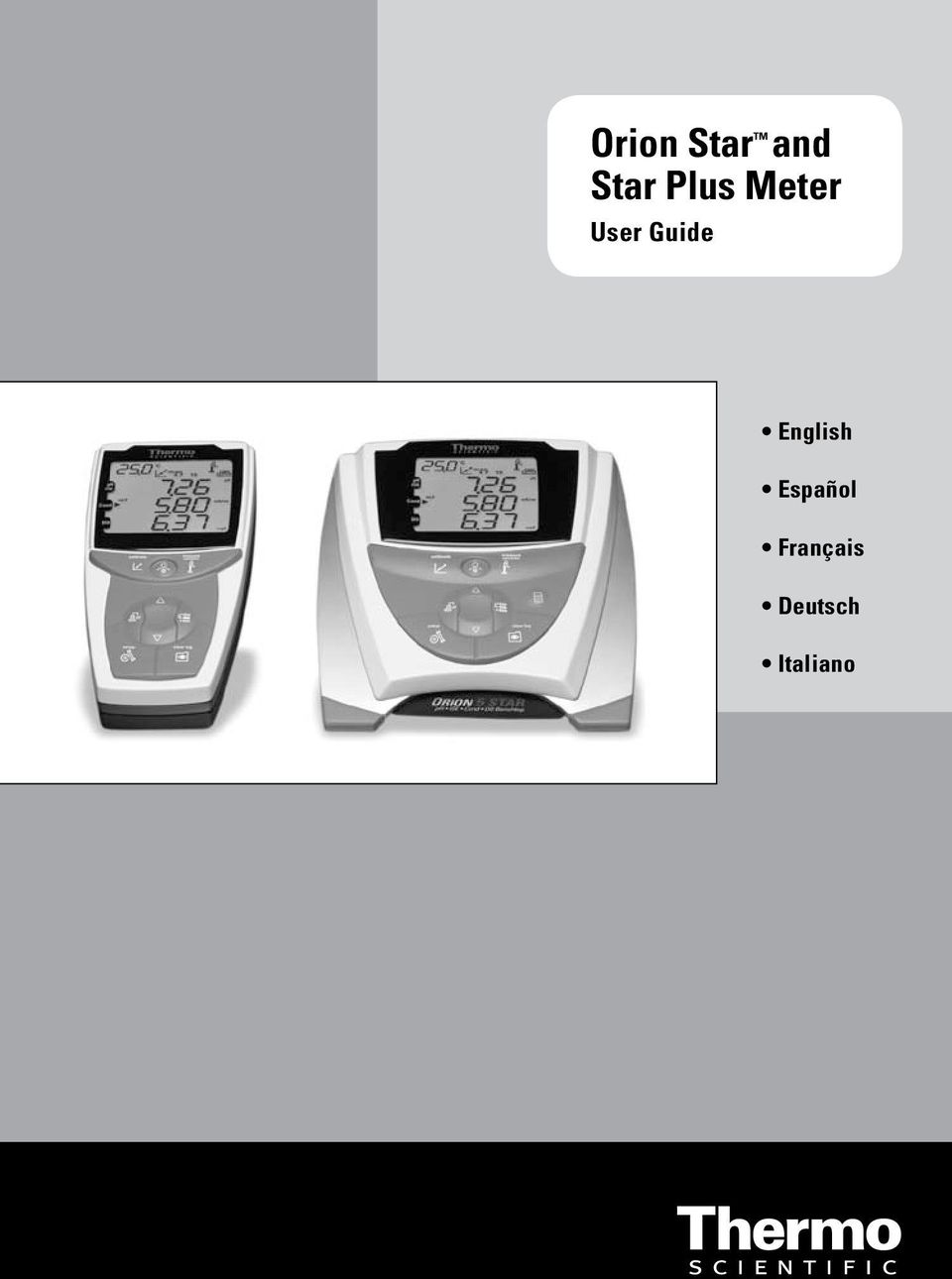
Orion Star and Star Plus Meter
|
|
|
- Renaud Villeneuve
- il y a 10 ans
- Total affichages :
Transcription
1 Orion Star and Star Plus Meter User Guide English Español Français Deutsch Italiano
2 ROSS and the COIL trade dress are trademarks of Thermo Fisher Scientific Inc. AQUAfast, Cahn, ionplus, KNIpHE, No Cal, ORION, perphect, PerpHecT, PerpHecTion, phisa, phuture, Pure Water, Sage, Sensing the Future, SensorLink, ROSS, ROSS Ultra, Sure-Flow, Titrator PLUS and TURBO2 are registered trademarks of Thermo Fisher pHAX-ION, A+, All in One, Aplus, AQUAsnap, AssuredAccuracy, AUTO-BAR, AUTO-CAL, AUTO DISPENSER, Auto-ID, AUTO-LOG, AUTO-READ, AUTO-STIR, Auto-Test, BOD AutoE Z, Cable-Free, CERTI-CAL, CISA, DataCOLLECT, DataPLUS, digital LogR, DirectCal, DuraProbe, Environmental Product Authority, Extra Easy/Extra Value, FAST QC, GAP, GLPcal, GLPcheck, GLPdoc, ISEasy, KAP, LabConnect, LogR, Low Maintenance Triode, Minimum Stir Requirement, MSR, NISS, One-Touch, One-Touch Calibration, One-Touch Measurement, Optimum Results, Orion Star, Pentrode, phuture MMS, phuture Pentrode, phuture Quatrode, phuture Triode, Quatrode, QuiKcheK, rf link, ROSS Resolution, SAOB, SMART AVERAGING, Smart CheK, SMART STABILITY, Stacked, Star Navigator 21, Stat Face, The Enhanced Lab, ThermaSense, Triode, TRIUMpH, Unbreakable ph, Universal Access are trademarks of Thermo Fisher. Guaranteed Success and The Technical Edge are service marks of Thermo Fisher. PerpHecT meters are protected by U.S. patent 6,168,707. PerpHecT ROSS are protected by U.S. patent 6,168,707. ORION Series A meters and 900A printer are protected by U.S. patents 5,198,093, D334,208 and D346,753. ionplus electrodes and Optimum Results solutions are protected by US Patent 5,830,338. ROSS Ultra electrodes are protected by US patents 6,793,787. Orion ORP Standard is protected by US Patent 6,350,367. Orion NoCal electrodes are protected by US Patent 7,276, Thermo Fisher Scientific Inc. All rights reserved. RDO is a registered trademark of In-Situ Inc., Fort Collins, CO USA. All other trademarks are the property of Thermo Fisher Scientific Inc. and its subsidiaries. The specifications, descriptions, drawings, ordering information and part numbers within this document are subject to change without notice. This publication supersedes all previous publications on this subject.

3 English Page EN-1 Thermo Scientific Orion Star and Star Plus meters are designed for every application, from basic portable measurements to advanced laboratory analysis. This user guide contains information on the preparation, operation and maintenance for the Orion Star and Star Plus meters. Español Page ES-1 Esta guía del usuario se presenta resumida para incluir los datos más importantes en inglés, español, francés, alemán e italiano. Para descargar la versión completa en el idioma de su elección, visite nuestro sitio web en Français Page FR-1 Ce guide d utilisation a été abrégé de façon à inclure les informations les plus pertinentes en anglais, espagnol, français, allemand et italien. Pour télécharger une version complète dans votre langue, connectez-vous à notre site

4 Deutsch Page DE-1 Die vorliegende Kurzfassung der Bedienungsanleitung enthält die wichtigsten Anweisungen auf Englisch, Spanisch, Französisch, Deutsch und Italienisch. Die ausführliche Bedienungsanleitung ist in jeder dieser Sprachen zum Download verfügbar. Besuchen Sie hierzu die Website Italiano Page IT-1 La presente guida per l utente è stata ridotta per includere i dettagli più importanti in Inglese, Spagnolo, Francese, Tedesco e Italiano. Per scaricare la versione completa nella Vostra lingua, visitate il nostro sito web all indirizzo II
5 E N E N G L I S H S E C T I O N Table of Contents Chapter I Introduction Meter Features EN-2 Chapter II Display General Description EN-3 Chapter III Keypad General Description EN-5 Key Definitions EN-6 Chapter IV Preparation Installing the Power Adapter EN-7 Installing the Batteries EN-8 Connecting the Electrodes EN-9 Turning on the Instrument EN-10 Meter Maintenance EN-10 Chapter V Meter Setup Setup Menu EN-11 Setup Menu Table EN-12 General Menu Settings EN-14 Time and Date Settings EN-15 AUTO-READ, Continuous or Timed Measurement Settings EN-16 Selecting the Measurement Parameter EN-17 Method Setup EN-18 Chapter VI ph Technique ph Setup Menu EN-19 ph Calibration EN-20 ph Measurement EN-21 ph Temperature Display and Calibration EN-22 Chapter VII mv, Relative mv and ORP Technique Relative mv and ORP Calibration EN-23 mv, Relative mv and ORP Measurement EN-24 Chapter VIII Dissolved Oxygen Technique Dissolved Oxygen Setup Menu EN-25 Dissolved Oxygen Calibration EN-26 Dissolved Oxygen Measurement EN-28 Dissolved Oxygen Temperature Display and Calibration EN-29 EN-I

6 E N Chapter IX RDO Optical Dissolved Oxygen Technique RDO Cap Overview EN-31 RDO Optical Dissolved Oxygen Setup Menu EN-32 Setup Menu for RDO Optical Dissolved Oxygen Sensor EN-33 RDO Optical Dissolved Oxygen Calibration EN-35 RDO Optical Dissolved Oxygen Measurement EN-37 RDO Optical Dissolved Oxygen Temperature Display and Calibration EN-38 Chapter X Conductivity Technique Conductivity Setup Menu EN-39 Conductivity Calibration EN-40 Conductivity Measurement EN-41 Conductivity Temperature Display and Calibration EN-42 Chapter XI ISE Technique ISE Setup Menu EN-43 ISE Calibration EN-44 ISE Measurement EN-45 ISE Temperature Display and Calibration EN-46 Chapter XII Data Archiving and Retrieval Datalog and Calibration Log EN-47 Automatic Datalog Feature EN-47 Datalog Deletion Setting EN-48 Viewing and Printing the Datalog and Calibration Log EN-49 Chapter XIII Declaration of Conformity Declaration of Conformity EN-51 WEEE Compliance EN-52 Chapter XIV Troubleshooting Meter Self Test EN-53 Meter Error Codes EN-54 General Troubleshooting EN-56 Chapter XV Meter Specifications Meter Specifications EN-59 Ordering Information EN-63 Appendix A Meter Setup Menu Features ph Setup Menu Features EN-65 Dissolved Oxygen Setup Menu Features EN-65 Conductivity Setup Menu Features EN-66 ISE Setup Menu Features EN-68 EN-II
7 Chapter I Introduction Congratulations! You have selected an industry-leading Thermo Scientific Orion Star or Star Plus series meter that is designed for electrochemistry measurements in the field or in the laboratory. 2-Star meters provide the single parameter measurement of ph. 3-Star Plus meters provide the single parameter measurement of ph, dissolved oxygen, RDO optical dissolved oxygen or conductivity. 4-Star Plus meters provide the dual parameter measurements of ph/dissolved oxygen, ph/conductivity, ph/ise (ion selective electrode) or ph/rdo optical dissolved oxygen. 5-Star Plus meters provide the multi-parameter measurements of ph/ise/dissolved oxygen/conductivity, ph/dissolved oxygen/conductivity or ph/rdo optical dissolved oxygen/conductivity. All meters include a temperature measurement function. All meters with ph measurement capability include a mv/relative mv/orp function. Built to meet the demands of busy, multiple user laboratory or plant environments, all Orion Star and Star Plus series meters are microprocessor controlled, which aids in the delivery of accurate and precise measurements. The waterproof portable meters can even withstand submersion for short periods of time. The 3-Star Plus, 4-Star Plus and 5-Star Plus meters have been enhanced to include an increased number of datalog points, improved temperature displays and a new temperature calibration mode for each measurement parameter. Benchtop 3-Star Plus, 4-Star Plus and 5-Star Plus meters include autosampler capability and are compatible with the AutoTration -500 autosampler. Refer to the AutoTration-500 user guide for information on operating the Star Plus meters with the autosampler. Note: Please read this user guide thoroughly before using your benchtop or portable meter. Any use outside of these instructions may invalidate your warranty and cause permanent damage to the meter. EN-1
8 Introduction Meter Features To better meet the needs of users in environmental protection and control, food and beverage, pharmaceutical and consumer product laboratories, the Orion Star and Star Plus series meters include these key features: Password Protected Methods The meter will save up to ten custom measurements and calibrations for future reference. Password protection of each method eliminates any tampering with methods as multiple users access only the procedure most appropriate to their work. AUTO-READ The meter takes a measurement and automatically prints or logs data when the reading becomes stable. The measurement is frozen on the display until the user prompts the meter to take a new measurement. Stirrer Control Benchtop meters (3-Star and higher) have a stirrer control for the stirrer probe, Cat. No , and the AUTO-STIR BOD probe, which eliminates the need for additional stir plates and stir bars. SMART STABILITY and SMART AVERAGING Remove the guesswork by automatically compensating for measurement conditions and optimizing the meter response time. Display Backlight All 3-Star, 4-Star and 5-Star meters include a display backlight feature. When the meter is on, a quick press of will turn the backlight on and off. When the meter is operating on battery power, the backlight will automatically turn off after two minutes to conserve power. When batteries are low, the backlight will no longer turn on. Automatic Shutoff The meters will shut down after 20 minutes without a keypress. This maximizes battery power on portable meters and benchtop meters that are being run on battery power. Audible Signals The meter will beep whenever a key is pressed, providing immediate verification that the user s input was received. An easy-to-use reference guide, attached to each meter, supports daily meter use. EN-2

9 Chapter II Display General Description Throughout a given process, the display on an Orion Star or Star Plus series meter provides temperature and calibration data. The temperature appears in the left, top corner of the display. The icon indicates that a calibration mode or calibration setup menu is active. The man, 2, 4, 7, 9, 10, and 12 icons indicate which ph buffers were saved after a ph calibration is performed. The setup icon only appears when the meter is in setup mode. The icon indicates an error condition and when it is displayed with the icon, a calibration alarm or sensor quality issue exists. The icon indicates that the AUTO-READ measurement mode is active and is discussed in greater detail in the Meter Setup section. Temperature Calibration ph/ise/orp Unit Conductivity Unit DO Unit 5 Star Meter This is the display of the 5-Star meter capable of multi-parameter measurements. The single and dual parameter meters will have fewer measurement lines, depending on the meter capabilities. Note: In the measurement mode, the three main lines of data on the meter display correspond to what is being measured. EN-3

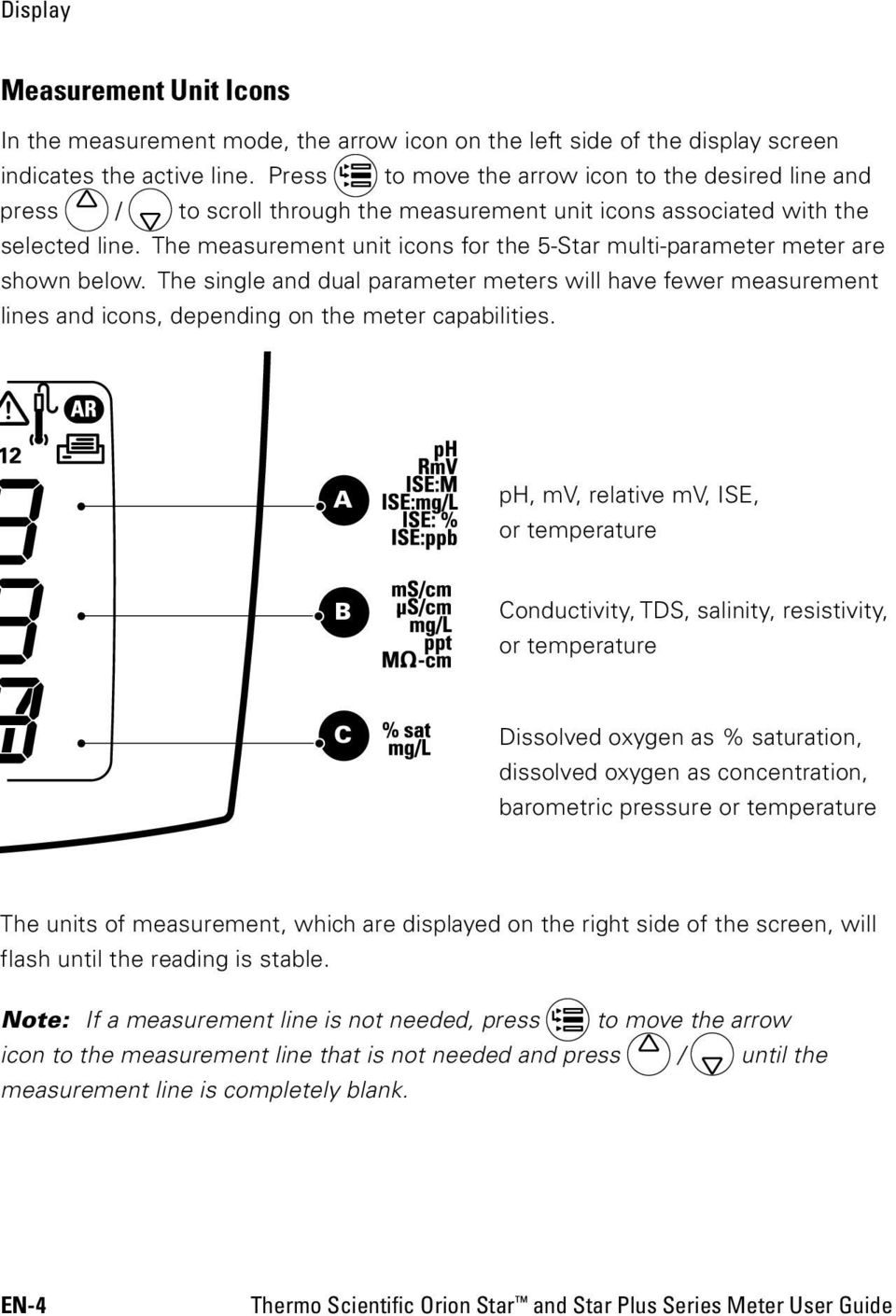
10 Display Measurement Unit Icons In the measurement mode, the arrow icon on the left side of the display screen indicates the active line. Press to move the arrow icon to the desired line and press / to scroll through the measurement unit icons associated with the selected line. The measurement unit icons for the 5-Star multi-parameter meter are shown below. The single and dual parameter meters will have fewer measurement lines and icons, depending on the meter capabilities. A ph, mv, relative mv, ISE, or temperature B Conductivity, TDS, salinity, resistivity, or temperature C Dissolved oxygen as % saturation, dissolved oxygen as concentration, barometric pressure or temperature The units of measurement, which are displayed on the right side of the screen, will flash until the reading is stable. Note: If a measurement line is not needed, press to move the arrow icon to the measurement line that is not needed and press / until the measurement line is completely blank. EN-4
11 Chapter III Keypad General Description The keypad layout is the same for all Orion Star and Star Plus series meters. The portable and 2-Star benchtop meters have nine keys. The 3-Star, 4-Star and 5-Star benchtop meters have 10 keys due to the addition of the stir key. Portable Keypad Calibrate Power Digits Scroll Down Setup Measure Save/Print Backlight Scroll Up Line Select View Log Benchtop Keypad Calibrate Scroll Up Digits Setup Power Backlight Measure Save/Print Stirrer On/Off, (not on 2-Star) Line Select View Log Scroll Down EN-5
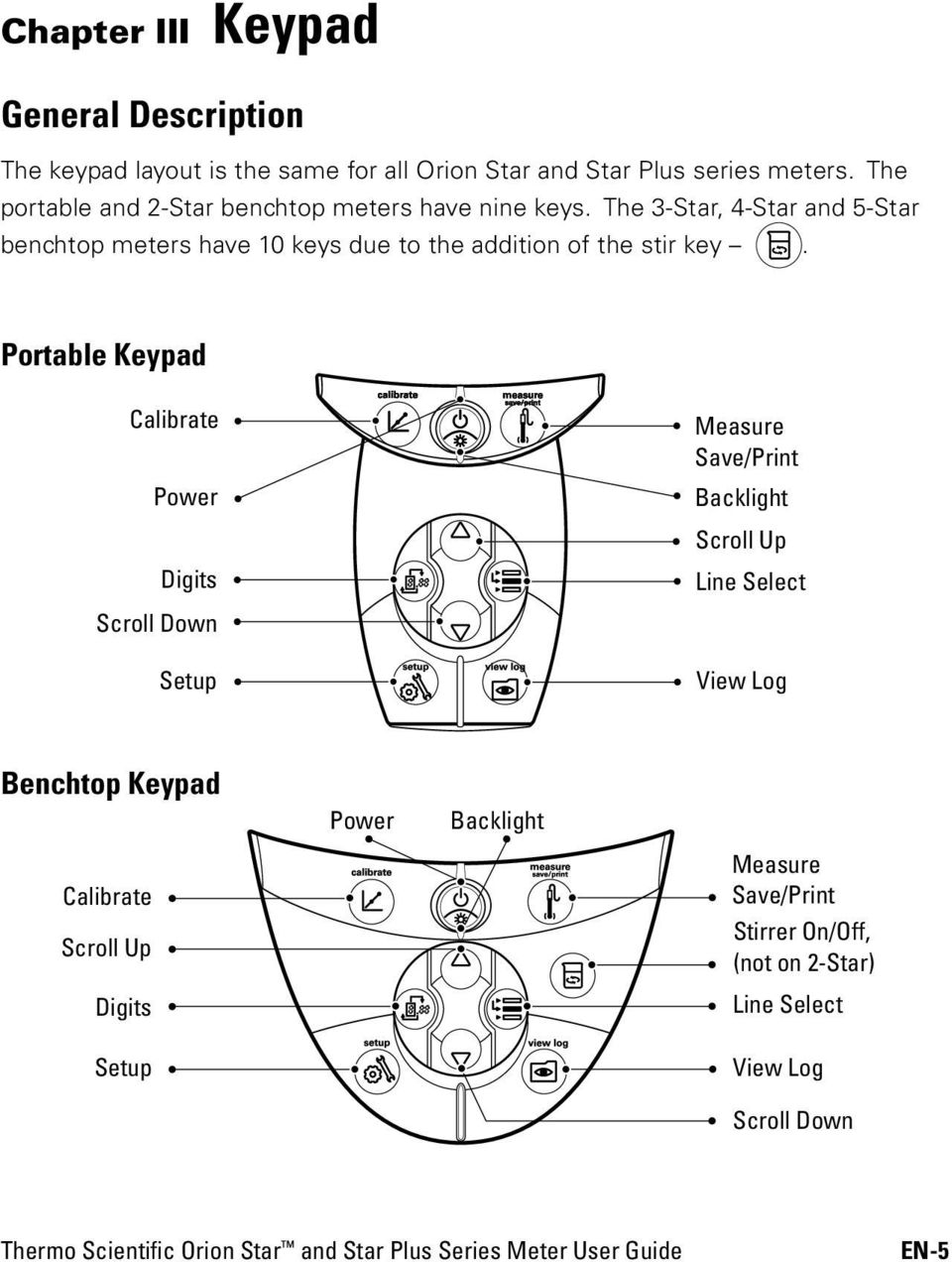
12 Keypad Key Definitions Key Description Key Description Turns the meter on, if the meter is off. Toggles the backlight on and off, if the meter is on (3-Star, 4-Star and 5-Star meters only). If the meter is on, hold down the key for about three seconds to turn off the meter. Scrolls the arrow icon on left of screen among the three display lines, so the selected line can be edited or calibrated. Starts the calibration for the selected line in the measurement mode. If the arrow icon points to the top line and the displayed units are ph, pressing the key will start a ph calibration. Each time the key is pressed in the calibration mode, the meter will accept the calibration point and move to the next point until the maximum number of calibration points are reached. Enters the setup menu, starting with selected line in the measurement mode. If the arrow icon points to the top line and the displayed units are ISE, pressing the key will enter the ISE setup screen. Changes the measurement units of the selected line in the measurement mode. Changes the value on the selected line in the setup, methods and log view modes. Edits the value of the flashing digit for setup, password entry and calibration modes. Selects the next digit to edit and moves the decimal point for setup, password entry and calibration modes. Prints and logs a measurement in the continuous or timed measurement modes. Prints, logs and freezes the display when the reading becomes stable in the AUTO- READ measurement mode. Exits the setup menu and returns to measurement mode. Accepts the calibration and returns to measurement mode. Enters the log view and download menu. Turns the stirrer on and off. EN-6

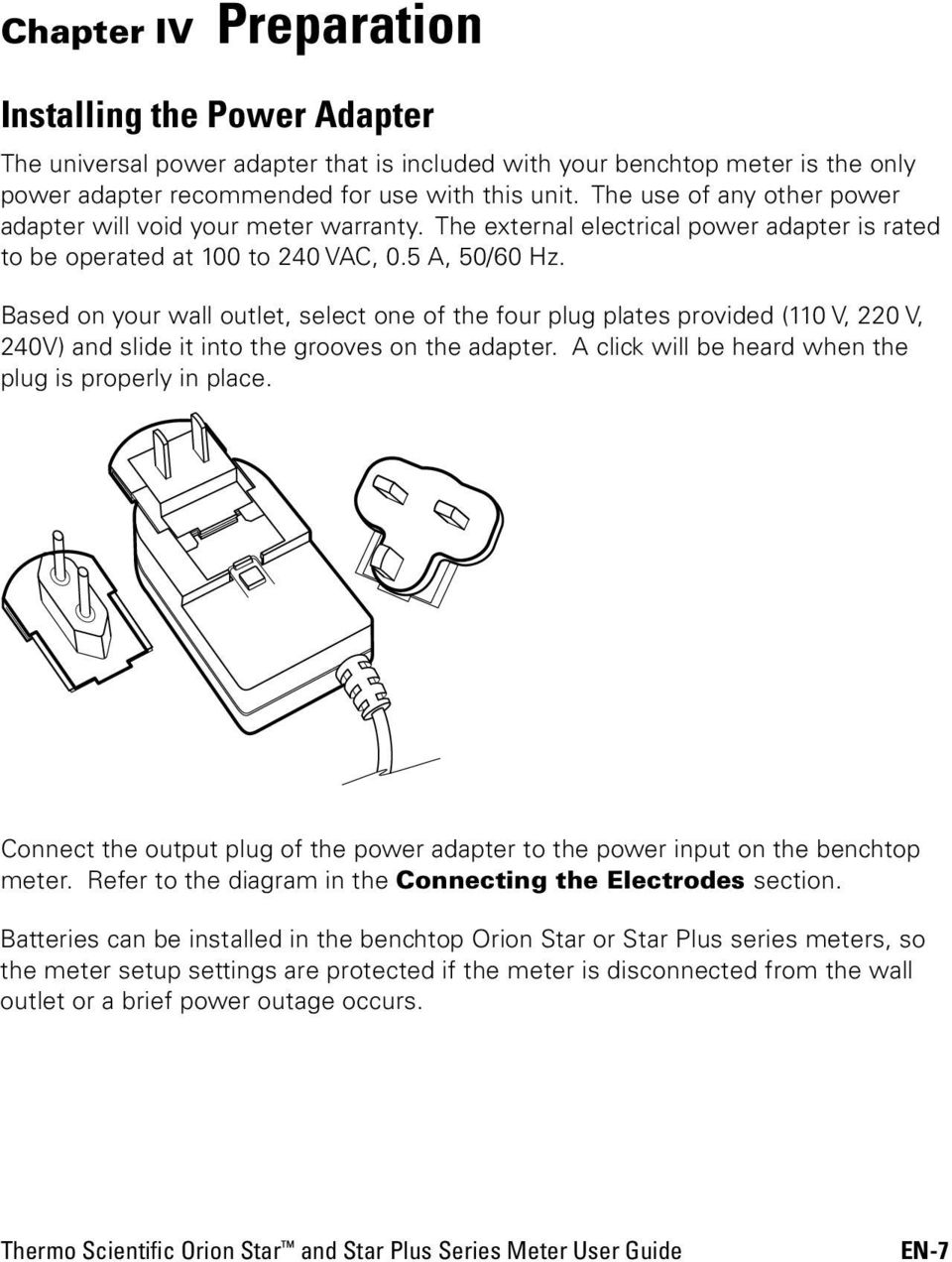
13 Chapter IV Preparation Installing the Power Adapter The universal power adapter that is included with your benchtop meter is the only power adapter recommended for use with this unit. The use of any other power adapter will void your meter warranty. The external electrical power adapter is rated to be operated at 100 to 240 VAC, 0.5 A, 50/60 Hz. Based on your wall outlet, select one of the four plug plates provided (110 V, 220 V, 240V) and slide it into the grooves on the adapter. A click will be heard when the plug is properly in place. Connect the output plug of the power adapter to the power input on the benchtop meter. Refer to the diagram in the Connecting the Electrodes section. Batteries can be installed in the benchtop Orion Star or Star Plus series meters, so the meter setup settings are protected if the meter is disconnected from the wall outlet or a brief power outage occurs. EN-7
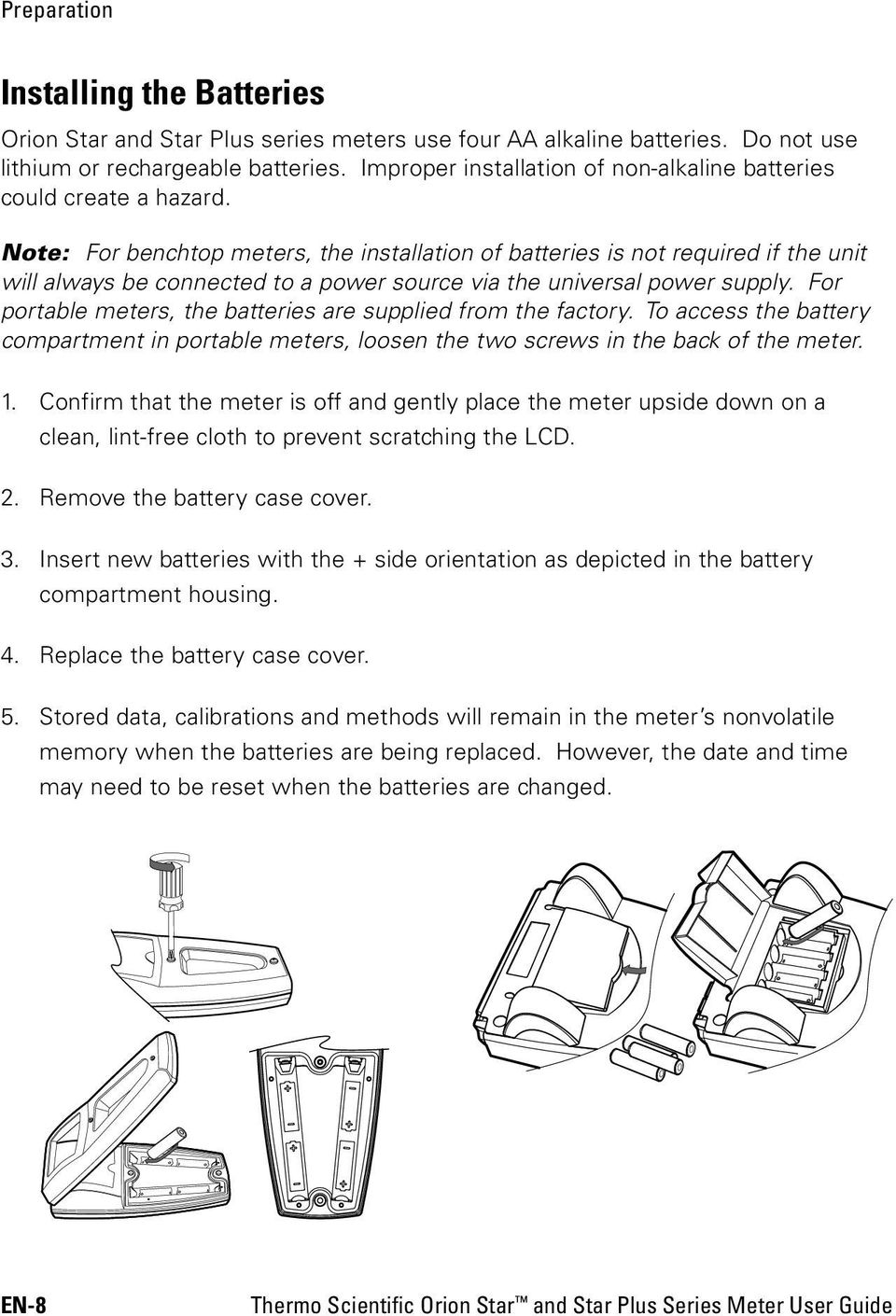
14 Preparation Installing the Batteries Orion Star and Star Plus series meters use four AA alkaline batteries. Do not use lithium or rechargeable batteries. Improper installation of non-alkaline batteries could create a hazard. Note: For benchtop meters, the installation of batteries is not required if the unit will always be connected to a power source via the universal power supply. For portable meters, the batteries are supplied from the factory. To access the battery compartment in portable meters, loosen the two screws in the back of the meter. 1. Confirm that the meter is off and gently place the meter upside down on a clean, lint-free cloth to prevent scratching the LCD. 2. Remove the battery case cover. 3. Insert new batteries with the + side orientation as depicted in the battery compartment housing. 4. Replace the battery case cover. 5. Stored data, calibrations and methods will remain in the meter s nonvolatile memory when the batteries are being replaced. However, the date and time may need to be reset when the batteries are changed. EN-8
15 Preparation Connecting the Electrodes Follow the diagrams below to correctly connect electrodes and probes to the meter. The multi-parameter meter is depicted; single parameter and dual parameter meters will have fewer connections, depending on the meter measurement capabilities. Benchtop Meter Electrode Connections Stirrer jack, stirrer or BOD AUTO-STIR probe Reference, ph, ORP or ISE BNC, ph, ORP or ISE 8 pin minidin, Cond or ATC 9 pin minidin, DO RS232 Ground Power Portable Meter Electrode Connections 8 pin minidin, Cond or ATC RS232 BNC, ph, ORP or ISE 9 pin minidin, DO EN-9
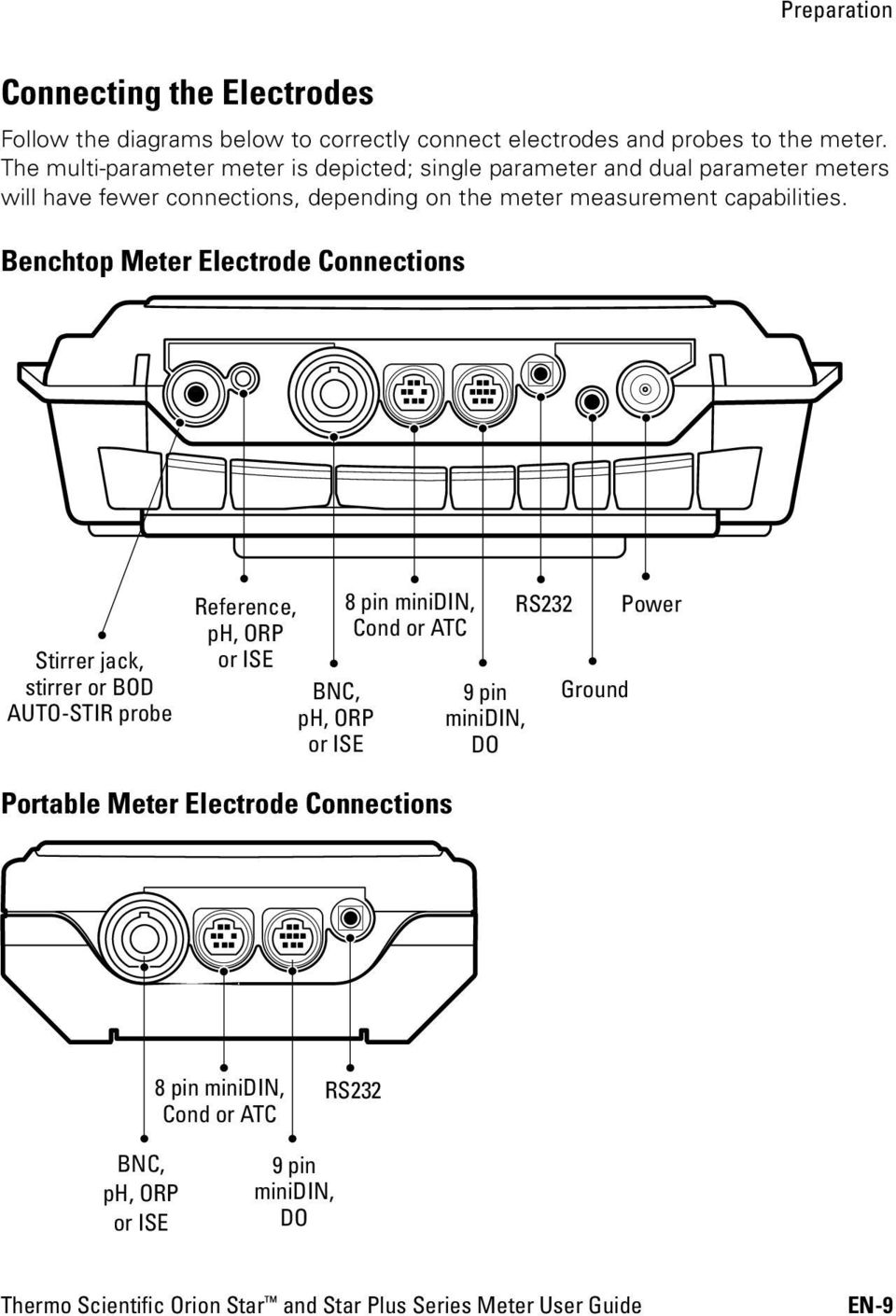
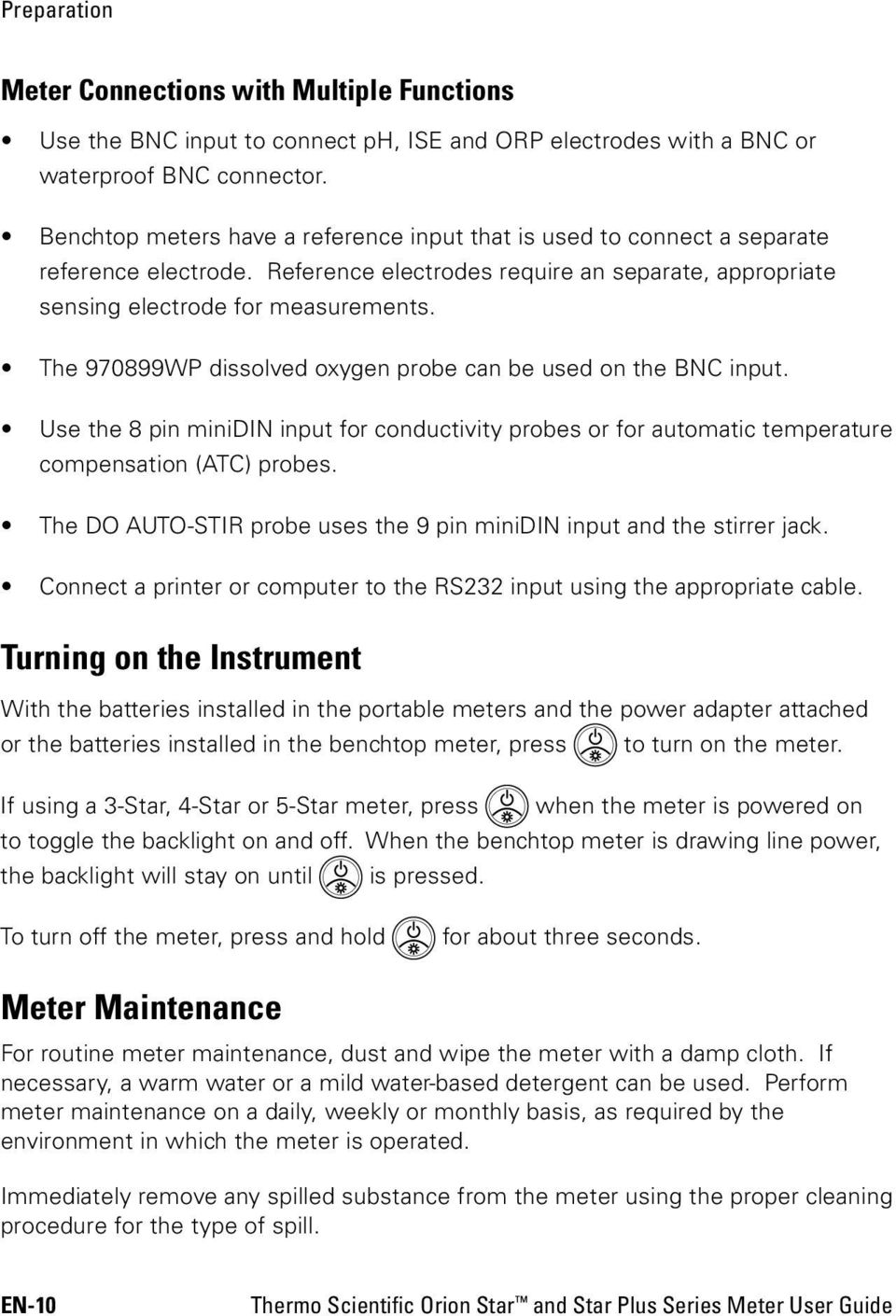
16 Preparation Meter Connections with Multiple Functions Use the BNC input to connect ph, ISE and ORP electrodes with a BNC or waterproof BNC connector. Benchtop meters have a reference input that is used to connect a separate reference electrode. Reference electrodes require an separate, appropriate sensing electrode for measurements. The WP dissolved oxygen probe can be used on the BNC input. Use the 8 pin minidin input for conductivity probes or for automatic temperature compensation (ATC) probes. The DO AUTO-STIR probe uses the 9 pin minidin input and the stirrer jack. Connect a printer or computer to the RS232 input using the appropriate cable. Turning on the Instrument With the batteries installed in the portable meters and the power adapter attached or the batteries installed in the benchtop meter, press to turn on the meter. If using a 3-Star, 4-Star or 5-Star meter, press when the meter is powered on to toggle the backlight on and off. When the benchtop meter is drawing line power, the backlight will stay on until is pressed. To turn off the meter, press and hold for about three seconds. Meter Maintenance For routine meter maintenance, dust and wipe the meter with a damp cloth. If necessary, a warm water or a mild water-based detergent can be used. Perform meter maintenance on a daily, weekly or monthly basis, as required by the environment in which the meter is operated. Immediately remove any spilled substance from the meter using the proper cleaning procedure for the type of spill. EN-10
17 Chapter V Meter Setup Setup Menu To navigate the setup menu: 1. Press to enter the setup menu. 2. Press / until the desired setup option is displayed on the top line. 3. Press to move the arrow icon to the middle line. 4. Press / until the desired setup option is displayed on the middle line. 5. Press to move the arrow icon to the bottom line. 6. To scroll through a list of options on the bottom line, press / until the desired option is displayed. To enter a numeric value for an option on the bottom line, press / to adjust each digit and to move to the next digit. For example, to change the ph measurement resolution press to scroll from 0.01 to on the bottom display line. 7. Press to move the arrow icon to the top line. 8. Repeat steps 2 through 7 to program a new setup option or press to exit the setup menu and return to the measurement mode. Note: Refer to Appendix A for a description of the special setup menu features. EN-11

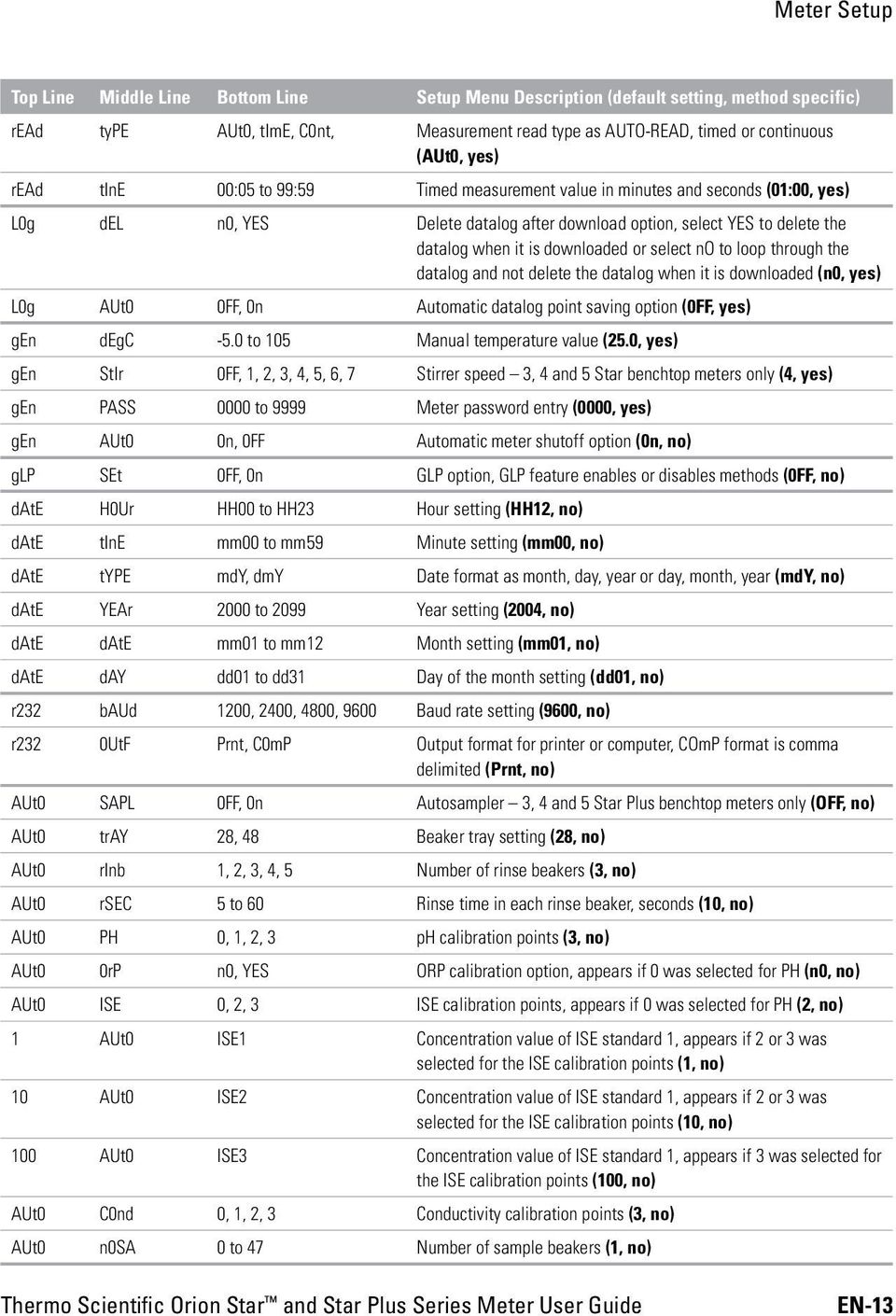
18 Meter Setup Setup Menu Table The following table is for the complete line of Orion Star and Star Plus meters. Meters may not include all of the options listed in this table. Top Line Middle Line Bottom Line Setup Menu Description (default setting, method specific) PH res 0.1, 0.01, ph measurement resolution (0.01, yes) PH buf USA, EUr0 ph buffer set for automatic buffer recognition during calibration, USA buffers are 1.68, 4.01, 7.00, 10.01, and EUrO buffers are 1.68, 4.01, 6.86, 9.18 (USA, yes) ISE res 1, 2, 3 ISE measurement resolution in significant figures (1, yes) ISE UnIt m, mgl, PEr, PPb, n0ne ISE measurement units (PPb, yes) ISE rang L0w, HIgH ISE concentration range for calibration stability criteria (HIgH, yes) ISE nlin AUt0, 0FF ISE automatic blank correction for low-level calibration (AUt0, yes) C0nd tc 0FF, LIn, nlf Conductivity temperature compensation type, LIn is for linear, nlf is for non-linear pure water samples (LIn, yes) C0nd C0EF 0.0 to 10.0 Conductivity temperature compensation coefficient in % change in conductivity per C, appears if LIn was selected for tc (2.1, yes) C0nd tdsf 0.00 to 10.0 Conductivity TDS factor value (0.49, yes) C0nd CELL to Conductivity default cell constant value for automatic conductivity calibration mode (0.475, yes) C0nd tref 5, 10, 15, 20, 25 Conductivity reference temperature (25, yes) C0nd type Std, 1, 2, 3, 4, 5, 6, 7, USP Conductivity cell type and selectable range (Std, yes) See the Setup Menu for RDO Optical Dissolved Oxygen Sensor section for details on the RDO sensor information menus. d0 res 0.1, 1 % sat DO % saturation measurement resolution (0.1, yes) d0 res 0.01, 0.1 mg/l DO mg/l measurement resolution (0.01, yes) d0 bar AUt0, man DO barometric pressure compensation type (AUt0, yes) d0 PrES to DO manual barometric pressure compensation value, appears if man was selected for bar (760.0, yes) d0 SAL AUt0, man DO salinity correction type (AUt0, yes) d0 SALF 0 to 45 DO manual salinity correction value, appears if man was selected for SAL or a DO meter without a conductivity mode is used (0, yes) d0 CALt AIr, H20, man, SEt0 DO calibration type (AIr, yes) d0 LIFE 365 to 0 RDO cap replacement countdown in days 3, 4 and 5 Star Plus RDO meters only (Set by RDO sensor, no) due PH 0 to 9999 ph calibration alarm value in hours, 0 is off (0, yes) due 0rP 0 to 9999 ORP calibration alarm value in hours, 0 is off (0, yes) due ISE 0 to 9999 ISE calibration alarm value in hours, 0 is off (0, yes) due C0nd 0 to 9999 Conductivity calibration alarm value in hours, 0 is off (0, yes) due d0 0 to 9999 DO calibration alarm value in hours, 0 is off (0, yes) EN-12
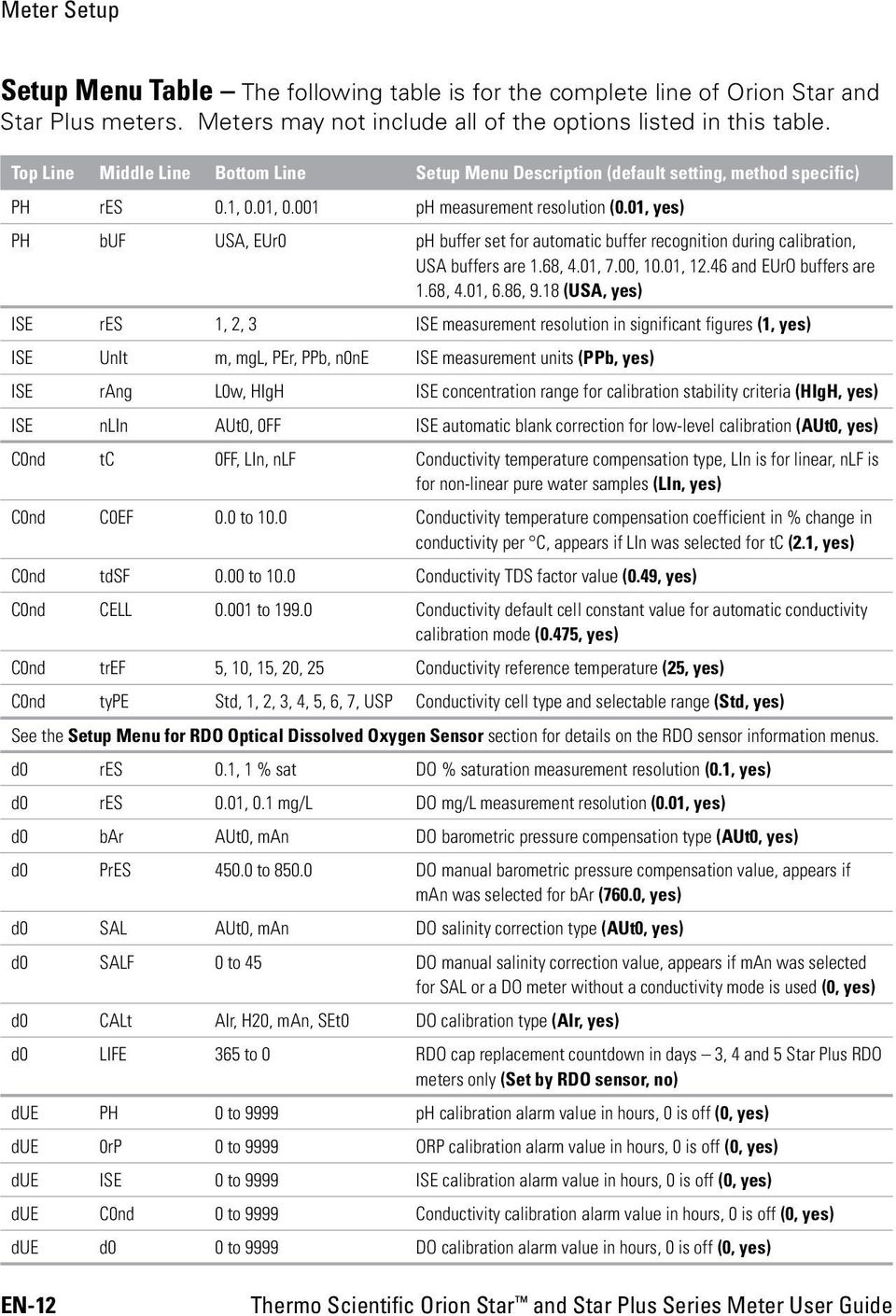
19 Meter Setup Top Line Middle Line Bottom Line Setup Menu Description (default setting, method specific) read type AUt0, time, C0nt, Measurement read type as AUTO-READ, timed or continuous (AUt0, yes) read tine 00:05 to 99:59 Timed measurement value in minutes and seconds (01:00, yes) L0g del n0, YES Delete datalog after download option, select YES to delete the datalog when it is downloaded or select no to loop through the datalog and not delete the datalog when it is downloaded (n0, yes) L0g AUt0 0FF, 0n Automatic datalog point saving option (0FF, yes) gen degc -5.0 to 105 Manual temperature value (25.0, yes) gen StIr 0FF, 1, 2, 3, 4, 5, 6, 7 Stirrer speed 3, 4 and 5 Star benchtop meters only (4, yes) gen PASS 0000 to 9999 Meter password entry (0000, yes) gen AUt0 0n, 0FF Automatic meter shutoff option (0n, no) glp SEt 0FF, 0n GLP option, GLP feature enables or disables methods (0FF, no) date H0Ur HH00 to HH23 Hour setting (HH12, no) date tine mm00 to mm59 Minute setting (mm00, no) date type mdy, dmy Date format as month, day, year or day, month, year (mdy, no) date YEAr 2000 to 2099 Year setting (2004, no) date date mm01 to mm12 Month setting (mm01, no) date day dd01 to dd31 Day of the month setting (dd01, no) r232 baud 1200, 2400, 4800, 9600 Baud rate setting (9600, no) r232 0UtF Prnt, C0mP Output format for printer or computer, COmP format is comma delimited (Prnt, no) AUt0 SAPL 0FF, 0n Autosampler 3, 4 and 5 Star Plus benchtop meters only (OFF, no) AUt0 tray 28, 48 Beaker tray setting (28, no) AUt0 rinb 1, 2, 3, 4, 5 Number of rinse beakers (3, no) AUt0 rsec 5 to 60 Rinse time in each rinse beaker, seconds (10, no) AUt0 PH 0, 1, 2, 3 ph calibration points (3, no) AUt0 0rP n0, YES ORP calibration option, appears if 0 was selected for PH (n0, no) AUt0 ISE 0, 2, 3 ISE calibration points, appears if 0 was selected for PH (2, no) 1 AUt0 ISE1 Concentration value of ISE standard 1, appears if 2 or 3 was selected for the ISE calibration points (1, no) 10 AUt0 ISE2 Concentration value of ISE standard 1, appears if 2 or 3 was selected for the ISE calibration points (10, no) 100 AUt0 ISE3 Concentration value of ISE standard 1, appears if 3 was selected for the ISE calibration points (100, no) AUt0 C0nd 0, 1, 2, 3 Conductivity calibration points (3, no) AUt0 n0sa 0 to 47 Number of sample beakers (1, no) EN-13
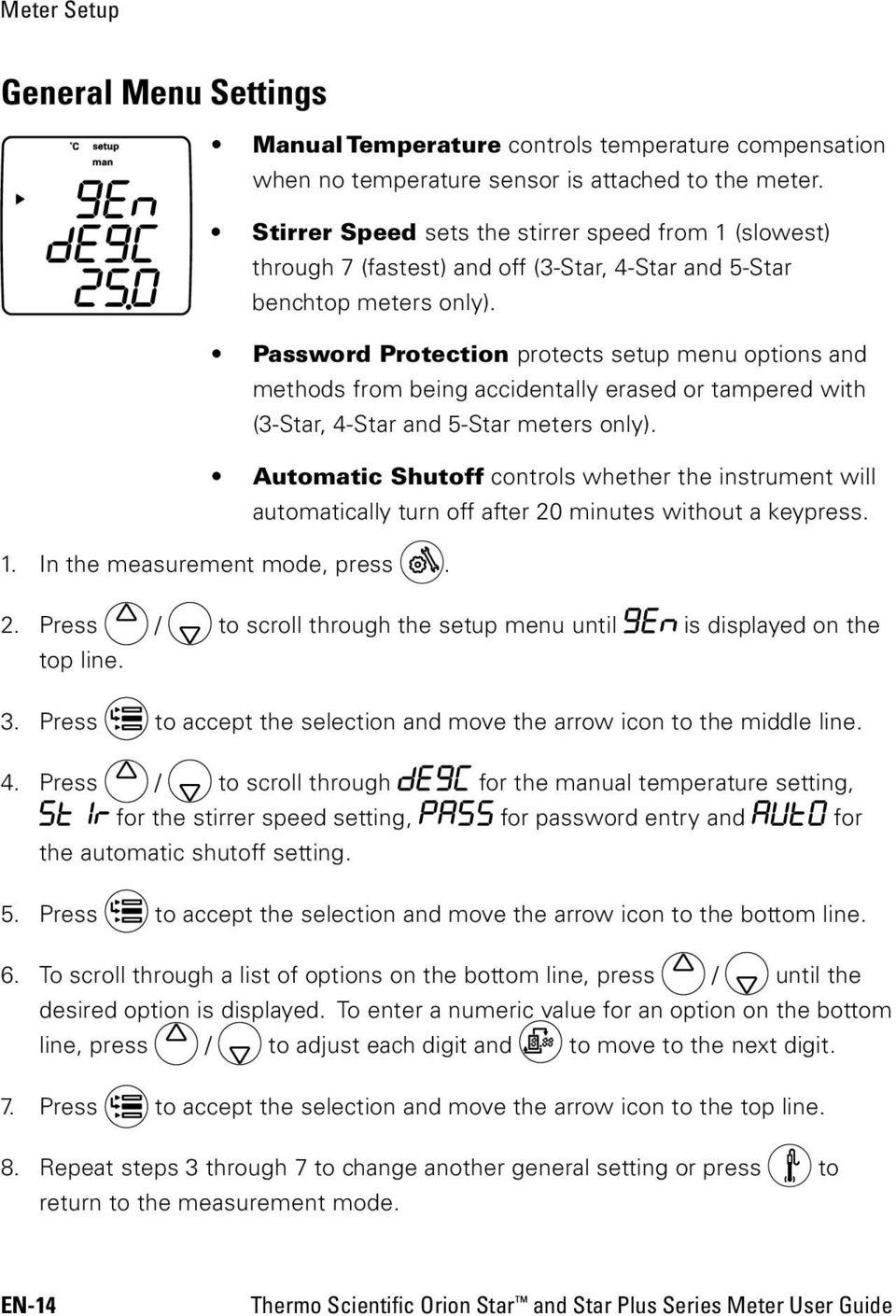
20 Meter Setup General Menu Settings Manual Temperature controls temperature compensation when no temperature sensor is attached to the meter. Stirrer Speed sets the stirrer speed from 1 (slowest) through 7 (fastest) and off (3-Star, 4-Star and 5-Star benchtop meters only). Password Protection protects setup menu options and methods from being accidentally erased or tampered with (3-Star, 4-Star and 5-Star meters only). Automatic Shutoff controls whether the instrument will automatically turn off after 20 minutes without a keypress. 1. In the measurement mode, press. 2. Press / to scroll through the setup menu until is displayed on the top line. 3. Press to accept the selection and move the arrow icon to the middle line. 4. Press / to scroll through for the manual temperature setting, for the stirrer speed setting, for password entry and for the automatic shutoff setting. 5. Press to accept the selection and move the arrow icon to the bottom line. 6. To scroll through a list of options on the bottom line, press / until the desired option is displayed. To enter a numeric value for an option on the bottom line, press / to adjust each digit and to move to the next digit. 7. Press to accept the selection and move the arrow icon to the top line. 8. Repeat steps 3 through 7 to change another general setting or press to return to the measurement mode. EN-14
21 Meter Setup Time and Date Settings The date and time settings are saved with the data and calibration log points and are included with the data that is sent to a computer or printer. The date format can be set to read month, day, year or day, month, year according to the user s preference. 1. In the measurement mode, press. 2. Press / to scroll through the setup menu until is displayed on the top line. 3. Press to accept the selection and move the arrow icon to the middle line. 4. Press / to scroll through for the current hour setting, for the current minute setting, for the date format setting, for the current month setting, for the current day setting and for the current year setting. 5. Press to accept the selection and move the arrow icon to the bottom line. 6. To scroll through a list of options on the bottom line, press / until the desired option is displayed. To enter a numeric value for an option on the bottom line, press / to adjust each digit and to move to the next digit. 7. Press to accept the selection and move the arrow icon to the top line. 8. Repeat steps 3 through 7 to change another time and date setting or press to return to the measurement mode. EN-15
22 Meter Setup AUTO-READ, Continuous or Timed Measurement Settings In the AUTO-READ mode, the meter starts taking a measurement when is pressed. Once the measurement is stable, the display freezes and the data is logged and printed. The AUTO-READ mode also controls the stirrer. The stirrer starts when is pressed and stops when the measurement becomes stable. In the continuous mode, the meter is constantly taking measurements and updating the display. Press to log and print a measurement in this mode. In the timed mode, the meter is constantly taking measurements and updating the display. The meter logs and prints the measurement at the selected time interval. Timed dissolved oxygen measurements with the RDO sensor are taken only at the selected time interval, which conserves the meter battery power. 1. In the measurement mode, press. 2. Press / to scroll through the setup menu until is displayed on the top line. 3. Press to accept the selection and move the arrow icon to the middle line. 4. Press / to scroll through for the measurement read type and for the timed reading interval. 5. Press to accept the selection and move the arrow icon to the bottom line. 6. To scroll through a list of options on the bottom line, press / until the desired option is displayed. To enter a numeric value for an option on the bottom line, press / to adjust each digit and to move to the next digit. 7. Press to accept the selection and move the arrow icon to the top line. 8. Repeat steps 3 through 7 to change another measurement setting or press to return to the measurement mode. EN-16
23 Meter Setup Selecting the Measurement Parameter In the measurement mode, the arrow icon on the left side of the display indicates the active line. Press to move the arrow icon to the desired measurement line and press / to scroll through the measurement parameters associated with the selected line. The measurement lines and icons for the 5-Star multi-parameter meter are shown below. The single and dual parameter meters will have fewer measurement lines and icons, depending on the meter capabilities. ph mv RmV ISE No icon for temperature No icon and no measurement the measurement line is turned off μs/cm or ms/cm for conductivity mg/l for TDS ppt for salinity MΩ-cm for resistivity No icon for temperature No icon and no measurement the measurement line is turned off % sat for dissolved oxygen percent saturation mg/l for dissolved oxygen concentration No icon for barometric pressure No icon for sample temperature No icon for membrane temperature (polarographic DO readings only) No icon and no measurement the measurement line is turned off Note: If a measurement line is not needed, press to move the arrow icon to the measurement line that is not needed and press / until the measurement line is completely blank. EN-17
24 Meter Setup Method Setup The Orion 3-Star, 4-Star and 5-Star meters can save up to 10 methods when the GLP function is enabled. When a method is selected, the meter will use the last calibration performed in that method, so electrodes that share a common meter connection can be more easily interchanged. When using multiple methods, a calibration must be performed for each method that will be used. 1. To enable the GLP function: a. In the measurement mode, press. b. Press / until is displayed on top line. c. Press to move the arrow icon to the middle line and press / until is displayed. d. Press to move the arrow icon to the bottom line and press / until is displayed. e. Press to move the arrow icon to the top line. f. Press to exit the setup menu and return to the measurement mode. 2. To display and change the current method number: a. In the measurement mode, press. The current method number will be displayed. b. Press / to select a new method number. c. Press to save the method number and press to return to the measurement mode. EN-18
25 Chapter VI ph Technique ph Setup Menu Note: Refer to the Setup Menu section for the Setup Menu Table, which contains a complete list of meter setup options and descriptions. Refer to Appendix A for a description of the special setup menu features. 1. In the measurement mode, press. 2. Press / to scroll through the setup menu until is displayed on the top line. 3. Press to accept the selection and move the arrow icon to the middle line. 4. Press / to scroll through for ph measurement resolution and for the automatic buffer recognition setting. 5. Press to accept the selection and move the arrow icon to the bottom line. 6. To scroll through a list of options on the bottom line, press / until the desired option is displayed. 7. Press to accept the selection and move the arrow icon to the top line. 8. Repeat steps 3 through 7 to change another ph setting or press to return to the measurement mode. EN-19
26 ph Technique ph Calibration 1. Prepare the electrode according to the electrode user guide. 2. In the setup mode, select the buffer set ( or ) that will be used for the automatic buffer recognition feature. 3. In the measurement mode, press until the arrow icon points to the top line, press until the ph icon is shown and press to begin the calibration. 4. Rinse the electrode, and ATC probe if being used, with distilled water and place into the buffer. 5. Wait for the ph icon to stop flashing. a. Automatic buffer recognition When the ph icon stops flashing the meter will display the temperature-corrected ph value for the buffer. b. Manual calibration When the ph icon stops flashing the meter will display the actual ph value read by the electrode. Press until the first digit to be changed is flashing, press / to change the value of the flashing digit and continue to change the digits until the meter displays the temperature-corrected ph value of the buffer. Once the ph buffer value is set, press until the decimal point is in the correct location. 6. Press to proceed to the next calibration point and repeat steps 4 and 5 or press to save and end the calibration. 7. The actual electrode slope, in percent, will be displayed in the main field and will be displayed in the lower field. a. For a one point calibration, press and / to edit the slope and press to return to the measurement mode. b. For a two or more point calibration, the meter will automatically proceed to the measurement mode after the slope is displayed. EN-20
27 ph Technique ph Measurement Note: Turn on the automatic datalog feature to send measurements to the meter datalog at the frequency specified in each measurement mode. Refer to the Data Archiving and Retrieval section for details. If the automatic datalog feature is off, connect the meter to a printer or computer to record the measurements. 1. Rinse the electrode with distilled or deionized water. Shake off any excess water and blot the electrode dry with lint-free tissue. 2. Place the electrode into the sample. a. If the meter is in the continuous measurement mode, it will start reading immediately and continuously update the display. The ph icon will flash until the reading is stable. Once the reading is stable, log and print the measurement by pressing. If a benchtop meter is used and the stirrer is enabled, press to start the stirrer. Press again to turn off the stirrer before removing the electrode and stirrer from the sample. b. If the meter is in the AUTO-READ measurement mode, press to start the reading. The AR icon will flash until the reading is stable. Once the reading is stable, the meter will log and print the measurement and freeze the display. If a benchtop meter is used and the stirrer is enabled, the stirrer will turn on when is pressed and turn off when the reading is stable. c. If the meter is in the timed measurement mode, it will start reading immediately and continuously update the display. The meter will log and print the measurement at the frequency specified in the setup menu. If a benchtop meter is used and the stirrer is enabled, press to start the stirrer. Press again to turn off the stirrer before removing the electrode and stirrer from the sample. 3. Remove the electrode from the sample, rinse it with distilled or deionized water, blot it dry, place it in the next sample and repeat step Once all of the samples have been measured, rinse the electrode with distilled or deionized water and blot it dry. Consult the electrode user guide for proper storage techniques. EN-21
28 ph Technique ph Temperature Display and Calibration ph Temperature Display Star Plus meters allow the temperature to be viewed on individual measurement lines in addition to the temperature display on the top, left of the screen. To view the temperature for the ph measurement line: 1. In the measurement mode, press to select the top display line. The arrow icon will point to the selected line. 2. Press / to change the value on the selected line. The top line can be changed to display ph (ph), millivolts (mv), relative millivolts (RmV), concentration (ISE), temperature (no icon) or a blank line. ph Temperature Calibration The temperature calibration mode of the Star Plus meter allows the temperature on each measurement line to be manually adjusted. To calibrate the temperature for the ph measurement line: 1. In the measurement mode, press to choose the top measurement line and press / until the temperature is shown for the selected line. 2. Press to begin the calibration. 3. When the reading stabilizes, the arrow icon and the first digit will flash. Enter the temperature by pressing / to adjust each digit and to move to the next digit. 4. Press to save and end the calibration. EN-22
29 Chapter VII mv, Relative mv/ and ORP Technique All meters with ph measurement capability include a mv, relative mv and ORP function. Measure the raw millivolt (mv) values of an electrode in the mv mode. Calibrate the relative millivolt (RmV) values of a redox electrode for oxidationreduction potential (ORP) measurements in the relative mv/orp mode. Note: The mv measurements are raw readings and cannot be calibrated. Use the relative mv mode to calibrate mv measurements. Relative mv and ORP Calibration 1. Prepare the electrode according to the electrode user guide. 2. In the measurement mode, press until the arrow icon points to the top line, press until the RmV icon is shown and press to begin the calibration. 3. Rinse the electrode with distilled water and place it into the standard. 4. Wait for the RmV icon to stop flashing. If the raw mv reading of the electrode is 220 mv ± 60 mv, when the RmV icon stops flashing the meter will automatically calculate and display the E H mv value for the electrode at the measured temperature. If the raw mv reading of the electrode is outside of the 220 mv ± 60 mv range, when the RmV icon stops flashing the meter will display RmV. Press until the first digit to be changed is flashing, press / to change the value of the flashing digit and continue to change the digits until the meter displays the millivolt value of the standard. To change the value to negative or positive number, press until none of the digits are blinking and the arrow icon is blinking and then press to change the sign of the millivolt value. 5. Press to save and end the calibration. The millivolt offset will be displayed and the meter will automatically proceed to the measurement mode. EN-23
30 mv, Relative mv and ORP Technique mv, Relative mv and ORP Measurement Note: Turn on the automatic datalog feature to send measurements to the meter datalog at the frequency specified in each measurement mode. Refer to the Data Archiving and Retrieval section for details. If the automatic datalog feature is off, connect the meter to a printer or computer to record the measurements. 1. Rinse the electrode with distilled or deionized water. Shake off any excess water and blot the electrode dry with lint-free tissue. 2. Place the electrode into the sample. a. If the meter is in the continuous measurement mode, it will start reading immediately and continuously update the display. The mv or RmV icon will flash until the reading is stable. Once the reading is stable, log and print the measurement by pressing. If a benchtop meter is used and the stirrer is enabled, press to start the stirrer. Press again to turn off the stirrer before removing the electrode and stirrer from the sample. b. If the meter is in the AUTO-READ measurement mode, press to start the reading. The AR icon will flash until the reading is stable. Once the reading is stable, the meter will log and print the measurement and freeze the display. If a benchtop meter is used and the stirrer is enabled, the stirrer will turn on when is pressed and turn off when the reading is stable. c. If the meter is in the timed measurement mode, it will start reading immediately and continuously update the display. The meter will log and print the measurement at the frequency specified in the setup menu. If a benchtop meter is used and the stirrer is enabled, press to start the stirrer. Press again to turn off the stirrer before removing the electrode and stirrer from the sample. 3. Remove the electrode from the sample, rinse it with distilled or deionized water, blot it dry, place it in the next sample and repeat step Once all of the samples have been measured, rinse the electrode with distilled or deionized water and blot it dry. Consult the electrode user guide for proper storage techniques. EN-24
31 Chapter VIII Dissolved Oxygen Technique Dissolved Oxygen Setup Menu Note: Refer to the Setup Menu section for the Setup Menu Table, which contains a complete list of meter setup options and descriptions. Refer to Appendix A for a description of the special setup menu features. 1. In the measurement mode, press. 2. Press / to scroll through the setup menu until is displayed on the top line. 3. Press to accept the selection and move the arrow icon to the middle line. 4. Press / to scroll through for the % saturation resolution, for the mg/l concentration resolution, for the barometer type (automatic or manual), for the manual barometric pressure compensation value, for the salinity compensation type (automatic or manual), for the manual salinity correction value and for the dissolved oxygen calibration type. 5. Press to select the option and move the arrow icon to the bottom line. 6. To scroll through a list of options on the bottom line, press / until the desired option is displayed. To enter a numeric value for an option on the bottom line, press / to adjust each digit and to move to the next digit. 7. Press to accept the selection and move the arrow icon to the top line. 8. Repeat steps 3 through 7 to change another dissolved oxygen setting or press to return to the measurement mode. EN-25
32 Dissolved Oxygen Technique Dissolved Oxygen Calibration Prior to calibration, the dissolved oxygen probe must be prepared and polarized. The probe is continuously polarized when it is connected to the meter. When the probe is first connected or if the probe is disconnected for more than 60 minutes, connect the probe to the meter, connect the meter to a power source and wait 30 to 60 minutes for the probe to polarize. Disconnecting the probe for less than one hour will require 5 to 25 minutes for polarization. The meters will supply a polarization current to the dissolved oxygen probe even when the meter power is off. To maximize the meter battery life, unplug the probe if it will not be used for an extended period. 1. Select one of the following calibration modes in the setup menu. a. An air calibration is performed in water saturated air using the calibration sleeve. This is the simplest and most accurate calibration. Due to the inherent differences between water saturated air and air saturated water, 102.3% saturation will be displayed when the calibration reading is stable. i. The highest possible accuracy is reached when calibration temperature is the same as the measuring temperature. ii. Moisten the sponge or absorbent cloth in the calibration sleeve with distilled water and insert the probe into the sleeve without touching the water saturated material. For BOD measurements, this calibration can be performed in a BOD bottle. b. A water calibration is performed using water that is 100% saturated with air. Bubble air into a water sample and gently stir the sample to prevent the buildup of air bubbles on the dissolved oxygen probe membrane. c. A manual calibration is performed using a water sample with a known concentration of dissolved oxygen. This method can be used to calibrate the dissolved oxygen probe to the value achieved by a Winkler titration. EN-26
33 Dissolved Oxygen Technique i. A manual calibration involves performing a Winkler titration and using that sample as a calibration standard. The oxygen level result from the titration is entered in a manual calibration as the dissolved oxygen value. This correlates the meter input to the Winkler titration. This method is inherently less accurate, due to the possibility of titration errors. d. A zero point calibration is performed in an oxygen-free solution. A zero point calibration is not generally required unless measurements will be taken below 10% saturation or 1 mg/l. Zero the probe when using a new membrane, using fresh filling solution or when measuring dissolved oxygen levels below 1 mg/l. An air calibration should be performed prior to the zero point calibration. 2. Allow the probe and calibration standard (water saturated air, air saturated water, Winkler standard or oxygen-free solution) to reach equilibrium. 3. In the measurement mode, press until the arrow icon points to the bottom line, press until the % sat or mg/l icon is shown and press to begin the calibration. 4. Wait for the dissolved oxygen reading to stabilize. a. If an air calibration is performed, the meter will display 102.3% and automatically return to the measurement mode. b. If a water calibration is performed, the meter will display 100.0% and automatically return to the measurement mode. c. If a manual calibration is performed, wait for the mg/l icon to stop flashing and enter the dissolved oxygen value by pressing until the first digit to be changed is flashing, press / to change the value of the flashing digit and continue to change the digits until the meter displays the correct dissolved oxygen value. Once the dissolved oxygen value is set, press until the decimal point is in the correct location. d. If a zero point calibration is performed, the meter will display 0.00 and automatically return to the measurement mode. EN-27
34 Dissolved Oxygen Technique Dissolved Oxygen Measurement Note: Turn on the automatic datalog feature to send measurements to the meter datalog at the frequency specified in each measurement mode. Refer to the Data Archiving and Retrieval section for details. If the automatic datalog feature is off, connect the meter to a printer or computer to record the measurements. 1. Rinse the dissolved oxygen probe with distilled or deionized water. Shake off any excess water and blot the probe dry with lint-free tissue. 2. Place the dissolved oxygen probe into the sample. a. If the meter is in the continuous measurement mode, it will start reading immediately and continuously update the display. The mg/l or % sat icon will flash until the reading is stable. Once the reading is stable, log and print the measurement by pressing. If a benchtop meter is used and the stirrer is enabled, press to start the stirrer. Press again to turn off the stirrer before removing the probe and stirrer from the sample. b. If the meter is in the AUTO-READ measurement mode, press to start the reading. The AR icon will flash until the reading is stable. Once the reading is stable, the meter will log and print the reading and freeze the display. If a benchtop meter is used and the stirrer is enabled, the stirrer will turn on when is pressed and turn off when the reading is stable. If the BOD AUTO-STIR probe is used, press the button on the probe to start the AUTO-READ measurement. Note: Benchtop Star Plus dissolved oxygen meters allow the measurement and stirring functions to be controlled by the AUTO-STIR probe when the meter is in the AUTO-READ measurement mode. Press the button on the AUTO-STIR probe to start and stop measurement and stirring functions. c. If the meter is in the timed measurement mode, it will start reading immediately and continuously update the display. The meter will log and print the measurement at the frequency specified in the setup menu. If a benchtop meter is used and the stirrer is enabled, press to start the stirrer. Press again to turn off the stirrer before removing the probe and stirrer from the sample. EN-28
35 Dissolved Oxygen Technique 3. Remove the dissolved oxygen probe from the sample, rinse it with distilled or deionized water, blot it dry, place it in the next sample and repeat step Once all of the samples have been measured, rinse the dissolved oxygen probe with distilled or deionized water and blot it dry. Consult the dissolved oxygen probe user guide for proper storage techniques. Dissolved Oxygen Temperature Display and Calibration Dissolved Oxygen Temperature Display Star Plus meters allow the temperature to be viewed on individual measurement lines in addition to the temperature display on the top, left of the screen. To view the temperature for the dissolved oxygen measurement line: 1. In the measurement mode, press to choose the bottom display line. The arrow icon will point to the selected line. 2. Press / to change the value on the selected line. The bottom line can be changed to display dissolved oxygen (% saturation), dissolved oxygen (mg/l), barometric pressure (no icon), sample temperature (no icon), electrolyte solution/membrane temperature (no icon, after number) or a blank line. EN-29
36 Dissolved Oxygen Technique Dissolved Oxygen Temperature Calibration The temperature calibration mode of the Star Plus meter allows the temperature on each measurement line to be manually adjusted. The dissolved oxygen measurement line displays the sample temperature and the electrolyte solution/ membrane temperature. To calibrate the sample temperature for the dissolved oxygen measurement line: 1. In the measurement mode, press to choose the bottom measurement line and press / until the sample temperature is displayed (i.e. ). 2. Press to begin the calibration. 3. When the reading stabilizes, the arrow icon and the first digit will flash. Enter the temperature by pressing / to adjust each digit and to move to the next digit. 4. Press to save and end the calibration. To calibrate the electrolyte solution/membrane temperature for the dissolved oxygen measurement line: 1. In the measurement mode, press to choose the bottom measurement line and press / until the membrane temperature is displayed (i.e. ). 2. Press to begin the calibration. 3. When the reading stabilizes, the arrow icon and the first digit will flash. Enter the temperature by pressing / to adjust each digit and to move to the next digit. 4. Press to save and end the calibration. EN-30
37 Chapter IX RDO Optical Dissolved Oxygen Technique Note: The RDO optical dissolved oxygen meters have serial numbers that begin with R (i.e. R12345). Only the RDO meters are compatible with the RDO optical dissolved oxygen sensors. RDO Cap Overview The RDO sensor has an internal clock that counts down the 365 day lifespan of a new RDO cap. The countdown begins when the RDO cap is installed on the RDO sensor, the sensor is connected to the meter and the first measurement is taken. The 365 day countdown cannot be reset or changed once the first measurement is taken. Each RDO cap has a unique serial number that is recognized by the RDO sensor, so reinstalling the cap will not reset the countdown. Note: The power to the meter must be turned off when a new RDO cap is installed on the RDO sensor. Once the RDO cap is installed, turn the power to the meter on and the new cap information will be sent to the meter. To print the RDO cap information: 1. Connect the meter to a printer or computer and verify the meter baud rate and output settings in the setup menu. 2. From the measurement mode, press. 3. Press / to scroll through the setup menu until is displayed on the top line and is displayed on the middle line. 4. Press two times to move the arrow icon to the bottom line. 5. Press / until is displayed on the bottom line. 6. Press to print the RDO cap information. Press to return to the measurement mode. EN-31
38 RDO Optical Dissolved Oxygen Technique RDO Optical Dissolved Oxygen Setup Menu Note: Refer to the Setup Menu section for the Setup Menu Table, which contains a complete list of meter setup options and descriptions. 1. From the measurement mode, press. 2. Press / to scroll through the setup menu until is displayed on the top line. 3. Press to accept the selection and move the arrow icon to the middle line. 4. Press / to scroll through for the % saturation resolution, for the mg/l concentration resolution, for the barometer type (automatic or manual), for the manual barometric pressure compensation value, for the salinity compensation type (automatic or manual), for the manual salinity correction value, for the dissolved oxygen calibration type and for the RDO cap replacement countdown in days. 5. Press to select the option and move the arrow icon to the bottom line. 6. To scroll through a list of options on the bottom line, press / until the desired option is displayed. To enter a numeric value for an option on the bottom line, press / to adjust each digit and to move to the next digit. 7. Press to accept the selection and move the arrow icon to the top line. 8. Repeat steps 3 through 7 to change another dissolved oxygen setting or press to return to the measurement mode. EN-32
39 RDO Optical Dissolved Oxygen Technique Setup Menu for RDO Optical Dissolved Oxygen Sensor The RDO optical dissolved oxygen meters have a special setup menu feature that allows the user to print information about the RDO sensor. Top Line Middle Line Bottom Line Setup Menu Description Pr0b d0 test The test option initiates a 30 second test of the communication link between the RDO sensor and meter. The temperature display will show a 30 second countdown as the test progresses. The meter will send a report to the printer or computer when the test is done. Pr0b d0 CAL The CAL option prints the meter serial number, date, time and slope for the last five dissolved oxygen calibrations that were performed with the RDO sensor that is currently connected to the meter. Pr0b d0 dflt The dflt option prints the factory calibration information for the RDO sensor that is currently connected to the meter. Pr0b d0 SLP The SLP option prints a drift per minute value of the slope for the last five dissolved oxygen calibrations that were performed with the RDO sensor that is currently connected to the meter. Pr0b d0 meth The meth option prints the RDO specific method information of the last method used for the RDO sensor that is currently connected to the meter. Pr0b d0 InF0 The InF0 option prints the RDO sensor information, including the sensor serial number and revision, sensor and RDO cap date of manufacturing, cap start date, cap life and internal real time clock for the sensor that is currently connected to the meter. 1. Connect the meter to a printer or computer and verify the meter baud rate and output settings in the setup menu. 2. From the measurement mode, press. 3. Press / to scroll through the setup menu until is displayed on the top line and is displayed on the middle line. 4. Press two times to move the arrow icon to the bottom line. 5. Press / to scroll through for the communication link test, for the RDO sensor calibration information, for the RDO sensor factory calibration information, for the RDO sensor slope information, for the RDO method information and for the general RDO sensor information. EN-33
40 RDO Optical Dissolved Oxygen Technique 6. Press to print the selected option. 7. Press / to select another option from the bottom line and press to print the selected option or press to return to the measurement mode. Example RDO Sensor General Information Printout smartprobe info type 1 run_status 255 format_version 1 probe_sn 6 app_version 9 HW_version 1 cap_sn rtc ( :36:12) mfg_time ( :42:29) start_time ( :49:13) expiration ( :49:13) probe_mfg_time ( :00:00) write_count 14 pass_count 12 expire 0x01 days_left probe_reading temp_reading state 21 general_event 0x00 internal_event 0x00 internal_state 3 internal_retry 0x00 EN-34
41 RDO Optical Dissolved Oxygen Technique RDO Optical Dissolved Oxygen Calibration 1. Select one of the following calibration modes in the setup menu. a. An air calibration is performed in water saturated air using the calibration sleeve. This is the simplest and most accurate calibration method. i. The highest possible accuracy is reached when calibration temperature is the same as the measuring temperature. ii. Moisten the sponge in the calibration sleeve with distilled water. Insert the RDO sensor into the sleeve without touching the water saturated sponge. b. A water calibration is performed using water that is 100% saturated with air. Bubble air into a water sample and gently stir the sample to prevent the buildup of air bubbles on the RDO cap. c. A manual calibration is performed using a water sample with a known concentration of dissolved oxygen. This method can be used to calibrate the RDO sensor to the value achieved by a Winkler titration. i. A manual calibration involves performing a Winkler titration and using that sample as a calibration standard. The oxygen level result from the titration is entered in a manual calibration as the dissolved oxygen value. This correlates the meter input to the Winkler titration. This method is inherently less accurate, due to the possibility of titration errors. d. A zero point calibration is performed in an oxygen-free solution. A zero point calibration is not generally required unless measurements will be taken below 10% saturation or 1 mg/l. 2. Allow the RDO sensor and calibration standard (water saturated air, air saturated water, Winkler standard or oxygen-free solution) to reach equilibrium. EN-35
42 RDO Optical Dissolved Oxygen Technique 3. In the measurement mode, press until the arrow icon points to the bottom line, press until the % sat or mg/l icon is shown and press to begin the calibration. 4. Wait for the dissolved oxygen reading to stabilize. a. If an air calibration is performed, the meter will display 100.0% and automatically return to the measurement mode. b. If a water calibration is performed, the meter will display 100.0% and automatically return to the measurement mode. c. If a manual calibration is performed, wait for the mg/l icon to stop flashing and enter the dissolved oxygen value by pressing until the first digit to be changed is flashing, press / to change the value of the flashing digit and continue to change the digits until the meter displays the correct dissolved oxygen value. Once the dissolved oxygen value is set, press until the decimal point is in the correct location. d. If a zero point calibration is performed, the meter will display 0.00 and automatically return to the measurement mode. EN-36
43 RDO Optical Dissolved Oxygen Technique RDO Optical Dissolved Oxygen Measurement Note: Turn on the automatic datalog feature to send measurements to the meter datalog at the frequency specified in each measurement mode. Refer to the Data Archiving and Retrieval section for details. If the automatic datalog feature is off, connect the meter to a printer or computer to record the measurements. 1. Rinse the RDO sensor with distilled or deionized water. Shake off any excess water and blot the sensor dry with lint-free tissue. 2. Place the RDO sensor into the sample. a. If the meter is in the continuous measurement mode, it will start reading immediately and continuously update the display. The mg/l or % sat icon will flash until the reading is stable. Once the reading is stable, log and print the measurement by pressing. This mode will use a large amount of meter battery power. b. If the meter is in the AUTO-READ measurement mode, press to start the reading. The AR icon will flash until the reading is stable. Once the reading is stable, the meter will log and print the measurement and freeze the display. This mode uses various amounts of meter battery power, depending on how often is pressed. c. If the meter is in the timed measurement mode, it will take a dissolved oxygen reading at the frequency specified in the setup menu. If parameters other than dissolved oxygen are measured, the meter will continuously take the other readings and update the display. The meter will log and print the measurement at the predetermined time interval. This mode can be used to extend the meter battery life, since the power consumption of the RDO sensor is reduced, depending on the set time interval. 3. Remove the RDO sensor from the sample, rinse it with distilled or deionized water, blot it dry, place it in the next sample and repeat step Once all of the samples have been measured, rinse the RDO sensor with distilled or deionized water and blot it dry. Consult the RDO sensor user guide for proper storage techniques. EN-37
44 RDO Optical Dissolved Oxygen Technique RDO Optical Dissolved Oxygen Temperature Display and Calibration RDO Optical Dissolved Oxygen Temperature Display Star Plus meters allow the temperature to be viewed on individual measurement lines in addition to the temperature display on the top, left of the screen. To view the temperature for the RDO dissolved oxygen measurement line: 1. In the measurement mode, press to choose the bottom display line. The arrow icon will point to the selected line. 2. Press / to change the value on the selected line. The bottom line can be changed to display dissolved oxygen (% saturation), dissolved oxygen (mg/l), barometric pressure (no icon), temperature (no icon) or a blank line. RDO Optical Dissolved Oxygen Temperature Calibration The temperature calibration mode of the Star Plus meter allows the temperature on each measurement line to be manually adjusted. To calibrate the temperature for the RDO dissolved oxygen measurement line: 1. In the measurement mode, press to choose the bottom measurement line and press / until the temperature is displayed. 2. Press to begin the calibration. 3. When the reading stabilizes, the arrow icon and the first digit will flash. Enter the temperature by pressing / to adjust each digit and to move to the next digit. 4. Press to save and end the calibration. EN-38
45 Chapter X Conductivity Technique Conductivity Setup Menu Note: Refer to the Setup Menu section for the Setup Menu Table, which contains a complete list of meter setup options and descriptions. Refer to Appendix A for a description of the special setup menu features. 1. In the measurement mode, press. 2. Press / to scroll through the setup menu until is displayed on the top line. 3. Press to accept the selection and move the arrow icon to the middle line. 4. Press / to scroll through for the temperature compensation type, for the temperature coefficient value used for temperature compensation, for the TDS factor value used for total dissolved solids measurement, for the nominal cell constant value of the conductivity probe, for the reference temperature used for temperature compensation and for the conductivity cell type. 5. Press to accept the selection and move the arrow icon to the bottom line. 6. To scroll through a list of options on the bottom line, press / until the desired option is displayed. To enter a numeric value for an option on the bottom line, press / to adjust each digit and to move to the next digit. 7. Press to accept the selection and move the arrow icon to the top line. 8. Repeat steps 3 through 7 to change another conductivity setting or press to return to the measurement mode. EN-39
46 Conductivity Technique Conductivity Calibration Note: For an automatic calibration, the nominal cell constant of the conductivity probe must be entered in the setup menu before the calibration is performed. 1. In the measurement mode, press until the arrow icon points to the middle line, press until the µs/cm or ms/cm icon is shown and press to begin the calibration. 2. Rinse the probe with deionized water and place it into the conductivity standard. 3. To perform a manual calibration The manual calibration screen will display the cell constant on the top line, the conductivity value of the calibration standard on the middle line and on the bottom line. To change the cell constant, press until the first digit to be changed is flashing, press / to change the value of the flashing digit and continue to change the digits until the displayed conductivity value matches the value of the standard at the measured temperature. Once the value is set, press until the decimal point is in the correct location. Press to save and end the calibration. Note: In the manual calibration screen, start changing the cell constant within five seconds or the meter will proceed to the automatic/direct calibration. If this occurs, press and hold to abort the calibration and repeat the calibration. 4. To perform an automatic or direct calibration Wait for the meter to go from the manual calibration screen to the automatic/direct calibration screen. The automatic/direct calibration screen will display the conductivity value of the calibration standard on the middle line and on the bottom line. a. Automatic calibration When the µs/cm or ms/cm icon stops flashing, the meter will display the temperature-corrected conductivity of the standard. b. Direct calibration When the µs/cm or ms/cm icon stops flashing, the meter will display the actual conductivity value read by the probe. To change the conductivity value, press until the first digit to be changed is flashing, press / to change the value of the flashing digit and continue to change the digits until the correct conductivity value of the standard at the measured temperature is displayed. Once the value is set, press until the decimal point is in the correct location. EN-40
47 Conductivity Technique 5. Press to proceed to the next calibration point, rinse the conductivity probe with distilled or deionized water, place it into the next conductivity standard and repeat step 4a / 4b or press to save and end the calibration. 6. The cell constant will be displayed in the main field and the meter will automatically advance to the measurement mode. Conductivity Measurement Note: Turn on the automatic datalog feature to send measurements to the meter datalog at the frequency specified in each measurement mode. Refer to the Data Archiving and Retrieval section for details. If the automatic datalog feature is off, connect the meter to a printer or computer to record the measurements. 1. Rinse the conductivity probe with distilled or deionized water. Shake off any excess water and blot the probe dry with lint-free tissue. 2. Place the conductivity probe into the sample. a. If the meter is in the continuous measurement mode, it will start reading immediately and continuously update the display. The μs/cm or ms/cm icon will flash until the reading is stable. Once the reading is stable, log and print the measurement by pressing. If a benchtop meter is used and the stirrer is enabled, press to start the stirrer. Press again to turn off the stirrer before removing the probe and stirrer from the sample. b. If the meter is in the AUTO-READ measurement mode, press to start the reading. The AR icon will flash until the reading is stable. Once the reading is stable, the meter will log and print the measurement and freeze the display. If a benchtop meter is used and the stirrer is enabled, the stirrer will turn on when is pressed and turn off when the reading is stable. c. If the meter is in the timed measurement mode, it will start reading immediately and continuously update the display. The meter will log and print the measurement at the frequency specified in the setup menu. If a benchtop meter is used and the stirrer is enabled, press to start the stirrer. Press again to turn off the stirrer before removing the probe and stirrer from the sample. EN-41
48 Conductivity Technique 3. Remove the conductivity probe from the sample, rinse it with distilled or deionized water, blot it dry, place it in the next sample and repeat step Once all of the samples have been measured, rinse the conductivity probe with distilled or deionized water and blot it dry. Consult the conductivity probe user guide for proper storage techniques. Conductivity Temperature Display and Calibration Conductivity Temperature Display Star Plus meters allow the temperature to be viewed on individual measurement lines in addition to the temperature display on the top, left of the screen. 1. In the measurement mode, press to choose the middle display line. The arrow icon will point to the selected line. 2. Press / to change the value on the selected line. The middle line can be changed to display conductivity (µs/cm or ms/cm), total dissolved solids (mg/l), salinity (ppt), resistivity (MΩ-cm), temperature (no icon) or a blank line. Conductivity Temperature Calibration The temperature calibration mode of the Star Plus meter allows the temperature on each measurement line to be manually adjusted. 1. In the measurement mode, press to choose the middle measurement line and press / until the temperature is shown for the selected line. 2. Press to begin the calibration. 3. When the reading stabilizes, the arrow icon and the first digit will flash. Enter the temperature by pressing / to adjust each digit and to move to the next digit. 4. Press to save and end the calibration. EN-42
49 Chapter XI ISE Technique ISE Setup Menu Note: Refer to the Setup Menu section for the Setup Menu Table, which contains a complete list of meter setup options and descriptions. Refer to Appendix A for a description of the special setup menu features. 1. In the measurement mode, press. 2. Press / to scroll through the setup menu until is displayed on the top line. 3. Press to accept the selection and move the arrow icon to the middle line. 4. Press / to scroll through for the ISE measurement resolution, for the ISE measurement units, for the ISE calibration range and for the non-linear blank correction feature. 5. Press to accept the selection and move the arrow icon to the bottom line. 6. To scroll through a list of options on the bottom line, press / until the desired option is displayed. To enter a numeric value for an option on the bottom line, press / to adjust each digit and to move to the next digit. 7. Press to accept the selection and move the arrow icon to the top line. 8. Repeat steps 3 through 7 to change another ISE setting or press to return to the measurement mode. EN-43
50 ISE Technique ISE Calibration The calibration standards should be prepared in the same ISE units as the desired sample results. Start the calibration with the lowest concentration calibration standard and work up to the highest concentration calibration standard. Any reagents, such as ionic strength adjustors, should be added to samples and standards as specified in the electrode user guide. 1. Prepare the electrode, standards and any other required solutions for use according to the electrode user guide. 2. In the measurement mode, press until the arrow icon points to the top line, press until the ISE icon is shown and press to begin the calibration. 3. Rinse the electrode with distilled or deionized water, shake any excess water off, blot it dry and place the electrode into the least concentrated standard. 4. Wait for ISE icon to stop flashing. Press until the first digit to be changed is flashing, press / to change the value of the flashing digit and continue to change the digits until the meter displays the concentration value of the standard. Once the standard value is set, press until the decimal point is in the correct location. 5. Press to proceed to the next lowest calibration standard and repeat steps 3 and 4, working from the lowest concentration standard to the highest concentration standard, or press to save and end the calibration. 6. The actual electrode slope, in mv per decade concentration, will be displayed in the main field and will be displayed in the lower field. a. For a one point calibration, press and / to edit the slope. To change the sign of the slope to negative or positive, press until none of the digits are blinking and the arrow icon is blinking and press to change the sign of the slope. Press to return to the measurement mode. b. For a two or more point calibration, the meter will automatically proceed to the measurement mode after the slope is displayed. EN-44
51 ISE Technique ISE Measurement Note: Turn on the automatic datalog feature to send measurements to the meter datalog at the frequency specified in each measurement mode. Refer to the Data Archiving and Retrieval section for details. If the automatic datalog feature is off, connect the meter to a printer or computer to record the measurements. 1. Rinse the electrode with distilled or deionized water. Shake off any excess water and blot the electrode dry with lint-free tissue. 2. Place the electrode into the sample. a. If the meter is in the continuous measurement mode, it will start reading immediately and continuously update the display. The ISE icon will flash until the reading is stable. Once the reading is stable, log and print the measurement by pressing. If a benchtop meter is used and the stirrer is enabled, press to start the stirrer. Press again to turn off the stirrer before removing the electrode and stirrer from the sample. b. If the meter is in the AUTO-READ measurement mode, press to start the reading. The AR icon will flash until the reading is stable. Once the reading is stable, the meter will log and print the measurement and freeze the display. If a benchtop meter is used and the stirrer is enabled, the stirrer will turn on when is pressed and turn off when the reading is stable. c. If the meter is in the timed measurement mode, it will start reading immediately and continuously update the display. The meter will log and print the measurement at the frequency specified in the setup menu. If a benchtop meter is used and the stirrer is enabled, press to start the stirrer. Press again to turn off the stirrer before removing the electrode and stirrer from the sample. 3. Remove the electrode from the sample, rinse it with distilled or deionized water, blot it dry, place it in the next sample and repeat step Once all of the samples have been measured, rinse the electrode with distilled or deionized water and blot it dry. Consult the electrode user guide for proper storage techniques. EN-45
52 ISE Technique ISE Temperature Display and Calibration ISE Temperature Display Star Plus meters allow the temperature to be viewed on individual measurement lines in addition to the temperature display on the top, left of the screen. To view the temperature for the ISE measurement line: 1. Press and hold until the meter displays the measurement mode. 2. Press to choose the top display line. The arrow icon will point to the selected line. 3. Press / to change the value on the selected line. The top line can be changed to display ph (ph), millivolts (mv), relative millivolts (RmV), concentration (ISE), temperature (no icon) or a blank line. ISE Temperature Calibration The temperature calibration mode of the Star Plus meter allows the temperature on each measurement line to be manually adjusted. To calibrate the temperature for the ISE measurement line: 1. In the measurement mode, press to choose the top measurement line and press / until the temperature is shown for the selected line. 2. Press to begin the calibration. 3. When the reading stabilizes, the arrow icon and the first digit will flash. Enter the temperature by pressing / to adjust each digit and to move to the next digit. 4. Press to save and end the calibration. EN-46
53 Chapter XII Data Archiving and Retrieval Datalog and Calibration Log All 3-Star Plus and the 4-Star Plus ph/ise meters have a 1000 point datalog. The 4-Star Plus ph/conductivity and ph/dissolved oxygen meters have a 750 point datalog. The 5-Star Plus meters have a 500 point datalog. The 2-Star meter has a 50 point datalog and all Orion Star meters have a 200 point datalog. The Star Plus meter printouts have been enhanced to include additional information. The ph and ISE calibration printouts now include the average slope, the slope between points and the E o per point. The polarographic dissolved oxygen printouts now include slope, membrane temperature and solution temperature. Automatic Datalog Feature The 3-Star, 4-Star and 5-Star Plus meters have been enhanced to include an automatic datalog feature that can be turned on or off. To enable the automatic recording of data into the datalog: 1. In the measurement mode, press. 2. Press / until is displayed on top line. 3. Press to accept the selection and move the arrow icon to the middle line and press / until is displayed. 4. Press to accept the selection and move the arrow icon to the bottom line and press / until is displayed. 5. Press to accept the selection and move the arrow icon to the top line. 6. Press to save the setup option and return to measurement mode. EN-47
54 Data Archival and Retrieval Datalog Deletion Setting The datalog deletion setting determines if the meter will automatically delete the datalog after it is downloaded to a printer or computer and if the meter will overwrite the datalog points when the datalog is full. If the datalog deletion setting is set to, the meter will automatically delete the datalog after the datalog is downloaded to a printer or computer. The meter will also display the error message when all 200 datalog points are filled and the datalog must be downloaded to a printer or computer to clear the error message. If the datalog deletion setting is set to, the meter will overwrite the oldest datalog point when all 200 datalog points are filled and will not delete the datalog after the datalog is downloaded to a printer or computer. 1. In the measurement mode, press. 2. Press / until is displayed on top line. 3. Press to accept the selection and move the arrow icon to the middle line and press / until is displayed. 4. Press to accept the selection and move the arrow icon to the bottom line and press / until or is displayed. 5. Press to accept the selection and move the arrow icon to the top line. 6. Press to save the setup option and return to measurement mode. Note: If the datalog is not required, set the datalog deletion setting to prevent the error 038 (datalog full) message. to EN-48
55 Viewing and Printing the Datalog and Calibration Log The 3-Star, 4-Star and 5-Star Plus meters have been enhanced to include a calibration log view feature in addition to the datalog view, datalog print and calibration log print features. The Orion Star meters include the datalog view, datalog print and calibration log print features. To view the datalog or calibration log: 1. In the measurement mode, press. 2. Press / to scroll through to view the datalog or to view the calibration log (Star Plus meters only). 3. Press. The meter will display the date/time screen. The log number will be on the top of the screen and the time, date and year the log was recorded will be on the top, middle and bottom display lines respectively. Press / to scroll through the log. 4. Press. The meter will display the data or calibration point associated with the selected date/time screen. a. Press to print the individual data point. b. Press / to scroll through the log. c. Press to return to the date/time screen. 5. To exit the log view mode, press until the meter displays the date/time screen and press. To send the datalog or calibration log to a printer or computer: 1. Connect the meter to a printer or computer and verify the meter baud rate and output settings in the setup menu. 2. In the measurement mode, press. EN-49
56 3. Press / to scroll through to print the datalog or to print the calibration log. The Orion Star meters will display instead of. 4. Press to send the selected data to the printer or computer. To interfacing the meter with a computer: The Orion Star and Star Plus meters can send measurement and calibration data to a computer in a comma delimited format that is easy to parse in computer programs like Excel. Select the,, output setting in the setup menu. To send data from the meter to a computer using HyperTerminal: 1. Connect the meter to a computer port using the computer interface cable, Cat. No Click on the start button on the lower left side of the computer screen. Select All Programs, Accessories, Communications and HyperTerminal. 3. When the HyperTerminal window opens, enter a file name, select an icon for the connection and click on the OK button. 4. When a new window opens, go to the Connect Using drop-down menu, select the COM port that the meter is connected to and click on the OK button. 5. A window will open with the COM port properties listed. Select the following settings from the drop-down menus and then click on the OK button. Bits per second: 9600 Data bits: 8 Parity: None Stop bits: 1 Flow control: Hardware 6. Send data from the meter to HyperTerminal. EN-50
57 Chapter XIII Declaration of Conformity Manufacturer: Address: Thermo Fisher Scientific Inc. 166 Cummings Center Beverly, MA USA We declare that the following products described below conform to the Directive and Standard listed below: Product(s): Meters for measuring ph, conductivity, dissolved oxygen, and/or ISE Benchtop models are rated 100 to 240 VAC, 50/60 Hz, 0.5 A Handheld models use four non-rechargeable AA batteries Benchtop Meters 5-Star Plus ph/ise/conductivity/do Meter 4-Star Plus ph/conductivity Meter 4-Star Plus ph/do 4-Star Plus ph/ise Meter 3-Star Plus Conductivity Meter 3-Star Plus DO Meter 3-Star Plus ph Meter 2-Star ph Meter Portable Meters 5-Star Plus ph/ise/conductivity/do Meter 5-Star Plus ph/conductivity/do Meter 4-Star Plus ph/conductivity Meter 4-Star Plus ph/do Meter 4-Star Plus ph/ise Meter 3-Star Plus Conductivity Meter 3-Star Plus ph Meter 3-Star Plus DO Meter 5-Star Plus RDO Optical DO/pH/Conductivity Meter 4-Star Plus RDO Optical DO/pH Meter 3-Star Plus RDO Optical DO Meter Equipment Class: Measurement, control and laboratory Benchtop models are EMC Class A Portable models are EMC Class D EN-51
58 Declaration of Conformity Directive(s) and Standard(s): 89/336/EEC Electromagnetic Compatibility (EMC Directive) EN 61326: A1: A2:2001 Electrical equipment for measurement, control, and laboratory use EMC requirements 73/23/EEC Low Voltage Directive (LVD) EN :2001 Safety requirements for electrical equipment for measurement, control, and laboratory use general requirements Manufacturer s Authorized Representative: Date: Patrick Chiu October 23, 2008 Senior Quality Engineer, Regulatory Compliance WEEE Compliance This product is required to comply with the European Union s Waste Electrical & Electronic Equipment (WEEE) Directive 2002/96/EC. It is marked with the following symbol: We have contracted with one or more recycling/disposal companies in each EU Member State and this product should be disposed of or recycled through them. Further information on compliance with these Directives, the recyclers in your country, and information on Thermo Scientific Orion products which may assist the detection of substances subject to the RoHS Directive are available at EN-52
59 Chapter XIV Troubleshooting Meter Self Test 1. Disconnect all of the electrodes and probes from the meter and cover all of the meter inputs with the black caps. 2. Power on the meter, wait until the software revision is displayed and press. 3. All the segments on the display will turn on. Visually inspect the display segments to verify that all of the segments are lit and press. 4. All the segments on the display will turn off. Visually inspect the display segments to verify that all of the segments are not lit and press. 5. The display will read. Press every key on the keypad one at a time in any order. If the keys are not pressed within five seconds of one another, the display will read, which indicates a key failure. Press to clear the error 033 message and complete the self test. If all the keys are pressed and functioning, the meter will restart and proceed to the measurement mode. Note: If the meter reads during the self test, ensure that all of the electrodes are disconnected from the meter, all of the meter inputs are covered with the black caps and the BNC shorting cap is firmly attached to the BNC meter input. This error code usually occurs if the BNC shorting cap is missing or not fully connected to the BNC meter input during the meter self test. EN-53
60 Troubleshooting Meter Error Codes If the reading on the screen is flashing, the value is out of range. Perform the meter self test, clean the electrode according to the electrode user guide and re-calibrate the electrode with new standards. If the icon is lit and the reading is flashing, the sensor needs to be calibrated according to the user s set calibration interval or the ph slope is outside the range of 85 % to 115%. Press to clear an error code. Error codes show on the middle line and a set of three alphanumeric characters on the bottom line. Some of these codes are errors, some are warnings and some are purely informational. Error Code Description Troubleshooting 002, 026, E##, F## Hardware or Memory Error 005 Value Outside Allowable Range Press to clear the error. If the error occurs again, contact Technical Support. Press and re-enter the value. Check meter specifications for the allowable range of values. 033 Keypad Failure Repeat the self test. When the meter reads, press all the keys, including the power key, within five seconds of one another. 034 BNC Input Failure Disconnect all the electrodes from the meter, connect the BNC shorting cap to the meter and repeat the self test. 038 Datalog Full Download the datalog to a printer or computer, turn the automatic datalog feature off in the setup menu (Star Plus meters only) or change the datalog setting to,, in the setup menu so the meter deletes the datalog points when the datalog is full. D## Remote Control Error Check the programming instructions to verify the correct commands, names and values. 107 ph Calibration Standard Error 109 Bad ph Slope or Calibration Offset 200 Autosampler Interface Error 201 Autosampler Signal Error The millivolts measured during calibration are the same for two buffers. Review the calibration procedure and verify that the electrode was placed in the buffers at the appropriate time. Clean the electrode according to the electrode user guide. Re-calibrate the electrode with fresh buffers. Clean the electrode according to the electrode user guide. Re-calibrate the electrode with new buffers. The meter is unable to send a signal to the autosampler. Make sure that the autosampler is properly connected to the meter. The autosampler is unable to receive a signal from the meter. Review the meter setup parameters and make sure that the baud rate of the meter is set to EN-54
61 Troubleshooting Error Code Description Troubleshooting 202 Autosampler is Jammed 203 Unstable Reading from Autosampler 306 ISE Automatic Blank Error 307 ISE Calibration Standard Error Turn the autosampler off and wait 45 seconds before turning it back on. The autosampler should return to the home position. The measurements taken using the autosampler are unstable. Check the electrodes for proper function. Make sure that the electrode cables are properly connected. Disable the automatic blank feature in the setup menu and re-calibrate the meter without using a zero concentration standard. The millivolts measured during calibration are the same for two standards. Review the calibration procedure and verify that the electrode was placed in the standards at the appropriate times. Clean the electrode according to the electrode user guide. Re-calibrate the electrode with fresh standards. 309 Bad ISE Slope Clean the electrode according to the electrode user guide. Re-calibrate the electrode with freshly prepared standards. 707 Conductivity Calibration Standard Error 709 Conductivity Cell Constant Error 808 Bad Zero Point DO Slope The conductivity value measured during calibration is the same for two standards. Review the calibration procedure and verify that the conductivity probe was placed in the standards at the appropriate times. Clean the conductivity probe according to the probe user guide. Recalibrate the probe with new standards. The cell constant is not in the range of to cm -1. Clean the conductivity probe according to the probe user guide. Re-calibrate the probe with new standards. An air calibration should be performed before the zero point calibration. Verify that a solution with zero oxygen is being used for the zero point calibration. A solution with 15 grams of Na2SO3 dissolved in 250 ml of distilled water is recommended. 809 Bad DO Slope For polarographic DO probes, connect the probe to the meter, power on the meter and let the probe to polarize for at least 30 minutes. For an air calibration, check that the sponge in the calibration sleeve is damp and there is no water on the probe membrane. For a water calibration, bubble air into the sample and stir to keep bubbles off the membrane. Clean the DO probe according to the probe user guide. Re-calibrate the DO probe. 880 RDO Optical DO Sensor Not Attached 881 RDO Optical DO Sensor Expired 882 RDO Optical DO Sensor Failure Verify that the RDO sensor is properly connected to the meter. Connect another, known working RDO sensor to the meter. The RDO cap attached to the RDO sensor has expired. Install a new RDO cap according to the RDO sensor user guide. Verify that the RDO cap on the RDO sensor was properly installed, not expired and not tampered with. Connect another, known working RDO sensor to the meter. EN-55
62 Troubleshooting General Troubleshooting Problem: Solution: The display freezes and the measurement values will not change. The meter is in the AUTO-READ measurement mode (the AR icon will appear in the top, right corner of the display). Press to start a new reading or select another measurement mode in the setup menu. Problem: When I press the meter displays. Solution: Problem: The meter is printing and cannot enter the calibration mode until the printing is done. This should rarely occur if the meter is set to a 9600 baud rate. If the meter is at a lower baud rate, the delay will be longer. The meter did not accept the change I made in the setup menu. Solution: After making a change in the setup menu, press until the arrow icon points to the top line (confirms the change) and then press to save the change and return to the measurement mode. Problem: How do I abort a calibration? Solution: Press and hold to abort any meter operation and return to the measurement mode. Problem: Solution: Problem: Solution: Problem: Solution: Problem: Solution: The printout is a string of numbers and units with commas. The output format in the setup menu is set to the computer output or the printer baud rate is set incorrectly in the setup menu. Change the output format to the printer output in the setup menu. Change the baud rate to the correct value for the printer that is being used. When I press the stirrer button, the stirrer doesn t work. The current stirrer setting is off. Set the speed to 1 through 7 in the setup menu. The timed measurement time entry screen does not appear in the setup menu. The meter is in the AUTO-READ or continuous mode. When the meter is set to the timed mode, the next setup screen will be for time entry. I cannot tell if I have the Star Plus meter or the Orion Star meter. When the meter is powered on, the Star Plus meters with enhanced features will display with the meter revision number ( or similar) and proceed to the measurement mode. EN-56
63 Troubleshooting ph Troubleshooting Problem: The meter does not recognize the ph buffer value during calibration. Solution: Verify that the correct buffer set was selected in the setup menu. The meter uses the raw mv reading of the electrode to recognize a buffer during calibration. As the electrode ages or becomes dirty, its mv readings will drift and you will need to manually enter the ph buffer value when calibrating. ISE Troubleshooting Problem: It takes several minutes for the readings to stabilize during a calibration. Solution: Problem: The concentration range in the setup menu is set to low. Change the concentration range to high. The ISE resolution is set to 3 digits in the setup menu. Change the ISE resolution to 2 digits for faster stabilization of the readings. When I use the automatic blank correction setting and calibrate an ISE, the meter gives a slope that is too low or cannot be manually checked. Solution: Turn the automatic blank correction setting off in the setup menu. Conductivity Troubleshooting Problem: The meter does not recognize the conductivity standard during calibration. Solution: Problem: Solution: Problem: Solution: Verify that the default cell constant was entered in the setup menu. The cell constant is usually printed on the conductivity probe cable. Verify that the conductivity standard is one that is programmed into the meter. Re-calibrate with a fresh standard. The temperature coefficient value does not appear in the setup menu. The current temperature compensation setting is nonlinear or off. Change the temperature compensation to linear and the next screen will be the temperature coefficient value entry screen. The measurement is out of range when it should be in range. Check that the conductivity probe is fully immersed in the solution. Verify that the cell constant is correct for the conductivity probe that is connected to the meter. Verify that the cell type selected in the setup menu is set to Std. EN-57
64 Troubleshooting Dissolved Oxygen Troubleshooting Problem: The manual barometric pressure entry screen does not appear in the setup menu. Solution: The barometric pressure compensation is set to automatic in the setup menu. Change the barometric pressure compensation to manual and the next screen will be the manual pressure entry screen. Problem: The manual salinity factor entry screen does not appear in the setup menu. Solution: The salinity correction is set to automatic in the setup menu. Change the salinity correction to manual and the next screen will be the salinity factor entry screen. Problem: The AUTO-STIR BOD probe does not turn on when the button on the probe is pressed. Solution: The read type must be set to AUTO-READ in the setup menu and the stirrer speed must be set from 1 to 7 to initiate a measurement and start stirring by pressing the button on the AUTO-STIR BOD probe. RDO Optical Dissolved Oxygen Troubleshooting Problem: The meter displays an error 881 message and will not take a dissolved oxygen measurement. Solution: Turn the meter off, replace the old RDO cap with a new cap and turn the meter on. This should clear the error message. Assistance After troubleshooting all components of your measurement system, contact Technical Support. Within the United States call and outside the United States call or fax In Europe, the Middle East and Africa, contact your local authorized dealer. For the most current contact information, visit For the latest application and technical resources for Thermo Scientific Orion products, visit Warranty For the most current warranty information, visit EN-58
65 Chapter XV Meter Specifications Meter Specifications Environmental Operating Conditions Portable and Benchtop Meter Environmental Operating Conditions Operating Ambient Temperature 5 to 45 C Operating Relative Humidity 5 to 85 %, non-condensing Storage Temperature -20 to +60 C Storage Relative Humidity 5 to 85 %, non-condensing Pollution Degree 2 Overvoltage Category II Altitude Up to 2000 meters Weight Portable: 0.45 kg Benchtop: 0.91 kg Size AC Powered Meters Battery Operated Meters Regulatory and Safety Case Material Portable: 4.8 cm (H) x 9.7 cm (W) x 21.3 cm (D) Benchtop: 9.4 cm (H) x 17.0 cm (W) x 22.4 cm (D) Indoor use only Indoor or outdoor use CE, CSA, TÜV, UL, FCC Class limits* Shock and Vibration Vibration, shipping/handling per ISTA #1A Shock, drop test in packaging per ISTA #1A Enclosure (designed to meet) ABS IP67 (portable meter) IP54 (benchtop meter) * TÜV and UL certifications are pending for all Star Plus RDO optical dissolved oxygen meters. EN-59
66 Meter Specifications Universal Power Adapter Environmental Operating Conditions Operating Ambient Temperature 0 to 50 C Operating Relative Humidity 0 to 90 %, non-condensing Storage Temperature -20 to +75 C Storage Relative Humidity 0 to 90 %, non-condensing Pollution Degree 2 Overvoltage Category II Operating Altitude Up to 2000 meters Benchtop Meters Indoor use only Meter Parameter Specifications The following meter parameter specifications are for the complete line of Orion Star and Star Plus series meters. Single parameter, dual parameter and some multiparameter meters will not include all of the parameters listed in this section. ph Range to Resolution 0.1, 0.01, Relative Accuracy ± Calibration Points 1 to 5 ph (2-Star ph Meter Only) Range to Resolution 0.1, 0.01, Relative Accuracy ± Calibration Points 1 to 3 Millivolts, Relative Millivolts, ORP Range ± mv Resolution 0.1 mv Relative Accuracy ± 0.2 mv or 0.05 % of reading, whichever is greater EN-60
67 Meter Specifications ISE Range 0 to Resolution 1 to 3 significant figures Relative Accuracy ± 0.2 mv or 0.05 %, whichever is greater Displayed Units M, mg/l, %, ppb or no units Calibration Features Linear point to point, selectable non-linear automatic blank correction and low concentration range stability Dissolved Oxygen (Polarographic) Range 0.00 to 90.0 mg/l 0.0 to 600 % Resolution 0.1, 0.01 mg/l 0.1, 1 % Relative Accuracy ± 0.2 mg/l ± 2 % Salinity Factor 0 to 45 ppt Barometric Pressure 450 to 850 mm Hg Calibration Types Water saturated air, air saturated water, manual (Winkler), zero point Probe Type Polarographic RDO Optical Dissolved Oxygen Range 0.00 to 20.0 mg/l 0.0 to 200 % Resolution 0.1, 0.01 mg/l 0.1, 1 % Relative Accuracy ± 0.1 mg/l up to 8 mg/l; ± 0.2 mg/l from 8 mg/l to 20 mg/l ± 2 % Salinity Factor 0 to 45 ppt Barometric Pressure 450 to 850 mm Hg Calibration Types Water saturated air, air saturated water, manual (Winkler), zero point Probe Type RDO optical EN-61
68 Meter Specifications Conductivity Range to 3000 ms/cm, auto-resolution with cell constant dependence Resolution 4 significant figures down to µs/cm, cell constant dependant Relative Accuracy 0.5 % ± 1 digit or 0.01 µs/cm, whichever is greater Cell Constant to cm -1 Reference Temperature 5 C, 10 C, 15 C, 20 C or 25 C Resistivity Range to 100 Megohm Resistivity Resolution Automatic Resistivity Relative Accuracy 0.5 % ± 1 digit Salinity Range 0.1 to 80.0 ppt NaCl equivalent, 0.1 to 42 ppt practical salinity Salinity Resolution 0.1 ppt Salinity Relative Accuracy 0.1 ± 1 digit TDS Range 0 to mg/l TDS Resolution 1 mg/l TDS Relative Accuracy 0.5 % ± 1 digit Temperature Range -5 to 105 C Resolution 0.1 up to 99.9 C, 1.0 over 99.9 C Relative Accuracy ± 0.1 C Temperature* (RDO Optical Dissolved Oxygen Meter Only) Range 0 to 50 C Resolution 0.1 C Relative Accuracy ± 0.3 C * This temperature specification is only for the Star Plus RDO optical dissolved oxygen meter when it is used with the RDO optical dissolved oxygen sensor. The 4-Star and 5-Star RDO meters will have the standard temperature specifications when used with an electrode other than the RDO sensor. Note: Specifications are subject to change without notice. EN-62
69 Ordering Information Cat. No. Description Star ph benchtop meter with universal power adapter and user guide Star Plus ph benchtop meter with universal power adapter and user guide Star Plus ph portable meter with batteries and user guide Star Plus DO benchtop meter with universal power adapter and user guide Star Plus DO portable meter with batteries and user guide Star Plus conductivity benchtop meter with universal power adapter and user guide Star Plus conductivity portable meter with batteries and user guide Star Plus ph/ise benchtop meter with universal power adapter and user guide Star Plus ph/ise portable meter with batteries and user guide Star Plus ph/do benchtop meter with universal power adapter and user guide Star Plus ph/do portable meter with batteries and user guide Star Plus ph/conductivity benchtop meter with universal power adapter and user guide Star Plus ph/conductivity portable meter with batteries and user guide Star Plus ph/do/conductivity portable meter with batteries and user guide Star Plus ph/ise/do/conductivity benchtop meter with universal power adapter and user guide Star Plus ph/ise/do/conductivity portable meter with batteries and user guide Star Plus RDO optical DO portable meter with batteries and user guide Star Plus RDO optical DO/pH portable meter with batteries and user guide Star Plus RDO optical DO/pH/conductivity portable meter with batteries and user guide EN-63
70 Cat. No. Description Swing arm electrode stand Universal power adapter Star series printer with RS232 printer interface cable (Cat. No ) RS232 computer interface cable Stirrer probe with paddle, for 3-Star, 4-Star and 5-Star benchtop meters 8102BNUWP ROSS Ultra combination ph electrode with glass body 8165BNWP ROSS Sure-Flow combination ph electrode with epoxy body 8172BNWP ROSS Sure-Flow combination ph electrode with glass body 9107BNMD Gel-filled ph/atc Triode with epoxy body 9157BNMD Refillable ph/atc Triode with epoxy body 9165BNWP Sure-Flow combination ph electrode with epoxy body 9172BNWP Sure-Flow combination ph electrode with glass body MD ATC probe with epoxy body MD ATC probe with stainless steel body 9512HPBNWP High performance ammonia combination ion selective electrode 9609BNWP Fluoride combination ion selective electrode 9707BNWP Nitrate combination ion selective electrode 8611BNWP ROSS sodium combination ion selective electrode MD Polarographic DO probe with calibration sleeve and 1.5 meter cable MD Polarographic DO probe with calibration sleeve and 3 meter cable MD Polarographic BOD AUTO-STIR DO probe with calibration sleeve MD RDO optical DO sensor with stainless steel guard, RDO cap and 3 meter cable Replacement RDO cap MD Conductivity probe with 1 µs/cm to 20 ms/cm range and 1.5 meter cable MD DuraProbe conductivity probe with 1 µs/cm to 200 ms/cm range and 1.5 meter cable MD DuraProbe conductivity probe with 1 µs/cm to 200 ms/cm range and 3 meter cable MD Conductivity probe with 0.01 µs/cm to 300 µs/cm range and 1.5 meter cable Visit for additional meter kits, accessories, electrodes and solutions. EN-64
71 Appendix A Meter Setup Menu Features ph Setup Menu Features Automatic buffer recognition The Orion Star and Star Plus ph meters are capable of automatically recognizing ph 1.68, 4.01, 6.86, 7.00, 9.18, and buffers during a ph calibration. During a calibration, the meter uses the selected buffer set and the raw mv reading of the ph electrode in the buffer to recognize and display the buffer value at the measured temperature. The raw mv value must be about ± 30 mv from the theoretical mv reading of the buffer in order for the meter to automatically recognize the buffer. Buffer mv Range Buffer mv Range Buffer mv Range to to to to to to to -22 Dissolved Oxygen Setup Menu Features Barometric Pressure Compensation The Orion Star and Star Plus dissolved oxygen meters have an internal barometer that is used for pressure compensated dissolved oxygen readings. The meter can also use manual barometric pressure compensation if dissolved oxygen is measured with a submerged probe or in a pressurized vessel. The pressure must be entered as mm Hg. 1 mm Hg = inch Hg = hpa (mbar) = PSI. Salinity Correction Automatic salinity correction for dissolved oxygen readings is available on Orion Star and Star Plus dissolved oxygen meters that have a conductivity measurement mode. The meter uses the conductivity value read by the conductivity probe to calculate the salinity correction factor and applies the factor to dissolved oxygen readings reported as mg/l. EN-65
72 Meter Setup Menu Features The meter can also use manual salinity correction for dissolved oxygen readings reported as mg/l. The manual salinity correction factor must be entered as ppt (parts per thousand). Conductivity at 20 C (ms/cm) Salinity Correction Value (ppt) Conductivity at 20 C (ms/cm) Salinity Correction Value (ppt) Conductivity at 20 C (ms/cm) Salinity Correction Value (ppt) This table was calculated from the International Oceanographic Tables, Vol. 1, National Institute of Oceanography of Great Britain, Womley, Godaming, Surrey, England and Unesco, Paris Conductivity Setup Menu Features Temperature Compensation and Reference Temperature The Orion Star and Star Plus conductivity meters have the ability to use a temperature compensation feature that calculates and displays the conductivity measurements at a reference temperature of 5 C, 10 C, 15 C, 20 C or 25 C (Orion Star meters have a reference temperature of 15 C, 20 C or 25 C only). The temperature compensation can be set as linear for most aqueous samples, non-linear for ultra pure and low ionic strength samples or off for non-temperature compensated conductivity measurements. EN-66
73 Meter Setup Menu Features The closer the sample temperature is to the selected reference temperature, the more accurate the conductivity measurement will be, especially if the temperature compensation coefficient is estimated or inaccurate. The conductivity of a solution with a specific electrolyte concentration changes with temperature and this relationship is described by the temperature coefficient of the solution. The meter has a default temperature coefficient of 2.1 percent change in conductivity per C, which is representative of many aqueous samples. Solution (25 C to 50 C) Temperature Coefficient (% / C) Ultra Pure Water 4.55 Salt (NaCl) % NaOH 1.72 Dilute Ammonia % HCl % Sulfuric Acid % Sulfuric Acid 2.84 Sugar Syrup 5.64 Total Dissolved Solids (TDS) The Orion Star and Star Plus conductivity meters measure TDS as the total amount of dissolved inorganics in a solution. The dissolved inorganics carry a current that is measured by the conductivity probe. Since there is a direct relationship between conductivity and TDS, conductivity readings are used to estimate the presence of inorganics. The user must enter a TDS factor between 0.01 and 10 mg/l in the setup menu. The standard method of determining TDS involves evaporating a sample to dryness at 180 C and weighing the residue. The TDS factor is calculated by taking the residue weight and dividing it by the sample conductivity. Subsequent conductivity readings are multiplied by the TDS factor to determine the TDS value of the sample. EN-67
74 Meter Setup Menu Features Automatic Calibration The Orion Star and Star Plus conductivity meters are capable of automatically recognizing 100 µs/cm, 1413 µs/cm and 12.9 ms/cm conductivity standards when the nominal cell constant of the conductivity probe is entered in the setup menu. For the meter to recognize the conductivity standard, the entered cell constant must be accurate within a factor of 3. For example, if the actual cell constant is 1.0 cm -1, entering a nominal cell constant in the range of 0.3 cm -1 to 3.0 cm -1 would allow the meter to identify the conductivity standard and perform the automatic calibration. ISE Setup Menu Features Concentration Range The Orion Star and Star Plus ISE meters can be set for a high or low ISE concentration range that is used to determine the calibration stability criteria. If a high ISE concentration range is selected, the meter will perform a normal calibration with no delay in displaying the calibration standard value. If a low ISE concentration range is selected, the meter will wait about three to five minutes before displaying a stable reading for the calibration standard values. The delay will depend on the species being measured and the concentration of the calibration standards. The low ISE concentration range is designed to improve the accuracy of low concentration measurements by allowing the electrode to have a longer amount of time to stabilize in the calibration standards. Automatic Blank Correction The Orion Star and Star Plus ISE meters have an ISE automatic blank correction feature that uses an algorithm to compensate for the non-linearity of the ion selective electrode in low-level standards and samples. Since the automatic blank correction feature requires the use of a set of non-linear equations that can only be calculated numerically, the user cannot analytically verify the calibration and the average slope value that is displayed on the meter may be outside of the slope range that is specified in the electrode user guide. In applications were analytical verification is required, the automatic blank correction feature should be turned off. EN-68
75 E S S e c c i o n e n E s p a n o l Contenido Capítulo I Introducción Métodos de protección por contraseña ES-1 AUTO-READ ES-1 Control para agitador ES-2 SMART STABILITY y SMART AVERAGING ES-2 Capítulo II Pantalla Descripción general ES-3 Capítulo III Teclado Descripción general ES-5 Funciones convenientes ES-6 Señales audibles y alarma ES-6 Apagado automático ES-6 Definición de iconos ES-7 Capítulo IV Preparación Instalación del adaptador de alimentación ES-9 Instalación de las baterías ES-10 Conexión de los electrodos ES-12 Encendido del instrumento ES-14 Capítulo V Menú Setup Consejos para la navegación ES-15 Settings del menú general ES-16 Ajustes de fecha y hora ES-18 Selección de medición continua, con intervalo de tiempo o AUTO-READ.... ES-20 Seleccionando el modo de medición ES-22 Ajuste de la calibración ES-23 ES-I
76 E N Capítulo VI Técnica del ph Configuración de ph ES-25 Calibración de ph ES-27 Medición de ph ES-28 Capítulo VII Técnica del oxígeno disuelto Configuración de OD ES-29 Calibración de OD ES-31 Medición de OD ES-33 Capítulo VIII Técnica de conductividad Configuración de conductividad ES-35 Calibración de conductividad ES-37 Medición de conductividad ES-39 Capítulo IX Técnica de ISE Configuración de ISE ES-41 Preparación de estandares ES-43 Calibración de ISE ES-44 Medición de ISE ES-45 Capítulo X Términos y condiciones Garantía ES-47 Capítulo XI Declaración de conformidad Cumplimiento de WEEE ES-53 ES-II
77 Capítulo I Introducción Felicitaciones! Usted ha elegido un medidor avanzado de la Serie Orion Star diseñado para la medición electroquímica en campo y laboratorios. Los medidores 2 y 3-Star miden 1 parámetro, ya sea ph, oxígeno disuelto o conductividad. Los medidores 4-Star miden 2 parámetros, ph/od (oxigeno disuelto), ph/conductividad, ph/ise (ion selectivo). El medidor 5-Star es multiparamétrico y mide ph/od/conductividad/ise incluyendo mv/orp. Estos equipos están construidos para satisfacer las demandas para diversos laboratorios, en múltiple tipo de ambientes como plantas de producción, plantas de tratamiento de aguas etc. Estos equipos poseen un microprocesador controlador que garantiza la precisión y confiabilidad de cada medición. Los modelos portátiles incluso pueden sumergirse durante cortos espacios de tiempo sin que esto afecte de manera negativa su funcionamiento. Para satisfacer las necesidades relacionadas a la proteccion del medio ambiente asi como las necesidades de los usuarios en los laboratorios dedicados al control alimenticio, farmacéutico y de productos de consumo, la Serie Orion Star incluye las siguientes funciones: Métodos de protección por contraseña - La memoria del medidor almacena hasta diez mediciones y calibraciones personalizadas para su uso como referencia. La contraseña en cada método elimina cualquier posibilidad de manipulación ya que todos los usuarios accederán sólo al procedimiento adecuado para su trabajo. AUTO-READ - El instrumento empieza una medición e imprime o registra los datos cuando la lectura se estabiliza, de manera automática. ES-1
78 Introducción Control para agitador - Los medidores de mesa (3-Star y superiores) disponen de este control para ser usado con el agitador y la sonda BOD AUTO-STIR, lo cual elimina el uso de placas o barras agitadoras. SMART STABILITY y SMART AVERAGING - La compensación automática de las condiciones de la medición optimiza el tiempo de respuesta y elimina cualquier necesidad de calcular aproximaciones. Cada medidor contiene una Guía rápida, adherida al equipo, para el uso diario. Lea el manual con atención antes de empezar a utilizar su medidor portátil o de mesa. Cualquier otro uso que no sea el contemplado en estas instrucciones puede suponer la anulación de la garantía y/o producir averías no reparables en el medidor. ES-2
79 Capítulo II Pantalla Descripción general A lo largo del proceso, la pantalla LCD de los medidores Serie Orion Star proporciona datos de Temperatura y Calibración. La configuración sólo aparece cuando el medidor se encuentra en el modo setup. indica una condición de error; cuando aparece con un, significa que existe un problema con la calidad del sensor. se describe con más detalle en el Capítulo V, Menú Setup. Temperatura Calibración ph/ise/orp Unidades Conductividad Unidades OD Unidades Medidor 5 Star La ilustración corresponde a la pantalla LCD del modelo 5-Star con capacidad de medición multiparamétrica. ES-3
80 Pantalla Nota: las 3 líneas inferiores de datos corresponden a lo que se está midiendo. s A ph, mv, mv Rel o ISE B Conductividad, TDS, Salinidad o Resistividad C Oxígeno disuelto % saturación, concentración de oxígeno disuelto, o presión barométrica Las unidades de medida, en el lado derecho de la pantalla, destellan (flash) hasta que la lectura se estabilice. ES-4
81 Capítulo III Teclado Descripción general La disposición del teclado es idéntica en todos los medidores de la Serie Orion Star. Los modelos portátiles y los medidores de mesa 2-Star tienen 9 teclas. Los modelos de mesa 3-, 4- y 5-Star disponen de un botón Teclado del medidor portatil adicional y tienen 10 teclas. Calibrar Encendido/apagado Dígitos Desplazamiento abajo Configuración Medir Guardar/Imprimir Iluminación Desplazamiento arriba Selección de línea Ver registro Teclado de del medidor de mesa Calibrar Desplazamiento arriba Dígitos Configuración Encendido/apagado Iluminación Medir Guardar/Imprimir Agitador encendido/ apagado (no en ph 2-Star) Selección de línea Ver registro Desplazamiento abajo ES-5
82 Teclado La parte central del teclado, de diseño ergonómico, es para realizar la configuración (setup) y para navegar con el uso del teclado. En particular, y / se emplean con frecuencia para cambiar pantallas. Funciones convenientes incluidas: Iluminación de pantalla: al presionar con rapidez la iluminación de la pantalla se enciende y apaga. Cuando el medidor funciona con alimentación de baterías, esta iluminación se apaga de manera automática después de 2 minutos para ahorrar energía. Si las baterías tienen poca carga, deja de encenderse. Apagado automático: todos los medidores Serie Orion Star se apagan al transcurrir veinte minutos sin que se presione ninguna tecla. Esto ahorra la máxima energía en los medidores portátiles y de mesa cuando se utilizan con alimentación de las baterías. Señales audibles: el medidor emite un pitido cada vez que el usuario presiona una tecla a fin de confirmar el comando recibido. Señales de alarma visuales: el destellando e indican que los valores de calibración requieren ajuste. Para obtener más información, consulte las secciones de este manual en que se describen los métodos de medición específicos. Con el propósito de familiarizarse con las funciones, consulte las siguientes definiciones de los iconos. ES-6
83 Teclado Definición de iconos Tecla Descripción Tecla Descripción Enciende el medidor cuando está apagado. Activa y desactiva la iluminación de la pantalla cuando el medidor está encendido. Si el medidor está encendido, al presionar se apaga. Mueve la flecha a la izquierda de la pantalla entre las 3 líneas para selección y edición. Inicia la calibración de la línea y el modo de medición seleccionados. Si la flecha está en la primera línea y las unidades actuales son ph, empezará una calibración de ph. Cada vez que se presiona en una calibración, el equipo acepta el valor de referencia y se mueve al siguiente punto de calibración hasta ejecutar el número máximo de puntos de calibración; después vuelve al modo de medición. Cambia el modo de medición en la línea seleccionada. Cambia la línea seleccionada en setup (configuración), methods (métodos) y log view (vista de registro). Permite editar el valor del dígito que está destellando en el setup (configuración), calibration (calibración) y password (contraseña). Cambia de dígito seleccionado para edición y traslada el punto decimal cuando se modifican valores en configuration, password y calibration. Imprime y registra una medición en modo continuo o de intervalo de tiempo. Imprime, registra y congela las operaciones en la pantalla cuando la lectura se estabiliza en el modo AUTO- READ. Sale del modo setup y vuelve al modo de medición. Acepta los puntos de calibración y vuelve al modo de medición. ES-7
84 Teclado Tecla Descripción Tecla Descripción Accede al menú setup y empieza por la línea y el modo de medición seleccionados: Si la flecha se encuentra en la primera línea y las unidades actuales son ISE, permite acceder a la pantalla de configuración de ISE. Accede a las pantallas log view (vista de registro) y download (descargas). Enciende y apaga el agitador. ES-8
85 Capítulo IV Preparación Instalación del adaptador de alimentación La fuente de alimentación universal que se suministra con el medidor de mesa es la ÚNICA fuente de alimentación cuyo uso se recomienda con esta unidad. Utilizar otra distinta anulará la garantía del equipo. La fuente de suministro eléctrico externa puede funcionar con V CA, 0,5 A, 50/60 Hz. Elija, para el voltaje correcto, uno de los tres enchufes suministrados (110V, 220V o 240V) e introdúzcalo en las ranuras del adaptador. Al escuchar clic, el enchufe queda colocado en su posición. Conecte el enchufe de salida de la fuente de suministro eléctrico a la toma de alimentación en el medidor de mesa. Consulte el diagrama de la sección Conexión de electrodos. ES-9
86 Preparación Instalación de las baterías Los medidores Serie Orion Star utilizan cuatro baterías alcalinas de tipo AA. No instale baterías de litio ni recargables. El uso de baterías no alcalinas puede ser peligroso. Nota: Para los medidores de mesa: no es necesario instalar las baterías si el medidor va a estar siempre conectado al suministro de red CA mediante la fuente de suministro eléctrico universal. s 1. Confirme que el medidor está apagado. 2. Coloque el medidor boca arriba sobre un paño limpio y sin hilachas para evitar daños a la pantalla. 3. Retire la tapa del compartimiento de baterías. 4. Introduzca unas baterías nuevas con el polo + orientado como se ilustra dentro del compartimiento. 5. Vuelva a colocar la tapa. ES-10
87 Preparación 6. Los datos, calibraciones y métodos que estén almacenados permanecen en la memoria no volátil del equipo cuando se reemplazan las baterías, aunque será necesario restablecer la hora y fecha. Nota: Para los medidores portátiles: las baterías están suministradas e instaladas de fábrica. s Para acceder al compartimiento de baterías en los medidores portátiles, afloje los dos tornillos en la parte central trasera del equipo. Tenga en cuenta que son tornillos prisioneros y no es posible soltarlos del todo. ES-11
88 Preparación Conexión de los electrodos Siga los diagramas a continuación para conectar los electrodos y las sondas al medidor de manera correcta. Las ilustraciones corresponden al medidor 5-Star; los demás modelos disponen de menos conexiones. Medidor de mesa - Conexiones de electrodos Toma de agitador, agitador o sonda OD con autoagitación ph o ISE de referencia Conector BNC Cond o ATC 8 pin OD 9 pin RS232 Tierra Encendido/apagado Medidor portátil - Conexiones de electrodos Cond o ATC 8 pin RS232 Conector BNC OD 9 pin ES-12
89 Preparación Algunas conexiones permiten varios usos, por ejemplo: El conector BNC se utiliza para conectar las sondas combinadas ph, ISE y ORP así como los electrodos a prueba de agua con conectores BNC. Los medidores de mesa incluyen una toma tipo pin para un electrodo de referencia independiente. En estos casos, se requiere el electrodo detector con conexión BNC. El electrodo WP para oxígeno disuelto se puede utilizar con el conector BNC. Utilice el conector MiniDIN de 8 pines a prueba de agua para las sondas de conductividad. El conector MiniDIN de 8 pines también se utiliza para las sondas ATC (compensación de temperatura automática). La sonda para oxígeno disuelto AUTO-STIR utiliza el conector MiniDIN de 9 pines y el conector del agitador para el conector de la sonda que es más pequeño. ES-13
90 Preparación Encendido del instrumento Con las baterías instaladas en el medidor portátil, y las baterías o la línea de alimentación en el medidor de mesa, presione para encender el instrumento. Cuando se presiona rápidamente con el medidor encendido, la iluminación de la pantalla se activa y desactiva. Cuando el medidor de mesa funciona con la línea de alimentación, la pantalla permanece activada hasta que se desactive presionando la tecla. Para apagar el equipo, mantenga presionado durante 3 segundos. ES-14
91 Capítulo V Menú Setup Consejos de navegación El permite acceder al modo de configuración. Los elementos de menú principal se muestran en la primera línea de la pantalla. Presione / para desplazarse por el menú. El texto que aparece en la pantalla está mostrado en la columna Pantalla de las tablas que aparecen en las páginas a continuación. Utilice para seleccionar la línea de arriba, del medio o de abajo. Utilice / junto con para editar los valores en la línea seleccionada. Presione para aceptar los cambios y para regresar al icono de la línea superior. Utilice para guardar los cambios y volver al modo de medición. ES-15
92 Menú Setup Settings del menú general En la tabla siguiente se describe la configuración general del equipo. Descripción Pantalla Rango de valores Valor por defecto Específico del método Ajuste de compensación gen -5, ,0 Sí de temperatura manual degc 25.0 Ajuste de velocidad del gen OFF, 1, 2, 3, 4, 5, 6, 7 4 Sí agitador (sólo medidores de StIr mesa) 4 Selección de apagado automático gen AUtO On OFF, On On No Compensación de temperatura manual permite controlar la compensación de la temperatura cuando no hay sensores conectados al instrumento. Velocidad del agitador (sólo medidores de mesa, excluyendo el medidor 2-Star) permite ajustar la velocidad entre 1 y 7 siendo 1 la más lenta y 7 la más rápida. Es recomendable una velocidad de 3 o 4 en casi todas las aplicaciones. Apagado automático controla si se desconecta el instrumento automáticamente después de 20 minutos sin presionar ninguna tecla. Si desea desactivar esta función, seleccione OFF para que el instrumento no se apague. ES-16
93 Menú Setup Para acceder a estos parámetros: 1. En el modo de medición, presione. 2. Presione / para desplazarse por el menú de configuración hasta que aparezca en la primera línea. 3. Presione para aceptar la selección y para regresar al icono de la línea del medio. 4. Presione / para desplazarse por: a. = Compensación de temperatura manual b. = Activar y ajustar la velocidad del agitador c. = Apagado automático activar/desactivar 5. Presione para aceptar la selección y para regresar al icono de la línea inferior. a. Presione / para identificar el siguiente valor y para editarlo. b. Presione para aceptar la selección y para regresar al icono de la línea superior. 6. Presione para volver al modo de medición. ES-17
94 Menú Setup Ajustes de fecha y hora En la siguiente tabla se describen en detalle las abreviaturas mostradas en la pantalla. Descripción Pantalla Rango de valores Valor por defecto Tiempo: ajuste de horas date HOUr Define la hora actual en HH12 el formato de 24 horas Tiempo: ajuste de minutos date tine Define los minutos de la mm12 hora actual Formato de fecha date mdy, dmy mdy type Selección de mes, día, dmy año, o día, mes, año Fecha: ajuste del año date YEAr Define el año de la 2004 hora actual entre 2000 y 2099 Fecha: ajuste del mes date date Define el mes entre 01 mm01 Jan y 12 Dec Fecha: ajuste del día del mes date day dd Día del mes 12 No 00 No Específico del método No 04 No 01 No 01 No ES-18
95 Menú Setup 1. En el modo de medición, presione. 2. Presione / para desplazarse por el menú de configuración hasta que aparezca en la primera línea. 3. Presione para confirmar el parámetro y para regresar al icono de la línea del medio. 4. Presione / para desplazarse por: a. = Hora actual b. = Minutos actuales c. = Fecha en formato de mdy (mes, día, año) o dmy (día, mes, año). d. = Mes actual (utilice los equivalentes numéricos para los meses del año). e. = Día del mes f. = Año actual 5. Presione para aceptar la selección y para regresar al icono de la línea inferior. 6. Presione / y para editar el valor seleccionado. 7. Presione para aceptar la selección y para regresar al icono de la línea superior. 8. Repita los pasos del 3 al 7 si necesita editar los valores de fecha y hora. 9. Presione para volver al modo de medición. ES-19
96 Menú Setup Selección de medición continua, con intervalo de tiempo o AUTO-READ En la siguiente tabla se describen en detalle las abreviaturas mostradas en la pantalla. Descripción Pantalla Rango de valores Valor por defecto Selección de medición continua, con intervalo de tiempo o Auto-Read Ajuste de lectura con intervalo de tiempo read type COnt read tine 00:00 COnt, AUtO, time Intervalo de tiempo, Continua o Auto-Read; Imprime y registra los datos automáticamente en los modos AUTO y de Intervalo de Tiempo 00:05-99:61 Lecturas con intervalo de tiempo en minutos y segundos AUtO 01:00 Sí Específico del método Sí Si desea cambiar los valores, utilice y / para desplazarse entre las opciones. Al presionar confirma el cambio del valor y la pantalla deja de destellar. Los medidores de la Serie Orion Star permiten seleccionar el tiempo de los intervalos de medición. En el modo Continuo, el instrumento realiza mediciones y actualiza la pantalla de manera constante. Para imprimir y registrar la medición en este modo, presione. En el modo de Intervalo de tiempo, el instrumento realiza mediciones y actualiza la pantalla de manera constante, además de registrar e imprimir los datos en el intervalo de tiempo seleccionado. En el menú de Setup introduzca los minutos y segundos entre las lecturas de intervalo de tiempo presionando ES-20
97 Menú Setup / para cambiar el valor del dígito que destella. Presione para cambiar de dígito. El intervalo de tiempo mínimo es de 5 segundos. Los rangos de tiempo admitidos son: En el modo AUTO-READ el instrumento empieza una medición cada vez que se presiona. Una vez que la lectura se estabiliza, la pantalla se detiene y los datos se registran e imprimen de forma automática. El modo AUTO-READ opera automáticamente el Control del agitador. La agitación se detendrá cuando la lectura se estabilice. Para ajustar la velocidad del agitador, presione. Utilice / para seleccionar: AUTO-READ ES-21
98 Menú Setup Seleccionando el modo de medición En el modo de medición, la flecha en el lado izquierdo de la pantalla indica el modo que está seleccionado. Utilice / para desplazarse por los distintos modos asociados a la línea seleccionada. Utilice para mover la flecha a la siguiente línea y después presione / para desplazarse por los modos asociados con la línea seleccionada. ph mv Rel mv ISE Off μs/cm o ms/cm para conductividad mg/l para TDS ppt para Salinidad M?-cm for resistividad apagado %Sat para saturación porcentual de OD mg/l para concentración de OD Presión barométrica desactivada Para obtener más información de configuración relativa a las técnicas específicas, consulte del Capítulo VI al Capítulo IX de este manual. ES-22
99 Menú Setup Ajuste de la calibración El símbolo indica el modo de calibración o el setup para calibración. Antes de empezar una calibración, prepare su electrodo y/o sonda de acuerdo con las instrucciones incluidas con el electrodo. Los estándares de calibración, los tampones o el manguito de calibración deben estar preparados antes de realizar la calibración. Después de preparar el electrodo o la sonda según las instrucciones del fabricante, conecte el electrodo o la sonda al medidor. En las secciones correspondientes de este manual, se incluye información básica sobre la calibración en cada una de las técnicas de medición. Navegación general para seleccionar la calibración adecuada 1. En el modo de medición, presione hasta que la flecha en la izquierda de la pantalla apunte hacia el modo de medición que se va a calibrar: ph, ORP, ISE Conductivity (conductividad) DO (OD) 2. Presione / hasta que se ilumine el icono correspondiente al modo de medición que desea calibrar. A ph/orp/ise Icono ph - calibración ph Icono RmV - calibración ORP Icono ISE o ninguno - calibración ISE B Calibración de conductividad Icono ms/cm, μs/cm, mg/l, ppt y MΩ-cm C Calibración de OD Icono % sat o mg/l Ningún icono - Calibración de barómetro 3. Presione para empezar la calibración seleccionada. ES-23
100 NOTAS ES-24
101 Capítulo VI Técnica del ph Configuración de ph En la tabla siguiente se describe la configuración para medición de ph. Descripción Pantalla Rango de valores Valor por defecto Específico del método Resolución de ph PH 0,1; 0,01; 0,001 0,01 Sí res 0.01 Juego de tampones ph PH buf USA USA (tampones EE.UU.) 1,68; 4,01; 7,00; 10,01; 12,46 EUrO (tampones europeos) 1,68; 4,01; 6,86; 9,18 USA Sí 1. En el modo de medición, presione. 2. Presione / para desplazarse por el menú de configuración hasta que aparezca en la primera línea. 3. Presione para confirmar el parámetro y para regresar al icono de la línea del medio. 4. Presione / para seleccionar para la resolución. 5. Presione para seleccionar la opción y para regresar al icono de la línea inferior. ES-25
102 Técnica del ph a. Presione / para definir la resolución deseada. 6. Presione para aceptar la selección y para regresar al icono de la línea superior. 7. Presione para desplazarse a la línea del medio y presione / a fin de seleccionar el valor de Auto-Buffer- Recognition; después presione otra vez para desplazarse a la línea inferior. 8. Presione / para elegir o ; presione para aceptar la selección. 9. Presione para volver al modo de medición. ES-26
103 Técnica del ph Calibración de ph 1. Prepare el electrodo para su uso de acuerdo con las instrucciones incluidas con el mismo. 2. En el modo setup, seleccione el juego de tampones NIST ( ) o DIN ( ) de manera que el equipo pueda reconocer el tampón correcto. 3. Presione hasta que la flecha apunte hacia la línea de medición de ph. 4. Presione. 5. Enjuague el electrodo y la sonda ATC y colóquelos dentro del tampón. 6. Espere a que el icono ph deje de destellar. a. Reconocimiento de Auto Buffer: cuando el icono ph deje de destellar, el medidor mostrará el valor de ph con corrección de temperatura para el tampón. b. Calibración manual: cuando el icono ph deje de destellar, el medidor mostrará el valor de tampón que ha leído el electrodo de ph. Utilice y / para cambiar el valor de ph al valor de ph con temperatura corregida para el tampón. 7. Una vez que se muestre el valor de tampón correcto en la pantalla del medidor, presione para proceder al siguiente punto de calibración y repita los pasos del 5 al 6, o presione para guardar la calibración. 8. Antes de que el medidor vuelva al modo de medición se mostrará la pendiente. aparece en el campo inferior mientras que la pendiente real del electrodo, en forma de porcentaje, se muestra en el campo principal. a. En la calibración de un punto, utilice y / para editar la pendiente y después presione para volver al modo de medición. b. En una calibración con 2 o más puntos, el equipo procede a la medición automáticamente 2 segundos después de mostrarse. ES-27
104 Técnica del ph Medición de ph 1. Enjuague el electrodo con agua desionizada. Agítelo para eliminar el agua y séquelo sin frotar con un paño sin hilachas. 2. Coloque el electrodo en la muestra. a. Si el instrumento se encuentra en el modo de medición continuo, empezará a medir de inmediato. Si utiliza el medidor de mesa y el control por agitador está desactivado, al presionar empezará a funcionar el agitador. ph destellará hasta que la lectura sea estable. Cuando la lectura sea estable, puede registrar e imprimir la medición presionando. Si el agitador está encendido, presione para apagarlo antes de retirarlo de la muestra. b. Si el instrumento se encuentra en el modo AUTO-READ, presione para comenzar la medición. Una vez que la lectura se estabiliza, el medidor registra e imprime los datos, y detiene las operaciones de la pantalla, de forma automática. Si el agitador está activado se encenderá cuando presione y se apagará cuando la lectura sea estable. c. Si el instrumento se encuentra en el modo de medición por intervalo de tiempo, el equipo empezará a medir con la frecuencia que se haya especificado en la configuración. Cada medición se registra e imprime de manera automática. Si utiliza el medidor de mesa y el control del agitador está activado, al presionar empezará a funcionar el agitador. Presionar otra vez hará que el agitador se apague. 3. Retire el electrodo de la muestra y enjuáguelo con agua desionizada; agítelo o séquelo sin frotar, y colóquelo en la siguiente muestra y repita el paso Una vez medidas las muestras, enjuague el electrodo con agua desionizada y séquelo sin frotar. Consulte en el manual del electrodo las instrucciones para su almacenamiento correcto. ES-28
105 Capítulo VII Técnica del Oxígeno Disuelto Configuración de OD En la tabla siguiente se describe la configuración para medición del oxígeno disuelto. Descripción Pantalla Rango de valores Valor por defecto Oxígeno disuelto Resolución de % saturación Oxígeno disuelto Resolución de concentración Oxígeno disuelto Presión barométrica Selección de la compensación Presión barométrica del oxígeno disuelto Ajuste manual Salinidad de oxígeno disuelto Selección de la corrección Factor de corrección manual de salinidad del oxígeno disuelto do res 0.1 do res 0.01 do bar AUtO do PrES do SAL AUtO do SALF 0 1; 0,1 Resolución de % saturación de oxígeno disuelto 0,1; 0,01 Resolución de concentración mg/l de OD AUtO, man Selecciona la presión barométrica interna o manual 450,0-850,0 Valor de compensación de presión manual AUtO, man Selecciona el método de corrección de salinidad; medidores con Conductividad solamente 0-45 Factor de corrección manual de salinidad 0,1 Sí 0,01 Sí AUtO Específico del método Sí 760,0 Sí AUtO Sí 0 Sí ES-29
106 Técnica del Oxígeno Disuelto Descripción Pantalla Rango de valores Valor por defecto Oxígeno disuelto Selección del tipo de calibración do CALt AIr AIr, H2O, man, SEt0 AIr = Aire satur. agua, H2O = Aire satur. agua, man = Manual, SEt0 = Cal. cero AIr Específico del método Sí Pasos para configurar la medición de OD (Oxigeno Disuelto) 1. En el modo de medición, presione. 2. Presione / para desplazarse por el menú de configuración hasta que aparezca en la primera línea. 3. Presione para confirmar el parámetro y para regresar al icono de la línea del medio. 4. Presione / para desplazarse por: a. + % Sat = Resolución de % saturación b. + mg/l = Resolución de concentración c. = Tipo de barómetro (Auto/Manual) d. = Compensación de presión manual e. = Compensación de salinidad automática/manual f. = Corrección de salinidad manual g. = Tipo de calibración 5. Presione para seleccionar la opción y para regresar al icono de la línea inferior. 6. Presione / y para introducir el valor. La anterior tabla identifica lo que usted verá en la pantalla y el rango de valores que se pueden seleccionar. ES-30
107 Técnica del Oxígeno Disuelto 7. Después de introducir un valor, presione para completar la programación de la opción y para regresar al icono de la línea superior. Repita los pasos del 3 al 6 con todas las opciones. 8. Presione para volver al modo de medición. Calibración de OD Es necesario preparar y polarizar la sonda antes de la calibración. La sonda de OD se polariza continuamente cuando está conectada al medidor. Cuando la conecte por primera vez, o después de transcurrir más de 60 minutos con la sonda desconectada, vuelva a conectarla y deje que transcurran de 30 a 60 minutos para su polarización. Si las lecturas de la sonda son estables, la desconexión durante menos de 1 hora requerirá de 5 a 25 minutos para que las lecturas se vuelvan a estabilizar. Nota: Los medidores Star suministran una corriente de polarización a la sonda de OD incluso cuando están apagados. Para aumentar al máximo la duración de las baterías en el medidor, desconecte la sonda de OD cuando no se vaya a utilizar durante un largo periodo de tiempo. s Puesta a cero de la sonda: una sonda de OD puede generar entre 0,02 y 0,05 mg/l de error positivo en una solución sin oxígeno (anóxica). Si este error es inaceptable, debe poner a cero la sonda utilizando una nueva membrana con solución de relleno fresca, o cuando mida oxígeno disuelto por debajo de 1 mg/l o 10% de saturación. Debe realizarse una calibración de aire con anterioridad a la calibración de cero. 1. En el modo de medición, presione. 2. Presione / hasta que se muestre en la línea superior. 3. Presione para confirmar el parámetro y para desplazar la flecha a la línea del medio. 4. Presione / para desplazarse hasta. 5. Presione para seleccionar el parámetro y para regresar al icono de la línea inferior. ES-31
108 Técnica del Oxígeno Disuelto 6. Presione / para seleccionar uno de los siguientes modos de calibración. a. denota la calibración efectuada en aire saturado de agua utilizando la manga de calibración para aire. Es el método de calibración más sencillo y preciso. También es el valor ajustado de fábrica del medidor. Si la selección de calibración no se ha modificado en el modo setup, al presionar se realiza una calibración de aire automática. Debido a las diferencias inherentes entre el aire saturado de agua y el agua saturada de aire, en la estabilización el estándar de aire se ajusta en el 102,3% de saturación. i. La máxima precisión posible se alcanza cuando la temperatura de calibración es idéntica a la temperatura de la medición. ii. Humedezca con agua destilada la esponja o el paño absorbente que está en la manga de calibración e inserte la sonda en la manga, sin tocar el material saturado de agua. Para las mediciones de DBO, esta calibración se puede realizar en una botella de DBO. iii. En el caso de niveles de oxígeno por debajo de 1 mg/l, se suele requerir un punto cero de calibración. b. denota una calibración de agua efectuada con una muestra de agua saturada de aire al 100%. Es el método de calibración menos utilizado. c. denota una calibración manual utilizando una muestra de agua con una concentración de oxígeno disuelto conocida. Se puede utilizar para calibrar el sensor en el valor alcanzado en una valoración Winkler. i. En una calibración de Winkler, es necesario efectuar una valoración Winkler manual y utilizar la muestra como estándar. El nivel de oxígeno del resultado de la valoración se introduce en la calibración de Winkler como valor del estándar de OD. Esto correlaciona la entrada del medidor con la valoración Winkler. Tome en cuenta que este método es menos preciso por los posibles errores introducidos cuando la calibración se ajusta según los resultados de la valoración. ES-32
109 Técnica del Oxígeno Disuelto d. es una calibración en cero que se utiliza para mediciones de nivel muy bajo de oxígeno disuelto. Normalmente, no se requiere a menos que se hagan mediciones de saturación inferior al 5%, o de 0,5 mg/l. 7. Presione para aceptar la selección y para regresar al icono de la línea superior. 8. Presione para volver al modo de medición. 9. La sonda y el estándar de calibración (aire saturado de agua, o agua saturada de aire) deben alcanzar un estado de equilibrio antes de calibrar el sistema. a. Presione. b. Espere a que la lectura se estabilice. c. El medidor mostrará 102,3% y volverá al modo de medición. Medición de OD 1. Enjuague la sonda de OD, además del agitador si lo utiliza, con agua desionizada. Séquelos sin frotar con un papel tisú sin hilachas. 2. Coloque la sonda de OD en la muestra. a. Si el instrumento se encuentra en el modo de medición continuo, empezará a medir de inmediato. Si utiliza el medidor de mesa y el control por agitador está activado, al presionar empezará a funcionar el agitador. El destellará hasta que la lectura sea estable. Una vez estabilizada la lectura, puede registrar e imprimir la medición presionando. Si está grabando los datos en un PC portátil, grabe tanto el OD como la temperatura a la que se tomó la lectura del OD. Si el agitador está en movimiento, presione para apagarlo antes de retirarlo de la muestra. ES-33
110 Técnica del Oxígeno Disuelto b. Si el instrumento se encuentra en el modo AUTO-READ, presione para comenzar la medición. Una vez que la lectura se estabiliza, el medidor registra e imprime los datos, y detiene las operaciones de la pantalla, de forma automática. Si el agitador está activado se encenderá cuando presione, y se apagará cuando la lectura sea estable. Si se utiliza la sonda AUTO-STIR BOD (demanda bioquímica de oxígeno), al presionar el botón de la sonda, empieza la medición de AUTO-READ. c. Si el instrumento se encuentra en el modo de medición para intervalo de tiempo, el equipo empezará a medir con la frecuencia seleccionada en la configuración inicial del setup. Cada medición se registra e imprime de manera automática. Si utiliza el medidor de mesa y el control del agitador está activado, al presionar empezará a funcionar el agitador. Presionar otra vez hará que el agitador se apague. 3. Retire la sonda de OD de la muestra y enjuáguelo con agua desionizada; colóquelo en la siguiente muestra y repita el paso Una vez medidas todas las muestras, enjuague la sonda de OD con agua desionizada y séquelo sin frotar. Consulte en el manual de la sonda de OD las instrucciones para el almacenamiento correcto de la sonda. ES-34
111 Capítulo VIII Técnica de conductividad Configuración de conductividad Descripción Pantalla Rango de valores Valor por defecto Selección para tipo de compensación de temperatura en conductividad Ajuste del coeficiente de compensación lineal de la temperatura de conductividad Factor TDS de conductividad Ajuste Constante de celda de calibración automática por defecto (ajuste) Selección de referencia de temperatura de conductividad Selección del tipo de celda de conductividad y rango manual COnd tc LIn COnd COEF 2.1 COnd tdsf 0.49 COnd CELL COnd tref 25 COnd type Std OFF, LIn, nlf Selección de desactivar (OFF), lineal o no lineal para agua natural o ultra pura 0,0-10,0 Coeficiente de compens. lineal de temperatura en %/C 0,00-10,0 Factor STD 0, ,0 Constante de celda usada para Cond Auto-Calibración 15, 20, 25 Temperatura de referencia de la conductividad C PLnr, Std, 1, 2, 3, 4, 5, 6, 7 Celda estándar, planar ajuste del rango manual 1-7 LIn 2,1 Sí 0,49 Sí 0,475 Sí 25 Sí Std Específico del método Sí Sí 1. En el modo de medición, presione. 2. Presione / para desplazarse por el menú de configuración hasta que aparezca en la primera línea. ES-35
112 Técnica de conductividad 3. Presione para aceptar la selección y para regresar al icono de la línea del medio. 4. Presione / para desplazarse por los siguientes ajustes de conductividad: = Selección de la compensación de temperatura. Los usuarios pueden elegir desactivar la compensación de temperatura con, seleccionar la compensación de temperatura lineal, o una compensación no lineal para agua natural y para agua ultra pura. = TCoeficiente de temperatura para la compensación lineal expresado en % /C. = Factor TDS para medición de sólidos totales disueltos. = Constante de celda electrolítica de conductividad (constante de celda nominal utilizada para Auto-Calibración) = Temperatura de referencia para la compensación de temperatura. Las opciones son grados C, grados C, o grados C. = Tipo de celda electrolítica de conductividad (planar o convencional) 5. Presione para aceptar la selección y para regresar al icono de la línea inferior. 6. Presione / y para editar el valor. 7. Presione para aceptar la selección y para regresar al icono de la línea superior. 8. Repita los pasos del 3 al 7 si necesita editar los valores de conductividad. 9. Presione para volver al modo de medición. ES-36
113 Técnica de conductividad Calibración de conductividad 1. Prepare la sonda para utilizarla de acuerdo con el manual de instrucciones de la sonda o el manual del operador. 2. En el modo de medición, presione hasta que la flecha apunte hacia la línea de medición de conductividad. 3. Presione. 4. Enjuague la sonda y colóquela en el estándar de conductividad. 5. Para realizar una calibración manual: la pantalla mostrará la constante de celda en la línea inferior y el valor de conductividad en la línea del medio. Utilice y / para cambiar la constante de celda hasta que el valor de conductividad mostrada coincida con la conductividad del estándar a la temperatura de medición. Si no empieza a cambiar la constante de celda en 5 segundos, el medidor pasará de manera automática a la pantalla de AUTOCal /DirectCal. 6. Para realizar una calibración automática o una calibración directa: espere a que el icono de ms/cm o µs/cm deje de destellar. AutoCal: cuando el icono de µs/cm o ms/cm deje de destellar, el medidor mostrará el valor de temperatura corregido del estándar de conductividad. DirectCal: cuando el icono de µs/cm o ms/cm deje de destellar, el medidor mostrará el valor de conductividad real leído por la sonda de conductividad. Utilice y / para cambiar el valor de conductividad al valor real de conductividad del estándar a la temperatura de medición. 7. Presione para proceder con el siguiente punto de calibración y repita los pasos del 4 al 6, o presione para guardar y terminar la calibración. ES-37
114 Técnica de conductividad 8. Una vez que haya introducido el valor del último estándar, la constante de celda se mostrará en el campo inferior y la constante real en el campo principal. Después el medidor avanza de manera automática al modo de medición. El signo aparece encima del campo principal. ES-38
115 Técnica de conductividad Medición de conductividad 1. Enjuague el electrodo y colóquelo en la muestra. Registre la conductividad directamente desde la pantalla principal del medidor cuando el icono de ms/cm o µs/cm deje de destellar, lo que indica que el valor es estable. La temperatura se muestra en la esquina superior izquierda de la pantalla. 2a. Si el instrumento se encuentra en el modo de medición continuo, empezará a medir de inmediato. Si utiliza el medidor de mesa y el control por agitador está activado, al presionar empezará a funcionar el agitador. El destellará hasta que la lectura sea estable. Una vez estabilizada la lectura, puede registrar e imprimir la medición presionando. Si está grabando los datos en un PC portátil, grabe tanto la conductividad como la temperatura a la que se tomó la lectura del conductividad. Si el agitador está en movimiento, presione para apagarlo antes de retirarlo de la muestra. 2b. Si el instrumento se encuentra en el modo AUTO-READ, presione para comenzar la medición. Una vez que la lectura se estabiliza, el medidor registra e imprime los datos, y detiene las operaciones de la pantalla, de forma automática. Si el agitador está activado se encenderá cuando presione, y se apagará cuando la lectura sea estable. 2c. Si el instrumento se encuentra en el modo de medición por intervalo de tiempo, el equipo empezará a medir con la frecuencia seleccionada en la configuración inicial del setup. Cada medición se registra e imprime de manera automática. Si utiliza el medidor de mesa y el control por agitador está activado, al presionar empezará a funcionar el agitador. Presionar otra vez hará que el agitador se apague. ES-39
116 Técnica de conductividad 3. Retire la sonda de conductividad de la muestra y enjuáguela con agua desionizada; colóquela en la siguiente muestra y repita el paso Una vez medidas todas las muestras, enjuague la sonda de conductividad con agua desionizada y séquela sin frotar. Consulte en el manual de la sonda de conductividad las instrucciones para el almacenamiento correcto. ES-40
117 Capítulo IX Técnica de ISE Configuración de ISE Descripción Pantalla Rango de valores Valor por defecto Resolución ISE ISE 1, 2, 3 res Resolución ISE en 1 dígitos significativos Unidades ISE ISE M, mg/l, PEr, PPb, none PPb UnIt Unidades ISE mostradas PPb Rango de concentración del estándar de calibración ISE Corrección ISE Auto-Blank ISE rang HIgH ISE nlin AUtO LOw, HIgH Criterios de estabilidad utilizados durante la calibración ISE AUtO, OFF Activa o desactiva la calibración Auto-Blank 1 Sí HIgH AUtO Específico del método Sí Sí Sí 1. En el modo de medición, presione. 2. Presione / para desplazarse por el menú de configuración hasta que aparezca en la primera línea. 3. Presione para aceptar la selección y para regresar a la línea del medio. ES-41
118 Técnica de ISE 4. Presione / para desplazarse por las siguientes opciones: = Resolución = Unidades de medición ISE M = Molar mg/l = mg/l PEr = Porcentual PPb = Partes por mil millones none = Ninguna unidad = Rango de calibración ISE HIgH - para la mayoría de mediciones LOw - para mediciones de bajo nivel que requieren más tiempo de estabilización = Corrección en blanco no lineal OFF AUtO 5. Presione para aceptar la selección y para regresar al icono de la línea inferior. 6. Presione / y para editar el valor seleccionado. 7. Presione para aceptar la selección y para regresar al icono de la línea superior. 8. Repita los pasos del 3 al 7 si necesita editar los valores de ISE. 9. Presione para volver al modo de medición. ES-42
119 Técnica de ISE Preparación de estándares Los estándares deben prepararse con las mismas unidades de ISE que requieren los resultados de la muestra. Es preferible realizar diluciones en serie utilizando material de laboratorio volumétrico de cristal a fin de obtener los distintos niveles de concentración. Nota: Cualquier reactivo, por ejemplo, los ajustadores de fuerza iónica, deberán añadirse a muestras y estándares como se especifica en la guía del usuario o el manual de instrucciones del electrodo. s Los puntos de calibración deben englobar el rango de concentración previsto de la muestra y deberá existir un cambio por diez en la concentración (p. ej., 1 ppm y 10 ppm o 10 ppm y 100 ppm). Deben utilizarse partes fraccionadas frescas de los estándares en cada calibración. ES-43
120 Técnica de ISE Calibración de ISE 1. Prepare el electrodo y los estándares para su uso de acuerdo con la guía del usuario o el manual de instrucciones del electrodo. 2. Presione hasta que la flecha apunte hacia la línea de medición de ISE. 3. Presione. 4. Enjuague el electrodo, agítelo para eliminar el agua desionizada, séquelo sin frotar e introdúzcalo en el estándar de menor concentración. 5. Espere a que ISE deje de destellar. Presione / y para cambiar el valor del estándar. 6. Presione para proceder con el siguiente estándar de menor concentración y repita los pasos del 4 al 5, siempre de menor a mayor concentración, o presione para guardar la calibración. 7. Antes de que el medidor vuelva al modo de medición se mostrará la pendiente. aparece en el campo inferior mientras que la pendiente real del electrodo, en mv, se muestra en el campo principal. Nota: Para una calibración con 2 o más puntos, el equipo procede al modo de medición automáticamente después de 3 segundos. En la calibración de un punto, el medidor permite editar la pendiente y después presionar para cambiar al modo de medición. s Nota: Si va a editar un valor de pendiente negativo: s a. Presione hasta que no destelle ningún dígito y destelle el icono de flecha. b. Presione / para cambiar el signo de la pendiente. c. Presione para guardar. ES-44
121 Técnica de ISE Medición de ISE Una vez calibrado el electrodo, el medidor está preparado para empezar a realizar mediciones. Cerciórese de que el instrumento se encuentra en el modo de medición ( iluminado) y que ISE está iluminado. Si no se ilumina presione para volver al modo de medición. Si ISE no se ilumina, presione hasta que la flecha en la izquierda de la pantalla apunte en la primera línea. Después presione hasta que se ilumine ISE. Ahora está listo para empezar las mediciones. 1. Enjuague el electrodo con agua desionizada. Agítelo para eliminar el agua y séquelo sin frotar con un paño sin hilachas. 2. Coloque el electrodo en la muestra. a. Si el instrumento se encuentra en el modo de medición continuo, empezará a medir de inmediato. Si utiliza el medidor de mesa y el control por agitador está desactivado, al presionar empezará a funcionar el agitador. ISE destellará hasta que la lectura sea estable. Cuando la lectura sea estable, puede registrar e imprimir la medición presionando. Si el agitador está encendido, presione para apagarlo antes de retirarlo de la muestra. b. Si el instrumento se encuentra en el modo AUTO-READ, presione para comenzar la medición. Una vez que la lectura se estabiliza, el medidor registra e imprime los datos, y detiene las operaciones de la pantalla, de forma automática. Si el agitador está activado se encenderá cuando presione y se apagará cuando la lectura sea estable. c. Si el instrumento se encuentra en el modo de medición por intervalo de tiempo, el equipo empezará a medir con la frecuencia que se haya especificado en la configuración. Cada medición se registra e imprime de manera automática. Si utiliza el medidor de mesa y el control del agitador está activado, al presionar empezará a funcionar el agitador. Presionar otra vez hará que el agitador se apague. ES-45
122 Técnica de ISE 3. Retire el electrodo de la muestra y enjuáguelo con agua desionizada; agítelo o séquelo sin frotar, y colóquelo en la siguiente muestra y repita el paso Una vez medidas las muestras, enjuague el electrodo con agua desionizada y séquelo sin frotar. Consulte en el manual del electrodo las instrucciones para su almacenamiento correcto. ES-46
123 Capítulo X Términos y condiciones General El vendedor ofrece a la venta al comprador ( comprador ) los productos incluidos ( productos ) con la condición expresa de que el comprador acepte los términos y condiciones aquí dispuestos. Cualquier otra estipulación contenida en los documentos emitidos por el comprador se rechaza expresamente; además, si los términos y condiciones del presente acuerdo fueran distintos de los términos de la oferta del comprador, este documento se considerará una contraoferta que no será efectiva como aceptación del documento del comprador. La recepción por el comprador de los productos o el comienzo de los servicios aquí estipulados por parte del vendedor, significará la aceptación de este acuerdo por el comprador. Este documento es una declaración completa y exclusiva del contrato entre el vendedor y el comprador con respecto a la adquisición de los productos por el segundo. Ninguna renuncia, consentimiento, modificación, enmienda o cambio de los términos aquí dispuestos será vinculante a menos que sea por escrito y con firma del vendedor y el comprador. La no objeción del vendedor a cualquiera de los términos incluidos en las comunicaciones posteriores del comprador no supondrá una renuncia o modificación de los términos aquí estipulados. Todos los pedidos están sujetos a la aceptación por escrito por parte de un representante autorizado del vendedor. Garantía La garantía para los productos Thermo Scientific Orion cubre aquellos fallos debidos a defectos en los materiales o mano de obra desde la fecha de adquisición por el usuario. El usuario debe devolver la tarjeta de garantía y conservar su factura de venta. La garantía no es válida si se ha utilizado el producto con negligencia o de modo incorrecto, y si se han intentado reparaciones por personas no autorizadas. Las garantías incluidas son para los productos vendidos/instalados por Thermo Fisher Scientific o sus distribuidores autorizados. Los productos vendidos por distribuidores en EE.UU. o Canadá tendrán que ser devueltos a Thermo Fisher Scientific para su servicio bajo garantía. Póngase ES-47
124 Términos y condiciones en contacto con nuestro departamento de Servicio técnico para obtener más información. Es necesario solicitar un número de autorización para devolución al Servicio técnico antes de devolver un producto para su reparación o sustitución bajo garantía. Si existen fallos dentro del periodo de garantía, Thermo Fisher Scientific reparará o sustituirá el producto defectuoso a su propia discreción. Pueden cobrarse cargos adicionales, como el transporte, en los servicios de garantía de algunos países. Para obtener servicio, llame a Thermo Fisher Scientific (o su distribuidor autorizado fuera de EE.UU. y Canadá). Thermo Fisher Scientific se reserva el derecho de solicitar una prueba de compra, como el recibo o la factura original. Hay disponible servicio in situ para el BOD AutoEZ. Póngase en contacto con nuestro Servicio in situ para más detalles sobre los presupuestos, servicios y otras actividades relacionadas con el servicio in situ. Los siguientes productos están garantizados como libres de defectos en materiales y mano de obra desde la fecha de adquisición por el usuario, o la fecha de expedición de Thermo Fisher Scientific, la que ocurra primero, siempre que se utilicen de acuerdo con las limitaciones de funcionamiento y los procedimientos de mantenimiento descritos en el manual de instrucciones, y siempre que no hayan sufrido accidentes, modificaciones, un uso abusivo o negligente, ni rotura de los electrodos: Treinta y seis meses desde la fecha de adquisición por el usuario (o cuarenta y dos meses desde la fecha de expedición por Thermo Fisher Scientific) Toda la Serie Orion Star de medidores de ph, ISE, OD y conductividad, los medidores a prueba de agua (630, 635, 830A, 835A, 260A, 261S, 265A, 266S, 130A, 131S, 135A, 136S), los medidores de conductividad (105Aplus, 115Aplus, 125Aplus, 145Aplus, 150Aplus y 162A), los medidores PerpHect de ph y ph/ ISE (310, 320, 330, 350, 370), los medidores de ph y ph/ise (210Aplus, 230Aplus, 250Aplus, 290Aplus, 410Aplus, 420Aplus, 520Aplus, 525Aplus, 710Aplus, 720Aplus y 920Aplus ), los medidores phuture MMS (535A y 555A), el medidor de ph/conductividad (550A), los medidores de oxígeno disuelto (805Aplus, 810Aplus, 850Aplus y 862A). ES-48
125 Términos y condiciones Veinticuatro meses desde la fecha de adquisición por el usuario (o treinta y seis meses desde la fecha de expedición por Thermo Fisher Scientific) Electrodos Ross Ultra, colorímetros AQUAfast IV, turbidímetro AQUAfast IV, celdas de conductividad Serie 100 DuraProbe y sondas de oxígeno disuelto Serie 800. Doce meses desde la fecha de adquisición por el usuario (o dieciocho meses desde la fecha de expedición por Thermo Fisher Scientific) Medidores de laboratorio de ph (301, 611 y 940), SensorLink, los medidores phuture de ph (610 y 620), los medidores Smart Chek, las bombas Sage, las balanzas Cahn, el 930 Ionalyzer, el 950 ROSS FAST QC Titrator, el 960 Titrator PLUS, los tituladores Karl Fischer, automuestreadores, la caja de conversión phuture, el Wine Master, el Switchbox 607, rf link, los colorímetros AQUAfast II, desgasificador de vacío, y flujómetro. Electrodos selectivos de iones, electrodos ionplus, electrodos ROSS, electrodos Sure-Flow, electrodos PerpHecT, electrodos profesionales AquaPro, electrodos No Cal ph, electrodos Standard de ph, electrodos TRIS de ph, electrodo KNIpHE, ORP Triode (9180BN), sondas phuture de ph (616500), phuture MMS Quatrode, Triode ( y ), sonda 9708 de OD, celdas de conductividad convencionales Serie 100, sondas de temperatura y compensadores (excepto los modelos indicados). La Serie ionplus de módulos sensores 93 y 97 está garantizada durante seis meses de funcionamiento si se pone en servicio antes de la fecha señalada en el empaquetado, excepto los módulos para nitrato 9307 y 9707, que están garantizados para noventa días de funcionamiento si se ponen en servicio antes de la fecha indicada en el empaquetado. Seis meses desde la fecha de adquisición por el usuario (o doce meses desde la fecha de expedición por Thermo Fisher Scientific) Sonda Flash Titration (092518), electrodo phuture (615700), phuture MMS Pentrode (617500), Quatrode (617800) y Triode (615800), Triode de bajo mantenimiento (9107BN), Triode ORP de bajo mantenimiento(9179bn), y ES-49
126 Términos y condiciones PerpHecT Triode de bajo mantenimiento (9207BN), Triode a prueba de agua (9107WP, 9107WL, 9109WL y 9109WP), medidores QuiKcheK y micro electrodos. Tres meses desde la fecha de adquisición por el usuario (o seis meses desde la fecha de expedición por Thermo Fisher Scientific) Electrodos Economy Line, 9105, 9106, 9115, 9116, 9125, 9126, 9135, 9136, La garantía también cubre los fallos por cualquier motivo (excluida la rotura), excepto el uso abusivo, siempre que el electrodo no se utilice en soluciones que contengan TRIS, plata, sulfuro, perclorato o ácido fluorhídrico; ni en soluciones de más de (1) Mol en ácidos o bases fuertes a temperaturas por encima de 50 C. Garantía inmediata - Si cualquiera de los siguientes productos no funciona la primera vez que se utilice, póngase en contacto de inmediato con Thermo Fisher Scientific para su sustitución. Soluciones, estándares, reactivos, cables, adaptadores de línea, impresoras, software, cajas, soportes, membranas para sondas, tiras de prueba AQUAfast y accesorios en general. Para los productos del catálogo que no se mencionan en esta garantía, visite nuestro sitio web en: LAS GARANTÍAS ANTERIORES MENCIONADAS SON EXCLUSIVAS Y EN LUGAR DE CUALQUIER OTRA GARANTÍA LEGAL, EXPRESA O IMPLÍCITA, SIN LIMITARSE A LAS GARANTÍAS DE MERCANTIBILIDAD O IDONEIDAD PARA OTROS PROPÓSITOS EN PARTICULAR, Y TODAS LAS GARANTÍAS SURGIDAS DE LOS USOS DEL COMERCIO. LA RESPONSABILIDAD EXCLUSIVA DEL COMPRADOR SERÁ REPARAR O SUSTITUIR EL PRODUCTO O LA PIEZA DEFECTUOSA DEL MISMO, O REEMBOLSAR EL PRECIO DE COMPRA, Y EN NINGÚN CASO, THERMO FISHER SCIENTIFIC (O SUS CONTRATISTAS O PROVEEDORES) SERÁ RESPONSABLE ANTE EL COMPRADOR U OTRAS PERSONAS, POR DAÑOS ESPECIALES, INDIRECTOS, INCIDENTALES O CONSECUENTES, TANTO SI LAS RECLAMACIONES SE BASAN EN CONTRATOS, PERJUICIO LEGAL (INCLUIDA LA NEGLIGENCIA) U OTROS MOTIVOS, CON RESPECTO AL PRODUCTO SUMINISTRADO. LAS DECLARACIONES Y GARANTÍAS FORMALIZADAS POR CUALQUIER PERSONA, INCLUIDOS LOS DISTRIBUIDORES AUTORIZADOS, REPRESENTANTES Y EMPLEADOS DE THERMO FISHER SCIENTIFIC, QUE ES-50
127 Términos y condiciones MODIFIQUEN O AMPLÍEN LOS TÉRMINOS DE LA PRESENTE GARANTÍA NO SERÁN VINCULANTES PARA THERMO FISHER SCIENTIFIC SI NO ES POR ESCRITO Y CON FIRMA DE SU REPRESENTANTE. Limitaciones de responsabilidad CON INDEPENDENCIA DE LO QUE PUEDA AQUÍ DECLARARSE EN CONTRARIO, LA RESPONSABILIDAD DEL VENDEDOR BAJO ESTOS TÉRMINOS Y CONDICIONES (TANTO POR MOTIVO DE INCUMPLIMIENTO, PERJUICIO LEGAL, INDEMNIZACIÓN U OTROS, EXCLUYENDO LA RESPONSABILIDAD DEL VENDEDOR POR INCUMPLIMIENTO DE LA GARANTÍA (CON LOS DERECHOS QUE SE DISPONEN EN LA ANTERIOR SECCIÓN 2)) NO EXCEDERÁ DE UNA CANTIDAD IGUAL A LA MENOR DEL (A) PRECIO DE COMPRA TOTAL ABONADO POR EL COMPRADOR AL VENDEDOR POR EL PRODUCTO QUE ES MOTIVO DE LA RECLAMACIÓN, O (B) UN MILLÓN DE DÓLARES ($ ). CON INDEPENDENCIA DE LO QUE PUEDA AQUÍ DECLARARSE EN CONTRARIO, EN NINGÚN CASO SE RESPONSABILIZARÁ EL VENDEDOR DE DAÑOS INDIRECTOS, ESPECIALES, CONSECUENTES O INCIDENTALES (INCLUIDOS SIN LIMITACIÓN LOS DAÑOS POR PÉRDIDA DEL USO DE INSTALACIONES Y EQUIPOS, POR PÉRDIDA DE INGRESOS, PÉRDIDA DE DATOS, PÉRDIDA DE BENEFICIOS O MALA FE), SIN CONSIDERAR SI EL VENDEDOR (a) HA SIDO INFORMADO DE LA POSIBILIDAD DE DICHOS DAÑOS O (b) SI ES NEGLIGENTE. Misceláneo (a) Los derechos y obligaciones de las partes aquí consideradas se regirán e interpretarán de acuerdo con las leyes de la Comunidad de Massachusetts, sin referencia a otras disposiciones legales. Cada una de las partes consiente irrevocablemente en la jurisdicción exclusiva de los tribunales estatales y federales del condado de Suffolk, Massachusetts, para las acciones que pudieran surgir con relación a este acuerdo, renunciando a la jurisdicción de otros tribunales a los que tendría derecho por motivo de residencia u otros. (b) En el caso de entablarse procesos legales entre el vendedor y el comprador con respecto a este acuerdo, ninguna de las partes podrá reclamar el derecho a un procedimiento con jurado, renunciando ambas partes a los derechos que pudieran tener por ley a un proceso con jurado. Todas las acciones surgidas en virtud de este acuerdo deberán ejercerse en el periodo de un (1) año desde la fecha de su causa. ES-51
128 NOTAS ES-52
129 Capítulo XI Declaración de conformidad Fabricante: Dirección: Thermo Fisher Scientific Inc. 166 Cummings Center Beverly, MA EE.UU. El fabricante designado declara que el (los) producto(s) descrito(s) a continuación son conformes a las normas y directivas que se mencionan: Producto(s): Medidores para la medición de ph, conductividad, Oxígeno Disuelto y/o ISE Los modelos de mesa tienen la clasificación V CA, 50/60 Hz, 0,5 A Los modelos portátiles utilizan 4 baterías AA no recargables Mesa Medidor de ph/ise/conductividad/od 5-Star Medidor de ph/conductividad 4-Star ph/do 4-Star Medidor de ph/ise 4-Star Medidor de Conductividad 3-Star Medidor de OD 3-Star Medidor de ph 3-Star Medidor de ph 2-Star Portátil Medidor de ph/ise/conductividad/od 5-Star Medidor de ph/conductividad/od 5-Star Medidor de ph/conductividad 4-Star Medidor de ph/od 4-Star Medidor de ph/ise 4-Star Medidor de Conductividad 3-Star Medidor de ph 3-Star Medidor de OD 3-Star Clase de equipo: Medición, control y laboratorio Los modelos de mesa son EMC Clase A Los modelos portátiles son EMC Clase D ES-53
130 Declaración de conformidad Directiva(s) y Norma(s): Directiva sobre compatibilidad electromagnética (EMC) 89/336/CEE EN 61326: A1: A2:2001, Equipos eléctricos para medición, control y uso en laboratorios: Requisitos de EMC Directiva sobre bajo voltaje 73/23/CEE (LVD) EN :2001, Requisitos de seguridad de los equipos eléctricos para medición, control y uso en laboratorios; requisitos generales Representante autorizado del fabricante: Fecha: Patrick Chiu 23 de octubre, 2008 Senior Quality Assurance Engineering, Regulatory Compliance Cumplimiento de WEEE: Este producto debe cumplir la Directiva sobre eliminación de equipos eléctricos y electrónicos (WEEE) 2002/96/CE de la Unión Europea. Lleva la siguiente marca: Thermo Fisher Scientific tiene firmados acuerdos con una o más compañías de reciclado/eliminación de residuos en cada estado miembro de la UE para que este producto sea eliminado o reciclado mediante su intervención. Hay disponible más información sobre el cumplimiento por Thermo Fisher Scientific de estas directivas y sobre las compañías de reciclado de cada país, además de información sobre los productos de Thermo Scientific Orion que asisten en la detección de sustancias para la Directiva de RoHS, en ES-54
131 F R S E C T I O N E N F R A N ç A I S Table des matières Chapitre I Introduction Protection des méthodes par mot de passe FR-1 AUTO-READ FR-1 Contrôle de l agitateur FR-2 SMART STABILITY et SMART AVERAGING FR-2 Chapitre II Affichage Description générale FR-3 Chapitre III Clavier Description générale FR-5 Fonctionnalités pour un plus grand confort FR-6 Signaux sonores & alarme FR-6 Arrêt automatique FR-6 Définition des icônes FR-7 Chapitre IV Opérations préliminaires Mise en place du transformateur d alimentation FR-9 Mise en place des piles FR-10 Branchement des électrodes FR-12 Mise sous tension de l appareil de mesure FR-14 Chapitre V Menu Setup (Configuration) Astuces de navigation FR-15 Réglages généraux du menu FR-16 Réglages de la date et de l heure FR-18 Sélection du mode de mesure continu (Continuous), limité (Timed) ou AUTO-READ FR-20 Sélection des modes de mesure FR-22 Réglages de l étalonnage FR-23 FR-I
132 F R Chapitre VI Mesure du ph Configuration du ph FR-25 Etalonnage du ph FR-26 Mesure du ph FR-27 Chapitre VII Mesure de l oxygène dissous (OD) Configuration OD FR-29 Etalonnage OD FR-31 Mesure OD FR-33 Chapitre VIII Mesure de la conductivité Configuration de la conductivité FR-35 Etalonnage de la conductivité FR-37 Mesure de la conductivité FR-39 Chapitre IX Technique ISE Configuration ISE FR-41 Préparation des étalons FR-43 Etalonnage ISE FR-44 Prise de mesure de l ISE FR-45 Chapitre X Termes et conditions Garantie FR-47 Chapitre XI Déclarations de conformité Conformité WEEE FR-53 FR-II
133 Chapitre I Introduction Félicitations! Vous venez d acquérir l un des sept modèles de la gamme Orion Star pour réaliser des analyses électrochimiques sur le terrain ou en laboratoire. Les modèèles 2 Star et 3 Star permettent de mesurer le ph, l oxygènedissous n edissousoxygèène dissous ou la conductivité. Le modèle Star 4 est un multiparamètre ph/do, ph/conductivité ou ph/ise (Ion Selective Electrode). Le modèle Star 5 est un multiparamètre mv/orp. Conçus pour répondre aux besoins des laboratoires multi-utilisateur actifs ou des environnements d usine, tous les appareils intègrent un microprocesseur qui assure l exactitude et la précision des mesures. Les modèles portables étanches peuvent même être plongés en immersion pendant de courtes périodes de temps sans nuire à leur fonctionnement. Pour mieux satisfaire aux exigences environnementales, des produits alimentaires, pharmaceutiques et grande consommation, la gamme Orion Star offre les principales caractéristiques suivantes : Protection des méthodes par mot de passe - La mémoire des appareils de mesure permet de sauvegarder jusqu à dix mesures et étalonnages personnalisés en vue d une réutilisation ultérieure. La protection par mot de passe de chaque méthode élimine tout risque de modification accidentelle dans la mesure où les utilisateurs ne peuvent accéder qu à la procédure la plus adaptée à leurs tâches. Fonction AUTO-READ - La mesure est automatique et l appareil imprime ou enregistre automatiquement les données une fois les valeurs stabilisées. FR-1
134 Introduction Fonction de contrôle de l agitateur - Les appareils de paillasse sont équipés d une fonction de contrôle d agitation compatible avec les agitateurs de type et les sondes AUTO-STIR BOD, ce qui élimine tout besoin de support d agitateur supplémentaire. Fonctions SMART STABILITY et SMART AVERAGING - Grâce à ces fonctions, vous ne vous perdrez plus en conjonctures car elles compensent les conditions de mesure pour optimiser le temps de réponse. Pour une utilisation simplifiée au quotidien, tous nos appareils sont accompagnés d un Guide de référence rapide illustré. Nous vous recommandons de lire attentivement ce guide avant d utiliser votre appareil portable ou de paillasse. Toute utilisation non conforme aux instructions fournies peut entraîner l annulation de la garantie et/ou endommager l appareil de mesure. FR-2
135 Chapitre II Affichage Description générale Au cours d une procédure donnée, l écran LCD de tous les appareils de mesure Orion Star affiche les valeurs de température et d étalonnage. Les données de configuration setup s affichent uniquement lorsque l appareil se trouve en mode configuration. Le symbole indique une condition d erreur ; Lorsqu il apparaît combiné au symbole, il informe l utilisateur qu un problème lié à la sonde est survenu. est décrit au Chapitre V, Menu Setup. Température Etalonnage Unité de ph/ise/orp Unité de conductivité Unité Oxygène dissous Appareil Star 5 L écran LCD illustré ci-dessus est celui de l appareil multiparamètre Star 5. FR-3
136 Affichage Remarque : les trois lignes de valeurs inférieures correspondent à l élément mesuré. s A ph, mv, mv relatif ou ISE B Conductivité, TDS, Salinité ou Résistivité C % saturation de l oxygène dissous Concentration oxygène dissous ou pression barométrique L unité de mesure, affichée dans la partie droite de l écran, clignote jusqu à l obtention d une mesure stable. FR-4
137 Chapitre III Clavier Description générale La disposition du clavier est identique sur tous les appareils Orion Star. Les modèles portables et le modèle de paillasse 2 Star comportent 9 touches. Les modèles de paillasse 3, 4 et 5 Star comptent 10 touches en raison de la présence d une touche. Clavier (modèles portables) Etalonner Mesurer Enregistrer/Imprimer Mise sous/hors tension Rétroéclairage Défilement vers le haut Chiffres significatifs Défilement vers le bas Configuration Sélecteur de ligne Afficher journal Clavier (modèles de paillasse) Etalonner Défilement vers le haut Chiffres significatifs Mise sous/hors tension Rétroéclairage Mesurer Enregistrer/Imprimer Act./Dés. Agitateur (sauf 2-Star ph) Sélecteur de ligne Configuration Afficher journal Défilement vers le bas FR-5
138 Clavier La partie centrale de ce clavier particulièrement ergonomique constitue le point d accès aux fonctions de configuration et de navigation de l appareil. Les touches et / sont fréquemment utilisées pour basculer entre les différents affichages de l écran LCD. Pour un plus grand confort d utilisation, les appareils Orion Star intègrent les fonctionnalités suivantes : Rétroéclairage - Une simple pression sur la touche active et désactive la fonction de rétroéclairage. Lorsque l appareil fonctionne sur piles, cette fonction est automatiquement désactivée après 2 minutes pour réduire la consommation d énergie. Lorsque les piles sont faibles, la fonction de rétroéclairage n est pas activée. Arrêt automatique - Tous les appareils Orion Star intègrent une fonction d arrêt automatique qui permet de les éteindre automatiquement après 20 minutes d inactivité. Cette fonction permet d économiser les piles sur les modèles portables ou de paillasse alimentés par piles. Signaux sonores - L appareil de mesure émet un signal sonore chaque fois que l utilisateur appuie sur une touche pour confirmer la réception des données saisies par l utilisateur. Signaux d alarme visuelle - Le clignotement et indique que les réglages d étalonnage doivent être ajustés. Pour de plus amples détails, reportez-vous aux sections suivantes du présent guide qui traitent des différentes techniques de mesure. Pour mieux vous familiariser avec chacune des fonctions du clavier, lisez le tableau suivant qui fournit une définition des icônes correspondantes. FR-6
139 Clavier Définition des icônes Touche Description Touche Description Allume l appareil de mesure, lorsque celui-ci est éteint. Active/désactive la fonction de rétroéclairage, lorsque l appareil de mesure est allumé. Lorsque l appareil de mesure est allumé, une pression prolongée sur la touche permet de l éteindre. Change le mode de mesure de la ligne sélectionnée. Affiche les écrans Setup (Configuration), Methods (Méthodes) et Log View (Afficher journal) pour la ligne sélectionnée. Modifie la valeur du chiffre clignotant pour les fonctions Setup (Configuration), Password entry (Saisie du mot de passe) et Calibration (Etalonnage). Déplace la flèche située à gauche de l écran entre les 3 lignes d affichage pour permettre la sélection et l édition des valeurs. Affiche la valeur sélectionnée en mode d édition et déplace le séparateur décimal lors de l édition des valeurs dans les écrans Setup (Configuration), Password entry (Saisie du mot de passe) et Calibration (Etalonnage). FR-7
140 Clavier Touche Description Touche Description Lance le processus d étalonnage pour la ligne sélectionnée et dans le mode de mesure actif. Si la flèche pointe vers la ligne supérieure et que l unité définie est ph, une pression sur lance l étalonnage du ph. Chaque pression sur la touche pendant l étalonnage valide la valeur du point d étalonnage actif et passe au point suivant dans la limite du nombre maximum de points d étalonnage définie. Une fois l étalonnage de tous les points effectué, l appareil repasse en mode de mesure. Affiche le menu setup (configuration) pour la ligne et le mode de mesure sélectionnés : Si la flèche pointe vers la ligne supérieure et que l unité définie est ISE, l écran de configuration ISE s affiche. Imprime et enregistre une mesure en mode de mesure continu ou limité. Imprime, enregistre et fige l écran lorsque la mesure se stabilise en mode AUTO-READ. Quitte le mode setup (configuration) et repasse en mode de mesure. Valide le point d étalonnage et repasse en mode de mesure. Affiche les écrans log view (afficher journal) et download (télécharger). Active/désactive l agitateur. FR-8
141 Chapitre IV Opérations préliminaires Mise en place du transformateur d alimentation Le transformateur d alimentation universel fourni avec votre appareil de mesure de paillasse constitue la SEULE source d alimentation recommandée dans le cadre de l utilisation de cet appareil. L utilisation de toute autre source d alimentation est un motif d annulation de la garantie de votre appareil de mesure. L alimentation électrique nominale externe de fonctionnement est de VCA, 0,5 A, 50/60 Hz. En fonction du type d alimentation utilisé, sélectionnez l une des quatre prises fournies (110 V, 220 V, 240 V) et fixez-la à son transformateur en la faisant glisser dans les rainures prévues à cet effet. Lorsqu elle est correctement fixée, la prise s enclique en position. Branchez la prise de sortie d alimentation sur le socle d alimentation de l appareil de paillasse. Reportez-vous au schéma de la section Branchement des électrodes. FR-9
142 Opérations préliminaires Mise en place des piles Les appareils Orion Star nécessitent quatre piles alcalines AA. N utilisez pas de piles au lithium ou rechargeables. La mise en place incorrecte de piles autres que des piles alcalines peut s avérer dangereuse. Remarque : Pour les appareils de paillasse - l installation des piles est inutiles si l appareil est destiné à demeurer branché à l alimentation secteur via le transformateur d alimentation. s 1. Assurez-vous d avoir éteint l appareil de mesure. 2. Retournez délicatement l appareil de mesure sur un linge propre non pelucheux pour éviter de rayer l écran LCD. 3. Retirez le couvercle du compartiment des piles. 4. Mettez en place les piles neuves en respectant la polarité indiquée (signes «+» et «-») dans le compartiment des piles. 5. Remettez le couvercle en place. FR-10
143 Opérations préliminaires 6. Lors du remplacement des piles, les données, les valeurs d étalonnage et les méthodes sont mémorisées dans la mémoire non volatile de l appareil ; cependant, cette opération peut nécessiter le réglage de la date et de l heure. Remarque : Pour les appareils portables - Les piles sont fournies et installées en usine. s Pour accéder au compartiment des piles des modèles portables, desserrez les deux vis qui se trouvent au centre de l appareil. S agissant de vis imperdables, vous ne pouvez pas les dévisser complètement du dos. FR-11
144 Opérations préliminaires Branchement des électrodes Reportez-vous aux schémas ci-après pour les instructions de connexion des électrodes et des sondes à l appareil de mesure. L appareil 5-Star est illustré ; les autres modèles comportent moins de connexions. Appareil de mesure de paillasse - Branchement des électrodes Connecteur d agitateur pour Agitateur ou oxygène dissous Sonde auto stir Référence ph ou ISE Connecteur à RS232 8 broches ou ATC BNC OD 9 broches Terre Power (Mise sous/hors tension) Appareil de mesure portable - Branchement des électrodes BNC Connecteur à 8 broches pour cellule de conductivité/ ATC RS232 OD à 9 broches FR-12
145 Opérations préliminaires Certains connecteurs sont utilisés à différents usages, par exemple : La borne BNC peut servir au raccordement des électrodes ph, ISE et ORP combinées et aux sondes ayant un connecteur BNC étanche. Les modèles de paillasse sont équipés d une sortie jack à broche pour le raccordement d une électrode de référence distincte. Ceci nécessite l utilisation d une électrode de mesure BNC. L électrode à oxygène dissous WP peut s utiliser avec le Connecteur BNC. Utilisez le connecteur mini DIN à 8 broches étanche pour les cellules de conductivité. Le connecteur mini DIN à 8 broches étanche sert également au raccordement des sondes ATC (Automatic Temperature Compensation). La sonde AUTO-STIR OD utilise le connecteur mini DIN à 9 broches étanche et le connecteur d agitateur pour les connecteurs de sonde de plus petite taille. FR-13
146 Opérations préliminaires Mise sous tension de l appareil de mesure Après avoir mis en place les piles sur le modèle portable et mis en place les piles du modèle de paillasse et/ou raccordé celui-ci au transformateur d alimentation, appuyez sur la touche pour allumer l appareil. Appuyez brièvement sur la touche après avoir allumé l appareil pour activer ou désactiver la fonction de rétroéclairage. Lorsque l appareil de paillasse est raccordé à une alimentation secteur, la fonction de rétroéclairage reste activée jusqu à sa désactivation via une pression sur la touche. Pour éteindre l appareil, appuyez sur la touche pendant 3 secondes. FR-14
147 Chapitre V Menu Setup (Configuration) Astuces de navigation La touche active le mode configuration. Les principales options de menu sont affichées sur la première ligne de l écran LCD. Appuyez sur / pour faire défiler le menu. Le texte qui apparaîtra sur l écran LCD est représenté dans la colonne Affichage des tableaux dans les pages qui suivent. Utilisez pour sélectionner la ligne du haut, du milieu ou du bas. Utilisez les touches / combinées à la touche pour modifier les valeurs de la ligne sélectionnée. Utilisez pour valider les changements et ramener l icône représentant une flèche sur la ligne supérieure. Utilisez pour enregistrer les changements et repasser en mode de mesure. FR-15
148 Menu Setup (Configuration) Réglages généraux du menu Le tableau ci-dessous décrit les réglages de configuration généraux de l appareil de mesure. Description Affichage Plage de valeurs Valeur par défaut Méthode spécifique Réglage de compensation gen -5, ,0 Oui manuelle de la température degc 25.0 Réglage de la vitesse de gen OFF, 1, 2, 3, 4, 5, 6, 7 4 Oui l agitateur (Modèle de StIr paillasse seulement) 4 Réglage de la fonction d arrêt automatique gen AUtO On OFF, On On Non Le réglage de compensation manuelle de la température contrôle la compensation de température en l absence de sonde de température connectée à l appareil de mesure. Le réglage de la vitesse de l agitateur (modèles de paillasse uniquement, sauf 2 Star) définit la vitesse dans une plage comprise entre 1 et 7, 1 correspondant à la vitesse la plus lente et 7 à la plus rapide. Le réglage de la vitesse sur 3 ou 4 est recommandé pour la grande majorité des applications. La fonction d arrêt automatique est un réglage par défaut qui permet d éteindre automatiquement l appareil de mesure après 20 d inactivité (aucune pression de touche détectée). Pour neutraliser cette fonction, réglez-la sur «OFF» (Désactiver), ce qui assure le fonctionnement continu de l appareil. FR-16
149 Menu Setup (Configuration) Pour accéder à ces réglages, procédez comme suit : 1. En mode mesure, appuyez sur. 2. Appuyez sur les touches / pour faire défiler les options du menu setup (configuration) et afficher sur la ligne supérieure. 3. Appuyez sur pour valider les changements et ramener l icône représentant une flèche sur la ligne du milieu. 4. Appuyez sur les touches / pour faire défiler les réglages suivants : a. = Réglage de la compensation manuelle de la température b. = Activation et réglage de la vitesse de l agitateur c. = Activation/Désactivation de la fonction d arrêt automatique 5. Appuyez sur pour valider les changements et ramener l icône représentant une flèche sur la ligne du bas. a. Appuyez sur / pour identifier et modifier la valeur suivante. b. Appuyez sur pour valider la sélection et ramener l icône représentant une flèche sur la ligne du haut. 6. Appuyez sur pour repasser en mode de mesure.) FR-17
150 Menu Setup (Configuration) Réglages de la date et de l heure Le tableau suivant décrit de façon plus détaillée les abréviations affichées sur l écran de l appareil de mesure. Description Affichage Plage de valeurs Valeur par défaut Réglage de l heure : Heure Réglage de l heure : Minute Format de date Réglage de la date : Année Réglage de la date : Mois Réglage de la date : Jour du mois date HOUr HH12 date tine mm12 date type dmy date YEAr 2004 date date mm01 date day dd Définit l heure actuelle suivant le format 24 heures Définit les minutes pour l heure actuelle mdy, dmy Sélection du format Mois/ Jour/Année ou Jour /Mois/Année Définit l année de la date courante (comprise entre 2000 et 2099) Réglage du mois, de 01 pour «Jan» à 12 pour «Déc» Jour du mois 12 Non 00 Non mdy Méthode spécifique Non 04 Non 01 Non 01 Non FR-18
151 Menu Setup (Configuration) 1. En mode mesure, appuyez sur. 2. Appuyez sur les touches / pour faire défiler les options du menu Setup (Configuration) et afficher sur la ligne supérieure. 3. Appuyez sur pour valider le réglage et ramener l icône représentant une flèche sur la ligne du milieu. 4. Appuyez sur les touches / pour faire défiler les réglages suivants : a. = Heure actuelle b. = Minute actuelle c. = Réglez la date en utilisant le format de date «mdy» (mois, jour, année) ou «dmy» (jour, mois, année). d. = Mois actuel (Utilisez les numéros correspondant aux mois de l année) e. = Jour actuel du mois f. = Année actuel 5. Appuyez sur pour valider la sélection et ramener l icône représentant une flèche sur la ligne du bas. 6. Appuyez sur / et pour modifier la valeur sélectionnée. 7. Appuyez sur pour valider la sélection et ramener l icône représentant une flèche sur la ligne du haut. 8. Répétez les étapes 3 à 7 pour modifier le réglage de l heure et de la date. 9. Appuyez sur pour repasser en mode de mesure. FR-19
152 Menu Setup (Configuration) Sélection du mode de mesure continu (Continuous), limité (Timed) ou AUTO-READ Le tableau suivant décrit de façon plus détaillée les abréviations affichées sur l écran de l appareil de mesure. Description Affichage Plage de valeurs Valeur par défaut Continu, limité, ou Auto-Read Sélection de la mesure Réglage de l intervalle de mesure en mode limité read type COnt read tine 00 :00 COnt, AUtO, time Continu, limité, ou Auto-Read ; Impression automatique et enregistrement en modes AUTO et Timed (Limité) 00 :05-99 :61 Intervalle de mesure limité en minutes et secondes AUtO 01 :00 Oui Méthode spécifique Oui Pour modifier les réglages, utilisez simplement et / pour passer d une option à l autre. Une pression sur permet de valider le changement d une valeur et met fin au clignotement de l affichage. Les instruments Orion Star vous permettent de sélectionner votre réglage de prédilection pour les intervalles de mesure. En mode de mesure continu, l appareil prend des mesures et actualise les valeurs affichées à l écran en permanence. Pour imprimer et enregistrer la mesure dans ce mode, appuyez sur. En mode de mesure limité, l appareil prend des mesures et actualise les valeurs affichées à l écran en permanence, celles-ci étant automatiquement enregistrées et imprimées suivant l intervalle prédéfini. Entrez le nombre de minutes et de secondes devant FR-20
153 Menu Setup (Configuration) s écouler entre les mesures en appuyant sur / pour changer la valeur du chiffre clignotant. Appuyez sur pour changer le chiffre sur lequel le défilement doit porter. L intervalle minimum est de 5 secondes. La plage de valeurs autorisée est la suivante : En mode AUTO-READ, l instrument commence la mesure à chaque pression exercée sur la touche. Une fois la mesure stabilisée, l écran est gelé et les valeurs correspondantes sont enregistrées et imprimées. Le mode AUTO-READ actionne aussi automatiquement le Stirrer Control (contrôle de l agitateur). Il arrête le mouvement d agitation une fois les valeurs stabilisées. Pour régler la vitesse de l agitateur, appuyez sur. Utilisez / pour sélectionner, selon le cas : AUTO-READ (MESURE AUTO) FR-21
154 Menu Setup (Configuration) Sélection des modes de mesure La flèche située dans la partie gauche de l écran indique le mode de mesure sélectionné. Utilisez / pour faire défiler les différents modes associés à une ligne donnée. permet de déplacer la flèche sur la ligne suivante. Utilisez ensuite / pour faire défiler les différents modes associés. ph mv Rel mv ISE Off μs/cm ou ms/cm pour la conductivité mg/l pour TDS ppt pour la salinité MΩ-cm pour la résistivité Off %Sat pour le pourcentage de saturation de l OD mg/l pour la concentration de l OD Pression barométrique Off Pour plus d informations sur la configuration des techniques spécifiques, reportezvous au chapitres VI à IX du présent guide. FR-22
155 Menu Setup (Configuration) Réglages de l étalonnage La flèche indique le mode d étalonnage ou la configuration de l étalonnage. Avant de procéder à un étalonnage, préparez l électrode ou la sonde conformément aux instructions fournies. Les références ou tampons doivent également être préparés avant de procéder à l étalonnage. En vous conformant aux instructions du fabricant de l électrode ou de la sonde, branchez la(es) à l appareil de mesure. Des informations de base relatives à la procédure d étalonnage appropriée à chaque technique de mesure sont fournies aux chapitres correspondants. Procédure de navigation générale pour la sélection de l étalonnage 1. En mode mesure, appuyez sur jusqu à ce que la flèche affichée dans la partie gauche de l écran pointe sur le type d étalonnage voulu : ph, ORP, ISE Conductivité OD 2. Appuyez sur / de façon à mettre en surbrillance l icône appropriée pour la mesure à étalonner. A ph/orp/ise Icône ph - étalonnage ph Icône RmV - Etalonnage ORP Icône ISE ou aucune icône - Etalonnage ISE B Etalonnage de la conductivité Icône ms/cm, μs/cm, mg/l, ppt et MΩ-cm C Etalonnage OD Icône % sat ou mg/l Aucune icône - Etalonnage du baromètre 3. Appuyez ensuite pour lancer la procédure d étalonnage sélectionnée. FR-23
156 REMARQUES FR-24
157 Chapitre VI Mesure du ph Configuration du ph Le tableau ci-dessous décrit la configuration du ph-mètre. Description Affichage Plage de valeurs Valeur par défaut Méthode spécifique Résolution du ph PH res ,1; 0,01; 0,001 0,01 Oui Définition du tampon ph PH buf USA USA (Tampons USA) 1,68; 4,01; 7,00; 10,01; 12,46 EUrO (Tampons Euro) 1,68; 4,01; 6,86; 9,18 USA Oui 1. En mode mesure, appuyez sur. 2. Appuyez sur / pour faire défiler les options du menu Setup (Configuration) et l afficher sur la ligne supérieure. 3. Appuyez sur pour valider le réglage et ramener l icône représentant une flèche sur la ligne du milieu. 4. Appuyez sur / pour sélectionner (Résolution). 5. Appuyez sur pour sélectionner l option et ramener l icône représentant une flèche sur la ligne du bas. FR-25
158 Mesure du ph a. Appuyez sur / pour définir la résolution voulue. 6. Appuyez sur pour valider la sélection et ramener l icône représentant une flèche sur la ligne du haut. 7. Appuyez sur pour accéder à la ligne du milieu et appuyez sur / pour sélectionner comme réglage de tampon automatique et appuyez encore sur pour passer à la ligne inférieure. 8. Appuyez sur / pour sélectionner ou ; appuyez sur pour valider votre sélection. 9. Appuyez sur pour repasser en mode de mesure. Etalonnage du ph 1. Préparez l électrode en vue de son utilisation conformément aux instructions fournies par le fabricant. 2. En mode Setup (Configuration), sélectionnez la définition de tampon NIST ( ) ou DIN ( ) appropriée pour permettre la détection du tampon, si ce n est déjà fait. 3. Appuyez sur jusqu à ce que l icône représentant une flèche pointe vers la ligne de mesure du ph. 4. Appuyez sur. 5. Rincez l électrode et la sonde ATC et placez-les dans le tampon. 6. Attendez que ph arrête de clignoter. FR-26
159 Mesure du ph a. Détection automatique du tampon - Lorsque ph cesse de clignoter, l appareil affiche la valeur de ph corrigée en température pour le tampon. b. Etalonnage manuel - Lorsque ph cesse de clignoter, l appareil affiche la valeur de ph réelle lue par l électrode de ph. Utilisez et / pour changer la valeur de ph selon la valeur de ph corrigée en température pour le tampon. 7. Lorsque la valeur de tampon correcte est affichée sur l appareil, appuyez pour passer au point d étalonnage suivant et répétez les étapes 5 à 6 ou appuyez sur pour enregistrer l étalonnage. 8. La pente est affichée avant que l appareil ne repasse en mode de mesure. s affiche dans le champ inférieur, tandis que la pente courante de l électrode apparaît dans le champ principal, exprimée en pourcentage. a. En cas d étalonnage à un seul point, utilisez et / pour modifier la pente, puis appuyez sur pour repasser en mode de mesure. b. Lors d un étalonnage à deux points ou plus, l appareil de mesure repasse automatiquement en mode de mesure au bout de deux secondes. Mesure du ph 1. Rincez l électrode à l eau déionisée. Eliminez l excédent d eau et séchez-la avec un tissu non pelucheux. 2. Plongez l électrode dans votre échantillon. a. Si le mode de mesure continu est activé, l appareil commence immédiatement la prise de mesure. Si vous utilisez un appareil de mesure de paillasse et que la fonction de contrôle de l agitateur est désactivée, appuyez sur la touche pour mettre l agitateur en route. ph clignote alors jusqu à la stabilisation de la mesure. Une fois la mesure stabilisée, vous pouvez l enregistrer et l imprimer en appuyant sur la touche. Si l agitateur fonctionne, appuyez sur la touche pour l éteindre avant de le retirer de l échantillon. FR-27
160 Mesure du ph b. Si le mode de mesure AUTO-READ est activé, appuyez sur pour commencer la mesure. Une fois la mesure stabilisée, l appareil enregistre et imprime automatiquement le résultat, l affichage étant gelé pendant l opération. Si l agitateur est activé, il se mettra en route après une pression sur et s arrêtera une fois la mesure stabilisée. c. Si le mode de mesure limité est activé, l appareil commence la mesure suivant la fréquence définie lors de la configuration. Chaque mesure est automatiquement enregistrée et imprimée. Si vous utilisez un instrument de paillasse et que la fonction de contrôle de l agitateur est activée, appuyez sur la touche pour mettre l agitateur en route. Appuyez de nouveau sur la touche pour l arrêter. 3. Retirez l électrode de l échantillon et rincez-la à l eau déionisée, puis plongez la dans l échantillon suivant et répétez l étape Une fois tous les échantillons mesurés, rincez l électrode à l eau déionisée et essuyez-la. Reportez-vous à la documentation fournie avec l électrode pour connaître les instructions de stockage appropriées. FR-28
161 Chapitre VII Mesure de l oxygène dissous (OD) Configuration OD Le tableau suivant décrit la configuration de l appareil pour la mesure de l oxygène dissous. Description Affichage Plage de valeurs Valeur par défaut % de résolution de la saturation d oxygène dissous % de résolution de la saturation d oxygène dissous d oxygène dissous sélection de la Pression barométrique Réglage de la pression barométrique pression barométrique Sélection de la correction de salinité de l oxygène dissous do res 0.1 do res 0.01 do bar AUtO do PrES do SAL AUtO 1; 0,1 % de résolution de la saturation d OD 0,1; 0,01 Concentration oxygène dissous résolution «mg/l» AUtO, man Sélectionne le baromètre interne ou la pression manuelle 450,0-850,0 Valeur de compensation pour la pression manuelle AUtO, man Sélectionne la méthode de correction de salinité (appareils de mesure avec fonction de conductivité uniquement) 0,1 Oui 0,01 Oui AUtO Méthode spécifique Oui 760,0 Oui AUtO Oui FR-29
162 Mesure de l oxygène dissous (OD) Description Affichage Plage de valeurs Valeur par défaut Réglage de la pression barométrique facteur de correction de la salinité % de résolution de la saturation de l oxygène dissous do SALF 0 do CALt AIr 0-45 Facteur de correction manuelle de salinité AIr, H2O, man, SEt0 AIr = Air saturé d eau, H2O = Eau saturée d air, man = Manuel, SEt0 = Etalonnage du zéro 0 Oui AIr Méthode spécifique Procédure de configuration de l appareil pour la mesure d OD 1. En mode mesure, appuyez sur. 2. Appuyez sur / pour faire défiler les options du menu setup (configuration) et l afficher sur la ligne supérieure. 3. Appuyez sur pour valider le réglage et ramener l icône représentant une flèche sur la ligne du milieu. 4. Appuyez sur les touches / pour faire défiler les réglages suivants : a. + % Sat = % de résolution de la saturation b. + mg/l = Résolution de la concentration c. = Type de baromètre (Auto/Manuel) d. = Compensation manuelle de la température e. = Compensation automatique/manuelle de la salinité f. = Correction manuelle de la salinité g. = Type d étalonnage Oui 5. Appuyez sur pour sélectionner l option et ramener l icône représentant une flèche sur la ligne du bas. 6. Appuyez sur / et pour saisir la valeur. Le tableau suivant répertorie les valeurs affichées à l écran et indique la plage de valeurs autorisée. FR-30
163 Mesure de l oxygène dissous (OD) 7. Après avoir entré une valeur, appuyez sur pour terminer la programmation de cette option et déplacer l icône représentant une flèche sur la ligne supérieure. Répétez les étapes 3 à 6 pour toutes les options. 8. Appuyez sur pour repasser en mode de mesure. Etalonnage OD Avant de procéder à l étalonnage, la sonde doit être préparée et polarisée. La sonde OD est polarisée en permanence lorsqu elle est raccordée à l appareil de mesure. Lors de la première connexion, ou après un délai de plus de 60 minutes avec la sonde déconnectée, attendez 30 à 60 minutes pour laisser le temps à la sonde d être polarisée. Si les mesures de la sonde sont stables, des connexions interrompues moins d une heure nécessiteront un délai de 5 à 25 minutes pour la stabilisation des mesures. Remarque : Les appareils de mesure Star fournissent un courant de polarisation à la sonde OD même lorsque l alimentation est coupée. Afin d optimiser la longévité des piles de l appareil, débranchez la sonde OD lorsqu elle ne doit pas être utilisée pendant une période prolongée. s Mise à zéro de la sonde - Une sonde OD peut générer une erreur positive de 0,02 à 0,05 mg/l dans une solution exempte d oxygène (anoxique). Dans le cas où cette erreur serait inacceptable, il convient de procéder à la mise à zéro de la sonde lors de l utilisation d une nouvelle membrane de détection, en utilisant une solution de remplissage fraîche, ou lors de la prise de mesure d oxygène dissous dont la saturation est inférieure à 1 mg/l ou 10 %. Un étalonnage de l air doit être réalisé avant l étalonnage du zéro. 1. En mode mesure, appuyez sur. 2. Appuyez sur / jusqu à ce que apparaisse sur la ligne supérieure. 3. Appuyez sur pour valider le réglage et ramener l icône représentant une flèche sur la ligne du milieu. 4. Appuyez sur / pour faire défiler les réglages suivants : FR-31
164 Mesure de l oxygène dissous (OD) 5. Appuyez sur pour sélectionner l option et ramener l icône représentant une flèche sur la ligne du bas. 6. Appuyez sur / pour sélectionner l un des deux modes d étalonnage suivants. a. indique un étalonnage effectué dans de l air saturé d eau à l aide du manchon d étalonnage. Ceci est la méthode d étalonnage la plus simple et la plus précise. C est également le réglage par défaut de l appareil de mesure. Si la sélection du type d étalonnage n a pas été modifiée dans, une pression sur la touche permet d effectuer automatiquement un étalonnage de l air. En raison des différences qui existent entre l air saturé d eau et l eau saturée d air, une fois la mesure stabilisée, la valeur de la référence d air est fixée à une saturation de 102,3%. i. Le degré de précision le plus élevé est atteint lorsque la température d étalonnage correspond à la température de mesure. ii. Humidifiez d eau distillée l éponge ou le linge absorbant dans le manchon et introduisez la sonde dans le manchon, en évitant tout contact avec le matériau saturé d eau. Pour les mesures de DBO, l étalonnage peut être effectué dans un flacon DBO. iii. Pour les niveaux d oxygène inférieurs à 1 mg/l, un point d étalonnage zéro est souvent nécessaire. b. indique l étalonnage de l eau effectué en utilisant un échantillon d eau saturé à 100 % d air. Cette méthode d étalonnage est la moins courante. c. l affichage indique l étalonnage manuel utilisant un échantillon d eau avec une concentration d oxygène dissous connue. Cette méthode peut être utilisée pour étalonner le capteur en fonction de la valeur obtenue via la méthode de titrage Winkler. FR-32
165 Mesure de l oxygène dissous (OD) i. La méthode d étalonnage Winkler implique l exécution d un titrage manuel Winkler, puis l utilisation de cet échantillon comme référence. Le niveau de titrage d oxygène doit être spécifié lors de l étalonnage Winkler comme valeur de référence OD. Cette valeur correspond à l entrée de l appareil de mesure pour le titrage Winkler. Sachez que, par nature, cette méthode offre un niveau de précision inférieur en raison des erreurs de titrage possibles induites lorsque l étalonnage est réglé sur les résultats de test de titrage. d. correspond à un étalonnage du zéro, qui est utilisé pour les mesures d OD à très faible teneur en OD. Ce type d étalonnage ne s utilise généralement que pour la prise de mesure d une saturation inférieure à 5 % (ou 0,5 mg/l). 7. Appuyez sur pour valider les changements et ramener l icône représentant une flèche sur la ligne supérieure. 8. Appuyez sur pour repasser en mode de mesure. 9. Il convient de laisser la sonde et la référence d étalonnage (air saturé d eau ou eau saturée d air) atteindre l équilibre avant de procéder à l étalonnage du système. a. Appuyez sur. b. Attendez que la mesure soit stabilisée. c. L appareil de mesure affiche 102.3% et repasse en mode de mesure. Mesure OD 1. Rincez la sonde OD, ainsi que l agitateur (si celui-ci est utilisé) à l eau déionisée. Essuyez les traces d humidité à l aide d un linge non pelucheux. 2. Placez la sonde OD dans votre échantillon. FR-33
166 Mesure de l oxygène dissous (OD) a. Si le mode de mesure continu est activé, l appareil commence immédiatement la prise de mesure. Si vous utilisez un instrument de paillasse et que la fonction de contrôle de l agitateur est activée, appuyez sur la touche pour mettre l agitateur en route. L icône clignote alors jusqu à la stabilisation de la mesure. Une fois la mesure stabilisée, vous pouvez l enregistrer et l imprimer en appuyant sur. Si vous prenez note des données mesurées, inscrivez également l oxygène dissous et la température de la prise de mesure de l OD. Si l agitateur fonctionne, appuyez sur la touche pour l éteindre avant de le retirer de l échantillon. b. Si le mode de mesure AUTO-READ est activé, appuyez sur pour commencer la mesure. Une fois la mesure stabilisée, l appareil enregistre et imprime automatiquement le résultat, l affichage étant gelé pendant l opération. Si l agitateur est activé, il se mettra en route après une pression sur et s arrêtera une fois la mesure stabilisée. Si vous utilisez une sonde BOD AUTO-STIR, appuyez sur le bouton de la sonde pour commencer la mesure AUTO-READ. c. Si le mode de mesure limité est activé, l appareil commence la mesure dès l activation du mode mesure, suivant la fréquence définie dans le menu Setup (Configuration). Chaque mesure est automatiquement enregistrée et imprimée. Si vous utilisez un instrument de paillasse et que la fonction de contrôle de l agitateur est activée, appuyez sur la touche pour mettre l agitateur en route. Appuyez de nouveau sur la touche pour l arrêter. 3. Retirez la sonde OD de l échantillon et rincez-la à l eau déionisée, puis plongez la dans l échantillon suivant et répétez l étape Une fois tous les échantillons mesurés, rincez la sonde OD à l eau déionisée et essuyez-la. Reportez-vous à la documentation fournie avec la sonde OD pour connaître les instructions de stockage appropriées. FR-34
167 Chapitre VIII Mesure de la conductivité Configuration de la conductivité Description Affichage Plage de valeurs Valeur par défaut Sélection de la compensation de température de conductivité Définition du coefficient de compensation linéaire de température de conductivité Définition du facteur TDS de conductivité Détermination automatique de la constante de cellule Sélection de la température de référence Type de cellule de conductivité et sélection de plage manuelle COnd tc LIn COnd COEF 2.1 COnd tdsf 0.49 COnd CELL COnd tref 25 COnd type Std OFF, LIn, nlf Sélectionne Temp Comp OFF, Linear, ou Non-linear pour l eau naturelle ou ultra-pure 0,0-10,0 Coefficient de compensation linéaire de température en %/C 0,00-10,0 Facteur TDS 0, ,0 Constante de la cellule électrolytique utilisée pour Etalonnage automatique de conductivité 15, 20, 25 Température de référence Température C PLnr, Std, 1, 2, 3, 4, 5, 6, 7 Cellule de conductivité standard ou planaire ou définit d une plage manuelle de 1 à 7 LIn 2,1 Oui 0,49 Oui 0,475 Oui 25 Oui Std Méthode spécifique Oui Oui 1. En mode mesure, appuyez sur. FR-35
168 Mesure de la conductivité 2. Appuyez sur / pour faire défiler les options du menu Setup (Configuration) et afficher sur la ligne supérieure. 3. Appuyez sur pour valider les changements et ramener l icône représentant une flèche sur la ligne du milieu. 4. Appuyez sur les touches / pour faire défiler les réglages de conductivité suivants : = Sélection de la compensation de la température. Vous pouvez choisir de désactiver la compensation de température, d utiliser la compensation de température linéaire ou non linéaire pour l eau naturelle et l eau ultra pure. = Coefficient de température pour la méthode de compensation (linéaire) de la température, exprimé en % /C = Facteur TDS pour la mesure des matières totales dissoutes = Constante de cellule de conductivité (constante de cellule nominale utilisée pour l étalonnage automatique) = Température de référence pour la compensation de la température. Les options disponibles sont degrés C, degrés C ou degrés C. = Type de cellule de conductivité (Planaire ou Standard) 5. Appuyez sur pour valider les changements et ramener l icône représentant une flèche sur la ligne du bas. 6. Appuyez sur / et pour modifier la valeur. 7. Appuyez sur pour valider la sélection et déplacer la flèche sur la ligne supérieure. 8. Répétez les étapes 3 à 7 pour modifier les réglages de conductivité. 9. Appuyez sur pour repasser en mode de mesure. FR-36
169 Mesure de la conductivité Etalonnage de la conductivité pour 1 à 5 points 1. Préparez la cellule pour utilisation conformément aux instructions fournies dans le manuel d utilisation ou le manuel de l opérateur. 2. En mode de mesure, appuyez sur jusqu à ce que l icône représentant une flèche pointe vers la ligne de mesure de conductivité. 3. Appuyez sur. 4. Rincez la sonde et placez-la dans la référence de conductivité. 5. Pour effectuer un étalonnage manuel - L écran affiche la constante de la cellule sur la ligne supérieure et la conductivité sur la deuxième du milieu. Utilisez et / pour modifier la constante de la cellule jusqu à ce que la valeur de conductivité affichée corresponde à celle de la référence de conductivité à la température mesurée. Si vous ne commencez pas à modifier la constante de la cellule dans les cinq secondes, l écran AutoCal /DirectCal s affiche automatiquement. 6. Pour effectuer un étalonnage AutoCal ou DirectCal - Attendez que l icône µs/cm or ms/cm ne clignote plus. AutoCal - Lorsque l icône µs/cm ou ms/cm cesse de clignoter, l appareil de mesure affiche la valeur de référence de conductivité corrigée en température. DirectCal - Lorsque l icône µs/cm ou ms/cm cesse de clignoter, l appareil de mesure affiche la valeur de conductivité réelle détectée par la sonde de conductivité. Utilisez et / pour modifier la valeur de conductivité selon la valeur de référence de conductivité à la température mesurée. FR-37
170 Mesure de la conductivité 7. Appuyez pour passer au point d étalonnage suivant et répétez les étapes 4 à 6 ou appuyez sur pour enregistrer et terminer l étalonnage. 8. Une fois la valeur de la dernière référence entrée, la constante de la cellule apparaît dans le champ inférieur tandis que la constante courante est indiquée dans le champ principal. L appareil repasse alors automatiquement en mode de mesure. L icône s affiche au-dessus du champ principal. FR-38
171 Mesure de la conductivité Mesure de la conductivité 1. Rincez la cellule de conductivité et introduisez-la dans l échantillon. Enregistrez la conductivité directement à partir de l écran principal de l appareil de mesure lorsque l icône ms/cm ou µs/cm cesse de clignoter, indiquant que la mesure est stabilisée. La température est affichée dans l angle supérieur gauche de l écran. 2a. Si le mode de mesure continu est activé, l appareil commence immédiatement la prise de mesure. Si vous utilisez un instrument de paillasse et que la fonction de contrôle de l agitateur est activée, appuyez sur la touche pour mettre l agitateur en route. L icône clignote alors jusqu à la stabilisation de la mesure. Une fois la mesure stabilisée, vous pouvez l enregistrer et l imprimer en appuyant sur. Si vous prenez note des données mesurées, inscrivez également la conductivité et la température de la prise de mesure de conductivité. Si l agitateur fonctionne, appuyez sur la touche pour l éteindre avant de le retirer de l échantillon. 2b. Si le mode de mesure AUTO-READ est activé, appuyez sur pour commencer la mesure. Une fois la mesure stabilisée, l appareil enregistre et imprime automatiquement le résultat, l affichage étant gelé pendant l opération. Si l agitateur est activé, il se mettra en route après une pression sur et s arrêtera une fois la mesure stabilisée. 2c. Si le mode de mesure limité est activé, l appareil commence la mesure dès l activation du mode mesure, suivant la fréquence définie dans le menu Setup (Configuration). Chaque mesure est automatiquement enregistrée et imprimée. Si vous utilisez un instrument de paillasse et que la fonction de contrôle de l agitateur est activée, appuyez sur la touche pour mettre l agitateur en route. Appuyez de nouveau sur la touche pour l arrêter. FR-39
172 Mesure de la conductivité 3. Retirez la cellule de conductivité de l échantillon et rincez-la à l eau déionisée, puis plongez la dans l échantillon suivant et répétez l étape Une fois tous les échantillons mesurés, rincez la cellule de conductivité à l eau déionisée et essuyez-la. Reportez-vous à la documentation fournie avec la cellule de conductivité pour connaître les instructions de stockage appropriées. FR-40
173 Chapitre IX Mesures par électrodes sélectives d ion (ISE) Configuration ISE Description Affichage Plage de valeurs Valeur par défaut Résolution ISE ISE 1, 2, 3 res Résolution ISE en 1 chiffres significatifs Unités ISE ISE M, mg/l, PEr, PPb, none PPb UnIt Affichage des unités ISE PPb Plage de concentration de référence Plage de concentration Correction automatique des blancs ISE ISE rang HIgH ISE nlin AUtO LOw, HIgH Critère de stabilité utilisé pendant l étalonnage ISE AUtO, OFF Active ou désactive la correction automatique des blancs pour l étalonnage 1 Oui HIgH AUtO Méthode spécifique Oui Oui Oui 1. En mode mesure, appuyez sur. 2. Appuyez sur les touches / pour faire défiler les options du menu Setup (Configuration) et afficher sur la ligne supérieure. 3. Appuyez sur pour valider les changements et passer à la ligne du milieu. FR-41
174 Mesures par électrodes sélectives d ion (ISE) 4. Appuyez sur / pour faire défiler les options suivantes : = Résolution = Unités de mesure ISE M = Molaire mg/l = mg/l PEr = Pourcentage PPb = Parties par milliard none = Pas d unité = Plage d étalonnage ISE HIgH - pour la plupart des mesures LOw - pour les mesure à faible niveau qui nécessitent un délai de stabilisation plus long = Correction non linéaire des blancs OFF AUtO 5. Appuyez sur pour valider les changements et ramener l icône représentant une flèche sur la ligne du bas. 6. Appuyez sur / et pour modifier la valeur sélectionnée. 7. Appuyez sur pour valider les changements et ramener l icône représentant une flèche sur la ligne supérieure. 8. Répétez les étapes 3 à 7 pour modifier les réglages ISE. 9. Appuyez sur pour repasser en mode de mesure. FR-42
175 Mesures par électrodes sélectives d ion (ISE) Préparation des étalons Les étalons doivent être préparés en utilisant la même unité ISE, comme l exige le résultat de l échantillonnage. Il est préférable d utiliser la technique de dilutions successives pour obtenir des niveaux de concentration différents. Remarque : L ajout de réactifs, tels que des ajusteurs de concentration ionique, doit être effectué dans les échantillons et les étalons comme indiqué dans le guide d utilisation ou le manuel d instructions de l électrode. s Les points d étalonnage doivent définir la plage de concentration prévue pour les échantillons à mesurer et couvrir une plage au moins dix fois supérieure en concentration(par exemple 1 ppm et 10 ppm ou 10 ppm et 100 ppm). Il est conseillé d utiliser des solutions fraîches pour chaque étalonnage. FR-43
176 Mesures par électrodes sélectives d ion (ISE) Etalonnage ISE 1. Préparez l électrode et les étalons à utiliser conformément aux instructions fournies avec l électrode. 2. Appuyez sur jusqu à ce que l icône représentant une flèche pointe vers la ligne de mesure ISE. 3. Appuyez sur. 4. Rincez l électrode, éliminez l excédent d eau déionisée et séchez-la avant de la placer dans l étalon le moins concentré. 5. Attendez que ISE cesse de clignoter. Appuyez sur / et pour changer la valeur d étalon. 6. Appuyez pour passer à l étalon suivant le plus faible et répétez les étapes 4 à 5 en procédant de la plus faible concentration vers la plus forte ou appuyez sur pour enregistrer l étalonnage. 7. La pente est affichée avant que l appareil ne repasse en mode de mesure. s affiche dans le champ inférieur, tandis que la pente courante de l électrode, en mv, apparaît dans le champ principal. Remarque : Lors d un étalonnage à deux points ou plus, l appareil de mesure repasse automatiquement en mode de mesure au bout de trois secondes. En cas d étalonnage à un seul point, vous pouvez modifier la pente, puis appuyer sur la touche pour repasser en mode de mesure. s Remarque : Pour modifier une valeur de pente négative, procédez comme suit : s a. Appuyez sur jusqu à ce que les chiffres clignotants soient remplacés par l icône représentant une flèche, clignotante. b. Appuyez sur / pour changer le signe de la pente. c. Appuyez sur pour enregistrer. FR-44
177 Mesures par électrodes sélectives d ion (ISE) Prise de mesure de l ISE Une fois l étalonnage de l électrode terminé, vous pouvez commencer à prendre des mesures. Vérifiez que le mode de mesure est activé ( est allumé) et que ISE est affiché en surbrillance. Si ne s affiche pas, appuyez sur la touche pour repasser en mode de mesure. Si ISE ne s affiche pas en surbrillance, appuyez sur jusqu à ce que la flèche située dans la partie gauche de l écran pointe vers la ligne supérieure. Appuyez ensuite sur pour sélectionner ISE. Vous êtes alors prêt pour commencer les mesures. 1. Rincez l électrode à l eau déionisée. Eliminez l excédent d eau et séchez-la avec un tissu non pelucheux. 2. Plongez l électrode dans votre échantillon. a. Si le mode de mesure continu est activé, l appareil commence immédiatement la prise de mesure. Si vous utilisez un appareil de mesure de paillasse et que la fonction de contrôle de l agitateur est désactivée, appuyez sur la touche pour mettre l agitateur en route. ISE clignote alors jusqu à la stabilisation de la mesure. Une fois la mesure stabilisée, vous pouvez l enregistrer et l imprimer en appuyant sur la touche. Si l agitateur fonctionne, appuyez sur la touche pour l éteindre avant de le retirer de l échantillon. b. Si le mode de mesure AUTO-READ est activé, appuyez sur pour commencer la mesure. Une fois la mesure stabilisée, l appareil enregistre et imprime automatiquement le résultat, l affichage étant gelé pendant l opération. Si l agitateur est activé, il se mettra en route après une pression sur et s arrêtera une fois la mesure stabilisée. c. Si le mode de mesure limité est activé, l appareil commence la mesure suivant la fréquence définie lors de la configuration. Chaque mesure est automatiquement enregistrée et imprimée. Si vous utilisez un instrument de paillasse et que la fonction de contrôle de l agitateur est activée, appuyez sur la touche pour mettre l agitateur en route. Appuyez de nouveau sur la touche pour l arrêter. FR-45
178 Mesures par électrodes sélectives d ion (ISE) 3. Retirez l électrode de l échantillon et rincez-la à l eau déionisée, puis plongez la dans l échantillon suivant et répétez l étape Une fois tous les échantillons mesurés, rincez l électrode à l eau déionisée et essuyez-la. Reportez-vous à la documentation fournie avec l électrode pour connaître les instructions de stockage appropriées. FR-46
179 Chapitre X Termes et Conditions Problèmes généraux Le vendeur propose de vendre à l acheteur (ci après désigné l «Acheteur») les produits (ci après désigné les «Produits») sous réserve de son acceptation et de son engagement à respecter les termes et conditions stipulés dans le présent document. Toute clause contenue dans un document quelconque établi par l Acheteur est expressément annulée et si les termes et conditions de cet Accord diffèrent de ceux de l offre faite à l Acheteur, ce document devra être considéré comme une contre-proposition, mais pas comme une acceptation du document de l Acheteur. La réception des Produits par l Acheteur ou le début de la prestation des services du Vendeur tels que stipulés dans le présent document marque l acceptation de l Acheteur des termes et conditions du présent Accord. Ceci constitue la disposition complète et exclusive du contrat passé entre le Vendeur et l Acheteur par rapport à l achat des Produits par l Acheteur. Aucun(e) renonciation, consentement, modification, amendement ou changement des termes contenus dans le présent document ne saurait être de nature à lier les parties, sauf accord écrit et signé par le Vendeur et l Acheteur. Le non-respect par le Vendeur des termes et conditions contenus dans toute communication ultérieure émanant de l Acheteur ne saurait être considéré comme une renonciation ou une modification des termes et conditions stipulés dans le présent document. Toute commande devra être soumise à une acceptation écrite délivrée par un représentant agréé du Vendeur. Garantie La garantie pour les produits Thermo Scientific Orion couvre tout défaut de fabrication ou de matériaux du fait du fabricant à compter de la date d achat du produit par l utilisateur. L utilisateur doit retourner le coupon de garantie et conserver sa preuve d achat. Toute utilisation abusive, mauvaise utilisation ou réparation effectuée par des personnes non autorisées entraîne l annulation de la garantie. FR-47
180 Termes et conditions Les présentes garanties concernent le produit vendu/installé par Thermo Fisher Scientific ou ses revendeurs agréés. Tout produit vendu par un distributeur américain ou canadien devra être retourné à Thermo Fisher Scientific pour des réparations sous garantie. Veuillez contacter notre département Service technique pour de plus amples informations. Un numéro d autorisation de retour devra être obtenu auprès du Service technique avant de retourner les produits pour toute réparation sous garantie ou remplacement. En cas de dysfonctionnement survenant pendant la période de garantie, Thermo Fisher Scientific pourra, à sa discrétion, réparer ou remplacer le produit non conforme à cette garantie. Dans certains pays, les services de réparation sous garantie peuvent occasionner des frais supplémentaires, y compris des frais de transport. Pour tout service de réparation, contactez Thermo Fisher Scientific (ou son revendeur agréé en dehors des Etats-Unis et du Canada). Thermo Fisher Scientific se réserve le droit de vous demander une preuve d achat, telle que la facture d origine ou le bordereau de marchandises. Le service de maintenance sur site est disponible sur les produits BOD AutoEZ. Contactez notre département Service de maintenance sur site pour plus de détails concernant les devis, le service et les autres activités associées à notre service d assistance sur site. Les produits suivants sont garantis être exempts de tout défaut de fabrication et de matériaux pour la période indiquée ci-après à compter de la date d achat par l utilisateur ou de la date de livraison par Thermo Fisher Scientific, suivant la date la plus antérieure, sous réserve qu ils soient utilisés conformément aux limitations de fonctionnement et aux procédures de maintenance indiquées dans le manuel d utilisation et qu ils n aient fait l objet d aucun(e) accident, altération, mauvaise utilisation, utilisation abusive ou de casse des électrodes : Trente-six mois à compter de la date d achat par l utilisateur (ou quarante-deux mois à compter de la livraison par Thermo Fisher Scientific) Tous les instruments ph, ISE, OD et Conductivité de la gamme Orion Star, les instruments étanches (modèles 630, 635, 830A, 835A, 260A, 261S, 265A, 266S, 130A, 131S, 135A, 136S), les conductimètres (modèles 105Aplus, 115Aplus, 125Aplus, 145Aplus, 150Aplus et 162A), les instruments ph et ph/ise PerpHect (modèles 310, 320, 330, 350, 370), les instruments ph et ph/ise (modèles 210Aplus, 230Aplus, 250Aplus, 290Aplus, 410Aplus, 420Aplus, 520Aplus, 525Aplus, 710Aplus, 720Aplus et 920Aplus ), les instruments phuture MMS (modèles 535A et 555A), les instruments ph/conductivité (modèle 550A), les instruments d oxygène dissous (modèles FR-48
181 Termes et conditions 805Aplus, 810Aplus, 850Aplus et 862A). Vingt-quatre mois à compter de la date d achat par l utilisateur (ou trente-six mois à compter de la livraison par Thermo Fisher Scientific) Les électrodes Ross Ultra, les colorimètres AQUAfast IV, le turbidimètre AQUAfast IV, le 925 Flash Titrator, les cellules de conductivité DuraProbe série 100 et les sondes d oxygène dissous série 800. Douze mois à compter de la date d achat par l utilisateur (ou dix-huit mois à compter de la livraison par Thermo Fisher Scientific) Les ph mètres Laboratory (modèles 301, 611 et 940), SensorLink, les ph mètres phuture (modèles 610 et 620), les instruments Smart Chek, les pompes Sage, les balances Cahn, le 930 Ionalyzer, le titrateur 950 ROSS FAST QC, le titrateur 960 PLUS, les titrateurs Karl Fischer, les échantillonneurs automatiques, la phuture Conversion Box, le Wine Master, la 607 Switchbox, rf link, les colorimètres AQUAfast II, le dégazeur sous vide et le débitmètre. Les électrodes Ion Selective, les électrodes ionplus, les électrodes ROSS, les électrodes Sure-Flow, les électrodes PerpHecT, les électrodes AquaPro Professional, les électrodes No Cal ph, les électrodes Standard ph, les électrodes TRIS ph, l électrode KNIpHE, la Triode ORP (modèle 9180BN), les sondes phuture ph (modèle ) et la phuture MMS Quatrode et Triode (modèles et ), la sonde OD 9708, les cellules de conductivité conventionnelles série 100, les sondes de température et les compensateurs (à l exception des modèles spécifiés). Les modules de détection 93 et 97 série ionplus bénéficient d une garantie de six mois d utilisation s ils sont retournés pour réparation avant la date indiquée sur l emballage, à l exception des modules Nitrate 9307 et 9707 garantis pour une période d utilisation de quatre-vingt-dix jours s ils sont retournés pour réparation avant la date indiquée sur l emballage. Six mois à compter de la date d achat par l utilisateur (ou douze mois à compter de la livraison par Thermo Fisher Scientific) La sonde Flash Titration (modèle ), l électrode phuture (modèle ), la phuture MMS Pentrode (modèle ), la Quatrode (modèle ) et la Triode (modèle ), la Low Maintenance Triode (modèle 9107BN), la ORP Low Maintenance Triode (modèle 9179BN) et la PerpHecT Low Maintenance Triode (modèle 9207BN), la Waterproof Triode (modèles 9107WP, 9107WL, 9109WL et 9109WP), les instruments QuiKcheK et les micro-électrodes. FR-49
182 Termes et conditions Trois mois à compter de la date d achat par l utilisateur (ou six mois à compter de la livraison par Thermo Fisher Scientific) Les électrodes de la gamme Economy Line, 9105, 9106, 9115, 9116, 9125, 9126, 9135, 9136, La garantie couvre également tout type de défaut à l exception de ceux résultant d une mauvaise manipulation ayant entraîné la casse des instruments ou d une utilisation abusive, sous réserve que l électrode ne soit pas utilisée dans des solutions à base d argent, de TRIS, de sulfure, de perchlorate ou d acide fluorhydrique ; ou encore dans des solutions de plus d une (1) masse molaire d acide fort ou dont la température est supérieure à 50 C. Garantie «Prêt à l emploi - Si l un des produits suivants venait à présenter un dysfonctionnement lors de sa première utilisation, contactez immédiatement Thermo Fisher Scientific pour le remplacer. Les solutions, les références, les réactifs, les câbles, les adaptateurs de ligne, les imprimantes, les logiciels, les enceintes, les statifs, les membranes de sonde, les bandelettes réactives AQUAfast, et les accessoires en général. Pour les produits du catalogue ne figurant pas dans cette déclaration de garantie, veuillez consulter notre site Web à l adresse : LES GARANTIES PRECEDEMMENT DECRITES SONT EXCLUSIVES ET REMPLACENT TOUTE AUTRE GARANTIE REGLEMENTAIRE, EXPRESSE OU IMPLICITE, MAIS SANS LIMITATION, Y COMPRIS TOUTE GARANTIE IMPLICITE DE QUALITE MARCHANDE OU DE CONVENANCE A UN USAGE PARTICULIER, AINSI QUE TOUTE GARANTIE DECOULANT DES NEGOCIATIONS OU DES USAGES COMMERCIAUX. LE SEUL ET UNIQUE RECOURS DE L ACHETEUR CONSISTE DANS LA REPARATION OU LE REMPLACEMENT DU PRODUIT DEFECTUEUX OU D UNE PARTIE DE CELUI-CI, OU ENCORE DANS LE REMBOURSEMENT DU PRIX D ACHAT, MAIS EN AUCUN CAS THERMO FISHER SCIENTIFIC (SES FILIALES ET LES FOURNISSEURS DE TOUT TIERS) NE POURRA ETRE TENU RESPONSABLE ENVERS L ACHETEUR OU TOUTE AUTRE PERSONNE DES DOMMAGES SPECIAUX, INDIRECTS, INCIDENTS OU CONSECUTIFS, QUEL QUE SOIT LEUR FONDEMENT, CONTRACTUEL OU AUTRE (Y COMPRIS EN CAS DE NEGLIGENCE), LIES A OU DECOULANT DE L UTILISATION DU PRODUIT. LES DECLARATIONS ET GARANTIES FORMULEES PAR TOUTE AUTRE PERSONNE, Y COMPRIS LES REVENDEURS AGREES, LES REPRESENTANTS ET LES EMPLOYES DE THERMO FISHER SCIENTIFIC QUI VIENDRAIENT MODIFIER OU S AJOUTER AUX TERMES ET CONDITIONS DE LA PRESENTE GARANTIE NE SAURAIENT ETRE DE NATURE A ENGAGER THERMO FISHER SCIENTIFIC, SAUF ACCORD ECRIT ET SIGNE PAR L UN FR-50
183 Termes et conditions DE SES RESPONSABLES. Limitation de responsabilité NONOBSTANT TOUTE DISPOSITION CONTRAIRE AU PRESENT ACCORD, LA RESPONSABILITE DU VENDEUR CONFORMEMENT AUX PRESENTS TERMES ET CONDITIONS (QUE CE SOIT EN CAS DE RUPTURE DU CONTRAT, DE FAUTE, D INDEMNISATION OU AUTRE, A L EXCLUSION DE LA RESPONSABILITE DU VENDEUR EN CAS DE RUPTURE DE LA GARANTIE (POUR LEQUEL L UNIQUE RECOURS SERA CELUI STIPULE A LA SECTION 2 CI-DESSUS)) NE SAURAIT DEPASSER UN MONTANT EGAL AU MOINDRE DES MONTANTS CORRESPONDANT AU (A) PRIX D ACHAT TOTAL PAYE PAR L ACHETEUR AU VENDEUR POUR LE(S) PRODUIT(S) A L ORIGINE DE LADITE RESPONSABILITE OU A (B) UN MILLION DE DOLLARS ( $). NONOBSTANT TOUTE DISPOSITION CONTRAIRE AU PRESENT ACCORD, EN AUCUN CAS LE VENDEUR NE POURRA ETRE TENU RESPONSABLE DES DOMMAGES INDIRECTS, SPECIAUX, CONSECUTIFS OU INCIDENTS (Y COMPRIS, MAIS SANS S Y LIMITER, LES PERTES D UTILISATION DES INSTALLATIONS OU DE L EQUIPEMENT, DE REVENUS, DE DONNEES, COMMERCIALES OU DE CLIENTELE), MEME SI LE VENDEUR (a) A ETE AVISE DE LA SURVENANCE DE TELS DOMMAGES OU (b) S EST MONTRE NEGLIGENT. Conditions diverses (a) Les droits et obligations des parties aux présentes dispositions seront régis par et interprétés conformément au droit du Commonwealth du Massachusetts, à l exclusion des règles en matières de conflits de lois. En vertu du présent accord, chaque partie accepte de façon irrévocable la compétence exclusive des tribunaux d état et fédéraux du comté de Suffolk, Massachusetts, pour juger tout litige découlant de ou en rapport avec le présent Accord et renonce à recourir à la compétence de toute autre juridiction dont elle pourrait relever du fait de son lieu de résidence ou autre. (b) Les parties renoncent par ailleurs à tout droit à un procès devant jury qu elles pourraient avoir conformément aux lois applicables ou autre en cas de procédure amenée devant les tribunaux mettant en présence le Vendeur et l Acheteur et en relation avec le présent Accord. Tout procès découlant du présent Accord devra être porté devant les tribunaux dans un délai de un (1) an à compter de la date à laquelle la cause de ce procès est survenue. FR-51
184 REMARQUES FR-52
185 Chapitre XI Déclarations de Conformité Fabricant : Adresse : Thermo Fisher Scientific Inc. 166 Cummings Center Beverly, MA Etats-Unis Nous déclarons que les produits décrits ci-après sont conformes à la directive et aux normes indiquées ci-dessous : Produit(s) : Instruments de mesure du ph, de la conductivité, de l oxygène dissous et/ou de l ISE Les modèles de paillasse ont une puissance nominale de 100 à 240 VAC, 50/60 Hz, 0,5 A Les modèles portatifs utilisent des piles AA non rechargeables Modèles de paillasse Appareil de mesure de ph/ise/conductivité/ Oxygène dissous 5-Star Modèles portables Appareil de mesure de ph/ise/conductivité/ Oxygène dissous 5-Star Appareil de mesure de ph/conductivité 4-Star Appareil de mesure de ph/conductivité/oxygène dissous 5-Star ph/oxygène dissous 4-Star Appareil de mesure de ph/conductivité 4-Star Appareil de mesure de ph/ise 4-Star Appareil de mesure de ph/oxygène dissous 4-Star Appareil de mesure de conductivité 3-Star Appareil de mesure de ph/ise 4-Star Appareil de mesure d oxygène dissous 3-Star Appareil de mesure de conductivité 3-Star phmètre 3-Star phmètre 3-Star phmètre 2-Star Appareil de mesure d oxygène dissous 3-Star FR-53
186 Déclarations de conformité Classe d équipement : Mesure, contrôle et laboratoire Les modèles de paillasse sont de classe A CEM Les modèles portables sont de classe D CEM Directive(s) et Norme(s) : 89/336/CEE - Directive relative à la compatibilité électromagnétique (CEM) Norme EN : A1 : A2 :2001 relative à l équipement électrique pour mesure, contrôle et utilisation en laboratoire - Exigences CEM Directive 73/23/CEE relative aux limites de tension (LVD) EN : Règles de sécurité pour les appareils électriques de mesure, contrôle et d utilisation en laboratoire - Prescriptions générales Représentant agréé du fabricant : Date : Patrick Chiu 23 octobre 2008 Senior Quality Assurance Engineering, Regulatory Compliance Conformité WEEE : Ce produit est conforme à la Directive 2002/96/CE relative aux déchets d équipements électriques et électroniques (WEEE) élaborée par l Union européenne. Le symbole ci-dessous a été apposé sur ce produit : Thermo Fisher Scientific a passé des contrats avec une ou plusieurs sociétés spécialisées dans le recyclage/la mise au rebut de ce type d équipement dans chacun des états membres de l Union européenne et ce produit pourra donc être mis au rebut ou recyclé par le biais de ces sociétés. Pour plus d informations concernant la conformité des produits aux exigences de cette directive, les sociétés de recyclage implantées dans votre pays et les produits Thermo Scientific Orion susceptibles de vous aider dans la détection des substances soumises aux exigences de la Directive RoHS, rendez-vous sur le site FR-54
187 D E D E U T S C H Inhaltsverzeichnis Kapitel I Einleitung Kennwortgeschützte Methoden DE-1 AUTO-READ DE-2 Rührerkontrolle DE-2 SMART STABILITY und SMART AVERAGING DE-2 Kapitel II Display Allgemeine Beschreibung DE-3 Kapitel III Tastatur Allgemeine Beschreibung DE-5 Praktische Merkmale DE-6 Akustische Signale und Alarm DE-6 Automatisches Ausschalten DE-6 Symboldefinitionen DE-7 Kapitel IV Vorbereitung Installation des Netzadapters DE-9 Batterieinstallation DE-10 Anschluss der Elektroden DE-12 Einschalten des Geräts DE-14 Kapitel V Setup-Menü Navigationstipps DE-15 Allgemeine Menü-Einstellungen DE-16 Einstellung von Datum und Uhrzeit DE-18 Continuous, Timed oder AUTO READ Messoptionen DE-20 Auswahl der Messmodi DE-22 Einstellung der Kalibrierung DE-23 DE-I
188 D E Kapitel VI ph-verfahren ph-setup DE-25 ph-kalibrierung DE-26 ph-messung DE-27 Kapitel VII Verfahren für gelösten Sauerstoff DO-Setup DE-29 DO-Kalibrierung DE-31 DO-Messung DE-33 Kapitel VIII Leitfähigkeitsverfahren Leitfähigkeits-Setup DE-35 Kalibrierung der Leitfähigkeit DE-37 Leitfähigkeitsmessung DE-39 Kapitel IX ISE-Verfahren ISE-Setup DE-41 Vorbereitung von Standardlösungen DE-43 ISE-Kalibrierung DE-44 ISE-Messung DE-45 Kapitel X Verkaufs- und Lieferbedingungen Garantie DE-47 Kapitel XI Konformitätserklärung WEEE-Konformität DE-53 DE-II
189 Kapitel I Einleitung Herzlichen Glückwunsch! Sie haben sich für ein Messgerät der Orion Star-Serie, einem der Marktführer im Bereich elektrochemischer Messtechnik, entschieden. Diese Geräte sind speziell für die Durchführung elektrochemischer Messungen im Feld oder im Labor entwickelt worden. Die Messgeräte der 2- und 3-Star-Reihe sind Einparameter-Messgeräte für Messungen von ph/mv-werten, Gelöstsauerstoff oder Leitfähigkeit jeweils in Verbindung mit der Temperatur. Mit den Messgeräten der 4-Star-Reihe können Zweiparameter-Messungen durchgeführt werden. Folgende Kombinationen sind möglich: ph/ Gelöstsauerstoff, ph/leitfähigkeit oder ph/ise (ionenselektive Messungen) jeweils in Verbindung mit der Temperaturmessung. Mit den Messgeräten der 5-Star-Reihe können Multiparameter-Messungen, einschließlich mv/orp-parameter, vorgenommen werden. Um den Bedürfnissen unserer Kunden zu entsprechen, die unsere Geräte auf vielfältige Weise in Umwelt oder Anlagen einsetzen, sind sämtliche Messgeräte mit Mikroprozessoren ausgestattet, die genaue und präzise Messungen ermöglichen. Die wasserdichten Taschengeräte (IP67) können sogar für kurze Zeit unter Wasser getaucht werden, ohne dass der Betrieb dadurch nachhaltig beeinträchtigt wird. Um den Bedürfnissen der Benutzer aus den Bereichen Umweltschutz, Lebensmittel, Pharmazie und Konsumprodukte besser entsprechen zu können, verfügt die Orion Star-Serie über folgende Hauptmerkmale: Kennwortgeschütze Methoden: Im Datenspeicher des Messgeräts können die Angaben von bis zu zehn individuell durchgeführten Messungen und Kalibrierungen als Referenzdaten für die Zukunft gespeichert werden. Durch den Kennwortschutz für jede einzelne Methode wird eine Verfälschung der DE-1
190 Einleitung Methoden verhindert, wenn mehrere Benutzer das Gerät für die Durchführung ihrer jeweils bevorzugten Methode einsetzen. AUTO READ : Im automatischen Lesefunktionsmodus überwacht das Messgerät die Stabilität des Messwertsignals. Nachdem sich der Messwert stabilisiert hat, werden die gemessenen Daten vom Gerät automatisch gespeichert bzw. an einen angeschlossenen Drucker oder PC übergeben. Rührerkontrolle: Die Tischgeräte (3 Star und höher) verfügen über eine Rührerkontrolle für den Orionrührer und die AUTO-STIR BOD-Sonde. Deshalb ist der Einsatz zusätzlicher Rührplatten und Rührfische nicht erforderlich. SMART STABILITY und SMART AVERAGING : Diese Funktionen ermöglichen eine automatische Kompensation der Messbedingungen und führen so zu einer Optimierung der Reaktionszeit. Die Messgeräte werden außerdem zusammen mit einer leicht verständlichen Kurzanleitung für den täglichen Gebrauch geliefert. Bitte lesen Sie dieses Handbuch vor der Benutzung des Tisch- oder Taschengeräts gründlich durch. Jede von dieser Anleitung abweichende Benutzung könnte dazu führen, dass die Garantie für das Gerät ungültig wird bzw. dass das Gerät dauerhaft beschädigt wird. DE-2
191 Kapitel II Display Allgemeine Beschreibung Für die Dauer sämtlicher Verfahren werden auf der LCD-Anzeige eines jeden Messgeräts der Orion Star-Serie sowohl Temperatur- als auch Einstellungsdaten angezeigt. Der Bildschirm für das Setup wird nur dann angezeigt, wenn sich das Gerät im Setup-Modus befindet. Das Symbol signalisiert eine Fehlfunktion. In Verbindung mit dem Symbol liegt ein Fehler im Bereich der Sonde bzw. des Sondensignals vor. wird im Kapitel V, Setup-Menü, näher erläutert. Temperatur Kalibrierung ph-/ise-/ ORP-Einheit Leitfähigkeits-Einheit DO-Einheit 5-Star-Messgerät Die Abbildung zeigt die primäre LCD-Anzeige eines Messgerätes der 5-Star-Reihe für Multiparameter-Messungen. DE-3
192 Display Hinweis: In den unteren drei Datenzeilen werden die Messwerte angezeigt. s A ph, mv, RmV oder ISE B Leitfähigkeit, TDS, Salinität oder spezifischer Widerstand C Gelöster Sauerstoff (DO): Sättigung in %, Konzentration in mg/l oder Luftdruck Die rechts im Display angezeigten Messeinheiten blinken, bis sich der Messwert stabilisiert hat. DE-4
193 Kapitel III Tastatur Allgemeine Beschreibung Sämtliche Messgeräte der Orion Star-Serie verfügen über die gleiche Tastaturanordnung. Die Taschengeräte und die 2-Star-Tischgeräte haben neun Tasten, die 3-, 4- und 5-Star-Tischgeräte hingegen besitzen aufgrund der zusätzlichen -Taste zehn Tasten. Tastatur der Taschengeräte Kalibrieren Power Kommastellen Scrollen, abwärts Setup Messen Speichern/ Drucken Hintergrundbeleuchtung Scrollen, aufwärts Kanalauswahl Protokollanzeige Tastatur der Tischgeräte Kalibrieren Scrollen, aufwärts Stellen Setup Power Hintergrundbeleuchtung Messen Speichern/ Drucken Rührer Ein/Aus (nicht bei 2-Star ph-messgerät) Kanalauswahl Protokollanzeige Scrollen, abwärts DE-5
194 Tastatur Der zentrale Bereich der ergonomisch gestalteten Tastatur ist gleichzeitig auch der Schwerpunkt für Setup und Navigation des Messgeräts. Insbesondere die Tasten und / werden häufig benutzt, um sich zwischen den einzelnen LCD- Anzeigen hin und her zu bewegen. Zu den praktischen Merkmalen gehören: Display-Hintergrundbeleuchtung: Ein kurzes Drücken der Taste führt zum Ein- und Ausschalten dieser Funktion. Im Batteriebetrieb schaltet das Messgerät automatisch nach zwei Minuten die Hintergrundbeleuchtung aus, um Energie zu sparen. Bei schwachen Batterien bleibt die Hintergrundbeleuchtung ausgeschaltet. Automatisches Ausschalten: Sämtliche Messgeräte der Orion Star-Serie schalten sich nach 20 Minuten ab, wenn innerhalb dieses Zeitraums keine Taste betätigt worden ist. Damit wird eine optimale Nutzung der Batterieleistung bei Taschengeräten oder batteriebetriebenen Tischgeräten gewährleistet. Akustische Signale: Nach jedem Drücken einer Taste ertönt am Messgerät zur sofortigen Bestätigung des Empfangs der Benutzereingabe ein akustisches Signal. Optische Alarmsignale: Ein Blinken der Symbole und bedeutet, dass die Kalibriereinstellungen bearbeitet werden müssen. Genauere Informationen zu den spezifischen Messverfahren befinden sich in den folgenden Kapiteln dieses Handbuchs. Der folgende Überblick über die Definitionen der einzelnen Symbole soll den Benutzer mit den individuellen Funktionen vertraut machen. DE-6
195 Tastatur Symboldefinitionen Taste Beschreibung Taste Beschreibung Einschalten des Messgeräts, wenn ausgeschaltet. Ein- und Ausschalten der Hintergrundbeleuchtung, wenn Messgerät eingeschaltet. Längeres Drücken der Taste schaltet das Messgerät aus. Umschalten des Pfeils auf der linken Bildschirmseite zwischen drei Bildschirmzeilen zum Auswählen und Bearbeiten. Kalibrierstart für ausgewählten Kanal und Messmodus. Wenn Pfeil auf obere Zeile zeigt und aktuelle Einheit ph ist, führt Drücken der Taste zum Starten der ph- Kalibrierung. Bei Kalibrierung führt jedes Drücken der Taste zur Übernahme des aktuellen Punktwerts und zum Übergang zum nächsten Kalibrierpunkt bis letzter Kalibrierpunkt gemessen wurde. Danach führt erneutes Drücken zurück in Messmodus. Änderung des Messmodus /Messeinheit im ausgewählten Kanal. Änderung des ausgewählten Kanals in Setup-, Methodenund Protokollansicht. Wertbearbeitung der blinkenden Stelle bei Setup, Kennworteingabe und Kalibrierung. Freigabe der ausgewählten Stelle für Bearbeitung und Verschiebung von Dezimalstellen bei Wertänderungen bei Setup, Kennworteingabe und Kalibrierung. Drucken und Protokollieren einer Messung im Continuousoder Timed-Messmodus (Daueroder Zeitvorgabemessmodus). Drucken, Protokollieren und Einfrieren des Bildschirms im AUTO-READ -Modus, sobald Messwerte stabil sind. Umschalten von Setup- zu Messmodus. Wertübernahme an Kalibrierpunkten und Umschalten in Messmodus. DE-7
196 Tastatur Taste Beschreibung Taste Beschreibung Umschalten in Setup-Menü, Start im ausgewählten Kanal und Messmodus: Wenn Pfeil auf obere Zeile zeigt und aktuelle Einheiten aus ISE-Bereich sind, führt Drücken der Taste zum Umschalten in Setup-Bildschirm für ISE- Messung. Umschalten in Protokollanzeige und Download-Bildschirme. Ein- und Ausschalten des Rührers. DE-8
197 Kapitel IV Vorbereitung Installation des Netzadapters Der mitgelieferte Netzadapter Ihres Tischgeräts ist die EINZIGE für dieses Gerät empfohlene Quelle zur Stromversorgung. Bei Einsatz anderer Stromversorgungseinheiten für Ihr Messgerät erlischt die Garantie. Der Weitbereichs-Netzadapter ist für den Betrieb an V / 0,5 A und 50/60 Hz vorgesehen. Ihrer Stromquelle entsprechend einen der drei Stecker für 110 V, 220 V oder 240 V auswählen und diesen an der dafür vorgesehenen Stelle am Adapter anbringen. Die richtige Montage des Steckers wird durch ein hörbares Klicken bestätigt. Den Ausgangsstecker des Netzadapters am entsprechenden Anschluss des Tischgeräts einstecken. Beachten Sie hierbei die Abbildung im Abschnitt Anschluss der Elektroden. DE-9
198 Vorbereitung Batterieinstallation Die Messgeräte der Orion Star-Serie benötigen vier AA-Alkaline-Batterien. Keine Lithium- oder wiederaufladbaren Batterien verwenden. Eine unsachgemäße Installation nicht-alkaliner Batterien kann zu Gefahren führen. Hinweis: Nur für Tischgeräte: Es werden keine Batterien benötigt, wenn das Gerät permanent über den Netzadapter an ein Stromnetz angeschlossen ist. s 1. Sicherstellen, dass das Gerät ausgeschaltet ist. 2. Messgerät vorsichtig mit der Unterseite nach oben auf ein sauberes, fusselfreies Tuch legen, um ein Verkratzen der LCD-Anzeige zu verhindern. 3. Batteriefachabdeckung öffnen. 4. Neue Batterien einsetzen, dabei auf richtige Polung achten. +/- Pole müssen mit der Darstellung im Batteriefach übereinstimmen. 5. Abdeckung wieder schließen. DE-10
199 Vorbereitung 6. Beim Batteriewechsel bleiben gespeicherte Daten, Kalibrierungen und Methoden im Permanentspeicher erhalten. Einstellungen für Datum und Zeit müssen ggf. jedoch neu eingegeben werden. Hinweis: Nur für Taschengeräte: Taschengeräte werden werkseitig mit Batterien versehen. s Für einen Batteriewechsel bei den Taschengeräten die beiden Schrauben des Batteriefachs in der Mitte der Geräterückseite lösen. Hinweis: Es handelt sich hierbei um unverlierbare Schrauben, die nicht vollständig entfernt werden können. DE-11
200 Vorbereitung Anschluss der Elektroden Ein korrekter Anschluss der Elektroden und Sonden an das Messgerät erfolgt gemäß den folgenden Abbildungen. Abgebildet ist ein 5-Star Modell; andere Messgeräte verfügen über weniger Anschlüsse. Tischgerät: Elektrodenanschlüsse Referenzbuchse (ph oder ISE) Rührerbuchse, (Rührer oder DO- Auto-Stir- Sonde mit automatischer Rührfunktion) BNC- Anschluss Taschengerät: Elektrodenanschlüsse 8-Pin-Buchse (ATC, Leitfähigkeit) RS232- Anschluss 9-Pin-Buchse (DO) Erde Power BNC- Anschluss 8-Pin-Buchse (ATC, Leitfähigkeit) 9-Pin-Buchse (DO) RS232-Anschluss DE-12
201 Vorbereitung Einige Anschlüsse haben mehrere Funktionen. Zum Beispiel: Können an den BNC-Anschluss eine ph-, ISE- oder ORP-Elektrode sowie Sensor- Elektroden mit wasserdichtem BNC-Stecker angeschlossen werden. Verfügen Tischgeräte über eine Pin-Steckbuchse für eine separate Referenzelektrode. Diese erfordert eine geeignete BNC-Elektrode für die Messung. Kann die WP-Elektrode für gelösten Sauerstoff an die BNC-Buchse angeschlossen werden. Können Leitfähigkeitssonden an die wasserdichte 8-Pin-MiniDIN-Buchse angeschlossen werden. Können auch ATC-Sonden (Sonden für die automatische Temperaturkompensation) an die 8-Pin-MiniDIN-Buchse angeschlossen werden. Kann die DO-Sonde mit Autostir-Funktion (automatischer Rührfunktion) an die wasserdichte 9-Pin-MiniDIN-Buchse und an die Rührerbuchse angeschlossen werden. DE-13
202 Vorbereitung Einschalten des Geräts Wenn Batterien in das Taschen- bzw. Tischgerät eingesetzt worden sind oder dieses mit dem Netzkabel an die Stromversorgung angeschlossen wurde, Taste drücken, um das Gerät einzuschalten. Ein kurzes Drücken der Taste bei eingeschaltetem Messgerät ermöglicht das Ein- und Ausschalten der Hintergrundbeleuchtung. Wird das Tischgerät über das Netzkabel betrieben, bleibt die Hintergrundbeleuchtung eingeschaltet, bis sie mit der Taste ausgeschaltet wird. Taste für drei Sekunden drücken, um das Messgerät auszuschalten. DE-14
203 Kapitel V Setup-Menü Navigationstipps Die Taste ruft den Setup-Modus auf. Die Hauptmenüpunkte werden in der obersten Zeile des LCD-Displays angezeigt. Tasten / drücken, um durch die Menüpunkte zu scrollen. Der am LCD-Display angezeigte Text ist in den Tabellen auf den folgenden Seiten in der Spalte Display aufgeführt. Taste drücken, um die obere, mittlere oder untere Zeile auszuwählen. Tasten / in Kombination mit Taste verwenden, um die Werte in der ausgewählten Zeile zu bearbeiten. Taste drücken, um Änderungen zu übernehmen und den Pfeil zur oberen Zeile zu bewegen. Taste drücken, um Änderungen zu speichern und in den Messmodus zu wechseln. DE-15
204 Setup-Menü Allgemeine Menü-Einstellungen Folgende Tabelle gibt die Grundeinstellungen für das Geräte-Setup an. Beschreibung Display Wertebereich Standardwert Spezifische Methode Manuelle Temperatur- Kompensationseinstellung Einstellung der Rührgeschwindigkeit (nur Tischgeräte) Automatische Ausschaltfunktion gen degc 25.0 gen StIr 4 gen AUtO On -5, ,0 Ja OFF, 1, 2, 3, 4, 5, 6, 7 4 Ja OFF (Aus), On (Ein) On (Ein) Nein Manuelle Temperatureinstellung: Steuerung der Temperaturkompensation, wenn keine Temperatursensoren an das Gerät angeschlossen sind. Einstellung der Rührgeschwindigkeit (ausschließlich bei Tischgeräten außer 2-Star): Geschwindigkeitseinstellung von 1 bis 7, wobei 1 die niedrigste und 7 die höchste Geschwindigkeit angibt. Für die meisten Anwendungen wird eine Geschwindigkeit von Stufe 3 oder 4 empfohlen. Auto-Shut Off (Automatische Ausschaltfunktion): Bestimmt, ob das Gerät automatisch abgeschaltet wird, wenn innerhalb von 20 Minuten keine Taste betätigt wurde. Diese Funktion kann mit OFF (Aus) abgeschaltet werden, wobei das Gerät weiter in Betrieb bleibt. DE-16
205 Setup-Menü Für den Zugriff auf diese Funktionen: 1. Im Messmodus die Taste drücken. 2. Mit den Tasten / durch das Setup-Menü scrollen, bis die Information in der oberen Zeile angezeigt wird. 3. Taste drücken, um die Einstellungen zu übernehmen und den Pfeil zur mittleren Zeile zu bewegen. 4. Tasten / drücken, um durch folgende Einstellungen zu scrollen: a. = Manuelle Temperatureinstellung b. = Aktivierung und Einstellung der Rührgeschwindigkeit c. = Aktivierung/Deaktivierung der Auto Shut Off- Funktion (Automatische Ausschaltfunktion) 5. Taste drücken, um die Einstellungen zu übernehmen und den Pfeil zur unteren Zeile zu bewegen. a. Tasten / drücken, um den nächsten Wert auszuwählen, und, um ihn zu bearbeiten. b. Taste drücken, um die Einstellungen zu übernehmen und den Pfeil zur oberen Zeile zu bewegen. 6. Taste drücken, um in den Messmodus zurückzukehren. DE-17
206 Setup-Menü Einstellung von Datum und Uhrzeit Folgende Tabelle gibt eine detaillierte Beschreibung der Abkürzungen, die auf dem Display erscheinen. Beschreibung Display Wertebereich Standardwert Spezifische Methode Zeit: Einstellung der Stunde Zeit: Einstellung der Minute Datumsformat Datum: Einstellung des Jahres Datum: Einstellung des Monats Datum: Einstellung des aktuellen Tages date HOUr HH12 date tine mm12 date type dmy date YEAr 2004 date date mm01 date day dd Einstellung der aktuellen Stunde im 24-Stunden- Format Einstellung der aktuellen Minute mdy, dmy Auswahl: Monat, Tag, Jahr bzw. Tag, Monat, Jahr Einstellung des aktuellen Jahres von 2000 bis Einstellung des Monats 01 Jan bis 12 Dez Aktueller Tag 12 Nein 00 Nein mdy Nein 04 Nein 01 Nein 01 Nein DE-18
207 Setup-Menü 1. Im Messmodus die Taste drücken. 2. Mit den Tasten / durch das Setup-Menü scrollen, bis die Information in der oberen Zeile angezeigt wird. 3. Taste drücken, um die Einstellung zu übernehmen und den Pfeil zur mittleren Zeile zu bewegen. 4. Tasten / drücken, um durch folgende Einstellungen zu scrollen: a. = Aktuelle Stunde b. = Aktuelle Minute c. = Entweder das Format mdy (Monat, Tag, Jahr) oder dmy (Tag, Monat, Jahr) auswählen. d. = Aktueller Monat (Numerische Werte für Monat und Jahr auswählen) e. = Aktueller Tag des jeweiligen Monats f. = Aktuelles Jahr 5. Taste drücken, um die Einstellung zu übernehmen und den Pfeil zur unteren Zeile zu bewegen. 6. Die Tasten / und drücken, um den gewählten Wert zu bearbeiten. 7. Taste drücken, um die Einstellung zu übernehmen und den Pfeil zur oberen Zeile zu bewegen. 8. Schritte 3 bis 7 bei Bedarf wiederholen, um Uhrzeit und Datum zu bearbeiten. 9. Taste drücken, um in den Messmodus zurückzukehren. DE-19
208 Setup-Menü Messoptionen: Continuous, Timed oder AUTO READ (Dauermodus, Zeitvorgabemodus oder Modus für automatische Lesefunktion) Folgende Tabelle gibt eine detaillierte Beschreibung der Abkürzungen, die auf dem Display erscheinen. Beschreibung Display Wertebereich Standardwert Spezifische Methode Continuous, Timed oder Auto-Read Messoptionen Einstellung der getakteten Messung read type COnt read tine 00:00 COnt, AUtO, time Continuous, Timed oder Auto Read-Modus (Dauermodus, Zeitvorgabemodus oder Modus für automatische Lesefunktion); Automatischer Ausdruck und Datenprotokollierung im AUTO- und Timed- Modus (Automatischer und Zeitvorgabemodus) 00:05-99:61 Getaktete Messungen in Minuten und Sekunden AUtO Ja 01:00 Ja Zum Ändern der Einstellungen mit den Funktionstasten und / zwischen den Optionen umschalten. Durch Drücken der Taste wird die Änderung bestätigt und das Display hört auf zu blinken. Die Messgeräte der Orion Star-Serie ermöglichen die Auswahl der bevorzugten Zeiteinstellung für die Messintervalle. Im Continuous-Modus (Dauermodus) führt das Gerät ständig Messungen durch und aktualisiert die im Bildschirm angezeigten Werte. Taste drücken, um die Messung in diesem Modus zu speichern oder an Drucker oder PC zu übergeben. DE-20
209 Setup-Menü Im Timed-Modus (Zeitvorgabemodus) werden vom Gerät ständig Messungen durchgeführt, die Werte im Display aktualisiert sowie in vorausgewählten Zeitintervallen Daten gespeichert oder an Drucker oder PC übergeben. Zur Eingabe der Minuten und Sekunden zwischen den vorgegebenen Messungen die Tasten / drücken, um den Wert der blinkenden Stelle zu ändern. Taste drücken, um eine andere Stelle zu ändern. Das Mindestzeitintervall beträgt 5 Sekunden. Folgende Zeitbereiche sind zulässig: Nach dem Drücken der Taste wird im AUTO READ- Modus (automatischer Lesefunktionsmodus) sofort eine Messung durchgeführt. Sobald das Messsignal stabil ist, friert das Display ein, wobei die Daten automatisch gespeichert oder an einen Drucker oder PC übergeben werden. Im AUTO READ-Modus (automatischer Lesefunktionsmodus) wird ebenso automatisch die Rührerkontrolle betrieben und das Rühren angehalten, sobald eine stabile Messung vorliegt. Taste drücken, um die Rührgeschwindigkeit einzustellen. Mit Hilfe der Tasten / eine der folgenden Optionen auswählen: AUTO-READ (Automatische Lesefunktion) DE-21
210 Setup-Menü Auswahl der Messmodi Im Messmodus zeigt der Pfeil auf der linken Displayseite den gewählten Modus an. Mit den Funktionstasten / durch die verschiedenen Modi, die jeweils einer Zeile zugewiesen sind, scrollen. Mit Hilfe der Taste den Pfeil zur nächsten Zeile bewegen und durch Betätigung der Tasten / durch die verschiedenen Modi dieser Zeile scrollen. ph mv Rel mv ISE Off μs/cm bzw. ms/cm für die Leitfähigkeit mg/l für TDS ppt für die Salinität MΩ-cm für den Widerstand Off %Sat für die Gelöstsauerstoff-Sättigung in Prozent mg/l für die Gelöstsauerstoff-Konzentration Luftdruck Off Informationen zum Setup spezifischer Verfahren befinden sich in Kapitel VI bis Kapitel IX dieses Handbuchs. DE-22
211 Setup-Menü Einstellung der Kalibrierung Die Taste zeigt den Kalibriermodus bzw. das Kalibrier-Setup an. Vor Kalibrierbeginn die Elektrode bzw. Sonde nach den beigefügten Anweisungen präparieren. Es sollten auch die Kalibrierstandardlösungen, -puffer oder -gefäße vor einer Kalibrierung präpariert werden. Die Elektroden bzw. Sonden nach der Vorbereitung gemäß den Anweisungen des Herstellers an das Messgerät anschließen. Die Grundlagen einer ordnungsgemäßen Kalibrierung für die einzelnen Messverfahren befinden sich in den jeweiligen Kapiteln dieses Handbuchs. Allgemeines Navigationsverfahren zur Auswahl der Kalibrierung 1. Im Messmodus Taste drücken, bis der Pfeil links im Bildschirm auf den zu kalibrierenden Messmodus zeigt. ph, ORP, ISE Conductivity (Leitfähigkeit) DO (Gelöstsauerstoff) 2. Tasten / drücken, bis das entsprechende Symbol Messmodus aufleuchtet. A ph/orp/ise ph-symbol - ph-kalibrierung RmV-Symbol - ORP-Kalibrierung ISE-Symbol bzw. kein Symbol - ISE-Kalibrierung B Kalibrierung der Leitfähigkeit ms/cm, μs/cm, mg/l, ppt und MΩ-cm Symbol C DO-Kalibrierung % sat- bzw. mg/l-symbol Kein Symbol - Kalibrierung des Luftdruckmessers 3. Taste drücken, um die gewünschte Kalibrierung zu starten. DE-23
212 HINWEISE DE-24
213 Kapitel VI ph-verfahren ph-setup In folgender Tabelle wird das ph-setup beschrieben. Beschreibung Display Wertebereich Standardwert Spezifische Methode ph-auflösung PH res ,1; 0,01; 0,001 0,01 Ja ph-puffereinstellung PH buf USA USA (USA-Puffer) 1,68; 4,01; 7,00; 10,01; 12,46 EUrO (DIN-Puffer) 1,68; 4,01; 6,86; 9,18 USA Ja 1. Im Messmodus die Taste drücken. 2. Mit den Tasten / durch das Setup-Menü scrollen, bis die Information in der oberen Zeile angezeigt wird. 3. Taste drücken, um die Einstellung zu übernehmen und den Pfeil zur mittleren Zeile zu bewegen. 4. Taste / drücken, um für die Auflösung auszuwählen. 5. Taste drücken, um die Option auszuwählen und den Pfeil zur unteren Zeile zu bewegen. a. Taste / drücken, um die gewünschte Auflösung einzustellen. DE-25
214 ph-verfahren 6. Taste drücken, um die Einstellung zu übernehmen und den Pfeil zur oberen Zeile zu bewegen. 7. Taste drücken, um den Pfeil zur mittleren Zeile zu bewegen und mit den Tasten / die Option für Auto-Buffer-Recognition (automatische Puffererkennung) auswählen. Erneut drücken, um den Pfeil zur unteren Zeile zu bewegen. 8. Tasten / drücken und entweder oder wählen; Taste drücken, um die Auswahl zu bestätigen. 9. Taste drücken, um in den Messmodus zurückzukehren. ph-kalibrierung 1. Die Elektrode gemäß den der Elektrode beigefügten Anweisungen auf den Einsatz vorbereiten. 2. Im Setup die für die Puffererkennung verwendete Puffereinstellung NIST ( ) oder DIN ( ) wählen, sofern diese noch nicht eingestellt ist. 3. Taste drücken, bis der Pfeil auf die Zeile für die ph-messung zeigt. 4. Taste drücken. 5. Die Elektrode und ATC-Sonde abspülen und in die Pufferlösung eintauchen. 6. Warten, bis das ph-symbol aufhört zu blinken. a. Automatische Puffererkennung: Wenn das ph-symbol aufhört zu blinken, zeigt das Messgerät den temperaturkorrigierten ph-wert des Puffers an. DE-26
215 ph-verfahren b. Manuelle Kalibrierung: Wenn das ph-symbol aufhört zu blinken, zeigt das Messgerät den aktuellen von der ph-elektrode gemessenen Pufferwert an. Mithilfe der Tasten und / den ph-wert auf den temperaturkorrigierten ph-wert des Puffers ändern. 7. Wird am Display der korrekte Pufferwert angezeigt, drücken, um zum nächsten Kalibrierpunkt überzugehen und Schritte 5 bis 6 wiederholen, oder drücken, um die Kalibrierung zu speichern. 8. Vor der Rückkehr in den Messmodus wird der Steilheitswert angezeigt. erscheint im unteren Feld während die aktuelle Elektrodensteilheit im Hauptfeld in Prozent angegeben wird. a. Bei einer Ein-Punkt-Kalibrierung kann der Steilheitswert mithilfe der Tasten und / bearbeitet werden. Das Drücken der Taste führt dann zurück in den Messmodus. b. Bei einer Kalibrierung von zwei oder mehr Punkten schaltet das Messgerät nach zwei Sekunden der Anzeige automatisch in den Messmodus um. ph-messung 1. Die Elektrode in deionisiertem Wasser abspülen. Überschüssiges Wasser abschütteln und mit einem fusselfreien Tuch trockentupfen. 2. Die Elektrode in die Probe eintauchen. a. Im Continuous-Messmodus beginnt das Gerät sofort mit der Messung. Bei Verwendung des Tischgeräts mit deaktivierter Rührerkontrolle die Taste drücken, um den Rührer zu aktivieren. Die Information ph blinkt, bis der Messwert stabil ist. Sobald der Messwert stabil ist, kann die Messung durch Drücken der Taste gespeichert und an einen Drucker bzw. PC übergeben werden. Ist der Rührer aktiviert, Taste drücken, um den Rührer auszuschalten und ihn aus der Probe nehmen zu können. DE-27
216 ph-verfahren b. Im AUTO READ -Modus (Automatische Lesefunktion) Taste drücken, um mit der Messung zu beginnen. Sobald der Messwert stabil ist, friert das Display ein, wobei die Daten automatisch gespeichert und an einen Drucker bzw. PC übergeben werden. Ist der Rührer aktiviert, wird er durch Drücken der Taste eingeschaltet und schaltet sich aus, sobald sich der Messwert stabilisiert hat. c. Im Timed-Messmodus (Zeitvorgabemessmodus) beginnt das Messgerät mit der Messdurchführung in den Intervallen, die im Setup bestimmt wurden. Jede Messung wird automatisch gespeichert bzw. an einen Drucker oder PC übergeben. Bei Verwendung des Tischgeräts mit aktivierter Rührerkontrolle die Taste drücken, um den Rührer zu aktivieren. Durch erneutes Drücken der Taste wird der Rührer ausgeschaltet. 3. Die Elektrode aus der Probe nehmen und mit deionisiertem Wasser abspülen, abschütteln und trockentupfen und danach in die nächste Probe eintauchen und Schritt 2 wiederholen. 4. Nach dem Messen der Proben die Elektrode mit deionisiertem Wasser abspülen und abtrocknen. Informationen über die ordnungsgemäße Lagerung der Elektrode dem Elektrodenhandbuch entnehmen. DE-28
217 Kapitel VII Verfahren für gelösten Sauerstoff DO-Setup In folgender Tabelle werden die Setup-Optionen für gelösten Sauerstoff angezeigt. Beschreibung Display Wertebereich Standardwert Gelöster Sauerstoff Sättigungsauflösung in % Gelöster Sauerstoff Konzentrationsauflösung Gelöster Sauerstoff Luftdruck- Kompensationsauswahl Gelöster Sauerstoff, manuelle Luftdruck- Einstellung Salzgehaltkorrektur im gelösten Sauerstoff Gelöster Sauerstoff, manueller Salinitätskorrekturfaktor Gelöster Sauerstoff Auswahl des Kalibrierungstyps do res 0.1 do res 0.01 do bar AUtO do PrES do SAL AUtO do SALF 0 do CALt AIr 1; 0,1 DO-Sättigungsauflösung in % 0,1; 0,01 DO-Konzentrationsauflösung in mg/l AUtO, man Auswahl des internen Luftdruckmessers oder manueller Druckeinst. 450,0-850,0 Manueller Druck- Kompensationswert AUtO, man Methodenauswahl für die Salinitäts-Korrektur; Nur Messgeräte mit Leitfähigkeit 0-45 Manueller Salinitätskorrekturfaktor AIr, H2O, man, SEt0 AIr = mit Wasserdampf gesätt. Luft, H2O = mit Luft gesätt. Wasser, man = Manuell, SEt0 = Nullpunktkalibrierung AIr 0,1 Ja 0,01 Ja AUtO Spezifische Methode Ja 760,0 Ja AUtO Ja 0 Ja Ja DE-29
218 Verfahren für gelösten Sauerstoff Schritte für DO-Setup 1. Im Messmodus die Taste drücken. 2. Mit den Tasten / durch das Setup-Menü scrollen, bis die Information in der oberen Zeile angezeigt wird. 3. Taste drücken, um die Einstellung zu übernehmen und den Pfeil zur mittleren Zeile zu bewegen. 4. Tasten / drücken, um durch folgende Einstellungen zu scrollen: a. + % Sat = Sättigungsauflösung in % b. + mg/l = Konzentrationsauflösung c. = Luftdruckmesser-Modus (Auto/Manual) (automatisch/manuell) d. = Manuelle Luftdruckkompensation e. = Automatische/Manuelle Salinitätskorrektur f. = Manuelle Salinitätskorrektur g. = Kalibrierungstyp 5. Taste drücken, um die Option auszuwählen und den Pfeil zur unteren Zeile zu bewegen. 6. Die Tasten / und drücken, um einen Wert einzugeben. In obiger Tabelle werden sowohl die Anzeigen im Display als auch die möglichen Eingabewerte angezeigt. 7. Nach der Eingabe eines Wertes die Taste drücken, um die Programmierung der Option abzuschließen und den Pfeil zur oberen Zeile zu bewegen. Die Schritte 3 bis 6 für alle Optionen wiederholen. 8. Taste drücken, um in den Messmodus zurückzukehren. DE-30
219 Verfahren für gelösten Sauerstoff DO-Kalibrierung Die Sonde muss vor der Kalibrierung präpariert und polarisiert werden. Die DO-Sonde wird während der Verbindung mit dem Messgerät fortlaufend polarisiert. Bei erstmaligem Anschluss bzw. beim Anschluss wenn mehr als 60 Minuten seit dem Trennen der Sonde vom Messgerät abgelaufen sind, beträgt die Zeit zur Polarisierung 30 bis 60 Minuten. Liefert die Sonde stabile Messwerte, so werden bei Verbindungsunterbrechungen von weniger als einer Stunde 5 bis 25 Minuten zur Stabilisierung der Messwerte benötigt. Hinweis: Die Star-Messgeräte geben selbst in ausgeschaltetem Zustand den Polarisierungsstrom an die DO-Sonde ab. Für eine optimale Nutzung der Batterieleistung sollte die DO-Sonde daher vom Messgerät getrennt werden, wenn sie längere Zeit nicht genutzt wird. Nullpunktrückstellung der Sonde: Eine DO-Sonde kann in einer sauerstofffreien (anoxischen) Lösung einen Positive Error von 0,02 bis 0,05 mg/l erzeugen. Ist dieser Wert unakzeptabel, muss eine Nullpunktrückstellung vorgenommen werden. Dies ist außerdem zu empfehlen, wenn eine neue Sensormembrane verwendet wird, wenn eine neue Fülllösung verwendet wird oder der gelöste Sauerstoff weniger als 1 mg/l beträgt bzw. eine Sättigung von unter 10 % vorliegt. Vor der Nullpunktrückstellung sollte eine Luftkalibrierung durchgeführt werden. 1. Im Messmodus die Taste drücken. 2. Die Tasten / drücken, bis die Information in der oberen Zeile angezeigt wird. 3. Taste drücken, um die Einstellung zu übernehmen und den Pfeil zur mittleren Zeile zu bewegen. 4. Tasten / drücken, um zur Option zu scrollen. 5. Taste drücken, um die Einstellung auszuwählen und den Pfeil zur unteren Zeile zu bewegen. 6. Tasten / drücken, um eine der folgenden Kalibriermodi auszuwählen. DE-31
220 Verfahren für gelösten Sauerstoff a. Diese Information zeigt die Kalibrierung mit dem Kalibriergefäß in mit Wasserdampf gesättigter Luft an. Dies ist die einfachste und genaueste Kalibriermethode und gleichzeitig der Standard-Modus des Messgeräts. Wenn die Kalibrierauswahl im Modus nicht geändert wurde, kann durch Drücken der Taste die Luftkalibrierung automatisch ausgeführt werden. Aufgrund der inhärenten Stabilitätsunterschiede zwischen mit Wasserdampf gesättigter Luft und mit Luft gesättigtem Wasser wird der Luftstandard auf 102,3% Sättigung eingestellt. i. Die höchstmögliche Genauigkeit kann dann erzielt werden, wenn die Kalibriertemperatur mit der Messtemperatur übereinstimmt. ii. Den Schwamm bzw. das Absorbertuch im Kalibriergefäß mit destilliertem Wasser anfeuchten und die Sonde ohne Berührung des mit Wasser getränkten Materials in das Kalibriergefäß einsetzen. Bei BSB-Messungen kann diese Kalibrierung in einer BSB-Flasche durchgeführt werden. iii. Bei Sauerstoffwerten unter 1 mg/l ist oftmals eine Nullpunktrückstellung erforderlich. b. Diese Information zeigt die Wasserkalibrierung mit Hilfe einer zu 100% luftgesättigten Wasserprobe an. Diese Kalibriermethode wird nur sehr selten verwendet. c. Diese Anzeige gibt die manuelle Kalibrierung mit Hilfe einer Wasserprobe an, bei der die Konzentration von gelöstem Sauerstoff bekannt ist. Diese kann für die Kalibrierung des Sensors auf einen mittels Winkler- Titration erzielten Wert eingesetzt werden. i. Bei einer Winkler-Kalibrierung wird eine manuelle Winkler-Titration durchgeführt und die Probe in der Folge als Standard verwendet. Das gemessene Sauerstoffniveau der Titration wird als DO-Standardwert in die Winkler-Kalibrierung eingetragen. Dies entspricht der Messeingabe in die Winkler-Tritation. Hinweis: Dieses Verfahren ist weniger genau, da es systembedingt zu Titrationsfehlern bei der Anpassung der Kalibrierung an die Titrationstestergebnisse kommen kann. DE-32
221 Verfahren für gelösten Sauerstoff d. Diese Information steht für eine Nullpunkt-Kalibrierung, die für sehr niedrige DO-Messungen verwendet wird. Diese Kalibrierung ist nur dann notwendig, wenn Messungen bei weniger als 5 % Sättigung bzw. 0,5 mg/l durchgeführt werden. 7. Taste drücken, um die Einstellung zu übernehmen und den Pfeil zur oberen Zeile zu bewegen. 8. Taste drücken, um in den Messmodus zurückzukehren. 9. Sonde und Kalibrierstandard (mit Wasserdampf gesättigte Luft bzw. mit Luft gesättigtes Wasser) sollten ihr Gleichgewicht erreicht haben, bevor das System kalibriert wird. a. Taste drücken. b. Warten, bis sich der Messwert stabilisiert hat. c. Das Messgerät zeigt 102,3 % an schaltet in den Messmodus zurück. DO-Messung 1. Die DO-Sonde und den Rührer, falls verwendet, in deionisiertem Wasser abspülen. Mit einem fusselfreien Tuch trockentupfen. 2. Die DO-Sonde in die Probe eintauchen. a. Im Continuous-Messmodus beginnt das Gerät sofort mit der Messung. Bei Verwendung des Tischgeräts mit aktivierter Rührerkontrolle die Taste drücken, um den Rührer zu aktivieren. Das Symbol blinkt, bis der Messwert stabil ist. Sobald der Messwert stabil ist, kann die Messung durch Drücken der Taste gespeichert oder an einen PC bzw. Drucker übergeben werden. Beim Speichern der Daten ist DE-33
222 Verfahren für gelösten Sauerstoff sowohl der DO-Messwert als auch die Temperatur, bei der die DO-Messung erfolgt ist, festzuhalten. Ist der Rührer aktiviert, Taste drücken, um den Rührer auszuschalten und ihn aus der Probe nehmen zu können. b. Im AUTO READ -Modus (Automatische Lesefunktion) Taste drücken, um mit der Messung zu beginnen. Sobald der Messwert stabil ist, friert das Display ein, wobei die Daten automatisch gespeichert oder an einen PC bzw. Drucker übergeben werden. Ist der Rührer aktiviert, wird er durch Drücken der Taste eingeschaltet und schaltet sich aus, sobald sich der Messwert stabilisiert hat. Bei Verwendung der AUTO-STIR BOD-Sonde (Automatische Rührfunktion) wird durch Betätigung der Sondentaste am Sensor mit der AUTO READ- Messung (Automatische Lesemessung) begonnen. c. Im Timed-Messmodus (Zeitvorgabe-Messmodus) beginnt das Messgerät mit der Messdurchführung in den Intervallen, die im Setup bestimmt wurden. Jede Messung wird automatisch gespeichert bzw. an einen Drucker oder PC übergeben. Bei Verwendung des Tischgeräts mit aktivierter Rührerkontrolle die Taste drücken, um den Rührer einzuschalten. Durch erneutes Drücken der Taste wird der Rührer ausgeschaltet. 3. Die DO-Sonde aus der Probe nehmen und mit deionisiertem Wasser abspülen, danach in die nächste Probe eintauchen und Schritt 2 wiederholen. 4. Sobald die Probenmessung beendet ist, die DO-Sonde mit deionisiertem Wasser abspülen und abtrocknen. Informationen über die ordnungsgemäße Lagerung der DO-Sonde dem Sondenhandbuch entnehmen. DE-34
223 Kapitel VIII Leitfähigkeitsverfahren Leitfähigkeits-Setup Beschreibung Display Wertebereich Standardwert Temperaturkompensation für die Leitfähigkeit Koeffizienteneinstellung für die lineare Temperaturkompensation für Leitfähigkeit Einstellung des TDS- Faktors bei Leitfähigkeit Einstellung der Standardzellkonstante- für die autom. Leitfähigkeitskalibrierung Leitfähigkeitstemperatur Referenzauswahl Leitfähigkeitszelltyp und manueller Auswahlbereich COnd tc LIn COnd COEF 2.1 COnd tdsf 0.49 COnd CELL COnd tref 25 COnd type Std OFF, LIn, nlf Auswahl: Temperaturkomp. AUS, linear oder nichtlinear für natürliches Wasser oder Reinstwasser 0,0-10,0 Linearer Temperaturkompensationskoeffizient in %/ C 0,00-10,0 TDS-Faktor 0, ,0 Bei der automatischen Leitfähigkeits-kalibrierung verwendete Zellkonstante 15, 20, 25 Leitfähigkeits- Referenztemperatur in C PLnr, Std, 1, 2, 3, 4, 5, 6, 7 Standard- oder planare Leitfähigkeitszelle oder manueller Eingabebereich von 1 bis 7 LIn 2,1 Ja 0,49 Ja 0,475 Ja 25 Ja Std Spezifische Methode Ja Ja 1. Im Messmodus die Taste drücken. DE-35
224 Leitfähigkeitsverfahren 2. Mit den Tasten / durch das Setup-Menü scrollen, bis die Information in der oberen Zeile angezeigt wird. 3. Taste drücken, um die Einstellungen zu übernehmen und den Pfeil zur mittleren Zeile zu bewegen. 4. Tasten / drücken, um durch folgende Leitfähigkeitseinstellungen zu scrollen: = Temperaturkompensationsauswahl. Die Temperaturkompensation kann ausgeschaltet oder es kann eine lineare oder, für natürliches Wasser und Reinstwasser, eine nichtlineare Temperaturkompensation ausgewählt werden. = Temperaturkoeffizient für lineare Temperaturkompensation, angegeben in %/ C. = TDS-Faktor zur Messung des Feststoffgehalts = Leitfähigkeits-Zellkonstante (Nominal-Zellkonstante für automat. Kalibrierung) = Referenztemperatur für Temperaturkompensation. Optionen: C, C oder C. = Leitfähigkeits-Zelltyp (planar oder konventionell) 5. Taste drücken, um die Einstellungen zu übernehmen und den Pfeil zur unteren Zeile zu bewegen. 6. Die Tasten / und drücken, um den Wert zu bearbeiten. 7. Taste drücken, um die Einstellung zu übernehmen und den Pfeil zur oberen Zeile zu bewegen. 8. Schritte 3-7 bei Bedarf wiederholen, um die Leitfähigkeitseinstellungen zu bearbeiten. 9. Taste drücken, um in den Messmodus zurückzukehren. DE-36
225 Leitfähigkeitsverfahren Kalibrierung der Leitfähigkeits 1. Die Sonde gemäß den der Sonde beigefügten Anweisungen auf den Einsatz vorbereiten. 2. Im Messmodus Taste drücken, bis der Pfeil auf die Zeile für die Leitfähigkeitsmessung zeigt. 3. Taste drücken. 4. Die Sonde abspülen und in die Leitfähigkeits-Standardlösung eintauchen. 5. Durchführung einer manuellen Kalibrierung: Im Bildschirm werden die Zellenkonstante in der unteren Zeile und die Leitfähigkeit in der mittleren Zeile angezeigt. Die Zellenkonstante mit den Tasten und / bearbeiten, bis die Leitfähigkeitsmessung mit der Leitfähigkeit der Standardlösung bei aktueller Messtemperatur übereinstimmt. Wenn nicht innerhalb von fünf Sekunden mit dem Bearbeiten der Zellenkonstante begonnen wird, schaltet das Gerät automatisch auf den AutoCal /DirectCal -Bildschirm um. 6. Durchführung einer automatischen Kalibrierung (AutoCal) oder direkten Kalibrierung (DirectCal): Warten, bis das Symbol µs/cm bzw. ms/cm aufhört zu blinken. AutoCal: Wenn das Symbol µs/cm bzw. ms/cm aufhört zu blinken, zeigt das Messgerät den temperaturkorrigierten Wert des Leitfähigkeitsstandards an. DirectCal: Wenn das Symbol µs/cm bzw. ms/cm aufhört zu blinken, zeigt das Messgerät den aktuellen von der Leitfähigkeitssonde gemessenen Leitfähigkeitswert an. Den Leitfähigkeitswert mit den Tasten und / auf die Leitfähigkeit der Standardlösung bei aktueller Messtemperatur setzen. DE-37
226 Leitfähigkeitsverfahren 7. Zum nächsten Kalibrierpunkt übergehen und Schritte 4 bis 6 wiederholen, oder drücken, um die Kalibrierung zu speichern und zu beenden. 8. Nach der Eingabe des Werts für den letzten Standard wird automatisch im unteren Feld die Zellkonstante durch die Information angezeigt, während im Hauptfeld die aktuelle Zellkonstante durch die Information angezeigt wird. Das Messgerät schaltet automatisch in den Messmodus. Das Symbol wird oberhalb des Hauptfelds angezeigt. DE-38
227 Leitfähigkeitsverfahren Leitfähigkeitsmessung 1. Leitfähigkeitssonde abspülen und in die Probe eintauchen. Wenn die Symbole ms/cm oder µs/cm zu blinken aufhören und damit einen stabilen Wert angeben, den Leitfähigkeitswert direkt vom Hauptdisplay des Messgeräts aufzeichnen. Die Temperatur wird im Display oben links angezeigt. 2a. Im Continuous-Messmodus beginnt das Gerät sofort mit der Messung. Bei Verwendung des Tischgeräts mit aktivierter Rührerkontrolle die Taste drücken, um den Rührer einzuschalten. Das Symbol blinkt, bis der Messwert stabil ist. Sobald der Messwert stabil ist, kann die Messung durch Drücken der Taste protokolliert und gedruckt werden. Beim Speichern der Daten ist sowohl der Leitfähigkeitswert als auch die Temperatur, bei der die Leitfähigkeitsmessung erfolgt ist, festzuhalten. Ist der Rührer aktiviert, Taste drücken, um den Rührer auszuschalten und ihn aus der Probe nehmen zu können. 2b. Im AUTO READ -Modus (Automatische Lesefunktion) die Taste drücken, um mit der Messung zu beginnen. Sobald der Messwert stabil ist, friert das Display ein, wobei die Daten automatisch gespeichert oder an einen PC bzw. Drucker übergeben werden. Ist der Rührer aktiviert, wird er durch Drücken der Taste eingeschaltet und schaltet sich aus, sobald sich der Messwert stabilisiert hat. 2c. Im Timed-Messmodus (Zeitvorgabe-Messmodus) beginnt das Messgerät mit der Messdurchführung in den Intervallen, die im Setup bestimmt wurden. Jede Messung wird automatisch gespeichert bzw. an einen Drucker oder PC übergeben. Bei Verwendung des Tischgeräts mit aktivierter Rührerkontrolle die Taste drücken, um den Rührer einzuschalten. Durch erneutes Drücken der Taste wird der Rührer ausgeschaltet. DE-39
228 Leitfähigkeitsverfahren 3. Die Leitfähigkeitssonde aus der Probe nehmen und mit deionisiertem Wasser abspülen, danach in die nächste Probe eintauchen und Schritt 2 wiederholen. 4. Sobald die Probenmessung beendet ist, die Leitfähigkeitssonde mit deionisiertem Wasser abspülen und abtrocknen. Informationen über die ordnungsgemäße Lagerung der Leitfähigkeitssonde dem Sondenhandbuch entnehmen. DE-40
229 Kapitel IX ISE-Verfahren ISE-Setup Beschreibung Display Wertebereich Standardwert ISE-Auflösung ISE 1, 2, 3 res ISE-Auflösung in 1 signifikanten Stellen ISE-Einheiten ISE M, mg/l, PEr, PPb, none PPb UnIt Angezeigte ISE-Einheiten PPb ISE-Kalibrierstandard Konzentrationsbereich Auto Blank-Korrektur (Korrektur der automatischen Neuwertberechnung) im ISE-Verfahren ISE rang HIgH ISE nlin AUtO LOw, HIgH Verwendetes Stabilitätskriterium bei der ISE-Kalibrierung AUtO, OFF Aktiviert bzw. deaktiviert die Kalibrierfunktion Auto- Blank (automatische Blindwert- Korrektur) 1 Ja HIgH AUtO Spezifische Methode Ja Ja Ja 1. Im Messmodus die Taste drücken. 2. Mit den Tasten / durch das Setup-Menü scrollen, bis die Information in der oberen Zeile angezeigt wird. 3. Taste drücken, um die Einstellungen zu übernehmen und den Pfeil zur mittleren Zeile zu bewegen. DE-41
230 ISE-Verfahren 4. Tasten / drücken, um durch folgende Optionen zu scrollen: = Auflösung = ISE-Messeinheiten M = Mol mg/l = mg/l PEr = Prozent PPb = Teile pro Milliarde none = Keine Einheiten = ISE-Kalibrierbereich HIgH - für die meisten Messungen geeignet LOw - für Low-Level-Messungen, die längere Stabilisationszeiten benötigen = Nichtlineare Blindwert-Korrektur OFF AUtO 5. Taste drücken, um die Einstellungen zu übernehmen und den Pfeil zur unteren Zeile zu bewegen. 6. Die Tasten / und drücken, um den gewählten Wert zu bearbeiten. 7. Taste drücken, um die Einstellung zu übernehmen und den Pfeil zur oberen Zeile zu bewegen. 8. Schritte 3 bis 7 bei Bedarf wiederholen, um die ISE-Einstellungen zu bearbeiten. 9. Taste drücken, um zum Messmodus zurückzukehren. DE-42
231 ISE-Verfahren Vorbereitung von Standardlösungen Die Standardlösungen sollten in denselben ISE-Einheiten wie die erforderlichen Probenergebnisse vorbereitet werden. Es empfiehlt sich, serielle Verdünnungen mit volumetrischen Glasgeräten anzusetzen, um die verschiedenen Konzentrationsniveaus zu erhalten. Hinweis: Alle Reagenzien wie Ionenstärkeregler sollten den Proben und Standardlösungen gemäß den Anweisungen in der Gebrauchsanweisung der Elektrode hinzugefügt werden. s Die Kalibrierpunkte sollten den erwarteten Konzentrationsbereich der Proben umfassen. Darüber hinaus ist eine Konzentrationssteigerung der Standards um mindestens eine 10er-Potenz erforderlich (d. h. 1 ppm und 10 ppm oder 10 ppm und 100 ppm). Bei jeder Kalibrierung sollten frische Mengen der jeweiligen angesetzten Standards verwendet werden. DE-43
232 ISE-Verfahren ISE-Kalibrierung 1. Die Elektrode und die Standardlösungen gemäß der Gebrauchsanweisung der Elektrode auf den Einsatz vorbereiten. 2. Taste drücken, bis der Pfeil auf die Zeile für die ISE-Messung zeigt. 3. Taste drücken. 4. Elektrode abspülen, überschüssiges deionisiertes Wasser abschütteln und Elektrode trockentupfen. Dann die Elektrode in die Standardlösung mit dem niedrigsten Konzentrationsniveau eintauchen. 5. Warten, bis das ISE-Symbol aufhört zu blinken. Die Tasten / und drücken, um den Wert der Standardlösung zu bearbeiten. 6. Zum nächsthöher konzentrierten Kalibrierstandard übergehen und Schritte 4 bis 5 wiederholen und entsprechend bis zum stärksten Standard fortfahren, oder drücken, um die Kalibrierung zu beenden. 7. Vor der Rückkehr in den Messmodus wird der Steilheitswert angezeigt. erscheint im unteren Feld während die aktuelle Elektrodensteilheit im Hauptfeld in mv angegeben wird. Hinweis: Bei einer Kalibrierung von zwei oder mehr Punkten schaltet das Messgerät nach drei Sekunden automatisch in den Messmodus um. Bei einer Kalibrierung von einem Punkt ermöglicht das Messgerät die Bearbeitung des Steilheitswerts. Das Drücken der Taste führt dann zurück in den Messmodus. Hinweis: Bei Eingabe einer negativen Zahl für den Steilheitswert gilt Folgendes: a. T aste drücken, bis keine Stelle mehr blinkt und der Pfeil anfängt zu blinken. b. Mithilfe der Tasten / das Vorzeichen des Steilheitswerts ändern. c. Zum Speichern drücken. DE-44
233 ISE-Verfahren ISE-Messung Nach der Kalibrierung der Elektrode ist das Messgerät für die Durchführung der Messungen einsatzbereit. Sicherstellen, dass sich das Gerät im Messmodus befindet (das Symbol leuchtet auf) und dass die Angabe ISE angezeigt wird. Leuchtet das Symbol nicht auf, die Taste drücken, um in den Messmodus zurückzukehren. Leuchtet das Symbol ISE nicht auf, die Taste drücken, bis der Pfeil links im Display auf die obere Zeile zeigt. Danach die Taste drücken, bis die Information ISE aufleuchtet. Es kann nun mit den Messungen begonnen werden. 1. Die Elektrode in deionisiertem Wasser abspülen. Überschüssiges Wasser abschütteln und mit einem fusselfreien Tuch trockentupfen. 2. Die Elektrode in die Probe eintauchen. a. Im Continuous-Messmodus beginnt das Gerät sofort mit der Messung. Bei Verwendung des Tischgeräts mit deaktivierter Rührerkontrolle die Taste drücken, um den Rührer zu aktivieren. Die Information ISE blinkt, bis der Messwert stabil ist. Sobald der Messwert stabil ist, kann die Messung durch Drücken der Taste gespeichert und an einen Drucker bzw. PC übergeben werden. Ist der Rührer aktiviert, Taste drücken, um den Rührer auszuschalten und ihn aus der Probe nehmen zu können. b. Im AUTO READ -Modus (Automatische Lesefunktion) Taste drücken, um mit der Messung zu beginnen. Sobald der Messwert stabil ist, friert das Display ein, wobei die Daten automatisch gespeichert und an einen Drucker bzw. PC übergeben werden. Ist der Rührer aktiviert, wird er durch Drücken der Taste eingeschaltet und schaltet sich aus, sobald sich der Messwert stabilisiert hat. c. Im Timed-Messmodus (Zeitvorgabemessmodus) beginnt das Messgerät mit der Messdurchführung in den Intervallen, die im Setup bestimmt wurden. Jede Messung wird automatisch gespeichert bzw. an einen Drucker oder PC übergeben. Bei Verwendung des Tischgeräts mit aktivierter Rührerkontrolle DE-45
234 ISE-Verfahren die Taste drücken, um den Rührer zu aktivieren. Durch erneutes Drücken der Taste wird der Rührer ausgeschaltet. 3. Die Elektrode aus der Probe nehmen und mit deionisiertem Wasser abspülen, abschütteln und trockentupfen und danach in die nächste Probe eintauchen und Schritt 2 wiederholen. 4. Nach dem Messen der Proben die Elektrode mit deionisiertem Wasser abspülen und abtrocknen. Informationen über die ordnungsgemäße Lagerung der Elektrode dem Elektrodenhandbuch entnehmen. DE-46
235 Kapitel X Verkaufs- und Lieferbedingungen Allgemeines Der Verkäufer bietet hiermit dem Käufer (im Folgenden der Käufer ) seine Produkte (im Folgenden die Produkte ) zum Kauf an, unter der ausdrücklichen Voraussetzung, dass der Käufer die folgenden Verkaufs- und Lieferbedingungen verbindlich annimmt. Jegliche Bestimmungen in einem vom Käufer verfassten Dokument werden ausdrücklich zurückgewiesen. Weichen die Bestimmungen dieses Vertrages von den Angebotsbedingungen des Käufers ab, wird dieses Dokument als Gegenangebot ausgelegt und nicht als Annahme des vom Käufer verfassten Dokumentes geltend gemacht. Erhält der Käufer Produkte oder übt der Verkäufer seine in diesem Dokument vorgesehene Dienstleistungstätigkeit aus, gilt dies als Annahme des Vertrages vonseiten des Käufers. Das vorliegende Dokument ist die ausschließliche und vollständige Vertragsvereinbarung, die zwischen Verkäufer und Käufer zwecks Produkterwerb aufgesetzt wurde. Jegliche Aufhebung, Einwilligung, Abänderung, Ergänzung oder Bestimmungsänderung ist lediglich dann rechtsverbindlich, wenn sie in schriftlicher Form vorliegt und sowohl vom Verkäufer als auch vom Käufer unterzeichnet wurde. Versäumt es der Verkäufer in der Folge einer vom Käufer mitgeteilten Bedingung zu widersprechen, dann gilt dies nicht als Aufhebung oder Abänderung der Vertragsbedingungen. Jegliche Verfügung bedarf einer schriftlichen Einverständniserklärung durch einen befugten Vertreter des Verkäufers. Garantie Die Garantie deckt Material- und Fabrikationsfehler an allen Thermo Scientific Orion-Produkten ab dem Tag des Produkterwerbes durch den Benutzer. Der Benutzer sollte die Garantiekarte an Thermo Fisher Scientific zurückschicken und den Kaufbeleg aufbewahren. Wurde das Produkt nicht ordnungsgemäß bedient, zweckentfremdet oder durch unautorisierte Personen repariert, so wird diese Garantie ungültig. DE-47
236 Verkaufs- und Lieferbedingungen Garantien gelten nur für die von Thermo Fisher Scientific oder seinen Vertragshändlern verkauften/installierten Produkte. Sämtliche durch einen US-amerikanischen bzw. kanadischen Vertriebshändler verkauften Produkte müssen zur Garantie-Reparatur an Thermo Fisher Scientific zurückgeschickt werden. Ausführliche Informationen erhalten Sie bei unserem technischen Kundendienst. Vor einer Garantie-Reparatur oder einem Garantie- Ersatz benötigen Sie eine Rückgabe-Autorisierungsnummer, die beim technischen Kundendienst von Thermo Fisher Scientific erhältlich ist. Innerhalb der Garantiezeit wird Thermo Fisher Scientific nach eigenem Ermessen einen möglichen Defekt reparieren oder ein nicht garantiegerechtes Produkt austauschen. In einigen Ländern werden für die Garantieleistung zusätzliche Kosten, wie z.b. Frachtkosten, berechnet. Setzen Sie sich bei Kundendienstbedarf mit Thermo Fisher Scientific (bzw. den entsprechenden Vertragshändlern außerhalb der Vereinigten Staaten und Kanada) in Verbindung. Thermo Fisher Scientific behält sich das Recht vor, die Vorlage eines Kaufbelegs, wie z.b. die Originalrechnung oder den Lieferschein, zu verlangen. Für BOD-AutoEZ wird ein Vor-Ort-Kundendienst angeboten. Ausführliche Informationen über Kosten, Leistungen und sonstige Angelegenheiten bezüglich des Vor-Ort-Kundendienstes erhalten Sie bei unserer Vor-Ort-Kundendienstabteilung. Für folgende Produkte gilt die Garantie bei Material- oder Fabrikationsfehlern ab dem Tag des Erwerbs durch den Benutzer oder ab dem Tag des Versands durch Thermo Fisher Scientific, je nachdem, welche Handlung zuerst vorgenommen wird. Voraussetzung dafür ist ein ordnungsgemäßer Gebrauch des Geräts in Übereinstimmung mit den Betriebsbeschränkungen und Instandhaltungsverfahren des Anleitungshandbuchs und wenn weder Unfall, Veränderung, Missbrauch oder Elektrodenbeschädigung vorliegen: Sechsunddreißig Monate vom Tag des Erwerbs durch den Benutzer (bzw. zweiundvierzig Monate vom Tag des Versands durch Thermo Fisher Scientific) Alle ph-, ISE-, DO- und Leitfähigkeitsmessgeräte der Orion Star -Serie, wasserdichte Messgeräte (630, 635, 830A, 835A, 260A, 261S, 265A, 266S, 130A, 131S, 135A, 136S), Leitfähigkeitsmessgeräte (105Aplus, 115Aplus, 125Aplus, 145Aplus, 150Aplus und 162A), PerpHect ph und ph/ise-messgeräte (310, 320, 330, 350, 370), ph und ph/ise-messgeräte (210Aplus, 230Aplus, DE-48
237 Verkaufs- und Lieferbedingungen 250Aplus, 290Aplus, 410Aplus, 420Aplus, 520Aplus, 525Aplus, 710Aplus, 720Aplus und 920Aplus ), phuture MMS -Messgeräte (535A und 555A), ph-/leitfähigkeitsmessgeräte (550A) und DO-Messgeräte (805Aplus, 810Aplus, 850Aplus und 862A). Vierundzwanzig Monate vom Tag des Erwerbs durch den Benutzer (bzw. sechsunddreißig Monate vom Tag des Versands durch Thermo Fisher Scientific) Ross Ultra -Elektroden, AQUAfast IV-Colorimeter, AQUAfast IV-Turbidimeter, 925 Flash Titrator, DuraProbe -Leitfähigkeitszellen der Serie 100 und DO-Sonden der Serie 800. Zwölf Monate vom Tag des Erwerbs durch den Benutzer (bzw. achtzehn Monate vom Tag des Versands durch Thermo Fisher Scientific) ph-labormessgeräte, (301, 611 und 940), SensorLink -Systeme, phuture -ph- Messgeräte (610 und 620), Smart Chek -Messgeräte, Sage -Pumpen, Cahn - Waagen, 930 Ionalyzer, 950 ROSS FAST QC -Titratoren, 960 Titrator PLUS, Karl Fischer-Titratoren, automatische Probenentnehmer, BOD AutoEZ, phuture Conversion Box, Wine Master, 607 Switchbox, rf link und AQUAfast II- Colorimeter. ISE-Elektroden, ionplus -Elektroden, ROSS -Elektroden, Sure-Flow -Elektroden, PerpHecT -Elektroden, AquaPro Professional-Elektroden, No Cal ph-elektroden, Standard ph-elektroden, TRIS-pH-Elektroden, KNIpHE -Elektroden, ORP-Triode (9180BN), phuture -ph-sonden (616500) und phuture MMS -Quatrode und Triode ( und ), 9708 DO-Sonden, konventionelle Leitfähigkeitszellen der Serie 100, Temperatursonden und -kompensatoren (bis auf die erwähnten Modelle). Die Sensormodule der 93 und 97 ionplus -Serie haben bis auf Modell 9307 und 9707 eine Garantie von sechs Monaten, wenn sie vor dem auf der Packung angegebenen Datum in Betrieb genommen werden. Die Nitratmodule 9307 und 9707 haben eine Garantie von neunzig Tagen, wenn sie vor dem auf der Packung angegebenen Datum in Betrieb genommen werden. DE-49
238 Verkaufs- und Lieferbedingungen Sechs Monate vom Tag des Erwerbs durch den Benutzer (bzw. zwölf Monate vom Tag des Versands durch Thermo Fisher Scientific) Flash Titration -Sonde (092518), phuture -Elektrode (615700), phuture MMS - Pentrode (617500), Quatrode (617800) und Triode (615800), Low Maintenance Triode (9107BN), ORP Low Maintenance Triode (9179BN) und PerpHecT Low Maintenance Triode (9207BN), Waterproof Triode (9107WP, 9107WL, 9109WL und 9109WP), QuiKcheK -Messgeräte und Mikroelektroden. Drei Monate vom Tag des Erwerbs durch den Benutzer (bzw. sechs Monate vom Tag des Versands durch Thermo Fisher Scientific) Economy Line Elektroden, 9105, 9106, 9115, 9116, 9125, 9126, 9135, 9136, Die Garantie schließt jegliche Funktionsfehler ein (außer Elektrodenbrüche und bei nicht ordnungsgemäßer Bedienung), vorausgesetzt die Elektrode wurde nicht in TRIS, siber-, sulfid-, perchlorat- oder flusssäurehaltiger Lösung verwendet, bzw. in Lösungen von starken Säuren oder Basen von ein (1) Mol bei Temperaturen über 50 C. Out-of-Box -Garantie: Sollte eines der folgenden Produkte bei der ersten Benutzung nicht funktionieren, setzen Sie sich sofort mit Thermo Fisher Scientific in Verbindung, damit das Produkt ersetzt werden kann. Lösungen, Standardlösungen, Reagenzien, Kabel, Leitungsadapter, Drucker, Software, Behälter, Ständer, Sondenmembranen, AQUAfast -Teststreifen, und allgemeines Zubehör. Besuchen Sie bei Produkten aus dem Katalog, die in dieser Garantieerklärung nicht enthalten sind, unsere Website: DIE OBIGEN GARANTIEERKLÄRUNGEN GELTEN AUSSCHLIESSLICH UND AN STELLE VON JEGLICHER WEITERER GARANTIE, SEI SIE EIDESSTATTLICH, AUSDRÜCKLICH ODER STILLSCHWEIGEND, INKLUSIVE JEGLICHER IMPLIZITER ZUSICHERUNG ALLGEMEINER GEBRAUCHSTAUGLICHKEIT ODER EIGNUNG ZU EINEM BESTIMMTEN ZWECK NOCH JEGLICHER GARANTIE NACH HANDELSSITTE. DEM KÄUFER STEHT AUSCHLIESSLICH DAS RECHT AUF REPARATUR ODER ERSATZ VON FEHLERHAFTEN PRODUKTEN ODER TEILEN DE-50
239 Verkaufs- und Lieferbedingungen DERER ODER EINE KOSTENRÜCKERSTATTUNG ZU. THERMO FISHER SCIENTIFIC (SOWIE SEINE UNTERNEHMER UND LIEFERANTEN) ÜBERNIMMT KEINE HAFTUNG FÜR SPEZIELLE ODER MITTELBARE SCHÄDEN BZW. FOLGESCHÄDEN UND GEWÄHRT KEINEN SCHADENSERSATZ FÜR AUFWENDUNGEN BEI VERTRAGSERFÜLLUNG, SEI ES EIN SCHULDRECHTLICHER ANSPRUCH, EIN ANSPRUCH AUS UNERLAUBTER HANDLUNG (EINSCHLIESSLICH FAHRLÄSSIGKEIT) ODER EIN ANDERER ANSPRUCH, DER SICH AUF DIESES PRODUKT BEZIEHT ODER DARAUS ENTSTEHT. JEGLICHE ERKLÄRUNGEN ODER GARANTIEN, DIE VON EINER VERTRAGSPARTEI, EINSCHLIESSLICH DER VERTRAGSHÄNDLER, VERTRETER UND ANGESTELLTEN VON THERMO FISHER SCIENTIFIC ABGEGEBEN WERDEN UND DIESE GARANTIEBEDINGUNGEN ÄNDERN ODER ERGÄNZEN, SIND NICHT RECHTSVERBINDLICH, ES SEI DENN, SIE LIEGEN IN SCHRIFTLICHER FORM VOR UND WURDEN VON VERANTWORTLICHER STELLE UNTERZEICHNET. Haftungsbeschränkung UNGEACHTET ANDERSLAUTENDER BESTIMMUNGEN DES VERTRAGES WIRD DIE HAFTUNG DES VERKÄUFERS GEMÄSS DER VORLIEGENDEN VERTRAGS- UND LIEFERBEDINGUNGEN (SEI ES DURCH VERTRAGSBRUCH, UNERLAUBTE HANDLUNG, SCHADENSERSATZ ODER ÄHNLICHEM UNTER AUSSCHLUSS DER HAFTUNG VONSEITEN DES VERKÄUFERS BEI VERLETZUNG EINER GEWÄHRLEISTUNGSPFLICHT (AUSSCHLIESSLICHER RECHTSBEHELF WIE IN ABSCHNITT 2 OBEN VORGESEHEN)) AUF EINEN BETRAG IN HÖHE VON (A) DEM GESAMTKAUFPREIS, DER DEM VERKÄUFER VOM KÄUFER BEZÜGLICH DES PRODUKTS/DER PRODUKTE GEZAHLT WURDE, DAS/DIE DIE HAFTUNG ZUR FOLGE HAT ODER (B) EINER MILLION US-DOLLAR ($ ) FESTGESETZT, JE NACHDEM, WELCHER BETRAG GERINGER IST. UNGEACHTET ANDERSLAUTENDER BESTIMMUNGEN DES VERTRAGES ÜBERNIMMT DER VERKÄUFER IN KEINEM FALL HAFTUNG FÜR EINEN SPEZIELLEN ODER MITTELBAREN SCHADEN BZW. FOLGESCHÄDEN ODER SCHADENSERSATZ FÜR AUFWENDUNGEN BEI VERTRAGSERFÜLLUNG (EINSCHLIESSLICH UNEINGESCHRÄNKT FÜR SCHÄDEN DURCH NUTZUNGSAUSFALL VON ANLAGEN ODER GERÄTEN, EINNAHMEVERLUST, DATENVERLUST, ENTGANGENEM GEWINN ODER VERLUST AN GOODWILL), UNABHÄNGIG DAVON, OB DER VERKÄUFER (a) ÜBER EINEN MÖGLICHEN SCHADEN IN KENNTNIS GESETZT WURDE ODER (b) FAHRLÄSSIG HANDELT. DE-51
240 Verkaufs- und Lieferbedingungen Verschiedenes (a) Die nachstehenden Rechte und Pflichten der Vertragsparteien werden in Übereinstimmung mit der Gesetzgebung des Commonwealth of Massachusetts ohne Bezug auf Kollisionsnormen geregelt und ausgelegt. Die Vertragsparteien stimmen hiermit unwiderruflich der ausschließlichen Zuständigkeit der Staats- und Bundesgerichte in Suffolk County, Massachusetts, USA, bei jeglicher Klage in Zusammenhang mit diesem Vertrag zu und verzichten auf einen etwaigen anderen Gerichtsstand, zu dem sie auf Grund des Firmensitzes oder Ähnlichem berechtigt sein könnten. (b) Im Falle eines Gerichtsverfahrens zwischen Verkäufer und Käufer besitzt keine Vertragspartei den Anspruch auf ein sog. Jury Trial (Prozess mit Geschworenen) und sie verzichten auf jeglichen Anspruch auf ein Jury Trial, der ihnen durch das geltende Recht oder Ähnliches gewährt sein könnte. Jedwede aus diesem Vertrag entstehende Klage muss innerhalb von einem (1) Jahr ab dem Tag des Klagegrundes eingereicht werden. DE-52
241 Kapitel XI Konformitätserklärung Hersteller: Adresse: Thermo Fisher Scientific Inc. 166 Cummings Center Beverly, MA USA Der oben genannte Hersteller erklärt hiermit, dass die im Folgenden beschriebenen Produkte den unten aufgeführten Normen und Richtlinien entsprechen: Produkte: ph-, Leitfähigkeits-, Gelöstsauerstoff- (DO) und/oder ISE-Messgeräte Tischgeräte entsprechen den Spezifikationen: V~, 50/60 Hz, 0,5 A Taschengeräte werden mit 4 nicht-aufladbaren AA-Batterien betrieben Tischgeräte 5-Star-Messgerät ph/ise/leitfähigkeit/do 4-Star-Messgerät ph/leitfähigkeit 4-Star-Messgerät ph/do 4-Star-Messgerät ph/ise 3-Star-Messgerät Leitfähigkeit 3-Star-Messgerät DO 3-Star-Messgerät ph 2-Star-Messgerät ph Taschengeräte 5-Star-Messgerät ph/ise/leitfähigkeit/do 5-Star-Messgerät ph/leitfähigkeit/do 4-Star-Messgerät ph/leitfähigkeit 4-Star-Messgerät ph/do 4-Star-Messgerät ph/ise 3-Star-Messgerät Leitfähigkeit 3-Star-Messgerät ph 3-Star-Messgerät DO Geräteklasse: Mess-, Steuer-, Regel- und Laborgeräte Die Tischgeräte entsprechen EMV-Klasse A. Die Taschengeräte entsprechen EMV-Klasse D. DE-53
242 Konformitätserklärung Richtlinien / Normen: Richtlinie 89/336/EWG über die elektromagnetische Verträglichkeit (EMV) EN 61326: A1: A2:2001. Elektrische Mess-, Steuer-, Regel- und Laborgeräte: EMV-Anforderungen. Niederspannungsrichtlinie 73/23/EWG (LVD) EN :2001. Sicherheitsbestimmungen für elektrische Mess-, Steuer-, Regel- und Laborgeräte - Allgemeine Anforderungen. Autorisierter Vertreter des Herstellers: Datum: Patrick Chiu 23. Oktober 2008 Senior Quality Assurance Engineering, Regulatory Compliance WEEE-Konformität: Dieses Produkt muss die Richtlinie der Europäischen Union über Elektround Elektronik-Altgeräte (WEEE, Richtlinie 2002/96/EG) erfüllen. Es ist mit nebenstehendem Symbol gekennzeichnet. Thermo Fisher Scientific hat in jedem EU-Mitgliedsstaat Verträge mit einem oder mehreren Recycling- bzw. Entsorgungsunternehmen abgeschlossen, und dieses Produkt sollte über diese Unternehmen entsorgt bzw. recycled werden. Weitere Informationen zur Erfüllung dieser Richtlinien durch Thermo Fisher Scientific und zu den Recyclingunternehmen in Ihrem Land sowie Informationen zu Thermo Scientific Orion-Produkten für den Nachweis von Substanzen, die der RoHS-Richtlinie unterliegen, finden Sie im Internet unter DE-54
243 I T S E Z I O N E I T A L I A N A Indice Capitolo I Introduzione Metodi protetti da password IT-1 AUTO-READ IT-1 Controllo degli agitatori IT-2 SMART STABILITY e SMART AVERAGING IT-2 Capitolo II Display Descrizione generale IT-3 Capitolo III Tastiera Descrizione generale IT-5 Caratteristiche pratiche IT-6 Segnali acustici e allarmi IT-6 Spegnimento automatico IT-6 Definizione delle icone IT-7 Capitolo IV Preparazione Installazione dell adattatore IT-9 Installazione delle batterie IT-10 Collegamento degli elettrodi IT-12 Accensione dello strumento IT-14 Capitolo V Menu Setup Consigli per la navigazione IT-15 Impostazioni di menu generali IT-16 Setup data e ora IT-18 Selezione di misurazione continua, temporizzata o di AUTO-READ IT-20 Selezione delle modalità di misurazione IT-22 Impostazione della calibrazione IT-23 IT-I
244 I T Capitolo VI Tecnica del ph Setup del ph IT-25 Calibrazione del ph IT-27 Misurazioni del ph IT-28 Capitolo VII Tecnica dell'ossigeno disciolto Setup dell'od IT-29 Calibrazione dell'od IT-31 Misurazione dell OD IT-33 Capitolo VIII Tecnica della conducibilità Setup della conducibilità IT-35 Calibrazione della conducibilità IT-37 Misurazione della conducibilità IT-39 Capitolo IX Tecnica ISE Setup ISE IT-41 Preparazione dei riferimenti IT-43 Calibrazione ISE IT-44 Misurazioni ISE IT-45 Capitolo X Termini e condizioni Garanzia IT-47 Capitolo XI Dichiarazione di conformità Conformità RAEE IT-53 IT-II
245 Capitolo I Introduzione Congratulazioni! Avete scelto un misuratore Orion Star Series leader del settore, progettato per l'esecuzione di misurazioni elettrochimiche sul campo o in laboratorio. I misuratori 2 e 3-Star consentono di misurare il ph, l'ossigeno disciolto (OD) o la conducibilità. I misuratori 4-Star consentono di effettuare misurazioni a due parametri di ph/ OD, ph/conducibilità o ph/ise (elettrodo selettivo di ioni). I misuratori 5-Star consentono di effettuare misurazioni a più parametri, inclusi mv/orp (potenziale di ossidoriduzione). Costruiti per soddisfare le esigenze di attivi laboratori multi-utente o di ambienti industriali, tutti i misuratori sono controllati da microprocessori a garanzia di misurazioni precise e accurate. I misuratori portatili a tenuta stagna possono addirittura resistere a immersioni di breve durata senza conseguenze negative sul funzionamento. Per soddisfare in maniera ottimale le esigenze degli utenti nei laboratori farmaceutici e in quelli operanti nei settori del controllo e della protezione ambientale, degli alimenti e delle bevande e dei prodotti di consumo, gli Orion Star Series includono le seguenti caratteristiche chiave: Metodi protetti da password - La memoria dei misuratori salva fino a dieci misurazioni e calibrazioni personalizzate per futuro riferimento. La protezione mediante password di ogni metodo elimina eventuali manomissioni in quanto i diversi utenti possono accedere solo alla procedura più adatta al loro lavoro. AUTO-READ - Lo strumento avvia automaticamente una misurazione e stampa o registra automaticamente i dati quando la lettura diventa stabile. IT-1
246 Introduzione Controllo degli agitatori - I misuratori da banco (3 Star e superiori) dispongono di controllo dell'agitatore e della sonda BOD AUTO-STIR, eliminando così la necessità di piastre e barre di agitazione aggiuntive. SMART STABILITY e SMART AVERAGING - Eliminano i procedimenti per tentativi compensando automaticamente le condizioni di misurazione e ottimizzando così il tempo di risposta. Una guida rapida di facile consultazione, allegata ad ogni misuratore, facilita l'utilizzo giornaliero. Si prega di leggere attentamente il presente manuale prima di usare i misuratori fissi o da banco. Qualsiasi impiego non contemplato dalle presenti istruzioni potrebbe invalidare la garanzia e/o causare danni permanenti all'apparecchio. IT-2
247 Capitolo II Display Descrizione generale Nel corso di un dato processo, il display LCD di tutti i misuratori Orion Star Series fornisce dati sulla Temperatura e sulla Calibrazione. Il setup appare solo quando il misuratore è in modalità setup. Il simbolo indica una condizione di errore; quando visualizzato con, esiste un problema nella qualità dei sensori. saranno discusse più approfonditamente nel Capitolo V, Menu Setup. Temperatura Calibrazione ph/ise/orp Unità Conducibilità Unità Unità OD Misuratore 5 Star Qui è descritto il display LCD principale del misuratore 5-Star in grado di effettuare misurazioni a più parametri. IT-3
248 Display Nota: le 3 righe di dati inferiori corrispondono a ciò che viene misurato. s A ph, mv, Rel mv o ISE B Conducibilità, TDS, salinità o resistività C Saturazione % ossigeno disciolto, concentrazione OD o pressione barometrica Le unità di misura, visualizzate sul lato destro della schermata, lampeggiano finché la lettura è stabile. IT-4
249 Capitolo III Tastiera Descrizione generale Il layout delle tastiere è uguale in tutti i misuratori Orion Star Series. I misuratori portatili e da banco 2 Star dispongono di 9 tasti. I misuratori da banco 3, 4 e 5 Star hanno 10 tasti in conseguenza dell'aggiunta del tasto. Tastiera portatile Calibrazione Accensione Cifre Scorrere verso il basso Setup Salvataggio/stampa misurazione Retroilluminazione Scorrere verso l'alto Selezione linea Vista log Tastiera da banco Calibrazione Scorrere verso l'alto Cifre Setup Accensione Retroilluminazione Salvataggio/stampa misurazione Accensione/spegnimento agitatore (non nel 2-Star ph) Selezione linea Vista log Scorrere verso il basso IT-5
250 Tastiera L'area centrale della tastiera ergonomica è il punto focale per impostare e spostarsi all'interno del misuratore. In particolare, e / sono usati frequentemente per cambiare le viste del display LCD. Le caratteristiche che ne aumentano la praticità includono: Retroilluminazione del display - Premere brevemente per accendere e spegnere la retroilluminazione. Quando l'apparecchio è alimentato da batterie, la retroilluminazione si spegne automaticamente per risparmiare energia. Se le batterie sono scariche, la retroilluminazione non si accende. Spegnimento automatico - Tutti i misuratori Orion Star Series si spengono dopo 20 minuti se non viene premuto alcuno tasto. In tal modo si risparmia energia nei misuratori portatili o nei misuratori da banco alimentati da batterie Segnali acustici - Il misuratore emette un "bip" ad ogni pressione di un tasto per una conferma immediata della ricezione dell'immissione da parte dell'utente. Segnali di allarme ottici - I simboli e lampeggianti indicano che è necessaria una regolazione delle impostazioni di calibrazione. Per maggiori dettagli, consultare le sezioni successive del presente manuale concernenti le tecniche di misurazione specifiche. Per acquisire familiarità con ogni funzione, esaminare le seguenti definizioni delle icone. IT-6
251 Tastiera Definizione delle icone Tasto Descrizione Tasto Descrizione Accende il misuratore, se è spento. Accende e spegne la retroilluminazione, se il misuratore è acceso. Se il misuratore è acceso, tenere premuto per spegnerlo. Sposta la freccia sulla sinistra dello schermo tra le 3 righe del display per selezionarle e modificarle. Avvia la calibrazione per la riga e la modalità di misurazione attualmente selezionate. Se la freccia è rivolta verso la riga superiore e l'unità corrente è il ph, avvia una calibrazione del ph. Ogni volta che è premuto durante la calibrazione, conferma il valore del punto corrente e si sposta al successivo punto di calibrazione fino all'esecuzione del numero massimo di punti di calibrazione, quindi torna alla modalità misurazione. Cambia la modalità di misurazione della riga selezionata. Cambia la riga selezionata in setup, methods (metodi) e log view (vista log). Modifica il valore della cifra lampeggiante in setup, password entry (immissione password) e calibration (calibrazione). Cambia la cifra selezionata da modificare e sposta il punto durante la modifica dei valori in setup, password entry e calibration. Stampa e registra una misurazione in modalità misurazione continua o temporizzata. Stampa, registra e blocca la schermata quando la lettura diventa stabile in modalità AUTO-READ. Esce da setup e torna alla modalità misurazione. Conferma il punto di calibrazione e torna alla modalità misurazione. IT-7
252 Tastiera Tasto Descrizione Tasto Descrizione Entra nel menu setup partendo con la riga e la modalità di misurazione selezionate: Se la freccia è rivolta verso la riga superiore e l'unità corrente è ISE, entrerà nella schermata di setup ISE. Entra nelle schermate log view (vista log) e download. Accende e spegne l'agitatore. IT-8
253 Capitolo IV Preparazione Installazione dell'adattatore L'alimentatore universale incluso nel misuratore da banco è l'unica fonte di alimentazione raccomandata per l'uso con l'apparecchio. L'uso di altri alimentatori invalida la garanzia del misuratore. L'alimentazione elettrica esterna è regolata per il funzionamento a VAC, 0.5A, 50/60 Hz. In base alla fonte di alimentazione disponibile, selezionare una delle quattro spine di dotazione - 110V, 220V, 240V - e farla scorrere nelle scanalature dell'adattatore. Quando la spina è inserita correttamente, si sente un "click". Collegare la spina dell alimentatore alla presa nel misuratore da banco. Fare riferimento allo schema nella sezione Collegamento degli elettrodi. IT-9
254 Preparazione Installazione delle batterie I misuratori Orion Star Series usano quattro batterie alcaline AA. Non usare batterie al litio o ricaricabili. L'errata installazione di batterie non alcaline potrebbe costituire un pericolo. Nota: Per i misuratori di banco - L installazione delle batterie non è necessaria se l apparecchio è sempre collegato alla rete CA tramite l alimentatore universale. s 1. Accertare che il misuratore sia spento. 2. Capovolgere delicatamente il misuratore su un panno pulito e senza pelucchi per non graffiare il display LCD. 3. Rimuovere il coperchio dello scomparto batterie. 4. Inserire batterie nuove con il polo + orientato come raffigurato nello scomparto delle batterie. 5. Reinstallare il coperchio. IT-10
255 Preparazione 6. Durante la sostituzione delle batterie, i dati, le calibrazioni e i metodi memorizzati rimangono nella memoria non volatile del misuratore, tuttavia è possibile dover resettare data e ora. Nota: Per i misuratori portatili - Le batterie sono fornite e installate di fabbrica. s Per accedere allo scomparto delle batterie dei misuratori portatili, allentare le due viti nella parte posteriore centrale del misuratore. Notare che si tratta di viti prigioniere che non possono essere rimosse completamente. IT-11
256 Preparazione Collegamento degli elettrodi Seguire gli schemi sottostanti per collegare correttamente sonde ed elettrodi al misuratore. È rappresentato il misuratore 5-Star; gli altri modelli dispongono di un numero minore di collegamenti. Misuratore da banco - Collegamenti degli elettrodi Jack agitatore, agitatore o sonda AutoStir per OD Riferimento ph o ISE BNC Cond o ATC 8 pin OD 9 pin RS232 Massa Alimentazione Misuratore portatile - Collegamenti degli elettrodi Cond o ATC 8 pin RS232 BNC OD 9 pin IT-12
257 Preparazione Alcuni collegamenti hanno più utilizzi, per esempio: Usare il morsetto BNC per collegare gli elettrodi di misura e combinati ph, ISE e ORP a un connettore BNC a tenuta stagna. I misuratori da banco dispongono di un jack miniatura per un elettrodo di riferimento separato. Questi richiedono un elettrodo di misura BNC appropriato per la misurazione. L'elettrodo per ossigeno disciolto WP può essere usato con il connettore BNC. Usare il connettore MiniDIN 8 pin a tenuta stagna per le sonde di conducibilità. Il connettore MiniDIN 8 pin a tenuta stagna è usato anche per le sonde ATC (compensazione automatica della temperatura). La sonda AUTO-STIR per OD usa il connettore MiniDIN 9 pin a tenuta stagna e il jack dell'agitatore per il connettore della sonda più piccolo. IT-13
258 Preparazione Accensione dello strumento Con le batterie installate nei misuratori portatili e le batterie installate o il cavo di alimentazione collegato nei misuratori da banco, premere per accendere lo strumento. Premere brevemente dopo l'accensione del misuratore per accendere o spegnere la retroilluminazione. Quando il misuratore da banco è alimentato dalla rete, la retroilluminazione rimane accesa fino allo spegnimento con. Per spegnere il misuratore, premere e tenere premuto per 3 secondi. IT-14
259 Capitolo V Menu Setup Consigli per la navigazione consente di entrare in modalità setup. Le voci del menu principale sono visualizzate nella riga superiore del display LCD. Per scorrere il menu, premere /. Il testo che apparirà sul display LCD è rappresentato nella colonna Display delle tabelle nelle pagine seguenti. Usare per selezionare la riga superiore, centrale o inferiore. Usare / in combinazione con per modificare i valori nella riga selezionata. Usare per accettare le modifiche e riportare la freccia sulla riga superiore. Usare per salvare le modifiche e tornare alla modalità misurazione. IT-15
260 Menu Setup Impostazioni di menu generali La tabella seguente descrive il setup generale dello strumento. Descrizione Display Range di valori Valore predefinito Impostazione compensazione temperatura manuale Impostazione velocità agitatore (solo misuratori da banco) Selezione spegnimento automatico gen degc 25.0 gen StIr 4 gen AUtO On -5, ,0 Sì OFF, 1, 2, 3, 4, 5, 6, 7 4 Sì OFF, On On No Metodo specifico Impostazione temperatura manuale controlla la compensazione della temperatura quando allo strumento non sono collegati sensori di temperatura. Impostazione velocità agitatore (solo misuratori da banco, escludendo il misuratore 2-Star) regola la velocità da 1 a 7, con 1 che rappresenta la velocità minima e 7 quella massima. Per la maggior parte delle applicazioni si raccomanda una velocità di 3 o 4. Spegnimento automatico controlla se lo strumento si spegne automaticamente se non viene premuto alcun tasto per 20 minuti. Per disabilitare questa funzione, selezionare OFF e lo strumento continuerà a funzionare. IT-16
261 Menu Setup Per accedere a queste impostazioni: 1. In modalità misurazione premere. 2. Premere / per scorrere il menu setup finché sulla riga superiore è visualizzato. 3. Premere per accettare la selezione e spostare la freccia sulla riga centrale. 4. Premere / per scorrere tra: a. = Impostazione temperatura manuale b. = Abilitazione e regolazione velocità agitatore c. = Abilitazione/disabilitazione spegnimento automatico 5. Premere per accettare la selezione e spostare la freccia sulla riga inferiore. a. Premere / per identificare e per modificare il valore successivo. b. Premere per accettare la selezione e spostare la freccia sulla riga superiore. 6. Premere per tornare alla modalità misurazione. IT-17
262 Menu Setup Setup data e ora La tabella seguente descrive più approfonditamente le abbreviazioni che appaiono sulla schermata. Descrizione Display Range di valori Valore predefinito Ora: impostazione delle ore date HOUr Imposta l'ora HH12 dell'orario corrente in formato 24H Ora: impostazione dei minuti Formato data Data: impostazione dell'anno Data: impostazione del mese Data: impostazione del giorno del mese date tine mm12 date type mdy date YEAr 2004 date date mm01 date day dd Imposta i minuti dell orario corrente mdy, dmy Selezione di mese, giorno, anno o di giorno, mese, anno Imposta l'anno della data corrente dal 2000 al Impostazione del mese da 01 gen a 12 dic Giorno del mese 12 No 00 No mdy Metodo specifico No 04 No 01 No 01 No IT-18
263 Menu Setup 1. In modalità misurazione premere. 2. Premere / per scorrere il menu setup finché sulla riga superiore è visualizzato. 3. Premere per confermare l impostazione e spostare la freccia sulla riga centrale. 4. Premere / per scorrere tra: a. = Ora corrente b. = Minuto corrente c. = Visualizzare la data in formato mdy (mese, giorno, anno) o dmy (giorno, mese, anno) d. = Mese corrente (usare gli equivalenti numerici dei mesi dell'anno) e. = Giorno corrente del mese f. = Anno corrente 5. Premere per accettare la selezione e spostare la freccia sulla riga inferiore. 6. Premere / e per modificare il valore selezionato. 7. Premere per accettare la selezione e spostare la freccia sulla riga superiore. 8. Ripetere le fasi 3-7 per modificare le impostazioni di data e ora secondo necessità. 9. Premere per tornare alla modalità misurazione. IT-19
264 Menu Setup Selezione di misurazione continua, temporizzata o di AUTO- READ La tabella seguente descrive più approfonditamente le abbreviazioni che appaiono sulla schermata. Descrizione Display Range di valori Valore predefinito Selezione della misurazione continua, temporizzata o di Auto- Read Impostazione lettura temporizzata read type COnt read tine 00:00 COnt, AUtO, time Temporizzata, continua o Auto-Read; stampa e log dati automatici nelle modalità AUTO e temporizzata 00:05-99:61 Letture temporizzate in minuti e secondi AUtO 01:00 Sì Metodo specifico Sì Per cambiare le impostazioni, usare semplicemente e / per spostarsi tra le opzioni. Premendo si confermerà la modifica di un valore terminando la visualizzazione lampeggiante. I misuratori Orion Star Series consentono di selezionare la temporizzazione preferita degli intervalli di misurazione. In modalità continua lo strumento esegue costantemente misurazioni e aggiorna la schermata. Per stampare e registrare la misurazione in questa modalità premere. In modalità temporizzata lo strumento esegue costantemente misurazioni, aggiornando il display, e registra e stampa automaticamente i dati in base a intervalli di tempo preselezionati. Nel menu setup immettere i minuti e i secondi tra le letture temporizzate premendo / per cambiare il valore della cifra lampeggiante. Premere per cambiare la cifra da scorrere. IT-20
265 Menu Setup L'intervallo di tempo minimo è di 5 secondi. Intervalli di tempo accettabili sono: In modalità AUTO-READ lo strumento avvia una misurazione ogni volta che è premuto. Quando la lettura si stabilizza, il display si blocca mentre i dati sono automaticamente registrati e stampati. La modalità AUTO-READ aziona anche automaticamente il controllo dell agitatore che arresta l agitazione quando la lettura diventa stabile. Per regolare la velocità dell'agitatore, premere. Usando / selezionare: AUTO-READ IT-21
266 Menu Setup Selezione delle modalità di misurazione In modalità misurazione la freccia sul lato sinistro della schermata indica la modalità selezionata. Usare / per scorrere le varie modalità associate a una data riga. Usare per spostare la freccia verso la riga successiva, quindi alternare / per scorrere le varie modalità associate alla riga selezionata. ph mv Rel mv ISE Off μs/cm o ms/cm per la conducibilità mg/l per TDS ppt per la salinità MΩ-cm per la resistività Off %Sat per la saturazione percentuale OD mg/l per la concentrazione OD Pressione barometrica Off Per informazioni di setup relative a tecniche specifiche, consultare dal Capitolo VI al Capitolo IX del presente manuale. IT-22
267 Menu Setup Impostazione della calibrazione Il simbolo indica la modalità calibrazione o il setup della calibrazione. Prima di iniziare una calibrazione, preparare l'elettrodo o la sonda in base alle istruzioni ricevute con l'elettrodo. Anche i campioni di riferimento, i tamponi di calibrazione o i manicotti di calibrazione devono essere preparati prima della calibrazione. Collegare l elettrodo o la sonda al misuratore dopo averli preparati seguendo le istruzioni del produttore. Le informazioni base sulla corretta calibrazione per ogni tecnica di misurazione sono disponibili nelle sezioni appropriate. Navigazione generale per selezionare la calibrazione 1. In modalità misurazione premere finché la freccia sulla sinistra della schermata è puntata verso la modalità di misurazione da calibrare: ph, ORP, ISE Conducibilità OD 2. Premere / fino all accensione dell icona appropriata per la modalità di misurazione da calibrare. A - ph/orp/ise Icona ph - calibrazione ph Icona RmV - Calibrazione ORP Icona ISE o nessuna icona - Calibrazione ISE B - Calibrazione della conducibilità Icona ms/cm, μs/cm, mg/l, ppt e MΩ-cm C - Calibrazione OD Icona % sat o mg/l Nessuna icona - Calibrazione barometro 3. Quindi premere per iniziare la calibrazione selezionata. IT-23
268 NOTE IT-24
269 Capitolo VI Tecnica del ph Setup del ph La tabella seguente descrive il setup del ph. Descrizione Display Range di valori Valore predefinito Metodo specifico Risoluzione del ph PH res ,1; 0,01; 0,001 0,01 Sì Regolazione tamponi ph PH buf USA USA (tamponi USA) 1,68; 4,01; 7,00; 10,01; 12,46 EUrO (tamponi Euro) 1,68; 4,01; 6,86; 9,18 USA Sì 1. In modalità misurazione premere. 2. Premere / per scorrere il menu setup finché sulla riga superiore è visualizzato. 3. Premere per confermare l impostazione e spostare la freccia al centro. 4. Premere / per selezionare per risoluzione. 5. Premere per selezionare l opzione e spostare la freccia sulla riga inferiore. a. Usare / per impostare la risoluzione desiderata. IT-25
270 Tecnica del ph 6. Premere per accettare la selezione e spostare la freccia sulla riga superiore. 7. Premere per passare alla riga centrale, premere / per selezionare per l impostazione di Auto-Buffer e premere nuovamente per passare alla riga inferiore. 8. Premere / per selezionare o ; premere per accettare la selezione. 9. Premere per tornare alla modalità misurazione. IT-26
271 Tecnica del ph Calibrazione del ph 1. Preparare l'elettrodo per l'uso in base alle istruzioni ricevute con l elettrodo. 2. In modalità setup selezionare l'impostazione del tampone NIST ( ) o DIN ( ) usata per consentire il riconoscimento del tampone corretto, se non impostata precedentemente. 3. Premere finché la freccia è rivolta verso la riga della misurazione del ph. 4. Premere. 5. Risciacquare l elettrodo e la sonda ATC e collocarli nel tampone. 6. Attendere che ph smetta di lampeggiare. a. Riconoscimento Auto-Buffer - Quando ph smette di lampeggiare il misuratore visualizzerà il valore del ph corretto in base alla temperatura del tampone. b. Calibrazione manuale - Quando ph smette di lampeggiare il misuratore visualizzerà il valore effettivo del tampone letto dall elettrodo del ph. Usare e / per cambiare il valore del ph in base al valore del ph corretto in base alla temperatura del tampone. 7. Una volta che sul display del misuratore è visualizzato il valore corretto del tampone, premere per passare al punto di calibrazione successivo e ripetere le fasi da 5 a 6 oppure premere per salvare la calibrazione. 8. Lo slope sarà visualizzato prima che il misuratore torni in modalità misurazione. appare nel campo inferiore mentre lo slope corrente dell'elettrodo, in percentuale, appare nel campo principale. a. In una calibrazione a 1 punto, usare e / per modificare lo slope quindi premere per tornare alla modalità misurazione. b. Per una calibrazione a 2 o più punti, il misuratore passerà automaticamente alla misurazione dopo 2 secondi dalla visualizzazione di. IT-27
272 Tecnica del ph Misurazioni del ph 1. Risciacquare l'elettrodo in acqua deionizzata. Eliminare l eventuale acqua in eccesso e asciugare con un panno senza pelucchi. 2. Collocare l'elettrodo nel campione. a. Se si è in modalità misurazione continua, lo strumento inizierà la misurazione immediatamente. Se si usa il misuratore da banco e il controllo dell'agitatore è disabilitato, premere per avviare l'agitatore. ph lampeggerà finché la lettura è stabile. Una volta che la lettura è stabile, è possibile registrare e stampare la misurazione premendo. Se l'agitatore è acceso, premere per spegnere l'agitatore prima di rimuoverlo dal campione. b. In modalità AUTO-READ premere per avviare la misurazione. Quando la lettura si stabilizza, il misuratore registrerà e stamperà automaticamente i risultati e congelerà il display. Se l'agitatore è abilitato, l'agitatore si accenderà quando è premuto e si spegnerà una volta che la lettura si è stabilizzata. c. In modalità misurazione temporizzata il misuratore inizierà a effettuare le misurazioni alla frequenza specificata durante il setup. Registrerà e stamperà automaticamente ogni misurazione. Se si usa il misuratore da banco e il controllo dell'agitatore è abilitato, premere per avviare l'agitatore. Premere di nuovo per spegnere l'agitatore. 3. Rimuovere l'elettrodo dal campione e sciacquarlo con acqua deionizzata, scuoterlo o asciugarlo, quindi collocarlo nel campione successivo e ripetere la fase Quando tutti i campioni sono stati misurati, sciacquare l'elettrodo con acqua deionizzata e asciugarlo. Quindi consultare le istruzioni fornite nel manuale dell'elettrodo per riporlo correttamente. IT-28
273 Capitolo VII Tecnica dell'ossigeno disciolto Setup dell'od La tabella seguente descrive il setup dell'ossigeno disciolto. Descrizione Display Range di valori Valore predefinito Ossigeno disciolto, risoluzione saturazione % Ossigeno disciolto, risoluzione concentrazione Ossigeno disciolto, selezione compensazione pressione barometrica Ossigeno disciolto, impostazione pressione barometrica manuale Ossigeno disciolto, selezione correzione salinità Ossigeno disciolto, fattore di correzione salinità manuale Ossigeno disciolto, selezione del tipo di calibrazione do res 0.1 do res 0.01 do bar AUtO do PrES do SAL AUtO do SALF 0 do CALt AIr 1; 0,1 Risoluzione saturazione % OD 0,1; 0,01 Risoluzione mg/l concentrazione OD AUtO, man Seleziona il barometro interno o la pressione manuale 450,0-850,0 Valore di compensazione pressione manuale AUtO, man Seleziona il metodo di correzione della salinità; solo misuratori con Cond Fattore di correzione salinità manuale AIr, H2O, man, SEt0 AIr = Aria sat. d acqua, H2O = Acqua sat. d aria, man = Manuale, SEt0 = Cal. zero 0,1 Sì 0,01 Sì AUtO Metodo specifico Sì 760,0 Sì AUtO Sì 0 Sì AIr Sì IT-29
274 Tecnica dell'ossigeno disciolto Fasi del setup OD 1. In modalità misurazione premere. 2. Premere / per scorrere il menu setup finché sulla riga superiore è visualizzato. 3. Premere per confermare l impostazione e spostare la freccia sulla riga centrale. 4. Premere / per scorrere tra: a. + % Sat = Risoluzione saturazione % b. + mg/l = Risoluzione concentrazione c. = Tipo di barometro (Auto/Manuale) d. = Compensazione pressione manuale e. = Compensazione salinità automatica/manuale f. = Correzione salinità manuale g. = Tipo di calibrazione 5. Premere per selezionare l opzione e spostare la freccia sulla riga inferiore. 6. Premere / e per immettere il valore. La tabella seguente identifica ciò che apparirà sul display e il range di valori che si possono immettere. 7. Dopo l immissione di un valore, premere per completare la programmazione di quell opzione e spostare la freccia sulla riga superiore. Ripetere le fasi da 3 a 6 per tutte le opzioni. 8. Premere per tornare alla modalità misurazione. IT-30
275 Tecnica dell'ossigeno disciolto Calibrazione dell OD Prima della calibrazione la sonda deve essere preparata e polarizzata. La sonda OD è polarizzata in continuo quando è collegata al misuratore. Al primo collegamento, o se la sonda è stata scollegata da più di 60 minuti, ricollegarla e attendere da 30 a 60 minuti per la polarizzazione. Se le letture della sonda sono stabili, interruzioni del collegamento di meno di un ora richiederanno da 5 a 25 minuti affinché le letture si stabilizzino nuovamente. Nota: I misuratori Star forniranno una corrente di polarizzazione alla sonda OD anche con l alimentazione disinserita. Per massimizzare la vita della batteria nel misuratore, staccare la sonda OD se si prevede di non utilizzarla per un periodo prolungato. s Azzeramento della sonda - Una sonda OD può generare un errore positivo da 0.02 a 0.05 mg/l in una soluzione priva di ossigeno. Se questo errore è inaccettabile, azzerare la sonda quando si utilizza una nuova membrana di rilevamento, impiegando una soluzione di riempimento fresca, o con una misurazione dell'ossigeno disciolto inferiore a 1 mg/l o a una saturazione del 10%. Si dovrebbe eseguire una calibrazione in aria prima della calibrazione zero. 1. In modalità misurazione premere. 2. Premere / finché appare sulla riga superiore. 3. Premere per confermare l impostazione e spostare la freccia sulla riga centrale. 4. Premere / per scorrere a. 5. Premere per selezionare l impostazione e spostare la freccia sulla riga inferiore. 6. Premere / per selezionare una delle seguenti modalità di calibrazione. a. indica la calibrazione eseguita in aria satura d'acqua usando il manicotto per calibrazione in aria. Questo è il metodo di calibrazione più IT-31
276 Tecnica dell'ossigeno disciolto semplice e accurato. É anche la modalità predefinita del misuratore. Se la selezione della calibrazione in non è stata modificata, premendo si effettuerà automaticamente una calibrazione in aria. A causa delle differenze intrinseche tra aria satura d'acqua e acqua satura d'aria, alla stabilità, il valore di riferimento dell'aria è impostato al 102.3% di saturazione. i. Si raggiunge la massima accuratezza possibile quando la temperatura di calibrazione è uguale alla temperatura di misurazione. ii. Inumidire con acqua distillata la spugna o il panno assorbente nel manicotto di calibrazione e inserire la sonda nel manicotto, ma senza toccare il materiale saturo d'acqua. Per le misurazioni BOD, questa calibrazione può essere eseguita in una bottiglia BOD. iii. Per livelli di ossigeno inferiori a 1 mg/l, è spesso necessario un punto di calibrazione zero. b. indica una calibrazione in acqua eseguita usando un campione d'acqua saturo d'aria al 100%. Si tratta del metodo di calibrazione usato meno di frequente. c. indica una calibrazione manuale usando un campione d'acqua con una concentrazione nota di ossigeno disciolto. Può essere usata per calibrare il sensore al valore ottenuto mediante una titolazione Winkler. i. Una calibrazione Winkler prevede l'esecuzione di una titolazione Winkler manuale e quindi l'utilizzo di quel campione come riferimento. Il risultato del livello di ossigeno della titolazione è immesso in una calibrazione Winkler come il valore OD di riferimento. Ciò è correlato al valore immesso del misuratore nella titolazione Winkler. Notare che questo metodo è intrinsecamente meno accurato a causa della possibilità di errori di titolazione introdotti quando la calibrazione è impostata sui risultati della prova di titolazione. d. è una calibrazione zero, usata per misurazioni di bassissimi livelli di OD. Non è in genere necessaria se non si effettuano misurazioni inferiori al 5% di saturazione o a 0.5 mg/l. IT-32
277 Tecnica dell'ossigeno disciolto 7. Premere per accettare la selezione e riportare la freccia sulla riga superiore. 8. Premere per tornare alla modalità misurazione. 9. Si dovrebbe consentire alla sonda e al riferimento di calibrazione (aria satura d'acqua o acqua satura d'aria) di raggiungere l'equilibrio prima di calibrare il sistema. a. Premere. b. Attendere che la lettura si stabilizzi. c. Il misuratore visualizzerà 102.3% e tornerà alla modalità misurazione. Misurazioni dell OD 1. Risciacquare la sonda OD, e l agitatore se è stato utilizzato, in acqua deionizzata. Asciugare con un panno privo di pelucchi. 2. Inserire la sonda OD nel campione. a. Se si è in modalità misurazione continua, lo strumento inizierà la misurazione immediatamente. Se si usa il misuratore da banco e il controllo dell'agitatore è abilitato, premere per avviare l'agitatore. lampeggerà finché la lettura si stabilizza. Una volta che la lettura è stabile, è possibile registrare e stampare la misurazione premendo. Se si stanno registrando i dati in un notebook, registrare l OD e la temperatura alla quale è effettuata la lettura dell OD. Se l'agitatore è in movimento, premere per spegnere l'agitatore prima di rimuoverlo dal campione. IT-33
278 Tecnica dell'ossigeno disciolto b. In modalità AUTO-READ premere per avviare la misurazione. Quando la lettura si stabilizza, il misuratore registrerà e stamperà automaticamente i risultati e congelerà il display. Se l'agitatore è abilitato, si accenderà quando è premuto e si spegnerà una volta che la lettura si è stabilizzata. In caso di utilizzo della sonda BOD AutoStir, premere il pulsante sulla sonda per avviare la misurazione AUTO-READ. c. In modalità misurazione temporizzata il misuratore inizierà a effettuare le misurazioni non appena passa in modalità misurazione secondo la frequenza selezionata nel setup. Registrerà e stamperà automaticamente ogni misurazione. Se si usa il misuratore da banco e il controllo dell'agitatore è abilitato, premere per avviare l'agitatore. Premere di nuovo per spegnere l'agitatore. 3. Rimuovere la sonda OD dal campione e sciacquarlo con acqua deionizzata, quindi collocarlo nel campione successivo e ripetere la fase Quando tutti i campioni sono stati misurati, sciacquare l'elettrodo con acqua deionizzata e asciugarlo. Quindi consultare le istruzioni fornite nel manuale della sonda OD per riporla correttamente. IT-34
279 Capitolo VIII Tecnica della conducibilità Setup della conducibilità Descrizione Display Range di valori Valore predefinito Selezione compensazione temperatura conducibilità Impostazione coefficiente compensazione della temperatura lineare conducibilità Impostazione fattore TDS conducibilità Impostazione costantedi cella predefinita autocalibrazione conducibilità Selezione temperatura di riferimento conducibilità Selezione tipo di celle e range manuale conducibilità COnd tc LIn COnd COEF 2.1 COnd tdsf 0.49 COnd CELL COnd tref 25 COnd type Std OFF, LIn, nlf Seleziona Comp. temp. OFF, lineare, o non lineare per acqua naturale ultra-pura 0,0-10,0 Coefficiente compensazione temp. lineare in %/C 0,00-10,0 Fattore TDS 0, ,0 Costante di cella usata per riferimento automatico cond. 15, 20, 25 Temperatura di riferimento conducibilità C PLnr, Std, 1, 2, 3, 4, 5, 6, 7 Celle cond. standard, planari o imposta range manuale 1-7 LIn 2,1 Sì 0,49 Sì 0,475 Sì 25 Sì Std Metodo specifico Sì Sì 1. In modalità misurazione premere. 2. Premere / per scorrere il menu setup finché sulla riga superiore è visualizzato. IT-35
280 Tecnica della conducibilità 3. Premere per accettare la selezione e spostare la freccia sulla riga centrale. 4. Premere / per scorrere le seguenti impostazioni della conducibilità: = Selezione compensazione temperatura. Gli utenti possono scegliere di disattivare la compensazione della temperatura, selezionare la compensazione della temperatura lineare o una compensazione della temperatura non lineare per acqua naturale e ultra-pura. = Coefficiente di temperatura per la compensazione della temp. lineare espresso in % /C. = Fattore TDS per la misurazione dei solidi totali disciolti = Costante di cella di conducibilità (costante di cella nominale usata per l Auto-Calibrazione) = Temperatura di riferimento per la compensazione della temperatura. Le opzioni sono gradi C, gradi C o gradi C. = Tipo di cella di conducibilità (planare o convenzionale) 5. Premere per accettare la selezione e spostare la freccia sulla riga inferiore. 6. Premere / e per modificare il valore. 7. Premere per accettare la selezione e spostare la freccia sulla riga superiore. 8. Ripetere le fasi 3-7 per modificare le impostazioni della conducibilità secondo necessità. 9. Premere per tornare alla modalità misurazione. IT-36
281 Tecnica della conducibilità Calibrazione della conducibilità 1. Preparare la sonda per l uso in base alla guida per l utente della sonda o al manuale dell operatore. 2. In modalità misurazione premere finché la freccia è rivolta verso la riga di misurazione della conducibilità. 3. Premere. 4. Risciacquare la sonda e collocarla nel riferimento della conducibilità. 5. Esecuzione di una calibrazione manuale - La schermata visualizzerà la costante di cella sulla riga inferiore e il valore della conducibilità sulla riga centrale. Usare e / per cambiare la costante di cella finché il valore della conducibilità visualizzato corrisponde alla conducibilità del riferimento alla temperatura misurata. Se non si inizia a cambiare la costante di cella entro 5 secondi, il misuratore passerà automaticamente alla schermata AutoCal /DirectCal. 6. Esecuzione di una calibrazione AutoCal o DirectCal - Attendere che l icona µs/ cm o ms/cm smetta di lampeggiare. AutoCal - Quando l icona µs/cm o ms/cm smette di lampeggiare, il misuratore visualizzerà il valore corretto in base alla temperatura del riferimento della conducibilità. DirectCal - Quando l icona µs/cm o ms/cm smette di lampeggiare, il misuratore visualizzerà il valore della conducibilità attuale letto dalla sonda della conducibilità. Usare e / per cambiare il valore della conducibilità in base al valore attuale del riferimento della conducibilità alla temperatura misurata. IT-37
282 Tecnica della conducibilità 7. Premere per passare al punto di calibrazione successivo e ripetere le fasi da 4 a 6 o premere per salvare e terminare la calibrazione. 8. Dopo l'immissione del valore dell'ultimo riferimento, sarà visualizzata automaticamente la costante di cella, appare nel campo inferiore mentre la costante attuale appare in quello centrale. Il misuratore passa automaticamente alla modalità misurazione. Il simbolo è visualizzato sopra il campo principale. IT-38
283 Tecnica della conducibilità Misurazione della conducibilità 1. Risciacquare la sonda della conducibilità e collocarla nel campione. Registrare la conducibilità direttamente dal display principale del misuratore quando l'icona ms/cm o µs/cm smette di lampeggiare indicando un valore stabile. La temperatura è visualizzata nell'angolo superiore sinistro del display. 2a. Se si è in modalità misurazione continua, lo strumento inizierà la misurazione immediatamente. Se si usa il misuratore da banco e il controllo dell'agitatore è abilitato, premere per avviare l'agitatore. lampeggerà finché la lettura si stabilizza. Una volta che la lettura è stabile, è possibile registrare e stampare la misurazione premendo. Se si stanno registrando i dati in un notebook, registrare la conducibilità e la temperatura alla quale è effettuata la lettura della conducibilità. Se l'agitatore è in movimento, premere per spegnere l'agitatore prima di rimuoverlo dal campione. 2b. In modalità AUTO-READ premere per avviare la misurazione. Quando la lettura si stabilizza, il misuratore registrerà e stamperà automaticamente i risultati e congelerà il display. Se l'agitatore è abilitato, si accenderà quando è premuto e si spegnerà una volta che la lettura si è stabilizzata. 2c. In modalità misurazione temporizzata il misuratore inizierà a effettuare le misurazioni non appena passa in modalità misurazione secondo la frequenza selezionata nel setup. Registrerà e stamperà automaticamente ogni misurazione. Se si usa il misuratore da banco e il controllo dell'agitatore è abilitato, premere per avviare l'agitatore. Premere di nuovo per spegnere l'agitatore. IT-39
284 Tecnica della conducibilità 3. Rimuovere la sonda della conducibilità dal campione e sciacquarla con acqua deionizzata, quindi collocarla nel campione successivo e ripetere la fase Quando tutti i campioni sono stati misurati, sciacquare la sonda della conducibilità con acqua deionizzata e asciugarla. Quindi consultare le istruzioni fornite nel manuale della sonda della conducibilità per riporla correttamente. IT-40
285 Capitolo IX Tecnica ISE Setup ISE Descrizione Display Range di valori Valore predefinito Metodo specifico Risoluzione ISE ISE 1, 2, 3 1 Sì res 1 Risoluzione ISE in cifre significative Unità ISE ISE M, mg/l, PEr, PPb, none PPb Sì UnIt PPb Unità ISE visualizzate Range concentrazione ISE LOw, HIgH HIgH Sì standard calibrazione ISE rang Criteri di stabilità usati durante la calibrazione ISE HIgH Correzione Auto-Blank ISE ISE nlin AUtO AUtO, OFF Abilita o disabilita Auto-Blank calibrazione AUtO Sì 1. In modalità misurazione premere. 2. Premere / per scorrere il menu setup finché sulla riga superiore è visualizzato. 3. Premere per accettare la selezione e passare alla riga centrale. IT-41
286 Tecnica ISE 4. Premere / per scorrere le seguenti opzioni: = Risoluzione = Unità misurazione ISE M = Molare mg/l = mg/l PEr = Percentuale PPb = Parti per miliardo none = Nessuna unità = Range calibrazione ISE HIgH - per la maggior parte delle misurazioni LOw - per misurazioni di basso livello che richiedono più tempo per la stabilizzazione = Correzione bianco non-lineare OFF AUtO 5. Premere per accettare la selezione e spostare la freccia sulla riga inferiore. 6. Premere / e per modificare il valore selezionato. 7. Premere per accettare la selezione e riportare la freccia sulla riga superiore. 8. Ripetere le fasi da 3 a 7 per modificare le impostazioni ISE secondo necessità. 9. Premere per tornare alla modalità misurazione. IT-42
287 Tecnica ISE Preparazione dei riferimenti I riferimenti dovrebbero essere preparati nelle stesse unità ISE richieste dai risultati dei campioni. Usare di preferenza diluizioni seriali con recipienti di vetro volumetrici per ottenere i diversi livelli di concentrazione. Nota: eventuali reagenti come i correttori di forza ionica dovrebbero essere aggiunti ai campioni e ai riferimenti come specificato nella Guida per l utente dell elettrodo o nel Manuale di istruzioni. s I punti di calibrazione dovrebbero comprendere il range di concentrazione previsto dei campioni e ci dovrebbe essere una variazione di dieci volte nella concentrazione (cioè 1 ppm e 10 ppm o 10 ppm e 100 ppm). Aliquote fresche del riferimento devono essere usate in ogni calibrazione. IT-43
288 Tecnica ISE Calibrazione ISE 1. Preparare l elettrodo e il riferimento per l uso secondo quanto indicato nella guida per l utente dell elettrodo o nel manuale di istruzioni. 2. Premere finché la freccia è rivolta verso la riga della misurazione ISE. 3. Premere. 4. Sciacquare l elettrodo, rimuovere l eventuale acqua deionizzata in eccesso, asciugarlo e collocarlo nel riferimento meno concentrato. 5. Attendere che ISE smetta di lampeggiare. Premere / e per modificare il valore del riferimento. 6. Premere per passare al successivo riferimento di calibrazione più basso e ripetere le fasi 4-5, passando dalla concentrazione più bassa a quella più alta, o premere per salvare la calibrazione. 7. Lo slope sarà visualizzato prima che il misuratore torni in modalità misurazione. appare nel campo inferiore mentre lo slope corrente dell'elettrodo, in mv, appare nel campo principale. Nota: Per una calibrazione a 2 o più punti, il misuratore passerà automaticamente alla modalità misurazione dopo 3 secondi. In una calibrazione a 1 punto, il misuratore consentirà di modificare lo slope, quindi premere per passare alla modalità misurazione. s Nota: in caso di modifica di un numero di slope negativo: s a. Premere finché non lampeggia alcuna cifra mentre lampeggia la freccia. b. Premere / per cambiare il segno dello slope. c. Premere per salvare. IT-44
289 Tecnica ISE Misurazioni ISE Dopo la calibrazione, l'elettrodo e il misuratore sono pronti per iniziare le misurazioni. Accertare che lo strumento sia in modalità misurazione ( è acceso) e che ISE sia acceso. Se non è acceso, premere per tornare alla modalità misurazione. Se ISE non è acceso, premere finché la freccia sulla sinistra del display è rivolta verso la riga superiore. Quindi premere finché ISE si accende. Ora è possibile iniziare la misurazione. 1. Risciacquare l'elettrodo in acqua deionizzata. Eliminare l eventuale acqua in eccesso e asciugare con un panno senza pelucchi. 2. Collocare l'elettrodo nel campione. a. Se si è in modalità misurazione continua, lo strumento inizierà la misurazione immediatamente. Se si usa il misuratore da banco e il controllo dell'agitatore è disabilitato, premere per avviare l'agitatore. ISE lampeggerà finché la lettura è stabile. Una volta che la lettura è stabile, è possibile registrare e stampare la misurazione premendo. Se l'agitatore è acceso, premere per spegnere l'agitatore prima di rimuoverlo dal campione. b. In modalità AUTO-READ premere per avviare la misurazione. Quando la lettura si stabilizza, il misuratore registrerà e stamperà automaticamente i risultati e congelerà il display. Se l'agitatore è abilitato, l'agitatore si accenderà quando è premuto e si spegnerà una volta che la lettura si è stabilizzata. c. In modalità misurazione temporizzata il misuratore inizierà a effettuare le misurazioni alla frequenza specificata durante il setup. Registrerà e stamperà automaticamente ogni misurazione. Se si usa il misuratore da banco e il controllo dell'agitatore è abilitato, premere per avviare l'agitatore. Premere di nuovo per spegnere l'agitatore. IT-45
290 Tecnica ISE 3. Rimuovere l'elettrodo dal campione e sciacquarlo con acqua deionizzata, scuoterlo o asciugarlo, quindi collocarlo nel campione successivo e ripetere la fase Quando tutti i campioni sono stati misurati, sciacquare l'elettrodo con acqua deionizzata e asciugarlo. Quindi consultare le istruzioni fornite nel manuale dell'elettrodo per riporlo correttamente. IT-46
291 Capitolo X Termini e condizioni Generalità Il Venditore vende all'acquirente ( Acquirente ) i prodotti qui descritti (i Prodotti ) a condizione che l'acquirente accetti e rispetti i termini e le condizioni qui definiti. Eventuali disposizioni contenute in qualsiasi documento emesso dall'acquirente sono espressamente rifiutate e se i termini e le condizioni nel presente Contratto differiscono dai termini dell'offerta all'acquirente, il presente documento deve essere considerato come una controfferta e non costituirà un'accettazione del documento dell'acquirente. La consegna dei prodotti all'acquirente e l'inizio da parte del Venditore dei servizi qui definiti costituiscono l'accettazione da parte dell'acquirente del presente Contratto. La presente è la dichiarazione completa ed esclusiva del contratto tra il Venditore e l'acquirente per quanto concerne l'acquisto dei Prodotti da parte dell'acquirente. Eventuali rinunce, consensi, modifiche, emendamenti o variazioni dei termini qui contenuti non saranno vincolanti se non in forma scritta e sottoscritti dal Venditore e dall'acquirente. La mancata ricusazione da parte del Venditore dei termini contenuti in qualsiasi comunicazione successiva da parte dell'acquirente non rappresenterà una rinuncia o una modifica dei termini qui definiti. Tutti gli ordini sono soggetti ad accettazione scritta da parte di un rappresentante autorizzato del Venditore. Garanzia La garanzia per i prodotti Thermo Scientific Orion copre i guasti dovuti a difetti di fabbricazione o nei materiali dalla data di acquisto da parte dell'utente. L'utente deve rispedire la cedola di garanzia e conservare una prova d'acquisto. La garanzia non è valida se il prodotto è stato usato in modo improprio, in maniera errata o riparato da persone non autorizzate. Le garanzie qui indicate sono valide per prodotti venduti/installati da Thermo Fisher Scientific o dai suoi rivenditori autorizzati. I prodotti venduti da distributori U.S.A. o Canadesi devono essere rispediti a Thermo Fisher Scientific per qualsiasi intervento in garanzia. Per ulteriori informazioni, contattare il nostro reparto di Assistenza Tecnica. Prima di restituire qualsiasi prodotto IT-47
292 Termini e condizioni per riparazioni o sostituzioni in garanzia, si deve ricevere un Codice di Autorizzazione alla Restituzione da parte del Servizio Assistenza Tecnica. Nel caso di guasti entro il periodo di garanzia, a sua discrezione Thermo Fisher Scientific riparerà o sostituirà il prodotto non conforme alla presente garanzia. I servizi in garanzia effettuati in alcuni Paesi, possono richiedere il pagamento di oneri aggiuntivi, incluse le spese di trasporto. Per l'assistenza, chiamare Thermo Fisher Scientific (o il suo rivenditore autorizzato al di fuori degli Stati Uniti o del Canada). Thermo Fisher Scientific si riserva il diritto di richiedere una prova d'acquisto, come la fattura originale o il talloncino sull'imballaggio. Il servizio assistenza sul campo è disponibile per BOD AutoEZ. Contattare il nostro Servizio Assistenza sul Campo per dettagli su prezzi, servizi e altre attività relative all'assistenza sul campo. Si garantisce che i seguenti prodotti sono privi di difetti nei materiali e nella lavorazione per il periodo indicato sotto, dalla data di acquisto da parte dell'utente o dalla data di spedizione da parte di Thermo Fisher Scientific, scegliendo la data precedente, a condizione che siano usati in conformità alle limitazioni operative e alla procedure di manutenzione indicate nel manuale di istruzioni e che non siano stati esposti a incidenti, alterazioni, uso non conforme, abuso o rottura degli elettrodi: Trentasei mesi dalla data di acquisto da parte dell'utente (o quarantadue mesi dalla data di spedizione da parte di Thermo Fisher Scientific) Tutti i misuratori di ph, ISE, OD e conducibilità Orion Star Series, i misuratori tenuta stagna (630, 635, 830A, 835A, 260A, 261S, 265A, 266S, 130A, 131S, 135A, 136S), i misuratori di conducibilità (105Aplus, 115Aplus, 125Aplus, 145Aplus, 150Aplus e 162A), i misuratori PerpHect ph e ph/ise (310, 320, 330, 350, 370), i misuratori di ph e ph/ise (210Aplus, 230Aplus, 250Aplus, 290Aplus, 410Aplus, 420Aplus, 520Aplus, 525Aplus, 710Aplus, 720Aplus e 920Aplus ), i misuratori phuture MMS (535A e 555A), i misuratori di ph/ conducibilità (550A), i misuratori di ossigeno disciolto (805Aplus, 810Aplus, 850Aplus e 862A). IT-48
293 Termini e condizioni Trentaquattro mesi dalla data di acquisto da parte dell'utente (o trentasei mesi dalla data di spedizione da parte di Thermo Fisher Scientific) Elettrodi Ross Ultra, colorimetri AQUAfast IV, misuratori di torbidità AQUAfast IV, 925 Flash Titrator, celle di conducibilità Series 100 DuraProbe e sonde per ossigeno disciolto Series 800. Dodici mesi dalla data di acquisto da parte dell'utente (o diciotto mesi dalla data di spedizione da parte di Thermo Fisher Scientific) ph-metri Laboratory ph, (301, 611 e 940), SensorLink, ph-metri phuture (610 e 620), misuratori Smart Chek, pompe Sage, bilance Cahn, 930 Ionalyzer, titolatori 950 ROSS FAST QC, titolatori 960 PLUS, titolatori Karl Fischer, autocampionatori, BOD AutoEZ, phuture Conversion Box, Wine Master, 607 Switchbox, rf link, colorimetri AQUAfast II. Elettrodi iono-selettivi, elettrodi ionplus, elettrodi ROSS, elettrodi Sure-Flow, elettrodi PerpHecT, elettrodi AquaPro Professional, elettrodi No Cal ph, elettrodi Standard ph, elettrodi TRIS ph, elettrodi KNIpHE, ORP Triode (9180BN), sonde per ph phuture (616500) e phuture MMS Quatrode e Triode ( e ), sonde 9708 DO, celle di conducibilità convenzionali Series 100, sonde di temperatura e compensatori (eccetto i modelli indicati). I moduli di rilevamento 93 e 97 ionplus Series sono garantiti per sei mesi di funzionamento se messi in servizio prima della data indicata sulla confezione, ad eccezione di 9307 e 9707 i moduli nitrato sono garantiti per novanta giorni di funzionamento se messi in servizio prima della data indicata sulla confezione. Sei mesi dalla data di acquisto da parte dell'utente (o dodici mesi dalla data di spedizione da parte di Thermo Fisher Scientific) Sonda Flash Titration (092518), elettrodo phuture (615700), phuture MMS Pentrode (617500), Quatrode (617800) e Triode (615800), Low Maintenance Triode (9107BN), ORP Low Maintenance Triode (9179BN) e PerpHecT Low Maintenance Triode (9207BN), Waterproof Triode (9107WP, 9107WL, 9109WL e 9109WP), misuratori QuiKcheK e microelettrodi. IT-49
294 Termini e condizioni Tre mesi dalla data di acquisto da parte dell'utente (o sei mesi dalla data di spedizione da parte di Thermo Fisher Scientific) Elettrodi Economy Line, 9105, 9106, 9115, 9116, 9125, 9126, 9135, 9136, La garanzia include anche guasti dovuti a qualsiasi causa (eccettuata la rottura), ad eccezione dell uso non conforme, a condizione che l elettrodo non sia usato in soluzioni contenenti TRIS, argento, solfato, perclorato o acido idrofluiridrico; o in soluzioni fortemente acide o basiche a temperature oltre 50 C. Garanzia Out-of-Box - Se uno dei seguenti prodotti dovessero guastarsi al primo utilizzo, contattare immediatamente Thermo Fisher Scientific per la sostituzione. Soluzioni, standard, reagenti, cavi, adattatori di linea, stampanti, software, alloggiamenti, supporti, membrane di sonde, strisce di prova AQUAfast e accessori generici. Per i prodotti in catalogo non elencati nella presente dichiarazione di garanzia, consultare il nostro sito Web all'indirizzo: LE GARANZIE SOPRA DESCRITTE SONO ESCLUSIVE E SOSTITUISCONO TUTTE LE ALTRE GARANZIE OBBLIGATORIE, ESPLICITE O IMPLICITE, INCLUSE, MA SENZA LIMITAZIONE A, EVENTUALI GARANZIE IMPLICITE DI COMMERCIABILITÀ O DI IDONEITÀ AD UNO SCOPO PARTICOLARE E TUTTE LE GARANZIE DERIVANTI DALLE CONSUETUDINI COMMERCIALI. IL PROVVEDIMENTO UNICO ED ESCLUSIVO DELL'ACQUIRENTE È LA RIPARAZIONE O LA SOSTITUZIONE DEL PRODOTTO NON CONFORME O DI PARTE DI ESSO, O IL RIMBORSO DEL PREZZO D'ACQUISTO, MA IN NESSUN CASO THERMO FISHER SCIENTIFIC (I SUOI APPALTATORI E FORNITORI DI QUALSIASI LIVELLO) SARANNO RESPONSABILI NEI CONFRONTI DELL'ACQUIRENTE O DI QUALSIASI PERSONA PER EVENTUALI DANNI SPECIALI, INDIRETTI, INCIDENTALI O EMERGENTI INDIPENDENTEMENTE DAL FATTO CHE LE RIVENDICAZIONI SI BASINO SUL CONTRATTO, SU ATTI ILLECITI (INCLUSA LA NEGLIGENZA) O SIANO ALTRIMENTI RELATIVE A O DERIVANTI DAL PRODOTTO FORNITO AI SENSI DEL PRESENTE DOCUMENTO. DICHIARAZIONI O GARANZIE FORNITE DA QUALSIASI PERSONA, INCLUSI I RIVENDITORI AUTORIZZATI, I RAPPRESENTANTI O I DIPENDENTI DI THERMO FISHER SCIENTIFIC CHE ALTERINO O SI AGGIUNGANO AI TERMINI DELLA PRESENTE GARANZIA NON SARANNO VINCOLANTI PER THERMO FISHER SCIENTIFIC A MENO CHE NON SIANO IN FORMA SCRITTA E SOTTOSCRITTE DA IT-50
295 Termini e condizioni UNO DEI SUOI FUNZIONARI. Limitazione della responsabilità NONOSTANTE EVENTUALI DICHIARAZIONI CONTRARIE CONTENUTE NEL PRESENTE DOCUMENTO, LA RESPONSABILITÀ DEL VENDITORE IN BASE AI PRESENTI TERMINI E LE CONDIZIONI (SIA PER VIOLAZIONE DEL CONTRATTO, ATTO ILLECITO, INDENNIZZO O ALTRO, MA ESCLUDENDO LA RESPONSABILITÀ DEL VENDITORE PER VIOLAZIONE DELLA GARANZIA (IL CUI UNICO PROVVEDIMENTO SARÀ QUANTO DEFINITO NELLA SEZIONE 2 DI CUI SOPRA)) NON SUPERERÀ UN IMPORTO UGUALE AL MINORE DI (A) IL PREZZO D'ACQUISTO PAGATO DALL'ACQUIRENTE AL VENDITORE IN RELAZIONE AL/ PRODOTTO/I CHE CAUSA/CAUSANO TALE RESPONSABILITÀ O (B) UN MILIONE DI DOLLARI ($1,000,000). NONOSTANTE EVENTUALI DICHIARAZIONI CONTRARIE CONTENUTE NEL PRESENTE DOCUMENTO, IN NESSUN CASO IL VENDITORE SARÀ RESPONSABILE PER EVENTUALI DANNI EMERGENTI, SPECIALI, INDIRETTI O INCIDENTALI (INCLUSI, SENZA LIMITAZIONE A, DANNI PER LA PERDITA DI USO DI IMPIANTI O ATTREZZATURE, PERDITE DI INTROITI, PERDITA DI DATI, PERDITA DI PROFITTI O PERDITA DI CLIENTELA), INDIPENDENTEMENTE DAL FATTO CHE IL VENDITORE (a) SIA STATO INFORMATO DELLA POSSIBILITÀ DI TALI DANNI O (b) SIA NEGLIGENTE. Varie (a) I diritti e gli obblighi delle parti di cui nel presente documento saranno regolati e interpretati in conformità alle leggi dello Stato del Massachusetts, senza riferimento alla sua scelta di disposizioni di legge. Con il presente documento tutte le parti accettano la giurisdizione esclusiva delle corti statali e federali della Contea di Suffolk, Massachusetts, per qualsiasi azione legale derivante da o relativa al presente Contratto e rinuncia a qualsiasi altra giurisdizione processuale a cui abbia diritto per domicilio o in altro modo. (b) In caso di qualsiasi procedimento legale tra il Venditore e l'acquirente in relazione al presente Contratto, nessuna delle due parti può rivendicare il diritto a regolare processo, ed entrambe le parti rinunciano a qualsiasi diritto che possono avere ai sensi della legge applicabile o per altro motivo a un regolare processo. Qualsiasi azione legale derivante dal presente Contratto deve essere presentata entro un (1) anno dalla data dell'evento che ha causato tale azione. IT-51
296 NOTE IT-52
297 Capitolo XI Dichiarazione di conformità Produttore: Indirizzo: Thermo Fisher Scientific Inc. 166 Cummings Center Beverly, MA USA Dichiariamo che i seguenti prodotti descritti sotto sono conformi alle Direttive e Norme elencate sotto: Prodotto/i: Misuratori del ph, della conducibilità, dell ossigeno disciolto e/o ISE I modelli da banco sono classificati VAC, 50/60Hz, 0.5A I modelli portatili usano 4 batterie AA non ricaricabili Da banco Misuratore ph/ise/od/cond 5-Star Misuratore ph/cond 4-Star Misuratore ph/od 4-Star Misuratore ph/ise 4-Star Misuratore Cond 3-Star Misuratore OD 3-Star Misuratore ph 3-Star Misuratore ph 2-Star Portatile Misuratore ph/ise/cond/od 5-Star Misuratore ph/cond/od 5-Star Misuratore ph/cond 4-Star Misuratore ph/od 4-Star Misuratore ph/ise 4-Star Misuratore Cond 3-Star Misuratore ph 3-Star Misuratore OD 3-Star Classe delle apparecchiature: Misurazione, controllo e laboratorio I modelli da banco sono EMC Classe A I misuratori portatili sono EMC Classe D IT-53
298 Dichiarazione di conformità Direttive e Norme: 89/336/CEE - Direttiva sulla compatibilità elettromagnetica (EMC) EN 61326: A1: A2: Apparecchi elettrici di misura, controllo e laboratorio - Requisiti EMC 73/23/CEE - Direttiva per la bassa tensione (LVD) EN : Requisiti di sicurezza delle apparecchiature elettriche per la misurazione, il controllo e l'uso in laboratorio - requisiti generali Rappresentante autorizzato del produttore: Data: Patrick Chui 23 ottobre 2008 Senior Quality Assurance Engineering, Regulatory Compliance Conformità RAEE: Il presente prodotto deve essere conforme alla Direttiva dell'unione Europea sui rifiuti di apparecchiature elettriche ed elettroniche (RAEE) 2002/96/CE. È marcato con il seguente simbolo: Thermo Fisher Scientific ha preso accordi con una o più aziende di riciclaggio/ smaltimento in ciascuno Stato Membro della UE e questo prodotto deve essere smaltito e riciclato attraverso di esse. Ulteriori informazioni sulla conformità a queste Direttive, sulle aziende addette al riciclaggio nei vari Paesi e sui prodotti Thermo Scientific Orion che possono agevolare il rilevamento di sostanze soggette alla Direttiva RoHS sono disponibili presso IT-54
299 Environmental Instruments Water Analysis Instruments North America 166 Cummings Center Beverly, MA USA Toll Free: Tel: Dom. Fax: Int l Fax: Europe P.O. Box 254, 3860 AG Nijkerk Wallerstraat 125K, 3862 BN Nijkerk, Netherlands Tel: (31) Fax: (31) Asia Pacific Blk 55, Ayer Rajah Crescent #04-16/24, Singapore Tel: Fax: Thermo Fisher Scientific Inc. All rights reserved Rev B 10-08
GIGABIT PCI DESKTOP ADAPTER DGE-530T. Quick Installation Guide+ Guide d installation+
 GIGABIT PCI DESKTOP ADAPTER Quick Installation Guide+ Guide d installation+ Check Your Package Contents Quick Installation Guide Gigabit Ethernet PCI Adapter CD with Manual and Drivers DO NOT insert the
Instructions pour mettre à jour un HFFv2 v1.x.yy v2.0.00
 Instructions pour mettre à jour un HFFv2 v1.x.yy v2.0.00 HFFv2 1. OBJET L accroissement de la taille de code sur la version 2.0.00 a nécessité une évolution du mapping de la flash. La conséquence de ce
Package Contents. System Requirements. Before You Begin
 Package Contents DWA-125 Wireless 150 USB Adapter CD-ROM (contains software, drivers, and manual) Cradle If any of the above items are missing, please contact your reseller. System Requirements A computer
Thank you for choosing the Mobile Broadband USB Stick. With your USB Stick, you can access a wireless network at high speed.
 Thank you for choosing the Mobile Broadband USB Stick. With your USB Stick, you can access a wireless network at high speed. Note: This manual describes the appearance of the USB Stick, as well as the
Guide d'installation rapide TFM-560X YO.13
 Guide d'installation rapide TFM-560X YO.13 Table of Contents Français 1 1. Avant de commencer 1 2. Procéder à l'installation 2 Troubleshooting 6 Version 06.08.2011 16. Select Install the software automatically
How to Login to Career Page
 How to Login to Career Page BASF Canada July 2013 To view this instruction manual in French, please scroll down to page 16 1 Job Postings How to Login/Create your Profile/Sign Up for Job Posting Notifications
Paxton. ins-20605. Net2 desktop reader USB
 Paxton ins-20605 Net2 desktop reader USB 1 3 2 4 1 2 Desktop Reader The desktop reader is designed to sit next to the PC. It is used for adding tokens to a Net2 system and also for identifying lost cards.
LOGICIEL D'ADMINISTRATION POUR E4000 & G4000 MANAGEMENT SOFTWARE FOR E4000 & G4000
 LOGICIEL D'ADMINISTRATION POUR E4000 & G4000 MANAGEMENT SOFTWARE FOR E4000 & G4000 TABLE DES MATIÈRES TITRE PAGE Présentation - - - - - - - - - - - - - - - - - - - - - - - - - - - - - - - - - - - -4 Le
Notice Technique / Technical Manual
 Contrôle d accès Access control Encodeur USB Mifare ENCOD-USB-AI Notice Technique / Technical Manual SOMMAIRE p.2/10 Sommaire Remerciements... 3 Informations et recommandations... 4 Caractéristiques techniques...
Contents Windows 8.1... 2
 Workaround: Installation of IRIS Devices on Windows 8 Contents Windows 8.1... 2 English Français Windows 8... 13 English Français Windows 8.1 1. English Before installing an I.R.I.S. Device, we need to
Thank you for choosing the Mobile Broadband USB Stick. With your USB Stick, you can access a wireless network at high speed.
 Thank you for choosing the Mobile Broadband USB Stick. With your USB Stick, you can access a wireless network at high speed. Note: This manual describes the appearance of the USB Stick, as well as the
Instructions Mozilla Thunderbird Page 1
 Instructions Mozilla Thunderbird Page 1 Instructions Mozilla Thunderbird Ce manuel est écrit pour les utilisateurs qui font déjà configurer un compte de courrier électronique dans Mozilla Thunderbird et
WEB page builder and server for SCADA applications usable from a WEB navigator
 Générateur de pages WEB et serveur pour supervision accessible à partir d un navigateur WEB WEB page builder and server for SCADA applications usable from a WEB navigator opyright 2007 IRAI Manual Manuel
Logitech Tablet Keyboard for Windows 8, Windows RT and Android 3.0+ Setup Guide Guide d installation
 Logitech Tablet Keyboard for Windows 8, Windows RT and Android 3.0+ Setup Guide Guide d installation English.......................................... 3 Français.........................................
Quick Setup Guide Guide de configuration rapide. Tablet Device SGPT12 Series Tablette électronique Série SGPT12
 Quick Setup Guide Guide de configuration rapide Tablet Device SGPT12 Series Tablette électronique Série SGPT12 Welcome / Bienvenue Congratulations on your purchase of this Xperia Tablet S. This Quick Setup
Folio Case User s Guide
 Fujitsu America, Inc. Folio Case User s Guide I N S T R U C T I O N S This Folio Case is a stylish, lightweight case for protecting your Tablet PC. Elastic Strap Pen Holder Card Holders/ Easel Stops Figure
3615 SELFIE. http://graffitiresearchlab.fr HOW-TO / GUIDE D'UTILISATION
 3615 SELFIE http://graffitiresearchlab.fr HOW-TO / GUIDE D'UTILISATION Hardware : Minitel Computer DIN FM545 45 connector (http://www.gotronic.fr/art-fiche-din-fm545-4747.htm) Cable Arduino compatible
Nouveautés printemps 2013
 » English Se désinscrire de la liste Nouveautés printemps 2013 19 mars 2013 Dans ce Flash Info, vous trouverez une description des nouveautés et mises à jour des produits La Capitale pour le printemps
Garage Door Monitor Model 829LM
 Garage Door Monitor Model 829LM To prevent possible SERIOUS INJURY or DEATH from a closing garage door: NEVER permit children to operate or play with door control push buttons or remote control transmitters.
DOCUMENTATION - FRANCAIS... 2
 DOCUMENTATION MODULE SHOPDECORATION MODULE PRESTASHOP CREE PAR PRESTACREA INDEX : DOCUMENTATION - FRANCAIS... 2 INSTALLATION... 2 Installation automatique... 2 Installation manuelle... 2 Résolution des
Restaurant Application Quick Reference Guide
 Restaurant Application Quick Reference Guide Ingenico Telium Canada English Color key Required Merchant Input on Point of Sale Required Customer Input on Internal or External PIN-pad Optional Merchant
Exercices sur SQL server 2000
 Exercices sur SQL server 2000 La diagramme de classe : Exercices sur SQL server 2000 Le modèle relationnel correspondant : 1 Créer les tables Clic-droit on Tables et choisir «New Table» Créer la table
Contrôle d'accès Access control. Notice technique / Technical Manual
 p.1/18 Contrôle d'accès Access control INFX V2-AI Notice technique / Technical Manual p.2/18 Sommaire / Contents Remerciements... 3 Informations et recommandations... 4 Caractéristiques techniques... 5
Mesure chimique Conductimétrie. Chemical measurement Conductimetry. Conductimètre CTM Initio. Initio CTM conductimeter. Ref : 701 327.
 Mesure chimique Conductimétrie Chemical measurement Conductimetry Français p 1 English p 5 Version : 7001 Conductimètre CTM Initio Initio CTM conductimeter Mesure chimique Conductimètre CTM Initio 1 Description
DOCUMENTATION - FRANCAIS... 2
 DOCUMENTATION MODULE CATEGORIESTOPMENU MODULE CREE PAR PRESTACREA INDEX : DOCUMENTATION - FRANCAIS... 2 INSTALLATION... 2 CONFIGURATION... 2 LICENCE ET COPYRIGHT... 3 SUPPORT TECHNIQUE ET MISES A JOUR...
Lavatory Faucet. Instruction Manual. Questions? 1-866-661-9606 [email protected]
 Lavatory Faucet Instruction Manual rev. 19-01-2015 Installation Manual You will need Adjustable Wrench Adjustable Pliers Plumber s Tape Hardware list (included) Allen Key Socket wrench tool Important Follow
Règlement sur le télémarketing et les centres d'appel. Call Centres Telemarketing Sales Regulation
 THE CONSUMER PROTECTION ACT (C.C.S.M. c. C200) Call Centres Telemarketing Sales Regulation LOI SUR LA PROTECTION DU CONSOMMATEUR (c. C200 de la C.P.L.M.) Règlement sur le télémarketing et les centres d'appel
WiFi Security Camera Quick Start Guide. Guide de départ rapide Caméra de surveillance Wi-Fi (P5)
 #45 #46 WiFi Security Camera Quick Start Guide Guide de départ rapide Caméra de surveillance Wi-Fi (P5) #47 Start Here 1 Is this you? TECH SUPPORT CTRL ALT DEL 2 If yes, turn to page three 1 3 If not,
RAPID 3.34 - Prenez le contrôle sur vos données
 RAPID 3.34 - Prenez le contrôle sur vos données Parmi les fonctions les plus demandées par nos utilisateurs, la navigation au clavier et la possibilité de disposer de champs supplémentaires arrivent aux
Once the installation is complete, you can delete the temporary Zip files..
 Sommaire Installation... 2 After the download... 2 From a CD... 2 Access codes... 2 DirectX Compatibility... 2 Using the program... 2 Structure... 4 Lier une structure à une autre... 4 Personnaliser une
VTP. LAN Switching and Wireless Chapitre 4
 VTP LAN Switching and Wireless Chapitre 4 ITE I Chapter 6 2006 Cisco Systems, Inc. All rights reserved. Cisco Public 1 Pourquoi VTP? Le défi de la gestion VLAN La complexité de gestion des VLANs et des
TABLE DES MATIERES A OBJET PROCEDURE DE CONNEXION
 1 12 rue Denis Papin 37300 JOUE LES TOURS Tel: 02.47.68.34.00 Fax: 02.47.68.35.48 www.herve consultants.net contacts@herve consultants.net TABLE DES MATIERES A Objet...1 B Les équipements et pré-requis...2
Adeunis-RF Softwares. Stand-Alone configuration Manager V2. User guide version V1 FRANCAIS ENGLISH
 Adeunis-RF Softwares Stand-Alone configuration Manager V2 User guide version V1 FRANCAIS ENGLISH Adeunis RF 283 rue Louis Néel Parc Technologique Pré Roux 38920 Crolles - France Tel : +33 0)4 76 92 07
POLICY: FREE MILK PROGRAM CODE: CS-4
 POLICY: FREE MILK PROGRAM CODE: CS-4 Origin: Authority: Reference(s): Community Services Department Cafeteria Services and Nutrition Education Division Resolution #86-02-26-15B.1 POLICY STATEMENT All elementary
APPENDIX 6 BONUS RING FORMAT
 #4 EN FRANÇAIS CI-DESSOUS Preamble and Justification This motion is being presented to the membership as an alternative format for clubs to use to encourage increased entries, both in areas where the exhibitor
Academic Project. B2- Web Development. Resit Project. Version 1.0 Last update: 24/05/2013 Use: Students Author: Samuel CUELLA
 SUPINFO Academic Dept. Resit Project Academic Project B2- Web Development 2012-2013 Version 1.0 Last update: 24/05/2013 Use: Students Author: Samuel CUELLA Conditions d utilisations : SUPINFO International
Tutoriel de formation SurveyMonkey
 Tutoriel de formation SurveyMonkey SurveyMonkey est un service de sondage en ligne. SurveyMonkey vous permet de créer vos sondages rapidement et facilement. SurveyMonkey est disponible à l adresse suivante
USB 598. Quick Start Guide (Windows) Guide de démarrage rapide (Windows) USB Modem. Modem USB. www.sierrawireless.com
 USB 598 With Avec USB Modem Quick Start Guide (Windows) Modem USB Guide de démarrage rapide (Windows) www.sierrawireless.com This guide provides installation instructions for users of: Windows Vista Windows
Fabricant. 2 terminals
 Specifications Fabricant Nominal torque (Nm) 65 Minimal torque (Nm) 0,63 Coil resistance - 20 C (ohms) 20 Rated current DC (A) 1 Rotor inertia (kg.m 2 ) 2.10-3 Weight (kg) 7,20 Heat dissipation continuous
DOCUMENTATION - FRANCAIS... 2
 DOCUMENTATION MODULE PRETTYSLIDER MODULE PRESTASHOP CREE PAR PRESTACREA INDEX : DOCUMENTATION - FRANCAIS... 2 INSTALLATION... 2 Installation automatique... 2 Installation manuelle... 2 Résolution des problèmes...
Le No.1 de l économie d énergie pour patinoires.
 Le No.1 de l économie d énergie pour patinoires. Partner of REALice system Economie d énergie et une meilleure qualité de glace La 2ème génération améliorée du système REALice bien connu, est livré en
Quick Start Guide This guide is intended to get you started with Rational ClearCase or Rational ClearCase MultiSite.
 Rational ClearCase or ClearCase MultiSite Version 7.0.1 Quick Start Guide This guide is intended to get you started with Rational ClearCase or Rational ClearCase MultiSite. Product Overview IBM Rational
Editing and managing Systems engineering processes at Snecma
 Editing and managing Systems engineering processes at Snecma Atego workshop 2014-04-03 Ce document et les informations qu il contient sont la propriété de Ils ne doivent pas être copiés ni communiqués
Guide d installation Deco Drain inc. DD200
 Guide d installation Deco Drain inc. DD200 Pour plus informations et pour télécharger les guides d installation en couleur, visitez notre site web. www.decodrain.com Soutien technique : Composez le : 514-946-8901
Comment calculer une moyenne journalière de l irradiance avec excel 2007? How to calculate a daily average amount of irradiance with Excel 2007?
 Comment calculer une moyenne journalière de l irradiance avec excel 2007? How to calculate a daily average amount of irradiance with Excel 2007? Weatherlink fournit les données suivantes pour l irradiance.
calls.paris-neuroscience.fr Tutoriel pour Candidatures en ligne *** Online Applications Tutorial
 calls.paris-neuroscience.fr Tutoriel pour Candidatures en ligne Online Applications Tutorial 1/4 Pour postuler aux Appels d Offres de l ENP, vous devez aller sur la plateforme : calls.parisneuroscience.fr.
AND / ET USER GUIDE UK HARDWIRED CONTROL PANEL UK GUIDE UTILISATEUR CENTRALE D ALARME FILAIRE F 496572 1
 AND / ET UK USER GUIDE HARDWIRED CONTROL PANEL UK F GUIDE UTILISATEUR CENTRALE D ALARME FILAIRE 496572 1 English UK Operator Controls and Displays On both control panel and remote keypad the LEDs display
Logitech Speaker System Z553 Setup Guide Guide d installation
 Logitech Speaker System Z553 Setup Guide Guide d installation Logitech Speaker System Z553 English................. 3 Français................ 10 www.logitech.com/support...19 2 Package contents Logitech
APPENDIX 2. Provisions to be included in the contract between the Provider and the. Holder
 Page 1 APPENDIX 2 Provisions to be included in the contract between the Provider and the Obligations and rights of the Applicant / Holder Holder 1. The Applicant or Licensee acknowledges that it has read
PVCHECK Rel. 2.02 09/11/12
 Metel: HV000PVC Pag 1 of 5 Multifunction instrument for safety, functionality and performance verifications on a PV plant The multifunction instrument PVCHECK performs prompt and safe electrical checks
Mesure chimique. Chemical measurement. Sonde de température Pt 1000 Inox Pt 1000 stainless steel. Ref : 703 262. Français p 1.
 Mesure chimique Chemical measurement Français p 1 English p 3 Sonde de température Pt 1000 Inox Pt 1000 stainless steel Version : 6010 Mesure chimique Sonde de température Pt 1000 Inox 1 Description La
Contrôle d accès Access control MOD-TCPIP-AI. Notice technique / Technical Manual
 Contrôle d accès Access control MOD-TCPIP-AI Notice technique / Technical Manual Notice technique Mod-TCPIP-AI 9 septembre 2008 v.1.0 p.2/16 Sommaire / Contents Sommaire / Contents...2 Remerciements...3
Harmony Smart Keyboard Add-on. Setup Guide Guide d installation
 Harmony Smart Keyboard Add-on Setup Guide Guide d installation Contents / Sommaire English................. 3 Français................. 9 support.myharmony.com/smart-keyboard-add-on 2 E Ch Pg Package contents
The new consumables catalogue from Medisoft is now updated. Please discover this full overview of all our consumables available to you.
 General information 120426_CCD_EN_FR Dear Partner, The new consumables catalogue from Medisoft is now updated. Please discover this full overview of all our consumables available to you. To assist navigation
Surveillance de Scripts LUA et de réception d EVENT. avec LoriotPro Extended & Broadcast Edition
 Surveillance de Scripts LUA et de réception d EVENT avec LoriotPro Extended & Broadcast Edition L objectif de ce document est de présenter une solution de surveillance de processus LUA au sein de la solution
03/2013. Mod: WOKI-60IP/TR. Production code: DTWIC 6000
 03/2013 Mod: WOKI-60IP/TR Production code: DTWIC 6000 ENCASTRABLE INDUCTION DROP IN INDUCTION 11/2011 TECHNICAL FEATURES DOCUMENTATION S.A.V. Notice d utilisation : FX00326-A Guide d intervention : ---
English Q&A #1 Braille Services Requirement PPTC 144918. Q1. Would you like our proposal to be shipped or do you prefer an electronic submission?
 English Q&A #1 Braille Services Requirement PPTC 144918 Q1. Would you like our proposal to be shipped or do you prefer an electronic submission? A1. Passport Canada requests that bidders provide their
Spécial Catégorie 6 Patch Cords
 Spécial Catégorie 6 Patch Cords Patent Pending Sommaire 1 - Préliminaires... 2 2 Qu est ce qu apporte la catégorie 6... 3 3 Qu est ce que l interopérabilité...3 4 Ce que PatchSee annonçait en septembre
Practice Direction. Class Proceedings
 Effective Date: 2010/07/01 Number: PD - 5 Title: Practice Direction Class Proceedings Summary: This Practice Direction describes the procedure for requesting the assignment of a judge in a proceeding under
WINTER BOAT STORAGE SYSTEM SYSTÈME DE REMISAGE HIVERNAL POUR BATEAU
 MANUAL / MANUEL VIDEO WINTER BOAT STORAGE SYSTEM SYSTÈME DE REMISAGE HIVERNAL POUR BATEAU ASSEMBLY INSTRUCTIONS GUIDE D ASSEMBLAGE NAVIGLOO 14-18½ ft/pi FISHING BOAT! RUNABOUT! PONTOON BOAT! SAILBOAT (SAILBOAT
SA-32 / SA-62 INSTRUCTION MANUAL - MANUEL D INSTRUCTIONS
 SA-32 / SA-62 INSTRUCTION MANUAL - MANUEL D INSTRUCTIONS 4 5 6 7 4 5 6 7 1. Telephone Paging Volume Control 1. Contrôle de volume Paging Téléphone 2. Microphone Volume Control 2. Contrôle volume du microphone
Application Form/ Formulaire de demande
 Application Form/ Formulaire de demande Ecosystem Approaches to Health: Summer Workshop and Field school Approches écosystémiques de la santé: Atelier intensif et stage d été Please submit your application
SAP SNC Portal. User Guide for Suppliers. M1, M2b Modules - Edition 3. Direction des Achats/Ph.Longuet Date: 4/11/11
 SAP SNC Portal User Guide for Suppliers M1, M2b Modules - Edition 3 Direction des Achats/Ph.Longuet Date: 4/11/11 SAP SNC How to get started with Sagemcom SNC 1 - SNC Portal, what are features? SNC is
Table des matières ENGLISH VERSION NEAR BOTTOM OF PAGE. Transferts sécurisés de fichiers Système MFT (Managed File Transfer) Guide de l utilisateur
 ENGLISH VERSION NEAR BOTTOM OF PAGE Transferts sécurisés de fichiers Système MFT (Managed File Transfer) Guide de l utilisateur Table des matières Survol...2 Considérations en matière de conformité des
GAME CONTENTS CONTENU DU JEU OBJECT OF THE GAME BUT DU JEU
 GAME CONTENTS 3 wooden animals: an elephant, a Polar bear and an African lion 1 Playing Board with two tree stumps, one red and one blue 1 Command Board double sided for two game levels (Green for normal
SERVEUR DÉDIÉ DOCUMENTATION
 SERVEUR DÉDIÉ DOCUMENTATION Release 5.0.6.0 19 Juillet 2013 Copyright 2013 GIANTS Software GmbH, All Rights Reserved. 1/9 CHANGE LOG Correction de bug divers (5.0.6.0) Ajout d une option de relance automatique
Gestion des prestations Volontaire
 Gestion des prestations Volontaire Qu estce que l Income Management (Gestion des prestations)? La gestion des prestations est un moyen de vous aider à gérer votre argent pour couvrir vos nécessités et
PRESENTATION REMOTE TÉLÉCOMMANDE DE PRÉSENTATION. User Guide Manuel de l utilisateur
 PRESENTATION REMOTE TÉLÉCOMMANDE DE PRÉSENTATION User Guide Manuel de l utilisateur Targus Presentation Remote Introduction Thank you for your purchase of the Targus Presentation Remote. This cordless
Quick Installation Guide TEW-P21G
 Quick Installation Guide TEW-P21G Table of of Contents Contents... 1. Avant de commencer... 2. Comment effectuer les connexions... 3. Utilisation du serveur d'impression... 1 1 2 3 Troubleshooting... 7
BILL 203 PROJET DE LOI 203
 Bill 203 Private Member's Bill Projet de loi 203 Projet de loi d'un député 4 th Session, 40 th Legislature, Manitoba, 63 Elizabeth II, 2014 4 e session, 40 e législature, Manitoba, 63 Elizabeth II, 2014
SevenGo (Duo) pro /OptiOx Optical DO/pH/ORP/Ion meters SG9/SG98. Operating Instructions Mode d emploi Instrucciones de manejo
 Operating Instructions Mode d emploi Instrucciones de manejo SevenGo (Duo) pro /OptiOx Optical DO/pH/ORP/Ion meters SG9/SG98 51710917_V02.2011_BA_SG9_98_EnFrEs.indb 1 21.04.2011 11:45:45 51710917_V02.2011_BA_SG9_98_EnFrEs.indb
INSTRUMENTS DE MESURE SOFTWARE. Management software for remote and/or local monitoring networks
 INSTRUMENTS DE MESURE SOFTWARE SOFTWARE Logiciel de supervision des réseaux locaux et/ou distants Management software for remote and/or local monitoring networks MIDAs EVO 4 niveaux de fonctionnalités
ASSEMBLY INSTRUCTIONS DIRECTIVES POUR L'ASSEMBLAGE ombre pendant lamp lampe suspendue à tons dégradés, chocolat
 ASSEMBLY INSTRUCTIONS DIRECTIVES POUR L'ASSEMBLAGE ombre pendant lamp lampe suspendue à tons dégradés, chocolat SKU 2728089 INSTRUCTIONAL MANUAL MANUEL D'INSTRUCTIONS 270/2707 COMPONENT LIST LISTE DES
ASSEMBLY INSTRUCTIONS DIRECTIVES POUR L'ASSEMBLAGE luster chandelier lamp chandelier à trois branches en verre lustré
 ASSEMBLY INSTRUCTIONS DIRECTIVES POUR L'ASSEMBLAGE luster chandelier lamp chandelier à trois branches en verre lustré SKU 2711592 INSTRUCTIONAL MANUAL MANUEL D'INSTRUCTIONS 270/2707 COMPONENT LIST LISTE
Creating a Backup of Bootable Disk and Recovery Image
 Appendix Appendix Image Backup and Recovery Procedures Thank you for purchasing a Fujitsu computer. Fujitsu is committed to bringing you the best computing experience with your new system. It is very important
Logitech Wireless Performance Combo MX800 Setup Guide Guide d installation
 Logitech Wireless Performance Combo MX800 Setup Guide Guide d installation Logitech Wireless Performance Combo MX800 Setup Guide Guide d installation Important information Safety, compliance, and warranty
Instruction Manual. HS-636-4GBBK MP3 Player
 Instruction Manual HS-636-4GBBK MP3 Player Thank you for your purchase of this Hip Street MP3 player and we hope you enjoy using it. Please visit our website at www.hipstreetonline.com. The display screen
NORME INTERNATIONALE INTERNATIONAL STANDARD. Dispositifs à semiconducteurs Dispositifs discrets. Semiconductor devices Discrete devices
 NORME INTERNATIONALE INTERNATIONAL STANDARD CEI IEC 747-6-3 QC 750113 Première édition First edition 1993-11 Dispositifs à semiconducteurs Dispositifs discrets Partie 6: Thyristors Section trois Spécification
Display keypad. Notice d emploi User manual. Part. U3908A - 11/09-01 PC
 Display keypad Notice d emploi User manual 675 07 Part. U3908A - 11/09-01 PC FR UK Français 3 English 25 Index FR 1. Introduction 5 L activateur à clavier et moniteur 6 Le clavier 7 Les touches de navigation
Principe de TrueCrypt. Créer un volume pour TrueCrypt
 Sommaire : Principe de TrueCrypt...1 Créer un volume pour TrueCrypt...1 Premier montage...6 Réglages...8 Save Currently Mounted Volumes as Favorite...8 Settings > Preferences...9 TrueCrypt Traveller pour
Electronic Locking User Guide
 English 1-4 / Français 5-8 / Français Canadien 9-12 / Español 13-16 / Deutsch 17-20 / Italiano 21-24 / Português 25-28 Electronic Locking User Guide General Operating Instructions Section 1: General Information
First Nations Assessment Inspection Regulations. Règlement sur l inspection aux fins d évaluation foncière des premières nations CONSOLIDATION
 CANADA CONSOLIDATION CODIFICATION First Nations Assessment Inspection Regulations Règlement sur l inspection aux fins d évaluation foncière des premières nations SOR/2007-242 DORS/2007-242 Current to September
PARIS ROISSY CHARLES DE GAULLE
 GPS 2 34 1 E 49 0 46 N GPS* 2 56 56 E 49 0 12 N Votre contact / Your contact: et / and: Accueil : Cabines téléphoniques publiques Reception: Public telephone kiosks Navette Shuttle AÉROPORT DE TT CAR TRANSIT
MB5 MIMO. Beamforming Test System User Manual
 MB5 MIMO Beamforming Test System User Manual Spirent 541 Industrial Way West Eatontown, NJ 07724 USA Email: [email protected] Web: http://www.spirent.com AMERICAS 1-800-SPIRENT +1-818-676-2683 [email protected]
Operating Instructions <Setup Instructions>
 Operating Instructions Center Module Model No. WX-CC411 WX-CC412 English Français ENGLISH VERSION Contents Before use... 3 Preface... 3 Features... 3 System diagram... 3 Operation...
NOTICE INSTALLATION. ARCHANGE Email Simplex Office N&B/Couleur KONICA MINOLTA BUSINESS SOLUTIONS FRANCE
 NOTICE INSTALLATION ARCHANGE Email Simplex Office N&B/Couleur KONICA MINOLTA BUSINESS SOLUTIONS FRANCE Date Version Marque de révision Rédaction 31/07/2012 1 - Nicolas AUBLIN 1) PRINCIPE DE FONCTIONNEMENT...
DOCUMENTATION MODULE BLOCKCATEGORIESCUSTOM Module crée par Prestacrea - Version : 2.0
 DOCUMENTATION MODULE BLOCKCATEGORIESCUSTOM Module crée par Prestacrea - Version : 2.0 INDEX : DOCUMENTATION - FRANCAIS... 2 1. INSTALLATION... 2 2. CONFIGURATION... 2 3. LICENCE ET COPYRIGHT... 3 4. MISES
Wireless Temperature Station with Snooze Alarm Model: CA85169 Quick Setup Guide
 SEARCH FOR TRANSMITTER: Wireless Temperature Station with Snooze Alarm Model: CA85169 Quick Setup Guide INTRODUCTION: The Wireless Temperature Station features manual set time, date, time alarm with snooze,
CLB FR/ANG 7/05/04 14:52 Page 1. Clavier de commande radio CLB800HF NOTICE D'UTILISATION EKZ 0107 00B
 CLB FR/ANG 7/05/04 14:52 Page 1 NOTICE D'UTILISATION EKZ 0107 00B Clavier de commande radio CLB800HF 4ghi 7pqrs 2abc 5jkl 8tuv 0 0 Menu 3def 6mno 9wxyz CLB FR/ANG 7/05/04 14:52 Page 2 Nous vous remercions
SAP SNC Portal. User Guide for Suppliers. M1, M2b Modules - Edition 1. Direction des Achats/Ph.Longuet Date: 5/08/10
 SAP SNC Portal User Guide for Suppliers M1, M2b Modules - Edition 1 Direction des Achats/Ph.Longuet Date: 5/08/10 SAP SNC How to get started with Sagemcom SNC 1 - SNC Portal, what are features? SNC is
Consultation Report / Rapport de consultation REGDOC-2.3.3, Periodic Safety Reviews / Bilans périodiques de la sûreté
 Consultation Report / Rapport de consultation REGDOC-2.3.3, Periodic Safety Reviews / Bilans périodiques de la sûreté Introduction Regulatory document REGDOC-2.3.3, Periodic Safety Reviews, sets out the
Utiliser une WebCam. Micro-ordinateurs, informations, idées, trucs et astuces
 Micro-ordinateurs, informations, idées, trucs et astuces Utiliser une WebCam Auteur : François CHAUSSON Date : 8 février 2008 Référence : utiliser une WebCam.doc Préambule Voici quelques informations utiles
lundi 3 août 2009 Choose your language What is Document Connection for Mac? Communautés Numériques L informatique à la portée du Grand Public
 Communautés Numériques L informatique à la portée du Grand Public Initiation et perfectionnement à l utilisation de la micro-informatique Microsoft Document Connection pour Mac. Microsoft Document Connection
that the child(ren) was/were in need of protection under Part III of the Child and Family Services Act, and the court made an order on
 ONTARIO Court File Number at (Name of court) Court office address Applicant(s) (In most cases, the applicant will be a children s aid society.) Full legal name & address for service street & number, municipality,
SAP SNC (Supply Network Collaboration) Web Package. (Français / English) language. Edition 2013 Mars
 SAP SNC (Supply Network Collaboration) Web Package (Français / English) language Edition 2013 Mars Direction des Achats [email protected] Date: 28/03/13 Sagemcom portal Content of presentation
Stock Management Suite
 Stock Management Suite User Guide V1.00 Goods Receipt module Transfer interstores or interstocks Inventory Picking List Goods movements www.westid.fr Stock Management Suite Contents Contents 1. Stock Management
accidents and repairs:
 accidents and repairs: putting the pieces together accidents et réparations : réunir le tout nobody can repair your Toyota like Toyota Unfortunately, accidents do happen. And the best way to restore your
Exemple PLS avec SAS
 Exemple PLS avec SAS This example, from Umetrics (1995), demonstrates different ways to examine a PLS model. The data come from the field of drug discovery. New drugs are developed from chemicals that
Face Recognition Performance: Man vs. Machine
 1 Face Recognition Performance: Man vs. Machine Andy Adler Systems and Computer Engineering Carleton University, Ottawa, Canada Are these the same person? 2 3 Same person? Yes I have just demonstrated
DELL E6500 : Remplacement du disque dur d origine par un disque dur chiffrant
 DELL E6500 : Remplacement du disque dur d origine par un disque dur chiffrant Table des matières Objectif du document... 2 Contexte... 2 Réflexion sur l utilisation... 2 Ordre des actions... 2 Comment