
Doctorat ParisTech. TELECOM ParisTech. Équilibrage de charge et répartition de ressources. dans les grands systèmes distribués
|
|
|
- Nathalie Flavie Fortin
- il y a 10 ans
- Total affichages :
Transcription

1 2013-ENST-0092 EDITE - ED 130 Doctorat ParisTech T H È S E pour obtenir le grade de docteur délivré par TELECOM ParisTech Spécialité «Informatique et Réseaux» présentée et soutenue publiquement par Mathieu LECONTE le 18 décembre 2013 Équilibrage de charge et répartition de ressources dans les grands systèmes distribués Directeur de thèse : Laurent MASSOULIÉ Co-encadrement de la thèse : Marc LELARGE Jury M. Laurent Massoulié, Directeur du centre MSR - INRIA, Palaiseau Directeur de Thèse M. Marc LELARGE, Chargé de Recherche, ENS - INRIA Rocquencourt Co-encadrant de Thèse M. David GAMARNIK, Professeur, MIT, Cambridge, USA Rapporteur M. James ROBERTS, Chercheur Senior, IRT SystemX, Palaiseau Rapporteur M. François BACCELLI, Professeur, University of Texas, Austin, USA Examinateur Mme. Nidhi HEGDE, Chercheuse, Technicolor, Paris Examinatrice M. Alain JEAN-MARIE, Directeur de Recherche, LIRMM - INRIA Sophia-Antipolis Examinateur M. Florent KRZAKALA, Professeur, Université Paris VI et ENS Examinateur TELECOM ParisTech École de l Institut Mines-Télécom - membre de ParisTech 46 rue Barrault Paris - (+33) T H È S E

2 1 Remerciements Mes premiers remerciements vont naturellement à mes directeurs de thèse, Marc Lelarge et Laurent Massoulié, pour leurs conseils et les échanges fructueux que j ai eus avec eux durant ma thèse. Je remercie chaleureusement Marc pour sa gentillesse, sa patience et sa disponibilité, et bien sûr pour les nombreux sujets de recherche auxquels il m a exposé. Je suis également très reconnaissant envers Laurent pour sa vision des problèmes scientifiques actuels, qu il est toujours prêt à partager, ainsi que pour sa patience et sa sympathie. Merci à vous deux également pour la liberté très formatrice que vous m avez accordée dans la conduite de ma recherche. I wish to thank James Roberts and David Gamarnik for their careful review of this thesis and their detailed comments, and for the discussions that followed. Je suis également reconnaissant envers François Baccelli, Florent Krzakala, Alain Jean-Marie et Nidhi Hegde pour avoir accepté de faire partie de mon jury, et envers Laurent Viennot et Laurent Decreusefond pour avoir constitué mon jury de miparcours. I am also thankful to R. Srikant, Jian Ni, Xinzhou Wu, Cyril Measson and the Qualcomm team where I interned for a few month. It is the excellent atmosphere and fascinating work there that finally decided me to do a PhD. Je suis très heureux d avoir pu travailler au sein de deux équipes excellentes et chaleureuses, l équipe DYOGENE (anciennement TREC) de l INRIA et le laboratoire de Technicolor Paris, et je tiens à exprimer ma gratitude envers François Baccelli et Christophe Diot pour m y avoir accueilli. Pour la bonne ambiance qu ils savent y faire règner, merci aux membres permanents de ces deux équipes: Ana, Anne, Bartek, Hélène, Marc, et Pierre pour DYOGENE; et Augustin, Fabio, Henrik, Jaideep, Joris, Laurent, Martin, Nidhi, Pascal, Pieter et Theodoros pour Technicolor. Bien évidemment, je remercie tous les doctorants, post-doctorants et stagiaires qui se sont succédés au fil des années et avec qui j ai pu partager un bout de chemin: Abir, Aleksander, Anastasios, Bruno, Calvin, Chandra, Emilie, Frédéric, Florence, Furcy, Hamed, Justin, Kumar, Lucas, Miodrag, Nadir, Omid, Paul, Rémi, Rui, Stéphane, Thibaut, Thomas, Tien et Yogesh pour DYOGENE; et Anna Kaisa, Abderrahmen, Dan-Cristian, Fernando, Giuseppe, Italo, Lou, Lucas, Marianna, Simon, Stéphane, Stratis et Valentina pour Technicolor. Merci également à Florence Besnard, Nicole Buatu, Isabelle Delais, Joëlle Isnard et Hélène Milome pour m avoir assisté dans les démarches administratives. Pour finir, je remercie mes amis et ma famille, et tout particulièrement Lise, pour leur soutien précieux pendant ces années et tout ce qu ils m apportent au quotidien.

3 2 Résumé En informatique, on a un problème d équilibrage de charge lorsque différentes tâches ont besoin d accéder à un ensemble de ressources, de capacités limitées et ne convenant qu à certaines tâches. On peut représenter ce type de problèmes par un graphe biparti avec des contraintes de capacité aux sommets et aux arêtes; une association de tâches et de ressources correspond à un appariement avec capacités de ce graphe. En utilisant la méthode de la cavité, nous déterminerons les performances optimales d un tel système en calculant la taille maximum des appariements avec capacités de grand graphes aléatoires. Nous regarderons plus particulièrement deux applications: un système de hashage à choix multiples (dit cuckoo hashing) dans lequel on veut insérer des objets dans un tableau afin de pouvoir les récupérer facilement ensuite. Pour chaque objet, une étape de hashage pré-détermine plusieurs cellules qui seules pourront contenir cet objet. Nous calculerons le seuil sur le nombre d objets par rapport à la taille du tableau en-dessous duquel tous les objets peuvent être insérer avec succès dans un grand système. un réseau de distribution de contenus (CDN) distribué, dans lequel une multitude de petits serveurs assurent le stockage et le service des contenus. L objectif est de maximiser le nombre de requêtes absorbées par ce système. Il faut à la fois décider de comment répliquer les contenus sur les serveurs et de comment associer les requêtes aux serveurs. Nous étudierons deux méthodes d association: une optimale et une aléatoire. Pour chacune, nous caractériserons les performances des politiques de réplication et identifierons des politiques optimales dans la limite de grandes capacités de stockage. Dans le cas d une méthode d association aléatoire, nous proposerons également des algorithme adaptatifs atteignant la réplication optimale.

4 3 Abstract In computer science, a load-balancing problem occurs when tasks must be distributed among resources with limited capacity and only suitable for some subset of the tasks. We represent such problems using a bipartite random graph with capacity constraints at vertices and edges, and an assignment of tasks to resources corresponds to a capacitated matching of this graph. Using the cavity method from statistical physics, we determine the optimal performance of the system by computing the maximum size of capacitated matchings in large random graphs. We then turn to two particular applications of this general problem: a multiple-choice hashing system (or cuckoo hashing), where one wants to efficiently store items in an array so that they can be quickly retrieved later. Each item is mapped to multiple array cells through a hashing step, and can then only be stored in those pre-assigned cells. We compute the threshold on the number of items relative to the size of the array, so that all items are successfully handled in a large system. a distributed content delivery network (CDN) with a multitude of servers to handle storage and service of the contents. The objective is to maximize the overall fraction of requests handled by the system. We need to decide both which contents to store on the servers and how to match incoming requests to suitable servers. We study two particular matching algorithms: an optimal one and a random greedy one. In both cases, we obtain the performance of fixed replication policies and determine the limit of optimal replications when storage capacity grows. For random greedy matching, we also propose adaptive schemes attaining the optimal replication.
5 4

6 Contents 1 Introduction en français Quelques notions de théorie des graphes Problèmes d équilibrage de charge Introduction à la méthode de la cavité Aperçu des résultats Introduction Notions of graph theory Load-balancing problems Introduction to the cavity method Overview of the results Maximum capacitated matching via the cavity method Introduction Asymptotic size of maximum capacitated matchings Main proof elements Structural properties of local operators Finite graphs Limit of large graphs Exactness in finite bipartite graphs Cuckoo hashing thresholds Introduction Cuckoo hashing threshold and hypergraph orientability An analysis of double hashing Load-balancing and resource-placement in distributed CDNs Introduction Edge-assisted CDN model and statistical assumptions Related models and replication strategies Performance under optimal matching Performance under random greedy matching Adaptive replication schemes to minimize losses
7 6 CONTENTS

8 Chapter 1 Introduction en français Cette thèse porte principalement sur l équilibrage de charge dans de grands graphes aléatoires. En informatique, un problème d équilibrage de charge survient lorsque différentes tâches ont besoin d accéder à un même ensemble de points de ressources. Il faut alors décider quelles ressources spécifiques seront allouées à quelles tâches. Suivant le contexte, les notions de tâche et de ressource peuvent avoir différentes interprétations. Afin de prendre des exemples concrets, on se concentrera sur deux applications en particulier: un système de hachage à choix multiples (plus précisément, le cuckoo hashing ). L objectif est ici d allouer des cellules d un tableau à des objets, afin de pouvoir ensuite vérifier facilement la présence d un objet et récupérer les données associées. Les tâches sont liées aux objets à stocker, et les ressources sont les cellules du tableau. un réseau de distribution de contenu distribué (ou CDN pour content delivery network ), au sens où les contenus peuvent être stockés sur une multitude de petits serveurs aux capacités individuelles très limitées. Ici, les tâches sont des demandes de téléchargement (ou requêtes) pour un contenu et les ressources sont liées aux serveurs et à la façon dont leurs espaces de stockage sont utilisés. Le problème d équilibrage de charge consiste à décider quel serveur va servir quelle requête. Les contraintes locales portant sur chaque ressource (en quelle quantité est-elle disponible et pour quelles tâches est-elle convenable?) ainsi que la charge de travail associée avec chaque tâche peuvent être représentées efficacement sur un graphe biparti, avec des contraintes de capacité sur ses sommets et ses arêtes. De plus, en pratique, les systèmes considérés sont souvent de très grande taille (avec parfois des milliers de tâches et de points de ressources différents) et relativement aléatoires (que ce soit par choix ou une conséquence de leur grande taille). Une modélisation à l aide de grands graphes aléatoires est donc souvent pertinente. Ce document est organisé de la manière suivante: dans le reste de l introduction, nous rappellerons des notions classiques de théorie des graphes, notamment la notion de convergence locale faible de graphes et des modèles classiques de graphes aléatoires. Nous expliquerons ensuite comment les deux examples décrits plus haut le 7

9 8 CHAPTER 1. INTRODUCTION EN FRANÇAIS cuckoo hashing et les CDNs distribués peuvent tous deux être vus de manière abstraite comme des cas particuliers d un problème d équilibrage de charge général, qui fait intervenir des appariements généralisés (que l on appelle des appariements avec capacité) dans un graphe biparti décrivant les contraintes associées à une instance particulière du problème. Les performances dans de grands systèmes aléatoires peuvent alors se calculer en faisant intervenir la notion de convergence locale faible des graphes de contraintes associés. Ensuite, nous donnerons une courte introduction à la méthode de la cavité, sur laquelle repose une grande partie des travaux présentés. Pour terminer l introduction, nous présenterons un résumé des résultats obtenus dans cette thèse. Dans le Chapitre 3, nous montrerons, à l aide de la notion de convergence locale faible, comment utiliser rigoureusement la méthode de la cavité pour calculer l asymptotique de la taille maximum des appariements avec capacité de grands graphes aléatoires. Le Chapitre 4 est consacré au calcul des seuils de charge du cuckoo hashing, en-dessous desquels cette méthode permet de construire des tables de hachage valides. Nous montrerons également que cette approche peut permettre d étudier des modèles proches du modèle classique en nécéssitant relativement peu de travail supplémentaire. Pour finir, le Chapitre 5 concerne l équilibrage de charge et la répartition de ressources dans les CDNs distribués. 1.1 Quelques notions de théorie des graphes Dans cette section, nous rappellons les notions de théorie des graphes qui seront utiles dans ce document, en particulier la notion de convergence locale faible de graphes ainsi que des modèles standards de graphes aléatoires. D autres notions et notations seront introduite dans le document lorsqu elles seront nécéssaires Terminologie de théorie des graphes Un graphe G (simple, non-dirigé) consiste en un ensemble V potentiellement infini de sommets et en un ensemble E d arêtes, dont chacune relie deux sommets distincts de V ; si l arête e E relie les sommets u et v, on écrit e = uv ou encore e v. Le voisinage d un sommet v V dans le graphe G est l ensemble des autres sommets qui sont reliés à v par une arête dans E, i.e., N(v) = {u V : uv E}, et la cardinalité de N(v) s appelle le degré de v. L ensemble des arêtes adjacentes à un sommet v V est dénoté par v = {e E : e = uv for some u V}. Si les degrés de tous les sommets dans V sont finis, alors on dit que le graphe G est localement fini. Si l ensemble V lui-même est fini, alors on dit que G est fini. Un chemin (simple) de longueurk degentre deux sommetsuetv est une suite de k+1 sommets distincts, commençant en u et terminant en v et dont chaque sommet est voisin du sommet suivant. S il existe un chemin (de longueur quelconque) entre deux sommets, alors on dit que ces sommets sont connectés. Si toutes les pairs de

10 1.1. QUELQUES NOTIONS DE THÉORIE DES GRAPHES 9 sommets de V sont connectées, alors le graphe G lui-même est connecté. De la même manière que N(v) est l ensemble des sommets connectés à v par un chemin de longueur 1, on dénote par N(v) k l ensemble des sommets (v exclu) connectés à v par un chemin de longueur au plus k, pour k 2. Un cycle simple d un graphe est un chemin de longueur k > 2 commençant et terminant au même sommet et visitant au plus une fois chaque autre sommet du graphe. Un graphe connecté ne comportant pas de cycles s appelle est arbre. Un graphe biparti G = (L R,E) est un graphe dans lequel l ensemble V peut être partitionné en deux ensembles disjoint L et R tels que toutes les arêtes de E relient un sommet de L et un sommet de R, i.e., pour tous les e E il existe l L et r R tels que e = lr. On peut également associé une marque à chaque élément du graphe (sommet ou arête). Dans notre contexte, les marques seront la plupart du temps des entiers et représenteront des contraintes de capacités associées aux éléments correspondants; nous les appellerons donc souvent directement des capacités. On dénote par b = (b v ) v V l ensemble des capacités des sommets v V, et par c = (c e ) e E l ensemble des capacités des arêtes e E. On écrira simplement G = (V,E), en omettant les marques quand il n y pas de confusion possible. Un appariement avec capacités [97] x N E du graphe G = (V,E) est un vecteur d entiers dont chaque coordonnée est associée à une arête de E et tel que la coordonnée de x associée avec une arête n excède pas la capacité de cette arête, i.e., x e c e pour tout e E; la somme des coordonnées de x sur les arêtes adjacentes à un sommet n excède pas la capacité de ce sommet, i.e., e v x e b v pour tout v V. Si les contraintes de capacité sont toutes égales à 1, i.e., b 1 et c 1, alors un appariement avec capacités de G est simplement appelé un appariement de G. On dénote par M G l ensemble des appariements avec capacités de G. La taille x d un appariement avec capacités x M G est la somme de ses coordonnées, i.e., x = e E x e, et la taille maximum des appariements avec capacités de G est dénotée par M(G). Nous appliquerons les règles de notation suivantes: pour faire référence à un sous-ensemble des coordonnées d un vecteur, tel que (x v ) v S où S V, on utilisera la notation x S. Ainsi, par exemple, les contraintes au niveau des sommets d un appariement avec capacités x peuvent être écrites x v b v, v V. En guise d exemple, la Figure 1.1 montre un graphe biparti avec capacités G = (L R,E) sur la gauche, avec les capacités des sommets écrites dans les sommets et les capacités des arêtes toutes égales à 2 (afin d éviter d avoir trop de chiffres sur le dessin), et un appariement avec capacités x M G de ce même graphe sur la droite: la valeurx e d une arêteeest indiquée par un chiffre en rouge au niveau de l extrémité gauche de l arête et elle peut également être visualisée de par l épaisseur et la couleur des traits (des lignes noires en pointillés pour les arêtes e qui ne sont pas utilisées par l appariement avec capacités, i.e., x e = 0; des lignes rouges pour les arêtes utilisées, avec une épaisseur plus importante si x e est plus grand). L appariement avec capacités représenté ici a une taille x = 11 et on peut vérifier que la taille maximum des appariements avec capacités de ce graphe est M(G) = 12, alors que la somme des capacités des sommets vaut 13 de chaque côté L et R.
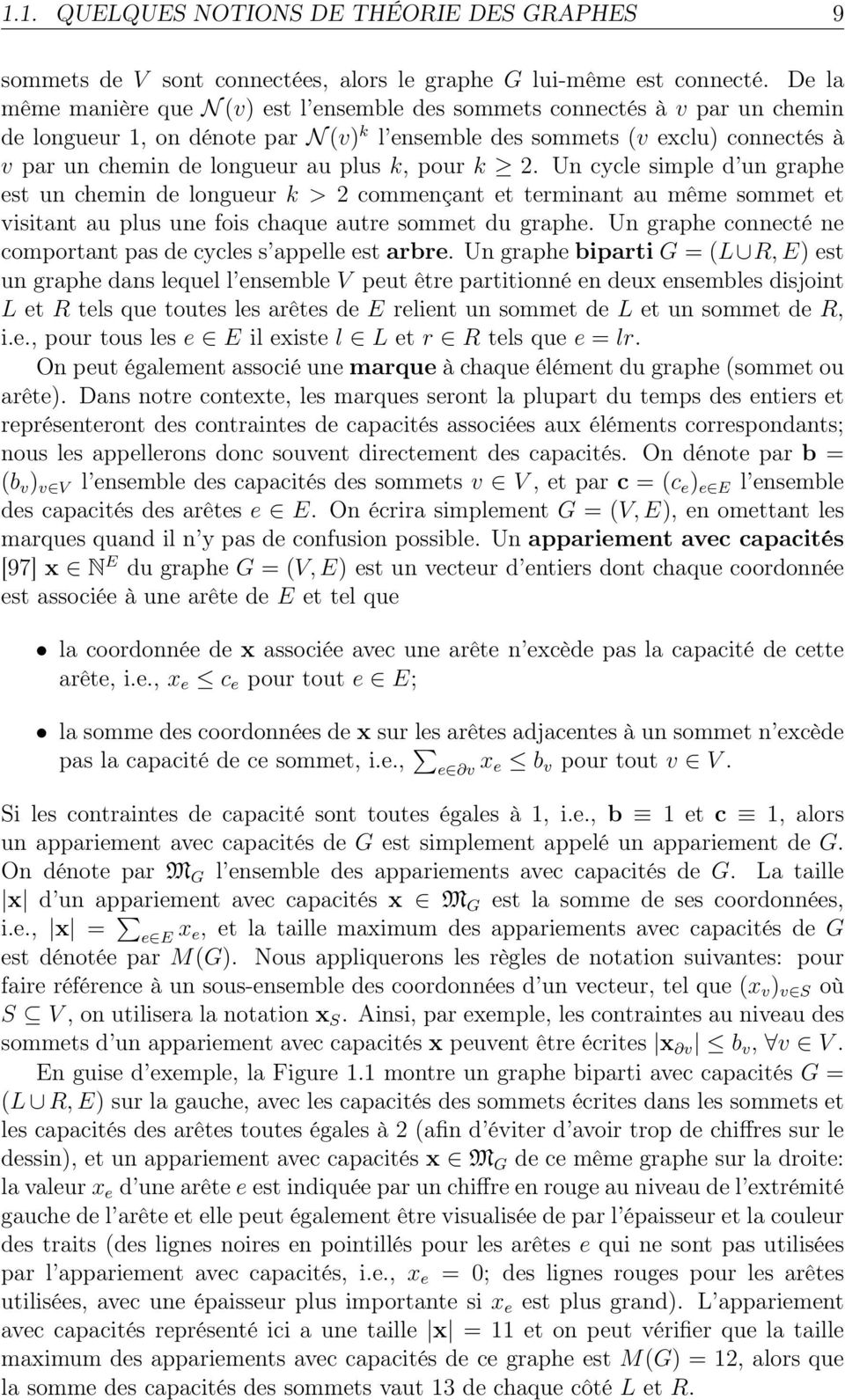
11 10 CHAPTER 1. INTRODUCTION EN FRANÇAIS Figure 1.1: Exemple de graphe et d un de ses appariements avec capacités. Dans cette thèse, on consiérera principalement de grands graphes aléatoires, dont les tailles des deux parties L = n and R = m tendent vers l infini ensemble, i.e., tels que n τm pour un certain τ > 0 fixé, alors que le nombre d arête reste de l ordre de grandeur du nombre de sommets, i.e., E = Θ( V ): c est ce que l on appelle le régime dilué. On utilisera l expression avec grande probabilité pour indiquer qu une probabilité en question tend vers 1 quand m,n. Dans ce régime, les graphes qui vont nous intéresser convergent dans un sens que nous expliquons dans la Section Convergence locale faible La notion de convergence locale faible d une suite de graphes a été introduite par Benjamini et Schramm [15] pour étudier des marches aléatoires sur des graphes planaires. Ce cadre a ensuite été formalisé par Aldous et Steele dans [5] et par Aldous et Lyons dans [4]. Parmi les travaux récents sur le sujet, on peut citer [19, 23, 22]. Une première étape est d introduire la notion de convergence locale de graphes enracinés. Un graphe enraciné (G, v) est constitué d un graphe G et d un sommet particulier v de G que l on appelle la racine. Un isomorphisme de graphes enracinés est un isomorphisme de graphe qui envoie la racine de l un vers celle de l autre, i.e., une bijection de l ensemble des sommets d un graphe vers ceux d un autre telle que la racine et les arêtes (et leurs marques) sont préservés. On dénote par [G,v] la classe d isomorphisme de (G,v) et par G l ensemble des classes d isomorphisme de graphes localement finis enracinés. Pour tout k N, on dénote par (G,v) k le sousgraphe enraciné obtenu à partir de (G,v) en ne gardant que les sommets à distance au plus k de la racine v, et on écrit [G,v] k = [(G,v) k ] pour sa classe d isomorphisme. On peut transformer G en un espace métrique complet séparable (i.e., un espace polonais) en définissant la métrique suivante: la distance entre [G,v] et [G,v ] est 1/(1+δ), où δ est le supremum des k N tels que [G,v] k = [G,v ] k. Alors, une suite de graphes enracinés ((G n,v n )) n N converge localement vers (G,v) dans G si la
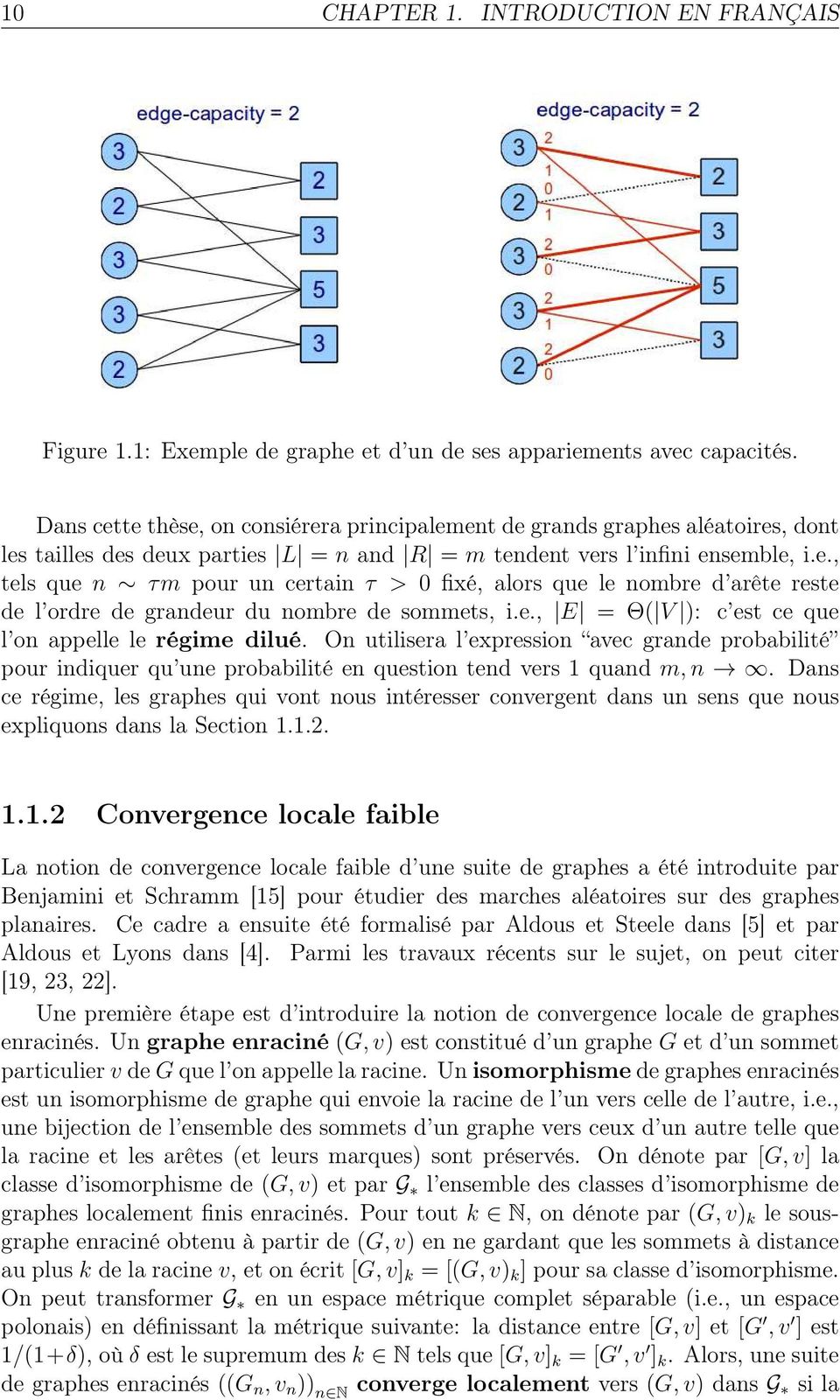
12 1.1. QUELQUES NOTIONS DE THÉORIE DES GRAPHES 11 distance entre (G n,v n ) et (G,v) tend vers 0 quand n. De manière équivalente, (G n,v n ) n (G,v) locally k N, n k tel que, n n k, [G n,v n ] k = [G,v] k. À ce stade, on rappelle qu une suite de mesures de probabilité (ρ n ) n N dans un certain espace métrique S converge faiblement vers une mesure de probabilité ρ, ce que l on dénote par ρ n ρ, si pour toute fonction bornée continue f : S R, fdρn converge vers fdρ. Comme G est un espace polonais, on peut le munir de sa tribu borélienne (e.g., [16]) et considérer l espace métrique complet séparable des mesures de probabilité sur G, que l on dénote par P(G ). La définition de la convergence faible s applique alors aux mesures de probabilités dans P(G ). De plus, étant donné un graphe fini G, il y a une façon naturelle de former une mesure de probabilité sur G : soit U(G) la distribution sur G obtenue en choisissant comme racine un sommet de G uniformément au hasard. Alors, on dit que la suite de graphes finis (G n ) n N converge localement faiblement vers la mesure ρ sur G quand la suite de distributions (U(G n )) n N converge faiblement vers ρ. Toute mesure ρ qui est la limite d une suite de graphes finis dans le sens vu audessus a la propriété qu elle est unimodulaire [5], ce que l on va maintenant définir. De la même manière que l on a défini l espace G, on définit l espace G des classes d isomorphisme de graphes localement finis avec une paire de sommets particuliers, ainsi que la topologie associée. On dit queρest unimodulaire si elle vérifie le Principe de Transport de Masse: pour toute fonction borélienne f : G [0, ], on a f(g,o,v)dρ([g,o]) = f(g,v,o)dρ([g,o]). v V On dénote par U l ensemble des mesures de probabilité boréliennes et unimodulaires surg. Pourρ U, on écritb(ρ) pour l espérance selonρde la contrainte de capacité de la racine Quelques modèles classiques de graphes aléatoires Dans cette section, on introduit le graphe aléatoire d Erdős-Rényi, qui est probablement le plus simple des modèles de graphes aléatoires, ainsi que certains modèles plus compliqués que nous utiliserons tout au long de la thèse. Nous utiliserons souvent la notation associée à une variable aléatoire pour faire en fait référence à sa distribution quand l interprétation à donner est clair d après le contexte, cela afin d éviter d introduire une notation supplémentaire pour la distribution elle-même. Le graphe aléatoire d Erdős-Rényi et l arbre aléatoire de Poisson-Galton- Watson Le graphe aléatoire d Erdős-Rényi est le plus simple et le plus étudié des modèles de graphes aléatoires. Il existe deux versions du modèle, qui furent introduite par Gilbert [54] et Erdős et Rényi [40]. Pour un ensemble de n sommets et p [0,1], on obtient un graphe aléatoire d Erdős-Rényi en incluant indépendamment avec probabilité p chaque arête parmi les ( n 2) possibles. Ainsi, pris individuellement, chaque v V

13 12 CHAPTER 1. INTRODUCTION EN FRANÇAIS sommet a un degré donné par une variable aléatoire binomiale Bin(n 1, p). Comme on s intéresse au régime dilué, on se concentre principalement sur p = p(n) λ/n quand n, pour un certain λ R + fixé. Alors, une suite de graphes aléatoires d Erdős-Rényi ( G(n,λ/n) ) de tailles croissantes admet presque sûrement une n N limite locale faible dans P(G ). Cette limite faible est la distribution de Poisson- Galton-Watson (Poisson-GW) GW(Poi(λ)), qui est concentrée sur les arbres avec espérance du nombre d enfants λ. Cette distribution fut introduite en 1873 par Galton pour étudier les arbres généalogique [110]. On peut obtenir un échantillon d arbre Poisson-GW à l aide d un processus de branchement de la manière suivante: la racine o a un nombre d enfants X donné par une variable aléatoire de Poisson de moyenne λ, i.e., P(X = k) = P(Poi(λ) = k) = λk k! e λ. Ensuite, chacun de ces enfants a également un nombre d enfants égal à Poi(λ) de manière indépendante, et ainsi de suite. L arbre enraciné obtenu de cette manière est presque sûrement localement fini. Pour une étude détaillée des processus de branchements et des graphes aléatoires, on peut se référer à [9, 107]. Une preuve détaillée de la convergence locale faible presque sûre des graphes aléatoires d Erdős- Rényi peut être trouvée dans [6, 18, 61]. Graphes aléatoires avec une distribution de degrés prescrite Le modèle d Erdős-Rényi ne dispose que d un seul paramètre que l on puisse ajuster, le degré moyen. Afin de mieux rendre compte des graphes rencontrés dans la vie réelle, il est utile d être capable de prendre en compte davantage de leurs caractéristiques et de les incorporer dans un modèle de graphes aléatoires. Le modèle dit de configuration (introduit par Gallager [48] et précisé par Bender et Canfield [14], Bollobás [17] et Wormald [115]) fait un pas dans cette direction en permettant de spécifier la distribution des degrés des n sommets du graphe. Étant donnée une distribution de degrés Φ P(N) de moyenne finie, on tire tout d abord de Φ les degrés d v pour tous les sommets v V. En partant d un graphe vide, avec ensemble de sommets V et aucune arête, on ajoute ensuite des arêtes en reliant les sommets deux à deux successivement, indépendemment et uniformément au hasard, d une manière cohérente avec la collection de degrés d = (d 1,...,d n ). Cette procédure produit quelques boucles et arêtes multiples, ce que l on peut corriger afin d obtenir soit directement un graphe aléatoire simple G(n, d) uniforme parmi les graphes avec la collection de degrés prescrite d [75] soit un graphe aléatoire simple avec une collection de degrés empirique d qui converge vers Φ quand n [26]. Dans tous les cas, une suite de tels graphes aléatoires ( G(n,d) ) (or ( G(n, d) ) ) de tailles n N n N croissantes admet presque sûrement une limite locale faible GW(Φ) P(G ), qui est la distribution de Galton-Watson unimodulaire avec distribution de degrés Φ (on peut se référer à l Exemple 1.1 de [4], et à [39] pour des preuves détaillées de la convergence). La procédure pour échantillonner un arbre unimodulaire de GW est très similaire à celle expliquée précédemment dans le cas particulier des arbres de Poisson-GW: la racine o a un nombre d enfants tiré selon Φ; cependant, tous ses descendants ont des nombres d enfants X tirés indépendamment selon la loi biaisée

14 1.2. PROBLÈMES D ÉQUILIBRAGE DE CHARGE 13 Φ P(N) donnée par: P(X = k) = Φ k = (k +1)Φ k+1 i N iφ. i Pour les applications considérées dans cette thèse, on rencontrera souvent un modèle similaire pour des graphes aléatoires bipartis G = (L R,E), dans lesquels les distributions de degrés (et de contraintes) sont différentes pour les deux parties du graphe: étant données deux distributions Φ L et Φ R pour les lois jointes pour L et pour R du degré d un sommet, de sa contrainte de capacité, et des contraintes de capacité des arêtes adjacentes, on peut échantillonner deux collections (d l,b l,c l ) l L et (d r,b r,c r ) r R spécifiant ces quantités pour chaque sommet du graphe. Dès lors que ces deux collections vérifient quelques conditions simples (la somme des degrés doit être la même dans L et dans R, et le nombre d arêtes avec une capacité donnée doit être le même vu de L et de R), on peut générer un graphe aléatoire biparti uniforme (on peut se référer à [29, 51] pour plus de détails sur ce cas biparti). Une suite de tels graphes aléatoires (G n ) n N de tailles croissantes, enracinés à un sommet de L aléatoire, et avec L n = n et R n 1 n pour un certain τ > 0 fixé, converge τ presque sûrement vers une limite locale faible dans P(G ). Cette fois, la limite locale faiblegw(φ L,Φ R ) est une distribution de Galton-Watson unimodulaire à deux étapes avec des loisφ L etφ R, et on peut obtenir un échantillon de cette distribution de manière très similaire à ce qui a été vu précédemment: les paramètres de la racine o sont tirés selon Φ L, ceux de ces descendants des générations paires et impaires sont tirés tous indépédemment selon des distributions biaisées Φ L et Φ R respectivement, conditionellement à la capacité de l arête qui relie chaque sommet à son parent. On pourra trouver plus de détail sur ce modèle dans le Chapitre 3. Dans la prochaine section, on explique plus en détail quelles sont les deux applications considérées dans cette thèse. 1.2 Problèmes d équilibrage de charge L équilibrage de charge est le fait de répartir des tâches vers différentes ressources afin d éviter que certaines ressources ne soient surchargées alors que d autres sont sous-utilisées. Cette problématique est devenue très populaire en particulier avec l émergence du calcul distribué, pour lequel utiliser de manière égale tous les processeurs disponibles permet de traiter le plus rapidement un ensemble de tâches données. Cependant, même dans un scénario simple, avec deux processeurs identiques et un grand nombre n de tâches avec des durées d exécution connues, trouver la répartition optimale des tâches vers les processeurs est un problème NP-complet, comme le montre Karp [63]. De plus, de nos jours, de nombreuses applications internet sont prises en charge par des fermes de serveurs contenant parfois des milliers de machines. Ainsi, dans beaucoup de cas, le nombre de ressources disponibles est très important. Dans cette situation, avec un très grand nombre de tâches et de ressources, les capacités de coordination du système deviennent un facteur limitant, et il est alors souvent plus important de trouver une solution simple et relativement efficace ce pour quoi des mécanismes aléatoires sont souvent utiles que de trouver

15 14 CHAPTER 1. INTRODUCTION EN FRANÇAIS une solution optimale déterministe, dont la complexité et les besoins en communication seront prohibitifs. Dans cette thèse, nous nous intéressons principalement à deux exemples d équilibrage de charge qui partagent une même abstraction: les performances dans les deux cas sont caractérisées par la taille d un appariement avec capacités dans un graphe aléatoire biaprti qui décrit les contraintes du système. Cette section introduit de manière plus formelle ces deux problèmes d équilibrage de charge et les questions principales que nous tenterons de résoudre dans chacun des cas. À chaque fois, nous mettrons en avant le lien avec les appariements avec capacités ainsi que les modèles de graphes aléatoires pertinents Hashage à choix multiples et cuckoo hashing Une table de hashage est une structure de données qui vise à stocker des objets dans un tableau de manière à pouvoir ensuite récupérer les objets de manière efficace. Le principe de base est que chaque objet (ou un descripteur associé, que l on appelle une clé) est hashé vers l index d une cellule du tableau (que l on appelle également une valeur). Cependant, parmi l ensemble des objets possibles, seul un petit nombre est présent à chaque instant, et il est alors avantageux de dimensionner le tableau en fonction de ce petit nombre d objets présents plutôt que du nombre énorme d objets possibles. L intérêt de l étape de hashage est alors qu elle permet d associer plusieurs objets au même index de cellule, avec l espoir que seul l un d entre eux sera présent à la fois; dans le cas contraire, une collision se produirait et il faudrait alors trouver un moyen de la résoudre. Les méthodes de hashage à choix multiple et la méthode du cuckoo hashing sont un moyen de résoudre de telles collisions. Le paradigme utilisé est le suivant: on considère n objets et m cellules. Dans le scénario le plus basique, on veut associer exactement une cellule à chaque objet et on veut éviter toute collision en d associant qu au plus un seul objet par cellule. Dans des versions plus complexes, on aura besoin de stocker plusieurs copies de chaque objet, et chaque cellule pourra contenir plusieurs objets à la fois, avec en plus des contraintes sur le nombre maximum de fois qu une même paire (objet,cellule) peut être utilisée. Les indicateurs de performance de ce système sont la taille de la table de hashage (i.e., le nombre de cellule du tableau) nécessaire pour stocker un certain nombre d objets, et le temps nécessaire pour insérer un nouvel objet ou récupérer un objet. La méthode de hashage à choix multiples peremt de garantir un temps constant pour récupérer un objet, et ne nécéssite qu une table de hashage de taille m proportionnelle à n avec grande probabilité. Cette stratégie consiste à prédéfinir un ensemble de d 2 cellules pour chaque objet, que l on n aura alors le droit d insérer que dans l une de ces cellules. Bien sûr, suivant les choix de ces cellules prédéfinies pour chaque objet, il sera peut-être impossible d insérer en même temps dans le tableau certains ensembles d objets, et il est possible qu il soit très long de trouver comment insérer un nouvel objet. Le premier de ces deux problèmes devient très improbable si la table de hashage contient un nombre de cellules suffisant par rapport au nombre d objets présents; de nombreux travaux cherchent d ailleurs à calculer exactement la taille de table de hashage nécessaire pour cela. En ce qui concerne le deuxième problème, la méthode du cuckoo hashing a été proposée

16 1.2. PROBLÈMES D ÉQUILIBRAGE DE CHARGE 15 Figure 1.2: Deux réalisations de graphe de hashage, la première permettant la construction d une table de hashage valide et la seconde non. par Pagh et Rodler [89] et constitue un moyen simple et aléatoire de chercher une nouvelle association valide d objets et de cellules à l arrivée d un nouvel objet: quand un nouvel objet arrive, on vérifie tout d abord si l une des cellules qui lui sont préassociées est libre, et si c est le cas il suffit d insérer l objet dans l une d elles; dans le cas contraire, on choisit au hasard l une de ces cellules pré-associées au nouvel objet et on l y insère en expulsant l objet qui y était précédemment stocké. On utilise alors la même procédure pour l objet qui vient d être expulsé (en le traitant donc exactement comme un nouvel objet). Le lecteur intéressé peut se référer à l état de l art effectué par Mitzenmacher [81] en 2009 et qui évoque de nombreuses questions ouvertes sur le sujet à cette époque. Formellement, une réalisation du problème de hashage peut être décrite par un graphe biparti G = (L R,E), que l on appelle le graphe de hashage et dans lequel L est l ensemble des n objets et R est l ensemble des m cellules. Les arêtes adjacentes à un objet l L indiquent les d cellules pré-associées à cet objet et dans lesquelles il peut être inséré. Pour représenter les versions plus complexes du problème de hashage que l on a mentionnées précédemment et dans lesquelles on doit stocker h copies de chaque objet et chaque cellule peut contenir au plus k objets à la fois, on ajoute respectivement des contraintes de capacité b L h au niveau des sommets de L (les objets) et b R k au niveau des sommets de R (les cellules); de la même manière, si l on a une contrainte s sur le nombre maximum de fois qu une même paire (objet,cellule) peut être utilisée, on peut en tenir compte en ajoutant des contraintes de capacité c s au niveau des arêtes du graphe. Remarquons que le nombre minimum de copies h pour chaque objet est modélisé ici par une contrainte de capacité b L dans le graphe de contraintes; cela sera nécessaire pour établir un lien entre la faisabilité d une instance du problème de hashage et la taille maximum des appariements avec capacités dans le graphe de hashage correspondant. Afin
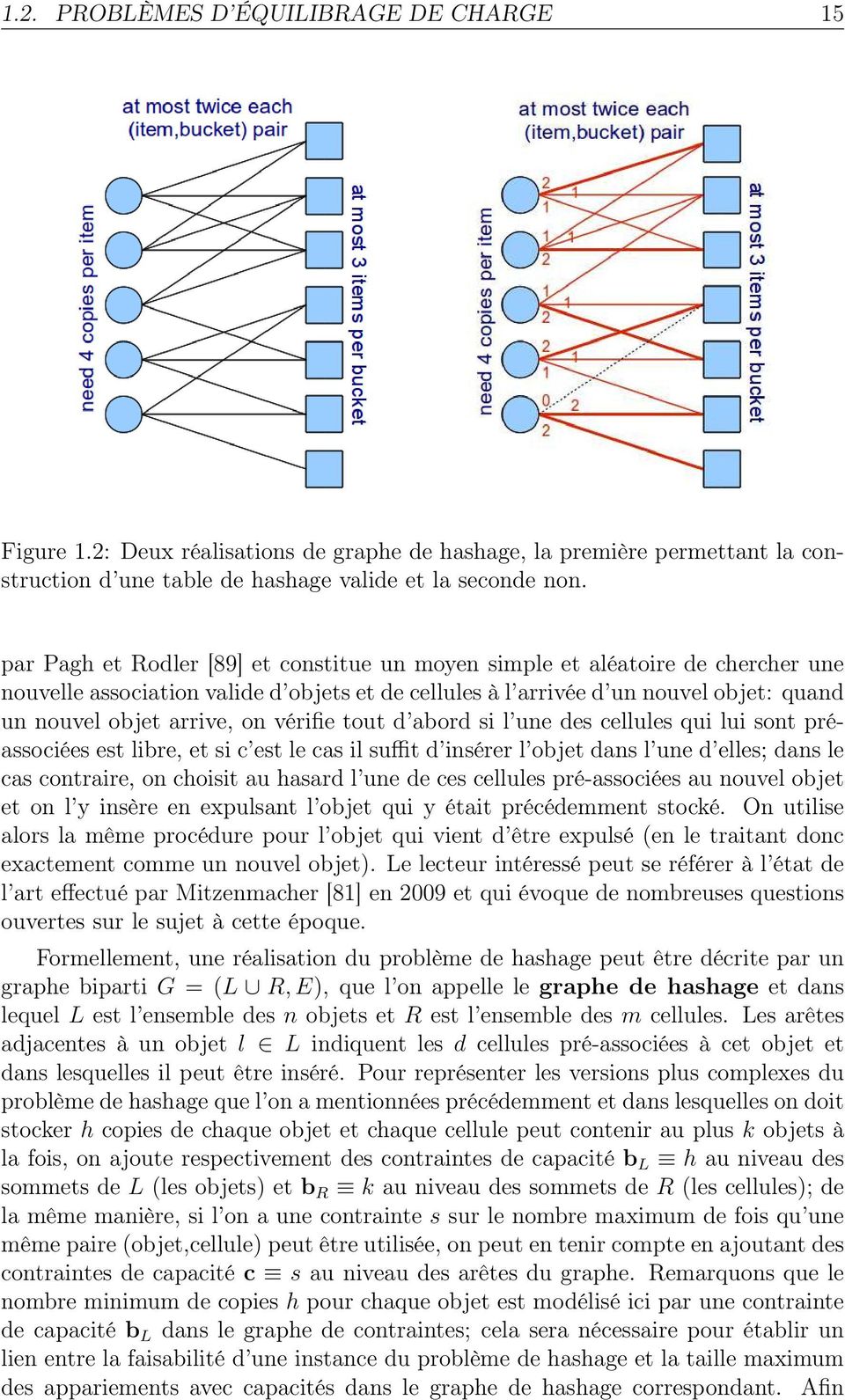
17 16 CHAPTER 1. INTRODUCTION EN FRANÇAIS d illustrer ce scénario de hashage, la Figure 1.2 montre deux exemples de graphes de hashage, dans lesquels les objets sont représentés à gauche et les cellules à droite. Tous les paramètres ont les mêmes valeurs dans les deux réalisations, i.e., les degrés d = 3 sont identiques pour les objets, chaque objet doit être sotckéh = 4 fois, chaque cellule peut stocker k = 3 objets et chaque paire (objet,cellule) peut être utilisée au plus deux fois. On peut constater que les deux graphes représentés ne diffèrent que par une seule arête (celle entre les sommets centraux de chaque côté dans la figure de droite) et cependant il est impossible de construire une table de hashage valide à partir du graphe de hashage de gauche alors que l on a mis en évidence une telle table de hashage valide dans celui de droite (en utilisant les mêmes notations que pour les appariements avec capacités dans la Figure 1.1). Un graphe G fixé ne représente qu un choix particulier pour les cellules prédéfinies pour chaque objets. En théorie, ces cellules prédéfinies sont choisies à l aide de d fonctions de hashage indépendantes pour chaque objet, et l on suppose que l on s assure que chaque objet a bien d cellules pré-associées distinctes. Cette procédure donne pour chaque objet un ensemble de cellules pré-associées qui est un sousensemble de taille d choisi uniformément au hasard parmi tous ceux de l ensemble des cellules et qui est indépendant de ceux des autres objets. Alors, le graphe de hashage G n,m est en fait un graphe aléatoire biparti avec un degré constant d pour les sommets de L et Poi(dn/m) pour ceux de R. Comme décrit dans la Section 1.1.3, le graphe de hashage G n,m converge presque sûrement localement faiblement vers un arbre de Galton-Watson unimodulaire à deux étapes quand la taille du système tend vers l infini avec n τm. Dans ce cadre, la question principale que l on tente de résoudre concerne la taille de table de hashage nécessaire pour stocker n objets choisis au hasard. On a déjà mentionné que le nombre de cellules m requis est proportionnel à n avec grande probabilité. Le problème est alors de calculer précisément le seuil de proportionnalité τ = τ d,h,k,s tel que, si n = τm avec τ < τ, dans la limite où m,n la méthode de cuckoo hashing permettra de construire une table de hashage valide avec grande probabilité. Avant de passer à la prochaine application, nous allons tenter de donner un peu d intuition sur pourquoi cette méthode de hashage fonctionne bien. Le cuckoo hashing (et plus généralement les méthodes de hashage à choix multiples) repose sur un principe appelé le pouvoir de deux choix: oublions pour le moment la contrainte que chaque cellule a une capacité de stockage limitée et supposons que l on veut lancer les n objets comme si c était des balles dans les m cellules (avecm = n pour simplifier encore davantage) avec l objectif de minimiser le nombre maximum d objet dans une même cellule. La manière de procéder distribuée la plus simple est de jeter les objets totalement au hasard dans les cellules. Cela donne que chaque cellule contient en logn loglogn espérance un objet, et la cellule la plus chargée contient approximativement objets avec grande probabilité [55]. Cependant, il existe un autre moyen distribué très simple qui permet d obtenir une amélioration d ordre exponentiel par rapport à cette méthode basique, à la seule condition que l on jette les objets les uns après les autres: pour chaque objet, on choisit d 2 cellules au hasard et on jette l objet dans la cellule la moins remplie parmi les d. Cette méthode permet d obtenir une charge maximale de loglogn + Θ(1) objets avec grande probabilité, comme l on mon- log d

18 1.2. PROBLÈMES D ÉQUILIBRAGE DE CHARGE 17 tré Azar, Broder, Karlin et Upfal [10], et ce résultat est connu en tant que pouvoir de (au moins) deux choix (on peut se référer à [83] pour état de l art des méthodes utilisées pour montrer ce type de résultats et les applications qui en découlent). À haut niveau, dans le contexte du hashage, le terme loglogn qui croit très lentement avec n nous indique que des cellules avec une capacité fixée ne seront que rarement surchargées, et dans ce cas la méthode du cuckoo hashing entrera en jeu pour essayer de ré-arrenger les objets pour obtenir une table de hashage valide. La prochaine section concerne les réseaux de distributions de contenus distribués. Pour plus d explications sur le hashage, le lecteur peut aller voir au chapitre correspondant de cette thèse (Chapitre 4) Réseaux de distribution de contenus distribués D après Cisco [31], la quantité de trafic multimedia dont une grande partie est constitué de contenus vidéo transporté chaque mois par Internet est de nos jours est de l ordre des exaoctets (10 18 ) et est en rapide augmentation. La majeur partie de ce trafic est pris en charge par des réseaux dediés appelés des réseaux de distributions de contenus (CDNs, pour content distribution networks). Une architecture centralisées pour distribuer les contenus ne semble pas être une solution viable sur le long terme, car de nombreux contenus ont de fortes contraintes de délai qui nécessiteraient des quantités de bande passante très importante pour pouvoir être respectées dans le cadre d un service fourni depuis une grande ferme de serveurs située dans le cœur du réseau vers des utilisateurs finaux au bord du réseau. Par conséquent, la plupart des grands CDNs ont plutôt adopté une architecture distribuée, en profitant des coûts relativement bas de l espace mémoire pour déployer de nombreux serveurs et de plus petites fermes de serveurs au sein de plusieurs réseaux (on peut se référer à [37] pour une description des nombreux défis associés avec la nature distribuée de cette architecture et rencontrés par le CDN Akamai). Ce mouvement vers un stockage distribué des contenus est également visible au travers de l approche des réseaux dite centrée sur les contenus, qui a été initiée par [88] et qui repose sur la prise de conscience que plus de 90% du trafic Internet est lié à la dissémination de contenus et que le stockage distribué peut apporter d énormes gains dans ce contexte. Ce point de vue préconise qu un Fournisseur d Accès Internet (FAI) crée un réseau de caches en disséminant de petits points de stockage dans son réseau e.g., en les attachant aux routeurs, ce qui permet ensuite de stocker les contenus lorsqu ils sont acheminés vers les utilisateurs finaux afin qu ils puissent ensuite être récupérés dans des points de stockage plus proches si le même contenu est à nouveau demandé dans le voisinage. On remarque que cette approche requière la coopération des FAI pour déployer un CDN distribué, ce qui n est pas forcément acquis si l entité qui veut déployer le CDN et le FAI sont distinctes. Par ailleurs, il n est pas encore clair à l heure actuelle comment un tel réseau de caches doit être organisé pour fonctionner de la manière la plus efficace. Un autre point de vue sur ce problème consiste à regarder ce qui se fait dans les systèmes pair-à-pair (P2P pour peer-to-peer), qui sont devenu incroyablement populaires pour l échange de fichiers par Internet depuis que Napster a été crée en 1999 et avec BitTorrent représentant maintenant plus de ce trafic. L avantage de ce type de systèmes est

19 18 CHAPTER 1. INTRODUCTION EN FRANÇAIS leur grande capacité à passer à l échelle et leur faible coût, du fait que les utilisateurs qui veulent bénéficier du service doivent également participer et servir de ressource au système. Cependant, de tels systèmes ont des difficultés à fournir des garanties en terme de qualité de service, en particulier pour les contenus ayant des contraintes de délai fortes tels que la Vidéo-à-la-demande (VoD pour video-on-demande) par exemple, du fait que les utilisateurs du systèmes ont un comportement incontrôlé et imprévisible (on peut toutefois noter que certains systèmes de P2P ont essayé de fournir ce type de service, e.g., PPLive). Afin de servir à grande échelle des contenus avec des contraintes de délai fortes, il est assez tentant d essayer de combiner les deux approches mentionnées au-dessus, en ayant une (petite) ferme de serveurs assistée par de nombreux appareils déployés directement chez les utilisateurs finaux, e.g., des set-top boxes ou des triple-play gateways (e.g., comme proposé dans NaDa [106] et dans le People s CDN). En effet, le fait d utiliser des ressources (espace de stockage et bande passante) déjà présentes au bord du réseau offre un potentiel de viabilité et de passage à l échelle important et permet d atteindre une réduction des coûts du service et de meilleures performances de base, alors que la présence d une ferme de serveurs centrale fournit des garanties de qualité de service. On appelle un tel système hybride, constitué d une ferme de serveurs centrale assistée par de nombreux appareils (que l on appelle des serveurs) situés au bord du réseau, un CDN distribué. Il est important d insister sur le fait que dans ce modèle les serveurs ont des capacités très limitées, ce qui fait que de nombreux appareils de faible coût et déjà présents peuvent remplir ce rôle. Dans un CDN distribué, comme les petits serveurs ont principalement pour rôle de réduire le coût de fonctionnement du système, il est intuitif que l on voudrait les solliciter le plus souvent possible et ne diriger des requêtes vers la ferme de serveurs qu en dernier recours. Pour cette raison, il est utile de se concentrer sur la partie du système consitutée des petits serveurs et d en analyser séparément les performances, afin de comprendre ensuite les performances globales du système et d en déduire l organisation à adopter. Comme on s intéresse ici à des contenus ayant des contraintes de délai fortes (dans le cadre par exemple d un système de streaming vidéo), on ne peut pas se permettre de mettre des requêtes en attente même si aucun serveur n est disponible quand elles arrivent. En conséquence, de tels requêtes doivent être dirigées vers la ferme de serveurs et on peut les considérer comme ayant été perdues pour les petits serveurs. Il est donc raisonable d adopter un modèle de réseau à pertes ([64]) pour le sous-système constitué des petits serveurs, par opposition aux modèles dit de files d attente, dans lesquels des questions similaires ont déjà été considérées par exemple dans [7]. Le but de l analyse du système constitué des petits serveurs est de permettre ensuite de dimensionner de manière adéquate la ferme de serveurs afin d atteindre un objectif donné au niveau des performances globales du système. On pourrait d ailleurs imaginer que cette ferme de serveurs n est pas détenue directement par l entité qui déploierait le CDN distribué, mais serait simplement prise en charge par un service de cloud, ce qui permettrait notamment d adapter en temps réel la quantité de service requise de ce service de cloud afin de satisfaire la demande immédiate. L efficacité du système constitué des petits serveurs dépend de manière critique de deux facteurs principaux:

20 1.2. PROBLÈMES D ÉQUILIBRAGE DE CHARGE 19 Figure 1.3: Graphe contenus-serveurs, ainsi qu un exemple appariement. la façon dont les contenus sont répliqués au sein des serveurs, ce qui revient en grande partie à déterminer combien de copies d un même contenu doivent se trouver dans le système, et la façon dont les requêtes sont dirigées vers des serveurs possédant une copie du contenu demandé. Ces deux politiques sont appelés respectivement les stratégies de replication et d appariement. On peut remarquer que ce deuxième problème est en fait un problème d équilibrage de charge, dans lequel les tâches sont les requêtes pour les contenus et il faut les associées à des serveurs stockant les contenus demandés. Quand au problème de réplication, il consiste à jouer avec les contraintes du problème d équilibrage de charge en modifiant les ensembles de ressources qui sont autorisés pour chaque tâche particulière; on appelle ce problème un problème de répartition de ressources. Dans l idéal, il faudrait traiter de front les deux problèmes, cependant ce serait probablement un objectif trop ambitieux pour l instant. On se contentera donc plutôt de traiter du cas de deux solutions particulières du problème d appariement: une solution optimale, qui n est peut-être pas faisable en pratique mais permet d obtenir des bornes supérieures sur les performances du système, et une solution aléatoire gloutonne, qui est au contraite particulèrement simple et est certainement faisable en pratique et permet plutôt d obtenir des bornes inférieures sur les performances que l on peut attendre d un tel système. La comparaison des résultats obtenus pour ces deux politiques, qui sont en un sens extrème pour ce système, devrait permettre de comprendre fondamentalement les performances d un tel système de CDN distribué et comment l organiser. Une fois que les performances de la stratégie d appariement seront bien comprises, on pourra se tourner vers le problème de répartition de ressource et essayer de trouver la politique de réplication optimale, au moins dans des régimes asymptotiques tels que quand la capacité de stockage des petits serveurs augmente. On peut trouver plus de détails sur les réseaux de distribution de contenus distribués dans le Chapitre 5. Afin de présenter les choses de manière plus concrète pour le lecteur et de rendre plus claire la connection avec les appariements avec capacités et les modèles de
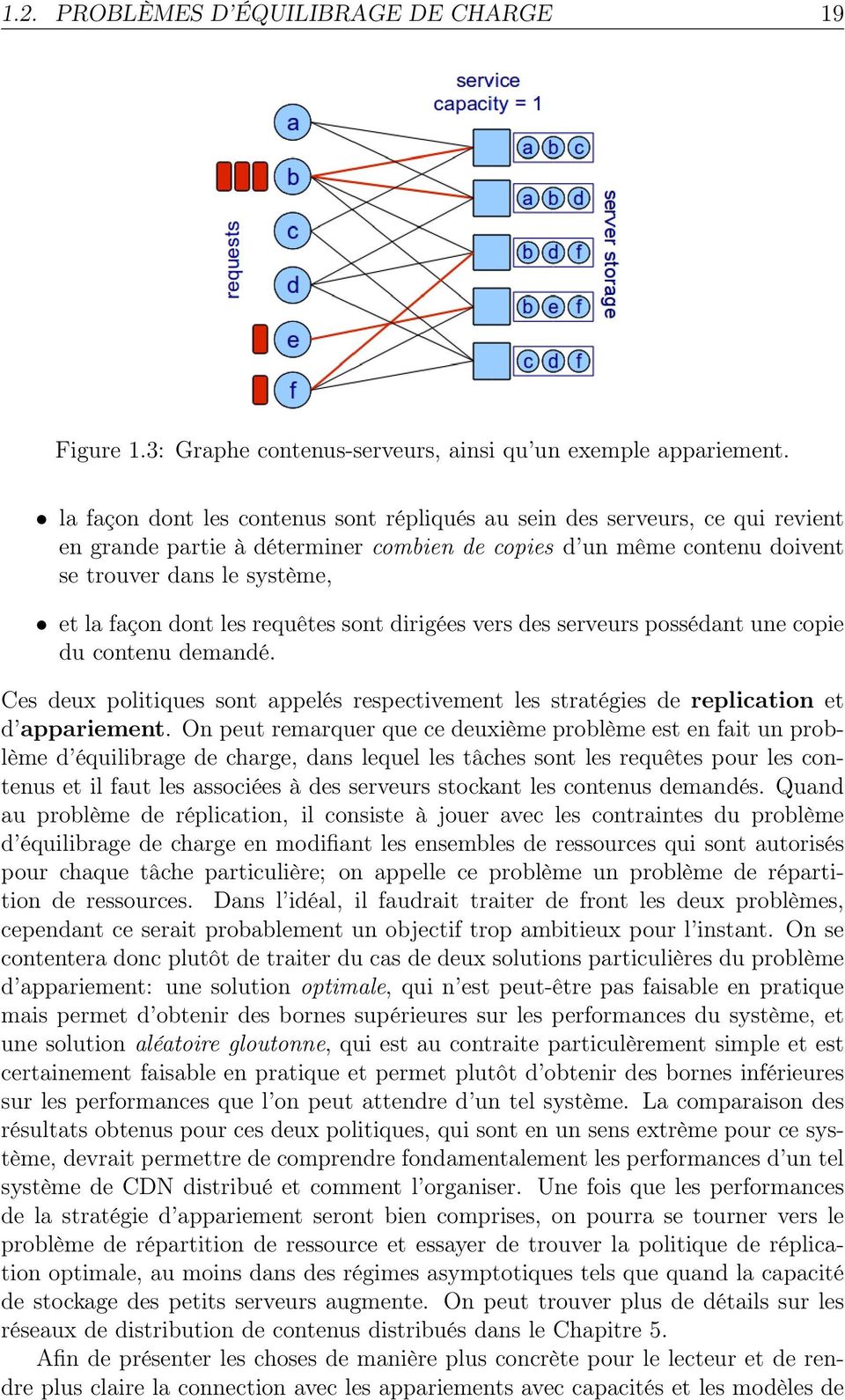
21 20 CHAPTER 1. INTRODUCTION EN FRANÇAIS graphes aléatoires introduits précédemment, nous allons maintenant décrire succintement le modèle de CDN distribué. Dans ce modèle, une ferme de serveurs est assistée par un grand nombre m de petits serveurs. Un aspect important de ce modèle est qu il prend en compte les contraintes de base d un système réaliste, en particulier en ce qui concerne les capacités limitées des serveurs (en terme à la fois d espace de stockage, de bande passante et de coordination) et la façon dont les requêtes sont traitées, i.e., la politique d appariement. Nous travaillerons la plupart du temps sur une version simplifiée du modèle, dans laquelle tous les contenus ont la même taille (et on ne peut pas les scinder afin de les servir de manière parallèle), et chaque serveur peut stocker un nombre d fixé de contenus et servir une unique requête à la fois. L information de quel serveur stocke quel contenu est représentée par un graphe biparti G = (S C,E), où S est l ensemble des serveurs, C celui des contenus, et il y a une arête dans E entre un contenu c et un serveur s si s stocke c (et peut donc potentiellement servir des requêtes pour c). Les contenus ont différentes popularités, données par leurs taux d arrivées de requêtes respectifs λ c, et le service de chaque requête prend un temps exponentiel de moyenne 1. Cela donne un nombre de requêtes R c pour chaque contenu c qui est une variable aléatoire de Poisson Poi(λ c ) à tout instant, indépendamment des autres contenus. À chaque instant, l appariement entre les serveurs et les contenus forme un appariement avec capacités du graphe G (avec des contraintes de capacité R c au niveau des contenus et 1 pour tous les serveurs). La Figure 1.3 illustre cette situation et montre un exemple de graphe contenus-serveurs, dans lequel les contenus sont à gauche et les serveurs à droite. Les requêtes sont représentées par des rectangles rouges à côté des contenus correspondants et les contenus stockés par chaque serveur sont représentés à sa droite. Si les serveurs sont en train de servir les contenus comme indiqué par les arêtes en rouge, alors l une des requêtes pour le contenu b doit être servie par la ferme de serveurs. En raison du manque de coordination entre les serveurs, il n est vraisemblablement pas raisonnable de vouloir déterminer de manière trop précise la constitution jointe de tous les espaces de stockage du système. Ainsi, dans le meilleur des cas, on supposera que l on peut spécifier un nombre de répliques D c pour chaque contenu c, et les serveurs feront alors des choix aléatoires pour constituer leurs espaces de stockage de manière appropriée. Le graphe G est alors un graphe aléatoire biparti avec une suite de degrés prescrite pour les contenus. Dans le pire des cas, très peu d information a priori est disponible sur les contenus, qui sont simplement regroupés en K classes de tailles α 1 n,...,α K n, et les serveurs ont des préférences de stockage sous la forme d une distribution π P({1,...,K}) sur les différentes classes de contenus. Ils effectuent alors des choix indépendents pour chacun de leurs espaces de stockages et choisissent un contenu au hasard selon π. Cela résulte en un graphe G qui est un graphe aléatoire biparti avec une distribution de degrés prescrite Poi(dmπ k /nα k ) pour les contenus de chaque classe k. Dans ce deuxième cas, les graphes aléatoires considérés admettent pour limite locale faible un arbre de Galton-Watson unimodulaire à deux étapes, comme décrit dans la Section Cependant, si la suite de degrés elle-même est prescrite, alors il faut imposer des conditions supplémentaires sur cette suite pour que le graphe puisse converger. La prochaine section explique les bases de la méthode de la cavité, que l on utilise
22 1.3. INTRODUCTION À LA MÉTHODE DE LA CAVITÉ 21 comme outil pour l étude de l équilibrage de charge dans cette thèse. 1.3 Introduction à la méthode de la cavité Contexte La méthode de la cavité a été proposée en 1985 par Mézard, Parisi et Virasoro [79] (on peut se référer également à [77, 78]) pour étudier les verres de spin en physique statistique et plus généralement les systèmes désordonnés (dans notre cas particulier, les graphes aléatoires en régime dilué). L objectif est généralement de calculer diverse quantités algébriques, combinatoriales ou probabilistes lorsque la taille du système augmente. Dans de nombreux scénarii, une heuristique raisonnable consiste à supposer que l asymptotique des quantités considérées ne dépend que de la géométrie locale des graphes et que les corrélations à longue distance sont négligeables. Quand cette supposition se vérifie, cela a les conséquences suivantes: tout d abord, les quantités que l on veut calculer peuvent être approximées de manière efficace par des algorithmes distribués à base de propagation de messages; ensuite, ces quantités sont continues par rapport à la convergence locale faible et leur limite peut être définie directement sur la limite locale faible des graphes, et parfois même calculée explicitement. Pour ne citer que quelques applications de la méthode de la cavité: sur le plan pratique, cette approche a mené à l algorithme de survey-propagation pour résoudre les problèmes de satisfaction de contraintes ([80, 25, 74]), à la conception de codes LDPC efficaces [93] et à des algorithmes d approximation polynomiaux en temps pour de nombreux problèmes d énumération et de décision (e.g., )[112, 13, 50, 11, 49]); et sur le plan théorique, au calcul de la limiteζ(2) dans le problème d affectation [2], à l énumération asymptotique des arbres couvrants dans les grands graphes [73], au calcul des transitions de phase dans les problèmes de coloriage de graphe [86, 118]. Pour une présentation plus complète de la méthode de la cavité elle-même, le lecteur intéressé pourra se référer par exemple à [5, 4] ou [34, 76] La méthode de la cavité Nous présentons ici une introduction rapide à la méthode de la cavité, qui est suffisante pour la compréhension des principes de bases et des problèmes rencontrés dans cette thèse. Soit S un ensemble d éléments. On considère les configurations simples sur S, i.e., les vecteurs dans {0,1} S. Supposons également qu à chacune de ces configurations x est associée une énergie U(x) (aussi appelée hamiltonien). Si U(x) = +, on dira que x est interdit; si au contraire U(x) <, alors x est une configuration autorisée ou admissible. Considérons maintenant un paramètre β > 0 et la distribution de Gibbs µ suivante sur les configuration sur S: µ(x) = e βu(x) Z(β), (1.1)
23 22 CHAPTER 1. INTRODUCTION EN FRANÇAIS où Z(β) = x e βu(x) est un facteur de normalisation appelée fonction de partition. En physique, le paramètre β joue le rôle de l inverse d une température, i.e., β = 1/T, et la distribution µ indique la probabilité qu un système de particules soit dans un état particulier étant donné que les intéractions entre particules se font selon des dynamiques locales, qui dépendent de l énergie. L espérance de l énergie E[U(X)] = xu(x)µ(x) peut être calculée à partir de la formule suivante: E[U(X)] = β logz(β), et l entropie de la distribution H(β) = E[ logu(x)] à partir de H(1/T) = T logtz(1/t). Ces quantités peuvent donc toutes deux être obtenues à partir de la fonction de partition Z(β), par exemple, ou à partir de la fonction d énergie libre F(β) = 1 β logz(β). Afin de fournir une motivation plus concrète au calcul de l espérance de l énergie et de l entropie de la distribution de Gibbs, nous allons décrire brièvement deux exemples dans lesquels ces quantités sont plus facilement interprétables. Le premier exemple concerne les appariements dans les graphes et une version plus complexe de ce problème est l objet du Chapitre 3. Soit S l ensemble des arêtes d un graphe fini (on écrira d ailleurs plutôt S = E) et V l ensemble des sommets de ce graphe. Supposons que l énergie U prenne la forme suivante: U(x) = x v V log1( x v 1), de manière à ce que U(x) = x si x est un appariement de G, et U(x) = + sinon et x est alors une configuration interdite. Alors, µ est une distribution sur les appariements de G qui pondère chaque appariement x de manière proportionelle à e β x. Quand β, la distribution µ se concentre sur les appariements de taille maximum de G, si bien que l espérance de l énergie à température T = 0 donne la taille maximum des appariements de G, alors que l entropie de µ est liée au nombre d appariements de taille maximum de G: lim β E[U(X)] = minu(x) = max x lim β H(β) = log argmin x U(x). x M G x = M(G), Le second exemple que l on donnera ici lié au problème de coloriage de graphes. Supposons que l on veuille déterminer si les sommets d un graphe G = (V,E) sont coloriable en utilisant q couleurs, de manière à ce que deux sommets adjacents ne soient jamais de la même couleur. Cette fois, l ensemble S désigne l ensemble des sommets du graphe G (et on écrira S = V ) et U compte le nombre d arête dont les deux extrémités ont la même couleur: U(x) = uv E1(x u = x v ) for x {1,...,q} V.
24 1.3. LA MÉTHODE DE LA CAVITÉ 23 Si l espérance de l énergie à température T = 0 est égale à 0, alors le graphe est q-coloriable et la limite lim β H(β) correspond au nombre de q-coloriages valides du graphe G; sinon, le graphe n est pas q-coloriable. En général, le calcul de la fonction de partition d un système est NP-difficile. La méthode de la cavité vise essentiellement à calculer cette fonction quand la fonction d énergie U est une somme de contributions locales et quand le problème a une structure arborescente: supposons que U(x) = a A U a(x a ), où A est une collection de sous-ensembles de S et x a = (x v ) v a, et que le graphe biparti G = (S A,E) est un arbre, où va E si v a. Ce graphe est le graphe des facteurs, et les sommets de S (resp. A) sont appelés les variables (resp. facteurs). Alors, l algorithme de propagation de croyance (BP pour belief-propagation) ou algorithme de Bethe- Peierls [90, 91] (connu également sous le nom d algorithme somme-produit) permet de calculer la valeur de Z(β) de manière itérative: soit ψ a (x a ) = e βua(xa), de manière à ce que µ(x) = 1 Z(β) a A ψ a(x a ), et soit o un facteur arbitraire dans A; alors Z(β) = a (x a ) = x a Aψ ψ o (x o ) ν v o (x v ), x o v o où les messages ν entre une variable v et un facteur a voisin sont définis par ν v a (x v ) = ν b v (x v ), b a, v b ν a v (x v ) = x a\v ψ a (x a ) u a\v ν u a (x u ). Les messages peuvent être initialisés correctement au niveau des feuilles de l arbre G et ensuite calculés de manière itérative en remontant l arbre jusqu à la racine o. Il sera par la suite plus simple d utiliser des messages normalisés η ν tels que x v η v o (x v ) = 1 = x v η o v (x v ). Ils sont définis par les équations suivantes, que l on appellera les équations de mise-à-jour de BP: η v a (x v ) = η a v (x v ) = b a, v b η b v(x v) yv b a,, v b η b v(y v) x ψ a\v a(x a) u a\v ηu a(xu). y ψa(ya) u a\v ηu a(yu) (1.2) Notons également que l on peut obtenir les probabilités marginales de µ au niveau du facteur o à partir des messages η de BP incidents en o: µ(x o = x o ) = ψ o(x o ) Z(β) v o ν v o (x v ) = ψ o(x o ) v o η v o(x v ) y o ψ o (y o ) v o η v o(y v ) On peut ensuite définir les contributions locales de chaque sommet à la fonction de partition Z(β) et à l énergie libre F(β), qui sont calculé à partir uniquement des messages incidents à chaque sommet: z v = x v a v η a v(x v ), z a = x a ψ a (x a ) v a η v a(x v ), z av = z va = x v η a v (x v )η v a (x v ) for va E, (1.3)
25 24 CHAPTER 1. INTRODUCTION EN FRANÇAIS et f v = T logz v, f a = T logz a, et f av = T logz av. Alors, v Z(β) = z v a z a a,v z, av F(β) = v f c + a f a a,v f av. Dans des graphes G qui ne sont pas des arbres, la convergence de la procédure itérative de propagation de messages (1.2) qui calcule les messages normalisés η de BP et la pertinence des éventuels messages limites dépend de l initialisation de la procédure. En général, il n est même pas clair que cette procédure convergera. Cependant, dans le but d expliquer intuitivement l intérêt de la méthode utilisée, on supposera que la procédure de BP converge sur les graphes considérés, bien qu en pratique cette question ne puisse pas être laissée de côté. Concentrons-nous également sur le cas où, quand la taille du système augmente, le graphe G = (S A,E) converge localement faiblement vers une distribution ρ concentrée sur les arbres unimodulaires. Alors, à condition que les correlations entre messages de BP s atténuent suffisament vite avec la distance dans le graphe, ce qui se traduit par des propriétés de continuité vis-à-vis de la convergence local faible, la distribution limite des messages η de BP incidents à une racine de G choisie au hasard peut s obtenir directement à partir de ρ: c est la distribution des messages incident à la racine de ρ. De plus, comme ρ est concentrée sur les arbres unimodulaires, les quantités qui nous intéressent (e.g., la distribution marginale de µ autour de o et les contributions locales (1.3) de o) peuvent être calculées à partir des messages de BP incidents à la racine de ρ. Cela permet de définir un objet limite pour la mesure de Gibbs et la fonction de partition directement sur la limite locale faible des graphes, à l aide d un ensemble infini d équations locales. Finalement, quand la limite locale faible est une distribution de Galton-Watson ρ = GW pour des lois de degrés données comme c est le cas pour les modèles de graphes aléatoires qui nous intéressent ici, alors les équations locales se simplifient en des équations récursives en distribution, qui peuvent parfois être résolues explicitement et donner une formule explicite pour les quantités à calculer (on peut se référer pour une explication plus détaillée à l état de l art d Aldous et Bandyopadhyay [3]). 1.4 Aperçu des résultats Dans cette section, nous présentons un résumé des problèmes regardés dans cette thèse, d une partie de l état de l art pertinent, et des résultats obtenus dans cette thèse Appariements avec capacités de taille maximum via la méthode de la cavité La méthode de la cavité a été utilisée avec succès pour de nombreux problèmes en informatique, en combinatoire et en physique statistique. Comme nous l avons
26 1.4. APERÇU DES RÉSULTATS 25 expliqué, cette méthode implique généralement l algorithme de propagation de messages Belief-Propagation afin de calculer les marginales de distributions de probabilité. Belief-Propagation lui-même a été étudié dans de nombreux contexte, où on a pu observé que cet algorithme converge en général rapidement vers des limites pertinentes [117, 74]. Bien que des conditions suffisantes existent pour que BP converge et que sa limite soit correcte et que l on comprenne de mieux en mieux ce qui peut faire qu il échoue [103, 58, 59, 85], il n y a que peu de problèmes spécifiques où l on puisse prouver rigoureusement la convergence de BP et l unicité de ses points-fixes lorsque le graphe sous-jacent n est pas un arbre [111, 52, 12]. La question de la convergence de BP vers un unique point-fixe peut-être résolue lorsque le problème spécifique regardé possède une propriété d atténuation des corrélations, qui signifie que l impact d une portion lointaine du système est négligeable, ce qui implique une continuité vis-à-vis de la convergence locale faible. Cependant, dans de nombreux cas, cette propriété d atténuation des corrélations n est pas vérifiée à basse température (ou seulement à température nulle) une situation descrite en tant que brisure d ergodicité et alors de multiples points-fixes peuvent exister pour les équations de BP. Cette situation se produit en particulier pour l énumération des appariements de taille maximum [119]. Afin de contourner cet écueil, il est parfois possible d utiliser la méthode de la cavité à température positive puis de prendre la limite quand T 0 (i.e., β ). Dans le cas des appariements ainsi que dans certaines de ses extensions [21, 96, 70], des arguments de monotonie et d unimodularité assurent la convergence de BP vers un unique pointfixe et permettent également de prendre la limite quand T 0: en particulier, l opérateur qui effectue la mise-à-jour des messages de BP sortants des sommets à partir des messages entraints (Equations (1.2)) est décroissant; en partant de plus petit jeu de messages initiaux possible, cela conduit à la construction d une suite de messages de BP convergence, car les sous-suites correspondant aux itérations paires et impaires sont adjacentes. Les notions de monotonie pertinentes ont été identifiées précisément par Salez [96] et sont liées à la théorie de la dépendance négative entre mesures, dont l étude a été initiée par Pemantle [92]. De telles propriétés de dépendance négative sont clairement définie dans le cas où le problème posé concerne des valeurs binaires au niveau de chaque arête du graphe, ce qui a pour conséquence que les messages de BP associés sont des scalaires. Ainsi, on peut calculer l asymptotique de la taille maximum des appariements de graphes G n = (L n R n,e n ) qui convergent localement faiblement vers des arbres de Galton-Watson unimodulaires à deux étapes GW(Φ L,Φ R ) à l aide d une formule de la forme suivante: lim n 1 L n M(G n) = M(Φ L,Φ R ) = inf q [0,1] { F L (q), q = g L g R (q) }, où F L est une fonction qui calcule la contribution locale à un appariement de taille maximum autour de la racine de l arbre de Galton-Watson, et g L et g R sont les espérances des opérateurs de mise-à-jour de BP pour des sommets dans L et R respectivement, si bien que q = g L g R (q) est l équation de point-fixe de BP à deux étape. On ne donnera pas ici l expression exacte des différentes fonctions impliquées, car ces expressions sont assez compliquées et ne sont pas très informatives. Motivés notamment par les deux applications considérées dans cette thèse et également par l idée générale que de nombreux problèmes pourraient nécessiter de
27 26 CHAPTER 1. INTRODUCTION EN FRANÇAIS telles extensions, nous souhaitons étudier le cas où les capacités des arêtes ne sont pas unitaires dans le problème des appariements avec capacités de taille maximum. Cela implique nécessairement d utiliser des messages vectoriels pour BP. Le principal obstacle ici est que les messages de BP représentent maintenant des distributions sur des entiers, et qu il n est pas clair quel ordre stochastique doit être utilisé pour les comparer puisque P(N) n est pas totalement ordonné (contrairement au cas où les capacités d arêtes sont unitaires). Néanmoins, nous montrerons que des propriétés de monotonie similaires au cas scalaire sont vérifiées lorsque l on utilise l ordre stochastique des ratios de vraisemblance décalés vers le haut (lr pour upshifted likelihood ratio) pour comparer les messages de BP: soient m,m P(N) deux distributions sur les entiers, l ordre lr est défini par m lr m si m(i+k +l)m (i) m(i+l)m (i+k), i,k,l N. En particulier, l opérateur de mise-à-jour de BP est décroissant pour cet ordre stochastique, et on peut obtenir des résultats de convergence similaires au cas scalaire. On peut noter au passage que les propriétés de monotonie souhaitées ne sont pas vérifiée pour l ordre stochastique le plus standard: l ordre stochastique fort. La particularité de l ordre lr qui est primordiale ici est sa préservation vis-à-vis du conditionement sur n importe quel intervalle, ce qui est caractéristique des ordres stochastiques conditionnels uniformes (ou ucso, pour lequel on peut se référer à Whitt [113, 114]). Intuitivement, une telle propriété de préservation est nécessaire pour qu une propriété locale (l opérateur de mise-à-jour de BP est décroissant) se propage en un effet global (les itérations paires et impaires de BP forment des suites de messages adjacentes), du fait que la partie importante d un message incident à un sommet v particulier pour déterminer la marginale de la distribution de Gibbs (1.1) autour de v peut être réduite à n importe quel interval à cause des autres messages à v. Par suite de l étude des operateurs de mise-à-jour de BP, on peut montrer la convergence de BP vers un unique point-fixe sur n importe quel graphe unimodulaire localement fini. Puis, en suivant la méthode de la cavité, le comportement asymptotique de M(G) quand la taille de G augmente est obtenu dans la limite de la température 0 directement sur la limite locale faible GW(Φ L,Φ R ) (définie en Section 1.1.3). Du fait de la brisure d ergodicité à température 0 pour ce problème, il y a cependant plusieurs points-fixes à BP et, afin d identifier le bon, on peut alors suivre le même raisonnement que dans [96, 70]. De plus, on peut noter que nous n avons pas besoin de résoudre des équations récursives en distributions sur les messages de BP eux-mêmes (ce qui donnerait des équations récursives sur des distributions sur des distributions d entiers), mais uniquement des équations récursives en distribution sur les extrémités du support des messages de BP (qui sont ici des intervalles, car les messages points-fixes de BP sont log-concaves). L expression de l asymptotique de M(G) est finalement obtenue dans le Théorème 3.1, qui généralise les formules dans [96, 70]. De plus, il est intéressant de remarquer qu une expression similaire est également valide dans le cas des graphes bipartis finis (Théorème 3.11), ce qui généralise également un résultat de Chertkov [30].
28 1.4. APERÇU DES RÉSULTATS Hashage à choix multiples et cuckoo hashing Dans le scénario le plus simple, une approche populaire pour l étude du cuckoo hashing a été d étudier un certain cœur du graphe de hashage, dont la densité en sommets de type L dépasse un certain seuil au même moment que le cuckoo hashing commence à échouer, dans des graphes aléatoires du type décrit précédemment. L étude de ce cœur du graphe de hashage peut être mener à l aide de diverse techniques (analyse combinatoire et approximation par équations différentielles d un algorithme dépluchage du graphe), dont chacune devient plus ou moins difficile à appliquer au fil des extensions du problème de base. C est pourquoi les seuils correspondant aux diverses généralisation du schénario basique (d = 2, h = k = s = 1) ont été calculés étape par étape: l extension à d 2 choix aléatoires par objet a été effectuée dans [35, 42, 46]; le fait d autoriser une cellule à stocker au plus k objets a été fait dans [36, 27, 41]; le cas où chaque objet doit être inséré h fois dans la table est le plus récent, [53] résolvant une domaine restreint de paramètres et [70] le cas général; l extension dans laquelle chaque paire (objet,cellule) ne peut être utilisée qu au plus s fois n étant pas résolue précédemment. On peut noter que, dans tous les cas, l expression du seuil de charge τ du système implique une solution d une équation de point-fixe, dont on peut suivre la trace jusqu à la méthode de la cavité et à l équation de point-fixe de BP. Une approche au problème du cuckoo hashing consiste à établir un lien avec un problème d appariement (avec capacités), comme l ont remarqué [46, 70] et également [35] avec un détour par XORSAT. En effet, une association partielle d objets à des cellules du tableau correspond exactement à un appariement avec capacités dans le graphe de hashage G, pourvu que l on n autorise pas plus h copies d un même objet. Pour qu un appariement avec capacités x M G corresponde à une table de hashage valide, il faut en plus que chaque objet ait exactement h copies, i.e., x l = h pour tout objet l L. Ainsi, il est possible de construire une table de hashage valide dès lors qu il existe un appariement avec capacités x M G de taille x = h L. À ce stade, on peut utiliser les résulats obtenus lors de l étude des appariements avec capacités de taille maximum dans des graphes aléatoires que l on 1 considère ici. Cela permet de calculer la limite lim m,n M(G n n,m) = M(Φ L,Φ R τ ) lorsque n τm et où Φ L et Φ R τ sont les lois jointes pour le degré d un sommet, la contrainte de capacité du sommet et les contraintes de capacités des arêtes qui lui sont adjacentes dans chaque partie du graphe (ici, les degrés sont fixés, égaux à d dans L n, et aléatoires distribués selon une loi de Poisson Poi(dτ) indépendamment pour chaque sommet dans R n ; et les contraintes de capacités sont fixées, égales à h sur L n, à h sur R n et à s sur E n ). Le seuil τ est alors calculé de la manière suivante (Théorème 4.1): τ = sup { τ : M(Φ L,Φ R τ ) = h } = inf { τ : M(Φ L,Φ R τ ) < h }. On peut noter qu une étape supplémentaire est nécessaire ici pour obtenir le résultat 1 au-dessus (tout comme dans [70]). En effet, le fait que lim n M(G n n,m) = h n empêche pas qu une fraction négligeable d objets n ait pas les h copies requises, et on peut voir cette propriété comme définissant un second seuil τ τ. Cependant, on peut montrer que les deux seuils sont égaux pour les modèles de graphes aléatoires considérés ici.
29 28 CHAPTER 1. INTRODUCTION EN FRANÇAIS Nous explorerons également une autre question liée au cuckoo hashing, qui concerne des méthodes de hashage à aléa réduit. En effet, un désavantage important de la version totalement aléatoire des méthodes de hashage à choix multiples vues précédemment est qu elle nécessite de générer beaucoup d aléa: l approche standard requiert en effet n choix aléatoires uniformes et indépendants de d cellules parmi m. Vue de manière différente, cela signifie qu il faut générer approximativement d log m bits aléatoires indépendants par objet. Or, générer des bits aléatoires indépendants et non biaisés n est pas si simple [122, 109]. C est pourquoi de nombreux efforts de recherche visent à réduire cette quantité d aléa nécessaire au système (on peut se référer notamment à [82] et aux références qu il contient pour un résumé des diverses directions envisagées jusqu à présent). L une des pistes envisagées est la méthode du double hashage [56, 72], qui semble avoir des performances similaires à la méthode totalement aléatoire tout en réduisant le nombre de bits indépendants nécessaires pour chaque objet à approximativement 2 log m: supposons que m est en nombre premier, et que les cellules du tableau sont numérotées de 1 à m; pour chaque objet, on tire indépendamment deux entiers aléatoires, f {1,...,m} et g {1,..., m 1 }; les cellules pré-associées avec un objet de couple (f,g) donné sont 2 alors celles numérotées f + ig (mod m), pour i {0,...d 1}. Bien que l aléa réduit de cette méthode soit précisément la raison pour laquelle on pourrait vouloir l utiliser, c est également ce qui rend l analyse théorique de ce système plus difficile. Mitzenmacher et Thaler [82, 84] ont montré que les performance du double hashage sont essentiellement les mêmes que celles du hashage totalement aléatoire dans le contexte de Azar, Broder, Karlin et Upfal [10] que nous avons déjà mentionné dans la Section et où il n y a pas de contrainte dures de capacités: ils montrent dans ce cadre que la charge maximum est de loglogn log d + O(d) objets avec grande probabilité, et émettent la conjecture que le seuil du double hashage est égal à celui du cuckoo hashing totalement aléatoire. Il s avère que la méthode de la cavité est particulièrement adaptée pour étudier une telle extension du cuckoo hashing totalement aléatoire. En effet, seules deux étapes du raisonnement ont besoin d être réalisées à nouveau pour le modèle de graphes aléatoires du double hashage: il faut montrer que de tels graphes aléatoires convergent presque sûrement localement faiblement vers le même arbre de Galton-Watson unimodulaire à deux étapes GW(Φ L,Φ R τ ) que le modèle totalement aléatoire, et ensuite vérifier que les deux seuils τ et τ définis précédemment pour le cuckoo hashing totalement aléatoire sont bien également égaux dans le cadre du double hashage. La convergence locale faible des graphes de double hashage peut être montrée en étudirant une exploration en largeur à deux étapes du graphe de hashage, qui est une variation de l exploration en largeur à une étape utilisée pour montrer la convergence locale faible des modèles classiques de graphes aléatoires non-bipartis (on peut se référer par exemple à [20]). Nous nous arrêterons cependant après cette étape, qui montre que le second seuil τ du double hashage est égale au seuil τ du hashage totalement aléatoire et ne montrerons pas que les deux seuils pour le double hashage sont égaux. En effet, cela est déjà suffisant pour mettre en avant le potentiel de la méthode de la cavité pour ce type de problème.
30 1.4. APERÇU DES RÉSULTATS Équilibrage de charge et répartition de ressources dans les CDNs distribués La politique de réplication de contenus d un CDN influence très fortement les performances du système. C est pourquoi l optimisation de cette réplication a été très souvent abordée, sous de multiples points de vue et avec des modélisations et des indicateurs de performances différents, ce qui conduit naturellement à des politiques de réplication optimisées elles-mêmes différentes. Cependant, il y a une politique de réplication qui apparait très fréquemment, sous de nombreux modèles différents: c est la politique de réplication proportionnelle, qui consiste à garder pour chaque contenu un nombre de copies proportionnel à sa popularité. À l aide d inégalités de grandes déviations, [101] a étudié cette politique réplication pour le modèle de CDN distribué sous une politique d appariements optimale et a montré que cette réplication est efficace dans un grand système et dans la limite d une grande capacité de stockage sur chaque serveur. Afin de caractériser plus précisément les performances de la réplication proportionnelle, nous allons utiliser un lien avec les appariement avec capacités. En effet, si l on s autorise à rediriger les requêtes vers un autre serveur à tout moment pendant leur service, et même depuis et vers la ferme de serveurs, alors les performances du système sous une politique d appariements optimale sont données par l espérance de la taille maximum des appariements avec capacités du graphe contenus-serveurs G décrit précédemment (cette quantité étant calculée dans le Théorème 3.1). Ce résultat peut en fait être obtenu pour un modèle plus riche que celui expliqué précédemment: l addition de capacités non-unitaires au niveau des arêtes permet de traiter du cas où la capacité de service (i.e., d upload) des serveurs est non-unitaire et où de plus les contenus peuvent avoir des tailles différentes, tant qu ils sont fragmentés en des segments codés de même taille. Cependant, ce modèle plus compliqué n est pas très simple à manipuler, et on préférera donc revenir au modèle basique pour analyser les performances asymptotiques du système. Pour le modèle plus spécifique dans lequel les contenus sont regroupés en classes de popularité, et dans la limite où l espace de stockage croît au niveau de chaque serveur, il est possible de calculer précisément le comportement des points-fixes de BP à température 0. On peut alors déterminer quel est le point-fixe correct, qui permet de retrouver la taille maximum des appariements avec capacités du graphe contenus-serveurs, en fonction du régime de charge ρ du système. Cela permet ensuite d obtenir l asymptotique de l inefficacité ι du système (Proposition 5.2): log(ι) d d π inf k k τα k if ρ < 1, ( K ) log k=1 π ke λ k if ρ > 1, ( ( π K )) min inf k k τα k,log i=k π ke λ k if ρ = 1, où on rappelle que π est la distribution utilisée par les serveurs pour choisir quelle classe de contenu ils vont stocker dans chaque espace mémoire, α k est la fraction des contenus qui se trouvent dans la classe k, λ k est le taux d arrivées de requêtes (la popularité) pour un contenu de la classe k, et τ n/m. On remarque que l inefficacité du système décroît exponentiellement vite vers 0 en la taille de l espace
31 30 CHAPTER 1. INTRODUCTION EN FRANÇAIS de stockage pour n importe quelle politique de réplication raisonnable (i.e., qui accorde une fraction positive de l espace de stockage à chacune des classes de contenus). La propriété d efficacité dans la limite d un grand espace de stockage, identifiée dans [101] pour la réplication proportionnelle, est donc en fait partagée par la plupart des politiques de réplication. De plus, les coefficients de décroissance exponentielle de l inefficacité ont des expressions simples, qui mettent en avant les évênements qui sont sources typiques d inefficacité, et il possible d optimiser ces exposants afin d identifier des politiques optimales de réplication (dans la limite d un grand espace de stockage) pour les différents régimes de charge. De manière surprenante, la réplication proportionnelle n est jamais asymptotiquement optimale: elle favorise trop les contenus populaires en régime sous-critique, et pas assez en régime sur-critique. Les performances sous une politique d appariements optimale étant maintenant mieux comprises, nous nous tournons vers l étude de l algorithme d appariements aléatoire glouton. La première question ici est de savoir si l inefficacité du système décroît toujours exponentiellemnt vite vers 0 quand l espace de stockage augmente. On se place pour cela dans un scénario statique, où tous les contenus ont la même popularité et les requêtes pour les contenus arrivent dans un ordre aléatoire. Dans ce cadre, il est alors classique d approximer l évolution d un grand system sous la politique aléatoire gloutonne par des equations différentielles [33]. Bien que l on ne sache pas, dans ce cas précis, calculer exactement la solution des équations différentielles obtenues, il est possible de l approximer dans la limite d un grand espace de stockage, ce qui permet d obtenir le comportement asymptotique du système. On observera ici que l inefficacité décroît à nouveau exponentiellement vite vers 0 en la taille de l espace de stockage (bien que moins vite que sous une politique d appariements optimale) lorsque la charge du système n est pas critique. Cependant, le système subit une transition de phase autour du point de charge critique ρ = 1, pour lequel l inefficacité du système décroît seulement sous-exponentiellement vite vers 0: ι e d τ ρ 1 (1+o(1)) if ρ 1, ι = τ log2 d +o(1/d) if ρ = 1. Cela indique que pour beaucoup d applications l algorithme aléatoire glouton est probablement insuffisant. En effet, si par exemple un premier équilibrage de charge à lieu à haut niveau entre plusieurs régions du système, il est vraisemblable que certaines régions se retrouvent en charge critique et l algorithme aléatoire glouton aura alors de mauvaises performances dans ces régions. Néanmoins, tant que le système reste dans le régime sous-critique ρ < 1, l algorithme aléatoire glouton reste un candidat acceptable et il est donc utile de regarder plus précisément ses performances dans ce régime ainsi que d identifier des politiques de réplication associées convenables. Pour cette étude, nous allons procéder à des approximations de champs moyen, en supposant que les sorts des différents contenus du système sont à peu près indépendants, conditionnellement à quelques paramètres globaux du systèmes qui sont partagés par tous les contenus. Afin de comprendre l influence de la réplication d un contenu c particulier sur les pertes qu il subit, on peut approximer le nombre Z c de répliques disponibles de ce contenu par une chaîne de Markov simple (à une dimension) en moyennant l influence des autres contenus. Cela permet d obtenir
32 1.4. APERÇU DES RÉSULTATS 31 une expression approchée pour la distribution stationnaire de Z c ainsi que pour le taux de pertes stationnaire γ c du contenu c (Equation (5.21)). Lorsque l espace de stockage augmente, le taux de perte γ c a le comportement suivant: γ c e Dc lnρ (1+o(1)), où on rappelle qued c est le nombre total de répliques du contenuc. On peut observer que cette expression est cohérente avec le fait que l inefficacité du système décroît exponentiellement vite vers 0 quand l espace de stockage d augmente, et également avec la transition de phase lorsque ρ = 1 (bien que les expressions exactes ne puissent pas être comparées directement puisque le modèle utilisé est légèrement différent). Pour confirmer la validité de l approximation de champ moyen effectué, des simulations ont été effectuées et on peut en trouver les résultats dans le Chapitre 5. À partir des expressions approchées obtenues, il suffit de résoudre un problème d optimisation relativement simple pour obtenir l expression asymptotique des politiques de réplications de contenus optimales en régime sous-critique pour l algorithme d appriements aléatoire glouton. Cette politique optimale est uniforme selon les contenus, avec des corrections dépendant de la popularité de chaque contenu d ordre inférieur en la taille de l espace de stockage. On obtient également un principe général pour optimiser la réplication, qui est qu il faut viser à équilibrer les taux de pertes pour tous les contenus. En suivant ce principe général et en s inspirant des stratégies de réplication de contenus mises en place dans les réseaux de caches et basées sur des règles d éviction, on propose ensuite des méthodes adaptives de réplication de contenus, qui réagissent aux pertes dans le système. Afin d améliorer encore ces politiques, on peut également utiliser l expression approchée obtenue pour les taux de pertes de chaque contenu pour concevoir un mécanisme de pertes virtuelles, qui anticipe les pertes du système afin de réagir plus rapidement tout en atteignant la même réplication cible. Pour finir, on comparera à nouveau à l aide de simulations les différentes réplications rencontrées et les mécanismes adaptatifs proposés. Les résultats de ces simulations montrent que la réplication optimisée à l aide des expressions approchées obtenues est significativement meilleure que la réplication proportionnelle. De plus, les mécanismes adaptatifs améliorent encore un peu les performances en équilibrant correctement les taux de pertes entre les divers contenus du système. Enfin, le mécanisme de pertes virtuelles remplit ses promesses en permettant une adaptation significativement plus rapide du système.
33 32 CHAPTER 1. INTRODUCTION EN FRANÇAIS
34 Chapter 2 Introduction The main theme of this thesis is load-balancing in large distributed systems. In the computer science context, a load-balancing problem occurs when we have a set of tasks which need to be distributed across multiple resources, and to resolve the load-balancing problem one needs to specify which tasks are going to be handled by which resources. Depending on the context, tasks and resources may have different interpretations. To make things more concrete, we focus in this document on two particular applications: a multiple-choice hashing system (often referred to as cuckoo hashing in the literature), where the goal is to efficiently assign buckets to items so that the items or any associated data can be stored to be later retrieved quickly. Tasks are here linked to items, and resources to buckets. a content delivery network (CDN) with a multitude of servers to handle storage and service of the contents. In this context, tasks are requests for a particular content and resources are linked with the servers and the particular contents they store, and resolving the load-balancing problem means assigning servers to requests. The local constraints of which resource is suitable for a particular task as well as the initial amounts of the different available resources and the workload associated with each task can be efficiently represented as a capacitated bipartite graph. Also, in practice and in particular for the two examples mentioned, the systems considered are often of very large size, involving maybe thousands of different tasks and resources, and they tend to be quite random (either by design or due to a lack of coordination capabilities). Therefore, the context of large random graphs is particularly well-suited to the considered evaluations. This document is organized as follows: in the remainder of the introduction, we start by recalling a few standard notions of graph theory, including local weak convergence and some classical random graph models. We then explain how the two examples of cuckoo hashing and distributed CDNs can both be abstracted as a more general load-balancing problem, related to generalized matchings (called capacitated matchings) in a bipartite graph describing the constraints of a particular instance of the problem. In particular, the performance of large random systems can then be phrased in terms of local weak convergence of these constraints graphs. Then, we 33
35 34 CHAPTER 2. INTRODUCTION give a short introduction to the cavity method, which underlies most of our work. To conclude the introduction, we provide an overview of the results obtained in this thesis. In Chapter 3, using the framework of local weak convergence, we extend the current range of rigorous applications of the cavity method by computing the asymptotic size of maximum capacitated matchings in a large sparse random graph. Chapter 4 is devoted to computing the cuckoo hashing thresholds, below which cuckoo hashing succeeds in building a valid hashtable, and to demonstrating the potential of this approach to handle related hashing schemes with little extra work. Finally, Chapter 5 is about load-balancing and resource-placement in distributed CDNs. 2.1 Notions of graph theory In this section, we recall the notions of graph theory that will be useful in this work, including local weak convergence and standard random graph models. Additional concepts and notation will appear in the document as they are needed Graph terminology A (simple, undirected) graph G consists of a possibly infinite set of vertices V and a set of edges E, each edge in E linking two distinct vertices of V together; if edge e E links vertices u and v together, we write e = uv and also u v. The neighborhood of a vertex v V in the graph G is the set of other vertices which are linked to v by an edge in E, i.e., N(v) = {u V : uv E}, and the cardinality of N(v) is called the degree of v. The set of edges adjacent to a vertex v V is denoted by v = {e E : e = uv for some u V}. If the degrees of all the vertices in V are finite, then we say G is locally finite. If the set V itself is finite, then we say G is finite. A (simple) path of length k in G between the vertices u and v is a sequence of k + 1 distinct neighboring vertices of G, the first one being u and the last one v. If there exists a path (of any length) between two vertices, then we say those vertices are connected together. If all pairs of vertices in V are connected together, then the graph G is itself connected. In the same way that N(v) is the set of vertices connected to v by a path of length 1, we denote by N k (v) the set of vertices (excluding v) connected to v by a path of length at most k, for k 2. A simple cycle in a graph is a path of length k > 2 starting and ending at the same vertex and visiting at most once any other vertex. A connected graph without cycles is called a tree. A bipartite graph G = (L R,E) is a graph where the vertex set V can be partitioned into two disjoint sets L and R (for left and right ) such that all the edges in E link a vertex in L and a vertex in R, i.e., for all e E there exists l L and r R such that e = lr.
36 2.1. NOTIONS OF GRAPH THEORY 35 Figure 2.1: Example of capacitated graph and a capacitated matching of it. Additionally, one can associate a mark to each element of a graph (vertex or edge). In our context, marks will most of the time be integers and represent capacity constraints associated with the corresponding element. Therefore, we will often directly call them capacities instead of marks. We denote by b = (b v ) v V the set of capacities of verticesv V, and byc = (c e ) e E the set capacities of edgese E. For simplicity, we write G = (V,E), omitting mention of the marks when no confusion is possible. A capacitated matching (or c-capacitated b-matching [97]) x of the graph G = (V,E) is an integer-valued vector with a coordinate associated with each edge in E, i.e., x N E, such that the coordinate of x associated with an edge does not exceed the capacity (mark) of that edge, i.e., x e c e for all e E; the sum of coordinates of x over the edges adjacent to a vertex does not exceed the capacity of that vertex, i.e., e v x e b v for all v V. If the capacity constraints are all equal to 1, i.e., b 1 and c 1, then a capacitated matching of G is simply a matching of G. We let M G be the set of capacitated matchings of G. The size x of a particular capacitated matching x M G is the sum of its coordinates, i.e., x = e E x e, and the maximum size of capacitated matchings of G is denoted by M(G). As a notational rule, to denote a sub-collection of a vector, such as (x v ) v S where S V, we use the notation x S. Hence, for example, the vertex-constraint on the capacitated matching x could be written x v b v, v V. As an example, Figure 2.1 shows a bipartite capacitated graph G = (L R,E) on the left, with the vertex-capacities written inside the vertices and edge-capacities all equal to 2 (to avoid having too many numbers on the figure), and a capacitated matching x M G of it on the right: the value x e on an edge e is indicated by a red number at the left-endpoint of the edge and it can also be visualized in the thickness and color of the lines (black dotted lines indicate edges e which are not used by the capacitated matching, i.e., x e = 0; red lines are for edges that are used, and they are thicker for larger x e ). The particular capacitated matching represented here has
37 36 CHAPTER 2. INTRODUCTION size x = 11 and one can check that the maximum size of capacitated matchings in this graph is M(G) = 12, although the sum of vertex-capacities is equal to 13 on both sides L and R. In this thesis, we will mainly consider large random graphs, with the size of both parts L = n and R = m tending to infinity together, i.e., with n τm for some fixed τ > 0, while the number of edges remains of the order of the number of vertices, i.e., E = Θ( V ): this is called the sparse regime or the diluted regime. We will use the expression with high probability (or, in short, w.h.p.) to mean with probability tending to 1 as m,n. In this regime, the graphs of interest converge in a sense explained in Section Local weak convergence The notion of local weak convergence of a sequence of graphs was introduced by Benjamini and Schramm [15] to study random walks on planar graphs. This framework was further formalized by Aldous and Steele in [5] and by Aldous and Lyons in [4]. More recent studies on the subject include [19, 23, 22]. A first step is to introduce the notion of local convergence of rooted graphs. A rooted graph (G,v) is a graph G together with a distinguished vertex v of G which is called the root. An isomorphism of rooted graphs is a graph isomorphism which sends the root of one to the root of the other, i.e., a one-to-one mapping of the vertices of a graph to those of another graph which preserves the root, the edges (and their marks). We denote by [G,v] the isomorphism class of (G,v) and by G the set of isomorphism classes of rooted locally finite graphs. For any k N, we denote by (G,v) k the rooted subgraph obtained from (G,v) by keeping only those vertices at graph-distance at most k from v, and we write [G,v] k = [(G,v) k ] for its isomorphism class. We can turn G into a complete separable metric space (i.e., a Polish space) by defining the following metric: let the distance between [G,v] and [G,v ] be 1/(1 + δ), where δ is the supremum of those k N such that [G,v] k = [G,v ] k. Then, a sequence of rooted graphs ((G n,v n )) n N converges locally to (G,v) in G if the distance between (G n,v n ) and (G,v) goes to 0 as n. Equivalently, (G n,v n ) n (G,v) locally k N, n k such that, n n k,[g n,v n ] k = [G,v] k. At this point, we recall that a sequence of probability measures (ρ n ) n N on a certain metric space S converges weakly to a probability measure ρ, which we denote by ρ n ρ, if for every bounded continuous function f : S R, fdρ n converges to fdρ. As G is a Polish space, we can endow it with its Borel σ-algebra (see, e.g., [16]) and consider the complete separable metric space of probability measures over G, denoted by P(G ). The definition of weak convergence then applies to probability measures in P(G ). Furthermore, given a finite graph G there is a natural way to form a probability measure ong : we letu(g) be the distribution over G obtained by choosing a uniform random vertex of G as a root. Then, we say the sequence of finite graphs (G n ) n N converges locally weakly towards the measure ρ on G when the sequence of distributions (U(G n )) n N converges weakly towards ρ.
38 2.1. NOTIONS OF GRAPH THEORY 37 Any measure ρ which is the limit of a sequence of finite graphs in the sense seen above has the property that it is unimodular [5], which we define next. Similarly to the space G, we define the space G of isomorphism classes of locally finite connected networks with an ordered pair of distinguished vertices and the natural topology thereon. We call ρ unimodular if it obeys the Mass-Transport Principle (MTP): for Borel functions f : G [0, ], we have f(g,o,v)dρ([g,o]) = f(g,v,o)dρ([g,o]). v V We let U denote the set of unimodular Borel probability measures on G. For ρ U, we write b(ρ) for the expectation of the capacity constraint of the root with respect to ρ Some classical random graph models In this section, we introduce the Erdős-Rényi random graph, which is possibly the simplest random graph model, as well as some more complicated random graphs which we will use throughout the thesis. We should warn the reader that we will often use the notation for a particular random variable to refer in fact to its distribution when the meaning is clear from the context, so as to avoid introducing one more notation for the distribution itself. The Erdős-Rényi random graph and the Poisson-Galton-Watson tree The Erdős-Rényi random graph is the simplest and most studied random graph model. Two related versions of the model were introduced by Gilbert [54] and Erdős and Rényi [40]. For a set of n vertices and p [0,1], the Erdős-Rényi random graph G(n,p) is obtained by including independently each edge among the ( n 2) possible edges with probability p. Therefore, taken individually, each vertex has a degree given by a binomial random variable Bin(n 1,p). As we are interested in the sparse regime, we focus mainly on p = p(n) λ/n as n, for some fixed λ R +. Then, a sequence of Erdős-Rényi random graphs ( G(n,λ/n) ) with n N increasing sizes admits almost surely a local weak limit in P(G ). This local weak limit is the Poisson-Galton-Watson (Poisson-GW) distribution GW(Poi(λ)) over trees with expected offspring λ, which was introduced in 1873 by Galton to study genealogical family trees [110]. A sample Poisson-GW tree is obtained through a branching process as follows: the root o has a number of children X given by a Poisson random variable with mean λ, i.e., v V P(X = k) = P(Poi(λ) = k) = λk k! e λ. Then, each of these children also independently has a number of children equal to Poi(λ), and so on. The rooted tree obtained via this process is almost surely locally finite. For a detailed study of branching processes and random graphs, one can refer to [9, 107]. A detailed proof of the almost sure local weak convergence of the Erdős-Rényi random graph can be found in [6, 18, 61].
39 38 CHAPTER 2. INTRODUCTION Random graphs with prescribed degree distribution The Erdős-Rényi model has only one parameter which can be adjusted, the average degree. In order to better fit real-life graphs, it is useful to be able to capture more of their features and incorporate them into a random graph model. The socalled configuration model (introduced by Gallager [48] and refined by Bender and Canfield [14], Bollobás [17] and Wormald [115]) is one step in this direction, where one can specify the degree distribution of the n vertices of the graph. Given a degree distribution Φ P(N) with finite mean, we first sample independently from Φ the degree d v of each vertex v V. Starting from an empty graph, with vertex set V and no edges, we then add edges at random by pairing successively, uniformly and independently the stubs at each vertex in a manner consistent with the degree sequence d = (d 1,...,d n ). This procedure produces a few self-loops and multiple edges: they can be either corrected [75] to obtain a simple random graph G(n,d) uniform among all graphs with the prescribed degree sequence d, or erased / merged [26] to obtain simply a simple random graph with an empirical degree distribution d converging to Φ as n. In any case, a sequence of such random graphs ( G(n,d) ) (or ( G(n, d) ) ) with increasing sizes admits almost n N n N surely a local weak limit GW(Φ) P(G ), which is the unimodular Galton- Watson distribution with degree distribution Φ (see Example 1.1 in [4], and [39] for detailed proofs of the convergence). The procedure to sample a unimodular GW tree is very similar to that explained before in the special case of Poisson-GW trees: the root o has a number of children drawn from Φ; however, all its descendants have numbers of children X independently drawn from the size-biased offspring distribution Φ P(N) defined by: P(X = k) = Φ k = (k +1)Φ k+1 i N iφ. i For the applications considered in this thesis, we will often encounter a similar model for bipartite random graphs G = (L R,E), where the degree (and constraints) distributions are different for the two parts of the graph: given two distributions Φ L and Φ R specifying jointly the degree, the vertex-constraint and the adjacent edge-constraints for vertices in L and R respectively, we can sample two sequences (d l,b l,c l ) l L and (d r,b r,c r ) r R indicating these quantities for each vertex of the graph. Provided these sequences meet some basic consistency conditions (the sum of degrees should be the same in L and R and the number of edges with a given capacity should be the same when counted from L and from R), we can generate a uniform random bipartite graph accordingly (see [29, 51] for more details on the bipartite case). A sequence of such random graphs (G n ) n N with increasing sizes and rooted at a random left-vertex, with L n = n and R n 1 n for some τ fixed τ > 0, converges almost surely to a local weak limit in P(G ). This time, the local weak limit GW(Φ L,Φ R ) is a two-step unimodular Galton-Watson distribution with laws Φ L and Φ R, and a sample from this distribution can be obtained in a very similar way as before: the parameters of the root o are sampled from Φ L, the parameters of its descendants at even and odd generations are drawn from sizebiased offspring distributions Φ L and Φ R respectively, conditionally on the capacity
40 2.2. LOAD-BALANCING PROBLEMS 39 of the edge linking them to their parent. More details on this model can be found in Chapter 3. In the next section, we present the two applications considered in this thesis in more detail. 2.2 Load-balancing problems Load balancing is the process of distributing tasks among resources so as to make the load level of the resources as even as possible. This issue has grown very popular in particular with the emergence of distributed computing, where loading equally all the available processors ensures the quickest completion for a given set of tasks. However, even a basic setup, with two identical processors and a large number n of tasks with known durations, is already an NP-complete problem, as shown by Karp [63]. Furthermore, many internet applications are nowadays supported by server farms comprising thousands of machines. Therefore, in many applications of interest the number of resources itself is also growing. In this situation, with a large number of tasks and resources, the coordination capabilities of the distributed system become a predominant limitation, and it is often more important to find a simple yet efficient scheme for which randomization is a useful tool than an optimal deterministic solution, which complexity and communication requirements would render impractical. In this thesis, we consider two main examples of load-balancing problems which share a common abstraction: the performance in the two setups is characterized by the size of a capacitated matching in a bipartite random graph describing the constraints of the problems. This section introduces more formally the two loadbalancing examples mentioned and the main questions we try to answer in each context. Each time, we will point out the connection with capacitated matchings as well as the relevant random graph models Cuckoo hashing A hashtable is a data structure that maps items to buckets so as to be able to later retrieve the items or any associated data. The idea is that the item (or an associated descriptor called a key) is hashed into the index of a bucket in an array (also called a value). Among the many possible items, only a small number is expected to be present at any time, therefore it is advantageous to dimension the array to store only that smaller expected number of items rather than the whole collection of items. The purpose of the hashing step is then to map many items to the same bucket index, as hopefully only one of those items is present most of the time; otherwise, a collision occurs and it needs to be resolved in some way. Cuckoo hashing is a particular scheme used to resolve such collisions. The hashing paradigm is as follows: we are given n items and m buckets. In the most basic setting, we want to have exactly one bucket per item and at most one item per bucket. In more complex versions, multiple copies of each item must be stored, each bucket can hold many items simultaneously and there are restrictions on how many times an (item,bucket) pair can be used. Critical performance metrics
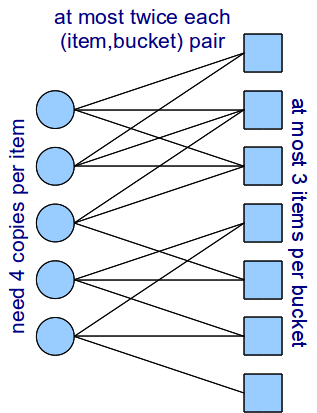
41 40 CHAPTER 2. INTRODUCTION Figure 2.2: Two realizations of the hashing graph, with and without valid hashtable. for such systems are the size of the hashtable (the number of buckets) needed to hold a given number of items, and the time it takes to either retrieve or insert items. The multiple-choice hashing strategy is one that guarantees a constant look-up time, while requiring with high probability a hashtable of size m proportional to n. This strategy consists in pre-defining a set of d 2 buckets for each item, which is then only allowed to pick a bucket within that set. Of course, depending on the choices of the pre-defined sets of buckets, it may be impossible to handle simultaneously some sets of items and inserting a new item may not be easy. The first issue becomes very unlikely if the hashtable contains enough buckets compared to the number of items it needs to hold, and a lot of work has actually been devoted to figuring out exactly how large the hashtable needs to be. As for the second issue, cuckoo hashing was proposed by Pagh and Rodler [89] as a simple, randomized way to search for a new valid assignment upon arrival of an item: one first checks whether one of the buckets pre-defined for the new item is available, in which case it suffices to pick one of these; otherwise, one of the pre-defined buckets is chosen at random and re-allocated to the new item. The same procedure is then used for the item that has just been evicted (which is thus treated as a new item). An interesting survey [81] reviews the state of research on cuckoo hashing as of 2009 and states some related open questions at that time. Formally, an instance of the cuckoo hashing scheme can be described by a bipartite graph G = (L R,E) called the hashing graph (or cuckoo graph), where L is the set of n items and R the set of m buckets. The edges adjacent to an item l L indicate the d pre-determined buckets to which l can be assigned. To capture the more complex versions of cuckoo hashing, where one needs to store h copies of each item or where each bucket can hold at most k items at a time, we add respectively capacity constraints b L h to the left-vertices (items) and b R k to the right-vertices (buckets); similarly, if each (item,bucket) pair can be used at most
42 2.2. LOAD-BALANCING PROBLEMS 41 s times, it is indicated by the edge-capacities c s. Note that minimum number of copies h of each items is modeled as a capacity-constraint b L in the constraint graph; this will be required to establish a link between the feasibility of a cuckoo hashing instance and the size of maximum capacitated matchings in the corresponding hashing graph G. To illustrate the cuckoo hashing setup, Figure 2.2 shows two different hashing graphs, with the items on the left and the buckets on the right side. The two realizations have the same values for the parameters, i.e., the same degrees d = 3 for the items, each item must be stored h = 4 times, each bucket can store up to k = 3 items and each (item,bucket) pair can be used at most twice. Note that the two graphs differ by only one edge (between the central vertices of each part in the right figure). However, one cannot build a valid hashtable from the hashing graph on the left, while we pointed out a valid assignment on the right using the same notations as for capacitated matchings in Figure 2.1. A given fixed graph G only represents a particular choice for the pre-determined buckets associated with each item. In theory, these pre-determined buckets are determined via d independent hash functions applied to each item, and we can assume that one makes sure each item obtains d distinct buckets. This should yield for each item a set of pre-determined buckets which is a random subset of size d chosen uniformly at random among all such subsets of buckets and independently for each item. Then, the hashing graph G n,m is actually a random bipartite graph with a constant degree d for left-vertices and Poi(dn/m) for right-vertices. As described in Section 2.1.3, the hashing graph G n,m almost surely converges locally weakly to a two-step unimodular Galton-Watson limit, as the size of the system increases with n τm. In this context, the main question we try to answer is how large does the hashtable need to be to handle n items chosen at random among the possible ones? We mentioned the number of buckets m required is proportional to n with high probability. The problem is thus to compute precisely the proportionality threshold τ = τd,h,k,s such that, if n = τm with τ < τ, in the limit of m,n cuckoo hashing will yield a valid hashtable with high probability. Before proceeding to the next application, we attempt to give some intuition on why cuckoo hashing works well. Cuckoo hashing relies on a principle called the power of two choices: let us forget about the restriction that each bucket has a limited capacity for now, and suppose that we want to throw the n items just as if they were balls in the m buckets (and m = n for simplicity) with the goal of minimizing the maximum number of items in any bucket. The simplest distributed scheme for approximately balancing the load (i.e., the number of items) of each bucket is to throw each item in a random bucket. This leads to each bucket holding on average one item, and the maximum load is approximately logn items with high loglogn probability [55]. However, a very simple distributed scheme provides an exponential improvement over this basic result, provided one throws the items sequentially: for each item, d 2 random buckets are proposed, and one throws the item in the least loaded of the d buckets. This method yields a maximum load of loglogn logd +Θ(1) with high probability, as shown by Azar, Broder, Karlin and Upfal [10], a result known as the power of (at least) two choices (see [83] for a survey of the techniques used to show this type of result and the applications stemming from it). Broadly
43 42 CHAPTER 2. INTRODUCTION speaking, in the hashing context, the very slowly growing loglogn term tells us that buckets with a fixed capacity will hardly ever overflow, and even then the cuckoo hashing scheme will come into play and try to re-arrange the items to find a new valid assignment. The next section is about distributed CDNs. For more explanations on cuckoo hashing, see the corresponding chapter of the thesis (Chapter 4) Distributed CDNs According to Cisco [31], the amount of multimedia traffic the majority of which is video carried over the Internet nowadays is of the order of exabytes (10 18 ) per month and growing quickly, and most of this traffic is carried by dedicated overlay networks called content delivery networks (CDNs). A centralized hosting solution for many of these contents does not seem a scalable solution, as the delivery of a lot of delay-sensitive contents from a large data center in the core of the network to end-users located at the edge of the network would require massive bandwidth provisioning. Therefore, many of the large CDNs have rather adopted a distributed architecture, taking advantage of the low storage prices and deploying a large number of servers and small data centers over many networks (see [37] for a description of the challenges associated with this distributed nature and faced by the CDN Akamai). A similar move towards distributed caching is also visible in the content-centric approach to networking, initiated by Nelson [88] and which realized that more than 90% of Internet traffic is due to content dissemination and that tremendous bandwidth savings can be achieved via distributed caching. Within this framework, the Internet Service Providers (ISPs) create a cache network by disseminating small caches in the network e.g., by attaching them to the routers, and contents are cached on their way to the end-user so that closer service points are available should the same content be requested again. However, deploying a CDN in such a way requires the cooperation of ISPs, which certainly involves quite a bit of negotiations, and even then it is not clear at this point how to efficiently organize the system. Alternatively, one can take inspiration from peer-to-peer (P2P) systems, which have become incredibly popular for file-sharing since Napster was introduced in 1999 and with BitTorrent now accounting for more than half of all filesharing on the Internet. Such systems tend to be highly scalable and cost-efficient, as users who want to participate have to provide resources as well as using them. However, they may have a hard time providing high quality of service guarantees, especially for delay-sensitive content such as for a Video-on-Demand (VoD) service for example, due to the unpredictable behavior of peers (there have been nonetheless a few attempts at deploying such systems, e.g., PPLive). For large-scale delivery of delay-sensitive content, it is very tempting to combine some of the ideas above, by having a (smaller) data center assisted by devices already deployed at the users premises, e.g., set-top boxes or triple-play gateways (e.g., as done in NaDa [106] and the People s CDN). Indeed, leveraging the resources (storage, upload bandwidth) already present at the edge of the network offers considerable potential for scalability, cost reduction and base performance upgrade, while the data center provides reliability and quality of service guarantees. We call such a system, where a central
44 2.2. LOAD-BALANCING PROBLEMS 43 data center is assisted by small devices (which we call servers) located at the edge of the network, an edge-assisted CDN. We stress the fact that the small servers may have limited capabilities, which makes cheap devices eligible for that role. In an edge-assisted CDN, as the small servers are mainly there to reduce operational cost, one would want to use them as much as possible and to only direct requests to the data center as a last resort. Therefore, to understand and design such a system, we focus on the operation of the small servers and try to understand the performance of this sub-system. As we focus mainly on delay-sensitive contents (video streaming), when a request arrives we cannot delay it even if it cannot be served immediately by the small servers, therefore it has to be sent to the data center and can be viewed as lost for the small servers. We can thus adopt a loss network model (see [64]) for this sub-system, in contrast to queueing (also called waiting) models, where similar issues of efficient scheduling and replication have been considered notably in [7]. As a result of the analysis of the servers loss network, one can then dimension appropriately the data center to meet global performance requirements. We could even imagine that the data center is hosted via a cloud service, which allows it to dynamically adapt service capacity to meet instantaneous demand. The efficiency of the system constituted of the small servers alone critically depends on two factors: content replication within servers, which mainly amounts to determining how many times contents must be replicated, and how incoming service requests are matched to servers holding the requested content. These two issues are called the replication and the matching problems respectively. The latter can be seen as a load-balancing problem, where tasks are requests for contents and they need to be assigned servers storing the requested content. As for the replication problem, it allows us to play with the constraints of the load-balancing problem by modifying the set of resources which are suitable for a particular task; we refer to this as a resource-placement problem. Ideally, the design of solutions for these two problems should be done jointly. However, it might be a too amibious objective at this point. Therefore, we rather focus on two particular solutions to the matching problem: an optimal solution, which might not be practical, and a random greedy one, which is on the contrary quite simplistic and should always be feasible. As these two particular load-balancing strategies are in a sense extremal in the set of reasonable algorithms, understanding how they perform and when/why their performance differ should yield fundamental insights as well as quantitative reference points for the design of real systems. Once the performance of the load-balancing policy can be characterized for a given fixed replication, we can turn to the resource-placement problem and attempt to find the best possible replication policy, at least in large system / large storage limits. More details on distributed CDNs can be found in Chapter 5. To make things more concrete for the reader as well as to make more apparent the connection with capacitated matchings and with the random graph models introduced previously, we now describe succinctly the edge-assisted CDN model. In
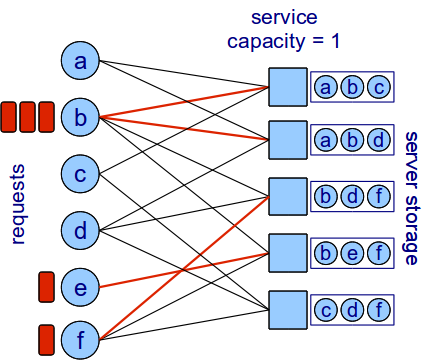
45 44 CHAPTER 2. INTRODUCTION Figure 2.3: Content-server graph with a particular assignment of servers. this model, a data center is assisted by a large number m of small servers. The major feature of this model is its focus on modeling the basic constraints of a realistic system, in particular regarding the limited capacity of servers (in terms of storage, service and coordination) and the way requests are handled, i.e., the matching policy. We work most of the time with a basic version of the model, in which all the contents have the same size (and we do not allow splitting them to paralyze service), and each server stores a fixed number d of contents and can provide service for only one request at a time. The information of which server stores which content is represented as a bipartite graph G = (S C,E), where S is the set of servers, C the set of contents, and there is an edge in E between a content c and a server s if s stores a copy of c (and is thus eligible to serve requests for c). The contents have different popularities, given by their request arrival rates λ c, and each service takes and exponential time with mean 1. This results in an instantaneous number of requests R c for each content given by independent Poi(λ c ) random variables. At any time, the current assignment of servers to contents forms a capacitated matching of the graph G (with capacities R c for the contents and 1 for the servers). As an illustration, Figure 2.3 shows a particular content-server graph, with the contents on the left and servers on the right. Requests are shown as red rectangles beside the corresponding content and the contents stored by the servers are shown in the storage space on the right of the servers. If the servers are serving the contents as indicated by the edges in red, then one of the requests for content b must currently be handled by the data center. Due to the lack of coordination between the servers, it is not feasible to carefully design the content of all the caches in a joint manner. Therefore, at best, one can specify a number of replicas D c for each content c, and the servers will do random caching choices accordingly, so that the graph G will be a random bipartite graph with a prescribed degree sequence for the contents. At worst, very little information is known a priori on the contents, which are simply grouped into K classes of size α 1 n,...,α K n, and the servers have instructions on the caching preferences in the form of a distribution π P({1,...,K}) over the different classes. They will then choose independently for each of their d memory slots a random content in a class
46 2.3. INTRODUCTION TO THE CAVITY METHOD 45 drawn from π, so that G is a random bipartite graph with a prescribed degree distribution Poi(dmπ k /nα k ) for the contents of each class k. In this second case, the random graphs admit a two-step unimodular Galton-Watson local weak limit, as described in Section However, if the precise sequence of degrees of the contents is imposed, then it is clear that we have to impose some conditions on this degree sequence for the graphs to have any chance to converge. The next section explains the basics of the cavity method, which is used as a tool in the study of load-balancing throughout this thesis. 2.3 Introduction to the cavity method Context The cavity method was proposed in 1985 by Mézard, Parisi and Virasoro [79] (see also [77, 78]) to study spin glasses in statistical physics and more generally disordered systems (in our case especially, random graphs in the sparse regime). The goal is generally to compute various algebraic, combinatorial or probabilistic quantities as the size of the system increases. In many scenarios, one can work under the heuristic that the asymptotics of these quantities should only depend on the local geometry of the graphs and that long-range correlations should fade away. When this heuristic argument holds, the interest is twofold: firstly, the quantities of interest can be efficiently approximated via distributed, message-passing algorithms; secondly, these quantities are continuous with respect to local weak convergence and their limit can be defined on the local weak limit of the graphs, and sometimes computed explicitly. To cite only a few applications of the cavity method: on the practical side, this approach led to the survey-propagation algorithm for constraint-satisfaction problems (see [80, 25, 74]), to the design of efficient LDPC codes [93] and to polynomial-time approximation algorithms and asymptotic expressions for many counting or decision problems (see, e.g., [112, 13, 50, 11, 49]); and on the theoretic side, to the ζ(2) limit in the assignment problem [2], the asymptotic enumeration of spanning trees in large graphs [73], the phase transitions for the random graph coloring problem [86, 118]. For a more extensive presentation of the cavity method itself, the interested reader can refer for example to [5, 4] or [34, 76] The cavity method We present here a short introduction to the cavity method, which is sufficient for understanding the principles and problems encountered in this thesis. Suppose we are given a set of elements S and we consider simple configurations over S, i.e., vectors in {0,1} S. Suppose also that to each of these configurations x is associated an energy U(x) (also called Hamiltonian). If U(x) = +, we say that x is forbidden; on the contrary if U(x) <, then x is an admissible or valid
47 46 CHAPTER 2. INTRODUCTION configuration. Now, consider a parameter β > 0 and the Gibbs distribution µ on configurations over S given by µ(x) = e βu(x) Z(β), (2.1) where Z(β) = x e βu(x) is a normalizing factor called the partition function. In physics, the parameterβ would play the role of an inverse temperature, i.e.,β = 1/T, and the distribution µ would indicate the probability that a system of particles is in a particular state given that they interact according to some specific local, energy-dependent dynamics. The expected energy E[U(X)] = xu(x)µ(x) can be computed from E[U(X)] = β logz(β), and the entropy of the distribution H(β) = E[ logu(x)] from H(1/T) = T logtz(1/t). Therefore, these quantities can be computed for example from the partition function Z(β), or from the free energy function F(β) = 1 logz(β). β To better motivate the computation of the expected energy or the entropy of the Gibbs distribution, let us describe briefly two examples where these quantities are meaningful. The first example concerns matchings and a more complex version of this problem is the topic of Chapter 3. Let S be the set of edges of a finite graph (we will therefore write S = E) on a set of vertices V, and let the energy U take the following form: U(x) = x log1( x v 1), v V so that U(x) = x if x is a matching of G, and U(x) = + otherwise and x is a forbidden configuration. Then, µ is a distribution over the matchings of G which weights each matching x proportionally to e β x. As β, the distribution µ concentrates on maximum matchings of G, so that the expected energy at temperature T = 0 measures the size of maximum matchings while the entropy gives the number of maximum matchings of G: lim β E[U(X)] = minu(x) = max x lim β H(β) = log argmin x U(x). x M G x = M(G), The second example we provide here is the graph-coloring problem. Suppose we want to determine if the vertices of a graph G = (V,E) are colorable using q colors so that no two adjacent vertices have the same color. This time, we let S be the set of vertices V of G and U count the number of edges with the same color at both endpoints: U(x) = uv E1(x u = x v ) for x {1,...,q} V.
48 2.3. THE CAVITY METHOD 47 If the expected energy at temperature T = 0 equals 0, then the graph is q-colorable and the limit lim β H(β) gives the number of proper q-colorings; otherwise the graph is not q-colorable. In general, computing the partition function of a system is NP-hard. The cavity method essentially aims at computing this partition function when the energy functionu is a sum of local contributions and the problem has a particular tree structure: suppose that U(x) = a A U a(x a ), where A is a collection of subsets of S and x a = (x v ) v a, and that the bipartite graph G = (S A,E) is a tree, where va E if v a. This graph is called a factor graph, and the vertices in S (resp. A) are called the variable nodes (resp. factor nodes). Then, the Belief-Propagation (BP) or Bethe-Peierls algorithm [90, 91] (also known as the sum-product algorithm) allows to compute the value of Z(β) in an iterative manner: let us writeψ a (x a ) = e βua(xa), so that µ(x) = 1 Z(β) a A ψ a(x a ), and let o be an arbitrary factor node in A; then Z(β) = x a Aψ a (x a ) = x o ψ o (x o ) v o ν v o (x v ), where messages ν between neighboring variable nodes v and factor nodes a are defined by ν v a (x v ) = ν b v (x v ), b a, v b ν a v (x v ) = x a\v ψ a (x a ) u a\v ν u a (x u ). The messages can be correctly initiated at the leaves of the treegand then computed iteratively while climbing the tree up to the root o. It turns out that it will be more convenient to use normalized messages η ν so that x v η v o (x v ) = 1 = x v η o v (x v ). These are defined by the following equations, which we call the BP update equations: η v a (x v ) = η a v (x v ) = b a, v b η b v(x v) yv b a,, v b η b v(y v) x ψ a\v a(x a) u a\v ηu a(xu). y ψa(ya) u a\v ηu a(yu) (2.2) Note also that we can obtain the marginal probabilities of µ at a factor node o from the incoming BP messages η: µ(x o = x o ) = ψ o(x o ) Z(β) v o ν v o (x v ) = ψ o(x o ) v o η v o(x v ) y o ψ o (y o ) v o η v o(y v ) We next define the local contributions to the partition function Z(β) and to the free energy F(β), which are computed only from the incoming messages to the corresponding nodes: z v = x v a v η a v(x v ), z a = x a ψ a (x a ) v a η v a(x v ), z av = z va = x v η a v (x v )η v a (x v ) for va E, (2.3)
49 48 CHAPTER 2. INTRODUCTION and f v = T logz v, f a = T logz a, and f av = T logz av. Then, v Z(β) = z v a z a a,v z, av F(β) = v f c + a f a a,v In graphs G which are not trees, the message-passing iteration (2.2) that computes the normalized BP messages η cannot be safely initiated and it is not guaranteed to converge, at least, not to a meaningful value. In general, it is not clear when the BP iteration will converge. For the purpose of the explanations of this section we therefore assume that BP converges; specifically, this issue needs to be addressed when applying the cavity method to a particular problem. Let us consider the case where, as the size of the system increases, the graph G = (S A,E) converges locally weakly to a distribution ρ over unimodular trees. Then, provided correlations between BP messages decay sufficiently fast with the graph distance, which results in continuity properties with respect to local weak convergence, the limiting distribution of the BP messages η incoming to a random root of G is obtained directly on the local weak limit ρ as the distribution of the BP messages incoming to the root of ρ. Furthermore, as ρ is concentrated on unimodular trees, the quantities of interest (e.g., the marginal distribution of µ around o and the local contributions (2.3) of o) can be computed from the BP messages incoming to the root of ρ. This allows to define a limiting object for the Gibbs measure and the partition function directly on the local weak limit via an infinite set of local equations. Finally, when the local weak limit is a Galton-Watson distribution ρ = GW for some degree law as for the random graph models discussed before, then the local equations simplify into recursive distributional equations (RDEs), which may be solved explicitly in some cases to obtain an explicit formula for the quantities of interest (see the survey [3] by Aldous and Bandyopadhyay). 2.4 Overview of the results In this section, we present a summary of the problems addressed, along with some relevant related work, and of the results obtained in this thesis Maximum capacitated matching via the cavity method The cavity method has been successfully used to obtain results in many problems of computer science, combinatorics and statistical physics. As we explained, this method generally involves the Belief-Propagation message-passing algorithm for computing marginals of probability distributions. Belief-Propagation has been extensively used in various domains where it has been observed to converge quickly to meaningful limits [117, 74]. Although sufficient conditions for its convergence and correctness exist and the theoretical understanding of what may cause BP to fail advances [103, 58, 59, 85], there are only few cases where one can prove rigorously its convergence and the uniqueness of its fixed points for specific problems when the underlying graph is not a tree [111, 52, 12]. f av.
50 2.4. OVERVIEW OF THE RESULTS 49 The issue of convergence of BP to a unique fixed point is easily resolved when the problem exhibits a property called correlation decay, which means that differences in a far-away portion of the system will have negligible effects locally and generally implies continuity with respect to local weak convergence. However, in some cases, correlation decay fails at low (zero) temperature a situation described as ergodicity breaking and then multiple fixed-points to the BP equations may exist, which happens in particular for the problem of counting maximum matchings [119]. To resolve this issue, one can apply the cavity method at positive temperature and then take the limit when temperature T goes to 0 (i.e., β ). In the case of maximum matchings as well as in extensions [21, 96, 70], monotonicity and unimodularity arguments ensure the convergence of BP to a unique fixed point and also allow us to take the limit as T 0: in particular, the operator which computes the updated messages outgoing from vertices from the other incoming messages according to Equations (2.2) is non-increasing. Starting from the smallest possible initial messages, this automatically constructs a convergent sequence of BP messages, as it gives rise to two adjacent subsequences of messages (at even and odd numbers of BP iterations). The relevant monotonicity properties were captured precisely by Salez [96] and are related to the theory of negative association of measures initiated by Pemantle [92]. They hold in a context where the system can be encoded with binary values on the edges of the underlying graph and as a result involves BP with scalar messages. As a result, one can compute the size of the largest capacitated matchings, with unit edge capacities, in graphs G n = (L n R n,e n ) converging locally weakly to two-step unimodular Galton-Watson trees GW(Φ L,Φ R ) with a formula of the following form: lim n 1 L n M(G { n) = M(Φ L,Φ R ) = inf F L (q), q = g L g R (q) }, q [0,1] where F L is a function which computes the local contribution to a maximum capacitated matching around the root of the GW tree, and g L and g R are the expected BP update operators at vertices in L and R respectively, so that q = g L g R (q) is the two-step BP fixed-point equation. We do not give the expression for the various functions here, as their particular form is not very informative. Motivated in particular by the two applications of this thesis and also by the general idea that many problems may require similar extensions, we want to go beyond unit edge capacities in the maximum capacitated matching problem, which necessarily involves non-scalar BP messages. The main obstacle here is that BP messages essentially represent distributions over the integers, which introduces a difficulty when trying to compare messages as P(N) is not totally ordered (contrary to the case of binary values on the edges). Nonetheless, similar monotonicity properties as in the scalar case hold when using the upshifted likelihood ratio (lr ) stochastic order for comparing BP messages: for two probability distributions m,m P(N) on integers, the lr -order is defined by m lr m if m(i+k +l)m (i) m(i+l)m (i+k), i,k,l N. In particular, the BP update operator is non-increasing for the lr -order, and we can obtain similar convergence results as in the scalar case. Note that the relevant
51 50 CHAPTER 2. INTRODUCTION monotonicity properties do not trivially hold for all the natural stochastic orders: for example they do not hold for the strong stochastic order. The important feature of the lr -order which makes it appropriate for our purpose is its preservation with respect to conditioning on intervals, a property characteristic of the uniform conditional stochastic order (ucso, see Whitt [113, 114]). Intuitively, such a preservation property is necessary for a local property (the BP update is non-increasing) to translate into a global effect (the even and odd iterations of BP yield adjacent sequences of messages), because the important part of a message incoming to a vertex v to determine the marginal of the Gibbs distribution (2.1) around v may end up being any interval due to the effect of the other messages incoming to v. As an outcome of the study of the BP update operators, we can prove convergence of BP to a unique fixed point on any locally finite unimodular graph. Then, following the cavity method, the asymptotic behavior of M(G) as the size of G increases can be obtained in the 0 temperature limit on the local weak limit GW(Φ L,Φ R ) (defined in Section 2.1.3). Due to ergodicity breaking at temperature 0, there are however many BP fixed-points, and to identify the correct one we reason as in in [96, 70]. Furthermore, we do not need to solve recursive distributional equations on the BP messages themselves (which would be recursive equations on distributions over distributions) but rather only RDEs over the boundaries of the support of the BP messages, which are here intervals due to log-concavity of the BP fixed-point messages. The expression for the asymptotic of M(G) is finally given by Theorem 3.1, which generalizes the formulas in [96, 70]. Furthermore, it is interesting to note that a similar expression is also valid for finite bipartite graphs (Theorem 3.11), which extends a result of Chertkov [30] Cuckoo hashing In the simplest settings, a popular approach to the problem of cuckoo hashing has been to study a certain core of the hashing graph, whose density of right-vertices exceeds a certain value at the same time as cuckoo hashing starts failing in random graphs of the type described above. The study of this core of the hashing graph can be done using various techniques (combinatorics and differential equation approximation of a pealing algorithm), each of them being more or less likely to apply to extensions of the original problem. Therefore, the thresholds for various generalization of the basic scheme (d = 2,h = k = s = 1) have been computed step by step: the extension to d 2 random choices was done in [35, 42, 46]; allowing each bucket to store at most k items was done in [36, 27, 41]; the case where each item needs to be replicated h times is the most recent, with [53] solving a restricted range of parameters and [70] the general case. The extension where each (item,bucket) pair can be used a maximum of s times was not covered previously. In all the cases, the expression of the load threshold τ involves a solution of a fixed-point equation which can be traced back to the cavity method and fixed-point messages of BP. An alternative approach to the cuckoo hashing problem is to establish a link with a (capacitated) matching problem, as remarked in [46, 70] and also in [35] with a detour by XORSAT. Indeed, partial assignments of items to buckets can be mapped one-to-one to capacitated matchings of the hashing graph G, as long as
52 2.4. OVERVIEW OF THE RESULTS 51 no item has more than h copies. However, for a capacitated matching x M G to map to a valid hashtable, the corresponding assignment needs to keep h copies of each item, i.e., x l = h for every item l L. Therefore, it is possible to build a valid hashtable whenever there exists a capacitated matching x M G of size x = h L. At this point, we can leverage results from the study of capacitated matchings for the random graphs considered here. This allows us to compute the 1 limit lim m,n M(G n n,m) = M(Φ L,Φ R τ ) with n τm and where Φ L and Φ R τ are the joint laws for the vertex-degrees, vertex-constraints and adjacent edge-constraints on each part (here, the degrees are fixed equal to d on L n and randomly drawn from Poi(dτ) on R n, and the capacity constraints are fixed equal to h on L n, to k on R n and to s on E n ). The threshold τ is then computed (Theorem 4.1) as τ = sup { τ : M(Φ L,Φ R τ ) = h } = inf { τ : M(Φ L,Φ R τ ) < h }. Note that an additional step is needed to obtain the result above (as in [70]), as 1 lim n M(G n n,m) = h does not prevent failure on a vanishing fraction of items. In fact, this property that only a vanishing fraction of items cannot be stored in the hashtable defines a second threshold τ τ. Fortunately, one can show that the two thresholds are equal for the random graph models considered here. We also explore another issue related to cuckoo hashing, which concerns schemes with limited randomness. Indeed, a major drawback of the fully random (multiplechoice) hashing scheme described previously is the amount of randomness involved: the standard approach requires n independent, uniform choices of sets of d buckets among m. Phrased differently, this means roughly d log m independent random bits per item. Generating unbiased, perfectly independent random bits does not come for free [122, 109]. Therefore, a lot of effort has been put into reducing the amount of randomness needed (see [82] and references therein for an account of some of the directions investigated so far). A candidate alternative is double hashing [56, 72], which seems to have similar performance to the fully random scheme while requiring only roughly2logm independent random bits per item: assumemis a prime number and label the m buckets with the integers from 1 to m; for each item, independently draw two random numbers f {1,...,m} and g {1,..., m 1 }; the pre-defined set 2 of buckets associated with a couple (f,g) are the buckets labeled f+ig (mod m), for i {0,...d 1}. Although the reduced randomness of the double hashing scheme is the very reason why this method could be preferred over fully random hashing, it also makes the theoretical analysis of its performance more difficult. Mitzenmacher and Thaler [82, 84] managed to prove that the performance of double hashing is essentially the same as that of fully random hashing in the balls and bins setup of Azar, Broder, Karlin and Upfal [10] already mentioned in Section 2.2.1: they show that the maximum load is loglogn +O(d) w.h.p. and only conjecture that the logd double hashing threshold is equal to the (fully random) cuckoo hashing threshold τ. It turns out that the cavity method is very suitable to study such an extension of the fully random cuckoo hashing scheme. Indeed, only two steps of the proof need to be done again for the double hashing random graph model: one needs to show that such random graphs converge a.s. locally weakly to the same two-step unimodular Galton-Watson distribution GW(Φ L,Φ R τ ) as the original cuckoo hashing scheme, and then one would need to perform the additional step we mentioned to
53 52 CHAPTER 2. INTRODUCTION get from the threshold τ to the actual threshold τ. The local weak convergence of the double hashing graphs can be proved by studying a two-step Breadth-First Search Exploration (BFS) of the hashing graph, which is a variation of the singlestep BFS used to prove local weak convergence of the classical (unipartite) random graphs (see, e.g., [20]). We stop after showing that the second threshold τ of double hashing is equal to the load threshold τ of fully random hashing, as we consider it is sufficient to demonstrate the potential of the cavity method for this problem Load balancing and resource placement in distributed CDNs The content replication policy within servers of a CDN strongly influences the performance of the system, therefore the problem of optimizing this replication has been considered under many viewpoints, with different modeling assumptions and performance metrics leading naturally to different content replication proposals. However, there is one replication strategy which arises frequently under many different models: it is proportional replication, which keeps for each content a number of copies proportional to its popularity. Using large deviation inequalities, [101] investigated this replication under the edge-cdn model with an optimal matching policy, and proved that it is efficient for a large system and large storage. In order to characterize more precisely the performance of the proportional replication, we can use the connection with capacitated matchings. Indeed, if we allow requests to be re-allocated at any time between servers or even with the data center, then the performance of the system under optimal matching is given by the expected size of a maximum capacitated matching of the graph G (computed in Theorem 3.1), with the capacities mentioned before. This result can in fact be obtained under a richer model than the one explained above: the addition of arbitrary integer edgecapacities allows to deal with the case where the servers have non-unitary service capacities, and the contents may have different sizes as long as they are segmented into constant size coded segments. However, this more complex model is not very easy to manipulate, so we prefer to stick to the basic model to analyze the performance asymptotics. For the model where the contents are grouped into popularity classes, in the limit of large storage size we can discriminate between the multiple fixed-points of BP at 0 temperature depending on the value of the load ρ. The asymptotic behavior of the correct fixed-point of BP then yields a large deviation principle for the inefficiency ι of the system (Proposition 5.2): log(ι) d d π inf k k τα k if ρ < 1, ( K ) log k=1 π ke λ k if ρ > 1, ( ( π K )) min inf k k τα k,log i=k π ke λ k if ρ = 1, where we recall that π is the distribution servers use to choose which class of content to cache, α k is the fraction of contents in class k, λ k is the request arrival rate for class k, and τ n/m. It turns out that inefficiency decays exponentially fast to 0 as storage increases for any reasonable replication policy (therefore the asymptotic efficiency property shown before for proportional replication is actually a quite
54 2.4. OVERVIEW OF THE RESULTS 53 common property) and the decay exponents have simple expressions pointing out the very local nature of the events that typically cause inefficiency. Furthermore, from the expressions obtained, it is easy to compute the asymptotics of the optimal replication of contents for the various load regimes. Surprisingly, proportional replication is never asymptotically optimal: it favors too much the popular contents in the underloaded regime, and not enough in the overloaded regime. The performance under optimal matching being better understood, we turn to the study of the random greedy matching algorithm. The first question there is whether the inefficiency of the system will also decay exponentially fast to 0 under greedy matching. Secondly, we seek understanding of how to efficiently replicate contents in this setup. To give an answer to the first question we consider a static setting where all the contents have the same popularity and the requests for the contents arrive in random order. Then, it is a classical approach to approximate by differential equations [33] the evolution of this large system under greedy matching. Unfortunately, we cannot solve these differential equations. However, they are sufficient to obtain the asymptotic behavior of the inefficiency for large storage. The inefficiency under greedy matching still decays exponentially fast to 0 (although slower than for optimal matching) for non-critical loads, but it undergoes a phase transition at critical load ρ = 1: ι e d τ ρ 1 (1+o(1)) if ρ 1, ι = τ log2 d +o(1/d) if ρ = 1. This hints that one may need to go beyond greedy matching for certain applications, where for example regions of the system may naturally be maintained in a critical regime due to load-balancing happening at higher levels. Nevertheless, as long as the system stays in the underloaded regime ρ < 1, it makes sense to study the performance of replication strategies under greedy matching. In order to understand the influence of the replication of a particular content c, we approximate the evolution of the number Z c of available replicas of c by a simple Markov chain, based on asymptotic behaviors and a mean-field heuristic. This allows us to obtain an expression for the stationary distribution of Z c as well as for the stationary loss rate γ c (Equation (5.21)), with the following large deviation principle: γ c e Dc lnρ (1+o(1)), where we recall that D c is the number of replicas for content c. Note that this expression again confirms the exponential decay of the inefficiency as storage increases and the phase transition at critical load, although the expressions for the decay exponents cannot be compared as the models are slightly different ( batch arrival against stationary distribution). The accuracy of these approximations is confirmed by simulations. A simple optimization problem then gives the asymptotic expression for the optimal replication of contents (which is uniform with corrections that are logarithmic in the storage size) and the general principle that one should aim to equalize the loss rates of the contents. Guided by this principle and inspired by replication strategies based on eviction rules from cache networks, we design adaptive replication schemes reacting to losses in the system. Finally, we can leverage the precise expression obtained for the loss rate to propose a virtual loss mechanism
55 54 CHAPTER 2. INTRODUCTION which anticipate losses in order to react faster, and still manage to equalize the loss rates. The static optimized replication as well as the dynamic algorithms are compared in simulations to the proportional replication policy and show significant improvements. Generally, the principle of equalizing the loss rates is supported by the simulations, and the speed enhancement provided by the virtual loss method is quite significant.
56 Chapter 3 Maximum capacitated matching via the cavity method Towards answering questions related to load-balancing in random environments, in terms of average performance as well as guaranteed maximum load, we study capacitated matchings in random graphs via the cavity method. Our main result is a law of large numbers characterizing the asymptotic maximum size capacitated matching in the limit of large bipartite random graphs, when the graphs admit a local weak limit that is a tree. An analysis of belief propagation algorithms (BP) with multivariate belief vectors underlies the proof. In particular, we show convergence of the corresponding BP by exploiting monotonicity of the belief vectors with respect to the so-called upshifted likelihood ratio stochastic order, providing a new set of structural conditions which ensure convergence of BP. 55
57 56 CHAPTER 3. MAXIMUM CAPACITATED MATCHING 3.1 Introduction Belief Propagation (BP) is a popular message-passing algorithm for determining approximate marginal distributions in Bayesian networks [91] and statistical physics [76] or for decoding LDPC codes [93]. The popularity of BP stems from its successful application to very diverse contexts where it has been observed to converge quickly to meaningful limits [117, 74]. In contrast, relatively few theoretical results are available to prove rigorously its convergence and uniqueness of its fixed points when the underlying graph is not a tree [12]. In conjunction with the local weak convergence [5], BP has also been used as an analytical tool to study combinatorial optimization problems on random graphs: through a study of its fixed points, one can determine so-called Recursive Distributional Equations (RDE) associated with specific combinatorial problems. In turn, these RDEs determine the asymptotic behaviour of solutions to the associated combinatorial problems in the limit of large instances. Representative results in this vein concern matchings [21], spanning subgraphs with degree constraints [96] and orientability of random hypergraphs [70]. All these problems can be encoded with binary values on the edges of the underlying graph and these contexts involve BP with scalar messages. A key step in these results consists in showing monotonicity of the BP message-passing routine with respect to the input messages. As an auxiliary result, the analysis of [96] and [70] provide structural monotonicity properties under which BP is guaranteed to converge (when messages are scalar). The present work is in line with [96, 70] and contributes to a rigorous formalization of the cavity method, originating from statistical physics [79, 67], and applied here to a generalized matching problem [71]. The initial motivation is the analysis of generalized matching problems in bipartite graphs with both edge and node capacities. This generic problem has several applications. In particular, it accurately models the service capacity of distributed content delivery networks under various content encoding scenarios, by letting nodes of the bipartite graph represent either contents or servers. It also models problem instances of cuckoo hashing, where in that context nodes represent either objects or keys to be matched. Previous studies of these two problems [70] essentially required unit edge capacities, which in turn ensured that the underlying BP involved only scalar messages. It is however necessary to go beyond such unit edge capacities to accurately model general server capacities and various content coding schemes in the distributed content delivery network case (see Chapter 5). The extension to general edge capacities is also interesting in the context of cuckoo hashing when keys can represent sets of addresses to be matched to objects (see Chapter 4). Our main contribution is Theorem 3.1, a law of large numbers characterizing the asymptotic size of maximum size generalized matchings in random bipartite graphs in terms of RDEs. It is stated in Section 3.2. Besides obtaining these new laws of large numbers, our results also have algorithmic implications. Indeed to prove Theorem 3.1, in Section 3.3 we state Proposition 3.2, giving simple continuity and monotonicity conditions on the messagepassing routine of BP which guarantee its convergence to a unique fixed-point. This
58 3.2. ASYMPTOTIC SIZE OF MAXIMUM CAPACITATED MATCHINGS 57 result is shown to apply in the present context for the so-called upshifted likelihood ratio stochastic order. Beyond its application to the present matching problem, this structural result might hold under other contexts, and with stochastic orders possibly distinct from the upshifted likelihood ratio order to establish convergence of BP in the case of multivariate messages. The overall proof strategy is exposed in Section 3.3. The local properties of the BP update and estimate routines that will be useful are explained in Section 3.4. We then exploit these properties to demonstrate convergence of BP in finite graphs in Section 3.5 and show that the BP estimates are asymptotically exact for asymptotically tree-like graphs in Section 3.6, which proves Theorem 3.1. Finally, in Section 3.7 we present exactness results for the case of finite bipartite graphs. 3.2 Asymptotic size of maximum capacitated matchings Let G = (V,E) be a finite graph, with additionally integer constraints b v attached to vertices v V and integer constraints c e attached to edges e E. Recall that a vector x = (x e ) e E N E is called a capacitated matching of G if e E, 0 x e c e and v V, e vx e b v, and we denote by M(G) the maximum size of a capacitated matching of G. Our aim is to characterize the behaviour of M(G)/ V for large graphs G in the form of a law of large numbers as V goes to infinity. We focus mainly on sequences of graphs (G n ) n N which converge locally weakly towards a Galton-Watson distribution. In particular, for the applications considered in this thesis, the graphs are bipartite graphs G = (L R,E) and their local weak limit is a bipartite GW distribution GW with joint laws Φ L and Φ R for the degree distributions, the vertex-constraints and the adjacent edge-constraints (D v,b v,c v ) of each vertex v depending on whether it is in L or R. To sample a tree from GW, assuming the root is in L (the other case being totally symmetrical), we first draw a sample from Φ L for the root o. Then, the parameters of its descendants at even and odd generations are drawn from size-biased offspring distributions Φ L and Φ R respectively, conditionally on the capacity of the edge linking them to their parent. The size-biased offspring distributions Φ L and Φ R are defined by Φ L k,b,{c 1,...,c k } c = Φ L k+1,b,{c,c 1,...,c k } (1+ k i=1 1(c i = c)) d 1 }(1+ i=1 1(c i = c)), d,b,{c 1,...,c d 1 } Φ L d,b,{c,c 1,...,c d 1 and similarly for R. We denote the offspring, vertex-constraints and edge-constraints sampled from the sized biased distributions, say from Φ L, as D L, B L and C L. Note that the distributions Φ L and Φ R have to satisfy a consistency constraint, which imposes that the probability of edges with a given capacity c is the same seen from
59 58 CHAPTER 3. MAXIMUM CAPACITATED MATCHING vertices in L and in R: 1 DL E[D L ] E 1(Ci L = c) = 1 DR E[D R ] E 1(Ci R = c). i=1 Before stating the main theorem of this chapter, we define the following notations: we let [z] y x = max{x,min{y,z}} and (z) + = max{z,0}. Theorem 3.1 (Maximum capacitated matching for Galton-Watson limits). Let (G n ) n N be a sequence of bipartite graphs, with G n = (L n R n,e n ), converging locally weakly towards a two-step unimodular Galton-Watson distribution with laws Φ L and Φ R for the degree distributions, the vertex-constraints and the adjacent edgeconstraints (D v,b v,c v ) for vertex v. Provided E[B L ] and E[B R ] are finite, the limit M(Φ L,Φ R ) = lim n M(G n )/ L n exists and equals { M(Φ L,Φ R ) = inf E [ ( + E[DL ] E B R D R E[D R ] i=1 i=1 [ min {B L, }] D L i=1 X i(ci L ) [ B R ] ) C R + j i Y j(cj R i ) 1( B R < D R i=1 CR i 0 ) ]} where for all i, (X i (c),y i (c)) c N is an independent copy of (X(c),Y(c)) c N, and the infimum is taken over distributions for (X(c),Y(c)) c N satisfying the RDE Y(c) = X(c) = D L c BL X i ( C i L ) CL 0 = c ; i=1 0 D R c BR Y i ( C i R ) CR 0 = c. i=1 Remark 3.1. A similar result holds when the graphs are not bipartite; the limiting tree is then simply a Galton-Watson tree described by a joint distribution Φ. We set Φ L = Φ R 2M(G = Φ, and the formula in Theorem 3.1 then yields lim n) n V n = M(Φ,Φ) Main proof elements We start with a high level description of the path followed towards Theorem 3.1. The proof strategy uses a detour, by introducing a finite activity parameter λ > 0, which plays the role of e β in Section For a given finite graph G, a Gibbs distribution µ λ G is defined on edge occupancy parameters x (Section 3.3.1) such that an average under µ λ G approaches the quantity of interest M(G)/ V as λ tends to infinity. Instead of considering directly the limit of this parameter over a series of converging graphs G n, we take an indirect route, changing the order of limits over λ and n.
60 3.3. MAIN PROOF ELEMENTS 59 We thus first determine for fixed λ the asymptotics in n of averages under µ λ G n. This is where BP comes into play. We characterize the behaviour of BP associated with µ λ G on finite G (Section 3.3.2), establishing its convergence to a unique fixed point thanks to structural properties of monotonicity for the upshifted likelihood ratio order, and of log-concavity of messages (Sections 3.4 and 3.5). This allows us to show that limits over n of averages under µ λ G n are characterized by fixed point relations à la BP. Taking limits over λ, one derives from these fixed points the RDEs appearing in the statement of Theorem 3.1. It then remains to justify interchange of limits in λ and n. These last three steps are handled similarly to [70]. Before we proceed, we introduce some necessary notation. Letters or symbols in bold such as x denote collections of objects (x i ) i I for some set I. For a subset S of I, x S is the sub-collection (x i ) i S and x S := i S x i is the L 1 -norm of x S. Inequalities between collections of items should be understood component-wise, thus x c meansx i c i for alli I. For distributionsm i, we letm S (x) := i S m i(x i ). When summing such terms as in x N S : x b,x c m S(x), we shall omit the constraint x N S. Similarly, we let S m = i S m i, where is the convolution of two vectors (will be defined in Section 3.4). Finally, we will work most of the time as if b v c v for all v V and c e b v for all e v. If one of these assumptions were not verified, we would have to replace b v by min{b v, c v } and c uv by min{c uv,b u,b v } everywhere, which would quickly become cumbersome. However, note that these considerations have been taken care of in the expression of Theorem 3.1 with the otherwise useless term 1 (B R < ) D R. i=1 CR i Gibbs measure Let G = (V,E) be a finite graph, with collections of vertex- and edge-constraints b = (b v ) v V and c = (c e ) e E. The Gibbs measure at activity parameter λ R + on the set of all vectors in N E is then defined, for x N E, as µ λ G(x) = λ x 1(x M(G)) Z G (λ) = λ x 1( x e b v ) e c e ), Z G (λ) v V e v e E1(x where Z G (λ) is a normalization factor called partition function. When λ, µ λ G tends to the uniform probability measure on the set of all allocations of G of maximum size. Thus, lim λ µ G ( X ) = M(G), where µ λ G ( X ) is the expected size of a random allocation X drawn according to µ λ G. Hence, we can compute M(G)/ V as follows: ( M(G) = lim µ λ 1 e v X ) e G V λ V 2 v V [ ( )] = 1 2 lim E µ λ G X e, (3.1) λ e o
61 60 CHAPTER 3. MAXIMUM CAPACITATED MATCHING where o is a root-vertex chosen uniformly at random among all vertices in V, and the first expectation is with respect to the choice of o Associated BP message passing We introduce the set E of directed edges of G comprising two directed edges uv and vu for each undirected edge uv E. We also define v as the set of edges directed towards vertex v V, v as the set of edges directed outwards from v, and e := ( wv) w v\u if e is the directed edge vu. An allocation puts an integer weight on each edge of the graph. Accordingly the messages to be sent along each edge are distributions over the integers. We let P be the set of all probability distributions on integers with bounded support, i.e. { P = p [0,1] N ; } p(i) = 1 and k N such that p(i) = 0, i > k, i N and P the set of distributions in P whose support is an interval containing 0. A message on directed edge e with capacityc e is a distribution inp with support in {0,...,c e }. The message to send on edge e outgoing from vertex v is computed from the messages incoming to v on the other edges via e [m](x) = λx 1(x c vu ) y b m v x vu(y) t c vu λ t y b m, v t vu(y) R (λ) where we introduced the operator R (λ) e : P e P. For notational convenience, we write R (λ) e [m] instead of R (λ) [m e e ]. We also write R e for R (1) e. The two operators are linked via the relationship R (λ) e [m](x) = λx R e [m](x) t 0 λt R e [m](t). We also define an operator D v : P v R + meant to approximate the average occupancy at a vertex v under µ λ G from the messages incoming to v: x b x m D v [m] = v v (x) x b m v v (x). Finally we denote by R (λ) G the operator that performs the action of all the R(λ) e for all ( ) e simultaneously, i.e., R (λ) G [m] = R (λ) e [m] (the same type of notation e E will be used for other operators). It is well known that belief propagation converges and is exact on finite trees [76]: Proposition 3.1. If the graph G is a finite tree, the fixed point equation m = R (λ) G [m] admits a unique solution m(λ) P E, and it satisfies for every vertex v: ( ) X e = D v [m (λ) ]. µ λ G e v
62 3.4. STRUCTURAL PROPERTIES OF LOCAL OPERATORS 61 However, to be able to take the limit as the activity parameter λ goes to infinity as well as to deal with cases when G is not a tree anymore, we need to study further the operators R e and D v, which we term the local operators. 3.4 Structural properties of local operators In this section, we obtain monotonicity properties for the operators R e and D v that will ensure convergence of belief propagation, but for that we need to decide which order to use for distributions in P. One would expect the operator R e to be non-increasing in some sense (as it is the case in [96, 70], where the inputs to the operators are real values instead of vectors), however this does not hold if we use the strong stochastic order on distributions. We will show that another order, namely the upshifted likelihood-ratio order, is more adapted. We focus on the onehop neighborhood of a vertex v of a graph G, i.e., on vertex v and its set v of incident edges. We thus only consider the directed edges in v v. We let b v be the vertex-constraint at v and c = (c e ) e v be the collection of the edge-constraints on the edges in v. As λ, we will have to deal with limiting messages that may not have 0 in their support. We thus define α e as the infimum of the support of m e P, i.e., α e = min{x N : m e (x) > 0}. When there may be confusion, we will write α(m e ) for the infimum of the support of m e. We also extend the definition of the local operators given previously so that they allow inputs with arbitrary supports in N: for an edge e outgoing from vertex v, we define R e : P e P, D v : P v R + and S e : N e N as R e [m](x) = D v [m] = { 1(x ce) y bv x m e (y) t ce y bv t m e (y) χ 0 (x) := 1(x = 0) { x bv x m v (x) x bv m v (x) b v if α e b v otherwise if α v b v otherwise (3.2) (3.3) S e (x) = [ b v x e ] c e 0. (3.4) Note that the support of R e [m] is {0,...,S e (α)}. Among the many stochastic orders for comparing distributions (see e.g., [87]), the one best adapted to the structure of operators R e and D v is the so-called upshifted likelihood-ratio stochastic order (abbreviated lr ). For two vectors m and m in R N, we say that m is smaller than m (for the lr stochastic order) and we write m lr m if m(i+k +l)m (i) m(i+l)m (i+k), i,k,l N. If m lr m, then α(m) α(m ) and a similar statement holds for the supremum of the support of the two vectors. We will almost always use the lr -order when comparing distributions. We shall also need the following definition. A distribution (p j ) j 0 is log-concave if its support is an interval and p i p i+2 p 2 i+1, for all i N. This property has strong
63 62 CHAPTER 3. MAXIMUM CAPACITATED MATCHING ties with the lr -order. In particular one can note that p is log-concave if and only if p lr p. We let P lc P be the set of all log-concave distributions over integers with finite support, and P lc = P P lc : { P lc = p [0,1] N ; p(i) = 1, p is log-concave, i N } and k N such that p(i) = 0, i > k. The key result of this Section is then the following: Proposition 3.2 (Monotonicity of the local operators for the lr -order). The operator R (λ) e is non-increasing; furthermore, if the inputs of R (λ) e are log-concave, then the output is also log-concave. The operator D v is non-decreasing, and strictly increasing if all its inputs are log-concave with 0 in their support. The proof will rely on the following lemma from [98] establishing stability of lr -order w.r.t. convolution, where m m (x) = y m(y)m (x y): Lemma 3.1. For a set S of directed edges, if m 1 S lr m 2 S in P S, then S m 1 lr S m 2. We shall also need the following notions: the re-weighting of a vectormby a vectorpis defined bym p(x) := m(x)p(x) y N m(y)p(y) for x N, for p and m with non-disjoint supports and p < or m <. If p or m is in P, then m p P. Note that R (λ) e [m] = λ N R e [m], where λ N = (λ x ) x N. the shifted reversal of a vector p is defined by p (x) = p(b x)1(x b) for b,x N; if p P and its support is included in [0,b], then p P as well. We did not mention what b is in the previous definition, because we are going to use different values of b (and hence in fact different operators) when applying the shifted reversal operator to different vectors. The rule will always be that the value of b that must be used when applying to a vector p e associated to the directed edge e is the vertex-constraint b v of the tail v of e. It is straightforward to check that Lemma 3.2. Re-weighting preserves the lr -order; shifted reversal reverses the lr - order. Note that by the previous lemma it suffices to prove the results of Proposition 3.2 for R e and they will then extend to R (λ) e. Proof of Proposition 3.2. Let e be an edge outgoing from vertex v, and m 1 v,m 2 v P v such that m 1 v lr m 2 v. Firstly, if α 2 e b v, then R e [m 2 ] = χ 0 and automatically R e [m 1 ] lr χ 0 = R e [m 2 ]. Then, if α 2 e b v, we also have α 1 e α 2 e b v. Let χ [0,bv](x) = 1(0 x b v ) and θ i e = e m i ; we have
64 3.4. STRUCTURAL PROPERTIES OF LOCAL OPERATORS 63 χ [0,bv] θ i e (x) = x b v y x mi e (y). χ [0,bv] is log-concave, so χ [0,bv] lr χ [0,bv] and Lemma 3.1 then implies χ [0,bv] θ 1 e lr χ [0,bv] θ 2 e. Lemma 3.2 then says ( θ 1 e ) lr ( θ 2 e ). It is easy to check that R e [m i ] = χ [0,ce] ( χ [0,bv] e m i) ; (3.5) and furthermore, as ( χ [0,bv] e m i) (0) > 0, Lemma 3.2 again implies R e [m 1 ] lr R e [m 2 ]. If now m e P e lc, then m e lr m e and R e [m] lr R e [m], which shows R e [m] P lc. Similarly, if α 2 v b v then D v [m 2 ] = b v and automatically D v [m 1 ] b v = D v [m 2 ]. If now α 2 v < b v, we also have α 1 v < b v. Lemma 3.1 shows θ 1 v = v m 1 lr θ 2 v = v m 2. As α i b v, Lemma 3.2 says χ [0,bv] θ 1 v lr χ [0,bv] θ 2 v. This implies that the mean of χ [0,bv] θ 1 v is no larger than that of χ [0,bv] θ 2 v, which is exactly D v [m 1 ] D v [m 2 ]. Furthermore, if m 1 < lr m 2 in P v v v lc and α 1 = α 2 = 0, then a direct v v calculation will shows that χ [0,bv] θv 1 < lr χ [0,bv] θv, 2 which implies D v [m 1 ] < D v [m 2 ]. More precisely, fix e v; it is sufficient to work with m 1 e = m 2 e for all e e, as then the loose inequality obtained before allows us to conclude. Then, there exists a minimumi N such thatm 1 e (i+1)m 2 e (i) < m 1 e (i)m 2 e (i+1). It is then immediate that θ 1 v(i+1)θ 2 v(i) < θ 1 v(i)θ 2 v(i+1) as the only term differing between the two sides is the one for which we have strict inequality. This implies (θ 1 v(x)) x bv < lr (θ 2 v(x)) x bv, as we already obtained the loose inequality. For these vectors, re-weighting by χ [0,bv] preserves the strict lr -ordering, thus we haveχ [0,bv] θ 1 v < lr χ [0,bv] θ 2 v as claimed. To pave the way for the analysis of the limit λ, we distinguish between two collections of messages m v P v and n v P v, and we define β e as the supremum of the support of n e P, i.e., β e = max{x N : n e (x) > 0}. Again, when there may be confusion, we will write β(n e ) for the supremum of the support of n e. We also introduce an additional operator: for an edge e outgoing from v we define Q (λ) e : P e P by Q (λ) e [n] = R (λ) e [λ N n], where λ N n = ( λ N n e ) e E. As re-weighting preserves the lr -order, the operator Q (λ) e is non-increasing. It also verifies the following useful monotonicity property with respect to λ: Proposition 3.3 (Monotonicity in λ). For n e P e, the mapping λ Q (λ) e [n] is non-decreasing. Proof. Let e be an edge outgoing from v, and n e P e. First-of-all, the support of the vectors considered is independent of λ R +. We will use the expression of R e from equation (3.5). It is easy to check that Q (λ) e [n] = λ N χ [0,ce] ( χ [0,bv] e ( λ N n )) = χ [0,ce] (( λ N) e n ),
65 64 CHAPTER 3. MAXIMUM CAPACITATED MATCHING which shows that Q (λ) e [n] is non-decreasing in λ (as shifted reversal is the only operator used which reverses the lr -order instead of preserving it, and it is applied twice to λ N ). Proposition 3.3 allows us to look at the limit of Q (λ) e as λ. We thus define yet another operator, allowing inputs with arbitrary supports in N: for an edge e outgoing from vertex v, we define Q e : P e P as Q e [n](x) = { 1(x ce) y =bv x n e (y) t ce y =bv t n e (y) χ ce (x) if β e b v c e otherwise (3.6) Note that the support of Q e [n] is {S e (β),...,c e }. We now establish the following result: Proposition 3.4 (Continuity for log-concave inputs and limiting operators). The operators R e and D v given by equations (3.2),(3.3) are continuous for the L 1 norm for inputs in P lc. Also, Q e defined in equation (3.6) satisfies Q e [n] = lim λ Q (λ) e [n] for any n e P e. Proof. Consider a sequence (m (k) ) k N in P v v lc converging towards m v, which thus belongs to P v lc. Let e be an edge outgoing from v: R e [m (k) ](x) = 1(x c e) y b v x m(k) (y) e t c e y b v t m(k) (y) e If α e b v, then the expression above is clearly continuous. If α e b v, then the numerator is equivalent as k to y =b v m (k) (y) and the numerator to e y =b v x m(k) (y), for x c e. Then, e A similar reasoning applies to D v : lim R e [m (k) ](x) = χ 0 (x). k D v [m (k) ] = x b v x m (k) v (x) x b v m (k) v (x) The expression above is clearly continuous when α v b v. If α v b v, then the denominator is equivalent to x =b v b v m (k) (x) and the numerator to v x =b v m (k) (x). v So, lim D v[m (k) ] = b v. k We now turn to the operator Q e. Let n e P e, we have e [n](x) = 1(x c e)λ x y b v x e λ y n e (y) t c e λ t y b v t λ y n e (y) Q (λ)
66 3.5. FINITE GRAPHS 65 Suppose that β e b v c e, then the denominator of the expression above is equivalent as λ to λ bv b v c e y b v n e (y) > 0 and the numerator to 1(x c e )λ bv y =b v x e n e (y)+o(λ bv ). Hence, lim λ Q(λ) e [n](x) = 1(x c e) y =b n v x e e (y). b n v c e y b v e (y) Suppose now that β e < b v c e. The denominator is equivalent to λ ce+ β e n e (y) > 0 and the numerator to y = β e 1(x c e )λ x+ β e y = β e n e (y)+o(λ ce+ β e ). Thus, lim λ Q(λ) e [n](x) = χ ce (x). It follows naturally that Q e is non-increasing. Moreover, we can extend the results of Proposition 3.2 to the extended operators, i.e., R e is still non-increasing and D v non-decreasing. 3.5 Finite graphs Although we will work later (in Section 3.6) in the more general framework of unimodular graphs, we begin with the more intuitive case of finite graphs, so as to better explain the mechanisms of the proof. We exploit the properties of the local operators shown in the previous section to show convergence of BP to fixed-point messages m (λ) in finite graphs at finite activity parameter λ, and compute the limit as λ of D v [m (λ) ] for any vertex v. However, this limit will not always be equal to the limit of the marginal of µ λ G at v of equation (3.1), i.e., BP is not exact in all graph. As for finite graphs, we have already mentioned that BP is exact in finite trees, and it will further be shown in the appendix that it is also exact in finite bipartite graphs (as an extension of [30]). The main result of this section is the following: Proposition 3.5 (Convergence of BP to a unique fixed point). Synchronous BP message updates according to m t+1 = R (λ) G [mt ] for t 0 converge to the unique solution m (λ) of the fixed point equation m = R (λ) G [m]. Proof. For all e E initialize the message on e at m 0 e = χ 0 P lc. As R (λ) G is non-increasing and χ 0 is a smallest element for the lr order, it can readily be shown that the following inequalities hold for all t 0: m 2t lr m 2t+2 lr m 2t+3 lr m 2t+1.
67 66 CHAPTER 3. MAXIMUM CAPACITATED MATCHING In other words the two series (m 2t ) t 0 and (m 2t+1 ) t 0 are adjacent and hence converge to respective limits m, m + in P E lc such that m lr m +. Continuity of R (λ) G further guarantees that m+ = R (λ) G (m ) and m = R (λ) G (m+ ). Moreover, considering any other sequence of vectors of messages (m t ) t 0 with an arbitrary initialization, since m 0 lr m 0, monotonicity of R (λ) G ensures that for all t 0, one has m 2t lr m 2t,m 2t+1 lr m 2t+1. The result will then follow if we can show that m + = m, which would then be the unique fixed point of R (λ) G. We establish this by exploiting the fact that D v is strictly increasing for inputs in P lc. As m lr m + and D v is non-decreasing for the lr -order for all v V, it follows D v [m ] D v [m + ] for all v V. Then, summing over all vertices of G, we get D v [m ] = x N xm (x)r uv vu [m ](x) v V v V u v x N m (x)r uv vu [m ](x) = x N xr uv [m + ](x)m + vu (x) v V u v x N R uv [m + ](x)m + vu (x) = x N xr uv [m + ](x)m + vu (x) u V v u x N R uv [m + ](x)m + vu (x) = u V D u [m + ]. Hence, in fact, D v [m ] = D v [m + ] for all v V. As D v is strictly increasing for these inputs, m = m + = m (λ) follows. We now state results on the limiting behaviour of the fixed point of BP on a fixed finite graph G as λ. The fixed-point m (λ) at finite λ admits a limit m ( ), and the value of v D v[m ( ) ] is equal to v F v(α ( ) ), where F v is defined in the propositions below. This sum is computed from the infimum α ( ) of the support of m ( ). Furthermore, it also happens that the value of v F v(α ( ) ) can be obtained directly as the smallest value of v F v(α) over all two-step fixed points α = S G S G (α). It seems quite interesting that the value of v D v[m ( ) ] can be computed from the support of the messages m ( ) only and through functions F v which form was not a priori obvious. It is also intriguing that we can bypass the computation of α ( ) and perform instead a search over the fixed points α = S G S G (α). However, the fact α ( ) is itself solution of the fixed point equation is not surprising: indeed, we mentioned when introducing the limiting operators R G and Q G (in equations (3.2) and (3.6)) that the supremum of the support of messages n = R G [m] is computed from the infimum of the support of the messages m using β(n) = S G (α(m)), and similarly the infimum of the support of messages m = Q G [m] is computed from the supremum of the support of the messages n using α(m) = S G (β(n)). Hence, for the fixed point m ( ) = Q G R G [m ( ) ], it is immediate that we have α ( ) = S G S G (α ( ) ).
68 3.5. FINITE GRAPHS 67 Proposition 3.6 (Limit of λ ). m (λ) is non-decreasing in λ for the lr -order, and m ( ) = lim λ m (λ) P E lc is the minimal solution (for the lr -order) of m ( ) = Q G R G [m ( ) ]. Proof. We first show that λ m (λ) and λ λ N m (λ) are respectively nondecreasing and non-increasing, where λ N (x) = λ x for x N. We proceed by induction: m 0 e = χ 0 for all e E, hence λ m 0 and λ λ N m 0 are constant functions. Suppose now that λ m k and λ λ N m k are respectively non-decreasing and non-increasing, for some k N. λ N m k+1 = R G [m k ]. As λ m k is non-increasing and R G is non-increasing, it follows λ λ N m k+1 is non-increasing. Similarly, letλ λ and callm the messages associated withλ. We have m k+1 = Q (λ) G [λ N m k ] lr Q (λ) G [λ N m k ] because m k is non-increasing in λ and Q (λ) G is non-decreasing. Also, Q(λ) is non-decreasing in λ, so Q (λ) G [λ N m k ] lr Q (λ ) G [λ N m k ] = m k+1. Taking the limit k, we obtain that λ m (λ) and λ λ N m (λ) are respectively non-decreasing and non-increasing. This allows us to define m ( ) = lim λ m (λ) P E lc and n ( ) = lim λ λ N m (λ) P E lc. Passing to the limit λ in λ N m (λ) = R G [m (λ) ] and in m (λ) = Q (λ) G [λ N m (λ) ], we obtain n ( ) = R G [m ( ) ] and m ( ) = Q G [n ( ) ]. (3.7) Let m P E be another solution of the two-step equation given by (3.7). For all e ( k[m] E we have m e lr χ 0, hence m 2k lr Q (λ) G G) R lr m, where the first inequality is obtained by applying the non-decreasing operator Q (λ) G R G k times and the second one follows from the fact Q (λ) G R G[m] is non-decreasing in ( k[m] λ, thus Q (λ) G G) R lr (Q G R G ) k [m] = m. Taking the limit k yields m (λ) lr m, and then λ gives m ( ) lr m. Then, it is possible to compute the limiting value of the BP estimate in any finite graph G, i.e., the limit as λ of the sum over the vertices v of G of D v [m (λ) ]. The case of unimodular random graphs being more general, the proof of the following proposition is included only in this context. Proposition 3.7 (BP estimate in finite graphs). In a finite graph G, we have lim λ D v [m ( ) ] v V D v [m (λ) ] = v V = v V = inf F v (α ( ) ) α=s G S G (α) v V where F v (α) = min(b v, α v )+(b v α v ) +. Moreover, if G is bipartite with V = L R, we have 1 2 lim λ D v [m (λ) ] = v V F v (α), inf α=s G S G (α) FL (α),
69 68 CHAPTER 3. MAXIMUM CAPACITATED MATCHING where F L (α) = l L min{ b l, α l } + r R, c r >b r ( br S r (α) ) +. We can definef R (α) with a similar expression with the roles oflandrinverted. It is clear that F R (α) = F L (α). Remark 3.2. In a finite tree, there is only one possible value for α e = S e S e [α], where is the composition operation, when e is an edge outgoing from a leaf v: it is α e = min{b v,c e }. It is then possible to compute the whole, unique fixed-point vector α = S G S G (α) in an iterative manner, starting from the leaves of the tree and climbing up. This gives a simple, iterative way to compute the maximum size of allocations in finite trees, which is the natural extension of the leaf-removal algorithm for matchings. 3.6 Limit of large graphs This section extends the results obtained so far for finite graphs to infinite graphs. We show that most calculations done in the case of finite graphs extend naturally to the context of (potentially infinite) unimodular graphs. The transition from finite graphs to their local weak limit has already been dealt with in the literature. Furthermore, when the infinite limiting graph is a Galton-Watson tree, the branching property of this limiting tree allows us to transform the fixed-point equation of BP into recursive distributional equations, which can be solved in practice Convergence of BP in unimodular graphs and computation of BP estimate Our first result is that the BP updates admit a unique fixed-point at finite activity parameter λ: Proposition 3.8. Let ρ U with b(ρ) <. Then, the fixed point equation m = R (λ) [m] admits a unique solution m (λ) for any λ R + for ρ-almost every marked graph G. Proof. As in the finite graph case and because R (λ) G is a non-increasing operator, we can define two adjacent sequences of messages over the directed edges of G by iterating R (λ) G : m0 e = χ 0 for every e and m t+1 = R (λ) G [mt ]. Then we can define m = lim t m 2t, m + = lim t m 2t+1. Again, any solution of the fixed point equation m = R (λ) G [m] must be between m and m +. However, the proof differs from the finite graph case when we want to show that two limit points m and m + are identical. Indeed, we cannot sum D v over all the vertices of v anymore. Instead, we use the MTP for x N f(g,o,v) = xm (x)r vo ov [m ](x) x N m (x)r vo ov [m ](x),
70 3.6. LIMIT OF LARGE GRAPHS 69 which yields D o [m ]dρ([g,o]) = = = = v o v o v o x N xm vo (x)r ov [m ](x) x N m vo (x)r ov [m ](x) dρ([g,o]) x N xr vo [m + ](x)m + ov (x) x N R vo [m ](x)m ov (x) dρ([g,o]) x N xr ov [m + ](x)m + vo (x) x N R ov [m ](x)m vo (x) dρ([g,o]) D o [m + ]dρ([g,o]) Because b(ρ) <, these expectations are finite, and as D v is strictly increasing for all v V it yields that m o = m + o, ρ-almost surely. By Lemma 2.3 [4], this result extends to the edges incoming to ρ-almost every vertex in G, hence m = m + = m (λ) ρ-a.s. The rest of the reasoning goes as in the finite graph case (using the MTP again, instead of summing over all directed edges). Proposition 3.6 is still valid. If ρ U is concentrated on bipartite unimodular graphs, with parts L and R, we introduce the probability measures ρ L and ρ R on U by conditioning on the root being in L or R: ρ L 1(v L) ([G,v]) = ρ([g,v]), 1(o L)dρ([G,o]) and similarly forρ R. To ease the notation, we also write ρ L = 1(o L)dρ([G,o])ρ L and similarly for ρ R. Of course, ρ L and ρ R are not probability measures. The following proposition is analogous to Proposition 3.7: Proposition 3.9 (BP estimate in unimodular random graphs). Let ρ U with b(ρ) <, lim λ D o [m (λ) ]dρ([g,o]) = D o [m ( ) ]dρ([g,o]) = F o (α ( ) )dρ([g,o]) = inf α=s G S G (α) F o (α)dρ([g,o]), where F v (α) = min(b v, α v )+(b v α v ) + as before. Moreover, if in addition the measure ρ is concentrated on bipartite graphs, with parts L and R, we have 1 2 lim λ Do [m (λ) ]dρ([g,o]) { = inf α=sg S G (α){ min bo, α } d ρ L ([G,o]) o } + ( b o S o (α) ) + 1( c o > b o )d ρ R ([G,o]).
71 70 CHAPTER 3. MAXIMUM CAPACITATED MATCHING We will need the following lemmas: Lemma 3.3. Let m v P v and n v = Q v [m]. We have 1( β v > b v ) e v x (x S e (β))q e [n](x)n e (x) x Q e [n](x)n e (x) Proof. Both sides are equal to 0 unless β v > b v. We have = ( b v S v (β) ) + 1( β v > b v ) x (x S e (β))q e [n](x)n e (x) e x Q e [n](x)n e (x) v x =b ( x S (β) )n = 1( β v > b v ) v v v (x) x =b n v v (x) = (b v S (β) )1( β v v > b v ) = (b v S v (β) ) + where the last line follows from the fact S e (β) = [b v β v + β e ] ce 0 β e if β v > b v, the inequality being strict whenever β e > 0, and it is then easy to check that e v S e (β) e v β e ( β v b v ) b v. Lemma 3.4. Consider m = Q G R G [m] such that α(m) = α(m ). If m lr m, then D o [m]dρ([g,o]) F o (α(m))dρ([g,o]). If m lr m, then D o [m]dρ([g,o]) F o (α(m))dρ([g,o]). Proof. Let n = R G [m]. For any v V, α v (m) b v is equivalent to β v (n) b v. We have Do [m]dρ([g,o]) = ( 1( α o (m) < b o ) v o ) +min(b o, α o (m) ) dρ([g,o]) x N (x α(m vo ))m vo (x)r ov [m](x) x N m vo (x)r ov [m](x) Furthermore, for any v o, x N (x α(m vo ))m vo (x)r ov [m](x) is non-zero only if α(m vo ) < S ov (α(n)), which also implies α o (m) < b o. Thus, the second term in the expression of D o [m]dρ([g,o]) above is equal to x N (x α(m vo ))m (x)r vo ov [m](x) 1(α x N m (x)r vo ov [m](x) vo < S ov (α(n)))dρ([g,o]) v o Suppose first that m lr m. Then, for any v o, we have m vo R ov [m] lr m vo R ov [m], as also α(m vo ) = α(m vo ). Hence, we have x N (x α(m vo ))m vo (x)r ov [m](x) x N m vo (x)r ov [m](x) x N (x α(m vo ))m vo (x)r ov [m](x) x N m vo (x)r ov [m](x)
72 3.6. LIMIT OF LARGE GRAPHS 71 It follows v o v o = v o = v o x N (x α(m vo ))m vo (x)r ov [m](x) x N m vo (x)r ov [m](x) 1(α(m vo ) < S ov (α(n)))dρ([g,o]) x N (x α(m vo ))m vo (x)r ov [m](x) x N m vo (x)r ov [m](x) 1(α(m vo ) < S ov (α(n)))dρ([g,o]) x N (x S vo (β(n)))q vo [n](x)n ov (x) x N Q vo [n](x)n ov (x) 1(S vo (β(n)) < β(n ov ))dρ([g,o]) x N (x S ov (β(n)))q ov [n](x)n vo (x) x N Q ov [n](x)n vo (x) 1(S ov (β(n)) < β(n vo ))dρ([g,o]), where the last equality follows from by the Mass-Transport Principle. Given the facts that S ov (β(n)) < β(n vo ) implies β o (n) > b o, that the quantity Q ov [n](x)n vo (x) is non-zero only if S ov (β(n)) β(n vo ), and that β o (n) > b o implies S ov (β(n)) β(n vo ), we have in fact x N (x S ov (β(n)))q ov [n](x)n vo (x) v o x N Q ov [n](x)n vo (x) 1(S ov (β(n)) < β(n vo )) x N (x S ov (β(n)))q ov [n](x)n vo (x) x N Q ov [n](x)n vo (x) 1( β o (n) > b o ) = v o = 1( β o (n) > b o )(b o S o (β(n)) ) + = (b o α o (m ) ) +, according to Lemma 3.3. We thus obtained that D o [m]dρ([g,o]) F o (α(m))dρ([g,o]) if m lr m. The proof for the case m lr m is identical. proof of Proposition 3.9. For any v V, as D v is continuous for inputs in P lc such as m (λ), we have lim λ D v [m (λ) ] = D v [m ( ) ] and the first equality follows by monotone convergence. Lemma 3.4 shows Do [m ( ) ]dρ([g,o]) = F o (α(m ( ) ))dρ([g,o]). It is clear that α(m ( ) ) = S G S G (α(m ( ) )), as m ( ) = Q G R G [m ( ) ]. Consider now α N E such that α = S G S G (α) and the measure ρ with marks α is unimodular. We definem (0) e = χ α e andm (k+1) = Q G R G [m (k) ]. We haveα(m (k) ) = α for any k N, and then necessarily m (k) lr m (0) (it suffices to look at the support of m (k) e and m (0) e to check this). It follows, because Q G R G is non-decreasing, that ( m (k)) is a non-decreasing sequence, and thus D k N o [m (k) ]dρ([g,o]) is nondecreasing in k (as D o is non-decreasing). We define m = lim k N m (k). Clearly, α(m) α and m = Q G R G [m]. Moreover, by monotone convergence, we have lim k D o [m (k) ]dρ([g,o]) = D o [m]dρ([g,o]) = F o (α(m))dρ([g,o]) D o [m ( ) ]dρ([g,o]) = F o (α(m ( ) ))dρ([g,o]),
73 72 CHAPTER 3. MAXIMUM CAPACITATED MATCHING where we used Lemma 3.4 for m and for m ( ) and Proposition 3.6 together with the fact D o is non-decreasing to get the inequality. For any k N we have m (k+1) = Q G R G [m (k) ] lr m (k), thus applying Lemma 3.4 we obtain that F o (α)dρ([g,o]) = F o (α(m (k) ))dρ([g,o]) D o [m (k) ]dρ([g,o]) ր k D o [m]dρ([g,o]) F o (α(m ( ) ))dρ([g,o]), which completes the proof of the first part of the proposition. Assume now that in addition the measure ρ is concentrated on bipartite graphs, with parts L and R. For λ R +, recall m (λ) = R (λ) G [m(λ) ]. Applying the MTP to ρ with f L (G,o,v) = x N xm(λ) x N m(λ) and f R defined similarly, we obtain D o [m (λ) ]d ρ L ([G,o]) = (x)r vo ov [m (λ) ](x) (x)r 1(o L) vo ov [m (λ) ](x) = = = f L (G,o,v)dρ([G,o]) v f L (G,v,o)dρ([G,o]) v f R (G,o,v)dρ([G,o]) v D o [m (λ) ]d ρ R ([G,o]) Letting λ yields D o [m ( ) ]d ρ L ([G,o]) = D o [m ( ) ]d ρ R ([G,o]). As also D o [m ( ) ]dρ([g,o]) = D o [m ( ) ]d ρ L ([G,o])+ D o [m ( ) ]d ρ R ([G,o]), we get 1 D o [m ( ) ]dρ([g,o]) = D o [m ( ) ]d ρ L ([G,o]). 2 We then follow exactly the steps in the proof of the first part of the proposition, for ρ L instead of ρ. This gives { D o [m ( ) ]d ρ L ([G,o]) = min(b o, α o )d ρl ([G,o]) + inf α=s G S G (α) which completes the proof of Proposition 3.9. (b o α o ) + d ρ R ([G,o]) },
74 3.6. LIMIT OF LARGE GRAPHS From finite graphs to unimodular trees Showing that the BP estimate is asymptotically exact for sequences of (sparse) random graphs is quite systematic and follows the same steps as in [21], [96] and [70]. We simply state here that we can invert the limits in n and λ (see Proposition 6 in [70]). Proposition 3.10 (Asymptotic correctness for large, sparse random graphs). Let G n = (V n,e n ) n N be a sequence of finite marked graphs with random weak limit ρ concentrated on unimodular trees, with b(ρ) <. Then, 2M n lim n V n Galton-Watson trees = D o [m ( ) ]dρ([g,o]) = inf α=s G S G (α) F o (α)dρ([g,o]). The main theorem follows quite straightforwardly from Propositions 3.9 and The missing steps are standard and can be found in [70]; they resemble much the computation done in the proof of Proposition 3.9. proof of Theorem 3.1. First-of-all, the fact that the sequence of graphs considered converges locally weakly to unimodular Galton-Watson trees follows from standard results in the random graphs literature (see [66] for random hypergraphs or [34] for graphs with fixed degree sequence). Propositions 3.9 and 3.10 together then give: lim n 2M(G n ) L n + R n 2M(G n ) lim n L n = inf F o (α)dρ([g,o]), α=s G S G (α) { = inf min { b o, α } dρ L ([G,o]) α=s G S G (α) o } + E[DL ] (bo E[D R S ] (α) ) + 1( c o > b o o )dρ R ([G,o]). The second step uses the Markovian nature of the limiting Galton-Watson tree to simplify the infinite recursions α = S G S G (α) into recursive distributional equations as the ones described in Theorem 3.1: as G is a unimodular tree, for any vertex v V, all the components of α v can be chosen independently (as they are independent in α ( ), which achieves the infimum). Then, for e incoming to v, α e v is determined only from the subtree stemming from the tail of e ; furthermore it satisfies α e = S e S e [α]. However, the distribution of the subtree at the tail of an e which is an input to S e is the same as that of the subtree at the tail of e, by the two-step branching property of the two-step unimodular Galton-Watson tree G. This implies that, for e incoming to a root o L, α e is solution of the two-step RDE given in the statement of the theorem. As detailed in Lemma 6 of [5], there is actually a one-to-one mapping between the solutions of α = S G S G [α] on a Galton-Watson tree G and the solutions of the RDE considered here. This completes the proof.
75 74 CHAPTER 3. MAXIMUM CAPACITATED MATCHING 3.7 Exactness in finite bipartite graphs We finish by showing that the limiting BP estimate will actually be exact in the case of finite bipartite graphs. In [30] Chertkov builds upon the fact an associated linear programming relaxation is gap-less due to the total unimodularity of the incidence matrix of bipartite graphs to show that the limiting BP estimate is correct for bipartite graphs, i.e., that 1 2 lim λ D v [m (λ) ] = M(G). (3.8) v V Even though [30] only deals with unitary capacities, it is possible to apply similar ideas to our setup; however our proof will follow a slightly different path as we believe it gives more insights on the interpretation of the BP messages. Proposition 3.11 (Correctness for finite bipartite graphs). In a finite bipartite graph G = (V,E) with V = L R, M(G) = inf α=s G (α) FL (α). Remark 3.3. Note first that Proposition 3.11 displays an infimum over one-step fixed points of S G, while Proposition 3.7 is concerned with two-step fixed points instead. However, we are dealing here with bipartite graphs, hence from a two-step fixed point α = S G S G (α) we can easily construct a one-step fixed point α in the following manner: let l r be two neighbors, with l L and r R; let α l r = α l r and α r l = S r l(α). It is straightforward to check that α = S G (α ). Furthermore, the expression for bipartite graphs in Proposition 3.7 can be computed from only the set of messages going from L to R, denoted α L R, and the messages S G (α) going from R to L, denoted by S R L (α). Hence in fact it can be computed from the onestep fixed point α associated with a two-step fixed point α in the manner described just before. Conversely, from any two one-step fixed points α 1 = S G (α 1 ) and α 2 = S G (α 2 ) we can construct a two-step fixed point α as follows: let l r be two neighbors, with l L and r R; let α l r = α 1 l r and α r l = α 2 r l. It is easy to check that α = S G S G (α). Furthermore, it is obvious from the expressions in Proposition 3.7 that v V F v(α) = F L (α 1 )+F R (α 2 ). Thus, we conclude that for bipartite graphs the values are the same in Propositions 3.7 and 3.11 whether we consider one-step or two-step fixed points in the infimums. It follows also that Propositions 3.7 and 3.11 together recover the result announced in equation (3.8). proof of Proposition The maximum size M(G) of a c-capacitated b-matching of G is given by the value of the following integer program (IP): max s.t. x ( A Id x N E ) ( b x c )
76 3.7. EXACTNESS IN FINITE BIPARTITE GRAPHS 75 where Id is the identity matrix of size E and A is the incidence matrix of G, i.e., A ve = 1(e v). ( ) A Because the matrix is totally unimodular (see [57]), the value of the Id above program is equal to that of its linear programming relaxation (P): max s.t. x ( A Id x 0 ) ( b x c ) Due to strong duality of linear programming, the value of (P) is equal to that of its dual (D): min b T y+c T z s.t. A T y+z 1 y,z 0 And again, total unimodularity gives that the value of this program is also equal to that of its integer version (ID): min b T y+c T z s.t. A T y+z 1 y {0,1} V,z {0,1} E If z = 0, then y satisfying the constraints of (ID) would be called a vertex cover of G, hence we will call a vector (y,z) satisfying the constraints of (ID) a generalized cover of the edges of G. Lemma 3.5 (To each fixed point a generalized cover of the edges of G). Let α = S G (α). We can associate to α a generalized cover (y α,z α ) of the edges of G such that b T y α +c T z α = F L (α). Proof. Let α = S G (α). We define the generalized cover (y α,z α ) of the edges of G as follows: l L, y α l = 1 iff α l b l, r R, y α r = 1 iff α r > b r, lr E, z α lr = 1 iff α l r = α r l = c lr and y α l = 0 (and automatically y α r = 0 as well). First-of-all, we should check that (y α,z α ) is indeed a generalized cover of the edges of G. Suppose l r are two neighboring vertices in L and R respectively. If yl α = 0, then α l < b l and thus α l r = [ ] clr b l α l +α r l satisfies either 0 [ α l r > α r l or α] l r = α r l = c lr. The former implies yr α = 1 (because α r l = clr br α r +α l r < α 0 l r is only possible if α r > b r ) and the latter means yr α = 0 and zlr α = 1. Next, and similarly, if yα r = 0, then α r b r and α r l =
77 76 CHAPTER 3. MAXIMUM CAPACITATED MATCHING [ ] clr br α r +α l r α 0 l r. Again, either α l r < c lr, in which case yl α = 1 necessarily, or α l r = c lr = α r l and then yl α = 1 or zlr α = 1. It shows that (yα,z α ) is a generalized cover of the edges of G. Now, we want to compute the weight b T y α +c T z α of the generalized cover. We have b T y α +c T z α = l L b l 1(y α l = 1)+ r R b r 1(y α r = 1)+ lr Ec lr 1(z α lr = 1). On the other side, we have F L (α) = l L b l 1(y α l = 1)+ l L α l 1(y α l = 0)+ r R, c r >b r ( br α r ) +. For r R such that c r > b r, we can notice that ( b r α r ) + > 0 α r > b r. Hence, it follows ( br α r ) + ( = br α r ) 1(yr α = 1). r R, c r >b r It remains only to show that lr Ec lr 1(z α lr = 1) = l L r R α l 1(y α l = 0) r R α r 1(y α r = 1). If yr α = 1, then α r > b r and we have α r l = [ ] clr b r α r +α l r 0 strictly smaller than α l r. Hence, α r 1(yr α = 1) = α r l 1(α l r > α r l ). r R l r equal to 0 or Similarly, if yl α = 0, then α l < b l and we have α l r = [ ] clr b l α l +α r l equal 0 to c lr or stricly larger than α r l. Hence, l L α l 1(yl α = 0) = l r α r l1(α l r > α r l )+ l r c lr1(α l r = α r l = c lr and yl α = 0). The condition in the last indicator function is equivalent to zlr α the proof of Lemma 3.5. = 1, which completes Lemma 3.6 (To a maximum c-capacitated b-matching a fixed-point). Let x be a maximum size c-capacitated b-matching of G. We can obtain from x a fixed point α x = S G (α x ) such that F L (α x ) = x. Proof. Let x be a maximum size c-capacitated b-matching of G. The proof will proceed in many steps. First-of-all, we define from x a sequence of integer messages α k N E, for k N, as follows: e E, α 0 e = x e ; k N, α k+1 = S G (α k ).
78 3.7. EXACTNESS IN FINITE BIPARTITE GRAPHS 77 We will first show that this sequence converges. We will use the notion of alternating and augmenting paths for x: for t N, an alternating path ( e 1,..., e t ) for x, with e 1 = v 1 v 2, is an oriented path of G (not necessarily edge-disjoint) such that x v1 < b v1, x ek < c ek, for all odd k, x ek > 0, for all even k. An augmenting path for x is an alternating path ( e 1,..., e t ) for x, with e t = v t v t+1, such that t is odd and x vt+1 < b vt+1. If there exists an augmenting path for x, then x can be augmented in the sense that there exists a c-capacitated b-matching x of G with x > x. Hence, as here x is of maximum size, we know that there exists no augmenting path for x. Lemma 3.7. For any e E and k N, α k e > α 0 e iff there exist an alternating path for x of odd length at most k that terminates with e ; α k e < α 0 e iff there exist an alternating path for x of even length at most k that terminates with e. As a consequence, for all v V, we have that α k v has its components either all non-increasing or all non-decreasing in k. Proof. The proof is by induction. The statement is void for k = 0. For k = 1 and e = vu, we need only consider the case α 1 e > α 0 e = α 0 e = x e, which implies immediatelyx e < c e and x v < b u, thus the statement holds also fork = 1. Suppose that the statement is true for all k K > 0. First suppose also that there exists k,k K, v V and two (potentially identical) neighbors u and w of u such that αu v k > αu v 0 and αw v k < αw v, 0 for k,k K. Then, we can connect the two alternating paths, ( e u 1,..., e u t) of odd length with e u t = uv and ( e w 1,..., e w t ) of even length with e w t = wv, to obtain an augmenting path ( e u 1,..., e u t, e w t,..., e w 1) for x, impossible. Hence, for all v V, we have either α k α 0 for all k K or α k α 0 for v v v v all k K. A very quick induction further shows that, for all e E, the sequence (α k e ) k K is monotone. Indeed, for e outgoing from v and assuming the sequences (α k ) k t are non-increasing (resp. non-decreasing) for some t K, S v e is nonincreasing so the sequence (α k e ) 1 k t+1 is non-decreasing (resp. non-increasing). In the case (α k e ) 1 k t+1 non-increasing, as α 1 e α 0 e (because α 0 = x v b v ), we v immediately get that (α k e ) k t+1 is non-decreasing. In the case (α k e ) 1 k t+1 strictly decreasing, we only need to show that α 1 e = α 0 e. We have that (α k ) k t is nondecreasing in every component and strictly increasing in some. Therefore, there e exists e e such that there is an odd-length alternating path for x terminating with e. If α 1 e > α 0 e, then α 0 = x v < b v, and the odd-length alternating path v we found is thus an augmenting path for x, impossible. Then, consider some e = uv E such that α K+1 e > α 0 e. If α K e > α 0 e, then it is already known that there is some odd-length alternating path for x terminating with e. If else α K e = α 0 e, and thus in particular α 1 e = x e. We have x e = α [ ] 1 e = ce bu x u +x e < c 0 e. Now, α K+1 e > α K e, so there must be some w u, w v
79 78 CHAPTER 3. MAXIMUM CAPACITATED MATCHING such that αw u K < αw u. K 1 Thus, we can find an alternating path for x of even length at most K terminating with wu, to which we can add e = uv to obtain an alternating path for x of odd length at most K + 1 terminating with e (because also x e < c e ). Conversely, suppose there exists an alternating path ( e 1,..., e t ) for x of odd length t K + 1 terminating with e = e t = uv, hence x e < c e. If t K, then we are done. Else, t = K + 1 and necessarily t 3. Thus, ( e 1,..., e K ) is an alternating path for x of even length terminating with some edge e K = wu, with w v. We must have αw u K < αw u, 0 and thus also α K α 0. Then, we u u [ b u w u,w v αk w u 0 α 1 e > α 0 e = x e, we are done; else, α 1 e = x e < c e and we are done as well. have α K+1 e = The proof that α K+1 e ] ce α 1 e with strict inequality if α 1 e < c e. If < α 0 e is equivalent to the existence of an even-length alternating path for x of length at most K +1 is completely similar and completes the proof of Lemma 3.7. As every component of α k is either non-increasing in k or non-decreasing in k, it is clear that ( α k) converges to some k N αx N E which satisfies α x = S G (α x ). Furthermore, the interpretation provided by Lemma 3.7 still holds for α x, and thus also, for all v V, either α x x v or α x x v. We will now show that v v F L (α x ) = x = l L x l, which will complete the proof of the Lemma 3.6. Consider l L such that α x > x l. This means α x x l and there exists r l such that αr l x > x lr. Then, we must have αl r x x lr, otherwise l l we would have two alternating paths for x of odd length and terminating with lr and rl, from which we would obtain an augmenting path for x. We have ] clr αr l x > αl r [b x = l α x +α x l r l, which implies α x > b l. Suppose towards 0 l a contradiction that x l < b l, then α 1 x l and there exists r l such that l αl r 1 > x lr, so that αx l r > x lr. Again, we must have αx r l x lr otherwise we could find an augmenting path for x, and so αr x l < αx l r, which implies αx < b l, l a contradiction. So, α x > x l implies x l = b l. l It remains only to check that ( ) + α x l + b r α x r = x l 1( α x l < x l ). l L, α x l < x l r R, c r >b r Consider now r R. We can easily check that the event that both c r > b r and ( ) + b r α x > 0 is equivalent to the event α x > b r r. For such an r, we have of r course α x > x r, and thus α x x r. Furthermore, as seen above, α x > x r r r ( ) r + implies x r = b r. Then, we can write b r α x = r l L (x lr αr l x )+. Conversely, for any r R, if there exists l r such that (x lr αr l x )+ > 0, then, as before, we must have αl r x x lr, else we can find an augmenting path for x. Now, αl r x > αx r l [b = r α x +α x r l r implies α x > b r. Finally, 0 r ( ) + b r α x r = (x lr αr l) x +. r R, c r >b r ] clr l L, r R l L
80 3.7. EXACTNESS IN FINITE BIPARTITE GRAPHS 79 Consider now l L such that α x l < x l. It means α x l x l and thus x l α x l = r R (x lr α x r l )+. Conversely, for any l L, if there exists r l such that (x lr α x r l )+ > 0, then α x l x l and thus α x l < x l. Finally, l L ( x l α x l )1( α x l < x l ) = which completes the proof of Lemma 3.6. l L, r R Lemmas 3.5 and 3.6 together imply Proposition (x lr α x r l) +,
81 80 CHAPTER 3. MAXIMUM CAPACITATED MATCHING
82 Chapter 4 Cuckoo hashing thresholds A lot of interest has recently arisen in the analysis of multiple-choice cuckoo hashing schemes. In this context, a main performance criterion is the load threshold under which the hashing scheme is able to build a valid hashtable with high probability in the limit of large systems. Various techniques have successfully been used to answer this question (differential equations, combinatorics, cavity method) for increasing levels of generality of the model. However, the hashing scheme analyzed so far is quite utopic in that it requires to generate a lot of independent, fully random choices. Schemes with reduced randomness exists, such as double hashing which is expected to provide similar asymptotic results as the ideal scheme, yet they have been more resistant to analysis so far. As a first contribution, we extend even more the range of setups in which the load thresholds are known, relying on a link with capacitated matchings which can be studied via the cavity method. In addition, we point out that this approach quite naturally extends to the analysis of double hashing and allows us to compute the corresponding threshold. The path followed here is to show that the graph induced by the double hashing scheme has the same local weak limit as the one obtained with full randomness. 81
83 82 CHAPTER 4. CUCKOO HASHING 4.1 Introduction A hashtable is a data structure that maps items to buckets so as to be able to later retrieve the items or any associated data. The idea is that the item (or an associated descriptor called a key) is hashed into the index of a bucket in an array. The array contains much fewer buckets than there are potential items in the universe and the purpose of the hashing step is that it maps many items to the same bucket index. Hopefully, most of the time, only one of the items is present among those mapped to the same bucket; otherwise, a collision occurs and it needs to be resolved in some way. Cuckoo hashing is a particular scheme used to resolve such collisions. The hashing paradigm is as follows: we are given n items and m buckets. In the most basic setting, we want to have exactly one bucket per item and at most one item per bucket. In more complex versions, multiple copies of each item must be stored, each bucket can hold many items simultaneously and there are restrictions on how many times an (item,bucket) pair can be used. Critical performance metrics for such systems are the size of the hashtable (the number of buckets) needed to hold a given number of items, and the time it takes to either retrieve or insert items. The multiple-choice hashing strategy is one that guaranties a constant look-up time, while requiring with high probability a hashtable of size m proportional to n. This strategy consists in pre-defining a set of d 2 buckets for each item, which is then only allowed to pick a bucket within that set. Of course, depending on the choices of the pre-defined sets of buckets, it may be impossible to handle simultaneously some sets of items and inserting a new item may not be easy. The first issue becomes very unlikely if the hashtable contains enough buckets compared to the number of items it needs to hold, and a lot of work has actually been devoted to figuring out exactly how large the hashtable needs to be. As for the second issue, cuckoo hashing was proposed by Pagh and Rodler [89] as a simple, randomized way to search for a new valid assignment upon arrival of an item: one first checks whether one of the buckets pre-defined for the new item is available, in which case it suffices to pick one of these; otherwise, one of the pre-defined buckets is chosen at random and re-allocated to the new item. The same procedure is then used for the item that has just been evicted (which is thus treated as a new item). In a fully random context, multiple-choice hashing has been shown to have good performance: if the set of d buckets pre-defined for each item are chosen independently and uniformly at random among all sets of d buckets, then there exists a threshold τ such that, if n = τm with τ < τ, in the limit of m,n cuckoo hashing will yield a valid hashtable with high probability. Furthermore, the cuckoo hashing update procedure is also quite efficient [47, 43], in that the insertion time is poly-logarithmic in the system size w.h.p. A recent refinement [65] of the update algorithm also achieves constant average insertion time with high probability when items are only inserted. A major drawback of the fully random (multiple-choice) hashing scheme described above is the amount of randomness involved: the standard approach requires n independent, uniform choices of sets of d buckets among m. Phrased differently, this means roughly d log m independent random bits per item. Generating unbiased, perfectly independent random bits does not come for free [122, 109], therefore a lot of effort has been put into reducing this amount of
84 4.2. CUCKOO HASHING THRESHOLD AND HYPERGRAPH ORIENTABILITY83 randomness needed (see [82] and references therein for an account of some of the directions investigated so far). A candidate alternative is double hashing [56, 72], which seems to have similar performances as the fully random scheme while requiring only roughly 2logm independent random bits per item: assume m is a prime number and label the m buckets with the integers from 1 to m; for each item, independently draw two random numbers f {1,...,m} and g {1,..., m 1 }; the 2 pre-defined set of buckets associated with a couple (f, g) are the buckets labeled f + ig (mod m), for i {0,...d 1}. Although the reduced randomness of the double hashing scheme is the very reason why this method could be preferred over fully random hashing, it also makes the theoretical analysis of its performance more difficult. An interesting survey [81] reviews the state of research on cuckoo hashing as of 2009 and state some related open questions at that time. In this chapter, we consider two problems related to cuckoo hashing. The first one is to extend the current setups for which the cuckoo hashing threshold is known: the schemes for which the threshold is currently known require each item to be stored multiple times and allow each bucket to contain many items simultaneously, yet each item cannot be stored multiple times in the same bucket; we relax this last constraint and compute the threshold in the case where each (item,bucket) pair be used multiple times. The method employed relies on a characterization of maximum generalized matchings using the cavity method. Then, we turn to the analysis of double-hashing, and we show that the approach using the cavity method naturally extends to the case of double hashing: the core of the work, which is computing the asymptotic size of generalized matchings in large random graphs, need not be done again; however, one needs to check that the hashing system using double hashing has the same local characteristics as with fully-random hashing in the sense that the graphs obtained need to converge in the local weak sense to the same limit (see Section for the definition). The remainder of this chapter is divided into two parts: in Section 4.2, we compute the cuckoo hashing threshold for the extension where (item,bucket) pair can be used multiple times, and Section 4.3 deals with the double-hashing scheme and shows this scheme with limited randomness has essentially the same load threshold as the fully-random scheme. 4.2 Cuckoo hashing threshold and hypergraph orientability In this section, we compute the cuckoo hashing threshold for the most general model, where many copies of each item need to be stored, each bucket can hold several items, and each (item,bucket) pair can be re-used up to a certain number of times. The precise formulation of the problem is described next (as well as an alternative formulation in terms of hypergraph orientation), before proceeding to the statement of the result and its proof.
85 84 CHAPTER 4. CUCKOO HASHING Hashing graph and hypergraph orientation formulation A multiple-choice hashing system can be represented as a bipartite graph G = (L R,E) that we call the hashing graph (or cuckoo graph), where the left part L represents the items and the right partrthe buckets; the edges of the graph indicate which buckets can be assigned to which items. To capture the more complex versions of cuckoo hashing, where one needs to store h copies of each item or where each bucket can hold at most k items at a time, we add respectively capacity constraints b L h to the left-vertices (items) and b R k to the right-vertices (buckets); similarly, if each (item,bucket) pair can be used at most s times, it is indicated by the edge-capacities c s. In the case of fully random hashing, the d edges adjacent to a left-vertex can be anything, while for double hashing they are restricted to having a certain structure. Given such a hashing graph G, it is possible to build a valid hashtable if we can associate each items to h buckets (with re-use up to s times of the same (item,bucket) pair) without exceeding the capacity of any bucket, i.e., if there exists a left-perfect capacitated matching of G. In addition, the items with which the hashing system is presented are random and thus the hashing graph is random, following a different distribution whether we consider fully random or double hashing. In the case of fully-random hashing, the set of pre-determined buckets for each item is a random subset of size d chosen uniformly at random among all such subsets of buckets and independently for each item. Then, the hashing graph G n,m is a random bipartite graph with a constant degree d for left-vertices and Poi(dn/m) for right-vertices, and it almost surely converges locally weakly to a bipartite unimodular Galton-Watson limit, as the size of the system increases. An alternative description of the above setup consists in the following hypergraph orientation problem, a terminology used in [53, 70]. For d N, a d-uniform hypergraph is a hypergraph whose hyperedges all have size d. Hyperedges represent items, and vertices buckets. We assign marks in {0,...,s} to each of the endpoints of a hyperedge. Forh < d inn, a hyperedge is said to be(h,s)-oriented if the sum of the marks at its endpoints is equal to h. The in-degree of a vertex of the hypergraph is the sum of the marks assigned to it in all its adjacent hyperedges. For a positive integer k, a (k, h, s)-orientation of a d-uniform hypergraph is an assignment of marks to all endpoints of all hyperedges such that every hyperedge is (h, s)-oriented and every vertex has in-degree at most k. If such a (k,h,s)-orientation exists, we say that the hypergraph is (k,h,s)-orientable, which means that one can build a valid hashtable. We now consider the probability space H m,n,d of the set of all d-uniform hypergraphs with m vertices and n hyperedges, and we denote by H m,n,d a random sample from H m,n,s. The load threshold τ under which cuckoo hashing builds a valid hashtable w.h.p. is also the edge-density threshold under which hypergraphs drawn from H m,n,s are (k,h,s)-orientable w.h.p Cuckoo hashing threshold via maximum capacitated matchings Given a collection of m buckets and n items, the cuckoo hashing threshold τ is the largest value such that, for all τ < τ, if n τm then it is possible to build a valid
86 4.2. CUCKOO HASHING THRESHOLD VIA THE CAVITY METHOD 85 hashtable w.h.p. as m,n ; on the contrary, if τ > τ then the probability of a valid assignment of items to buckets will tend a.s. to 0 with the system size. The threshold in the most basic scenario d = 2,h = k = s = 1 is equal to 1/2, and the following extensions can be naturally considered: each item can choose among d 2 random buckets [35, 42, 46]; each bucket can hold a maximum of k items [36, 27, 41]; each item must be replicated at least h times [53, 70]; each (item,bucket) pair can be used a maximum of s times (not covered previously). When confusion may be possible and we want to insist on the value of the parameters d,k,h,s, we may write τd,k,h,s for the cuckoo hashing threshold. In this context, we can interpret Theorem 3.1 as follows: Theorem 4.1 (Threshold for (k,h,s)-orientability of d-uniform hypergraphs). Let d,k,h,s be positive integers such that k,h s, (d 1)s h and k +(d 2)s > h (i.e., at least one of the two inequalities k s and (d 1)s h is strict). We define Φ L and Φ R τ by (d,h,{s}) Φ L and (Poi(τd),k,{s}) Φ R τ, and τ d,k,h,s = sup { τ : M(Φ L,Φ R τ ) = h } = inf { τ : M(Φ L,Φ R τ ) < h }, where M(Φ L,Φ R τ ) is defined in Theorem 3.1. Then, lim m P ( H m, τm,d is (k,h,s)-orientable ) = { 1 if τ < τ d,k,h,s, 0 if τ > τ d,k,h,s. This result extends those from [70], where the value of the threshold τ d,k,h,1 was computed. We now turn to the proof. The idea is that Theorem 3.1 gives that only a vanishing fraction of the hyper-edges of H m, τm,d may not be (h,s) oriented in the limit m ; this property defines a second load threshold τ d,k,h,s τ d,k,h,s. It only remains to show that the two thresholds are actually equal for H m, τm,s. Proof. For any d-uniform hypergraph H, recall that G = (L R,E) is the associated bipartite hashing graph, where R contains the vertices of H and L the hyperedges of H, and that G is then a random bipartite graph with constant degree d on L and degree Poi(d L / R ) on R. Then, for H m,n,d with m τn, the asymptotic value of M(G n,m ) is described by Theorem 3.1. First-of-all, it is clear by coupling that τ M(Φ L,Φ R τ ) is a non-increasing function. Theorem 3.1 immediately shows that { 1 = h if τ < τ lim m,n n M(G d,k,h,s, n,m) < h if τ > τd,k,h,s, which immediately implies that H m,n,d is asymptotically almost surely not (k,h,s)- orientable if τ > τd,k,h,s. Let now τ < τd,k,h,s. There may still exist o(n) hyperedges which are not (h,s)- oriented; in a sense. We will then rely on specific properties of H m,n,d to show that
87 86 CHAPTER 4. CUCKOO HASHING asymptotically a.s. all hyperedges are (h, s)-oriented. We follow here a similar path as in [53, 70]. It is easier to work with a different model of hypergraphs, that we call H m,p,d, and that is essentially equivalent to the H m, τm,d model [66]: each possible d-hyperedge is included independently with probability p, with p = τd/ ( m 1 d 1). We denote by G m,p the corresponding bipartite random graph. We let τ be such that τ < τ < τd,k,h,s, and consider the bipartite graph G m, p = (L m, p R m,e m, p ) obtained from H m, p,d with p = τd/ ( m 1 d 1). Consider a maximum capacitated matching x N E m, p of Gm, p. We say that a vertex of l L m, p (resp. a vertex r R m ) is covered if e l x e = h (resp. e r x e = k); we also say that an edge e E m, p is saturated if x e = s. Let l be a vertex in L m, p that is not covered. We define K(l) as the minimum subgraph of G m, p such that: l belongs to K(l); all the unsaturated edges adjacent to a vertex in L m, p K(l) belong to K(l) (and thus their endpoints in R m also belongs to K(l)); all the edges e for which x e > 0 and that are adjacent to a vertex in R m K(l) belong to K(l) (and so do their endpoints in L m, p ). The subgraph K(l) defined in this way is in fact constituted of l and all the paths starting from l and alternating between unsaturated edges and edges e with x e > 0 (we call such a path an alternating path for x). It is then easy to see that all the vertices in R m K(l) must be covered, otherwise we could obtain a strictly larger capacitated matching by applying the following change: take the path (e 1,...,e 2t+1 ) between l and an unsaturated vertex in R m K(l); add 1 to each x ei for i odd, and remove 1 from each x ei for i even; all these changes are possible due to the way the edges in K(l) have been chosen, and the resulting capacitated matching has size larger by 1 than x. We will now show that the subgraph K(l) is dense, in the sense that the average induced degree of its vertices is strictly larger than 2. We first show that all the vertices in K(l) have degree at least 2. We have (d 1)s h and l is not covered, hence l has at least two adjacent edges in G m, p which are not saturated, thus the degree of l in K(l), written deg K(l) l, is at least 2. Let r be a vertex in R m K(l). By definition, there exists an edge e r K(l) through which r is reached from l in an alternating path, and x e < s. Then, because e r x e = k and k s there must be another edge e adjacent to r such that x e > 0; such an edge belongs to K(l) and thus r is at least of degree 2 in K(l). Let now l be a vertex in L m, p K(l), l l. By definition, there must exist an edge e l K(l) such that x e > 0. Because (d 1)s h and x e > 0 there must be another edge e adjacent to l such that x e < s; e belongs to K(l) and thus deg K(l) l 2. Consider a path(e 1 = (v 1 v 2 ),...,e t = (v t v t+1 )) ink(l) such thatv 1 L m, p K(l) and any two consecutive edges in the path are distinct. We will show that at least one vertex out of 2s consecutive vertices along this path must have degree at least 3 in K(l), by showing that x e2(i+1)+1 < x e2i+1 provided v 2(i+1) and v 2(i+1)+1 have degree 2 in K(l) for all i. v 2(i+1) R m K(l) must be covered, so if deg K(l) v 2(i+1) = 2 we must have x e2(i+1) = k x e2i+1. Then, if deg K(l) v 2(i+1)+1 = 2, all the edges
88 4.2. CUCKOO HASHING THRESHOLD VIA THE CAVITY METHOD 87 adjacent to v 2(i+1)+1 except e 2(i+1) and e 2(i+1)+1 must be saturated, thus we must also have (d 2)s + x e2(i+1) + x e2(i+1)+1 h. This immediately yield x e2(i+1)+1 + {k +(d 2)s h} x e2i+1, and thus x e2(i+1)+1 < x e2i+1 as claimed. But x e2i+1 < s and so x e2i+2s+1 1 if the hypothesis that all the vertices encountered meanwhile have degree 2 in K(l) were correct, which is thus not possible. Note that we did not need to assume that the path considered is vertex-disjoint, hence in particular it is not possible that K(l) is reduced to a single cycle. We will now count vertices and edges of K(l) in a way that clearly shows that the number of edges in K(l) is at least η times its number of vertices, with η > 1. We can always see K(l) as a collection P of edge-disjoint paths, with all vertices interior to a path of degree 2 in K(l) and the extremal vertices of a path having degree at least 3 in K(l). To form K(l) we would simply need to merge the extremal vertices of some of these paths. We have shown before that each path in P has at most 2s vertices. Let ρ = (e 1 = (v 1 v 2 ),...,e t = (v t v t+1 )) be a path in P, we let θ E (ρ) = t be the number of edges in ρ and θ V (ρ) = 1 1 e i ρ deg K(l) v i + deg K(l) v i+1 be a partial count of the vertices in ρ (all the interior vertices are counted as 1 but the extremal vertices are only partially counted in θ V (ρ), as they belong to many different paths). We have θ V (ρ) = t 1+ 1 deg K(l) v deg K(l) v t+1 t Hence, θ E (ρ) θ V (ρ) t t s > 1. Furthermore, it is easy to see that θ E (ρ) = number of edges in K(l), ρ P θ V (ρ) = number of vertices in K(l), ρ P which shows that the number of edges in K(l) is at least η = 1 > 1 times the 1 1 6s number of vertices in K(l). Now, it is classical that any subgraph of a sparse random graph like G m, p with a number of edges equal to at least η > 1 times its number of vertices must contain at least a fraction ǫ > 0 of the vertices of G m, p, with probability tending to 1 as n (see [66, 53]). Therefore, K(l) contains at least a fraction ǫ > 0 of the vertices in L m, p. There exists a natural coupling between H m,p,d and H m, p,d : we can obtain H m,p,d from H m, p,d by removing independently each hyperedge with probability p p > 0. This is equivalent to removing independently with probability p p each vertex in L m, p. We let gap m, p = h L m, p M(G m, p ) = o(m). For any uncovered vertex l in L m, p we can construct a subgraph K(l) as above. If we remove a vertex l in L m, p K(l) for such a l, then either this vertex l is itself uncovered, and then gap m, p is decreased by at least 1, or l is covered and then it must belong to an alternating path starting from l and we can construct a new capacitated matching with size equal to that of x and in which l is uncovered and there is one more unit of weight on one of the edges adjacent to l, hence removing l will also reduce
89 88 CHAPTER 4. CUCKOO HASHING gap m, p by 1. We proceed as follows: we attach independently to each hyperedge l of H m, p,d a uniform [0,1] random variable U l. To obtain H m,p,d we remove all hyperedges l such that U l p p. This can be done sequentially by removing at each step the hyperedge corresponding to the lowest remaining U l. Then, at each step, assuming there are still uncovered vertices l in L m, p we can consider the union K of the subgraphs K(l), which has size at least ǫ L m, p ǫ τm. Hence, with positive probability the hyperedge removed will decrease the value of gap m, p. By Chernoff s bound, the number of hyperedges removed is at least τm p p with 2 high probability as m, therefore gap m, p will reach 0 with high probability as m before we remove all the hyperedges that should be removed. Hence, H m,p,d (and thus H m, τm,d ) is (k,h,s)-orientable a.a.s. 4.3 An analysis of double hashing In this section, we consider the double hashing scheme and show that the same approach via the cavity method can be used to compute its load threshold. More precisely, the process considered to obtain the load threshold for a particular hashing model expected to perform as fully-random hashing can be decomposed in three steps: 1. One shows that the hashing graph converges in the local weak sense to a certain limit. Typically, this limit would be a bipartite unimodular Galton-Watson distribution. 2. Theorem 3.1 then yields the asymptotic size of capacitated matchings and thus the value of τ for the hashing graph model of interest. 3. Finally, a step similar to the proof of Theorem 4.1 above needs to be performed to show that τ = τ. Clearly, the second step is automatic. In this section, we perform the first step for the double hashing model. The only missing part to obtain the double hashing threshold is then a property similar to that taken from [66] in the proof of Theorem 4.1 (about subgraphs with at least η > 1 times more edges than vertices containing asymptotically a.s. at least a fraction ǫ of the vertices of the graph) for the double hashing model. We do not attempt to address this issue here, as we believe computing the threshold τ is already enough to show the potential of the approach used. In this section, we first explain more formally how to construct the double hashing graph, then we state the result about the local weak convergence of such graphs and explain how the proof proceeds by analyzing a two-step Breadth-First-Search (BFS) exploration of the hashing graph. Finally, we give the proof of the result Double hashing graph For our analysis of double hashing, it is convenient to see its hashing graph as obtained in the following manner, where we merge all the items which are given
90 4.3. AN ANALYSIS OF DOUBLE HASHING 89 the same choices of buckets and keep track of the multiplicity of the vertices: we start from the bipartite graph G = ( L R,E) which contains all the information about the choices of buckets offered to every item that can potentially be inserted in the hashtable. We have R = m and L = ( m 2), with a left-vertex in G for each different neighborhood (different choice of buckets) allowed by the local structure constraints of the hashing technique. If we label the vertices in R with the integers from 1 to m and the vertices in L with the couples (f,g) with f {1,...,m} and g {1,..., m 1}, there is an edge in G between vertex r R and l = (f,g) L if 2 there exists i {0,...,d 1} such that r = f +ig (mod m). To build the hashing graph, f and g are drawn independently at random for each of the n items, which corresponds exactly to a sampling with replacement ofnleft-vertices in L. We denote by L L the set of left-vertices obtained in this way, and by Z l Bin(n,1/ ( m 2) ) the multiplicity of the left-vertices l. The induced graph G = G[L R] is exactly the graph obtained via double-hashing. As we are interested in the regime n = τm, it is equivalent for our problem to suppose n Poi(τm) instead. Indeed, the Poi(τm) random variable is concentrated around τ m with only logarithmic fluctuations for m, therefore the existence and the value of a load threshold τ are identical in the two models. Thus, we consider instead the set L obtained by taking Z l Poi( 2τ ) copies of m 1 each vertex in L, independently for each vertex in L, and keeping in L only those vertices with at least one copy, as we did before for L. We will focus mainly on the random graph G = G[L R]; we denote by G m a sample of this random graph for a particular value of m (τ being fixed and n Poi(τm)) Main Results and Overview of the Proof The proof consists in similar steps as in [20], with the difference that in our case the graphs are bipartite and have a more constrained local structure. Let us call G m = (L m R m,e m ) the random graph obtained at finite m and let ρ Gm be the distribution of [G m,r 0 ], where r 0 is a random root in R m ; let ρ m be the average ofρ Gm over the random graphg m. Let alsoρ = GW(Poi(τd),d) be the law of a bipartite unimodular Galton-Watson tree with laws Poi(τ d) and Deterministic(d), as defined in Section In a first step, we will show that ρ m converges weakly towards ρ as m. Then, we will show that ρ Gm is concentrated around ρ m so that ρ Gm almost surely converges weakly towards ρ. Explained differently, there are two sources of randomness involved in the sampling of a rooted graph [G m,r 0 ]: the first one is artificial and is due to r 0 being a random right-vertex. It has been introduced to turn any fixed graph into a distribution over rooted graphs, which then allows us to consider weak convergence of a sequence of such distributions. The second one is inherent to the hashing scheme used: it comes from the fact the couple (f,g) determining the choice of buckets offered to each item is chosen at random upon arrival of the item, and it turnsg m itself into a random graph, in a way described in Section We first show that the measure ρ m obtained by averaging over both sources of randomness at the same time converges weakly towards the law ρ of a two-step unimodular Galton-Watson, before showing that the averaging over the random choices offered to the items is not required for the convergence to hold,
91 90 CHAPTER 4. CUCKOO HASHING which means we do not need to average over different realization of a large hashtable for the results to hold. We will thus show the following results: the first one is the intermediate result where we show local weak convergence with both types of averaging together. Proposition 4.1. The average distribution ρ m of the double hashing random rooted graph [G m,r 0 ] rooted at a random vertex r 0 R m converges weakly towards the distribution of a two-step unimodular Galton-Watson tree. In other words, we have ρ m ρ. The result above, together with some results on concentration of measure, leads to our main theorem, which is almost sure local weak convergence of the hashing graph: Theorem 4.2. The distribution ρ Gm of the double hashing random graph G m almost surely converges weakly towards the distribution of a two-step unimodular Galton- Watson tree. In other words, ρ Gm ρ a.s. Finally, the announced result on the load threshold of double hashing is contained in the following corollary, which is now a direct consequence of Theorem 4.2 and Theorem 2 from [70]. Corollary 4.1. The load threshold τ under which all items can be inserted in the hashtable for fully random hashing w.h.p. is also the load threshold under which all n items but o(n) can be inserted for double hashing w.h.p. In the next section, we introduce a main tool for our proofs: a two-step breadthfirst search (BFS) exploration of the hashing graph G m ; and illustrate its analysis through the simple example of upper-bounding the number of short cycles in G m Breadth-First Search Exploration When it is clear from the context, we simply write G instead of G m. For any k N and any graph G, we let NG k (v) denote the k-hop neighborhood of vertex v in the graph G ; to ease the notation, when G = G we simply write N k (v), and when k = 1 we write N G (v). We consider the breadth-first search (BFS) exploration of the graph G, starting from a random right-vertex r 0 R. At each step, we select an active right-vertex and explore all its left-neighbors as well as their own right-neighbors. We define the sets Ct R and Ct L of connected right- and left-vertices at time t, the list of active right-vertices A R t, and the sets of unexplored right- and left-vertices Ut R and Ut L. We have C0 R = C0 L =, A R 0 = (r 0 ), U0 R = R\{r 0 }, U0 L = L. At each step t, we proceed as follows:
92 4.3. AN ANALYSIS OF DOUBLE HASHING 91 we let r t be the first element in the list A R t (so that it is the closest vertex to r 0 in A R t ); if A R t, we do the following updates: C R t+1 = C R t {r t }, C L t+1 = C L t N(r t ), A R t+1 = (A R t \{r t },N 2 (r t ) U R t ), U R t+1 = U R t \N 2 (r t ), U L t+1 = U L t \N G(r t ). We let Xt R be the number of vertices added to A R t \ {r t } at step t, i.e., Xt R = N 2 (r t ) Ut R, and Xt L (resp. XL t ) be the number of left-vertices of G (resp. G) explored at stept, i.e., Xt L = N(r t ) Ut L and X t L = N G(r t ) Ut L, where we identify the vertices in G and G with the same label. We also let θ = inf{t 1 : A t } be the time at which we complete the exploration of the connected component of (C R r t in G; θ is a stopping time for the filtration F t = σ( i,ci L,A R i,ui R,Ui L With these definitions and for all t θ, it is clear that Ct R = t, Ct L = t 1 i=0 XL i, A R t = 1+ t 1 i=0 (XR i 1) 1 t+(d 1) t 1 Ut R = m 1 t 1 i=0 XR i, Ut L = ( ) m 2 t 1 X i=0 i L m 1(m dt). 2 i=0 XL i, ) 0 i t To get used to reasoning on this model of random bipartite graphs with local structure constraints as well as to understand why double hashing graphs converge to trees, we start off by bounding the number of cycles of a given length in G: Lemma 4.1. Let C k be the number of cycles of length k in G. We have E[C 2k ] d 2k τ k +O(1/m) Proof. Let r 1,...,r k R be distinct vertices of R. For r 1,...,r k to be on a cycle of size 2k of G in this order, there must exist distinct vertices l 1,...,l k L such that, for all i, l i connects r i 1 and r i, where r 0 = r k. Fixing r and r distinct in R, the number of vertices connecting them in G is exactly ( d 2) (as setting the set of indices {i,i } such that f + ig = r and f + i g = r or f + i g = r and f + ig = r leaves exactly one possibility for the couple (f,g) L). Therefore, the probability that r and r are connected by a vertex in L is ( ) P r and r are connected by a vertex in L = 1 e m 1( 2τ d 2) = ( d 2) 2τ m +O(1/m2 ). Furthermore, it is clear that the probability of existence of distinct vertices l 1,...,l k in L such that, for each i, l i connects r i 1 and r i, is no larger than the ).
93 92 CHAPTER 4. CUCKOO HASHING product of the probabilities of existence of each l i independently of the others: ( ) P i, l i L connecting r i 1 and r i ; l i l j, j i ( ) i P l i L connecting r i 1 and r i ( ) k +O(1/m k+1 ). τd 2 m We conclude by summing over all the m...(m k + 1) m k possible choices of r 1,...,r k Proofs We now return to the proof of the main theorem. Lemma 4.2 shows that the joint distribution of the numbers of children of the left-vertices explored during the first t steps of BFS is asymptotically very close to that we would obtain in a two-step unimodular Galton-Watson tree. Lemma 4.2. On an enlarged probability space, there exists a sequence (Yt L ) t 0 of i.i.d. Poi(τ d) variables such that ( P (X L 0,...,X L (t 1) θ ) (Y L 0,...,Y L 1 m 1 (τd2 t 2 +τ 2 dt+2τt). (t 1) θ ) ) We denote by d TV (p,q) the distance in total variation between the two distributions p and q. To ease the notation, we will also use d TV for random variables, which will refer to the distance between their distributions. The maximal coupling inequality says that, over an enlarged probability space, there exists a coupling of X and Y such that P(X Y) = d TV (X,Y). Proof. For any t θ, Xt L is a binomial random variable of parameters Ut L N G(r t ) and 1 e 2τ m 1. We have that N G(r t ) = m 1 d and, as any two vertices in R 2 (and in particular r i and r t for any i < t) are connected by exactly ( d 2) vertices in L, we obtain the bound m 1d ( ) d 2 2 t U L t N G(r t ) m 1 d. Furthermore, 2 2τ 2τ2 1 e 2τ m 1 (m 1) 2 m 1 2τ. It follows m 1 and ( ) P (X0,...,X L (t 1) θ) L (Y0 L,...,Y(t 1) θ) L E [ ] E d TV (Xi L,Yi L ) F i [ (t 1) i=0 ] 1(i θ)p(xi L Yi L F i ) ( P Bin( ( ) ) d 2 i,1 e 2τ m 1 ) 0 ) + d TV (Bin( m 1 2τ d,1 e m 1 2 ), Bin( m 1 d, 2τ ) 2 m 1 ) + d TV (Bin( m 1d, 2τ ), Poi(τd) 2 m 1 2τi m 1( d 2 ) + τ 2 d + 2τ. m 1 m 1 We conclude by using the maximal coupling inequality and then summing over i.
94 4.3. AN ANALYSIS OF DOUBLE HASHING 93 Next, Lemma 4.3 asserts that w.h.p. the graph explored in the first t steps of BFS is a tree. Lemma 4.3. For an integer t θ, the portion of the graph G explored until step t becomes a tree w.h.p. as m,n. More precisely, ( ) P G[(Ct R A R t ) Ct L ] not a tree τ2 d 4 t+τ 2 d 4 t 2. m 1 Proof. Loops get formed in the portion of the graph explored at step t when one of the following events occur: there exists a vertex r U R t connected to r t by at least two distinct vertices in L; there exists a vertex l U L t L which connects r t and some vertex r A R t. Indeed, assuming G[(Ct R A R t ) Ct L ] is a tree and none of the two events above occur, it is easy to see that G[(Ct+1 A R R t+1) Ct+1] L is still a tree. At step t, if a loop is created, it must contain a newly explored left-vertex (i.e., a vertex in Ct+1\C L t L ), otherwise it would not involve any new vertex or edge and hence would also be a loop in G[(Ct R A R t ) Ct L ]; furthermore, we can always assume that loop contains r t. If the second event does not occur, the newly added vertices are connected to those in (Ct R A R t ) Ct L only through r t, and thus any new loop must be contained in G[{r t } (A R t+1\a R t )], which is prevented since the first event does not occur either. Let us call E t and E t the two events considered. P(E t ) E[ r U P( N(r) N(r R t ) 2 ] F t ) τ2 d 4 [ t P(E t) E P(N(r) N(r t ) ] F t ) r A R t \{rt} We can bound E[ A R t ] as follows m 1, t 1 E[ A R t ] 1 t+(d 1) E[Xi L ] τd 2 t. Summing over t yields the desired result. i=0 τd2 m 1 (E[ AR t ] 1). The hashing graph G obtained may be a tree, but remember that we merged all the items with the same choices of buckets into a single left-vertex of G. Lemma 4.4 shows that each left-vertex explored in the first t steps of BFS actually correspond to a single item, i.e., the items explored were given different choices of buckets, w.h.p. Lemma 4.4. For an integer t θ, no left-vertex explored until step t has two copies or more (i.e., Z l 1 for all l C L t ) w.h.p. as m,n. We have P ( l C L t : Z l 2 ) 4τ3 dt (m 1) 2.
95 94 CHAPTER 4. CUCKOO HASHING Proof. The result follows straightforwardly from the union bound: ( ) P l Ct L : Z l 2 E[ Ct L ](1 P ( Poi( 2τ ) 1))) m 1 = t 1 i=0 E[XL i ] ( 1 e 2τ 2τ m 1 2τ e m 1 m 1 4τ τdt 2. (m 1) 2 ) We are now ready to show that the average distribution ρ m of the k-hop neighborhood of a random root-vertex r 0 in a random graph G m tends to the distribution of a two-step unimodular Galton-Watson tree cut at depth k, for any k N and as m (Proposition 4.1). Proof of Proposition 4.1. Let k N. For any finite tree T of depth at most k (or more generally for rooted graphs of radius at most k) and any collection of such trees T, let A T = {[G] G, (G) k T}, where refers to rooted isomorphism, and A T = T T A T. For every ǫ > 0 and any finite k, there exists a finite set T of trees of depths at most k in which every odd-depth vertex has degree d and such that ρ(a T ) = T T ρ(a T) 1 ǫ. Let t be the maximum size of the trees in T ; it means that, with probability at least 1 ǫ, a BFS run during t steps on a two-step unimodular Galton-Watson tree sampled from ρ will explore at least the k-hop neighborhood of the root. Let r 0 be a random right-vertex in the random graph G m. According to Lemmas 4.3 and 4.4 and with probability at least 1 τ2 d 4 t+τ 2 d 4 t 2 m 1 4τ3 dt (m 1) 2 1, the m graph induced by [G m,r 0 ] on the vertices explored during the first t steps of BFS is a tree, with all left-vertices having exactly one copy. Hence, in particular the offspring of each left-vertex in this tree is of size d 1. Furthermore, according to Lemma 4.2 and with probability at least 1 τd2 t 2 +τ 2 dt+2τt m 1 1, there is a coupling between m the numbers of newly explored left-vertices in the graph [G m,r 0 ] during the first t steps of BFS and a sequence of i.i.d. Poi(τd) random variables. Therefore, on an event of probability tending to 1 as m, we can couple the exploration during the first t steps of BFS on [G m,r 0 ] and on a two-step unimodular Galton-Watson tree sampled from ρ. On the event that these two exploration can be coupled and for any T T such that the BFS exploration on T will have explored at least the k-hop neighborhood of the root within t steps, it follows the BFS exploration on [G m,r 0 ] will also have explored at least the k-hop neighborhood of r 0. Then, for any T T, we have P((G m,r 0 ) k T) ρ(a T ) τ2 d 4 t+τ 2 d 4 t 2 +τd 2 t 2 +τ 2 dt+2τt m 1 + 4τ3 dt (m 1) 2. Then, it follows lim ρ m(a T ) = ρ(a T ) for any T T. m For any bounded uniformly continuous function f, there exists k N such that f((g) k ) f(g) ǫ for all rooted graphs G G. For this k we can define a finite collection of trees T as before, such that ρ(t ) 1 ǫ. For m large enough, we have ρ m (T ) 1 2ǫ, and fdρ m fdρ ǫ(1+3 f )+ f(t) ρ m (A T ) ρ(a T ). T T
96 4.3. AN ANALYSIS OF DOUBLE HASHING 95 Letting m and then ǫ 0 completes the proof. We will now prove almost sure local weak convergence of the random graph G m towards the two-step unimodular Galton-Watson tree (Theorem 4.2). To that end, we use the Azuma-Hoeffding measure-concentration inequality: Proposition 4.2. Let M = (M t ) 0 t m be a martingale with respect to a filtration F = (F t ) 0 t m. Suppose there exists constants c 1,...,c m such that, for all 1 t m, the following holds: M t M t 1 c t. Then, for all ǫ > 0, ) P( M m M 0 ǫ 2e 2ǫ2 / 0 t m c2 m. Proof of Theorem 4.2. Let k N and H be a rooted graph of radius at most k. We definea H as in the proof of Proposition 4.1. We let h be the number of right-vertices in H; we focus on m large enough such that lnm h. Recall that ρ Gm (A H ) = 1 1((G m,r 0 ) k H). m r 0 R m For any r R m = {1,...,m}, we define ζ r = (Z l : l N G(r) and l / N G(r ), r < r) ) and we let F t = σ ((ζ r ) 1 r t. It is easy to obtain from Chernoff s bound that so that P( ζ r lnm) P( l N G(r) Z l lnm) me τd lnm, ln m τd P( r R m such that ζ r lnm) m2 e τd lnm ln m τd 0. m We say that G m is valid if ζ r < lnm for all r, and that ζ r is valid if ζ r < lnm. We will sometimes write G m (ζ) and ρ Gm(ζ)(A H ) to avoid confusion. We define ρ m (A H G m valid) as the expectation of ρ Gm (A H ) over the random graph G m conditionally on G m valid. Now, we let M t = E[ρ Gm (A H ) F t,g m valid]. We have E[M t+1 F t ] = E[ρ Gm (A H ) F t,g m valid] = M t, thus M is indeed a martingale with respect to F. Note that M 0 = ρ m (A H G m valid) and, for G m valid, M m = ρ Gm (A H ). Consider two sequences ζ = (ζ r ) 1 r m and ζ = (ζ r) 1 r m differing only in one value, say ζ r ζ r. There are at most (1+ ζ r (d 1))h
97 96 CHAPTER 4. CUCKOO HASHING right-vertices r 0 in G m (ζ) such that (G m (ζ),r 0 ) k H and r has a 2-hop neighbor in R (G m (ζ),r 0 ) k. Assuming ζ r and ζ r are valid, we obtain ρ Gm(ζ)(A H ) ρ Gm(ζ )(A H ) 2dhlnm m. Therefore, assuming ζ t is valid for t < r, we have [ M r M r 1 E 2dhlnm m. max ρ ζ Gm(ζ)(A H ) ρ Gm(ζ r,ζ r )(A H ) Fr 1,G m valid Then, the Azuma-Hoeffding inequality yields P( ρ Gm (A H ) ρ m (A H G m valid) ) ǫ G m valid 2e mǫ2 /(2h 2 d 2 ln 2m). Furthermore, it is easy to check that ρ m (A H ) ρ m (A H G m valid) 2P(G m not valid), and it follows that 2m2 e τd ln lnm m τd P( ρ Gm (A H ) ρ m (A H ) ) ǫ 2e mǫ 2 2h 2 d 2 ln 2 m + 2m2 e τd. lnm ln m τd The term on the right-hand side is the general term of a convergent series, hence we can conclude using the Borel-Cantelli lemma and then the same argument as for Proposition 4.1. ]
98 Chapter 5 Load-balancing and resource-placement in distributed CDNs This section considers large scale distributed content delivery networks, composed of a data center assisted by many small servers with limited capabilities and located at the edge of the network. The objective in such systems is to offload as much as possible the data center, which operation is comparatively costly. The efficiency critically depends on two factors: (i) content replication within servers, and (ii) how incoming service requests are matched to servers holding the requested content. To inform the corresponding design choices, we study two natural matching policies with extremal features and which should yield fundamental intuition about the system: optimal matching and greedy random matching. Under both matching policies, the inefficiency of underloaded systems decays exponentially fast as storage increases, however the simpler algorithm incurs a severe performance degradation as the system load approaches criticality. For both policies, we explore the impact of the content replication on the performance, and optimize replication in the large system / large storage limits. In a second time, we develop adaptive replication policies for greedy matching designed for minimizing the overall loss rate and reacting quickly to popularity changes. 97
99 98 CHAPTER 5. DISTRIBUTED CDN 5.1 Introduction The surge in consumption of video over the Internet necessitates massive bandwidth provisioning. At the same time, storage is extremely cheap. Extensive replication of content not only within data centers, but also at the periphery of the network, e.g., in users computers, can thus be envisioned to leverage uplink bandwidth available from users homes. People s CDN is one particular commercial initiative in this direction; the massively popular PPLive peer-to-peer system for video-on-demand is another example of this approach. Such systems feature two key resources, namely storage and bandwidth. Ideally, one would like to utilize storage by pre-loading content replicas at individual servers, in such a way that bandwidth of all servers is available to serve any incoming request. In other words, a challenge in engineering such systems is to create content replicas so that bandwidth can be used maximally. Several strategies for content replication have been considered: e.g., uniform replication does not discriminate between contents; proportional replication tunes the number of replicas to the average number of requests, and automatically arises at cache memories when the so-called random-useful cache eviction method is used (it is also approximately achieved by the classical Least Recently Used (LRU) eviction rule [104]). Our first objective is to develop a clear understanding of the relative merits of distinct replication strategies in the context of large-scale distributed server platforms. We also aim at characterizing the impact of the amount of storage available on the performance. These properties certainly depend both on the content replication strategy and on the algorithm used to match incoming service requests to servers capable of treating these requests. However, a joint study of the influence of these two factors seems too ambitious, therefore we instead focus on two natural matching algorithms: optimal matching and random greedy matching, which are in a sense extremal and should give a clear view of the range of performance and typical behaviors one can expect in such systems. Under both these matching algorithms, we characterize the influence of the replication of contents, with a particular focus on large system / large storage asymptotics. We notably identify replication policies with the optimal asymptotic performance. This chapter is organized as follows: in Section 5.2, we explain in detail our model of an edge-assisted CDN, in particular the way replication strategies are captured as well as the two matching policies considered. We then review related work on similar systems and the replication strategies encountered there (Section 5.3). We then turn to the analysis of the system under the two matching algorithms considered: Section 5.4 focuses on optimal matching, for which the expected performance of the system can be obtained via the study of maximum capacitated matchings (Theorem 3.1); and in Section 5.5, we use mean-field heuristics to study the system under random greedy matching. For both matching algorithms, we pay a particular attention to the large storage regime, in which the optimal replications have an explicit expression. Finally, Section 5.6 is devoted to designing adaptive replication algorithms under random greedy matching, which quickly attain the optimal replication of contents by leveraging the detailed analysis of the previous section.
100 5.2. EDGE-ASSISTED CDN MODEL AND STATISTICAL ASSUMPTIONS Edge-assisted CDN model and statistical assumptions In this section, we describe our basic edge-assisted CDN model. A more complex model is described in Section However this last model may be less amenable to analysis, therefore we will stick to the basic model most of the time. Indeed, it seems likely that most of the intuition can already be gathered under the simpler model. The basic components of an edge-assisted CDN are a data center and a large number m of small servers. The CDN offers access to a catalog of n contents of identical size (for simplicity). The data center stores the entire catalog of contents and can serve all the requests directed towards it, whereas each small server can only store a fixed number d of contents and can provide service for at most one request at a time. We can represent the information of which server stores which content in a bipartite graph G = (S C,E), where S is the set of servers, C the set of contents, and there is an edge in E between a content c and a server s if s stores a copy of c; an edge therefore indicates that a server is able to serve requests for the content with which it is linked. We do not allow requests to be delayed or split between many servers. As a result, at any time, the subset of edges of G over which some service is being provided form a capacitated matching x of the graph G, where the capacities are all 1 except the vertex-capacities of contents c, which are equal to their current number of pending requests R c. The contents of the catalog may have different popularities, leading to different c λ c. requests arrival rates λ c. We let λ be the average request rate, i.e., λ = 1 n According to the independent reference model (IRM), the requests for the various contents arrive as independent Poisson processes with rates λ c. In addition, we assume the service times of all the requests are independent Exponential random variables with mean 1 whether a particular request is served by a server or by the data center, so that at each instant the number of pending requests R c follows a Poisson distribution with mean λ c. We let ρ denote the expected load of the system, i.e., ρ = nλ. The distribution of popularities of the contents is left arbitrary at this m stage. In practice, Zipf distributions are often encountered (see [45] for a page-long survey of many studies), where the i-th most popular content in a Zipf distribution i of parameter α has popularity λ i = λ j n α. As an alternative popularity model, j α we may often assume that the contents can be grouped into K popularity classes, where the class k contains a fraction α k of all the contents and all of them have the same popularityλ k. In such a class model, the problem of adapting the replication to the popularities of contents is still almost intact, while the analysis is more tractable and the results easier to interpret. The large scale of the system as well as the uncertainty ahead of time in the number of requests for each content make it hopeless to design with too much precision the joint constitution of the caches of all the servers, i.e., deciding jointly of each and every edges in the bipartite graph G. Indeed, we are interested in a regime where the number of contents n and the number of servers m tend to infinity together, with m τn for some τ > 0. In this regime, it seems reasonable that there will be little fine-tuned cooperation between the servers, and they will thus essentially make
101 100 CHAPTER 5. DISTRIBUTED CDN independent choices for their cache based on the available statistics on the requests. In fact, we even assume for simplicity that a same server does independent caching choices for all its memory slots. Then, at best, if the servers have some a priori information on all the contents, they can ensure that each content has a given number of copies D c, with c C D c = md, and the content-server graph G is a random bipartite graph with fixed degree d on S and a prescribed degree sequence on C. If less information is available, e.g., the servers behave as if under the popularity class model, then they may decide only of which class to store based on a distribution π and then cache a random content from the corresponding class. Then the distribution of the degree D of a random content is a mixed Poisson distribution, and G is a random bipartite graph with degrees d on S and a prescribed distribution D on C. An extreme of this model is when the servers have no information beforehand on the contents and do fully random caching choices, resulting in a Poi(md/n) degree distribution for the contents. We focus on two different matching algorithms. The first one is optimal matching, i.e., the system uses a maximum capacitated matching of the content-server graph at any time. For such a matching algorithm to be possible, we make the assumption that one can re-assign requests during their service without losing the work already done, e.g., the same request may at first be routed to the data center for lack of available servers, then re-directed to a small server which has just completed a service and then moved again to another server at some point to allow using a better matching. This assumption that re-allocations are possible allows us to have an optimal matching algorithm which does not require any knowledge of the future requests arrivals. We do not specify a particular implementation for the optimal matching algorithm: the algorithm may be centralized, with an authority knowing the state of the system and the contents of all caches at any time and dispatching the requests, or decentralized like for example the cuckoo hashing random walk insertion algorithm seen in Chapter 4. Note that the problem of finding a maximum capacitated matching in a finite bipartite graph is known to be of strongly polynomial complexity [8], using a strongly polynomial algorithm for maximum flow problems by [102]. There may nonetheless exist lower-complexity methods, that yield comparable performance for the graphs of interest. The purpose of studying the optimal matching algorithm is that it provides upper-bounds on the efficiency for any given replication policy under any other matching algorithm. This allows us to identify the regimes as well as the potential causes for performance degradations under any given candidate matching algorithm, and therefore also determine whether any substantial gain can be obtained by considering a more complex algorithm. The study of the performance of the system and the asymptotics of an optimal replication policy are the object of Section 5.4. In contrast with the optimal matching, which may not be practical in some systems, the second matching algorithm we consider is a very simple one which should be implementable in any system, called random greedy. Under this policy, each request is directed upon arrival either to an available server storing the corresponding content or to the data center if no such server exists, and then no re-allocation of the request is possible. As this is the simplest possible policy one could think of, it yields a lower-bound on the average performance of the system under any reasonable matching strategy. The random greedy matching
102 5.3. RELATED MODELS AND REPLICATION STRATEGIES 101 algorithm is studied in Section 5.5. Under both matching algorithms, the requests are served without delay, be it by the data center or by a small server, therefore the performance of the system is mainly described by the cost associated with the service. This cost is mostly tied to the number of requests served by the data center, therefore the most relevant performance metric here is the fraction of the load left-over to the data center. Then, it makes sense to view the requests that the small servers cannot handle as lost. In fact, the system consisting of the small servers alone with fixed caches is a loss network in the sense of [64]. We call γ c the rate at which requests for content c are c γ c. The main goal is lost, and γ the average loss rate among contents, i.e., γ = 1 n to make γ as small as possible. In underloaded regime ρ < 1, we refer to the fraction of lost requests as the inefficiency of the system ι = γ/λ. However, such a quantity would not be adapted in overloaded regime (as it would automatically be bounded away from 0 by a positive constant independent of matching and replication), thus we define the inefficiency in this regime as the fraction of servers which are unused. Therefore, a consistent definition of inefficiency in any regime is ι = 1 ρ(1 γ/λ) min{1,ρ} = { fraction of lost requests if ρ 1, fraction of unused servers if ρ 1. (5.1) In the following section, we review some of the related work, mentioning the different models and performance metrics considered as well as the associated content replication strategies. 5.3 Related models and replication strategies The edge-assisted CDN model is related to a few other models. A major difference though is the focus on modeling the basic constraints of a realistic system, in particular regarding the limited capacity of servers (in terms of storage, service and coordination) and the way requests are handled, i.e., the matching policy. The same system model is also studied in [101] under the name distributed server system ; we merely use a different name to emphasize the presence in the core of the network of a data center, which makes it clear what performance metric to consider, while otherwise availability of contents for example may become a relevant metric. Also, [7] studies the same issues of efficient matching and replication under a queueing model of performance; in contrast, we focus on delay-sensitive contents, which must be served without waiting. The edge-assisted CDN model is also related to peer-topeer (P2P) VoD systems, although in such systems one has to deal with the behavior of peers, and to cache networks, where caches are deployed in a potentially complex overlay structure in which the flow of requests entering a cache is the miss flow of another one. Previous work on P2P VoD typically does not model all the fundamental constraints we mentioned, and the cache networks literature tends to completely obliterate the fact servers become unavailable while they are serving requests and to focus on alternative performance metrics such as search time or network distance to a copy of requested contents. More generally, the question of how to replicate content in distributed systems is related to the general problem of facility location (see e.g., Vazirani [108] Chapter
103 102 CHAPTER 5. DISTRIBUTED CDN 24). The latter has received considerable attention from the standpoint of algorithmic complexity and approximability. The version that we consider here is atypical in that it features capacity constraints on the locations (the servers), and stochastic demand. Also, we aim at characterizing simple, easily implementable strategies with good performance for practical workloads rather than placement algorithms with low worst-case complexity. There is a rich literature on cache management strategies motivated by server memory and web cache management, an abstract version of which is the so-called paging problem (see e.g., Albers [1]). In this context, the main focus has been on characterization of hit rates, focusing on the temporal properties of streams of requests. Capacity limits at the servers are typically not considered in these models, while they are essential for the application scenarios we consider. Our present motivation, namely efficient use of servers bandwidth through adequate replication, has been considered in the specific context of ISP-managed Peerto-Peer networks (as described in [99, 60]). In [104, 24], an argument is made for the proportional replication policy based on the analysis of delay in a queueing model of performance. [99] and [24] propose replication policies that are oblivious to content popularity. The first considers stochastic delay performance models, and the second deterministic conditions on request arrivals to guarantee feasibility of service. The three articles [116, 121, 120] are closer to our motivation in that they revisit the proportional placement strategy, to which they propose alternatives. Their modeling approach however significantly differs from ours. In contrast with the P2P systems above, [106] models the requests in such a network as internally generated, and thus they may not require any bandwidth usage if the requested content is already present on the device. This results in an hot-warm-cold replication strategy, where the very popular contents are replicated everywhere and the cold ones not at all. Both the ISP-managed P2P system (with only internal requests) and the edge-assisted CDN model (with only external requests) are investigated in [101], which concludes that hot-warm-cold replication is indeed asymptotically optimal for the former model and similarly advocates for proportional replication in the latter, which keeps for each content a number of copies proportional to its popularity. Another strand of research attempts to capture the impact of the particular topology of the network, sometimes at the cost of a less realistic modeling at the level of individual devices (e.g., no bandwidth limitations). The performance criterion is then generally to minimize the total bandwidth consumed to reach a server able to handle the requests. Modeling the geographical aspects only at a coarse level, [62, 95, 94] solve content placement and matching problems between many regions, while not modeling in a detailed way what happens inside a region. In random networks, [105] advocates again for proportional replication to minimize total bandwidth consumption under shortest path routing, while [32] proposes squareroot replication (i.e., with a number of copies proportional to λ c ) to minimize search-time. Finally, the precise hierarchical structure of storage points is modeled in the literature on cache networks. In this context, [69] addresses the problem of joint dimensioning of caches and content placement. However, it is hard to characterize optimal replications of contents in cache networks, and one often has to resort to heuristics: contents are then cached dynamically as they traverse the network
104 5.4. PERFORMANCE UNDER OPTIMAL MATCHING 103 towards the end-user, thereby replacing older contents based on various strategies. The evicted content may be for example the least frequently used (LFU) content, the least recently used (LRU) one, or even a completely random one. Under such policies, in order to understand which type of content should be stored close to the end-user, [45] studies specifically a two-levels hierarchy of caches using an approximation for LRU performance from [28, 44]: based on the differences in their respective popularity distributions, it advocates that VoD contents are cached very close to the network edge while user-generated contents, web and file-sharing are only stored in the network core. Note that, in a sense, this agrees with the view adopted in edge-assisted CDNs, where the most delay-sensitive contents (i.e., VoD contents) are pushed even further towards the edge of the network up to the users premises. 5.4 Performance under optimal matching In this section, we analyze edge-assisted CDNs under an optimal matching policy, which dynamically re-directs requests so that at any time the load on the data center is minimum given the current set of active requests. We begin this section by giving an argument for why proportional placement is popular in such context: under this replication policy, all the requests may be handled by the servers alone provided the storage space grows mildly (logarithmically) with the size of the catalog of contents. Then, we show how the performance of large families of replication policies can be computed in large systems with fixed storage capacity per server, even for a richer model with non-unitary service capacity for the servers and contents of different sizes, using results on the size of maximum capacitated matchings. As it is hard to get intuition from the finite storage expressions for the efficiency of the system, we turn to an asymptotic analysis as storage grows for the basic version of the edge-assisted CDN model; in this regime, the limits of optimal replications can be explicitly computed, which notably shows proportional replication is never optimal, in any load regime An argument for proportional placement For this study of proportional placement, we will allow the memory size d of servers to grow with n; a more precise characterization, at fixed d will be obtained in later sections. Recall that the numbers of requests R c for content c are mutually independent over all c C, R c having a Poisson distribution with parameter λ c λ for some fixed parameter λ > 0. Based on knowledge of the λ c s only (and not of the R c s), the replication problem consists in determining the number of replicas D c of each item c and their placement onto servers. A candidate strategy consists in taking the number of replicas D c deterministic and proportional to the expected number of requests λ c : D c τdλ c /λ, where λ is the average content popularity. The system is sub-critical, i.e., ρ < 1, if the expected number of requests is smaller than the number of servers, which reads δ = τ λ = τ(1 ρ) > 0, (5.2)
105 104 CHAPTER 5. DISTRIBUTED CDN where we used the notation δ for the stability margin τ λ. In this context we have the following: Proposition 5.1. Assuming δ > 0 and proportional placement is used, all requests can be met with high probability if the storage space per server d satisfies d αlog(n)(1+o(1)), where α > 0 satisfies Equation (5.4). As a corollary, this result implies that the inefficiency of proportional placement is equal to 0 a.s. in under-loaded regime for d logarithmic in the number of contents in the system. Proof. For each content c and each of the corresponding R c requests, we can split the request equally into D c sub-requests of size 1/D c. To a given server s with corresponding collection N(s) of stored contents, for each content c N(s) we associate R c sub-requests to that particular server. Then a service of all requests will be feasible provided that for each such server s S one has c N(s) R c D c 1. (5.3) Indeed, this mapping of sub-requests to servers would constitute a fractional matching of requests, and an integral matching would therefore exist, by the total unimodularity of the adjacency matrix of the graph G. Calling A s the event corresponding to Condition (5.3) and A c s its complement, Chernoff s inequality yields [ P(A c s) exp ( sup θ>0 θ ]) c N(s) loge[eθ(rc/dc) ] [ = exp ( sup θ>0 θ c N(s) λ ) c( ]) 1+e θ/d c. ( ) Note that D c dτλ c /λ 1 λ c d 1+ δ for d large enough, namely for d 2λ 2λ/(δλ). Replacing D c by this corresponding lower bound in the above expression, we obtain P(A c s) exp sup θ ( ) λ c 1+e θ /λ c, θ>0 c N(s) where we introduced the notation θ = θ/(d(1+ δ )). It is readily checked that the ( ) 2λ function λ c λ c 1+e θ /λ c is decreasing in λc, and is thus upper-bounded by its value at λ for all λ c λ. Using the fact that the cardinality of N(s) is precisely d, it then entails P(A c s) e sup θ>0 = e dλh(1+ δ 2λ ), [ ( θ dλ 1+e θ/(dλ(1+ δ )))] 2λ where h(x) = xlog(x) x+1 is the Cramér transform of a unit rate Poisson random variable. It follows that P(A c s) n αλh(1+ δ ) 2λ
106 5.4. PERFORMANCE UNDER OPTIMAL MATCHING 105 for d α log(n). Thus, provided α > 1 λh(1+δ/(2λ)), (5.4) by the union bound the probability that at least one event A s fails is o(1). Consequently, under the stability assumption (5.2), for popularities lower-bounded by λ > 0, all requests are met with high probability as n provided where the constant α satisfies (5.4). d max { αlog(n),2λ/(δλ) }, This result indicates that a logarithmic storage size d suffices to meet all the requests, provided one uses the above proportional placement. Note also that proportional placement is robust, in the sense that this feasibility property does not depend on the particular way in which content replicas are co-located within servers so long as one does not replicate content more than once at a single server. Nevertheless, several questions of interest remain open. In particular, the above argument does not say what happens when the stability margin δ becomes small: indeed, for small δ, the lower bound (5.4) on α is Θ(δ 2 ), and it is thus not clear how this replication policy behaves in a near-critical regime δ 0. In addition, it does not say how many requests remain unmatched under storage size restrictions, for instance for constant rather than logarithmic d. Moreover, it states the existence of a matching, but does not address whether such a matching is easy to find. Finally, it only deals with the proposed proportional placement, but leaves open the question of whether alternative placement strategies could be better suited, by maximizing the expected fraction of requests that can be matched under fixed storage size d. In the following section, we show how to leverage the results from Theorem 3.1 to characterize the performance at fixed d, not only for proportional placement but also for replication policies as described in Section Performance characterization using maximum capacitated matchings We first focus here on the basic version of the edge-assisted CDN model, where each server can only serve one request at a time and the contents all have the same size. In this setup, we show how to deduce the inefficiency of the system from Theorem 3.1. Then, we show how to capture a richer model, with non-unitary service capacities and contents of different size fragmented into constant size segments. As mentioned in Section 5.2, the servers have limited coordination capacities, which does not allow them to control precisely how their caches are jointly constituted. In the popularity class model, the servers know the class to which each content belongs but cannot distinguish between contents of the same class. Therefore, the best the servers can do in this model is to set a specific distribution for the number of replicas of the contents from the same class; the number of replicas D k and number of requests R k of a random content of class k would then be independent given the class k. Slightly more generally, for finite m and n, we can assume that the number
107 106 CHAPTER 5. DISTRIBUTED CDN of replicas and number of requests follow a joint distribution (D c,r c ) which may not necessarily be obtained as the mixture of a finite number of pairs of independent variables. The content-server graph G m,n is then chosen uniformly at random among the graphs with the same degree sequences. As explained in Section 2.1.3, such random graphs converge almost surely in the local weak sense towards two-step unimodular Galton-Watson trees with laws (D C,R C ) Φ C and (d,1) Φ S, where (D C,R C ) is the limiting distribution for the joint numbers of replicas and requests of a random content and we did not mention the edge-capacities are they are all unitary in this basic model. As mentioned in Section 5.2, at any time, the links between the active servers and the contents they are serving form a capacitated matchingx M Gm,n of the contentserver graph G m,n. In addition, as we consider an optimal matching policy, x is of maximum size in M Gm,n and thus x = M(G m,n ). Consistently with Equation (5.1), the expected inefficiency of the system ι m,n under the maximum matching policy is then equal to ι m,n = 1 1 min{1, ρ} E[M(G m,n )], (5.5) m where the expectation is with respect to both the varying number of requests R c for each content c and the graph G m,n, which depends on the replication strategy used. Then, the limit of E[M(G m,n )]/m as m,n with n τm is given by Theorem 3.1 (or Theorem 3 from [70]) which takes here the simpler form: Corollary 5.1. For a sequence of random graphs G m,n converging locally weakly to a two-step unimodular Galton-Watson tree with laws (D C,R C ) Φ C and (d,1) Φ S, we have M(G m,n ) lim = inff S (p,q), m,n m where F S (p,q) = P(Bin(d,p) > 0)+τE [ R C 1 ( Bin(D C,q) > R C)], and the infimum is taken over pairs (p,q) satisfying p = P (Bin( D C,q) < R ) C q = (1 p) d 1. where ( D C, R C ) is drawn from the size-biased joint distribution Φ C (see Section 3.2), i.e., ( D C + 1, R C ) is distributed as the joint number of (replicas, request) of the content adjacent to an uniformly random edge of the graph. The above result can be used to compare different replication policies based on the definition of inefficiency under optimal matching given in Equation 5.5. In Section 5.4.3, we will leverage the particular form this result takes under the popularity class model when servers do independent caching choices based on a distribution π over the different classes of content, but for now let us explain how the same approach can capture a richer model. First-of-all, with a simple modification, Theorem 3.1 allows us to handle the case when the service capacity of servers is non-unitary: for example, let the storage and
108 5.4. PERFORMANCE UNDER OPTIMAL MATCHING 107 service capacities (D S,B S ) be drawn from a joint distribution Φ S, and let the load ρ be defined accordingly as ρ = λτ/e[b S ]. Using infinite edge-capacities, Theorem 3.1 computes the limit M(Φ S,Φ C M(G ) = lim m,n) m,n, which yields the inefficiency of m the system using Equation 5.5. Another restriction of the basic model which can be relaxed using the flexibility offered by Theorem 3.1 is that the contents all have the same size: assume instead that each content c can be fragmented in a number f c of constant-size fragments. Assume further that when a server chooses to cache a segment from content c, instead of storing the raw segment it instead stores a random linear combination of all the f c segments corresponding to content c. Then, when a user requests content c it only needs to download a coded segment from any f c servers storing segments from c, as any f c coded segments are sufficient to recover the content c. Note that in this context, it may also be relevant to use network codes such as in [38], however this is beyond the scope of our study here. The storage and upload capacity of servers is more appropriately measured in numbers of fragments, as well as the number of requests for each content: for a random content c, we define the random variables F C for its number of fragments, R C = R C F C for its number of fragmentrequests, and D C for the number of servers storing a fragment of c; for a random server s, we define the random variables B S for the number of fragments which s can upload simultaneously and D S for the number of contents of which s stores a fragment (asymptotically, s will store fragments of different contents w.h.p.). Let alsoφ C be the joint distribution of(d C,R C,{R C }) andφ S be the joint distribution of (D S,B S,{Ri C } i=1), D S where {Ri C } D S i=1) is a collection of D S independent random variables distributed as R C. Then, we can again apply Theorem 3.1 to compute the limit M(Φ S,Φ C ). The appropriate definition for the load ρ is ρ = τ E[R C ], E[B S ] and the inefficiency is again obtained via Equation 5.5, although it should now be interpreted as either the fraction of fragment-requests which are directed to the data center or the fraction of servers upload capacity which is unused. As one can easily guess from the expressions involved, the basic model is best suited to continue our study and obtain a qualitative understanding of the behavior of the system and of the optimal replications, as we do in the next section for the popularity class model Large storage asymptotics and optimal replication In this section, we focus on the popularity class model, because this model is more suitable to obtain a qualitative understanding of the system and the interpretation of results is more intuitive. Recall that under this model, the contents are grouped into K classes, and the caches of the servers are constituted independently of each other based only on average information over each class: for each memory slot, each server chooses first a random class of contents k according to a distribution π and then a content from class k uniformly at random. Therefore, the degree of each content of class k is a Poi( mdπ k nα k ) random variable, where α k n is the number of contents in class k. Under this model, the expression of ι = lim m,n ι m,n obtained
109 108 CHAPTER 5. DISTRIBUTED CDN from Corollary 5.1 simplifies into where ι = 1 F S (p,q) = 1 (1 p) d +τ 1 min{1,ρ} inffs (p,q), K α k λ k P(Poi(d k q) > Poi(λ k )+1), (5.6) k=1 with d k = dπ k τα k is the expected degree of contents of class k, and the infimum is taken over pairs (p,q) satisfying p = K π k P(Poi(d k q) < Poi(λ k )) (5.7) k=1 q = (1 p) d 1. (5.8) As storage is relatively cheap, the asymptotics for d are of particular interest. Furthermore, in this regime, we can solve explicitly the above fixed-point equations on p,q to obtain an explicit expression for the inefficiency: Proposition 5.2. Under the multi-class model, in which within class k the number of requests is Poisson with mean λ k and the number of replicas is Poisson with mean d k, and assuming that d k = Ω(d) for all k 1,...,K, the inefficiency ι satisfies the following large deviation principle: log(ι) d d π inf k k τα k if ρ < 1, ( K ) log k=1 π ke λ k if ρ > 1, ( ( π K )) min inf k k τα k,log i=k π ke λ k if ρ = 1, (5.9) First-of-all, it is quite remarkable in the proposition above that the asymptotic inefficiency as d is explained only by very local rare events. Indeed, exp( d k ) is the probability that a content of class k is not replicated in any server cache, ( K d and similarly k=1 π ke k) λ is the probability that a server stores only replicas of contents which have not been requested at all. Hence, asymptotically, the only noticeable cause for inefficiencies in under-loaded regime (when anyway not all servers can be busy) is contents that are stored nowhere; in over-loaded regime (when it is not possible to satisfy all requests) the only visible inefficiency comes from servers that store only unrequested contents; and in critically loaded systems, inefficiency is due almost only to the dominant of these two effects. Let us then first comment the implications of this result before turning to its proof. First, we observe an exponential decay of the inefficiency in d as soon as d k = Ω(d) for all k. This implies that the qualitative behaviour does depend on the distribution π only through its support: as long as no class of content is too much deprived, the inefficiency decays exponentially fast. Second, it is possible to pick a distribution π that improve upon proportional replication (for which π k = α k λ k ). Indeed, it follows at once from (5.9) that in
110 5.4. PERFORMANCE UNDER OPTIMAL MATCHING 109 under-load ρ < 1, for large d, inefficiency is minimized by setting π α, i.e., by not discriminating between classes. It is also easy to show that in over-load ρ > 1, the corresponding exponent in (5.9) is minimized by shifting replicas towards the most popular class k such that λ k = max k λ k. As for the critical case, it can be shown that the corresponding exponent is minimized by equalizing the coefficients ( π k /α k for k k π K ) in such a way that the two expressions inf k k τα k and log i=k π ke λ k are equal. We summarize these statements in the following corollary: Corollary 5.2. Under the multi-class model, the optimal rate functions for the exponential decay of the inefficiency are given by 1 lim d d log(ι) = 1/τ if ρ < 1, sup k λ k if ρ > 1, 1/τ if ρ = 1, where τ is the unique solution x in [τ,+ ) of the equation k x = τ α ( ) k e λ k e λ k. e x e λ k The corresponding distribution π is given by (5.10) π α if ρ < 1, π k = 1 and π k = 0 for k k if ρ > 1, π k = 1 τ τ (1 α τ k ) and π k = α k for k k if ρ = 1. τ (5.11) Figure 5.1 illustrates the optimal exponential-decay rate functions for various replication policies in a two-class scenario, with two classes of equal sizes (α 1 = α 2 ), respective popularities λ 1 = 3 and λ 2 = 1, and the content/server ratio therefore governs the load of the system according to ρ = 2τ. As we vary π 1, we span replication policies from uniform atπ 1 = 1/2 to proportional atπ 1 = 0.75 to extreme unbalance at π 1 = 1. The curves represent the inefficiency exponents for various values of d, namely d = 2,5,15 and the limit d. We also indicate by a cross the optimal value of π 1 and the corresponding exponent in the limit d, as characterized in the previous corollary. We observe in particular how the optimal value for finite d approaches this limiting value: for d as small as 15, the asymptotic evaluations are already reasonably accurate. Note however that for the super-critical case, one should not take π 2 = 0 for any finite d, as is illustrated by the drop in the exponent of the right-most curve. Proof. (of Proposition 5.2): The fraction of matched servers is given by Theorem 5.1 with the simplified expressions (5.6),(5.7) and (5.8) appearing at the beginning of this section. We now consider the fixed points of (5.7),(5.8) in the regime of large d. First, if p is bounded away from zero, by (5.7), q is exponentially small in d. Plugging this into (5.8), we find that there is indeed a fixed point such that p k π ) k( 1 e λ k, q = ( k π ) ke λ k d(1+o(1)). (5.12)
111 110 CHAPTER 5. DISTRIBUTED CDN inefficiency decay rate function underloaded regime (ρ=0.9) 3 d=2 2.5 d=5 d=15 2 d fraction of storage for class 1 inefficiency decay rate function critical regime (ρ=1) d=2 d=5 d=15 d fraction of storage for class 1 inefficiency decay rate function overloaded regime (ρ=1.1) 3 d=2 2.5 d=5 d=15 2 d fraction of storage for class 1 Figure 5.1: Inefficiency exponential-decay rate functions for various fractions of storage space allocated to contents of the first class in underloaded, critical, and overloaded regimes. Next consider the case where p goes to zero with d. Then, necessarily by (5.8), qd is large, and p = e Θ(qd). Plugging this into (5.7) we obtain q = (1 e Θ(qd) ) d 1. Assume then that qd = O(log(d)). This would entail that q 0, and hence (1 p) d 0; the corresponding evaluation of (5.6) would be equivalent to 1+τ k α kλ k which is larger than 1, and hence cannot be the minimal evaluation. We can thus assume qd log(d). Then by (5.8), it follows that p = o(1/d), so that by (5.7), we have q 1. Thus, the only other meaningful fixed point to consider satisfies p = k π ke d τ (1+o(1)) = e dinf k q = 1 e dinf k π k τα k (1+o(1)). π k τα k (1+o(1)), (5.13) It remains to evaluate Expression (5.6) at the two meaningful fixed-points (5.12) and (5.13). Consider first (5.12): the last term in (5.6) is of order (dq) 2, which is negligible compared to the first term (1 p) d. This yields the first evaluation ( ) F S (p,q) = 1 exp dlog( k π k e λ k )(1+o(1)) (5.14) Next, we plug (5.13) into (5.6): the term (1 p) d and the last term of (5.6) are equivalent to 1 and ρ respectively, up to corrections of order e dinf k τα (1+o(1)) k adding up to each other, so that the corresponding evaluation is ( ) F S π k (p,q) = ρ exp dinf (1+o(1)). (5.15) k τα k To complete the proof, one then simply need to check that the evaluation of F S (p,q) for the fixed-point (5.12) can only be minimal for ρ 1, while the evaluation for the fixed-point (5.13) can only be minimal for ρ 1. π k
112 5.5. PERFORMANCE UNDER RANDOM GREEDY MATCHING 111 To sum up the results on optimal matching, we have characterized the performance of large families of replications strategies (Corollary 5.1) in a random context which is suitable because of the limited coordination capabilities of the small servers. In order to gather more intuition and discriminate between replication policies, we have considered the large storage asymptotics of the performance and observed notably that the inefficiency of the system decays exponentially fast in the storage size under any reasonable replication policy (Proposition 5.2). In this regime, we can identify features of optimal replications (Corollary 5.2) and in particular conclude that proportional replication is never optimal in terms of asymptotic decay rate function, in spite of its many good properties which have been identified in the literature (and exemplified in Proposition 5.1). In the next section, we turn to the analysis of the system under random greedy matching. 5.5 Performance under random greedy matching This section concerns edge-assisted CDNs under a random greedy matching procedure, which simplicity guarantees its feasibility in most systems in contrast with the optimal matching policy considered before. However, the online nature of the random greedy matching algorithm, with no re-allocation of requests, may lead to performance degradations in certain regimes, which we first point out by studying a very simple model where replication strategies do not come into play as all contents have identical statistical properties. This first approach tells us that random greedy matching is only suitable in underloaded regime as it undergoes a severe loss of efficiency near criticality, where the inefficiency does not decay exponentially fast anymore as storage increases. In underloaded regime, we use a mean-field approximation guided by large storage asymptotics to capture the impact of the replication strategy on the loss rates of the contents. This analysis then allows us to identify the large storage asymptotics of optimal replications, as well as a very simple and intuitive efficiency principle: the best way to take into account the differences in popularity of the various contents is to equalize the loss rates for all contents. Following this direction, the last section of this thesis focuses on designing adaptive replication algorithms, which use both the loss and usage information to attain the optimal replication of contents The phase transition at criticality In order to decouple the effect on the system performance of the matching algorithm and that of the replication policy, we consider the single-class model, where all the contents have the same popularity and servers choose uniformly at random which content they store. For simplicity, we will adopt a batch arrival view of the system, similar to that used in [10] for example and typical in the study of balls-and-bins processes, rather than studying the stationary regime. Under this approach, for a given load ρ = λn of the system, we start from an idle system and use the random m greedy algorithm to handle λn requests arriving successively, with no departures. Adopting a temporal view of this process, upon arrival of a request, one chooses a content uniformly at random to be the object of the request and then checks
113 112 CHAPTER 5. DISTRIBUTED CDN whether there is an available server storing that particular content; if there are such servers, one of them is chosen at random and assigned to the service of the request, else the request is directed to the data center and the content is marked as being depleted, i.e., no further requests can be served for that content as there are no ends of service in the batch arrival model. This process stops after Poi(λn) arrivals of requests, so that the number of requests for each content is Poi(λ), as in stationary regime. Taking the limit m,n with n τm and focusing on the large storage asymptotics, we obtain the following result: Proposition 5.3. For ρ 1, the inefficiency ι verifies and in the critical regime ρ = 1, we have ι e d τ ρ 1 (1+o(1)), ι = τ log2 d +o(1/d). Thus, online matching incurs severe performance degradation at criticality, compared to the under-loaded and over-loaded regimes. This is in sharp contrast with optimal matching which does not suffer this singularity at ρ = 1. Such a result suggests that it may be necessary in certain cases to use more complex matching algorithms. Indeed, even though our analysis is oblivious of the geographical aspects of the real network, it seems likely that in practice one would want to ensure a local service of the requests, for reasons both of delay and bandwidth consumption. In that scenario, some areas may be overloaded, even though the global network is underloaded. Then, some requests from the heavily loaded regions will have to be transferred to servers in underloaded areas, and the overloaded regions will be artificially maintained very close to criticality. The performance in the near-critical regime is thus important, as parts of the network may be maintained in this regime due to higher level optimizations and a preference for local service. We now turn to the proof of Proposition 5.3, which relies on approximation by differential equations of the Markov chain describing the evolution of the system (see e.g., [33]). We let the time be discrete, t = 0 corresponding to an empty system, and one request arriving at each unit of time. Note that due to concentration of the Poisson random variable with mean λn around its mean for n, it is equivalent to stop the process at the deterministic time λn. We let Xt n be the number of matched servers at time t and Yt n be the number of contents for which at least one request has already been discarded by time t. It can be easily verified that (Xt n,yt n ) t N is a Markov chain. Indeed, it is enough to check that the induced subgraph on the n Yt n available contents and the m Xt n unmatched servers is still distributed according to the same random graph model, i.e., every unassigned server stores exactly d available contents (because it cannot store depleted contents as those would not be depleted otherwise) and the set of contents stored by an unmatched server is chosen uniformly at random among the subsets of size d of the set of available contents.
114 5.5. PERFORMANCE UNDER RANDOM GREEDY MATCHING 113 The one-step transition probabilities of the Markov chain are as follows: (Xt+1,Y n t+1) n = (Xt n,yt n ) w.p. Y t n n (Xt n,yt n +1) w.p. n Y t n p n x,y (Xt n +1,Yt n ) w.p. n Y t n (1 p n x,y ) where p x,y is the probability that no unmatched server stores a particular available content given Xt n = x and Yt n = y. We have p x,y = (( n y 1 ( d n y ) d )) m x m x n e d n y. In the limit n, we use mean field techniques to approximate the Markov chain (Xt n,yt n ) t N by the solution of differential equations. We define x(t) and y(t) as candidate approximations of Xn tn and Y tn n respectively, by setting x(0) = y(0) = 0, n n and x(t),y(t) are given by the following differential equations: ) ẋ = (1 y) (1 e d1/τ x 1 y (5.16) ẏ = (1 y)e d1/τ x 1 y (5.17) Classical results of Kurtz [68] then imply the following Lemma 5.1. Almost surely, we have 1 lim n n (Xn,Y n ) = (x(λ),y(λ)). λn λn According to Equation (5.1), the limiting inefficiency ι of the random greedy algorithm is thus given by ι = 1 τx(λ) min{1,ρ}. While the above differential equations do not admit closed form solutions, it is possible to derive explicit upper and lower bounds based on more tractable ODEs, which become accurate for large d. Let thus u = d 1/τ x, we obtain 1 y u = ue u +de u d (5.18) ( 1 ι = 1 1+ τu(λ) ) (1 y(λ)) min{1, ρ} d To find a good surrogate for u, note first that u is a decreasing function, because e u u = u+d de u (d 1)u. Also, the term ue u is always small compared to the others when d is large. It suggests that the behavior of u for large d should be captured by the solution to the following equation: v = d(e v 1) (5.19) v(0) = u(0) = d/τ
115 114 CHAPTER 5. DISTRIBUTED CDN A change of variables leads to v(t) = log ( 1+e d(1/τ t) (1 e d/τ ) ) Note that, at all time, we have v u, because the functions are continuous and v u whenever v = u. We then have Lemma 5.2. In the regime ρ < 1, the solution of Equations (5.16)-(5.17) satisfies ι (1+1/τ)e d τ (1 ρ). ) d Proof. At all time, u ((1+1/τ)e d(1 ρ), thus u d d τ (1 ρ) 1. We τ τ immediately obtain u(λ) d τ (1 ρ)+dλ(1+1/τ)e d τ (1 ρ), ) ι = 1 (1+ 1 τd u(λ)(1 y(λ)) (1 ρ) ρ (1+1/τ)e dτ. Lemma 5.3. In the regime ρ = 1, the solution of Equations (5.16)-(5.17) satisfies ι τ log2 d +o(1/d). Proof. Let c > 1. u(0) = d/τ so there exists 0 < T d λ such that u clogd on [0,T d ] and u clogd on (T d,λ] for large enough d. Furthermore, u d, so we always have T d 1/τ clogd for d large enough. Then, on [0,T d d ], we have and, on (T d,ρ], We obtain an upper-bound on u(λ): u d 1 c /τ +d(e u 1) d 1 c /τ + v u clogd+ v u(λ) v(λ)+tdd 1 c +(λ T d )clogd τ log(2 e d τ)+ d1 c λ+ c2 log 2 d. τ d As c > 1, ι τ log2 d = τ log2 d +d c ρ+ c2 τ 2 log 2 d d 2 +o(1/d) Lemma 5.4. In the regime ρ = 1, the solution of Equations (5.16)-(5.17) satisfies ι τ log2 d +o(1/d).
116 5.5. PERFORMANCE UNDER RANDOM GREEDY MATCHING 115 Proof. As y +x λ, it follows that y ι log2 +o(1/d). Hence, τ d ι τ τ) ( d log(2 e d 1 log2 +o(1/d) ) d +o(1/d). = τ log2 d As upper- and lower-bound coincide, we actually have that ι = τ log2 d v(λ). +o( 1 d ) d Lemma 5.5. In the regime ρ > 1, the solution of Equations (5.16)-(5.17) satisfies ι τ log2 e d 1 d 2 τ (ρ 1) (1+o(1)). Proof. We already know that u(1/τ) = τ log2 d + o( 1 ), so we can focus on the time d interval [1/τ,λ]. For d large enough and for all t 1/τ, as u is decreasing, u is strictly less than 1. Then, u u+d(1 u+ u2 2 1) = (d 1)u+du2 2 As u is actually much smaller than 1 in the range [1/τ,λ], we can guess that the influence of the term in u 2 will be small compared to that of the term in u, and that we did not lose much by neglecting higher order terms. Let z such that z(1/τ) = u(1/τ) and ż = (d 1)z +d z2. At u = z, we have 2 u ż, so u z on [1/τ,λ], and z is decreasing on [1/τ,λ] for d large enough. As long as z 0 and z 2(1 1), d ż = (d 1)z +d z2 2 ż d 1 Integrating from λ to 1/τ, we obtain ( 1 z 2(1 1/d) 1 z ) = 1 1 [log(z d 1 2(1 1/d))]λ 1/τ 1 d 1 [logz]λ 1/τ = λ 1/τ 1 d 1 log 1 z(λ) 2(1 1/d) 1 u(1/τ) 2(1 1/d) + 1 u(1/τ) log d 1 z(λ) = λ 1/τ. As 0 < z(λ) < u(1/τ) = log2 +o( 1 ), the first term is o(1). Thus, we obtain d d and also u(λ) z(λ) = u(1/τ)e d 1 τ (ρ 1)+o(1) = log2 d e d 1 τ (ρ 1) (1+o(1)). ι τ log2 d 2 e d 1 τ (ρ 1) (1+o(1)) This completes the proof of the last lemma of Proposition 5.3. Given the lengthy calculations involved to compute the asymptotics of the inefficiency for large storage under a single-class model, we do not pursue this approach under a more complex model, with different content popularities. Instead, in the next section, we turn to mean-field approximations to understand the relationship between the replication of a content and its loss rate in the stationary regime.
117 116 CHAPTER 5. DISTRIBUTED CDN Mean-field approximation for the loss-rate In this section, we propose an approximation to understand in a precise manner the relation between any fixed replication of contents and the loss rates in the system. This analytical step has many advantages: it allows us to formally demonstrate that to optimize the system one needs to make the loss rates equal for all the contents; as a consequence we obtain an explicit expression for the optimal replication (Section 5.5.3); finally, in Section 5.6.2, we will leverage our analytical expression for the full distribution of the number of available replicas of a content to propose a mechanism enhancing the speed of adaptive algorithms. We validate our approximation and show that our optimized replication strategy largely outperforms proportional replication through extensive simulations. For a given fixed constitution of the caches (i.e., a fixed graph G), the system is Markovian, the minimum state space indicating which servers are busy (it is not necessarily to remember which content they serve). We want to understand how the loss rate γ c for a particular content c relates to the graph G, but using too detailed information about G, such as the exact constitution of the caches containing c, would have the drawback that it would not lead to a simple analysis when considering adaptive replication policies (as the graph G would then keep changing). Therefore, we need to obtain a simple enough but still accurate approximate model tying γ c to G. Here, we make no assumption on the popularity distributions of the contents. We work in underloaded regime ρ < 1 as this is the most interesting regime and furthermore the previous section showed random greedy matching is not suited for critical regime. The expected loss rate γ c of content c is equal to its requests arrival rate λ c multiplied by the steady state probability that c has no replicas available. Let D c be the total number of replicas of contentcandz c be its number of available replicas, i.e., those stored on a currently idle server. We thus want to compute π(z c = 0) to get access toγ c. However, the Markov chain describing the system is too complicated to be able to say much on its steady state. In order to simplify the system, one can remark that in a large such system the state of any fixed number of servers (i.e., their current caches and whether they are busy or idle) are only weakly dependent, and similarly the number of available replicas Z c of any fixed number of contents are only weakly dependent. Therefore, it is natural to approximate the system by decoupling the different contents and the different servers (similar phenomenon are explained rigorously in [100]). In other words, this amounts to forgetting the exact constitution of the caches; as a result, the correlation between contents which are stored together is lost. Then, the evolution of Z c becomes a one dimensional Markov chain, independent of the values of Z c for other contents, and we can try to compute its steady-state distribution. For any z < D c, the rate of transition from Z c = z to z+1 is always D c z: it is the rate at which one of the D c z occupied servers storing c completes its current service; we do not need to distinguish whether a server is actually serving a request for c or for another content c as we assume the service times are independent and identically distributed across contents. For any z > 0, the transitions from Z c = z to z 1 are more complicated. They happen in the two following cases:
118 5.5. PERFORMANCE UNDER RANDOM GREEDY MATCHING 117 either a request arrives for content c and as Z c = z > 0 it is assigned an idle servers storing c; or a request arrives for another content c and it is served by a server which also stores content c. The first event occurs at rate λ c and the second one at expected rate [ ] {s S : s is idle and c,c λ c E s}, {s S : s is idle and c s} c c where c s indicates that the content c is stored on the server s. At any time and for any c, {s S : s is idle and c s} is equal to Z c. The term {s S : s is idle and c,c s} is equal in expectation to the number of idle servers storing c (i.e., Z c) times the probability that such a server also stores c. As we forget about the correlations in the caching, this last probability is approximated as the probability to pick one of the d 1 remaining memory slots in an idle servers storing c when we dispatch at random the Z c available replicas of content c between all the remaining slots in idle servers. Thus, E[ {s S : s is idle and c,c s} ] Z c (d 1) (1 ρ eff )md Z c, where ρ eff = ρ(1 γ/λ) is the average load effectively absorbed by the system, so that the total number of memory slots on the idle servers is (1 ρ eff )md. We also neglected the Z c memory slots occupied by c in these idle servers when computing the total number of idle slots (1 ρ eff )md. We obtain the following approximation for the expected rate at which the second event occurs: Z c c c λ c d 1 (1 ρ eff )md Z ρ eff d 1 c = Z c θ eff, 1 ρ eff d where we neglected the rate λ c at which requests arrive for content c compared to the aggregate arrival rate of requests, and we let θ eff = ρ eff d 1 1 ρ eff. Note that d the interesting regime, with reasonably high effective load ρ eff, corresponds to large values of θ eff, as ρ eff 1 implies θ eff. The Markov chain obtained satisfies the local balance equations: for z < D c, (D c z)π(z c = z) = (λ c +(z +1)θ eff )π(z c = z +1), This yields the following steady-state probability: π(z c = z) = π(z c = D c )θ Dc z eff ( Dc +λ c /θ eff D c z ), (5.20) where the binomial coefficient does not really have a combinatorial interpretation as one of its arguments is not an integer, but should only be understood as ( ) k+x l = 1 k l! i=k l+1 (i+x), for k,l N and x R +.
119 118 CHAPTER 5. DISTRIBUTED CDN We now have an approximation for the full distribution of the number Z c of available replicas of content c, which yields an approximation for the loss rate γ c = λ c π(z c = 0). We can also compute the modeẑ c of this distribution: ẑ c Dc λc 1+θ eff, which can be used as an approximation for the expectation E[Z c ] (in fact, simulations show the two are nearly indistinguishable). We further simplify the expression obtained by providing a good approximation for the normalization factorπ(z c = D c ) in Equation (5.20): π(z c = D c ) = ( Dc x=0 θ x eff ( ) ) 1 Dc +λ c /θ eff. x To that end, we use the fact that we aim at small loss rates, and thus most of the time at small probabilities of unavailability. Therefore, the bulk of the mass of the distribution of Z c should be away from 0, which means that the terms for x close to D c should be fairly small in the previous expression. We thus extend artificially the range of the summation in this expression and approximate π(z c = D c ) as follows: π(z c = D c ) 1 D c+ λ c/θ eff x=0 θ x eff (1+θ eff ) Dc+λc/θ eff. ( ) Dc +λ c /θ eff We obtain the following approximation for π(z c = 0): ( ) Dc ( ) θeff π(z c = 0) (1+θ eff) λc Dc +λ θ c /θ eff eff. 1+θ eff D c Finally, as we are interested in large systems and large storage / replication, we can leverage the following asymptotic behavior: ( ) k +x ex(h k C Euler ), k Γ(x+1) for k N large enough and where Γ is the gamma function: Γ(1+x) = + t x e t dt; 0 H k is the k-th harmonic number: H k = k 1 i=1 ; and C i Euler is the Euler-Mascheroni constant: C Euler = lim k (H k lnk) For large number of replicas D c, we thus obtain the approximation: ( π(z c = 0) C(λ c ) 1+ 1 ) Dc λc θ D eff c, θ eff where we let C(λ c ) = e C Euler λc/θ eff λc (1+θ eff ) θ eff Γ(1+ λc ) θ eff and the term D x λc θ eff c is an approximation of e λc H θ Dc eff. The approximation for π(z c = 0) immediately yields an approximation for the loss rate γ c : ( γ c = λ c π(z c = 0) λ c C(λ c ) 1+ 1 θ eff ) Dc D λc θ eff c. (5.21)
120 5.5. PERFORMANCE UNDER RANDOM GREEDY MATCHING 119 Note that the expression of θ eff involves the average effective load ρ eff, which itself depends on the average loss rate γ. We thus have a fixed point equation in γ (just as in [28, 44]), which we can easily solve numerically. Indeed, the output value γ of our approximation is a decreasing function of the input value γ used in ρ eff, which implies simple iterative methods converge exponentially fast to a fixed-point value for γ Large storage asymptotics and optimized replication In this section, we exploit the approximation obtained in Equation (5.21) to understand which replication strategy minimizes the total loss rate in the system. In other words, we approximately solve the optimization problem: min γ s.t. c D c md (5.22) D c N, c Note that the approximation from Equation (5.21) is consistent with the intuition that γ c is a decreasing, convex function of D c. Indeed, letting x = θ eff θ 1+θ eff e eff (Dc+1) 1 λ since we have D c +1 ( c ) in the regime of interest, we compute θ eff ln 1+ 1 θ eff γ c (D c +1) γ c (D c ) = γ c (D c ) = γ c (D c )(1 x) 0, γ c (D c 1) = γ c (D c ) ( 1 x 1) 0. The loss rate γ c is a convex function of D c as shown by γ c (D c ) γ c (D c 1) γ c (D c ) (x+ 1x ) 2 0. As a consequence, the optimization problem (5.22) is approximately convex, and we thus obtain an approximate solution by making the first derivatives of the loss rates γ c equal. Keeping only the dominant orders in D c, we have γ c (D c ) = γ c 1+θ eff ( 1 λ c D c λc ). (5.23) In the first order, equalizing the first derivatives in (5.23) using the expression in (5.21) leads to equalizing the number of replicas for every content, i.e., setting D c = D+o(D)) where D = md is the average number of replicas of contents. Going n after the second order term, we get lnd D c = D+(λ c λ) +o(lnd). (5.24) θ eff ln(1+1/θ eff ) We therefore obtain that the asymptotically optimal replication is uniform with an adjustment due to popularity of the order of the logarithm of the average number of replicas. Finally, inserting back this expression for D c into Equation (5.21) yields γ c = (1+1/θ eff ) D D λ θ eff (1+o(1)), (5.25) which shows that the average loss rate γ under optimized replication behaves as the loss rate of an imaginary average content (one with popularity λ and replication D).
121 120 CHAPTER 5. DISTRIBUTED CDN Properties class 1 class 2 class 3 number of contents n i popularity λ i number of replicas D i simulation data / approximation class 1 class 2 class 3 nb. of available replicas E[Z i ] 21.7 / / / loss rates γ i 0 / / / 76.3 simulation data / approximation Zipf, α = 0.8 Zipf, α = 1.2 proportional: 10 3 inefficiency 5.69 / / 11.6 Table 5.1: Properties of the content classes, and numerical results on the accuracy of the approximation Assessment of the approximation accuracy via simulations In the process of approximating the loss rate γ c of a content c, we performed many approximations based on asymptotic behaviors for large systems and large storage / replication. It is therefore necessary to check whether the formula of Equation (5.21) is not too far off, which we do in this section via simulation. The systems we simulate are of quite reasonable size (with a few hundred contents and servers). However, the accuracy of the approximation should only improve as the system grows. We use two scenarios for the popularity distribution of the contents: the popularity class model, which allows us to compare between many contents with similar characteristics, and a Zipf popularity model, which is deemed more realistic. We evaluate the accuracy of the approximation using proportional replication (other replications were also simulated and yield similar results). To compute the approximate expressions, we solve numerically the fixed point equation in γ. We simulate systems under a reasonably high load of 0.9. As often, it is mainly interesting to know how the system behaves when the load is high, as otherwise its performance is almost always good. However, as requests arrive and are served stochastically, if the average load were too close to 1 then the instantaneous load would exceed 1 quite often, which would automatically induce massive losses and mask the influence of the replication. In fact, it is easy to see that we need to work with systems with a number of servers ρ m large compared to in order to mitigate this effect. (1 ρ) 2 The setup with the class model is the following: there are n = 1000 contents divided into K = 3 classes; the characteristics of the classes are given in the first part of Table 5.1. The popularities in Table 5.1 together with n = 1000 and ρ = 0.9 result in m = 3800 servers. Each server can store d = 20 contents, which is 2% of the catalog of contents. We let the system run for 10 4 units of time, i.e., contents of class 3 should have received close to 10 4 requests each. Figure 5.2 and the second part of Table 5.1 show the results for the class model: the left part of Figure 5.2 shows the distributions of the numbers of available replicas for all the contents against the approximation from Equation (5.20) for each class; the right part shows the loss rates for all the contents against the approximation
122 5.5. PERFORMANCE UNDER RANDOM GREEDY MATCHING 121 stationary probability simulation data approximation class 1 class 2 class 3 stationary loss rate simulation data approximation class 1 class 2 class number of available replicas index of content Figure 5.2: Class model: distribution of number of available replicas and loss rates Vs approximation. from Equation (5.21) for each class. Although it is not apparent at first sight, the left part of Figure 5.2 actually displays a plot for each of the 1000 contents, but the graphs for contents of the same class overlap almost perfectly, which supports our approximation hypothesis that the stationary distribution of the number of available replicas is not very dependent on the specific servers on which a content is cached or on the other contents with which it is cached. This behavior is also apparent on the right part of Figure 5.2, as the loss rates for the contents of the same class are quite similar. From Figure 5.2 and Table 5.1, it appears that the approximations from Equations (5.20) and (5.21) are quite accurate, with for example a relative error of around 5% in the inefficiency of the system ( Vs ). We consider such an accuracy is quite good given that some of the approximations done are based on a large storage / replication asymptotic, while the simulation setup is with a storage capacity of d = 20 contents only and contents of class 3 (responsible for the bulk of losses) have only 23 replicas each. We now turn to the Zipf popularity model. In this model, the contents are ranked from the most popular to the least; for a given exponent parameter α, the popularity of the content of rank i is given by λ i = j n i α λ. We use two different j α values for the Zipf exponent α, 0.8 and 1.2, as proposed in [45]. The exponent 0.8 is meant to represent correctly the popularity distribution for web, file sharing and user generated contents, while the exponent 1.2 is more fit for video-on-demand, which has a more accentuated popularity distribution. We simulate networks of n = 200 contents and m 2000 servers of storage capacity d = 10 under a load ρ = 0.9. This yields an average content popularity λ = ρ m 9. Note that under n proportional replication the numbers of replicas of the most popular contents are actually larger than the number of servers m for α = 1.2; we thus enforce that no content is replicated in more than 95% of the servers. As expected and confirmed by the simulations, this is anyway beneficial to the system. Each setup is simulated for at least 10 4 units of time.
123 122 CHAPTER 5. DISTRIBUTED CDN log of nb. of available replicas nb. available replicas approximation Zipf 0.8 Zipf log of the rank of the content stationary loss rates loss rates approximation Zipf 0.8 Zipf popularity rank of the content Figure 5.3: Zipf model: expected number of available replicas and loss rates Vs approximation. 8 x 10 3 stationary loss rates Zipf 0.8 Zipf popularity rank of the content Figure 5.4: Zipf model: loss rates under optimized replication. We show the results for the Zipf model with both exponent values in Figure 5.3 and in the third part of Table 5.1: the left part of Figure 5.3 shows the expected number of available replicas for all the contents against the approximation from Equation (5.20); the right part shows the loss rates for all the contents against the approximation from Equation (5.21). Again, the results from both Figure 5.3 and Table 5.1 confirm the accuracy of the approximations. We now turn to evaluating the performance of the optimized replication from Equation (5.24). Figure 5.4 shows the resulting loss rates under the optimized replication, with both Zipf exponents. This figure is to be compared with the right part of Figure 5.3, which showed the same results for proportional replication. It is clear that the optimized replication succeeds at reducing the overall inefficiency γ/λ compared to proportional replication (from to for α = 0.8, and from to for α = 1.2). Note that in the case of Zipf exponent α =
124 5.6. ADAPTIVE REPLICATION SCHEMES TO MINIMIZE LOSSES the popularity distribution is more cacheable as it is more accentuated, and the optimized replication achieves extremely small loss rates. However, the loss rates for all the contents are not truly equalized, as popular contents are still too much favored (as can be seen for Zipf exponent α = 0.8). This may be because the expression for optimized replication is asymptotic in the system size and storage capacity. Hence, there is still room for additional finite-size corrections to the optimized replication. As an outcome of this section, we conclude that the approximations proposed are accurate, even at reasonable system size. In addition, the optimized scheme largely outperforms proportional replication. In the next section, we derive adaptive schemes equalizing the loss rates of all the contents and achieving similar performances as the optimized replication. 5.6 Adaptive replication schemes to minimize losses In a practical system, we would want to adapt the replication in an online fashion as much as possible, as it provides more reactivity to variations in the popularity of contents. Such variations are naturally expected for reasons such as the introduction of new contents in the catalog or a loss of interest for old contents. Thus, blindly enforcing the replication of Equation (5.24) is not always desirable in practice. Instead, we can extract general principles from the analysis performed in Section to guide the design of adaptive algorithms. In this section, we first show how basic adaptive rules from cache networks can be translated into our context based on the insights from Section to yield adaptive algorithms minimizing the overall loss rate. Then, we show how the more detailed information contained in Equation (5.20) allows the design of faster schemes attaining the same target replication. Finally, we validate the path followed by evaluating through simulations the adaptive schemes proposed Simple caching + eviction algorithms reacting to losses The analysis in Section shows that the problem of minimizing the average loss rate γ is approximately a convex problem, and that therefore one should aim at equalizing the derivatives γ c (D c ) of the stationary loss rates of all the contents. In addition, Equation (5.23) points out that these derivatives are proportional to γ c in the limit of large replication / storage, and thus equalizing the loss rates should provide an approximate solution for the optimization problem. An immediate remark at this point is that it is unnecessary to store contents with very low popularity λ c if the loss rate of the other contents is already larger than λ c. An adaptive replication mechanism is characterized by two rules: a rule for creating new replicas and another one for evicting contents to make space for the new replicas. In order to figure out how to set these rules, we analyze the system in the fluid limit regime, with a separation of timescales such that the dynamics of the system with fixed replication have enough time to converge to their steadystate between every modification of the replication. Achieving this separation of timescales in practice would require slowing down enough the adaptation mechanism, which reduces the capacity of the system to react to changes. Therefore, we keep
125 124 CHAPTER 5. DISTRIBUTED CDN in mind such a separation of timescales as a justification for our theoretical analysis but we do not slow down our adaptive algorithms. When trying to equalize the loss rates, it is natural to use the loss events to trigger the creation of new replicas. Then, new replicas for content c are created at rate γ c, and we let η c be the rate at which replicas of c are deleted from the system. In the fluid limit regime under the separation of timescale assumption, the number of replicas of c evolves according to Ḋc = γ c η c, where all the quantities refer to expectations in the steady-state of the system with fixed replication. At equilibrium, we have Ḋc = 0 and γ c = η c for all the contents c, thus we need η c = Constant for all c to equalize the loss rates. This would be achieved for example if we picked a content for eviction uniformly at random among all contents. However, the contents eligible for eviction are only those which are available (although some systems may allow modifying the caches of busy servers, as serving requests consumes upload bandwidth while updating caches requires only download bandwidth). Therefore, the most natural and practical eviction rule is to pick an available content uniformly at random (hereafter, we refer to this policy simply as the RANDOM policy). Then, the eviction rate for contentcis given byη c π(z c > 0) = 1 γc λ c. So, at equilibrium, we can expect to have γ c 1 γc λc = Constant, c C. In a large system, with large storage / replication and loss rates tending to zero, the difference with a replication truly equalizing the loss rates is negligible. If we are confronted to a system with a large number of very unpopular contents though, we can compensate for this effect at the cost of maintaining additional counters for the number of evictions of each content. Once the rule for creating replicas if fixed, we immediately obtain a family of adaptive algorithms by modifying the eviction rules from the cache network context as we did above for the RANDOM policy. Instead of focusing on usage and the incoming requests process as in cache networks with the LFU and LRU policies, we react here to the loss process. This yields the LFL (least frequently lost) and LRL (least recently lost) policies. RANDOM, LRL, and LFL are only three variants of a generic adaptive algorithm which performs the following actions at every loss for content c: 1. create an empty slot on an available server, using the eviction rule (RANDOM / LRL / LFL); 2. add a copy of the content c into the empty slot. The three eviction rules considered here require a very elementary centralized coordinating entity. For the RANDOM rule, this coordinator simply checks which contents are available, picks one uniformly at random, say c, and then chooses a random idle server s storing c. The server s then picks a random memory slot and clears it, to store instead a copy of c. In the case of LRL, the coordinator needs in addition to maintain an ordered list of the least recently lost content (we call such a list an LRL list). Whenever a loss occurs for c, the coordinator picks the least recently lost available content c based on the LRL list (possibly restricting to contents less recently lost than c) and then updates the position of c in the LRL list. It then picks a random idle server s storing c, which proceeds as for RANDOM.
126 5.6. ADAPTIVE REPLICATION SCHEMES 125 Finally, for LFL, the coordinator would need to maintain estimates of the loss rates of each content (by whatever means, e.g., exponentially weighted moving averages); when a loss happens, the coordinator picks the available content c with the smallest loss rate estimate and then proceeds as the other two rules. This last rule is more complicated as it involves a timescale adjustment for the estimation of the loss rates, therefore we will focus on the first two options. Note that the LFL policy does not suffer from the drawback that the eviction rate is biased towards popular contents due to their small unavailability, and this effect is also attenuated under the LRL policy. We point out that it is possible to operate the system in a fully distributed way (finding a random idle server first and then picking a content on it by whatever rule), but this approach is biased into selecting for eviction contents with a large number of available replicas (i.e., popular contents), which will lead to a replication with reduced efficiency. It is of interest for future work to find a way to un-bias such a distributed mechanism Adapting faster than losses In the algorithms proposed in the previous section, we use the losses of the system as the only trigger for creating new replicas. It is convenient as these events are directly tied to the quantity we wish to control (the loss rates), however it also has drawbacks. Firstly, it implies that we want to generate a new replica for a content precisely when we have no available server for uploading it, and thus either we send two requests at a time to the data center instead of one (one for the user which we could not serve and one to generate a new copy) or we must delay the creation of the new replica and tolerate an inadequate replication in-between, which also hinders the reactivity of the system. Secondly, unless in practice we intend to slow down the adaptation enough, there will always be oscillations in the replication. If losses happen almost as a Poisson process, then only a bit of slow-down is necessary to moderate the oscillations, but if they happen in batches (as it may very well be for the most popular contents) then we will create many replicas in a row for the same contents. If in addition we use the LRL or LFL rules for evicting replicas, then the same contents will suffer many evictions successively, fueling again the oscillations in the replication. Finally, it is very likely that popularities are constantly changing. If the system is slow to react, then the replication may never be in phase with the current popularities but always lagging behind. For all these reasons, it is important to find a way to decouple the adaptation mechanisms from the losses in the system to some extent, and at least to find other ways to trigger adaptation. We propose a solution, relying on the analysis in Section A loss for content c occurs when, upon arrival of a request forc, its number of available replicas is equal to 0. In the same way, whenever a request arrives, we can use the current value of Z c to estimate the loss rate of c. Indeed, Equation (5.20) tells us how to relate the probability of Z c = z to the loss rate γ c, for any z N. Of course, successive samples of Z c are very correlated (note that losses may also be correlated though) and we must be careful not to be too confident in the estimate they provide. A simple way to use those estimates to improve the adaptation scheme is to generate virtual loss events, to which any standard adaptive scheme such as those introduced in the
127 126 CHAPTER 5. DISTRIBUTED CDN previous section may then react. To that end, whenever a request for c arrives, we generate a virtual loss with a certain probability p c (Z c ) depending on the current number of available replicas Z c. The objective is to define p c (Z c ) so that the rates ( γ c ) c C of generation of virtual losses satisfy γ c = Constant γ c for all c C (so that the target replication still equalizes loss rates) and Constant is as high as possible (to get fast adaptation). As a first step towards setting the probability p c (Z c ), we write Equation (5.20) as follows: z λ c +iθ eff π(z c = 0) = π(z c = z) D c i+1. This shows that, for any fixed value z with π(z c = z) π(z c = 0), we can generate events at rate γ c by sub-sampling at the time of a request arrival with Z c = z with a first probability z λ c +iθ eff q c (z) = D c i+1. i=1 If on the contrary z is such that π(z c = z) < π(z c = 0), then the value of q c (z) given above is larger than 1 as we cannot generate events at rate γ c by subsampling even more unlikely events. If we generated virtual losses at rate γ c as above for each value of z, then the total rate of virtual losses for content c would Dc be λ c min{π(z z=1 c = z),π(z c = 0)}, which clearly still depends on c. We thus proceed in two additional steps towards setting p c (Z c ): we first restrict the range of admissible values of Z c, for which we may generate virtual losses, by excluding the values z such that π(z c = z) < π(z c = 0). In the regime θ eff 1, this can be done in a coarse way by letting zc = Dc λc θ eff and rejecting all the values z > zc. Indeed, i=1 q c (z c) = z c i=0 D c iθ eff D c i 1, and the distribution of Z c is unimodal with the mode at a smaller value Dc λc θ eff ρzc. Now, sub-sampling with probability q c (Z c ) when a request arrives for content c and Z c zc would generate events at a total rate zcγ c. Thus, it suffices to sub-sample again with probability min c C z c to obtain the same rate of virtual losses for all the zc contents (another approach would be to restrict again the range of admissible values of z, e.g., to values around the mode ẑ c ). To sum up, our approach is to generate a virtual loss for content c at each arrival of a request for c with probability p c (Z c ) = min c C zc 1(Z zc c zc)q c (Z c ). The rate γ c at which virtual losses are generated for content c is then given by γ c min c C zc, which is independent of c as planned. Whenever a virtual loss occurs, we can use whatever algorithm we wanted to use in the first place with real losses; there is no need to distinguish between the real losses and the virtual ones. For example, if we use the LRL policy, we update the position of c in the LRL
128 5.6. ADAPTIVE REPLICATION SCHEMES 127 list and create a new replica for c by evicting a least recently lost available content (from a server which does not already store c). If we choose to test for virtual losses at ends of service for c (which yields the same outcome in distribution, as the system is reversible), the new replica can simply be uploaded by the server which just completed a service for c. Furthermore, in practice, we advocate estimating the values of zc and p c (Z c ) on the fly rather than learning these values for each content: θ eff can be computed from ρ eff, which is naturally approximated by the ratio of the current number of busy servers to the total number of servers; similarly, we can approximate λ c by the current number of requests for c being served. From these, we can compute zc and p c (Z c ); it is only necessary to maintain an estimate for min c C zc, which can be for example an average over the few least popular contents updated whenever a service ends for one of them. Next, we evaluate the performance of the adaptive schemes proposed and the virtual losses mechanism Evaluation of the Performance through Simulations Before getting to the simulation results, let us just mention that the complexity of simulating the adaptive algorithms grows very fast with the system size (with n, m and d). Indeed, it is easy to see that simulating the system for a fixed duration t requires Ω(mdλt) operations. Furthermore, the time needed for the RANDOM algorithm to converge, when started at proportional replication, is roughly of the order ofmax c C D c /γ, whereγ is the average loss rate for the limit replication, which decreases exponentially fast in d as seen in Equation (5.25). Therefore, if we want to compare all the adaptive schemes, we cannot simulate very large networks. Anyway, our intention is to show that our schemes work even for networks of reasonable size. As in Section 5.5.4, we used Zipf popularity distributions with exponents 0.8 and 1.2 and a class model to evaluate the performance of the various schemes. The results are qualitatively identical under all these models, so we only show the results for Zipf popularity with exponent α = 0.8. We compare the various schemes in terms of the replication achieved and its associated loss rates, as well as the speed at which the target replication is reached. We do not slow down the dynamics of the adaptive schemes even though this necessarily induces some oscillations in the replication obtained. Nonetheless, this setup is already sufficient to demonstrate the performance of the adaptive schemes. It would be interesting to quantify the potential improvement if one reduces the oscillations of the replication obtained (e.g., by quantifying the variance of the stationary distribution for the number of replicas for each content); we leave this out for future work. Also, we did not account for the load put on the data center to create new copies of the contents; one can simply double the loss rates for the adaptive schemes to capture this effect. Note that if adaptation speed is not a priority, one can trade it off to almost cancel this factor of 2. Finally, concerning the virtual loss mechanism, we estimate all the quantities involved on the fly, as recommended in the previous section. In Figure 5.5, we show results for the various adaptive schemes. On the left part of the figure, we show the stationary loss rates of all the contents; on the right part we show in log-log scale the stationary expectation of the numbers of replicas for each
129 128 CHAPTER 5. DISTRIBUTED CDN stationary loss rates fixed optimized RANDOM LRL RANDOM virtual LRL virtual log of nb. of replicas fixed proportional fixed optimized RANDOM LRL RANDOM virtual LRL virtual popularity rank of the content log of the rank of the content Figure 5.5: Adaptive schemes: loss rates and replication. number of replicas % most popular contents 10% least popular contents RANDOM LRL RANDOM virtual LRL virtual time x 10 4 Figure 5.6: Adaptive schemes: time evolution. Replication strategy 10 3 inefficiency γ/λ fixed proportional 5.69 fixed optimized 0.51 fixed uniform 67.3 adaptive RANDOM 0.36 adaptive LRL 0.38 RANDOM + virtual losses 0.35 LRL + virtual losses 0.42 Table 5.2: Performance of the fixed and adaptive schemes.
130 5.6. ADAPTIVE REPLICATION SCHEMES 129 content. This plot shows firstly that all the adaptive schemes converge to the same replication and secondly that this replication equalizes the loss rates, as intended. In addition, the adaptive schemes perform even better than the optimized static replication, which suffers from finite network / finite storage effects, as they manage to find the right balance between popular and unpopular contents. In Table 5.2, we provide the inefficiency of the various schemes in the stationary regime for the Zipf exponent α = 0.8. One can see that the adaptive schemes consistently outperform the fixed optimized replication, which is already an order of magnitude better than the fixed proportional replication. One can also note that a quick reaction speed generally goes with a small penalty in average loss rate, as the replication attained fluctuates slightly around the optimal replication, and the preventive replication mechanism also artificially increases the load by a small amount (in practice, of course, such a mechanism should be refrained when the load approaches 1). We compare the adaptation speed of the various schemes on Figure 5.6, where we plot both the evolution of the average number of replicas of the 10% most popular contents and that of the 10% least popular ones, starting from proportional replication. As expected, the LRL schemes are faster than the RANDOM ones, but more importantly this plot clearly demonstrates the speed enhancement offered by the virtual loss method of Section Regarding the benefits of such an enhanced reaction capability, there is an interesting property which we did not point out nor illustrate with the simulations: the virtual loss scheme has the potential to follow a constantly evolving popularity profile at no cost, as the required creations of replicas to adapt to the changing popularities can be done without requesting copies of the contents to the data center.
131 130 CHAPTER 5. DISTRIBUTED CDN
132 Bibliography [1] S. Albers, L. M. Favrholdt, and O. Giel. On paging with locality of reference. Journal of Computer and System Sciences, 70(2): , [2] D. Aldous. The ζ (2) limit in the random assignment problem. Random Structures & Algorithms, 18(4): , [3] D. Aldous and A. Bandyopadhyay. A survey of max-type recursive distributional equations. Annals of Applied Probability 15, 15: , [4] D. Aldous and R. Lyons. Processes on unimodular random networks. Electron. J. Probab., 12:no. 54, , [5] D. Aldous and J. M. Steele. The objective method: probabilistic combinatorial optimization and local weak convergence. In Probability on discrete structures, volume 110 of Encyclopaedia Math. Sci., pages Springer, Berlin, [6] N. Alon and J. H. Spencer. The probabilistic method. Wiley. com, [7] M. M. Amble, P. Parag, S. Shakkottai, and L. Ying. Content-aware caching and traffic management in content distribution networks. In INFOCOM, pages , [8] R. P. Anstee. A polynomial algorithm for b-matchings: an alternative approach. Information Processing Letters, 24(3): , [9] K. B. Athreya and P. E. Ney. Branching processes, volume 28. Springer-Verlag Berlin, [10] Y. Azar, A. Z. Broder, A. R. Karlin, and E. Upfal. Balanced allocations. SIAM J. Comput., 29(1): , [11] A. Bandyopadhyay and D. Gamarnik. Counting without sampling: Asymptotics of the log-partition function for certain statistical physics models. Random Structures & Algorithms, 33(4): , [12] M. Bayati, C. Borgs, J. Chayes, and R. Zecchina. On the exactness of the cavity method for weighted b-matchings on arbitrary graphs and its relation to linear programs. Journal of Statistical Mechanics: Theory and Experiment, 2008(06):L06001,
133 132 BIBLIOGRAPHY [13] M. Bayati, D. Gamarnik, D. Katz, C. Nair, and P. Tetali. Simple deterministic approximation algorithms for counting matchings. In Proceedings of the thirtyninth annual ACM symposium on Theory of computing, pages ACM, [14] E. A. Bender and E. R. Canfield. The asymptotic number of labeled graphs with given degree sequences. Journal of Combinatorial Theory, Series A, 24(3): , [15] I. Benjamini and O. Schramm. Recurrence of distributional limits of finite planar graphs. Electron. J. Probab., 6:no. 23, 13 pp. (electronic), [16] P. Billingsley. Convergence of probability measures, volume 493. Wiley. com, [17] B. Bollobás. A probabilistic proof of an asymptotic formula for the number of labelled regular graphs. European Journal of Combinatorics, 1(4): , [18] B. Bollobás. Random graphs, volume 73. Cambridge university press, [19] B. Bollobás and O. Riordan. Sparse graphs: metrics and random models. Random Structures & Algorithms, 39(1):1 38, [20] C. Bordenave. Lecture notes on random graphs and probabilistic combinatorial optimization!! draft in construction!! [21] C. Bordenave, M. Lelarge, and J. Salez. Matchings on infinite graphs. Probability Theory and Related Fields, pages 1 26, [22] C. Borgs, J. Chayes, and D. Gamarnik. Convergent sequences of sparse graphs: A large deviations approach. arxiv preprint arxiv: , [23] C. Borgs, J. Chayes, J. Kahn, and L. Lovász. Left and right convergence of graphs with bounded degree. Random Structures & Algorithms, 42(1):1 28, [24] Y. Boufkhad, F. Mathieu, F. De Montgolfier, D. Perino, L. Viennot, et al. Achievable catalog size in peer-to-peer video-on-demand systems. In Proceedings of the 7th Internnational Workshop on Peer-to-Peer Systems (IPTPS), pages 1 6, [25] A. Braunstein, M. Mézard, and R. Zecchina. Survey propagation: An algorithm for satisfiability. Random Structures & Algorithms, 27(2): , [26] T. Britton, M. Deijfen, and A. Martin-Löf. Generating simple random graphs with prescribed degree distribution. Journal of Statistical Physics, 124(6): , 2006.
134 BIBLIOGRAPHY 133 [27] J. A. Cain, P. Sanders, and N. Wormald. The random graph threshold for k-orientiability and a fast algorithm for optimal multiple-choice allocation. In Proceedings of the eighteenth annual ACM-SIAM symposium on Discrete algorithms, SODA 07, pages , Philadelphia, PA, USA, Society for Industrial and Applied Mathematics. [28] H. Che, Y. Tung, and Z. Wang. Hierarchical web caching systems: Modeling, design and experimental results. IEEE Journal on Selected Areas in Communications, 20(7): , [29] N. Chen and M. Olvera-Cravioto. Directed random graphs with given degree distributions. arxiv preprint arxiv: , [30] M. Chertkov. Exactness of belief propagation for some graphical models with loops. Journal of Statistical Mechanics: Theory and Experiment, 2008(10):P10016, [31] Cisco White Paper. Cisco visual networking index: Forecast and methodology, May [32] E. Cohen and S. Shenker. Replication strategies in unstructured peer-to-peer networks. In ACM SIGCOMM Computer Communication Review, volume 32, pages , [33] R. Darling, J. R. Norris, et al. Differential equation approximations for markov chains. Probability surveys, 5:37 79, [34] A. Dembo and A. Montanari. Gibbs measures and phase transitions on sparse random graphs. Brazilian Journal of Probability and Statistics, 24(2): , [35] M. Dietzfelbinger, A. Goerdt, M. Mitzenmacher, A. Montanari, R. Pagh, and M. Rink. Tight thresholds for cuckoo hashing via xorsat. In Proceedings of the 37th international colloquium conference on Automata, languages and programming, ICALP 10, pages , Berlin, Heidelberg, Springer- Verlag. [36] M. Dietzfelbinger and C. Weidling. Balanced allocation and dictionaries with tightly packed constant size bins. Theoretical Computer Science, 380(1):47 68, [37] J. Dilley, B. Maggs, J. Parikh, H. Prokop, R. Sitaraman, and B. Weihl. Globally distributed content delivery. IEEE Internet Computing, 6(5):50 58, [38] A. G. Dimakis, P. B. Godfrey, Y. Wu, M. J. Wainwright, and K. Ramchandran. Network coding for distributed storage systems. Information Theory, IEEE Transactions on, 56(9): , [39] R. Durrett. Random graph dynamics, volume 20. Cambridge university press, 2007.
135 134 BIBLIOGRAPHY [40] P. Erdos and A. Renyi. On the evolution of random graphs. Publ. Math. Inst. Hungary. Acad. Sci., 5:17 61, [41] D. Fernholz and V. Ramachandran. The k-orientability thresholds for G n,p. In Proceedings of the eighteenth annual ACM-SIAM symposium on Discrete algorithms, SODA 07, pages , Philadelphia, PA, USA, Society for Industrial and Applied Mathematics. [42] N. Fountoulakis, M. Khosla, and K. Panagiotou. The multiple-orientability thresholds for random hypergraphs. In Proceedings of the Twenty-Second Annual ACM-SIAM Symposium on Discrete Algorithms, SODA 11, pages SIAM, [43] N. Fountoulakis, K. Panagiotou, and A. Steger. On the insertion time of cuckoo hashing. CoRR, abs/ , [44] C. Fricker, P. Robert, and J. Roberts. A versatile and accurate approximation for lru cache performance. In Proceedings of the 24th International Teletraffic Congress. International Teletraffic Congress, [45] C. Fricker, P. Robert, J. Roberts, and N. Sbihi. Impact of traffic mix on caching performance in a content-centric network. In IEEE Conference on Computer Communications Workshops (INFOCOM WKSHPS), pages , [46] A. Frieze and P. Melsted. Maximum matchings in random bipartite graphs and the space utilization of cuckoo hash tables. Random Structures & Algorithms, 41(3): , [47] A. Frieze, P. Melsted, and M. Mitzenmacher. An analysis of random-walk cuckoo hashing. In Approximation, Randomization, and Combinatorial Optimization. Algorithms and Techniques, pages Springer, [48] R. Gallager. Low-density parity-check codes. Information Theory, IRE Transactions on, 8(1):21 28, [49] D. Gamarnik, D. Goldberg, and T. Weber. Correlation decay in random decision networks. arxiv preprint arxiv: , [50] D. Gamarnik and D. Katz. Correlation decay and deterministic fptas for counting list-colorings of a graph. In Proceedings of the eighteenth annual ACM-SIAM symposium on Discrete algorithms, pages Society for Industrial and Applied Mathematics, [51] D. Gamarnik and S. Misra. Giant component in random multipartite graphs with given degree sequences. arxiv preprint arxiv: , [52] D. Gamarnik, T. Nowicki, and G. Swirszcz. Maximum weight independent sets and matchings in sparse random graphs. exact results using the local weak convergence method. Random Structures & Algorithms, 28(1):76 106, 2006.
136 BIBLIOGRAPHY 135 [53] P. Gao and N. C. Wormald. Load balancing and orientability thresholds for random hypergraphs. In Proceedings of the 42nd ACM symposium on Theory of computing, STOC 10, pages , New York, NY, USA, ACM. [54] E. N. Gilbert. Random graphs. Annals of Mathematical Statistics, 30(4): , [55] G. H. Gonnet. Expected length of the longest probe sequence in hash code searching. Journal of the ACM (JACM), 28(2): , [56] L. J. Guibas and E. Szemeredi. The analysis of double hashing. Journal of Computer and System Sciences, 16(2): , [57] I. Heller and C. Tompkins. An extension of a theorem of Dantzig s. In H. Kuhn and A. Tucker, editors, Linear inequalities and related systems, pages Princeton University Press, [58] T. Heskes. On the uniqueness of loopy belief propagation fixed points. Neural Computation, 16(11): , [59] A. T. Ihler, J. Fisher III, and A. S. Willsky. Loopy belief propagation: Convergence and effects of message errors. In Journal of Machine Learning Research, pages , [60] S. James and P. Crowley. Isp managed peer-to-peer. In Proceedings of the 5th ACM/IEEE Symposium on Architectures for Networking and Communications Systems, pages ACM, [61] S. Janson, T. Luczak, and V. Kolchin. Random graphs. Cambridge Univ Press, [62] W. Jiang, S. Ioannidis, L. Massoulié, and F. Picconi. Orchestrating massively distributed cdns. In Proceedings of the 8th international conference on Emerging networking experiments and technologies, pages ACM, [63] R. M. Karp. Reducibility among combinatorial problems. Springer, [64] F. P. Kelly. Loss networks. The annals of applied probability, pages , [65] M. Khosla. Balls into bins made faster. In ESA, Lecture Notes in Computer Science. Springer, [66] J. H. Kim. Poisson Cloning Model for Random Graphs. ArXiv e-prints, May [67] F. Krz akała, A. Montanari, F. Ricci-Tersenghi, G. Semerjian, and L. Zdeborová. Gibbs states and the set of solutions of random constraint satisfaction problems. Proc. Natl. Acad. Sci. USA, 104(25): (electronic), [68] T. Kurtz. Approximation of Population Processes. CBMS-NSF Regional Conference Series in Applied Mathematics, 1981.
137 136 BIBLIOGRAPHY [69] N. Laoutaris, V. Zissimopoulos, and I. Stavrakakis. On the optimization of storage capacity allocation for content distribution. Computer Networks, 47(3): , [70] M. Lelarge. A new approach to the orientation of random hypergraphs. In Proceedings of the Twenty-Third Annual ACM-SIAM Symposium on Discrete Algorithms, SODA 12, pages SIAM, [71] L. Lovász and M. D. Plummer. Matching theory. AMS Chelsea Publishing, Providence, RI, Corrected reprint of the 1986 original [MR ]. [72] G. Lueker and M. Molodowitch. More analysis of double hashing. In Proceedings of the twentieth annual ACM symposium on Theory of computing, pages ACM, [73] R. Lyons. Asymptotic enumeration of spanning trees. Combinatorics, Probability & Computing, 14(4): , [74] E. Maneva, E. Mossel, and M. J. Wainwright. A new look at survey propagation and its generalizations. J. ACM, 54(4), July [75] B. D. McKay and N. C. Wormald. Uniform generation of random regular graphs of moderate degree. Journal of Algorithms, 11(1):52 67, [76] M. Mezard and A. Montanari. Information, Physics, and Computation. Oxford University Press, Inc., New York, NY, USA, [77] M. Mézard and G. Parisi. The bethe lattice spin glass revisited. The European Physical Journal B-Condensed Matter and Complex Systems, 20(2): , [78] M. Mézard and G. Parisi. The cavity method at zero temperature. Journal of Statistical Physics, 111(1-2):1 34, [79] M. Mézard, G. Parisi, and M. A. Virasoro. Spin glass theory and beyond, volume 9 of World Scientific Lecture Notes in Physics. World Scientific Publishing Co. Inc., Teaneck, NJ, [80] M. Mézard, G. Parisi, and R. Zecchina. Analytic and algorithmic solution of random satisfiability problems. Science, 297(5582): , [81] M. Mitzenmacher. Some open questions related to cuckoo hashing. In Algorithms-ESA 2009, pages Springer, [82] M. Mitzenmacher. Balanced allocations and double hashing. CoRR, abs/ , [83] M. Mitzenmacher, A. W. Richa, and R. Sitaraman. The power of two random choices: A survey of techniques and results. In in Handbook of Randomized Computing, pages Kluwer, 2000.
138 BIBLIOGRAPHY 137 [84] M. Mitzenmacher and J. Thaler. Peeling arguments and double hashing. In Communication, Control, and Computing (Allerton), th Annual Allerton Conference on, pages IEEE, [85] J. M. Mooij and H. J. Kappen. Sufficient conditions for convergence of the sumproduct algorithm. IEEE Transactions on Information Theory, 53(12): , Dec [86] R. Mulet, A. Pagnani, M. Weigt, and R. Zecchina. Coloring random graphs. Physical review letters, 89(26):268701, [87] A. Müller and D. Stoyan. Comparison Methods for Stochastic Models and Risks. Wiley, [88] T. Nelson. Literary machines, 93.1 edn, [89] R. Pagh and F. F. Rodler. Cuckoo hashing. In ESA, pages , [90] J. Pearl. Reverend bayes on inference engines: A distributed hierarchical approach. In AAAI, pages , [91] J. Pearl. Probabilistic reasoning in intelligent systems: networks of plausible inference. The Morgan Kaufmann Series in Representation and Reasoning. Morgan Kaufmann, San Mateo, CA, [92] R. Pemantle. Towards a theory of negative dependence. Journal of Mathematical Physics, 41:1371, [93] T. J. Richardson and R. L. Urbanke. The capacity of low-density parity-check codes under message-passing decoding. Information Theory, IEEE Transactions on, 47(2): , [94] Y. Rochman, H. Levy, and E. Brosh. Max percentile replication for optimal performance in multi-regional p2p vod systems. In Ninth International Conference on Quantitative Evaluation of Systems (QEST), pages IEEE, [95] Y. Rochman, H. Levy, and E. Brosh. Resource placement and assignment in distributed network topologies. In Proceedings IEEE INFOCOM, [96] J. Salez. Weighted enumeration of spanning subgraphs in locally tree-like graphs. Random Structures & Algorithms, [97] A. Schrijver. Combinatorial Optimization : Polyhedra and Efficiency (Algorithms and Combinatorics). Springer, jul [98] J. G. Shanthikumar and D. D. Yao. The preservation of likelihood ratio ordering under convolution. Stochastic Processes and their Applications, 23(2): , 1986.
139 138 BIBLIOGRAPHY [99] K. Suh, C. Diot, J. Kurose, L. Massoulie, C. Neumann, D. Towsley, and M. Varvello. Push-to-peer video-on-demand system: Design and evaluation. Selected Areas in Communications, IEEE Journal on, 25(9): , [100] A.-S. Sznitman. Topics in propagation of chaos. In Ecole d Eté de Probabilités de Saint-Flour XIX 1989, pages Springer, [101] B. Tan and L. Massoulié. Optimal content placement for peer-to-peer videoon-demand systems. In Proceedings IEEE INFOCOM, pages , [102] E. Tardos. A strongly polynomial algorithm to solve combinatorial linear programs. Operations Research, 34(2): , [103] S. C. Tatikonda and M. I. Jordan. Loopy belief propagation and gibbs measures. In Proceedings of the Eighteenth conference on Uncertainty in artificial intelligence, pages Morgan Kaufmann Publishers Inc., [104] S. Tewari and L. Kleinrock. On fairness, optimal download performance and proportional replication in peer-to-peer networks. In NETWORKING Networking Technologies, Services, and Protocols; Performance of Computer and Communication Networks; Mobile and Wireless Communications Systems, pages Springer, [105] S. Tewari and L. Kleinrock. Proportional replication in peer-to-peer networks. In Proceedings IEEE INFOCOM, [106] V. Valancius, N. Laoutaris, L. Massoulié, C. Diot, and P. Rodriguez. Greening the internet with nano data centers. In Proceedings of the 5th international conference on Emerging networking experiments and technologies (CoNEXT), pages ACM, [107] R. Van Der Hofstad. Random graphs and complex networks. Available on win. tue. nl/rhofstad/notesrgcn. pdf, [108] V. V. Vazirani. Approximation algorithms. springer, [109] S. Vembu and S. Verdú. Generating random bits from an arbitrary source: Fundamental limits. Information Theory, IEEE Transactions on, 41(5): , [110] H. W. Watson and F. Galton. On the probability of the extinction of families. The Journal of the Anthropological Institute of Great Britain and Ireland, 4: , [111] Y. Weiss and W. T. Freeman. Correctness of belief propagation in gaussian graphical models of arbitrary topology. Neural computation, 13(10): , [112] D. Weitz. Counting independent sets up to the tree threshold. In Proceedings of the thirty-eighth annual ACM symposium on Theory of computing, pages ACM, 2006.
140 BIBLIOGRAPHY 139 [113] W. Whitt. Uniform conditional stochastic order. Journal of Applied Probability, pages , [114] W. Whitt. Multivariate monotone likelihood ratio and uniform conditional stochastic order. Journal of Applied Probability, pages , [115] N. C. Wormald. Some problems in the enumeration of labelled graphs. PhD thesis, Newcastle University, [116] W. Wu and J. C. Lui. Exploring the optimal replication strategy in p2p-vod systems: Characterization and evaluation. Parallel and Distributed Systems, IEEE Transactions on, 23(8): , [117] J. Yedidia, W. Freeman, and Y. Weiss. Constructing free-energy approximations and generalized belief propagation algorithms. IEEE Transactions on Information Theory, 51(7): , july [118] L. Zdeborová and F. Krząkała. Phase transitions in the coloring of random graphs. Physical Review E, 76(3):031131, [119] L. Zdeborová and M. Mézard. The number of matchings in random graphs. Journal of Statistical Mechanics: Theory and Experiment, 2006(05):P05003, [120] Y. Zhou, T. Z. Fu, and D. M. Chiu. A unifying model and analysis of p2p vod replication and scheduling. In Proceedings IEEE INFOCOM, pages , [121] Y. Zhou, T. Z. Fu, and D. M. Chiu. On replication algorithm in p2p vod. IEEE/ACM Transactions on Networking, pages , [122] D. Zuckerman. Simulating bpp using a general weak random source. Algorithmica, 16(4-5): , 1996.
THÈSE. présentée à TÉLÉCOM PARISTECH. pour obtenir le grade de. DOCTEUR de TÉLÉCOM PARISTECH. Mention Informatique et Réseaux. par.
 École Doctorale d Informatique, Télécommunications et Électronique de Paris THÈSE présentée à TÉLÉCOM PARISTECH pour obtenir le grade de DOCTEUR de TÉLÉCOM PARISTECH Mention Informatique et Réseaux par
Ebauche Rapport finale
 Ebauche Rapport finale Sommaire : 1 - Introduction au C.D.N. 2 - Définition de la problématique 3 - Etat de l'art : Présentatio de 3 Topologies streaming p2p 1) INTRODUCTION au C.D.N. La croissance rapide
Big Data et Graphes : Quelques pistes de recherche
 Big Data et Graphes : Quelques pistes de recherche Hamamache Kheddouci Laboratoire d'informatique en Image et Systèmes d'information LIRIS UMR 5205 CNRS/INSA de Lyon/Université Claude Bernard Lyon 1/Université
Big Data et Graphes : Quelques pistes de recherche
 Big Data et Graphes : Quelques pistes de recherche Hamamache Kheddouci http://liris.cnrs.fr/hamamache.kheddouci Laboratoire d'informatique en Image et Systèmes d'information LIRIS UMR 5205 CNRS/INSA de
Métriques de performance pour les algorithmes et programmes parallèles
 Métriques de performance pour les algorithmes et programmes parallèles 11 18 nov. 2002 Cette section est basée tout d abord sur la référence suivante (manuel suggéré mais non obligatoire) : R. Miller and
Objectifs du cours d aujourd hui. Informatique II : Cours d introduction à l informatique et à la programmation objet. Complexité d un problème (2)
 Objectifs du cours d aujourd hui Informatique II : Cours d introduction à l informatique et à la programmation objet Complexité des problèmes Introduire la notion de complexité d un problème Présenter
Intégration et probabilités TD1 Espaces mesurés Corrigé
 Intégration et probabilités TD1 Espaces mesurés Corrigé 2012-2013 1 Petites questions 1 Est-ce que l ensemble des ouverts de R est une tribu? Réponse : Non, car le complémentaire de ], 0[ n est pas ouvert.
Texte Agrégation limitée par diffusion interne
 Page n 1. Texte Agrégation limitée par diffusion interne 1 Le phénomène observé Un fût de déchets radioactifs est enterré secrètement dans le Cantal. Au bout de quelques années, il devient poreux et laisse
Baccalauréat ES/L Amérique du Sud 21 novembre 2013
 Baccalauréat ES/L Amérique du Sud 21 novembre 2013 A. P. M. E. P. EXERCICE 1 Commun à tous les candidats 5 points Une entreprise informatique produit et vend des clés USB. La vente de ces clés est réalisée
Principe de symétrisation pour la construction d un test adaptatif
 Principe de symétrisation pour la construction d un test adaptatif Cécile Durot 1 & Yves Rozenholc 2 1 UFR SEGMI, Université Paris Ouest Nanterre La Défense, France, [email protected] 2 Université
Baccalauréat ES Polynésie (spécialité) 10 septembre 2014 Corrigé
 Baccalauréat ES Polynésie (spécialité) 10 septembre 2014 Corrigé A. P. M. E. P. Exercice 1 5 points 1. Réponse d. : 1 e Le coefficient directeur de la tangente est négatif et n est manifestement pas 2e
Moments des variables aléatoires réelles
 Chapter 6 Moments des variables aléatoires réelles Sommaire 6.1 Espérance des variables aléatoires réelles................................ 46 6.1.1 Définition et calcul........................................
Les simulations dans l enseignement des sondages Avec le logiciel GENESIS sous SAS et la bibliothèque Sondages sous R
 Les simulations dans l enseignement des sondages Avec le logiciel GENESIS sous SAS et la bibliothèque Sondages sous R Yves Aragon, David Haziza & Anne Ruiz-Gazen GREMAQ, UMR CNRS 5604, Université des Sciences
Modélisation aléatoire en fiabilité des logiciels
 collection Méthodes stochastiques appliquées dirigée par Nikolaos Limnios et Jacques Janssen La sûreté de fonctionnement des systèmes informatiques est aujourd hui un enjeu économique et sociétal majeur.
Introduction à la théorie des files d'attente. Claude Chaudet [email protected]
 Introduction à la théorie des files d'attente Claude Chaudet [email protected] La théorie des files d'attente... Principe: modélisation mathématique de l accès à une ressource partagée Exemples réseaux
La fonction exponentielle
 DERNIÈRE IMPRESSION LE 2 novembre 204 à :07 La fonction exponentielle Table des matières La fonction exponentielle 2. Définition et théorèmes.......................... 2.2 Approche graphique de la fonction
Théorie des Graphes Cours 3: Forêts et Arbres II / Modélisation
 IFIPS S7 - informatique Université Paris-Sud 11 1er semestre 2009/2010 Théorie des Graphes Cours 3: Forêts et Arbres II / 1 Forêts et arbres II Théorème 1.1. Les assertions suivantes sont équivalentes
Exemples de problèmes et d applications. INF6953 Exemples de problèmes 1
 Exemples de problèmes et d applications INF6953 Exemples de problèmes Sommaire Quelques domaines d application Quelques problèmes réels Allocation de fréquences dans les réseaux radio-mobiles Affectation
Chaînes de Markov au lycée
 Journées APMEP Metz Atelier P1-32 du dimanche 28 octobre 2012 Louis-Marie BONNEVAL Chaînes de Markov au lycée Andreï Markov (1856-1922) , série S Problème 1 Bonus et malus en assurance automobile Un contrat
Revue d article : Dynamic Replica Placement for Scalable Content Delivery
 Revue d article : Dynamic Replica Placement for Scalable Content Delivery Marc Riner - INSA Lyon - DEA DISIC Introduction Cet article [1] présente une technique innovante de placement de réplicats et de
LE PROBLEME DU PLUS COURT CHEMIN
 LE PROBLEME DU PLUS COURT CHEMIN Dans cette leçon nous définissons le modèle de plus court chemin, présentons des exemples d'application et proposons un algorithme de résolution dans le cas où les longueurs
Suites numériques 3. 1 Convergence et limite d une suite
 Suites numériques 3 1 Convergence et limite d une suite Nous savons que les termes de certaines suites s approchent de plus en plus d une certaine valeur quand n augmente : par exemple, les nombres u n
Pair-à-Pair: Architectures et Services
 Pair-à-Pair: Architectures et Services Fabrice Le Fessant [email protected] Équipe ASAP (Réseaux très large échelle) INRIA Saclay Île de France Octobre 2008 Fabrice Le Fessant () Architectures
Annexe 6. Notions d ordonnancement.
 Annexe 6. Notions d ordonnancement. APP3 Optimisation Combinatoire: problèmes sur-contraints et ordonnancement. Mines-Nantes, option GIPAD, 2011-2012. [email protected] Résumé Ce document
Souad EL Bernoussi. Groupe d Analyse Numérique et Optimisation Rabat http ://www.fsr.ac.ma/ano/
 Recherche opérationnelle Les démonstrations et les exemples seront traités en cours Souad EL Bernoussi Groupe d Analyse Numérique et Optimisation Rabat http ://www.fsr.ac.ma/ano/ Table des matières 1 Programmation
Algorithmes de recommandation, Cours Master 2, février 2011
 , Cours Master 2, février 2011 Michel Habib [email protected] http://www.liafa.jussieu.fr/~habib février 2011 Plan 1. Recommander un nouvel ami (ex : Facebook) 2. Recommander une nouvelle relation
Corps des nombres complexes, J Paul Tsasa
 Corps des nombres complexes, J Paul Tsasa One Pager Février 2013 Vol. 5 Num. 011 Copyright Laréq 2013 http://www.lareq.com Corps des Nombres Complexes Définitions, Règles de Calcul et Théorèmes «Les idiots
Image d un intervalle par une fonction continue
 DOCUMENT 27 Image d un intervalle par une fonction continue La continuité d une fonction en un point est une propriété locale : une fonction est continue en un point x 0 si et seulement si sa restriction
Sauvegarde collaborative entre pairs Ludovic Courtès LAAS-CNRS
 Sauvegarde collaborative entre pairs 1 Sauvegarde collaborative entre pairs Ludovic Courtès LAAS-CNRS Sauvegarde collaborative entre pairs 2 Introduction Pourquoi pair à pair? Utilisation de ressources
Modèles à Événements Discrets. Réseaux de Petri Stochastiques
 Modèles à Événements Discrets Réseaux de Petri Stochastiques Table des matières 1 Chaînes de Markov Définition formelle Idée générale Discrete Time Markov Chains Continuous Time Markov Chains Propriétés
Eteindre. les. lumières MATH EN JEAN 2013-2014. Mme BACHOC. Elèves de seconde, première et terminale scientifiques :
 MTH EN JEN 2013-2014 Elèves de seconde, première et terminale scientifiques : Lycée Michel Montaigne : HERITEL ôme T S POLLOZE Hélène 1 S SOK Sophie 1 S Eteindre Lycée Sud Médoc : ROSIO Gauthier 2 nd PELGE
Vers une approche Adaptative pour la Découverte et la Composition Dynamique des Services
 69 Vers une approche Adaptative pour la Découverte et la Composition Dynamique des Services M. Bakhouya, J. Gaber et A. Koukam Laboratoire Systèmes et Transports SeT Université de Technologie de Belfort-Montbéliard
Théorie et Codage de l Information (IF01) exercices 2013-2014. Paul Honeine Université de technologie de Troyes France
 Théorie et Codage de l Information (IF01) exercices 2013-2014 Paul Honeine Université de technologie de Troyes France TD-1 Rappels de calculs de probabilités Exercice 1. On dispose d un jeu de 52 cartes
Baccalauréat ES Antilles Guyane 12 septembre 2014 Corrigé
 Baccalauréat ES Antilles Guyane 12 septembre 2014 Corrigé EXERCICE 1 5 points Commun à tous les candidats 1. Réponse c : ln(10)+2 ln ( 10e 2) = ln(10)+ln ( e 2) = ln(10)+2 2. Réponse b : n 13 0,7 n 0,01
Fonctions de plusieurs variables
 Module : Analyse 03 Chapitre 00 : Fonctions de plusieurs variables Généralités et Rappels des notions topologiques dans : Qu est- ce que?: Mathématiquement, n étant un entier non nul, on définit comme
Évaluation d une architecture de stockage RDF distribuée
 Évaluation d une architecture de stockage RDF distribuée Maeva Antoine 1, Françoise Baude 1, Fabrice Huet 1 1 INRIA MÉDITERRANÉE (ÉQUIPE OASIS), UNIVERSITÉ NICE SOPHIA-ANTIPOLIS, I3S CNRS pré[email protected]
Intégration et probabilités TD1 Espaces mesurés
 Intégration et probabilités TD1 Espaces mesurés 2012-2013 1 Petites questions 1) Est-ce que l ensemble des ouverts de R est une tribu? 2) Si F et G sont deux tribus, est-ce que F G est toujours une tribu?
Chapitre 2 Le problème de l unicité des solutions
 Université Joseph Fourier UE MAT 127 Mathématiques année 2011-2012 Chapitre 2 Le problème de l unicité des solutions Ce que nous verrons dans ce chapitre : un exemple d équation différentielle y = f(y)
Apprentissage par renforcement (1a/3)
 Apprentissage par renforcement (1a/3) Bruno Bouzy 23 septembre 2014 Ce document est le chapitre «Apprentissage par renforcement» du cours d apprentissage automatique donné aux étudiants de Master MI, parcours
HSCS 6.4 : mieux appréhender la gestion du stockage en environnement VMware et service de fichiers HNAS Laurent Bartoletti Product Marketing Manager
 HSCS 6.4 : mieux appréhender la gestion du stockage en environnement VMware et service de fichiers HNAS Laurent Bartoletti Product Marketing Manager Hitachi Storage Command Suite Portfolio SAN Assets &
La mesure de Lebesgue sur la droite réelle
 Chapitre 1 La mesure de Lebesgue sur la droite réelle 1.1 Ensemble mesurable au sens de Lebesgue 1.1.1 Mesure extérieure Définition 1.1.1. Un intervalle est une partie convexe de R. L ensemble vide et
Probabilités. Une urne contient 3 billes vertes et 5 billes rouges toutes indiscernables au toucher.
 Lycée Jean Bart PCSI Année 2013-2014 17 février 2014 Probabilités Probabilités basiques Exercice 1. Vous savez bien qu un octet est une suite de huit chiffres pris dans l ensemble {0; 1}. Par exemple 01001110
Filtrage stochastique non linéaire par la théorie de représentation des martingales
 Filtrage stochastique non linéaire par la théorie de représentation des martingales Adriana Climescu-Haulica Laboratoire de Modélisation et Calcul Institut d Informatique et Mathématiques Appliquées de
Modèle de troncature gauche : Comparaison par simulation sur données indépendantes et dépendantes
 de troncature gauche : Comparaison par simulation sur données indépendantes et dépendantes Zohra Guessoum 1 & Farida Hamrani 2 1 Lab. MSTD, Faculté de mathématique, USTHB, BP n 32, El Alia, Alger, Algérie,[email protected]
Instructions Mozilla Thunderbird Page 1
 Instructions Mozilla Thunderbird Page 1 Instructions Mozilla Thunderbird Ce manuel est écrit pour les utilisateurs qui font déjà configurer un compte de courrier électronique dans Mozilla Thunderbird et
Introduction à la théorie des graphes. Solutions des exercices
 CAHIERS DE LA CRM Introduction à la théorie des graphes Solutions des exercices Didier Müller CAHIER N O 6 COMMISSION ROMANDE DE MATHÉMATIQUE 1 Graphes non orientés Exercice 1 On obtient le graphe biparti
Le théorème de Perron-Frobenius, les chaines de Markov et un célèbre moteur de recherche
 Le théorème de Perron-Frobenius, les chaines de Markov et un célèbre moteur de recherche Bachir Bekka Février 2007 Le théorème de Perron-Frobenius a d importantes applications en probabilités (chaines
Reconstruction de bâtiments en 3D à partir de nuages de points LIDAR
 Reconstruction de bâtiments en 3D à partir de nuages de points LIDAR Mickaël Bergem 25 juin 2014 Maillages et applications 1 Table des matières Introduction 3 1 La modélisation numérique de milieux urbains
Baccalauréat ES Pondichéry 7 avril 2014 Corrigé
 Baccalauréat ES Pondichéry 7 avril 204 Corrigé EXERCICE 4 points Commun à tous les candidats. Proposition fausse. La tangente T, passant par les points A et B d abscisses distinctes, a pour coefficient
Cette Leçon va remplir ces attentes spécifiques du curriculum :
 Dev4Plan1 Le Plan De Leçon 1. Information : Course : Français Cadre Niveau : Septième Année Unité : Mes Relations Interpersonnelles Thème du Leçon : Les Adjectifs Descriptifs Date : Temps : 55 minutes
Correction du baccalauréat ES/L Métropole 20 juin 2014
 Correction du baccalauréat ES/L Métropole 0 juin 014 Exercice 1 1. c.. c. 3. c. 4. d. 5. a. P A (B)=1 P A (B)=1 0,3=0,7 D après la formule des probabilités totales : P(B)=P(A B)+P(A B)=0,6 0,3+(1 0,6)
Les nombres entiers. Durée suggérée: 3 semaines
 Les nombres entiers Durée suggérée: 3 semaines Aperçu du module Orientation et contexte Pourquoi est-ce important? Dans le présent module, les élèves multiplieront et diviseront des nombres entiers concrètement,
Analyse empirique et modélisation de la dynamique de la topologie de l Internet
 Analyse empirique et modélisation de la dynamique de la topologie de l Internet Sergey Kirgizov Directrice de thèse: Clémence Magnien Complex Networks, LIP6, (UPMC, CNRS) Paris, 12 décembre 2014 Plan 1
La NP-complétude. Johanne Cohen. PRISM/CNRS, Versailles, France.
 La NP-complétude Johanne Cohen PRISM/CNRS, Versailles, France. Références 1. Algorithm Design, Jon Kleinberg, Eva Tardos, Addison-Wesley, 2006. 2. Computers and Intractability : A Guide to the Theory of
Conception des systèmes répartis
 Conception des systèmes répartis Principes et concepts Gérard Padiou Département Informatique et Mathématiques appliquées ENSEEIHT Octobre 2012 Gérard Padiou Conception des systèmes répartis 1 / 37 plan
Un concept multi-centre de données traditionnel basé sur le DNS
 Confiez vos activités critiques à un expert S il est crucial pour vos activités commerciales que vos serveurs soient disponibles en continu, vous devez demander à votre hébergeur de vous fournir une solution
Communications collectives et ordonnancement en régime permanent pour plates-formes hétérogènes
 Loris MARCHAL Laboratoire de l Informatique du Parallélisme Équipe Graal Communications collectives et ordonnancement en régime permanent pour plates-formes hétérogènes Thèse réalisée sous la direction
COURS SYRRES RÉSEAUX SOCIAUX INTRODUCTION. Jean-Loup Guillaume
 COURS SYRRES RÉSEAUX SOCIAUX INTRODUCTION Jean-Loup Guillaume Le cours Enseignant : Jean-Loup Guillaume équipe Complex Network Page du cours : http://jlguillaume.free.fr/www/teaching-syrres.php Évaluation
Dualité dans les espaces de Lebesgue et mesures de Radon finies
 Chapitre 6 Dualité dans les espaces de Lebesgue et mesures de Radon finies Nous allons maintenant revenir sur les espaces L p du Chapitre 4, à la lumière de certains résultats du Chapitre 5. Sauf mention
Définitions. Numéro à préciser. (Durée : )
 Numéro à préciser (Durée : ) On étudie dans ce problème l ordre lexicographique pour les mots sur un alphabet fini et plusieurs constructions des cycles de De Bruijn. Les trois parties sont largement indépendantes.
Introduction à l analyse numérique : exemple du cloud computing
 Introduction à l analyse numérique : exemple du cloud computing Tony FEVRIER Aujourd hui! Table des matières 1 Equations aux dérivées partielles et modélisation Equation différentielle et modélisation
TSTI 2D CH X : Exemples de lois à densité 1
 TSTI 2D CH X : Exemples de lois à densité I Loi uniforme sur ab ; ) Introduction Dans cette activité, on s intéresse à la modélisation du tirage au hasard d un nombre réel de l intervalle [0 ;], chacun
Définition et diffusion de signatures sémantiques dans les systèmes pair-à-pair
 Définition et diffusion de signatures sémantiques dans les systèmes pair-à-pair Raja Chiky, Bruno Defude, Georges Hébrail GET-ENST Paris Laboratoire LTCI - UMR 5141 CNRS Département Informatique et Réseaux
Programmation parallèle et distribuée
 Programmation parallèle et distribuée (GIF-4104/7104) 5a - (hiver 2015) Marc Parizeau, Département de génie électrique et de génie informatique Plan Données massives («big data») Architecture Hadoop distribution
Calculs de probabilités
 Calculs de probabilités Mathématiques Générales B Université de Genève Sylvain Sardy 13 mars 2008 1. Définitions et notations 1 L origine des probabilités est l analyse de jeux de hasard, tels que pile
Programmes des classes préparatoires aux Grandes Ecoles
 Programmes des classes préparatoires aux Grandes Ecoles Filière : scientifique Voie : Biologie, chimie, physique et sciences de la Terre (BCPST) Discipline : Mathématiques Seconde année Préambule Programme
Fonctions de plusieurs variables, intégrales multiples, et intégrales dépendant d un paramètre
 IUFM du Limousin 2009-10 PLC1 Mathématiques S. Vinatier Rappels de cours Fonctions de plusieurs variables, intégrales multiples, et intégrales dépendant d un paramètre 1 Fonctions de plusieurs variables
Intégrer mesure, métrologie et analyse pour l étude des graphes de terrain dynamiques
 habilitation à diriger des recherches de l université Pierre et Marie Curie Spécialité Informatique Présentée par Clémence Magnien Intégrer mesure, métrologie et analyse pour l étude des graphes de terrain
Le problème de la neutralité du Net est-il réglé?
 Le problème de la neutralité du Net est-il réglé? P. Maillé et B. Tuffin 22 mai 2014 Résumé Le 3 Avril 2014, le Parlement européen a apporté une définition «claire et sans ambiguïté» de la neutralité du
Optimisation multi-critère pour l allocation de ressources sur Clouds distribués avec prise en compte de l énergie
 Optimisation multi-critère pour l allocation de ressources sur Clouds distribués avec prise en compte de l énergie 1 Présenté par: Yacine KESSACI Encadrement : N. MELAB E-G. TALBI 31/05/2011 Plan 2 Motivation
Sauvegarde collaborative en pair-à-pair
 Sauvegarde collaborative en pair-à-pair Fabrice Le Fessant [email protected] ASAP Team INRIA Saclay Île de France Octobre 2008 Fabrice Le Fessant () Backup en pair-à-pair Rennes 2008 1 / 21 Plan
Forthcoming Database
 DISS.ETH NO. 15802 Forthcoming Database A Framework Approach for Data Visualization Applications A dissertation submitted to the SWISS FEDERAL INSTITUTE OF TECHNOLOGY ZURICH for the degree of Doctor of
La surveillance réseau des Clouds privés
 La surveillance réseau des Clouds privés Livre blanc Auteurs : Dirk Paessler, CEO de Paessler AG Gerald Schoch, Rédactrice technique de Paessler AG Publication : Mai 2011 Mise à jour : Février 2015 PAGE
Le produit semi-direct
 Le produit semi-direct Préparation à l agrégation de mathématiques Université de Nice - Sophia Antipolis Antoine Ducros Octobre 2007 Ce texte est consacré, comme son titre l indique, au produit semi-direct.
Projet SINF2275 «Data mining and decision making» Projet classification et credit scoring
 Projet SINF2275 «Data mining and decision making» Projet classification et credit scoring Année académique 2006-2007 Professeurs : Marco Saerens Adresse : Université catholique de Louvain Information Systems
CLOUD PUBLIC, PRIVÉ OU HYBRIDE : LEQUEL EST LE PLUS ADAPTÉ À VOS APPLICATIONS?
 CLOUD PUBLIC, PRIVÉ OU HYBRIDE : LEQUEL EST LE PLUS ADAPTÉ À VOS APPLICATIONS? Les offres de Cloud public se sont multipliées et le Cloud privé se généralise. Désormais, toute la question est de savoir
CONCOURS D ENTREE A L ECOLE DE 2007 CONCOURS EXTERNE. Cinquième épreuve d admissibilité STATISTIQUE. (durée : cinq heures)
 CONCOURS D ENTREE A L ECOLE DE 2007 CONCOURS EXTERNE Cinquième épreuve d admissibilité STATISTIQUE (durée : cinq heures) Une composition portant sur la statistique. SUJET Cette épreuve est composée d un
Encryptions, compression et partitionnement des données
 Encryptions, compression et partitionnement des données Version 1.0 Grégory CASANOVA 2 Compression, encryption et partitionnement des données Sommaire 1 Introduction... 3 2 Encryption transparente des
Introduction au maillage pour le calcul scientifique
 Introduction au maillage pour le calcul scientifique CEA DAM Île-de-France, Bruyères-le-Châtel [email protected] Présentation adaptée du tutorial de Steve Owen, Sandia National Laboratories, Albuquerque,
Complément d information concernant la fiche de concordance
 Sommaire SAMEDI 0 DÉCEMBRE 20 Vous trouverez dans ce dossier les documents correspondants à ce que nous allons travailler aujourd hui : La fiche de concordance pour le DAEU ; Page 2 Un rappel de cours
physicien diplômé EPFZ originaire de France présentée acceptée sur proposition Thèse no. 7178
 Thèse no. 7178 PROBLEMES D'OPTIMISATION DANS LES SYSTEMES DE CHAUFFAGE A DISTANCE présentée à l'ecole POLYTECHNIQUE FEDERALE DE ZURICH pour l'obtention du titre de Docteur es sciences naturelles par Alain
Soit la fonction affine qui, pour représentant le nombre de mois écoulés, renvoie la somme économisée.
 ANALYSE 5 points Exercice 1 : Léonie souhaite acheter un lecteur MP3. Le prix affiché (49 ) dépasse largement la somme dont elle dispose. Elle décide donc d économiser régulièrement. Elle a relevé qu elle
Vision industrielle et télédétection - Détection d ellipses. Guillaume Martinez 17 décembre 2007
 Vision industrielle et télédétection - Détection d ellipses Guillaume Martinez 17 décembre 2007 1 Table des matières 1 Le projet 3 1.1 Objectif................................ 3 1.2 Les choix techniques.........................
La pratique de la gestion des services. Lier les composants techniques avec les services d opérations dans la CMDB
 La pratique de la gestion des services Lier les composants techniques avec les services d opérations dans la CMDB Création : octobre 2013 Mise à jour : octobre 2013 A propos A propos du document Ce document
MABioVis. Bio-informatique et la
 MABioVis Modèles et Algorithmes pour la Bio-informatique et la Visualisation Visite ENS Cachan 5 janvier 2011 MABioVis G GUY MELANÇON (PR UFR Maths Info / EPI GRAVITE) (là, maintenant) - MABioVis DAVID
Chapitre 5 : Flot maximal dans un graphe
 Graphes et RO TELECOM Nancy A Chapitre 5 : Flot maximal dans un graphe J.-F. Scheid 1 Plan du chapitre I. Définitions 1 Graphe Graphe valué 3 Représentation d un graphe (matrice d incidence, matrice d
Chapitre VI - Méthodes de factorisation
 Université Pierre et Marie Curie Cours de cryptographie MM067-2012/13 Alain Kraus Chapitre VI - Méthodes de factorisation Le problème de la factorisation des grands entiers est a priori très difficile.
Chapitre 1. L intérêt. 2. Concept d intérêt. 1. Mise en situation. Au terme de ce chapitre, vous serez en mesure de :
 Chapitre 1 L intérêt Au terme de ce chapitre, vous serez en mesure de : 1. Comprendre la notion générale d intérêt. 2. Distinguer la capitalisation à intérêt simple et à intérêt composé. 3. Calculer la
Algorithmes de Transmission et de Recherche de l Information dans les Réseaux de Communication. Philippe Robert INRIA Paris-Rocquencourt
 Algorithmes de Transmission et de Recherche de l Information dans les Réseaux de Communication Philippe Robert INRIA Paris-Rocquencourt Le 2 juin 2010 Présentation Directeur de recherche à l INRIA Institut
Limites finies en un point
 8 Limites finies en un point Pour ce chapitre, sauf précision contraire, I désigne une partie non vide de R et f une fonction définie sur I et à valeurs réelles ou complees. Là encore, les fonctions usuelles,
Teste et mesure vos réseaux et vos applicatifs en toute indépendance
 Teste et mesure vos réseaux et vos applicatifs en toute indépendance 2013 J3TEL en quelques minutes Groupe HBG en bref : Siège social à Paris 1100 employés dans 6 pays 150 M d de CA en 2012 Des activités
Fiche Technique Windows Azure
 Le 25/03/2013 OBJECTIF VIRTUALISATION [email protected] EXAKIS NANTES Identification du document Titre Projet Date de création Date de modification Fiche Technique Objectif 25/03/2013 27/03/2013 Windows
EXPLOITATIONS PEDAGOGIQUES DU TABLEUR EN STG
 Exploitations pédagogiques du tableur en STG Académie de Créteil 2006 1 EXPLOITATIONS PEDAGOGIQUES DU TABLEUR EN STG Commission inter-irem lycées techniques contact : [email protected] La maquette
Probabilités. C. Charignon. I Cours 3
 Probabilités C. Charignon Table des matières I Cours 3 1 Dénombrements 3 1.1 Cardinal.................................................. 3 1.1.1 Définition............................................. 3
MIS 102 Initiation à l Informatique
 MIS 102 Initiation à l Informatique Responsables et cours : Cyril Gavoille Catherine Pannier Matthias Robine Marc Zeitoun Planning : 6 séances de cours 5 séances de TD (2h40) 4 séances de TP (2h40) + environ
Calculer avec Sage. Revision : 417 du 1 er juillet 2010
 Calculer avec Sage Alexandre Casamayou Guillaume Connan Thierry Dumont Laurent Fousse François Maltey Matthias Meulien Marc Mezzarobba Clément Pernet Nicolas Thiéry Paul Zimmermann Revision : 417 du 1
ÉTUDE DE L EFFICACITÉ DE GÉOGRILLES POUR PRÉVENIR L EFFONDREMENT LOCAL D UNE CHAUSSÉE
 ÉTUDE DE L EFFICACITÉ DE GÉOGRILLES POUR PRÉVENIR L EFFONDREMENT LOCAL D UNE CHAUSSÉE ANALYSIS OF THE EFFICIENCY OF GEOGRIDS TO PREVENT A LOCAL COLLAPSE OF A ROAD Céline BOURDEAU et Daniel BILLAUX Itasca
FIMA, 7 juillet 2005
 F. Corset 1 S. 2 1 LabSAD Université Pierre Mendes France 2 Département de Mathématiques Université de Franche-Comté FIMA, 7 juillet 2005 Plan de l exposé plus court chemin Origine du problème Modélisation
Les défis statistiques du Big Data
 Les défis statistiques du Big Data Anne-Sophie Charest Professeure adjointe au département de mathématiques et statistique, Université Laval 29 avril 2014 Colloque ITIS - Big Data et Open Data au cœur