
LEDI NETWORK its. MODE D EMPLOI - page 3 USER GUIDE - page 65. MDE-LEDInetworkITS-server-4078V1.3
|
|
|
- Virginie Couture
- il y a 10 ans
- Total affichages :
Transcription
1 LEDI NETWORK its LEDI NETWORK Server MODE D EMPLOI - page 3 USER GUIDE - page 65 MDE-LEDInetworkITS-server-4078V1.3

2 Consignes de sécurité importantes ATTENTION! Avant de commencer l installation de votre matériel, lisez attentivement la section suivante qui décrit les consignes de sécurité à respecter au cours de l installation. Pour protéger votre matériel, branchez le sur une prise ondulée. L installation électrique sur laquelle le matériel est raccordé doit être réalisée conformément à la norme NF C Cet appareil ne comporte pas d interrupteur d alimentation primaire : un dispositif de coupure (disjoncteur ou interrupteur sectionneur), rapidement accessible, doit être incorporé dans l installation de câblage. Ce dispositif doit supporter les valeurs de tension et courant nominales indiquées sur l appareil. En Europe : dans le cadre de la protection des individus et de l'environnement, il vous incombe de vous débarrasser de cet équipement dans un site de collecte prévu à cet effet (séparément des ordures ménagères). Pour de plus amples informations, contactez votre revendeur, votre site de collecte ou les autorités locales compétentes. Toute modification ou ouverture du produit sans l accord du SAV entraîne la perte de la garantie. Toute opération de maintenance doit être effectuée hors-tension, y compris pour les systèmes reliés aux éventuelles sorties sur relais. D une façon générale, les câbles de puissance (alimentation 220V) et de signaux (information horaire) ne doivent pas être trop proches les uns des autres, pour éviter toute perturbation. (garder quelques centimètres de distance) Gorgy Timing décline toute responsabilité en cas d accidents ou de dommages provoqués par une mauvaise utilisation du produit. Les produits GORGY TIMING sont conformes aux normes : CE, EN 60950, EN 55022, EN MDE-LEDInetworkITS-server-4078V1.3
3 SOMMAIRE 1. introduction INSTALLATION RAPIDE Vérifier le contenu de l emballage Connecter le produit Démarrage du produit Configuration manuel du réseau Configuration des cartes de sorties Principes de base Le protocole NTP Concept de synchronisation... 9 A/ Principes de correction horaire... 9 B/ Dialogue réseau...11 C/ Travailler avec plusieurs serveurs Le logiciel NTP A/ Les états du logiciel du client NTP B/ Les états du serveur NTP La Base de Temps de la Ledi Network ITS/DCLS/NTP Server INSTALLATION COMPLETE Configuration réseau Configuration par défaut Changer les paramètres réseaux Intégration à votre réseau Configuration des cartes de sorties Introduction Configuration par défaut Changer les paramètres Configuration des cartes de sorties du serveur NTP Afficheur face avant Conditions de démarrage Affichage horaire Alarme mineure Alarme majeure Face avant NTP Server Interface WEB Présentation Description de l interface WEB Ecran principal Réglages standards Etat du produit Configuration NTP Configuration de l entrée de synchronisation A/ Base de temps B/ Entrée 1 ou Entrée Configuration des sorties et de l affichage Configuration des paramètres SNMP FRANCAIS MDE-LEDInetworkITS-server-4078V1.3 3
4 Annexe A Connexions Connexion pour tout les produits Sorties 1PPS et 10MHz VDC Alarmes sur relais statiques ENTRÉE AFNOR NFS87500 / IRIG-B (sinusoïdale / TTL / RS422) Sorties IRIG B / AFNOR NFS (DCLS et modulé) Sorties ASCII Sorties SMPTE Annexe B Format du code de sortie Cartes RS232, RS485, RS AFNOR/IRIG-B NFS Format de la trame Encodage des bits Description des codes horaires DCF et TDF Description du message SMPTE Annexe C Dépannage J ai fait un «Scan now!» (Scanner maintenant) avec GTNetManager mais je ne vois aucun produit? Je n arrive pas à ouvrir la page WEB de configuration? Une ou plusieurs sorties n apparaissent pas dans la page WEB de configuration? L écran affiche no time code! ou NO TIME CODE!? Annexe D MAINTENANCE Remplacement de la batterie Rajout d une carte de sortie Vérification des switchs des cartes de sorties Switchs d adresse Modification du signal de sortie sur les cartes Top et IRIG-B DCLS Modification du format du signal d entrée des cartes Top IRIG-B DCLS Switchs de la carte principale de la LEDI Network DCLS Switchs de la carte principale de la LEDI Network ITS Annexe E Caractéristiques Dimensions Spécifications Code article Etiquette code produit Annexe F Documents complementaires MDE-LEDInetworkITS-server-4078V1.3
5 1. introduction Ce document est le manuel d utilisation pour les produits «LEDI NETWORK ITS», «LEDI NETWORK DCLS» et «LEDI Network NTP Server». Ces appareils se synchronisent soit par GPS, par code AFNOR NFS87500 ou par signal radio TDF ou DCF. Ils disposent de sorties de synchronisation optionnelles (ASCII+TOP, AFNOR NFS87500, IRIG-B, alarme, second serveur NTP). Ces produits sont des serveurs de temps précis, facilement configurables avec leurs sorties et leurs doubles entrées de synchronisation et deux sources d alimentation (230VAC et 18-72VDC). Le but de ces appareils est de synchroniser un ou plusieurs produits en utilisant un signal de synchronisation, tel que l IRIG-B DC, l IRIG-B AC, le NTP, le DCF ou par impulsions configurables (PPS, PPM...), RS232, RS422, RS485. L utilisation de la LEDI Network ITS, de la LEDI Network DCLS ou de la LEDI Network NTP Server vous apportent de nombreux avantages : Vous pouvez utiliser l architecture du réseau déjà mis en place avec les protocoles bien connus : Ethernet+TCP/IP. Une installation simplifiée. La facilité du contrôle et du diagnostic à distance. Chacun de ces produits est un rack de type 1U de 19 pouces qui peut être facilement encastrable dans votre installation. Il fournit jusqu à 12 sorties configurables pour le serveur «LEDI NETWORK ITS» et 16 pour le «LEDI NETWORK DCLS». 4 sorties configurables et indépendantes par carte. Passez directement à la section 1.1 pour l installation rapide FRANCAIS MDE-LEDInetworkITS-server-4078V1.3 5
6 1.1. INSTALLATION RAPIDE Cette partie contient les informations nécessaires à l installation des produits suivants : LEDI Network ITS, LEDI Network DCLS et LEDI Network NTP Server. Vous pourrez trouver des informations complémentaires dans la partie Vérifier le contenu de l emballage Le paquet doit contenir les articles suivants : Le produit lui-même : un rack 1U 19. Le nom de ce produit est LEDI NETWORK ITS ou DCLS ou NTP SERVER qui est écrit sur la face avant du rack. Le code et la configuration du produit peuvent être vérifiés sur l étiquette d identification située dessous ou derrière le produit. Il doit correspondre à un des numéros suivants : 92114/opt ou 92117/opt ou 92100/opt (où opt dépend des options du produit). Un câble d alimentation (uniquement pour les versions 220V AC et 115V AC). Un connecteur 3 points pour l alimentation continue. Un cable réseau. Un CDROM qui contient les outils nécessaires à l installation et au contrôle du produit. Contactez votre revendeur si un des articles ci-dessus n est pas présent dans l emballage 6 MDE-LEDInetworkITS-server-4078V1.3

7 1. introduction Connecter le produit Avant d installer le produit, noter le numéro de série et la référence (inscrit sur l étiquette d identification). Il peut vous être utile si vous êtes amené à contacter le service client. Connecter les sorties de synchronisation à votre équipement (voir Annexe A Connections pour plus d informations). Connecter la LEDI Network ITS/DCLS/NTP Server à votre réseau en utilisant le câble réseau. Connecter la LEDI Network ITS/DCLS/NTP Server à une alimentation en utilisant le câble d alimentation lorsqu il est présent. FRANCAIS Votre système doit fonctionner immédiatement s il y a un serveur DHCP sur votre réseau. Cependant, GORGY TIMING vous recommande de connaître l adresse physique de chacun des produits. Ceci est possible grâce à l outil GTNetMng situé sur le CD-ROM. Pour plus d information, voir la partie Démarrage du produit Configuration manuelle du réseau Lors de la première installation le produit démarre en mode DHCP : Si un serveur DHCP est présent sur le réseau, le produit se verra attribuer automatiquement une adresse IP compatible avec le réseau déjà en place. Sinon, il prendra une adresse IP au hasard dans la gamme x.y (avec x et y entre 0 et 255). Si vous n avez pas de serveur DHCP ou si vous voulez configurer vos propres paramètres réseaux, vous pouvez utiliser l outil GTNetManager disponible sur le CD-ROM. Pour plus d informations, merci de vous référer à la partie 1.2. N hésitez pas à contacter votre administrateur réseau pour configurer le produit. Il peut vous aider à optimiser votre installation réseau. MDE-LEDInetworkITS-server-4078V1.3 7
8 Configuration des cartes de sorties La configuration par défaut pour chacune des sorties est l heure UTC. L heure reçue par le serveur NTP est directement envoyée sur les sorties. Chaque carte peut être configurée pour reproduire plusieurs fois l heure locale. Cette configuration est faite par l intermédiaire d un navigateur WEB (voir la partie 2) Principes de base La présente partie contient une description des concepts de base des produits LEDI ITS/ DCLS/NTP Server. Cela peut vous aider à comprendre le comportement du produit dans diverses situations. Les LEDI Network ITS/NTP Server contiennent un logiciel de serveur et de client NTP conçus pour une précision et une sécurité de bon-niveau. Ce logiciel NTP est étroitement lié à un agent de type SNMP qui permet la gestion et la surveillance du réseau à haut niveau pour les LEDI Network ITS/NTP Server Le protocole NTP NTP (Network Time Protocol) est un protocole réseau qui permet la synchronisation de différents équipements par un réseau de type TCP/IP+Ethernet. La communication est basée sur un dialogue client/server. La LEDI Network ITS agit en tant que serveur et tout les équipements sont synchronisés en tant que clients. Chaque fois qu un client a besoin d être synchronisé, il demande l heure au serveur (LEDI Network ITS/NTP Server). L application du client devrait intégrer plusieurs calculs pour compenser le temps de transmission. Selon votre logiciel client NTP, vous pouvez vous attendre à une précision de l ordre de quelques millisecondes. 1 1/ Avec la GT LEDI Network ITS (client NTP), la précision est inférieure à une milliseconde. 8 MDE-LEDInetworkITS-server-4078V1.3
9 1. introduction FRANCAIS L information horaire échangée sur le réseau est l heure UTC (GMT+0). Un client (par exemple un PC) doit convertir cette heure en utilisant sa propre information de fuseau horaire. Le protocole NTP peut être sécurisé en mettant en application un système de codage : chaque trame échangée peut être encodée en utilisant les protocoles DES et MD5. En plus du logiciel client NTP GORGY TIMING pour Windows, vous pouvez trouver plusieurs clients NTP sur le site : Concept de synchronisation A/ Principes de correction horaire L objectif de la synchronisation est d avoir deux horloges indiquant la même heure. Dans le cas de la synchronisation par NTP, l horloge de la LEDI Network ITS/NTP Server doit indiquer la même heure que le serveur de temps NTP. Pour exécuter cette synchronisation, le logiciel de client NTP compare de manière permanente les deux horloges et calcule les informations suivantes : Offset : C est la différence entre le serveur de temps et l heure de l horloge du client. Par exemple, si le serveur de temps indiquent 2 :10 :13 et l heure du client indique 2 :11 :14, l offset vaut -1 :01. MDE-LEDInetworkITS-server-4078V1.3 9

10 Dérive : C est la différence de fréquence entre les deux horloges. Quand il y a dérive, sans correction, l offset entre les deux horloges augmente et diminue selon le signe de la dérive. 2 La figure suivante montre comment se déroule l évolution des deux horloges avec et sans dérive : Heure serveur Dérive nulle Heure client Heure client Heure serveur Evolution dans le temps Heure serveur Dérive constante Heure client Heure client Heure serveur L objectif de la synchronisation d un client NTP à un serveur NTP est de réduire autant que possible la dérive et l offset. L exactitude et la stabilité de l horloge du client est étroitement liée à l efficacité du procédé de réduction. server time Drift is null : client time client time server time Evolution during time server time Drift is constant : client time client time server time 2/ Il y a plusieurs raisons à la présence d une dérive entre deux horloges : généralement la dérive est due à la différence de la température entre les deux horloges. 10 MDE-LEDInetworkITS-server-4078V1.3

11 1. introduction B/ Dialogue réseau La dérive et l offset réel de l horloge de la LEDI Network ITS/NTP Server reliée au serveur NTP sont estimés à partir de l offset mesuré. Cet offset est calculé en soustrayant la date de l horloge du client à la date de l horloge du serveur. Régulièrement, le client évalue l offset à partir du serveur. Cette mesure est faite en utilisant un mécanisme d auto-échange de message comme indiqué sur la figure suivante : FRANCAIS Demande l heure au serveur Côté client Réseau Côté serveur Envoie l heure serveur actuelle Reçoit la réponse Sur un LAN, cela prend quelques millisecondes entre le moment où le client demande la date ou l'info horaire et le moment où il reçoit la réponse. Ce temps est dû au temps de transmission sur le réseau. Il peut changer en raison de la charge de charge du réseau ou du serveur NTP. Le temps de transmission du client au serveur n est généralement pas identique à celui du serveur au client. En fait, sur une grande période, la différence de la somme des temps de transmission entre le serveur du client et le client du serveur vaut zéro. L algorithme de client NTP mis en application dans la LEDI Network ITS/NTP Server est conçu pour compenser les temps de propagation et pour faire la moyenne des mesures effectuées. C/ Travailler avec plusieurs serveurs Le logiciel de client NTP offre la possibilité de travailler avec plusieurs serveurs NTP (jusqu à 3 serveurs). Quand le nombre de réponse reçues d un serveur est trop faible ou que ce serveur ne répond pas ou répond trop lentement, le logiciel de client NTP utilise un autre serveur. MDE-LEDInetworkITS-server-4078V1.3 11

12 Le logiciel NTP A/ Les états du logiciel du client NTP Voici les différents états du logiciel du client NTP : Recherche les serveurs Démarrage Auto-détection Apprentissage du milieu Apprentissage du milieu Apprentissage Activer les sorties Recherche Pas de réponses Commutation OK Commutation Voici une description de ces états : Démarrage : Le logiciel démarre, il initialise et vérifie le matériel si nécessaire. Auto-détection : L auto-détection de serveur est activée. Le client NTP essaye de trouver les serveurs Gorgy Timing. Au moins un serveur détecté est exigé pour quitter cet état. Apprentissage : Le logiciel de client NTP a trouvé un ou plusieurs produits Gorgy-Timing (auto-détection activée) ou fonctionne avec les serveurs configurés. Dans cet état, le logiciel enregistre les propriétés du réseau. Environ 2 minutes sont exigées pour accomplir cette étape. Recherche : En fonctionnement normal, le client NTP évalue de manière permanente son offset et sa dérive avec le serveur. Commutation: Pas assez de réponses reçues du serveur courant, essaye avec un autre serveur. 12 MDE-LEDInetworkITS-server-4078V1.3

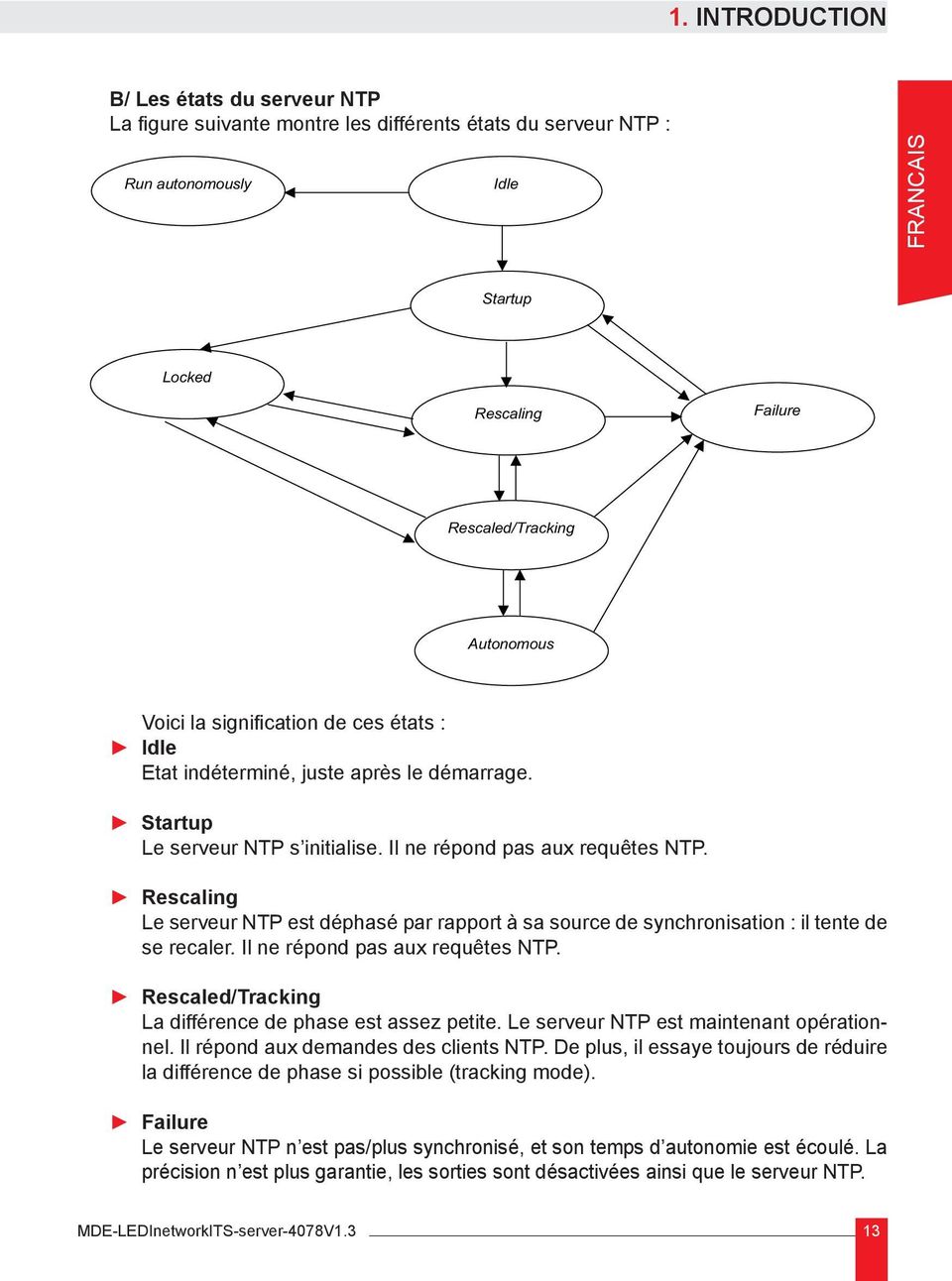
13 1. introduction B/ Les états du serveur NTP La figure suivante montre les différents états du serveur NTP : Run autonomously Idle FRANCAIS Startup Locked Rescaling Failure Rescaled/Tracking Autonomous Voici la signification de ces états : Idle Etat indéterminé, juste après le démarrage. Startup Le serveur NTP s initialise. Il ne répond pas aux requêtes NTP. Rescaling Le serveur NTP est déphasé par rapport à sa source de synchronisation : il tente de se recaler. Il ne répond pas aux requêtes NTP. Rescaled/Tracking La différence de phase est assez petite. Le serveur NTP est maintenant opérationnel. Il répond aux demandes des clients NTP. De plus, il essaye toujours de réduire la différence de phase si possible (tracking mode). Failure Le serveur NTP n est pas/plus synchronisé, et son temps d autonomie est écoulé. La précision n est plus garantie, les sorties sont désactivées ainsi que le serveur NTP. MDE-LEDInetworkITS-server-4078V1.3 13
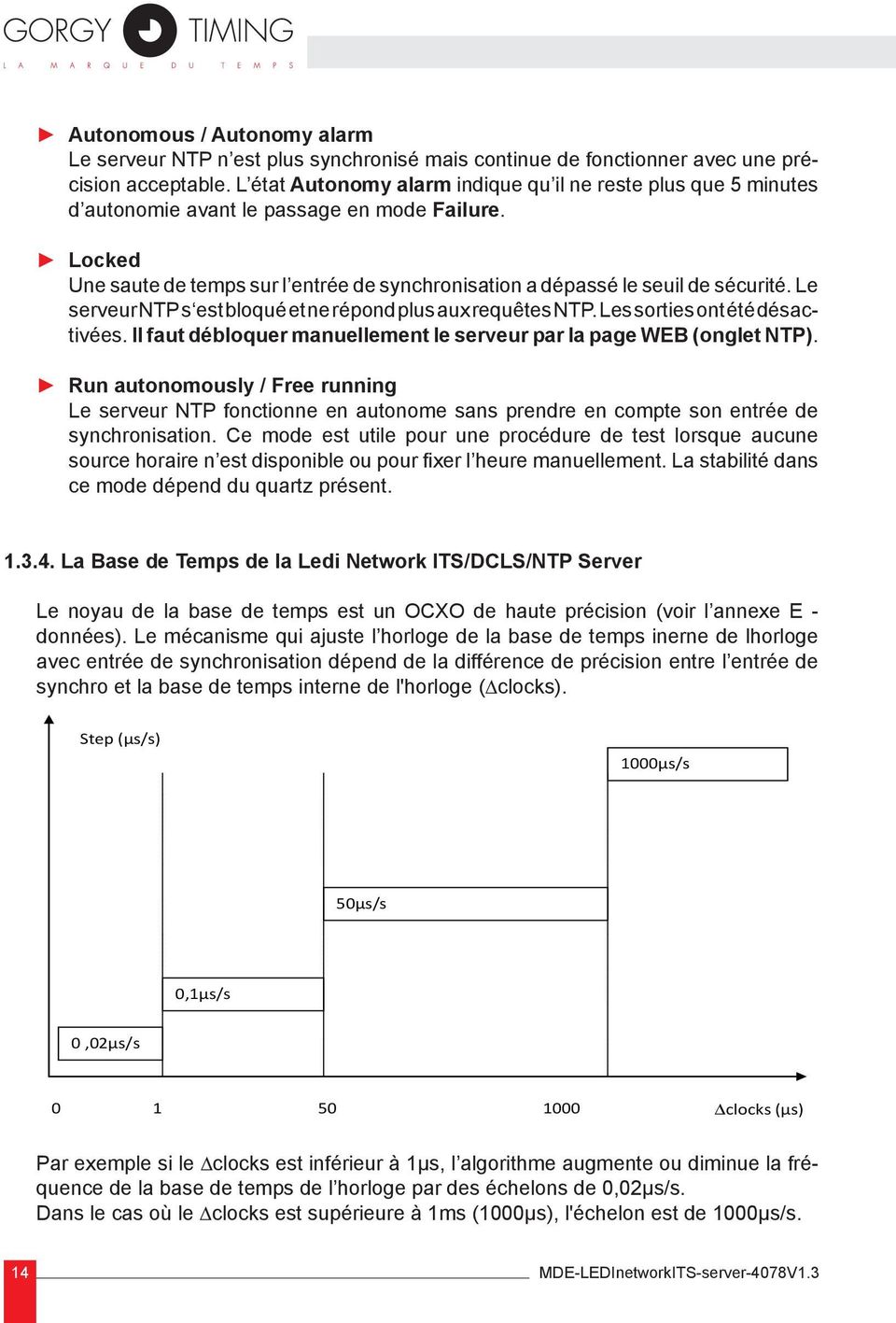
14 Autonomous / Autonomy alarm Le serveur NTP n est plus synchronisé mais continue de fonctionner avec une précision acceptable. L état Autonomy alarm indique qu il ne reste plus que 5 minutes d autonomie avant le passage en mode Failure. Locked Une saute de temps sur l entrée de synchronisation a dépassé le seuil de sécurité. Le serveur NTP s est bloqué et ne répond plus aux requêtes NTP. Les sorties ont été désactivées. Il faut débloquer manuellement le serveur par la page WEB (onglet NTP). Run autonomously / Free running Le serveur NTP fonctionne en autonome sans prendre en compte son entrée de synchronisation. Ce mode est utile pour une procédure de test lorsque aucune source horaire n est disponible ou pour fixer l heure manuellement. La stabilité dans ce mode dépend du quartz présent La Base de Temps de la Ledi Network ITS/DCLS/NTP Server Le noyau de la base de temps est un OCXO de haute précision (voir l annexe E - données). Le mécanisme qui ajuste l horloge de la base de temps inerne de lhorloge avec entrée de synchronisation dépend de la différence de précision entre l entrée de synchro et la base de temps interne de l'horloge ( clocks). Step (µs/s) 1000µs/s 50µs/s 0,1µs/s 0,02µs/s clocks (µs) Par exemple si le clocks est inférieur à 1µs, l algorithme augmente ou diminue la fréquence de la base de temps de l horloge par des échelons de 0,02µs/s. Dans le cas où le clocks est supérieure à 1ms (1000µs), l'échelon est de 1000µs/s. 14 MDE-LEDInetworkITS-server-4078V1.3
15 2. INSTALLATION COMPLETE La présente partie contient les informations pour une configuration complète du produit. Elle devrait être utilisée pour finaliser l installation du réseau et l installation des cartes de sorties Configuration réseau FRANCAIS Configuration par défaut La LEDI network ITS/DCLS/NTP est configurée pour prendre automatiquement l adresse IP d un serveur DHCP. Au démarrage, le produit envoie une requête DHCP pour obtenir une adresse IP. Cette requête contient un nom DHCP. Il y a deux cas : Si un serveur DHCP est installé sur votre réseau, il enregistre la demande DHCP et renvoie une adresse IP. La LEDI Network ITS/DCLS/NTP Server démarre avec cette nouvelle adresse. Si aucun serveur DHCP n est installé, la LEDI Network ITS/DCLS/NTP Server démarre automatiquement avec une adresse IP par défaut dans la gamme x.y (avec x et y variant entre 0 et 255) et un masque réseau MDE-LEDInetworkITS-server-4078V1.3 15
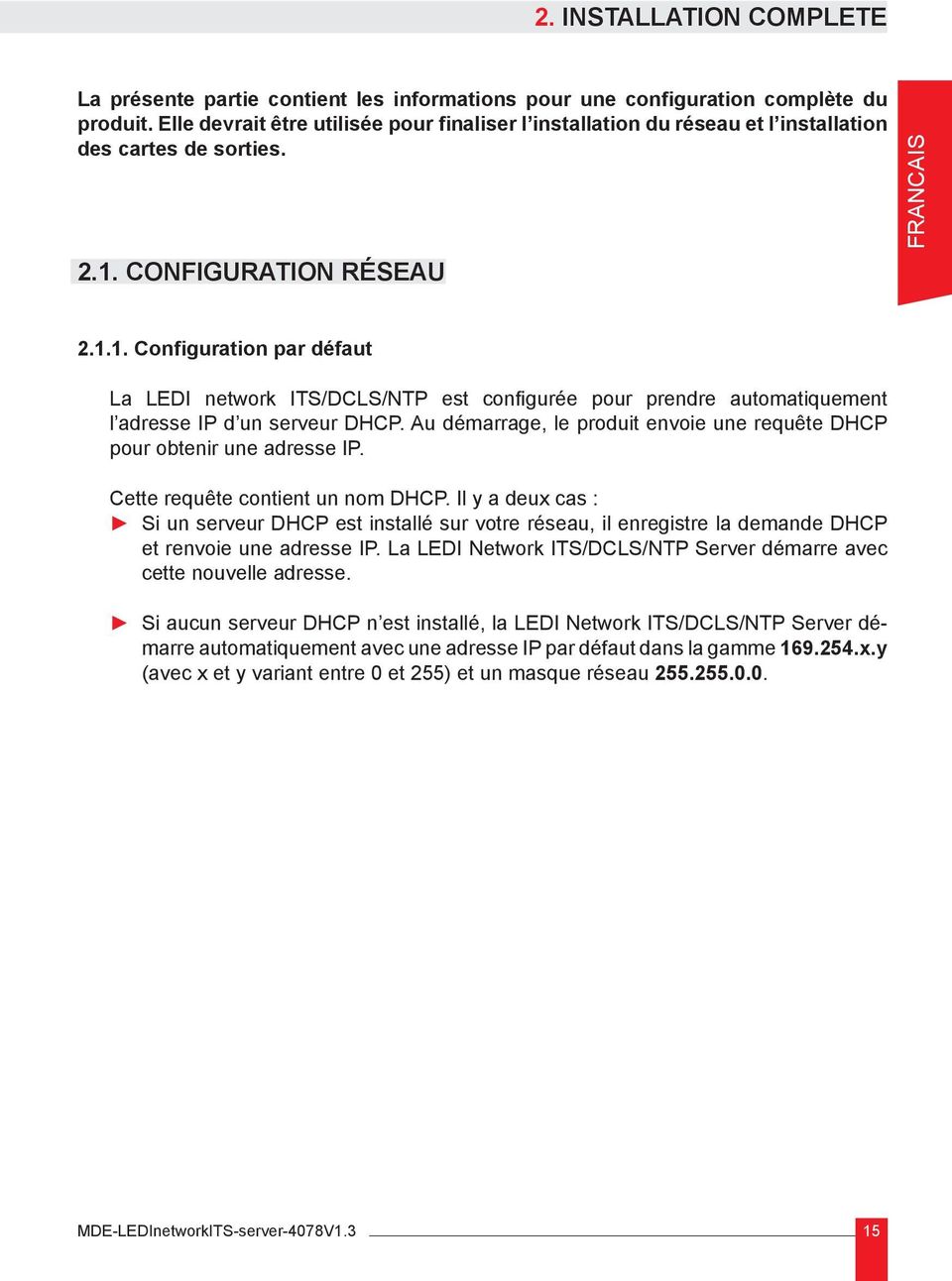
16 Changer les paramètres réseaux Utiliser l outil GTNetManager fournit sur le CD-ROM pour configurer votre produit : Insérer le CDROM dans le lecteur de votre PC puis lancer le programme GTNet- Manager localisé dans le répertoire Common\Configuration 3. L utilitaire GTNetManager affiche automatiquement les produits GORGY TIMING installés sur le réseau comme ci-dessous : Nom, numéro de série et localisation Adresse IP actuelle Masque de sousréseau Adresse MAC Identificateur DHCP 3/ Par exemple, si votre lecteur de CD a la lettre E:, l utilitaire GTNetMng se trouve dans E:\Common\Configuration\ GTNetMng.exe 16 MDE-LEDInetworkITS-server-4078V1.3
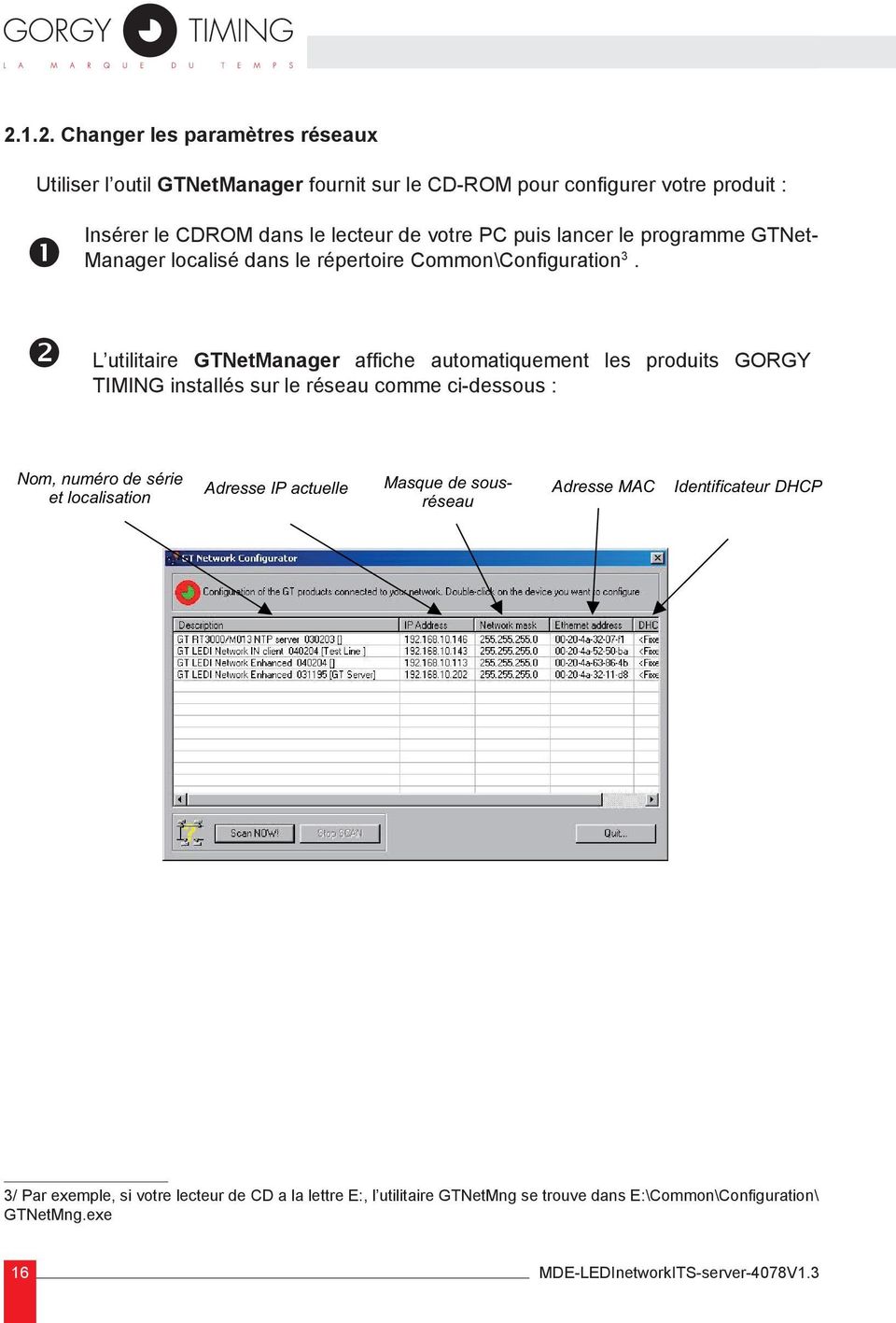
17 2. INSTALLATION COMPLETE Double-cliquer sur la ligne correspondant au produit que vous souhaitez configurer. La fenêtre suivante apparaît : Nom du produit Numéro de série (040204) Localisation (Test Line) Adresse Ethernet (MAC) du produit Localisation du produit FRANCAIS Entrer les paramètres réseau et la localisation, puis cliquer sur Set! Le produit redémarre avec ses nouveaux paramètres. MDE-LEDInetworkITS-server-4078V1.3 17
18 Intégration à votre réseau Vous n avez pas besoin de changer les paramètres réseaux dans les cas suivants : Vous avez un serveur de DHCP et assez d adresses IP réservées pour le produit Vous n avez pas de serveur DHCP mais vous n avez pas besoin d accéder au produit par l intermédiaire de sa page WEB ou de son interface SNMP. Dans ce cas, le mécanisme d AutoIP va automatiquement affecter une adresse IP mais cette adresse va probablement être incompatible avec votre réseau. Quoi qu il en soit, si plusieurs dispositifs fonctionnent en AutoIP, ils peuvent fonctionner ensemble. Certains serveurs DHCP ont la capacité d enregistrer le produit dans le DNS. Dans ce cas, le nom inscrit est l identifiant DHCP. Puis, vous pouvez accéder au produit à partir de votre navigateur WEB ou du navigateur SNMP. Par exemple si vous donnez le nom DHCP ntpsrv1 à votre LEDI ITS/DCLS/NTP Server, vous pouvez simplement taper ntpsrv1 dans la zone d adresse de votre navigateur WEB. Si vous avez plusieurs produits à installer, il est fortement recommandé de suivre les étapes suivantes : Utilisez le document fourni à l annexe F - documents additionnels (vue sommaire d installation) et notez le numéro de série et l adresse physique de chaque produit pendant l installation et le raccordement. Sur un PC connecté sur le même réseau que les produits et qui a GTNetManager de lancé. Tous les produits de GT doivent apparaître avec leur numéro de série. Validez les paramètres réseaux et la localisation en utilisant le document rempli à l étape précédente. Vous pouvez garder ce document pour davantage de référence. 18 MDE-LEDInetworkITS-server-4078V1.3

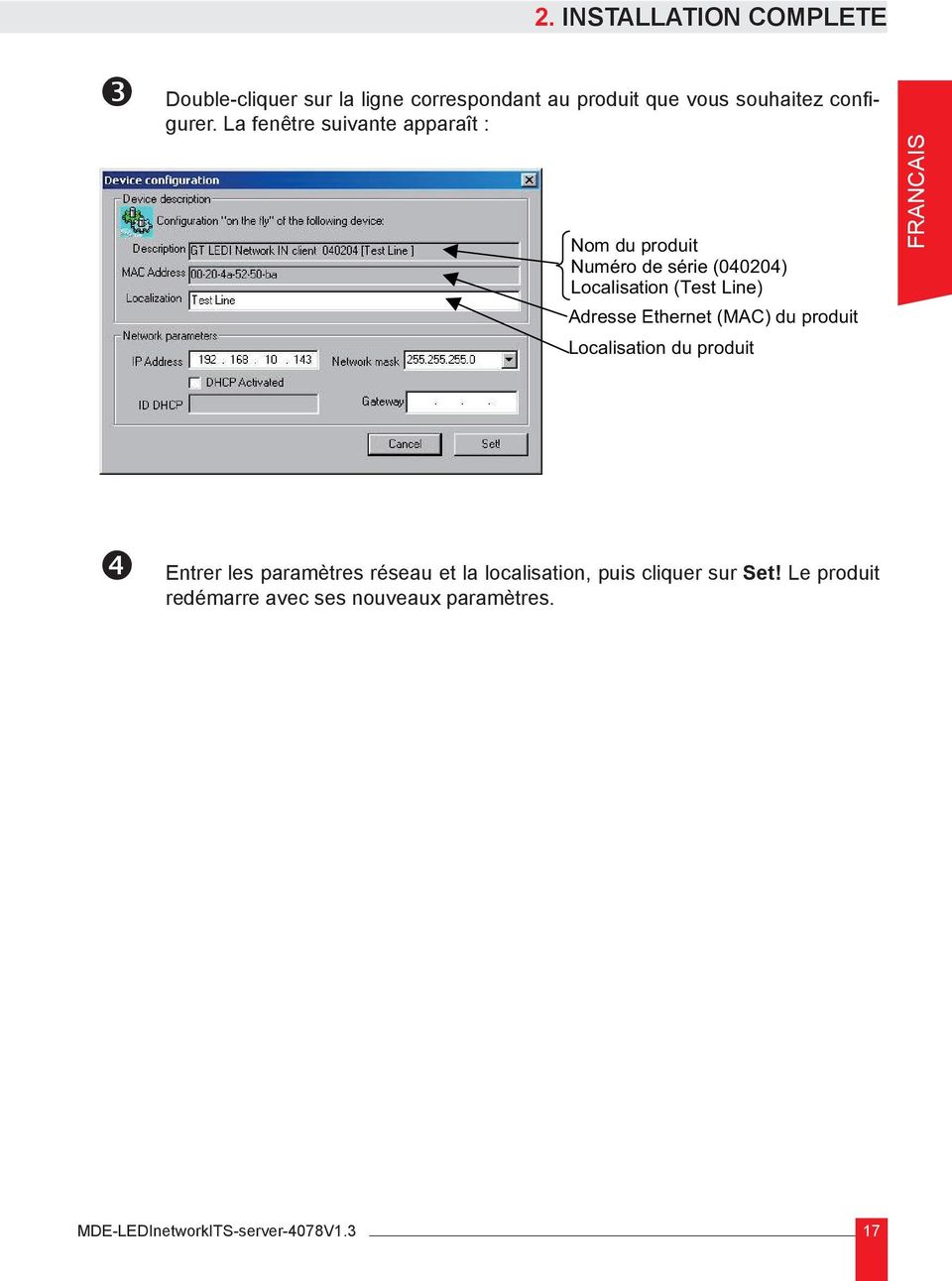
19 2. INSTALLATION COMPLETE 2.2. Configuration des cartes de sorties Introduction Votre LEDI Network ITS peut être équipée jusqu à 3 cartes (4 pour la LEDI Network DCLS). Chaque carte de sortie est synchronisée sur le code horaire NTP reçu du serveur NTP ou du GPS ou de la carte d entrée IRIG B. Chaque carte agit en tant que traducteur qui recevant l heure de la source principale de synchronisation et de la sortie spécifique du code horaire. FRANCAIS Actuellement, il y a 9 types de cartes : NTP/SNTP N 4 sorties AFNOR NFS 87500/IRIGB 1000HZ H 4 sorties PPS,PPM, PPH, PP2S, DCF (TTL, differential TTL, Phototransistor) P 4 sorties PPS,PPM, PPH, PP2S, DCF (TTL, differential TTL, Static Relay) Q 4 sorties DCLS (TTL, differential TTL, Phototransistor) T 4 sorties DCLS (TTL, differential TTL, Static Relay) V 4 sorties Serial ASCII RS 232 A 4 sorties Serial ASCII RS 422, RS485 R SMPTE S Configuration par défaut Quand vous recevez ce produit de Gorgy Timing, toutes les cartes de sorties sont configurées pour fournir l heure UTC et sans changement d heure sur l année. L affichage est contrôlé en tant que cartes de sorties et peut être configuré de la même manière. Important. Le format de signal sur des cartes PPS et DCLS peut être changé en TTL, différentiel TTL (RS422) ou phototransistor/relais statique (dépend du type de carte). Voir l annexe D - MAINTENANCE 2. Vérification des Switch des cartes de sorties. MDE-LEDInetworkITS-server-4078V1.3 19
20 Changer les paramètres Ouvrir la page WEB de la LEDI Network ITS/DCLS/NTP Server (voir la partie 5). Cliquer sur le bouton Output. La configuration actuelle de votre produit apparaît à l écran. Dans cet écran vous pouvez paramétrer chaque carte indépendamment (voir page 31). Lorsque vous avez changé la configuration, cliquer sur le bouton Submit. La modification doit apparaître immédiatement sur les sorties ou sur l écran Configuration des cartes de sorties du serveur NTP Vous pouvez ajouter une carte de sortie serveur NTP à votre LEDI network ITS/DCLS. Vous pouvez ainsi synchroniser vos différents réseaux locaux sur plusieurs serveurs NTP, eux-mêmes synchronisés sur la même source. La sortie optionnelle serveur NTP doit être configurée de la même manière que la LEDI Network 1/S/RK Enhanced. Sa configuration réseau par défaut est le mode DHCP avec l identificateur SCnnnnnn avec nnnnnnn le numéro de série sur 6 chiffres. L identificateur SNMP par défaut est NTPServnnnnnn avec nnnnnn le numéro de série sur 6 chiffres. Pour changer les paramètres réseau de la sortie serveur NTP, utiliser l utilitaire GT Network Manager (voir page 14). Comme la LEDI Network ITS/DCLS, la sortie serveur NTP dispose d une page WEB de configuration (voir page 23) et d une MIB SNMP pour la supervision à distance. 20 MDE-LEDInetworkITS-server-4078V1.3
21 3. Afficheur face avant L écran en face avant peut afficher jusqu à 16 caractères. Deux boutons vous permettent de configurer l affichage et le redémarrage global. La LEDI Network ITS/DCLS/NTP utilise l affichage avant pour donner l heure courante et les différentes conditions d alarme. FRANCAIS Redémarrer le produit Basculer l affichage vers d autres informations 3.1. Conditions de démarrage Au démarrage, l heure et la date sur la LEDI Network ITS/DCLS/NTP Server ne sont pas valides et ne sont donc pas affichées. Au démarrage, l heure et la date sur la LEDI Network 1/S/RK Enhanced ne sont pas valides et ne sont donc pas affichées. Quand l appareil démarre, tous les points de l affichage sont allumés : Durant la phase d initialisation du matériel, le texte suivant apparaît : Puis l adresse IP du produit est affichée. S il n y a pas de synchronisation en entrée, le message suivant est affiché : MDE-LEDInetworkITS-server-4078V1.3 21
22 3.2. Affichage horaire Lorsqu aucune alarme n est présente et que le code horaire est présent sur l entrée de la LEDI Network ITS/DCLS/NTP Server, l heure courante du serveur est affichée en permanence. Lorsque l afficheur est configuré pour donner l heure UTC, les informations suivantes sont affichées par alternance : IN1 FRI 12:43:13 IN1 07 OCT En utilisant le bouton mode, vous affichez la précision ou le nombre de satellites GPS détectés 07 satellites > 20us accuracy > 1 us accuracy OCXO WARM UP OCXO LOCK 22 MDE-LEDInetworkITS-server-4078V1.3
23 3. Afficheur face avant 3.3. Alarme mineure Il existe deux alarmes mineures, qui seront affichées en alternance avec l heure et la date : Il n y a pas de synchronisation en entrée : FRANCAIS La différence de temps en entrée est trop importante, la LEDI Network 1/S/RK Enhanced essaie de recaler son horloge interne. L afficheur indique Rescaling Alarme majeure Il existe deux alarmes majeures, qui seront affichées en permanence : La LEDI Network ITS/DCLS n est plus synchronisée et ne peut garantir une précision suffisante. Le serveur ne délivre plus l heure sur ses sorties ni sur le réseau. L afficheur indique : L écart de temps en entrée a dépassé le seuil de sécurité (security threshold configuré dans la page WEB). La LEDI Network se bloque et ne délivre plus l heure sur ses sorties ni sur le réseau. L afficheur indique «LOCKED». Il faut accéder à la page WEB pour débloquer le serveur Face avant NTP Server POWER : VERT OK alim principale CLIGNOTEMENT SECONDE fonctionnement sur batterie ETEINT : OFF SYNC : VERT OK produit synchronisé (INFO horaire validée en entrée) OFF Eteint produit non synchronisé (INFO horaire non valide/non disponible) LOCKED : VERT OK PLL bloquée OFF PLL non bloquée MDE-LEDInetworkITS-server-4078V1.3 23
24 4. Interface WEB 4.1. Présentation La LEDI Network ITS/DCLS/NTP peut être configurée et supervisée à travers une interface WEB. Cette interface vous permet de gérer : les paramètres réseau. les paramètres SNMP. le logiciel serveur NTP lui-même. les cartes de sortie. Chaque LEDI Network ITS/DCLS/NTP intègre son propre serveur WEB qui délivre une page WEB. Ce site WEB est une applet JAVA. Si besoin, vous trouverez une JVM (Java Virtual Machine) sur le CD-ROM, dans le répertoire Common\JAVA. Pour accéder au site WEB, entrer l adresse de la LEDI Network ITS/DCLS/NTP dans le champ d adresses de votre navigateur WEB (comme ci-dessous), et appuyer sur Entrée. 4 4/ Si vous avez configuré votre LEDI NETWORK ENHANCED en mode DHCP et que votre serveur enregistre automatiquement l identificateur DHCP dans le DNS, vous pouvez entrer le nom DHCP au lieu de l adresse IP 24 MDE-LEDInetworkITS-server-4078V1.3
25 4. Interface WEB 4.2. Description de l interface WEB Ecran principal Voici l écran qui doit apparaître lorsque vous accédez au site WEB de la LEDI Network ITS/DCLS/NTP. Les trois premiers boutons à gauche de l écran permettent d accéder aux panneaux suivants : Standard: informations concernant le produit et configuration des paramètres réseau. State : état courant du produit en fonctionnement SNMP: configuration des paramètres SNMP. NTP: configuration du serveur NTP. Input: Configuration du décalage par rapport à l entrée de synchronisation. Réglage de l autonomie, passage en mode autonome («Free running»). Output: configuration des sorties et de l affichage. Download : charger un nouveau programme. Le bouton Submit sauvegarde immédiatement la configuration de la LEDI Network ITS/DCLS/NTP avec les nouveaux paramètres. Ces paramètres sont alors stockés en permanence. FRANCAIS ATTENTION. La modification de certains paramètres nécessite le redémarrage de la LEDI Network ITS/DCLS/NTP. Si vous changez ces paramètres et cliquez sur le bouton Submit, la LEDI Network ITS/DCLS/NTP redémarre avec les nouveaux paramètres. MDE-LEDInetworkITS-server-4078V1.3 25
26 Réglages standards Lorsque vous cliquez sur le bouton Standard, les paramètres réseau et les informations sont affichés. Dans le haut de la page, vous pouvez commander les paramètres réseau et le mot de passe WEB. Sur le bas de la page, vous avez des informations sur le produit. Paramètres réseaux ATTENTION. Si vous cliquez sur le bouton Submit après avoir changé un ou plusieurs paramètres réseau, la LEDI Network ITS/ DCLS/NTP doit redémarrer pour utiliser ces nouveaux paramètres. Pendant le redémarrage, les sorties sont désactivées. Voici les différents paramètres: IP mode Indique si la LEDI Network ITS/DCLS/NTP fonctionne en adresse IP fixe (entrée dans le champ IP address) ou avec le protocole DHCP (l identificateur DHCP est entré dans le champ DHCP identifier). IP address Indique l adresse IP affectée au réseau. Une adresse IP est composée de 4 numéros séparés par un point. Chaque numéro s étend de 0 à 255. DHCP identifier Identificateur utilisé quand le LEDI Network ITS/DCLS/NTP est configuré en mode DHCP. Il est composé d au maximum 8 lettres. Network submask Indique la taille du réseau que vous utilisez. Par exemple, un masque se sousréseau de indique que seul le dernier numéro de l IP change (dans l exemple ci-dessus, l adresse dans le réseau peut varier entre à ) 5. Gateway address Si vous voulez que le produit communique avec d autres appareils en dehors du réseau local, vous devez indiquer une passerelle (gateway) qui sera utilisée pour sortir du réseau local. Without gateway Cochez cette case si vous n avez pas de passerelle sur votre réseau, ou que vous ne souhaitez pas l utiliser. 5/ Si vous configurez plusieurs appareils pour communiquer sur le même réseau, vous devez avoir le même masque de sous-réseau. 26 MDE-LEDInetworkITS-server-4078V1.3
27 4. Interface WEB Informations sur le produit Voici une description de la zone d informations sur le produit: Hardware GT serial number Affiche le numéro de série Gorgy-Timing du produit. C est un numéro à 6 chiffres qui doit être identique à celui collé sous ou derrière le produit. Hardware Product code Affiche le code de base Gorgy-Timing du produit sans option. Ethernet Interface (MAC) Address Indique l adresse MAC de l interface Ethernet du produit. Firmware Version/Release Date Version du logiciel fonctionnant sur le produit et la date du dernier logiciel produit (au format anglais yymmdd, par exemple pour le 10 Octobre 2002). Last reboot reason Indication sur la raison du dernier redémarrage du produit. FRANCAIS Protection de l accès au site WEB Si vous souhaitez protéger l accès aux paramètres du produit, vous pouvez spécifier un mot de passe. Vous devez, pour cela, entrer le même mot de passe dans les zones Enter password et Confirm password. ATTENTION. Le nom de l utilisateur est : user Quand un mot de passe est activé, il sera demandé à la prochaine connexion. MDE-LEDInetworkITS-server-4078V1.3 27
28 Etat du produit L état standard du produit est affiché : State: Etat actuel du produit (Free running, tracking.) Synchronization: Etat actuel de la synchronisation (Input 1 is waiting, Input 1 is synchronizing ) -> L entrée 1 est en cours de synchronisation, L entrée 1 est synchronisée Configuration NTP Lorsque vous cliquez sur le bouton NTP, la configuration du logiciel de serveur NTP est affichée. Description du serveur Voici une description des champs de cet écran: STRATUM level Position du serveur (stratum value) qui est envoyée dans les messages NTP aux clients NTP. Reference ID 4 lettres qui donnent l information sur la référence de temps. Cette info est ajoutée à la trame NTP. When not synchronized Définit certains champs inclus dans la trame NTP quand le produit n est plus synchronisé. Choix possible entre LI&STRATUM unchanged, STRATUM=0,LI unchanged, STRATUM unchanged,li=3(11b), STRATUM=0, LI=3(11b) La LEDI Network ITS peut être synchronisée avec au plus trois serveurs NTP. En fait, le logiciel NTP utilise seulement un seul serveur à la fois mais peut permuter sur un autre serveur quand il n y a plus ou pas suffisamment de réponses. Le panneau de configuration NTP montre ce qu est le mode de synchronisation employé par le serveur ou choisi par le logiciel NTP. Il montre également les serveurs définis par l utilisateur ou détectés par le logiciel. 28 MDE-LEDInetworkITS-server-4078V1.3
29 4. Interface WEB Description du client La partie inférieure de l écran montre la configuration courante utilisée par le logiciel de client NTP : FRANCAIS Il montre les différents serveurs utilisés pour la synchronisation et le mode courant de synchronisation (sur le screenshot ci-dessus, il y a seulement un serveur à l adresse IP ). D autre part, la partie d écran ci-dessous montre quel est le serveur actuellement utilisé pour la synchronisation (avec une trame intitulée Active). La partie du milieu l écran NTP vous permet de configurer le mode de synchronisation et les serveurs NTP utilisés : Si vous choisissez l Auto-détection dans le menu déroulant, la LEDI Network ITS / DCLS / NTP essaie d utiliser les serveurs présents sur votre réseau. Si vous ne choisissez pas l Auto-détection, vous devez indiquer le mode de synchronisation et les serveurs NTP à utiliser. MDE-LEDInetworkITS-server-4078V1.3 29
30 La table suivante peut vous aider à choisir les paramètres les plus appropriés : Mode Nombre de serveur NTP utilisé One server 1 Two servers 2 Three servers 3 Description Utilise seulement un serveur pour la synchronisation Utilise le premier serveur au démarrage. Si ce serveur ne fonctionne plus correctement, le produit bascule sur le second serveur. Et si le second ne fonctionne plus, il rebascule sur le premier et ainsi de suite Utilise le premier serveur au démarrage. Si ce serveur ne fonctionne plus correctement, le produit bascule sur le second serveur. Et si le second ne fonctionne plus, il bascule sur le troisième et ainsi de suite Clés MD5 Une clé MD5 est un mot de passe de 8 caractères utilisé pour générer une signature sur 128 bits des messages NTP. Cette signature est ensuite utilisée pour authentifier le serveur NTP utilisé et certifie que le message NTP n a pas été modifié. Pour activer l authentification, une clé identique doit être configurée sur le serveur et le client, et au même numéro. 30 MDE-LEDInetworkITS-server-4078V1.3
31 4. Interface WEB Configuration de l entrée de synchronisation En cliquant sur le bouton Input, le panneau de configuration de l entrée de synchronisation de la LEDI Network ITS/DCLS/NTP apparaît : A/ Base de temps Run autonomously Cochez cette case si vous souhaitez que votre LEDI Network ITS/DCLS/NTP fonctionne en mode autonome, indépendamment de l heure des entrées. Puis mettre la date actuelle comme montré ci-dessous. Valider votre date en cliquant sur Submit. FRANCAIS Remarque : ce mode est utile en phase de test si aucune source de synchronisation n est disponible. Sinon, la date n est pas exacte, et la précision n est plus garantie. B/ Entrée 1 ou Entrée 2 Heure locale sur l entrée Dans la plupart des cas, le produit est synchronisé avec un code horaire décalé par rapport à l UTC (par exemple TDF/DCF), il faut donc configurer le réseau horaire et la politique de changement d heure. Par exemple en France, l heure locale est UTC+1 en hiver et UTC+2 en été. Ce qui donne : Offset from UTC : +1h00 DST : European Union Si la source horaire est une heure universelle UTC, laisser la case «local time on input» décochée. MDE-LEDInetworkITS-server-4078V1.3 31
32 Compensation manuelle/automatique du temps de propagation La compensation du temps de transmission peut être utilisée pour compenser les longueurs de câble IRIG-B ou des répéteurs GPS par exemple. Entrer la valeur en dixième de microseconde si vous connaissez le retard. En mode automatique, le temps de transmission d une entrée est calculé en fonction de la différence avec l autre entrée. Si l entrée est automatique, sa compensation du retard sera nulle, car c est la seule référence pour le dispositif. Autonomie en cas de perte de synchronisation Si la source de temps est perdue, le dispositif peut fonctionner en mode autonome. Quand la fin du temps d autonomie est atteinte, le dispositif cesse de fournir l heure sur ses sorties ou l heure NTP. Vous pouvez choisir la durée d autonomie ou la mettre à durée infinie. Seuil de sécurité Donnez la différence de phase maximum (en secondes) permise sur la source de temps avant de fermer le logiciel de serveur NTP. Ce champ est initialisé à «inactivé». 32 MDE-LEDInetworkITS-server-4078V1.3
33 4. Interface WEB Programmation manuelle du saut de seconde et de l indicateur LI de la trame NTP Si un saut de seconde se produit au 1er janvier ou le 1er juillet de l année en cours, vous pouvez programmer le dispositif pour insérer un indicateur de saut (LI) dans les trames NTP ou les trames DCF (quand une carte de sortie DCF est présente). Cet indicateur sera actif un jour à l avance pour le NTP, et d une heure à l avance pour le DCF, et sera automatiquement remis à zéro le 1er janvier ou le 1er juillet. Notez que le dispositif procédera à un saut de seconde seulement quand le saut sera reçu de la source de synchronisation extérieure. FRANCAIS Valeurs disponibles : no additional second last minute as 61 seconds last minute as 59 seconds pas de seconde additionnelle la dernière seconde à 61 secondes la dernière seconde à 59 secondes Configuration des sorties et de l affichage Lorsque vous cliquez sur le bouton Output, la configuration des sorties de la LEDI Network ITS/DCLS/NTP est affichée. Ce panneau montre une vue synthétique des sorties du produit. L affichage en façade avant est considéré comme une sortie et il est contrôlé par une carte d affichage. Une LEDI ITS/DCLS/NTP peut avoir jusqu à trois cartes de sortie (4 pour la DCLS) plus la carte d affichage. L afficheur et chacune des sorties de chacune des cartes de sortie peuvent être configurées indépendamment. Quand une carte de sortie est absente ou en panne, sa partie n apparait pas. Actuellement, il existe 3 sortes de cartes de sorties : NTP/SNTP N 4 outputs AFNOR NFS 87500/IRIGB 1000HZ H 4 outputs PPS,PPM, PPH, PP2S, DCF (TTL, differential TTL, Phototransistor) P 4 outputs PPS,PPM, PPH, PP2S, DCF (TTL, differential TTL, Static Relay) Q 4 outputs DCLS (TTL, differential TTL, Phototransistor) T 4 outputs DCLS (TTL, differential TTL, Static Relay) V 4 outputs Serial ASCII RS 232 A 4 outputs Serial ASCII RS 422, RS485 R SMPTE S MDE-LEDInetworkITS-server-4078V1.3 33
34 Configuration des sorties standards Description et version hardware de la carte Politique de changement d heure Bloquer les sorties Offset qui applique l heure UTC L image précédente montre le panneau de configuration pour un AFNOR/IRIG-B. D autre part, la description contient l identification et la version du programme inclus dans la carte de sortie (là, c est le programme NTP4DCL1, version 05390). Chaque carte de sortie peut être configurée indépendamment selon les paramètres suivants : Désactivation des sorties A l exception de l affichage, toutes les sorties peuvent être désactivées. La désactivation entraine les effets suivants : Pour la carte ASCII+TOP, l heure de la trame n est pas générée et la sortie TOP est à l état ouvert. Pour les sorties AFNOR, la porteuse n est plus modulée. La sortie ALARM ne génère pas de signal d alarme. Zone horaire La Time Zone (zone horaire) est un offset d heure qui peut être ajouté ou soustrait à l heure reçue depuis le protocole NTP (qui donne l heure UTC) pour générer l heure locale. Par exemple, pour la France, l heure locale est fixée à GMT +1:00. Changement d heure En plus de la zone horaire, de nombreux pays appliquent le changement d heure. L année est décomposée en deux temps: l heure d été, 1 heure en plus est ajoutée à l heure (en plus de la correction de la zone horaire), en hiver, seule la correction de la zone horaire est appliquée. Ne pas oublier de sélectionner le pays concerné dans l interface WEB. 34 MDE-LEDInetworkITS-server-4078V1.3
35 4. Interface WEB Voici les différentes politiques DST : Union Européenne USA / Canada / Mexico / St. Johns / Bahamas / Turks / Caicos Australie Standard Russie Début : Le dernier samedi de mars à 1 heure du matin Fin: Le dernier samedi d octobre à 1 heure du matin Début : Premier samedi d avril Fin : Dernier samedi d octobre Début: le dernier samedi d octobre Fin: le dernier samedi de mars Début : le dernier samedi de mars à 2 heures du matin. Fin : Le dernier samedi d octobre à 2 heures du matin FRANCAIS Configuration pour affiner les sorties La plupart des cartes de sortie fournissent une configuration spécifique : Configuration ASCII + PPS : Vous pouvez configurer ici la largeur et la période du TOP. Comme par exemple, le TOP DCF, PPS, PPM. Configuration AFNOR / IRIG-B : Choisir votre format de trame : AFNOR, IRIG-B ou IRIG-B + seconde binaire. MDE-LEDInetworkITS-server-4078V1.3 35
36 Configuration SMPTE: Le format du code de la sortie SMPTE peut être configuré ici. Le champ de bit utilisateur peut être automatiquement défini avec la date ou rempli manuellement. L heure du code SMPTE peut être recalée chaque seconde sur la base de temps du produit, ou à une heure spécifique du jour. 36 MDE-LEDInetworkITS-server-4078V1.3
37 4. Interface WEB Configuration des paramètres SNMP FRANCAIS L écran de configuration des paramètres SNMP permet de configurer les éléments principaux de ce type d alertes : Adresse(s) IP pour l envoi des alertes (traps) Nom du produit (informatif) Emplacement du produit (informatif) Contact pour le produit (informatif) Les alertes générées tout comme la MIB sont au format V2c. Pour plus d informations sur les alertes et la MIB, se reporter au document référence R F-487A présent sur le CDRom sous le nom «F487A Manuel SNMP V2c de la gamme ITS.pdf». MDE-LEDInetworkITS-server-4078V1.3 37
38 Annexe A Connexions Cette annexe contient une description des différents connecteurs de la LEDI Network ITS/ DCLS/NTP. Toutes les prises sont situées à l arrière du produit. 1. Connexion pour tous les produits 18-72VDC 230 VDC Antenne GPS (connecteur SMA, avec adaptateur TNC) Etat sortie usine Relais statiques alarmes tension et synchro Deuxième entrée de synchronisation Reset Sortie TTL 10 Mhz Sinusoïde 10 Mhz output 2. Sorties 1PPS et 10MHz Connecteur 1PPS: C nnecteur 10 MHz (seulement avec OCXO): Format 1PPS TTL GND 10Mz sinusoïdale GND 38 MDE-LEDInetworkITS-server-4078V1.3
39 Annexe A Connexions VDC Ci-dessous, le schéma du connecteur VDC : VDC + - FRANCAIS 4. Alarmes sur relais statiques Pins 3 & : alarme alimentation (sans polarité) Pins 1 & 2 : alarme synchronisation (sans polarité) 5. ENTRÉE AFNOR NFS87500 / IRIG-B (sinusoïdale / TTL / RS422) L entrée de synchronisation AFNOR/IRIG-B est une prise 2 points non polarisée en modulé, et polarisée en TTL/RS422 : MDE-LEDInetworkITS-server-4078V1.3 39
40 6. Sorties IRIG B / AFNOR NFS (DCLS et modulé) Sortie Sortie 1 Sortie 1 2 Sortie 32 Sortie 4 Sortie 3 Sortie 4 7. Sortie ASCII Le brochage du connecteur DB9 permet de sortir 4 lignes ASCII indépendantes : RS232 RS485 / RS422 1 TX4 TX4-2 GND TX1+ 3 TX1 TX1-4 GND TX4+ 5 GND TX3+ 6 TX3 TX3-7 TX2 TX2-8 GND TX2+ 9 N.C. N.C. 8. Sorties SMPTE Connecteur SMPTE: Connecteur Blackburst : 3 Froid 1 GND Blackburst 2 Chaud GND 40 MDE-LEDInetworkITS-server-4078V1.3
41 Annexe B Format du code de sortie Cette annexe contient une description du code horaire utilisé pour les différents types de sortie : 1. Cartes RS232, RS485, RS422 La configuration par défaut est décrite ci-dessous : La trame ASCII a 23 caractères au format suivant: FRANCAIS STX D A Y D D / M M / Y Y H H : M M : S S CR Voici une description des différents composants de cette trame Champ Taille Valeur/Signification STX 1 Un octet simple dont la valeur est 2, marque le commencement de la trame. DAY 3 Le jour de la semaine est en anglais : (MON pour Monday (lundi), TUE pour Tuesday (Mardi), WED pour Wednesday, THU pour Thursday, FRI pour Friday, SAT pour Saturday, SUN pour Sunday) DD 2 Le jour du mois sur 2 caractères ASCII (01-31) MM 2 Le mois de l année sur 2 caractères ASCII (01-12) YY 2 L année sur 2 caractères ASCII (00 pour pour 2099) HH 2 L heure sur 2 caractères ASCII (00à 23) MM 2 Les minutes sur 2 caractères ASCII (00 à 59) SS 2 Les secondes sur 2 caractères ASCII (00 à 59) CR 1 Un octet simple dont la valeur est 13 (en décimal) Marque la fin de la trame MDE-LEDInetworkITS-server-4078V1.3 41
42 2. AFNOR/IRIG-B NFS Format de la trame 42 MDE-LEDInetworkITS-server-4078V1.3
43 Annexe B Format du code de sortie 2.2. Encodage des bits Le signal est modulé seulement sur la carte B. Le signal de sortie de la carte T est un signal TTL. FRANCAIS MDE-LEDInetworkITS-server-4078V1.3 43
44 3. Description des codes horaires DCF et TDF Détails du message transmis sur une minute complète : bits "0" de synchro rs ment r au e mois jour de la semaine (1= lundi ; 7= dimanche) quantiemes (jour dans le mois) année P P heures M P bits de contrôle minutes J+1 =JF JF ES E/H HE HH "0" "1" Lettre: J Jour actuel JF Jour férié ES Emetteur de secours activé E/H Indique un changement d heure saisonnier à l heure suivante HE Heure d été HH Heure d hiver P1, P2, P3 Bits de parité 44 MDE-LEDInetworkITS-server-4078V1.3
45 Annexe B Format du code de sortie 4. Description du message SMPTE LONGITUDINAL BIT ASSIGNMENT START CLOCK EDGE BETWEEN BIT 79 AND BIT 0 FRAMES UNITS 1 st d BINARY GROUP FRAMES TENS COLOR FRAME FLAG 2 d BINARY GROUP SECONDS UNITS 3 d BINARY GROUP SECONDS TENS BI-PHASE MARK PHASE CORRECTION BIT (EBU) 4 th BINARY GROUP MINUTES UNITS 5 th BINARY GROUP MINUTES TENS 6 th BINARY GROUP HOURS UNITS 7 th BINARY GROUP HOURS TENS UNASSIGNED ADDRESS BIT 58 BI-PHASE MARK PHASE CORRECTION BIT (EBU) 8 th BINARY GROUP SYNC WORD EUROPEAN FORMAT LEITCH FORMAT Day of Week Days units Days tens Months units Months tens Years units Years tens US FORMAT Day of Week Months units Months tens Days units Days tens Years units Years tens Days units Months units Months and days tens 0 Years units 0 Years tens FRANCAIS 80 BITS PER FRAME 32 USER BINARY SPARE BITS 16 SYNC 31 ASSIGNED ADDRESS 1 UNASSIGNED ADDRESS THE UNASSIGNED BIT IS LOGICAL ZERO UNTIL ASSIGNED RECORDED WAVEFORM CLOCK MDE-LEDInetworkITS-server-4078V1.3 45
46 Annexe C Dépannage Cette section permet de répondre aux questions les plus fréquentes concernant l utilisation de votre produit NTP. Tout d abord, assurez-vous que le logiciel GTNetManager et SUN JAVA Virtual Machine ou 1.5.x ou 1.6.x est installé sur votre poste. J ai fait un «Scan now!» (Scanner maintenant) avec GTNetManager mais je ne vois aucun produit? Vérifier la connexion du câble. Si les LEDs ETHERNET sont visibles, la LED en haut à gauche devrait être verte. Sinon, il doit y avoir une erreur de connexion réseau ou un problème d alimentation. Si vous utilisez plusieurs VLAN (Réseau local virtuel), vérifiez que le produit est bien sur le même VLAN que votre ordinateur. Connectez votre ordinateur directement au produit en utilisant un câble croisé. En mode DHCP, le produit prend automatiquement une adresse IP dans la gamme x.y s il n y a pas de serveur DHCP. Changez l adresse IP de votre ordinateur dans cette gamme, avec un masque réseau de Si votre ordinateur possède un serveur DHCP, le produit prendra une adresse IP compatible avec la gamme d adresse IP de l ordinateur. Je n arrive pas à ouvrir la page WEB de configuration? Premièrement, est-ce que GTNetManager détecte le produit? OUI Votre ordinateur et le produit doivent avoir la même gamme IP et le même masque réseau. NON Voir la question précédente. 46 MDE-LEDInetworkITS-server-4078V1.3
47 Est-ce que la page a été trouvée par le navigateur WEB (le chargement commence mais échoue après un moment)? NON, la page n a pas été trouvée («PAGE NOT FOUND») Si vous utilisez Internet Explorer, allez à : Outils Options internet Connections Paramètres réseau Le navigateur ne devrait pas utiliser de proxy, décochez toutes les cases. OUI La page est joignable mais le navigateur n arrive pas à la charger. Ouvrir une session telnet : telnet adresse_ip_du_produit 9999 login : root password : gtmt Sélectionner «Factory default» puis «Quit & save». Rafraichir la page. Si ça ne change rien passer à la suite. FRANCAIS Une ou plusieurs sorties n apparaissent pas dans la page WEB de configuration? Appuyer sur F5 pour rafraîchir la page WEB puis retourner dans l onglet output. Si la sortie n apparait toujours pas, passer à l étape suivante. Ouvrir une session TELNET dans une fenêtre de commande : telnet adresse_ip_du_produit 9999 login : root password : gtmt Sélectionner «Factory default» puis «Quit & save». Rafraichir la page. Si ça ne change rien passer à la suite. Si la sortie n apparaît toujours pas, ouvrer le produit. Vérifier que les câbles noirs soient bien connectés et que la configuration des switchs est correcte (voir Annexe D MAINTENANCE ) MDE-LEDInetworkITS-server-4078V1.3 47
48 L écran affiche no time code! ou no time code!? NO TIME CODE! : vérifier la source de synchronisation externe car le produit n est pas synchronisé. no time code! avec la date : si le produit reçoit le code horaire, aller dans l onglet input de la page WEB et vérifier que run autonomous n est pas coché. 48 MDE-LEDInetworkITS-server-4078V1.3
49 Annexe D MAINTENANCE 1. Remplacement de la batterie Outil : tournevis plat et cruciforme, multimètre. Référence Gorgy Timing de la batterie : BAT1728S FRANCAIS Durée de vie : 5 ans Vérification de la batterie Connecter votre produit à l alimentation et laisser la batterie se charger au moins une heure. Déconnecter le produit de l alimentation Ouvrer le produit à l aide d un tournevis. La batterie se situe entre la carte alimentation et l afficheur. Entrée Sync. Output N Output 2 Output 1 Power Supply Batterie Display Retirer l ancienne batterie à l aide d un tournevis. Contrôler la tension aux bornes de la batterie : si elle est inférieure à 7Volts, la batterie est hors d usage. Brancher une nouvelle batterie. MDE-LEDInetworkITS-server-4078V1.3 49
50 2. Rajout d une carte de sortie Couper l alimentation secteur et/ou DC. Ouvrir le capot supérieur en retirant les vis (une vis centrale ou 16 vis latérales) Débrancher le connecteur de la batterie, la carte GPS ou NTP doit s éteindre. La nouvelle carte à installer comporte les accessoires suivant : Vis M3 Entretoises Cache pour façade arrière Procédure de montage 1/ Monter les entretoises et vis sur le fond 2/ Visser le cache sur la façade arrière 50 MDE-LEDInetworkITS-server-4078V1.3
51 Annexe D MAINTENANCE 3/ Monter la carte sur les entretoises 4/ Connecter la carte FRANCAIS IMPORTANT : Ne pas oublier de rebrancher la batterie. Vérifier l adresse de la nouvelle carte installée avant redémarrage (voir paragraphe suivant). 3. Vérification des switchs des cartes de sortie 3.1. Switchs d adresse Si vous avez besoin de rajouter une carte de sortie ou si une sortie semble être en défaut (elle n apparaît pas dans la page WEB), ouvrez le produit et vérifiez la configuration des switchs sur les cartes : 1 sortie Sortie 1 (la plus proche de la carte alimentation) Sortie 2 Sortie 3 Sortie 4 (la plus éloignée de la carte alimentation) 2 sorties sorties sorties Positionner le 8ème switch d une carte à 1, vous permet de la tester en forçant la carte qui génére le signal. Ne oublier pas de le remettre sur 0 après le test! MDE-LEDInetworkITS-server-4078V1.3 51
52 3.2. Modification du signal de sortie sur les cartes Top et IRIG-B DCLS Les cartes de sorties Tops et AFNOR NFS87500/IRI-B DCLS peuvent fournir plusieurs formats de signal : TTL TTL Différentiel (RS422) Phototransistors ou relais statiques, dépend du type de carte. Sortie 4 OFF SW1 SW2 SW3 ON Sortie 3 SW1 SW2 SW3... Pour chaque sortie Format du signal Switch 1 Switch 2 Switch 3 Phototransistor ou relais statique ON (à droite) ON (à droite) ON (à droite) RS422 / Différentiel TTL ON (à droite) OFF (à gauche) OFF (à gauche) TTL OFF (à gauche) OFF (à gauche) OFF (à gauche) 52 MDE-LEDInetworkITS-server-4078V1.3
53 Annexe D MAINTENANCE 4. Modification du format du signal d entrée des cartes Top IRIG-B DCLS La LEDI Network DCLS et la LEDI Network ITS (avec l option AFNOR NFS87500/IRIG- B) peuvent accepter plusieurs sortes de signaux d entrée AFNOR NFS87500/IRIG-B, qui dépendent de la configuration des switchs sur la carte principale Switchs de la carte principale de la LEDI Network DCLS Type de code horaire: FRANCAIS Code d entrée Entrée 1 Switch 1 Switch 2 IEEE1344 OFF (à gauche) OFF (à gauche) IEEE1344 ON (à droite) OFF (à gauche) IRIG-B OFF (à gauche) ON (Right) AFNOR ON (à droite) ON (à droite) A la batterie OFF ON Code d entrée Entrée 2 Switch 3 Switch 4 Aux cartes IEEE1344 OFF (à gauche) OFF (à gauche) IEEE1344 ON (à droite) OFF (à gauche) IRIG-B OFF (à gauche) ON (à droite) AFNOR ON (à droite) ON (à droite) MDE-LEDInetworkITS-server-4078V1.3 53
54 Niveau du code horaire : SW11 SW13 OFF ON SW12 SW14 SW10 SW15 SW16 SW9 Format de l entrée TTL RS422 RS422 avec une charge de 120 Ohms Entrée 1 Entrée 2 SW 13 SW 14 SW 15 SW 11 SW 12 SW 10 ON (à droite) OFF (à gauche) OFF (à gauche) ON (à droite) ON (à droite) OFF (à gauche) OFF (à gauche) ON (à droite) ON (à droite) ON (à droite) OFF (à gauche) OFF (à gauche) ON (à droite) ON (à droite) OFF (à gauche) OFF (à gauche) ON (à droite) ON (à droite) Format DCLS Entrée 1 Entrée 2 SW 16 SW 9 Non-inversé ON (à droite) ON (à droite) Inversé OFF (à gauche) OFF (à gauche) 54 MDE-LEDInetworkITS-server-4078V1.3
55 Annexe D MAINTENANCE 4.2. Switchs de la carte principale de la LEDI Network ITS CARTE MERE : Entrée 2 Code horaire Carte option d entrée présente FRANCAIS AFNOR DCLS ON ON OFF OUI AFNOR SINE WAVE ON ON ON OUI IEEE1344 DCLS X OFF OFF OUI IEEE1344 SINE WAVE X OFF ON OUI IRIG-B DCLS OFF ON OFF OUI IRIG-B SINE WAVE OFF ON ON OUI NTP X X OFF NON None X X ON NON Carte option d entrée AFNOR / IRIG-B : DCLS RS422 Switchs DCLS TTL (differentiel TTL) Signal modulé 1 ON (à droite) OFF (à gauche) OFF (à gauche) 2 ON (à droite) ON (à droite) OFF (à gauche) 3 ON (à droite) ON (à droite) OFF (à gauche) 4 ON (à droite) ON (à droite) OFF (à gauche) 5 ON (à droite) OFF (à gauche) OFF (à gauche) 6 Charge ON / OFF OFF (à gauche) Gauche/Droite OFF (à gauche) 7 Inversion ON / OFF Gauche/Droite Gauche/Droite OFF (à gauche) OFF ON SW 1 SW 2 SW 3 SW 4 SW 5 SW 6 SW 7 MDE-LEDInetworkITS-server-4078V1.3 55
56 Annexe E Caractéristiques 1. Dimensions Le rack est au format standard 19 1U rack. Voici ses dimensions: 424 mm 1U = 44 mm 263 mm 482 mm 56 MDE-LEDInetworkITS-server-4078V1.3
57 2. Spécifications Environnement & Dimensions 230V AC 115V AC Tension d alimentation variable Consommation électrique Max. : 0,1 A max. Typ. : 20 ma plus 2mA par sortie Max. : 0,2 A max. Typ. : 40 ma plus 4mA par sortie Environnement 18 / 72V DC FRANCAIS Température de fonctionnement : 5 to 50 C (41 to 122 F) Température de stockage : -40 to 70 C (-40 to 151 F) Autonomie électrique 1 heure sur les batteries interne NiMH, 5 à 7 ans de durée de vie Dimensions 44mm (1U) x 263mm x 482mm (19 ) Poids 2,3 Kg Certifications CE, EN 60950, EN 55022, EN Stabilité Fréquence Précision <10-9 OCXO Stabilité de la Fréquence de 0 C à 60 C Vieillissement /jour MDE-LEDInetworkITS-server-4078V1.3 57
58 Connecteurs des entrées de synchronisation GPS (Antenne, preamp.) Niveau minimum du signal d entrée : IRIG-B / AFNOR NFS Hz * 2,2V p-p à 8 Vp-pp DCLS * (TTL, RS422) Ethernet 10/100BaseT TNC 18dB Connecteurs 2 points DB9 RJ45 Antenne GPS Dimensions 3,05 D x 2,61 H 775mm x 662mm Température de fonctionnement -40 C to 85 C Câble Carte d entrée du niveau minimum du GPS (db) RG59, 25m, 60m, 80m 18 db Sorties standards Signal Connecteur 10 MHz sinusoïdale BNC 10 MHz carré BNC SNMP, HTTP - Ethernet 10/100BaseT Deux relais statiques d alarmes (Tension d alimentation, Synchronisation) RJ45 4 pins conn. 58 MDE-LEDInetworkITS-server-4078V1.3
59 Annexe E Caractéristiques Sorties optionnelles (jusqu à 3) Signal Connecteur Précision 1 sortie - NTP - Ethernet 10/100BaseT RJ45 4 sorties - IRIG-B / AFNOR NFS Hz (8,8V p-p) 4 sorties - ASCII RS422, RS485 (unidirectionnelle) 4 sorties - ASCII RS232 (unidirectionnelle) 4 sorties IRIG B DCLS (TTL, différentiel TTL) ou Top configurable (PPS, DCF ) Relais statique (350 V AC/DC, 130 ma) TTL (temps de montée : 10ns) différentiel TTL (temps de montée : 10ns) SMPTE 8 pins conn. 500µs à 1ms 20µs (1000Hz) 1*DB9. 500µs 1*DB9 500µs 8 pins conn. 2 pins conn. 500µs 100ns 100ns FRANCAIS Protocoles réseau Network Time Protocol (NTP) NTP v2 (RFC 1305), NTP v3 (RFC 1305), NTP v4 SNTP (RFC 2030) UDP / TCP Time Protocol (RFC 868) SNMP v1 (RFC 1157) MIB II (RFC 1213) DHCP (RFC 2131) HTTP / HTML (RFC 2616) TELNET (RFC 854 à 861) Configuration Configuration HTTP. «GT Network Manager» software pour Windows NT/XP/2000. TELNET. Client NTP En option : logiciel de synchronisation NTP/SNTP pour Windows NT/XP/2000. Licence 10 utilisateurs. MDE-LEDInetworkITS-server-4078V1.3 59
60 3. Code article CODE ARTICLE / REFERENCE DE LA PREMIERE ENTRÉE D HORLOGE Récepteur GPS (antenne + câble non fournit) P Rien 0 REFERENCE DE LA DEUXIEME ENTRÉE D HORLOGE TENSION D ALIMENTATION OPTION ANTENNE GPS IRIG B/AFNOR NFS Hz 8 IIRIG B/AFNOR NFS DCLS T NTP N Rien VDC et 230 VAC/50-60Hz VDC et 115 VAC/50-60Hz 1 None 0 EXTENSION DES SORTIES (3 maximum + U) NTP/SNTP N 4 sorties AFNOR NFS 87500/IRIGB 1000HZ H 4 sorties PPS,PPM, PPH, PP2S, DCF (TTL, différentiel TTL, Phototransistor) 4 sorties PPS,PPM, PPH, PP2S, DCF (TTL, différentiel TTL, Relais statique) 4 sorties DCLS T (TTL, différentiel TTL, Phototransistor) 4 sorties DCLS (TTL, différentiel TTL, Relais statique) V 4 sorties série ASCII RS 232 A 4 sorties série ASCII RS 422, RS485 R SMPTE S Tropicalisation U P Q Par exemple, le code produit 92114/PN00TT désigne une LEDI Network ITS avec entrée GPS, tension d alimentation VDC et 230 VAC, et 8 entrées de synchronisation IRIG B DCLS. 60 MDE-LEDInetworkITS-server-4078V1.3
61 Annexe E Caractéristiques 4. Etiquette code produit L étiquette qui identifie le produit se situe sur le dessus ou la face arrière du produit. Elle contient les informations suivantes : GORGY TIMING CODE /optx N SERIE nnnnnn FRANCAIS MDE-LEDInetworkITS-server-4078V1.3 61
62 Annexe F Documents complementaires complémentaires Cette annexe contient quelques documents utiles pour gérer un ensemble de produits GT dans vote installation. Chaque document est une table que vous pouvez librement copier et distribuer : Description de l installation : vous pouvez utiliser cette table pour créer une vue synthétique de toute votre installation. Configuration de l appareil : vous pouvez utiliser cette table pour enregistrer la configuration des sorties et afficheur de chaque produit. Vue résumée de l installation Description de l installation Date d installation Nom de l installateur Description du produit Numéro de série Localisation 62 MDE-LEDInetworkITS-server-4078V1.3
63 NOTES FRANCAIS MDE-LEDInetworkITS-server-4078V1.3 63
64 GORGY TIMING SAS Quartier Beauregard La Mure d'isère (Grenoble France) Phone: Fax: [email protected] - SUPPORT TECHNIQUE depuis la France sur un poste fixe : [email protected] RADIO TIMING, LEDI, LEDI CA, HANDI sont des marques déposées GORGY TIMING. Numéro de déclaration d activité de prestataire de formation : GORGY TIMING RC 74 B 38 - Toutes modifications d'ordre technique ou esthétique peuvent être apportées sans préavis. 64 MDE-LEDInetworkITS-server-4078V1.3
65 USER GUIDE ENGLISH LEDI Network its LEDI Network server MDE-LEDInetworkITS-server-4078V1.3 65
66 Important safety instructions WARNING! Read the section that follows very carefully before installing your equipment. It gives the safety instructions to follow during installation. To protect your equipment, connect power on UPS (Uninterruptible Power Supply). The electrical installation to which the equipment is connected must comply with the NF C standard. This device does not have a primary power switch. A power protection system (circuit-breaker or disconnecting switch), that is easy to access must be built into the wiring installation. This device must support the nominal voltage and current values specified on the clock. In Europe: to comply with European regulations on the protection of persons and the environment, you must dispose of this equipment in a collection site provided for this purpose (separately from household waste). Contact your reseller, collection site or the competent lcoal authorities for more information. Modifying or opening the product without the consent of the Customer service department will void the warranty. All maintenance operation shall be conducted with power shut off, including systems connected on relay outputs if any. Generally, the power cable (220V) and transmission cable (of time signal) shall not be very close to each other, so as to avoid interference (keep the distance of a few centimeters). Gorgy Timing disclaims all responsibility in case of accident or damage caused by an improper use of the product. GORGY TIMING products are compliant with the following standards: CE, EN 60950, EN 55022, EN MDE-LEDInetworkITS-server-4078V1.3
67 contents 1. introduction Quick installation Check the package content Connect the product Set-up your product Manual network configuration Output card configuration Basics The NTP protocol Synchronization concepts A/ Clock Correction principles B/ Network dialog C/ Working with several servers The NTP software A/ NTP client software states B/ The NTP server states The Ledi Network ITS/DCLS/NTP Server Time Base FULL SETUP Network configuration Default configuration Changing network parameters Integration in your network Output cards configuration Introduction Default configuration Change the settings NTP server output card configuration Front display interface Start-up conditions Time display Minor alarm conditions Major alarm conditions NTP Server front display WEB Interface Presentation Description of the WEB interface Main screen Standard setup State setup NTP Setup Input setup A/ Time Base B/ Input 1 or Input Output and display setup SNMP parameters Configuration ENGLISH MDE-LEDInetworkITS-server-4078V1.3 67
68 Appendix A Connections Connection for all products PPS and 10MHz outputs VDC Alarm AFNOR NFS87500 / IRIG-B input (sine-wave / TTL / RS422) IRIG-B /AFNOR NFS output (DCLS / sine-wave) ASCII output SMPTE OUTPUT Appendix B Output code format RS232, RS485, RS422 Cards AFNOR/IRIG-B NFS Frame format Bit encoding DCF and TDF time code description Appendix C TROUBLESHOOTING I made a «Scan now!» with GTNetManager but I cannot see the device? I cannot open the configuration WEB page? An output is not visible in the configuration WEB page? The screen displays no time code! or NO TIME CODE!? Appendix D MAINTENANCE Procedure to follow to change the battery Addition of an output card Output card switches verification Address switches Output signal format modification on Pulses and IRIG-B DCLS cards Input signal format modification on Pulsesand IRIG-B DCLS cards LEDI Network DCLS main board switches LEDI Network ITS main board switches Appendix E Data Measurements Specifications Item code Stamp contents Appendix F Additional documents MDE-LEDInetworkITS-server-4078V1.3
69 1. introduction This document is a user s guide for the LEDI Network ITS, LEDI Network DCLS and LEDI Network NTP Server. These products are accurate time centers, easily configurable with their outputs and dual synchronization inputs (such as GPS, NTP, IRIG B AC, IRIG B DC) and dual power supply (230VAC and 18-72VDC). The core of time base is made with a 10-9 high accurate OCXO. The purpose of these devices is to synchronize one or several product using a synchronization signal, such as IRIG B DC, IRIG B AC, NTP, DCF or configurable Pulse (PPS, PPM ), RS232, RS422, RS485. Using the LEDI Network ITS, LEDI Network DCLS and LEDI Network NTP Server provides you with several advantages: You can use the installed network architecture with the well-known protocols Ethernet+TCP/IP. Simplified set-up. Easy remote configuration and diagnostic. The product is a 19 1U rack that can be easily installed on your installation. It provides up to 12 configurable outputs in 1U for the ITS and 16 for the DCLS. 4 configurable and independent outputs per card. Jump directly to section 1.1. for quick installation ENGLISH MDE-LEDInetworkITS-server-4078V1.3 69
70 1.1.Quick installation This part contains the minimum information for the set-up of the LEDI Network ITS, LEDI Network DCLS and LEDI Network NTP Server. You can found additional information in part Check the package content The package must contains the following items: The product itself: a 19 1U rack. The name of this product is LEDI NETWORK ITS or DCLS or NTP SERVER which is written on the front side of the rack. The code and configuration of the product can be checked on the identification stamp put on top or backside of the product. It must be 92114/opt or 92117/opt or 92100/opt (where opt depends on the product options). A power supply cable (only for 220V AC and 115V AC versions). A 3 pins connector for DC power input. A network cable. A CDROM that contains set-up and management tools. Contact your dealer if one of the items above isn t in the package 70 MDE-LEDInetworkITS-server-4078V1.3
71 1. introduction Connect the product It is highly recommended that you notice the serial number (written on identification stamp), the localization and a short description for the product. The table in You can use the table in Appendix F Additional documents Connect the synchronization outputs to your equipment (see Appendix A Connections for more information). Connect the LEDI Network ITS/DCLS/NTP Server to your network using the network cable. Connect the LEDI Network ITS/DCLS/NTP Server to a power supply using the power supply cable when it is present. Your system should work immediately if there is a DHCP server on your network. However, Gorgy Timing recommends you to fill-in for each product its physical localization. This is possible using the GTNetMng tool localized on the CD-ROM. For more information, see part 1.2. ENGLISH 1.2. Set-up your product Manual network configuration Gorgy Timing NTP products are configured in factory to automatically get an IP address. Two mechanisms are used: If a DHCP server is present on your network, our products get an address automatically. This ensures that the IP address is compatible with your network. If no DHCP server is present, the product automatically takes an IP address using the AutoIP mechanism. In this case, the address is in the range x.y (where x and y are in the range). If both server and client have started in this mode, they should work correctly together but their IP addresses may be incompatible with other devices on the network. 1 If you don t have a DHCP server or you want to configure yourself the network parameters, use the GTNetMng tool on the CDROM to change the network parameter. Please refer to part 1.2 for more information. Don t hesitate to contact your network administrator for the configuration of the device. He can help you to optimize your network installation 1/ For example, you may not have the possibility to configure the LEDI Network ITS/DCLS from a WEB navigator. MDE-LEDInetworkITS-server-4078V1.3 71
72 Output card configuration The default configuration for all the output cards is to deliver UTC time. The time received from the NTP server is directly sent to the output. Each card can be configured to output several local times. This configuration is done through a WEB browser (see part 2) Basics This part contains a description of the basic concepts of the product LEDI Network ITS/ DCLS/NTP Server. It helps you to understand the behavior of the product under various circumstances. The LEDI Network ITS/NTP Server contains a NTP server and client software designed for good-level precision and security. This NTP software is tightly coupled to a SNMP agent that allows high-level management and supervision of the LEDI Network ITS/NTP Server The NTP protocol NTP (Network Time Protocol) is a network protocol that allows the time synchronisation of different equipments through a TCP/IP+Ethernet network. The communication is based on a client/server dialog. The LEDI Network ITS acts as the server and all the equipment to be synchronised act as clients. Each time, a client needs to be synchronized, it asks the time to the server (LEDI Network ITS/NTP Server). The client application should integrate several computations to compensate the transmission delays over the network. Depending on your client software, you can expect a precision close to some milliseconds. 2 2/ With a GT LEDI Network IN (NTP client), the guaranteed accuracy is better than the ms. 72 MDE-LEDInetworkITS-server-4078V1.3
73 1. introduction Request time TCP/IP+Ethernet network ENGLISH Return time NTP client The time information exchanged through the network is the UTC Time (GMT+0). A client (for example a PC) must convert this time using its own time-zone information (and eventually by applying day saving correction. The NTP protocol has reserves for security by implementing an encryption system: each exchanged frame can be encrypted using the protocols DES and MD5. In addition to the GT NTP client software for Windows, you can found several NTP client programs for a variety of hardware on the site: Synchronization concepts A/ Clock Correction principles The objective of the synchronization is to make two clocks indicating the same time. In the case of NTP based synchronization, the LEDI Network ITS/NTP Server clock must indicate the same time that the NTP server clock. To perform this synchronization, the NTP client software permanently compares the two clocks and computes the following information: Offset: It s the difference between the time of the server clock and the time of the client clock. For example, if the server clock indicates 2:10:13 and the client clock indicates 2:11:14, the offset is 1:01. MDE-LEDInetworkITS-server-4078V1.3 73
74 Evolution dans le temps Heure serveur Drift: Dérive constante Heure serveur It s the frequency difference between the two Heure clocks. client When drift is not null and without clock correction, the offset Heure between client the two clock increase or decrease depending on the drift sign. 3 The following figure shows how the evolution of the two clocks with or without drift: server time Drift is null : client time client time server time Evolution during time server time Drift is constant : client time client time server time The objective of the synchronization of a NTP client to a NTP server is to reduce as much as possible the drift and the offset. The accuracy and stability of the client clock is tightly coupled to the efficiency of the reduction process. 3/ There are several reasons for the presence of a drift between two clocks: generally the drift is due to the temperature difference between the two clocks. 74 MDE-LEDInetworkITS-server-4078V1.3
75 1. introduction B/ Network dialog The real drift and offset of the LEDI Network ITS/NTP Server clock related to the NTP server are estimated from a measured offset. This offset is computed by subtracting the client clock date from the server clock date. Periodically, the client estimate current offset from the server. This measure is done using a message-passing mechanism as shown on following figure: Query server date client sides Network erver side Return current server date ENGLISH Receive reply date On a LAN, it takes some milliseconds between the time when the client asks for the date and the time when it receives the reply. This time is due to transmission delay on the network. It can vary because of network load or NTP server load. Worse, the transmission time from client to server is generally not the same that the one from the server to client. Actually, on a large period of time, the difference of sum of client-server and serverclient transmission delays is zero. The NTP client algorithm implemented in the LEDI Network ITS/NTP Server is designed to compensate transmission delay and to average the measures. C/ Working with several servers The NTP client software has the ability to work with several NTP servers (up to 3 servers). When not enough reply is received from a server or this server doesn t reply or reply too slowly, the NTP client software uses an other one. MDE-LEDInetworkITS-server-4078V1.3 75
76 The NTP software A/ NTP client software states Here are the different states of the NTP client software: Searching servers Star ng Auto-detec on Learning environment Learning environment Learning Enable outputs No reply Tracking Commu ng Commuta on OK Here is a description of these states: Starting: The software is starting, it initializes and check the hardware if needed. Auto-detection: Server auto-detection is activated. The NTP client tries to find Gorgy Timing servers. At least one detected server is required to leave this state. Learning: The NTP client software has found one or several Gorgy Timing (auto-detection activated) or works with configured servers. In this state, the software learns network properties. About 2 minutes are required to complete this stage. Tracking: Normal behavior, the NTP client permanently evaluate its offset and drift with the server. Commuting: Not enough reply received from current server, trying another server. 76 MDE-LEDInetworkITS-server-4078V1.3
77 1. introduction B/ The NTP server states The following figure shows the different states of the NTP server: Run autonomously Idle Startup Locked Rescaling Failure ENGLISH Rescaled/Tracking Autonomous Here is a short description of the different states: Idle just after the power-on. Startup the NTP software is waiting for hardware information. It doesn t reply to NTP clients requests. Rescaling The NTP software has received both the date and the PPS from the hardware. The phase difference is too important. The NTP software doesn t reply to NTP clients requests and try to reduce the phase difference. Rescaled/Tracking The phase difference is small enough. The NTP server is now operational. It replies to NTP clients requests. Moreover, it still try to reduce the phase difference if possible (tracking mode). MDE-LEDInetworkITS-server-4078V1.3 77
78 Failure At any time, the NTP software can enter this state if it doesn t receive a correct date or the PPS from the hardware and cannot guarantee a good accuracy on its internal clock. Autonomous When there is no time code at the input and that the LEDI Network ITS/DCLS/NTP Server can guarantee a good accuracy. Locked When the NTP software enters this state, it doesn t reply to clients requests. The software enters this state when it detects a large phase difference that will overlap the security threshold value or when the user manually locks the server. In This state, the device continues on its own time base until the date becomes lower than the threshold value again, or until a reboot. Run autonomously (Free Running) The NTP server run without using the time source code. This mode is useful for test procedure when no time source is available, but the time stability is dependant of the quartz present on hardware The Ledi Network ITS/DCLS/NTP Server Time Base The core of the time base is an high accurate OCXO (see Appendix E Data ). The mechanism to adjust the clock of the time base with the synchronization input depends on the time difference between the input clock and the time base clock ( clocks). Step (µs/s) 1000µs/s 50µs/s 0,1µs/s 0,02µs/s clocks (µs) For example whether clocks is inferior to 1µs, the algorithm increase or decrease the frequency of the clock time base by 0,02µs/s step. In event of clocks is superior to 1ms (1000µs), the step is 1000µs/s. 78 MDE-LEDInetworkITS-server-4078V1.3
79 2. FULL SETUP This part contains information for a full configuration of the product. It should be used for fine network configuration and output cards set-up Network configuration Default configuration The LEDI Network ITS/DCLS/NTP Server is configured to automatically take an IP address from a DHCP server. At startup, the product broadcast a DHCP query to get an IP address. This query contains a DHCP name. There are two cases: If a DHCP server is installed on the network, it record the DHCP name and return an IP address. The LEDI Network ITS/DCLS/NTP Server starts working with this address. If no DHCP server is installed, the LEDI Network ITS/DCLS/NTP Server automatically uses a default IP address in the range x.y (where x and y are between 0 and 255). ENGLISH The default SNMP name of the product (that can be seen from a SNMP or from a WEB browser) is LediITSnnnnnn / LediDCLSnnnnnn with nnnnnn, the serial number on 6 digits. MDE-LEDInetworkITS-server-4078V1.3 79
80 Changing network parameters Use the GTNetMng tool provided on the CDROM to configure your device: Insert the CDROM in the drive. Start the GTNetMng tool that is localized in the directory Common\Configuration 4 The GTNetMng tool displays automatically the Gorgy Timing products installed on your network. Each line contains information about one connected product as shown below: Name, serial number and localization Current IP address network mask MAC address DHCP identifier 4/ For example, if your CD reader has letter E:, the GTNetMng tool is localized in E:\Common\Configuration\ GTNetMng.exe 80 MDE-LEDInetworkITS-server-4078V1.3
81 2. FULL SETUP Double-click on the line related to the product you want to configure. The following panel is displayed: Name of the device Serial number Localization Ethernet (MAC) address of the device Localization of the product ENGLISH Set the network parameters and physical localization and click the Set! button. MDE-LEDInetworkITS-server-4078V1.3 81
82 Integration in your network You don t have to change any network setting for the following cases: You have a DHCP server and enough reserved IP address for the product. You don t have a DHCP server but you don t need to access to the device through its WEB or SNMP interface. In this case, the AutoIP mechanism will automatically affect an IP address but this address will probably be incompatible with your network. Anyway if several devices work with AutoIP, they could works together. Some DHCP servers have the capacity to register the device in the DNS. In this case, the registered name is the DHCP identifier. Then, you can access to the device from your WEB or SNMP browser. For example if you give the DHCP name ntpsrv1 to your LEDI Network ITS/DCLS/NTP Server, you can simply type ntpsrv1 in the address field of your WEB browser. If you have several products to install on your installation, it is highly recommended to follow the following steps: Use the document provided in Appendix F Additional documents (Summarized installation view) and note the serial number and physical localization of each product during the installation and connection. On a PC connected on the same network that the products and start GTNetMng. All the GT products should appears with their serial number. Set the network parameter and localization using the document filled at previous step. You can keep this document for further reference. 82 MDE-LEDInetworkITS-server-4078V1.3
83 2. FULL SETUP 2.2. Output cards configuration Introduction Your LEDI Network ITS is provided with up to 3 output cards in 1U (4 for LEDI Network DCLS). Each output card is tightly synchronized on either the NTP time code received from the NTP server or the GPS or the IRIG B input card. Each card acts as a kind of translator that receives time from the main synchronization source and output specific time code. Currently, there are 9 kinds of cards: NTP/SNTP N 4 sorties AFNOR NFS 87500/IRIGB 1000HZ H 4 sorties PPS,PPM, PPH, PP2S, DCF (TTL, differential TTL, Phototransistor) P 4 sorties PPS,PPM, PPH, PP2S, DCF (TTL, differential TTL, Static Relay) Q 4 sorties DCLS (TTL, differential TTL, Phototransistor) T 4 sorties DCLS (TTL, differential TTL, Static Relay) V 4 sorties Serial ASCII RS 232 A 4 sorties Serial ASCII RS 422, RS485 R SMPTE S ENGLISH Default configuration When you receive this product from Gorgy Timing, all the output cards are configured to output UTC time and time is constant all along the year (no Day Saving Time correction). The display is managed as an output cards and can be configured in the same way. Important. The signal format on PPS cards and DCLS cards can be changed to TTL, differential TTL (RS422) or phototransistor / static relay (depending of the card type). See Appendix D MAINTENANCE - 2.Output card switches verification. MDE-LEDInetworkITS-server-4078V1.3 83
84 Change the settings Open the WEB site of the LEDI Network ITS/DCLS/NTP Server (see part 5). Click on the Output button. The current configuration of your product appears at the screen. In this screen you can tune each card independently (see page 31). When you have changed the settings, click on the Submit button. The modification should appear immediately at the outputs or on the display NTP server output card configuration You can add a NTP server output card to your LEDI network ITS/DCLS. By this way, you can synchronize your different local networks on several NTP servers, synchronizing themselves on the same hardware reference. The NTP server card has to be configured by the same way than the LEDI Network ITS/ DCLS. Its default network configuration is DHCP mode with identifier SCnnnnnn with nnnnnn, the serial number on 6 digits. The default SNMP name of the NTP server (that can be seen from a SNMP browser or from a WEB browser) is NTPServnnnnnn with nnnnnn, the serial number on 6 digits. To change the network parameters of the NTP server card, use the GTNetMng tool : see page 14). Like the LEDI Network ITS/DCLS, the NTP server output card provides a WEB page for fine configuration (see page 23) and a SNMP MIB for supervision through the network. 84 MDE-LEDInetworkITS-server-4078V1.3
85 3. Front display interface The front display interface can display up to 16 characters. Two buttons provides you with display configuration and global reset. The LEDI Network ITS/DCLS/NTP Server uses the front display to show current time and different alarm condition. Reset the product Switch between Front Panel Display Mode ENGLISH 3.1. Start-up conditions During start-up, the time and date of the LEDI Network ITS/DCLS/NTP Server are not valid and are not displayed. Then, you can see the following texts: When the device start, all the dots of the displays are lightened. During hardware initialization, the following text is displayed: Then, the IP address of the product appears. If there is no time code at the input, the LEDI Network ITS/DCLS/NTP Server displays the following message: MDE-LEDInetworkITS-server-4078V1.3 85
86 3.2. Time display When no alarm is present and time code is present at the input of the LEDI Network ITS/ DCLS/NTP Server, the current time of the server is permanently displayed. When display is configured to show UTC time, the following information are alternatively displayed: IN1 FRI 12:43:13 IN1 07 OCT By Using the mode button, you display either the accuracy or the number of GPS satellites 07 satellites > 20us accuracy > 1 us accuracy OCXO WARM UP OCXO LOCK 86 MDE-LEDInetworkITS-server-4078V1.3
87 3. Front display interface 3.3. Minor alarm conditions There are two possible minor alarms. These alarms are displayed alternatively with the date: When there is no time code at the input and that the LEDI Network ITS/DCLS/NTP Server can guarantee enough accuracy on its internal clock, the following text is displayed: When the time difference is too important, the LEDI Network ITS/DCLS/NTP Server try to rescale its clock and display Rescaling. ENGLISH 3.4. Major alarm conditions There are two different alarms: Without time code and when the LEDI Network ITS/DCLS/NTP Server can t guarantee accuracy, it stops deliver time on outputs or NTP and displays the following text: 3.5. NTP Server front display POWER : GREEN Main power supply is OK Flash every second running on battery OFF : OFF SYNC : GREEN The product is synchronised (The input source code is OK) OFF The product is unsynchronised (The input source code is absent/non valid) LOCKED: GREEN OK : the PLL is locked OFF PLL is not locked MDE-LEDInetworkITS-server-4078V1.3 87
88 4. WEB Interface 4.1. Presentation The LEDI Network ITS/DCLS/NTP Server can be configured and supervised through a WEB interface. This interface provides you with the following features: Management of network parameters. Management of SNMP parameters. Management and diagnostic of server software itself. Management and diagnostic of output cards. Each LEDI Network ITS/DCLS/NTP Server has its own WEB server that delivers WEB pages. To access the WEB site, type-in the address of the device in the address field of your WEB browser (as shown below) and validate the input. 5 5/ If you have configured your LEDI Network ITS/DCLS/NTP Server in DHCP mode and that your server automatically register DHCP name in the DNS, you can also use the DHCP name instead of the IP address 88 MDE-LEDInetworkITS-server-4078V1.3
89 4. WEB Interface 4.2. Description of the WEB interface Main screen This is the screen that appears when accessing the WEB site of the LEDI Network ITS/ DCLS/NTP Server. The first four buttons on the left of the screen provide an access to the following panels: Standard: information about the product and configuration of network parameters. See part 2.2. State : Current working state of the product SNMP: configuration of SNMP parameters. NTP: diagnostic and configuration of the NTP software behavior. ENGLISH Input: offset from input time code, autonomy and autonomous running mode configuration. Output: diagnostic and configuration of output cards and display. Download : Download a new software release The Submit button updates immediately the LEDI Network ITS/DCLS/NTP Server configuration. The configuration is stored permanently in an EEPROM. WARNING. Some parameters cannot be modified without restarting the device. If you change these kinds of parameters and click on the button Submit, the device restarts with the new parameters and needs some seconds before re-enable its output and generate NTP code. MDE-LEDInetworkITS-server-4078V1.3 89
90 1.1. Standard setup When you click the Standard button, the network parameters and product information are displayed. In the top of the panel, you can control the network parameters and the WEB access password. In the bottom of the panel, you have information about the product. Network parameters WARNING. If you click on the Submit button after changing one or several network parameter(s), the device must restart to use the network parameters. During the reset and a few seconds after, the AFNOR output and the NTP output are deactivated. Here are the different parameters: IP mode Indicate if the device works with a fixed IP (set in the field IP address) or use DHCP protocol (the DHCP identifier is set in the field DHCP identifier). IP address Indicate the network address affected to the device. An IP address is made of four numbers separated by a dot. Each number range from 0 to 255. DHCP identifier Identifier to be used when the device is configured in DHCP mode. This identifier has 8 letters maximum. Network submask Indicate the width of the network you use. For example, a network submask indicates that only the last number change (in the example above, address in the network can change between to ) 6. Gateway address If you want the device to communicate with devices outside the local network, you must indicate a gateway. Without gateway Check this box when you don t have a gateway on your network (or don t want to use it). 6/ If you configure several devices to communicate on the same network, you must have the same network submask. 90 MDE-LEDInetworkITS-server-4078V1.3
91 4. WEB Interface Product information Here is a description of the product information area: Hardware Serial number Display the GORGY TIMING serial number of the product. This is a 6 digits number which is the same than the one stamped on the bottom or background of the rack. Hardware Product code Display the GORGY TIMING base code of the product without option. Ethernet Interface (MAC) Address Indicate the Medium Access address of the Ethernet interface of the device. Firmware Version/Release Date Version of the software running in the clock and date of the last produced software (in English format yymmdd for example for 2002, October the 10 th ). Last reboot reason A text that Indicates why the device has restarted the last time. ENGLISH WEB site access protection If you want to protect access to the parameters of the device, you can specify a password. This is done by enter the password twice in the area Enter password and Confirm password (the same password in the two areas). WARNING. The name of user is user. When a password is set, it will be asked to the user at the next connection. In this case, the main screen looks like follows: MDE-LEDInetworkITS-server-4078V1.3 91
92 State setup The standard state of the product is displayed : State : Current state of the product (Free running, tracking ) Synchronization : Current state of the synchronization (Input 1 is waiting, Input 1 is synchronizing...) NTP Setup When you click the NTP button, the configuration of the NTP server software is displayed. Description Here is the short description of the different fields: STRATUM level the stratum value to be stored in the NTP messages sends to the NTP clients. Reference ID A 4 letters identifier that gives information about the time reference. This value is put in the appropriate field in the NTP frame When not synchronized Define the effect on some NTP fields when the device is not synchronized 7. The possible values are LI&STRATUM unchanged, STRATUM=0,LI unchanged, STRATUM unchanged, LI=3(11b), STRATUM=0, LI=3(11b) The LEDI Network ITS can be synchronized on up to three NTP servers. In fact, the NTP software uses only one server at the same time but can commute to another server when there is no or not enough reply. The NTP configuration panel shows what is the synchronization mode used by the server or selected by the NTP software. It also shows the servers defined by the user or detected by the software 7/ Time code is not present (server is autonomous) or the received time-code indicates that external synchronization is lost 92 MDE-LEDInetworkITS-server-4078V1.3
93 4. WEB Interface Description The bottom part of the screen shows the current configuration used by the NTP client software : It shows the different servers used for synchronization and the current synchronization mode (on the screenshot above, there is only one server at IP address ). In addition, this screen part shows what is the server currently used for synchronization (with a frame labeled Active). If a commutation is in progress, the label Trying is displayed nears the related NTP server. ENGLISH The middle part of the NTP screen allows you to configure the synchronization mode and the NTP servers used: If you select the checkbox Auto-detection, the LEDI Network ITS try to use the NTP servers present on your network and use the more appropriate synchronization mode. If you don t select the checkbox Auto-detection, you have to indicate the synchronization mode and the NTP servers to use. MDE-LEDInetworkITS-server-4078V1.3 93
94 The following table can help you to select the more appropriate parameters: Mode # of NTP servers used Description One server 1 Use only one server for synchronization Two servers 2 Use the first server at startup. If this server fails, commute to the second server. If this server fails, commute to the first one and so on Three servers 3 Use the first server at startup. If this server fails, commute to the second server. If this server fails, commute to the third one and so on 94 MDE-LEDInetworkITS-server-4078V1.3
95 4. WEB Interface Input setup When you click on the Input button, the input configuration of the LEDI Network ITS/ DCLS/NTP Server is displayed. A/ Time Base Run autonomously Check this box if you want that your LEDI Network ITS/DCLS/NTP Server run autonomously, independently of the time on input. Then set the actual date like shown below. Validate your date by pressing Submit ENGLISH Note: this mode is useful for client-server synchronization tests, or if you don t have a synchronization source. However, the date is not exact, and the accuracy is not guaranteed. B/ Input 1 or Input 2 Local Time on input In some cases, the device is not synchronized on an UTC time source but on a local time source for example. Then you need to configure the time zone from the Greenwich Mean Time (GMT), and the Day Saving Time policy of the source. For example in France, the local time is UTC+1 hour in winter and UTC+2 in summer. Here is the needed configuration: Offset from UTC : +1h00 DST : European Union If you use an UTC time source, keep the Local time on input checkbox unchecked. MDE-LEDInetworkITS-server-4078V1.3 95
96 Manual / automatic transmission delay compensation The transmission delay compensation can be used to compensate the IRIG-B cable length or GPS repeater loss for example. Set the value in microsecond if you know the delay. In automatic mode, the transmission delay of an input is calculated with its constant phase from the driving input. If the driving input is in automatic, its compensation delay will be null, as it is the reference for the device. Autonomy If the time source is lost, the device can work in autonomous mode. When the autonomy time end is reached, the device stops to provide time on his outputs or NTP time. You can choose the autonomous duration or set it to infinite duration. Security threshold Give the maximum phase difference (in seconds) allowed on the time source before locking the NTP server software. This field is initialized to inactivated. 96 MDE-LEDInetworkITS-server-4078V1.3
97 4. WEB Interface Leap Second policy and NTP Frame LI indicator If a leap second occur at 1 st January or 1 st July of the current year, you can program the device to insert a leap indicator (LI) in its NTP frames or DCF frames (when a DCF output card is present). This indicator will be active one day in advance for NTP, and one hour in advance for DCF, and will be automatically reset at the 1 st January or 1 st July. Note that the device will proceed to a leap second only when the jump is received from the external synchronization source. Available values : no additional second last minute as 61 seconds last minute as 59 seconds ENGLISH Output and display setup When you click on the Output button, the configuration of the output of the LEDI Network ITS/DCLS is displayed. This panel shows a synthetic view of the outputs of the product. The display is considered as an output and is driven by a display card. A LEDI Network ITS can contain up to 3 output cards (4 for the DCLS) plus the display card. The display and each output of each output cards can be configured INDEPEN- DENTLY. When an output card is not present or in failure, its box doesn t appear. At this time, there are 9 kinds of output cards: NTP/SNTP N 4 outputs AFNOR NFS 87500/IRIGB 1000HZ H 4 outputs PPS,PPM, PPH, PP2S, DCF (TTL, differential TTL, Phototransistor) P 4 outputs PPS,PPM, PPH, PP2S, DCF (TTL, differential TTL, Static Relay) Q 4 outputs DCLS (TTL, differential TTL, Phototransistor) T 4 outputs DCLS (TTL, differential TTL, Static Relay) V 4 outputs Serial ASCII RS 232 A 4 outputs Serial ASCII RS 422, RS485 R SMPTE S MDE-LEDInetworkITS-server-4078V1.3 97
98 Standard output configuration Description and hardware version of the card. Daylight Saving Time Policy Disable the output Offset to apply to UTC time The previous picture shows the configuration panel for an AFNOR/IRIG-B. In addition, the description contains identification and version of the program embedded in the output card (there, it s the program NTP4DCL1, version 05390). Each output card can be configured independently through the following parameters : Output deactivation Except the display, all the output cards can be deactivated. The deactivation has the following effects : For ASCII+TOP card, the time frame is not generated and the TOP outputs are in the open state. For AFNOR output, the carrier is not modulated. The ALARM output doesn t generate warning signal. Time Zone The Time Zone is a time offset that can be added or subtracted from the time received through the NTP protocol (which is UTC time) to generate local time. For example in France, local time is GMT + 1:00. Day Saving Time In addition to the Time Zone, many countries apply a Day Saving Time correction. The year is made of two areas: in summer time, 1 hour more is added to the time (after Time Zone correction), in winter time only the Time zone correction is applied. Don t forget to select the appropriate country in the WEB interface. 98 MDE-LEDInetworkITS-server-4078V1.3
99 4. WEB Interface Here are the different DST policies : European Union USA / Canada / Mexico / St. Johns / Bahamas / Turks / Caicos Australia Standard Russia Fine output configuration Start: Last Sunday in March at 1 am UTC End: Last Sunday in October at 1 am UTC Start: First Sunday in April End: Last Sunday in October Start: Last Sunday in October End: Last Sunday in March Start: Last Sunday in March at 2 am local time End: Last Sunday in October at 2 am local time ENGLISH Some output cards provide specific configuration: ASCII + PPS configuration : You can configure here the period and the width of the TOP. For example DCF top, PPS, PPM. AFNOR / IRIG-B configuration : Choose your frame format : Afnor, Irig-B or Irig-B + binary second. MDE-LEDInetworkITS-server-4078V1.3 99
100 SMPTE configuration : The SMPTE output code format can be configured here. The user bit field ban be customized or automatically filled with the date. The time of the SMPTE code can be rescaled every second on the device time base, or at a specific time of the day. 100 MDE-LEDInetworkITS-server-4078V1.3
101 4. WEB Interface SNMP parameters Configuration The SNMP parameters configuration Display enables to ENGLISH The SNMP screen settings allows to configure the main elements of such alerts : IP address(es) for sending alerts (traps) Product Name (for information) System location (for information) System contact (for information) The generated alerts (traps) and the MIB are in v2c format. For more information on traps and MIB, please view the document available on the CDRom at the A487A SNMP V2c ITS Range manual.pdf reference. MDE-LEDInetworkITS-server-4078V
102 Appendix A Connections This appendix contains a description of the different connectors of the LEDI Network ITS/DCLS/NTP Server. All the plugs are localized on the backside of the product. 1. Connection for all products 18-72VDC GPS antenna (SMA connector) 230 VDC Factory Default Dry contact output (Power and Sync. Alarm) Second synchronization input Reset TTL 1MHz output Wave 10 Mhz output 2. 1PPS and 10MHz outputs 1PPS connector : 10MHz connector (only for OCXO): Format 1PPS TTL GND 10Mz sinusoïdale GND 102 MDE-LEDInetworkITS-server-4078V1.3
103 Appendix A Connections VDC Below is the wiring drawing of the 18-72VDC connector: VDC Alarm ENGLISH Pin 3 & 4 : Power alarm (without polarity) Pin 1 & 2 : Synchronization alarm (without polarity) 5. AFNOR NFS87500 / IRIG-B input (sine-wave / TTL / RS422) The AFNOR/IRIG-B synchronization input is localized on the backside of the device. Synchronization is done through a 2 points plug without polarity, as shown below: -- + MDE-LEDInetworkITS-server-4078V
104 6. IRIG-B /AFNOR NFS output (DCLS / sine-wave) Output 1 Output 2 Output 3 Output 4 7. ASCII output 4 outputs on DB9 connector: RS232 RS485 / RS422 1 TX4 TX4-2 GND TX1+ 3 TX1 TX1-4 GND TX4+ 5 GND TX3+ 6 TX3 TX3-7 TX2 TX2-8 GND TX2+ 9 N.C. N.C. 8. SMPTE OUTPUT SMPTE connector: 1 GND 3 Cold 2 Hot Blackburst connector: Blackburst GND 104 MDE-LEDInetworkITS-server-4078V1.3
105 Appendix B Output code format This appendix contains a description of the time code used for the different kind of outputs. 1. RS232, RS485, RS422 Cards The default configuration is shown below: The ASCII frame is a 23 characters frame with following format: STX D A Y D D / M M / Y Y H H : M M : S S CR Here is a description of the different fields of this frame: ENGLISH Field Size Value/Meaning STX 1 A single byte which value is 2 mark the beginning of the frame. DAY 3 The day in the week in a human-readable way (MON for Monday, TUE for Tuesday, WED for Wednesday, THU for Thursday, FRI for Friday, SAT for Saturday, SUN for Sunday DD 2 Day in the month on two characters ASCII (01-31) MM 2 Month in the year on two characters ASCII (01-12) YY 2 Year on two characters ASCII (00 for for 2099) HH 2 Hours on two characters ASCII (00 to 23) MM 2 Minutes on two characters ASCII (00 to 59) SS 2 Seconds on two characters ASCII (00 to 59) CR 1 A single byte which value is 13decimal mark the end of the frame MDE-LEDInetworkITS-server-4078V
106 2. AFNOR/IRIG-B NFS Frame format 106 MDE-LEDInetworkITS-server-4078V1.3
107 Appendix B Output code format 2.2. Bit encoding The signal is modulated only on B card. The T card output signal has TTL level. ENGLISH MDE-LEDInetworkITS-server-4078V
108 3. DCF and TDF time code description Details of message transmitted over a full minute: P3 year month day of week 2 (1= monday ; 7= sunday) day of month 2 1 P M P140 1 "0" synchronization bits control bits minutes J+1 =JF JF ES E/H HE HH "0" "1" hours KEY: J Current day JF State holiday ES Standby transmitter used E/H Indicates a seasonal changeover on the next hour HE Summer time HH Winter time P1, P2, P3 Parity bits 108 MDE-LEDInetworkITS-server-4078V1.3
109 Appendix B Output code format 1. SMPTE message description LONGITUDINAL BIT ASSIGNMENT START CLOCK EDGE BETWEEN BIT 79 AND BIT 0 FRAMES UNITS 1 st d BINARY GROUP FRAMES TENS COLOR FRAME FLAG 2 d BINARY GROUP SECONDS UNITS 3 d BINARY GROUP SECONDS TENS BI-PHASE MARK PHASE CORRECTION BIT (EBU) 4 th BINARY GROUP MINUTES UNITS 5 th BINARY GROUP MINUTES TENS 6 th BINARY GROUP HOURS UNITS 7 th BINARY GROUP HOURS TENS UNASSIGNED ADDRESS BIT 58 BI-PHASE MARK PHASE CORRECTION BIT (EBU) 8 th BINARY GROUP SYNC WORD EUROPEAN FORMAT LEITCH FORMAT Day of Week Days units Days tens Months units Months tens Years units Years tens US FORMAT Day of Week Months units Months tens Days units Days tens Years units Years tens Days units Months units Months and days tens 0 Years units 0 Years tens ENGLISH 80 BITS PER FRAME 32 USER BINARY SPARE BITS 16 SYNC 31 ASSIGNED ADDRESS 1 UNASSIGNED ADDRESS THE UNASSIGNED BIT IS LOGICAL ZERO UNTIL ASSIGNED RECORDED WAVEFORM CLOCK MDE-LEDInetworkITS-server-4078V
110 Appendix C TROUBLESHOOTING This section tries to answer to most frequent question concerning the use of your NTP device. First, ensure that the GTNetManager software and a SUN JAVA Virtual Machine 1.4.2_X are installed on your computer. I made a «Scan now!» with GTNetManager but I cannot see the device? Verify the cable connection. If Ethernet LEDs are visible, the upper-left LED should be green. Otherwise, there should be a network connection or power supply failure. If you use several VLAN (Virtual Local Area Network), verify that the device is on the same VLAN than your computer. Connect your computer directly to the device using a straight cable. In DHCP mode, the device take automatically an address in the range x.y if it does not find any DHCP server. Change your computer IP address in this range, with a network mask of I cannot open the configuration WEB page? First, is the device reachable with GTNetManager? YES Your computer and the device should have the same IP range and the same network mask. NO See previous question. Has the page been found by the browser (the loading begins but fails after a while)? NO,PAGE NOT FOUND If you use Internet Explorer, go to : Tools Internet Options Connections Network Parameters The browser should not use proxy. uncheck all checkboxes. 110 MDE-LEDInetworkITS-server-4078V1.3
111 YES WEB page is reachable, but the browser is unable to load it. Open a TELNET session: Telnet < ip address> Password : gtmt Proceed to a Factory Default, then Quit and save. Refresh the WEB page. An output is not visible in the configuration WEB page? Press F5 to refresh the WEB page, and go back to output panel. If the output is still missing, see next point. Open a TELNET session: Telnet < ip address> Password : gtmt Proceed to a Factory Default, then Quit and save. Refresh the WEB page. If the output is still missing, open the device. Check the black cables connections and the switches configurations (see Appendix D MAINTENANCE / Output card switches verification). ENGLISH The screen displays no time code! or NO TIME CODE!? NO TIME CODE! : verify your time source because the device is not synchronized. no time code! with the date : if your device receives time code, verify in the input panel of the configuration WEB page that run autonomous is not checked. MDE-LEDInetworkITS-server-4078V
112 Appendix D MAINTENANCE 1. Procedure to follow to change the battery Tools : Screw Driver Gorgy Timing reference : BAT1728S Life period : 5 years Battery checking Connect the product to the 230VAC during one hour. Remove the power supply. Open the product with the screw driver, the battery is located between the power supply card and the display card Entrée Sync. Output N Output 2 Output 1 Power Supply Batterie Display Disconnect the old battery with the screw driver. Check the voltage, if the voltage is less than 7V, the battery is on failure. Connect the new battery with the screw driver. 112 MDE-LEDInetworkITS-server-4078V1.3
113 2. Addition of an output card Cut the power supply and / or DC. Open the top cover by removing screws (one central screw or 16 lateral screws). Disconnect the battery connector : the GPS card or NTP should go out. The new card to install has the following accessories: M3 Screw. Spacers. A cover for the back face. ENGLISH Mounting procedure 1/ Fit the spacers and screws on the bottom face 2/ Screw the cover on the back face MDE-LEDInetworkITS-server-4078V
114 3/ Install the electronic board on the spacers 4/ Connect the card IMPORTANT: Do not forget to reconnect the battery. Check the address of the new card installed before restarting (see next paragraph).. 3. Output card switches verification 3.1. Address switches If you need to add an output card or if an output seems to be in failure (do not appear in the WEB page), open the device and verify the switch configuration on the output cards: Output 1 (the nearest of the supply card) Output 2 Output 3 Output 4 (the furthest of the supply card) 1 sortie sorties sorties sorties The 8 th switch of each card allows you to test the card by forcing the signal on output. Don t forget to put it OFF again after testing! 114 MDE-LEDInetworkITS-server-4078V1.3
115 Appendix D MAINTENANCE 3.2. Output signal format modification on Pulses and IRIG-B DCLS cards The pulses and AFNOR NFS87500/IRI-B DCLS outputs cards can provide several format : TTL Differential TTL (RS422) Phototransistors or static relays, depending on the card type. Output Sortie 4 4 OFF SW1 SW2 SW3 ON ENGLISH Output Sortie 3 3 SW1 SW2 SW3... For each output Signal format Switch 1 Switch 2 Switch 3 Phototransistor or static relay ON (Right) ON (Right) ON (Right) RS422 / differential TTL ON (Right) OFF (Left) OFF (Left) TTL OFF (Left) OFF (Left) OFF (Left) MDE-LEDInetworkITS-server-4078V
116 3. Input signal format modification on Pulses and IRIG-B DCLS cards The LEDI Network DCLS and LEDI Network ITS (with the AFNOR NFS87500/IRIG-B option) can accept several kind of AFNOR NFS87500/IRIG-B input signal depending on the switches configuration on the main board LEDI Network DCLS main board switches Time code type : Input code Input 1 Switch 1 Switch 2 OFF ON IEEE1344 OFF (Left) OFF (Left) IEEE1344 ON (Right) OFF (Left) IRIG-B OFF (Left) ON (Right) AFNOR ON (Right) ON (Right) To the battery Input code Input 2 Switch 3 Switch 4 To the cards IEEE1344 OFF (Left) OFF (Left) IEEE1344 ON (Right) OFF (Left) IRIG-B OFF (Left) ON (Right) AFNOR ON (Right) ON (Right) 116 MDE-LEDInetworkITS-server-4078V1.3
117 Appendix D MAINTENANCE Time code level : SW11 SW13 OFF ON SW12 SW14 SW10 SW15 SW16 ENGLISH SW9 Input format TTL RS422 RS422 with 120 Ohms load Input 1 Input 2 SW 13 SW 14 SW 15 SW 11 SW 12 SW 10 ON (Right) OFF (Left) OFF (Left) ON (Right) ON (Right) OFF (Left) OFF (Left) ON (Right) ON (Right) ON (Right) OFF (Left) OFF (Left) ON (Right) ON (Right) OFF (Left) OFF (Left) ON (Right) ON (Right) DCLS format Input 1 Input 2 SW 16 SW 9 Non inverted ON (Right) ON (Right) Inverted OFF (Left) OFF (Left) MDE-LEDInetworkITS-server-4078V
118 3.2. LEDI Network ITS main board switches Motherboard : Input 2 Time code Input option card present AFNOR DCLS ON ON OFF YES AFNOR SINE WAVE ON ON ON YES IEEE1344 DCLS X OFF OFF YES IEEE1344 SINE WAVE X OFF ON YES IRIG-B DCLS OFF ON OFF YES IRIG-B SINE WAVE OFF ON ON YES NTP X X OFF NO None X X ON NO AFNOR / IRIG-B input option card : Switchs DCLS TTL DCLS RS422 (differential TTL) Sine wave 1 ON (Right) OFF (Left) OFF (Left) 2 ON (Right) ON (Right) OFF (Left) 3 ON (Right) ON (Right) OFF (Left) 4 ON (Right) ON (Right) OFF (Left) 5 ON (Right) OFF (Left) OFF (Left) 6 load ON / OFF OFF (Left) Left/Right OFF (Left) 7 inversion ON / OFF Left/Right Left/Right OFF (Left) OFF ON SW 1 SW 2 SW 3 SW 4 SW 5 SW 6 SW MDE-LEDInetworkITS-server-4078V1.3
119 Appendix E Data 1. Measurements The rack is a standard 19 1U rack. Here are its dimensions: 424 mm 1U = 44 mm 263 mm 482 mm ENGLISH MDE-LEDInetworkITS-server-4078V
120 2. Specifications Environment & Dimensions 230V AC 115V AC Redundant power supply Max. : 0,1 A max. Typ. : 20 ma plus 2mA per output Max. : 0,2 A max. Typ. : 40 ma plus 4mA per output 18 / 72V DC Environement Operating temperature : 5 to 50 C (41 to 122 F) Storage temperature : -40 to 70 C (-40 to 151 F) Electrical autonomy 1 hour on internal NiMH battery, 5 to 7 years lifetime. Dimensions 44mm (1U) x 263mm x 482mm (19 ) Weight 2,3 Kg Certifications CE, EN 60950, EN 55022, EN Stability Frequency stability Accuracy <10-9 OCXO (low ageing) Frequency stability from 0 C to 60 C Ageing /day 120 MDE-LEDInetworkITS-server-4078V1.3
121 Appendix E Data Synchronization input connectors GPS (Antenna, preamp.) Input Minimum signal level : IRIG-B / AFNOR NFS Hz * 2,2V p-p to 8 Vp-pp DCLS * (TTL, RS422) Ethernet 10/100BaseT TNC 18dB Connecteurs 2 points DB9 RJ45 GPS AntennA Dimensions 3,05 D x 2,61 H 775mm x 662mm Operating temperature -40 C to 85 C ENGLISH Cable Minimum GPS Level input card (db) RG59, 25m, 60m, 80m 18 db Standard output Signal Connector 10 MHz sine wave BNC 10 MHz square wave BNC SNMP, HTTP - Ethernet 10/100BaseT Two static relay alarms (Power Supply, Synchronization) RJ45 4 pins conn. MDE-LEDInetworkITS-server-4078V
122 Sorties optionnelles (jusqu à 3) Signal Connector Accuracy 1 output - NTP - Ethernet 10/100BaseT RJ45 4 outputs - IRIG-B / AFNOR NFS Hz (8,8V p-p) 4 outputs - ASCII RS422, RS485 (unidirectional) 4 outputs - ASCII RS232 (unidirectional) 4 outputs IRIG B DCLS (TTL, differential TTL) or configurable pulse (PPS, DCF ) static relay (350 V AC/DC, 130 ma) TTL (rise time :10ns) differential TTL (r.t. : 10ns) 4 sorties 8 pins conn. 500µs to 1ms 20µs (1000Hz) 1*DB9. 500µs 1*DB9 500µs 8 pins conn. 500µs 100ns 100ns SMPTE 2 pins conn. Network protocols Network Time Protocol (NTP) NTP v2 (RFC 1305), NTP v3 (RFC 1305), NTP v4 SNTP (RFC 2030) UDP / TCP Time Protocol (RFC 868) SNMP v1 (RFC 1157) MIB II (RFC 1213) DHCP (RFC 2131) HTTP / HTML (RFC 2616) TELNET (RFC 854 to 861) Configuration HTTP configuration. «GT Network Manager» software for Windows NT/XP/2000. TELNET. NTP client In option : NTP/SNTP synchronization software for Windows NT/XP/ users licence. 122 MDE-LEDInetworkITS-server-4078V1.3
123 Appendix E Data 3. Item code ITEM CODE / FIRST INPUT CLOCK REFERENCE GPS receiver (antenna + cable not provided) P None 0 SECOND INPUT CLOCK REFERENCE IRIG B/AFNOR NFS Hz 8 IIRIG B/AFNOR NFS DCLS T ENGLISH NTP N Rien 0 POWER SUPPLY VDC and 230 VAC/50-60Hz VDC and 115 VAC/50-60Hz 1 OPTION GPS ANTENNA None 0 OUTPUT EXTENSION (3 maximum + U) NTP/SNTP N 4 outputs AFNOR NFS 87500/IRIGB 1000HZ H 4 outputs PPS,PPM, PPH, PP2S, DCF (TTL, differential TTL, Phototransistor) 4 outputs PPS,PPM, PPH, PP2S, DCF (TTL, differential TTL, Static Relay) 4 outputs DCLS (TTL, differential TTL, Phototransistor) P Q T 4 outputs DCLS (TTL, differential TTL, Static Relay) V 4 outputs Serial ASCII RS 232 A 4 outputs Serial ASCII RS 422, RS485 R SMPTE S Tropicalisation U For example, the 92114/PN00TT code identify a LEDI Network ITS with GPS and NTP input, 18-72VDC and 230VAC power supply, 8 outputs IRIG B DCLS MDE-LEDInetworkITS-server-4078V
124 Appendix E Data 4. Stamp contents The stamp that identifies the product is localized on the top or on the backside of the product. It contains the following information : GORGY TIMING CODE /optx N SERIE nnnnnn 124 MDE-LEDInetworkITS-server-4078V1.3
125 Appendix F Additional documents This appendix contains some documents that can be useful to manage a set of GT products in your installation. Each document is a table that you can freely copy and distribute: Installation description: you can use this table to make a synthetic view of all your installation. Device configuration: you can use this table to record for each device what is the standard configuration of outputs and display. Summarized installation view Installation description Installation date ENGLISH Who has done this installation Device description Serial number Localization MDE-LEDInetworkITS-server-4078V
126 GORGY TIMING SAS Quartier Beauregard La Mure d'isère (Grenoble France) Phone: Fax: [email protected] - TECHNICAL SUPPORT [email protected] RADIO TIMING, LEDI, LEDICA, HANDI are trademarks by GORGY TIMING. Number of statement for training provider activity : Gorgy Timing RC74B38 - Any technical, aesthetic, color modifications can be made without notice. 126 MDE-LEDInetworkITS-server-4078V1.3
127 NOTES MDE-LEDInetworkITS-server-4078V
128 w w w. g o r g y - t i m i n g. c o m RADIO TIMING, LEDI, LEDICA, HANDI sont des marques déposées GORGY TIMING. Numéro de déclaration d activité de prestataire de formation : GORGY TIMING RC 74 B 38 - Toutes modifications d'ordre technique ou esthétique peuvent être apportées sans préavis. RADIO TIMING, LEDI, LEDICA, HANDI are trademarks by GORGY TIMING. GORGY TIMING RC 74 B 38 - Any technical, aesthetic, color modifications can be made without notice. RADIO TIMING, LEDI, LEDICA, HANDI sont marcas registradas GORGY TIMING. GORGY TIMING RC 74 B 38 - Cualquier modificación de orden técnico, estético o de color pueden realizarse sin previo aviso. RADIO TIMING, LEDI, LEDICA, HANDI Marke und Modelle geschützt GORGY TIMING. GORGY TIMING RC 74 B 38 - Änderungen der Technik und Gestaltung vorbehalten 128 MDE-LEDInetworkITS-server-4078V1.3
Contrôleur de communications réseau. Guide de configuration rapide DN1657-0606
 K T - N C C Contrôleur de communications réseau Guide de configuration rapide DN1657-0606 Objectif de ce document Ce Guide de configuration rapide s adresse aux installateurs qui sont déjà familiers avec
DTS MOBATime's Distributed Time System
 GPS ou DCF 77 DTS Masterclock DTS Manager et DTS Master Software DTS MOBATime's Distributed Time System LAN Le serveur de temps multi-usage dans le nouveau Distributed Time System de MOBATIME, basé sur
LOGIcIEL WZP. QUICKSTART-logiciel-WZP-6004V1.2
 GUIDE DE Démarrage rapide du LOGIcIEL WZP QUICKSTART-logiciel-WZP-6004V1.2 Consignes de sécurité importantes ATTENTION! Avant de commencer l installation de votre matériel, lisez attentivement la section
T101, serveur de temps haute précision
 T101, serveur de temps haute précision T101Compact Serveur de temps NTP/SNTP, horloge GPS de strate 1, avec PoE, et fonctions d entrées/sorties d échantillonnage et de synchronisation. T101Rack 1 Bd d
GUIDE D UTILISATION ADSL ASSISTANCE
 GUIDE D UTILISATION ADSL ASSISTANCE Sommaire I. Vérifications à faire avant d entamer les étapes de diagnostic complexe II. Les étapes du diagnostic après les vérifications A. La synchronisation est KO
Note de première mise en service. Passerelle ipro-04n. TTPMSiPRO04N R1.0 fr
 Note de première mise en service Passerelle ipro-04n TTPMSiPRO04N R1.0 fr Etat Draft Référence TTPMSPIRO4N R 1.0 fr Copyright 2005 TeQTeL communications SAS. Tous droits réservés. La distribution et la
Bravo! Vous venez d acquérir un routeur large bande à 4 ports Conceptronic C100BRS4H.
 Conceptronic C100BRS4H Guide d installation rapide Bravo! Vous venez d acquérir un routeur large bande à 4 ports Conceptronic C100BRS4H. Ce guide d installation vous permettra d installer pas à pas votre
BALISE GPS. Modèle EOLE. MANUEL INSTALLATEUR Version 3.4 GPS+GSM+SMS/GPRS
 BALISE GPS GPS+GSM+SMS/GPRS Modèle EOLE MANUEL INSTALLATEUR Version 3.4 Vous venez de faire l acquisition de notre balise EOLE et nous vous remercions de votre confiance. EOLE est une balise utilisant
Une liste des distributeurs Paxton se trouve sur le site Internet - http://paxton.info/508
 1/1/009 Ins-30108-F Kit d évaluation Net Paxton Pour une assistance technique, merci de contacter votre fournisseur Une liste des distributeurs Paxton se trouve sur le site Internet - http://paxton.info/508
MANUEL D INSTALLATION
 Data Processing Commission Fast Advanced Software for Table soccer - v 1.0 Logiciel de gestion de tournoi de football de table MANUEL D INSTALLATION INSTALLATION INFORMATIQUE DE LA TABLE DE MARQUE & CONFIGURATION
Guide d installation du serveur vidéo
 Page 13 Guide d installation du serveur vidéo Ce guide d installation vous explique comment installer le serveur vidéo sur votre réseau. Les instructions concerment les modèles dans la liste ci-dessous.
HYBIRD 120 GE POUR LES NULS
 HYBIRD 120 GE POUR LES NULS 1. Connexion au réseau du client... 6 1.1 En utilisant le DHCP du client... 6 1.2 En utilisant l hybird 120 GE comme DHCP... 7 1.3 Accès au PABX à distance... 9 2. Téléphones
Installation Guide Serveur d impression et de stockage multifonctions à 2 ports USB 2.0 haute vitesse Manuel de l utilisateur
 Installation Guide Serveur d impression et de stockage multifonctions à 2 ports USB 2.0 haute vitesse Manuel de l utilisateur GMFPSU22W6 PART NO. M0389F Introduction Merci d avoir acheté le serveur d
TP redondance DHCP. Gillard Frédéric Page 1/17. Vue d ensemble du basculement DHCP
 Vue d ensemble du basculement DHCP Dans Windows Server 2008 R2, il existe deux options à haute disponibilité dans le cadre du déploiement du serveur DHCP. Chacune de ces options est liée à certains défis.
Téléphone de Secours Memcom
 Téléphone de Secours Memcom Guide d installation et de programmation Ref No. 450 900 (F) + + Raccordement simple et rapide + + Afficheur LCD intégré pour visualiser la programmation + + Tous les codes
Installation ou mise à jour du logiciel système Fiery
 Installation ou mise à jour du logiciel système Fiery Le présent document explique comment installer ou mettre à jour le logiciel système sur le Fiery Network Controller pour DocuColor 240/250. REMARQUE
SMS-COM LT RAILS DIN V 2. 2 0. Manuel d installation, de programmation et d utilisation.
 1. Description du produit: SMS-COM LT RAILS DIN V 2. 2 0 Manuel d installation, de programmation et d utilisation. Le SMS-COM LT RD est un transmetteur de SMS avec un GSM QUAD-Band 800/900/1800/1900 Mhz
Module TAC4 TCP/IP ou GPRS
 Manuel d Installation et d utilisation Module TAC4 TCP/IP ou GPRS www.aldes.com TABLE DES MATIERES 1. FONCTIONNALITES DE LA REGULATION... 3 2. PRINCIPE DE FONCTIONNEMENT...4 3. Quel module choisir : TCP/IP
>> Lisez-moi d abord... Connecter le ZyXEL Prestige 650HW/HW-I
 >> Lisez-moi d abord... Connecter le ZyXEL Prestige 650HW/HW-I Étendue de la livraison * Mise en exploitation 1 Câble de raccordement Ethernet (patchcable) pour connexion à l ordinateur ou connexion au
CAMERA DOME AMELIORÉE DE SURVEILLANCE EN RÉSEAU GUIDE D INSTALLATION
 CAMERA DOME AMELIORÉE DE SURVEILLANCE EN RÉSEAU GUIDE D INSTALLATION Veuillez lire les instructions minutieusement avant l utilisation et les conserver pour leur consultation future. 1. VUE D ENSEMBLE
Belgacom Forum TM 3000 Manuel d utilisation
 Belgacom Forum TM 3000 Manuel d utilisation Forum 3000 Manuel d utilisation Table des matières Section 1. Introduction 3 1.1 Aperçu du Forum 3000 3 1.2 Indicateurs du panneau frontal 4 1.3 Connecteurs
Guide d installation Caméras PANASONIC Série BL
 Bienvenue Sur SeeClic.com Nous sommes allés très loin pour vous rendre plus proches SOMMAIRE Page Introduction 3 1 Configuration initiale de la Caméra A- Déballage de la caméra 3 B- Utilitaire d installation
Windows Internet Name Service (WINS)
 Windows Internet Name Service (WINS) WINDOWS INTERNET NAME SERVICE (WINS)...2 1.) Introduction au Service de nom Internet Windows (WINS)...2 1.1) Les Noms NetBIOS...2 1.2) Le processus de résolution WINS...2
VIDEO SURVEILLANCE SV82400 SV82500 SV82600 Type de panne cause Que faire? VIDEO SURVEILLANCE IPSV87050 VIDEO SURVEILLANCE IPSV87050 SERR1
 VIDEO SURVEILLANCE SV82400 SV82500 SV82600 Le moniteur ne s allume pas (SV82400 - Pas d alimentation - Vérifier le branchement de l adaptateur 82500) Le récepteur ne s allume pas (SV82600) Pas d image
Accès à un coupleur/contrôleur Ethernet via une liaison téléphonique
 Accès à un coupleur/contrôleur Ethernet via une liaison téléphonique, Français Version 1.0.0 23/12/2002 ii General Copyright 2001 by WAGO Kontakttechnik GmbH Tous droits réservés. WAGO Kontakttechnik GmbH
Etape 1 : Connexion de l antenne WiFi et mise en route
 Guide de Configuration Rapide Bullet et Picostation Introduction Ce guide s adresse au plaisancier qui navigue de port en port, donc en mobilité, souhaitant pouvoir se connecter à un point d accès Wifi
PocketNet SNMP/Modbus
 Volume 1 RBEI-ADISCOM Manuel utilisateur PocketNet SNMP/Modbus CONVERTISSEUR SERIE - ETHERNET Manuel utilisateur PocketNet SNMP/Modbus Table des matières CHAPITRE 1 Caractéristiques utiles à la mise en
Boîtier disque dur SATA 3,5 pouces Fonction économie d énergie
 Boîtier disque dur SATA 3,5 pouces Fonction économie d énergie PX-1106 Chère cliente, Cher client, Nous vous remercions pour l achat de ce boîtier de disque dur. Faites de votre disque dur une mémoire
COMMUTEL PRO VM3 INTERFACE GSM VOIX POUR EMULATION DE LIGNE RTC ET TRANSMETTEUR DE SMS D ALERTES ET TECHNIQUES.
 COMMUTEL PRO VM3 INTERFACE GSM VOIX POUR EMULATION DE LIGNE RTC ET TRANSMETTEUR DE SMS D ALERTES ET TECHNIQUES. 1. DESCRIPTION DU PRODUIT COMMUTEL PRO VM3 est un Secours GSM Canal Voix et un transmetteur
Installer et configurer un réseau local Ethernet commuté. Généralités 1 Utilisation d un Switch administrable D-Link DES-3226
 Installer et configurer un réseau local Ethernet commuté. Généralités 1 Utilisation d un Switch administrable D-Link DES-3226 Sommaire 1. Objectifs de ce TP... 2 2. Infrastructure du réseau... 2 3. Chargement
DX4020. Notice d'installation. Module d'interface réseau
 DX400 FR Notice d'installation Module d'interface réseau DX400 Notice d'installation. Introduction FR Marques Microsoft - et Windows sont des marques déposées de Microsoft Corporation aux Etats Unis et/ou
Routeur TP-Link Lite-N sans fil 4 Port 150Mbps WiFi (TL-WR741ND) Manuel de l utilisateur
 Routeur TP-Link Lite-N sans fil 4 Port 150Mbps WiFi (TL-WR741ND) Manuel de l utilisateur Il est recommandé de lire attentivement la notice d utilisation avant d utiliser l appareil. FR Contenu de l emballage
CONFIGURATION DE BASE. 6, Rue de l'industrie BP130 SOULTZ 68503 GUEBWILLER Cedex. Fax.: 03 89 62 13 31 Tel.: 08.92.56.68.69 support@telmatweb.
 Educ@Box Configuration de base 6, Rue de l'industrie BP130 SOULTZ 68503 GUEBWILLER Cedex Fax.: 03 89 62 13 31 Tel.: 08.92.56.68.69 [email protected] Page: 1 Sommaire 1 CONTENU DE VOTRE PACKAGE EDUC@BOX...
EPSON Scan Server & EPSON TWAIN Pro Network
 EPSON Scan Server & EPSON TWAIN Pro Network UTILITAIRES DE NUMERISATION Tous droits réservés. La reproduction, l enregistrement ou la diffusion de tout ou partie de ce manuel, sous quelle que forme que
Guide de connexion ROUTEUR THOMSON SPEEDTOUCH 510 Internet Oléane Open
 Guide de connexion ROUTEUR THOMSON SPEEDTOUCH 510 Internet Oléane Open Guide de connexion routeur Thomson ST 510 version 2 Internet Oléane Open - 1/32 INTRODUCTION Vous venez de souscrire à l offre Oléane
Un peu de vocabulaire
 Un peu de vocabulaire Le SSID Service set identifier C est l identifiant de votre réseau. Votre réseau doit en principe porter un nom. Personnalisez-le. Attention si vous cochez «réseau masqué», il ne
ProCod. Manuel d utilisation. Software de programmation pour codeurs absolus TWK modèles CRF et DAF CRF 11069 DF 08 / 10
 Software de programmation pour codeurs absolus TWK modèles CRF et DAF CRF 11069 DF 08 / 10 Manuel d utilisation ProCod TWK France 13-15, avenue de Stalingrad 93170 BAGNOLET T. 01 43 62 00 05 F. 01 43 63
AOLbox. Partage de disque dur Guide d utilisation. Partage de disque dur Guide d utilisation 1
 AOLbox Partage de disque dur Guide d utilisation Partage de disque dur Guide d utilisation 1 Sommaire 1. L AOLbox et le partage de disque dur... 3 1.1 Le partage de disque dur sans l AOLbox... 3 1.1.1
>> Lisez-moi d abord... Connecter le ZyXEL Prestige 642R/R-I
 >> Lisez-moi d abord... Connecter le ZyXEL Prestige 642R/R-I Étendue de la livraison * Mise en exploitation 1 Câble de raccordement Ethernet (patchcable) pour connexion au Switch/Hub Câble de raccordement
PRESENTATION DU POSTE 3 MISE EN SERVICE 4
 SIP.10 SOMMAIRE PRESENTATION DU POSTE 3 MISE EN SERVICE 4 Vue face arrière 4 Câblage 4 Enregistrement du poste SIP.10 sur un IPBX/ITSP 4 Configuration réseau 5 Enregistrement 6 Personnalisation du poste
Prise en main. Prise en main - 0
 Prise en main 0404 Prise en main - 0 1- Introduction Creative Professional Merci d avoir choisi le Digital Audio System 0404 d E-MU. Nous avons conçu ce produit E-MU pour qu il soit logique, intuitif et
Guide de l utilisateur
 Guide de l utilisateur Félicitations pour votre nouveau EasyPad 700. Veuillez suivre attentivement les instructions contenues dans ce manuel. Déclaration: Si la version finale de ce produit possède des
TUTORIEL INSTALLATION D UNE WENBOX ETHERNET DE WENGO SUR UN MODEM ROUTEUR DG834 G DE NETGEAR
 TUTORIEL INSTALLATION D UNE WENBOX ETHERNET DE WENGO SUR UN MODEM ROUTEUR DG834 G DE NETGEAR Rédigé par : WinHarfang Date : 12/11/2005 Tutoriel DG834G et Wengo version 1.2 Page 1/18 TUTORIEL DG834G ET
USER GUIDE. Interface Web
 USER GUIDE Interface Web 1. Vue d ensemble... 4 2. Installation et démarrage... 4 2.1. Recharger la batterie de votre Wi-Fi HDD... 4 2.2. Pour les utilisateurs Mac... 5 2.1. Connecter votre Wi-Fi HDD à
QUICK START RF Monitor 4.3-1
 QUICK START RF Monitor 4.3-1 Propos: Guide d installation et d utilisation du logiciel RF-Monitor Gold de NEWSTEO, pour LOGGERS (LOG, LGS, LGR) en mode Surveillance (Monitoring) ou Live/Enregistrement
1. Généralités... 3 1.1 Certifications... 3 1.2 Ouverture du carton... 3. 1.2.1 Contenu de la boîte... 3
 DS1093-105B FRANÇAIS INDEX 1. Généralités... 3 1.1 Certifications... 3 1.2 Ouverture du carton... 3 1.2.1 Contenu de la boîte... 3 2 Installation... 4 2.1 Installation des matériels Réf. 1093/184M11 Réf.
Avertissement. Marques déposées et copyright :
 Avertissement Les informations contenues dans ce manuel sont susceptibles de modification sans préavis. BeWAN systems ne peut être tenue pour responsable si une non-conformité partielle apparaît entre
Modules d automatismes simples
 Modules d automatismes simples Solutions pour automatiser Modules d'automatismes Enfin, vraiment simple! Un concentré de solution Pour vos petites applications d'automatismes millenium gère : Temporisations
PROJECTEUR DE DONNEES XJ-A135/XJ-A145/XJ-A155/ XJ-A245/XJ-A255
 PROJECTEUR DE DONNEES XJ-A135/XJ-A145/XJ-A155/ XJ-A245/XJ-A255 F Projecteur de données Guide des fonctions sans fil Veillez à lire les précautions dans le Mode d emploi (Opérations de base) fourni avec
Thomson ST 2030 guide de configuration et d utilisation
 Thomson ST 2030 guide de configuration et d utilisation 1 Thomson_ST2030_V_1.52_guide de configuration_fr_v1.doc Ce document vous permettra d effectuer la configuration du service VTX VoiceIP sur le téléphone
Network Scanner Tool R2.7. Guide de l'utilisateur
 Network Scanner Tool R2.7 Guide de l'utilisateur Copyright 2000-2003 par Sharp Corporation. Tous droits réservés. Toute reproduction, adaptation ou traduction sans autorisation écrite préalable est interdite,
Notice d utilisation de l alarme EMATRONIC
 Notice d utilisation de l alarme EMATRONIC Préface... 3 Fonctionnalités du système... 4 Présentation de la centrale d alarme... 5 Mise en fonctionnement... 6 1. Initialisation... 6 2. Réglage du système...
1 INTRODUCTION 2 2 PRE-REQUIS 2. 2.1 Export du certificat du serveur 2. 2.2 Date et heure du système 2. 2.3 Téléchargement du logiciel du terminal 2
 Communication Technique TC1548 Ed 01 Date : 04/11/2011 Produit : Alcatel-Lucent OmniPCX Office Nb. de pages: x Objet : OmniTouch 4135 IP - Terminal de conférence 1 INTRODUCTION 2 2 PRE-REQUIS 2 2.1 Export
CTIconnect PRO. Guide Rapide
 CTIconnect PRO Guide Rapide Version 01.02.2013 CTIconnect PRO est une application de communication permettant aux utilisateurs du système de voir le statut de leurs collègues et de les contacter en 1 clic
REPETEUR SANS FIL N 300MBPS
 REPETEUR SANS FIL N 300MBPS Guide d installation rapide DN-70181 Introduction : Le DN-70181 est un répéteur Wi-Fi permettant une connexion réseau filaire/sans fil conçu spécialement pour les besoins des
Guide Fix Mini Boîtier ONT - Septembre 2012
 SFR S.A. au capital de 3.423.265.598,40 - Siège social : 42 avenue de Friedland 75008 Paris RCS PARIS 343.059.564 Guide Fix Mini Boîtier ONT - Septembre 2012 G u i d e D i n s ta l l at i o n D U M I N
Modem routeur ADSL2/2+ WIFI avec switch 4 ports Guide d'installation rapide
 Modem routeur ADSL/+ WIFI avec switch 4 ports Guide d'installation rapide Contenu. Descriptions.... Connexion du routeur ADSL/+ Switch 4 ports... 3 3. Configuration TCP/IP...5 Windows ME/98...5 Windows
Pack ADSL rural. Guide d installation
 Pack ADSL rural Guide d installation Comment ça marche? als@tis utilise les ondes radio pour vous fournir une connexion Internet haut débit illimitée. Pas besoin de ligne téléphonique fixe Aucun autre
INSTALLATION MODULE WEB
 INSTALLATION MODULE WEB NOTICE INSTALLATEUR CP015551 02/02/2012 Version 2.0 CP015551 23/04/14 V2.1 - page 1 - BLOSOL COMBI Sommaire 1. COMPOSITION... 3 2. GENERALITE... 4 2.1. Présentation du module...
Table des matières. 1. Description du matériel :... 3. 2. Données techniques :... 3. 3. Présentation de la serrure :... 4
 Serrure biométrique IP Manuel de mise en service Table des matières 1. Description du matériel :... 3 2. Données techniques :... 3 3. Présentation de la serrure :... 4 4. Utilisation Lecture d'une empreinte
Guide d installation des licences Solid Edge-NB RB-18-09-2012
 Ce document vous guide dans la gestion, l installation et la mise à jour des licences Solid Edge. Contenu Les types de licences...2 Le site GTAC : support.ugs.com...3 Création d un compte GTAC...3 Identifiant
USB LANPORT 400. Manuel
 US LNPORT 400 Manuel Table des matières 1. Caractéristiques 2. Pièces et accessoires 3. Description du dispositif 4. Démarrage 4.1 Installation du matériel 4.2 Installation du logiciel (Windows par exemple)
Securexam Consignes pour l EFU Les 2, 3 et 4 juin 2015
 Securexam Consignes pour l EFU Les 2, 3 et 4 juin 2015 ATTENTION : Consignes aux candidats qui doivent encrypter leur clé USB : Une fois votre ordinateur démarré, avant de lancer Securexam (CA), procédez
Guide de démarrage rapide du TruVision NVR 10
 Guide de démarrage rapide du TruVision NVR 10 P/N 1072767B-FR REV 1.0 ISS 09OCT14 Copyright 2014 United Technologies Corporation. Interlogix fait partie d UTC Building & Industrial Systems, une unité de
SAGEM Wi-Fi 11g USB ADAPTER Guide de mise en route rapide
 SAGEM Wi-Fi 11g USB ADAPTER Guide de mise en route rapide But de ce guide Ce guide décrit la méthode d'installation et de configuration de votre SAGEM Wi-Fi 11g USB ADAPTER pour réseau sans fil. Lisez-le
Travaux pratiques 5.3.7 Configuration du protocole DHCP avec SDM et l interface de ligne de commande Cisco IOS
 Travaux pratiques 5.3.7 Configuration du protocole DHCP avec SDM et l interface de ligne de commande Cisco IOS Périphérique Nom de l hôte Interface Adresse IP Masque de sous-réseau R1 Customer Série 0/0/1
Sommaire 1. Aperçu du Produit
 Sommaire 1. Aperçu du Produit... 1 2. Caractéristiques du Produit... 2 3. Contenu du Pack... 3 4. Données techniques... 3 5. Configuration Matérielle Minimum... 3 6. Description du Produit... 4 6.1 Affichage
Connexion à distance. Pour configurer les automates Beckhoff via un PC de programmation VERSION : 1.0 / PH
 Connexion à distance Pour configurer les automates Beckhoff via un PC de programmation VERSION : 1.0 / PH Certains CPU permettent d installer les logiciels d ingénierie TwinCAT pour ainsi travailler en
Elle supporte entièrement la gestion de réseau sans fil sous Windows 98SE/ME/2000/XP.
 SAGEM Wi-Fi 11g USB ADAPTER Guide de mise en route rapide But de ce guide Ce guide décrit la méthode d'installation et de configuration de votre SAGEM Wi-Fi 11g USB ADAPTER pour réseau sans fil. Lisez-le
Mise en service HORUS version HTTP
 HTTP 1 / 8 Mise en service HORUS version HTTP Date Indice Nature des modifications Rédaction Nom/visa 03/05/06 A Première rédaction XI Vérification Nom/visa Approbation Nom/visa HTTP 2 / 8 SOMMAIRE 1)
Fiche technique CPU 314SC/DPM (314-6CG13)
 Fiche technique CPU 314SC/DPM (3146CG13) Données techniques N de commande 3146CG13 Type CPU 314SC/DPM Information générale Note Caractéristiques SPEEDBus Technologie SPEED7 24 x DI, 16 x DO, 8 x DIO, 4
INSTALLATION DE WINDOWS 2000 SERVER POUR BCDI3. par. G.Haberer, A.Peuch, P.Saadé
 INSTALLATION DE WINDOWS 2000 SERVER POUR BCDI3 par G.Haberer, A.Peuch, P.Saadé Table des matières 1. Installation de Windows 2000 Server.............................................. 2 2. Installation
4-441-095-22 (1) Network Camera
 4-441-095-22 (1) Network Camera Guide de l outil SNC easy IP setup Logiciel version 1.0 Avant d utiliser cet appareil, lisez attentivement ce manuel et conservez-le pour vous y reporter ultérieurement.
Manuel programmation QUESTOR
 QUESTOR Programmation et activation AS 271 et AS 270 Document: KSW3s527.0003 / fr 2010.08 Edition: Août 2010 QUESTOR TABLE DES MATIÉRES 1 Description du produit FR-4 1.1 Application.... FR-4 1.1.1 Logiciel
GSM/GPRS/GPS Traceur Véhicule G-1000 PRO Manuel D utilisation
 GSM/GPRS/GPS Traceur Véhicule G-1000 PRO Manuel D utilisation Version 1.0 Page 1 of 15 Table des matières Chapitre I - préface 1.1 Aperçu 1.2 Fonctions principales 1.1.1 Positionnement et Suivi 1.1.2 Déclenchement
Création d une connexion VPN dans Windows XP pour accéder au réseau local de l UQO. Document préparé par le Service des technologies de l information
 ..... Création d une connexion VPN dans Windows XP pour accéder au réseau local de l UQO.............. Document préparé par le Service des technologies de l information Université du Québec en Outaouais
Manuel utilisateur Alarme GSM+RTC
 Manuel utilisateur Alarme GSM+RTC Sommaire 1. Caractéristiques... 4 2. Paramétrage du système d alarme... 4 3. Processus d alarme... 5 3.1 Description du processus d alarme... 5 3.2 Schéma de fonctionnement...
eurobraille VOYONS ENSEMBLE MANUEL D'UTILISATION WIFI iris 40, 20 iris-s 32, 20 iris-kb 40,20 VERSION 1.82
 eurobraille VOYONS ENSEMBLE MANUEL D'UTILISATION WIFI iris 40, 20 iris-s 32, 20 iris-kb 40,20 VERSION 1.82 eurobraille 134-140, rue d Aubervilliers, 75019 PARIS Tel : (33) 01 55 26 91 00 Fax : (33) 01
But de cette présentation
 Réseaux poste à poste ou égal à égal (peer to peer) sous Windows But de cette présentation Vous permettre de configurer un petit réseau domestique (ou de tpe), sans serveur dédié, sous Windows (c est prévu
ZTE MF668A Clé 3G+ Guide de démarrage rapide
 ZTE MF668A Clé 3G+ Guide de démarrage rapide Introduction La clé 3G+ ZTE MF668A se connecte aux réseaux mobiles 3G et 2G de votre opérateur. En la branchant au port USB de votre ordinateur, vous disposez
Configurer et sécuriser son réseau sans fil domestique
 Configurer et sécuriser son réseau sans fil domestique Présentateur: Christian Desrochers Baccalauréat en informatique Clé informatique, 22 mars 2007 1 Avant de débuter Qui suis-je? À qui s adresse cette
Manuel Utilisateur RF Monitor Tracker
 Manuel Utilisateur RF Monitor Tracker Propos: Guide d installation et d utilisation du logiciel RF-Monitor Premium de NEWSTEO, pour Trackers. Assistance technique : Pour toute question, remarque ou suggestion
Protéger une machine réelle derrière une machine virtuelle avec pfsense
 Protéger une machine réelle derrière une machine virtuelle avec pfsense Je vous présente un petit tutoriel sur la façon d utiliser pfsense au sein de VirtualBox comme passerelle pour votre machine Windows
Suite logicielle ZOOM version 7.1 Guide d installation 94ZM-ZMJ1F-712
 Suite logicielle ZOOM version 7.1 Guide d installation 94ZM-ZMJ1F-712 vibrosystm.com +1 450 646-2157 Ventes: [email protected] Support technique: [email protected] 2013 VibroSystM Inc. Tous droits
EOS 6D (WG) Mode d emploi de la fonction Wi-Fi FRANÇAIS. Mode d'emploi
 EOS 6D (WG) Mode d emploi de la fonction Wi-Fi FRANÇAIS Mode d'emploi Introduction Possibilités offertes par les fonctions LAN sans fil Les fonctions LAN sans fil de l appareil photo vous permettent d
Network Camera. Camera. Network. Guide d installation v1.1. Installation Guide v1.1 18683 R1.1. Anglais. Français. Espagnol. Allemand 18683 R1.
 Network Camera Anglais Français Espagnol AXIS 2100 18683 R1.1 Retire el con CD con cuidado para abrirlalaguía guíacompletamente completamente yydoblela leer la versión en español... Retire el CD cuidado
CONVERTISSEUR RS 232/485 NOTICE
 CONVERTISSEUR RS 232/485 068745 068745 NOTICE Ce convertisseur TCP/IP permet de convertir tous équipements à liaison série et de les superviser sur un réseau LAN. Sommaire 1 Description du produit...2
ETAP Safety Manager Systèmes centraux de contrôle et de gestion
 Safety Manager Systèmes centraux de contrôle et de gestion Application Eléments constitutifs Avantages Programme destiné à la surveillance, et à la gestion de l éclairage de sécurité. Il permet l établissement
Contrôle Parental Numericable. Guide d installation et d utilisation
 Contrôle Parental Numericable Guide d installation et d utilisation Version 12.3 pour OS X Copyright 2012 Xooloo. Tous droits réservés. Table des matières 1. Introduction Dénomination et caractéristiques
epowerswitch 8XM+ Fiche technique
 Fiche technique L est le successeur de l epowerswitch 8XM. Il peut piloter jusqu à 136 prises secteur et dispose de borniers à vis amovibles en face avant pour une connexion aisée et rapide de capteurs
CENTRALE TELESURVEILLANCE VIA INTERNET WEB
 CENTRALE TELESURVEILLANCE VIA INTERNET WEB Votre colis standard de base contient : Centrale de mesure Une sonde de température avec câble 1 M longueur (Tête ronde enrobée) Adaptateur alimentation 220 V
Configuration du modem D-Link ADSL2+
 Configuration du modem D-Link ADSL2+ Commençons par une présentation de votre modem routeur D-Link Les voyants (vue de face) Power : Modem mis sous tension Status : C est le voyant de l état du modem,
RX3041. Guide d'installation rapide
 RX3041 Guide d'installation rapide Guide d'installation rapide du routeur RX3041 1 Introduction Félicitations pour votre achat d'un routeur RX3041 ASUS. Ce routeur, est un dispositif fiable et de haute
FRANCAIS DGM1. Centrale Vigik 1 porte. N d homologation : - PS-200306-01 - MS-200306-02. Gamme: Vigik MANUEL D INSTALLATION.
 ANCAIS N d homologation : - PS-200306-01 - MS-200306-02 Gamme: Vigik MANUEL D INSTALLATION Group Products 1] PRESENTATION DU PRODUIT Conforme Mifare - ISO 14443A (système ouvert à toutes les marques de
ALOHA Load Balancer Guide de démarrage
 ALOHA Load Balancer Sommaire 1 Contenu de l emballage... 3 2 Phase préparatoire... 3 3 Branchement du boitier... 3 3.1 Méthodologie... 3 3.2 Vue du modèle ALB BOX... 4 3.3 Vue du modèle ALB 2K... 5 3.4
Micro-ordinateurs, informations, idées, trucs et astuces. Utiliser une caméra IP Trendnet IP-TV110. Auteur : François CHAUSSON
 Micro-ordinateurs, informations, idées, trucs et astuces Utiliser une caméra IP Trendnet IP-TV110 Auteur : François CHAUSSON Date : 8 février 2012 Référence : utiliser une caméra IP Trendnet IP-TV110.doc
Guide de l utilisateur Modem Wifi
 Guide de l utilisateur Modem Wifi 2 VOO Internet Chère cliente, Cher client, Nous vous remercions d avoir souscrit un abonnement chez VOO et vous souhaitons la bienvenue. Nous espérons que l installation
Manuel d utilisation du SC403
 Manuel d utilisation du SC403 Table des matières I. Avant l installation II. Gestion du SC 403 A. Procédure d enregistrement. i. Enregistrement de la carte ii. Enregistrement du code B. Vérification d
Guide d installation rapide
 Guide d installation rapide Ce produit peut s installe r à l aide de n importe quel navigate ur du marché, par exemple Internet Explorer 6 ou Netscape Navigator 6.2.3. DSL-G604T Routeur ADSL sans fil Avant