
Universite de Montreal. Par. Daniel Rajotte. Programme de biologie moleculaire. Faculte des etudes superieures
|
|
|
- Corinne Delisle
- il y a 10 ans
- Total affichages :
Transcription
1 Universite de Montreal ETUDE SUR LA SIGNALISATION INTRACELLULAIRE ET LA RELATION STRUCTURE FONCTION DU RECEPTEUR POUR LE GM-CSF Par Daniel Rajotte Programme de biologie moleculaire Faculte des etudes superieures These presentee a la Faculte des etudes superieures en vue de I'obtention du grade de Philosophie Doctor (Ph.D.) en biologie moleculaire Juin, Daniel Rajotte, 1996
2 Acquisitions and Acquisitions et Bibliographic Services. servrces bibliographiques 395 WeKington Smet 395. me Wellington OaawaON K1AW Ottawa ON KIA ON4 CaMda Canada The author has granted a nonexciusive licence allowing the National Library of Canada to reproduce, loan, dismbute or sell copies of hidher thesis by any means and in any form or format, making this thesis available to interested persons. The author retains ownershp of the copyright in hidher thesis. Neither the thesis nor substantial extracts fiom it may be p ~ted or othenvise reproduced with the author's permission. L'auteur a accorde une licence non exclusive pernettant a la Bibliotheque nationale du Canada de reproduire, preter, distniiuer ou vendre des copies de sa these de quelque maniere et sous quelque fome que ce soit pour mettre des exemplaires de cette these a la cisposition des personnes interessees. L'auteur conserve la propriete du droit d'auteur qui protege sa thbe. Ni la thqe ni des edts substantiels de celle-ci ne doivent &We imprimes ou autrement reproduits sans son autorisation.

3 Universite de Montreal Facult6 des etudes superieures Cette these intitulee: ETUDE SUR LA SIGNALISATION INTRACELLULAIRE ET LA RELAT~ON STRUCTURE FONCTION DU RECEPTEUR POUR LE GM-CSF prksentee par: Daniel Rajotte a ete evaluee par un jury compose des personnes suivantes: Mident du jury Directeur de recherche Mem bre du jury Examinateur externe Michel Bouvier Trang Homg Michael Debs An& Vdette
4 SOMMAIRE Le facteur de stimulation des granulocytes et des rnacrophages (GM-CSF) est une cytokine impliquee dans la proliferation et la survie des precurseurs des granulocytes et des macrophages. Le GM-CSF peut aussi stimuler la fonction des neutrophiles et des rnonocytes/macrophages matures. Le recepteur pour le GM-CSF (GMR) est constitue de deux chaines: a et PC. La chaine a peut lier le GM-CSF avec une faible affmite alon que I'association a/pc forme un recepteur fonctionnel de haute affinite. L'expression du GMR est restreinte principalement aux lignees de granulocyes1macrophages et aux cellules endotheliales. La lignee cellulaire M07E est dependante de GM-CSF ou d'lnterleukine-3 (11-3) pour sa survie. En absence de ces facteurs les cellules rneurent rapidement par apoptose. J'ai dernontre qu'un ester de phorbol (TPA) peut aussi inhiber la mort cellulaire chez les cellules M07-E. La TPA est un activateur de la serine threonine kinase PKC. De plus, des inhibiteurs de PKC induisent I'apoptose en presence de GM-CSF ou l'll-3; ce qui confirme I'implication de la PKC dans la suppression de I'apoptose. Une stimulation au GM-CSF, IL-3 ou TPA induit rapidement une alcalinisation du ph intracellulaire (phi). Mes travaux demontrent qu'une alcalinisation du phi, dependante de I'antiport N~+/H+, est aussi essentielle 9 la suppression de I'apoptose. J'ai genere des lignees de fibroblastes qui expriment les deux chaines du recepteur GM-CSF. Dans ces transfectants (NIH GMR), le GM-CSF induit une reponse mitogenique transitoire. Dans les NIH GMR, le niveau d'activation par le GM-CSF du promoteur c-fos est etroiternent liee a I'amplitude de la reponse mitogenique. De plus, la presence d'une forrne dominante negative de c-fos inhibe completernent la proliferation induite par le GM-CSF. Des etudes de mutagenese sur le promoteur c-fos indiquent que les voies de signalisation Jak/STAT et Ras/MAPK contribuent toutes les deux a la transcription de c-fos en reponse au GM-CSF. L'activite MAPK joue un r6le central dans la
5 transcription de c-fos puisque la surexpression d'une forme dominante negative de la MAPK inhibe aussi la transcription dependante des facteurs STAT. Dans le but de rnieux comprendre I'interaction du GM-CSF avec son recepteur nous avons genere un modele tridimensionnel de ce complexe base sur le cristal de I'horrnone de croissance associee a son recepteur. Des etudes de mutagenese dirigee m'ont ensuite permis d'identifier un point de contact entre le GM-CSF et la chaine a du GMR qui est important a la fois pour la formation du recepteur de faible et de haute affinite et aussi pour I'activite biologique. De plus, mes observations suggerent que les chaines a et pc de GMR peuvent interagir en absence du ligand. En resume, ces travaux apportent une meilleure comprehension de I'interaction ligand-recepteur et de la signalisation intracellulaire par GMR. J'ai identifie des voies de signalisation impliqukes dam la survie celluiaire et dans la proliferation. Enfin, I'approche utilisee pour etudier I'interaction du GM-CSF avec son recepteur, qui combine a la fois la modelisation assistee par ordinateur et la mutagenese dirigee, sera possiblement utile dans I'avenir non seulement pour mieux comprendre I'activation du GMR mais pourra aussi s'appliquer aux autres recepteurs de la mcme famille.
6 TABLE DES MATIERES IDENTIFICATION DU JURY... ii SOMMAIRE... iii LlSTE DES TABLEAUX LlSTE DES LlSTE DES... FIGURES... SIGLES ET ABR~/IATIONS... viii ix xii REMERCIEMENTS... xvi DEDICACE... xvii PREMIERE PARTIE: INTRODUCTION... 1 CHAPITRE I: LE GM-CSF DANS LE CONTROLE DE la PROLIF~~~TION ET LA SURVlE CELLULAIRE Les cytokines et I'hematopoiese La mort cellulaire par apoptose Le GM-CSF... I1 CHAPITRE 2: STRUCTURE MOL~CULAIRE DU GM-CSF ET DE SON R~CEPTEUR... I Structure moleculaire du GM-CSF La famille des recepteurs a cytokines La structure moleculaire des recepteurs a cytokine Le recepteur GM-CSF.. 28 CHAPITRE 3: SIGNALISATION INTRACELLUlAIRE PAR LE RECEPTEUR GM-CSF La voie de la proteine kinase C (PKC)
7 3.2 La voie de Ras La voie de STAT Regulation transcriptionnelle de c-fos Signalisation dans la suppression de I'apoptose et la proliferation CHAPITRE 4: LE COMPLEXE GHIGHR. UN MODELE POUR L'INTERACTION CYTOKINE R~EPTEUR Le complexe GHiGHR, Relation structure-fonction pour le GM-CSF et son recepteur DEUXIEME PARTIE: PRESENTATION DES MANUSCRITS CHAPITRE 5: ROLE OF PROTEIN KINASE C AND THE NA'/H+ ANTIPORTER IN SUPPRESSION OF APOPTOSIS BY GRANULOCYTE MACROPHAGE COLONY STIMULATING FACTOR AND INTERLEUKIN Resume Introduction Materiel et Methodes Resultats Discussion References CHAPITRE 6: CONTRIBUTION OF BOTH STAT AND SRFflCF TO C-FOS PROMOTER ACTIVATION BY GM-CSF Resume Introduction 77 Materiel et Methodes Resultats... 85
8 vii Discussion References CHAPITRE 7: HUMAN GM-CSF RECEPTOR: HOMOLOGY MODELLING AND ROLE OF THE RESIDUE Arg280 OF THE cr CHAIN IN RECEPTOR ASSEMBLY Resume Introduction... Materiel et Methodes Resu ltats Discussion References...., TROISIEME PARTIE: DISCUSSION G NERALE CHAPITRE 8: DISCUSSION G~NERALE ET CONCLUSIONS Apoptose et acidification du phi PKC et le metabolisme des lipides dans le contr6le de I'apoptose Les voies d'activation de c-fos et la reponse mitogenique Duree et amplitude du signal dans la regulation de I'activite biologique Aspects moleculaire de I'activation du recepteur GM-CSF BIBLIOGRAPHIE ANNEXE I: Product of the Steel locus suppresses apoptosis in hemopoietic... cells i-l ANNEXE II: A dominant negative GM-CSF receptor a chain reveals the multimeric structure of the receptor complex... ii-1
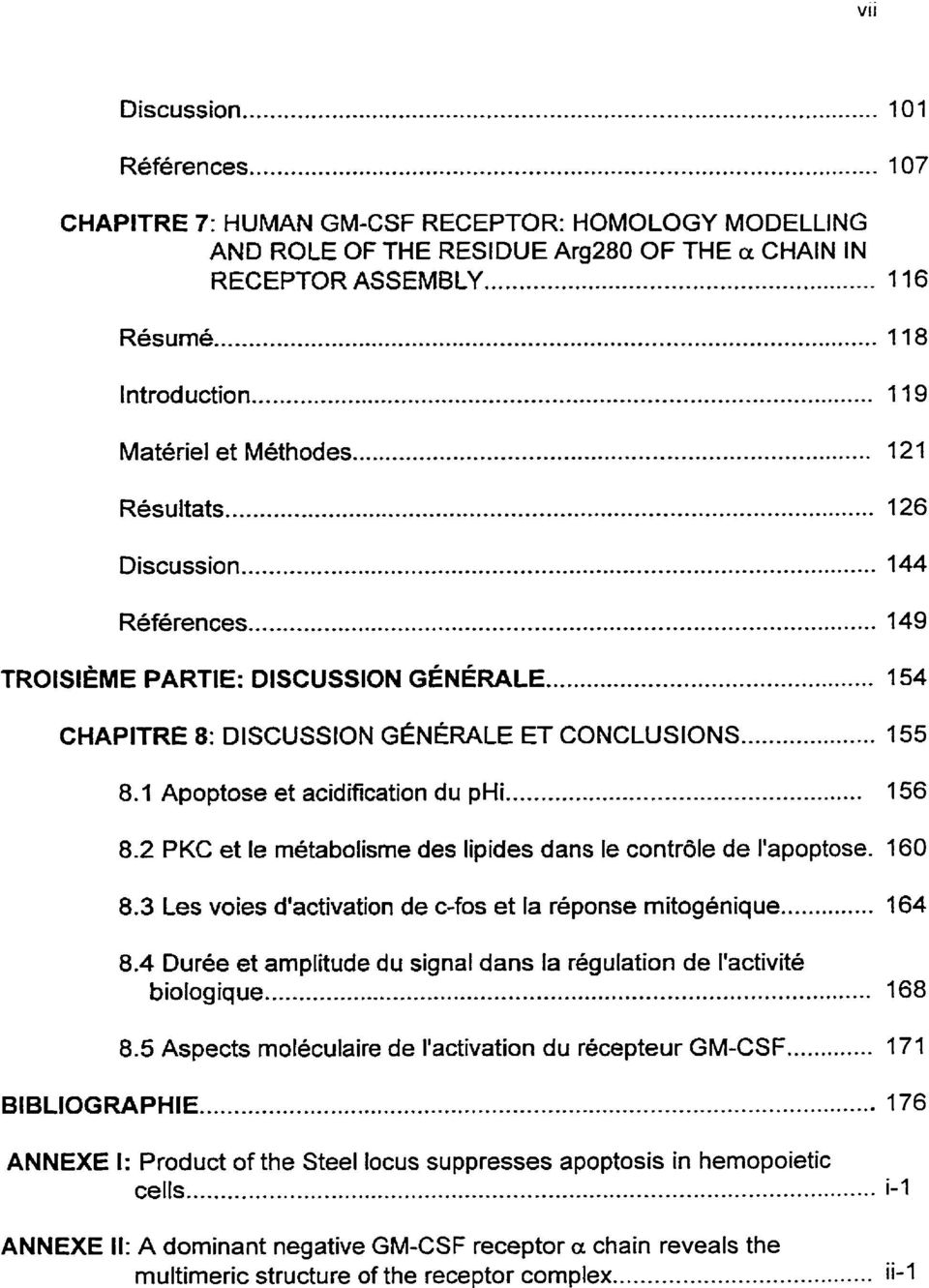
9 viii LISTE DES TABLEAUX Tableau 1.I: Tableau 2.1 : Tableau 2.2: Tableau 2.3: Tableau 5.1: Tableau 5.2: Tableau 5.3: Tableau 6.1: Tableau 7.1 Tableau 7.2 Caracteristiques de I'apoptose et de la necrose Classification des cytokines a 4 helices-a Les grandes classes de recepteurs La famille des recepteurs a cytokines (classe I) Cornparaison of the median effective concentration of GM-CSF and IL-3 in suppressing apoptosis and the Kd of the radioligands Effect of staurospon'ne on the suppression of apoptosis by 11-3 and GM-CSF Effect of H7 on the suppression of apoptosis by 11-3 and GM-CSF Cell proliferation, c-fos luciferase activity induction and ERK activity in response to GM-CSF and TNF Binding of mutant GM-CSF to wild type GMRa Binding of wild type GM-CSF by mutated GMRa in.. assoc~at~on with pc
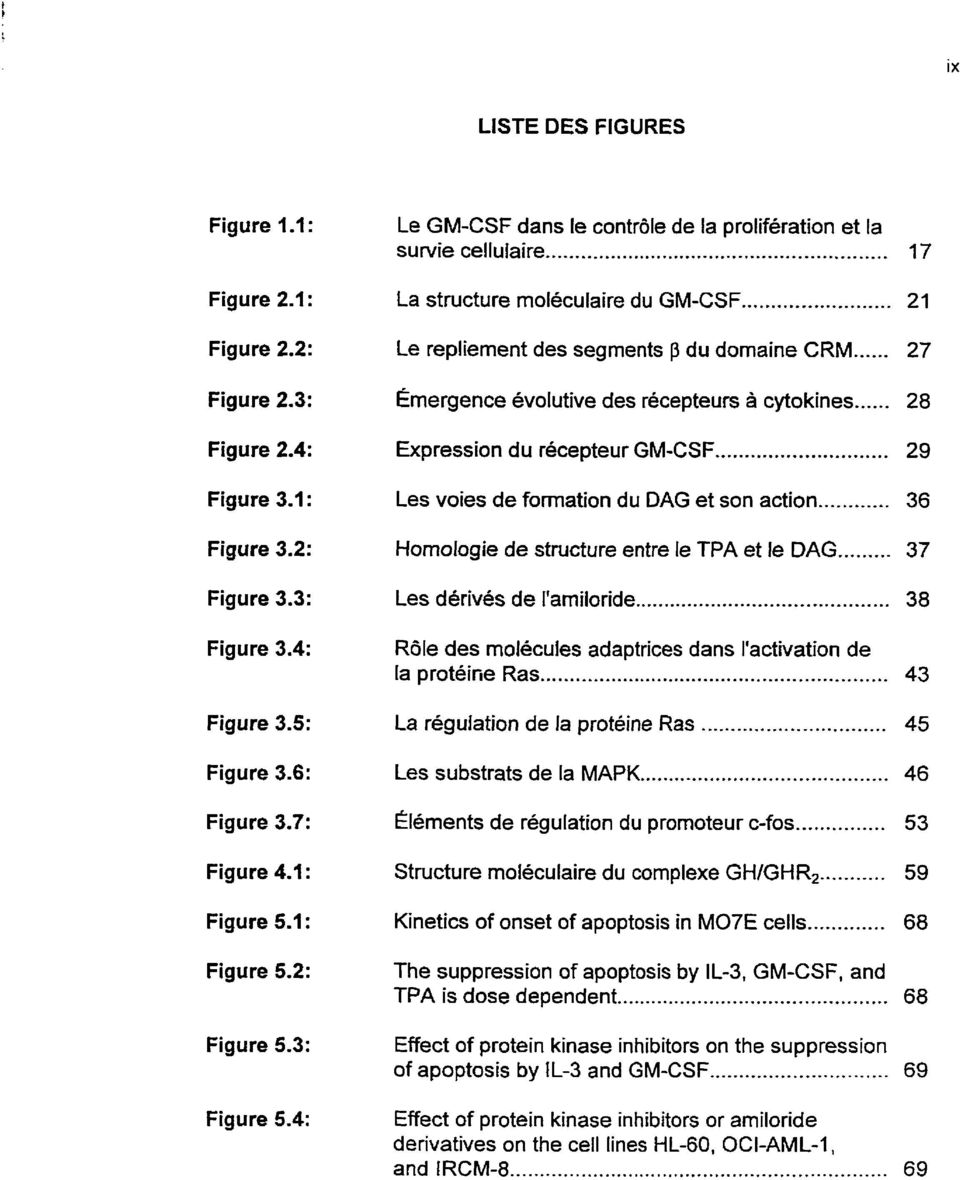
10 LlSTE DES FIGURES Figure 1.1 : Figure 2.1: Figure 2.2: Figure 2.3: Figure 2.4: Figure 3.1 : Figure 3.2: Figure 3.3: Figure 3.4: Figure 3.5: Figure 3.6: Figure 3.7: Figure 4.1 : Figure 5.1 : Figure 5.2: Figure 5.3: Figure 5.4: Le GM-CSF dans le contrde de la proliferation et la survie cellulaire La structure moleculaire du GM-CSF Le repliement des segments P du domaine CRM Emergence evolutive des recepteurs a cytokines Expression du recepteur GM-CSF Les voies de formation du DAG et son action Homologie de structure entre le TPA et le DAG Les derives de I'amiloride Rdle des molecules adaptrices dans I'activation de.. la proteine Ras La regulation de la proteine Ras Les substrats de la MAPK elements de regulation du promoteur c-fos Structure moleculaire du complexe GHIGHR, Kinetics of onset of apoptosis in M07E cells The suppression of apoptosis by GM.CSF. and TPA is dose dependent Effect of protein kinase inhibitors on the suppression of apoptosis by 11-3 and GM-CSF Effect of protein kinase inhibitors or amiloride derivatives on the cell lines HL.60. OCI.AML.1. and IRCM
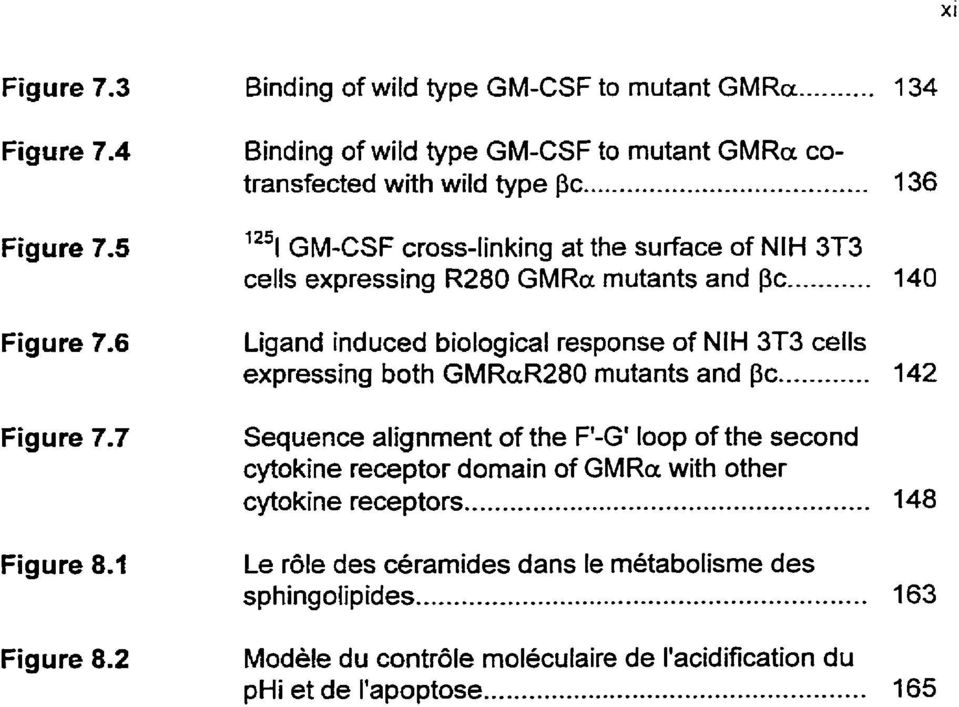
11 Figure 5.5: Figure 5.6: Figure 5.7: Figure 5.8: Figure 5.9: Figure 6.1: Figure 6.2: Figure 6.3: Figure 6.4: Figure 6.5: Figure 6.6: Figure 6.7: Figure 6.8: Figure 7.1 Figure 7.2 Effect of sphingosine on the cell lines M07E and OCI-AML1 cells lrnmunoblot analysis of the subcellular distribution of protein kinase C in M07E cells... Effect of 11-3, GM-CSF and TPA on intracellular ph of M07E cells... Arniloride derivatives prevents the biologic effect of IL-3 and GM-CSF in suppressing apoptosis... Arniloride derivatives prevents the suppression of apoptosis by TPA GM-CSF dependent cell proliferation and activation of c-fos promoter activity... GM-CSF activates both the SRE and SIE sites of the c-fos promoter... GM-CSF induces the tyrosine p hosp horylation of JAK-2 and STAT3... Activation of STAT1 and STAT3 by GM-CSF in NIH GMR transfectants..... Dose dependent activation of STAT3 in TF-1 and STAT113 in NIH GMR... Kinetics of ERKI activation by GM-CSF... Contribution of ERKI to SRE and SIE dependent activation of the c-fos promoter by GM-CSF... Shematic representation of pathways activated by GM-CSF that converge on c-fos promoter activation. Homology modelling of the GM-CSF receptor complex with its ligand on the basis of the crystal structure of the growth hormone receptor complex.... Potential receptor contact points on GM-CSF identified by homology modelling...

12 Figure 7.3 Figure 7.4 Figure 7.5 Figure 7.6 Figure 7.7 Figure 8.1 Figure 8.2 Binding of wild type GM-CSF to mutant GMRa Binding of wild type GM-CSF to mutant GMRa cotransfected with wild type pc '1 GM-CSF cross-linking at the surface of NIH 3T3 cells expressing R280 GMRa mutants and pc Ligand induced biological response of NIH 3T3 cells expressing both GMRaR280 mutants and pc Sequence alignment of the Ff-G' loop of the second cytokine receptor domain of GMRa with other cytokine receptors Le r61e des ceramides dans le metabolisrne des.. sphingolrpldes Modele du contrde molecu laire de I'acidification du phi et de I'apoptose
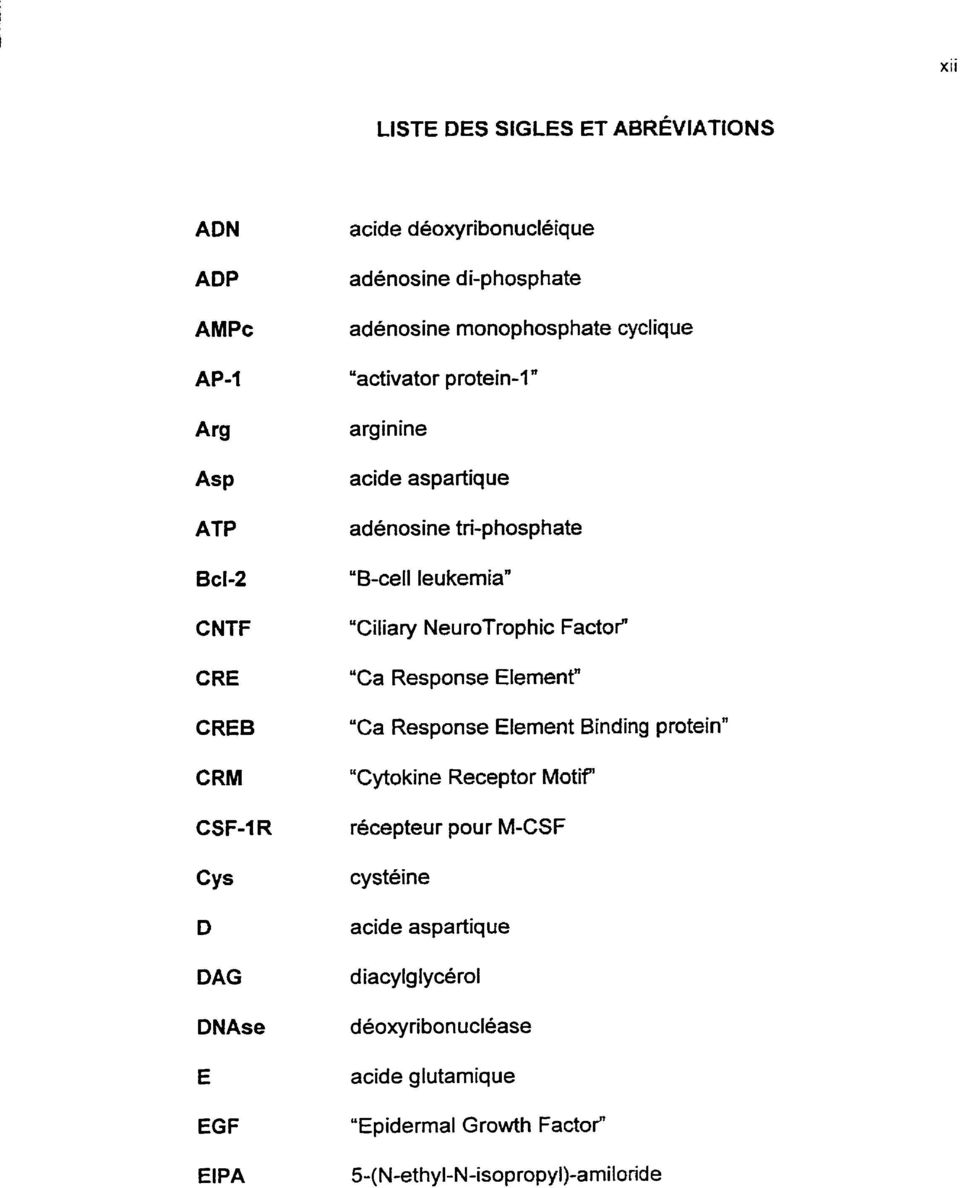
13 xii LlSTE DES SlGLES ET ABREVIATIONS ADN ADP AMPc AP-I Arg Asp ATP BcI-2 CNTF CRE CREB CRM CSF-1 R CYS D DAG DNAse E EGF ElPA acide deoxyribonucleique adenosine di-phosphate adenosine monophosphate cyclique "activator protein-i " arginine acide aspartique adenosine tri-p hosp hate "B-cell leukemian "Ciliary NeuroTrophic Factor" "Ca Response Element" "Ca Response Element Binding proteinn "Cytokine Receptor Motif" recepteur pour M-CSF cysteine acide aspartique d iacylg lycerol deoxyribonuclease acide glutamique "Epidermal Growth Factor" 5-(N-ethyl-N-isopropy1)-amiloride
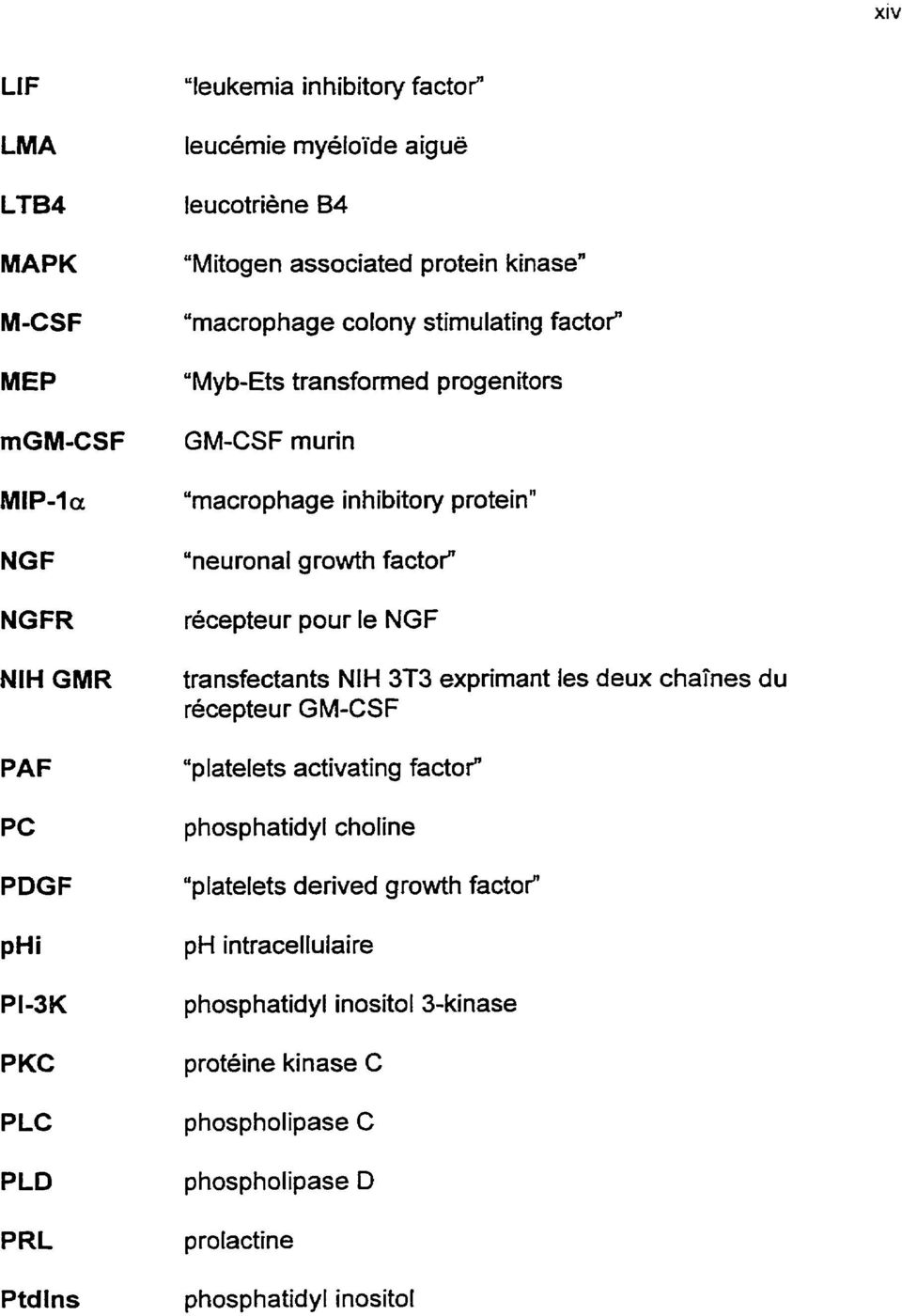
14 PO FAP FBN FLTL fmlp G-CSF GH GHR Glu GM-CSF GMR H hgm-csf His HMA IFN IL- ISGF3 ISRE JAK JNK K erythropoiettine "Fos AP-I siten domaine fibronectine ligand de FLT N-formyl methionyl leucyl phenylalanine 'granulocyte colony stimulating factor" hormone de croissance recepteur pour I'hormone de croissance acide glutamique "granulocyte-macrophage colony stimulating factor" recepteur pour le GM-CSF histidine GM-CSF humain histidine 5-(N, N-hexamethy1ene)-amiloride interferon interleuline "IFN-stimulated gene factor 3" "IFN-stimulated response element" "Janus kinase" "Jun kinase" lysine

15 xiv LIF LMA LTB4 MAPK M-CSF MEP mgm-csf MIP-la NGF NGFR NIH GMR PAF PC PDGF phi PI-3M PKC PLC PLD PRL Ptdlns "leukemia inhibitory factor" leucemie myelolde aigue leucotriene B4 "Mitogen associated protein kinasen "macrophage colony stimulating factor" "Myb-Ets transformed progenitors GM-CSF murin "macrophage inhibitory protein" "neuronal growth factor" recepteur pour le NGF transfectants NIH 3T3 exprimant les deux chaines du recepteur GM-CSF "platelets activating factor" phosphatidyl choline "platelets derived growth factor" ph intracellulaire phosphatidyl inositol 3-kinase proteine kinase C phospholipase C phospholipase D prolactine phosphatidyl inositol
16 R RAR SCL SF SFFV SIDA SIE SIF SOS SRE SRF STAT TGF TM TNF TPA TPO TRE arginine recepteur pour I'acide retinoique "stem cell leukemia" "steel factor" "spleen focus forming virusn syndrome imrnunodeficience acquise "sis-inducible element" "sis inducible factof "son of sevenless" "serum response elementn "serum response factor" "signal transducer and activator of transcriptionn "transforming growth factor" domaine transmembranaire "tumor necrosis factof 12-0-tetradecanoyl phorbol-i 3-acetate thrombopoletine "TPA response element"
17 XVI REMERCIEMENTS Les travaux presentes dans le cadre de cette these furent effectues dans le laboratoire d'hematopoiese et leucemie, dirige par le Dr. Trang Hoang, a I'lnstitut de recherches cliniques de Montreal. J'aimerais tout d'abord exprimer ma profonde gratitude a mon directeur de these, le Dr Trang Hoang. En plus de ses judicieux conseils, tant au niveau academique que scientifique, le Dr. Hoang a su me transmettre sa passion pour la recherche scientifique. Le laboratoire dans lequel j'ai t5volue fut toujours un environnernent tres stimulant et je voudais en remercier les membres. Tout specialement je remercie Andre Haman pour ses multiples conseils et son aide. Je voudrais egalement souligner ma reconnaissance au Dr Marie Trudel pour 11inter6t qu'elle a manifeste pour mes travaux. Je desire aussi temoigner mon affection envers Dominique Julien pour son soutien, sa patience et ses multiples encouragements. Finalement, je rernercie le Fonds pour les chercheurs et I'avancement de la recherche du Quebec (FCAR) et la Societe de recherche sur le cancer lnc. pour leur support financier.
18 xvii A mes parents,

19 INTRODUCTION

20 LE GM-CSF DANS LE CONTROLE DE LA PROLIFERATION ET LA SURVIE CELLULAIRE

21 Chaque jour, des milliards de cellules sanguines rneurent dans notre organisme. Il est important que cette perte enorme soit rapidernent cornpensee et finement contrelee. On peut regrouper sous le terme hernatopoiese I'ensemble des mecanismes qui assurent le renouvellernent et I'homeostase des cellules sanguines. C'est principalement dans la moelle osseuse que I'on retrouve les cellules souches pluripotentes qui sont a la base du systerne hematopoletique. Les cellules souches ont a la fois un potentiel d'autorenouvellement, de proliferation et de differenciation. Le contr6le de ces differentes voies biologiques est attribuable en grande partie a I'action d'hormones glycoproteiques appelees cytokines. La plupart des cytokines participent au contr6le de IfhematopoTese en faisant intervenir des mecanismes a la fois cellulaires et humoraux, imbriques les uns dans les autres, et qui aboutissent a me cascade d'evenernents biologiques. Les mecanismes d'action des cytokines dans le contrde de I'hematopoTese sont donc tres complexes et c'est pourquoi il est diwicile de determiner leurs effets propres et leurs mecanismes d'action. Les cellules hematopotetiques possedent a leur surface une multitude de recepteurs I cytokine. L'interaction cytokine-recepteur mene a une cascade d'evenernents rnoleculaires qui determine la nature de la reponse biologique. Bien que plusieurs cytokines et recepteurs aient ete caracterises et qu'une multitude de voies de signalisation ait ete identifiee, il existe peu de cas 00 cette cascade d'evenernents soit bien comprise. De plus, I'impact de ces evenements rnoleculaires sur la proliferation, la survie cellulaire ou plus simplement sur la transcription de nouveaux genes est peu connue dans son ensemble. Dans la presente these, j'ai identifie et caracterise certains mecanisrnes moleculaires impliques dans la reponse biologique induite par une des cytokines hernatopoietiques, le facteur de stimulation des granulocytes et macrophages (GM-CSF). Mon travail porte sur des evenements receptoriels et post-receptoriels tels que I'interaction iigand-rkcepteur et la signalisation
22 intracellulaire dans la survie et la proliferation cellulaire en reponse au GM- CSF. 1.I Les cytokines et I'hematopoTese L' hematopoiese est divisee en deux grandes voies de differenciation: lympholde et myelolde (Metcalf, 1984). La voie lympho'ide donne lieu a la formation des cellules B et T. La maturation des lymphocytes B se fait dans la moelle osseuse alors que les pro-thymocytes rnigrent de la moelle vers le thymus pour y subir une maturation finale en lymphocytes T. La voie myeloi'de mene a la formation de tous les autres types de cellules sanguines: neutrophiles, basophiles, eosinophiles, monocytes, plaquettes et erythrocytes. Dans la moelle, les cellules souches hernatopotetiques sont en contact avec des cellules nourricieres appelees cellules strornales. Ces demieres produisent plusieurs facteurs qui sont secretes ou associes a la membrane cellulaire. On denombre a ce jour plus de 20 differents facteurs de croissance ou cytokines impliques dans la production et la fonction des cellules myelo'ides (Dexter et Heyworth 1994). Ces facteurs sont produits soit par les cellules stromales ou encore par certaines cellules impliquees dans la reponse immunitaire comme les lymphocytes T, B et les macrophages (Arai et al., 1990). Vers la fin des annees soixante, les groupes de Donald MetcaM et de Leo Sach ont developpe les cultures clonales de cellules hematopomtiques (Metcalf, 1994). Ce test consiste a cultiver les cellules provenant de la moelle dans un milieu semi-solide. Dans des conditions favorables (facteurs de croissance, densite cellulaire) les cellules peuvent se multiplier et se differencier, donnant lieu a la formation de differents types de colonies. Chacune de ces colonies est donc issue d'une seule cellule. Le developpement de ce test, qui est encore largernent utilise de nos jours, a permis de dissequer les effets des differentes cytokines. Principalernent sur la base de donnees recueillies a I'aide de ces cultures clonales, ['ensemble des regulateurs
23 hematopo*ietiques peut &re arbitrairement divise en fonctionnels (Metcalf, 1994). Le premier groupe comprend quatre groupes les cytokines qui agissent sur les stades les plus immatures des progeniteurs hematopotetiques, pas tant en activant directement leur proliferation qu'en sensibilisant la reponse aux autres cytokines. Dans ce groupe on peut inclure llll-6, I'IL-1, LIF, SF, FLTL et I'IL-11. Le second groupe est compose de cytokines agissant sur des cellules plus matures que les precedentes mais ayant garde un potentiel de differenciation vers plusieurs lignees differentes: I'lnterleukine-3 (IL-3) et le GM-CSF en font partie. Le troisieme groupe comprend les cytokines qui sont generalement specifiques a une lignee de differenciation comme le G-CSF (granulocytes), M-CSF (macrophages), IL-5 (eosinop hiles), EPO (globules rouges) et TPO (plaquettes). Finalernent, le demier groupe inclus les cytokines qui ont plut6t un effet de regulation negative sur I'hernatopoTese comme le TNF, TGFP et MIP-la. Certaines cytokines peuvent stimuler la formation de plusieurs types de colonies in vitro. Toutefois, le champs d'action de chaque cytokine est unique et la combinaison de ces differents facteurs genere souvent une cooperativite ou encore des effets qui sont completement differents de ceux obtenus par I'addition de chaque facteur ajoute individuellement (Nicola, 1989; Metcalf, 1994). Bien que plusieurs cytokines permettent la differenciation des cellules souches en precurseurs ayant un potentiel plus restreint, il n'existe pas d'evidence claire qui indiquent que les cytokines puissent agir directement sur la differenciation cellulaire. Le programme de differenciation serait alors stochastique et le rde des cytokines dans I'hernatopoTese serait de maintenir la survie et de stimuler la proliferation des precurseurs jusqu'a la formation de cellules matures. C'est pourquoi mes travaux ont portes principalement sur la reponse proliferative et la survie cellulaire induite par le GM-CSF et j'elaborerai a la section 1.3 sur les donnees experimentales qui suggerent que la differenciation hernatopo*itique est stochastique.
24 Les cytokines n'agissent pas seulernent sur la formation des cellules sanguines normales, mais semblent aussi contribuer activement au processus de transformation cellulaire. Dans la leucemie myelorde aigue (LMA), on retrouve une augmentation du nombre de globules blancs circulants et une perte dans leur niveau de maturation et leur fonction. Certains desordres hematologiques comme les syndromes myeloproliferatifs ou encore les syndromes myelodisplasiques presentent un probleme soit au niveau de la proliferation ou de la maturation, mais ces deux syndromes peuvent prog resser en une LMA. Ceci suggere que la transformation leucemique complete necessite m e perturbation a la fois de la croissance et de la differenciation. Plusieurs genes impliques dans des translocations chromosomiques, comrne SCL, PBX, ou RAR, affectent la differenciation cellulaire (Sawyers et al, 1991). Les cytokines ou leurs recepteurs, qui sont aussi impliques dans les mecanismes de transformation, contribuent plutdt a stimuler I'expansion etlou maintenir la survie des clones leucemiques (Sawyers et al, 1991). Par exemple, il fut demontre que les blastes de LMA peuvent proliferer de fa~on spontanee, c'est-a-dire en absence de facteurs exogenes, lorsque cultives a haute densite cellulaire (Nara et McCulloch, 1985; Reilly et al., 1989). Des etudes subsequentes ont demontre que les blastes de LMA peuvent produire des cytokines de fapon autocrine. Des exemples de ces cytokines sont I'IL-I, IL-6, TNF et le GM-CSF (Hoang 1992). Dans plusieurs cas, ces facteurs procurent un avantage proliferatif aux blastes qui les produisent (Hoang 1992). Les travaux effectues par le groupe de Cory permettent de confirmer ces observations. En effet, la surexpression du gene homeotique Hox-B8 et de la cytokine IL-3 chez des cellules de moelle genere des cellules hautement leucemiques lorsqu'elles sont injectees a des souris (Perkins et al., 1990). Par contre, la surexpression de Hox-B8 seulement provoque une augmentation du potentiel d'autorenouvellement des cellules mais elles ne sont pas transfomees. Si on observe apres plusieurs mois des souris injectees avec des cellules portant le transgene Hox-BB on remarque qu'environ 30% ont
25 developpe une leucemie (Perkins et Cory, 1993). Dans ces cas, les cellules portent le transgene et ont acquis une production autocrine de la cytokine IL-3. Toutefois, malgre toutes ces observations, il n'y a jusqu'a maintenant aucune evidence claire suggerant que des genes codant pour des cytokines sont rearranges au niveau chromosomique. Par contre, il est possible que la production autocrine de facteurs soit due B une modification transcriptionnelle en cis ou trans. La transformation oncogenique par des virus est un autre exemple de I'implication des cytokines dans les mecanisrnes de transformation. Le virus SFFV peut induire une erythroleucemie chez la souris mais ne contient pas d'oncogenes cellulaires. Li et al. ont demontre qu'une des proteines de I'enveloppe (gp55) peut lier le recepteur de I'Epo et que cette association est essentielle pour la transformation (Li et al., 1990). En resume, la reponse biolog ique induite par les cytokines est impliquee dans I'homeostase du systeme hernatopotetique et par consequent une deregulation a ce niveau contribue a la transformation oncogenique. 1.2 La mort cellulaire par apoptose Une des toutes premieres observations concernant la culture in vitro des precurseurs h6rnatopotetiques fut de constater que ces derniers rneurent tres rapidernent en I'absence de facteurs exogenes. Malgre cette observation, le r6le des cytokines dans le contrde de la proliferation et de la differenciation cellulaire a fait I'objet de la plupart des etudes, de la fin des annees 60 a la fin des annees 80. Ceci peut possiblement s'expliquer par le fait que la mort cellulaire fut longtemps consideree comme un phenomene degeneratif, non regule, associe a des evenements purement accidentels. Le concept de la mort cellulaire vu comme un processus normal et regule physiologiquement est documente depuis environ 20 ans, mais c'est seulement depuis la fin des annees 80 qu'il a pris de I'importance dans la litteratwe. Des lors, on assiste a une veritable explosion des connaissances dans ce domaine. En
26 hematopolese, comme dans bien d'autres domaines, il s'agit d'un retours de balancier puisque le contr6le de la mort cellulaire y occupe maintenant une place preponderante. Dans cette section, je propose une breve description de la mort cellulaire par apoptose, suivie d'une revue des donnees experimentales qui ont suggerees initialement son importance dans I'homeostase du systeme hematopoletique et dans les mecanismes de transformation cellulaire. La classification de la mort cellulaire peut &re effectuee selon des criteres morphologiques ou encore selon les circonstances qui la provoque (Wyllie et al., 1980). Dans les deux cas, on arrive a distinguer principalement deux types de mort cellulaire: la necrose et I'apoptose. Leurs caracteristiques sont resumees dans le tableau I.l. La necrose est une mort accidentelle qui ne subit pas de regulation physiologique. Ce type de mort cellulaire est generalement associe a des dommages tissulaires importants et provoque souvent une reponse inflammatoire (McLean et al., 1965). La necrose, est une mort cellulaire passive puisqu'elle ne requiert aucune transcription, synthese proteique de novo et aucune regulation post-trad uctionnelle. L'etymologie du terme apoptose derive du grec et signifie "feuilles qui tornbent d'un arbre". Cette denomination fait reference aux toutes premieres observations relatives A ce type de mort cellulaire dans certains epitheliums (Kerr et a1.,1972; Kerr et Searle, 1973). L'apoptose est observee dans plusieurs processus biologiques qui necessitent une regulation fine du nombre cellulaire comme pour l'homeostase de differents tissus ou organes (foie, prostate, coxtex de la surrenale, cortex du thymus, etc..; Wyllie et al ). On peut aussi observer I'apoptose dans la reaction h6te-versus-greffe ou chez des tumeurs soumises a de faibles doses d'inadiation ou de chimiotherapie (Searle et al., 1975). L'apoptose se produit aussi dans le developpement embryonnaire comme, par exemple, chez le blastocyste de souris avant I'implantation, dans la formation du tube neural ou dans la morphogenese du coeur. C'est un processus qui est conserve dans I'evolution puisqu'on I'observe
27 Tableau 1.I- caractkristiques de I'apoptose et de la necrose critere necrose apoptose incidence accidentelle: physiologique: Choc chimique ou physique Hyperthermie Ischemie Homeostase tissulaire Developpement embryonnaire Selection lymp hocytaire Reaction innammatoire et autres... Rupture des compartiments intracellulaires Destruction des organelles incluant les mitochondries Lyse du noyau Liberation du cytoplasme dans le milieu extracellulaire Condensation de la chromatine Mitochondries intactes Formation de protuberances a la surface membranaire Formation de vesicules appeles corps apoptotiques Degradation de I'ADN genomique en fragments oligonucleosomiq ues
28 aussi chez les eucaryotes inferieurs. La mort cellulaire programmee qui survient dans le developpement du ver Caenorhabditis elegans de la famille des nematodes est un exemple de mort cellulaire par apoptose. D'ailleurs, des etudes genetiques sur cet organisme (Driscoll et Chalfie, 1992) ont permis une meilleure comprehension de la cascade d'evenements moleculaires impliques dans la regulation de I'apoptose. En plus des caracteristiques purement morphologiques qui permettent I'identification d'une cellule qui meurt par apoptose on note aussi une degradation de I'ADN genomique en fragments oligonucleosomiques. Ceci est caracteristique de I'apoptose puisque dans la necrose I'ADN est degrade de faqon non specifique. Dans le cas de I'apoptose, on observe une coupure de I'ADN genomique par des endonucleases dans I'espace inter-nucleosomal. Experimentalement, il est possible de detecter ce phenomene par la formation de fragments d'adn ayant une longueur de 180 paires de bases (fragment associe a un complexe d'histones) ou un facteur de 180. La detection, directe ou indirecte, de fragments oligonucleosomiques d'adn est le test le plus couramment utilise pour reveler la presence de cellules en apoptose. Plusieurs formes de translocations chromosorniques sont associees au cancer et contribuent en partie ou entierement a la transformation oncogenique (Sawyers et al., 1991). Dans 90 % des cas de lymphome folliculaire, qui est un des cancers hematologique les plus frequents, on observe une translocation reciproque (l4,l8) (Tsujimoto et al., 1984). Cette translocation, qui implique le gkne codant pour I'immunoglobuline IgH (chromosome 14), a permis I'identification d'un nouveau gene situe sur le chromosome 18: bcl-2 ("B-cell lymphoma-2"; Cleary et al., 1986). Dans le but d'etudier la fonction de bcl-2. Vaux et a1 (Vaux et al., 1988) ont introduit le cdna de bcl-2 dans un vecteur retroviral pour ensuite le surexprimer dans des cellules de moelle de souris normales ou de souris surexprimant c-myc (Ep-rnyc). Ces dernieres sont
29 susceptibles a la formation de differents cancers. Les cellules de moelle surexprimant myc ou bcl-2 seuls sont incapables de proliferer en Itabsence de facteurs exogenes. Par contre, les cellules surexprimant bcl-2 et myc sont en mesure de proliferer de faqon autonome pour plusieurs semaines, ce qui suggere une cooperativite entre c-rnyc et bcl-2. De maniere a determiner si bcl- 2 peut modifier la dependance aux cytokines, Vaux et al ont surexprime bcl-2 dans la lignee FDCP-1 qui est dependante en 11-3 pour sa survie et proliferation. Leurs resultats demontrent que les cellules infectees avec bcl-2 peuvent survivre en I'absence dlll-3 mais aucune proliferation n'est observee. Bcl-2 est donc implique dans la survie cellulaire mais n'influence pas la proliferation. Ce travail fut donc le premier a clairement dissequer au niveau rnoleculaire la survie cellulaire de la reponse mitogenique. C'est deux ans plus tard que le groupe de Korsmeyer (Hockenbery et al., 1990) ont demontre que la surexpression de la proteine bcl-2, dans une lignee pro-b qui depend de la presence dtll-3 pour sa survie, contribue a inhiber la rnort cellulaire par apoptose. Encore une fois, bien que bcl-2 protege de l'apoptose, les cellules ne proliferent pas. 1.3 Le GM-CSF Une des premiere cytokine a &re identifiee, purifiee et clonee fut le GM- CSF. I1 y a plus de 30 ans, le groupe de Leo Sachs a demontre qu'un milieu conditionne provenant de cultures de cellules de foie foetal de souris possedait la capacite de stimuler la proliferation et de potentialiser la differenciation des progeniteurs hematopotetiques en colonies de neutrop hiles etfou macrop hages (Ichikawa et al., 1966). Tant chez I'humain que la souris, cette activite fut ensuite isolee par differents groupes et associee a une seule molecule appelee GM-CSF (Cline et Golde, 1974). C'est seulement 10 ans plus tard que le GM- CSF murin et humain furent clones par des approches totalement differentes (Wong et al 1985; Gough et a1.,1984). Le GM-CSF humain est une
30 glycoproteine de 23 kd cornpos6e de 144 acides amines dont environ 40% du poids est forrne de carbohydrates. II est a noter que la glycosylation n'est pas essentielle a I'activite biolog ique, puisque le GM-CSF recombinant produit dans la souche bacterienne E. coli possede une activite comparable et mcme superieure au GM-CSF produit dans des systemes eucaryotes (Moonen et al., 1987). Le gene qui code pour le GM-CSF est compose de 4 exons (Miyatake et a1.,1985) et se situe sur le chromosome 5q21-q32 (Huebner et all 1985). Cette localisation est interessante puisque les genes codant pour des cytokines telles 11-3, IL-4, 11-5 et M-CSF sont aussi situees dans la region 5q. Plusieurs types cellulaires sont capables de produire du GM-CSF in vitro: les cellules T activees, les rnacrophages, les mastocytes, les cellules endotheliales et certains fibroblastes sont les cas les mieux connus (Gasson et al., 1991). Toutefois, on retrouve tres peu de GM-CSF dans la circulation sanguine; ce qui suggkre que le GM-CSF n'est pas une hormone endocrinienne classique mais elle agit plut6t de maniere paracrine. En d'autres terrnes, le GM-CSF est produit et agit surtout localement. Une multitude de travaux ont perrnis de confirmer les toutes premieres observations concernant le GM-CSF, crest-a-dire sa capacite I stimuler la proliferation de cellules ayant le potentiel de se differencier en neutrophiles, rnonocytes ou megakaryocytes (Gough et Nicola, 1990). Le potentiel d'action du GM-CSF ne se limite pas a ces precurseurs puisqu'il peut agir de facon additive avec 1'11-3 pour la formation de colonies eosinophiliques, erythoi'des et megakaryocytaires (Gough et Nicola, 1990). Le GM-CSF peut aussi agir a de tres faibles concentrations en synergie avec le M-CSF pour stimuler la formation de colonies de macrophages (Caracciolo et al., 1987). Le GM-CSF ou le SF, qui est un facteur de survie pour les precurseurs hernatopo'ietiques primitifs, ne sont pas en mesure d'induire une reponse proliferative soutenue des progeniteurs hematopdietiques lorsqu'ils sont ajoutes individuellement. Toutefois, en presence de SF et GM-CSF une forte reponse proliferative est observee (Dexter et Heyworth, 1994; Caceres-Cortes et Hoang, non publie).
31 L'ensemble des donnees recueillies in vitro suggerent qu'en plus de ses effets propres, le GM-CSF peut agir en synergie avec d'autres facteurs hematopotetiques. La production autocrine de GM-CSF recreee experimentalement dans la lignee hematopotetique immortalisee FDC-PI genere une lignee qui peut proliferer en I'absence de facteurs exogenes (Lang et ai., 1985). De plus, cette lignee est hautement turnorigenique chez la souris. Chez I'humain, certains blastes de LMA peuvent proliferer en reponse au GM-CSF (Hoang et al. 1986) et une forte synergie dans la reponse proliferative est observee en presence de facteurs tels IL-1, TNF et SF (Hoang, 1992). Comme je I'ai indique a la section 1.1 certains blastes sont aussi en mesure de produire du GM-CSF de fa~on autocrine. Un des mecanisrnes moleculaires menant a la production autocrine de GM-CSF par les blastes fut elucide dans notre laboratoire (Rodriguez- Cimadevilla et al ). Tout d'abord, une forte correlation fut observee entre la capacite des blastes a produire de I'IL-1 et leur capacite a secreter du GM- CSF. Dans ces cas, I'ajout d'anticorps neutralisant diriges contre I'IL-1 peut bloquer la production de GM-CSF endogene. De plus, la neutralisation de I'activite du GM-CSF et de I'IL-I bloque la formation de colonies. Ces donnees demontrent que la secretion de GM-CSF induite par la production autocrine dl-1 chez les blastes de LMA est importante pour leur survie et leur proliferation in vitro et suggere un r6le pour la production autocrine de GM-CSF dans I'expansion des blastes. Comme je I'ai indique a la section 1.Il aucun rearrangement chromosomique du gene codant pour le GM-CSF n'a ete observe jusqu'a present. L'effet de I'I L-I decrit ci-haut pourrait expliq uer la production autocrine de GM-CSF par les blastes dans certains cas. Enfin, la production de GM-CSF induite par 1'11-1 ne se limite pas aux blastes de LMA. Notre laboratoire a recemment demontre que la production de GM-CSF induite par I'ajout d'll-i exogene chez des precurseurs hematopotetiques (~~34+1~in3 provenant de la moelle de sujets normaux (Rodriguez et al., 1996) peut supprimer la mort cellulaire par apoptose. Ces donnees in vitro suggerent que
32 ie GM-CSF peut contribuer a la fois a I'homeostase de certains precurseurs hematopoietiques et a ['expansion de clones leucerniques. Le GM-CSF n'agit pas seulement sur la proliferation et la survie des precurseurs et des blastes leucemiques car il peut aussi augmenter et moduler la fonction des cellules matures. Le GM-CSF est produit par les cellules T activees dans la reponse immunitaire ou par les cellules endotheliales en reponse au TNF ou a I'IL-1 dans la reponse inflammatoire. II peut ensuite agir sur I'ad herence, la chemotaxie, I'irnmobilisation, la p hag ocytose et le metabolisme oxydatif des granulocytes et macrophages. C'est Weisbart (Weisbart et all 1985) qui fut le premier a demontrer que le GM-CSF agit a la fois de fa~on directe et indirecte sur les cellules matures. Les effets directs se manifestent, entre autres, par une inhibition de la migration, une degranulation et une serie de changements morphologiques (Gasson et Weisbart 1984). En plus de ses effets directs, le GM-CSF possede aussi un effet de potentialisation Cprirningn) sur I'action d'un second stimuli cornme, par exemple, I'attraction au site d'inflammation. Des peptides forrnyles tels le N-formyl methionyl leucyl phenylalanine (fmlp) sont des peptides produit par les bacteries et peuvent agir comme agent chimioattractif sur les phagocytes. I1 existe aussi plusieurs chimioattractants endogenes tels les leukotrienes B4 (LTB4) qui sont des produits de la 5-lipoxygenation, et le facteur activateur des plaquettes (PAF) qui est produit par les cellules endotheliales (Weisbart et Golde, 1989). Les mecanismes moleculaires impliques dans la potentialisation ne sont pas encore entierement compris. Toutefois, il est connu que le GM-CSF peut augmenter le nombre et I'affmite des recepteurs pour le fmlp a la surface des neutrophiles et qu'il peut aussi augmenter la production d'anions superoxyde et la synthese de novo des leukotrienes 8, (Weisbart et a1 1985; Weisbart et al 1986). In vitro, c'est donc plusieurs sinon tous les aspects de la fonction des granulocytes et des macrophages qui sont influences par le GM-CSF. La production de grandes quantites de GM-CSF biosynthetique (recombinant) a rendu possible une etude approfondie de ses effets
33 biologiques in vivo. Plusieurs effets attribuables au GM-CSF in vitro ont ete confirmes par ces etudes. Donahue et al. furent les premiers a le demontrer par injection de GM-CSF humain chez des primates (Donahue et al., 1986). Bien que le nombre de precurseurs pour les granulocytes et les macrophages reste inchange, ils ont observes une elevation d'environ six fois du nombre de neutrop hiles, monocytes et eosinophiles presents dans le sang perip herique. De plus, les neutrophiles preleves de primates traites au GM-CSF ont une reponse au fmlp et une activite bactericide accrue comparativement aux animaux contr6les. Une serie d'etudes ont ensuite confirrne I'ensemble de ces resultats tant chez la souris que dans plusieurs essais cliniques chez I'humain. Presentement, le GM-CSF est utilise en clinique pour: dirninuer la cytotoxicite des traitements de chimiotherapie, dans divers protocoles de transplantation de moelle, dans le traiternent des neutropenies, et chez certains patients atteint du SIDA. Base sur les protocoles actuels (Golde et al., 1995)' le GM-CSF apporte des effets benefiques chez certains patients mais d'autres etudes seront encore necessaires pour mieux definir son utilisation en clinique. L'inactivation, par recombinaison homologue, du gene codant pour le GM- CSF chez la souris a ete publiee par deux groupes independants (Dranoff et al., 1994; Stanley et al., 1994). Dans les deux cas les phenotypes observes sont semblables. Les souris deficientes pour le GM-CSF sont viables. LthematopoTese en general ne semble pas affectee et les niveaux des granulocytes, des macrophages ou de leurs progeniteurs semblent normaux. Toutefois, les souris GM-CSF'- ont une accumulation de surfactant pulrnonaire et sont plus susceptibles aux infections pulmonaires, ce qui suggere un r6le critique pour le GM-CSF dans I'homeostase de cet organe. Le fait qu'aucun desordre au niveau hematopotetique n'ait ete decele n'implique pas necessairement que le GM-CSF n'y joue aucun rde. En effet, cornme nous I'avons mentionne dans la section 1.1, il existe probablement un ires haut niveau de redondance dans la regulation du systerne hematopo-ietique. II est
34 donc possible que des phenomenes de compensation masquent les effets normalement attribuables au GM-CSF in vivo. Le r6le du GM-CSF dans la suppression de la mort cellulaire par apoptose fut mis en evidence par Williams et al. (Williams et al., 1990). Ces derniers ont observe que les cellules FDCP-1 (dependantes djil-3) ou FDCP-mix (dependantes de GM-CSF) meurent rapidement avec toutes les caracteristiques de I'apoptose lorsque cultivees en I'absence de facteurs exogenes. Ces donnees suggerent que 1'11-3 et le GM-CSF ont une action sur deux processus biologiques qui sont dissociables au niveau rnoleculaire: la proliferation et la suppression de I'apoptose. A I'epoque, ces obsewations etaient provocatrices puisqu'elles proposaient une regulation de la mort cellulaire par les facteurs hernatopotetiques, en plus de leurs r6le dans la proliferation et leur effets directs ou indirects sur la differenciation. Une des caracteristiques communes a plusieurs qtbkines reside dans leurs capacite a soutenir et promouvoir la differenciation des progeniteurs hematopotetiques. Certains rnodeles ont ete elabores pour tenter d'expliquer ces effets. Aux deux extremes on retrouve le modele stochastiques et le modele inductif. Le modele inductif suggere que la liaison des cytokines a leurs recepteurs determine la voie de differenciation utilisee par les progeniteurs. A I'oppose, le modele stochastique stipule que les cytokines ne sont pas requises pour induire les changements genetiques requis pour la differenciation. Selon ce modele, les facteurs ont seulement une action permissive sur la differenciation en maintenant la survie et la proliferation des precurseurs. L'approche stochastique est celle qui est la plus couramment acceptee presentement. Les travaux effectues par le groupe de Dexter sur la lignee FDCP-mix sont en faveur de ce modele (Fairbairn et al., 1993). Ces derniers ont genere des lignees de cellules FDCP-mix qui surexpriment bcl-2. Comme prevu, les cellules qui expriment le transgene survivent plusieurs jours en I'absence de facteurs rnais ne proliferent pas. Les cellules FDCP-mix parentales ont la capacite de se differencier en pro-granulocytes lorsqu'elles
35 sont cultivees en presence de GM-CSF ou dlll-3 pour plusieurs jours. Le groupe de Dexter a observe qu'en ['absence de facteurs exogenes, les transfectant bcl-2 ont aussi cette capacite, en plus d'une differenciation additionnelle dans la voie erythroide. Les auteurs ont demontre que les transfectants bcl-2 ne produisent pas de GM-CSF, 11-3 ou G-CSF de fa~on autocrine. Ces donnees ont un impact important puisqu'elles demontrent que la differenciation hematopoletique peut survenir en ['absence de cytokine. Ceci est en accord avec le modele stochastique et renforce I'hypothese que les facteun hematopoietiques, dont le GM-CSF et HL-3, ne sont necessaires pour la differenciation que dans la mesure oo ils fournissent un signal de survie pour les cellules en differenciation (figure 1.1). differenciation 0 GM-CSF GM-CSF 0 Figure 1.1: Le GM-CSF dans le contr6le de la prolifkration et la survie cellulaire. Les donnees experimentales (in vitro) obtenues jusqu'a present permettent de restreindre I'action du GM-CSF sur les precurseurs hematopoietiques a la stimulation de la proliferation et la suwie cellulaire. Ces deux signaux favorisent une expansion de la population cellulaire.
36 L'ensemble des observations presentees ci-haut proposent une contribution du GM-CSF dam la fonction des granulocytes et des macrophages mais aussi dans la regulation de la survie cellulaire etlou de la proliferation de leurs precurseurs normaux ou transfonnes. I1 est donc imperatif de mieux comprendre les evenements moleculaires impliques dam la reponse au GM- CSF et c'est principalernent un des objectifs vises par rnes travaux.
37 STRUCTURE MOLECULAIRE DU GM-CSF ET DE SON RECEPTEUR
38 2.1 Structure rnoleculaire du GM-CSF La structure cristalline du hgm-csf recombinant, produit dans E. coli, fut determinee par deux groupes independants avec une resolution de 2.4A (Diederichs et al., 1991) et 2.8 A (Walter et al., 1992) respectivement. Les deux groupes ont obtenu une structure en tout points identique. Le GM-CSF est un faisceau constitue de quatre helices-a antiparalleles. Sa dimension totale est de: 20 A de largueur par 40 A de longueur par approximativement 30 A de profondeur. Les quatre helicesa, identifiees de A a D (figure 2.1), ont une longueur qui varie de I a 15 acides amines. Parrni ces acides amines. 22 residus hydrophobes se retrouvent a I'interieur du faisceau et foment une structure compacte. Les paires d'helices A,D et 8,C se chevauchent a un angle de 20' approximativement. La longueur des jonctions entre les differentes helices-a varie entre 8 et 27 acides arnines. La connection la plus courte joint les helices B et C. On retrouve deux longues connections entre les helices A,B et C,D. A I'interieur de chacun de ces deux segments se trouve un feuillet-p compose de deux brins antiparalleles. Le GM-CSF contient aussi deux ponts disulfures qui relient les acides amines Cys54 a Cys96 et Cys88 a Cysl21. Deux sites potentiels de glycosylation se retrouvent dans la partie carboxyterminale de I'helice A et dans la partie amino-terminale du premier feuillet-p. Dans les deux cas, ces regions sont exposees au solvant. Jusqu'a present, la structure de dix cytokines fut determine par cristallographie (Nicola, 1995). 11 s'agit de: GH, GM-CSF, 11-2, 11-4, IL-5, M- CSF,G-CSF, IFN-y, IFN-P et LIF. L'IFN-p est particulier car sa structure comporte cinq helices-a et non quatre cornme les autres. De plus, certaines de ces cytokines, comme M-CSF, IFN-y et 11-5, se retrouvent sous une forme dimerique. Du point de vue structural, la plupart des cytokines a quatre helicesa peuvent etre divisees en deux sous-groupes (Boulay et Paul, 1993). L'element principal qui les distinguent est la longueur des helices. Dans le cas
39 des cytokines a longues helices, les boucles qui relient les helices A,B, et C,D cornportent une courte helicea plutbt qu'un feuillet-p cornme les cytokines P courte helices, dont fait partie le GM-CSF. Par homologie de sequence, il est possible de regrouper plusieurs cytokines dans I'un de ces deux groupes (Tableau 2.1). Figure 2.1: La structure rnolcculaire du GM-CSF. (A) Ce diagramme en ruban illustre la structure secondaire de la molecule: les helices-a (de A a D) en spirales et les segments+ en fleches. (B) Diagramme topologique: les rectangles (de A a D) representent les quatre helices-a et les fleches representent les deux segment$. Le C et N indiquent respectivernent les extremites carboxy et amino terminales (tire de Diederichs et al., 1991). Certains mernbres du groupe des cytokines a courtes chaines sont aussi similaires a d'autres points de vue. Par exemple, les genes codant pour le GM- CSF, IL-3, 11-4, et 11-5 se retrouvent tous sur le chromosome 5 chez I'humain et 11 chez la souris. De plus, la structure intronique de leurs genes est tres similaire. Ces cytokines, toutes secretees par des cellules T activees (Arai et al. 1990). sont donc probablement reliees d'un point de vue evolutif.
40 Tableau 2.1 Classification des cytokines a 4 helices* Structure cristalline longue helicea courte helice-a determinee GH, LIF, G-CSF GM-CSF, IL-2, 11-4, 11-5 non-determinee Epo, 11-6, OSM, 11-3, It-7, IL-13 CNTF, PRL, IL-I I 2.2- La famille des recepteurs a cytokines I1 est possible de segrnenter arbitrairement un r&&teur en diffbrents domaines fonctionnels: une unite de liaison, de transduction, un domaine effecteur et un domaine de regulation. Tous ces domaines fonctionnent de concert pour generer une reponse biologique ligand-specifique qui tient compte du contexte cellulaire. Un ligand donne peut transmettre un signal positif ou negatif suite a ['interaction avec son recepteur. Cette variabilite dans la reponse peut dependre, par exemple, du stade de developpement de la cellule cible, de la concentration du ligand lui-m8me ou de la presence d'autres ligands (Arai et al., 1990). A I'inverse, il est possible que differents ligands puissent transmettre des reponses biologiques qui soient en apparence identiques. Ce phenomene est attribuable tant a la structure des differents recepteurs qui partagent des elements en commun qu'a leurs voies de signalisation communes. De fa~on generale, on peut distinguer trois grandes classes de recepteurs transmembranaires: les recepteurs hormonaux, les
41 recepteurs pour les facteurs de croissances et les recepteurs a cytokines. Le Tableau 2.2 resume sommairement les caracteristiques de chacun de ces groupes. Certains recepteurs de la famille des facteurs de croissance comme: CSF- IR, c-kit, FLK-1 et FLK-2 sont exprimes dans le systerne hematopo-ietique (W~lks, 1993). Ces recepteurs partagent tous la mgme structure, c'est-a-dire une repetition de 5 domaines immunoglobulines et 10 cysteines conservees dans le domaine extracellaire, un seul domaine transmembranaire et une region cytoplasmique constituee d'un domaine ayant une activite tyrosine kinase. Pour ces recepteurs, comme pour tous les recepteurs de cette famille, I'interaction avec le ligand induit un changement conformationnel qui favorise I'homodimensation du recepteur. Ce contact active le recepteur et mene a I'autophosphorylation. Les tyrosines phosphorylees sont les sites d'ancrages de plusieurs proteines cytoplasmiques qui amorcent la cascade de signalisation intracellulaire (Malarkey et al., 1995). Tableau 2.2- Les grandes classes de recepteurs classes hormonaux facteurs de cytokines croissance exemples de Vasopressine, EGF, PDGF, FGF ligands somatostatine, M-CSF, SF thrombine GM-CSF, IL-3, IL-2, IL-6, EPO, TNF signalisation proteines G domaine tyrosine heterotrimeriques kinase intrinseque kinases cytoplasmiques associees structure- 7 domaines TM 1 domaine TM fonction homodimerique 1 dornaine TM homodimerique heteromerique
42 Contrairement aux recepteurs possedant une activite tyrosine kinase, les recepteurs a cytokine ont une structure souvent complexe qui comporte une, deux, voir trois chaines polypeptidiques differentes codees par des genes distincts (Ihle et al., 1995). La superfamille des recepteurs a cytokines peut Btre divisee en quatre classes du point de vue de leur structure (Miyajima et al. 1992). Les rnembres de la classe I, qui sont nombreux ( 11-2, 3, 4, 5, 6, 7, 9, 11, 12, 15, GM-CSF, G-CSF, TPO et EPO), interagissent avec leurs ligand de fa~on multimerique (homodimere, heterodimere, hewrotrimere). Le Tableau 2.3 resume les sous-unites generalement requises pour la formation des recepteurs de cette classe. tableau 2.3- La famille des recepteurs a cytokines (classe I) exemples type de chaines chaines de ligands complexe spbcifiques partagees IL-3, IL-5, GM- CSF Heterodimere a PC IL-2,4,7,9,15 heterotrimere ou a etlou p YC heterodimere IL-6, IL-I q, LIF heterod imere a gp 130 Epo, G-CSF, homodimere EpoR, G-CSFR, - TPO, GH mpl, GHR
43 La classe I1 est composee des differents recepteurs a I'interferon (I FNa, ply). Les interferons foment un groupe de regulateurs solubles qui ont une activite anti-virale (Arai et al., 1990). Leurs recepteurs sont composes de plusieurs chaines qui ont des homologies structurales (Bazan, 1990b). La troisierne classe est formee par les recepteurs apparentes au recepteur TNF. Comme son nom I'indique, le TNF ("tumor necrosis factor") possede une activite anti-tumorale mais il est aussi irnplique dans la reponse inflamrnatoire et peut agir comme irnmunostimulant (Vilcek et Lee, 1991). Dans cette classe on retrouve des recepteurs comrne FAS, CD40, CD30 et NGFR. Ils possedent tous une homologie de structure a la fois dans le domaine extracellulaire et intracellulaire. Le domaine extracellulaire est constitue de 4 unites riches en cysteines alors que dans le dornaine intracellulaire, certains de ces recepteurs (TNFR, FAS et CD30) possedent un motif conserve qui est implique dans ['induction de I'apoptose (Smith et al ). Finalement, la derniere classe est constituee par les recepteurs pour les cytokines inflammatoires IL-la et P (Arai et al., 1990). Leurs recepteurs sont constitues de repetitions de domaines apparentes aux immunoglobulines. I1 est a noter que certains recepteurs a domaine tyrosines kinases (M-CSFR, Kit, FLK-1, etc..) possedent aussi ce type de repetitions dans leurs segments extracellulaires. Par contre, aucune activite enzymatique ne sernble &re associee au domaine cytoplasmique des recepteurs pour I'IL La structure molcculaire des recepteurs a cytokines Les recepteurs a cytokine de la classe I ont en commun, dans leurs domaine extracellulaire, un module d'environ 200 acides amines. Dans ce module on retrouve quatre cysteines et un segment "WSXWS" conserve. Certains algorithmes furent developpes dans le but de permettre une comparaison des sequences en acides amines basee sur des parametres
44 structuraux (Taylor, 1986). Lorsque ['on compare les modules des recepteurs a cytokines a d'autres sequences presentes dans les banques de donnees en utiiisant un tel algorithme, il apparait que ces modules sont hornologues aux domaines fibronectine (FBN) de type Ill (Bazan, 1990a). En fait, chaque module conserve des recepteurs a cytokines de classe I comprend deux domaines homologues a FBN. La fibronectine, qui est constituee de deux sousunus de 250 Kda chacune, est une cornposante de la matrice extracellulaire et se retrouve aussi en grandes concentrations dans le plasma. Chaque sousunite de la fibronectine est elle-mbme forrnee de plusieurs domaines. et celui de type Ill est le plus frequent (Ruoslahti, 1988). D'un point de vue structural, le domaine FBN Ill est forrne d'un repliement de feuillets-p en sandwich. Un premier feuillet-p est compose de quatre segments alors que le deuxieme est constitue de trois segments. Toujours en utilisant le meme algorithme, Bazan a identifie une forte homologie entre le domaine conserve parmis les recepteurs a cytokines de classe II (voir section 2.2) et les domaines constants (C) des immunoglobulines (lg). Les domaines immunoglobulines sont aussi constitues de 7 segments en feuillet-p (Diesenhofer, 1981). Toutefois, dans les regions C des lg on ne retrouvent pas de cysteines conservees. En resume les recepteurs de classe I et I1 sont tous les deux constitues de repetitions de feuillet-p. Censemble de ces deux repetitions porte le nom de CRM pour "cytokine receptor modulen (figure 2.2). Suite a ces observations. Bazan a etabli un rnodele qui propose un lien evolutif entre tous les membres des recepteurs a cytokines (Bazan, 1 WOa; figure 2.3).
45 'A B E D C F G A'B'E'D'C'F'G' Figure 2.2: Le repliement des segments-p du domaine CRM. Le CRM rcytokine receptor motif") est compose de deux domaines FBN ( "N domainn et "C domainn). Chaque domaine est forme de 7 segments-p (A-G et A'-G'). Les cercles indiquent les acides amines consewes parrnis la classe I. Dans la boucle F'-G' on retrouve le motif conserve WSxWS (tire de Bazan, 1990a)
46 Figure 2.3: ~mer~ence evolutive des recepteurs a cytokine. recepteurs a cytokines de classe I et II ont une structure dupliquee et le site de liaison aux cytokines (losange noir) se situe potentiellement entre ces deux domaines. Selon le modele, les recepteurs a cytokines derivent d'une duplication du dornaine FBNlll (I 11). Une des caracteristique des recepteurs a cytokines comparativement au domaine FBN est la presence de cysteines conservees (bandes noir). Le domaine FBN et lg auraient un anc6tre commun (tire de Bazan, 1990a) Les 2.4 Le recepteur GM-CSF Cette section propose une retrospective des donnees experimentales qui ont perrnis I'identification et la caracterisation des deux constituants du recepteur GM-CSF (GMR), la chaine a et la chaine pc commune a 1'11-3 et I'IL- 5. Des sites de liaison pour le GM-CSF sont presents a la surface des cellules hematopotetiques tant chez la souris (Walker et Burgess, 7985) que chez I'humain (Nicola, 1989). Chez les precurseurs hematopotetiques, la liaison est observee essentiellernent pour les lignees de monocytes. granulocytes et eosinophiles. De plus, les rnonocyteslmacrophages, neutrophiles et eosinophiles matures montrent une liaison au GM-CSF (figure 2.4). Une liaison du GM-CSF est aussi detectee a surface des cellules endotheliales ( Bussolino et al., 1989a) et chez les blastes de LMA (Park et al., 1989; Onetto-Pothier et al., 1990a). Dans tous ces cas, les caract6ristiques de liaison sont semblables; la presence de quelques centaines de sites de haute affinite ( pm) et approximativement sites de faible affinite (1-5 nm). Par contre, des tests de liaison I partir de membranes de placenta humain ont demontre la presence d'un site de liaison de faible affinite uniquement (Gearing et al., 1989). En utilisant, une approche de clonage par
47 expression de librairie de cdna provenant de ces cellules, le groupe de Nicola a alors clone une chaine transrnembranaire de 400 acides amines qui etait en rnesure de reconstituer a elle seule la liaison de faible affinite (Gearing et al., 1989). prt!curseurs phipoten& 8 thymocyt precurseurs o-@-@ engagks Figure 2.4 Expression du recepteur GM-CSF. Ce shema illustre I'expression du recepteur GM-CSF (GMR+) a la surface des precurseurs hematopoietiques et des cellules matures. Le recepteur est present principallement a la surface des cellules engagees dans la voie des macrophages ou granulocytaire mais aussi chez les precurseurs BrythroTdes. L'IL-3 partage plusieurs proprietes biologiques avec le GM-CSF. Par exemple, I'lL-3 peut soutenir la formation de colonies de precurseurs d'erythrocytes, de granulocytes et de macrophages et peut aussi stimuler la
48 proliferation des blastes de LMA (Metcalf, 1989). De plus, I'lL-3 et le GM-CSF peuvent se competitionner partiellernent pour leur liaison a la surface d'eosinophiles (Lopez et al., 1989). Ces observations furent ensuite confirrnees chez plusieurs types cellulaires par differents laboratoires, incluant le ndtre (Park et al., 1989, Onetto-Pothier et all 1990b). En fait, une analyse quantitative des courbes de competition nous a permis d'etablir que I'IL-3 competitionne pour le rneme nombre de sites de haute affinite que le GM-CSF. Nous avons alors ernis I'hypothese que les recepteurs 11-3 et GM-CSF partagent une chaine en comrnun (Onetto-Pothier et al, 1990b). A la rnqme epoque, ltoh et al. ont clone chez la souris un recepteur de faible affinite pour 1'11-3 alors denomme AIC2A (Itoh et al., 1990). En utilisant le cdna AIC2A comme sonde sur une librairie de cdna provenant d'une lignee erythroleucemique humaine, ce groupe a identifie un clone alors nornme KH97 (Hayashida et al., 1990). Lorsque transfectee seule dans la lignee COS-7, la chaine KH97 ne peut lier ni le GM-CSF ni 1'11-3. Par contre, la co-transfection du recepteur de faible affinite pour le GM-CSF (isole precedemment par Nicola) et la chaine KH97 donne lieu a une liaison de haute affinite. Ce qui suggere que le recepteur de haute affinite implique a la fois le recepteur de faible affinite (nornme GMRa) et une chaine de conversion d'affinite, la chaine KH97. KH97 est une proteine transrnembranaire de 881 acides amines qui possede un large domaine cytoplasmique. Le clonage des recepteurs de faibles affmite pour I'IL- 3 (Kitamura et al., 1991a) et 1'11-5 (Tavernier et al., 1991) a demontre que ces derniers sont homologues a GMRa et specifiques pour leurs ligands respectifs. De plus, ils peuvent aussi former un recepteur de haute affinite en presence de KH97 qui fut alors nommee P commune (PC) La presence de la chaine a specifique et pc est essentielle non seulement pour la liaison de haute affinite mais aussi pour la reponse biologique (Tavernier et al., 1991; Kitamura et al., 1991 a). Comme je I'ai indique dans la section precedente, I'utilisation d'une chaine commune qui module I'interaction ligand-recepteur est un concept
49 general parrni les recepteurs a cytokine. Les recepteurs qui possedent des chaines en commun partagent generalement bon nombres de fonctions biologiques. Ces observations suggerent que les chaines communes, dont PC, jouent un r6le important dans la signalisation. Le domaine cytoplasmique de la chaine pc est compose de 430 acides arnines. La deletion complete de la queue cytoplasmique n'affecte pas sa capacite B lier le GM-CSF en presence de la chaine a, mais inactive completement toute reponse mitogenique (Sakamaki et al., 1992). De plus, la presence des 60 premiers acides amines de la region membrane-proximale est suffisante pour transmettre une reponse proliferative. Le domaine cytoplasmique de GMRa est compos6 de 54 acides amines. Comme pour PC, la deletion de cette region n'affecte pas la liaison (faible ou haute amnite) mais rend le recepteur inactif (Sakamaki et al., 1992). Un court segment du domaine cytoplasmique de GMRa, entierement conserve avec IL-5Ra et IL-3Ra, est strictement requis pour I'activite biologique du recepteur (Weiss et al., 1993). Une forrne soluble de GMRa a aussi ete identifiee (Raines et al., 1991; Brown et al., 1995). Bien que la capacite de ce recepteur soluble a inhiber la reponse au GM-CSF soit documentee, son mecanisme d'action precis et son r6le dans la regulation de I'activite du GM-CSF in vivo restent encore inconnus. L'inactivation de la chaine pc par recombinaison homologue chez la souris fut documentke recemment (Nishinakamura et al., 1995). Tout d'abord, il faut mentionner que le recepteur pour 1'11-3 rnurin est particulier. En effet, chez la souris, il existe une chaine P, specifique a I'lL-3 en plus de la chaine pc (Nicola et Metcalf, 1991). C'est pourquoi des souris PC-'' ou pl-: onf fait l'objet de leur etude. Des cultures de moelle provenant de souris PC-'- ne proliferent pas en reponse au GM-CSF ou a 1'11-5 mais proliferent en reponse a l'll-3. Par contre, la rnoelle provenant de souris pil-~'- prolifere en reponse a 1'11-3. IL-5 ou GM-CSF murin. Au niveau phenotypique, les souris PC-'- montrent des pathologies pulmonaires et de faibles niveaux d'eosinophiles dans le sang
50 peripherique. La premiere observation rappelle le phenotype attribuable a I' inactivation du GM-CSF decrite precedemment (section 1-3). Toutefois, les souris GM-CSP- ne montrent aucune anornalie au niveau des Bosinophiles. Le faible niveau d'eosinophiles chez les PC-'- est donc attribuable a une perte de signalisation induite par 1' C'est une observation interessante puisque I'activite de 1'11-5 in vitro est principalement dans cette voie de differenciation. La presence de PIL-l chez ces souris assure une signalisation par 1'11-3. Les souris pil-:- ne montrent donc aucun phenotype, due a la presence de pc qui permet une signalisation par 11-3, GM-CSF et IL-5. L'ensemble de ces resultats confirme d'une part les observations attribuables a ['inactivation du gene codant pour le GM-CSF et confirment d'autre part I'action de 1'11-5 dans la voie des eosinophiles. L'inactivation a la fois de pc et P, sera necessaire pour analyser I'activite du recepteur a 1'11-3 in vivo.
51 CHAPITRE 3 SIGNALISATION INTRACELLULAIRE PAR LE RECEPTEUR GM-CSF
52 La survie et la proliferation des precurseurs myelotdes peuvent &re soutenues par plusieurs cytokines differentes. Ces effets partages peuvent s'expliquer par la composition des recepteurs pour les cytokines (chahes communes) mais suggerent aussi que la signalisation intracellulaire induite par ces facteurs n'est pas lineaire et que les voies de signalisations se chevauchent. De plus, un recepteur peut Qre couple a plusieurs voies de signalisation. Un exemple de cette complexite est illustre par le GM-CSF et I'IL- 3 qui supportent de maniere synergistique la proliferation des blastes de LMA (Onetto-Pothier, 1990b) malgre le fait que tous deux ont une signalisation via la chaine PC. La complexite des reseaux de signalisation intracellulaire est a la base des effets tres diversifies des cytokines. La caracterisation de ces voies de transduction du signal permet donc une meilleure comprehension de I'action des cytokines soit seules ou en presence d'autres facteurs. Mieux definir les differentes voies de signalisation impliquees dans la reponse biologique au GM-CSF est un des buts principaux de mes travaux. 3.1 La voie de la protbine kinase C (PKC) La proteine kinase C est une sen'ne I threonine kinase ubiquitaire irnpliquee dans une multitude de reponse biologiques ( Nishizuka, 1986). A ce jour, on denombre plus de 11 isoformes de cet enzyme qui sont divises en trois grandes classes. La premiere classe est constituee des forrnes de PKC qui sont ca2+ dependante (a$,y). La deuxieme classe inclut les formes ca2' independantes (6,slq,p), alors que la derniere tient compte des formes atypiques de PKC (< '1). Ces differentes isoformes possedent quatre domaines fonctionnels C1 -C4 (Newton, 1995). Le domaine C1, contenant une region riche en cysteine, est un domaine de regulation qui lie le diacylglycerol (DAG) ou les esters de phorbol. Le deuxieme domaine (C2) est implique d'une part dans I'ancrage de PKC a la membrane plasrnique ou nucleaire et d'autre
53 part dans la liaison au calcium pour certaines isoformes. Une translocation de la PKC a la membrane est generalement obsewee suite a son activation. Toutefois, le r61e et I'importance precise de cette translocation ne sont pas encore tres bien caracterises (Malviya et Block, 1993). Les domaines C3 et C4 foment le site de liaison a I'ATP et la region catalytique. Au cows de la signalisation intracellulaire, les glycerolipides et les sphingolipides foment un reservoir important pour plusieurs seconds messagers lipidiques (Bell et Burns, 1991). La PKC joue un rde central dans le transfert de I'inforrnation transmise par ces messagers. Le DAG, qui est un activateur de PKC, peut btre synthetise de plusieurs fa~ons (Figure 3.1). Une premiere voie implique la degradation du phosphatidyl-inositol bi-phosphate en inositol tri-phosphate et DAG. Cette reaction est catalysee par la phospholipase C (PLC); elle-mdme activee par differents types de recepteurs tels les recepteurs couples aux proteines G, tyrosine kinases ou encore les recepteurs a cytokines (Rhee et al., 1992). La seconde voie implique la phophatidyl- choline (PC), qui est un substrat pour la phospholipase D (PLD). La synthese de PC est essentielle pour la proliferation en reponse a des facteurs de croissance tels que le PDGF (Cuadrado et al., 1993). L'hydrolyse de la PC par la PLD genere de I'acide phosphatidique (AP) qui est finalement transforme en DAG. La production de DAG par la voie PLC est transitoire alors que la voie PLD assure une production de DAG plus soutenue (Nishizuka, 1995). Ceci implique que la duree de I'activation de PKC via PLC ou PLD est elle aussi differente.
54 SIGNAL PIP, p3 /\ DAG - AP Figure 3.1 : Les voies de formation du DAG et son action. Le diacylglydrol (DAG) est forme a partir du phosphatidyl choline par la phospholipase D ou a partir du PIP, par la phospholipase C. Le DAG est un activateur de la PKC. L'inositol tri-phosphate (IP,) agit sur les stocks intracellulaire de ca2+ et certaines isofones de?kc y sont sensible. La PKC est aussi activee directement par les esters de phorbols comme le TPA. Les substrats potentiels de PKC sont multiples: transporteurs ionique (antiport), facteurs de transcription (JunlFos) ou des kinases (Raf). Les esters de phorbol, comme le 12-0-tetradecanoyl phorbol-13-acetate (TPA), ont des effets biologiques tres varies. Par exemple, ils peuvent induire
55 la transformation cellulaire et stimuler ou encore inhiber [a differenciation cellulaire (Delclos et al., 1980; Ebeling et al., 1985). Tout cornme le DAG, le TPA possede deux acides gras esterifies (figure 3.2). 11 est maintenant bien connu que le TPA est un activateur de PKC (Kikkawa et al., 1983). Le TPA etant stable dans le milieu intracellulaire, I'activation de PKC par le TPA est soutenue mais elle est eventuellement attenuee par une desensibilisation. Cette voie d'activation est donc differente de celle observee par la voie de PLC qui est transitoire. Bien qu'il soit clair que la TPA est un activateur de PKC, il n'est pas exclus que ce compose ait d'autres cibles cytoplasmiques ou n ucleaires. ester de phorbol (TPA) diacy lg lycerol (DAG) Figure 3.2 : Homologie de structure entre le TPA et le DAG. Le TPA est constitue de quatre anneaux. Celement crucial de I'activite biologique du TPA est la presence des deux longues chahes d'acides gras esterifies (OR 1 et 2). Ces chaines sont aussi presentes dans le DAG. Les facteurs de croissance et les esters de phorbol peuvent stimuler une hausse du ph intracellulaire (phi; Moolenaar et al., 1983; Moolenaar et al ). De maniere generale, une alcalinisation du phi est observee dans plusieurs processus biologiques tels la proliferation, la differenciation, la
56 fecondation et le contrde du volume intracellulaire (Epel et Dube, 1987; Moolenaar, 1986). Une alcalinisation du phi en reponse au GM-CSF fut detectee chez les monocytes (Valiance et al., 1990) et chez les cellules endotheliales (Bussolino et al., 1989b) qui, rappelons-le, expriment aussi GMR. Dans ces deux etudes. I'alcalinisation du phi correle avec la reponse mitogenique. L'antiport N~+/H+ est un transporteur transmembranaire precisement implique dans la regulation du phi (Wakabayashi et a!., 1992). Ce dernier couple I'entree d'un ion sodium a I'interieur de la cellule a la sortie d'un proton. L'echangeur N~+/H+ n'est pas le seul transporteur irnplique dans la regulation du phi. L'echangeur Cl-/HCO, et les pompes a protons ATP-dependantes en sont aussi responsables. Plusieurs derives de I'amiloride (un diuretique qui inhibe les canaux ~a') comme le ElPA et le HMA inhibent specifiquement I'activite de I'antiport N~+/H* (figure 3.3). Ces composes penettent donc une approche pharmacologique dans I'etude de cet antiport. 5-(N,N-hexamethy1ene)-amiloride (HMA) 5-(N-ethyl-N-isopropy1)-amiloride (ElPA Figure 3.3: Les derives de I'amiloride. Camiloride inhibe les canaux sodiques. Plusieurs derives de ce compose sont specifiques pour certains types de canaux. Le HMA et le ElPA inhibent specifiquement I'antiport N~+/H+.
57 L'activite de I'echangeur N~'/H+ fut detectee dans plusieurs types cellulaires tels que les fibroblastes, les cellules rnusculaires, hematopotetiques, epitheliales et neuronales (Wakabayashi et al., 1992). 11 existe presentement 10 isoformes clonees chez les eucaryotes, et I'isoforme NHE 1 humaine est exprimee de faqon ubiquitaire (Noel et Pouyssegur, 1995). Les premieres experiences montrant une alcalinisation du phi par les esters de phorbol suggeraient une regulation de I'antiport N~+/H+ par la PKC. II a ete demontre par la suite que I'activite de I'antiport peut etre regulee par une phosphorylation PKCdependante dans son domaine cytoplasmique. Toutefois, des etudes de deletion du domaine cytoplasmique demontrent que ces sites contribuent seulement partiellement a la regulation de I'antiport (Noel et Pouyssegur, 1995). 11 a aussi ete postule que la PKC est impliquee dans I'alcalinisation du phi via I'activation transcriptionnelle du gene NHE-1 (Noel et Pouyssegur, 1995). II y a plus de 15 ans, Wyllie a demontre que des thymocytes cubes en presence de glucocortico*ides, tel le rnethylprednisolone, meurent rapidement par apoptose (Wyllie, 1980). Chez ces mgmes thymocytes, il fut demontre que la presence d'esters de phorbol inhibe I'activite pro-apoptotique du methylprednisolone et qu'un inhibiteur de PKC, H-7, peut inhiber la suppression de I'apoptose et la reponse mitogenique induite par la Concanavaline A (McConkey et al., 1989). Ces resultats suggerent donc un rble important pour la PKC dans la suppression de l'apoptose. Parallelement a ces travaux, I'activation de la PKC par 1'11-3 ou le GM-CSF fut documentee par differents groupes (Farrar et al., 1985; Whetton et al., 1988; Adunyah et al., 1991). Toutefois, les consequences physiologiques de cette stimulation etait alors inconnues. Sachant que le GM-CSF peut inhiber I'apoptose, mais par un mecanisme alors inconnu, nous avons emis I'hypothese que I'activation de la PKC et par consequent de I1antiport N~+/H+ seraient des evenements importants dans la survie cellulaire et la proliferation induite par le GM-CSF ou
58 1'11-3 dans la lignee facteur-dependante M07E. Les resultats de ces travaux sont presentes au chapitre La voie de Ras II est maintenant bien documente qu'un des premiers evenements a sunrenir quelques minutes apres une stimulation au GM-CSF est la phosphorylation en tyrosine de plusieurs proteines, incluant la chaine pc de GMR (Miyajima et al., 1993). Bien que la plupart des etudes ont ete effectuees chez des lignees cellulaires, une activite tyrosine kinase est aussi decelee suite a I'activation des neutrophiles par le GM-CSF (McColl et al ). Les phosphorylations en tyrosine sont importantes pour la reponse rnitogenique induite par le GM-CSF car des inhibiteurs diriges contre ces kinases bloquent la proliferation (Satoh et al.. 1 W2a). De plus, j'ai effectue des travaux qui demontrent que les tyrphostines, qui sont des inhibiteurs specifiques des tyrosine kinases, inhibent la suppression de l'apoptose par le GM-CSF sur des lignees dependantes de ce facteur comme M07E (Rajotte et Hoang, non-publie) et TF-1 (Caceres-Cortes et al. : Annexe I). L'importance des tyrosine kinases dans la signalisation par le GM-CSF est aussi suggeree par le fait que I'expression de tyrosine kinases oncogeniques comme v-abl et v- fps dans des lignees dependantes du GM-CSF rend ces lignees cytokinesindependantes pour leur croissance (Mathey et al., 1986; Meckling et al ). Sachant que le GMR ne possede aucune activite tyrosine kinase intrinseque, il faut alors que des kinases cytoplasmiques puissent remplir cette fonction. Les premieres tyrosine kinases identifiees en reponse au GM-CSF font partie de la farnille c-src (Bolen. 1993). En effet, il fut demontre que certaines kinases de cette farnille telles Yes et Lyn sont activees en reponse au GM-CSF (Corey et al., 1993; Li et al ). Une activation de la tyrosine kinase c-fps fut aussi identifiee en reponse au GM-CSF (Hanazono et al..
59 1993). En depit de leur activation, la contribution reelle de ces kinases dans l'activite biologique du GM-CSF est encore inconnue. Dans le cas du recepteur IL-2, il fut dernontre que les kinases src (Lck, Fyn et Lyn) s'associent au domaine A de la queue cytoplasrnique de la chaine P. Une deletion de ce domaine entraine une perte de I'association des kinases src. Mais ce recepteur tronque est toujours en mesure d'induire une reponse proliferative. Un autre fait a noter est que le recrutement et I'activation des kinases de la farnille src aux differents recepteurs requiert generalement la presence de tyrosines phosphorylees dans le domaine cytoplasmique. Sachant que les recepteurs a cytokines n'ont pas d'activite kinase intrinseque, les kinases de la farnille src ne peuvent donc pas 6tre les premieres impliquees dans la cascade. Recemment, une famille de tyrosine kinases impliquees dans la reponse aux cytokines a ete identifiee: la famille JAK. Le premier membre caracterise fut Tyk2 qui a la capacite de reconstituer la reponse a I'IFN dans une lignee cellulaire ayant initialement perdu cette propriete. Jusqu'a ce jour, la famille compte 4 membres: TyM, Jak-1, Jak-2 et Jak-3. Ces kinases possedent deux sousdomaines qui sont conserves pami les tyrosine kinases. Toutefois, elles ne possedent pas les domaines SH213 (src homology) retrouve chez les kinases de la farnille src. Leur association aux differents recepteurs a cytokines est generalernent constitutive et ne depend pas de I'activation du recepteur par son ligand. Cette propriete les rend ainsi differentes des kinases src d'un point de vue fonctionnel. Le groupe de lhle a demontre que Jak-2 s'associe specifiquement a la chaine pc et qu'elle est activee en reponse a 1'11-3, 1'11-5 et GM-CSF (Quelle et al., 1994). De plus, Jak-2 est associee au domaine proximal a la membrane de PC. Comme je I'ai deja indique, ce domaine est requis pour la reponse rnitogenique. De plus, il faut mentionner que la phosphorylation en tyrosine de la chaine pc peut survenir rapidernent meme a 4 OC (Okuda et al ), ce qui suppose une proximite entre le recepteur et la kinase. Jak-2 serait donc un bon candidat pour initier cette
60 cascade de phosphorylation en tyrosine qui est essentielle pour la reponse biologique. Le couplage entre le signal transmis par les proteine tyrosine kinases et I'activation de la proteine Ras est demeure un rnystere jusqu'a I'avenement du concept d'interaction moleculaire utilisant les domaines SH2 etlou SH3. Le domaine SH2 fut initialernent identifie comme un domaine conserve parmi les tyrosine kinases de la farnille src. Ce segment cornporte environ une centaine d'acides amines et peut interagir avec des segments de proteines phosphorylees en tyrosines. Les sequences adjacentes a la phosphotyrosine determinent la specificite et I'avidite de I'interaction (CanNey, et al., 1991). Le criblage de librairies de cdna de mammiferes utilisant le domaine SH2 comme sonde a permis I'identification d'une nouvelle classe de proteines contenant ce dornaine: les molecules adaptatrices. Font partie de cette famille des proteines comme SHC, c-crk et GRB-2 (Pawson et Gish, 1992). En plus du domaine SH2, certaines de ces proteines possedent un autre dornaine, appele SH3 (srchomology-3), que lion retrouve aussi chez les kinases de la famille src. Les SH3 sont des domaines d'interaction proteine-proteine due a leur affinite pour les regions riches en prolines. Des homologues pour les molecules adaptatrices furent caracterises auparavant par des etudes genetiques chez la drosophile et C. elegans. Par exemple, des homologues de GRB-2 comme sem-5 (C. elegans) et Drk (drosophile) etaient deja connus cornme des proteines impliquees dans I'activation de la proteine Ras. Depuis ces observations, une quantite phenomenale de travaux effectues chez les mammiferes ont confirme le r61e des proteines adaptrices dans la transmission du signal vers Ras, tant pour les recepteurs a domaine tyrosine kinase que pour les recepteurs a cytokines. La figure 2.4 resume de faqon schematique la contribution des molecules adaptatrice dans I'activation de la voie de Ras. Suite a I'activation de la chaine PC, les molecules adaptatrices sont recrutees pour la propagation du signal. En effet, le groupe de Krystal (Cutler
61 et a1.,1993) a demontre qu'une stimulation au GM-CSF ou a l'll-3 entraine le recrutement de la proteine adaptatrice SHC et son association avec la molecule GRB-2. Malgre ces observations, il n'existe pas de preuve directe que I'activation de SHC etlou GRB-2 soit essentielle pour I'activation de la voie de Ras en reponse au GM-CSF ou a 1'11-3. Toutefois, la surexpression de SHC dans une lignee cellulaire myeloi'de potentialise la reponse mitogenique au GM-CSF, ce qui suggere que SHC est implique dans la proliferation induite par cette cytokine (Lanfrancone et al., 1995). Figure 3.4 : R61e des molecules adaptrices dans I'activation de la proteine Ras Les tyrosines kinases (TK) associees aux recepteurs transmembranaires induisent une phosphorylation (TYR-P) du domaine cytoplasrnique du recepteur. Ces phosphorylations sont ensuite des sites d'ancrage pour les molecules contenant un domaine SH2. Les molecules adaptrices (SH2-SH3) font la transition entre le recepteur active par phosphorylation et les activateurs de la proteine Ras (echangeur GDP-GTP).
62 Le gene v-ras fut d'abord identifie comrne I'agent causal de la transformation par les virus du sarcome murin isoles par Harvey et Kirstein. La presence d'homologues cellulaires de ces genes, en plus de I'identification de plusieurs formes mutees de Ras dans differents types de tumeurs, suggeraient un rdle important pour ce dernier dans le contr6le de la proliferation. De plus, I'inhibition de la fonction oncogenique de Ras dans des lignees cellulaires provenant de cancers colorectaux provoque une reversion du phenotype transforme; confirmant ainsi son r6le dans I'oncogenese (Shirasawa et al 1993). De fa~on generzle. la fonction de ras est associee a plusieurs processus biologiques tels: la proliferation, la differenciation, la rneiose et la reponse aux antigenes. On denombre trois genes ras differents chez les mammiferes (H-ras, K-ras, N-ras) qui codent tous pour des proteines de 21 kda tres similaires au niveau de leurs sequences. Pour plus de simplicite ces trois formes sont collectivement appelees ras. Les proteines Ras, qui sont generalement associees a la membrane plasmique, ont la capacite de lier le guanosine bi ou tri-phosphate (GTP,GDP) et de catalyser I'hydrolyse du GTP en GDP. Les formes oncogeniques de ras possedent des mutations qui ont comme consequences une alteration de I'activite GTPase ou encore une augmentation de I'echange GTP pour GDP. Dans les deux situations I'equilibre entre Ras-GTP et RasGDP est nettement en faveur de RasGTP, qui est sa forrne fonctionnellement active (Lowry et Willurnsen. 1993). 11 existe dans la cellule des regulateurs positifs et negatifs de la fonction de Ras. D'abord isolee par des etudes genetiques chez la levure (Cdc25), la proteine SOS peut lier Ras et augmenter son activite en favorisant I'association du GTP. A I'oppose, la proteine GAP peut aussi s'associer a Ras, mais favorise I'hydrolyse du GTP en GDP, inactivant ainsi Ras (figure 3.5). 11 est a noter que plusieurs travaux ont demontre I'interaction des molecules adaptatrices comme GRB-2 avec la proteine SOS. Finalement, des etudes genetiques chez plusieurs organismes tel la drosophile. la levure et C. elegans ont permis I'identification de plusieurs
63 cibles directes de Ras nommees effecteurs (Marshall. 1995). Chez les mammiferes, les effecteurs de Ras sont, par exemple, les serinetthreonine kinases Raf et MEKK (Cano et Mahadevan. 1995). Ces derrieres peuvent initier une cascade de phosphorylations (serine I threonine et tyrosine) qui implique entre autres les kinases de la famille MAPK. SIGNAL * activation inactif J actif f k Figure 3.5: La r6gulation de la proteine Ras. Une serie de facteurs extracellulaires activent d'abord des facteurs qui stimulent I'echange du GDP pour le GTP (SOS). La proteine Ras liee au GTP est alors active et peut interagir avec la protbine GAP ou differents effecteun. Une hydrolyse du GTP est alors observee. La nature de GAP comme regulateur negatif de Ras ou cornme effecteur est encore contreversee (d'apres Lowy et Willurnsen, 1993). Differentes etudes ont montre I'activation de Ras en reponse au GM-CSF chez des lignees rnyelotdes (Satoh et al., 1991; Satoh et al., 1992b; Duronio et al., 1992). Cette activation atteint son maximum apres environ 10 minutes et peut 6tre inhibee par des inhibiteurs des tyrosine kinases (Satoh et al., IW2b). La TPA ne peut activer Ras dans ce systeme, ce qui suggere que la PKC n'est
64 pas impliquee dans I'activation de Ras. En plus de stimuler Ras, le GM-CSF peut aussi activer son effecteur, la proteine Raf (Carol1 et al., 1990). Encore une fois, I'activation de Raf par Ras pour les recepteurs a cytokines est generalernent dependante d'une activite tyrosine kinase. Finalement, il a ete demontre dans certains systemes in vitro que I'activation de Raf necessite a la fois une activation par Ras et par la PKC (Marshall, 1995). Au cours de la signalisation intracellulaire, la vague de phosphorylations en tyrosines fait rapidement place a une serie de phosphorylations en serine et threonine sur des proteines cytoplasmiques et nucleaires. Dans la voie de Ras, ce relais debute generalement avec I'activation de raf-1. Cette derniere phosphoryle et active la MAPK- kinase, nommee aussi MEK-1. Cette kinase peut ensuite activer MAPK (MAP kinase) par une phosphorylation en tyrosine suivie d'une phosphorylation en threonine. Ces phosphorylations se produisent sur un motif (TEY) qui est conserve parrnis les rnembres de la famille MAPK. La famille des MAPK est constituee de trois membres : ERKl (p44mapk), ERK2 (p42wk) et piomapk. Bien que certaines differences aient ete rapportees dans la specificit6 de reconnaissance de leurs substrats, ERKI et ERK2 sont generalement redondantes. Ces deux isoformes sont rapidement activees en reponse a plusieurs facteurs de croissances ou cytokines et leurs substrats sont tres varies comme I'indique la figure 3.6 (Seger et Krebs, 1995). nucleaire (Elk-I, Ets, Fos,Tall, myc) cytosolique (rsk, PTPZC, Raf-I MAPKK) rnernbnnaire (EGF-R, NGF-R) (Tau, MAPI, MAPZ, MAP4)
65 Figure 3.6: Les substrats de la MAPK. Plusieurs etudes in vitro et en culture cellulaire ont permis Ifidentification d'une multitude de substrats potentiels pour MAPK. Ces demiers se retrouvent dans plusieurs compartiments cellulaires differents. Cette figure presente une liste nonexhautive des substrats de MAPK (d'apres Seger et Krebs, 1995). Certaines experiences suggerent un rde pour I'activite MAPK dans la proliferation. Par exemple, Pages et al. ont demontre que I'inhibition de I'activite de ERKl et ERK2 contribue a inhiber la reponse mitogenique induite pas le serum chez des fibroblastes en culture (Pages et al., 1993). Dans certains systemes bien particuliers, la MAPK semble aussi avoir un rde dans la dmh6renciation et la transformation. En effet, la surexpression d'une forme constitutivernent active de MEK-1 est sufkante pour induire la differenciation des cellules PC12 et la transformation des fibroblastes NIH 3T3 (Cowley et al., 1994). 11 semble donc que I'activation de la MAPK implique plusieurs processus biologiques differents. En ce qui concerne le GM-CSF, I'activation de MAPK est detectee tant chez des cellules matures (neutrophiles) que chez des lignees de cellules my6lotdes (Miyajima et al., 1993). Toutefois, dans ces ktudes c'est la phophorylation de MAPK qui fut documentee et non son activite kinase. De plus, aucune de ces etudes n'a demontre directement la contribution de MAPK dans la reponse au GM-CSF. En resume, plusieurs evidences suggerent un rde biologique pour la voie de Ras I MAPK. Par contre, sa contribution rbelle dans la signalisation par les recepteurs a cytokines est encore largement inconnue. 3.3 La voie de STAT L'etude des evenements biochimiques rnenant a I'activation transcriptionnelle en reponse a I'IFN alp a permis I'identification d'une nouvelle
66 famille de facteurs qui sont a la fois impliques dans la signalisation et dans I'activation de la transcription. II s'agit des proteines STAT (Signal Transducer and Activator of Transcription). ClFN a/p induit rapidement la formation dans le cytoplasme d'un complexe nomme ISGF3. Ce complexe peut lier differents promoteurs contenant un element de reponse a I'IFN (ISRE). ISGF3 est compose de 3 proteines: p48, p91 (STAT1) et p113 (STAT2). Plusieurs autres cytokines et facteurs de croissances tels : 11-3, GM-CSF, IL-5, 11-10, EGF et PDGF sont aussi capable d'induire la liaison d'un complexe relie a lsgf3 sur un site ISRE (Lamer et al., 1993; Sadowski et al., 1993). Parallelement a ces travaux, il fut demontre que 1'11-6 induit une phosphorylation rapide et une activation du complexe transcriptionnel APRF (Acute Phase Reactive Factor). En reponse a 1'11-6, ce complexe s'associe a la fois a la chaine gp130 du recepteur et a la tyrosine kinase Jak-I. Le clonage de APRF a pennis de determiner que ce dernier est compose d'une proteine hauternent homologue a STATI. Le terrne STAT3 fut alors propose pour cette proteine (Zhong et al., 1994). L'ensemble de ces observations suggere donc un r6le pour les facteurs STAT dans la signalisation de plusieurs recepteurs. Les connaissances sur les protkines STAT ont ensuite connu une veritable explosion. Presentement, six facteurs de la famille STAT sont connus. Le consensus de liaison a I'ADN est ITNCNNNAAA; ob N indique une variabilite dans le site de reconnaissance. A I'interieur de ce consensus, il existe une certaine specificite de reconnaissance pour les differents STAT. La liaison des STAT a I'ADN semble necessiter une phosphorylation en tyrosine. En effet, dans le cas de STAT1 on sait qu'une mutation a la position Y701, qui est la seule tyrosine phosphorylee, inactive sa capacite a lier I'ADN. La forme non phosphorylee de STAT1 existe sous forme de monomere, alors que la phosphorylation induit la dimerisation. Cette dimerisation est inhibee par une mutation dans le domaine SH2, qui est fortement conserve parmi tous les membres des facteurs STAT. Des travaux effectues par Silvennoinen et al. suggerent que I'activation des
67 proteines STAT est independante de la voie de Ras car la surexpression d'une forrne "dominant-negatif " de Ras (N17Ras) inhibe I'activation de Ras et de ses substrats directs ou indirects comme Raf ou MAPK, mais affecte tres peu I'activite des proteines STAT. Contrairement a ces observations, des travaux recents suggerent que les proteines STAT sont phosphorylees en serine par la MAPK et cet evenement semble important pour I'activation des STAT (David et al., 1995; Zhang et al., 1995). Les voies qui menent a I'activation complete des proteines STAT sont donc encore largement inconnues. Larner et al. furent les premiers a identifier I'activation des facteurs de la famille STAT par le GM-CSF et I'lL-3 chez les monocytes et par 1'11-5 chez des basophiles (Lamer et al., 1993). Ces demiers ont propose que des facteurs autres que STAT1 et STAT3 etaient actives par ces cytokines. Le MGF ("Mammary Gland Factor") ou STAT5, est un facteur qui fut identifie initialement chez des cellules epitheliales provenant d'animaux en lactation. Ce facteur a ensuite ete caracterise pour son importance dans la signalisation du recepteur pour la prolactine. Le groupe de Groner a demontre que dans les lignees hematopo*itiques comme Ul7 et U937, le GM-CSF peut induire la liaison de STAT5 sur un site STAT provenant du promoteur p-caseine (Gouilleux et al., 1995). L'activation de STAT5 par le GM-CSF, 1'11-3 et 1'11-5 fut ensuite confirnee dans la lignee hematoporetique OTT-1 (Mui et al., 1995). De plus, le domaine membrane-proximal de PC, sur lequel JAK2 s'associe, est essentiel pour la phosphorylation, la translocation nucleaire et I'activite de liaison a I'ADN de STAT5. Gouilleux et al ont aussi observe que STAT5 est un substrat de JAW en reponse a la prolactine (Gouilleux et al. 1994). Les resultats obtenus avec les mutants de deletion de pc confirment donc cette observation. En resume, en plus d'activer la voie de RaslMAPK, le GM-CSF est aussi en mesure d'activer les facteurs de la famille STAT. Cette voie procure alors une reponse transcriptionnelle rapide suite a une stimulation du recepteur.
68 Toutefois, comme pour la voie de RaslMAPK, les cibles des facteurs STAT et leurs rde biologique restent a determiner. 3.4 Rkgulation transcriptionnelle de c-fos Le proto-oncogene c-fos est un facteur transcriptionnel de la famille des bzlp ("basic leucine zipper"). L'ARN messager de c-fos est rapidement induit en reponse a differents stimuli incluant les facteurs de croissance et les cyto kines. La proteine c-fos est constituee de trois dornaines fonctionnels: transactivation, liaison a I'ADN et dirnerisation. La presence de c-fos est importante pour la transition GdG, du cycle cellulaire. En effet, dans des cellules en culture, la presence d'anti-sens ou encore des anticorps diriges contre c-fos inhibe I'entree dans la phase de synthese (S) du cycle cellulaire (Holt et al ; Riabowol et al., 1988). A I'inverse, la surexpression de fos contribue generalement a accelerer la proliferation. Une surexpression de c- fos n'agit pas seulement sur la proliferation puisqu'elle peut aussi potentialiser la differenciation en macrophages chez la lignee cellulaire MI (Lord et al., 1993). In vivo. les souris c-fos" montrent, entre autres, des desordres hernatologiques. En effet, les souris ont un nombre reduit de lymphocytes circulants et souffrent d'osteopetrose (Johnson et al., 1992). L'osteopetrose resulte generalement d'un desordre dans le nombre ou la fonction des osteoclastes qui eux-memes derivent des monocytes. Ce phenotype des souris c-fos" rappelle le phenotype observe chez les souris osteopetrotique oplop qui portent une mutation dans le gene codant pour la cytokine M-CSF. L'ensemble de ces donnees suggerent un rdle complexe pour c-fos dans le contr6le de la differenciation et de la proliferation. c-fos ne possede pas d'activite transcriptionnelle en soi, mais plutbt en association avec d'autres facteurs de la famille bzlp. Le complexe AP-1 est compose des membres de la famille Jun et Fos (Karin, 1995). Ces facteurs peuvent s'associer et former une variete d'hetero- ou d'hornodimeres. D'abord
69 caracterise pour son r6le dans la regulation genique du promoteur de la metallothionine, AP-1 a aussi ete identifie cornme un facteur qui peut transmettre une reponse a la TPA. C'est pourquoi le site de liaison a I'ADN du facteur AP-1 fut nornrne TRE (TPA Response Elementn). L'activite transcriptionnelle du complexe AP-1 est regulee au niveau post-traductionnel par une serie de phosphorylations attribuables a des kinases cornme FRK (Fos regulating kinase) et JNK (Jun kinase; Karin,1995). La regulation de I'activite A?-1 s'exerce aussi par une regulation transcriptionnelle des niveaux endogenes de Jun et Fos. II est maintenant tres bien documente qu'une stimulation au GM-CSF mene a une activation transcriptionnelle de Jun et Fos dans plusieurs systemes (Miyajima et al., 1993). De plus, le GM-CSF peut augmenter I'active de liaison du complexe AP-1 au site TRE (Adunyah et al., 1991, Haman et Hoang, non-publik). Les proteines de la famille Fos et Jun subissent donc une regulation transcriptionnelle et post-transcriptionnelle par le GM-CSF. Toutefois, les mecanismes mol6culaires impliques dans cette activation et leurs r6les dans le contr6le de la survie cellulaire, la proliferation et la differenciation sont inconnus. En reponse au serum, le mrna de c-fos est fortement induit en moins de 30 minutes. Cette activation de la transcription de c-fos ne requiert aucune synthese prot4ique de novo. Des etudes sur le promoteur c-fos ont tout d'abord permis d'identifier une courte skquence, le SRE (element de reponse au serum), qui est en grande partie responsable de cette induction. Des sites homologues & SRE sont retrouves dans plusieurs autres promoteurs de genes qui sont induit immediatement apres une stimulation au serum. Parmi ces genes on retrouve: Egr-I, Egr-2, junb, et cyr61. A partir d'extraits cellulaires provenant de cellu!es Hela, le groupe de Treismann a purifie un facteur qui lie le SRE, nomme SRF (facteur de reponse au serum). Toutefois, le SRF purifie n'etait pas en mesure d'activer la transcription sur un site SRE. Peu de temps apres, le groupe de Nordhein a identifie le complexe TCF (facteur complexe ternaire) qui peut reconstituer toute I'activite transcriptionnelle sur un SRE,
70 mais necessite aussi la presence de sequences flanquantes (Shaw et al., 1989). Ce complexe est en fait constitue du facteur SRF et d'une proteine nommee Elk-I (Marais et al ). L'activite du complexe SRFIElk-1 est fortement induite non seulement en reponse au serum, aux facteurs de croissance ou encore a la TPA mais aussi par I'expression d'une forme oncogenique de Ras ou de Raf. I1 fut ensuite demontre que Elk-I est un substrat de ERK2 et que les sites de phosphorylation en serine et threonine sur Elk4 sont essentiels pour son activation et pour transactiver sur un site SRE en presence de SRF (Treisman. 1995). Wagner et al. (Wagner et al., 1990) ont caracterise un site sur le promoteur c-fos qui conrre une reponse au facteur de croissance c-sis (PDGF). L'activation de cet Blement, nomme SIE ("Sis-Inducible Elementn) peut stimuler la transcription de c-fos en I'absence du site SRE. La formation dlun complexe transcriptionel sur le site SIE (appele SIF) est rapide et ne necessite aucune synthese proteique. Une stimulation maximale du promoteur c-fos en reponse au PDGF requiert toutefois la presence de SIE et SUE. Contrairement au PDGF, la TPA et le serum n'activent que tres faiblement le site SIE. Ces donnees in vitro suggerent que le serum et la TPA fonctionnent principalement via SRE alors que le PDGF necessite la presence a la fois de SRE et SIE. Plus recemment, le groupe de Gilman a identifie la composition du complexe SIF forme en reponse A IIEGF ou au PDGF. II s'agit en fait des proteines STATl et STAT3 (Sadowski et al., 1993). Le promoteur c-fos est donc possiblement une cible naturelle pour les facteurs STAT. Dans la region 5' du gene c-fos on retrouve aussi un element de reponse a I'AMPc qui peut lier le facteur CREB et un site de liaison pour le complexe AP-1 (figure 3.7). On peut donc se demander quelle est I'importance relative de tout ces sites in vivo? Des etudes de transgenese chez la souris, utilisant le promoteur c-fos (sauvage ou mute) couple au gene marqueur de la P-galactosidase (Lac-Z), permettent de repondre a cette question. Les auteurs ont observe que la
71 presence de tous les sites est importante pour reconstituer I'activite du transgene dans differents tissus ou organes tels les os, les follicules pileux ou le cerveau (Robertson et al., 1995). Des lignees de fibroblastes derivees de ces souris ont aussi perrnis de demontrer la tres forte cooperativite entre les differents sites. Par exemple, dans les cellules qui possedent soit le SRE ou le SIE mute on remarque une tres faible activite Lac-Z en reponse au serum. TPA, PDGF ou AMPc comparativement au promoteur de type sauvage. Cette cooperativite est largement superieure a celle anticipee par les etudes de transfection du promoteur dans des lignees cellulaires. Les auteurs proposent que dans un contexte chromatinien, I'ensenble des facteurs qui lient le promoteur c-fos foment une unit6 transcriptionnelle interdependante qui est elle-meme couplee au complexe de transcription de base. m SIE SRE FAP CafCRE Figure 3.7 : ~lements de regulation du promoteur c-fos. La region illustree comprend 360 pb en 5' du gene c-fos. Le site SIE du promoteur lie les proteines STAT sous forme dimerique. Le site SRE lie le complexe forme de SRF et TCFIElk-1. Le site FAP est un site de type AP-1 qui serait en mesure de her les facteurs de la famille Jun et Fos. Enfin, le site CRE est un element de reponse au calcium qui lie le facteur CREB Signalisation dans la suppression de I'apoptose et la proliferation Une partie importante des travaux presentes dans cette these, visent une meilleure comprehension des evenements intracellulaires impliques dans la reponse proliferative et anti-apoptotique attribuable au GM-CSF. Dans le but
72 d'etudier les mecanismes moleculaires impliques dans la suppression de I'apoptose par le GM-CSF, j'ai utilise principalement la lignee cellulaire M07-E (Avanzi et al, 1990) comrne modele experimental. Cette lignee fut etablie a partir de blastes provenant d'un enfant atteint d'une leucemie megakaryocytaire aigue (Avanzi et al., 1988). Les cellules portent a leur surface des marqueurs plaquettaires ainsi que des marqueurs de progeniteurs immatures. Cette lignee est strictement dependante de la presence d'll-3 ou de GM-CSF pour survivre et proliferer. I1 s'agit donc d'un bon modele pour mieux comprendre les evenements intracellulaires responsables de la suppression de I'apoptose par ces cytokines. Les resultats de ces travaux sont presentes au chapitre 5. Le GMR est principalement exprime a la surface les cellules hematopotetiques et des cellules endotheliales (Gasson, 1991). Toutefois, une expression ectopique de GMR est presente dans certaines lignees tumorales qui ne sont pas d'origine hematopoietique. De plus, le GM-CSF peut induire une reponse proliferative chez ces lignees (Dedhar et al., 1988). On peut donc se demander si les voies de signalisation utilisees par le GMR dans les cellules hematopoietiques sont semblables ou differentes de celles utilisees dans les cellules non-hematopo*ietiques. De plus, il est important d'identifier les voies qui contribuent directement a la reponse mitogenique induite par le GM-CSF. Dans le but de repondre a ces questions j'ai tout d'abord exprime de faqon ectopique les deux chaines du recepteur GM-CSF B la surface de la lignee de fibroblaste de souris NIH 3T3. Mes resultats montrent que le recepteur exprim6 a la surface des NIH 3T3 est fonctionnel et ces observations furent confirmees simultanement par plusieurs autres aroupes (Rajotte et oana non-publie: Eder et al : Sasaki et al : Areces et al., 1993: Watanabe et alp. 1993). De plus, mes travaux montrent que la sensibilite de la reponse biologique au GM-CSF est determinee par la constante de dissociation du recepteur (Kd) et non par le nombre de recepteurs presents a la surface (Rajotte et Hoang, non-publie). Par la suite, j'ai tente d'identifier les voies de signalisation qui ont un r61e sur la reponse proliferative induite par le
73 GM-CSF; tant dans les fibroblastes que dans une lignee myeloi'de (TF-1). Ayant tout d'abord confirme que I'activite de c-fos est essentielle a la proliferation, j'ai utilise la regulation de I'activite du promoteur c-fos comrne marqueur moleculaire pour identifier les voies de signalisation induites par le GM-CSF. Ces resultats sont presentes au chapitre 6.
74 LE COMPLEXE GH IGHR,: UN MODELE POUR LYlNTERACTlON CYTOKINE RECEPTEUR
75 La restriction de la reponse biologique transmise par les facteurs solubles s'exerce d'une part par la presence du recepteur approprie et d'autre part par le contexte cellulaire au moment de la stimulation. Le fait que les differentes cytokines puissent competitionner entre elles pour la ou les chatnes de signalisation communes, ajoute une complexite supplementaire. Les cytokines 11-3, 11-5 et GM-CSF partagent une chaine de signalisation mais peuvent aussi avoir des effets biologiques differents sur la mbme cellule cible (Nicola, 1995). II faut alors que I'unite de liaison, forrne d'une chatne a et PC, soit hautement specifique pour chaque ligand de maniere a exercer un controle stricte de la reponse. Par consequent, les regions impliquees dans cette interaction fine ont un r6le biologique particulierement important. Parallelement a mes travaux sur la signalisation intracellulaire de GMR j'ai donc tente de mieux caracteriser I'interaction du GM-CSF avec son recepteur. 4.1 Le complexe GHlGHR* Dans le but d'etudier la stoechiometrie d'association entre I'hormone de croissance (GH) et son recepteur (GHR), le groupe de recherche de Genentech Inc. a tout d'abord genere chez E.Coli une -version soluble du recepteur (Cunningham et al. 1991). Apres avoir reconstitue I'interaction ligand-recepteur en phase solide (cristal) et liquide, ces derniers ont utilises une approche physico-chimique (chromatographie, calorimetric, etc.) pour determiner la composition du cornplexe. Ces travaux ont demontre que le complexe est forrne d'une molecule de GH pour deux molecules de GHR. A I1epoque, ces resultats etaient tout a fait surprenant. En effet, la structure cristalline de GH, composee de quatre helices-a, ne comporte aucun plan de symetrie qui perrnet une interaction symetrique avec deux molecules de recepteurs. Le modele le plus couramment accepte avant ces travaux etait une association stoechiometrique GH,/GHR,. Mais les resultats demontraient
76 plutdt un complexe GH/ GHR,. Dans la meme etude. les auteurs utilisent une serie de mutants de GH et demontrent que I'association de GH a son recepteur est sequentielle. L'association fait tout d'abord intervenir une chaine de GHR qui contacte principalement I'helice D (nomme site I). Le recrutement de la seconde chaine se fait en grande partie via I'helice A de GH (site 11). La cristallisation de GH en presence de la forme soluble de GHR eut un impact tres important dans I'etude de la relation structure-fonction des recepteurs a cytokines (De Vos, Ultsch et Kossiakoff, 1992). Ce cristal a tout d'abord penis de confirmer la stoechiometrie GHIGHR2 du cornplexe (figure 4.1). Dans cette structure, le GH apparait comme un faisceau a quatre helicea (longues) tel que decrit a la section 2.1. Les chaines GHR sont constituees de deux domaines relies entre eux par un court segment de quatre acides amines. Chaque dornaine est constitue de 7 segments P repartis en deux feuillets. Ces segments sont identifies de A a G (figure 2.2). Rappelons qu'il s'agit bien de la structure FBN predite par Bazan (section 2.3) pour toute la famille des recepteurs a cytokines. Dans le cornplexe. les deux domaines carboxy-terrninaux sont paralleles et possedent des points de contact majoritairement hydrophobes. Les sites de liaison de GH sur le recepteur sont situes de chaque cotes du faisceau. Le site I est forme par des acides amines exposes, principalement sur I'helice D mais aussi sur I'helice A et dans la region qui relie I'helice A et B. Le site II est compose d'acides amines presents sur I' helice A et C.
77 Figure 4.1 : Stucture moleculaire du complexe GHIGHR, Cette structure fut defmie par la cristallisation de GH en presence d'une forrne soluble de GHR. Dans ce complexe on retrouve une molecule de iigand (GH) et deux chaines du recepteur (GHRI et GHRII). Les helices-a sont representees sous forrnes de boucles et les segments-e sous fone de fleches. A noter que les points de contacts de GH sur GHRI et GHRll sont differents (adapte de De Vos et ai., 1992). Les surfaces de contact entre GH et GHR sont assez larges: 1300 pour le site 1, 850 pour le site II et 550 pour le contact entre les deux chaines du recepteur (De Vos et al ). Les analyses structurales ne peuvent determiner la contribution reek a I'activite de liaison de tous les acides amines presents dans ces regions. De fa~on a contourner ce probleme, des etudes de mutagenese systernatique par alanine ("alanine scanningn) ont ete effectuees a
78 la fois sur le ligand et sur le recepteur. Un theme general qui ressort de ces etudes est que tres peu d'acides amines presents aux interfaces contribuent de fapon importante a I'energie de liaison. Sur GH, par exemple. 8 acides arnines sur les 31 qui sont en contact avec le recepteur contribuent 85% de Itenergie de liaison (Clackson et Wells, 1995). La mdme situation est observee sur le recepteur. Finalement, il fut demontre que ces quelques acides amine affectent principalement la vitesse de dissociation de GH et non la vitesse d'association (Wells, 1996). 4.2 Relation structure-fonction pour le GM-CSF et son recepteur Les sequences en acides amines pour le GM-CSF humain (hgm-csf) et murin (mgm-csf) sont identiques a 54 % (Miyatake et al., 1985). Plusieurs etudes ont dernontre qu'il n'existe pas de reaction croisee entre ces deux cytokines. C'est-a-dire que le hgm-csf ne peut lier ou induire la proliferation de cellules murines, et I'inverse est aussi valable. Cette specificite inter-espece est a la base des premiers travaux de mutagenese ayant pour but d'identifier les region du GM-CSF irnpliquees dans I'interaction ligand-recepteur. Tout d'abord, une serie de chimeres hgm-csf-mgm-csf furent testees pour leurs liaison et leurs effets proliferatifs (formation de colonies) sur des cellules de moelle humaine ou de souris (Kaushansky et al., 1989). Cette approche a defini deux regions essentielles a la liaison. La premiere est comprise entre les acides amines dans la region N-terminale (helice A) alors que la deuxieme region est comprise entre (helice D) dans la partie C- terminale de la proteine. Ces observations, qui ont ete faites avant le clonage de la chaine PC, proposaient alors deux sites principaux pour Itinteraction GM- CSFIGMR. L'importance de la region N-terminale fut aussi precisee par une approche experimentale similaire. Dans ces travaux, plus de 50 chimeres hgm-csf-mgm-csf furent generees, ce qui a permis de couvrir toute la
79 molecule (Shanafelt et al., 1991). Ces chimeres furent testees sur une lignee murine (NFSGO) qui repond au mgm-csf et qui exprime de fa~on ectopique la chahe a du recepteur GM-CSF humain. Ces cellules bent, faiblement le hgm- CSF, due a la presence de la chaine a humaine mais ne peuvent proliferer. Les resultats obtenus avec les chimeres demontrent qu'un tres court segment de la region N-terminale (acides amines 16-22) est essentiel pour I'interaction avec la chaine PC. Ces travaux njont pas perrnis de reveler I'importance du deuxieme site present dans la region C-terminale. En effet, il faut rappeler que les cellules utilisees expriment la chaine a humaine et murine. Par deduction, on peut conclure que la region C-terminale est impliquee dans I'interaction avec la chaine a. Une rnutagenese ponctuelle sur la r6gion N-terminale, a perrnis d'identifier I'acide arnine Glu21 sur le hgm-csf comme un point de contact essentiel pour I'association a la chaine pc (Lopez et ali 1992). La charge negative que possede cet acide amine est importante puisque I'affinite des differents mutants a cette position se classent dans I'ordre suivant : Asp21 zser2l sala2l >Gln21 >LysP'l >Arg21. Cette position affecte la liaison de haute affinite (dp) et la reponse biologique, mais la liaison de faible affinite (a seul) demeure inchangee; ce qui confirme que le recrutement des chaines a et p est essentiel pour la reponse biologique. Cinteraction est ponctuelle car la mutation de residus adjacent a peu d'effets sur la liaison et I'activite biologique. En resume, la position Glu21 de la region N-terminale (helice A) du hgm-csf contacte la chaine PC, alors que la region C-terminale (helice D) est impliquee dans I'interaction avec la chaine a. Enfin, il faut noter que ces deux sites se trouvent approximativernent aux rnbmes positions que les points de contacts du GH sur GHRl puis GHRII. Le site I1 de GH contacte GHRll principalement sur la boucle situee entre les fragments B' et C' du domaine FBN situe C-terminal (domaine I du CRM). La chaine pc comporte deux CRM, c'est-a-dire quatre domaines FBN. Le CRM 1 est situe en N-terminal alors que le CRM 2 est en C-terminal. Un alignement
80 des sequences entre les domaines FBN du CRM de GHR et les domaines correspondants sur la chaine pc (CRM 2) ont perrnis I'identification d'acides amines potentiellement importants pour la liaison de haute affinite du GM-CSF (Woodcock et al ; Lock et al., 1994). En effet, il fut demontre que I'histidine-367 de la chaine PC, situee dans la boucle B'-C' du domaine I de CRM 2, est essentielle a la liaison de haute afinite. Des mutations telles H367K et H367Q n'affectent pas la liaison de faible affinite, qui implique la chaine a, mais inhibent cornpletement la formation d'un site de haute affinite (Lock et al., 1994). De plus. Woodcock et al. ont dernontre que le GM-CSF portant une mutation a la position Glu21 (E21R) lie de fapon plus efficace un recepteur constitue de a et de pc mute a la position His367 que le recepteur de type sauvage (Woodcock et al., 1994). Cette complementation partielle de la liaison par les deux mutants suggere que Glu21 sur le ligand peut interagir, par I'interrnediaire d'un pont salin, avec His367 de PC. Cette interaction serait alors essentielle pour la formation du site de haute affinite. Parallelement a ces travaux, des alignements de sequences entre GH et GM-CSF ont permis de confirmer I'implication de I'helice A du GM-CSF dans le contact avec la chaine- pc et de I'helice D dans le contact avec la chaine a. Parmis les acides amines implique dans I'interaction avec la chaine-a, la contribution des positions Glu108 et Asp1 I 2 semble particulierement importante. Par exemple, une mutation Dl 12R (helice 0) resulte en une perte de 90% de I'activite de liaison. t'ensemble de ces observations confirment les donnees obtenues pour GHIGHR,, a savoir qu'une grande proportion de I'energie de liaison entre le GM-CSF et GMR semble attribuable a tres peu de points de contacts ligand- recepteur. A la lumiere des informations presentees ci-haut, il apparait que la structure du complexe GH/GHR, est un bon modele pour I'etude de I'interaction du GM-CSF avec son recepteur. Toutefois, les donnees obtenues jusqu'a present sont basees strictement sur un alignement de sequences primaires. En
81 collaboration avec le Dr B. Wilkes (IRCM), nous avons reconstitue un modele tridirnensionnel du complexe GM-CSF/GMR, base sur la structure cristalline du complexe GHIGHR*. A I'aide de cette modelisation assistee par ordinateur, j'ai ensuite cherche B identifier des acides amine sur la chaine a irnpliques dans I'interaction avec le GM-CSF et leurs partenaires sur ce dernier. Certains points de contacts potentiels ont ensuite ete caracterises par mutagenese dirigee. Les resultats de ces travaux font I'objet du chapitre 7.
82 PRESENTATION DES MANUSCRITS
83 But de I'etude Bien que le GM-CSF soit presentement a I'essai dans plusieurs etudes cliniques, son mecanisme d'action est encore assez ma1 definit. L'objectif principal de mes travaux fut de mieux comprendre les evenements moleculaires irnpliqu6s a la fois dans I'activation du recepteur GM-CSF et dans la signalisation intracellulaire qui s'en suit. Initialement, j'ai porte mon attention sur la signalisation induite par le GM-CSF dans la protection contre I'apoptose. Par la suite, j'ai etudie la signalisation impliquee dans la regulation transcriptionnelle du proto-oncogene c-fos, ce demier etant lui-mcme un facteur de transcription dont la presence est importante pour la reponse mitogenique. Finalernent, j'ai tente d'elucider certains aspects du mecanisme de reconnaissance du GM-CSF par son recepteur. Pour ce faire, nous avons developpe une approche basee sur la modelisation moleculaire et la mutagenese dirigee. Obiectifs s p p 1) Rble de la prot6ine kinase C et de I'antiport N~*IH+ dans la suppression de I'apoptose par le GM-CSF Chez les thymocytes, la presence d'esters de phorbols comme la TPA inhibe I'apoptose induite par le methylprednisolone (McConkey et al., 1989). Parallelement a ces travaux, il fut demontre que le GM-CSF peut stimuler I'activite de la PKC (Adunyah et al., 1991). Nous avons alors emis I'hypothese que I'activation de PKC par le GM-CSF joue un r6le dans la suppression de I'apoptose. Mes resultats demontrent tout d'abord que la presence de TPA inhibe I'apoptose chez m e lignee dependante de GM-CSF ou 11-3 (M07E). De plus, des inhibiteurs de PKC (utilises a des concentrations qui ne sont pas toxiques) antagonisent I'effet du GM-CSF.
84 La TPA, les facteurs de croissance et certaines cytokines comme le GM-CSF, peuvent stimuler I'activite de I'echangeur Na'lH4 et par consequent provoquer une hausse du phi. Cette alcalinisation du phi est observee dans plusieurs processus biolog iques tels la proliferation et la differenciation. Nous avons alors postule qu'une des cibles (directe ou indirecte) de PKC dans la suppression de I'apoptose par le GM-CSF serait I'echangeur N~+IH+. Mes resultats confirment cette hypothese puisque la presence d'inhibiteurs specifiques de I'echangeur inhibent la suppression de I'apoptose par le GM-CSF. Enfin, la presence d'inhibiteurs de PKC bloquent I'alcalinisation du phi induite par le GM-CSF. En resume, I'ensemble de ces resultats propose un rde pour PKC et I'echangeur N~+/H+ dans la suppression de I'apoptose. La regulation du phi par le GM-CSF est donc un des mecanismes de contr6le qui agit sur la survie cellulaire. 2) Contribution des voies SRFlTCF et STAT dans I'activation du promoteur c-fos en r6ponse au GM-CSF. En reponse au GM-CSF, le mrna du proto-oncogene c-fos est forternent induit en moins de 30 minutes et ceffe activation ne requiert aucune synthese proteique de novo (Miyajima et al., 1993). De plus, plusieurs travaux suggerent que ce facteur de transcription joue un r61e important dans la reponse mitogenique (voir section 3.4). Pour etudier I'activation cellulaire par le GM-CSF j'ai utilisb une lignee de fibroblastes NIH 3T3 transfectee avec la chaine a et P, exprimant de fa~on stable le recepteur GM-CSF. Dans ces cellules, le GM-CSF induit une reponse mitogenique en absence de serum. Mes resultats demontrent tout d'abord une forte correlation entre la reponse mitogenique et I'activation du promoteur c-fos en reponse au GM-CSF. De plus, un mutant "dominant negatif " de c-fos inhibe la proliferation induite par le GM-CSF. J'ai donc utilise I'activation du promoteur c-fos comme rnarqueur moleculaire pour remonter les voies de signalisation impliquees dans la reponse mitogenique. Par la transfection du promoteur c-fos (sauvage ou mute) couple au gene
85 rapporteur luciferase, j'ai pu demonter une contribution des voies SRF/TCF et STAT dans I'activation transcriptionnelle de c-fos. En outre, mes resultats demontrent que le GM-CSF induit la phosphorylation en tyrosine des facteurs STAT tel STAT5, STAT3 et la liaison des facteurs STAT1 et STAT3 sur un site SIE. Finalement, la surexpression d'un mutant "dominant negatif " de la MAPK inhibe la transcription de c-fos par la voie SRF/TCF comme prevu, mais aussi par la voie dependante des facteurs STAT. Censernble de ces resultats suggerent que le GM-CSF induit I'activation des facteurs SRFJT'CF et STAT113 qui sont ensuite impliques dans I'activation du promoteur c-fos et donc possiblement dans la reponse mitogenique. Enfin, il semble qu'en reponse au GM-CSF les facteurs STAT ne soient pas regules uniquement par I'action de tyrosines kinases mais aussi par la MAPK. 3) Le recepteur GM-CSF: modelisation et r6le du residu R280 de GMRa dans Isassemblage du complexe ternaire. Les evenements moleculaires responsables de I'interaction GM-GMR et I'activation qui s'en suit sont encore peu connus. Les donnees disponibles presentement sont fondees presque exclusivement sur des travaux de mutagenese par "alanine scanning" ou encore bases sur des alignements de sequence primaires (voir section 4.2). Dans la presente.etude, nous avons postule qu'un modele tridimentionnel base sur la structure cristalline de I'hormone de croissance couple a son recepteur (voir chapitre 4) serait utile pour mieux visualiser et cornprendre I'interaction GM-GMR. Cette hypothese est fondee sur I'homologie de sequence entre les deux ligands et leurs recepteurs rnais aussi sur des liens fonctionnels entre les deux systemes dans la stoechiometrie de I'interaction ligand-recepteur (voir section 4.1). Notre modele fut tout d'abord valide par des donnees deja disponibles sur I'interaction GM-GMR. Par la suite, nous avons identifie certains residus potentiellement importants dans I'interaction entre le GM-CSF (Asp112) et la
86 chaine a (Arg280). Des etudes de mutagenese dirigee ont ensuite permis de confiner I'importance de ces residus et plus particuiierement de leurs charges electrostatiques dans cette liaison. La presence de la charge sur le residu Arg280 (situe dans la boucle F'-G' exposee au solvant) est requise pour la formation du recepteur de faible affinite. Cette position est aussi importante pour la formation du compiexe tertiaire et pour I'activite biologique. En conclusion, I'approche utilisee sera utile dans I'avenir pour mieux cornprendre ['interaction du GM-CSF avec son recepteur et le sera d'autant plus qu'elle pourra s'appliquer a I'etude d'autres recepteun de la m&me famille.
87 ROLE OF PROTEIN KINASE C AND THE N~'IH+ ANTIPORTER IN SUPPRESSION OF APOPTOSIS BY GRANULOCYTE MACROPHAGE COLONY STIMULATING FACTOR AND INTERLEUKIN-3
88 VoL 267, Na 14. Iw of.may 15. pp SS AnLrd Ln US.A Role of Protein Kinase C and the Na+/H+ Antiporter in Suppression of Apoptosis by Granulocyte Macrophage Colony-stimulating Factor and Interleukin-3* (Received for publication, September 23, Daniel Rajotte, Piem Haddad, Andre Haman, Edward J. Cragoe, Jr.4, and Trang Boa& Fmm the Clinical Remh Institute of Montreal, the Department of Medicine and the Department of Pharmacology, Universi~ of Montd Montreaf, Quebec, Canada Granulocyte macrophage colony-etimalating factor (GM-CSF) or interlenkin-3 (IL-3) suppress apoptosis in hemopoietic cells, a process of active cell death characterized by the degradation of genomic DNA into oligonucleosomic fragments. The present study was therefore initiated with the view that the two growth factors may trigger the same early events in the cell, leading to suppression of apoptosis. We provide evidence here for a role of protein kinase C and of the Na+/B' antiporter in the signal transduction pathways activated by binding of GM-CSF or IL-3 to their respective receptors, resulting in suppression of apoptosis in target ceus. First, kinetic stndies indicate that the process is irreversible after two hoars of deprivation. The suppression of apoptosis by GM-CSF and IL- 3 is dose-dependent, with hall-efficient concentrations that are in the range of the dissociation constants of the high affdty GM-CSF or IL-3 receptor, respectiveiy. Second, the use of three inhibitors of protein kinase C (PKC), 87, staurosporine, and sphiogosine, in concentrations that are below their toxicity limits, revert the suppression of apaptds by IL-3 and GM- CSF. Conversely, the use of 12- O-tetradecanoylphorbol-13-acetate (TPA), a PKC activator, allows a bypass of receptor activation in suppression of apoptosis. Western blotting of cytosolic and membrane proteins indicate that exposure of the cells to GM-CSF, IL-3, or TPA results in translocation of PKC to the cell membrane. Our data, therefore, indicate that the activation of PKC is important in suppression of apoptosis by GM-CSF and IL-3, Third, the two amiloride derivstivee 5-(NJV-hexamethylene) and 6-(N-ethyl-N-isopropy1)amiloride that specifically block the fmction of the Na+/EI+ antiport also revert the protective effect of GM-CSF, IL-3, and TPA on M07-E celle. Further,.. tion, which is abrogated erpasnre of the cells to GM-CSF, IL-3, or TPA results in eustained ph, alkntlnlzn when the cells are preincubated with 5-(N-ethyl-Nisopropyl)amiloride, a specific inhibitor of the anti- ' This work was supported in part by a grant fmm the Medical Research Council of Canada (to T.H.), a studentship from the Fonds de la Recherche en Santk du Quebec. and a studentship from the Fonds pour la Formation de Cbercheurs et I'Aide i la Recherche (Quebec) (to D. R). The costs of publication of this article were defrayed in part by the payment of page charges. Thia articie must therefore be hereby marked "dwrrisement" in accordance with IS U.S.C. Section 1734 solely to indicate thia fan $ A scholar of the National Cancer Institute of Canada To whom correspondence should be addressed. Laboratory of Hemopoiesis and Leukemia. Clinical Research Institute of Montreal, 110 Pine Ave. W.. Montreal, Quebec H2W 1R7. Canada. TeI.: ; Fax: Present address: P. 0. Box Nacogdoches. TX port. Preincubation of the cells with staurosporine, a PKC inhibitor, also signiricantiy reduces the effect of GM-CSF or IL-3 on ph,. Taken together, our data indicate that a functional antiport is required in suppression of apoptosis by GM-CSF, IL-3, or TPA. Furthemore, our results are consistent with the view that GM-CSF or XI,-3 receptor activation initiates the sequential activation of PKC and of the Na+/Fi+ antiporter, resulting in mppression of apoptosis in target cells. Apoptosis is a process of active cell death that occurs in hemopoietic and n ed cell development, as well as in epithe- Lid cell turnover and in the regulation of the immune response (reviewed in Refs. 1 and 2). The distinctive morphological feature of apoptosis is the collapse of the nucleus due to chromatin condensation and loss of nucleoli, whereas the membrane may remain intact for some time. Apoptosis is often opposed to necrosis or accidental cell death in which the membrane or the mitochondria is fit damaged, resulting in swelling and cell lysis. Thus, the criteria of cell viability based on dye erclusion, which is applicable in necrosis, may be mishading in apoptosis. Another distinctive feature of apoptosis is the fragmentation of genomic DNA into oligonucleosomic fragments and the generation of a DNA ladder, following activation of an endogenous nuclease (3, and reviewed in 4). Finally, apoptosis in contrast to necrosis requires the active participation of intracellular components, including active RNA and protein synthesis (5). Apoptosis can, therefore, potentially be suppressed, adding another dimension to the regulation of cel numbers in a Living organism. In thymocytes for example, apoptosis can be suppressed by agents that stimulate protein kinase C (6). In hernopoietic cells, it has been shown that IL-3,' GM- CSF, granulocyte colony-stimulating factor, and erythropoietin promote cetl survival through retardation of DNA breakdown (7, 8). IL-3 has been shown to stimulate cell proliferation through activation of PKC, in the absence of an elevation of intracellular calcium (9). It is not known, however, whether the same events are involved in suppression of apoptosis by IL-3. In fact, the calcium ionophore A23187 prevents apoptosis in the IL-3-dependent cell line BAF-3, while antagoniz- The abbreviations used are: IL-3, intedeukin-3; IL-6, interleukin- 6: GM-CSF. granulocyte macrophage colony-stimulating factor: PKC. protein kinase C; TPA tetradecanoylphorbol-13-acetate; H'i. 1- (5-isoquinolinesulfonyl)-2.methylpiperazine: EIPA. 5-(N-ethyl-Nisopmpyllamiloride: HMA, 5-(N,N-hexamethy1ene)amiloride: bp. base paids); BCECF. bis~carboryethyi)carbo~uorescein: Hepes. 4- (2-hydroxyethy1)-1-piperazineethanesulfonic acid
89 Signalling in Suppression of Apoptosis by GM-CSF and IL-3 ing the proiiferative effect of IL-3 on these cells (10). Ehrthermore, introduction of bcl-2 into an U-3-dependent cell Iine suppresses apoptosis without affecting cell proliferation (11). These observations suggest that distinct pathways are involved in regulating cell proliferation and in suppressing apoptoais. GM-CSF has been shown to activate PKC in the monocytic cell line U937 (12). Furthermore, exposure of monocytes to GM-CSF results in prolonged activation of the Na+/H+ antiporter, which correlates with cell proliferation (13). However, the signal tramduction pathways involved in mppresaion of apoptosis by GM-CSF is unknown, Hemopoietic cells express both high and low affinity GM-CSF receptors 04-19). Our previous data suggest that only the high aff;nity receptor mediates the biologic response to GM-CSF (15)- Iaterestingly, we and others have shown that the high affinity GM-CSF receptor shares a common binding subunit with the high affinity IL-3 receptor (20-231, suggesting the possibility of common cellular pathways in the early response to either ligand. The present study has therefore been designed to address the question of whether or not common pathways are implicated in suppression of apoptosis by GM-CSF and IL-3. To this end, specific inhibitors of ion channels, membrane transportem, and protein kinases were used in conjunction with the two cytokines. Of ali the classes of inhibitors tested, two were found to antagonize the protective effect of It-3 and GM-CSF: inhibitors of PKC and inhiiitors of the Na'/H+ antiporter. Direct stimulation of PKC with the phorbol ester TPA results in phi alkaiinization and in a dose-dependent suppression of apoptosis in M07-E cells. Taken together, our data indicate that activation of PKC and of the Na+/H' antiporter represent important events in suppression of apoptosis by IL-3 and GM-CSF. MATERIALS AND METHODS Cells and Gmwth Facton-The ceu line M07-E was a kind gift of Drs. A& and S. C. Clark (24). M07-E is a subclone of the human megakaryobiastic leukemic cell line M07. The cells require either IL- 3 or GM-CSF for long-term growth, and have been used as a quantitative bioassay for either cytokine (25). The cells were subcultured three times weekly. at a concentration of 25 x 10b/ml in LMDM (CIBCO) supplemented with 15% fetal calf serum (FCS, GIBCO) and 8 units/ml IL-3. Recombinant human IL-3 was generousiy provided by Dr. S. C. Clark (Genetics Institute, Cambridge, MA). Reagents-The phorbd ester 12-0-tetradecanoylphorbol-13-acetate (PA) was from Sigma Pmtein kinase inhibitors used in the present study were l-(5-isoquinolinesuuonyl)-2-methylpi~e (H7. Molecular Probes Inc., Eugene, OR) (261, staumsporine (Kyowa Hakko USA., New York) (27) and sphingoaine (Sigma) (281. The two amiloride analogs 5-(N-ethyl-N-isopmpyl)ami]ori& (EIPA) and 5-(Nfl-helamethy1ene)amiloride (HMA) were synthesized specifically for this study by previously described methods (29)- They were dissolved in DMSO and stored in the dark (reviewed in Ref. 30). The calcium channel inhibitors nitrendipine and nifedipine are from Sigma The rabbit anti-protein kinase C (Upstate Biotecbnology Institute, Lake Placid, NY) recognizes ali three isoforma (a, 8. and 0 (31). Protease inhibitam (aprotinin, trypain inhibitor, and phenylmethytsulfonyl fluoride) are from Sigma. Analysis of DNA Fragmentdon by ElecCmph0resi.s-The technique was adapted from that descn'bed by Wdli et d (7). Briefly, M07- E cells (109 were incubated for 24 h under different culture conditions. The cells were harvested and counted F.quaI cell numbers were lysed in 20 pl of lysis buffer (10 mm EDTk 50 mm Tris-HCI, ph 8, 0.5% Sarkosyl) containing 0.5 mud protein= K Following 1-h incubation at 50 'C, 10 pl of RNase A was added to a final concentration of 0.15 mgfml. After 1-h incubation at 50 *C, the reaction was stopped thmugh the addition of 10 pl of 10 mm EDTA, ph 8. containing 1% low melting agamse. The samples were heated at 70 'C prior to loading on a 1.2% agarose gel (ICN Biochemicals, Mississauga. Ontario) containing 0.1 ~g/ml ethidium bromide. Electropho- resis was -ed out in TBE buffer (90 mm Tris. 90 mm borate, 2 mm EDTA) for 15 h at 40 V (for 8 25cm gel). A negative photograph of the gel (4 x 5 in. Kodak technical pan film, Eastman Kodak, Rochester, NY) was taken and the data ane- Iyzed by scanningdensitornevy (Model 620, Bio-Rad). The area under the DNA ladder was calculated as the percentage of the totai area under the curve. IntmeollrrtorpH Mwstrmment-pHi measurement was determined using the fluorescent probe bis(carboxyethyl)&&uores~ein (BCECF) (MoIecular Probes, Eugene, OR) (32). Cells were loaded for 30 min at 37 'C with 10 pm BCECF in sodium-hepes buffer (145 rnhf NaCI, 5 mm KC]. 0.8 m~ MgCla 1.8 am CaCh, 25 mm Hepes. 10 trr~ giu~ose). ARer washing, the cells were introduced in a thermostated cwette, and the ph-sensitive fluorescence was recorded continuously at 37 'C. The ratio of the 530-nm fluorescence signah obtained at 500 nm (ph sensitive) and 450-nm (isosbestic) excitation wavelength allowed the cdculation of phi that is independent of cell number and dye concentration. The calibration curve was established at ph 6.8,7.0,72, and 7.4 in high potassium Hepes buffer containing the H'/K* ionophore nigericin (Sigma) (33). Western Bbb-MOT-E cells were deprived of IL-3 for 3 h. The cells were stimulated with the indicated concentrations of either IL- 3, GM-CSF, or TPA. The procedures for preparation of membranes and cytoplasmic extracte and Western blots were adapted from that described by Kiley et uf (31). Briefly. 10' cells were homogenized in 500 pl of homogenization buffers (5 mm Tris,pH mm sucrose. 0.5 mm EDTA, 0.5 unit/mi aprotinin, 100 unita/rnl crypsin inhibitor (type I), and lo-' M PMSF) using a Dounce homogenizer. The suspension was centrihged 5 min at 130 x g, in order to remove nuclei. The supemataht was centrifuged for 20 min at 38,000 x g. CytcmIs were collected and the membrane peltet was resuspended by boiig in Laemmii buffer for electrophoresis. Protein concentration was determined by the method of Bradford (49) (Bio-Rad). Samples were loaded on a 7.5% denaturinggel and transferred to nitrocellulose. The membrane was blocked with normal goat serum (NCS, Sigma, diluted 1:250 in 50 mm Tris buffer containing 150 mm NaCl and 3% BSA. The anti-pan PKC was used at a final concentration of I pg/ ml. Immunoreactivity was detected with biotinylated goat anti-rabbit immunoglobulin (Bio-Rad), followed by 'PI-streptavidin IArnersham). All reagents were used according to the manufacturer's instructions. Membranes were erposed overnight to Kodak X-Omat I- ray films. GM-CSF and IL-3 Binding Assays-Purified recombinant GM- CSF (a generous gift of Dr. S. C. Clark. Genetics Institute. Cambridge. MA) was iodinated with the Bolton Hunter reagent (Du Pontl as described previously (15). Iodinated IL-3 was from Amersham. Binding assays were performed at 4 'C, and data were analyzed with the program SCAFIT, using a nonlinear curve fitting routine (15). RESULTS Onset of Apoptosis after Growth Factor Deprivation-In order to address the question whether or not apoptosis might be reversible after its onset, M07-E were deprived of IL-3 (Fig. 1). At the indicated times, half of the cells were harvested and DNA extracted (IL-3 deprivation, Fig. 1C). To the other half, IL-3 was added and the cultures were maintained until compietion of the 24-h incubation time (IL-3 delayed, Fig. 18). The control contained IL-3 for 48 h continuously (Fig. 1A). Our data indicate that DNA fragmentation was visible after 6 h of IL-3 deprivation, whereas no degradation was detectable after 2 h, After 12 h of deprivation, there was a marked intensification in the ~Iigonucleosornaladder. The pattern remained constant until 24 h. After 48 h of deprivation, most of the cells were disintegrated, as shown by the near complete disappearance of high molecular weight DNA at the top of the gel. Thus, a fmt level of degradation was observed up to 8 h of deprivation, whereas longer deprivations resulted in more intense degradation. Despite the fact that the DNA ladder was not visible after 2 h of deprivation, IL-3 addition at this time point did not prevent apoptosis (Fig. 1B). However, the intensity of the DNA degradation ladder remained more or less constant during the first 8 h of delayed addition, which was comparable
90 9982 in Suppression of Apoptosis by GM-CSF ond IL-3 - n C It-3 dslsyed for IL-3 dsprlvatlon t,-, *- Rc. r. Kinetice af onset of apoptosis ia MOT-E cella MOT- E were deprived of E-3 for the indicated times. DNA was extracted from half of the celis and dyzed as described under 'Materials and Methods" (C). IL3 (1 n ~ was ) added M the other ha. and the cultures were maintained up to 24 h (B). Control cultures contained IL-3 continuously for 48 h. Data shown are typical of two distinct FIG. 2 The suppression of apoptosis by IL-3, GM-CSF, and TPA is dose-dependent. M07-E cells were incubated for 24 h in the presence of the indicated concentrations of either IL-3. GM-CSF, or TPA DNA loaded in each lane was extracted from I@ cells. Molecular weight markenr are pgem DNA digested with Hinf-I (1198, and 380 bp. mspectively). to that observed after 6 h of deprivation (Fig. 1C). These data indicated that apoptosis was nonreversible after 2 h of deprivation. Although delayed IL-3 addition of up to 8 h did not prevent apoptosis, it prevented the progression to the second degree of more intense DNA degradation. IL-3, GM-CSF, TPA, and Ionomycin Suppress Apaptosis in MO7-E Cells-Tbe suppression of apoptosis by IL-3 and GM- CSF on M07-E cells is dose-dependent (Fig. 2). Optimal protection was obsewed at I nm of L-3 and 80 pm of GM- CSF. In order to derive the concentrations of ligand required For half-maximal biologic activity (ECSO), the data were quantitated through densitornetric analysis as described under 'Materials and Methods." The areas under the curves were analyzed with the program ALLFIT. Data summarized in Table I ehowed that for both ligands, the EC6o was ia the range of the diseociation constant of the high affiity IL-3 or GM-CSF receptor. In order to address the question whether the direct activation of PKC by TPA was sufficient to bypass ligand-receptor interaction and activation, M07-E celis were exposed for 16 h to different concentrations of TPA (Fig. 2). A concentration of TPA of 30 n~ was sudeicient to provide a protective effect which was comparable to that observed on addition of IL-3. The ECW derived through the same quantitation as above was 9 s 2 n ~. Calcium-mobilizing agents have also been reported to protect hemopoietic cells from apoptotic death (10). Data shown in Fig. 2 indicate that ionomycin, a specific calcium ionophore, elicits a dose-dependent suppression of apoptosis in M07-E cells. Taken together, our data indicate that apoptosis in M07-E cells can be suppressed by the individual effect of IL-3, GM-CSF, or of a PKC activator. Effect of Protein Kinase Inhibitors on the Suppression a/ Apoptosis by IL3 Md GM-CSF-The roie of PKC in mediating the biologic effect of either IL-3 or GM-CSF in suppression of apoptosis was addressed using three PKC inhibitors: staumsporine, H7, and sphingosine. MOT-E cells, cultured with either IL-3 or GM-CSF, were exposed to v m g concentrations of inhibitors: nm of strrurosporine, rm of H7, and 1-10 PM sphingosine (Tables II and 111, Fig. 3). These concentrations were chosen on the basis of nontoxicity for cell lines that grow autonomously in culture, HL-60, OCI- AML1, and IRCM-8 (Fig. 4). Results for M07-E were analyzed by densitometry and are summarized in Tables I1 and IU. Typical tracings observed with the optimal concentrations of staurosporine and H7 are shown in Fig. 3. A concentration of 25 nm of staurosporine was sufficient to cause appearance of the DNA ladder (Table HI). H7 (Table 11) as well as TABLE I Compuriwn of the median effectiue contentration of CM-CSF and IL3 in suppressing apoptmk and the dissociation constants of the radwrigands The median effective concentration (ECd was derived by analysis of the data shown in Fig. 2. with the program ALLFIT, as described under 'Materials and Methods." The dissociation constants of i d - nated CM-CSF and IL-3 were obtained by analysis of saturation curves with the program SCAFIT, as described previously (15, 20). ic E L R1 RZ PH rm CM-CSF I4 2 9 p~ 3LC IL-3 55 k 32 p~ 120 f TPA 9 f 2 n ~ Effect of staurwporine on the suppression of apptasir by IL-3 and GM-CSF M07-E were maintained in the presence of 0.5 nm GM-CSF or 1 nm IL-3. DNA fragmentation was determined by electrophoresis and scanning densitometry as described under 'Materials and Methods." DNA fragmentation in the absence of growth factor was 75% (-GM- CSF) and 65% (-IL-31. DNA fragmentation S ~ S U ~ M C +CM-CSF +IL-3
91 SignuUing in Suppression of Apoptasis by GM-CSF and IL-3 TABLE m Effect of H7 on the suppression of opoptusis by IL-3 a d CM-CSF Culture conditions and quantitation as in Table If. DNA fragmentation in the absence of pwth faaor was 49% (4M-CSF) and 66% (-IL-3). DNA hgmentation H7 +CM-CSF ML-3 ry %toed )(O CIOWTH FACTOR FIG. 4. Effect of protein kinase inhibitors or amiloride derivatives on the cell lines EL-60, OCI-AML 1, and IRCM-8. Cell Lines that are growth factor-independent were incubated for 21 h with protein kinase inhibitors and amiloride detivatives (EIPA. HMA) at the indicated concentrations. DNA loaded per lane was extracted from 10d cells and visurhized by agarose gel electrophoresis as in Fig. 1. DNAs from M07-E cells maintained for 24 h in the presence or absence of tl-3 were always added as controls. Sphingo FIG. 3. Effect of protein kinase inhibitors on the suppression of apoprosis by IL-3 and GM-CSF. Cultures of M07-E cells were performed in the presence or absence of IL3 (1 n~), GM-CSF (0.5 nm). staurosporine (100 n~), and H7 (100 gm). ARer 24 h. 10" cells were used for analysis of DNA fragmentation. The diagrams illustrate the absorbance as a function of the distance of migration in agarose geb as described under 'Materials and Methods." The fvst two peaks represent intact DNA (>20 kb) at the top of the gel sphingasine (Fig. 5) also caused a dosedependent inhibition of the effect of LL-3 and GM-CSF. At optimal concentration of H7 or staurosporine, the pattern of DNA fragmentation in cultures containing PKC inhibitors and growth factors was comparable to that observed in dtures deprived of growth factor (Fig. 3). The suppression of apoptosis by TPA and ionomycin was also reversed by coaddition of the PKC inhibitor staurosporin (see Fig. 9 for data for TPA). Taken together, our data indicate that PKC inhibitors reversed the suppression of apoptosis by IL-3 and GM-CSF on M07-E cells. When M07-E cells were exposed for 10 min to GM-CSF or TPA, PKC is translocated from the cytosol to the membrane as shown by Western blotting of subcellular fractions (Fig. 6). further suggesting an implication of PKC in signal transduction by the two compounds. A 16-h incubation with TPA FIG. 5. Effect of ephingosine on the cell lines M07-E and OCI-AML-1 cells. Sphingosine and/or IL-3 wae added to cultures of M07-E or OCI-AML-1 cells at the indicated concentrations. DNA extraction and electrophoresis were the same as in Fig. 2. prevented further activation of PKC by TPA (Fig. 6). However, the kinetics of deprivation shown in Fig. 1 indicate that the suppression of apoptosis occurs in the first 2 h of incubation. Taken together, these data indicate that the immediate activation of PKC correlates with suppression of apoptosis Ṙole of the Na+/H+ Antiporter in Suppression of Apoptosis- GM-CSF has been shown to cause an alkalinization of ph, in monocytes (13), in the leukemic cell line HL-60 (34), and in endothelial cells (33). TPA has the same effect in the monocytic leukemic cell line U937 (35) and in neuroblastorna cells (36). We, therefore, assessed the effect of GM-CSF, IL-3, and TPA on phi in the cell line M07-E. To this end, the cells were deprived of IL-3 for 3 h. Following loading of the cells with BCECF, phi was monitored continoously for 25 min at 37 'C. Data shown in Fig. 7 indicate that the addition of GM- CSF or IL-3 caused a sustained increase in ph,, which was in
92 9984 Si&nulling in Suppression of Apoptosis by GM-CSF and IL-3 the order of 0.1 ph unit, after a 4- or &min delay, respectively. The highest increase was observed with TPA In all three cases, a 10-min preincubation with EIPA, an amiloride derivative that apecifidy inhibits the function of the antiporter, prevented the shift in ph6 on addition of the different agonists. Finally, a 30-min preincubation with staumsporine, a PKC inhibitor, significantly decreases the shift in phi obsewed on addition of GM-CSF or L-3 (data shown for IL-3 only), suggesting that a functional PKC is required in activation of the Na'/H+ antiport by the two cytnkines. We next tested the effect of EIPA and HMA in the biolog- W-CSF (mn) TPA icd assay (Fig. 8). HMA is another amdoride analog simiiar to EIPA but it is a more potent inhibitor of the antiport (30). These were again tested in the concentration range that proved to be nontoxic for OCI-AML1 and IRCM-8 cells (data not shown). AU experiments using inhibitors of the Na+/H' exchanger were performed in low Na+ medium, in order u, minim& competition for interaction with the antiport by high Na' concentration. The medium was kept isossmotic through partial reptacemeat of NaCl by choline chloride. The integrity of the genomic DNA in cells that have been maintained with IL-3 or GM-CSF indicated that the ceb were viable in such medium, provided that either growth factor was present. A concentration of EIPA as low as 0.1 p~ was sufficient to cause appearance of the DNA ladder, even in the presence of IL-3. At a concentration of 20 p ~ the, pattern of DNA degradation was almost comparable to that observed in cultures deprived of IL-3 or GM-CSF. Finally, HMA also reversed the suppression of apoptosis by GM-CSF or IL-3. The active concentrations of HMA were comparable when used in the presence of either cytokine, with an optimum at 10 pm. Since TPA also activates Na'/H+ exchange in M07-E cetk, we asked the question whether or not the protective effect of TPA on apoptosis would be mediated by this shift in ph,. When the function of the exchanger was blocked by the addition of EIPA, TPA could no longer suppress apoptosis in these cells (Fig. 9). Taken together, our data indicate that a functional exchanger is requid for the suppression of apoptosis by either IL-3, GM-CSF, or TPA. FIG. 6. Immunobiot analysis of the subceuplar distribution of protein kinase C in M07-E ceus. Soluble (S) and particulate (P) fractions were prepared from 10' M07-E cells stimulated or not with CM-CSF (0.5 nm) or TPA (32 nm) for the indicated times. HaIf of the cells treated with TPA for 16 h were further exposed to a second TPA stimulation for 10 min (16 h/10 min). 150 pg of membrane pmteins and 100 pg of cytoplasmic proteins were loaded per lane. Electrophoresis and immunoblots were as described under 'Materials and Methods." Molecular mass standards are indicated on the left (116 and 80 kda). DISCUSSION IL-3 deprivation rapidly triggers the onset of apoptosis in M07-E cells. A fust Ievel of DNA degradation was observed up to 8 h of deprivation, whereas longer deprivation resulted in more intense degradation. Despite the fact that the oligonucleosomal ladder was not visible after 2 h of deprivation. IL-3 addition at this time point did not prevent apoptosis, suggesting that the process is irreversible. Nevertheless, delayed IL-3 addition prevented the progression to the second FIG. 7. Effect of IL-3, GM-CSF, and TPA on intraceiiular ph of M07-E cells. 10d M07-E cells were loaded witb the ph-sensitive fluorescent probe BCECF. as described under 'Materials and Methods." At the indicated times. IL-3 (1 mm), GM-CSF (0.5 n~). or TPA (32 n ~ was ) added, and the fluorescence profile was monitored for an additional 20 min. Control cells were preincubated with EIPA (LO p ~ for ) 10 min prior to bta acquisition. Where indicated, cells were preincubated with staurosporine (100 nm) for 30 min. Initial ph, were 6.9 to 7.07 in all experiments.
93 SijpmUing in Suppression of Apoptosis by GM-CSF and IL hc. 8. Amiloride derivatives prevent the biologic effect of IL-3 and OM-CSF in e p p d g 8pptds. Cd- of M07- E ceils were performed in the presence or absence of IL-3 (1 nm) or GM-CSF (0.5 nbt) in low Na* medium (4.5 m~), adjusted to isoosmotarity with choline chloride. HMA or EIPA were added at the indicated concentrations in &I (data not shown for GM-CSF + EIPA). DNA was ertmml from 1@ cells after a 244 incubation and visualized by etectrophoresis as in Fig. 1. Data were typicaf of at least two distinct experiments, FIG. 9. Amiloride derivatives prevent the suppression of apoptosis by TPA. Cultures were performed in low Na' medium (Fig. 7) with the different reagents as indicated, at the foliowing concentrations: 1 nm L-3, 32 nm TPA, 30 p~ EIPA Coaddition of staurosporine (100 n ~ to ) cultures containing TPA abrogated the protective effect of TPA. Molecular weight markers are pcem DNA digested with Hinf-I (1198,517,426,380, and 180 bp, respectively). degree of more intense DNA degradation. This biphasic pattern of DNA degradation in apoptosis codd be due to a mixed population, although unlikely because the ceff line has been subcloned in our laboratory prior to this study. Another possibility is the implication of two types of oligonucleosornal chains in apoptosis of M07-E cek, similar to the ones described by Arends er al. (37) for thymocytes. These authors have shown that the first class (30%) contains mono- and short oligonucleosomes that dissociate freely from the nucleus, corresponding probably to regions that are transcriptionally active. Such regions would be more accessible to the nuclease because of the structure of the open chromatin, whereas the second class (70%) contains longer oligonucleosomal chains that remain associated with the nucleus. The more intense pattern of DNA degradation suppressed by the delayed addition of IL-3 in this study probably corresponds to the second class of oligonucleosomal chains. The present investigation was initiated with the view that common pathways activated by different stimuli may lead to suppression of apoptosis. Activation of PKC and of the Na+/ H' antiport is a recurrent event that follows the binding of several growth factors to their respective receptors (36, 38). The present study providea evidence for a role of both PKC and of the Na+/H+ antiporter in suppression of apoptosis by two growth factors, GM-CSF and IL-3, as well as by the PKC activator TPA Out data also suggest that the cascade of events in suppression of apoptosis may be GM-CSFR or IL- 3R activation, followed by PKC activation, and then by Na+/ H+ exchange, The high affiniw GM-CSF receptor is a heterodimer con- sisting of an a, and a chain, as shown by cross-linking studies and gene cloning (16, 18, 19) whereas the a chain alone confers low affinity binding only (18). Likewise, IL-3 binds to two classes of receptors on hemopoietic cells, a high affinity receptor and a low affinity receptor (22,39,40). The gene coding for the murine low affinity receptor has been cloned (4l), but the nature of the high affiity E3R has so far been elusive (see 'Note Added in Proof 1. Data from our laboratory and elsewhere are consistent with the view that the high affmity GM-CSFR and the high affinity IL-3R are distinct entities, but the two may share a chain (18,20-22). Since association of the a chain with the B chain is required for signal transduction by GM-CSFR (19), our hypothesis also raises the possibility that the two high affinity IL-3R and GM-CSF-R may activate the same early response in the cells. In the present study, we show that both Iigands cause an increase in phi within 4 min of addition. Using two amiloride derivatives and specific inhibitors of the Na+/H+ antiporter, EIPA and HMA, we provide evidence for a cmcial role of the antiporter in signal transduction by the two receptors, in suppression of apoptosis. EIPA and HMA were used in low Na+ medium, resulting in a lowering of the efficient concentration by 2- or 3-fold (data not shown). We have therefore been able to use EIPA and HMA in a concentration range which is at least one decade below the toxic concentrations (I00 PM). For example, EIPA is active at concentrations as low as 0.1 p ~ with, an optimal range at phi, whereas other reports have used EIPA at a concentration of 50 p~ which is near the toxicity limit in our model (33) and were comparable to effective concentrations used in differentiated murine leukemic cell lines (42). Toxicity tests were performed on cell lines that grow autonomously, HL-60,OCf-AML1, and IRCM-8. These cells remain viable in the presence of concentrations of EIPA or HMA that would efficiently inhibit the effect of IL-3 and GM-CSF on M07-E cells. These observations have two implications. First, the effect of arniloride derivatives on MOS- E cells may be attributed to efficient blocking of the Na'/H' antiporter, rather than a nonspecific toxic effect of the compounds. Second, the three cell lines that are growth factorindependent may have undergone mutations that allow a bypass of cell membrane associated events such as the activation of growth factor receptors or of ion channels by their respective ligrulds. The eff& of GM-CSF on phi has been a matter of controversy. GM-CSF has been reported to cause a sustained alka- Iinization of intracelldar ph in monocytes (13), in endothelial cells (33) and in HL-60 cells (34). However, other laboratories have not been able to observe an effect of GM-CSF on ph, in hemopoietic ceils (reviewed by Gasson (42)). In this study, we have monitored phi over a long period (20-25 min after Iigand stimdation) and have observed in alkalinization after a delay of 4-8 min. Our data are consistent with those reported previously in monocytes (13) and HL-60 cells (34). and suggest that shorter periods of data acquisition, such as performed conventionally for other growth factors. would nor reveal an effect of GM-CSF or TL-3 on ph,. The variation in phi that we observe here is reproducibly in the order of 0.1
94 9986 Signding in Suppression of Apoptosk by GM-CSF and IL-3 ph unit with either GM-CSF or L-3, and 02 units with TPA This variation was abrogated when the cells were pretreated with EIPA for 15 min, indicating the direct implication of the Na*/Ht antiport. A role for protein lrinnne C in suppression of apoptmis has been documented in thymocytes (4). Likewise, L 3 appears to stimulate PKC in the tl-3-dependent cell line FDCP (9). While GM-CSF also appears to stimulate PKC in monocyhs (121, there ia little evidence for a role of PKC in signai uansduction by the activated GM-CSF receptor. For example, PKC is not required for induction of the early mqmnse gene egr-l in monocytes (43). We have therefore used three distinct PKC inhibitors and provide here evidence in support of the view that a functional PKC is required in suppression of apopksis by both GM-CSF and IL-3. Erposure of the cells to GM-CSF or TPA results in PKC translocation to the cell membrane, further suggesting an implication of PKC in signal transduction. In fact, the direct stimulation of PKC with the phorbol ester TPA is sufficient to protect the cells fiom apoptosis. Since a functional Na+/H+ antiporter appears to play a crucial roh in suppression of apoptwis by both IL-3 and GM-CSF, we further investigated the role of the antiporter in mediating the effect of TPA Our data indicate that when the function of the antiporter is inhibited by EIPA or HMA, TPA can no longer prevent apoptosis. Furthermore, preincubation of the cells with staurosporine, a PKC inbibitor, abrogates the shift in phi obsenred on addition of IL-3 or GM-CSF. Whether the antiporter might be a direct target of PKC remains to be documented, perhaps through coprecipitation studies with antibodies against PKC, or against the antiporter, Nevertheless, our data are consistent with the view that Na+/H+ exchange is set in motion through the activation of PKC by either TPA or GM-CSFR and IL-3R, resdting in suppression of apoptosis. A recent report by Lotem et ol (44) indicates that IL-3 suppresses apoptosis in the murine leukemic cell Line following induction of cell differentiation with IL-6. However, the effect of IL-3 is believed to be PKC-independent because IL- 3 is still active in cells that are pretreated with TPA to downregulate PKC. First, a major difference between the two studies is the stage of cell differentiation. Our model is one of undifferentiated cells, whereas Lotem et al (44) study the rescue from apoptosis of the murine leukemia M12 celis that are induced to differentiate with IL-6. Second, MI2 cells are growth factor independent prior to L 6 induction, suggesting that the cells have undergone mutations that &ow s bypass of membrane associated events, as discussed earlier. It is, therefore, possible that in differentiating cells, IL-3 activates a pathway distinct from that observed in undifferentiated cells. Inhibitors of calcium channels, nitrendipine and aifedipine do not affxt the biologic effect of IL-3 or GM-CSF on M07- E cells, even at concentrations that were as high as 100 nm (data not shown). These results are in agreement with previous reports that established the lack of calcium mobilization when hemopoietic cells are stimulated with L-3 (9, 10). That the direct stimulation of PKC by TPA should be sufficient to suppress apoptosis in M07-E cells further supports the view that the process does not require an elevation in intracelldar calcium. The lack of calcium mobilization does not preclude, however, a requirement in a critical concentration of intracellular calcium in suppression of apoptosis as described for other systems (3.10. and reviewed in Ref. 2). In fact, altering calcium homeostasis with ionomycin results in suppression of apoptosis. The protective effect of ionomycin on M07-E cells is reversed in the presence of PKC inhibitors, suggesting again an implication of PKC. Taken together, our data suggest that in M07-E ceh, the activation of PKC through independent pathways is sufficient to prevent apoptotic death. In melanocytes, it has been euggested that the down-replation of PKC, rather than its transient activation, correlates with cell proliferation (45). Our data indicate that TPA induces a rapid and transient activation of PKC as documented elsewhere (46). Nonetheless, the kinetics of onset of apoptosis suggest that the process is set in motion within the first two hours of growth factor deprivation. Taken together, our data suggest that the early activation of PKC correiates with the suppression of apoptosis. Fdy, what are the genes that operate downstream of PKC and of the Na'/H+ antiporter? A recent report clearly establishes a role for wild type p53, a tumor suppressor gene, in inducing apoptosis in the leukemic cell line ML-1 (47). Conversely, expression of bcl-2 in an IL3dependent cell tine resuits in suppression of apoptosis (11) and, in transgenic animals, in turnorigenesis in cooperation with rnyc (48). Regulation of apoptoais may, therefore depend on the intricate action of oncogenes and tumor suppressor genes (1). Which of these may be the target of pathways activated by GM-CSF and IL-3 receptors remains to be documented, Data reported by Yonish-Rouach et al (47) indicate that the activation of IL-6 receptor ovemdes the apoptotic process induced by p53 gene transfer. It is possible that processes that are activated or suppressed in cell death may be conserved in many biological systems, raising the possibility of an invoivement of p53, ot of other genes with similar functions, in pathways activated by GM-CSF receptor or IL-3 receptor. The study of the apoptotic process may unravel novel genes or novel functions for known genes. In summary, our results indicate that GM-CSF and TPA cause a translocation of PKC to the membrane, followed by an activation of Nat/H' exchange. Further, using specific inhibitors of PKC and of the Na'/H+ antiporter, we provide evidence for their direct implication in mediating the suppression of apoptosis by GM-CSF, IL-3, and TPA. Acknuwledgmen~s-We are indebted to Dr. M. Trudel (I. R C. M.1 for critical reading of the manuscript, H. Assaf for assistance with the gel electrophoresis, C. Charbo~ea~ for expert photographic work, and F. De Coate for skilled secretarial help. Note Added in Proof-The hewrodimeric structure of the high affinity IL-3 receptor has been elucidated through the recent cloning of the human IL-3Rd (Kitamurn T., Sato, N., Ad. K. I.. and Miyajiia. A (1991) Cell 66,ll6&ll74). REFERENCES Williams,G. T. (1991) Cell 66, McConkey, D. J., Orrenius, S, and Jondal, M. (1990) Imrnu~L To* 11, L'2&121 Ellis, H. M., and Horviu. H. R (19861 Cell Bursch, W.. Kleine, L, and Tenniswood, M. (1990) Biocknz CeU BwL 08, Martin, D. P, Schmidt. R E., DiStefano, P. S., Iawry. 0. H.. Carter, J. G., and Johnson. E M., Jr. (1988) J. CelL BioL 106, McConkey, D. J, Hanzell, P., Jondal, M., and Orrenius, S. (1989) J. Bid Chem 264, Williams. G. T..Smith, C. A, Spooncer, E, Dexter, T. M., and Taytor, D. R (1990) Nature 343,7fj-79 Koury, M. J., and Bondurant, hf. C. (1990) Science 248, Whetton. A D.. Monk, P. N.. Codvey. S. D.. Huang. S. J., Dexter. T.M.. and Domes, C. P. (1988) P m Nut1 Acad Sci U. S. A. 85, Rodriguez-Tarduchy. G., Collins. M.. and Gpez-Rivas. A. ( 1990 EMBO J. 9, Hockenbery. D.. Nufiez, G., Milliman. C.. Schreiber. R D.. and
95
96 CHAPITRE 6 CONTRIBUTION OF BOTH STAT AND SRFITCF TO C-FOS PROMOTER ACTIVATION BY GM-CSF
97 Contribution of both STAT and SRF/TCF to c-fos promoter activation by GM-CSF* Daniel Rajotte *, Henry B. Sadowski 5, Andre Haman *, Kailesh Gopalbhai 0, Sylvain Meloche 0, Ling Liu +, Gerald Krystal O, Trang Hoang *? from the * Clinical Research lnstitute of Montreal, Montreal, Quebec;? the Departments of Pharmacology, Biochemistry and the Molecular Biology Program, University of Montreal, Montreal, Quebec; 0 Centre de Recherches, Hbtel-Dieu de Montreal; 8 Cold Spring Harbor Laboratory, New York; O The Terry Fox Laboratory, British Columbia Cancer Agency, Vancouver, British Columbia Blood, sous presse. * This work is supported by funds from the Medical Research Council of Canada (l.h; G.K.), the National Cancer Institute of Canada (S.M.) and a studentship from the Cancer Research Society Inc. (D.R.). G.K. is a Senior Scientist of the National Cancer lnstitute of Canada. S.M. a Scholar of the Medical Research Council of Canada and T.H. is a Senior Scientist of the Fonds de la Recherche en Sante du Quebec. Correspondina author: Dr. Trang Hoang, Clinical Research lnstitute of Montreal, 1 10 Pine Ave. West, Montreal, Quebec, Canada H2W 1 R7; Tel.: (514) ;FAX: (514) ;Ernail: [email protected]
98 ABSTRACT Granulocyte-macrophage colony stimulating factor (GM-CSF) is a hemopoietic growth factor that has been shown to support cell proliferation in rnurine fibroblasts engineered to stably express both chains of the human GM-CSF receptor (NIH GMR). Since the proto-oncogene c-fos is believed to provide a link between short-term signals elicited at the membrane and long term cellular response, we chose to study the mechanism of GM-CSFdependent cell regulation using c-fos promoter activity as a molecular marker in both NIH-GMR transfectants and in the CD34+ cell line TF-1. The importance of c-fos and related AP-1 activity in GM-CSF signalling was suggested by a tight correlation between GM-CSF dependent activation of the c-fos promoter and cell proliferation, and by the inhibitory effect of a trans-dominant c-fos mutant on cell growth. In order to evaluate the contribution of the serum response factor (SRF) associated with the ternary complex factor (TCF) and of STAT proteins to c-fos promoter activation in response to GM-CSF, the SRF binding site (SRE) and/or the STAT binding site (SIE) were inactivated. In serum free medium, both SRE and SIE are essential to c-fos promoter activation by GM-CSF in NIH-GMR transfectants and in TF-1 cells. No response to GM-CSF was observed when both sites were mutated. The nature of the STAT family member was further investigated by Western blots and DNA retardation assays using an SIE probe. Our data indicate that GM-CSF induced DNA binding of both STAT1 and STAT3 in NIH-GMR, and mainly of STAT3 in TF-1 cells. STAT5 tyrosine phosphorylation was also observed in TF-1 cells. Finally, expression of a dominant negative MAPK mutant, ERKI WA, resulted in a decrease of both SRE and SIE dependent activation of c-fos promoter by GM-CSF, suggesting that STAT113 are regulated not only by tyrosine kinases. but also partially by MAPK.
99 INTRODUCTION The hemopoietic growth factor granulocyte macrop hage colony stimulating factor (GM-CSF) stimulates the proliferation of hemopoietic cells and vascular endothelial cells (reviewed in reference 1). In addition, GM-CSF has been shown to suppress apoptosis in hemopoietic precursors (2, 3), to enhance the oxidative burst in neutrophils and to increase phagocytic activity in macrophages/monocytes (reviewed in reference I), indicating that it is a multifunctional growth factor. Gene cloning indicates that the receptor for human GM-CSF (GMR) consists of two chains (reviewed in reference 4), a (5) and pc (6, 7) both of which are members of a large superfamily of cytokine receptors with conserved structural features in the extracellular and intracellular domains (8, 9). The latter typically lacks intrinsic enzymatic activities, indicating the requirement for association of the receptor with cytoplasmic proteins that can function as effectors. For GM-CSF, the ligandweceptor interaction is species specific, while post-receptor events may be conserved. In fact, it has been shown that expression of the two chains of the human GMR in mouse fibroblasts results in signal transduction (1 O), morphological transformation (1 1, 12) and cell proliferation (1 3). Ligand induced activation of GMR leads to c-fos transcription, a proto- oncogene that has been shown to integrate signalling networks that link membrane receptors to nuclear functions (10, 14, 15). The transcription of c-fos is regulated by multiple response elements present within a stretch of 300 bp immediately upstream of the transcription initiation site. These include the sis-inducible element (SIE), a target of STAT (signal transducer and activator of transcription) proteins and the serum response element (SRE) which, together with adjacent sequences, serves as a site of assembly for several proteins, the serum response factor (SRF) and ternary complex factor (p62tcffelk-1) (16). Extracellular signals such as epidermal growth factor (EGF) and nerve growth factor (NGF) have been shown to activate MAP kinase
100 (MAPK, p42/erk-2 and p44/erk-i), resulting in TCF/Elk-1 phosphorylation and thereby, c-fos induction (17). SRE is sufficient to confer serum inducibility to the c-fos promoter (18) while the contribution of SIE in this assay appears to be minimal. The importance of SIE in c-fos promoter activity was later revealed by PDGF induction (19, 20). In contrast to SRE, SIE binding is not constitutive and is induced by STAT tyrosine phosphorylation and translocation from the membrane to the nucleus, thereby providing an immediate response to extracellular signals (19, 21). In non-tyrosine kinase receptors such as GMR, STAT p hosphorylation may be mediated by cytoplasmic tyrosine kinases that have been shown to associate with the receptor, e.g. Jak-2, Lyn or Yes (22, 23). The STAT family of transcription factors includes at least six members. GM-CSF has been shown to activate STAT5 and not STATU3 in the murine pro9 cell line, BaF3, engineered to express human GMR (24). However, recent evidence suggests that GMR activates STAT1 and 3 in neutrophils (25). Previous data from our laboratory and elsewhere indicate that the blast cells of acute myeloblastic leukemia (AML) produce a number of growth factors that include il-1 j3 and GM-CSF, which contribute to paracrine and autocrine growth stimulation (26, 27, 28, 29). Interestingly, STAT related factors are shown to be constitutively activated in these cells (30), possibly as a consequence of endogenous growth factor production, or as a result of constitutively activated Jak kinases. Indeed, a gain of function mutation in the Drosophila homolog of mammalian Jak kinases, hop Turn-I, was shown to cause lymph gland hypertrophy and hematologic defects (31, 32). Together, these observations suggest that the Jak-STAT pathway may be frequently activated in hyperproliferative cells. A number of reports indicate that GMR increases Ras-dependent nucleotide exchange, Raf-1 activation and MAPKIERK tyrosine phosphorylation (10, ), but the possibility of pathway cross-talk, as shown for 11-6 (34). IFN (35). and EGF (36) has not been addressed. Thus it is likely that ERK
101 could regulate early response genes not only by activating TCFIElk-1 but also through modulation of STAT function. The present study was designed to investigate the biologic relevance of both the JAWSTAT and Ras signalling pathways in response to GM-CSF, using c-fos promoter activity as a molecular marker. Two model systems were chosen. NIH-3T3 transfectants expressing both a and P chains of GMR were used for initial studies, as these were previously shown to respond to GM-CSF. Observations using NlH-GMR were then extended to the CD34+ cell line TF-1 (37) which was selected as a model system because the cells express functional cell surface receptors for GM-CSF, IL-3, SF and Epo, and have retained a normal requirement for hemopoietic growth factors for survival in culture (38). The nature and significance of STAT activation was investigated through site directed mutagenesis of SIE in the c-fos promoter, and through the study of STAT tyrosine phosphorylation and DNA binding activity. Finally, the role of MAPK in regulating the SRF and STAT pathways was directly addressed using a dominant negative ERKI 92A. MATERIALS AND METHODS Cells The mouse fibroblast cell line NIH-3T3 and the NIH GMR transfectants were subcultured three times weekly in IMDM (GIBCO, Grand Island, NY) supplemented with 10% fetal calf serum (FCS, GIBCO). The TF-1 cell line (37) was subcultured three times weekly in lmdm supplemented with 10% fetal calf serum and 200 pm recombinant GM-CSF. Cell cultures were maintained at 37" C in a fully humidified incubator containing 5% COz. Where indicated, cells were maintained in serum free medium supplemented with 1% bovine serum albumin (Sigma, St. Louis, MO) and 180 pgiml iron saturated transferrin (Calbiochem, La Jolla, CA), as described previously (28).
102 Plasmids The GMRa cdna was cloned in the expression vector pme18s (7). The cdna for pc (KH97) was cloned in the same vector, but without the neomycin selectable gene. Both were kindly provided by Dr. Toshio Kitarnura (DNAX, Palo Alto, CA). The catalytically inactive ERK-1 mutant was constructed by changing threonine 192 to alanine in hamster Erk-l cdna (39) using the altered sites mutagenesis system (Promega, Madison, WI). The mutant cdna was subcloned into the eukaryotic expression vector prc-cmv (Invitrogen, San Diego, CA) to create the plasmid pcmv-heit192a. Wild type or mutated versions of the mouse c-fos promoter were excised by Hindlll and Smal digestions of vectors p30iw356wt, p pm6 or p pm12 (40.41) and cloned into the Hindlll-Smal sites of the promoterless pxp2 luciferase reporter vector (42). The double mutant fos promoter containing mutations in both SIE and SRE was generated by PCR using the mutated SRE fos promoter cloned in the pxp2 vector as a template. Oligonucleotides used were: 5'-atgtaaagcttgggcagaatccctccctcctttaca-3' (ms I E) and 5'-ttggcgtcttccattttacc-3' (pxp2-luciferase sequence). The PCR fragment was digested by Hindlll-Smal and inserted in the same sites of the pxp2 vector. RSV-luciferase (43) and RSV-GH (44) reporter plasmids were used as controls in transient transfections. The p-babeafos ( ) construct (kindly provided by Dr. P. Jolicoeur. Clinical Research Institute of Montreal, Montreal, Canada) was generated by cloning rat c-fos ( ) cdna (45) into the EcoRl site of the pbabe-puro vector as described (46). Stable transfection of the aenes encodina the p anddo chains of GMR in NIH-3T3 cells The GMRa cdna and KH97 were co-transfected by the calcium phosphate method in NIH-3T3 at a ratio of 1:10, respectively. Briefly, one day prior to transfection, cells were seeded in a 60 mm tissue culture dish. On the day of transfection, 400 pl of DNA-Ca,(PO& precipitate containing 12 pg of
103 DNA was added to the culture and incubated for 6 h. Cells were then washed and fed with culture medium. Two days post transfection, the cultures were expanded 1 :I0 and G418 was added at a concentration of 500 pglml. After 14 days in selective medium, independent clones were picked, expanded and tested for binding. Expression of both transgenes were verified on Northern blots and through cross-linking studies with ' ~ ~ (data - ~ ~ not ~ shown). Binding studies with ' ~ ~ were - ~ ~ performed ~ on these transfectants as described previously (47). Computer analysis of binding data using the program ALLFIT (48) revealed the presence of two GM-CSF binding sites; one of high ( pm) and the other of low affinity (1-19 nm) in all clones. Retroviral infections Transfection of the pbabe-puro or pbabe-afos( ) vectors in BOSC 23 cells were performed as described (49). Retroviruses were collected 48 h post-transfection and filtered through a 22 pm Millipore filter. Retroviral infections were carried out 24 h after seeding 2 X 10' NIH GMR cells on 35 mm petri dishes. Cells were infected with 200 pl of viral suspension (lo5 pfulml) containing 8 pg/ml polybrene at 37'C. Cultures were agitated periodically, fed after 2 h with 2 ml IMDM 10% FCS. Two days after infection, cells were incubated in the presence or the absence of 800 pm GM-CSF in serum free medium containing 1 % BSA, 180 pglml iron saturated transferrin (Tf) and 10 p glml puromycin (Sigma) for selection. Cells were passaged every two days until 6 days post-selection, when cells were counted or submitted to thymidine incorporation assay. Evaluation of cell proliferation throuah membrane filtration of chl.khd la beled cells Adherent cells were deprived of serum through an overnight incubation in IMDM (Gibco) supplemented with 1% BSA (Sigma) and 180 pglml iron saturated Tf, thereafter referred to as serum free medium. Cultures were
104 stimulated with GM-CSF at the indicated concentrations for 48 h, and pulsed with [3~]d~hd (DuPont-NEN, Wilmington, DE) at a final concentration of 3 pci/mi for the last 12 h. This time point was defined as optimal in kinetic studies of GMR transfectants following stimulation with GM-CSF (data not shown). Cells were then collected and retained on fiberglass filters (Schleicher & Schuell, Keen, NH) which were sequentially washed with 4 rnl phosphate- buffered saline, 4 ml of 10% trichloroacetic acid, 4 rnl H20 and 4 rnl of methanol. Filters were air dried prior to liquid scintillation (EcoLume, ICN, Costa Mesa, CA) counting. c-fos promoter-luciferase reporter assav Wild type or mutated versions of the c-fos reporter constructs were transiently transfected in NIH GMR by the calcium-phosphate method or in TF- 1 cells by electroporation. NIH GMR cells were seeded at a concentration of 2.5 X lo5 in 60 mrn culture dishes. Cells were transfected with 400 yl of Cag (PO4)z precipitate containing 6-10 pg of plasmid DNA. After 16 h, the precipitate was removed and the cells were washed once with PBS. Cells were then incubated for 24 h in serum free medium in the presence or absence of 20 nglml GM-CSF, or 10 nglrnl TNFa. After incubation, cells were collected and lysed in 120 y1 of lysis buffer (25 mm glycylglycine ph 7.8, 15 mm MgSO,, 4 mm EGTA, 1 % Triton X-100 and 1 rnm Dm. For TF-1, 1 o7 cells were stawed for 16 h in serum free medium without GM-CSF and then submitted to electroporation. Briefly, cells were resuspended in 400 pl of serum free medium containing 10 pg of the fos reporter construct and 20 pg of carrier plasmid DNA. The mixture of cells and plasmid was allowed to stand at room temperature for 10 min before applying an electric shock of 250 V and 960 pf using a Genepulser (BioRad). Five minutes after the pulse, cells were dispersed in 10 ml of serum free media in the presence or absence of 200 pm GM-CSF and then incubated at 37 C for 12 h. TF-1 cells were then collected and lysed as described for the for NI H GMR transfectants.
105 Protein concentrations were determined by the method of Bradford (BioRad) and adjusted for sample variation prior to dosage of luciferase activity in 100 pl of extracts as described (43, 44). RSV-GH (2 pg) was co-transfected as an internal control for transfection efficiency and growth hormone was determined using a radioimmunoassay kit (Immunocorp, Montreal, Canada) according to the instructions provided by the manufacturer. In parallel, cells were transfected with RSV-luciferase as an external control and stimulated with GM-CSF as described. lmmunoprecipitations and Western blot analvsis of Jak-2 and STAT3 GM-CSF stimulated or control cells were washed once with PBS, solubilized at 4 C at a concentration of 2 X 'lo7 cells/ml in phosphorylation solubilization buffer (PSB, i.e. 50 mm Hepes, ph 7.4, 100 mm NaF, 10 mm NaPPi, 2 rnm NagVOq, 4 mm EDTA, 2 mm PMSF, 10 pglml leupeptin and 2 p glml aprotinin) containing 0.5% NP-40. Extracts were then subjected to immunoprecipitation as previously described (50) with an anti-phosphotyrosine monoclonal antibody, 4G10 (Upstate Biotechnology, Lake Placid, NY) or with an anti-jak-2 antibody (generously provided by Dr. J. Ihle, St. Jude Children's Research Hospital, Memphis, TN). Following SDS-PAGE using 7.5% polyacrylamide gels, proteins were electrophoretically transferred onto lmmobilon polyvinylidene difluoride (PVDF) membranes (Millipore, MA) using 500 ma for 90 min at 10 C in 25 mm Tris, 192 mm glycine, 0.05% SDS and 20% methanol. Blots were blocked, incubated with an anti-jak-2 antibody or with an anti-stat3 (Transduction Laboratories, Lexington, KY) antibody and then with horseradish peroxidase conjugated second antibody before adding ECL substrate solution and exposing to Kodak-Omat film (Eastman Kodak, Rochester, NY), as previously described (50). In some experiments, blots were stripped with 62.5 mm Tris-HCI, ph 6.8, 2% SDS, 100 mm p-mercaptoethanol at 50 C for 30 min, reblocked, washed and reprobed.
106 I rn bili i 1 Approximately 1 0' NI H-GMR or TF-1 cells were serum deprived overnight and either left untreated, or stimulated with GM-CSF for 10 min at 37 C. The cultures were placed on ice, washed twice with ice-cold PBS, once with ice-cold hypotonic buffer and the cells were lysed by the addition of 500 p1 of hypotonic buffer containing 0.5% NP-40. The cell lysates were collected in Eppendorf tubes, agitated for 10 min at 4'C and the nuclei pelleted at g for 30 sec. Cytosolic and high salt nuclear extracts were prepared as described (21) with minor modifications. Hypotonic buffer also contained 0.25 mm sodium molybdate in addition to higher concentrations of leupeptin, aprotinin and pepstatin (3 pglml) and dithiothreitol (2 mm). High salt buffer contained 400 mm NaCl instead of 420 mm. SIE DNA binding activity in the cytoplasmic and nuclear extracts was determined by mobility-shift assay with a 32~-labeled high affinity SIE oligonucleotide probe termed m67 (20) as described (19, 21). Supershift experiments were performed with a mouse monoclonal antibody against STAT1 N-terminal region (Transduction Laboratories), an irrelevant mouse monoclonal antibody, and a rabbit polyclonal antiserum directed against the C-terminus of STAT3 (52) or normal rabbit serum. ERK activity assav Subconfluent 60 mm petri dishes of NIH GMR transfectants were washed once with PBS and incubated overnight in IMDM supplemented with 1% BSA and 180 pglml Tf to render the cells quiescent. Cells were then stimulated with 800 pm GM-CSF for the indicated times at 37 C. Cell lysates were prepared and subjected to immunoprecipitation with a specific anti-erki serum (53) preadsorbed to Protein ASepharose beads. The enzymatic activity of ERK-1 was measured by immune complex assay using an MBP substrate as described previously (53, 54). Protein kinase activities are expressed as pmol of phosphate incorporated into MBPlmnlmg of lysate proteins.
107 ESULTS GMCSF-dependent cell proliferation and activation of c-fos promoter activitv In all NIH GMR transfectants, GM-CSF could substitute in part for serum growth factors in supporting cell proliferation (FIG. 6.1A and data not shown). GM-CSF induced a dose dependent stimulation of thymidine incorporation with median effective concentrations of pm that were in the range of the dissociation constant of the GM-CSF receptor in these cells ( pm). Previous studies indicate that GM-CS F induces c-fos mrna accumulation and promoter activity, shown elsewhere to play a central role in integrating signalling networks evoked by a variety of extracellular stimuli. Thus, we tested in our transfectants the ability of GM-CSF to activate the murine c-fos promoter linked to the luciferase reporter gene. Our data indicate that GM-CSF induced a dose-dependent increase in c-fos promoter activity, which consistently reached fold increase at saturating concentrations of GM-CSF (FIG. 6.1A). More importantly, there was a two fold increase in c-fos promoter activity at 24 pm of GM-CSF, which was also the biologically active threshold in the proliferation assay. At 120 pm, the induction of c-fos was near maximal, and correlated with a near maximal proliferative response to GM-CSF. Thus, there is a tight correlation between mitogenic response and activation of the c-fos promoter. In order to directly address the contribution of c-fos in response to GM-CSF, we overexpressed in our NIH GMR transfectants a c-fos that lacks the DNA binding domain, bfos( ). This c-fos mutant, which has been shown to associate with c-jun but cannot bind to an AP-1 site, could act in a dominant negative manner on AP-1 binding activity (45). Afos( ) was transduced into NIH-GMR cells using the pbabe-puro retroviral vector that confers resistance to puromycin. Since the abrogation of AP-I function could be detrimental to the cells, the effects of Afos( ) were assessed in a
108 transient transduction assay in which GM-CSF stimulation was applied to the cells at the same time as the selective pressure. Control cultures were infected with a retrovirus harboring the vector without insert (FIG. 6.1B). As determined by thymidine incorporation, GM-CSF induced a 6 to 7 fold increase in cell proliferation in control cultures. However, in cells selected for expression of Afos( ), no proliferative response to GM-CSF was observed. Together, our observations indicate that the presence of a functional AP-1 complex is required for GM-CSF-dependent mitogenesis and suggest that GM-CSF induced signalling events implicated in regulating c-fos transcription would be of biologic relevance. Activation of both SIE and SRE sites of the c-fos promoter bv GM-CSF In order to evaluate the contribution of STAT and SRFTTCF on c-fos promoter activation by GM-CSF, we used c-fos promoter constructs carrying inactivating mutations in either SIE or SRE or both (rnsie, msre and msie- SRE, respectively). The specificity of the msle and msre mutations have been characterized previously (40, 41). FIG. 6.2 shows the structure of each mutant, and their response to GM-CSF when linked to a luciferase reporter gene. Both total luciferase activity and fold induction by GM-CSF are shown for each construct. Wild type c-fos promoter has a low but detectable activity in NIH-GMR cells maintained in serum free medium. On stimulation with GM-CSF, there was a 15-fold induction for the wild type fos construct (FIG. 6.2), whereas the activity of RSV promoter used as an external control was not significantly affected (data not shown). Interestingly, the basal level or GM-CSF-induced level of activity of msle was higher than that of msre, indicating that SRE has a greater contribution than SIE on intrinsic promoter activity, as reported by others. When the basal level of activity for each construct was taken as 1, data shown in FIG. 6.2 indicate that GM-CSF induced a 7-fold and 9-fold increase in c-fos promoter activity for msle and msre, respectively. Together, our observations are consistent with the view
109 c-fos promoter activity proliferation P GM-CSF (pm) GM-CSF (pm) 80 control O GM-CSF Figure 6.1
110 Fiaure 6.1: GMCSF-dependent cell proliferation and activation of c-fos (A) NIH GMR cells were deprived of serum through an overnight incubation 5 in serum free medium at a concentration of 1 X 10 cells/rnl. GM-CSF was added at the indicated concentrations and cells were incubated for 40 h. Cell proliferation was evaluated by a thymidine incorporation assay as described in MATERIALS AND METHODS. Data shown are the mean of triplicate cultures and are consistent with proliferation experiments performed on 4 other NIH GMR clones. NIH GMR were transiently transfected with the wild type c-fos promoter linked to the luciferase reporter gene as described in MATERIALS AND MNODS. Transfected cells were stimulated with the indicated concentrations of GM-CSF and luciferase activity was measured in cell extracts after 40 h. Data shown are the ratio of luciferase activity in GM-CSF stimulated cells over that of control cells maintained in the absence of GM-CSF and are typical of two independent experiments. Luciferase activity in cultures transfected with RSV-luciferase instead of c-fos luciferase was not affected by the addition of GM-CSF (data not shown). (B) A c-fos basic region mutant, Afos ( ). or a control vector without insert, pbabe-puro, were introduced into NIH GMR cells by retroviral infection as described in MATERIALS AND METHODS. TWO days post-infection, cells were incubated in puromycin selection medium in the presence or absence of 800 pm GM-CSF. After 6 days of culture in selective medium, cells were either submitted to a viability count on the basis of trypan blue exclusion or submitted to a thymidine incorporation assay as described in MATERIALS AND METHODS. Data shown are the mean of duplicate cultures.
111 that both SRE and SIE can independently and additively mediate an increase in c-fos promoter activity in response to GM-CSF. The significance of both SIE and SRE contribution to c-fos activation was further investigated in TF-1 cells, a bipotent erythroid/monocytic cell line that expresses CD34 and CD33 and requires GM-CSF for survival (38). Data observed with TF-1 ate comparable to those observed with NIH-GMR and underscores the importance of both STATs and SRFrrCF in c-fos promoter activation by GM-CSF (FIG. 6.2). Activation of STAT proteins bv OM-CSF The tyrosine kinase Jak2 is tyrosine phosphorylated and activated following GM-CS F stimulation in herno poietic cell lines (22). In our transfedants, GM-CSF elicited a dose-dependent tyrosine phosphorylation of Jak-2 (FIG. 6.3A), indicating a conservation of GMR signalling events between hemopoietic or non-hemopoietic cells. It has been shown that Jak-2 activation in response to GM-CSF is followed by an activation of STAT5 in pro-b cells and monocytes (24. 55) and more recently of STAT1 and 3 in neutrophils (25). We therefore investigated the nature of STAT proteins activation upon GM-CSF stimulation in NIH GMR and TF-1 cells. STAT3 is abundantly expressed in TF- 1 and NIH-GMR, and become tyrosine phosphorylated in response to GM-CSF (FIG. 6-38). As expected, STAT5 tyrosine phosphorylation was also detected in TF-1 cells (data not shown). Because of the unexpected induction of STAT3 tyrosine phosphorylation by GM-CSF, the function of STAT3 was further investigated in gel shift assays. Homo and heterodimeric complexes of activated STAT1 and STAT3 bind with high affinity to oligonucleotide probes containing a synthetic STAT binding site termed m67 (21, 52). This site is derived from the sis-inducible element (SIE) within the human c-fos gene promoter and forms three distinct mobilityshift complexes (SIF-A, -I3 and -C) in cell extracts containing STAT1 and STAT3 (21, 52). To assess the activation of these STATs by GMR ectopically
112
113 Eigure 6.2: GM-CSF activates both the SRE and SIE sites of the fos Dromoter The c-fos promoter constructs used are described in MATERIALS AND METHODS. NIH GMR and TF-1 cells were transiently transfected with wild type or mutated c-fos promoter linked to the luciferase reporter gene together with the RSV-GH control vector. After transfection, cells were incubated in serumfree medium in the presence (gray bars) or absence (black ban) of 800 pm GM-CSF. After incubation, the level of luciferase activity, in millivolt (mv), was measured as described in MATERIALS AND MmODS. Luciferase activity readings for TF-1 were comparable to those presented for duplicate cultures of NIH GMR cells. For both NIH GMR and TF-1 cells data are expressed as fold increase over control (as described in FIG. 6.1).
114 I - GM-CSF (nm) anti anti-p-tyr Jak-2 anti-stat4 western blot l ysate ~ w l i n d u c e s t i o of n Jak-2 and STAT3 NIH GMR and/or TF-1 cells were starved overnight in serum free medium and then stimulated with GM-CSF for 10 min or left untreated. In panel A, NIH-GMR cell extracts were subjected to immunoprecipitation with anti-jak-2, followed by SDS-PAGE and Western blotting with either an anti-phosphotysine antibody (4G10) or an anti-jak-2. In panel 8, cells were stimulated in 2 nm of GM-CSF. Cell extracts were immunoprecipitated with an anti-phosphotyrosine (4G 10) followed by SDS-PAGE. Western analysis was performed on the immunoprecipitated extracts (anti P-Tyr IP) or on total cell extracts (cell Iysate) with an anti-stat3.
115 expressed in NIH-3T3 cells or by endogenous GMR in TF-1 cells, extracts from untreated or GM-CSF-treated cells were subjected to mobility-shift assays with a 32~-labeled rn67 probe. We found that SIE DNA-binding activity was rapidly induced by GM-CSF in NIH-GMR cells (FIG. 6.4, compare lanes 1 and 2), where all three SIF complexes (A, B and C) were detected. These complexes clearly contained activated STATl andlor activated STAT3, as SIF-A and -B were specifically supershifted by the addition of STAT3 antiserum (FIG. 6.4, compare lanes 3 and 4) and SIF-B and SIF-C were specifically supershifted by the addition of STAT1 monoclonal antibody (FIG. 6.4, compare lanes 5 and 6). The STAT3 antiserum was raised against the C-terminus of STAT3 and appears specific for STAT3 (52). The STATl monoclonal antibody used specifically recognizes STATl (alp). It should also be noted that activation of both STATl and STAT3 was obsewed in all NIH GMR transfectants tested (data not shown). In TF1 cells, GM-CSF induces mainly STAT3 homodimers (SIF-A) in a dose-dependent manner (FIG. 6.5). The concentrations of GM-CSF required for optimal activation of STAT113 more closely resemble those required for Jak-2 tyrosine phosphorylation than those required for cell proliferation or c-fos promoter activation. Significantly, the latter two events are determined after 48 hr of stimulation, whereas the former are short-term events. The sum of these data clearly indicate a recruitment of both STATl and STAT3 on a c-fos SIE in response to GM-CSF in NIH GMR and of STAT3 in TF-1 cells. This activation of STAT3 and to a lesser extent of STATl could well account for the SlE-dependent activation of c-fos promoter by GM-CSF shown in FIG Role of ERK-1 in the SIE and SRE-dependent activation of the c-fos promoter Previous reports have shown a crucial role for ERK in Ras dependent signalling. More recent studies indicate that ERK could also regulate STAT function, suggesting that STAT may be a target of both Jak and ERK (35). We therefore addressed the potential contribution of ERK activity in GM-CSF
116 GM-CSF: Figure 6.4: Activation of STATl and STAT3 bv GM-CSF in NIH GMS transfecta nts NIH GMR cells were exposed to GM-CSF (1 nm) or control medium for 10 min at 37'C. Nuclear extracts (10 pg) were subjected to electrophoretic mobility-shift assay with a radiolabeled SIE probe as described in MATERIALS AND MEMODS. The three specific GM-CSF-inducible complexes. SIF-A, -B and -C are indicated. Parallel assays were performed with the GM-CSF-treated cell extracts, where normal rabbit serum (NRS), STAT3 antiserum, an irrelevant mouse monoclonal antibody (12CA5) or STATl monoclonal antibody was added to the binding reaction 30 min before probe addition. Antibody supershifting indicate that SlFA (A) is a STAT3 homodimer, SIFB (6) a STATASTAT3 heterodimer and SlFC (C) a STATl homodimer.
117 TF- 1 NIH GMR Fiaure 6.5: Dose-dependent activation of STAT3 in TF-1 and STAT113 in NIH GMR NIH GMR or TF-1 were starved overnight and then exposed to the indicated concentration of GM-CSF for 10 min at 37 C. Cytoplasmic extracts (10 pg) were subjected to electrophoretic mobility-shift assay with a radiolabeled SIE probe as described in MATERIALS AND METHODS. The composition of the A, B and C complexes is described in FIG. 6.4.
118 signalling, and more precisely on the activation of the c-fos promoter. When ERK-1 activity was directly measured by the MBP peptide phosphorylation assay, we observed a rapid and sustained increase in enzymatic activity (FIG. 6.6). This increased activity was detected within 5 min after GM-CSF stimulation, peaked at 15 rnin and remained elevated for at least 3 hours. The activation of ERK-1 was reproducibly detected in all clones tested (data not shown). ERK-1 phosphorylation at position 192 is crucial for its activation. It has been shown previously that a catalytically inactive ERK-1 carrying a threonine to alanine mutation at position 192 can repress endogenous ERK activity and can inhibit growth factor induced cell proliferation (56). We therefore used this dominant negative ERK to directly address the contribution of ERK activity on GM-CSF-induced c-fos transcription. Hence, NIH GMR cells were cotransfected with c-fos luciferase reporter constructs and with the mutant ERK192A cloned in the prc-cmv expression vector. Control cells were co-transfected with the expression vector without insert (FIG. 6.7). The presence of ERK192A resulted in a 50% decrease in wild type c-fos promoter induction by GM-CSF. An inhibition of the same order of magnitude was also observed for msle and msre constructs. Cells stimulated with tumor necrosis factor (TNFa) were used as controls, since TNFa is known to be a weak activator of MAPK (57) and was shown to preferentially activate the ERK related JNK kinase (58). Thus, TNFa promoted cell proliferation and c-fos promoter activity in our transfectants without affecting ERK activity (Table 6.1). As shown in FIG. 6.7, expression of the dominant negative ERK192A did not interfere with TNFa induced c-fos promoter activity, indicating the specificity of inhibition observed with GM-CSF. Taken together, these data suggest that ERKI regulates c-fos transcription induced by GM-CSF through both STAT1 13 and SRFrrCF complexes.
119 Time (min) Fiaure 6.6: Kinetics of ERKl activation bv GM-CSF NIH GMR cells were serum deprived overnight in serum-free medium and then stimulated with 800 pm GM-CSF at 37 C for the indicated times. Cells were then lysed and ERK1-related phosphorylation of MBP peptide was assayed as described in MATERIALS AND METHODS. Both short term (15 min) and long ten (2 h) activations of ERKl were observed in all of the NIH GMR transfectants tested.
120 CONTROL VECTOR ERKlgZA (2 pg) Iml ERKI 92A GM-CSF TNF Figure 6.7
121 Fiaure 6.7: Contribution of ERKl to SRE and SIE de~endent activation of the c-fos promoter bv GM-CSF NIH GMR cells were transiently cotransfected with wild-type or mutated c-fos promoter constructs and ERKl dominant negative expression vector (ERK192A) or control vector without insert at a ratio of 1:4 and 4:l kinase to reporter construct. RSV-GH (1 pg) was included as an internal control, as usual and total plasmid DNA was kept constant at 11 pg per transfection. Following an overnight incubation, cells were either left untreated or stimulated with 800 pm GM-CSF or 10 ng/ml TNFa and c-fos promoter activity was assayed after 40 h. Data are expressed as the percentage of wild type c-fos promoter activity in response to GM-CSF and are the mean of two independent experiments.
122 TABLE 6.1 CELL PROLIFERATION, C-FOS-LUCIFERASE ACTIVITY INDUCTION AND ERK ACTIVITY IN RESPONSE TO GM-CSF AND TNF THYMIDINE UPTAKE (cpm) MAPK ACTIVITY (pmollminlmg) LUClFERASE ACTlVlTY DRIVEN BY THE C-FOS PROMOTER (fold induction) GM-CF TNF Assays for cell proliferation, ERK activity, or c-fos promoter activity in response to GM-CSF or TNF were performed as described in MATERIALS AND METHODS. For ERK activity measurements, cells were stimulated with GM-CSF or TNF for 15 minutes. The activation of ERK by GM-CSF and lack of activation by TNF were also observed in all 5 NIH GMR clones tested.
123 DISCUSSION The experiments described above suggest that the regulation of c-fos is important for GM-CSF dependent signalling and examine the mechanisms whereby ligand dependent activation of the GM-CSF receptor leads to an increase in c-fos promoter activity. Our data provide direct evidence for a contribution of both STAT113 and SRFKCF to c-fos promoter activation in response to GM-CSF and for an important role of ERK activity in regulating both transcription complexes. Since the proto-oncogene c-fos is believed to provide a link between shortterm signals elicited at the membrane and long-term cellular responses (59), we chose to study the molecular basis of GM-CSF induced-cellular responses using c-fos as an indicator. We first sought to address the importance of c-fos in GM-CSF induced cell proliferation. Our experiments indicate a tight correlation between induction of cell proliferation by GM-CSF and activation of the c-fos promoter. Furthermore, overexpression in NIH GMR transfectants of a trans-dominant c-fos mutant allowed us to directly address the contribution of AP-1 function in response to GM-CSF. In order to measure the effects of the A fos mutant, we used a transient dual selection-proliferation assay. Thus, Afos was transduced into the cells through retroviral infection that allows for reproducible and high efficiency gene transfer, and permits a direct comparison with cells receiving the selective marker alone. Furthermore, infected cells (with Afos or control vector) were selected simultaneously for puromycin resistance and for proliferative response to GM-CSF in serum free medium. Under these conditions, cells need both puromycin resistance and a positive response to GM-CSF in order to survive. Hence, this transient selectionproliferation assay may be applicable to the study of genes that irreversibly affect essential cell functions. It was previously believed that SRE is necessary and sufficient to confer serum response to the c-fos promoter. The contribution of SIE was revealed by
124 PDGF stimulation but was thought to be weak. In order to quantitate the contribution of either cis-regulating element to the activation of the c-fos promoter by GM-CSF, we chose to use luciferase as a reporter gene for its sensitivity of detection, and linearity over a broader range of activity. Thus, the sensitivity of the assay has allowed us to define the important contribution of both SIE and SRE to the GM-CSF response of the c-fos promoter, although SRE appears to be dominant over SIE on intrinsic promoter activity. Interestingly, mutation of SIE consistently results in a 3-4 fold increase in basal fos promoter activity in unstimulated cells. It is possible that the activity of the c-fos promoter is repressed by factors that are constitutively bound to sequences that are adjacent to SIE, hence the dominance of SRE over SIE on intrinsic promoter activity observed here and elsewhere (18, 60). Mutation or deletion of these sites may provide a direct answer to this question. Despite this constitutive repression, a fos promoter construct that can no longer recruit SRFrrCF is reproducibly induced 4-9 fold by GM-CSF, indicating the importance of STAT3 and possibly STAT1 on c-fos promoter activity in response to GM-CSF. Although we have not directly addressed the contribution of other binding sites that have been identified in the c-fos promoter such as the AP-1 like FAP site and the CaICRE, our data indicate an essential role for SIE and SRE in mediating the GM-CSF dependent activation of c-fos promoter since a construct bearing mutations at both these sites is unresponsive to GM-CSF stimulation. In contrast to previous results, the contributrion of both SIE and SRE in our cells more closely resembles the recent observations reported by Hill and Treisman (61) in vitro, as well as the in vivo requirement for all of the regulatory elements of the c-fos promoter in the response evoked by extracellular stimuli in transgenic mice carrying fos promoter-lac2 fusions (62). The authors suggest that this cooperativity could be attributed to the formation, by the transcription factors, of a nucleation site that directs the assembly of an interdependent transcription comp [ex on chromosomal DNA.
125 The GM-CSF inducible complexes that form on a high affinity SIE probe migrated at the same position as SF-A, -B and -C indicating the formation of STAT113 homo- and heterodimers, which were confirmed by supershifting with specific anti-stat1 and -3, respectively. In monocytes and pro-b cells, GM-CSF was previously shown to activate STAT5 and not STAT1 and STAT3 (24, 55, and reviewed in reference 63). In murine fibroblast, however, our data suggest that GMR can activate both STAT1 and STAT3. Surprisingly, in the CD34+ cell line TF-I, GM-CSF also activates STAT3. Thus, our data are consistent with the view that the recruitment of STAT family members may be more promiscuous than previously anticipated, although we have not ruled out the possibility that it may also depend on the affinity of the receptor for specific STAT proteins. Interestingly, the disruption of STAT1 gene did not affect normal development but the mice were highly susceptible to viral infection, possibly due to their unresponsiveness to interferon (64, 65). The response to other cytokines that include GH, EGF or was nonetheless unaffected, suggesting a functional redundance of STAT1 with STAT3 in these pathways. In TF-1 cells, our data clearly suggest that STAT3 rather than STAT1 is activated.by GM-CSF. Mutations of SIE results in a 50% decrease in GM-CSF induced c-fos promoter activity, indicating a direct link between STAT activation by GMR and c-fos transcription in both NIH GMR and TF-1 cells. Further addressing the importance of STAT3 and STAT5 in signal transduction will require gene ablation in transgenic mice, or the use of a dominant negative STAT mutant. Previous studies have independently shown that GM-CSF induces the tyrosine phosphorylation of p42mapk and p44mapk in hemopoietic cells and in GMR transfected fibroblasts, and also activates MAPK in human neutrophils (10, 66, 67). Two lines of evidence suggest an important role for the MAPK pathway in GM-CSF signalling. Overexpression of SHC was shown to increase the response of TF-1 cells to GM-CSF (68), while a truncated GMR that can no longer recruit Ras does not suppress apoptosis in transfected BaF3 cells (3).
126 These data argued for an important role for the ras-mapk pathway in cell proliferation and cell sunrival induced by GM-CSF. Our data indicate that the activations of Jak-XTAT and Ras/MAPK by GM-CSF converge on the activation of c-fos transcription. More importantly, the use of a dominant negative ERKl provides direct evidence for a role of ERK activity in STAT and SRFrrCF functions induced by GMR. Hence, our results suggest that GM-CSF-dependent activation of ERK activity can regulate both STAT and SRF/TCF mediated c-fos promoter activity, and that regulation of STAT activity is not attributed solely to tyrosine phosphorylation by Jak kinases, but also to ERK mediated serine phosphorylation (36, FIG. 6.8). In summary, our data are consistent with the view that the Jak-STAT and ras-mapk-tcfisrf pathways can independently and cooperatively contribute to c-fos transcription following ligand induced activation of GMR. Further, the activation of MAPK may provide the possibility of pathway cross-talk and fine turning of the response evoked by GM-CSF.
127
128 106 Fiaure 6.8: Schematic representation of ~athwavs activated by GM-CSF that conveme on c-fos promoter activation Both MAPK-independent and MAPK-dependent pathways are triggered by the GM-CSF receptor. GM-CSF binding activates Jak-2 and STAT proteins that promote c-fos transcription through binding to the SIE. In parallel, the ras- MAPK cascade is also triggered, resulting in activation of the ternary complex factorlserum response factor that increases c-fos transcription through binding to the SRE. ERKIIMAPK activation also increases the activity of STAT3, which possesses a MAPK consensus site.
129 REFERENCES I. Gasson JC: Molecular physiology of granulocyte-macrophage colony- stimulating factor. Blood 77: 1 131, Rajotte D, Haddad PI Haman A, Cragoe EJ Jr, Hoang T: Role of protein + + kinase C and the Na IH antiporter in suppression of apoptosis by granulocyte macrophage colony-stimulating factor and interleukin-3. J Biol Chem 267: 9980, Kinoshita T, Yokota T, Arai K, Miyajima A: Suppression of apoptotic death in hematopoietic cells by signalling through the 11-3lGM-CSF receptors. EMBO J 14: 266, Nicola NA, Metcalf D: Subunit promiscuity among hemopoietic growth factor receptors. Cell 67: 1, Gearing DP, King JA, Gough NM, Nicola NA: Expression cloning of a receptor for human granulocyte-macrophage colony-stimulating factor. EMBO J 8: 3667, Hayashida K, Kitamura T, Gonan DM, Arai K, Yokota T, Miyajirna A: Molecular cloning of a second subunit of the receptor for human granulocyte- macrophage colony-stimulating factor (GM-CSF): reconstitution of a high- affinity GM-CSF receptor. Proc Natl Acad Sci USA 87: 9655, Kitamura T, Hayashida K, Sakamaki K, Yokota T, Arai K, Miyajima A: Reconstitution of functional receptors for human granulocytelmacrophage colony-stimulating factor (GM-CSF): evidence that the protein encoded by the AlCPB cdna is a subunit of the murine GM-CSF receptor. Proc Natl Acad Sci USA 88: 5082, DIAndrea AD, Fasman GD, Lodish HF: A new hematopoietic growth factor receptor superfamily: transduction. Curr Op Cell Biol2: 648, 1990 structural features and implications for signal
130 9.Bazan JF: Structural design and molecular evolution of a cytokine receptor superfamily. Proc Natl Acad Sci USA 87: 6934, Eder M, Griffin JD, Emst TJ: The human granulocyte-macrophage colonystimulating factor receptor is capable of initiating signal transduction in NIH3T3 cells. EMBO J 12: 1647, Areces LB. JCicker M, San Miguel JA, Mui A, Miyajima A, Feldman RA: Ligand-dependent transformation by the receptor for human granulocyte/rnacrophage colony-stimulating factor and tyrosine phosphorylation of the receptor P subunit. Proc Natl Acad Sci USA 90: 3963, Sasaki K, Chiba S, Hanazono Y, Mano H, Yazaki Y, Hirai H: Coordinate expression of the a and p chains of human granulocyte-macrophage colonystimulating factor receptor confers ligand-induced morphological transformation in mouse fibroblasts. J Biol Chem 268: 13697, Watanabe S, Mui AL, Muto A, Chen JX, Hayashida K, Yokota TI Miyajima A, Arai K: Reconstituted human granulocyte-macrophage colony-stimulating factor receptor transduces growth-promoting signals in mouse NIH 3T3 cells: comparison with signalling in BNF3 prob cells. Mol Cell Biol 13: 1440, Horie M, Broxmeyer HE: Involvement of immediate-early gene expression in the synergistic effects of Steel factor in combination with granulocytemacrophage colony-stimulating factor or interleukin-3 on proliferation of a human factor-dependent cell line. J Biol Chem 268: 968, Sato N, Sakamaki K, Terada N, Arai K, Miyajima A: Signal transduction by the high-affinity GM-CSF receptor: two distinct cytoplasmic regions of the common p subunit responsible for different signaling. EMBO J 12: 4181, 1993
131 16. Shaw PE, Schroter H, Nordheirn A: The ability of a ternary complex to form over the serum response element correlates with serum inducibility of the human c-fos promoter. Cell 56: 563, Gille H, Kortenjann M, Thomae 0, Moomaw C, Slaughter C, Cobb MH, Shaw PE: ERK phosphorylation potentiates EIK-I-mediated ternary complex formation and transactivation. EMBO J 14: 951, Treisman R: Transient accumulation of c-fos RNA following serum stimulation requires a conserved 5' element and c-fos 3' sequences. Cell 42: 889, Sadowski HB, Shuai K, Darnell JE Jr, Gilman MZ: A common nuclear signal transduction pathway activated by growth factor and cytokine receptors. Science 261: 1739, Wagner BJ, Hayes TE, Hoban CJ, Cochran BH: The SIF binding element confers sislpdgf inducibility onto the c-fos promoter. EMBO J 9: 4477, Sadowski HB, Gilman MZ: Cell-free activation of a DNA-binding protein by epidermal growth factor. Nature 362: 79, Quelle FW, Sato N, Wtthuhn BA, lnhorn RC, Eder M, Miyajima A, Griffin JD, lhle JN: JAK2 associates with the pc chain of the receptor for granulocyte-macrophage colony-stimulating factor, and its activation requires the membrane-proximal region. Mol Cell Biol 14: Corey S, Eguinoa A, Puyana-Theall K, Bolen JB, Cantley L, Mollinedo F, Jackson TR, Hawkins PT, Stephens LR: Granulocyte macrop hage-colony stimulating factor stimulates both association and activation of
132 phosphoinositide 3OH-kinase and src-related tyrosine kinase(s) in human myeloid derived cells. EM80 J 12: 2681, Mui AL, Wakao H, OIFarrell AM, Harada N, Miyajima A: Interleukin-3, granulocyte-macrophage colony stimulating factor and interleukin-5 transduce signals through two STAT5 homologs. EMBO J 14: 1166, Brizzi MF, Aronica MG, Rosso A, Bagnara GP, Yarden Y, Pegoraro L: Granulocyte-macrophage colony-stimulating factor stimulates JAK2 signaling pathway and rapidly activates p93 (FES), STAT1 p91, and STAT3 p92 in polymorphonuclear leucocytes. J Biol Chem 271 : 3562, Griffin JD, Rambaldi A, Vallenga E, Young DC, Ostapovicz D, Cannistra SA: Secretion of interleukin-l by acute myeloblastic leukemia cells in vitro induces endothelial cells to secrete colony stimulating factors. Blood 70: 1218, Cozzolino F, Rubartelli A, Aldinucci D, Sitia R, Torcia M, Shaw A, Di Guglielmo R: Interleukin-I as an autocrine growth factor for acute myeloid leukemia cells. Proc Natl Acad Sci USA 86: 2369, Rodriguez-Cimadevilla JC, Beauchernin V, Villeneuve L, Letendre F, Shaw A, Hoang T: Coordinate secretion of Interleukin-1 p and granulocytemacrophage colony-stimulating factor by the blast cells of acute myeloblastic leukemia: role of interleukin-i as an endogenous inducer. Blood 76: 1481, Oster W, Cicco NA, Klein H, Hirano T, Kishimoto T, Lindermann A, Mertelsmann RH, Hemann F: Participation of the cytokines interleukin 6. tumor necrosis factor-alpha, and interleukin I-beta secreted by acute myelogenous leukemia blast in autocrine and paracrine leukemia growth control. J Clin Invest 84: 451, 1989
133 30. Gouilleux-Gruart V, Gouilleux F, Desaint C, Claisse JF, Capiod JC, Delobel J, Weber-Nordt R, Dusanter-Fourt I, Dreyfus Fl Groner B, Prin L: STAT related transcription factors are constitutively activated in peripheral blood cells from acute leukemia patients. Blood 87: 1692, Harrison DA, Binari R, Nahreni TS, Gilrnan M, Perrimon N: Activation of a Drosophiia Janus kinase (JAK) causes hematopoietic neoplasia and developmental defects. EMBO J 14: 2857, Luo H, Hanratty WP, Dearolf CR: An amino acid substitution in the Turn-l Drosophiia hop EMBO J 14: 1412, 1995 Jak kinase causes leukemia-like hematopoietic defects. 33. Duronio V, Welham MJ, Abraham S, Dryden P, Schrader JW: p21ms activation via hemopoietin receptors and c-kit requires tyrosine kinase activity but not tyrosine phosphorylation of p2l protein. Proc Natl Acad Sci USA 89: 1587, 1992 GTPase-activating 34. Zhang X, Blenis J, Li HC, Schindler C, Chen-Kiang S: Requirement of serine phosphorylation for formation of STAT-promoter complexes. Science 267: 1990, David M, Petricoin Ill E, Benjamin C, Pine R, Weber MJ, Lamer AC: Requirement for MAP kinase (ERK2) activity in interferon a- and interferon j3 -stimulated gene expression through STAT proteins. Science 269: 1721, Wen 2, Zhoug 2, Damell JE: Maximal activation of transcription by STAT1 and STAT3 requires both tyrosine and serine phorphorylation. Cell 82: Kitamura T, Tange T, Terasawa T, Chiba S, Kuwaki T, Miyagawa K, Piao Y-F, Miyazono K, Urabe A, Takaku F: Establishment and characterization of a unique human cell line that proliferates dependently on GM-CSF, IL-3, or erythropoietin. J Cell Physiol 140: 323, 1989
134 38. Caceres-Cortes J, Rajotte Dl Dumouchel J, Haddad P, Hoang T: Product of the Steel locus suppresses apoptosis in hemopoietic cells. Comparison with pathways activated by granulocyte macrophage colony-stimulating factor. J Bid Chem 269: 12084, Meloche S, Pages G, Pouyssegur J: Functional expression and growth factor activation of an epitope-tagged p44 mitogen-activated protein kinase, p44mapk. MoI Biol Cell 3: 63, Berkowitz LA, Riabowol KT, Gilman MZ: Multiple sequence elements of a single functional class are required for cyclic AMP responsiveness of the mouse c-fos promoter. Mol Cell Biol9: 4272, Gilman MZ: The c-fos serum response element responds to protein kinase C-dependent and -independent signals but not to cyclic AMP. Genes & Dev 2: 394, I Nordeen SK: Luciferase reporter gene vectors for analysis of promoters and enhancers. Biotechniques 6: 454, I De Wet JR, Wood KV, DeLuca M, Helinski DR, Subramani S: Firefly luciferase gene: structure and expression in mammalian cells. Mol Cell Biol 7: 725, Grepin C, Dagnino L, Robitaille L, Haberstroh L, Antakly T. Nemer M: A hormone-encoding gene identifies a pathway for cardiac but not skeletal muscle gene transcription. Mol Cell Biol 14: 3115, Gentz R, Rauscher lll FJ, Abate C, Curran T: Parallel association of fos and jun leucine zippers juxtaposes DNA binding domains. Science 243: 1695, Morgenstern JPt Land H: Advanced mammalian gene transfer: high titre retroviral vectors with multiple drug selection markers and a complementary helper-free packaging cell line. Nucleic Acids Res 18: 3587, 1990
135 47. Hoang T, De Lean A, Haman A, Beauchemin V, Kitamura TI Clark SC: The structure and dynamics of the granulocyte macrophage colony-stimulating factor receptor defined by the ternary complex model. J Biol Chern 268: 11881, De Lean At Hancock AA, Lefkowitz RJ: Validation and statistical analysis of a computer modeling method for quantitative analysis of radioligand binding data for mixtures of pharmacological receptor subtypes. Pharmacol21: 5, I Pear WS, Nolan GP, Scott ML, Baltimore D: Production of high-titer helper- free retroviruses by transient transfection. Proc Natl Acad Sci USA 90: 8392, Cutler R, Liu L, Damen JE, Krystal G: Multiple cytokines induce the tyrosine phosphorylation of Shc and its association with Grb2 in hemopoietic cells. J Biol Chem 268: 21463, Field J, Nikawa J, Broek D, MacDonald B, Rodgers L, Wilson [A, Lerner RA, Wigler M: Purification of a RAS-responsive adenylyl cyclase complex from Saccharomyces cerevisiae by use of an epitope addition method. Mol Cell Biol8: 2159, Zhong 2, Wen 2, Darnell JE Jr: Stat3: a STAT family member activated by tyrosine phosphorylation in response to epidermal growth factor and interleukin-6. Science 264: 95, Meloche S: Cell cycle reentry of mammalian fibroblasts is accompanied by the sustained activation of p44mapk and p42mapk isofoms in the G1 phase and their inactivation at the GI/S transition. J Cell Physiol 163: Giasson E, Meloche S: Role of p70 S6 protein kinase in angiotensin Il-induced protein synthesis in vascular smooth muscle cells. J Biol Chem 270: 5225, 1995 Mol
136 55. Larner AC, David M, Feldman GM, lgarashi K, Hackett RH, Webb DSA, Sweitzer SM. Petricoin Ill EF, Finbloom DS: Tyrosine phosphorylation of DNA binding proteins by multiple cytokines. Science 261 : 1730, Pages G, Lenormand P, CAllemain G, Chambard JC, Meloche St Pouyssegur J: Mitogen-activated protein kinases p42mapk and p44 required for fibroblast proliferation. Proc Natl Acad Sci USA 90: 8319, Waterman WH, Sha'afi RI: Effects of granulocyte-macrophage colonystimulating factor and tumour necrosis factor-a on tyrosine phosphorylation and activation of mitogen-activated protein kinases in human neutrophils. Biochem J 307: 39, Minden A, Lin A, McMahon M, Lange-Carter C, Derijard B, Davis RJ, Johnson GL. Karin M: Differential activation of ERK and JNK mitogenactivated protein kinases by Raf-1 and MEKK. Science 266: 1719, Holt JT, Gopal TV, Moulton AD, Nienhuis AW: Inducible production of c-fos antisense RNA inhibits 3T3 cell proliferation. Proc Natl Acad Sci USA 83: 4794, I Graham R, Gilman M: Distinct protein targets for signals acting at the c-fos serum response element. Science 251 : 189, Hill CS, Treisman R: Differential activation of c-fos promoter elements by serum, lysophosphatidic acid, G proteins and polypeptide growth factors. EMBO J 14: 5037, Robertson LM, Kerppola TK, Vendrell M, Luk Dl Smeyne RJ, Bocchiaro C. Morgan JI, Curran T: Regulation of c-fos expression in transgenic mice requires multiple interdependent transcription control elements. Neuron 14: 241, lhle JN, Kerr IM: JAKs and STATs in signaling by the cytokine receptor superfamily. Trends in Genetics 11 : 69, 1995 rnapk are
137 64. Durbin JE, Hackenmiller R, Simon MC, Levy DE: Targeted disruption of the mouse Statl gene results in compromised innate immunity to viral disease. Cell 84: 443, Meraz MA, White JM, Sheehan KCF, Bach A, Rodig SJ, Dighe AS, Kaplan DH, Riley JK, Greenlund AC, Campbell D, Canrer-Moore K, DuBois RN, Clark R, Aguet M, Schreiber RD: Targeted disruption of the Statl gene in mice reveals unexpected physiologic specificity in the JAK-STAT signaling pathway. Cell 84: 431, Okuda K, Sanghera JS, Pelech SL, Kanakura Y, Hallek M, Griffin JD, Drucker BJ: Granulocyte-macrophage colony-stimulating factor, interleukin-3, and Steel factor induce rapid tyrosine phosphorylation of p42 and p44 MAP kinase. Blood 79: 2880, Gomez-Cambronero J, Huang CK, Gomez-Cambronero TM, Wateman, WH, Becker EL, Sha'afi RI: Granulocyte-macrophage colony-stimulating factor-induced protein tyrosine phosphorylation of microtubule-associated protein kinase in human neutrophils. Proc Natl Acad Sci USA 89: 7551, Lanfrancone L, Pelicci G, Briui MF, Arouica MG, Casciari C, Giuli S, Pegorato L, Pawson T, Pelicci PG: Overexpression of Shc proteins potentiates the proliferative response to the granulocyte-macrophage colonystimulating factor and recruitment of GrbZ/SoS and GrbUpl40 complexes to the p receptor subunit. Oncogene 10: 907, 1995
138 HUMAN GM-CSF RECEPTOR: HOMOLOGY MODELLING AND ROLE OF THE RESIDUE Arg280 OF THE a CHAIN IN RECEPTOR ASSEMBLY
139 Human GM-CSF receptor: homology modelling and role of the residue Arg280 of the a chain in receptor assembly Rajotte, D., Haman, A., Wilkes, B.C., Clark, S.C., Hercus, T., Lopez, A., Hoang, T. from the Clinical Research Institute of Montreal, Quebec; the Departments of Pharmacology, Biochemistry and Molecular Biology, University of Montreal, Quebec; The Genetics Institute, Cambridge, MA; the Hanson Cancer Center, Adelaide, Australia. The work was supported by grants from the Medical Research Council of Canada, and a studentship from the Cancer Research Society Inc. (D.R.). T.H. is a Senior Scientist from the Fonds de la Recherche en Sante du Quebec. Correspondina author: Dr. Trang Hoang, Clinical Research Institute of Montreal, 110 Pine Ave. West, Montreal, Quebec, Canada H2W 1 R7; Tel.: (514) ;FAX: (514) ; [email protected]
140 ABSTRACT The receptor for the hemopoietic growth factor granulocyte-macrophage colony stimulating factor (GM-CSF) is composed of two chains, both belonging to the superfamily of cytokine receptors that includes the growth hormone receptor (GHR). The GM-CSF receptor a chain (GMRa) confers low affinity binding only (Kd=5 nm), whereas the p chain (PC) does not bind GM-CSF by itself but confers high affinity binding when associated with a (Kd= pm). Through homology modeling with the GHR complex, and site directed mutagenesis, we provide evidence herein for a crucial contribution of Asp1 12 on the ligand and Arg280 on GMRa in ligandweceptor binding. In our model, Arg280 which is on the F'-G' loop in the second fibronectin domain of GMRa is in the vicinity of Asp1 I2 on the ligand, suggesting the possibility of electrostatic interaction between these two residues. Site directed mutagenesis of Arg280 ablated ligand binding in the absence of pc and revealed the essential role of this residue. In the presence of wild type PC, our data indicates that Arg280 contributes to high affinity GM-CSF binding since mutations at this position result in a significant shift towards low affinity binding. Thus, a GMRa that no longer binds GM-CSF by itself can associate with pc to establish low affinity ligand binding, consistent with the view that a and pc can preassociate in the absence of GM-CSF. The rank order of the affinity of the different mutations was R280K>R280Q>R280M>R280E, suggesting the importance of the charge at this position. Similarly, charge reversal at position 112 on the ligand was the most drastically shifted in receptor binding while the Asp to Asn mutation was the least affected. Finally, the sensitivity of the mutated receptor at position R280 in stimulation of cell proliferation and c-fos promoter activation was also affected in a charge-dependent manner. Previous works have shown the importance of His367 on pc in salt-bridging with Glu21 on GM-CSF. Together, the observations suggest that high affinity GM-CSF binding results from the formation of at least two salt bridges, His367 of pc that interacts with Glu21 on the ligand, and Arg280 of GMRa that interacts with an acidic residue on the ligand, most likely Asp I 12.
141 INTRODUCTION Human granulocyte-macrophage colony stimulating factor (hgm-csf) is a cytokine that promotes the proliferation, survival and functional activation of cells in the granulocytic and monocytic lineage (for a review, Metcalf, 1993; Gasson, 1991 ; Rajotte et a1.j 992, Caceres-Cortes ef a/, 1994). Gene cloning indicates that the receptor for GM-CSF is composed of two chains, a (Gearing et a!., 1989) and P (Kitamura et al., 1991). The human GMRa subunit is 378 amino acid (aa) in length (Gearing ef a/., 1989) most of which constitutes the extracellular domain. GMRa confers low affinity binding and has been shown to be species-specific for its ligand (Gearing et a/, 1989; Hayashida et a/., 1990; Onetto et a/., 1990) whereas P, which is required for signal transduction, comprises 881 aa with a 432 aa cytoplasmic tail (Kitamura et a/., 1991). Both a and P cytoplasmic domains lack intrinsic enzymatic activities. Interestingly, the P chain, referred to as P common or PC, is shared with interleukin-3 and -5 (11-3 and 11-5), two cytokines that exhibit significant overlap in biological activity with GM-CSF (reviewed by Miyajima et a/., 1993). Our previous data suggest that the transition from low affinity to high affinity binding results from the association of pc to the GM-CSFfGMRa complex. resulting in a more stable ternary complex (Hoang et a1.j 993). Data from many groups also suggest that only the high affinity receptor mediates the biologic response of the cells to GM-CSF (Gearing et a/., 1989; Onetto-Pothier et al., 1990; Kitamura et a/., 1991; Rajotte et a/., 1992). Expression of the two chains of the GM-CSF receptor in NIH 3T3 cells results in signal transduction (Eder et al., 1993), morphological transformation (Aceres et a/., 1993; Sasaki et al., 1993; Lia et al., 1996) and cell proliferation (Rajotte et al., 1996). Both chains of the GM-CSF receptor are members of the superfamily of cytokine receptors, characterized by conserved structural features in the extracellular domain, i.e. four conserved cysteine residues, and a typical WSXWS motif in the juxtamembrane region (&Andrea et a/., 1990, Bazan,
142 1990). According to the model predicted by Bazan, cytokine receptors are made up of two domains, each containing 7 anti-parallel P strands similar to the immunoglobulin fold. These strands are labeled A-G for the N terminal domain and A'-G' for the carboxy terminal domain. Together these two domains form a common cytokine receptor motif (CRM). This predicted structure was confined through crystallization of the GHIGHR complex (de Vos et a/., 1992) and of the type Ill segment of human fibronectin (Main et a/., 1992). The tenth segment has in fact been shown to bind integrin through the RGD site located at the F-G loop. Furthermore, scanning mutagenesis of ll-6ra, also identified several residues in the same region, E297lF298 and surrounding residues (A.294, G301lE302) as essential for 11-6 binding (Yawata et a/., 1993). These data indicate a clustering of residues that are important in Iigandweceptor recognition at the F'-G' loop of the CRM. In the GHlGHR complex, the interaction of site 1 of GH with GHR molecule 1 (GHRI) was shown to recruit GHR molecule 2 (GHRII) into the complex (Wells, 1996). Since the recuitment of pc into the GMGMRa complex converts it from a low to a high affinity complex (Hayashida et al, 1990; Hoang et a/., 1993), pc was considered equivalent to GHRII. Previous work with GM-CSF identified residue E21 on the ligand as essential for high but not low affinity binding (Shanafelt et a!., 1991), suggesting that this region would be equivalent to site 2 of GH. This site 2 on GM-CSF could also serve as binding site for PC, which was later confirmed through mutagenesis of H367, a basic residue at the 6'-C' loop of pc which can potentially form a salt bridge with residue E21 on the ligand (Woodcock et al., 1994; Lock et al., 1994). Despite the role of pc in high affinity binding and signal transduction, GMRa plays a critical role in the receptor complex formation, not only because GMRa determines the specificity of association with the ligand, but also because of its critical involvement in signal transduction. Thus, a carboxy-terminal truncated GMRa is no longer competent to deliver a mitogenic signal to the cells (Quelle et a/ ;
143 Polotskaya et al., 1994) and acts in a dominant negative manner over wild type GMRa (Lia et a/., 7996). We therefore proceeded to determine the molecular determinant of the GMmGMR complex formation on GMRa, using homology modelling with the GHGHR complex and site directed mutagenesis. MATERIALS AND METHODS C_ells The mouse fibroblast cell line NIH 313 was subcultured three times weekly in IMDM (GIBCO, Grand Island, N.Y.) supplemented with 10 % fetal calf serum (FCS, GIBCO). Cell cultures were maintained at 37OC in a fully humidified incubator containing 5% CO,. Homologv modellina of the GM-CSF honone receptor complex All calculations were performed using the software package SYBYL (Tripos Ass., St. Louis, MO) on a Silicon Graphics indigo2-~xtreme workstation. The Kollman united atom forcefield was used for energy calculations, and a dielectric constant of 10 was used to approximate a protein receptor environment. The X-ray crystal structure of human growth honone (hgh) bound to its receptor (De Vos et al., 1992) was obtained from the Brookhaven protein database. Prior to manipulations, the entire complex was subjected to 1000 steps of conjugate gradient minimization. GMRa has one CRM as GHR whereas J3c has a duplicated extracellular domain with 2 such CRM. Using the sequence alignment of Goodall et a/. (1 993) the GHRl and GHRll chains of the GHIGHR* complex were transformed one amino acid at a time into the GM- CSF receptor a chain and the membrane proximal CRM motif of pc respectively. The backbone dihedryl angles were held fixed in order to preserve the receptor's secondary structure, while the amino acid side chains were positioned using the scan subroutine in SYBYL. This routine rotates each side chain dihedryl angle until a sterically acceptable conformation was obtained. The X-ray crystal structure of GM-CSF has been reported (Diederichs et al ). The hgh ligand was excised from the hormone receptor complex and
144 the GM-CSF ligand was positioned into the receptor visually in approximately the, same orientation and position as was hgh. When the new ligand-receptor complex displayed reasonable steric complementarity, the entire complex was minimized as above, allowing all atoms to relax. A molecular dynamics simulation of 20 picoseconds was performed to determine the stability of the GM-CSF receptor complex, and it was determined that the complex retained its secondary structure. Point mutations of the new GM-CSF receptor and hormone were performed using the same methodology, and the stability of each new complex was determined using energy calculations as well as short (5 to 10 picosecond) molecular dynamics simulations. Mutant GMRa280 constructs The GMRa cdna was cloned in the expression vector pme18s (Kitamura ef a1.,1991). The cdna for pc (KH97) was cloned in the same vector, but without the neomycin selectable gene. Both were kindly provided by Dr. Toshio Kitamura (DNAX, Palo Alto, CA). GMRa cdna bearing point mutations at position Arg280 were generated by PCR site directed mutagenesis. The foward oligos used to generate the various point mutations were: tcagagctgcagacgtcgaaatctt (GMRaR280E) tcagagctgcagacgtcaagatctt (GMRa R280K) tcagag ctgcagacgtcatgatctt (GMRaR280M) tcagag ctg cag acg tccag atctt (GMRaR280Q). In all reactions the reverse oligos used was: gctttatttgtgaaatttgtgatg. The pme18 vector containing the full GMRa cdna was used as a template for PCR reactions and the annealing temperature was 58'~. Purified PCR fragments of mutated GMRa were digested by Pstl and inserted into the same site of the complete GMRa cdna cloned into the pgem7 vector (Promega, Madison, WI). Excised EcoRl fragment of pgem7 vector containing mutant version of GMRa were inserted into the same site of the pmei8s expression vector containing the full GMRa cdna. Resulting clones were sequenced to confirm presence of the point mutation and that no other mutations were present in the PCR amplified region.
145 on of GMRa and PC at the surface of NIH 3T3 The GMRa and pc cdna were co-transfected by the calcium phosphate method (Rajotte et al., 1 996; Lia et a!., 1 996) in exponentially growing N I H 3T3 cells at a 1:l ratio. Briefly, one day prior to transfection cells were seeded in 60 mm tissue culture dishes. On the day of transfection, 400 p1 of DNA-Ca3(P0,)2 precipitate containing 12 pg of DNA was added to the culture and incubated for 16 h. Cells were then washed with PBS and split into replicate 24 well plates at a concentration of cells per well. Each day after plating, the cells were used for either binding, cross-linking or proliferation assays. Kinetics studies indicate the GM-CSF binding and GM-CSF-dependent cell proliferation was optimal on day 2 post transfection (data not shown). This time point was selected for all subsequent experiments. Immuno-detection of GMRa expression at the cell surface. NIH 3T3 cells were transfected with either wild type or mutant GMRa alone. 48 h after transfection cells were submitted to an immunoperoxidase assay. Briefly, one day post-transfection cells were seeded to half confluency in 24 well culture dishes. On the following day, cells were washed once with IMDM containing 1% normal goat serum (NGS) and submitted to a blocking step for 10 rnin at 4 ' in ~ the presence of 10 % NGS. Cells were then washed and incubated at ~ O C for 30 rnin. with 2 pglml of mouse anti-hugmra antibody (UBI) in IMDM containing 1% NGS. After two washes, cells were incubated for 30 min at 4 ' ~ with a goat anti-mouse peroxidase antibody (Sigma) at a 1/75 dilution in IMDM containing 1% NGS. Negative control were labelled with the second antibody alone. After two washes, presence of the peroxidase enzyme was revealed through a 5 min incubation in the dark at 37O~ in 200 pl of 1 mgfml of orthophenylene diamine (OPD) and 0.7 pgfml of 30% peroxide (Sigma). The reaction was stopped by the addition of 50 PI of 4N H2SO4 and
146 the optical density of the supernatant was read at 490 nm using a microplate reader (EL310, Bio-Tek Instruments, Burlington, VT). on of stable Ch nese hamster ovary (CHO) cell I nes expressino the Jow-affinity GM-CSF receptor. The GMRa cdna was cloned into the G-418-selectable, mamalian expression vector prclcmv (Invitogen Corporation, San Diego, Ca). CHO cells were grown to approximatly 80% confluence in Hams F12 nutrient medium contraining penicilin and gentamicin and supplemented with 10% FCS. Linearized plasmid constructs were introduced into CHO cells by electroporation at 1,300 V and 25 pf using 5 X 'to5 CHO cells and 10 pg plasmid DNA. Two day after transfection, selective F12 medium containing 350 pg/rnl G-418 (Geneticin; GlBCO Laboratories, Glen Waverly, Victoria, Australia) was added to the cells. From the G41 &resistant CHO colonies, the A9/C7 cell line stably expressing high levels of the GM-CSF-receptor a-chain was selected and used for low-affinity GM-CSF-receptor binding assays. Scatchard analysis showed from 2 to 5 X lo5 binding sites per cell. lodinated GM-CSF bindina assav Purified recombinant GM-CSF was iodinated with the Bolton-Hunter reagent (DuPont-New England Nuclear). The specific activity of the radioligand was determined by radioimmunoassay (Onetto-Pothier et a/., 1990) and confirmed independently by enzyme linked immunosorbent assay (Rodriguez- Cimadevilla et a/., 1990). NIH 3T3 cells were co-transfected with wild type or mutant GMRa and pc chain by the Ca-PO, method as described. Following an overnight incubation, transfected cells were seeded to half confluency in 24 well culture dishes. Two days post-transfection, ligand binding assay was performed at 4 C for 3h in IMDM (without bicarbonate) supplemented with 1% BSA. Non specific binding was determined in the presence of 100 fold excess unlabelled GM-CSF. After binding, cells were washed twice with ice cold PBS and collected by the addition of 200 p1 of trypsin. For saturation and competition
147 experiments, binding data were analyzed by computer modeling with the program ALLFIT, as described previously (Onetto-Pothier et ai., 1990)... - CSFoGMR cross-llnknq Transfected NIH 3T3 cells expressing both the GMRa (mutated or wild type) and pc chains were incubated at the indicated concentrations of iodinated GM-CSF for 3 hours as described. The binding reaction was stopped by one rapid wash with ice cold phosphate buffered saline (PBS). All further steps were performed on ice or at 4'C. Cross-linking was performed for 30 min at 4'C in PBS with 1 mm BS3 (Pierce) (Hoang et a/., 1993). The reaction was quenched by the addition of 10 mm Tris, 1 mm EDTA, 150 mm NaCl (Hoang et a/., 1993). Cells were then lysed in Hepes 50 mm ph 7.4 containing 1% Triton X-100 (Sigma) and PMSF 1 mm. Nuclei were removed by rapid centrifugation ( X g, 15 min) and protein concentration in the Triton X-100 soluble fractions determined by the Bradford method (BioRad, Hercules, CA). Proteins were size separated on a denaturing 7.5% acrylarnide gel. After drying, the gel was exposed and scanned with the Phosphorlrnager. Evaluation of cell proliferation throuah membrane filtration of r3hldthd labeled cells Adherent NIH 3T3 cells were transiently transfected with either wild type or mutant GMRa and pc as described. After an overnight incubation in presence of the Ca-DNA precipitate, cells were washed and incubated for 40 hours in IMDM supplemented with 1 % BSA and 160 pglml transferrin in the presence or absence of GM-CSF. For the last 16 h of incubation, cells were pulsed with [3~]d~hd (DuPont-NEN) at a final concentration of 3 pcilm1. Cells were then collected and retained on fiberglass filters (Schleicher & Schuell) which were washed sequentially with 4 ml phosphate-buffered saline, 4 ml of trichloroacetic acid, 4 ml H,O and 4 ml of methanol. Filters were air dried prior to liquid
148 scintillation (EcoLume, ICN) counting as described previously (Rajotte et ai., 1996; Lia et al., 1996). c-fos oromoter-luciferase reporter assay Wild type c-fos promoter luciferase reporter construct (Rajotte et al, 1996) was transiently transfected in NIH 3T3 by the calcium-phosphate method. NIH 3T3 cells were seeded at a concentration of 2.5 X lo5 in 60 mm culture dishes. Cells were transfected with 400 pl of Cag (PO& precipitate containing 3pg of GMRa expression vector, 3pg of pc expression vector and 3 pg of c-fos promoter reporter construct. After 16 h, the precipitate was removed and the cells were washed once with PBS. Cells were then incubated for 24 h in serum free medium in the presence or absence of GM-CSF. After incubation. cells were collected and lysed in 120 p1 of lysis buffer (25 mm glycylglycine ph 7.8, 15 mm MgSO,, 4 mm EGTA, 1% Triton X-100 and 1 mm DTT). Protein concentrations were determined by the method of Bradford (BioRad) and adjusted for sample variation prior to dosage of luciferase activity in 100 p1 of extracts as described (Grepin et al., 1994; De Wet et al., 1987). RSV-GH (2 pg) was co-transfected as an internal control for transfection efficiency and growth hormone was determined using a radioimrnunoassay kit (Immunocorp. Montreal, Canada) according to the instructions provided by the manufacturer. In parallel, cells were transfected with RSV-luciferase as an external control and stimulated with GM-CSF as described. RESULTS Modelling GMGMR interaction based on the crystal structure of the GHm GHR complex The initial event in GH binding to its receptor is the association of site 1 on GH with the extracellular domain of molecule 1 of GHR (GHRI) to form a 1:1 complex (Kd=0.3 nm), followed by the association of site 2 with GHR molecule 2 (GHRII) to form a ternary complex GHIGHR,. The first binding step involving
149 GHRl results in the burial of a 1230 A surface, whereas only 900 A is buried on binding of GHRll of the complex to site 2 of growth hormone, consistent with a higher affinity of interaction of GHRl with sitel, as compared to that of GHRll with site 2. Thus site 1 interaction with GHRl is reminiscent of GM-CSF binding to the GMRa (Kd in the nm range), whereas pc does not bind the ligand by itself (comparable to the lower affinity of GH site 2 with GHRII). Our modelling for GMRa is therefore based on GHRl interaction with site I and modelling for pc is based on GHRll interaction with site 2. The model was validated through our identifying a contact surface between pc and the ligand that includes H367 on pc and residue 21 on the ligand as previously documented (Woodcock et al., 1994; Lock et al., 1994) (Figure 7.1). Finally, domains of the ligand that appear to be involved in intermolecular contacts correspond to those identified previously through the use of human mouse chimeras (Kaushansky et al., 1989), and of truncated GM-CSF (Clark-Lewis et a/., 1988). According to our model, several residues on helix A of the ligand are believed to be at the contact surface with pc (Figure 7.2). Surface contacts with GMRa are located at the AB loop (residues 43-53) and on Helix D (Figure 7.2). Specifically, modelling identified several charged surface residues of Helix D as potential contact points, El 08, N109, Kl I and Dl 12. Sequence analysis indicate that these are aligned with residues that are shown to be at the interface of growth hormone with GHRl (Clackson et a/., 1995). Mutations at two of these residues on GM-CSF, E108 and Dl 12, were previously shown to decrease ligandereceptor binding (Hercus ef a/., 1994). We therefore generated further mutations at all four positions identified by modelling. Quantitative analysis of GM-CSF binding to CHO cells expressing GMRa alone was determined through complete competition curves for each mutant using wild type radioligand as a marker (Table 7.1). Our data indicate that charge removal or charge reversal at residue Kl 1 I did not significantly affect GM* GM Ra recognition.
150
151 Figure 7.1 Homology modelling of the GM-CSF receptor complex with its ligand on the basis of the crystal structure of the growth hormone complex. The two surface residues that are potentially involved in electrostatic interaction with surface residues on the ligand are highlighted on a ribbon representation of the GMR complex. The extracellular domains of GMRa (left) and membrane proximal CRM of pc (right) are shown complexed with GM-CSF, each organised in two cytokine receptor modules with 7 P strands (yellow). According to the crystal of the growth hormone receptor complex, there is a void between the two receptor chains that can be filled with several H,O molecules.
152 Helix A APARSPSPSTQPWEHVNAIQEARRLLNLSR a 0. a.... a Helix B DTAAEMNETVEVlSEMFDLQEPTCLQTRLE *** **** * Helix C LYKQGLRGSLTKLKGPLTMMASHYKQHCPP Helix D TPETSCATQT I TFESFKENLKDFLLV I PFD * *** ** ** ** CWEPVQE * : contact G MR~ P : contact c Figure 7.2. homology modelling. Potential receptor contact points on GM-CSF identified by Surface residues which have their functional groups within 3-8 A of GMRa or pc are highlighted with an asterisk (GMRa) or a dot (PC).
153 Similarly, mutations at position El08 resulted only in a marginal shift in affinity, with albeit an intriguing shift to the right of the charge removal mutant El080 as compared to the charge reversal mutant EI08K. Mutations at position N109 resembled the El08 mutants with a 3-7 fold shift in Kd as compared to wild type ligand. Finally, the most drastic effect was seen with the Dl 12 mutants: there was a 20 to 400 fold shift in Kd depending on the mutation, and the rank order was Dl 12NcD112AcD112K. Thus, the least affected was the Asp to Asn mutation, which is the amide derivative of Asp and represents a shift in pl from 3 to 5.4. The alanine substitution results in a molecule which binds GM-CSF with a Kd which is only slightly higher than that of the Asn mutant, despite the smaller size of Ala and the change from a hydrophilic to an aliphatic residue. Significantly, it is revealing that the charge reversal mutants (Asp -> Lys and Asp -> Arg) resulted in a drastic shift in Kd to the right. This rank order is consistent with the possibility that the charge is important at this position, and that Dl 12 may participate in electrostatic interaction with the receptor. The residues surrounding Dl12 were further evaluated in the ligandm receptor binding pocket of the 3D GMmGMR model shown in Figure 7.1. Our data suggest that 108 is located at a distance of 5.4 A of Klll, suggesting the possibility of intramolecular salt bridging, consistent with results observed above whereby GM-CSF mutants at these two positions behaved similarly, with only marginal shifts in Kds. Within the ligandereceptor binding pocket, the acidic residue D l 12 is oriented towards GMRa and in our model, is positioned at a distance of A from the basic residue R280 on GMRa. The estimated distance remains within the possibility of intermolecular interaction at this position. For example, E21 on GM-CSF is located within 3.9 A of H367 on PC. We therefore proceeded to site directed mutagenesis of R280 of GMRa in order to directly address its importance in the GM-CSF receptor complex formation.
154 TABLE 7.1 Binding of mutant GMCSF to wild type GMRa GM-CSF POSITION MUTAT~ON Kd (nm) CHO cells expressing the GMRa chain were generated as described in MATERIALS AND METHODS. Mutations in GM-CSF were introduced at the indicated position by site directed mutagenesis and expressed in E. coli. Kds of the various purified GM-CSF mutants were determined by competition analysis on GMRa transfected CHO cells.
155 Loss of GM-CSF binding to the GMRaArg28O mutants Several mutations were introduced at this position on the basis of charge conservation (R280K), charge removal (R280Q) and hydrophilic to hydrophobic conversion (K280M) or charge reversal (R280E). NIH-3T3 cells were transiently transfected with these various GMRa mutants alone and submitted to GM-CSF binding assays. All of the mutants showed a complete loss of specific binding compared to the wild type GMRa chain at 2 nm of iodinated GM-CSF (Figure 7.3A), a concentration shown to be in the range of the Kd of the low affinity GM-CSF binding site. At high concentrations of GM-CSF, i.e nm, we did not detect any specific binding for three mutants tested, R280K, R280M and R280E (data not shown). In order to determine if the mutations would induce important structural changes or significantly interfere with surface expression of GMRa, we performed an immuno-peroxidase assay using a neutralizing monoclonal anti-gmra antibody on transfected NIH 3T3 cells. Data shown in Fig indicate that all GMRa mutants could be detected by the anti-gmra antibody and that the expression level obtained is indistinguishable from that observed with wild type GMRa. As suggested by our GMoGMR model, these data imply a crucial role for R280 in GM-CSF recognition by GMRa. Physical interaction of mutated GMRa with pc restores ligand binding with intermediate to low affinity In order to evaluate the contribution of residue R280 of GMRa to ligand recognition when both GMRa and pc are present at the cell surface, we performed GM-CSF binding assays on NIH 3T3 cells transfected with mutated GMRa and PC. Surprisingly, specific binding was detected for all GMRa mutants when co-transfected with PC. As revealed by ~ ~ saturation - ~ ~ ~ analysis, these mutations nonetheless resulted in a drastic reduction in GM- CSF binding compared to the wild type receptor (figure 7.4 and Table 7.2). AS shown previously. co-transfection of wlt GMRa and pc results in both high and
156 Figure 7.3
157 Figure 7.3. Binding of wild type GMCSF to mutant GMRa. NIH 3T3 cells were transiently transfected with wild type or mutant forms of the GMRa chain (R280K,QPM,E) as described in MATERIALS AND METHODS. (A) Triplicate cultures of transfected or non-transfected (N.T.) cells were incubated with 2nM of ~ ~ - Non-specific ~ ~ ~. binding was determined by incubation with 2nM ' ~ ~ and - ~ ~ 100 ~ fold excess of non-radiolabeled ligand. The residual amount of ' 2 5 ~ - binding ~ ~ -(c ~ 50 ~ cpm) ~ was reproducibly observed in non-transfected NI ti 3T3 cell due to incomplete competition of non-specific binding. (B) Triplicate cultures of transfected or non-transfected (N.T.) cells were tested for GMRa surface expression using an irnrnuno-peroxidase assay as described in MATERIALS AND METHODS. There is a low level of endogenous peroxidase activity (c 0.04) in untransfected cells because the surface expression of GMRa was determined on intact cells.
158 1251-GM-CSF ('M) Figure 7.4
159 Figure 7.4. Binding of wild type GM-CSF to mutant GMRa co-transfected with wild type PC. NIH 3T3 cells were transiently co-transfected with either wild type or mutants GMRa (R280M,E) and wild type PC. ' ~ ~ saturation - ~ ~ ~ assays were performed as described in MATERIALS AND METHODS and TABLE 7.2. Data are typical of at least two independant experiments. Kd values obtained for all GMRa mutants are shown in Table 11.
160 Table 7.2 Binding of wild type GM-CSF by mutated GMRa in association with pc GMRa Dissociation constants (nm) experiment 1 experiment 2 wild type R280K 0.85 I.A R280Q R280M R280E NIH-3T3 cells were transiently transfected with the indicated GMRa mutants and wild type PC. Dissociation constants determined by saturation analysis and competition analysis with ' ~ ~ were - ~ ~ similar. ~ Data shown were determined by saturation analysis, using radioligand concentrations that were in the range of 5 pm to 30 nm. Non specific binding was determined through the addition of a 200 fold excess of cold GM-CSF. With wild type GMR a and PC, the data were better described by a two site model, a high affinity binding site as shown in the first row, and a low affinity binding site of 2-20 nm, which were also the values observed with GMRa alone. In contrast, in the presence of mutant GMRa and wild type PC, the data were better described by a one binding site equation.
161 low affinity GM-CSF binding (Kitamura et al, 1991). In contrast, all of the mutants exhibit a single GM-CSF binding site of intermediate to low affinity. The Kds of the various mutants are in the following order: R280KcR280Q<R280M43280EE Significantly, the conservative mutation R280K was the least affected while the charge reversal mutant R280E was drastically reduced in its capacity to bind GM-CSF in the presence of pc. This rank order is similar to the one observed for ligand mutations at residue Dl 12 and indicates the crucial role of the charge at these positions. We have also confirmed, as shown elsewhere, that transfection of pc alone does not confer ligand binding (data not shown), indicating that a mutated GMRa that no longer binds ligand by itself can associate with wild type pc to form a lower affinity complex. Chemical cross-linking experiments were therefore performed in order to confirm the involvement of both the mutated GMRa chain and of pc in ligand binding (Figure 7. 5). Cells co-transfected with either wild type or mutated GMR a and pc show in all cases GM-CSF cross-linking to both chains of the receptor: GMRa (80 KD) and pc (130 KD). In addition, there were specific cross-linked species of higher molecular weight which possibly reflect higher order of GMRa to pc association as we described previously (Lia et a/., 1996). Together, our results indicate that R280 is required for GM-CSF binding in the absence of PC, and contributes to high affinity binding in the presence of PC. Correlation between Kd and the biologically active threshold for the mutant GMRaR280.p~ complex. Given the drastic effect of R280 mutations on ligand binding, we sought to determine the impact of these mutations on the biological response to GM- CSF. In order to address this question we initially devised a proliferation assay in transiently transfected NIH 3T3 cells. After transfection of both GMRa and pc chains, cells were incubated for 40h in serum free medium in the absence or in
162 wild type GMRa R280 mutants competitor - + K M Q E I-GM-CSF (n M Figure 7.5. l Z S ~ - ~ cross-linking ~ - ~ ~ ~ at the surface of NIH 3T3 cells expressing R280 GMRa mutants and PC. NIH-3T3 cells were co-transfected with either wild type or mutant (R280K,M,Q,E) GMRa in the presence of PC. Chemical cross-linking using '*'I- GM-CSF was performed on these cells as described in MATERIALS AND METHODS. For wild type GMRa and R280K mutant, the binding reaction was performed at 2nM of ' ~ ~ - whereas ~ ~ ~, 10nM was used for all the other mutants. In order to determine the specificity of the cross-linked bands, 100 fold excess of cold GM-CSF (competitor) was added to the binding reaction of cells expressing wild type GMRa and pc. Gray scale settings of the autoradiogram obtained by Phosphorlmaging was fixed at 100 to 300 for both wild type GMRa and R280K mutant and at 35 to 60 for R280M,Q and E mutants because of their weaker binding.
163 the presence of GM-CSF. When the wild type receptor is transfected, the presence of GM-CSF can induce a dose-dependent increase in thymidine uptake that peaks at 2.5 fold induction (Figure 7.6a). When wild type GMRa chain was substituted by R280K, R280M or R280Q mutants, higher concentrations of GM-CSF were needed to obtain a response but a maximal induction of 2.5 fold could still be observed. For the R208E mutant only a weak proliferative response could be detected at 10 nm of GM-CSF. It is well known that GM-CSF stimulation can induce a rapid activation of c-fos transcription (Miyajima et a/., 1993). We have shown recently that activation of the c-fos promoter in response to GM-CSF is tighly correlated to proliferation and involves both the RaslMAPK and the JaWSTAT pathways (Rajotte et a/., 1996). We therefore investigated the effect of GMRa mutants on c-fos promoter activity in response to GM-CSF. Our data indicate that both the R280Q and R280E mutants were less sensitive than the wild type receptor in transducing activation of a c-fos luciferase reporter construct (Figure 7.6b). The sum of these data imply that the mutated receptor is still competent for initiating a biological response and confirm previous observations by our laboratory and others that show a tight correlation between the Kd of the receptor and the biologically active threshold.
164
165 Figure 7.6. Ligand induced biological response of NIH 3T3 cells expressing both GMRaR280 mutants and pc. (A) NIH-3T3 cells were co-transfected with GMRaR280 mutants and pc. Transfected cells were then incubated for 40 h in serum free medium supplemented with the indicated concentrations of GM-CSF. Cell proliferation was evaluated by 3~-thymidine incorporation as described in MATERIALS AND METHODS. Data are the mean of triplicate cultures. (B) NIH 3T3 cells were transfected with GMRa mutants, pc and c-fos promoter reporter construct. Transfected cells were then incubated for 24 hours in serum free medium supplemented with the indicated concentration of GM-CSF. c-fos promoter activity was evaluated by measuring luciferase activity in cell extracts as described in MATERIALS AND METHODS. - Data are the mean of duplicate cultures.
166 DISCUSSION In the present study, we provide evidence for an essential contribution of Arg280 in establishing a salt bridge with GM-CSF when binding was performed in the absence of PC. Similarly, Aspl I2 on the ligand appears to play a crucial role in receptor binding. The proximity of Arg280 on GMRa with Asp 112 on the ligand strongly supports the possibility of electrostatic interaction between these two residues. In the presence of wild type PC, our data indicates that Arg280 contributes to high affinity GM-CSF binding since mutations at this positions results in a significant shift towards low affinity binding. Previous work have shown the importance of His367 on pc in salt-bridging with Glu21 on GM- CSF (Woodcock et a/., 1994). Together, these observations suggest that high affinity GM-CSF binding results from the formation of two salt bridges, His367 of pc that interacts with Glu21 on the ligand, and Arg280 of GMRa that interacts with an acidic residue on the ligand, most likely Aspl 12. The crucial role of the charge at positions Arg280 of GMRa and Aspl I2 of the ligand was inferred from the rank order of a series of mutations that introduce a reduction in charge, a change in hydrop hilic to hydrophobic residue, or simply reverse the charge. At positions not crucial for receptor binding, i.e. K111 or N109, these mutations were almost equivalent, whereas mutations at Aspl I2 of GM-CSF displayed the expected rank order with the charge reversal being the most drastically affected. We were nonetheless not able to observe a complementation between GM-CSF/D112K and GMRdR280E mutants. Together, our observations suggest a crucial role for the charge at these positions, not only for appropriate electrostatic interaction, but also for the local context of the ligand binding pocket. The fact that GMRaR280 mutants do not bind GM-CSF when transfected alone but do so in the presence of pc, is consistent with the view that GMRa and pc associate in the absence of GM-CSF (Hoang et a/, 1993; Ronco et al.,
167 1994). This preassociation is nonetheless of low affinity, and the presence of ligand results in stabilization of the a*p complex by 1000 fold (Hoang et a/., 1993). Although pc does not bind GM-CSF by itself, previous data indicate that it can do so when associated with GMRa. The contact point was identified by scanning mutagenesis of GM-CSF (Shanafelt et al., 1991) and sequence alignment of GHR with pc (Woodcock et al., 1994; Lock et al., 1994). Consistent with this result, our data clearly indicate that pc binds the ligand even when associated with an a chain that, by itself, no longer recognizes the ligand. In addition, our observations also suggest that the association of GMRa with pc may generate additional GM-CSF binding sites on GMRa, which are not present when pc is not recruited into the complex. According to the two site interaction model of the GH/GHR complex, site 1 of GH involves binding with GHRI, and site 2 with GHRII. A similar type of interaction was confirmed for the GMR complex by demonstration that H367 of pc contacts E21 on the helix A of GM-CSF (Woodcock, 1994) and by evidence presented herein for a crucial role for R280 of GMRa in salt bridging with residues located on Helix D of the ligand. However, data with 11-6 suggest that another site referred to as site 3 was identified at the N terminal end of Helix D of the ligand, which does not fit the GHIGHR paradigm. It was later documented that the IL-6 receptor complex is hexameric, suggesting that site 3 may be required for gp130 dimerization and thus, signaling. (Paonessa et a/., 1995). We have also previously shown through cross-linking studies the presence of both a and P dirners as well as ligand dimers within the GM-CSF receptor complex, suggesting hexamer formation as documented for ll-6r. Further, a GM-CSF receptor complex that is competent for signalling requires the presence of two functional a chains (Lia et a/, 1996). It should be emphasized that hexamer or oligomer formation is crucial for signal transduction (Lia et al., 1996; Paonessa et a/., 1995). Hence, it will be important to define residues on both GM-CSF and GMR that are required for
168 hexamer formation and signalling. Thus, important contact points for the GM- CSF receptor complex, as well as for other members of the superfamily of cytokine receptors, are likely to involve residues that can be predicted on the basis of the growth hormone receptor complex. In addition, these may also include additional residues involved in hexarner formation that are not part of the GHR paradigm. The F'-G' loop of IL-6Ra has been shown to contain residues that are critical for IL-6 binding:r293-a294, E297-F298 and G301-E302. The same loop contains the WS box, which is positioned on the exterior surface of the complex in the second P barrel domain, distal to the ligand binding interface and also remote from the receptor dimerization surface. In both IL-6Ra and GHR, mutation of the external aromatic residue (Y or W) and the last Ser of the WS box results in structural change and decreased ligand binding affinity, suggesting that the WS box may be important in maintaining the structure required for presentation of side chains involved in ligand binding (Baumgartner et a!., 1994). Through modelization, we identified Arg280 as pointing towards the ligand in a region that is not conserved among the 3 closest members of the family, IL-3R, ll-5r and GMRa. Sequence divergence in a short region located between two conserved structural elements, a p turn and the WS motif, further strengthens the possibility that this stretch may be involved in ligand interaction (Figure 7.7). Site directed mutagenesis of GMRa confirms the importance of R280 in ligand binding. The F-G loop of the Fibronectin-Ill domain also contains binding determinants. Thus. FN exhibits functional modularity and some of the sites of interaction with integrins have been mapped to specific segments. Short peptides containing the sequence Arg-Gly-Asp (RGD) from the F-G loop of the tenth type Ill repeat specifically block interactions with integrins and, in fact, have been shown to bind integrins. Even though fibronectin does not have a WS box as in cytokine receptors, the observations further indicate the crucial role of the F-G loop of the FN-like domain in ligand
169 binding. It is conceivable that in the F-G loop, the presence of charged residues potentially provides binding specificity (as in enzyme substrate recognition) while the proximity of conserved structural elements allows for the appropriate presentation of ligand binding epitopes, i.e. a P turn for all FN-like domains in addition to a conserved WS box in the cytokine receptor motif.
170 hurnil5r... DL S EHKPLRE... humgmcsfr.ssepr A DGNLGSVYIY humi 13 r FQLLNP G QEEGANTRAW humil6r..awsg L WTESRSPPAEN fnlo..lkpgv FIF' GIG' Figure 7.7 Sequence alignment of the F'-G' loop of the second cytokine receptor domain of GMRa with other cytokine receptors. The alignment is adapted from Bazan (1990) and Goodall et a/. (1992). Residues in italics are shown through site directed mutagenesis to be important for proper ligand binding (herein for GMRa, humgmcsfr; Yawata et al., 1993 for IL-6Ra, humil6r; Ruohslati et a\., 1992 for fibronectin, fnlo). Conserved residues within the F' and G' strands are boxed, as well as the conserved WSXWS sequence. In contrast, the F' to G' loop which adopts a p turn in all fibronectin-like domains shows significant sequence divergence. On GMRa, R280 is at the tip of the p turn pointing towards the ligand.
171 REFERENCES Areces, L.B., Jucker, M., San Miguel, J.A., Mui, A., Miyajima, A*, and Feldman, R.A. (1993). Liganddependent transformation by the receptor for human granulocytelrnacrophage colony-stimulating factor and tyrosine phosphorylation of the receptor beta subunit. Proc. NaN Acad Sci USA 90, Baumgartner, J.W., Wells, C.A., Chen, C.M., and Waters, M.J. (1994). The role of the WSXWS equivalent motif in growth hormone receptor function. J Biol Chem 269, Bazan, J.F. (1990). Structural design and molecular evolution of a cytokine receptor superfamily. Proc Nail Acad Sci U S A 87, Caceres-Cortes, J., Rajotte, D., Dumouchel, J., Haddad, P., and Hoang, T. (1994). Product of the steel locus suppresses apoptosis in hemopoietic cells. Comparison with pathways activated by granulocyte macrophage colony-stimulating factor. J. Biol. Chem. 269, Clackson, T. and Wells, J.A. (1995). A hot spot of binding energy in a horrnonereceptor interface. Science 267, Clark-Lewis, I., Lopez, A.F., To, L.B., Vadas, M.A., Schrader, J.W., Hood, L.E., and Kent, S.B. (1988). Structure-function studies of human granulocytemacrophage colony-stimulating factor. Identification of residues required for activity. J lmmunoll41, D'andrea, A.D., Fasman, G.D., Lodish, H.F.(1990) A new hematopoietic growth factor receptor superfamily: structural features and implications for signal transduction. Cur Opin. CellSiol. 2: De Vos, A.M., Ultsch, M., and Kossiakoff, A.A. (1992). Human growth hormone and extracellular domain of its receptor: crystal structure of the complex. Science 255, De Wet JR, Wood KV, DeLuca MI Helinski DR, Subramani S (1987). Firefly luciferase gene: structure and expression in mammalian cells. Mol Cell Biol, 7, 725
172 Diederichs, K., Boone, T., and Karplus, P.A. (1991). Novel fold and putative receptor binding site of granulocyte-macrophage colony-stimulating factor. Science 254, Eder, M., Griffin, J.D., and Ernst, T.J. (1993). The human granulocytemacrophage colony-stimulating factor receptor is capable of initiating signal transduction in NIH3T3 cells. EM00 J. 12, Gasson, LC. (1991). Molecular physiology of granulocyte-macrophage colonystimulating factor. Blood 77, Gearing, D.P., King, J.A., Gough, N.M., and Nicola, N.A. (1989). Expression cloning of a receptor for human granulocyte-macrophage colonystimulating factor. EMBO J 8, Goodall, G.J., Bagley, C.J., Vadas, M.A., and Lopez, A.F. (1993). A model for the interaction of the GM-CSF, 11-3 and 11-5 receptors with their ligands. Growth Factors, 8, Grepin C, Dagnino L, Robitaille L, Haberstroh L, Antakly TI Nemer M. (1994) A hormone-encoding gene identifies a pathway for cardiac but not skeletal muscle gene transcription. Mol Cell Bioll4, Hayashida, K., Kitamura, T., Gorrnan, D.M., Arai, K., Yokota, T., and Miyajima, A. (1990) Molecular cloning of a second subunit of the receptor for human granulocyte-macrophage colony-stimulating factor (GM-CSF): reconstitution of a high affinity GM-CSF receptor. Proc. Natl Acad. Sci USA 87, Hercus, T.R., Carnbareri, B., Dottore, M., Woodcock. J., Bagley, C.J., Vadas, M.A., Shannon, M.F., and Lopez, A.F. (1994). Identification of residues in the first and fourth helices of human granulocyte-macrophage colonystimulating factor involved in biologic activity and in binding to the alphaand beta- chains of its receptor. Blood 83,
173 Hoang, T.. De Lean, A., Haman, A., Beauchemin, V., Kitamura, T., and Clark, S.C. (1993). The structure and dynamics of the granulocyte macrophage colony-stimulating factor receptor defined by the ternary complex model. J. Biol. Chem. 268, Kaushansky, K., Shoemaker, S.G., Alfaro, S., and Brown, C. (1989). Hematopoietic activity of granulocytelmacrophage colony- stimulating factor is dependent upon two distinct regions of the molecule: functional analysis based upon the activities of interspecies hybrid growth factors. Proc Natl Acad Sci USA 86, Kitamura, T., Hayashida, K., Sakarnaki, K., Yokota, T., Arai, K., and Miyajima, A. (1991). Reconstitution of functional receptors for human granulocyte/ macrophage colony-stimulating factor (GM-CSF): evidence that the protein encoded by the AlCPB cdna is a subunit of the murine GM-CSF receptor. Proc. Natl Acad Sci. USA 88, Lia, F., Rajotte, D., Clark, S.C., Hoang, T. (1996) A dominant negative GM-CSF receptor a chain reveals the multimeric structure of the receptor complex. J. Biol. Chem.: submitted for publication. Lock, P., Metcalf, D., and Nicola, N.A. (1994). Histidine-367 of the human common beta chain of the receptor is critical for high-affinity binding of human granulocyte-macrop hage colony-stimulating factor. Acad. Sci. USA 91, Proc. Natl Main, A.L., Harvey T.S., Baron M., Boyd J., Campbell I.D. (1992) The threedimensional structure of the tenth type Ill module of fibronectin: an insight into RGD-mediated interactions. Cell 71, Metcalf, D. (1993). Hematopoietic regulators: redundancy or subtlety? Blood 82, Miyajima, A., Mui, A.L., Ogorochi, T., and Sakamaki, K. (1993). Receptors for granulocyte-macrophage colony-stimulating factor, interleukin-3, and interleukin-5. Blood 82,
174 Onetto-Pothier, N., Aumont, N., Haman, A., Bigras, C., Wong, G.G., Clark, S.C. De Lean, A., and Hoang, T. (1990) Characterization of granulocytemacrophage colony-stimulating factor receptor on the blast cells of acute myeloblastic leukemia. Blood 75, Paonessa, G., Graziani, R., De Sen'o, A., Savino, R., Ciapponi, L., Lahm, A., Salvati, A.L.. Toniatti, C., and Ciliberto, G. (1995). Two distinct and independent sites on IL-6 trigger gp 130 dimer formation and signalling. EMBO J 14, Polotskaya, A., Zhao, Y., Lilly, M.B., and Kraft. AS. (1994). Mapping the intracytoplasmic regions of the alpha granulocyte- macrophage colonystimulating factor receptor necessary for cell growth regulation. J Biol Chem 269, Quelle, F.W., Sato, N., Witthuhn, B.A., Inhorn, R.C., Eder, M., Miyajima, A., Griffin, J.D., and lhle, J.N. (1994). JAB associates with the beta c chain of the receptor for granulocyte-macrophage colony-stimulating factor, and its activation requires the membrane-proximal region. Mol Cell Biol 14, Rajotte, D., Haddad, P., Haman A., Cragoe, E.J., and Trang Hoang. (1992) Role of protein kinase C and the Na+/H+ antiporter in supression of apoptosis by granulocyte macrophage colony stimulating factor and interleukin-3. J. Biol. Chem. 267, Rajotte, D., Sadowski, H.B., Haman, A., Gopalbhai, K., Meloche, S., Liu, L., Krystal, G., Hoang, T. (1996) Contribution of both STAT and SRFnCF to c-fos promoter activation by GM-CSF. Blood, in press Robb, L., Drinkwater, C.C., Metcalf, D., Li, R., Kontgen, F., Nicola, N.A., and Begley, C.G. (1995). Hematopoietic and lung abnormalities in mice with a null mutation of the common beta subunit of the receptors for granulocyte-macrophage colony-stimulating factor and interleukins 3 and 5. Proc Natl Acad Sci USA 92,
175 Rodriguez-Cimadevilla, J.C., Beauchemin. V., Villeneuve, L., Letendre L., Shaw, A*, and Hoang T. (1990) Coordinate secretion of interleukin-1 beta and granulocyte-macrophage colony stimulating factor by the blast cells of acute myeloblastic leukemia: role of interleukin-l as an endogenous inducer. Blood 76, Ronco, L.V., Silverman, S.L., Wong, S.G., Slarnon, D.J., Park, L.S., and Gasson, J.C. (1994). Identification of conserved amino acids in the human granulocyte-macrophage colony-stimulating factor receptor alpha subunit critical for function. Evidence for formation of a heterodimeric receptor complex prior to ligand binding. J. Biol. Chem., 269, Sasaki, K.. Chiba, S., Hanazono, Y., Mano, H., Yazaki, Y., and Hirai, H. (1993). Coordinate expression of the alpha and beta chains of human granulocyte-macrophage colony-stimulating factor receptor confers ligand-induced morphological transformation in mouse fibroblasts. J. Biol. Chem. 268, Shanafelt, A.B., Miyajima, A., Kitarnura. T., and Kastelein, R.A. (1991). The amino-terminal helix of GM-CSF and 11-5 governs high affinity binding to their receptors. EMBO J. 10, Wells, J.A. (1996) Binding in the growth hormone receptor complex. Proc. Natl Acad. Sci. USA 93, 1-6. Woodcock, J.M., Zacharakis, B., Plaetinck, G., Bagley, C.J., Qiyu, S., Hercus, T.R., Tavernier, J., and Lopez, A.F. (1994). Three residues in the common beta chain of the human GM-CSF, 11-3 and 11-5 receptors are essential for GM-CSF and 11-5 but not 11-3 high affinity binding and interact with GIu21 of GM-CSF. EMBO J 13, Yawata, H., Yasukawa, K., Natsuka, S., Murakami, M., Yarnasaki, K., Hibi, M., Taga, T., and Kishimoto, T. (1993). Structure-function analysis of human IL-6 receptor: dissociation of amino acid residues required for binding and for 11-6 signal transduction through gp13o. EM0 J
176 DISCUSSION GENERALE
177 CHAPITRE 8 DISCUSSION GENERALE ET CONCLUSIONS
178 8.1 Apoptose et acidification du phi Pour les cellules M07E, la presence de GM-CSF ou d'll-3 inhibe I'apoptose et induit une reponse proliferative. Les deux phenomenes etant couples, il est alon impossible d'associer directement I'alcalinisation du phi induite par le GM-CSF ou 1'11-3 a la suppression de I'apoptose. Toutefois, la TPA, qui induit une faible reponse mitogenique chez M07E (Rajotte et Hoang, non publie), protege de I'apoptose via Itactivation de?kc et de I'antiport N~*/H+. Cette observation suggere un r6le important pour la voie de PKC et I'alcalinisation du phi dans la suppression de I'apoptose. Chez la souris, une mutation dans le locus "Steel" (SI) ou "White spottingn ON) resulte dans les deux cas en un developpement anormal de trois lignees de cellules souches: hematopoietique, melanoblaste et germinale. I1 fut demontre que le locus W code pour le recepteur tyrosine kinase c-kit et le locus SI code pour le ligand de c-kit, nomrne SF (Williams et al., 1992). Dans le systeme hematopo-ietique, SF agit en synergie avec le GM-CSF et l'll-3 sur la survie et la proliferation de progeniteurs precoces. Le SF peut maintenir la survie cellulaire chez les blastes dlaml et des lignees hematopotetiques telles M07E et TF-1. Toutefois, SF ne peut induire une reponse mitogenique chez ces cellules (Annexe I). Dans la lignee M07E, j'ai demontre que SF peut induire une alcalinisation du phi via I'action de I'antiport N~+/H+, et que cet evenement est essentiel pour la suppression de I'apoptose (Annexe I). Sachant que le SF ne peut induire la proliferation des M07E, ces resultats suggerent forternent un r6le pour I'acalinisation du phi dans I'inhibition de I'apoptose. De fa~on a mesurer les variations de phi induites par les cytokines, les cellules M07E sont d'abord deprivees en facteur de croissance pendant 16 heures. Ceci est suffisant selon mes observations, pour enclencher le processus de mort cellulaire pour une partie de la population cellulaire. Dans ces conditions, j'ai observe que le phi moyen de la population totale
179 est de 6,8 a 7,1, ce qui est inferieur au phi physiologique, qui est generalernent de 7'4. Suite a I'addition d'agonistes (GM-CSF, 11-3, SF, TPA) Ie phi moyen remonte a des valeurs plus physiologiques de 7'0 a 7,3. Ces observations suggerent qu'une acidification phi est reliee a I'apoptose et que I'activation de PKC peut rectifier ce phenomene. Ce concept a recemment gagne beaucoup d'intergt dans la litterature. Differentes Uudes proposent Itimplication d'endonucleases ca2+ et M~*+ dependantes, comme la DNAse I, dans la degradation oligonucleosornique de I'ADN qui survient dam I'apoptose OI\Eyllie et al., 1980). Toutefois, on n'observe pas une elevation du ca2+ intracellulaire dans tous les cas. De plus, certaines lignees cellulaires comme HL-60 ne semblent pas contenir de telles endonucleases. Chez ces cellules HL-60, Barry et Eastman ont observe qo'une acidification du phi d'environ 0,4 unite precede I'apoptose (Barry et Eastman, 1992). Ces derniers ont ensuite demontre que la DNAse II purifiee, presente dans les HL-60, est activee seulement a des ph legerement acide a neutre (6.5 a 7.0). L'acidification du phi semble &re un concept general dans I'apoptose. En effet, le groupe de Eastman a demontre recemment que la deprivation en 11-2, chez la lignee lymphocytaire CTLL-2, induit d'abord une acidification du phi de 0,6 unite et ensuite une mort cellulaire par apoptose (Li et Eastman, 1995). De plus, un autre groupe a demontre que dans cette mdrne lignee I'acidification du phi, et par consequent I'apoptose, peut Ctre inhibee par I'addition de TPA (Rebollo et al., 1995). Dans la lignee lymphocytaire Jurkat, il est possible d'induire I'apoptose par ajout d'anticorps dirigbs contre la molecule de surface Fas ou encore par irradiation aux ultra violet (U.V.). Dans ces cellules, une stimulation aux U.V. ou a I'anti-Fas declenche en moins de 2 heures une acidification du phi. Un fait interessant est que I'addition de composes basiques tels I'imidazole ou la chloroquine peut tamponner I'acidification induite par anti- Fas ou les U.V., mais surtout peut inhiber partiellement I'apoptose. Des
180 etudes de cytofluorometrie en flux rnontrent que dans ces conditions les cellules qui ont un phi neutre ou I6g6rernent basique (7,O a 7'4) ne presentent pas de degradation de I'ADN genomique et sont viables. A I'oppose, les cellules dont le phi est acide sont apoptotiques. Enfin, lorsqu'on incube des extraits cytoplasmiques provenant de cellules Jurkat en presence d'adn plasmidique, a differents ph, on observe une coupure du plasmide seulement a des ph acide ( ). Ces donnees sont en accord avec les observations du groupe de Eastman concemant I'activation de la DNAse I1 (ph dependante) et etablissent un lien direct entre Itacidification du phi, la degradation de I'ADN genomique et I'apoptose. Mes travaux suggerent I'importance de la voie PKC dans I'alcalinisation du phi, et par consequent dans la suppression de I'apoptose. Toutefois, on peut se demander si d'autres voies de signalisation sont impliquees dans ce processus. Des observations recentes concemant le GM-CSF et 1'11-3 suggerent que la voie de RasIMAPK est impliquee dans la suppression de I'apoptose (Kinoshita et al., 1995). Pour ces etudes, Kinoshita et al. ont cotransfecte des mutants de deletion du domaine cytoplasmique de la chaine pc avec la chaine a du recepteur GM-CSF humain dans la lignee murine BAIF3. La transfection de GMRwt dans ces cellules confere une reponse mitogenique a long terrne en presence de GM-CSF. Les cellules qui expriment une version de pc completement tronquee dans le domaine cytoplasmique (P455) ne montrent aucune rbponse biologique. Les transfectants qui expriment les mutants P517 ou P544 ont une reponse rnitogenique transitoire (24 h) suite a une stimulation au GM-CSF, mais meurent rapidement par apoptose. Du point de vue de la signalisation intracellulaire, ces deux mutants activent toujours c-myc mais n'activent plus la voie de RasIMAPK, suggerant que cette derniere est importante pour la suppression de I'apoptose. De plus, la transfection d'une forme
181 constitutivement active de Ras dans ces cellules peut cornplementer le phenotype. Cisoprenylation est une modification post-traductionnelle qui est essentielle pour la localisation membranaire et par consequent I'activite biologique de plusieurs proteines. Les proteines G de la famille Ras sont isoprenylkes. Le precurseur des isoproteno'ides est I'acide mevalonique. La lovastatine, qui est un inhibiteur de la synthese d'acide mevalonique, peut alors inhiber la prenylation des proteines. En fait, il fut demontre par plusieurs groupes que la lovastatine est un tres bon inhibiteur de I'activite de Ras (Hohl et Lewis, 1995). Par contre, cet inhibiteur n'est probablement pas specifique a Ras. Recemrnent, le groupe de Mollinedo a demontre que la lovastatine induit une acidification du phi et I'apoptose chez la lignee HL- 60 (Perez-Sala et al., 1995)' suggerant que I'activation de Ras est importante dans la suppression de I'apoptose. Encore une foist je crois qu'il faut souligner que ces derniers ont aussi observe que seulement les cellules dont le phi est acide montrent des signes d'apoptose. Leurs resultats demontrent aussi que la presence de TPA peut contrecarrer I'acidification et l'apoptose ind uite par la lovastatine. Enfin, les auteurs ont observe que I'alcalinisation du phi induite par la TPA est annulee en presence d'inhibiteurs diriges contre I'antiport ~a'l~', ce qui confirrne mes resultats. De fa~m generale, I'ensemble des resultats presentes dans cette section proposent que I'activation de la voie RasIMAPK ou de la voie de PKC contribuent a inhiber I'acidification du phi, qui est un des elements declencheur de I'apoptose. Ce mecanisme semble etre partage par plusieurs recepteun a cytokines tels 11-3, GM-CSF, SF, G-CSF et La prolif6ration a long terme des cellules hematopoyetiques requiert a la fois un signal de survie et un signal de proliferation que I'on peut partiellement dissequer au niveau rnoleculaire.
182 8.2 PKC et le m6tabolisme des lipides dans le contr6le de I 'apoptose. Mes travaux concernant I'activation de la proteine kinase C en reponse au GM-CSF montrent une translocation rapide de PKC du cytosol vers la membrane. Cutilisation de plusieurs inhibiteurs et d'un activateur de PKC m'ont perrnis de demontrer son rde dans la suppression de I'apoptose. Suite a ces resultats, on peut se demander quels isoformes de PKC sont activees en reponse au GM-CSF et quels sont les mecanismes impliques dans cette activation. Des etudes recentes demontrent que plusieurs voies du metabolisrne des lipides sont en mesure d'activer differentes isoformes de PKC. Parallelement a ces observations, un r6le pour le metabolisme des lipides dans I'induction de I'apoptose a aussi gagne beaucoup d'attention. Differents groupes ont demontre qu'une stimulation au GM-CSF n'entraine pas d'augmentation du ca2' intracellulaire ni de degradation du phosphatidyl inositol 4,8bisphosphate (Ptlns(4.5)P2) (Whetton et al , Baxter et al., 1992). Ces deux evenements sont generalement associes a la production de DAG via la PLC (figure 3.1). Par contre, une augmentation des niveaux de choline intracellulaire en reponse au GM- CSF (Baxter et al., 1992) suggere plut6t une production du DAG via la voie de PLD (figure 3.1). Chez les neutrophiles, le GM-CSF peut potentialiser I'activation de la PLD par les peptides formyles tel fmlp (Bourgoin et al., 1990). Toutefois, les mecanismes precis menant a I'activation de la PLD sont encore inconnus. Comme je I'ai indique dans I'lntroduction, certains isotypes de PKC sont actives en I'absence d'une elevation du ca2+ intracellulaire. Parmi ces derniers on retrouve PKCE, qui est active en reponse au GM-CSF. Des oligonucleotides anti-sens diriges contre cet isoforme inhibent la secretion de protons dans le milieux extracellulaire
183 (alcalinisation du phi) induite par une stimulation au GM-CSF des cellules TF-1 (Baxter et al., 1992). De plus, des oligonucleotides anti-sens diriges contre la PKCa, dont I'activation est Cadependante, n'ont aucun effet. Ces observations suggerent que le GM-CSF active une forme de PKC qui est Ca-independante, possiblement via la production de DAG par la voie de PLD. La PLD procure une source immediate et soutenue de DAG, qui penet par consequent une activation similaire de la PKC (Exton, 1994). La phosphatidylinositol 3-kinase (P13-K) est stimulee par plusieurs facteurs ce croissances et cytokines. Cette enzyme est generalement recrutee sur les recepteurs phosphoryles sur leur residus tyrosine par son domaine SH2. Corey et al. ont demontre que la P13-K est associee au recepteur GM-CSF suite a son activation (Corey et al., 1993). De plus, des resultats dans notre laboratoire demontrent que la survie cellulaire induite par des cytokines telles 11-3, GM-CSF et SF est partiellement affectee par la presence d'un inhibiteur de la P13-K, la wortmannin (Haman et Hoang, non publie). In vitro, cette enzyme peut phosphoryler le phosphatidyl inositol (Ptdlns), Ptdlns-4-P ou le Ptdlr1s-4~5-P, pour produire respectivement le Ptdlns-3-P, Ptdlns-3,4-P, et le Ptdlns-3,4,5-P,. Le Ptdlns-3,4-P, et le Ptdlns-3,4,5-P, sont rapidement formes en reponse a plusieurs type de stimuli extracellulaire (Toker et al., 1994). Par exemple, I'activation des neutrophiles correle avec une augmentation des phosphatidyl inositols phosphoryles en position-3. Ces derniers ne sont des substrats pour aucune phospholipase connue et sont donc consideres comrne des seconds messagers plut6t que des precurseurs de seconds messagers. En fait, certaines isoformes de PKC sont activees directement par des phospatidyl inositol phosphoryles en position-3. Le groupe de Cantley a demontre que la PKCE est fortement activee en presence de Ptdlns-3.4-P2 alors que les forrnes Ca-dependentes de PKC sont insensibles a ce dernier (Toker et al., 1994). En resume, I'implication de la
184 PI-3K et de PKCE dans la signalisation par le GM-CSF suggerent un r6le important pour les Ptdlns phosphoryles en position9 cornme seconds messagers dans cette cascade. Finalement, des observations tres recentes par le groupe de Krystal demontrent qu'une phosphatase, la Ptdlns-3,4,5-P, 5-phosp hatase (SHIP) fait partie d'un complexe induit par plusieurs cytokines incluant le GM-CSF (Damen et al., 1996). En reponse aux cytokines SHIP s'associe, possiblernent via son domaine SH2, aux proteines SHC et GRBZ. La presence du GM-CSF n'augmente pas I'activite enzymatique de la 5-phosphatase mais change plut6t sa localisation cytoplasmique. Cette enzyme pourrait alors moduler I'activation de la voie de Ras ou de PKC. Mais les cibles de ces voies de signalisation dans la suppression de I'apoptose sont encore largement inconnues. Les ceramides jouent un rde central tant dans la structure que dans le metabolisme des sphingolipides. Tous les sphingolipides ont un groupernent ceramide comrne base hydrophilique (figure 8.1). Certaines cytokines, comme par exemple I'IL-1 et le TNF, causent une hydrolyse de la sphingomyeline qui genere les cerarnides (Hannun et Obeid, 1995). Dans le cas du TNF il fut demontre que cet effet est transmit par la chaine p55 du recepteur, qui induit generalement un signal pro-apoptotique. Le developpement d'analogues des ceramides qui sont capables de traverser la membrane cellulaire a perrnis de mieux definir leurs r6les biologiques. Dans la majorite des systernes etudies jusqu'a ce jour, I'addition de cerarnides induit la mort cellulaire par apoptose (Hannun et Obeid, 1995). Cet effet semble specifique et non simplernent due a une toxicite puisque I'addition de DAG, qui a une structure similaire (figure 8.1)' n'a soit pas d'effets ou alors des effets opposes. Un r6le pour les ceramides endogenes dans I'induction de I'apoptose fut suggere par I'expression d'une sphingomyelinase qui provoque la mort cellulaire dans les cellules testees. L'ensemble de ces donnees suggere que les ceramides
185 endogenes peuvent jouer un r6le important dans I'initiation de la mort cellulaire par apoptose. Figure 8.1: Le r6le des ceramides dans le m6tabolisme des sphingolipides. Les cerarnides occupent un r6le central dans la formation et la degradation des sphingolipides. Ce r6le est analogue a celui occupe par le diacylglycerol dam le metabolisrne des glycerophospholipides. Les ceramides et le DAG ont des structures homologues et sont aussi relies au niveau rnetabolique (tire de Hannun et Obeid, 1995). L'irradiation de cellules endotheliales induit une production de ceramide qui est suivie par I'apoptose. Une observation tres interessante en relation avec mes travaux est que I'activation de PKC par la TPA inhibe a la fois la production de ceramides et I'apoptose suite B une irradiation (Haimovitz-Friedman et al., 1994). De plus, certaines experiences dernontrent que I'addition de ceramides peut induire une acidification du phi en moins de deux heures (Gottlieb et al., 1996). Enfin, il faut
186 mentionner qu'il existe deux types de sphingomyelinase: I'une fonctionne a phi acide et I'autre est active a phi neutre (Hannun et Obeid, 1995). Donc, comme dans le cas des endonucleases, differentes sphingornyelinase peuvent etre activees a differents phi. A la lumiere des observations presentes dans cette section on peut conclure que le metabolisme des lipides joue in r6le a la fois dans le maintien de la survie cellulaire et dans I'induction de I'apoptose. Ces differentes voies antagonistes doivent alors subir une regulation tres fine. II est possible que ce soit la balance entre les lipides qui inhibent la mort cellulaire et ceux qui la favorise qui influence la viabilite de la cellule. La PKC et par consequent le phi, semblent avoir un rale central soit cornme cible ou comme regulateur de la production de ces differents lipides (figure 8.2). Dans I'avenir, il sera donc important de mieux cornprendre la regulation de la PKC et d'identifier avec plus de precision ses differents effecteurs. 8.3 Les voies d'activation de c-fos et la reponse mitogenique Contrairement aux cellules TF-1 ou MOi'E, la lignee de fibroblaste NIH 3T3 est tres resistante a la deprivation en facteurs de croissance. Ces dernieres peuvent survivre plusieurs jours en I'absence de facteurs de croissance serique sans demontrer de signes importants de mort cellulaire. La viabilite a long terrne des NIH 3T3 qui expriment de fa~on ectopique le recepteur GM-CSF (NIH GMR) n'est pas affectee par le GM-CSF (Rajotte et Hoang, non publie). Par contre, le GM-CSF peut induire une reponse rnitogenique transitoire (figure 6.1A). Les NIH GMR representent donc un modele pour une etude selective de la reponse proliferative induite par le GM-CSF. L'importance de c-fos ou plus precisement du complexe AP-1 dans la reponse mitogenique en reponse au GM-CSF fut confirrnee par la
187 PLD - ml sphingomyelinase acide t ceramide ACIDIFICATION] J \ endonuclease acide F' Figure 8.2: ModPle du contr6le moleculaire de I'acidification du phi et de I'apoptose. L'acidification du phi est un evenement important dans la mort cellulaire par apoptose. Cette acidification mene possiblernent a I'activation de la sphingomyelinase acide (formation des ceramides) ou d'endonucleases acides (degradation de I'ADN genomique). Certaines cytokines, comme le GM-CSF, inhibent I'acidification et donc I'apoptose par I'activation des voies PKC et RasIMAPK.
188 surexpression d'une forme mutante de c-fos (AFos) qui ne peut lier I'ADN rnais possede toujours la capacite de s'associer a ses partenaires tel c-jun. Dans ces conditions, les partenaires de c-fos sont alors sequestres par le mutant. Le test que j'ai mis au point pour etudier le rde de c-fos dans la reponse mitogenique vise une selection basee a fa fois sur ['integration retrovirale (selection rapide a la puromycine) et sur la reponse mitogenique au GM-CSF. Les resultats demontrent qu'en I'absence de GM-CSF, la presence de AFos n'affecte aucunement la viabilite des cellules dans un milieu sans serum (figure 6.18). Par contre, la presence de AFos bloque la reponse mitogenique induite par le GM-CSF. Bref, dans les transfectants NIH GMR, il semble que I'action de c-fos ou plus precisement du complexe AP-1 soit associee a une stimulation de la proliferation. Dans les NIH GMR et les TF-1, le facteur STAT3 -est phosphoryle en tyrosine en reponse au GM-CSF (figure 6.3). Les travaux que j'ai effectues en collaboration avec Henry Sadowski (NYU, New York) suggerent que I'homodimere STAT3 est le complexe majoritaire sur un site SIE dans les cellules TF-7 (figure 6.5), alors que chez les fibroblastes c'est plut6t STAT1 et STAT3 qui sont actives. Mes etudes demontrent aussi que le site SIE du promoteur c-fos contribue a I'activation transcriptionnelle de c-fos, tant dans les fibroblastes que dans les TF-I. Le fait que promoteur c-fos soit une cible pour les STAT suggere un r6le pour ces facteurs dans la reponse mitogenique induite par le GM-CSF. Par contre, des travaux recents ont etabli un r61e pour STAT3 dans I'arrgt du cycle cellulaire et dans la differenciation en macrophage induite par I'lL-6 dans la lignee MI (Yamanaka et al., 1996). Les auteurs demontrent que les 133 premiers acides amines de la region proximale a la membrane de la chaine gp130 sont suffisants pour induire un arrgt dde la proliferation et une differenciation cellulaire. Dans cette region, la tyrosine en position 126 est essentielle a la fois pour I'activation de STAT3, I'arret du cycle cellulaire et la
189 differenciation. Ces resultats sont a la fois en accord et en desaccord avec mes travaux. Tout d'abord, il faut rappeler que des etudes anterieures ont demontre que la surexpression de c-fos dans la lignee MI cause aussi un am& du cycle cellulaire et une differenciation en macrophage (Lord et al ). Ce phenotype est donc identique A celui observe par I'activation de STAT3 en reponse a l'll-6. Indirectement, ces resultats suggerent que le prornoteur de c-fos serait une cible pour STAT3 dans ces cellules; ce qui est en accord avec mes observations. Par contre, les effets transmis par STAT3 dans ces deux systemes sont completernent a I'oppose I'un de I'autre. II sernble que les facteurs STAT ont un r6le important dans la signalisation de plusieurs cytokines mais qu'ils peuvent generer des reponse biologiques completement differentes. Mes resultats concernant I'activite du promoteur c-fos en presence d'une forrne dominante-negative de la MAPK suggerent que MAPK est irnpliquee a la fois dans la regulation de la voie dependante des facteurs STAT et celle dependante du complexe SRFITCF. Sachant que les sites SIE et SRE du promoteur c-fos sont les seuls a contribuer a I'activite transcriptionnelle en reponse au GM-CSF (figure 6.2), il sernble alors que la MAPK joue un rdle crucial pour la transcription de c-fos. Par deduction, I'activite de la MAPK doit &re importante pour la reponse mitogenique, puisque la presence de c-fos est elle-mbme essentielle B la proliferation. Mais il faut rappeler ici les resultats obtenus par le groupe de Miyajima utilisant des mutants de deletion de pc qui proposent qu'en reponse au GM-CSF la voie MAPK est associee a la suppression de I'apoptose plut6t qu'a la reponse rnitogenique. Ces derniers observent une reponse mitogenique transitoire par le mutant p517 qui n'active pas la voie de Ras, mais ces cellules meurent rapidement d'apoptose. Tout d'abord, rnes travaux nlexcluent pas I'irnplication de la MAPK dans la suppression de I'apoptose. De plus, mes resultats indiquent precisement que plusieurs
190 voies de signalisation (STAT et Ras/MAPK) peuvent contribuer a la transcription de c-fos et par consequent a la proliferation. Enfin, il est possible que I'activation de la voie MAPK associee a la reponse mitogenique soit differente d'un point de vue quantitatif de celle observee pour la suppression de I'apoptose. Cet aspect de la signalisation intracellulaire fera I'objet de la section suivante. 8.4 Dur6e et amplitude du signal dans la regulation de I'activite biologique Dans I'etude du developpement ernbryonnaire, le concept de force et de duree du signal est connu depuis longtemps. Un des exemple bien documente est le developpement de I'embryon de la drosophile (St Johnston et Nusslein-Volhard, 1992). Dans ce cas, I'activation differentielle du recepteur Toll sur I'axe dorsoventral induit un gradient de concentration du morphogene dl. La concentration de dl, qui est un facteur de transcription, est alors plus grande dans la region ventrale et aux pdles de I'embryon. La sensibilite des differents promoteurs qui repondent a dl est definie par plusieurs parametres tels: le nombre de site de liaison pour dl. I'affinite pour dl et la cooperativite entre dl et d'autres facteurs qui peuvent interagir avec ce dernier. La concentration de dl dans chaque region de I'embryon, conjointement a la sensibilite des differents promoteurs cibles, definissent alors un patron d'expression dl-dependant qui est specifique i chaque region de I'embryon. Par exemple, les promoteurs qui ne contiennent que des sites de faible affinit6 pour dl sont exprimes seulernent dans les regions oo la concentration de dl est elevee. La regulation de ce systeme est tres complexe puisqu'une des cibles de dl est snail qui est luimeme un represseur de dl. Les promoteurs de genes qui, comme rhomboid, contiennent des sites de liaison a la fois pour dl et snail sont exprimes seulernent dans les regions oo la concentration de dl est
191 insufkante pour induire snail. Le systeme d'activation de dl illustre comment de faibles differences quantitatives dans le signal initial se manifestent eventuellement par de grandes differences au niveau de la reponse transcriptionnelle. Ce modele est bien defmi grgce aux etudes genetiques qui sont effectuees sur la drosophile. Chez les cellules de mammifere, il est aussi fort probable que de faibles differences dans la force ou la duree du signal puisse induire des genes et donc des effets biologiques completement differents. D'ailleurs des exemples de ce type de regulation ont ete documentes recemment. En presence de "nerve growth factor" (NGF) la lignee PC12 rnontre des caracteristiques de differenciation neuronale et un arret du cycle cellulaire (Marshall et al., 1995). Un traitement a I'EGF induit plut6t un signal de proliferation chez ces cellules. Dans ce systerne, le NGF induit une activation persistante de Ras alors que I'EGF induit plutst une activation transitoire de Ras. L'activation de la MAPK est soutenue suite a une stimulation au NGF. Par contre, la stimulation de cette voie en presence de EGF est transitoire. En support a ces donnees, I'expression d'une forrne constitutivement active de Ras dans les PC12 induit une differenciation neuronale. L'activation a court terme de la MAPK n'est pas toujours associee a une reponse proliferative. En effet, Meloche et al ont demontre que dans certains systemes c'est I'activation soutenue de MAPK qui correle avec la proliferation (Meloche et al., 1992). Bref, la voie MAPK peut induire des effets biologiques differents en fonction de la duree de son signal. Des donnees tres recentes proposent que le niveau d'activation de la PKC influence la nature de la reponse biologique. Dans cette etude, le groupe de Graf a utilise des progeniteurs hematopo'ietiques transformes par le virus E26 de la leucemie aviaire (Rossi et al., 1996). Cette lignee est nommee MEP pour "Myb-Ets transformed progenitorsn. En reponse a des faibles concentration de TPA (20 nm ), les MEP peuvent se differencier en
192 eosinophiles seulement. Par contre, a plus haute concentration de TPA (100 nm) la dfierenciation est restreinte a la voie myelotde. Les auteurs ont aussi demontre qu'a 20 nm de TPA la translocation de PKC a membrane est maintenue pendant plus de 30 h. Mais a 100 nm de TPA la translocation est transitoire avec un maximum a 2h. Cette attenuation de la reponse a la TPA fut docurnent6e par plusieurs groupes incluant le notre (figure 5.6). Apres plusieurs heures de stimulation, I'activite totale de PKC est donc plus faible dans les cellules maintenues en presence de 100 nm de TPA que celles maintenues avec 20 nm de TPA. Enfin, Rossi et al. ont genere des cellules MEP qui surexpriment PKCa ou PKCE. Pour ces cellules, I'activite totale de PKC n'est pas influencee par la concentration de TPA. Dans ces conditions, les cellules se differencient en eosinophiles. En resume, I'intensite de ['activation de PKC determine la voie de differenciation. Une forte activite favorise la differenciation en eosinophiles alors qu'une faible activite force la voie myelotde. Les cibles directes ou indirectes de PKC sont encore inconnues dans ce systeme, mais il est possible que des facteurs de transcription comme la fusion Myb-Ets, GATA-1, SCL ou ClEBPP soient impliques. Un des objectifs principaux de ma these avait pour but d'identifier les voies de signalisations impliquees dans la survie cellulaire et la proliferation induite par le GM-CSF. Mes resultats demontrent I'implication a la fois de PKC et de I'alcalinisation du phi dans la suppression de I'apoptose. La presence du complexe AP-1 est essentielle pour la proliferation en reponse au GM-CSF et les voies STAT et RaslMAPK sont impliquees dans I'activation transcriptionnelle de c-fos. La regulation et I'integration de ces voies de signalisation semblent tres complexe. Plusieurs etudes seront donc requises, tant chez les eucaryotes inferieurs que chez les eucaryotes superieurs, pour bien comprendre I'impact biologique de ces evenements.
193 Par exemple, il sera interessant de considerer la duree et I'amplitude de ces signaux. 8.5 Aspects moleculaire de I'activation du rbcepteur GM-CSF Des etudes anterieures dans le laboratoire demontrent que les chaines a et pc du recepteur GM-CSF s'associent de maniere stoechiometrique pour former un complexe de haute affinite ayant une faible constante de dissociation (Hoang et al., 1993). Parallelement a ces travaux, il fut etabli qu'une version rnutante de la chake pc du recepteur GM-CSF portant une mutation ponctuelle dans le domaine transmembranaire est constitutivement actif (Jenkins et al., 1995). Par analogie avec les mutations retrouvees dans le recepteur tyrosine kinase neu, il fut alors propose que cette mutation induit une dimerisation de pc. De plus, il est bien documente qu'un recepteur 11-6 fonctionnel doit etre forme de 2 molecules de ligand, 2 chatnes all, et deux chaines gp130 (Zurawski et al ). On peut donc Brnettre I'hypothese qu'un GMR fonctionnel possede lui aussi une structure oligomerique pour la signalisation intracellulaire. Les transfectants NIH GMR sont a la base de travaux effectues par F. Lia dans notre laboratoire sur la structure multimerique du complexe GMR (Annexe 11). Initialement, des tests de reticulation chirnique du ~'''-GM- CSF a la surface de ces transfectants ont dernontre la presence de dimeres de a, pc et d'oligom8res. Une version tronquee de la chaine a qui ne possede plus de queue cytoplasmique (at; inactive pour la signalisation) fut alors transfectee dans les clones NIH GMR. Dans les cellules qui exprirnent a, et a en proportion stoechiomqrique aucune reponse biologique au GM-CSF n'est observee, malgre une liaison normale. Ces resultats suggerent que la presence de deux chaines a intactes est requise
194 pour la signalisation intracellulaire en reponse au GM-CSF. I1 est donc fort probable que le GMR fonctionnel soit aussi un hexamere. La dimerisation est un concept bien documente pour les recepteurs a domaine tyrosine kinase. Dans le cas des recepteurs a cytokine, ce mecanisme est probablement necessaire pour le rapprochement physique et I'activation des kinases cytoplasmiques, tel JAK, qui sont pre-associees au domaine cytoplasmique des recepteurs. Notre modele tridimensionnel du complexe GM-CSF/GMR est base sur la structure cristalline de GHfGHR,. Plusieurs observations valident ce modele. Par exemple, il montre bien une interaction possible entre I'acide amine E21 du GM-CSF et la position H367 sur PC. Des Uudes de mutagenese ont deja propose une telle interaction (voir section 4.2). Les substitutions que j'ai effectue 5 la position R280 sur la chaine a confirment aussi la validite de notre approche. Dans notre modele, la position R280 de GMRa offre un point de contact potentiel avec la position Dl12 du ligand. II fut etabli precedemrnent que la position Dl 12 est essentielle a la formation d'un site de haute et de faible affinite. Mes resultats demontrent que la position R280 de GMRa est elle aussi essentielle pour la formation de ces complexes. En resume, les information recueillies grace a notre modele tridimensionnel et a la mutagenese dirigee, suggerent que le complexe de haute affinite pour le recepteur GM-CSF est forme principalement par deux ponts salins: GM-CSF(E21)-pc(H367) et GM- CSF(D112)-GMRa(R280). Des etudes de mutagenese sur la cytokine 11-6 ont perrnis d'identifier non pas deux mais trois sites importants pour I'interaction avec son recepteur. Seulement les sites 1 et 2 sont essentiels pour la formation d'un complexe de haute affinite. Le site 1 contacte al~$ alors que le site 2 interagit avec une molecule gp130. Le site 3 est un point de contact avec une deuxieme chaine gp130. Des mutations a cette position n'affectent
195 pas la liaison de haute affinite rnais le ligand n'a plus d'activite biologique. Une telle dichotomie entre la liaison de haute affinite et I' activite biolog ique fut aussi observee par des travaux de mutagenese dirigee sur la chaine a. En effet, le groupe de Kishimoto a caracterise une region extracellulaire de al~bl situee pres du domaine transrnembranaire, qui est essentielle pour I'activite biologique du recepteur mais pas pour la liaison de haute affinite (Yawata et al., 1993). obtenus dans notre laboratoire (Annexe 11; Considerant que les resultats Hoang et al., 1993) suggerent que le recepteur GM-CSF peut exister sous une forrne multimerique, il est alors possible que le site 3 de 1'11-6 et la region membrane proximale de a,,& aient des equivalents fonctionnels chez le recepteur GM-CSF. Dans I'avenir il sera important d'etudier cet aspect de la relation structure- fonction du recepteur GM-CSF. Des travaux sont presentement en cours dans cette direction au laboratoire. Les resultats obtenus avec les mutants R280 de la chahe GMRa confirment des observations anterieures effectuees dans le laboratoire qui suggerent une pre-association des chaines a et pc en absence de ligand (Hoang et a1.,1993). En effet, les mutants GMRaR280 ne sont plus en mesure de lier le GM-CSF lorsqu'ils sont transfectes seuls dam les fibroblastes. Par contre, ces mutants sont en mesure d'interagir avec le ligand en presence de la chaine pc (Figure 7.4 et 7.5). Une pre-association du GM-CSF avec la chaine a seule n'est donc pas un pre-requis pour la formation du complexe tertiaire (GM-CSF/a/Pc). Mes resultats confirment plut6t que les chaines a et pc peuvent interagir en I'absence du ligand. Le GM-CSF portant la mutation E21R ne possede pas de liaison de haute affinite au GMR et ne peut induire une reponse mitogenique. Tres recernment, le groupe de Lopez a demontre que le mutant E21R peut induire I'apoptose chez des blastes d'aml et chez des progeniteurs nonaux (Iversen et al., 1996). Cet effet ne peut s'expliquer par une simple
196 competition d'une source endogene de GM-CSF, car un anticorps neutralisant dirige contre le GM-CSF ne peut induire l'apoptose chez ces cellules. De plus, il ne s'agit pas d'un effet toxique puisque seulement les cellules qui expriment a la fois a et pc rneurent en presence du mutant E21R. Enfin, I'action du mutant E21R est inhibee par la presence d'll-3 mais pas par le SF. Ces observations confirrnent que la signalisation par la chaine pc joue un r61e crucial dans la regulation de la survie cellulaire. Par deduction, ces donnees suggerent aussi que les chaines a et pc sont preassociees et qu'une perturbation de cette association en presence de E21 R induit un signal negatif pro-apoptotique. Cette situation n'est pas sans precedent dans Ir6tude des recepteurs transrnernbranaire. Les integrines, aussi composees d'une chaine a et P, sont une famille de recepteurs pour les molecules de la rnatrice extracellulaire. En absence d'ancrage a la matrice extracellulaire les cellules norrnalement adherentes meurent par apoptose. De plus, il est maintenant bien docurnente qu'en absence de leur ligands, les integrines jouent un rde actif (par leurs dornaines cytoplasmiques) dans I'induction de I'apoptose (Ruoslahti, 1994; Ruoslahti et Reed, 1994). En resume, la nature multimerique du recepteur GM-CSF permet la formation de plusieurs types d'interactions. Ces interactions exercent une regulation fine sur la survie cellulaire et la proliferation, deux evenernent que I'on peut dissequer au niveau moleculaire. Plusieurs etudes seront encore requises pour comprendre toute la regulation biologique sous-jacente aux differents complexes formes par le recepteur GM-CSF. En conclusion, notre rnodele tridimentionnel GMIGMR nous a permis d'identifier des acides amines a la fois sur la chaine a, P et sur le GM-CSF possiblement impliques dans I'interaction ligand-recepteur. De plus, la contribution de certains de ces points de contacts sur la liaison et I'activite biologique fut confirmee par mutagenese dirigee. II sera donc possible
197 d'utiliser cette approche dans I'avenir non seulement pour mieux comprendre les mecanismes d'activation du recepteur GM-CSF, mais aussi pour I'etude d'autres rkepteurs tels les recepteurs 11-3 et IL-5. Une meilleure comprehension de ['interaction entre ces ligands et leurs recepteun perrnettra possiblement le dcveloppernent d'agonistes ou d'antagonistes de faible poids moleculaire dans un but therapeutique.
198
199 Adunyah, S., Unlap, T.M., Wagner, F., and Kraft, A.S. (j991). Regulation of c- jun expression and AP-I enhancer activity by granulocyte-macrophage colony stimulating factor. J Biol Chem 266: Arai, K., Lee, F., Miyajima, A., Miyatake, S., Arai, N., et Yokota, T. (1 990). Cytokines: coordinators of immune and inflammatory responses. Annu. Rev. Biochem. 59: Areces, L.B., Jucker, M., San Miguel, J.A., Mui, A., Miyajima, A., et Feldrnan, R.A. (1993). Ligand-dependent transformation by the receptor for human granulocyte/macrophage colony-stimulating factor and tyrosine phosphorylation of the receptor beta subunit. Proc NaN Acad Sci USA 90: Avanzi, G.C., Brizzi, M.F., Giannotti, J., Ciarletta, A., Yang, Y.C., Pegoraro, L., et Clark, S.C. (1990). M-07e human leukemic factor-dependent cell line provides a rapid and sensitive bioassay for the human cytokines GM-CSF and J Cell Physiol. 145: Avanzi, G.C., Lista, P., Giovinauo, B., Miniero, R., Saglio, G., Benetton, G., Coda, R., Cattoretti, G., et Pegoraro, L. (1988). Selective growth response to 11-3 of human leukemic cell line with megakaryoblastic features. Brithish Journal of haematology 69: Baldwin, G.C., Golde, D.W., Widhopf, G.F., Economou, J., et Gasson, J.C. ( ). Identification and characterization of a low-affinity granulocyte-
200 macrophage colony-stimulating factor receptor on primary and cultured human melanoma cells. Blood 78: Barry, M. A., et Eastman, A. (1992). Endonuclease activation during apoptosis: the role of cytosolic Ca2+ and ph. Biochem. Biophys. Res. Commun. 186: Baxter, G.T., Miller, D.T., Kuo, R.C., Wada, G., et Owicki, J.C. (1 992). PKCE is involved in granulocyte-macrop hage colony stimulating factor signal transduction. Biochemistry. 31 : Bazan, J.F. (1 99Oa). Structural design and molecular evlolution of a cytokine receptor superfamily. Proc. Nafl. Acad. Sci. USA 87: Bazan, J., (1990b). Shared structure of hormone binding domains in type I and II interferon receptors. Cell 61 : Bell, R.M. et Burns, D.J. (1991). Lipid activation of protein kinase C. J. Biol. Chem. 266: Bolen, J.B. (1993). Nonreceptor tyrosine protein kinases. Oncogene 8: Boulay, J.L. et Paul, W.E. (1992). The interleukin-4 related lymphokines and their binding to hematopoietin receptors. J. Biol. Chem. 267: Bourgoin, S., Plante, E., Gaudry, M., Naccache, P., Poubelle, P.E. (1990) Involvement of a phospholipase D in the mechanism of action of granulocyte-macrophage colony stimulating factor (GM-CSF): priming of
201 human neutrophils in vitro with GM-CSF is associated with accumulation of phosphatidic acid and diradylglycerol. J. Exp Med 172: Brown, C.B., Beaudry, P., Dickinson-Laing, T., Shoemaker, S., et Kaushansky, K. (1995). In vitro characterisation of the human recombinant soluble GM- CSF receptor. Blood 85: Brown, C.B., Pihl, C.E., et Kaushansky, K. (1994). Mapping of human granulocyte-rnacrophage-colony-stimulating-factor domains interacting with the human granulocyte-macrophage colony-stimulatingfactor receptor alpha-subunit. Eur J Biochem 225: Bussolino, F., Wang, J.M., Defilippi, P., Turrini, F., Sanavio, F., Edjell, C.J.S., Aguetta, M., Arese, P., et Mantovani, A. (1989a). Granulocyte and granulocyte-macrophage colony stimulating factor induce human endothelial cells to migrate and proliferate. Nature 337: Bussolino, F., Wang, J.M., Turrini, F., Alessi, D., Ghigo, D., Costamagna, C., Pescarmona, G., Mantovani, A., et Bosia, A. (1989b). Stimulation of the N~+/H+ exchanger in human endothelial cells activated by granulocyte macrophage colony stimulating factor. J. Biol. Chem. 264: Caceres-Cortes, J., Rajotte, D., Dumouchel, J., Haddad, P., et Hoang, T. (1994). Product of the steel locus suppresses apoptosis in hemopoietic cells. Comparison with pathways activated by granulocyte macrophage colony-stimulating factor. J Biol Chem 269: Cano, E. et Mahadevan, LC. (1995). Parallel signal processing among mammalian MAPKs. Trends Biochem. Sci. 20:
202 Caracciolo, D., Shirshat, N., Wong, G.G., Lange, B., Clark, S.C., et Rovera, G. (1987). Recombinant human macrophage colony stimulating factor (M- CSF) requires subliminal concentrations of granulocyte/macrophage (GM)- CSF for optimal stimulation of human macrophage colony formation in vitro. J. Exp. Med. 166: Carroll, M.P., Clark-Lewis, I., Rapp, U.R., et May, W.S. (1990). Interleukin-3 and granulocyte macrophage colony stimulating factor mediate rapid p hosp horylation and activation of cytosolic c-raf. J. Biol. Chem. 265: Clarckson, T. et Wells, J.A. (1995). A hot spot of binding energy in a hormone receptor interface. Science 267: Cleary, M.L., Smith, S.D., et Sklar, J. (1986). Cloning and structural analysis of cdnas for bcl-2 and a hybrid bcl-2/immunoglobulin transcript resulting from the t(l4;l8) translocation. Gel! 47: Cline JM et Golde DW (1974). Production of colony-stimulating activity by human lymphocytes. Nature 248: 703 Corey, S., Eguinoa, A., Puyana-Theall, K., Bolen, J.B., Cantley, L., Mollinedo, F., Jackson, T.R., Hawkins, P.T., and Stephens, L.R. (1993). Granulocyte macrophage colony stimulating factor stimulates both association and activation of phosphoinositide SOH-kinase and src-related tyrosine kinase(s) in human myeloid derived cells. EM80 J. 12: Cowley, S., Paterson, H., Kemp, P., et Marshall, C. (1994). Activation of MAP kinase kinase is necessary and sufficient for PC12 differentiation and for transformation of NIH 3T3 cells. Cell 77:
203 Cuadrado, A., Camero, A., Dolfi, F., Jimenez, B., et Lacal, J.C. (1993). Phosphorylcholine: a novel second messenger essential for mitogenic activity of growth factors. Oncogene 8: Cunningham, B.C., Ultsch, M., De Vos, A.M., Mulkerrin, M.G., Clauser, K.R., et Wells, J.A. (1991). Dimerisation of the extracellular domain of the human growth hormone receptor by a single hormone molecule. Science 254, Cutler, R., Liu, L., Damen, J.E., et Krystal, G. (1 993). Multiple cytokines induce the tyrosine phosphorylation of Shc and its association with Grb-2 in hemopoietic cells. J. Biol. Chem. 268: Damen, J.E., Liu, L., Rosten P., Humphries, K., Jefferson, A.B., Majerus, P.W., et Krystal, G. (1996). The 145-Kda protein induced to associate with Shc by multiple cytokines is an inositol tetraphosphate and phosphatidylinositol 3,4,54riphosphate 5-phosphatase. Proc. Natl. Acad. Sci. USA 93: D'Andrea, R., Rayner, J., Moretti, P., Lopez, A., Goodall, G.J., Gonda, T.J., et Vadas, M. (1994). A mutation of the common receptor subunit for interleukin4 (11-3), granulocyte-macrophage colony-stimulating factor, and 11-5 that leads to ligand independence and tumorigenicity. Blood 83: David, M., Petricoin Ill, E., Benjamin, C., Pine, R., Weber, M.J., et Larner, A.C. (1995). Requirement for MAP kinase (ERK.2) activity in interferon-a and interferon+ stimulated gene expression through STAT proteins. Science 269:
204 De Vos, A.M., Ulstsh, M., et Kossiakoff, A.A. (1992). Human growth hormone and extracellular domain of its receptor. crystal structure of the complex. Science 255: Dedhar, S., Gaboury, L., Galloway, P., et Eaves, C. (1988). Human granulocyte-macrophage colony stimulating factor is a growth factor active on a variety of cell types of non-hematopoietic origin. Proc. Natl. Acad. Sci. USA 85: Delclos, K.B., Nagle, S.D., et Blumberg, P.M. (1980). Specific binding of phorbol ester tumor promoters to mouse skin. Cell 19: DeNichilo, M.O., Stewart, A.G., Vadas, M.A., et Lopez, A.F. (1991). Granulocyte-macrophage colony-stimulating factor is a stimulant of plateletactivating factor and superoxide anion generation by human neutrophils. J Biol Chem 266: Dexter, T.M. et Heyworth, C.M. (1994). Growth factors and the molecular control of haematopoiesis. Eur. J. Clin. Microbial. Infect Dis. 13: S3-S8. Diederichs, K., Boone, T., et Karplus, P.A. (1991). Novel fold and putative receptor binding site of granulocyte-macrophage colony-stimulating factor. Science 254: Diesenhofer, J. (1981). Crystallographic refinements and atomic models of a human Fc fragment and its complex with fragment B from Staphylococcus aureus at 2.9 and 2.8 A resolution. Biochemistry 20: Ding, D.X., Vera, J.C., Heaney, M.L., et Golde, D.W. (1995). N-glycosylation of the human granulocyte-macrophage colony-stimulating factor receptor
205 alpha subunit is essential for ligand binding and signal transduction. J Biol Chem 270: DiPenio, J.F., Hedvat, C., Ford, C.F., Golde, D.W., et Gasson, J.C. (1 991). Characterization of the soluble human granulocyte-macrophage colony- stimulating factor receptor complex. J Biol Chem 266: Donahue, R.E., Wang, E.A., Stone, D.K., Kamen, R., Wong, G.G., Sehgal, P.K., Nathan, D.G., et Clark, S.C. (1986). Stimulation of haemopoiesis in primates by continuous infusion of recombinant human GM-CSF. Nature 321 : Doshi, P.D. et DiPersio, J.F. (1994). Three conserved motifs in the extracellular domain of the human granulocyte-macrophage colony-stimulating factor receptor subunit are essential for ligand binding and surface expression. Blood 84: Dranoff, G., Crowford, A.D., Sadelain, M., Ream, B., Rashid, A., Bronson, R.T., Dickersin, G.R., Bachurski, C.J., Mark, E.L., Whitsett, J.A., et Mulligan, R.C. (1994). Involvement of granulocyte macrophage colony stimulating factor in pulmonary homeostasis. Science 264: Driscoll, M. et Chalfie, M. (1992). Develomental and abnormal cell death in C. elegans. Trends Neuro Sci 15: Duronio, V., Clark-Lewis, I., Federsppiel, B., Wieler, J.S., et Schrader, J.W. (1992). Tyrosine phosphorylation of receptor beta subunits and common substrates in response to interleukin-3 and granulocyte-macrophage colony-stimulating factor. J Biol Chem 267:
206 Duronio, V., Welham, M.J., Abraham, S., Dryden, P., et Schrader, J.W. (1992). p2lras activation via hemopoietin receptors and c-kit requires tyrosine kinase activity but not tyrosine phosphorylation of p2lras GTPaseactivating protein. Proc. Natl. Acad. Sci. USA 89: Ebeling, J.G., Vandenbark, G.R., Kuhn, L.J., Ganong, B.R., Bell, R.M., et Niedel, J.E. (1 985). Diacylglycerols mimic p horbol diester induction of leukemic cell differentiation. Proc. Nafl. Acad. Sci. USA 82: Eder, M., Griffin, J.D., et Ernst, T.J. (1993). The human granulocytemacrophage colony-stimulating factor receptor is capable of initiating signal transduction in NIH3T3 cells. EMBO J 12: Elliott, M.J., Strasser, A., et Metcalf, D. (1991). Selective up-regulation of macrophage function in granulocyte- macrophage colony-stimulating factor transgenic mice. J lmmunol147: Epel, D. et Dube, F. (1987). lntracellular ph and cell proliferation. Control of animal cell proliferation. (Academic Press), pp Exton, J.H., (1 994). Phosphatidylcholine breakdown and signal transduction. Biochim. Biophys. Acta : Fairbairn, L.J., Cowling, G.J., Reipert, B.M., et Dexter, T.M. (1993). Suppression of apoptosis allows differentiation and development of a multipotent hemopoietic cell line in the absence of added growth factors. Cell 74:
207 Farrar, W.L., Thomas, T.P., et Anderson, W.B. (1985). Altered cytosovmembrane enzyme redistribution on interleukin3 activation of protein kinase C. Nature 31 5: Gasson JC (1991). Molecular physiology of Granulocyte-Macrophage Colony stimulating Factor. Blood 77: Gasson, J.C., Weisbart, R.H., Kaufman, S.E., Clark, S.C., Hewick, R.M., Wong, G.G., et Golde, D.W. (1984). Purified human granulocyte-macrophage colony stimulating factor: A direct action on neutrophils. Science 226: Gearing, D.P., King, J.A., Gough, N.M., et Nicola, N.A. (1 989). Expression cloning of a receptor for human granulocyte-macrophage colony stimulating factor. EMBO J 8: Golde, D.W., Neid hart, J.A., Scadden, D.T., et Nimer, S.D. (1 995). Rational use of hematopoietic growth factors. Hematology 7995: Educational program Ed. American Association of Hematology Goodall, G.J., Bagley, C.J., Vadas, M.A., et Lopez, A.F. (1 993). A model for the interaction of the GM-CSF, 11-3 and 11-5 receptors with their ligands. Growth Factors 8: Goman, D.M., Itoh, N., Jenkins, N.A., Gilbert, D.J., Copeland, N.G., et Miyajima, A. (1992). Chromosomal localization and organization of the murine genes encoding the beta subunits (AIC2A and AICPB) of the interleukin 3, granulocyte1 macrophage colony-stimulating factor, and interleu kin 5 receptors. J Biol Chem 267:
208 Gottlieb, R.A., Nordberg, J., Skowronski, E., et Babior B.M. (1 996). Apoptosis induced in Jurkat cells by several agents is preceded by intracellular acidification. Proc. Natl. Acad. Sci. USA 93: Gough, M.N., Gough, J., Metcalf, D., Kelso, A*, Grail, D., Nicola, N.A., Burgess, A.W., et Dunn, A.R. (1984). Molecular cloning of cdna encoding a murine haematopoietic growth regulator, granolocyte-macrophage colony stimulating factor. Nature 309: Gough, N.M. et Nicola, N.A. (1990). Granulocyte macrophage colony stimulating factor. Immunol. series 49: Gouilleux, F., Pallard, C., Dusantier-Fourt, I., Wakao, H., Haldosen, L., Norstedt, G., Levy, D., et Groner, B. (1995). Prolactin, growth hormone, erythropoietin and granulocyte-macrophage colony stimulating factor induce MGF-STAT5 DNA binding activity. EM60 J. 14: Gouilleux, F., Wakao, H., Mundt, M., et Groner, B. (1994). Prolactin induces phosphorylation of Tyr694 of Stat5 (MGF), a prerequisite for DNA binding and induction of transcription. EMBO J. 13: Haimovitz-Friedman, A., Chu-Cheng, K., Ehleiter, D., Persaud, R.S., McLoughlin, M., Fuks, Z., et Kolesnick, R.N. (1994) Ionizing radiation acts on cellular membranes to generate ceramide and initiate apoptosis. J. Exp. Med. A80: Hariazono, Y., Chiba, S., Sasaki, K., Mana, H., et Miyajima, A. (1993). c-fpdfes protein-tyrosine kinase is implicated in a signaling pathway triggered by granulocyte-macrophage colony stimulating factor and interleukin-3. EMBO J. 12:
209 Hannun, Y.A., Obeid, L.M. (1995) Cerarnide: an intracellular signal for apoptosis. Trends in Biochem. Sci. 20: Hayashida, K., Kitamura, T., Gorrnan, D.M., Arai, K., Yokota, T., et Miyajima, A. (1990). Molecular cloning of a second subunit of the receptor for human granulocyte-macrophage colony-stimulating factor (GM-CSF): reconstitution of a high-affinity GM-CSF receptor. Pmc Nail Acad Sci U S A 87: Hercus, T.R., Cambareri, B., Dottore, M., Woodcock, J., Bagley, C.J., Vadas, M.A., Shannon, M.F., et Lopez, A.F. (1994). Identification of residues in the first and fourth helices of human granulocyte-macrophage colonystimulating factor involved in biologic activity and in binding to the alphaand beta-chains of its receptor. Blood 83: Hoang, T. (1992). The role of lnterleukin-l and colony stimulating factors in the biology of the blast of acute myeloblastic leukemia. Leukemia and lymphoma 6: Hoang, T., De Lean, A., Haman, A., Beauchemin, V., Kitamura, T., et Clark, S.C. (1993). The structure and dynamics of the granulocyte macrophage colony-stimulating factor receptor defined by the ternary complex model. J Bid Chem 268: Hoang, T., Haman, A., Goncalves, O., Letendre, F., Mathieu, M., Wong, G.G., et Clark, S.C. (1988). Interleukin 1 enhances growth factor-dependent proliferation of the clonogenic cells in acute myeloblastic leukemia and of normal human primitive hemopoietic precursors. J Exp Med 168:
210 Hoang, T. et McCulloch, E.A. (1985). Production of leukemic blast growth factors by a human bladder carcinoma cell line. Blood 66: Hoang, T., Nara, N., Wong, G., Clark. S.C., Minden, M.D., et McCulloch,.A. (1986). Effects of recombinant GM-CSF on the blast cells of acute myeloblastic leukemia. Blood 68: Hockenbery, D., Nunez, G., Milliman, C., Schreiber, R.D., et Korsmeyer, S.J. (1990). Bcl-2 is an inner rnitochondrial membrane protein that blocks programmed cell death. Nature 348: Hohl, R. J., Lewis, K., (1 995). Differential effects of monoterpenes and lovastatin on Ras processing. J Biol Chem 270: Holt, J.T., Gopal, T.V., Moulton, A.D., et Nienhuis, A.W. (1986). Inducible production of c-fos antisense RNA inhibits 3T3 cell proliferation. Proc. Natl. Acad. Sci. USA 83, Huebner, K., Isobe, M., Croce, C.M., Golde, D.W., Kaufman, S.E., et Gasson, J.C. (1985). The human gene encoding GM-CSF is at 5q21-q32, the chromosome region deleted in the 5q anomaly. Science 230: Ichikawa, Y., Pluznik, D.H., et Sachs, L. (1966). In vitro control of the development of macrophage and granulocyte colonies. Proc. Natl Acad. Sci. USA 56: Ihle, J.N., Wtthuhn, B.A., Quelle, F.W., Yamamoto, K., et Silvennoinen, 0. (1995). Signaling though the hematopoietic cytokine receptor. Ann. Rev. lmmunol- 13:
211 Inhorn, R.C.. Carlesso, N., Durstin, M., Frank, D.A., et Griffin, J.D. (1995). Identification of a viability domain in the granulocytelmacrophage colonystimulating factor receptor beta-chain involving tyrosine-750. Proc Natl Acad Sci USA 92: Itoh, N., Yonehara, S., Schreun, J., Gorrnan, D.M., Maruyama, K., Ishii, A., Yahara, I., Arai, K., et Miyajima, A. (1990). Cloning of an interleukin-3 receptor: a member of a distinct gene familly. Science 247: Iversen, P.O., To, L.B., et Lopez, A.F. (1 996). Apoptosis of hemopoietic cells by the human granulocyte-macrophage colony-stimulating factor mutant E21 R. Proc Nafl Acad Sci USA 93: Jenkins, B.J., D'Andrea, R., et Gonda, T.J. (1995). Activating point mutations in the common beta subunit of the human GM-CSF, IL-3 and 11-5 receptors suggest the involvement of beta subunit dimerization and cell type-specific molecules in signalling. EMBO J 14: Johnson, R.S., Spiegelman, B.M., et Papaioannou, V. (1992). Pleiotropic effects of a null mutation in the c-fos proto-oncogene. Cell 71 : Just, U., Stocking, C., Spooncer, E., Dexter, T.M., et Ostertag, W. (1991). Expression of the GM-CSF gene afier retroviral transfer in hematopoietic stem cell lines induces synchronous granulocyte-macrophage differentiation. Cell 64: , Karin, M. (1995). The regulation of AP-I activity by mitogen activated protein kinases. J. Biol. Chem. 270:
212 Kastelein, R.A. et Shanafelt, A.B. (1993). GM-CSF receptor: interactions and activation. Oncogene 8: Kaushansky, K., Shoemaker, S.G., Alfaro, S., et Brown, C. (1989). Hematopoietic activity of granulocyte/rnacrophage colony-stimulating factor is dependent upon two distinct regions of the molecule: Fonctional analysis based upon the activities of interspecies hybrid growth factor. Proc. Nail. Acad. Sci. USA 86: Kerr, J.F. et Searle, J. (1973). Deletion of cells by apoptosis during castration- induced involutionof the rat prostate. Virchows Arch B Cell Path01 13: Kerr, J.F., Wyllie, A.H., et Currie, A.R. (1 972). Apoptosis: a basic biological phenomenon with wide-ranging implications in tissue kinetics. Br J Cancer 26: Kikkawa, U., Takai, Y., Tanaka, Y., Miyake, R., et Nishizuka, Y. (1983). Protein kinase C as a possible receptor protein of tumor promoting phorbol esters. J. Biol Chem 258: Kinoshita, T., Yokota, T., Arai, K., et Miyajima, A. (1995). Suppression of apoptotic death in hematopoietic cells by signalling through the IL-3lGM- CSF receptors. EMBO J 14: Kitamura, T., Sato, N., Arai, K., et Miyajima, A. (1991a). Expression cloning of the human 11-3 receptor cdna reveals a shared beta subunit for the human 11-3 and GM-CSF receptors. Cell 66:
213 Kitamura, T., Hayashida, K., Sakamaki, K., Yokota, T., Arai, K., et Miyajima, A. (1 991). Reconstitution of functional receptors for human granulocyte/rnacrophage colony-stimulating factor (GM-CSF): evidence that the protein encoded by the AICZB cdna is a subunit of the murine GM- CSF receptor. Proc NaN Acad Sci USA 88: Lanfrancone, L., Pelicci, G., Brizzi, M.F., Aronica, M.G., Casciari, C., Giuli, S., Pegoraro, L., Pawson, T., Pelicci, P.G., et Arouica, M.G. (1995). Overexpression of Shc proteins potentiates the proliferative response to the granulocyte-macrophage colony-stimulating factor and recruitment of GrbZlSoS and GrbUpl40 complexes to the beta receptor subunit. Oncogene 10: Lang, R.A., Metcalf, D., Gough, N.M., Dunn, A.R., and Gonda, T.J. (1 985). Expression of a hemopoietic growth factor cdna in a factor dependent cell line results in autonomous growth and tumorigenicity. Cell 43: Larner, A.C., David, M., Feldman, G.M., Igarashi, K., Hackett, R.H., Webb, D.S.A., Sweitzer, S.M., Petricoin Ill, E., et Finbloom, D.S. (1 993). Tyrosine phosphorylation of DNA binding proteins by multiple cytokines. Science Leahy, D.J., Hendrickson, W.A., Aukhil, I., et Erickson, H.P. (1992). Structure of a fibronectin type Ill domain from tenascin phased by MAD analysis of the selenomethionyl protein. Science 258: Li, J.P., D'andrea, A.D., Lodish, H.F., et Baltimore, D. (1 990). Activation of cell growth by binding of Friend spleen focus-forming virus gp55 glycoprotein to the erythropoietin receptor. Nature 343:
214 Li, J., et Eastman, A. (1995). Apoptosis in an inteleukin-2 dependent cytotoxic T lymphocyte cell line is associated with intraceilular acidification. J. Biol. Chem. 270: I. Li, Y., Shen, B.F., Karanes, C., Sensenbrenner, L., et Chen, B. (1995). Association between Lyn protein tyrosine kinase (p53/561yn) and the beta subunit of the granulocyte-macrophage colony-stimulating factor (GM-CSF) receptors in a GM-CSF-dependent human megakaryocytic leukemia cell line (M-07e). J lmmunol 155: Lock, P., Metcalf, D., et Nicola, N.A. (1994). Histidine-367 of the human common beta chain of the receptor is critical for high-affinity binding granulocyte-macrophage colony-stimulating factor. Proc. Nafl. Acad. Sci. USA 91 : Lopez, A.F., Eglinton, J.M., Gillis, D., Park, L.S., Clark, S., et Vadas, M.A. (1989). Reciprocal inhibition of binding between interleukin-3 and granulocyte-macrophage colony stimulating factor to human eosinophils. Proc. Nafl. Acad. Sci. USA 86: Lopez, A.F., Shannon, M.F., Hercus, T., Nicola, N.A., Cambareri, B., Dottore, M., Layton, M.J., Eglinton, L., et Vadas, M.A. (1992). Residue 21 of human granulocyte-macrophage colony stimulating factor is critical for biological activity and for high but not low affinity binding. EM00 J. 11 : Lopez, A.F., Vadas, M.A., Woodcock, J.M., Milton, S.E., Lewis, A*, Elliott, M.J., Gillis, D., Ireland, R., Olwell, E., et Park, L.S. (1991). Interleukin-5, interleukin-3, and granulocyte-macrophage colony-stimulating factor crosscompete for binding to cell surface receptors on human eosinophils. J Biol Chem 266:
215 Lord, K.A., Abdollahi, A., Hoffman-Liebermann, B., et Liebermam, DA. (1993). Protooncogenes of the fos~jun familly of transcription factors are positive regulators of myeloid differentiation. Mol. Cell. Biol. 13: Lowry, D.G. et Willurnsen, B.M. (1993). Function and regulation of Ras. Annu. Rev. Biochem. 62: Main, A.L., Harvey, T.S., Baron, M., Boyd, J., et Campbell, I.D. (1992). The three-dirnentional structure of the tenth type Ill module of fibronectin: an insight into RGD-mediated interactions. Cell 71 : Malarkey, K., Belham, M., Paul, A., Graham, A., McLees, A., et Scott, P.H. (1995). The regulation of tyrosine kinase signalling pathways by growth factors and G-protein coupled receptors. Biochem. J. 309: Malviya, A.N. et Block, C. (1993). Nuclear protein kinase C and signal transduction. Receptor 3, Marais, R., Wynne, J., et Treisman, R. (1993). The SRF accessory protein Elk- 1 contains a growth factor regulated transcriptional activation domain. Cell 73: Marshall, C.J. (1 995). Specificity of receptor tyrosine kinase signaling: Transient versus sustained extracellular signal-regulated kinase activation., Cell 80: Marshall, M.S. (1995). Ras target proteins in eucaryotic cells. FASEB J. 9:
216 Mathey, P.B., Nabel, G., Palacios, R., et Baltimore, D. (1986). Abelson virus abrogation of interleukin-3 dependence in a lymphoid cell line. Mol. Cell. Biol. 6: McColl, S.R., Di, P.J., Caon, A.C., Ho, P., et Naccache, P.H. (1991). Involvement of tyrosine kinases in the activation of human peripheral blood neutrophils by granulocyte-macrophage colony stimulating factor. Blood 78: McConkey, D.J., Hartzell, P., Jondal, M., et Orrenius, S. (1 989). Inhibition of DNA fragmentation in thymocytes and isolated thymocytes nuclei by agents that stimulate protein kinase C. J. Biol. Chem. 264: McLean, A.E., McLean, E., et Judah, J.D. (1 965). Cellular necrosis in the liver induced and modified by drugs. Int Rev Exp Path01 4: Meckling, G.K., Yee, S.P., Schrader, J.W., et Pawson, T. (1992). A retrovirus encoding the v-fps protein-tyrosine kinase induces factor-indepenent growth and tumorigenicity in FDC-PI cells. Biochim. Biophys. Acfa 1137: Meloche, S., Seuwen, K., Pages, G., et Pouyssegur, J. (1992) Biphasic and synergistic activation of p44rnapk (ERKI) by growth factors: correlation between late phase activation and mitogenicity. Mol. Endocrinology 6: Meropol. N.J., Altmann, S.W., Shanafelt, A.B., Kastelein, R.A., Johnson, G.D., et Prystowsky, M. B. (1992). Requirement of hydrophilic amino-terminal residues for granulocyte-macrophage colony-stimulating factor bioactivity and receptor binding. J Biol Chem 267:
217 Metcalf, D. (1984). Netherlands: Elsevier). The hemopoietic colony stimulating factors (The Metcalf, D. (1989). The molecular control of cell division, differentiation commitment, and maturation in haemopoietic cells. Nature 339: Metcalf, D. (1 994). Hemopoietic regulators and leukemia development: A personal retrospective. Adv. Cancer Res. 63: Miyajima, A., Kitamura, T., Harada, N., Yokota, T., et Arai, K. (1992). Cytokine receptors and signal transduction. Annu. Rev. Immunol. 10: Miyajima, A., Mui, A.L., Ogorochi, T., et Sakamaki, K. (1993). Receptors for granulocyte-macrophage colony-stimulating factor, interleukin-3, and interleukin-5. Blood 82, Miyatake, S., Otsuba, T., Yokota, T., Lee, F., et Arai, K. (1985). Structure of the chromosomal gene for granulocyte macrophage colony stimulating factor: Comparison of the mouse and human genes. EM80 J. 4: Moolanaar, W., Tertoolen, L.G.J., et de Laat, S.W. (1984). phobol ester and diacylglycerol mimic growth factors in raising cytoplasmic ph. Nature 312: Moolenaar, W. (1986). Effects of growth factors on intracellular ph regulation. Ann. Rev. Physiol. 48:
218 Moolenaar, W.H., Tsien, R.Y., van der Saag, P.T., et de Laat, S.W. (1983). N~'/H+ exchange and cytoplasmic ph in the action of growth factors in human fibroblasts. Nature 304: Moonen, P., Merrnod, J.J., Ernst, J.F., Hirschi, M., et DeLamarter, J.F. (1987). Increased biological activity of deglycosylated recombinant human granulocyte macro phage colony stimulating factor produced by yeast animal cells. Proc. Nafl. Acad. Sci. USA 84: Mui, A.L. et Miyajima, A. (1994). Interleukin-3 and granulocyte-macrophage colony-stimulating factor receptor signal transduction. Proc Soc Exp Biol Med 206: Mui, A.L., Wakao, H., O'Farell, A.M., Harada, N., et Miyajima, A. (1995). Interleukin-3, granulocyte-macrophage colony stimulating factor and interleukind transduce signals through two STAT5 homologs. EMBO J. 14: I A Nakagawa, Y., Kosugi, H., Miyajima, A., Arai, K., et Yokota, T. (1994). Structure of the gene encoding the alpha subunit of the human granulocytemacrophage colony stimulating factor receptor. Implications for the evolution of the cytokine receptor superfamily. J Bid Chem 269: Nara, N. et McCulloch,.A. (1985). The proliferation in suspention of the progenitors of the blast cells of acute myeloblastic leukemia. Blood 65: Nathan, D.G. (1994). Studies of hybrid hematopoietic growth factor receptors. Stem Cells 12: Suppl 1, 27-33
219 Newton, A.C. (1 995). Protein Kinase C: Structure, function, and regulation. J. Biol. Chem, 270: Nicola, N.A. (1989). Hernopoietic cell growth factors and their receptors. Ann. Rev. Biochem. 58: Nicola, N.A., et Metcalf, D. (1 991). Subunit promiscuity among hemopoietic growth factors receptors. Cell 67: 1-4. Nicola, N.A. (1 995). Structural aspects of cytokinelreceptor interactions. Annals. New York Academy of Sciences 766: Nishinakamura, R., Nakayama, N., Hirabayashi, Y., Inoue, T., Aud, D., McNeil, T., Azuma, S., Yoshida, S., Toyoda, Y., Arai. K., Miyajima, A., et Murray, R. (1995). Mice deficient for the 11-3IGM-CSFIIL-5 beta receptor exhibit lung pathology and impaired immune response, while beta IL-3 receptor deficient mice are normal. Immunity 2: Nishizuka, Y. (1986). Studies and perspective of Protein Kinase C. Science 233: Nishizuka, Y. (1995). Protein Kinase C and lipid signaling for sustained cellular responses. FASEB J. 9: Noel, J. et Pouyssegur, J. (1995). Hormonal regulation, pharmacology, and membrane sorting of vertebrate N~+/H* exchanger isoforms. Am. J. Physiol. 268: C287-C296.
220 Okuda, K., Sanghera, J.S., Pelech, S.L., Kanakura, Y., Hallek, M., Griffin, J.D.. et Druker, B.J. (1992). Granulocyte-macrophage colony stimulating factor, interleukin-3, and steel factor induce rapid tyrosine phosphorylation of p42 and p44 MAP kinase. Blood 79: Onetto-Pothier, N., Aumont. N., Harnan, A., Bigras, C., Wong. G.G., Clark, S.C., De Lean, A., et Hoang, T. (1990a). Characterization of granulocytemacrophage colony-stimulating factor receptor on the blast cells of acute myeloblastic leukemia. Blood 75: Onetto-Pothier, N., Aumont, N., Haman, A., Park, L., Clark, S.C., De Lean, A., et Hoang, T. (1990b) inhibits the binding of GM-CSF to AML blasts. but the two cytokines act synergistically in supporting blast proliferation. Leukemia 4: Pages, G., Lenorrnand, P., Callemain, G., Chambard, J.C.. Meloche, S., et Pouyssegur, J. (1993). Mitogen-activated protein kinases p42mapk and p44mapk are required for fibroblast proliferation. Proc. Nafl. Acad. Sci. USA 90: Paonessa, G., Graziani, R., De Serio, A., Savino, R., Ciapponi, L., Lahm, A., Salvati, A.L., Toniatti, C., et Ciliberto, G. (1995) Two distinct and independent sites on 11-6 trigger gp130 dimer formation and signalling. EMBO J. 14: Park, L.S., Martin, U., Sorensen, R., Luhr, S., Morrissey, P.J., Cosman, D., et Larsen, A. (1992). Cloning of the low-affinity murine granulocytemacrophage colony-stimulating factor receptor and reconstitution of a highaffinity receptor complex. Proc NaN Acad Sci USA 89:
221 Park, L.S., Waldron, P.E., Friend, D., Sassenfeld, H.M., Price, V., Anderson, D., Cosman, D., Andrews, R.G., Bernstein, I.D., et Urdal, D.L. (1989). IL-3,GM- CSF and G-CSF receptor expression on cell lines and primary leukemia cells: Receptor heterogeneity and relationship to growth factor responsiveness. Blood 74: Pawson, T., et Gish, G.D. (1992) SH2 and SH3 domains: from structure to function. Cell 71 : Peleraux, A., Eliason, J.F., et Odartchenko, N. (1990). Binding, internalization and degradation of radio-iodinated interleukin 3 and granulocytemacrophage colony stimulating factor by various hemopoietic cells. Biochim Biophys Acta 1055: Perez-Sala, D., Collado-Escobar, D., et Mollinedo, F. (1995). lntracellular alkalinization suppresses Lovastatin-induced apoptosis in HL-60 cells through the inactivation of a ph dependent endonuclease. J Biol. Chem. 270: Perkins, A., Kongsuwan, K., Visvader, J., Adams, J.M., et Cory, S. (1990). Proc. Natl. Acad. Sci. USA 87: Perkins, A.C. et Cory, S. (1993). Conditional immortalisation of mouse myelomonocytic, megakaryocytic,and mast cell progenitors by the Hox-2.4 homeobox gene. EMBO J. 12: Polotskaya, A., Zhao, Y., Lilly, M.B., et Kraft, AS. (1994). Mapping the intracytoplasmic regions of the alpha granulocyte-macrophage colonystimulating factor receptor necessary for cell growth regulation. J Biol Chem 269:
222 Polotskaya, A., Zhao, Y., Lilly, M.L., et Kraft, AS. (1993). A critical role for the cytoplasmic domain of the granulocyte-macrophage colony-stimulating factor alpha receptor in mediating cell growth. Cell Growth DR. 4: Quelle, F.W., Sato, N., Witthuhn, B.A., Inhom, R.C., Eder, M., Miyajima, A., Griffm, J.D., et lhle, J.N. (1994). JAK2 associates with the beta c chain of the receptor for granulocyte-macrophage colony-stimulating factor, and its activation requires the membrane-proximal region. Mol Cell Biol 14: Raines, M.A., Liu, L., Quan, S.G., Joe, V., DiPersio, J.F., et Golde, D.W. (1991). Identification and molecular cloning of a soluble human granulocyte-macrophage colony-stimulating factor receptor. Proc Natl Acad Sci USA 88: Rajotte, D., Haddad, P., Haman, A., Cragoe, E.J., Jr., et Hoang, T. (1 992). Role of protein kinase C and the N~+/H+ antiporter in suppression of apoptosis by granulocyte macrophage colony-stimulating factor and interleukin-3. J Bid Chem 267: Rajotte, D., Sadowski, H., Haman, A., Gopalbai, K., Meloche, S., Liu, L., Krystal, G., et Hoang, T. (1996) Contribution of both STAT and SRFfrCF to c-fos promoter activation by GM-CSF. Blood, sous-presse Rapp, U.R., Troppmair, J., Carroll, M., et May, S. (1990). Role of raf-i protein kinase in 11-3 and GM-CSF-mediated signal transduction. Cur Top Microbiol Immunol166:
223 Rappold, G., Willson, T.A., Henke, A., et Gough, N.M. (1 992). Arrangement and localization of the human GM-CSF receptor alpha chain gene CSF2RA within the X-Y pseudoautosomal region. Genomics 14: Rebollo. A., Gomez, J., Martinez de Aragon, A., Lastres, P., Silva, A., et Perez- Sala, D. (1995). Apoptosis induced by 11-2 withdrawal is associated with an intracellular acidification. Exp. Cell Res. 21 8: Reilly, I.A.G., Kozlowski, R., et Russel. N.H. (1989). Heterogenous mechanism of autocrine growth of AML blasts. British. J. Haematol. 72: Rhee, S.G. et Choi, K.D. (1 992). Regulation of inositol phospholipid-specific phospholipase C isozymes. J. Biol. Chem. 267: Riabowol, K.T., Vosatka, R.J., Ziff, E.B., Lamb, N.J., et Feramisco, J.R. (1988) Microinjection of specific antibodies blocks DNA synthesis in fibroblast cells. Mol. Cell. Biol. 8: Robb, L., Drinkwater, C.C., Metcalf, D., Li, R., Kontgen, F., Nicola, N.A., et Begley, C.G. (1995). Hematopoietic and lung abnormalities in mice with a null mutation of the common beta subunit of the receptors for granulocytemacrophage colony-stimulating factor and interleukins 3 and 5. Proc NaN Acad Sci USA 92: Robertson, L.M., Kerppola, T.K., Vendrell, M., Luk, D., Smeyne, R.J., Bocchiaro, C., Morgan, J.I., and Curran, T. (1995). Regulation of c-fos expression in transgenic mice requires multiple interdependent transcription control elements. Neuron 14:
224 Rodriguez, C., Lacasse, C., et Hoang, T. (1 996). Interleukin-I beta suppresses apoptosis in CD34 positive bone marrow cells through activation of the type 1 IL-1 receptor. J. Cell. Physiol. 166: Rodriguez-Cimadevilla, J.C., Beauchernin, V., Villeneuve, L., Letend re, F., Shaw, A., et Hoang, T. (1990). Coordinate secretion of interleukin-l beta and granulocyte-macrophage colony-stimulating factor by the blast cells of acute myeloblastic leukemia: role of interleukin-i as an endogenous inducer. Blood 76: I Ronco, L.V., Silverman, S.L., Wong, S.G., Slamon, D.J., Park, L.S., et Gasson, J.C. (1994). Identification of conserved amino acids in the human granulocyte-macrophage colony-stimulating factor receptor alpha subunit critical for function: Evidence for formation of a heterodimeric receptor complex prior to ligand binding. J Biol Chem 269: Rossi, F., McNagny, M., Smith, G., Frampton, J., et Graf, T. (1996) Lineage commitment of transformed haematopoietic progenitors is determined by the level of PKC activity. EMBO J. 15: Ruoslahti, E. (1988). Fibronectin and its receptors. Ann. Rev. Biochem. 57: Ruoslahti, E. (1994) Fibronectin and its a$, integrin receptor in malignancy. Invasion Metastasis 14: Ruoslahti, E., et Reed, J.C. (1994) Anchorage dependence, integrins and apoptosis. Cell 77:
225 Sadowski, H.B., Shuai, K., Damell, J.E., et Gilman, M.Z. (1993). A common nuclear signal transduction pathway activated by growth factor and cytokine receptors. Science 261 : Sakarnaki, K., Miyajima, I., Kitamura, T., et Miyajima, A. (1992). Critical cytoplasmic domains of the common beta subunit of the human GM-CSF, 11-3 and 11-5 receptors for growth signal transduction and tyrosine phosphorylation. EMBO J 1 I : Sasaki, K., Chiba, S., Hanazono, Y., Mano, H., Yazaki, Y., et Hirai, H. (1993). Coordinate expression of the alpha and beta chains of human granulocytemacrophage colony-stimulating factor receptor confers ligand-induced morphological transformation in mouse fibroblasts. J Biol Chem 268: Sasaki, K., Chiba, S., Mano, H., Yazaki, Y., et Hirai, H. (1 992). Identification of a soluble GM-CSF binding protein in the supernatant of a human choriocarcinoma cell line. Biochem Biophys Res Commun 183: Satoh, T., Nakafuku, M., Miyajima, A., et Kaziro, Y. (1991). Involvement of ras p21 protein in signal-transduction pathways from interleukin 2, interleukin 3, and granulocyte/macrophage colony-stimulating factor, but not from interleukin 4. Proc Natl Acad Sci USA 88: Satoh, T., Nakafuku, M., et Kaziro, Y. (1992a). Function of ras as a molecular switch in signal transduction. J. Biol. Chem. 267: Satoh, T., Uehara, Y., et Kaziro, Y. (1992b). Inhibition of interleukin-3 and granulocyte-macrophage colony stimulating factor stimulated increase of
226 active Ras-GTP by herbimycin A, a specific inhibitor of tyrosine kinase. J. Biol- Chem. 267: Sawyers, C.L., Denny, C.T., et Witte, O.N. (1991). Leukemia and the disruption of normal hematopoiesis. Cell 64: Searle, J., Lawson, T.A., Abbott, P.J., Harmon, B., et Kerr, J.F. (1975). An electron-microscope study of the mode of cell death induced by cancerchemotherapeutic agents in populations of proliferating normal and neoplastic cells. J Path011 16: Seelig, G.F., Prosise, W.W., et Schemer, J.E. (1994). A role for the carboxyl terminus of human granulocyte-macrophage colony-stimulating factor in the binding of ligand to the alpha-subunit of the high affinity receptor. J Biol Chem 269: Seger, R. et Krebs, E.G. (1995). The MAPK signaling cascade. FASEB J. 9: Shanafelt, A.B. et Kastelein, R.A. (1992). High affinity ligand binding is not essential for granulocyte-macrop hage colony-stimulating factor receptor activation. J Biol Chem 267: Shanafelt, A.B., Miyajima, A., Kitamura, T., et Kastelein, R.A. (1991). The amino-terminal helix of GM-CSF and 11-5 governs high affinity binding to their receptors. EMBO J 1 0: Shirasawa, S., Furuse, M., Yokoyama, N., et Sasazuli, T. (1993). Altered growth of human colon cancer cell lines disrupted at activated Ki-ras. Science 260:
227 Silvennoinen, O., Schindler, C., Schlessinger, J., et Levy, D.E. (1993). Ras- independent growth factor signaling by transcription factor tyrosine phosphorylation. Science 261 : Smith, C.A., Farrah, T., et Goodwin, R. (1 994). The TNF receptor superfamily of cellular and viral proteins: activation, costimulation, and death. Cell 76: , Stanley, E., Lieschke, G.J., Grail, D., Metcalf, D., Hodgson, G., Gall, J.A.M., Maher, D.W., Cebon, J., Sinickas, V., et Dunn, A.R. (1994). Granulocyte macrophage colony stimulating factor deficient mice show no major perturbation of hematopoiesis but develop a characteristic pulmonary pathology. Proc. Natl. Acad. Sci. USA 91: StJohnston, D., et Nusslein-Volhard, C. (1992) The origin of pattern and polarity in the drosophila embryo. Cell 68: Tavernier, J., Devos, R., Cornelis, S., Tuypens, T., Van der Heyden, J., Fiers, W., et Plaetinck, G. (1991). A human high affinity interleukin-5 receptor (IL5R) is composed of an 115-specific alpha chain and a beta chain shared with the receptor for GM-CSF. Cell 66, Taylor, W.R. (1 986). Identification of protein sequence homology by consensus template alignment. J. Mol. Biol. 188: Toker, A., Meyer, M.. Reddy, K., Falck, J.R., Aneja, R., Aneja, S., Parra. A.. Bums, D.J., Ballas, L.M., et Cantley, LC. (1994) Activation of protein kinase C family members by the novel polyphosphoinositides Ptdlns-3,4-P2 and Ptdlns-3,4,5-P3. J. Biol. Chem. 269:
228 Treisman, R. (1995). Journey to the surface of the cell: Fos regulation and the SRE. EMBO J. 14: Tsujimoto, Y., Yunis, J., Nowell, J., et Croce, C.M. (1984). Cloning of the chromosome breakpoint of neoplasic B cells with the t(14;18) chromosome translocation. Science Valiance, S.J., Downes, P., Cragoe, E.J., et Whetton, A.D. (1990). Granulocyte macrophage colony stimulating factor can stimulate macrophage proliferation via persistent activation of Na+/H+ antiport. Biochem. J. 265: Vaux, DL., Cory, S., et Adams, J.M. (1988). BcI-2 gene promotes haemopoietic cell survival and cooperates with c-myc to immortalize preb cells. Nature 335: Vilcek. J. et Lee, T.H. (1991). Tumor necrosis factor. J. Biol. Chem. 266: Wagner, B., Hayes, T.E., Hoban, C.J., et Cochran, B.H. (1990). The SIF binding element confers sislpdgf inducibility onto the c-fos promoter. EMBO J. 9: Wakabayashi, S., Sardet, C., Fafoumoux, P., Counillon, L., Meloche, S.. Pages, G., et Pouyssegur, J. (1992). Structure function of the factor activable N~'/H+ exchanger (NHEI). Rev. Physiol. Biochem. Phamacol. 119:
229 Walker, F. et Burgess, A.W. (1985). Specific binding of radioiodinated granulocyte-macrophage colony stimulating factor to hemopoietic cells. EM0 J. 4: Walter, M.R., Cook, W.J., Ealick, S.E., Nagabhushan, T.L., Trotta, P.P., et Bugg, C.E. (1992). Threedimentional structure of recombinant human granulocyte-macrophage colony-stimulating factor. J. Mol. Biol. 224: Watanabe, S., Mui, A.F., Muto, A., Chen, J.X., Hayashida, K., Yokota, T., Miyajima, A., et Arai, K. (1993). Reconstituted human granulocytemacrophage colony stimulating factor transduces growth promoting signals in mouse NIH 3T3 cells: comparison with signalling in BAIF3 pro-b cells. Mol Cell Biol 13: Weisbart, R.H. et Golde, D.W. (1989). physiology of granulocyte macrophage colony stimulating factor in host defense. Hemafology/Oncology clinics of north america 3: Weisbart, R.H., Golde, D.W., Clark, S.C., Wong, G.G., et Gasson, LC. (1985). Human granulocyte-macrophage colony stimulating factor is a neutrophil activator. Nature 3 14: Weisbart, R.H., Golde, D.W., et Gasson, J.C. (1 986). Biosynthetic human GM- CSF modulates the number and affinity of neutrophil f-met-leu-phe receptors. J. lmmunol137: Weiss, M., Yokohama, C., Shikama, Y., Naugle, C., Drucker, B., et Sieff, C.A. (1 993). Human granulocyte macrophage colony stimulating factor receptor
230 signal transduction requires the proximal cytoplasmic domains of the alpha and beta subunit. Blood 82: Wells, J.A. (1996). Binding in the growth hormone receptor complex. Proc. Natl. Acad. Sci. USA 93: 1-6. Whetton, A.D., Monk, P.N., Consalvey, S.D., Huang, S.J., Dexter, T.M., et Downes, C.P. (1988). Interleukin-3 stimulates proliferation via protein kinase C activation without increasing inositol lipid turnover. Proc. Nafl. Acad. Sci. USA 85: Wilks, A. (1993). Protein tyrosine kinase growth factor receptors and their ligands in development diff,rentiation and cancer. Adv. Cancer Res 60: Williams, D.E., De Vries, P., Namen, A.E., Widmer, M.B., et Lyman, S.D. (1 992) The Steel Factor. Dev. Biol : Williams, G.T., Smith, C.A., Spooncer, E., Dexter, T.M., et Taylor, D.R. (1 990). Haemopoietic colony stimulating factors promote cell survival by suppressing apoptosis. Nature 343: Wognum, A.W., Westerman, Y., Visser, T.P., et Wagemaker, G. (1994). Distribution of receptors for granulocyte-macrophage colony-stimulating factor on immature ~ ~ 3bone 4 ' marrow cells, differentiating monomyeloid progenitors, and mature blood cell subsets. Blood 84: Wong, G.G., Witek, J.S., Temple, P.A., Wilkens, K.M., Leary, A.C., Luxenberg, D.P., Jones, S.S., Brown, E.L., Kay, A.M., Orr, E.C., Shoemaker, C., Golde, D.W., Kaufman, R.J., Hewick, R.M., Wang, E.A., et Clark, S.C. (1985).
231 Human GM-CSF: molecular cloning of the complementary DNA and purification of the natural and recombinant proteins. Science 228: Woodcock, J.M., Zacharakis, B., Plaetinck, G., Bagley, C.J., Qiyu, S., Hercus, T.R., Tavernier, J., et Lopez, A.F. (1994). Three residues in the common beta chain of the human GM-CSF, 11-3 and 11-5 receptors are essential for GM-CSF and IL-5 but not 11-3 high affinity binding and interact with Glu21 of GM-CSF. EM80 J 13: Wyllie, A.H. (1 980). Glucocorticoid-induced thymocyte apoptosis is associated with endogenous endonuclease activation. Nature 284: Wyllie, A.H., Kerr, I.F.R., et Currie, A.R. (1980). Cell death: The significance of apoptosis. lntemafional review of cytology 68: Yamanaka, Y., Nakajima, K., Fukada, T., Hibi, M., et Hirano, T. (1996). Differentiation and growth arrest signals are generated through the cytoplasmic region of gp130 that is essential for Stat3 activation. EMBO J. 15: , Yawata, H., Yasukawa, K., Shunji, N., Murakami, M., Yamasaki, K., Hibi, M.. Taga, T., et Kishimito, T. (1993). Structure-function analysis of human 11-6 receptor: dissociation of amino acid residues required for 11-6 binding and for 11-6 signal transduction through gp13o. EMBO J. 12: Zhang, X., Blenis, J., Li, H.C., Schindler, C., et Chen-Kiang, S. (1995). Requirement of serine phosphorylation for formation of STAT-promoter complexes. Science 267:
232 Zhao, Y., Wagner, F., Frank, S.J., et Kraft, AS. (1995). The amino-terminal portion of the JAW protein kinase is necessary for binding and phosphorylation of the granulocyte-macrophage colony-stimulating factor receptor beta c chain. J Biol Chem 270: Zhong, Z., Wen, Z., et Damell, J.E. (1994). STAT-3: A STAT familly member activated by tyrosine phosphorylation in response to epidermal growth factor and interleu kin-6. Science 264:
233 ANNEXE I Product of the Steel locus suppresses apoptosis in hemopoietic cells
234 Product of the Steel Locus Suppresses Apoptosis in Hemopoietic Cells COMPARISON WITH PATHWAYS ACTNATED BY GRANULOCYTE MACROPHAGE COLONY-SMMULATING FACTOR* So. hue of Apnl22. PP. 1208(-1209t Pnn~cd ur USA (Received for publication. September and in revised fom. January ) Julio Cbceres-Cort6aS9, Daniel RajotteSP, Julie DnmouchelS, Piem Haddadl, and Trang HoangW* From rhe $Clinical Reseateh Institute of Montreal a d the Uhpwtment of Phamu~~&&~, University of Montreal. Montreal. Quebec H2W IR7, Canada Steel factor (SF), also refed to as Kit ligand, stem cell factor, or mast cell growth factor, is essential for the development of hematopoietic stem cells in aim. It is shown here that SF is mainly a survival factor for hemopoietic ceus with little if any proliferative effect. In contrast, granulocyte macrophage colony-stimulating factor (GM-CSF) acts both as a survival factor and as a potent growth factor. We have probed the pathways activated by SF and GM-CSF in suppression of active cell death (apoptosis) using two classes of inhibitors: Tyrphostins that are specific inhibitors of protein tyrosine kinase, and amiloride derivatives (5-(N-ethyl-n-isopro- pylladoride and 5-(Nfl-hexamethyleae)amiloride) that have been designed as specific inhibitors of the Na'/H0 antiponer. Both SF-dependent and GM-CSF-dependent pathways are seusitive to inhibition by Tyrphostins with, nonetheless, a quantitative difference. All Tyrphostias tested are more potent inhibitom of c-kit than of GM-CSF receptor triggered pathways, the most striking being 'LLrphostin B42 that is 10 times more potent. In contrast to the discrepancy in 'ISrrphostin doseresponse curves, titration curves for &(NethyI-n-isopmpy1)amiloride and 5-(Na-h~methylene)amiloride are comparable in SF- or GM-CSF-stimulated cells. Furthermore, SF induces a rapid and sustained ababhtion of the intracellular ph, as ameased with the phsensitive probe 2',7'-bis'-bis2dqethyl)-5-carboryfluorescein. Taken together, our data indicate that input from two distinct pathways with discrepancy in immediate early events, that of c-kit and GM-CSF receptor, results in a common output, activation of the Na*R antiporter und suppression of apoptosis by the two ligands. Mutations in both the Steel locus (SI) and the -dominant white spotting" locus result in developmental defects in three ' This work was supported in part by grants hm the National Caacer Institute of Canada, with funds from the Canadian Cancer Society. the Medical Research Council of Canada, and the Leukernis Research Fund The coats of publication of this article were defrayed in parr by the payment of page charges. This article must therefom be hereby marked hdvcrfiscmenc" in accordance with 18 U.S.C. Section 1734 aolely to indicate tbia fact. O Suppad by a studenaship hm the National Autanomous University of Meriw and the UniversiQ of Montreal. Current address: & rarorio de Diferenaacion Celular y Cancer, FESZARAGOZA. UNAM, Apartado 9020, Mexico D.F.. CP Mexico. 1 Suppod by a studentship from the Cancer Research Society Inc. *. Scholar of the National Cancer htitute of Canada. To whom eorrespondence shod be addressed: Laboratory of Hemopoiesin and Leukemia, Clinical Research Institute of MontreaI. 110 Avenue den Pins Ouest. Montreal. Quebec. Canada WW tr7. Far: stem cell populations: hematopoietic stem cells, melanoblasts. and gem cells. Dominant white spotting has been shown to be allelic with the gene encoding the tyrosine kine receptor c- Kit, whereas Steel locus encodes the corresponding growth factor (reviewed in Ref. 1). Steel factor (SF),' also referred to as stem cell factor, Kit ligand, or mast cell growth factor is ptoduced as a soluble factor of 18.5-kDa molecular mass in human (33 kda in rat), or a membrane bound form generated thmugh alternative splicing (2). In hemopoietic celb, SF has been shown to act synergistically with granulocyte macrophage colony-stimulating factor (GM-CSF). interleukin-3 (IL-31, or erythropoietin to support the growth of primitive muitipotent and erythroid progenitors (3, 4). Our previous data indicate that soluble SF can replace the requirement for cell interaction in primary cultures of human myeloid leukemic cells (5). In primordial germ cells, SF appears to alleviate the requirement in feeder cells for the initial sutvival of primordial germ cells in culture (6, 7). Apoptosis is a process of active cell death (ACD) implicated in the regu!ation of ceu numbers in neurogenesis ( 31, in lymphoid cell development and toierance. and in hemopoiesis (reviewed in Refs. 9 and 10). ACD is characterized by the appearance of a typical DNA ladder, due to the cleavage of cellular DNA in the internucleosomd space by an activated endonuclease. While the molecular pathways that control ACD in mammalian celis stiu remain to be uncovered, it appears that ACD is regulated by trophic factors in both neurons (11,12) and hemopoietic cells (91. Four hemopoietic growth factors. GM-CSF, L3, GCSF. and erythropoietin, have been shown to maintain hemopietic cell survival through the retardation of DNA breakdown (13-15). Previous data from our laboratory (16) and elsewhere (17) indicate that the suppression of ACD by GM-CSF and It3 re~uires protein kinase C and a functional Na0/H* antiporter. In contrast to these two cytokines that also ad as patent mitogenic signals for hemopoietic precursors. we report herein that SF is mainly a tmphic factor in hemopoiesis. Furthermore. we have used inhibitors of tymsine base (Tyrphostins)( 18) and the Na*/H' antiporter (amiloride derivatives) (19) to probe the pathways activated by SF and GM-CSF in suppression of ACD. Our data indicate that all five Tyrphostins tested are more potent inhibitors of SFdependent pathways than of GM- CSF dependent pathways. We have specifically identified Tyrphostin B42 as a preferential inhibitor of SF-induced suppres- 'The abbreviatione used are: SF. Steel factor IL-3. interleubin-3; ACD. ective all death; GM-CSE granulocyte macrophage adonyaimularing factor; AML, acute myeloblaaic leukemia; EIPA. S4N-ethyl-niaopmpy1)amiloride; KMA, 54Na-hexamethy1ene)amiIaride; BCECF. 2',7'-bis(2.tarbo~yethyI~uo~; MTT, dimethylthiazoyl-2-yl)-2,5-diphenylktrau,llum bmmde.
235 sion of ACD. In contrast to the divergence in %hostin doseresponse curves between SFdependent and GM-CSFdependent pathways, dose-response curves for amiloride derivatives are identical, indicating that the two pathways converge towards a protein kinase Mependent activation of Na*/K* exchange. Suppression of Apoptosis by SF MATERIALS AND METHODS Ce& ond Gmth F ~ ~ - T hcell e line TF-1 waa a kind gift of h= Toshio Kifamura (DNAX. Seattle) (20) and the au line M07-E, of Drs. G. C. Avanzi (21) and S. C. Clark (Geneties Inetitute. Cambridge. Ma). Both cell lines were seeded three times weeldy. TF-I at l@ld. and M07-E at 3 x 10S/ml. in IMDM (Life 'lkhnologies Inc) supplemencad with 10% fetal calf serum (Life'khnologies Inc). TF-1 cells were maintained in the presenoe of 200 pw GM-CSF. and M07-E. 10 uniwml of fl3. The bcr-abl transfected M07-E cefl line was kindly provided by Drs. J. Dick and C. S i (Hospital for Sick Children. Ibmnb. Ontario. Canada). The cells are growth factor-independent and were maintained in Iscove's medium supplemented with 10% fetal calf serum I22). Rimary myeloblasts were isolated tmm the peripheral blood of patients with acute myelobtastic leukemis (AML) as desaibed previously 151. Cells were kept frozen until use. Purified recombinant GM-CSF was a generous gift of Dr. S. C. Clark and purified recombinant of Dr. K Szebo (Arngen, Thousand Oaks. CA). Recombinant IL3 was produced in COS cells. after transient vansfecrion with an IL3 expression veetar. kindly provided by Dr. K Humphries (Terry Fox Laboratory, Vancouver. British Columbia,. Ciumieafs-Tyrphwtin 11 was generously provided by Dr. Chi Kuang Hung (University of Connecticut. Farmington. CT) (23,. All other Tyrphostins are fmm Calbiochem (La Jolla. CAJ. Staumsporine (Kj-owa Hakka USA. New York~ (2.0, genistein (Sigma)(25). and the two amiloride derivatives. 54rV-ethyl-n-isopmpy1)amilaride (EIPAJ and 54NN-hexamebylenejbloride (HMAXDr. E. Cragoe. Nacogdoches. TX). were stored and prepared ss debed previously (16). Analysis of DNA Frogmrntation by Ekctrophoresis-TF-1 cells or primary myeloblasts ( WJ were incubated under different dture conditions. as indicated After 2.1 h. equal cell numbem were lysed in 20 pi of Sartosyl lyris buffer. as described previously (16L Proteins and RSrls were removed through two consecutive digestions of 1 h each at 50 'C in the presence of 0.5 rng/ml protein- K and 0.15 mghl RNe A. respectively. Samples were loaded on a 12% agamse gel (20 x 20 cm~ and resolved by electmpharesis for 15 h at 40 V. A positive photograph t Eagle Eye Model. Stratagene. La Jolla. CAI and a negative photograph (4 x 5 in. Kodak Technical Pan film, Kodak, Rodrester, NYi were taken of the gel. Data were analyred by scanning densitometry (model 620. Bio-Rad). The areas under the curve were integrated and the percentage of DNA degradation was calculated as the area under the DNA ladder wrsw the total area under the curve. Analysis of DNA Integrity through Membmne Filrmtion of l'hmthd Labeled DNA--Cells were incubated for 24 h in the presence of SF or GM-CSP as indicated. At the initiation of culture. PHldThd (20 Ci, mmol, Wont NEN) was added at a final concentration 3 pcid. The cells were retained an fiberglass filters which were weshed sequeatially with 12 ml of phosphate-buffered saline. 4 ml of tridrloroacetic acid. and 4 mi of methanol. Fitem were air dried prior to Liquid scintiltation counting. M y high molecular weight DNA is retained. whereas faster migrating bands are filtered through (26). In~mcelIlarpH Monitoring-Variations in ph, were monitored on a SPM model CMlTll I dual excitation 8pecpofluorometer as described previously, using the fluorescent probe bis(carboxyethytlcarbaxuauo. rescein (BCECF)(Molecular Robes. Eugene. OR). After a 30-min loading period with 10 ).IS BCECF. cells were monitored at 37 "C in a therrnostated cuwtte under constant agitation. The ratio of the phsensitive fluorescence (excitation wavelength, 500 nm) and phinsensitive fluorescence (excitation wavetength 450 nm) allows for a calculation of ph, that is independent of cell number and dye concentration ( 16). Dctenninalion of Vi& Ceh Using the MlT Cdorimtric Assay- The assay was bssed on the pmcedure described by Mosmann (27) with minor modifications. Ceb were seeded at 1O'lml in 35mm Petri dishes for varying time points as iodicatd Four haurn before the end of the culture. the M'IT dye (M4,Mmethyl-thiazoyl-2-ylb2Wphenylk~- urlium bromide) (Sigma) was added at a final concentration of 1 mg/ml During this incubation time. viable cells with active mitochondria will reduce the h4lt dye ta the purple fonnazan. resulting in a shift in the absorption of the dye. Bearuse the insoluble purple fomazan stays assoaated wth the cells. the culture medium was removed 24 a time in culture (h) FIG. f. Kinetics of cell survival and proliferation in the presence of SF or GM-CSF. TF-1 alla were exposed to SF (550 psr) or GMGSF (400 puj for the indicated times. Control cells were maintained in culture medium in the absence of growth factors. CeIl viability was detynbed by the MIT assay as described under %aterials and Merhods. through centrifugation. and the cell pellet was resuspended in 100 p1 of acidified isopropyl akohol. The salubilized MTT formazan was transferred to microtiter plates and the optical density of each well was quantitated in an enzymelinked immunosorbent assay plate reader (Bio-Rad) at 570 nm wavelength. RESUtTS SF Preferentially Maintains Cell Survival-TF-L cells (10' ml) were exposed to GM-CSF alone, SF alone. or SF in combination with GM-CSF for the indicated times. Data shown in Fig. 1 indicate that. in the absence of growth factors, the ceils died after the first 24 h of culture. In contrast. cells stimulated with GM-CSF proliferated rapidly and wntinuously throughout the culture period. Finally. cells that were exposed to SF doubled or remained at input levels. These data suggest that GM-CSF is a much more potent mitogen than SF. The viability of cells maintained with SF was further tested in secondary culhues. Primary myeloblasts (AML 41) or TF-I cells were maintained under the different culture conditions. as above. After 3 days, recovery in viable celis was determined in one set of cultures, whereas the other set of cultures was seeded at lv/d in the presence of the same growth factors as in the primary cultures (Fig. 2). In addition. half of the ells exposed to SF in the primary cultures were huther stimulated with GM-CSF in the secondary cultures. The pattern of cell recovery was identical in the secondary cultures, as compared ta that of primary cultures, when maintained in the presence of the same growth factors. Cdtures exposed to GM-CSF showed the highest increase in viable cells, whereas cultures maintained with SF remained at input levels. In contrast, cells exposed to SF in the primary cultures and stimulated with GM-CSF in the secondary cultures pmtiferated to the same extent as cells that were continuously exposed to GM-CSF in both cultures. These data indicated that cells maintained with SF remained viable and were capabie to proliferate when challenged with GM-CSF. Hence, SF is mainly a survival factor, whereas GM-CSF is both a survival factor and a potent growth factor. SF Suppmsses ACD in Primury Myeloblmts. M07-E. and W-I Celh-In order to confvm the role of SF as a survival factor, DNA was extracted from cells maintained in the presence or absence of SF. As controls, DNA was aiso extracted from celk stimulated with GM-CSF or IL3, two growth factors pre- viously shown to suppress ACD in hemopoietic cells ( ). Data shown in Fig. 3 indicate that in the absence of an appropriate source of growth factor, primary myeloblasts undergo the process of active cell death. The presence of SF or GM-CSF in the culture medium suppresses apopotic cell death.
236 12086 Suppression of Apoptosis by SF 0 SFGM L AML 41 AML 56 myelobbts. Rimary my- FIG. 3. SF mppre~es ACD in primeloblasts (AML 41 and 54) were maintamed in the presence of SF or GM-CSF. as shown in Fig. 2 After 3 days at 37 'C. DNA was extracted from 10' cells as described under 'Materials and Methods" and resolved by electrophoresis on a 12% agarose gel time in culture (h) FIG. 2. Role of SF as a survival factor and CMCSF as a mitagenic factor. Airnary mploblasts (Aha 41) and TF-1 cells arere seeded at lo'/mi. corresponding to an A of 0.05, in the presence of the indicated growth facton. After 3 days at 37 OC. viable ceu recovery was determined in one wt of cultures using the hflt assay. as desaibed under WteriaIs and Methods." The other set aras mbdtured at 1ollml and stimulated with the indicated growth factors for an additional 3 days. Growth factor concentrations were: 400 pu for GM-CSF and 550 pu for SF. Data shorn are the mean of duplicate cultures. S.D. was less than 5% in a11 cases. The biologicaliy active concentration of SF in suppression of ACD was determined in both TF-1 cells and M07-E cells, which were exposed to varying concentrations of gruwth factor (Fig. 41. In the absence of SF, DNA degradation into otigonucleose ma1 bands was observed at h. Addition of SF results in a dosedependent suppression ofacd. The optimal concentration was in the range of 500 pw. In order to estimate EC, values, data were analyzed through densitomehy as described under *Materials and Methods." A typical densitometric profile is shown in Fig. 5. The slowly migrating peak reptesents intact genomic DNA, whew- the oligonacleosomal bands appear as faster migrating peaks. EC, values estimated through curve fittiag of densitometric data were in the range of p~ for TF-1 cells. In a separate set of experiments, cells were exposed to [jhldthd, and DNA integrity was assessed through membrane filtration, as described previously (26). The doserespnnse curves shown in Fig. 6 were comparable to those obtained through denaitometzy. Data analyses through computer modeling (29) indicate that EC, values were in the range of psr, with optimal concentrations at p ~. Because SF is only a weak mitugen. the thymidine assay in SF-stimu- FIG. 4. The mppredon of ACD by SF is ddependent. 'IT-1 and M07-E cells were exposed to the indicated conccneations of SF for 24 b DNA loaded in each lane was extracted from I@ celk. Negative images of the gela are shown. lated TF-I cells represents cell survival rather than cell proliferation. This technique also has the advantage of allowing for a direct quantitation of results. whereas densitometry relies on an indirect assessment of a photograph of the gel. Conse- quently. experiments designed to estimate the EC, vaiues of specific inhibitors were performed using the membrane filtration approach. Prefematid Inhibition of Effects of SF by?lrphostin B42- 'I)?phostins are specific protein tyrosine kinase inhibitors (18). It has been ahown previously that erbstatin, another protein tyrosine kinme inhibitor, can prevent the induction of c-fos mrna by GM-CSF (281. We have, therefore, investigated the specificities of six 'I)qhostina (Table I), with regards to the suppression of ACD by GM-CSF or SF. Tyrphostins were added at Merent concentrations, ranging from 0.1 to 400 JIM, to cultures mntaining optimal concentrations of either GM-CSF (400
237 L I 0 SF Suppression of Apoptosis by SF SF EIPA STAUROSWRINE MOBILITY FIG. 5. Effect of iuhibitors of protein kinasea and of the Na0/H' antiporter on the suppression of ACD by SF. TF-1 cells were incubated in the presence or absence of SF'. as indicated, for 24 tl lniuiitors were added at the initiation of culture: mhontin 11 (0.340 mw). ELPA (1-20 mu), staumsporine (5-100 nu). Data are ahown for the highest concentmtiorra for each inhibitor. Afkr eiectmphoreaia, a negative image of the gel was taken and analyzed by densitometry, as described under %aterials and Methods." DNA peaks are shown as a function of the distance of migration. cpm l x 1000) a50 TF- 1 * 1 PM) or SF (550 p ~). Typical dose-response curves for three Tyrphostins. B42, 346 and 1. are shown in Fig. 7. Quantitative data analyses indicated that a11 Tyrphostins tested, except two. were 2 to 3 times more potent inhibitors of SF as compared to GM-CSF (Table I). Qrphostin 1 was inactive in either case at concentrations up to 50 p~ (Fig. 7 and 'Ibble I). There was a narrow window of toxicity between 100 and 200 p ~ as, evidenced by a slope factor of 5. In contrast to the other Tyrphostins, mhostin B42 was 10 times more eficient in antagonizing SF-induced suppression of ACD, when compared to GM-CSF triggered pathways. The effect of Tyrphostin 11 on DNA fragmentation was also studied through DNA electrophoresis. Data shown in Fig. 5 confirmed the results observed with the membrane filtration technique. The nontoxicity of 'llrphostin 1 on parental cells at concentrations as high as p~ suggests that the effects of the other Tyrphostins are specifically due to inhibition of tyrosine kinase activities associated with c-kit or GM-CSFR activated pathways. Actiuation of Na* IH* fichange by SFlc-Kit Interaction-We have previously shown that ligand-induced activation of the GM-CSF receptor results in p& alkalinization ( 161. We have. therefore, addressed the question whether the activation of c-kit may result in increased NaVH' exchange. M07-E cells were deprived of GM-CSF for 5 h prior to labeling with BCECF. The addition of SF results in a rapid and sustained increase in ph,, which was in the order of 0.2 units after 2-3 min and lasted for at least 15 min after stimulation (Fig. 8). When cells were pretreated with EXPA, an amiloride derivative that blocks the function of the antiporter. there was no significant change in ph,. Similarly. pretreatment with genistein. a tyrosine kinase inhibitor (25). and with staurosporine. a protein base C inhibitor (24). abrogated the effect of SF on ph,. All inhibitors were used at concentrations that were below their toxic range. as shown previously (16) and here on bcr-abl transformed M07-E celb (Fig. 10). Taken together, our data suggest that Ligand-induced activation of c-kit results in a protein kinase Cdependent activation of the Na0/H' antiporter. Amiloride Derivatives Prevent the Biologic Effects of SF-In order to address the role of the Na'RI' antiporter in the biologic effects of SF, we have selected two adoride derivatives, EIPA and HMA, on the basis of their specificities for the antiporter 40 cprn (~1000) M07-E - t FKi. 6. Analysis of DNA integrity through membrane filtration of PHMThd ctur [SHIdThd labeling and membrane filtration were performed a~ described under %fatenah and Methods." ECJo values e!stimated fiom data analysis are 52 r 7 pu for TF-1 cells and 83 = 14 pu for M07-E ella.
238 12088 Suppression of Apoptosis by SF TABU I Metiiun elpcciue com~ions of ~ ~ h t iin t ihibitwtz U 4 SF-dependent or GM-CSF-dependent ell survival TF-1 cells were exposed to the indicated?lrphoatins at concentrations ranging from 0.15 to 200 pt, in the presence of either SF (550 ~ M J or GM-CSF (400 psa). Representative dose-response wets for Qrphostin 1. B42, and B48 are shown in Fig. 5. EC, values are derived by data analysis of complete dose-response curves using the program ALLJlT (281. Tyrphostin B42 (cm) Tyrphostin 848 (rm) 'ISrrphostin 1 %hostin 11 Tyrphostin B42 Tyrphostin 346 Qrphostin B48 Tyrphostin B56 (4-Methoxybenw1idene)malononitrile 3.4-Dihydmrybenrylideneqanoacetamide N-8enzyl-3,edihydroxybenzylidenecyanoacetamide N-(3-PhenyIpropylM..edihydroxybenzylidenecymoamtamide N-Phenyl3.4-dihydmxybenzylidenecyanoacetamide N-(4-PhenylbutylH,+dihydrnrybenzylidenecyanacetamide (19). EIPA or HMA were added at the indicated concentrations to cultures stimulated with GM-CSF or with SF (Fig. 9). In striking contrast with whostins, the dose-response curves were exactly comparable using either growth factor. Hence, EC, values, estimated through computer modeling of titration curves, were 7-8 px for EWA, and pi for HM4, either in the presence of SF or GM-CSF (Table II). Similarly, the concentrations required for maximum inhibition of the response to SF or GM-CSF were the same and were in the 1&20 pt range. Comparable results were observed for both TF-1 cells (Fig.9) and M07-E (Fig. 10). Again, the concentrations of EIPA and HMA used in these experiments did not induce DNA fragmentation in bcr-abl transformed M07-E (Fig.10) or other growth factor-independent el1 lines ML-60, IRCM-8, and OCI-AML-1) (16). There was, however, some toxicity at concentrations ex- 6.1 t 10 rca moo Tyrphostin 1 (rm) FIG. 7. Comparative effect of Tyrphostins on TF-l cells incubated with SF or GM-CSF. TF-1 cells (2 x 10S/ml) were incubated -7th SF (550 pul or CM-CSF (400 p ~ for ) 24 h. At the initiation of culture. Tyrphostin B42. B48. or L were added at the indicated concentrationr [fhldthd hbeling was performed as described under -Materials and Methods." DNA integrity was asessed through membrane filtration. Data shorn are the mean of duplicate determinations. The curves pas+ ing th~gh the data were obtained by nonlinear regression anal>-nr with the program AUFIT. EC, values estimated from cume fitting are showa in Table I. ceeding 20 m, as observed through a 504 reduction in celi count (data not shown). The eff& of EIPA and HMA on DNA fragmentation in SF-stimulated TF-1 cells was confirmed through DNA extraction and electrophoresis (Fig. 5). Our data. therefore. indicate that the suppression of ACD by SF requires the presence of a functional Na*/H- antiporter. DISCUSSION The present study provides direct evidence for a role of SF as a trophic factor for hemopoietic cells. In contrast to GM-CSF tor IL3) that ads both as a mitogen and a survival factor. SF appears to be mainly a &val factor for hemopoietic cells. The suppression ofacd by SF is dosedependent. with an EC, of 50 PM. Through the use of 'ilrphoetins as specific protein tyrosine kinase inhibitors, and doride derivatives ss blockers of the Na0/H' antiporter, we were able to show that the triggering of two distinct pathways with discrepancy in the immediate early events, namely that of c-kit and of GM-CSFR, converges towards the activation of the Na+/H' antiporter. It is shown here that SF induces a rapid and persistent alkalinization of ph,. which is required for its biologic effects. The aeverely decreased hemopoiesis and lethality at the homozygous state in Steel mice indicate the importance of SF in hemopoietic cell development. Its biologic function was. however, not well defined. In the present study, we provide evidence for a main role of SF' in suppression of apoptosis in primary
239 Suppression of 0.11 I 0 MO rime tsecl Rc. 8. Eilect of SF on intrecellulnr ph of M07-E cells. hzo7 -E cells (10') were labeled with the ph-sensitive probe BCECF. es described under 'Materials and Methods." At the indicated times. SF was added (560 pu) and the fluorescent profile was monitored for an additied 20 min Where indicated. cells were preincubated for either 10 min with EPA (10 mu), or 30 min with one of the following: genistein (20 m) or staurosporine (LOO nu). Initial - ph.. were 6.9 to 7.1 in all experiments. myeloblasts and two model cetl lines. with little ifany effect on celi proiiferation. After this paper was submitted, SF was reported to also prevent apoptasis in IG3-dependent mwine mast cells (30). In the hemopoietic system, SF is produced by strod cells whereas IL-3 and GM-CSF are produced by activated T Iymphocytes. Hence, our data suggest that in steady state hemopoiesis. when the production of GM-CSF and IL3 is minimal, the main factor that regulates apoptosis may be Steel factor* Both GM-CSF and SF can suppress ACD in the two model cell lines studied While c-kit is a tyrosine kinase receptor. GM-CSFR belongs to a family of eytokine receptors that show homology in structural motifs in the extracellular domain, wbeteas the cytoplasmic tad of either chain of the receptor lacks a typical kinase domain (31, 32). A tyrosine kinase referred to as Jak-2 has bees shown to associate with GM-CSFR (for review see Ref. 331, Our data indicate that both SF-induced pathways and GM-CSF-induced pathways are sensitive to inhibition by '1Lrphostins. albeit with a quantitative difference. All T'hostins tested in the present study are more potent inhibitors of SFdependent pathways than of GM-CSF-induced pathways. Qrphostins were inifidly designed with regards to inhibition of epidermal growth factor receptor kinase activities (34). Whether Tyrphostins are more potent inhibitors of c-kit kine activities than of Jak-2 kinase activities because of structural design remains to be documented. Another possibility is the ditrerenee between the multicomponent structure of the GM-CSFR complex, a and fl chains (Ref. 35, and reviewed in Ref. 36). assodated with Jak-2 (33), and the simpler structure of activated c-kit, which is a homodimer with an intrinsic kinase activity (37). We have, nonetheless. identified Tyrphostin B42 as a preferential inhibitor of SF-dependent pathways. Tyrphostin 1 does not bind the protein tymsine kinase domain. hence it is inactive and serves as a negative control. Substitution of one of the two cyan0 groups by an acetamide group in mhostin 11. together with two hydroxy groups at positions 3.4 of the benzyl nucleus, has rendered the compound biologically active. Tyrphostin B42 differs from Tyrphostin 11 through the addition of the N-benzyl side chain, which results in in- cprn (x cpm (x 1000) TF- + GM-CSF m HMA (um) EIPA (um1 FIG. 9. Compuutive dect of EIPAmd HMAon call.urrrivd maintained in the presence of 8F or GM-CSE 'IT-1 cells were incubated for 24 h with SF (650 pu) or GM-CSl? (400 pw). HMA or EIPA were added at the initiation of culture. DNA integrity was detehed through membrane filtration as debaibcd. The curves pasuing thmugh the data were ddated using noalioear regremion annlysi~. EC, values are shown in nble fl.
240 12090 Suppression of Apoptosis by SF T+uIu [I Med- efiictiw cv~ntmtian of EPA and HMA in inhibition of SF-dcpendcnt or CM-CSF-dcpcndent dl survival TF- 1 cells were exposed to HMA or EIPA (concentration range p J in the presence of SF (550 pu) or GM-CSF (400 pub for 24 h. EC, vdua are derived by regression anal@ of the data shown in Fig. 7 with the ALLFIT program H?b A EC,,, (PI) EIPA creased potency in inhibition of c-kit pathway without any apparent change in affinity for Jak-2 or other putative GM- CSFR-associated kinases. However, when the phenyl group was further separated from the benzilidenecyanoacetamide nucleus through a propyl or butyl group, as in Tyrphostin B46 and B56, respectively, the potency for GM-CSFdependent pathway increases. ie. the selectivity for c-kit was significantly decreased. Taken together. our data suggest that the proximity of the phenyl side chain may be important for increased affinity for either c-kit- or CAI-CSFR-associated kinases, either through direct N-attachment of the phenyl group (Tyrphostin B48). or through refolding of a flexible propyl- and butyl-phenyl side chain (Tyrphostin B46 and B56). Finally, when the phenyl group is separated by 1 carbon residue (Tyrphostin B42). the side chain may be less flexible and does not allow refolding, hence the selective inhibition of c-kit. Our data suggest that new Tyrphostins can be modeled on B42 for increased potency and selectivity towards c-kit. Conversely. GM-CSFR-directed Tyrphastins can be designed on the basis of the molecular structure of B46 and 356. In contrast to the divergence in the concentrations of Tyrphostins required for inhibition of c-kit- and GM-CSF'R-activated pathways. the inhibition curves for EIPA in the presence of GM-CSF or SF could be exactly superimposed. Hence, our data suggest that both pathways converge towards the activa- tion of Na*/H- exchange. Rlether the NaO/H* antiporter itself or a proximal upstream event might be the point of convergence remains to be documented. It has been shown previously that the antiporter is phosphorylated on serine residues, following growth factor stimulation of resting cells (38). it is. therefore. possible that input from different pathways may activate a common switch kinase, resulting in the activation of specific serine kinases (reviewed in Ref. 39). One such candidate could be the mitogen-activated protein kinase, which has been shown to be tyrosine phosphorylated following the activation of GM- CSFR and c-kit (40). or the mitogen-activated protein kinase base (39). A role for the Na*/H' antiporter in cell proliferation was previously suggested through several lines of investigation that include the use of amiloride derivatives, and the study of NaVH* exchange mutants. The use of inhibitors was limited because of their possible interference with other exchangers, and the possibility that the inhibition might not be related to Na+/H' exchange. We have addressed these questions in two ways. Fit, we have selected two amiloride derivatives developed by Cragoe, that are highly specific blockers of Na+/H+ exchange, as opposed to eptthelial Na' channels. Second, we have pedormed control experiments on M07-E cells that were rendered growth factor-independent through constitutive =- pression of bcr-abl. Growth in these cells was not sensitive to EIPA or HMA.at the concentrations used against parental M07-E or TF-1 cells, indicating that their inhibitmy eff- in SF-stimulated cells may be attributed to the Bpecific blocking of Na*/H' exchange. Revious data suggested a role for the Na+/H* antiporter in suppression of ACD by GM-CSF and IG3. The M07E MBA Ftc. 10. Effect of EIPAand HMA on babl trarieformed M07-E cek M07-E celb maintained with L-3 or be-abl transformed cells (MBA) were & to the indicated concenmtions of HMA or EIPA (w) in culture in low NaCl medium (16). DNA equivalent of 10d cells was loaded per lane. interpretation of these results was, nonetheless. complicated by the fact that these cytokines are patent mitogens for hemapoietic cells. Because SF is mainly a survival factor in our modei. data shown here m nfi that the Na'/HO antiporter plays an important role in the suppression of ACD. Arknowkdgmen~s-We thank Dr. Marielle Gascan-Bad (Centre de recherches ciiniques An& Viallet, Saint-Luc Hospital, Montreal, for kindly providing access to the dual excitation spectrofluorometer, to Dr. Marie 'Itudel (IRCMI for critical reading of the manuscript. and Francine De Coste and Christine Lemire for secretarial assistance. I. Reishman R h I19931 'kndr Genet Anderson. D. M.. Igcnan. S. D.. Burd A. Wignall. J. Sf., Eixnman. J., Rauch. C.. March. C. J.. BawclL H. S.. Gimpl. S. D..Casman. D.. and W~llimns. D E. ( Gil 63, McNiu I. K. Longley. K E. and Zsebo. K M. (l99t1&p. Hemard 19. Z Md. D.. md Nik N. A (1991) Proe..Vatail. Acd Sei. L: S. A bres-co-. J. R. and Hoang. I19921 Cancer Rcl Codin. I,DeedR.Cooke.J..Zsebo. K. Dcxur.31.. and Wy1ie.C. C. l19r)l, Natm Dolei S, Wi~iamr. D. E. Emrt. M. K. F&sN& J. L. Bmnnan. C. J.. Lock t F. Lpm~ S. D. Bawcll. H. S. and Donatan. P. J ) Natm Muria D. P, Schmidt. R E, DiSteh. P.S.. Lawry. 0- H.. Carter. J. G.. and Johrws E..Sf. Jr. (1988) J. CllL Bid S8-M 9. Wdb. C. T ) Cdl BR !McConkey, D. J.. Orreniur. S.. and Jondal. M. (1990) Immund. 'lbday bur^. B. A. Hnrf L K. Colts, K S.. Burne. J. F.. Voyvodie. J. T., Richardson. W. D, and RaB, K C. (1992) Cell 70,3146 I2 Msru. J, Wolf. E.. HoItma~, B.. Sndtner. M., Brem. G.. and Thoenen. H. ( 1993) Nature 366, W i W G. T-. Smith. C. A. Spamar. E. Dexter. T..U. and Thylor. D. P. t 1990) Natw S4S buy. J.. and kulurant. M. C. (19901 Seume Rodrigua-~rduchy. G., Collim. hl. and Lopez-Rim. A (1990) EMBO J R.pCtt. I), hddd, P, A. Crape. E. J. Jr.. and Hoang, T. (1992) 5. Bid,Chcn!267* IPrem. J, C-. E J, Jr, and Sath.. L ( 199 1, B W 78, C;idt, A. YtLeh. P. Ciloa. c, md Leviulri. A. (1989) J. Mcd Chem focynua. T. R and Cragoe, E J.. Jr. (t988) J..Uembr. Bid 106, Kitam- T. T.npc, T M w a. T. Chiba. S.. Kud. T. Miyagawa. K. Pim. X-P.. Miyuona. K Umh. A. md Takaku. F. (1989) J. CLK Phymd. 14% A- C. C, Brirti M. F, GbmCti. J. Ciulc~a. A. Yw. Y.C.. Pcgomm. L.d CluL 5. C. (1990) J. CclL P h N S i C, Laocurille, P1 8nd &k. J. E. (1994) Blood. in press 23. Stdry. J. B, Goreryruh & Huurg, C. K. h. J.. md Mill.. G. B. ( 1990) J. I d S 'ILrmdd.T, Nomdo. &. -hi. I. ffita.y.. Morimoto. M., md Ibmatin. I. (1986) tliahm~ B+F Ra. Chnmm 135,397-( ALdpamq T. bhi4 J.. N.Lgara. S.. Og.rarr. H.. W a W. S.. ftoh. N.. shikry.. M. lad Fukmi. Y. (1987) J. Bid Chcm !26. hfatringa. P. t I U M U !L192
241 Suppression of Apoptosis by SF
242 ANNEXE I1 A dominant negative GM-CSF receptor a chain reveals the multimeric structure of the receptor complex
243 A dominant negative GM-CSF receptor a chain reveals the rnultimeric structure of the receptor complex Francesca Lia, Daniel Rajotte, Steve C. Clark and Trang Hoang frorr the Clinical Research Institute of Montreal, Montreal, Quebec; the Departments of Pharmacology, Biochemistry and Molecular Biology, University of Montreal, Montreal, Quebec; and Genetics Institute, Cambridge, MA Journal of Biological Chemistry, en revision This work was supported by funds from the Medical Research Council of Canada (T.H.) and studentships from the Fonds pour la Formation des Chercheurs et I'Aide a la RechercheIFonds de la Recherche en Sante du Quebec (FCARIFRSQ) (F.L.) and from the Cancer Research Society Inc. (D.R.). T.H. is a Senior Scientist of the FRSQ. Corres~ondincl author: Trang Hoang, Ph.D., Laboratory of Hemopoiesis and Leukemia, Clinical Research Institute of Montreal, 1 I0 Pine Avenue West, Montreal, Quebec, Canada H2W I R7 Tel.: (514) ; Fax (514) ; [email protected]
244 SUMMARY The receptor for the hemopoietic growth factor GM-CSF is composed of two chains, both of which belong to the superfamily of cytokine receptors. The a chain confers low affinity binding only, whereas the P chain (PC) confers high affinity binding when associated with a. Ectopic expression of both chains of the receptor in murine fibroblasts NIH-3T3 results in signal transduction, mitogenesis and morphological transformation. The cytoplasmic domain of GMRa comprises 54 amino acids which have been shown to be important for signal transduction through the Q chain. The present study was designed to address the possibility of receptor oligomerization and its functional implication. Cross-linking studies with ' ~ ~ on - ~ NIH-37-3 ~ ~ transfectants is consistent with the presence of a and pc dimers, and of receptor oligomers. We have, therefore, generated an inert a. chain through PCR-mediated truncation of 47 aa of the C-terminal domain of a (at), and co-expressed at, a and pc in NIH-3T3. In cells in which at and a are present in stoichiometric proportion within the GM-CSF binding complex, we provide evidence that at is dominant negative over wild type a on the basis of two different functional assays, cell proliferation and foci formation. Hence, our results suggest the requirement for at least two functional a chains for signal transduction. Together with the cross-linking studies, our data indicate that the functional GMR is an oligorner that contains at least two a chains.
245 Granulocyte-macrophage colony stimulating factor (GM-CSF) is a multifunctional growth factor (reviewed in 1) that stimulates the proliferation of hemopoietic cells and also of vascular endothelial cells. Moreover, GM-CSF suppresses apoptosis in hemopoietic precursors (2, 3 and 4) while enhancing the response of neutrophils to bacterial antigens and the phagocytic activity of macrophages/monocytes (reviewed in 5)- GM-CSF binds to a receptor which is composed of at least two different subunits, an o! chain (6) and a chain (7, 8) both of which are members of the superfamily of cytokine receptors. This family is characterized by consewed structural features in the extracellular domain, i.e. four conserved cysteine residues, and a typical WSXWS motif in the juxtamembrane region (9, 1 ) Furthermore, the cytoplasmic domain lacks intrinsic enzymatic activities (10, 11 and 12). The human GMRu subunit is 378 amino acid (aa) in length (6) most of which constitutes the extracellular domain, while the cytoplasmic tail has only 54 aa. GMRu confers low affinity binding and has been shown to be species-specific for its Iigand (6, 7 and 13). The GMRP subunit comprises 881 aa with a 432 aa cytoplasmic tail (7) and has no affinity for GM-CSF by itself (8). The association of GMRa and GMRP subunits confers medium (14) to high affinity binding (13) and biological activity (8, 15 and 16). Previous works have established the importance of the cytoplasmic domain of the GMRa subunit in signal transduction and biological activity (17-19) but this domain does not seem absolutely necessary under very high concentrations of GM-CSF (20). Furthermore, truncation of the C terminal domain of GMRa does not affect high affinity GM-CSF binding (19). Ectopic expression of both chains of human GMR has been shown to confer GM-CSF responsiveness to the murine fibroblast cell line NlH-3T3 and the pro-b cell line BaF3 (16,2l), indicating a conservation of signal transduction pathways. Interestingly, the P chain, referred to as P common or PC, is shared with interleukin-3 and -5 (IL-3 and IL-5), two cytokines that exhibit significant overlap in
246 biological activity with GM-CSF (reviewed in 22). The cytoplasmic domains of 11-3R, GMR and IL-5R a chains also share a highly consenred stretch of amino acids just after the transmembrane domain (23). In parallel, IL-2, IL-4, 11-7, 11-9, and IL-15 have afso been shown to associate with their cognate receptors with similar heterorneric dynamics (24-26), each one binding a specific a or P chain, and sharing a common y chain. Finally, another family of cytokines, IL-6, IL-11, Oncostatin M, ciliary neutrotrophic factor (CNTF) and leukemia inhibitory factor (LIF) also bind to receptors that share common subunits, gp130 or LIFRcr (27 and reviewed in 28). Thus, receptor permutation and matching appears to be a recurring theme for cytokines with overlapping biological activities. Our previous work indicates that GMRa, pc and GM-CSF associate in stoichiornetric proportion to form a high affinity slowly dissociating ternary complex (13). More recently, IL-6 has been shown to form hexamers in solution with IL-6R and gp130 in the proportion of 2:2:2 (27). Furthermore, ectopic expression of pc with a point mutation in the transmembrane domain (V449E) has been shown to confer ligandindependent growth to the hemopoietic cell line FDC-PI (29). By analogy with a similar mutation in neu, it is suggested that the V449E mutation triggers constitutive PC hornodirnerization, and, by extrapolation, that wild type pc may also be able to form hornodirners. There is however no direct evidence for a higher order of receptor association. In the present study, affinity cross-linking indicates the presence of both a dimers and pc dimers within the GMR complex. Our data also indicate that a can homodimerize in the presence of ligand, even when pc is absent. Using functional assays, we provide evidence that a GMRa truncated in its cytoplasmic domain acts as a dominant negative mutant over wild type GMRa, suggesting higher order association and a functional role for the oligomerization of GMRa.
247 MATERIALS AND METHODS Construction of the Ct truncated GMRa The cytoplasmic domain of GMRa was deleted by PCR as follows. Wild type GMRa cdna, cloned in the plasmid vector pgem7 (Promega, Madison, WI), sewed as a template for the PCR reaction using two oligonucfeotides, primer F (ACCAGCCGAGAAATTGG) (position , located in the extracellular domain of the receptor) and GMRat primer (CGCTCTAGACTACTGTATCCTAAGGAACCll7T) (position , covering the first 21 nucleotides of the intracellular domain, to which 12 mismatched nucleotides were added in order to create a stop codon and one Xba I site. The PCR fragment and vector with wild type insert were digested with Pst I and Xba I, and ligated. The truncated insert (GMRat) was then excised with Xba I and EcoRl and recloned into the expression vector pme18 (graciously provided by Dr. Toshio Kitamura, DNAX, Palo Alto, CA; 8, 16). confirm its identity. The insert was sequenced to Plasmids, cells and transfection NIH-3T3 were graciously provided by Dr. A. Veillette (Cancer Center, McGill University, Montreal, Quebec) and were maintained in lscove's modified Dulbecco's medium (IMDM, Gibco, Gaithenburg, MD) supplemented with 10% fetal calf serum (FCS, Gibco) at 37 C in a fully humidified incubator containing 5% COz. Wild type pc cdna (KH97) was cloned in the same expression vector as GMRa cdna, but in the absence of the cassette conferring neornycin resistance. The plasmid conferring hygromycin resistance pcep4 was from InvitroGen (San Diego, CA). The transfection strategy is shown in Fig. I. in a first step, stable transfectants expressing either wct GMRa or w/t pc only or both wit GMRa and PC chains contained within the pme18-neo expression vector were generated using G418 selection (500 pgfml) for a/pc and hygromycin selection (500 pgiml) for pc alone. The
248 transfections were done by calcium phosphate precipitation at a molar ratio of 51 of KH97/pME18-a or of KH97IpCEP4. Briefly, 6-15 pg of plasmid DNA was diluted in 100 pl sterile H20 and added to an equal volume of 4 X CaCI, ph 7.9 [2 mm Tris (BDH. Poole, UK) ph 8, 0.2 rnm EDTA (BDH) ph 8, 500 mm CaCI2 (BDH)]. The mixture was then added slowly with air bubbles to 200 pl 2 X HEPES buffered saline ph 7.1 [50 mm HEPES (Fluka Biochemiw, Ronkonkoma. NY), 280 rnm NaCl (BDH), 1.5 mm Na2HP04 *7H20(BDH)]. After 30 min. at room temperature, 400 pl were distributed evenly over a 60 mm culture dish of NIH-3T3 cells seeded at 200,000 cells/dish the day prior to transfection- The cells were incubated overnight at 37OC, the precipitate was removed and the cells were fed with culture medium (IMDM + 10% FCS). The selection was applied two days after the transfection. Several independent clones were chosen after 14 days in selective medium on the basis of their binding properties and response to GM-CSF in a proliferative assay (16). The cells were expanded in the presence of 200 pg/rnl of G418 or 250 pg/rnl of hygromycin respectively. Clone 13 (dpc) and 9.2 (PC only) were retained for further transfections. In a second step, the truncated GMRat cdna and the pcep4 plasmid (InvitroGen) conferring hygromycin resistance were co-transfected into clone 13 at a molar ratio of 2.5:1, i.e 12 pg of GMRat cdna and 3 pg of pcep4. The cells were selected using 500 pg/ml of hygromycin (clone 13). In parallel, GMRat cdna was also transfected into clone 9.2 (expressing wild type PC) and G418 resistant clones were selected in the presence of 500 pg/rnl of G418. Twenty-five to thirty independent clones from each transfection were screened for GMRat expression by RT-PCR, for GM-CSF binding and GM-CSFdependent cell proliferation. Five to six stable clones were retained from each transfection and further characterized.
249 RT-PCR To select clones with variable levels of expression of wild type (w/t) and truncated (t) GMRa, totai RNA was extracted and 5 pg were subjected to a reverse transcriptase (RT) reaction using an oligonucleotide that covers the SV40 polyadenylation signal (PADl) (GCTTTATTTGTGAAATTTGTGATG) contained in the vector pme18, the murine ribosomal S16 anti-sense primer as an internal control, and the M-MLV reverse transcriptase (18 U, Gibco). The PCR reaction [25 cycles, (30)] was performed using I pl of RT product (from a total volume of 20 pl), Vent buffer (lox, New England 8ioLabs (NEB), Beverly, MA), 5 mm dntp, 0.5 pg each of GMRat and F primers, 100 mm MgSO, (NEB), and 1 U of Vent enzyme (NEB), with annealing temperatures of 58 C. Binding assay and saturation analysis: Purified recombinant GM-CSF was iodinated with the Bolton-Hunter reagent (DuPont-New England Nuclear, Wilmington, DE). Specific activity was determined by radioimmunoassay (13, 31) and confirmed independently by enzyme-linked immunosorbent assay (ELISA) (32). To cover concentrations up to 20 nm, iodination conditions were chosen to yield a moderately low specific activity ( cpmifmo1). Cells were distributed in 24 well plates (Linbro, ICN Biornedicals, Costa Mesa, CA) at a concentration of 86,000 cells/well (for saturation analysis and binding assays on transiently transfected NIH-3T3) or confluent monolayers in 35 mm tissue culture dishes (Falcon, Becton Dickinson, Lincoln Park, NJ) for screening. After overnight adherence, the cultures were washed once and the binding reaction was initiated with the indicated concentrations of ' ~ ~ - in ~ ~ a ~ total volume of 100 puwell or 350 pu35 rnm tissue culture dish of bicarbonate free IMDM supplemented with 1% BSA. Where indicated, 100 fold excess cold GM-CSF was added to the binding reaction in order to determine the non-specific binding. The reaction was allowed to
250 proceed for 3 hours at 4OC with rocking, and was stopped by three rapid washes with ice-cold PBS. Cells were collected by the addition of 100 pl of trypsin. Binding assays were done in duplicates for screening (in 35 mm tissue culture dishes) and in triplicates for all subsequent experiments which were performed in 24-well plates. Saturation curves were analyzed with the program SCAFIT using a nonlinear curve fitting routine (13, 15 and 31). lmmunoperoxidase assay NI H 3T3 cells were seeded at 5 X 1 o5 cells/60 rnm tissue culture dish and left to adhere overnight. They were transfected using the Cap04 method with 5 pg of pmel8-neo vector containing the cdna for GMRq or GMRa w/t. Total DNA concentration was brought up to 10 pg with pgem4 as a carrier. Sixteen hours later, cells were washed and distributed into 6 wells each in 24 wells plates to adhere overnight. Unless otherwise stated, a11 following steps were carried at 4 C. After a 10 minute blocking step with 500 ml IMDM supplemented with 10% normal goat serum (NGS), cells were labelled with 200 pl of mouse anti-hgmra antibody (Upstate Biotechnology Incorporated, Lake Placid, NY) at a concentration of 2 pg/ml IMDM.1 %NGS for 30 minutes. Following this, cells were further blocked with 300 pl of IMDM*IO%NGS for 10 minutes and washed once with 400 pl of IMDM.l%NGS. The peroxidase coupled goat anti-mouse IgG (Sigma) was added in a total volume of 200 pl of IMDM4%NGS4O%FCS at a final dilution of 1:75 for 30 minutes. Cells were washed twice with 400 pl of IMDM.l%NGS. The peroxidase was revealed with 200 pl of OPD (0-phenylenediamine from Sigma) at 1 mg/ml in water with 0.7 puml of hydrogen peroxide (30%, Sigma) and incubated at 37 C for 3 minutes. The reaction was stopped with 50 pl of 4N sulfuric acid. The supernatants were hawested and centrifuged at 13,000 rpm for 3 minutes and 200 pl was used to read the optical density at 490 nm.
251 ii- lo "IGMGSF cross-linking All steps were done on ice or at 4OC, using two 60 mm cduent tissue culture dishes per clone. After washing, bound GM-CSF was covalently cross-linked with 1 mm BS3 (Pierce, Rockford, IL) in ice-cold PBS for 30 min with rocking (33). The reaction was stopped with 125 pl of 10 X quenching buffer (10 mm Tn's, 1 mm EDTA, 150 mm NaCI) (13). Cells were lysed in 200 pl of 50 mm HEPES (ph 8). containing 1 % Triton-X-I 00 and 1 mm PMSF for min. Cells debris were removed by a 15 rnin centrifugation at 13,000 rpm, and the cleared lysates were kept at 4OC for up to 3 weeks. Protein concentration was determined according to Bradford (BioRad, Hercules, CA) (34). Samples were resolved by electrophoresis on 7.5% or 4-8% gradient denaturing SDS polyacrylamide gel as indicated. The gel was then dried on a Nytran membrane (Schleicher and Schuell Inc., Keen, NH) and exposed for 3 to 10 days to a Phosphorlrnager screen before scanning. Proliferation assay Cells were seeded at a concentration of 25,000 per 35 mm dish in duplicate and allowed to grow for 30 hours. The cells were then serum-starved in 1.5 ml of OPTI- MEM (Gibco) for 18 hours following which they were stimulated with GM-CSF at the indicated concentrations for 2 days. (3~]thyrnidine(specific activity of 20 Ci/mmol. DuPont NEN) was added (3 mcilml) for the last 20 h of incubation. Cells were then collected and retained on fiberglass fiters (Schleicher & Schuell, Keen, NH) which were sequentially washed with 4 rnl phosphate-buffered saline, 4 ml of 10% trichloroacetic acid, 4 rnl HzO, and 4 ml of methanol. Filters were air dried prior to liquid scintillation (EcoLume, ICN, Costa Mesa, CA) counting. Data were analyzed and ECW determined with the program ALLFIT (15, 31).
252 Foci formation Cells were seeded at a concentration of 125,000 per 35 mrn dish, in IMDM supplemented with 10% FCS, in the presence or absence of GM-CSF at the indicated concentrations. The cuitures were refed with fresh medium every 3-4 days (35, 36). Foci were visible on day 6-7 and were scored without fixation on day 10 using an inverted microscope. RESULTS The muftimetic nature of the GMR complex GM-CSF cross-linking studies were done with clone 13 expressing w/t a and PC, and done 18 expressing wit u alone. Previous studies occasionally suggested the presence of high molecular weight complexes, in addition to the two major bands corresponding to a and pc (13, 21). In order to determine the size of these high molecular weight complexes, the cross-linked proteins were resolved by electrophoresis in a denaturing continuous 4-8% polyacrylamide gel. Under these conditions, there was a linear relationship between Rf values and the molecular weights of protein standards ranging between 67 KDa to 669 Kda (Fig. 2, Panel 6). In -.,. clone 18, ' ~ ~ cross-linked - ~ ~ ~ to a single a chain, as for clone 13 (Fig. 2, Panel A). Furthermore, two additional bands were observed at 186 KDa, corresponding to an a dirner (a2) with a single molecule of ligand, as well as a slowly migrating complex of more than 800 KDa. All three bands were observed in clone 13 as well. However, data observed with clone 13 indicate that the a dimer is not favored in the presence of pc. Several additional bands are observed with clone 13 and not clone 18. The most prominent at 160 KDa corresponds to a single molecule of pc cross-linked to the ligand. The two bands of higher molecular weights correspond potentially to ligand*pc dimer cross-linking (290 KDa) and to the ternary complex GMaamP (250 KDa) (Fig. 2). That the bands corresponding GM0a.P and GMz.a2*p2 should be fainter than the neighbouring bands may also be attributed to inefficient amp cross-linking, as reported
253 elsewhere (7, 13, 23, 36). Cross-linking of '"I-GM-CSF to all observed bands are competed by 125-fold excess cold GM-CSF indicating their specificity. observations therefore suggest a higher order of association within the GMR complex. Co-expression of Ct truncated GMRa (at) and wild type Bc in NIH-3T3 cells It has been shown previously that the cytoplasmic tail of the a subunit is important for signal transduction through pc (19). Given the importance of the C- terminal (Ct) domain in signal transduction and our cross-linking studies that revealed the presence of a dimers, we reasoned that an inert Ct truncated GMRa could inhibit signal transduction through the wild type receptor, if the biologically active complex consists of at least two a chains. We therefore addressed the question whether or not a fully truncated Ct a chain could act as a dominant negative receptor over wild type a. To this end, we used three types of NIH-3T3 stable transfectants: clone 18 expressing only w/t a, clone 9.2 expressing only w/t pc, and clone 13 expressing both wit a and PC. The levels of pc which is the limiting element for high affinity binding differs between clones 9.2 (lower level) and clone 13 (higher level) (data not shown). The effect of Ct truncation on ligand binding and signal transduction was first examined by transfecting GMR at into clone 9.2. Five sub-clones (9.2 variants) expressing high levels of both GMR at and wit j.3~ were selected. Binding assays performed at 200 pm of GM-CSF confirmed that the introduction of at in 9.2 restored ligand binding (Table 1). Selected clones were then tested for their proliferative response to GM-CSF in serum-free medium. The positive control, clone 13 expressing wit GMR a and PC, was shown to respond well to GM-CSF in this assay (Table 1, and 16). In contrast, done 9.2 and its variants showed no proliferation increase on exposure to saturating concentrations of GM-CSF (800 pm) (Table I), confirming that at was inert. Our
254 TABLE 1 + In order to verify that the truncation of the cytoplasmic domain of GMRa did not affect its capacity to be expressed at the cell surface, we compared the immunoreactivity of a monoclonal anti-gmra to NIH-3T3 cells transiently transfected with equal amounts of wlt a and at. There was no significant difference between the No groups (data not shown). We also compared the capacity of w/t a and at to associate with pc in order to fotm a high affinity complex. To this end, various concentrations ( pg) of GMRa (truncated or wild type) were transiently transfected in NIH-3T3 alone, or together with 5 pg of pc (Table 2). 8inding assays were then performed at 200 pm of radioligand, a concentration which would be sufficient for binding to the high affinity complex (a+=) with minimal occupancy of the low affinity binding site (a alone). Increasing the a:pc ratio up to a 1:1 ratio resulted in increased 1251-GM-CSF binding Vable 2). There was no further increase in binding when a was 2 fold higher than PC, suggesting that at 200 pm of radioligand, most of the binding may be attributed to occupancy of the high affinity complex. More importantly, there was no significant difference between at and a w/t in this assay. Co-expression of at, wit a and pc We then proceeded to induce at expression in clone 13 which expresses both w/t a and p c. Twenty-five clones were screened by RT-PCR for obvious variations in ratio of expression of at versus w/t a. Six clones were selected with ratio of at over w/t a that varied from less than :I (13-T6) to t0.001 (13-T2) (Fig. 3). These clones were also subjected to binding and proliferation assays in order to determine their response to GM-CSF. Our data indicated that the binding of ~ ~ was - ~ not ~ ~ affected by at expression which was further confirmed by GM-CSF saturation analyses (Table 3). For example, 13-T5 and the "wild type" clone 13 expressed both high and low affinity GM-CSF binding sites with Kd that were comparable. Similariy, the
255 and low affinity binding sites per cell were not significantly different between the two clones. Reduced GM-CSF responsiveness in cells co-expressing at and a Cross-linking studies were performed in order to determine the ratio of at over that of w/t a and j3~ at the protein levels (Fig. 4). There was a good overall concordance between the levels of mutant relative!a wild type proteins and their relative mrna levels determined by RT-PCR. Thus, clone 13-T6 does not exhibit detectable at, whereas clones 1343 and 13-TS express equal levels of each type. In contrast, clones 13-TI and 13-T4 express predorninantiy at. Furthermore, 13-T2 expresses very low levels of PC. In this experiment, cross-linked proteins were run on a single 7.5% polyacrylamide gel and, under these conditions, high molecular mass complexes were not as well resolved as in a continuous 44% polyacrylarnide gel (compare Fig. 2 with Fig. 4). Nonetheless, GM-CSF is efficiently cross-linked to PC and to both wild types and at, suggesting that both wild type a+, and at+, exist. complexes The effect of at expression on GM-CSF responsiveness was assessed in two biological assays: thymidine uptake, and morphological change. GM-CSF induced a dosedependent proliferation in serum free medium in clone 13 (Fig. 5) and foci formation (data not shown) which does not express detectable at behaved similarly to the parental clone 13 in both assays (Fig. 5 and Fig. 6). In contrast, in clones 13-T3 and 13-T5 which express both mutant and wild type proteins in equal proportion, there was a sharp decrease in GM-CSF responsiveness in the thymidine incorporation assay and a significant shift in EC, (Fig. 5 and Table 3). Similarly, morphological change induced by GM-CSF was also drastically reduced in 13-T3 and 13-T5 (Fig. 6). Finally, both cell proliferation and foci formation were minimal in 13-T4 (exhibiting mainly at expression) in response to GM-CSF. 13
256 In summary, our observations indicate a drastic decrease in GM-CSF responsiveness in sub-clones expressing at- Since 13-T3 and 13-T5 express both w/t a and at in stoichiornetric proportion, a mere sequestration of the ligand or pc could not explain the observed data. Rather, our observations indicate that a functional GM-CSF receptor comprises at least two a subunits, and supports the hypothesis of a higher order of association for the active GMR complex. Since we previously showed that a and PC associates in a stoichiornetric proportion (13). our observations also suggest in extenso that a functional GMR complex contains at least two pc molecules. DlSCUSSlON A dominant negative GMRa The present study provides evidence that a Ct truncated GMRa can suppress the function of its wild type counterpart, even when expressed in equal amounts. That the Ct domain of the a chain might be important for signal transduction was previously inferred from the specificity of response triggered by IL-3R, IL-5R and GMR, despite their sharing a common signal transducing P chain (reviewed in 37). Indeed, Ct truncation results in a receptor complex which is no longer competent for signal transduction (1 I, 19, 38 and the present study). A soluble GMR was also previously shown to decrease the response of the cells to GM-CSF (39). The mechanism of inhibition was however unclear and could be the result of GM-CSF sequestration by the soluble a chain. Through quantitative cross-linking studies and co-expression of at and wild type a in stoichiometric proportion, we provide direct evidence that at acts as a dominant negative mutant of wild type a. Moreover, we also verified that at is not preferentially expressed at the cell surface nor does it show increased association with PC when compared to w/t a. Therefore, mere GM-CSF or PC sequestration was ruled out by the fact that 13-T3 and 13-T5 in which equal amounts of mutant and wild type proteins were present in the GM-CSF bnding complexes showed a drastically impaired response to GM-CSF as compared to wild type clones. A dominant negative
257 suppression can be inferred from the observations that in cells expressing equal levels of at and aw/t, there was more than a 75% decrease in cell proliferation in response to GM-CSF. A possible explanation may be the composition of the various complexes which are formed. Thus, 25% of the complex would be a.,,,,pp& and fully functional, while the remaining 75% will be inactive since 50% would +pat*pal and 25% a&&- Comparison between 13-T3 and 13-T5 with 13-T6 or parental shows such a drastic decrease in the amplitude of the response together with a significant shift in ECS0 which were 8-20 fold higher. Implications for the structure of the biologically active GMR complex The negative effect of truncated GMRa on the function of wild type GMR is better explained by the possibility of a homodimerization, and the requirement for at least two normal a chains in a GMR complex that is competent for signal transduction. Moreover, recent reports (18, 27, 40 and 41) provide evidence for an active pc homodirner complex in BaF3 and FDC-P1 cell lines. Consistent with our obsewations, IL-6 has been shown to form a hexameric complex with ll-6r and gp130 in the ratio of 2:2:2 in solution phase binding assays (27). Interestingly, two distinct and differently oriented sites on 1L-6 have been implicated in gp130 dimer formation, predicting that a similar mechanism may be operating for GM-CSF receptor assembly. Because of structural homologies between ligands and receptors, computer modelisation and site directed mutagenesis of GM-CSF may allow to directly address this possibility. Stoichiornetry of the GMR complex A direct demonstration of the multimeric nature of the GMR complex was provided by our optimized cross-linking and binding studies with 3 types of NIH-3T3 GMR transfectants. Thus, clone 9.2 expresses a full length pc but does not bind GM-CSF even at 100 nm of radioligand (data not shown). Clone 18 (a alone) binds GM-CSF with low-affinity only, while clone 13 (apc) exhibits both high and low affinity 15
258 binding. On NIH-3T3 cells expressing the a chain alone (clone 18), GM-CSF was shown to cross-link to an a dimer, at a 1:2 ratio of GM:GMRa. The dimer configuration was not favored by the presence of pc in clone 13- More importantly, comparison of the binding characteristics as well as the cross-linking data between clone 18 (a atone) and clone 13 (apc) indicate that both the ternary complex GMma+ and possibly an oligomeric complex are present in cells cu-expressing a and pc, and constitute the high affinity binding site. The dominant negative effect of at over w/t a indicates that the oligomeric complex is the minimal structure required for delivering a proliferative signal into the cells. It has been suggested previously that pc could homodirnerize because of an activating point mutation analogous to the one observed in neu, known to confer ligandindependent activation. Our observations provide a direct demonstration for the presence of a and p homodimers and further underscores the possibility of gain of function mutations that cause homodimerization as reported for tyrosine kinase receptors. A truncated EpoR was first thought to be competent for mitogenic signaling but not for suppression of apoptosis. It was later found that the BaF3-EpoR transfectants also expressed low levels of wild type EpoR, and that the truncated EpoR had a dominant negative effect over that of wild type EpoR, probably because of dimerization (42). Although data are not available for Epo, there is recent evidence for It-6 that the ligand can also form dirner or tetramer, as shown previously for Steel factor, M-CSF and ligands for other tyrosine kinase receptors (43). Taken together, the results suggest that cytokine receptors may deliver mitogenic signals to the cells through receptor oligomerization. Since associated tyrosine kinases such as Jak-2, Yes and Lyn have been implicated in signal transduction by GMR (38, 44). the observations are consistent with the view that receptor di- and/or oligomerization brings together two or more tyrosine kinase molecules, resulting in their activation. Furthermore, our approach provides a more general strategy to designing dominant
259 negative receptors, either as membrane anchored molecules or as soluble receptors, and to address the functional importance of receptor oligornerization. ACKNOWLEDGMENTS The authors wish to thank Jean Sebastien Richer for his help in generating the 9.2 cell line and Andre Haman in the saturation analysis.
260 REFERENCES Metcalf, 0. (1993) Blood 82, Valiance, S.J., Downes, C.P., Cragoe, E.J., and Whetton, AD. (1990) Biochem- J. 265, Rajotte, D., Haddad, P., Haman, A, Cragoe, E.J., and Hoang,T. (1992) J. BioL Chem. 267, Knoshita, T., Yokota, T., Arai, K, and Miyajima, A (1995) EMBO J. t4, Gasson, J.C. (1991) Blood 77, Gearing, D.P., King, J.A, Gough, N.M., and Nicola, N.A. (1989) EMBO J. 8, Hayashida, K, Kitamura, T., Gorman, D.M., Arai, K, Yokota, T., and Miyajima, A (1990) Proc. Nafl. Acad. Sci. 87, Kitamura, T., Hayashida, K. Sakamaki, K, Yokota, T., Arai, K, and Miyajima, A (1 991) Roc. Natl. Acad. Sci. 88, D'Andrea, AD., Fasrnan, G.D., and Lodish, H.F. (1990) Curr. Op. Cell. Biol. 2, Bazan, J.F. (1990) Proc. Natl. Acad. Sci. 87, Sakamaki, K, Miyajima, I., Kitamura, T., and Miyajima, A (1992) EMBO J. 11, Sato, N., Sakamaki, K, Terada, N., Arai. K, and Miyajima, A (1993) EMBO J. 12, Hoang, T., De Lean, A, Haman, A, Beauchemin, V., Kitamura, T., and Clark, S.C. (1993) J. Biol. Chern. 268, Budel, L. M., Hoogerbrugge, H., Pouwels, K, van Buitenen, C., Detwel, R., Lawenberg, B., Tow I.P. (1993) J. Bid Chem. 268,
261 ii Onetto-Pothier, N., Aumont, N., Haman, A, Bigras, C., Wong, G.G., Clark, S.C., De Lean, A, and Hoang, T. (7 990) Blood 75, Rajotte, D., Sadowski, H.B., Haman, A, Gopalbhai, K, Meloche, S., Liu, L., Krystal, G., Hoang, T. Blood, in press Ronco, L.V., Silverman, S.L., Wong, D., Slamon, D.J., Park, L.S., and Gasson, J.C. (1 994) J. Biol. Chem. 269, Weiss, M., Yokoyama, C., Shikama, Y., Naugle, C., Druker, El., (1 993) Blood 82, and Sieff, C.A. Polotskaya, A., Zhao, Y., Lilly, M.L., and Kraft, AS. (1994) J. Biol. Chem. 269, Eder, M., Ernst, T.J., Ganser, A, Jubinsky, P.T., Inhorn, R., Hoelzer, D., and Griffin, J.D. (1 994) J. Bid. Chem. 269, Watanabe, S., Mui, AL.-F., Muto, A, Chen, J.X, Hayashida, K, Yokota, T., Miyajirna, A, and Arai, K (1 993) Mot. Cell. Biol. 13, Miyajima, A, Mui, A.L.-F., Ogorochi, T., and Sakamaki, K (1993) Blood 82, Kitarnura, T., Sato, N., Arai, K., and Miyajima, A. (1 991 ) Cell 66, Kawahara, A., Minami, Y., and Taniguchi, T. (1 994) Mol. Cell. Biol. 14, Giri, J.G., Ahdieh, M., Eisenman, J., Shanabeck, K., Grabstein, K, Kumaki, S., Narnen, A., Park, L.S., Cosman, D., and Anderson, D. (1994) EM80 J. 13, Zurawski, S.M., Vega, F., Jr., Huyghe, B., and Zurawski, G. (1993) EMBO J., 12, Paonessa, G., Graziani, R., De Serio, A, Savino, R., Ciapponi, L., Lahm, A, Salvati, A.L., Toniatti, C., and Ciliberto, G. (1 995) EMBO J. 14, Kishimoto, T., Akira, S., and Taga, T. (1992) Science 258,
262 29. Jenkins, B.J-, D'Andrea, R., and Gonda, T.J. (1995) EM80 J. 14, Foley, K.P., Leonard, M.W., and Engel, J.D. (1993) Tends Gen. 9, De Lean, A., Hancock, A.A., and Lefkowitz, R.J. (1982) Mol. Pharmacol. 21, Rodriguez-Cimadevilla, J.C., Beauchemin, V., Villeneuve, L., Letendre, F., Shaw, A., and Hoang, T. (1990) Blood 76, Mefoche, S., Ong, H., Cantin, M., and De Lean, A. (1986) J. Biol. Chem. 261, Bradford, M.M. (1976) Anal. Biochem. 72, Areces, L.B., Juker, M,, San Miguel, JA., Mui, A., Miyajirna, A., and Feldman, R.A. (1993) Proc. Natl. Acad. Sci 90, Sasaki, K., Chiba, S., Hanazono, Y., Mano, H., Yazaki, Y., and Hirai, H, (1993) J. Biol. Chem. 268, Nicola, N.A., and Metcaff, 0. (1991) Ceil67, Quelle, F.W., Sato, N., VVitthuhn, B.A., Inhorn, R.C., Eder, M., Miyajirna, A., Griffin, J.D., and Ihle, J.N. (1994) Mol. Cell. Biol. 14, Brown, C.B., Beaudry, P., Dickinson-Laing, T., Shoemaker, S., and Kaushansky, K. (1995) Blood 85, D'Andrea. R., Rayner, J., Moretti, P., Lopez, A., Goodall, G.J., Gonda, T.J., and Vadas, M. (1994) Blood 83, Muto, A. Watanabe, S., Miyajima, A., Yokota, T., and Arai, K.I. (1996) J. Exp.. Med. 183, Nakamura, Y., and Nakauchi, H. (1994) Science 264, Bazan, J.F. (1991) Cell 65, Corey, S., Equinoa, A., Puyana-Theall, K., Bolen, J.B., Cantley, L., Mollinedo, F., Jackson, T.R., Hawkins, P.T., and Stephens, LR. (1993) EMBO J. 12,
263 LEGENDS Figure 1: Production of stable NIH3T3 tansfactants expressing pc (clone 9.2) and wild type a (clone 13) andlor at: NIH-3T3 cells were transfeded with w/t GMRa and P cdna by calcium phosphate precipitation. lndependent clones were selected using 500 p@ml of G4l8. Clone 13 was retained after binding and proliferation assays with GM-CSF. Clone 13 was then transfected with GMRat cdna and pcep4 plasmid conferring hygromycin resistance. Six independent clones were retained according to their varying expression ratio of at:awt and binding assays. In parallel, NIH-3T3 cells were also transfected with GMRflc wild type chain cdna and pcep4 plasmid. selected with 500 gg/ml of hygromycin. subjected to GMRat cdna transfection. selected using SO0 gg/ml of G418. retained using binding assays. lndependent transfectants were Clone 9.2 was retained and Stable transfectants were Five independent clones were. Figure 2: ' ~ ~ cross-linking - ~ ~ ~ at the surface of clones 13 (wt apc) and 18 (wt a): GM-CSF binding assays were performed on confluent 60 rnm culture dishes at a concentration of 3.8 nm of radioligand for 4 hours in the presence or absence of 125-fold molar excess of cold GM-CSF (competitor) for clones 13 and 18. After removal of excess radioligand, bound GM-CSF was cross-linked to its receptor in the presence of 1 mm BS3. Quenching and electrophoresis on a 4-8% gradient SDS polyacrylamide gel were performed as described in MATER~ALS AND METHODS (panel A). Shown are the positions of molecular mass standards (Phamacia) which were used to establish the standard curve (panel 6). The Rf values are the ratio of the distance covered by a given protein complex over the total distance of migration (64 mm). The molecular 2 1
264 masses of the cross-linked complexes shown in Panel A were extrapolated from the standard curve, according to their respective Rf values. Figure 3: RT-PCR of NIH-373 transfectants: RNA was extracted from clone 13 and the various subclones co-expressing wild type GMR and at (clones 13-TI-T6). Reverse transcription was performed using primer PAD1 and murine S16AS (internal control) as described in MATERIALS AND METHODS. One pl of the reactions was used for PCR and 10 pl of these reactions were separated by electrophoresis on 1 % agarose-tae gel. Varying ratio of at:awt was observed, while the internal control ribosomal MS16 was more constant. Figure 4: ' 2 S ~ cross-linking - ~ ~ ~ at ~ the ~ surface of clone 13 transfectants: GM-CSF binding assays were performed on confluent 60 mm culture dishes at a concentration of 2 nm of radio-ligand for 4 hours in the presence or absence of 100-fold molar excess of cold GM-CSF (competitor) for clone 13 wt and 13-T6, 125-fold excess for clone 13-T5, and 200-fold excess for clones 13-T1, 13-T2, and 13-T4. After removal of excess radioligand, bound GM-CSF was cross-linked to its receptor in the presence of 1 mm BS3. Electrophoresis was performed on a 7.5% SDS polyacrylamide gel as described in MATERIALS AND METHODS. Figure 5: Dose-dependent induction of cell proliferation by GM-CSF on clone 13 transfectants: Five independent clone 13 transfectants (25 X lo3 cells) were deprived of serum through an overnight incubation in OPTI-MEM medium. GM-CSF was added at the indicated concentrations for 53 hours. Cell proliferation was evaluated by a thymidine incorporation assay as descfibed in MATERIALS AND METHODS. 22
265 The curves passing through the data were obtained by non-linear regression analysis with the programme ALLFIT. Figure 6: GM-CSF dependent morphological transformation of clone 13 transfectants: Clone 13 transfectants were maintained in IMDM supplemented with 10% FCS in the presence or absence of GM-CSF for 10 days, as described in in MATERIALS AND METHODS. The number of foci per dish was then scored with an inverted microscope.
266 TABLE 1 '%GM-CSF specific binding and thymidine incorporation for clones 13 (ap,) and 9.2 (P, or atpc) Clone 13 wit fapc) 9.2 wit (PC) 9.2-TI (atpc) 9.2-TI 5 (atpc) 9.2-T22 (a@,) 9.2-T30 (atpc) 9.2-T33 (atpc) Bound GM-CSF (rnolecules/cell) GM-CSF-dependent cell proliferation (fold increase) N.D h For binding assays, subconfluent cultures of the various clones were incubated for 4 hours at 4OC with 200 pm of '251- GM-CSF. Non-specific binding was determined in the presence of 100-fold excess cold GM-CSF. For cell proliferation assays, transfedants (2.5 x 1 o4 cells) were deprived of serum through an overnight incubation in OPTI-MEM medium. GM-CSF (800 pm) was added for 53 hours. Cell proliferation was evaluated in duplicate cultures by filtration as described in MATERIALS AND METHODS. Data shown are calculated as the ratio of thymidine incorporation in GM-CSF stimulated cultures over that of control cultures maintained in OPTI-MEM.
267 TABLE 2 Comparison of GM-CSF binding to wiid type a mpc or truncated a+, complexes at different a to P, ratio I I ' ~ ~ specific - C ~ ~ binding (cprn) NIH-3T3 were transiently transfected with the indicated amounts of wild type a (a w,j or truncated a (at) together with 5 pg of p, as detailed in MATERIALS AND METHODS. Binding assays were perfomed at 200 pm of ' ~ ~ - ~ ~ ~. Non specfic binding was determined in the presence of a 100 fold excess of unlabeiled GM-CSF and was substracted from the total binding. Data shown are the mean k SO of triplicate determinations and are typical of 3 independent experiments.
268 TABLE 3 Bindind characteristics and biologically active concentrations of GM-CSF (ECSO) for?3 W/T and 13-T5 Binding constants 13 WIT 1 3-T5 EC5o Kd high affinity Kd low affinity #ofsitesofhighaftinity i- 31 pm 20 k 20 nm 1.63~10~r4x10~ 628 k 352 pm 117k80 pm 11 k 6 nm 1.11 x 10⁴i0.2 x lo4 # of sites of low affinity 9.1 x lo4 r 6.3 x lo x x?04 Binding constants were determined by computer analysis of saturation cunres that cover a range of 5 pm to 20 nm of ' ~ ~ with - ~ the ~ ~ program ALLFIT. Non specific binding was determined in the presence of a 100 fold excess of unlabelled ligand. The half maximal concentration of GM- CSF requested for biologic activity (ECS0) are derived by analysis of the GM-CSF dose response curves for thymidine incorporation shown in Figure 5, using the program ALLFIT. Despite comparable binding characteristics, there was an 8 fold difference in EC5, between 13-T5 and parental cells.
269
270 Competitor Molecular mass (KDa) Figure 2
271 Figure 3
272 Competitor Figure 4
273
274
Les cytokines et leurs récepteurs. Laurence Guglielmi [email protected]
 Les cytokines et leurs récepteurs Laurence Guglielmi [email protected] l i@ i 1 Les cytokines et leurs récepteurs 2 mécanismes principaux d interactions cellulaires : - contact membranaire
PRINCIPALES ETAPES DE L'HEMATOPOIESE MEDULLAIRE (lignées, maturation, voies de domiciliation tissulaire) Partie II
 Le 23/09/13 SOGHOMONIAN Astrid, L2 Tissu sanguin et système immunitaire Pr Baccini 22 pages PRINCIPALES ETAPES DE L'HEMATOPOIESE MEDULLAIRE (lignées, maturation, voies de domiciliation tissulaire) Partie
EXERCICES : MECANISMES DE L IMMUNITE : pages 406 407 408 409 410
 EXERCICES : MECANISMES DE L IMMUNITE : pages 406 407 408 409 410 EXERCICE 1 PAGE 406 : EXPERIENCES A INTERPRETER Question : rôles respectifs du thymus et de la moelle osseuse dans la production des lymphocytes.
Cibles et mécanismes d action des traitements par cytokines et anti-cytokines
 Cibles et mécanismes d action des traitements par cytokines et anti-cytokines Jean Daniel Lelièvre, Yves Lévy, Pierre Miossec I-Introduction... 2 II-Les interférons... 2 II-1.L interféron... 3 II-1-a.
Les OGM. 5 décembre 2008. Nicole Mounier
 Les OGM 5 décembre 2008 Nicole Mounier Université Claude Bernard Lyon 1 CGMC, bâtiment Gregor Mendel 43, boulevard du 11 Novembre 1918 69622 Villeurbanne Cedex OGM Organismes Génétiquement Modifiés Transfert
DIAPOSITIVE 1 Cette présentation a trait à la réglementation sur les thérapies cellulaires.
 Produits de thérapie cellulaire DIAPOSITIVE 1 Cette présentation a trait à la réglementation sur les thérapies cellulaires. DIAPOSITIVE 2 La fabrication des thérapies cellulaires est examinée par la Division
IMMUNOLOGIE. La spécificité des immunoglobulines et des récepteurs T. Informations scientifiques
 IMMUNOLOGIE La spécificité des immunoglobulines et des récepteurs T Informations scientifiques L infection par le VIH entraîne des réactions immunitaires de l organisme qui se traduisent par la production
Rôle des acides biliaires dans la régulation de l homéostasie du glucose : implication de FXR dans la cellule bêta-pancréatique
 Rôle des acides biliaires dans la régulation de l homéostasie du glucose : implication de FXR dans la cellule bêta-pancréatique Tuteur : Anne Muhr-Tailleux cardiovasculaires et diabète (Equipe 1) Institut
Dr E. CHEVRET UE2.1 2013-2014. Aperçu général sur l architecture et les fonctions cellulaires
 Aperçu général sur l architecture et les fonctions cellulaires I. Introduction II. Les microscopes 1. Le microscope optique 2. Le microscope à fluorescence 3. Le microscope confocal 4. Le microscope électronique
CHAPITRE 3 LA SYNTHESE DES PROTEINES
 CHAITRE 3 LA SYNTHESE DES ROTEINES On sait qu un gène détient dans sa séquence nucléotidique, l information permettant la synthèse d un polypeptide. Ce dernier caractérisé par sa séquence d acides aminés
Le rôle de l endocytose dans les processus pathologiques
 UE7 Cours n 9 C. LAMAZE 24.11.11 Elise GODEAU (partie1) Guillaume MERGENTHALER (partie2) Le rôle de l endocytose dans les processus pathologiques SOMMAIRE : I. L endocytose à récepteurs : la voie des clathrines
SERVICE PUBLIC FEDERAL, SANTE PUBLIQUE, SECURITE DE LA CHAINE ALIMENTAIRE ET ENVIRONNEMENT COMMISSION DE BIOLOGIE CLINIQUE RAPPORT GLOBAL
 SERVICE PUBLIC FEDERAL, SANTE PUBLIQUE, SECURITE DE LA CHAINE ALIMENTAIRE ET ENVIRONNEMENT COMMISSION DE BIOLOGIE CLINIQUE SERVICE DES LABORATOIRES DE BIOLOGIE CLINIQUE COMITE DES EXPERTS RAPPORT GLOBAL
Transfusions sanguines, greffes et transplantations
 Transfusions sanguines, greffes et transplantations Chiffres clés en 2008 La greffe d organes est pratiquée depuis plus de 50 ans. 4 620 malades ont été greffés. 1 563 personnes ont été prélevées. 222
Première partie: Restitution + Compréhension (08 points)
 Lycée M hamdia Année scolaire : 2011/2012 Prof : Saïd Mounir Date : 17/05/2012 Première partie: Restitution + Compréhension (08 points) EXERCIE N O 1: (4 points) : 1 : a-b 2 : b 3 : a-b 4 : d 5 : d 6 :
Transgene accorde une option de licence exclusive pour le développement et la commercialisation de son produit d immunothérapie TG4010
 Parc d Innovation d Illkirch, France, le 10 mars 2010 Transgene accorde une option de licence exclusive pour le développement et la commercialisation de son produit d immunothérapie TG4010 Transgene (Euronext
AMAMI Anaïs 3 C LORDEL Maryne. Les dons de cellules & de tissus.
 AMAMI Anaïs 3 C LORDEL Maryne Les dons de cellules & de tissus. Introduction : Une greffe (don) de cellules consiste à administrer à un patient dont un organe vital ne fonctionne plus correctement, une
La reconnaissance moléculaire: la base du design rationnel Modélisation moléculaire: Introduction Hiver 2006
 La reconnaissance moléculaire: la base du design rationnel En 1890 Emil Fisher a proposé le modèle "serrure et clé" pour expliquer la façon de fonctionner des systèmes biologiques. Un substrat rentre et
COUSIN Fabien KERGOURLAY Gilles. 19 octobre 2007. de l hôte par les. Master 2 MFA Responsable : UE Incidence des paramètres environnementaux
 COUSIN Fabien KERGOURLAY Gilles 19 octobre 2007 Inhibition des défenses de l hôte par les bactéries pathogènes Master 2 MFA Responsable : UE Incidence des paramètres environnementaux Gwennola ERMEL I Détection
Principales causes de décès selon le groupe d âge. 0 24 25 44 45 64 65 84 85 et plus
 Module 2 Exercice 1: Cellules souches hématopoïétiques 1. Causes de décès en Suisse (2010) La figure suivante montre les causes de décès les plus fréquentes en Suisse en 2010, telles qu elles ont été relevées
Cellules souches hématopoïétiques
 Cellules souches hématopoïétiques Pr Bernard Klein INSERM-UM1 U1040: BIOTHERAPY OF NORMAL AND CANCER STEM CELLS INSTITUTE FOR RESEARCH IN BIOTHERAPY http://irb.chu-montpellier.fr Hématopoïèse! Plaquettes
DON DE SANG. Label Don de Soi
 DON DE SANG Label Don de Soi 2015 SOMMAIRE Les différents types de dons p.3 Le don de sang total Le don de plasma Le don de plaquettes Le don de moelle osseuse Que soigne-t-on avec un don de sang? p.7
Cytokines & Chimiokines
 Cytokines & Chimiokines I. (D après Förster, R. et al. (1999) Cell 99:23) Dans le but d étudier la régulation de la circulation des leucocytes dans l organisme, des souris déficientes pour le récepteur
MAB Solut. vos projets. MABLife Génopole Campus 1 5 rue Henri Desbruères 91030 Evry Cedex. www.mabsolut.com. intervient à chaque étape de
 Mabsolut-DEF-HI:Mise en page 1 17/11/11 17:45 Page1 le département prestataire de services de MABLife de la conception à la validation MAB Solut intervient à chaque étape de vos projets Création d anticorps
Cytokines ; Chimiokines
 Cytokines ; Chimiokines I. Dans le but d étudier la régulation de la circulation des leucocytes dans l'organisme, des souris déficientes pour le récepteur CCR7 de chimiokine ont été générées par recombinaison
Le don de cellules souches. M.Lambermont Pascale Van Muylder
 Le don de cellules souches M.Lambermont Pascale Van Muylder 1 Pourquoi avons-nous recours à la greffe de CSH? Certaines maladies causent la destruction ou un fonctionnement anormal de la moelle osseuse.
Vue d ensemble : Office of Cellular, Tissue and Gene Therapies
 Vue d ensemble : Office of Cellular, Tissue and Gene Therapies DIAPOSITIVE 1 Cette présentation fournit une vue d ensemble de l Office of Cellular, Tissue, and Gene Therapies (bureau des thérapies cellulaires,
Le Don de Moelle Ça fait pas d mal!
 Le Don de Moelle Ça fait pas d mal! J ai de 18 à 50 ans Le Don de Moelle Osseuse Ça m intéresse -1 je demande des infos, je réfléchis. -2 je contacte le centre EFS le plus proche de chez moi. 3- je suis
Les renseignements suivants sont destinés uniquement aux personnes qui ont reçu un diagnostic de cancer
 Information importante pour les personnes atteintes d un cancer du poumon non à petites cellules de stade avancé Les renseignements suivants sont destinés uniquement aux personnes qui ont reçu un diagnostic
voies de signalisation
 Olivier Lascols Faculté de Médecine ierre et Marie Curie Généralités s sur les voies de signalisation 1 I. Caractérisation risation d une d voie de transduction d un d signal Exemple du Signal Mitogénique
La maladie de Huntington, une maladie du cerveau
 Actualités à propos de la recherche sur la maladie de Huntington. Expliqué simplement. Écrit par des scientifiques. Pour la communauté mondiale HD. La greffe de moelle osseuse dans la maladie de Huntington
Plateforme Transgenèse/Zootechnie/Exploration Fonctionnelle IBiSA. «Anexplo» Service Transgenèse. Catalogue des prestations
 Plateforme Transgenèse/Zootechnie/Exploration Fonctionnelle IBiSA «Anexplo» Service Transgenèse Catalogue des prestations 04/01/12 - Page 1 sur 8 Présentation du service de Transgenèse Le service de Transgenèse
QUELLES SONT LES OPTIONS DU TRAITEMENT DE LA LMC?
 QUELLES SONT LES OPTIONS DU TRAITEMENT DE LA LMC? On vous a diagnostiqué une leucémie myéloïde chronique (LMC) et il se peut que vous ayez déjà débuté un traitement. Le traitement de la LMC dépend largement
STRUCTURE ET FONCTION DES PLURICELLULAIRES
 Plan de cours STRUCTURE ET FONCTION DES PLURICELLULAIRES 101-FYA-PT Pondération 3-1-2 Gilles Bourbonnais (C360) [email protected] Sciences de la Nature / PASC@L http://ici.cegep-ste-foy.qc.ca/profs/gbourbonnais/
INSUFFISANCE HÉPATIQUE
 INSUFFISANCE HÉPATIQUE EXISTE-T-IL DES TRAITEMENTS À BASE DE CELLULES SOUCHES POUR L INSUFFISANCE HÉPATIQUE? Bien qu aucun traitement à base de cellules souches pour l insuffisance hépatique ne soit approuvé
Explorations des réponses Immunitaires. L3 Médecine
 2012 Explorations des réponses Immunitaires L3 Médecine Rappel sur les réponses Immunitaires DIFFERENTS TYPES DE REPONSES IMMUNITAIRES Naturelle = innée Adaptative Non spécifique Spécifique Immédiate Barrière
Hépatite chronique B Moyens thérapeutiques
 Hépatite chronique B Moyens thérapeutiques Dr Olfa BAHRI Laboratoire de Virologie Clinique Institut Pasteur de Tunis INTRODUCTION Plus de 300. 10 6 porteurs chroniques de VHB dans le monde Hépatite chronique
ANEMIE ET THROMBOPENIE CHEZ LES PATIENTS ATTEINTS D UN CANCER
 ANEMIE ET THROMBOPENIE CHEZ LES PATIENTS ATTEINTS D UN CANCER Dr Michael Hummelsberger, Pr Jean-Gabriel Fuzibet, Service de Médecine Interne, Hôpital l Archet, CHU Nice 1. ANEMIE L étiologie de l anémie
L INSUFFISANCE CARDIAQUE
 L INSUFFISANCE CARDIAQUE EXISTE-T-IL DES TRAITEMENTS À BASE DE CELLULES SOUCHES POUR L INSUFFISANCE CARDIAQUE? Bien qu aucun traitement à base de cellules souches pour l insuffisance cardiaque n ait encore
Biomarqueurs en Cancérologie
 Biomarqueurs en Cancérologie Définition, détermination, usage Biomarqueurs et Cancer: définition Anomalie(s) quantitative(s) ou qualitative(s) Indicative(s) ou caractéristique(s) d un cancer ou de certaines
Guide de Mobilisation. de cellules souches pour mon. Autogreffe AVEC LE SOUTIEN DE. Carnet d informations et de suivi pour le patient et sa famille
 Guide de Mobilisation de cellules souches pour mon Autogreffe Carnet d informations et de suivi Carnets pour d informations le patient et sa et famille de suivi pour le patient et sa famille AVEC LE SOUTIEN
ROTARY INTERNATIONAL District 1780 Rhône-Alpes Mont-Blanc Don volontaire de cellules souches
 ROTARY INTERNATIONAL District 1780 Rhône-Alpes Mont-Blanc Don volontaire de cellules souches Le don de cellules souches Jean VIVIN 04/2013 1-Nature du problème : 2- Technique Les leucémies représentent
PLAN. Intérêt des cellules souches exogènes (hématopoïétiques ou mésenchymateuses) dans la réparation/régénération
 Cellules souches & appareil respiratoire : Perpectives thérapeutiques Pr Carole Planès Physiologie SMBH Bobigny EA 2363, UFR SMBH, Université Paris 13 [email protected] Master 2 B2PCR Respiration
ULBI 101 Biologie Cellulaire L1. Le Système Membranaire Interne
 ULBI 101 Biologie Cellulaire L1 Le Système Membranaire Interne De la nécessité d un SMI Le volume augmente comme le cube de la dimension linéaire, alors que la surface n'est augmentée que du carré Une
Résumé de la thèse de Salma Hasan
 Résumé de la thèse de Salma Hasan Les Néoplasies Myéloproliferatives JAK2 V617F : Modélisation chez la souris knock- In, thérapie par l Interféron α et mesure de l architecture des clones JAK2 V617F chez
des banques pour la recherche
 ADN, cellules, tissus... des banques pour la recherche FÉVRIER 2009 Les banques d échantillons de matériel biologique (tissus, cellules, ADN ), appelées biobanques, mettent à disposition des chercheurs
Hémochromatose génétique non liée à HFE-1 : quand et comment la rechercher? Cécilia Landman 11 décembre 2010
 Hémochromatose génétique non liée à HFE-1 : quand et comment la rechercher? Cécilia Landman 11 décembre 2010 Métabolisme du fer : hepcidine Fer absorbé par les entérocytes des villosités duodénales : transporteur
Innovations thérapeutiques en transplantation
 Innovations thérapeutiques en transplantation 3èmes Assises de transplantation pulmonaire de la région Est Le 16 octobre 2010 Dr Armelle Schuller CHU Strasbourg Etat des lieux en transplantation : 2010
Les greffes de cellules souches
 A qui en parler? Vous cherchez de l aide ou d autres informations? Vous avez besoin de parler? Vous cherchez des informations sur un type de cancer ou ses possibilités de traitement? Vous voulez savoir
SAUVEZ UNE VIE... EN DONNANT LA VIE!
 SAUVEZ UNE VIE... EN DONNANT LA VIE! SUIVEZ-NOUS SUR : BANQUE PUBLIQUE DE SANG DE CORDON DʼHÉMA-QUÉBEC Lire ce code avec un téléphone intelligent pour accéder à la page S inscrire à la banque de sang de
F.Benabadji Alger 22.11.13
 F.Benabadji Alger 22.11.13 ALLERGIE DANS LE MONDE 4ÉME RANG MONDIAL (OMS) PROBLÈME DE SANTÉ PUBLIQUE LES CAUSES Notre environnement (industriel, technologique, scientifique et climatique) * Allergènes
Vaccinologie et Stratégie de Développement des Vaccins
 Vaccinologie et Stratégie de Développement des Vaccins Vaccinologie 1977 - Terme utilisé par Jonas Salk. 1983 - Rassemble tous les aspects des vaccinations : biologiques, immunologiques et cliniques ainsi
Dossier «Maladies du sang» Mieux les connaître pour mieux comprendre les enjeux liés au don de sang
 Dossier «Maladies du sang» Mieux les connaître pour mieux comprendre les enjeux liés au don de sang Maladies du sang Objectif de ce dossier Les demandes des médias portent régulièrement sur les usages
INAUGURATION LABORATOIRE DE THERAPIE CELLULAIRE 16 FEVRIER 2012 DOSSIER DE PRESSE
 INAUGURATION LABORATOIRE DE THERAPIE CELLULAIRE 16 FEVRIER 2012 DOSSIER DE PRESSE Contact presse : Cathy Josse 03 22 66 87 83 / 06 86 30 46 57 [email protected] 1 COMMUNIQUE DE SYNTHESE Le 16 février
Dr Pascale Vergne-Salle Service de Rhumatologie, CHU de Limoges. Membre enseignant chercheur EA 4021
 Dr Pascale Vergne-Salle Service de Rhumatologie, CHU de Limoges Membre enseignant chercheur EA 4021 Rhumatisme inflammatoire chronique Prévalence des SA ies en Europe = 1 à 2% Age moy : 26 ans, ratio homme/femme:
Cellules procaryotes Service histologie Pr.k.mebarek
 Cellules procaryotes Service histologie Pr.k.mebarek I) Les cellules procaryotes II) Les cellules eucaryotes o 1) Caractéristiques générales des cellules eucaryotes o 2) Organisation des cellules eucaryotes
Anticorps, vaccins, immunothérapies allergéniques tout savoir sur les progrès de l immunothérapie en 20 questions
 Anticorps, vaccins, immunothérapies allergéniques tout savoir sur les progrès de l immunothérapie en 20 questions De quoi se compose le système immunitaire? Chaque jour, des substances étrangères, appelées
3: Clonage d un gène dans un plasmide
 3: Clonage d un gène dans un plasmide Le clonage moléculaire est une des bases du génie génétique. Il consiste à insérer un fragment d'adn (dénommé insert) dans un vecteur approprié comme un plasmide par
University of Tokyo Graduate School of Agricultural and Life Sciences et. Kanagawa Academy of Science and Technology
 COMMUNIQUÉ DE PRESSE le 25 mars 2014 Une étude conjointe menée par University of Tokyo Graduate School of Agricultural and Life Sciences et Kanagawa Academy of Science and Technology suggère que le sirop
Leucémies de l enfant et de l adolescent
 Janvier 2014 Fiche tumeur Prise en charge des adolescents et jeunes adultes Leucémies de l enfant et de l adolescent GENERALITES COMMENT DIAGNOSTIQUE-T-ON UNE LEUCEMIE AIGUË? COMMENT TRAITE-T-ON UNE LEUCEMIE
Identification de mécanismes de régulation des fonctions des interférons: Rôle de la palmitoylation du récepteur de l interféron de type I
 Identification de mécanismes de régulation des fonctions des interférons: Rôle de la palmitoylation du récepteur de l interféron de type I Julie Claudinon To cite this version: Julie Claudinon. Identification
Les facteurs de croissance lignée blanche Polynucléaires neutrophiles Grastims
 Les facteurs de croissance lignée blanche Polynucléaires neutrophiles Grastims 12 2014 HEMATOPOIESE Progéniteurs puis précurseurs Stimulation par facteur : activation spécifique de leur récepteur Moelle
Qu est-ce que la maladie de Huntington?
 Qu est-ce que la maladie de Huntington? Description sommaire Qu est-ce que la maladie de Huntington? La maladie de Huntington (MH) est une maladie neurodégénérative longtemps connue sous le nom de Chorée
www.gbo.com/bioscience 1 Culture Cellulaire Microplaques 2 HTS- 3 Immunologie/ HLA 4 Microbiologie/ Bactériologie Containers 5 Tubes/ 6 Pipetage
 2 HTS 3 Immunologie / Immunologie Informations Techniques 3 I 2 ELISA 96 Puits 3 I 4 ELISA 96 Puits en Barrettes 3 I 6 en Barrettes de 8 Puits 3 I 7 en Barrettes de 12 Puits 3 I 8 en Barrettes de 16 Puits
La Greffe de Cellules Souches Hématopoïétiques
 La Greffe de Cellules Souches Hématopoïétiques Professeur Ibrahim Yakoub-Agha CHRU de LILLE (Illustration de J. Cloup, extraite du CD-Rom «greffe de Moelle» réalisé par la société K Noë) La moelle osseuse
CONTROVERSE : IDR OU QUANTIFERON LORS D'UN CONTAGE EN EHPAD?
 CONTROVERSE : IDR OU QUANTIFERON LORS D'UN CONTAGE EN EHPAD? Hélène MANGEARD François MALADRY Tuberculose : infection mycobactérienne Infection mycobactérienne chronique (M. Tuberculosis ++ ou bacille
Utilisation des substrats énergétiques
 Utilisation des substrats énergétiques Collège des Enseignants de Nutrition Date de création du document 2010-2011 Table des matières I Les organes et les substrats... 3 I.1 Les substrats énergétiques...
GUIDE PATIENT - AFFECTION DE LONGUE DURÉE. La prise en charge des leucémies aiguës de l adulte
 GUIDE PATIENT - AFFECTION DE LONGUE DURÉE La prise en charge des leucémies aiguës de l adulte Mars 2012 Pourquoi ce guide? Votre médecin traitant vous a remis ce guide pour faciliter la discussion sur
First Line and Maintenance in Nonsquamous NSCLC: What Do the Data Tell Us?
 Dr Jean-Charles Soria : Bonjour et bienvenue dans ce programme. Je suis Jean Charles Soria, Professeur de Médecine et Directeur du programme de développement précoce des médicaments à l université Paris
Les Applications industrielles et commerciales des cellules souches. Inserm Transfert Pôle Création d Entreprises
 Les Applications industrielles et commerciales s cellules souches Inserm Transfert Pôle Création d Entreprises Matthieu COUTET, Responsable du Pôle Jean-François RAX, Business Analyst 1 Plan Cellules souches
Introduction générale
 Introduction générale Touchant près de 600 nouvelles personnes chaque année en France, la leucémie myéloïde chronique est une maladie affectant les cellules du sang et de la moelle osseuse (située au cœur
Le don de moelle osseuse :
 DON DE MOELLE OSSEUSE Le don de moelle osseuse : se décider aujourd hui, s engager pour longtemps LA MOELLE OSSEUSE ET SA GREFFE La moelle osseuse C est le tissu mou dans le centre du corps des os qui
Insulinothérapie et diabète de type 1
 Insulinothérapie et diabète de type 1 Introduction: la molécule d insuline L instauration de l insulinothérapie Dispositif d administration de l insuline Les propriétés de l insuline Insuline et schémas
Profil médico-économique de plerixafor en remobilisation dans le myélome multiple
 Profil médico-économique de plerixafor en remobilisation dans le myélome multiple Aline Voidey Soirée de la Société de Médecine de Franche-Comté Jeudi 27 novembre 2014 L hématopoièse Une seule et unique
L AUTOGREFFE QUELQUES EXPLICATIONS
 L AUTOGREFFE QUELQUES EXPLICATIONS Le traitement de votre maladie nécessite une Chimiothérapie intensive. Cette chimiothérapie qui utilise de fortes doses de médicaments antimitotiques est plus efficace
ÉCOLES NORMALES SUPÉRIEURES ÉCOLE NATIONALE DES PONTS ET CHAUSSÉES CONCOURS D ADMISSION SESSION 2013 FILIÈRE BCPST COMPOSITION DE BIOLOGIE
 ÉCOLES NORMALES SUPÉRIEURES ÉCOLE NATIONALE DES PONTS ET CHAUSSÉES CONCOURS D ADMISSION SESSION 2013 FILIÈRE BCPST COMPOSITION DE BIOLOGIE Épreuve commune aux ENS de Cachan, Lyon, Paris et de l ENPC Durée
Les plateformes de génétique
 Thérapies ciblées : de l anatomopathologie th l à la biothérapie i Les plateformes de génétique moléculaire PO Schischmanoff UF Génétique moléculaire et oncogénétique CHU Avicenne ACP FHF 29 mars 2012
UNIVERSITÉ DU QUÉBEC MÉMOIRE PRÉSENTÉ À L'UNIVERSITÉ DU QUÉBEC À TROIS-RIVIÈRES
 UNIVERSITÉ DU QUÉBEC MÉMOIRE PRÉSENTÉ À L'UNIVERSITÉ DU QUÉBEC À TROIS-RIVIÈRES COMME EXIGENCE PARTIELLE DE LA MAÎTRISE EN BIOPHYSIQUE ET BIOLOGIE CELLULAIRES PAR L YNE LAFONTAINE IMPACT DU FACTEUR TRANSFORMANT
Mécanismes de l alloréactivité, des rejets de greffe et de la réaction du greffon contre l hôte.
 Mécanismes de l alloréactivité, des rejets de greffe et de la réaction du greffon contre l hôte. Marcelo de Carvalho Bittencourt, Christophe Baron, Gilles Blancho, Myriam Labalette, Hélène Moins Teisserenc
Chapitre 2 - Complexité des relations entre génotype et phénotype
 Chapitre 2 - Complexité des relations entre génotype et phénotype Chaque chromosome est en double exemplaire Donc chaque gène (situé sur son locus) est en double exemplaires : et peut être sous différente
Contrôle de l'expression génétique : Les régulations post-transcriptionnelles
 Contrôle de l'expression génétique : Les régulations post-transcriptionnelles http://perso.univ-rennes1.fr/serge.hardy/ utilisateur : biochimie mot de passe : 2007 L'ARNm, simple intermédiaire entre le
Formavie 2010. 2 Différentes versions du format PDB...3. 3 Les champs dans les fichiers PDB...4. 4 Le champ «ATOM»...5. 6 Limites du format PDB...
 Formavie 2010 Les fichiers PDB Les fichiers PDB contiennent les informations qui vont permettre à des logiciels de visualisation moléculaire (ex : RasTop ou Jmol) d afficher les molécules. Un fichier au
Les tests génétiques à des fins médicales
 Les tests génétiques à des fins médicales Les tests génétiques à des fins médicales Nous avons tous hérité d une combinaison unique de gènes de la part de nos parents. Cette constitution originale et l
Mécanisme des réactions inflammatoires
 01/04/2014 THOMASSIN Guillaume L2 Revêtement Cutané Dr. Sophie Deplat-Jégo Relecteur 4 8 pages Revêtement cutané Mécanisme des réactions inflammatoires cutanés Mécanisme des réactions inflammatoires Plan
Master Développement et Immunologie
 Master Développement et Immunologie MASTER 2 PROFESSIONNALISANT EN IMMUNOLOGIE Le Master 2 Professionnalisant en Immunologie propose aux étudiants des filières scientifiques et médicales une formation
Tout ce qu il faut savoir sur le don de moelle osseuse
 Tout ce qu il faut savoir sur le don de moelle osseuse 1. La moelle osseuse : un rôle vital pour le corps humain Page 2/23 1.1. Qu est ce que la moelle osseuse? La moelle osseuse est indispensable à la
Chapitre 7 : Structure de la cellule Le noyau cellulaire
 UE2 : Structure générale de la cellule Chapitre 7 : Structure de la cellule Le noyau cellulaire Professeur Michel SEVE Année universitaire 2010/2011 Université Joseph Fourier de Grenoble - Tous droits
Chapitre II La régulation de la glycémie
 Chapitre II La régulation de la glycémie Glycémie : concentration de glucose dans le sang valeur proche de 1g/L Hypoglycémie : perte de connaissance, troubles de la vue, voire coma. Hyperglycémie chronique
ECOLE PRATIQUE DES HAUTES ETUDES. MEMOIRE Présenté par Caroline FLAMENT
 MINISTERE DE L EDUCATION NATIONALE ECOLE PRATIQUE DES HAUTES ETUDES Science de la vie et de la terre MEMOIRE Présenté par Caroline FLAMENT Pour l obtention du diplôme de l Ecole Pratique des Hautes Etudes
Prise de position sur les biosimilaires. Résumé
 Prise de position sur les biosimilaires Résumé Les médicaments biotechnologiques, appelés également biomédicaments, occupent une place importante dans le traitement de maladies comme le cancer, la polyarthrite
Consolidation osseuse et biotechnologies État des lieux. Prof. L. GALOIS Centre Hospitalier Universitaire de NANCY
 Consolidation osseuse et biotechnologies État des lieux Prof. L. GALOIS Centre Hospitalier Universitaire de NANCY La problématique Tissu osseux : forte aptitude à se réparer MAIS Situations cliniques particulières
Glossaire de la LMC et abréviations
 Glossaire de la LMC et abréviations Richard Rockefeller, MD. Updated in 2008 by the CML Society of Canada. INTRODUCTION: Vous trouverez dans ce document des termes liés spécifiquement à la LMC, ainsi que
DÉFICITS IMMUNITAIRE COMMUN VARIABLE
 DÉFICITS IMMUNITAIRE COMMUN VARIABLE Le présent livret a été rédigé à l attention des patients et de leurs familles. Il ne doit pas remplacer les conseils d un spécialiste en immunologie. 1 Egalement Disponible
Vaccins du futur Atelier «Croisière dans l archipel des nouveaux vaccins»
 Vaccins du futur Atelier «Croisière dans l archipel des nouveaux vaccins» Bernard Duval Institut National de Santé Publique du Québec 18 avril 2002 Objectifs Grands axes de la réponse immunitaire Conjugaison
Transplantation de cellules souches du sang
 Transplantation de cellules souches du sang Rapport d Immersion en communauté NICOLAS BRANDT-DIT-GRIEURIN DAMIEN POLET PHILIPPE REYMOND EHTESHAM SHAMSHER Sous la supervision de : Mme L. Soguel Prof. C.
ACTUALITES THERAPEUTIQUES. Dr Sophie PITTION (CHU Nancy) Metz, le 2 Juin 2012
 ACTUALITES THERAPEUTIQUES Dr Sophie PITTION (CHU Nancy) Metz, le 2 Juin 2012 Traitement de fond Objectifs: Réduire le nombre de poussées Arrêter ou freiner la progression du handicap Les traitements disponibles
L EMEA accepte d évaluer la demande d autorisation de mise sur le marché de la LENALIDOMIDE
 L EMEA accepte d évaluer la demande d autorisation de mise sur le marché de la LENALIDOMIDE NEUCHATEL, Suisse, 7 avril/prnewswire/ -- - LA LENALIDOMIDE est évaluée par l EMEA comme thérapie orale pour
LE CANCER C EST QUOI? QUELLE EST LA DIFFÉRENCE ENTRE UN ORGANE NORMAL ET UN ORGANE ATTEINT PAR LE CANCER? Organe normal Organe précancéreux Cancer
 LE CANCER C EST QUOI? Généralement, le cancer se présente sous la forme d une tumeur, d une masse, qui se développe dans un organe. Les tumeurs solides, qui représentent 90% de tous les cancers, se distinguent
Guide à l intention des patients sur les thérapies à base de cellules souches
 Guide à l intention des patients sur les thérapies à base de cellules souches Appendice I des Lignes directrices pour l application en clinique des cellules souches Traduction fournie par le Réseau de