
CAMÉRA RÉSEAU. Manuel d'utilisation SNB-3002
|
|
|
- Jean-Marc Alexandre Jean
- il y a 10 ans
- Total affichages :
Transcription
1 CAMÉRA RÉSEAU Manuel d'utilisation SNB-3002

2 Caméra Réseau Manuel d'utilisation Copyright 2011 Samsung Techwin Co., Ltd. Tous droits réservés. Marque commerciale est le logo déposé de Samsung Techwin Co., Ltd. Le nom du produit est la marque commerciale déposée de Samsung Techwin Co., Ltd. Les autres marques commerciales mentionnées dans ce manuel sont des marques déposées de leurs propriétaires respectifs. Restriction Les droits de copyright de ce document sont la propriété exclusive de Samsung Techwin Co., Ltd. Ce document ne saurait en aucun cas être reproduit, distribué ou modifi é, tout ou en partie, sans le consentement formel de Samsung Techwin. Clause de non responsabilité Samsung Techwin fait de son mieux pour vérifi er l intégrité et l exactitude des contenus de ce document, mais aucune garantie formelle ne sera fournie à cet effet. L utilisation de ce document et les résultats subséquents seront entièrement de la responsabilité de l utilisateur. Samsung Techwin se réserve le droit de modifi er les contenus de ce document sans avis préalable. La conception et les caractéristiques techniques sont susceptibles d être modifiées sans préavis. Le mot de passe par défaut peut être exposé à un fil de piratage ; il est donc recommandé de modifier le mot de passe après l installation de l appareil. Notez que l utilisateur sera tenu pour responsable de tout problème relatif à la sécurité ou autre provoqué par un mot de passe inchangé.

3 présentation INSTRUCTIONS IMPORTANTES RELATIVES À LA SÉCURITÉ 1. Veuillez lire ces instructions. 2. Conservez ces instructions. 3. Prêtez attention à tous les avertissements. 4. Veuillez suivre toutes les instructions. 5. N utilisez pas cet appareil à proximité de l eau. 6. Nettoyez-le avec un tissu sec. 7. N obstruez pas les ouvertures de ventilation. Procédez à l installation conformément aux instructions du fabricant. 8. Ne pas installer l appareil à proximité de sources de chaleur comme les radiateurs, les registres de chaleur et les autres appareils (incluant les amplificateurs) produisant de la chaleur. 9. Veillez à vous conformer aux sécurités des prises de terre et polarisées. Une prise dite polarisée est composée de deux fiches, une plus large que l autre. Une prise de terre est composée de deux fiches et d une troisième fiche pour la terre. La troisième fiche, plus large que les deux autres, est fournie pour votre sécurité. Si la prise qui vous est fournie ne correspond pas à votre prise murale, demandez à un électricien de remplacer la prise obsolète. 10. Veillez à ce que personne ne marche ou se prenne les pieds dans le cordon d alimentation et particulièrement au niveau des fiches et des prises de courant et au niveau où ils se situent. 11. N utilisez que des accessoires ou des produits additionnels spécifiés par le fabricant. 12. Utilisez uniquement un chariot, un socle, un trépied, un support ou une table recommandés par le fabricant ou vendus avec l appareil. Si vous utilisez un chariot, déplacez le chariot transportant l appareil avec précaution afin d éviter les blessures que pourrait entraîner un basculement accidentel. 13. Débranchez cet appareil en cas d'orage ou de non-utilisation prolongée. 14. Veuillez faire appel au personnel qualifié pour tous travaux de maintenance. Les travaux de maintenance sont nécessaires si l appareil a été endommagé de quelque manière que ce soit, comme cordon d alimentation endommagé, liquide répandu, objets tombés sur l appareil, appareil exposé à la pluie et à l humidité, il ne fonctionne pas normalement ou est tombé par terre. PRÉSENTATION Français _3

4 présentation AVERTISSEMENT AFIN DE RÉDUIRE LE RISQUE D INCENDIE OU DE DÉCHARGE ÉLECTRIQUE, N EXPOSEZ PAS CET APPAREIL À LA PLUIE NI À L HUMIDITÉ. NE PAS INSÉRER D OBJET MÉTALLIQUE PAR LES FENTES DE VENTILATION OU TOUTE AUTRE OUVERTURE SITUÉE SUR L ÉQUIPEMENT. Veillez à éviter toute projection de liquide sur l appareil et ne placez jamais sur celui-ci des récipients contenant des liquides, tels que des vases. Pour éviter les blessures, cet appareil doit être fermement fixé au mur/plafond conformément aux consignes d installation. ATTENTION ATTENTION RISQUE DE ECHOC ELECTRIQUE NE PAS OUVRIR ATTENTION : POUR REDUIRE LES RISQUES DE CHOCS ELECTRIQUES, NE RETIREZ PAS LE COUVERCLE (OU LA PARTIE ARRIERE) LES PIECES INTERIEURES NE SONT PAS ACCESSIBLES A L UTILISATEUR. FAITES APPEL AU PERSONNEL DE MAINTENANCE QUALIFIE. EXPLICATION DES SYMBOLES GRAPHIQUES Le symbole de l éclair se terminant par une flèche inscrit dans un triangle équilatéral sensibilise l'utilisateur à la présence d une «tension élevée» au sein de l unité, susceptible d être suffisamment puissante pour présenter un risque de décharge électrique. Le symbole de point d'exclamation inscrit dans un triangle équilatéral sensibilise l'utilisateur à la présence d'importantes instructions de fonctionnement et de maintenance (entretien et réparation) dans la documentation accompagnant l'appareil. 4_ présentation

5 Catégorie de classe Un appareil appartenant à une catégorie de type CLASSE doit être connecté à la prise murale secteur dotée d une connexion de mise à la terre de protection. Batterie Les batteries (module batterie ou piles installées) ne doivent pas être exposées à des températures excessives, telles que la chaleur du soleil, le feu ou toute autre source de même type. Si la pile n est pas remplacée correctement, cela peut entraîner un risque d explosion. Remplacez-la uniquement par un type de pile identique ou équivalent. PRÉSENTATION Appareil déconnecté Débranchez la prise principale de l'appareil si celui-ci est défectueux. Contactez un réparateur situé dans votre région. Lorsque l'appareil est exploité hors des États-Unis, il est possible d'utiliser le code HAR pour recourir aux services d'une agence agréée. ATTENTION Les instructions d'entretien sont fournies à l'intention d'un personnel qualifié exclusivement. Pour réduire les risques de chocs électriques, ne procédez pas à des réparations autres que celles qui sont indiquées dans les instructions de fonctionnement, à moins que vous ne soyez qualifié pour ce faire. L'appareil est équipé d'une sortie BNC pour faciliter l'installation mais il est déconseillé de l'utiliser pour les activités de surveillance. Si le câble BNC reste connecté, tout risque d'éclair pourra entraîner des dégâts ou des dysfonctionnements au niveau du produit. Français _5

6 présentation Veuillez lire attentivement les consignes de sécurité recommandées ci-après. Ne placez pas cet appareil sur une surface inégale. N'installez pas l'appareil sur une surface où il pourrait être exposé à la lumière directe du soleil ou situé à proximité d'un équipement de chauffage ou d'une zone exposée à un froid extrême. Ne placez pas cet appareil à proximité de matériaux conducteurs. N'essayez de réparer cet appareil vous-même. Évitez de placer un verre d'eau sur ce produit. N'installez pas le produit à proximité de sources magnétiques. Ne bloquez pas les ouvertures de ventilation. Ne placez pas d'éléments lourds sur le produit. Le guide de l'utilisateur est un manuel d'instructions portant sur l'utilisation du produit. La signification des indications fournies dans le manuel est comme suit : Référence : Dans le cas de la fourniture d'informations pour aider à l'utilisation du produit. Notification : En cas de risques d'endommagement du produit et de blessures à l'utilisateur provoqués par le non respect des instructions fournies. Veuillez lire ce manuel et notamment les passages liés à la sécurité du produit, et gardez-le en lieu sûr. 6_ présentation

7 SOMMAIRE PRÉSENTATION 3 3 Instructions Importantes Relatives à la Sécurité 9 Caractéristiques du Produit 9 Spécifications PC Recommandées 10 Caractéristiques Recommandées Pour La Carte Mémoire SD/ SDHC 10 Contenu 11 D un Coup d œil PRÉSENTATION INSTALLATION ET CONNEXION Montage de L objectif 16 Insertion/retrait d une Carte Mémoire SD 18 Informations Sur la Carte Mémoire (Non Incluse) 19 Connexion à d autres Périphériques CONNEXION ET CONFIGURATION RÉSEAU Connecter la Caméra Directement au Réseau de Zone Locale 23 Connexion de la Caméra Directement à un Modem DSL/ Câble Basé Sur le Protocole DHCP 24 Connexion de la Caméra Directement à un Modem PPPoE 25 Connecter la Caméra au Routeur Large Bande par le Modem PPPoE/Câble 26 Boutons Utilisés Sous IP Installer 27 Configuration de l adresse IP Fixe 31 Configuration de l adresse IP Dynamique 32 Configuration de la Redirection de la Plage de Ports (Mappage de Ports) 34 Connexion à la Caméra Depuis Un Ordinateur Local Partagé 34 Connexion à la Caméra Depuis Un Ordinateur Distant Via Internet Français _7
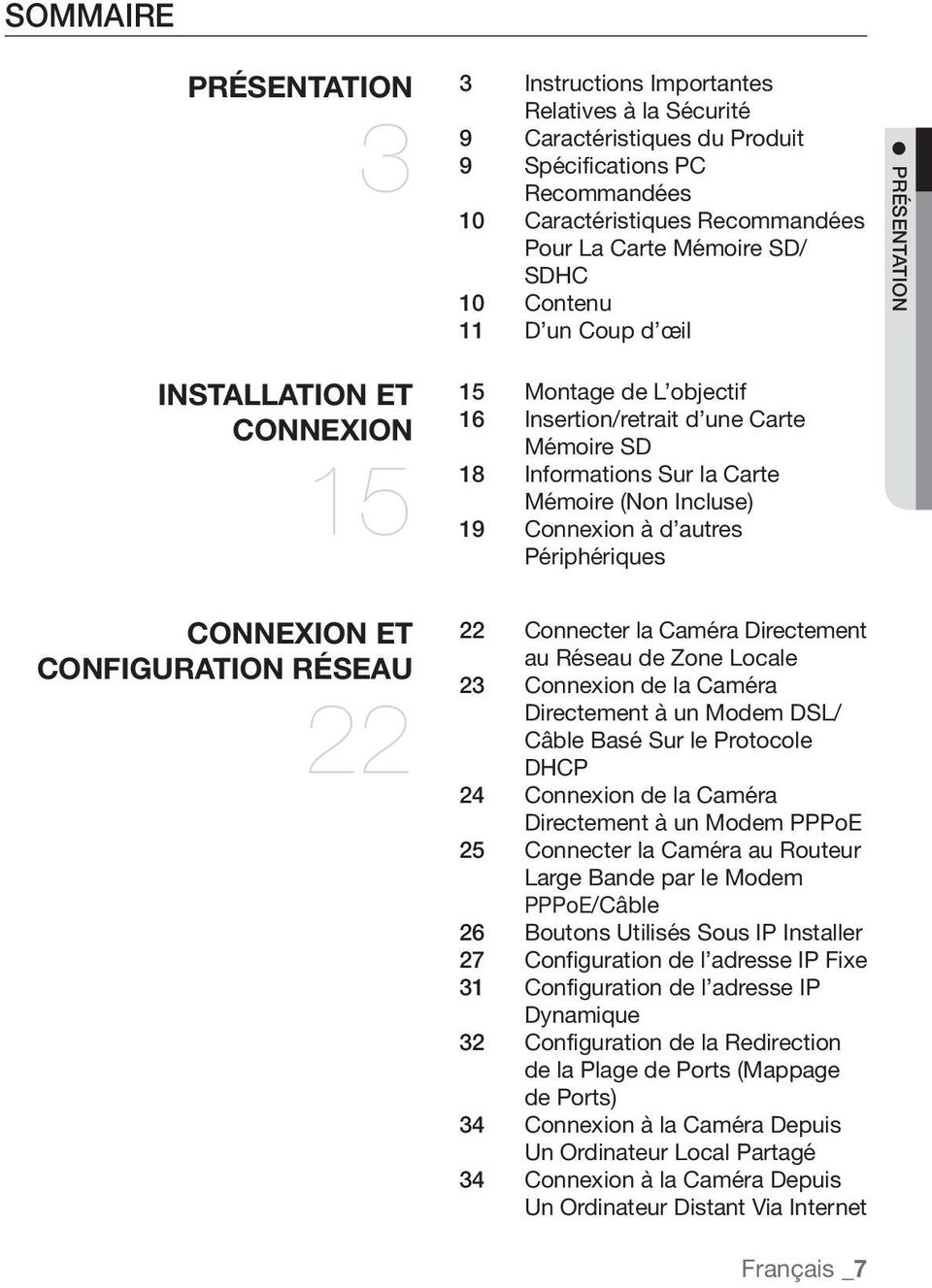
8 présentation VISIONNEUR WEB Connexion à la Caméra 36 Login 37 Installation d activex 38 Installation de Silverlight Runtime 40 Utilisation de l écran Direct 43 Effectuer une recherche et une lecture par événement 44 Effectuer une recherche et une lecture par heure ÉCRAN DE CONFIGURATION Configuration 46 Configuration Audio Et Vidéo 56 Configuration Réseau 63 Configuration d événement 70 Configuration du Système ANNEXES Spécifications 79 Vue du Produit 80 Résolution de Problèmes 82 Open Source Announcement 83 License 86 GPL/LGPL Software License 8_ présentation
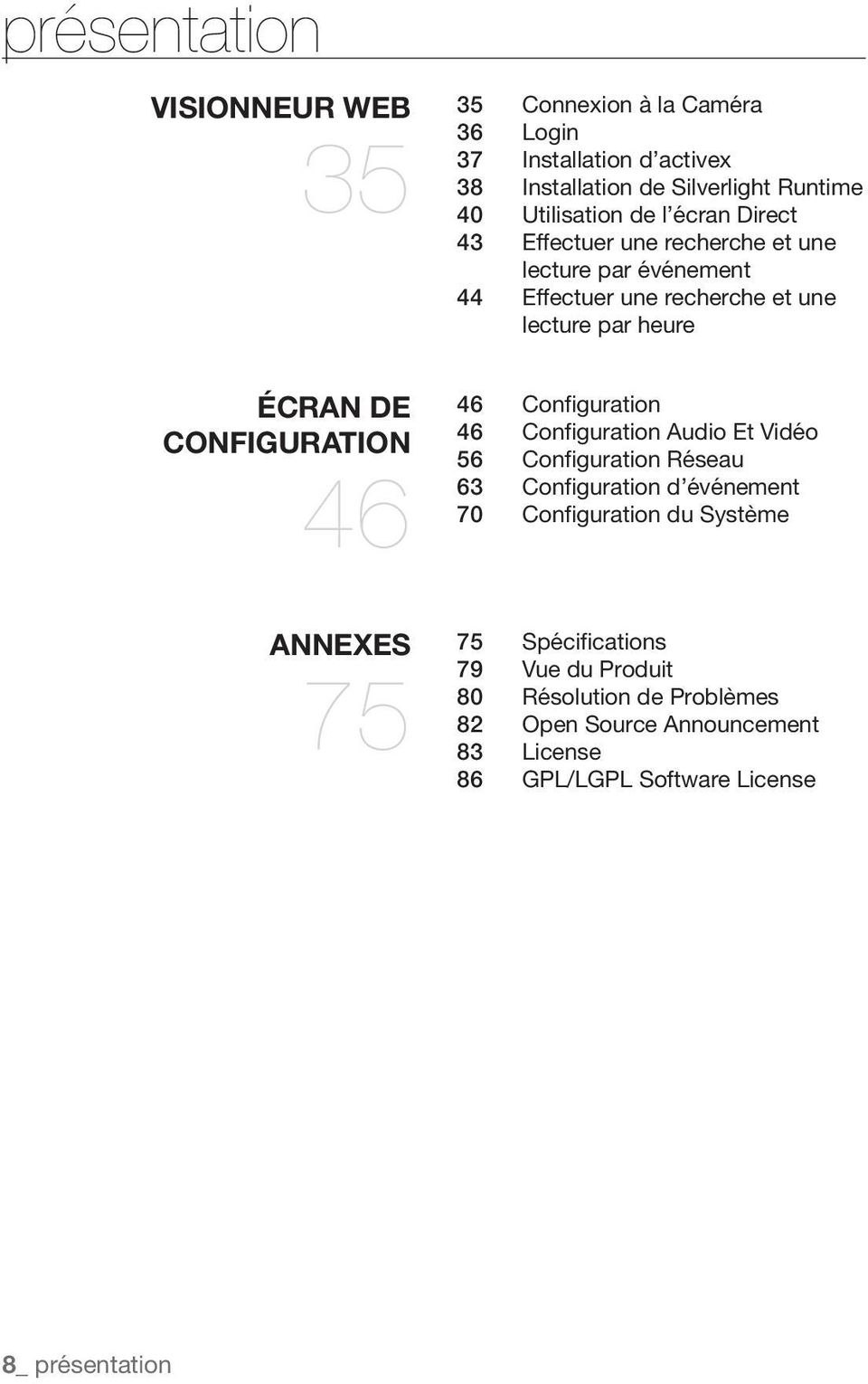
9 CARACTÉRISTIQUES DU PRODUIT Lecture en transit multiple Cette caméra réseau peut afficher des vidéos en différentes qualités et résolutions simultanément, en utilisant plusieurs CODEC. Surveillance basée sur navigateur Web Utilisation du navigateur Web pour afficher l image dans un environnement réseau local. Alarme Si un événement se produit, la vidéo qui y est liée sera envoyée à l adresse indiquée par l utilisateur ou enregistrée dans la mémoire SD. Détection mvt vidéo Détecte un mouvement sur l image vidéo avant le déclenchement de l événement. Détection auto du réseau déconnecté Détecte la déconnexion réseau avant le déclenchement de l événement. Conformité ONVIF Ce produit prend en charge le protocole ONVIF. Pour obtenir de plus amples informations, consultez le site Web PRÉSENTATION SPÉCIFICATIONS PC RECOMMANDÉES CPU : Intel(R) Core(TM)2 2,4 GHz ou supérieur Système d'exploitation : Windows XP, VISTA, 7 Mac OS Résolution : 1280X1024 pixels ou supérieure RAM : 2Go ou supérieure Navigateur Internet : Internet Explorer 7.0 ou supérieur, Firefox 3.0 ou supérieur, Chrome 8.0 ou supérieur, Safari 4.0 ou supérieur Aucune version développeur ni version d évaluation beta gérée, contrairement à la version disponible sur le site Web. Il est recommandé d effectuer la connexion à IPv6 dans Windows 7. Mémoire vidéo : 256MO ou supérieure J Si le lecteur de la carte vidéographique n est pas correctement installé ou si la version installée n est pas la plus récente, la vidéo pourra ne pas s exécuter correctement. Sur les systèmes avec au moins deux écrans, les performances de lecture peuvent être altérées. Français _9

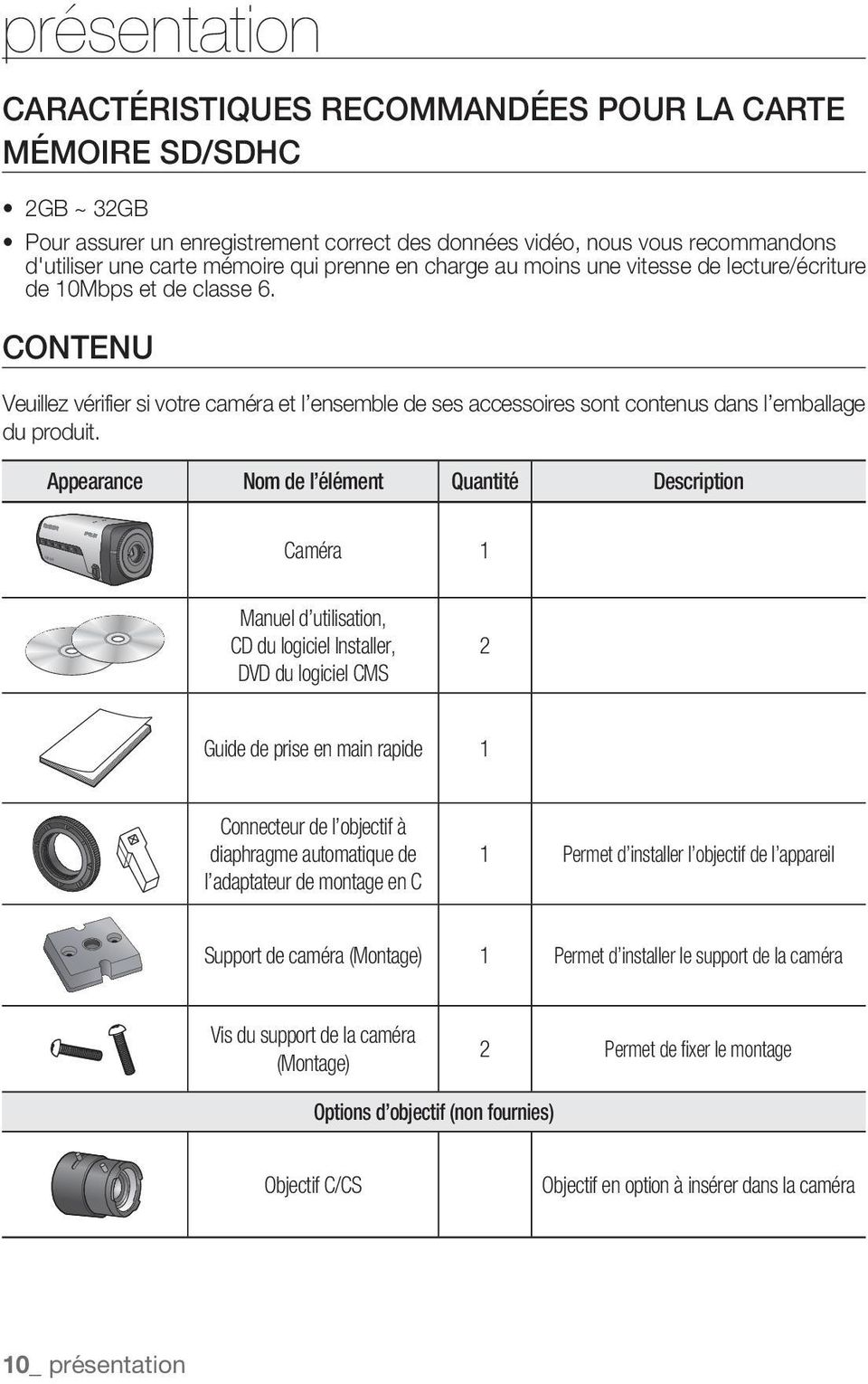
10 présentation CARACTÉRISTIQUES RECOMMANDÉES POUR LA CARTE MÉMOIRE SD/SDHC 2GB ~ 32GB Pour assurer un enregistrement correct des données vidéo, nous vous recommandons d'utiliser une carte mémoire qui prenne en charge au moins une vitesse de lecture/écriture de 10Mbps et de classe 6. CONTENU Veuillez vérifier si votre caméra et l ensemble de ses accessoires sont contenus dans l emballage du produit. Appearance Nom de l élément Quantité Description SNB-3002 Caméra 1 Manuel d utilisation, CD du logiciel Installer, DVD du logiciel CMS 2 Guide de prise en main rapide 1 Connecteur de l objectif à diaphragme automatique de l adaptateur de montage en C 1 Permet d installer l objectif de l appareil Support de caméra (Montage) 1 Permet d installer le support de la caméra Vis du support de la caméra (Montage) 2 Permet de fixer le montage Options d objectif (non fournies) Objectif C/CS Objectif en option à insérer dans la caméra 10_ présentation
11 D UN COUP D ŒIL Face avant <Support fixe> PRÉSENTATION SNB-3002 b Élément Orifices (Montage) de la monture d objectif de la caméra Trou pour la vis du support de fixation c Levier FBL Description Utilisé pour l assemblage de la caméra sur le support par fixation de l adaptateur (de montage) de la monture d objectif sur le support. Permet de fixer la caméra sur un support ou un support de fixation. Taille de la vis : utilisez cette vis pour fixer le support de fixation. 1/4 pouce 20 UNC (20THREAD/1 ) Long. : 4,5 mm ± 0,2 mm (norme ISO), ou 0,197 pouces (norme ASA) Réglez la valeur de la FBL (longueur du dos de l embase) en fonction de l objectif. Français _11

12 présentation Élément Objectif à diaphragme automatique (en option) Connecteur d objectif à diaphragme automatique Description Installé sur l adaptateur du diaphragme. Utilisé pour l alimentation et le signal de sortie permettant de contrôler le diaphragme de l objectif. M Pour nettoyer la surface de l'objectif, essuyez-la soigneusement avec du papier Joseph ou n'importe quel chiffon sec imbibé d alcool éthylique. Le support de fixation n est pas inclus. Pour plus d informations sur l utilisation du support de fixation, reportez-vous à la documentation du produit. 12_ présentation

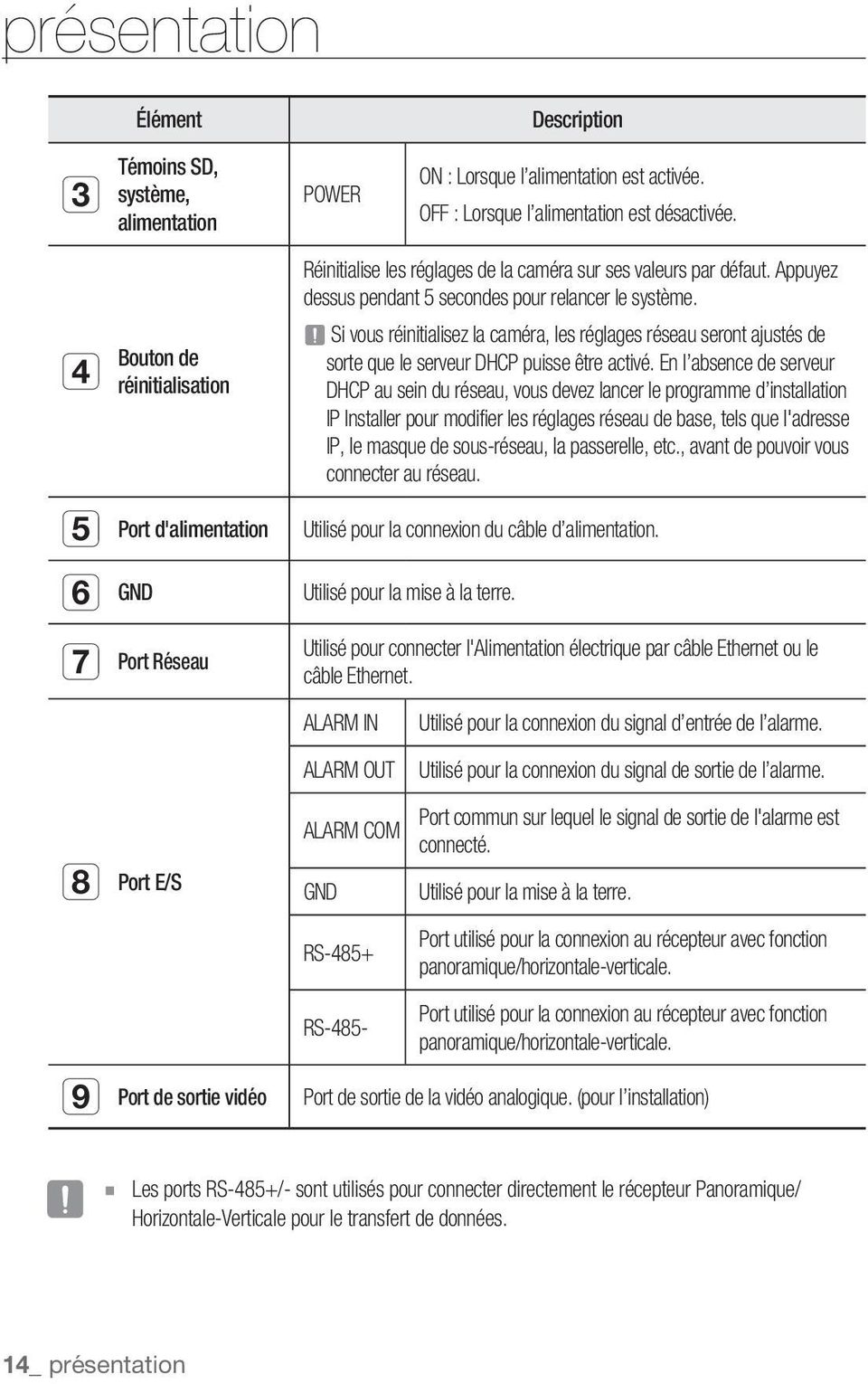
13 Côté arrière VIDEO SD CARD AUDIO OUT AUDIO IN SD SYSTEM POWER RESET NETWORK + PRÉSENTATION 1 : ALARM IN 4 : GND ACT 2 : ALARM OUT 5 : RS : ALARM COM 6 : RS-485- LINK GND AC 24V DC 12V Élément Compartiment de la carte mémoire SD Description Compartiment de la carte mémoire SD. AUDIO OUT Borne de sortie audio. b Borne audio AUDIO IN Borne d entrée audio. ON : Une carte mémoire est insérée et fonctionne normalement. c Témoins SD, système, alimentation SD SYSTEM Clignotant : Échec d enregistrement, espace insuffisant ou carte mal insérée. OFF : Caméra éteinte, caméra en cours de redémarrage, carte mémoire non insérée ou enregistrement désactivé. ON : La caméra est allumée et correctement connectée au réseau. Clignotant : Durant la configuration DDNS ou en cas d'échec de configuration, ou dans un état de connexion réseau instable. OFF : Lorsque le système est en cours de redémarrage ou hors tension. Français _13

14 présentation c Élément Témoins SD, système, alimentation POWER Description ON : Lorsque l alimentation est activée. OFF : Lorsque l alimentation est désactivée. GND Bouton de réinitialisation Port d'alimentation Réinitialise les réglages de la caméra sur ses valeurs par défaut. Appuyez dessus pendant 5 secondes pour relancer le système. J Si vous réinitialisez la caméra, les réglages réseau seront ajustés de sorte que le serveur DHCP puisse être activé. En l absence de serveur DHCP au sein du réseau, vous devez lancer le programme d installation IP Installer pour modifier les réglages réseau de base, tels que l'adresse IP, le masque de sous-réseau, la passerelle, etc., avant de pouvoir vous connecter au réseau. Utilisé pour la connexion du câble d alimentation. Utilisé pour la mise à la terre. Port Réseau Utilisé pour connecter l'alimentation électrique par câble Ethernet ou le câble Ethernet. ALARM IN ALARM OUT Utilisé pour la connexion du signal d entrée de l alarme. Utilisé pour la connexion du signal de sortie de l alarme. Port E/S ALARM COM GND Port commun sur lequel le signal de sortie de l'alarme est connecté. Utilisé pour la mise à la terre. RS-485+ Port utilisé pour la connexion au récepteur avec fonction panoramique/horizontale-verticale. Port de sortie vidéo RS-485- Port utilisé pour la connexion au récepteur avec fonction panoramique/horizontale-verticale. Port de sortie de la vidéo analogique. (pour l installation) J Les ports RS-485+/- sont utilisés pour connecter directement le récepteur Panoramique/ Horizontale-Verticale pour le transfert de données. 14_ présentation
15 installation et connexion MONTAGE DE L OBJECTIF Débranchez l alimentation avant de procéder. M Les objectifs C et CS ne sont pas inclus dans l'emballage du produit. Montage de l'objectif C Tournez l adaptateur de montage en C dans le sens des aiguilles d une montre pour l insérer et faites-en de même avec l objectif C. INSTALLATION ET CONNEXION SNB-3002 Objectif C Adaptateur de fixation en C Montage de l objectif CS Tournez l objectif CS proposé en option dans le sens des aiguilles d une montre pour l insérer. SNB-3002 Objectif CS Français _15

16 1 : ALARM IN 4 : GND 2 : ALARM OUT 5 : RS : ALARM COM 6 : RS-485- installation et connexion Branchement du connecteur de l'objectif à diaphragme automatique Insérez le connecteur de l objectif dans le trou correspondant de la caméra. SNB-3002 Mise au point Tournez l objectif vers la gauche ou la droite pour commander le zoom et effectuer la mise au point de manière à obtenir une vue claire et nette de l objet. INSERTION/RETRAIT D UNE CARTE MÉMOIRE SD J Déconnectez le câble d alimentation de la caméra avant d y insérer la carte mémoire SD. Insertion d une carte mémoire SD Desserrez la vis et ouvrez le cache de la carte mémoire SD. Insérez la carte SD en direction de la flèche J N insérez pas la carte mémoire SD à l envers et de force. Autrement, vous risquez d endommager la carte mémoire SD. 16_ installation et connexion
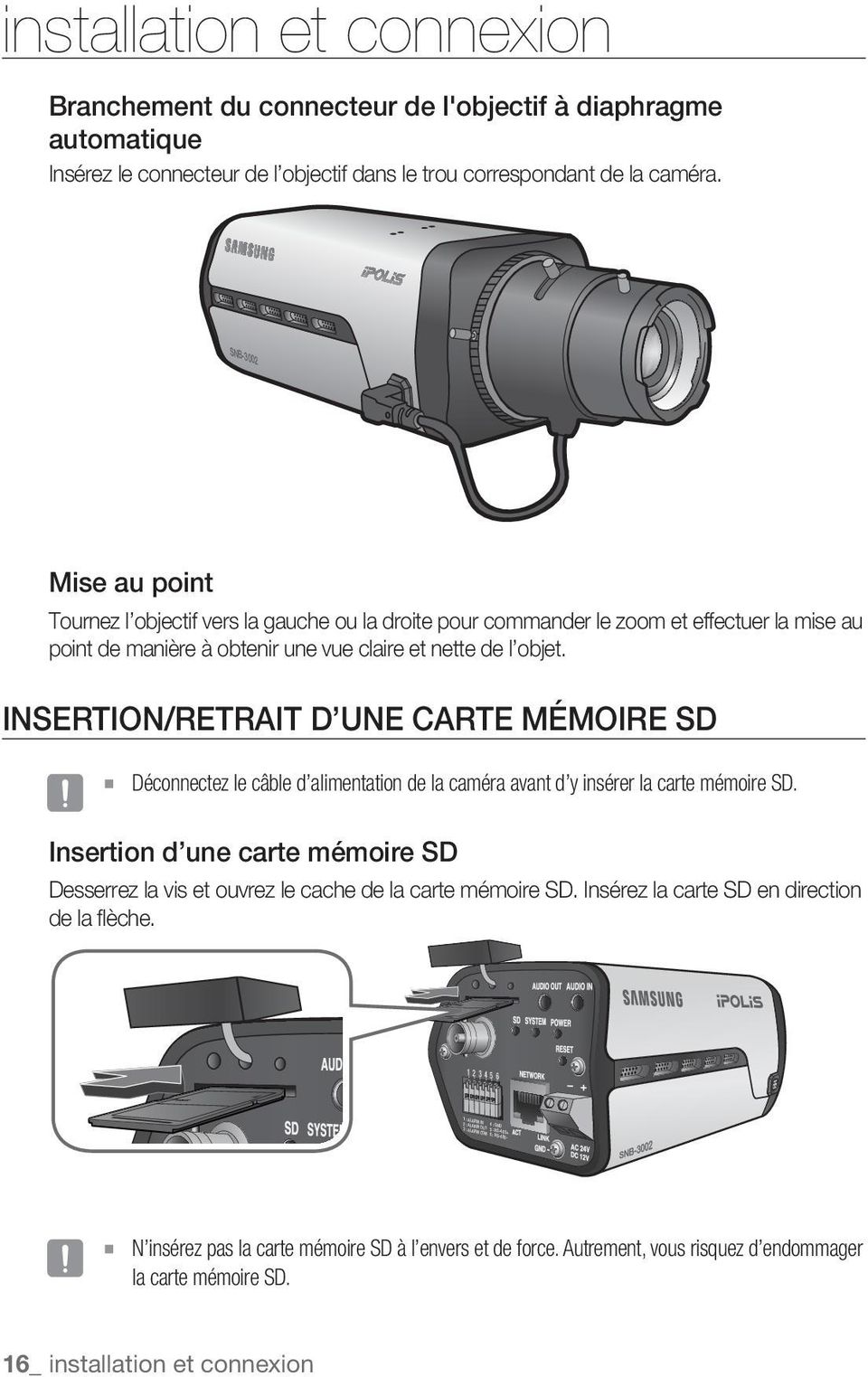
17 Retrait d une carte mémoire SD Appuyer doucement vers le bas sur l'extrémité exposée de la carte mémoire comme indiqué dans le diagramme pour éjecter la carte mémoire de la fente. J : ALARM IN 4 : GND 2 : ALARM OUT 5 : RS : ALARM COM 6 : RS-485- Si vous exercez une pression excessive sur la carte mémoire SD, celle-ci pourra s'éjecter du logement de manière incontrôlable. Pour retirer la carte mémoire SD, réglez l option <Enregistrement> sur <Désactivé> depuis <Enregistrement SD>, puis appuyez sur [Appliquer ( )]. (page 64) Si vous avez sauvegardé vos données sur la carte mémoire SD, le retrait de la carte mémoire SD avant le réglage de l enregistrement sur Désactivé provoquera des dégâts aux données stockées sur la carte. INSTALLATION ET CONNEXION Français _17
![manière incontrôlable. Pour retirer la carte mémoire SD, réglez l option <Enregistrement> sur <Désactivé> depuis <Enregistrement SD>, puis appuyez sur [Appliquer ( )].](/docs-images/45/12294072/images/page_17.jpg "(page 64) Si vous avez sauvegardé vos données sur la carte mémoire SD, le retrait de la carte mémoire SD avant le réglage de l enregistrement sur Désactivé provoquera des dégâts aux données")
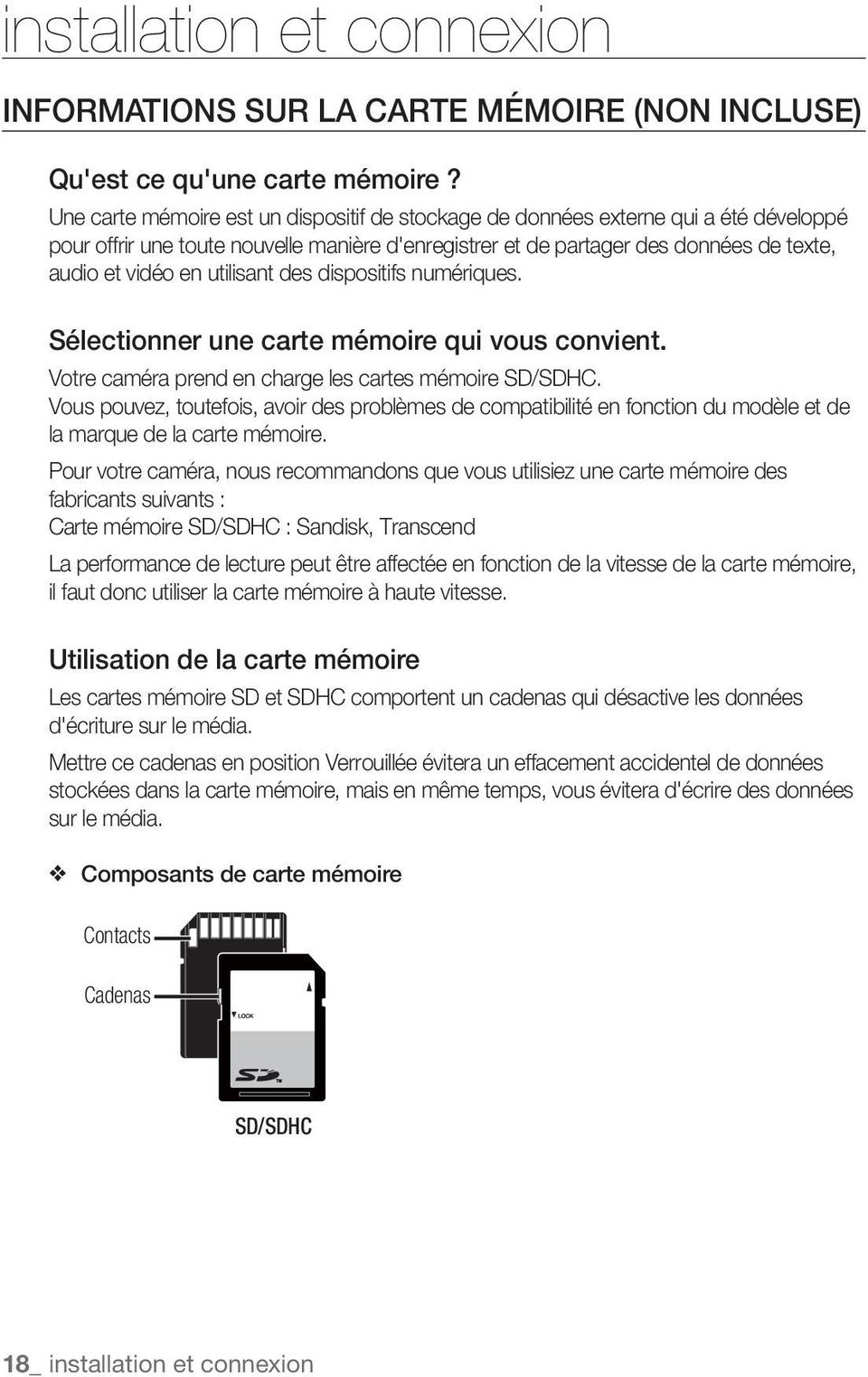
18 installation et connexion INFORMATIONS SUR LA CARTE MÉMOIRE (NON INCLUSE) Qu'est ce qu'une carte mémoire? Une carte mémoire est un dispositif de stockage de données externe qui a été développé pour offrir une toute nouvelle manière d'enregistrer et de partager des données de texte, audio et vidéo en utilisant des dispositifs numériques. Sélectionner une carte mémoire qui vous convient. Votre caméra prend en charge les cartes mémoire SD/SDHC. Vous pouvez, toutefois, avoir des problèmes de compatibilité en fonction du modèle et de la marque de la carte mémoire. Pour votre caméra, nous recommandons que vous utilisiez une carte mémoire des fabricants suivants : Carte mémoire SD/SDHC : Sandisk, Transcend La performance de lecture peut être affectée en fonction de la vitesse de la carte mémoire, il faut donc utiliser la carte mémoire à haute vitesse. Utilisation de la carte mémoire Les cartes mémoire SD et SDHC comportent un cadenas qui désactive les données d'écriture sur le média. Mettre ce cadenas en position Verrouillée évitera un effacement accidentel de données stockées dans la carte mémoire, mais en même temps, vous évitera d'écrire des données sur le média. Composants de carte mémoire Contacts Cadenas SD/SDHC 18_ installation et connexion
19 CONNEXION À D AUTRES PÉRIPHÉRIQUES VIDEO SD CARD SD 1 : ALARM IN 4 : GND ACT 2 : ALARM OUT 5 : RS : ALARM COM 6 : RS-485- NETWORK AUDIO OUT AUDIO IN SYSTEM POWER RESET LINK GND AC 24V DC 12V + Écran (pour l installation) Alimentation INSTALLATION ET CONNEXION Connexion Ethernet Connectez le câble Ethernet au réseau local ou à Internet. Alimentation Utilisez le tournevis pour connecter les lignes du câble d alimentation (+, ) au port correspondant de la caméra. J Ethernet Prenez soin de ne pas inverser la polarité en connectant le câble d alimentation. Vous pouvez également utiliser un routeur doté d une alimentation électrique par câble Ethernet pour fournir le courant à la caméra. Si l appareil est équipé d une alimentation électrique par câble Ethernet et d une alimentation CC de 12 V, c est la source d alimentation sollicitée en premier qui sera utilisée. Assurez-vous que le moniteur et la caméra sont désactivés avant de les relier. Français _19

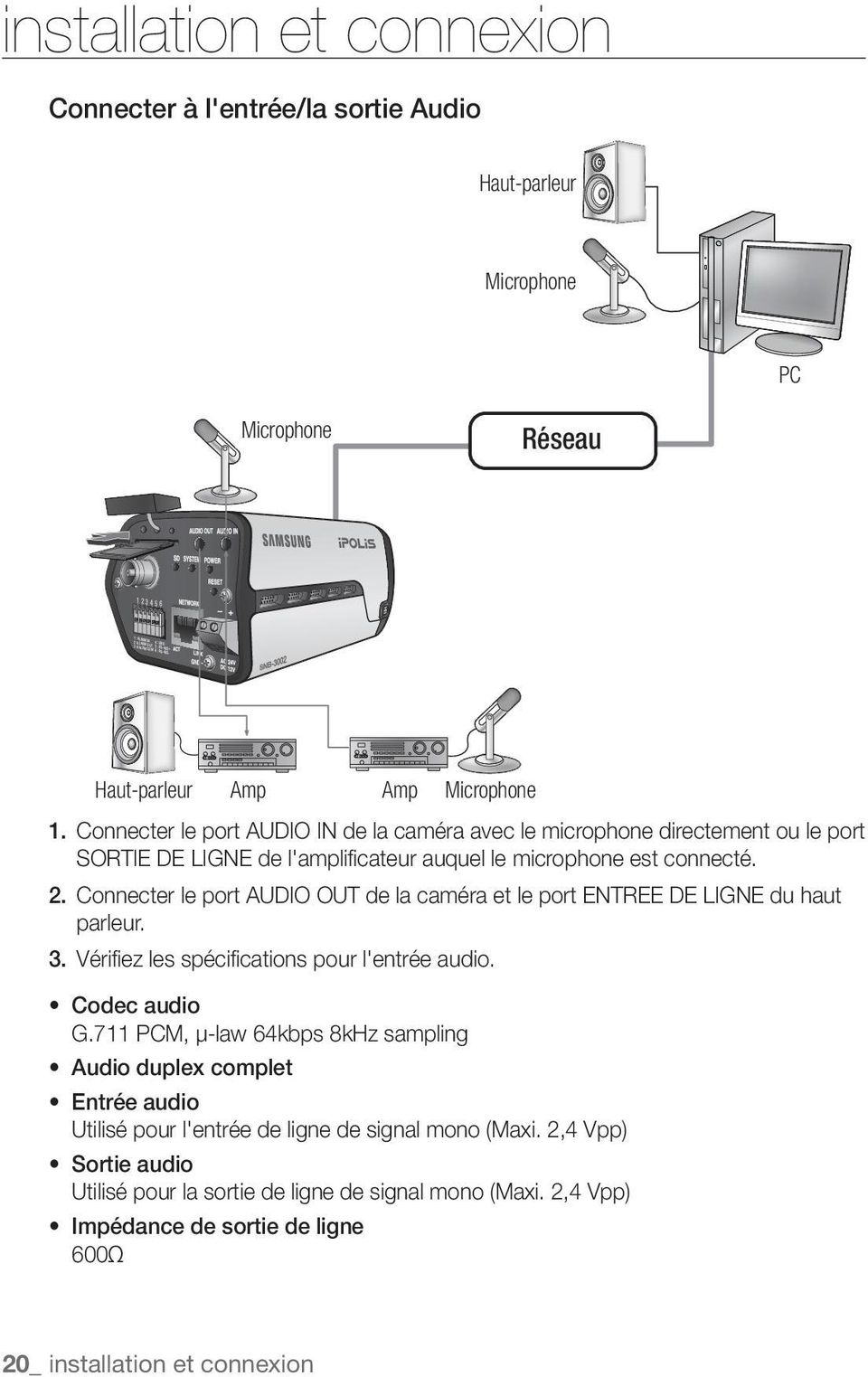
20 1 : ALARM IN 4 : GND 2 : ALARM OUT 5 : RS : ALARM COM 6 : RS-485- installation et connexion Connecter à l'entrée/la sortie Audio Haut-parleur Microphone PC Microphone Réseau Haut-parleur Amp Amp Microphone 1. Connecter le port AUDIO IN de la caméra avec le microphone directement ou le port SORTIE DE LIGNE de l'amplificateur auquel le microphone est connecté. 2. Connecter le port AUDIO OUT de la caméra et le port ENTREE DE LIGNE du haut parleur. 3. Vérifiez les spécifications pour l'entrée audio. Codec audio G.711 PCM, μ-law 64kbps 8kHz sampling Audio duplex complet Entrée audio Utilisé pour l'entrée de ligne de signal mono (Maxi. 2,4 Vpp) Sortie audio Utilisé pour la sortie de ligne de signal mono (Maxi. 2,4 Vpp) Impédance de sortie de ligne _ installation et connexion
21 + Schéma de câblage de l E/S de l alarme ALARM IN 1 (5mA sink) ALARM OUT ALARM COM GND RS-485+ RS (30VDC 2A, 125VAC 0.5A MAX) Connexion au boîtier du port E/S Connectez le signal d E/S de l alarme sur le port correspondant situé à l arrière du boîtier du port. INSTALLATION ET CONNEXION SD CARD AUDIO OUT AUDIO IN SD SYSTEM POWER VIDEO RESET NETWORK 1 : ALARM IN 4 : GND 2 : ALARM OUT 5 : RS : ALARM COM 6 : RS : ALARM IN 4 : GND ACT 2 : ALARM OUT 5 : RS : ALARM COM 6 : RS-485- LINK GND AC 24V DC 12V ALARM IN : Utilisé pour la connexion du signal d entrée de l alarme. ALARM OUT : Utilisé pour la connexion du signal de sortie de l alarme. ALARM COM : Port commun sur lequel le signal de sortie de l'alarme est connecté. GND : Utilisé pour la mise à la terre. RS-485+ : Port de communication du récepteur RS-485 (+) RS-485- : Port de communication du récepteur RS-485 ( ) Connexion d un dispositif RS-485 externe Connectez la caméra au dispositif externe via les ports [RS-485 +, -]. Vous pouvez contrôler les opérations pan/incl de la caméra via les communications RS-485. La connexion GND est recommandée pour les communications RS-485. Si vous rencontrez un problème de communication, branchez correctement la broche GND pour corriger le niveau GND entre la caméra et le périphérique externe. Français _21
22 SNB-3002 SNB-3002 connexion et configuration réseau Vous pouvez configurer les paramétrages de réseau en fonction de vos configurations de réseau. CONNECTER LA CAMÉRA DIRECTEMENT AU RÉSEAU DE ZONE LOCALE Se connecte à la caméra à partir d'un PC local sur le LAN 1. Lancer un navigateur Internet sur le PC local. 2. Saisir l'adresse IP de la caméra dans la barre d'adresse du navigateur. Caméra Switch INTERNET Caméra Firewall Ordinateur externe distant PC local <Réseau local> Serveur DDNS (Centre de données, COREE) M Un PC à distance dans une sortie Internet externe de réseau LAN peut ne pas pouvoir se connecter à la caméra installée dans l'intranet si le renvoi de port n'est pas correctement configuré ou si un pare-feu est mis. Dans ce cas, pour résoudre le problème, contacter votre administrateur de réseau. Par défaut, l adresse IP sera attribuée automatiquement depuis le serveur DHCP. En l absence de serveur DHCP disponible, l adresse IP sera définie sur Pour changer l adresse IP, utilisez le programme d'installation IP. Pour obtenir de plus amples détails sur l utilisation du programme d'installation IP, reportez-vous à la section «Configuration de l adresse IP Fixe». (Page 27) 22_ connexion et configuration réseau
23 SNB-3002 CONNEXION DE LA CAMÉRA DIRECTEMENT À UN MODEM DSL/CÂBLE BASÉ SUR LE PROTOCOLE DHCP Caméra Modem DSL/ Câble INTERNET Serveur DDNS (Centre de données, COREE) Ordinateur externe distant 1. Utilisez le câble LAN transversal pour connecter le câble du réseau directement à votre ordinateur. 2. Exécutez le programme d'installation IP et changez l'adresse IP de la caméra afin d'utiliser le navigateur Web sur votre poste pour la connexion à l'internet. 3. Utilisez le navigateur Internet pour connecter la caméra. 4. Allez à la page [Configuration]. 5. Allez sur [Réseau] [DDNS], puis configurez les réglages DDNS. 6. Allez sur [Réseau] [Interface], puis réglez le type de réseau sur [DHCP]. 7. Connectez la caméra, qui a été retirée de votre ordinateur, directement au modem. 8. Redémarrez la caméra. CONNEXION ET CONFIGURATION RÉSEAU M Pour l'enregistrement des réglages DDNS, reportez-vous à la section «Enregistrement sur le serveur DDNS». (page 58) Pour l'enregistrement des réglages DDNS, reportez-vous à la section «DDNS». (page 57) Pour le réglage du type de réseau, reportez-vous à la section «Interface». (page 56) Français _23
24 SNB-3002 connexion et configuration réseau CONNEXION DE LA CAMÉRA DIRECTEMENT À UN MODEM PPPoE INTERNET Caméra Modem PPPoE Ordinateur externe distant Serveur DDNS (Centre de données, COREE) 1. Utilisez le câble LAN transversal pour connecter le câble du réseau directement à votre ordinateur. 2. Exécutez le programme d'installation IP et changez l'adresse IP de la caméra afin d'utiliser le navigateur Web sur votre poste pour la connexion à l'internet. 3. Utilisez le navigateur Internet pour connecter la caméra. 4. Allez à la page [Configuration]. 5. Allez sur [Réseau] [DDNS], puis configurez les réglages DDNS. 6. Allez sur [Réseau] [Interface], puis réglez le type de réseau sur [PPPoE]. 7. Connectez la caméra, qui a été retirée de votre ordinateur, directement au modem. 8. Redémarrez la caméra. M Pour l'enregistrement des réglages DDNS, reportez-vous à la section «Enregistrement sur le serveur DDNS». (page 58) Pour l'enregistrement des réglages DDNS, reportez-vous à la section «DDNS». (page 57) Pour le réglage du type de réseau, reportez-vous à la section «Interface». (page 56) 24_ connexion et configuration réseau
25 SNB-3002 SNB-3002 CONNECTER LA CAMÉRA AU ROUTEUR LARGE BANDE PAR LE MODEM PPPoE/CÂBLE C'est pour un petit environnement de réseau comme les maisons, SOHO et les magasins ordinaires. Caméra Caméra PC local Routeur large bande PPPoE ou Modem câble INTERNET PPPoE ou Modem câble DDNS Server (Data Center, KOREA) Ordinateur externe distant CONNEXION ET CONFIGURATION RÉSEAU Configurer les paramétrages de réseau du PC local connecté au routeur Pour configurer les paramètres de réseau du PC local connecté au Routeur large bande, suivre les instructions ci-dessous. Sélectionner : <Network Neighborhood> <Properties> <Local Area Connection> <Properties> <General> <Internet Protocol (TCP/IP)> <Properties> <Obtain an IP address automatically> ou <Use the following IP address>. Suivre les instructions ci-dessous si vous sélectionnez <Use the following IP address>: ex.1) Si l'adresse (LAN IP) du Routeur large bande est Adresse IP : Masque de sous-réseau : Passerelle par défaut : ex.2) Si l'adresse (LAN IP) du Routeur large bande est Adresse IP : Masque de sous-réseau : Passerelle par défaut : ex.3) Si l'adresse (LAN IP) du Routeur large bande est xxx.1 Adresse IP : xxx.100 Masque de sous-réseau : Passerelle par défaut : xxx.1 M Pour l'adresse du Routeur large bande, se référer à la documentation du produit. Pour plus d informations sur la redirection de port du routeur large bande, reportez-vous à «Configuration de la Redirection de la Plage de Ports (Mappage de Ports)». (Page 32) Français _25
26 connexion et configuration réseau BOUTONS UTILISÉS SOUS IP INSTALLER Élément Device Name Nom Description du modèle de la caméra connectée. Cliquez sur la colonne pour trier la liste par nom de modèle. Cependant, si vous cliquez dessus durant la recherche, celle-ci sera interrompue. b Alias c Mode MAC(Ethernet) Address Cette fonction n est pas appliquée pour le moment. Affiche <Static> ou <Dynamic> pour l état de connexion réseau actuel. Adresse Ethernet de la caméra connectée. Cliquez sur la colonne pour trier la liste par adresse Ethernet. Cependant, si vous cliquez dessus durant la recherche, celle-ci sera interrompue. IP Address Il s agit d une adresse IP spécifiée dans la caméra. Cliquez sur la colonne pour trier la liste par adresse IP. Cependant, si vous cliquez dessus durant la recherche, celle-ci sera interrompue. L adresse par défaut est « ». Protocol Réglage réseau de la caméra. Le réglage par défaut est «IPv4». Les caméras ayant un réglage en IPv6 affichent «IPv6». 26_ connexion et configuration réseau
27 URL IPv4 IPv6 Élément Search m Exit M Auto Set Manual Set Description Adresse URL du serveur DDNS autorisant l accès à partir d un système Internet externe. Cependant, cette option sera remplacée par le réglage <IP Address> de la camera en cas d échec de l enregistrement DDNS. Recherche les caméras réglées sur IPv4. Recherche les caméras réglées sur IPv6. Activé dans un environnement compatible IPv6 Recherche les caméras actuellement connectées au réseau. Cependant, ce bouton sera grisé si aucun des réglages IPv4 ou IPv6 n est sélectionné. Le programme d installation IP configure automatiquement les réglages réseau. Vous devez configurer les réglages réseau manuellement. Quitte le programme IP Installer. En ce qui concerne le programme d installation IP Installer, utilisez uniquement la version fournie sur le CD d installation ou la dernière version disponible de l application. Vous pouvez télécharger la version la plus récente du produit sur le site Internet de Samsung (www. samsungipolis.com). CONNEXION ET CONFIGURATION RÉSEAU CONFIGURATION DE L ADRESSE IP FIXE Configuration réseau manuelle Exécutez <IP Installer_vX.XX.exe> pour afficher la liste des résultats de la recherche de caméras. Au démarrage initial, les deux options [Auto Set] et [Manual Set] sont grisées. M Pour les caméras trouvées ayant un réglage IPv6, ces boutons sont grisés car ces cameras ne prennent pas en charge cette fonction. 1. Sélectionnez une caméra dans la liste de recherche. Repérez l adresse MAC (Ethernet) imprimée à l arrière de la caméra. Les boutons [Auto Set] et [Manual Set] sont alors activés. 2. Cliquez sur [Manual Set]. La boîte de dialogue Manual Setting apparaît. Les valeurs par défaut des options <IP Address>, <Subnet Mask>, <Gateway>, <HTTP Port> et <VNP Port> de la camera s affichent. Français _27
28 connexion et configuration réseau 3. Renseignez les informations nécessaires dans la sous-fenêtre <Address>. MAC (Ethernet) Address : L adresse MAC (Ethernet) de la caméra applicable est réglée automatiquement de sorte que vous n ayez pas à entrer les informations la concernant manuellement. M Vous ne pourrez configurer les réglages IP fixe que si la case d option DHCP est désélectionnée. él é Si vous n utilisez pas de Routeur large bande Pour le réglage des options <IP Address>, <Subnet Mask> et <Gateway>, contactez votre administrateur réseau. 4. Renseignez les informations nécessaires dans la sous-fenêtre <Port>. HTTP Port : Permet d accéder à la caméra à l aide du navigateur Internet, réglé par défaut sur 80. Modifiez la valeur de HTTP Port à l aide des flèches de défilement vers le haut ou le bas. VNP Port : Permet de contrôler le transfert du signal vidéo, réglé par défaut sur Entrez le mot de passe. Ceci est le mot de passe de connexion de l utilisateur «admin» qui accède à la caméra. Le mot de passe par défaut est «4321». J Le mot de passe par défaut peut être exposé à un fil de piratage ; il est donc recommandé de modifier le mot de passe après l installation de l appareil. Notez que l utilisateur sera tenu pour responsable de tout problème relatif à la sécurité ou autre provoqué par un mot de passe inchangé. 6. Cliquez sur [OK]. La configuration réseau manuelle est ainsi terminée. 28_ connexion et configuration réseau
29 Si vous utilisez un Routeur large bande IP Address : Entrez une adresse comprise dans la plage IP fournie par le Routeur large bande. ex.) ~254, ~254, XXX.2~254 Subnet Mask : La valeur de <Subnet Mask> du Routeur large bande est identique à celle de l option <Subnet Mask> de la caméra. Gateway : La valeur de <Local IP Address> du Routeur large bande est identique à celle de l option <Gateway> de la caméra. Les réglages peuvent varier selon le modèle du Routeur large bande connecté. M Pour obtenir de plus amples informations à ce sujet, reportez-vous au guide d utilisation du routeur applicable. Pour plus d informations sur la redirection de port du routeur large bande, reportez-vous à «Configuration de la Redirection de la Plage de Ports (Mappage de Ports)». (Page 32) CONNEXION ET CONFIGURATION RÉSEAU Si le Routeur large bande dispose de plusieurs caméras connectées Configurez séparément les réglages IP et les réglages de port. Catégorie Caméra 1 Caméra 2 Réglages IP IP Address Subnet Mask Gateway Réglages de port HTTP Port VNP Port M Si l option <HTTP Port> est réglée sur une valeur différente de 80, vous devrez indiquer le numéro du réglage <Port> dans la barre d adresse du navigateur Internet pour pouvoir accéder à la caméra. ex.) address : HTTP Port Français _29
30 connexion et configuration réseau Configuration réseau automatique Exécutez <IP Installer_vX.XX.exe> pour afficher la liste des résultats de la recherche de caméras. Au démarrage initial, les deux options [Auto Set] et [Manual Set] sont grisées. M Pour les caméras trouvées ayant un réglage IPv6, ces boutons sont grisés car ces cameras ne prennent pas en charge cette fonction. 1. Sélectionnez une caméra dans la liste de recherche. Repérez l adresse MAC (Ethernet) imprimée à l arrière de la caméra. Les boutons [Auto Set] et [Manual Set] sont alors activés. 2. Cliquez sur [Auto Set]. La boîte de dialogue Auto Setting apparaît. Les options <IP Address>, <Subnet Mask> et <Gateway> sont automatiquement réglées. 3. Entrez le mot de passe. Ceci est le mot de passe de connexion de l utilisateur «admin» qui accède à la caméra. Le mot de passe par défaut est «4321». Le mot de passe par défaut peut être exposé à un fil de piratage ; il est donc recommandé de modifier le mot de passe après l installation de l appareil. Notez que l utilisateur sera tenu pour responsable de tout problème relatif à la sécurité ou autre provoqué par un mot de passe inchangé. 4. Cliquez sur [OK]. La configuration réseau automatique est ainsi terminée. 30_ connexion et configuration réseau
31 CONFIGURATION DE L ADRESSE IP DYNAMIQUE Configuration de l environnement IP Dynamique Exemple d environnement IP Dynamique - Routeur large bande, disposant de caméras connectées, affecté à une adresse IP par le serveur DHCP - En cas de connexion directe de la caméra au modem via les protocoles DHCP. - Adresses IP affectées par le serveur DHCP interne via le réseau LAN Vérification de l'adresse IP Dynamique 1. Exécutez le programme d installation IP sur la machine locale de l utilisateur pour afficher les caméras auxquelles les adresses <Dynamic IP> sont affectées dans la liste. 2. Sélectionnez une caméra dans la liste, et cliquez sur [Manual Set] pour consulter la valeur de l option <Dynamic IP> de la caméra. Si vous désélectionnez <DHCP>, vous pourrez modifier la valeur de l option IP en la réglant sur <Static>. CONNEXION ET CONFIGURATION RÉSEAU Français _31
32 connexion et configuration réseau CONFIGURATION DE LA REDIRECTION DE LA PLAGE DE PORTS (MAPPAGE DE PORTS) Si vous avez installé un Routeur large bande muni d'une caméra connectée, vous devrez régler la redirection de la plage de ports sur le Routeur large bande de sorte qu'un ordinateur distant puisse accéder à la caméra qui y est installée. Redirection manuelle de la plage de ports 1. Depuis le menu Setup du Routeur large bande, sélectionnez <Applications & Gaming> - <Port Range Forward>. Pour le réglage de la redirection de la plage de ports sur un Routeur large bande tiers, reportez-vous au manuel d utilisation du Routeur large bande concerné. 2. Sélectionnez <TCP> et <UDP Port> pour chacune des cameras connectées au Routeur large bande. Chaque numéro de port lié au Routeur large bande devrait correspondre à ce qui est spécifié dans <Réseau> - <Port> depuis le menu Setup de la caméra. 3. Une fois terminé, cliquez sur [Save Settings]. Vos réglages seront ainsi sauvegardés. M Les instructions des exemples ci-dessus sont basées sur le Routeur large bande de CISCO (Modèle : LINKSYS). Les réglages peuvent varier selon le modèle du Routeur large bande connecté. Pour obtenir de plus amples informations à ce sujet, reportez-vous au guide d utilisation du routeur applicable. 32_ connexion et configuration réseau
33 Réglage de la redirection de la plage de ports pour plusieurs caméras en réseau Lorsque plusieurs caméras en réseau sont connectées à un seul périphérique de Routeur large bande, vous devez rediriger le port TCP 943 du routeur vers le port TCP 943 d une caméra connectée. J Si vous ne réglez pas correctement le port TCP 943 du routeur, vous ne pourrez pas lire les données vidéo depuis la page Web de la caméra. Le port TCP 943 est un port dédié au serveur de règles Silverlight d une caméra. Vous pouvez définir une règle de redirection de port sur le périphérique du Routeur large bande via sa page Web de configuration. Vous ne pouvez pas changer le port du serveur de règles Silverlight d'une caméra. Vous pouvez changer les ports de la caméra à l exception du port de serveur de règles via ses pages Web de configuration. Lorsque la Caméra 1 et la Caméra 2 sont connectées à un routeur : CONNEXION ET CONFIGURATION RÉSEAU Utilisateur Internet Routeur large bande Début Fin Protocole Adresse IP TCP TCP/UDP TCP/UDP TCP/UDP TCP/UDP TCP/UDP TCP/UDP Caméra 1 ( ) Port du serveur Web 8080 Port VPN 4520 Port RTSP 3000 Port du serveur de règles 943 Camera2 ( ) Port du serveur Web 8081 Port VPN 4521 Port RTSP 3001 Port du serveur de règles 943 Français _33
34 connexion et configuration réseau CONNEXION À LA CAMÉRA DEPUIS UN ORDINATEUR LOCAL PARTAGÉ 1. Exécutez le programme d installation IP. Le système recherche les caméras connectées et en affiche la liste. 2. Double-cliquez sur une caméra pour y accéder. Le navigateur Internet démarre et se connecte à la caméra. M Vous pouvez aussi accéder à la caméra en tapant l adresse IP de la caméra trouvée dans la barre d adresse du navigateur Internet. CONNEXION À LA CAMÉRA DEPUIS UN ORDINATEUR DISTANT VIA INTERNET L'utilisation du programme d installation IP sur un ordinateur à distance n appartenant pas à la grappe du réseau du Routeur large bande n'est pas autorisé, les utilisateurs peuvent accéder aux caméras au sein du réseau du Routeur large bande en utilisant l adresse URL DDNS de la caméra. 1. Avant de pouvoir accéder à une caméra depuis le réseau du Routeur large bande, vous devez régler la redirection des plages de port du Routeur large bande. 2. Depuis l'ordinateur distant, lancez le navigateur Internet et tapez l adresse URL DDNS de la camera ou l adresse IP du Routeur large bande dans la barre d adresse. ex.) de produit] 34_ connexion et configuration réseau
35 visionneur web CONNEXION À LA CAMÉRA Normalement, vous devez procéder comme suit : 1. Lancez le navigateur Internet. 2. Tapez l adresse IP de la caméra dans la barre d adresse. ex.) Adresse IP (IPv4) : la boîte de dialogue de connexion devrait apparaître. Adresse IP (IPv6) : 2001:230:abcd:ffff: 0000:0000:ffff: :ffff:1111] - la boîte de dialogue de connexion devrait apparaître. VISIONNEUR WEB Si le numéro de port HTTP est différent de Lancez le navigateur Internet. 2. Tapez l adresse IP et le numéro de port HTTP de la caméra dans la barre d adresse. ex.) Adresse IP: :HTTP Numéro de port (8080) - la boîte de dialogue de connexion devrait apparaître. Utilisation de l adresse URL 1. Lancez le navigateur Internet. 2. Tapez l adresse URL DDNS de la caméra dans la barre d adresse. ex.) Adresse URL : de produit] - la boîte de dialogue de connexion devrait apparaître. Français _35
36 visionneur web Vérification de l'adresse DDNS Si la caméra est directement connectée à un modem de câble DHCP, à un modem DSL ou à un modem PPPoE, l adresse IP de votre réseau sera modifiée à chaque fois que vous essayerez de vous connecter au serveur FSI (Fournisseur de services Internet). Le cas échéant, vous ne serez pas informé du changement d'adresse IP par le serveur DDNS. Une fois que vous enregistrez un périphérique dynamique basé sur IP sur le serveur DDNS, vous pouvez facilement vérifier l adresse IP modifiée lorsque vous essayez d accéder au périphérique. Pour ajouter l adresse IP au serveur <DDNS>, consultez le site Web, à l adresse www. samsungipolis.com et enregistrez-y votre périphérique, puis réglez l'option DDNS sur <Samsung DDNS> avant de fournir le nom d hôte du serveur DDNS. LOGIN L identifiant utilisateur par défaut est «admin» et le mot de passe par défaut est «4321». 1. Entrez «admin» dans la zone de saisie de texte <User Name>. 2. Entrez «4321» dans la zone de saisie de texte <Password>. Si le mot de passe est modifié, entrez le nouveau mot de passe. 3. Cliquez sur [OK]. Si vous vous êtes connecté avec succès, vous verrez l écran Live Viewer s afficher. M J Pour des raisons de sécurité, veillez à changer le mot de passe sous <Système> - <Utilisateur>. L'identifiant de l administrateur «admin» est fixe et ne peut être modifié. Le mot de passe par défaut peut être exposé à un fil de piratage ; il est donc recommandé de modifier le mot de passe après l installation de l appareil. Notez que l utilisateur sera tenu pour responsable de tout problème relatif à la sécurité ou autre provoqué par un mot de passe inchangé. Si vous sélectionnez l option «Remember my password» après avoir entré votre saisie, vous serez automatiquement connecté sans être invité à entrer vos informations de connexion à votre prochaine connexion. Pour une qualité vidéo optimale, passez en affichage 100 %. La réduction du format de l image peut couper l image sur les bords. 36_ visionneur web
37 INSTALLATION D ACTIVEX Si vous vous connectez à une caméra pour la première fois, vous afficherez le message d'installation. Procédez ensuite à l installation de la version requise d ActiveX afin d accéder à la caméra pour y contrôler la vidéo en temps réel. 1. En accédant à l écran de démarrage de la page de surveillance, cliquez sur le message d avertissement qui s affiche en jaune en haut de l écran. 2. Cliquez sur <Install This Add-on for All users on This Computer...>. VISIONNEUR WEB 3. L'avertissement de sécurité contextuel apparaît. Cliquez sur [Install]. 4. Lorsque vous avez correctement installé la version ActiveX requise après avoir accédé à la caméra, l écran Live doit en principe apparaître. Français _37
38 visionneur web INSTALLATION DE SILVERLIGHT RUNTIME Si votre ordinateur ne dispose pas d une version de Silverlight Runtime ou possède une version ancienne du logiciel, vous serez automatiquement redirigé vers la page d accueil de Silverlight Runtime dès que vous accèderez au visionneur Web. 1. Cliquez sur <Click Here>. 2. Lorsque la boîte de dialogue de téléchargement du fichier s affiche, cliquez sur <Run>. 3. Lorsque le téléchargement est terminé, cliquez sur <Run>. 4. La page d installation de Silverlight Runtime s affiche. Sélectionnez <Install now> pour procéder à l installation. 38_ visionneur web
39 5. Lorsque l opération est terminée, cliquez sur <Close>. 6. Fermez la fenêtre et redémarrez le navigateur Internet, puis essayez d accéder au visionneur Web. Lorsque Silverlight Runtime est correctement installé, vous verrez s afficher l écran Direct. VISIONNEUR WEB J Pour une installation normale, spécifiez le réglage Bloquer fenêtre contextuelle comme suit : ex.) Internet Explorer Outils Bloquer fenêtre contextuelle Désactiver le bloqueur de fenêtres publicitaires intempestives (B) Cependant, les utilisateurs de MAC OS X qui ne sont pas connectés à Internet peuvent utiliser le CD d'installation fourni pour installer Silverlight Runtime (Exécutez le fichier exécutable «Silverlight_xxx.dmg» sur le CD. Vous serez guidé au travers des étapes de l'installation du logiciel). Français _39
40 visionneur web UTILISATION DE L ÉCRAN DIRECT Élément Contrôle b Lecture c Configuration Écran du visionneur Émission d alerte Audio Permet de passer à l'écran de contrôle. Description Permet de basculer vers l écran de contrôle sur lequel s effectue la lecture des données d enregistrement stockées sur la carte mémoire SD. Permet de passer à l'écran Configuration. Affiche la vidéo en direct à l'écran. Active le port de sortie de l alarme. Permet d afficher à l écran le bouton de bascule entre les fonctions Écouter et Parler. Masquer l indicateur d alarme Masque l indicateur d alarme près du bord de l écran du visionneur. Dans les cas suivants, le message d alarme s affiche sur le bord du visionneur. - Si un événement (alarme, détection de mouvement) se produit - Si la caméra est éteinte - Si le réseau est déconnecté 40_ visionneur web
41 Élément Description PTZ Zoom numérique Optimisation écran, Plein écran Prise Permet de contrôler les opérations pan/incl/zoom de la caméra. Les opérations pan/incl/zoom ne seront activées que si la caméra est connectée à un récepteur compatible avec les fonctions pan/incl. Permet de contrôler le zoom numérique à l aide de la molette de souris. Permet de régler l écran sur la taille optimale et affiche l'icône Plein écran sur l'écran Direct. Enregistre l instantané sous forme de fichier image au format.bmp ou.jpg. VISIONNEUR WEB Format vidéo Vous pouvez sélectionner un type de profil dans <Vidéo profil> sous le menu de configuration <Audio & Vidéo>. M Si le message «Codec non valide» s affiche, sélectionnez à nouveau un type de profil dans la liste de profils. M Seul l admin peut accéder aux pages Web liées aux menus de réglages et de lecture. Pour les autres comptes utilisateurs, les boutons seront désactivés. Pour saisir un instantané 1. Cliquez sur [ ] sur la scène à saisir. La boîte de dialogue Prise devrait apparaître. 2. Cliquez sur le bouton [Save]. La capture d écran est alors enregistrée via le chemin spécifié. M Si une interruption vidéo se produit au moment de la capture de l image sur un PC équipé d Internet Explorer 8 et fonctionnant sous Windows 7, décochez l option «Activer le mode sécurisé» dans «Outils Options Internet Sécurité». Français _41
42 visionneur web Pour basculer sur le son audio 1. Cliquez sur le bouton [Audio ( )]. Le bouton correspondant s affiche dans le visionneur. 2. Cliquez sur le bouton pour écouter ou assourdir le son selon vos besoins. Il s agit d un bouton de bascule. Pour basculer sur le son du microphone 1. Cliquez sur le bouton [Micro ( )]. Le bouton correspondant s affiche dans le visionneur. Lorsqu il n y a pas de microphone, J le message «Périph capture audio disponible introuvable!» apparaît. 2. Cliquez sur ce bouton pour démarrer ou arrêter la fonction vocale. Il s agit d un bouton de bascule. La boîte de dialogue relative aux droits d accès Silverlight apparaît lorsque vous cliquez sur le bouton du microphone. J Les boutons AUDIO et MICRO (, ) servent uniquement à afficher ou masquer le bouton de basculement sur l'écran du visionneur, et de ce fait, il ne vous est pas possible de contrôler réellement les opérations liées à ces boutons. Si vous souhaitez régler les réglages de microphone ou les réglages audio, utilisez le bouton de basculement sur l'écran du visionneur. Pour s adapter à la taille réelle de l écran 1. Cliquez sur le bouton [Plein écran ( )]. Le bouton correspondant s affiche dans le visionneur. 2. Cliquez sur le bouton. Ceci permet d afficher le visionneur en mode plein écran. 3. Pour quitter le mode plein écran, appuyez sur la touche [Esc] du clavier. M En ce qui concerne la visionneuse ActiveX, il suffit de cliquer sur le bouton approprié de la page pour exécuter l'opération, car les boutons E/S audio et le bouton Plein écran ne s affichent pas en haut de l'écran. 42_ visionneur web
43 Pour contrôler le PTZ 1. Appuyez sur le bouton [PTZ ( )]. 2. Lorsque la barre d état du bouton PTZ apparaît à l écran, servez-vous des boutons directionnels pour régler l angle de la caméra, la puissance de zoom ou la mise au point, selon vos préférences. M Pour obtenir plus de détails sur l utilisation de la fonctionnalité PTZ, reportez-vous à «Configuration External PTZ». (page 54) EFFECTUER UNE RECHERCHE ET UNE LECTURE PAR ÉVÉNEMENT VISIONNEUR WEB 1. Cliquez sur le bouton [Lecture ( )]. 2. Spécifiez les dates de début et de fin de votre recherche. 3. Sélectionnez un type d événement à rechercher dans la période spécifiée. 4. Cliquez sur le bouton [Rechercher ( )]. Les résultats de la recherche s affichent dans la liste. M Si plus de 500 événements sont enregistrés dans la période de recherche, votre recherche sera limitée à la date d'enregistrement du 500 ème événement. Par exemple, si la période de recherche est comprise entre le 10ème et le 15ème jour du mois, et plus de 500 événements enregistrés entre le 10ème et le 11ème jour, votre recherche sera limitée au 11ème jour avec un total de 500 événements, et les événements ultérieurs à cette date (à partir du 12ème jour) ne seront pas trouvés. 5. Sélectionnez un élément de donnée à lire dans la liste de recherche. 6. Cliquez sur le bouton [Lecture ( )]. 7. Pour arrêter la lecture de la vidéo, cliquez sur [Arrêter ( )]. Pour revenir à l écran de recherche, cliquez sur [Quitter ( )]. Français _43
44 visionneur web EFFECTUER UNE RECHERCHE ET UNE LECTURE PAR HEURE 1. Cliquez sur le bouton [Recherche par heure ( )]. 2. Sélectionnez une date dans le calendrier. La lecture de la vidéo correspondant à la date indiquée démarre. 3. Si la lecture s arrête, choisissez une heure et cliquez sur [Lecture ( )] pour lire la vidéo pendant la durée indiquée. L heure d enregistrement de la vidéo en cours de lecture s affiche. 4. Effectuez une recherche vers l avant ou vers l arrière et décidez de la vitesse de lecture. En cours de lecture, ce bouton permet de faire défiler les différentes options disponibles [,,,,,,, ] et de renseigner sur le sens et la vitesse de lecture. - Pour contrôler la vitesse de lecture Le bouton )permet de faire défiler les différentes vitesses disponibles (x1, x2, x4, x8) et d augmenter la vitesse en fonction de l option choisie. Le bouton (, permet de faire défiler les différentes vitesses disponibles (x8, x4, x2, x1) et de réduire la vitesse en fonction de l option choisie. - Pour contrôler le sens de lecture Si le symbole ) est affiché à côté de la vitesse de lecture, cela signifie que la lecture se fait vers l avant ; à l inverse, si le symbole ( apparaît à l écran, la lecture est en marche arrière. 5. Placez le curseur [Barre chronologique ( )] à l endroit où vous souhaitez que la lecture démarre. L heure contient un fichier d enregistrement normal qui apparaît en bleu ; l heure d enregistrement de l événement s affiche en rouge. J La recherche par heure fonctionne uniquement dans Internet Explorer. Pour vérifier les informations relatives à l heure liées à la vidéo en cours de lecture 1. Cliquez sur le bouton [À propos ( )]. 2. Les informations liées à la date et l heure apparaissent à l écran. 44_ visionneur web
45 Pour sauvegarder la vidéo recherchée 1. Pendant la lecture, cliquez sur [ ] sur la scène à sauvegarder. La fenêtre Enregistrer sous apparaît. 2. Cliquez sur le bouton [Save]. La capture d écran est alors sauvegardée via le chemin spécifié. VISIONNEUR WEB Pour lire la vidéo de sauvegarde La vidéo de secours sera sauvegardée au format.avi. La vidéo de secours peut être lue par n importe quel lecteur multimédia prenant en charge le format sur votre ordinateur. Français _45
46 écran de configuration CONFIGURATION Vous pouvez configurer les options audio et vidéo ainsi que les réglages de réseau et de système liés à la caméra au sein du réseau. 1. Dans l'écran Direct, cliquez sur [Configuration ( )]. 2. L'écran Configuration apparaît. CONFIGURATION AUDIO ET VIDÉO Vidéo profil 1. Depuis le menu Configuration, sélectionnez l onglet <Audio & Vidéo ( )>. 2. Cliquez sur <Vidéo profil>. 3. Sélectionnez un numéro sous <Vidéo profil>. 4. Cliquez sur l encadré de saisie de chaque élément séparément et entrez ou sélectionnez la valeur souhaitée. Le menu contextuel peut varier selon le type de codec sélectionné. Profil par défaut : Ceci est le profil vidéo par défaut. Profil /FTP : Ceci est le profil vidéo à transférer au site de messagerie ou au site FTP spécifié. Seul le codec MJPEG peut être réglé comme profil de messagerie/ftp. Enregistrer profil : Ceci est le profil appliqué à l enregistrement vidéo. 5. Une fois que vous avez effectué ceci, cliquez sur [Appliquer ( )]. M Les vidéos MPEG-4 ne peuvent pas être stockées dans la mémoire SD. 46_ écran de configuration
47 Pour ajouter un profil vidéo Vous pouvez ajouter autant de codecs que nécessaire afin d appliquer une variété de profils, en fonction des conditions d enregistrement. 1. Sélectionnez un numéro de profil. 2. Attribuez-lui un nom et sélectionnez un codec. 3. Spécifiez les conditions d application du codec. 4. Spécifiez les détails du codec sélectionné, notamment la résolution et la vitesse d enregistrement des images. Résolution : Permet de régler la taille de la vidéo des fichiers MPEG-4, H.264 et MJPEG. Vitesse d'enregistrement : Permet de spécifier la vitesse d enregistrement. Compression : Permet de spécifier le taux de compression de la vidéo. Débit binaire maximum : Permet de spécifier le débit binaire maximum de la vidéo. J Étant donné que le débit binaire n'est réglable que de manière limitée selon la résolution, la vitesse de défilement et la complexité de l écran, le débit binaire réel peut être supérieur au débit binaire maximal.vous devez donc prendre en considération les conditions d utilisation lors du réglage de la valeur. Régl. déb. bin : Vous pouvez sélectionner un débit binaire constant et un débit binaire variable pour la compression. Le débit binaire constant (CBR) fait varier la qualité vidéo et détermine le débit binaire de transfert réseau, alors que le débit binaire variable souligne la qualité en modifiant le débit binaire réseau. Déb bin cible : Permet de spécifier le débit binaire selon lequel vous allez transférer la vidéo. Priorité d'encodage : Vous pouvez régler la méthode de transfert vidéo sur Vitesse d'enregistrement ou Compression. Taille du GOP : Permet de sélectionner une taille GOP comprise entre 1 et 15. Profil : Vous pouvez sélectionner la méthode de profilage H.264. Cod entropique : Permet de réduire toute éventuelle perte de compression due à l encodage. Multidiffusion(SVNP) : Permet de spécifier l utilisation du protocole SVNP. - IPv4 : Entrez l adresse IPv4 que vous souhaitez connecter au réseau IPv4. - Port : Permet de spécifier le port de communication vidéo. - TTL : Permet de régler la valeur TTL correspondant au paquet SVNP. Multidiffusion(RTP) : Permet de spécifier l utilisation du protocole RTP. - IPv4 : Entrez l adresse IPv4 que vous souhaitez connecter au réseau IPv4. - Port : Permet de spécifier le port de communication vidéo. - TTL : Vous pouvez régler la valeur TTL correspondant au paquet RTP. ÉCRAN DE CONFIGURATION Français _47
48 écran de configuration Qu'est-ce que la taille GOP (Groupe d images)? Le GOP (Groupe d images) est un ensemble d images vidéo pour les formats de compression MPEG-4 et H.264, indiquant une collection d images comprises entre l image I initiale (image clé) et l image I suivante. Le GOP consiste de 2 types d images : images I et images P. L image I est l image de base pour la compression. Elle est également appelée Image clé et contient les données d une image complète. L image P comporte uniquement les données ayant subi des modifications par rapport à l image I précédente. Vous pouvez spécifier ce réglage sur une valeur comprise entre 1 et 15 pour le format CODEC MPEG-4 et H.264. Vidéo configuration 1. Depuis le menu Configuration, sélectionnez l onglet <Audio & Vidéo ( )>. 2. Cliquez sur <Vidéo configuration>. 3. Sélectionnez le mode <Source vidéo>. Mode flip : Permet d'inverser complètement l image prise par la caméra. Mode miroir : Permet de retourner horizontalement l image prise par la caméra. 4. Spécifiez la zone de confidentialité. 5. Une fois que vous avez effectué ceci, cliquez sur [Appliquer ( )]. 48_ écran de configuration
49 Pour définir la zone de confidentialité Vous pouvez spécifier une certaine zone de la vidéo prise par la caméra comme étant protégée pour confidentialité. 1. Réglez l'option sur <Activer>. 2. Spécifiez l option <Coul.> qui doit remplir la zone de confidentialité. 3. Une fois que vous avez effectué ceci, cliquez sur [Appliquer ( )]. 4. Sur l écran vidéo, cliquez en haut de la zone sélectionnée pour afficher la boîte de dialogue ci-contre. 5. Saisissez le nom de la zone de confidentialité définie et appuyez sur [OK]. 6. Si vous souhaitez supprimer une zone, sélectionnez cette zone dans la liste, puis appuyez sur [Supprim. ( )]. ÉCRAN DE CONFIGURATION Audio configuration Vous pouvez configurer les réglages d E/S de la source audio depuis la caméra. 1. Depuis le menu Configuration, sélectionnez l onglet <Audio & Vidéo ( )>. 2. Cliquez sur <Audio configuration>. 3. Ceci vous permet de régler les niveaux d'e/s selon vos besoins. Entrée audio : Vous pouvez régler l usage de l entrée audio et spécifier la valeur d'entrée. Sortie audio : Vous pouvez régler l usage de la sortie audio et spécifier la valeur de sortie. 4. Une fois que vous avez effectué ceci, cliquez sur [Appliquer ( )]. Français _49
50 écran de configuration Configuration Camera Vous pouvez changer les réglages de la caméra selon l'environnement dans lequel la caméra est placée. 1. Depuis le menu Configuration, sélectionnez l onglet <Audio & Vidéo ( )>. 2. Cliquez sur <Configuration Camera>. 3. Configurez les réglages suivants selon les besoins : SSDR, Bal blc, Contre-jour, Exposition, Special, OSD, Heure OSD. 4. Une fois que vous avez effectué ceci, cliquez sur [Appliquer ( )]. Si un certain tps (tempor : 240s) s écoule sans que vous ayez appuyé sur [Appliquer ( )] après avoir changé les régl, vos modif ne seront pas appliquées. Configuration SSDR (Samsung Super Dynamic Range) Dans une scène caractérisée par un contraste marquée entre les zones lumineuses et les zones obscures, vous pouvez augmenter la luminosité de la seule zone obscure afin de régler la luminosité globale. 1. Sélectionnez <SSDR>. 2. Réglez <Mode> sur <Marche>. 3. Configurez les réglages <Niveau> de l'ascenseur selon les besoins. Niveau : Réglez le niveau de la plage dynamique. Configuration de la balance des blancs Vous pouvez corriger les couleurs des images basées sur les blancs dans n'importe quelle condition d'éclairage. 1. Sélectionnez <Bal blc>. 2. Sélectionnez <Mode>. ATW1/ATW2 : Corrige automatiquement les couleurs de la vidéo de la caméra. Manuel : Vous pouvez régler manuellement les gains de rouge et de bleu de la vidéo de la caméra. 50_ écran de configuration
51 M AWC : Corrige les couleurs de la vidéo de la caméra à optimiser en fonction des conditions d'éclairage actuelle et du mode d'écran sélectionné. Vous pourrez avoir besoin d'effectuer un réajustement en cas de changement des conditions d'éclairage. 3200K : Réglez la température de couleur sur 3200K. 5600K : Réglez la température de couleur sur 5600K. En mode AWC, cliquez sur le bouton [AWC Set] afin de conserver le niveau de balance des blancs de l'image en cours. Configuration BLC Vous pouvez spécifier manuellement la zone de la vidéo que vous souhaitez afficher plus clairement. 1. Sélectionnez <Contre-jour>. 2. Réglez <Mode> sur <BLC>. 3. Réglez les niveaux <Haut, Bas, Gauche, Droite> pour spécifier la zone ciblée. ÉCRAN DE CONFIGURATION Configuration WDR Vous pouvez choisir d afficher une image nette des objets d une scène où les zones lumineuses et obscures coexistent. 1. Sélectionnez <Contre-jour>. 2. Réglez <Mode> sur <WDR>. 3. Spécifiez la valeur de l option <WDR niveau> et <WDR Limit>. M Si le mode WDR est activé, le mode de l'obturateur ne pourra pas être modifié. Le transfert via le réseau est disponible jusqu'à 15 ips. Si le mode WDR est activé, un objet en mouvement pourra laisser subsister une image résiduelle à l'écran. Français _51
52 écran de configuration Configuration de l exposition Vous pouvez régler le niveau d exposition de la caméra. 1. Sélectionnez <Exposition>. 2. Sélectionnez chaque élément et réglezle correctement. Luminosite : Permet de régler la luminosité de l écran. Obturateur mode : Permet de régler l obturateur électronique de la caméra. - ESC (Contrôle d'obturateur électronique) : Permet de régler la vitesse de l obturateur automatiquement en fonction de la luminosité ambiante. - Manual : Permet de régler la vitesse de l obturateur de la caméra manuellement. - A.CLIGN (Anti-battement) : Cette fonctionnalité peut être utilisée lorsqu'un écran clignote en raison d'une disparité de fréquence avec l'éclairage ambiant. Obturateur vitesse : Permet de contrôler la vitesse de l obturateur manuellement. SSNR3 : Spécifiez l utilisation de la réduction de bruit. SSNR3 niveau : Permet de régler le niveau de réduction du bruit. Sens-up mode : Augmente automatiquement le niveau d obscurité la nuit ou dans le cas d une scène à faible contraste, et étend le temps d accumulation en conséquence pour obtenir une image lumineuse et nette. Si vous réglez l obturateur en mode Manual/A.CLIGN, le mode Sens-up sera désactivé. Plus le facteur Sens-Up est élevé, plus l'écran sera lumineux ; en revanche, ce réglage peut générer des images résiduelles ou un retard de l affichage vidéo. Sens-up limit : Réglez les conditions de fonctionnement en mode Auto pour une scène faiblement contrastée. Objectif : Sélectionnez pour régler le mode d objectif de la caméra sur Manuel ou Auto. - DC(Auto) : Sélectionnez ceci si vous souhaitez utiliser l objectif DC. Seul le diaphragme est automatiquement réglé, la mise au point n est pas contrôlée automatiquement. - Manuel : Sélectionnez ceci si vous utilisez un objectif sur lequel vous avez réglé le diaphragme et la mise au point manuellement. - Vidéo(Auto) : Sélectionnez ceci si vous souhaitez utiliser l objectif dédié à la vidéo. AGC mode : Sélectionnez le mode de contrôle AGC. Régler la valeur du gain de la vidéo (scène à faible contraste et à faible luminosité) pour régler la luminosité de la vidéo. 52_ écran de configuration
53 Configuration Speciale 1. Sélectionnez <Special>. 2. Sélectionnez chaque élément et réglezle correctement. DIS : Ceci compense automatiquement le papillotement à l écran. Jour/nuit : Vous pouvez changer de mode pour régler le niveau du noir et blanc et des couleurs également. - Couleur : Affiche toujours la vidéo en couleurs. - B/W : Affiche toujours la vidéo en noir et blanc. - Auto : Affiche le mode couleurs en cours de journée et bascule en mode noir et blanc pour les scènes faiblement contrastées la nuit. Attente temps (Coul. -> B/W) : Si vous réglez le mode Jour/nuit sur <Auto>, précisez la durée pendant laquelle la luminosité est maintenue afin de faire passer le sélecteur de mode de Coul. à B/W de manière appropriée. Luminosite (Coul. -> B/W) : Si vous réglez le mode Jour/nuit sur <Auto>, précisez le niveau de luminosité à partir duquel le mode peut passer de Coul. à B/W. Attente temps (B/W -> Coul.) : Si vous réglez le mode Jour/nuit sur <Auto>, précisez la durée pendant laquelle la luminosité est maintenue afin de faire passer le sélecteur de mode de B/W à Coul. de manière appropriée. Luminosite (B/W -> Coul.) : Si vous réglez le mode Jour/nuit sur <Auto>, précisez le niveau de luminosité à partir duquel le mode peut passer de B/W à Coul.. Si vous réglez le mode AGC sur OFF sous <Exposition>, le mode AUTO JOUR/NUIT sera désactivé en conséquence. - External B/W : Contrôle les modes image des options Couleur et N/B lorsqu un élément infrarouge externe est synchronisé via le port Ent alarme. Nettete mode : Permet de régler la netteté globale de l image. En sélectionnant <Marche>, vous pouvez régler la netteté de l image. Config sharpness level : Plus le niveau de réglage est élevé, plus nets et clairs les contours de l'image. Ent alarme : Réglez l'image sur Coul. ou B/W en fonction de l'état Ouverture/ Fermeture du capteur d'alarme. Si le mode Jour et Nuit est réglé sur External BW, la fonction d entrée d alarme de la page d entrée de l événement d alarme sera désactivée. Mode négatif : affiche l image inversée de la vidéo. ÉCRAN DE CONFIGURATION Français _53
54 écran de configuration Conf OSD 1. Sélectionnez <OSD>. 2. Sélectionnez chaque élément séparément et réglez-le correctement. Titre cam : Spécifiez le titre de la caméra qui s affichera à l écran. Vous pouvez saisir jusqu à 15 caractères pour le titre. Titre cam pos x, y : Spécifiez les coordonnées de l'emplacement d'affichage du titre de la caméra. Conf OSD heure 1. Sélectionnez <Heure OSD>. 2. Sélectionnez chaque élément séparément et réglez-le correctement. Heure affichage : Spécifiez l utilisation de l affichage de temps à l'écran. Format de date : Spécifiez le format de la date qui s affichera à l écran. Time position affichage X, Y : Spécifiez la position de l heure. Affich jour semaine : indiquez si le jour de la semaine doit être affiché à l écran. Configuration External PTZ Configurez les paramètres de connexion au récepteur avec fonction panoramique/ horizontale-verticale externe afin de contrôler le fonctionnement PTZ via le récepteur connecté au port RS-485 de la caméra. 1. Depuis le menu Configuration, sélectionnez l onglet <Audio & Vidéo ( )>. 2. Cliquez sur <Configuration External PTZ>. 3. Spécifiez le port série. Vous pouvez régler le mode de communication RS-485 pour un récepteur compatible avec les fonctions pan/incl relié à la camera réseau. Protocole : Parmi les protocoles SAMSUNG-T/SAMSUNG-E/PELCO-D/ PELCO-P/SUNGJIN, sélectionnez le même protocole que celui du récepteur. ID de caméra : Indiquez un ID de caméra. Débit binaire : Taux de transfert des communications RS-485 Données : Spécifiez le bit de données. Parité : Spécifiez le bit de parité. Arr. bit : Spécifiez le bit d arrêt. 54_ écran de configuration
55 4. Une fois que vous avez effectué ceci, cliquez sur [Appliquer ( )]. M J Toutes les opérations mentionnées ci-dessus ne seront activées que si la caméra réseau est correctement connectée au récepteur compatible avec les fonctions pan/incl. Le port série pour les opérations pan/incl devrait être correctement spécifié. Le contrôle du débit en bauds ne dépend pas des spécifications du produit. 5. Cliquez sur [Réglage de la direction ( )]. [Modifier la direction vers ( )/( )/( )/( )] : Modifie la direction de l objectif de la caméra. [Déplacer le contrôleur de vitesse ( )] : Plus ce nombre est élevé, plus rapide est la vitesse de déplacement. 6. Réglez les boutons de commande respectifs de zoom et de mise au point. [Zoom avant ( )] : Effectue un zoom avant sur l écran. [Zoom arrière ( )] : Effectue un zoom arrière sur l écran. [Régler la mise au point ( / )] : Règle la mise au point sur l écran. [Commande de vitesse de zoom ( )] : Plus cette valeur est élevée, plus la vitesse du zoom augmente. 7. Spécifiez le préréglage. M Les opérations panoramique/horizontale-verticale/zoom ne peuvent être contrôlées que si la caméra est connectée à un récepteur avec fonction panoramique/horizontale-verticale disposant de son propre <Conf série>. ÉCRAN DE CONFIGURATION Pour ajouter un préréglage 1) Spécifiez le numéro de préréglage à ajouter. 2) Indiquez le nom du préréglage. 3) Appuyez sur le bouton [ ]. Pour supprimer un préréglage 1) Spécifiez le numéro de préréglage à supprimer. 2) Appuyez sur le bouton [ ]. Déplacement d un préréglage 1) Sélectionnez un numéro préréglé que vous souhaitez déplacer. 2) Appuyez sur le bouton [ ]. Français _55
56 écran de configuration CONFIGURATION RÉSEAU Interface 1. Depuis le menu Configuration, sélectionnez l onglet <Réseau ( )>. 2. Cliquez sur <Interface>. 3. Permet de régler les options <Interface> et <Configuration IPv6> selon les besoins. Type d'ip : Permet de sélectionner un type de connexion IP. - Manuel : Permet de spécifier les options Adresse IP, Masque de sous-réseau, Passerelle, DNS1 et DNS2. - DHCP : Permet de spécifier les options DNS1 et DNS2. - PPPoE : Permet de spécifier les options DNS1, DNS2, Name et le Mot de passe Si vous spécifiez ce réglage sur <Manuel>, vous devrez définir manuellement les options Adresse IP, Masque de sous-réseau, Passerelle, DNS1 et DNS2. Adresse MAC : Permet d'afficher l'adresse MAC. Adresse IP : Affiche l adresse IP actuelle. Masque de sous-réseau : Affiche la valeur de <Masque de sous-réseau> pour l IP spécifié. Passerelle : Affiche la valeur de <Passerelle> pour l IP spécifié. DNS1/DNS2 : Affiche l adresse du serveur DNS (Domain Name Service). Utilisation IPv6 : Permet de spécifier l'utilisation d IPv6. Adresse IPv6 par défaut : Permet d obtenir l adresse IPv6 pour accéder au réseau IPv6. - Utiliser uniquement l'adresse par défaut : Permet d utiliser uniquement l adresse IPv6 par défaut. - Obtenir l'adresse IP via DHCP : Permet d afficher et d utiliser l adresse IPv6 obtenue via le serveur DHCP. - Utiliser l'adresse IP suivante : Permet d entrer manuellement l adresse IP puis de l utiliser. 4. Une fois que vous avez effectué ceci, cliquez sur [Appliquer ( )]. Le système d adressage IP est réglé par défaut sur DHCP. J Si aucun serveur DHCP n est trouvé, les réglages précédents seront automatiquement restaurés. 56_ écran de configuration
57 Port 1. Depuis le menu Configuration, sélectionnez l onglet <Réseau ( )>. 2. Cliquez sur <Port>. 3. Saisissez les éléments correspondant dans le menu Port, selon les besoins. La plage des ports comprise entre 0 et 1023 ainsi que le port 3702 sont indisponibles. Port HTTP : Port HTTP utilisé pour accéder à la caméra via le navigateur Web. La valeur par défaut est 80 (TCP). Port VNP : Permet de spécifier le port servant à transférer les signaux vidéo via les protocoles Samsung. Port RTSP : Sert à transférer les vidéos en mode RTSP, la valeur par défaut étant 554. Port viewer : Sert à transférer les vidéos vers le Visionneur de Web, la valeur par défaut étant Port Silverlight policy : Silverlight est utilisé pour permettre l acquisition d une connexion réseau ; le port par défaut est 943. La plage des ports du Visionneur de est comprise entre 4502 et Si le port VNP est situé dans la plage effective, le port du Visionneur de devra être spécifié de la même manière que le port VNP. Vous ne pouvez pas changer le port du serveur de règles Silverlight/Visionneuse d une caméra. 4. Une fois que vous avez effectué ceci, cliquez sur [Appliquer ( )]. ÉCRAN DE CONFIGURATION DDNS DDNS est l abréviation de Dynamic Domain Name Service, un service qui convertit l'adresse IP d'une caméra en nom d'hôte général afin que l'utilisateur puisse s'en souvenir facilement. 1. Depuis le menu Configuration, sélectionnez l onglet <Réseau ( )>. 2. Cliquez sur <DDNS>. 3. Sélectionnez le <DDNS> que vous souhaitez utiliser. 4. Entrez les éléments DDNS correspondant au type sélectionné. Samsung DDNS : Sélectionnez ceci si vous utilisez le serveur DDNS fourni par Samsung Techwin. Français _57
58 écran de configuration DDNS public : Sélectionnez l un des serveurs DDNS publics fournis lorsque vous utilisez un serveur DDNS public. - Nom hôte : Entrez le nom de l hôte (par ex., le nom de l hôte de Dyndns), enregistré sur le serveur DDNS. - Nom d'utilisateur : Entrez le nom d utilisateur du service DDNS. (par ex., l'id de l'utilisateur enregistré sur Dyndns) - Mot de passe : Entrez le mot de passe du service DDNS. (par ex., le mot de passe enregistré sur Dyndns) 5. Une fois que vous avez effectué ceci, cliquez sur [Appliquer ( )]. Enregistrement sur le serveur DDNS Pour enregistrer votre produit sur le serveur Samsung DDNS 1. Consultez le site Web ipolis ( puis connectez-vous à l aide d un compte enregistré. 2. Depuis la barre de menu en haut de l écran, sélectionnez <DDNS SERVICE> - <MY DDNS>. 3. Cliquez sur [PRODUCT REGISTRATION]. 4. Saisissez l identifiant du produit. Vous devez effectuer une double verification de l identifiant que vous venez de saisir. 58_ écran de configuration
59 5. Sélectionnez <CLASSIFICATION> puis spécifiez <MODEL NUMBER>. 6. Spécifiez l emplacement du produit avec une description si nécessaire. 7. Cliquez sur [REGISTRATION]. Le produit est ainsi ajouté à la liste des produits que vous pouvez contrôler. Pour effectuer la connexion au serveur Samsung DDNS durant la configuration de la caméra. 1. Depuis la page de configuration DDNS, réglez <DDNS> sur <Samsung DDNS>. 2. Indiquez la valeur du <Nom hôte> que vous avez spécifiée lors de l enregistrement de l identifiant du produit sur le site DDNS. 3. Cliquez sur [Appliquer ( )]. Lorsque la connexion est réussie, vous verrez le message <(Réussit)> apparaître à l écran. ÉCRAN DE CONFIGURATION Configuration du server DDNS public sous les Réglages de la caméra 1. Ouvrez la page des réglages DDNS et sélectionnez <DDNS public> sous <DDNS>. 2. Entrez le nom de l hôte, le nom d utilisateur et le mot de passe du site correspondant. 3. Cliquez sur le bouton [Appliquer ( )]. Si la connexion s établit correctement, l option <(Réussit)> apparaîtra. 4. Une fois que vous avez effectué ceci, cliquez sur [Appliquer ( )]. Français _59
60 écran de configuration Filtrage d'ip Vous pouvez créer une liste d adresses IP auxquelles vous souhaitez accorder ou refuser l accès. 1. Depuis le menu Configuration, sélectionnez l onglet <Réseau ( )>. 2. Cliquez sur <Filtrage d'ip>. 3. Sélectionnez <Type de filtrage>. Interdire : Si vous sélectionnez cette option, l accès des adresses IP ajoutées au filtrage sera restreint. Autoriser : Si vous sélectionnez cette option, seul l accès des adresses IP ajoutées au filtrage sera accordé. 4. Indiquez l adresse IP pour laquelle vous souhaitez accorder ou refuser l accès. Pour IPv4, l adresse IP par défaut est , et le préfixe par défaut Sélectionnez parmi les adresses IP saisies l'adresse IP à approuver ou à refuser. Seuls les IP sélectionnés sont filtrés. 6. Une fois que vous avez effectué ceci, cliquez sur [Appliquer ( )]. SSL Vous pouvez sélectionner un système de connexion sécurisé ou installer le certificat public à cet effet. 1. Depuis le menu Configuration, sélectionnez l onglet <Réseau ( )>. 2. Cliquez sur <SSL>. 3. Select a secure connection system. Pour accéder à la caméra en mode HTTPS, vous devez saisir le type de l adresse IP de la caméra sous la forme suivante : « 4. Recherchez le certificat public que vous souhaitez installer sur la caméra. Pour installer le certificat sur la caméra, il faut taper un nom de certificat (celui-ci peut être arbitrairement affecté par l utilisateur) et indiquer un fichier de certificat émis par l autorité concernée ainsi qu un fichier de clé. L élément <HTTPS (Mode de connex. sécurisée avec certificat public)> sera activé uniquement s il existe un certificat public installé. 5. Une fois que vous avez effectué ceci, cliquez sur [Appliquer ( )]. 60_ écran de configuration
61 Installation du certificat 1. Entrez le nom du certificat. 2. Sélectionnez le fichier du certificat à installer et la clé de certification, puis cliquez sur le bouton [Installer ( )]. Suppression du certificat 1. Cliquez sur le bouton [Supprim. ( )]. 2. Pour supprimer un certificat public, vous devez accéder au décodeur vidéo sur réseau en mode <HTTP (Ne pas util. connex. sécu.)> ou <HTTPS (Mode de connex. sécurisée avec certificat unique)> x Lors de la connexion au réseau, vous pouvez choisir d'utiliser ou non le protocole 802.1x avant d'installer la certification. ÉCRAN DE CONFIGURATION 1. Depuis le menu Configuration, sélectionnez l onglet <Réseau ( )>. 2. Cliquez sur <802.1x>. 3. Réglez l option <Paramétre IEEE 802.1x(EAPOL avec EAP-TLS)>. Activer IEEE 802.1x : Spécifiez l utilisation du protocole 802.1x. Version EAPOL : Sélectionnez la version 1 ou 2. Identifiant EAPOL : Entrez l identifiant EAPOL. Mot de passe EAPOL : Entrez le mot de passe EAPOL. J Si le périphérique réseau connecté ne prend pas en charge le protocole 802.1x, le protocole ne fonctionnera pas correctement même si le réglage a été effectué. Pour installer/supprimer les certificats liés à 802.1x 1. Appuyez sur le bouton [Parcourir ( )] pour chaque élément afin de sélectionner le certificat approprié à installer. 2. Si aucun certificat n est installé, vous verrez le message «Non disponible» apparaître à côté du prochain élément sélectionné. 3. Appuyez sur le bouton d installation pour lancer le processus d installation avec le message [Installer ( )] qui s affiche à côté de l élément. 4. Appuyez sur le bouton [Supprim. ( )] pour retirer le certificat. Français _61
62 écran de configuration QoS Vous pouvez préciser la priorité afin d obtenir un débit de transfert stable pour une adresse IP spécifique. 1. Depuis le menu Configuration, sélectionnez l onglet <Réseau ( )>. 2. Cliquez sur <QoS>. 3. Indiquez l adresse IP. Le préfixe par défaut est 32. Pour DSCP, la valeur par défaut est Sélectionnez l adresse IP à laquelle vous souhaitez appliquer la qualité de service. Seul l ordre de priorité des adresses IP sélectionnées peut être configuré. 5. Une fois que vous avez effectué ceci, cliquez sur [Appliquer ( )]. SNMP Grâce aux protocoles SNMP, vous pouvez autoriser l'administrateur système ou réseau à contrôler les périphériques réseau à distance et configurer les réglages de l'environnement. 1. Depuis le menu Configuration, sélectionnez l onglet <Réseau ( )>. 2. Cliquez sur <SNMP>. 3. Spécifiez la valeur de réglage de <SNMP>. Activer SNMP v1 : la version 1 de SNMP est activée. Activer SNMP v2c : la version 2 de SNMP est activée. - Communauté de lecture : indiquez le nom de la communauté de lecture depuis laquelle vous pouvez accéder aux informations SNMP. Le nom par défaut est «public». - Communauté d écriture : indiquez le nom de la communauté d écriture depuis laquelle vous pouvez accéder aux informations SNMP. Le nom par défaut est «write». 62_ écran de configuration
63 Activer SNMP v3 : la version 3 de SNMP est activée. - Mot de passe : Saisissez le mot de passe par défaut pour la version 3 de SNMP. Le mot de passe par défaut est «admin4321». Le mot de passe par défaut peut être exposé à un fil de piratage ; il est donc recommandé de modifier le mot de passe après l installation de l appareil. Notez que l utilisateur sera tenu pour responsable de tout problème relatif à la sécurité ou autre provoqué par un mot de passe inchangé. 4. Une fois que vous avez effectué ceci, cliquez sur [Appliquer ( )]. J SNMP v3 n est disponible que lorsque le mode de connexion sécurisé est HTTPS. CONFIGURATION D ÉVÉNEMENT FTP / Vous pouvez configurer les réglages du serveur FTP/ afin de transmettre les images stockées dans la caméra vers votre ordinateur en cas de survenue d événement. ÉCRAN DE CONFIGURATION 1. Depuis le menu Configuration, sélectionnez l onglet <Événement ( )>. 2. Cliquez sur <FTP / >. 3. Sélectionnez <Configuration FTP> ou <Configuration >, puis entrez ou sélectionnez une valeur souhaitée. Configuration FTP - Adresse du serveur : Entrez l adresse IP du serveur FTP vers lequel vous transférez les images d alarme. - Identifiant utilisateur : Entrez l ID utilisateur dont vous comptez vous servir pour vous connecter au serveur FTP. - Mot de passe : Saisissez un mot de passe de compte d'utilisateur afin de vous connecter au serveur FTP. - Télécharger dossier : Permet de spécifier le chemin FTP via lequel vous allez transférer les images d alarme. - Port : Le port par défaut du serveur FTP est le port 21. Cependant, vous pouvez utiliser un numéro de port différent selon les réglages du serveur FTP. - Mode passif : Sélectionnez <Activé> si vous devez passer en mode passif en raison du pare-feu ou des réglages du serveur FTP. Français _63
64 écran de configuration Configuration - Utilisation SSL : Permet de spécifier l'utilisation du protocole SSL - Adresse du serveur : Entrez l adresse IP du serveur de messagerie que vous utilisez pour le transfert des courriers électroniques. - Utiliser l authentification : Spécifiez si vous souhaitez utiliser l autorisation ou non. - Identifiant utilisateur : Saisissez un nom d'utilisateur afin de vous connecter au serveur de messagerie. - Mot de passe : Saisissez un mot de passe de compte d'utilisateur afin de vous connecter au serveur de messagerie. - Port : Le port par défaut du serveur de messagerie est le port 25. Cependant, vous pouvez utiliser un numéro de port différent selon les réglages du serveur de messagerie. - Destinataire : Saisissez l'adresse du destinataire du courrier électronique. - Expéditeur : Entrez l'adresse de l'expéditeur du courrier électronique. Si l'adresse de l'expéditeur est incorrecte, le courrier électronique concerné pourra être classé comme étant un SPAM et ne pas être transmis. - Objet : Entrez l objet de votre courrier électronique. - Corps : Fournissez le texte du message. Joignez les images d alarmes au courrier électronique en préparation. 4. Une fois que vous avez effectué ceci, cliquez sur [Appliquer ( )]. Enregistrement SD Vous pouvez définir les conditions d enregistrement ou l utilisation de l enregistrement pour la carte mémoire SD, vérifier la taille des données stockées ou formater la carte mémoire SD. 1. Depuis le menu Configuration, sélectionnez l onglet <Événement ( )>. 2. Cliquez sur <Enregistrement SD>. 64_ écran de configuration
65 Pour effectuer des enregistrements sur la carte mémoire SD 1. Vérifiez les options <Taille totale> et<espace libre>. 2. Si la carte mémoire SD n'a pas suffisamment d espace libre, réglez l option <Enregistrer> sur <Activé>. Autrement, vérifiez les données stockées et si vous constatez qu il ne s agit pas de données importantes, cliquez sur <Formater> pour formater la carte mémoire SD. Si votre carte mémoire SD a une vitesse d écriture lente, il ne vous sera pas possible de stocker plus d une image par seconde. Dans le cas d une carte mémoire SD de grande capacité, le formatage sera ralenti en conséquence. Si la taille des données augmente avec le temps, il ne vous sera possible de stocker qu une seule image par seconde ou 1 fps, même si vous réglez la qualité d'enregistrement sur Full Frame (Image complète). 3. Spécifiez les conditions d'enregistrement. Enregistrer profil : Affiche le nombre de profils à enregistrer. Réécrire : Si la carte mémoire SD est pleine, cette action supprimera les anciennes données et les remplacera par de nouvelles données. Durée avant alerte : Permet de spécifier le point temporel avant l occurrence de l alarme. Les images seront transférées depuis le point de début. Vous pouvez spécifier jusqu à 5 secondes avant l occurrence de l alarme. Durée après alerte : Permet de spécifier le point temporel après l occurrence de l alarme. Les images seront transférées vers le point temporel indiqué. Vous pouvez spécifier jusqu à 120 secondes après l occurrence de l alarme. Normale : l enregistrement s effectue selon une vitesse définie. Événement : permet de définir le type d enregistrement d un événement particulier. 4. Spécifiez l option <Heure d'activation>. Toujours : Cochez toujours cette option en cas de déclenchement d une alarme. Elle s active en mode opérationnel lors du déclenchement d une alarme. Si le réglage est spécifié sur Toujours, l heure de l'activation ne pourra pas être modifiée. Heure programmée uniquement : Cochez cette option pour les alarmes qui surviennent un jour spécifique de la semaine, durant un intervalle de temps déterminé. Elle s active en mode opérationnel lors du déclenchement d une alarme. [ ] : Réinitialisez tous les réglages. 5. Une fois que vous avez effectué ceci, cliquez sur [Appliquer ( )]. ÉCRAN DE CONFIGURATION Français _65
66 écran de configuration Entree alerte Vous pouvez régler le type d entrée de l alarme, l heure d'activation et le mode opératoire. 1. Depuis le menu Configuration, sélectionnez l onglet <Événement ( )>. 2. Cliquez sur <Entree alerte>. 3. Spécifiez un périphérique d'entrée. Type - Normal Open : Le périphérique d entrée est normalement ouvert mais s il est fermé, il déclenchera une alarme. - Normal Close : Le périphérique d entrée est normalement fermé mais s il est ouvert, il déclenchera une alarme. 4. Spécifiez l option <Heure d'activation>. Toujours : Cochez toujours cette option en cas de déclenchement d une alarme. Elle s active en mode opérationnel lors du déclenchement d une alarme. Si le réglage est spécifié sur Toujours, l heure de l'activation ne pourra pas être modifiée. Heure programmée uniquement : Cochez cette option pour les alarmes qui surviennent un jour spécifique de la semaine, durant un intervalle de temps déterminé. Elle s active en mode opérationnel lors du déclenchement d une alarme. [ ] : Réinitialisez tous les réglages. 5. Spécifiez une opération devant être exécutée en cas de déclenchement de l alarme. Emission d'alerte : Sélectionnez le réglage de la sortie de l alarme en cas d alarme entrante, et spécifi ez le temps de sortie de l alarme. Envoi FTP : Spécifiez l utilisation du transfert via FTP dans la configuration de l entrée de l alarme. Envoi Spécifiez l utilisation du transfert de courriers électroniques dans la configuration de l entrée de l alarme. Enreg : Spécifiez l utilisation de l enregistrement dans la configuration de l entrée de l alarme. Al à Prérég : Spécifiez son utilisation si la caméra se déplace vers une position préréglée lors d une entrée d alarme. Al à Prérég n'est disponible qu en cas d'installation d un récepteur pan/incl de caméra. 6. Une fois que vous avez effectué ceci, cliquez sur [Appliquer ( )]. 66_ écran de configuration
67 Détection mvt 1. Depuis le menu Confi guration, sélectionnez l onglet <Événement ( )>. 2. Cliquez sur <Détection mvt>. Détection mvt 1. Activez la détection de mouvement. 2. Sélectionnez le niveau de sensibilité de la détection de mouvement. Plus la sensibilité est élevée, plus les petits mouvements sont détectés. 3. Utilisez la méthode du glisser-déposer pour déterminer la zone de détection vidéo. 4. Spécifiez une zone d exception de détection à masquer. Vous pouvez spécifier au total 4 zones de masquage. 5. Indiquez la taille de l objet que vous souhaitez détecter. 6. Choisissez si vous souhaitez marquer ou non les régions correspondantes lors de la détection de mouvement. - Sélectionnez <Activé> afin d encadrer l objet en mouvement détecté à l écran. 7. Spécifi ez l heure et les conditions d activation. Pour obtenir de plus amples informations sur les options <Heure d activation> et <Action>, reportez-vous à la section «Entrée alerte». (page 66) 8. Une fois que vous avez effectué ceci, cliquez sur [Appliquer ( )]. ÉCRAN DE CONFIGURATION J Si la caméra détecte un objet situé à courte distance, ses performances de détection peuvent en être altérées. La fonction de détection de mouvement peut ne pas fonctionner correctement dans les cas suivants : - Absence de différence marquée de couleur ou de luminosité entre le sujet et l arrière-plan. - Suite de mouvements multiples aléatoires dus à un changement de la scène ou à d autres raisons. - Objet fi xe continuant de bouger dans la même position. Français _67
68 écran de configuration - Objet masquant d autres objets derrière lui. - Chevauchement de deux ou plusieurs objets ou scission d un objet en plusieurs objets. - Objet se déplaçant trop rapidement (pour détecter correctement un mouvement, la caméra doit capturer le chevauchement de plusieurs cadres contigus par l objet en mouvement). - Réfl exion, fl ou ou ombre dus à une forte lumière telle que la lumière directe du soleil, un éclairage artifi ciel ou des phares. - En cas de fortes chutes de neige, de pluie, en cas de vent violent ou à l aube et au crépuscule. - Objet en mouvement se rapprochant trop près de la caméra. Programmation heure Vous pouvez configurer un événement de sorte qu il se produise à une heure planifiée, indépendamment de l occurrence réelle de l événement. 1. Depuis le menu Configuration, sélectionnez l onglet <Événement ( )>. 2. Cliquez sur <Programmation heure>. Pour régler l événement programmé 1. Réglez l option <Configuration événement programmé> sur <Activer>. 2. Spécifiez l option <Heure d'activation>. Toujours : Cette option s active en mode opérationnel selon l intervalle réglé. Heure programmée uniquement : Cette option s active en mode opérationnel selon l'heure et la date spécifiées. 3. Spécifiez l option <Intervalle de transfert>. 4. Spécifiez les conditions d'activation. Envoi FTP : Spécifiez l utilisation du transfert FTP en cas de survenue d un événement. Enreg : Spécifiez l utilisation de l enregistrement en cas de survenue d événement. 5. Une fois que vous avez effectué ceci, cliquez sur [Appliquer ( )]. 68_ écran de configuration
69 Déconnexion réseau Vous pouvez effectuer l opération de sauvegarde/relais/préréglage après réception d un événement à partir d un réseau physiquement déconnecté. 1. Depuis le menu Configuration, sélectionnez l onglet <Événement ( )>. 2. Cliquez sur <Déconnexion réseau>. 3. Spécifiez l utilisation de l option «Déconnexion réseau». 4. Spécifiez l heure et les conditions d activation. Pour obtenir de plus amples informations sur les options <Heure d'activation> et <Action>, reportez-vous à la section «Entrée alerte». (page 66) 5. Une fois que vous avez effectué ceci, cliquez sur [Appliquer ( )]. ÉCRAN DE CONFIGURATION Sabotage Vous pouvez choisir de déclencher un événement lorsqu'une scène est modifiée à l'écran vidéo. 1. Depuis le menu Configuration, sélectionnez l onglet <Événement ( )>. 2. Cliquez sur <Sabotage>. 3. Spécifiez l utilisation de la modification de scène, et si vous définissez son utilisation, sélectionnez une sensibilité. Plus la sensibilité est élevée, plus l appareil pourra détecter de petits changements. 4. Spécifiez l heure et les conditions d activation. Pour obtenir de plus amples informations sur les options <Heure d'activation> et <Action>, reportez-vous à la section «Entrée alerte». (page 66) 5. Une fois que vous avez effectué ceci, cliquez sur [Appliquer ( )]. J La fonction de changement par défaut peut ne pas fonctionner correctement dans les cas suivants : - Un arrière-plan monotone ou une scène avec un contraste faible ou de nuit peut détériorer les performances de détection. - Une secousse grave de la caméra ou un changement drastique de l'éclairage peut être considéré comme un changement de scène par erreur. Français _69
70 écran de configuration - La détection du changement de scène peut prendre un certain temps (3 secondes maximum) après l'exécution du changement. - Lorsqu'un changement de scène est détecté, la caméra réseau reprend un fonctionnement normal après un certain temps de stabilité (environ 3 secondes) pendant lequel aucune détection ne sera effectuée. CONFIGURATION DU SYSTÈME Informations produit 1. Depuis le menu Configuration, sélectionnez l onglet <Système ( )>. 2. Cliquez sur <Informations produit>. 3. Vérifiez les informations relatives à la caméra ou fournissez les détails selon l environnement réseau. Nom de l appareil : Indiquez un nom de périphérique qui s'affichera sur l'écran Direct. Emplacement : Permet de spécifier l emplacement de la caméra à installer. Description : Fournissez les informations détaillées sur l emplacement de la caméra. Note : Fournit une explication relative à la caméra pour une meilleure compréhension. Langue : Sélectionnez la langue de votre choix pour l affichage à l écran de Web Viewer. 4. Une fois que vous avez effectué ceci, cliquez sur [Appliquer ( )]. J Les informations relatives au produit utilisent uniquement l anglais pour la saisie. Date & Heure 1. Depuis le menu Configuration, sélectionnez l onglet <Système ( )>. 2. Cliquez sur <Date & Heure>. 3. Spécifiez l heure et la date qui seront appliquées à la caméra. Heure du système actuelle : Affiche les réglages de l heure actuelle sur votre système. Fuseau horaire : Spécifiez le fuseau horaire en fonction de l heure de Greenwich. 70_ écran de configuration
71 Utiliser l'heure d'été : Lorsque cette option est sélectionnée, l heure est toujours réglée sur une heure en moins que le fuseau horaire local pour la période de temps spécifiée. Cette option s affiche uniquement dans les zones où l heure d été DST est appliquée. Configuration heure du système : Spécifiez l heure et la date qui seront appliquées à votre système. - Manuel : Spécifiez l heure manuellement. - Synchro avec serveur NTP : Permet d effectuer la synchronisation sur l heure de l adresse du serveur spécifié. - Synchro avec visionn. PC : Permet de synchroniser l heure grâce à un ordinateur connecté. 4. Une fois que vous avez effectué ceci, cliquez sur [Appliquer ( )]. J Si l heure n est pas la même sur la caméra et l ordinateur, il peut encore y avoir une différence avec l option <Synchro avec visionn. PC>. Nous vous recommandons de régler une heure identique sur la caméra et l ordinateur. ÉCRAN DE CONFIGURATION Utilisateur 1. Depuis le menu Configuration, sélectionnez l onglet <Système ( )>. 2. Cliquez sur <Utilisateur>. 3. Fournit les informations nécessaires pour l utilisateur. Modification mot de passe administrateur : Changez le mot de passe relatif à l administrateur. Le mot de passe par défaut peut être exposé à un fil de piratage ; il est donc recommandé de modifier le mot de passe après l installation de l appareil. Notez que l utilisateur sera tenu pour responsable de tout problème relatif à la sécurité ou autre provoqué par un mot de passe inchangé. Configuration invité : Si <Accès invité> est autorisé, l utilisateur disposant d un compte invité qui accède au visionneur Web peut être affiché uniquement sur l écran Visionneur direct. Le mot de passe/l ID du compte invité est de type invité/invité, et ne peut être modifié. Utilisateur actuel : Vous pouvez modifier les informations relatives à l utilisateur et spécifier le niveau de permission pour un utilisateur réglé sur <Activer>. - Vidéo : Vous pouvez sélectionner un profil vidéo dans l écran Visionneur en Direct. - Entrée audio : L option de l entrée audio sera activée dans l écran Visionneur en Direct. - Commandes : Vous pouvez contrôler les boutons de menu de la caméra. 4. Une fois que vous avez effectué ceci, cliquez sur [Appliquer ( )]. Français _71
72 écran de configuration Mise à niveau / Redémarrage 1. Depuis le menu Configuration, sélectionnez l onglet <Système ( )>. 2. Cliquez sur <Mise à niveau / Redémarrage>. 3. Sélectionnez chaque élément et réglez-le convenablement. Mise à niveau : Effectue la mise à niveau du système. Paramètres par défaut : Permet de réinitialiser le système sur ses valeurs par défaut. - Hormis les paramètres réseau : Réinitialise tous les réglages sauf les paramètres réseau. - Tout : Réinitialise les réglages comprenant les réglages de la caméra. (Cependant, les informations du journal ne seront pas réinitialisées). Le système d adressage IP sera réglé par défaut sur DHCP si vous réinitialisez la caméra. Si aucun serveur DHCP n est trouvé, les réglages précédents seront automatiquement restaurés. Configuration sauvegarde et restauration : Sauvegarde les réglages du système actuel avant d'effectuer un processus de restauration. Le système redémarre automatiquement après la sauvegarde ou la restauration. Redémarrer : Redémarre le système. Pour réaliser une mise à niveau 1. Cliquez sur [Mise à niveau]. 2. Cliquez sur [Parcourir] pour spécifier un fichier à mettre à niveau. 3. Cliquez sur [Envoyer]. 4. La boîte de dialogue «Mise à niveau» s ouvre et affiche une barre de progression au bas de la fenêtre. M Si le processus de mise à niveau est interrompu, la mise à niveau ne sera pas complètement terminée. 72_ écran de configuration
73 Pour enregistrer les réglages actuels et restaurer les réglages de sauvegarde 1. Cliquez sur [Sauvegarde]. La boîte de dialogue Enregistrer sous apparaît. 2. Spécifiez le chemin de la sauvegarde en indiquant le nom de fichier approprié, puis cliquez sur [Save]. Le fichier de sauvegarde sera stocké sur le chemin spécifié sous une forme «.bin». 3. Pour restaurer les réglages de sauvegarde, cliquez sur [Restauration]. 4. Sélectionnez un fichier de sauvegarde, puis cliquez sur [Open]. ÉCRAN DE CONFIGURATION M Si vous effectuez la sauvegarde ou la restauration, le navigateur Web se fermera et la caméra redémarrera. Français _73
74 écran de configuration Journal Vous pouvez consulter le journal système ou le journal des erreurs. 1. Depuis le menu Configuration, sélectionnez l onglet <Système ( )>. 2. Cliquez sur <Journal>. 3. Sélectionnez un type de journal. Syslog : Vous pouvez consulter les journaux système dans lesquels sont consignées toutes les modifications du système, notamment les informations relatives à l heure. Evtlog : Vous pouvez vérifier les journaux des événements, notamment pour les informations relatives à l heure. 4. Depuis la liste des journaux de droite, sélectionnez un élément à rechercher. Si vous sélectionnez <All> dans le coin supérieur gauche de la liste déroulante, tous les journaux correspondants au type de journal applicable seront affichés. 5. Si une page ne peut pas afficher l ensemble des journaux disponibles, servez-vous des boutons du bas pour passer à l élément suivant ou revenir sur le précédent ou aller sur le dernier élément. M Si vous souhaitez visionner les détails d un journal, cliquez sur [Info ( )] dans la colonne de droite du journal ; les informations relatives au log s afficheront dans le volet inférieur de l écran. Chaque page affiche 15 journaux, le plus récent apparaissant en haut de la liste. La liste des journaux d événements/système peut contenir jusqu à 1000 logs ; après cela, les journaux existants seront supprimés à chaque création d un nouveau journal. 74_ écran de configuration
75 annexes SPÉCIFICATIONS Vidéo Objectif Éléments Description Système imageur Capteur d images CCD 1/3" SUPER HAD PS Nombre total de pixels NTSC : 811(H) x 508(V), PAL : 795(H) x 596(V) Nombre de pixels réels NTSC : 768(H) x 494(V), PAL : 752(H) x 582(V) Système de balayage Progressif (Si WDR on, balayage entrelace) Fréquence NTSC : H : KHz / V : 59.94Hz, PAL : H : KHz / V : 50Hz Résolution horizontale Couleur : 600 lignes TV Luminosité minimale Lux (Augmenter sens. 512X) Rapport signal / bruit 52 db Sortie vidéo CVBS : 1,0 Vp-p / 75 Ω composite Longueur focale (facteur zoom) - Ouverture relative maxi - Champ de vision angulaire - Distance minimale de l objet à l objectif - Contrôle de la mise au point - Type d objectif Diaphragme manuel / automatique CC Type montage C/CS ANNEXES Français _75
76 annexes Opérationnel Éléments Description Titre de caméra Désactivé / Activé (Affichage jusqu à 15 caractères) Jour et Nuit Couleur / N/B / Auto (Filtre de coupure infrarouge) / Externe Compensation de rétroéclairage Désactivé / BLC / WDR Large gamme dynamique NTSC : 128X, PAL : 160X Contrast Enhancement SSDR (Samsung Super Dynamic Range) (Désactivé / Activé) Réduction du bruit numérique Filtre bruit 2D+3D Mouvement adaptatif (Désactivé / Faible / Moyen / Élevé / Utilisateur) Stabilisation d image numérique Désactivé / Activé Détection mouvement Désactivé / Activé (4 zones de masque programmables) Masque de confidentialité Désactivé / Activé (12 zones programmables polygonales, méthode polygonale 4 points) Augmenter sens. (Intégration image) Désactivé / Auto (2X ~ 512X) Contrôle du gain AGC (Faible / Moyen / Élevé) Balance Blancs ATW1 / ATW2 / AWC / 3200 K / 5600 K Vitesse d obturateur électronique NTSC : 1/60 ~ 1/10 Ksec, PAL : 1/50 ~ 1/10 Ksec Basculement / Miroir Désactivé / Activé Analyse vidéo intelligente Sabotage E/S alarme Entrée 1ea / Sortie 1 ea (Relais) Interface de contrôle à distance RS-485 Protocole RS-485 SAMSUNG T/E, PELCO-P/D, SUNGJIN 76_ annexes
77 Réseau Éléments Ethernet Format de compression vidéo Résolution Vitesse d enregistrement max. Réglage de la qualité vidéo Méthode de contrôle du débit binaire Fonction de lecture en transit E/S audio Format de compression audio Communication audio IP Protocole Sécurité Méthode de lecture en transit Nombre maximal d utilisateurs en accès RJ-45 (10/100BASE-T) Description H.264, MPEG-4, MJPEG NTSC : 704x480, 640x480, 352x240, 320x240, PAL : 704x576, 640x480, 352x288, 320x240 NTSC : 30fps, PAL : 25fps H.264/MPEG-4 : Niveau de compression, Contrôle du niveau de débit binaire cible MJPEG : Contrôle du niveau qualité H.264/MPEG-4 : CBR ou VBR MJPEG : VBR Lecture en transit multiple (Jusqu'à 10 profils) Microphone / Entrée, sortie de ligne G.711 μ-law Audio bi-directionnel IPv4, IPv6 TCP/IP, UDP/IP, RTP(UDP), RTP(TCP), RTSP, NTP, HTTP, HTTPS, SSL, DHCP, PPPoE, FTP, SMTP, ICMP, IGMP, SNMPv1/v2c/v3(MIB-2), ARP, DNS, DDNS, QoS Authentification de l'identifiant HTTPS(SSL) Authentification de l'identifiant en abrégé Filtrage de l adresse IP Journal d accès des utilisateurs Authentification 802.1X Diffusion individuelle / multiple 10 utilisateurs max en mode Diffusion individuelle ANNEXES Français _77
78 annexes Réseau Environnemental Électrique Mécanique Éléments Logement mémoire Conformité ONVIF Langue Web Viewer Logiciel de gestion centrale CMS Température / Humidité de fonctionnement Température / Humidité de fonctionnement Protection captage - Tension d entrée / Courant Consommation d énergie Couleur / Matériau Dimensions (L x H x P) Poids Logement mémoire SD/SDHC Oui Description Anglais, Français, Allemand, Espagnol, Italien, Chinois, Coréen Russe, Japonais, Suédois, Danois, Portugais, Tchèque, Polonais, Turc, Roumain, Serbe, Néerlandais, Croate, Hongrois, Grec Système d exploitation pris en charge : Windows XP / VISTA / 7, MAC OS Navigateur pris en charge : Internet Explorer 7.0 ou supérieur, Firefox 3.0 ou supérieur, Chrome 8.0 ou supérieur, Safari 4.0 ou supérieur NET-i viewer -10 C ~ +50 C (+14 F ~ +122 F) / Humidité relative de 20 % à 80 % -30 C ~ +60 C (-22 F ~ +140 F) / Humidité relative de à 90 % 12 V CC, 24 V CA, PoE (IEEE802.3af) Maxi 6 W Corps : Argent / Métal L72,0 x H60,0 x P136,8 mm 420 g 78_ annexes
79 VUE DU PRODUIT Unité : mm (pouce) ANNEXES Français _79
80 annexes RÉSOLUTION DE PROBLÈMES PROBLÈME Je n'ai pas accès à la caméra à partir d'un navigateur Internet. Le visionneur a été déconnecté pendant le suivi. Je ne peut pas me connecter au système en utilisant le navigateur à onglet d'internet Explorer 7.0. La caméra connectée au réseau n'est pas détectée dans le programme d'installateur IP. Chevauchement d'images. Aucune image n'apparaît. SOLUTION Vérifier pour s'assurer que les paramètres de réseau de la caméra sont appropriés. Vérifier pour assurer que tous les câbles de réseau ont été correctement connectés. Si elle est connectée en utilisant DHCP, vérifier que la caméra peut acquérir des adresses IP dynamiques sans aucun problème. Si la caméra est connectée à un Routeur large bande, vérifier que le renvoi de port est configuré correctement. Les visionneurs connectés se déconnectent à tout changement apporté à la caméra ou aux configurations de réseau. Vérifier toutes les connexions de réseau. Si la caméra est connectée par un réseau PPPoE, il est possible que le visionneur se déconnecte en raison de mauvaises conditions de réseau. Quand vous essayez de vous connecter au système en utilisant un navigateur à onglet, les mêmes informations de cookie sont partagées, ce qui entraîne des erreurs en connexion. Donc, au lieu d'utiliser un navigateur à onglet, ouvrir une nouvelle fenêtre de navigateur pour se connecter au système. Désactiver les paramètres de pare-feu sur votre PC et chercher de nouveau la caméra. Vérifier si une ou plusieurs caméras sont configurée à une adresse multidiffusion unique au lieu d'adresses différentes. Si une adresse unique est utilisée pour des caméras multiples, les images peuvent se chevaucher. Si la méthode de transmission est configurée sur multidiffusion, vérifier s'il y a un routeur qui prend en charge la multidiffusion dans le LAN sur lequel la caméra est connectée. 80_ annexes
81 PROBLÈME SOLUTION Impossible d effectuer un enregistrement sur la carte mémoire SD. Une carte mémoire SD est insérée dans le produit mais celui-ci ne la reconnaît pas. Vérifiez que la carte mémoire n est pas défectueuse. Vérifiez si la carte mémoire est insérée dans le bon sens. Le fonctionnement des cartes mémoire formatées sur d autres appareils n est pas garanti sur cette caméra. Formatez la carte mémoire à nouveau sous le menu <Configuration> <Evénement> <Enregistrement SD>. ANNEXES Impossible de formater la carte mémoire SD. Vérifiez que la carte mémoire n est pas défectueuse. Français _81
82 OPEN SOURCE ANNOUNCEMENT Some software components of this product incorporate source code covered under the BSD license as follows. Component Name License License URL lighttpd librtp 1.20 net-snmp-5.4 BSD 2.0 BSD 1.0 BSD lighttpd is a secure, fast, compliant, and very flexible webserver that has been optimized for high-performance environments. It has a very low memory footprint compared to other webservers and takes care of cpuload. Its advanced feature-set (FastCGI, CGI, Auth, Output- Compression, URL-Rewriting and many more) make lighttpd the perfect webserver-software for every server that suffers load problems. Simple Network Management Protocol (SNMP) is an Internetstandard protocol for managing devices on IP networks. It is used mostly in network management systems to monitor the devices attached to the network for conditions that need administrative attention. Net-SNMP is a suite of applications used to implement SNMP v1, SNMP v2c and SNMP v3 using both IPv4 and IPv6. For more additional information, send to help.cctv@ samsung.com. Copyright (C) 2004, Kneschke, incremental All rights reserved. Redistribution and use in source and binary forms, with or without modification, are permitted provided that the following conditions are met : - Redistributions of source code must retain the above copyright notice, this list of conditions and the following disclaimer. - Redistributions in binary form must reproduce the above copyright notice, this list of conditions and the following disclaimer in the documentation and/or other materials provided with the distribution. - Neither the name of the incremental nor the names of its contributors may be used to endorse or promote products derived from this software without specific prior written permission. THIS SOFTWARE IS PROVIDED BY THE COPYRIGHT HOLDERS AND CONTRIBUTORS AS IS AND ANY EXPRESS OR IMPLIED WARRANTIES, INCLUDING, BUT NOT LIMITED TO, THE IMPLIED WARRANTIES OF MERCHANTABILITY AND FITNESS FOR A PARTICULAR PURPOSE ARE DISCLAIMED. IN NO EVENT SHALL THE COPYRIGHT OWNER OR CONTRIBUTORS BE LIABLE FOR ANY DIRECT, INDIRECT, INCIDENTAL, SPECIAL, EXEMPLARY, OR CONSEQUENTIAL DAMAGES (INCLUDING, BUT NOT LIMITED TO, PROCUREMENT OF SUBSTITUTE GOODS OR SERVICES; LOSS OF USE, DATA, OR PROFITS; OR BUSINESS INTERRUPTION) HOWEVER CAUSED AND ON ANY THEORY OF LIABILITY, WHETHER IN CONTRACT, STRICT LIABILITY, OR TORT (INCLUDING NEGLIGENCE OR OTHERWISE) ARISING IN ANY WAY OUT OF THE USE OF THIS SOFTWARE, EVEN IF ADVISED OF THE POSSIBILITY OF SUCH DAMAGE. Copyright (c) University College London All rights reserved. Redistribution and use in source and binary forms, with or without modification, is permitted provided that the following conditions are met : 1. Redistributions of source code must retain the above copyright notice, this list of conditions and the following disclaimer. 2. Redistributions in binary form must reproduce the above copyright notice, this list of conditions and the following disclaimer in the documentation and/or other materials provided with the distribution. 3. All advertising materials mentioning features or use of this software must display the following acknowledgement: This product includes software developed by the Computer Science Department at University College London. 4. Neither the name of the University nor of the Department may be used to endorse or promote products derived from this software without specific prior written permission. THIS SOFTWARE IS PROVIDED BY THE AUTHORS AND CONTRIBUTORS ``AS IS AND ANY EXPRESSED OR IMPLIED WARRANTIES, INCLUDING, BUT NOT LIMITED TO, THE IMPLIED WARRANTIES OF MERCHANTABILITY AND FITNESS FOR A PARTICULAR PURPOSEARE DISCLAIMED. IN NO EVENT SHALL THE AUTHORS OR CONTRIBUTORS BE LIABLE FOR ANY DIRECT, INDIRECT, INCIDENTAL, SPECIAL, EXEMPLARY, OR CONSEQUENTIAL DAMAGES (INCLUDING, BUT NOT LIMITED TO, PROCUREMENT OF SUBSTITUTE GOODS OR SERVICES; LOSS OF USE, DATA, OR PROFITS; OR BUSINESS INTERRUPTION) HOWEVER CAUSED AND ON ANY THEORY OF LIABILITY, WHETHER IN CONTRACT, STRICT LIABILITY, OR TORT (INCLUDING NEGLIGENCE OR OTHERWISE) ARISING IN ANY WAY OUT OF THE USE OF THIS SOFTWARE, EVEN IF ADVISED OF THE POSSIBILITY OF SUCH DAMAGE.
83 LICENSE Various copyrights apply to this package, listed in various separate parts below. Please make sure that you read all the parts. Part 1: CMU/UCD copyright notice: (BSD like) Copyright 1989, 1991, 1992 by Carnegie Mellon University Derivative Work , Copyright 1996, The Regents of the University of California All Rights Reserved Permission to use, copy, modify and distribute this software and its documentation for any purpose and without fee is hereby granted, provided that the above copyright notice appears in all copies and that both that copyright notice and this permission notice appear in supporting documentation, and that the name of CMU and The Regents of the University of California not be used in advertising or publicity pertaining to distribution of the software without specific written permission. CMU AND THE REGENTS OF THE UNIVERSITY OF CALIFORNIA DISCLAIM ALL WARRANTIES WITH REGARD TO THIS SOFTWARE, INCLUDING ALL IMPLIED WARRANTIES OF MERCHANTABILITY AND FITNESS. IN NO EVENT SHALL CMU OR THE REGENTS OF THE UNIVERSITY OF CALIFORNIA BE LIABLE FOR ANY SPECIAL, INDIRECT OR CONSEQUENTIAL DAMAGES OR ANY DAMAGES WHATSOEVER RESULTING FROM THE LOSS OF USE, DATA OR PROFITS, WHETHER IN AN ACTION OF CONTRACT, NEGLIGENCE OR OTHER TORTIOUS ACTION, ARISING OUT OF OR IN CONNECTION WITH THE USE OR PERFORMANCE OF THIS SOFTWARE. Part 2: Networks Associates Technology, Inc copyright notice (BSD) Copyright (c) , Networks Associates Technology, Inc All rights reserved. Redistribution and use in source and binary forms, with or without modification, are permitted provided that the following conditions are met: Redistributions of source code must retain the above copyright notice, this list of conditions and the following disclaimer. Redistributions in binary form must reproduce the above copyright notice, this list of conditions and the following disclaimer in the documentation and/or other materials provided with the distribution. Neither the name of the Networks Associates Technology, Inc nor the names of its contributors may be used to endorse or promote products derived from this software without specific prior written permission. THIS SOFTWARE IS PROVIDED BY THE COPYRIGHT HOLDERS AND CONTRIBUTORS "AS IS" AND ANY EXPRESS OR IMPLIED WARRANTIES, INCLUDING, BUT NOT LIMITED TO, THE IMPLIED WARRANTIES OF MERCHANTABILITY AND FITNESS FOR A PARTICULAR PURPOSE ARE DISCLAIMED. IN NO EVENT SHALL THE COPYRIGHT HOLDERS OR CONTRIBUTORS BE LIABLE FOR ANY DIRECT, INDIRECT, INCIDENTAL, SPECIAL, EXEMPLARY, OR CONSEQUENTIAL DAMAGES (INCLUDING, BUT NOT LIMITED TO, PROCUREMENT OF SUBSTITUTE GOODS OR SERVICES; LOSS OF USE, DATA, OR PROFITS; OR BUSINESS INTERRUPTION) HOWEVER CAUSED AND ON ANY THEORY OF LIABILITY, WHETHER IN CONTRACT, STRICT LIABILITY, OR TORT (INCLUDING NEGLIGENCE OR OTHERWISE) ARISING IN ANY WAY OUT OF THE USE OF THIS SOFTWARE, EVEN IF ADVISED OF THE POSSIBILITY OF SUCH DAMAGE. Part 3: Cambridge Broadband Ltd. copyright notice (BSD) Portions of this code are copyright (c) , Cambridge Broadband Ltd. All rights reserved. Redistribution and use in source and binary forms, with or without modification, are permitted provided that the following conditions are met: Redistributions of source code must retain the above copyright notice, this list of conditions and the following disclaimer. Redistributions in binary form must reproduce the above copyright notice, this list of conditions and the following disclaimer in the documentation and/or other materials provided with the distribution. The name of Cambridge Broadband Ltd. may not be used to endorse or promote products derived from this software without specific prior written permission. THIS SOFTWARE IS PROVIDED BY THE COPYRIGHT HOLDER AS IS AND ANY EXPRESS OR IMPLIED WARRANTIES, INCLUDING, BUT NOT LIMITED TO, THE IMPLIED WARRANTIES OF MERCHANTABILITY AND FITNESS FOR A PARTICULAR PURPOSE ARE DISCLAIMED. IN NO EVENT SHALL THE COPYRIGHT HOLDER BE LIABLE FOR ANY DIRECT, INDIRECT, INCIDENTAL, SPECIAL, EXEMPLARY, OR CONSEQUENTIAL DAMAGES (INCLUDING, BUT NOT LIMITED TO, PROCUREMENT OF SUBSTITUTE GOODS OR SERVICES; LOSS OF USE, DATA, OR PROFITS; OR BUSINESS INTERRUPTION) HOWEVER CAUSED AND ON ANY THEORY OF LIABILITY, WHETHER IN CONTRACT, STRICT LIABILITY, OR TORT (INCLUDING NEGLIGENCE OR OTHERWISE) ARISING IN ANY WAY OUT OF THE USE OF THIS SOFTWARE, EVEN IF ADVISED OF THE POSSIBILITY OF SUCH DAMAGE. Part 4: Sun Microsystems, Inc. copyright notice (BSD) Copyright 2003 Sun Microsystems, Inc., 4150 Network Circle, Santa Clara, California 95054, U.S.A. All rights reserved. Use is subject to license terms below. This distribution may include materials developed by third parties. Sun, Sun Microsystems, the Sun logo and Solaris are trademarks or registered trademarks of Sun Microsystems, Inc. in the U.S. and other countries. Redistribution and use in source and binary forms, with or without modification, are permitted provided that the following conditions are met: Redistributions of source code must retain the above copyright notice, this list of conditions and the following disclaimer. Redistributions in binary form must reproduce the above copyright notice, this list of conditions and the following disclaimer in the documentation and/or other materials provided with the distribution. Neither the name of the Sun Microsystems, Inc. nor the names of its contributors may be used to endorse or promote products derived from this software without specific prior written permission.
84 THIS SOFTWARE IS PROVIDED BY THE COPYRIGHT HOLDERS AND CONTRIBUTORS AS IS AND ANY EXPRESS OR IMPLIED WARRANTIES, INCLUDING, BUT NOT LIMITED TO, THE IMPLIED WARRANTIES OF MERCHANTABILITY AND FITNESS FOR A PARTICULAR PURPOSE ARE DISCLAIMED. IN NO EVENT SHALL THE COPYRIGHT HOLDERS OR CONTRIBUTORS BE LIABLE FOR ANY DIRECT, INDIRECT, INCIDENTAL, SPECIAL, EXEMPLARY, OR CONSEQUENTIAL DAMAGES (INCLUDING, BUT NOT LIMITED TO, PROCUREMENT OF SUBSTITUTE GOODS OR SERVICES; LOSS OF USE, DATA, OR PROFITS; OR BUSINESS INTERRUPTION) HOWEVER CAUSED AND ON ANY THEORY OF LIABILITY, WHETHER IN CONTRACT, STRICT LIABILITY, OR TORT (INCLUDING NEGLIGENCE OR OTHERWISE) ARISING IN ANY WAY OUT OF THE USE OF THIS SOFTWARE, EVEN IF ADVISED OF THE POSSIBILITY OF SUCH DAMAGE. Part 5: Sparta, Inc copyright notice (BSD) Copyright (c) , Sparta, Inc All rights reserved. Redistribution and use in source and binary forms, with or without modification, are permitted provided that the following conditions are met: Redistributions of source code must retain the above copyright notice, this list of conditions and the following disclaimer. Redistributions in binary form must reproduce the above copyright notice, this list of conditions and the following disclaimer in the documentation and/or other materials provided with the distribution. Neither the name of Sparta, Inc nor the names of its contributors may be used to endorse or promote products derived from this software without specific prior written permission. THIS SOFTWARE IS PROVIDED BY THE COPYRIGHT HOLDERS AND CONTRIBUTORS AS IS AND ANY EXPRESS OR IMPLIED WARRANTIES, INCLUDING, BUT NOT LIMITED TO, THE IMPLIED WARRANTIES OF MERCHANTABILITY AND FITNESS FOR A PARTICULAR PURPOSE ARE DISCLAIMED. IN NO EVENT SHALL THE COPYRIGHT HOLDERS OR CONTRIBUTORS BE LIABLE FOR ANY DIRECT, INDIRECT, INCIDENTAL, SPECIAL, EXEMPLARY, OR CONSEQUENTIAL DAMAGES (INCLUDING, BUT NOT LIMITED TO, PROCUREMENT OF SUBSTITUTE GOODS OR SERVICES; LOSS OF USE, DATA, OR PROFITS; OR BUSINESS INTERRUPTION) HOWEVER CAUSED AND ON ANY THEORY OF LIABILITY, WHETHER IN CONTRACT, STRICT LIABILITY, OR TORT (INCLUDING NEGLIGENCE OR OTHERWISE) ARISING IN ANY WAY OUT OF THE USE OF THIS SOFTWARE, EVEN IF ADVISED OF THE POSSIBILITY OF SUCH DAMAGE. Part 6: Cisco/BUPTNIC copyright notice (BSD) Copyright (c) 2004, Cisco, Inc and Information Network Center of Beijing University of Posts and Telecommunications. All rights reserved. Redistribution and use in source and binary forms, with or without modification, are permitted provided that the following conditions are met: Redistributions of source code must retain the above copyright notice, this list of conditions and the following disclaimer. Redistributions in binary form must reproduce the above copyright notice, this list of conditions and the following disclaimer in the documentation and/or other materials provided with the distribution. Neither the name of Cisco, Inc, Beijing University of Posts and Telecommunications, nor the names of their contributors may be used to endorse or promote products derived from this software without specific prior written permission. THIS SOFTWARE IS PROVIDED BY THE COPYRIGHT HOLDERS AND CONTRIBUTORS AS IS AND ANY EXPRESS OR IMPLIED WARRANTIES, INCLUDING, BUT NOT LIMITED TO, THE IMPLIED WARRANTIES OF MERCHANTABILITY AND FITNESS FOR A PARTICULAR PURPOSE ARE DISCLAIMED. IN NO EVENT SHALL THE COPYRIGHT HOLDERS OR CONTRIBUTORS BE LIABLE FOR ANY DIRECT, INDIRECT, INCIDENTAL, SPECIAL, EXEMPLARY, OR CONSEQUENTIAL DAMAGES (INCLUDING, BUT NOT LIMITED TO, PROCUREMENT OF SUBSTITUTE GOODS OR SERVICES; LOSS OF USE, DATA, OR PROFITS; OR BUSINESS INTERRUPTION) HOWEVER CAUSED AND ON ANY THEORY OF LIABILITY, WHETHER IN CONTRACT, STRICT LIABILITY, OR TORT (INCLUDING NEGLIGENCE OR OTHERWISE) ARISING IN ANY WAY OUT OF THE USE OF THIS SOFTWARE, EVEN IF ADVISED OF THE POSSIBILITY OF SUCH DAMAGE. Part 7: Fabasoft R&D Software GmbH & Co KG copyright notice (BSD) Copyright (c) Fabasoft R&D Software GmbH & Co KG, 2003 [email protected] Author: Bernhard Penz Redistribution and use in source and binary forms, with or without modification, are permitted provided that the following conditions are met: Redistributions of source code must retain the above copyright notice, this list of conditions and the following disclaimer. Redistributions in binary form must reproduce the above copyright notice, this list of conditions and the following disclaimer in the documentation and/or other materials provided with the distribution. The name of Fabasoft R&D Software GmbH & Co KG or any of its subsidiaries, brand or product names may not be used to endorse or promote products derived from this software without specific prior written permission. THIS SOFTWARE IS PROVIDED BY THE COPYRIGHT HOLDER AS IS AND ANY EXPRESS OR IMPLIED WARRANTIES, INCLUDING, BUT NOT LIMITED TO, THE IMPLIED WARRANTIES OF MERCHANTABILITY AND FITNESS FOR A PARTICULAR PURPOSE ARE DISCLAIMED. IN NO EVENT SHALL THE COPYRIGHT HOLDER BE LIABLE FOR ANY DIRECT, INDIRECT, INCIDENTAL, SPECIAL, EXEMPLARY, OR CONSEQUENTIAL DAMAGES (INCLUDING, BUT NOT LIMITED TO, PROCUREMENT OF SUBSTITUTE GOODS OR SERVICES; LOSS OF USE, DATA, OR PROFITS; OR BUSINESS INTERRUPTION) HOWEVER CAUSED AND ON ANY THEORY OF LIABILITY, WHETHER IN CONTRACT, STRICT LIABILITY, OR TORT (INCLUDING NEGLIGENCE OR OTHERWISE) ARISING IN ANY WAY OUT OF THE USE OF THIS SOFTWARE, EVEN IF ADVISED OF THE POSSIBILITY OF SUCH DAMAGE. Part 8: Apple Inc. copyright notice (BSD) Copyright (c) 2007 Apple Inc. All rights reserved. Redistribution and use in source and binary forms, with or without modification, are permitted provided that the following conditions are met: 1. Redistributions of source code must retain the above copyright notice, this list of conditions and the following disclaimer.
85 2. Redistributions in binary form must reproduce the above copyright notice, this list of conditions and the following disclaimer in the documentation and/or other materials provided with the distribution. 3. Neither the name of Apple Inc. ( Apple ) nor the names of its contributors may be used to endorse or promote products derived from this software without specific prior written permission. THIS SOFTWARE IS PROVIDED BY APPLE AND ITS CONTRIBUTORS AS IS AND ANY EXPRESS OR IMPLIED WARRANTIES, INCLUDING, BUT NOT LIMITED TO, THE IMPLIED WARRANTIES OF MERCHANTABILITY AND FITNESS FOR A PARTICULAR PURPOSE ARE DISCLAIMED. IN NO EVENT SHALL APPLE OR ITSCONTRIBUTORS BE LIABLE FOR ANY DIRECT, INDIRECT, INCIDENTAL, SPECIAL, EXEMPLARY, OR CONSEQUENTIAL DAMAGES (INCLUDING, BUT NOT LIMITED TO, PROCUREMENT OF SUBSTITUTE GOODS OR SERVICES; LOSS OF USE, DATA, OR PROFITS; OR BUSINESS INTERRUPTION) HOWEVER CAUSED AND ON ANY THEORY OF LIABILITY, WHETHER IN CONTRACT, STRICT LIABILITY, OR TORT (INCLUDING NEGLIGENCE OR OTHERWISE) ARISING IN ANY WAY OUT OF THE USE OF THIS SOFTWARE, EVEN IF ADVISED OF THE POSSIBILITY OF SUCH DAMAGE. Part 9: ScienceLogic, LLC copyright notice (BSD) Copyright (c) 2009, ScienceLogic, LLC All rights reserved. Redistribution and use in source and binary forms, with or without modification, are permitted provided that the following conditions aremet: Redistributions of source code must retain the above copyright notice, this list of conditions and the following disclaimer. Redistributions in binary form must reproduce the above copyright notice, this list of conditions and the following disclaimer in the documentation and/or other materials provided with the distribution. Neither the name of ScienceLogic, LLC nor the names of its contributors may be used to endorse or promote products derived from this software without specific prior written permission. THIS SOFTWARE IS PROVIDED BY THE COPYRIGHT HOLDERS AND CONTRIBUTORS AS IS AND ANY EXPRESS OR IMPLIED WARRANTIES, INCLUDING, BUT NOT LIMITED TO, THE IMPLIED WARRANTIES OF MERCHANTABILITY AND FITNESS FOR A PARTICULAR PURPOSE ARE DISCLAIMED. IN NO EVENT SHALL THE COPYRIGHT HOLDERS OR CONTRIBUTORS BE LIABLE FOR ANY DIRECT, INDIRECT, INCIDENTAL, SPECIAL, EXEMPLARY, OR CONSEQUENTIAL DAMAGES (INCLUDING, BUT NOT LIMITED TO, PROCUREMENT OF SUBSTITUTE GOODS OR SERVICES; LOSS OF USE, DATA, OR PROFITS; OR BUSINESS INTERRUPTION) HOWEVER CAUSED AND ON ANY THEORY OF LIABILITY, WHETHER IN CONTRACT, STRICT LIABILITY, OR TORT (INCLUDING NEGLIGENCE OR OTHERWISE) ARISING IN ANY WAY OUT OF THE USE OF THIS SOFTWARE, EVEN IF ADVISED OF THE POSSIBILITY OF SUCH DAMAGE.
86 GPL/LGPL SOFTWARE LICENSE The software included in this product contains copyrighted software that is licensed under the GPL/LGPL. You may obtain the complete Corresponding Source code from us for a period of three years after our last shipment of this product by sending to [email protected] If you want to obtain the complete Corresponding Source code in the physical medium such as CD-ROM, the cost of physically performing source distribution might be charged. GPL S/W - Base Kernel, Busybox, Sysvinit, dosfstools LGPL S/W - glibc, Inetutils GNU GENERAL PUBLIC LICENSE Version 2, June 1991 Copyright (C)1989, 1991 Free Software Foundation, Inc. 51 Franklin Street,Fifth Floor, Boston, MA , USA Everyone is permitted to copy and distribute verbatim copies of this license document, but changing it is not allowed. Preamble The licenses for most software are designed to take away your freedom to share and change it. By contrast, the GNU General Public License is intended to guarantee your freedom to share and change free software-- to make sure the software is free for all its users. This General Public License applies to most of the Free Software Foundation s software and to any other program whose authors commit to using it. (Some other Free Software Foundation software is covered by the GNU Lesser General Public License instead.) You can apply it to your programs, too. When we speak of free software, we are referring to freedom, not price. Our General Public Licenses are designed to make sure that you have the freedom to distribute copies of free software (and charge for this service if you wish), that you receive source code or can get it if you want it, that you can change the software or use pieces of it in new free programs ; and that you know you can do these things. To protect your rights, we need to make restrictions that forbid anyone to deny you these rights or to ask you to surrender the rights. These restrictions translate to certain responsibilities for you if you distribute copies of the software, or if you modify it. For example, if you distribute copies of such a program, whether gratis or for a fee, you must give the recipients all the rights that you have. You must make sure that they, too, receive or can get the source code. And you must show them these terms so they know their rights. We protect your rights with two steps : (1)copyright the software, and (2)offer you this license which gives you legal permission to copy, distribute and/or modify the software. Also, for each author s protection and ours, we want to make certain that everyone understands that there is no warranty for this free software. If the software is modified by someone else and passed on, we want its recipients to know that what they have is not the original, so that any problems introduced by others will not reflect on the original authors reputations. Finally, any free program is threatened constantly by software patents. We wish to avoid the danger that redistributors of a free program will individually obtain patent licenses, in effect making the program proprietary. To prevent this, we have made it clear that any patent must be licensed for everyone s free use or not licensed at all. The precise terms and conditions for copying, distribution and modification follow. TERMS AND CONDITIONS FOR COPYING, DISTRIBUTION AND MODIFICATION Version 2, June 1991 Copyright (C) 1989, 1991 Free Software Foundation, Inc. 51 Franklin S 0. This License applies to any program or other work which contains a notice placed by the copyright holder saying it may be distributed under the terms of this General Public License. The Program, below, refers to any such program or work, and a work based on the Program means either the Program or any derivative work under copyright law : that is to say, a work containing the Program or a portion of it, either verbatim or with modifications and/or translated into another language. (Hereinafter, translation is included without limitation in the term modification.) Each licensee is addressed as you. Activities other than copying, distribution and modification are not covered by this License ; they are outside its scope. The act of running the Program is not restricted, and the output from the Program is covered only if its contents constitute a work based on the Program (independent of having been made by running the Program). Whether that is true depends on what the Program does. 1. You may copy and distribute verbatim copies of the Program s source code as you receive it, in any medium, provided that you conspicuously and appropriately publish on each copy an appropriate copyright notice and disclaimer of warranty; keep intact all the notices that refer to this License and to the absence of any warranty ; and give any other recipients of the Program a copy of this License along with the Program. You may charge a fee for the physical act of transferring a copy, and you may at your option offer warranty protection in exchange for a fee. 2. You may modify your copy or copies of the Program or any portion of it, thus forming a work based on the Program, and copy and distribute such modifications or work under the terms of Section 1 above, provided that you also meet all of these conditions : a) You must cause the modified files to carry prominent notices stating that you changed the files and the date of any change.
87 b) You must cause any work that you distribute or publish, that in whole or in part contains or is derived from the Program or any part thereof, to be licensed as a whole at no charge to all third parties under the terms of this License. c) If the modified program normally reads commands interactively when run,you must cause it, when started running for such interactive use in the most ordinary way, to print or display an announcement including an appropriate copyright notice and a notice that there is no warranty (or else, saying that you provide a warranty) and that users may redistribute the program under these conditions, and telling the user how to view a copy of this License. (Exception:if the Program itself is interactive but does not normally print such an announcement, your work based on the Program is not required to print an announcement.) These requirements apply to the modified work as a whole. If identifiable sections of that work are not derived from the Program, and can be reasonably considered independent and separate works in themselves, then this License, and its terms, do not apply to those sections when you distribute them as separate works. But when you distribute the same sections as part of a whole which is a work based on the Program, the distribution of the whole must be on the terms of this License, whose permissions for other licensees extend to the entire whole, and thus to each and every part regardless of who wrote it. Thus, it is not the intent of this section to claim rights or contest your rights to work written entirely by you ; rather, the intent is to exercise the right to control the distribution of derivative or collective works based on the Program. In addition, mere aggregation of another work not based on the Program with the Program (or with a work based on the Program)on a volume of a storage or distribution medium does not bring the other work under the scope of this License. 3. You may copy and distribute the Program (or a work based on it, under Section 2)in object code or executable form under the terms of Sections 1 and 2 above provided that you also do one of the following : a) Accompany it with the complete corresponding machine-readable source code, which must be distributed under the terms of Sections 1 and 2 above on a medium customarily used for software interchange ; or, b) Accompany it with a written offer, valid for at least three years, to give any third party, for a charge no more than your cost of physically performing source distribution, a complete machinereadable copy of the corresponding source code, to be distributed under the terms of Sections 1 and 2 above on a medium customarily used for software interchange ; or, c) Accompany it with the information you received as to the offer to distribute corresponding source code. (This alternative is allowed only for noncommercial distribution and only if you received the program in object code or executable form with such an offer, in accord with Subsection b above.) The source code for a work means the preferred form of the work for making modifications to it. For an executable work, complete source code means all the source code for all modules it contains, plus any associated interface definition files, plus the scripts used to control compilation and installation of the executable. However, as a special exception, the source code distributed need not include anything that is normally distributed (in either source or binary form)with the major components (compiler, kernel, and so on) of the operating system on which the executable runs, unless that component itself accompanies the executable. If distribution of executable or object code is made by offering access to copy from a designated place, then offering equivalent access to copy the source code from the same place counts as distribution of the source code, even though third parties are not compelled to copy the source along with the object code. 4. You may not copy, modify, sublicense, or distribute the Program except as expressly provided under this License. Any attempt otherwise to copy, modify, sublicense or distribute the Program is void, and will automatically terminate your rights under this License. However, parties who have received copies, or rights, from you under this License will not have their licenses terminated so long as such parties remain in full compliance. 5. You are not required to accept this License, since you have not signed it. However, nothing else grants you permission to modify or distribute the Program or its derivative works. These actions are prohibited by law if you do not accept this License.Therefore, by modifying or distributing the Program (or any work based on the Program), you indicate your acceptance of this License to do so, and all its terms and conditions for copying, distributing or modifying the Program or works based on it. 6. Each time you redistribute the Program (or any work based on the Program), the recipient automatically receives a license from the original licensor to copy, distribute or modify the Program subject to these terms and conditions. You may not impose any further restrictions on the recipients exercise of the rights granted herein. You are not responsible for enforcing compliance by third parties to this License. 7. If, as a consequence of a court judgment or allegation of patent infringement or for any other reason (not limited to patent issues), conditions are imposed on you (whether by court order, agreement or otherwise)that contradict the conditions of this License, they do not excuse you from the conditions of this License. If you cannot distribute so as to satisfy simultaneously your obligations under this License and any other pertinent obligations, then as a consequence you may not distribute the Program at all. For example, if a patent license would not permit royaltyfree redistribution of the Program by all those who receive copies directly or indirectly through you, then the only way you could satisfy both it and this License would be to refrain entirely from distribution of the Program. If any portion of this section is held invalid or unenforceable under any particular circumstance, the balance of the section is intended to apply and the section as a whole is intended to apply in other circumstances. It is not the purpose of this section to induce you to infringe any patents or other property right claims or to contest validity of any such claims; this section has the sole purpose of protecting the integrity of the free software distribution system, which is implemented by public license practices. Many people have made generous contributions to the wide range of software distributed through that system in reliance on consistent application of that system ; it is up to the author/donor to decide if he or she is willing to distribute software through any other system and a licensee cannot impose that choice. This section is intended to make thoroughly clear what is believed to be a consequence of the rest of this License. 8. If the distribution and/or use of the Program is restricted in certain countries either by patents or by copyrighted interfaces, the original copyright holder who places the Program under this License may add an explicit geographical distribution limitation excluding those countries,so that distribution is permitted only in or among countries not thus excluded. In such case, this License incorporates the limitation as if written in the body of this License.
88 9. The Free Software Foundation may publish revised and/ or new versions of the General Public License from time to time. Such new versions will be similar in spirit to the present version, but may differ in detail to address new problems or concerns. Each version is given a distinguishing version number. If the Program specifies a version number of this License which applies to it and any later version, you have the option of following the terms and conditions either of that version or of any later version published by the Free Software Foundation. If the Program does not specify a version number of this License, you may choose any version ever published by the Free Software Foundation. 10. If you wish to incorporate parts of the Program into other free programs whose distribution conditions are different, write to the author to ask for permission. For software which is copyrighted by the Free Software Foundation,write to the Free Software Foundation ; we sometimes make exceptions for this. Our decision will be guided by the two goals of preserving the free status of all derivatives of our free software and of promoting the sharing and reuse of software generally. NO WARRANTY 11. BECAUSE THE PROGRAM IS LICENSED FREE OF CHARGE, THERE IS NO WARRANTY FOR THE PROGRAM, TO THE EXTENT PERMITTED BY APPLICABLE LAW. EXCEPT WHEN OTHERWISE STATED IN WRITING THE COPYRIGHT HOLDERS AND/OR OTHER PARTIES PROVIDE THE PROGRAM ASIS WITHOUT WARRANTY OF ANY KIND, EITHER EXPRESSED OR IMPLIED, INCLUDING, BUT NOT LIMITED TO, THE IMPLIED WARRANTIES OF MERCHANTABILITY AND FITNESS FOR A PARTICULAR PURPOSE. THE ENTIRE RISK AS TO THE QUALITY AND PERFORMANCE OF THE PROGRAM IS WITH YOU. SHOULD THE PROGRAMPROVE DEFECTIVE, YOU ASSUME THE COST OF ALL NECESSARY SERVICING, REPAIR OR CORRECTION. 12. IN NO EVENT UNLESS REQUIRED BY APPLICABLE LAW OR AGREED TO IN WRITING WILL ANY COPYRIGHT HOLDER, OR ANY OTHER PARTY WHO MAY MODIFY AND/OR REDISTRIBUTE DAMAGES, INCLUDING ANY GENERAL, SPECIAL, INCIDENTAL OR CONSEQUENTIAL DAMAGES ARISING OUT OF THE USE OR INABILITY TO USE THE PROGRAM (INCLUDING BUT NOT LIMITED TO LOSS OF DATA OR DATA BEING RENDERED INACCURATE OR LOSSES SUSTAINED BY YOU OR THIRD PARTIES OR A FAILURE OF THE PROGRAM TO OPERATE WITH ANY OTHER PROGRAMS), EVEN IF SUCH HOLDER OR OTHER PARTY HAS BEEN ADVISED OF THE POSSIBILITY OF SUCH DAMAGES. END OF TERMS AND CONDITIONS How to Apply These Terms to Your New Programs If you develop a new program, and you want it to be of the greatest possible use to the public, the best way to achieve this is to make it free software which everyone can redistribute and change under these terms. To do so, attach the following notices to the program. It is safest to attach them to the start of each source file to most effectively convey the exclusion of warranty ; and each file should have at least the copyright line and a pointer to where the full notice is found. one line to give the program s name and an idea of what it does. Copyright (C)yyyy name of author This program is free software ; you can redistribute it and/or modify it under the terms of the GNU General Public License as published by the Free Software Foundation ; either version 2 of the License, or (at your option)any later version. This program is distributed in the hope that it will be useful, but WITHOUT ANY WARRANTY ; without even the implied warranty of MERCHANTABILITY or FITNESS FOR A PARTICULAR PURPOSE. See the GNU General Public License for more details. You should have received a copy of the GNU General Public License along with this program ; if not, write to the Free Software Foundation, Inc.,51 Franklin Street, Fifth Floor, Boston, MA , USA. Also add information on how to contact you by electronic and paper mail. If the program is interactive, make it output a short notice like this when it starts in an interactive mode : Gnomovision version 69, Copyright (C) year name of author Gnomovision comes with ABSOLUTELY NO WARRANTY ; for details type show w. This is free software, and you are welcome to redistribute it under certain conditions ; type show c for details. The hypothetical commands show w and show c should show the appropriate parts of the General Public License. Of course, the commands you use may be called something other than show w and show c ; they could even be mouse-clicks or menu items-- whatever suits your program. You should also get your employer (if you work as a programmer)or your school, if any, to sign a copyright disclaimer for the program,if necessary. Here is a sample ; alter the names: Yoyodyne, Inc.,hereby disclaims all copyright interest in the program Gnomovision (which makes passes at compilers) written by James Hacker. signature of Ty Coon, 1 April 1989 Ty Coon, President of Vice This General Public License does not permit incorporating your program into proprietary programs. If your program is a subroutine library, you may consider it more useful to permit linking proprietary applications with the library. If this is what you want to do, use the GNU Lesser General Public License instead of this License. GNU GENERAL PUBLIC LICENSE Version 3, 29 June 2007 Copyright 2007 Free Software Foundation, Inc. < org/> Everyone is permitted to copy and distribute verbatim copies of this license document, but changing it is not allowed. Preamble The GNU General Public License is a free, copyleft license for software and other kinds of works. The licenses for most software and other practical works are designed to take away your freedom to share and change the works. By contrast, the GNU General Public License is intended to guarantee your freedom to share and change all versions of a program--to make sure it remains free software for all its users.
89 We, the Free Software Foundation, use the GNU General Public License for most of our software; it applies also to any other work released this way by its authors. You can apply it to your programs, too. When we speak of free software, we are referring to freedom, not price. Our General Public Licenses are designed to make sure that you have the freedom to distribute copies of free software (and charge for them if you wish), that you receive source code or can get it if you want it, that you can change the software or use pieces of it in new free programs, and that you know you can do these things. To protect your rights, we need to prevent others from denying you these rights or asking you to surrender the rights. Therefore, you have certain responsibilities if you distribute copies of the software, or if you modify it: responsibilities to respect the freedom of others. For example, if you distribute copies of such a program, whether gratis or for a fee, you must pass on to the recipients the same freedoms that you received. You must make sure that they, too, receive or can get the source code. And you must show them these terms so they know their rights. Developers that use the GNU GPL protect your rights with two steps: (1) assert copyright on the software, and (2) offer you this License giving you legal permission to copy, distribute and/or modify it. For the developers and authors protection, the GPL clearly explains that there is no warranty for this free software. For both users and authors sake, the GPL requires that modified versions be marked as changed, so that their problems will not be attributed erroneously to authors of previous versions. Some devices are designed to deny users access to install or run modified versions of the software inside them, although the manufacturer can do so. This is fundamentally incompatible with the aim of protecting users freedom to change the software. The systematic pattern of such abuse occurs in the area of products for individuals to use, which is precisely where it is most unacceptable. Therefore, we have designed this version of the GPL to prohibit the practice for those products. If such problems arise substantially in other domains, we stand ready to extend this provision to those domains in future versions of the GPL, as needed to protect the freedom of users. Finally, every program is threatened constantly by software patents. States should not allow patents to restrict development and use of software on general-purpose computers, but in those that do, we wish to avoid the special danger that patents applied to a free program could make it effectively proprietary. To prevent this, the GPL assures that patents cannot be used to render the program non-free. The precise terms and conditions for copying, distribution and modification follow. TERMS AND CONDITIONS 0. Definitions. This License refers to version 3 of the GNU General Public License. Copyright also means copyright-like laws that apply to other kinds of works, such as semiconductor masks. The Program refers to any copyrightable work licensed under this License. Each licensee is addressed as you. Licensees and recipients may be individuals or organizations. To modify a work means to copy from or adapt all or part of the work in a fashion requiring copyright permission, other than the making of an exact copy. The resulting work is called a modified version of the earlier work or a work based on the earlier work. A covered work means either the unmodified Program or a work based on the Program. To propagate a work means to do anything with it that, without permission, would make you directly or secondarily liable for infringement under applicable copyright law, except executing it on a computer or modifying a private copy. Propagation includes copying, distribution (with or without modification), making available to the public, and in some countries other activities as well. To convey a work means any kind of propagation that enables other parties to make or receive copies. Mere interaction with a user through a computer network, with no transfer of a copy, is not conveying. An interactive user interface displays Appropriate Legal Notices to the extent that it includes a convenient and prominently visible feature that (1) displays an appropriate copyright notice, and (2) tells the user that there is no warranty for the work (except to the extent that warranties are provided), that licensees may convey the work under this License, and how to view a copy of this License. If the interface presents a list of user commands or options, such as a menu, a prominent item in the list meets this criterion. 1. Source Code. The source code for a work means the preferred form of the work for making modifications to it. Object code means any non-source form of a work. A Standard Interface means an interface that either is an official standard defined by a recognized standards body, or, in the case of interfaces specified for a particular programming language, one that is widely used among developers working in that language. The System Libraries of an executable work include anything, other than the work as a whole, that (a) is included in the normal form of packaging a Major Component, but which is not part of that Major Component, and (b) serves only to enable use of the work with that Major Component, or to implement a Standard Interface for which an implementation is available to the public in source code form. A Major Component, in this context, means a major essential component (kernel, window system, and so on) of the specific operating system (if any) on which the executable work runs, or a compiler used to produce the work, or an object code interpreter used to run it. The Corresponding Source for a work in object code form means all the source code needed to generate, install, and (for an executable work) run the object code and to modify the work, including scripts to control those activities. However, it does not include the work s System Libraries, or generalpurpose tools or generally available free programs which are used unmodified in performing those activities but which are not part of the work. For example, Corresponding Source includes interface definition files associated with source files for the work, and the source code for shared libraries and dynamically linked subprograms that the work is specifically designed to require, such as by intimate data communication or control flow between those subprograms and other parts of the work. The Corresponding Source need not include anything that users can regenerate automatically from other parts of the Corresponding Source. The Corresponding Source for a work in source code form is that same work. 2. Basic Permissions. All rights granted under this License are granted for the term of copyright on the Program, and are irrevocable provided
90 the stated conditions are met. This License explicitly affirms your unlimited permission to run the unmodified Program. The output from running a covered work is covered by this License only if the output, given its content, constitutes a covered work. This License acknowledges your rights of fair use or other equivalent, as provided by copyright law. You may make, run and propagate covered works that you do not convey, without conditions so long as your license otherwise remains in force. You may convey covered works to others for the sole purpose of having them make modifications exclusively for you, or provide you with facilities for running those works, provided that you comply with the terms of this License in conveying all material for which you do not control copyright. Those thus making or running the covered works for you must do so exclusively on your behalf, under your direction and control, on terms that prohibit them from making any copies of your copyrighted material outside their relationship with you. Conveying under any other circumstances is permitted solely under the conditions stated below. Sublicensing is not allowed; section 10 makes it unnecessary. 3. Protecting Users Legal Rights From Anti- Circumvention Law. No covered work shall be deemed part of an effective technological measure under any applicable law fulfilling obligations under article 11 of the WIPO copyright treaty adopted on 20 December 1996, or similar laws prohibiting or restricting circumvention of such measures. When you convey a covered work, you waive any legal power to forbid circumvention of technological measures to the extent such circumvention is effected by exercising rights under this License with respect to the covered work, and you disclaim any intention to limit operation or modification of the work as a means of enforcing, against the work s users, your or third parties legal rights to forbid circumvention of technological measures. 4. Conveying Verbatim Copies. You may convey verbatim copies of the Program s source code as you receive it, in any medium, provided that you conspicuously and appropriately publish on each copy an appropriate copyright notice; keep intact all notices stating that this License and any non-permissive terms added in accord with section 7 apply to the code; keep intact all notices of the absence of any warranty; and give all recipients a copy of this License along with the Program. You may charge any price or no price for each copy that you convey, and you may offer support or warranty protection for a fee. 5. Conveying Modified Source Versions. You may convey a work based on the Program, or the modifications to produce it from the Program, in the form of source code under the terms of section 4, provided that you also meet all of these conditions: a) The work must carry prominent notices stating that you modified it, and giving a relevant date. b) The work must carry prominent notices stating that it is released under this License and any conditions added under section 7. This requirement modifies the requirement in section 4 to keep intact all notices. c) You must license the entire work, as a whole, under this License to anyone who comes into possession of a copy. This License will therefore apply, along with any applicable section 7 additional terms, to the whole of the work, and all its parts, regardless of how they are packaged. This License gives no permission to license the work in any other way, but it does not invalidate such permission if you have separately received it. d) If the work has interactive user interfaces, each must display Appropriate Legal Notices; however, if the Program has interactive interfaces that do not display Appropriate Legal Notices, your work need not make them do so. A compilation of a covered work with other separate and independent works, which are not by their nature extensions of the covered work, and which are not combined with it such as to form a larger program, in or on a volume of a storage or distribution medium, is called an aggregate if the compilation and its resulting copyright are not used to limit the access or legal rights of the compilation s users beyond what the individual works permit. Inclusion of a covered work in an aggregate does not cause this License to apply to the other parts of the aggregate. 6. Conveying Non-Source Forms. You may convey a covered work in object code form under the terms of sections 4 and 5, provided that you also convey the machine-readable Corresponding Source under the terms of this License, in one of these ways: a) Convey the object code in, or embodied in, a physical product (including a physical distribution medium), accompanied by the Corresponding Source fixed on a durable physical medium customarily used for software interchange. b) Convey the object code in, or embodied in, a physical product (including a physical distribution medium), accompanied by a written offer, valid for at least three years and valid for as long as you offer spare parts or customer support for that product model, to give anyone who possesses the object code either (1) a copy of the Corresponding Source for all the software in the product that is covered by this License, on a durable physical medium customarily used for software interchange, for a price no more than your reasonable cost of physically performing this conveying of source, or (2) access to copy the Corresponding Source from a network server at no charge. c) Convey individual copies of the object code with a copy of the written offer to provide the corresponding Source. This alternative is allowed only occasionally and noncommercially, and only if you received the object code with such an offer, in accord with subsection 6b. d) Convey the object code by offering access from a designated place (gratis or for a charge), and offer equivalent access to the Corresponding Source in the same way through the same place at no further charge. You need not require recipients to copy the Corresponding Source along with the object code. If the place to copy the object code is a network server, the Corresponding Source may be on a different server (operated by you or a third party) that supports equivalent copying facilities, provided you maintain clear directions next to the object code saying where to find the Corresponding Source. Regardless of what server hosts the Corresponding Source, you remain obligated to ensure that it is available for as long as needed to satisfy these requirements. e) Convey the object code using peer-to-peer transmission, provided you inform other peers where the object code and Corresponding Source of the work are being offered to the general public at no charge under subsection 6d. A separable portion of the object code, whose source code is excluded from the Corresponding Source as a System Library, need not be included in conveying the object code work. A User Product is either (1) a consumer product, which means any tangible personal property which is normally used for personal, family, or household purposes, or (2) anything designed or sold for incorporation into a dwelling. In determining whether a product is a consumer product,
91 doubtful cases shall be resolved in favor of coverage. For a particular product received by a particular user, normally used refers to a typical or common use of that class of product, regardless of the status of the particular user or of the way in which the particular user actually uses, or expects or is expected to use, the product. A product is a consumer product regardless of whether the product has substantial commercial, industrial or non-consumer uses, unless such uses represent the only significant mode of use of the product. Installation Information for a User Product means any methods, procedures, authorization keys, or other information required to install and execute modified versions of a covered work in that User Product from a modified version of its Corresponding Source. The information must suffice to ensure that the continued functioning of the modified object code is in no case prevented or interfered with solely because modification has been made. If you convey an object code work under this section in, or with, or specifically for use in, a User Product, and the conveying occurs as part of a transaction in which the right of possession and use of the User Product is transferred to the recipient in perpetuity or for a fixed term (regardless of how the transaction is characterized), the Corresponding Source conveyed under this section must be accompanied by the Installation Information. But this requirement does not apply if neither you nor any third party retains the ability to install modified object code on the User Product (for example, the work has been installed in ROM). The requirement to provide Installation Information does not include a requirement to continue to provide support service, warranty, or updates for a work that has been modified or installed by the recipient, or for the User Product in which it has been modified or installed. Access to a network may be denied when the modification itself materially and adversely affects the operation of the network or violates the rules and protocols for communication across the network. Corresponding Source conveyed, and Installation Information provided, in accord with this section must be in a format that is publicly documented (and with an implementation available to the public in source code form), and must require no special password or key for unpacking, reading or copying. 7. Additional Terms. Additional permissions are terms that supplement the terms of this License by making exceptions from one or more of its conditions. Additional permissions that are applicable to the entire Program shall be treated as though they were included in this License, to the extent that they are valid under applicable law. If additional permissions apply only to part of the Program, that part may be used separately under those permissions, but the entire Program remains governed by this License without regard to the additional permissions. When you convey a copy of a covered work, you may at your option remove any additional permissions from that copy, or from any part of it. (Additional permissions may be written to require their own removal in certain cases when you modify the work.) You may place additional permissions on material, added by you to a covered work, for which you have or can give appropriate copyright permission. Notwithstanding any other provision of this License, for material you add to a covered work, you may (if authorized by the copyright holders of that material) supplement the terms of this License with terms: a) Disclaiming warranty or limiting liability differently from the terms of sections 15 and 16 of this License; or b) Requiring preservation of specified reasonable legal notices or author attributions in that material or in the Appropriate Legal Notices displayed by works containing it; or c) Prohibiting misrepresentation of the origin of that material, or requiring that modified versions of such material be marked in reasonable ways as different from the original version; or d) Limiting the use for publicity purposes of names of licensors or authors of the material; or e) Declining to grant rights under trademark law for use of some trade names, trademarks, or service marks; or f) Requiring indemnification of licensors and authors of that material by anyone who conveys the material (or modified versions of it) with contractual assumptions of liability to the recipient, for any liability that these contractual assumptions directly impose on those licensors and authors. All other non-permissive additional terms are considered further restrictions within the meaning of section 10. If the Program as you received it, or any part of it, contains a notice stating that it is governed by this License along with a term that is a further restriction, you may remove that term. If a license document contains a further restriction but permits relicensing or conveying under this License, you may add to a covered work material governed by the terms of that license document, provided that the further restriction does not survive such relicensing or conveying. If you add terms to a covered work in accord with this section, you must place, in the relevant source files, a statement of the additional terms that apply to those files, or a notice indicating where to find the applicable terms. Additional terms, permissive or non-permissive, may be stated in the form of a separately written license, or stated as exceptions; the above requirements apply either way. 8. Termination. You may not propagate or modify a covered work except as expressly provided under this License. Any attempt otherwise to propagate or modify it is void, and will automatically terminate your rights under this License (including any patent licenses granted under the third paragraph of section 11). However, if you cease all violation of this License, then your license from a particular copyright holder is reinstated (a) provisionally, unless and until the copyright holder explicitly and finally terminates your license, and (b) permanently, if the copyright holder fails to notify you of the violation by some reasonable means prior to 60 days after the cessation. Moreover, your license from a particular copyright holder is reinstated permanently if the copyright holder notifies you of the violation by some reasonable means, this is the first time you have received notice of violation of this License (for any work) from that copyright holder, and you cure the violation prior to 30 days after your receipt of the notice. Termination of your rights under this section does not terminate the licenses of parties who have received copies or rights from you under this License. If your rights have been terminated and not permanently reinstated, you do not qualify to receive new licenses for the same material under section Acceptance Not Required for Having Copies. You are not required to accept this License in order to receive or run a copy of the Program. Ancillary propagation of a covered work occurring solely as a consequence of using peer-to-peer transmission to receive a copy likewise does not require acceptance. However, nothing other than this License grants you permission to propagate or modify any covered work. These actions infringe copyright if you do not accept this License. Therefore, by modifying or propagating a covered work, you indicate your acceptance of this License to do so.
92 10. Automatic Licensing of Downstream Recipients. Each time you convey a covered work, the recipient automatically receives a license from the original licensors, to run, modify and propagate that work, subject to this License. You are not responsible for enforcing compliance by third parties with this License. An entity transaction is a transaction transferring control of an organization, or substantially all assets of one, or subdividing an organization, or merging organizations. If propagation of a covered work results from an entity transaction, each party to that transaction who receives a copy of the work also receives whatever licenses to the work the party s predecessor in interest had or could give under the previous paragraph, plus a right to possession of the Corresponding Source of the work from the predecessor in interest, if the predecessor has it or can get it with reasonable efforts. You may not impose any further restrictions on the exercise of the rights granted or affirmed under this License. For example, you may not impose a license fee, royalty, or other charge for exercise of rights granted under this License, and you may not initiate litigation (including a cross-claim or counterclaim in a lawsuit) alleging that any patent claim is infringed by making, using, selling, offering for sale, or importing the Program or any portion of it. 11. Patents. A contributor is a copyright holder who authorizes use under this License of the Program or a work on which the Program is based. The work thus licensed is called the contributor s contributor version. A contributor s essential patent claims are all patent claims owned or controlled by the contributor, whether already acquired or hereafter acquired, that would be infringed by some manner, permitted by this License, of making, using, or selling its contributor version, but do not include claims that would be infringed only as a consequence of further modification of the contributor version. For purposes of this definition, control includes the right to grant patent sublicenses in a manner consistent with the requirements of this License. Each contributor grants you a non-exclusive, worldwide, royalty-free patent license under the contributor s essential patent claims, to make, use, sell, offer for sale, import and otherwise run, modify and propagate the contents of its contributor version. In the following three paragraphs, a patent license is any express agreement or commitment, however denominated, not to enforce a patent (such as an express permission to practice a patent or covenant not to sue for patent infringement). To grant such a patent license to a party means to make such an agreement or commitment not to enforce a patent against the party. If you convey a covered work, knowingly relying on a patent license, and the Corresponding Source of the work is not available for anyone to copy, free of charge and under the terms of this License, through a publicly available network server or other readily accessible means, then you must either (1) cause the Corresponding Source to be so available, or (2) arrange to deprive yourself of the benefit of the patent license for this particular work, or (3) arrange, in a manner consistent with the requirements of this License, to extend the patent license to downstream recipients. Knowingly relying means you have actual knowledge that, but for the patent license, your conveying the covered work in a country, or your recipient s use of the covered work in a country, would infringe one or more identifiable patents in that country that you have reason to believe are valid. If, pursuant to or in connection with a single transaction or arrangement, you convey, or propagate by procuring conveyance of, a covered work, and grant a patent license to some of the parties receiving the covered work authorizing them to use, propagate, modify or convey a specific copy of the covered work, then the patent license you grant is automatically extended to all recipients of the covered work and works based on it. A patent license is discriminatory if it does not include within the scope of its coverage, prohibits the exercise of, or is conditioned on the non-exercise of one or more of the rights that are specifically granted under this License. You may not convey a covered work if you are a party to an arrangement with a third party that is in the business of distributing software, under which you make payment to the third party based on the extent of your activity of conveying the work, and under which the third party grants, to any of the parties who would receive the covered work from you, a discriminatory patent license (a) in connection with copies of the covered work conveyed by you (or copies made from those copies), or (b) primarily for and in connection with specific products or compilations that contain the covered work, unless you entered into that arrangement, or that patent license was granted, prior to 28 March Nothing in this License shall be construed as excluding or limiting any implied license or other defenses to infringement that may otherwise be available to you under applicable patent law. 12. No Surrender of Others Freedom. If conditions are imposed on you (whether by court order, agreement or otherwise) that contradict the conditions of this License, they do not excuse you from the conditions of this License. If you cannot convey a covered work so as to satisfy simultaneously your obligations under this License and any other pertinent obligations, then as a consequence you may not convey it at all. For example, if you agree to terms that obligate you to collect a royalty for further conveying from those to whom you convey the Program, the only way you could satisfy both those terms and this License would be to refrain entirely from conveying the Program. 13. Use with the GNU Affero General Public License. Notwithstanding any other provision of this License, you have permission to link or combine any covered work with a work licensed under version 3 of the GNU Affero General Public License into a single combined work, and to convey the resulting work. The terms of this License will continue to apply to the part which is the covered work, but the special requirements of the GNU Affero General Public License, section 13, concerning interaction through a network will apply to the combination as such. 14. Revised Versions of this License. The Free Software Foundation may publish revised and/ or new versions of the GNU General Public License from time to time. Such new versions will be similar in spirit to the present version, but may differ in detail to address new problems or concerns. Each version is given a distinguishing version number. If the Program specifies that a certain numbered version of the GNU General Public License or any later version applies to it, you have the option of following the terms and conditions either of that numbered version or of any later version published by the Free Software Foundation. If the Program does not specify a version number of the GNU General Public License, you may choose any version ever published by the Free Software Foundation.
93 If the Program specifies that a proxy can decide which future versions of the GNU General Public License can be used, that proxy s public statement of acceptance of a version permanently authorizes you to choose that version for the Program. Later license versions may give you additional or different permissions. However, no additional obligations are imposed on any author or copyright holder as a result of your choosing to follow a later version. 15. Disclaimer of Warranty. THERE IS NO WARRANTY FOR THE PROGRAM, TO THE EXTENT PERMITTED BY APPLICABLE LAW. EXCEPT WHEN OTHERWISE STATED IN WRITING THE COPYRIGHT HOLDERS AND/OR OTHER PARTIES PROVIDE THE PROGRAM AS IS WITHOUT WARRANTY OF ANY KIND, EITHER EXPRESSED OR IMPLIED, INCLUDING, BUT NOT LIMITED TO, THE IMPLIED WARRANTIES OF MERCHANTABILITY AND FITNESS FOR A PARTICULAR PURPOSE. THE ENTIRE RISK AS TO THE QUALITY AND PERFORMANCE OF THE PROGRAM IS WITH YOU. SHOULD THE PROGRAM PROVE DEFECTIVE, YOU ASSUME THE COST OF ALL NECESSARY SERVICING, REPAIR OR CORRECTION. 16. Limitation of Liability. IN NO EVENT UNLESS REQUIRED BY APPLICABLE LAW OR AGREED TO IN WRITING WILL ANY COPYRIGHT HOLDER, OR ANY OTHER PARTY WHO MODIFIES AND/OR CONVEYS THE PROGRAM AS PERMITTED ABOVE, BE LIABLE TO YOU FOR DAMAGES, INCLUDING ANY GENERAL, SPECIAL, INCIDENTAL OR CONSEQUENTIAL DAMAGES ARISING OUT OF THE USE OR INABILITY TO USE THE PROGRAM (INCLUDING BUT NOT LIMITED TO LOSS OF DATA OR DATA BEING RENDERED INACCURATE OR LOSSES SUSTAINED BY YOU OR THIRD PARTIES OR A FAILURE OF THE PROGRAM TO OPERATE WITH ANY OTHER PROGRAMS), EVEN IF SUCH HOLDER OR OTHER PARTY HAS BEEN ADVISED OF THE POSSIBILITY OF SUCH DAMAGES. 17. Interpretation of Sections 15 and 16. If the disclaimer of warranty and limitation of liability provided above cannot be given local legal effect according to their terms, reviewing courts shall apply local law that most closely approximates an absolute waiver of all civil liability in connection with the Program, unless a warranty or assumption of liability accompanies a copy of the Program in return for a fee. END OF TERMS AND CONDITIONS GNU LESSER GENERAL PUBLIC LICENSE Version 2.1, February 1999 Copyright (C) 1991, 1999 Free Software Foundation, Inc. 51 Franklin Street, Fifth Floor, Boston, MA USA Everyone is permitted to copy and distribute verbatim copies of this license document, but changing it is not allowed. [This is the first released version of the Lesser GPL. It also counts as the successor of the GNU Library Public License, version 2, hence the version number 2.1.] Preamble The licenses for most software are designed to take away your freedom to share and change it. By contrast, the GNU General Public Licenses are intended to guarantee your freedom to share and change free software to make sure the software is free for all its users. This license, the Lesser General Public License, applies to some specially designated software packages-typically libraries-of the Free Software Foundation and other authors who decide to use it. You can use it too, but we suggest you first think carefully about whether this license or the ordinary General Public License is the better strategy to use in any particular case, based on the explanations below. When we speak of free software, we are referring to freedom of use, not price. Our General Public Licenses are designed to make sure that you have the freedom to distribute copies of free software (and charge for this service if you wish); that you receive source code or can get it if you want it; that you can change the software and use pieces of it in new free programs; and that you are informed that you can do these things. To protect your rights, we need to make restrictions that forbid distributors to deny you these rights or to ask you to surrender these rights. These restrictions translate to certain responsibilities for you if you distribute copies of the library or if you modify it. For example, if you distribute copies of the library, whether gratis or for a fee, you must give the recipients all the rights that we gave you. You must make sure that they, too, receive or can get the source code. If you link other code with the library, you must provide complete object files to the recipients, so that they can relink them with the library after making changes to the library and recompiling it. And you must show them these terms so they know their rights. We protect your rights with a two-step method: (1) we copyright the library, and (2) we offer you this license, which gives you legal permission to copy, distribute and/or modify the library. To protect each distributor, we want to make it very clear that there is no warranty for the free library. Also, if the library is modified by someone else and passed on, the recipients should know that what they have is not the original version, so that the original author s reputation will not be affected by problems that might be introduced by others. Finally, software patents pose a constant threat to the existence of any free program. We wish to make sure that a company cannot effectively restrict the users of a free program by obtaining a restrictive license from a patent holder. Therefore, we insist that any patent license obtained for a version of the library must be consistent with the full freedom of use specified in this license. Most GNU software, including some libraries, is covered by the ordinary GNU General Public License. This license, the GNU Lesser General Public License, applies to certain designated libraries, and is quite different from the ordinary General Public License. We use this license for certain libraries in order to permit linking those libraries into non-free programs. When a program is linked with a library, whether statically or using a shared library, the combination of the two is legally speaking a combined work, a derivative of the original library. The ordinary General Public License therefore permits such linking only if the entire combination fits its criteria of freedom. The Lesser General Public License permits more lax criteria for linking other code with the library. We call this license the Lesser General Public License because it does Less to protect the user s freedom than the ordinary General Public License. It also provides other free software developers Less of an advantage over competing non-free programs. These disadvantages are the reason we use the ordinary General Public License for many libraries. However, the Lesser license provides advantages in certain special circumstances.
94 For example, on rare occasions, there may be a special need to encourage the widest possible use of a certain library, so that it becomes a de-facto standard. To achieve this, nonfree programs must be allowed to use the library. A more frequent case is that a free library does the same job as widely used non-free libraries. In this case, there is little to gain by limiting the free library to free software only, so we use the Lesser General Public License. In other cases, permission to use a particular library in nonfree programs enables a greater number of people to use a large body of free software. For example, permission to use the GNU C Library in non-free programs enables many more people to use the whole GNU operating system, as well as its variant, the GNU/ Linux operating system. Although the Lesser General Public License is Less protective of the users freedom, it does ensure that the user of a program that is linked with the Library has the freedom and the wherewithal to run that program using a modified version of the Library. The precise terms and conditions for copying, distribution and modification follow. Pay close attention to the difference between a work based on the library and a work that uses the library. The former contains code derived from the library, whereas the latter must be combined with the library in order to run. TERMS AND CONDITIONS FOR COPYING, DISTRIBUTION AND MODIFICATION 0. This License Agreement applies to any software library or other program which contains a notice placed by the copyright holder or other authorized party saying it may be distributed under the terms of this Lesser General Public License (also called this License ). Each licensee is addressed as you. A library means a collection of software functions and/ or data prepared so as to be conveniently linked with application programs (which use some of those functions and data) to form executables. The Library, below, refers to any such software library or work which has been distributed under these terms. A work based on the Library means either the Library or any derivative work under copyright law: that is to say, a work containing the Library or a portion of it, either verbatim or with modifications and/or translated straightforwardly into another language. (Hereinafter, translation is included without limitation in the term modification.) Source code for a work means the preferred form of the work for making modifications to it. For a library, complete source code means all the source code for all modules it contains, plus any associated interface definition files, plus the scripts used to control compilation and installation of the library. Activities other than copying, distribution and modification are not covered by this License; they are outside its scope. The act of running a program using the Library is not restricted, and output from such a program is covered only if its contents constitute a work based on the Library (independent of the use of the Library in a tool for writing it). Whether that is true depends on what the Library does and what the program that uses the Library does. 1. You may copy and distribute verbatim copies of the Library s complete source code as you receive it, in any medium, provided that you conspicuously and appropriately publish on each copy an appropriate copyright notice and disclaimer of warranty; keep intact all the notices that refer to this License and to the absence of any warranty; and distribute a copy of this License along with the Library. You may charge a fee for the physical act of transferring a copy, and you may at your option offer warranty protection in exchange for a fee. 2. You may modify your copy or copies of the Library or any portion of it, thus forming a work based on the Library, and copy and distribute such modifications or work under the terms of Section 1 above, provided that you also meet all of these conditions: a) The modified work must itself be a software library. b) You must cause the files modified to carry prominent notices stating that you changed the files and the date of any change. c) You must cause the whole of the work to be licensed at no charge to all third parties under the terms of this License. d) If a facility in the modified Library refers to a function or a table of data to be supplied by an application program that uses the facility, other than as an argument passed when the facility is invoked, then you must make a good faith effort to ensure that, in the event an application does not supply such function or table, the facility still operates, and performs whatever part of its purpose remains meaningful. (For example, a function in a library to compute square roots has a purpose that is entirely well-defined independent of the application. Therefore, Subsection 2d requires that any application-supplied function or table used by this function must be optional: if the application does not supply it, the square root function must still compute square roots.) These requirements apply to the modified work as a whole. If identifiable sections of that work are not derived from the Library, and can be reasonably considered independent and separate works in themselves, then this License, and its terms, do not apply to those sections when you distribute them as separate works. But when you distribute the same sections as part of a whole which is a work based on the Library, the distribution of the whole must be on the terms of this License, whose permissions for other licensees extend to the entire whole, and thus to each and every part regardless of who wrote it. Thus, it is not the intent of this section to claim rights or contest your rights to work written entirely by you; rather, the intent is to exercise the right to control the distribution of derivative or collective works based on the Library. In addition, mere aggregation of another work not based on the Library with the Library (or with a work based on the Library) on a volume of a storage or distribution medium does not bring the other work under the scope of this License. 3. You may opt to apply the terms of the ordinary GNU General Public License instead of this License to a given copy of the Library. To do this, you must alter all the notices that refer to this License, so that they refer to the ordinary GNU General Public License, version 2, instead of to this License. (If a newer version than version 2 of the ordinary GNU General Public License has appeared, then you can specify that version instead if you wish.) Do not make any other change in these notices. Once this change is made in a given copy, it is irreversible for that copy, so the ordinary GNU General Public License applies to all subsequent copies and derivative works made from that copy. This option is useful when you wish to copy part of the code of the Library into a program that is not a library. 4. You may copy and distribute the Library (or a portion or derivative of it, under Section 2) in object code or executable form under the terms of Sections 1 and 2 above provided t hat you accompany it with the complete corresponding machine-readable source code, which must be distributed under the terms of Sections 1 and 2 above on a medium customarily used for software interchange.
95 If distribution of object code is made by offering access to copy from a designated place, then offering equivalent access to copy the source code from the same place satisfies the requirement to distribute the source code, even though third parties are not compelled to copy the source along with the object code. 5. A program that contains no derivative of any portion of the Library, but is designed to work with the Library by being compiled or linked with it, is called a work that uses the Library. Such a work, in isolation, is not a derivative work of the Library, and therefore falls outside the scope of this License. However, linking a work that uses the Library with the Library creates an executable that is a derivative of the Library (because it contains portions of the Library), rather than a work that uses the library. The executable is therefore covered by this License. Section 6 states terms for distribution of such executables. When a work that uses the Library uses material from a header file that is part of the Library, the object code for the work may be a derivative work of the Library even though the source code is not. Whether this is true is especially significant if the work can be linked without the Library, or if the work is itself a library. The threshold for this to be true is not precisely defined by law. If such an object file uses only numerical parameters, data structure layouts and accessors, and small macros and small inline functions (ten lines or less in length), then the use of the object file is unrestricted, regardless of whether it is legally a derivative work. (Executables containing this object code plus portions of the Library will still fall under Section 6.) Otherwise, if the work is a derivative of the Library, you may distribute the object code for the work under the terms of Section 6. Any executables containing that work also fall under Section 6, whether or not they are linked directly with the Library itself. 6. As an exception to the Sections above, you may also combine or link a work that uses the Library with the Library to produce a work containing portions of the Library, and distribute that work under terms of your choice, provided that the terms permit modification of the work for the customer s own use and reverse engineering for debugging such modifications. You must give prominent notice with each copy of the work that the Library is used in it and that the Library and its use are covered by this License. You must supply a copy of this License. If the work during execution displays copyright notices, you must include the copyright notice for the Library among them, as well as a reference directing the user to the copy of this License. Also, you must do one of these things: a) Accompany the work with the complete corresponding machine-readable source code for the Library including whatever changes were used in the work (which must be distributed under Sections 1 and 2 above); and, if the work is an executable linked with the Library, with the complete machine readable work that uses the Library, as object code and/or source code, so that the user can modify the Library and then relink to produce a modified executable containing the modified Library. (It is understood that the user who changes the contents of definitions files in the Library will not necessarily be able to recompile the application to use the modified definitions.) b) Use a suitable shared library mechanism for linking with the Library. A suitable mechanism is one that (1) uses at run time a copy of the library already present on the user s computer system, rather than copying library functions into the executable, and (2) will operate properly with a modified version of the library, if the user installs one, as long as the modified version is interface-compatible with the version that the work was made with. c) Accompany the work with a written offer, valid for at least three years, to give the same user the materials specified in Subsection 6a, above, for a charge no more than the cost of performing this distribution. d) If distribution of the work is made by offering access to copy from a designated place, offer equivalent access to copy the above specified materials from the same place. e) Verify that the user has already received a copy of these materials or that you have already sent this user a copy. For an executable, the required form of the work that uses the Library must include any data and utility programs needed for reproducing the executable from it. However, as a special exception, the materials to be distributed need not include anything that is normally distributed (in either source or binary form) with the major components (compiler, kernel, and so on) of the operating system on which the executable runs, unless that component itself accompanies the executable. It may happen that this requirement contradicts the license restrictions of other proprietary libraries that do not normally accompany the operating system. Such a contradiction means you cannot use both them and the Library together in an executable that you distribute. 7. You may place library facilities that are a work based on the Library side-by-side in a single library together with other library facilities not covered by this License, and distribute such a combined library, provided that the separate distribution of the work based on the Library and of the other library facilities is otherwise permitted, and provided that you do these two things: a) Accompany the combined library with a copy of the same work based on the Library, uncombined with any other library facilities. This must be distributed under the terms of the Sections above. b) Give prominent notice with the combined library of the fact that part of it is a work based on the Library, and explaining where to find the accompanying uncombined form of the same work. 8. You may not copy, modify, sublicense, link with, or distribute the Library except as expressly provided under this License. Any attempt otherwise to copy, modify, sublicense, link with, or distribute the Library is void, and will automatically terminate your rights under this License. However, parties who have received copies, or rights, from you under this License will not have their licenses terminated so long as such parties remain in full compliance. 9. You are not required to accept this License, since you have not signed it. However, nothing else grants you permission to modify or distribute the Library or its derivative works. These actions are prohibited by law if you do not accept this License. Therefore, by modifying or distributing the Library (or any work based on the Library), you indicate your acceptance of this License to do so, and all its terms and conditions for copying, distributing or modifying the Library or works based on it. 10. Each time you redistribute the Library (or any work based on the Library), the recipient automatically receives a license from the original licensor to copy, distribute, link with or modify the Library subject to these terms and conditions. You may not impose any further restrictions on the recipients exercise of the rights granted herein. You are not responsible for enforcing compliance by third parties with this License. 11. If, as a consequence of a court judgment or allegation of patent infringement or for any other reason (not limited to patent issues), conditions are imposed on you (whether
96 by court order, agreement or otherwise) that contradict the conditions of this License, they do not excuse you from the conditions of this License. If you cannot distribute so as to satisfy simultaneously your obligations under this License and any other pertinent obligations, then as a consequence you may not distribute the Library at all. For example, if a patent license would not permit royalty free redistribution of the Library by all those who receive copies directly or indirectly through you, then the only way you could satisfy both it and this License would be to refrain entirely from distribution of the Library. If any portion of this section is held invalid or unenforceable under any particular circumstance, the balance of the section is intended to apply, and the section as a whole is intended to apply in other circumstances. It is not the purpose of this section to induce you to infringe any patents or other property right claims or to contest validity of any such claims; this section has the sole purpose of protecting the integrity of the free software distribution system which is implemented by public license practices. Many people have made generous contributions to the wide range of software distributed through that system in reliance on consistent application of that system; it is up to the author/donor to decide if he or she is willing to distribute software through any other system and a licensee cannot impose that choice. This section is intended to make thoroughly clear what is believed to be a consequence of the rest of this License. 12. If the distribution and/or use of the Library is restricted in certain countries either by patents or by copyrighted interfaces, the original copyright holder who places the Library under this License may add an explicit geographical distribution limitation excluding those countries, so that distribution is permitted only in or among countries not thus excluded. In such case, this License incorporates the limitation as if written in the body of this License. 13. The Free Software Foundation may publish revised and/ or new versions of the Lesser General Public License from time to time. Such new versions will be similar in spirit to the present version, but may differ in detail to address new problems or concerns. Each version is given a distinguishing version number. If the Library specifies a version number of this License which applies to it and any later version, you have the option of following the terms and conditions either of that version or of any later version published by the Free Software Foundation. If the Library does not specify a license version number, you may choose any version ever published by the Free Software Foundation. 14. If you wish to incorporate parts of the Library into other free programs whose distribution conditions are incompatible with these, write to the author to ask for permission. For software which is copyrighted by the Free Software Foundation, write to the Free Software Foundation; we sometimes make exceptions for this. Our decision will be guided by the two goals of preserving the free status of all derivatives of our free software and of promoting the sharing and reuse of software generally. NO WARRANTY 15. BECAUSE THE LIBRARY IS LICENSED FREE OF CHARGE, THERE IS NO WARRANTY FOR THE LIBRARY, TO THE EXTENT PERMITTED BY APPLICABLE LAW. EXCEPT WHEN OTHERWISE STATED IN WRITING THE COPYRIGHT HOLDERS AND/OR OTHER PARTIES PROVIDE THE LIBRARY AS IS WITHOUT WARRANTY OF ANY KIND, EITHER EXPRESSED OR IMPLIED, INCLUDING, BUT NOT LIMITED TO, THE IMPLIED WARRANTIES OF MERCHANTABILITY AND FITNESS FOR A PARTICULAR PURPOSE. THE ENTIRE RISK AS TO THE QUALITY AND PERFORMANCE OF THE LIBRARY IS WITH YOU. SHOULD THE LIBRARY PROVE DEFECTIVE, YOU ASSUME THE COST OF ALL NECESSARY SERVICING, REPAIR OR CORRECTION. 16. IN NO EVENT UNLESS REQUIRED BY APPLICABLE LAW OR AGREED TO IN WRITING WILL ANY COPYRIGHT HOLDER, OR ANY OTHER PARTY WHO MAY MODIFY AND/OR REDISTRIBUTE THE LIBRARY AS PERMITTED ABOVE, BE LIABLE TO YOU FOR DAMAGES, INCLUDING ANY GENERAL, SPECIAL, INCIDENTAL OR CONSEQUENTIAL DAMAGES ARISING OUT OF THE USE OR INABILITY TO USE THE LIBRARY (INCLUDING BUT NOT LIMITED TO LOSS OF DATA OR DATA BEING RENDERED INACCURATE OR LOSSES SUSTAINED BY YOU OR THIRD PARTIES OR A FAILURE OF THE LIBRARY TO OPERATE WITH ANY OTHER SOFTWARE), EVEN IF SUCH HOLDER OR OTHER PARTY HAS BEEN ADVISED OF THE POSSIBILITY OF SUCH DAMAGES. END OF TERMS AND CONDITIONS How to Apply These Terms to Your New Libraries If you develop a new library, and you want it to be of the greatest possible use to the public, we recommend making it free software that everyone can redistribute and change. You can do so by permitting redistribution under these terms (or, alternatively, under the terms of the ordinary General Public License). To apply these terms, attach the following notices to the library. It is safest to attach them to the start of each source file to most effectively convey the exclusion of warranty; and each file should have at least the copyright line and a pointer to where the full notice is found. one line to give the library s name and an idea of what it does. Copyright (C) year name of author This library is free software; you can redistribute it and/ or modify it under the terms of the GNU Lesser General Public License as published by the Free Software Foundation; either version 2.1 of the License, or (at your option) any later version. This library is distributed in the hope that it will be useful, but WITHOUT ANY WARRANTY; without even the implied warranty of MERCHANTABILITY or FITNESS FOR A PARTICULAR PURPOSE. See the GNU Lesser General Public License for more details. You should have received a copy of the GNU Lesser General Public License along with this library; if not, write to the Free Software Foundation, Inc., 51 Franklin Street, Fifth Floor, Boston, MA USA Also add information on how to contact you by electronic and paper mail. You should also get your employer (if you work as a programmer) or your school, if any, to sign a copyright disclaimer for the library, if necessary. Here is a sample; alter the names: Yoyodyne, Inc., hereby disclaims all copyright interest in the library Frob (a library for tweaking knobs) written by James Random Hacker. signature of Ty Coon, 1 April 1990 Ty Coon, President of Vice.
97 OpenSSL LICENSE Copyright (c) The OpenSSL Project. All rights reserved. Redistribution and use in source and binary forms, with or without modification, are permitted provided that the following conditions are met: 1. Redistributions of source code must retain the above copyright notice, this list of conditions and the following disclaimer. 2. Redistributions in binary form must reproduce the above copyright notice, this list of conditions and the following disclaimer in the documentation and/or other materials provided with the distribution. 3. All advertising materials mentioning features or use of this software must display the following acknowledgment: This product includes software developed by the OpenSSL Project for use in the OpenSSL Toolkit. ( The names OpenSSL Toolkit and OpenSSL Project must not be used to endorse or promote products derived from this software without prior written permission. For written permission, please contact openssl.org. 5. Products derived from this software may not be called OpenSSL nor may OpenSSL appear in their names without prior written permission of the OpenSSL Project. 6. Redistributions of any form whatsoever must retain the following acknowledgment: This product includes software developed by the OpenSSL Project for use in the OpenSSL Toolkit ( THIS SOFTWARE IS PROVIDED BY THE OpenSSL PROJECT AS IS AND ANY EXPRESSED OR IMPLIED WARRANTIES, INCLUDING, BUT NOT LIMITED TO, THE IMPLIED WARRANTIES OF MERCHANTABILITY AND FITNESS FOR A PARTICULAR PURPOSE ARE DISCLAIMED. IN NO EVENT SHALL THE OpenSSL PROJECT OR ITS CONTRIBUTORS BE LIABLE FOR ANY DIRECT, INDIRECT, INCIDENTAL, SPECIAL, EXEMPLARY, OR CONSEQUENTIAL DAMAGES (INCLUDING, BUT NOT LIMITED TO, PROCUREMENT OF SUBSTITUTE GOODS OR SERVICES; LOSS OF USE, DATA, OR PROFITS; OR BUSINESS INTERRUPTION) HOWEVER CAUSED AND ON ANY THEORY OF LIABILITY, WHETHER IN CONTRACT, STRICT LIABILITY, OR TORT (INCLUDING NEGLIGENCE OR OTHERWISE) ARISING IN ANY WAY OUT OF THE USE OF THIS SOFTWARE, EVEN IF ADVISED OF THE POSSIBILITY OF SUCH DAMAGE. This product includes cryptographic software written by Eric Young ([email protected]). This product includes software written by Tim Hudson(tjh@ cryptsoft.com). Original SSLeay License Copyright (C) Eric Young (eay@cryptsoft. com) All rights reserved. This package is an SSL implementation written by Eric Young (eay@cryptsoft. com). The implementation was written so as to conform with Netscapes SSL. This library is free for commercial and non-commercial use as long as the following conditions are aheared to. The following conditions apply to all code found in this distribution, be it the RC4, RSA, lhash, DES, etc., code; not just the SSL code. The SSL documentation included with this distribution is covered by the same copyright terms except that the holder is Tim Hudson ([email protected]). Copyright remains Eric Young s, and as such any Copyright notices in the code are not to be removed. If this package is used in a product, Eric Young should be given attribution as the author of the parts of the library used. This can be in the form of a textual message at program startup or in documentation (online or textual) provided with the package. Redistribution and use in source and binary forms, with or without modification, are permitted provided that the following conditions are met: 1. Redistributions of source code must retain the copyright notice, this list of conditions and the following disclaimer. 2. Redistributions in binary form must reproduce the above copyright notice, this list of conditions and the following disclaimer in the documentation and/or other materials provided with the distribution. 3. All advertising materials mentioning features or use of this software must display the following acknowledgement: This product includes cryptographic software written by Eric Young (eay@ cryptsoft.com) The word cryptographic can be left out if the rouines from the library being used are not cryptographic related :-). 4. If you include any Windows specific code (or a derivative thereof) from the apps directory (application code) you must include an acknowledgement: This product includes software written by Tim Hudson (tjh@ cryptsoft.com) THIS SOFTWARE IS PROVIDED BY ERIC YOUNG AS IS AND ANY EXPRESS OR IMPLIED WARRANTIES, INCLUDING, BUT NOT LIMITED TO, THE IMPLIED WARRANTIES OF MERCHANTABILITY AND FITNESS FOR A PARTICULAR PURPOSE ARE DISCLAIMED. IN NO EVENT SHALL THE AUTHOR OR CONTRIBUTORS BE LIABLE FOR ANY DIRECT, INDIRECT, INCIDENTAL, SPECIAL, EXEMPLARY, OR CONSEQUENTIAL DAMAGES (INCLUDING, BUT NOT LIMITED TO, PROCUREMENT OF SUBSTITUTE GOODS OR SERVICES; LOSS OF USE, DATA, OR PROFITS; OR BUSINESS INTERRUPTION) HOWEVER CAUSED AND ON ANY THEORY OF LIABILITY, WHETHER IN CONTRACT, STRICT LIABILITY, OR TORT (INCLUDING NEGLIGENCE OR OTHERWISE) ARISING IN ANY WAY OUT OF THE USE OF THIS SOFTWARE, EVEN IF ADVISED OF THE POSSIBILITY OF SUCH DAMAGE. The licence and distribution terms for any publically available version or derivative of this code cannot be changed. i.e. this code cannot simply be copied and put under another distribution licence [including the GNU Public Licence.]
98 Cet équipement a été testé et se conforme aux limites relatives à un appareil numérique de classe A, conformément à la partie 15 des Réglementations FCC. Ces limites sont élaborées pour fournir un degré raisonnable de protection contre les interférences dangereuses si l équipement fonctionne dans un environnement commercial. Cet équipement génère, utilise et peut produire une énergie à radio fréquence, s il n est pas installé et utilisé selon le manuel d instruction, il peut causer des interférences nuisibles aux communications radiophoniques. Le fonctionnement de cet équipement au sein d une zone résidentielle peut provoquer des interférences dangereuses, dans ce cas l utilisateur est sommé de corriger l interférence à ses propres frais. Samsung Techwin se soucie de l environnement à toutes les phases de fabrication du produit et s engage à tout mettre en oeuvre pour offrir à ses clients des produits plus respectueux de l environnement. La marque Eco représente l'engagement de Samsung Techwin à créer des produits respectueux de l'environnement et indique que le produit est conforme à la Directive RoHS de l Union européenne. Les bons gestes de mise au rebut de ce produit (Déchets d équipements électriques et électroniques) (Applicable dans les pays de l Union Européenne et dans d autres pays européens pratiquant le tri sélectif) Ce symbole sur le produit, ses accessoires ou sa documentation indique que ni le produit, ni ses accessoires électroniques usagés (chargeur, casque audio, câble USB, etc.) ne peuvent être jetés avec les autres déchets ménagers. La mise au rebut incontrôlée des déchets présentant des risques environnementaux et de santé publique, veuillez séparer vos produits et accessoires usagés des autres déchets. Vous favoriserez ainsi le recyclage de la matière qui les compose dans le cadre d un développement durable. Les particuliers sont invités à contacter le magasin leur ayant vendu le produit ou à se renseigner auprès des autorités locales pour connaître les procédures et les points de collecte de ces produits en vue de leur recyclage. Les entreprises et professionnels sont invités à contacter leurs fournisseurs et à consulter les conditions de leur contrat de vente. Ce produit et ses accessoires ne peuvent être jetés avec les autres déchets professionnels et commerciaux. Elimination des batteries de ce produit (Applicable aux pays de l Union européenne et aux autres pays européens dans lesquels des systèmes de collecte sélective sont mis en place.) Le symbole sur la batterie, le manuel ou l'emballage indique que les batteries de ce produit ne doivent pas être éliminées en fin de vie avec les autres déchets ménagers. L'indication éventuelle des symboles chimiques Hg, Cd ou Pb signifie que la batterie contient des quantités de mercure, de cadmium ou de plomb supérieures aux niveaux de référence stipulés dans la directive CE 2006/66. Si les batteries ne sont pas correctement éliminées, ces substances peuvent porter préjudice à la santé humaine ou à l'environnement. Afin de protéger les ressources naturelles et d'encourager la réutilisation du matériel, veillez à séparer les batteries des autres types de déchets et à les recycler via votre système local de collecte gratuite des batteries.
99 RÉSEAU DE VENTES SAMSUNG TECHWIN CO., LTD. Samsungtechwin R&D Center, 701, Sampyeong-dong, Bundang-gu, Seongnam-si, Gyeonggi-do, Korea, TEL : ~60 FAX : SAMSUNG TECHWIN AMERICA Inc. 100 Challenger Rd. Suite 700 Ridgefield Park, NJ Toll Free : Direct : Fax : SAMSUNG TECHWIN EUROPE LTD. Samsung House, 1000 Hillswood Drive, Hillswood Business Park Chertsey, Surrey, UNITED KINGDOM KT16 OPS TEL : FAX :
CAMÉRA RÉSEAU. Manuel d'utilisation SNB-7002/SND-7082/ SND-7082F/SNV-7082
 CAMÉRA RÉSEAU Manuel d'utilisation SNB-7002/SND-7082/ SND-7082F/SNV-7082 Caméra Réseau Manuel d'utilisation Copyright 2012 Samsung Techwin Co., Ltd. Tous droits réservés. Marque commerciale est le logo
CAMERA DOME AMELIORÉE DE SURVEILLANCE EN RÉSEAU GUIDE D INSTALLATION
 CAMERA DOME AMELIORÉE DE SURVEILLANCE EN RÉSEAU GUIDE D INSTALLATION Veuillez lire les instructions minutieusement avant l utilisation et les conserver pour leur consultation future. 1. VUE D ENSEMBLE
1. Généralités... 3 1.1 Certifications... 3 1.2 Ouverture du carton... 3. 1.2.1 Contenu de la boîte... 3
 DS1093-105B FRANÇAIS INDEX 1. Généralités... 3 1.1 Certifications... 3 1.2 Ouverture du carton... 3 1.2.1 Contenu de la boîte... 3 2 Installation... 4 2.1 Installation des matériels Réf. 1093/184M11 Réf.
USER GUIDE. Interface Web
 USER GUIDE Interface Web 1. Vue d ensemble... 4 2. Installation et démarrage... 4 2.1. Recharger la batterie de votre Wi-Fi HDD... 4 2.2. Pour les utilisateurs Mac... 5 2.1. Connecter votre Wi-Fi HDD à
VIDEO SURVEILLANCE SV82400 SV82500 SV82600 Type de panne cause Que faire? VIDEO SURVEILLANCE IPSV87050 VIDEO SURVEILLANCE IPSV87050 SERR1
 VIDEO SURVEILLANCE SV82400 SV82500 SV82600 Le moniteur ne s allume pas (SV82400 - Pas d alimentation - Vérifier le branchement de l adaptateur 82500) Le récepteur ne s allume pas (SV82600) Pas d image
Pour les caméras IP de modèles : QSTC201 QSTC211. Surveillance à distance via Internet Guide de démarrage
 Pour les caméras IP de modèles : QSTC201 QSTC211 Surveillance à distance via Internet Guide de démarrage La caméra IP Q-See de modèle QST201/211 (micrologiciel version 1.3.0 20091022) vous permet de :
CONFIGURATION DE L'ACCÈS À DISTANCE POUR LE SYSTÈME D'ENREGISTREMENT VIDÉO NUMÉRIQUE QT17D324SC
 CONFIGURATION DE L'ACCÈS À DISTANCE POUR LE SYSTÈME D'ENREGISTREMENT VIDÉO NUMÉRIQUE QT17D324SC Accès à l'enregistreur vidéo numérique par le biais d un ordinateur branché au même routeur : Si vous n accédez
CAMÉRA RÉSEAU Manuel d'utilisation SNB-3000(P)
 CAMÉRA RÉSEAU Manuel d'utilisation SNB-3000(P) présentation ATTENTION RISQUE DE ECHOC ELECTRIQUE NE PAS OUVRIR : POUR REDUIRE LES RISQUES DE CHOCS ELECTRIQUES, NE RETIREZ PAS LE ATTENTION COUVERCLE (OU
4-441-095-22 (1) Network Camera
 4-441-095-22 (1) Network Camera Guide de l outil SNC easy IP setup Logiciel version 1.0 Avant d utiliser cet appareil, lisez attentivement ce manuel et conservez-le pour vous y reporter ultérieurement.
IP sans fil / caméra avec fil. Guide d'installation Rapide (Pour Windows OS)
 V44.01 IP sans fil / caméra avec fil Guide d'installation Rapide (Pour Windows OS) ShenZhen Foscam Intelligent Technology Co., Ltd Guide d installation rapide Liste de colisage 1) CAMERA IP X 1 2) Alimentation
EM6104/EM6108 Enregistreur de surveillance
 EM6104/EM6108 Enregistreur de surveillance 2 FRANÇAIS EM6104/EM6108 Enregistreur de surveillance Table des matières 1.0 Introduction... 3 1.1 Contenu de la boîte... 3 2.0 Description des connexions...
Guide d installation du serveur vidéo
 Page 13 Guide d installation du serveur vidéo Ce guide d installation vous explique comment installer le serveur vidéo sur votre réseau. Les instructions concerment les modèles dans la liste ci-dessous.
A-EAK-100-26 (1) Network Camera
 A-EAK-100-26 (1) Network Camera Manuel d application 1.6 Avant d utiliser cet appareil, lisez attentivement ce manuel et conservez-le pour vous y reporter ultérieurement. 2012 Sony Corporation Table des
Bravo! Vous venez d acquérir un routeur large bande à 4 ports Conceptronic C100BRS4H.
 Conceptronic C100BRS4H Guide d installation rapide Bravo! Vous venez d acquérir un routeur large bande à 4 ports Conceptronic C100BRS4H. Ce guide d installation vous permettra d installer pas à pas votre
Guide de démarrage rapide du TruVision NVR 10
 Guide de démarrage rapide du TruVision NVR 10 P/N 1072767B-FR REV 1.0 ISS 09OCT14 Copyright 2014 United Technologies Corporation. Interlogix fait partie d UTC Building & Industrial Systems, une unité de
GUIDE D UTILISATION ADSL ASSISTANCE
 GUIDE D UTILISATION ADSL ASSISTANCE Sommaire I. Vérifications à faire avant d entamer les étapes de diagnostic complexe II. Les étapes du diagnostic après les vérifications A. La synchronisation est KO
Belgacom Forum TM 3000 Manuel d utilisation
 Belgacom Forum TM 3000 Manuel d utilisation Forum 3000 Manuel d utilisation Table des matières Section 1. Introduction 3 1.1 Aperçu du Forum 3000 3 1.2 Indicateurs du panneau frontal 4 1.3 Connecteurs
NOTICE D UTILISATION FACILE
 NS-555100-FACILE-1312 NOTICE D UTILISATION FACILE 1 Sommaire Recommandations de sécurité... 3 Composition du kit... 4 Description du système...6 et 7 Branchement de la caméra...8 et 9 Chapître 1 : Utilisation
Guide de l utilisateur
 Guide de l utilisateur Félicitations pour votre nouveau EasyPad 700. Veuillez suivre attentivement les instructions contenues dans ce manuel. Déclaration: Si la version finale de ce produit possède des
MANUEL D UTILISATION POUR APPAREILS ANDROID
 MANUEL D UTILISATION POUR APPAREILS ANDROID Compatibilité : Android 2.3 ou supérieur 1. Vue d ensemble... 4 2. Installation et démarrage... 4 2.1. Télécharger l application Emtec Connect... 4 2.2. Connecter
Contrôleur de communications réseau. Guide de configuration rapide DN1657-0606
 K T - N C C Contrôleur de communications réseau Guide de configuration rapide DN1657-0606 Objectif de ce document Ce Guide de configuration rapide s adresse aux installateurs qui sont déjà familiers avec
RX3041. Guide d'installation rapide
 RX3041 Guide d'installation rapide Guide d'installation rapide du routeur RX3041 1 Introduction Félicitations pour votre achat d'un routeur RX3041 ASUS. Ce routeur, est un dispositif fiable et de haute
LabelWriter. Print Server. Guide d'utilisation
 LabelWriter Print Server Guide d'utilisation Copyright 2010 Sanford, L.P. Tous droits réservés. 08/10 Ce document ou le logiciel ne peut en aucun cas faire l objet d une reproduction partielle ou totale,
Sommaire 1. Aperçu du Produit
 Sommaire 1. Aperçu du Produit... 1 2. Caractéristiques du Produit... 2 3. Contenu du Pack... 3 4. Données techniques... 3 5. Configuration Matérielle Minimum... 3 6. Description du Produit... 4 6.1 Affichage
Note de première mise en service. Passerelle ipro-04n. TTPMSiPRO04N R1.0 fr
 Note de première mise en service Passerelle ipro-04n TTPMSiPRO04N R1.0 fr Etat Draft Référence TTPMSPIRO4N R 1.0 fr Copyright 2005 TeQTeL communications SAS. Tous droits réservés. La distribution et la
MANUEL D INSTALLATION
 Data Processing Commission Fast Advanced Software for Table soccer - v 1.0 Logiciel de gestion de tournoi de football de table MANUEL D INSTALLATION INSTALLATION INFORMATIQUE DE LA TABLE DE MARQUE & CONFIGURATION
Installation Guide Serveur d impression et de stockage multifonctions à 2 ports USB 2.0 haute vitesse Manuel de l utilisateur
 Installation Guide Serveur d impression et de stockage multifonctions à 2 ports USB 2.0 haute vitesse Manuel de l utilisateur GMFPSU22W6 PART NO. M0389F Introduction Merci d avoir acheté le serveur d
DCS-933L. Cloud Camera 1150 Caméra réseau à vision diurne et nocturne. Guide d installation rapide
 DCS-933L Cloud Camera 1150 Caméra réseau à vision diurne et nocturne Guide d installation rapide FRANCAIS Contenu de la boîte Cloud Camera 1150 DCS-933L Adaptateur secteur Câble Ethernet CAT5 Guide d installation
PRECAUTIONS DESCRIPTION DU PRODUIT
 Vous venez d acquérir un produit de la marque Essentiel b et nous vous en remercions. Nous apportons un soin particulier au design, à l'ergonomie et à la simplicité d'usage de nos produits. Nous espérons
EPSON Scan Server & EPSON TWAIN Pro Network
 EPSON Scan Server & EPSON TWAIN Pro Network UTILITAIRES DE NUMERISATION Tous droits réservés. La reproduction, l enregistrement ou la diffusion de tout ou partie de ce manuel, sous quelle que forme que
Thomson ST 2030 guide de configuration et d utilisation
 Thomson ST 2030 guide de configuration et d utilisation 1 Thomson_ST2030_V_1.52_guide de configuration_fr_v1.doc Ce document vous permettra d effectuer la configuration du service VTX VoiceIP sur le téléphone
Installation ou mise à jour du logiciel système Fiery
 Installation ou mise à jour du logiciel système Fiery Le présent document explique comment installer ou mettre à jour le logiciel système sur le Fiery Network Controller pour DocuColor 240/250. REMARQUE
Hotspot Mobile 3G+ HUAWEI E587. Guide de démarrage rapide
 Hotspot Mobile 3G+ HUAWEI E587 Guide de démarrage rapide 1 Merci d'avoir choisi le Hotspot Mobile 3G+ Huawei E587 Ce guide décrit brièvement les fonctions de votre Hotspot Mobile 3G+.Pour obtenir des informations
Modem LG LDU-1900D. Guide d utilisateur. LG Electronics
 Modem LG LDU-1900D Guide d utilisateur LG Electronics >> Consignes de sécurité 1. N'utilisez pas le Modem LG LDU-1900D lorsque des opérations de dynamitage sont en cours ou dans des zones à atmosphère
Répéteur Wi-Fi GUIDE D'INSTALLATION
 Répéteur Wi-Fi GUIDE D'INSTALLATION TABLE DES MATIÈRES REMARQUE IMPORTANTE... 3 CARACTÉRISTIQUES PRINCIPALES... 6 DÉPLOIEMENT... 6 CREATION D'UN RESEAU D'INFRASTRUCTURE SANS FIL... 6 REPETEUR :... 7 POINT
GUIDE D INSTALLATION RAPIDE DEXH264
 GUIDE D INSTALLATION RAPIDE DEXH264 1. Le branchement Brancher le câble d alimentation comme indiqué à gauche (image) Le système démarre automatiquement une fois que le câble d alimentation est connecté
Manuel de l utilisateur. Soft-phone - Client VoIP 3CX Version 6.0
 Manuel de l utilisateur Soft-phone - Client VoIP 3CX Version 6.0 Copyright 2006-2008, 3CX Ltd. http:// E-mail: [email protected] Les informations contenues dans ce document sont sujettes à modifications sans
IP Remote Controller
 4-450-999-22 (1) IP Remote Controller Guide de configuration du logiciel RM-IP10 Setup Tool Version du logiciel 1.1.0 2012 Sony Corporation Table des matières Introduction... 3 Préparation de votre ordinateur...
Guide d installation Caméras PANASONIC Série BL
 Bienvenue Sur SeeClic.com Nous sommes allés très loin pour vous rendre plus proches SOMMAIRE Page Introduction 3 1 Configuration initiale de la Caméra A- Déballage de la caméra 3 B- Utilitaire d installation
L'univers simple des appareils intelligents
 L'univers simple des appareils intelligents Merci d'avoir choisi le HUAWEI Mobile WiFi Les fonctions prises en charge et l'apparence dépendent du modèle que vous avez acheté. Les illustrations suivantes
Network Camera. Camera. Network. Guide d installation v1.1. Installation Guide v1.1 18683 R1.1. Anglais. Français. Espagnol. Allemand 18683 R1.
 Network Camera Anglais Français Espagnol AXIS 2100 18683 R1.1 Retire el con CD con cuidado para abrirlalaguía guíacompletamente completamente yydoblela leer la versión en español... Retire el CD cuidado
Fonction Memory Viewer
 Mode d emploi Fonction Memory Viewer Ceci est le mode d emploi de la fonction Memory Viewer. Veuillez lire entièrement ce mode d emploi pour utiliser la fonction Memory Viewer. Tout d abord, lisez le mode
MANUEL D UTILISATION DVR
 MANUEL D UTILISATION DVR Enregistreur Vidéo Numérique 1 Table des Matières Chapitre 1: Caractéristiques du DVR...4 Propriétés...Erreur! Signet non défini. Chapitre 2: Présentation...4 2.1 Façade (tous
Routeur TP-Link Lite-N sans fil 4 Port 150Mbps WiFi (TL-WR741ND) Manuel de l utilisateur
 Routeur TP-Link Lite-N sans fil 4 Port 150Mbps WiFi (TL-WR741ND) Manuel de l utilisateur Il est recommandé de lire attentivement la notice d utilisation avant d utiliser l appareil. FR Contenu de l emballage
Version 2.2. CAMHED04IPN (noir / filaire) CAMHED04IPWN (noir / wifi) CAMHED04IPB (blanc / filaire) CAMHED04IPWB (blanc / wifi)
 Version 2.2 CAMHED04IPN (noir / filaire) CAMHED04IPWN (noir / wifi) CAMHED04IPB (blanc / filaire) CAMHED04IPWB (blanc / wifi) Sommaire : PREFACE 2 1 CONTENU 2 2 BRANCHEMENT 3 3 INSTALLATION DU LOGICIEL
2010 Copyright MyxyBox - Tous droits réservés Vous pouvez télécharger la dernière version de ce guide sur le site www.myxyty.com.
 2010 Copyright MyxyBox - Tous droits réservés Vous pouvez télécharger la dernière version de ce guide sur le site www.myxyty.com. Garantie de 1 an à partir de la date d achat. Cette garantie couvre les
Notice de fonctionnement DVR H264. + Méthode de Visionnage ESEENET
 Notice de fonctionnement DVR H264 + Méthode de Visionnage ESEENET 1 Le point de départ de chacune des différentes configurations traitées ci-dessous sera l écran de visualisation des 4 ou 8 caméras. A
Soutien technique. Contenu de la boîte. Guide d installation du routeur-modem sans fil ADSL2+ N300 DGN2200v4
 Soutien technique Nous vous remercions d'avoir choisi les produits NETGEAR. NETGEAR vous recommande de n'utiliser que les ressources de soutien officielles de NETGEAR. Après l'installation de votre appareil,
Table des matières. Pour commencer... 1
 Bienvenue: Cher utilisateur, nous vous remercions pour l achat de ce produit. Beaucoup d investissements en temps et en efforts ont été réalisés pour son développement, et nous espérons qu il vous procurera
Guide des fonctions avancées de mywishtv
 Guide des fonctions avancées de mywishtv Table des matières Présentation des fonctionalités avancées de mywishtv 3 Raccorder au réseau domestique et à Internet 4 Logiciel serveur dlna pour votre pc 6 Navigation
FAQ pour tablette Windows 8 (NS-15MS0832 et NS-15MS0832B) Avril 2015
 FAQ pour tablette Windows 8 (NS-15MS0832 et NS-15MS0832B) Avril 2015 Navigation... 2 Question 1 : À quoi servent les icônes?... 2 Question 2 : Comment naviguer à l'aide d'une souris ou d'un pavé tactile?...
Connected to the FP World
 Connected to the FP World Guide d utilisateur 2 Guide d utilisateur mailcredit A propos du présent manuel Groupe cible Objet mailcredit.exe [Personnaliser] Le guide de l utilisateur mailcredit s adresse
Guide de l utilisateur Modem Wifi
 Guide de l utilisateur Modem Wifi 2 VOO Internet Chère cliente, Cher client, Nous vous remercions d avoir souscrit un abonnement chez VOO et vous souhaitons la bienvenue. Nous espérons que l installation
Ladibug TM 2.0 Logiciel de présentation visuel d'image Manuel de l utilisateur - Français
 Ladibug TM 2.0 Logiciel de présentation visuel d'image Manuel de l utilisateur - Français Table des Matières 1. Introduction... 2 2. Spécifications du Système... 2 3. Installer Ladibug... 3 4. Connexion
Hotspot Mobile 4G HUAWEI E5776. Guide de démarrage rapide
 Hotspot Mobile 4G HUAWEI E5776 Guide de démarrage rapide Merci d'avoir choisi le Hotspot Mobile 4G Huawei E5776 Ce guide décrit brièvement les fonctions de votre Hotspot Mobile 4G. Pour obtenir des informations
Quelques points importants pour mieux connaître votre clé Internet mobile
 Merci d'avoir choisi la clé Internet mobile E3276 4G LTE de Huawei. Grâce à votre clé Internet mobile, vous pourrez profiter d'une connexion Internet haute vitesse, peu importe où vous êtes. Ce guide vous
USB LANPORT 400. Manuel
 US LNPORT 400 Manuel Table des matières 1. Caractéristiques 2. Pièces et accessoires 3. Description du dispositif 4. Démarrage 4.1 Installation du matériel 4.2 Installation du logiciel (Windows par exemple)
Installation des caméras IP
 Installation des caméras IP 1 Configurer la caméra La première étape consiste à connecter votre caméra sur votre réseau local. Branchez l'alimentation sur le secteur, puis branchez le connecteur sur la
REPETEUR SANS FIL N 300MBPS
 REPETEUR SANS FIL N 300MBPS Guide d installation rapide DN-70181 Introduction : Le DN-70181 est un répéteur Wi-Fi permettant une connexion réseau filaire/sans fil conçu spécialement pour les besoins des
Sommaire : = Configurations Obligatoire o = Configurations Facultative
 Sommaire : = Configurations Obligatoire o = Configurations Facultative INSTALLATION DU MATERIEL. P.2 INSTALLATION DU LOGICIEL. P.3 CONFIGURATION RESEAU DE LA CAMERA. P.3 CONNEXION A L INTERFACE DE LA CAMERA
Avertissement. Marques déposées et copyright :
 Avertissement Les informations contenues dans ce manuel sont susceptibles de modification sans préavis. BeWAN systems ne peut être tenue pour responsable si une non-conformité partielle apparaît entre
Notice succincte pour ordinateurs Windows - IPC-10 AC
 Notice succincte pour ordinateurs Windows - IPC-10 AC Déballer Déballez la caméra de surveillance avec précaution et vérifiez si toutes les pièces mentionnées ci-après s y trouvent : 1. MAGINON IPC-10
Utiliser le Notebook GIGABYTE pour la première fois
 Félicitations pour l'achat de votre Notebook GIGABYTE Ce manuel vous aidera à démarrer avec l'installation de votre notebook. La configuration du produit final dépend du modèle acheté. GIGABYTE se réserve
56K Performance Pro Modem
 56K Performance Pro Modem Guide d'installation rapide R24.0682.00 rev 1.1 7/07 Introduction Contenu de la boîte USRobotics 56K Performance Pro Modem Cordon téléphonique USRobotics CD-ROM d'installation
MANUEL D'INSTALLATION
 MANUEL D'INSTALLATION (v. 2.1) ATTENTION: N'utiliser que le modem officiellement supporté par cette unité de supervision. La Dixell
ZTE MF668A Clé 3G+ Guide de démarrage rapide
 ZTE MF668A Clé 3G+ Guide de démarrage rapide Introduction La clé 3G+ ZTE MF668A se connecte aux réseaux mobiles 3G et 2G de votre opérateur. En la branchant au port USB de votre ordinateur, vous disposez
PROJECTEUR DE DONNEES XJ-A135/XJ-A145/XJ-A155/ XJ-A245/XJ-A255
 PROJECTEUR DE DONNEES XJ-A135/XJ-A145/XJ-A155/ XJ-A245/XJ-A255 F Projecteur de données Guide des fonctions sans fil Veillez à lire les précautions dans le Mode d emploi (Opérations de base) fourni avec
Boîtier pour disque dur externe 3,5" (8,89cm) USB 2.0
 Boîtier pour disque dur externe 3,5" (8,89cm) USB 2.0 Guide d'utilisation DA-71051 Avant-propos Nous tenons à vous féliciter d'avoir choisi l'un de nos produits! Nous allons vous montrer un nouveau concept
SmartCam HD. Guide d utilisation
 SmartCam HD Guide d utilisation Index P.04 Mise en route à partir d un PC (Windows) P.07 Panneau de contrôle (Windows) P.11 Contrôle PTZ (Windows) P.12 Paramétrer enregistrement vidéo (Windows) P.14 Paramétrer
Movie Cube. Manuel utilisateur pour la fonction sans fil WiFi
 Movie Cube Manuel utilisateur pour la fonction sans fil WiFi Table des matières 1. Connexion de l'adaptateur USB sans fil WiFi...3 2. Paramétrage sans fil...4 2.1 Infrastructure (AP)...5 2.2 Peer to Peer
box Modem Internet et téléphone avec routeur WiFi Mode d'emploi
 box Modem Internet et téléphone avec routeur WiFi Mode d'emploi 1. Avant de commencer HOT Telecom vous remercie pour votre adhésion à ses services et votre choix du produit avancé HOTBOX F@ST 3284. Ce
Guide d installation de Windows Vista /Windows 7
 Guide d installation de Windows Vista / 7 Avant d utiliser l appareil, vous devez configurer le matériel et installer le pilote de périphérique. Pour obtenir les directives de configuration et d installation,
Manuel d'utilisation de Mémo vocal
 Manuel d'utilisation de Mémo vocal Copyright 2002 Palm, Inc. Tous droits réservés. HotSync, le logo Palm et Palm OS sont des marques déposées de Palm, Inc. Le logo HotSync et Palm sont des marques commerciales
Dongle WiFi de QUMI Manuel de l utilisateur
 Dongle WiFi de QUMI Manuel de l utilisateur (Nom du modèle : QW-Wifi10) Version : 1.1 Date : 6 décembre 2011 **Avant d'utiliser la dongle WiFi, vérifiez en premier la version du logiciel QUMI.** Comment
ZTE MF190. Clé 3G+ Guide de démarrage rapide
 ZTE MF190 Clé 3G+ Guide de démarrage rapide Introduction La clé 3G+ ZTE MF190 est compatible avec les réseaux mobiles 3G HSUPA/HSDPA/UMTS et 2G EDGE/GPRS/GSM. Elle se connecte au port USB de votre ordinateur
Point de connexion Internet Fibe Guide de référence
 Point de connexion Internet Fibe Guide de référence FibeInternet_ConnectionHub_ReferenceGuide_Fre_V3 1 Convention de service Bell Internet L utilisation du service Bell Internet est assujettie aux modalités
TABLETTE GRAPHIQUE USB FUN
 TABLETTE GRAPHIQUE USB FUN PX-8171-675 1 TABLETTE GRAPHIQUE USB FUN Importé par : PEARL Agency GmbH PEARL-Straße 1-3 D-79426 Buggingen 04/2011 - EX:MH//EX:MH//SF TABLE DES MATIÈRES Votre nouvelle tablette
EW7011 Docking Station USB 3.0 pour disques durs 2.5" et 3.5" SATA
 EW7011 Docking Station USB 3.0 pour disques durs 2.5" et 3.5" SATA EW7011 Docking Station USB 3.0 pour disques durs 2.5" et 3.5" SATA 2 FRANÇAIS Table des matières 1.0 Introduction... 2 1.1 Fonctions et
ZTE MF190 Clé 3G+ Guide de démarrage rapide
 ZTE MF190 Clé 3G+ Guide de démarrage rapide Introduction La clé 3G+ ZTE MF190 est compatible avec les réseaux mobiles 3G HSUPA/HSDPA/UMTS et 2G EDGE/GPRS/GSM. Elle se connecte au port USB de votre ordinateur
Trousse de sécurité d'alarme - NVR
 Trousse de sécurité d'alarme - NVR FR Tous les capteurs de mouvement, capteurs de fenêtre/porte, télécommandes et sirènes sans fil sont jumelés avec une antenne USB au cours de la fabrication. Toutefois,
CAMERA IP HEDEN CLOUD MANUEL D UTILISATION
 CAMERA IP HEDEN CLOUD MANUEL D UTILISATION Copyright 2013 PCA FRANCE. Tous Droits Réservés. www.heden.fr www.heden.fr Sommaire CAMERAS IP HEDEN CLOUD Manuel d utilisation 1 - CONTENU... 3 2 - BRANCHEMENT...
Accès à un coupleur/contrôleur Ethernet via une liaison téléphonique
 Accès à un coupleur/contrôleur Ethernet via une liaison téléphonique, Français Version 1.0.0 23/12/2002 ii General Copyright 2001 by WAGO Kontakttechnik GmbH Tous droits réservés. WAGO Kontakttechnik GmbH
Manuel de l utilisateur
 1 Laplink Software, Inc. Manuel de l utilisateur Service clientèle/support technique : Web : http://www.laplink.com/fr/support E-mail : [email protected] Tel (USA) : +1 (425) 952-6001 Fax (USA)
Guide de l utilisateur Mikogo Version Windows
 Guide de l utilisateur Mikogo Version Windows Table des matières Création d un compte utilisateur 3 Téléchargement et installation 4 Démarrer une session 4 Joindre une session 5 Fonctionnalités 6 Liste
2010 Ing. Punzenberger COPA-DATA GmbH. Tous droits réservés.
 2010 Ing. Punzenberger COPA-DATA GmbH Tous droits réservés. La distribution et/ou reproduction de ce document ou partie de ce document sous n'importe quelle forme n'est autorisée qu'avec la permission
Configuration de ma connexion ADSL
 Configuration de ma connexion ADSL Configurer ma connexion ADSL avec Modem ADSL Sagem F@st 800-840 Avant de commencer le branchement, assurez-vous du contenu de votre Pack Modem ADSL : - Un Modem ADSL
Manuel d utilisation Caméra IP via Internet Explorer
 Manuel d utilisation Caméra IP via Internet Explorer Version 1.0 Sommaire 1Avant-propos........ - 1-2 Guide d installation et de désinstallation........... - 1-2.1 Préparation avant l'installation.............
Unité de stockage NAS
 A Division of Cisco Systems, Inc. Câblé Contenu de l'emballage NSLU2 - Unité de stockage NAS pour disques durs USB 2.0 Adaptateur électrique Câble Ethernet 1,8 m CD de l'assistant de configuration contenant
Samsung Drive Manager Manuel d'utilisation
 Samsung Drive Manager Manuel d'utilisation Le contenu du présent manuel est sujet à modification sans préavis. Les sociétés, noms et données cités en exemple ne sont pas réels, sauf indication contraire.
Manuel d utilisation
 Photo non contractuelle Manuel d utilisation Avant d utiliser votre produit, veuillez lire attentivement les instructions d utilisation présentées dans ce manuel. L objectif de ce manuel est de vous familiariser
Répéteur WiFi 108216 V1. www.avidsen.com
 Répéteur WiFi 108216 V1 www.avidsen.com Important Avant de mettre votre produit en service, veuillez lire attentivement cette notice pour vous familiariser avec son fonctionnement. Dans le souci d une
NovoSIP manuel de mise en service
 NovoSIP manuel de mise en service L'installation est très simple: connecter un cable Ethernet fil CAT 5 (1 sur l'image ci-dessous) de votre commutateur PoE au portier NovoSIP, puis connectez la gâche électrique
VIDÉOSURVEILLANCE. Procédures de paramétrage des différentes box du marché
 VIDÉOSURVEILLANCE Procédures de paramétrage des différentes box du marché Sommaire Paramétrage de l enregistreur sur le moniteur p. -8 Paramétrage de la Neufbox p. 9- Paramétrage de la Livebox p. -7 Paramétrage
Guide de l'utilisateur de l'utilitaire d'installation de caméra Avigilon
 Guide de l'utilisateur de l'utilitaire d'installation de caméra Avigilon Version 4.10 PDF-CIT-D-Rev1_FR Copyright 2011 Avigilon. Tous droits réservés. Les informations présentées sont sujettes à modification
MID. Table des matières
 Table des matières Table des matières...1 1. Description de l apparence...2 2. Guide de démarrage...3 2.1 Chargement de la batterie...3 2.2 Comment utiliser la carte mémoire...3 2.3 Espace de stockage...4
Mode d emploi. Félicitations pour votre achat de la tablette Viewpia TB-107. Nous vous remercions pour votre confiance d acheter notre produit!
 Mode d emploi Félicitations pour votre achat de la tablette Viewpia TB-107. Nous vous remercions pour votre confiance d acheter notre produit! Notre tablette est constamment améliorée et mise à jour, aussi
HYPERDRIVE iusbport Guide d utilisation
 HYPERDRIVE iusbport Guide d utilisation L iusbport met le système de Cloud à portée de tous! Ce mini adaptateur permet de partager en wifi le contenu audio, vidéo, photo et documents de n importe quel
Baladeur encodeur. multifonction. Mode d Emploi
 Baladeur encodeur cassette USB multifonction Mode d Emploi Baladeur encodeur cassette USB multifonction 09/2013 GS Sommaire Votre nouveau baladeur...6 Contenu... 6 Consignes préalables...7 Consignes
FANTEC HDD-Sneaker MANUEL D'UTILISATION. Comprend: Guide d'installation de materiel Disque dur Formatage manuel PCClone EX Guide d'installation
 FANTEC HDD-Sneaker MANUEL D'UTILISATION Comprend: Guide d'installation de materiel Disque dur Formatage manuel PCClone EX Guide d'installation Connexion de l'alimentation et le port USB 3.0: Bouton de
Connexion à distance. Pour configurer les automates Beckhoff via un PC de programmation VERSION : 1.0 / PH
 Connexion à distance Pour configurer les automates Beckhoff via un PC de programmation VERSION : 1.0 / PH Certains CPU permettent d installer les logiciels d ingénierie TwinCAT pour ainsi travailler en