
Table of Contents ~2~
|
|
|
- Isaac St-Arnaud
- il y a 10 ans
- Total affichages :
Transcription
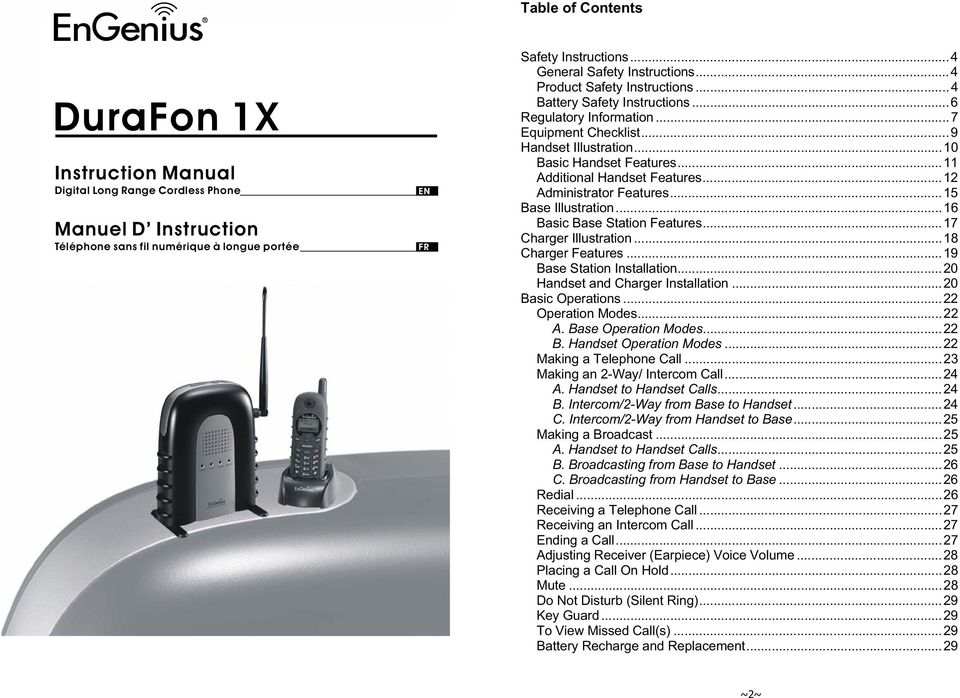
1 Table of Contents Safety Instructions...4 General Safety Instructions...4 Product Safety Instructions...4 Battery Safety Instructions...6 Regulatory Information...7 Equipment Checklist...9 Handset Illustration...10 Basic Handset Features...11 Additional Handset Features...12 Administrator Features...15 Base Illustration...16 Basic Base Station Features...17 Charger Illustration...18 Charger Features...19 Base Station Installation...20 Handset and Charger Installation...20 Basic Operations...22 Operation Modes...22 A. Base Operation Modes...22 B. Handset Operation Modes...22 Making a Telephone Call...23 Making an 2-Way/ Intercom Call...24 A. Handset to Handset Calls...24 B. Intercom/2-Way from Base to Handset...24 C. Intercom/2-Way from Handset to Base...25 Making a Broadcast...25 A. Handset to Handset Calls...25 B. Broadcasting from Base to Handset...26 C. Broadcasting from Handset to Base...26 Redial...26 Receiving a Telephone Call...27 Receiving an Intercom Call...27 Ending a Call...27 Adjusting Receiver (Earpiece) Voice Volume...28 Placing a Call On Hold...28 Mute...28 Do Not Disturb (Silent Ring)...29 Key Guard...29 To View Missed Call(s)...29 Battery Recharge and Replacement...29 ~2~
2 Advanced Operations...31 Handset Registration...31 Handset Group Subscription...32 Registration of Additional Base...32 Call Transfer...33 Call Manager...34 Change System Settings by Administrator...34 Phonebook Operations...36 Call barring...38 Text Messaging...39 Programmable PBX Options...40 Menu Operations...42 Technical Specifications...46 Safety Instructions Caution: Your wireless telephone gives you freedom and flexibility to stay in touch while you move around. However, when using your phone equipment, safety instructions should be followed to avoid the risks of fire, electric shock, injury to person, and damage to property. General Safety Instructions 1. When using your wireless phone, ensure your safety and the safety of others: a. Always watch where you are walking and standing. b. Don t let a phone call distract you from working safely. 2. In an emergency: a. If an emergency occurs, dial the emergency phone number. Remember: if you are in an area where your phone does not have a clear signal from the base, it is highly probable that the call may not go through. Locate the nearest landline telephone or other communications device to call for help. b. Emergency calls may not automatically provide emergency personnel with your name, phone number or location. 3. Notice to Hearing Aid Users: This phone system is compatible with inductively coupled hearing aids. 4. Notice to Cardiac Pacemaker Users: Preliminary studies done by the US FDA and others have shown that, although interference to the implanted cardiac pacemaker may occur when operating very closely, wireless telephones do not seem to pose a significant problem for pacemaker wearers. However, until more is known, FDA suggests that people with pacemakers may want to take precautions when using or carrying a wireless telephone to ensure that there is ample distance between the telephone and the pacemaker. Do not carry the handset in a breast pocket. If you have any reason to suspect that interference is taking place, turn off your handset immediately. Product Safety Instructions 1. Read and understand all instructions. 2. Follow all warnings and instructions including those marked on the product. ~3~ ~4~

3 3. Changes or modifications to this product not expressively approved by the manufacturer will void the warranty and the FCC authorization to operate the equipment. Use only manufacturer provided accessories. 4. Do not use the telephone near water. Never spill liquid of any kind on this product. 5. Unplug the product from the wall telephone jack and power outlet before cleaning. Do not use liquid or aerosol cleaners. Use damp cloth for cleaning. 6. Do not place this product on an unstable cart, stand, or table. The product may fall and cause personal injury or damage to the product or other property. 7. Power Outage: In the event of a power outage, your handset charger will not recharge the handset battery, and the base station will not allow you to make an outgoing call or take an incoming call. Both the charger and the base station require electricity for operation. You should have a telephone that does not require electricity available for use during power outage, or have a temporary backup power supply. 8. Slots or openings in the product s housing are provided for ventilation. These openings must not be blocked or covered. Placing the product on a bed, carpeting, or other similar surface may block these openings and should be avoided. This product should never be placed near or over a radiator or heat register, or in a built-in installation unless proper ventilation is provided. 9. Never push objects of any kind into this product through housing slots/openings as they may damage the product, touch dangerous voltage points or short out parts that could result in fire, electric shock, or injury. 10. This product should be operated only from the type of power source indicated on the marking label. If you are not sure of the type of power supply to your home, consult your dealer or local power company. 11. Do not overload wall power outlets and extension cords as this may result in fire or electric shock. 12. To avoid electric shock or burn, do not disassemble this product. Send this product to an authorized service center when service or repair work is required. Call Customer Service for locations near you. Opening or removing covers may expose you to dangerous voltages, electrical currents or other risks. Incorrect reassembling of the product may cause electric shock when the product is subsequently used. 13. Avoid using the product during a storm. There may be a risk of electric shock from lightning. 14. Do not place the product where persons can step, trip, or fall on it. 15. Do not place conductive objects over or near the antenna. 16. Do not use the product to report a gas leak while in the vicinity of the leak. 17. Do not install the base station or the handset charger near microwave ovens, radios, TV sets, speakers, or other electrical equipment. These appliances may cause interference to the product or experience interference from the product. 18. Unplug the base station or the charger adaptor from the power outlet and refer to an authorized service center under the following conditions: a. If liquid had been spilled into the product. b. When the power supply cord or plug is damaged or frayed. c. If the product has been exposed to rain or water. d. If the product does not operate normally by following the operating instructions. e. If the product has been dropped or housing has been damaged. f. If the product shows a distinct change in performance. Battery Safety Instructions 1. Use only manufacturer approved Li-ion rechargeable batteries and charger. Do not use other types of rechargeable batteries or nonrechargeable batteries. The batteries could short-circuit, and the battery enclosure may be damaged causing a hazardous condition. 2. Follow the charging instruction in this manual and instruction labels and markings in the handset and charger compartments. 3. Battery must be recycled or disposed of properly. Do not dispose the battery in a fire. The cells may explode. 4. Do not dispose of the battery in municipal waste. Check with local codes for disposal instructions. 5. Exercise care in handling the batteries in order not to short-circuit the battery with conductive materials such as rings, bracelets, keys, pocketknife, and coins. The battery or conductive material may overheat and cause burn or fire. 6. Do not expose batteries to rain or water. 7. Do not open or mutilate the battery. Released electrolyte is corrosive and may cause injury to eyes or skin. The electrolyte may be toxic if swallowed. 8. During charging, the battery heats up. This is normal and is not dangerous. ~5~ ~6~

4 Regulatory Information DuraFon 1X FCC ID: NI3-SN1302 IC: 3616A-SN1302 Notes: In the event of any inconsistency between the English and French versions hereof, the English version shall prevail. This device complies with Part 15 of the FCC Rules. Operation is subject to the following two conditions: 1) this device may not cause harmful interference, and 2) this device must accept any interference received, including interference that may cause undesired operation. 1. The term IC: before the radio certification number only signifies that Industry of Canada technical specifications were met. 2. This telephone system complies with rules of the FCC Part 68 and Canadian IC/DOC CS- 03. On the bottom of the base station is a label that contains, among other information, the FCC Registration Number, Ringer Equivalence Number (REN) and the Universal Service Order Code, which is RJ-11C in the U.S. or CA-11A in Canada. Your telephone company may ask you for this information. 3. The REN is useful to determine the quantity of devices you may connect to your telephone line and still have all devices ring when your telephone number is called. In most, but not all, areas the sum of the REN s of all devices connected to one line should not exceed 5.0. To be certain of the number of devices you may connect to your phone line, you should contact you local telephone company for the maximum REN in your area. 4. If your telephone equipment causes problems to the telephone network, the telephone company may ask you to disconnect your phone system from the line until the problem has been corrected. Consult with your local phone company for your rights if this happens. 5. Your telephone company may make changes in its facilities, equipment, operations, or procedures that could affect the proper functioning of your telephone system. Consult with your local phone company for your rights if this happens. 6. This telephone system may not be used on coin service provided by the telephone company. Connection to party lines is subject to state tariffs. 7. This telephone system has been tested and found to comply with the limits for Class B digital devices, pursuant to Part 15 of the FCC Rules and RSS210 of the DOC Rules. These limits are designed to provide reasonable protection against harmful interference in a general public installation. Operations of these devices may still encounter interference from/to nearby TV s, VCR s, radios, computers, or other electronic devices. To minimize or prevent such interference, the telephone system should not be placed or operated near other electronic devices. 8. However, there is no guarantee that interference will not occur in a particular installation. If this telephone system does cause interference to other electronic devices, which can be determined by turning the system off and on, the user is encouraged to try to correct the interference by one or several of the following measures: a. We recommend at least 20 feet between the system and other electronic devices. b. Connect the base station to a power outlet on a circuit separate from that used by the device experiencing interference. Consult the dealer or an experienced electronic technician for help. ~7~ ~8~
5 Equipment Checklist Handset Illustration 1. In a Base + Handset package, please find the following components: a. Base Station x 1 b. Base Antenna x 1 c. Base AC/DC Adaptor x 1 d. Handset x 1 e. Low Profile Handset Antenna x 1 f. Optimal Performance Handset Antenna x 1 g. 1700mA Li-ion Battery Pack x 1 h. Charger x 1 i. Charger AC/DC Adaptor x 1 j. Telephone Cord x 1 k. Belt Clip x 1 h User s Manual, Quick Guide, and Warranty Card 2. In a Handset package, please find the following components: a. Handset x 1 b. Short Handset x 1 c. Long Handset x 1 d. 1700mA Li-ion Battery Pack x 1 e. Charger x 1 f. Charger AC/DC Adaptor x 1 g. Belt Clip x 1 h. Quick Guide, and Warranty Card 3. Optional Accessory a. Outdoor Antenna Kit (including antenna and cable) b. Lightning Protection Kit (including cable) c. Leather Pouch d. Belt Clip e. Spare Battery f. Tall Handset Antenna g. Headset h. Antenna Splitter i. Audio-in Cable TALK/SPEAKERPHONE ~9~ ~10~
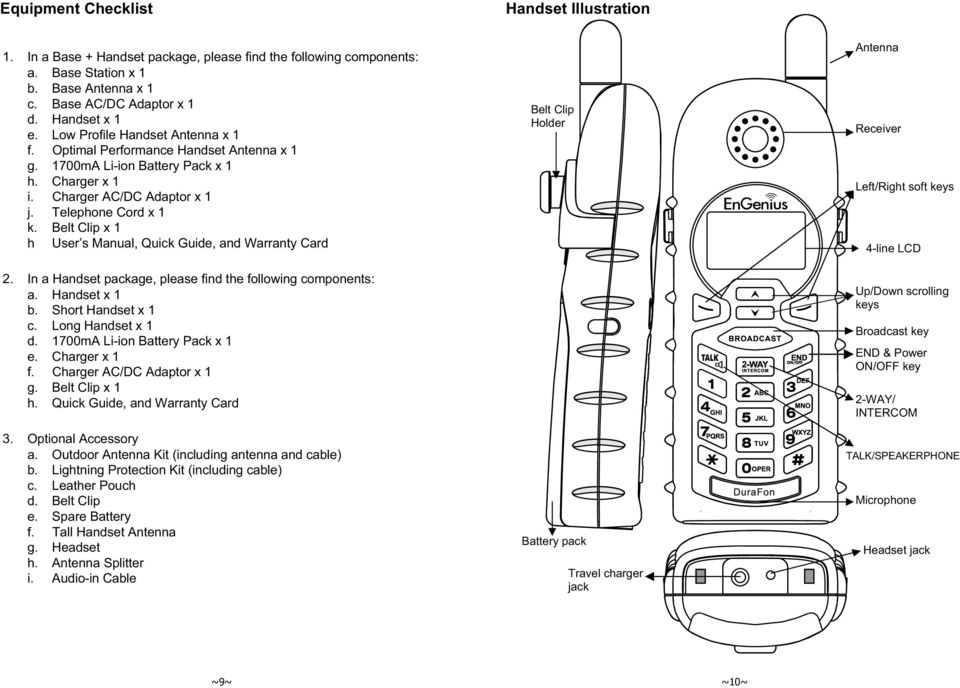
6 Handset Features Basic Handset Features 1. 4-line LCD (Liquid Crystal Display) a. The LCD display has LED (Light Emitting Diode) for backlighting. b. The 1 st line of LCD consists of icons. c. Icons explanation from left to right (1) RSSI (Receive Signal Strength Indicator) During a call, the number of bars is proportional to the radio signal strength received. (2) Call in-progress (ON/OFF-Hook) Indicates if phone line mode is active (3) Intercom in-progress Indicates if Intercom mode is active (4) Handset ID Displays a handset icon and a 2-digit Handset ID (5) Two-Digit Address Index Shows address index when viewing contents of the call logs. (6) Line Indicator Indicates the number of the line being accessed by the handset. (7) Battery Strength Number of bars is proportional to the amount of battery time remaining. Indicates charging when in charger cradle. d. The 2 nd and 3 rd lines of the LCD, maximum 14 characters each, display status, message, menu selections, or user-editable alphanumerical characters. e The last line displays the left and right soft keys. 2. Ringer a. Rings to an incoming call. b. Distinctive alert sounds indicating various events: (1) Single Beep: successful key entry (2) Double beep: failed operation or invalid key entry, also indicates power on/off (3) Periodic 1-Long-2-Short Beep (every 1 minute): low battery warning (4) Periodic Long Series of Beeps (repeat every 30 seconds): indicates a call is on-hold 3. TALK/ SPEAKERPHONE a. Places or answers a telephone or intercom call. b. Sends a Flash signal to phone line to retrieve a dial tone after the call ends, or to perform the call waiting feature provided by local phone companies during a call. c. Press and hold the key for one second to enable/disable speakerphone WAY/INTERCOM a. Places an intercom call to another handset ID or a group ID (group paging). b. Intercom calls are digital, full duplex, and are conducted without the assistance from the base. 5. BROADCAST a. Half duplex broadcasting to handsets for immediate announcement b. Half duplex broadcasting to base stations [please refer to page 24 for detail operation] 6. Left/Right Soft Keys a. Make menu selection. 7. Up() /Down() Scrolling Keys a. Scroll through records and menu selections. b. Adjust receiver voice volume when in Talk mode. 8. END; On/Off Key a. Ends a call. b. Leaves current menu operation, up one level. c. Press for 3 seconds to off the power Additional Handset Features 1. Multiple handsets registration a. Up to 9 handsets can be registered to a base station; up to 36 handsets can be accommodated to the system b. ID 11-19; 21-29; 31-39; 41-49: individual Handset IDs. ID 11 and 12 are the first two ID s assigned by the base and are designated administrators who can change base settings such as greeting message and other base administrative functions. c. ID 01-09: Group IDs. Handsets can subscribe from the handset menu to group(s) and be paged when a landline caller or an intercom caller enters a Group ID. ~11~ ~12~

7 2. Ringer Vibrator a. Five-level ringer volume selections (high/ low/ vibrate/ vibrate-thenring/ off) b. Four ringer type selections 3. Caller ID a. Displays incoming call phone number and name on the LCD (needs Caller ID service from local telephone company) 4. Call waiting with caller ID a. Displays 2 nd incoming call information on the same phone line when 1 st call is in progress (needs Call Waiting with Caller ID service from local telephone company) 5. Name tagging with caller ID a. Match the caller ID with the phone book entries; once matched, the LCD screen will display the name or nickname instead of pure caller ID info (needs Call Waiting with Caller ID service from local telephone company) 6. DND (Do Not Disturb, i.e., Silent Ring) 7. Three Call Logs a. Called Log: Stores 10 phone numbers (up to 28 digits each) dialed most recently. Can perform last-number redial on all 10 numbers. b. Received Call Log: 10 entries (14-digit phone number, 14-character names, and time stamp), needs Caller ID service from local telephone company. c. Missed Call Log: 10 entries (14-digit phone number, 14-character names, and time stamp), needs Caller ID service from local telephone company. d. Phone numbers and names can be saved into phonebook while in display. 8. Call barring a. Block the users from dialing the long distance calls or international calls b. Up to 5 digits of each call barring setting; up to 4 entries allowed c. If you need to dial a specific number to retrieve the dial tone, you need to key in that number while setting the call barring [Note] you need to key in the accurate user ID and password to perform this feature. The default password is Any Key Answer (except END, Silent Soft Key) 10. Key-guard 11. Dialing Prefix a. Up to 14 digits, including pause(s), one access code can be preprogrammed to be added automatically in front of the dialed number when dialing from call logs, phonebook, and dial-and-send dialing. 12. Call Hold a. Places call on hold b. Battery Hot Swap: Change battery while call is on hold. 13. Mute 14. Phonebook a. 30 entries, each stores a phone number or handset ID (up to 28- digit) and name (up to14-character) b. Alphabetically sorted display and search by letter c. Dial from display d. During the stand-by mode, you can enter the phone book by pressing or scrolling key 15. Key tone a. Three-level key-tone volume selections (high/low/off) b. Four key-tone type selections 16. Call timers a. Display call time duration for current call during and immediately after the call 17. Text Messaging: a. Editing Message: from a handset, users can edit the short text message for up to 50 characters. Up to 5 messages can be edited and stored. b. Sending Message: In view mode, handset can send a message to another handset or a group of handsets. c. Incoming Message: A distinctive tone alerts an incoming message. The message will stay on LCD display for 8 seconds and then is saved in memory. A total of 5 incoming messages can be saved. 18. Programmable PBX Options ~13~ ~14~ ~14~
8 a. Allow user to pre-program the most frequently used PBX feature along with its feature code into DuraFon which is adjunct to the PBX system b. Up to 9 entries can be saved c. Once the feature and feature codes being programmed, you can quick perform those functions during the call by pressing OPTION soft key. Base Illustration Administrator Features Handsets 11 and 12 are designated administrators. Both have the same authority to perform base station administrative functions from their handset menu selections. No password is required and to remember. 1. Supports both DTMF and Pulse dialing a. From an administrator handset (Handset 11), press MENU-9-1 to select Tone or Pulse dialing mode. b. Default is Tone dialing. 2. Administrator programmable Flash key timing a. From an administrator handset (Handset 11 or 12), press MENU to select flash key timing b. 9-level (100 ms ms) timing selections, default= 600 ms. c. The default value (600 ms) works in most areas. Changing this setting may cause Flash key not working. Change only when you are certain of the new value would work. 3. Call transfer to PBX extension a. When install the DuraFon 1X behind the PBX system, you can preprogram the feature code of call transfer function b. Need to adjust the Flash time to match your PBX setting ~15~ ~16~

9 Base Features Charger Illustration Basic Base Station Features 1. Antenna a. The antenna port has a reverse thread connector; to remove antenna or cable, turn clockwise; to install, turn counterclockwise. Improper installation may damage the connector b. When using an outdoor antenna, locate the antenna (not the base station itself) as high as possible for a clear transmission path. 2. LED a. Power: it indicates base station has power. b. In-Use: it indicates an active telephone line. c. Intercom: it indicates Intercom taking place. d. Broadcast: it indicates Broadcast taking place. 3. Reset Button a. Restores base station to factory settings b. Reset button is indented to prevent accidental system reset. c. All handsets (including administrator) and additional base(s) need to be re-registered after a base station reset. 4. Registration Key (REG) Enters registration mode along with handset, assigns handset ID (10-99). 5. Line Standard RJ-11C/CA-11A connector to plug in the telephone line 6. Telephone: Another RJ-11C to plug in the optional answering machine 7. Audio-in Jack (3.5mm) 8. DC In: to plug in the power adaptor 9. Voice Volume ~17~ ~18~
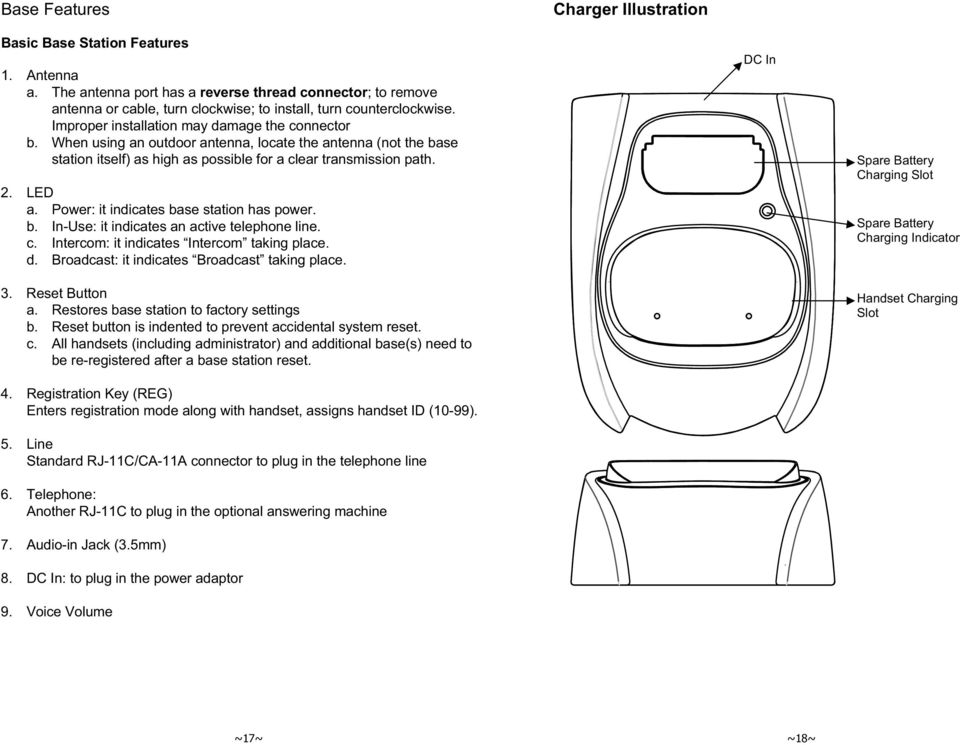
10 Charger Features 1. DC In Connects to Charger AC Adaptor. 2. Handset Charging Slot a. Charge handset battery when handset is placed in cradle. b. Refer to the handset LCD for charging status (1) Charging: LCD screen showed Charging (2) Fully Charged: battery status bar stands still and the LCD screen would display Fully Charged (3) Charge Fail: Should there be any error occurred during charging mode, the LCD screen would display Charge Fail 3. Spare Battery Charging Slot a. Charge spare battery when battery is placed in slot. b. LED as the spare battery charging indicator (1) Slot is empty and the power is on: LED is Green light (2) Charging: LED is Orange light (3) Fully Charged: LED returns to Green light 4. It is impossible to overcharge the battery using this charger. Notes: 1. Fully charge battery packs before first use. 2. Both handset and spare batteries can be charged at the same time. 3. Handset will be power on automatically when placing on the charging slot. 4. However, if you run drain the battery, it would take around one minute for handset to auto power on. 5. The adaptor for charging station can be used as travel charger as well. However, you can t turn off the power while you charge the handset via travel charger. A Warning message: Unplug Travel Charger than OFF the power will be shown on the LCD display. Getting Started Base Station Installation There are three possible base station setups: Base station alone Base station plus telephone answering device Base station plus standard telephone For best performance, maintain at least a distance of 1 meter (about 3 feet) between the base station and other electronic devices (e.g., TV, computer, stereo, fax machine, answer machine, cordless phone, etc.) 1. Install base station antenna. The base station s antenna port has a reverse-thread connector; to install antenna or cable, turn counter-clockwise. 2. Plug the transformer end of the base station AC/DC adaptor into a standard AC electrical power outlet, plug the other end into the DC In jack on the back of the base station. 3. Plug phone cord into the LINE Jack 4. A standard telephone or answering machine can be plugged into the adjacent receptacle on the bottom of the base station marked TEL Handset and Charger Installation 1. Plug the transformer end of the Charger AC/DC adaptor into a standard AC electric power outlet, plug the other end into the DC In jack on the back of the Charging Cradle. 2. Install battery pack onto the handset. 3. Install handset antenna. 4. Place handset onto the charger front slot. 5. Fully charge the battery for three hours before use. 6. The phone system is now ready to perform basic functions such as making ~19~ ~20~

11 and receiving phone calls and intercom calls. No base station or handset programming is needed for basic operations. Note: 1. Handset(s) packaged along with a Base Station are preregistered at the factory. If you have a new handset, you will need to register the handset with the base station in order to be recognized as a member handset by the base(s) and by other handsets. See Handset Registration. 2. Fully charge battery packs before the first usage. Basic Operations Operation Modes Both the base station and handset have levels of operation at which time only certain procedures of functions can be performed. A. Base Operation Modes 1. IDLE mode- this is the default mode. The intercom, broadcast, and volume keys are active in IDLE mode. 2. TALK mode- the base operates in this mode during phone call, intercom, and broadcast operation. The In Use, Intercom, and Broadcast LED will light up respectively. 3. REGISTRATION mode- the base enters this mode by pressing the REG button for three seconds. There are no active base unit keys once this mode has been entered. Four LEDs will be lighted up in Registration mode. B. Handset Operation Modes 1. IDLE mode- this is the default mode. a. If there is no on-going activity, the handset automatically goes into SLEEP/IDLE mode to save battery power. b. The handset can be turned off completely by holding down the END key for 3 seconds. c. The idle screen display (custom name) can be edited. d. The 2-dight number represents the handset ID 2. Menu mode a. Press the Right soft function key to activate MENU mode. b. In MENU mode, the handset settings and information contained in memory can be changed. c. The functions available through the MENU selection are covered in greater detail from page 38. d. The MENU structure display as below: Welcome! REDIAL MENU Main Menu: 1.KeyGuard 2.PhoneBook ~21~ ~22~

12 Notes: 1. After a link established, the Base ID will appear on the upper-right corner. If no Base ID shown up, it applied that you are approaching the boundary of the coverage. 2. If the line is occupied, the LCD shows No Line Available and handset returns to standby mode. 3. If a link cannot be established, the LCD will show No Base after a 12-second time out. 4. A call duration timer will start displaying the length of the call after link is established. Making an 2-Way/ Intercom Call The EnGenius Industrial Cordless Phone System offers private, Intercom/ 2- way radio calls independence of base station. Intercom/ 2-way communication can be placed from or to base stations and handsets. A. Handset to Handset Calls 1. Press Intercom key followed by a two-digit handset ID or Group ID. 2. Press END key to end the call. Please enter Ext. #: 12 Notes: 1. Intercom calls can be made regardless if the Base Station is present. 2. If a Group ID is entered, the first handset (belonging to that group) that answers will establish a link with the caller. See Handset Group Subscription. 3. If a link cannot be established, the LCD shows No Connection after a 12-second time out. B. Intercom/2-Way from Base to Handset 1. Press Intercom key on the base station to intercom all registered handsets. The first handset to answer will establish a voice link with the base. 2. The INTERCOM LED will flash until a handset responds. Intercom from Base 1 SLIENT 3. The base unit will page for 15 seconds, then terminate the page if no

13 handset responds. 4. Before a handset answers, the INTERCOM can be cancelled from the base by pressing INTERCOM again. However, once a handset answers, only the answering handset can end the call. C. Intercom/2-Way from Handset to Base 1. Press Intercom key followed by a two-digit base ID [Note: Base 1 ID as 10, Base 2 ID as 20, Base 3 ID as 30, and Base 4 ID as 40] 2. The base will ring once, then automatically connect the intercom call from a handset. Making a Broadcast A. Handset to Handset Calls 1. Broadcasting all handsets a. Press BROADCAST key from one handset b. Hear bi-bi-beep while the initiating handset broadcast all handsets within communication coverage c. Start to speak the message to be broadcasted once you hear the beep sound; the speakerphone of destination handsets will be opened up d. Press END key to end the broadcasting 2. Broadcasting a group of handsets a. Enter the Group ID and then press BROADCAST key b. Hear bi-bi-beep while the initiating handset broadcast all handsets within communication coverage c. Start to speak the message to be broadcasted once you hear the beep sound; the speakerphone of destination handsets will be opened up d. Press END key to end the broadcasting 3. Broadcasting an individual handset a. Enter the Handset ID and then press Please enter Ext. #: 10 PA paging to all PA paging to Ext. # 02 BROADCAST key b. Hear bi-bi-beep while the initiating handset broadcast all handsets within communication coverage c. Start to speak the message to be broadcasted once you hear the beep sound; the speakerphone of destination handsets will be opened up d. Press END key to end the broadcasting B. Broadcasting from Base to Handset 1. Broadcast to all handsets a. Press Broadcast key on the base station to intercom all registered handsets. b. Hear bi-bi-beep while the initiating handset broadcast all handsets within communication coverage. c. The Broadcast LED will light up d. Press the Broadcast key again and return to IDLE mode C. Broadcasting from Handset to Base 1. Broadcast to the base station a. Enter the Base ID and then press BROADCAST key b. Hear bi-bi-beep while the initiating handset broadcast the base stations. c. Start to speak the message to be broadcasted once you hear the beep sound; the speakerphone of the base will be opened up d. Press the END key again and return to IDLE mode Redial 1. Press REDIAL (Left) soft key. PA paging to Ext. # 12 PA paging from Base 1 SLIENT PA paging to Ext. # The LCD shows the last phone number dialed. To dial this number, press DIAL (Left) soft key. 3. Use Up or Down Arrow Key to scroll through the last 10 phone numbers dialed. Select and press DIAL key. ~25~ ~26~

14 [Note] Intercom numbers (Handset ID) are not stored in the last 10 numbers dialed log. Receiving a Telephone Call 1. When an incoming call arrives, the ringer will ring or vibrate unless the ringer has been turned off. 2. If the handset is on the charger cradle (ringer will be temporarily switched to Ring if it has been set to Vibrate ), lift the handset and start conversation. 3. If the handset is not on the cradle, press any key (except END, and the Silent soft key) to answer. Notes: 1. You can press SILENT (Left) soft key if you choose to ignore the call. Unlike turning off the ringer (from the handset menu), the SILENT key operation is valid only for the current call. 2. If Caller ID service is available, the LCD will display the incoming call information. If the LCD shows Private or Unknown, the caller s information may have been blocked by the caller or the originating phone company. Receiving an Intercom Call 1. When an intercom call arrives, the ringer will ring or vibrate unless the ringer has been turned off. Press TALK to answer the intercom call. 2. If the handset is on the charger cradle (ringer will be temporarily switched to Ring if it has been set to Vibrate ), lift the handset and start conversation. 3. If the handset is not on the cradle, press any key (except PWR, END, and the SILENT soft key) to answer. Notes: 1. The LCD displays the caller s Handset ID. 2. You can press the SILENT if you choose to ignore the call. Unlike turning off the ringer the SILENT key operation is valid only for the current call. Ending a Call To end a telephone or intercom call, press END key or place handset into charger cradle. Adjusting Receiver (Earpiece) Voice Volume 1. Voice volume can only be adjusted during a call. 2. There are 6 levels of volume selections. Default as volume 4. Use and scrolling key to adjust. 3. The new setting remains effective for all future calls until changed. Placing a Call On Hold 1. When a call is in progress, it can be put on hold by pressing the HOLD (Right) soft key. 2. To return to the conversation, press UNHOLD Mute 00:00:10 Volume:4 OPTION HOLD You have a Call on hold UNHOLD OPTION Notes: 1. The call being placed on hold can only be un-hold by the handset that puts it on hold. 2. Handset LCD displays a call is being on hold. An alert tone (double beep) every 30 seconds will remind the handset that a call is being on hold. 3. If the operation (e.g., call transfer) after putting a call on-hold fails, the held call may be dropped. 4. You can power off the handset (e.g., change battery) while call is on hold. After power on again, you can continue the call by pressing UNHOLD (Left) soft key or select 3 from the Option menu to terminate the hold state. 5. You can only unhold the call with the base coverage. Once you re out of the base coverage, you can return to stand-by using Clear hold function in the OPTION list item #3. 1. After a link is established, you can press OPTION (Left) soft key and press 0 to mute the handset microphone. 2. When mute is active, the other end will not hear your voice, but still can speak to you. 3. To leave the mute state, press UNMUTE (Left) soft key. Mute is ~27~ ~28~

15 effective only for the current call. Do Not Disturb (Silent Ring) 1. Enter the key sequence MENU Sounds Ring Volume, then select Off. Press SAVE to confirm your choice. This will turn off the ringer until it is turn on again from the menu. 2. For temporary silencing the ringer when an incoming call arrives, press SILENT (Left) soft key. Key Guard 1. To prevent accidental dialing, you can press Menu (Right) soft key, then press 1 to select KeyGuard option. The handset keypad is locked. No key entry is accepted except the power on/off key. 2. To unlock the keypad, press UNLOCK (Left) soft key, then, within 2 seconds, press the digit 1 to unlock. 3. Key Guard is in effect until unlocked or powered off. To View Missed Call(s) Sounds: 1. Ring Volume 2. Ring Tone Ring Volume: Off SAVE Welcome! UNLOCK Press 1 to confirm unlock hold. 3. Battery talk time and standby time vary depending on the talk/standby pattern and the operating distance. Putting the handset back to charger cradle as often as possible is recommended for best performance. Use only manufacturer provided battery and charger! 1. Whenever you have missed incoming call(s), you can press VIEW soft key to enter the call logs information. 2. You need to subscribe the caller ID service from local telecom company to retrieve this data. Battery Recharge and Replacement You have 1 Missed call VIEW MENU 1. Charge the battery when one or several of the following happen: a. Phone beeps twice every two seconds. b. Battery icon is empty. c. Phone does not respond when a key is pressed. d. LCD and backlighting become dim. e. Talk range shortfall is experienced. 2. You can replace the handset battery after placing the call-in-progress on ~29~ ~30~

16 Advanced Operations Handset Registration 1. If your handset(s) is purchased as part of a system, it has been preregistered with the base station at the factory. 2. If Handset ID as 00, that means it is a new handset or the ID has been erased. You need to register the handset with the base station. 3. Registration: a. Press MENU-6 to enter the registration mode b. Press and hold the base s Registration (REG) button for 2 seconds until 4 LEDs light up. c. Press handset key 1, this completes the registration process. When you register the handset to BASE 10, the base will assign a handset ID between 12 and 19. The assigned ID will be displayed on the handset LCD, indicating successful registration. d. Repeat above steps for all additional handsets. e. The first two handsets registered will be given ID 11 and 12, which gives them administrator privileges. 4. De-registration: a. You can de-register a handset from a base. De-registration will reset the Handset ID to 00, erase the system security code, and free up the old ID for future registration. b. After deregistration, the handset will not be able to use the base to make or receive phone calls, nor can it intercom other handsets. c. Press handset Menu (Right) soft key. d. Press the handset number key 6, this will enter the handset registration menu. e. Press and hold the base s REG button for 2 seconds until 4 LEDs come on. f. Press the handset number key 2, this completes the deregistration process. Upon successful de-registration, the handset will show ID 00. Notes: 1. The base has a 30 second registration timeout starting from Main Menu: 5. Settings 6. Registration Registration: 1. Register 2. Deregister pressing the REG button. The handset has a 12 second registration timeout starting from the registration or deregistration option has been selected. The base and handset will automatically exit registration mode after timeout. 2. When you conduct the registration procedure with BASE 20, the handset ID will be ranging from 21 to Up to 4 bases can be installed to form a sub-multiple line system. 4. Repeat registration or de-registration process if unsuccessful. Handset Group Subscription 1. Up to nine handset groups (01-09) can be defined and handsets can decide which group(s) they want to be in. 2. For example, Group 1 represents the Customer Service Group, Group 2 represents the Sales Group, and Group 3 is the Marketing Group. Suppose that Handset 11 wants to receive incoming rings for all Sales and Marketing related calls. Then handset 10 will need to subscribe to Group 2 and Group Group Selections: a. Press handset Menu-5 to enter the handset setting menu b. Press number 2, handset enters group select menu. c. Press ADD soft key and enter two-digit group number (01-09) to add membership in a group. d. Repeat for all desired groups. e. Delete group selections by pressing DELETE (Right) soft key and enter group number. Settings: 1. Dial Prefix 2. Group Selection Groups Notes: 1. The handset can change group affiliations at any time. 2. The base (administrator) is not responsible for group assignments. Consequently, it cannot de-subscribe a handset from a group. ADD DELETE Registration of Additional Base 1. DuraFon 1X can be installed as the multiple base configurations: up to 4 base units can be registered. The BASE 10 serve as the master base. 2. Use admin handset, HS 11 or HS12, to conduct the registration for 2 nd, ~31~ ~32~

17 3 rd, and 4 th base unit. 3. Registration: a. Press MENU-6 from HS 11 to enter the registration mode b. Press and hold the Registration (REG) button on that additional base unit, which you want to add into the system) for 2 seconds until 4 LEDs light up. c. Press handset key 3, then enter the base ID i.e. 20 for 2 nd base, 30 for 3 rd base, or 40 for 4 th base. this completes the registration process. Call Transfer 1. While a telephone call is in progress, you can place call on hold and transfer the call. 2. Press HOLD soft key to put call on hold. 3. Press OPTION soft key to enter feature list for selection. 4. Three types of transfer method: a. Transfer PBX (1) When DuraFon 1X is adjunct to the PBX system, you can transfer the call to an assigned PBX extension. (2) Normally, each propritory PBX system acquire a specific feature code to execute call transfer function (3) You can pre-program that feature code by entering the System mode (Menu-9); you need to enter the base ID to link to the base station (4) Press 3 and then enter the specific call transfer feature code b. Un-announced Call Transfer: Press END before the destination handset answers, the call is automatically transferred to the destination handset. c. Announced Call Transfer: Main Menu: 5. Settings 6. Registration Registration: 2. Deregister 3. Set base You have a Call on hold UNHOLD OPTION 1.Transfer PBX 2.UnancdXfer HS 3.AncdXfer HS System: 2. Flash 3. Xfter PBX Call Manager (1) Speak to the destination handset. (2) Press XFER soft key or the END to end announcement. The call is transferred to the destination handset. Notes: If the destination handset does not answer after handset paging timeout, the call is routed back to the originating handset. Call Manager feature allows the handset to be set to receive all incoming, transferred, and 2-Way/Intercom calls OR just transferred and 2-Way/ Intercom calls. The option is selectable by base 1 to base 4. Besides, this feature allows you to select a specific base station to make an outgoing call. 1. Decide whether to receive the incoming, transferred, and 2-Way/Intercom calls from a specific base station: a. Press menu 8 to enter the Call Manager function. The screen will display: b. Press 1 to enter incoming setting. c. Use and Scrolling keys to select a base from base 1 to base 4. d. Then press the YES NO key to switch between Yes and No, then press SAVE key to confirm the setting. e. Repeat the process until all base stations from which calls are to be accepted have been selected for the handset. 2. Decide whether to select a specific base station to make outgoing call: a. Press menu 8 to enter the Call Manager function. b. Press 2 to enter Outgoing setting. c. Use and to select either On or Off. d. Scroll to On and press SAVE if you want to select a specific base station before you make an outgoing call. The default setting is Off. Change System Settings by Administrator There are four types of system setting that can be adjusted by Administrator. 1. Dial Mode Main Menu: 8. Call Manager 9. System Call Manager: 1. Incoming 2. Outgoing Receive Calls From base 1: SAVE YES NO Select Base On SAVE ~33~ ~34~
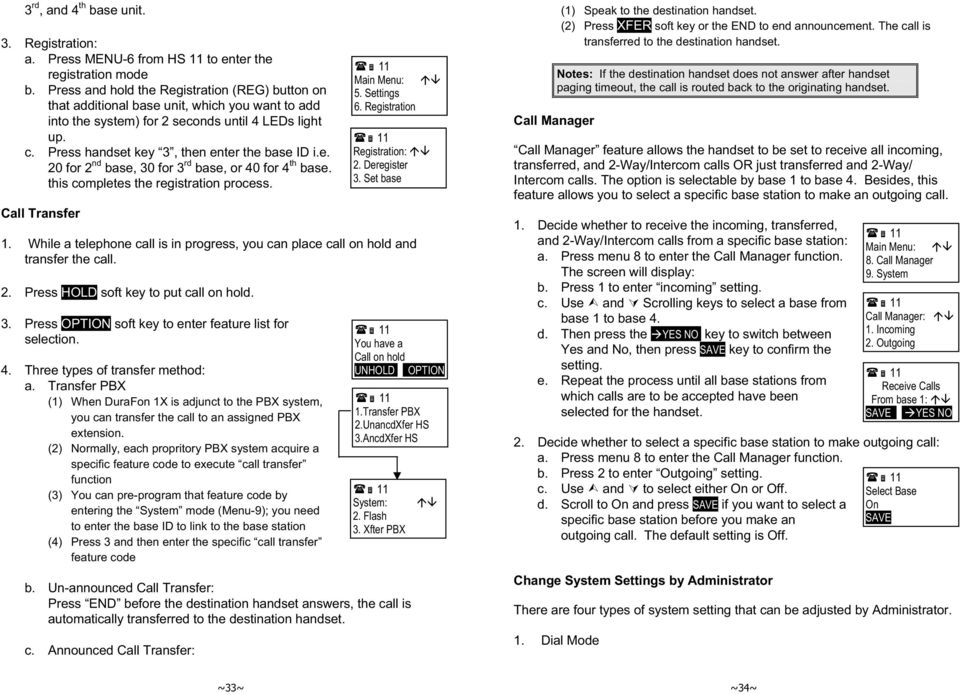
18 a. Press Menu-9 and enter the two-digit base ID to enter the System mode. b. Press 1 to enter Tone selection c. You can adjust the dial mode between Tone and Pulse. The default setting is Tone. d. The default setting is Tone. 2. Flash Time a. Press Menu-9 and enter the two-digit base ID to enter the System mode. b. Press 2 to enter Flash selection c. You can adjust the flash time from 100ms to 900 ms (9 levels to choose from.) For example, press 2 if the desired flash time is 200ms. You will see DONE once you finish the setting. d. The default setting is 600ms. Notes: If the base station is adjunct to a PBX system, it is recommended to adjust the flash time of DuraFon 1X to match the PBX spec. 3. Xfter PBX a. This function is useful if the base station attached to the PBX system through either the analog port or the Digital Adaptor. Press Menu-9 and enter the two-digit base ID to enter the System mode. b. Press 3 to enter Xfter PBX setting mode c. Use or scrolling key to switch between ON and OFF. The default setting is OFF. d. Select ON and press SAVE key e. You can key in the specific call transfer feature code and press OK to confirm the setting. For example, if your PBX is N brand, you need to key in Flash + * + 70 as the call transfer code. f. You will see a DONE confirmation. Main Menu: 8. Call Manager 9. System System: 1. Dial Mode 2. Flash Time Flash(msec): Done System: 2. Flash Time 3. Xfter PBX Xfer PBX: On SAVE Xfer Code: Flash*70 O K DELETE designed handset ID to a specific handset. Press Menu-9 and enter the two-digit base ID to enter the administration mode. b. Press 4 and then enter two digits ID number to be assigned. You will see Saving Configuration and a Done confirmation. Phonebook Operations 1. You can store up to 30 entries in the phonebook. Each entry can contain a phone number or handset ID (up to 28 digits) and a name (up to14 characters). 2. To access phonebook, press menu follow by 2 or or scrolling key when handset in standby mode. 3. To add a new entry: a. Press ADD soft key. b. Enter a phone number when LCD prompts Number? Use DELETE soft key to delete the last digit entered. Press SAVE when completed. c. You will then be prompted to enter a name for the phone number just entered. (1) Press SAVE key to enter a phone number without a name. All records without naming will be placed on top of the list, in the order they are entered. Please enter Ext. #:** CANCEL Main Menu: 1. KeyGuard 2. PhoneBook ADD OPTION Number? SAVE DELETE Name? Caps = * SAVE DELETE (2) To enter the name, press the corresponding keypad number one or more times according to the order of the character on the key. (3) Use DELETE soft key to delete the last character entered. When completed, press SAVE soft key to confirm your selection. Notes: Since the base station is adjunct to a PBX system, you need to adjust the flash time of DuraFon 1X to match the PBX spec and then program the call transfer code. 4. Set next Handset ID to be assigned a. This function is useful if you want to assign a ~35~ System: 3. Xfter PBX 4. Assign Next ~36~
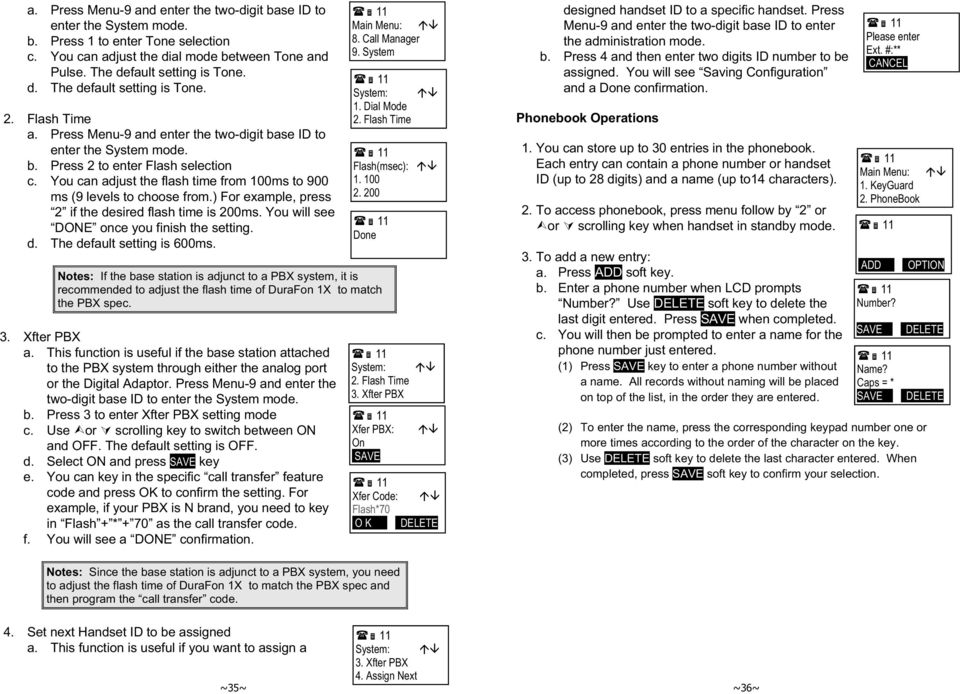
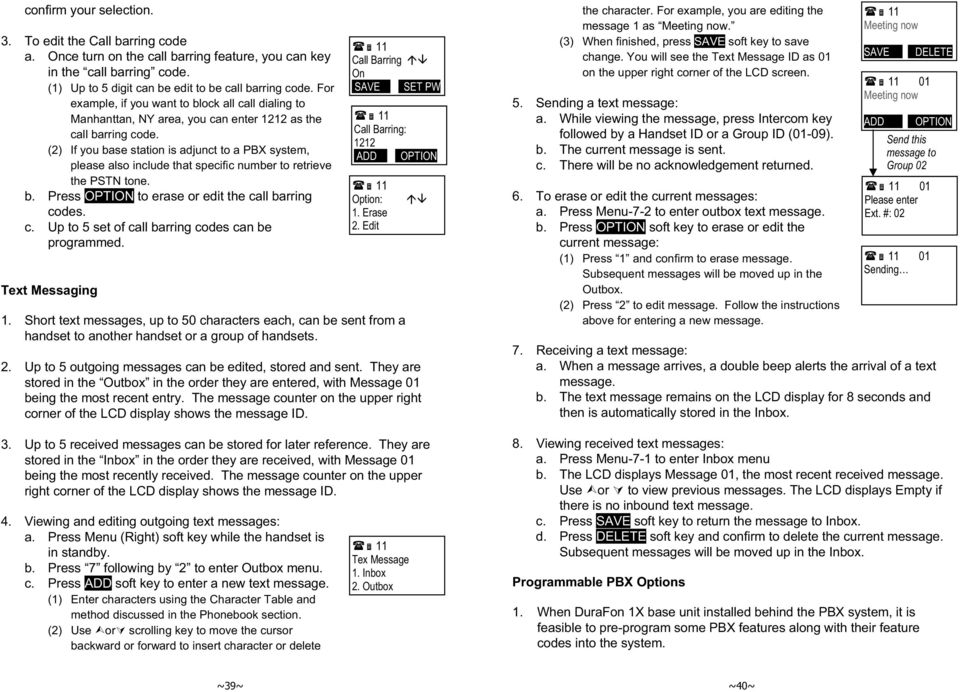
19 Notes: 1. When enter a phone number, the cursor automatically advances to the next digit field. Use or scrolling key to move the cursor backward or forward to insert or delete. 2. When entering a name, the cursor automatically advances to the next character field if you press a different key for the next character. If you need to enter consecutive characters from the same key, you can wait for the cursor to advance or use or scrolling key to move the cursor backward or forward manually. Also use or to move the cursor to insert (to the left of the cursor) or delete (the character above the cursor, or left of the cursor if cursor is on the right of the last character). 3. By default, all letters are entered in the upper case. Use the * key to toggle between upper and lower cases. 4. A Pause entry represents a 2.8 second delay in dialing the following digits, which is useful when calling a sequence of segmented numbers (e.g., access code, credit card number, auto-attendant entries, etc.) Pause is entered by pressing the * key twice (LCD displays P). Entering pause twice (PP) will result in 5.6 seconds pause in the dialing. 4. The entries are alphabetically sorted and stored as a list in an ascending order (A to Z) from the top of the list. a. If the phonebook is entered from the menu, the first entry displayed is the top of the list. b. If the phonebook is entered using the arrow, the first entry displayed is the top of the list. c. If the phonebook is entered using the arrow, the first entry displayed is the bottom of the list. 5. The first line of LCD display shows name and the 2 nd line shows the phone number. If the phone number is longer than 14 digits, press OPTION soft key and select Option 3 to view the complete number. 6. To search for a record: a. Use or scrolling key to enter the Phone Book mode. b. Press a key that corresponds to the first character of the name you are looking for. c. For example, you are looking for EnGenius, and then press the number 3 once. d. Use or scrolling key to locate the exact record you are looking for. 7. To erase phonebook: a. Use or scrolling key or the alphabetical ~37~ EnGenius ADD OPTION search method to locate the record to be erased or edited. b. Press OPTION soft key to enter editing menu. c. Press 1 to erase the desinated phone entry. d. LCD shown Are you sure? Press YES to double confirm your change. 8. To edit phonebook: a. Use or scrolling key or the alphabetical search method to locate the record to be erased or edited. b. Notes: Character Table: Key Characters and Orders 1 +,. * ( ) & 1 2 A B C 2 3 D E F 3 4 G H I 4 5 J K L 5 7 P Q R S 7 8 T U V 8 9 W X Y Z * Toggle case when in character editing * P (Pause) when in number editing # Space when in character editing # when in number editing Call barring 1. Block the users from dialing the long distance calls or international calls. You need the password to enter the setting. The default PW is Use or scrolling key to switch between On and Off of this setting. The default is Off. Press SAVE to ~38~ Option: 1. Erase 2. Edit Are you sure? YES 12 OPTINO
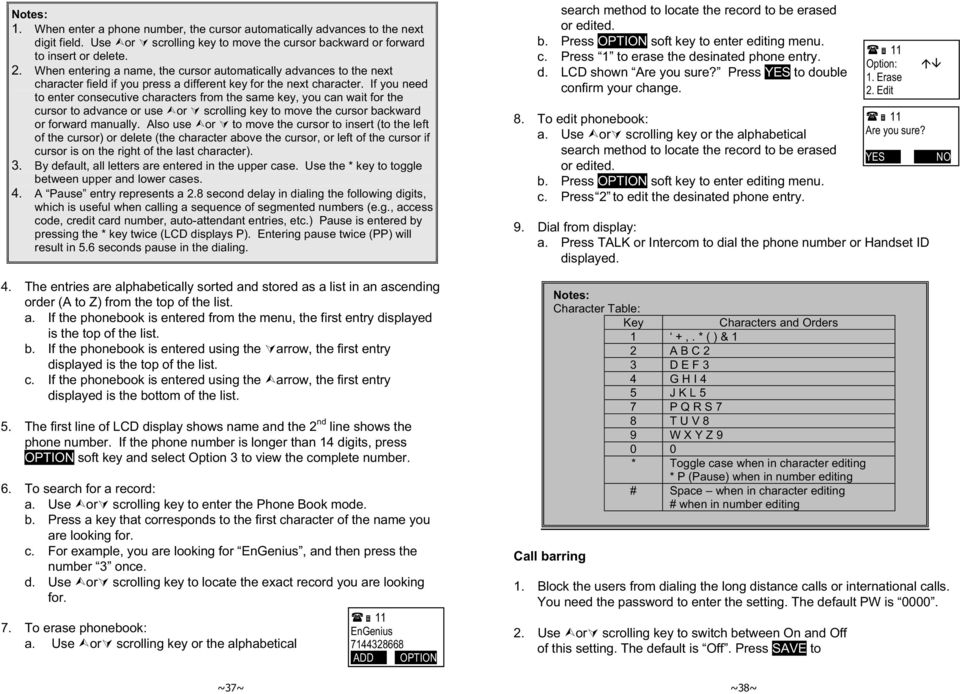
20 confirm your selection. 3. To edit the Call barring code a. Once turn on the call barring feature, you can key in the call barring code. (1) Up to 5 digit can be edit to be call barring code. For example, if you want to block all call dialing to Manhanttan, NY area, you can enter 1212 as the call barring code. (2) If you base station is adjunct to a PBX system, please also include that specific number to retrieve the PSTN tone. b. Press OPTION to erase or edit the call barring codes. c. Up to 5 set of call barring codes can be programmed. Text Messaging 1. Short text messages, up to 50 characters each, can be sent from a handset to another handset or a group of handsets. 2. Up to 5 outgoing messages can be edited, stored and sent. They are stored in the Outbox in the order they are entered, with Message 01 being the most recent entry. The message counter on the upper right corner of the LCD display shows the message ID. 3. Up to 5 received messages can be stored for later reference. They are stored in the Inbox in the order they are received, with Message 01 being the most recently received. The message counter on the upper right corner of the LCD display shows the message ID. 4. Viewing and editing outgoing text messages: a. Press Menu (Right) soft key while the handset is in standby. b. Press 7 following by 2 to enter Outbox menu. c. Press ADD soft key to enter a new text message. (1) Enter characters using the Character Table and method discussed in the Phonebook section. (2) Use or scrolling key to move the cursor backward or forward to insert character or delete Call Barring On SAVE SET PW Call Barring: 1212 ADD OPTION Option: 1. Erase 2. Edit Tex Message 1. Inbox 2. Outbox the character. For example, you are editing the message 1 as Meeting now. (3) When finished, press SAVE soft key to save change. You will see the Text Message ID as 01 on the upper right corner of the LCD screen. 5. Sending a text message: a. While viewing the message, press Intercom key followed by a Handset ID or a Group ID (01-09). b. The current message is sent. c. There will be no acknowledgement returned. 6. To erase or edit the current messages: a. Press Menu-7-2 to enter outbox text message. b. Press OPTION soft key to erase or edit the current message: (1) Press 1 and confirm to erase message. Subsequent messages will be moved up in the Outbox. (2) Press 2 to edit message. Follow the instructions above for entering a new message. 7. Receiving a text message: a. When a message arrives, a double beep alerts the arrival of a text message. b. The text message remains on the LCD display for 8 seconds and then is automatically stored in the Inbox. 8. Viewing received text messages: a. Press Menu-7-1 to enter Inbox menu b. The LCD displays Message 01, the most recent received message. Use or to view previous messages. The LCD displays Empty if there is no inbound text message. c. Press SAVE soft key to return the message to Inbox. d. Press DELETE soft key and confirm to delete the current message. Subsequent messages will be moved up in the Inbox. Programmable PBX Options Meeting now SAVE12 01 Meeting now 1. When DuraFon 1X base unit installed behind the PBX system, it is feasible to pre-program some PBX features along with their feature codes into the system. ODELETE ADD12 OOPTION Send this message to Group Please enter Ext. #: Sending ~39~ ~40~
21 2. Up to 9 most frequently used PBX feature codes can be pre-programmed. 3. Name and enter PBX feature codes: a. Press Menu (Right) soft key while the handset is in standby. b. Press 5 following by 0 to enter PBX Options menu. c. Press ADD soft key to edit a PBX feature to be memorized. d. Key in the name of the PBX features just like editing a phonebook entry i.e. PBX Transfer. Press SAVE to confirm your entries. e. Key in the feature code of the correspondence PBX feature i.e. Flash*70. Press SAVE to confirm your entries. f. The first PBX feature and the correspondence feature code you enter will appear on the LCD screen. [note] F represents the Flash signal g. Press Option soft key to Erase or Edit the PBX feature you program into the system h. Repeat the same operation to edit the second and even the third PBX feature that you will use frequently. 4. Using pre-programed PBX feature during the call. a. Press OPTION soft key while the handset is in talk mode. b. Press the correspondence number of the function you want to perform i.e. press 1 to perform PBX Transfer function c. Press END when you finish the desired function and back to standby mode. Settings: 9. Name Tag 0. PBX Options Empty ADD12 Notes: 1. This feature would be useful if the DuraFon 1X base unit is adjunct to a PBX system. 2. Only Mute function will be displayed if you have not preprogrammed any PBX features into the system. 3. The DuraFon 1X s Programmable PBX Options may not function Feature Name? Caps = * SAVE12 ODELETE Feature Code? SAVE12 ODELETE PBX Transfer F*70 ADD1 OPTION 00:00:16 Volume: 4 OPTION HOLD 1. PBX Transfer 0. Mute with all PBX / Key systems due to the diversity of various proprietary systems. Menu Operations 1. Press MENU (Right) soft key while the phone is in standby. 2. Press 1 to lock keypad (see Key Guard operation on page 28). 3. Press 2 to view, search, delete, and edit the phonebook (see Phonebook instruction on page 35). 4. Press 3 to view the last 10 numbers called, received, or missed. Records can be erased or edit/save into the phonebook. a. Press 1 to view the last 10 phone numbers dialed, starting from the most recent one. Use orto scroll through the list. Press OPTION for options. (1) Erase: press 1 and confirm to erase the current record. ~41~ ~42~
22 (2) Save: press 2 to edit and save or save without editing into the phonebook. (3) View Number: press 3 to view the complete number if the phone number is longer than 14 digits. b. Press 2 to view the last 10 phone numbers received, starting from the most recent one. Use or to scroll through the list. Press OPTION for options. (1) Erase: press 1 and confirm to erase the current record. (2) Save: press 2 to edit and save or save without editing into the phonebook. (3) View Number: press 3 to view the complete number if the phone number is longer than 14 digits. (4) No entries: the LCD displays No entries if there is no Received call logs. Please note that you need to subsribe the Caller ID service from your local teleco to facilitate this function. c. Press 3 to view the last 10 phone numbers received but didn t answer, starting from the most recent one. Use or to scroll through the list. Press OPTION for options. (1) Erase: press 1 and confirm to erase the current record. (2) Save: press 2 to edit and save or save without editing into the phonebook. (3) View Number: press 3 to view the complete number if the phone number is longer than 14 digits. (4) No entries: the LCD displays No entries if there is no Missed call logs. Please note that you need to subsribe the Caller ID service from your local teleco to facilitate this function. d. While viewing any of the three call logs, press DIAL to dial the phone number. Notes: 1. Only phone numbers are stored in the three call logs. Intercom calls are not recorded. 2. Caller ID service is required from your local phone company in order to receive phone numbers, names and time stamps on incoming calls. The Received and Missed Call Logs will register no incoming calls if Caller ID service is not available. 5. Press 4 to set sound-related settings: a. Press 1 to select ringer volume: use or to scroll through 5 options: Low, Vibrate, Off, High-then-Vibrate, and High. Press SAVE to save selection. Default = Middle. b. Press 2 to select ringer tone: use the or to scroll through 4 options: 0, 1, 2, and 3. Press SAVE to save selection. Default = 0. c. Press 3 to select key volume when a key is pressed: use or to scroll through 3 options: High, Low, and Off. Press SAVE to save selection. Default = Low. d. Press 4 to select key tone: use the or to scroll through 4 options: 0, 1, 2, and 3. Press SAVE to save selection. Default = Press 5 to change handset settings: a. Press 1 to set dialing prefix: (1) Use orto scroll and select to turn on or off the dialing prefix feature. Default = Off. (2) If On is selected, the handset is prompted to enter a prefix, up to 14 digits. (3) Use Delete and or scrolling key to edit prefix. (4) When this feature is turned on, the LCD will prompt the user on each outgoing phone call except during redial or dialing by pressing the TALK key first whether to use the dialing prefix. The current prefix is also displayed. Press Yes or No soft key to add the prefix to the beginning of the number. (5) This feature is useful for access code, calling card, and credit card calls, etc. b. Press 2 to Group Select: see Handset Group Subscription on page 31. c. Press 3 to select language (1) Use or to select English, French, or Spanish. The default setting is English. (2) Press SAVE to confirm your selection. d. Press 4 to clear call logs and phonebook: (1) Press 1 and confirm to delete the entire phonebook. (2) Press 2 and confirm to clear the three call logs (Called, Received, and Missed). e. Press 5 to change the power-up LCD display to show, e.g., customer name or other greeting message: (1) Use or to move the cursor backward or forward to insert (to the left of the cursor) or delete (the character above the cursor, or left of the cursor if cursor is on the right of the last character). (2) Enter characters using the Character Table and method discussed in the Phonebook section. (3) When ENDished; press SAVE to save change. f. Press 6 to change LCD display contrast: (1) Use or to scroll through values 1 to 12. Pick one that is most suitable to you. Default = 6. ~43~ ~44~
23 (2) When finished; press SAVE to save change. g. Press 7 to change the LCD backlight: (1) Use or to scroll through options: On, Off, and 8 Seconds. Default = 6 seconds, meaning that the backlight will turn off the backlight after 8 seconds of inactivity. (2) When finished; press SAVE to save change. h. Press 8 to edit Call Barring (1) Need to Enter Password to edit the call barring code to be executed. The default PW is (2) Please refer to page 37 for detail operation. i. Press 9 to enable Name tag (1) Use or to switch between On and Off. The default setting is Off. (2) When finished; press SAVE to save change. j. Press 0 to program PBX features that you use frequently (1) Program and save the most frequently used PBX function into DuraFon system (2) Please refer to page 39 for detail operation. 7. Press 6 to register or de-register handset and base: See the detail instructions on page Press 7 to view inbox text message(s) or edit outbox text message(s). See the detail instructions on page Press 8 to enter Call Manager setting. a. Press 1 to edit incoming call setting. See the detail instructions on page 34. b. Press 2 to edit outgoing call setting. (1) Once activate Select BS function, you need to enter the base ID which you want to choose for an outgoing call. (2) The default setting is OFF. 10. Press 9 following by entering a base ID to enter System setting. See the detail instructions on page 34. Technical Specifications Electrical Specifications Base Station Portable Handset Frequency MHz MHz RF Power Peak: 708 mw Average: mw Peak: 708 mw Average: 76 mw Channel Spacing 200 khz 200 khz Number of Channels Modulation MSK MSK Multiple Access Frequency Hopping TD Frequency Hopping TD Frequency Hopping 100 per second 100 per second Rate TDMA Frame Length 10 ms 10 ms Number of Slots/Frame 4 4 Receiver Sensitivity < -108 dbm (@ BER 10-2 ) < -108 dbm (@ BER 10-2 ) Antenna Connector Reverse TNC Non-standard Antenna Gain 2 dbi 5 dbi External (optional) 0.5 dbi (short antenna) 2 dbi (tall antenna) TX Power Control NA mw Range Telephone Interface RJ11 x 2 NA Speech Coding 8 kbps G.729A 8 kbps G.729A Channel Coding 8 kbps Convolutional + CRC 8 kbps Convolutional + CRC Transmission Data Rate kbps kbps User Data Rate 128 kbps duplex 128 kbps duplex Duplex Time Division Duplex (TDD) Time Division Duplex (TDD) Voice Quality TIA/EIA-470B TIA/EIA-470B No. of System ID 65,536 65,536 Ring Signal Hz, Vrms NA Flash Time ms NA programmable Power Source 120V/12V AC/DC Adapter 3.6 V, 1700 mah Li-ion Battery Charger Current NA 00 ma Charge Time NA 4 hours (from empty) Regulation Compliance FCC Part 15, Part 68 CAN/DOC RSS210, CS03 FCC Part 15, Part 68 CAN/DOC RSS210, CS03 Hearing Aid Compatible Operating Temperature C C Storage Temperature C C Humidity % % Dimension with antenna 188*161*42mm 161*58*31mm Weight 424g 175g Notes: 1. NA = Not Applicable. 2. The manufacturer reserves the right to change designs and specifications without notice. ~45~ ~46~
24 Index 2 2-Way/Intercom, 12, 24, 34 A Adjusting Receiver (Earpiece) Voice Volume, 28 Administrator Features, 15 Audio-in Jack, 17 B Base Station Features, 17 Base Station Installation, 20 Battery, 5, 6, 9, 11, 14, 19, 20, 21, 22, 28, 30, 46 Battery Recharge and Replacement, 29 Battery Strength, 11 Broadcast, 12, 17, 22, 25, 26 Broadcasting a Group of Handsets, 25 Broadcasting all Handsets, 25, 26 Broadcasting an Individual Handset, 25 C Call Barring, 13, 38, 39, 45 Call Manager, 34, 35, 45 Call Timer, 14 Call Transfer, 15, 33, 35 Call Transfer to PBX Extension, 15 Call Hold, 14 Caller ID, 13, 27, 29, 43 Call in-progress, 11 Call Waiting, 12 Call Waiting with Caller ID, 13 Cardiac Pacemaker, 4 Change System Settings by Administrator, 34 Charger Features, 19 D De-registration, 31,32 DND, 13 Do Not Disturb (Silent Ring), 13, 29 DTMF, 15 E Electric Shock, 4, 5 Emergency, 4 Equipment Checklist, 9 F FCC, 5, 7, 46 FDA, 4 Flash Time, 15, 35, 46 G Group ID, 12, 24, 25, 40 H Handset and Charger Installation, 20 Handset Charging Slot, 19 Handset Features, 11,12 Handset Group Subscription, 24 Handset ID, 11, 12, 14, 17, 22, 24, 25, 27, 31, 32, 35, 36, 40 Handset Registration, 12, 31 Handset to Handset Call, 24, 25 Hearing Aid, 4, 46 I IDLE Mode, 22, 26 K Key Guard, 29, 42 Key Tone, 14, 44 L LINE, 17 Line Indicator, 11 Line Jack, 20 Lithium-Ion (Li-Ion), 6, 9, 46 R Registration of Additional Base, 32 Regulatory Information, 7 REN, 7 Reset Button, 17
25 Reverse Thread Connector, 17 Ringer, 7, 11, 13, 27, 29, 43 RSSI, 11 S Safety Instructions, 4, 6, 41 Spare Battery Charging Slot, 19 Speed Dial, 23 T Talk Mode, 12, 22 Talk/,11 Technical Specifications, 7, 46 Text Messaging, 14, 39, 40, 45 Transformer, 20 Three Call Logs, 13, 43, 44 To View Missed Call(s), 29 Two-Digit Address Index, 11 V Vibrator, 12 W Warning Message, 19
26 Table des matières Instructions de sécurité...50 Instructions générales de sécurité...50 Instructions de sécurité du produit...51 Instructions de sécurité pour la batterie...52 Information sur les règlements...53 Liste de vérification de l équipement...55 Illustration du combiné...56 Caractéristiques de base du combiné...57 Caractéristiques additionnelles du combiné...58 Caractéristiques de l administrateur...62 Illustration de la base...63 Caractéristiques de base de la station de base...64 Illustration du chargeur...66 Caractéristiques du chargeur...67 Installation de la station de base...69 Installation du combiné et du chargeur...70 Opérations de base...71 Modes d opération...71 A. Modes de fonctionnement de base...71 B. Modes de fonctionnement du combiné...71 Effectuer un appel téléphonique...73 Faire un appel bidirectionnel / appel Intercom...74 A. Combinés à appels de combinés...74 B. Intercom/Bidirectionnel de la base au combiné...75 C. Intercom/Bidirectionnel du combiné à la base...75 Faire une diffusion...75 A. Appels de combiné à combiné...75 B. Diffuser de la base au combiné...76 C. Diffuser du combiné à la base...77 Recomposition...77 Recevoir un appel téléphonique...77 Recevoir un appel Intercom...78 Terminer un appel...78 Ajuster le volume de la voix du récepteur (écouteur)...78 Mettre un appel en attente...79 Discrétion...79 Ne pas déranger (Sonnerie silencieuse)...80 Garde-touches...80 Pour voir des appels manqués...80 Recharge et remplacement de la batterie...81 ~47~ ~48~
27 Opérations avancées...82 Enregistrement du combiné...82 Enregistrement de groupe de combinés...83 Enregistrement d une base supplémentaire...84 Transfert d appels...84 Gestionnaire d appels...85 Modifier les paramètres du système par administrateur...86 Opérations de l annuaire téléphonique...89 Interdiction d appels...92 Messagerie texte...93 Options d autocommutateur privé programmables...95 Opérations du menu...97 Spécifications techniques Instructions de sécurité Attention : votre téléphone sans fil vous donne la liberté et la flexibilité de rester en contact tout en continuant de bouger. Cependant, vous devriez suivre les instructions de sécurité lorsque vous utilisez votre équipement téléphonique pour éviter les risques d incendie, de choc électrique, de lésion corporelle et de dommage matériel. Instructions générales de sécurité 1. Lorsque vous utilisez votre téléphone sans fil, assurez-vous de votre sécurité et de celle des autres : a. Regardez toujours où vous marchez et où vous vous tenez. b. Ne laissez pas un appel déranger la sécurité de votre travail. 2. En cas d urgence : a. Si une urgence survient, composez le numéro de téléphone d urgence. Souvenez-vous : si vous êtes dans une région où votre téléphone ne capte pas un signal clair de la base, il est très probable que vous ne pourrez prendre l appel. Prenez le téléphone conventionnel le plus près ou un autre dispositif de communication pour appeler à l aide. b. Les appels d urgence ne fournissent pas nécessairement votre nom, votre numéro de téléphone et votre emplacement au personnel d urgence. 3. Avis aux utilisateurs d appareils auditifs : Ce système téléphonique est compatible avec les appareils auditifs induits par haute fréquence. 4. Avis aux utilisateurs de stimulateurs cardiaques : Des études préliminaires effectuées par la FDA américaine et d autres organismes ont démontré que même si du brouillage pouvait être créé avec les stimulateurs cardiaques lorsque les téléphones sans fils sont utilisés très près, ils ne «semblent pas poser un problème important pour les utilisateurs de stimulateurs cardiaques». Cependant, jusqu à ce que nous en sachions davantage, la FDA suggère aux gens portant des stimulateurs cardiaques d être prudents lors de l utilisation ou du port d un téléphone sans fil et de s assurer qu une distance assez grande est réservée entre le téléphone et le stimulateur cardiaque. Ne transportez pas le combiné dans une poche à poitrine. Si vous croyez qu il y a du brouillage, fermez immédiatement votre combiné. ~49~ ~50~
28 Instructions de sécurité du produit 1. Lisez et comprenez bien toutes les instructions. 2. Conformez-vous à tous les avertissements et instructions incluant ceux indiqués sur le produit. 3. Les changements ou modifications à ce produit qui ne sont pas expressément approuvés par le manufacturier annuleront la garantie et l autorisation FCC d opération de l équipement. Utilisez seulement les accessoires fournis par le manufacturier. 4. Le téléphone ne doit pas être en contact avec de l eau. Ne jamais déverser aucun liquide sur ce produit. 5. Débranchez le produit de la prise de poste mural et de la prise de courant avant de nettoyer. N utilisez pas des nettoyeurs liquides ou en aérosol. Pour le nettoyage, utilisez un linge humide. 6. Ne placez pas ce produit sur un chariot, support ou table instable. Le produit pourrait tomber et causer des lésions corporelles ou causer des dommages au produit ou à d autres biens. 7. Panne d électricité : Dans le cas d une panne d électricité, votre chargeur à combiné ne rechargera pas la batterie du combiné et la station de base ne vous permettra pas de faire un appel vers l extérieur ou de prendre un appel entrant. Le chargeur et la station de base nécessitent de l électricité pour fonctionner. Vous devriez posséder un téléphone n ayant pas besoin d électricité pour fonctionner pour les cas de pannes d électricité ou comme alimentation de secours. 8. Les fentes ou ouvertures dans le boîtier de ce produit sont conçues pour la ventilation. Ces ouvertures ne doivent pas être bloquées ou recouvertes. Évitez de placer ce produit sur un lit, du tapis ou toute autre surface semblable qui pourrait bloquer ces ouvertures. Ce produit ne devrait jamais être placé près ou sur un radiateur ou registre de chaleur ou dans une installation intégrée à moins d une ventilation appropriée. 9. N entrez jamais d objets de toutes sortes dans les fentes et ouvertures du boîtier parce que cela pourrait endommager le produit, toucher des points importants de tension ou court-circuiter des pièces qui pourraient causer un incendie, un choc électrique ou des blessures. 10. Ce produit devrait être utilisé seulement avec l alimentation en énergie indiquée sur l étiquette de marquage. Si vous n êtes pas certain(e) de l alimentation de votre maison, consultez votre détaillant ou votre compagnie d électricité locale. 11. Ne surchargez pas les prises de courant murales et les rallonges électriques, car ceci pourrait causer un incendie ou un choc électrique. 12. Pour éviter les chocs électriques ou les brûlures, ne démontez pas le produit. Envoyez le produit à un centre de service autorisé où des travaux de réparation seront effectués. Téléphonez au Service à la clientèle pour connaître les endroits près de chez vous. Ouvrir ou enlever les couvercles peut vous exposer à de dangereuses tensions, courants électriques ou autres risques. Un remontage incorrect du produit pourrait causer un choc électrique lors de la prochaine utilisation du produit. 13. Évitez d utiliser le produit en temps de tempête. Il pourrait y avoir un risque de choc électrique à cause de la foudre. 14. Ne pas placez le produit à un endroit ou quelqu un peut piler, s enfarger ou tomber dessus. 15. Ne pas placez d objets conductibles sur ou près de l antenne. 16. Ne pas utilisez le produit pour signaler une fuite de gaz en étant dans les alentours de la fuite. 17. Ne pas installez la station de base ou le chargeur de combiné près de fours micro-ondes, radios, téléviseurs, haut-parleurs ou autre équipement électrique. Ces appareils ménagers pourraient causer du brouillage au produit ou subir du brouillage. 18. Débranchez la station de base ou l adaptateur de chargeur de la prise de courant et consultez un centre de service autorisé si conditions suivantes surviennent : a. Si du liquide a été déversé dans le produit. b. Quand le cordon ou la prise d alimentation est endommagé ou effiloché. c. Si le produit a été exposé à la pluie ou à l eau. d. Si le produit ne fonctionne pas normalement en suivant les instructions de fonctionnement. e. Si le produit a été échappé ou que le boîtier a été endommagé. f. Si le produit démontre un changement distinct d efficacité. Instructions de sécurité pour la batterie 1. Utilisez seulement les batteries rechargeables et le chargeur à l ionlithium. N utilisez pas d autres types de batteries rechargeables ou des batteries non rechargeables. Les batteries pourraient court-circuiter et le boîtier pourrait être endommagé causant des conditions dangereuses. 2. Suivez les instructions de chargement indiquées dans ce manuel, les étiquettes d instructions et les marquages dans le combiné et dans les compartiments du chargeur. 3. La batterie doit être recyclée ou jetée de façon adéquate. Ne jetez pas la batterie dans un feu. Les cellules pourraient exploser. ~51~ ~52~
29 4. Ne jeter pas la batterie dans les résidus urbains. Informez-vous sur les lois locales concernant les instructions pour les déchets. 5. Manipulez les batteries avec soin pour ne pas court-circuiter la batterie avec des matériaux conductibles comme des bagues, des bracelets, des clés, des couteaux de poche et des pièces de monnaie. La batterie ou le matériel conductible pourrait surchauffer et causer des brûlures ou un incendie. 6. Ne pas exposer les batteries à la pluie ou à l eau. 7. Ne pas ouvrir ou détériorer la batterie. La libération d électrolytes est corrosive et peut causer des blessures aux yeux ou à la peau. Les électrolytes peuvent être toxiques s ils sont avalés. 8. Pendant le chargement, la batterie se réchauffe. Ceci est normal et n est pas dangereux. Information sur les règlements DuraFon 1X FCC ID : NI3-SN1302 IC : 3616A-SN1302 Ce dispositif est conforme à la Partie 15 des règles du FCC. Le fonctionnement est sujet aux deux conditions suivantes : 3) Ce dispositif peut causer un brouillage dommageable et 4) Ce dispositif doit accepter tout brouillage reçu comprenant le brouillage pouvant causer un fonctionnement non voulu. 1. Le terme «IC:» placé avant le numéro de certification radio signifie seulement que les spécifications techniques d Industrie Canada sont rencontrées. 2. Ce système téléphonique est conforme aux règlements de la FCC, partie 68 et IC/DOC CS-03 canadien. Au bas de la station de base, une étiquette contient, entre autres, le numéro d enregistrement du FCC, l indice d équivalence de la sonnerie (REN) et le Code universel de commande de service qui est RJ-11C aux États-Unis ou CA-11A au Canada. Votre compagnie de téléphone peut vous demander cette information. 3. L indice d équivalence de la sonnerie (REN) est utile pour déterminer la quantité de dispositifs que vous pouvez brancher à votre téléphone pour que tous vos dispositifs sonnent lorsque votre numéro de téléphone est composé. Dans la plupart des régions, mais pas toutes, la somme des indices d équivalence de la sonnerie (REN) de tous les dispositifs branchés à une ligne ne devrait pas dépasser 5.0. Pour être sûr(e) du nombre de dispositifs que vous pouvez brancher à votre ligne téléphonique, vous devriez contacter votre compagnie de téléphone locale pour connaître l indice d équivalence de la sonnerie (REN) de votre région. 4. Si votre équipement téléphonique cause des problèmes au réseau téléphonique, la compagnie de téléphone peut vous demander de débrancher votre système téléphonique de la ligne jusqu à ce que le problème soit corrigé. Consultez votre compagnie de téléphone locale pour connaître vos droits si cela survient. 5. Votre compagnie de téléphone peut faire des changements dans ses installations, équipements, fonctionnements ou procédures et ils pourraient affecter le bon fonctionnement de votre système téléphonique. Consultez votre compagnie de téléphone locale pour connaître vos droits si cela survient. 6. Ce système téléphonique ne peut être utilisé par un appareil à encaissement fourni par la compagnie de téléphone. La connexion à des lignes communes est sujette à des tarifs d état. 7. Ce système téléphonique a été testé et il a été convenu qu il est conforme aux limites de la Classe B des dispositifs numériques en vertu de la Partie 15 des règlements FCC et RSS210 des règlements du ministère des Communications (DOC). Ces limites sont conçues pour fournir une protection raisonnable contre un brouillage nuisible dans une installation publique générale. Le fonctionnement de ces appareils peut quand même être sujet à du brouillage de/à près des téléviseurs, magnétoscopes, radios, ordinateurs ou autres dispositifs électroniques. Pour minimiser ou prévenir un tel brouillage, le système téléphonique ne devrait pas être placé ou fonctionner près de d autres appareils électroniques. 8. Cependant, nous ne garantissons pas que le brouillage ne se produira pas dans une installation en particulier. Si le système téléphonique cause du brouillage aux autres appareils électroniques, ce que vous pouvez vérifier en allumant et fermant le système, nous encourageons l utilisateur à corriger le brouillage par l une ou plusieurs des mesures suivantes : a. Nous recommandons de laisser un espace d au moins 20 pieds entre le système et les autres appareils électroniques. b. Branchez la station de base à une prise de courant sur un circuit autre que celui utilisé par l appareil subissant le brouillage. Consultez le détaillant ou un technicien en électronique expérimenté pour obtenir de l aide. Notes : En cas de n'importe quelle contradiction entre les des versions anglaises et françaises de ceci, la version anglaise gouvernera. ~53~ ~54~
30 Liste de vérification de l équipement Illustration du combiné 1. Dans un ensemble de Base + Combiné, vous retrouverez les composants suivants : a. Station de base x 1 b. Antenne de base x 1 c. Adaptateur de base c.a.-c.c. x 1 d. Combiné x 1 e. Combiné -l'antenne de Combiné de Profil Basse x 1 f. L'Antenne optimale de Combiné d'exécution x 1 g. Bloc-piles à l ion-lithium 1700mA x 1 h. Chargeur x 1 i. Adaptateur c.a.-c.c. de chargeur x 1 j. Cordon téléphonique x 1 k. Pince de ceinture x 1 h Manuel de l utilisateur, guide d utilisation rapide et bon de garantie 2. Dans un ensemble de combiné, vous retrouverez les composants suivants : a. Combiné x 1 b. Combiné court x 1 c. Combiné long x 1 d. Bloc-piles à l ion-lithium 1700mA x 1 e. Chargeur x 1 f. Adaptateur c.a.-c.c. de chargeur x 1 g. Pince de ceinture x 1 h. Guide d utilisation rapide et bon de garantie 3. Accessoires optionnels a. Ensemble d antenne pour l extérieur (comprenant antenne et câble) b. Ensemble de protection contre la foudre (comprenant le câble) c. Pochette en cuir d. Pince de ceinture e. Batterie de rechange f. Grande antenne de combiné g. Combiné h. Coupleur d antenne i. Câble d entrée audio PARLER/HAUT-PARLEUR ~55~ ~56~
31 Caractéristiques du combiné Caractéristiques de base du combiné 1. LCD à 4 lignes (affichage à cristaux liquides) a. L affichage à cristaux liquides a un DEL (diode électroluminescente) pour le rétroéclairage. b. La première ligne du LCD est composée d icônes. c. Les explications des icônes se trouvent de gauche à droite (1) RSSI (Indicateur de force du signal reçu- Receive Signal Strength Indicator) Pendant un appel, le nombre de barres est proportionnel à la force du signal radio reçu. (2) Appel en cours (ON/OFF-crochet) Indique si la ligne téléphonique est active (3) Intercom en cours Indique si le mode intercom est actif (4) Identification de combiné Affiche une icône de combiné et une identification de combiné de 2 chiffres (5) Index d adresses à 2 chiffres Affiche l index d adresses lorsque vous visualisez le contenu du journal d appels. (6) Indicateur de ligne Indique le numéro de la ligne à laquelle accède le combiné. (7) Force de la batterie Le nombre de barres est proportionnel au nombre de temps de batterie restant. Indique le chargement lorsque le chargeur est dans le support à combiné. d. La 2 e et 3 e lignes de l affichage à cristaux liquides (LCD), maximum 14 caractères chacun, état d affichage, message, choix de menus ou caractères alphanumériques modifiables par l utilisateur. e La dernière ligne affiche les touches gauche et droite. 2. Sonnerie a. Sonne lorsqu il y a un appel entrant. b. Les différents sons d alerte indiquent divers évènements : (1) Un bip : saisie de données réussie (2) Double bip : l opération n est pas réussie ou saisie de données invalide, indique aussi marche/arrêt (3) 1-long-2 courts bips périodiques (à chaque 1 minute) : avertissement de ~57~ batterie faible (4) Longue série périodique de bips (se répète à toutes les 30 secondes) : indique qu un appel est en attente 3. PARLER/HAUT-PARLEUR a. Passe ou repond a un appel telephonique ou d'intercom. b. Envoie un signal Flash sur la ligne pour retrouver la tonalite apres la fin d'un appel télephonique,ou pour mettre un appel en attente durant un appel (si vous avez active la fonction aupres de votre compagnie de telephone). c. Tenez la touche enfoncee pendant une seconde pour activer/ desactiver le haut-parleur. 4. BIDIRECTIONNEL/INTERCOM a. Place un appel intercom à une autre identification de combiné ou à une identification de groupe (radiomessagerie de groupe). b. Les appels intercom sont numériques, duplex intégral et sont effectués sans l'aide de la base. 5. DIFFUSION a. La diffusion semi-duplex aux combinés pour annonce immédiate b. La diffusion semi-duplex aux stations de base veuillez vous référer à la page 75 pour les détails de fonctionnement 6. Touches gauche/droite a. Faire un choix de menu. 7. Touches de défilement Haut() /Bas() a. Défilez à travers les enregistrements et les choix de menus. b. Ajustez le volume de la voix du récepteur lorsque vous êtes en mode Parler. 8. END ; ON/OFF a. Termine un appel. b. Quitte l opération de menu en cours, un niveau de plus. c. Appuyez (Press) pendant 3 secondes pour fermer. Caractéristiques additionnelles du combiné 1. Enregistrement de multiples combinés a. Jusqu à 9 combinés peuvent être inscrits dans une station de base ; le système peut en contenir jusqu à jusqu à 36. ~58~
32 b. (ID) Identification ; ; ; 41-49: Identifications du combiné individuel. ID 11 et 12 sont les deux premières identifications attribuées par la base et sont des «administrateurs» désignés pouvant modifier les paramètres de la base comme le message de bienvenue et autres fonctions administratives de base. c. ID : Identifications de groupe. Les combinés peuvent «s inscrire» aux groupes à partir du menu du combiné et recevoir un message lorsqu un appelant de ligne par fil ou un appelant intercom entre dans une identification (ID) de groupe. 2. Vibreur de sonnerie a. Choix de volume de sonneries à 5 niveaux (haut/ bas/ vibration/ vibration-ensuite-sonne/arrêt) b. Quatre choix de types de sonneries 3. Identification de l appelant a. Affiche le numéro de téléphone et le nom de l appelant sur l écran à cristaux liquides (LCD) (vous devez être abonné au service Identification de l appelant de votre compagnie de téléphone locale) 4. Appel en attente avec Identification de l appelant a. Affiche les renseignements du 2 e appel entrant sur la même ligne téléphonique lorsque le 1 e appel est en cours (vous devez être abonné au service Appel en attente avec Identification de l appelant de votre compagnie de téléphone locale) 5. Abréviation de nom avec l Identification de l appelant a. Faites correspondre l identification de l appelant aux entrées de l annuaire téléphonique ; une fois qu elles correspondent, l écran à affichage de cristaux liquides (LCD) affichera le nom ou surnom à la place de l information officielle de l appelant (vous devez être abonné au service Identification de l appelant de votre compagnie de téléphone locale) 6. DND Ne pas déranger (sonnerie silencieuse) 7. Journaux trois appels a. Journal des numéros appelés : stocke les 10 derniers numéros de téléphone (jusqu à 28 chiffres chacun) composés. Peut effectuer une recomposition du dernier numéro composé pour tous les 10 numéros. b. Journal des appels reçus : 10 entrées (numéro de téléphone à 14 chiffres, noms à 14 caractères et horodateur). Vous devez être abonné au service Identification de l appelant de votre compagnie de téléphone locale. c. Journal des appels manqués : 10 entrées (numéro de téléphone à 14 chiffres, noms à 14 caractères et horodateur). Vous devez être abonné au service Identification de l appelant de votre compagnie de téléphone locale. d. Les numéros de téléphone et les noms peuvent être sauvegardés dans l annuaire téléphonique pendant l affichage. 8. Interdiction d appels a. Vous pouvez empêcher les utilisateurs de composer des appels interurbains ou des appels internationaux. b. Jusqu à 5 chiffres pour chaque paramètre d interdiction d appel ; jusqu à 4 entrées permises. c. Si vous devez composer un numéro spécifique pour récupérer la tonalité d envoi, vous devez entrer ce numéro tout en réglant l interdiction d appels. [Note] vous devez entrer la bonne identification (ID) d utilisateur et le mot de passe pour effectuer cette fonction. Le mot de passe par défaut est Prise d appel toute touche (sauf END et touche Silence) 10. Garde-touches 11. Préfixe de composition d un numéro a. Jusqu à 14 chiffres, incluant la ou les pause(s), un code d accès peut être pré-programmé pour être automatiquement ajouté devant le numéro composé lorsque vous appelez à partir de journaux d appels, annuaire téléphonique ou composition «composez et envoyez». 12. Mise en garde a. Met l appel en attente b. Chargement rapide de la batterie : Changer la batterie pendant que l appel est en attente 13. Touche de discrétion 14. Annuaire téléphonique a. 30 entrées, chacune stocke un numéro de téléphone ou une ~59~ ~60~
33 identification (ID) de combiné (jusqu à 28 chiffres) et nom (jusqu à 14 caractères) b. Affichage en ordre alphabétique et recherche par lettre c. Composez à partir de l affichage d. Pendant le mode Attente, vous pouvez entrer l annuaire téléphonique en appuyant sur les touches de défilement ou 15. Tonalit de touche a. Choix de volume de tonalité de touche à trois niveaux (haut/bas/arrêt) b. Quatre choix de types de tonalités de touches 16. Minuterie de temps d appel a. Affiche la durée de l appel pour l appel en cours et immédiatement après l appel 17. Messagerie texte : a. Modifier un message : à partir du combiné, les utilisateurs peuvent modifier les courts messages textes jusqu à 50 caractères. Jusqu à 5 messages peuvent être modifiés et enregistrés. b. Envoi de message : en mode Affichage, le combiné peut envoyer un message à un autre combiné ou à un groupe de combinés. c. Message entrant : une tonalité distincte annonce un message entrant. Le message restera affiché sur l écran à cristaux liquides pendant 8 secondes et sera ensuite sauvegardé en mémoire. Un total de 5 messages entrants peuvent être sauvegardés. 18. Options programmables d autocommutateur privé (PBX) a. Permet à l utilisateur de pré-programmer les caractéristiques d autocommutateur privé (PBX) les plus utilisées ainsi que son codeobjet DuraFon, qui est associé au système d autocommutateur privé (PBX) b. Jusqu à 9 entrées peuvent être sauvegardées c. Une fois les codes et codes-objets programmés, vous pouvez exécuter rapidement ces fonctions pendant l appel en appuyant sur la touche OPTION. Caractéristiques de l administrateur Les combinés 11 et 12 sont des administrateurs désignés. Les deux ont le même pouvoir d effectuer les fonctions administratives de la station de base. Aucun mot de passe à mémoriser n est requis. 1. Supporte DTMF et composition au cadran a. À partir d un combiné d administrateur (combiné 11), appuyez (press) sur MENU-9-1 pour sélectionner le mode de composition Tonalité ou Impulsion. b. La composition par tonalité est le mode par défaut. 2. Minuterie touche clignotante programmable par l administrateur a. À partir du combiné de l administrateur (Combiné 11 ou 12), appuyez (press) sur MENU pour sélectionner la minuterie touche clignotante b. 9 niveaux (100 ms ms) de choix de minuterie : 600 ms par défaut. c. La valeur par défaut (600 ms) fonctionne dans la plupart des régions. Si vous changez ce paramètre, la touche Clignotement peut ne pas fonctionner. Changez-la seulement lorsque vous êtes sûr(e) que la nouvelle valeur fonctionnera. 3. Transfert d appel à un poste téléphonique d autocommutateur a. Si vous installez le DuraFon 1X derrière le système d autocommutateur privé (PBX), vous pouvez pré-programmer le code-objet de la fonction transfert d appel b. Vous devrez ajuster le temps de Clignotement pour qu il corresponde au paramètre d autocommutateur privé (PBX) ~61~ ~62~
34 ~63~ Illustration de la base
35 8. Courant continu entrant : pour brancher l adaptateur de courant Illustration du chargeur 9. Volume de la voix ~65~ ~66~
36 5. L adaptateur pour le changement de station peut être aussi utilisé comme chargeur de voyage. Cependant, vous ne pouvez le fermer lorsque vous chargez le combiné avec le chargeur de voyage. Un message d avertissement : «débrancher le chargeur de voyage, alors de» sera affiché sur l écran à cristaux liquides (LCD). ~68~
37 Comment démarrer Installation de la station de base Il y a trois installations de station de base possibles : Seulement la station de base Station de base et dispositif de répondeur téléphonique Station de base et téléphone ordinaire Pour un meilleur rendement, laissez au moins 1 mètre de distance (environ 3 pieds) entre la station de base et les autres appareils électroniques (ex. : téléviseur, ordinateur, chaîne stéréo, télécopieur, téléphone sans fil, etc. ) 1. Installez (Install) l antenne de la station de base Le port de l antenne de la station de base possède un connecteur fileté inverse ; pour installer une antenne ou un câble, tournez dans le sens inverse des aiguilles d une montre ; pour enlever ; tournez dans le sens des aiguilles d une montre. Une mauvaise installation peut endommager le connecteur. 2. Branchez le bout du transformateur de l adaptateur CC-CA de la station de base dans une prise électrique standard CC, branchez l autre bout dans le connecteur femelle «CA entrant» à l endos de la station de base. a. La prise CA de l adaptateur de base est plus grande que la prise CA du chargeur. La prise CA de l adaptateur du chargeur n entrera pas dans la prise femelle CA de la base. b. Le bloc d alimentation de la station de base (Adaptateur CA) et la ligne téléphonique devraient être branchés dans un parasurtenseur avec protection de ligne téléphonique. 3. Branchez le cordon téléphonique dans la prise «LINE» 4. Un téléphone ordinaire ou un répondeur téléphonique peuvent être branchés dans la prise de courant adjacente au bas de la station de base portant la mention TEL. 5. Pour utiliser la caractéristique Musique/Message-Attente : Branchez un bout d un câble audio ordinaire dans un lecteur audio ou un radio et branchez (plug) l autre bout (3,5 mm) dans la prise MOH au dos de la base. Installation du combiné et du chargeur 1. Branchez (Plug) le bout du transformateur de l adaptateur AC/DC du chargeur dans une prise électrique CA standard, branchez l autre bout dans la prise «DC in» au dos du Chargeur. 2. Installez (Install) le bloc-piles dans le combiné. 3. Installez (Install) l antenne du combiné. 4. Placez (Place) le combiné dans la fente avant du chargeur. 5. Le système téléphonique est maintenant prêt pour effectuer les fonctions de base comme effectuer et recevoir des appels et des appels intercom. Aucune programmation n est nécessaire pour la station de base ou le combiné pour les opérations de base. Note : 1. Le ou les combiné(s) emballé(s) avec une station de base sont pré-enregistré(s) à l usine. Si vous avez un nouveau combiné, vous devrez l enregistrer avec la station de base pour qu il soit reconnu comme combiné membre par la ou les base(s) et les autres combinés. Voir Enregistrement du combiné. 2. Chargez (Charge) les blocs-piles à fond avant la première utilisation. ~69~ ~70~
38 Opérations de base Modes d opération La station de base et le combiné ont des niveaux de fonctionnement qui peuvent effectuer les procédures et les fonctions à des temps donnés. c. Pour plus de détails sur les fonctions disponibles par le choix de MENU, allez à la page 93. d. L affichage de la structure du MENU est comme suit : A. Modes de fonctionnement de base 1. Mode Inactif- est le mode par défaut. Les touches Intercom, Diffusion et Volume sont actives en mode Inactif. 2. Mode Parler- la base fonctionne dans ce mode pendant un appel téléphonique, intercom et opération de diffusion. Les voyants DEL (LED) «IN USE», «INTERCOM», et «BROADCAST» s allument. 3. Mode ENREGISTREMENT- la base entre dans ce mode en appuyant sur le bouton REG pendant trois secondes. Aucune touche d unité de base n est active une fois qu on est entré dans ce mode. Quatre DEL s allumeront en mode Enregistrement. B. Modes de fonctionnement du combiné 1. Mode INACTIF- est le mode par dfaut. a. Il n y a pas d activité en cours, le combiné tombe automatiquement en mode VEILLE/INACTIF pour sauvegarder le courant de la batterie. Bienvenue! RECOMP MENU b. Le combiné peut être fermé complètement en tenant la touche END pendant 3 secondes. c. L affichage d écran Inactif (nom personnalisé) peut être modifié. d. Le numéro à 2 chiffres représente l identification (ID) du combiné. 2. Mode Menu a. Appuyez sur la touche de fonction (Droit) pour activer le mode MENU. b. Dans le mode MENU, les paramètres du combiné et l information contenue dans la mémoire peuvent être modifiés. Le Menu : 1.GuardClavier 2.Numeros ~71~ ~72~
39
40 B. Intercom/Bidirectionnel de la base au combiné 1. Appuyez (Press) sur la touche Intercom sur la station de base pour faire un intercom de tous les combinés enregistrés. Le premier combiné qui répond établira une liaison téléphonique avec la base. 2. Le voyant DEL INTERCOM clignotera jusqu à ce qu un combiné réponde. 3. L unité de base enverra un message par téléavertisseur pendant 15 secondes et ensuite terminera le message si aucun combiné ne répond. 4. Avant qu un combiné ne réponde, l INTERCOM peut être annulé à partir de la base en appuyant sur INTERCOM de nouveau. Cependant, une fois qu un combiné répond, seul le combiné qui répond peut terminer l appel. C. Intercom/Bidirectionnel du combiné à la base 1. Appuyez sur la touche Intercom suivie d une identification (ID) à deux chiffres [Note : L identification (ID) de la Base 1 est 10, L identification (ID) de la Base 2 est 20, L identification (ID) de la Base 3 est 30 et L identification (ID) de la Base 4 est 40] 2. La base sonnera une fois et ensuite connectera automatiquement l appel Intercom au combiné. Faire une diffusion A. Appels de combiné à combiné 1. Diffuser tous les combinés a. Appuyez sur la touche «BROADCAST» à partir du combiné b. Vous entendrez bi-bi-bip du combiné qui diffuse tous les combinés à l intérieur de la couverture de communication c. Commencez à dire le message à diffuser une fois que vous entendez le son «bip» ; le poste téléphonique à haut-parleur du combiné de Appel entrant de Base 1 SLIENC S.V.P. entrer Ext. #: 12 Annoncer a tous.. destination s ouvrira d. Appuyez sur la touche END pour terminer la diffusion. 2. Diffuser un groupe de combinés a. Entrez l identification (ID) du groupe et appuyez ensuite sur la touche «BROADCAST» b. Vous entendrez bi-bi-bip du combiné qui diffuse tous les combinés à l intérieur de la couverture de communication. c. Commencez à dire le message à diffuser une fois que vous entendez le son «bip» ; le poste téléphonique à haut-parleur du combiné de destination s ouvrira. d. Appuyez sur la touche END pour terminer la diffusion. 3. Diffuser un combiné individuel a. Entrez l identification (ID) du combiné et appuyez ensuite sur la touche «BROADCAST» b. Vous entendrez bi-bi-bip du combiné qui diffuse tous les combinés à l intérieur de la couverture de communication c. Commencez à dire le message à diffuser une fois que vous entendez le son «bip» ; le poste téléphonique à haut-parleur du combiné de destination s ouvrira d. Appuyez sur la touche END pour terminer la diffusion. B. Diffuser de la base au combiné 1. Diffuser à tous les combinés a. Appuyez sur la touche BROADCAST sur la station de base pour faire un appel intercom à tous les combinés enregistrés. b. Vous entendrez bi-bi-bip du combiné qui diffuse tous les combinés à l intérieur de la couverture de communication c. Le voyant DEL Diffuser s illumine. d. Appuyez de nouveau sur la touche Diffuser et Annooncer a l ext. : # 02 Annooncer a l ext. : # 12 Entra annoncer a l Base 1 SLIENC ~75~ ~76~
41 retournez en mode Inactif. C. Diffuser du combiné à la base 1. Diffusion à la station de base a. Entrez l identification (ID) de la base et appuyez ensuite sur la touche «BROADCAST» b. Vous entendrez bi-bi-bip du combiné qui diffuse tous les combinés à l intérieur de la couverture de communication c. Commencez à dire le message à diffuser une fois que vous entendez le son «bip» ; le poste téléphonique à haut-parleur du combiné de destination s ouvrira. d. Appuyez sur la touche END de nouveau et retournez au mode INACTIF Recomposition 1. Appuyez sur la touche RECOMP (gauche). Annooncer a l ext. : # 10 Notes : 1. Vous pouvez appuyer (Press) sur la touche SILENC (Gauche) si vous choisissez d ignorer l appel. À la différence de fermer la sonnerie (à partir du menu du combiné), la touche SILENC n est valide que pour l appel en cours. 2. Si un service d Identification de l appelant est disponible, l écran à cristaux liquides affichera l information de l appel entrant. Si l écran à cristaux liquides affiche «Numéro privé» ou «Numéro inconnu», les renseignements de l appelant ont peut-être été bloqués par l appelant ou la compagnie de téléphone d origine. Recevoir un appel Intercom 1. Lorsqu un appel intercom arrive, la sonnerie se fera entendre ou vibrera à moins que la sonnerie n ait été fermée. Appuyez sur TALK pour répondre à l appel intercom. 2. Si le combiné est sur le support à chargeur (la sonnerie sera temporairement changée à «Sonnerie» si elle a été réglée à «Vibration», soulevez le combiné et débutez la conversation. 2. L écran à cristaux lumineux (LCD) indique le dernier numéro de téléphone composé. Pour composer ce numéro, appuyez sur la touche FAIRE (gauche). 3. Utilisez (Use) les flèches Haut ou Bas pour défiler à travers les dix derniers numéros de téléphones composés. Sélectionnez et appuyez sur la touche FAIRE. [Note] Les numéros Intercom (Identification de combiné) ne sont pas enregistrés dans le journal des 10 derniers numéros composés. Recevoir un appel téléphonique 1. Lorsqu un appel entrant arrive, la sonnerie se fera entendre ou vibrera à moins que la sonnerie ne soit fermée. 2. Si le combiné est sur le support à chargeur (la sonnerie sera temporairement changée à «Sonnerie» si elle a été réglée à «Vibration», soulevez le combiné et débutez la conversation. 3. Si le combiné n est pas sur le support, appuyez sur n importe quelle touche (sauf END et la touche Silence) pour répondre. 3. Si le combiné n est pas sur le support, appuyez sur n importe quelle touche (sauf PWR, END et la touche Silence) pour répondre. Notes : 1. L écran à cristaux liquides (LCD) affiche l identification (ID) du combiné de l appelant. 2. Vous pouvez appuyer sur SILENC si vous choisissez d ignorer l appel. À la différence de fermer la sonnerie (à partir du menu du combiné), la touche SILENT n est valide que pour l appel en cours. Terminer un appel Pour terminer un appel téléphonique ou intercom, appuyez sur la touche END ou placez le combiné dans le support à chargeur. Ajuster le volume de la voix du récepteur (écouteur) 1. Le volume de la voix ne peut être ajusté que pendant un appel. 00:00:10 Volume:4 OPTION TENIR ~77~ ~78~
42 2. Il y a 6 niveaux de choix de volumes. Le volume par défaut est 4. Utilisez (Use) les flèches de défilement et pour l ajustement. 3. Le nouveau réglage demeure en vigueur pour tous les futurs appels jusqu'à ce qu il ne soit modifié. Mettre un appel en attente 1. Lorsqu un appel est en cours, il peut être mis sur attente en appuyant sur la touche TENIR (Droite). 2. Pour revenir à la conversation, appuyez (press) sur LACHER Discrétion Vous avez un appel attente LACHER OPTION Notes : 1. L appel étant mis en attente ne peut être mis sur «Annuler attente» que par le combiné qui le met en attente. 2. L écran à cristaux liquides LCD affiche qu un appel est en attente. Une tonalité d alerte (double bip) à toutes les 30 secondes rappellera au combiné qu un appel est en attente. 3. Si l opération (ex. : transfert d appel) après avoir mis un appel en attente échoue, l appel mis en attente peut être abandonné. 4. Vous pouvez fermer le combiné (ex. : changer la batterie) pendant que l appel est en attente. Après l avoir allumé de nouveau, vous pouvez poursuivre l appel en appuyant sur la touche LACHER (Gauche) ou sélectionnez 3 du menu Option pour mettre END à l état d attente. 5. Vous pouvez seulement en non-attente l appel avec la couverture de la base. Une fois en dehors de la couverture de la base, vous pouvez retourner à l attente en utilisant la fonction «Annuler attente» de la liste OPTION, item no Après qu un lien a été établi, vous pouvez appuyer sur la touche OPTION (Gauche) et appuyez sur «0» pour mettre le microphone du combiné en sommeil. 2. Lorsque la discrétion est active, l autre bout n entendra pas votre voix, mais peut quand même vous TALK. 3. Pour quitter l état de discrétion, appuyez sur la touche UNMUTE (Gauche). La Discrétion fonctionne seulement pour l appel en cours. Ne pas déranger (Sonnerie silencieuse) 1. Entrez (Enter) la séquence de touches MENU Sons Volume de sonnerie et Sélectionnez «Fermer». Appuyez sur GARDER pour confirmer votre choix. Ceci fermera la sonnerie jusqu à ce qu elle soit remise en fonction à partir du menu. 2. Pour mettre la sonnerie en silence lorsqu un appel entrant arrive, appuyez (press) sur la touche SILENC (Gauche). Garde-touches 1. Pour empêcher de composer un numéro par accident, vous pouvez appuyer sur la touche Menu (Droite) et appuyez ensuite sur «1» pour sélectionner l option GuardClavier. Le clavier du combiné est verrouillé. Aucune entrée de touche n est acceptée sauf la touche marche/arrêt. 2. Pour déverrouiller le clavier, appuyez (press) sur la touche OUVRIR (gauche) et ensuite en dedans de 2 secondes, appuyez sur le chiffre «1» pour déverrouiller. 3. L option Garde-touches est en fonction jusqu à ce qu elle soit déverrouillée ou fermée. Pour voir des appels manqués 1. Chaque fois que vous avez des appels manqués, vous pouvez appuyer sur la touche VUE pour accéder aux renseignements des journaux d appel. 2. Vous devez vous abonner au service d Identification de l appelant de votre compagnie de téléphone locale pour récupérer ces données. Sonneries: 1. Vol sonore 2. Tonalite Vol sonore: Fermer GARDER Bienvenue! OUVRIR Appuuyer 1 confirme ouvrir Vous avez 1 appel manque VUE ~79~ ~80~
43 Recharge et remplacement de la batterie 1. Chargez la batterie lorsqu une ou plusieurs des situations suivantes surviennent : a. Le téléphone émet un bip toutes les deux secondes. b. L icône de la batterie est vide. c. Le téléphone n émet aucun son lorsque vous appuyez sur une touche. d. L écran à cristaux liquides (LCD) et le rétroéclairage deviennent faibles. e. Une faiblesse de la portée d émission est expérimentée. 2. Vous pouvez remplacer la batterie du combiné après avoir mis l appel en cours sur attente. 3. Le temps de conversation et le temps d attente de la batterie dépendent du modèle TALK/attente et de la distance de fonctionnement. Pour un meilleur rendement, il est recommandé de remettre le chargeur sur le support aussi souvent que possible. N utilisez que la batterie et le chargeur fournis par le manufacturier! Opérations avancées Enregistrement du combiné 1. Si vos combinés font partie d un système lors de l achat, ils ont été préenregistrés avec la station de base en usine. 2. SI l identification (ID) du combiné est «00», ceci signifie qu il s agit d un nouveau combiné ou que l identification a été effacée. Vous devez enregistrer le combiné à la station de base. 3. Enregistrement : a. Appuyez sur MENU-6 pour passer en mode Enregistrement b. Appuyez et tenez le bouton Enregistrement de la base (REG) pendant 2 secondes jusqu à ce que 4 DEL s illuminent. c. Appuyez sur la touche «1» du combiné. Ceci termine le processus d enregistrement. Lorsque vous enregistrez le combiné à la BASE 10, la base attribuera une identification (ID) de combiné entre 12 et 19. L identification attribuée (ID) sera affichée sur l écran à cristaux liquides (LCD) du combiné et indiquera que l enregistrement a été réussi. d. Répétez les étapes ci-dessus pour des combinés supplémentaires. e. Les deux premiers combinés enregistrés recevront l identification (ID) 11 et 12 leur donnant les privilèges d administrateur. Le menu: 5. Arrangement 6. Enregistre Enregistre : 1. Enregistre 2. De-enregistr 4. Désenregistrement : a. Vous pouvez désenregistrer un combiné à partir d une base. Le désenregistrement réinitialisera l identification (ID) du combiné à 00, effacera le code de système de sécurité et libérera l ancienne identification pour des enregistrements ultérieurs. b. Après le désenregistrement, le combiné ne sera pas en mesure d utiliser la base pour effectuer ou recevoir des appels téléphoniques ou faire des appels intercom vers d autres combinés. c. Appuyez sur la touche de MENU du combiné (droite). d. Appuyez sur la touche numéro 6 du combiné, vous accéderez alors au menu d enregistrement. ~81~ ~82~
44 e. Appuyez et tenez le bouton REG de la base pendant 2 secondes jusqu à ce que 4 voyants DEL s allument. f. Appuyez sur la touche 2 du combiné. Ceci termine le processus de désenregistrement. Une fois le désenregistrement réussi, l identification du combiné affiche 00. Notes : 1. La base possède un délai d attente d enregistrement de 30 secondes à partir du moment où vous appuyez sur le bouton REG. Le combiné possède un délai d attente d enregistrement de 12 secondes à partir du moment où l option d enregistrement ou de désenregistrement a été sélectionnée. La base et le combiné quitteront automatiquement le mode d enregistrement après le délai d attente. 2. Lorsque vous effectuez la procédure d enregistrement avec la BASE 20, l identification (ID) du combiné variera entre 21 et Jusqu à 4 bases peuvent être installées pour former un système de lignes sous-multiple. 4. Répétez le processus d enregistrement ou de désenregistrement s il n est pas réussi. Enregistrement de groupe de combinés 1. Jusqu à neuf groupes de combinés (01-09) peuvent être déendis et les combinés peuvent décider à quel groupe ils veulent appartenir. 2. Par exemple, le Groupe 1 représente le groupe Service à la clientèle, le groupe 2 représente le groupe Ventes et le groupe 3 est Marketing. Supposons que le combiné 11 souhaite recevoir des sonneries entrantes pour tous les appels de Ventes et de Marketing. Alors, le combiné 10 devra «s inscrire» au Groupe 2 et au Groupe Sélections de groupe : a. Appuyez le Menu-5 pour accéder au menu de paramètres du combiné b. Appuyez sur le numéro 2 du combiné pour accéder au menu de sélection de groupe. c. Appuyez sur la touche AJOUTE et entrez un groupe de nombres à deux chiffres (01-09) pour ajouter un membre au groupe. d. Répétez pour tous les groupes souhaités. e. Supprimez les sélections de groupe en appuyant sur la touche SUPPRI (droite) et entrez le numéro du groupe. Arrangement: 1. Composer 2. Groupe Groupe: AJOUTE SUPPRI Notes : 1. Le combiné peut changer d affiliations de groupe en tout temps. 2. La base (administrateur) n est pas responsable des affectations de groupe. Alors, elle ne peut désenregistrer un combiné d un groupe. Enregistrement d une base supplémentaire 1. DuraFon 1X peut être installé comme configurations de base multiples : jusqu à 4 unités de base peuvent être enregistrées. La BASE 10 sert de base maîtresse. 2. Utilisez le combin admin, HS 11 ou HS12 pour effectuer l enregsitrement pour la 2 e, 3 e et 4 e unité de base. 3. Enregistrement : a. Appuyez sur le MENU-6 à partir de HS 11 pour accéder au mode d enregistrement. b. Appuyez sur et tenez le bouton Enregistrement (REG) sur cette unité de base supplémentaire que vous voulez ajouter au système) pendant 2 secondes jusqu à ce que 4 voyants DEL s illuminent. c. Appuyez sur la touche «3» du combiné et entrez l identification (ID) c est-à-dire 20 pour la 2 e base, 30 pour la 3 e base ou 40 pour la 4 e base. Ceci termine le processus d enregistrement. Transfert d appels 1. Lorsqu un appel téléphonique est en cours, vous pouvez mettre l appel en attente et transférer l appel. 2. Appuyez (Press) sur la touche TENIR pour mettre l appel en attente. 3. Appuyez sur la touche OPTION pour entrer une liste de fonctions pour sélection. 4. Trois types de méthode de transfert : a. Transfert d autocommutateur privé (PBX) (1) Lorsque DuraFon 1X est associ au système Enregistret : 2. De- enregistre 3. Serie de BS Vous avez un appel attente LACHER OPTION ~83~ ~84~
45 d autocommutateur privé, vous pouvez transférer l appel à un poste d autocommutateur privé désigné. (2) Généralement, chaque système d autocommutateur privé acquiert un code-objet spécifique pour effectuer la fonction «transfert d appel». (3) Vous pouvez pré-programmer le code-objet en accédant au mode «Système» (Menu-9). Vous devez entrer l identification (ID) de la base pour vous relier à la station de base. (4) Appuyez sur 3 et entrez ensuite le code-objet spécifique «Transfert d appel». b. Transfert d appel non annoncé : Appuyez sur END avant que le combiné de destination ne réponde. L appel est automatiquement transféré au combiné de destination. c. Transfert d appel annoncé : (1) Parlez dans le combiné de destination. (2) Appuyez sur la touche XFER ou END pour terminer l annonce. L appel est transféré au combiné de destination. Notes : Si le combiné de destination ne répond pas après le délai d attente de la radiomessagerie, l appel est de nouveau acheminé au combiné d origine Gestionnaire d appels 1.Xfer PBX 2.Xfer Combine 3.Xfer Combine Systeme : 2. Allumaer 3. Xfer PBX La caractéristique «Gestionnaire d appel» permet au combiné d être programmé pour recevoir tous les appels entrants, transférés et bidirectionnels/intercom. L option peut être sélectionnée de la base 1 à la base 4. De plus, cette caractéristique vous permet de sélectionner une station de base spécifique pour faire un appel sortant. 1. Choisissez si vous voulez recevoir les appels entrants, transférés et bi-directionnels/intercom à partir d une station de base spécifique : a. Appuyez sur le menu 8 pour entrer la fonction de Gestionnaire d appel. L écran affichera : b. Appuyez sur 1 pour entrer le paramètre «entrant». c. Utilisez les flèches de défilement et pour sélectionner une base de la base 1 à 4. d. Ensuite, appuyez sur OUI NON pour alterner entre Oui et Non et appuyez ensuite sur ENREGISTRER pour confirmer le paramètre. e. Répétez le processus jusqu à ce que toutes les stations de base, desquelles les appels ont été acceptés, ont été sélectionnées pour le combiné. 2. Décidez si vous voulez sélectionner une station de base spécifique pour faire un appel sortant : a. Appuyez sur le menu 8 pour entrer la fonction de Gestionnaire d appel. b. Appuyez sur 2 pour entrer le paramètre «Sortant». c. Utilisez et pour sélectionner soit Marche ou Arrêt. d. Défilez vers Marche et appuyez sur ENREGISTRER si vous voulez sélectionner une station de base spécifique avant de faire un appel sortant. Le paramètre par défaut est Arrêt. Modifier les paramètres du système par administrateur : Système 1.Entrant 2.Sortant Appels recus De la base 1: GARDER OUI NO Select BS: Fermer GARDER Il y a quatre types de paramètres de système qui peuvent être ajustés par l Administrateur. 1. Mode Ligne commutée a. Appuyez sur Menu-9 et entrez l identification (ID) de la base à deux chiffres pour accéder au mode Système. Le menu: 8. Admin 9. Systeme ~85~ ~86~
46 b. Appuyez sur 1 pour passer au mode Sélection de la tonalité. c. Vous pouvez ajuster le mode de composition entre Tonalité et Impulsion. Le mode par défaut est Tonalité. d. Le réglage par défaut est Tonalité. 2. Durée de rappel d enregistreur a. Appuyez sur Menu-9 et entrez l identification (ID) de la base à deux chiffres pour accéder au mode Systeme. b. Appuyez sur 2 pour passer à la sélection Allumer. c. Vous pouvez ajuster le temps de Allumer de 100ms à 900 ms (vous pouvoir choisir entre 9 niveaux). Par exemple, appuyez sur 2 si le temps de clignotement souhaité est 200ms. Vous verrez Fini une fois que le réglage a été complété. d. Le réglage par défaut est 600ms. Systéme 1. Composer 2. Allumage Allumer 1-9 * 100msec (600msec) Done Terminé Notes : Si la station de base est associée au système d autocommutateur privé, il est recommandé d ajuster le temps de clignotement du DuraFon 1X pour qu il corresponde au spéc. de l autocommutateur privé (PBX). 3. Autocommutateur (PBX) Xfter a. Cette fonction est utile si la station de base est attachée au système d autocommutateur privé soit par un port analogique ou par l adaptateur numérique. Appuyez sur Menu-9 et entrez l indentification (ID) à deux chiffres de la base pour passer en mode Système. b. Appuyez sur "3" pour passer au mode de réglage commutateur automatique (PBX). c. Utilisez les flèches de défilement ou pour alterner entre MARCHE et ARRÊT. d. Sélectionnez (Select) MARCHE et appuyez sur la touche GARDER e. Vous pouvez taper les codes-objets spécifiques au «transfert d appels» et appuyez sur OK pour confirmer le réglage. Par exemple, si votre marque d autocommutateur privé (PBX) est N, vous devez taper «Flash» +"* + 70 comme code de transfert d appel. f. Vous verrez la confirmation Fini apparaître. Systeme : 2. Allumage 3.Xfer PBX Xfer PBX Ouvrir GARDER Code Xfer : Flash *70 BIEN SUPPRI Notes : Puisque la station de base est associée au système d autocommutateur privé (PBX), vous devez ajuster le temps de clignotement DuraFon 1X pour qu il corresponde au spec. de l autocommutateur privé (PBX) et ensuite programmer le code de «transfert d appel». 4. Réglez la prochaine identification (ID) à attribuer a. Cette fonction est utile si vous voulez attribuer une identification (ID) de combiné à un combiné spécifique. Appuyez sur Menu-9 et entrez l identification (ID) de la base à deux chiffres pour passer au mode Administration. b. Appuyez sur 4 et entrez ensuite le numéro d identification (ID) de deux chiffres à attribuer. Vous verrez le message «Sauvegarder Systeme: 3. Xfer PBX 4. Assign Next S. V. P entrer Base #: ** RAYER ~87~ ~88~
47 configuration» et une confirmation Terminé. Opérations de l annuaire téléphonique 1. Vous pouvez enregistrer jusqu à 30 entrées dans l annuaire téléphonique. Chaque entrée peut contenir un numéro de téléphone ou une identification (ID) de combiné (jusqu à 28 caractères) et un nom (jusqu à 14 caractères). 2. Pour accéder à l annuaire téléphonique, appuyez sur le menu suivi de 2 ou des flèches de défilement ou lorsque le combiné est en mode Attente. 3. Pour ajouter une nouvelle entrée : a. Appuyez sur la touche AJOUTE. b. Entrez un numéro de téléphone lorsque l écran à cristaux liquides demande «Numéro?» Utilisez (Use) la touche SUPPRI pour supprimer le dernier chiffre entré. Appuyez sur GARDER lorsque terminé. c. Ensuite, on vous demandera d entrer un nom pour le numéro de téléphone que vous venez d entrer. (1) Appuyez sur la touche GARDER pour entrer un numéro de téléphone sans nom. Tous les enregistrements seront placés au haut de la liste selon leur ordre d entrée. (2) Pour entrer le nom, appuyez une ou plusieurs fois sur le numéro de clavier correspondant selon l ordre du caractère de la touche. Le menu: 1. GuardClavier 2. Numros AJOUTE OPTION Numero? GARDER SUPPRI Nom? Capitale = * GARDER SUPPRI (3) Utilisez (Use) la touche SUPPRI pour supprimer le dernier caractère entré. Lorsque terminé, appuyez sur la touche GARDER pour confirmer votre choix. Notes : 1. Lorsque vous entrez un numéro de téléphone, le curseur avance automatiquement vers le prochain champ de chiffres. Utilisez les touches de défilement ou pour déplacer le curseur vers l arrière ou vers l avant pour insérer ou supprimer. 2. Lorsque vous entrez un nom, le curseur avance automatiquement vers le prochain champ de caractères. Si vous devez entrer des caractères consécutifs à partir de la même touche, vous pouvez attendre que le curseur avance ou utilisez les flèches de défilement ou pour déplacer le curseur vers l arrière ou vers l avant manuellement. Utilisez (Use) aussi ou pour déplacer le curseur pour insérer (à gauche du curseur) ou supprimer (le caractère se trouvant au-dessus du curseur ou à gauche du curseur si le curseur est à droite du dernier caractère). 3. Par défaut, toutes les lettres sont entrées en majuscule. Utilisez la touche * pour basculer entre les majuscules et les minuscules. 4. Une entrée «Pause» représente un délai de composition de 2,8 secondes de composition des chiffres suivants, ce qui est utile pour un appel composé d une séquence de nombres segmentés (ex. : code d accès, numéro de carte de crédit, entrées de répartiteur automatisé, etc.). La Pause est entrée en appuyant sur la touche * deux fois (l écran à cristaux pause (PP), une pause de 5,6 secondes sera effectuée dans la composition. 4. Les entrées sont triées en ordre alphabétique et enregistrées comme liste en ordre croissant (A à Z) à partir du haut de la liste. a. Si l annuaire téléphonique est entré à partir du menu, la première entrée affichée est en haut de la liste. b. Si l annuaire téléphonique est entré en utilisant la flèche, la première entrée affichée est en haut de la liste. c. Si l annuaire téléphonique est entré en utilisant la flèche, la première entrée est affichée au bas de la liste. 5. La première ligne de l affichage de l écran à cristaux liquides (LCD) affiche le nom et la deuxième ligne affiche le numéro de téléphone. Si le numéro de téléphone est plus long que 14 caractères, appuyez sur la ~89~ ~90~
48 touche OPTION et sélectionnez l Option 3 pour voir le numéro au complet. 6. Pour rechercher un enregistrement : a. Utilisez les flèches de défilement ou pour accéder au mode Numeros. b. Appuyez sur une touche correspondant au premier caractère du nom que vous recherchez. c. Par exemple, vous recherchez «EnGenius» et appuyez ensuite sur le numéro "3" une fois. d. Utilisez les flèches de défilement ou pour trouver l enregistrement exact que vous recherchez. 7. Pour effacer un annuaire téléphonique : a. Utilisez les flèches de défilement ou ou la méthode de recherche alphabétique pour trouver l enregistrement à effacer ou modifier. b. Appuyez sur la touche OPTION pour accéder au menu d édition. c. Appuyez sur 1 pour effacer l entrée téléphonique désignée. d. L écran à cristaux liquides (LCD) affiche «Êtesvous sûr(e)? Appuyez sur OUI pour reconfirmer votre modification. 8. Pour modifier l annuaire téléphonique : a. Utilisez les flèches de défilement ou ou la méthode de recherche alphabétique pour trouver l enregistrement à effacer ou modifier. b. Appuyez sur la touche OPTION pour accéder au menu d édition. c. Appuyez sur "2" pour modifier l entrée téléphonique désignée. EnGenius AJOUTE OPTION Option : 1. Effacer 2. Editer Êtes-vous sur? OUI12 OPTINON 9. Composer à partir de l affichage : a. Appuyez sur TALK ou Intercom pour composer le numéro de téléphone ou l identification (ID) du combiné affichée. Notes : Tableau des caractères Touche Caractères et ordres 1 +,. * ( ) & 1 2 A B C 2 3 D E F 3 4 G H I 4 5 J K L 5 7 P Q R S 7 8 T U V 8 9 W X Y Z * Casse Basculement lors de l édition de caractères * P (Pause) lors de l édition de chiffres # Espace Basculement lors de l édition de caractères Interdiction d appels 1. Bloquez les utilisateurs pour qu ils ne puissent composer des interurbains ou des appels internationaux. Vous devez posséder le mot de passe pour entrer le paramètre. Le mot de passe par défaut est Utilisez les flèches de défilement ou pour alterner entre Marche et Arrêt. Le paramètre par défaut est Arrêt. Appuyez sur GARDER pour confirmer votre choix. 3. Pour modifier le code d interdiction d appels a. Une fois que la caractéristique d interdiction d appels est mise en marche, vous pouvez taper le code «Appel barre». (1) Jusqu à 5 caractères peuvent être modifiés pour être un code d interdication d appels. Par exemple, si vous voulez bloquer tous les appels composés pour la région de Manhanttan, NY, vous pouvez entrer 1212 comme code d interdication d appels. (2) Si votre station de base est associée au système d autocommutateur privé (PBX), veuillez aussi inclure le numéro spécifique pour récupérer la tonalité RTPC. Appel barre: Ouvrir GARDER PASSE Appel barre: 1212 AJOUTE Option: 1. Effacer 2. Editer ~91~ ~92~
49 b. Appuyez sur OPTION pour effacer ou modifier les codes d interdiction d appels. c. Jusqu à 5 séries de codes d interdictions d appels peuvent être programmés. Messagerie texte 1. De courts messages textes pouvant comprendre jusqu à 50 caractères chacun peuvent être envoyés à partir d un combiné à un autre combiné ou à un groupe de combinés. 2. Jusqu à 5 messages sortants peuvent être modifiés, enregistrés et envoyés. Ils sont stockés dans la "Sortant" dans l ordre d arrivée, le Message 01 étant le plus récent. Le compteur de messages situé dans le coin droit supérieur de l écran à cristaux liquides (LCD) affiche l identification (ID) du message. 3. Jusqu à 5 messages peuvent être enregistrés pour référence future. Ils sont stockés dans la "Entrant" dans l ordre d arrivée, le Message 01 étant le plus récent. Le compteur de messages situé dans le coin droit supérieur de l écran à cristaux liquides (LCD) affiche l identification (ID) du message. GARDER pour enregistrer vos modifications. Vous verrez l identification (ID) 01 du message texte dans le coin supérieur droit de l écran à cristaux liquides (LCD). 5. Envoyer un message texte : a. Pendant que vous visualisez le message, appuyez sur la touche Intercom suivi de l identification (ID) du combiné ou d une identification de groupe (01-09). b. Le message en cours est envoyé. c. Aucun accusé de réception ne sera envoyé. 6. Pour effacer ou modifier les messages en cours : a. Appuyez sur Menu-7-2 pour entrer le message texte de la boîte d envoi. b. Appuyez sur la touche OPTION pour effacer ou modifier le message en cours : (1) Appuyez sur 1 et confirmez que vous avez effacé le message. Les messages subséquents seront déplacés vers le haut dans la boîte d envoi. (2) Appuyez sur 2 pour modifier le message. Suivez les instructions ci-dessus pour entrer un nouveau message. Message texte: 1. Entrant 2. Sortant Réunion maintenant GARDER 01 Envoye.. SUPPRI 01 Réunion maintenant AJOUTE OOPTION Envoyer ce message au Groupe S. V. P. Ext. #: Visualiser et modifier les messages textes sortants : a. Appuyez sur la touche Menu (droit) pendant que le combiné est en attente. b. Appuyez sur 7 suivi du 2 pour accéder au menu de la Sortant. c. Appuyez sur la touche AJOUTE pour entrer un nouveau message texte. (1) Entrez des caractères en utilisant le tableau de caractères et la méthode dont nous avons parlé dans la section Annuaire téléphonique. (2) Utilisez les flèches de défilement ou pour déplacer le curseur vers l arrière ou vers l avant pour insérer un caractère ou supprimer un caractère. Par exemple, vous modifiez le message 1 pour «Réunion maintenant» (3) Lorsque vous avez terminé, appuyez sur la touche 7. Recevoir un message texte : a. Lorsqu un message arrive, un double bip signale l arrivée d un message texte. b. Le message texte demeure sur l écran à cristaux liquides pendant 8 secondes et est ensuite enregistré dans la Boîte de réception. 8. Visualiser les messages textes reçus : a. Appuyez sur Menu-7-1 pour accéder au menu de la Entrant. b. L écran à cristaux liquides (LCD) affiche le Message 01, le message le plus récemment reçu. Utilisez ou pour visualiser les messages précédents. L écran à cristaux liquides (LCD) affiche Vide s il n y a pas de message texte entrant. c. Appuyez sur la touche GARDER pour remettre le message dans la Entrant. d. Appuyez sur la touche SUPPRI et confirmer la suppression du message. Les messages subséquents seront avancés dans la ~93~ ~94~
50 Entrant. Options d autocommutateur privé programmables 1. Lorsque l unité de base DuraFon 1X est installée derrière le système d autocommutateur privé (PBX), il est possible de pré-programmer certaines caractéristiques d autocommutateur privé (PBX) avec les codes-objets dans le système. 2. Jusqu à 9 codes-objets les plus fréquemment utilisés peuvent être préprogrammés. 3. Nommez et entrez les codes de caractéristique d autocommutateur privé : a. Appuyez sur la touche Menu (droite) pendant que le combiné est en attente. b. Appuyez sur 5 suivi de 0 pour accéder au menu «Options d autocommutateur privé». c. Appuyez sur la touche AJOUTE pour modifier une fonction de l autocommutateur privé (PBX) à mémoriser. d. Tapez le nom des fonctions de PBX comme vous le faites pour modifier une entrée dans l annuaire téléphonique, c est-à-dire PBX. Appuyez sur la touche GARDER pour confirmer vos entrées. e. Tapez le code-objet de la fonction d autocommutateur privé (PBX) correspondante, c est-à-dire Flash *70. Appuyez (Press) sur GARDER pour confirmer vos entrées. f. La première fonction d autocommutateur privé (PBX) et le code-objet correspondant que vous entrez apparaîtront sur l écran à cristaux liquides (LCD). [note] F reprsente le signal du clignotement g. Appuyez sur la touche Option pour Effacer ou Editer la fonction de PBX que vous programmez dans le système. h. Répétez la même opération pour modifier la seconde et même la troisième fonction de PBX que vous utiliserez fréquemment. Arrangement: 9. Etiquette 0. Options PBX Vide AJOUTE Nom de disposi Capitale = * GARDER2 SUPPRI Code de dispos GARDER2 SUPPRI PBX F*70 AJOUTE OPTION pendant l appel. a. Appuyez sur la touche OPTION pendant que le combiné est en mode TALK. b. Appuyez sur le numro correspondant à la fonction que vous voulez effectuer, c est-à-dire appuyez sur 1 pour effectuer la fonction «Transfert d autocommutateur privé» c. Appuyez sur END lorsque vous avez terminé la fonction voulue et que vous retournez en mode Attente. 00:00:16 Volume: 4 OPTION TENIR 1. PBX 0. MUTE Notes : 1. Cette caractéristique serait utile si l unité de base Durafon 1X serait liée à un système d autocommutateur privé. 2. Seule la fonction «Silence» sera affichée si vous n avez pas préprogrammer aucune des caractéristiques d autocommutateur privé dans le système. 3. Les options d autocommutateur programmables Durafon 1X ne fonctionneront peut-être pas avec tous les systèmes autocommutateurs privés/clés à cause de la diversité des différents systèmes exclusifs. 4. Utilisez une fonction de PBX pré-programmée ~95~ ~96~
51 Opérations du menu 1. Appuyez sur la touche MENU (Droite) alors que le téléphone est en attente. 2. Appuyez sur 1 pour verrouiller le clavier (Voir Opération GuardClavier à la page 80). 3. Appuyez sur 2 pour visualiser, rechercher, supprimer et modifier l annuaire téléphonique (voir les instructions de l annuaire Numeros à la page 89). 4. Appuyez sur 3 pour voir les 10 derniers numéros composés, reçus ou manqués. Les enregistrements peuvent être effacés ou modifiés/enregistrés dans l annuaire téléphonique. a. Appuyez sur 1 pour voir les 10 derniers numéros de téléphones composés à partir du plus récent. Utilisez (Use) ou pour défiler à travers la liste. Appuyez sur OPTION pour accéder aux options. (1) Effacer : appuyez sur 1 et confirmez que vous effacez les enregistrements. (2) Garder : appuyez sur 2 pour modifier et sauvegarder ou sauvegarder sans modifier dans l annuaire téléphonique. (3) Voir le numéro : appuyez sur 3 pour voir le numéro complet si le numéro de téléphone est plus long que 14 chiffres. b. Appuyez sur 2 pour visualiser les 10 derniers numéros de téléphone reçus à partir du plus récent. Utilisez (Use) ou pour défiler à travers la liste. Appuyez sur OPTION pour accéder aux options. (1) Effacer : appuyez sur 1 et confirmez que vous effacez les enregistrements. (2) Garder : appuyez sur 2 pour modifier et sauvegarder ou sauvegarder sans modifier dans l annuaire téléphonique. (3) Voir le numéro : appuyez sur 3 pour voir le numéro complet si le numéro de téléphone est plus long que 14 chiffres. (4) Aucune entrée : l écran à cristaux liquides affiche «Aucune entrée» s il n y a pas de journaux d appels reçus. Veuillez noter que vous devez vous abonner au service Identification de l appelant auprès de votre compagnie de téléphone locale pour accéder à cette fonction. c. Appuyez sur 3 pour visualiser les 10 derniers numéros de téléphone reçus, mais auxquels vous n avez pas répondu, à partir du plus récent. Utilisez (Use) ou pour défiler à travers la liste. Appuyez sur OPTION pour accéder aux options. (1) Effacer : appuyez sur 1 et confirmez que vous effacez les enregistrements. (2) Garder : appuyez sur 2 pour modifier et sauvegarder ou sauvegarder sans modifier dans l annuaire téléphonique. (3) Voir le numéro : appuyez sur 3 pour voir le numéro complet si le numéro de téléphone est plus long que 14 chiffres. (4) Aucune entrée : l écran à cristaux liquides affiche «Aucune entrée» s il n y a pas de journaux d appels reçus. Veuillez noter que vus devez vous abonner au service Identification de l appelant auprès de votre compagnie de téléphone locale pour accéder à cette fonction. d. En visualisant n importe quel des trois journaux d appels, appuyez sur RECOMP pour composer le numéro. Notes : 1. Seuls les numéros de téléphone sont enregistrés dans les trois ~97~ ~98~
52 journaux d appels. Les appels intercom ne sont pas enregistrés. 2. Le service Identifiant d appel de votre compagnie de téléphone locale est requis pour recevoir les numéros de téléphone, les noms et l horodateur des appels entrants. Les journaux des appels reçus et manqués n enregistreront pas d appels entrants si le service Identifiant d appel n est pas disponible. 5. Appuyez sur 4 pour régler les paramètres reliés au son : a. Appuyez sur 1 pour sélectionner un volume de sonnerie : utilisez ou pour défiler à travers 5 options : Bas, Vibration, Fermé, Élevé puis Vibration et Élevé. Appuyez sur GARDER pour sauvegarder la sélection. Paramètre par défaut = Milieu. b. Appuyez sur 2 pour sélectionner la tonalité de la sonnerie : utilisez ou pour défiler à travers les 4 options : 0, 1, 2 et 3. Appuyez sur GARDER pour sauvegarder la sélection. Paramètre par défaut = 0. c. Appuyez sur 3 pour sélectionner le volume des touches lorsque l on appuie sur une d elle : utilisez (use) ou pour défiler à travers les 3 options: Élevé, Bas et Fermé. Appuyez sur GARDER pour sauvegarder la sélection. Paramètre par défaut = Bas. d. Appuyez sur 4 pour sélectionner une tonalité de touche : utilisez ou pour défiler à travers les 4 options : 0, 1, 2, et 3. Appuyez sur GARDER pour sauvegarder la sélection. Paramètre par défaut = Appuyez sur 5 pour changer les paramètres du combiné : a. Appuyez sur 1 pour régler le préfixe de composition : (1) Utilisez ou pour défiler et ouvrir ou fermer la fonction de préfixe de composition. Paramètre par défaut = 0. (2) Si Ouvert est sélectionné, le combiné demande d entrer un préfixe d un maximum de 14 chiffres. (3) Utilisez SUPPRI et les flèches de défilementou pour modifier le préfixe. (4) Lorsque cette fonction est active, l écran à cristaux liquides avertira l utilisateur de chaque appel sortant sauf pendant une recomposition ou la composition en appuyant sur la touché TALK à la place d utiliser le préfixe de composition. Le préfixe courant est aussi affiché. Appuyez sur la touche Oui ou Non pour ajouter le préfixe au début du chiffre. (5) Cette fonction est utile pour les codes d accès, les cartes d appel et les appels de carte de crédit, etc. b. Appuyez sur 2 pour sélectionner un groupe : Voir Enregistrement de groupe de combinés à la page 83. c. Appuyez sur 3 pour choisir la langue. (1) Utilisez oupour choisir anglais, français ou espagnol. Le réglage est en anglais par défaut. (2) Appuyez sur GARDER pour confirmer votre choix. d. Appuyez sur 4 pour annuler les journaux d appels et l annuaire téléphonique : (1) Appuyez sur "1 et confirmez la suppression de tout l annuaire téléphonique. (2) Appuyez sur 2 et confirmez la suppression des trois journaux d appel (composés, reçus et manqués). e. Appuyez sur 5 pour modifier l affichage de la mise sous tension de l écran à cristaux liquides (LCD) pour afficher le nom du client ou un message de bienvenue : (1) Utilisez ou pour déplacer le curseur vers l arrière ou vers l avant (à gauche du curseur) ou supprimer (le caractère au-dessus du curseur si le curseur est à droite du dernier caractère). (2) Entrez les caractères en utilisant le Tableau de caractères et la méthode dont nous avons parlé dans la section Annuaire téléphonique. (3) Lorsque vous avez terminé : appuyez sur GARDER pour sauvegarder les modifications. f. Appuyez sur 6 pour modifier le contraste de l écran à cristaux lumineux : (1) Utilisez ou pour défiler à travers les valeurs 1 à 12. Choisissez celle qui vous convient le mieux. Paramètre par défaut = 6. (2) Lorsque vous avez terminé : appuyez sur GARDER pour sauvegarder les modifications. g. Appuyez sur 7 pour modifier le rétroéclairage de l écran à cristaux liquides : (1) Utilisez ou pour défiler à travers les options : Arrêt, Marche, et 8 Secondes. Paramètre par défaut = 8 secondes, signifiant que le rétroéclairage fermera après 8 secondes d inactivité. (2) Lorsque vous avez terminé : appuyez sur GARDER pour sauvegarder les modifications. h. Appuyez sur 8 pour modifier l interdiction d appels. (1) Vous devez entrer un mot de passe pour modifier le code d interdiction d appel à exécuter. Le mot de passe par défaut est (2) Veuillez vous référer à la page 92 pour les détails de fonctionnement. i. Appuyez sur 9 pour permettre le nom abrégé. (1) Utilisez ou pour alterner entre Ouvert et Fermé. Le paramètre par défaut est Fermé. (2) Lorsque vous avez terminé : appuyez sur GARDER pour sauvegarder les modifications. j. Appuyez sur 0 pour programmer les fonctions d autocomutateur privé (PBX) que vous utilisez fréquemment. ~99~ ~100~
53 (1) Programmez et sauvegardez les fonctions d autocommutateur privé les plus utilisées dans le système DuraFon. (2) Veuillez vous référer à la page 95 pour les détails du fonctionnement. 7. Appuyez sur 6 pour enregistrer ou désenregistrer le combiné et la base : Voir les instructions à la page Appuyez sur 7 pour visualiser le ou les message(s) textes de la boîte de réception. Voir les instructions à la page Appuyez sur «8» pour entrer le paramètre de Gestionnaire d appel. a. Appuyez sur 1 pour modifier le paramètre «appel entrant». Voir les instructions détaillées à la page 84. b. Appuyez sur 2 pour modifier le paramètre «appel sortant». (1) Une fois que la fonction Sélectionner Station de base est activée, vous devez entrer l identification de la base que vous voulez choisir pour un appel sortant. (2) Le paramètre par défaut est Arrêt. 10. Appuyez sur 9 suivi de l entrée de l identification (ID) de la base pour accéder au paramètre du système. Voir les instructions à la page 88. Spécifications techniques Spécifications Station de base Combiné portatif électriques Fréquence MHz MHz Puissance hyperfréquence Crête : 708 mw Moyenne : 76 mw Crête : 708 mw Moyenne : 76 mw Espacement entre voies 200 khz 200 khz Nombre de voies Modulation MSK MSK Accès multiple Sauts de fréquence AMRT TDD.ATS Sauts de fréquence AMRT TDD.ATS Taux de sauts de 100 par seconde 100 par seconde fréquence Longueur de trame 10 ms 10 ms AMRT Nombre d intervalles de 4 4 temps/trame Sensibilité du récepteur < -108 dbm (@ BER 10-2 ) < -108 dbm (@ BER 10-2 ) Connecteur d antenne TNC inverse Non standard Gain d antenne 2 dbi 5 dbi externe (optionnel) 0,5 dbi (petite antenne) 2 dbi (grande antenne) Étendue de réglage de S/O mw puissance émetteur Interface du téléphone RJ11 x 2 S/O Codage de la parole 8 kbps G.729A 8 kbps G.729A Codage de voie 8 kbps à convolution + code de redondance cyclique 8 kbps à convolution + code de redondance cyclique Trame de données de 170,678 kbps 176,678 kbps transmission Trame de données Bilatérale 128 kbps Bilatérale 128 kbps utilisateur Bilatérale Duplex à répartition dans le temps (DRT) Duplex à répartition dans le temps (DRT) Qualité de la voix TIA/EIA-470B TIA/EIA-470B No d identification du système Signal de sonnerie Hz, volts N/D RMS Durée de rappel ms N/D d enregistreur programmable Tension de la source 120V/12V adaptateur cacc 3,6 V, Batterie à l ion lithium 1700 mah Flux du chargeur S/O 600 ma Temps de chargement S/O 4 heures (lorsque vide) Conformité aux règles FCC Partie 15, Partie 68 CAN/DOC RSS210, CS03 Température de fonctionnement FCC Partie 15, Partie 68 CAN/DOC RSS210, CS03 Compatible avec l appareil auditif C C ~101~ ~102~
54 Température de C C stockage Humidité % % Taille avec antenne 188*161*42mm 161*58*31mm Poids 424g 175g Notes: 1. S/O = Sans objet. 2. Le manufacturier se réserve le droit de modifier les concepts et les spécifications sans préavis. ENGENIUS TECHNOLOGIES U.S.A SCENIC AVE., COSTA MESA, CA U.S.A. TEL: FAX: [email protected] WEBSITE: httpp :// ENGENIUS TECHNOLOGIES CANADA UNIT 11, 85 C ITIZENCOURT, MARKHAM, ON L6G 1A8, C ANADA TEL: FAX: [email protected] WEBSITE: Literature order number: P/N: ~103~ ~104~
Paxton. ins-20605. Net2 desktop reader USB
 Paxton ins-20605 Net2 desktop reader USB 1 3 2 4 1 2 Desktop Reader The desktop reader is designed to sit next to the PC. It is used for adding tokens to a Net2 system and also for identifying lost cards.
Instructions Mozilla Thunderbird Page 1
 Instructions Mozilla Thunderbird Page 1 Instructions Mozilla Thunderbird Ce manuel est écrit pour les utilisateurs qui font déjà configurer un compte de courrier électronique dans Mozilla Thunderbird et
Garage Door Monitor Model 829LM
 Garage Door Monitor Model 829LM To prevent possible SERIOUS INJURY or DEATH from a closing garage door: NEVER permit children to operate or play with door control push buttons or remote control transmitters.
Guide d'installation rapide TFM-560X YO.13
 Guide d'installation rapide TFM-560X YO.13 Table of Contents Français 1 1. Avant de commencer 1 2. Procéder à l'installation 2 Troubleshooting 6 Version 06.08.2011 16. Select Install the software automatically
APPENDIX 6 BONUS RING FORMAT
 #4 EN FRANÇAIS CI-DESSOUS Preamble and Justification This motion is being presented to the membership as an alternative format for clubs to use to encourage increased entries, both in areas where the exhibitor
Notice Technique / Technical Manual
 Contrôle d accès Access control Encodeur USB Mifare ENCOD-USB-AI Notice Technique / Technical Manual SOMMAIRE p.2/10 Sommaire Remerciements... 3 Informations et recommandations... 4 Caractéristiques techniques...
GIGABIT PCI DESKTOP ADAPTER DGE-530T. Quick Installation Guide+ Guide d installation+
 GIGABIT PCI DESKTOP ADAPTER Quick Installation Guide+ Guide d installation+ Check Your Package Contents Quick Installation Guide Gigabit Ethernet PCI Adapter CD with Manual and Drivers DO NOT insert the
Thank you for choosing the Mobile Broadband USB Stick. With your USB Stick, you can access a wireless network at high speed.
 Thank you for choosing the Mobile Broadband USB Stick. With your USB Stick, you can access a wireless network at high speed. Note: This manual describes the appearance of the USB Stick, as well as the
How to Login to Career Page
 How to Login to Career Page BASF Canada July 2013 To view this instruction manual in French, please scroll down to page 16 1 Job Postings How to Login/Create your Profile/Sign Up for Job Posting Notifications
Thank you for choosing the Mobile Broadband USB Stick. With your USB Stick, you can access a wireless network at high speed.
 Thank you for choosing the Mobile Broadband USB Stick. With your USB Stick, you can access a wireless network at high speed. Note: This manual describes the appearance of the USB Stick, as well as the
Contrôle d'accès Access control. Notice technique / Technical Manual
 p.1/18 Contrôle d'accès Access control INFX V2-AI Notice technique / Technical Manual p.2/18 Sommaire / Contents Remerciements... 3 Informations et recommandations... 4 Caractéristiques techniques... 5
3-046-449-22 (1) CALLER ID Telephone. Operating Instructions. Mode d emploi IT-ID20. 2000 Sony Corporation
 3-046-449-22 (1) CALLER ID Telephone Operating Instructions Mode d emploi US FR IT-ID20 2000 Sony Corporation WARNING To prevent fire or shock hazard, do not expose the unit to rain or moisture. To avoid
PRESENTATION REMOTE TÉLÉCOMMANDE DE PRÉSENTATION. User Guide Manuel de l utilisateur
 PRESENTATION REMOTE TÉLÉCOMMANDE DE PRÉSENTATION User Guide Manuel de l utilisateur Targus Presentation Remote Introduction Thank you for your purchase of the Targus Presentation Remote. This cordless
Quick Installation Guide TEW-P21G
 Quick Installation Guide TEW-P21G Table of of Contents Contents... 1. Avant de commencer... 2. Comment effectuer les connexions... 3. Utilisation du serveur d'impression... 1 1 2 3 Troubleshooting... 7
Instructions pour mettre à jour un HFFv2 v1.x.yy v2.0.00
 Instructions pour mettre à jour un HFFv2 v1.x.yy v2.0.00 HFFv2 1. OBJET L accroissement de la taille de code sur la version 2.0.00 a nécessité une évolution du mapping de la flash. La conséquence de ce
Package Contents. System Requirements. Before You Begin
 Package Contents DWA-125 Wireless 150 USB Adapter CD-ROM (contains software, drivers, and manual) Cradle If any of the above items are missing, please contact your reseller. System Requirements A computer
LOGICIEL D'ADMINISTRATION POUR E4000 & G4000 MANAGEMENT SOFTWARE FOR E4000 & G4000
 LOGICIEL D'ADMINISTRATION POUR E4000 & G4000 MANAGEMENT SOFTWARE FOR E4000 & G4000 TABLE DES MATIÈRES TITRE PAGE Présentation - - - - - - - - - - - - - - - - - - - - - - - - - - - - - - - - - - - -4 Le
3-867-313-21 (1) Cordless Telephone. Operating Instructions. Mode d emploi SPP-ID971. 1999 by Sony Corporation
 3-867-313-21 (1) Cordless Telephone Operating Instructions Mode d emploi US FR SPP-ID971 1999 by Sony Corporation WARNING To prevent fire or shock hazard, do not expose the unit to rain or moisture. To
Quick Setup Guide Guide de configuration rapide. Tablet Device SGPT12 Series Tablette électronique Série SGPT12
 Quick Setup Guide Guide de configuration rapide Tablet Device SGPT12 Series Tablette électronique Série SGPT12 Welcome / Bienvenue Congratulations on your purchase of this Xperia Tablet S. This Quick Setup
Application Form/ Formulaire de demande
 Application Form/ Formulaire de demande Ecosystem Approaches to Health: Summer Workshop and Field school Approches écosystémiques de la santé: Atelier intensif et stage d été Please submit your application
WiFi Security Camera Quick Start Guide. Guide de départ rapide Caméra de surveillance Wi-Fi (P5)
 #45 #46 WiFi Security Camera Quick Start Guide Guide de départ rapide Caméra de surveillance Wi-Fi (P5) #47 Start Here 1 Is this you? TECH SUPPORT CTRL ALT DEL 2 If yes, turn to page three 1 3 If not,
TABLE DES MATIERES A OBJET PROCEDURE DE CONNEXION
 1 12 rue Denis Papin 37300 JOUE LES TOURS Tel: 02.47.68.34.00 Fax: 02.47.68.35.48 www.herve consultants.net contacts@herve consultants.net TABLE DES MATIERES A Objet...1 B Les équipements et pré-requis...2
Amplified Cordless Expandable Telephone System Installation Guide & User Manual
 A50 Amplified Cordless Expandable Telephone System Installation Guide & User Manual Congratulations You have just purchased the Most Remarkable Amplified Cordless Expandable Telephone System In The World!
Contents Windows 8.1... 2
 Workaround: Installation of IRIS Devices on Windows 8 Contents Windows 8.1... 2 English Français Windows 8... 13 English Français Windows 8.1 1. English Before installing an I.R.I.S. Device, we need to
calls.paris-neuroscience.fr Tutoriel pour Candidatures en ligne *** Online Applications Tutorial
 calls.paris-neuroscience.fr Tutoriel pour Candidatures en ligne Online Applications Tutorial 1/4 Pour postuler aux Appels d Offres de l ENP, vous devez aller sur la plateforme : calls.parisneuroscience.fr.
AND / ET USER GUIDE UK HARDWIRED CONTROL PANEL UK GUIDE UTILISATEUR CENTRALE D ALARME FILAIRE F 496572 1
 AND / ET UK USER GUIDE HARDWIRED CONTROL PANEL UK F GUIDE UTILISATEUR CENTRALE D ALARME FILAIRE 496572 1 English UK Operator Controls and Displays On both control panel and remote keypad the LEDs display
Support Orders and Support Provisions (Banks and Authorized Foreign Banks) Regulations
 CANADA CONSOLIDATION CODIFICATION Support Orders and Support Provisions (Banks and Authorized Foreign Banks) Regulations Règlement sur les ordonnances alimentaires et les dispositions alimentaires (banques
ETABLISSEMENT D ENSEIGNEMENT OU ORGANISME DE FORMATION / UNIVERSITY OR COLLEGE:
 8. Tripartite internship agreement La présente convention a pour objet de définir les conditions dans lesquelles le stagiaire ci-après nommé sera accueilli dans l entreprise. This contract defines the
Logitech Tablet Keyboard for Windows 8, Windows RT and Android 3.0+ Setup Guide Guide d installation
 Logitech Tablet Keyboard for Windows 8, Windows RT and Android 3.0+ Setup Guide Guide d installation English.......................................... 3 Français.........................................
APPENDIX 2. Provisions to be included in the contract between the Provider and the. Holder
 Page 1 APPENDIX 2 Provisions to be included in the contract between the Provider and the Obligations and rights of the Applicant / Holder Holder 1. The Applicant or Licensee acknowledges that it has read
USB 598. Quick Start Guide (Windows) Guide de démarrage rapide (Windows) USB Modem. Modem USB. www.sierrawireless.com
 USB 598 With Avec USB Modem Quick Start Guide (Windows) Modem USB Guide de démarrage rapide (Windows) www.sierrawireless.com This guide provides installation instructions for users of: Windows Vista Windows
WEB page builder and server for SCADA applications usable from a WEB navigator
 Générateur de pages WEB et serveur pour supervision accessible à partir d un navigateur WEB WEB page builder and server for SCADA applications usable from a WEB navigator opyright 2007 IRAI Manual Manuel
accidents and repairs:
 accidents and repairs: putting the pieces together accidents et réparations : réunir le tout nobody can repair your Toyota like Toyota Unfortunately, accidents do happen. And the best way to restore your
Adeunis-RF Softwares. Stand-Alone configuration Manager V2. User guide version V1 FRANCAIS ENGLISH
 Adeunis-RF Softwares Stand-Alone configuration Manager V2 User guide version V1 FRANCAIS ENGLISH Adeunis RF 283 rue Louis Néel Parc Technologique Pré Roux 38920 Crolles - France Tel : +33 0)4 76 92 07
Restaurant Application Quick Reference Guide
 Restaurant Application Quick Reference Guide Ingenico Telium Canada English Color key Required Merchant Input on Point of Sale Required Customer Input on Internal or External PIN-pad Optional Merchant
RAPID 3.34 - Prenez le contrôle sur vos données
 RAPID 3.34 - Prenez le contrôle sur vos données Parmi les fonctions les plus demandées par nos utilisateurs, la navigation au clavier et la possibilité de disposer de champs supplémentaires arrivent aux
that the child(ren) was/were in need of protection under Part III of the Child and Family Services Act, and the court made an order on
 ONTARIO Court File Number at (Name of court) Court office address Applicant(s) (In most cases, the applicant will be a children s aid society.) Full legal name & address for service street & number, municipality,
Cheque Holding Policy Disclosure (Banks) Regulations. Règlement sur la communication de la politique de retenue de chèques (banques) CONSOLIDATION
 CANADA CONSOLIDATION CODIFICATION Cheque Holding Policy Disclosure (Banks) Regulations Règlement sur la communication de la politique de retenue de chèques (banques) SOR/2002-39 DORS/2002-39 Current to
SA-32 / SA-62 INSTRUCTION MANUAL - MANUEL D INSTRUCTIONS
 SA-32 / SA-62 INSTRUCTION MANUAL - MANUEL D INSTRUCTIONS 4 5 6 7 4 5 6 7 1. Telephone Paging Volume Control 1. Contrôle de volume Paging Téléphone 2. Microphone Volume Control 2. Contrôle volume du microphone
Règlement sur le télémarketing et les centres d'appel. Call Centres Telemarketing Sales Regulation
 THE CONSUMER PROTECTION ACT (C.C.S.M. c. C200) Call Centres Telemarketing Sales Regulation LOI SUR LA PROTECTION DU CONSOMMATEUR (c. C200 de la C.P.L.M.) Règlement sur le télémarketing et les centres d'appel
You're reading an excerpt. Click here to read official SONY IT-ID20 user guide http://yourpdfguides.com/dref/692873
 You can read the recommendations in the, the technical guide or the installation guide for SONY IT-ID20. You'll find the answers to all your questions on the SONY IT-ID20 in the user manual (information,
Compléter le formulaire «Demande de participation» et l envoyer aux bureaux de SGC* à l adresse suivante :
 FOIRE AUX QUESTIONS COMMENT ADHÉRER? Compléter le formulaire «Demande de participation» et l envoyer aux bureaux de SGC* à l adresse suivante : 275, boul des Braves Bureau 310 Terrebonne (Qc) J6W 3H6 La
First Nations Assessment Inspection Regulations. Règlement sur l inspection aux fins d évaluation foncière des premières nations CONSOLIDATION
 CANADA CONSOLIDATION CODIFICATION First Nations Assessment Inspection Regulations Règlement sur l inspection aux fins d évaluation foncière des premières nations SOR/2007-242 DORS/2007-242 Current to September
Utiliser une WebCam. Micro-ordinateurs, informations, idées, trucs et astuces
 Micro-ordinateurs, informations, idées, trucs et astuces Utiliser une WebCam Auteur : François CHAUSSON Date : 8 février 2008 Référence : utiliser une WebCam.doc Préambule Voici quelques informations utiles
POLICY: FREE MILK PROGRAM CODE: CS-4
 POLICY: FREE MILK PROGRAM CODE: CS-4 Origin: Authority: Reference(s): Community Services Department Cafeteria Services and Nutrition Education Division Resolution #86-02-26-15B.1 POLICY STATEMENT All elementary
FCM 2015 ANNUAL CONFERENCE AND TRADE SHOW Terms and Conditions for Delegates and Companions Shaw Convention Centre, Edmonton, AB June 5 8, 2015
 FCM 2015 ANNUAL CONFERENCE AND TRADE SHOW Terms and Conditions for Delegates and Companions Shaw Convention Centre, Edmonton, AB June 5 8, 2015 Early-bird registration Early-bird registration ends April
Once the installation is complete, you can delete the temporary Zip files..
 Sommaire Installation... 2 After the download... 2 From a CD... 2 Access codes... 2 DirectX Compatibility... 2 Using the program... 2 Structure... 4 Lier une structure à une autre... 4 Personnaliser une
Quick Installation Guide TBW-106UB H/W: V1
 Quick Installation Guide TBW-106UB H/W: V1 Table of Contents... 1. Avant de commencer... 2. Procéder à l'installation... 3. Configuration de l'adaptateur Bluetooth... Troubleshooting... 1 1 2 5 7 Version
- Notice d utilisation -
 - Notice d utilisation - 1. Gérer vos appels... 3 1.1 Appels entrants... 3 1.2 Appels sortants... 3 1.3 Fin d appel... 3 1.4 Transfert d appel avec le système d antennes Partner TX... 4 1.5 Transfert d
MELTING POTES, LA SECTION INTERNATIONALE DU BELLASSO (Association étudiante de lʼensaparis-belleville) PRESENTE :
 MELTING POTES, LA SECTION INTERNATIONALE DU BELLASSO (Association étudiante de lʼensaparis-belleville) PRESENTE : Housing system est un service gratuit, qui vous propose de vous mettre en relation avec
You're reading an excerpt. Click here to read official SONY SPP- ID971 user guide http://yourpdfguides.com/dref/267270
 You can read the recommendations in the user guide, the technical guide or the installation guide for SONY SPP-ID971. You'll find the answers to all your questions on the SONY SPP-ID971 in the user manual
Gestion des prestations Volontaire
 Gestion des prestations Volontaire Qu estce que l Income Management (Gestion des prestations)? La gestion des prestations est un moyen de vous aider à gérer votre argent pour couvrir vos nécessités et
Folio Case User s Guide
 Fujitsu America, Inc. Folio Case User s Guide I N S T R U C T I O N S This Folio Case is a stylish, lightweight case for protecting your Tablet PC. Elastic Strap Pen Holder Card Holders/ Easel Stops Figure
CONVENTION DE STAGE TYPE STANDART TRAINING CONTRACT
 CONVENTION DE STAGE TYPE STANDART TRAINING CONTRACT La présente convention a pour objet de définir les conditions dans lesquelles le stagiaire ci-après nommé sera accueilli dans l entreprise. This contract
Quick Installation Guide TW100-BRV304
 Quick Installation Guide TW100-BRV304 Table of of Contents Contents Français... 1. Avant de commencer... 2. Installation du matériel... 3. Configuration du routeur... 1 1 2 3 Troubleshooting... 5 Version
Nouveautés printemps 2013
 » English Se désinscrire de la liste Nouveautés printemps 2013 19 mars 2013 Dans ce Flash Info, vous trouverez une description des nouveautés et mises à jour des produits La Capitale pour le printemps
Le passé composé. C'est le passé! Tout ça c'est du passé! That's the past! All that's in the past!
 > Le passé composé le passé composé C'est le passé! Tout ça c'est du passé! That's the past! All that's in the past! «Je suis vieux maintenant, et ma femme est vieille aussi. Nous n'avons pas eu d'enfants.
MD450 Series. User's Guide > Guide de l'utilisateur >
 MD450 Series Digital 2.4GHz Expandable Cordless Telephone System Système téléphonique sans fil évolutif numérique 2,4 GHz User's Guide > Guide de l'utilisateur > Congratulations on your purchase of a Motorola
PARIS ROISSY CHARLES DE GAULLE
 GPS 2 34 1 E 49 0 46 N GPS* 2 56 56 E 49 0 12 N Votre contact / Your contact: et / and: Accueil : Cabines téléphoniques publiques Reception: Public telephone kiosks Navette Shuttle AÉROPORT DE TT CAR TRANSIT
DOCUMENTATION - FRANCAIS... 2
 DOCUMENTATION MODULE CATEGORIESTOPMENU MODULE CREE PAR PRESTACREA INDEX : DOCUMENTATION - FRANCAIS... 2 INSTALLATION... 2 CONFIGURATION... 2 LICENCE ET COPYRIGHT... 3 SUPPORT TECHNIQUE ET MISES A JOUR...
Exercices sur SQL server 2000
 Exercices sur SQL server 2000 La diagramme de classe : Exercices sur SQL server 2000 Le modèle relationnel correspondant : 1 Créer les tables Clic-droit on Tables et choisir «New Table» Créer la table
AMENDMENT TO BILL 32 AMENDEMENT AU PROJET DE LOI 32
 THAT the proposed clause 6(1), as set out in Clause 6(1) of the Bill, be replaced with the following: Trustee to respond promptly 6(1) A trustee shall respond to a request as promptly as required in the
Instruction Manual. HS-636-4GBBK MP3 Player
 Instruction Manual HS-636-4GBBK MP3 Player Thank you for your purchase of this Hip Street MP3 player and we hope you enjoy using it. Please visit our website at www.hipstreetonline.com. The display screen
RULE 5 - SERVICE OF DOCUMENTS RÈGLE 5 SIGNIFICATION DE DOCUMENTS. Rule 5 / Règle 5
 RULE 5 - SERVICE OF DOCUMENTS General Rules for Manner of Service Notices of Application and Other Documents 5.01 (1) A notice of application or other document may be served personally, or by an alternative
Contrôle d accès Access control MOD-TCPIP-AI. Notice technique / Technical Manual
 Contrôle d accès Access control MOD-TCPIP-AI Notice technique / Technical Manual Notice technique Mod-TCPIP-AI 9 septembre 2008 v.1.0 p.2/16 Sommaire / Contents Sommaire / Contents...2 Remerciements...3
DOCUMENTATION - FRANCAIS... 2
 DOCUMENTATION MODULE SHOPDECORATION MODULE PRESTASHOP CREE PAR PRESTACREA INDEX : DOCUMENTATION - FRANCAIS... 2 INSTALLATION... 2 Installation automatique... 2 Installation manuelle... 2 Résolution des
Practice Direction. Class Proceedings
 Effective Date: 2010/07/01 Number: PD - 5 Title: Practice Direction Class Proceedings Summary: This Practice Direction describes the procedure for requesting the assignment of a judge in a proceeding under
Display keypad. Notice d emploi User manual. Part. U3908A - 11/09-01 PC
 Display keypad Notice d emploi User manual 675 07 Part. U3908A - 11/09-01 PC FR UK Français 3 English 25 Index FR 1. Introduction 5 L activateur à clavier et moniteur 6 Le clavier 7 Les touches de navigation
Quick Installation Guide TEW-AO12O
 Quick Installation Guide TEW-AO12O Table of of Contents Contents Français... 1 1. Avant de commencer... 1 2. Installation du matériel... 2 3. Montage... 4 Troubleshooting... 6 Version 10.04.2007 1. Avant
«BOREAL 20» MODE D EMPLOI / USER MANUAL REF 983816 S.A HENRI DEPAEPE
 «BOREAL 20» MODE D EMPLOI / USER MANUAL REF 983816 S.A HENRI DEPAEPE 98 AV., DE STALINGRAD -BP 05-92702 COLOMBES CEDEX FRANCE. L appareil «BOREAL 20» de la société DEPAEPE est conforme à la norme de sécurité
VTP. LAN Switching and Wireless Chapitre 4
 VTP LAN Switching and Wireless Chapitre 4 ITE I Chapter 6 2006 Cisco Systems, Inc. All rights reserved. Cisco Public 1 Pourquoi VTP? Le défi de la gestion VLAN La complexité de gestion des VLANs et des
ASSEMBLY INSTRUCTIONS DIRECTIVES POUR L'ASSEMBLAGE ombre pendant lamp lampe suspendue à tons dégradés, chocolat
 ASSEMBLY INSTRUCTIONS DIRECTIVES POUR L'ASSEMBLAGE ombre pendant lamp lampe suspendue à tons dégradés, chocolat SKU 2728089 INSTRUCTIONAL MANUAL MANUEL D'INSTRUCTIONS 270/2707 COMPONENT LIST LISTE DES
Lavatory Faucet. Instruction Manual. Questions? 1-866-661-9606 [email protected]
 Lavatory Faucet Instruction Manual rev. 19-01-2015 Installation Manual You will need Adjustable Wrench Adjustable Pliers Plumber s Tape Hardware list (included) Allen Key Socket wrench tool Important Follow
Lesson Plan Physical Descriptions. belle vieille grande petite grosse laide mignonne jolie. beau vieux grand petit gros laid mignon
 Lesson Plan Physical Descriptions Objective: Students will comprehend and describe the physical appearance of others. Vocabulary: Elle est Il est Elle/Il est Elle/Il a les cheveux belle vieille grande
Credit Note and Debit Note Information (GST/ HST) Regulations
 CANADA CONSOLIDATION CODIFICATION Credit Note and Debit Note Information (GST/ HST) Regulations Règlement sur les renseignements à inclure dans les notes de crédit et les notes de débit (TPS/ TVH) SOR/91-44
UML : Unified Modeling Language
 UML : Unified Modeling Language Recommended: UML distilled A brief guide to the standard Object Modeling Language Addison Wesley based on Frank Maurer lecture, Univ. of Calgary in french : uml.free.fr/index.html
Quick Installation Guide TV-IP400 TV-IP400W
 Quick Installation Guide TV-IP400 TV-IP400W Table of of Contents Contents Français... 1. Avant de commencer... 2. Installation du matériel... 3. Configuration de la Webcam... Troubleshooting... 1 1 2 3
If you understand the roles nouns (and their accompanying baggage) play in a sentence...
 If you understand the roles nouns (and their accompanying baggage) play in a sentence...... you can use pronouns with ease (words like lui, leur, le/la/les, eux and elles)...... understand complicated
CLB FR/ANG 7/05/04 14:52 Page 1. Clavier de commande radio CLB800HF NOTICE D'UTILISATION EKZ 0107 00B
 CLB FR/ANG 7/05/04 14:52 Page 1 NOTICE D'UTILISATION EKZ 0107 00B Clavier de commande radio CLB800HF 4ghi 7pqrs 2abc 5jkl 8tuv 0 0 Menu 3def 6mno 9wxyz CLB FR/ANG 7/05/04 14:52 Page 2 Nous vous remercions
ASSEMBLY INSTRUCTIONS DIRECTIVES POUR L'ASSEMBLAGE luster chandelier lamp chandelier à trois branches en verre lustré
 ASSEMBLY INSTRUCTIONS DIRECTIVES POUR L'ASSEMBLAGE luster chandelier lamp chandelier à trois branches en verre lustré SKU 2711592 INSTRUCTIONAL MANUAL MANUEL D'INSTRUCTIONS 270/2707 COMPONENT LIST LISTE
The new consumables catalogue from Medisoft is now updated. Please discover this full overview of all our consumables available to you.
 General information 120426_CCD_EN_FR Dear Partner, The new consumables catalogue from Medisoft is now updated. Please discover this full overview of all our consumables available to you. To assist navigation
Owner's Manual RSB-1410
 Owner's Manual RSB-1410 LED SCROLLING MESSAGE SIGN Page en Français 7 Please read and retain these instructions. To register your product, please go to www.royalsovereign.com Because our products are subject
PAR RINOX INC BY RINOX INC PROGRAMME D INSTALLATEUR INSTALLER PROGRAM
 PAR RINOX INC BY RINOX INC PROGRAMME D INSTALLATEUR INSTALLER PROGRAM DEVENEZ UN RINOXPERT DÈS AUJOURD HUI! BECOME A RINOXPERT NOW OPTIMISER VOS VENTES INCREASE YOUR SALES VISIBILITÉ & AVANTAGES VISIBILITY
Critères à l attention des fabricants et des fournisseurs de biens ou de services : dispositifs mécaniques pour bingo
 Alcohol and Gaming Commission des alcools Commission of Ontario et des jeux de l'ontario Gaming Registration & Lotteries Inscription pour les jeux et loteries 90 Sheppard Avenue East 90, avenue Sheppard
THE LAW SOCIETY OF UPPER CANADA BY-LAW 19 [HANDLING OF MONEY AND OTHER PROPERTY] MOTION TO BE MOVED AT THE MEETING OF CONVOCATION ON JANUARY 24, 2002
![THE LAW SOCIETY OF UPPER CANADA BY-LAW 19 [HANDLING OF MONEY AND OTHER PROPERTY] MOTION TO BE MOVED AT THE MEETING OF CONVOCATION ON JANUARY 24, 2002](/thumbs/19/276456.jpg "THE LAW SOCIETY OF UPPER CANADA BY-LAW 19 [HANDLING OF MONEY AND OTHER PROPERTY] MOTION TO BE MOVED AT THE MEETING OF CONVOCATION ON JANUARY 24, 2002") 2-aes THE LAW SOCIETY OF UPPER CANADA BY-LAW 19 [HANDLING OF MONEY AND OTHER PROPERTY] MOTION TO BE MOVED AT THE MEETING OF CONVOCATION ON JANUARY 24, 2002 MOVED BY SECONDED BY THAT By-Law 19 [Handling
2-aes THE LAW SOCIETY OF UPPER CANADA BY-LAW 19 [HANDLING OF MONEY AND OTHER PROPERTY] MOTION TO BE MOVED AT THE MEETING OF CONVOCATION ON JANUARY 24, 2002 MOVED BY SECONDED BY THAT By-Law 19 [Handling
GAME CONTENTS CONTENU DU JEU OBJECT OF THE GAME BUT DU JEU
 GAME CONTENTS 3 wooden animals: an elephant, a Polar bear and an African lion 1 Playing Board with two tree stumps, one red and one blue 1 Command Board double sided for two game levels (Green for normal
Logitech Speaker System Z553 Setup Guide Guide d installation
 Logitech Speaker System Z553 Setup Guide Guide d installation Logitech Speaker System Z553 English................. 3 Français................ 10 www.logitech.com/support...19 2 Package contents Logitech
CLIM/GTP/27/8 ANNEX III/ANNEXE III. Category 1 New indications/ 1 re catégorie Nouvelles indications
 ANNEX III/ANNEXE III PROPOSALS FOR CHANGES TO THE NINTH EDITION OF THE NICE CLASSIFICATION CONCERNING AMUSEMENT APPARATUS OR APPARATUS FOR GAMES/ PROPOSITIONS DE CHANGEMENTS À APPORTER À LA NEUVIÈME ÉDITION
Deadline(s): Assignment: in week 8 of block C Exam: in week 7 (oral exam) and in the exam week (written exam) of block D
 ICM STUDENT MANUAL French 2 JIC-FRE2.2V-12 Module Change Management and Media Research Study Year 2 1. Course overview Books: Français.com, niveau intermédiaire, livre d élève+ dvd- rom, 2ième édition,
Railway Operating Certificate Regulations. Règlement sur les certificats d exploitation de chemin de fer CODIFICATION CONSOLIDATION
 CANADA CONSOLIDATION CODIFICATION Railway Operating Certificate Regulations Règlement sur les certificats d exploitation de chemin de fer SOR/2014-258 DORS/2014-258 Current to September 10, 2015 À jour
Principe de TrueCrypt. Créer un volume pour TrueCrypt
 Sommaire : Principe de TrueCrypt...1 Créer un volume pour TrueCrypt...1 Premier montage...6 Réglages...8 Save Currently Mounted Volumes as Favorite...8 Settings > Preferences...9 TrueCrypt Traveller pour
Fabricant. 2 terminals
 Specifications Fabricant Nominal torque (Nm) 65 Minimal torque (Nm) 0,63 Coil resistance - 20 C (ohms) 20 Rated current DC (A) 1 Rotor inertia (kg.m 2 ) 2.10-3 Weight (kg) 7,20 Heat dissipation continuous
NOTICE INSTALLATION. ARCHANGE Email Simplex Office N&B/Couleur KONICA MINOLTA BUSINESS SOLUTIONS FRANCE
 NOTICE INSTALLATION ARCHANGE Email Simplex Office N&B/Couleur KONICA MINOLTA BUSINESS SOLUTIONS FRANCE Date Version Marque de révision Rédaction 31/07/2012 1 - Nicolas AUBLIN 1) PRINCIPE DE FONCTIONNEMENT...
Academic Project. B2- Web Development. Resit Project. Version 1.0 Last update: 24/05/2013 Use: Students Author: Samuel CUELLA
 SUPINFO Academic Dept. Resit Project Academic Project B2- Web Development 2012-2013 Version 1.0 Last update: 24/05/2013 Use: Students Author: Samuel CUELLA Conditions d utilisations : SUPINFO International
Règlement relatif à l examen fait conformément à la Déclaration canadienne des droits. Canadian Bill of Rights Examination Regulations CODIFICATION
 CANADA CONSOLIDATION CODIFICATION Canadian Bill of Rights Examination Regulations Règlement relatif à l examen fait conformément à la Déclaration canadienne des droits C.R.C., c. 394 C.R.C., ch. 394 Current
Interest Rate for Customs Purposes Regulations. Règlement sur le taux d intérêt aux fins des douanes CONSOLIDATION CODIFICATION
 CANADA CONSOLIDATION CODIFICATION Interest Rate for Customs Purposes Regulations Règlement sur le taux d intérêt aux fins des douanes SOR/86-1121 DORS/86-1121 Current to August 4, 2015 À jour au 4 août
Calculation of Interest Regulations. Règlement sur le calcul des intérêts CONSOLIDATION CODIFICATION. Current to August 4, 2015 À jour au 4 août 2015
 CANADA CONSOLIDATION CODIFICATION Calculation of Interest Regulations Règlement sur le calcul des intérêts SOR/87-631 DORS/87-631 Current to August 4, 2015 À jour au 4 août 2015 Published by the Minister
SERVEUR DÉDIÉ DOCUMENTATION
 SERVEUR DÉDIÉ DOCUMENTATION Release 5.0.6.0 19 Juillet 2013 Copyright 2013 GIANTS Software GmbH, All Rights Reserved. 1/9 CHANGE LOG Correction de bug divers (5.0.6.0) Ajout d une option de relance automatique
FÉDÉRATION INTERNATIONALE DE NATATION Diving
 QUALIFICATION SYSTEM - 2 ND SUMMER YOUTH OLYMPIC GAMES - NANJING 2014 FÉDÉRATION INTERNATIONALE DE NATATION Diving A. Events (5) MEN S EVENTS (2) WOMEN S EVENTS (2) MIXED EVENTS (2) 3m individual springboard
Electronic Locking User Guide
 English 1-4 / Français 5-8 / Français Canadien 9-12 / Español 13-16 / Deutsch 17-20 / Italiano 21-24 / Português 25-28 Electronic Locking User Guide General Operating Instructions Section 1: General Information