
LES ARCHIVES ET LE DROIT DE SAVOIR
|
|
|
- Alfred Sergerie
- il y a 10 ans
- Total affichages :
Transcription
1

2

3 LES ARCHIVES ET LE DROIT DE SAVOIR Actes de la Journée de réflexion organisée à l occasion de la journée mondiale des droits de l Homme et de la journée nationale des Archives par l UNESCO et les Archives nationales de Tunisie Tunis, 10 décembre 2012

4 2 Les observations et les opinions contenues dans cet ouvrage sont de la seule responsabilité de ses auteurs et n impliquent pas l expression d une opinion de la part de l UNESCO. Les appellations employées et la présentation des données dans cet ouvrage n impliquent pas l expression d une opinion quelconque de la part de l UNESCO concernant le statut légal d un pays, d un territoire, d un domaine ou d une ville, de ses autorités ou concernant les limites de ses frontières. Les archives et le droit de savoir Actes de la Journée de réflexion organisée par l UNESCO et les Archives Nationales de Tunisie Tunis, 10 décembre 2012 Edités par Perrine Canavaggio, Conservateur général honoraire du patrimoine Mise en page et impression par AS2COM 14, Rue Tinghir, près Place My Ali Chérif Hassan Rabat Maroc Publiés par le Bureau de l UNESCO pour l Algérie, le Maroc, la Mauritanie et la Tunisie Avenue Aïn Khalouiya Km 5,3 Souissi BP 1777 Rabat Maroc rabat.unesco.org UNESCO 2013

5 Les archives et le droit de savoir «La connaissance par un peuple de l histoire de son oppression appartient à son patrimoine et, comme telle, doit être préservée par des mesures appropriées au nom du devoir incombant à l État de conserver les archives et les autres éléments de preuves se rapportant aux violations des droits de l Homme et du droit humanitaire et de contribuer à faire connaître ces violations. Ces mesures ont pour but de préserver de l oubli la mémoire collective, notamment pour se prémunir contre le développement de thèses révisionnistes et négationnistes.» Commission des droits de l Homme des Nations Unies, Rapport
6

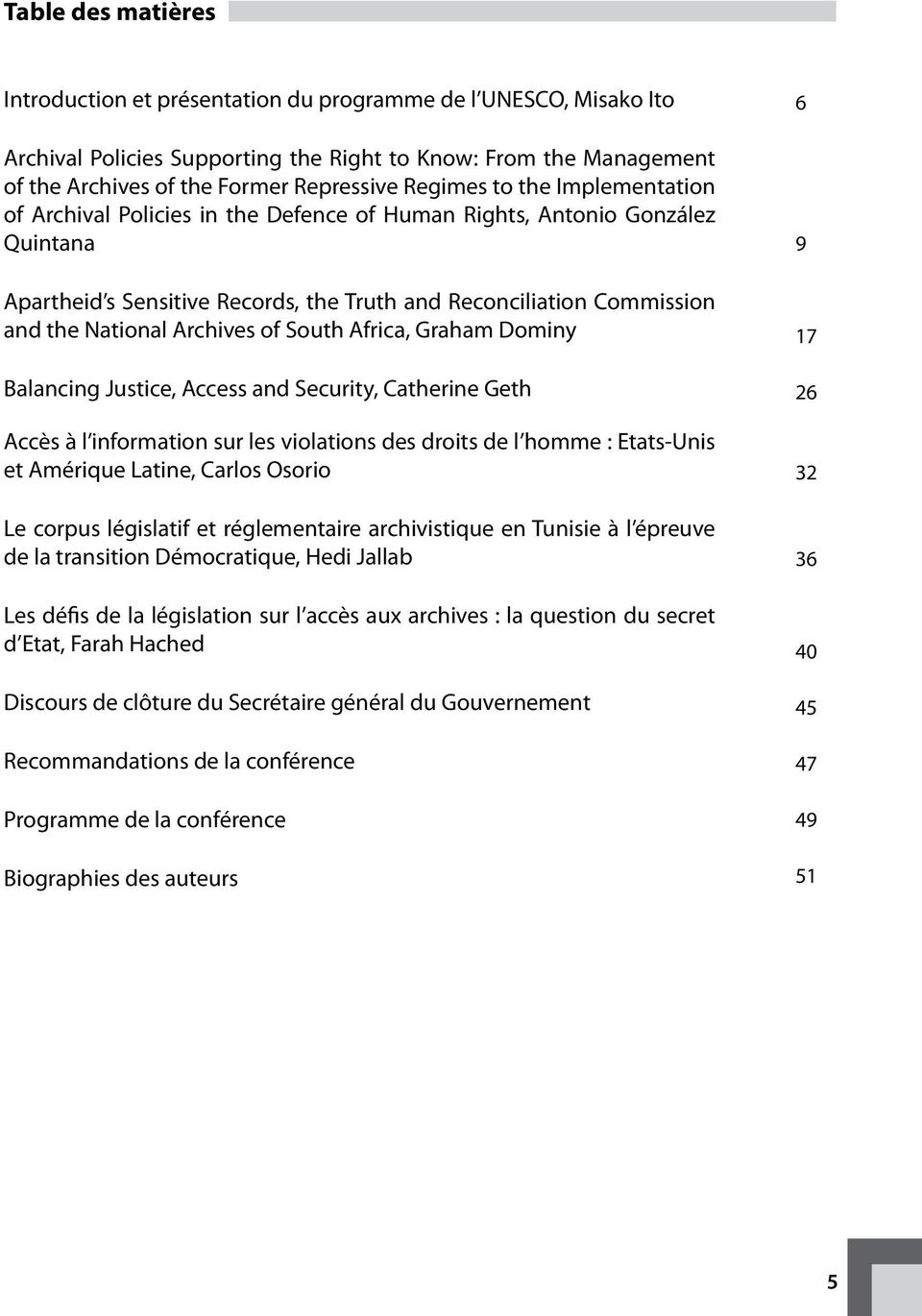
7 Table des matières Introduction et présentation du programme de l UNESCO, Misako Ito Archival Policies Supporting the Right to Know: From the Management of the Archives of the Former Repressive Regimes to the Implementation of Archival Policies in the Defence of Human Rights, Antonio González Quintana Apartheid s Sensitive Records, the Truth and Reconciliation Commission and the National Archives of South Africa, Graham Dominy Balancing Justice, Access and Security, Catherine Geth Accès à l information sur les violations des droits de l homme : Etats-Unis et Amérique Latine, Carlos Osorio Le corpus législatif et réglementaire archivistique en Tunisie à l épreuve de la transition Démocratique, Hedi Jallab Les défis de la législation sur l accès aux archives : la question du secret d Etat, Farah Hached Discours de clôture du Secrétaire général du Gouvernement Recommandations de la conférence Programme de la conférence Biographies des auteurs
8 6 Introduction et présentation du programme de l UNESCO Misako Ito Conseillère pour la Communication et l information, Bureau régional de l UNESCO pour l Algérie, le Maroc, la Mauritanie et la Tunisie Presque deux ans après le 14 janvier 2011, la Tunisie, tout comme les autres pays du monde qui ont connu une histoire de dégradation et de dictature, se retrouve face à son passé, dans une phase de transition pour reconstruire le pays et instaurer un climat de paix et de réconciliation. Dans cette phase capitale de l histoire de la Tunisie où se met en place le dialogue national sur la justice transitionnelle, la préservation et l accès aux archives sont devenus des enjeux politiques majeurs, afin d établir les responsabilités, garantir les réparations, reconstruire l histoire et perpétuer la mémoire collective. C est ce qui a été souligné par l Association tunisienne des gestionnaires des archives lors de la journée d étude organisée sur ce thème le 20 septembre L expérience des pays ex-socialistes, après la chute du Mur de Berlin avait déjà montré le phénomène: la chute de ces régimes a fait apparaître des masses énormes d archives des services de renseignement et de la bureaucratie communiste répressive qu il fallait traiter et rendre accessibles, car ils contenaient les preuves des violations des droits des citoyens. Les 180 kilomètres linéaires de fichiers et dossiers de la STASI, la police secrète de la République Démocratique Allemande, en sont un exemple emblématique. La question de la préservation de ces archives et de leur accès a été alors centrale : elles ont permis d établir des dizaines de milliers de copies de documents prouvant les spoliations dont avaient été victimes certains citoyens sous le régime communiste et rendu possible leur indemnisation. Elles ont également permis l identification et la mise à l écart des agents compromis avec le régime précédent. De nouvelles lois sur les archives ont alors été votées dans ces pays pour rendre accessibles ces documents secrets. S interroger sur ce qui reste de l ancien régime, c est aussi se documenter sur l histoire
9 Les archives et le droit de savoir de la dissidence et développer des politiques archivistiques orientées vers les archives des mouvements d opposition ou des militants des droits de l Homme. En effet, ces archives sont exposées à plus d un titre à la disparition : souvent éparpillées chez des militants, elles ne sont pas pensées comme archives et ne sont par conséquent pas déposées. Or les documents issus de ces organisations sont le contrepoint indispensable des témoignages du pouvoir et toute tentative pour approcher la vérité des événements doit passer par la confrontation des sources. L UNESCO a célébré en 2012 le 20ème anniversaire du programme Mémoire du monde qui vise à faciliter la préservation et l accès au patrimoine documentaire dans le monde. La vision du programme Mémoire du monde est basée sur le principe que le patrimoine documentaire du monde appartient à tous et qu il devrait être entièrement préservé, protégé et accessible de manière permanente et sans obstacle. C est à travers l inscription au Registre international Mémoire du monde - partie la plus visible de ce programme - que l UNESCO attribue et reconnaît l intérêt universel et la valeur exceptionnelle d un patrimoine documentaire, afin d encourager des politiques en faveur de sa préservation et de son accès. Au cours de ces 20 dernières années, le programme Mémoire du monde a inscrit dans son Registre une vingtaine de fonds documentaires qui commémorent des actions qui ont façonné l avenir du monde et illustrent la résistance pour la démocratie, la liberté et le respect des droits de l Homme. Parmi eux on compte : les archives du ghetto de Varsovie, témoins de l Holocauste (1999), les archives des droits de l Homme au Chili (2003), l affaire pénale de l Etat d Afrique de Sud contre Nelson Mandela (2007), les archives pour la vérité, la justice et la mémoire dans la lutte contre le terrorisme d Etat entre 1976 et 1983 en Argentine (2007), les archives de la Terreur du Paraguay (2009), les archives du musée de Tuol Sleng, une ancienne prison de sécurité au Cambodge (2009), et le réseau d information et de désinformation sur le régime militaire au Brésil entre 1964 et 1985 (2011). Leur inscription dans le Registre témoigne de la nécessité de préserver les souvenirs des événements qui sont parfois tragiques ou dérangeants mais qui font partie de la mémoire collective d une nation ou d un peuple et qui doivent être transmis aux générations futures. L ensemble de ces actions de commémoration a été couronné par l adoption par l UNESCO, en octobre 2011, de la Déclaration universelle des Archives qui souligne l importance du rôle des archives dans la mise en pratique de la transparence administrative, de la responsabilité démocratique et de la préservation de la mémoire sociale collective, et reconnaît leur rôle dans la défense des droits de l Homme. Dans ce contexte et à l occasion de la journée mondiale des droits de l Homme le 10 décembre 2012, l UNESCO et les Archives nationales de Tunisie ont proposé une journée de réflexion sur la gestion des archives dans le cadre de la transition démocratique, en présence de la communauté des archivistes tunisiens mais aussi de juristes, historiens, défenseurs des droits de l Homme et experts du groupe «Archives et des droits de l Homme» du Conseil international des Archives. 7
10 8 Quelles archives préserver dans le cadre de la transition démocratique? Quelles sont les instances à impliquer pour assurer leur sauvegarde? Quels sont les critères d évaluation de ces archives? Comment assurer l intégrité de ces fonds? Quelles sont les questions éthiques et déontologiques soulevées par leur sauvegarde, accès et utilisation? Comment traiter les archives des mouvements d opposition ou des militants des droits de l Homme? Où faut-il les conserver? Quels sont les obstacles d accès aux archives en Tunisie aujourd hui? Quel est le rôle des pouvoirs publics et celui des professionnels? Comment mettre en place des politiques archivistiques pour la défense des droits de l homme? De quelles expériences réussies peut-on s inspirer? A travers les témoignages et interventions des archivistes d Espagne, d Amérique latine, d Europe et d Afrique de Sud, cette journée a permis d aborder ces différentes questions et de dresser une série de recommandations pour la mise en place des politiques archivistiques pour la défense des droits de l Homme en Tunisie.

11 Archival Policies Supporting the Right to Know: From the Management of the Archives of the Former Repressive Regimes to the Implementation of Archival Policies in the Defence of Human Rights Antonio González Quintana Deputy Director General, Archives of the Autonomous Region, Madrid Although laws regulating freedom of information have existed since 1776, in the last ten years an unprecedented number of states have adopted Freedom of Information legislation. David Banisar, a well known expert in the field of Freedom of Information, notes that one of the reasons for this proliferation of legislation is the collapse of authoritarianism in the 1980s, and the birth of new democratic states with new constitutions which specifically included a guarantee of the right to information. Such a constitutional guarantee needed new laws on access to information to be passed. The end of dictatorships and the beginning of the long road towards democracy in countries in transition resulted in a series of demands related, directly and indirectly, to the archives of those bodies linked to repression. The demands relate indirectly to such archives, because they are tools indispensable to justice, ordinary or transitional, and because they constitute an essential element in shaping the social memory; but such archives are also directly affected because, when their existence is confirmed, as in the majority of countries in Central or Eastern Europe, there has been a general demand for them to be opened. The opening of the archives formed part of the great social agenda which arose in the Soviet Union and the rest of the European communist countries in the years following The search for truth about the recent past has been, in all these countries, part of the political struggle for a new direction both in the domestic sphere as well as in the field of international relations. Diane Orentlicher, the expert commissioned by the United Nations Commission for Human Rights to come up with proposals for good practice in the struggle against 9

12 10 immunity specified in one of her reports that, in general, states should take measures to ensure that information on human rights violations should be available to the public: Laws governing access to such information are in place in many countries. In view of the potential to improve the access of citizens to the truth about violations of human rights, it is recommended that States which do not yet have laws which permit their citizens to have access to state documents, including those containing information on violations of human rights, begin to promulgate them. The question of legislation on access to archives and human rights has also been discussed over the past years in another important forum: the Inter-American Commission for Human Rights, part of the Organization of American States. In 1998, to link with the 50th anniversary of the Universal Declaration on Human Rights, the Commission, in its 101st session, recommended that member states adopt legislative measures necessary to make effective the rights to free access to information held in the archives and documents of the State, particularly in cases where investigations are seeking to establish responsibility for international crimes and grave violations of human rights Finally the International Council on Archives has approved recently at its last Congress in Brisbane, Australia, a set of Principles on Access to Archives. These consist of 10 Principles with a commentary explaining each Principle; the Principles and the commentary taken together constitute the statement of professional practice. I would like to comment on two of these principles: 1. The public has the right of access to archives of public bodies. Both public and private entities should open their archives to the greatest extent possible. Access to the archives of government is essential for an informed society. Democracy, accountability, good governance and civic engagement require a legal guarantee that individuals will have access to the archives of public bodies established by national, self-governing territories and local governments, intergovernmental institutions, and any organization and any legal or natural person performing public functions and operating with public funds. All archives of public bodies are open to the public unless they fall under an exception grounded in law. 6. Institutions holding archives ensure that victims of serious crimes under international law have access to archives that provide evidence needed to assert their human rights and to document violations of them, even if those archives are closed to the general public. The Updated Set of Principles for the Protection and Promotion of Human Rights through Action to Combat Impunity (2005) of the United Nations High Commission on Human Rights declares that victims of serious crimes under international law have a right to know the truth about the violations. The Principles emphasize the vital role that access to archives plays in learning the truth, holding persons accountable for human right violations, claiming compensation, and defending against charges
13 Les archives et le droit de savoir of human rights violations. The Principles state that each person is entitled to know whether his or her name appears in State archives and, if it does, to challenge the validity of the information by submitting to the archival institution a statement that will be made available by the archivists whenever the file containing the name is requested for research use. Archival institutions obtain and hold the evidence needed to protect human rights and to contest the violation of human rights where serious crimes under international law have been committed. Persons seeking access to archives for human rights purposes are given access to the relevant archives, even if those archives are closed to the general public. The right of access for human rights purposes applies to public archives and, to the extent possible, to private archives. Archives and Human Rights: a link beyond frontiers and generations We often stress the important fact that records generated around political repression have to preserve the memory of peoples because they are an irreplaceable testimony of the repression they suffered. But the most important argument for the preservation of repressive records in the new democratic state takes root in the importance they have for victims affected by repression, since such records are essential in the new political situation for the exercise of certain individual rights. The fight against impunity as a nexus The need for safeguarding records documenting genocide, crimes against humanity or other Human Rights violations was considered by the UN Human Rights Commission, at least initially, for judicial processes in their different models (transitional justice, criminal courts, International Tribunals...). Thus archives and records became one of the main tools to be used for trying perpetrators and their accomplices and for restoring the dignity of victims. This conviction was acknowledged in several resolutions of the UN Commission on Human Rights 1 and also by different agreements inside the International Council on Archives. At its thirty-seventh session, in Cape Town in 2003, the International Conference of the Round Table on Archives (CITRA) passed a resolution on archives and human rights violations in which, taking into account the fundamental importance of archives in all States as evidence supporting victims rights for reparation; as an essential element of collective memory; as a means of determining responsibilities for rights violations; and as a basis for reconciliation and universal justice, it recommended that government authorities and international organizations should facilitate the effective exercise of the right to know, by taking steps to ensure the preservation and conservation of archives of all kinds which document these crimes, make the existence of these archival fonds known and 1. UN Commission on Human Rights Resolutions E/CN.4/1998/53; E/CN.4/1999/34; E/CN.4/2000/68 and E/ CN.4/2001/70 11

14 12 facilitate access to them by adapting or creating adequate legal frameworks for their accessibility, and ensuring that these arrangements respect both privacy and the need to make the truth known 2. Reports and statements on archives and records produced by UN Human Rights bodies We could say that this sequence of events was initiated by Louis Joinet, Special Reporter of the Sub-Commission between 1996 and Establishing responsibility for human rights violations, allowing justice to be done and victims to know the truth, requires evidence. People tend, however, to overlook the obvious point that much of the evidence comes from archives 3. The inalienable right to the truth; the duty to remember and the victim s right to know were measures contained in the set of Principles for the Protection and Promotion of Human Rights through action to combat Impunity. His report 4 contained five specific measures aimed at preserving and accessing to archives bearing witness to violations, namely: Principle13.Measures for the preservation of archives; Principle14.Measures for facilitating access to archives; Principle15.Cooperation between archive departments and the courts and extrajudicial commissions of inquiry; Principle16.Specific measures relating to archives containing names; Principle17.Specific measures related to the restoration or of transition to democracy and/or peace. Joinet s report would be updated in 2005 by Diane Orentlicher, covering a great number of experiences accumulated in the fight against impunity during the years since the initial report was produced. The archival approach to Human Rights: from the care of archives as a measure of Cultural Heritage preservation to the use of archives and records as tools for supporting collective and individual rights. In parallel to the United Nations, the international archival organizations faced the question of the archives of the former repressive regimes in the context of the collapse of the Communist European countries and the end of the African and Latin American dictatorships. However, they were thinking more of the safeguarding of a rich documentary heritage in danger than of the use of records for defending Human Rights. However, the working group created by the General Assembly of The International Council on Archives at its CITRA Conference in Mexico (1993), based on the experience Louis Joinet and Perrine Canavaggio, Les archives contre l oubli, Le Monde, 23 June 2004, 4. UN doc. E/CN.4/Sub.2/1997/20/Rev.1.

15 Les archives et le droit de savoir of its members, decided to put the main emphasis not on the heritage value of documents, but on the importance of using these documents for the exercise of collective and individual rights, among others: Collective rights: Free choice of the model of transition... Right to memory... Right to the truth... Right to justice... Right to know those responsible for crimes against human rights Individual rights: Right to exoneration and rehabilitation... Right to know the whereabouts of family members who disappeared in the time of repression... Right of everyone to know what information is held on them in the archives of the repression... Right to historical and scientific research... Freedom of political prisoners and freedom of conscience... Right to compensation and redress for damages suffered by victims of the repression... Right to have confiscated goods restored The report has been updated in Archives in transition When we talk about Archives and Human Rights in countries in transition to Democracy we usually forget the main goal: To get open societies with transparency laws, efficient records management systems and a good archives administration. But until the new and democratic archives system has been created and new laws promulgated, a country needs to face its past and, for this task, records are required. Extraordinary and transitional measures must be taken in archival policy, and this must be done considering archives not as cultural institutions, but as juridical institutions, as tools of Transitional Justice. Why do governments need an archival policy in transition periods? Transition models include concrete measures for Transitional Justice such as: criminal prosecutions of those responsible for atrocities at both national and international courts; the creation of truth commissions; the establishment of screening mechanisms 5. Antonio González Quintana, Archival Policies in the Protection of Human Rights: an updated and fuller version of the report prepared by UNESCO and the International Council on Archives (1995), concerning the management of the archives of the state security services of former repressive regimes. Paris,

16 14 for government clearance and the development of measures for the rehabilitation of victims or for reparation or compensation to them. Policies of memory and archive policies Policies of memory or policies for dealing with the past are not the same as archival policies. Public memory policies are usually designed for the short-term while, in general, archival policies are designed for the long term and are often very stable, ensuring confidence in archives as entities that base their evidential credibility on permanence and neutrality. As we shall try to illustrate, the latter are necessary to render them effective. We can say that archival policies are essential, and sometimes decisive in the way with which we deal with our recent past. Except for the paradigmatic amnesic model of the Spanish transition, in almost all other transition models we find concrete measures of Transitional Justice. If we want to implement such measures of transitional justice with a guarantee of success, archives and records are fundamental to that success. There is, moreover, a strong connection between archives policies and models of political transition. The existence and retention of records and archives documenting the horror of human rights violations and the professional management of these documents has a decisive influence on the final outcome of the specific model of transition in all cases. By contrast, the political desire to forget or ignore the past, has dramatic consequences not only for citizens but also for records and archives. The lack of documentation limits the choice for transitional justice organizations. So the first recommendation in this regard must be that records concerning human rights violations must be preserved; not only records produced by repressive bodies or other public institutions, but also those records produced by Human Rights organizations, political parties, trade unions and other civil society organizations of opposition. Transitional Archival Policies When direct sources on the violation of human rights linked to political repression have been preserved, should they be accorded the same treatment as conventional documents? Is it advisable to follow the same route in the archival system adjusted to their life cycle and traditional retention schedules? The answer must clearly be «no.» As it has been done in most of the transition process, it is necessary to take immediate decisions to provide the necessary information needed to develop those memory policies that society chooses. These records should be made accessible either by creating new centers or by using pre-existing archives. In the first case, ordering their admission to public records institutions that are considered appropriate: National Archives, Provincial Archives In the second case, by creating special archives for dealing with such documents. At the same time, there is an urgent need to create and regulate the use of specific

17 Les archives et le droit de savoir professional standards for use in special scenarios as the need arises and in which the usual and general practices are inappropriate. On the issue of access, for example, the study of documents that testify to the violation of human rights cannot be limited by their rarity or uniqueness in terms of the criteria usually contained in free access laws in democracies such as: Official Secrets, Freedom of Information, Data Protection or Defense of Privacy. Depending on the objectives in Transitional Justice process set up by memory policies, special archival policies must be designed for the transition. In any process of democratization each country will in the end, require new institutions, new laws and public archives systems in all administrative areas. Besides archival reform in general, the regulation of freedom of information and access to public ownership documents are essential pillars of democratic states. But for reasons of urgency, we must start if the records produced by the former Security Services have been preserved, by creating the specialized and specific archives mentioned (always with the view that entities must be temporary and that the holdings that they manage must end integrated in the General Archives of the country) or order the placement in the public files of those document collections that bear witness to the violation of human rights and to make specific laws governing the use thereof. The second main recommendation is that records documenting the violation of human rights must be available for the exercise of democracy; in first place, to guarantee the exercise of collective rights such as the Right to Know, (for instance, who was responsible for crimes against human rights)the Right to Truth, the Right to Justice, the Right to Memory and the right to freely choose the model of political transition. In second place, to give effect to individual rights, (such as the right to exculpation and rehabilitation, the right to know the whereabouts of relatives who have gone missing during the period of repression, the right to know), to be exercised by any person, whether or not there are any data files on them in the enforcement agencies. Then there are the rights to scientific historical research and to compensation and damages suffered by the victims of repression, or the right to the restitution of confiscated property. This set of rights can only fully exist if the records of the organs of the repressive regime (including those of the totalitarian parties that supported them) are well kept, are subject to democratic legislation and pass immediately into the custody of new authorities in control of the political transition. But it is not axiomatic that it will be existing archives and archivists who assume responsibility for these archival policies of transition. The low credibility that public institutions have in some transition countries, may include their national archives. These may not be sufficiently renewed, nor professionally managed and strengthened in resources after the end of repressive regimes which leads to the search for alternative bodies for managing records relating to the violation of rights. Often these new entities 15

18 16 have been promoted by militants of the cause of democracy or human rights as the best way to make clear the commitment to the victims and justice. Nevertheless, the archival documents produced by natural or legal persons in the exercise of their functions, powers or activities, should be treated professionally, maintaining their context and respecting their provenance and original order. Archival management cannot follow the same techniques as documentation centers, where raw data accumulation around the theme defines the demand for information; regardless of the characteristics of the document containing the data, or its authenticity and how it has been generated or reached the dossier. To create public bodies managed by professional archivists with the control and participation of human rights agencies, or associations of victims and former opposition organizations could be a good solution. But, ultimately, professional archivists who know how to treat records properly, and who are aware that their value as evidence must mediate in the treatment of the documents. When taken out of their context, most of the documents illustrating rights violations, repression and political violence lose much of their value. The option of using professional and specialized institutions for large-scale records of former political police (e.g. the Stasi case in Germany or the KGB in the former Soviet Union) is highly recommended to increase the use of these documents. But that action should be temporary and the final destination of political police records must be the National Archives once the maximum period of administrative use by the institutions of transitional justice expires. It cannot be considered justified, in any case, to create special archives for managing low-volume documentary collections when there are few official documents especially in countries that have not been able to locate the records of their former state security agencies. Nor should these records be put together with a small volume of books, newspapers, collections of pamphlets, newspaper clippings, reproductions (or worse!) originals of documents from other archives and oral sources in thematic centers. Here they can serve only as museum exhibits with their archival provenance and value becoming unrecognizable. In such cases, it makes more sense to incorporate these small collections into the general archives. It is also highly recommended that efforts be made towards the creation of reference centers on the sources of repression while keeping records in the most appropriate archival institution. What is critically important is putting the records into the service of justice, of truth commissions, of victims and the public in order to provide evidence to the courts or to enable the exercise of the habeas doctrine, data input or certification that must support victims in submitting their demands for restitution.

19 Apartheid s Sensitive Records, the Truth and Reconciliation Commission and the National Archives of South Africa Graham Dominy Former National Archivist of South Africa would like to thank UNESCO, the working group Archives and Human Rights of the I ICA and the National Archives of Tunisia for inviting me to address this important symposium. The events in Tunisia in 2011 gripped the imagination of the world and I add my voice to those of the millions of others in wishing the Tunisian people strength, courage and endurance in the realisation of their dreams of national transformation. Coming from a country that underwent an epic transformation eighteen years ago, I feel privileged and indeed renewed, being a guest in Tunisia, another country in exciting transition and bursting with opportunities to grasped with both hands. Ex Africa semper aliquid novi Introduction: The Principles The Right to Know is one of the most broad and fundamental human rights. In many ways it frames the relationship between the citizen and the State. In the South African Constitution this is encapsulated in the Bill of Rights as the right to Freedom of Expression which includes: (a) freedom of the press and other media; (b) freedom to receive or impart information or ideas (c) freedom of artistic creativity; and (d) academic freedom and freedom of scientific research The Constitution also provides a right of Access to Information which stipulates that Everyone has the right of access to: (a) any information held by the State; and (b) any information that is held by another person that is required for the exercise or protection of any rights 17
20 18 These rights are all implemented through laws passed by Parliament and, with the exception of two, - the rights to life and human dignity -, the rights are not absolute. Administering and interpreting them in the archives context requires a delicate balancing act. The ICA s Principles of Access to Archives give professional operational guidelines which are of great value to archivists, but each national archives organisation will find that it has its own particular issues to address. Trudy Huskamp Peterson speaking in 2011, emphasized that in addition to a Right to Know there is a duty on governments to support the Right to Remember. Without supporting the critical services that are provided by the National Archives, governments cannot support their citizens Right to Remember. At this symposium we are focusing specifically on the challenges of applying these principles in a country undergoing a profound political transformation. The National Archives of Tunisia is a key institution in this process of transition and an equally important institution for maintaining the record of the processes and continuities in Tunisia s ancient and distinguished history. Transition and democratisation on the one hand and continuity and preservation on the other. This is part of the balancing act for Tunisian archivists. It is often difficult for archivists to get politicians and decision-makers to understand the needs and processes of their national archives. This is particularly so in a time of transition when the national archives runs the risk of being seen as irrelevant in a forward-looking newly regenerated political structure, or, perhaps worse, being seen as the last vestige of the discredited old order, or ancien regime. This is, therefore, a time when the National Archives of Tunisia will need all its professional integrity and commitment to obtaining and preserving both historical and recent records for the future of the country and all its people. Of all the servants of the state, archivists, in particular, have a dual responsibility: not only to the government of today (like every other official), but the archivist also has a duty and responsibility to the future. Not only must the archivists preserve and give access to the records of the past to the audience of today, but the archivists must acquire and preserve today s records for future generations. I hope that what I have to say will assist the institution in fulfilling its legal and professional archival mandates in its complicated current environment. In April 2007, Sarah Tyacke, the former Keeper of Public Records and National Archivist of the United Kingdom, addressed a conference of archivists at the Nelson Mandela Foundation in South Africa and stated a very simple, but profound archival truth: First, get the record! To which, in these tumultuous times, must be added another imperative: Do not lose the record! To fulfil this mandate, the National Archives needs to be trusted by citizens and the state and resourced by the state. Losing the record can happen because the agencies holding the record will not trust the archives, or there is destruction before transfer or even neglect after archiving because of lack of resources.

21 Les archives et le droit de savoir Without obtaining the record, archives are empty, history cannot be written, present turmoil is more difficult to understand and the future is more difficult to shape for the present generation. This is particularly true in countries undergoing major political and social transformation. It is during such times of transformation that the archives are at their most vulnerable from loss through destruction by the creators, mistrust of the archives, preventing the orderly transfer of records or neglect once at the archives through resource-starvation. South Africa: The TRC, the Archives and Sensitive Records I am going to use the example of South Africa s Truth and Reconciliation Commission and the role of the National Archives of South Africa to illustrate some of the dangers that archives and records are subjected to during times of major political transition. It is well known to us as professionals that a careful analysis of the archival record - in written and oral form - would lay bare the chief features of the apartheid system and contextualise the uneven development, social contradictions and anomalies at the end of South Africa s first Decade of Democracy. In 1994, this was more than just an intellectual need - it was a political imperative born of the processes of negotiation and conflict that lead to the establishment of the Government of National Unity headed by President Nelson Mandela. Those who had been oppressed, who had lost loved ones, whose lives and livelihoods had been destroyed, thirsted to know the reasons why - and some thirsted for revenge. On the other hand, the apartheid generals, the chiefs of police and the spies and agents of the regime still had enough power to wreck the negotiated settlement and to torment the new rulers through blackmail and coercion for years to come. The establishment of a mechanism to address the needs of the oppressed without provoking the former oppressors into revolt and racial civil war was essential. Therefore, one of the most important institutions that the newly-elected democratic Parliament established in the years following 1994 was the Truth and Reconciliation Commission which had the legislated mandate to investigate the atrocities of the past; expose the evils that were committed in apartheid s name and in the name of those struggling to overthrow the system; give amnesty to perpetrators who fully disclosed their misdeeds (if such deeds had a political purpose) and build a database of those victims who required compensation or restitution in some way or another. The aim of the TRC was summed up in its name - to discover the truth and achieve reconciliation. The focus of this paper, however, is on the archival aspects of the work of the TRC and there are three issues that are of relevance here: In the first place, in order to fulfil its mandate to discover the truth about the apartheid past, the TRC searched for, and sometimes seized, many of the records of those involved in the apartheid security apparatus. This required the intervention of archivists in support of other investigators. In the second place, the TRC generated a vast amount of documentation during its lifes pan in all modern media: paper-based; audio; visual; audio-visual and 19
22 20 electronic. These are now in the process of being archived. And in the third place, the TRC made certain archives-related recommendations in its report that required an official response from the National Archives of South Africa and other agencies. I will not dwell on this issue as it is very particular to the South African context and may not be apposite in this broader international context. The TRC s Hunt for the Archives of Oppression The TRC was hampered in its efforts to obtain documentation about apartheid atrocities by a lack of resources, staff and time and, more importantly, by obstructionism from within the former security apparatus and other sections in the apartheid bureaucracy. Above all, it was severely hampered in its efforts by the massive but illegal, destruction of records ordered by the government of former State President F.W. de Klerk in the months leading up to the first democratic elections on 27 April The new government did not find fully intact, any equivalent to the Stasi Archives of the former German Democratic Republic. I may add an observation that a former TRC official made to me: he said that perhaps the only offence that could conclusively be pinned on former State President FW de Klerk, was ordering the destruction of State documents without following the requirements of the old Archives Act (which provided for a modest fine for the illegal destruction of official records). The whistle-blower on the destruction of security records was a member of the staff of the National Archives who went on to work with the TRC in its search for records. The five-volume report of the TRC describes in some length the steps taken to search for records documenting the atrocities of apartheid - inspections of various offices, correspondence with various agencies and the use of legal warrants to seize documentation. The documentation that was located included: surviving copies of records of the State Security Council and the parallel government of securocrats that swung the resources of the State behind the so-called total strategy of former State President PW Botha; files on individual persons from the section of the Justice Department (DOJ) charged with administering the legislation authorising detention without trial and intrusive observation (eavesdropping into telephone conversations, etc); Security Police files; military documentation; and secret intelligence files from the National Intelligence Agency and its Orwelliannamed predecessor BOSS (The Bureau of State Security). The National Archives seconded officials, such as Verne Harris, to assist with this process. Harris subsequently exercised a considerable influence on the archives-related recommendations of the TRC. It is interesting to note here, also, that international experts, such as Trudy Peterson, also advised the TRC on archives matters. Harris left
23 Les archives et le droit de savoir the National Archives in 2001 to head the South African History Archives (SAHA), an Non-governmental Organisation based at the University of the Witwatersrand (modelled on the National Security Archive in Washington DC) which has been running a Freedom of Information project, centring on the TRC files and other documentation from the apartheid era. Various writers and political activists have subsequently claimed that much evidence was hidden from the TRC and only came to light later as a result of PAIA (Promotion of Access to Information Act) access applications submitted to the military, among others. The National Archives also managed to secure the transfer of files relating to political prisoners that are not part of the TRC archives. Archiving TRC Records The archiving of the TRC s own records is undertaken by the National Archives under difficult circumstances of dual control, inadequate and sometimes conflicting legislation and complicated access requirements. Equally difficult and important, but much less easy to deal with in the archival sense, was the professional (and sometimes personal) very public criticism by a number of activists engaged in exercising their newly minted constitutional rights and with a number of activists engaged in conducting public campaigns which included criticising the National Archives. National Archives cannot avoid this type of criticism and political engagement. It is an integral and critically important part of the process of national transformation. The march of events, and the continuing processes of democratising South Africa, has overtaken some of the TRC s archival recommendations. One of the most important events was the passing into law of the Promotion of Access to Information Act in the year 2000, South Africa s constitutionally-mandated Freedom of Information legislation - abbreviated as PAIA. This must be seen as a a giant leap forward because it was competing with access to the more pressing human needs of housing, health, education, water and power. In 2001 the TRC finalised its official work as its legal, time-bound, mandate had elapsed and differences of emphasis appeared between the various agencies with roles to play in the follow-up work. The TRC s legislation had been amended to ensure that the Department of Justice (DOJ) became its successor-in-title and this department assumed responsibility for its assets and liabilities, including its intellectual property. Intellectual property was taken to include the TRC s records, although the TRC had itself recommended that these be taken to the National Archives. Although the many critics of the National Archives and the government would be unhappy to hear this, it was in fact, on the advice of the National Intelligence Agency that the TRC records were placed at the National Archives. The DOJ, however, retains joint control over aspects of the access to the records which is a complicating factor rather than an obstacle. If I was to offer any direct advice at all 21
24 22 to national archives in transition it would be to avoid such complicating factors. The core competence of archives is the management of records and all that goes with it. Such is not the core competence of other government departments and the level of importance attached to such non-core competences slides to the bottom of the scale very quickly, leading to frustration, neglect and in some cases abuse of power. Let me list the other steps that have been taken to archive the TRC records: as far as is known, all TRC documents are now at the National Archives; two former TRC officials have been appointed as archivists to assist the National Archives with the processing and management of the records (they also work with PAIA requests); all TRC Commissioners were informed of their obligations to transfer official records to the National Archives. a joint committee has been set up with the Department of Justice and with the National Intelligence Agency (NIA) to implement access requests to the TRC records in terms of the Promotion of Access to Information Act (PAIA); two strong rooms have been equipped with additional security measures in which the records are housed; a project has been established to archive the electronic records of the TRC. a special section has been established at the National Archives to manage the TRC records (and the other security-related and sensitive records that have been transferred to the National Archives in terms of the TRC s recommendations). There is still a great deal of work to be done and more resources and trained personnel are required to complete it. The budget for the National Archives of South Africa does not match its legally mandated responsibilities, let alone allow it to fully carry out the idealistic recommendations of the TRC. Steps that still need to be taken: Once the Department of Justice has no immediate functional use for the TRC records (e.g. once prosecutions and reparations are finalised) full control over the records must be vested in the National Archives in terms of the TRC recommendations and the PAIA and National Archives Acts (the reparations work is still not completed and there are legal disputes delaying the finalisation of the process); a full electronic archiving project be funded and the TRC website be transferred from the DOJ to the National Archives as soon as possible (the IT of the National Archives needs considerable upgrading). Accessing Sensitive Records The South African National Archives Act became law in 1996, shortly before President Mandela signed the new constitution. This means that there is a need to amend the archives laws to be fully compatible with the Constitution and laws on access to information, protection of privacy and personal data that flow from the constitution.
25 Les archives et le droit de savoir One area that needs legal clarification is aligning the clear instruction of the archives law that records are open after twenty years, with the conflicting requirements of the other legislation. In terms of PAIA, all information is open, unless there are specific restrictions which fall under the broad categories of: Protection of third party privacy State security Documentation generated in the process of policy formulation (e.g. papers prepared by officials to advise ministers) Certain commercial and intellectual property restrictions Personal data protection, privacy and security legislation is all currently being debated in Parliament. This past year has seen heated discussions in Parliament on the protection of state information or state secrecy law. This process has not yet been finalised so it is premature for me to comment. However, the Opposition parties and civil society activists have expressed a concern that the secrecy law may be abused to cover up corruption. This is more of a systemic issue than a legal issue. The National Archives broadly applies PAIA as its primary guideline. PAIA gives expression to a constitutional right and is, therefore, superior to the National Archives Act and to the protection of information, or secrecy, legislation. These are more operational than constitutional. Arranging access to TRC records can be a problem as there is the system of dual control with the Department of Justice. However, in order to reduce delays, the National Archives allows open access to all TRC records that relate to public hearings and discussions. Effectively, this means that only a minority of TRC access requests have to go through the dual-committee system. Access to other sensitive records is dealt with in terms of PAIA principles. For example a person may have access to their own records as a political prisoner, but access would not be granted to a third party unless the ex-prisoner gave his or her permission. Generally, co-operation between the National Archives, the military and the police on access to sensitive records is courteous, professional and helpful. This is essential in sustaining the role of the archives as an institution trusted by both the public and the organs of state. One issue that is often not considered by politicians debating secrecy or privacy legislation is how long should the protections last? In English Common Law (inherited by South Africa) there is no protection for a dead person. PAIA implies that restrictions are lifted after twenty years, which accords with the National Archives Act, but as yet there has been no test case. This is an area where archivists can make a meaningful contribution to national debates, where our specialised knowledge and experience 23
26 24 can guide the passionate views of those with only a short term vision. Alliances and Partnerships While various archivists and philosophers have talked of the power of archivists, in my experience, the power of archivists is severely limited by a lack of resources and the short attention span of the really powerful. For politicians the archives matters when they are thinking of their legacies or when history is called upon for political or propaganda purposes. Otherwise they are not given serious consideration they are not as pretty as museums or monuments and they are not as full of children as libraries. Those of us who work in archives know that the critical long term success factor is the development and maintenance of a set of procedures and a system that will last over more than a generation. This should not only be an internal system, but a stable system linking the National Archives to other sections of the State. To maximise the role of a national archives, especially during critical times of transition there are two factors: Validation by an authoritative agent of state: In South Africa s case this was the TRC. Building alliances: Running the archives requires a balancing act; it also requires friends. It is essential that the National Archives are seen as non-hostile (rather than neutral) to agencies of government and to wider society. Avoid the petty attitude of this information is MINE - it is not, it is the people s heritage! The Archives cannot depend on its own legislation alone; it must be seen to apply FOI and security legislation impartially. It must include security specialists and FOI activists as well as historians among its advisers. There is also another profession which can provide powerful support: the auditors! I have always said that Nobody in government is afraid of the National Archivist, but Everybody is afraid of the Auditor General! Auditors need good record-keeping so they are natural allies of archivists and records managers. One characteristic of dictatorial governments is corruption: as Lord Acton said Power tends to corrupt and absolute power corrupts absolutely. So, to use another popular expression: Follow the money ; that will lead you to the crimes and to the records, or enable you to identify when and how they were destroyed. This route emphasizes the partnership with law enforcement agencies and enable the National Archives to build up the relationships of trust that it needs. Conclusion Ultimately, a National Archivist is responsible for the preservation of the national archival heritage and to do this he or she must maintain a relationship of trust with the agencies of government that generate those records. Records do not have an existence entirely independent of the governmental activates that generated them.
27 Les archives et le droit de savoir Therefore, the National Archivist must consider the sensitivities of the government agencies regarding their core work and activities. It is only in this way that the National Archivist can develop working arrangements that enable the smooth transfer of the records that will become the archives of the future. All this must be done within a democratically mandated legal framework that promotes accountability and good governance. I can perhaps offer a few words to the National Archives of Tunisia. It is probably impossible to avoid political controversy. You will undoubtedly be targeted by activists of one persuasion or another. You will have a legal framework within which to work, that is your defence against the attacks. What you must defend is the record. Let me conclude by repeating what for me have become axioms of archival science: We must remember our past so that we do not repeat it (as Archbishop Desmond Tutu said at the opening of the ICA s CITRA conference Archives and Human Rights in Cape Town in 2003). To remember our past - First, get the record! To preserve our past for future generations do not lose the record Thank you / shukran / merci 25
28 26 Balancing Justice, Access and Security Catherine Gerth Head, Archives and Information Management, NATO Last week the NATO Archives Committee met in Brussels composed of experts from the 28 member nations, the committee was seized of a number of issues of already raised today: Supporting international and domestic justice Information Ownership Collective History Balancing security imperatives with transparency requirements Training, Education, Awareness building trust Justice is challenging enough in established, stable democracies when combined with post-conflict transition it can seem to pose insurmountable problems. Today find ourselves confronted with several layers of legal activities that we need to support in both the areas of criminal justice and civil restitution. In criminal justice we find ourselves supporting international efforts such as truth commissions, international courts, tribunals, hybrid and national processes. Since 1995 NATO has provided support to the International Criminal Tribunal for the former Yugoslavia in several ways: Seizing documents under warrants issued by the ICTY Running the Document and Computer Exploitation Cell (DOCEX) Allowing access to NATO intelligence and information to support investigations Responding to release requests to allow intelligence to be used in court Responding to access to information requests from the Court and the Defence When NATO began this support effort our policies (the equivalent of legislation) didn t provide us any mechanisms to support this activity and there was no sense that we
29 Les archives et le droit de savoir would still be engaged in support nearly two decades later. In addressing our policy shortfalls, we acted in a piecemeal way addressing things one challenge at a time for more than a decade. The seizing of documents was easy almost fun surround a building with tanks, run in, grab filing cabinets, dump them in a truck and send them to the Hague. Simple. Once or twice a lieutenant or captain would travel to the Hague and explain the operation. This approach brought myriad problems. Because they really were doing snatch and grab operations many things were seized that were of no use to the Office of the Prosecutor personal correspondence, paychecks, family photos, wallets and on one occasion someone s lunch. Figuring out who this material belonged to, how to find the individual and how to return the material to its owners became a challenge that the ICTY decided it couldn t manage and thus switched to a passive approach. If an individual approached the ICTY looking for personal belongings, their case would be addressed otherwise not. To the best of my knowledge no one ever did. It poses an on-going challenge as the ICTY plans the future of its holdings. The second problem with this approach was the volume of materials generated one weekend in 1998 saw 1,000,000 pages of materials seized. Now the ICTY was accountable for the content for the purposes of exculpatory disclosure but had no way to respond effectively to Court orders. A key component of justice is the timely execution of due process and this volume provided a challenge to the ICTY that it never fully overcame. It would be fair to say that most of those materials were not fully exploited for the prosecution because the focus became the needs of the defence. A difficult situation. ICTY also had the challenge that they couldn t read the materials and the defendants had a better understanding of what was there than the prosecution ever did. The ICTY came up with a smart scheme to prevent the situation from getting worse they asked NATO to hold all future materials in the Document and Computer Exploitation Cell (DOCEX) in Sarajevo and then ICTY would make access requests to NATO to use the materials seized. This solved many problems for the ICTY; however, NATO did not foresee the challenges to itself. Friday, the NATO Archives Committee discussed in detail what our obligations are regarding DOCEX. Three distinct challenges were identified: Ownership: these materials were mostly seized from governments that no longer exist with no clear successor organisation. Access: with the arrests of Karadzic and Mladic and the end of the ICTY s mandate, responsibility for future prosecutions is transferring to Bosnia; they would like to have access to these materials but as ownership is not clear we aren t certain who has the authority to grant access. In addition, there is the risk of public access requests where NATO could be perceived to be hiding information if it is not handed over as victims seek access to information. 27
30 28 Civil Restitution: many of these files contain detailed information about individuals, property holdings, pension rights etc. that could assist in many of the transitional challenges Bosnia currently faces. Right now, we have decided to treat it as though it were our own, classified information. We ve transferred it out of the region, digitised and indexed it and we re keeping it safe. We just don t let anyone see it except the ICTY. This situation will have to be addressed by the end of 2014 when the ICTY mandate ends. On Friday, the Nations decided that we need to become more active and begin working with the Bosnians to ensure that a records climate exists that would make us comfortable about returning the materials to them. The first step will be to work with the Bosnian authorities ensure that their access to information legislation and processes are consistent with NATO s. In particular, we will be working with them to ensure that a proper shall disclose culture as opposed to a security centric one is developed. NATO has worked carefully to define the parameters by which information can be withheld for security reasons. The categories have been narrowly defined to ensure that there is little room for interpretation: NATO 1: Information, the public disclosure of which would be likely to endanger NATO internal cohesion, members, missions, infrastructure or personnel; NATO 2: sensitive personal information about individuals who were born less than one hundred years before the date on which the information is screened; NATO 3: confidential commercial information, unless the parties concerned consent to its public disclosure; NATO 4: details about methods or sources of intelligence; NATO 5: details about weapons of mass destructions NATO 6: details about current cryptographic systems; NATO 7: details about current weapons systems; NATO 8: details about current political or military plans, policies and operations NATO 9: details about current internal or external NATO political discussions and sensitivities; and NATO 10: details about current physical and information security As a side note we spent a lot of time last week discussing how to narrow NATO One to prevent it being misused and agreed that previously withheld materials would be submitted for re-review once this had been done. With the Bosnians we also plan to do a training programme for personnel from their national authorities to introduce them to ways of executing transparency in a security conscious environment and what we describe in NATO as the responsibility to share balanced by the security principle of the need-to-know. The final approach will be to the NATO Legal community to ask for assistance in identifying the correct successor bodies to return the information to.
31 Les archives et le droit de savoir NATO also finds itself the subject of investigations both internationally and domestically. There are ongoing and recurring legal inquiries into actions in Afghanistan, Libya, Bosnia, Kosovo, off the coast of Somalia. This leads to some interesting situations. In theory, NATO and its nations can invoke the provisions of the Washington Treaty which provide for the inviolability of the Alliance`s archives. In practice, we are always careful about when we will and will not refuse to cooperate; however, our response can appear inconsistent. Amnesty International launched court cases in two NATO nations about NATO s detainee policy in Afghanistan. Both governments requested the public release of the information. The request was denied one year and approved the next. This provoked a parliamentary inquiry in the first country as to why the government had said NATO wouldn t release the information when it was on another government s website. The answer was simple: our new public disclosure policy had been approved and the document could no longer be withheld. In another case a non-nato troop contributing nation wanted to use NATO as an excuse to hold a trial behind closed doors because they didn t want certain information in the public due to an upcoming election. We said sorry, we ve already released that information to public. However, we do invoke the immunities on occasion for example when nations request access to the files of their own senior military officers serving in NATO positions. The answer was that we would only respond to such a query if the Nation could provide probable cause that criminal actions that would result in damage to the security of the Alliance had occurred not for domestic matters. I ve mostly discussed a reactive approach to access to information. However, NATO has also introduced a systematic approach to public disclosure whereby most information will be declassified and disclosed to the public as part of an annual review process. In 2008, the North Atlantic Council declared: In keeping with the democratic principle that there is a clear duty to inform the public, and as an expression of the importance of the common historical and cultural values that tie members of the Alliance indivisibly together, the North Atlantic Treaty Organization (NATO) will disclose to the public NATO information when such information is no longer classified or sensitive. They set conditions: NATO Information is disclosed to the public to: Inform public opinion and broaden understanding; Stimulate discussion; Promote and facilitate research. 29
32 30 Information may be disclosed in response to a request from the public; to support a particular NATO activity or policy; in answer to a request from a nation. Information, in any medium or form, has permanent value if it documents: significant consultations, decisions, policies, events, missions and activities; the structure and evolution of the Organization; the Organization s legal and financial status, obligations and accountability; the impact of the Organization s decisions on the rights, health and safety of NATO personnel and/or other persons; the Organization s impact on the physical environment; or informs public knowledge and understanding of the Organization s purposes, principles and achievements. As NATO information began to make its way into the public, NATO governments began to realise that they could use NATO information to support specific national goals. In recent years we have worked with the Czech and Slovak governments to declassify NATO and national information from the 1968 Prague Spring which assisted both nations in their efforts to educate their populations on what happened. Last year the Polish government declassified their own national papers from the martial law period, persuaded the Russians to declassify their papers and requested NATO to declassify ours in order to be able to present a complete picture to the public in the context of opinion polls that indicated that the majority of Poles under the age of 30 didn t believe life under General Jaruzelski was particularly worse than life in a Poland today after all, all leaders were more or less the same. The video footage available plus the documentation helped change that understanding. The first 10 years of our access to information policy saw a focus on political and military documents of interest to historians. This approach is changing. Recently, the National audit authorities indicated their belief that the majority of NATO s audits and financial statements should be disclosed in the same year as they are reported. This led to a new Council policy which will come into effect in fiscal year Now, our principles are sound but our process is cumbersome, currently requiring a page by page review of classified materials. While this is an improvement on the period prior to 2009 when we had to review all information, it is still a significant challenge for resources. Currently we are exploring proposals for policy changes that will further streamline the process, for example by: authorising automatic downgrading of highly classified materials after defined time periods allowing automatic declassification and disclosure of specific topics after defined periods
33 Les archives et le droit de savoir defining topics that will never be disclosed and thus should not be reviewed Our goal is that 90% of permanent holdings will be disclosed overtime. In response to the question on timings and access: There are two processes the systematic review which occurs at 30 years and typically results in 95% of reviewed materials being disclosed and the ad hoc process which allows governments, organisations and individuals to request specific items or topics less than 30 years old be reviewed and disclosed. There are no time constraints related to ad hoc requests; however, only 50% of requests for information less than 20 years old are successful. 31
34 32 Accès à l information sur les violations des droits de l homme : Etats-Unis et Amérique Latine Carlos Osorio Directeur du projet de documentation du Cône Sud, National Security Archive Malgré son appellation redoutée dans le monde, de la Roumanie au Guatemala, de la Pologne à l Afrique du Sud, le National Security Archive (Archives de la sécurité nationale), est une organisation non gouvernementale à but non lucratif, basée à Washington DC. Elle a pour mission la surveillance des activités et des politiques de sécurité nationale du gouvernement, par le recours au Freedom of Information Act (FOIA), la loi nord-américaine d accès à l information. Cette organisation - modeste pour les Etats-Unis puisqu elle ne compte qu une vingtaine de chercheurs - est née en Une demi-douzaine de journalistes du New York Times, du Washington Post et d autres journaux, se sont rendu compte qu ils avaient obtenu, en utilisant cette loi, une grande quantité de documents qui étaient secrets auparavant. Considérant qu il s agissait de documents de nature publique mais que le grand public n avait pas le droit de les consulter, ils ont alors décidé de créer une organisation qui aurait pour objectif la collecte, la sauvegarde, l analyse et la diffusion de ces documents : d où le National Security Archive. Des équipes de recherche choisissent un thème touchant à la sécurité nationale et envoient des centaines de demandes, dans le cadre du FOIA, aux agences gouvernementales pertinentes - la CIA, le Pentagone, le Département d Etat, etc. Au bout de quelques années une dizaine de milliers de documents peuvent ainsi être rassemblés autour du projet et analysés. Les technologies les plus avancées sont utilisées pour organiser et sélectionner les documents, telles que la numérisation et la gestion des connaissances à 2000 d entre eux sont choisis et publiés sous forme de microfiches. Ils sont accompagnés d index, de glossaires et de chronologies.
35 Les archives et le droit de savoir Plus de 30 collections concernent des thèmes comme la militarisation de l espace, les informations soviétiques sur la CIA, la communauté du renseignement aux Etats-Unis, les décrets présidentiels sur la sécurité nationale, l Afghanistan, l Irak-Gate, les Etats- Unis et le Nicaragua, la crise des missiles cubains, etc. Ces collections sont disponibles dans notre salle de lecture et dans plusieurs bibliothèques. Elles sont également accessibles en ligne sur abonnement au Digital National Security Archive (DNSA). Notre institution reçoit également des donations de chercheurs et d instituts. L une des plus remarquables est celle sur les expériences de contrôle de comportement de la CIA qui ont été données par John Marks et qui sont disponibles dans notre salle de lecture. Le National Security Archive est ainsi devenu le plus grand dépôt de documents déclassifiés par les Etats-Unis en dehors du gouvernement : plus d un demi-million de documents papier ; 1,5 million de documents numérisés ; plus de demandes dans le cadre du FOIA ; 15 grandes actions judiciaires menées contre le gouvernement, parmi lesquelles celle qui a été à l origine de la décision de la Cour suprême de divulguer les courriers électroniques de la Maison Blanche, précédent qui a abouti à l e-foia 6. L organisation est à la pointe du mouvement pour la transparence administrative. Nos experts sont invités régulièrement au Congrès ou dans d autres forums pour discuter de l état de la transparence administrative et des principes qui soutiennent le droit des citoyens d accéder à l information. Une partie importante de notre clientèle est constituée par les membres du Congrès, les journalistes et la presse en général, les chercheurs universitaires et les historiens. Par ailleurs, nous publions régulièrement des cahiers d information «en ligne» sur des questions historiques et courantes comme les relations secrètes entre les Etats-Unis et Saddam Hussein pendant la guerre entre l Iran et l Irak ou les abus commis par les forces américaines à Abu Ghraib et Guantanamo. Depuis 1992, le National Security Archive collabore avec des commissions de la vérité et soutient des cas d atteintes aux droits de l Homme devant des tribunaux au Salvador, Chili, Honduras, Guatemala, Panama, Pérou, Mexique, en Équateur, Colombie, Argentine, Paraguay, au Brésil, en Afrique du Sud, Indonésie et au Timor oriental. La collaboration entre les agences de renseignement et de défense des différents pays et celles des Etats Unis permet de trouver des documents qui aident à éclairer des cas de violation des droits de l Homme. Un document de l agence de renseignement de la défense, daté de 1969, signale que le chef du renseignement du Guatemala, le «Major Ramirez est fortement anticommuniste, bien qu il admire le courage fanatique de communistes qu il a connus 6. Les amendements de 1996 à la loi américaine, connus sous le nom d e-foia, ont ouvert à la communication l information électronique et les bases de données des agences, et précisé que les moyens technologiques adéquats devaient être mis à la disposition des demandeurs. 33
36 34 qui sont restés fidèles à leur cause, même face à des actes de torture ou de mort pour eux-mêmes ou leurs familles. Il aime les Américains...». Un autre document, cette fois-ci du Département d Etat, daté de 1976, rapporte une conversation au cours de laquelle un haut responsable militaire argentin annonce au Secrétaire d Etat des Etats-Unis Henry Kissinger qu une offensive répressive va être lancée. Kissinger répond : «S il y a des choses qui doivent être faites, vous devriez les faire rapidement. Mais vous devez revenir rapidement aux procédures normales.» L offensive militaire s est soldée par près de morts. Ces contacts avec la communauté des défenseurs des droits de l Homme nous a permis d établir des rapports de coopération avec des associés en Amérique latine pour préserver, organiser et rendre publics leurs documents. Entre 2001 et 2011, le projet «Archives, Mémoire, Histoire et Justice» a été mené au Paraguay sous la direction d une commission qui comprenait le Président de la Cour suprême du Paraguay, Raul Sapena Brugada, la doyenne des sciences sociales de l Université catholique, Carmen Quintana de Horak, la directrice des Archives de la Terreur, Rosa Palau, et Carlos Osorio du National Security Archive. En 1992, une tonne de documents ont été retrouvés dans une arrière salle d un poste de police au Paraguay, devenant alors le plus grand dépôt d archives publiques d une police secrète en Amérique latine. «Ouvrez la porte, au nom de la loi», ont lancé les juges Fernandez et Benitez. Ce fonds est connu sous le nom d Archives de la Terreur. Saisies par les juges et transférées à la Cour suprême, les archives de la Terreur sont une véritable mine pour les juges qui cherchent des renseignements sur les 40 années de la dictature paraguayenne et sur la coopération entre les forces de sécurité du Cône Sud destinée à éliminer des opposants. Marta Dora Landi a fui l Argentine et s est rendue au Paraguay où elle a disparu en ans après sa famille a appris, grâce à des documents retrouvés dans ces archives, que leur fille avait été capturée au Paraguay et remise aux forces armées argentines. Plus de documents constituent les archives de la Terreur ; on y trouve des dossiers de politiciens, de journalistes, de responsables religieux, de travailleurs. Presque tous ceux qui faisaient partie de l intelligentsia y ont un dossier. Y figure le dossier de l ambassadeur du Paraguay auprès de l ONU en 2000, ministre des affaires étrangères en 2011, Jorge Lara, qui avait lui aussi été emprisonné et victime de tortures de la part du régime. Grâce à la participation massive de plusieurs militants des droits de l Homme, la Cour suprême a ouvert le Centre de documentation et archives pour la défense des droits de l Homme (CDyA) où les documents ont été inventoriés et microfilmés. Le CDyA a reçu des milliers de chercheurs, d étudiants, historiens, journalistes, juges et défenseurs des droits de l Homme qui ont maintenant un accès direct aux documents.
37 Les archives et le droit de savoir L équipe du CDyA a catalogué les documents les plus demandés par des Habeas Data et les a publiés sur Internet afin que les familles ou les victimes qui cherchent à obtenir de l Etat réparation puissent y accéder. Les documents ont tous été microfilmés et numérisés et le CDyA est en train d achever le catalogage de l ensemble qui sera bientôt consultable en ligne. Les documents ont été utilisés pour répondre aux milliers de demandes d Habeas Data des victimes et de leurs proches qui engagent des poursuites judiciaires et cherchent à être indemnisés par l Etat. La Cour suprême les a immédiatement rendus accessibles à des milliers de citoyens, aux victimes, à leurs familles et aux étudiants. Au Guatemala, le bureau du procureur des droits de l Homme a découvert, en 2005, un dépôt immense de dossiers de police en faisant une inspection dans un entrepôt dont les voisins affirmaient qu il était rempli d explosifs. Il y avait là près de 10 millions de documents de la police nationale dissoute en vertu des accords de paix supervisés par les Nations Unies Grâce à la participation active des organisations des droits de l Homme, le procureur des droits de l Homme et des Archives nationales et avec un soutien important de la communauté internationale, les archives historiques de la police nationale ont été déclarées patrimoine national et placées sous bonne garde. Indexés, les documents sont des preuves essentielles en matière judiciaire des violations des droits de l Homme. Aujourd hui, près de 2 millions de documents de la police du Guatemala sont disponibles en ligne grâce à la collaboration de nombreuses institutions. Les expériences du Guatemala et du Paraguay sont similaires de plusieurs points de vue : dans les deux cas il s agit d une découverte fortuite ; les organisations de défense des droits de l Homme ont joué un rôle décisif ; les administrations publiques étaient très engagées dans la défense des droits de l Homme ; la communauté internationale a apporté son soutien financier et politique ; un statut juridique spécifique a été donné aux archives et les juges ont joué un rôle déterminant un effort sans précédent a été fait à l échelon national pour préserver et classer ces fonds ; la consultation des documents a été très largement ouverte au public. Le principe commun à ces deux expériences est que l accès sans restriction à ces documents est essentiel pour que la justice soit rendue et la mémoire transmise. 35
38 36 Le corpus législatif et réglementaire archivistique en Tunisie à l épreuve de la transition Démocratique Hedi Jallab Directeur général des Archives Nationales de Tunisie Je commence cette intervention par un bref rappel historique des étapes franchies par la fonction «archives» en Tunisie : Création des Archives générales du gouvernement avec un effort de collecte, d inventaire et une réglementation de la communication : Pratique archivistique inspirée de la pratique française et surtout de celle du ministère des affaires étrangères : Rupture avec la tradition établie pendant le protectorat et absence de textes réglementaires : - prise de conscience - circulaire du Premier ministère - Loi 95 du 2 août : Promulgation de loi, décrets, arrêtés, circulaires - nouvelle approche - structures (création d une institution nationale et de structures dans les ministères) - compétences, outils, procédures, locaux
39 Les archives et le droit de savoir 17 décembre 14 janvier 2011 : Soulèvement populaire contre la corruption et l injustice Aspiration des élites et du peuple à un régime démocratique et un modèle de société ouvert et transparent. Archives et transition démocratique : Pendant les événements de 2011 on a beaucoup parlé des archives et de l importance des archives parce que : 1/ des archives ont été détruites : postes de police, petites municipalités, centres de paiement d impôts et surtout tribunaux et locaux de l ancien parti au pouvoir le Rassemblement Constitutionnel Démocratique (RCD). 2/ Dans la perspective d une justice transitionnelle, quel rôle peuvent jouer les archives et les archivistes? 3/Comment archiver cette révolution? D autant plus que beaucoup d archives générées par cet événement ont été produites sur le web. Au cœur de ces discussions et polémiques les archivistes (aux Archives nationales et au ministère) ont engagé ensemble le débat sur plusieurs questions notamment: 1- Comment protéger les archives? 2- Comment sécuriser le flux des documents et des informations contre toutes tentatives de destruction ou de manipulation? 3- Comment se positionner dans le processus de la justice transitionnelle? 4- Le corpus législatif et réglementaire est-il suffisant pour assurer la transition vers un régime ouvert et transparent (du point de vue archivistique)? Pour cela plusieurs réunions ont été organisées par les Archives nationales et tenues dans ses locaux, en plus des trois journées de réflexion organisées par l Association des Archivistes Tunisiens (juin 2011, janvier et septembre 2012) qui ont porté sur les questions de l accès, sur «archives et révolution», et «le rôle des archives dans la justice transitionnelle». La promulgation du décret-loi de mai 2011 sur l accès aux documents administratifs a été au centre de cette dynamique. Et pour cause : 1/ Les Archives nationales et les archivistes en général n ont pas pu participer à son élaboration, la rédaction s étant effectuée dans l urgence, étant donné les délais fixés par les bailleurs de fonds, 2/ Cette loi touche directement le métier des archivistes et le domaine des archives. Dans une administration qui a consacré la notion d une archivistique intégrée, les opérations de classification, de description et d analyse des documents s appliquent à tous les stades de leur cycle de vie aux niveaux actif, semi actif et historique. 37
40 38 3/Le plan d action national pour l accès aux documents administratifs, élaboré par l expert étranger en février 2012, dans sa partie consacrée à la gestion des documents, a nié totalement l existence de règles relatives à la gestion des documents dans l administration tunisienne. Et pourtant, tous les points soulevés par ce rapport comme étant nécessaires à la mise enplace des règles d archivage existent déjà (comme les compétences, les règles de conservation, le stockage, la conservation, l élimination réglementée et contrôlée ). Le seul point souligné par le rapport sur lequel l avancement n est pas encore tangible est la gestion des documents électroniques (métadonnées, sécurité, systèmes de classement et préservation des données dans la durée ) Pourtant ce qui a été fait en Tunisie avec plus ou moins de succès s inspire directement de la norme ISO qui définit cinq principes généraux qu on retrouve dans notre système : 1- Définition de la nature du système, 2- Environnement réglementaire et législatif, 3- Mise en place de l administration des archives, 4- Conception et mise en œuvre d un système de gestion de documents et archives avec des outils comme le calendrier, système de classement, nomenclature et procédures 5- Inspection, suivi, évaluation et contrôle Les Archives nationales avec leurs partenaires dans les ministères continuent à œuvrer pour : participer positivement à l application de la loi sur l accès aux documents administratifs et donner ainsi la possibilité aux citoyens de tenir l administration pour responsable de ses décisions et de ses actes comme dans toute société démocratique (les Archives nationales font désormais partie du comité de pilotage du projet, et nous avons émis des remarques concernant six parties du plan d action national) ; participer activement à la mise en place du processus de la justice transitionnelle, collecter, traiter, classer et conserver les archives de l Etat, de la nation, les archives privées, celles des organisations, des réseaux militants etc et les rendre accessibles pour établir la vérité, déterminer les responsabilités et rendre la justice ; affronter les obstacles organisationnels, techniques et réglementaires qui se posent à la gestion des documents électroniques. Organiser la production électronique à valeur probante par le biais d une méthode de records management au sens de la norme ISO Et ceci avec un enregistrement systématique de la production qu on veut conserver, son identification précise, son classement dans une arborescence, l intégration dès la production des délais de conservation et la mise
41 Les archives et le droit de savoir en place d outils informatiques permettant la mise en œuvre de cette méthode ; préserver et sécuriser le flux des documents et de l information pour tout genre de support. Les discussions engagées ne sont pas arrivées à leur terme et cette journée de réflexion va constituer une balise sur cette voie de la réforme et du changement, au même titre que : être au service des producteurs d archives, satisfaire aux besoins des usagers, anticiper les besoins de nos employeurs (les pouvoirs publics) en matière de management de documents et d information, participer à la construction de la mémoire nationale et de ses symboles, affirmer l appartenance à une déontologie générale de l archiviste et se donner les moyens de se ressourcer en permanence et de consacrer la capacité de se remettre en question. Des avancées ont été enregistrées : un projet de révision à la baisse les délais de communication est en cours, ainsi que des dispositifs pour la mise en place d une stratégie pour la gestion des documents et de l information dans un environnement électronique, lancée en 2004 et arrêtée en L application des plans de classification dans les administrations va être rendue obligatoire (une circulaire est déjà proposée) et ceci dans la perspective d une normalisation des pratiques archivistiques, afin d assurer une saine gestion de l information et de permettre aux utilisateurs de retrouver plus facilement l information qu ils cherchent. Conclusion La collecte, le traitement, la description, la conservation et la communication des archives permettent d obtenir le recul critique et la pluralité des études mémorielles empêchant l établissement du monopole d un discours et d une pensée unique. 39
42 40 Les défis de la législation sur l accès aux archives : la question du secret d Etat Farah Hached Présidente de l association Le Labo Démocratique Un défi est une situation qui nécessite un effort particulier et qui constitue un risque. La Tunisie, étant en transition démocratique, fait face à des défis particuliers, notamment ceux relatifs à la législation sur l accès aux archives. Le plus important de ces défis est la question du secret d Etat, qui permet aux services de police, et plus précisément à ce qu on appelle communément la police politique, de ne rien divulguer sur les fichiers qu ils constituent sur les citoyens. Pourtant, après le 14 janvier 2011, de nombreuses voix se sont élevées demandant l ouverture totale ou partielle des archives de la police politique de la dictature. Selon les nombreuses discussions que nous avons eues avec différents spécialistes, il semblerait qu une police politique n existe pas en tant que telle. Il s agirait de divers services de police et de renseignement. Cependant, il existe bien des fichiers de police, dans lesquels les orientations politiques des citoyens et les détails de leur vie privée sont suivis et notés, et peuvent être utilisés contre eux pour des raisons d intérêts politiques partisans ou d intérêts bassement financiers. Mais ces fichiers sont-ils des archives les archives de la dictature ou des dossiers vivants qui continuent à être utilisés par les services de renseignement? Le cadre juridique de l accès à ces archives/fichiers dépend dans une grande mesure de la réponse à cette question. Archives ou fichiers de la police des renseignements Après la chute du Mur de Berlin, le gouvernement de l Allemagne réunifiée a choisi, sous la pression de la société civile et contre l avis des services de renseignement de
43 Les archives et le droit de savoir l ex RFA, de considérer tous les fichiers du ministère de la Sécurité de l Etat de l ex-rda (STASI), comme des archives et de les transférer à une instance indépendante nouvelle le Commissariat fédéral pour les archives de la STASI. Ces fichiers, devenus archives, ne pouvaient plus être utilisés par les services de renseignement de la nouvelle Allemagne. Chaque citoyen peut, depuis, avoir accès à son dossier. Le contexte tunisien en matière de sécurité est aujourd hui différent du contexte allemand de l époque. L ex-rda n a pas subi une simple transition. Elle s est réunie à l ex-rfa, un Etat prospère dont le cadre administratif et sécuritaire n avait pas subi de révolution. Et, par ailleurs, la Tunisie est confrontée à des menaces sécuritaires internes et régionales, notamment avec l instabilité politique et institutionnelle dans la Libye voisine. En Roumanie, les fichiers ont subi un filtrage avant d être en partie transférés, comme archives, à une instance spéciale, puis ouverts sous certaines conditions aux personnes concernées. Cependant, la Roumanie peut-elle être considérée comme un modèle? Beaucoup de spécialistes s accordent à dire que la transition démocratique y reste inachevée. Comment s assurer que le filtrage sert des considérations réellement sécuritaires et non une politique partisane? Comment garantir que les responsables vont faire la part des choses et ne pas se servir de la question sécuritaire pour réinstaller l oppression politique? Une autre solution est celle qui a été adoptée aux Etats-Unis après la chasse aux sorcières. Elle a consisté à réformer le cadre juridique sur l accès aux informations personnelles contenues dans les fichiers du FBI, sans faire de différence entre les dossiers du passé et ceux à venir. Actuellement, en Tunisie, aucune loi n a été adoptée concernant le cadre juridique des archives de la dictature ou des fichiers de police. Par contre, le projet de loi sur la justice transitionnelle qui a été rendu public en décembre 2012, prévoit que la Commission de la Vérité et de la Dignité pourra accéder, dans le cadre de ses investigations, à «toutes les archives publiques ou privées». Mais, quid des personnes qui n ont pas subi de préjudices et ne réclament pas réparation? Quid de la réforme du cadre juridique des fichiers spéciaux pour éviter tout retour à la dictature? Quel cadre juridique pour l accès aux archives/fichiers de la police du renseignement? Au vu de l évolution des discours politiques en Tunisie, il semblerait que la Tunisie ne se dirige ni vers le modèle guatémaltèque d ouverture totale des archives de la 41
44 42 dictature, ni vers le modèle allemand de transfert de toutes ces archives à une instance indépendante spéciale. Allons-nous vers le maintien de la totalité de ces archives au sein du ministère de l Intérieur ou vers un maintien partiel (après filtrage) et transfert d une partie des archives vers une autorité indépendante? Quel cadre juridique pour les fichiers spéciaux, que ces fichiers concernent l avant ou l après 14 janvier 2011? Quel accès pour le citoyen? La question du cadre juridique porte sur plusieurs éléments : La définition même du fichier et l opportunité d instituer une catégorie de fichiers. Un Etat démocratique devrait permettre à ses citoyens d avoir connaissance des catégories de fichiers existants. Quels sont les fichiers existants en Tunisie, à part les fichiers B2? Un contrôle de l opportunité même d instituer une catégorie de fichiers n est-elle pas souhaitable? Exemple : en France, la Commission Nationale Informatique et Libertés (CNIL) s est opposée à la mise en place d un fichier des syndicalistes. La constitution et le maintien d un dossier individuel : Le citoyen devrait avoir la possibilité de vérifier s il existe ou non un dossier sur sa personne. L absence de réponse ou le refus de réponse fondé sur le secret d Etat devrait être soumise au contrôle éventuel soit du juge (comme aux Etats Unis), soit d une instance administrative indépendante (comme la CNIL en France). Y a-t-il aujourd hui un contrôle interne, basé sur des guidelines précises, concernant l opportunité même d ouvrir et maintenir un dossier sur une personne spécifique, dans le cadre de chaque catégorie de fichiers? Accès aux informations contenues dans le dossier et droit de rectification Dans la plupart des pays démocratiques, le citoyen a un droit d accès et de rectification des informations le concernant, sous certaines conditions, contrôlées par le pouvoir judiciaire ou une autorité administrative indépendante, selon le cas. Mais que faire des informations déjà contenues dans les dossiers et qui contreviendraient aux nouvelles lois établissant un cadre juridique des fichiers spéciaux? Comment garantir que ces informations ne seront pas instrumentalisées à des fins partisanes par les gouvernements à venir? Par ailleurs, par-delà même le cadre juridique des fichiers spéciaux, il est nécessaire également de réfléchir au cadre juridique du contrôle parlementaire du pouvoir exécutif dans sa relation hiérarchique avec les services du renseignement. Un tel cadre de contrôle diminuerait le risque d un retour à la dictature et permettrait de neutraliser le caractère de «police politique» des services de renseignement tunisiens.
45 Les archives et le droit de savoir A la question de savoir comment le FBI a fait pour changer après la période de la chasse aux sorcières, le professeur Dan Metclaf avait répondu lors d une interview que nous lui avons faite dans le cadre du Labo Démocratique : Hoover, la tête du FBI, est mort On a changé la loi Les mentalités ont changé Aujourd hui, en Tunisie, la vraie tête des services de renseignement le président déchu Ben Ali est parti. Il nous reste à changer la loi et les mentalités. 43
46 44
47 Discours de clôture du Secrétaire général du Gouvernement Mesdames, Messieurs, Je suis très heureux d être parmi vous aujourd hui pour la clôture de cette journée d étude organisée par les Archives nationales, avec le concours de l UNESCO, sur le thème «Archives et droit de savoir». Cette journée s inscrit dans le cadre de la célébration de la journée mondiale des droits de l Homme et de la journée nationale des Archives. Parce que le droit de savoir et le droit d accès aux documents et aux archives est un droit fondamental de l Homme, qui découle de la Déclaration universelle des droits de l homme et des conventions internationales, les discussions autour de ce thème revêtent aujourd hui une importance capitale, avec une demande de plus en plus importante de documents administratifs, surtout dans un contexte de transition démocratique et de mise en place de la justice transitionnelle. Dans ce contexte, les archives ont une importance capitale puisqu elles sont une source essentielle pour déterminer les crimes et les exactions, pour prouver les droits, réhabiliter les victimes, reconstruire la mémoire et récupérer les symboles. Mesdames, Messieurs, Les communications présentées lors de cette journée ont levé le voile sur plusieurs expériences de transition démocratique comme celles de l Afrique du Sud, de l ex- Yougoslavie et de l Amérique latine. Il est indéniable que l étude de ces expériences va aider les institutions tunisiennes concernées à remplir leur rôle dans cette phase importante de notre histoire. Ces institutions sont appelées à protéger les documents, à les conserver dans de bonnes conditions et à les communiquer en cas de besoin. 45
48 46 Ces mêmes institutions sont appelées dans ce contexte exceptionnel à réviser le corpus législatif et les outils de gestion liés aux documents et aux archives, d autant plus qu il est de plus en plus fait usage des documents électroniques et audio-visuels et que le besoin d accès immédiat aux documents administratifs est important. Il faut rappeler sur ce point la promulgation du décret-loi en date du 26 mai 2011 relatif à l accès aux documents administratifs et de la circulaire 25 en date du 05 mai Mesdames, Messieurs, Il me plaît de rappeler que notre pays n est pas étranger à l histoire des droits de l Homme. Bien avant l époque de la colonisation, la Tunisie a aboli l esclavage en 1846, promulgué le pacte fondamental en 1857 et la constitution en Le pacte fondamental est une sorte de déclaration de droits qui garantit la sécurité de la population et l égalité de tous, musulmans, juifs et chrétiens. Cette déclaration sommaire des droits a été développée et précisée dans la constitution de Première constitution moderne dans le monde arabo-musulman, elle a consacré la séparation des pouvoirs, limité considérablement le pouvoir des beys et établi une justice séculaire. Et c est grâce aux Archives générales, structure créée en 1874, que nous pouvons prouver aujourd hui, documents originaux à l appui, l entrée précoce de notre pays dans la modernité. Mesdames, Messieurs, La fin de la Guerre froide et la chute des régimes totalitaires dans plusieurs pays, y compris dans les pays «du printemps arabe», et la diffusion de la culture des droits de l Homme ont joué un rôle dans l augmentation du nombre d utilisateurs des fonds d archives, et ceci pour comprendre les événements historiques, corriger les déviations, dénoncer les exactions et traduire en justice les coupables. C est pourquoi la responsabilité des Archives nationales et des structures d archives des ministères et établissements publics est grande aujourd hui, surtout au moment où il est nécessaire de maîtriser le flux de plus en plus important des informations. Il est aussi primordial de protéger les données personnelles et la sécurité du pays, sans toucher au droit de savoir et en trouvant un équilibre entre les deux aspirations. Mesdames, Messieurs, Je remercie les organisateurs, les Archives nationales et le Bureau de l UNESCO pour le Maghreb, ainsi que les participants à cette journée, et je souhaite que cette manifestation aide à la mise en place d une justice transitionnelle.
49 47 Recommandations de la conférence Les participants à la journée d études «Archives et droit de savoir», organisée à Tunis, aux Archives nationales, le 10 décembre 2012, Considérant l Ensemble de principes actualisés pour la protection et la promotion des droits de l Homme par la lutte contre l impunité approuvés en 2005 par le Haut- Commissariat des droits de l Homme des Nations Unies ; Considérant la Déclaration universelle sur les archives adoptée par l UNESCO le 10 novembre 2011 qui «souligne l importance du rôle des archives pour la conduite efficace, responsable et transparente des affaires, la protection des droits des citoyens, la constitution de la mémoire individuelle et collective, la compréhension du passé, la documentation du présent et la préparation de l avenir» ; Se référant aux Principes relatifs à l accès aux archives adoptés par l Assemblée générale du Conseil international des Archives à Brisbane, le 24 août 2012, (notamment à l article 6 qui concerne l accès des victimes de crimes graves ressortissant du droit international aux archives documentant la violation des droits de l Homme, à l article 7 sur le droit des usagers de faire appel lorsque la communication leur est refusée, et à l article 10 sur la participation des archivistes au processus de décision concernant l accès aux archives) ; Considérant les leçons à tirer des expériences étrangères (Afrique du Sud, Amérique latine, Bosnie, Espagne) présentées par les intervenants à la journée d études du 10 décembre 2012, en matière de législation et de politique archivistique ; Convaincus de la nécessité d une politique archivistique spécifique pendant la période de transition que vit actuellement la Tunisie ;
50 Les archives et le droit de savoir Recommandent aux pouvoirs publics de Tunisie : 1. d encourager d une façon générale la préservation des archives concernant la défense des droits de l Homme en Tunisie, produites tant sur le territoire national qu à l étranger ; 2. d associer étroitement les Archives nationale de Tunisie, en raison de leur expérience et de leur savoir faire, à l élaboration des lois et règlements : sur les archives, en incluant des dispositions sur le contrôle du cycle de vie des documents quels qu en soient le format et le support ; sur le droit d accès aux documents administratifs et à la réutilisation des données publiques et sur la protection de la vie privée en matière, notamment, de fichiers informatisés ; 3. de réviser à la baisse les délais d accès aux archives publiques, afin de les rapprocher des délais en vigueur dans les pays démocratiques ; 4. de donner à la future autorité compétente en matière de recours en cas de refus d un document administratif compétence également pour examiner les recours en cas de refus de communication de documents d archives par dérogation ; 5. d adopter une loi spécifique permettant aux victimes d accéder aux dossiers constitués sur eux par la police politique pendant la période de la dictature , et, le cas échéant, de rectifier les données erronées ; 6. de faciliter le versement aux Archives nationales de Tunisie des archives de la police politique et des archives sensibles datant de la période de la dictature ; 7. de veiller au versement aux Archives nationales de Tunisie des archives des membres du gouvernement et de celles de leurs collaborateurs, membres des cabinets ministériels, au moment des changements de gouvernement ; 8. d assurer aux Archives nationales de Tunisie les moyens humains et matériels leur permettant d archiver de façon professionnelle les sites web des ministères et administrations publiques ; 9. de faciliter l archivage des archives des associations dissoutes et des syndicats qui constituent des sources complémentaires des archives publiques ; Demandent à l UNESCO de faire traduire en arabe les normes de description des archives du Conseil international des Archives, notamment les normes ISAD(G), ISAAR (CPF), ISDIAH et ISDF ; Remercient l UNESCO d avoir contribué à l organisation et au succès de la journée d études du 10 décembre
51 49 Programme de la conférence 9h-9h30 9h30-10h Archives Accueil des participants Inauguration de l exposition à l occasion de la journée nationale des Modérateur : M. Mehdi Benchelah, Chef de Bureau, Bureau de projet UNESCO à Tunis 10h-10h30 Ouverture de la journée Mot de bienvenue, M. Hedi Jallab, Directeur général, Archives nationales de Tunisie Introduction et présentation du programme de l UNESCO, Mme Misako Ito, Conseillère pour la ommunication et l information, Bureau régional de l UNESCO pour l Algérie, le Maroc, la Mauritanie et la Tunisie. 10h30-11h De la gestion des archives des anciens régimes répressifs à la mise en œuvre des politiques archivistiques pour la défense des droits de l Homme, M. Antonio González Quintana, Directeur général adjoint des Archives de la Communauté autonome de Madrid et ancien directeur du projet UNESCO-ICA sur la gestion des archives de la sécurité d Etat des anciens régimes répressifs. 11h30-13h démocratique Session 1 L expérience de gestion des archives dans la transition Modérateur : M. Fakhfakh, ancien Directeur général des Archives nationales Les archives de l apartheid, la Commission Vérité et Réconciliation et les Archives nationales d Afrique de Sud, M. Graham Dominy, Archiviste national d Afrique de Sud
52 Les archives et le droit de savoir Equilibrer justice, accès et sécurité dans la transition : exemples du Tribunal pénal international pour l ex-yougoslavie, de la Commission d enquête du Darfour et d Organisation du Traité de l Atlantique Nord, Mme Catherine Gerth, Chef de la division des archives et de la gestion de l information, OTAN Accès à l information sur les droits de l Homme de l Amérique latine aux Etats- Unis, M. Carlos Osorio, Directeur du projet de documentation du Cône Sud et des systèmes d information, National Security Archive, Université George Washington 14h30-16h Session 2 Vers une politique publique de gestion de l information pour la défense des droits de l Homme Modérateur : Mme Perrine Canavaggio, Conservateur général honoraire du patrimoine et membre du groupe Archives et Droits de l Homme du Conseil international des archives La législation et le rôle des pouvoirs publics, Mme Asma Shiri Abidi, Directrice générale aux services du conseiller juridique auprès du gouvernement Le corpus législatif et réglementaire archivistique en Tunisie à l épreuve de la transition démocratique, M. Hedi Jallab, Directeur général, Archives nationales de Tunisie Les défis de la législation de l accès aux archives, Mme Farah Hached, Conseillère juridique et Présidente de l association Le Labo Démocratique 16h30 Discours de clôture par M. Ridha Abdelhafidh, Secrétaire général du Gouvernement Mot de clôture par les Archives nationales de Tunisie et l UNESCO 50
53 51 Biographies des auteurs Graham Dominy was appointed as National Archivist of South Africa in During his more than ten years in the post he promoted sound records management practices as the cornerstone of good governance and accountability. He advised the Minister for Intelligence Services on managing and accessing the former apartheid regime s classified records. The management of the records of the Truth and Reconciliation Commission put Graham in a unique position to develop strategies for access to information. He also organised the XXXVIIth international CITRA Conference on Archives and Human Rights in 2003 in Cape Town and in 2008 he served on an advisory panel on the same issues for the UN High Commission for Human Rights in Geneva. His most notable project management achievement was the implementation of the Timbuktu Manuscripts Project in Mali which resulted in the opening of a new library and archive building in Timbuktu in 2009, the training of Malian conservators and the mounting of a unique travelling exhibition of the manuscripts which visited six South African cities in Since his retirement he has been invited to serve on the Advisory Board of the Centre for Archive and Information Studies, University of Dundee, Scotland, UK, and has delivered lectures at the Middle Tennessee State University, USA as well as being involved in academic programmes in South Africa. Catherine Gerth is Head, Archives and Information Management, at NATO Headquarters, Brussels. She has been working to develop and implement NATO s policy framework in the areas of records management and transparency and is responsible for the NATO Archives.
54 Les archives et le droit de savoir Prior to joining NATO, she spent 15 years providing archives and records management support to war crimes prosecutions. Starting her career with the Department of Justice in Ottawa, she moved to the International Criminal Tribunal for the former Yugoslavia in The Hague in 1995 where she managed information exploitation and archival projects in support of the investigation and prosecution of indicted war criminals. After leaving The Hague, she provided archival support to the Darfur Commission of Inquiry and in addition to her work at NATO HQ continues to provide ad hoc support to various human rights and humanitarian law efforts. Antonio González Quintana was appointed Deputy Director General of the Archives of the Community of Madrid in August Head of the Archives and Records Management Unit at the Consultative Council of the Autonomous Community of Madrid since 2008, he has been Director of the Spanish Centre of Information on Archives, Ministry of Culture ( ), Archival adviser at Spanish Court of Accounts ( ), Head of the Military Archives Coordination Unit of the Ministry of Defence (Feb 1994 until 2003), Director of the «Spanish Civil War Section» of the National Archives), in Salamanca (May 1986-Jan 1994), Associated professor on Archival Science at the University of Salamanca (Oct 1989-Dec 1992), Archivist of the «Pablo Iglesias» Foundation, Madrid ( ). He also exercised professional and associative responsibilities as Director of the UNESCO- ICA Project «The Management of the State Security Archives of the Former Repressive Regimes». ( ), President of the Spanish Association of Archivists as civil servants (Archiveros Españoles en la Función Pública), and a member of the NGO Archivists without Borders, from its creation in 1998, belonging to its steering committee from 1999 to Farah Hached est présidente fondatrice du Labo Démocratique, une association tunisienne à caractère scientifique qui se propose de contribuer à l instauration et l enracinement d une démocratie vivante et innovante, dont l un des projets principaux «le projet police politique» - concerne la réforme des services de renseignement et la création d un cadre juridique pour les archives et les fichiers de la police. Elle est intervenue dans plusieurs conférences et colloques et dirige, dans le cadre du Labo Démocratique, des recherches sur ce sujet. Diplômée de droit public de l Université Panthéon-Assas (France) et de droit privé de la Northwestern University (Chicago), Farah Hached a travaillé dans le milieu des organismes internationaux, des ONG et dans l enseignement universitaire, puis dans le secteur privé, avant de créer son propre cabinet de conseil juridique. M isako Ito, après une expérience à l Agence Française de Développement et à l Institut de Recherche pour le Développement en Guinée, au Gabon et au Sénégal, a rejoint l UNESCO en 2005 au sein de la division de la Société de l information où elle était en charge du Programme intergouvernemental Information pour tous et du suivi du Sommet mondial sur la société de l information, notamment sur les questions liées au multilinguisme dans le cyberspace et l éducation à la culture informationnelle. 52
55 53 Depuis 2009, Misako Ito occupe le poste de Conseillère régionale pour la communication et l information au Bureau de l UNESCO à Rabat où elle est en charge de la mise en œuvre du programme de l UNESCO pour la promotion de la liberté d expression, du droit d accès à l information et le développement des médias libres, indépendants et pluralistes en Algérie, au Maroc, en Mauritanie et en Tunisie. Hedi Jallab est directeur général des Archives nationales de Tunisie depuis 2011, président de l Association internationale des Archives francophones et secrétaire général de la branche arabe - ARBICA - du Conseil international des Archives. Il a commencé sa carrière au ministère de la Culture en 1980 et a été chercheur à l Institut supérieur d histoire du mouvement national. Il a rejoint les Archives nationales en 1999 et y a été nommé chef de l Inspection en Après avoir été chargé de la direction des Archives nationales en 2006 et 2007 et avoir conçu et coordonné la formation des archivistes au sein de cette institution, il a repris la tête de l Inspection jusqu en 2010, date à laquelle il est parti enseigner en Oman, en qualité de professeur au Middle East College of Information Technology. Il a publié 7 ouvrages dont 4 en collaboration et une quinzaine d articles sur l histoire contemporaine et l archivistique. Carlos Osorio est directeur des systèmes d information, directeur du projet de documentation du Cône Sud et analyste principal au National Security Archive (NSA). Il travaille au NSA depuis 1994 et a publié près de 20 dossiers d information électroniques, qui sont accessibles sur le site web du NSA à Il a été conseiller à la Cour suprême du Paraguay et à l Université catholique d Asunción, entre 2000 et 2002, au centre de documentation et archives pour la défense des droits de l Homme (les Archives de la terreur) du projet Mémoire, démocratie et droits de l Homme. En tant que conseiller à la Cour suprême du Paraguay il continue à collaborer avec des universités américaines et paraguayennes à la publication de documents et à la création d une plateforme transnationale d accès aux archives paraguayennes. Il a également travaillé en 2000 avec la Commission vérité du Panama pour rassembler des documents sur les morts et disparitions survenues dans les années Avant 2000, il a suivi le projet Histoire et responsabilité des Archives du Guatemala, qui a fourni des documents et des analyses à la Commission de clarification historique au Guatemala.
56
APPENDIX 2. Provisions to be included in the contract between the Provider and the. Holder
 Page 1 APPENDIX 2 Provisions to be included in the contract between the Provider and the Obligations and rights of the Applicant / Holder Holder 1. The Applicant or Licensee acknowledges that it has read
AUDIT COMMITTEE: TERMS OF REFERENCE
 AUDIT COMMITTEE: TERMS OF REFERENCE PURPOSE The Audit Committee (the Committee), assists the Board of Trustees to fulfill its oversight responsibilities to the Crown, as shareholder, for the following
COUNCIL OF THE EUROPEAN UNION. Brussels, 18 September 2008 (19.09) (OR. fr) 13156/08 LIMITE PI 53
 COUNCIL OF THE EUROPEAN UNION Brussels, 18 September 2008 (19.09) (OR. fr) 13156/08 LIMITE PI 53 WORKING DOCUMENT from : Presidency to : delegations No prev. doc.: 12621/08 PI 44 Subject : Revised draft
that the child(ren) was/were in need of protection under Part III of the Child and Family Services Act, and the court made an order on
 ONTARIO Court File Number at (Name of court) Court office address Applicant(s) (In most cases, the applicant will be a children s aid society.) Full legal name & address for service street & number, municipality,
Archived Content. Contenu archivé
 ARCHIVED - Archiving Content ARCHIVÉE - Contenu archivé Archived Content Contenu archivé Information identified as archived is provided for reference, research or recordkeeping purposes. It is not subject
Support Orders and Support Provisions (Banks and Authorized Foreign Banks) Regulations
 CANADA CONSOLIDATION CODIFICATION Support Orders and Support Provisions (Banks and Authorized Foreign Banks) Regulations Règlement sur les ordonnances alimentaires et les dispositions alimentaires (banques
Cheque Holding Policy Disclosure (Banks) Regulations. Règlement sur la communication de la politique de retenue de chèques (banques) CONSOLIDATION
 CANADA CONSOLIDATION CODIFICATION Cheque Holding Policy Disclosure (Banks) Regulations Règlement sur la communication de la politique de retenue de chèques (banques) SOR/2002-39 DORS/2002-39 Current to
Natixis Asset Management Response to the European Commission Green Paper on shadow banking
 European Commission DG MARKT Unit 02 Rue de Spa, 2 1049 Brussels Belgium [email protected] 14 th June 2012 Natixis Asset Management Response to the European Commission Green
Le passé composé. C'est le passé! Tout ça c'est du passé! That's the past! All that's in the past!
 > Le passé composé le passé composé C'est le passé! Tout ça c'est du passé! That's the past! All that's in the past! «Je suis vieux maintenant, et ma femme est vieille aussi. Nous n'avons pas eu d'enfants.
Application Form/ Formulaire de demande
 Application Form/ Formulaire de demande Ecosystem Approaches to Health: Summer Workshop and Field school Approches écosystémiques de la santé: Atelier intensif et stage d été Please submit your application
Instructions Mozilla Thunderbird Page 1
 Instructions Mozilla Thunderbird Page 1 Instructions Mozilla Thunderbird Ce manuel est écrit pour les utilisateurs qui font déjà configurer un compte de courrier électronique dans Mozilla Thunderbird et
ONTARIO Court File Number. Form 17E: Trial Management Conference Brief. Date of trial management conference. Name of party filing this brief
 ONTARIO Court File Number at (Name of court) Court office address Form 17E: Trial Management Conference Brief Name of party filing this brief Date of trial management conference Applicant(s) Full legal
Discours du Ministre Tassarajen Pillay Chedumbrum. Ministre des Technologies de l'information et de la Communication (TIC) Worshop on Dot.
 Discours du Ministre Tassarajen Pillay Chedumbrum Ministre des Technologies de l'information et de la Communication (TIC) Worshop on Dot.Mu Date: Jeudi 12 Avril 2012 L heure: 9h15 Venue: Conference Room,
First Nations Assessment Inspection Regulations. Règlement sur l inspection aux fins d évaluation foncière des premières nations CONSOLIDATION
 CANADA CONSOLIDATION CODIFICATION First Nations Assessment Inspection Regulations Règlement sur l inspection aux fins d évaluation foncière des premières nations SOR/2007-242 DORS/2007-242 Current to September
Règlement sur le télémarketing et les centres d'appel. Call Centres Telemarketing Sales Regulation
 THE CONSUMER PROTECTION ACT (C.C.S.M. c. C200) Call Centres Telemarketing Sales Regulation LOI SUR LA PROTECTION DU CONSOMMATEUR (c. C200 de la C.P.L.M.) Règlement sur le télémarketing et les centres d'appel
RULE 5 - SERVICE OF DOCUMENTS RÈGLE 5 SIGNIFICATION DE DOCUMENTS. Rule 5 / Règle 5
 RULE 5 - SERVICE OF DOCUMENTS General Rules for Manner of Service Notices of Application and Other Documents 5.01 (1) A notice of application or other document may be served personally, or by an alternative
Export Permit (Steel Monitoring) Regulations. Règlement sur les licences d exportation (surveillance de l acier) CONSOLIDATION CODIFICATION
 CANADA CONSOLIDATION CODIFICATION Export Permit (Steel Monitoring) Regulations Règlement sur les licences d exportation (surveillance de l acier) SOR/87-321 DORS/87-321 Current to August 4, 2015 À jour
L ESPACE À TRAVERS LE REGARD DES FEMMES. European Economic and Social Committee Comité économique et social européen
 L ESPACE À TRAVERS LE REGARD DES FEMMES 13 European Economic and Social Committee Comité économique et social européen 13 This publication is part of a series of catalogues published in the context of
AMENDMENT TO BILL 32 AMENDEMENT AU PROJET DE LOI 32
 THAT the proposed clause 6(1), as set out in Clause 6(1) of the Bill, be replaced with the following: Trustee to respond promptly 6(1) A trustee shall respond to a request as promptly as required in the
How to Login to Career Page
 How to Login to Career Page BASF Canada July 2013 To view this instruction manual in French, please scroll down to page 16 1 Job Postings How to Login/Create your Profile/Sign Up for Job Posting Notifications
BILL 203 PROJET DE LOI 203
 Bill 203 Private Member's Bill Projet de loi 203 Projet de loi d'un député 4 th Session, 40 th Legislature, Manitoba, 63 Elizabeth II, 2014 4 e session, 40 e législature, Manitoba, 63 Elizabeth II, 2014
THE LAW SOCIETY OF UPPER CANADA BY-LAW 19 [HANDLING OF MONEY AND OTHER PROPERTY] MOTION TO BE MOVED AT THE MEETING OF CONVOCATION ON JANUARY 24, 2002
![THE LAW SOCIETY OF UPPER CANADA BY-LAW 19 [HANDLING OF MONEY AND OTHER PROPERTY] MOTION TO BE MOVED AT THE MEETING OF CONVOCATION ON JANUARY 24, 2002](/thumbs/19/276456.jpg "THE LAW SOCIETY OF UPPER CANADA BY-LAW 19 [HANDLING OF MONEY AND OTHER PROPERTY] MOTION TO BE MOVED AT THE MEETING OF CONVOCATION ON JANUARY 24, 2002") 2-aes THE LAW SOCIETY OF UPPER CANADA BY-LAW 19 [HANDLING OF MONEY AND OTHER PROPERTY] MOTION TO BE MOVED AT THE MEETING OF CONVOCATION ON JANUARY 24, 2002 MOVED BY SECONDED BY THAT By-Law 19 [Handling
2-aes THE LAW SOCIETY OF UPPER CANADA BY-LAW 19 [HANDLING OF MONEY AND OTHER PROPERTY] MOTION TO BE MOVED AT THE MEETING OF CONVOCATION ON JANUARY 24, 2002 MOVED BY SECONDED BY THAT By-Law 19 [Handling
Import Allocation Regulations. Règlement sur les autorisations d importation CONSOLIDATION CODIFICATION
 CANADA CONSOLIDATION CODIFICATION Import Allocation Regulations Règlement sur les autorisations d importation SOR/95-36 DORS/95-36 Current to May 17, 2011 À jour au 1 er 17 mai 2011 Published by the Minister
PROJET DE LOI. An Act to Amend the Employment Standards Act. Loi modifiant la Loi sur les normes d emploi
 2nd Session, 57th Legislature New Brunswick 60-61 Elizabeth II, 2011-2012 2 e session, 57 e législature Nouveau-Brunswick 60-61 Elizabeth II, 2011-2012 BILL PROJET DE LOI 7 7 An Act to Amend the Employment
EU- Luxemburg- WHO Universal Health Coverage Partnership:
 EU- Luxemburg- WHO Universal Health Coverage Partnership: Supporting policy dialogue on national health policies, strategies and plans and universal coverage Year 2 Report Jan. 2013 - - Dec. 2013 [Version
Editing and managing Systems engineering processes at Snecma
 Editing and managing Systems engineering processes at Snecma Atego workshop 2014-04-03 Ce document et les informations qu il contient sont la propriété de Ils ne doivent pas être copiés ni communiqués
INDIVIDUALS AND LEGAL ENTITIES: If the dividends have not been paid yet, you may be eligible for the simplified procedure.
 Recipient s name 5001-EN For use by the foreign tax authority CALCULATION OF WITHHOLDING TAX ON DIVIDENDS Attachment to Form 5000 12816*01 INDIVIDUALS AND LEGAL ENTITIES: If the dividends have not been
THE OUAGADOUGOU RECOMMENDATIONS INTERNET INFRASTRUCTURE FOR AN AFRICAN DIGITAL ECONOMY 5-7 MARCH 2012
 THE OUAGADOUGOU RECOMMENDATIONS INTERNET INFRASTRUCTURE FOR AN AFRICAN DIGITAL ECONOMY 5-7 MARCH 2012 We, the participants, assembled in Ouagadougou, Burkina Faso, from 5-7 March 2012, for the meeting
LE FORMAT DES RAPPORTS DU PERSONNEL DES COMMISSIONS DE DISTRICT D AMENAGEMENT FORMAT OF DISTRICT PLANNING COMMISSION STAFF REPORTS
 FORMAT OF DISTRICT PLANNING COMMISSION STAFF REPORTS LE FORMAT DES RAPPORTS DU PERSONNEL DES COMMISSIONS DE DISTRICT D AMENAGEMENT A Guideline on the Format of District Planning Commission Staff Reports
LOI SUR LE RÉGIME D ASSURANCE COLLECTIVE DE LA FONCTION PUBLIQUE PUBLIC SERVICE GROUP INSURANCE BENEFIT PLAN ACT
 PUBLIC SERVICE GROUP INSURANCE BENEFIT PLAN ACT LOI SUR LE RÉGIME D ASSURANCE COLLECTIVE DE LA FONCTION PUBLIQUE Application of this Act 1(1) This Act applies to the following (a) persons employed by the
WEST AFRICA INTERNET GOVERNACE FIFTH GLOBAL INTERNET GOVERNACE FORUM. 14th to 17th Septembre 2010 VILNIUS, LITHUANIA. Participants REPORT
 WEST AFRICA INTERNET GOVERNACE FIFTH GLOBAL INTERNET GOVERNACE FORUM 14th to 17th Septembre 2010 VILNIUS, LITHUANIA Participants REPORT Introduction : The fifth Global forum on internet governance was
Credit Note and Debit Note Information (GST/ HST) Regulations
 CANADA CONSOLIDATION CODIFICATION Credit Note and Debit Note Information (GST/ HST) Regulations Règlement sur les renseignements à inclure dans les notes de crédit et les notes de débit (TPS/ TVH) SOR/91-44
CEPF FINAL PROJECT COMPLETION REPORT
 CEPF FINAL PROJECT COMPLETION REPORT I. BASIC DATA Organization Legal Name: Conservation International Madagascar Project Title (as stated in the grant agreement): Knowledge Management: Information & Monitoring.
de stabilisation financière
 CHAPTER 108 CHAPITRE 108 Fiscal Stabilization Fund Act Loi sur le Fonds de stabilisation financière Table of Contents 1 Definitions eligible securities valeurs admissibles Fund Fonds Minister ministre
donor which means an individual person who makes a charitable contribution to The Playhouse or one of its Clients;
 THE FREDERICTON PLAYHOUSE INC. PRIVACY POLICY Commitment to Respecting Privacy of Information The Fredericton Playhouse Inc. ( The Playhouse ) is committed to protecting the privacy of information about
Dan Bar-On. Dialog as a means of dealing with conflicts Le dialogue comme modèle pour surmonter les conflits
 Dan Bar-On Dialog as a means of dealing with conflicts Le dialogue comme modèle pour surmonter les conflits Imbuto asbl - Memos AEPCSM International Peace Camp Rwanda 12-27.12.2005 Apprendre des expériences
Projet de réorganisation des activités de T-Systems France
 Informations aux medias Saint-Denis, France, 13 Février 2013 Projet de réorganisation des activités de T-Systems France T-Systems France a présenté à ses instances représentatives du personnel un projet
Comprendre l impact de l utilisation des réseaux sociaux en entreprise SYNTHESE DES RESULTATS : EUROPE ET FRANCE
 Comprendre l impact de l utilisation des réseaux sociaux en entreprise SYNTHESE DES RESULTATS : EUROPE ET FRANCE 1 Objectifs de l étude Comprendre l impact des réseaux sociaux externes ( Facebook, LinkedIn,
CONVENTION DE STAGE TYPE STANDART TRAINING CONTRACT
 CONVENTION DE STAGE TYPE STANDART TRAINING CONTRACT La présente convention a pour objet de définir les conditions dans lesquelles le stagiaire ci-après nommé sera accueilli dans l entreprise. This contract
LOI SUR LE PROGRAMME DE TRAVAUX COMPENSATOIRES L.R.T.N.-O. 1988, ch. F-5. FINE OPTION ACT R.S.N.W.T. 1988,c.F-5
 FINE OPTION ACT R.S.N.W.T. 1988,c.F-5 LOI SUR LE PROGRAMME DE TRAVAUX COMPENSATOIRES L.R.T.N.-O. 1988, ch. F-5 INCLUDING AMENDMENTS MADE BY S.N.W.T. 1997,c.3 S.N.W.T. 2003,c.31 In force April 1, 2004;
ETABLISSEMENT D ENSEIGNEMENT OU ORGANISME DE FORMATION / UNIVERSITY OR COLLEGE:
 8. Tripartite internship agreement La présente convention a pour objet de définir les conditions dans lesquelles le stagiaire ci-après nommé sera accueilli dans l entreprise. This contract defines the
DOCUMENTATION MODULE BLOCKCATEGORIESCUSTOM Module crée par Prestacrea - Version : 2.0
 DOCUMENTATION MODULE BLOCKCATEGORIESCUSTOM Module crée par Prestacrea - Version : 2.0 INDEX : DOCUMENTATION - FRANCAIS... 2 1. INSTALLATION... 2 2. CONFIGURATION... 2 3. LICENCE ET COPYRIGHT... 3 4. MISES
Emergency Management Act. Loi sur la gestion des urgences CODIFICATION CONSOLIDATION. S.C. 2007, c. 15 L.C. 2007, ch. 15. À jour au 4 août 2015
 CANADA CONSOLIDATION CODIFICATION Emergency Management Act Loi sur la gestion des urgences S.C. 2007, c. 15 L.C. 2007, ch. 15 Current to August 4, 2015 À jour au 4 août 2015 Last amended on August 3, 2007
INVESTMENT REGULATIONS R-090-2001 In force October 1, 2001. RÈGLEMENT SUR LES INVESTISSEMENTS R-090-2001 En vigueur le 1 er octobre 2001
 FINANCIAL ADMINISTRATION ACT INVESTMENT REGULATIONS R-090-2001 In force October 1, 2001 LOI SUR LA GESTION DES FINANCES PUBLIQUES RÈGLEMENT SUR LES INVESTISSEMENTS R-090-2001 En vigueur le 1 er octobre
BILL C-452 PROJET DE LOI C-452 C-452 C-452 HOUSE OF COMMONS OF CANADA CHAMBRE DES COMMUNES DU CANADA
 C-452 C-452 First Session, Forty-first Parliament, Première session, quarante et unième législature, HOUSE OF COMMONS OF CANADA CHAMBRE DES COMMUNES DU CANADA BILL C-452 PROJET DE LOI C-452 An Act to amend
Deadline(s): Assignment: in week 8 of block C Exam: in week 7 (oral exam) and in the exam week (written exam) of block D
 ICM STUDENT MANUAL French 2 JIC-FRE2.2V-12 Module Change Management and Media Research Study Year 2 1. Course overview Books: Français.com, niveau intermédiaire, livre d élève+ dvd- rom, 2ième édition,
ICA Congress, Brisbane 2012 Thème général : Les temps qui changent. La confiance et les archives*
 ICA Congress, Brisbane 2012 Thème général : Les temps qui changent. La confiance et les archives* Titre : Un résumé de la pratique archivistique internationale adaptée au niveau local : manuel pratique
Nouveautés printemps 2013
 » English Se désinscrire de la liste Nouveautés printemps 2013 19 mars 2013 Dans ce Flash Info, vous trouverez une description des nouveautés et mises à jour des produits La Capitale pour le printemps
Form of Deeds Relating to Certain Successions of Cree and Naskapi Beneficiaries Regulations
 CANADA CONSOLIDATION CODIFICATION Form of Deeds Relating to Certain Successions of Cree and Naskapi Beneficiaries Regulations Règlement sur la forme des actes relatifs à certaines successions de bénéficiaires
affichage en français Nom de l'employeur *: Lions Village of Greater Edmonton Society
 LIONS VILLAGE of Greater Edmonton Society affichage en français Informations sur l'employeur Nom de l'employeur *: Lions Village of Greater Edmonton Society Secteur d'activité de l'employeur *: Développement
Mon Service Public - Case study and Mapping to SAML/Liberty specifications. Gaël Gourmelen - France Telecom 23/04/2007
 Mon Service Public - Case study and Mapping to SAML/Liberty specifications Gaël Gourmelen - France Telecom 23/04/2007 Agenda Brief presentation of the "Mon Service Public" project (main features) Detailed
Dans une agence de location immobilière...
 > Dans une agence de location immobilière... In a property rental agency... dans, pour et depuis vocabulaire: «une location» et «une situation» Si vous voulez séjourner à Lyon, vous pouvez louer un appartement.
has brought a motion to change the order of Justice, dated. the agreement between you and (name of party bringing this motion), dated.
 ONTARIO Court File Number SEAL at (Name of court) Court office address Form 15: Motion to Change the order of Justice dated the agreement for support between the parties dated filed with the court on Applicant(s)
Présentation par François Keller Fondateur et président de l Institut suisse de brainworking et M. Enga Luye, CEO Belair Biotech
 Présentation par François Keller Fondateur et président de l Institut suisse de brainworking et M. Enga Luye, CEO Belair Biotech Le dispositif L Institut suisse de brainworking (ISB) est une association
Acce s aux applications informatiques Supply Chain Fournisseurs
 Acce s aux applications informatiques Supply Chain Fournisseurs Toujours plus de service pour vous ; rapide, pratique, sécurisé, écologique et gratuit! Vous vous connectez à notre site MESSIER BUGATTI
Gestion des prestations Volontaire
 Gestion des prestations Volontaire Qu estce que l Income Management (Gestion des prestations)? La gestion des prestations est un moyen de vous aider à gérer votre argent pour couvrir vos nécessités et
The new consumables catalogue from Medisoft is now updated. Please discover this full overview of all our consumables available to you.
 General information 120426_CCD_EN_FR Dear Partner, The new consumables catalogue from Medisoft is now updated. Please discover this full overview of all our consumables available to you. To assist navigation
Appointment or Deployment of Alternates Regulations. Règlement sur la nomination ou la mutation de remplaçants CONSOLIDATION CODIFICATION
 CANADA CONSOLIDATION CODIFICATION Appointment or Deployment of Alternates Regulations Règlement sur la nomination ou la mutation de remplaçants SOR/2012-83 DORS/2012-83 Current to August 30, 2015 À jour
For the attention of all Delegations/ A l attention de toutes les Délégations
 Postal address Adresse postale F-67075 Strasbourg Cedex France With the compliments of the Human Resources Directorate 17 September 2013 Avec les compliments de la Direction des Ressources Humaines DRH(2013)529
Working Group on Implementation of UNGCP Meeting
 United Nations Guidelines on Consumer Protection Working Group on Implementation of UNGCP Meeting 24 March 2014 10 a.m. and 3.00 p.m. (Geneva time) SUMMARY OF THE MEETING Participants: - Chair: Permanent
Integrated Music Education: Challenges for Teaching and Teacher Training Presentation of a Book Project
 Integrated Music Education: Challenges for Teaching and Teacher Training Presentation of a Book Project L enseignement intégré de la musique: Un défi pour l enseignement et la formation des enseignants
Calculation of Interest Regulations. Règlement sur le calcul des intérêts CONSOLIDATION CODIFICATION. Current to August 4, 2015 À jour au 4 août 2015
 CANADA CONSOLIDATION CODIFICATION Calculation of Interest Regulations Règlement sur le calcul des intérêts SOR/87-631 DORS/87-631 Current to August 4, 2015 À jour au 4 août 2015 Published by the Minister
CADRE JURIDIQUE INTERNATIONAL POUR LA DÉVELOPPEMENT DE PROGRAMMES CONTRE LA CORRUPTION
 CADRE JURIDIQUE INTERNATIONAL POUR LA DÉVELOPPEMENT DE PROGRAMMES CONTRE LA CORRUPTION International Legal Framework for Development of Anti-Corruption Programs 1 AUGMENTATION DES ACCORDS CONTRE LA CORRUPTION
PRACTICE DIRECTION ON THE LENGTH OF BRIEFS AND MOTIONS ON APPEAL
 Tribunal pénal international pour le Rwanda International Criminal Tribunal for Rwanda PRACTICE DIRECTION ON THE LENGTH OF BRIEFS AND MOTIONS ON APPEAL INTRODUCTION In accordance with Rule 107bis of the
Institut français des sciences et technologies des transports, de l aménagement
 Institut français des sciences et technologies des transports, de l aménagement et des réseaux Session 3 Big Data and IT in Transport: Applications, Implications, Limitations Jacques Ehrlich/IFSTTAR h/ifsttar
MELTING POTES, LA SECTION INTERNATIONALE DU BELLASSO (Association étudiante de lʼensaparis-belleville) PRESENTE :
 MELTING POTES, LA SECTION INTERNATIONALE DU BELLASSO (Association étudiante de lʼensaparis-belleville) PRESENTE : Housing system est un service gratuit, qui vous propose de vous mettre en relation avec
CONSOLIDATION OF ABORIGINAL CUSTOM ADOPTION RECOGNITION ACT S.N.W.T. 1994,c.26 In force September 30, 1995; SI-009-95
 CONSOLIDATION OF ABORIGINAL CUSTOM ADOPTION RECOGNITION ACT S.N.W.T. 1994,c.26 In force September 30, 1995; SI-009-95 CODIFICATION ADMINISTRATIVE DE LA LOI SUR LA RECONNAISSANCE DE L ADOPTION SELON LES
Le Cloud Computing est-il l ennemi de la Sécurité?
 Le Cloud Computing est-il l ennemi de la Sécurité? Eric DOMAGE Program manager IDC WE Security products & Solutions Copyright IDC. Reproduction is forbidden unless authorized. All rights reserved. Quelques
INTERNATIONAL CRIMINAL COURT. Article 98 TREATIES AND OTHER INTERNATIONAL ACTS SERIES 03-415. Agreement between the UNITED STATES OF AMERICA and GABON
 TREATIES AND OTHER INTERNATIONAL ACTS SERIES 03-415 INTERNATIONAL CRIMINAL COURT Article 98 Agreement between the UNITED STATES OF AMERICA and GABON Effected by Exchange of Notes at Libreville February
NORME INTERNATIONALE INTERNATIONAL STANDARD. Dispositifs à semiconducteurs Dispositifs discrets. Semiconductor devices Discrete devices
 NORME INTERNATIONALE INTERNATIONAL STANDARD CEI IEC 747-6-3 QC 750113 Première édition First edition 1993-11 Dispositifs à semiconducteurs Dispositifs discrets Partie 6: Thyristors Section trois Spécification
Name of document. Audit Report on the CORTE Quality System: confirmation of the certification (October 2011) Prepared by.
 AUDIT REPORT ON THE CORTE QUALITY SYSTEM: CONFIRMATION OF THE CERTIFICATION (OCTOBER 2011) Name of document Prepared by Audit Report on the CORTE Quality System: confirmation of the certification (October
If you understand the roles nouns (and their accompanying baggage) play in a sentence...
 If you understand the roles nouns (and their accompanying baggage) play in a sentence...... you can use pronouns with ease (words like lui, leur, le/la/les, eux and elles)...... understand complicated
CONTINUING CONSOLIDATION OF STATUTES ACT LOI SUR LA CODIFICATION PERMANENTE DES LOIS. 1 In this Act,
 CONTINUING CONSOLIDATION OF STATUTES ACT LOI SUR LA CODIFICATION PERMANENTE DES LOIS Definitions 1 In this Act, Chief Legislative Counsel means that member of the public service appointed to this position
Statement of the European Council of Medical Orders on telemedicine
 Statement of the European Council of Medical Orders on telemedicine The CEOM statement on telemedicine was formally adopted by its participating organisations during the CEOM plenary meeting held in Bari
If the corporation is or intends to become a registered charity as defined in the Income Tax Act, a copy of these documents must be sent to:
 2014-10-07 Corporations Canada 9th Floor, Jean Edmonds Towers South 365 Laurier Avenue West Ottawa, Ontario K1A 0C8 Corporations Canada 9e étage, Tour Jean-Edmonds sud 365 avenue Laurier ouest Ottawa (Ontario)
Interest Rate for Customs Purposes Regulations. Règlement sur le taux d intérêt aux fins des douanes CONSOLIDATION CODIFICATION
 CANADA CONSOLIDATION CODIFICATION Interest Rate for Customs Purposes Regulations Règlement sur le taux d intérêt aux fins des douanes SOR/86-1121 DORS/86-1121 Current to August 4, 2015 À jour au 4 août
Name Use (Affiliates of Banks or Bank Holding Companies) Regulations
 CANADA CONSOLIDATION CODIFICATION Name Use (Affiliates of Banks or Bank Holding Companies) Regulations Règlement sur l utilisation de la dénomination sociale (entités du même groupe qu une banque ou société
Cité du design - Concours d entrée Sadrine Binoux
 Partageant le constat du besoin de préparation des étudiants internationaux aux concours d entrée des écoles d art et design en France, l Université de Saint-Etienne et l Ecole Supérieure d art et design
BILL 13 PROJET DE LOI 13. certains droits relatifs à l approvisionnement en bois et à l aménagement forestier
 1st Session, 56th 58th Legislature New Brunswick 63-6456 Elizabeth II, II, 2014-2015 2007 1 re session, 56 58 e législature Nouveau-Brunswick 63-64 56 Elizabeth II, II, 2014-2015 2007 BILL 13 PROJET DE
Contrôle d'accès Access control. Notice technique / Technical Manual
 p.1/18 Contrôle d'accès Access control INFX V2-AI Notice technique / Technical Manual p.2/18 Sommaire / Contents Remerciements... 3 Informations et recommandations... 4 Caractéristiques techniques... 5
APPENDIX 6 BONUS RING FORMAT
 #4 EN FRANÇAIS CI-DESSOUS Preamble and Justification This motion is being presented to the membership as an alternative format for clubs to use to encourage increased entries, both in areas where the exhibitor
IDENTITÉ DE L ÉTUDIANT / APPLICANT INFORMATION
 vice Direction des Partenariats Internationaux Pôle Mobilités Prrogrramme de bourrses Intterrnattiionalles en Mastterr (MIEM) Intterrnattiionall Mastterr Schollarrshiip Prrogrramme Sorrbonne Parriis Ciitté
SCHOLARSHIP ANSTO FRENCH EMBASSY (SAFE) PROGRAM 2015-2 APPLICATION FORM
 SCHOLARSHIP ANSTO FRENCH EMBASSY (SAFE) PROGRAM 2015-2 APPLICATION FORM APPLICATION FORM / FORMULAIRE DE CANDIDATURE Note: If there is insufficient space to answer a question, please attach additional
Loi sur la Semaine nationale du don de sang. National Blood Donor Week Act CODIFICATION CONSOLIDATION. S.C. 2008, c. 4 L.C. 2008, ch.
 CANADA CONSOLIDATION CODIFICATION National Blood Donor Week Act Loi sur la Semaine nationale du don de sang S.C. 2008, c. 4 L.C. 2008, ch. 4 Current to June 9, 2015 À jour au 9 juin 2015 Published by the
Règlement relatif à l examen fait conformément à la Déclaration canadienne des droits. Canadian Bill of Rights Examination Regulations CODIFICATION
 CANADA CONSOLIDATION CODIFICATION Canadian Bill of Rights Examination Regulations Règlement relatif à l examen fait conformément à la Déclaration canadienne des droits C.R.C., c. 394 C.R.C., ch. 394 Current
BNP Paribas Personal Finance
 BNP Paribas Personal Finance Financially fragile loan holder prevention program CUSTOMERS IN DIFFICULTY: QUICKER IDENTIFICATION MEANS BETTER SUPPORT Brussels, December 12th 2014 Why BNPP PF has developed
WEB page builder and server for SCADA applications usable from a WEB navigator
 Générateur de pages WEB et serveur pour supervision accessible à partir d un navigateur WEB WEB page builder and server for SCADA applications usable from a WEB navigator opyright 2007 IRAI Manual Manuel
Bill 12 Projet de loi 12
 1ST SESSION, 41ST LEGISLATURE, ONTARIO 63 ELIZABETH II, 2014 1 re SESSION, 41 e LÉGISLATURE, ONTARIO 63 ELIZABETH II, 2014 Bill 12 Projet de loi 12 An Act to amend the Employment Standards Act, 2000 with
Rountable conference on the revision of meat inspection Presentation of the outcome of the Lyon conference
 Rountable conference on the revision of meat inspection Presentation of the outcome of the Lyon conference Brussels 18 May 2010- Dr Pascale GILLI-DUNOYER General Directorate for Food Ministry of Food,
PAR RINOX INC BY RINOX INC PROGRAMME D INSTALLATEUR INSTALLER PROGRAM
 PAR RINOX INC BY RINOX INC PROGRAMME D INSTALLATEUR INSTALLER PROGRAM DEVENEZ UN RINOXPERT DÈS AUJOURD HUI! BECOME A RINOXPERT NOW OPTIMISER VOS VENTES INCREASE YOUR SALES VISIBILITÉ & AVANTAGES VISIBILITY
Practice Direction. Class Proceedings
 Effective Date: 2010/07/01 Number: PD - 5 Title: Practice Direction Class Proceedings Summary: This Practice Direction describes the procedure for requesting the assignment of a judge in a proceeding under
Conseillère : Stephanie Penwarden
 REPORT OF THE FINANCE AND BY-LAWS AND REGULATIONS RESOLUTIONS COMMITTEE To the 6 th NATIONAL CAPITAL REGION TRIENNIAL CONVENTION of the PUBLIC SERVICE ALLIANCE OF CANADA May 9-11, 2014 HÔTEL LAC LEAMY,
Fédération Internationale de Handball. b) Règlement du but
 Fédération Internationale de Handball b) Règlement du but Edition: Septembre 2007 Table des matières Page 1. Généralités 3 2. Caractéristiques techniques des buts de handball 3 3. Dimensions et schéma
Academic Project. B2- Web Development. Resit Project. Version 1.0 Last update: 24/05/2013 Use: Students Author: Samuel CUELLA
 SUPINFO Academic Dept. Resit Project Academic Project B2- Web Development 2012-2013 Version 1.0 Last update: 24/05/2013 Use: Students Author: Samuel CUELLA Conditions d utilisations : SUPINFO International
NOM ENTREPRISE. Document : Plan Qualité Spécifique du Projet / Project Specific Quality Plan
 Document : Plan Qualité Spécifique du Projet Project Specific Quality Plan Référence Reference : QP-3130-Rev 01 Date Date : 12022008 Nombre de Pages Number of Pages : 6 Projet Project : JR 100 Rédacteur
Loi sur l aide financière à la Banque Commerciale du Canada. Canadian Commercial Bank Financial Assistance Act CODIFICATION CONSOLIDATION
 CANADA CONSOLIDATION CODIFICATION Canadian Commercial Bank Financial Assistance Act Loi sur l aide financière à la Banque Commerciale du Canada S.C. 1985, c. 9 S.C. 1985, ch. 9 Current to September 10,
OFFICIAL STATUS OF CONSOLIDATIONS CARACTÈRE OFFICIEL DES CODIFICATIONS
 CANADA CONSOLIDATION CODIFICATION Payment Card Networks Act Loi sur les réseaux de cartes de paiement S.C. 2010, c. 12, s. 1834 L.C. 2010, ch. 12, art. 1834 [Enacted by section 1834 of chapter 12 of the
Information Security Management Lifecycle of the supplier s relation
 1 Information Security Management Lifecycle of the supplier s relation VS Gery Mollers Conseiller en Sécurité du Système d Information 2 SUPPLIER GOVERNANCE Why? Undiable Partner for Infor. System Maintenance
Input Tax Credit Information (GST/HST) Regulations
 CANADA CONSOLIDATION CODIFICATION Input Tax Credit Information (GST/HST) Regulations Règlement sur les renseignements nécessaires à une demande de crédit de taxe sur les intrants (TPS/ TVH) SOR/91-45 DORS/91-45
accidents and repairs:
 accidents and repairs: putting the pieces together accidents et réparations : réunir le tout nobody can repair your Toyota like Toyota Unfortunately, accidents do happen. And the best way to restore your