
Nomenclature 2010 : premier pas vers l Europe des compétences IT
|
|
|
- Raoul Latour
- il y a 10 ans
- Total affichages :
Transcription
1 Nomenclature 2010 : premier pas vers l Europe des compétences IT Les emplois métiers du SI dans les grandes entreprises complété par le référentiel européen des compétences ITe competence framework Octobre 2010
2

3 Nomenclature 2010 : premier pas vers l Europe des compétences IT Synthèse Le CIGREF pour la septième fois depuis 1991, a mis à jour sa nomenclature des métiers qui propose une description de métiers existants dans les Directions des Systèmes d Information (DSI), des grandes entreprises. Les travaux européens sur les compétences IT La compétitivité des entreprises en Europe repose pour une grande partie sur une utilisation efficace des technologies de l information, ce qui impose de disposer des compétences appropriées pour les mettre en œuvre. Dans le cadre du CEN/ISSS (European Committee for Standardization/Information Society Standardization System) et avec le support de la Commission Européenne (CE), une structure de pilotage nommée «ICT Skills Workshop» a été constituée dès 2004 pour définir et mettre en œuvre un plan d action visant à promouvoir le métier d informaticien dans l Union Européenne. Cette structure a notamment décidé en 2005 de construire un «référentiel de compétences européen» (European e competence framework e CF) en s appuyant sur les trois référentiels les plus représentatifs en Europe : 1. les descriptifs de compétences (orientés savoir faire) diffusés par SFIA (UK) 2. les profils d emplois et les processus de développement diffusés par AITTS (D) 3. la nomenclature des emplois diffusée par le CIGREF (F) Une équipe projet, composée d experts représentants ces trois référentiels, a proposé une approche, un vocabulaire et un cadre pour structurer le nouveau référentiel e CF. Cette équipe s est appuyée sur un ensemble important et varié d experts européens en gestion des ressources humaines et en gestion des systèmes d information. Cette équipe a produit en 2010 un référentiel de compétence qui comprend 36 compétences structurées en quatre dimensions qui reflètent les différents niveaux de décision en termes de gestion des ressources humaines, que l on peut trouver dans une entreprise : 1. Les domaines de préoccupation issus des processus business de l entreprise 2. Un ensemble de compétences pour chaque domaine, avec une description générique pour chacune. 3. Un niveau de maîtrise de chaque compétence en phase avec les niveaux 3 à 8 définis dans le référentiel de qualification européen (EQF) 4. Les connaissances et savoir faire nécessaires à la réalisation de chaque compétence L intégration dans les travaux du CIGREF A la suite de ses réflexions, débutées en 2002, sur les compétences IT et de sa participation aux travaux européens, le groupe RH du CIGREF a décidé d intégrer les compétences de l e CF dans les Octobre 2010 Les emplois métiers du SI dans les grandes entreprises complété par le référentiel européen des compétences IT e competence framework
4 Nomenclature 2010 : premier pas vers l Europe des compétences IT métiers de la nomenclature. Cette dernière avait déjà été mise en forme pour cela dans sa version En 2010, les fiches métiers ont donc été complétées. Les 36 compétences décrites dans l e CF (sauf Channel Management qui ne concerne pas les entreprises utilisatrices) ont été distribuées dans chaque fiche métiers de la nomenclature CIGREF en fonction de la réalité des entreprises du groupe RH. Le travail s est basé sur les outils et référentiels existants dans ces entreprises. Une fiche métier contient donc aujourd hui les descriptions de chaque compétence nécessaire au métier ainsi que le niveau requis pour chacune d entre elles. Le référentiel de compétence complet est aussi fourni en annexe. Aujourd hui de nombreuses entreprises membres du CIGREF ont adopté la Nomenclature des métiers du CIGREF et plusieurs ont aussi adopté le référentiel européen des compétences IT, e CF. Cette nouvelle version de la nomenclature saura répondre à leurs besoins Octobre 2010 Les emplois métiers du SI dans les grandes entreprises complété par le référentiel européen des compétences IT e competence framework
5 Nomenclature 2010 : premier pas vers l Europe des compétences IT Remerciements Cette nomenclature est issue des travaux du groupe de réflexion RH du CIGREF piloté par Bertrand ETENEAU, DSI de FAURECIA, et a été élaborée avec la participation du groupe RH composé des personnes et entreprises suivantes : Frédéric COUTARD AGIRC ARRCO Patrice TALMA AIR FRANCE Dominique JOURDAIN AXA Evelyne CHEDHOMME BANQUE DE FRANCE Frédéric DEHESTRU BOUYGUES TELECOM Stanislas ANDRE BOUYGUES TELECOM Ibrahim SIDIBE CARREFOUR Hubert DELAFON CIGREF Thérèse HIRSCHY CNAV Jean Pierre GARLATTI DASSAULT AVIATION Yves SPIELMANN EURO DISNEY SCA Jean Noël PONZEVERA FAURECIA Florence MIELLE GROUPAMA SI Annie ROZÉ GROUPAMA SI Laurence FOUASSIER GROUPEMENT DES MOUSQUETAIRES INTERMARCHÉ Didier LAMBALLAIS INRIA Muriel REDER LA POSTE Gilles GALINDO MICHELIN Stéphanie CLEMENTINE POLE EMPLOI Isabelle PERRIEUX POLE EMPLOI Etienne DE ROUGÉ PSA PEUGEOT CITROËN Marianne DESLOUS RENAULT Christine PUECH SAGEM Défense Mireille LENGLET SNCF Thierry SELLAN SAFRAN Informatique Solange THIEBLIN SAFRAN Claude GRANDJEAN SAFRAN Véronique BARDELMANN SAFRAN Renée PUJOLA SNECMA Catherine ANCELIN TOTAL Ce document a été rédigé par Frédéric LAU Directeur de mission au CIGREF Octobre 2010 Les emplois métiers du SI dans les grandes entreprises complété par le référentiel européen des compétences IT e competence framework
6 Nomenclature 2010 : premier pas vers l Europe des compétences IT Publications CIGREF L architecture d entreprise dans les Grandes Entreprises Cahier de recherche n 6 : Pratiques et discours des grandes entreprises sur la valeur et la performance des SI - Etude Exploratoire Communication et influence de la DSI Quelle démarche pour une communication au service d un leadership durable? Les dossiers du Club Achats 2010 : le point sur le cloud computing, les audits de licences, l offshore, les achats IT éco-responsables et l infogérance Du Green IT aux SI éco-responsables 2ème édition, augmentée des conclusions du groupe de travail CIGREF 2010 Impact du Cloud computing sur la fonction SI et son écosystème Rapport d étape et témoignages d entreprises Maturité et gouvernance de l Open source : la vision des Grandes Entreprises Nomenclature 2010 : premier pas vers l Europe des compétences IT Les emplois-métiers du SI dans les grandes entreprises,complété par le référentiel européen des compétences IT Le rôle de la fonction SI dans la gestion des grands risques Un exemple avec la Grippe A(H1N1) Position du CIGREF sur le Cloud Computing Relations avec Orange Business Services (réservé aux membres du CIGREF) Sécurisation de la mobilité Publications en partenariat Audit de la gouvernance des SI (avec l AFAI et l IFACI) A paraître fin 2010 Les fonctions SI et Organisation au service des métiers (avec l AFOPE) Optimiser la création de valeur pour l entreprise L information : prochain défi pour les entreprises - Pratiques de création de valeur par les SI et leur usage (avec Capgemini Consulting) Information: the next big challenge for business - Harnessing best practice in IS-driven value creation: 2009 map (with Capgemini Consulting) SAP Bonnes pratiques commerciales (avec l USF) A paraître fin 2010 Octobre 2010 Les emplois métiers du SI dans les grandes entreprises complété par le référentiel européen des compétences IT e competence framework
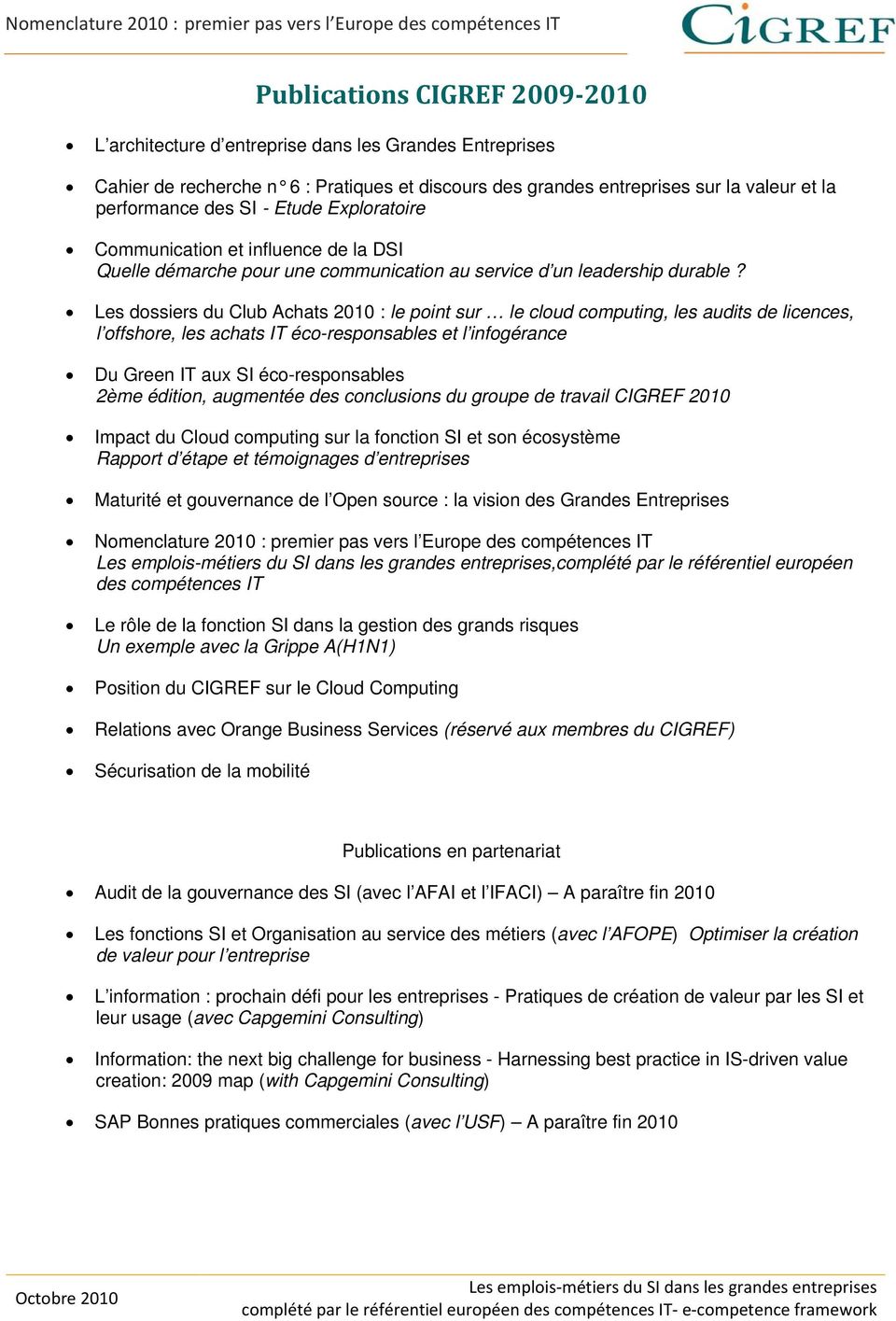
7 Nomenclature 2010 : premier pas vers l Europe des compétences IT Sommaire PRÉAMBULE... 1 ORGANISATION DE LA NOMENCLATURE DES MÉTIERS DES SYSTÈMES D INFORMATION DU CIGREF... 4 PRINCIPAUX CHANGEMENTS PAR RAPPORT À LA NOMENCLATURE CIGREF PUBLIÉE EN Origine du projet référentiel de compétence ou e CF (e Competence Framework)... 6 Description du e Competence Framework... 7 Les enjeux du e Competence Framework... 9 L intégration du e Competence Framework dans la nomenclature du CIGREF PILOTAGE, ORGANISATION ET GESTION DES EVOLUTIONS DU SYSTEME D INFORMATION Consultant en systèmes d information Urbaniste des systèmes d information Responsable du système d information «métier» Gestionnaire d applications Chargé d affaires interne MANAGEMENT DE PROJETS Directeur de projets Chef de projet maitrise d ouvrage Chef de projet maitrise d œuvre CYCLE DE VIE DES APPLICATIONS Responsable des systèmes applicatifs Concepteur développeur Testeur Intégrateur d applications Paramétreur de logiciels MISE A DISPOSITION ET MAINTENANCE EN CONDITION OPERATIONNELLE DES INFRASTRUCTURES Technicien d exploitation Technicien poste de travail Technicien réseaux télécoms Administrateur d outils / de systèmes / de réseaux télécoms Administrateur de bases de données Intégrateur d exploitation Pilote d exploitation Expert systèmes d exploitation Expert réseaux télécoms Architecte technique SUPPORT ET ASSISTANCE AUX UTILISATEURS Assistant fonctionnel Technicien support utilisateurs Octobre 2010 Les emplois métiers du SI dans les grandes entreprises complété par le référentiel européen des compétences IT e competence framework
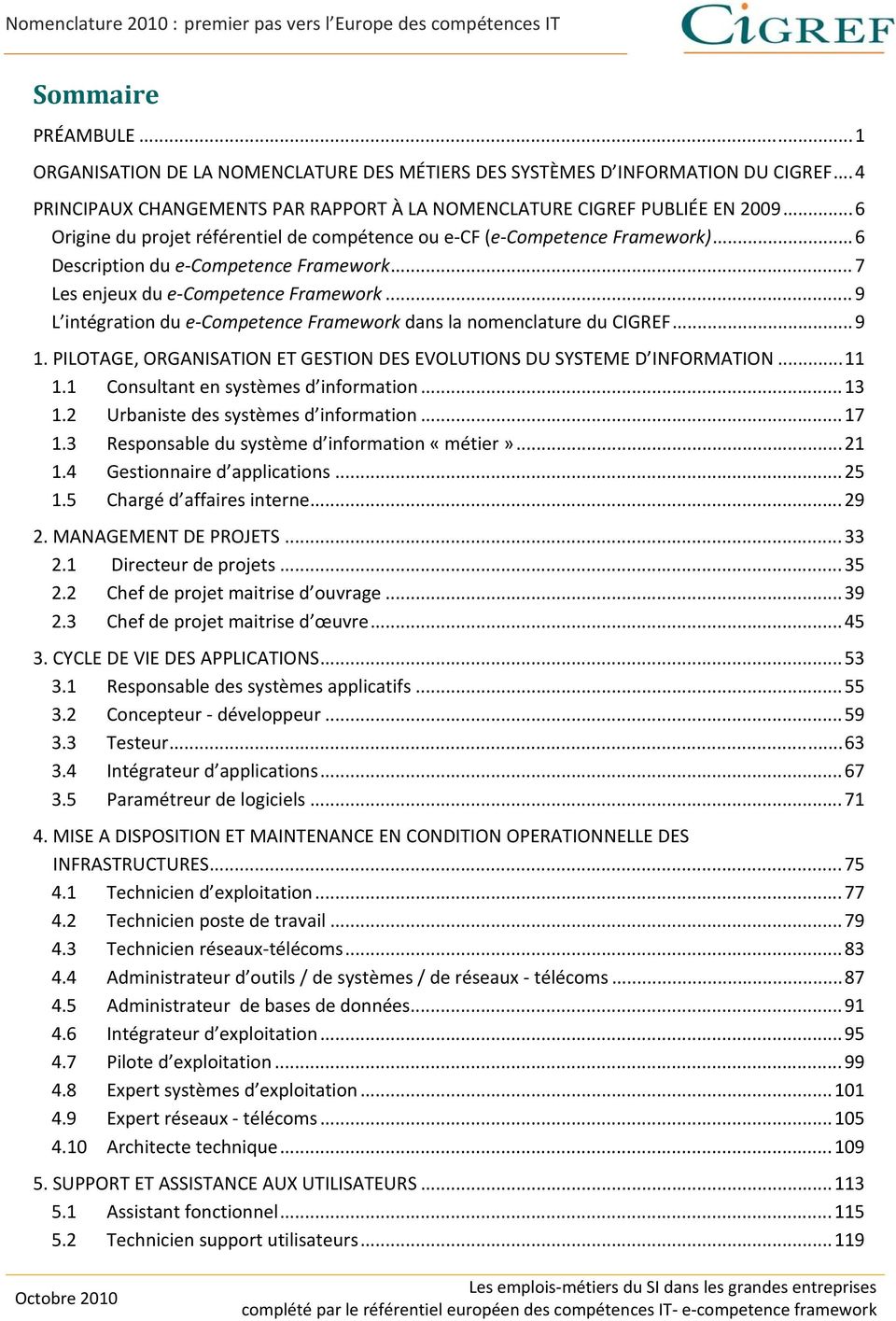
8 Nomenclature 2010 : premier pas vers l Europe des compétences IT 6. SUPPORT METHODE, QUALITE ET SECURITE Expert méthode et outils / qualité / sécurité Manager de contrats Responsable sécurité des systèmes d information RSSI MANAGEMENT OPERATIONNEL Directeur des systèmes d information Responsable d entité Responsable télécoms Responsable d exploitation Responsable d études ANNEXE 1 : RÉCAPITULATIF DU CROISEMENT MÉTIERS/COMPÉTENCES ANNEXE 2 : LE RÉFÉRENTIEL DE COMPÉTENCES EUROPÉEN A. PLAN A1. IS and Business Strategy Alignment A.2. Service Level Management A3. Business Plan Development A4. Product or Project Planning A5. Architecture Design A6. Application Design A7. Technology Watching A8. Sustainable Development B. BUILD B1. Design and Development B2. Systems Integration B3. Testing B4. Solution Deployment B5 Documentation Production C. RUN C1. User Support C2. Change Support C3. Service Delivery C4. Problem Management D. ENABLE D1. Information Security Strategy Development D2. ICT Quality Strategy Development D3. Education and Training Provision D4. Purchasing D5. Sales Proposal Development D6. Channel Management D7. Sales Management Octobre 2010 Les emplois métiers du SI dans les grandes entreprises complété par le référentiel européen des compétences IT e competence framework
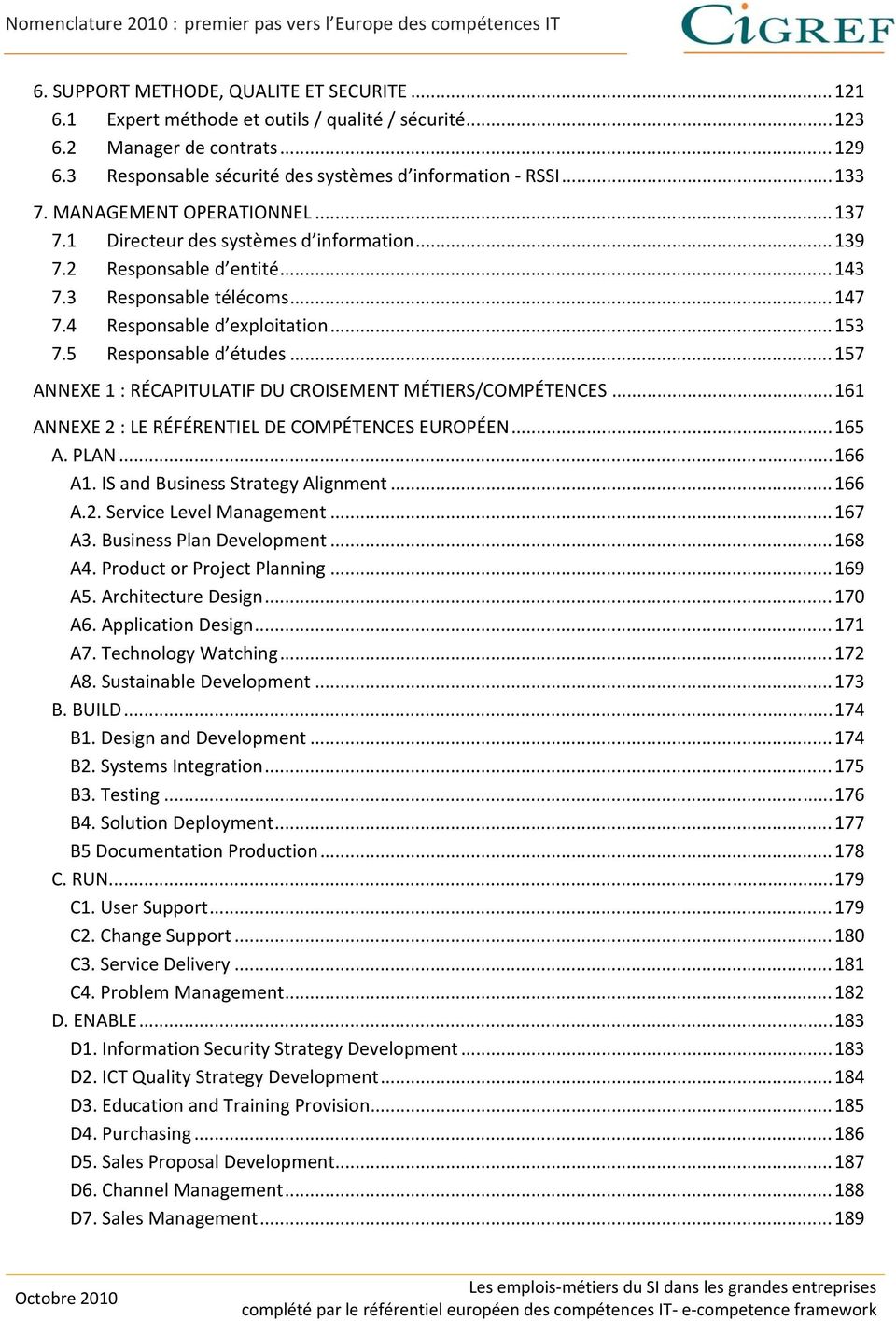
9 Nomenclature 2010 : premier pas vers l Europe des compétences IT D8. Contract Management D9 Personnel Development D10 Information and Knowledge Management E. MANAGE E1. Forecast Development E2. Project and Portfolio Management E3. Risk Management E4. Relationship Management E5. Process Improvement E6. ICT Quality Management E7. Business Change Management E8. Information Security Management E9. IT Governance Figures Figure 1 : Traduction des besoins de l'entreprise dans le e CF... 8 Octobre 2010 Les emplois métiers du SI dans les grandes entreprises complété par le référentiel européen des compétences IT e competence framework
10 Nomenclature 2010 : premier pas vers l Europe des compétences IT Préambule Depuis maintenant 19 ans, le CIGREF publie régulièrement une nomenclature des «emploismétiers» des systèmes d information. Cet outil est le résultat d un partage d expériences entre directeurs des ressources humaines des DSI des entreprises membres du CIGREF formalisé en une description commune des métiers des systèmes d information de leur entreprise. Ce travail en commun, régulièrement mis à jour permet aussi un suivi de l évolution des métiers de la DSI. Cette évolution traduit les changements dans les organisations dont ils font partie. La nomenclature offre donc un éclairage particulier sur l évolution des DSI. La première version, élaborée en 1991, proposait quatre familles de métiers issues de l informatique traditionnelle en entreprise : le conseil en système d information, les études et le développement, la production et l exploitation l assistance technique interne Dans les années , la DSI s ouvre aux métiers et se professionnalise dans son pilotage : en 1995, la nomenclature fait alors apparaitre deux nouvelles familles de métiers : le support et l assistance aux utilisateurs révèlent l importance croissante accordée par les directions des systèmes d information à l utilisateur et à l entreprise. l administration et la gestion de la DSI reflètent la volonté de soumettre la direction des systèmes d information aux mêmes contraintes de gestion que l ensemble de l entreprise. En 2000 l informatique des grandes entreprises était en train de connaître d importantes évolutions technologiques, stratégiques et organisationnelles. Ces changements se traduisent dans les nomenclatures de 2001 et 2002 : par une mise en perspective des possibilités de carrière et un avis du CIGREF sur l évolution de chaque métier par l apparition de nombreux métiers tels que : o le technicien support SVP qui confirme la prise en compte des utilisateurs au sein des entreprises o les administrateurs d outils / systèmes / réseaux et télécoms et les administrateurs de bases de données. o le paramétreur ERP qui confirme le déploiement des progiciels o le responsable sécurité du système d information suite à la prise en compte des problématiques de sécurité identifiées lors de l an 2000 Octobre Les emplois métiers du SI dans les grandes entreprises complété par le référentiel européen des compétences IT e competence framework
11 Nomenclature 2010 : premier pas vers l Europe des compétences IT o l essor des sites web et d internet fera apparaître en 2001 le métier de concepteur / développeur internet, qui disparaîtra en 2002, o le management de la DSI s étoffe en 2001 en décrivant les métiers de responsable d exploitation informatique et de responsable d une entité informatique, o en 2002 parce que l urbanisation du système d information devient essentielle le métier d architecte du SI évolue en urbaniste des systèmes d information. De nombreuses organisations de l écosystème IT, entreprises du CIGREF, cabinets de conseils en organisation et gestion des compétences, filières de formation, adoptent alors la nomenclature, s en sont fortement inspiré ou y font référence. En 2005, les entreprises membres du CIGREF ont toutes un référentiel des métiers des systèmes d'information opérationnel. Mais la problématique se déplace alors. Elle n'est plus «métiers» mais «compétences» : les évolutions des politiques de ressources humaines des grands groupes qui, pour prendre en compte des phénomènes comme l'évolution des budgets informatiques, des technologies, de la gestion des prestataires, le papy boom ou la mobilité en entreprise, mettent en place au sein de leur DSI des plans ambitieux de gestion des compétences. En 2005, le CIGREF revisite alors complètement les grilles de compétences de sa nomenclature et envisage l élaboration d un nouvel outil : un référentiel de compétences IT, complémentaire de la nomenclature des métiers IT. Un appel à participer aux travaux sur l élaboration d un référentiel de compétences IT international (e Competence framework ou e CF) a déplacé cette réflexion au niveau européen. Dans le cadre du CEN/ISSS (European Committee for Standardization/Information Society Standardization System) et avec le support de la Commission Européenne (CE), une structure de pilotage nommée «ICT Skills Workshop» a été constituée dès 2004 pour définir et mettre en œuvre un plan d action visant à promouvoir le métier d informaticien dans l Union Européenne. Le CIGREF, avec le groupe RH, a activement participé à l équipe d experts qui travaille à la mise en œuvre du e Competence framework. En 2008 cette équipe produisait une première version prototype de cet outil. Au vu des résultats, le CIGREF a alors décidé de compléter la nomenclature du CIGREF en remplaçant les grilles de compétences CIGREF par celles du e CF. Aujourd hui en 2009, la DSI est reconnue comme source de création de valeur, son attractivité augmente, mais en même temps, elle se banalise de plus en plus en devenant une direction comme une autre qui participe au business de l entreprise. Cette professionnalisation de la DSI se traduit par des changements dans les modèles et les organisations, notamment le passage au mode service qui influe fortement sur l organisation des métiers. En 2005, la structuration des métiers de la DSI donnait une vision essentiellement «technique» du système d information. La réalité des entreprises a changé depuis. Les métiers de la DSI se sont progressivement réorganisés pour passer d'une vision par silos qui mettait en valeur la technicité des métiers, à une vision par couche qui organise les métiers en regard des processus métiers de Octobre Les emplois métiers du SI dans les grandes entreprises complété par le référentiel européen des compétences IT e competence framework
12 Nomenclature 2010 : premier pas vers l Europe des compétences IT l entreprise, confortant l idée que les DSI sont, dans une vision globale, en lien avec le business et la stratégie de l'entreprise, et que la place de la DSI n'est plus uniquement technique, qu elle s'intéresse aussi à l'organisation. En 2009, la nomenclature évolue donc vers une nouvelle articulation des métiers autour des grandes familles suivantes : 1. Pilotage, organisation et gestion des évolutions du système d information 2. Management de projet 3. Cycle de vie des applications 4. Mise à disposition et maintenance en condition opérationnelle des infrastructures 5. Support et assistance aux utilisateurs 6. Support méthode, qualité et sécurité 7. Management opérationnel Cette évolution tire les métiers de la DSI vers le haut, leur donnant de la valeur ajoutée et de l'attractivité. La version 2009 de la nomenclature CIGREF prépare aussi au remplacement des compétences CIGREF par celles, européennes, de l e CF : les compétences CIGREF sont alors supprimées des descriptions des métiers et mises en annexe. De 2008 à 2010, les travaux européens sur le e competence framework continuent, toujours avec la participation active du groupe RH du CIGREF. Une version finalisée est obtenue au printemps Le CIGREF travaille alors à la répartition des compétences décrites dans l e CF dans les métiers de la nomenclature du CIGREF. C est l objet de cette nouvelle version 2010 de la nomenclature des métiers des systèmes d information du CIGREF. Octobre Les emplois métiers du SI dans les grandes entreprises complété par le référentiel européen des compétences IT e competence framework
13 Nomenclature 2010 : premier pas vers l Europe des compétences IT Organisation de la nomenclature des métiers des systèmes d information du CIGREF La nomenclature des métiers des systèmes d information du CIGREF présente de façon synthétique les principales «missions», «activités et tâches» et «compétences» pour les principaux métiers des technologies de l information dans les grandes entreprises françaises. Il présente également le parcours professionnel type (profils et expériences antérieures) et les tendances d évolution de la fonction. L ensemble des métiers est donc organisé en sept familles : 1. Pilotage, organisation et gestion des évolutions du système d information Cette famille regroupe tous les métiers qui touchent de manière globale à la mise en cohérence organisationnelle et fonctionnelle du ou des SI. La plupart de ces métiers travaille avec le business dans le respect des orientations stratégiques et ambitions de l'entreprise 2. Management de projet Cette famille regroupe tous les métiers qui pilotent suivent et coordonnent les projets de développement, déploiement, infrastructure ou méthode Informatique, risques etc. Ces métiers organisent les travaux, la gestion des ressources et la communication. 3. Cycle de vie des applications Cette famille regroupe les métiers liés à la conception, au développement et à la réalisation technique et applicative des projets. Ces métiers n'interviennent pas sur l'organisation des SI mais sur les briques mises en œuvre pour intégrer, concevoir et maintenir les solutions IT. 4. Mise à disposition et maintenance en condition opérationnelle des infrastructures Cette famille regroupe les métiers liés à l'étude, la conception, le développement, l'intégration et l'exploitation des infrastructures. Elle comprend aussi les métiers liés au support IT interne à la DSI. 5. Support et assistance aux utilisateurs Cette famille regroupe les métiers tournés vers l'utilisateur ou usager du SI en termes d'assistance et d'accompagnement. 6. Support méthode, qualité et sécurité Cette famille regroupe tous les métiers liés à la définition, la mise en place, le contrôle et suivi (audit) des normes et référentiels qualité, méthode et sécurité, en phase avec la gouvernance de la DSI. 7. Management opérationnel Cette famille regroupe tous les métiers à responsabilité hiérarchique en termes de ressources humaines, de budget, de décision ou de périmètre. Chaque famille regroupe un ensemble de fiches d identification des métiers ; pour chacune d entre elles une trame est proposée présentant : Octobre Les emplois métiers du SI dans les grandes entreprises complété par le référentiel européen des compétences IT e competence framework
14 Nomenclature 2010 : premier pas vers l Europe des compétences IT l appellation du métier, les autres appellations courantes ou spécifiques en France et ses équivalences anglo saxonnes utilisées dans les entreprises ; la mission du métier, comprenant les attributions principales, la finalité de cet emploi telle qu elle doit être prise en compte pour celui qui l occupe ainsi que la contribution à la performance (au projet, au «métier», à l entreprise) ; la description des activités et tâches significatives telles qu on les rencontre dans la plupart des organisations ; La liste des compétences, issues du référentiel de compétence européen e CF (fourni en annexe p 165), que l on observe dans la constitution des métiers IT des entreprises membres. les tendances et facteurs d évolution de l emploi métier considéré : contexte stratégique, évolution des marchés et des technologies, utilisation accrue de certains produits et services, évolution des organisations, des clients, du management, de la réglementation au cours des dernières années comme au cours des prochaines ; Pour chaque métier, le CIGREF a souhaité indiquer le livrable type que le métier doit produire ainsi que les indicateurs nécessaires pour mesurer la performance du métier. Ces deux derniers points ne sont donnés qu à titre indicatif et ne sont pas exhaustifs. Octobre Les emplois métiers du SI dans les grandes entreprises complété par le référentiel européen des compétences IT e competence framework
15 Nomenclature 2010 : premier pas vers l Europe des compétences IT Principaux changements par rapport à la nomenclature CIGREF publiée en 2009 Il n y a pas de changement concernant la description des métiers de la nomenclature entre la version 2009 et Les fiches métiers ont été complétées avec les compétences issues de l e competence framework ou e CF. Les compétences CIGREF présentes en annexe dans la version 2009 ont été supprimées puisque n ayant plus lieu d être. Origine du projet référentiel de compétence ou e CF (e Competence Framework) Dans le cadre du CEN/ISSS (European Committee for Standardization/Information Society Standardization System) et avec le support de la Commission Européenne (CE), une structure de pilotage nommée «ICT Skills Workshop 1» a été constituée dès 2004 pour définir et mettre en œuvre un plan d action visant à promouvoir le métier d informaticien dans l Union Européenne. La contribution attendue de ces praticiens est déterminante dans l atteinte des objectifs de croissance fixés à Lisbonne en La diversité des pays, des entreprises et organismes représentés dans ce workshop, a été dès le départ un facteur clé de réussite. Un diagnostic approfondi a permis de dégager, fin 2005, 4 orientations pour la suite des travaux : 1. mieux comprendre et définir les compétences dans le domaine des TIC, en particulier dans leur mise en œuvre en entreprise 2. clarifier les besoins des employeurs de façon à adapter en conséquence les dispositifs de formation initiale 3. poursuivre et développer la formation continue (tout au long de la vie professionnelle) 4. établir des relations avec l EQF (European Qualification Framework) Les différents référentiels existants en Europe ont été analysés 2 : ils mélangent souvent les notions de connaissances et de savoir faire ils sont confus au niveau des résultats attendus ils ont des finalités très différentes ils sont souvent obsolètes, car pas toujours adaptés aux nouvelles technologies, aux nouvelles méthodes de travail et aux nouvelles organisations. En définitive, courant 2006, il a été décidé de construire un «référentiel de compétences européen» (European e competence framework e CF) en s appuyant sur les trois référentiels les plus représentatifs en Europe : 1 Pour le CEN/ISSS and WS on ICT Skills cf Setting European Standards on ICT Skills par P. Schgör in NL Vol.7, no.1 Spring 2009 et sectors/isss/activity/wsict skills.asp 2 Cf. document CWA Octobre Les emplois métiers du SI dans les grandes entreprises complété par le référentiel européen des compétences IT e competence framework
16 Nomenclature 2010 : premier pas vers l Europe des compétences IT 1. les descriptifs de compétences (orientés savoir faire) diffusés par SFIA (UK) 2. les profils d emplois et les processus de développement diffusés par AITTS (D) 3. la nomenclature des emplois diffusée par le CIGREF (F) Une équipe projet, composée d experts représentants ces trois référentiels, a proposé une approche, un vocabulaire et un cadre pour structurer le nouveau référentiel e CF. Cette équipe s est appuyée sur un ensemble important et varié d experts européens en gestion des ressources humaines et en gestion des systèmes d information. E CF est donc le résultat d un consensus européen qui a nécessité la participation d acteurs de l écosystème IT 3, d entreprises utilisatrices 4, et de différents organismes liés à l'éducation et à la formation 5. Description du e Competence Framework Cette équipe projet a produit une première version intermédiaire (e CF 1.0) en 2008 et la version définitive (2.0) en L utilisation de ce référentiel de compétences européen fournit des bases claires qui peuvent aider les entreprises à prendre les bonnes décisions concernant le recrutement, la gestion des carrières, la formation ou l évaluation des personnels. Il effectue un lien avec les différents référentiels nationaux et propose une articulation des compétences, connaissances, et savoir faire IT en phase avec le cadre de travail de l entreprise. 36 compétences ont été définies. Elles ont été réparties dans une structure comprenant quatre dimensions qui reflètent les différents niveaux de décision en termes de gestion des ressources humaines, que l on peut trouver dans une entreprise : 1. La première dimension s articule autour de 5 domaines de préoccupation directement issus des processus business de l entreprise: PLAN, BUILD, RUN, ENABLE et MANAGE. 2. La seconde dimension définit un ensemble de compétences pour chaque domaine, avec une description générique pour chacune. Les 36 compétences identifiées comportent une définition générique compréhensible par tous les acteurs européens. 3. La troisième dimension spécifie l un des 5 niveaux de maîtrise et de responsabilité de chaque compétence en phase avec les niveaux 3 à 8 définis dans le référentiel de qualification européen (EQF 6 ) 4. La quatrième dimension du référentiel est réservée aux connaissances (knowledge) et savoirfaire (skills). Cette partie fournit un ensemble non exhaustif d éléments qui permettent de préciser les pré requis importants qui définissent une compétence donnée. 3 Bitkom, Cisco Systems, SYNTEC Informatique, Deutsche Telekom 4 CIGREF, Bayer Business Services, Airbus, Michelin, NHS, IG Metall 5 EMSI Grenoble, Fondazione Politecnico di Milano, EXIN International 6 European Qualification Framework Octobre Les emplois métiers du SI dans les grandes entreprises complété par le référentiel européen des compétences IT e competence framework
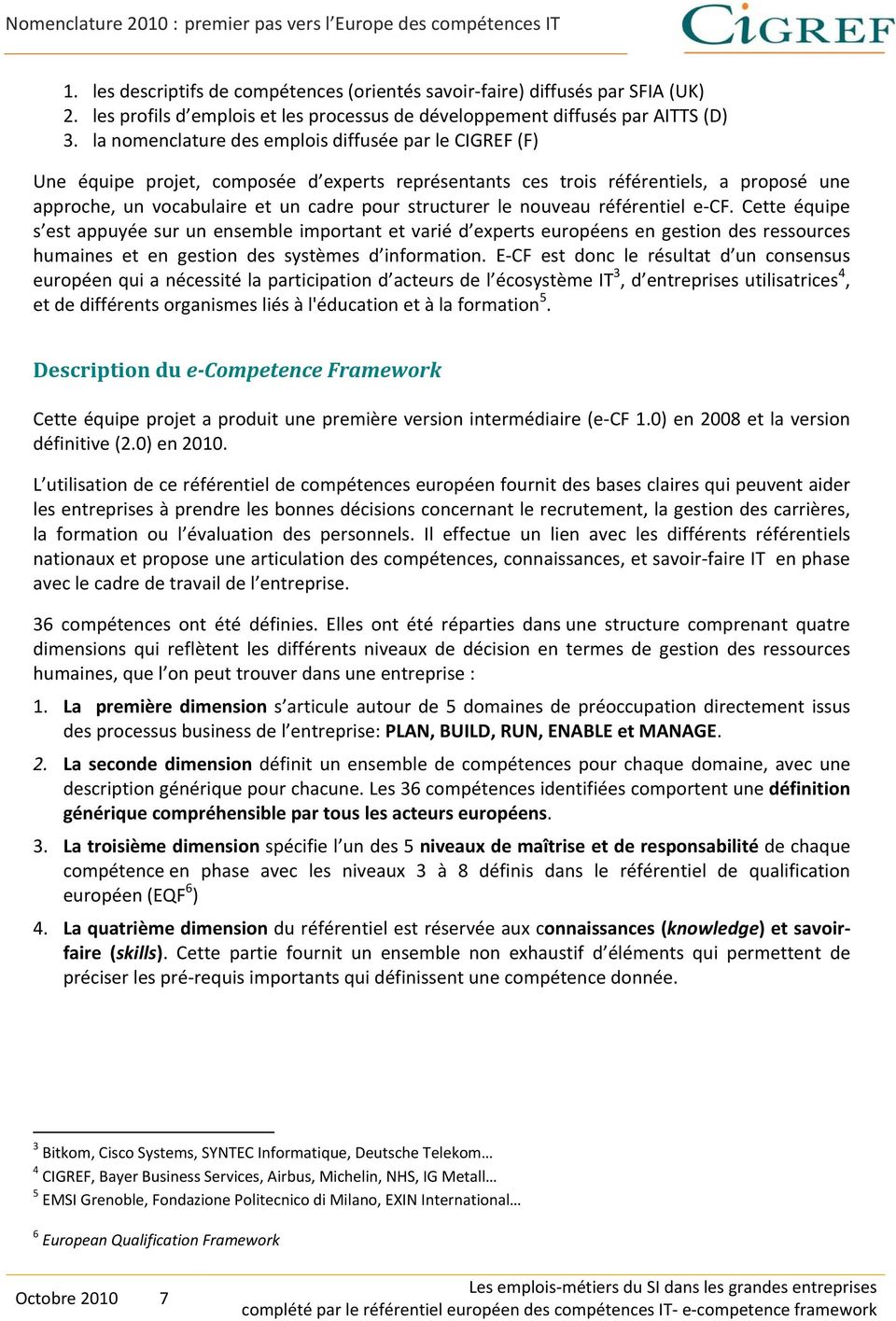
17 Nomenclature 2010 : premier pas vers l Europe des compétences IT Figure 1 : Traduction des besoins de l'entreprise dans le e CF Avec cette structure arborescente, les entreprises peuvent satisfaire, avec le niveau approprié de granularité : la Gestion Prévisionnelle des Emplois et Compétences (GPEC) la gestion collective des emplois et des postes (incluant la qualification) le développement individuel des plans de carrière et des compétences la gestion du catalogue des formations «poussées» par l entreprise le plan annuel de formation Pour faciliter l adoption et la compréhension, le référentiel est accompagné d un guide d utilisation 7 qui fournit des recommandations permettant à tout acteur de l écosystème informatique européen, de le compléter en proposant de nouvelles définitions adaptées à leur secteur d activité. Le référentiel est aussi accompagné d une documentation méthodologique permettant de répondre aux besoins d'un public plus scientifique. Enfin, pour faciliter sa consultation, le référentiel de compétences sera accessible à tout utilisateur européen via un portail européen de services 8 7 User guidelines for the application of the European e Competence Framework Disponible sur 8 Qui sera ouvert à l adresse Octobre Les emplois métiers du SI dans les grandes entreprises complété par le référentiel européen des compétences IT e competence framework
18 Nomenclature 2010 : premier pas vers l Europe des compétences IT Les enjeux du e Competence Framework Ce référentiel de compétences IT constitue aujourd hui une base sérieuse pour une norme européenne. Il est suffisamment générique pour être adaptable aux spécificités des différents pays et aux évolutions technologiques des années à venir. Il peut contribuer dans chaque pays européen à stabiliser les structures de classification des compétences et des emplois de l IT et constituer au niveau de l entreprise, un langage commun pour la définition des emplois, des formations, des parcours de formation, des qualifications, des parcours de carrière, des certifications, etc. Les utilisateurs potentiels du e Competence Framework sont nombreux : il concerne à la fois les informaticiens qui veulent progresser dans l exercice de leur métier, les responsables Informatiques et des Ressources Humaines qui cherchent à développer leur personnel et à anticiper sur leurs besoins futurs, les responsables des organismes de formation qui cherchent à faire évoluer leur enseignement et les étudiants qui cherchent des orientations pour guider leur avenir etc. L intégration du e Competence Framework dans la nomenclature du CIGREF Depuis maintenant 5 ans, le CIGREF a fait évoluer sa nomenclature des métiers IT avec pour objectif d intégrer les compétences du e CF. En 2010, lors de la finalisation de l outil e CF, le groupe RH du CIGREF s est réuni au cours de deux sessions pour distribuer chacune des compétences dans les métiers de la nomenclature. Le travail a été effectué en s appuyant la réalité des entreprises présentes qui ont utilisé les référentiels et descriptions des métiers existants dans leur organisation. Tous les métiers ont été complétés, et toutes les compétences ont été utilisées à l exception de la compétence D6, Channel Management, qui ne concerne pas les entreprises utilisatrices mais celles liées à l écosystème IT. Ce document est donc le résultat d un consensus entre les membres du groupe RH. La synthèse de la répartition des compétences dans les métiers est consultable en Annexe 1 : récapitulatif du croisement métiers/compétences (p 161) Chaque fiche métier a été complétée par les compétences identifiées. Seules les dimensions 1, 2 et 3 ont été intégrées dans les fiches métiers. Les connaissances (knowledge) et les savoir faire (skills) ne sont pas présents directement dans les fiches métiers afin de faciliter leur lecture. Ils sont néanmoins accessible dans la version complète du référentiel qui se trouve en Annexe 2 : le référentiel de compétences européen (p 165) Octobre Les emplois métiers du SI dans les grandes entreprises complété par le référentiel européen des compétences IT e competence framework
19

20 1. PILOTAGE, ORGANISATION ET GESTION DES EVOLUTIONS DU SYSTEME D INFORMATION Cette famille regroupe tous les métiers qui touchent de manière globale à la mise en cohérence organisationnelle et fonctionnelle du ou des SI. La plupart de ces métiers travaille avec le business dans le respect des orientations stratégiques et ambitions de l'entreprise Cette famille comprend les métiers suivants : 1.1 Consultant en systèmes d information 1.2 Urbaniste des systèmes d information 1.3 Responsable du système d information «métier» 1.4 Gestionnaire d applications 1.5 Chargé d affaires internes 11
21
22 1 Pilotage, organisation et gestion des évolutions du système d information 1.1 Consultant en systèmes d information 1/3 Consultant Chargé d études informatique Project Integrator Conseil en informatique Chef de projet MOA délégué Account Relationship Manager MISSION Il anticipe et fait mûrir les nouveaux projets par une sensibilisation à l apport des technologies et une analyse prospective des processus métiers. Il assiste la maîtrise d ouvrage pour la définition des besoins et des solutions à mettre en œuvre, dans un souci de meilleure intégration dans le système d information d entreprise. ACTIVITES ET TACHES Conseil en système d information Conseille sur l'optimisation de l utilisation des outils et des systèmes en place Informe et sensibilise la DG et les directions métiers aux technologies et aux apports des technologies de l information. Effectue des prescriptions et recommandations pour le développement et la mise en œuvre d un projet ou d une solution Assistance aux métiers ou au maître d'ouvrage Participe à la définition des spécifications générales des projets Vérifie la cohérence de l architecture applicative et fonctionnelle et de son évolution Participe à l'évaluation et au choix d un progiciel Assiste les métiers ou la maîtrise d ouvrage pour le développement de l informatique de service Effectue des préconisations sur le management dans le cadre de l accompagnement d un projet Participe à la conception du plan d accompagnement COMPETENCES (issues du référentiel de compétence européen) A3. Business Plan Development Level 4 A. PLAN Addresses the design and structure of a business or product plan including the identification of alternative approaches with return on investment propositions. Consider the possible and applicable sourcing models Presents cost benefit analysis and reasoned arguments in support of the selected strategy. Ensures compliance of business and technology strategies. Communicates and sells business plan to relevant stakeholders and addresses political, financial, and organizational interests, including SWOT analysis. A4. Product or Project Planning Specifies, refines, updates and makes available a formal approach to implement solutions, necessary to develop and operate IS architecture. Manages the relationship with the business actors to ensure that this architecture is in line with business requirements. Identifies the needs for organization change and the components required (hardware, software, applications, processes, information and technology platform). Ensures that all aspects take account of interoperability, scalability usability and security. Provides leadership for the creation of an information system strategy that meets the requirements of the business. Exploits specialist knowledge to create and maintain complex documents of the project or product. La liste des knowledge (connaissances) et des skills (savoirs faire), correspondant aux compétences sélectionnées pour ce métier, se trouve en annexe. 13
23 1 Pilotage, organisation et gestion des évolutions du système d information 1.1 Consultant en systèmes d information 22/3 A. PLAN A6. Application Design COMPETENCES (suite) Defines the most suitable ICT solutions in accordance with ICT policy and user/customer needs. Accurately estimates development, installation and maintenance of application costs. Selects appropriate technical options for solution design, optimizing the balance between cost and quality. Identifies a common reference framework to validate the models with representative users A8. Sustainable Development Estimates the impact of ICT solutions in terms of eco responsibilities including energy consumption. Advises business and ICT stakeholders on sustainable alternatives that are consistent with the business strategy. Applies an ICT purchasing and sales policy which fulfils eco responsibilities. Level 1 Contributes to the design and general functional specification and interfaces. Promotes awareness, training and commitment for the deployment of sustainable development and applies the necessary tools for piloting this approach. E3. Risk Management Implements the management of risk across information systems through the application of the enterprise defined risk management policy and procedure. Assesses risk to the organizations business, and documents potential risk and containment plans. Decides on appropriate actions required to adapt security and address risk exposure. Evaluates, manages and ensures validation of exceptions; audits ICT processes and environment E. MANAGE E4. Relationship Management Establishes and maintains positive business relationships between the client and provider (internal or external) deploying and complying with organizational processes. Maintains regular communication with client/partner/supplier, and addresses needs through empathy with their environment and managing supply chain communications. Ensures that client/partner/supplier needs, concerns or complaints are understood and addressed in accordance with organizational policy. Level 4 Provides leadership for large or many client relationships. Authorizes investment in new and existing relationships. Leads the design of a workable procedure for maintaining positive business relationships E5. Process Improvement Measures effectiveness of existing ICT processes. Researches and benchmarks ICT process design from a variety of sources. Follows a systematic methodology to evaluate, design and implement process or technology changes for measurable business benefit. Assesses potential adverse consequences of process change. Exploits specialist knowledge to research existing ICT processes and solutions in order to define possible innovations. Makes recommendations based on reasoned arguments La liste des knowledge (connaissances) et des skills (savoirs faire), correspondant aux compétences sélectionnées pour ce métier, se trouve en annexe. 14
24 1 Pilotage, organisation et gestion des évolutions du système d information 1.1 Consultant en systèmes d information 3/3 LIVRABLES Note d'opportunité/fiche d'émergence (permet de connaitre s'il est opportun de lancer le projet) Note de cadrage Dossier de pré étude Spécifications générales INDICATEURS DE PERFORMANCE Dans un temps raisonnable : le nombre de sollicitations par les métiers le nombre de réponses apportées par rapport aux questions posées par les métiers PROFIL Bac + 5 PARCOURS PROFESSIONNEL EXPERIENCE Plus de 10 ans. Expérience diversifiée. Bonne connaissance des métiers de l'entreprise et des usages qu'elle fait du SI. TENDANCES ET FACTEURS D EVOLUTION Métier situé à la jonction de la maitrise d ouvrage et de la maitrise d œuvre, qui tend à accueillir des professionnels bénéficiant d une double compétence (métier et informatique) et capables de répondre aux besoins d évolution accélérée des systèmes d information. 15
25
26 1 Pilotage, organisation et gestion des évolutions du système d information 1.2 Urbaniste des systèmes d information 1/3 Architecte fonctionnel Architecte de SI Applications Architect MISSION Il garantit l évolution cohérente de l ensemble du système d information dans le respect des objectifs de l entreprise, du domaine fonctionnel et des contraintes externes et internes (de risques, de coûts, de délais ) et en exploitant au mieux les possibilités de l état de l art en relation avec l architecture technique. ACTIVITES ET TACHES Gère (construction, mise à jour et évolution) la cartographie du système d information ou du sousensemble du système d information dont il a la charge Conception du système d information Garantie de la cohérence du système d information Communication Garantit l'intégrité permanente de la cartographie du SI en regard du schéma directeur Spécifie et valide les standards et référentiels d'urbanisation du SI Propose des scénarios d évolution et de simplification du système d information en tenant compte des problématiques de décision de gestion, d'évolution de l offre, d'évolution des besoins, des contraintes d'organisation, etc. Évalue la pertinence et la cohérence des projets par rapport à l architecture cible et aux systèmes existants (par des études d opportunité, de définition des besoins, de choix d architecture du système fonctionnel etc.) Promeut par des actions de conseil et de communication la cartographie du système d information auprès des directions métiers et de la DG Travaille en relation étroite et permanente avec, d'une par les directeurs métiers, d'autre par les responsables des domaines fonctionnels et techniques du SI COMPETENCES (issues du référentiel de compétence européen) A1. IS and Business Strategy Alignment Anticipates long term business requirements and determines the IS model in line with organization policy. Makes strategic IS policy decisions for the enterprise, including sourcing strategies. Level 4 Provides leadership for the construction and implementation of long term innovative IS solutions. A. PLAN A5. Architecture Design Specifies, refines, updates and makes available a formal approach to implement solutions, necessary to develop and operate the IS architecture. Manages the relationship with the business stakeholders to ensure that the architecture is in line with business requirements. Identifies the need for change and the components involved; hardware, software, applications, processes, information and technology platform. Ensures that all aspects take account of interoperability, scalability usability and security. Level 4 Acts with wide ranging accountability to define the strategy to implement ICT technology compliant with business need. Takes account of the current technology platform, obsolescent equipment and latest technological innovations La liste des knowledge (connaissances) et des skills (savoirs faire), correspondant aux compétences sélectionnées pour ce métier, se trouve en annexe. 17
27 1 Pilotage, organisation et gestion des évolutions du système d information 1.2 Urbaniste des systèmes d information 2/3 COMPETENCES (suite) A7. Technology Watching Level 4 A. PLAN Explores latest ICT technological developments to establish understanding of evolving technologies. Devises innovative solutions for integration of new technology into existing products, applications or services or for the creation of new solutions. Exploits wide ranging specialist knowledge of new and emerging technologies, coupled with a deep understanding of the business, to envision and articulate the solutions of the future. Provides expert guidance and advice, to the leadership teams in business and in technology, about potential innovations to support strategic decision making. A8. Sustainable Development Estimates the impact of ICT solutions in terms of eco responsibilities including energy consumption. Advises business and ICT stakeholders on sustainable alternatives that are consistent with the business strategy. Applies an ICT purchasing and sales policy which fulfils eco responsibilities. D2. ICT Quality Strategy Development Promotes awareness, training and commitment for the deployment of sustainable development and applies the necessary tools for piloting this approach. Level 4 D. ENABLE Defines, improves and refines a formal strategy to satisfy customer expectations and improve business performance (balance between cost and risks). Identifies critical processes influencing service delivery and product performance for definition in the ICT quality management system (ref D.4). Uses defined standards to formulate objectives for service management, product and process quality. Identifies ICT quality management accountability. Exploits wide ranging specialist knowledge to leverage and authorise the application of external standards and best practices. E3. Risk Management E. MANAGE Implements the management of risk across information systems through the application of the enterprise defined risk management policy and procedure. Assesses risk to the organizations business, and documents potential risk and containment plans. E4. Relationship Management Establishes and maintains positive business relationships between the client and provider (internal or external) deploying and complying with organizational processes. Maintains regular communication with client/partner/supplier, and addresses needs through empathy with their environment and managing supply chain communications. Ensures that client/partner/supplier needs, concerns or complaints are understood and addressed in accordance with organizational policy. Decides on appropriate actions required to adapt security and address risk exposure. Evaluates, manages and ensures validation of exceptions; audits ICT processes and environment Level 4 Provides leadership for large or many client relationships. Authorizes investment in new and existing relationships. Leads the design of a workable procedure for maintaining positive business relationships La liste des knowledge (connaissances) et des skills (savoirs faire), correspondant aux compétences sélectionnées pour ce métier, se trouve en annexe. 18
28 1 Pilotage, organisation et gestion des évolutions du système d information 1.2 Urbaniste des systèmes d information 3/3 E5. Process Improvement COMPETENCES (suite) Measures effectiveness of existing ICT processes. Researches and benchmarks ICT process design from a variety of sources. Follows a systematic methodology to evaluate, design and implement process or technology changes for measurable business benefit. Assesses potential adverse consequences of process change. Level 4 Provides leadership and authorizes implementation of innovations and improvements that will enhance competitiveness or efficiency. Demonstrates to senior management the business advantage of potential changes E. MANAGE E7. Business Change Management Assesses the implications of new IT solutions. Defines the requirements and quantifies the business benefits. Manages the deployment of change taking into account structural and cultural issues. Maintains business and process continuity throughout change, monitoring the impact, taking any required remedial action and refining approach Evaluates change requirements and exploits specialist skills to identify possible methods and standards that can be deployed E9. IT Governance Defines, deploys and controls the management of information systems in line with business imperatives. Takes into account all internal and external parameters such as legislation and industry standard compliance to influence risk management and resource deployment to achieve balanced business benefit. 19 Level 4 Provides leadership for IT governance strategy by communicating, propagating and controlling relevant processes across the entire IT infrastructure. La liste des knowledge (connaissances) et des skills (savoirs faire), correspondant aux compétences sélectionnées pour ce métier, se trouve en annexe. LIVRABLES La cartographie du système d'information Plans et scénarios d'évolution du SI Études d'opportunité INDICATEURS DE PERFORMANCE Mesure de l'agilité et de la réactivité du système d information à un changement donné (délai de prise en compte des évolutions fonctionnelles du SI suite aux demandes métiers) PARCOURS PROFESSIONNEL PROFIL Bac + 5 ingénieur d origine «études». EXPERIENCE Minimum 10 ans dans les domaines de la conduite de projet et mise en place réussie de systèmes dans plusieurs domaines fonctionnels. TENDANCES ET FACTEURS D EVOLUTION Ce métier suit la complexification et la rapidité d évolution des systèmes aussi bien sur un plan technique que fonctionnel. Il nécessite la capacité à pouvoir intégrer dans le système d information des éléments exogènes (progiciels, plates formes de convergence ) et de plus en plus interdépendants. Il nécessite aussi d'avoir une bonne maîtrise du risque de perte d intégrité du système d information dans un contexte d accélération des évolutions (techniques, concurrentielles, organisationnelles ). Il doit aussi s adapter en permanence aux évolutions juridiques et fonctionnelles de plus en plus fréquentes.
29
30 1 Pilotage, organisation et gestion des évolutions du système d information 1.3 Responsable du système d information «métier» 1/4 Responsable de domaine MISSION Il pilote l alignement du système d information du métier sur les orientations stratégiques et sur les processus métiers, en proposant des scénarios d évolution du système d information cohérents avec les objectifs et les processus définis et en garantissant la cohérence globale et dynamique ainsi que la pertinence et la performance du SI du métier. Pilotage stratégique ACTIVITES ET TACHES Contribue à l optimisation des processus métiers, des données, des applications et des systèmes associés (détection d opportunités ). Participe au pilotage de la performance, notamment économique du SI Promeut par des actions de conseil et de communication la cartographie du système d information comme un outil d aide à la décision et au pilotage de la performance Anticipe les changements et leurs impacts métiers sur le SI, et réciproquement Est responsable de la gestion du budget d'informatisation de son domaine Administration du SI Qualité et conduite de projet Formalise, consolide et fait évoluer la cartographie générale du système d information en s'appuyant sur : les modèles fonctionnels du métier ; les architectures des processus du métier ; les référentiels des informations de base et communes du métier ; les architectures fonctionnelles du SI (existant/cible) Participe à l'administration du système d information en termes de référentiels, règles, démarches, méthodologies, objets métier, et outils. Evalue la cohérence unitaire et globale (portefeuille) des projets par rapport au système d information (existant/cible) Consolide les écarts en termes de délais, de coûts ou de qualité Capitalise l ensemble des connaissances sur le système d information du métier : Garantit la qualité de la conduite de projet Gère la cartographie des compétences nécessaires à l évolution du SI A. PLAN COMPETENCES (issues du référentiel de compétence européen) A1. IS and Business Strategy Alignment Anticipates long term business requirements and determines the IS model in line with organization policy. Makes strategic IS policy decisions for the enterprise, including sourcing strategies. Level 4 Provides leadership for the construction and implementation of long term innovative IS solutions. La liste des knowledge (connaissances) et des skills (savoirs faire), correspondant aux compétences sélectionnées pour ce métier, se trouve en annexe. 21
31 1 Pilotage, organisation et gestion des évolutions du système d information 1.3 Responsable du système d information «métier» 2/4 A2. Service Level Management COMPETENCES (suite) Defines, validates and makes applicable service level agreements (SLA) and underpinning contracts for services offered. Negotiates service performance levels taking into account the needs and capacity of customers and business. Influences and prepares the final Service Level Agreement (SLA) and accounts for the final content. A. PLAN A3. Business Plan Development Addresses the design and structure of a business or product plan including the identification of alternative approaches with return on investment propositions. Consider the possible and applicable sourcing models Presents cost benefit analysis and reasoned arguments in support of the selected strategy. Ensures compliance of business and technology strategies. Communicates and sells business plan to relevant stakeholders and addresses political, financial, and organizational interests, including SWOT analysis. Level 4 Provides leadership for the creation of an information system strategy which meets the requirements of the business. A8. Sustainable Development Estimates the impact of ICT solutions in terms of eco responsibilities including energy consumption. Advises business and ICT stakeholders on sustainable alternatives that are consistent with the business strategy. Applies an ICT purchasing and sales policy which fulfils eco responsibilities. Promotes awareness, training and commitment for the deployment of sustainable development and applies the necessary tools for piloting this approach. D. MANAGE D9. Personnel Development Diagnoses individual and group competence, identifying skill needs and skill gaps. Reviews training and development options and selects appropriate methodology taking into account the needs of the individual and the business. Coaches and/ or mentors individuals and teams to address learning needs. D10. Information and Knowledge Management Identifies and manages structured and unstructured information and considers information distribution policies. Creates information structure to enable exploitation and optimization of information for business benefit. Understands appropriate tools to be deployed to create, extract, maintain, renew and propagate business knowledge in order to capitalize from the information asset. Level 4 Takes proactive action and develops organisational processes to address the development needs of individuals, teams and the entire workforce. Level 5 Correlates information and knowledge to create value for the business. Applies innovative solutions based on information retrieved. La liste des knowledge (connaissances) et des skills (savoirs faire), correspondant aux compétences sélectionnées pour ce métier, se trouve en annexe. 22
32 1 Pilotage, organisation et gestion des évolutions du système d information 1.3 Responsable du système d information «métier» 3/4 E2. Project and Portfolio Management COMPETENCES (suite) Implements plans for a programme of change. Plans and directs a single or portfolio of ICT projects to ensure co ordination and management of interdependencies. Orchestrates projects to develop or implement new, internal or externally defined processes to meet identified business needs. Defines activities, responsibilities, critical milestones, resources, skills needs, interfaces and budget. Develops contingency plans to address potential implementation issues. Delivers project on time, on budget and in accordance with original requirements. Creates and maintains documents to facilitate monitoring of project progress. Level 4 Exploits wide ranging skills in project management to work beyond project boundary. Manages complex projects or programmes, including interaction with others. Influences project strategy by proposing new or alternative solutions. Takes overall responsibility for project outcomes, including finance and resource management. Is empowered to revise rules and choose standards. E3. Risk Management Implements the management of risk across information systems through the application of the enterprise defined risk management policy and procedure. Assesses risk to the organizations business, and documents potential risk and containment plans. Level 2 Understands and applies the principles of risk management and investigates ICT solutions to mitigate identified risks E. ENABLE E4. Relationship Management Establishes and maintains positive business relationships between the client and provider (internal or external) deploying and complying with organizational processes. Maintains regular communication with client/partner/supplier, and addresses needs through empathy with their environment and managing supply chain communications. Ensures that client/partner/supplier needs, concerns or complaints are understood and addressed in accordance with organizational policy. Level 4 Provides leadership for large or many client relationships. Authorizes investment in new and existing relationships. Leads the design of a workable procedure for maintaining positive business relationships. E5. Process Improvement Measures effectiveness of existing ICT processes. Researches and benchmarks ICT process design from a variety of sources. Follows a systematic methodology to evaluate, design and implement process or technology changes for measurable business benefit. Assesses potential adverse consequences of process change. Exploits specialist knowledge to research existing ICT processes and solutions in order to define possible innovations. Makes recommendations based on reasoned arguments E6. ICT Quality Management Implements ICT quality policy to maintain and enhance service and product provision. Plans and defines indicators to manage quality with respect to ICT strategy. Reviews quality performance indicators and recommends enhancements to influence continuous quality improvement. La liste des knowledge (connaissances) et des skills (savoirs faire), correspondant aux compétences sélectionnées pour ce métier, se trouve en annexe. 23 Level 2 Communicates and monitors application of the organizations quality policy
33 1 Pilotage, organisation et gestion des évolutions du système d information 1.3 Responsable du système d information «métier» 4/4 E. ENABLE E7. Business Change Management COMPETENCES (suite) Assesses the implications of new IT solutions. Defines the requirements and quantifies the business benefits. Manages the deployment of change taking into account structural and cultural issues. Maintains business and process continuity throughout change, monitoring the impact, taking any required remedial action and refining approach E9. IT Governance Defines, deploys and controls the management of information systems in line with business imperatives. Takes into account all internal and external parameters such as legislation and industry standard compliance to influence risk management and resource deployment to achieve balanced business benefit. La liste des knowledge (connaissances) et des skills (savoirs faire), correspondant aux compétences sélectionnées pour ce métier, se trouve en annexe. LIVRABLES L'ensemble des PV de recette planifiés Le suivi de portefeuille de projets INDICATEURS DE PERFORMANCE Nombre de demandes d'évolution ou de corrections Degré de satisfaction du client Niveau de disponibilité des systèmes Tenue des budgets PARCOURS PROFESSIONNEL PROFIL Bac + 5 informatique ou management. EXPERIENCE Cadre supérieur ayant une expérience de 10 à 15 ans minimum dans un ou plusieurs domaines de l entreprise et ayant suivi des projets informatiques soit en tant que maîtrise d ouvrage (chef de projet MOA), soit en tant que maîtrise d œuvre (chef de projet MOE) afin d avoir la double compétence fonctionnelle et informatique nécessaire à la maîtrise de son domaine. TENDANCES ET FACTEURS D EVOLUTION Ce métier suit la complexification et la rapidité d évolution des systèmes aussi bien sur un plan technique que fonctionnel. Il nécessite la capacité à pouvoir intégrer dans le système d information des éléments exogènes (progiciels, plates formes de convergence ) et de plus en plus interdépendants. De plus en plus orienté vers la recherche de l amélioration de la qualité des relations entre les métiers, la MOA (quand elle existe) et la MOE. Il doit associer le développement des démarches d urbanisation fonctionnelles dans le pilotage du SI Level 4 Provides leadership to plan, manage and implement significant IT led business change Level 5 Defines and aligns the IT governance strategy incorporating it into the organizations corporate governance strategy. Adapts the IT governance strategy to take into account new significant events arising from legal, economic, political, business or environmental issues. 24
34 1 Pilotage, organisation et gestion des évolutions du système d information 1.4 Gestionnaire d applications Pilote général de systèmes Gestionnaire processus / produits Gestionnaire du SI Pilote d applications MISSION Le gestionnaire d applications a pour objectif d améliorer la performance, de contribuer au fonctionnement et de participer à la gestion et à l évolution du système d information du métier pour la mise en cohérence avec les orientations, les modes de fonctionnement et les processus définis au niveau du métier. Conception d évolution du système d information ACTIVITES ET TACHES Représente les métiers ou maîtres d ouvrage lors de la vie courante des systèmes Participe à l élaboration des règles de fonctionnement et d utilisation du système d information Contribue à la construction et à l utilisation du SI et de son évolution : en proposant des améliorations, en participant à la gestion des idées et des propositions, en participant aux projets d adaptation et d évolution du SI, en participant aux recettes opérationnelles 1/4 Mise en œuvre du système d information Qualité du SI (performance, cohérence, coût, délai ) Effectue les actions et processus de gestion courante du système d information en place dans toutes ses dimensions (assistance, gestion des incidents, qualité de service, contrats, satisfaction, formation ) Participe activement au développement de l usage du système d information Contribue, en cohérence avec la stratégie du métier, à l évolution des processus et du système d information. Prête notamment attention, dès l expression des besoins, à l exploitabilité du futur système dans toutes ses dimensions (cahier de recette, acceptation, coûts, performance, ergonomie, cohérence fonctionnelle) Coordonne et anime le réseau des acteurs liés au fonctionnement du SI du métier Garantit le maintien de la qualité de fonctionnement d ensemble et de la performance du système d information du métier par des actions appropriées (ou des applications dont il a la charge) Respecte les règles de fonctionnement et d utilisation du SI en conformité avec les normes et standards du métier et de l entreprise, et en accord avec les contrats de service définis. Est responsable de la documentation (note de cadrage, cahier des charges, guide de procédure ) des applications dont il a la charge Est responsable du contrôle et des règles de fonctionnement et d utilisation des applications dont il a la charge Participe à la maîtrise des coûts d exploitation du système d information 25
35 1 Pilotage, organisation et gestion des évolutions du système d information 1.4 Gestionnaire d applications B. BUILD B3. Testing COMPETENCES (issues du référentiel de compétence européen) Constructs and executes systematic test procedures for IT systems or customer usability requirements to establish compliance with design specifications. Ensures that new or revised components or systems perform to expectation. Ensures meeting of internal, external, national and international standards; including health and safety, usability, performance, reliability or compatibility. Produces documents and reports to evidence certification requirements. B5. Documentation Production Produces documents describing products, services, components or applications to establish compliance with relevant documentation requirements. Selects appropriate style and media for presentation materials. Creates templates for document management systems. Ensures that functions and features are documented in an appropriate way. Ensures that existing documents are valid and up to date. 2/4 Exploits specialist knowledge to supervise complex testing programmes. Ensures tests and results are documented to provide input to subsequent process owners such as designers, users or maintainers. Accountable for compliance with testing procedures including a documented audit trail Adapts the level of detail according to the objective of the documentation and the targeted population. C. RUN C1. User Support Responds to user requests and issues; records relevant information. Resolves or escalates incidents and optimises system performance. Monitors solution outcome and resultant customer satisfaction. Manages the support process and is accountable for ensuring that agreed service levels are met. Plans resource allocation to ensure that the support is available with respect to the defined service level. Acts creatively, and seeks opportunities for continuous service improvement by analysing root causes. Manages the budget of the support function. C2. Change Support Implements and provides guidance for the evolution of an IT solution. Efficiently controls and schedules software or hardware modifications to prevent multiple upgrades creating unpredictable outcomes. Minimises service disruption as a consequence of changes and adheres to defined service level agreement (SLA). Ensures the integrity of the system by controlling the application of functional updates, software or hardware additions and maintenance activities. Complies with budget requirements. La liste des knowledge (connaissances) et des skills (savoirs faire), correspondant aux compétences sélectionnées pour ce métier, se trouve en annexe. 26
36 1 Pilotage, organisation et gestion des évolutions du système d information 1.4 Gestionnaire d applications C3. Service Delivery COMPETENCES (suite) Takes proactive steps to ensure a stable and secure application and ICT infrastructure. Updates operational document library and logs all operational events. Maintains monitoring and management tools (i.e. Scripts, Procedures...). Level 2 3/4 Systematically analyses performance data and communicates findings to senior experts. Escalates potential service level failures and recommends actions to improve service reliability. Tracks reliability data against service level agreement. C. RUN C4. Problem Management Identifies and resolves the root cause of incidents. Takes a proactive approach to the root cause of ICT problems. Deploys a knowledge system based on recurrence of common errors. Level 4 Provides leadership and is accountable for the entire problem management process. Schedules and ensures well trained human resources, tools, and diagnostic equipment are available to meet emergency incidents. Has depth of expertise to anticipate critical component failure and make provision for recovery with minimum downtime. Constructs escalation processes to ensure that appropriate resources can be applied to each incident. La liste des knowledge (connaissances) et des skills (savoirs faire), correspondant aux compétences sélectionnées pour ce métier, se trouve en annexe. LIVRABLES Suivi des évolutions de ses systèmes applicatifs Indicateurs de performance de(s) l application('s) Documentation applicative INDICATEURS DE PERFORMANCE Nombre de demandes d'évolution ou de correction Degré de satisfaction du client Niveau de disponibilité et de performance des systèmes 27
37 1 Pilotage, organisation et gestion des évolutions du système d information 1.4 Gestionnaire d applications PROFIL de Bac +3 à Bac +5 en fonction du périmètre. PARCOURS PROFESSIONNEL EXPERIENCE Fonctionnelle et opérationnelle du métier et du secteur d activité. Expérience en SI et en gestion de projet. Le positionnement du gestionnaire d applications par rapport au responsable système d information du métier n est pas chose aisée. L articulation cohérente entre les deux rôles dépend fondamentalement des choix d organisation : l entreprise souhaite t elle mettre l accent sur les projets innovants, la cohérence d ensemble ou la maîtrise du fonctionnement? et probablement aussi de la phase du cycle de vie du système d information dans laquelle se situe l entreprise : eston dans une phase de maturité et d entretien du système d information en place ou bien au contraire dans une phase de refonte importante ou même de conception d un nouveau système d information? TENDANCES ET FACTEURS D EVOLUTION Comme cela a déjà été souligné, dans un nombre croissant de projets, la qualité de la mise en service, qui marque la fin du projet et le début de l exploitation de l ouvrage, ainsi que l utilisation intelligente et optimale des systèmes en place par les individus et surtout par les groupes, conditionnent la réussite globale du projet. C était beaucoup moins vrai avec les technologies antérieures, lorsque l essentiel des efforts de l entreprise portait sur la conception et le développement des systèmes, et que l autonomie des utilisateurs était relativement faible (contexte de travail fortement prescrit). A l image de ce que l on constate dans d autres secteurs d activité, la valeur ajoutée se déplace de plus en plus de l amont («production») vers l aval, à savoir le service client et l usage. 4/4 28
38 1 Pilotage, organisation et gestion des évolutions du système d information 1.5 Chargé d affaires interne 1/3 Technico commercial Ingénieur d affaires (garant de la qualité de service aux utilisateurs) Ingénieur de (grands) comptes Chargé de client interne Customer Service Manager Facilitateur MISSION Il est l animateur de la relation contractuelle avec la DSI et représente le client (direction, maîtrise d ouvrage, utilisateur) auprès des différents services de la DSI et des prestataires externes. Il fédère et anime les relations entre les clients et la DSI. Il met en lumière les dysfonctionnements dans le cadre de ces relations et propose des améliorations aux acteurs du système d information. ACTIVITES ET TACHES Information des métiers «clients» Analyse et contrôle de la qualité de service Contractualisation de la relation métiers DSI/clientfournisseur Gestion du problème «client» A l écoute des métiers, il les informe et conseille sur les services possibles, les formations possibles et prend en compte leurs besoins Participe à la sensibilisation des utilisateurs aux problèmes de sécurité (sauvegarde, virus ) Effectue la mesure des indicateurs / qualité de service de la DSI afin de suivre la satisfaction des utilisateurs vis à vis du SI Analyse les écarts par rapport aux engagements de services (dont coûts et performances) et effectue des demandes d actions de progrès visant à améliorer la qualité des services Élabore et actualise les propositions de services, les devis (qualité, délai, coût), les conventions ou contrats de service (service fourni, facteurs qualité, organisation DSI, organisation et rôle client) Organise et prépare des points de fonctionnement mensuels Établit des bilans et comptes rendus sur les activités et prestations fournies aux métiers sur les plans contractuels, économiques et techniques ainsi que sur les aspects d image Prend en charge le problème "client" jusqu à sa résolution Sollicite à bon escient les centres de compétences concernés COMPETENCES (issues du référentiel de compétence européen) A. PLAN A2. Service Level Management Defines, validates and makes applicable service level agreements (SLA) and underpinning contracts for services offered. Negotiates service performance levels taking into account the needs and capacity of customers and business. Influences and prepares the final Service Level Agreement (SLA) and accounts for the final content. D5. Sales Proposal Development Level 4 D. ENABLE Develops technical proposals to meet customer solution requirements and provide sales personnel with a competitive bid. Underlines the energy efficiency and environmental impact related to a proposal. Collaborates with colleagues to align the service or product solution with the organizations capacity to deliver. Interprets and influences customer needs and the reference business contexts, proposes consultancy projects, in order to provide the ideal customer solutions, i.e. behaves as a "consultative seller" La liste des knowledge (connaissances) et des skills (savoirs faire), correspondant aux compétences sélectionnées pour ce métier, se trouve en annexe. 29
39 1 Pilotage, organisation et gestion des évolutions du système d information 1.5 Chargé d affaires interne D7. Sales Management COMPETENCES (suite) Drives the achievement of sales results through the establishment of a sales strategy. Demonstrates the added value of the organizations products and services to new or existing customers and prospects. Establishes a sales support procedure providing efficient response to sales enquiries, consistent with company strategy and policy. Establishes a systematic approach to the entire sales process, including understanding client needs, forecasting, prospect evaluation, negotiation tactics and sales closure. Level 5 2/3 Assumes ultimate responsibility for the sales performance of the organization. Authorizes resource allocation, prioritizes product and service promotions, advises board directors of sales performance. D. ENABLE D8. Contract Management Provides and negotiates contract in accordance with organizational processes. Ensures that supplier deliverables are provided on time, meet quality standards and comply with agreed service levels. Addresses non compliance escalates significant issues, drives recovery plans and if necessary amends contracts. Maintains budget integrity. Assesses and addresses supplier compliance to legal, health and safety and security standards. Actively pursues regular supplier communication. Level 4 Provides Leadership for supplier contract compliance and is the final escalation point for issue resolution. D10. Information and Knowledge Management Identifies and manages structured and unstructured information and considers information distribution policies. Creates information structure to enable exploitation and optimization of information for business benefit. Understands appropriate tools to be deployed to create, extract, maintain, renew and propagate business knowledge in order to capitalize from the information asset. Analyses Business processes and associated information requirements and provides the most appropriate information structure. E.MANAGE E4. Relationship Management Establishes and maintains positive business relationships between the client and provider (internal or external) deploying and complying with organizational processes. Maintains regular communication with client/partner/supplier, and addresses needs through empathy with their environment and managing supply chain communications. Ensures that client/partner/supplier needs, concerns or complaints are understood and addressed in accordance with organizational policy. Level 4 Provides leadership for large or many client relationships. Authorises investment in new and existing relationships. Leads the design of a workable procedure for maintaining positive business relationships. La liste des knowledge (connaissances) et des skills (savoirs faire), correspondant aux compétences sélectionnées pour ce métier, se trouve en annexe. LIVRABLES Nouveaux projets ou chantiers d'amélioration SLA (Service Level Agreement) sur l'établissement du contrat de service avec le métier (le client) et en rend compte (voir dénomination ITIL) INDICATEURS DE PERFORMANCE Mesure de la réactivité par rapport à la demande du client «Chiffre d'affaire» 30
40 1 Pilotage, organisation et gestion des évolutions du système d information 1.5 Chargé d affaires interne PROFIL Bac + 5 Généraliste. PARCOURS PROFESSIONNEL EXPERIENCE Au moins 10 ans d expérience dans le domaine informatique. Expérience importante dans l'entreprise et bonne connaissance des domaines fonctionnels Expérience réussie de gestion de projets informatiques. Évolution de carrière intéressante pour les informaticiens souhaitant sortir de la technique pure. TENDANCES ET FACTEURS D EVOLUTION Fonction en forte croissance en raisons de : la complexité technique croissante et la diversification de l offre informatique ; la volonté des clients de maîtriser les coûts, les délais et la qualité des projets informatiques. 3/3 31
41
42 2. MANAGEMENT DE PROJETS Cette famille regroupe tous les métiers qui pilotent, suivent et coordonnent les projets de développement, déploiement, infrastructure ou méthode Informatique, risques etc. Ces métiers organisent les activités, la gestion des ressources et la communication. Cette famille comprend les métiers suivants : 2.1 Directeur de projets 2.2 Chef de projet maitrise d ouvrage 2.3 Chef de projet maitrise d œuvre 33
43
44 2 Management de projets 2.1 Directeur de projets 1/4 Responsable de projet Directeur de programme MISSION Le Directeur de projet assume la responsabilité fondamentale du ou des projets dans toutes ses dimensions (stratégiques, commerciales, financières, humaines, juridiques, organisationnelles, techniques ). Il pilote l ensemble du ou des projets dans toute sa complexité (multiplicité des parties prenantes, intérêts souvent divergents ). Il est le garant de l enjeu stratégique du projet pour le métier, l entreprise ou des tiers. ACTIVITES ET TACHES Direction du projet Communication / Animation Gestion des ressources Garantit la pertinence et l opportunité du développement du ou des projets Est responsable de toutes les décisions importantes Valide la recette définitive du ou des projets Mène toute action pour mener le ou les projets à bonne fin Gère et anime la communication auprès des équipes et des différentes instances Prépare et pilote la conduite du changement Conduit, optimise et est responsable de l'ensemble des ressources du ou des projets (humains, budget, clientèle, décision finale) Est responsable de la gestion financière du ou des projets ainsi que de toutes les exigences définies (qualité, coût, délai ) COMPETENCES (issues du référentiel de compétence européen) A4. Product or Project Planning Level 4 A. PLAN Analyses and defines current and target status. Estimates cost effectiveness, points of risk, opportunities, strengths and weaknesses, with a critical approach. Creates structure plans; establishes time scales and milestones. Manages change requests. Defines delivery quantity and provides an overview of additional documentation requirements. Specifies correct handling of products. A8. Sustainable Development Acts with wide ranging accountability to take responsibility for complete project or product plan. Estimates the impact of ICT solutions in terms of eco responsibilities including energy consumption. Advises business and ICT stakeholders on sustainable alternatives that are consistent with the business strategy. Applies an ICT purchasing and sales policy which fulfils eco responsibilities. Promotes awareness, training and commitment for the deployment of sustainable development and applies the necessary tools for piloting this approach. La liste des knowledge (connaissances) et des skills (savoirs faire), correspondant aux compétences sélectionnées pour ce métier, se trouve en annexe. 35
45 2 Management de projets 2.1 Directeur de projets D2. ICT Quality Strategy Development COMPETENCES (suite) Defines, improves and refines a formal strategy to satisfy customer expectations and improve business performance (balance between cost and risks). Identifies critical processes influencing service delivery and product performance for definition in the ICT quality management system (ref D.4). Uses defined standards to formulate objectives for service management, product and process quality. Identifies ICT quality management accountability. Level 4 Exploits wide ranging specialist knowledge to leverage and authorize the application of external standards and best practices. 2/4 D. ENABLE D4. Purchasing Applies a consistent procurement procedure, including deployment of the following sub processes: specification requirements, supplier identification, proposal analysis, evaluation of the energy efficiency and environmental compliance of products, suppliers and their processes, contract negotiation, supplier selection and contract placement. Ensures that the entire purchasing process is fit for purpose and adds business value to the organisation. D8. Contract Management Provides and negotiates contract in accordance with organisational processes. Ensures that supplier deliverables are provided on time, meet quality standards and comply with agreed service levels. Addresses non compliance escalates significant issues, drives recovery plans and if necessary amends contracts. Maintains budget integrity. Assesses and addresses supplier compliance to legal, health and safety and security standards. Actively pursues regular supplier communication. Level 4 Provides leadership for the application of the organisations procurement policies and makes recommendations for process enhancement. Applies experience and procurement practice expertise to make ultimate purchasing decisions. Level 2 Acts systematically to monitor contract compliance and promptly escalate defaults. D9. Personnel Development Diagnoses individual and group competence, identifying skill needs and skill gaps. Reviews training and development options and selects appropriate methodology taking into account the needs of the individual and the business. Coaches and/ or mentors individuals and teams to address learning needs. Level 4 Takes proactive action and develops organizational processes to address the development needs of individuals, teams and the entire workforce. E. MANAGE D10. Information and Knowledge Management Identifies and manages structured and unstructured information and considers information distribution policies. Creates information structure to enable exploitation and optimization of information for business benefit. Understands appropriate tools to be deployed to create, extract, maintain, renew and propagate business knowledge in order to capitalize from the information asset. Analyses Business processes and associated information requirements and provides the most appropriate information structure. La liste des knowledge (connaissances) et des skills (savoirs faire), correspondant aux compétences sélectionnées pour ce métier, se trouve en annexe. 36
46 2 Management de projets 2.1 Directeur de projets E2. Project and Portfolio Management COMPETENCES (suite) Implements plans for a programme of change. Plans and directs a single or portfolio of ICT projects to ensure co ordination and management of interdependencies. Orchestrates projects to develop or implement new, internal or externally defined processes to meet identified business needs. Defines activities, responsibilities, critical milestones, resources, skills needs, interfaces and budget. Develops contingency plans to address potential implementation issues. Delivers project on time, on budget and in accordance with original requirements. Creates and maintains documents to facilitate monitoring of project progress. E3. Risk Management Implements the management of risk across information systems through the application of the enterprise defined risk management policy and procedure. Assesses risk to the organisations business, and documents potential risk and containment plans. Level 5 3/4 Provides strategic leadership for extensive interrelated programmes of work to ensure that Information Technology is a change enabling agent and delivers benefit in line with overall business strategic aims. Applies extensive business and technological mastery to conceive and bring innovative ideas to fruition. Decides on appropriate actions required to adapt security and address risk exposure. Evaluates, manages and ensures validation of exceptions; audits ICT processes and environment E. MANAGE E4. Relationship Management Establishes and maintains positive business relationships between the client and provider (internal or external) deploying and complying with organisational processes. Maintains regular communication with client/partner/supplier, and addresses needs through empathy with their environment and managing supply chain communications. Ensures that client/partner/supplier needs, concerns or complaints are understood and addressed in accordance with organisational policy. Level 4 Provides leadership for large or many client relationships. Authorizes investment in new and existing relationships. Leads the design of a workable procedure for maintaining positive business relationships. E6.ICT Quality Management Implements ICT quality policy to maintain and enhance service and product provision. Plans and defines indicators to manage quality with respect to ICT strategy. Reviews quality performance indicators and recommends enhancements to influence continuous quality improvement. Level 2 Assesses and estimates the degree to which quality requirements have been met and provides leadership for quality policy implementation. Provides cross functional leadership for setting and exceeding quality standards E7.Business Change Management Assesses the implications of new IT solutions. Defines the requirements and quantifies the business benefits. Manages the deployment of change taking into account structural and cultural issues. Maintains business and process continuity throughout change, monitoring the impact, taking any required remedial action and refining approach La liste des knowledge (connaissances) et des skills (savoirs faire), correspondant aux compétences sélectionnées pour ce métier, se trouve en annexe. 37 Level 4 Provides leadership to plan, manage and implement significant IT led business change
47 2 Management de projets 2.1 Directeur de projets E. MANAGE E8. Information Security Management COMPETENCES (suite) Implements information security policy. Monitors and takes action against intrusion, fraud and security breaches or leaks. Ensures that security risks are analysed and managed with respect to enterprise data and information. Reviews security incidents and makes recommendations for continuous security enhancement. La liste des knowledge (connaissances) et des skills (savoirs faire), correspondant aux compétences sélectionnées pour ce métier, se trouve en annexe. LIVRABLES Plan de l'organisation du ou des projets qu'il manage Reporting Direction sur l'alignement des projets INDICATEURS DE PERFORMANCE Indicateurs qualité/coûts/délais PARCOURS PROFESSIONNEL PROFIL Bac + 5 Formation initiale supérieure (gestionnaire ou ingénieur). EXPERIENCE Plus de 7 ans en tant que manager et en conduite de projet opérationnel. Il a la responsabilité de conduire l ensemble des opérations nécessaires à l étude, au développement et à la réalisation d un projet majeur. Il assume donc la responsabilité pleine et entière de la «direction du projet» pour atteindre l objectif (stratégique, commercial, financier, organisationnel ou autre) posé par le métier, plus que la «gestion du projet» proprement dite, qui est de la responsabilité du chef de projet. Il est aussi le garant de l identité du projet (contrairement aux autres intervenants qui ne se préoccupent que d un aspect particulier) et pilote sa convergence progressive vers le résultat. Parce qu au delà du développement d un système d information pour le métier, le directeur de projet peut avoir en charge les aspects marketing, commerciaux, économiques, organisationnels, juridiques et humains du projet et de son exploitation, il s apparente à un «intrapreneur». Deux tendances d évolution sont à signaler : TENDANCES ET FACTEURS D EVOLUTION Level 4 d une part, les projets «système d information» sont aujourd hui de plus en plus importants en termes d enjeux, d investissements, d organisations concernées, de complexité et de périmètre géographique ; d autre part, et pour la même raison, ce sont de moins en moins des projets «informatiques» stricto sensu, mais des projets d entreprise qui touchent à la refonte des processus internes, au développement de nouveaux produits, à la réorganisation des réseaux de gestion, à la connaissance et la fidélisation des clients ou à la refonte des chaînes logistiques. Cette fonction peut être le couronnement d une carrière ou la voie vers les fonctions supérieures de l entreprise. En effet, la direction de projet est de plus en plus regardée par les entreprises comme une compétence managériale de haut niveau et cette compétence rare et recherchée peut donc s intégrer dans un parcours qui a été sciemment construit. 4/4 Provides leadership for the integrity, confidentiality and availability of data stored on information systems and complies with all legal requirements 38
48 2 Management de projets 2.2 Chef de projet maitrise d ouvrage 1/5 Chef de projet métier Chef de projet utilisateur (CPU) Conducteur de projet Pilote stratégique MISSION Définit, met en œuvre et conduit un projet dans le but d'obtenir un résultat optimal et conforme aux exigences métiers formulées et validées par ou pour le commanditaire en ce qui concerne la qualité, les performances, le coût, le délai et la sécurité. Responsabilité du contenu fonctionnel du projet Conduite du projet Préparation, déploiement du projet, et mise en œuvre des actions d accompagnement des utilisateurs A. PLAN Garantie de la meilleure adéquation qualité coût délai ACTIVITES ET TACHES Définit les besoins métier, établit les spécifications fonctionnelles générales et rédige précisément le cahier des charges Participe au choix d'une solution (progiciel, développement,...) en relation avec le maître d œuvre Prévoit les moyens à mettre en œuvre (humains, techniques, financiers ) Définit et supervise la réalisation des prototypes et des tests fonctionnels. Organise, coordonne et anime l équipe de maîtrise d ouvrage du projet Arbitre les éventuels différends entre l équipe et les autres intervenants Supervise le déroulement du projet Coordonne, synthétise, et assure la qualité des validations prononcées Fait circuler et diffuse l information côté métiers Est responsable de la totalité des événements survenant dans le projet Définit la cible utilisateurs Définit au plus tôt la méthode et les moyens pédagogiques de formation des utilisateurs Met en œuvre la formation et l accompagnement des utilisateurs, en fonction de leurs besoins Définit le service de support à l utilisateur Définit les modalités de traitement des demandes d évolution Effectue la recette des réalisations et apprécie leur conformité au cahier des charges de l ouvrage Garantit le respect des délais et des coûts Propose au commanditaire, en cours de projet, d éventuelles modifications d objectifs (qualité, coût, délai) liées à des contraintes de réalisation ou des modifications d environnement Définit et gère le planning d avancement du projet Arbitre les choix à faire en fonction du risque et du résultat Met en place tous les indicateurs nécessaires au suivi et à la gestion du projet, notamment sur l évaluation de la performance, des coûts et des délais COMPETENCES (issues du référentiel de compétence européen) A2. Service Level Management Defines, validates and makes applicable service level agreements (SLA) and underpinning contracts for services offered. Negotiates service performance levels taking into account the needs and capacity of customers and business. Influences and prepares the final Service Level Agreement (SLA) and accounts for the final content. La liste des knowledge (connaissances) et des skills (savoirs faire), correspondant aux compétences sélectionnées pour ce métier, se trouve en annexe 39
49 2 Management de projets 2.2 Chef de projet maitrise d ouvrage 2/5 A4. Product or Project Planning COMPETENCES (suite) Analyses and defines current and target status. Estimates cost effectiveness, points of risk, opportunities, strengths and weaknesses, with a critical approach. Creates structure plans; establishes time scales and milestones. Manages change requests. Defines delivery quantity and provides an overview of additional documentation requirements. Specifies correct handling of products. Level 4 Acts with wide ranging accountability to take responsibility for complete project or product plan. A. PLAN A6. Application Design Defines the most suitable ICT solutions in accordance with ICT policy and user/customer needs. Accurately estimates development, installation and maintenance of application costs. Selects appropriate technical options for solution design, optimising the balance between cost and quality. Identifies a common reference framework to validate the models with representative users. Level 1 Contributes to the design and general functional specification and interfaces. A8. Sustainable Development Estimates the impact of ICT solutions in terms of eco responsibilities including energy consumption. Advises business and ICT stakeholders on sustainable alternatives that are consistent with the business strategy. Applies an ICT purchasing and sales policy which fulfils eco responsibilities. B3. Testing Constructs and executes systematic test procedures for IT systems or customer usability requirements to establish compliance with design specifications. Ensures that new or revised components or systems perform to expectation. Ensures meeting of internal, external, national and international standards; including health and safety, usability, performance, reliability or compatibility. Produces documents and reports to evidence certification requirements. Promotes awareness, training and commitment for the deployment of sustainable development and applies the necessary tools for piloting this approach. Level 2 Organises test programmes and builds scripts to stress test potential vulnerabilities. Records and reports outcomes providing analysis of results. B. BUILD B4. Solution Deployment Following predefined general standards of practice carries out planned necessary interventions to implement solution, including installing, upgrading or decommissioning. Configures hardware, software or network to ensure interoperability of system components and debugs any resultant faults or incompatibilities. Engages additional specialist resources if required, such as third party network providers. Formally hands over fully operational solution to user and completes documentation recording all relevant information, including equipment addressees, configuration and performance data. Accounts for own and others actions within solution provision activities including comprehensive communications with client. Exploits specialist knowledge to influence solution construction. Gives advice on aligning work processes and procedures with software upgrades. La liste des knowledge (connaissances) et des skills (savoirs faire), correspondant aux compétences sélectionnées pour ce métier, se trouve en annexe. 40
50 2 Management de projets 2.2 Chef de projet maitrise d ouvrage 3/5 B. BUILD B5. Documentation Production COMPETENCES (suite) Produces documents describing products, services, components or applications to establish compliance with relevant documentation requirements. Selects appropriate style and media for presentation materials. Creates templates for document management systems. Ensures that functions and features are documented in an appropriate way. Ensures that existing documents are valid and up to date. Level 2 Determines documentation requirements taking into account the purpose and environment to which it applies. C. RUN C2. Change Support Implements and provides guidance for the evolution of an IT solution. Efficiently controls and schedules software or hardware modifications to prevent multiple upgrades creating unpredictable outcomes. Minimizes service disruption as a consequence of changes and adheres to defined service level agreement (SLA). Level 2 During change, acts systematically to respond to day by day operational needs and react to them, avoiding service disruptions and maintaining coherence to service level agreement (SLA). D2. ICT Quality Strategy Development Defines, improves and refines a formal strategy to satisfy customer expectations and improve business performance (balance between cost and risks). Identifies critical processes influencing service delivery and product performance for definition in the ICT quality management system (ref D.4). Uses defined standards to formulate objectives for service management, product and process quality. Identifies ICT quality management accountability. Level 4 Exploits wide ranging specialist knowledge to leverage and authorise the application of external standards and best practices. D. ENABLE D9. Personnel Development Diagnoses individual and group competence, identifying skill needs and skill gaps. Reviews training and development options and selects appropriate methodology taking into account the needs of the individual and the business. Coaches and/ or mentors individuals and teams to address learning needs. Monitors and addressees the development needs of individuals and teams. D10. Information and Knowledge Management Identifies and manages structured and unstructured information and considers information distribution policies. Creates information structure to enable exploitation and optimisation of information for business benefit. Understands appropriate tools to be deployed to create, extract, maintain, renew and propagate business knowledge in order to capitalise from the information asset. Analyses Business processes and associated information requirements and provides the most appropriate information structure La liste des knowledge (connaissances) et des skills (savoirs faire), correspondant aux compétences sélectionnées pour ce métier, se trouve en annexe. 41
51 2 Management de projets 2.2 Chef de projet maitrise d ouvrage 4/5 E2. Project and Portfolio Management COMPETENCES (suite) Implements plans for a programme of change. Plans and directs a single or portfolio of ICT projects to ensure co ordination and management of interdependencies. Orchestrates projects to develop or implement new, internal or externally defined processes to meet identified business needs. Defines activities, responsibilities, critical milestones, resources, skills needs, interfaces and budget. Develops contingency plans to address potential implementation issues. Delivers project on time, on budget and in accordance with original requirements. Creates and maintains documents to facilitate monitoring of project progress. Level 4 Exploits wide ranging skills in project management to work beyond project boundary. Manages complex projects or programmes, including interaction with others. Influences project strategy by proposing new or alternative solutions. Takes overall responsibility for project outcomes, including finance and resource management. Is empowered to revise rules and choose standards. E. MANAGE E3. Risk Management Implements the management of risk across information systems through the application of the enterprise defined risk management policy and procedure. Assesses risk to the organisations business, and documents potential risk and containment plans. E4. Relationship Management Establishes and maintains positive business relationships between the client and provider (internal or external) deploying and complying with organizational processes. Maintains regular communication with client/partner/supplier, and addresses needs through empathy with their environment and managing supply chain communications. Ensures that client/partner/supplier needs, concerns or complaints are understood and addressed in accordance with organizational policy. Level 2 Understands and applies the principles of risk management and investigates ICT solutions to mitigate identified risks Accounts for own and others actions in managing a limited client base. E6. ICT Quality Management Implements ICT quality policy to maintain and enhance service and product provision. Plans and defines indicators to manage quality with respect to ICT strategy. Reviews quality performance indicators and recommends enhancements to influence continuous quality improvement. Level 2 Communicates and monitors application of the organizations quality policy E7. Business Change Management Assesses the implications of new IT solutions. Defines the requirements and quantifies the business benefits. Manages the deployment of change taking into account structural and cultural issues. Maintains business and process continuity throughout change, monitoring the impact, taking any required remedial action and refining approach Evaluates change requirements and exploits specialist skills to identify possible methods and standards that can be deployed La liste des knowledge (connaissances) et des skills (savoirs faire), correspondant aux compétences sélectionnées pour ce métier, se trouve en annexe. 42
52 2 Management de projets 2.2 Chef de projet maitrise d ouvrage 5/5 E. MANAGE E8. Information Security Management COMPETENCES (suite) Implements information security policy. Monitors and takes action against intrusion, fraud and security breaches or leaks. Ensures that security risks are analysed and managed with respect to enterprise data and information. Reviews security incidents and makes recommendations for continuous security enhancement. La liste des knowledge (connaissances) et des skills (savoirs faire), correspondant aux compétences sélectionnées pour ce métier, se trouve en annexe. LIVRABLES Cahier des charges du projet Spécifications générales Procès verbal de recette. INDICATEURS DE PERFORMANCE Différentiel notifié dans les procès verbaux de recettes en ce qui concerne la qualité, les performances, le coût et le délai. PARCOURS PROFESSIONNEL PROFIL Bac + 5 EXPERIENCE Minimum 3 à 5 ans, étant entendu que la maîtrise d ouvrage sur des grands projets nécessitera une expérience préalable sur des projets de moindre ampleur. Le chef de projet maîtrise d ouvrage est un homme de métier, représentant des utilisateurs du système d information, qui exerce une activité de responsabilité au cœur d un métier de l entreprise. Généralement, ce n est pas un spécialiste du traitement de l information. Lorsque le projet est important et nécessite la mise en place d une véritable direction de projet, le chef de projet rapporte au responsable métier de projet. Le chef de projet utilisateur doit travailler dès le lancement du projet en étroite coopération avec son homologue de la maîtrise d œuvre, le chef de projet informatique. Le travail en binôme est une condition sine qua non de succès. Confiée à un manager expérimenté, cette fonction peut conduire à des postes plus importants tels que celui de directeur de projet ou à des postes opérationnels de la direction métiers pour laquelle il a réalisé le projet TENDANCES ET FACTEURS D EVOLUTION Level 2 Systematically scans the environment to identify and define vulnerabilities and threats. Records and escalates noncompliance La diffusion du mode projet dans les entreprises conduit celles ci à chercher à cerner beaucoup plus minutieusement les relations maîtrise d ouvrage maîtrise d œuvre, ainsi qu à préciser le fonctionnement matriciel qui permet au projet de s appuyer sur différentes ressources internes. 43
53
54 2 Management de projets 2.3 Chef de projet maitrise d œuvre Pilote opérationnel Chef de projet informatique Project Manager MISSION Définit, met en œuvre et conduit un projet SI depuis sa conception jusqu'à la réception dans le but d'obtenir un résultat optimal et conforme aux exigences formulées par le chef de projet MOA ou le client métier en ce qui concerne la qualité, les performances, le coût, le délai et la sécurité. Responsabilité du contenu technique du projet Conduite du projet sur le terrain Déploiement technique du projet et mise en œuvre des actions d accompagnement des utilisateurs Garantie de la meilleure adéquation qualité coût délai A. PLAN ACTIVITES ET TACHES Définit la conception technique et rédige les spécifications techniques détaillées Participe au choix de progiciels, en relation avec le maître d ouvrage Participe à la réalisation en termes de développements spécifiques ou d'intégration Définit les tests et participe aux recettes Organise, coordonne et anime l'ensemble de l équipe de maîtrise d œuvre du projet Arbitre les éventuels différends entre l équipe et les autres intervenants Supervise le déroulement du projet Coordonne, synthétise, et assure la qualité des validations prononcées Fait circuler et diffuse l information côté maîtrise d œuvre Gère la relation avec le ou les fournisseurs (depuis la signature du contrat à la validation finale du projet) Déploie la nouvelle application ou le nouveau service Organise la maintenance Participe à la formation des utilisateurs Organise du support utilisateur COMPETENCES (issues du référentiel de compétence européen) A2. Service Level Management Garantit le respect du cahier des charges Garantit le respect des délais et des coûts Propose au métier ou maître d'ouvrage, en cours de projet, d éventuelles modifications d objectifs (qualité, coût, délai) liées à des contraintes de réalisation ou des modifications d environnement Defines, validates and makes applicable service level agreements (SLA) and underpinning contracts for services offered. Negotiates service performance levels taking into account the needs and capacity of customers and business. La liste des knowledge (connaissances) et des skills (savoirs faire), correspondant aux compétences sélectionnées pour ce métier, se trouve en annexe. 1/7 Influences and prepares the final Service Level Agreement (SLA) and accounts for the final content. 45
55 2 Management de projets 2.3 Chef de projet maitrise d œuvre A4. Product or Project Planning COMPETENCES (suite) Analyses and defines current and target status. Estimates cost effectiveness, points of risk, opportunities, strengths and weaknesses, with a critical approach. Creates structure plans; establishes time scales and milestones. Manages change requests. Defines delivery quantity and provides an overview of additional documentation requirements. Specifies correct handling of products. A5. Architecture Design Specifies, refines, updates and makes available a formal approach to implement solutions, necessary to develop and operate the IS architecture. Manages the relationship with the business stakeholders to ensure that the architecture is in line with business requirements. Identifies the need for change and the components involved; hardware, software, applications, processes, information and technology platform. Ensures that all aspects take account of interoperability, scalability usability and security. A6. Application Design Defines the most suitable ICT solutions in accordance with ICT policy and user/customer needs. Accurately estimates development, installation and maintenance of application costs. Selects appropriate technical options for solution design, optimising the balance between cost and quality. Identifies a common reference framework to validate the models with representative users. A8. Sustainable Development Estimates the impact of ICT solutions in terms of eco responsibilities including energy consumption. Advises business and ICT stakeholders on sustainable alternatives that are consistent with the business strategy. Applies an ICT purchasing and sales policy which fulfils eco responsibilities. Level 4 2/7 Acts with wide ranging accountability to take responsibility for complete project or product plan. Exploits specialist knowledge to define relevant ICT technology and specifications to be deployed in the construction of multiple ICT projects, applications or infrastructure improvements. Accounts for own and others actions in ensuring that the application is correctly integrated within a complex environment and complies with user/customer needs Promotes awareness, training and commitment for the deployment of sustainable development and applies the necessary tools for piloting this approach. B. BUILD B1. Design and Development Designs and engineers software and/ or hardware components to meet required specifications, including energy efficiency issues. Follows a systematic methodology to analyse and build the required components and interfaces. Performs unit and system testing to ensure requirements are met. Acts creatively to develop and integrate components into a larger product. La liste des knowledge (connaissances) et des skills (savoirs faire), correspondant aux compétences sélectionnées pour ce métier, se trouve en annexe. 46
56 2 Management de projets 2.3 Chef de projet maitrise d œuvre B2. Systems Integration COMPETENCES (suite) Installs additional hardware, software or sub system components into an existing or proposed system. Complies with established processes and procedures (e.g. configuration management), taking into account the specification, capacity and compatibility of existing and new modules to ensure integrity and interoperability. Verifies system performance and ensures formal sign off and documentation of successful integration. 3/7 Accounts for own and others actions in the integration process. Complies with appropriate standards and change control procedures to maintain integrity of the overall system functionality and reliability. And Level 4 Exploits wide ranging specialist knowledge to create a process for the entire integration cycle, including the establishment of internal standards of practice. Provides leadership to marshal and assign resources for programmes of integration. B. BUILD B3. Testing Constructs and executes systematic test procedures for IT systems or customer usability requirements to establish compliance with design specifications. Ensures that new or revised components or systems perform to expectation. Ensures meeting of internal, external, national and international standards; including health and safety, usability, performance, reliability or compatibility. Produces documents and reports to evidence certification requirements. Level 2 Organises test programmes and builds scripts to stress test potential vulnerabilities. Records and reports outcomes providing analysis of results. B4. Solution Deployment Following predefined general standards of practice carries out planned necessary interventions to implement solution, including installing, upgrading or decommissioning. Configures hardware, software or network to ensure interoperability of system components and debugs any resultant faults or incompatibilities. Engages additional specialist resources if required, such as third party network providers. Formally hands over fully operational solution to user and completes documentation recording all relevant information, including equipment addressees, configuration and performance data. Accounts for own and others actions within solution provision activities including comprehensive communications with client. Exploits specialist knowledge to influence solution construction. Gives advice on aligning work processes and procedures with software upgrades. B5. Documentation Production Produces documents describing products, services, components or applications to establish compliance with relevant documentation requirements. Selects appropriate style and media for presentation materials. Creates templates for document management systems. Ensures that functions and features are documented in an appropriate way. Ensures that existing documents are valid and up to date. Level 2 Determines documentation requirements taking into account the purpose and environment to which it applies. La liste des knowledge (connaissances) et des skills (savoirs faire), correspondant aux compétences sélectionnées pour ce métier, se trouve en annexe. 47
57 2 Management de projets 2.3 Chef de projet maitrise d œuvre C. RUN C2. Change Support COMPETENCES (suite) Implements and provides guidance for the evolution of an IT solution. Efficiently controls and schedules software or hardware modifications to prevent multiple upgrades creating unpredictable outcomes. Minimizes service disruption as a consequence of changes and adheres to defined service level agreement (SLA). D2. ICT Quality Strategy Development Defines, improves and refines a formal strategy to satisfy customer expectations and improve business performance (balance between cost and risks). Identifies critical processes influencing service delivery and product performance for definition in the ICT quality management system (ref D.4). Uses defined standards to formulate objectives for service management, product and process quality. Identifies ICT quality management accountability. 4/7 Ensures the integrity of the system by controlling the application of functional updates, software or hardware additions and maintenance activities. Complies with budget requirements. Level 4 Exploits wide ranging specialist knowledge to leverage and authorise the application of external standards and best practices. D. ENABLE D4. Purchasing Applies a consistent procurement procedure, including deployment of the following sub processes: specification requirements, supplier identification, proposal analysis, evaluation of the energy efficiency and environmental compliance of products, suppliers and their processes, contract negotiation, supplier selection and contract placement. Ensures that the entire purchasing process is fit for purpose and adds business value to the organisation. Level 2 Understands and applies the principles of the procurement process; places orders based on existing supplier contracts. Ensures the correct execution of orders, including validation of deliverables and correlation with subsequent payments. Exploits specialist knowledge to deploy the purchasing process, ensuring positive commercial relationships with suppliers. Selects suppliers, products and services by evaluating performance, cost, timeliness and quality. Decides contract placement and complies with organisational policies. La liste des knowledge (connaissances) et des skills (savoirs faire), correspondant aux compétences sélectionnées pour ce métier, se trouve en annexe. 48
58 2 Management de projets 2.3 Chef de projet maitrise d œuvre D8. Contract Management COMPETENCES (suite) Provides and negotiates contract in accordance with organisational processes. Ensures that supplier deliverables are provided on time, meet quality standards and comply with agreed service levels. Addresses non compliance escalates significant issues, drives recovery plans and if necessary amends contracts. Maintains budget integrity. Assesses and addresses supplier compliance to legal, health and safety and security standards. Actively pursues regular supplier communication. Level 2 5/7 Acts systematically to monitor contract compliance and promptly escalate defaults. D. ENABLE D9. Personnel Development Diagnoses individual and group competence, identifying skill needs and skill gaps. Reviews training and development options and selects appropriate methodology taking into account the needs of the individual and the business. Coaches and/ or mentors individuals and teams to address learning needs. Monitors and addressees the development needs of individuals and teams. D10. Information and Knowledge Management Identifies and manages structured and unstructured information and considers information distribution policies. Creates information structure to enable exploitation and optimisation of information for business benefit. Understands appropriate tools to be deployed to create, extract, maintain, renew and propagate business knowledge in order to capitalise from the information asset. Analyses Business processes and associated information requirements and provides the most appropriate information structure E. MANAGE E2. Project and Portfolio Management Implements plans for a programme of change. Plans and directs a single or portfolio of ICT projects to ensure co ordination and management of interdependencies. Orchestrates projects to develop or implement new, internal or externally defined processes to meet identified business needs. Defines activities, responsibilities, critical milestones, resources, skills needs, interfaces and budget. Develops contingency plans to address potential implementation issues. Delivers project on time, on budget and in accordance with original requirements. Creates and maintains documents to facilitate monitoring of project progress. Level 4 Exploits wide ranging skills in project management to work beyond project boundary. Manages complex projects or programmes, including interaction with others. Influences project strategy by proposing new or alternative solutions. Takes overall responsibility for project outcomes, including finance and resource management. Is empowered to revise rules and choose standards. E3. Risk Management Implements the management of risk across information systems through the application of the enterprise defined risk management policy and procedure. Assesses risk to the organisations business, and documents potential risk and containment plans. Level 2 Understands and applies the principles of risk management and investigates ICT solutions to mitigate identified risks La liste des knowledge (connaissances) et des skills (savoirs faire), correspondant aux compétences sélectionnées pour ce métier, se trouve en annexe. 49
59 2 Management de projets 2.3 Chef de projet maitrise d œuvre E4. Relationship Management COMPETENCES (suite) Establishes and maintains positive business relationships between the client and provider (internal or external) deploying and complying with organizational processes. Maintains regular communication with client/partner/supplier, and addresses needs through empathy with their environment and managing supply chain communications. Ensures that client/partner/supplier needs, concerns or complaints are understood and addressed in accordance with organizational policy. Accounts for own and others actions in managing a limited client base. 6/7 E. MANAGE E6. ICT Quality Management Implements ICT quality policy to maintain and enhance service and product provision. Plans and defines indicators to manage quality with respect to ICT strategy. Reviews quality performance indicators and recommends enhancements to influence continuous quality improvement. E7. Business Change Management Assesses the implications of new IT solutions. Defines the requirements and quantifies the business benefits. Manages the deployment of change taking into account structural and cultural issues. Maintains business and process continuity throughout change, monitoring the impact, taking any required remedial action and refining approach Level 2 Communicates and monitors application of the organizations quality policy Evaluates change requirements and exploits specialist skills to identify possible methods and standards that can be deployed E8. Information Security Management Implements information security policy. Monitors and takes action against intrusion, fraud and security breaches or leaks. Ensures that security risks are analysed and managed with respect to enterprise data and information. Reviews security incidents and makes recommendations for continuous security enhancement. Level 2 Systematically scans the environment to identify and define vulnerabilities and threats. Records and escalates noncompliance La liste des knowledge (connaissances) et des skills (savoirs faire), correspondant aux compétences sélectionnées pour ce métier, se trouve en annexe. LIVRABLES Spécifications fonctionnelles détaillées du projet Procès verbal de recette. INDICATEURS DE PERFORMANCE Différentiel notifié dans les procès verbaux de recettes en ce qui concerne la qualité, les performances, le coût et le délai. 50
60 2 Management de projets 2.3 Chef de projet maitrise d œuvre PROFIL Bac + 5 PARCOURS PROFESSIONNEL EXPERIENCE 3 à 5 ans, étant entendu que la maîtrise d œuvre sur des grands projets nécessitera une expérience préalable sur des projets de moindre ampleur. Le chef de projet maîtrise d œuvre est en général issu, pour un projet à dominante système d information, de la direction des systèmes d information. Lorsque le projet est important et nécessite la mise en place d une véritable direction de projet, le chef de projet rapporte au responsable métier de projet TENDANCES ET FACTEURS D EVOLUTION C est un spécialiste du traitement de l information, mais ses compétences débordent très largement ce domaine et il doit pouvoir dialoguer efficacement avec la maîtrise d ouvrage sur les préoccupations métier de celle ci. La diffusion du mode projet dans les entreprises conduit celles ci à essayer de cerner beaucoup plus minutieusement les relations maîtrise d ouvrage maîtrise d œuvre, ainsi qu à préciser le fonctionnement matriciel qui permet au projet de s appuyer sur différentes ressources internes. 7/7 51
61
62 3. CYCLE DE VIE DES APPLICATIONS Cette famille regroupe les métiers liés à la conception, au développement et à la réalisation technique et applicative des projets. Ces métiers n'interviennent pas sur l'organisation des SI mais sur les briques mises en œuvre pour intégrer, concevoir et maintenir les solutions IT. Cette famille comprend les métiers suivants : 3.1 Responsable des systèmes applicatifs 3.2 Concepteur Développeur 3.3 Testeur 3.4 Intégrateur d applications 3.5 Paramétreur de progiciels 53
63
64 3. Cycle de vie des applications 3.1 Responsable des systèmes applicatifs 1/4 Gestionnaire d'application Responsable de groupe d'application Correspondant informatique d'application Responsable du maintien en condition opérationnel des applications MISSION Responsable informatique de système Responsable de domaine applicatif Il assure et coordonne les activités de maintenance corrective et applicative du système dont il est responsable. Il en assure aussi le support de niveau 2 et le conseil dans le respect du contrat de services et du Plan Qualité. Il est aussi le garant du maintien des connaissances fonctionnelles et techniques nécessaires à la pérennité de l application. ACTIVITES ET TACHES Gestion de la configuration logicielle Assiste et conseille sur l utilisation du système applicatif dont il a la charge, Vérifie et assure la qualité et la performance du fonctionnement des applications dont il est responsable. Coordonne la maintenance corrective, préventive et évolutive, Applique les normes, méthodes et outils, Gestion de la qualité de la configuration Communication S'assure de la cartographie applicative utilisée dans le cadre du référentiel d'urbanisation, Identifie et met à jour le référentiel documentaire du système applicatif dont il est responsable. Assure la pérennité des connaissances sur les solutions apportées dans le cadre de la maintenance (KM) Est l interlocuteur privilégié de la DSI avec les utilisateurs pour son application, Est l interlocuteur privilégié avec la production informatique pour l'application dont il responsable COMPETENCES (issues du référentiel de compétence européen) A8. Sustainable Development A. PLAN Estimates the impact of ICT solutions in terms of eco responsibilities including energy consumption. Advises business and ICT stakeholders on sustainable alternatives that are consistent with the business strategy. Applies an ICT purchasing and sales policy which fulfils eco responsibilities Promotes awareness, training and commitment for the deployment of sustainable development and applies the necessary tools for piloting this approach. B2. Systems Integration B. BUILD Installs additional hardware, software or sub system components into an existing or proposed system. Complies with established processes and procedures (e.g. configuration management), taking into account the specification, capacity and compatibility of existing and new modules to ensure integrity and interoperability. Verifies system performance and ensures formal sign off and documentation of successful integration. Accounts for own and others actions in the integration process. Complies with appropriate standards and change control procedures to maintain integrity of the overall system functionality and reliability. La liste des knowledge (connaissances) et des skills (savoirs faire), correspondant aux compétences sélectionnées pour ce métier, se trouve en annexe. 55
65 3 Cycle de vie des applications 3.1 Responsable des systèmes applicatifs 2/4 B3. Testing COMPETENCES (suite) Constructs and executes systematic test procedures for IT systems or customer usability requirements to establish compliance with design specifications. Ensures that new or revised components or systems perform to expectation. Ensures meeting of internal, external, national and international standards; including health and safety, usability, performance, reliability or compatibility. Produces documents and reports to evidence Level 2 Organises test programmes and builds scripts to stress test potential vulnerabilities. Records and reports outcomes providing analysis of results. B. BUILD B4. Solution Deployment Following predefined general standards of practice carries out planned necessary interventions to implement solution, including installing, upgrading or decommissioning. Configures hardware, software or network to ensure interoperability of system components and debugs any resultant faults or incompatibilities. Engages additional specialist resources if required, such as third party network providers. Formally hands over fully operational solution to user and completes documentation recording all relevant information, including equipment addressees, configuration and performance data. Accounts for own and others actions within solution provision activities including comprehensive communications with client. Exploits specialist knowledge to influence solution construction. Gives advice on aligning work processes and procedures with software upgrades. B5. Documentation Production Produces documents describing products, services, components or applications to establish compliance with relevant documentation requirements. Selects appropriate style and media for presentation materials. Creates templates for document management systems. Ensures that functions and features are documented in an appropriate way. Ensures that existing documents are valid and up to date. Adapts the level of detail according to the objective of the documentation and the targeted population. C. RUN C1. User Support Responds to user requests and issues; records relevant information. Resolves or escalates incidents and optimises system performance. Monitors solution outcome and resultant customer satisfaction. Level 2 Systematically interprets user problems identifying the solutions and possible side effects. Uses experience to identifying user problems and interrogates database for potential solutions. Escalates complex or unresolved incidents to senior experts. Records and tracks user support procedures from outset to conclusion. La liste des knowledge (connaissances) et des skills (savoirs faire), correspondant aux compétences sélectionnées pour ce métier, se trouve en annexe. 56
66 3 Cycle de vie des applications 3.1 Responsable des systèmes applicatifs 3/4 C2. Change Support COMPETENCES (suite) Implements and provides guidance for the evolution of an IT solution. Efficiently controls and schedules software or hardware modifications to prevent multiple upgrades creating unpredictable outcomes. Minimises service disruption as a consequence of changes and adheres to defined service level agreement (SLA). Level 2 During change, acts systematically to respond to day by day operational needs and react to them, avoiding service disruptions and maintaining coherence to service level agreement (SLA). C3. Service Delivery Takes proactive steps to ensure a stable and secure application and ICT infrastructure. Updates operational document library and logs all operational events. Maintains monitoring and management tools (i.e. Scripts, Procedures...). Level 1 Acts under guidance to record and track reliability data. C. RUN C4. Problem Management Identifies and resolves the root cause of incidents. Takes a proactive approach to the root cause of ICT problems. Deploys a knowledge system based on recurrence of common errors. Exploits specialist knowledge and in depth understanding of the ICT infrastructure and problem management process to identify failures and resolve with minimum outage. Makes sound decisions in emotionally charged environments on appropriate action required to minimise business impact. Rapidly identifies failing component, selects alternatives such as repair, replace or reconfigure. D. ENABLE D9. Personnel Development Diagnoses individual and group competence, identifying skill needs and skill gaps. Reviews training and development options and selects appropriate methodology taking into account the needs of the individual and the business. Coaches and/ or mentors individuals and teams to address learning needs. D10. Information and Knowledge Management Identifies and manages structured and unstructured information and considers information distribution policies. Creates information structure to enable exploitation and optimisation of information for business benefit. Understands appropriate tools to be deployed to create, extract, maintain, renew and propagate business knowledge in order to capitalise from the information asset. Monitors and addressees the development needs of individuals and teams. Analyses Business processes and associated information requirements and provides the most appropriate information structure. La liste des knowledge (connaissances) et des skills (savoirs faire), correspondant aux compétences sélectionnées pour ce métier, se trouve en annexe. 57
67 3 Cycle de vie des applications 3.1 Responsable des systèmes applicatifs 4/4 E. MANAGE E4. Relationship Management COMPETENCES (suite) Establishes and maintains positive business relationships between the client and provider (internal or external) deploying and complying with organisational processes. Maintains regular communication with client/partner/supplier, and addresses needs through empathy with their environment and managing supply chain communications. Ensures that client/partner/supplier needs, concerns or complaints are understood and addressed in accordance with organisational policy. LIVRABLES Gestion de configuration du logiciel applicatif à jour INDICATEURS DE PERFORMANCE Temps de résolution des incidents Disponibilité de ses applications Délai de réalisation des évolutions PROFIL Bac + 2 (BTS ou DUT) ou ingénieur débutant PARCOURS PROFESSIONNEL EXPERIENCE TENDANCES ET FACTEURS D EVOLUTION Le périmètre de travail du responsable d'un système applicatif peut englober plusieurs applications. Peut évoluer vers des fonctions de chef de projet. Accounts for own and others actions in managing a limited client base. 58
68 3 Cycle de vie des applications 3.2 Concepteur développeur 1/3 Analyste programmeur Analyste développement Réalisateur en informatique Analyste fonctionnel Analyste réalisateur Programmer MISSION À la demande de la maîtrise d œuvre, et sur la base des spécifications fonctionnelles émises par celle ci, le concepteur développeur analyse, paramètre et code les composants logiciels applicatifs dans le respect des évolutions souhaitées, des normes et des procédures. ACTIVITES ET TACHES Contribue à la définition des spécifications générales Analyse Réalise l'analyse technique et l étude détaillée Adapte et paramètre les progiciels applicatifs (ERP) Réalise le prototypage Élabore les jeux d essais pour les tests unitaires d intégration Qualification Effectue les tests unitaires Identifie et traite les dysfonctionnements Réalise les modules (objets et composants logiciels) Développement Assemble les composants Rédige les documentations A en charge la maintenance corrective Maintenance A en charge la maintenance évolutive Administre les composants logiciels réutilisables et met à jour la nomenclature de ces composants COMPETENCES (issues du référentiel de compétence européen) A6. Application Design Level 1 A. PLAN Defines the most suitable ICT solutions in accordance with ICT policy and user/customer needs. Accurately estimates development, installation and maintenance of application costs. Selects appropriate technical options for solution design, optimising the balance between cost and quality. Identifies a common reference framework to validate the models with representative users. A8. Sustainable Development Contributes to the design and general functional specification and interfaces. Estimates the impact of ICT solutions in terms of eco responsibilities including energy consumption. Advises business and ICT stakeholders on sustainable alternatives that are consistent with the business strategy. Applies an ICT purchasing and sales policy which fulfils eco responsibilities. Promotes awareness, training and commitment for the deployment of sustainable development and applies the necessary tools for piloting this approach. La liste des knowledge (connaissances) et des skills (savoirs faire), correspondant aux compétences sélectionnées pour ce métier, se trouve en annexe. 59
69 3 Cycle de vie des applications 3.2 Concepteur développeur B1. Design and Development COMPETENCES (suite) Designs and engineers software and/ or hardware components to meet required specifications, including energy efficiency issues. Follows a systematic methodology to analyse and build the required components and interfaces. Performs unit and system testing to ensure requirements are met. Level 2 Systematically develops small components. And 2/3 Acts creatively to develop and integrate components into a larger product. And Level 4 Handles complexity by developing standard procedures and architectures in support of cohesive product development. B. BUILD B2. Systems Integration Installs additional hardware, software or sub system components into an existing or proposed system. Complies with established processes and procedures (e.g. configuration management), taking into account the specification, capacity and compatibility of existing and new modules to ensure integrity and interoperability. Verifies system performance and ensures formal sign off and documentation of successful integration. Level 2 Acts systematically to identify compatibility of software and hardware specifications. Documents all activities during installation and records deviations and remedial activities. B3. Testing Constructs and executes systematic test procedures for IT systems or customer usability requirements to establish compliance with design specifications. Ensures that new or revised components or systems perform to expectation. Ensures meeting of internal, external, national and international standards; including health and safety, usability, performance, reliability or compatibility. Produces documents and reports to evidence certification requirements. Level 2 Organises test programmes and builds scripts to stress test potential vulnerabilities. Records and reports outcomes providing analysis of results. B4. Solution Deployment Following predefined general standards of practice carries out planned necessary interventions to implement solution, including installing, upgrading or decommissioning. Configures hardware, software or network to ensure interoperability of system components and debugs any resultant faults or incompatibilities. Engages additional specialist resources if required, such as third party network providers. Formally hands over fully operational solution to user and completes documentation recording all relevant information, including equipment addressees, configuration and performance data. Level 2 Acts systematically to build or deconstruct system elements. Identifies non performing components and establishes root cause of failure within the overall solution. Provides support to less experienced colleagues. La liste des knowledge (connaissances) et des skills (savoirs faire), correspondant aux compétences sélectionnées pour ce métier, se trouve en annexe. 60
70 3 Cycle de vie des applications 3.2 Concepteur développeur B. BUILD B5. Documentation Production COMPETENCES (suite) Produces documents describing products, services, components or applications to establish compliance with relevant documentation requirements. Selects appropriate style and media for presentation materials. Creates templates for document management systems. Ensures that functions and features are documented in an appropriate way. Ensures that existing documents are valid and up to date. La liste des knowledge (connaissances) et des skills (savoirs faire), correspondant aux compétences sélectionnées pour ce métier, se trouve en annexe. LIVRABLES Code documenté suivant les règles et référentiels de l'entreprise INDICATEURS DE PERFORMANCE Nombre de corrections en phase de recette Performance des composants développés (via des benchmarks) Respect du délai dans la réalisation des modifications Nombre de régressions PROFIL Bac + 2 (BTS ou DUT) ou ingénieur débutant PARCOURS PROFESSIONNEL EXPERIENCE TENDANCES ET FACTEURS D EVOLUTION En raison d'un usage croissant des progiciels, ce métier peut intégrer progressivement les activités du paramétreur de progiciels Importance croissante de la prise en compte de l'usage des SI Souci de réutilisation des développements. Externalisation ou appel à la sous traitance très conjoncturel Level 2 3/3 Determines documentation requirements taking into account the purpose and environment to which it applies. 61
71
72 3 Cycle de vie des applications 3.3 Testeur Pilote d assurance produit Homologateur Qualifieur Analyste test MISSION Il doit s assurer que les produits livrés seront conformes aux besoins traduits en spécifications. Cela concerne les systèmes existants, les évolutions, les corrections d incidents, ou bien les nouveaux produits. Certains testeurs peuvent piloter une équipe. ACTIVITES ET TACHES Le testeur réalise les étapes suivantes en coordination avec le chef de projet maîtrise d'œuvre 1/3 L organisation des tests La conception des tests Le déroulement des tests Planifie les différentes tâches de test en tenant compte des contraintes de ressources humaines, matérielles et des environnements. Vérifie la réception des livrables nécessaires à l élaboration du plan de test, Rédige les plans de qualification fonctionnels avec les acteurs concernés (utilisateurs clés, chef de projet etc.). Rédige les plans de tests d installation, d exploitation et d intégration en fonction du dossier d analyse ou d exploitation Prépare et met à jour les configurations de tests en respectant les processus d installation Met en œuvre les outils de suivi de tests. Coordonne la réalisation des tests et le suivi des anomalies Rapporte auprès du chef de projet Rédige la fiche de qualification Organise les procédures de mise en service, bilans, archivage Met à jour les masters (configurations types) de test B. BUILD B2. Systems Integration COMPETENCES (issues du référentiel de compétence européen) Installs additional hardware, software or sub system components into an existing or proposed system. Complies with established processes and procedures (e.g. configuration management), taking into account the specification, capacity and compatibility of existing and new modules to ensure integrity and interoperability. Verifies system performance and ensures formal sign off and documentation of successful integration. Level 2 Acts systematically to identify compatibility of software and hardware specifications. Documents all activities during installation and records deviations and remedial activities. La liste des knowledge (connaissances) et des skills (savoirs faire), correspondant aux compétences sélectionnées pour ce métier, se trouve en annexe. 63
73 3 Cycle de vie des applications 3.3 Testeur B3. Testing COMPETENCES (suite) Constructs and executes systematic test procedures for IT systems or customer usability requirements to establish compliance with design specifications. Ensures that new or revised components or systems perform to expectation. Ensures meeting of internal, external, national and international standards; including health and safety, usability, performance, reliability or compatibility. Produces documents and reports to evidence certification requirements. 2/3 Exploits specialist knowledge to supervise complex testing programmes. Ensures tests and results are documented to provide input to subsequent process owners such as designers, users or maintainers. Accountable for compliance with testing procedures including a documented audit trail B. BUILD B4. Solution Deployment Following predefined general standards of practice carries out planned necessary interventions to implement solution, including installing, upgrading or decommissioning. Configures hardware, software or network to ensure interoperability of system components and debugs any resultant faults or incompatibilities. Engages additional specialist resources if required, such as third party network providers. Formally hands over fully operational solution to user and completes documentation recording all relevant information, including equipment addressees, configuration and performance data. Level 2 Acts systematically to build or deconstruct system elements. Identifies non performing components and establishes root cause of failure within the overall solution. Provides support to less experienced colleagues. B5. Documentation Production Produces documents describing products, services, components or applications to establish compliance with relevant documentation requirements. Selects appropriate style and media for presentation materials. Creates templates for document management systems. Ensures that functions and features are documented in an appropriate way. Ensures that existing documents are valid and up to date. Level 2 Determines documentation requirements taking into account the purpose and environment to which it applies. D. ENABLE D10. Information and Knowledge Management Identifies and manages structured and unstructured information and considers information distribution policies. Creates information structure to enable exploitation and optimisation of information for business benefit. Understands appropriate tools to be deployed to create, extract, maintain, renew and propagate business knowledge in order to capitalise from the information asset. Analyses Business processes and associated information requirements and provides the most appropriate information structure. La liste des knowledge (connaissances) et des skills (savoirs faire), correspondant aux compétences sélectionnées pour ce métier, se trouve en annexe. 64
74 3 Cycle de vie des applications 3.3 Testeur PV de recette respect du planning respect de la charge taux d'incidents de production PROFIL Bac + 2 (BTS ou DUT) ou ingénieur débutant LIVRABLES INDICATEURS DE PERFORMANCE PARCOURS PROFESSIONNEL EXPERIENCE TENDANCES ET FACTEURS D EVOLUTION Parce qu'ils connaissent les applications, ils peuvent évoluer vers des fonctions études pour faire de l'analyse applicative S'ils viennent initialement des métiers, ils peuvent évoluer vers la fonction de maîtrise d'ouvrage. 3/3 65
75
76 3 Cycle de vie des applications 3.4 Intégrateur d applications Intégrateur de développement Concepteur intégrateur Systems Architect Intégrateur sur plateforme MISSION Sous la responsabilité du chef de projet maîtrise d œuvre, il participe au choix des différents composants logiciels (progiciels, bases de données, développements spécifiques...) et en assure l assemblage dans le respect du plan d urbanisme des systèmes d information de l entreprise et de l architecture retenue pour le projet. ACTIVITES ET TACHES L intégrateur d application intervient dans la mise en œuvre d'applications nouvelles ou existantes Identification et sélection des composants techniques du projet Réception, validation et assemblage de ces composants Définition des interfaces et des éventuelles évolutions à apporter aux composants pour permettre leur intégration Fourniture du système développé à l intégrateur d exploitation A. PLAN A5. Architecture Design Définit, sous la responsabilité du chef de projet maîtrise d œuvre, l architecture fonctionnelle et technique du système d information sur le périmètre applicatif dont il a la charge Utilise les objets existants de la cartographie des réutilisables Assemble et intègre les différents composants Peut effectuer les tests et recettes dans une phase de pré exploitation Le cas échéant, modifie ou créée de nouveaux composants Définit et réalise des interfaces Participe, avec la maîtrise d ouvrage, à l élaboration de didacticiels Documente le système livré Livre la solution à l intégrateur d exploitation COMPETENCES (issues du référentiel de compétence européen) Specifies, refines, updates and makes available a formal approach to implement solutions, necessary to develop and operate the IS architecture. Manages the relationship with the business stakeholders to ensure that the architecture is in line with business requirements. Identifies the need for change and the components involved; hardware, software, applications, processes, information and technology platform. Ensures that all aspects take account of interoperability, scalability usability and security. La liste des knowledge (connaissances) et des skills (savoirs faire), correspondant aux compétences sélectionnées pour ce métier, se trouve en annexe. 67 1/3 Exploits specialist knowledge to define relevant ICT technology and specifications to be deployed in the construction of multiple ICT projects, applications or infrastructure improvements.
77 3 Cycle de vie des applications 3.4 Intégrateur d applications A. PLAN A6. Application Design COMPETENCES (suite) Defines the most suitable ICT solutions in accordance with ICT policy and user/customer needs. Accurately estimates development, installation and maintenance of application costs. Selects appropriate technical options for solution design, optimising the balance between cost and quality. Identifies a common reference framework to validate the models with representative users. Level 1 Contributes to the design and general functional specification and interface Or 22/3 Accounts for own and others actions in ensuring that the application is correctly integrated within a complex environment and complies with user/customer needs B2. Systems Integration Installs additional hardware, software or sub system components into an existing or proposed system. Complies with established processes and procedures (e.g. configuration management), taking into account the specification, capacity and compatibility of existing and new modules to ensure integrity and interoperability. Verifies system performance and ensures formal sign off and documentation of successful integration. Level 4 Exploits wide ranging specialist knowledge to create a process for the entire integration cycle, including the establishment of internal standards of practice. Provides leadership to marshal and assign resources for programmes of integration. B. BUILD B3. Testing Constructs and executes systematic test procedures for IT systems or customer usability requirements to establish compliance with design specifications. Ensures that new or revised components or systems perform to expectation. Ensures meeting of internal, external, national and international standards; including health and safety, usability, performance, reliability or compatibility. Produces documents and reports to evidence certification requirements. Level 2 Organises test programmes and builds scripts to stress test potential vulnerabilities. Records and reports outcomes providing analysis of results. B4. Solution Deployment Following predefined general standards of practice carries out planned necessary interventions to implement solution, including installing, upgrading or decommissioning. Configures hardware, software or network to ensure interoperability of system components and debugs any resultant faults or incompatibilities. Engages additional specialist resources if required, such as third party network providers. Formally hands over fully operational solution to user and completes documentation recording all relevant information, including equipment addressees, configuration and performance data. Level 1 Performs under guidance and in accordance with detailed instructions, the removal or installation of individual components La liste des knowledge (connaissances) et des skills (savoirs faire), correspondant aux compétences sélectionnées pour ce métier, se trouve en annexe. 68
78 3 Cycle de vie des applications 3.4 Intégrateur d applications B. BUILD B5. Documentation Production COMPETENCES (suite) Produces documents describing products, services, components or applications to establish compliance with relevant documentation requirements. Selects appropriate style and media for presentation materials. Creates templates for document management systems. Ensures that functions and features are documented in an appropriate way. Ensures that existing documents are valid and up to date. La liste des knowledge (connaissances) et des skills (savoirs faire), correspondant aux compétences sélectionnées pour ce métier, se trouve en annexe. LIVRABLES Un système applicatif opérable et documenté INDICATEURS DE PERFORMANCE Taux de réussite des tests de non régression et de charge Taux d'incidents de production. PROFIL Bac + 3 à 5 avec expérience en étude et développement Fort besoin en intégrateurs d applications : PARCOURS PROFESSIONNEL EXPERIENCE Préférentiellement d origine technique (études, développement), il doit avoir une expérience diversifiée des différentes technologies qu il aura à mettre en œuvre TENDANCES ET FACTEURS D EVOLUTION sur les composants de type progiciels dans les projets en raison de la complexité et du foisonnement des technologies et des composants à maîtriser Level 2 3/3 Determines documentation requirements taking into account the purpose and environment to which it applies. 69
79
80 3 Cycle de vie des applications 3.5 Paramétreur de logiciels 1/3 Paramétreur ERP Expert module MISSION À la demande de la maîtrise d œuvre ou de la maîtrise d ouvrage, et sur la base des spécifications fonctionnelles, le paramétreur progiciel analyse, prototype et paramètre les nouveaux composants progiciels applicatifs ainsi que les évolutions souhaitées sur les composants, dans le respect des normes et procédures. Il assiste et apporte sa maîtrise sur le module progiciel dont il a l expertise et les processus de modélisation associés. ACTIVITES ET TACHES Prototype en collaboration avec l expert fonctionnel et l administrateur de données Analyse Justifie les écarts entre le besoin exprimé et le standard du progiciel Effectue l'analyse fonctionnelle des besoins et détermine les interfaces avec les produits environnants dans le système d information de l entreprise. Adapte et paramètre les éléments du progiciel Modélise les processus selon la méthodologie propre au progiciel choisi Développement Participe à la réalisation des interfaces Rédige la documentation Participe à la réalisation des supports de formation des utilisateurs Qualification et tests Maintenance Elabore les jeux d essais pour les tests unitaires et d intégration Teste les développements internes et les solutions fournies par les éditeurs Identifie et traite les dysfonctionnements constatés Effectue la maintenance corrective et évolutive à l aide des outils et des ressources de l éditeur Trace les évolutions du produit et des interventions dans une base de connaissances COMPETENCES (issues du référentiel de compétence européen) A6. Application Design Level 1 A. PLAN Defines the most suitable ICT solutions in accordance with ICT policy and user/customer needs. Accurately estimates development, installation and maintenance of application costs. Selects appropriate technical options for solution design, optimising the balance between cost and quality. Identifies a common reference framework to validate the models with representative users. Contributes to the design and general functional specification and interfaces. La liste des knowledge (connaissances) et des skills (savoirs faire), correspondant aux compétences sélectionnées pour ce métier, se trouve en annexe. 71
81 3 Cycle de vie des applications 3.5 Paramétreur de logiciels B1. Design and Development COMPETENCES (suite) Designs and engineers software and/ or hardware components to meet required specifications, including energy efficiency issues. Follows a systematic methodology to analyse and build the required components and interfaces. Performs unit and system testing to ensure requirements are met. Level 2 Systematically develops small components. And 2/3 Acts creatively to develop and integrate components into a larger product. And Level 4 B. BUILD B2. Systems Integration Installs additional hardware, software or sub system components into an existing or proposed system. Complies with established processes and procedures (e.g. configuration management), taking into account the specification, capacity and compatibility of existing and new modules to ensure integrity and interoperability. Verifies system performance and ensures formal sign off and documentation of successful integration. Handles complexity by developing standard procedures and architectures in support of cohesive product development. Level 2 Acts systematically to identify compatibility of software and hardware specifications. Documents all activities during installation and records deviations and remedial activities. B3. Testing Constructs and executes systematic test procedures for IT systems or customer usability requirements to establish compliance with design specifications. Ensures that new or revised components or systems perform to expectation. Ensures meeting of internal, external, national and international standards; including health and safety, usability, performance, reliability or compatibility. Produces documents and reports to evidence certification requirements. Level 2 Organises test programmes and builds scripts to stress test potential vulnerabilities. Records and reports outcomes providing analysis of results. B. BUILD B4. Solution Deployment Following predefined general standards of practice carries out planned necessary interventions to implement solution, including installing, upgrading or decommissioning. Configures hardware, software or network to ensure interoperability of system components and debugs any resultant faults or incompatibilities. Engages additional specialist resources if required, such as third party network providers. Formally hands over fully operational solution to user and completes documentation recording all relevant information, including equipment addressees, configuration and performance data. Level 2 Acts systematically to build or deconstruct system elements. Identifies non performing components and establishes root cause of failure within the overall solution. Provides support to less experienced colleagues La liste des knowledge (connaissances) et des skills (savoirs faire), correspondant aux compétences sélectionnées pour ce métier, se trouve en annexe. 72
82 3 Cycle de vie des applications 3.5 Paramétreur de logiciels B. BUILD B5. Documentation Production COMPETENCES (suite) Produces documents describing products, services, components or applications to establish compliance with relevant documentation requirements. Selects appropriate style and media for presentation materials. Creates templates for document management systems. Ensures that functions and features are documented in an appropriate way. Ensures that existing documents are valid and up to date. La liste des knowledge (connaissances) et des skills (savoirs faire), correspondant aux compétences sélectionnées pour ce métier, se trouve en annexe. LIVRABLES Progiciel opérant INDICATEURS DE PERFORMANCE Degré de satisfaction des utilisateurs Respect du délai PROFIL Bac + 2 ou 3. Ou utilisateurs métiers qui évoluent vers la DSI Reconversion possible des développeurs grands système PARCOURS PROFESSIONNEL EXPERIENCE Première expérience en développement ou dans un projet de même nature TENDANCES ET FACTEURS D EVOLUTION Difficultés d évolution vers d autres métiers (et notamment vers d autres métiers du développement spécifique). Doit prendre en compte les nouveaux standards liés aux architectures orientées service, SOA et Web 2.0. Level 2 3/3 Determines documentation requirements taking into account the purpose and environment to which it applies. 73
83
84 4. MISE A DISPOSITION ET MAINTENANCE EN CONDITION OPERATIONNELLE DES INFRASTRUCTURES Cette famille regroupe les métiers liés à l'étude, la conception, le développement, l'intégration et l'exploitation des infrastructures. Elle comprend aussi les métiers liés au support IT interne à la DSI. Cette famille comprend les métiers suivants : 4.1 Technicien d exploitation 4.2 Technicien poste de travail 4.3 Technicien réseaux télécoms 4.4 Administrateur d outils / de systèmes / de réseaux télécoms 4.5 Administrateur de bases de données 4.6 Intégrateur d exploitation 4.7 Pilote d exploitation 4.8 Expert systèmes d exploitation 4.9 Expert réseaux télécoms 4.10 Architecte technique 75
85
86 4. Mise à disposition et maintenance en condition opérationnelle des infrastructures 4.1 Technicien d exploitation 1/2 Exploitant informatique Opérateur / pupitreur Agent d exploitation Gestionnaire de supports Pilote de ressources Operator MISSION Le technicien d exploitation assure la gestion courante de l exploitation (hors réseau) dans le respect des plannings et de la qualité attendue. Il surveille le fonctionnement des équipements informatiques physiques et logiques du centre de production, dans le cadre des normes, méthodes d exploitation et de sécurité. ACTIVITES ET TACHES Exécute les travaux informatiques et restitue les résultats de la production dans le respect des plannings et de la qualité attendue Supervise les impressions Exploitation Suit le fonctionnement des ressources du site Suit l exploitation des systèmes et outils de production Suit l'exploitation des applicatifs Contrôle la gestion de la qualité des résultats Gère les incidents d exploitation (diagnostic, intervention, alerte) Gestion des incidents et de la sécurité Effectue la maintenance applicative de dépannage de 1er niveau Informe les utilisateurs Suit les interventions Contribue à la sécurité physique du site informatique Maintien des conditions générales de production Assure la sécurité physique des données en termes de sauvegarde et d'archivage : Gère les supports magnétiques (disques, robots, automates) Gère les ressources matérielles nécessaires COMPETENCES (issues du référentiel de compétence européen) B2. Systems Integration Level 2 B. BUILD Installs additional hardware, software or sub system components into an existing or proposed system. Complies with established processes and procedures (e.g. configuration management), taking into account the specification, capacity and compatibility of existing and new modules to ensure integrity and interoperability. Verifies system performance and ensures formal sign off and documentation of successful integration. Acts systematically to identify compatibility of software and hardware specifications. Documents all activities during installation and records deviations and remedial activities. La liste des knowledge (connaissances) et des skills (savoirs faire), correspondant aux compétences sélectionnées pour ce métier, se trouve en annexe. 77
87 4. Mise à disposition et maintenance en condition opérationnelle des infrastructures 4.1 Technicien d exploitation C1. User Support COMPETENCES (suite) Responds to user requests and issues; records relevant information. Resolves or escalates incidents and optimises system performance. Monitors solution outcome and resultant customer satisfaction Level 1 2/2 Routinely interacts with users, applies ICT product, basic knowledge and skill to respond to user requests. Solves simple incidents, following prescribed procedures. C. RUN C3. Service Delivery Takes proactive steps to ensure a stable and secure application and ICT infrastructure. Updates operational document library and logs all operational events. Maintains monitoring and management tools (i.e. Scripts, Procedures...). Level 1 Acts under guidance to record and track reliability data C4. Problem Management Identifies and resolves the root cause of incidents. Takes a proactive approach to the root cause of ICT problems. Deploys a knowledge system based on recurrence of common errors Level 2 Identifies and classifies incident types and service interruptions. Records incidents cataloguing them by symptom and resolution. E. MANAGE E8.. Information Security Management Implements information security policy. Monitors and takes action against intrusion, fraud and security breaches or leaks. Ensures that security risks are analysed and managed with respect to enterprise data and information. Reviews security incidents and makes recommendations for continuous security enhancement. La liste des knowledge (connaissances) et des skills (savoirs faire), correspondant aux compétences sélectionnées pour ce métier, se trouve en annexe. LIVRABLES Rapports de suivi d'exploitation INDICATEURS DE PERFORMANCE Respect des contrats de service (SLA) PARCOURS PROFESSIONNEL PROFIL Bac avec option informatique. Bac + 2 Possibilité de premier poste. Ce métier est sujet à une réduction des effectifs liée : 78 EXPERIENCE TENDANCES ET FACTEURS D EVOLUTION au regroupement des serveurs à la réduction du nombre de centres d exploitation. à l'utilisation de sous traitance à l'externalisation des ressources Level 2 Systematically scans the environment to identify and define vulnerabilities and threats. Records and escalates noncompliance
88 4. Mise à disposition et maintenance en condition opérationnelle des infrastructures 4.2 Technicien poste de travail Technicien micro Technicien d assistance maintenance Assistant Micro Desktop Technician MISSION Dans le cadre de projets de déploiement, il assure l installation et la garantie de fonctionnement des équipements informatiques et/ou téléphoniques (matériels et logiciels) liés au poste de travail. À la demande des utilisateurs, il assure la maintenance (à distance ou sur site) de ces équipements et traite les incidents. Installation, tests et recettes ACTIVITES ET TACHES Effectue l'installation initiale des équipements informatiques et/ou téléphoniques (applications, matériel micro, matériels de téléphonie et péritéléphonie) Installe les mises à jour Télédistribue les applications suivant un plan de déploiement Effectue les tests et recettes utilisateurs des équipements informatiques et/ou téléphoniques 1/4 Exploitation Maintenance, administration et sécurité Support Traite les incidents à distance sur micros, réseaux, messagerie ou téléphonie Gère l exploitation sur incident Diagnostique et traite les incidents Gère le parc informatique connecté au réseau Suit l évolution de l équipement Administre la messagerie sur la partie cliente du poste de travail (connexion, exploitation) Définit les données de télédistribution (cibles, profils, dépendances ) et de télémaintenance Contrôle la conformité des équipements avec les référentiels Aide à la prise en main des équipements et logiciels installés A. PLAN B. BUILD COMPETENCES (issues du référentiel de compétence européen) A8. Sustainable Development Estimates the impact of ICT solutions in terms of eco responsibilities including energy consumption. Advises business and ICT stakeholders on sustainable alternatives that are consistent with the business strategy. Applies an ICT purchasing and sales policy which fulfils eco responsibilities B2. Systems Integration Installs additional hardware, software or sub system components into an existing or proposed system. Complies with established processes and procedures (e.g. configuration management), taking into account the specification, capacity and compatibility of existing and new modules to ensure integrity and interoperability. Verifies system performance and ensures formal sign off and documentation of successful integration. La liste des knowledge (connaissances) et des skills (savoirs faire), correspondant aux compétences sélectionnées pour ce métier, se trouve en annexe. 79 Promotes awareness, training and commitment for the deployment of sustainable development and applies the necessary tools for piloting this approach. Level 2 Acts systematically to identify compatibility of software and hardware specifications. Documents all activities during installation and records deviations and remedial activities.
89 4. Mise à disposition et maintenance en condition opérationnelle des infrastructures 4.2 Technicien poste de travail B3. Testing COMPETENCES (suite) Constructs and executes systematic test procedures for IT systems or customer usability requirements to establish compliance with design specifications. Ensures that new or revised components or systems perform to expectation. Ensures meeting of internal, external, national and international standards; including health and safety, usability, performance, reliability or compatibility. Produces documents and reports to evidence certification requirements. Takes proactive steps to ensure a stable and secure application and ICT infrastructure. Updates operational document library and logs all operational events. Maintains monitoring and management tools (i.e. Scripts, Procedures...). Level 1 Performs simple tests in strict compliance with detailed instructions 2/4 B. BUILD B4. Solution Deployment Following predefined general standards of practice carries out planned necessary interventions to implement solution, including installing, upgrading or decommissioning. Configures hardware, software or network to ensure interoperability of system components and debugs any resultant faults or incompatibilities. Engages additional specialist resources if required, such as third party network providers. Formally hands over fully operational solution to user and completes documentation recording all relevant information, including equipment addressees, configuration and performance data. Level 1 Performs under guidance and in accordance with detailed instructions, the removal or installation of individual components. B5. Documentation Production Produces documents describing products, services, components or applications to establish compliance with relevant documentation requirements. Selects appropriate style and media for presentation materials. Creates templates for document management systems. Ensures that functions and features are documented in an appropriate way. Ensures that existing documents are valid and up to date Level 1 Uses and applies standards to define document structure. C. RUN C1. User Support Responds to user requests and issues; records relevant information. Resolves or escalates incidents and optimises system performance. Monitors solution outcome and resultant customer satisfaction Identifies and resolves the root cause of incidents. Takes a proactive approach to the root cause of ICT problems. Deploys a knowledge system based on recurrence of common errors Level 2 Systematically interprets user problems identifying the solutions and possible side effects. Uses experience to identifying user problems and interrogates database for potential solutions. Escalates complex or unresolved incidents to senior experts. Records and tracks user support procedures from outset to conclusion. La liste des knowledge (connaissances) et des skills (savoirs faire), correspondant aux compétences sélectionnées pour ce métier, se trouve en annexe. 80
90 4. Mise à disposition et maintenance en condition opérationnelle des infrastructures 4.2 Technicien poste de travail C2. Change Support COMPETENCES (suite) Implements and provides guidance for the evolution of an IT solution. Efficiently controls and schedules software or hardware modifications to prevent multiple upgrades creating unpredictable outcomes. Minimises service disruption as a consequence of changes and adheres to defined service level agreement (SLA). Level 2 3/4 During change, acts systematically to respond to day by day operational needs and react to them, avoiding service disruptions and maintaining coherence to service level agreement (SLA). C. RUN C3. Service Delivery Takes proactive steps to ensure a stable and secure application and ICT infrastructure. Updates operational document library and logs all operational events. Maintains monitoring and management tools (i.e. Scripts, Procedures...). Level 1 Acts under guidance to record and track reliability data C4. Problem Management Identifies and resolves the root cause of incidents. Takes a proactive approach to the root cause of ICT problems. Deploys a knowledge system based on recurrence of common errors Level 2 Identifies and classifies incident types and service interruptions. Records incidents cataloguing them by symptom and resolution. E. MANAGE E8.. Information Security Management Implements information security policy. Monitors and takes action against intrusion, fraud and security breaches or leaks. Ensures that security risks are analysed and managed with respect to enterprise data and information. Reviews security incidents and makes recommendations for continuous security enhancement. Level 2 Systematically scans the environment to identify and define vulnerabilities and threats. Records and escalates noncompliance La liste des knowledge (connaissances) et des skills (savoirs faire), correspondant aux compétences sélectionnées pour ce métier, se trouve en annexe. LIVRABLES Un poste de travail opérationnel Fiche de clôture d'incident INDICATEURS DE PERFORMANCE Le niveau de satisfaction client) 81
91 4. Mise à disposition et maintenance en condition opérationnelle des infrastructures 4.2 Technicien poste de travail PROFIL Niveau bac pro ou bac + 2 technique PARCOURS PROFESSIONNEL EXPERIENCE TENDANCES ET FACTEURS D EVOLUTION L industrialisation de la maintenance conduit à la création de centres d appels où le technicien peut avoir pour mission de réaliser un diagnostic, un support de premier niveau et éventuellement une escalade ou une intervention sur site. Le métier de technicien évoluera également avec l introduction de nouveaux équipements, la complexité croissante des installations, des procédures et tests et des causes d incidents (interconnexions, multiplications des périphériques ). Métier de plus en plus contraint par les évolutions technologiques : besoin de formations régulières. Métier nécessitant de plus en plus de compétences liées au service client 4/4 82
92 4. Mise à disposition et maintenance en condition opérationnelle des infrastructures 4.3 Technicien réseaux télécoms 1/4 Technicien des télécommunications Technicien de maintenance des réseaux MISSION Network & Telecommunications Technician Le technicien réseaux / télécoms est garant du bon fonctionnement et de la disponibilité des réseaux ou des télécoms dont il a la responsabilité. Il assure la prévention des dysfonctionnements des réseaux ou des télécoms et contribue au bon fonctionnement du système d information. ACTIVITES ET TACHES Installation et tests Installe la partie active de la connectique (hubs, ponts, routeurs), du matériel informatique (postes et serveurs connectés) et des logiciels réseau. Respecte les procédures d installation, de connexion des matériels et des logiciels Installe les mises à jour Effectue les tests des équipements réseaux Gère l exploitation sur incident Exploitation Traite les incidents sur les réseaux informatiques ou téléphoniques Suit les ressources (hubs, imprimantes réseaux, serveurs, postes de travail connectés ) Met en place les outils de sécurité, de sauvegarde et de métrologie Contrôle le respect de la sécurité d accès aux locaux techniques et signale les anomalies Administration et sécurité Gère et maintient les infrastructures techniques, (routeurs, hubs, concentrateurs, câblage ) pour les serveurs et mainframes. Suit l évolution de l équipement Exploite et administre le réseau sur son périmètre Contrôle la conformité des équipements avec les référentiels COMPETENCES (issues du référentiel de compétence européen) B2. Systems Integration Level 2 B. BUILD Installs additional hardware, software or sub system components into an existing or proposed system. Complies with established processes and procedures (e.g. configuration management), taking into account the specification, capacity and compatibility of existing and new modules to ensure integrity and interoperability. Verifies system performance and ensures formal sign off and documentation of successful integration. Acts systematically to identify compatibility of software and hardware specifications. Documents all activities during installation and records deviations and remedial activities. La liste des knowledge (connaissances) et des skills (savoirs faire), correspondant aux compétences sélectionnées pour ce métier, se trouve en annexe. 83
93 4. Mise à disposition et maintenance en condition opérationnelle des infrastructures 4.3 Technicien réseaux télécoms B3. Testing COMPETENCES (suite) Constructs and executes systematic test procedures for IT systems or customer usability requirements to establish compliance with design specifications. Ensures that new or revised components or systems perform to expectation. Ensures meeting of internal, external, national and international standards; including health and safety, usability, performance, reliability or compatibility. Produces documents and reports to evidence certification requirements. Takes proactive steps to ensure a stable and secure application and ICT infrastructure. Updates operational document library and logs all operational events. Maintains monitoring and management tools (i.e. Scripts, Procedures...). Level 1 Performs simple tests in strict compliance with detailed instructions 2/4 B. BUILD B4. Solution Deployment Following predefined general standards of practice carries out planned necessary interventions to implement solution, including installing, upgrading or decommissioning. Configures hardware, software or network to ensure interoperability of system components and debugs any resultant faults or incompatibilities. Engages additional specialist resources if required, such as third party network providers. Formally hands over fully operational solution to user and completes documentation recording all relevant information, including equipment addressees, configuration and performance data. Level 1 Performs under guidance and in accordance with detailed instructions, the removal or installation of individual components. B5. Documentation Production Produces documents describing products, services, components or applications to establish compliance with relevant documentation requirements. Selects appropriate style and media for presentation materials. Creates templates for document management systems. Ensures that functions and features are documented in an appropriate way. Ensures that existing documents are valid and up to date Level 1 Uses and applies standards to define document structure. C. RUN C1. User Support Responds to user requests and issues; records relevant information. Resolves or escalates incidents and optimises system performance. Monitors solution outcome and resultant customer satisfaction Identifies and resolves the root cause of incidents. Takes a proactive approach to the root cause of ICT problems. Deploys a knowledge system based on recurrence of common errors Level 2 Systematically interprets user problems identifying the solutions and possible side effects. Uses experience to identifying user problems and interrogates database for potential solutions. Escalates complex or unresolved incidents to senior experts. Records and tracks user support procedures from outset to conclusion. La liste des knowledge (connaissances) et des skills (savoirs faire), correspondant aux compétences sélectionnées pour ce métier, se trouve en annexe. 84
94 4. Mise à disposition et maintenance en condition opérationnelle des infrastructures 4.3 Technicien réseaux télécoms C2. Change Support COMPETENCES (suite) Implements and provides guidance for the evolution of an IT solution. Efficiently controls and schedules software or hardware modifications to prevent multiple upgrades creating unpredictable outcomes. Minimises service disruption as a consequence of changes and adheres to defined service level agreement (SLA). Level 2 3/4 During change, acts systematically to respond to day by day operational needs and react to them, avoiding service disruptions and maintaining coherence to service level agreement (SLA). C. RUN C3. Service Delivery Takes proactive steps to ensure a stable and secure application and ICT infrastructure. Updates operational document library and logs all operational events. Maintains monitoring and management tools (i.e. Scripts, Procedures...). Level 2 Systematically analyses performance data and communicates findings to senior experts. Escalates potential service level failures and recommends actions to improve service reliability. Tracks reliability data against service level agreement. C4. Problem Management Identifies and resolves the root cause of incidents. Takes a proactive approach to the root cause of ICT problems. Deploys a knowledge system based on recurrence of common errors Level 2 Identifies and classifies incident types and service interruptions. Records incidents cataloguing them by symptom and resolution. E. MANAGE E8.. Information Security Management Implements information security policy. Monitors and takes action against intrusion, fraud and security breaches or leaks. Ensures that security risks are analysed and managed with respect to enterprise data and information. Reviews security incidents and makes recommendations for continuous security enhancement. Level 2 Systematically scans the environment to identify and define vulnerabilities and threats. Records and escalates noncompliance La liste des knowledge (connaissances) et des skills (savoirs faire), correspondant aux compétences sélectionnées pour ce métier, se trouve en annexe. LIVRABLES L'équipement réseau dont il a la charge Fiche de clôture d'incident INDICATEURS DE PERFORMANCE Respect des SLAs 85
95 4. Mise à disposition et maintenance en condition opérationnelle des infrastructures 4.3 Technicien réseaux télécoms PROFIL Bac + 2 Spécialisé réseau et Télécom Premier poste PARCOURS PROFESSIONNEL EXPERIENCE TENDANCES ET FACTEURS D EVOLUTION L industrialisation de la maintenance conduit à la création de centres d appels où le technicien peut avoir pour mission de réaliser un diagnostic, un support de premier niveau et éventuellement une escalade ou une intervention sur site. Le métier de technicien évoluera également avec : l introduction de nouveaux équipements, la complexité croissante des installations, des procédures, des tests et des causes d incidents (interconnexions, multiplication des périphériques ) et la convergence de la voix vers l informatique. 4/4 86
96 4. Mise à disposition et maintenance en condition opérationnelle des infrastructures 4.4 Administrateur d outils / de systèmes / de réseaux télécoms 1/4 Groupware Administrator Lan Administrator Voice Communications Administrator E mail Administrator EDI Administrator Analyste système MISSION Il installe, met en production, administre et exploite les moyens informatiques d un ou plusieurs sites informatiques. Il participe au bon fonctionnement des systèmes d information en garantissant le maintien à niveau des différents outils et/ou infrastructures des logiciels systèmes et/ou infrastructures de communication (locale, étendue, voix, image, architecture centralisée ou client serveur), dans un objectif de qualité, de productivité et de sécurité. Administration Exploitation Support Maintenance et sécurité Études ACTIVITES ET TACHES Est responsable du fonctionnement optimal des outils, systèmes ou réseaux dont il a la charge Met en œuvre les outils garantissant la cohérence des données Possède une vision globale et actualisée des systèmes d information ainsi qu'une bonne connaissance de l entreprise Effectue un inventaire permanent et gère les différentes composantes des différents réseaux Suit et analyse les performances, met en place des mesures susceptibles d améliorer la qualité ou la productivité de l outil Elabore les règles d utilisation de l outil, en conformité avec les normes et standards de l entreprise et dans le respect des contrats de service. Documente, Promeut et contrôle leur application Organise et optimise les ressources de son domaine Valide l installation et l intégration des nouveaux outils (systèmes, ou réseaux et télécoms) dans l environnement de production Gère les droits d accès aux serveurs et aux applications en fonction des profils Traite les incidents ou anomalies à partir des demandes internes : diagnostic de l incident, identification, formulation et suivi de sa résolution Participe aux actions de maintenance correctrice en veillant à leur qualité Propose des améliorations pour optimiser les ressources existantes et leur organisation Effectue le transfert de compétences et l'assistance technique des procédures aux équipes d exploitation et participe éventuellement à leur formation Gère les accès aux ressources du SI (en général) Gère les évolutions et la maintenance des matériels, des logiciels et du système Gère les performances (seuils d alerte et tuning des ressources et produits du domaine) Effectue des études de préconisation et d'implantation des matériels, outils et logiciels adaptés Effectue une veille technologique sur les différents aspects de l infrastructure système et de communication (matériels, logiciels, architecture, protocole, mode de transferts) 87
97 4. Mise à disposition et maintenance en condition opérationnelle des infrastructures 4.4 Administrateur d outils / de systèmes / de réseaux télécoms 22/4 COMPETENCES (issues du référentiel de compétence européen) B2. Systems Integration Installs additional hardware, software or sub system components into an existing or proposed system. Complies with established processes and procedures (e.g. configuration management), taking into account the specification, capacity and compatibility of existing and new modules to ensure integrity and interoperability. Verifies system performance and ensures formal sign off and documentation of successful integration. Accounts for own and others actions in the integration process. Complies with appropriate standards and change control procedures to maintain integrity of the overall system functionality and reliability. B. BUILD B3. Testing Constructs and executes systematic test procedures for IT systems or customer usability requirements to establish compliance with design specifications. Ensures that new or revised components or systems perform to expectation. Ensures meeting of internal, external, national and international standards; including health and safety, usability, performance, reliability or compatibility. Produces documents and reports to evidence certification requirements. Takes proactive steps to ensure a stable and secure application and ICT infrastructure. Updates operational document library and logs all operational events. Maintains monitoring and management tools (i.e. Scripts, Procedures...). B4. Solution Deployment Following predefined general standards of practice carries out planned necessary interventions to implement solution, including installing, upgrading or decommissioning. Configures hardware, software or network to ensure interoperability of system components and debugs any resultant faults or incompatibilities. Engages additional specialist resources if required, such as third party network providers. Formally hands over fully operational solution to user and completes documentation recording all relevant information, including equipment addressees, configuration and performance data. Level 2 Organises test programmes and builds scripts to stress test potential vulnerabilities. Records and reports outcomes providing analysis of results. Level 2 Acts systematically to build or deconstruct system elements. Identifies non performing components and establishes root cause of failure within the overall solution. Provides support to less experienced colleagues. B5. Documentation Production Produces documents describing products, services, components or applications to establish compliance with relevant documentation requirements. Selects appropriate style and media for presentation materials. Creates templates for document management systems. Ensures that functions and features are documented in an appropriate way. Ensures that existing documents are valid and up to date Level 2 Determines documentation requirements taking into account the purpose and environment to which it applies. La liste des knowledge (connaissances) et des skills (savoirs faire), correspondant aux compétences sélectionnées pour ce métier, se trouve en annexe. 88
98 4. Mise à disposition et maintenance en condition opérationnelle des infrastructures 4.4 Administrateur d outils / de systèmes / de réseaux télécoms 3/4 C1. User Support COMPETENCES (suite) Responds to user requests and issues; records relevant information. Resolves or escalates incidents and optimises system performance. Monitors solution outcome and resultant customer satisfaction Identifies and resolves the root cause of incidents. Takes a proactive approach to the root cause of ICT problems. Deploys a knowledge system based on recurrence of common errors Level 2 Systematically interprets user problems identifying the solutions and possible side effects. Uses experience to identifying user problems and interrogates database for potential solutions. Escalates complex or unresolved incidents to senior experts. Records and tracks user support procedures from outset to conclusion. C2. Change Support Implements and provides guidance for the evolution of an IT solution. Efficiently controls and schedules software or hardware modifications to prevent multiple upgrades creating unpredictable outcomes. Minimises service disruption as a consequence of changes and adheres to defined service level agreement (SLA). Level 2 During change, acts systematically to respond to day by day operational needs and react to them, avoiding service disruptions and maintaining coherence to service level agreement (SLA). C. RUN And Ensures the integrity of the system by controlling the application of functional updates, software or hardware additions and maintenance activities. Complies with budget requirements. C3. Service Delivery Takes proactive steps to ensure a stable and secure application and ICT infrastructure. Updates operational document library and logs all operational events. Maintains monitoring and management tools (i.e. Scripts, Procedures...). Level 2 Systematically analyses performance data and communicates findings to senior experts. Escalates potential service level failures and recommends actions to improve service reliability. Tracks reliability data against service level agreement. C4. Problem Management Identifies and resolves the root cause of incidents. Takes a proactive approach to the root cause of ICT problems. Deploys a knowledge system based on recurrence of common errors Level 2 Identifies and classifies incident types and service interruptions. Records incidents cataloguing them by symptom and resolution.. La liste des knowledge (connaissances) et des skills (savoirs faire), correspondant aux compétences sélectionnées pour ce métier, se trouve en annexe. 89
99 4. Mise à disposition et maintenance en condition opérationnelle des infrastructures 4.4 Administrateur d outils / de systèmes / de réseaux télécoms 4/4 D. ENABLE E. MANAGE D10. Information and Knowledge Management COMPETENCES (suite) Identifies and manages structured and unstructured information and considers information distribution policies. Creates information structure to enable exploitation and optimisation of information for business benefit. Understands appropriate tools to be deployed to create, extract, maintain, renew and propagate business knowledge in order to capitalise from the information asset. E8.. Information Security Management Implements information security policy. Monitors and takes action against intrusion, fraud and security breaches or leaks. Ensures that security risks are analysed and managed with respect to enterprise data and information. Reviews security incidents and makes recommendations for continuous security enhancement. La liste des knowledge (connaissances) et des skills (savoirs faire), correspondant aux compétences sélectionnées pour ce métier, se trouve en annexe. LIVRABLES Cartographie technique et documentée des outils, systèmes informatiques et télécom INDICATEURS DE PERFORMANCE Taux d'incidents techniques sur les outils administrés Capacité de réaction à une anomalie PARCOURS PROFESSIONNEL PROFIL Bac + 2 à bac + 4 Évolution possible d un technicien d'exploitation EXPERIENCE 3 à 5 ans d expérience dans un environnement de production, d exploitation ou de support. TENDANCES ET FACTEURS D EVOLUTION Analyses Business processes and associated information requirements and provides the most appropriate information structure. Level 2 Systematically scans the environment to identify and define vulnerabilities and threats. Records and escalates noncompliance L interconnexion croissante des plates formes et la multiplication des outils systèmes et réseaux dans l environnement de production réclament de plus en plus de postes d administrateurs dont les compétences sont différentes du technicien ou du pilote d exploitation 90
100 4. Mise à disposition et maintenance en condition opérationnelle des infrastructures 4.5 Administrateur de bases de données 1/4 Database Administrator DBADM, DBA MISSION Il gère et administre les systèmes de gestion de données de l entreprise, en assure la cohérence, la qualité et la sécurité. Il participe à la définition et à la mise en œuvre des bases de données et des progiciels retenus par l entreprise ACTIVITES ET TACHES Effectue le choix d'implémentation des bases de données Crée les bases en liaison avec l administrateur système et les chefs de projets concernés Administration Met en œuvre les logiciels de gestion de bases de données. Effectue l'adaptation, l'administration et la maintenance de ces logiciels Met en exploitation et en gestion les serveurs de données (administration, automatisation, développement des procédures, sécurité et autorisation d accès, optimisation des traitements et des requêtes ) Crée, à la demande des domaines ou de l exploitation, les outils spécifiques d aide à l exploitation Exploitation Assure l intégrité des bases de données existantes en garantissant la sécurité physique (procédures de sauvegarde, restauration, journalisation, démarrage après incidents ) et logique (confidentialité, accès) Met en œuvre les outils de surveillance Règle les paramètres des bases de données pour une utilisation optimale. Assiste les utilisateurs (formation, requêtes techniques ) Support Effectue un support technique de second niveau pour l ensemble des bases de données Possède un rôle de correspondant technique entre les chefs de projets et le support technique des éditeurs Assure une veille technologique sur les SGBD et les progiciels retenus par l entreprise Études et Contrôle Suit et contrôle les évolutions de version des bases existantes et progiciels retenus par l entreprise Teste, valide, pour les aspects techniques, tous les logiciels et progiciels Définit les normes et standards d utilisation et d exploitation des SGBD COMPETENCES (issues du référentiel de compétence européen) B. BUILD B1. Design and Development Designs and engineers software and/ or hardware components to meet required specifications, including energy efficiency issues. Follows a systematic methodology to analyse and build the required components and interfaces. Performs unit and system testing to ensure requirements are met. Level 2 Systematically develops small components. La liste des knowledge (connaissances) et des skills (savoirs faire), correspondant aux compétences sélectionnées pour ce métier, se trouve en annexe. 91
101 4. Mise à disposition et maintenance en condition opérationnelle des infrastructures 4.5 Administrateur de bases de données 2/4 B2. Systems Integration COMPETENCES (suite) Installs additional hardware, software or sub system components into an existing or proposed system. Complies with established processes and procedures (e.g. configuration management), taking into account the specification, capacity and compatibility of existing and new modules to ensure integrity and interoperability. Verifies system performance and ensures formal sign off and documentation of successful integration. Level 2 Acts systematically to identify compatibility of software and hardware specifications. Documents all activities during installation and records deviations and remedial activities. B. BUILD B3. Testing Constructs and executes systematic test procedures for IT systems or customer usability requirements to establish compliance with design specifications. Ensures that new or revised components or systems perform to expectation. Ensures meeting of internal, external, national and international standards; including health and safety, usability, performance, reliability or compatibility. Produces documents and reports to evidence certification requirements. Takes proactive steps to ensure a stable and secure application and ICT infrastructure. Updates operational document library and logs all operational events. Maintains monitoring and management tools (i.e. Scripts, Procedures...). B4. Solution Deployment Following predefined general standards of practice carries out planned necessary interventions to implement solution, including installing, upgrading or decommissioning. Configures hardware, software or network to ensure interoperability of system components and debugs any resultant faults or incompatibilities. Engages additional specialist resources if required, such as third party network providers. Formally hands over fully operational solution to user and completes documentation recording all relevant information, including equipment addressees, configuration and performance data. Level 2 Organises test programmes and builds scripts to stress test potential vulnerabilities. Records and reports outcomes providing analysis of results. Level 2 Acts systematically to build or deconstruct system elements. Identifies non performing components and establishes root cause of failure within the overall solution. Provides support to less experienced colleagues. B5. Documentation Production Produces documents describing products, services, components or applications to establish compliance with relevant documentation requirements. Selects appropriate style and media for presentation materials. Creates templates for document management systems. Ensures that functions and features are documented in an appropriate way. Ensures that existing documents are valid and up to date Level 2 Determines documentation requirements taking into account the purpose and environment to which it applies. La liste des knowledge (connaissances) et des skills (savoirs faire), correspondant aux compétences sélectionnées pour ce métier, se trouve en annexe. 92
102 4. Mise à disposition et maintenance en condition opérationnelle des infrastructures 4.5 Administrateur de bases de données 3/4 C1. User Support COMPETENCES (suite) Responds to user requests and issues; records relevant information. Resolves or escalates incidents and optimises system performance. Monitors solution outcome and resultant customer satisfaction Identifies and resolves the root cause of incidents. Takes a proactive approach to the root cause of ICT problems. Deploys a knowledge system based on recurrence of common errors Level 2 Systematically interprets user problems identifying the solutions and possible side effects. Uses experience to identifying user problems and interrogates database for potential solutions. Escalates complex or unresolved incidents to senior experts. Records and tracks user support procedures from outset to conclusion. C. RUN C2. Change Support Implements and provides guidance for the evolution of an IT solution. Efficiently controls and schedules software or hardware modifications to prevent multiple upgrades creating unpredictable outcomes. Minimises service disruption as a consequence of changes and adheres to defined service level agreement (SLA). Ensures the integrity of the system by controlling the application of functional updates, software or hardware additions and maintenance activities. Complies with budget requirements. C3. Service Delivery Takes proactive steps to ensure a stable and secure application and ICT infrastructure. Updates operational document library and logs all operational events. Maintains monitoring and management tools (i.e. Scripts, Procedures...). C4. Problem Management Identifies and resolves the root cause of incidents. Takes a proactive approach to the root cause of ICT problems. Deploys a knowledge system based on recurrence of common errors Level 2 Systematically analyses performance data and communicates findings to senior experts. Escalates potential service level failures and recommends actions to improve service reliability. Tracks reliability data against service level agreement. Level 2 Identifies and classifies incident types and service interruptions. Records incidents cataloguing them by symptom and resolution.. D. ENABLE D10. Information and Knowledge Management Identifies and manages structured and unstructured information and considers information distribution policies. Creates information structure to enable exploitation and optimisation of information for business benefit. Understands appropriate tools to be deployed to create, extract, maintain, renew and propagate business knowledge in order to capitalise from the information asset. La liste des knowledge (connaissances) et des skills (savoirs faire), correspondant aux compétences sélectionnées pour ce métier, se trouve en annexe. 93 Analyses Business processes and associated information requirements and provides the most appropriate information structure.
103 4. Mise à disposition et maintenance en condition opérationnelle des infrastructures 4.5 Administrateur de bases de données 4/4 E. MANAGE E8.. Information Security Management COMPETENCES (suite) Implements information security policy. Monitors and takes action against intrusion, fraud and security breaches or leaks. Ensures that security risks are analysed and managed with respect to enterprise data and information. Reviews security incidents and makes recommendations for continuous security enhancement. La liste des knowledge (connaissances) et des skills (savoirs faire), correspondant aux compétences sélectionnées pour ce métier, se trouve en annexe. LIVRABLES Bases de données avec des temps d'accès raisonnables Documentation sur la structure de la base et les procédures d'exploitation et de production INDICATEURS DE PERFORMANCE Taux d'incidents de production Temps de réponses aux requêtes PARCOURS PROFESSIONNEL PROFIL bac + 2 à bac + 4. EXPERIENCE De 3 à 5 ans dans l élaboration et la mise en œuvre d applications. TENDANCES ET FACTEURS D EVOLUTION Evaluates security management measures and indicators and decides if compliant to information security policy. Investigates and instigates remedial measures to address any security breaches Le poste d administrateur de bases de données est devenu essentiel dans les structures informatiques, même légères. 94
104 4. Mise à disposition et maintenance en condition opérationnelle des infrastructure 4.6 Intégrateur d exploitation Responsable de déploiement logiciel Intégrateur de production Chargé de mise en exploitation Analyste d'exploitation Software Supervison MISSION À la demande du maître d ouvrage et sous la conduite du responsable d exploitation du SI, il intègre dans l environnement de production la solution logicielle livrée par l intégrateur d applications et en assure le déploiement. ACTIVITES ET TACHES L intégrateur d exploitation intervient dans la mise en exploitation de nouvelles applications ou la livraison de nouvelles versions de ces applications. Intégration du logiciel dans l environnement de production Gestion des changements de version (tenue à jour des versions déployées) B. BUILD Implantation du logiciel sur les serveurs Intégration des nouvelles applications et des mises à jour B2. Systems Integration Met en œuvre la recette, l industrialisation et la mise en production, en liaison avec la maîtrise d œuvre. Gère les changements concernant les applications en production Effectue le suivi de la qualité de la production (performances, incidents) conformément au contrat de service Contrôle l exploitabilité de la solution sur les serveurs Valide la faisabilité des déploiements et intégration systèmes Met éventuellement en place des outils de télémaintenance Accompagne les projets d un domaine d activité en tant que spécialiste de la production Planifie et suit l activité d intégration du domaine concerné en relation avec les études Organise et met en œuvre le plan d assurance qualité du système d information COMPETENCES (issues du référentiel de compétence européen) Installs additional hardware, software or sub system components into an existing or proposed system. Complies with established processes and procedures (e.g. configuration management), taking into account the specification, capacity and compatibility of existing and new modules to ensure integrity and interoperability. Verifies system performance and ensures formal sign off and documentation of successful integration. Level 4 La liste des knowledge (connaissances) et des skills (savoirs faire), correspondant aux compétences sélectionnées pour ce métier, se trouve en annexe. 1/3 Exploits wide ranging specialist knowledge to create a process for the entire integration cycle, including the establishment of internal standards of practice. Provides leadership to marshal and assign resources for programmes of integration. 95
105 4. Mise à disposition et maintenance en condition opérationnelle des infrastructures 4.6 Intégrateur d exploitation B3. Testing COMPETENCES (suite) Constructs and executes systematic test procedures for IT systems or customer usability requirements to establish compliance with design specifications. Ensures that new or revised components or systems perform to expectation. Ensures meeting of internal, external, national and international standards; including health and safety, usability, performance, reliability or compatibility. Produces documents and reports to evidence certification requirements. Takes proactive steps to ensure a stable and secure application and ICT infrastructure. Updates operational document library and logs all operational events. Maintains monitoring and management tools (i.e. Scripts, Procedures...). Level 2 2/3 Organises test programmes and builds scripts to stress test potential vulnerabilities. Records and reports outcomes providing analysis of results. B. BUILD B4. Solution Deployment Following predefined general standards of practice carries out planned necessary interventions to implement solution, including installing, upgrading or decommissioning. Configures hardware, software or network to ensure interoperability of system components and debugs any resultant faults or incompatibilities. Engages additional specialist resources if required, such as third party network providers. Formally hands over fully operational solution to user and completes documentation recording all relevant information, including equipment addressees, configuration and performance data. Level 2 Acts systematically to build or deconstruct system elements. Identifies non performing components and establishes root cause of failure within the overall solution. Provides support to less experienced colleagues. B5. Documentation Production Produces documents describing products, services, components or applications to establish compliance with relevant documentation requirements. Selects appropriate style and media for presentation materials. Creates templates for document management systems. Ensures that functions and features are documented in an appropriate way. Ensures that existing documents are valid and up to date Level 2 Determines documentation requirements taking into account the purpose and environment to which it applies. C. RUN C1. User Support Responds to user requests and issues; records relevant information. Resolves or escalates incidents and optimises system performance. Monitors solution outcome and resultant customer satisfaction Identifies and resolves the root cause of incidents. Takes a proactive approach to the root cause of ICT problems. Deploys a knowledge system based on recurrence of common errors Level 2 Systematically interprets user problems identifying the solutions and possible side effects. Uses experience to identifying user problems and interrogates database for potential solutions. Escalates complex or unresolved incidents to senior experts. Records and tracks user support procedures from outset to conclusion. La liste des knowledge (connaissances) et des skills (savoirs faire), correspondant aux compétences sélectionnées pour ce métier, se trouve en annexe. 96
106 4. Mise à disposition et maintenance en condition opérationnelle des infrastructures 4.6 Intégrateur d exploitation C2. Change Support COMPETENCES (suite) Implements and provides guidance for the evolution of an IT solution. Efficiently controls and schedules software or hardware modifications to prevent multiple upgrades creating unpredictable outcomes. Minimises service disruption as a consequence of changes and adheres to defined service level agreement (SLA). 3/3 Ensures the integrity of the system by controlling the application of functional updates, software or hardware additions and maintenance activities. Complies with budget requirements. C. RUN C3. Service Delivery Takes proactive steps to ensure a stable and secure application and ICT infrastructure. Updates operational document library and logs all operational events. Maintains monitoring and management tools (i.e. Scripts, Procedures...). Level 2 Systematically analyses performance data and communicates findings to senior experts. Escalates potential service level failures and recommends actions to improve service reliability. Tracks reliability data against service level agreement. C4. Problem Management Identifies and resolves the root cause of incidents. Takes a proactive approach to the root cause of ICT problems. Deploys a knowledge system based on recurrence of common errors La liste des knowledge (connaissances) et des skills (savoirs faire), correspondant aux compétences sélectionnées pour ce métier, se trouve en annexe. LIVRABLES Applications en service Documentation des chaînes d'exploitation et des reprises sur incident INDICATEURS DE PERFORMANCE Taux d'incidents en production PARCOURS PROFESSIONNEL PROFIL Bac + 2 à Bac + 4 EXPERIENCE 2 à 3 ans TENDANCES ET FACTEURS D EVOLUTION Level 2 Identifies and classifies incident types and service interruptions. Records incidents cataloguing them by symptom and resolution.. Le foisonnement des nouvelles technologies est un facteur qui explique le besoin de renouvellement des savoir faire techniques des intégrateurs d exploitation. 97
107
108 4. Mise à disposition et maintenance en condition opérationnelle des infrastructures 4.7 Pilote d exploitation Pilote de serveurs Superviseur de ressources Shift Supervisor Pilote de systèmes, de ressources, de services Gestionnaire de production informatique Capacity Planner MISSION ACTIVITES ET TACHES COMPETENCES (issues du référentiel de compétence européen) Surveillant de serveur Systems Administrator Il assure en permanence la surveillance de l ensemble des ressources informatiques et leur gestion opérationnelle, en garantissant le niveau et les engagements de service ainsi que la qualité des traitements conformément au plan d assurance qualité et de sécurité. Analyse des messages reçus à l unité de pilotage Surveillance Alerte éventuelle d un niveau d intervention supérieur Maintien des conditions générales de production B. BUILD C. RUN Diagnostique les incidents en cas de problème constaté sur le réseau, sur les serveurs ou en cas d alerte d un utilisateur Effectue le démarrage, l'arrêt et la surveillance permanente des ressources en référence au planning des travaux de la journée Alerte et intervient sur les incidents Lance les outils ou les commandes de reprise (reprise manuelle, reconfiguration des ressources, recopie des fichiers, opérations de sauvegarde ) Relance des travaux après résolution Alimente la base des incidents B5. Documentation Production Maintient la documentation de pilotage Assure la disponibilité des ressources physiques (disques, robots, automates ) et des ressources logiques (logiciels, espace disque, puissance ) Produces documents describing products, services, components or applications to establish compliance with relevant documentation requirements. Selects appropriate style and media for presentation materials. Creates templates for document management systems. Ensures that functions and features are documented in an appropriate way. Ensures that existing documents are valid and up to date C3. Service Delivery Takes proactive steps to ensure a stable and secure application and ICT infrastructure. Updates operational document library and logs all operational events. Maintains monitoring and management tools (i.e. Scripts, Procedures...). Level 1 Uses and applies standards to define document structure. Level 1 La liste des knowledge (connaissances) et des skills (savoirs faire), correspondant aux compétences sélectionnées pour ce métier, se trouve en annexe. 1/2 Acts under guidance to record and track reliability data. 99
109 4. Mise à disposition et maintenance en condition opérationnelle des infrastructures 4.7 Pilote d exploitation C. RUN C4. Problem Management COMPETENCES (suite) Identifies and resolves the root cause of incidents. Takes a proactive approach to the root cause of ICT problems. Deploys a knowledge system based on recurrence of common errors La liste des knowledge (connaissances) et des skills (savoirs faire), correspondant aux compétences sélectionnées pour ce métier, se trouve en annexe. LIVRABLES Rapports de suivi d'exploitation INDICATEURS DE PERFORMANCE Respect des contrats de service (SLA) PARCOURS PROFESSIONNEL PROFIL Bac + 2. EXPERIENCE Un minimum de 2 ou 3 ans dans la production informatique. TENDANCES ET FACTEURS D EVOLUTION Le développement des systèmes ouverts multiplie le nombre des outils et des serveurs pilotés et accroît le pilotage à distance (télépilotage). L automatisation croissante des activités de surveillance et des procédures de contrôle conduit à un regroupement du pilotage global avec une focalisation de l activité de surveillance de serveurs. À terme, l évolution du niveau de fiabilité des systèmes requerra une complète autonomie du métier. Level 2 2/2 Identifies and classifies incident types and service interruptions. Records incidents cataloguing them by symptom and resolution.. 100
110 4. Mise à disposition et maintenance en condition opérationnelle des infrastructures 4.8 Expert systèmes d exploitation 1/4 Ingénieur système Expert en OS Spécialiste système MISSION Il assure un rôle de conseil, d assistance, d information, de formation et d alerte. Il peut intervenir directement sur tout ou partie d un projet qui relève de son domaine d expertise. L expert système d exploitation effectue une veille technologique, il participe aux études de l architecture technique générale et de son évolution ainsi qu à la qualification des plates formes informatiques. Participation aux études et développement ACTIVITES ET TACHES Conduit les études pour la définition des systèmes en fonction des besoins Intervient dans le choix des fournisseurs Assiste et conseille dans la mise en œuvre des solutions techniques Soutien auprès des équipes Diagnostique les causes de dysfonctionnement et propose des corrections et des solutions de rechange Informe les équipes des évolutions techniques du système Forme à l utilisation des nouveaux systèmes Prospective Effectue la veille technologique Propose des solutions pour améliorer les performances des systèmes Est l interface reconnue des experts des autres domaines Mise en place et évolutions Définit les règles de bonne gestion des systèmes d exploitation Qualifie les systèmes d'un point de vue technique et fonctionnel Vérifie l application des normes (sécurité informatique, qualité ) Certifie les composants et d applications développées Ouverture externe Participe aux colloques, forums, groupes de travail Enseignement, émet des publications COMPETENCES (issues du référentiel de compétence européen) A5. Architecture Design Level 4 A. PLAN Specifies, refines, updates and makes available a formal approach to implement solutions, necessary to develop and operate the IS architecture. Manages the relationship with the business stakeholders to ensure that the architecture is in line with business requirements. Identifies the need for change and the components involved; hardware, software, applications, processes, information and technology platform. Ensures that all aspects take account of interoperability, scalability usability and security. Acts with wide ranging accountability to define the strategy to implement ICT technology compliant with business need. Takes account of the current technology platform, obsolescent equipment and latest technological innovations La liste des knowledge (connaissances) et des skills (savoirs faire), correspondant aux compétences sélectionnées pour ce métier, se trouve en annexe. 101
111 4. Mise à disposition et maintenance en condition opérationnelle des infrastructures 4.8 Expert systèmes d exploitation A. PLAN A6. Application Design COMPETENCES (suite) Defines the most suitable ICT solutions in accordance with ICT policy and user/customer needs. Accurately estimates development, installation and maintenance of application costs. Selects appropriate technical options for solution design, optimising the balance between cost and quality. Identifies a common reference framework to validate the models with representative users. A7. Technology Watching Explores latest ICT technological developments to establish understanding of evolving technologies. Devises innovative solutions for integration of new technology into existing products, applications or services or for the creation of new solutions. Level 1 Contributes to the design and general functional specification and interfaces. Level 4 2/4 Exploits wide ranging specialist knowledge of new and emerging technologies, coupled with a deep understanding of the business, to envision and articulate the solutions of the future. Provides expert guidance and advice, to the leadership teams in business and in technology, about potential innovations to support strategic decision making. B. BUILD B1. Design and Development Designs and engineers software and/ or hardware components to meet required specifications, including energy efficiency issues. Follows a systematic methodology to analyse and build the required components and interfaces. Performs unit and system testing to ensure requirements are met. B2. Systems Integration Installs additional hardware, software or sub system components into an existing or proposed system. Complies with established processes and procedures (e.g. configuration management), taking into account the specification, capacity and compatibility of existing and new modules to ensure integrity and interoperability. Verifies system performance and ensures formal sign off and documentation of successful integration. Acts creatively to develop and integrate components into a larger product. Level 2 Acts systematically to identify compatibility of software and hardware specifications. Documents all activities during installation and records deviations and remedial activities. La liste des knowledge (connaissances) et des skills (savoirs faire), correspondant aux compétences sélectionnées pour ce métier, se trouve en annexe. 102
112 4. Mise à disposition et maintenance en condition opérationnelle des infrastructures 4.8 Expert systèmes d exploitation B3. Testing COMPETENCES (suite) Constructs and executes systematic test procedures for IT systems or customer usability requirements to establish compliance with design specifications. Ensures that new or revised components or systems perform to expectation. Ensures meeting of internal, external, national and international standards; including health and safety, usability, performance, reliability or compatibility. Produces documents and reports to evidence certification requirements. 3/4 Exploits specialist knowledge to supervise complex testing programmes. Ensures tests and results are documented to provide input to subsequent process owners such as designers, users or maintainers. Accountable for compliance with testing procedures including a documented audit trail B. BUILD B4. Solution Deployment Following predefined general standards of practice carries out planned necessary interventions to implement solution, including installing, upgrading or decommissioning. Configures hardware, software or network to ensure interoperability of system components and debugs any resultant faults or incompatibilities. Engages additional specialist resources if required, such as third party network providers. Formally hands over fully operational solution to user and completes documentation recording all relevant information, including equipment addressees, configuration and performance data. Accounts for own and others actions within solution provision activities including comprehensive communications with client. Exploits specialist knowledge to influence solution construction. Gives advice on aligning work processes and procedures with software upgrades. B5. Documentation Production Produces documents describing products, services, components or applications to establish compliance with relevant documentation requirements. Selects appropriate style and media for presentation materials. Creates templates for document management systems. Ensures that functions and features are documented in an appropriate way. Ensures that existing documents are valid and up to date. Level 2 Determines documentation requirements taking into account the purpose and environment to which it applies. C. RUN C4. Problem Management Identifies and resolves the root cause of incidents. Takes a proactive approach to the root cause of ICT problems. Deploys a knowledge system based on recurrence of common errors. Exploits specialist knowledge and in depth understanding of the ICT infrastructure and problem management process to identify failures and resolve with minimum outage. Makes sound decisions in emotionally charged environments on appropriate action required to minimise business impact. Rapidly identifies failing component, selects alternatives such as repair, replace or reconfigure. La liste des knowledge (connaissances) et des skills (savoirs faire), correspondant aux compétences sélectionnées pour ce métier, se trouve en annexe. 103
113 4. Mise à disposition et maintenance en condition opérationnelle des infrastructures 4.8 Expert systèmes d exploitation D. ENABLE D3. Education and Training Provision COMPETENCES (suite) Defines and implements ICT training policy to address organisational skill needs and gaps. Structures, organises and schedules training programmes and evaluates training quality through a feedback process and implements continuous improvement. Adapts training plans to address changing demand. Level 2 4/4 Organises the identification of training needs; collates organisation requirements, identifies, selects and prepares schedule of training interventions. E. MANAGE E3. Risk Management Implements the management of risk across information systems through the application of the enterprise defined risk management policy and procedure. Assesses risk to the organizations business, and documents potential risk and containment plans. Level 2 Understands and applies the principles of risk management and investigates ICT solutions to mitigate identified risks La liste des knowledge (connaissances) et des skills (savoirs faire), correspondant aux compétences sélectionnées pour ce métier, se trouve en annexe. LIVRABLES Notes d'information et de préconisation sur les systèmes dont il a la charge INDICATEURS DE PERFORMANCE Nombre de préconisations retenues Nombre de demandes d'intervention sur les projets PARCOURS PROFESSIONNEL PROFIL Bac + 5. Extrêmement dépendant de l évolution des technologies. EXPERIENCE 4 à 5 ans d expérience minimum. TENDANCES ET FACTEURS D EVOLUTION Suivant les organisations, les rôles d'expert et d'administrateur système peuvent être parfois confondus 104
114 4. Mise à disposition et maintenance en condition opérationnelle des infrastructures 4.9 Expert réseaux télécoms 1/4 Ingénieur télécommunications et réseaux Architecte télécommunications et réseaux Spécialiste des réseaux d entreprise Consultant télécoms Consultant réseaux Network Specialist Telecommunications Specialist Voice Communications Specialist MISSION Il assure un rôle de conseil, d assistance, d information, de formation et d alerte. Il peut intervenir directement sur tout ou partie d un projet qui relève de son domaine d expertise. L expert réseaux / télécoms effectue une veille technologique, il participe aux études de l'infrastructure générale réseau et télécom et de son évolution ainsi qu à la qualification des plates formes réseaux. ACTIVITES ET TACHES Participation aux études et développement Conduit les études pour la définition du réseau en fonction des besoins (données numériques, voix, images ) Intervient dans le choix des opérateurs Assiste et conseille dans la mise en œuvre des solutions techniques (messagerie, workflow, e commerce, données techniques..) Soutien auprès des équipes Diagnostique les causes de dysfonctionnement et propose des corrections et des solutions de rechange Informe les équipes des évolutions techniques des réseaux et télécoms Forme à l utilisation des nouveaux outils Prospective Effectue la veille et ainsi que de l évaluation prospective technologique Interface reconnue des experts des autres domaines Mise en place des évolutions et certifications Définit les méthodes, outils et plans d adressage Qualifie la mise en œuvre des protocoles et matériels réseaux Vérifie l application des normes (sécurité informatique, qualité ) Certifie les composants et d applications réseau développées Ouverture externe Participe aux colloques, forums, groupe de travail Enseignement, émet des publications 105
115 4. Mise à disposition et maintenance en condition opérationnelle des infrastructures 4.9 Expert réseaux télécoms A. PLAN A5. Architecture Design COMPETENCES (issues du référentiel de compétence européen) Specifies, refines, updates and makes available a formal approach to implement solutions, necessary to develop and operate the IS architecture. Manages the relationship with the business stakeholders to ensure that the architecture is in line with business requirements. Identifies the need for change and the components involved; hardware, software, applications, processes, information and technology platform. Ensures that all aspects take account of interoperability, scalability usability and security. Level 4 2/4 Acts with wide ranging accountability to define the strategy to implement ICT technology compliant with business need. Takes account of the current technology platform, obsolescent equipment and latest technological innovations A. PLAN A6. Application Design Defines the most suitable ICT solutions in accordance with ICT policy and user/customer needs. Accurately estimates development, installation and maintenance of application costs. Selects appropriate technical options for solution design, optimising the balance between cost and quality. Identifies a common reference framework to validate the models with representative users. A7. Technology Watching Explores latest ICT technological developments to establish understanding of evolving technologies. Devises innovative solutions for integration of new technology into existing products, applications or services or for the creation of new solutions. Level 1 Contributes to the design and general functional specification and interfaces. Level 4 Exploits wide ranging specialist knowledge of new and emerging technologies, coupled with a deep understanding of the business, to envision and articulate the solutions of the future. Provides expert guidance and advice, to the leadership teams in business and in technology, about potential innovations to support strategic decision making. B. BUILD B1. Design and Development Designs and engineers software and/ or hardware components to meet required specifications, including energy efficiency issues. Follows a systematic methodology to analyse and build the required components and interfaces. Performs unit and system testing to ensure requirements are met. Acts creatively to develop and integrate components into a larger product. La liste des knowledge (connaissances) et des skills (savoirs faire), correspondant aux compétences sélectionnées pour ce métier, se trouve en annexe. 106
116 4. Mise à disposition et maintenance en condition opérationnelle des infrastructures 4.9 Expert réseaux télécoms B. BUILD B2. Systems Integration COMPETENCES (suite) Installs additional hardware, software or sub system components into an existing or proposed system. Complies with established processes and procedures (e.g. configuration management), taking into account the specification, capacity and compatibility of existing and new modules to ensure integrity and interoperability. Verifies system performance and ensures formal sign off and documentation of successful integration. B3. Testing Constructs and executes systematic test procedures for IT systems or customer usability requirements to establish compliance with design specifications. Ensures that new or revised components or systems perform to expectation. Ensures meeting of internal, external, national and international standards; including health and safety, usability, performance, reliability or compatibility. Produces documents and reports to evidence certification requirements. Level 2 3/4 Acts systematically to identify compatibility of software and hardware specifications. Documents all activities during installation and records deviations and remedial activities. Exploits specialist knowledge to supervise complex testing programmes. Ensures tests and results are documented to provide input to subsequent process owners such as designers, users or maintainers. Accountable for compliance with testing procedures including a documented audit trail B. BUILD B4. Solution Deployment Following predefined general standards of practice carries out planned necessary interventions to implement solution, including installing, upgrading or decommissioning. Configures hardware, software or network to ensure interoperability of system components and debugs any resultant faults or incompatibilities. Engages additional specialist resources if required, such as third party network providers. Formally hands over fully operational solution to user and completes documentation recording all relevant information, including equipment addressees, configuration and performance data. Accounts for own and others actions within solution provision activities including comprehensive communications with client. Exploits specialist knowledge to influence solution construction. Gives advice on aligning work processes and procedures with software upgrades. B5. Documentation Production Produces documents describing products, services, components or applications to establish compliance with relevant documentation requirements. Selects appropriate style and media for presentation materials. Creates templates for document management systems. Ensures that functions and features are documented in an appropriate way. Ensures that existing documents are valid and up to date. Level 2 Determines documentation requirements taking into account the purpose and environment to which it applies. La liste des knowledge (connaissances) et des skills (savoirs faire), correspondant aux compétences sélectionnées pour ce métier, se trouve en annexe. 107
117 4. Mise à disposition et maintenance en condition opérationnelle des infrastructures 4.9 Expert réseaux télécoms C. RUN C4. Problem Management COMPETENCES (suite) Identifies and resolves the root cause of incidents. Takes a proactive approach to the root cause of ICT problems. Deploys a knowledge system based on recurrence of common errors. 4/4 Exploits specialist knowledge and in depth understanding of the ICT infrastructure and problem management process to identify failures and resolve with minimum outage. Makes sound decisions in emotionally charged environments on appropriate action required to minimise business impact. Rapidly identifies failing component, selects alternatives such as repair, replace or reconfigure. D. ENABLE E. MANAGE D3. Education and Training Provision Defines and implements ICT training policy to address organisational skill needs and gaps. Structures, organises and schedules training programmes and evaluates training quality through a feedback process and implements continuous improvement. Adapts training plans to address changing demand. E3. Risk Management Implements the management of risk across information systems through the application of the enterprise defined risk management policy and procedure. Assesses risk to the organizations business, and documents potential risk and containment plans. Level 2 Organises the identification of training needs; collates organisation requirements, identifies, selects and prepares schedule of training interventions. Level 2 Understands and applies the principles of risk management and investigates ICT solutions to mitigate identified risks La liste des knowledge (connaissances) et des skills (savoirs faire), correspondant aux compétences sélectionnées pour ce métier, se trouve en annexe. LIVRABLES Notes d'information et de préconisation sur les systèmes dont il a la charge INDICATEURS DE PERFORMANCE Nombre de préconisations retenues Nombre de demandes d'intervention sur les projets PARCOURS PROFESSIONNEL PROFIL Bac + 5. Extrêmement dépendant de l évolution des technologies. EXPERIENCE 4 à 5 ans d expérience minimum. TENDANCES ET FACTEURS D EVOLUTION L'évolution des réseaux et des outils mis en oeuvre les rendant de plus en plus ouverts et étendus, la composante sécurité est de plus en plus importante 108
118 4. Mise à disposition et maintenance en condition opérationnelle des infrastructures 4.10 Architecte technique 1/4 Architecte Urbaniste technique Technical Architect MISSION Il définit l architecture technique de tout ou partie du système d information. Il garantit la cohérence et de la pérennité de l ensemble des moyens informatiques, en exploitant au mieux les possibilités de l art, dans le cadre du plan d urbanisme de l entreprise. ACTIVITES ET TACHES Conception Administration Préconisation Conseil Communication Définit l architecture technique du ou des systèmes d information Vérifie et analyse les impacts techniques des nouvelles solutions et leur cohérence avec l'architecture existante Définit et gère le référentiel du système informatique sur les plans : outils, procédures, normes, vocabulaire, sécurité Définit et gère les standards techniques Pour tout nouveau projet ou toute nouvelle technologie, participe à l étude d impact sur l architecture existante ou prévisionnelle Préconise des choix techniques en vue d assurer la cohérence de cette évolution. Conseille l'urbaniste sur l utilisation et les implémentations possibles des outils informatiques et de télécommunications. Organise les choix de veille technologique Travaille en équipe avec l'urbaniste des SI Promeut l architecture technique auprès des informaticiens COMPETENCES (issues du référentiel de compétence européen) A5. Architecture Design Level 4 A. PLAN Specifies, refines, updates and makes available a formal approach to implement solutions, necessary to develop and operate the IS architecture. Manages the relationship with the business stakeholders to ensure that the architecture is in line with business requirements. Identifies the need for change and the components involved; hardware, software, applications, processes, information and technology platform. Ensures that all aspects take account of interoperability, scalability usability and security. A7. Technology Watching Acts with wide ranging accountability to define the strategy to implement ICT technology compliant with business need. Takes account of the current technology platform, obsolescent equipment and latest technological innovations Level 5 Explores latest ICT technological developments to establish understanding of evolving technologies. Devises innovative solutions for integration of new technology into existing products, applications or services or for the creation of new solutions. Provides strategic leadership. Envisions and articulates future solutions and directs the organisation to build and exploit them. La liste des knowledge (connaissances) et des skills (savoirs faire), correspondant aux compétences sélectionnées pour ce métier, se trouve en annexe. 109
119 4. Mise à disposition et maintenance en condition opérationnelle des infrastructures 4.10 Architecte technique A. PLAN A8. Sustainable Development COMPETENCES (suite) Estimates the impact of ICT solutions in terms of eco responsibilities including energy consumption. Advises business and ICT stakeholders on sustainable alternatives that are consistent with the business strategy. Applies an ICT purchasing and sales policy which fulfils eco responsibilities. B1. Design and Development Designs and engineers software and/ or hardware components to meet required specifications, including energy efficiency issues. Follows a systematic methodology to analyse and build the required components and interfaces. Performs unit and system testing to ensure requirements are met. B2. Systems Integration Installs additional hardware, software or sub system components into an existing or proposed system. Complies with established processes and procedures (e.g. configuration management), taking into account the specification, capacity and compatibility of existing and new modules to ensure integrity and interoperability. Verifies system performance and ensures formal sign off and documentation of successful integration. 2/4 Promotes awareness, training and commitment for the deployment of sustainable development and applies the necessary tools for piloting this approach. Level 4 Handles complexity by developing standard procedures and architectures in support of cohesive product development Accounts for own and others actions in the integration process. Complies with appropriate standards and change control procedures to maintain integrity of the overall system functionality and reliability. B. BUILD B3. Testing Constructs and executes systematic test procedures for IT systems or customer usability requirements to establish compliance with design specifications. Ensures that new or revised components or systems perform to expectation. Ensures meeting of internal, external, national and international standards; including health and safety, usability, performance, reliability or compatibility. Produces documents and reports to evidence certification requirements. Exploits specialist knowledge to supervise complex testing programmes. Ensures tests and results are documented to provide input to subsequent process owners such as designers, users or maintainers. Accountable for compliance with testing procedures including a documented audit trail B5. Documentation Production Produces documents describing products, services, components or applications to establish compliance with relevant documentation requirements. Selects appropriate style and media for presentation materials. Creates templates for document management systems. Ensures that functions and features are documented in an appropriate way. Ensures that existing documents are valid and up to date. Adapts the level of detail according to the objective of the documentation and the targeted population. La liste des knowledge (connaissances) et des skills (savoirs faire), correspondant aux compétences sélectionnées pour ce métier, se trouve en annexe. 110
120 4. Mise à disposition et maintenance en condition opérationnelle des infrastructures 4.10 Architecte technique C. RUN C2. Change Support COMPETENCES (suite) Implements and provides guidance for the evolution of an IT solution. Efficiently controls and schedules software or hardware modifications to prevent multiple upgrades creating unpredictable outcomes. Minimises service disruption as a consequence of changes and adheres to defined service level agreement (SLA). 3/4 Ensures the integrity of the system by controlling the application of functional updates, software or hardware additions and maintenance activities. Complies with budget requirements. D. ENABLE D1. Information Security Strategy Development Defines and makes applicable a formal organisational strategy, scope and culture to maintain safety and security of information. Provides the foundation for Information Security Management, including role identification and accountability (ref D.2). Uses defined standards to create objectives for information integrity, availability, and data privacy. Level 4 Exploits depth of expertise and leverages external standards and best practices. E. MANAGE E3. Risk Management Implements the management of risk across information systems through the application of the enterprise defined risk management policy and procedure. Assesses risk to the organizations business, and documents potential risk and containment plans. E5. Process Improvement Measures effectiveness of existing ICT processes. Researches and benchmarks ICT process design from a variety of sources. Follows a systematic methodology to evaluate, design and implement process or technology changes for measurable business benefit. Assesses potential adverse consequences of process change. Decides on appropriate actions required to adapt security and address risk exposure. Evaluates, manages and ensures validation of exceptions; audits ICT processes and environment Exploits specialist knowledge to research existing ICT processes and solutions in order to define possible innovations. Makes recommendations based on reasoned arguments La liste des knowledge (connaissances) et des skills (savoirs faire), correspondant aux compétences sélectionnées pour ce métier, se trouve en annexe. LIVRABLES Définition d'architecture technique opérationnelle Référentiel d'architecture (cartographie technique du ou des SI) Notes d'information et de préconisation INDICATEURS DE PERFORMANCE Mesure de l'agilité et de la réactivité de l'infrastructure technique à un changement donné (délai de prise en compte et coût d un changement d ordre technique) 111
121 4. Mise à disposition et maintenance en condition opérationnelle des infrastructures 4.10 Architecte technique PROFIL Bac + 5 ingénieur PARCOURS PROFESSIONNEL EXPERIENCE Minimum 5 à 10 ans. (exploitation, développement, conduite de projet). TENDANCES ET FACTEURS D EVOLUTION Complexification et rapidité d évolution des systèmes aussi bien sur un plan technique que fonctionnel. Nécessité d intégrer dans le système d information des éléments exogènes (progiciels, plates formes de convergence ). Nécessité de maîtriser le risque de perte d intégrité du système d information dans un contexte d accélération des évolutions (techniques, concurrentielles, organisationnelles ) 4/4 112
122 5. SUPPORT ET ASSISTANCE AUX UTILISATEURS Cette famille regroupe les métiers tournés vers l'utilisateur ou usager du SI en termes d'assistance et d'accompagnement. Cette famille comprend les métiers suivants : 5.1 Assistant fonctionnel 5.2 Technicien support utilisateurs 113
123
124 5. Support et assistance aux utilisateurs 5.1 Assistant fonctionnel 1/3 Assistant support logiciel Chargé du support applicatif et logiciel Correspondant utilisateurs Correspondant informatique Pilote fonctionnel d'application Field Analyst MISSION Référent Métier, il apporte à l utilisateur final une aide en matière d utilisation de logiciels, en période de déploiement ou en régime de croisière, et contribue à résoudre toute difficulté que celui ci rencontre. Il contribue à la conduite du changement. Il signale aux acteurs projet les demandes d'évolutions et les dysfonctionnements. Plutôt spécialisé sur un métier ou un processus, il aide et conseille l utilisateur final à bien utiliser ses outils logiciels. À la jonction de la DSI (maître d œuvre) et du client (direction, maîtrise d ouvrage, utilisateurs), il intervient directement auprès des utilisateurs ACTIVITES ET TACHES Anticipation et conduite du changement Lors de l installation de nouveaux logiciels bureautiques ou métiers : Aide à la définition des formations et participe à leur réalisation Accompagne les utilisateurs Capitalise le partage des expériences En régime de croisière : Assistance et conseil auprès de l'utilisateur final Vérification de la qualité et de la performance du fonctionnement des applications de son domaine SI Conseille les utilisateurs Détecte les utilisateurs en difficulté Recense et répercute les améliorations fonctionnelles souhaitées Intervient en 1er niveau lors des incidents en sollicitant les ressources (internes ou externes) nécessaires Contrôle et suit les dossiers avant transmission au Métier Veille au respect de la qualité et de la cohérence des réponses apportées aux utilisateurs Réalise une analyse qualitative et quantitative des actions de son domaine de responsabilité 115
125 116
126 5. Support et assistance aux utilisateurs 5.1 Assistant fonctionnel B. BUILD B4. Solution Deployment COMPETENCES (issues du référentiel de compétence européen) Following predefined general standards of practice carries out planned necessary interventions to implement solution, including installing, upgrading or decommissioning. Configures hardware, software or network to ensure interoperability of system components and debugs any resultant faults or incompatibilities. Engages additional specialist resources if required, such as third party network providers. Formally hands over fully operational solution to user and completes documentation recording all relevant information, including equipment addressees, configuration and performance data. Level 1 Performs under guidance and in accordance with detailed instructions, the removal or installation of individual components. 2/3 C1. User Support Responds to user requests and issues; records relevant information. Resolves or escalates incidents and optimises system performance. Monitors solution outcome and resultant customer satisfaction. Level 2 Systematically interprets user problems identifying the solutions and possible side effects. Uses experience to identifying user problems and interrogates database for potential solutions. Escalates complex or unresolved incidents to senior experts. Records and tracks user support procedures from outset to conclusion. C. RUN C2. Change Support Implements and provides guidance for the evolution of an IT solution. Efficiently controls and schedules software or hardware modifications to prevent multiple upgrades creating unpredictable outcomes. Minimises service disruption as a consequence of changes and adheres to defined service level agreement (SLA). Level 2 During change, acts systematically to respond to day by day operational needs and react to them, avoiding service disruptions and maintaining coherence to service level agreement (SLA). C3. Service Delivery Takes proactive steps to ensure a stable and secure application and ICT infrastructure. Updates operational document library and logs all operational events. Maintains monitoring and management tools (i.e. Scripts, Procedures...). Level 2 Systematically analyses performance data and communicates findings to senior experts. Escalates potential service level failures and recommends actions to improve service reliability. Tracks reliability data against service level agreement. La liste des knowledge (connaissances) et des skills (savoirs faire), correspondant aux compétences sélectionnées pour ce métier, se trouve en annexe. 117
127 5. Support et assistance aux utilisateurs 5.1 Assistant fonctionnel D. ENABLE D3. Education and Training Provision COMPETENCES (suite) Defines and implements ICT training policy to address organisational skill needs and gaps. Structures, organises and schedules training programmes and evaluates training quality through a feedback process and implements continuous improvement. Adapts training plans to address changing demand. D10. Information and Knowledge Management Identifies and manages structured and unstructured information and considers information distribution policies. Creates information structure to enable exploitation and optimisation of information for business benefit. Understands appropriate tools to be deployed to create, extract, maintain, renew and propagate business knowledge in order to capitalise from the information asset. La liste des knowledge (connaissances) et des skills (savoirs faire), correspondant aux compétences sélectionnées pour ce métier, se trouve en annexe. LIVRABLES Propositions d'évolutions des logiciels Proposition de formations INDICATEURS DE PERFORMANCE Taux d'incidents traités dans les délais imparti Niveau de satisfaction des utilisateurs dans son activité d assistance PARCOURS PROFESSIONNEL PROFIL Bac + 2 minimum (selon origine, cf. expérience). Deux profils (origines) possibles : EXPERIENCE utilisateur expérimenté intéressé par les technologies informatiques ou développeur souhaitant se distancier par rapport à ces technologies. TENDANCES ET FACTEURS D EVOLUTION Level 2 Métier souvent existant ou bien identifié pour les logiciels «métier», souvent plus informel pour les logiciels «bureautique». 3/3 Organises the identification of training needs; collates organisation requirements, identifies, selects and prepares schedule of training interventions. Analyses Business processes and associated information requirements and provides the most appropriate information structure. 118
128 5. Support et assistance aux utilisateurs 5.2 Technicien support utilisateurs Assistant support clientèle Assistant support 1er niveau Assistant de hotline Technicien support hotline Help Desk Analyst MISSION Il assure la réception des incidents (ruptures du service habituellement rendu) ou difficultés déclarés par les utilisateurs. Il les fait prendre en charge par les ressources capables d y apporter une solution. Il contribue, au premier niveau, à la résolution des incidents nuisant à la qualité et à la continuité de service. À la différence de l assistant fonctionnel, il traite tout type d incidents et n est pas toujours présent auprès des utilisateurs. Accueil des demandes des utilisateurs suite à des dysfonctionneme nts Traitement ou déclenchement des actions de support correspondantes ACTIVITES ET TACHES Prend en compte les appels des utilisateurs Enregistre des incidents ou anomalies de fonctionnement signalées Prédiagnostique et qualifie Traite le 1er niveau des incidents ou anomalies : diagnostic, identification, information, résolution, formulation Transfère si nécessaire les appels des utilisateurs aux entités compétentes Alerte sa hiérarchie sur tout incident qui est «hors norme». 1/2 Suivi des incidents Effectue le suivi du traitement des appels des utilisateurs Exploite la base d incidents : relances, consolidation, analyse de tendance Emet des demandes d actions préventives de fond C. RUN C1. User Support COMPETENCES (issues du référentiel de compétence européen) Responds to user requests and issues; records relevant information. Resolves or escalates incidents and optimises system performance. Monitors solution outcome and resultant customer satisfaction. Level 2 Systematically interprets user problems identifying the solutions and possible side effects. Uses experience to identifying user problems and interrogates database for potential solutions. Escalates complex or unresolved incidents to senior experts. Records and tracks user support procedures from outset to conclusion. La liste des knowledge (connaissances) et des skills (savoirs faire), correspondant aux compétences sélectionnées pour ce métier, se trouve en annexe. 119
129 5. Support et assistance aux utilisateurs 5.2 Technicien support utilisateurs C. RUN C3. Service Delivery COMPETENCES (suite) Takes proactive steps to ensure a stable and secure application and ICT infrastructure. Updates operational document library and logs all operational events. Maintains monitoring and management tools (i.e. Scripts, Procedures...). La liste des knowledge (connaissances) et des skills (savoirs faire), correspondant aux compétences sélectionnées pour ce métier, se trouve en annexe. LIVRABLES Incidents enregistrés dans la base d'incidents Documentation des actions correctives dans la base d'incidents INDICATEURS DE PERFORMANCE Taux d'incidents de 1er niveau résolus dans les délais impartis Nombre de préconisations d actions préventives retenues PARCOURS PROFESSIONNEL PROFIL Bac + 2. Possibilité de premier poste EXPERIENCE TENDANCES ET FACTEURS D EVOLUTION Regroupement des fonctions d'assistance multiservices (informatique, logistique immobilière, etc.). Level 1 2/2 Acts under guidance to record and track reliability data. 120
130 6. SUPPORT METHODE, QUALITE ET SECURITE Cette famille regroupe tous les métiers liés à la définition, la mise en place, le contrôle et suivi (audit) des normes et référentiels qualité, méthode et sécurité, en phase avec la gouvernance de la DSI. Cette famille comprend les métiers suivants : 6.1 Expert méthode et outils / qualité / sécurité 6.2 Manager de contrat 6.3 Responsable sécurité des Systèmes d Information RSSI 121
131
132 6. Support méthode, qualité et sécurité 6.1 Expert méthode et outils / qualité / sécurité 1/5 Ingénieur sécurité informatique et télécoms Ingénieur méthodes informatiques Ingénieur qualité Quality Assurance Engineer Security Specialist Disaster Recovery Specialist MISSION Il assure un rôle de conseil, d assistance, d information de formation et d alerte. Il peut intervenir directement sur tout ou partie d un projet qui relève de son domaine d expertise. Il effectue un travail de veille technologique sur son domaine et propose des évolutions qu il juge nécessaires. Il est l'interlocuteur reconnu des experts externes (fournisseurs, partenaires...). ACTIVITES ET TACHES Il s agit a priori de métiers différents regroupés sur une seule fiche dans un souci de synthèse qui peuvent ou non selon les organisations être tenus par des personnes différentes. Conseil et support auprès des équipes Mise en place des évolutions et certifications Assiste et conseille dans le choix et l utilisation des méthodes Informe sur les évolutions Forme aux nouvelles technologies et systèmes Participe aux études et développement & conduite d études ponctuelles Définit et gère des normes, méthodes, outils et référentiels Met en place les normes, méthodes et outils et en vérifie l'application Certifie des composants et applications développées Effectue de la veille et de l évaluation prospective technologique Ouverture externe Participe aux colloques, forums, groupes de travail Enseigne, publie COMPETENCES (issues du référentiel de compétence européen) A7. Technology Watching Level 4 A. PLAN Explores latest ICT technological developments to establish understanding of evolving technologies. Devises innovative solutions for integration of new technology into existing products, applications or services or for the creation of new solutions. Systematically interprets user problems identifying the solutions and possible side effects. Uses experience to identifying user problems and interrogates database for potential solutions. Escalates complex or unresolved incidents to senior experts. Records and tracks user support procedures from outset to conclusion. La liste des knowledge (connaissances) et des skills (savoirs faire), correspondant aux compétences sélectionnées pour ce métier, se trouve en annexe. 123
133 6.Support méthode, qualité et sécurité 6.1 Expert méthode et outils / qualité / sécurité 2/5 A. PLAN A8. Sustainable Development COMPETENCES (suite) Estimates the impact of ICT solutions in terms of eco responsibilities including energy consumption. Advises business and ICT stakeholders on sustainable alternatives that are consistent with the business strategy. Applies an ICT purchasing and sales policy which fulfils eco responsibilities. Promotes awareness, training and commitment for the deployment of sustainable development and applies the necessary tools for piloting this approach. B. BUILD B5. Documentation Production Produces documents describing products, services, components or applications to establish compliance with relevant documentation requirements. Selects appropriate style and media for presentation materials. Creates templates for document management systems. Ensures that functions and features are documented in an appropriate way. Ensures that existing documents are valid and up to date. Adapts the level of detail according to the objective of the documentation and the targeted population. D1. Information Security Strategy Development Defines and makes applicable a formal organisational strategy, scope and culture to maintain safety and security of information. Provides the foundation for Information Security Management, including role identification and accountability (ref D.2). Uses defined standards to create objectives for information integrity, availability, and data privacy. Level 4 Exploits depth of expertise and leverages external standards and best practices. D. ENABLE D2. ICT Quality Strategy Development Defines, improves and refines a formal strategy to satisfy customer expectations and improve business performance (balance between cost and risks). Identifies critical processes influencing service delivery and product performance for definition in the ICT quality management system (ref D.4). Uses defined standards to formulate objectives for service management, product and process quality. Identifies ICT quality management accountability. D3. Education and Training Provision Defines and implements ICT training policy to address organisational skill needs and gaps. Structures, organises and schedules training programmes and evaluates training quality through a feedback process and implements continuous improvement. Adapts training plans to address changing demand. Level 4 Exploits wide ranging specialist knowledge to leverage and authorise the application of external standards and best practices. Acts creatively to analyse skills gaps; elaborates specific requirements and identifies potential sources for training provision. Has specialist knowledge of the training market and establishes a feedback mechanism to assess the added value of alternative training programmes. La liste des knowledge (connaissances) et des skills (savoirs faire), correspondant aux compétences sélectionnées pour ce métier, se trouve en annexe. 124
134 6.Support méthode, qualité et sécurité 6.1 Expert méthode et outils / qualité / sécurité 3/5 D. ENABLE E. MANAGE D9. Personnel Development COMPETENCES (suite) Diagnoses individual and group competence, identifying skill needs and skill gaps. Reviews training and development options and selects appropriate methodology taking into account the needs of the individual and the business. Coaches and/ or mentors individuals and teams to address learning needs D10. Information and Knowledge Management Identifies and manages structured and unstructured information and considers information distribution policies. Creates information structure to enable exploitation and optimization of information for business benefit. Understands appropriate tools to be deployed to create, extract, maintain, renew and propagate business knowledge in order to capitalize from the information asset. E3. Risk Management Implements the management of risk across information systems through the application of the enterprise defined risk management policy and procedure. Assesses risk to the organisations business, and documents potential risk and containment plans. E4. Relationship Management Establishes and maintains positive business relationships between the client and provider (internal or external) deploying and complying with organizational processes. Maintains regular communication with client/partner/supplier, and addresses needs through empathy with their environment and managing supply chain communications. Ensures that client/partner/supplier needs, concerns or complaints are understood and addressed in accordance with organizational policy. Level 2 Briefs/ trains individuals and groups, holds courses of instruction. Level 5 Correlates information and knowledge to create value for the business. Applies innovative solutions based on information retrieved. Decides on appropriate actions required to adapt security and address risk exposure. Evaluates, manages and ensures validation of exceptions; audits ICT processes and environment Level 2 Positively interacts with clients. La liste des knowledge (connaissances) et des skills (savoirs faire), correspondant aux compétences sélectionnées pour ce métier, se trouve en annexe. 125
135 6.Support méthode, qualité et sécurité 6.1 Expert méthode et outils / qualité / sécurité 4/5 E5. Process Improvement COMPETENCES (suite) Measures effectiveness of existing ICT processes. Researches and benchmarks ICT process design from a variety of sources. Follows a systematic methodology to evaluate, design and implement process or technology changes for measurable business benefit. Assesses potential adverse consequences of process change. Exploits specialist knowledge to research existing ICT processes and solutions in order to define possible innovations. Makes recommendations based on reasoned arguments And Level 4 E. MANAGE E6. ICT Quality Management Implements ICT quality policy to maintain and enhance service and product provision. Plans and defines indicators to manage quality with respect to ICT strategy. Reviews quality performance indicators and recommends enhancements to influence continuous quality improvement. Provides leadership and authorizes implementation of innovations and improvements that will enhance competitiveness or efficiency. Demonstrates to senior management the business advantage of potential changes Level 2 Communicates and monitors application of the organizations quality policy And Evaluates quality management indicators and processes based on ICT quality policy and proposes remedial action And Level 4 Assesses and estimates the degree to which quality requirements have been met and provides leadership for quality policy implementation. Provides cross functional leadership for setting and exceeding quality standards La liste des knowledge (connaissances) et des skills (savoirs faire), correspondant aux compétences sélectionnées pour ce métier, se trouve en annexe. 126
136 6.Support méthode, qualité et sécurité 6.1 Expert méthode et outils / qualité / sécurité 5/5 E. MANAGE E8. Information Security Management COMPETENCES (suite) Implements information security policy. Monitors and takes action against intrusion, fraud and security breaches or leaks. Ensures that security risks are analysed and managed with respect to enterprise data and information. Reviews security incidents and makes recommendations for continuous security enhancement. La liste des knowledge (connaissances) et des skills (savoirs faire), correspondant aux compétences sélectionnées pour ce métier, se trouve en annexe. LIVRABLES Dossiers d'expertise Référentiels sur le domaine d'expertise INDICATEURS DE PERFORMANCE Nombre de demandes d'intervention sur les projets. PARCOURS PROFESSIONNEL PROFIL Bac à 5 ans d expérience minimum. EXPERIENCE Level 2 Systematically scans the environment to identify and define vulnerabilities and threats. Records and escalates noncompliance And Evaluates security management measures and indicators and decides if compliant to information security policy. Investigates and instigates remedial measures to address any security breaches And Level 4 Provides leadership for the integrity, confidentiality and availability of data stored on information systems and complies with all legal requirements Certaines entreprises ont introduit un métier de «spécialiste» en deçà du métier d expert. Le «spécialiste» est un expert reconnu mais qui agit sur un périmètre plus réduit et exclusivement interne à l entreprise, alors que «l expert» peut intervenir en interne ou en externe à l entreprise. TENDANCES ET FACTEURS D EVOLUTION 127
137
138 6.Support méthode, qualité et sécurité 6.2 Manager de contrats 1/3 Responsable Contrats Fournisseur Pilotes fournisseurs MISSION Il anime les relations fournisseurs (éditeurs, prestataires) en termes de stratégie et suivi opérationnel. Son périmètre d action comprend : Les prestations informatiques techniques ou intellectuelles, de la sous traitance applicative ou technique, de la Tierce Maintenance Applicative à l Infogérance de moyens. Les contrats avec les éditeurs, constructeurs et/ou distributeurs. ACTIVITES ET TACHES Stratégie Participe à la définition de la politique d externalisation des prestations informatiques et contrôle son application et l efficience de sa réalisation Met en œuvre la politique de l'entreprise de fonctionnement en mode sous traitance Participe à la stratégie de négociation des contrats IT Gestion des contrats Pilote les prescriptions techniques pendant la phase d élaboration des contrats Surveille la gestion des contrats pendant la période opérationnelle Communication Représente la Direction dans les instances de l'entreprise concernant la sous traitance de prestations intellectuelles, Est l interface privilégiée de la Direction des achats, Optimise le nombre de prestations et de prestataires et les coûts associés, Définir les moyens et les services Assiste les prescripteurs dans l élaboration des cahiers des charges Fait du benchmarking Assure la veille, préconise les sous traitants Mettre en place les moyens et assurer leur fonctionnement Pilote la mise en place et l adéquation de l architecture nécessaire au travail des prestataires (pour éviter le délit de marchandage), Organise et anime les Comités contractuels avec les fournisseurs majeurs, Participe à la formalisation et s assure du respect des plans d Assurance Qualité et des Conventions de Services liés aux contrats, Publie et gère les tableaux de bord sur la qualité des services, des prestations, COMPETENCES (issues du référentiel de compétence européen) A8. Sustainable Development A. PLAN Estimates the impact of ICT solutions in terms of eco responsibilities including energy consumption. Advises business and ICT stakeholders on sustainable alternatives that are consistent with the business strategy. Applies an ICT purchasing and sales policy which fulfils eco responsibilities. Promotes awareness, training and commitment for the deployment of sustainable development and applies the necessary tools for piloting this approach. La liste des knowledge (connaissances) et des skills (savoirs faire), correspondant aux compétences sélectionnées pour ce métier, se trouve en annexe. 129
139 6.Support méthode, qualité et sécurité 6.2 Manager de contrats D. ENABLE D4. Purchasing COMPETENCES (suite) Applies a consistent procurement procedure, including deployment of the following sub processes: specification requirements, supplier identification, proposal analysis, evaluation of the energy efficiency and environmental compliance of products, suppliers and their processes, contract negotiation, supplier selection and contract placement. Ensures that the entire purchasing process is fit for purpose and adds business value to the organisation. D8. Contract Management Provides and negotiates contract in accordance with organizational processes. Ensures that supplier deliverables are provided on time, meet quality standards and comply with agreed service levels. Addresses non compliance escalates significant issues, drives recovery plans and if necessary amends contracts. Maintains budget integrity. Assesses and addresses supplier compliance to legal, health and safety and security standards. Actively pursues regular supplier communication. Level 2 2/3 Understands and applies the principles of the procurement process; places orders based on existing supplier contracts. Ensures the correct execution of orders, including validation of deliverables and correlation with subsequent payments. Level 4 Provides Leadership for supplier contract compliance and is the final escalation point for issue resolution. E. MANAGE E3. Risk Management Implements the management of risk across information systems through the application of the enterprise defined risk management policy and procedure. Assesses risk to the organisations business, and documents potential risk and containment plans. E4. Relationship Management Establishes and maintains positive business relationships between the client and provider (internal or external) deploying and complying with organizational processes. Maintains regular communication with client/partner/supplier, and addresses needs through empathy with their environment and managing supply chain communications. Ensures that client/partner/supplier needs, concerns or complaints are understood and addressed in accordance with organizational policy. Decides on appropriate actions required to adapt security and address risk exposure. Evaluates, manages and ensures validation of exceptions; audits ICT processes and environment Level 4 Provides leadership for large or many client relationships. Authorises investment in new and existing relationships. Leads the design of a workable procedure for maintaining positive business relationships. La liste des knowledge (connaissances) et des skills (savoirs faire), correspondant aux compétences sélectionnées pour ce métier, se trouve en annexe. LIVRABLES Convention de services avec les prestataires INDICATEURS DE PERFORMANCE Qualité des prestations Réduction des coûts 130
140 6.Support méthode, qualité et sécurité 6.2 Manager de contrats PARCOURS PROFESSIONNEL PROFIL EXPERIENCE 5 à 10 ans en études ou exploitation. Bac + 5 Plus informaticien que juridique au départ. TENDANCES ET FACTEURS D EVOLUTION Poste qui prend de plus en plus d'importance, à cause notamment d'une extension internationale des entreprises. Peut évoluer vers des postes de responsabilité au sein de la DSI 3/3 131
141
142 6.Support méthode, qualité et sécurité 6.3 Responsable sécurité des systèmes d information RSSI 1/3 MISSION Sa mission première est de définir la politique de sécurité du SI et de veiller à son application. Le RSSI assure un rôle de conseil, d assistance, d information, de formation et d alerte. Il peut intervenir directement sur tout ou partie des systèmes informatiques et télécoms de son entité ACTIVITES ET TACHES Définition de la politique de sécurité. Analyse de risques Sensibilisation et formation aux enjeux de la sécurité Etudes des moyens et préconisations Définit les objectifs et les besoins liés aux SI de l'entreprise Définit et met en place les procédures liées à la sécurité des SI Contribue à l organisation et à la politique de sécurité de l'entreprise Evalue les risques, les menaces et les conséquences Etudie les moyens assurant la sécurité et leur bonne utilisation Etablit le plan de prévention Informe et sensibilise la direction générale Forme les directions opérationnelles et métiers Participe à la réalisation de la charte de sécurité de l'entreprise Assure la promotion de la charte de sécurité informatique auprès de tous les utilisateurs Valide techniquement les outils de sécurité Définit les normes et les standards de sécurité Audit et contrôle Contrôle et garantit que les équipes appliquent les principes et règles de sécurité du SI Audite la vulnérabilité de l entreprise Déclenche les cellules de crise en cas de sinistre sécurité SI Veille technologique et prospective Effectue le suivi des évolutions réglementaires et techniques de son domaine Veille sur les évolutions nécessaires pour garantir la sécurité logique et physique du SI dans son ensemble 133
143 6.Support méthode, qualité et sécurité 6.3 Responsable sécurité des systèmes d information RSSI 2/3 COMPETENCES (issues du référentiel de compétence européen) A. RUN A7. Technology Watching Explores latest ICT technological developments to establish understanding of evolving technologies. Devises innovative solutions for integration of new technology into existing products, applications or services or for the creation of new solutions. Level 4 Exploits wide ranging specialist knowledge of new and emerging technologies, coupled with a deep understanding of the business, to envision and articulate the solutions of the future. Provides expert guidance and advice, to the leadership teams in business and in technology, about potential innovations to support strategic decision making. D1. Information Security Strategy Development Defines and makes applicable a formal organisational strategy, scope and culture to maintain safety and security of information. Provides the foundation for Information Security Management, including role identification and accountability (ref D.2). Uses defined standards to create objectives for information integrity, availability, and data privacy. Level 5 Provides strategic leadership to embed information security into the culture of the organisation. D. ENABLE D9. Personnel Development Diagnoses individual and group competence, identifying skill needs and skill gaps. Reviews training and development options and selects appropriate methodology taking into account the needs of the individual and the business. Coaches and/ or mentors individuals and teams to address learning needs. Level 4 Takes proactive action and develops organisational processes to address the development needs of individuals, teams and the entire workforce. D10. Information and Knowledge Management Identifies and manages structured and unstructured information and considers information distribution policies. Creates information structure to enable exploitation and optimisation of information for business benefit. Understands appropriate tools to be deployed to create, extract, maintain, renew and propagate business knowledge in order to capitalise from the information asset. Level 4 Integrates the appropriate information structure into the corporate environment. E. MANAGE E3. Risk Management Implements the management of risk across information systems through the application of the enterprise defined risk management policy and procedure. Assesses risk to the organizations business, and documents potential risk and containment plans. Decides on appropriate actions required to adapt security and address risk exposure. Evaluates, manages and ensures validation of exceptions; audits ICT processes and environment La liste des knowledge (connaissances) et des skills (savoirs faire), correspondant aux compétences sélectionnées pour ce métier, se trouve en annexe. 134
144 6.Support méthode, qualité et sécurité 6.3 Responsable sécurité des systèmes d information RSSI 3/3 E4. Relationship Management COMPETENCES (suite) Establishes and maintains positive business relationships between the client and provider (internal or external) deploying and complying with organizational processes. Maintains regular communication with client/partner/supplier, and addresses needs through empathy with their environment and managing supply chain communications. Ensures that client/partner/supplier needs, concerns or complaints are understood and addressed in accordance with organizational policy. Level 4 Provides leadership for large or many client relationships. Authorises investment in new and existing relationships. Leads the design of a workable procedure for maintaining positive business relationships. E. MANAGE E8. Information Security Management Implements information security policy. Monitors and takes action against intrusion, fraud and security breaches or leaks. Ensures that security risks are analysed and managed with respect to enterprise data and information. Reviews security incidents and makes recommendations for continuous security enhancement. Level 4 Provides leadership for the integrity, confidentiality and availability of data stored on information systems and complies with all legal requirements E9. IT Governance Defines, deploys and controls the management of information systems in line with business imperatives. Takes into account all internal and external parameters such as legislation and industry standard compliance to influence risk management and resource deployment to achieve balanced business benefit. La liste des knowledge (connaissances) et des skills (savoirs faire), correspondant aux compétences sélectionnées pour ce métier, se trouve en annexe. LIVRABLES Charte de sécurité informatique Résultats des audit de sécurité internes Résultats des audits imposés par la législation (par exemple SOX) Reporting et TdB de la sécurité SI INDICATEURS DE PERFORMANCE Nombre d'intrusions constatées sur une période donnée Mesure du niveau d'appropriation de la politique de sécurité informatique par les utilisateurs PARCOURS PROFESSIONNEL PROFIL Ingénieur ou équivalent Bac+5 en informatique. EXPERIENCE 10 ans d expérience, expérience IT domaine de la sécurité. TENDANCES ET FACTEURS D EVOLUTION Level 4 Provides leadership for IT governance strategy by communicating, propagating and controlling relevant processes across the entire IT infrastructure. Expertise de plus en plus importante dans les réseaux informatiques. La notion de sécurité évolue des systèmes vers les données : forte sensibilisation à la sécurité des données impliquant les utilisateurs. Besoin de compréhension et de prise en compte de plus en plus forte de la sécurité liée aux nouveaux usages et comportements 135
145
146 7. MANAGEMENT OPERATIONNEL Cette famille regroupe tous les métiers à responsabilité hiérarchique en termes de ressources humaines, de budget, de décision ou de périmètre. Cette famille comprend les métiers suivants : 7.1 Directeur des systèmes d information 7.2 Responsable d entité 7.3 Responsable Télécoms 7.4 Responsable d exploitation 7.5 Responsable d études La fiche 7.2 est une description générique sur laquelle s appuieront les fiches 7.3, 7.4 et 7.5. Ces trois dernières précisant les caractéristiques particulières de chacun des métiers décrits. 137
147
148 7. Management opérationnel 7.1 Directeur des systèmes d information 1/4 Directeur informatique et télécommunications Chief Information Officer MISSION Garant de l alignement du SI sur la stratégie de l entreprise, il est responsable de la conception, de la mise en œuvre et du maintien en conditions opérationnelles du système d information et de sa qualité. Il fixe et valide les grandes évolutions de l informatique de l entreprise. Il anticipe les évolutions nécessaires en fonction de la stratégie de l entreprise et en maîtrise les coûts. Il évalue et préconise les investissements en fonction des sauts technologiques souhaités. Il s assure de l efficacité et de la maîtrise des risques liés au système d information Définition et supervision de la politique de SI et de sa mise en œuvre Promotion de la qualité dans les relations avec les partenaires internes Définition et mise en œuvre d une politique de «faire ou faire faire» Communication interne, motivation et animation du personnel de la DSI Supervision des relations avec les prestataires et partenaires extérieurs ACTIVITES ET TACHES Définit des orientations stratégiques I&T de l entreprise Conseille et définit la politique du SI de l entreprise Suit l ensemble des activités de la DSI Arbitre les moyens de la DSI (études, ressources, budgets, investissements ) Organise, anime et suit les concertations et échanges entre la direction générale et les responsables du système d information Garantit la qualité de la relation clients fournisseurs Définit et garantit le respect des contrats de service Négocie, maîtrise et suit les contrats de sous traitance et leur mise en œuvre Analyse le marché, évalue les offres de sous traitance et est force de proposition vis à vis de la direction générale Analyse les performances contrôle la qualité de la sous traitance Définit et supervise la gestion générale et l organisation de la DSI Gère et arbitre les projets pluridisciplinaires impliquant des acteurs géographiquement dispersés Met en œuvre des actions d accompagnement du changement pour les informaticiens Gère les relations avec les partenaires I&T Suit les relations avec les organismes extérieurs partenaires Garant de la sécurité informatique Définit et met en œuvre la politique de gestion des risques informatiques Garantit la fiabilité, la confidentialité et l intégrité des systèmes d information 139
149 7. Management opérationnel 7.1 Directeur des systèmes d information 2/4 COMPETENCES (issues du référentiel de compétence européen) A1. IS and Business Strategy Alignment Anticipates long term business requirements and determines the IS model in line with organization policy. Makes strategic IS policy decisions for the enterprise, including sourcing strategies. Level 5 Provides IS strategic leadership to reach consensus and commitment from the management team of the enterprise. A. PLAN A2. Service Level Management Defines, validates and makes applicable service level agreements (SLA) and underpinning contracts for services offered. Negotiates service performance levels taking into account the needs and capacity of customers and business. A3. Business Plan Development Addresses the design and structure of a business or product plan including the identification of alternative approaches with return on investment propositions. Consider the possible and applicable sourcing models Presents cost benefit analysis and reasoned arguments in support of the selected strategy. Ensures compliance of business and technology strategies. Communicates and sells business plan to relevant stakeholders and addresses political, financial, and organizational interests, including SWOT analysis. Level 4 Provides leadership to amend the enterprise strategy with respect to Service Level Agreements (SLA) in order to achieve forecasted results. Level 5 Applies strategic thinking and organisational leadership to exploit the capability of Information Technology to improve the business. A8. Sustainable Development Estimates the impact of ICT solutions in terms of eco responsibilities including energy consumption. Advises business and ICT stakeholders on sustainable alternatives that are consistent with the business strategy. Applies an ICT purchasing and sales policy which fulfils eco responsibilities. Level 4 Defines objective and strategy of sustainable IS development in accordance with the organisation s sustainability policy. D. ENABLE D9. Personnel Development Diagnoses individual and group competence, identifying skill needs and skill gaps. Reviews training and development options and selects appropriate methodology taking into account the needs of the individual and the business. Coaches and/ or mentors individuals and teams to address learning needs. Level 4 Takes proactive action and develops organisational processes to address the development needs of individuals, teams and the entire workforce. E. MANAGE E3. Risk Management Implements the management of risk across information systems through the application of the enterprise defined risk management policy and procedure. Assesses risk to the organisations business, and documents potential risk and containment plans. Decides on appropriate actions required to adapt security and address risk exposure. Evaluates, manages and ensures validation of exceptions; audits ICT processes and environment La liste des knowledge (connaissances) et des skills (savoirs faire), correspondant aux compétences sélectionnées pour ce métier, se trouve en annexe. 140
150 7. Management opérationnel 7.1 Directeur des systèmes d information 3/4 E4. Relationship Management COMPETENCES (suite) Establishes and maintains positive business relationships between the client and provider (internal or external) deploying and complying with organisational processes. Maintains regular communication with client/partner/supplier, and addresses needs through empathy with their environment and managing supply chain communications. Ensures that client/partner/supplier needs, concerns or complaints are understood and addressed in accordance with organisational policy. Level 4 Provides leadership for large or many client relationships. Authorizes investment in new and existing relationships. Leads the design of a workable procedure for maintaining positive business relationships. E. MANAGE E7.Business Change Management Assesses the implications of new IT solutions. Defines the requirements and quantifies the business benefits. Manages the deployment of change taking into account structural and cultural issues. Maintains business and process continuity throughout change, monitoring the impact, taking any required remedial action and refining approach E8. Information Security Management Implements information security policy. Monitors and takes action against intrusion, fraud and security breaches or leaks. Ensures that security risks are analysed and managed with respect to enterprise data and information. Reviews security incidents and makes recommendations for continuous security enhancement. Level 5 Applies pervasive influence to imbed organisational change Evaluates security management measures and indicators and decides if compliant to information security policy. Investigates and instigates remedial measures to address any security breaches E9. IT Governance Defines, deploys and controls the management of information systems in line with business imperatives. Takes into account all internal and external parameters such as legislation and industry standard compliance to influence risk management and resource deployment to achieve balanced business benefit. Level 5 Defines and aligns the IT governance strategy incorporating it into the organizations corporate governance strategy. Adapts the IT governance strategy to take into account new significant events arising from legal, economic, political, business or environmental issues. La liste des knowledge (connaissances) et des skills (savoirs faire), correspondant aux compétences sélectionnées pour ce métier, se trouve en annexe. LIVRABLES Le système d'information de l'entreprise INDICATEURS DE PERFORMANCE ROI des projets Efficacité au moindre coût du système d'information 141
151 7. Management opérationnel 7.1 Directeur des systèmes d information 4/4 PROFIL Bac + 5 Manager de haut niveau. PARCOURS PROFESSIONNEL EXPERIENCE Management de grandes structures dans un contexte national mais aussi international Informatique ou direction de grands projets à l échelle de l entreprise. TENDANCES ET FACTEURS D EVOLUTION Définition et mise en œuvre d une politique de «faire ou faire faire» et impact de celle ci sur la DSI (accompagnement du changement, garantie qualité, sécurité, politique RH, connaissance et maîtrise des coûts ). Prise en compte de l'agilité du système d'information et de l exigence croissante des utilisateurs Très dépendant des stratégies d entreprise 142
152 7. Management opérationnel 7.2 Responsable d entité 1/3 Responsable de département ou division informatique Responsable informatique et Télécoms Dirigeant de service informatique Responsable d une entité SI&T MISSION Dirigeant de service informatique Il dirige, anime, coordonne, et gère une entité informatique pour atteindre les objectifs fixés dans le cadre de la stratégie définie pour son entité. Il est force de proposition des grandes évolutions du SI dans le cadre de la stratégie déterminée par le DSI. il participe à la définition d une politique de «faire ou faire faire» et la met en œuvre Il est le garant de prestations informatiques produites en qualité pour le coût optimum. ACTIVITES ET TACHES Encadrement, Animation Coordonne, gère et anime le personnel de son entité Répartit la charge de travail, en volume et en calendrier, en fonction des prévisions d évolution des effectifs et des compétences de son entité Dirige, organise, planifie et contrôle les activités de l entité Etablit et suit le plan de charges Négocie les objectifs et les moyens de l entité Planification, organisation, gestion Pilote la gestion financière (récurrente et projet) en veillant au respect des procédures budgétaires. Garantit la cohérence des projets et applications de son périmètre de responsabilité avec celle des autres domaines Etablit et suit les tableaux de bord Analyse et propose des solutions pour améliorer continuellement la productivité de son entité Qualité, sécurité Pilote la mise en place et veille au respect des procédures et méthodes d assurance de qualité et de sécurité du SI Communication Communique auprès des directions métier et maîtrises d ouvrages clientes de l entité Communique au sein de son entité (communication d entreprise, communication sur l évolution informatique, etc.) COMPETENCES (issues du référentiel de compétence européen) A8. Sustainable Development A. RUN Estimates the impact of ICT solutions in terms of eco responsibilities including energy consumption. Advises business and ICT stakeholders on sustainable alternatives that are consistent with the business strategy. Applies an ICT purchasing and sales policy which fulfils eco responsibilities. Promotes awareness, training and commitment for the deployment of sustainable development and applies the necessary tools for piloting this approach. La liste des knowledge (connaissances) et des skills (savoirs faire), correspondant aux compétences sélectionnées pour ce métier, se trouve en annexe. 143
153 7. Management opérationnel 7.2 Responsable d entité D. ENABLE D9. Personnel Development COMPETENCES (suite) Diagnoses individual and group competence, identifying skill needs and skill gaps. Reviews training and development options and selects appropriate methodology taking into account the needs of the individual and the business. Coaches and/ or mentors individuals and teams to address learning needs. E3. Risk Management Implements the management of risk across information systems through the application of the enterprise defined risk management policy and procedure. Assesses risk to the organizations business, and documents potential risk and containment plans. Level 4 2/3 Takes proactive action and develops organisational processes to address the development needs of individuals, teams and the entire workforce. Decides on appropriate actions required to adapt security and address risk exposure. Evaluates, manages and ensures validation of exceptions; audits ICT processes and environment E. MANAGE E4. Relationship Management Establishes and maintains positive business relationships between the client and provider (internal or external) deploying and complying with organizational processes. Maintains regular communication with client/partner/supplier, and addresses needs through empathy with their environment and managing supply chain communications. Ensures that client/partner/supplier needs, concerns or complaints are understood and addressed in accordance with organizational policy. E6. ICT Quality Management Implements ICT quality policy to maintain and enhance service and product provision. Plans and defines indicators to manage quality with respect to ICT strategy. Reviews quality performance indicators and recommends enhancements to influence continuous quality improvement. Accounts for own and others actions in managing a limited client base. Evaluates quality management indicators and processes based on ICT quality policy and proposes remedial action E7. Business Change Management Assesses the implications of new IT solutions. Defines the requirements and quantifies the business benefits. Manages the deployment of change taking into account structural and cultural issues. Maintains business and process continuity throughout change, monitoring the impact, taking any required remedial action and refining approach Level 4 Provides leadership to plan, manage and implement significant IT led business change La liste des knowledge (connaissances) et des skills (savoirs faire), correspondant aux compétences sélectionnées pour ce métier, se trouve en annexe. 144
154 7. Management opérationnel 7.2 Responsable d entité E. MANAGE E8. Information Security Management COMPETENCES (suite) Implements information security policy. Monitors and takes action against intrusion, fraud and security breaches or leaks. Ensures that security risks are analysed and managed with respect to enterprise data and information. Reviews security incidents and makes recommendations for continuous security enhancement. E9. IT Governance Defines, deploys and controls the management of information systems in line with business imperatives. Takes into account all internal and external parameters such as legislation and industry standard compliance to influence risk management and resource deployment to achieve balanced business benefit. La liste des knowledge (connaissances) et des skills (savoirs faire), correspondant aux compétences sélectionnées pour ce métier, se trouve en annexe. LIVRABLES Un ensemble de prestations respectant les critères de délai et de qualité, et satisfaction clients (utilisateurs internes ou externes à l'entreprise) Adéquation des compétences de l'entité avec le service attendu INDICATEURS DE PERFORMANCE Respect des délais et des budgets Progression des compétences de l'entité PARCOURS PROFESSIONNEL PROFIL Bac + 5 EXPERIENCE 5 à 10 ans d expérience dans le domaine des SI dont 3 à 4 ans d expérience dans le management d équipe. TENDANCES ET FACTEURS D EVOLUTION Ce métier requiert de plus en plus de compétences de gestionnaire, de manager et une connaissance des besoins fonctionnels de ses clients ainsi qu une dimension internationale. il est néanmoins soumis aux modifications de l environnement et du fonctionnement de l entreprise et aux évolutions des exigences liées au service client. Professionnalisation nécessaire des relations clients fournisseurs (contrats de service..) Industrialisation des activités de son entité (intégration de plus en plus fine dans les démarches de type processus) Anticipation des impacts des évolutions technologiques. 3/3 Evaluates security management measures and indicators and decides if compliant to information security policy. Investigates and instigates remedial measures to address any security breaches Level 4 Provides leadership for IT governance strategy by communicating, propagating and controlling relevant processes across the entire IT infrastructure. 145
155
156 7. Management opérationnel 7.3 Responsable télécoms MISSION Le responsable télécoms et réseaux est chargé de définir et mettre en application dans le cadre du schéma directeur informatique la stratégie Réseaux et Télécoms de l entreprise. Son champ d action recouvre les services de données et éventuellement de voix : rattaché à la DSI sur la partie données, la téléphonie est souvent gérée localement par établissement ou par pays. ACTIVITES ET TACHES Cette fonction n est plus une fonction exclusivement technique. Elle requiert de plus en plus des activités de gestionnaire et de manager qui sont décrites dans la fiche 7.2 et qui ne seront pas reprises ici. Définition et conception de l architecture télécom Continuité de service Définit des besoins et les choix de l architecture télécoms et réseaux Valide les choix et leur compatibilité avec l architecture informatique et les standards technologiques du groupe et des partenaires Est responsable de l exploitation et de l administration des réseaux et services à valeur ajoutée Etablit un tableau de bord sur la qualité du service réseau Fournit support et assistance dans l utilisation des services de communication voix et données Se charge de l application des polices de sécurité et exploitation des journaux de sécurité 1/5 Veille, prospective et conseil Appel d offres et achat de services télécoms Relations MOE MOA Audit et contrôle de gestion Conseille et assiste les équipes projets du département IT ou des divisions opérationnelles. Oriente et organise la veille technologique Suit les nouvelles offres et nouveaux entrants Suit la réglementation tarifaire Définit le cahier des charges (périmètre, services ) Réalise le dépouillement des appels d offres Fait le choix et le suivi des équipements, services, opérateurs et intervenants extérieurs Se charge des Achat, négociation et contractualisation réalisés avec le service des achats, le service juridique et la finance. Se charge de la définition des besoins Fixe et garantit le niveau de service des réseaux voix et données Assure la coordination générale et la cohérence des projets Télécom et Réseaux. Se charge de l optimisation et de la maîtrise des coûts télécoms Contrôle la qualité de service des opérateurs Etablit des tableaux de bord Valide et contrôle le budget Telecom et Réseaux 147
157 7. Management opérationnel 7.3 Responsable télécoms A5. Architecture Design COMPETENCES (issues du référentiel de compétence européen) Specifies, refines, updates and makes available a formal approach to implement solutions, necessary to develop and operate the IS architecture. Manages the relationship with the business stakeholders to ensure that the architecture is in line with business requirements. Identifies the need for change and the components involved; hardware, software, applications, processes, information and technology platform. Ensures that all aspects take account of interoperability, scalability usability and security. 2/5 Exploits specialist knowledge to define relevant ICT technology and specifications to be deployed in the construction of multiple ICT projects, applications or infrastructure improvements. A. PLAN A7. Technology Watching Explores latest ICT technological developments to establish understanding of evolving technologies. Devises innovative solutions for integration of new technology into existing products, applications or services or for the creation of new solutions. Level 4 Exploits wide ranging specialist knowledge of new and emerging technologies, coupled with a deep understanding of the business, to envision and articulate the solutions of the future. Provides expert guidance and advice, to the leadership teams in business and in technology, about potential innovations to support strategic decision making. A8. Sustainable Development Estimates the impact of ICT solutions in terms of eco responsibilities including energy consumption. Advises business and ICT stakeholders on sustainable alternatives that are consistent with the business strategy. Applies an ICT purchasing and sales policy which fulfils eco responsibilities. Promotes awareness, training and commitment for the deployment of sustainable development and applies the necessary tools for piloting this approach. B. BUILD B1. Design and Development Designs and engineers software and/ or hardware components to meet required specifications, including energy efficiency issues. Follows a systematic methodology to analyse and build the required components and interfaces. Performs unit and system testing to ensure requirements are met. Level 5 Has ultimate responsibility for strategic direction of product, technical architecture or technology development La liste des knowledge (connaissances) et des skills (savoirs faire), correspondant aux compétences sélectionnées pour ce métier, se trouve en annexe. 148
158 7. Management opérationnel 7.3 Responsable télécoms C. RUN C1. User Support COMPETENCES (suite) Responds to user requests and issues; records relevant information. Resolves or escalates incidents and optimises system performance. Monitors solution outcome and resultant customer satisfaction. C3. Service Delivery Takes proactive steps to ensure a stable and secure application and ICT infrastructure. Updates operational document library and logs all operational events. Maintains monitoring and management tools (i.e. Scripts, Procedures...). 3/5 Manages the support process and is accountable for ensuring that agreed service levels are met. Plans resource allocation to ensure that the support is available with respect to the defined service level. Acts creatively, and seeks opportunities for continuous service improvement by analysing root causes. Manages the budget of the support function. Programme the schedule of operational tasks. Manage costs and budget according to the internal procedures and external constraints. Identify people requirements to resource the operational management of the ICT infrastructure D. ENABLE D9. Personnel Development Diagnoses individual and group competence, identifying skill needs and skill gaps. Reviews training and development options and selects appropriate methodology taking into account the needs of the individual and the business. Coaches and/ or mentors individuals and teams to address learning needs. D10. Information and Knowledge Management Identifies and manages structured and unstructured information and considers information distribution policies. Creates information structure to enable exploitation and optimisation of information for business benefit. Understands appropriate tools to be deployed to create, extract, maintain, renew and propagate business knowledge in order to capitalise from the information asset. Monitors and addressees the development needs of individuals and teams. Analyses Business processes and associated information requirements and provides the most appropriate information structure E. MANAGE E2. Project and Portfolio Management Identifies and manages structured and unstructured information and considers information distribution policies. Creates information structure to enable exploitation and optimization of information for business benefit. Understands appropriate tools to be deployed to create, extract, maintain, renew and propagate business knowledge in order to capitalize from the information asset. La liste des knowledge (connaissances) et des skills (savoirs faire), correspondant aux compétences sélectionnées pour ce métier, se trouve en annexe. 149 Analyses Business processes and associated information requirements and provides the most appropriate information structure.
159 7. Management opérationnel 7.3 Responsable télécoms E3. Risk Management COMPETENCES (suite) Implements the management of risk across information systems through the application of the enterprise defined risk management policy and procedure. Assesses risk to the organizations business, and documents potential risk and containment plans. E4. Relationship Management Establishes and maintains positive business relationships between the client and provider (internal or external) deploying and complying with organizational processes. Maintains regular communication with client/partner/supplier, and addresses needs through empathy with their environment and managing supply chain communications. Ensures that client/partner/supplier needs, concerns or complaints are understood and addressed in accordance with organizational policy. 4/5 Decides on appropriate actions required to adapt security and address risk exposure. Evaluates, manages and ensures validation of exceptions; audits ICT processes and environment Level 2 Positively interacts with clients. E. MANAGE E6. ICT Quality Management Implements ICT quality policy to maintain and enhance service and product provision. Plans and defines indicators to manage quality with respect to ICT strategy. Reviews quality performance indicators and recommends enhancements to influence continuous quality improvement. Evaluates quality management indicators and processes based on ICT quality policy and proposes remedial action E7. Business Change Management Assesses the implications of new IT solutions. Defines the requirements and quantifies the business benefits. Manages the deployment of change taking into account structural and cultural issues. Maintains business and process continuity throughout change, monitoring the impact, taking any required remedial action and refining approach Level 4 Provides leadership to plan, manage and implement significant IT led business change E8. Information Security Management Implements information security policy. Monitors and takes action against intrusion, fraud and security breaches or leaks. Ensures that security risks are analysed and managed with respect to enterprise data and information. Reviews security incidents and makes recommendations for continuous security enhancement. Evaluates security management measures and indicators and decides if compliant to information security policy. Investigates and instigates remedial measures to address any security breaches La liste des knowledge (connaissances) et des skills (savoirs faire), correspondant aux compétences sélectionnées pour ce métier, se trouve en annexe. 150
160 7. Management opérationnel 7.3 Responsable télécoms E. MANAGE E9. IT Governance COMPETENCES (suite) Defines, deploys and controls the management of information systems in line with business imperatives. Takes into account all internal and external parameters such as legislation and industry standard compliance to influence risk management and resource deployment to achieve balanced business benefit. La liste des knowledge (connaissances) et des skills (savoirs faire), correspondant aux compétences sélectionnées pour ce métier, se trouve en annexe. LIVRABLES Une architecture réseau et télécoms opérationnelle et performante INDICATEURS DE PERFORMANCE Taux de satisfaction des utilisateurs, notamment en situation de mobilité ou de télétravail Nombre d incidents remontés PARCOURS PROFESSIONNEL PROFIL Bac + 5. Il possède généralement une formation initiale supérieure (grandes écoles d ingénieurs, grandes écoles télécoms ). EXPERIENCE 4 à 5 d expérience (internationale de préférence) soit chez un fournisseur, soit chez un utilisateur de taille plus modeste. La promotion interne est également un parcours envisageable. TENDANCES ET FACTEURS D EVOLUTION Les principaux défis auxquels sont confrontés les responsables télécoms aujourd hui sont : des défis économiques : concurrence et délai de mise en œuvre des solutions ; Level 4 des défis techniques : finaliser les convergences fixe mobile et voix données multimédia, la mise en œuvre des hauts débits et le transport des flux sur internet ; des défis organisationnels : comment acquérir et maintenir la compétence des équipes télécoms dans un contexte de forte évolution des infrastructures et des équipements tout en garantissant la qualité de service? des défis d entreprises : la mondialisation, les fusions acquisitions et leur impact sur le réseau, la mobilité inter et intra entreprise, la gestion de la relation client, le commerce électronique et l externalisation. Des défis d usage : comment offrir une plus grande mobilité et permettre de passer d un réseau à l autre de manière transparente pour l utilisateur et sécurisée pour l entreprise? 5/5 Provides leadership for IT governance strategy by communicating, propagating and controlling relevant processes across the entire IT infrastructure. 151
161
162 7. Management opérationnel 7.4 Responsable d exploitation Responsable de production MISSION Il dirige l ensemble des opérations et des moyens de production de l activité de son entité ; il est responsable du niveau de qualité de service et de sécurité prévus conformément aux attentes des utilisateurs. Il anime et coordonne l activité des différents secteurs d un centre d exploitation, de façon à garantir un fonctionnement optimum des unités de production (planification, organisation, délais, normes ) ACTIVITES ET TACHES Cette fonction n est plus une fonction exclusivement technique. Elle requiert de plus en plus des activités de gestionnaire et de manager qui sont décrites dans la fiche 7.2 et qui ne seront pas reprises ici. 1/4 Production informatique, maintenance Qualité, sécurité Supervise : l ensemble de la production : pilotage, ingénierie système et exploitation. la maintenance des matériels, logiciels d exploitation et logiciels de base, et optimise les ressources informatiques Contrôle la fiabilité du système, la sécurité des données ; le cas échéant, définit des plans de secours. Applique les plans de secours et de sauvegarde Coordonne la réalisation des traitements informatiques dans les meilleures conditions de qualité de délais et de coûts Communication Organisation de l information en cas de situation perturbée, diffusion de l information nécessaire à l exercice du métier Est force de proposition, tant du point vue technique qu économique et budgétaire, pour : Gestion des moyens assurer le maintien au niveau technique adéquat des moyens de production anticiper les évolutions technologiques et leurs impacts sur le dimensionnement de l environnement de production (par exemple intégration des nouveaux matériels, gestion du parc) A. RUN COMPETENCES (issues du référentiel de compétence européen) A8. Sustainable Development Assure le suivi des contrats de prestation Estimates the impact of ICT solutions in terms of eco responsibilities including energy consumption. Advises business and ICT stakeholders on sustainable alternatives that are consistent with the business strategy. Applies an ICT purchasing and sales policy which fulfils eco responsibilities. Promotes awareness, training and commitment for the deployment of sustainable development and applies the necessary tools for piloting this approach. La liste des knowledge (connaissances) et des skills (savoirs faire), correspondant aux compétences sélectionnées pour ce métier, se trouve en annexe. 153
163 7. Management opérationnel 7.4 Responsable d exploitation COMPETENCES (suite) 2/4 C. RUN D. ENABLE C3. Service Delivery Takes proactive steps to ensure a stable and secure application and ICT infrastructure. Updates operational document library and logs all operational events. Maintains monitoring and management tools (i.e. Scripts, Procedures...). D9. Personnel Development Diagnoses individual and group competence, identifying skill needs and skill gaps. Reviews training and development options and selects appropriate methodology taking into account the needs of the individual and the business. Coaches and/ or mentors individuals and teams to address learning needs. D10. Information and Knowledge Management Identifies and manages structured and unstructured information and considers information distribution policies. Creates information structure to enable exploitation and optimisation of information for business benefit. Understands appropriate tools to be deployed to create, extract, maintain, renew and propagate business knowledge in order to capitalise from the information asset. Programme the schedule of operational tasks. Manage costs and budget according to the internal procedures and external constraints. Identify people requirements to resource the operational management of the ICT infrastructure Monitors and addressees the development needs of individuals and teams. Analyses Business processes and associated information requirements and provides the most appropriate information structure E. MANAGE E2. Project and Portfolio Management Identifies and manages structured and unstructured information and considers information distribution policies. Creates information structure to enable exploitation and optimization of information for business benefit. Understands appropriate tools to be deployed to create, extract, maintain, renew and propagate business knowledge in order to capitalize from the information asset. E3. Risk Management Implements the management of risk across information systems through the application of the enterprise defined risk management policy and procedure. Assesses risk to the organizations business, and documents potential risk and containment plans. Analyses Business processes and associated information requirements and provides the most appropriate information structure. Decides on appropriate actions required to adapt security and address risk exposure. Evaluates, manages and ensures validation of exceptions; audits ICT processes and environment La liste des knowledge (connaissances) et des skills (savoirs faire), correspondant aux compétences sélectionnées pour ce métier, se trouve en annexe. 154
164 7. Management opérationnel 7.4 Responsable d exploitation E4. Relationship Management COMPETENCES (suite) Establishes and maintains positive business relationships between the client and provider (internal or external) deploying and complying with organizational processes. Maintains regular communication with client/partner/supplier, and addresses needs through empathy with their environment and managing supply chain communications. Ensures that client/partner/supplier needs, concerns or complaints are understood and addressed in accordance with organizational policy. E6. ICT Quality Management Implements ICT quality policy to maintain and enhance service and product provision. Plans and defines indicators to manage quality with respect to ICT strategy. Reviews quality performance indicators and recommends enhancements to influence continuous quality improvement. Level 2 Positively interacts with clients. 3/4 Evaluates quality management indicators and processes based on ICT quality policy and proposes remedial action E. MANAGE E7. Business Change Management Assesses the implications of new IT solutions. Defines the requirements and quantifies the business benefits. Manages the deployment of change taking into account structural and cultural issues. Maintains business and process continuity throughout change, monitoring the impact, taking any required remedial action and refining approach Level 4 Provides leadership to plan, manage and implement significant IT led business change E8. Information Security Management Implements information security policy. Monitors and takes action against intrusion, fraud and security breaches or leaks. Ensures that security risks are analysed and managed with respect to enterprise data and information. Reviews security incidents and makes recommendations for continuous security enhancement. Evaluates security management measures and indicators and decides if compliant to information security policy. Investigates and instigates remedial measures to address any security breaches E9. IT Governance Defines, deploys and controls the management of information systems in line with business imperatives. Takes into account all internal and external parameters such as legislation and industry standard compliance to influence risk management and resource deployment to achieve balanced business benefit. Level 4 Provides leadership for IT governance strategy by communicating, propagating and controlling relevant processes across the entire IT infrastructure. La liste des knowledge (connaissances) et des skills (savoirs faire), correspondant aux compétences sélectionnées pour ce métier, se trouve en annexe. 155
165 7. Management opérationnel 7.4 Responsable d exploitation LIVRABLES Un système informatique de production opérationnel et performant INDICATEURS DE PERFORMANCE Taux de satisfaction des utilisateurs (conformité fonctionnelle) Nombre d incidents remontés PARCOURS PROFESSIONNEL PROFIL Bac + 5 EXPERIENCE 10 à 15 ans d expériences diversifiées dans des domaines informatiques divers TENDANCES ET FACTEURS D EVOLUTION Professionnalisation des relations clients fournisseurs (contrats de service..) Industrialisation des activités d exploitation informatique (intégration de plus en plus fine dans les démarches de type processus) Anticipation des impacts des évolutions technologiques. 4/4 156
166 7. Management opérationnel 7.5 Responsable d études Directeur des Systèmes d Information Front Office Responsable des études et du développement MISSION Il dirige des activités d étude et de développement qui contribuent à l évolution et la maintenance du SI. Il travaille essentiellement en regard des processus métiers de l entreprise. ACTIVITES ET TACHES Cette fonction n est pas une fonction exclusivement technique. Elle requiert des activités de gestionnaire et de manager qui sont décrites dans la fiche 7.2 et qui ne seront pas reprises ici. A. PLAN Intégration et automatisation des processus métiers Stratégie SI Planification, organisation et gestion Relations fournisseurs Conduit (pour éviter de confondre ave l étape d intégration) les études et réalisations de tous nouveaux projets de l entreprise Propose les initiatives fonctionnelles, techniques et organisationnelles pour assurer l optimisation des processus métiers des entités (ou structures) utilisatrices Définit les contrats de service (SLA) associés aux processus métiers qui engagent la DSI auprès des métiers Participe aux décisions concernant la stratégie SI, les évolutions des architectures applicatives et techniques, les choix de logiciels, ainsi que l'organisation de la DSI et des projets Pilote la coordination organisationnelle et opérationnelle avec ses partenaires. Entretient une parfaite maitrise des relations avec les fournisseurs, en particulier les éditeurs de logiciels, sociétés de services et cabinets de conseil intervenant sur de grands projets de mise en œuvre de systèmes COMPETENCES (issues du référentiel de compétence européen) A1. IS and Business Strategy Alignment Anticipates long term business requirements and determines the IS model in line with organization policy. Makes strategic IS policy decisions for the enterprise, including sourcing strategies. A2. Service Level Management Defines, validates and makes applicable service level agreements (SLA) and underpinning contracts for services offered. Negotiates service performance levels taking into account the needs and capacity of customers and business. Level 4 La liste des knowledge (connaissances) et des skills (savoirs faire), correspondant aux compétences sélectionnées pour ce métier, se trouve en annexe. 1/4 Provides leadership for the construction and implementation of long term innovative IS solutions. Level 4 Provides leadership to amend the enterprise strategy with respect to Service Level Agreements (SLA) in order to achieve forecasted results. 157
167 7. Management opérationnel 7.5 Responsable d études A3. Business Plan Development COMPETENCES (suite) Addresses the design and structure of a business or product plan including the identification of alternative approaches with return on investment propositions. Consider the possible and applicable sourcing models Presents cost benefit analysis and reasoned arguments in support of the selected strategy. Ensures compliance of business and technology strategies. Communicates and sells business plan to relevant stakeholders and addresses political, financial, and organizational interests, including SWOT analysis. Level 5 2/4 Provides leadership for the creation of an information system strategy which meets the requirements of the business. A. PLAN A5. Architecture Design Specifies, refines, updates and makes available a formal approach to implement solutions, necessary to develop and operate the IS architecture. Manages the relationship with the business stakeholders to ensure that the architecture is in line with business requirements. Identifies the need for change and the components involved; hardware, software, applications, processes, information and technology platform. Ensures that all aspects take account of interoperability, scalability usability and security. Exploits specialist knowledge to define relevant ICT technology and specifications to be deployed in the construction of multiple ICT projects, applications or infrastructure improvements. A8. Sustainable Development Estimates the impact of ICT solutions in terms of eco responsibilities including energy consumption. Advises business and ICT stakeholders on sustainable alternatives that are consistent with the business strategy. Applies an ICT purchasing and sales policy which fulfils eco responsibilities. Promotes awareness, training and commitment for the deployment of sustainable development and applies the necessary tools for piloting this approach. D. ENABLE D9. Personnel Development Diagnoses individual and group competence, identifying skill needs and skill gaps. Reviews training and development options and selects appropriate methodology taking into account the needs of the individual and the business. Coaches and/ or mentors individuals and teams to address learning needs. D10. Information and Knowledge Management Identifies and manages structured and unstructured information and considers information distribution policies. Creates information structure to enable exploitation and optimisation of information for business benefit. Understands appropriate tools to be deployed to create, extract, maintain, renew and propagate business knowledge in order to capitalise from the information asset. Monitors and addressees the development needs of individuals and teams. Analyses Business processes and associated information requirements and provides the most appropriate information structure La liste des knowledge (connaissances) et des skills (savoirs faire), correspondant aux compétences sélectionnées pour ce métier, se trouve en annexe. 158
168 7. Management opérationnel 7.5 Responsable d études E2. Project and Portfolio Management COMPETENCES (suite) Identifies and manages structured and unstructured information and considers information distribution policies. Creates information structure to enable exploitation and optimization of information for business benefit. Understands appropriate tools to be deployed to create, extract, maintain, renew and propagate business knowledge in order to capitalize from the information asset. E3. Risk Management Implements the management of risk across information systems through the application of the enterprise defined risk management policy and procedure. Assesses risk to the organizations business, and documents potential risk and containment plans. Analyses Business processes and associated information requirements and provides the most appropriate information structure. 3/4 Decides on appropriate actions required to adapt security and address risk exposure. Evaluates, manages and ensures validation of exceptions; audits ICT processes and environment E. MANAGE E4. Relationship Management Establishes and maintains positive business relationships between the client and provider (internal or external) deploying and complying with organizational processes. Maintains regular communication with client/partner/supplier, and addresses needs through empathy with their environment and managing supply chain communications. Ensures that client/partner/supplier needs, concerns or complaints are understood and addressed in accordance with organizational policy. Level 2 Positively interacts with clients. E6. ICT Quality Management Implements ICT quality policy to maintain and enhance service and product provision. Plans and defines indicators to manage quality with respect to ICT strategy. Reviews quality performance indicators and recommends enhancements to influence continuous quality improvement. Evaluates quality management indicators and processes based on ICT quality policy and proposes remedial action E7. Business Change Management Assesses the implications of new IT solutions. Defines the requirements and quantifies the business benefits. Manages the deployment of change taking into account structural and cultural issues. Maintains business and process continuity throughout change, monitoring the impact, taking any required remedial action and refining approach Level 4 Provides leadership to plan, manage and implement significant IT led business change La liste des knowledge (connaissances) et des skills (savoirs faire), correspondant aux compétences sélectionnées pour ce métier, se trouve en annexe. 159
169 7.5 Responsable d études E. MANAGE E8. Information Security Management COMPETENCES (suite) Implements information security policy. Monitors and takes action against intrusion, fraud and security breaches or leaks. Ensures that security risks are analysed and managed with respect to enterprise data and information. Reviews security incidents and makes recommendations for continuous security enhancement. E9. IT Governance Defines, deploys and controls the management of information systems in line with business imperatives. Takes into account all internal and external parameters such as legislation and industry standard compliance to influence risk management and resource deployment to achieve balanced business benefit. 7. Management opérationnel La liste des knowledge (connaissances) et des skills (savoirs faire), correspondant aux compétences sélectionnées pour ce métier, se trouve en annexe. LIVRABLES Solutions applicatives avec leur maintenance associée INDICATEURS DE PERFORMANCE Respect des SLA définis au départ PARCOURS PROFESSIONNEL PROFIL Bac + 4 / Bac + 5 Ingénieur, universitaire ou école supérieure de commerce EXPERIENCE Bonnes bases techniques relatives aux systèmes d information, maîtrise des nouveaux enjeux (architectures, intégration), connaissance des différents acteurs du marché (éditeurs, SSII, consultants). Bonne expérience en pilotage de grands projets, avec une pratique conseil (manager, directeur de missions) ou SSII (directeur de projets) TENDANCES ET FACTEURS D EVOLUTION 4/4 Evaluates security management measures and indicators and decides if compliant to information security policy. Investigates and instigates remedial measures to address any security breaches Level 4 Provides leadership for IT governance strategy by communicating, propagating and controlling relevant processes across the entire IT infrastructure. 160
170 Nomenclature 2010 : premier pas vers l Europe des compétences IT Annexe 1 : récapitulatif du croisement métiers/compétences Le groupe RH du CIGREF a travaillé à la distribution des compétences du e competence framework dans les métiers de la nomenclature RH du CIGREF. La grille qui suit présente de façon concise cette distribution. Les compétences IT sont représentées en bleues Les métiers IT sont représentés en orange Les cases vertes correspondent à l affectation d une compétence à un métier. Le niveau de compétence pour chaque métier est indiqué dans la case verte. Octobre Les emplois métiers du SI dans les grandes entreprises complété par le référentiel européen des compétences IT e competence framework
171 Compétences e CF Métiers CIGREF CONSULTANT EN SYSTEMES D INFORMATION URBANISTE DES SYSTEMES D INFORMATION RESPONSABLE DU SYSTEME D INFORMATION «METIER» A1 A2 A3 A4 A5 A6 A7 A8 B1 B2 B3 B4 B5 C1 C2 C3 C4 D1 D2 D3 D4 D5 D6 D7 D8 D9 D10 E1 E2 E3 E4 E5 E6 E7 E8 E9 IS and Business Strategy Alignment Service Level Management Business Plan Development Product or Project Planning Achitecture Design Application Design Technology Watching Sustainable development Design and Development Systems Integration Testing Solution Deployment Documentation Production User Support Change Support Service Delivery Problem Management Information Security Strategy Development ICT Quality Strategy Development Education and Training Provision Niveaux affectés Purchasing Sales Proposal Development Channel Management Sales Management Contract Management Personnel Development Information and Knowledge Management Forecast Development Project and Portfolio Management Risk Management Relationship Management Process Improvement ICT Quality Management Business Change Management Information Security Management IT Governance 1.4 GESTIONNAIRE D APPLICATIONS CHARGE D AFFAIRES INTERNES ,1 DIRECTEUR DE PROJET ,2 CHEF DE PROJET MAITRISE D OUVRAGE ,3 CHEF DE PROJET MAITRISE D ŒUVRE RESPONSABLE DES SYSTEMES APPLICATIFS CONCEPTEUR DEVELOPPEUR TESTEUR INTEGRATEUR D APPLICATIONS 3 1/ PARAMETREUR DE PROGICIELS TECHNICIEN D EXPLOITATION TECHNICIEN POSTE DE TRAVAIL TECHNICIEN RESEAUX TELECOMS ADMINISTRATEUR D OUTILS / DE SYSTEMES / DE RESEAUX TELECOMS Octobre Les emplois métiers du SI dans les grandes entreprises complété par le référentiel européen des compétences IT e competence framework
172 A1 A2 A3 A4 A5 A6 A7 A8 B1 B2 B3 B4 B5 C1 C2 C3 C4 D1 D2 D3 D4 D5 D6 D7 D8 D9 D10 E1 E2 E3 E4 E5 E6 E7 E8 E9 IS and Business Strategy Alignment Service Level Management Business Plan Development Product or Project Planning Achitecture Design Application Design Technology Watching Sustainable development Design and Development Systems Integration Compétences e CF Testing Solution Deployment Documentation Production User Support Change Support Service Delivery Problem Management Information Security Strategy Development ICT Quality Strategy Development Education and Training Provision Purchasing Sales Proposal Development Channel Management Sales Management Contract Management Personnel Development Information and Knowledge Management Forecast Development Project and Portfolio Management Risk Management Relationship Management Process Improvement ICT Quality Management Business Change Management Information Security Management IT Governance 4.5 ADMINISTRATEUR DE BASES DE DONNEES INTEGRATEUR D EXPLOITATION ,7 PILOTE D EXPLOITATION ,8 EXPERT SYSTEMES D EXPLOITATION ,9 EXPERT RESEAUX TELECOMS ,10 ARCHITECTE TECHNIQUE ASSISTANT FONCTIONNEL TECHNICIEN SUPPORT UTILISATEURS EXPERT METHODE ET OUTILS / QUALITE / SECURITE MANAGER DE CONTRATS RESPONSABLE SECURITE DES SYSTEMES D INFORMATION RSSI DIRECTEUR DES SYSTEMES D INFORMATION RESPONSABLE D ENTITE INFORMATIQUE RESPONSABLE RESEAUX ET TELECOMS RESPONSABLE D EXPLOITATION RESPONSABLE DES ETUDES Octobre Les emplois métiers du SI dans les grandes entreprises complété par le référentiel européen des compétences IT e competence framework
173
174 Nomenclature 2010 : premier pas vers l Europe des compétences IT Annexe 2 : le référentiel de compétences européen Les informations présentées ci après constituent le référentiel de compétences IT européen. Il décrit pour toutes les dimensions, l ensemble des niveaux (levels), des connaissances (knowledge) et savoir faire (skills). La description du référentiel, sa structure et son usage, sont disponibles sur le site européen Octobre Les emplois métiers du SI dans les grandes entreprises complété par le référentiel européen des compétences IT e competence framework
175 Nomenclature 2010 : premier pas vers l Europe des compétences IT Dimension 1 Dimension 2 A. PLAN A1. IS and Business Strategy Alignment Anticipates long term business requirements and determines the IS model in line with organisation policy. Makes strategic IS policy decisions for the enterprise, including sourcing strategies. Dimension 3 Dimension 4 Level 1 Level 2 Level 4 Level 5 not applicable not applicable not applicable Knowledge Provides leadership for the construction and implementation of long term innovative IS solutions. K1 business strategy concepts K2 trends and implications of ICT internal or external developments for own organisation K3 the potential and opportunities of relevant business models K4 the business aims and organisational objectives K5 the issues and implications of sourcing models Provides IS strategic leadership to reach consensus and commitment from the management team of the enterprise. Skills S1 analyse future developments in business process and technology application S2 determine requirements for processes related to ICT services S3 identify and analyses long term user/customer needs S4 contribute to the development of ICT strategy and policy S5 contribute to the development of the business strategy Octobre Les emplois métiers du SI dans les grandes entreprises complété par le référentiel européen des compétences IT e competence framework
176 Nomenclature 2010 : premier pas vers l Europe des compétences IT Dimension 1 Dimension 2 A. PLAN A.2. Service Level Management Defines, validates and makes applicable service level agreements (SLA) and underpinning contracts for services offered. Negotiates service performance levels taking into account the needs and capacity of customers and business. Dimension 3 Dimension 4 Level 1 Level 2 Level 4 Level 5 not applicable not applicable Influences and prepares the final Service Level Agreement (SLA) and accounts for the final content. Knowledge K1 service level agreement documentation K2 how to compare and interpret management data K3 the elements forming the metrics of service level agreements K4 how service delivery infrastructures work K5 impact of service level non compliance on business performance Provides leadership to amend the enterprise strategy with respect to Service Level Agreements (SLA) in order to achieve forecasted results. Skills S1 analyse service provision records S2 evaluate service provision against service level agreement S3 negotiate realistic service level targets S4 use relevant quality management techniques S5 anticipate and mitigate against potential service disruptions not applicable Octobre Les emplois métiers du SI dans les grandes entreprises complété par le référentiel européen des compétences IT e competence framework
177 Nomenclature 2010 : premier pas vers l Europe des compétences IT Dimension 1 Dimension 2 A. PLAN A3. Business Plan Development Addresses the design and structure of a business or product plan including the identification of alternative approaches as well as return on investment propositions. Considers the possible and applicable sourcing models. Presents cost benefit analysis and reasoned arguments in support of the selected strategy. Ensures compliance with business and technology strategies. Communicates and sells business plan to relevant stakeholders and addresses political, financial, and organisational interests, including SWOT analysis. Dimension 3 Dimension 4 Level 1 Level 2 Level 4 Level 5 not applicable not applicable Exploits specialist knowledge to provide analysis of market environment etc. knowledge K1 business plan elements and milestones K2 the present and future market size and needs K3 competition and SWOT analysis techniques (for product features and also the external environment) K4 value creation channels K5 profitability elements K6 the issues and implications of sourcing models K7 financial planning and dynamics Provides leadership for the creation of an information system strategy that meets the requirements of the business. Applies strategic thinking and organisational leadership to exploit the capability of Information Technology to improve the business. Skills S1 address and identify essential elements of product or solution value propositions S2 define the appropriate value creation channels S3 build a detailed SWOT analysis S4 generate short and long term performance reports (e.g. financial, profitability, usage and value creation) S5 identify main milestones of the plan Octobre Les emplois métiers du SI dans les grandes entreprises complété par le référentiel européen des compétences IT e competence framework
178 Nomenclature 2010 : premier pas vers l Europe des compétences IT Dimension 1 Dimension 2 A. PLAN A4. Product or Project Planning Analyses and defines current and target status. Estimates cost effectiveness, points of risk, opportunities, strengths and weaknesses, with a critical approach. Creates structure plans; establishes time scales and milestones. Manages change requests. Defines delivery quantity and provides an overview of additional documentation requirements. Specifies correct handling of products. Dimension 3 Dimension 4 Level 1 Level 2 Level 4 Level 5 not applicable not applicable Acts systematically to document standard and simple elements of product or project. Knowledge K1 effective frameworks for project governance K2 typical KPI (key performance indicators) K3 basic decision making methods Exploits specialist knowledge to create and maintain complex documents of the project or product. Acts with wide ranging accountability to take responsibility for complete project or product plan. Skills S1 identify all potential targets for the product or project S2 define the communication plan; identify key users and create related documentation S3 produce project and quality plans including milestones S4 ensure and manage adequate information for decision makers S5 manage the change request process Octobre Les emplois métiers du SI dans les grandes entreprises complété par le référentiel européen des compétences IT e competence framework
179 Nomenclature 2010 : premier pas vers l Europe des compétences IT Dimension 1 Dimension 2 A. PLAN A5. Architecture Design Specifies, refines, updates and makes available a formal approach to implement solutions, necessary to develop and operate the IS architecture. Manages the relationship with the business stakeholders to ensure that the architecture is in line with business requirements. Identifies the need for change and the components involved; hardware, software, applications, processes, information and technology platform. Ensures that all aspects take account of interoperability, scalability usability and security. Dimension 3 Dimension 4 Level 1 Level 2 Level 4 Level 5 not applicable not applicable Exploits specialist knowledge to define relevant ICT technology and specifications to be deployed in the construction of multiple ICT projects, applications or infrastructure improvements. knowledge K1 architecture frameworks and systems design tools K2 systems architecture requirements: performance, maintainability, extendibility, scalability, availability, security and accessibility K3 costs, benefits and risks of a system architecture K4 the company s enterprise architecture and internal standards Acts with wide ranging accountability to define the strategy to implement ICT technology compliant with business need. Takes account of the current technology platform, obsolescent equipment and latest technological innovations Skills not applicable S1 provide expertise to help solve complex technical problems and ensures best architecture solutions are implemented S2 use knowledge in various technology areas to build and deliver the enterprise architecture S3 understand the business objectives/divers that impact the architecture component (data, application, security, development etc). S4 assist in communication of the enterprise architecture and standards, principles and objectives to the application teams S5 develop design patterns and models to assist system analysts in designing consistent applications Octobre Les emplois métiers du SI dans les grandes entreprises complété par le référentiel européen des compétences IT e competence framework
180 Nomenclature 2010 : premier pas vers l Europe des compétences IT Dimension 1 Dimension 2 A. PLAN A6. Application Design Defines the most suitable ICT solutions in accordance with ICT policy and user/customer needs. Accurately estimates development, installation and maintenance of application costs. Selects appropriate technical options for solution design, optimising the balance between cost and quality. Identifies a common reference framework to validate the models with representative users. Dimension 3 Dimension 4 Level 1 Level 2 Level 4 Level 5 Contributes to the design and general functional specification and interfaces. Organises the overall planning of the design of the application knowledge K1 requirements modelling and need analysis techniques K2 software developments methods and their rationale (e.g. prototyping, agile methods, reverse engineering, etc.) K3 metrics related to application development K4 user interface design principles K5 languages for formalising functional specification K6 existing applications and related architecture K7 DBMS, Data Warehouse, DSS etc Accounts for own and others actions in ensuring that the application is correctly integrated within a complex environment and complies with user/customer needs Skills not applicable not applicable S1 identify customers, users & stakeholders S2 collect, formalise and validate functional and no functional requirements S3 apply estimation models and data to evaluate costs of different software lifecycle phases S4 evaluate the use of prototypes to support requirements validation S5 design, organise and monitor the overall plan for the design of application S6 design functional specification starting from defined requirements S7 evaluate the suitability of different application development methods for the current scenario Octobre Les emplois métiers du SI dans les grandes entreprises complété par le référentiel européen des compétences IT e competence framework
181 Nomenclature 2010 : premier pas vers l Europe des compétences IT Dimension 1 Dimension 2 A. PLAN A7. Technology Watching Explores latest ICT technological developments to establish understanding of evolving technologies. Devises innovative solutions for integration of new technology into existing products, applications or services or for the creation of new solutions. Dimension 3 Dimension 4 Level 1 Level 2 Level 4 Level 5 not applicable not applicable not applicable knowledge K1 emerging technologies and the relevant market applications K2 market needs K3 relevant sources of information (e.g. magazines, conferences and events, newsletters, opinion leaders, etc.) K4 the rules of discussions in web communities Exploits wide ranging specialist knowledge of new and emerging technologies, coupled with a deep understanding of the business, to envision and articulate the solutions of the future. Provides expert guidance and advice, to the leadership teams in business and in technology, about potential innovations to support strategic decision making. Skills Provides strategic leadership. Envisions and articulates future solutions and directs the organisation to build and exploit them. S1 monitor sources of information and continuously follow the most promising S2 identify vendors and providers of the most promising solutions; evaluates, justifies and proposes the most appropriate. S3 identify business advantages and improvements of adopting emerging technologies S4 create a proof of concept Octobre Les emplois métiers du SI dans les grandes entreprises complété par le référentiel européen des compétences IT e competence framework
182 Nomenclature 2010 : premier pas vers l Europe des compétences IT Dimension 1 Dimension 2 A. PLAN A8. Sustainable Development Estimates the impact of ICT solutions in terms of eco responsibilities including energy consumption. Advises business and ICT stakeholders on sustainable alternatives that are consistent with the business strategy. Applies an ICT purchasing and sales policy which fulfils eco responsibilities. Dimension 3 Dimension 4 Level 1 Level 2 Level 4 Level 5 not applicable not applicable Promotes awareness, training and commitment for the deployment of sustainable development and applies the necessary tools for piloting this approach. knowledge K1 metrics and indicators related to sustainable development K2 Corporate social responsibility (CSR) of stakeholders within the IT infrastructure Defines objective and strategy of sustainable IS development in accordance with the organisation s sustainability policy. Skills not applicable S1 monitor and measures the IT energy consumption S2 apply recommendations in projects to support latest sustainable development strategies S3 master regulatory constraints and international standards related to IT sustainability Octobre Les emplois métiers du SI dans les grandes entreprises complété par le référentiel européen des compétences IT e competence framework
183 Nomenclature 2010 : premier pas vers l Europe des compétences IT Dimension 1 Dimension 2 B. BUILD B1. Design and Development Designs and engineers software and/ or hardware components to meet required specifications, including energy efficiency issues. Follows a systematic methodology to analyse and build the required components and interfaces. Performs unit and system testing to ensure requirements are met. Dimension 3 Dimension 4 Level 1 Level 2 Level 4 Level 5 not applicable Systematically develops small components. Acts creatively to develop and integrate components into a larger product. knowledge K1 appropriate software programs/ modules, DBMS and programming languages K2 hardware components, tools and hardware architectures K3 functional & technical designing K4 state of the art technologies K5 programming languages K6 Power consumption models of software and/or hardware Handles complexity by developing standard procedures and architectures in support of cohesive product development. Has ultimate responsibility for strategic direction of product, technical architecture or technology development Skills S1 explain and communicate the design/development to the customer S2 perform and evaluate test results against product specifications S3 apply appropriate software and/or hardware architectures S4 design and develop hardware architecture, user interfaces, business software components and embedded software components S5 manage and guarantee high levels of cohesion and quality in complex software developments S6 use data models Octobre Les emplois métiers du SI dans les grandes entreprises complété par le référentiel européen des compétences IT e competence framework
184 Nomenclature 2010 : premier pas vers l Europe des compétences IT Dimension 1 Dimension 2 B. BUILD B2. Systems Integration Installs additional hardware, software or sub system components into an existing or proposed system. Complies with established processes and procedures (e.g. configuration management), taking into account the specification, capacity and compatibility of existing and new modules to ensure integrity and interoperability. Verifies system performance and ensures formal sign off and documentation of successful integration. Dimension 3 Dimension 4 Level 1 Level 2 Level 4 Level 5 not applicable Acts systematically to identify compatibility of software and hardware specifications. Documents all activities during installation and records deviations and remedial activities. knowledge Accounts for own and others actions in the integration process. Complies with appropriate standards and change control procedures to maintain integrity of the overall system functionality and reliability. K1 old, existing and new hardware components/ software programs/ modules K2 the impact that system integration has on existing system/ organisation K3 interfacing techniques between modules, systems and components K4 integration testing techniques Exploits wide ranging specialist knowledge to create a process for the entire integration cycle, including the establishment of internal standards of practice. Provides leadership to marshal and assign resources for programmes of integration. Skills not applicable S1 measure system performance before, during and after system integration S2 document and record activities, problems and related repair activities S3 match customers needs with existing products S4 verify that integrated systems capabilities and efficiency match specifications S5 secure/ back up data to ensure integrity during system integration Octobre Les emplois métiers du SI dans les grandes entreprises complété par le référentiel européen des compétences IT e competence framework
185 Nomenclature 2010 : premier pas vers l Europe des compétences IT Dimension 1 Dimension 2 B. BUILD B3. Testing Constructs and executes systematic test procedures for IT systems or customer usability requirements to establish compliance with design specifications. Ensures that new or revised components or systems perform to expectation. Ensures meeting of internal, external, national and international standards; including health and safety, usability, performance, reliability or compatibility. Produces documents and reports to evidence certification requirements. Dimension 3 Dimension 4 Level 1 Level 2 Level 4 Level 5 Performs simple tests in strict compliance with detailed instructions Organises test programmes and builds scripts to stress test potential vulnerabilities. Records and reports outcomes providing analysis of results. knowledge K1 techniques, infrastructure and tools to be used in the testing process K2 the lifecycle of a testing process K3 the different sorts of tests (functional, integration, performance, usability, stress etc.) K4 national and international standards defining quality criteria for testing Exploits specialist knowledge to supervise complex testing programmes. Ensures tests and results are documented to provide input to subsequent process owners such as designers, users or maintainers. Accountable for compliance with testing procedures including a documented audit trail Skills S1create and manage a test plan S2 manage and evaluate the test process S3 design tests of ICT systems S4 prepare and conduct tests of ICT systems S5 report and document tests and results not applicable not applicable Octobre Les emplois métiers du SI dans les grandes entreprises complété par le référentiel européen des compétences IT e competence framework
186 Nomenclature 2010 : premier pas vers l Europe des compétences IT Dimension 1 Dimension 2 B. BUILD B4. Solution Deployment Following predefined general standards of practice carries out planned necessary interventions to implement solution, including installing, upgrading or decommissioning. Configures hardware, software or network to ensure interoperability of system components and debugs any resultant faults or incompatibilities. Engages additional specialist resources if required, such as third party network providers. Formally hands over fully operational solution to user and completes documentation recording all relevant information, including equipment addressees, configuration and performance data. Dimension 3 Dimension 4 Level 1 Level 2 Level 4 Level 5 Performs under guidance and in accordance with detailed instructions, the removal or installation of individual components. Acts systematically to build or deconstruct system elements. Identifies non performing components and establishes root cause of failure within the overall solution. Provides support to less experienced colleagues. knowledge K1 performance analysis techniques K2 techniques related to problem management (operation, performance, compatibility) K3 software packaging and distribution methods and techniques K4 the impacts of deployment on the current architecture K5 the technologies and standards to be used during the deployment Accounts for own and others actions within solution provision activities including comprehensive communications with client. Exploits specialist knowledge to influence solution construction. Gives advice on aligning work processes and procedures with software upgrades. Skills not applicable not applicable S1 organise deployment workflow and product roll out activities S2 organise and plan beta test activities, testing solution in its final operational environment S3 configure components at any level to guarantee correct overall interoperability S4 identify and engage expertise needed to solve interoperability problems S5 organise and control initial support service provision including user training during system start up S6 organise population of data bases and manage data migration Octobre Les emplois métiers du SI dans les grandes entreprises complété par le référentiel européen des compétences IT e competence framework
187 Nomenclature 2010 : premier pas vers l Europe des compétences IT Dimension 1 Dimension 2 B. BUILD B5 Documentation Production Produces documents describing products, services, components or applications to establish compliance with relevant documentation requirements. Selects appropriate style and media for presentation materials. Creates templates for documentmanagement systems. Ensures that functions and features are documented in an appropriate way. Ensures that existing documents are valid and up to date. Dimension 3 Dimension 4 Level 1 Level 2 Level 4 Level 5 Uses and applies standards to define document structure. Determines documentation requirements taking into account the purpose and environment to which it applies. knowledge K1 tools for production, editing and distribution of professional documents K2 tools for multimedia presentation creation K3 different technical documents required for designing, developing and deploying products, applications and services Adapts the level of detail according to the objective of the documentation and the targeted population. Skills not applicable not applicable S1 observe and deploy effective use of corporate standards for publications S2 prepare templates for shared publications S3 organise and control content management workflow S4 keep publications aligned to the solution during the entire lifecycle Octobre Les emplois métiers du SI dans les grandes entreprises complété par le référentiel européen des compétences IT e competence framework
188 Nomenclature 2010 : premier pas vers l Europe des compétences IT Dimension 1 Dimension 2 C. RUN C1. User Support Responds to user requests and issues; records relevant information. Resolves or escalates incidents and optimises system performance. Monitors solution outcome and resultant customer satisfaction. Dimension 3 Dimension 4 Level 1 Level 2 Level 4 Level 5 Routinely interacts with users, applies ICTproduct, basic knowledge and skill to respond to user requests. Solves simple incidents, following prescribed procedures. Systematically interprets user problems identifying the solutions and possible side effects. Uses experience to identifying user problems and interrogates database for potential solutions. Escalates complex or unresolved incidents to senior experts. Records and tracks user support procedures from outset to conclusion. knowledge K1 relevant ICT User applications K2 database structures and content organisation K3 corporate escalation procedures K4 software distribution methods and procedures for fix application and file transmission methodologies applicable to software fixes K5 sources of information for potential solutions Manages the support process and is accountable for ensuring that agreed service levels are met. Plans resource allocation to ensure that the support is available with respect to the defined service level. Acts creatively, and seeks opportunities for continuous service improvement by analysing root causes. Manages the budget of the support function. Skills not applicable not applicable S1 effectively interrogate users to establish symptoms S2 analyse symptoms to identify broad area of user error or technical failure S3 deploy support tools to systematically trace source of error or technical failure S4 clearly communicate with end users and provide instructions on how to progress issues S5 record and code issues to support growth and integrity of online support tools Octobre Les emplois métiers du SI dans les grandes entreprises complété par le référentiel européen des compétences IT e competence framework
189 Nomenclature 2010 : premier pas vers l Europe des compétences IT Dimension 1 Dimension 2 C. RUN C2. Change Support Implements and provides guidance for the evolution of an IT solution. Efficiently controls and schedules software or hardware modifications to prevent multiple upgrades creating unpredictable outcomes. Minimises service disruption as a consequence of changes and adheres to defined service level agreement (SLA). Dimension 3 Dimension 4 Level 1 Level 2 Level 4 Level 5 not applicable During change, acts systematically to respond to day by day operational needs and react to them, avoiding service disruptions and maintaining coherence to service level agreement (SLA). knowledge K1 functional specifications of the information system K2 the existing ICT application technical architecture K3 how business processes are integrated and their dependency upon ICT applications K4 change management tools and techniques Ensures the integrity of the system by controlling the application of functional updates, software or hardware additions and maintenance activities. Complies with budget requirements. Skills not applicable not applicable S1 share functional and technical specifications with ICT teams in charge of the maintenance and evolution of ICT solutions S2 manage communications with ICT teams in charge of the maintenance and the evolution of information systems solutions S3 analyse the impact of functional/technical changes on users S4 anticipate all actions required to mitigate the impact of changes (training, documentation, new processes ) Octobre Les emplois métiers du SI dans les grandes entreprises complété par le référentiel européen des compétences IT e competence framework
190 Nomenclature 2010 : premier pas vers l Europe des compétences IT Dimension 1 Dimension 2 C. RUN C3. Service Delivery Takes proactive steps to ensure a stable and secure application and ICT infrastructure. Updates operational document library and logs all operational events. Maintains monitoring and management tools (i.e. Scripts, Procedures...). Dimension 3 Dimension 4 Level 1 Level 2 Level 4 Level 5 Acts under guidance to record and track reliability data. Systematically analyses performance data and communicates findings to senior experts. Escalates potential service level failures and recommends actions to improve service reliability. Tracks reliability data against service level agreement. knowledge K1 how to interpret IT service delivery requirements K2 best practices and standards in IT service delivery. K3 how to monitor service delivery K4 how to record service delivery actions and able to identify failures Programme the schedule of operational tasks. Manage costs and budget according to the internal procedures and external constraints. Identify people requirements to resource the operational management of the ICT infrastructure Skills not applicable not applicable S1 apply the processes which comprise the organisations IT service delivery strategy S2 fill in and complete documentation used in IT service delivery S3 analyse service delivery provision and report outcomes to senior colleagues Octobre Les emplois métiers du SI dans les grandes entreprises complété par le référentiel européen des compétences IT e competence framework
191 Nomenclature 2010 : premier pas vers l Europe des compétences IT Dimension 1 Dimension 2 C. RUN C4. Problem Management Identifies and resolves the root cause of incidents. Takes a proactive approach to the root cause of ICT problems. Deploys a knowledge system based on recurrence of common errors. Dimension 3 Dimension 4 Level 1 Level 2 Level 4 Level 5 not applicable Identifies and classifies incident types and service interruptions. Records incidents cataloguing them by symptom and resolution. Exploits specialist knowledge and in depth understanding of the ICT infrastructure and problem management process to identify failures and resolve with minimum outage. Makes sound decisions in emotionally charged environments on appropriate action required to minimise business impact. Rapidly identifies failing component, selects alternatives such as repair, replace or reconfigure. knowledge K1 the organisations overall ICT infrastructure and key components K2 the organisations reporting procedures K3 the organisations critical situation escalation procedures K4 the application and availability of diagnostic tools K5 the link between system infrastructure elements and impact of failure on related business processes. Provides leadership and is accountable for the entire problem management process. Schedules and ensures well trained human resources, tools, and diagnostic equipment are available to meet emergency incidents. Has depth of expertise to anticipate critical component failure and make provision for recovery with minimum downtime. Constructs escalation processes to ensure that appropriate resources can be applied to each incident. Skills not applicable S1 monitor progress of issues throughout lifecycle and communicate effectively S2 identify potential critical component failures and take action to mitigate effects of failure S3 conduct risk management audits and act to minimise exposures S4 allocate appropriate resources to maintenance activities, balancing cost and risk S5 communicate at all levels to ensure appropriate resources are deployed internally or externally to minimise outages Octobre Les emplois métiers du SI dans les grandes entreprises complété par le référentiel européen des compétences IT e competence framework
192 Nomenclature 2010 : premier pas vers l Europe des compétences IT Dimension 1 Dimension 2 D. ENABLE D1. Information Security Strategy Development Defines and makes applicable a formal organisational strategy, scope and culture to maintain safety and security of information. Provides the foundation for Information Security Management, including role identification and accountability (ref D.2). Uses defined standards to create objectives for information integrity, availability, and data privacy. Dimension 3 Dimension 4 Level 1 Level 2 Level 4 Level 5 not applicable not applicable not applicable knowledge Exploits depth of expertise and leverages external standards and best practices. K1 the potential and opportunities of relevant standards and best practices K2 the impact of legal requirements on information security K3 the information strategy of the organisation K4 possible security threats Provides strategic leadership to embed information security into the culture of the organisation. Skills S1 develop and critically analyse the company strategy for information security S2 define, present and promote an information security policy for approval by the senior management of the organisation S3 apply relevant standards, best practices and legal requirements for information security S4 anticipate required changes to the organisations information security strategy and formulate new plans S5 propose effective contingency measures Octobre Les emplois métiers du SI dans les grandes entreprises complété par le référentiel européen des compétences IT e competence framework
193 Nomenclature 2010 : premier pas vers l Europe des compétences IT Dimension 1 Dimension 2 D. ENABLE D2. ICT Quality Strategy Development Defines, improves and refines a formal strategy to satisfy customer expectations and improve business performance (balance between cost and risks). Identifies critical processes influencing service delivery and product performance for definition in the ICT quality management system (ref D.4). Uses defined standards to formulate objectives for service management, product and process quality. Identifies ICT quality management accountability. Dimension 3 Dimension 4 Level 1 Level 2 Level 4 Level 5 not applicable not applicable not applicable knowledge Exploits wide ranging specialist knowledge to leverage and authorise the application of external standards and best practices. K1 the major information technology industry frameworks COBIT, ITIL, CMMI, ISO and their implications for corporate ICT governance K2 the information strategy of the organisation Provides strategic leadership to embed ICT quality (i.e. metrics and continuous improvement) into the culture of the organisation. Skills S1 define an ICT quality policy to meet the organisations standards of performance and customer satisfaction objectives S2 identify quality metrics to be used S3 apply relevant standards and best practices to maintain information quality Octobre Les emplois métiers du SI dans les grandes entreprises complété par le référentiel européen des compétences IT e competence framework
194 Nomenclature 2010 : premier pas vers l Europe des compétences IT Dimension 1 Dimension 2 D. ENABLE D3. Education and Training Provision Defines and implements ICT training policy to address organisational skill needs and gaps. Structures, organises and schedules training programmes and evaluates training quality through a feedback process and implements continuous improvement. Adapts training plans to address changing demand. Dimension 3 Dimension 4 Level 1 Level 2 Level 4 Level 5 not applicable Organises the identification of training needs; collates organisation requirements, identifies, selects and prepares schedule of training interventions. knowledge K1 appropriate pedagogical approaches and education delivery methods e.g. classroom, online, text, dvd.. K2 the competitive market for educational offering K3 training needs analysis methodologies Acts creatively to analyse skills gaps; elaborates specific requirements and identifies potential sources for training provision. Has specialist knowledge of the training market and establishes a feedback mechanism to assess the added value of alternative training programmes. Skills not applicable not applicable S1 organise training and education schedules to meet market needs S2 identify and maximise use of resources required to deliver a cost effective schedule S3 promote and market education and training provision S4 analyse feedback data and use it to drive continuous improvement of education and training delivery S5 design curricula and training programmes to meet client ICT education needs Octobre Les emplois métiers du SI dans les grandes entreprises complété par le référentiel européen des compétences IT e competence framework
195 Nomenclature 2010 : premier pas vers l Europe des compétences IT Dimension 1 Dimension 2 D. ENABLE D4. Purchasing Applies a consistent procurement procedure, including deployment of the following sub processes: specification requirements, supplier identification, proposal analysis, evaluation of the energy efficiency and environmental compliance of products, suppliers and their processes, contract negotiation, supplier selection and contract placement. Ensures that the entire purchasing process is fit for purpose and adds business value to the organisation. Dimension 3 Dimension 4 Level 1 Level 2 Level 4 Level 5 not applicable Understands and applies the principles of the procurement process; places orders based on existing supplier contracts. Ensures the correct execution of orders, including validation of deliverables and correlation with subsequent payments. knowledge K1 typical purchase contract Terms and conditions K2 own organisation purchasing policies K3 financial models e.g. discount structures K4 the current market for relevant products or services K5 the issues and implications of outsourcing services Exploits specialist knowledge to deploy the purchasing process, ensuring positive commercial relationships with suppliers. Selects suppliers, products and services by evaluating performance, cost, timeliness and quality. Decides contract placement and complies with organisational policies. Provides leadership for the application of the organisations procurement policies and makes recommendations for process enhancement. Applies experience and procurement practice expertise to make ultimate purchasing decisions. Skills not applicable S1 interpret product/service specifications S2 negotiate terms, conditions and pricing S3 analyse received proposals/ offers S4 manage the purchasing budget S5 lead purchase process improvement S6. Analyse the energy efficiency and environmental related aspects of a proposal Octobre Les emplois métiers du SI dans les grandes entreprises complété par le référentiel européen des compétences IT e competence framework
196 Nomenclature 2010 : premier pas vers l Europe des compétences IT Dimension 1 Dimension 2 D. ENABLE D5. Sales Proposal Development Develops technical proposals to meet customer solution requirements and provide sales personnel with a competitive bid. Underlines the energy efficiency and environmental impact related to a proposal. Collaborates with colleagues to align the service or product solution with the organisations capacity to deliver. Dimension 3 Dimension 4 Level 1 Level 2 Level 4 Level 5 not applicable Organises collaboration between relevant internal departments, for example, technical, sales and legal. Facilitates comparison between customer requirement and available 'off the shelf' solutions. knowledge K1 customer needs K2 internally adopted sales and marketing techniques K3 legal requirements K4 internal business practices K5 product or service unique selling points Acts creatively to develop proposal incorporating a complex solution. Customises solution in a complex technical environment and ensures feasibility and technical validity of customer offer. Interprets and influences customer needs and the reference business contexts, proposes consultancy projects, in order to provide the ideal customer solutions, i.e. behaves as a "consultative seller" Skills not applicable S1 construct the framework for proposal documentation S2 co ordinate and facilitate multidiscipline teams contributing to the proposal S3 interpret the terms and conditions of the tender documentation S4 evaluate the strengths and weaknesses of potential competitors S5 ensure that a proposal is of high quality and is submitted on time S6 Communicates the energy efficiency and environmental related aspects of a proposal Octobre Les emplois métiers du SI dans les grandes entreprises complété par le référentiel européen des compétences IT e competence framework
197 Nomenclature 2010 : premier pas vers l Europe des compétences IT Dimension 1 Dimension 2 D. ENABLE D6. Channel Management Develops the strategy for managing third party sales outlets. Ensures optimum commercial performance of the value added resellers (VAR) channel through the provision of a coherent business and marketing strategy. Defines the targets for volume, geographic coverage and the industry sector for VAR engagements and structures incentive programmes to achieve complimentary sales results. Dimension 3 Dimension 4 Level 1 Level 2 Level 4 Level 5 not applicable not applicable Acts creatively to influence the establishment of a VAR network. Manages the identification and assessment of potential VAR members and sets up support procedures. VARs managed to maximise business performance. knowledge K1 the competition (what and where) K2 the market distribution across the field K3 sales channel typologies (e.g. direct sales, VAR, web marketing) K4 incentive policies K5 user experience of each channel type Exploits wide ranging skills in marketing and sales to create the organisations VAR strategy. Establishes the processes by which VARs will be managed to maximise business performance Skills not applicable S1 choose the best sales channel according to the product or solution being delivered S2 define discounts according to the competitive environment S3 select value added retailers based on thorough analyses, plan and make contacts S4 monitor and supervise channel performances in line with sales forecast and able to define corrective actions if necessary S5 apply web marketing methods Octobre Les emplois métiers du SI dans les grandes entreprises complété par le référentiel européen des compétences IT e competence framework
198 Nomenclature 2010 : premier pas vers l Europe des compétences IT Dimension 1 Dimension 2 D. ENABLE D7. Sales Management Drives the achievement of sales results through the establishment of a sales strategy. Demonstrates the added value of the organisations products and services to new or existing customers and prospects. Establishes a sales support procedure providing efficient response to sales enquiries, consistent with company strategy and policy. Establishes a systematic approach to the entire sales process, including understanding client needs, forecasting, prospect evaluation, negotiation tactics and sales closure. Dimension 3 Dimension 4 Level 1 Level 2 Level 4 Level 5 not applicable not applicable Contributes to the sales process by effectively presenting products or services to clients. knowledge K1 customer organisation (needs, budget allocation and decision makers) K2 company specific processes (sales, ITIL, etc.) K3 market trends and own service offering portfolio K4 legal, financial and contractual rules K5 project management procedures K6 current market imperatives e.g. risks, changes, innovation Assesses and estimates appropriate sales strategies to deliver company results. Decides and allocates annual sales targets and adjusts incentives to meet market conditions. Assumes ultimate responsibility for the sales performance of the organisation. Authorises resource allocation, prioritises product and service promotions, advises board directors of sales performance. Skills S1 develop strong co operation between customers and own organisation S2 keep abreast of market news e.g. risks, changes, innovations and communicate to internal business units, to improve service and product portfolio S3 react proactively to customer business changes and communicate them internally S4 generate sustainable customer relationships S5 analyse sales performance to build forecasts and develop a tactical sales plan Octobre Les emplois métiers du SI dans les grandes entreprises complété par le référentiel européen des compétences IT e competence framework
199 Nomenclature 2010 : premier pas vers l Europe des compétences IT Dimension 1 Dimension 2 D. ENABLE D8. Contract Management Provides and negotiates contract in accordance with organisational processes. Ensures that supplier deliverables are provided on time, meet quality standards and comply with agreed service levels. Addresses non compliance escalates significant issues, drives recovery plans and if necessary amends contracts. Maintains budget integrity. Assesses and addresses supplier compliance to legal, health and safety and security standards. Actively pursues regular supplier communication. Dimension 3 Dimension 4 Level 1 Level 2 Level 4 Level 5 not applicable Acts systematically to monitor contract compliance and promptly escalate defaults. knowledge K1 applicable service level agreements K2 company policy for contract management K3 legal regulations applicable to ICT contracts Evaluates supplier contract performance by monitoring performance indicators. Assures performance of the complete supply chain. Influences the terms of contract renewal. Provides Leadership for supplier contract compliance and is the final escalation point for issue resolution. Skills not applicable S1 foster positive relationships with suppliers and customers S2 negotiate contract terms and conditions S3 apply judgment and flexibility in contract negotiations compliant with internal rules and policies Octobre Les emplois métiers du SI dans les grandes entreprises complété par le référentiel européen des compétences IT e competence framework
200 Nomenclature 2010 : premier pas vers l Europe des compétences IT Dimension 1 Dimension 2 D. ENABLE D9 Personnel Development Diagnoses individual and group competence, identifying skill needs and skill gaps. Reviews training and development options and selects appropriate methodology taking into account the needs of the individual and the business. Coaches and/ or mentors individuals and teams to address learning needs. Dimension 3 Dimension 4 Level 1 Level 2 Level 4 Level 5 not applicable Briefs/ trains individuals and groups, holds courses of instruction. knowledge Monitors and addressees the development needs of individuals and teams. K1 competence development methods K2 competence and skill needs analysis methodologies K3 learning and development support methods (e.g. coaching, teaching) K4 ICT technologies and processes with an overview perspective Takes proactive action and develops organisational processes to address the development needs of individuals, teams and the entire workforce. Skills S1 identify competence and skill gaps S2 identify and recommend work based development opportunities S3 incorporate within routine work processes, opportunities for skills development S4 coach on learning processes not applicable Octobre Les emplois métiers du SI dans les grandes entreprises complété par le référentiel européen des compétences IT e competence framework
201 Nomenclature 2010 : premier pas vers l Europe des compétences IT Dimension 1 Dimension 2 D. ENABLE D10 Information and Knowledge Management Identifies and manages structured and unstructured information and considers information distribution policies. Creates information structure to enable exploitation and optimisation of information for business benefit. Understands appropriate tools to be deployed to create, extract, maintain, renew and propagate business knowledge in order to capitalise from the information asset. Dimension 3 Dimension 4 Level 1 Level 2 Level 4 Level 5 not applicable not applicable Analyses Business processes and associated information requirements and provides the most appropriate information structure. knowledge K1 methods to analyse unstructured information and business processes K2 IT devices and tools applicable for the storage and retrieval of data Integrates the appropriate information structure into the corporate environment. Correlates information and knowledge to create value for the business. Applies innovative solutions based on information retrieved. Skills S1 gather internal and external knowledge and information needs S2 formalise customer requirements S3 translate/ reflect business behaviour into structured information S4 make information available Octobre Les emplois métiers du SI dans les grandes entreprises complété par le référentiel européen des compétences IT e competence framework
202 Nomenclature 2010 : premier pas vers l Europe des compétences IT Dimension 1 Dimension 2 E. MANAGE E1. Forecast Development Interprets market needs and evaluates market acceptance of products or services. Assesses the organisations potential to meet future production and quality requirements. Applies relevant metrics to enable accurate decision making in support of production, marketing, sales and distribution functions. Dimension 3 Dimension 4 Level 1 Level 2 Level 4 Level 5 not applicable not applicable Exploits skills to provide short term forecast using market inputs and assessing the organisations production and selling capabilities knowledge K1 market size and relevant fluctuations K2 accessibility of the market according to current conditions (e.g. government policies, emerging technologies, social and cultural trends, etc.) K3 the extended supply chain operation K4 large scale data analysis techniques (data mining) Acts with wide ranging accountability for the production of a long term forecast. Understands the global marketplace, identifying and evaluating relevant inputs from the broader business, political and social context Skills not applicable S1 apply what if techniques to produce realistic outlooks S2 generate sales forecasts in relation to current market share S3 generate production forecasts taking into account manufacturing capacity S4 compare sales and production forecasts and analyse potential mismatches S5 interpret external research data and analyse information Octobre Les emplois métiers du SI dans les grandes entreprises complété par le référentiel européen des compétences IT e competence framework
203 Nomenclature 2010 : premier pas vers l Europe des compétences IT Dimension 1 Dimension 2 E. MANAGE E2. Project and Portfolio Management Implements plans for a programme of change. Plans and directs a single or portfolio of ICT projects to ensure co ordination and management of interdependencies. Orchestrates projects to develop or implement new, internal or externally defined processes to meet identified business needs. Defines activities, responsibilities, critical milestones, resources, skills needs, interfaces and budget. Develops contingency plans to address potential implementation issues. Delivers project on time, on budget and in accordance with original requirements. Creates and maintains documents to facilitate monitoring of project progress. Dimension 3 Dimension 4 Level 1 Level 2 Level 4 Level 5 not applicable Understands and applies the principles of project management and applies methodologies, tools and processes to manage simple projects. Accounts for own and others activities, working within the project boundary, making choices and giving instructions; manages and supervises relationships within the team; plans and establishes team objectives and outputs and documents results. knowledge K1 a project methodology, including approaches to define project steps and tools to set up action plans K2 technologies to be implemented within the project K3 company business strategy and business processes K4 development and compliance to financial plans and budgets Exploits wide ranging skills in project management to work beyond project boundary. Manages complex projects or programmes, including interaction with others. Influences project strategy by proposing new or alternative solutions. Takes overall responsibility for project outcomes, including finance and resource management. Is empowered to revise rules and choose standards. Skills Provides strategic leadership for extensive interrelated programmes of work to ensure that Information Technology is a change enabling agent and delivers benefit in line with overall business strategic aims. Applies extensive business and technological mastery to conceive and bring innovative ideas to fruition. S1 identify project risks and define action plans to mitigate S2 define a project plan by breaking it down into individual project tasks S3 communicate project progress to all relevant parties reporting on topics such as cost control, schedule achievements, quality control, risk avoidance and changes to project specifications S4 delegate tasks and manage team member contributions appropriately S5,manage external,contracted resources to achieve project objectives S6 optimise project portfolio timelines and delivery objectives by achieving consensus on stakeholder priorities Octobre Les emplois métiers du SI dans les grandes entreprises complété par le référentiel européen des compétences IT e competence framework
204 Nomenclature 2010 : premier pas vers l Europe des compétences IT Dimension 1 Dimension 2 E. MANAGE E3. Risk Management Implements the management of risk across information systems through the application of the enterprise defined risk management policy and procedure. Assesses risk to the organisations business, and documents potential risk and containment plans. Dimension 3 Dimension 4 Level 1 Level 2 Level 4 Level 5 not applicable Understands and applies the principles of risk management and investigates ICT solutions to mitigate identified risks knowledge K1 corporate values and interests to apply risk analysis to K2 the return on investment compared to risk avoidance K3 good practices (methodologies) and standards in risk analysis Decides on appropriate actions required to adapt security and address risk exposure. Evaluates, manages and ensures validation of exceptions; audits ICT processes and environment Provides leadership to define and make applicable a policy for risk management by considering all the possible constraints, including technical, economic and political issues. Delegates assignments Skills not applicable S1 develop risk management plan to identify required preventative actions S2 communicate and promote the organisations risk analysis outcomes and risk management processes S3 design and document the processes for risk analysis and management S4 apply mitigation and contingency actions Octobre Les emplois métiers du SI dans les grandes entreprises complété par le référentiel européen des compétences IT e competence framework
205 Nomenclature 2010 : premier pas vers l Europe des compétences IT Dimension 1 Dimension 2 E. MANAGE E4. Relationship Management Establishes and maintains positive business relationships between the client and provider (internal or external) deploying and complying with organisational processes. Maintains regular communication with client/partner/supplier, and addresses needs through empathy with their environment and managing supply chain communications. Ensures that client/partner/supplier needs, concerns or complaints are understood and addressed in accordance with organisational policy. Dimension 3 Dimension 4 Level 1 Level 2 Level 4 Level 5 not applicable Positively interacts with clients. knowledge Accounts for own and others actions in managing a limited client base. K1 client or internal organisation processes including, decision making, budgets and management structure K2 client business objectives. K3 own organisation business objectives K4 how to measure and apply resources to meet customer requirements K5 customer business challenges and risks Provides leadership for large or many client relationships. Authorises investment in new and existing relationships. Leads the design of a workable procedure for maintaining positive business relationships. Skills not applicable S1 deploy empathy to customer needs S2 identify potential win win opportunities for client and own organisation S3 establish realistic expectations to support development of mutual trust S4 monitor ongoing commitments to ensure fulfilment S5 communicate good and bad news to avoid surprises Octobre Les emplois métiers du SI dans les grandes entreprises complété par le référentiel européen des compétences IT e competence framework
206 Nomenclature 2010 : premier pas vers l Europe des compétences IT Dimension 1 Dimension 2 E. MANAGE E5. Process Improvement Measures effectiveness of existing ICT processes. Researches and benchmarks ICT process design from a variety of sources. Follows a systematic methodology to evaluate, design and implement process or technology changes for measurable business benefit. Assesses potential adverse consequences of process change. Dimension 3 Dimension 4 Level 1 Level 2 Level 4 Level 5 not applicable not applicable Exploits specialist knowledge to research existing ICT processes and solutions in order to define possible innovations. Makes recommendations based on reasoned arguments knowledge K1 research methods, benchmarks and measurements methods K2 evaluation, design and implementation methodologies K3 existing internal processes K4 relevant developments in ICT and the potential impact on processes Provides leadership and authorises implementation of innovations and improvements that will enhance competitiveness or efficiency. Demonstrates to senior management the business advantage of potential changes Skills not applicable S1 compose, document and catalogue essential processes and procedures S2 propose process changes to facilitate and rationalise improvements Octobre Les emplois métiers du SI dans les grandes entreprises complété par le référentiel européen des compétences IT e competence framework
207 Nomenclature 2010 : premier pas vers l Europe des compétences IT Dimension 1 Dimension 2 E. MANAGE E6. ICT Quality Management Implements ICT quality policy to maintain and enhance service and product provision. Plans and defines indicators to manage quality with respect to ICT strategy. Reviews quality performance indicators and recommends enhancements to influence continuous quality improvement. Dimension 3 Dimension 4 Level 1 Level 2 Level 4 Level 5 not applicable Communicates and monitors application of the organisations quality policy knowledge Evaluates quality management indicators and processes based on ICT quality policy and proposes remedial action K1 which methods, tools and procedure are applied within the organisation and where they should be applied K2 the IS internal quality audit approach K3 regulations and standards in energy efficiency and e waste Assesses and estimates the degree to which quality requirements have been met and provides leadership for quality policy implementation. Provides cross functional leadership for setting and exceeding quality standards Skills not applicable S1 illustrate how methods, tools and procedures can be applied to implement the organisations quality policy S2 evaluate and analyse process steps to identify strengths and weaknesses S3 assist process owners in the choice and use of measures to evaluate effectiveness and efficiency of the overall process S4 monitor, understand and act upon quality indicators S5 perform quality audits Octobre Les emplois métiers du SI dans les grandes entreprises complété par le référentiel européen des compétences IT e competence framework
208 Nomenclature 2010 : premier pas vers l Europe des compétences IT Dimension 1 Dimension 2 E. MANAGE E7. Business Change Management Assesses the implications of new IT solutions. Defines the requirements and quantifies the business benefits. Manages the deployment of change taking into account structural and cultural issues. Maintains business and process continuity throughout change, monitoring the impact, taking any required remedial action and refining approach Dimension 3 Dimension 4 Level 1 Level 2 Level 4 Level 5 not applicable not applicable Evaluates change requirements and exploits specialist skills to identify possible methods and standards that can be deployed knowledge K1 the implications on business of new ICT solutions K2 the implications on organisation and human resources issues of new ICT solutions K3 the impact of new ICT solutions on legal issues Provides leadership to plan, manage and implement significant IT led business change Skills Applies pervasive influence to imbed organisational change S1 analyse costs and benefits of implementing new ICT solutions S2 select appropriate ICT solutions based upon benefit, risks and overall impact S3 construct and document a plan for implementation of process enhancements S4 apply project management standards and tools Octobre Les emplois métiers du SI dans les grandes entreprises complété par le référentiel européen des compétences IT e competence framework
209 Nomenclature 2010 : premier pas vers l Europe des compétences IT Dimension 1 Dimension 2 E. MANAGE E8. Information Security Management Implements information security policy. Monitors and takes action against intrusion, fraud and security breaches or leaks. Ensures that security risks are analysed and managed with respect to enterprise data and information. Reviews security incidents and makes recommendations for continuous security enhancement. Dimension 3 Dimension 4 Level 1 Level 2 Level 4 Level 5 not applicable Systematically scans the environment to identify and define vulnerabilities and threats. Records and escalates non compliance knowledge Evaluates security management measures and indicators and decides if compliant to information security policy. Investigates and instigates remedial measures to address any security breaches K1 the organisations security management policy and its implications for engagement with customers, suppliers and subcontractors K2 the best practices and standards in information security management K3 the critical risks for information security management K4 the IS internal audit approach Provides leadership for the integrity, confidentiality and availability of data stored on information systems and complies with all legal requirements Skills not applicable S1 document the information security management policy, linking it to business strategy S2 analyse the company critical assets and identify weaknesses and vulnerability to intrusion or attack S3 establish a risk management plan to feed and produce preventative action plans S4 perform security audits Octobre Les emplois métiers du SI dans les grandes entreprises complété par le référentiel européen des compétences IT e competence framework
210 Nomenclature 2010 : premier pas vers l Europe des compétences IT Dimension 1 Dimension 2 E. MANAGE E9. IT Governance Defines, deploys and controls the management of information systems in line with business imperatives. Takes into account all internal and external parameters such as legislation and industry standard compliance to influence risk management and resource deployment to achieve balanced business benefit. Dimension 3 Dimension 4 Level 1 Level 2 Level 4 Level 5 not applicable not applicable not applicable knowledge K1 the IT infrastructure and the business organization K2 the business strategy of the company K3 the business values K4 the legal requirements Provides leadership for IT governance strategy by communicating, propagating and controlling relevant processes across the entire IT infrastructure. Defines and aligns the IT governance strategy incorporating it into the organizations corporate governance strategy. Adapts the IT governance strategy to take into account new significant events arising from legal, economic, political, business or environmental issues. Skills S1 manage applicable governance models S2 analyse the business context of the company and its evolution S3 define and implement appropriate key performance indicators (KPI s) S4 communicate the value, risks and opportunities derived from the IS strategy Octobre Les emplois métiers du SI dans les grandes entreprises complété par le référentiel européen des compétences IT e competence framework
Les métiers des Systèmes d Information dans les grandes entreprises
 PROMOUVOIR LA CULTURE NUMERIQUE COMME SOURCE D INNOVATION ET DE PERFORMANCE Les métiers des Systèmes d Information dans les grandes entreprises Nomenclature RH - 2011 Version française Juin 2011 Titre
Guide de correspondance des programmes de certifications ITE-AUDIT avec les référentiels de compétences et de métiers
 Guide de correspondance des programmes de certifications ITE-AUDIT avec les référentiels de compétences et de métiers Objectif Ce guide est destiné à élaborer, ou à comprendre, les programmes de certification
Les Fonctions SI et Organisation au service des Métiers. Optimiser la création de valeur pour l entreprise
 Les Fonctions SI et Organisation au service des Métiers Synthèse Dans un contexte de forte transformation de l entreprise, le Système d information (SI) prend une place de plus en plus stratégique dans
Le rôle de la DSI avec l audit Interne pour la maîtrise des risques
 Le rôle de la DSI avec l audit Interne pour la maîtrise des risques IT Governance Symposium du 16 Juin 2009 Henri Guiheux Responsable Governance & Securité des SI CISA, CISM, CGEIT Sommaire Enjeux ERM
Module Projet Personnel Professionnel
 Module Projet Personnel Professionnel Elaborer un projet personnel professionnel. Connaissance d un métier, d une entreprise ou d un secteur d activités. Travail individuel de recherche SUIO-IP Internet
La méthodologie ITIL : que faut-il retenir? réunion du 14 septembre 2004
 1 La méthodologie ITIL : que faut-il retenir? réunion du 14 septembre 2004 Maurice Benisty - [email protected] Groupe Trigone Informatique 2 3 Petit questionnaire Pensez-vous que vos équipes collaborent
STRATEGIE, GOUVERNANCE ET TRANSFORMATION DE LA DSI
 STRATEGIE, GOUVERNANCE ET TRANSFORMATION DE LA DSI NOTRE EXPERTISE Dans un environnement complexe et exigeant, Beijaflore accompagne les DSI dans le pilotage et la transformation de la fonction SI afin
Préconisations pour une gouvernance efficace de la Manche. Pathways for effective governance of the English Channel
 Préconisations pour une gouvernance efficace de la Manche Pathways for effective governance of the English Channel Prochaines étapes vers une gouvernance efficace de la Manche Next steps for effective
La gestion des risques IT et l audit
 La gestion des risques IT et l audit 5èmé rencontre des experts auditeurs en sécurité de l information De l audit au management de la sécurité des systèmes d information 14 Février 2013 Qui sommes nous?
ADHEFILM : tronçonnage. ADHEFILM : cutting off. ADHECAL : fabrication. ADHECAL : manufacturing.
 LA MAÎTRISE D UN MÉTIER Depuis plus de 20 ans, ADHETEC construit sa réputation sur la qualité de ses films adhésifs. Par la maîtrise de notre métier, nous apportons à vos applications la force d une offre
Gouvernance IT : par où commencer? Hubert Lalanne DE, Chief Architect for Industries IBM Software France
 Conférence IDC Gouvernance IT - Paris 6 Avril 2011 Gouvernance IT : par où commencer? Hubert Lalanne DE, Chief Architect for Industries IBM Software France 2011 IBM Corporation Quels sont les ingrédients
IBM Global Technology Services CONSEIL EN STRATÉGIE ET ARCHITECTURE INFORMATIQUE. La voie vers une plus grande effi cacité
 IBM Global Technology CONSEIL EN STRATÉGIE ET ARCHECTURE INFORMATIQUE La voie vers une plus grande effi cacité Vos objectifs sont nos objectifs Les entreprises vivent sous la pression permanente de la
Macroscope et l'analyse d'affaires. Dave Couture Architecte principal Solutions Macroscope
 Macroscope et l'analyse d'affaires Dave Couture Architecte principal Solutions Macroscope Avis Avis d intention Ce document a pour but de partager des éléments de vision et d intentions de Fujitsu quant
Opportunités s de mutualisation ITIL et ISO 27001
 Opportunités s de mutualisation ITIL et ISO 27001 Club ISO 27001 Paris,19 avril 2007 Alexandre Fernandez-Toro Rappels sur l ISO l 27001 Norme précisant les exigences pour La
Colloque 2005. Du contrôle permanent à la maîtrise globale des SI. Jean-Louis Bleicher Banque Fédérale des Banques Populaires
 Colloque 2005 de la Sécurité des Systèmes d Information Du contrôle permanent à la maîtrise globale des SI Jean-Louis Bleicher Banque Fédérale des Banques Populaires Mercredi 7 décembre 2005 Du contrôle
AUDIT COMMITTEE: TERMS OF REFERENCE
 AUDIT COMMITTEE: TERMS OF REFERENCE PURPOSE The Audit Committee (the Committee), assists the Board of Trustees to fulfill its oversight responsibilities to the Crown, as shareholder, for the following
Fondation Mérieux 22 avril 2009. Un projet Fondateur. J. Breton Thésame
 Fondation Mérieux 22 avril 2009 Un projet Fondateur J. Breton Thésame MA.. Le Dain - GSCOP Un projet novateur sur Un projet novateur le montage / la gouvernance / les objectifs / les finalités 2 Un projet
ITIL : Premiers Contacts
 IT Infrastructure Library ITIL : Premiers Contacts ou Comment Optimiser la Fourniture des Services Informatiques Vincent DOUHAIRIE Directeur Associé vincent.douhairie douhairie@synopse. @synopse.fr ITIL
Quatre axes au service de la performance et des mutations Four lines serve the performance and changes
 Le Centre d Innovation des Technologies sans Contact-EuraRFID (CITC EuraRFID) est un acteur clé en matière de l Internet des Objets et de l Intelligence Ambiante. C est un centre de ressources, d expérimentations
Référentiel européen des compétences informatiques version 2.0
 CWA Partie I Référentiel européen des compétences informatiques version 2.0 Table des matières Introduction...2 Structure et présentation du référentiel européen des compétences informatiques (e-cf)...3
CobiT une expérience pratique
 dossier : Audit CobiT une expérience pratique Dans un environnement de concurrence mondiale, les entreprises se restructurent pour rationaliser leurs activités et, conjointement profiter des progrès des
COMPUTING. Jeudi 23 juin 2011 1 CLOUD COMPUTING I PRESENTATION
 C L O U D COMPUTING Jeudi 23 juin 2011 1 2 Une nouvelle révolution de l IT 2010+ Cloud Computing 2000s Service Oriented Archi. 1990s Network Computing 1980s Personal Computing 1970s Mainframe Computing
POSITION DESCRIPTION DESCRIPTION DE TRAVAIL
 Supervisor Titre du poste de la superviseure ou du superviseur : Coordinator, Communications & Political Action & Campaigns Coordonnatrice ou coordonnateur de la Section des communications et de l action
Projet de réorganisation des activités de T-Systems France
 Informations aux medias Saint-Denis, France, 13 Février 2013 Projet de réorganisation des activités de T-Systems France T-Systems France a présenté à ses instances représentatives du personnel un projet
IODE Consulting I Intelligence on Demand Slide 1
 IODE Consulting I Intelligence on Demand Slide 1 Présentation Tableau de bord prospectif Définition Fonctions Perspectives Indicateurs Carte stratégique Vision globale IODE Consulting I Intelligence on
D ITIL à D ISO 20000, une démarche complémentaire
 D ITIL à D ISO 20000, une démarche complémentaire www.teamup-consulting.com Teamup Consulting - 1 Certificat nºinf/2007/29319 1 ère société de conseil française certifiée ISO 20000-1:2011 Sommaire Introduction
Conseil opérationnel en organisation, processus & système d Information. «Valorisation, Protection et Innovation de votre Patrimoine Numérique»
 "Innovation, Valorisation et Protection du Patrimoine Numérique!" Conseil opérationnel en organisation, processus & système d Information «Valorisation, Protection et Innovation de votre Patrimoine Numérique»
Préparation / Industrialisation. Manufacturing Engineering/ On-site Industrialisation. Qualité, contrôle et inspection. On-site quality and Inspection
 AAA travaille dans le secteur aéronautique sur l'industrialisation, l'ingénierie de fabrication, la production, les activités d'inspection des appareils et la formation, sur appareil, sous-ensemble ou
Coriolis - Mise en place d une culture Projet 17/01/2014 56, rue de Londres 75008 Paris www.op2.fr +33 (9) 72 40 89 02
 Groupe Orlade Paris Munich Lausanne Coriolis - Mise en place d une culture Projet 17/01/2014 56, rue de Londres 75008 Paris www.op2.fr +33 (9) 72 40 89 02 Op² Ce document constitue l offre d Op² en réponse
Conditions de l'examen
 Conditions de l'examen Gestion des selon la norme ISO/CEI 20000 Consultant/Manager (IS20CM.FR) Date de publication 01-07-2010 Date de parution 01-07-2010 Résumé Groupe cible Le qualification Consultant/Manager
ERA-Net Call Smart Cities. CREM, Martigny, 4 décembre 2014 Andreas Eckmanns, Responsable de la recherche, Office Fédéral de l énergie OFEN
 ERA-Net Call Smart Cities CREM, Martigny, 4 décembre 2014 Andreas Eckmanns, Responsable de la recherche, Office Fédéral de l énergie OFEN Une Smart City, c est quoi? «Une Smart City offre à ses habitants
Technical Assistance for Sustainable National Greenhouse Gas Inventory Management Systems in West Africa (West Africa GHG Project)
 Technical Assistance for Sustainable National Greenhouse Gas Inventory Management Systems in West Africa (West Africa GHG Project) Dr. Sabin Guendehou, Regional Project Coordinator Cluster Francophone
Quels nouveaux outils pour accompagner le développement de nos professions?
 CONFÉRENCE annuelle Paris -14 novembre 2013 Quels nouveaux outils pour accompagner le développement de nos professions? Atelier F Isabelle Dreysse (ADP) Guy Maillant (EDF) Noah Gottesman (Thomson Reuters)
Forthcoming Database
 DISS.ETH NO. 15802 Forthcoming Database A Framework Approach for Data Visualization Applications A dissertation submitted to the SWISS FEDERAL INSTITUTE OF TECHNOLOGY ZURICH for the degree of Doctor of
GLOBAL and DOMESTIC TRANSPORT MANAGEMENT
 Executive MBA GLOBAL and DOMESTIC TRANSPORT MANAGEMENT Groupe ENOES 62 rue de Miromesnil 75008 PARIS E.S.T. - École Supérieure des Transports GLOBAL and DOMESTIC TRANSPORT MANAGEMENT Executive MBA part
Stratégie IT : au cœur des enjeux de l entreprise
 Stratégie IT : au cœur des enjeux de l entreprise Business Continuity Convention Tunis 27 Novembre 2012 Sommaire Sections 1 Ernst & Young : Qui sommes-nous? 2 Stratégie IT : au cœur des enjeux de l entreprise
Alignement stratégique du SI et gestion de portefeuille de projets
 Alignement stratégique du SI et gestion de portefeuille de projets Le CIGREF, dans son livre blanc de 2002, précise que «l alignement stratégique de l organisation sur le métier est le fait de mettre en
Discours de Eric Lemieux Sommet Aéro Financement Palais des congrès, 4 décembre 2013
 Discours de Eric Lemieux Sommet Aéro Financement Palais des congrès, 4 décembre 2013 Bonjour Mesdames et Messieurs, Je suis très heureux d être avec vous aujourd hui pour ce Sommet AéroFinancement organisé
! "#!"!!# ()*" + $ %!&!#&!
 ! "# $$%!!"!!# $$% $$!&''"& ()*" + $ %!&!#&! '$$!, ++#)'++ ++ FONCTIONS '- TRANSVERSES + INFOGÉRANCE PHASE PRECONTRACTUELLE - PILOTAGE DES CONTRATS GESTION DES COMPTES CLÉS NEURONES INFRASTRUCTURES APPLICATIONS
Les marchés Security La méthode The markets The approach
 Security Le Pôle italien de la sécurité Elsag Datamat, une société du Groupe Finmeccanica, représente le centre d excellence national pour la sécurité physique, logique et des réseaux de télécommunication.
ISO/IEC 27002. Comparatif entre la version 2013 et la version 2005
 ISO/IEC 27002 Comparatif entre la version 2013 et la version 2005 Évolutions du document Version Date Nature des modifications Auteur 1.0 22/07/2014 Version initiale ANSI Critère de diffusion Public Interne
La Poste choisit l'erp Open Source Compiere
 La Poste choisit l'erp Open Source Compiere Redwood Shores, Calif. Compiere, Inc, leader mondial dans les progiciels de gestion Open Source annonce que La Poste, l'opérateur postal français, a choisi l'erp
ALDEA ET SYSTEMES D INFORMATION
 ALDEA CONSEIL EN ORGANISATION ET SYSTEMES D INFORMATION Professionnalisation de la gestion de projet 30 avenue du Général Leclerc 92100 Boulogne-Billancourt Tel : +33 1 55 38 99 38 Fax : +33 1 55 38 99
Marie Curie Individual Fellowships. Jean Provost Marie Curie Postdoctoral Fellow, Institut Langevin, ESCPI, INSERM, France
 Marie Curie Individual Fellowships Jean Provost Marie Curie Postdoctoral Fellow, Institut Langevin, ESCPI, INSERM, France Deux Soumissions de Projet Marie Curie International Incoming Fellowship Finance
Retour d expérience. Le rôle du Business Analyst chez Orange. Nadia Magarino & Christophe Dufour 29 avril 2015
 Retour d expérience Le rôle du Business Analyst chez Orange Nadia Magarino & Christophe Dufour 29 avril 2015 Plus de 161 000 salariés à votre service mobile entreprises internet et fixe Plus de 161 000
ITIL V3. Objectifs et principes-clés de la conception des services
 ITIL V3 Objectifs et principes-clés de la conception des services Création : janvier 2008 Mise à jour : juillet 2011 A propos A propos du document Ce document de référence sur le référentiel ITIL V3 a
Enseignement Vocationnel sur les Operations de Business to Business
 Enseignement Vocationnel sur les Operations de Business to Business 2009-1-TR1-LEO05-08630 1 Information sur le projet Titre: Code Projet: Enseignement Vocationnel sur les Operations de Business to Business
Gestion du risque avec ISO/EIC17799
 Gestion du risque avec ISO/EIC17799 Code de bonnes pratiques pour une meilleure gestion en sécurité de l information Marc-André Léger, MScA (MIS) Université de Sherbrooke Informatique de la santé Connaissances,
Gouvernance et nouvelles règles d organisation
 Gouvernance et nouvelles règles d organisation Didier Camous Strategy & Technology HP Software EMEA Copyright 2012 Hewlett-Packard Development Company, L.P. The information contained herein is subject
Frequently Asked Questions
 GS1 Canada-1WorldSync Partnership Frequently Asked Questions 1. What is the nature of the GS1 Canada-1WorldSync partnership? GS1 Canada has entered into a partnership agreement with 1WorldSync for the
Manager, Construction and Engineering Procurement. Please apply through AECL website:
 Position: Location: How to Apply: Manager, Construction and Engineering Procurement Chalk River, Ontario Please apply through AECL website: http://www.recruitingsite.com/csbsites/aecl/en/jobdescription.asp?jobnumber=709148
Jean- Louis CABROLIER
 Directeur de Programme / Directeur de Projets [email protected] www.cabrolier.com Tel: +33 1 77 19 84 68 Mobile: +33 6 07 45 92 51 Direction de programmes et projets Management de transition et Organisation
Editing and managing Systems engineering processes at Snecma
 Editing and managing Systems engineering processes at Snecma Atego workshop 2014-04-03 Ce document et les informations qu il contient sont la propriété de Ils ne doivent pas être copiés ni communiqués
THE OUAGADOUGOU RECOMMENDATIONS INTERNET INFRASTRUCTURE FOR AN AFRICAN DIGITAL ECONOMY 5-7 MARCH 2012
 THE OUAGADOUGOU RECOMMENDATIONS INTERNET INFRASTRUCTURE FOR AN AFRICAN DIGITAL ECONOMY 5-7 MARCH 2012 We, the participants, assembled in Ouagadougou, Burkina Faso, from 5-7 March 2012, for the meeting
Thales Services, des systèmes d information plus sûrs, plus intelligents www.thalesgroup.com
 , des systèmes d information plus sûrs, plus intelligents www.thalesgroup.com Thales, leader mondial des hautes technologies Systèmes de transport, Espace, Avionique, Opérations aériennes, Défense terrestre,
Bienvenue. au Pôle. de l ENSAMl
 Bienvenue au Pôle Méditerranéen en de l Innovationl de l ENSAMl 2007 Le réseau r ENSAM Design Prototypage rapide Réalité virtuelle Laval Qualité Hygiène Sécurité, Environnement Innovation Mimet La CPA
Big Data & Analytics Leviers de transformation Métier. Retours d expérience. Laurence CHRETIEN Valérie PERHIRIN Mars 2015
 Leviers de transformation Métier Retours d expérience Laurence CHRETIEN Valérie PERHIRIN Mars 2015 BIG DATA & ANALYTICS, UN VRAI LEVIER DE TRANSFORMATION BUSINESS? RETOURS D EXPERIENCE CAPGEMINI Valérie
Systèmes et réseaux d information et de communication
 233 DIRECTEUR DES SYSTÈMES ET RÉSEAUX D INFORMATION ET DE COMMUNICATION Code : SIC01A Responsable des systèmes et réseaux d information FPESIC01 Il conduit la mise en œuvre des orientations stratégiques
Le MDM (Master Data Management) Pierre angulaire d'une bonne stratégie de management de l'information
 Darren Cooper Information Management Consultant, IBM Software Group 1st December, 2011 Le MDM (Master Data Management) Pierre angulaire d'une bonne stratégie de management de l'information Information
Gestion des autorisations / habilitations dans le SI:
 Autorisations RBAC (Role Based Access Control) Séparation des pouvoirs (SoD) Annuaire central de sécurité Gestion des autorisations / habilitations dans le SI: S'appuyer sur la modélisation fonctionnelle
NOM ENTREPRISE. Document : Plan Qualité Spécifique du Projet / Project Specific Quality Plan
 Document : Plan Qualité Spécifique du Projet Project Specific Quality Plan Référence Reference : QP-3130-Rev 01 Date Date : 12022008 Nombre de Pages Number of Pages : 6 Projet Project : JR 100 Rédacteur
La formation continue Supply Chain & Achats Centrale Paris Executive Education. Ecole Centrale Paris Executive Education
 La formation continue Supply Chain & Achats Centrale Paris Executive Education qui est recruté? qui est formé? Les offres d emplois (200 par mois) représentent la partie visible du marché: tous les autres
AXES MANAGEMENT CONSULTING. Le partage des valeurs, la recherche de la performance. Sharing values, improving performance
 AXES MANAGEMENT CONSULTING Le partage des valeurs, la recherche de la performance Sharing values, improving performance Abeille (apis) : les abeilles facilitent la pollinisation en passant d une fleur
REVITALIZING THE RAILWAYS IN AFRICA
 REVITALIZING THE RAILWAYS IN AFRICA Contents 1 2 3 4 GENERAL FRAMEWORK THE AFRICAN CONTINENT: SOME LANDMARKS AFRICAN NETWORKS: STATE OF PLAY STRATEGY: DESTINATION 2040 Contents 1 2 3 4 GENERAL FRAMEWORK
Provide supervision and mentorship, on an ongoing basis, to staff and student interns.
 Manager, McGill Office of Sustainability, MR7256 Position Summary: McGill University seeks a Sustainability Manager to lead the McGill Office of Sustainability (MOOS). The Sustainability Manager will play
Pré-requis Diplôme Foundation Certificate in IT Service Management.
 Ce cours apporte les connaissances nécessaires et les principes de gestion permettant la formulation d une Stratégie de Services IT ainsi que les Capacités organisationnelles à prévoir dans le cadre d
Les dossiers du Club Achats
 2008 Les dossiers du Club Achats «Promouvoir l'usage des systèmes d'information comme facteur de création de valeur et source d'innovation pour l'entreprise» Publications CIGREF 2007-2008 Pilotage de la
Métiers - informatique et Internet Jobs - IT and Internet
 Métiers - informatique et Internet Jobs - IT and Internet Le tableau ci-dessous, qui sera enrichi progressivement, donne la correspondance entre les termes français et les termes anglais utilisés pour
Tier 1 / Tier 2 relations: Are the roles changing?
 Tier 1 / Tier 2 relations: Are the roles changing? Alexandre Loire A.L.F.A Project Manager July, 5th 2007 1. Changes to roles in customer/supplier relations a - Distribution Channels Activities End customer
VERS L EXCELLENCE DANS LA FORMATION PROGRAMME D APPUI A LA QUALITE AMELIORATION SUPERIEUR DE LA QUALITE DE L ENSEIGNEMENT TITRE DU PROJET
 PROGRAMME D APPUI A LA QUALITE AMELIORATION DE LA QUALITE DE L ENSEIGNEMENT SUPERIEUR TITRE DU PROJET VERS L EXCELLENCE DANS LA FORMATION ETABLISSEMENT GESTIONNAIRE DU PROJET ISET DE NABEUL JUILLET 2009
Profils Informatiques professionnels Européens
 CEN Workshop ICT Skills CWA Profils Informatiques professionnels Européens Ce CEN Workshop Agreement (CWA) définit un ensemble de profils informatiques professionnels européens : en utilisant le European
MANAGEMENT SOFTWARE FOR STEEL CONSTRUCTION
 Ficep Group Company MANAGEMENT SOFTWARE FOR STEEL CONSTRUCTION KEEP ADVANCING " Reach your expectations " ABOUT US For 25 years, Steel Projects has developed software for the steel fabrication industry.
HERVÉ SCHAUER CONSULTANTS Cabinet de Consultants en Sécurité Informatique depuis 1989 Spécialisé sur Unix, Windows, TCP/IP et Internet ISO 27001:2013
 HERVÉ SCHAUER CONSULTANTS Cabinet de Consultants en Sécurité Informatique depuis 1989 Spécialisé sur Unix, Windows, TCP/IP et Internet ISO 27001:2013 Comparatif avec la version 2005 Béatrice Joucreau Julien
Prestations d audit et de conseil 2015
 M. Denis VIROLE Directeur des Services +33 (0) 6 11 37 47 56 [email protected] Mme Sandrine BEURTHE Responsable Administrative +33 (0) 3 87 62 06 00 [email protected] Prestations
Référentiel d'évaluation du système de contrôle interne auprès des établissements de crédit
 Annexe Circulaire _2009_19-1 du 8 mai 2009 Référentiel d'évaluation du système de contrôle interne auprès des établissements de crédit Champ d'application: Commissaires agréés. Réglementation de base Table
Stratégie de rémunération
 CONSULTING Offre Conseil RH Stratégie de rémunération La stratégie de rémunération est un facteur de stabilité et de performance de l'entreprise. GFI Consulting vous accompagne en mettant en cohérence
Service management. Transforming the IT organization and driving it across the enterprise. Carlo Purassanta. Integrated Technology Services Executive
 Service management Transforming the IT organization and driving it across the enterprise Carlo Purassanta Integrated Technology Services Executive IBM Global CEO Study L entreprise du futur The study Core
Projet. Présentation du projet. Performance in Relationships Adapted to extended Innovation with Suppliers. Coordinateur du Projet
 Projet Performance in Relationships Adapted to extended Innovation with Suppliers Praxis (nf, d'origine grec), signifiant action, désigne l'ensemble des activités humaines susceptibles de transformer le
Information Security Management Lifecycle of the supplier s relation
 1 Information Security Management Lifecycle of the supplier s relation VS Gery Mollers Conseiller en Sécurité du Système d Information 2 SUPPLIER GOVERNANCE Why? Undiable Partner for Infor. System Maintenance
Mise en place d un système de cabotage maritime au sud ouest de l Ocean Indien. 10 Septembre 2012
 Mise en place d un système de cabotage maritime au sud ouest de l Ocean Indien 10 Septembre 2012 Les défis de la chaine de la logistique du transport maritime Danielle T.Y WONG Director Logistics Performance
iqtool - Outil e-learning innovateur pour enseigner la Gestion de Qualité au niveau BAC+2
 iqtool - Outil e-learning innovateur pour enseigner la Gestion de Qualité au niveau BAC+2 134712-LLP-2007-HU-LEONARDO-LMP 1 Information sur le projet iqtool - Outil e-learning innovateur pour enseigner
PARTENARIAT DE L OBSERVATOIRE TECHNOLOGIQUE
 PARTENARIAT DE L OBSERVATOIRE TECHNOLOGIQUE Gouvernance du Système d Information Comment bien démarrer? Page 1 Soirée «Gouverner son informatique et sa sécurité : le défi des entreprises» CLUSIS / ISACA
Are you Open for Innovation? Découvrez en avant-première les grandes lignes de l édition 2015 du Paris Open Source Summit et déposez vos contributions
 Are you Open for Innovation? Découvrez en avant-première les grandes lignes de l édition 2015 du Paris Open Source Summit et déposez vos contributions Retours d expériences, conférences, débats, ateliers
NOMENCLATURE 2005 RAPPORT. Les emplois-métiers du système d'information dans les grandes entreprises FEVRIER 2005
 RAPPRT NMENCLATURE 2005 Les emplois-métiers du système d'information dans les grandes entreprises FEVRIER 2005 " PRMUVIR L USAGE DES SYSTEMES D INFRMATIN CMME FACTEUR DE CREATIN DE VALEUR PUR L ENTREPRISE.
Programme Bachelor Semestre d automne 2015
 Programme Bachelor Semestre d automne 2015 Catalogue de cours Droit International p. 2 International Marketing p. 3 Business Development Strategy p. 4 Analyse & Gestion Financière p. 5 Business Games I
Modèle de centralisation des achats indirects au niveau mondial. Sandra Carlos & Bernd Gladden
 Modèle de centralisation des achats indirects au niveau mondial Sandra Carlos & Bernd Gladden Agenda Bienvenue Autodesk histoire, produits & solutions L entreprise en chiffres Les Achats - structure, responsabilités
en SCÈNE RATIONAL Rational Démonstration SDP : automatisation de la chaîne de développement Samira BATAOUCHE [email protected]
 Rational Démonstration SDP : automatisation de la chaîne de développement Samira BATAOUCHE [email protected] Fabrice GRELIER [email protected] RATIONAL en SCÈNE 2007 IBM Corporation Objectif
Township of Russell: Recreation Master Plan Canton de Russell: Plan directeur de loisirs
 Township of Russell: Recreation Master Plan Canton de Russell: Plan directeur de loisirs Project Introduction and Stakeholder Consultation Introduction du projet et consultations publiques Agenda/Aperçu
L Excellence Achats et l Evaluation 360
 L Excellence Achats et l Evaluation 360 Comment développer et transformer une organisation Achats pour des performances exceptionnelles? Comment pouvons-nous continuer à développer les Achats afin qu'ils
RESUME DESCRIPTIF DE LA CERTIFICATION (FICHE OPERATIONNELLE METIERS)
 RESUME DESCRIPTIF DE LA CERTIFICATION (FICHE OPERATIONNELLE METIERS) Intitulé (cadre 1) Master Droit Economie Gestion, mention Management des Systèmes d Information, spécialité Management et Technologies
We Generate. You Lead.
 www.contact-2-lead.com We Generate. You Lead. PROMOTE CONTACT 2 LEAD 1, Place de la Libération, 73000 Chambéry, France. 17/F i3 Building Asiatown, IT Park, Apas, Cebu City 6000, Philippines. HOW WE CAN
Journée Mondiale de la Normalisation
 Journée Mondiale de la Normalisation Recherche et innovation : usage des normes dans les s régulés Introduction: Confiance & Services IT «Systèmes de s» eco-systèmes d enterprises offrant des s combinés
GLOSSAIRE PSYCHOLOGICAL AND BEHAVIORAL BARRIER
 GLOSSAIRE THEME CREST WP1 BARRIERE PSYCHOLOGIQUE ET COMPORTEMENTALE BATIMENT INTELLIGENT CAPTEURS CHANGEMENT CLIMATIQUE CHEMINEMENT EDUCATIF COMPORTEMENT CONSEIL ECHANGES PROFESSIONNELS ECO UTILISATION
accompagner votre transformation IT vers le Cloud de confiance
 accompagner votre transformation IT vers le Cloud de confiance Philippe LAPLANE Directeur du développement de la stratégie des produits cloud des tendances fortes structurent le marché croissance de la
THÈSE. présentée à TÉLÉCOM PARISTECH. pour obtenir le grade de. DOCTEUR de TÉLÉCOM PARISTECH. Mention Informatique et Réseaux. par.
 École Doctorale d Informatique, Télécommunications et Électronique de Paris THÈSE présentée à TÉLÉCOM PARISTECH pour obtenir le grade de DOCTEUR de TÉLÉCOM PARISTECH Mention Informatique et Réseaux par
La relation DSI Utilisateur dans un contexte d infogérance
 La relation DSI Utilisateur dans un contexte d infogérance Michel Ducroizet 2004 Hewlett-Packard Development Company, L.P. The information contained herein is subject to change without notice La relation
Master Data Management Données, ROI et Méthodologie
 Master Data Management Données, ROI et Méthodologie Paris, 27 octobre 2005 Laurent Cornu - Partner CRM/BI Leader 2005 IBM Corporation Agenda : Les questions à se poser dans le cadre d un projet Master
Scénarios économiques en assurance
 Motivation et plan du cours Galea & Associés ISFA - Université Lyon 1 [email protected] [email protected] 18 octobre 2013 Motivation Les nouveaux référentiels prudentiel et d'information nancière