
CAHIER SCIENTIFIQUE REVUE TECHNIQUE LUXEMBOURGEOISE
|
|
|
- Sophie Ringuette
- il y a 10 ans
- Total affichages :
Transcription
1 CAHIER SCIENTIFIQUE REVUE TECHNIQUE LUXEMBOURGEOISE CAHIER SCIENTIFIQUE BIANNUEL DE LA REVUE TECHNIQUE LUXEMBOURGEOISE

2 2 CAHIER SCIENTIFIQUE REVUE TECHNIQUE LUXEMBOURGEOISE L A.L.I.A.I. dans l origine remonte à 1897, et qui regroupe plusieurs organismes apparentés, édite quatre fois par an la Revue Technique, sa publication principale, dédiée à des articles se rapportant aux sujets traités par les professionnels qu elle regroupe. Pour l ALIAI la Revue Technique Luxembourgeoise et son site Internet sont des moyens de communication essentiels donnant à ses membres le contact immédiat avec l organisation à laquelle ils sont affiliés. Ces instruments offrent aux entreprises de présenter leur travail devant un public ciblé. La Revue Technique Luxembourgeoise possède un passé prestigieux qui lui confère une légitimité auprès des affiliés de l ALIAI. La Revue Technique Luxembourgeoise et le site Internet offrent aux Partenaires de la Revue Technique de l Association des Ingénieurs, Architectes et Industriels la possibilité de faire connaître leurs produits ou d informer de cette manière sur la structure de leur entreprise et de toucher un public ciblé de lecteurs intéressés. Le cahier scientifique, a pour mission de promouvoir le développement de la recherche et de la culture scientifique, en contribuant à la diffusion et à la valorisation des connaissances et des méthodes scientifiques en vue de soutenir un dialogue entre la science et la société. Le cahier scientifique est publié 2 fois par an par la rédaction de la Revue Technique. C est un instrument professionnel pour scientifiques, techniciens, étudiants et intéressés professionnels dans le domaine de l ingénierie, de la technologie, de la recherche, des énergies renouvelables et de l industrie. Des articles sur des recherches approfondies par nos collaborateurs des instituts, des partenaires ou industriels sont publiés dans chaque exemplaire des cahiers scientifiques. REVUE TECHNIQUE LUXEMBOURGEOISE éditée par L Association Luxembourgeoise des Ingénieurs, Architectes et Industriels L Luxembourg 6, boulevard Grande-Duchesse Charlotte tel fax Rédacteur en Chef Michel Petit Responsable Revue Technique Sonja Reichert tel [email protected] Graphisme Bohumil Kostohryz
3 CAHIER SCIENTIFIQUE REVUE TECHNIQUE LUXEMBOURGEOISE EDITO_ De l importance de la culture scientifique et technique Au Grand-Duché de Luxembourg, nous avons le rare privilège d avoir aujourd hui une dimension culturelle artistique, littéraire, musicale voire scientifique et technique remarquable. Cette dimension a surtout été développée depuis les années 1980 avec l essor du secteur des services et notamment du secteur financier, très souvent aussi grand mécène de manifestations culturelles. A sa création en 1815, le Grand-Duché, donné en propriété privée à la famille des Nassau-Orange, était un territoire des plus pauvres qui subissait encore des famines et des épidémies et dont une large partie de la population émigrait à cause de cette situation peu enviable. L essor de la sidérurgie à partir des années 1880, ne changeait que peu la situation culturelle. Il est pourtant vrai qu avec la création de la Société archéologique du Grand-Duché de Luxembourg en 1845 (devenue Section Historique dans le cadre de l Institut Grand-ducal créé en 1868), la création de la Société des Sciences naturelles du Grand-Duché en 1850 (devenue Section des Sciences naturelles, physiques et mathématiques dans le cadre de l Institut Grand-ducal) et de la Société des Sciences médicales en 1862 (devenue Section des Sciences médicales dans le cadre de l Institut Grand-ducal), un début de culture scientifique se mettait en place. La création du Centre Universitaire de Luxembourg en 1974, l essor du Musée National d Histoire Naturelle dans les années 1990, - musée d ailleurs mis en place par la Section des Sciences de l Institut Grand-ducal -, contribuaient d une façon remarquable au développement de la culture scientifique au Grand-Duché. L apport d associations comme celle de la Société des Naturalistes Luxembourgeois, - issue aussi, au moins en partie de la Section des Sciences de l Institut Grand-ducal -, de l Association Luxembourgeoise des Ingénieurs, de l Association Luxembourgeoise des Ingénieurs, Architectes et Industriels, de l Association Jeunes Scientifiques Luxembourg et de toute une série d autres associations couvrant des domaines souvent très spécifiques en sciences, fait que la culture scientifique et technique s est bien développée pendant ces dernières vingt années. L essor des Centres de Recherche Publics (Lippmann, Tudor et Santé) depuis les années 1990 et la création de l Université du Luxembourg fin 2003, ont aidé beaucoup à consolider voire à augmenter les acquis. L intensification de la culture scientifique et technique, bien établie aujourd hui via toute une série de conférences «grand public», des colloques scientifiques, des manifestations scientifiques pour les jeunes, la remise de prix en sciences, etc. n aurait pas été possible sans l aide financière du Fonds National de la Recherche mis en place en On ne peut qu insister sur l importance d une culture scientifique et technique, qui dans un environnement qui souvent ne comprend pas très bien le développement scientifique et technique d aujourd hui, est essentielle. Une telle culture scientifique et technique est aussi demandée aujourd hui plus que jamais par le grand public qui veut participer activement au devenir de son environnement voire de soi-même comme individu. La Section des Sciences naturelles, physiques et mathématiques de l Institut Grand-ducal contribue quant à elle depuis 1850 au développement de cette culture scientifique et technique. Elle a intensifié cette contribution notamment par la réalisation des cycles de conférences du mois de mars qui développent des sujets d actualité et qui s adressent à un public aussi large que possible. Elle a créé les Grands Prix en sciences biologiques, chimiques, géologiques, mathématiques et physiques, prix qui attirent l attention du public sur les grands mérites de chercheurs luxembourgeois voire de chercheurs travaillant au pays. Elle augmentera encore la dimension «grand public» de la culture scientifique par un cycle de conférences s étendant sur toute l année et intitulé «Mieux comprendre la vie par les sciences». Nul doute que les années à venir seront passionnantes pour les sciences au Grand-Duché à condition que nous réussissions à garder un bien-être économique! Pierre SECK Professeur émérite de l Université du Luxembourg Président de la Section des Sciences de l Institut grand-ducal

4 4 CAHIER SCIENTIFIQUE REVUE TECHNIQUE LUXEMBOURGEOISE _INDEX 6_ VISUALISATION OF DISTRIBUTED SECURITY SENSORS HONEYPOT DATA Paul Hirtz 12_ TEMPS DE TRANSFERT DE PRODUITS PHYTOSANITAIRES DANS L AQUIFÈRE DU GRÈS DU LUXEMBOURG Julien Farlin, Tom Gallé, Dr. Denis Pittois, Michael Bayerle, Christian Braun, Ulrich Leopold 18_ A NEW FRAMEWORK FOR THE CONTROL OF HAZARDOUS CHEMICALS Dr. Ruth Moeller, Carine Kolber and Dr. Arno P. Biwer 30_ PREMIER SATELLITE «MADE IN LUXEMBOURG» Michaël Peiffer 32_ DIMENSIONNEMENT D UN SYSTÈME DE RETENU Dr. Guido Mori, Marc Feider Schroeder & Associés 40_ AUSWIRKUNG VON PRODUKTWECHSELN AUF GEKOPPELTEN ANLAGEN Ing. Dipl. Henri Muller 44_ LASERFÜGEN UNGLEICHER WERKSTOFFE Prof. Dr.-Ing. Peter Plapper _comité de lecture Ingénieur dipl. Pierre Dornseiffer Représentant membre ALI Ing. Dipl. Marc Feider Administrateur et chef de service Bâtiments / Ouvrages Schroeder & Associés Prof. Dr. Ing. Jean-Régis Hadji-Minaglou Université du Luxembourg, Unité de recherche: Ingénierie Faculté des Sciences, de la Technologie et de la Communication Informaticien dipl. Patrick Hitzelberger Centre de Recherche Public - Gabriel Lippmann Département ISC Prof. Dr. Ing. Michel Marso Professeur en Technologie de Télécommunications Université du Luxembourg, Unité de recherche: Ingénierie Faculté des Sciences, de la Technologie et de la Communication Dr. Paul Schosseler, Directeur CRTE / CRP Henri Tudor

5 CAHIER SCIENTIFIQUE REVUE TECHNIQUE LUXEMBOURGEOISE Bohumil KOSTOHRYZ boshua revue publiée par_ partenaires de la revue_ BAATZ GENIE CIVIL CONSTRUCTIONS REVUE TECHNIQUE LUXEMBOURGEOISE revue imprimée sur du papier_ rédacteur en chef Michel Petit responsable Sonja Reichert graphisme Bohumil Kostohryz t [email protected] revue trimestrielle éditée par L Association Luxembourgeoise des Ingénieurs, Architectes et Industriels L Luxembourg 6, boulevard Grande-Duchesse Charlotte t f

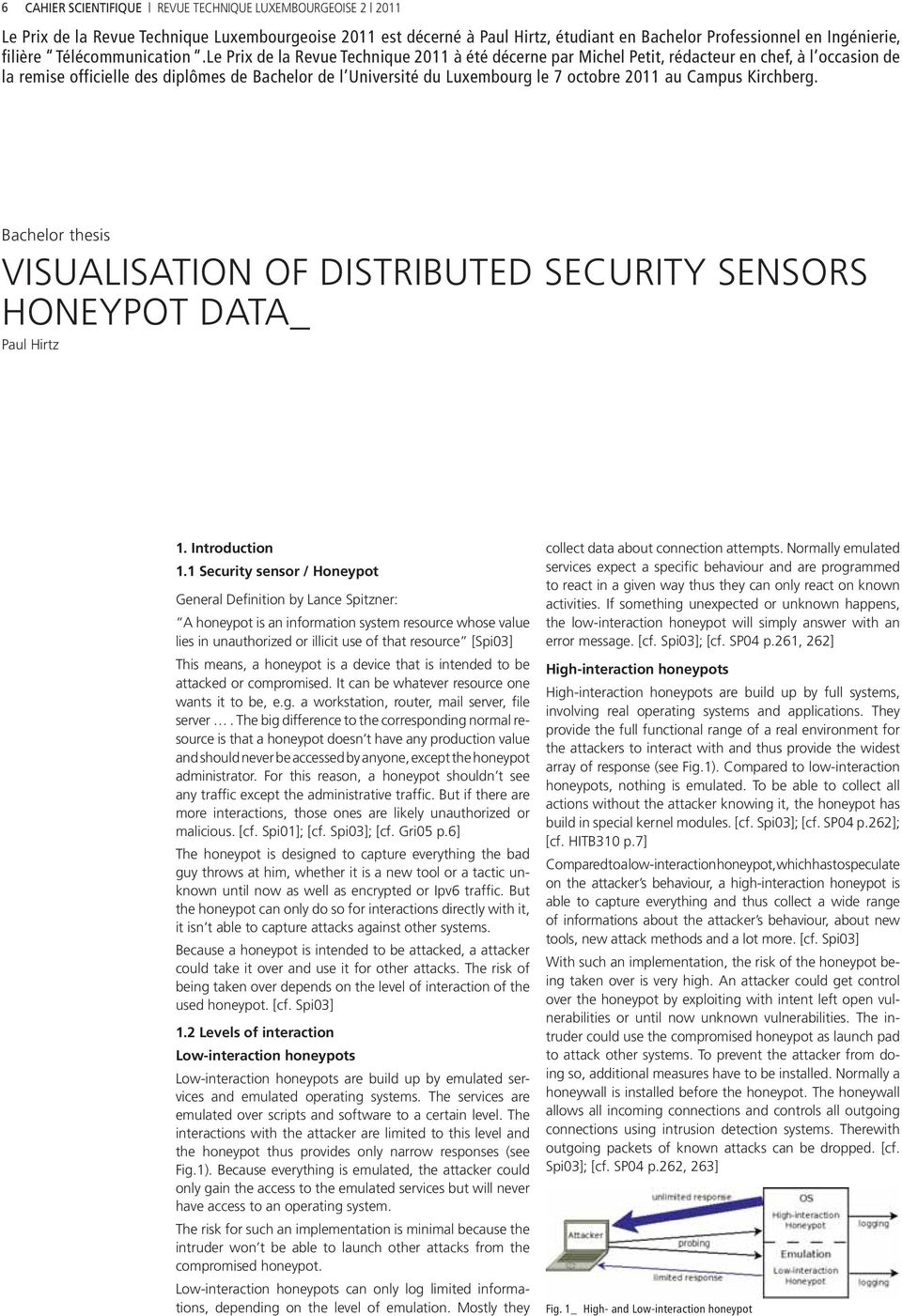
6 6 CAHIER SCIENTIFIQUE REVUE TECHNIQUE LUXEMBOURGEOISE Le Prix de la Revue Technique Luxembourgeoise 2011 est décerné à Paul Hirtz, étudiant en Bachelor Professionnel en Ingénierie, filière Télécommunication.Le Prix de la Revue Technique 2011 à été décerne par Michel Petit, rédacteur en chef, à l occasion de la remise officielle des diplômes de Bachelor de l Université du Luxembourg le 7 octobre 2011 au Campus Kirchberg. Bachelor thesis VISUALISATION OF DISTRIBUTED SECURITY SENSORS HONEYPOT DATA_ Paul Hirtz 1. Introduction 1.1 Security sensor / Honeypot General Definition by Lance Spitzner: A honeypot is an information system resource whose value lies in unauthorized or illicit use of that resource [Spi03] This means, a honeypot is a device that is intended to be attacked or compromised. It can be whatever resource one wants it to be, e.g. a workstation, router, mail server, file server. The big difference to the corresponding normal resource is that a honeypot doesn t have any production value and should never be accessed by anyone, except the honeypot administrator. For this reason, a honeypot shouldn t see any traffic except the administrative traffic. But if there are more interactions, those ones are likely unauthorized or malicious. [cf. Spi01]; [cf. Spi03]; [cf. Gri05 p.6] The honeypot is designed to capture everything the bad guy throws at him, whether it is a new tool or a tactic unknown until now as well as encrypted or Ipv6 traffic. But the honeypot can only do so for interactions directly with it, it isn t able to capture attacks against other systems. Because a honeypot is intended to be attacked, a attacker could take it over and use it for other attacks. The risk of being taken over depends on the level of interaction of the used honeypot. [cf. Spi03] 1.2 Levels of interaction Low-interaction honeypots Low-interaction honeypots are build up by emulated services and emulated operating systems. The services are emulated over scripts and software to a certain level. The interactions with the attacker are limited to this level and the honeypot thus provides only narrow responses (see Fig.1). Because everything is emulated, the attacker could only gain the access to the emulated services but will never have access to an operating system. The risk for such an implementation is minimal because the intruder won t be able to launch other attacks from the compromised honeypot. Low-interaction honeypots can only log limited informations, depending on the level of emulation. Mostly they collect data about connection attempts. Normally emulated services expect a specific behaviour and are programmed to react in a given way thus they can only react on known activities. If something unexpected or unknown happens, the low-interaction honeypot will simply answer with an error message. [cf. Spi03]; [cf. SP04 p.261, 262] High-interaction honeypots High-interaction honeypots are build up by full systems, involving real operating systems and applications. They provide the full functional range of a real environment for the attackers to interact with and thus provide the widest array of response (see Fig.1). Compared to low-interaction honeypots, nothing is emulated. To be able to collect all actions without the attacker knowing it, the honeypot has build in special kernel modules. [cf. Spi03]; [cf. SP04 p.262]; [cf. HITB310 p.7] Compared to a low-interaction honeypot, which has to speculate on the attacker s behaviour, a high-interaction honeypot is able to capture everything and thus collect a wide range of informations about the attacker s behaviour, about new tools, new attack methods and a lot more. [cf. Spi03] With such an implementation, the risk of the honeypot being taken over is very high. An attacker could get control over the honeypot by exploiting with intent left open vulnerabilities or until now unknown vulnerabilities. The intruder could use the compromised honeypot as launch pad to attack other systems. To prevent the attacker from doing so, additional measures have to be installed. Normally a honeywall is installed before the honeypot. The honeywall allows all incoming connections and controls all outgoing connections using intrusion detection systems. Therewith outgoing packets of known attacks can be dropped. [cf. Spi03]; [cf. SP04 p.262, 263] Fig. 1_ High- and Low-interaction honeypot
7 CAHIER SCIENTIFIQUE REVUE TECHNIQUE LUXEMBOURGEOISE Why using a honeypot? Detection A false-positive is a non malicious activity, which is reported by a security tool to be malicious. A false-negative is the opposite, here malicious activity isn t identified as being malicious by the security tool. Most security technologies, like intrusion detection systems and firewalls, log to much data, containing lot of false positives, which makes it difficult for IDS administrators to evaluate the alerts. Honeypots on their part don t have a production value and only log small data sets of high value, so the number of false-positives is very low. [cf. Spi01]; [cf. Gri05 p.5, 6] Another weakness of intrusion detection systems are false negatives. IDSs are designed to detect known attacks, but fail to detect unknown ones, like malicious encrypted traffic or tunnelled malicious IPv6 traffic inside IPv4 traffic. Honeypots on their part are designed to capture every attack, whether known or unknown, launched against them, which eliminates false-negatives. [cf. Gri05 p.7, 8][cf. Spi03] Because of this facts, honeypots are of high value for detection. Prevention Honeypots are able to help defending a network against automated toolkits, like worms. For this purpose, the honeypot tries to slow down their network scanning. Such honeypots are called sticky honeypots. As an automated toolkit randomly scans a network, it will also send probes to unused IP addresses. The sticky honeypot monitors the unused IP space and when an unused IP address is probed, it will pretend to be this host and start interacting with the scanner. Now it will use TCP retransmission features to slow down the scanning. Example for a sticky honeypot: LaBrea Tarpit 1. Prevention consists also of distracting attackers from attacking a legitimate production target by confusing them and making them spend time attacking the honeypot. [cf. Spi03]; [cf. Gri05 p.8, 9] Reaction Often compromised systems can t be taken offline for analysis because they offer a service which can t be eliminated. So the compromised systems keep running and are still used which makes it very difficult to gather evidence. Honeypots on their part offer no production services, so they can be taken offline. As they log every malicious activities, it is easy to analyse the attack and find out what vulnerability was exploited to get into the system. Based on this analysis, specific reactions to an incident can be performed. [cf. Spi01]: [cf. Spi03] Production honeypots A production honeypot makes use of the detection, prevention and reaction abilities, to help protecting an organisation s network. In general, low-interaction honeypots are used for production honeypots, because their risk is minimal. [cf. Spi03] Research honeypots The objective of a research honeypot is to learn about what hackers are doing in general, how they are acting and what they do after they compromised a system. Research honeypots mainly use their detection ability for detecting new hacking techniques and zero-day exploits. In general, highinteraction honeypots are used for research honeypots, because they provide the attackers the widest array of response. [cf. Gri05 p.7, 8]; [cf. Spi03] 2. Dionaea Dionaea is a project from The Honeynet Project 2. It is meant to be the successor for Nepenthes 3. Nepenthes is an allround tool to collect malware. It emulates known vulnerabilities and when a malicious program exploits these vulnerabilities, it downloads the binaries. Dionaea is a low-interaction honeypot designed to trap and gain a copy of the malware exploiting vulnerabilities exposed by offered network services. Dionaea has Python embedded as scripting language and Dionaea can detect shellcode. [cf. Dionaea] As Dionaea is a low-interaction honeypot, the emulated services have to respond to the attacker, which is very complex for exploitations of real services. Thus the responses are limited to the level of emulation. Dionaea implements the protocols of the network services in Python. This allows easy adjustments to the protocols. [cf. Dionaea]
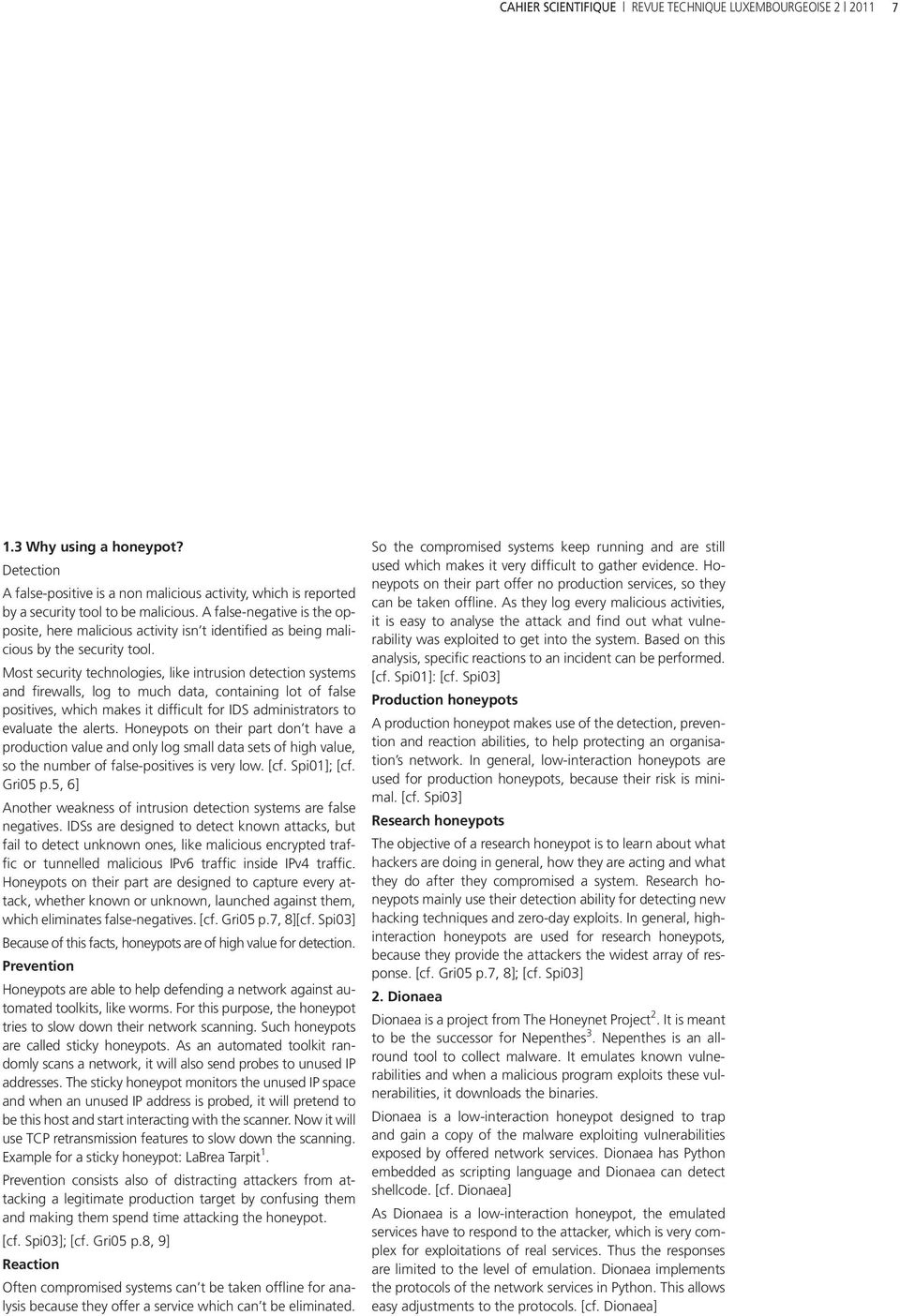
8 8 CAHIER SCIENTIFIQUE REVUE TECHNIQUE LUXEMBOURGEOISE Dionaea emulates a Windows based operating system which offers the following network services: Service Port FTP 21 TFTP 69 HTTP 80 EPMAP / MSRPC 135 HTTPS 443 SMB 445 MSSQL 1433 SIP (VOIP) 5060 Tab. 1_ Network services provided by Dionaea Source: portscan of own Dionaea using nmap A very useful feature of Dionaea is that it is able to upload gathered binaries to other services, like sandboxes on the internet or to an XMPP server. This feature will be used in the following work. 3. Prosody Prosody 4 is an XMPP server which is designed to be simple, easy to set up and configure and which is light on resources. This is achieved by implementing functionalities in optional modules, which are easy to enable or disable as they are needed. It is also easy for developers to extend functionalities and develop new protocols. Prosody is written in Lua 5, an embedded scripting language. Lua is very fast, simple and small, ideal for applications which needs high performance, like games and servers. [cf. Proso11] 4. Problem definition and objectives Security sensors are connected over a XMPP channel to a XMPP server. When the sensors capture malicious software, they send the binaries over this channel to a multi-user chat room on the server. Fig. 2_ Problem definition The activity on the server depends on the quantity of attacks on the sensor. If there is only one sensor connected to the server, the activity on this one will be likely small. If there are more sensors, the overall-activity will be likely increasing. The main objective is to write a prototype which monitors this activity. The monitor should be able to accomplish the following points: _display the activity in a nice looking, eye-catching manner, _display the quantity of arrived malware in a chart over an adaptive time period, where the malware is separated in known and unknown ones, _display a bar-chart with the different malware types in percent of the total amount, _perform a screenshot. Furthermore the prototype should be a Java applet running in the web browser. A secondary objective is to set up a security sensor and a XMPP server for testing. For the security sensor Dionaea should be used and for the XMPP server Prosody should be used. 5. Concept for the monitor To be able to monitor the activity on the server, the prototype needs to connect to the server and stay online. Thus, it has to listen on every message posted (1). The binaries of the malicious software are transferred by Dionaea as a XMPP message to the multi-user chat room on the XMPP server (2). The MUC room then forwards the message to the monitor-
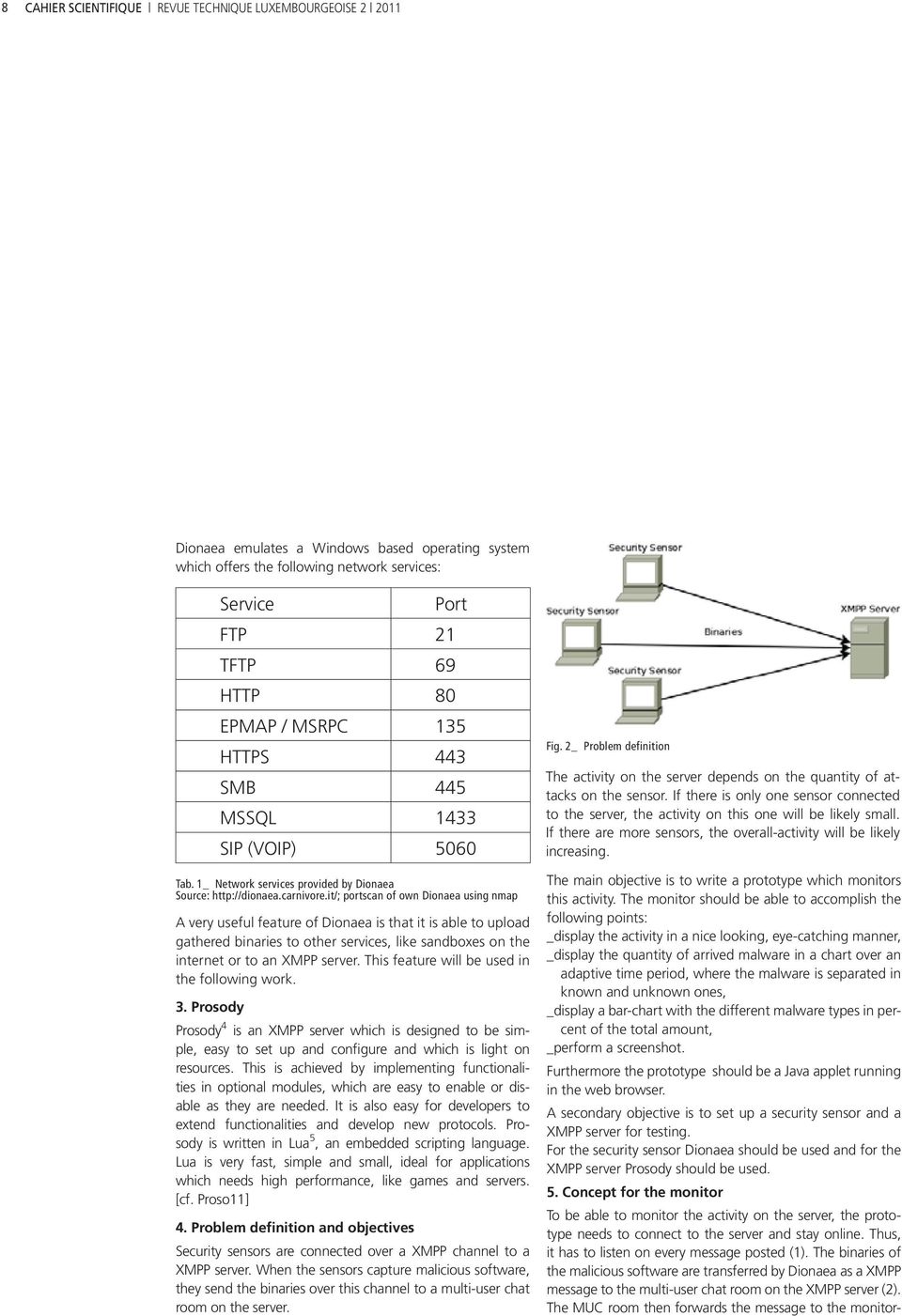
9 CAHIER SCIENTIFIQUE REVUE TECHNIQUE LUXEMBOURGEOISE applet (3). Then the binaries of the malware have to be extracted and decoded (4). Decoding is needed because the binaries were encoded in base64 when send in-band. Afterwards the binaries are scanned with an antivirus (5) to separate the unknown from the known malware. As antivirus should be used ClamAV 6, because it is free and open-source. The antivirus sends the report back to the monitor (6), which then displays the obtained informations in different forms. Input section The display behaviour is controlled with the input section. Fig. 3_ Input section of the monitor applet The Start Date and the Stop Date text fields are used to adjust the start point and the end point of the time axis of the time chart. Only dd-mm-yyyy-hh-mm date format is accepted. When nothing has been specified, the time chart will display the quantity of malware from the time where the first malware arrived until the actual time. The Refresh Cycle specifies the time between two refreshes of the activity indicator. The available options are: Refresh every 1 s, 10 s, 20 s, 30 s, 45 s, 1 min., 2 min., 5 min., 10 min., 15 min. or 30 min. Fig. 2_ Concept A message stanza received by the monitor-applet, has the following format: <message from= anon-files@mucdomain/anonymous type= groupchat xml:lang= en to= anonymous@mucdomain/anonymous-monitor > <body> <dionaeaxmlns= incident= dionaea.download.complete.unique > <file md5_hash= md5-hash >base64-encoded-bin=</file> </dionaea> </body> <nick xmlns= >nickname</nick> </message> 6. Implementation 6.1 The graphical user interface The graphical user interface is divided into four sections: _1 the input section, allows the user to control the display behaviour _2 the indicator for the activity (named Risikometer) _3 the time chart, overview of the activity over a time period _4 the bar chart, overview of the different malware types in percent of the total amount The Screenshot button will create a screenshot of the applet, and save it in the SensorMonitor folder in the home directory of the user. The name of the screenshot is build with the actual date and with a sequence number. Risikometer The LEDs of the Risikometer will light up to indicate how many malware arrived in the time interval, which can be specified in the previously discussed input section. The scale of the Risikometer will automatically adjust itself if the amount of malware passes over the current scale. Fig. 4_ Example of Risikometer with scale = 2 malware/unit

10 10 CAHIER SCIENTIFIQUE REVUE TECHNIQUE LUXEMBOURGEOISE Fig. 7_ Overview and relations between the classes Fig. 5_ Example of a time chart Fig. 6_ Example of a bar chart The Risikometer also displays the exact amount of malware arrived in the last specified time period and the actual scale in malware per unit. Time Chart and Bar Chart The time chart displays the amount of malware over the time. The start and end points can be specified in the previously discussed input section. The blue line is for the known malware and the red line is for the unknown malware. The bar chart displays the different malware types in percent of the total amount of malware arrived on the XMPP server. 6.2 Classes overview The Monitor class is the applet class, which calls methods from the other classes, or creates new instances of the classes. It uses the SettingsLoader to load the configurations for the Monitor_client. The SettingsLoader throws a SettingsException if something unusual happens. The Monitor_client on his part uses the smack library and the DummySSLSocketFactory to connect to the XMPP server. It also uses the DataStorage class to save gathered informations and TimeMalware objects on the hard drive. For displaying the informations, the Monitor uses the Risikometer, the MalwareBarChart and the TimeSerieChart classes. The TimeSerieChart interprets a list of TimeMalware objects. 6.3 Class diagrams and basic functionalities Monitor class During the initialisation of the Monitor class, a new Risikometer is created, the settings for the Monitor_client are loaded with the SettingsLoader class, a new instance of the Monitor_client thread is started and the Monitor thread itself is also started. The Monitor class periodically calls the draw methods of the Risikometer, of the TimeSerieChart and of the MalwareBar- Chart and delivers them the needed data, which is provided by the Monitor_client. Screenshots of the actual displayed graphs are saved to the hard disk over the DataStorage class. Monitor_client class The Monitor_client class is a thread which runs in the background. Every settings the client needs to log in to the XMPP server are given to him over the constructor. The thread first loads already saved data from the hard drive over the DataStorage class. Then it tries to login to the XMPP server and join the MUC room. The connection to the Prosody server is done over a SSL-connection using self signed certificates. Whenever an error occurs in this state, the thread will terminate. Only if everything previously is successfully accomplished, it will collect and process message-packets coming from the Dionaea sensors in an loop. This processing consists of scanning the binaries with the ClamAV interface and saving the scan results and the timestamps of the received messages in the right data structures. For the scanning, the base64 encoded binaries first have to be decoded SettingsLoader class The SettingsLoader loads all needed configurations out of the config.txt file.
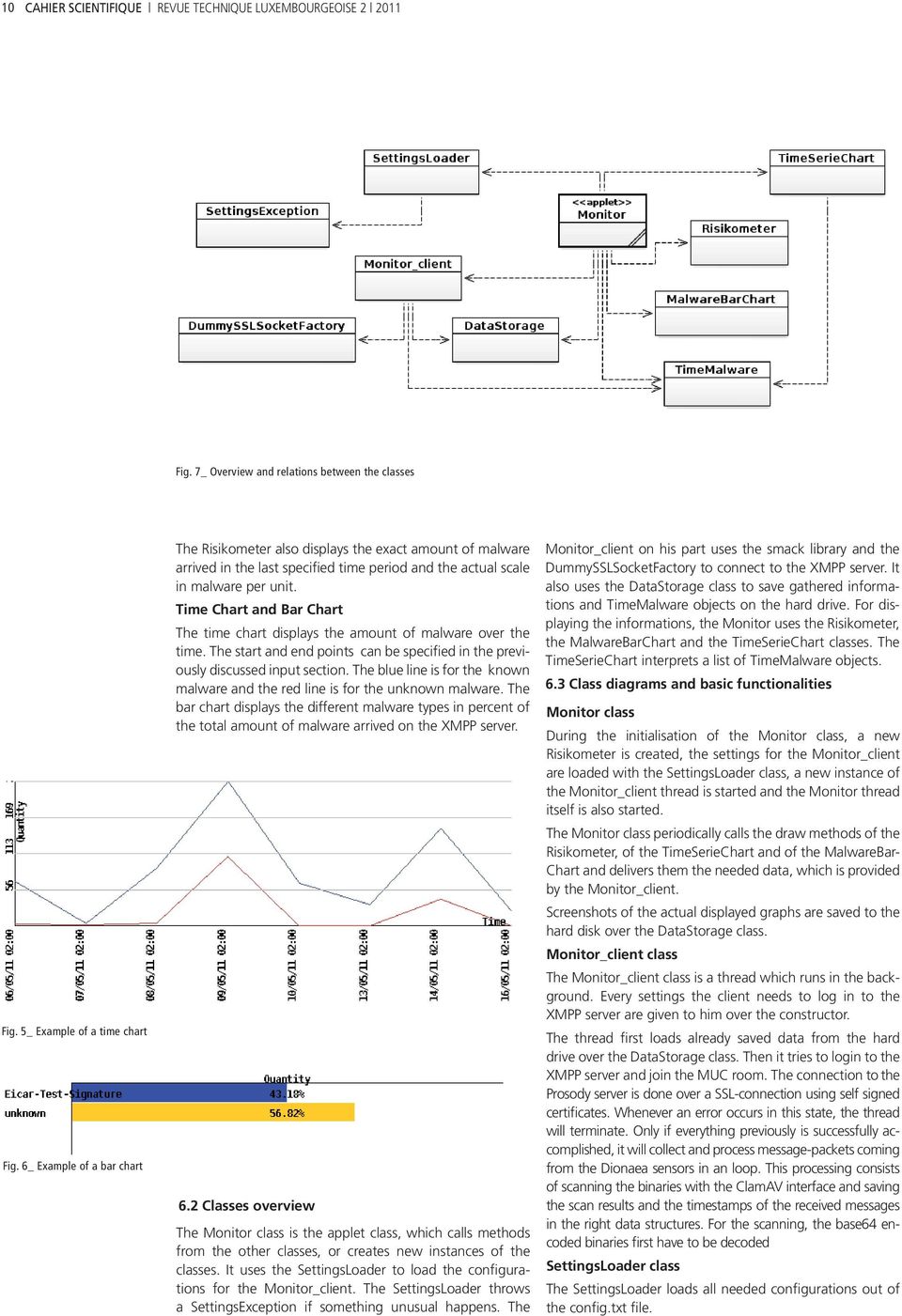
11 CAHIER SCIENTIFIQUE REVUE TECHNIQUE LUXEMBOURGEOISE Fig. 8_ Main interactions between the classes The configuration file contains three sections: _the XMPP server settings _the login informations _the clamav settings DataStorage class The DataStorage class loads and stores objects on the hard drive. Everything is saved in the user s home directory under the SensorMonitor directory. Two data structures are used for saving gathered informations. The first is a SortedMap with the malware name as key and the quantity as value. This structure is used for the MalwareBar- Chart. The second is a LinkedList of TimeMalware objects. This TimeMalware objects save the timestamps and the malware names. This structure is used for the TimeSerieChart. TimeSerieChart/MalwarBarChart/Risikometer classes These three classes are mainly for drawing and displaying the data on the applet. 7. Testing environments 7.1 Virtual environment The first tests for the monitor-applet were done in a virtual environment using VirtualBox Two virtual-boxes running Ubuntu Kernel generic, one for Dionaea and one for Prosody, were used. The virtual environment was arranged in a local network behind a firewall. Therefore Dionaea shouldn t catch anything. Otherwise something really went wrong with the firewall and has to be rechecked, or someone inside the network is messing around. For testing the monitor-applet despite that Dionaea won t capture anything, the ability of the jabber client Psi to input raw XML is used. With the XML console, it is really easy to input XML stanzas, like the message stanza send by Dionaea. With this method the monitor-applet can be tested within a reasonable time domain. 7.2 Real environment To check if the communication with the antivirus behaves in the right way, the monitor-applet was tested on a real XMPP server, where real honeypots are connected to. With the gathered base64-encoded malware, more efficient probes could be done in the virtual environment. Fig. 9: Virtual environment topology Testing in a real environment is very time-consuming, since the moment where malware arrives isn t predictable and controllable. It once took about eight hours until a binary was posted, and this on a server where five sensors are connected to. This sensors and the XMPP server are maintained by the research centre INRIA Nancy Grand Est at the High Security Lab1. Fig. 10_ Real environment topology Student Paul Hirtz Studies Bachelor en Ingénierie télécommunication Jury Dr. Habil. Radu State, Prof. Dr. Thomas Engel Bibliography [Dionaea] Dionaea: URL: dionaea.carnivore.it/ [Gri05] Grimes, R. (2005): Honeypots for Windows. New York: Springer-Verlag. ISBN: [Proso11] Prosody: URL: prosody.im/doc/faq [SP04] Stevens, R., Pohl, H. (2004): Honeypots und Honeynets. Informatik-Spektrum, Volume 27, Number 3, p [Spi01] Spitzner, L. (2001): The Value of Honeypots, Part One: Definitions and Values of Honeypots. URL: com/connect/articles/ value-honeypots-partone-definitions-andvalues-honeypots [dating 04/07/2011] [Spi03] Spitzner, L. (2003): Honeypots. URL: papers/honeypots.html [dating 04/07/2011] _1 forge.net/ _2 project/dionaea _3 _4 _5 _6

12 12 CAHIER SCIENTIFIQUE REVUE TECHNIQUE LUXEMBOURGEOISE TEMPS DE TRANSFERT DE PRODUITS PHYTOSANITAIRES DANS L AQUIFÈRE DU GRÈS DU LUXEMBOURG _ Julien Farlin, Tom Gallé, Dr. Denis Pittois, Michael Bayerle, Christian Braun, Ulrich Leopold Les zones de recharge de nombreux systèmes aquifères étant en partie situées dans des régions d agriculture intensive, un équilibre doit être trouvé entre utilisation de produits phytosanitaires et d engrais afin d assurer le rendement de la production agricole et la nécessité de protéger la ressource en eau. Toute évaluation solide de la vulnérabilité de l aquifère passe par une compréhension préalable du système d écoulement en son sein en termes de temps de transit de l eau et des substances dissoutes. Souvent dans les milieux fracturés comme l aquifère du Grès du Luxembourg considéré dans cet article, les variations spatiales des propriétés hydrauliques peuvent être telles qu en l absence de mesures détaillées à une échelle très fine (décamétrique ou inférieure) il est plus raisonnable de se contenter d une estimation à l échelle du basin hydrogéologique entier. Les traceurs environnementaux, utiles pour étudier de nombreux aspects du cycle de l eau, se révèlent alors être un outil de choix. Nous présentons ici une étude illustrant leur usage pour l estimation des temps de transit de l atrazine dans les sources drainant le Grès du Luxembourg. Introduction Figure 1_ Situation géographique de la zone d étude L exploitation de l aquifère du Grès du Luxembourg assure environ la moitié de la demande totale en eau potable du Grand Duché de Luxembourg. Dans sa partie libre, la nappe du Grès est drainée par de nombreuses sources de déversement émergeant à sa base. Une grande partie de ces sources sont captées pour l approvisionnement en eau des communes environnantes. Au cours de son écoulement à travers la roche, l eau d infiltration est naturellement filtrée, ce qui assure sa bonne qualité dans de nombreuses sources. Néanmoins, pour les sources dont les zones de recharge se situent dans des régions d agriculture intensive, la qualité des eaux souterraines peut être influencée par des intrants tels que les produits phytosanitaires et les engrais épandus sur les parcelles. Un des buts du projet de recherche SPRING «Development of a mass flow-based spring capture zone delineation and immission modeling tool for drinking water pollution risk management» ( ) mené par le Centre de Ressources des Technologies pour l Environnement (CRTE), un département du CRP Henri Tudor et financé par le Fonds National de la Recherche (FNR) était de mieux estimer le temps de transfert de produits phytosanitaires dans les sols et l aquifère et de prévoir leur évolution dans le futur. Le rapport complet du projet SPRING est disponible sur le site internet du CRTE ( endocument&language=en&tablerow=4.2#4). Zone d étude La zone d étude, le plateau de Steinsel, d une longueur d environ dix kilomètres pour une largeur maximale de deux kilomètres, est situé au nord de Luxembourg-Ville, entre les vallées de la Mamer et de l Alzette. L utilisation des sols y est binaire: le centre du plateau est consacré à l agriculture, les pentes sont boisées. La texture des sols va du sable au limon. Vingt et une sources émergeant sur le versant ouest, d un débit allant de un à plus de sept cent
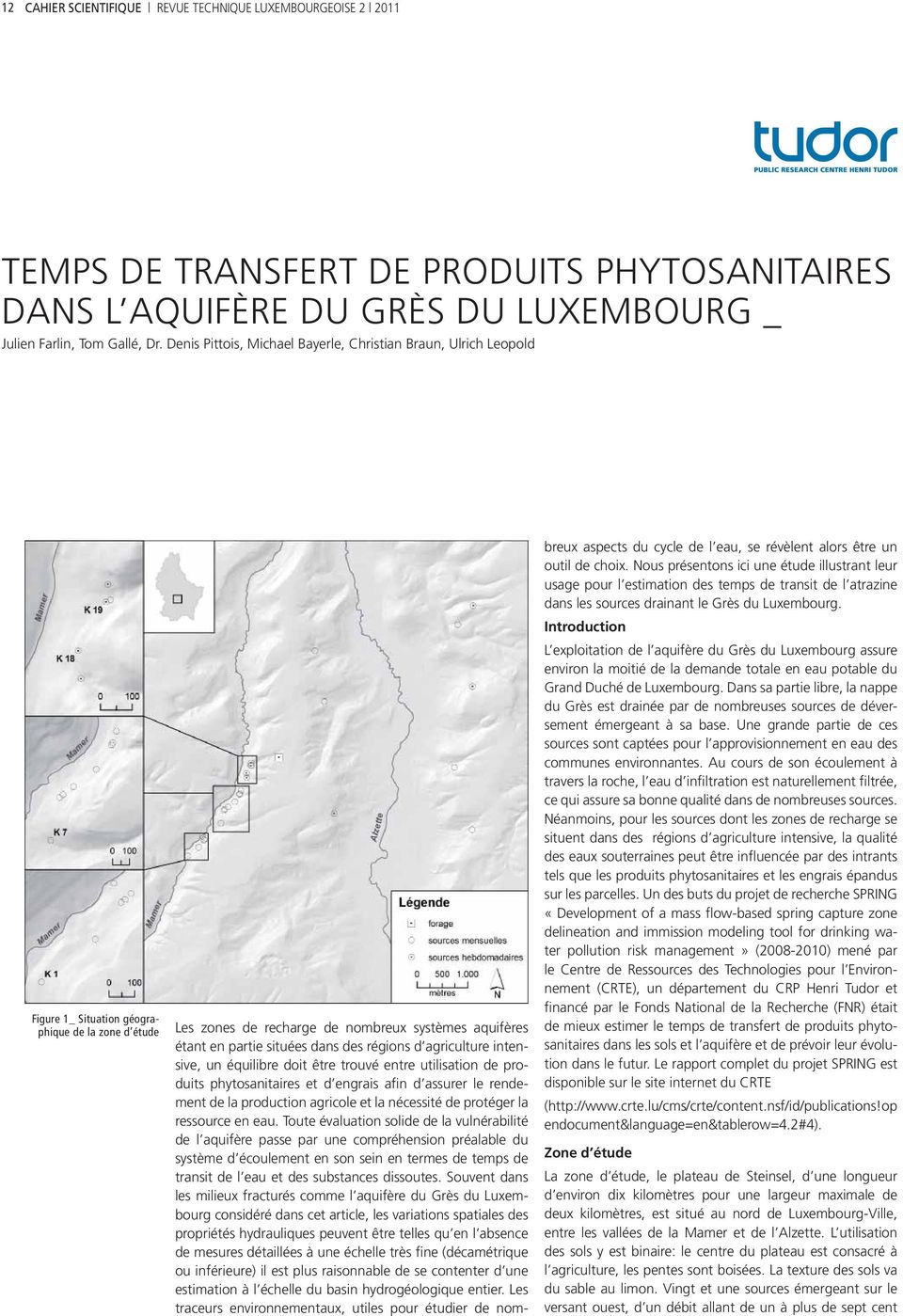
13 CAHIER SCIENTIFIQUE REVUE TECHNIQUE LUXEMBOURGEOISE Figure 2_ Coupe schématique de l aquifère du Grès de Luxembourg illustrant les deux chemins principaux d écoulement de l eau mètres cubes par jour, sont captées par le service des eaux de la ville de Luxembourg. Les sources du versant est, moins nombreuses, sont pour certaines d entre elles utilisées par les communes de Steinsel et Lorentzweiler ou s écoulent librement jusqu à l Alzette. Cinq sources situées sur le versant opposé de la vallée de l Alzette furent intégrées à la campagne de mesures afin d étudier la représentativité régionale des résultats obtenus. L ensemble des sources ont été échantillonnées mensuellement de mars 2008 à mars De plus, sept sources (quatre sur le versant ouest, une sur le versant est, et deux de l autre côté de la vallée de l Alzette) ainsi qu un forage d observation des eaux souterraines installé sur le plateau ont été échantillonnés à un rythme hebdomadaire de septembre 2008 à mars Le débit, la température, la conductivité électrique et le ph ont étés mesurés sur le terrain. Des sondes installées dans les sources visitées chaque semaine enregistraient à chaque minute le débit et la température. Le programme de mesures de la chimie des eaux comprenait les ions majeurs, mineurs et les éléments trace ainsi qu une quarantaine de pesticides et métabolites. Le deutérium, un isotope stable de la molécule d eau, a également été mesuré dans les sources échantillonnées de manière hebdomadaire. Le tritium, isotope radioactif de l hydrogène, a été mesuré dans toutes les sources deux années consécutives en période d étiage d août à septembre. Afin d évaluer la vitesse d infiltration de l eau de pluie dans les sols, des profils hydriques de sols furent également levés en bordure de champs par réflectométrie temporelle à un pas de temps d une demi-heure. La répartition spatiale de certains paramètres physico-chimiques des sols (texture, carbone organique) du plateau jouant un rôle essentiel dans le devenir des pesticides ont également étés mesurés au cours d une campagne d échantillonnage couvrant une grande partie des surfaces agricoles du plateau. Dynamique de l écoulement souterrain En fonction du chemin emprunté et de la distance à parcourir depuis le point d infiltration, l eau de pluie peut soit séjourner plusieurs années, voire plusieurs décennies dans la roche, soit ressurgir en moins de quelques semaines. Comme les dynamiques des deux réservoirs sont très diffé- rentes, nous distinguons dans cet article deux éléments de l écoulement au niveau d une source. Notons que l écoulement de surface stricto sensu joue un rôle négligeable dans le bilan hydrique, les sols sablonneux du plateau assurant une infiltration rapide de l eau de pluie. L écoulement de base est constitué par la portion d eau de source libérée après un trajet de plusieurs années dans l aquifère. Il s agit de l élément le plus stable du débit total qui n est que peu influencé par les précipitations. Tout au plus varie-t-il annuellement selon une fonction sinusoïdale dont le maximum est atteint durant la période de recharge et le minimum en fin de période de vidange lorsque le réservoir rocheux est au plus bas de son niveau de remplissage [Brutsaert 2005]. L écoulement interstitiel correspond à l eau de pluie ressurgissant dans la source après un temps de transit très court dans l aquifère, limitant les phénomènes d échange avec la phase solide de celui-ci (réactions de sorption et de dissolution, diffusion dans la matrice) et par conséquent réduisant l efficacité de ce filtre naturel. Une pollution du débit de base par des substances rémanentes conduit à des teneurs stables au cours du temps de ces substances dans les sources, alors que proliférations bactériennes ou turbidités passagères après un fort orage constituent des marqueurs de l écoulement interstitiel. La question de la contribution relative de ces deux types d écoulement est d autant plus importante que le Grès est un aquifère fracturé dont le comportement hydraulique se situe entre deux extrêmes [Colbach 2005, Pochon 2003] d un médium poreux simple et d un système de type karstique caractérisé par un écoulement en conduit, une forte réactivité, et une importante vulnérabilité aux pollutions [Bakalowicz 1999]. Ecoulement de base Chaque volume d eau débité dans un point d émergence (source, forage, puits) résulte à chaque instant d un mélange d eaux et de solutés ayant parcouru des trajets différents et plus ou moins long au sein de l aquifère. À des fins de modélisation, ce mélange est représenté mathématiquement par une fonction de distribution continue
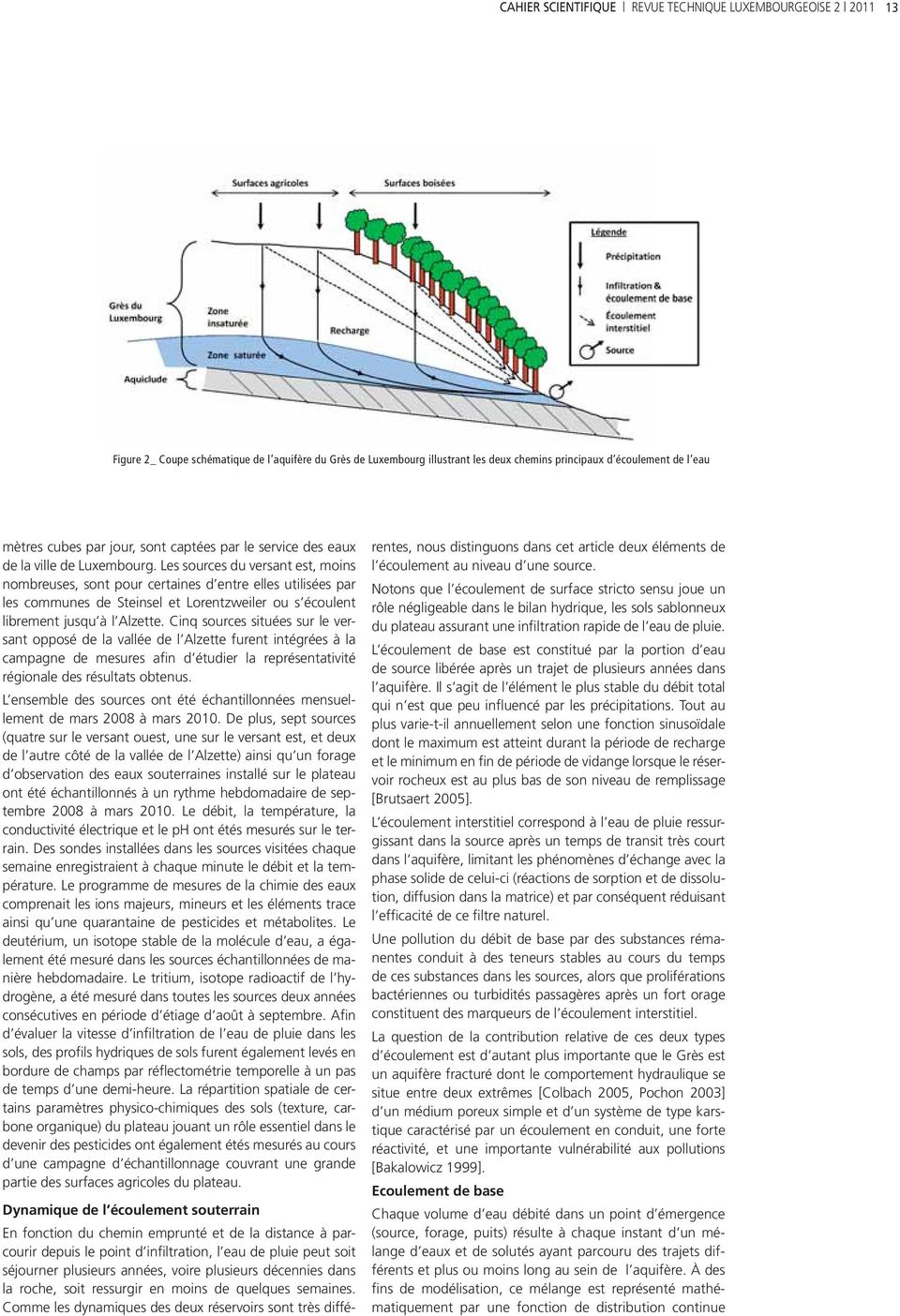
14 14 CAHIER SCIENTIFIQUE REVUE TECHNIQUE LUXEMBOURGEOISE Source Temps de transit moyen [a] Débit médian [l/min] Tableau 1_ Valeurs caractéristiques des sources K1 à K21 Aire de recharge 2 [ha] Volume en réserve [103 m3] K K K K K K K K 7a K K K K K K K K K K K K K 21a donnant pour chaque intervalle de temps de transit la proportion d eau correspondante du débit total. En datation des eaux souterraines, on considère en première approximation empruntée à la théorie des systèmes linéaires [Musy 2009], que cette fonction est invariante au cours du temps. L écoulement de base est caractérisé par le temps de transit moyen, défini comme le centre de gravité de la distribution de tous les temps de transit possibles. Ce temps moyen est obtenu en calant le ou les paramètres d un modèle de distribution sur des mesures de traceurs environnementaux effectuées dans les exutoires [Maloszewski 1982]. Le calage pour les sources du Grès a été effectué avec un modèle classique en hydrogéologie, le modèle exponentiel-piston, en utilisant le tritium, un isotope radioactif de l hydrogène, présent naturellement en faibles concentrations (moins de 10 TU 1 ). A ce signal constant s est superposé un second signal d origine anthropique induit durant la décennie par les essais nucléaires atmosphériques [Clark 1997]. C est cette composante artificielle qui est utilisée en hydrogéologie pour dater des eaux rechargées au cours des dernières décennies. Une fois le temps de transit moyen connu, il est possible de calculer le volume d eau stocké dans l aquifère (sous condition d un débit pluriannuel moyen stable pris pour chaque source égal à la valeur médiane observée): où est le volume d eau en réserve [L 3 ], est le débit médian annuel [L 3 /T] et le temps de transit moyen [T]. Le débit ayant été mesuré au moins mensuellement dans la majeure partie des sources drainant le plateau, la recharge annuelle moyenne peut être estimée à partir du bilan hydrique. Le débit annuel total est de 1.24 millions de mètres cubes, soit pour une surface de sept kilomètres carrés, une recharge annuelle de 180 mm. Supposant que les sources non échantillonnées et les suintements secondaires comptent pour 10 à 20 % du débit annuel, la recharge moyenne annuelle se situe dans l intervalle de 200 à 220 mm/an. Il est à noter que cette valeur constitue une moyenne à l échelle du plateau ignorant les différences de taux de recharge entre les surfaces agricoles et boisées. A partir de la recharge moyenne, l étendue de la zone de recharge peut être estimée: où est l aire de la zone de recharge [L 2 ] et la recharge annuelle [L/T]. Les valeurs caractéristiques de chaque source sont regroupées dans le Tableau 1. Ecoulement interstitiel Les mesures de débit et de température au pas de temps d une minute ont montré un régime d écoulement stable dépourvu de variations soudaines, même à la suite de fortes précipitations. Pour une estimation plus précise de la contribution de l écoulement interstitiel dans le débit des sources, un isotope stable de l eau (et donc conservatif dans l aquifère), le deutérium, a été utilisé. La concentration de cet isotope connait une oscillation périodique annuelle suivant les variations de la température de l air, avec un maximum en été et un minimum en hiver [Clark 1997]. La transmission de ce signal sinusoïdal à travers l aquifère s accompagne d un amortissement progressif de l amplitude qui dépend du temps de transit moyen. Pour les aquifères comme le Grès du Luxembourg dont les temps de transit moyens sont de l ordre de la décennie, l amortissement devient si important que les concentrations en deutérium (contrairement au tritium mentionné au paragraphe précédent) du débit de base restent pratiquement constantes au cours du temps. Dans une telle configuration, les déviations observées indiquent une augmentation de la portion d eau récente (c est à dire ayant séjourné moins de quelques mois dans l aquifère) dans le débit total. L amplitude et le sens de la déviation dépend de la valeur isotopique de l eau de pluie, une valeur inférieure à celle du débit de base provoquant une diminution, et inversement, une valeur supérieure provoquant une augmentation du signal isotopique dans la source. La méthode dite de décomposition de l hydrogramme permet de quantifier cette augmentation de l écoulement interstitiel provoquée par un transport rapide de l eau de pluie [Dincer 1970]:
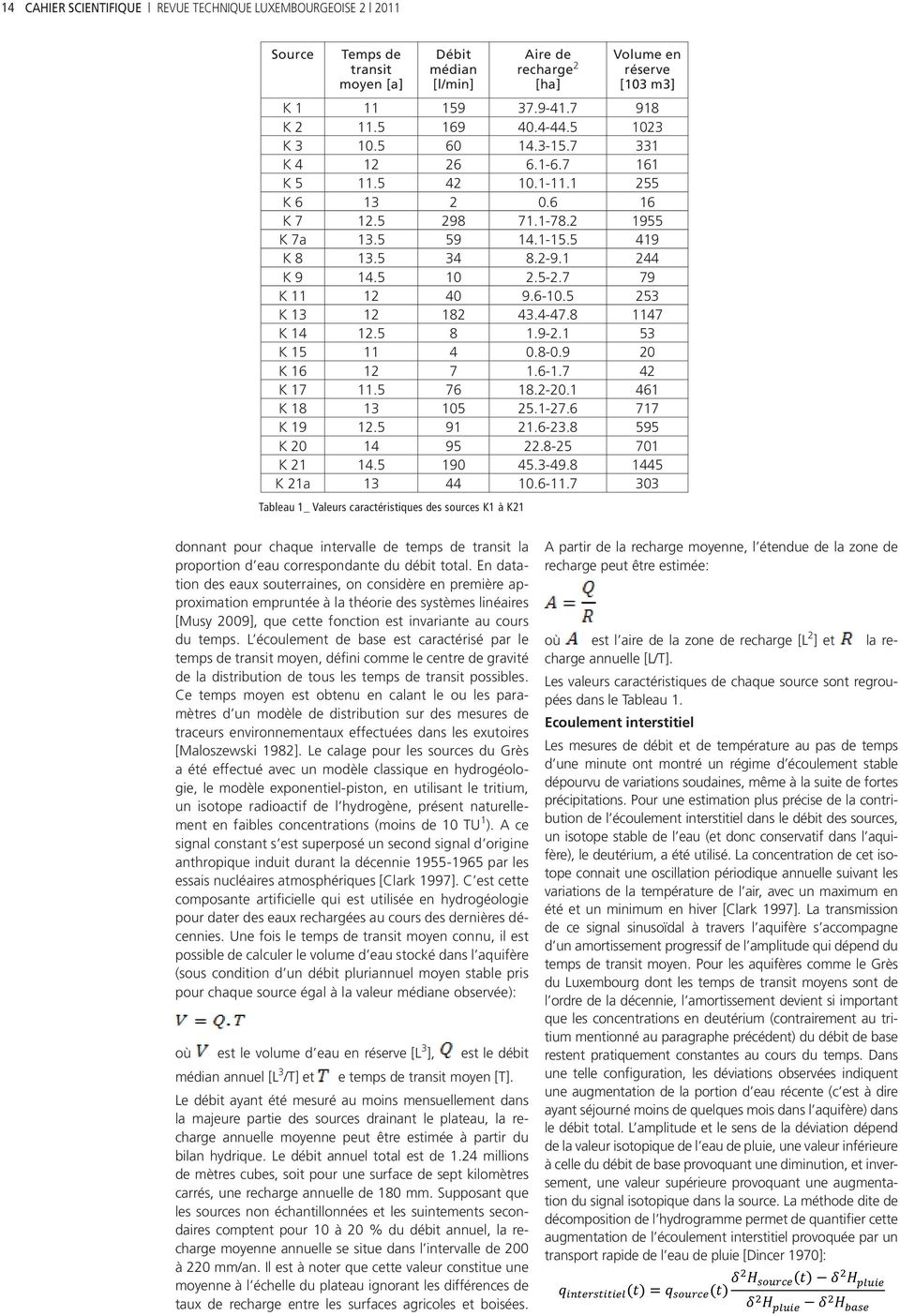
15 CAHIER SCIENTIFIQUE REVUE TECHNIQUE LUXEMBOURGEOISE Date Débit [l/min] δ 2 H [ ] Écoulement interstitiel [%] Tableau 2_ Exemple de séparation d hydrogramme dans la source K18 où est l écoulement interstitiel au temps t, le débit total, la concentration en deutérium mesurée dans la source au temps en notation delta, c est à dire par rapport à un standard, la concentration en deutérium de l eau de pluie, et la concentration en deutérium du débit de base. Peu de déviations significatives ont étés observées au cours des deux années d étude. Un exemple de décomposition d hydrogramme est donné dans le Tableau 2 et sur la Figure 3 pour l événement le plus frappant survenu dans la source K18 durant l hiver , suivant une semaine d intense précipitation (50 mm en une semaine) fin septembre Une réponse similaire bien que moins prononcée a été observée dans les sources voisines (de K17 à K21). Les variations du débit sont de l ordre de l erreur de mesure de plus ou moins 10 %, et l augmentation progressive du débit fin janvier marque le début de la période de recharge. L écoulement interstitiel total pour l événement dans la source K18 s élève à 440 mètres cubes, ce qui, pour une zone de recharge estimée à 25 hectares (voir Tableau 1) et en supposant une répartition homogène de la pluie sur l ensemble de la zone, correspond à 3 % des précipitations de la semaine arrivant à la source avec un temps de transit de treize semaines (le reste étant soit évaporé, soit entré en stockage dans l aquifère). Des délais comparables ont étés observés entre les courbes de température de l air et celle de l eau de source enregistrées par les sondes. La contribution maximale de l ordre de quelques pourcents illustre le rôle secondaire de l écoulement interstitiel dans le débit des sources échantillonnées. Bien que de tels événements puissent provoquer une pollution bactérienne provisoire de certaines sources (phénomène récurrent pour le Grès de Luxembourg), leur importance aussi bien en termes de volume qu en termes de durée de la pollution est minime en comparaison d une contamination à long terme du débit de base. Evolution au cours du temps des teneurs en pesticides dans l eau de source Bien que l usage de l atrazine, un produit phytosanitaire employé principalement dans la culture du maïs, soit interdit au Luxembourg depuis 2005, les teneurs mesurées dans les sources trois ans plus tard restaient stables au cours du temps, tout en étant inférieures à la norme légale de potabilité de 100 ng par litre et par substance. Les résultats de la campagne de mesure sont présentés à titre d exemple pour la source K19 sur la Figure 4. L atrazine déséthyl (DEA), un produit de dégradation majeur de l atrazine, est également présent dans la plupart des sources échantillonnées à des concentrations doubles de l atrazine. Une telle persistance environnementale de l atrazine et de la DEA a déjà été observée [Tappe 2002] et s explique par leur bonne mobilité dans les sols combinée à une faible dégradabilité. L absence de variations annuelles pourrait également indiquer que les composés sont stockés dans l aquifère plutôt que dans les sols. Des calculs effectués avec le code numérique PEARL [Leistra 2001] calé sur les profils hydriques et les paramètres physico-chimiques des sols ainsi que sur les profils hydriques et les teneurs en atrazine observées dans le forage d observation ont en effet montré qu il était probable que l atrazine et la DEA stockées dans les sols sableux et limono-sableux du plateau ne restent mobilisables que cinq à sept ans après le dernier épandage. En première approximation, on considère que le transport de solutés dans l aquifère est semblable à celui de l eau, c est à dire que l on néglige les phénomènes de sorption et de dégradation. En régime transitoire, la sorption provoque un retard des solutés par rapport aux molécules d eau. Quant aux processus de dégradation, ils permettent d un côté une réduction des concentrations, mais peuvent également augmenter Figure 3_ Deux événements successifs (décembre 2008 à février 2009 et mars 2009) survenus dans la source K18. Les déviations par rapport à la valeur médiane sont considérées significatives lorsqu elles dépassent l intervalle délimité par les quantiles, qui correspond à peu près à l incertitude sur la mesure de ± 1 δ 2 H, pendant plus d une semaine.

16 16 CAHIER SCIENTIFIQUE REVUE TECHNIQUE LUXEMBOURGEOISE la concentration de certains produits de dégradation aussi toxiques que la molécule initiale. Un retard prononcé des pesticides semble peu probable, puisque dans ce cas, la branche ascendante de la courbe d évolution des concentrations (voir Figure 5 ci-dessous) aurait été observée durant la période de mesure. Quand à l hypothèse d une dégradation négligeable au sein de l aquifère, elle reste invérifiable avec les données disponibles, quoique raisonnable [Morvan 2006, Moreau 1997], et fait l objet d un projet de recherche financé par le FNR en cours au CRTE intitulé PestDegrade «The use of compound-specific isotope analysis to assess the degradation potential of pesticides in deep aquifers». Le modèle de l écoulement de base calé sur les mesures de tritium prédit des teneurs en atrazine stables jusqu en 2018, suivi d une diminution progressive s étendant sur plusieurs décennies, atteignant 50% des teneurs actuelles à l horizon 2025 et 10% vingt-cinq ans plus tard, vers 2050 (Figure 5). Figure 4_ Atrazine, DEA et débit dans la source K19. La variation annuelle du débit est clairement visible, alors que les variations des concentrations en atrazine et en DEA ne présentent pas de dynamique saisonnière ou de diminution au cours du temps. Figure 5_ Prédiction de l évolution dans le temps de la teneur en atrazine dans les sources (trait plein) en fonction d un épandage prolongé sur les surfaces agricoles (trait en pointillé). Les temps de transit étant similaires pour l ensemble des sources, seul est montrée l évolution pour la source K19. Conclusions Les résultats du projet SPRING indiquent que le débit de l ensemble des sources étudiées est soutenu par l écoulement de base, la contribution de l écoulement interstitiel n ayant jamais dépassé les 12% du débit total durant les deux années de mesures, même après des périodes de fortes pluies. Malgré sa nature fracturée, l aquifère du Grès de Luxembourg est caractérisé dans la zone d étude par des temps de transit moyens longs, de dix à quinze ans, ce qui, combiné à un débit stable et peu ou pas influencé par les précipitations, indique un écoulement lent au sein de la roche. Ces résultats pour le Grès de Luxembourg remettent en question l hypothèse généralement admise d un aquifère qui serait caractérisé par un écoulement de type karstique. Il semblerait au contraire que l aquifère se comporte à l échelle du basin versant essentiellement comme un milieu poreux (pour les sources étudiées tout du moins). Les temps de transit moyens confèrent une grande inertie à l aquifère, ce qui a pour double conséquence d une part d assurer au niveau des sources un régime stable et peu influencé par des pollutions de courte durée (bactériennes en particuliers) ou des variations météorologiques saisonnières (orages ou période de sécheresse), mais d autre part signifie que toute percolation diffuse et continue sur plusieurs années de produits phytosanitaires ou de nutriments vers la nappe phréatique peut provoquer une diminution de la qualité de l eau de source pour des décennies. Même si l atrazine est
17 CAHIER SCIENTIFIQUE REVUE TECHNIQUE LUXEMBOURGEOISE maintenant interdite, d autres substances actives pourraient dans le futur constituer de nouvelles sources de contamination. La présence de DEA, un produit de dégradation majeur de l atrazine, à des concentrations jusqu à deux fois supérieures à celle de la molécule mère illustre également le danger potentiel présentés par les produits de dégradation qui, s ils sont suffisamment mobiles et stables dans l aquifère, peuvent être transportés jusqu aux sources. Remerciements Le projet SPRING a été financé par le Fond National de la Recherche du Luxembourg dans le cadre du programme «SECAL-sécurité alimentaire». Merci à Messieurs Pundel et Zimmer et aux employés du Service des Eaux de la Ville de Luxembourg ainsi qu aux services techniques de Steinsel et Lorentzweiler pour le soutient logistique durant l échantillonnage des sources. Merci également aux agriculteurs du plateau de Steinsel, et en particulier à Messieurs Decker et Junck pour leur participation à l échantillonnage des sols. Merci à Monsieur Antoine Kies du département de physique de l Université du Luxembourg pour le prêt des sondes installées dans les sources. Merci à Monsieur Robert Colbach du Service Géologique du Luxembourg pour les discussions critiques et constructives tout au long du projet et pour son aide dans les recherches bibliographiques. Merci enfin au laboratoire de l Administration de la Gestion de l Eau pour le soutient technique dans l analyse des échantillons d eau de source et de sols. Références M. Bakalowicz. Guide technique n 3: Connaissance et gestion des ressources en eaux souterraines dans les régions karstiques. SDAGE Rhône Méditéranée Corse, W. Brutsaert. Hydrology, an introduction. Cambridge University Press, I. Clark, P. Fritz. Environmental isotopes in hydrogeology. Lewis Publishers, R. Colbach, Overview of the geology of the Luxembourg Sandstone(s), Ferrantia 44, T. Dinçer, B.R. Payne, T. Florkowski, J. Martinec, E. Tongiorgi. Snowmelt runoff from measurements of tritium and oxygen-18. Water Resour. Res., 6 (1): , B. Hingray, C. Picouet, A. Musy. Hydrologie 2: Une science pour l ingénieur. Presses polytechniques et universitaires romandes, M. Leistra, J.J.T.I. van der Linden, A.M.A. Boesten, A. Tiktak, F. van den Berg. Pearl model for pesticide behaviour and emissions in soilplant systems. descriptions of the processes in focus pearl v Alterra-Rapport 013, RIVM report , P. Maloszewski, A. Zuber. Determining the turnover time of groundwater systems with the aid of environmental tracers, 1. models and their applicability. Journal of Hydrology, 57: , C. Moreau, C. Mouvet, Sorption and desorption of atrazine, deethylatrazine, and hydroxyatrazine by soil and aquifer solids, Journal of Environmental Quality, 26, , 1997 X. Morvan, C. Mouvet, N. Baran, a. Gutierrez, Pesticides in the groundwater of a spring draining a sandy aquifer : Temporal variability of concentrations and fluxes, Journal of Contaminant Hydrology, 87, , 2006 A. Pochon, F. Zwahlen. Auscheidung von Grundwasserschutzzonen bei Kluftgrundwasserleitern -Praxishilfe. Vollzug Umwelt. Bundesamt für Umwelt, Wald und Landschaft, Bundesamt für Wasser und Geologie, Bern, W. Tappe,. J. Groeneweg, B. Jantsch, Diffuse atrazine pollution in German aquifers Biodegradation, 13, 3-10, _ Défini comme un atome de tritium pour atomes d hydrogène. 2_ Pour une recharge de R=220mm et R=200mm

18 18 CAHIER SCIENTIFIQUE REVUE TECHNIQUE LUXEMBOURGEOISE SUBSTANCES OF VERY HIGH CONCERN UNDER REACH: A NEW FRAMEWORK FOR THE CONTROL OF HAZARDOUS CHEMICALS _ Dr. Ruth Moeller, Carine Kolber and Dr. Arno P. Biwer 1 Introduction REACH is the European Regulation on chemicals and their safe use (Regulation No. (EC) 1907/ ). It entered into force for the whole European Union in June 2007 and deals with the Registration, Evaluation, Authorisation and Restriction of Chemicals (REACH). The aim of REACH is to improve the protection of human health and the environment through the better and earlier identification of the properties of chemical substances. At the same time, REACH aims to enhance innovation and competitiveness of the EU chemical industry. With the Luxembourgish Helpdesk for REACH, the CRP Henri Tudor provides support to Luxembourgish companies to fulfil their obligations under this framework. The hazard of a substance is defined by its intrinsic properties. If effects on human health or the environment are very serious and possibly irreversible, such substances can be identified under REACH as so-called Substances of Very High Concern (SVHC). Due to this high concern, it is considered essential to regulate these substances through a mechanism that ensures that the risks related to their actual uses are assessed, considered and then decided upon by the Community. The actual risk of a chemical substance depends on both its intrinsic properties and the probability of exposure. Based on the production volume and use conditions and thus anticipated exposure pattern, together with their intrinsic properties, SVHC can be ranked according to their risk to human health or the environment. The regulation of SVHC is defined in the authorisation title of REACH. The authorisation provisions should ensure the good functioning of the internal market while assuring that the risks from SVHC are properly controlled and that these substances are progressively replaced by suitable alternative substances or technologies where these are economically and technically viable. In the following, the process for regulating SVHC as described in the authorisation title of REACH is presented. This includes the procedures and the criteria applied to identify SVHC, as well as those to prioritise them for authorisation obligations. Then, the SVHC identified so far will be analysed in the light of these identification criteria and future implications arising from this identification are briefly discussed. In the last part, the prioritisation of SVHC for authorisation obligations made so far are analysed in comparison with the prioritisation approach developed by the European Chemicals Agency (ECHA). Finally, some general conclusions are drawn. 2 Legal framework: Substances becoming subject to authorisation The authorisation provisions under REACH foresee three consecutive procedures: a) inclusion of a substance in the so called Candidate List (= identification as SVHC), b) inclusion of a substance in Annex XIV REACH (= authorisation obligation), and c) authorisation of a use of a substance which has been included in Annex XIV. 2.1 The Candidate List: Identification of SVHC Substances are identified as SVHC according to the procedure detailed in Art. 59 REACH 2. A Member State (MS) or ECHA on request from the European Commission issue a proposal for the identification by submitting a dossier according to Annex XV REACH. The dossier must prove that the substance in question meets the criteria defined in Art. 57. Member States and interested parties are invited to comment. If no comments are received, the substance immediately enters the so called Candidate List which includes all substances that have been officially identified as SVHC. If comments are made, ECHA refers the proposal to its Member States Committee (MSC) where unanimous agreement must be found on the identification of the substance as SVHC. If the identification criteria of Art. 57 are fulfilled, a substance must be identified as SVHC. If the MSC fails to reach unanimous agreement, the Commission has to prepare a draft decision to be taken in a comitology procedure. The criteria laid down in Art. 57(a-f) refer to the intrinsic properties of a substance. Substances may be identified as SVHC if they meet at least one of the following conditions: _meeting the criteria for classification as carcinogenic, mutagenic or toxic to reproduction (CMR), category 1A or 1B (according to Regulation (EC) 1272/ ), or _being persistent, bioaccumulative and toxic (PBT) or very persistent and very bioaccumulative (vpvb) in accordance with the criteria set out in Annex XIII REACH; or
19 CAHIER SCIENTIFIQUE REVUE TECHNIQUE LUXEMBOURGEOISE _identified, on a case-by-case basis, from scientific evidence as causing probable serious effects to human health or the environment of an equivalent level of concern as those above. Regarding these latter serious effects to human health or the environment (Art. 57(f)), no legally binding criteria have been established yet and need to be developed. However, the REACH text mentions PBT and vpvb substances not fulfilling the criteria in Annex XIII REACH and substances having endocrine disrupting properties as examples. Guidance on the scientific criteria to assess a substance for having endocrine disrupting properties according to Art. 57(f) is not available yet but under development (Federal Institute for Occupational Health and Safety 2010; Federal Institute for Risk Assessment 2011; Danish EPA 2011). The scientific WHO/IPCS 4 definition of endocrine disrupters is widely accepted: An ED alters function(s) of the endocrine system and consequently causes adverse effects in an intact organism, or its progeny, or (sub)populations. This definition had also been included in the REACH Guidance for the preparation of an Annex XV dossier on the identification of substances of very high concern (ECHA 2007). In general, MS may on a case-by-case basis apply different criteria for the identification of SVHC according to Art 57(f), e.g. specific human health properties like sensitisation or classification for specific organ toxicity after repeated exposure (Federal Institute for Risk Assessment 2010). A general definition of SVHCs is not provided but the criteria for identification basically indicate that irreversibility, the absence of an effect threshold, and temporal and spatial decoupling of release and incidence of effects are key characteristics. In this regard, endocrine disruption may lead to a variety of harmful effects and even exposure to very low doses may lead to critical imbalances in the level of endogenous hormones during development of the organism that may result in irreversible effects later on in life. The REACH guidance states that the consequences that may result from endocrine disruption can be both serious and irreversible and so endocrine disruptive effects should be considered as being of equivalent concern. The absence of a threshold means that a limit value, below which adverse effects on human health or the environment can be excluded, like the DNEL (derived no effect level) or PNEC (predicted no effect concentration) cannot be established. Most carcinogens and mutagenic substances lack an effect threshold and CMR substances can induce seriously adverse and normally irreversible effects. They show long latency periods between low-level exposures and some health effects. A quantitative comparison with the estimated exposure level, e.g. the ratio predicted environmental concentration (PEC) to PNEC, for the purpose of a risk assessment is not possible under such circumstances. This is also true for PBT and vpvb substances where the persistence and bioaccumulation with time do not allow the estimation of a concentration below which no effects on human health or the environment may be expected. The release in the environment and the appearance of effects are temporally and spatially not linked. Once released in the environment, exposure cannot be controlled anymore due to their persistence (Merenyi et al. 2011). Prioritisation of PBT and vpvb substances on the Candidate List for Annex XIV reflects the fact that based on the persistent and bioaccumulating behaviour, no establishment of a PNEC or DNEL is possible and therefore risk to human health or the environment cannot be adequately controlled. This discrimination between a threshold and a non-threshold mode of action is important for risk-based prioritisation of SVHC for Annex XIV and also for the authorisation of a SVHC once included in Annex XIV as detailed in the following section. Once a substance entered the Candidate List, certain obligations arise from the inclusion mainly related to the communication along the supply chain (Art. 33) including the update of safety data sheets by suppliers, distribution of safe use instructions for articles (i.e. a product such as a computer, a piece of furniture, etc.) with >0.1% SVHC by suppliers, and notification to the ECHA of articles with > 0.1% SVHC and > 1 t/a (Art. 7(2)). The identification as SVHC is currently also the only way for authorities to legally identify a substance as PBT or vpvb. However, the main function of the Candidate List under REACH is to provide substances that can be selected to become subject to authorisation.

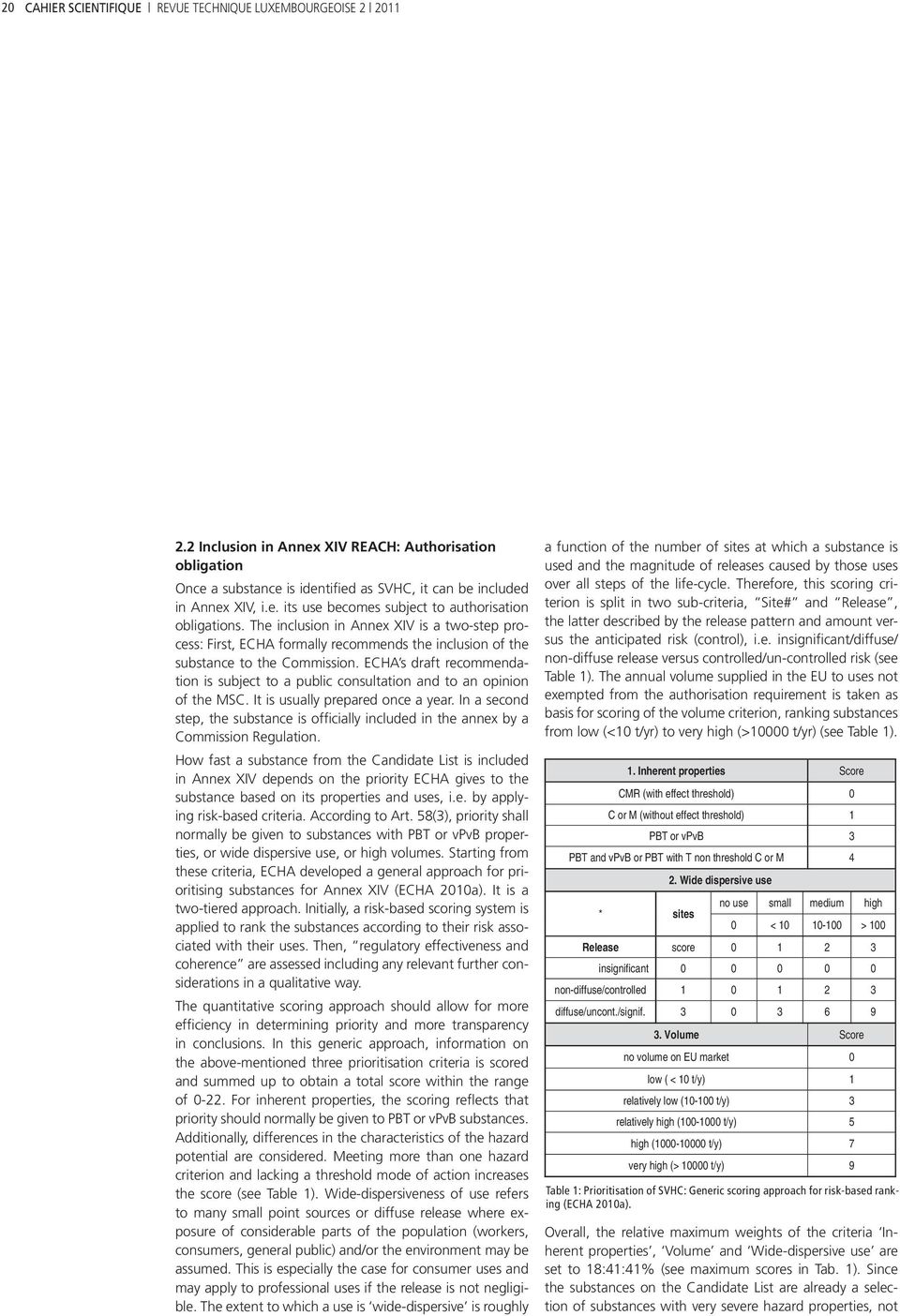
20 20 CAHIER SCIENTIFIQUE REVUE TECHNIQUE LUXEMBOURGEOISE Inclusion in Annex XIV REACH: Authorisation obligation Once a substance is identified as SVHC, it can be included in Annex XIV, i.e. its use becomes subject to authorisation obligations. The inclusion in Annex XIV is a two-step process: First, ECHA formally recommends the inclusion of the substance to the Commission. ECHA s draft recommendation is subject to a public consultation and to an opinion of the MSC. It is usually prepared once a year. In a second step, the substance is officially included in the annex by a Commission Regulation. How fast a substance from the Candidate List is included in Annex XIV depends on the priority ECHA gives to the substance based on its properties and uses, i.e. by applying risk-based criteria. According to Art. 58(3), priority shall normally be given to substances with PBT or vpvb properties, or wide dispersive use, or high volumes. Starting from these criteria, ECHA developed a general approach for prioritising substances for Annex XIV (ECHA 2010a). It is a two-tiered approach. Initially, a risk-based scoring system is applied to rank the substances according to their risk associated with their uses. Then, regulatory effectiveness and coherence are assessed including any relevant further considerations in a qualitative way. The quantitative scoring approach should allow for more efficiency in determining priority and more transparency in conclusions. In this generic approach, information on the above-mentioned three prioritisation criteria is scored and summed up to obtain a total score within the range of For inherent properties, the scoring reflects that priority should normally be given to PBT or vpvb substances. Additionally, differences in the characteristics of the hazard potential are considered. Meeting more than one hazard criterion and lacking a threshold mode of action increases the score (see Table 1). Wide-dispersiveness of use refers to many small point sources or diffuse release where exposure of considerable parts of the population (workers, consumers, general public) and/or the environment may be assumed. This is especially the case for consumer uses and may apply to professional uses if the release is not negligible. The extent to which a use is wide-dispersive is roughly a function of the number of sites at which a substance is used and the magnitude of releases caused by those uses over all steps of the life-cycle. Therefore, this scoring criterion is split in two sub-criteria, Site# and Release, the latter described by the release pattern and amount versus the anticipated risk (control), i.e. insignificant/diffuse/ non-diffuse release versus controlled/un-controlled risk (see Table 1). The annual volume supplied in the EU to uses not exempted from the authorisation requirement is taken as basis for scoring of the volume criterion, ranking substances from low (<10 t/yr) to very high (>10000 t/yr) (see Table 1). 1. Inherent properties Score CMR (with effect threshold) 0 C or M (without effect threshold) 1 PBT or vpvb 3 PBT and vpvb or PBT with T non threshold C or M 4 * sites 2. Wide dispersive use no use small medium high 0 < > 100 Release score insignificant non-diffuse/controlled diffuse/uncont./signif Volume Score no volume on EU market 0 low ( < 10 t/y) 1 relatively low ( t/y) 3 relatively high ( t/y) 5 high ( t/y) 7 very high (> t/y) 9 Table 1: Prioritisation of SVHC: Generic scoring approach for risk-based ranking (ECHA 2010a). Overall, the relative maximum weights of the criteria Inherent properties, Volume and Wide-dispersive use are set to 18:41:41% (see maximum scores in Tab. 1). Since the substances on the Candidate List are already a selection of substances with very severe hazard properties, not
21 CAHIER SCIENTIFIQUE REVUE TECHNIQUE LUXEMBOURGEOISE too much weight was given to these properties for ranking potential risks. Within the inherent properties criterion, a slightly higher score considers that according to Art. 58(3) priority shall normally be given to substances with PBT/vPvB properties. However, a higher weight for the PBT/vPvB - inherent properties would result in a hazard and not a risk driven ranking of PBT/vPvB substances leading to high total scores for substances with low volumes and low releases and hence low risk. The second tier of ECHA s approach takes into account regulatory effectiveness. It was introduced because situations may occur where inclusion in Annex XIV will require regulatory efforts but most likely will not result in benefits for human health or the environment. There are also cases possible where authorisation may hamper the use of other risk management instruments while not contributing significantly to achieving the control of risk. In this step, all relevant available information from various sources is taken into account for deriving the final recommendation on Annex XIV inclusion. Once a substance has entered Annex XIV, producers and importers of the substance have to apply for an authorisation for each use of the SVHC within a set date. An authorisation is in principle possible via two routes. The adequate control route requires a quantitative risk assessment. This route can be applied if a chemical safety report including a quantitative risk assessment shows that the risk to human health and the environment is adequately controlled (Art. 60(2-3)). ECHA s Committee for Risk Assessment (RAC) then prepares an opinion. For PBT, vpvb and non-threshold CMR substances, or if an adequate control of risk cannot be demonstrated, this route cannot be applied. Instead, the Socio-Economic assessment route (Art. 60(4)) is possible. Here, a socio-economic analysis (SEA) is obligatory and ECHA s Committee for SEA (SEAC) prepares an opinion. For further details on the procedure for application for an authorisation please see Figure 1. An authorisation can be granted, if it is shown that socio-economic benefits outweigh the risk and if there are no suitable alternative substances or technologies. Exemptions from authorisation obligations are listed in Box 1. Applicant: Application to ECHA - Art. 62(1-2) 2) Figure 1: Application procedure for an authorisation of a use of a substance listed in Annex XIV REACH. Applicant: Pays fee alone ao eor in ajo joint application - Art. 62(7) () Committee for Risk Assessment (RAC) and Committee for ECHA: Socio-Economic Analysis (SEAC) (max. 10 months after Public application, 5 months if an authorisation already exists): consultation ti Completeness check + preparing draft Opinion(s) i - Art. 64(1,3,4,10) 4 10) - Art. 64(2) Applicant (1 month after reception of draft Opinion(s)): Indicate if he intends to comment on draft Opinion(s) - Art. 64(5) () comments Applicant (2 months after reception of the draft Opinion(s)): i Written argumentation - Art. 64(5) () ECHA's RAC + SEAC (2 months after months the applicant's after the argumentation): applicant's Final argumentation): Opinion(s) i - Art. Final 64(5) no comments ECHA (15 days after the final Opinion): Opinion(s)): i Opinions i i i sent sent to to Commission, i i i Member Member States and applicant - + Art. Decision 64(5) () + on Decision publication publication ECHA website on ECHA - Art. website 64(5-6) - Art. Commission i i (3 months after receipt): i Draft authorisation, i ti final l decision i i granting or refusing authorisation (via comitology) - Art. 64(8) Official Journal: Publication - Art. 64(9): summaries, authorisation number
22 22 CAHIER SCIENTIFIQUE REVUE TECHNIQUE LUXEMBOURGEOISE On-site and transported isolated intermediates (Art. 2(8)) - Substances in: o Medical products for human/veterinary use (Art. 2(5)) o Food and feedingstuff (Art. 2(5)) o Plant protection and biocidal products (Art. 56(4)) o Motor fuels and fuel in mobile or fixed combustion plants of mineral oil products and use as fuels in closed systems (Art. 56(4)) o Mixtures when present below a certain concentration (details see Art. 56(6)) o Imported articles (Art. (56(1), however a notification of SVHC in imported articles may be necessary) - If authorisation obligation only due to hazards to human health, substances in (Art. 56(5)): o Cosmetic products o Food contact materials - Uses in scientific research and development (Art. 56(3)) - Exemptions specifically defined in the Annex XIV entry of the substance, e.g. for: o Product and process oriented research (Art. 56(3)) o Certain uses when risk is already properly controlled by other existing specific Community legislation (Art. 58(2)) Box 1: Exemptions from authorisation obligations. 3. Analysis of identified SVHC In the following an overview on the SVHC which have been proposed or identified is presented 5. So far 53 substances have been identified as SVHC and were included in the Candidate List between October 2008 and June Table 2 lists those SVHC that have been recommended for Annex XIV so far. Six substances out of the 53 identified SVHC have already been included in Annex XIV in February 2011 (1 st Recommendation).They will require an authorisation for use and are not anymore on the Candidate List. SCCP (Alkanes, C10-13, chloro (Short Chain Chlorinated Paraffins)) are discussed as Persistent Organic Pollutant (POP) under the Stockholm Convention and were finally not included in Annex XIV although recommended in course of the 1 st Recommendation. Eight of the remaining 46 identified SVHC have been recommended for inclusion in Annex XIV in December 2010 (2 nd Recommendation). Thirteen SVHC had been proposed for inclusion in July 2011 (3 rd Recommendation). Public consultation for these substances ended in September Cobalt dichloride was already recommended in course of the 3 rd Draft Recommendation but put again on the Candidate List in June 2011 since classification and labelling changed from carcinogenic to carcinogenic and reprotoxic. Eighteen substances were not proposed for Annex XIV inclusion in the course of the 3 rd Recommendation, i.e. they remain on the Candidate List (see Table 3). Seven substances (without cobalt dichloride) were included in the Candidate List after the (draft) 3 rd Recommendation and have therefore not been subject to prioritisation procedure so far (see Table 4). Twenty substances have recently been proposed as SVHC and may enter the Candidate List end of December 2011 (see Table 5). 3.1 Inherent substance properties of SVHC Among the 53 identified SVHC, 34 meet the criterion of Art 57(a) (carcinogenic), 11 meet the Art 57(b) criterion (mutagenic), 28 meet the Art 57(c) criterion (toxic to reproduction), 10 meet the Art 57(d) criterion (PBT), 8 meet the Art 57(e) criterion (vpvb), and none of them was identified based on Art 57(f) (equivalent level of concern) (see Figure 2a). Overall, CMR properties are presented by 91% of the SVHC, whereas nearly 80% have been selected solely based on these severe human health effects and are not considered to have PBT/vPvB properties. On the other side, 21% show PBT/vPvB properties, whereas only 9% of identified SVHC are PBT or vpvb substances without CMR properties (see Figure 2b). Twenty substances have been proposed to enter the Candidate List in August Of these 20 proposed SVHC, 18 are new and not yet on the Candidate List (see Table 2). Aluminosilicate refractory ceramic fibres (RCF) and zirconia aluminosilicate refractory ceramic fibres (Zr-RCF) are already on the list but in 2010 some registrations for RCF were submitted to ECHA, where substance identity did not match the chemical composition indicated in the proposal for identification as SVHC (Annex XV dossiers). New Annex XV dossiers were prepared covering fibre materials based
23 CAHIER SCIENTIFIQUE REVUE TECHNIQUE LUXEMBOURGEOISE Substance Sodium dichromate Cobalt dichloride Sodium chromate Potassium chromate Ammonium dichromate Potassium dichromate Trichloroethylene Acids generated from chromium trioxide and their oligomers Chromium trioxide Cobalt(II) diacetate Cobalt(II) carbonate Cobalt(II) dinitrate Cobalt(II) sulphate Diarsenic trioxide Diarsenic pentaoxide Tris(2-chloroethyl) phosphate (TCEP) Lead sulfochromate yellow (C.I. Pigment Yellow 34) Lead chromate molybdate sulphate red (C.I. Pigment Red 104) Lead chromate Diisobutyl phthalate (DIBP) 2,4-Dinitrotoluene (2,4-DNT) Alkanes, C10-13, chloro (Short Chain Chlorinated Paraffins) Hexabromocyclo dodecane (HBCDD) Dibutyl phthalate (DBP) Bis (2-ethylhexyl) phthalate (DEHP) Benzyl butyl phthalate (BBP) 5-tert-butyl-2,4,6-trinitro-mxylene (musk xylene) 4,4'- Diaminodiphenylmethane (MDA) Main uses manufacture of chromium II compounds, pigments, vitamin K, metallurgy, glass, cosmetics, mordant in dyeing, metal surface treatment, passivation of tin-plated steel cosmetics, metal drier, drying agent in paints, lacquers, varnishes and printing inks, corrosion protection (water treatment), veterinary products, vitamin B12 intermediate in manufacture of other chromium compounds, laboratory agent, metal surface treatment corrosion inhibitor in metal coating, chemicals and textiles, ceramic dye (for pigments and inks), intermediate, laboratory agent oxidizer (intermediate) in photosensitive screens and mineral mordant in textile industry, laboratory agent intermediate for chromium metals, corrosion inhibitor in metal coating, mordant in textile industry intermediate for chlorinated and fluorinated organic compounds, cleaning and degreasing of metals, solvent in adhesives metal finishing, wood preservatives, manufacturing of catalysts, pigments, paints and varnishes metal finishing, wood preservatives, manufacturing of catalysts, pigments, paints catalyst, animal food additive, intermediate, e.g. for ceramic pigments, dyes, adhesives catalyst, animal food additive, e.g. for ceramic and glass pigments Intermediate, e.g. for catalysts, surface treatment (e.g. anodizing, electroplating), rechargeable batteries Ni-Cd and Ni-MH intermediate for chromium metals, catalysts and desiccants, corrosion inhibitor in metal coating, mordant in textile industry, organic textile dyes, bleach, animal food additive lead-acid batteries, glass/enamel processing, intermediate for other arsenic compounds wood preservative, additive in decorative glass, intermediate for other arsenic compounds additive plasticiser, viscosity regulator with flame-retarding properties, mainly used in furniture, textile and building industry, also in manufacture of cars, railways, aircrafts colouring, painting and coating agent in rubber, plastic and paints, coatings and varnishes (e.g. for agricultural equipment, vehicles, aircraft, road and airstrip painting) colouring, painting and coating agent in rubber, plastic and paints, coatings and varnishes industries (e.g. in production of agricultural equipment, vehicles, aircraft, road and airstrip painting) pigments and dyes, coating agent in industrial and maritime paint products or varnishes; explosives and pyrotechnic powder plasticisers and gelling agent used in wide range of PVC and other polymers applications intermediate for toluene diisocyanate (used for manufacture of flexible polyurethane foams), gelatinizing-plasticizing agent for explosives flame retardant in plastics and textile coatings flame retardant, e.g. in polystyrene (used for insulation) plasticisers used in a wide range of PVC and other polymers application plasticisers used in a wide range of PVC and other polymers application plasticisers used in a wide range of PVC and other polymers application fragrance enhancer in detergents, fabric softeners and conditioners in cosmetics and perfumery industries hardener (e.g. in epoxy resins and adhesive), vulcanizing agent, antioxidant for rubber, raw material for dyes and polymers, intermediate for diphenylmethane diisocyanate Table 2: SVHC of the 1st to 3rd Recommendation for inclusion in Annex XIV (= authorisation obligation) und their main uses. The last six substances are already included in Annex XIV by now. Criteria according to Article 57 (a) (b) equivalent level of concern (57f) toxic to reproduction (57c) 9% 79% carcinogenic (57a) 11% vpvb (57e) PBT (57d) mutagenic (57b) SVHC identified: 53 new SVHC proposed: Number of substances CMR + PBT or vpvb CMR PBT or vpvb equivalent level of concern (c) 6% 94% 7 11 CMR + PBT or vpvb CMR PBT or vpvb Figure 2: Inherent substance properties of identified and proposed SVHC: a) Number of substances that fulfil the different identification criteria according to Art. 57(a-f). Some substances fulfil more than one criterion. b) Hazard categorisation of the 53 SVHC identified until June 2011; c) Hazard categorisation of the 18 new substances proposed for identification as SVHC in August on variable amounts of aluminium oxide. Thus, both substances are now proposed again to enter the Candidate List with a broader substance identity. All newly proposed substances except one have a harmonized classification for CMR properties (Figure 2a and 2c). Eleven meet the criterion of Art 57(a) (carcinogenic), seven meet the Art 57(c) criterion (toxic to reproduction), and one substance was proposed based on Art 57(f) (equivalent level of concern). This substance, 4-tert-octylphenol, is proposed due to its environmental endocrine disrupting properties and subsequent serious effects to the environment. 4-tert-octylphenol is considered to be an endocrine disruptor causing adverse effects in fish, amphibians, and molluscs based on the widely accepted IPCS definition for endocrine disruptors 6. It would be the first time that a substance is identified as SVHC based on Art. 57(f). It can be concluded that the majority of substances was identified based on CMR properties, especially meeting the Art 57(a) criterion (carcinogenic). 3.2 Annex XIV recommendation of SVHC In the following, an overview on the prioritised SVHC is given. In Table 2 information on the uses of these substances which have already been recommended is presented for information purpose. Hazard properties and the role of riskbased criteria versus regulatory effectiveness considerations in the prioritisation process are discussed. Finally some remarks are provided regarding the future recommendations. Inherent substance properties of prioritised SVHC Among the 53 identified SVHC of the Candidate List, 28 (including SCCP) have either been included in Annex XIV, have been recommended for Annex XIV inclusion, or have been proposed for a recommendation for Annex XIV inclusion. Figure 3a provides the distribution on how the Art. 57 criteria are met by these substances. At this stage, CMR properties are the predominant hazard criteria reflected by these SVHC. The majority of these CMR substances are carcinogenic. Looking at the individual substances, it can be seen that 89% of prioritised substances had entered the Candidate List due to CMR properties. Only 11% of these priority SVHC were put on the Candidate List solely based on PBT/vPvB properties (see Figure 3b). None of the prioritised substances were identified as being CMR and PBT/vPvB at the same time and none was identified as a substance with equivalent level of concern.
24 24 CAHIER SCIENTIFIQUE REVUE TECHNIQUE LUXEMBOURGEOISE Substance Bis(tributyltin) oxide (TBTO) Lead hydrogen arsenate Triethyl arsenate Pitch, coal tar, high temperature (CTPHT) Anthracene Anthracene oil Anthracene oil, anthracene paste, distn. lights Anthracene oil, anthracene paste, anthracene fraction Anthracene oil, anthracene paste Anthracene oil, anthracene low Zirconia aluminosilicate refractory ceramic fibres (Zr-RCF) Aluminosilicate refractory ceramic fibres (RCF) Main uses Total Score intermediate, biocide, fungicide, wood treatment 3 Other considerations/ remarks PBT, intermediate, no use in scope of authorisation cosmetics, wood treatment 1 No uses within the EU doping applications in semi-conductors, cosmetics, wood treatment production of electrodes (binding agent), metal industry, CTPHT containing coatings, waterproofing materials, sealings and adhesives, fuel, intermediate intermediate for the preparation of dyes, diluent of wood preservatives, insecticide and fungicide in paints, raw material in the cellulose industry, synthesis of anthraquinone anti corrosion agent, intermediate, reducing agent, fuel, absorbant for industrial gas cleaning, industrial solvent anti corrosion agent, intermediate 4 anti corrosion agent 4 anti corrosion agent, intermediate, technical oils anti corrosion agent, intermediate, reducing agent in iron production high temperature insulator (e.g. in equipment for vehicles and aerospace) and protection against fire 2 No exposure, very low volumes PBT and vpvb, risk reduction strategy and more general objectives for reduction of PAH emissions PBT, intermediate, no uses in the scope of authorisation PBT and vpvb, risk reduction strategy and more general objectives for reduction of PAH emissions, group with other anthracene oil substances PBT and vpvb, no use in the scope of authorisation, group with other anthracene oil substances PBT and vpvb, no registration submitted, group with other anthracene oil substances PBT and vpvb, no clarity on nature of uses and volumes in the scope of authorisation, group with other anthracene oil substances Very high volumes, industrial use at a large number of sites. Refrained from prioritisation at 3rd Recommendation for clarification of substance identity. Score based on 2nd Recommendation Acrylamide intermediate in the manufacture of polyacrylamide, No use in the scope of authorisation 1 polyacrylamide gels, acrylamide based grouting agents identified detergent, cleaning product, glass and fiberglass, No registration, may replace the other Tetraboron disodium ceramics, industrial fluids, adhesives, flame retardants, 0 boron compounds on the Candidate List heptaoxide, hydrate biocides, fertilizers, metallurgy (grouping approach) detergent, cleaning product, glass and fiberglass, May replace other boron compounds, Disodium tetraborate, ceramics, industrial fluids, adhesives, flame retardants, 18 new restrictions for consumer use (wait anhydrous biocides, fertilizers, metallurgy to assess effect of this measure) homogenizing, flame retardant, preservative and Boric acid conservative properties, used in detergents, cleaning products, adhesives, toys, industrial fluids, glasses, ceramics, paints, disinfectants, cosmetics, food 18 At least some uses may be replaced by other boron compounds on the Candidate List (grouping) additives, fertilizers and insecticides 2-Ethoxyethanol intermediate, solvent, formulation of mixtures, Not wide dispersive, low volumes in 2 (EGEE) laboratory chemical scope of authorisation solvent used in the manufacturing of pharmaceuticals, 2-Methoxyethanol paints and varnishes, in plastics and celluloses High volume but release and exposure 9 (EGME) industries, hydraulic fluids and as antifreeze in aviation appear controlled fuel, extraction agent, processing aid Table 3: Substances currently on the Candidate List which had been subject to 3 rd Recommendation and their main uses, their total score according to the ECHA prioritisation approach, and other considerations. It can be concluded that the number of PBT/vPvB substances recommended for Annex XIV listing is rather small. The majority of recommended SVHC are CMR substances. Application for an authorisation in most cases will need to be done via the socio-economic assessment route since a quantitative risk assessment cannot be performed for non-threshold SVHC. (a) equivalent level of concern (57f) Criteria according to Article 57 (b) vpvb (57e) PBT (57d) toxic to reproduction (57c) mutagenic (57b) carcinogenic (57a) 11% Risk-based prioritisation versus regulatory effectiveness and role of PBT/vPvB properties In the present chapter, it is analysed how the prioritised SVHC had been selected using a risk-based approach, Number of substances 89% 1st Recommendation 2nd Recommendation 3rd Recommendation 9 13 CMR + PBT or vpvb CMR PBT or vpvb equivalent level of concern Figure 3: Inherent substances properties of prioritised SVHC. Twenty-eight SVHC had been prioritised by ECHA during three subsequent recommendations until July a) Number of substances that fulfil the different identification criteria according to Art. 57(a-f). Some substances fulfil more than one criterion. b) Hazard categorisation of SVHC. i.e. how inherent properties, volume and wide-dispersive-use were evaluated by ECHA`s verbal or scoring approach, and whether regulatory effectiveness considerations were a decisive factor. Figure 4a shows the number of SVHC prioritised so far based on either high and very high risk, or regulatory effectiveness considerations, or on both. It can be seen that approximately two-third of SVHC displayed a high to very high risk. However, for a considerable number of substances, regulatory effectiveness considerations did support the prioritisation. This is especially true for the 3 rd Recommendation, where for 12 out of 13 substances a grouping approach supported the prioritisation of some low risk SVHC to avoid that they are used as replacement of other high risk SVHC from the same group. Here, seven low risk SVHC were prioritised based on regulatory effectiveness only, e.g. potassium dichromate and ammonium dichromate from the group of chromium (VI) compounds. Eighteen SVHC currently on the Candidate List had not been proposed for Annex XIV inclusion until now (excluding SCCP). Table 3 provides an overview on these substances, their main uses, the total score assigned and some remarks from the 3 rd prioritisation procedure. As summarised in Figure 4b, ten of these SVHC had not been prioritised due to low risk determined with the scoring approach by ECHA. Regulatory effectiveness considerations were taken into account for a total of eleven SVHC. It can therefore be concluded that the fate of a substance with respect to Annex XIV inclusion is not only dependent on the risk but also in many cases dependent on regulatory effectiveness considerations.
25 CAHIER SCIENTIFIQUE REVUE TECHNIQUE LUXEMBOURGEOISE Substance 2-Ethoxyethyl acetate (2-EEA, EGEEA) Strontium chromate 1,2-Benzene dicarboxylic acid, di-c7-11-branched and linear alkyl esters (DHNUP) 1,2-Benzene dicarboxylic acid, di-c6-8-branched alkyl esters, C7-rich (DIHP) Hydrazine 1-methyl-2-pyrrolidone (NMP) 1,2,3-Trichloro propane (1,2,3- TCP) Substance Lead dipicrate Lead styphnate Lead azide, lead diazide Phenolphthalein 2,2'-Dichloro-4,4'-methylene dianiline (MOCA) N,N-Dimethyl acetamide (DMAC) Trilead diarsenate Calcium arsenate Arsenic acid Bis(2-methoxyethyl) ether (diglyme) 1,2-Dichloroethane (1,2-DCE) 4-(1,1,3,3- Tetramethylbutyl)phenol, (4- tert-octylphenol) 2-Methoxyaniline (o-anisidine) Bis(2-methoxyethyl) phthalate (DMEP) Formaldehyde, oligomeric reaction products with aniline (technical MDA) Pentazinc chromate octahydroxide Potassium hydroxyloctaoxo dizincate dichromate Dichromium tris(chromate) Main uses solvent (and intermediate) in chemical industry, formulation of paints, lacquers and varnishes for industrial use (professional use at very low volumes) coatings, formulations in the aeronautic/ aerospace sector, coil coating sector of steel and aluminium, vehicle coating plasticiser to PVC plasticiser in PVC, in sealants and printing inks synthesis and polymerisations reactions, corrosion inhibitors (in nuclear power plants, water treatment), metal reduction, refining of chemicals, stabilising agent, laboratory chemical reagent high temperature coating, acrylic and styrene latexes, paint removers, industrial degreasing, cleaning, solvent for herbicides, pesticides and fungicides by-product of the manufacture of other chlorinated compounds (e.g. glycerol), intermediate (production of chlorinated solvents) Table 4: SVHC currently on the Candidate List included in June 2011 (excluding cobalt dichloride) and their main uses. A total score is not yet available as they could not be considered in ECHA s last prioritisation exercise (Spring 2011). Main uses explosive used in detonator mixtures ammunition, used in munitions pyrotechnics, detonators in detonators for both civilian and military uses, initiator in pyrotechnic devices laboratory reagent, ph-indicator paper and medicinal products curing agent, cross-linker, chain extender and pre-polymer, used in resins, production of polymer articles, construction and arts solvent/intermediate in manufacture of various substances and fibres for clothing, industrial coatings, polyimide films, paint strippers and ink removers present in raw materials for manufacture of copper, lead and a range of precious metals, intermediate transformed to calcium arsenate (waste) and diarsenic trioxide (used further) present in raw materials for manufacture of copper, lead and a range of precious metals, precipitating agent in copper smelting, manufacturing of diarsenic trioxide (calcium arsenate waste) fining agent for ceramic glass (artisanal glass sector?), copper foils for printed circuit boards, wood preservatives (outside EU) reaction solvent, solvent for battery electrolytes, used in sealants, adhesives, fuels, automotive care products, paints Intermediate (e.g. vinyl chloride monomer), solvent in the chemical and pharmaceutical industry polymer preparations, manufacture of ethoxylates, in adhesives, coatings, inks and rubber articles intermediate, manufacture of dyes and processing aid plasticiser in polymeric materials and paints, lacquers and varnishes, including printing inks intermediate, hardener for epoxy resins, e.g. for the production of rolls, pipes and moulds, and as well for adhesives vehicle coating and aeronautic/aerospace coating Coatings in aeronautic/aerospace, steel and aluminium coil coating, vehicle coating metal surface treatment in the aeronautic/aerospace, steel and aluminium coating, laboratory reagent Table 5: Substances proposed for inclusion in the Candidate List in August 2011 (excluding Zr-RCF and RCF) and their main uses. A total score is not yet available as they could not be considered in ECHA s last prioritisation exercise (Spring 2011). As mentioned before, the Candidate List is the main mechanism to identify PBT and vpvb substances. The number of PBT/vPvB substances identified and prioritised is quite small although PBT/vPvB properties should give SVHC priority for Annex XIV inclusion. However, eight SVHC with PBT/vPvB properties currently remain on the Candidate List and were not proposed for Annex XIV inclusion with the 3 rd Recommendation: Anthracene and Bis(tributyltin)oxide (TBTO) show a very low risk. Pitch, coal tar, high temperature (CTPHT) was identified as PBT/vPvB based on its variable content of polycyclic aromatic hydrocarbons (PAH). For CTPHT, very high priority was concluded using the generic scoring approach. However, a risk reduction strategy (RRS) was prepared under the previous chemicals legislation (as a part of a transitional dossier according to Art. 136(3)) and as part of the assessment carried out by ECHA using the information gathered when preparing and agreeing on the Annex XV SVHC dossier. Both assessments do not support the authorisation process for CTPHT but plea for aiming at an overall reduction strategy for PAH emissions. Five anthracene oil substances were not prioritised at that stage for the same reason (PAH emission reduction strategy) and by applying the grouping approach. It can be concluded that the Candidate List functions as a tool for PBT/vPvB identification under REACH although only a few PBT/vPvB-SVHC have been prioritised for Annex XIV inclusion so far. Moreover the Candidate List is not only the portal for authorisation but can also be seen as a tool for initiation of further actions by authorities like restriction measures. These aspects are further discussed in the conclusion chapter. (a) Number of substances (b) Number of substances PBT vpvb Total score Total score 2 PBT vpvb 2 PBT vpvb SVHC prioritised risk based and regulatory effectiveness / other considerations SVHC prioritised based on regulatory effectiveness / other considerations SVHC prioritised risk based SVHC not prioritised based on missing information and regulatory effectiveness / other considerations SVHC not prioritised based on regulatory effectiveness / other considerations SVHC not prioritised based on low risk and regulatory effectiveness / other considerations SVHC not prioritised based on low risk Figure 4: Risk based prioritisation of SVHC and regulatory effectiveness considerations: a) SVHC prioritised at 1 st, 2nd and 3 rd Recommendation for Annex XIV inclusion. b) SVHC not prioritised so far although already available for the 3 rd Recommendation. Future recommendations for Annex XIV The inclusion of substances in Annex XIV is a continuous process. The substances on the Candidate List since June 2011 which have not yet been subject to prioritisation are listed in Table 4. Those to be included in December 2011
26 26 CAHIER SCIENTIFIQUE REVUE TECHNIQUE LUXEMBOURGEOISE are listed in Table 5. These SVHC will be analysed by ECHA in 2012 and further substances will be recommended for Annex XIV beginning of In the former recommendations, a score of thirteen or greater assigned to substances had qualified them for recommendation. Substances with scores equal to or below 10 were only prioritised based on regulatory effectiveness considerations. This reflects ECHA`s scoring approach which classifies substances with a score of greater than eleven as high (11-15) or very high (16-22) priority SVHC. Quite a few of the recently proposed new SVHC might qualify for recommendation as indicated by their Annex XV dossiers, including MOCA, DMAC and Diglyme for instance. Regulatory effectiveness considerations will again play a role in the next recommendation. The grouping approach may concern for instance substances of the cobalt family and Cr(VI) compounds. Grouping is also indicated in the Annex XV dossier of lead dipicrate which has not been registered so far. For certain arsenic compounds grouping might be indicated to avoid replacement. Diarsenic trioxide is already recommended for Annex XIV. Trilead diarsenate is used in manufacture of diarsenic trioxide and converted to calcium arsenate which is disposed of as waste. Arsenic acid and diarsenic trioxide can both be used as fining and decolourising agent in glass manufacture but under different processing conditions. Replacement considerations may also be done for the phthalate DMEP which has not been registered so far but some phthalates were already recommended for Annex XIV. For the anthracene oil substances and boron compounds regulatory strategy with respect to appropriateness and effectiveness of authorisation still needs to be evaluated and decided upon in future. Here, also a grouping approach will most likely apply. There remain several substances with a low risk and currently no other regulatory reason for prioritisation. Several SVHC that entered the Candidate List already in October 2008 belong to this group, e.g. TBTO, acrylamide and anthracene. For a few substances, no registration was submitted by December 2010, which was the registration deadline for the substances at the tonnage band of > 1000 t/a and CMR substances. Hence, there seems to be no use in the scope of authorisation above 1 t/a per manufacturer/importer. For low risk SVHC with registered uses, the inclusion on the Candidate List itself can have other implications than regulatory actions. Communication obligations along the supply chain increases awareness raising and can promote substitution with less hazardous alternative substances or technologies. The Candidate List can also be used as a tool to gather information on uses of SVHCs in articles through the required notification of ECHA (Art. 7(2)). 2-Methoxyaniline for instance is restricted according to Annex XVII for consumer use. Nevertheless, consumer exposure was the reason to propose the substance for the Candidate List as a supplementary action to identify and limit consumer risks from all sources, in particular imported articles, and as a relevant risk management option even without subsequent inclusion in Annex XIV. Due to the obligation of producers and importers to notify SVHC from the Candidate List in articles (Art. 7 (2a, b)), available information about the uses of 2-Methoxyaniline may increase. From the notification of articles containing this SVHC to ECHA, information on the sources of consumer exposure are expected. 4. Conclusion Starting from a description of the different procedures under the authorisation title of REACH, a comprehensive analysis of the identified SVHC and the three Annex XIV recommendations done so far by ECHA was performed. Particular attention was given to the identification and prioritisation criteria and procedures. The majority of SVHC identified or proposed to enter the Candidate List meet the criteria of Art 57(a-c), i.e. having CMR properties. Among those, carcinogenic substances are the most prominent ones. Relatively few substances with PBT or vpvb properties have been identified as SVHC. A possible reason could be that some MS put a general focus on human health properties, for instance coupled with relevance for consumers, in the identification process of SVHC. Practical considerations, however, may also play a key role. The SVHC identification is still a quite new process
27 CAHIER SCIENTIFIQUE REVUE TECHNIQUE LUXEMBOURGEOISE with not much experience gained so far. Substances with PBT or vpvb properties came more and more into focus during the last years and criteria had to be defined. A process that is partly still on-going. A proposal of a PBT or vpvb substance as SVHC requires quite a lot of data and analysis and always bears some risk that the proposal is not accepted. In contrast, criteria for CMR properties are well defined and substances fulfilling these criteria are already regulated for decades. Rejection of a SVHC identification proposal for a substance with a harmonised classification as CMR is very unlikely. As mentioned before, the Candidate List is currently the only regulatory way for authorities to identify a substance as PBT or vpvb. Therefore, an increase of such substances in the Candidate List can be expected for the future including proposal where the motivation lies outside REACH, e.g. in the new regulation of biocidal products. With the current round of proposals, for the first time, a substance was proposed based on endocrine disrupting properties according Art. 57(f) (equivalent level of concern). Criteria and methods for the assessment of endocrine disrupting properties are intensively under discussion and urgently under development and implementation (e.g. extended one-generation reproductive toxicity study); not only in the scope of REACH but also under other EU and international regulations like for plant protection products. The number of endocrine disrupting SVHC identified according Art. 57(f) will most likely increase in future, in particular once clear guidance on criteria and more scientific and legal certainty for this identification will be available. Around half of the SVHC have been recommended so far for Annex XIV, i.e. becoming most likely subject to authorisation. Here, CMR is also the predominant hazard property of the recommended SVHC. The underrepresentation of PBT/vPvB properties might be surprising as the Candidate List is a tool and the main REACH mechanism to identify PBT/vPvB substances, and Art. 58(3) defines PBT or vpvb properties as priority for Annex XIV inclusion. First of all, this may be seen as a consequence of the fact that the share of PBT or vpvb substances in the Candidate List is rather small. However, it should also be kept in mind that not too much weight was given to the inherent properties in the risk ranking process. This was done to avoid a hazard driven ranking which could result in a prioritisation of PBT/vPvB substances with low volumes and low releases and consequently low risk. Thus, ECHA s prioritisation approach reflects a riskbased and not a hazard-driven approach. Regulatory effectiveness and other considerations strongly impact the outcome of prioritisation. This is most evident for the 3 rd Recommendation where most substances were prioritised under consideration of regulatory effectiveness, and on the other hand, a series of PBT/vPvB substances with high priority were not prioritised at that stage due to considerations of regulatory effectiveness (risk reduction strategy for PAH containing substances). The generic scoring approach developed by ECHA does aim to more transparency when ranking by risk. In the end, however, the fate of a SVHC with respect to its Annex XIV inclusion is difficult to predict without considering regulatory effectiveness. On one hand, using the grouping approach, SVHC with very low or low risk, with other words negligible exposure or even lacking any use in EU, are recommended for Annex XIV inclusion in order to avoid replacement of other (high priority) SVHC of this group. Here, possible replacement candidates are identified as SVHC and recommended for Annex XIV in parallel or subsequently to the high priority SVHC of the same group. At the other hand, substances with high scores are not recommended due to consideration of regulatory effectiveness. The generic scoring approach reflects the REACH regulation in that priority should normally be given to substances with PBT/vPvB properties, wide-dispersive use and/or high volumes (Art. 58(3)). Thus, any considerations taken additionally into account somehow reduce the predictability regarding the fate of SVHC. Nevertheless, these regulatory considerations are necessary and transparency in this judgement process is pursued by ECHA via the public consultation of the draft recommendation, published documents and MSC involvement in decision making. As mentioned above, the authorisation title is a quite new regime. In addition to the main function to select substances for authorisation obligation, there are other functions for which the impact in practice is not known, yet. The identi-
28 28 CAHIER SCIENTIFIQUE REVUE TECHNIQUE LUXEMBOURGEOISE _ Regulation (EC) No 1907/2006 of the European Parliament and of the Council of 18 December 2006 concerning the Registration, Evaluation, Authorization and Restriction of Chemicals (REACH), establishing a European Chemicals Agency, amending Directive 1999/45/EC and repealing Council Regulation (EEC) No 793/93 and Commission Regulation (EC) No 1488/94 as well as Council Directive 76/769/EEC and Commission Directives 91/155/ EEC, 93/67/EEC, 93/105/EC and 2000/21/EC. 2_ If not stated otherwise, articles and annexes cited always refer to the REACH Regulation. 3_ Regulation (EC) No. 1272/2008 on classification, labelling and packaging of substances and mixtures. 4_ International Programme on Chemical Safety (IPCS) of the World Health Organization (WHO). 5_ The complete Candidate List, the different ECHA Recommendations and substance specific documents can be found on ECHA s Website under echa.europa.eu/chem_data/authorisation_process_en.asp. 6_ For further details on this substance please refer to its Annex XV dossier available at ECHA website. fication as SVHC is the mechanism to identify PBT and vpvb substances. Once identified, MS may also take action under other regulatory procedures like restrictions. Furthermore, some MS see the inclusion in the Candidate List also as a tool to monitor the import of these substances in articles into the EU via the notification obligation for importers of Art. 7 and, depending on the findings, provide the basis for further actions. Finally, an inclusion in the Candidate List implies certain obligations related to communication along the supply chain including the right for the consumer to request information on articles containing SVHC (Art. 33), and the publication of the Candidate List raises public awareness for the substance. It remains to be proven how this, by itself, will affect the marketing and use of these substances and if it leads to increased replacement of these substances by alternatives in the future. Authors: Dr. Ruth Moeller (Scientist Toxicology), Carine Kolber (Licence Biologie, Environnement) and Dr. Arno Biwer (Senior R&D Engineer) work for the REACH&CLP Helpdesk Luxembourg, Public Research Centre Henri Tudor. Abbreviations CMR carcinogenic, mutagenic or toxic to reproduction DNEL ECHA EU MS MSC PBT PEC PNEC RAC REACH SEAC SVHC vpvb derived no effect level European Chemicals Agency European Union Member State Member States Committee persistent, bioaccumulative and toxic Predicted Environmental Concentration predicted no effect concentration Committee for Risk Assessment (ECHA) Registration, Evaluation, Authorisation and Restriction of Chemicals (Regulation (EC) 1907/2006) Committee for Socio-economic Analysis (ECHA) Substance of Very High Concern very persistent and very bioaccumulative References Federal Institute for Occupational Health and Safety (BAuA Germany), 2010: Human health criteria for endocrine disruption (ED) according to Art. 57 (f) of the REACH Regulation: German approach to the identification of ED substances as SVHC. Federal Institute for Risk Assessment (BfR Germany), 2010: Information Nr. 034/2010 des BfR vom 29. Juli 2010; Kriterien des BfR zur Auswahl von Kandidatenstoffen für das Zulassungsverfahren unter REACh. Federal Institute for Risk Assessment (BfR Germany), 2011: Joint De-UK Position paper regulatory definition of an endocrine disruptor in relation to potential threat to human health Proposal applicable in the regulatory context of Plant Protection Products, Biocidial Products, and Chemicals targeted within REACH. Danish Ministry of the Environment, Environmental Protection Agency, 2011: Establishment of Criteria for Endocrine Disruptors and Options for Regulation. Merenyi, St., Kleihauer, S., Führ, M., Hermann, A., Bunke, D., Reihlen, A., Jensen, I., Heitmann, K. 2011: Wirksame Kontrolle von besonders besorgniserregenden Stoffen (SVHC) ohne Wirkschwelle im Rahmen der Zulassung nach REACh. Abschlussbericht. Version 9.1. Projekt FKZ /02 (Umweltbundesamt). ECHA, 2007: Guidance for the preparation of an Annex XV dossier on the identification of substances of very high concern. ECHA, 2009: Recommendations of the European Chemicals Agency (ECHA) of 1 June 2009 for the inclusion of substances in Annex XIV (the list of substances subject to authorisations) of Regulation (EC) No 1907/2006. ECHA, 2010a: General Approach for Prioritisation of Substances of Very High Concern (SVHCs) for Inclusion in the List of Substances Subject to Authorisation. ECHA, 2010b: Recommendations of the European Chemicals Agency (ECHA) of 17 December 2010 for the inclusion of substances in Annex XIV (the list of substances subject to authorisations) of Regulation (EC) No 1907/2006. ECHA, 2011: Results of the prioritisation of the SVHCs on the Candidate List with the objective to recommend priority substances for inclusion in Annex XIV (15 June 2011).
29 RETHINK INNOVATION THINK TUDOR Acteur de référence de la recherche et de l innovation au Luxembourg, le CRP Henri Tudor mobilise ses compétences en technologies des matériaux avancés, de l environnement, de la santé, des TIC et de l organisation et la gestion des entreprises pour répondre aux besoins identifiés du marché et de la société. Combinées à la motivation de plus de 450 collaborateurs, ses compétences lui permettent de poursuivre chaque jour ses objectifs : renforcer la capacité d innovation dans les organisations et les entreprises, être un support aux politiques nationales et contribuer au rayonnement international de la communauté scientifique luxembourgeoise. Pour en savoir plus : Innovating together
30 30 CAHIER SCIENTIFIQUE REVUE TECHNIQUE LUXEMBOURGEOISE Le 12 octobre 2011, VesselSat1, premier satellite entièrement construit au Luxembourg a été placé en orbite pour le compte d ORBCOMM Inc. Dédié à la détection des bateaux (système AIS), il a été conçu et assemblé en moins d un an par les ingénieurs de LuxSpace sàrl. Un record en termes de délais pour la société luxembourgeoise, basée à Betzdorf et dirigée par Jochen Harms, qui se distingue par ses activités de R&D. Elle est notamment la seule à concevoir des microsatellites en Europe. LUXSPACE PREMIER SATELLITE «MADE IN LUXEMBOURG»_ Michaël Peiffer Sa vocation est d assurer la détection des bateaux qui naviguent sur les eaux du globe par le biais du système AIS (Automatic Identification System), obligatoire pour tout navire d une certaine taille. Chaque bateau équipé envoie toutes les six secondes des données vers le satellite comme son nom, son numéro, sa vitesse, sa direction, ses changements de route, etc. «Au départ, il a été conçu comme un système anti collision, complémentaire au radar», explique Jochen Harms. «Nous avons commencé à travailler sur cette technologie en Un premier récepteur AIS de notre conception, directement intégré au corps d une fusée de lancement, a été envoyé dans l espace en septembre Cela nous a permis de réaliser un premier test en conditions réelles.» Il faut en effet savoir qu une fusée, une fois qu elle a placé le satellite embarqué, reste elle-même en orbite pendant plusieurs années. Luxspace «Normalement, nos concurrents mettent deux à trois ans pour construire ce genre de satellite», lance Jochen Harms, managing director de LuxSpace sàrl, société luxembourgeoise à qui l ont doit la conception et la réalisation de «VesselSat1». Ce satellite, le premier entièrement conçu au Luxembourg, a été lancé avec succès le 12 octobre 2011 depuis la base indienne de Sriharikota sur une orbite proche de l équateur. «Nous avons obtenu le contrat de la société américaine ORBCOMM, fournisseur de services de communication par satellite, fin septembre 2010», précise-t-il. «Ce contrat comprend le lancement d un deuxième engin qui devrait être opérationnel à la mi-janvier 2012 et sera installé sur un lanceur chinois.» Premier distributeur de données AIS pour l Europe VesselSat1 est un microsatellite pesant 29 kilos. Il a la taille d un cube de 30 centimètres. En marge de ce premier essai couronné de succès, LuxSpace a développé toute une filière d activités autour de ce système de détection. Toute la chaîne de valeur est couverte, du développement hardware du satellite jusqu à l exploitation des données et leur mise à disposition pour les utilisateurs finaux. Ainsi, les données récoltées par VesselStat1 pour le compte d ORBCOMM sont aussi exploitées par LuxSpace qui en assure la distribution pour toute l Europe. «ORBCOMM va lancer un total de 18 satellites. Nous allons pouvoir utiliser l ensemble des informations récoltées et devenir ainsi le plus gros distributeur de données AIS en Europe.» Les technologies terrestres appliquées à l espace Seul producteur européen de microsatellites (de 30 à 100 kilos), la société installée à Betzdorf, sur le site de SES, se distingue de la concurrence par son approche technologique originale. «Notre volonté est de pouvoir travailler rapidement et d offrir les solutions technologiques les plus avancées à nos clients. Pour ce faire, plutôt que d utiliser des composantes spatiales, comme le font nos concurrents, nous utilisons en grande partie des technologies terrestres.» Les raisons sont multiples. Une composante spatiale demande un temps de conception et de production très important. Conséquence, la technologie utilisée est sou-
31 CAHIER SCIENTIFIQUE REVUE TECHNIQUE LUXEMBOURGEOISE vent dépassée. Surtout, elle est plus chère à l achat. «Là où un processeur spatialisé coûte autour de EUR, notre processeur embarqué est à 50 EUR.» Le désavantage, s il devait y en avoir un, concerne l exposition aux radiations. Pour protéger son récepteur, LuxSpace l entoure d une protection en aluminium de deux centimètres d épaisseur. «Etant donné qu on paie au kilo lancé, le lancement est plus coûteux, mais on pense que, vu la rapidité à laquelle les technologies terrestres évoluent, cela en vaut la peine.» Les premières données transmises par VesselSat1 confirment la haute qualité du satellite conçu par l entreprise luxembourgeoise dont les ingénieurs se sont occupés du design de l ensemble, des spécifications techniques, de l intégration des sous-systèmes et des tests avant envoi. «Les réalisation des composants est majoritairement sous-traitée à des fournisseurs qui viennent de Belgique, d Angleterre, de France, d Allemagne, de Tchéquie, de Hongrie, Tout est ensuite assemblé ici, à Betzdorf.» Une entreprise en plein développement LuxSpace compte désormais poursuivre le développement d autres applications liées au système AIS et ainsi obtenir de nouveaux contrats pour la fabrication de satellites du même genre. La société, fondée en 2004, fait partie du groupe allemand OHB qui dispose de plusieurs sociétés en Europe et emploie plus de personnes. «Au Luxembourg, nous sommes une trentaine», ajoute Jochen Harms, géographe de formation. L entreprise devrait encore se développer dans les mois à venir. Outre sa forte implication dans le domaine des microsatellites, LuxSpace travaille sur plusieurs projets pour le compte de l Agence Spatiale Européenne (ESA). Elle mène aussi des activités liées à l observation de la terre et en reste à l affût des nouvelles attentes du marché. «Pour l ESA, nous sommes responsables du développement d un sous-système spécifique dans le cadre des programmes Small Geo et EDRS. C est en grande partie grâce au soutien du gouvernement luxembourgeois et de Luxinnovation que nous pouvons participer à de tels programmes européens. Mais nous pouvons également compter sur un gros support de SES qui nous offre la chance de travailler sur son site et qui nous a aidés, dès nos débuts en 2004, à nouer de précieux contacts avec les ministères compétents en matière de technologie spatiale.» Composée d une douzaine de nationalités différentes, LuxSpace poursuit désormais son développement, le regard tourné vers le ciel. ISRO
32 32 CAHIER SCIENTIFIQUE REVUE TECHNIQUE LUXEMBOURGEOISE La sécurisation du trafic routier sur la route nationale RN 10 contre les chutes de blocs dolomitiques à l entrée de Wasserbillig a été étudiée sur base du logiciel Rockfall et d une inspection géologique détaillée des falaises. Les résultats des études ont été traduits dans un projet d exécution qui fut achevé en automne ROUTE NATIONALE RN 10 WASSERBILLIG DIMENSIONNEMENT D UN SYSTÈME DE RETENU_ Dr. Guido Mori, Marc Feider Schroeder & Associés Maître de l ouvrage Ministère du Développement Durable et des Infrastructures MDDI Maître d oeuvre Administration des Ponts et Chaussées Division de la Voirie Luxembourg Bureau d études Schroeder & Associés Entreprise Tralux Exécution 2010 Dans le cadre de la protection de la Route Nationale RN 10, suite à la constatation de phénomènes d instabilité des versants (roche dolomitique) entre les PK et 1+250, une étude de vérification concernant d éventuels écroulements s avérait nécessaire. En particulier, cette étude avait comme objectif l analyse des trajectoires de chutes de blocs potentiellement instables et la conception/dimensionnement d éventuelles barrières de protection, installées à la base du versant. Les falaises bordant la Route Nationale RN 10 s étendent le long du méandre Nord de la rivière Sûre, atteignant une hauteur maximale d une soixantaine de mètres. Le secteur instable, qui a fait l objet de l étude, s étend sur à peu près 150 mètres, avec une hauteur inférieure à trente mètres. Il se compose de plusieurs étages différents, selon la conformation géologique affleurant; on y trouve des niveaux rocheux presque verticaux et des niveaux détritiques ayant des pentes variables (inclinaison entre 30 et 45 ). Les écroulements ont comme origine soit les niveaux rocheux (au moyen de détachement, de chute libre et de glissement), soit les couches détritiques, contenant des blocs éluviaux (au moyen du glissement). CHUTES DE BLOCS PIERREUX Dans le cadre de la gestion du risque, les chutes de blocs constituent, malgré leur relative faible intensité, un danger considérable en raison de leur fréquence élevée. Comme tout phénomène d origine gravitaire, la chute de blocs peut être décomposée en trois phases successives : a_ le détachement du versant ; b_ la chute en interaction avec le milieu naturel ; c_ l arrêt sur le sol ou sur une structure de protection. De même que la détermination des conditions de détachement des blocs, un élément important pour la définition du risque de chute de blocs est la caractérisation de la trajectoire de ceux-ci. Il y a une trentaine d années cette connaissance était fondée seulement sur l expérience. La capacité d absorption d énergie du versant et l énergie cinétique des pierres n étaient pas connue. Actuellement les différents types d énergie sont statistiquement estimables et les différentes structures de protection sont classables selon leur capacité d absorption de l énergie elle-même. La simulation des trajectoires de chute des blocs est menée à l aide de logiciels de trajectographie. Ces logiciels ont pour objectif de fournir une estimation de la trajectoire des blocs rocheux en interaction avec le milieu naturel, afin d assurer une prédiction adéquate des zones exposées au risque de chute de blocs et de permettre un positionnement judicieux des ouvrages de protection. La programmation correcte d une analyse détaillée pour la mitigation du risque dérive de la compréhension des comportements cinématiques, associés aux mécanismes différents de rupture plausibles. Pour ce qui concerne le détail d une analyse statistique de chute, il faut premièrement définir les types de mouvements effectués par les blocs au moment de leur détachement. Un bloc initialement peut se détacher au moyen d une chute, d un roulement ou d un petit glissement. Successivement les types de mouvements sont principalement réglés par la pente du versant (figure 1), incluant chutes, glissements, roulements, rebondissements et fragmentations successives.
33 CAHIER SCIENTIFIQUE REVUE TECHNIQUE LUXEMBOURGEOISE Figure 1_ Types généraux de mouvements de blocs, associés à l angle d inclination du versant (Dorren, 2003). Soit le bloc se casse, soit il reste intact, normalement 75 % de l énergie développée par le saut initial sont perdus au premier impact. En outre, si la pente du versant est approximativement de 45, une pierre rebondissant transforme graduellement son mouvement en roulant, et restant presque toujours en contact avec la surface du versant (Evans & Hungr, 1993). Tous ces mouvements doivent être considérés lors de l analyse des procédures pour la description mathématique et donc pour la prévision statistique de chutes des blocs. Le logiciel ROCKFALL 6.1, réalisé par Spang (2003), permet le calcul statistique des chutes des blocs selon des coupes bidimensionnelles. Une analyse préliminaire in situ, est fondamentale pour le choix approprié de tous les paramètres de la roche, du milieu naturel et des blocs potentiellement instables. Successivement, le dimensionnement des barrières de protection ou d autres structures résistantes à l impact des blocs doit être raisonnablement connecté à l énergie maximale produite dans leur chute. Gerber & Haller (modifié par Descoeudres), donne des indications relatives aux types de barrières liées à l énergie qu il faudrait dissiper (Figure 2). Pour ce qui concerne la conception/dimensionnement de barrières de protection, il faut premièrement comprendre la hauteur des sauts et l énergie cinétique maximale produite par les éboulements des blocs composant le versant. Successivement, il faut vérifier la capacité d absorption de l énergie et la résistance de la structure mise en place. Figure 2_ Positionnement des ouvrages de protection (dans ou en pied de pente) sur le diagramme de Descoeudres (1997). CADRE GEOLOGIQUE Les formations géologiques affleurant dans la zone d étude font partie du système Triasique (figure 3). Le substrat au sommet du versant est composé de couches basales (ku) : marnes avec minces bancs de grès et de dolomie. Figure 3_ Carte géologique au droit de la zone d étude encadrée en vert (Service Géologique du Luxembourg).
34 34 CAHIER SCIENTIFIQUE REVUE TECHNIQUE LUXEMBOURGEOISE Les marnes reposent sous une couche d éboulis de pente d une vingtaine de centimètres, composée par des matériaux fins mélangés à des fragments marneux, gréseux et dolomitiques ; le pendage régulier du versant, la cohésion du sol et la couverture végétale garantissent un risque, lié aux écroulements de blocs, raisonnablement bas. Par contre, les Couches à Ceratites sous-jacentes du Muschelkalk (mo2), fortement fracturées et créant des pentes plus abruptes, ont manifesté une instabilité marquée; du fait, des nombreux blocs aux dimensions pluricentimétriques parsemés aux bords de la Route Nationale. Les Couches à Ceratites sont composées par des dolomies grises-claires avec intercalations de marnes et nombreux restes de fossiles marins. Les écroulements se vérifient avec une certaine fréquence; la figure 4 nous montre le dernier événement, qui a eu lieu heureusement à la base du versant, donc sans produire un déplacement important du bloc écroulé. discontinuités, au moyen d un levé géologique-géomécanique, est fondamentale pour estimer les caractéristiques relatives aux écroulements de blocs. La première phase d étude a prévu l individuation des zones potentiellement instables, c est à dire des secteurs du versant ayant une forte inclinaison et contenant des blocs placés en faible équilibre statique. Dans le cas de l étude, la forte dégradation et altération des couches dolomitiques proches de la Route Nationale RN 10 créent une instabilité marquée de la surface (entre les cotes 139 et 160 mètres), connectée au risque d écroulement de blocs aux dimensions décimétriques. Les discontinuités affectant les dolomies sont espacées généralement de quelques centimètres à de dizaine de centimètres, voire un mètre. Les surfaces de discontinuités sont caractérisées par une certaine rugosité JRC = (Barton & Choubey, 1977). Figure 4_ Phénomène d écroulement, remarqué au PK GEOLOGIE ET GEOSTRUCTURES DU SITE Premièrement, bien que le versant soit affecté par des phénomènes de chutes, rebondissemenst et glissements de blocs, la stabilité globale n apparaît pas compromise. Les caractéristiques de la roche dolomitique intacte sont à considérer comme bonnes voire très bonnes et garantissent une tenue statique suffisante de la falaise, qui d ailleurs est affectée par un niveau de fracturation et de dégradation très élevé en surface. La connaissance des paramètres qui règlent l ensemble constitué par de la roche intacte et Figure 5 _ Discontinuités orientées à peu près perpendiculairement et taches d humidité affectant les dolomies du Muschelkalk. Il faut remarquer que parmi les groupes de discontinuités, ceux caractérisés par les discontinuités les plus persistantes, sont a peu près perpendiculaires entre eux et sont responsables de la formation de blocs et plaques instables, ayant une forme quasiment parallélépipédique (figure 5). Les dolomies sont affectées aussi par des écoulements d eau importants, soit en surface (écoulement des eaux de
35 CAHIER SCIENTIFIQUE REVUE TECHNIQUE LUXEMBOURGEOISE pluie le long la pente maximale du versant), soit à travers les couches rocheuses. Rappelons que la perméabilité de ce type de roche est fortement connectée à son degré de fracturation ainsi qu à l orientation des intercalations marneuses peu perméables (constituant la base des nappes éphémères). Des témoignages incontestables d une circulation d eau importante sont montrés dans la figure 6, pour la falaise analysée, dans laquelle on peut apercevoir deux types de phénomènes extrêmes produits par l écoulement des eaux. Des véritables concrétions carbonatiques caractérisent certains endroits dolomitiques (figure 6, gauche) et pendant les mois d hiver on remarque la formation de stalactites de glace sur les parois verticales, ainsi que la congélation de l eau dans les discontinuités de la roche (figure 6, droite). De cette façon, l augmentation du volume accroît fortement la dégradation de la roche. Figure 6 _ Phénomènes extrêmes produits par l écoulement des eaux. Formation de stalactites de glace pendant l hiver (gauche) et véritables concrétions carbonatiques (droite). Pour ce qui concerne les dimensions et la forme des blocs à risque d écroulement, on peut les estimer en analysant les blocs déjà tombés, les blocs instables remarqués durant le levé géologique et l espacement des discontinuités de la roche. Ces blocs ont généralement des dimensions 0,4x0,3x0,2 m (0,015 à 0,025 m3), même si la dégradation superficielle de la roche, causée par les conditions environnementales ou «weathering», peut facilement réduire leurs dimensions. Pendant le levé au sommet du secteur analysé, la présence de quelques blocs dispersés ayant des dimensions 0,7x0,5x0,5 m (0,10 à 0,175 m3) a été remarquée. En conséquence, statistiquement, on peut donc considérer dans les analyses de chutes de blocs, un volume moyen de 0,015 à 0,025 m 3 représentant un évent «à haute fréquence». Envisageant une instabilité future des blocs au sommet du secteur analysé, des simulations de chutes ont été effectuées imposant un volume de 0,15 m3, représentant donc un évent «à basse fréquence» (figure 7). Figure 7_ Blocs à haute et à basse fréquence, repérés à la base et au sommet du versant. ANALYSES DES TRAJECTOIRES DE CHUTE Le logiciel ROCKFALL 6.1, réalisé par Spang (2003), permet le calcul statistique des chutes des blocs selon des profils bidimensionnels. Il nécessite des données avoisinant le plus possible la réalité pour ce qui concerne la géométrie du versant (angle, rugosité, présence de végétation), les caractéristiques de la roche in-situ (coefficients de rebondissement, de frottement, d élasticité/plasticité) et des blocs potentiellement instables (dimensions moyennes ou maximales et leur forme). Le calcul effectué par le logiciel est basé sur la loi du mouvement et il considère le changement en moment angulaire durant la collision des blocs chutés ; l algorithme suit un schéma itératif contrôlé par intervalles de temps variables. Le versant est partagé en plusieurs tranches, proportionnelles au nombre de points levés. Selon les propriétés vérifiées par l expertise géomécanique, qui élabore les limites physiques de vitesse et extension de l évent, l opérateur impose un mouvement initial (saut, rebondissement, glissement, roulement). A l occasion de chaque collision avec le versant ou à chaque transition entre les tranches, le mouvement actuel est évalué par le logiciel afin de créer le mouve-
36 36 CAHIER SCIENTIFIQUE REVUE TECHNIQUE LUXEMBOURGEOISE Figure 9_ Wasserbillig, propriétés des surfaces traversées par un bloc durant son écroulement. ment subséquent le plus proche à la réalité. La simulation de chute peut continuer jusqu à la dissipation de l énergie cinétique, jusqu à la fin du profil du versant ou jusqu à la barrière protectrice imposée. Les résultats donnés par le logiciel sont référés à chaque chute de bloc ainsi qu à toutes les chutes imposées. Pour un bloc unique on peut obtenir la représentation graphique de la trajectoire ainsi que la distribution continue de l énergie déclenchée par sa chute. L ensemble des simulations de chute donne des valeurs limites d énergie cinétique, la hauteur maximale des sauts et les distributions statistiques de collision des blocs contre les éventuelles barrières. Les paramètres à insérer avant d opérer les simulations sont présentés par la suite. GEOMETRIE DU VERSANT Il faut premièrement effectuer un levé topographique, le plus précis possible, pour obtenir une géométrie correcte du site et du versant. Suite à l analyse géologique du versant, un profil représentant les situations les plus dangereuses a été choisi pour effectuer la vérification des trajectoires de chute de blocs. L orientation du profil ne suit pas seulement la ligne de pente maximale, mais des directions dans lesquelles les blocs écroulant peuvent présenter des risques majeurs. SURFACES DU VERSANT Les propriétés des surfaces appartenant au versant jouent un rôle très important durant la chute d un bloc, surtout en relation avec sa vitesse et la hauteur des sauts. Différents types de surfaces ont des caractéristiques d élasticité/plasticité différentes. Pour les versants analysés, on peut reconnaître 3 types de surfaces traversées (exemple en figure 8). Ces surfaces sont: _Roche en place, fracturée, fortement dégradée et ayant une surface rugueuse. _Eboulis meubles, constitués de matériaux fins provenant de la décomposition et de l érosion de la roche en place, mélangés souvent à des restes organiques. Ils ont une forme typiquement détritique et sont généralement végétalisés, voire arborisés; ils opposent une bonne résistance aux écroulements. _Eboulis constitués de petits blocs. Ils caractérisent généralement la base des éboulis meubles; ils peuvent atténuer la vitesse des blocs écroulant au moyen de leurs aspérités mais la hauteur du rebond provoqué par l impact du bloc avec ces surfaces n est pas négligeable. En détail, pour chaque surface, le choix des valeurs de résistance au roulement, de fréquence des rugosités, d atténuation normale et tangentielle, étant purement empirique, nécessite une analyse attentive sur le terrain ainsi qu une comparaison avec les cas similaires, présents en littérature. Les coefficients les plus fréquemment utilisés dans les logiciels sont les coefficients de restitution normale R n et tangentiel R t. Ils sont caractérisés par les expressions suivantes: re V V Rn et t Rt ; in V Vt re n in n où R n est le rapport entre les composantes normales à la surface du sol de la vitesse incidente et de la vitesse réfléchie, alors que R t est le rapport entre les composantes tangentielles à la surface du sol de la vitesse incidente et de la vitesse réfléchie (Bourrier, 2008). Figure 8_ Wasserbillig, exemple des types de surfaces du versant, insérés dans le logiciel.
37 CAHIER SCIENTIFIQUE REVUE TECHNIQUE LUXEMBOURGEOISE Figure 10_ Profil 2, géométrie du versant, bloc «à haute fréquence» et zone de détachement. Le logiciel Rockfall, version 6.1, traite les coefficients de «damping», qui peuvent être assimilables aux coefficients de restitution susmentionnés. Les coefficients de restitution (ou de «damping» dans ce cas) sont fortement dépendants de l énergie cinétique incidente du bloc impactant et du type de surface impacté. Encore, pour chaque type de surface rencontré durant un écroulement, il est très important d évaluer sa résistance au roulement; c est à dire évaluer la perte d énergie cinétique du bloc. Evidemment, une surface constituée par des éboulis végétalisés possède une résistance importante au roulement par rapport à une surface rocheuse lisse. Enfin, les derniers paramètres à insérer, qui influencent également la trajectoire d écroulement d un bloc sont la fréquence et la persistance des aspérités des surfaces traversées. MATÉRIAUX CONSTITUANT LE VERSANT Pour ce qui concerne les paramètres intrinsèques aux matériaux constituant le versant, dans le logiciel Rockfall 6.1 il faut imposer deux angles de frottement: un statique et un dynamique, considérant respectivement des conditions de frottement d un bloc statique et d un bloc en mouvement. Les valeurs ont été estimées par les informations bibliographiques (Mikoš et alii, 2008, Spang, 1995), et les expériences précédentes sur différentes falaises. On peut considérer un angle de frottement statique pour la dolomie Rh = 40 et un angle de frottement dynamique RG = 35. Des valeurs mineures ont été attribuées aux surfaces détritiques composées par des petits blocs et celles constituées par éboulis meubles. La figure 9 montre le tableau récapitulatif des propriétés des surfaces. PARAMÈTRES DES BLOCS Pour ce qui concerne les paramètres intrinsèques aux blocs écroulant, le logiciel permet de choisir entre une forme sphérique et une forme cylindrique. Pour ce versant une forme sphérique des blocs a été imposée ; évidemment, cela ne représente pas la situation réelle mais une situation extrême, donc plus prudente. Il faut imposer le rayon de la sphère et son poids spécifique. Donc, suite aux évaluations géomécaniques, ont peut définir pour les blocs «à haute fréquence», de 0,015 à 0,025 m 3 de volume, un rayon de 0,17 m, tandis que pour le bloc «à basse fréquence», de 0,15 m 3 de volume, il faut insérer un rayon de 0,33 m. Rappelons que le poids spécifique des dolomies considéré est de 25 KN/m 3. Pour ce qui concerne tous les écroulements, nous avons considéré la situation la plus dangereuse, envisageant un détachement au sommet secteur d étude, sous forme de glissement associé au roulement, voire chute libre (selon l inclinaison du versant). PARAMÈTRES DES BARRIÈRES DE PROTECTION Dans le logiciel on peut insérer des barrières de protection, imposant leur placement, leur hauteur et leur inclinaison par rapport à la verticale. Le logiciel fournit, pour chaque simulation, l énergie cinétique produite à l impact du bloc avec la barrière, et la hauteur minimale estimée des protections afin d obtenir 100% de blocs arrêtés. Pour cette étude, les barrières ont été posées à la base du versant au contact du sol. Une hauteur fixe de 2 mètres a été choisie. Pour ce qui concerne l inclinaison, la barrière a été imposée soit verticale, soit inclinée vers l extérieur de 20 degrés. PROFIL Le profil (PK 1+200) a été conçu au droit d une surface de dégradation importante. La fracturation de la roche, ainsi que la présence d un ancien mur en maçonnerie sèche fortement dégradé ont produit de nombreux blocs «à haute fréquence» en faible équilibre statique, toujours au sommet du niveau 2. On signale toutefois la présence de blocs «à basse fréquence». Les analyses ont été conduites considérant le premier niveau rocheux, sur lequel le mur dégradé s appuie, comme surface de détachement (mouvement initiale soit de glissement, soit de chute libre). D ailleurs, plusieurs blocs à cet endroit ont évité l écroulement, jusqu à maintenant, grâce à la présence d arbres et de racines. Relativement à l écroulement des blocs «à basse fréquence» et «à haute fréquence», l analyse de la trajectoire a été effectuée initialement avec une seule simulation. La figure 11 nous montre le cas le plus dangereux, relatif à un bloc de 376 kg, détaché par le niveau rocheux au moyen d une chute libre, qui atteint la barrière à une hauteur de 1,91 mètres, produisant une faible énergie d impact d environ 7 kj. La plupart de l énergie cinétique est dissipée dans le premier impact avec le sol.
38 38 CAHIER SCIENTIFIQUE REVUE TECHNIQUE LUXEMBOURGEOISE Figure 11_ Profil 2, écroulement d un bloc «à basse fréquence». Figure 12_ profil 2, Simulation de 100 chutes d un bloc ayant un rayon sphérique équivalent de 0,33 m. La figure 12 montre l impact des blocs sur la barrière après 100 chutes ayant une durée moyenne de 5,30 secondes et une hauteur de 25,28 mètres. L énergie cinétique à l impact atteint des valeurs entre 4,1 et 25,3 KJ, considérant une hauteur maximale du rebond d environ 2,5 mètres, environ 3 mètres avant d atteindre la barrière. Les résultats montrent que dans toutes les simulations, le bloc frappe la barrière sans jamais la dépasser; ceci témoigne aussi la capacité d absorption du versant. L énergie cinétique produite peut être très facilement absorbée par une barrière d au moins 2 mètres de hauteur, soit verticale, soit inclinée vers l extérieur de 20. Les simulations de chutes effectuées par effet de la présence de nombreux blocs «à haute fréquence» ont produit des résultats négligeables par rapport à ceux montrés en figure 11. CONCLUSIONS DES SIMULATIONS En conclusion, le profil du versant a été réalisé à l endroit réputé le plus dangereux, et des simulations d écroulement ont été effectuées. Les différents blocs «type» choisis pour les simulations ont été conçus en prenant les dimensions maximales des blocs déjà écroulés et des blocs ayant un faible équilibre statique, repérés in-situ. La barrière a une hauteur (2 mètres) généralement adéquate pour contraster l effet produit par l écroulement du bloc «à haute fréquence». De plus, L énergie produite par l écroulement est partiellement absorbée par le versant, surtout pendant le premier impact du bloc, et donc la barrière en reçoit une partie extrêmement basse. Pour ce qui concerne les cas «à basse fréquence», dans les premiers profils les blocs n arrivent jamais à dépasser la barrière, même atteignant des valeurs très proches à 2 mètres, et leur énergie cinétique est au maximum 25 KJ. Récapitulant, dans le profils analysé entre le PK et de la Route Nationale RN 10, la hauteur à laquelle les blocs atteignent la barrière est très proche à 2 mètres, donc introduisant un facteur de sécurité F = 1,3, on peut considérer, le long des 150 mètres de versant, une hauteur de projet de 2,5 mètres ; avec cette valeur il n y a pas de restriction pour le choix de son inclinaison, qui peut être verticale ou inclinée vers l extérieur de 20. De plus, cette valeur est très prudente prenant en compte que les simulations ont été effectuées imposant une forme sphérique aux blocs. DESCRIPTIF DU SYSTÈME DE PROTECTION Pour le choix de la barrière de protection, le modèle TXI 010, produit par la société Geobrugg (CH), répond parfaitement aux exigences de dimensionnement. La société GEOBRUGG est entre-autres spécialisée dans la conception de système de protection pare-pierres allant jusqu à une retenue de kj. Le modèle TXI-010 est le plus petit modèle de la gamme de produits proposés. Selon les tests effectués par la même société, cette barrière est capable d absorber des énergies cinétiques jusqu à 100 KJ, soit un objet test de 320 kg, à une vitesse de 25 m/s ; c est à dire lancé en chute libre pour 32 mètres. La distance de freinage dans ce cas atteindrait environ 2,15 mètres (maximum). Ce système de clôture de protection est une combinaison de différents composants. 1. Support et plaque de base: Les supports avec la plaque de base sont fixés au moyen de deux ou trois ancrages sur une fondation en béton armé. Du fait de la mauvaise qualité du terrain, les fondations sont fondées par trois micropieux du type GEWI. 2. Le filet : Le filet à haute résistance et maillage serré est confectionné avec un fil solide de 4 mm de diamètre, qui possède une résistance au choc élevée et une résistance nominale de 1770 N/mm². La force de rupture d un fil est de l ordre de 2,2 tonnes. 3. Des cordons élastiques pour relier le filet aux câbles porteurs: Le filet est fixé aux câbles porteurs supérieur et inférieur, tous deux d un diamètre de 14 mm, à l aide de cordons élastiques. Le doublement des cordons au voisinage des têtes de supports et des plaques de base génère des zones souples («zones flex») qui préviennent toute concentration des forces aux points de fixation. 4. Quatre anneaux de freinage latéraux: Les extrémités des câbles porteurs sont fixées à des ancrages à câble, en passant par des anneaux de freinage. En cas d impact majeur, ces anneaux se resserrent, dissipant ainsi l énergie non reprise par le filet sans que les câbles soient endommagés.
39 CAHIER SCIENTIFIQUE REVUE TECHNIQUE LUXEMBOURGEOISE Figure 14_ Fondation du support Figure 13 _ Composants du système de retenue Les travaux ont été réalisés par la société TRALUX de Bettembourg en collaboration avec la société CAN VOLTIGE de Strassen en automne Le chantier a duré environ 2 mois. Pour sécuriser davantage le tronçon de route, il a été décidé de retenir les gros blocs disloqués par des filets ancrés. SYNTHESE L analyse géologique en combinaison avec un relevé détaillé de la situation sur place a permis d effectuer une analyse de risques sur la base de la simulation des chutes de pierres et par conséquent de définir un système de retenue performant sur mesure garantissant la sécurité au trafic routier. Nous voulons remercier tous les intervenants qui ont collaboré à la réussite du projet et particulièrement l Administration des Ponts et Chaussées, Division de la voirie Luxembourg, en la personne de Messieurs Fernand LEY, Charles CLOOS et Pierre WIES pour nous avoir accordé leur confiance. REFERENCES Barton N.R. & Choubey V The shear strength of rock joint in theory and practice. Rock Mechanics, n. 10, pp Bourrier F Modélisation de l impact d un bloc rocheux sur un terrain naturel, application à la trajectographie des chutes de blocs. Thèse de doctorat «Ingénierie Matériaux Mécanique Energétique Environnement Procédés Production», Institut Polytechnique de Grenoble. Descoeudres F Aspects géomécaniques des instabilités de falaises rocheuses et des chutes des blocs. Société Suisse de mécanique des sols et des roches, n. 135, pp Dorren L.K.A A Review of Rockfall Mechanics And Modelling Approaches. Progress in Physical Geography 27,1 (2003) pp Mikoš M., Petje U., Ribičič M Application of a Rockfall Simulation Program in an Alpine Valley in Slovenia. Disaster Mitigation of Debris Flows, Slope Failures and Landslides. Universal Academy Press, Inc. Tokyo, pp Spang R.M Rockfall 6.1. Rockfall Simulation Program, Manual. Spang R.M., Sönser T Optimized Rockfall Protection by ROCKFALL, Proc. 8th Int. Congr. Rock Mech., Tokyo. Cartes géologiques du Luxembourg, Service géologique, Administration des Ponts et Chaussées Documentation: GEOBRUGG, ROMANSHORN (CH)
40 40 CAHIER SCIENTIFIQUE REVUE TECHNIQUE LUXEMBOURGEOISE Die zeitgerechte Beschickung einer aus mehreren Reversiergerüsten bestehenden, in einer Hitze arbeitenden Warmwalzstrasse ist insofern schwierig, als entweder durch zu frühe Beschickung nachteilige Wartezeiten auftreten können oder durch verspätetes Blockziehen die Leistung der Strasse abfallen kann. Die zur Lösung der ersten Frage entwickelten Simulierverfahren können dazu dienen, auf gekoppelten Anlagen, wenn möglich und wenn nötig, die Produktfolgen zu optimieren. Optimale Beschickung von Reversiergerüsten auf Warmwalzstrassen. AUSWIRKUNG VON PRODUKTWECHSELN AUF GEKOPPELTEN ANLAGEN_ Ing. Dipl. Henri Muller Bil d 1. Der Durchsatz einer Walzstrasse kann nicht höher sein als der des langsamsten Gerüstes. Für ein gegebenes Produkt ist die zeitgleiche Verteilung der Arbeit auf die verschiedenen Gerüste nur bis zu einem gewissen Grade möglich. Zum Erreichen der vollen Produktion müsste der Engpass der Anlage pausenlos besetzt sein, wozu genügend Ablagekapazitäten zwischen allen Gerüsten vorzusehen wären. In der Tat, bei fehlenden Pufferstäben eintrittsseitig und mangelndem Pufferraum austrittsseitig beeinträchtigen die Vor- oder Nachgerüste durch hohe Streuwerte ihrer Arbeitszeiten die Besetzung des Engpasses, zum einen durch verspätete Beschickung, zum anderen durch verzögerte Weitergabe des Walzgutes. Von der Anlage her jedoch gibt es auf Warmwalzstrassen zwischen den Gerüsten keine Puffermöglichkeiten. Wegen der Abkühlungsgefahr der Stäbe unter Walztemperatur könnten sie auch kaum genutzt werden. Wir sehen daher von einer Zwischenablage der Stäbe außerhalb des Walzbereichs der Gerüste zu Pufferzwecken ab. Als einzige Puffermöglichkeit bleibt die Wartestellung der Stäbe in den Gerüsten selbst. Unter diesen Umständen ist ein beliebiges Gerüst nach beendeter Walzarbeit als besetzt zu betrachten, solange es seinen Stab nicht an sein Folgegerüst abgeben konnte. Infolge der Streuung steht außerdem in vielen Fällen für einen gegebenen Stab eines gegebenen Produkts nicht im Voraus eindeutig fest, welches der Gerüste den Engpass bilden wird. Wir betrachten zunächst die Fertigung einer endlosen Folge von Exemplaren eines selben Fertigproduktes. Die Ausgangsprodukte, die Blöcke, werden zu Stäben ausgewalzt. Eine Walzphase umfasst die in einem gegebenen Zeitpunkt auf allen Gerüsten stattfindenden Walzprozesse nebst anfallenden Walzpausen. Phase um Phase durchlaufen die Stäbe der Reihe nach sämtliche Gerüste. Obige Überlegungen führen zu einfachen Simulationsregeln: Während einer jeden dieser Walzphasen erfolgt oberhalb des momentanen Engpasses die Stabübergabe an allen Gerüsten im gleichen Moment und zwar genau dann, wenn der Engpass den Walzstab an sein Folgegerüst abgibt. Unterhalb dieses ersten Engpasses gibt es innerhalb der Walzphase unter den restlichen Gerüsten einen zweiten (zeitlich etwas vorverschobenen) momentanen Engpass, der die Stabübergabe in diesem zweiten Abschnitt bestimmt. Je nach Verteilung der Walzzeiten können so pro Walzphase vom ersten bis zum letzten Gerüst weitere Abschnitte entstehen, jeder mit eigenem Engpass und eigenem Übergabezeitpunkt. Das Zeitdiagramm der Abbildung 1 veranschaulicht den Sachverhalt für eine fünfgerüstige Walzstrasse. Jeder Block mit den dazugehörigen Stäben ist durch alle Gerüste hindurch mit einer ihm eigenen Farbe gekennzeichnet. Vertikale Abgrenzungen, abwechselnd in Schwarz oder Rot, dienen zur Unterscheidung der Walzphasen und ihrer respektiven Abschnitte. Die statistische Streuung der Walzzeiten auf den verschiedenen Gerüsten ist ein wesentlicher Bestandteil unseres Problems. Die klassischen Gaußkurven haben die von der strikten Logik her unzulässige Eigenschaft, bei starken Minusschwankungen negative Zeiten nicht von vornherein auszuschließen. Eine logarithmische Gaußverteilung behebt solche konzeptionellen Schwierigkeiten: Bei einer mittleren Walzzeit pro Stab von m = 4 Minuten = 240 Sekunden (lm = ln(240) = ) und einer logarithmischen Streuung von ls = ln(1.1) = ln(1 / 1.1) = erstreckt sich das zwischen den Standardabweichungen liegende Gebiet von e (lm 1 * ls) = bis e (lm + 1 * ls) = 264 Sekunden. Erwartungsgemäß haben die relativen Abweichungen gleiche
41 CAHIER SCIENTIFIQUE REVUE TECHNIQUE LUXEMBOURGEOISE Bild 2. Werte: 264 / 240 = 240 / = 1.1. Abbildung 2 zeigt den asymmetrischen Verlauf der Wahrscheinlichkeitsdichte (WD) im nichtlogarithmischen Zahlenbereich, sowie das immanente Unvermögen der logarithmischen Gaußverteilung auch bei stärkster Streuung Negativwerte hervorzubringen. Logarithmisch gesehen sind 0 und gleichweit von 1 entfernt: ln(0) =, ln(1) = 0, ln( ) = +. (In logarithmischer Darstellung summiert das Integral jeder der Kurven sich zu 1). Die Streuung der Walzzeiten bedingt gelegentlich überlange Durchgangszeiten durch die Walzanlage, d. h. eine Abkühlung des Stabes unter Walztemperatur. Wir nehmen an, dass das betroffene Walzgut in einem beliebigen Abarbeitungsstadium an jeder Stelle der Walzstrasse ohne anderweitige Produktionsunterbrechungen ausgeschieden werden kann. Pro Walzstich ist die Abkühlung (ΔK in Grad Kelvin) des Stabes im Wesentlichen eine Funktion von Stabtemperatur (K in Grad Kelvin), Walzdicke (E in mm) und Stichdauer (Z in Sekunden) nach der Formel ΔK = K * (k * K * Z / E) / (1 + k * K * Z / E); Strahlungsparameter für Stahl k = 1 / Aufgrund dieser Vereinfachung kann pro Gerüst, abhängig von Ausgangstemperatur und Stichplan, der Temperaturabfall mit geringem Rechenaufwand ausreichend genau simuliert werden. Um den Ausschuss möglichst niedrig zu halten, sind unnötig lange Durchgangszeiten zu vermeiden. Bildet zum Beispiel das dritte Gerüst den Engpass der Walzstrasse, so kann es geboten sein, beim Freiwerden des ersten Gerüstes dessen Beschickung, d. h. das Ziehen des Folgeblockes (aus den Tieföfen heraus) zu verzögern. Da generell eine Ziehverzögerung die Blockfolge verlangsamt, sind Ausschussrisiko und Produktionsniveau gegeneinander abzuwägen. Eine geringe Verlangsamung der Blockfolge kann die Zahl der unterkühlten Stäbe merklich verringern und so einen fühlbaren Gewinnverlust verhindern. Jeder ausgewalzte Stab erbringt einen Geldfluss gleich seinem Verkaufspreis, vermindert um die produktbezogenen Kosten (die anlagenbezogenen Produktionskosten fallen sowieso an, unabhängig von dem Produktionsverlauf); jeder ausgeschiedene Stab entspricht einem Verlust gleich dem vollen Verkaufspreis, vermindert um seinen Schrottwert und um die wegen seines frühzeitigen Ausscheidens eingesparten produktbezogenen Restfertigungskosten. Die Schwierigkeit unserer Problemstellung liegt darin, dass durch die richtige Wahl der Ziehverzögerung für einen gegebenen Durchsatz der Ausschuss minimiert (oder, umgekehrt, für einen gegebenen Ausschuss der Durchsatz maximiert werden soll), dies aber nicht auf einen einzelnen Stab bezogen werden kann. Jeder Stab hat pro Gerüst seine vorgegebene mittlere Fertigungszeit. Die Streuung dieser Zeiten, sowie die unvorhersehbaren Wartezeiten des Stabes in den Gerüsten machen es unmöglich ihm eine direkt mit dem Durchsatz in Verbindung stehende Größe zuzuordnen. Pro Produkt sind Durchsatz und Ausschussrate statistische, mittlere Maße, die sich auf eine Blockfolge beziehen und nur mithilfe von Simulationsverfahren ermittelt werden können. Bild 3. Bild 3.
42 42 CAHIER SCIENTIFIQUE REVUE TECHNIQUE LUXEMBOURGEOISE Abbildung 3 zeigt den zeitlichen Ablauf einer Blockfolge auf einer reversierenden zweigerüstigen Warmwalzstrasse. Die streuenden Walzzeiten entsprechen logarithmischen Gaußkurven. Jeder Block erfährt die gleiche pauschale Ziehverzögerung und hat seine eigene zufallsbedingte Gesamtdurchgangszeit (GDZ). Die entsprechende Simulation ergibt den mittleren Durchsatz sowie den mittleren Stabausfall durch Unterkühlung (GDZ größer als die maximal zulässige Durchgangszeit MGDZ). Um die Berechnung des Beispiels nicht unnötig zu erschweren, sind hier die Temperaturabnahmen den Gesamtdurchgangszeiten gleichgesetzt; außerdem wird, ebenfalls einfachheitshalber, nicht der Gewinn sondern der Nettodurchsatz (Durchsatz minus Ausfall) maximiert. Für die Ausgangswerte der Abbildung 4 beläuft die optimale Ziehverzögerung sich auf 8.5 Sekunden. Der optimale Nettodurchsatz ist um 6.39 % geringer als der entsprechende Bruttowert (49.01 Blöcke pro Stunde). Bild 5. Abbildung 5 bezieht sich auf eine Warmwalzstrasse mit fünf Reversiergerüsten. Mit den angenommenen Produktionsparametern bildet das dritte Gerüst eindeutig den Engpass. Wegen der sich von Gerüst zu Gerüst verschnellenden Abkühlung kann es von Vorteil sein, zusätzlich zu der Ziehverzögerung auch in anderen Gerüsten, soweit dort Wartezeiten auftreten, die Weiterverarbeitung (ebenfalls pauschal) zu verzögern. Hier trifft dies zu für das zweite Gerüst, allerdings mit vernachlässigbarer Schrottminderung und sehr geringem Zuwachs an Nettoproduktion. Es bedarf nicht unbedingt eines Ausschussrisikos, um obige Methode anzuwenden. Aus vielen Gründen kann es angebracht sein, eine zu starke und zum Teil unnötige Abkühlung des Walzgutes zu vermeiden. Im einfachsten Falle wird eine vorgegebene Mindestwalztemperatur angepeilt; anderenfalls ist die mit der eventuell verlangsamten Blockfolge einhergehende Gewinneinbuße mit den dank eines günstigeren mittleren Temperaturverlaufs eingesparten Produktionskosten abzugleichen. Das Zeitmodell der Produktionsabläufe ( Durchsatzmodell ) eignet sich zur Lösung eines weiteren Problems. Zwischenlager sind platz- und kostenaufwendig; sie verlängern in der Praxis erheblich die Gesamtdurchlaufzeit der Produkte und beeinträchtigen so die Planungsflexibilität des Unternehmens. Außerdem bleibt eine korrekte Lagerhaltung trotz Rechnereinsatzes verwaltungstechnisch ein äußerst schwieriges Unterfangen. Ganz allgemein gibt die Industrie soweit möglich kontinuierlichen Fertigungsmethoden wie Fliessbändern oder Transferstrassen den Vorzug. Die Kopplung artfremder Anlagen, wie Beize ( Turbobeize ) und Kaltwalzstrasse zum Beispiel, wird mehr und mehr angestrebt. Für sich allein, ungestört von der gemeinsamen Durchsatzbeschränkung, könnte jede einzelne der gekoppelten Anlagen eine höhere Stundenproduktion erreichen. Es wird vorausged 4. Bild 4.
43 CAHIER SCIENTIFIQUE REVUE TECHNIQUE LUXEMBOURGEOISE setzt, dass die Einsparung der Zwischenlager die Kostennachteile der teilweisen Produktionsverlangsamungen aufwiegt. Was geschieht bei Produktwechseln? Unser Durchsatzmodell ist unverändert anwendbar auf gekoppelte Anlagen. Generell hängt die Stundenproduktion eines gegebenen Produktes von der den Engpass bildenden Anlage ab. Wäre für alle Produkte ein und dieselbe Anlage bestimmend, so wäre der Gesamtdurchsatz abhängig allein von dem Produktgemenge, nicht aber von der Produktfolge. Dem ist nicht mehr so bei unterschiedlichen Engpässen. Auf Warmbandstrassen z. B. verlagert je nach Endabmessung des Bandes der Engpass sich von den Stossöfen auf die Vorgerüste oder auf die vollkontinuierliche Fertigstrasse. Aus den Abbildungen 6 und 7 (auf fünf gekoppelten Anlagen abwechselnde Fertigung von drei verschiedenen Produkten rot, grün, blau mit nicht gemeinsamen Engpässen) geht deutlich hervor, dass im Falle verteilter Engpässe Produktwechsel die Produktionskapazitäten günstig beeinflussen und dies logischerweise desto mehr, je weitgehender die restlichen Anlagen im Vergleich zu den jeweiligen Engpässen unterbesetzt sind. Wenn keinerlei Zwänge die Beliebigkeit der Produktfolgen einschränken, können zur Erhöhung des Durchsatzes die Produktwechsel gezielt eingesetzt werden. Laut Abbildungen 7 und 8 spielt in dem angeführten Beispiel die Reihenfolge der Wechsel keine Rolle. Normalerweise jedoch erlaubt die Simulation der Produktionsverläufe optimale Produktfolgen festzulegen. Ing. Dipl. Henri Muller Bild 6. Bild 7. Bild 8.
44 44 CAHIER SCIENTIFIQUE REVUE TECHNIQUE LUXEMBOURGEOISE Luxemburgs Wirtschaft weist eine starke Abhängigkeit vom tertiären Sektor auf. Der Wohlstand des Landes basiert auf Handel und Dienstleistungen, insbesondere auf Finanzdienstleistungen. 1 Der sekundäre Sektor mit den produzierenden Unternehmen offenbart auch im Vergleich zu den Nachbarn Nachholpotential. Dabei sind die Voraussetzungen für den Ausbau der wertschöpfenden Fertigung in Luxemburg sehr gut. Das zeigt sich an mehreren Werken international renommierter Konzerne, die von einem dichten Netz an wettbewerbsfähigen KMU (Kleinen und Mittelständischen Unternehmen) mit einem breiten Produktportfolio ergänzt werden. LASERFÜGEN UNGLEICHER WERKSTOFFE_ Prof. Dr.-Ing. Peter Plapper Bild 1: Von der Stahlproduktion über Finanzdienstleistungen zur Wissensgesellschaft Daraus leiten sich die Herausforderungen für Luxemburgs Wirtschaft ab. Die erforderliche Diversifizierung der Wirtschaft muss mit dem Übergang zur Wissensgesellschaft des Landes einhergehen (Bild 1). Es ist Knowhow über zukunftsweisende Fertigungstechnik erforderlich, welche die Wettbewerbsfähigkeit weiter steigert und beiträgt, die Wertschöpfung im Lande zu erhöhen. Fertigungsverfahren mit besonders großem Potential sind die verschiedenen Methoden der Laserbearbeitung 2. Einige innovative Unternehmen setzen bereits heute Lasertechnik in der Fertigung unterschiedlichster Produkte ein, doch der Austausch der Unternehmen untereinander fand bisher nicht oder nur sehr begrenzt statt. Auch gab es bisher keine wissenschaftliche Unterstützung der produzierenden Unternehmen durch die nationalen Forschungseinrichtungen hinsichtlich der Laser Technologie. Bild 2: Die Leistungsfähigkeit von Li-Ion Batterien wird maßgeblich durch die Verbindung der Laschen bestimmt. Ein laufendes Forschungsprojekt untersucht, wie man den Fügeprozess optimieren kann (Quelle: Auto Motor und Sport) Das Laser Technologie Kompetenz Zentrum 3 an der Universität Luxemburg bildet nun einen Fokus Punkt für die Lasertechnik im Lande und führt Anwender mit Entwicklern der Lasertechnik zusammen. Dabei werden Neueinsteiger ebenso wie erfahrene Anwender und Forscher angesprochen, ihre Erfahrungen auszutauschen. Das Laser Technologie Kompetenz Zentrum will Klein- und Mittelbetrieben sowie internationalen Firmen mit neuen Erkenntnissen aus der Lasertechnologie und mit der Ausbildung von Fachkräften unterstützen. Im Rahmen von Machbarkeitsstudien werden applikationsspezifische Prozessparameter untersucht, Prozessfenster definiert und produktionsrelevantes Knowhow rund um die lasergestützte Fertigung erarbeitet. Es werden neue Einsatzmöglichkeiten für den Laser als produktives und wirtschaftlich wettbewerbsfähiges Werkzeug aufgezeigt. Das Laser Technologie Kompetenz Zentrum unterstützt bei Entwicklung der Produktionsreife durch Nachweis der Prozessfähigkeit. Bei falscher Prozessauslegung kann der Einsatz einer neuen Technologie schnell teuer und damit unwirtschaftlich werden. Doch richtig einsetzt ist der Laser ein überaus effizientes Werkzeug, wie zahlreiche erfolgreiche Installationen belegen 4,5. Auch durch die Ausbildung der Ingenieur-Studenten unterstützt die Universität die produzierenden Unternehmen, die so Bewerber erhalten, die in Theorie und praktischer Anwendung modernster Technologie anhand von Themenstellungen mit klarem Industriebezug ausgebildet werden. Aus der intensiven Zusammenarbeit der Universität mit den produzierenden Unternehmen ergeben Vorteile für beide Seiten.
45 CAHIER SCIENTIFIQUE REVUE TECHNIQUE LUXEMBOURGEOISE Bild 3: Mit einem brillanten Faserlaser werden die definiert eingespannten Werkstücke gefügt. Nachfolgend sollen einige Anwendungen der Laserbearbeitung und die spezifischen Vorteile skizziert werden. Das Laserlöten von verzinkten Stahlblechen ist in der Automobilindustrie seit mehreren Jahren Stand der Technik,5 selbst an den für den Kunden offen einsehbaren Sichtkanten der Karosserie wird es inzwischen ohne Nacharbeit eingesetzt. Die zahlreichen Parameter des Laserlötens erfordern während der Produktionsvorbereitung eine äußerst sorgfältige Prozessentwicklung, um Schwankungen der Bauteile durch geeignete Prozessführung auszugleichen. Doch die überaus guten Erfahrungen in der laufenden Produktion belohnen diese Sorgfalt bei den Voruntersuchungen mit einem sehr robusten Prozess, der sich durch überaus geringe Nacharbeitsraten von unter 1%O auszeichnet. Auch das Laserschweißen bietet Potential zur Steigerung der Wirtschaftlichkeit bei der Prozessentwicklung. So bildet die hohe Investition für die Laseranlage eine Schwelle zum wirtschaftlichen Einsatz dieser Technologie. Doch zu Unrecht. Berücksichtigt man bei der Prozessauslegung beispielsweise den Hinweis, dass der Laser möglichst kontinuierlich an bleiben muss und sieht für das Verfahren oder Umschalten zwischen den Schweißpositionen möglichst kurze Zeit vor, so erreicht man höhere Strahlnutzungszeiten als bei konventioneller Prozessauslegung und die Investition macht sich wesentlich schneller bezahlt. Dies kann entweder mit Scannerschweißen oder mit einem beam switch erreicht werden, der das Verfahren des Laserstrahls auf den nächsten Schweißpunkt in wenigen ms oder sogar teilweise parallel zur Hauptzeit ermöglicht und so die Nutzungsdauer der Strahlquelle maximiert. Mit den inzwischen verfügbaren Hochleistungslasern eröffnen sich zahlreiche Anwendungen, wobei Bearbeitungsgeschwindigkeiten bis zu m/min in Reichweite liegen. Sollen verzinkte Bleche lasergeschweißt werden, so ist die Spannvorrichtung so zu konstruieren, dass der Zinkdampf von der Oberfläche der Bleche direkt entweichen kann und nicht durch das aufgeschmolzene Metall hindurch ausgasen muss, da dieses aufgrund der unterschiedlichen Schmelzpunkte zu Spritzern führen würde³. In diesen Themenblock gehören auch die aktuell laufenden Untersuchungen zum Laserfügen ungleicher Nicht- Eisenmetalle, das exemplarisch an Kupfer und Aluminium erforscht wird 7. Insbesondere seit der Ankündigung durch inzwischen jeden OEM Elektrofahrzeuge in Serie herzustellen, besteht bei dieser Werkstoffkombination ein sehr großer Forschungsbedarf. Es werden Alternativen zu den heute eingesetzten Fügeverfahren der Laschen von Li-Ion Batterien gesucht (Bild 2). Die lasergestützte Fügetechnik könnte mit kleineren und dünneren Laschen zum Leicht- Bild 4: Im Schliffbild der Laserschweißnaht ist deutlich die Vermischung von Kupfer und Aluminium zu erkennen.
46 46 CAHIER SCIENTIFIQUE REVUE TECHNIQUE LUXEMBOURGEOISE _ public.lu/fr/index.html 2_ Plapper, P.: Stand und Entwicklung der Fügeverfahren in der Verkehrstechnik Kolloquium Fügeverfahren in der Verkehrstechnik am Produktionstechnischen Zentrum, PTZ, Berlin, Juni _ Euro Laser Zeitschrift für industrielle Laseranwendung 18. Jhgg, November 2011, Seite 7, Schlütersche Verlagsgesellschaft, Hannover, _ Schweikhard, F.; Plapper, P.: Nd:YAG-Laser in der Großserienfertigung von verzinkten Karosserien ATZ, Automobiltechnische Zeitschrift 98 (1996) 6, pages _ Plapper, P.: Laser-Applications at GM Europe Presentation at the ALAW 99 of all laser applications at GM Europe; ALAW, Automotive Laser Application Workshop, Dearborn, _ Plapper, P. Vorlesungsunterlagen Werkzeugmaschinen der Université du Luxembourg _ Plapper, P. Solchenbach, T.: Laser diffusion welding of Al-Cu connections, Angenommener Vortrag auf der EALA 2012, Bad Nauheim 8_ Weitere Literaturhinweise unter Plapper.com Bild 5:Im Schliffbild einer Laserschweißnaht von transparentem Kunststoff (oben) und optisch absorbierendem Kunststoff (unten) ist der tragende Querschnitt (weiße Linie) zu erkennen bau der zukünftigen Li-Ion Batterien beitragen (Bild 3). Doch die Kupfer-Aluminium Verbindungen weisen höhere Widerstandswerte auf, als die Grundwerkstoffe der Batterieelektroden selbst. Durch die Reihen- und Serienschaltung mehrerer Li-Ion Elemente tritt dieser Widerstand an jeder Fügestelle der Laschen auf, so dass der interne Widerstand der Batterie durch diese zahlreichen Fügestellen negativ beeinflusst wird. Der Grund für die verminderte Leitfähigkeit der Fügestelle liegt in den Mischkristallen aus Aluminium und Kupfer. Sie sind auch die Ursache für die Versprödung der Fügestelle der beiden Laschen, welche die mechanische Festigkeit herabsetzt. Um den elektrischen Wirkungsgrad einer Li-Ion Batterie zu steigern und die mechanische Haltbarkeit der Batterieelemente zu verbessern sind somit die Entstehung der Al-Cu Mischkristalle zu kontrollieren. Daher untersuchen aktuelle Forschungsarbeiten, wie die Bildung der Mischkristalle durch Zugabe geeigneter Legierungselemente oder durch geschickte Prozessführung zu beeinflusst werden kann (Bild 4). Beim Laserschweißen von Kunststoffen werden oftmals zwei Werkstücke aus dem gleichen, für den Laserstrahl transparenten Werkstoff verbunden, wobei dem Werkstoff Partikel beigemischt sind, die das Licht der Laserwellenlänge absorbieren. Der Laserstrahl geht durch das erste, transparente Werkstück hindurch und erwärmt den absorbierenden Werkstoff bis dieser über Wärmeleitung das transparente Werkstück aufschmilzt und beide Bauteile verbindet (Bild 5). Abweichend von den zuvor besprochenen metallischen Werkstoffen gibt es bei Kunststoffen jedoch eine maximale Leistungsdichte bei deren Überschreiten der Kunststoff thermisch zerstört wird. Die erforderliche Laserleistung ist unterschiedlich für jeden Werkstoff und ist in Abhängigkeit von der Prozessgeschwindigkeit der Anwendung zu ermitteln. In Versuchen wird die minimale und maximale Leistungsdichte für den jeweiligen Werkstoff identifiziert und mit Zugproben und Mikrotom Schnitten die Haltbarkeit der Fügestelle nachgewiesen. Ebenso wie bei Metallen beeinflusst auch bei Kunststoffen die Spanntechnik die Robustheit des Prozesses und ist daher ebenfalls Gegenstand der Untersuchungen. Durch die Weiterentwicklung der brillanten Laserstrahlquellen zu immer höheren Leistungen und besseren Strahlqualitäten in Kombination mit der ultraschnellen Scannertechnik steht die Produktivität der Laserbearbeitung vor einem Quantensprung. Sie ermöglichen die wirtschaftliche Fertigung unterschiedlicher Werkstoffkombinationen, wie sie bei Leichtbaustrukturen und bei komplexen Fügestellen mit erhöhten Qualitätsanforderungen vermehrt auftreten. Insbesondere bei der Einführung neuer Werkstoffkombinationen bietet das Laser Technologie Kompetenz Zentrum seine Unterstützung an. Das Laser Technologie Kompetenz Zentrum wird zu rund einem Drittel vom Europäischen Fonds für Regionale Entwicklung (EFRE) im Rahmen des Programms Regionale Wettbewerbsfähigkeit und Beschäftigung finanziell unterstützt. 8 Bild 6: Schliffbild der Laserschweißung einer Stumpfnaht eines Cr Ni Stahls
47 PLACE POUR VOTRE PUB Prima Aussichten! Du interessierst Dich für Technik? Du willst wissen, wie die Dinge wirklich laufen? Dann solltest Du Ingenieurwissenschaften studieren. Ob Hochhaus oder Handy, ob Windkraft oder Windkanal: Hinter jeder Innovation stehen Ingenieure - und wir bilden sie aus. Wir bieten: Interessiert? Mehr Infos per Mail an [email protected] REVUE TECHNIQUE LUXEMBOURGEOISE T [email protected] Universität Luxemburg - my University! Tel /6222
48 NEXT DEADLINES: POSTDOC _ PHD PhD and Postdoc Grants for Public-Private Partnerships See what s behind. Through its AFR Grant Scheme, the National Research Fund Luxembourg (FNR) supports PhD and Postdoc researchers in Luxembourg and abroad. Next to offering grants for research projects carried out in public research institutions, AFR strongly encourages research projects performed as public-private partnerships (PPP) with Luxembourg-based companies. In order to benefit of the financial support for PPP under AFR, an innovative research project needs to be developed jointly by the PhD/Postdoc candidate, the private company and a public research institution in Luxembourg or abroad. AFR contributes to the development of human resources in Luxembourg research, translated in the long term by an increased number of qualified researchers pursuing a research career beyond their period of AFR funding. Interested in hosting an AFR fellow during its PhD or Postdoc training? Go and see what s behind on or send an to [email protected] AFR FUNDING SCHEME FOR PHDS AND POSTDOCS (AIDES À LA FORMATION-RECHERCHE) INVESTIGATING FUTURE CHALLENGES
WEB page builder and server for SCADA applications usable from a WEB navigator
 Générateur de pages WEB et serveur pour supervision accessible à partir d un navigateur WEB WEB page builder and server for SCADA applications usable from a WEB navigator opyright 2007 IRAI Manual Manuel
Instructions Mozilla Thunderbird Page 1
 Instructions Mozilla Thunderbird Page 1 Instructions Mozilla Thunderbird Ce manuel est écrit pour les utilisateurs qui font déjà configurer un compte de courrier électronique dans Mozilla Thunderbird et
Application Form/ Formulaire de demande
 Application Form/ Formulaire de demande Ecosystem Approaches to Health: Summer Workshop and Field school Approches écosystémiques de la santé: Atelier intensif et stage d été Please submit your application
TABLE DES MATIERES A OBJET PROCEDURE DE CONNEXION
 1 12 rue Denis Papin 37300 JOUE LES TOURS Tel: 02.47.68.34.00 Fax: 02.47.68.35.48 www.herve consultants.net contacts@herve consultants.net TABLE DES MATIERES A Objet...1 B Les équipements et pré-requis...2
Editing and managing Systems engineering processes at Snecma
 Editing and managing Systems engineering processes at Snecma Atego workshop 2014-04-03 Ce document et les informations qu il contient sont la propriété de Ils ne doivent pas être copiés ni communiqués
Forthcoming Database
 DISS.ETH NO. 15802 Forthcoming Database A Framework Approach for Data Visualization Applications A dissertation submitted to the SWISS FEDERAL INSTITUTE OF TECHNOLOGY ZURICH for the degree of Doctor of
Surveillance de Scripts LUA et de réception d EVENT. avec LoriotPro Extended & Broadcast Edition
 Surveillance de Scripts LUA et de réception d EVENT avec LoriotPro Extended & Broadcast Edition L objectif de ce document est de présenter une solution de surveillance de processus LUA au sein de la solution
How to Login to Career Page
 How to Login to Career Page BASF Canada July 2013 To view this instruction manual in French, please scroll down to page 16 1 Job Postings How to Login/Create your Profile/Sign Up for Job Posting Notifications
AMENDMENT TO BILL 32 AMENDEMENT AU PROJET DE LOI 32
 THAT the proposed clause 6(1), as set out in Clause 6(1) of the Bill, be replaced with the following: Trustee to respond promptly 6(1) A trustee shall respond to a request as promptly as required in the
calls.paris-neuroscience.fr Tutoriel pour Candidatures en ligne *** Online Applications Tutorial
 calls.paris-neuroscience.fr Tutoriel pour Candidatures en ligne Online Applications Tutorial 1/4 Pour postuler aux Appels d Offres de l ENP, vous devez aller sur la plateforme : calls.parisneuroscience.fr.
iqtool - Outil e-learning innovateur pour enseigner la Gestion de Qualité au niveau BAC+2
 iqtool - Outil e-learning innovateur pour enseigner la Gestion de Qualité au niveau BAC+2 134712-LLP-2007-HU-LEONARDO-LMP 1 Information sur le projet iqtool - Outil e-learning innovateur pour enseigner
First Nations Assessment Inspection Regulations. Règlement sur l inspection aux fins d évaluation foncière des premières nations CONSOLIDATION
 CANADA CONSOLIDATION CODIFICATION First Nations Assessment Inspection Regulations Règlement sur l inspection aux fins d évaluation foncière des premières nations SOR/2007-242 DORS/2007-242 Current to September
APPENDIX 6 BONUS RING FORMAT
 #4 EN FRANÇAIS CI-DESSOUS Preamble and Justification This motion is being presented to the membership as an alternative format for clubs to use to encourage increased entries, both in areas where the exhibitor
Exemple PLS avec SAS
 Exemple PLS avec SAS This example, from Umetrics (1995), demonstrates different ways to examine a PLS model. The data come from the field of drug discovery. New drugs are developed from chemicals that
that the child(ren) was/were in need of protection under Part III of the Child and Family Services Act, and the court made an order on
 ONTARIO Court File Number at (Name of court) Court office address Applicant(s) (In most cases, the applicant will be a children s aid society.) Full legal name & address for service street & number, municipality,
Support Orders and Support Provisions (Banks and Authorized Foreign Banks) Regulations
 CANADA CONSOLIDATION CODIFICATION Support Orders and Support Provisions (Banks and Authorized Foreign Banks) Regulations Règlement sur les ordonnances alimentaires et les dispositions alimentaires (banques
Université de XY University of XY. Faculté XY Faculty of XY
 Université de XY University of XY Faculté XY Faculty of XY Le présent supplément au diplôme suit le modèle élaboré par la Commission européenne, le Conseil d'europe et l'unesco/cepes. Le supplément vise
Once the installation is complete, you can delete the temporary Zip files..
 Sommaire Installation... 2 After the download... 2 From a CD... 2 Access codes... 2 DirectX Compatibility... 2 Using the program... 2 Structure... 4 Lier une structure à une autre... 4 Personnaliser une
Formulaire de candidature pour les bourses de mobilité internationale niveau Master/ Application Form for International Master Scholarship Programme
 Formulaire de candidature pour les bourses de mobilité internationale niveau Master/ Application Form for International Master Scholarship Programme Année universitaire / Academic Year: 2013 2014 A REMPLIR
Academic Project. B2- Web Development. Resit Project. Version 1.0 Last update: 24/05/2013 Use: Students Author: Samuel CUELLA
 SUPINFO Academic Dept. Resit Project Academic Project B2- Web Development 2012-2013 Version 1.0 Last update: 24/05/2013 Use: Students Author: Samuel CUELLA Conditions d utilisations : SUPINFO International
Contents Windows 8.1... 2
 Workaround: Installation of IRIS Devices on Windows 8 Contents Windows 8.1... 2 English Français Windows 8... 13 English Français Windows 8.1 1. English Before installing an I.R.I.S. Device, we need to
Utiliser une WebCam. Micro-ordinateurs, informations, idées, trucs et astuces
 Micro-ordinateurs, informations, idées, trucs et astuces Utiliser une WebCam Auteur : François CHAUSSON Date : 8 février 2008 Référence : utiliser une WebCam.doc Préambule Voici quelques informations utiles
INSTITUT MARITIME DE PREVENTION. For improvement in health and security at work. Created in 1992 Under the aegis of State and the ENIM
 INSTITUT MARITIME DE PREVENTION For improvement in health and security at work Created in 1992 Under the aegis of State and the ENIM Maritime fishing Shellfish-farming Sea transport 2005 Le pilier social
Cedric Dumoulin (C) The Java EE 7 Tutorial http://docs.oracle.com/javaee/7/tutorial/doc/
 Cedric Dumoulin (C) The Java EE 7 Tutorial http://docs.oracle.com/javaee/7/tutorial/doc/ Webographie The Java EE 7 Tutorial http://docs.oracle.com/javaee/7/tutorial/doc/ Les slides de cette présentation
Natixis Asset Management Response to the European Commission Green Paper on shadow banking
 European Commission DG MARKT Unit 02 Rue de Spa, 2 1049 Brussels Belgium [email protected] 14 th June 2012 Natixis Asset Management Response to the European Commission Green
Visualisation et Analyse de Risque Dynamique pour la Cyber-Défense
 Visualisation et Analyse de Risque Dynamique pour la Cyber-Défense symposium SSTIC 09/06/2010 Philippe Lagadec NATO C3 Agency CAT2 Cyber Defence and Assured Information Sharing Au menu Cyber-Défense Visualisation
Paxton. ins-20605. Net2 desktop reader USB
 Paxton ins-20605 Net2 desktop reader USB 1 3 2 4 1 2 Desktop Reader The desktop reader is designed to sit next to the PC. It is used for adding tokens to a Net2 system and also for identifying lost cards.
1.The pronouns me, te, nous, and vous are object pronouns.
 1.The pronouns me, te, nous, and vous are object pronouns.! Marie t invite au théâtre?!! Oui, elle m invite au théâtre.! Elle te parle au téléphone?!! Oui, elle me parle au téléphone.! Le prof vous regarde?!!!
Comprendre l impact de l utilisation des réseaux sociaux en entreprise SYNTHESE DES RESULTATS : EUROPE ET FRANCE
 Comprendre l impact de l utilisation des réseaux sociaux en entreprise SYNTHESE DES RESULTATS : EUROPE ET FRANCE 1 Objectifs de l étude Comprendre l impact des réseaux sociaux externes ( Facebook, LinkedIn,
Mon Service Public - Case study and Mapping to SAML/Liberty specifications. Gaël Gourmelen - France Telecom 23/04/2007
 Mon Service Public - Case study and Mapping to SAML/Liberty specifications Gaël Gourmelen - France Telecom 23/04/2007 Agenda Brief presentation of the "Mon Service Public" project (main features) Detailed
Quick Start Guide This guide is intended to get you started with Rational ClearCase or Rational ClearCase MultiSite.
 Rational ClearCase or ClearCase MultiSite Version 7.0.1 Quick Start Guide This guide is intended to get you started with Rational ClearCase or Rational ClearCase MultiSite. Product Overview IBM Rational
RAPID 3.34 - Prenez le contrôle sur vos données
 RAPID 3.34 - Prenez le contrôle sur vos données Parmi les fonctions les plus demandées par nos utilisateurs, la navigation au clavier et la possibilité de disposer de champs supplémentaires arrivent aux
IDENTITÉ DE L ÉTUDIANT / APPLICANT INFORMATION
 vice Direction des Partenariats Internationaux Pôle Mobilités Prrogrramme de bourrses Intterrnattiionalles en Mastterr (MIEM) Intterrnattiionall Mastterr Schollarrshiip Prrogrramme Sorrbonne Parriis Ciitté
WiFi Security Camera Quick Start Guide. Guide de départ rapide Caméra de surveillance Wi-Fi (P5)
 #45 #46 WiFi Security Camera Quick Start Guide Guide de départ rapide Caméra de surveillance Wi-Fi (P5) #47 Start Here 1 Is this you? TECH SUPPORT CTRL ALT DEL 2 If yes, turn to page three 1 3 If not,
Formulaire de candidature pour les bourses de mobilité internationale niveau Master/ Application Form for International Master Scholarship Program
 Formulaire de candidature pour les bourses de mobilité internationale niveau Master/ Application Form for International Master Scholarship Program Année universitaire / Academic Year: 2013 2014 INTITULE
Archived Content. Contenu archivé
 ARCHIVED - Archiving Content ARCHIVÉE - Contenu archivé Archived Content Contenu archivé Information identified as archived is provided for reference, research or recordkeeping purposes. It is not subject
APPENDIX 2. Provisions to be included in the contract between the Provider and the. Holder
 Page 1 APPENDIX 2 Provisions to be included in the contract between the Provider and the Obligations and rights of the Applicant / Holder Holder 1. The Applicant or Licensee acknowledges that it has read
BNP Paribas Personal Finance
 BNP Paribas Personal Finance Financially fragile loan holder prevention program CUSTOMERS IN DIFFICULTY: QUICKER IDENTIFICATION MEANS BETTER SUPPORT Brussels, December 12th 2014 Why BNPP PF has developed
Nouveautés printemps 2013
 » English Se désinscrire de la liste Nouveautés printemps 2013 19 mars 2013 Dans ce Flash Info, vous trouverez une description des nouveautés et mises à jour des produits La Capitale pour le printemps
Cheque Holding Policy Disclosure (Banks) Regulations. Règlement sur la communication de la politique de retenue de chèques (banques) CONSOLIDATION
 CANADA CONSOLIDATION CODIFICATION Cheque Holding Policy Disclosure (Banks) Regulations Règlement sur la communication de la politique de retenue de chèques (banques) SOR/2002-39 DORS/2002-39 Current to
LOGICIEL D'ADMINISTRATION POUR E4000 & G4000 MANAGEMENT SOFTWARE FOR E4000 & G4000
 LOGICIEL D'ADMINISTRATION POUR E4000 & G4000 MANAGEMENT SOFTWARE FOR E4000 & G4000 TABLE DES MATIÈRES TITRE PAGE Présentation - - - - - - - - - - - - - - - - - - - - - - - - - - - - - - - - - - - -4 Le
Règlement sur le télémarketing et les centres d'appel. Call Centres Telemarketing Sales Regulation
 THE CONSUMER PROTECTION ACT (C.C.S.M. c. C200) Call Centres Telemarketing Sales Regulation LOI SUR LA PROTECTION DU CONSOMMATEUR (c. C200 de la C.P.L.M.) Règlement sur le télémarketing et les centres d'appel
Improving the breakdown of the Central Credit Register data by category of enterprises
 Improving the breakdown of the Central Credit Register data by category of enterprises Workshop on Integrated management of micro-databases Deepening business intelligence within central banks statistical
Quatre axes au service de la performance et des mutations Four lines serve the performance and changes
 Le Centre d Innovation des Technologies sans Contact-EuraRFID (CITC EuraRFID) est un acteur clé en matière de l Internet des Objets et de l Intelligence Ambiante. C est un centre de ressources, d expérimentations
Garage Door Monitor Model 829LM
 Garage Door Monitor Model 829LM To prevent possible SERIOUS INJURY or DEATH from a closing garage door: NEVER permit children to operate or play with door control push buttons or remote control transmitters.
Contrôle d'accès Access control. Notice technique / Technical Manual
 p.1/18 Contrôle d'accès Access control INFX V2-AI Notice technique / Technical Manual p.2/18 Sommaire / Contents Remerciements... 3 Informations et recommandations... 4 Caractéristiques techniques... 5
Outils d'analyse de la sécurité des réseaux. HADJALI Anis VESA Vlad
 Outils d'analyse de la sécurité des réseaux HADJALI Anis VESA Vlad Plan Introduction Scanneurs de port Les systèmes de détection d'intrusion (SDI) Les renifleurs (sniffer) Exemples d'utilisation Conclusions
SCHOLARSHIP ANSTO FRENCH EMBASSY (SAFE) PROGRAM 2015-2 APPLICATION FORM
 SCHOLARSHIP ANSTO FRENCH EMBASSY (SAFE) PROGRAM 2015-2 APPLICATION FORM APPLICATION FORM / FORMULAIRE DE CANDIDATURE Note: If there is insufficient space to answer a question, please attach additional
Instructions pour mettre à jour un HFFv2 v1.x.yy v2.0.00
 Instructions pour mettre à jour un HFFv2 v1.x.yy v2.0.00 HFFv2 1. OBJET L accroissement de la taille de code sur la version 2.0.00 a nécessité une évolution du mapping de la flash. La conséquence de ce
CEPF FINAL PROJECT COMPLETION REPORT
 CEPF FINAL PROJECT COMPLETION REPORT I. BASIC DATA Organization Legal Name: Conservation International Madagascar Project Title (as stated in the grant agreement): Knowledge Management: Information & Monitoring.
REMOTE DATA ACQUISITION OF EMBEDDED SYSTEMS USING INTERNET TECHNOLOGIES: A ROLE-BASED GENERIC SYSTEM SPECIFICATION
 REMOTE DATA ACQUISITION OF EMBEDDED SYSTEMS USING INTERNET TECHNOLOGIES: A ROLE-BASED GENERIC SYSTEM SPECIFICATION THÈSE N O 2388 (2001) PRÉSENTÉE AU DÉPARTEMENT D'INFORMATIQUE ÉCOLE POLYTECHNIQUE FÉDÉRALE
THÈSE. présentée à TÉLÉCOM PARISTECH. pour obtenir le grade de. DOCTEUR de TÉLÉCOM PARISTECH. Mention Informatique et Réseaux. par.
 École Doctorale d Informatique, Télécommunications et Électronique de Paris THÈSE présentée à TÉLÉCOM PARISTECH pour obtenir le grade de DOCTEUR de TÉLÉCOM PARISTECH Mention Informatique et Réseaux par
Notice Technique / Technical Manual
 Contrôle d accès Access control Encodeur USB Mifare ENCOD-USB-AI Notice Technique / Technical Manual SOMMAIRE p.2/10 Sommaire Remerciements... 3 Informations et recommandations... 4 Caractéristiques techniques...
POLICY: FREE MILK PROGRAM CODE: CS-4
 POLICY: FREE MILK PROGRAM CODE: CS-4 Origin: Authority: Reference(s): Community Services Department Cafeteria Services and Nutrition Education Division Resolution #86-02-26-15B.1 POLICY STATEMENT All elementary
Plateforme Technologique Innovante. Innovation Center for equipment& materials
 Plateforme Technologique Innovante Innovation Center for equipment& materials Le Besoin Centre indépendant d évaluation des nouveaux produits, procédés et services liés à la fabrication des Micro-Nanotechnologies
Thank you for choosing the Mobile Broadband USB Stick. With your USB Stick, you can access a wireless network at high speed.
 Thank you for choosing the Mobile Broadband USB Stick. With your USB Stick, you can access a wireless network at high speed. Note: This manual describes the appearance of the USB Stick, as well as the
3615 SELFIE. http://graffitiresearchlab.fr HOW-TO / GUIDE D'UTILISATION
 3615 SELFIE http://graffitiresearchlab.fr HOW-TO / GUIDE D'UTILISATION Hardware : Minitel Computer DIN FM545 45 connector (http://www.gotronic.fr/art-fiche-din-fm545-4747.htm) Cable Arduino compatible
Supervision et infrastructure - Accès aux applications JAVA. Document FAQ. Page: 1 / 9 Dernière mise à jour: 15/04/12 16:14
 Document FAQ Supervision et infrastructure - Accès aux EXP Page: 1 / 9 Table des matières Introduction... 3 Démarrage de la console JMX...4 I.Généralités... 4 II.WebLogic... 5 III.WebSphere... 6 IV.JBoss...
DOCUMENTATION - FRANCAIS... 2
 DOCUMENTATION MODULE CATEGORIESTOPMENU MODULE CREE PAR PRESTACREA INDEX : DOCUMENTATION - FRANCAIS... 2 INSTALLATION... 2 CONFIGURATION... 2 LICENCE ET COPYRIGHT... 3 SUPPORT TECHNIQUE ET MISES A JOUR...
OWASP Open Web Application Security Project. Jean-Marc Robert Génie logiciel et des TI
 OWASP Open Web Application Security Project Jean-Marc Robert Génie logiciel et des TI A1: Injection Une faille d'injection, telle l'injection SQL, OS et LDAP, se produit quand une donnée non fiable est
CEST POUR MIEUX PLACER MES PDF
 CEST POUR MIEUX PLACER MES PDF ==> Download: CEST POUR MIEUX PLACER MES PDF CEST POUR MIEUX PLACER MES PDF - Are you searching for Cest Pour Mieux Placer Mes Books? Now, you will be happy that at this
NOM ENTREPRISE. Document : Plan Qualité Spécifique du Projet / Project Specific Quality Plan
 Document : Plan Qualité Spécifique du Projet Project Specific Quality Plan Référence Reference : QP-3130-Rev 01 Date Date : 12022008 Nombre de Pages Number of Pages : 6 Projet Project : JR 100 Rédacteur
Règlement relatif à l examen fait conformément à la Déclaration canadienne des droits. Canadian Bill of Rights Examination Regulations CODIFICATION
 CANADA CONSOLIDATION CODIFICATION Canadian Bill of Rights Examination Regulations Règlement relatif à l examen fait conformément à la Déclaration canadienne des droits C.R.C., c. 394 C.R.C., ch. 394 Current
Sub-Saharan African G-WADI
 Sub-Saharan African G-WADI Regional chapter of the Global network on Water and Development Information for Arid Lands Prof. Cheikh B. Gaye G-WADI Workshop 20-21 April 2010 Dakar, Senegal 35 participants
lundi 3 août 2009 Choose your language What is Document Connection for Mac? Communautés Numériques L informatique à la portée du Grand Public
 Communautés Numériques L informatique à la portée du Grand Public Initiation et perfectionnement à l utilisation de la micro-informatique Microsoft Document Connection pour Mac. Microsoft Document Connection
Deadline(s): Assignment: in week 8 of block C Exam: in week 7 (oral exam) and in the exam week (written exam) of block D
 ICM STUDENT MANUAL French 2 JIC-FRE2.2V-12 Module Change Management and Media Research Study Year 2 1. Course overview Books: Français.com, niveau intermédiaire, livre d élève+ dvd- rom, 2ième édition,
MEMORANDUM POUR UNE DEMANDE DE BOURSE DE RECHERCHE DOCTORALE DE LA FONDATION MARTINE AUBLET
 MEMORANDUM POUR UNE DEMANDE DE BOURSE DE RECHERCHE DOCTORALE DE LA FONDATION MARTINE AUBLET ATTENTION : Tout formulaire de candidature qui présentera des erreurs ou anomalies dans le remplissage des champs
Gestion des prestations Volontaire
 Gestion des prestations Volontaire Qu estce que l Income Management (Gestion des prestations)? La gestion des prestations est un moyen de vous aider à gérer votre argent pour couvrir vos nécessités et
COUNCIL OF THE EUROPEAN UNION. Brussels, 18 September 2008 (19.09) (OR. fr) 13156/08 LIMITE PI 53
 COUNCIL OF THE EUROPEAN UNION Brussels, 18 September 2008 (19.09) (OR. fr) 13156/08 LIMITE PI 53 WORKING DOCUMENT from : Presidency to : delegations No prev. doc.: 12621/08 PI 44 Subject : Revised draft
GEIDE MSS /IGSS. The electronic document management system shared by the Luxembourg
 GEIDE MSS /IGSS The electronic document management system shared by the Luxembourg Social Security Ministry and IGSS Introduction: The administrative context IGSS missions Legal and international affairs
Interest Rate for Customs Purposes Regulations. Règlement sur le taux d intérêt aux fins des douanes CONSOLIDATION CODIFICATION
 CANADA CONSOLIDATION CODIFICATION Interest Rate for Customs Purposes Regulations Règlement sur le taux d intérêt aux fins des douanes SOR/86-1121 DORS/86-1121 Current to August 4, 2015 À jour au 4 août
IPSAS 32 «Service concession arrangements» (SCA) Marie-Pierre Cordier Baudouin Griton, IPSAS Board
 IPSAS 32 «Service concession arrangements» (SCA) Marie-Pierre Cordier Baudouin Griton, IPSAS Board 1 L élaboration de la norme IPSAS 32 Objectif : traitement comptable des «service concession arrangements»
affichage en français Nom de l'employeur *: Lions Village of Greater Edmonton Society
 LIONS VILLAGE of Greater Edmonton Society affichage en français Informations sur l'employeur Nom de l'employeur *: Lions Village of Greater Edmonton Society Secteur d'activité de l'employeur *: Développement
Credit Note and Debit Note Information (GST/ HST) Regulations
 CANADA CONSOLIDATION CODIFICATION Credit Note and Debit Note Information (GST/ HST) Regulations Règlement sur les renseignements à inclure dans les notes de crédit et les notes de débit (TPS/ TVH) SOR/91-44
Package Contents. System Requirements. Before You Begin
 Package Contents DWA-125 Wireless 150 USB Adapter CD-ROM (contains software, drivers, and manual) Cradle If any of the above items are missing, please contact your reseller. System Requirements A computer
Le passé composé. C'est le passé! Tout ça c'est du passé! That's the past! All that's in the past!
 > Le passé composé le passé composé C'est le passé! Tout ça c'est du passé! That's the past! All that's in the past! «Je suis vieux maintenant, et ma femme est vieille aussi. Nous n'avons pas eu d'enfants.
Cloud Computing: de la technologie à l usage final. Patrick CRASSON Oracle Thomas RULMONT WDC/CloudSphere Thibault van der Auwermeulen Expopolis
 Cloud Computing: de la technologie à l usage final Patrick CRASSON Oracle Thomas RULMONT WDC/CloudSphere Thibault van der Auwermeulen Expopolis ADOPTION DU CLOUD COMPUTING Craintes, moteurs, attentes et
«Evolution des menaces de sécurité et lutte contre les cyber attaques» Mathieu Vialetay, CISSP. Security Consultant, North Africa Tlemcen, juin 2013
 «Evolution des menaces de sécurité et lutte contre les cyber attaques» Mathieu Vialetay, CISSP Security Consultant, North Africa Tlemcen, juin 2013 Des fondations solides Symantec Global Intelligence Network
UML : Unified Modeling Language
 UML : Unified Modeling Language Recommended: UML distilled A brief guide to the standard Object Modeling Language Addison Wesley based on Frank Maurer lecture, Univ. of Calgary in french : uml.free.fr/index.html
Face Recognition Performance: Man vs. Machine
 1 Face Recognition Performance: Man vs. Machine Andy Adler Systems and Computer Engineering Carleton University, Ottawa, Canada Are these the same person? 2 3 Same person? Yes I have just demonstrated
Principe de TrueCrypt. Créer un volume pour TrueCrypt
 Sommaire : Principe de TrueCrypt...1 Créer un volume pour TrueCrypt...1 Premier montage...6 Réglages...8 Save Currently Mounted Volumes as Favorite...8 Settings > Preferences...9 TrueCrypt Traveller pour
Bourses d excellence pour les masters orientés vers la recherche
 Masters de Mathématiques à l'université Lille 1 Mathématiques Ingénierie Mathématique Mathématiques et Finances Bourses d excellence pour les masters orientés vers la recherche Mathématiques appliquées
Institut français des sciences et technologies des transports, de l aménagement
 Institut français des sciences et technologies des transports, de l aménagement et des réseaux Session 3 Big Data and IT in Transport: Applications, Implications, Limitations Jacques Ehrlich/IFSTTAR h/ifsttar
Guide d'installation rapide TFM-560X YO.13
 Guide d'installation rapide TFM-560X YO.13 Table of Contents Français 1 1. Avant de commencer 1 2. Procéder à l'installation 2 Troubleshooting 6 Version 06.08.2011 16. Select Install the software automatically
DOCUMENTATION - FRANCAIS... 2
 DOCUMENTATION MODULE SHOPDECORATION MODULE PRESTASHOP CREE PAR PRESTACREA INDEX : DOCUMENTATION - FRANCAIS... 2 INSTALLATION... 2 Installation automatique... 2 Installation manuelle... 2 Résolution des
GAME CONTENTS CONTENU DU JEU OBJECT OF THE GAME BUT DU JEU
 GAME CONTENTS 3 wooden animals: an elephant, a Polar bear and an African lion 1 Playing Board with two tree stumps, one red and one blue 1 Command Board double sided for two game levels (Green for normal
CONVENTION DE STAGE TYPE STANDART TRAINING CONTRACT
 CONVENTION DE STAGE TYPE STANDART TRAINING CONTRACT La présente convention a pour objet de définir les conditions dans lesquelles le stagiaire ci-après nommé sera accueilli dans l entreprise. This contract
Folio Case User s Guide
 Fujitsu America, Inc. Folio Case User s Guide I N S T R U C T I O N S This Folio Case is a stylish, lightweight case for protecting your Tablet PC. Elastic Strap Pen Holder Card Holders/ Easel Stops Figure
RÉSUMÉ DE THÈSE. L implantation des systèmes d'information (SI) organisationnels demeure une tâche difficile
 RÉSUMÉ DE THÈSE L implantation des systèmes d'information (SI) organisationnels demeure une tâche difficile avec des estimations de deux projets sur trois peinent à donner un résultat satisfaisant (Nelson,
«Rénovation des curricula de l enseignement supérieur - Kazakhstan»
 ESHA «Création de 4 Ecoles Supérieures Hôtelières d'application» R323_esha_FT_FF_sup_kaza_fr R323 : Fiche technique «formation des enseignants du supérieur» «Rénovation des curricula de l enseignement
CETTE FOIS CEST DIFFERENT PDF
 CETTE FOIS CEST DIFFERENT PDF ==> Download: CETTE FOIS CEST DIFFERENT PDF CETTE FOIS CEST DIFFERENT PDF - Are you searching for Cette Fois Cest Different Books? Now, you will be happy that at this time
SERVEUR DÉDIÉ DOCUMENTATION
 SERVEUR DÉDIÉ DOCUMENTATION Release 5.0.6.0 19 Juillet 2013 Copyright 2013 GIANTS Software GmbH, All Rights Reserved. 1/9 CHANGE LOG Correction de bug divers (5.0.6.0) Ajout d une option de relance automatique
Networking Solutions. Worldwide VSAT Maintenance VSAT dans le Monde Entretien. Satellite Communications Les Communications par Satellite
 www.dcs-eg.com DCS TELECOM SAE is an Egyptian based Information Technology System Integrator company specializes in tailored solutions and integrated advanced systems, while also excelling at consulting
Le Cloud Computing est-il l ennemi de la Sécurité?
 Le Cloud Computing est-il l ennemi de la Sécurité? Eric DOMAGE Program manager IDC WE Security products & Solutions Copyright IDC. Reproduction is forbidden unless authorized. All rights reserved. Quelques
Logiciel Libre & qualité. Présentation
 Logiciel Libre & qualité Alain RENAULT Grégory SERONT Présentation Alain RENAULT Cetic (2001) Responsable des projets Qualité micro-évaluation évaluations OWPL accompagnements en entreprise FUNDP (1998-2001)
Thank you for choosing the Mobile Broadband USB Stick. With your USB Stick, you can access a wireless network at high speed.
 Thank you for choosing the Mobile Broadband USB Stick. With your USB Stick, you can access a wireless network at high speed. Note: This manual describes the appearance of the USB Stick, as well as the
Consultants en coûts - Cost Consultants
 Respecter l échéancier et le budget est-ce possible? On time, on budget is it possible? May, 2010 Consultants en coûts - Cost Consultants Boulletin/Newsletter Volume 8 Mai ( May),2010 1 866 694 6494 [email protected]
DOCUMENTATION MODULE BLOCKCATEGORIESCUSTOM Module crée par Prestacrea - Version : 2.0
 DOCUMENTATION MODULE BLOCKCATEGORIESCUSTOM Module crée par Prestacrea - Version : 2.0 INDEX : DOCUMENTATION - FRANCAIS... 2 1. INSTALLATION... 2 2. CONFIGURATION... 2 3. LICENCE ET COPYRIGHT... 3 4. MISES
en SCÈNE RATIONAL Rational Démonstration SDP : automatisation de la chaîne de développement Samira BATAOUCHE [email protected]
 Rational Démonstration SDP : automatisation de la chaîne de développement Samira BATAOUCHE [email protected] Fabrice GRELIER [email protected] RATIONAL en SCÈNE 2007 IBM Corporation Objectif