
DIVISION OF CIVIL ENGINEERING
|
|
|
- Antonin Sénéchal
- il y a 10 ans
- Total affichages :
Transcription
1 THE UNIVERSITY OF QUEENSLAND DIVISION OF CIVIL ENGINEERING REPORT CH70/08 EXPERIENCES AND CHALLENGES IN SEWERS: MEASUREMENTS AND HYDRODYNAMICS AUTHORS: Frédérique LARRARTE and Hubert CHANSON

2 HYDRAULIC MODEL REPORTS This report is published by the Division of Civil Engineering at the University of Queensland. Lists of recently-published titles of this series and of other publications are provided at the end of this report. Requests for copies of any of these documents should be addressed to the Civil Engineering Secretary. The interpretation and opinions expressed herein are solely those of the author(s). Considerable care has been taken to ensure accuracy of the material presented. Nevertheless, responsibility for the use of this material rests with the user. Division of Civil Engineering The University of Queensland Brisbane QLD 4072 AUSTRALIA Telephone: (61 7) Fax: (61 7) URL: First published in 2008 by Division of Civil Engineering The University of Queensland, Brisbane QLD 4072, Australia Larrarte & Chanson This book is copyright ISBN No The University of Queensland, St Lucia QLD

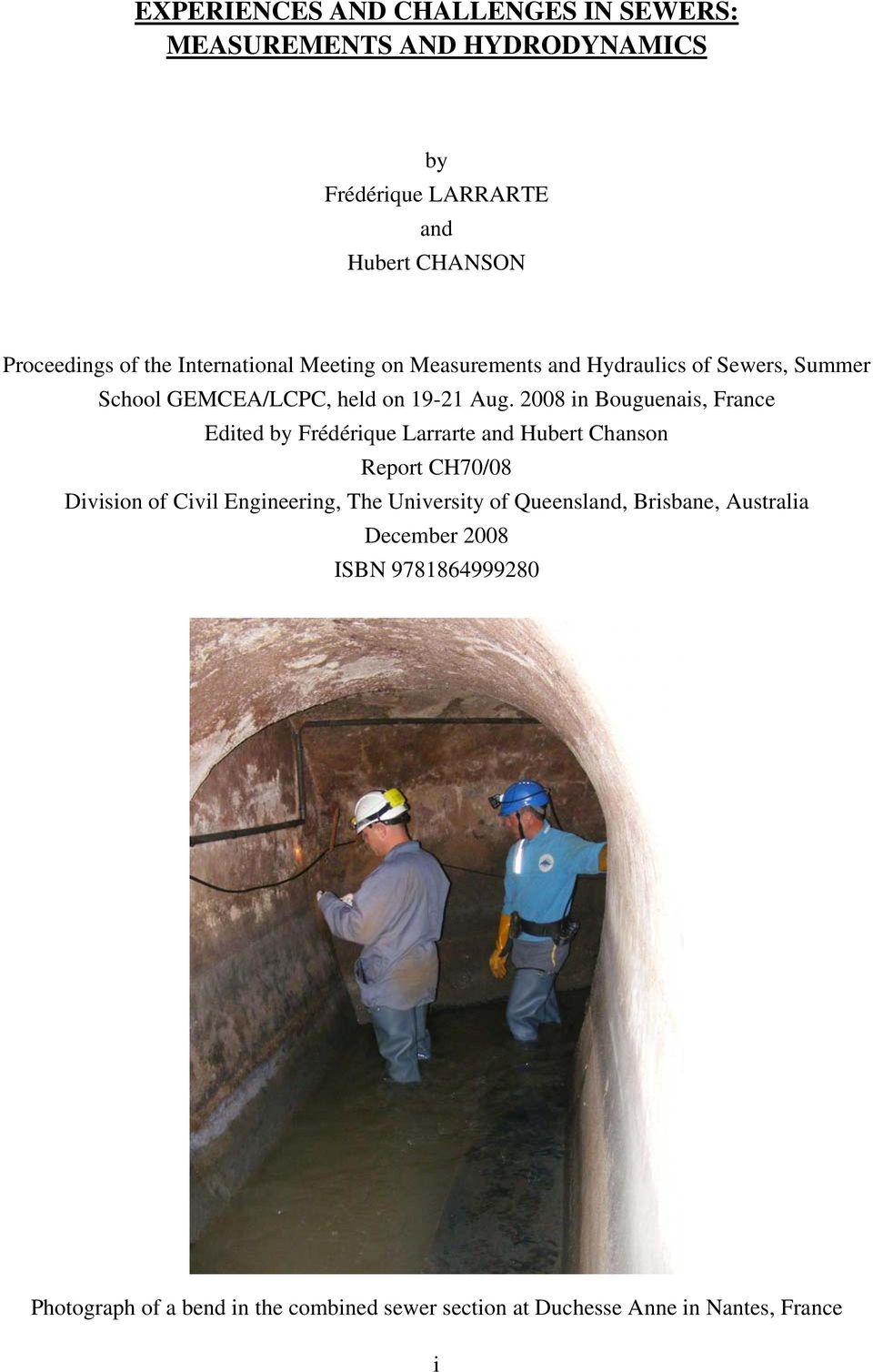
3 EXPERIENCES AND CHALLENGES IN SEWERS: MEASUREMENTS AND HYDRODYNAMICS by Frédérique LARRARTE and Hubert CHANSON Proceedings of the International Meeting on Measurements and Hydraulics of Sewers, Summer School GEMCEA/LCPC, held on Aug in Bouguenais, France Edited by Frédérique Larrarte and Hubert Chanson Report CH70/08 Division of Civil Engineering, The University of Queensland, Brisbane, Australia December 2008 ISBN Photograph of a bend in the combined sewer section at Duchesse Anne in Nantes, France i
4 TABLE OF CONTENTS Page Table of contents ii Préface by Frédérique Larrarte and Hubert Chanson v Acknowledgements Organising Institutions Supporting Organisations vi Photographs of the Meeting Photographs of the Technical Visits viii List of the Meeting Participants xii List of Expert-Reviewers xiii About the Editors xiv Articles Challenges in Sewer Hydrodynamics, Sediments and Measurements 1 by Frédérique Larrarte and Hubert Chanson La Sédimentation dans les Réseaux Unitaires Visitables: le Point de Vue d'un Exploitant 11 Sedimentation in Large Combined Sewage Systems: Perspectives of an Operator by Bertrand Riochet A New Velocity and Total Suspended Solid Measurement Device 21 by Frédérique Larrarte and Louis-Marie Cottineau Mesure des Polluants par Turbidimétrie 33 Measurements of Pollutants by Turbidimetry by Michel Aumond and David Mabilais Acoustic Doppler Velocimetry (ADV) in the Field and Laboratory: Practical Experiences 49 by Hubert Chanson ii

5 Sewer Sediments - their Diversity, Impact and Modelling Challenges 67 by Simon Tait Use of CFD Techniques to Estimate the Spatial Distribution of Sediment on the Bed of a Large Detention and Settling Basin 79 by Gislain Lipeme Kouyi, Andrès Torres, Jean Luc Bertrand-Krajewski, Julie Guilloux, Sylvie Barraud, and André Paquier Index of Contributors 89 Index of Subjects 91 Bibliographic Reference of the Report CH70/08 93 iii

6 Photograph No. 1 - Combined sewer section at Duchesse Anne, Nantes on 20 Aug (Photo H. Chanson) Photograph No. 2 - Combined sewer section at Jardin des Plantes, Nantes on 20 Aug (Photo F. Larrarte) iv

7 PREFACE by Frédérique Larrarte and Hubert Chanson The International Meeting on Measurements and Hydraulics of Sewers (IMMHS'08) was organised by the Water and Environment Division of the Laboratoire Central des Ponts et Chaussées (LCPC) to foster interactions between industry professionals, researchers and university academics on the topics of experiences and challenges in sewers including measurements and hydrodynamics. The International Meeting was held at the Bouguenais site of the LCPC, Nantes (France) on August 2008 under the sponsorship of the Groupement pour l'evaluation des Mesures en Continu dans les Eaux et en Assainissement (GEMCEA) and the Laboratoire Central des Ponts et Chaussées (LCPC). Two half-day technical tours included some field measurements in the sewer network of the city of Nantes (France) (Photographs No. 1 and 2). The IMMHS'08 meeting addressed conventional and innovative aspects of sewer measurements, hydrodynamics, sediments and sedimentation, design, operation, rehabilitation, and interactions with the urban environment. The main themes of the meeting embraced measurements and hydraulics of sewers, sediments and organic matters, hydraulic structures in urban drainage and sewer systems, as well as numerical modelling. This meeting provided an opportunity for researchers, engineers, managers, and engineers in both public and private sectors to present field experiences, reflections, plans, and preliminary results of their own research in an inspiring, friendly, co-operative, and non-competitive environment. The event was attended by 20 participants and by several national and international experts from industry, industrial research laboratory and university. In total, 8 lectures were presented during the five sessions, and several working discussions took place between formal presentations. A total of 3 countries were represented during the event, namely Australia, France and United Kingdom. A main feature of the meeting was the direct interactions between a wide range of professionals and researchers working on a broad range of relevant topics, including operational issues, sediments and turbidity, mud rheology, H 2 S, and flow measurements. Another interesting aspect of this event was the stimulating debates during and after the presentations, as well as during the subsequent discussions and the field measurements. The publication of the meeting proceedings marked the successful conclusion of this event. The proceedings were edited by the International Meeting organiser, Dr Frédérique Larrarte, and one participant, Prof. Hubert Chanson. They contain 7 papers involving 13 authors from 4 countries and 3 continents, and 4 pages of photographs taken during the presentations and technical visits. Each paper was peer-reviewed by a minimum of two experts, and its inclusion in the proceedings was based upon the advice of the reviewers. Initialement, l'idée était l'organisation d'une école d été "Sédiments en réseau" pour permettre des échanges entre les divers participants d un projet de recherche impliquant à la fois des chercheurs du Réseau Scientifique et Technique du Ministère de l'écologie, de l'énergie, du Développement durable et de l'aménagement du Territoire et des organismes membres du Groupement pour v

8 l'evaluation des Mesures en Continu dans les Eaux et en Assainissement (GEMCEA). Divers concours de circonstance ont permis la participation du Professeur S. Tait, de l'université de Bradford (Royaume Uni), et du Professeur H. Chanson, de l'université du Queensland (Australie). Cette école s'est transformée en un séminaire international sur les mesures et l'hydraulique des réseaux d assainissement. Il a été organisé du 19 au 21 août 2008 à Bouguenais (France) par la Division Eau et Environnement du Laboratoire Central des Ponts et Chaussées, avec le soutien du Groupement pour l'evaluation des Mesures en Continu dans les Eaux et en Assainissement (GEMCEA), et l'aide logistique de la Direction de l Assainissement de Nantes Métropole. Ce séminaire a comporté des présentations de travaux de recherches, mais également des retours d expérience notamment sur la mise en œuvre de la débitmètrie par traçage chimique, ou la turbidimétrie, ou encore des présentations des problèmes liés à la présence de dépôts sédimentés et d hydrogène sulfurée dans les réseaux d assainissement urbain. Les participants ont également pu prendre part à deux matinées d expériences sur le terrain qui ont été l'occasion, pour certains, de découvrir les spécificités des mesures dans des collecteurs, telles que par exemple les conditions non contrôlées du point de vue de l hydraulique, mais également contraintes de sécurité. La publication de ces actes marque la conclusion de ce séminaire. Les actes sont édités par l organisatrice du séminaire, Dr. Frédérique Larrarte, et le Professeur Hubert Chanson qui prit part à ces journées. Ces actes contiennent 7 articles impliquant 13 auteurs de 4 pays et 3 continents. Chaque article a été relu par au moins 2 experts, et l'inclusion de l'article dans les actes est basée sur l'avis scientifique des examinateurs. ACKNOWLEDGEMENTS / REMERCIEMENTS The technical staff of the Direction de l Exploitation de l Opérateur Public d Assainissement Nantes Métropole, Laurent Lebouc, David Mabilais and Pascal Pichon, technicians at the Division Eau et Environnement of the Laboratoire Central des Ponts et Chaussées, enabled the experimental part of that seminar. Sonia Salaun contributed to the administrative part of the meeting. Their contribution to the success of the meeting is greatly acknowledged. The Editors are further grateful of the inputs of the expert-reviewers. Les agents techniques de la Direction de l'exploitation de l'opérateur Public d Assainissement Nantes Métropole, ainsi que Laurent Lebouc, David Mabilais et Pascal Pichon, techniciens supérieurs à la Division Eau et Environnement du Laboratoire Central des Ponts et Chaussées, ont permis le bon déroulement des expérimentations. Sonia Salaun, agent administratif à la Division Eau et Environnement du Laboratoire Central des Ponts et Chaussées, a contribué aux taches administratives liées à ce séminaire. Qu ils soient tous ici remerciés. Les Editeurs remercient de plus tous les examinateurs pour leur avis d'expert. vi
9 Organising Institutions / Institutions organisatrices Division Eau et Environnement, Laboratoire Central des Ponts et Chaussées (LCPC), Route de Bouaye, BP 4129 Bouguenais cedex, France. Groupement pour l'evaluation des Mesures en Continu dans les Eaux et en Assainissement (GEMCEA), 149 rue Gabriel Péri, Vandoeuvre les Nancy, France. Supporting Organisations / Organisations support STATISTICAL SUMMARY Meeting 20 participants from 3 countries and 2 continents, including professionals, academics, and researchers, 8 presentations from 3 countries and 2 continents. Proceedings 7 peer-reviewed papers, 13 authors from 4 countries and 3 continents. vii

10 PHOTOGRAPHS OF THE MEETING Photograph No. 1 - Presentation during the meeting (Courtesy of LCPC) Photograph No. 2 - Presentation on discharge measurements with tracers during the meeting on 19 Aug (Courtesy of LCPC) viii

11 PHOTOGRAPHS OF THE TECHNICAL VISITS Photograph No. 1 - Preparation of field measurements in the Jardin des Plantes sewer section, Nantes on 20 Aug (Courtesy of LCPC) Photograph No. 2 - Man hole and access shaft to the sewer below the Jardin des Plantes, Nantes on 20 Aug (Courtesy of LCPC) ix

12 Photograph No. 3 - Two-dimensional sampler "Hydre" in the Jardin des Plantes sewer, Nantes on 20 Aug (Courtesy of LCPC) Photograph No. 4 - Total suspended solid sampling at Jardin des Plantes, Nantes on 20 Aug (Courtesy of LCPC) x

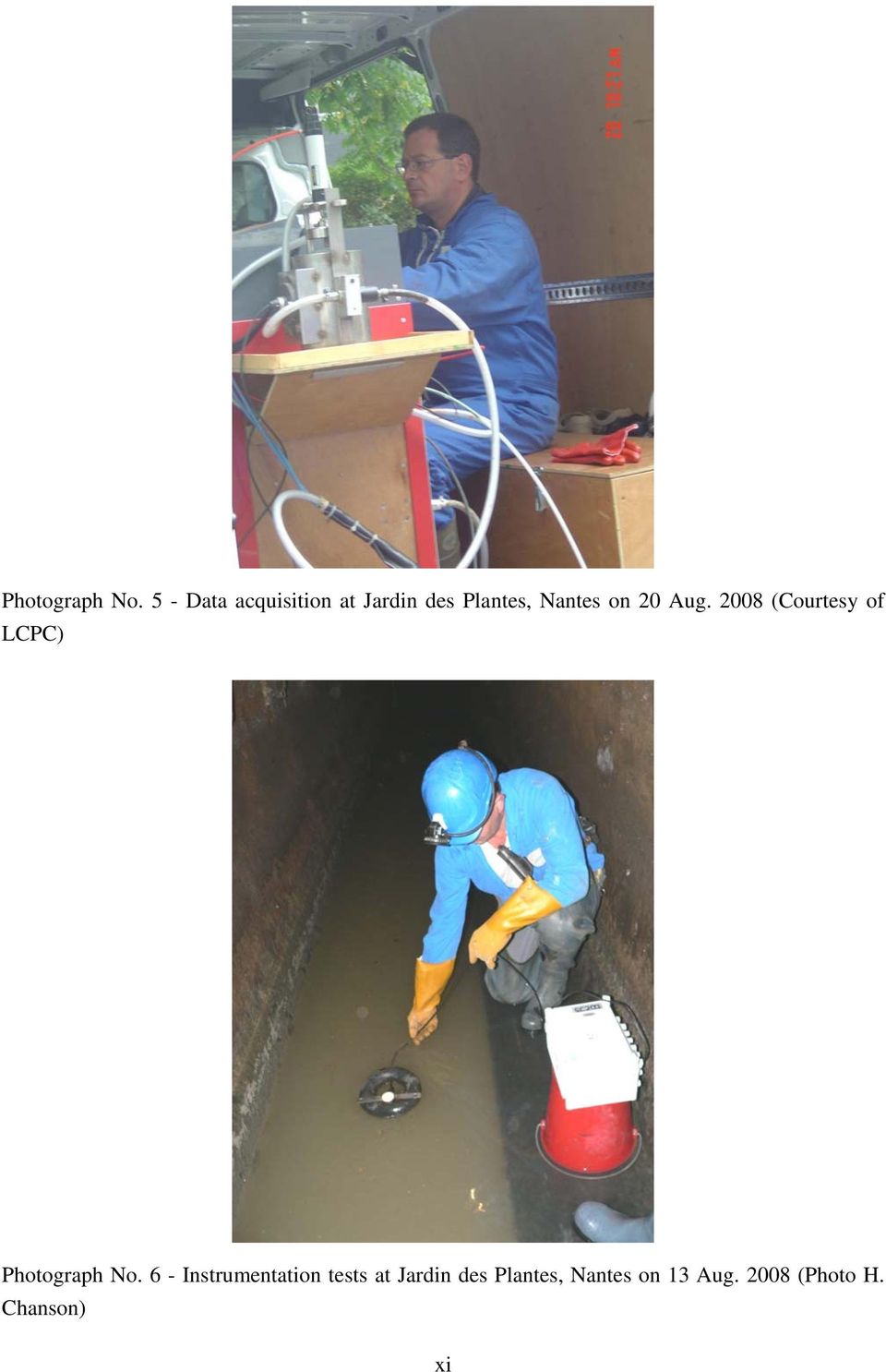
13 Photograph No. 5 - Data acquisition at Jardin des Plantes, Nantes on 20 Aug (Courtesy of LCPC) Photograph No. 6 - Instrumentation tests at Jardin des Plantes, Nantes on 13 Aug (Photo H. Chanson) xi
14 LIST OF THE MEETING PARTICIPANTS Aumond, Michel Laboratoire Central des Ponts et Chaussées, France Battaglia, Philippe GEMCEA, France Chanson, Hubert University of Queensland, Australia Francois, Pierre Institut de Mécanique des Fluides et des Solides de Strasbourg, France Grange, Dominique Laboratoire Régional de l Ouest Parisien, Trappes, France Guilloux, Julie GEMCEA / Laboratoire Régional des Ponts et Chaussées de Nancy, France Jallais, Joel Nantes Métropole Communauté Urbaine, France Larrarte, Frédérique Laboratoire Central des Ponts et Chaussées, France Lebouc, Laurent Laboratoire Central des Ponts et Chaussées, France Lipeme Kouyi, Gislain INSA de Lyon, France Mabilais, David Laboratoire Central des Ponts et Chaussées, France Martineau, Laurent Nantes Métropole Communauté Urbaine, France Pham Van Bang, Damien CETMEF Laboratoire d'hydraulique Saint Venant Pichon, Pascal Laboratoire Central des Ponts et Chaussées, France Riochet, Bertrand Nantes Métropole Communauté Urbaine, France Rochette, Philippe Centre d Etudes Techniques Maritimes Et Fluviales, Compiègne, France Ruperd, Yves Laboratoire Régional des Ponts et Chaussées de Bordeaux, France Schmitt, Philippe Institut de Mécanique des Fluides et des Solides de Strasbourg, France Tait, Simon University of Bradford, United Kingdom xii

15 LIST OF EXPERT-REVIEWERS Koen Blanckaert (Switzerland) Philippe Coussot (France) Willi Hager (Swizerland) Dominique Laplace (France) Jérome Le Coz (France) Daniel Levacher (France) Richard May (UK) Yannick Melinge (France) Ben Moate (UK) Peter Nielsen (Australia) Abdelatif Ouahsine (France) Marie Noelle Pons (France) Mark Trevethan (Germany) Ronny Verhoven (Belgium) xiii

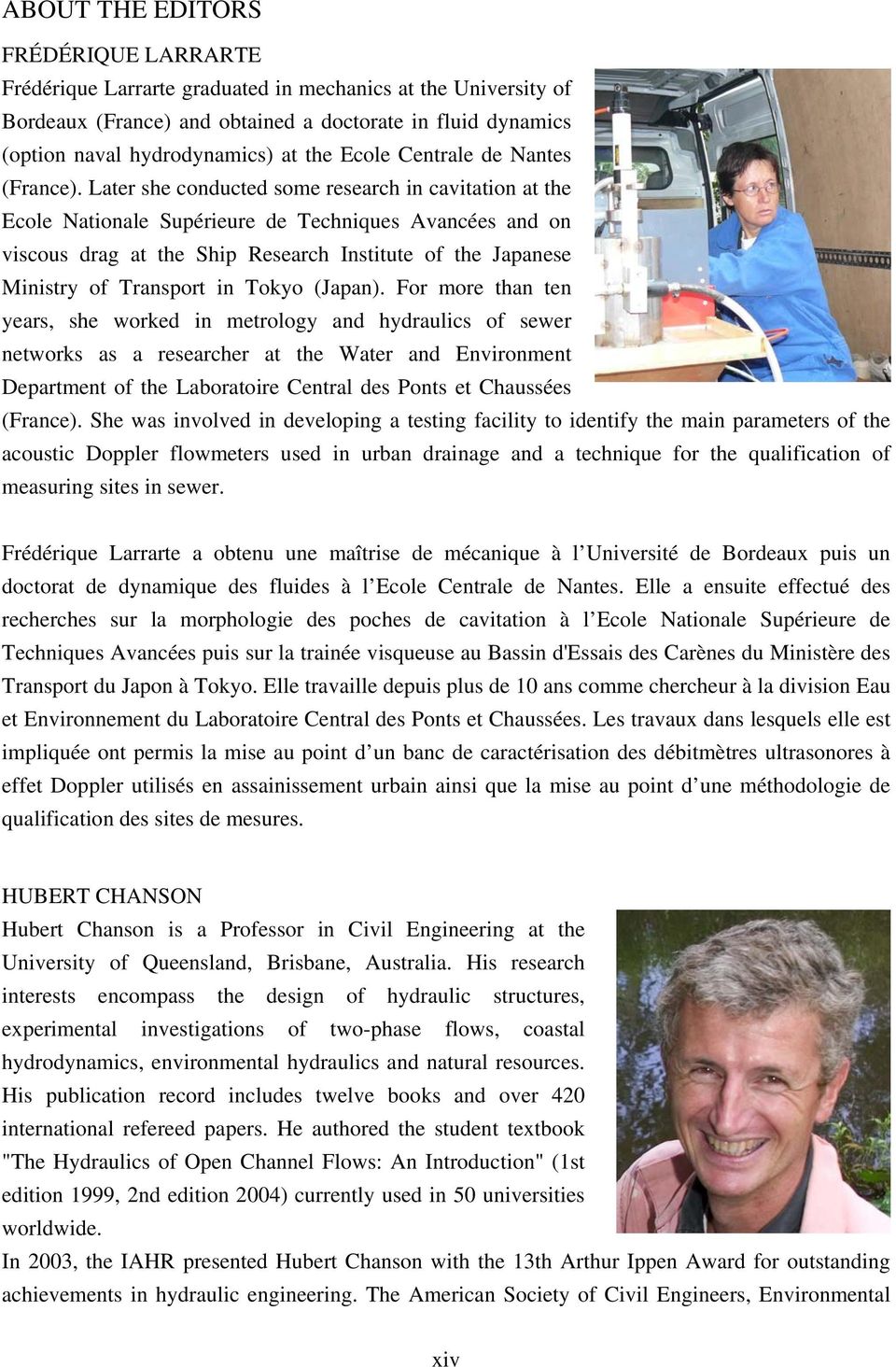
16 ABOUT THE EDITORS FRÉDÉRIQUE LARRARTE Frédérique Larrarte graduated in mechanics at the University of Bordeaux (France) and obtained a doctorate in fluid dynamics (option naval hydrodynamics) at the Ecole Centrale de Nantes (France). Later she conducted some research in cavitation at the Ecole Nationale Supérieure de Techniques Avancées and on viscous drag at the Ship Research Institute of the Japanese Ministry of Transport in Tokyo (Japan). For more than ten years, she worked in metrology and hydraulics of sewer networks as a researcher at the Water and Environment Department of the Laboratoire Central des Ponts et Chaussées (France). She was involved in developing a testing facility to identify the main parameters of the acoustic Doppler flowmeters used in urban drainage and a technique for the qualification of measuring sites in sewer. Frédérique Larrarte a obtenu une maîtrise de mécanique à l Université de Bordeaux puis un doctorat de dynamique des fluides à l Ecole Centrale de Nantes. Elle a ensuite effectué des recherches sur la morphologie des poches de cavitation à l Ecole Nationale Supérieure de Techniques Avancées puis sur la trainée visqueuse au Bassin d'essais des Carènes du Ministère des Transport du Japon à Tokyo. Elle travaille depuis plus de 10 ans comme chercheur à la division Eau et Environnement du Laboratoire Central des Ponts et Chaussées. Les travaux dans lesquels elle est impliquée ont permis la mise au point d un banc de caractérisation des débitmètres ultrasonores à effet Doppler utilisés en assainissement urbain ainsi que la mise au point d une méthodologie de qualification des sites de mesures. HUBERT CHANSON Hubert Chanson is a Professor in Civil Engineering at the University of Queensland, Brisbane, Australia. His research interests encompass the design of hydraulic structures, experimental investigations of two-phase flows, coastal hydrodynamics, environmental hydraulics and natural resources. His publication record includes twelve books and over 420 international refereed papers. He authored the student textbook "The Hydraulics of Open Channel Flows: An Introduction" (1st edition 1999, 2nd edition 2004) currently used in 50 universities worldwide. In 2003, the IAHR presented Hubert Chanson with the 13th Arthur Ippen Award for outstanding achievements in hydraulic engineering. The American Society of Civil Engineers, Environmental xiv
17 and Water Resources Institute (ASCE-EWRI) presented him with the 2004 award for the Best Practice paper in the Journal of Irrigation and Drainage Engineering. His Internet home page is Hubert Chanson est Professeur (Full Professor) à l'ecole d'ingénieurs de Génie Civil de l'université du Queensland, Brisbane Qld, Australie. Il y enseigne des cours magistraux de mécanique des fluides, d'hydraulique des écoulements à surface libre, et de génie hydraulique et ouvrages, à des étudiants en génie civil et génie de l'environnement. Ses travaux de recherche couvrent l'hydraulique des écoulements à surface libre et des ouvrages, les écoulements diphasiques gazliquide, les écoulements géophysiques et la turbulence en milieux naturels, en utilisant des approches théoriques, expérimentales en laboratoire physique, et des études sur le terrain. Il a publié une douzaine de livres et plus de 180 articles dans des journaux scientifiques avec comité de lecture. En 2003, il a reçu le prix Arthur Ippen de l'airh pour ses travaux en ingénierie hydraulique, tandis que l'american Society of Civil Engineers, Environmental and Water Resources Institute (ASCE- EWRI) lui a décerné le prix 2004 du meilleur article appliqué, publié dans le Journal of Irrigation and Drainage Engineering. Son site Internet est: xv

18 BLANK PAGE xvi

19 International Meeting on Measurements and Hydraulics of Sewers, 2008, F. Larrarte and H. Chanson (Eds), Hydraulic Model Report No. CH70/08, Div. of Civil Engineering, The University of Queensland, Brisbane, Australia - ISBN CHALLENGES IN SEWER HYDRODYNAMICS, SEDIMENTS AND MEASUREMENTS Frédérique Larrarte ( 1 ) and Hubert Chanson ( 2 ) ( 1 ) Laboratoire Central des Ponts et Chaussées, Route de Bouaye, BP Bouguenais Cedex, France - [email protected] ( 2 ) The University of Queensland, Division of Civil Engineering, Brisbane QLD 4072, Australia - [email protected], Url: Keywords: Sewers, Hydrodynamics, Sediments, Measurements, Challenges. 1. INTRODUCTION Early civilisations built drainage systems in urban areas to handle storm runoff. The Romans, in particular, constructed elaborate systems that drained also the wastewaters from the public baths. A remarkable sewer system was the Cloaca Maxima ( 1 ) in Rome (Fig. 1). Originally an open channel constructed in the 6th century BC, the stone channel was enclosed during the 3rd century BC with a semicircular vault (Platner and Ashby 1929, Hodge 1992, Viollet 2000,2007). Its primary function was to carry off storm waters from the Forum district to the Tiber River, but large public baths and latrines were connected to it in later times. The original masonry was later replaced by concrete. Figure 1 - The mouth of the section of the Cloaca Maxima across from S. Giorgio in Velabro, Rome (Italy) (Courtesy of William P. Thayer) 1 In Latin, cloaca means sewer. 1

20 (A) Combined sewer in Nantes (Courtesy of LCPC) (B) Pont de l'alma, Paris (France) (Courtesy of Thomas Zundel) Figure 2 - Large sewer channels in Nantes and Paris (France) Until the 19th century, the living conditions in urban areas of western countries were horrific: e.g., the cholera epidemic killed 18,000 people in 1832 in Paris (France). Epidemics of typhoid and cholera, in particular, spurred interests for pure drinking water and sanitation. Reforms saw the constructions of sewer systems in major cities, like Paris, London and in North-America during the 1850s to 1900s, and later the generalisation of sewer systems in smaller cities and towns (Chocat 1996). The first sewers were designed to carry all the waste waters away from the urban areas. It was the "all to the sewer" ('tout à l'égout') era and the sewers were combined (Fig. 2 and 3). In the mid 20th century, the limitations of the combined sewer system emerged with the rapid urbanisation, the increasing water consumption and the construction of wastewater treatment plants. From then, the dual systems were promoted with a separate rainwater drainage sewer. In a dual system, the foul drainage waters are carried to the treatment plants, while the surface water drainage waters are transported directly to the receiving water bodies. Nowadays, urban sanitary systems are a combination of combined sewer systems and dual systems, reflecting the history of each city. New sections of the network are dual systems, but they are often connected to older combined sections (e.g. Fig. 3A). Figure 3A shows small circular foul pipe and a bigger circular rain pipe flowing into a combined channel. Depending on the flow rate, age of the pipe, local context, sewer channels are made of PVC (especially popular for sizes less than 0.3 m in diameter), cast iron, clay, or concrete. Stones channels still exist in some places (Fig. 3B). Figures 2 and 3 present some relatively large sewer channels. Figure 3 show some combined sewer system sections in Nantes. Most sewers operate as free-surface flows (Fig. 3) and the water level rises and falls in response to perturbations to the flow (Fig. 4). Figure 4 presents a one month record of water level, flow velocity and discharge in a combined sewer channel, highlighting the large fluctuations in flow rates, even on a hourly and daily basis, with some rainfall events on 6, 8, 15, 16 and 17 June

21 (A) Small channel junction (Courtesy of LCPC) (B) Stone channel in the oldest part of Nantes sewer network (Courtesy of LCPC) (C) Large channel junction (Courtesy of LCPC) (D) Access manhole at the Jardin des Plantes section Figure 3 - Combined sewer channels in Nantes (France) The primary role of sewers is to carry the wastewaters, or sewage, to a treatment plant. Domestic sewage contains typically 98% water and 2% solids, although the exact proportions may vary. Sewage treatment entails the removal of organic matter, usually accomplished in two stages. In the primary stage, sewage is treated to remove large debris and heavy or large particles. The secondary treatment of sewage purifies the wastewaters to produce an effluent clean enough for discharge (Fig. 5). Sludge from both primary and secondary treatments is collected from the various stages, and dumped at sea, buried in sanitary landfills or re-used for road materials (Fig. 5B). 3
22 Water level (m) Water level (m) Flow velocity (m/s) Discharge (m 3 /s) /06/2001 7/06/ /06/ /06/ /06/2001 1/07/2001 Date Figure 4 - Water level, flow velocity and discharge measurements in a combined sewer (Data: Larrarte 2006) - Sewer section Cordon Bleu, Nantes (France), sampling every 5 minutes Flow velocity (m/s) (A) Aeration tank (Courtesy of LCPC) (B) Dry sewage sludges with a solid content about 20% in weight (Courtesy of Bill Clarke) Figure 5 - Sewage treatment 2. ECONOMICAL CONSIDERATIONS In France alone, 23.6 millions of dwellings are connected to 373,300 km of conduits (Data: Institut Français de l'environnement 2008). The construction costs of the wastewater networks alone are estimated at 4.5 billions of Euros ( 2 ) (Data: Institut Français de l'environnement 2008). A major 2 in 2005 Euros. 4
23 challenge is the sedimentation of the sewage systems (Aflak et al. 2007) despite the European norm NF EN on management and maintenance highlighting the notions of performances of sewage networks. The same European norm NF EN states explicitly the critical impact of sedimentation. Sediment deposits represent a huge amount of materials. For example, Nantes, a urban area of 500,000 inhabitants, has two main treatment plants and a 2,000 km long sewer network. Each year 134 km of sewer sections are cleaned regularly and 2,000 tons of sediments are removed, representing 8,000 hours of work (Fig. 6) (Riochet 2008). The quantification of solids settled during dry weather conditions represents a major environmental concern since the erosion of dry weather sediment deposits represents typically 30 to 40% of urban waste-waters outputs during dry weather conditions, and even up to 80% in some cases like the Marais sector in Paris (Ashley et al., 2004) (Fig. 7). While there is a broad consensus on the needs to reduce the pollutant outputs in all systems, Ashley et al. (2003) highlighted the limitations in the current expertise in sewer sediment processes, in particular in the interfacial zone between deposit and suspended load. (A) Technical staff curing a large sewer channel section with a flood gate (looking at the upstream side) (Courtesy of LCPC) (B) Downstream side of the flood gate (Courtesy of LCPC) Figure 6 - Sedimentation in a combined sewer (Nantes, France) 3. SEWER HYDRODYNAMICS AND SEDIMENTS Most large sewer channels operate as free-surface flows (Fig. 3 and 7). In these open channel flows, the free surface rises and falls in response to changes in discharges, channel slope and width (Fig. 4). The driving force of the flow motion is primarily gravity (e.g. sloping channel), sometimes in combination with pressure (e.g. in an inverted siphon). For a given flow rate, the primary unknowns are the location of the free surface (or flow depth) which is not known beforehand and the flow velocity. The fundamental principles of hydraulic engineering are the equations of continuity or conservation of mass, of momentum or conservation of momentum, and conservation of energy (Henderson 5
24 1966, Chanson 1999, Hager 1999). Another equation is the Bernoulli equation which may be derived from the differential form of the momentum principle (Liggett 1993, Chanson 1999,2006). Open channel hydraulics is possibly the most complicated field in fluid mechanics. For a given flow rate, there is an infinity of solutions depending upon the bed slope, boundary friction and channel cross-sectional shape. Further the three-dimensional turbulent flow motion is complicated, in particular in non-rectangular channels (e.g. Montes 1998, Bonakdari et al. 2008). But even so, traditional clear-water hydraulics cannot predict the cross-sectional changes of sewer channels caused by the sediment transport processes (deposition, blockage, erosion) (Fig. 6). Figure 6 illustrates the removal of large amount of sediment deposits in a combined sewer channel. It is now recognised that sediment motion is characterised by strong interactive processes between water runoff, sediment erosion resistance, topography of the channel, and stream discharge. In sewers, sediments include a wide range of particle sizes ranging from tens of microns to tens of centimetres (Tait 2008). The particles can be inorganic or organic in nature, and their chemical and biological features present significant variations. Sewage sludge and wastewater treatment residues exhibit non-newtonian characteristics, including thixotropy ( 3 ) (Coussot 1997, Tabuteau et al. 2004). Such non-newtonian behaviour is very rarely accounted for in open channel hydraulic calculations and numerical modelling, although sediment mass flux predictions are intricately linked with the sediment sludge properties, including yield stress, apparent viscosity and degree of jamming. In open channels including sewers, numerous failures resulted from the inability of engineers to predict sediment motion and mass fluxes despite recent advances. Riochet (2008) presents some superb illustrations of the practical issues facing the operators. Combined sewer overflow threshold Combined channel dry weather flow (A) Sediment sampling from the invert of a combined sewer (Courtesy of LCPC) (B) Combined sewer overflow and the channel going to the receiving waters (Courtesy of LCPC) Figure 7 - Operational details of sewer systems 3 Thixotropy is the characteristic of a fluid to form a gelled structure over time when it is not subjected to shearing and to liquefy when agitated. 6
25 In sewer management, the predictions of the mass fluxes remain challenging (Lipeme Kouyi et al. 2008, Tait 2008). The calculations need to be validated and checked with field measurements of both water discharges and sediment fluxes despite the limitations of instrumentation and the limited accuracy (Aumond and Mabilais 2008, Chanson 2008, Larrarte and Cottineau 2008). 4. STRUCTURE OF THE PROCEEDINGS This series of peer-reviewed proceedings papers starts with a presentation on sedimentation in large combined sewage systems and the perspectives of an operator (Riochet 2008). It is followed by a series of three papers on field measurements, instrumentation development and applications (Larrarte and Cottineau 2008, Aumond and Mabilais 2008, Chanson 2008). The last contributions deal with sediment management issues (Tait 2008, Lipeme Kouyi et al. 2008). A key feature of all these contributions is the practical knowledge gained in the last ten to fifteen years, and a particular effort was made by all contributors to share both positive and negative experiences. All the authors are active professionals and researchers involved in the field. Their experience and expertise regroup a broad range of relevant topics, including operational issues, sediments and turbidity, and flow measurements. Lastly the proceedings were prepared and edited after the International Meeting on Measurements and Hydraulics of Sewers (IMMHS'08, August 2008), allowing each contributor to benefit from the presentations, exchanges and field measurement experience during the event. 5. REFERENCES AFLAK, A., GENDREAU, N., PASCAL, O., PISTER, B., and VUALTHIER, J. (2007). "Gestion Préventive de l'ensablement des Collecteurs Visitables d'assainissement et Optimisation des Interventions de Curages." Novatech 2007, pp ASHLEY, R.M., CRABTREE, B., FRASER, A., and HVITVED-JACOBSEN, T. (2003). "European Research into Sewer Sediments and Associated Pollutants and Processes." Jl of Hydraulic Engineering, ASCE, Vol. 129, No. 4, pp ASHLEY, R.M., BERTRAND-KRAJEWSKI, J.L., HVITVED-JACOBSEN, T., and VERBANCK, M. (2004). "Solids in Sewers." Scientific & Technical Report No. 14, IWA Publishing, 360 pages. AUMOND, M., and MABILAIS, D. (2008). "Mesure des Polluants par Turbidimétrie." Proceedings of the International Meeting on Measurements and Hydraulics of Sewers, Summer School GEMCEA/LCPC, Aug. 2008, Bouguenais, Frédérique LARRARTE and Hubert CHANSON Eds., Hydraulic Model Report No. CH70/08, Div. of Civil Engineering, The University of Queensland, Brisbane, Australia, Dec., pp (ISBN ). BONAKDARI, H., LARRARTE, F., LASSABATERE, L., and JOANNIS, C. (2008). "Turbulent Velocity Profile in Fully-Developed Open Channel Flows." Environmental Fluid Mechanics, Vol. 8, No. 1, pp
26 CHANSON, H. (1999). "The Hydraulics of Open Channel Flow: An Introduction." Edward Arnold, London, UK, 512 pages (ISBN ). CHANSON, H. (2006). "Minimum Specific Energy and Critical Flow Conditions in Open Channels." Journal of Irrigation and Drainage Engineering, ASCE, Vol. 132, No. 5, pp (DOI: /(ASCE) (2006)132:5(498)). CHANSON, H. (2008). "Acoustic Doppler Velocimetry (ADV) in the Field and in Laboratory: Practical Experiences." Proceedings of the International Meeting on Measurements and Hydraulics of Sewers, Summer School GEMCEA/LCPC, Aug. 2008, Bouguenais, Frédérique LARRARTE and Hubert CHANSON Eds., Hydraulic Model Report No. CH70/08, Div. of Civil Engineering, The University of Queensland, Brisbane, Australia, Dec., pp (ISBN ). CHOCAT, B. (1996). "Encyclopédie de l'hydrologie Urbaine et de l'assainissement." Lavoisier, Paris, France, 1124 pages (in French). COUSSOT, P. (1997). "Mudflow Rheology and Dynamics." IAHR Monograph, Balkema, The Netherlands. HAGER, W.H. (1999). "Wastewater Hydraulics." Springer-Verlag, Berlin, Germany, 628 pages. HENDERSON, F.M. (1966). "Open Channel Flow." MacMillan Company, New York, USA. HODGE, A.T. (1992). "Roman Aqueducts & Water Supply." Duckworth, London, UK, 504 pages. LARRARTE, F. (2006). "Velocity Fields in Sewers: an Experimental Study." Flow Measurement and Instrumentation, Vol. 17, No. 5, pp LARRARTE, F., and COTTINEAU, L.M. (2008). "A New Velocity and Total Suspended Solid Measurement Device." Proceedings of the International Meeting on Measurements and Hydraulics of Sewers, Summer School GEMCEA/LCPC, Aug. 2008, Bouguenais, Frédérique LARRARTE and Hubert CHANSON Eds., Hydraulic Model Report No. CH70/08, Div. of Civil Engineering, The University of Queensland, Brisbane, Australia, Dec., pp (ISBN ). LIGGETT, J.A. (1993). "Critical Depth, Velocity Profiles and Averaging." Journal of Irrigation and Drainage Engineering, ASCE, Vol. 119, No. 2, pp LIPEME KOUYI, G., TORRES, A., VERTRAND-KRAJEWSKI, J.L., GUILLOUX, J., BARRAUD, S., and PAQUIER, A. (2008). "Use of CFD Techniques to estimate the Spatial Distribution of Sediment on the Bed of a Large Detention and Settling Basin." Proceedings of the International Meeting on Measurements and Hydraulics of Sewers, Summer School GEMCEA/LCPC, Aug. 2008, Bouguenais, Frédérique LARRARTE and Hubert CHANSON Eds., Hydraulic Model Report No. CH70/08, Div. of Civil Engineering, The University of Queensland, Brisbane, Australia, Dec., pp (ISBN ). MONTES, J.S. (1998). "Hydraulics of Open Channel Flow." ASCE Press, New-York, USA, 697 pages. PLATNER, S.B., and ASHBY, T. (1929). "Cloaca Maxima." in "A Topographical Dictionary of Ancient Rome", Oxford University Press, London, pp RIOCHET, B. (2008). "La Sédimentation dans les Réseaux Unitaires Visitables: le Point de Vue 8
27 d un Exploitant." Proceedings of the International Meeting on Measurements and Hydraulics of Sewers, Summer School GEMCEA/LCPC, Aug. 2008, Bouguenais, Frédérique LARRARTE and Hubert CHANSON Eds., Hydraulic Model Report No. CH70/08, Div. of Civil Engineering, The University of Queensland, Brisbane, Australia, Dec., pp (ISBN ). TABUTEAU, H., BAUDEZ, J.C., BERTRAND, F., and COUSSOT, P. (2004). "Mechanical Characteristics and Origin of Wall Slip in Pasty Biosolids." Rheol. Acta, Vol. 43, pp TAIT, S. (2008). "Sewer Sediments their Diversity, Impact and Modelling Challenges." Proceedings of the International Meeting on Measurements and Hydraulics of Sewers, Summer School GEMCEA/LCPC, Aug. 2008, Bouguenais, Frédérique LARRARTE and Hubert CHANSON Eds., Hydraulic Model Report No. CH70/08, Div. of Civil Engineering, The University of Queensland, Brisbane, Australia, Dec., pp (ISBN ). VIOLLET, P.L. (2000). "L'Hydraulique dans les Civilisations Anciennes ans d'histoire" Presses de l'ecole Nationale des Ponts et Chaussées, Paris, France, 374 pages. VIOLLET, P.L. (2007). "Water Engineering in Ancient Civilizations. 5,000 Years of History." IAHR Monograph, Madrid, Spain, 322 pages. 9
28 10
29 International Meeting on Measurements and Hydraulics of Sewers, 2008, F. Larrarte and H. Chanson (Eds), Hydraulic Model Report No. CH70/08, Div. of Civil Engineering, The University of Queensland, Brisbane, Australia - ISBN LA SEDIMENTATION DANS LES RESEAUX UNITAIRES VISITABLES: LE POINT DE VUE D UN EXPLOITANT SEDIMENTATION IN LARGE COMBINED SEWAGE SYSTEMS: PERSPECTIVES OF AN OPERATOR Bertrand Riochet Opérateur Public, Direction de l Assainissement, Nantes Métropole, 44 Nantes, France - [email protected] Résumé: Les ouvrages de décantation répartis sur le réseau unitaire visitable ne suffisent pas à piéger l ensemble des matières solides transportées par les effluents. Certains collecteurs ont une pente très faible pouvant faire apparaître la formation de dépôts. Les opérations de curage du réseau unitaire visitable nécessitent souvent la mise en œuvre de moyens humains et matériels conséquents. Un des objectifs recherchés par l Opérateur Public d Assainissement est de limiter la durée de ces interventions souvent pénibles pour le personnel et source de nuisances pour les riverains (bruit, odeurs ). Cet article présente les outils actuellement utilisés et les travaux effectués pour améliorer les techniques de curage des collecteurs visitables. Abstract: Combined sewers are designed to convey waste waters to a treatment plant. When the flow conditions do not allow the solid matters to be maintained suspension, the sediments deposit along the sewer system. The managers and operators of a network have to clean those sediment deposits. The operations require a lot of human and material resources, and efforts must aim to minimise the length of the cleansing operation because it is difficult task for the workforce that generates some nuisance (noises, odours,...) for the neighbourhood. This paper presents the case study of the Nantes Métropole Sewer Authority (France). The man-entry part of the sewer network is located in the central area of Nantes city. This man-entry part represents about 120 km of the combined sewer channels with internal heights greater than 1.2 m. Current cleaning methods are presented including the sewer cleaning truck and the Hydrass floodgate. The truck technique has been improved to use the sewer channel water rather than tap water. The floodgate Hydrass is designed to create a surge by alternating closure and rapid opening (Fig. 3 & 4). After closure, the water behind the gate rises until a defined level, when the gate tilts. The rapid opening creates a surge wave flushing the downstream deposits. One limitations of the self-opening gate is its fixed location and its limited influence, typically about 150 m downstream of the gate. To avoid such limitations, Nantes Métropole Sewer Authority developed a new self cleaning, unmanned tool (Fig. 5 & 7). The key design principle is to reduce the flow cross section, increasing locally the velocity to scour the sediment deposits. This new carriage tool is pushed by the flow itself and it is selfcleaning. While human resources are required to install and remove the carriage, its advance and operation within the sewer channel does not require any human operator. It can be used to clean a 11
30 fairly long section of channel, and its operation requires simply that the cross section remains constant. Mots-clé: exploitant, dépôts sédimentaire, développement d outil, curage, assainissement. Keywords: sewer management, sediment deposit, tool development, sedimentation, cleansing, selfcleaning unmanned carriage. 1. INTRODUCTION La partie unitaire visitable du réseau d assainissement urbain de la Communauté Urbaine de Nantes est dans sa quasi-totalité située sur la partie centrale de la ville de Nantes. On estime à environ 120 km le linéaire de réseau visitable, considérant que les collecteurs sont visitables à partir de 1,20 m de hauteur. Les ouvrages de décantation répartis sur le réseau unitaire visitable ne suffisent pas à piéger l ensemble des matières solides transportées par les effluents (Laplace et al. 1993). Certains collecteurs ou certaines portions de collecteurs ont une pente très faible et présentent un taux d encrassement qui peut atteindre jusqu à 35% de la hauteur de l ouvrage. Ces collecteurs demandent une attention particulière et des interventions régulières (1 fois par an en moyenne). Ces opérations de curage du réseau unitaire visitable nécessitent souvent la mise en œuvre de moyens humains et matériels conséquents. Un des objectifs recherchés par l Opérateur Public d Assainissement est de limiter la durée de ces interventions souvent pénibles pour le personnel et source de nuisances pour les riverains (bruit, odeurs, ). Dans un souci permanent d amélioration nous procédons régulièrement, en collaboration avec les fournisseurs de matériel de curage, à des essais de matériel sur site. Cet article présente les outils actuellement utilisés et les travaux effectués pour améliorer les techniques de curage des collecteurs visitables. (a) Dans un collecteur - In a sewer channel Figure 1 - Chariot vanne (b) Détail - Details 12
31 Figure 1 - Flood gate carriage Figure 2 - Camion hydrocureur «classique» Figure 2 - "Classical" sewer cleaning truck 2. MATERIELS 2.1. Matériel actuel D une manière générale, les opérations de curage sont réalisées soit avec des chariots vanne (Figure 1), soit avec des hydrocureurs (Figure 2). Les hydrocureurs, qui sont de plus en plus performants, sont fréquemment utilisés pour le curage des collecteurs visitables et limitent ainsi les interventions manuelles dans les ouvrages. 2.2 Vannes Hydrass Le procédé mis au point par la Société Hydrass permet de répondre en partie aux problèmes rencontrés (Bertrand-Krajewski et al. 2003, 2005). Les dispositifs installés dans les collecteurs fonctionnent sur le principe de l onde de crue (Figure 3). Une vanne pivotante est positionnée à l aide d un cadre fixé dans l ouvrage. L axe de rotation est situé de manière à créer dans un premier temps un barrage et donc une mise en charge du collecteur en amont de la vanne. Dans un second temps la hauteur d eau et la poussée dynamique font basculer la vanne en position horizontale et libèrent une vague qui remet en suspension les matières accumulées en aval. La vanne se referme automatiquement lorsque le niveau de l effluent est redescendu sous l axe de rotation (Figure 4). Le cycle se répète ainsi en fonction du débit transité et les matériaux accumulés sont remis en suspension par vagues successives. Ce dispositif permet de déplacer les matières décantées sur environ 150 m. Plusieurs cadres peuvent 13
32 ainsi être placés dans un même collecteur en fonction du linéaire à traiter. Figure 3 - Schéma de principe de la vanne Hydrass à cadre fixe Figure 3 - Sketch of the Hydrass floodgate Ces outils de curage sont efficaces si certaines conditions hydrauliques sont réunies. Les débits amont notamment doivent être conséquents pour que les cycles ouverture fermeture de la vanne soient le plus nombreux possibles. En effet, la vanne en position fermée joue le rôle d un bassin de stockage et si les temps de séjours sont trop longs, on retrouve les phénomènes de dégagement d odeurs et d accumulation de graisses. D autres systèmes mobiles utilisant le même principe de fonctionnement peuvent également être mis en place dans les réseaux. Ces outils se déplacent en fonction de la charge d eau amont et du niveau d ensablement aval. La mise en place de ce type d outil nécessite néanmoins une étude plus complète et très fine du réseau à curer. Il faut que le profil en travers du collecteur soit assez régulier et il faut prendre en compte les collecteurs secondaires raccordés dans l ouvrage à curer qui peuvent perturber la progression de la vanne mobile. 2.3 Développement d un nouvel outil L idée est de réduire la section droite de l ouvrage à curer pour augmenter la vitesse de l effluent et ainsi remettre les matières en suspension. Le principe utilisé est donc un peu différent du système utilisé par les vannes Hydrass mais, comme ces vannes, cet outil est mobile et donc il convient de vérifier au préalable la régularité des ouvrages à curer. 14
33 Figure 4 - Vanne Hydrass en position fermée Figure 4 - Hydrass floodgate in closed position L opérateur public d assainissement dispose d un atelier de mécanique et de métallerie qui permet de mettre au point des nouveaux outils de curage. On voit sur la Figure 5 la forme de l outil de curage. Il est dimensionné pour se déplacer dans la partie inférieure de l ouvrage appelée cunette (1,20 m de large par 0,80 m de profondeur). Réalisé en inox, il est constitué d un racleur sur sa partie avant et de plusieurs réservoirs étanches qui sont remplis d eau au moment de la mise en place dans le collecteur afin de limiter sa vitesse de déplacement. En effet, il doit d une part être suffisamment léger pour les opérations de transport, de descente dans l ouvrage et de sortie en fin de cycle de curage et d autre part suffisamment lourd pour s appuyer sur le radier du collecteur. Les premiers essais ont été réalisés Quai de la Fosse à Nantes (France) sur un linéaire d environ 3 km. L ouvrage est un émissaire ovoide de 2,80 m de haut sur 2 m de large par lequel transitent des débits importants (Figure 6). Les variations de débits sont également très importantes entre le débit de temps sec et les débits par temps de pluie. Nous avons remarqué lors de ces premiers essais un 15
34 déplacement rapide de l engin et un manque de stabilité. Il n a donc pas complètement répondu à nos attentes. Ces premiers essais ont permis de vérifier notamment que l engin ne s est pas bloqué dans les parties courbes du collecteur. Nous avons constaté après son passage la présence de sables et de matières décantées en quantité importante. L engin a donc franchi les obstacles formés par les bancs de sables sans les déplacer. Nous avons alors modifié l outil en ajoutant un mât sur la partie arrière pour le stabiliser. Par ailleurs, un masque incliné a été placé à l avant pour ajouter un effet de pression qui fait «plonger» la machine. Ce dispositif permet de bien plaquer l avant de la machine au fond du radier pour récupérer un maximum de matériaux déposées. De nouveaux essais ont permis de vérifier l efficacité des aménagements effectués. Ce dispositif est donc opérationnel (Figure 7). Il nécessite en amont et en aval du tronçon à traiter des ouvertures adaptées pour descendre et sortir la machine. Par ailleurs, l outil ne peut être utilisé que pour des collecteurs dont le profil en travers est identique. Ces remarques sont valables pour tous les outils de curage mobiles. Figure 5 -Schémas du principe de fonctionnement de l'outil de curage Figure 5 - Sketch of a new self-cleaning unmanned tool 16
35 Figure 6 - Profil en travers de l ouvrage Quai de la Fosse Figure 6 - Cross section of Quai de la Fosse sewer channel (a) Opération de mise en service - Installation 17
36 (b) En action - In operation Figure 7 - Nouvel outil de curage Figure 7 - New self-cleaning unmanned tool 3. PERSPECTIVES La plupart des exploitants de réseaux unitaires visitables sont confrontés aux mêmes contraintes d intervention dans les ouvrages. Il conviendrait donc de poursuivre ou de relancer la réflexion engagée par certaines collectivités territoriales sur les problématiques de gestion de réseau unitaire visitable. Un groupe constitué à l initiative de la Direction de l Eau du grand Lyon a déjà regroupé en 2004 la Ville de Paris, Marseille, la Ville de Rennes, le département de Marne la Vallée et l INSA de Lyon. Les sujets abordés portaient entre autre sur la caractérisation des dépôts, sur la conception des ouvrages, sur l efficacité des outils de curage, sur la contribution des dépôts aux flux polluants, sur les outils d aide à la gestion des dépôts (bases de données, modèles de calcul, capteurs..). Bref, autant de sujets qui peuvent aussi intéresser des universitaires et/ou des chercheurs. Il faut donc en parallèle, développer ou renforcer les partenariats avec les organismes travaillant dans ces domaines de compétence pour mettre en place des actions «recherche-développement» qui, à partir d observation et d expérimentations scientifiques in situ, devraient déboucher sur des applications concrètes et utiles aux opérateurs de réseau. 18
37 REMERCIEMENTS L'auteur tient à remercier Madame Frédérique Larrarte pour ses encouragements et sa relecture détaillée de l'article. REFERENCES BERTRAND-KRAJEWSKI, J-L., BARDIN, J.-P., GIBELLO, C., and LAPLACE, D. (2003). "Hydraulics of a sewer flushing gate." Water Science & Tech., Vol. 47, No. 4 pp BERTRAND-KRAJEWSKI, J-L., CAMPISANO, A., CREACO, E., and MODICA, C. (2005). "Experimental analysis of the Hydrass flushing gate and field validation of flush propagation modelling." Water Science & Tech., Vol. 51, No. 2 pp LAPLACE, D., BACHOC, A., and SANCHEZ, Y. (1993). "Solutions techniques pour gérér les dépots en collecteurs visitables." Techniques - Sciences - Méthodes, No. 10, pp
38 20
39 International Meeting on Measurements and Hydraulics of Sewers, 2008, F. Larrarte and H. Chanson (Eds), Hydraulic Model Report No. CH70/08, Div. of Civil Engineering, The University of Queensland, Brisbane, Australia - ISBN A NEW VELOCITY AND TOTAL SUSPENDED SOLIDS MEASUREMENT DEVICE Frédérique Larrarte and Louis-Marie Cottineau Laboratoire Central des Ponts et Chaussées, Route de Bouaye, BP Bouguenais Cedex, France - [email protected] Abstract: The quality of field measurements in sewer systems relies on the spatial representativeness of the measurements. This study aims at field measurements of both velocity and total suspended solids (TSS) using a two dimensional sampler called Hydre. The device was implemented, tested and used in a sewer system for a range of hydraulic situations. This paper presents the principles of development and conception of the instrument. Analyses of the results demonstrate the ability of the device to provide robust TSS and velocity profiles in sewers for a range of flow conditions. Résumé: L évaluation des flux de polluants transitant dans les réseaux d assainissement dépend notamment de la représentativité spatiale des mesures de vitesses et de concentrations en matières en suspension. Cette problématique a été étudiée expérimentalement par des mesures dans des réseaux urbains. Un échantillonneur bidimensionnel, appelé Hydre, a été développé et installé dans un collecteur. Il a permis d étudier la répartition spatiale des vitesses et des concentrations pour une large gamme de contextes hydrauliques. Cet article présente la conception de cet échantillonneur. Les résultats sont présentés et discutés. Ils montrent la bonne homogénéité des concentrations dans la section mouillée. Keywords: velocity profiles, total suspended solids, instrumentation, sewer. 1. INTRODUCTION Two phase particle-laden flows have a wide range of applications related to water although the quantification of the solid mass remains a important question. For example, Pont et al. (2002) and Leecaster et al. (2002) discussed the spatial and temporal sampling representativity and strategy. In Europe, the May 1991 and October 2000 EC Directives and the national regulation define the total suspended solids (TSS) as a major source of pollution. A good management of sewer networks requires the minimisation of pollutant loads discharged to receiving waters, and this requires robust and accurate sensors to assess flow rates and TSS concentrations. Larrarte (2006,2008) described two devices developed and used in a man-entry sewer. The instruments gave a first series of data sets in a combined sewer without sedimentation. The practical experiences showed a number of problems with both samplers including the deployment difficulties, the corrosion, and the lack of 21
40 data on top of the bank. This paper presents the principles of development and application of a third sampler. Results are presented and discussed. 2. MATERIAL DEVELOPMENT The samplers Cerbère and Orphée showed their usefulness for investigating dry and wet weather velocity and total suspended solid within sewers (Larrarte 2006,2008) but both systems had some disadvantages. For example, it was not possible to make measurements on top of the bank, in an area with a compound cross section. Further the system Cerbère experienced some corrosion troubles and it was not possible to adapt it to another experimental area. Also both systems worked in an area with mean velocities larger than 0.5 m.s -1. Based on these experiences, a new 2D sampler device, called "Hydre" was designed and built to investigate in a minimum of time both velocities and total suspended solid concentrations for a wide range of hydraulic conditions (Fig. 1). Figure 1 - Two-dimensional sampler Hydre in the combined sewer, view from upstream 22
41 Figure 2 - Measurement head of the two-dimensional sampler Hydre The measuring head was equipped with two flow meters Nivus PVM-PD and a sampling pipe (Fig. 2). Validation tests showed that the flowmeters Nivus PVM-PD operated within a rather small sampling volume (0.03 m long and m diameter) positioned at 0.1 m in front of the transducer (see Appendix). In practice, a basic problem arose from drifting materials coming in contact with the transducers and clogging the sensors. Since the sensors were not visible, clogging proved difficult to detect and two pipes were devised to clean the velocity sensors with compressed air prior to each reading. The sampling pipe was also cleaned with compressed air before each sampling. At a sampling location, the data set included the mean value of two replicates, with each replicate being the mean value of the instantaneous velocity gauged over a 10-second period. This procedure complied with the NF EN ISO 748 Standard. Once velocities were simultaneously measured at both transducers, the vacuum sampling was triggered. The device Hydre was installed in a combined sewer located in a public park of Nantes (France). The site was selected to investigate the influence of the velocity field on TSS concentrations because an intermittent deposit was previously observed. The sewer had an egg-shaped section with a bank (Fig. 3). The mean velocity V m ranged from 0.3 to 0.5 m.s -1 for water levels of respectively 0.53 to 1.01 m. Dry weather conditions corresponded to water levels below 0.85 m with velocities below 0.60 m.s -1. Hydre was implemented before each measurement campaign (Fig. 4). The transverse movement is based on displacement along a horizontal rail. The position is controlled with an ultrasonic sensor (Fig. 5). The sensor movements were remotely controlled from above the ground level with a computer system (Fig. 6). In a sewer, the wetted area could be sampled from the bottom to a maximum elevation of 1.5 m which encompassed roughly 90% of the situations encountered during a given year. 23
42 2.4 2, , , , , ,4 Z (m) z (m) 1.2 1, , , , , ,2 bank 0.0 0, ,0 0, , ,3 0, , , , ,8 0, , , , , , ,5 1.5 y (m) Figure 3 - Sewer cross section looking upstream Figure 4 - Installation of the two-dimensional sampler through a manhole 24
43 Figure 5 - Two-dimensional sampler Hydre on its rail and detail of the ultrasonic sensor used to control the transverse location Computer Flowmeter head Neck of the sampling bottle (inside the careening) Cover of the sampling bottle Sampling pipe Figure 6 - Parts of the sampling device located above the ground. 3. RESULTS The flow is considered as fully turbulent and subcritical when the Reynolds number R = V D /(4ν) is greater than 10 5, where V m is the flow velocity, D h the hydraulic diameter and e m h 25
44 ν is the water kinematic viscosity with ν = 10-6 m 2.s Velocity fields The channel was narrow and shallow. The aspect ratio Ar = b / h was between 1.4 and 2.1, where b is the free surface width and h max the maximum water level in the main channel during the measurements. In such narrow channels, the maximum velocity was clearly located below the free surface during dry weather conditions (Fig. 7). The results were consistent with the earlier velocity measurements of Larrarte (2006) in another egg-shaped sewer. On top of the bank, a local dip phenomenon could also be seen, that means that the maximum velocity is located below the free surface. Bonakdari et al. (2008) showed numerically that this velocity dip phenomenon was related to strong secondary currents of the second kind of Prandtl, and the flow was fully three dimensional. Figure 8 shows an example of velocity profiles measured during a storm event when a combined sewer overflow was active about 1 km upstream of the measurement area. max 1, , ,4 2,1 distance from the bottom (m) 0, , , , , , , , , , (m) 1,8 1,5 1,2 0,9 B 0,6 banquette h 0,3 0,0 0,0 0,2 0,4 0,6 0,8 1,0 1,2 1,4 1,6 (m) y = 0.30 m y = 0.50 m y = 0.69 m y = 0.70 m y = 0.89 m 0, , , , , , ,60 Velocity(m/s) Figure 7 - Field measurements of vertical distributions of velocity for dry weather conditions 26
45 distance from the bottom (m) 1.1 1, , , ,80 0, , , , , , , , ,4 2,1 1,8 1,5 1,2 0,9 0,6 0,3 0,0 B bank h 0,0 0,2 0,4 0,6 0,8 1,0 1,2 1,4 1,6 y = 0.30 m y = 0.50 m y = 0.70 m y = 0.89 m y = 1.10 m y = 1.30 m 0, , , , , , ,60 velocity (m/s) Figure 8 - Field measurements of vertical distributions of velocity during storm event conditions 3.2 TSS concentrations The water samples were sieved at 2 mm and analyzed to get the TSS and volatile matter concentrations (in g.m -3 ) with respect to the French and European standard NF EN 872. In most cases, the samples were analyzed twice to evaluate the uncertainty associated to the analysis process. The precision of TSS and volatile matters measurements was about 10 g.m -3. The amount of particles greater than 2 mm was less than 5% in mass. The flowmeters measured also the temperature, which varied from 11 to 22 C. About 12 dry weather and 4 rainfall campaigns were conducted between March 2006 and November They gave respectively 500 dry weather and 200 rainfall event concentrations. Figure 9 shows that the TSS concentrations were between 100 and 350 g.m -3. For dry weather days, the result was close to the earlier observations of Larrarte (2008), 5 km downstream. During rainfall events, including storm events, the concentrations remained also lower than 350 g.m -3. No influence of storms was noticed, and this differed from the observations made downstream by Larrarte (2008). Figure 10 shows the ratio of volatile to total suspended solids concentrations. A high ratio of volatile matters to TSS indicates a large component of organic matter. More than 70% of particles of that urban area showed a large organic component and the meteorological context had no influence on the results. 27
46 100% 90% 80% 70% 60% 50% 40% 30% dry weather 20% 10% 0% rain event cumulative suspended solids concentrations (mg/l) Figure 9 - Cumulative total suspended solid concentrations. 60% 50% 40% 30% 20% 10% 0% dry weather rain events 30% 35% 40% 45% 50% 55% 60% 65% 70% 75% 80% 85% 90% 95% 100% % of organic matters in the TSS concentrations (in mass) Figure 10 - Percentage of organic matter in the TSS concentrations (in mass). Figure 11 shows the ratio of particles smaller than 125 microns to total suspended solids. The data ranged between 55% and 85% for most samples. The ratio tended to be larger during rainfall conditions than dry weather days. But the rainfall conditions corresponded to only 3 rain events and the result needs to be confirmed. 28
47 40% dry weather rain events 30% 20% 10% 0% 30% 35% 40% 45% 50% 55% 60% 65% 70% 75% 80% 85% 90% 95% 100% % of fine particles in the TSS concentrations (in mass) Figure 11 - Percentage of particles smaller than 125 microns in the TSS concentrations (in mass). The spatial distribution of pollutants was investigated. Figure 12 shows the TSS concentrations measured on various verticals within the cross section. The data corresponded to a dry weather day with a water level of 0.57 m and a 0.02 m thick sediment deposit below the sampler. The mean velocity in the cross section was equal to 0.37 m.s -1 and this was below the commonly accepted self-cleansing velocity. There were vertical concentration fluctuations but no concentration gradient was noticed. The results presented were consistent with those of Ahyerre at al. (2001) for the suspended solid concentrations. The concentrations obtained by Ahyerre et al. (2001) in the sediment were higher than those obtained by Worhle and Brombach (1991) close to the bottom. 4. CONCLUSION A two-dimensional sampler device was developed to improve the reliability of measurements in sewer systems. The sampler allowed the measurements of both velocity and total suspended solids within the cross section of a sewer for a wide range of hydraulic conditions. The analysis of the results recorded by the sampler demonstrated the ability of the device to characterise both the velocity and TSS fields. The measurements showed that a dip phenomenon occurred in the narrow channel with a second maximum over the bank, there was no concentration gradient even though a deposit existed at the time of the sampling, and the particles were mainly organic and fine whatever the meteorological conditions. Field experiments must be extended to include other rainy days and storm event measurements and to investigate the relation between sediment deposit and hydraulic conditions. 29
48 distance from the bottom(m) 1, , , , , , , , , , , , ,4 2,1 1,8 1,5 1,2 0,9 B 0,6 bank 0,3 h 0,0 0,0 0,2 0,4 0,6 0,8 1,0 1,2 1,4 1,6 TSS < 2 mm y = 0.40 m TSS < 2 mm y = 0.60 m TSS < 2 mm y = 0.79 m concentration (mg/l) Figure 12 - Vertical distributions of the TSS concentrations for a dry weather day 5. ACKNOWLEDGEMENTS This work was supported by the Direction of Research and Scientific Affairs of the Minister of Equipment. The author would like to thank the technical staff of both the Laboratoire Central des Ponts et Chaussées - Division Eau & Environnement and Division Métrologie et Instrumentation, and the Direction de l Assainissement de la Communauté Urbaine de Nantes for their valuable contributions to these experiments. 6. NOMENCLATURE b Ar = aspect ratio h mx b width of the free surface (m) C concentration (g.m -3 ) D h hydraulic diameter (m) h max maximum water level (m) R e Reynolds number S m wetted area of the vertical cross-section (m 2 ) V m mean velocity (m.s -1 ) y transverse distance (Fig. 3) (m) y max maximum width of sewer channel (Fig. 3) (m) ν water kinematic viscosity (m 2.s -1 ) 7. REFERENCES AHYERRE, M., CHEBBO, G., and SAAD, M. (2001). "Nature and Dynamics of Water Sediment 30
49 Interface in Combined Sewers." Journal of Environmental Engineering, ASCE, Vol. 127 No. 3, pp BONAKDARI, H., LARRARTE, F., JOANNIS C., and LEVACHER, D., (2008). "Champ de Vitesses et Contraintes de Cisaillement dans un Collecteur d'assainissement." La Houille Blanche, No. 3, pp LARRARTE, F. (2006). "Velocity Fields in Sewers: an Experimental Study." Flow Measurement and Instrumentation, Vol. 17, LARRARTE, F. (2008). "Suspended Solids within Sewers: an Experimental Study." Environmental Fluid Mechanics, Vol. 8, No. 3, pp LEECASTER, M.K., SCHIFF, K., and TIENFENTHALER, L.L. (2002). "Assessment of Efficient Sampling Designs for Urban Stormwater Monitoring." Water Research, Vol. 36, pp PONT, D., SIMONNET, J.P., and WATER, A. V. (2002). "Medium-Term Changes in Suspended Sediment Delivery to the Ocean: Consequences of Catchment Heterogeneity and River Management (Rhône River, France)." Estuarine, Coastal and Shelf Science, Vol. 54, pp WOHRLE, C., and BROMBACH, H. (1991). "Probenahme im Abwasserkanal." Wasserwirtschaft, Vol. 81, pp APPENDIX It can be noticed on Figure 2 that the two-dimensional sampler Hydre is intrusive. The velocity field around the measurements head was computed with a three-dimensional Navier-Stokes solver. Figure A-1 shows the influence of the measurement head on the velocity field at 0.05 m upstream. This influence becomes negligible at 0.1 m upstream of the head that was the location of the ultrasonic flowmeter sampling volume. 31
50 (A) 0.05 m upstream of the head (B) 0.10 m upstream of the head Figure A-1 - Flow field around Hydre sampler head 32
51 International Meeting on Measurements and Hydraulics of Sewers, 2008, F. Larrarte and H. Chanson (Eds), Hydraulic Model Report No. CH70/08, Div. of Civil Engineering, The University of Queensland, Brisbane, Australia - ISBN MESURE DES POLLUANTS PAR TURBIDIMETRIE EN ASSAINISSEMENT MEASUREMENTS OF POLLUTANTS BY TURBIDIMETRY Michel Aumond et David Mabilais Laboratoire Central des Ponts et Chaussées, Route de Bouaye, BP 4129, Bouguenais cedex, France - [email protected] Résumé: La turbidité est l un des rares paramètres de qualité mesurable en continu en réseau d assainissement. La fiabilité et l intérêt d un suivi en continu de la qualité de l effluent urbain par turbidimétrie a été testée sur un émissaire d un réseau de collecte majoritairement unitaire, d environ équivalents habitants. Une campagne de près de 700 jours avec des enregistrements à cadence rapide de deux capteurs redondants a permis de mettre au point des protocoles pour la mise en œuvre de la turbidimétrie en réseau d assainissement. Cette mise en œuvre comporte cinq points essentiels : le réglage et l étalonnage des turbidimètres, le suivi de la pérennité de ces réglages, la mise en forme du mesurande, le choix d une stratégie d acquisition et de traitement du signal et la validation des données acquises. Ce papier détaille la mise en œuvre pratique de la turbidimétrie et évoque des utilisations possibles de cet indicateur, hors des utilisations classiques qui cherchent à définir des liens statistiques plus ou moins lâches avec les indicateurs conventionnels de polluants tels que DCO, MES, etc. Abstract: Nowadays standard pollution parameters for waste waters are still based upon chemical analyses of samples although these methods prove expensive for high sampling rate. While turbidity is not a standard parameter, such as chemical oxygen demand (COD) and total suspended solids (TSS), and its conversion into standard parameters remains complicated, turbidity in itself is a robust pollution indicator that can be continuously monitored at relatively low cost. In association with flow rate measurements, turbidity proves to be an useful parameter to study pollutant fluxes, and this article reviews a number of practical field applications in sewers. The paper presents a method to use efficiently turbidity. Recommendations are given to choose the sampling rate and duration of the measurements. The calibration process is explained and standard references are given together with advices to control the calibration permanence. Once all these practical aspects are taken account, the turbidity data need further post-processing. Raw data are indeed affected by many effects including noises caused by tows or big particles that can saturate the sensors. The random noise of the turbidity data can be discarded by an appropriate signal processing. A key feature is the technical redundancy obtained by using together two turbidimeters at the same location. The pairs of measurements are used to define a reference. Another key practical issue is to use a sampling rate higher that the necessary to obtain redundant data at a given time. The difference between a data point and the reference can be tested relatively easily, and erroneous 33
52 values can be removed. A practical case is shown. If all the practical recommendations and advices are respected, turbidity proves to be an efficient and cheap technique to monitor continuously pollutant fluxes. Mots clé: turbidité, stratégie d acquisition, traitement du signal, filtre, flux polluant. Keywords: turbidity, sampling strategy, data acquisition, signal processing, filtering, pollutant fluxes. 1. INTRODUCTION Les paramètres standard de pollution, comme les matières en suspensions, la demande chimique en oxygène, préconisés dans le cadre de l auto-surveillance, ne sont mesurés que par des analyses de laboratoire effectuées sur des échantillons prélevés. Cette méthode devient très coûteuse dès que le taux d échantillonnage devient élevé. En revanche, la turbidité n a pas cet inconvénient: elle se prête parfaitement à une mesure en continu pour un coût raisonnable (Ruban et al. 2001, Velkam et al. 2002, Henckens et al. 2002). L indicateur turbidité ne fait pas partie des indicateurs standards (MES, DCO, ) préconisés dans le cadre de l auto-surveillance. Mais cet indicateur moins conventionnel est intéressant, même si sa conversion en paramètres standard reste approximative pour ne pas dire aléatoire. La turbidité est en elle-même un indicateur de pollution riche d information. Elle se prête à la mesure en continu à un coût abordable. Elle est adaptée à l étude des flux polluants dans le temps (Aumond et Joannis 2008), associée à des mesures de débits. Elle permet des analyses fines du fonctionnement du réseau d assainissement. Complétée par une mesure de conductivité, autre indicateur de qualité qui se prête également à la mesure en continu, elle permet la détection de phénomène indétectable sans mesures en continu. La turbidité est principalement sensible aux matières particulaires dans l effluent (Fig. 1). La conductivité est un indicateur de la teneur totale en sels. La confrontation de ces deux indicateurs et des variations de débits permet de mettre en évidence outre la variation de la part des eaux sanitaires dans l effluent, des phénomènes inattendus comme la variation de la qualité des eaux sanitaires. Ces variations doivent être expliquées. Elles peuvent être provoquées par des phénomènes de dépôts/érosions de sédiments dans le réseau. Dans cet article, les différentes phases nécessaires à une mise en œuvre efficace de la turbidimétrie en réseau d assainissement sont successivement abordées. Tout d abord les critères de choix du matériel à installer, les réglages et étalonnages à effectuer sont présentés. Les perturbations qui peuvent affecter le signal brut de turbidité sont décrites. Les moyens mis en œuvre pour conditionner le mesurande et limiter ces perturbations sont détaillés. Nous parlons également de la stratégie d acquisition que nous suggérons, ainsi que de l indispensable traitement du signal à effectuer. La nécessaire étape de validation des données acquises est rappelée. 34
53 Figure 1 - Domaine d applicabilité de la turbidimétrie Figure 1 - Turbidimetry validity domain 2. MATERIEL ET METHODE Les données proviennent d un réseau majoritairement unitaire, desservant environ habitants de l agglomération nantaise (France). Le site de mesures se situe dans un collecteur situé en aval d une chambre à sable alimentée par un ovoïde à banquette de 2,3 m de haut sur 1,5 m de largeur maximale, et en amont d une paire de siphons. Le débit moyen est d environ 1500 m 3 /h. Les turbidimètres sont fixés à une perche articulée (trois degrés de liberté) qui plonge dans l effluent. Cette perche est conçue pour faciliter au mieux les opérations de maintenance : nettoyage, réglages, etc. Il s agit de turbidimètres Turbitech 2000LA fabriqués par la société Partech. Ces capteurs mesurent la turbidité par atténuation d un faisceau infrarouge à 950 nm. L objectif est de mettre au point une stratégie d acquisition et de traitement du signal qui permette d éliminer les artefacts de mesures. La méthode consiste à échantillonner la mesure de turbidité par rapport à la cadence de mesures choisie en fonction de la résolution finale fixée par l utilisateur des mesures, et de traiter la population de mesures obtenue afin d éliminer les pics indésirables. Il est inutile d échantillonner à une cadence trop élevée car, les turbidimètres ayant un temps de réponse non négligeable, les mesures successives ne seraient plus indépendantes. Dans notre cas, les turbidimètres Partech ont un temps de réponse affiché de 0,2 s. C est le résultat de ce traitement qui fournit la valeur de turbidité utile devant être enregistrée. Ce traitement, une fois mis au point, a vocation à être effectué en temps réel. Pour effectuer cette mise au point, les mesures sont enregistrées sur une centrale d acquisition AOIP au pas d échantillonnage de 1 seconde. La capacité mémoire de cette centrale étant limitée à environ trois heures d enregistrement pour les deux turbidimètres à la cadence de 1 seconde, soit le plus court pas de temps permettant des mesures indépendantes. Les données sont récupérées et 35
54 stockées automatiquement par un micro-ordinateur sur le terrain. Les mises au point des stratégies de traitement du signal sont réalisées à partir de ces enregistrements. Des simulations de ces stratégies d acquisition et de traitement du signal sont testées en différé à partir de cette banque de données. La disponibilité de la redondance matérielle (deux turbidimètres) permet d obtenir avec un bon niveau de confiance une chronique de mesures dite de référence. Cette chronique de référence permet de juger de la qualité des traitements du signal effectués pour chacun des turbidimètres. 3. REGLAGE ET ETALONNAGE DES TURBIDIMETRES Le réglage et l étalonnage des turbidimètres permettent de fournir une certaine garantie de fonctionnement, de sécurité, de performance, de qualité, d'interchangeabilité, d'interopérabilité (Joannis et al. 2006). Ils sont réalisés par application de la norme NF ISO 7027 (2000). Cette norme est un ensemble de règles fonctionnelles ou de prescriptions techniques relatives aux turbidimètres, à leurs réglages et étalonnage, établies par consensus de spécialistes et consignées dans un document produit par un organisme de normalisation, national (agence française de normalisation AFNOR) et international (international standard organization ISO). Les turbidimètres utilisés doivent répondre aux exigences suivantes selon la norme NF ISO 7027 (2000): La longueur d onde de la radiation incidente doit être de 860 nm, La largeur de bande spectrale doit être inférieure ou égale à 60 nm, La géométrie des optiques est également précisée dans cette norme, Les résultats obtenus à d autres longueurs d onde ne peuvent être comparés aux résultats obtenus à 860 nm. Les turbidimètres de terrain utilisés sont proches de cette norme: 950 nm au lieu de 860 nm, mais cette différence induit un biais (probablement faible) par rapport aux mesures respectant scrupuleusement cette norme. En effet, l absorption du faisceau de mesure par les matières en suspensions dépend et de la répartition en taille des particules en suspension et de la longueur d onde utilisée. La turbidité est la mesure de l aspect plus ou moins trouble de l eau. Elle correspond à la propriété optique de l eau permettant à une lumière incidente d être déviée ou absorbée par des particules plutôt que transmise en ligne droite. Elle est mesurée, d après la norme NF ISO 7027 (2000), en unités FAU qui nécessite des solutions étalons à base de formazine. Nous n utilisons cette substance que pour les étalonnages car elle est onéreuse et cancérigène. Pour les contrôles périodiques nous utilisons l étalon secondaire qu est le kieselgur. Le réglage des instruments est effectué en deux points, conformément aux instructions données par le fabricant. Le zéro est effectué à l aide d une eau osmosée, qui limite la présence d éventuelles bulles. Les bulles influencent notablement la mesure de turbidité. Le point de réglage haut est effectué à l aide d un étalon secondaire constitué d une suspension de kieselgur à 1,5 g/l. Outre son prix, cet étalon secondaire à l avantage de ne pas être toxique. Cette suspension doit être soigneusement agitée à l aide d un agitateur magnétique car 36
55 la vitesse de décantation du kieselgur est importante. Une fois l instrument réglé, il faut procéder à son étalonnage. Les turbidimètres de terrain que nous avons essayés ne disposent pas d une échelle préétalonnée, ou du moins celle fournie ne correspond pas aux valeurs d étalonnage. Il convient alors d établir une courbe d étalonnage. La courbe d étalonnage est réalisée en utilisant au moins cinq suspensions étalons de formazine de turbidité répartie sur la gamme étudiée. 4. PERENNITE DES REGLAGES La vérification des réglages des turbidimètres est un aspect de la gestion de la qualité des mesures. C est une opération de contrôle effectuée en vue de déterminer, avec des moyens appropriés, si l appareil contrôlé est toujours conforme ou non aux spécifications ou exigences préétablies. Elle inclut une décision d'acceptation, de rejet ou de retouche. Cette opération de contrôle a un lien évident avec la phase de validation des données. Pour effectuer la vérification des réglages, il faut au préalable en déterminer les caractéristiques et choisir les limites à l'intérieur desquelles le réglage est conforme. Il faut que ces limites soient connues par le «contrôleur» qui effectuera le contrôle. Il implique également qu'à l'issue de l'acte technique de contrôle, une décision soit prise en ce qui concerne la conformité : Appareil conforme, Appareil non-conforme qui doit être changé (panne), Appareil non conforme pouvant être réglé. La vérification des réglages est effectuée sur le terrain, près du collecteur. Cette opération est effectuée avec les mêmes types d étalons secondaires que ceux utilisés lors du réglage initial, dans les mêmes conditions, mais dans l inconfort du terrain. L agitation impérative des suspensions de kieselgur est réalisée à l aide d un agitateur magnétique à pile. Les points de réglage zéro (eau osmosée) et réglage haut (1,5 g/l de kieselgur) sont vérifiée deux fois avec des suspensions étalons distinctes. Si et seulement si les deux contrôles sont cohérents et présentent des différences supérieures à 30 unités de réglage, l appareil est réglé de nouveau. Ce seuil de 30 unités d atténuation kieselgur correspond à deux fois l écart type de la dispersion des étalons secondaires de suspension de kieselgur. Le double contrôle a pour principal objectif de pallier les risques d erreurs plus importants lors du travail hors laboratoire. La périodicité de ces contrôles a été fixée, suite aux premières expériences, dans une fourchette de quatre à six semaines. Sur la période du 23 mai 2006 au 15 juillet 2008, soit plus de 2 ans de mesures en continu, 24 contrôles ont été effectués pour chacun des turbidimètres. Seulement deux réglages ont été refaits pour chacun des turbidimètres, pour de faibles dépassements du seuil de 30 unités d atténuation kieselgur. Ces quelques remarques ne sont qu un rappel du bonne usage d un appareil de mesure, mais elles sont d autant plus nécessaires que les turbidimètres de terrain sont généralement vendus non étalonnés. 37
56 Figure 2 - Exemple de macro déchets Figure 2 - Example of large debris Figure 3 - Les turbidimètres et la chambre de mesures Figure 3 - Turbidimeter deployment in the field Figure 4 - Les turbidimètres avec leur protection individuelle Figure 4 - Turbidimeters with their individual protection 38
57 5. MISE EN FORME DU MESURANDE La turbidité est principalement causée par des particules en suspension qui absorbent, diffusent et/ou réfléchissent la lumière. Les caractéristiques optiques (taille du faisceau) ne permettent de mesurer la turbidité que pour des particules de taille inférieures à quelques dixièmes de millimètre (Fig. 1). Au dessus de ces dimensions, le turbidimètre n est plus capable de mesurer une turbidité. Il se comporte comme un compteur de particules avec un fonctionnement en tout ou rien. Il convient de mettre en forme le mesurande en écartant de l effluent soumis au turbidimètre tout ce qui ne ressort pas de la mesure de turbidité. Il faut éviter la zone de transport des flottants. Ils ont fréquemment des dimensions qui atteignent quelques dizaines de centimètres. La zone de transport par charriage et saltation est également à proscrire: risque d ensablement ou d envasement des capteurs. Il ne reste qu une zone possible: à mi hauteur de l écoulement. Mais même dans cette zone de nombreux macro déchets subsistent (Fig. 2), qui perturbent et ruinent la mesure. Il convient d écarter du faisceau de mesures tous ces éléments perturbateurs. Après différents essais, le système de protection par chambre commune (Fig. 3) ou individuelle (Fig. 4) a été retenu. L entrefer des appareils est toujours perpendiculaire à l écoulement. La réalisation de différents types de tests n a pas permis de déceler de biais provoqués par ces systèmes de protection. Le premier test a consisté à comparer les mesures enregistrées avec les turbidités mesurées au laboratoire sur 12 échantillons d eaux usées prélevés sur ce même site avec un préleveur automatique programmé au pas de temps horaire. Le second test s est déroulé en plaçant un troisième turbidimètre sans protection que l on a comparé aux turbidimètres protégés. Malgré ces précautions, un entretien périodique (une à deux semaines) reste nécessaire, avec nettoyage complet du matériel de mesure. 6. STRATEGIE D ACQUISITION ET TRAITEMENT DU SIGNAL Malgré les précautions présentées dans la section précédente, l acquisition directe de valeurs moyennes sur des pas de temps de quelques minutes produirait des enregistrements fortement biaisés (Aumond et Joannis 2006). Il convient d effectuer un traitement du signal avant utilisation des mesures. Les artefacts biaisant les mesures sont résumés sur le graphique de la Figure 5. Les graphiques représentent en bleu clair et foncé les signaux bruts issus des deux turbidimètres. Le premier graphique donne un exemple dans lequel la protection des turbidimètres est inefficace. Des saturations longues sont visibles. Elles sont dues à des colmatages de longues durées provoqués par des filasses coincées devant les cellules de mesure du turbidimètre telle que celles présentées dans la Figure 5. De nombreux pics de grandes amplitudes et à occurrence rapide sont probablement dus à des filasses accrochées au système et qui viennent balayer le faisceau de mesure au gré du courant. C est pour cette raison que nous l avons abusivement baptisé bruit hydraulique. Ces deux premiers bruits ne peuvent être supprimés que par une mise en forme convenable du mesurande, toute l information turbidité ayant disparue. Lorsque le prétraitement du mesurande est correctement réalisé, il reste un signal tel que l on peut voir sur le deuxième graphique de la Figure 5. De nombreux pics (impulsion) sont présents, mais l information turbidité reste présente. Ces pics 39
58 sont toujours positifs et de grandes amplitudes. Ils ne peuvent pas être éliminés par une simple moyenne, ou par utilisation du réglage de l amortissement qu il est matériellement possible de régler sur la majorité des turbidimètres. Il convient de supprimer ces pics et de n utiliser que les données filtrées. Afin de mettre au point une stratégie d acquisition et de traitement du signal, nous avons utilisé la redondance matérielle disponible ici pour caractériser le bruit à éliminer. bruit saturation longue cause colmatage bruit «hydraulique» filasse bruit aléatoire grosses particules Le bruit est toujours positif (pics) Les deux premiers types de bruit sont éliminés par le traitement du mesurande (mais pas toujours) Le dernier type de bruit est éliminable par un traitement du signal en temps réel Figure 5 - Artefact troublant la mesure de turbidité en réseau d assainissement Figure 5 - Identification of different errors and noises, and their origin in a sewer system 6.1 Analyse succincte du bruit. On dispose de 670 jours d enregistrement à la seconde de double mesure de turbidité. A partir de ces deux chroniques appairées de mesures de turbidité, il est possible de construire une chronique de référence raisonnablement fiable. Définition de la référence: A chaque seconde i, si T1(i) -T2(i) < K alors Tf(i) = moyenne (T1(i);T2(i)) sinon rejet des valeurs. (1) K est défini à partir de l étude de la dispersion des différences entre paire des mesures brutes des deux turbidimètres. Finalement, la valeur à la minute m de la référence est: n 1 Tréf ( m) = Tf ( i) (2) n i= 1 40
59 où n est l effectif des valeurs retenues à la minute. La simple différence entre les chroniques brutes de turbidité et cette référence donne une bonne image du bruit. Nous pouvons extraire quelques statistiques générales décrivant ce bruit Dispersion globale du bruit La Figure 6(a) montre l histogramme de la dispersion du bruit par tranche de 1 FAU. L analyse de cet histogramme montre tout d abord que le mode majeur ( 1 ) de la distribution se détache sans ambiguïté du reste de la distribution. Une queue de distribution importante est visible vers 7000 FAU. Le coté négatif de la distribution ne présente pas cette particularité. Cette anomalie vers 7000 FAU est due aux pics parasites. L usage d une échelle logarithmique dans la Figure 6(b) pour l axe des ordonnées visualise bien le phénomène. Si on dilate l échelle des abscisses dans la figure 6 (c), on voit qu une majorité du bruit ( 90% des valeurs) reste limité dans une fourchette de +/- 25 FAU autour de zéro, alors qu en prenant un seuil légèrement supérieur à 95%, nous obtenons les fourchettes suivantes: p117 : [-61;42] & p149 : [-23;4154]. Ces histogrammes sont calculés sur la période de 670 jours de mesures. Le principal enseignement de ces histogrammes est qu une grande partie des mesures ( 90%) est exempte de pics. Si ces pics sont régulièrement répartis dans le temps, le traitement des données est viable et relativement simple à exécuter. C est ce dont nous pouvons en partie juger par l analyse des durées de pics. Effectifs 10% 5% p149 p117 0% par tranche de 1 FAU (a) 1 Terme utilisé en statistiques: le mode d'une série statistique est la valeur qui a le plus grand effectif; c'est un critère de position. 41
60 Effectifs 100% % 1% % 0,01% % 0,0001% % p149 p117 0,000001% % par tranche de 1 FAU (b) 10% Effectifs 5% p149 p117 0% par tranche de 1 FAU (c) Figure 6 - Histogrammes du bruit (des écarts entre le signal de référence et les valeurs délivrées par chaque capteur) de chacun des turbidimètres Figure 6 - Histograms of the difference between the reference signal and the delivered cell data Durée des pics Un pic est défini pour toute différence supérieure à 35 FAU entre la mesure brute et la référence précédemment définie. Ce seuil est fixé à partir de l analyse de l histogramme de bruit (Fig. 6). La Figure 7 présente la durée de ces pics. Seul 1% des pics ont une durée supérieure à 10s (hors période de colmatage complet du turbidimètre supérieur à 3 heures). La durée de la majorité des pics est très courte. Le graphe de droite sur cette même figure montre l amplitude de ces pics, par tranche de 1 FAU. Le mode de la distribution est de 300 FAU. 44% des pics ont une amplitude supérieure à cette valeur. Il faut se rappeler que la gamme de mesure en eaux usées est en moyenne située entre 200 et 600 FAU. Les pics ont une amplitude non négligeable par rapport à cette gamme. 42
61 eff effectifs % 100% % 10% p % 1% p % 0,1% % 0,01% % 0,001% 0,0001% % effectifs % 100% % 10% p117 p % 1% % 0,1% % 0,01% % 0,001% 0,0001% % 0,00001% % 0,00001% % secs secondes FAU (a) Durée des pics. Figure 7 - Caractéristiques des pics. Figure 7 - Peaks characteristics (b) Amplitudes des pics Fréquence des pics sur des fenêtres d une minute La Figure 8 montre le nombre moyen de valeurs aberrantes à éliminer dans le cas d une stratégie d enregistrement à la minute. Notre échantillonnage étant à la seconde, nous avons à traiter des populations successives de 60 mesures, le traitement est réalisé avec un tableur du commerce. La majorité des fenêtres de 1 minute est exempte de valeurs aberrantes puisque ce nombre est de 68% pour le turbidimètre p117et de 63% pour le turbidimètre p149. Il reste 30 à 40% des cas où un traitement du signal est nécessaire. Une simple moyenne est insuffisante car trop sensible aux valeurs de turbidité extrêmes des pics. La Figure 9 illustre cette remarque. Elle donne pour exemple l erreur commise en utilisant la simple moyenne sur un échantillon de 60 valeurs sur le cas d école suivant : (60-n) mesures vraies à 250 FAU avec n pics de 300 FAU. Ces pics indésirables sont des valeurs aberrantes à éliminer. Une douzaine de pics suffise à biaiser la moyenne de 25%. La solution est d éliminer ces valeurs aberrantes, et de n effectuer les moyennes qu après sélection de mesures réalistes. De plus, il est intéressant de garder une trace de l opération de filtrage réalisée, par exemple l effectif des valeurs sélectionnées. Intuitivement, si nous ne sélectionnons qu une valeur, le résultat du filtrage sera incertain. A l inverse, si la totalité des mesures est sélectionné, le résultat du filtrage devient fortement probable. Un exemple d application de cette stratégie sur une période de 13 jours est présenté Figure 10. Sur ce graphique sont présentés la chronique de référence notée Réf tel que selon l équation 2, la moyenne arithmétique m149 des mesures brutes d un turbidimètre (soit la moyenne des 300 valeurs mesurées durant 5 minutes), le signal traité f
62 12% 10% valeurs aberrantes Valeurs aberrantes 8% 6% 4% 2% T117 p117 T149 P149 0% secondes Figure 8 - Identification de la distribution des valeurs aberrantes au cours du temps lors d un enregistrement à l échelle de la minute Figure 8 - Distribution of removed values versus time (sampling data duration: 1min) 150% erreur relative 125% 100% 75% 50% 25% 0% nombre de valeurs aberrantes Figure 9 - Biais provoqué par l usage de la moyenne arithmétique pour le cas d école : Ce cas est composé d une mesure vraie à 250 FAU et bruité de n pics de 300 FAU Figure 9 - Bias induced by the use of mean arithmetic applied on a signal test: such signal is composed with a true value at 250 FAU and n peaks of 300 FAU 44
63 FAU /05/06 21/05/06 23/05/06 25/05/06 27/05/06 29/05/06 31/05/06 m149 Réf f149 Figure 10 - Exemple de mai 2006, sur une chronique de 13 jours. Exemple de traitement des données. Analyse d une chronique de 13 jours en mai 2006 Figure 10 - Example of data treatment - Analyse of 13 days of continuous sampling in May 2006 Nous constatons que l utilisation d une simple moyenne arithmétique durant la période du 19 au 22 mai 2006 ruine totalement l information. L usage du filtre a permis d extraire correctement l information du signal d origine bruité. La chronique filtrée est comparable à la chronique de référence. En dehors des périodes bruitées, les trois chroniques sont comparables, sans biais notable entre elles. 7. VALIDATION DES DONNEES ACQUISES Cette phase dans l acquisition des mesures n est évoquée ici que pour rappeler son importance. Pour traiter le problème de validation de données de capteurs, il existe plusieurs approches. Des méthodes «manuelles» (par un opérateur). Malheureusement, cette approche (subjective) est impraticable en temps réel et elle s avère laborieuse en temps différé en raison de la grande quantité de données collectées. Une assistance automatique peut être apportée par exemple, détermination automatique des dépassements des gammes de mesure du capteur. Utilisation de méthodes dont le principe repose généralement sur un test de cohérence entre un comportement observé du processus (mesures «en ligne» des capteurs) et un comportement prévu, fourni par un modèle mathématique (redondance virtuelle). L utilisation de la redondance matérielle. C est une solution efficace et qui semble relativement simple à automatiser. Les informations conservées sur la qualité du traitement du signal doivent être intégrées à la phase de validation. Il est évident qu il faut également utiliser les données issues des contrôles et réglages du matériel et de son suivi 45
64 8. CONCLUSION L usage de la turbidimètrie en réseau d eaux usées est réalisable, mais nécessite quelques précautions: Matériel de mesures. Il faut utiliser des turbidimètres convenablement réglés et étalonnés. Le suivi de ces réglages est utile. Un entretien préventif du point de mesure est indispensable, avec une fréquence d intervention élevé. Stratégie d acquisition et d enregistrement. Il ne faut pas utiliser de mesures instantanées prises individuellement. Le réglage de l amortissement de l appareil, ou l utilisation d une simple moyenne, ne permet pas d éliminer les artefacts de mesures. De préférence, il faut traiter une population de mesures échantillonnée. La population de cet échantillonnage permet de juger la qualité de la mesure et d appliquer le traitement adéquat à ces dernières. Ce traitement consiste à éliminer les pics indésirables. De plus cette stratégie fournit des indications qui aident à évaluer la pertinence des mesures et par conséquent facilitent la validation ultérieure des données traitées. La mesure de turbidité, associée à des données de débits et de conductivité, ouvre la voie à des analyses fines du fonctionnement du réseau. C est un domaine encore peu exploré, mais qui semble potentiellement très prometteur. 9. REFERENCES AUMOND, M., and JOANNIS, C. (2006). "Mesure en continu de la turbidité sur un réseau séparatif eaux usées : mise en œuvre et premiers résultats." ('Continuous monitoring of turbidity of wastewater in a separate sanitary sewer: practical set-up and first results.') La Houille Blanche, No. 4, pp (DOI: /lhb: ). AUMOND, M., and JOANNIS, C. (2008). "Processing sewage turbidity and conductivity recorded in sewage for assessing sanitary water and infiltration/inflow discharges." Proc. 11th International Conference on Urban Drainage, Edimburg, Scotland, UK, 2008, 8 pages. HENCKENS, G.J.R., VELDKAMP, R.G., and SCHUIT, A.D. (2002). "On monitoring of turbidity in sewers." In: STRECKER E.W. and HUBER W.C. (eds.), "Global solutions for urban drainage." Proc. 9th Int. Conf. on Urban Drainage, Portland, Oregon, 8-13 Sept., CD-ROM, ASCE Publications, Reston VA, mars 2000, 14 pages. JOANNIS, C., CHEBBO, G., RUBAN, G., BERTRAND-KRAJEWSKI, J.L., and GROMAIRE, M.C. (2006). "Précision et reproductibilité du mesurage de la turbidité des eaux résiduaires urbaines sur échantillons." ('Accuracy and reproducibility of turbidity measurements in urban waste water.") La Houille Blanche, No. 4, pp (DOI: /lhb: ). RUBAN, G., RUPERD, Y., LAVEAU, B., and LUCAS, E. (2001). "Self-monitoring of water quality in sewer systems using ultra-violet and visible absorbance." Water Science and. Technology, Vol. 44, No. 2-3, pp
65 VELDKAMP, R.G., HENCKENS, G., LANGEVELD, J., and CLEMENS, F. (2002). "Field Data on Time and Space Scales of Transport Processes in Sewer Systems". In: STRECKER E.W. and HUBER W.C. (eds.), "Global solutions for urban drainage", Proc. 9th Int. Conf. on Urban Drainage, Portland, Oregon, 8-13 Sept., CD-ROM, ASCE Publications, Reston, VA, 8 pages. 47
66 48
67 International Meeting on Measurements and Hydraulics of Sewers, 2008, F. Larrarte and H. Chanson (Eds), Hydraulic Model Report No. CH70/08, Div. of Civil Engineering, The University of Queensland, Brisbane, Australia - ISBN ACOUSTIC DOPPLER VELOCIMETRY (ADV) IN THE FIELD AND IN LABORATORY: PRACTICAL EXPERIENCES Hubert Chanson The University of Queensland, Division of Civil Engineering, Brisbane QLD 4072, Australia, [email protected], Url: Abstract: In many waterways and estuaries, a basic understanding of turbulent mixing is critical to the knowledge of sediment transport and predictions of contaminant dispersion and water quality. These flows are turbulent and velocity measurements must be conducted at high frequency to resolve the small eddies and the viscous dissipation process. The acoustic Doppler velocimetry (ADV) is designed to record instantaneous velocity components at a single-point with such a relatively high frequency. The ADV signal strength may provide further information on the instantaneous suspended sediment concentration (SSC). Laboratory and field experiences demonstrated that the ADV metrology is a robust technique well-suited to steady and unsteady turbulence measurements in open channel flows. But the ADV outputs must be processed carefully while the calibration of an ADV for SSC measurements is critical. Laboratory and field experiments with turbulence measurements in open channels are discussed herein. Past experiences showed unequivocally that turbulence properties should not be derived from unprocessed ADV signals and that even classical "despiking" methods were not directly applicable to many field and laboratory applications. A successful data analysis relies often upon solid practical experiences with the instrumentation, its capabilities and its limitations. Keywords: Turbulence, acoustic Doppler velocimetry (ADV), metrology, instrumentation, physical experiments, field measurements, practical experiences, suspended sediment concentration. 1. INTRODUCTION In many waterways and estuaries, a basic understanding of turbulent mixing is critical to the knowledge of sediment transport, advection of organic and nutrient-rich wastewaters, and stormwater runoff during flood events. The predictions of contaminant dispersion, and hence water quality, can hardly be predicted without exhaustive calibration and validation tests in the field: e.g., in canals, rivers, sewers and estuaries. Why? At prototype scales, the Reynolds number is typically within the range of 10 5 to 10 8 and more (Fig. 1). The flow is turbulent, and some understanding of turbulence in prototype channels is lacking. What is a turbulent flow? A turbulent flow is characterised by an unpredictable behaviour, a broad spectrum of length and time scales, and its strong mixing properties. Turbulent flows have a great mixing potential involving a wide range of vortical length scales (Hinze 1975). Although the 49
68 turbulence is a "random" process, the small departures from a Gaussian probability distribution are some of its key features. The skewness and kurtosis give some information on the temporal distribution of the turbulent velocity fluctuation around its mean value. A non-zero skewness indicates some degree of temporal asymmetry of the turbulent fluctuation, while an excess kurtosis larger than zero is associated with a peaky signal produced by intermittent turbulent events. The measured statistics must include further the turbulent Reynolds stress tensor. The Reynolds stress is a transport effect resulting from turbulent motion induced by velocity fluctuations with its subsequent increase of momentum exchange and of mixing (Bradshaw 1971, Piquet 1999). Turbulence measurements must be conducted at high frequency to resolve the small eddies and the viscous dissipation process. They must also be performed over a period significantly larger than the characteristic time of the largest vortical structures. Turbulence in open channels is neither homogeneous nor isotropic. Herein laboratory and field experiences with turbulence measurements in open channels are presented. Using acoustic Doppler velocimetry (ADV), measurements were conducted continuously at relatively high frequency throughout relatively long periods. It is shown that the ADV is a robust instrument but the signal output must be processed carefully. A successful data analysis relies often upon solid practical experiences with the instrumentation, its capabilities and its limitations. Figure 1 - Turbulence large-scale eddies at the free-surface of the Garonne river in the sun glare on 19 July 2008 at Podensac, viewed from the right bank at the end ebb tide - The surface smoothness highlights the separation between large vortices 50
69 2. TURBULENT VELOCITY MEASUREMENTS WITH ACOUSTIC DOPPLER VELOCIMETER 2.1 Acoustic Doppler velocimeter metrology The acoustic Doppler velocimetry (ADV) is designed to record instantaneous velocity components at a single-point with a relatively high frequency. Measurements are performed by measuring the velocity of particles in a remote sampling volume based upon the Doppler shift effect (Voulgaris and Trowbridge 1998, McLelland and Nicholas 2000). The probe head includes one transmitter and between two to four receivers (Fig. 2). Figure 2 show several examples of ADV heads equipped with two, three and four receivers. The remote sampling volume is located typically 5 or 10 cm from the tip of the transmitter, but some studies showed that the distance might change slightly (Chanson et al. 2000). The sampling volume size is determined by the sampling conditions and manual setup. In a standard configuration, the sampling volume is about a cylinder of water with a diameter of 6 mm and a height of 9 mm, although newer laboratory ADVs may have smaller sampling volume (e.g. Sontek microadv, Nortek Vectrino+). A typical ADV system equipped with N receivers records simultaneously 4 N values with each sample. That is, for each receiver, a velocity component, a signal strength value, a signal-to-noise (SNR) and a correlation value. The signal strength, SNR and correlation values are used primarily to determine the quality and accuracy of the velocity data, although the signal strength (acoustic backscatter intensity) may related to the instantaneous suspended sediment concentration with proper calibration (Chanson et al. 2008a). The velocity component is measured along the line connecting the sampling volume to the receiver (Fig. 2, blue lines). The velocity data must be transformed into a Cartesian system of coordinates and the trigonometric transformation may cause some velocity resolution errors. (A) Side-looking head equipped with two receivers (B) Head equipped with three receivers 51
70 (C) Side-looking head with four receivers Figure 2 - Laboratory ADVs (A) Acoustic Doppler velocimetry in a small subtropical estuary of Australia (Courtesy of Dr Shoichi Furuyama) - Note the cables connecting the 3 ADV units to their respective electronics and computers on the left bank 52
71 (B) Acoustic Doppler velocimetry in a shallow-water bay in Japan (Courtesy of Prof. Shin-ichi Aoki) - The closest bank was located 450 m away (in background) and data-logging was on board the ADV unit Figure 3 - Acoustic Doppler velocimetry deployments in field applications Although acoustic Doppler velocimetry (ADV) has become a popular technique in laboratory in field applications (Fig. 3), several researchers pointed out accurately that the ADV signal outputs include the combined effects of turbulent velocity fluctuations, Doppler noise, signal aliasing, turbulent shear and other disturbances. Evidences included by high levels of noise and spikes in all velocity components (Nikora and Goring 1998, McLelland and Nicholas 2000). In turbulent flows, the ADV velocity outputs are a combination of Doppler noise, signal aliasing, velocity fluctuations, installation vibrations and other disturbances (see section 3.1). The signal may be further affected adversely by velocity shear across the sampling volume and boundary proximity (Chanson et al. 2007). Lemmin and Lhermitte (1999), Chanson et al. (2000, 2002), and Blanckaert and Lemmin (2006) discussed the inherent Doppler noise of an ADV system. Spikes may be caused by aliasing of the Doppler signal. McLelland and Nicholas (2000) explained the physical processes while Nikora and Goring (1998), Goring and Nikora (2002) and Wahl (2003) developed techniques to eliminate aliasing errors called "spikes". These methods were developed for steady flow situations and tested in man-made channels. Not all of them are reliable, and the phase-space thresholding despiking technique appears to be a robust method in steady flows (Wahl 2003, Chanson et al. 2008b) Simply, "raw" ADV velocity data are not "true" turbulent velocities and they should never be used without adequate post-processing (e.g. Nikora and Goring 1998, Wahl 2003, Chanson et al. 2008b). 53
72 2.2 Practical experiences In clear-water flows in laboratory channels, several studies demonstrated recurrent problems with the ADV signals, including low correlations and low signal to noise ratios, because of the lack of particles (e.g. McLelland and Nicholas 2000, Blanckaert and Lemmin 2006). Practical experiences showed that the situation improves drastically by mixing some vegetable dye (Dytex Dye ) in the water, as well as stirring dirt in the water system (Chanson et al. 2007, Chanson 2008). In recirculation flumes, milk may be mixed with the water to seed it, although the water may require to be changed regularly especially in hot weather. In steady flows, the first stage of signal processing is the removal of all data samples with communication errors, average correlation below 60% or signal-to-noise ratio (SNR) below 5 to 15 db (McLelland and Nicholas 2000, Nikora and Goring 2000). Then the data may be "despiked" using the phase-space thresholding technique (e.g. using WinADV 2.025). Further checks must be performed to assess possible effects of solid boundaries, before turbulent analyses may be conducted. Solid boundary effects The proximity of a solid boundary may affect adversely the ADV probe output, especially in small flumes. Several studies discussed the effects of boundary proximity on sampling volume characteristics and the impact on the time-averaged velocity (Table 1). Table 1 lists relevant studies, with details of the reference instrumentation used to validate the ADV data (Table 1, column 2) and of the ADV systems (Table 1, column 3 & 4). The findings highlighted that acoustic Doppler velocimeters underestimated the streamwise velocity component when the solid boundary was less than 30 to 45 mm from the probe sampling volume. Correction correlations were proposed by Liu et al. (2002) and Koch and Chanson (2005) for microadv units. Figure 4 illustrates the effect of acoustic beams reflection on a solid boundary, with the presence of a secondary peak in SNR and amplitude about 70 mm from the emitter. The effects of wall proximity on ADV velocity signal were characterised by a significant drop in average signal correlations, in average signal-tonoise ratios and in average signal amplitudes next to the wall (Koch and Chanson 2005). Martin et al. (2002) attributed lower signal correlations to high turbulent shear and velocity gradient across the ADV sampling volume. But Chanson et al. (2007) observed that the decrease in signal-to-noise ratio with decreasing distance from the sidewall appeared to be the main factor affecting the ADV signal output. Note that past and present comparative studies were restricted to limited comparisons of the timeaverage streamwise velocity component. No comparative test was performed to assess the effect of boundary proximity on instantaneous velocities, turbulent velocity fluctuations, Reynolds stresses nor other turbulence characteristics. 54
73 Table 1 - Experimental studies of the effects of boundary proximity and velocity shear on acoustic Doppler velocimetry data in open channels Reference Reference probe ADV device ADV sampling volume Remarks location affected by boundary proximity (1) (2) (3) (4) (5) Voulgaris and Trowbridge (1998) 8 mw Helium- Neon LDV Sontek ADV 10 MHz 3D down-looking -- Finelli et al. (1999) Hot-film probe Dantec R14 (singlewire) Sontek ADV Field 10 MHz 3D down-looking Martin et al. (2002) -- Sontek microadv 16 MHz 3D down-looking Liu et al. (2002) Koch and Chanson (2005) Chanson (2008) Prandtl-Pitot tube (Ø = 3 mm) Prandtl-Pitot tube (Ø = 3.02 mm) Prandtl-Pitot tube (Ø = 3.02 mm) Sontek microadv 16 MHz 3D down-looking Sontek microadv 16 MHz 2D side-looking Nortek Vectrino+ ADV sidelooking head (4 receivers) z < 10 mm, centreline data -- z < 30 mm, centreline data y < 45 mm z < 30 mm W = 0.13 m. Acrylic bed and walls. W = 0.46 m. Aluminium bed, glass walls. W = 0.50 m. PVC bed, glass walls, 75 mm z 7.2 mm (ADV head touching channel bed). W = 0.50 m. PVC bed, glass walls. Notes: y: transverse distance from a sidewall; z: vertical distance from the invert. Fig. 4 - Instantaneous signal-to-noise ratio (SNR) as a function of the distance from the emitter, at z = mm with a Vectrino+ ADV using a side-looking head equipped with 4 receivers in absence of artificial particle seeding- Data: Chanson (2008), Q = m 3 /s, x = 5 m, d o = m, sampling rate: 200 Hz, velocity range: 1 m/s 55
74 Synchronisation In many applications, an experimental campaign involves more than one instrument, and a reliable synchronisation between the various devices is needed. The ADV manufacturers propose some Sync Out/In functions with their instruments, but the documentations are rarely complete and sometimes inconsistent with the hardware updates. Several researchers including the author experienced synchronisation problems. In practice, other approaches may be considered. One method uses synchronisation photographs of the computer screens taken at regular intervals throughout the investigation period. Upon inspection of the synchronisation photographs taken at relatively high shutter speed, the time lag between instruments may be found within a data sample. Another method is based upon the analog output of the longitudinal velocity component in the form of voltage signal that is acquired by the data acquisition system of the other instruments. Note that, for long duration investigations (several hours or more), a drift in synchronisation could reflect some variation of the computer clocks over the investigation period (e.g. Trevethan et al. 2007a). Turbulent velocity analyses Once the ADV velocity outputs are post-processed, the turbulent flow properties may be calculated from the time series. However the sampling duration does influence the turbulence results because turbulence characteristics may be adversely biased with small sample numbers. The sampling time must be long enough to describe the turbulence field. Seminal turbulence studies demonstrated the needs for larger sample sizes: e.g., 60,000 to 90,000 samples per sampling location (Karlsson and Johansson 1986, Krogstad et al. 2005, Chanson et al. 2007). In a laboratory open channel (0.5 m wide, 12 m long), Chanson et al. (2007) investigated the turbulent velocity fluctuations in sub- and trans-critical flow conditions using a 16 MHz microadv. Sensitivity analyses were performed using 25 and 50 Hz sampling rates, and total sampling durations between 1 and 60 minutes. Figure 5 illustrates the effects of the number of samples on some turbulent characteristics. The data set was processed by excluding low-correlation and low signal-to-noise ratio samples, and by removing "spikes" using a phase-space thresholding technique. The results showed consistently that the longitudinal velocity V x statistical properties were very sensitive to a small number of data samples. The first two statistical moments were adversely affected by data samples less than 5,000 samples. Higher statistical moments, Reynolds stresses and triple correlations were detrimentally influenced in data sets with less than 25,000 to 50,000 samples. These findings were obtained in both wind tunnels and open channels (Karlsson and Johansson 1986, Chanson et al. 2007). 56
75 Error on Std(V x ) Error on Kurtosis(V x ) Error on Std(Vx) Error on Kurtosis(Vx) Nb of samples Fig. 5 - Effects of data sample size on turbulence characteristics in open channel flow: error on longitudinal velocity standard deviation and kurtosis - Data: Chanson et al. (2007), Q = m 3 /s, W = 0.5 m, d = m, z = 27.2 mm, microadv (16 MHz) with 2D side-looking head, sampling rate: 50 Hz, velocity range: 1 m/s Unsteady turbulence The ADV signal processing and velocity analysis must be adapted in unsteady flows. While several post-processing techniques were devised for steady flows, these are not applicable to unsteady flow situations (e.g. Nikora 2004, Person. Comm.). In tidal bore flows, Koch and Chanson (2008) and Chanson (2008) used a post-processing limited to the removal of communication errors, and the turbulent properties were calculated using a variable-interval time average (VITA) method. The instantaneous turbulent velocity v was decomposed as: v = V - V, where V is the instantaneous velocity and V is a low-pass filtered velocity component, or variable-interval time average (Piquet 1999, Koch and Chanson 2005). With this method, the cutoff frequency must be selected such that the averaging time is greater than the characteristic period of fluctuations, and small with respect to the characteristic period for the time-evolution of the mean properties (Koch and Chanson 2005,2008, Garcia and Garcia 2006, Chanson 2008). Its selection is based upon a detailed sensitivity analysis as illustrated by Koch and Chanson (2005,2008). Turbulent properties including the Reynolds stress tensor are then calculated from the high-pass filtered signals. 3. TURBULENT VELOCITY MEASUREMENTS: FIELD EXPERIENCE 3.1 Presentation Recent studies of turbulence in estuarine systems highlighted that the field measurements must be conducted over long-durations at high-frequency (25 to 50 Hz): e.g., 25 to 50 hours in a small estuary (Chanson et al. 2005, Trevethan et al. 2007a,b,2008). Extensive ADV measurements in a small estuary provided some practical knowledge, and showed conclusively that the turbulence properties could not be derived from unprocessed ADV signals and that even "classical" despiking methods were not directly applicable to unsteady estuary flows (Chanson et al. 2008a). 57
76 Figure 6 presents the longitudinal Vx velocity component recorded with an ADV at a fixed sampling location during a 7 h 44 min. field study. Figure 6A shows the un-processed (raw) ADV data. The right vertical axis corresponds to the sampling volume depth below the free-surface, and the vertical see-saw steps highlighted the manual vertical displacements of the velocimeter to maintain the sampling volume about 0.5 m below the free-surface. Navigation events are also marked with blue-white squares in Figure 6A. For all field works, the field experiences demonstrated recurrent problems with the raw velocity data, including a large numbers of spikes. For example, a lot of "noise" is seen in Figure 6A between t = 39,000 and 41,000 s, but smaller numbers of "spikes" are also seen throughout the entire record. Some problem was also experienced with the vertical velocity component, possibly because of some wake effect of ADV stem. Practical problems were further experienced. These included loss of electrical power, replacement of the data acquisition computer, or the loss of connection link between ADV and computer in the middle of the night. For some field trips, the ADV sampling volume was maintained about 0.5 m below the free-surface and the vertical probe position was adjusted up to 3 times per hour at midtide (Fig. 6A). Navigation and aquatic life were observed during all field works. In several instances, birds were seen diving and fishing next to the ADV location, while in other occasions fish were jumping out of the water next to the probe. All these were found to have some impact on the turbulence data High tide Vx Un-processed Sampling depth Navigation event Time (s) (A) Instantaneous velocity Vx data before post-processing ("raw" ADV outputs) Sampling volume depth (cm) Vx (cm/s) Low tide
77 40 85 Low tide High tide Vx (cm/s) Sampling volume depth (cm) V x Post-processed Time (s) (B) Instantaneous velocity V x data after complete post-processing Fig. 6 - Instantaneous velocity data (V x component), probe sampling volume depth (thick red line) and navigation events (blue squares) during a field study in a small subtropical estuary - Data: Chanson et al. (2005,2008b), ADV (10 MHz) with 3D down-looking head, sampling rate: 25 Hz, velocity range: 0.3 m/s 3.2 ADV data post-processing technique Chanson et al. (2008b) proposed a three-stage post-processing method for estuarine field studies. The three stages included (a) an initial velocity signal check, (b) the detection, removal and replacement of large disturbances and (c) the treatment of small disturbances, with each step comprising a velocity error detection and data replacement. During the velocity signal check, the ADV velocity data are "cleaned" by removing all samples with communication errors, low signal-to-noise ratios (< 5 db) or low correlations (< 60%). The event detection and removal stage focused on the effects of major disturbances, include navigation, probe movement, aquatic life activities. For each velocity component, the signal is filtered with a low-pass/high-pass filter threshold F = 0.1 Hz. The optimum range for F was deduced from a sensitivity analysis and found to be within g d /W and g / d where W is the mean free-surface width of the channel, g is the gravity acceleration and d is the mean water depth. (Physically g d is the celerity of a small disturbance in an open channel with a depth d.) The occurrence of navigation, probe motion and other events is tested on the high-pass filtered component by comparing the ratio of local standard deviation to the event search region standard deviation with a threshold value CE = 1.5. Exceedance implies disturbance. Note that local standard deviations are calculated along 1000 data samples. The small disturbance treatment stage is based upon the phasespace thresholding technique. For each velocity component, the signal is filtered with a lowpass/high-pass filter threshold F = 0.1 Hz. The high-pass filtered signal is tested with an "universal" criterion (Goring and Nikora 2002). Lastly, erroneous data were replaced using a technique based upon the mean of the endpoints. This 59
78 technique reduced distortion of statistical values, while not inferring trends on the replaced data. Applications Extensive field experiences in Australia and Japan suggested that the turbulence properties could not be extrapolated from the unprocessed data sets during field works in estuaries (Trevethan 2008, Chanson et al. 2008b). Classical ADV despiking techniques were tested and the results demonstrated that "conventional" ADV despiking techniques were not suitable. Velocity fluctuations might be induced by large disturbances such as aquatic life, navigation, debris and experimental procedure. Even in optimum conditions, natural estuarine systems, and even sewer systems, are characterised by unsteady flows, and the hydrodynamics cannot be assumed to be quasi-steady over a statistically-meaningful data sample. The ADV post-processing method was tested extensively with a dozen of long duration field studies in Australia and Japan. Figure 6B illustrates the outcomes of ADV data post-processing for a field study. It may be compared with the un-processed data set (Fig. 6A). The comparison shows the successful detection and removal of all major disturbances and of a lot of spikes and noise (e.g. 38,000 < t < 41,000 s). Using the above ADV post-processing method, between 10 to 25% of all samples were removed and replaced. Such quantities are fairly significant and do impact onto the turbulent flow properties. A systematic comparison between "raw" and post-processed ADV data demonstrated that all turbulence characteristics were affected by the post-processing. All turbulent properties, including the time-average velocities, were improperly estimated from un-processed data sets. 4. SUSPENDED SEDIMENT CONCENTRATION MEASUREMENTS 4.1 Presentation The suspended sediment concentration is a key element in stream monitoring, although the turbidity and acoustic Doppler backscattering may be suitable surrogate measures. In particular, the ADV instrument's acoustic backscatter amplitude may be related to the instantaneous suspended sediment concentration with proper calibration (Fugate and Friedrichs 2002). This method was applied to fine non-cohesive sediments and it was recently extended to muddy materials (Chanson et al. 2008a). A series of calibration tests with a microadv (16 MHz) unit were performed using estuarine waters and muddy bed sediments (Chanson et al. 2008a). It was found that the calibration curves (turbidity versus SSC, BSI versus SSC) are strongly affected by the sediment material characteristics, by the water quality and by the instrument itself. The calibration of an ADV system must be performed with the waters and soil materials of the natural system, and the resulting calibration is specific to the instrument itself. Figure 7 shows some calibration results obtained with turbidities between 0 and 200 NTU and SSCs between 0 and 0.8 g/l. For these data, the best fit relationships were: 60
79 Brisbane tap water SSC (g/l) Bank soil sample 2 Eprapah water, Bed sample 1 Eprapah water, Bank sample 2 Brisbane tap water, Bed sample 1 Correlation, Eprapah water, bed sample 1 Correlation, Eprapah water, Bank sample 2 Correlation, Brisbane tap water, bed sample BSI (A) Relationship between suspended sediment concentration (SSC in g/l) and backscatter intensity (BSI, Eq. (4)) - Equation (1) is shown in thick dashed red line - Bed sample 1: bed mud, Bank sample 2: coarser bank slope material SSC (g/l) Eprapah water, Bed sample 1 Eprapah water, Bank sample 2 Brisbane tap water, Bed sample 1 Correlation, Eprapah water, Bed sample 1 Correlation, Eprapah water, Bank sample 2 Correlation, Brisbane tap water, Bed sample Turbidity (NTU) (B) Relationship between suspended sediment concentration (SSC in g/l) and turbidity (Turb in NTU) - Equation (2) is shown in thick dashed red line Fig. 7 - Relationships between ADV acoustic backscatter intensity BSI, suspended sediment concentration SSC and turbidity Turb with cohesive sediment materials - Data: Chanson et al. (2008a), microadv (16 MHz) with 2D side-looking head, sampling rate: 50 Hz - Legend: Red = estuary waters & bed material, Blue = estuary waters & coarser sediment, Black = tap water & bed material 61
80 BSI ( 1 e ) SSC = (1) SSC = Turb (2) BSI ( 1 e ) Turb = (3) where SSC is in g/l, Turb is in NTU and the backscatter intensity BSI is defined as: Ampl BSI = (4) with Ampl the average signal amplitude data measured in counts by the ADV system. The coefficient 10-5 was a value introduced to avoid large values of BSI. 4.2 Application Using such a calibration, an ADV can record simultaneously the turbulent velocities and SSC in the same control volume at high-frequency. Field observations in Australia (Eprapah Creek) showed large SSC fluctuations throughout the entire field studies, including during the tidal slacks (Chanson et al. 2008a, Trevethan et al. 2007a,b,2008). In the middle and upper estuarine zones, the ratio SSC'/SSC was respectively 0.66 and 0.57 on average, where SSC is the time-averaged suspended sediment concentration and SSC' is its standard deviation. The instantaneous advective suspended sediment flux per unit area q s may calculated as: q s = SSC V x (5) where q s and V x are positive in the downstream direction. q s is a measure of the suspended sediment flux in the ADV sampling volume. Typical instantaneous suspended sediment flux per unit area results are presented in Figure 8 for a sampling volume located at 0.2 m above the bed. In such a small subtropical estuary, the sediment flux per unit area data showed typically an upstream, negative suspended sediment flux during the flood tide and a downstream, positive suspended sediment flux during the ebb tide. The data exhibited however considerable time-fluctuations that derived from a combination of velocity and suspended sediment concentration fluctuations. The integral time scale of the suspended sediment concentration data represents a characteristic time of turbid suspensions in the creek. Calculations were performed for two field studies in Australia. The SSC integral time scales seemed relatively independent of the tidal phase and yielded median SSC integral time scales T ESSC of about 0.06 s. A comparison between the turbulent and SSC integral time scales showed some differences. The ratio of SSC to turbulence integral time scales was about 2 to 5 times lower during ebb tide periods, suggesting that the sediment suspension and suspended sediment fluxes were dominated by the turbulent processes during the flood tide, but not during the ebb tide. 62
81 SSC Vx (kg/s/m ) Water depth (m) Water depth (m) SSC Vx (kg/s/m2) Time (s) since 00:00 on 16 May Fig. 8 - Time variations of the instantaneous suspended sediment flux per unit surface area (SSC Vx) at 0.2 m above bed and measured water depth above the bed during a field study - Data: Chanson et al. (2008a), microadv (16 MHz) with 2D side-looking head, sampling rate: 25 Hz 5. CONCLUSION Laboratory and field experiences with acoustic Doppler velocimetry demonstrated that the ADV system is a robust instrumentation suited to steady and unsteady turbulence measurements in open channel flows. The ADV signal strength may provide further information on the instantaneous suspended sediment concentration (SSC). But the ADV outputs are not true turbulent velocity data, while the calibration of the ADV for SSC measurements is essential. Laboratory and field experiences with turbulence measurements in open channels were discussed herein. Measurements were typically conducted continuously at relatively high frequency throughout relatively long periods. Further Past experiences showed unequivocally that turbulence properties should not be derived from unprocessed ADV signals and that even "classical" despiking methods were not directly applicable to many field and laboratory applications. A successful data analysis relies often upon solid practical experiences with the instrumentation, its capabilities and its limitations. 6. ACKNOWLEDGMENTS The author acknowledges the assistance (in alphabetical order) of Prof. Shin-ichi Aoki, Dr Richard Brown, John Ferris, Dr Christian Koch, Dr Ian Ramsay and Dr Mark Trevethan. He acknowledges further the contribution of the numerous people involved in the field works. The inputs of Dr Frédérique Larrarte and of the two reviewers are acknowledged. 63
82 8. REFERENCES BLANCKAERT, K.,and LEMMIN, U. (2006). "Means of Noise reduction in Acoustic Turbulence Measurements." Jl of Hyd. Res., IAHR, Vol. 44, No. 1, pp BRADSHAW, P. (1971). "An Introduction to Turbulence and its Measurement." Pergamon Press, Oxford, UK, The Commonwealth and International Library of Science and technology Engineering and Liberal Studies, Thermodynamics and Fluid Mechanics Division, 218 pages. CHANSON, H. (2008). "Turbulence in Positive Surges and Tidal Bores. Effects of Bed Roughness and Adverse Bed Slopes." Hydraulic Model Report No. CH68/08, Div. of Civil Engineering, The University of Queensland, Brisbane, Australia, 119 pages & 5 movie files. CHANSON, H., AOKI, S., and MARUYAMA, M. (2000). "Unsteady Two-Dimensional Orifice Flow: an Experimental Study." Coastal/Ocean Engineering Report, No. COE00-1, Dept. of Architecture and Civil Eng., Toyohashi University of Technology, Japan, 29 pages. CHANSON, H., AOKI, S., and MARUYAMA, M. (2002). "Unsteady Two-Dimensional Orifice Flow: a Large-Size Experimental Investigation." Jl of Hyd. Res., IAHR, Vol. 40, No. 1, pp CHANSON, H., BROWN, R., FERRIS, J., RAMSAY, I., and WARBURTON, K. (2005). "Preliminary Measurements of Turbulence and Environmental Parameters in a Sub-Tropical Estuary of Eastern Australia." Environmental Fluid Mechanics, Vol. 5, No. 6, pp (DOI: /s y). CHANSON, H., TREVETHAN, M., and KOCH, C. (2007). "Turbulence Measurements with Acoustic Doppler Velocimeters. Discussion." Journal of Hydraulic Engineering, ASCE, Vol. 133, No. 11, pp (DOI: /(ASCE) (2005)131:12(1062)). CHANSON, H., TAKEUCHI, M., and TREVETHAN, M. (2008a). "Using Turbidity and Acoustic Backscatter Intensity as Surrogate Measures of Suspended Sediment Concentration in a Small Sub-Tropical Estuary." Journal of Environmental Management, Vol. 88, No. 4, Sept., pp (DOI: /j.jenvman ). CHANSON, H., TREVETHAN, M., and AOKI, S. (2008b). "Acoustic Doppler Velocimetry (ADV) in Small Estuary : Field Experience and Signal Post-Processing." Flow Measurement and Instrumentation, Vol. 19, No. 5, pp (DOI: /j.flowmeasinst ). FINELLI, C.M., HART, D.D., and FONSECA, D.M. (1999). "Evaluating the Spatial Resolution of an Acoustic Doppler Velocimeter and the Consequences for Measuring Near-Bed Flows." Limnology & Oceanography, Vol. 44, No. 7, pp FUGATE, D.C., and FRIEDRICHS, C.T. (2002). "Determining Concentration and Fall Velocity of Estuarine Particle Populations using ADV, OBS and LISST." Continental Shelf Research, Vol. 22, pp GARCIA, C.M., and GARCIA, M.H. (2006). "Characterization of Flow Turbulence in Large-Scale Bubble-Plume Experiments." Experiments in Fluids, Vol. 41, No. 1, pp GORING, D.G., and NIKORA, V.I. (2002). "Despiking Acoustic Doppler Velocimeter Data." Journal of Hydraulic Engineering, ASCE, Vol. 128, No. 1, pp Discussion: Vol. 129, 64
83 No. 6, pp HINZE, J.O. (1975). "Turbulence." McGraw-Hill Publ., 2nd Edition, New York, USA. KARLSSON, R.I., and JOHANSSON, T.G. (1986). "LDV Measurements of Hihger Order Moments of Velocity Fluctuations in a Turbulent Boundary Layer." Proc. 3rd Intl Symp. on Applications of Laser Anemometry to Fluid Mechanics, Libon, Portugal. (also Laser Anemometry in Fluid Mechanics III : Selected Papers from the Third International Symposium on Applications of Laser Anemometry to Fluid Mechanics, 1988, R.J. ADRIAN, D.F.G. DURAO, F. DURST, H. MISHINA and J.H. WHITELAW Ed., LADOAN-IST Publ., Chap. III, pp KOCH, C., and CHANSON, H. (2005). "An Experimental Study of Tidal Bores and Positive Surges: Hydrodynamics and Turbulence of the Bore Front." Report No. CH56/05, Dept. of Civil Engineering, The University of Queensland, Brisbane, Australia, July, 170 pages. KOCH, C., and CHANSON, H. (2008). "Turbulent Mixing beneath an Undular Bore Front." Journal of Coastal Research, Vol. 24, No. 4, pp (DOI: / ). KROGSTAD, P.A., ANDERSSON, H.I., BAKKEN, O.M., and ASHRAFIAN, A.A. (2005). "An Experimental and Numerical Study of Channel Flow with Rough Walls." Journal of Fluid Mechanics, Vol. 530, pp LEMMIN, U., and LHERMITTE, R. (1999). "ADV Measurements of Turbulence: can we Improve their Interpretation? Discussion" Journal of Hydraulic Engineering, ASCE, Vol. 125, No. 6, pp LIU, M., ZHU, D., and RAJARATNAM, N. (2002). "Evaluation of ADV Measurements in Bubbly Two-Phase Flows." Proc. Conf. on Hydraulic Measurements and Experimental Methods, ASCE- EWRI & IAHR, Estes Park, USA, 10 pages (CD-ROM). McLELLAND, S.J., and NICHOLAS, A.P. (2000). "A New Method for Evaluating Errors in High- Frequency ADV Measurements." Hydrological Processes, Vol. 14, pp MARTIN, V., FISHER, T.S.R., MILLAR, R.G., and QUICK, M.C. (2002). "ADV Data Analysis for Turbulent Flows: Low Correlation Problem." Proc. Conf. on Hydraulic Measurements and Experimental Methods, ASCE-EWRI & IAHR, Estes Park, USA, 10 pages (CD-ROM). NIKORA, V.I., and GORING, D.G. (1998). "ADV Measurements of Turbulence: can we Improve their Interpretation?" Journal of Hydraulic Engineering, ASCE, Vol. 124, No. 6, pp Discusion: Vol. 125, No. 9, pp NIKORA, V., and GORING, D. (2000). "Eddy Convection Velocity and Taylor's Hypothesis of 'Frozen' Turbulence in a Rough-Bed Open Channel Flow." Journal of Hydroscience and Hydraulic Engineering, Vol. 18, No. 2, pp PIQUET, J. (1999). "Turbulent Flows. Models and Physics." Springer, Berlin, Germany, 761 pages. TREVETHAN, M. (2008). "A Fundamental Study of Turbulence and Turbulent Mixing in a Small Subtropical Estuary." Ph.D. thesis, Dept of Civil Engineering, The University of Queensland, 342 pages. TREVETHAN, M., CHANSON, H., and BROWN, R.J. (2007a). "Turbulence and Turbulent Flux Events in a Small Subtropical Estuary." Report No. CH65/07, Hydraulic Model Report series, 65
84 Div. of Civil Engineering, The University of Queensland, Brisbane, Australia, November, 67 pages. TREVETHAN, M., CHANSON, H., and TAKEUCHI, M. (2007b). "Continuous High-Frequency Turbulence and Sediment Concentration Measurements in an Upper Estuary." Estuarine Coastal and Shelf Science, Vol. 73, No. 1-2, pp (DOI: /j.ecss ). TREVETHAN, M., CHANSON, H., and BROWN, R. (2008). "Turbulence Characteristics of a Small Subtropical Estuary during and after some Moderate Rainfall." Estuarine Coastal and Shelf Science, Vol. 79, No. 4, pp (DOI: /j.ecss ). VOULGARIS, G., and TROWBRIDGE, J.H. (1998). "Evaluation of the Acoustic Doppler Velocimeter (ADV) for Turbulence Measurements." Journal Atmospheric and Oceanic Technologies, Vol. 15, pp WAHL, T.L. (2003). "Despiking Acoustic Doppler Velocimeter Data. Discussion." Journal of Hydraulic Engineering, ASCE, Vol. 129, No. 6, pp
85 International Meeting on Measurements and Hydraulics of Sewers, 2008, F. Larrarte and H. Chanson (Eds), Hydraulic Model Report No. CH70/08, Div. of Civil Engineering, The University of Queensland, Brisbane, Australia - ISBN SEWER SEDIMENTS - THEIR DIVERSITY, IMPACT AND MODELLING CHALLENGES Simon Tait Professor of Civil Engineering, Pennine Water Group, University of Bradford, Bradford BD7 1DP, UK - [email protected] Abstract: Combined sewer systems were originally devised to convey sewage and stormwater to wastewater treatment plants for safe disposal. However, the role of sediments in these systems was often ignored. Sediments are normally found in many combined sewer systems, given that they are present in foul sewage and in the run-off from catchment surfaces. The traditional design of these systems and fact that they experience time varying flows and unsteady sediment inputs at many locations has resulted in the formation of persistent sediment deposits in many systems. These deposits can have a significant impact on sewer system performance in terms of reduced hydraulic capacity and so enhancing flood risk and significant pollutant release when deposits are mobilised. This paper describes current knowledge of the diversity of sewer sediments, how erosion and transport of these sediments can be estimated and describes ideas for the enhancement of current sediment erosion and transport modelling techniques. Mots-clé: dépots sédimentaires, assainissement. Keywords: sediment deposits, sewers, modelling. 1. SEWER SEDIMENTS - THEIR OBSERVED DIVERSITY Combined sewers carry both dry weather and storm flows and so experience a wide range of time varying flows. The flows in combined sewers contain foul sewage and the run-off from urban and rural catchment surfaces and so often these flows contain sediments from a wide variety of sources. In combined sewers a large number for field studies, starting with the work of Crabtree (1989), have identified a number of sediment types and developed categorisations either with regard to the physical and chemical characteristics of the sediments, the location in the sewer system in which the sediments have been found, or the hydraulic conditions which were prevalent when the sediment samples were recovered. Crabtree (1989) proposed five sediment classes (A to E), Classes A and C were the most prevalent, with A being coarser granular material, with a minimal organic content and Class C sediment being much finer in nature with generally a higher organic content. Although the sediment samples were allocated different classes, a key feature to note was that there was significant variation even within a single class (Fig. 1). Ashley et al. (2004) provide a more recent and more comprehensive list of the most significant field based studies that have attempted to better characterise sewer sediments. In spite of the numerous 67
86 field studies no generalised method has been developed to characterise sediments in any combined sewer system. It is clear that sediments in sewers have a wide range of particle sizes, with recovered samples having average particle sizes from tens of microns to several centimetres. The particles can also be inorganic or organic in nature, and their chemical and biological character can also show significant variation t h ig e w ry d % 33 6 silt+clay sand gravel % dry weight silt+clay sand gravel TYPE C Figure 1 - Particle size variation within Crabtree's (1989) sewer sediment classes A and C 2. IMPACT OF SEWER SEDIMENTS Given the time varying flows in combined systems, combined with their geometry and the types of sediment present on many contributing catchment surfaces, many combined sewers experience repeated periods of deposition, erosion and transport of sediments. The issues associated with insewer deposition are well recognised. In-sewer deposits cause a loss in flow area which can reduce flow capacity slightly, however the additional hydraulic roughness caused by in-pipe deposits can reduce flow capacity significantly for example by up to 20%, so that during intense rainfall events this reduced flow capacity can lead to higher frequency of discharges, via combined sewer overflows (CSO) (Ackers et al. 1996). This has lead to the development in the UK of engineering guidelines to limit the development of in-sewer sedimentation by considering both the flow and long-term sediment transporting capacities of new sewers (Ackers et al. 1996). However these guidelines do not address the problems encountered in existing sewers caused by insewer sedimentation. During storm events, it has been observed that the rapid erosion of existing in-sewer deposits can release large amounts of sediment attached pollutants into the flow (Ahyerre et al. 2002). As a consequence, if an overflow occurs then the discharges can contain large amounts of fine grained, suspended sediments and that these sediment laden flows can have a significant oxygen demand on the receiving water courses as the pollutants associated with sediments are thought to be the cause of a significant part of the oxygen demand (Jubb et al. 1998). Given these actions there is a need to consider both the short-term (acute) and long-term (accumulative) impact of these intermittent discharges and their sediments on the receiving water bodies. In the UK, guidance is provided to sewer operators via the Urban Pollution Management Manual (UPM 1998). This provides probability based thresholds to limit environmental impact from intermittent CSO discharges by estimating the frequency, duration and pollutant concentrations from a particular 68
87 overflow structure. 2.1 The First Foul Flush It is generally accepted that a high proportion of pollutants found in combined sewers are associated with sediment deposits and when these deposits are eroded suddenly during storm flows, very high pollutant concentrations can be observed. This phenomenon has been termed the first foul flush. Thornton and Saul (1986) were the first to define this phenomenon as the initial period during the storm in which the observed concentration of suspended sediment was significantly higher than during the later part of the storm. Geiger (1987) examined entire storm events and defined a first foul flush as occurring when the gradient of the cumulative pollutant load plot was larger than the average sediment load as determined over the entire rainfall event. Gupta and Saul (1996) also used a similar definition when identifying first foul flushes in several UK catchments. However first foul flushes were not observed in all catchments, Stotz and Krauth (1984) and Geiger (1987) both observed that the shape of the first foul flush on cumulative plots was increasingly difficult to identify in larger catchments. Bertrand-Krajewski et al. (1993) also observed that first foul flushes were less evident in larger catchments. In the earlier work of Thornton and Saul (1986) different temporal suspended sediment patterns were observed for reasonably similar storms. This suggested that the suspended sediment response of a sewer system was not uniquely controlled by the system hydraulics. It was hypothesised that the difference in response may be due to the presence of in-sewer deposits. This hypothesis was supported by field observations such as those by Ashley et al. (1992) who reported that the amount of sediment eroded from a discrete length of sewer during a single storm event correlated with the change in the volume of the in-sewer deposit. Sewer flow network models such as Wallingford Software's Infowork and DHI's Mike Urban were originally developed to estimate the hydraulic capacity of sewer networks. However, as clients and regulatory authorities required flow quality as well as quantity to be assessed, these models were modified by adding modules that attempted to predict the sewer flow quality. For the flow quality parameters associated with sediments, simple empirical equations were used to estimate the threshold of entrainment and transport capacity. However, the reliance of this work on relationships originally developed for fluvial sediments fails to recognise the fundamental aspects unique to a sewer system. It failed to address the diversity of sewer sediments and the fact that combined sewer systems are very dynamic with repeated cycles of deposition, erosion and transport and the nonconservative nature of many in-sewer solids as they are transformed by chemical and microbiological processes. It is therefore not surprising that the predictions made using such relationships are poor, (Jack et al. 1996), and that currently most knowledgeable engineers have little confidence in their utilisation. Some attempts have been made to address this by re-calibrating fluvial relationships or by trying to quantify the uncertainty and sensitivity of the existing models. Robust prediction of in-sewer sediment behaviour is still not possible other than in very specific circumstances, despite claims by commercial software producers, for example Boutelegier and Vaes (2002). 69
88 3. EXPERIMENTAL STUDIES The earlier field studies have indicated that in-sewer deposits may contain sufficient proportions of fine-grained material to exhibit cohesive-like properties, e.g. Crabtree (1989). Skipworth (1996) and Rushforth (2000) carried out a series of laboratory experiments which examined the erosion and transport of in-pipe deposits using fine-grained organic sediment and mixtures of fine grained organic sediment and granular inorganic sediment under time varying flow conditions. The data from these studies was used to develop an erosion model which conceptualised the in-pipe deposit as having a threshold of erosion that varied with depth. This concept had been developed in earlier estuarine studies, which had examined the erosion and transport of estuarine muds and had assumed that the depth variation in deposit strength was due to the self-weight consolidation that such deposits undergo in quiescent flow conditions (Parchure and Mehta 1985). In-pipe deposits generally have smaller thickness than estuarine deposits and are contained in a water-proof container (pipe), so a degree of consolidation does seem reasonable. transport rate (mg/s) 3,000 Peak 2,000 Rise Transitions observed M=350 Steady M=250 1,000 M=150 Test conditions:- s=1/1000, steady flowrate=8.87l/s, rising limb duration=6mins time (minutes) Figure 2 - Comparison between predicted and observed suspended sediment concentrations in laboratory tests using single sized sediment deposits and time varying flows, from Skipworth et al. (1999) Skipworth et al. (1999) proposed the use of a four parameter deposit model to simulate the erosion of fine grained material from in-pipe deposits. This model was applied to uniformly sized and mixed size (organic/inorganic) deposits and as shown in Figure 2 a reasonable correspondence between observations and predictions could be achieved if the values of the four calibration coefficients could be optimised (Rushforth et al. 2003). This type of model was also applied to field data again with reasonable performance (Tait et al. 2003). This model demonstrated reasonable performance and was significantly better than the sediment transport and entrainment relationships 70
89 originally developed from fluvial studies. However, it still required significant amounts of data to calibrate the four parameters in the deposit model. The experiments that were used to develop this modeling approach ignored all biological based processes as the sediments used were surrogate artificial sediments and so any extrapolation of this model to a system with active biological processes may be open to question. The adjustment of erosion thresholds by the biological transformation of organic material has been observed in the natural environment. Sutherland et al. (1998) reported that the shear stress at the threshold of erosion increased as levels of colloidal carbohydrate increased in estuarine mud samples. This suggested that biological activity could have an impact on a physical threshold in sediment deposits. Vollertsen and Hvitved-Jacobsen (2000) reported on tests in a small laboratory flume, in which the transport behaviour from remoulded sewer sediment deposits left in the flume for 1 to 4 days was examined. They noted that the mass of sediment removed from the deposits increased with time and that the changes in the dissolved oxygen in the system suggested significant biological activity within the flume. These observations have suggested that observations made by researchers made using surrogate artificial sediments may not truly reflect the environment found in combined sewers. It may be that only data collected in a real sewer, such as in the study by Ahyerre et al. (2001), could be used to examine the physical and biological processes that may be associated with the erosion and transport of sewer sediments. (A) Environmentally controlled annular flume at WL Delft Hydraulics used in erosion tests with sewer sediments (B) Plan view of remoulded sewer sediments in base of annular flume Fig. 3 - Annular flume testing of real sewer sediments Tait et al. (2003) describe a series of tests in which real sewer sediments, collected from one sewer network in the UK and some from another network in the Netherlands, were placed in an annular flume in which the temperature and dissolved oxygen content in the flume could be controlled (Fig. 3A and 3B). The tests had two phases: the first in which the sediment was placed in the bed of the flume and a constant temperature and dissolved oxygen level, of 70% saturation level, was 71
90 maintained for several days, in the second phase higher and higher levels of bed shear stress were applied to the resulting deposit and the amount and character (organic content and particle size) of the eroded sediment was measured. Suspended Solids Concentration (mg/l) Bed Shear Stress (N /m 2 100) TSS (mg/l) VSS (mg/l) Bed Shear Stress %VSS/TSS Time Elapsed (s) (A) Temperature of 14 Celsius 250 TSS (mg/l) Suspended Solids (mg/l) Shear Stress (N/m ) VSS (mg/l) Bed Shear Stress % VSS/TSS Time Elapsed (s) (B) Temperature of 4 Celsius Figure 4 - Total and volatile suspended sediment solids concentration against shear stress, for deposits with similar deposit durations but formed at two different temperatures - Data: Tait et al. (2003) 72
91 140 Average Suspended Solids Concentration (mg/l) hours 36 hours 60 hours Top Plate Speed (rpm) Figure 5 - Average suspended sediment concentration from discrete samples against flume top plate speed, for different deposit durations, at 14 Celsius and 70% of saturated dissolved oxygen level - Data: Tait et al. (2003) Figure 4 clearly shows that temperature had a significant effect on the strength of the sewer sediment deposit. It can be seen that in the tests in which the biological activity was reduced at 4 C, lower suspended sediment concentrations are observed as less sediment is eroded as the sediment deposit is much stronger. The duration of the deposition phase also had an effect on the strength of the deposit. In tests in which the dissolved oxygen level was maintained at a high level and the temperature at 14 Celsius, so that a reasonably high and stable level of biological activity could be maintained, it was seen that the deposits that were in this environment for over 18 hours released more sediment and so were weaker (Fig. 5). It is clear that aerobic bacteria are able to weaken consolidating deposits composed of fine sewer sediments. This contradicts observations in the natural environment in which bacteria activity are believed to strengthen deposits by the production of extra-polymeric substances (EPS), Black et al. (2002). This data combined with the observations of Vollertsen and Hvitved-Jacobsen (2000) and later more detailed tests, using sediment from a Belgian sewer network reported by Banasiak et al. (2005) all indicate that sewer deposits in aerobic conditions tend to weaken. These studies all indicated that biological processes could have a significant impact on sediment erosion and transport in sewers. These studies reported on a small number of experiments so systematic trends could not be definitely defined. Later studies reported in Schellart et al. (2005) and Schellart (2007) used smaller laboratory apparatus, first designed by Leim et al. (1997), so that a larger number of erosion tests could be carried out on smaller sewer sediment samples. The concept was similar: two phases, first a depositional phase in which the environmental conditions were carefully controlled, followed by a phase in which the boundary shear stress was slowly increased in a stepwise fashion and the resulting total and volatile suspended solids concentrations measured. The reduced size of the apparatus meant that variables such as deposit duration, temperature and aerobic and anaerobic 73
92 environments could be examined systematically. Environmental conditions were changed so that both aerobic and anaerobic environments were created, and the rate of any biological process were controlled as the temperature could also be consistently controlled. The data from these tests indicated that both aerobic and anaerobic bacteria-dominated activity always weakened deposits, although the aerobic bacterial activity produced the weaker deposits. It could be argued that the physical fluid environment, for example the fluid viscosity and thus the near bed turbulence would differ as the temperature was changed, but the use of aerobic and anaerobic environments and their different responses demonstrates that bacterial activity has a significant impact on deposit strength. This suggested that biological processes were significant. In terms of the interaction between self weight consolidation and bacterial activity, there was no clear pattern, though the impact of bacterial activity on the strength of a deposit was more significant. When comparing sediment deposits composed of different particle size distributions it appeared that the influence of the bacterial activity was higher. Banasiak et al. (2005) also report different behaviour dependent on the availability of dissolved oxygen. They reported that the sediment associated bacterial processes could evolve in different ways: when the dissolved oxygen was available close to the deposit surface, the production of extrapolymeric substances was small, but that there was intense production of CO 2 in the form of bubbles which was believed to physically disrupt the deposit and so make the sediment on the surface of sewer deposits much more available for transport. The production of gas bubbles on the surface of a deposit was also observed by Vollertsen and Hvitved- Jacobsen (2000). Banasiak et al. (2005) noted that in tests which the dissolved oxygen levels had fallen significantly anaerobic processes dominated, both on the surface and within the deposit. The result of anaerobic metabolism within the deposit is the accumulation of gas by-products such as methane (CH 4 ), hydrogen sulphide (H 2 S) and ammonia (NH 4 ) within the deposit. Again gas bubbles start to form, although at a slower rate. The presence of the bubbles is again believed to disrupt the physical structure of the consolidating deposit. It causes enhanced mobility of the sediment within the deposit by reducing intra-granular friction. The different groups of processes can explain why sewer sediment deposits appear weaker than non-biologically active consolidating sediment deposits and why they are particularly weak on their surface interface with the flowing water. 4. IMPLICATIONS FOR MODELLING Microbial transformations in sewers occur under both aerobic and anaerobic conditions. Organic carbon and nutrients are biodegraded predominantly by bacteria. Aerobic microbial processes are associated with the carbon and oxygen uptake linked to the growth and maintenance of heterotrophic micro-organisms as well as the hydrolysis of particulate organic substrate, (Hvitved- Jacobsen and Vollertsen 1998). Anaerobic processes include the production of volatile fatty acids (VFA), methane production by methanogens and hydrogen sulphide generation through the reduction of sulphates by sulphur reducing bacteria. The biological generation of extracellular polymeric substances (EPS), which are a mixture of polysaccharides, proteins, lipids and nucleic acids, has also been linked with enhanced biological particle adhesion in sewer biofilms (Jahn and 74
93 Neilsen 1995, Rocher et al. 2003). The diverse mix that comprises typical sewer sediments therefore experiences a combination of dynamic physical processes (large strain consolidations, flocculation, settling), chemical processes (processes independent of bacteria e.g. sulphur oxidation) and biological processes (e.g. oxidation, methane, hydrogen and sulphide production, extracellular polymer production) all of which may influence the microbiological character of the eroded material and potential impact of released material into the environment. Previous work has examined the physical nature of sediments in sewer deposits and have developed empirically calibrated transport and erosion relationships either based on a particular type of sediment (size and density) in the field or used surrogate sediments in the laboratory to mimic sewer sediment behaviour in the field (e.g. Arthur 1996, DeSutter et al. 2003, Macke 1982, May 1993, Ota and Nalluri 2003). However, the environment inside a sewer is very complex and experiences time varying hydraulics, variable sediment input sources and behaviour, resulting in highly heterogeneous in-sewer deposits with very high levels of microbiological activity and biochemical reactions; this complexity has not been accounted for. The results above have demonstrated the important role of microbiologically driven processes in determining the amount of sediment eroded from sewer sediment deposits subject to high levels of boundary shear stress. New models are required that will be able to better predict the potential for released in-sewer sediments by accounting for the important physical, chemical and biological processes. Two groups of processes require to be considered: physical and biological. They should be considered separately as the timescales for these two processes may be different and will depend on the environmental conditions within a particular sewer. Previous studies have indicated that the gas by-products of the biological processes reduce sediment stability mainly by reducing intra-particle contact, but can if the environmental conditions permit can enhance sediment stability by the production of extrapolymeric substances which can improve contact between individual particles. 5. CONCLUSIONS This paper has examined the historical development of knowledge and prediction methods with regard to the simulation of the erosion and transport of sediments from in-sewer deposits. Initially knowledge was limited to the physical and chemical characteristics of deposits. Further studies examined the impact of the release of sewer sediments on natural water bodies, and the concept of the first foul flush was developed. This first identified to researchers that the use of sediment erosion and transport relationships may not be appropriate in combined sewers in which time varying flows and highly heterogeneous sediment deposits are common. This appreciation led to a series of laboratory and field based studies in which the erosion and transport of mixed deposits under unsteady flows was examined. These studies provided data that allowed the development of models of consolidating fine grained deposits that could be used to estimate the erosion and transport of fine grained sediments under time varying flows. Although these models indicated an improved performance over the use of fluvial based relationships they did 75
94 require significant amounts of data to be adequately calibrated. A second criticism of these studies was that they did not account for all the sediment related processes present within combined sewers. This criticism was addressed by more recent experimental studies in which real sewer sediments were using in the controlled laboratory environment. These studies indicated that biological processes could have a more significant impact on sediment erosion and transport than physical processes. The paper included some proposals to improve modelling capabilities to include the influence of biological processes when attempting to predict sediment transport in combined sewers. 6. ACKNOWLEDGEMENTS The work described in this paper was carried out in collaboration with a number of researchers and funding sources. The author is wishes to acknowledge particularly the contributions of Adrian Saul, Richard Ashley, Peter Skipworth, Peter Rushforth, Catherine Biggs and Alma Schellart of the Pennine Water Group at the University of Sheffield, also Ronny Verhoeven, Renaat DeSutter, Robert Bansiak of the University of Gent and Lourens Aanen of WL Delft and Francois Clemens at TU Delft. Work has been funded by the UK s Engineering and Physical Sciences Research Council, the European Commission and Thames Water, all their support is gratefully acknowledged. 7. REFERENCES ACKERS, J.C., BUTLER, D., and MAY, R.W. P. (1996). "Design of sewers to control sediment problems." CIRIA Report 141, London, UK, 182 pages (ISBN ). AHYERRE, M., CHEBBO, G., and SAAD, M. (2001). "Nature and dynamics of the watersediment interface in combined sewers." Jl Environmental Engrg., ASCE, 127(3), pp AHYERRE, M., and CHEBBO, G. (2002). "Identification of in-sewer sources of organic solids contributing to combined sewer overflows." Environmental Technology, 23, pp ARTHUR, S. (1996). "Near bed solids transport in combined sewers." Ph.D. Thesis, University of Abertay, Dundee, UK. ASHLEY, R.A, COGLAN, B.P., and JEFFERIES, C. (1992). "The quality of sewerage flows and sediment in Dundee." Water Science & Tech., 22(10-11), pp ASHLEY, R.A., BERTRAND-KRAJEWSKI, J.L., HVITVED-JACOBSEN, T., and VERBANCK, M. (2004). "Solids in Sewers, characteristics, effects and control of sewer solids and associated pollutants." Scientific and Technical Report 14, IWA Publishing, 340 pages (ISBN ). BANASIAK, R., VERHOEVEN, R., DeSUTTER, R., and TAIT S. (2005). "The erosional behaviour of biologically active sewer sediment deposits: Observations from a laboratory study." Water Research, 39(20), pp BERTRAND-KRAWJEWSKI, J.L., BRIAT, P., and SCRIVNER, O. (1993). "Sewer sediment production and transport modelling: a literature review." Jl Hydraulic Research, IAHR, 31(4), 76
95 pp BLACK, K.S., TOLHURST, T.J., PATERSON, D.M., and HAGERTHEY, S.E. (2002). "Working with natural cohesive sediments." Jl. Hydraulic Engrg., ASCE, 128 (1), pp BOUTELIGIER, R., and VAES, G. (2002). "Sewer sediment and pollutant transport models." Proc. 9th Int. Conf. on Urban Drainage, Portland, E.W. STRECKER and W.C. HUBER Eds., CD- ROM (ISBN ). CRABTREE, R.W. (1989). "Sediments in sewers." Jl Chartered Institution of Water and Environmental Management, 3, pp Foundation for Water Research (1998). "Urban Pollution Management Manual, a planning guide for the management of urban wastewater discharges during wet weather." Report FR/CL0009, UK, 4 parts plus appendices (CD-ROM). DeSUTTER, R., RUSHFORTH, P.J., TAIT, S. HUYGENS, M., VERHOEVEN, R., and SAUL, A.J. (2003). "Validation of existing bedload transport formulae using in-sewer sediment." Jl Hydraulic Engrg., ASCE, 129(4), pp GEIGER, W.F. (1987). "Flushing effects in combined sewers." Proc. 4 th Int. Conf. on Urban Storm Water Drainage, Lausanne, Switzerland, pp GUPTA, K., and SAUL, A.J. (1996). "Specific relationships for the first foul flush in combined sewers." Water Research, 30(5), pp HVITVED-JACOBSEN, T., VOLLERTSEN, J., and TANAKA, N. (1998). "Wastewater quality changes during transport in sewers an integrated aerobic and anaerobic model concept for carbon and sulphur microbial transformations." Water Science & Tech., 38(10), pp JACK, A.G., PETRIE, M.M., and ASHLEY, R.M. (1996). "The diversity of sewer sediments and their consequences for sewer flow quality modelling." Water Science & Tech., 33(9), pp JAHN, A., and NEILSEN, P.H. (1995). "Extraction of extracellular polymeric substances (EPS) from biofilms using a carbon exchange resin." Water Science & Tech., 32(8), pp JUBB, S., GUYMER, I., and MARTIN, J. (1999). "Predicting dissolved-oxygen variations downstream from an intermittent discharge." Jl Chartered Institute of Water and Environmental Management, 13(4), pp MACKE, U. (1982). "Uber den fensstoff transport bei triedrigen kowzentrationen in teilgefullten." Mitteilungen des Leihctweib-instituts fur Wasserbau der TU Braunschweig, Heft 76, 151 pages. MAY, R.W.P. (1993). "Sediment transport in pipes and sewers." HR Wallingford Report No. SR320, Wallingford, UK, 37 pages, plus tables & appendices. OTA, J.J., and NALLURI, C. (2003). "Urban Storm Sewer Design: Approach in Consideration of Sediments." Jl Hyd. Engrg., ASCE, 129(4), pp PARCHURE, T.M., and MEHTA, A.J. (1985). "Erosion of soft cohesive sediment deposits." Jl Hydraulic Engrg., ASCE, 111(10), pp ROCHER, V, AZIMI, S, MOILLERO, R, and CHEBBO, G. (2003). "Biofilm in combined sewers: wet weather pollution sources and/or dry weather pollution indicator." Water Science & Tech., 47(4), pp
96 RUSHFORTH, P.J. (2000). "The Erosion and transport of sewer sediment mixtures." Ph.D. Thesis, University of Sheffield, UK. RUSHFORTH, P.J., TAIT, S.J., and SAUL A.J. (2003). "Modelling the erosion of mixtures of organic and granular in-sewer sediments." Jl Hydraulic Engrg., ASCE, 129(4), pp SCHELLART, A., VELDKAMP, R, KLOOTWIJK, M., TAIT, S., ASHLEY, R., and HOWES, C. (2005). "Detailed observation and measurement of sewer sediment erosion under aerobic and anaerobic conditions." Water Science & Tech., 52(3), pp SCHELLART, A. (2007). "Analysis of the uncertainty in sewer sediment transport predictions used for sewer sediment management purposes." Ph.D. Thesis, University of Sheffield, UK. SKIPWORTH, P.J. (1996). "The erosion and transport of cohesive-like sediment beds in sewers." PhD. Thesis, University of Sheffield, UK. SKIPWORTH, P.J, TAIT, S.J., and SAUL, A.J. (1999). "Erosion and transport of cohesive-like sediment in sewers under time varying flow conditions." Jl Environmental Engrg., ASCE,125(6), pp SUTHERLAND, T.F., AMOS, C.L., and GRANT, J. (1998). "The effect of buoyant biofilms on the erodibility of sublittoral sediments in a temperate micro-tidal estuary." Limnol. Oceanography, 43(2), pp STOTZ, G., and KRAUTH, K.L. (1984). "Factors affecting first foul flushes in combined sewers." Proc. 3 rd Int. Conf. On Urban Storm Drainage, Gothenburg, Germany, pp TAIT, S.J, ASHLEY, R.M., VERHOEVEN, R., CLEMENS, F., and AANEN, L. (2003). "Sewer sediment transport studies using an environmentally controlled flume." Water Science & Tech., 47(4), pp TAIT, S.J., CHEBBO, G., SKIPWORTH, P.J., AHYERRE, M., and SAUL, A.J. (2003). "Modeling in-sewer erosion to predict sewer flow quality." Jl Hydraulic Engrg., ASCE, 129(4), THORNTON, R.C., and SAUL, A.J. (1986). "Some quality characteristics of combined sewer flows." Public Health Engineer, 14, pp VOLLERTSEN, J., and HVITVED-JACOBSEN, T. (2000). "Resuspension and oxygen uptake of sediments in combined sewers." Urban Water, 2(1), pp
97 International Meeting on Measurements and Hydraulics of Sewers, 2008, F. Larrarte and H. Chanson (Eds), Hydraulic Model Report No. CH70/08, Div. of Civil Engineering, The University of Queensland, Brisbane, Australia - ISBN CFD MODELLING OF THE SPATIAL DISTRIBUTION OF SEDIMENT IN A LARGE DETENTION BASIN Gislain Lipeme Kouyi ( 1 ), Andrès Torres ( 2 ), Jean-Luc Bertrand-Krajewski ( 1 ), Julie Guilloux ( 3 ), Sylvie Barraud ( 1 ), and André Paquier ( 4 ) ( 1 ) INSA-Lyon, Laboratory of Civil & Environmental Engineering, Université de Lyon, F Villeurbanne, France - [email protected] ( 2 ) Pontificia Universidad Javeriana, Departamento de Ingenieria Civil, Cr Ed. Maldonado S.J. Bogota, Colombia ( 3 ) CETE de l Est, GEMCEA, Vandoeuvre Les Nancy, France ( 4 ) CEMAGREF, Unité de Recherche Hydrologie-Hydraulique, CP 220, Lyon Cedex 09, France Abstract: Settling processes of particles in stormwater detention basins are still not well understood nor well modelled. Knowledge of the shear stresses field near the bed of the basin can help to improve the modelling of those processes. The computational fluid dynamics (CFD) Fluent TM software was used in order to estimate the spatial distribution of sediment on the bottom of the basin. Three dimensional simulations with Reynolds stress model (RSM) turbulence model highlight good correlations between skin friction coefficient, Reynolds stresses according to the x- direction, and the real observed sedimentation zones. Keywords: CFD modelling, detention and settling basin, skin friction coefficient, stormwater. 1. INTRODUCTION Stormwater detention basins were initially built to reduce flood risks. However, high pollutant removal rates due to the settling of particles were observed by many authors (e.g. Marsalek et al. 1992, Ta 1999, Strecker et al. 2004) in numerous facilities, with the result that detention basins are more and more used as detention and storage facilities. Adamsson et al. (2003) and other authors in the last fifteen years carried out research programs on laboratory small scale physical models to understand and model settling processes. Nevertheless, serious difficulties remain to transpose the results from these laboratory studies to real basins because of complex geometry, unsteady hydrodynamics, variable fluxes and particles characteristics, etc. Consequently, in order to contribute to improve the design and the management of large stormwater detention and settling basins, experimental and modelling investigations have been carried out in the large Django Reinhardt stormwater detention and settling basin in Chassieu (Lyon, France), as a research action of the OTHU program (Field Observatory in Urban Hydrology { The volume and the base area of the Django Reinhardt basin are respectively m 3 and
98 m 2. Torres (2008) investigated the experimental and two-dimensional computer modelling of the hydrodynamics and solid transport in the Django Reinhardt basin. Computational fluid dynamic (CFD) modelling has already been successfully used under various hydraulic conditions: combined sewer overflow chambers (e.g. Lipeme Kouyi et al. 2003, Lipeme Kouyi 2004), detention and sedimentation tanks (Stovin 1996, Kowalski et al. 1999, Adamsson et al. 2003, Jayanti and Narayanan 2004), and hydrodynamic separator (Alkhaddar et al. 2001). The paper assesses the ability of three-dimensional modelling with the Fluent TM CFD software to identify zones of sedimentation by means of Reynolds and shear stress modelling. 2. METHODS 2.1 Experimental site and materials The Django Reinhardt detention-infiltration facility was built in 1975 in Chassieu (France) in order to collect stormwater from a 185 ha industrial catchment. It was rehabilitated (to remove surface clogging) in 1985, in 2002 and then further retrofitted in The facility is composed of two subbasins connected with a 60 cm diameter pipe. The first one is a detention and settling basin (Fig. 1) where the stormwater is stored before being released downstream to the infiltration sub-basin. During dry weather, the settling basin drains a small amount of water from the surrounding industries, which are authorized to discharge only theoretically unpolluted cooling waters. The bottom of the settling basin is sealed with bitumen and is equipped with a low-flow trapezoidal channel (depth = 20 cm, width = 2 m) collecting and guiding the dry weather flow towards three outlets. The sides of the settling basin are covered with a plastic liner. Q s Q e Qs:outlet flow rate (towards infiltration basin) Qe: inlet flow rate o1: orifice no.1 o2: orifice no.2 o3: orifice no.3 h1 : water depth sensor no.1 h2 : water depth sensor no.2 : low-flow sedimentation pit Figure 1 - Scheme of the Django Reinhardt detention and settling basin after its retrofit in 2004 (Bardin and Barraud 2004) Stormwater enters the settling basin via two 1.6 m circular pipes (labelled as inlet 1 and inlet 2 in Fig. 1). In order to improve the settling process, a 1 m high detention wall was built in There 80
99 are three 19 cm diameter outlet orifices (labelled o1, o2 and o3 in Fig. 1) through the detention wall. When the water level is higher than the detention wall, an overflow weir is used as an additional outlet. The stormwater outflow towards the infiltration sub-basin is limited to 350 l/s by a regulator (Hydroslide gate). Turbidity is measured by an infra-red 880 nm nephelometric sensor Endress+Hauser CUS 1, according to the NF EN (1994) standard. Its use as a surrogate to estimate TSS equivalent concentrations is described in Bertrand-Krajewski (2004). The inlet and outlet discharges are calculated from simultaneous measurements of water depth and velocity in the pipes. Two water depth sensors are located on the bottom of the basin (labelled h1 and h2 in Fig. 1). All variables are recorded with a 2 minute time step with a S50 Sofrel data logger. Twelve sediment traps were installed on the bottom of the basin to collect settled sediments during storm events (Fig. 2, left). Each trap was composed of three assembled plastic boxes with an internal honeycomb structure to prevent the scouring of trapped sediments (Fig. 2, right). Using hydrodynamic modelling, the location of the 12 traps was chosen according to recirculation zones, flow velocities and to the previously observed sedimentation zones where sediments accumulate in the basin. The traps were numbered according to their altitude, from 1 (lowest) to 12 (highest). After a storm event, samples made up of a mixture of water and sediment were transported as quickly as possible to the laboratory, where settling velocity and particle-size distributions were measured according to the VICAS protocol (Gromaire and Chebbo 2003) and Laser Particle Sizer (LPS) technique, respectively. Y X inlet outlet Figure 2 - Sediment traps location and sampling devices (top view) 2.2 Modelling of the distribution of the particles on the bed Three-dimensional steady state simulations were carried out in order to identify the preferential zones of sedimentation by means of Reynolds and shear stress values. The aim of this study is to test a complete hydrodynamic model based on the calculation of Reynolds stress, taking into account all the characteristics of the turbulence. Second order schemes for all terms of the main equations (Volume Of Fluid model for the flow computation of free surface and RSM model for turbulence) are used to simulate the hydrodynamic behaviour of Django-Reinhardt basin. Settling areas are supposedly correlated to low bed shear and Reynolds stresses, as demonstrated by Adamsson et al. (2003) and Terfous et al. (2006). We identified the sedimentation zones by means 81
100 of the low values of the skin friction coefficient, which is defined as the ratio between shear strain and dynamic pressure Equations of motion and formulation of the problem Partial derivative equations describing the flow (Reynolds equations) are written in a conservative form, to establish relations between the pressure, velocities and Reynolds stress (Versteeg and Malalasekera 1995). The form of partial derivative equations for biphasic application is as follows: [1] The continuity equation for each phase which is called q: α t q + U i α x q i = 0 0 α 1 (1) n q= 1 q α = 1 q where n is the number of phases, U i the mean velocity components and α q is the volume fraction of phase q. In each cell, the overall volume mass ρ and viscosity μ are computed using the volume fraction as follows: ρ = n q= 1 α ρ q q (2) μ = n q= 1 α μ q [2] The momentum equation : ρu t i q ρu i + Ui x i 2 P Ui = + ρgi + μ x x x i j j ρ i x ( u u ) j j (3) where P is the pressure term and g is the gravitational acceleration. Equation (3) represents the Reynolds averaged Navier-Stokes (RANS) equations system (for i and j equal to 1, 2 and 3). The terms u called Reynolds tensors can be estimated by means of closing equations such as RSM u i j turbulence model. The Rubar20 CFD code (CEMAGREF 2008) is used for 2D simulations. It solves the nonlinear hyperbolic two-dimensional Barré de Saint-Venant equations by accounting for strong and rapid variations of hydraulic characteristics (Eq. (4) and (5)): h q q x y + + = P L t x y (4) 82
101 q t x q h + 2 x 2 h + g 2 x qxq h + y y z q = gh g x x q C 2 x 2 h + q 2 2 y + qx qx h h K h + h + F W x x y y + P x ( ) x (5) with h the water depth, z the bottom position, q x the flow according to the Ox axis equal to the velocity multiplied by the depth, g the gravity acceleration, K a viscosity coefficient (or diffusion), C the Chézy friction coefficient at the bottom, W the wind speed, F x the constraints due to the wind, P x the wall friction components, P L the local contribution of the storm. A third equation similar to Equation (4) but for the Oy axis completes the set of equations. Hydraulic devices like outfalls, orifices, etc. are introduced as boundary conditions. The finite volume method is applied to quadrilaterals and triangles mesh grid. A convection-diffusion equation for solid concentration is added to the hydraulic equations (CEMAGREF 2008). The aim of this phase is to reproduce the observed settling efficiency as well as the preferential sedimentation zones. ( hc) ν t hc ν t hc + huc + hvc Db = 0 (6) t x σ s x y σ s y D b s ( C C ) = α V ; C e C e τ τ = ; τ D g( ρ ρ ) crs crs = p KDS 50 with C the solid concentration, h the water depth, U and V the mean velocities according to Ox and Oy, ν t the eddy viscosity, σ s the Schmidt number, D b the sedimentation or erosion rate (negative if erosion), C e the balance concentration, τ the bed shear stress, α the calibration coefficient τ crs the critical shear stress, D 50 the median particle diameter, KDS the dimensionless critical shear stress, ρ the water density and ρ p the density of particles. The solving method of the equations is the same as for hydrodynamics, being done in a coupled way (Bessenasse et al. 2004) Boundary conditions Several kinds of boundary conditions are proposed in the Fluent TM code, such as symmetry, pressure inlet and outlet, imposed velocity etc. Three of those conditions are used for our study: velocity-inlet, pressure-outlet and roughness for the assessment of the wall functions. The first boundary condition - velocity-inlet - is an imposed value of the velocity. The flow is thus injected through a wet section to obtain the expected inlet flow rate. In this case, the length of the inlet pipe must be sufficient to enable the velocity profile to be developed. The length required is 5 to 10 times the water depth at the inlet boundary. The second condition - pressure-outlet - is applied at the outlets or for the free surface modelling by setting the atmospheric pressure value. The roughness condition is used to account for the boundary layer near the wall. 83
102 The value of the water volume fraction is imposed equal to 1 in the water domain and 0 in the air domain. The calculation of the turbulent intensity I and the hydraulic diameter D h enables us to obtain the inlet boundary values for turbulence. The turbulent intensity is obtained empirically with Equation (7) (FLUENT 2001): 1/ 8 I 0.16R (7) = e UDh with R e = the Reynolds number ν For two-dimensional modelling, the hydraulic relationship between the water level and the outlet flow rate is imposed at the outlet point. Observed hydrograph and concentration curve versus time are fixed at the inlet point for respectively hydrodynamic and solid transport modelling Computational mesh A mesh with computational cells (Fig. 3) is built for the three-dimensional simulation of the hydrodynamics in the basin. Attention was focused on the grid along Ox, Oy and on the first centimetres along the vertical Oz axis in order to represent bed shear and Reynolds stress near the bottom of the basin. The sensitivity study on the mesh size has not been done yet. Y X 202 m 65 m Figure 3 - Computational hexahedral mesh of the basin for 3D simulations 3. RESULTS AND DISCUSSION 3.1 3D simulations of hydrodynamics Because of long computation time induced by the limited capacity of the computer and the high number of computational cells, only four inlet flow rates have been simulated, assuming they represent some real states during real storm events. Table 1 shows the comparison between observed and simulated values of water depth h 1. The criterion used to compare observations and numerical results is the mean difference EM computed as: EM N i= 1 = ( Yi obs Yi sim ) 2 N (8) 84
103 with Y i-obs the measured water depth h 1, Y i-sim the simulated water depth h 1 ; N the number of measured values during the storm event. The mean difference EM has the same order of magnitude as the mesh size along the Oz axis. Several simplifications of the real geometry, the steady state assumption and some constrained boundary conditions (the mean level of a weir was chosen at the outlet to represent the evolution of h 2 as a function of Q s ) may explain the differences between observation and modelling. Table 1 - Comparison between observed and simulated water depths h 1 Q (m 3 /s) Observations Q (m 3 /s) Computed (Fluent TM ) h 1 (m) Computed (Fluent TM ) h 1 (m) Observations EM a) d) c) b) Figure 4 - Estimation of sediment distribution at the bottom: a) contour of skin friction coefficient; b) contour of Ox Reynolds stress; c) Results deriving from two-dimensional CFD Rubar20 software with Shields consideration for the settling processes (Torres 2008); d) real observed sedimentation zones 3.2 Estimation of sedimentation distribution at the bottom All models reproduce satisfactorily the main zones of sedimentation. The Rubar20 CFD code 85
104 (CEMAGREF 2008) solves the nonlinear hyperbolic two-dimensional Barré de Saint-Venant equations, coupling to a convection-diffusion equation for solid transport with Shields consideration in order to represent settling processes. As shown in Figure 4, only the threedimensional model reproduces the zone of deposition in front of the orifice o1. The ranges of the values of thresholds which provide good reproduction of settling areas are 0 and 0.2 for the skin friction coefficient, and 0 and 0.02 m 2 /s 2 for the fluctuations of velocity cross-products u iu j in the x-direction. 4. CONCLUSIONS In order to improve the design and the management of large stormwater detention and settling basins, experimental and modelling investigations have been carried out in the Django Reinhardt stormwater detention and settling basin in Chassieu (Lyon, France). Three-dimensional modelling was carried out with the Fluent TM CFD software in order to identify preferential zones of sedimentation by means of Reynolds and shear stresses modelling. Three-dimensional simulations with RSM turbulence model demonstrate good correlations between skin friction coefficient, Reynolds stress according to x-direction and the real observed sedimentation zones. Consequently, CFD modelling may help to obtain the shear and Reynolds strains field near the bed of complex facilities in order to improve the modelling of the settling processes. Three-dimensional modelling of the strain field near the base of the basin needs further investigation regarding the influence of factors such as the size of the computational cells near the base, the inlet flow rates during a storm event, as well as the roughness coefficient of the bed. A sensitive study on the influence of the mesh size on the result should be done. 5. ACKNOWLEDGEMENTS The authors thank the OTHU (Field Observatory in Urban Hydrology) for scientific support and for financing, ANR (Ecopluies Project PRECODD) and DRAST for financing this project. 6. REFERENCES ADAMSSON, Å., STOVIN, V., and BERHDAHL, L. (2003). "Bed Shear Stress Boundary Condition for Storage Tank Sedimentation." Jl Environmental Engrg., ASCE, Vol. 129, No. 7, pp ALKHADDAR, R.M., HIGGINS, P.R., PHIPPS, D.A., and ANDOH, R.Y.G. (2001). "Residence Time Distribution of a Model Hydrodynamic Vortex Separator." Urban Water, Vol. 3, pp BARDIN, J.-P., and BARRAUD, S. (2004). "Aide au Diagnostic et à la Restructuration du Bassin de Rétention de Chassieu." Rapport pour le compte de la Direction de l'eau du Grand Lyon, 86
105 Villeurbanne (France), INSA de Lyon - URGC Hydrologie Urbaine, June, 62 pages. BERTRAND-KRAJEWSKI, J.L. (2004). "TSS Concentration in Sewers estimated from Turbidity Measurements by Means of Linear Regression accounting for Uncertainties in Both Variables." Water Science & Tech., Vol. 50, No. 11, pp BESSENASSE, M., KETTAB, A., and PAQUIER, A. (2004). "Modélisation Bidimensionnelle du Dépôt de Sédiments dans un Barrage en Algérie". La Houille Blanche, No. 1, pp CEMAGREF (2008). "Logiciel Rubar20. Notice d'emploi." CEMAGREF, Département Gestion des Milieux Aquatiques, Unité de Recherches Hydrologie-Hydraulique, Lyon, France, Feb., 60 pages. FLUENT (2001). " Fluent 6.0 Software User s Guide." Fluent Inc., USA, 216 pages. GROMAIRE, M.-C., and CHEBBO, G. (2003). "Mesure de la Vitesse de Chute des Particules en Suspension dans les Effluents Urbains, Protocole VICAS, Manuel de l'utilisateur." Rapport, Marne-la-Vallée (France): ENPC CEREVE, Nov., 70 pages. JAYANTI, S., and NARAYANAN, S. (2004). "Computational Study of Particles-Eddy Interaction in Sedimentation Tanks." Jl Environmental Engrg., ASCE, Vol. 130, No. 1, pp KOWALSKI, R., REUBER, J., and KONGETER, J. (1999). "Investigations into and Optimisation of the Performance of Sewage Detention Tanks during Storm Rainfall Events." Water Science & Tech., Vol. 39, No. 2, pp LIPEME KOUYI, G., VAZQUEZ J., and POULET J.B. (2003). "3D Free Surface Measurement and Numerical Modelling of Flows in Storm Overflows." Flow Measurement and Instrumentation, Vol. 14, No. 3, pp LIPEME KOUYI, G. (2004). "Expérimentations et Modélisations Tridimensionnelles de l Hydrodynamique et de la Séparation Particulaire dans les Déversoirs d Orage." Ph.D. thesis, Louis Pasteur University of Strasbourg, France. MARSALEK, J., WATT, W.E., and HENRY, D. (1992). "Retrofitting Stormwater Ponds for Water Quality Control." Water Poll Res J. Canada, Vol. 27, No. 2, pp NF EN (1994). "Qualité de l'eau - Détermination de la Turbidité." AFNOR, Paris, France, April, 11 pages. STOVIN, V. (1996). "The Prediction of Sediment Deposition in Storage Chambers based on Laboratory Observations and Numerical Simulations." Ph.D. thesis, University of Sheffield, UK. STRECKER, E., QUIGLEY, M., URBONAS, B., JONES, J., CLARY, J., and O'BRIEN, J. (2004). "Urban Stormwater BMP Performance: Recent Findings from the International Stormwater BMP Database Project." Proc. of Novatech 2004, Lyon, France, 6-10 June, pp TA, C. T. (1999). "Computational Fluid Dynamic Model of Storm Tank." Proc. of 8th Int. Conf. Urban Storm Drainage, Sydney, Australia, 30 Aug.-3 Sept., 3, pp TERFOUS, A., VAZQUEZ, J., LIPEME KOUYI, G., DUFRESNE, M., POULET, J-B., GHENAIM, A., and VASILE, C. (2006). "Contribution to the 3D Modelling of the Suspended Sediment Flow in Stormwater Tank using Particle Image Velocimetry." Proc. of 7th International Conference on Hydroinformatics. Nice, France, 4-8 Sept., Edited by P. GOURBESVILLE, J. CUNGE, V. GUINOT and S.Y. LIONG, Research Publishing services, pp. 87
106 TORRES, A. (2008). "Décantation des Eaux Pluviales dans un Ouvrage Réel de Grande Taille: Eléments de Réflexion pour le Suivi et la Modélisation." Ph.D. thesis, Institut des sciences Appliquées de Lyon, France. VERSTEEG, H., and MALALASEKERA, W. (1995). "An Introduction to Computational Fluid Dynamics: the Finite Volume Method." Prentice Hall, London, UK, 257 pages. 88
107 INDEX OF CONTRIBUTORS Name, Initials Pages Aumond, M Barraud, S Bertrand-Krajewski, J.-L Chanson, H. v-vi, 1-9, Cottineau L.-M Guilloux, J Larrarte, F. v-vi, 1-9, Lipeme Kouyi, G Mabilais, D Paquier, A Riochet, B Tait, S Torres, A
108 90
109 INDEX OF SUBJECTS Subject / Sujet Pages Acoustic Doppler flowmeters Acoustic Doppler velocimeter (ADV) Acoustic techniques 21-32, Cleansing / curage Cloaca Maxima 1 Combined sewers 1-9, 11-19, Computational fluid dynamics (CFD) modelling Concentrations / concentrations Data acquisition / acquisition de données 33-47, Detention basin Field experiments / experience de terrain 21-32, 33-47, Flood gate Flow measurements 1-9, 21-32, Granulometry / granulométrie Hydrass flood gate Hydrodynamics 1-9, Instrumentation / instrumentation 21-32, 33-47, Manager / exploitant Measurements 1-9, 21-32, 33-47, Metrology 21-32, 33-47, Numerical modelling Physical experiments 49-66, Pollutant fluxes / flux polluants Rheology / rhéologie 1-9 Sediment erosion 1-9, 11-19, Sediment sampling 1-9, Sediment transport 1-9, Sedimentation 1-9, 11-19, Sediments / sédiments 1-9, 11-19, Self-cleaning unmanned cleansing tool Sewer / réseau d'assainissement 1-9, 11-19, 21-32, 34-47, Sewer management / exploitation de réseau d'assainissement Sewer operation Signal processing / traitement du signal 33-47, Stormwater system Suspended sediment concentrations (SSC) 49-66,
110 Thixotropy 1-9 Tool development / développement d outils Total suspended solids (TSS) / matières en suspension Turbidimetry / turbidimétrie Turbidity / turbidité 33-47, Turbulence Turbulence measurements Velocity / vitesse 21-32, Water level / hauteur d eau 1-9,
111 BIBLIOGRAPHIC REFERENCE OF THE REPORT CH70/08 The Hydraulic Model research report series CH is a peer-reviewed publication published by the Division of Civil Engineering at the University of Queensland, Brisbane, Australia. The bibliographic reference of the present book is : LARRARTE, F., and CHANSON, H. (2008). "Experiences and Challenges in Sewers: Measurements and Hydrodynamics." Proceedings of the International Meeting on Measurements and Hydraulics of Sewers, Summer School GEMCEA/LCPC, Aug. 2008, Bouguenais, Hydraulic Model Report No. CH70/08, Div. of Civil Engineering, The University of Queensland, Brisbane, Australia, 114 pages (ISBN ). Each paper of the proceedings book must be referenced as, for example: CHANSON, H. (2008). "Acoustic Doppler Velocimetry (ADV) in the Field and in Laboratory: Practical Experiences." Proceedings of the International Meeting on Measurements and Hydraulics of Sewers, Summer School GEMCEA/LCPC, Aug. 2008, Bouguenais, Frédérique LARRARTE and Hubert CHANSON Eds., Hydraulic Model Report No. CH70/08, Div. of Civil Engineering, The University of Queensland, Brisbane, Australia, Dec., pp (ISBN ). The Hydraulic Model Report CH70/08 is available, in the present form, as a PDF file on the Internet at UQeSpace : It is listed at : 93
112 HYDRAULIC MODEL RESEARCH REPORT CH The Hydraulic Model research report series CH is a peer-reviewed publication published by the Division of Civil Engineering at the University of Queensland, Brisbane, Australia. Orders for B&W printed copies of any of the Hydraulic Model Reports should be addressed to the Departmental Secretary. Departmental Secretary, Div. of Civil Engineering, The University of Queensland Brisbane 4072, Australia - Tel.: (61 7) Fax : (61 7) Url: [email protected] Hydraulic Model Report CH Unit price Quantity Total price LARRARTE, F., and CHANSON, H. (2008). "Experiences and AUD$60.00 Challenges in Sewers: Measurements and Hydrodynamics." Proceedings of the International Meeting on Measurements and Hydraulics of Sewers, Summer School GEMCEA/LCPC, Aug. 2008, Bouguenais, Hydraulic Model Report No. CH70/08, Div. of Civil Engineering, The University of Queensland, Brisbane, Australia, 114 pages (ISBN ). GOURLAY, M.R., and HACKER, J. (2008). "Reef-Top Currents in AUD$60.00 Vicinity of Heron Island Boat Harbour, Great Barrier Reef, Australia: 2. Specific Influences of Tides Meteorological Events and Waves." Hydraulic Model Report No. CH73/08, Div. of Civil Engineering, The University of Queensland, Brisbane, Australia, 331 pages (ISBN ). GOURLAY, M.R., and HACKER, J. (2008). "Reef Top Currents in AUD$60.00 Vicinity of Heron Island Boat Harbour Great Barrier Reef, Australia: 1. Overall influence of Tides, Winds, and Waves." Hydraulic Model Report CH72/08, Div. of Civil Engineering, The University of Queensland, Brisbane, Australia, 201 pages (ISBN ). CHANSON, H. (2008). "Photographic Observations of Tidal Bores AUD$60.00 (Mascarets) in France." Hydraulic Model Report No. CH71/08, Div. of Civil Engineering, The University of Queensland, Brisbane, Australia, 104 pages, 1 movie and 2 audio files (ISBN ). CHANSON, H. (2008). "Jean-Baptiste Charles Joseph BÉLANGER AUD$60.00 ( ), the Backwater Equation and the Bélanger Equation." Hydraulic Model Report No. CH69/08, Div. of Civil Engineering, The University of Queensland, Brisbane, Australia, 40 pages (ISBN ). CHANSON, H. (2008). "Turbulence in Positive Surges and Tidal Bores. AUD$70.00 Effects of Bed Roughness and Adverse Bed Slopes." Hydraulic Model Report No. CH68/08, Div. of Civil Engineering, The University of Queensland, Brisbane, Australia, 121 pages & 5 movie files (ISBN ). FURUYAMA, S., and CHANSON, H. (2008). "A Numerical Study of AUD$60.00 Open Channel Flow Hydrodynamics and Turbulence of the Tidal Bore and Dam-Break Flows." Report No. CH66/08, Div. of Civil Engineering, The University of Queensland, Brisbane, Australia, May, 88 pages (ISBN ). GUARD, P., MACPHERSON, K., and MOHOUPT, J. (2008). "A Field Investigation into the Groundwater Dynamics of Raine Island." Report No. CH67/08, Div. of Civil Engineering, The University of Queensland, Brisbane, Australia, February, 21 pages (ISBN ). AUD$
113 FELDER, S., and CHANSON, H. (2008). "Turbulence and Turbulent AUD$60.00 Length and Time Scales in Skimming Flows on a Stepped Spillway. Dynamic Similarity, Physical Modelling and Scale Effects." Report No. CH64/07, Div. of Civil Engineering, The University of Queensland, Brisbane, Australia, March, 217 pages (ISBN ). TREVETHAN, M., CHANSON, H., and BROWN, R.J. (2007). AUD$60.00 "Turbulence and Turbulent Flux Events in a Small Subtropical Estuary." Report No. CH65/07, Div. of Civil Engineering, The University of Queensland, Brisbane, Australia, November, 67 pages (ISBN ) MURZYN, F., and CHANSON, H. (2007). "Free Surface, Bubbly flow AUD$60.00 and Turbulence Measurements in Hydraulic Jumps." Report CH63/07, Div. of Civil Engineering, The University of Queensland, Brisbane, Australia, August, 116 pages (ISBN ). KUCUKALI, S., and CHANSON, H. (2007). "Turbulence in Hydraulic AUD$60.00 Jumps: Experimental Measurements." Report No. CH62/07, Div. of Civil Engineering, The University of Queensland, Brisbane, Australia, July, 96 pages (ISBN ). MATOS, J., and CHANSON, H. (2006). "Hydraulic Structures: a AUD$100 Challenge to Engineers and Researchers." Proc. Intl Junior Researcher and Engineer Workshop on Hydraulic Structures (IJREWHS'06), 2-4 Sept., Montemor-o-Novo, Portugal, Report No. CH61/06, Div. of Civil Engineering, The University of Queensland, Brisbane, Australia, Dec., 205 pages (ISBN ). CHANSON, H., TAKEUCHI, M, and TREVETHAN, M. (2006). "Using AUD$60.00 Turbidity and Acoustic Backscatter Intensity as Surrogate Measures of Suspended Sediment Concentration. Application to a Sub-Tropical Estuary (Eprapah Creek)." Report No. CH60/06, Div. of Civil Engineering, The University of Queensland, Brisbane, Australia, July (ISBN ). CAROSI, G., and CHANSON, H. (2006). "Air-Water Time and Length AUD$60.00 Scales in Skimming Flows on a Stepped Spillway. Application to the Spray Characterisation." Report No. CH59/06, Div. of Civil Engineering, The University of Queensland, Brisbane, Australia, July (ISBN ). TREVETHAN, M., CHANSON, H., and BROWN, R. (2006). "Two AUD$60.00 Series of Detailed Turbulence Measurements in a Small Sub-Tropical Estuarine System." Report No. CH58/06, Div. of Civil Engineering, The University of Queensland, Brisbane, Australia, Mar. (ISBN ). KOCH, C., and CHANSON, H. (2005). "An Experimental Study of Tidal AUD$60.00 Bores and Positive Surges: Hydrodynamics and Turbulence of the Bore Front." Report No. CH56/05, Dept. of Civil Engineering, The University of Queensland, Brisbane, Australia, July (ISBN ). CHANSON, H. (2005). "Applications of the Saint-Venant Equations and AUD$60.00 Method of Characteristics to the Dam Break Wave Problem." Report No. CH55/05, Dept. of Civil Engineering, The University of Queensland, Brisbane, Australia, May (ISBN ). CHANSON, H., COUSSOT, P., JARNY, S., and TOQUER, L. (2004). AUD$60.00 "A Study of Dam Break Wave of Thixotropic Fluid: Bentonite Surges down an Inclined plane." Report No. CH54/04, Dept. of Civil Engineering, The University of Queensland, Brisbane, Australia, June, 90 pages (ISBN ). CHANSON, H. (2003). "A Hydraulic, Environmental and Ecological AUD$90.00 Assessment of a Sub-tropical Stream in Eastern Australia: Eprapah Creek, Victoria Point QLD on 4 April 2003." Report No. CH52/03, Dept. of Civil Engineering, The University of Queensland, Brisbane, Australia, June, 189 pages (ISBN ). 95
114 CHANSON, H. (2003). "Sudden Flood Release down a Stepped Cascade. Unsteady Air-Water Flow Measurements. Applications to Wave Run-up, Flash Flood and Dam Break Wave." Report CH51/03, Dept of Civil Eng., Univ. of Queensland, Brisbane, Australia, 142 pages (ISBN ). CHANSON, H,. (2002). "An Experimental Study of Roman Dropshaft Operation : Hydraulics, Two-Phase Flow, Acoustics." Report CH50/02, Dept of Civil Eng., Univ. of Queensland, Brisbane, Australia, 99 pages (ISBN ). CHANSON, H., and BRATTBERG, T. (1997). "Experimental Investigations of Air Bubble Entrainment in Developing Shear Layers." Report CH48/97, Dept. of Civil Engineering, University of Queensland, Australia, Oct., 309 pages (ISBN ). CHANSON, H. (1996). "Some Hydraulic Aspects during Overflow above Inflatable Flexible Membrane Dam." Report CH47/96, Dept. of Civil Engineering, University of Queensland, Australia, May, 60 pages (ISBN ). CHANSON, H. (1995). "Flow Characteristics of Undular Hydraulic Jumps. Comparison with Near-Critical Flows." Report CH45/95, Dept. of Civil Engineering, University of Queensland, Australia, June, 202 pages (ISBN ). CHANSON, H. (1995). "Air Bubble Entrainment in Free-surface Turbulent Flows. Experimental Investigations." Report CH46/95, Dept. of Civil Engineering, University of Queensland, Australia, June, 368 pages (ISBN ). CHANSON, H. (1994). "Hydraulic Design of Stepped Channels and Spillways." Report CH43/94, Dept. of Civil Engineering, University of Queensland, Australia, Feb., 169 pages (ISBN ). POSTAGE & HANDLING (per report) GRAND TOTAL AUD$60.00 AUD$60.00 AUD$90.00 AUD$60.00 AUD$60.00 AUD$80.00 AUD$60.00 AUD$10.00 OTHER HYDRAULIC RESEARCH REPORTS Reports/Theses Unit price Quantity Total price TREVETHAN, M. (2008). "A Fundamental Study of Turbulence and Turbulent Mixing in a Small Subtropical Estuary." Ph.D. thesis, AUD$ Dept of Civil Engineering, The University of Queensland, 342 pages. GONZALEZ, C.A. (2005). "An Experimental Study of Free-Surface Aeration on Embankment Stepped Chutes." Ph.D. thesis, Dept of AUD$80.00 Civil Engineering, The University of Queensland, Brisbane, Australia, 240 pages. TOOMBES, L. (2002). "Experimental Study of Air-Water Flow Properties on Low-Gradient Stepped Cascades." Ph.D. thesis, Dept AUD$ of Civil Engineering, The University of Queensland, Brisbane, Australia. CHANSON, H. (1988). "A Study of Air Entrainment and Aeration Devices on a Spillway Model." Ph.D. thesis, University of AUD$60.00 Canterbury, New Zealand. POSTAGE & HANDLING (per report) AUD$10.00 GRAND TOTAL 96
115 CIVIL ENGINEERING RESEARCH REPORT CE The Civil Engineering Research Report CE series is published by the Division of Civil Engineering at the University of Queensland. Orders of any of the Civil Engineering Research Report CE should be addressed to the Departmental Secretary. Departmental Secretary, Dept. of Civil Engineering, The University of Queensland Brisbane 4072, Australia Tel.: (61 7) Fax : (61 7) Url: [email protected] Recent Research Report CE Unit price Quantity Total price CALLAGHAN, D.P., NIELSEN, P., and CARTWRIGHT, N. AUD$10.00 (2006). "Data and Analysis Report: Manihiki and Rakahanga, Northern Cook Islands - For February and October/November 2004 Research Trips." Research Report CE161, Division of Civil Engineering, The University of Queensland (ISBN No ). GONZALEZ, C.A., TAKAHASHI, M., and CHANSON, H. (2005). AUD$10.00 "Effects of Step Roughness in Skimming Flows: an Experimental Study." Research Report No. CE160, Dept. of Civil Engineering, The University of Queensland, Brisbane, Australia, July (ISBN ). CHANSON, H., and TOOMBES, L. (2001). "Experimental AUD$10.00 Investigations of Air Entrainment in Transition and Skimming Flows down a Stepped Chute. Application to Embankment Overflow Stepped Spillways." Research Report No. CE158, Dept. of Civil Engineering, The University of Queensland, Brisbane, Australia, July, 74 pages (ISBN ). HANDLING (per order) AUD$10.00 GRAND TOTAL Note: Prices include postages and processing. PAYMENT INFORMATION 1- VISA Card Name on the card : Visa card number : Expiry date : Amount : AUD$... 97
116 2- Cheque/remittance payable to : THE UNIVERSITY OF QUEENSLAND and crossed "Not Negotiable". N.B. For overseas buyers, cheque payable in Australian Dollars drawn on an office in Australia of a bank operating in Australia, payable to: THE UNIVERSITY OF QUEENSLAND and crossed "Not Negotiable". Orders of any Research Report should be addressed to the Departmental Secretary. Departmental Secretary, Div. of Civil Engineering, The University of Queensland Brisbane 4072, Australia - Tel.: (61 7) Fax : (61 7) Url: [email protected] 98
Présentation par François Keller Fondateur et président de l Institut suisse de brainworking et M. Enga Luye, CEO Belair Biotech
 Présentation par François Keller Fondateur et président de l Institut suisse de brainworking et M. Enga Luye, CEO Belair Biotech Le dispositif L Institut suisse de brainworking (ISB) est une association
Institut français des sciences et technologies des transports, de l aménagement
 Institut français des sciences et technologies des transports, de l aménagement et des réseaux Session 3 Big Data and IT in Transport: Applications, Implications, Limitations Jacques Ehrlich/IFSTTAR h/ifsttar
Bourses d excellence pour les masters orientés vers la recherche
 Masters de Mathématiques à l'université Lille 1 Mathématiques Ingénierie Mathématique Mathématiques et Finances Bourses d excellence pour les masters orientés vers la recherche Mathématiques appliquées
Laboratory accredited by the French Home Office (official gazette date February 5 th, 1959, modified) Valid five years from August 27 th, 2013
 CLASSIFICATION REPORT OF REACTION TO FIRE PERFORMANCE IN ACCORDANCE WITH THE EUROPEAN STANDARD EN 350-+A: 203 and in compliance with the French Home Office Regulation dated November 2 st, 2002 concerning
Exemple PLS avec SAS
 Exemple PLS avec SAS This example, from Umetrics (1995), demonstrates different ways to examine a PLS model. The data come from the field of drug discovery. New drugs are developed from chemicals that
ETABLISSEMENT D ENSEIGNEMENT OU ORGANISME DE FORMATION / UNIVERSITY OR COLLEGE:
 8. Tripartite internship agreement La présente convention a pour objet de définir les conditions dans lesquelles le stagiaire ci-après nommé sera accueilli dans l entreprise. This contract defines the
NORME INTERNATIONALE INTERNATIONAL STANDARD. Dispositifs à semiconducteurs Dispositifs discrets. Semiconductor devices Discrete devices
 NORME INTERNATIONALE INTERNATIONAL STANDARD CEI IEC 747-6-3 QC 750113 Première édition First edition 1993-11 Dispositifs à semiconducteurs Dispositifs discrets Partie 6: Thyristors Section trois Spécification
sur le réseau de distribution
 EDF-R&D Département MIRE et Département EFESE 1, avenue du Général de Gaulle 92141 Clamart Impact qualité du site photovoltaïque "Association Soleil Marguerite" sur le réseau de distribution Responsable
Application Form/ Formulaire de demande
 Application Form/ Formulaire de demande Ecosystem Approaches to Health: Summer Workshop and Field school Approches écosystémiques de la santé: Atelier intensif et stage d été Please submit your application
PIB : Définition : mesure de l activité économique réalisée à l échelle d une nation sur une période donnée.
 PIB : Définition : mesure de l activité économique réalisée à l échelle d une nation sur une période donnée. Il y a trois approches possibles du produit intérieur brut : Optique de la production Optique
CONVENTION DE STAGE TYPE STANDART TRAINING CONTRACT
 CONVENTION DE STAGE TYPE STANDART TRAINING CONTRACT La présente convention a pour objet de définir les conditions dans lesquelles le stagiaire ci-après nommé sera accueilli dans l entreprise. This contract
Tier 1 / Tier 2 relations: Are the roles changing?
 Tier 1 / Tier 2 relations: Are the roles changing? Alexandre Loire A.L.F.A Project Manager July, 5th 2007 1. Changes to roles in customer/supplier relations a - Distribution Channels Activities End customer
Le projet WIKIWATER The WIKIWATER project
 Le projet WIKIWATER The WIKIWATER project Eau et assainissement pour tous Water and sanitation for all Faire connaitre facilement les moyens techniques, financiers, éducatifs ou de gouvernance pour faciliter
UPFI URBAN PROJECTS FINANCE INITIATIVE
 UPFI URBAN PROJECTS FINANCE INITIATIVE Union pour la Méditerranée Union for the Mediterranean Lors de la conférence ministérielle des 9 et 10 novembre 2011 à Strasbourg sur le développement urbain durable,
«Rénovation des curricula de l enseignement supérieur - Kazakhstan»
 ESHA «Création de 4 Ecoles Supérieures Hôtelières d'application» R323_esha_FT_FF_sup_kaza_fr R323 : Fiche technique «formation des enseignants du supérieur» «Rénovation des curricula de l enseignement
RETHINKING JACQUES ELLUL AND THE TECHNOLOGICAL SOCIETY IN THE 21ST CENTURY REPENSER JACQUES ELLUL ET LA SOCIETE TECHNICIENNE AU 21EME SIECLE
 CALL FOR PAPERS / APPEL A COMMUNICATIONS RETHINKING JACQUES ELLUL AND THE TECHNOLOGICAL SOCIETY IN THE 21ST CENTURY REPENSER JACQUES ELLUL ET LA SOCIETE TECHNICIENNE AU 21EME SIECLE The Conference Rethinking
Forthcoming Database
 DISS.ETH NO. 15802 Forthcoming Database A Framework Approach for Data Visualization Applications A dissertation submitted to the SWISS FEDERAL INSTITUTE OF TECHNOLOGY ZURICH for the degree of Doctor of
Mise en place d un système de cabotage maritime au sud ouest de l Ocean Indien. 10 Septembre 2012
 Mise en place d un système de cabotage maritime au sud ouest de l Ocean Indien 10 Septembre 2012 Les défis de la chaine de la logistique du transport maritime Danielle T.Y WONG Director Logistics Performance
APPENDIX 6 BONUS RING FORMAT
 #4 EN FRANÇAIS CI-DESSOUS Preamble and Justification This motion is being presented to the membership as an alternative format for clubs to use to encourage increased entries, both in areas where the exhibitor
RÉSUMÉ DE THÈSE. L implantation des systèmes d'information (SI) organisationnels demeure une tâche difficile
 RÉSUMÉ DE THÈSE L implantation des systèmes d'information (SI) organisationnels demeure une tâche difficile avec des estimations de deux projets sur trois peinent à donner un résultat satisfaisant (Nelson,
UNIVERSITY OF MALTA FACULTY OF ARTS. French as Main Area in an ordinary Bachelor s Degree
 French Programme of Studies (for courses commencing October 2009 and later) YEAR ONE (2009/10) Year (These units start in and continue in.) FRE1001 Linguistique théorique 1 4 credits Non Compensatable
The space to start! Managed by
 The space to start! Managed by ESA Business Incubation Centers (ESA BICs) : un programme de soutien à la création d entreprises L Agence Spatiale Européenne (ESA) dispose d un programme de transfert de
affichage en français Nom de l'employeur *: Lions Village of Greater Edmonton Society
 LIONS VILLAGE of Greater Edmonton Society affichage en français Informations sur l'employeur Nom de l'employeur *: Lions Village of Greater Edmonton Society Secteur d'activité de l'employeur *: Développement
IPSAS 32 «Service concession arrangements» (SCA) Marie-Pierre Cordier Baudouin Griton, IPSAS Board
 IPSAS 32 «Service concession arrangements» (SCA) Marie-Pierre Cordier Baudouin Griton, IPSAS Board 1 L élaboration de la norme IPSAS 32 Objectif : traitement comptable des «service concession arrangements»
Editing and managing Systems engineering processes at Snecma
 Editing and managing Systems engineering processes at Snecma Atego workshop 2014-04-03 Ce document et les informations qu il contient sont la propriété de Ils ne doivent pas être copiés ni communiqués
Must Today s Risk Be Tomorrow s Disaster? The Use of Knowledge in Disaster Risk Reduction
 Must Today s Risk Be Tomorrow s Disaster? The Use of Knowledge in Disaster Risk Reduction Website: https://dce.yorku.ca/crhn/ Submission information: 11th Annual Canadian Risk and Hazards Network Symposium
Paxton. ins-20605. Net2 desktop reader USB
 Paxton ins-20605 Net2 desktop reader USB 1 3 2 4 1 2 Desktop Reader The desktop reader is designed to sit next to the PC. It is used for adding tokens to a Net2 system and also for identifying lost cards.
2. Articles et congrès principaux. Principales productions F. Larrarte - chercheure en dynamique des fluides
 1. Développement et maintenance d'appareillages. banc d essais des débitmètres ultrasonores à effet Doppler : en collaboration avec l Ecole Nationale du Génie de l Eau et de l Environnement de Strasbourg,
First Nations Assessment Inspection Regulations. Règlement sur l inspection aux fins d évaluation foncière des premières nations CONSOLIDATION
 CANADA CONSOLIDATION CODIFICATION First Nations Assessment Inspection Regulations Règlement sur l inspection aux fins d évaluation foncière des premières nations SOR/2007-242 DORS/2007-242 Current to September
BILL 203 PROJET DE LOI 203
 Bill 203 Private Member's Bill Projet de loi 203 Projet de loi d'un député 4 th Session, 40 th Legislature, Manitoba, 63 Elizabeth II, 2014 4 e session, 40 e législature, Manitoba, 63 Elizabeth II, 2014
SCHOLARSHIP ANSTO FRENCH EMBASSY (SAFE) PROGRAM 2015-2 APPLICATION FORM
 SCHOLARSHIP ANSTO FRENCH EMBASSY (SAFE) PROGRAM 2015-2 APPLICATION FORM APPLICATION FORM / FORMULAIRE DE CANDIDATURE Note: If there is insufficient space to answer a question, please attach additional
Sub-Saharan African G-WADI
 Sub-Saharan African G-WADI Regional chapter of the Global network on Water and Development Information for Arid Lands Prof. Cheikh B. Gaye G-WADI Workshop 20-21 April 2010 Dakar, Senegal 35 participants
NOM ENTREPRISE. Document : Plan Qualité Spécifique du Projet / Project Specific Quality Plan
 Document : Plan Qualité Spécifique du Projet Project Specific Quality Plan Référence Reference : QP-3130-Rev 01 Date Date : 12022008 Nombre de Pages Number of Pages : 6 Projet Project : JR 100 Rédacteur
COUNCIL OF THE EUROPEAN UNION. Brussels, 18 September 2008 (19.09) (OR. fr) 13156/08 LIMITE PI 53
 COUNCIL OF THE EUROPEAN UNION Brussels, 18 September 2008 (19.09) (OR. fr) 13156/08 LIMITE PI 53 WORKING DOCUMENT from : Presidency to : delegations No prev. doc.: 12621/08 PI 44 Subject : Revised draft
L outil FASEP Formation Professionnelle FASEP tool for vocational training. Development and sustainability of vocational water training centres
 L outil FASEP Formation Professionnelle FASEP tool for vocational training Forum mondial de l'eau Marseille 13 mars 2012 Development and sustainability of vocational water training centres FASEP Formation
CURRENT UNIVERSITY EDUCATION SYSTEM IN SPAIN AND EUROPE
 CURRENT UNIVERSITY EDUCATION SYSTEM IN SPAIN AND EUROPE 1 st Cycle (1 Ciclo) (I livello) DEGREE (Grado) 240 ECTS (European Credit Transfer System) credits* over four years of university study). The equivalent
International Local Authorities Meeting Rencontre internationale des collectivités locales. Vitry-sur-Seine, 23 October 2013
 Urban flood in France: legal aspects and insurance system. The case of Val-de-Marne Les inondations urbaines en France : aspects juridiques et système d assurances. Le cas du Val-de-Marne International
IDENTITÉ DE L ÉTUDIANT / APPLICANT INFORMATION
 vice Direction des Partenariats Internationaux Pôle Mobilités Prrogrramme de bourrses Intterrnattiionalles en Mastterr (MIEM) Intterrnattiionall Mastterr Schollarrshiip Prrogrramme Sorrbonne Parriis Ciitté
Contrôle d'accès Access control. Notice technique / Technical Manual
 p.1/18 Contrôle d'accès Access control INFX V2-AI Notice technique / Technical Manual p.2/18 Sommaire / Contents Remerciements... 3 Informations et recommandations... 4 Caractéristiques techniques... 5
RULE 5 - SERVICE OF DOCUMENTS RÈGLE 5 SIGNIFICATION DE DOCUMENTS. Rule 5 / Règle 5
 RULE 5 - SERVICE OF DOCUMENTS General Rules for Manner of Service Notices of Application and Other Documents 5.01 (1) A notice of application or other document may be served personally, or by an alternative
Quatre axes au service de la performance et des mutations Four lines serve the performance and changes
 Le Centre d Innovation des Technologies sans Contact-EuraRFID (CITC EuraRFID) est un acteur clé en matière de l Internet des Objets et de l Intelligence Ambiante. C est un centre de ressources, d expérimentations
APPENDIX 2. Provisions to be included in the contract between the Provider and the. Holder
 Page 1 APPENDIX 2 Provisions to be included in the contract between the Provider and the Obligations and rights of the Applicant / Holder Holder 1. The Applicant or Licensee acknowledges that it has read
Nouveautés printemps 2013
 » English Se désinscrire de la liste Nouveautés printemps 2013 19 mars 2013 Dans ce Flash Info, vous trouverez une description des nouveautés et mises à jour des produits La Capitale pour le printemps
Support Orders and Support Provisions (Banks and Authorized Foreign Banks) Regulations
 CANADA CONSOLIDATION CODIFICATION Support Orders and Support Provisions (Banks and Authorized Foreign Banks) Regulations Règlement sur les ordonnances alimentaires et les dispositions alimentaires (banques
AMENDMENT TO BILL 32 AMENDEMENT AU PROJET DE LOI 32
 THAT the proposed clause 6(1), as set out in Clause 6(1) of the Bill, be replaced with the following: Trustee to respond promptly 6(1) A trustee shall respond to a request as promptly as required in the
Credit Note and Debit Note Information (GST/ HST) Regulations
 CANADA CONSOLIDATION CODIFICATION Credit Note and Debit Note Information (GST/ HST) Regulations Règlement sur les renseignements à inclure dans les notes de crédit et les notes de débit (TPS/ TVH) SOR/91-44
THE EVOLUTION OF CONTENT CONSUMPTION ON MOBILE AND TABLETS
 THE EVOLUTION OF CONTENT CONSUMPTION ON MOBILE AND TABLETS OPPA investigated in March 2013 its members, in order to design a clear picture of the traffic on all devices, browsers and apps. One year later
Instructions Mozilla Thunderbird Page 1
 Instructions Mozilla Thunderbird Page 1 Instructions Mozilla Thunderbird Ce manuel est écrit pour les utilisateurs qui font déjà configurer un compte de courrier électronique dans Mozilla Thunderbird et
Mesure chimique. Chemical measurement. Sonde de température Pt 1000 Inox Pt 1000 stainless steel. Ref : 703 262. Français p 1.
 Mesure chimique Chemical measurement Français p 1 English p 3 Sonde de température Pt 1000 Inox Pt 1000 stainless steel Version : 6010 Mesure chimique Sonde de température Pt 1000 Inox 1 Description La
03/2013. Mod: WOKI-60IP/TR. Production code: DTWIC 6000
 03/2013 Mod: WOKI-60IP/TR Production code: DTWIC 6000 ENCASTRABLE INDUCTION DROP IN INDUCTION 11/2011 TECHNICAL FEATURES DOCUMENTATION S.A.V. Notice d utilisation : FX00326-A Guide d intervention : ---
Archived Content. Contenu archivé
 ARCHIVED - Archiving Content ARCHIVÉE - Contenu archivé Archived Content Contenu archivé Information identified as archived is provided for reference, research or recordkeeping purposes. It is not subject
Comprendre l impact de l utilisation des réseaux sociaux en entreprise SYNTHESE DES RESULTATS : EUROPE ET FRANCE
 Comprendre l impact de l utilisation des réseaux sociaux en entreprise SYNTHESE DES RESULTATS : EUROPE ET FRANCE 1 Objectifs de l étude Comprendre l impact des réseaux sociaux externes ( Facebook, LinkedIn,
CLIQUEZ ET MODIFIEZ LE TITRE
 IUFRO International Congress, Nice 2015 Global challenges of air pollution and climate change to the public forest management in France Cliquez pour modifier le style des sous-titres du masque Manuel Nicolas
Data issues in species monitoring: where are the traps?
 Data issues in species monitoring: where are the traps? French breeding bird monitoring : Animations locales : - dealing with heterogenous data - working with multi-species multi-sites monitoring schemes
POLICY: FREE MILK PROGRAM CODE: CS-4
 POLICY: FREE MILK PROGRAM CODE: CS-4 Origin: Authority: Reference(s): Community Services Department Cafeteria Services and Nutrition Education Division Resolution #86-02-26-15B.1 POLICY STATEMENT All elementary
Interest Rate for Customs Purposes Regulations. Règlement sur le taux d intérêt aux fins des douanes CONSOLIDATION CODIFICATION
 CANADA CONSOLIDATION CODIFICATION Interest Rate for Customs Purposes Regulations Règlement sur le taux d intérêt aux fins des douanes SOR/86-1121 DORS/86-1121 Current to August 4, 2015 À jour au 4 août
The new consumables catalogue from Medisoft is now updated. Please discover this full overview of all our consumables available to you.
 General information 120426_CCD_EN_FR Dear Partner, The new consumables catalogue from Medisoft is now updated. Please discover this full overview of all our consumables available to you. To assist navigation
Natixis Asset Management Response to the European Commission Green Paper on shadow banking
 European Commission DG MARKT Unit 02 Rue de Spa, 2 1049 Brussels Belgium [email protected] 14 th June 2012 Natixis Asset Management Response to the European Commission Green
Notice Technique / Technical Manual
 Contrôle d accès Access control Encodeur USB Mifare ENCOD-USB-AI Notice Technique / Technical Manual SOMMAIRE p.2/10 Sommaire Remerciements... 3 Informations et recommandations... 4 Caractéristiques techniques...
Presentation of the French National Climate Change Observatories Network IFRECOR (NAP 2011 2015)
 Presentation of the French National Climate Change Observatories Network IFRECOR (NAP 2011 2015) Allenbach M. (1) Touraivane (1), Malau A (2), Porcher M. (3) Hoibian T. (1). (1) University of New Calédonia,
Le passé composé. C'est le passé! Tout ça c'est du passé! That's the past! All that's in the past!
 > Le passé composé le passé composé C'est le passé! Tout ça c'est du passé! That's the past! All that's in the past! «Je suis vieux maintenant, et ma femme est vieille aussi. Nous n'avons pas eu d'enfants.
CLASSIFICATION REPORT OF REACTION TO FIRE PERFORMANCE IN ACCORDANCE WITH EN 13501-1: 2007
 1 Introduction This classification report defines the classification assigned to «Paintable wall covering VELIO : Exclusive Florentine Authentique Easypaint Clean Air Mold X» (as described by the sponsor)
SMALL CITY COMMERCE (EL PEQUEÑO COMERCIO DE LAS PEQUEÑAS CIUDADES)
 CIUDADES) ES/08/LLP-LdV/TOI/149019 1 Project Information Title: Project Number: SMALL CITY COMMERCE (EL PEQUEÑO COMERCIO DE LAS PEQUEÑAS CIUDADES) ES/08/LLP-LdV/TOI/149019 Year: 2008 Project Type: Status:
ONTARIO Court File Number. Form 17E: Trial Management Conference Brief. Date of trial management conference. Name of party filing this brief
 ONTARIO Court File Number at (Name of court) Court office address Form 17E: Trial Management Conference Brief Name of party filing this brief Date of trial management conference Applicant(s) Full legal
THÈSE. présentée à TÉLÉCOM PARISTECH. pour obtenir le grade de. DOCTEUR de TÉLÉCOM PARISTECH. Mention Informatique et Réseaux. par.
 École Doctorale d Informatique, Télécommunications et Électronique de Paris THÈSE présentée à TÉLÉCOM PARISTECH pour obtenir le grade de DOCTEUR de TÉLÉCOM PARISTECH Mention Informatique et Réseaux par
Tex: The book of which I'm the author is an historical novel.
 page: pror3 1. dont, où, lequel 2. ce dont, ce + preposition + quoi A relative pronoun introduces a clause that explains or describes a previously mentioned noun. In instances where the relative pronoun
Revision of hen1317-5: Technical improvements
 Revision of hen1317-5: Technical improvements Luca Felappi Franz M. Müller Project Leader Road Safety Consultant AC&CS-CRM Group GDTech S.A., Liège Science Park, rue des Chasseurs-Ardennais, 7, B-4031
Marie Curie Individual Fellowships. Jean Provost Marie Curie Postdoctoral Fellow, Institut Langevin, ESCPI, INSERM, France
 Marie Curie Individual Fellowships Jean Provost Marie Curie Postdoctoral Fellow, Institut Langevin, ESCPI, INSERM, France Deux Soumissions de Projet Marie Curie International Incoming Fellowship Finance
INDIVIDUALS AND LEGAL ENTITIES: If the dividends have not been paid yet, you may be eligible for the simplified procedure.
 Recipient s name 5001-EN For use by the foreign tax authority CALCULATION OF WITHHOLDING TAX ON DIVIDENDS Attachment to Form 5000 12816*01 INDIVIDUALS AND LEGAL ENTITIES: If the dividends have not been
La solution idéale de personnalisation interactive sur internet
 FACTORY121 Product Configurator (summary) La solution idéale de personnalisation interactive sur internet FACTORY121 cité comme référence en «Mass Customization» au MIT et sur «mass-customization.de» Specifications
An Ontology-Based Approach for Closed-Loop Product Lifecycle Management
 An Ontology-Based Approach for Closed-Loop Product Lifecycle Management THÈSE N O 4823 (2010) PRÉSENTÉE LE 15 OCTOBRE 2010 À LA FACULTÉ SCIENCES ET TECHNIQUES DE L'INGÉNIEUR LABORATOIRE DES OUTILS INFORMATIQUES
FÉDÉRATION INTERNATIONALE DE NATATION Diving
 QUALIFICATION SYSTEM - 2 ND SUMMER YOUTH OLYMPIC GAMES - NANJING 2014 FÉDÉRATION INTERNATIONALE DE NATATION Diving A. Events (5) MEN S EVENTS (2) WOMEN S EVENTS (2) MIXED EVENTS (2) 3m individual springboard
RAPID 3.34 - Prenez le contrôle sur vos données
 RAPID 3.34 - Prenez le contrôle sur vos données Parmi les fonctions les plus demandées par nos utilisateurs, la navigation au clavier et la possibilité de disposer de champs supplémentaires arrivent aux
SURVEILLANCE DES EAUX SOUTERRAINES
 ETUDE N 06-1015/1A SYNTHESE / EXTENDED ABSTRACT FRANÇAIS / ENGLISH SURVEILLANCE DES EAUX SOUTERRAINES DANS LE CONTEXTE DES SITES POLLUÉS MONITORING OF GROUNDWATER AT CONTAMINATED SITES août 2008 C. ROLLIN,
Deadline(s): Assignment: in week 8 of block C Exam: in week 7 (oral exam) and in the exam week (written exam) of block D
 ICM STUDENT MANUAL French 2 JIC-FRE2.2V-12 Module Change Management and Media Research Study Year 2 1. Course overview Books: Français.com, niveau intermédiaire, livre d élève+ dvd- rom, 2ième édition,
Université de XY University of XY. Faculté XY Faculty of XY
 Université de XY University of XY Faculté XY Faculty of XY Le présent supplément au diplôme suit le modèle élaboré par la Commission européenne, le Conseil d'europe et l'unesco/cepes. Le supplément vise
JSPS Strasbourg Office http://jsps.u-strasbg.fr/
 Japan Society for the Promotion of Science s International Programs JSPS Strasbourg Office http://jsps.u-strasbg.fr/ 1 Postdoctoral Fellowships For Post-doc research in Japan Long-Term Program Duration
This is a preview - click here to buy the full publication NORME INTERNATIONALE INTERNATIONAL STAN DARD. Telecontrol equipment and systems
 NORME INTERNATIONALE INTERNATIONAL STAN DARD CEI IEC 870-3 Première édition First edition 1989-03 Matériels et systèmes de téléconduite Troisième partie: Interfaces (caractéristiques électriques) Telecontrol
Flood risk assessment in the Hydrographic Ebro Basin. Spain
 Flood risk assessment in the Hydrographic Ebro Basin. Spain Évaluation du Risque d Inondation dans la Démarcation Hydrographique de Congrès SHF, Evénements extrêmes fluviaux et maritimes, Paris, 1-2 février
Lean approach on production lines Oct 9, 2014
 Oct 9, 2014 Dassault Mérignac 1 Emmanuel Théret Since sept. 2013 : Falcon 5X FAL production engineer 2011-2013 : chief project of 1st lean integration in Merignac plant 2010 : Falcon 7X FAL production
The UNITECH Advantage. Copyright UNITECH International Society 2011. All rights reserved. Page 1
 The UNITECH Advantage Copyright UNITECH International Society 2011. All rights reserved. Page 1 Two key aspects of UNITECH Distinctive by being selective Standing out while fitting in The Wide and Varied
Face Recognition Performance: Man vs. Machine
 1 Face Recognition Performance: Man vs. Machine Andy Adler Systems and Computer Engineering Carleton University, Ottawa, Canada Are these the same person? 2 3 Same person? Yes I have just demonstrated
1.The pronouns me, te, nous, and vous are object pronouns.
 1.The pronouns me, te, nous, and vous are object pronouns.! Marie t invite au théâtre?!! Oui, elle m invite au théâtre.! Elle te parle au téléphone?!! Oui, elle me parle au téléphone.! Le prof vous regarde?!!!
COULEE D ALLIAGES METALLIQUES : MODELISATION DES STRUCTURES ET SEGREGATIONS CHIMIQUES
 Formation doctorale: Science et Génie des Matériaux OU Mécanique Numérique COULEE D ALLIAGES METALLIQUES : MODELISATION DES STRUCTURES ET SEGREGATIONS CHIMIQUES Contexte La figure ci-dessous donne une
Poste: 62 MCF 209. Profil court : Ingénierie environnementale, caractérisation et traitement des déchets, boues, sédiments et sols pollués
 Poste: 62 MCF 209 Profil court : Ingénierie environnementale, caractérisation et traitement des déchets, boues, sédiments et sols pollués Sections : 62 & 32 Enseignement : Profil : Génie des Procédés Le
Discours du Ministre Tassarajen Pillay Chedumbrum. Ministre des Technologies de l'information et de la Communication (TIC) Worshop on Dot.
 Discours du Ministre Tassarajen Pillay Chedumbrum Ministre des Technologies de l'information et de la Communication (TIC) Worshop on Dot.Mu Date: Jeudi 12 Avril 2012 L heure: 9h15 Venue: Conference Room,
CLIM/GTP/27/8 ANNEX III/ANNEXE III. Category 1 New indications/ 1 re catégorie Nouvelles indications
 ANNEX III/ANNEXE III PROPOSALS FOR CHANGES TO THE NINTH EDITION OF THE NICE CLASSIFICATION CONCERNING AMUSEMENT APPARATUS OR APPARATUS FOR GAMES/ PROPOSITIONS DE CHANGEMENTS À APPORTER À LA NEUVIÈME ÉDITION
RISK-BASED TRANSPORTATION PLANNING PRACTICE: OVERALL METIIODOLOGY AND A CASE EXAMPLE"' RESUME
 RISK-BASED TRANSPORTATION PLANNING PRACTICE: OVERALL METIIODOLOGY AND A CASE EXAMPLE"' ERTUGRULALP BOVAR-CONCORD Etwiromnental, 2 Tippet Rd. Downsviel+) ON M3H 2V2 ABSTRACT We are faced with various types
LE FORMAT DES RAPPORTS DU PERSONNEL DES COMMISSIONS DE DISTRICT D AMENAGEMENT FORMAT OF DISTRICT PLANNING COMMISSION STAFF REPORTS
 FORMAT OF DISTRICT PLANNING COMMISSION STAFF REPORTS LE FORMAT DES RAPPORTS DU PERSONNEL DES COMMISSIONS DE DISTRICT D AMENAGEMENT A Guideline on the Format of District Planning Commission Staff Reports
COPYRIGHT Danish Standards. NOT FOR COMMERCIAL USE OR REPRODUCTION. DS/EN 61303:1997
 COPYRIGHT Danish Standards. NOT FOR COMMERCIAL USE OR REPRODUCTION. DS/EN 61303:1997 COPYRIGHT Danish Standards. NOT FOR COMMERCIAL USE OR REPRODUCTION. DS/EN 61303:1997 COPYRIGHT Danish Standards. NOT
Integrated Music Education: Challenges for Teaching and Teacher Training Presentation of a Book Project
 Integrated Music Education: Challenges for Teaching and Teacher Training Presentation of a Book Project L enseignement intégré de la musique: Un défi pour l enseignement et la formation des enseignants
Modélisation 3D par le modèle de turbulence k-ε standard de la position de la tête sur la force de résistance rencontrée par les nageurs.
 Modélisation 3D par le modèle de turbulence k-ε standard de la position de la tête sur la force de résistance rencontrée par les nageurs. H. ZAÏDI a, S. FOHANNO a, R. TAÏAR b, G. POLIDORI a a Laboratoire
Analysis of Water Transport in Polymer Electrolyte Fuel Cells using Neutron Imaging
 DISS. ETH NO. 20548 Analysis of Water Transport in Polymer Electrolyte Fuel Cells using Neutron Imaging A dissertation submitted to ETH ZURICH for the degree of Doctor of Sciences presented by Pierre Oberholzer
accidents and repairs:
 accidents and repairs: putting the pieces together accidents et réparations : réunir le tout nobody can repair your Toyota like Toyota Unfortunately, accidents do happen. And the best way to restore your
iqtool - Outil e-learning innovateur pour enseigner la Gestion de Qualité au niveau BAC+2
 iqtool - Outil e-learning innovateur pour enseigner la Gestion de Qualité au niveau BAC+2 134712-LLP-2007-HU-LEONARDO-LMP 1 Information sur le projet iqtool - Outil e-learning innovateur pour enseigner
CEPF FINAL PROJECT COMPLETION REPORT
 CEPF FINAL PROJECT COMPLETION REPORT I. BASIC DATA Organization Legal Name: Conservation International Madagascar Project Title (as stated in the grant agreement): Knowledge Management: Information & Monitoring.
Academic Project. B2- Web Development. Resit Project. Version 1.0 Last update: 24/05/2013 Use: Students Author: Samuel CUELLA
 SUPINFO Academic Dept. Resit Project Academic Project B2- Web Development 2012-2013 Version 1.0 Last update: 24/05/2013 Use: Students Author: Samuel CUELLA Conditions d utilisations : SUPINFO International
Improving the breakdown of the Central Credit Register data by category of enterprises
 Improving the breakdown of the Central Credit Register data by category of enterprises Workshop on Integrated management of micro-databases Deepening business intelligence within central banks statistical
UNIVERSITE LYON 3 (JEAN MOULIN) Référence GALAXIE : 4140
 UNIVERSITE LYON 3 (JEAN MOULIN) Référence GALAXIE : 4140 Numéro dans le SI local : Référence GESUP : 0202 Corps : Professeur des universités Article : 51 Chaire : Non Section 1 : 01-Droit privé et sciences
EU- Luxemburg- WHO Universal Health Coverage Partnership:
 EU- Luxemburg- WHO Universal Health Coverage Partnership: Supporting policy dialogue on national health policies, strategies and plans and universal coverage Year 2 Report Jan. 2013 - - Dec. 2013 [Version