
SECTION DE SYSTÈMES DE COMMUNICATION DE L'ÉCOLE POLYTECHNIQUE FÉDÉRALE DE LAUSANNE
|
|
|
- Josselin Paré
- il y a 10 ans
- Total affichages :
Transcription
1 - 1 - SECTION DE SYSTÈMES DE COMMUNICATION DE L'ÉCOLE POLYTECHNIQUE FÉDÉRALE DE LAUSANNE ANNÉE ACADÉMIQUE TABLE DES MATIÈRES Page Informations utiles.. 2 Plan d études - Cycle propédeutique. 4 - Cycle Bachelor. 5 - Cycle master.. 6 à 7 Liste des spécialisations et mineurs 8 à 10 Règlement d'application du contrôle des études à 13 Descriptifs des enseignements à la section de Systèmes de Communication - Cycle propédeutique. 17 à 29 - Cycle Bachelor 33 à 85 - Cycle Master.. 89 à 167 Index des cours (par ordre alphabétique) 169 à 171 Index par enseignants(es) (par ordre alphabétique). 172 à 174 Disponible aussi depuis l adresse Internet :

2 - 2 - INFORMATIONS UTILES - SSC Directeur de section Prof. Emre Telatar Adjointe du directeur de section Secrétariat Bachelor Secrétariat Master Mme Sylviane Dal Mas Tél Fax [email protected] Mme Martine Emery Té Fax [email protected] Mme Néjia Dahmouni Martin Tél Fax [email protected] Conseiller d'études Année propédeutique Prof. Karl Aberer Laboratoire de systèmes d information répartis (LSIR) Tél Conseiller d'études 1 ère année cycle bachelor Prof. Matthias Grossglauser Laboratoire pour les communications informatiques et leurs applications 4 (LCA4) Tél Conseiller d'études 2 ème année cycle bachelor Prof. Alain Wegmann Laboratoire de modélisation systèmique (LAMS) Tél Conseiller d'études 1 ère année cycle master Prof. Arjen Lenstra Laboratoire de cryptologie algorithmique (LACAL) Tél Conseiller d'études 2 ème année cycle master Prof. Bixio Rimoldi Laboratoire de communications mobiles (LCM) Tél Conseiller d'études Projet de master Prof. Christina Fragouli Laboratoire d algorithmique pour l information en réseaux (ARNI) Tél Responsable de la mobilité M. Jean-Luc Benz Tél [email protected]
3 - 3 - ÉCOLE POLYTECHNIQUE FÉDÉRALE DE LAUSANNE Plan d études Section des Systèmes de communication arrêté par la direction de l'epfl le 21 mai 2012 Directeur de section Conseillers d'études : Année propédeutique 1ère année cycle bachelor 2ème année cycle bachelor 1ère année cycle master 2ème année cycle master Projet de master Responsable passerelle HES Délégué à la mobilité Coordinatrice des stages d ingénieur Adjointe du directeur de section Secrétariat Bachelor Secrétariat Master Prof. E. Telatar Prof. K. Aberer Prof. M. Grossglauser Prof. A. Wegmann Prof. A. Lenstra Prof. B. Rimoldi Prof. C. Fragouli Mme S. Dal Mas M. J.-L. Benz Mme S. Dal Mas Mme S. Dal Mas Mme M. Emery Mme N. Dahmouni Martin Aux cycles bachelor et master, selon les besoins pédagogiques, les heures d exercices mentionnées dans le plan d études pourront être intégrées dans les heures de cours ; les scolarités indiquées représentent les nombres moyens d heures de cours et d exercices hebdomadaires sur le semestre.
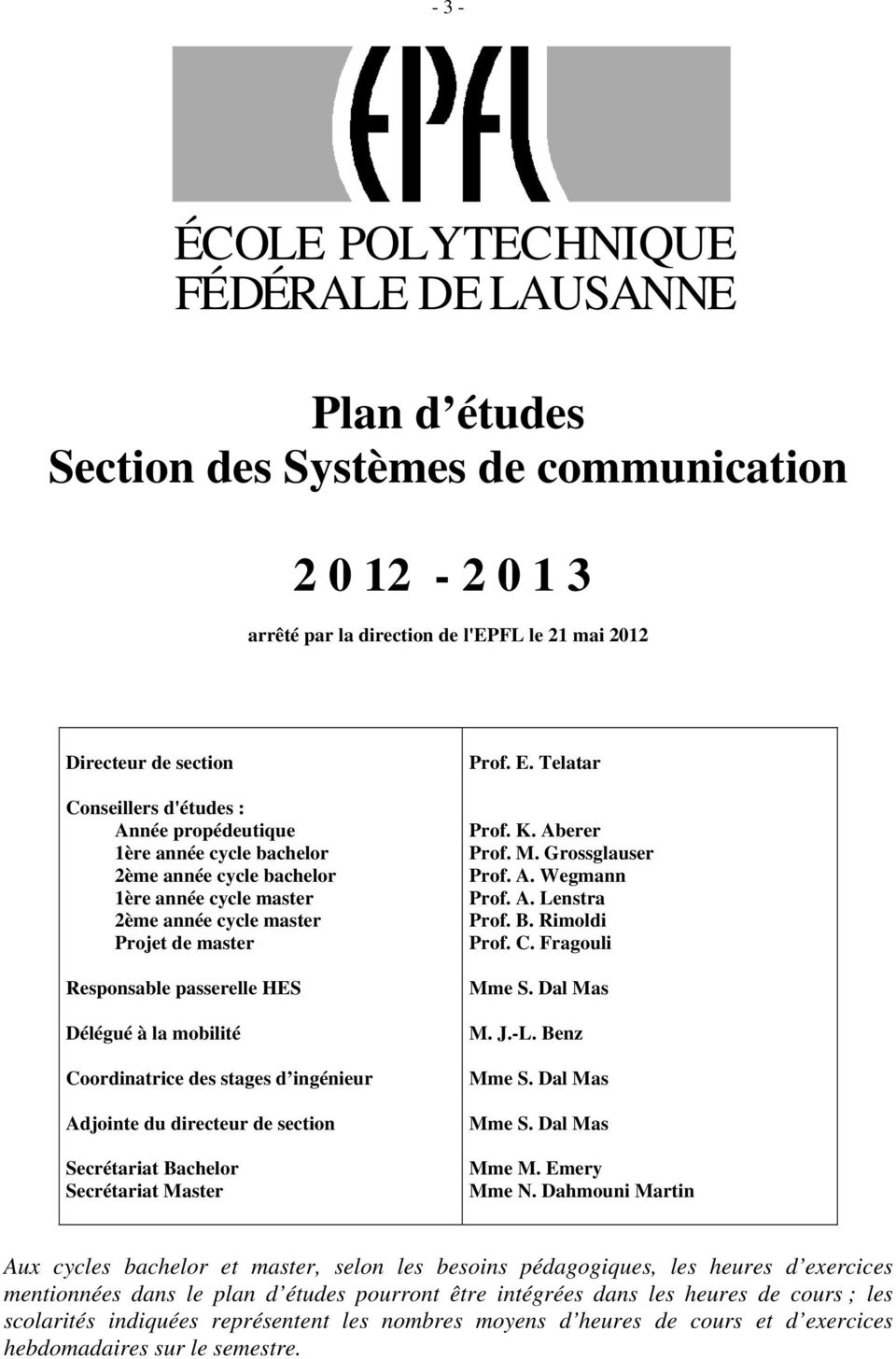
4 SYSTÈMES DE COMMUNICATION Cycle propédeutique Cursus commun IN- SC Code Matières Enseignants Sections Semestres Coeff. Période sous réserve 1 2 des examen de modification c e p c e p épreuves Bloc "Branches d'examen" : 12 MATH-111b Algèbre linéaire Ratiu MA H écrit MATH-103 Analyse I (en français) ou Wittwer MA 3 3 H écrit 2 MATH-104 Analyse I (en allemand) Kressner MA 4 4 H écrit MATH-107 Analyse II (en français) ou Wittwer MA 3 3 E écrit 2 MATH-109 Analyse II (en allemand) Semmler MA 4 2 E écrit CS-150 Discrete structures Lenstra SC E écrit COM-101 Sciences de l'information Le Boudec SC H écrit Bloc "Branches de semestre" : 10 CS-105 Introduction à la programmation objet Sam IN sem A CS-100 Introduction aux systèmes informatiques Sanchez IN sem A CS-198 Projet de technologie de l'information vacat/petitpierre/urbanke SC/IN 6 2 sem P CS-170 Systèmes logiques I Sanchez IN sem A CS-172 Systèmes logiques II Sanchez IN sem P CS-106 Théorie et pratique de la programmation Hersch/Petitpierre IN sem P HUM-nnn SHS : Cours thématique I Divers enseignants SHS sem A HUM-nnn SHS : Cours thématique II Divers enseignants SHS sem P Totaux: Totaux: Par semaine (moyenne): 30 30
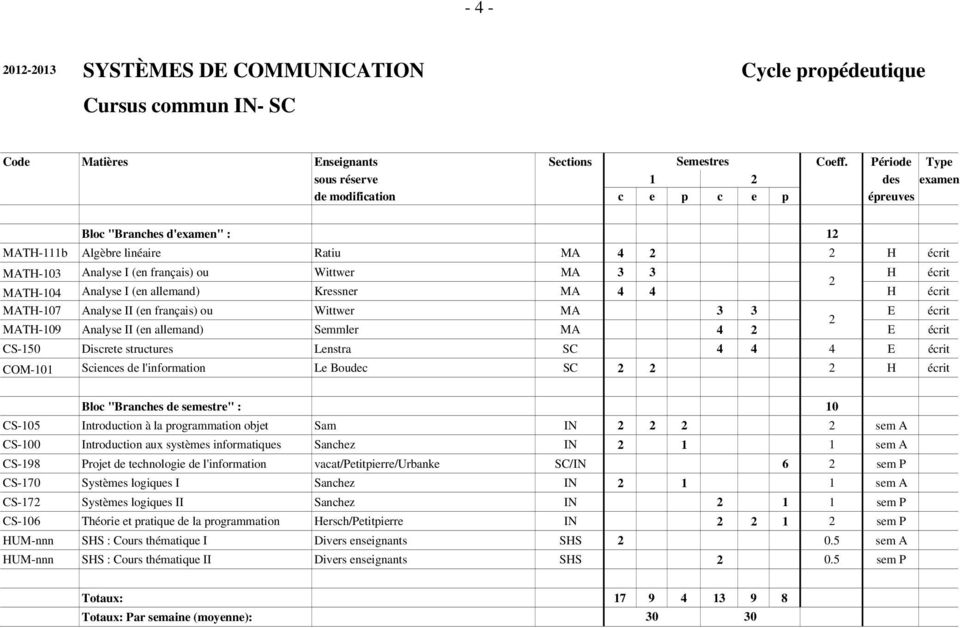
5 SYSTÈMES DE COMMUNICATION Cycle Bachelor Code Matières Enseignants Sections Semestres Crédits Période sous réserve des examen de modification c e p c e p c e p c e p 2ème 3ème épreuves Bloc A 28 CS-250 Algorithms Etesami IN H écrit MATH-203c Analyse III Mountford MA H écrit PHYS-205 Physique générale I Kapon PH H écrit PHYS-208 Physique générale II Kapon PH E écrit MATH-232 Probablités et statistique Davison MA E écrit Bloc B 15 MATH-207b Analyse IV Buffoni MA E écrit EE-204 Circuits and systems I Cevher EL H écrit EE-205 Circuits and systems II Seeger IN E écrit COM-208 Computer networks Argyraki SC sem A Bloc C 22 COM-300 Modèles stochastiques pour les communications Thiran P. SC H écrit COM-302 Principles of digital communications Rimoldi SC E écrit COM-301 Sécurité des réseaux Oechslin SC H écrit COM-303 Signal processing for communications Prandoni SC E écrit Bloc "orientations" 12 (1 orientation à choisir parmi les 3 propositions ci-dessous :) - Orientation "Mathématiques " 12 MATH-310 Algèbre Bayer Flückiger MA H écrit MATH-302 Analyse fonctionnelle I Buffoni MA H écrit MATH-251d Analyse numérique Picasso MA E écrit MATH-360 Graph theory Pach MA E oral MATH-365 Introduction à l'optimisation différentiable Bierlaire GC H écrit MATH-381 Logique mathématique Duparc MA H écrit MATH-303 Mesure et intégration Mountford MA H écrit MATH-341 Modèles linéaires Panaretos MA H écrit MATH-261 Optimisation discrète Eisenbrand MA E écrit - Orientation "Physique" 12 PHYS-329 Traitement quantique de l'information I Savona PH H écrit PHYS-330 Traitement quantique de l'information II Macris PH E écrit - Orientation "Science et technologie du vivant" 12 CH-161a Chimie générale Roussel CGC H écrit CH-162 Chimie organique Patiny CGC H écrit BIO-107 Introduction to cell biology and biochemistry for Information Sciences Zufferey R. SV E écrit Groupe "projet" 8 COM-307 Projet en Systèmes de Communication I Divers enseignants 2 8 sem A ou P Groupe "options" CS-252 Advanced theoretical computer science Madry IN sem P CS-270 Architecture des ordinateurs I Ienne IN sem A CS-271 Architecture des ordinateurs II Ienne IN sem P CS-320 Compiler construction Kuncak IN sem A CS-206 Concurrence Schiper SC E écrit COM-203 Digital photography Süsstrunk SC sem P EE-200 Électromagnétisme I : lignes et ondes Mosig EL H écrit EE-201 Électromagnétisme II : calcul des champs Mosig EL E écrit EE-290 Électronique I Zysman SC sem A EE-203b Électronique II Zysman SC sem A EE-381 Electronique III Zysman SC sem P MSE-371 Functional materials in communication systems Setter/Tagantsev MX H écrit CS-350 Graph theory applications Urbanke IN E écrit CS-321 Informatique du temps réel Decotignie SC H écrit CS-251 Informatique théorique Moret IN sem P CS-330 Intelligence artificielle Faltings IN sem P COM-308 Internet analytics Grossglauser SC E écrit CS-341 Introduction to computer graphics Pauly IN H écrit CS-322 Introduction to database systems Ailamaki IN E écrit CS-323 Operating systems Kostic IN E écrit CS-205 Programmation avancée Odersky IN sem A CS-207 Programmation orientée système Chappelier IN sem P MGT-365 Ressources humaines dans les projets Monnin SC 2 2 sem A CS-306 Software Development Project Candea IN 4 4 sem A CS-305 Software engineering Candea IN sem A Bloc D "SHS transversal" : 8 HUM-nnn SHS : Cours à choix I selon Plan d'études SHS Divers enseignants SHS 2 2 sem A HUM-nnn SHS : Cours à choix II selon Plan d'études SHS Divers enseignants SHS 2 2 sem P HUM-nnn SHS : Cours à choix III selon Plan d'études SHS Divers enseignants SHS 2 2 sem A HUM-nnn SHS : Cours à choix IV selon Plan d'études SHS Divers enseignants SHS 2 2 sem P Totaux: Totaux: Par semaine (moyenne):

6 SYSTÈMES DE COMMUNICATION Cycle Master Code Matières Enseignants Sections Spécialisations Semestres Crédits Période sous réserve M1 M2 des examen de modification c e p c e p épreuves Groupe "Core courses et options" 72 Groupe 1 "Core courses" min. 30 COM-510 Advanced digital communications Gastpar SC A H écrit COM-401 Cryptography and security Boureanu/Vaudenay SC C E G H écrit CS-451 Distributed algorithms Guerraoui SC E H écrit CS-423 Distributed information systems Aberer SC C E H écrit COM-404 Information theory and coding Telatar SC A H écrit COM-405 Mobile networks Hubaux SC A C E G E écrit CS-433 Pattern classification and machine learning Seeger IN B E écrit COM-500 Statistical signal and data processing through applications Ridolfi SC A B E écrit COM-407 TCP/IP networking Le Boudec SC C G H écrit Groupe 2 "Options" (la somme des crédits des groupes 1 et 2 doit être de 72 crédits au minimum) min Cours à option Divers enseignants Divers Bloc "Projets et SHS" : 18 COM-416 Projet en systèmes de communication II divers enseignants SC 2 12 sem A ou P HUM-nnn SHS : introduction au projet divers enseignants SHS sem A HUM-nnn SHS : projet divers enseignants SHS 3 3 sem P Total des crédits du cycle master 90 Spécialisations : A : Wireless Communications B : Signals, Images, and Interfaces C : Networking and Mobility E : Internet Computing G : Information Security Stage d'ingénieur : Stage obligatoire pour les étudiants commençant le master à partir de l'automne 2010 Voir les modalités dans le règlement d'application Mineurs : Le cursus peut être complété par un des mineurs figurant dans l'offre de l'epfl (renseignements à la page sac.epfl.ch/mineurs ), à l'exclusion des mineurs "Information security" et "Informatique" qui ne peuvent pas être choisi. Parmi les mineurs offerts par l'epfl, la section recommande à ses étudiants les mineurs suivants : - Biocomputing (SIN) - Études asiatiques contemporaines (CDH) - Management de la technologie et entrepreneuriat (SMTE) - Technologies biomédicales (SMT) - Technologies spatiales (SEL) Le choix des cours de tous les mineurs se fait sur conseil de la section de l'étudiant et du responsable du mineur.

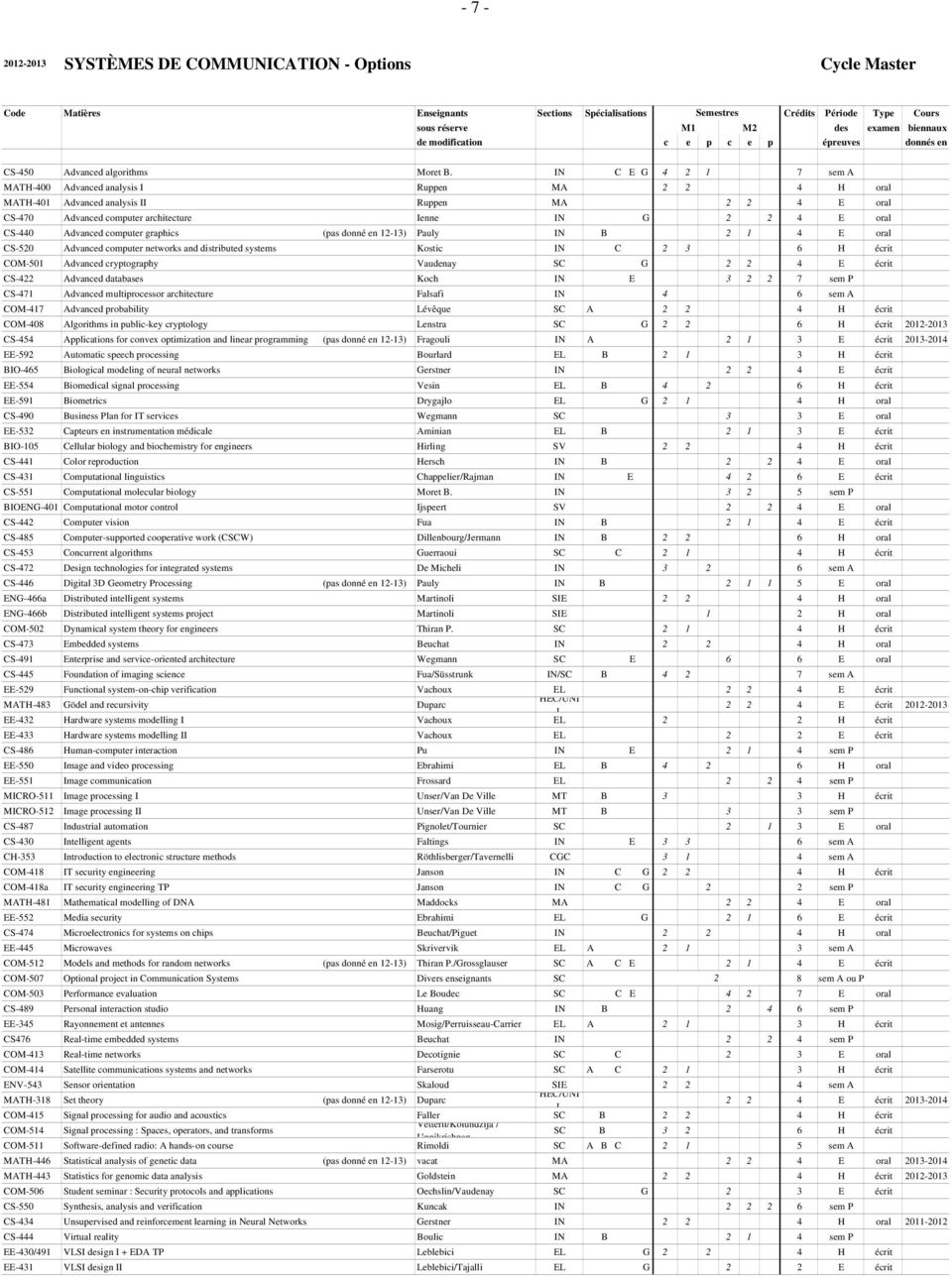
7 SYSTÈMES DE COMMUNICATION - Options Cycle Master Code Matières Enseignants Sections Spécialisations Semestres Crédits Période Cours sous réserve M1 M2 des examen biennaux de modification c e p c e p épreuves donnés en CS-450 Advanced algorithms Moret B. IN C E G sem A MATH-400 Advanced analysis I Ruppen MA H oral MATH-401 Advanced analysis II Ruppen MA E oral CS-470 Advanced computer architecture Ienne IN G E oral CS-440 Advanced computer graphics (pas donné en 12-13) Pauly IN B E oral CS-520 Advanced computer networks and distributed systems Kostic IN C H écrit COM-501 Advanced cryptography Vaudenay SC G E écrit CS-422 Advanced databases Koch IN E sem P CS-471 Advanced multiprocessor architecture Falsafi IN 4 6 sem A COM-417 Advanced probability Lévêque SC A H écrit COM-408 Algorithms in public-key cryptology Lenstra SC G H écrit CS-454 Applications for convex optimization and linear programming (pas donné en 12-13) Fragouli IN A E écrit EE-592 Automatic speech processing Bourlard EL B H écrit BIO-465 Biological modeling of neural networks Gerstner IN E écrit EE-554 Biomedical signal processing Vesin EL B H écrit EE-591 Biometrics Drygajlo EL G H oral CS-490 Business Plan for IT services Wegmann SC 3 3 E oral EE-532 Capteurs en instrumentation médicale Aminian EL B E écrit BIO-105 Cellular biology and biochemistry for engineers Hirling SV H écrit CS-441 Color reproduction Hersch IN B E oral CS-431 Computational linguistics Chappelier/Rajman IN E E écrit CS-551 Computational molecular biology Moret B. IN sem P BIOENG-401 Computational motor control Ijspeert SV E oral CS-442 Computer vision Fua IN B E écrit CS-485 Computer-supported cooperative work (CSCW) Dillenbourg/Jermann IN B H oral CS-453 Concurrent algorithms Guerraoui SC C H écrit CS-472 Design technologies for integrated systems De Micheli IN sem A CS-446 Digital 3D Geometry Processing (pas donné en 12-13) Pauly IN B E oral ENG-466a Distributed intelligent systems Martinoli SIE H oral ENG-466b Distributed intelligent systems project Martinoli SIE 1 2 H oral COM-502 Dynamical system theory for engineers Thiran P. SC H écrit CS-473 Embedded systems Beuchat IN H oral CS-491 Enterprise and service-oriented architecture Wegmann SC E 6 6 E oral CS-445 Foundation of imaging science Fua/Süsstrunk IN/SC B sem A EE-529 Functional system-on-chip verification Vachoux EL E écrit MATH-483 Gödel and recursivity Duparc HEC/UNI L E écrit EE-432 Hardware systems modelling I Vachoux EL 2 2 H écrit EE-433 Hardware systems modelling II Vachoux EL 2 2 E écrit CS-486 Human-computer interaction Pu IN E sem P EE-550 Image and video processing Ebrahimi EL B H oral EE-551 Image communication Frossard EL sem P MICRO-511 Image processing I Unser/Van De Ville MT B 3 3 H écrit MICRO-512 Image processing II Unser/Van De Ville MT B 3 3 sem P CS-487 Industrial automation Pignolet/Tournier SC E oral CS-430 Intelligent agents Faltings IN E sem A CH-353 Introduction to electronic structure methods Röthlisberger/Tavernelli CGC sem A COM-418 IT security engineering Janson IN C G H écrit COM-418a IT security engineering TP Janson IN C G 2 2 sem P MATH-481 Mathematical modelling of DNA Maddocks MA E oral EE-552 Media security Ebrahimi EL G E écrit CS-474 Microelectronics for systems on chips Beuchat/Piguet IN H oral EE-445 Microwaves Skrivervik EL A sem A COM-512 Models and methods for random networks (pas donné en 12-13) Thiran P./Grossglauser SC A C E E écrit COM-507 Optional project in Communication Systems Divers enseignants SC 2 8 sem A ou P COM-503 Performance evaluation Le Boudec SC C E E oral CS-489 Personal interaction studio Huang IN B sem P EE-345 Rayonnement et antennes Mosig/Perruisseau-Carrier EL A H écrit CS476 Real-time embedded systems Beuchat IN sem P COM-413 Real-time networks Decotignie SC C 2 3 E oral COM-414 Satellite communications systems and networks Farserotu SC A C H écrit ENV-543 Sensor orientation Skaloud SIE sem A MATH-318 Set theory (pas donné en 12-13) Duparc HEC/UNI L E écrit COM-415 Signal processing for audio and acoustics Faller SC B H écrit COM-514 Signal processing : Spaces, operators, and transforms Vetterli/Kolundzija / Unnikrishnan SC B H écrit COM-511 Software-defined radio: A hands-on course Rimoldi SC A B C sem A MATH-446 Statistical analysis of genetic data (pas donné en 12-13) vacat MA E oral MATH-443 Statistics for genomic data analysis Goldstein MA H écrit COM-506 Student seminar : Security protocols and applications Oechslin/Vaudenay SC G 2 3 E écrit CS-550 Synthesis, analysis and verification Kuncak IN sem P CS-434 Unsupervised and reinforcement learning in Neural Networks Gerstner IN H oral CS-444 Virtual reality Boulic IN B sem P EE-430/491 VLSI design I + EDA TP Leblebici EL G H écrit EE-431 VLSI design II Leblebici/Tajalli EL G 2 2 E écrit
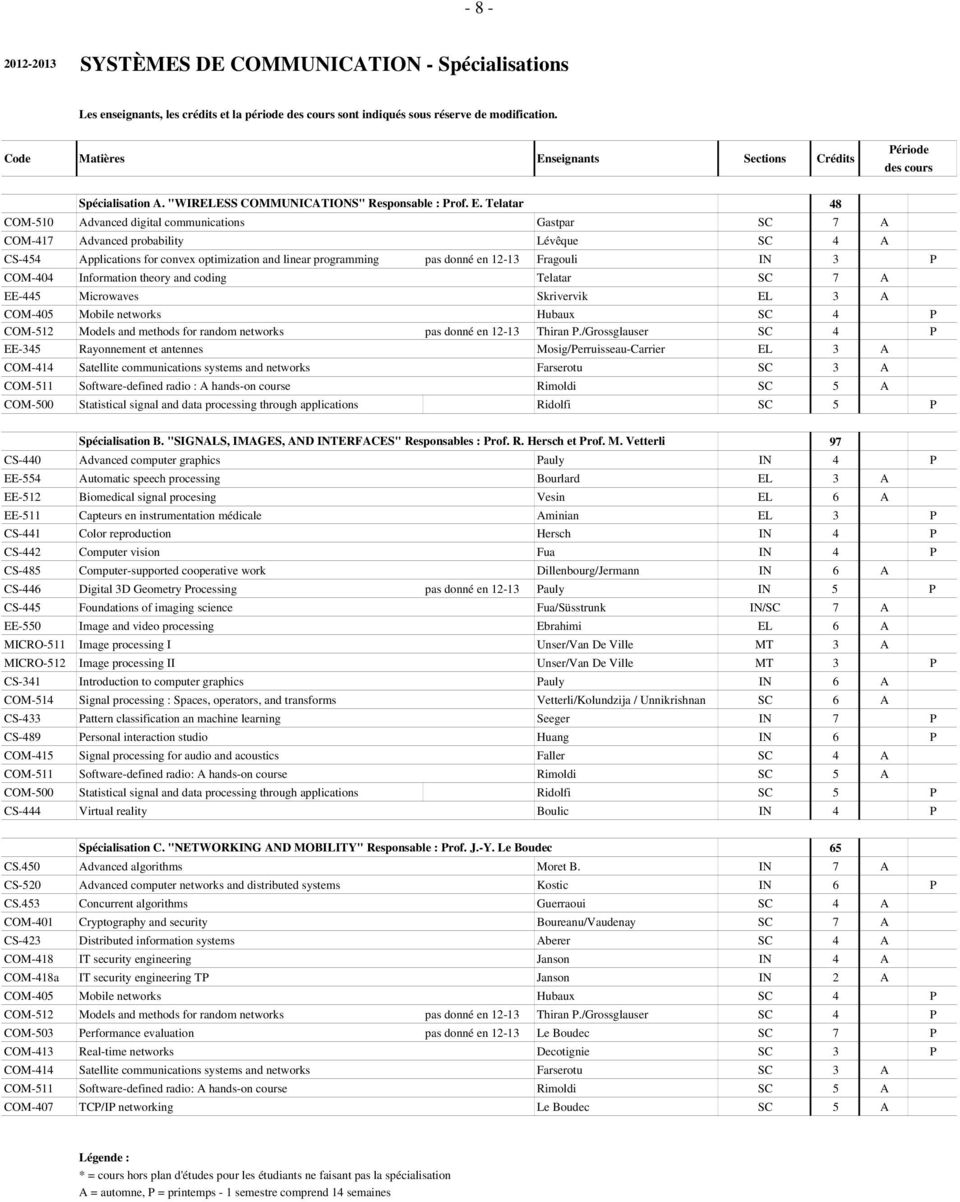
8 SYSTÈMES DE COMMUNICATION - Spécialisations Les enseignants, les crédits et la période des cours sont indiqués sous réserve de modification. Code Matières Enseignants Sections Crédits Période des cours Spécialisation A. "WIRELESS COMMUNICATIONS" Responsable : Prof. E. Telatar COM-510 Advanced digital communications Gastpar SC 7 A COM-417 Advanced probability Lévêque SC 4 A CS-454 Applications for convex optimization and linear programming pas donné en Fragouli IN 3 P COM-404 Information theory and coding Telatar SC 7 A EE-445 Microwaves Skrivervik EL 3 A COM-405 Mobile networks Hubaux SC 4 P COM-512 Models and methods for random networks pas donné en Thiran P./Grossglauser SC 4 P EE-345 Rayonnement et antennes Mosig/Perruisseau-Carrier EL 3 A COM-414 Satellite communications systems and networks Farserotu SC 3 A COM-511 Software-defined radio : A hands-on course Rimoldi SC 5 A COM-500 Statistical signal and data processing through applications Ridolfi SC 5 P 48 Spécialisation B. "SIGNALS, IMAGES, AND INTERFACES" Responsables : Prof. R. Hersch et Prof. M. Vetterli 97 CS-440 Advanced computer graphics Pauly IN 4 P EE-554 Automatic speech processing Bourlard EL 3 A EE-512 Biomedical signal procesing Vesin EL 6 A EE-511 Capteurs en instrumentation médicale Aminian EL 3 P CS-441 Color reproduction Hersch IN 4 P CS-442 Computer vision Fua IN 4 P CS-485 Computer-supported cooperative work Dillenbourg/Jermann IN 6 A CS-446 Digital 3D Geometry Processing pas donné en Pauly IN 5 P CS-445 Foundations of imaging science Fua/Süsstrunk IN/SC 7 A EE-550 Image and video processing Ebrahimi EL 6 A MICRO-511 Image processing I Unser/Van De Ville MT 3 A MICRO-512 Image processing II Unser/Van De Ville MT 3 P CS-341 Introduction to computer graphics Pauly IN 6 A COM-514 Signal processing : Spaces, operators, and transforms Vetterli/Kolundzija / Unnikrishnan SC 6 A CS-433 Pattern classification an machine learning Seeger IN 7 P CS-489 Personal interaction studio Huang IN 6 P COM-415 Signal processing for audio and acoustics Faller SC 4 A COM-511 Software-defined radio: A hands-on course Rimoldi SC 5 A COM-500 Statistical signal and data processing through applications Ridolfi SC 5 P CS-444 Virtual reality Boulic IN 4 P Spécialisation C. "NETWORKING AND MOBILITY" Responsable : Prof. J.-Y. Le Boudec 65 CS.450 Advanced algorithms Moret B. IN 7 A CS-520 Advanced computer networks and distributed systems Kostic IN 6 P CS.453 Concurrent algorithms Guerraoui SC 4 A COM-401 Cryptography and security Boureanu/Vaudenay SC 7 A CS-423 Distributed information systems Aberer SC 4 A COM-418 IT security engineering Janson IN 4 A COM-418a IT security engineering TP Janson IN 2 A COM-405 Mobile networks Hubaux SC 4 P COM-512 Models and methods for random networks pas donné en Thiran P./Grossglauser SC 4 P COM-503 Performance evaluation pas donné en Le Boudec SC 7 P COM-413 Real-time networks Decotignie SC 3 P COM-414 Satellite communications systems and networks Farserotu SC 3 A COM-511 Software-defined radio: A hands-on course Rimoldi SC 5 A COM-407 TCP/IP networking Le Boudec SC 5 A Légende : * = cours hors plan d'études pour les étudiants ne faisant pas la spécialisation A = automne, P = printemps - 1 semestre comprend 14 semaines
9 SYSTÈMES DE COMMUNICATION - Spécialisations Les enseignants, les crédits et la période des cours sont indiqués sous réserve de modification. Code Matières Enseignants Sections Crédits Période des cours Spécialisation E - "INTERNET COMPUTING" Responsables : Prof. K. Aberer et Prof. B. Faltings CS-450 Advanced algorithms Moret B. IN 7 A CS-422 Advanced databases Koch IN 7 P CS-431 Computational linguistics Chappelier/Rajman IN 6 P COM-401 Cryptography and security Boureanu/Vaudenay SC 7 A CS-451 Distributed algorithms Guerraoui SC 4 A CS-423 Distributed information systems Aberer SC 4 A * E-Business Pigneur HEC 6 A * Emerging distributed architectures Garbinato HEC 6 P CS-491 Enterprise and service-oriented architecture Wegmann SC 6 P CS-486 Human-computer interaction Pu IN 4 P CS-430 Intelligent agents Faltings IN 6 A COM-405 Mobile networks Hubaux SC 4 P COM-512 Models and methods for random networks pas donné en Thiran P./Grossglauser SC 4 P COM-503 Performance evaluation pas donné en Le Boudec SC 7 P EE-593 Social Media Gillet EL 2 P 78 Spécialisation G - "INFORMATION SECURITY" Responsable : Prof. A. Lenstra 62 CS-450 Advanced algorithms Moret B. IN 7 A P CS-470 Advanced computer architecture Ienne IN 4 P COM-501 Advanced cryptography Vaudenay SC 4 P COM-408 Algorithms in public-key cryptology Lenstra SC 6 A EE-513 Biometrics Drygajlo EL 4 A COM-401 Cryptography and security BoureanuVaudenay SC 7 A COM-418 IT security engineering Janson IN 4 A COM-418a IT security engineering TP Janson IN 2 A EE-552 Media security Ebrahimi EL 6 P COM-405 Mobile networks Hubaux SC 4 P COM-506 Student seminar : security protocols and applications Oechslin/Vaudenay SC 3 P COM-407 TCP/IP Networking Le Boudec SC 5 A EE-430/491 VLSI design I + EDA TP Leblebici EL 4 A EE-431 VLSI design II Leblebici/Tajalli EL 2 P Légende : * = cours hors plan d'études pour les étudiants ne faisant pas la spécialisation A = automne, P = printemps - 1 semestre comprend 14 semaines

10 Section des Systèmes de communication Mineur disciplinaire "Information security" responsable : Prof. A. Lenstra Les enseignants, les crédits et la période des cours sont indiqués sous réserve de modification. 88 crédits offerts Les cours déjà suivis au bachelor ou au master ne peuvent pas être pris également dans un mineur. Codes Matières (liste indicative) Enseignants Livret des cours Crédits Période des cours MATH-310 Algèbre Bayer Fluckiger MA 3 A CS-250 Algorithms Etesami IN 6 A COM-208 Computer networks Argyraki SC 5 A CS-150 Discrete structures Lenstra SC 8 P COM-301 Sécurité des réseaux Oechslin SC 4 A CS-450 Advanced algorithms Moret B. IN 7 A CS-470 Advanced computer architecture Ienne IN 4 P COM-501 Advanced cryptography* Vaudenay SC 4 P COM-408 Algorithms in public-key cryptology* Lenstra SC 6 A EE-513 Biometrics* Drygajlo EL 4 A COM-401 Cryptography and security* Boureanu/Vaudenay SC 7 A COM-418 IT security engineering* Janson IN 4 A COM-418a IT security engineering TP* Janson IN 2 A EE-552 Media security* Ebrahimi EL 6 P COM-405 Mobile networks* Hubaux SC 4 P COM-506 Student seminar : security protocols and applications* Oechslin/Vaudenay SC 3 P COM-407 TCP/IP Networking Le Boudec SC 5 A EE-430/491 VLSI design I + EDA TP Leblebici EL 4 A EE-431 VLSI design II Leblebici/Tajalli EL 2 P Crédits obligatoires *pour le Mineur en Information Security, au moins 17 crédits parmi ces cours doivent obligatoirement être acquis. * For the Minor in Information Security it will be mandatory to accumulate at least 17 credits from these courses.

11 RÈGLEMENT D APPLICATION DU CONTRÔLE DES ÉTUDES DE LA SECTION DE SYSTÈMES DE COMMUNICATION (année académique 2012/2013) du 21 mai 2012 mentionnées dans le plan d études avec la mention sem A ou sem P. 3 Une branche annuelle, c est à dire dont l intitulé tient sur une seule ligne dans le plan d étude, est examinée globalement pendant la session d été (E). La direction de l'école polytechnique fédérale de Lausanne vu l'ordonnance sur la formation menant au bachelor et au master de l'epfl, du 14 juin 2004, vu l'ordonnance sur le contrôle des études menant au bachelor et au master à l'epfl, du 14 juin 2004, vu le plan d études de la section de systèmes de communication arrête Article premier - Champ d'application Le présent règlement est applicable aux examens de la section de systèmes de communication dans le cadre des études de bachelor et de master. Art. 2 Étapes de formation 1 Le bachelor est composé de deux étapes successives de formation : - le cycle propédeutique d une année dont la réussite se traduit par 60 crédits ECTS acquis en une fois, condition pour entrer au cycle bachelor. Le cycle propédeutique est commun avec celui de la section informatique. - le cycle bachelor s étendant sur deux ans dont la réussite implique l acquisition de 120 crédits, condition pour entrer au master. 2 Le master effectué à l EPFL est composé de deux étapes successives de formation : - le cycle master d une durée d un an et demi (plus un semestre de stage facultatif) dont la réussite implique l acquisition de 90 crédits, condition pour effectuer le projet de master. - le projet de master, d une durée de 17 semaines et dont la réussite se traduit par l acquisition de 30 crédits. Il est placé sous la responsabilité d'un maître affilié à la section de systèmes de communication. Avant le début du projet et sur proposition du maître responsable, la section peut porter la durée du projet de master à 25 semaines pour les projets effectués hors de l EPFL. Art 3 Sessions d examen 1 Les branches d examen sont examinées par écrit ou par oral pendant les sessions d hiver ou d été. Elles sont mentionnées dans le plan d études avec la mention H ou E. 2 Les branches de semestre sont examinées pendant le semestre d automne ou le semestre de printemps. Elles sont Chapitre 1 : Cycle propédeutique Art. 4 - Examen propédeutique 1. L'examen propédeutique est composé du bloc des branches d examen et du bloc des branches de semestre. 2. Les modalités et les conditions de réussite sont fixées par le chapitre 2 de l'ordonnance sur le contrôle des études menant au bachelor et au master à l'epfl. Chapitre 2 : Cycle bachelor Art. 5 - Organisation 1 Les enseignements du bachelor sont répartis en quatre blocs A, B, C et «orientations», le groupe «projet», le groupe «options» et le bloc transversal SHS. 2. Le bloc «orientations» se compose de trois orientations : Mathématiques, Physique et Sciences et Technologie du vivant. Les étudiants doivent choisir une seule orientation parmi les trois proposées. 3 Le groupe «options» se compose de toutes les branches à option figurant dans la liste du plan d études de 2 ème année et 3 ème année. 27 crédits doivent être obtenus individuellement dans le groupe «options», dont 13 crédits dans les options de 2 ème année. Les crédits pris en supplément des 13 crédits exigés de 2 ème année peuvent être validés comme crédits à options de 3 ème année. 4 En 3 ème année, des cours, comptant pour un maximum de 6 crédits au total, peuvent être choisis en dehors de la liste décrite à l alinéa 3. Les cours pris en dehors de cette liste doivent être acceptés préalablement par le directeur de la section. 5 Les branches obligatoires et à option de 3 ème année peuvent exiger des prérequis qui sont mentionnés dans la fiche du cours concerné. Le cours prérequis est validé si les crédits correspondants ont été acquis pour le cours ou par moyenne du bloc. Art. 6 - Examen de 2 ème année 1 Les 28 crédits du plan d études sont obtenus lorsque le bloc A est réussi. 2 Les 15 crédits du plan d études sont obtenus lorsque le bloc B est réussi.

12 Les 13 crédits de 2 ème année du groupe «options» s acquièrent de façon indépendante, par réussite individuelle de chaque branche. Art. 7 - Examen de 3 ème année 1 Les 22 crédits du plan d études sont obtenus lorsque le bloc C est réussi. 2. Les 12 crédits du plan d études sont obtenus lorsque le bloc «orientations» est réussi. 3 Les 8 crédits du groupe «projet» s acquièrent de façon indépendante, par réussite individuelle du projet. 4 Les 14 crédits de 3 ème année du groupe «options» s acquièrent de façon indépendante, par réussite individuelle de chaque branche. Art. 8 - Examen de 2 ème et 3 ème années Le bloc D «SHS transversal» est réussi lorsque les 8 crédits du plan d études sont obtenus. Chapitre 3 : Cycle master Art. 9 - Organisation 1 Les enseignements du cycle master sont répartis en deux groupes et un bloc dont les crédits doivent être obtenus de façon indépendante. Ils peuvent donner lieu à l obtention d une spécialisation ou d un mineur. 2 Le bloc «Projets et SHS» est composé d un projet de 12 crédits et de l enseignement SHS. 3 Le groupe 1 «Core courses» est composé des cours de la liste du plan d études dans la rubrique «Master». 4 Le groupe 2 «Options» est composé - des cours de la liste du groupe 2 «options» du plan d études dans la rubrique «Master» ; - des crédits surnuméraires obtenus dans le groupe 1 «Core courses» ; - d un projet optionnel de 8 crédits suivant l alinéa 5 ; - de cours hors plan d études suivant l alinéa 6 ; - de cours liés à une spécialisation ou un mineur suivant l art. 11, alinéa 2. 5 Le projet du bloc «Projets et SHS» et le projet optionnel du groupe 2 ne peuvent être effectués dans le même semestre. 6 Des cours, comptant pour un maximum de 15 crédits au total, peuvent être choisis en dehors de la liste des cours du plan d études dans la rubrique «Master». Le choix de ces cours doit être accepté préalablement par le directeur de la section qui peut augmenter le maximum de 15 crédits si la demande est justifiée. Art Examen du cycle master 1 Le bloc «Projets et SHS» est réussi lorsque 18 crédits sont obtenus. 2 Le groupe «Core courses et Options», composé du groupe 1 «Core courses» et du groupe 2 «Options» est réussi lorsque 72 crédits sont obtenus. 3 Le groupe 1 «Core courses» est réussi lorsqu au moins 30 crédits sont obtenus. 4 Au moins 23 crédits doivent être obtenus dans le groupe 2 «Options». Art Enseignement SHS 1 La formation SHS au cycle master commence uniquement en automne. Le semestre d'automne est un enseignement présentiel qui prépare à la réalisation du projet au second semestre. La branche SHS donne lieu à 3 crédits par semestre. 2 Lorsque, pour un motif important et dument justifié, l'étudiant est dans l'impossibilité de réaliser son projet immédiatement après le premier semestre, il peut être autorisé à le délivrer durant l un des semestres de l année académique suivante. 3 Toute dérogation à ces principes doit être dûment documentée et sollicitée par écrit auprès de la direction du Collège des Humanités. Art. 12 Mineurs et spécialisations 1 Afin d approfondir un aspect particulier de sa formation ou de développer des interfaces avec d autres sections, l étudiant peut choisir la formation offerte dans le cadre d'un mineur figurant dans l offre de l EPFL ou d une spécialisation de la section de systèmes de communication. 2 Le choix des cours qui composent un mineur se fait avec la section de systèmes de communication et avec le responsable du mineur. Les mineurs «Informatique» et «Information security» ne peuvent pas être choisis. 3 Le choix des cours qui composent une spécialisation est soumis, pour concertation à la section de systèmes de communication. 4 L étudiant annonce le choix d un mineur à sa section au plus tard à la fin du premier semestre des études de master. 5 L étudiant qui choisit une spécialisation dans la liste figurant dans le plan d études s inscrit au plus tard au début du deuxième semestre des études de master. 6 Un mineur ou une spécialisation est réussi quand 30 crédits au minimum sont obtenus parmi les branches avalisées.

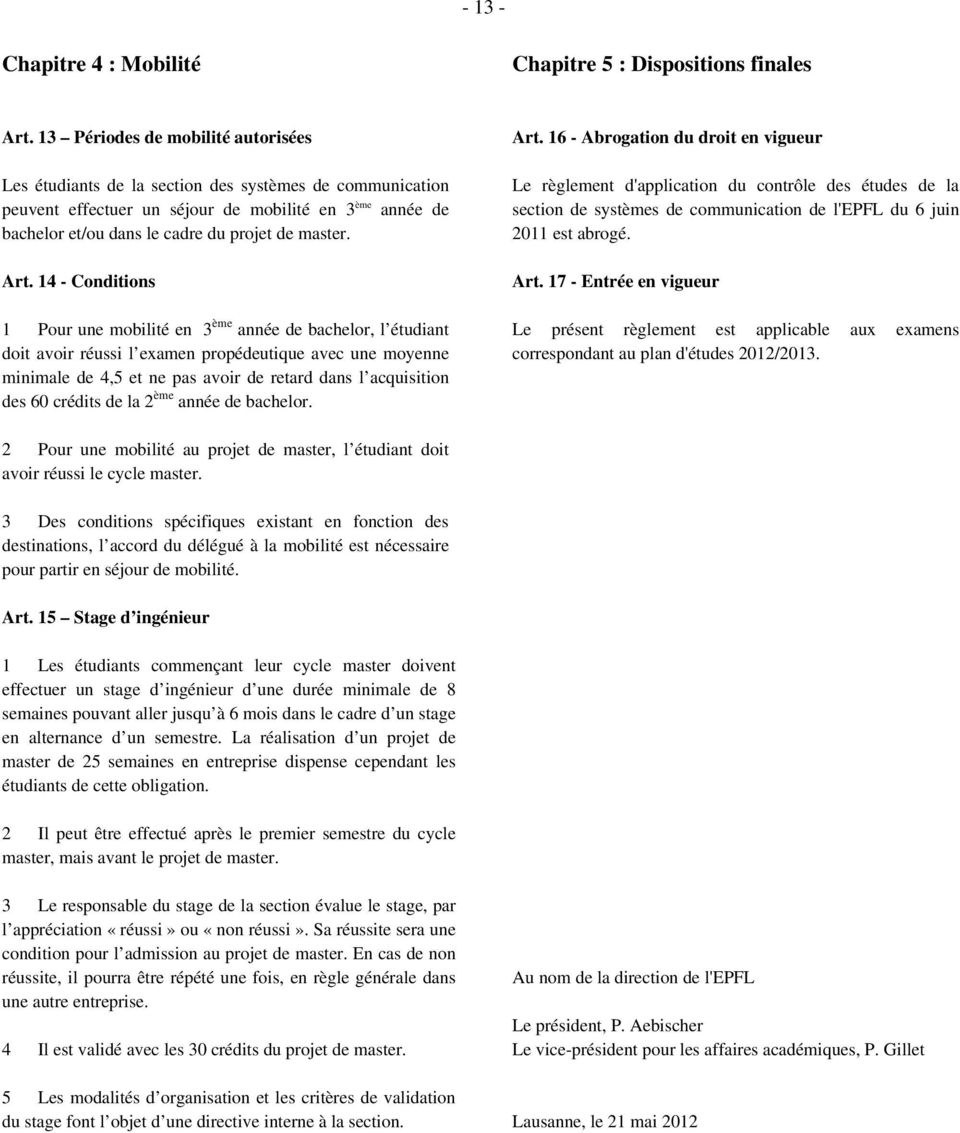
13 Chapitre 4 : Mobilité Chapitre 5 : Dispositions finales Art. 13 Périodes de mobilité autorisées Les étudiants de la section des systèmes de communication peuvent effectuer un séjour de mobilité en 3 ème année de bachelor et/ou dans le cadre du projet de master. Art Conditions 1 Pour une mobilité en 3 ème année de bachelor, l étudiant doit avoir réussi l examen propédeutique avec une moyenne minimale de 4,5 et ne pas avoir de retard dans l acquisition des 60 crédits de la 2 ème année de bachelor. Art Abrogation du droit en vigueur Le règlement d'application du contrôle des études de la section de systèmes de communication de l'epfl du 6 juin 2011 est abrogé. Art Entrée en vigueur Le présent règlement est applicable aux examens correspondant au plan d'études 2012/ Pour une mobilité au projet de master, l étudiant doit avoir réussi le cycle master. 3 Des conditions spécifiques existant en fonction des destinations, l accord du délégué à la mobilité est nécessaire pour partir en séjour de mobilité. Art. 15 Stage d ingénieur 1 Les étudiants commençant leur cycle master doivent effectuer un stage d ingénieur d une durée minimale de 8 semaines pouvant aller jusqu à 6 mois dans le cadre d un stage en alternance d un semestre. La réalisation d un projet de master de 25 semaines en entreprise dispense cependant les étudiants de cette obligation. 2 Il peut être effectué après le premier semestre du cycle master, mais avant le projet de master. 3 Le responsable du stage de la section évalue le stage, par l appréciation «réussi» ou «non réussi». Sa réussite sera une condition pour l admission au projet de master. En cas de non réussite, il pourra être répété une fois, en règle générale dans une autre entreprise. 4 Il est validé avec les 30 crédits du projet de master. 5 Les modalités d organisation et les critères de validation du stage font l objet d une directive interne à la section. Au nom de la direction de l'epfl Le président, P. Aebischer Le vice-président pour les affaires académiques, P. Gillet Lausanne, le 21 mai 2012
14 - 14 -

15 ÉCOLE POLYTECHNIQUE FÉDÉRALE DE LAUSANNE SECTION DE SYSTEMES DE COMMUNICATION Cycle Propédeutique (1ère année) 2012 / 2013
16 - 16 -

17 Algèbre linéaire (MATH-111(b)) Linear Algebra Enseignant(s) / Instructor(s) Ratiu Tudor: MA Langue / Language FR Informatique ( , Bachelor semestre 1) C: 4 H hebdo, Ex: 2 H hebdo obl Systèmes de communication ( , Bachelor semestre 1) C: 4 H hebdo, Ex: 2 H hebdo obl Apprendre les éléments de l'algèbre linéaire et les techniques du calcul matriciel. Etre apte à effectuer les manipulations mathématiques correspondantes et être capable d'appliquer ces techniques dans des problèmes issus de son domaine de spécialisation. L'étudiant devra maîtriser les notions nécessaires à la résolution des problèmes liés à la linéarité, à l'orthogonalité et à la diagonalisation des matrices. Systèmes d'équations linéaires Calcul matriciel Déterminants Espaces vectoriels et transformations linéaires Valeurs et vecteurs propres Orthogonalité et moindres carrés Matrices symétriques et formes quadratiques Learn the techniques of matrix algebra, be able to execute the corresponding mathematical manipulations and to apply these techniques in problems connected to one's specialization area. The student will have to master the tools necessary to the resolution of problems connected to linearity, orthogonality and matrix diagonalization. Systems of linear equations Matrix algebra Determinants Vector spaces and linear transformations Eigenvalues and eigenvectors Orthogonality and least-squares Symmetric matrices and quadratic forms Préparation pour: Analyse II et III Cours ex cathedra, exercices en classe Prerequisite for: Analysis II and III of teaching: Ex cathedra lecture, exercises in the classroom L'enseignant précisera les manuels recommandés dans son cours. Linear Algebra and its Applications, D.C. Lay, 3rd edition (or updated 2nd edition) Addison-Wesley. Algèbre Linéaire, Théorie exercices et applications D.C. Lay, traduction 3ème édition, De Boeck et Larcier. "Savoir-faire en mathématiques", Y. Biollay, A. Chaabouni et J. Stubbe, PPUR. Algèbre linéaire : Aide mémoire, Exercices et Applications par R. Dalang et A. Chaabouni, PPUR Deuxième édition Elementary Linear Algebra with Applications par H. Anton et C. Rorres, John Wiley & Sons, neuvième édition Matière examinée / Subjects examined Session Coefficient / Crédits ECTS Forme de l'examen / of examination Algèbre linéaire HIV 2 Ecrit

18 Analyse I (MATH-103) Analysis I Enseignant(s) / Instructor(s) Wittwer Peter: MA Langue / Language FR Informatique ( , Bachelor semestre 1) C: 3 H hebdo, Ex: 3 H hebdo obl Systèmes de communication ( , Bachelor semestre 1) C: 3 H hebdo, Ex: 3 H hebdo obl Étude des méthodes principales du calcul différentiel et intégral de fonctions réelles en vue de leur utilisation par le futur ingénieur. Nombres entiers, réels et complexes. Fonctions réelles, suites, limites. Continuité. Dérivées, développement limité et séries de Taylor. Primitives et intégrales définies. Intégrales généralisées. Séries numériques, séries entières. Équations différentielles. Fonctions de plusieurs variables : continuité, dérivées et dérivées partielles. Fonctions implicites. Extrema et extrema liés. Intégrales multiples. Le programme détaillé et l'ordre peuvent varier. Cours ex cathedra et exercices en salle L'examen est écrit et semestriel, et chaque examen dure 3 heures Study of the principal methods of the differential and integral calculus of real-valued functions with a view towards applications by future engineers. Integers, real and complex numbers. Real functions, sequences, series and limits. Continuity. Derivatives, Taylor's theorem with remainder and Taylor series. Definite and indefinite integrals. Improper integrals. Power series. Differential equations. Functions of several variables: continuity, derivatives and partial derivatives. Implicit functions. Maxima and minima, extrema with constraints. Multiple integrals. The detailed program and the order of presentation may vary. of teaching: Ex cathedra lecture and exercises in the classroom The exam is written and semestrial with each exam lasting 3 hours L'enseignant précisera les manuels recommandés dans son cours. J. Douchet et B. Zwahlen, Calcul différentiel et intégral, 1985 et 1998, PPUR. J. Douchet, Analyse Recueil d'exercices et aide-mémoire, vol 1 & 2, 3e édition, 2010, PPUR. F. Ayres et E. Mendelson, Calcul différentiel et intégral, McGraw-Hill, 2e édition, M. R. Spiegel, Analyse, McGraw-Hill, E. Swokowski, Analyse, de Broeck University. Christian Blatter, Ingenieur Analysis 1, volume 1. Springer, zweite Edition, Christian Blatter, Ingenieur Analysis 2, volume 2. Springer, zweite Edition, Cours polycopié, C.A. Stuart, Analyse I et II. "Savoir faire en mathématiques", PPUR. Matière examinée / Subjects examined Session Coefficient / Crédits ECTS Forme de l'examen / of examination Analyse I HIV 2 Ecrit

19 Analyse (allemand) I (MATH-104) Analysis (German) I Enseignant(s) / Instructor(s) Kressner Daniel: Langue / Language DE Génie civil ( , Bachelor semestre 1) C: 4 H hebdo, Ex: 2 H hebdo obl Génie électrique et électronique ( , Bachelor semestre 1) C: 4 H hebdo, Ex: 4 H hebdo obl Génie mécanique ( , Bachelor semestre 1) C: 4 H hebdo, Ex: 4 H hebdo obl Informatique ( , Bachelor semestre 1) C: 4 H hebdo, Ex: 4 H hebdo obl Microtechnique ( , Bachelor semestre 1) C: 4 H hebdo, Ex: 4 H hebdo obl Sciences et ingénierie de l'environnement ( , Bachelor semestre 1) C: 4 H hebdo, Ex: 2 H hebdo obl Sciences et technologies du vivant ( , Bachelor semestre 1) C: 4 H hebdo, Ex: 4 H hebdo obl Science et génie des matériaux ( , Bachelor semestre 1) C: 4 H hebdo, Ex: 4 H hebdo obl Systèmes de communication ( , Bachelor semestre 1) C: 4 H hebdo, Ex: 4 H hebdo obl Etude des méthodes principales du calcul différentiel et intégral de fonctions réelles en vue de leur utilisation par le futur ingénieur. Nombres entiers, réels et complexes. Fonctions réelles, suites, limites. Continuité. Dérivées, développement limité et séries de Taylor. Primitives et intégrales définies. Intégrales généralisées. Séries numériques, séries entières. Equations différentielles. Fonctions de plusieurs variables : continuité, dérivées et dérivées partielles. Fonctions implicites. Extrema et extrema liés. Intégrales multiples. Le programme détaillé et l'ordre peuvent varier. Cours ex cathedra et exercices en salle L'examen est écrit et semestriel, et chaque examen dure 3 heures. Studium der wichtigsten Methoden der Differential- und Integralrechnung von reellwertigen Funktionen. Die Vorlesung bereitet die Studenten auf Anwendungen im Ingenieurwesen vor. Natürliche, ganze, reelle und komplexe Zahlen. Funktionen, Folgen, Reihen und Konvergenz. Stetigkeit. Ableitungen, Taylor Entwicklung mit Rest, Taylor-Reihe. Bestimmte und unbestimmte Integrale. Uneigentliche Integrale. Reihenentwicklungen. Differentialgleichungen. Funktionen von Variablen im Rn: Stetigkeit, Ableitungen und partielle Ableitungen. Implizite Funktionen. Extrema, Optimierungsprobleme mit Nebenbedingungen. Multiple Integrale. Für jede der Analysisvorlesungen kann der Inhalt und die Reihenfolge der behandelten Themen leicht vom obigen Plan abweichen. of teaching: Ex cathedra mit Uebungen Die Prüfung ist schriftlich, findet jeweils am Ende jedes Semesters statt und jede der beiden Prüfungen dauert 3 Stunden. Der Professor wird die für seine Vorlesung empfohlene Lektüre besprechen. Matière examinée / Subjects examined Session Coefficient / Crédits ECTS Forme de l'examen / of examination Analyse (allemand) I HIV 2 Ecrit

20 Analyse II (MATH-107) Analysis II Enseignant(s) / Instructor(s) Wittwer Peter: MA Langue / Language FR Informatique ( , Bachelor semestre 2) C: 3 H hebdo, Ex: 3 H hebdo obl Systèmes de communication ( , Bachelor semestre 2) C: 3 H hebdo, Ex: 3 H hebdo obl Étude des méthodes principales du calcul différentiel et intégral de fonctions réelles en vue de leur utilisation par le futur ingénieur. Nombres entiers, réels et complexes. Fonctions réelles, suites, limites. Continuité. Dérivées, développement limité et séries de Taylor. Primitives et intégrales définies. Intégrales généralisées. Séries numériques, séries entières. Équations différentielles. Fonctions de plusieurs variables : continuité, dérivées et dérivées partielles. Fonctions implicites. Extrema et extrema liés. Intégrales multiples. Le programme détaillé et l'ordre peuvent varier. Cours ex cathedra et exercices en salle L'examen est écrit et semestriel, et chaque examen dure 3 heures Study of the principal methods of the differential and integral calculus of real-valued functions with a view towards applications by future engineers. Integers, real and complex numbers. Real functions, sequences, series and limits. Continuity. Derivatives, Taylor's theorem with remainder and Taylor series. Definite and indefinite integrals. Improper integrals. Power series. Differential equations. Functions of several variables: continuity, derivatives and partial derivatives. Implicit functions. Maxima and minima, extrema with constraints. Multiple integrals. The detailed program and the order of presentation may vary. of teaching: Ex cathedra lecture and exercises in the classroom The exam is written and semestrial with each exam lasting 3 hours L'enseignant précisera les manuels recommandés dans son cours. J. Douchet et B. Zwahlen, Calcul différentiel et intégral, 1985 et 1998, PPUR. J. Douchet, Analyse Recueil d'exercices et aide-mémoire, vol 1 & 2, 3e édition, 2010, PPUR. F. Ayres et E. Mendelson, Calcul différentiel et intégral, McGraw-Hill, 2e édition, M. R. Spiegel, Analyse, McGraw-Hill, E. Swokowski, Analyse, de Broeck University. Christian Blatter, Ingenieur Analysis 1, volume 1. Springer, zweite Edition, Christian Blatter, Ingenieur Analysis 2, volume 2. Springer, zweite Edition, Cours polycopié, C.A. Stuart, Analyse I et II. "Savoir faire en mathématiques", PPUR. Matière examinée / Subjects examined Session Coefficient / Crédits ECTS Forme de l'examen / of examination Analyse II ETE 2 Ecrit

21 Analyse (allemand) II (MATH-109) Analysis (German) II Enseignant(s) / Instructor(s) Semmler Klaus-Dieter: MA Langue / Language DE Génie civil ( , Bachelor semestre 2) C: 4 H hebdo, Ex: 2 H hebdo obl Génie électrique et électronique ( , Bachelor semestre 2) C: 4 H hebdo, Ex: 2 H hebdo obl Génie mécanique ( , Bachelor semestre 2) C: 4 H hebdo, Ex: 2 H hebdo obl Informatique ( , Bachelor semestre 2) C: 4 H hebdo, Ex: 2 H hebdo obl Microtechnique ( , Bachelor semestre 2) C: 4 H hebdo, Ex: 2 H hebdo obl Sciences et ingénierie de l'environnement ( , Bachelor semestre 2) C: 4 H hebdo, Ex: 2 H hebdo obl Sciences et technologies du vivant ( , Bachelor semestre 2) C: 4 H hebdo, Ex: 2 H hebdo obl Science et génie des matériaux ( , Bachelor semestre 2) C: 4 H hebdo, Ex: 2 H hebdo obl Systèmes de communication ( , Bachelor semestre 2) C: 4 H hebdo, Ex: 2 H hebdo obl Etude des méthodes principales du calcul différentiel et intégral de fonctions réelles en vue de leur utilisation par le futur ingénieur. Nombres entiers, réels et complexes. Fonctions réelles, suites, limites. Continuité. Dérivées, développement limité et séries de Taylor. Primitives et intégrales définies. Intégrales généralisées. Séries numériques, séries entières. Equations différentielles. Fonctions de plusieurs variables : continuité, dérivées et dérivées partielles. Fonctions implicites. Extrema et extrema liés. Intégrales multiples. Le programme détaillé et l'ordre peuvent varier. Cours ex cathedra et exercices en salle L'examen est écrit et semestriel, et chaque examen dure 3 heures. Studium der wichtigsten Methoden der Differential- und Integralrechnung von reellwertigen Funktionen. Die Vorlesung bereitet die Studenten auf Anwendungen im Ingenieurwesen vor. Natürliche, ganze, reelle und komplexe Zahlen. Funktionen, Folgen, Reihen und Konvergenz. Stetigkeit. Ableitungen, Taylor Entwicklung mit Rest, Taylor-Reihe. Bestimmte und unbestimmte Integrale. Uneigentliche Integrale. Reihenentwicklungen. Differentialgleichungen. Funktionen von Variablen im Rn: Stetigkeit, Ableitungen und partielle Ableitungen. Implizite Funktionen. Extrema, Optimierungsprobleme mit Nebenbedingungen. Multiple Integrale. Für jede der Analysisvorlesungen kann der Inhalt und die Reihenfolge der behandelten Themen leicht vom obigen Plan abweichen. of teaching: Ex cathedra mit Uebungen Die Prüfung ist schriftlich, findet jeweils am Ende jedes Semesters statt und jede der beiden Prüfungen dauert 3 Stunden. Der Professor wird die für seine Vorlesung empfohlene Lektüre besprechen. Matière examinée / Subjects examined Session Coefficient / Crédits ECTS Forme de l'examen / of examination Analyse (allemand) II ETE 2 Ecrit
22 Discrete structures (CS-150) Enseignant(s) / Instructor(s) Lenstra Arjen: SC Langue / Language EN Information security minor ( , Semestre printemps) C: 4 H hebdo, Ex: 4 H hebdo opt Informatique ( , Bachelor semestre 2) C: 4 H hebdo, Ex: 4 H hebdo obl Systèmes de communication ( , Bachelor semestre 2) C: 4 H hebdo, Ex: 4 H hebdo obl Les bases du raisonnement mathématique, l'analyse combinatoire, les structures discrètes, les méthodes algorithmiques, les applications et la modélisation. Une grande variété de problèmes importants en pratique est étudiée et résolue en apprenant aux étudiants à penser mathématiquement. Le bons sens mathématique enseigné dans ce cours est à la fois drôle et utile, car il sera un outil indispensable quelle que soit la spécialisation choisie. Ex cathedra et exercices en classe Remarque: Attention : ce cours est enseigné en Anglais The basics of mathematical reasoning, combinatorial analysis, discrete structures, algorithmic thinking and applications and modeling. A wide variety of practical relevant mathematical problems is studied and solved, thereby teaching students to think mathematically. The mathematical common sense taught in this course is not only fun, it will also prove to be a valuable resource irrespective of the students' future specialization. of teaching: Ex cathedra lectures and in class exercises Note: Caution : this course is taught in English Kenneth H. Rosen, Discrete Mathematics and its applications, fifth edition, McGraw-Hill 1) Matière examinée / Subjects examined Session Coefficient / Crédits ECTS Forme de l'examen / of examination Discrete structures ETE 4 Ecrit
23 Introduction à la programmation objet (CS-105) Introduction to objects oriented programming Enseignant(s) / Instructor(s) Sam Jamila: IN Langue / Language FR Informatique ( , Bachelor semestre 1) Systèmes de communication ( , Bachelor semestre 1) C: 2 H hebdo, Ex: 2 H hebdo, Proj: 2 H hebdo C: 2 H hebdo, Ex: 2 H hebdo, Proj: 2 H hebdo obl obl L'objectif de ce cours est de permettre à l'étudiant : d'aborder les notions de base de l'informatique logicielle et de l'algorithmique; puis de se familiariser avec un environnement informatique (station de travail sous UNIX); de développer une compétence en programmation et se familiariser avec des concepts de base de la programmation orientée objet (langage JAVA) The goal of this course is to make it possible for students to : acquire some knowledge of fundamental aspects of software development and algorithmic designs as well as use a computing environment (Unix workstation); be able to write object-oriented programs (in Java). Introduction à l'environnement UNIX (connection, multi-fenêtrage, édition de textes, ,...), éléments de base du fonctionnement d'un système informatique et prise en main d'un environnement de programmation (éditeur, compilateur,...). Initiation à la programmation (langage JAVA) : variables, expressions, structures de contrôle, modularisation, entrées-sorties,... Introduction à la programmation objet (langage JAVA) : objets, classes, méthodes, encapsulation, héritage, polymorphisme, etc... Présentation informelle de l'algorithmique (exemples, présentation/implémentation d'algorithmes connus). Mise en pratique sur des exemples concrets : les concepts théoriques introduits lors des cours magistraux seront mis en pratique dans le cadre d'exercices sur machines. Introduction to the Unix development environment. Basics of programming (using Java) : variables, expressions, control structures, modularisation, etc... Basics of object-oriented programming (using Java) : objects, classes, methods, encapsulation, abstraction, inheritance, polymorphism... Introduction to some algorithmic key concepts through the presentation of examples and the implementation of known algorithms. The course topics will heavily rely on practical exercises. Préparation pour: Théorie et pratique de la programmation (CS-106) Projet de technologie de l'information (CS-198) Prerequisite for: Programming theory and practice Information Technology Project Ex cathedra Examen intermédiaire 1 (25%), examen intermédiaire 2 (25%), examen final 50% of teaching: Ex cathedra Mid-term 1 (25%), mid-term 2 (25%), final exam (50%) "Absolute Java, 5th edition" auteur: Walter Savitch Editeur: Addison Wesley Hall 1) Matière examinée / Subjects examined Session Coefficient / Crédits ECTS Forme de l'examen / of examination Introduction à la programmation objet HIV 2 Pendant le semestre
24 Enseignant(s) / Instructor(s) Sanchez Eduardo: IN Langue / Language FR Introduction aux systèmes informatiques (CS-100) Introduction to computing systems Informatique ( , Bachelor semestre 1) C: 2 H hebdo, Proj: 1 H hebdo obl Systèmes de communication ( , Bachelor semestre 1) C: 2 H hebdo, Proj: 1 H hebdo obl Le but est d'établir les fondations de l'informatique, afin de mieux préparer les étudiants aux cours d'approfondissements ultérieurs. Les systèmes informatiques seront présentés comme une hiérarchie des machines virtuelles, dont les différents rôles seront décrits. La structure de base des ordinateurs sera expliquée, en montrant comment une instruction est exécutée et comment les différents types de données sont représentés. Une introduction sera donnée également aux systèmes d'exploitation ainsi qu'aux différents outils et applications de développement du logiciel (compilateur, linker, loader, etc). The goal is to establish the foundations of informatics, in order to better prepare the students for the more in-depth futur courses. Computing systems will be presented as a hierarchy of virtual machines, all of which will be described. The basic structure of computers will be explained, by showing how an instruction is performed and how different data types are represented. An introduction will be also given to operating systems, and to various tools and applications for software development (compiler, linker, loader, etc). 1. Introduction. 2. Histoire de l'informatique. 3. Niveaux d'abstraction. 4. Langages de haut niveau. 5. Représentation de l'information : systèmes de numération. 6. Représentation de l'information : nombres entiers et réels. 7. Représentation de l'information non numérique. 8. Organisation de base d'une machine de von Neumann. 9. Langages machine. 10. Traduction des langages. 11. Systèmes d'exploitation. 12. Systèmes logiques : algèbre booléenne. 13. Systèmes logiques : technologie. 14. Test. 1. Introduction. 2. History of the computer. 3. Levels of abstraction. 4. High-order languages. 5. Information representation : numerical systems. 6. Information representation : integer and floating-point numbers. 7. Representation of nonnumeric data. 8. Basic organization of a von Neumann machine. 9. Assembly language. 10. Language translation principles. 11. Operating systems. 12. Digital systems : Boolean algebra. 13. Digital systems : technological aspects. 14. Test. Préparation pour: Systèmes logiques, Architecture des ordinateurs, Programmation, Compiler construction, Systèmes d'exploitation Ex cathedra et exercices Examen final 100% Prerequisite for: Systèmes logiques, Architecture des ordinateurs, Programmation, Compiler construction, Systèmes d'exploitation of teaching: Ex cathedra and exercises Final exam 100% Cours polycopié J. S. Warford, Computer Systems, Jones and Bartlett Publishers, ) Matière examinée / Subjects examined Session Coefficient / Crédits ECTS Forme de l'examen / of examination Introduction aux systèmes informatiques HIV 1 Pendant le semestre
25 Projet de technologie de l'information (CS-198) Information technology project Enseignant(s) / Instructor(s) Petitpierre Claude: IN, Urbanke Rüdiger: SC, Vacat.: Langue / Language FR Informatique ( , Bachelor semestre 2) Proj: 6 H hebdo obl Systèmes de communication ( , Bachelor semestre 2) Proj: 6 H hebdo obl Le but de ce projet est de permettre à l'étudiant d'appliquer les connaissances théoriques étudiées dans le cadre des trois cours suivants : Sciences de l'information, Introduction à la programmation objet and Théorie et pratique de la programmation. Ces cours sont suivis antérieurement ou parallèlement au projet. Les étudiants apprennent à modéliser, développer et debugger un programme relativement large. Ils revoient et consolident la matière théorique enseignée dans le cadre des trois cours ci-dessus. Ils apprennent à étroitement collaborer avec un partenaire et acquièrent de l'expérience pour présenter leur travail. Le projet est divisé en plusieurs étapes de développement qui représentent les différentes parties du système à construire. Les étudiants implémentent une étape après l'autre et arrivent au fur et à mesure à un système complet. Au début du projet, les étudiants réalisent typiquement l'implémentation d'un problème théorique relié au cours Sciences de l'information en appliquant les techniques enseignées dans le cours Introduction à la programmation objet. Par exemple, comment transférer un document multimédia à travers un canal qui perd une partie de l'information. Plus tard dans le projet, l'implémentation est typiquement étendue à un plus grand système, en utilisant ce qui a été enseigné dans la première partie du cours Théorie et pratique de la programmation. Par exemple, en ajoutant une interface graphique, en utilisant des exceptions pour gérer les erreurs commises par l'utilisateur, etc. Les étudiants travaillent en binôme. Régulièrement pendant le projet ils rencontrent un professeur afin de lui présenter l'avancement du projet. A la fin du projet, il y a un test écrit individuel couvrant tous les aspects du projet. Sciences de l'information; Introduction à la programmation objet; Théorie et pratique de la programmation (à suivre en parallel avec le projet) Ex cathedra, projet et présentations des étudiants In this project, students apply theoretical knowledge from the following three related courses to a practical problem: Sciences de l'information, Introduction à la programmation objet and Théorie et pratique de la programmation. These courses are taken in parallel with or prior to the project. Students experience independent development of a fairly large program. They get hands-on practice with modelling, programming and debugging. They review and consolidate the theoretical material of the related courses. They experience close collaboration with another person and acquire presentation and documentation skills. The project is divided into a number of development steps that reflect different parts of the system to be constructed. The student implements one step after the other and gradually constructs a completely working system. In the beginning of the project, techniques learnt in Introduction à la programmation objet are typically used to provide a practical implementation of a problem related to material learnt in Sciences de l'information, for example how to transfer a multimedia document over a channel that loses some information Later in the project, the implementation is typically extended to a larger system using techniques learnt in the first part of Théorie et pratique de la programmation, for example by introducing a graphical interface, handling user mistakes through exceptions, etc. Students work in pairs. At regular intervals during the project, they have a milestone meeting with a teacher and present the current state of their project. At the end of the project, there is an individual written test covering all aspects of the project. Sciences de l'information; Introduction à la programmation objet; Théorie et pratique de la programmation (to be attented at the same time as the project) of teaching: Ex cathedra, project and presentation of the students Absolute Java, 2nd edition, Walter Savitch, 2006, Pearson Education, ISBN Notes de cours des trois cours suivants: Sciences de l'information, Introduction à la programmation objet et Théorie et pratique de la programmation 1) Matière examinée / Subjects examined Session Coefficient / Crédits ECTS Forme de l'examen / of examination Projet de technologie de l'information ETE 2 Pendant le semestre
26 Sciences de l'information (COM-101) Information sciences Enseignant(s) / Instructor(s) Le Boudec Jean-Yves: SC Langue / Language FR Informatique ( , Bachelor semestre 1) C: 2 H hebdo, Ex: 2 H hebdo obl Systèmes de communication ( , Bachelor semestre 1) C: 2 H hebdo, Ex: 2 H hebdo obl Les fichiers échangés sur Internet et stockés sur les disques durs contiennent de l'information qui deviendra finalement du texte, des images ou des sons. Comment cette information est-elle mesurée et comprimée? Sécurisée? Protégée? Ce sont les trois questions auxquelles ce cours répond. I. La mesure de l'information. Source et probabilité. Entropie, entropie par symbole. Codage de source. Compression et le premier théorème de théorie de l'information. II. Cryptographie et sécurisation de l'information. Arithmétique modulaire, algèbre abstraite et théorie des nombres. Théorème des restes chinois et RSA. III. Protection de l'information. Quelques corps finis. Espaces vectoriels. Distance de Hamming. Codes linéaires. Codes de Reed Solomon. Ex cathedra + exercices Contrôle continu 10% et examen final 90% Files exchanged over the internet or stored on hard disks are eventually translated to text, sounds or images. How is the information in the files measured and compressed? How is it secured? Protected against errors? These are the three questions addressed in this lecture. I. How to measure information. Sources and probability. Entropy, entropy per symbol. Source coding. Compression and the first theorem of information theory. II. Cryptography and information security. Modular arithmetic, modern algebra and number theory. The Chinese remainder theorem and RSA. III. Protecting information. A few finite fields. Linear spaces. Hamming distance. Linear codes. Reed Solomon codes. of teaching: Ex cathedra + exercises Continuous evaluations 10% and exam final 90% "Sciences de l'information", J.Y. Le Boudec, R. Urbanke et P. Thiran, online 1) Matière examinée / Subjects examined Session Coefficient / Crédits ECTS Forme de l'examen / of examination Sciences de l'information HIV 2 Ecrit
27 Systèmes logiques I (CS-170) Logic systems I Enseignant(s) / Instructor(s) Sanchez Eduardo: IN Langue / Language FR Informatique ( , Bachelor semestre 1) C: 2 H hebdo, TP: 1 H hebdo obl Systèmes de communication ( , Bachelor semestre 1) C: 2 H hebdo, TP: 1 H hebdo obl Le but est de familiariser l'étudiant avec les composants matériels logiques et numériques des systèmes de traitement de l'information: portes, verrous, bascules, registres, compteurs, circuits arithmétiques, circuits programmables (CPLD, FPGA). De lui enseigner l'usage des modes de représentation des systèmes combinatoires et séquentiels: algèbre de Boole, tables de vérité, diagrammes de décision binaire, tables d'états, graphes des états. De lui apprendre des méthodes de synthèse et de simplification des systèmes combinatoires et séquentiels. De connaître la structure de base d'un processeur et d'étudier les méthodes modernes de synthèse, à l'aide notamment des langages tels que VHDL. D'étudier enfin la représentation binaire des nombres et les opérations arithmétiques binaires. 1. Algèbre booléene. 2. Implémentation des fonctions logiques: introduction à l'électronique numérique. 3. Systèmes combinatoires: analyse et synthèse. 4. Systèmes combinatoires complexes. 5. Systèmes combinatoires programmables (CPLD). 6. Systèmes séquentiels: analyse et synthèse. The goal is to familiarize the student with logic and digital hardware components of computing systems: gates, flip-flops, registers, counters, arithmetic circuits, programmable circuits (CPLD, FPGA). To teach the student how to represent combinational and sequential systems: Boolean algebra, truth tables, state graphs. To teach the methods of synthesis and simplification of combinational and sequential systems. To know the basic structure of a processor and to study the modern methods of synthesis, with the assistance of high-level languages such as VHDL. Finally, to study the binary number notation and the binary arithmetic operations. 1. Boolean algebra. 2. Implementation of logic functions: an introduction to digital electronics. 3. Combinational systems: analysis and synthesis. 4. Complex combinational systems. 5. Programmable combinational systems (CPLD). 6. Sequential systems: analysis and synthesis. Préparation pour: Architecture des ordinateurs Ex cathedra Examen final 100% Prerequisite for: Architecture des ordinateurs of teaching: Ex cathedra Final exam 100% Cours polycopié J. Wakerly, Digital design, Prentice Hall, ) Matière examinée / Subjects examined Session Coefficient / Crédits ECTS Forme de l'examen / of examination Systèmes logiques I HIV 1 Pendant le semestre
28 Systèmes logiques II (CS-172) Logic systems II Enseignant(s) / Instructor(s) Sanchez Eduardo: IN Langue / Language FR Informatique ( , Bachelor semestre 2) C: 2 H hebdo, TP: 1 H hebdo obl Systèmes de communication ( , Bachelor semestre 2) C: 2 H hebdo, TP: 1 H hebdo obl Le but est de familiariser l'étudiant avec les composants matériels logiques et numériques des systèmes de traitement de l'information: portes, verrous, bascules, registres, compteurs, circuits arithmétiques, circuits programmables (CPLD, FPGA). De lui enseigner l'usage des modes de représentation des systèmes combinatoires et séquentiels: algèbre de Boole, tables de vérité, diagrammes de décision binaire, tables d'états, graphes des états. De lui apprendre des méthodes de synthèse et de simplification des systèmes combinatoires et séquentiels. De connaître la structure de base d'un processeur et d'étudier les méthodes modernes de synthèse, à l'aide notamment des langages tels que VHDL. D'étudier enfin la représentation binaire des nombres et les opérations arithmétiques binaires. 7. Compteurs synchrones et asynchrones. 8. Les mémoires. 9. Circuits programmables complexes (FPGA). 10. Structure d'un processeur : unité de contrôle et unité de traitement. 11. Le langage VHDL The goal is to familiarize the student with logic and digital hardware components of computing systems: gates, flip-flops, registers, counters, arithmetic circuits, programmable circuits (CPLD, FPGA). To teach the student how to represent combinational and sequential systems: Boolean algebra, truth tables, state graphs. To teach the methods of synthesis and simplification of combinational and sequential systems. To know the basic structure of a processor and to study the modern methods of synthesis, with the assistance of high-level languages such as VHDL. Finally, to study the binary number notation and the binary arithmetic operations. 7. Synchronous and asynchronous counters. 8. Memories. 9. Complex programmable devices (FPGA) 10. Processor structure: control unit and datapath unit. 11. The VHDL language. Préparation pour: Architecture des ordinateurs Ex cathedra Examen final 100% Prerequisite for: Architecture des ordinateurs of teaching: Ex cathedra Final exam 100% Cours polycopié J. Wakerly, Digital design, Prentice Hall, ) Matière examinée / Subjects examined Session Coefficient / Crédits ECTS Forme de l'examen / of examination Systèmes logiques II ETE 1 Pendant le semestre
29 Enseignant(s) / Instructor(s) Hersch Roger: IN, Petitpierre Claude: IN Langue / Language FR Informatique ( , Bachelor semestre 2) Systèmes de communication ( , Bachelor semestre 2) Théorie et pratique de la programmation (CS-106) Programming theory and practice C: 2 H hebdo, Ex: 2 H hebdo, Proj: 1 H hebdo C: 2 H hebdo, Ex: 2 H hebdo, Proj: 1 H hebdo obl obl Approfondir les connaissances théoriques et pratiques en programmation orientée objets Java. Connaître les paquetages centraux de l'api Java et leurs classes principales Connaître les structures de données les plus importantes et leur mise en œuvre. Se familiariser avec les modèles de conception (design patterns) et examiner les plus communs. Improve theoretical and practical programming skills in Java. Acquire experience with the major packages and classes of the Java API. Know the most important data structures, how to use and implement them. Learn the concept of design patterns and examine the most frequently used patterns. Le contenu de l'api Java Construction et utilisation de paquetages Traitement d'exceptions Flux, fichiers texte, fichiers binaires Processus et synchronisation Construction d'une interface utilisateur graphique Composants graphiques de base Gestion des événements d interface Structures de données génériques: collections, ensembles, listes, maps clef-valeur, arbres, tables de hachage, itérateurs Quelques modèles de conception (design patterns) Contents of the Java API Construction and use of packages Exception handling Streams, text files, binary files Threads and synchronization Construction of a graphical user interface Basic graphical components Handling of interaction events Generic data structures: collections, sets, lists, maps, trees, hash tables, iterators Basic design patterns Introduction à la programmation objet Préparation pour: Projet de technologie de l'information Ex cathedra Test intermédiaire 50%, test final 50% Introduction to objects oriented programming Prerequisite for: Information technology project of teaching: Ex cathedra Mid-term test 50%, final test 50% Absolute Java, 2nd edition, Walter Savitch, 2006, Pearson Education, ISBN Programmer en Java, Claude Delannoy, Editions Eyrolles, 2011 Matière examinée / Subjects examined Session Coefficient / Crédits ECTS Forme de l'examen / of examination Théorie et pratique de la programmation ETE 2 Pendant le semestre
30 - 30 -
31 ÉCOLE POLYTECHNIQUE FÉDÉRALE DE LAUSANNE SECTION DE SYSTEMES DE COMMUNICATION Cycle Bachelor (2 ème et 3 ème année) 2012 / 2013
32 - 32 -
33 Advanced theoretical computer science (CS-252) Enseignant(s) / Instructor(s) Madry Aleksander: IN Langue / Language EN Informatique ( , Bachelor semestre 4) C: 2 H hebdo, Ex: 1 H hebdo opt Systèmes de communication ( , Bachelor semestre 4) C: 2 H hebdo, Ex: 1 H hebdo opt Ce cours a comme co-requis le cours «Informatique Théorique». Ce cours approfondit certains des sujets suivis dans le cours de base et y ajoute des sujets plus avancés. Le but est de construire un panorama plus détaillé des résultats et méthodes les plus importantes dans la théorie du calcul. Le cours enseignera des connaissances avancées en : Théorie des automates et langage Théorie de la calculabilité Théorie de la complexité This course has as a co-requisite the course "Theoretical Computer Science". It covers some of the same topics in more depth, and also addresses more advanced topics. The objective is to build a more detailed picture of the main results and methods in theory of computation. The course will touch upon more advanced topics in: Automata and Language Theory Computability Theory Complexity Theory Structures discrètes, Algorithmique,Informatique théorique (co-requis, même semestre) et à l'aise en mathématiques Ex cathedra et travail personnel Travail personnel noté et Quizz Remarque: Le cours est conçu pour être pris simultanément avec le cours «Informatique Théorique» Discrete structures, Algorithms, Theoretical Computer Science (co-requisite, same semester) and mathematical maturity of teaching: Lectures and homework Homeworks and Quizzes Note: This course is designed to be taken in parallel with "Theoretical Computer Science" Michael Sipser, Introduction to the Theory of Computation, PWS Publishing Bernard Moret, The Theory of Computation, Addison Wesley Sanjeev Arora and Boaz Barak, Computational Complexity: A Modern Approach, Cambridge University Press Christos Papadimitriou, Computational Complexity, Addison Wesley Matière examinée / Subjects examined Session Coefficient / Crédits ECTS Forme de l'examen / of examination Advanced theoretical computer science ETE 4 Pendant le semestre
34 Algèbre (MATH-310) Algebra Enseignant(s) / Instructor(s) Bayer Fluckiger Eva: MA Langue / Language FR Chimie et génie chimique ( , Bachelor semestre 5) C: 2 H hebdo, Ex: 1 H hebdo opt Information security minor ( , Semestre automne) C: 2 H hebdo, Ex: 1 H hebdo opt Informatique ( , Bachelor semestre 5) C: 2 H hebdo, Ex: 1 H hebdo opt Systèmes de communication ( , Bachelor semestre 5) C: 2 H hebdo, Ex: 1 H hebdo opt Apporter les notions d'algèbre nécessaires pour certains sujets de communication numérique. 1. Rappels d'arithmétique 2. Congruences et classes de congruences 3. Anneaux et corps 4. Groupes 5. Polynômes 6. Corps finis Obligatoire : Analyse III, Physique générale I, Physique générale II et Probability and statistics Préparation pour: Cours de Cryptographie Cours ex cathedra et exercices en salle Examen écrit Give the basic notions of algebra needed for certain topics of numerical communication. 1. Basic arithmetic 2. Congruences and congruence classes 3. Rings and fields 4. Groups 5. Polynomials 6. Finite fields Mandatory : Analyse III, Physique générale I, Physique générale II et Probability and statistics Prerequisite for: Cryptography course of teaching: Ex cathedra lecture and exercises in the classroom Written exam L.N. Childs "A concrete introduction to higher Algebra", Springer Matière examinée / Subjects examined Session Coefficient / Crédits ECTS Forme de l'examen / of examination Algèbre HIV 3 Ecrit
35 Algorithms (CS-250) Enseignant(s) / Instructor(s) Etesami Seyed Omid: IN Langue / Language EN Information security minor ( , Semestre automne) C: 4 H hebdo, Ex: 2 H hebdo opt Informatique ( , Bachelor semestre 3) C: 4 H hebdo, Ex: 2 H hebdo obl Mathématiques ( , Bachelor semestre 5) C: 4 H hebdo, Ex: 2 H hebdo D opt Science et ingénierie computationnelles ( , Master semestre 1) C: 4 H hebdo, Ex: 2 H hebdo opt Science et ingénierie computationnelles ( , Master semestre 3) C: 4 H hebdo, Ex: 2 H hebdo opt Systèmes de communication ( , Bachelor semestre 3) C: 4 H hebdo, Ex: 2 H hebdo obl Connaître et savoir utiliser les notions de base des mathématiques théoriques et pratiques. Ce cours permettra au étudiants de résoudre des problèmes aux sciences de l'ingénieur et notamment en informatique. Cours en anglais. Support de cours et exercices en anglais. Récurrence Mathématique Bases mathématiques, compter des régions, problème de coloration, formule d'euler, codes de Gray, chemins d'arrêtes disjoints. Analyse d'algorithmes Notation O, complexité en temps et espace, relations de récurrence. Structures de données Tableaux, listes chaînées, arborescences, monceaux, arbres AVL, tables de hachage, graphes. Planifier des algorithmes par induction Évaluer des polynômes, le problème de la vedette, algorithmes du type «diviser pour régner», programmation dynamique. Algorithmes gloutons Tri et recherche Tri par fusion, tri panier, Quicksort, Heapsort, recherche dichotomique, recherché par interpolation, statistiques d'ordre. Algorithmes de graphes et structures de données Traverser des graphes, plus court chemin, arbres couvrants, fermeture transitive, décompositions, couplages, flux dans un réseau. Complexité Réductions polynomiales, NP-complétude. Cours ex cathedra, exercices en salle Examen final 100% The main objective of this course is to provide the students with theory and practice of the basic concepts and techniques in algorithmics. The course is designed to enable students to solve problems in engineering and computer science. Lectures in English. Support materials and exercises in English. Mathematical Induction Mathematical background, counting regions, coloring problem, Euler's formula, Gray codes, edge-disjoint paths. Analysis of Algorithms O-notation, time and space complexity, recurrence relations. Data structures Arrays, linked lists, trees, heaps, AVL trees, hashing, graphs. Design of algorithms by induction Evaluating polynomials, the celebrity problem, divide-and-conquer algorithms, dynamic programming. Greedy Algorithms Sorting and searching Merge sort, Bucket sort, Quicksort, Heapsort, binary search, interpolation search, order statistics. Graphs algorithms and data structures Graphs traversals, shortest paths, spanning trees, transitive closure, decompostitions, matching, network flows. Complexity Polynomial reductions, NP-completeness. of teaching: Ex cathedra lecture, exercises in classroom Final exam 100% Udi Manber, Addison Wesley publisher : Introduction to Algorithms : A creative approach, Cormen, Leiserson, Rivest, Stein : Introduction to Algorithms, MIT Press, ) Matière examinée / Subjects examined Session Coefficient / Crédits ECTS Forme de l'examen / of examination Algorithms HIV 6 Ecrit
36 Analyse III (MATH-203(c)) Analysis III Enseignant(s) / Instructor(s) Mountford Thomas: MA Langue / Language FR Informatique ( , Bachelor semestre 3) C: 2 H hebdo, Ex: 2 H hebdo obl Systèmes de communication ( , Bachelor semestre 3) C: 2 H hebdo, Ex: 2 H hebdo obl Présenter les outils de l'analyse vectorielle et de l'analyse de Fourier. 1) Analyse vectorielle Les opérateurs gradient, rotationnel et divergence. Théorèmes de Green, de Stokes et de la divergence. 2) Analyse de Fourier Définitions des séries de Fourier et des transformées de Fourier. Analyse I et II Préparation pour: Analyse IV Cours ex cathedra, exercices en salle Examen écrit To present the main tools of vectorial analysis and Fourier analysis. 1) Vectorial analysis The differential operators: gradient, curl and divergence. Green, Stokes and divergence theorems. 2) Fourier analysis Definitions of Fourier series and Fourier transform. Analysis I and II Prerequisite for: Analysis IV of teaching: Ex cathedra lecture and exercises in the classroom Written exam B. Dacorogna et C. Tanteri, «Analyse avancée pour ingénieurs», PPUR Matière examinée / Subjects examined Session Coefficient / Crédits ECTS Forme de l'examen / of examination Analyse III HIV 4 Ecrit
37 Analyse IV (MATH-207(b)) Analysis IV Enseignant(s) / Instructor(s) Buffoni Boris: MA Langue / Language FR Informatique ( , Bachelor semestre 4) C: 2 H hebdo, Ex: 2 H hebdo opt Systèmes de communication ( , Bachelor semestre 4) C: 2 H hebdo, Ex: 2 H hebdo obl Présenter les outils principaux de l'analyse complexe. Introduction aux distributions tempérées sur la droite réelle. Analyse complexe: - intégration complexe, - théorème de Cauchy et formule de Cauchy, - séries de Laurent, - théorème des résidus. Distributions tempérées sur la droite réelle: - définition et exemples, - opérations sur les distributions tempérées. Applications aux équations différentielles. Algèbre linéaire, Analyse I, II, III Cours ex cathedra et exercices en salle To present the main tools of complex analysis. Introduction to tempered distributions on the real line. Complex analysis: - complex integration, - Cauchy theorem and Cauchy formula, - Laurent series, - residues theorem. Tempered distributions on the real line : - definition and examples, - operations on tempered distributions. Applications to differential equations. Linear algebra, Analysis I, II, III of teaching: Ex cathedra lecture and exercises in the classroom B. Dacorogna et C. Tanteri, Analyse avancée pour ingénieurs, PPUR. S. D. Fisher, Complex Variables, Dover. D. W. Kammler, A first course in Fourier analysis, Prentice Hall. E. Kreyszig, Advanced engineering mathematics, Wiley. Matière examinée / Subjects examined Session Coefficient / Crédits ECTS Forme de l'examen / of examination Analyse IV ETE 4 Ecrit
38 Analyse fonctionnelle I (MATH-302) Fonctional analysis I Enseignant(s) / Instructor(s) Buffoni Boris: MA Langue / Language FR Informatique ( , Bachelor semestre 5) C: 2 H hebdo, Ex: 2 H hebdo opt Mathématiques ( , Bachelor semestre 5) C: 2 H hebdo, Ex: 2 H hebdo A B obl Systèmes de communication ( , Bachelor semestre 5) C: 2 H hebdo, Ex: 2 H hebdo opt Pour l'enseignant : Présenter une théorie qui réunit structures algébriques et topologiques et qui chapeaute l'analyse classique, notamment la théorie des équations différentielles et intégrales. Pour l'étudiant : Connaître cette théorie et l'appliquer à des exemples concrets. - Espaces vectoriels normés, préhilbertiens, de Banach et de Hilbert, exemples - Opérateurs linéaires, bornés, compacts, symétriques - Théorie spectrale des opérateurs compacts et symétriques - Application au problème de Sturm-Liouville - Fonctionnelles linéaires, théorème de Hahn-Banach, limites de Banach, convergence faible - Théorèmes de Banach-Steinhaus, de l'application ouverte et du graphe fermé Algèbre linéaire, Topologie, Analyse III et IV pour mathématiciens Préparation pour: Cours avancés d'analyse et de probabilités, Analyse Fonctionnelle II Cours ex cathedra et exercices en salle Examen écrit For the teacher: To present the fundamental algebraic and topological framework that underlies much of advanced mathematics and its applications. For the student: To master this theory and its application to concrete examples. - Normed linear spaces, inner-product spaces, Banach and Hilbertian spaces, examples - Bounded linear operators, compact operators - Spectral theory for linear operators that are symmetric and compact - Application to the Sturm-Liouville problem - Linear functionals, the Hahn-Banach theorem, Banach limits, weak convergence - The Banach-Steinhaus, open mapping and closed graph theorems Linear algebra, Topology, Analysis III and IV for mathematicians Prerequisite for: Advanced courses of analysis and probability, Functional Analysis II of teaching: Ex cathedra lecture and exercises in the classroom Written exam E. Kreyszig, Introductory Functional Analysis with Applications, Wiley. Elements of Functional Analysis, I. J. Maddox, Cambridge Univ. Press. H. Brezis, Analyse fonctionnelle : théorie et applications, Dunod. A. Friedman, Foundations of Modern Analysis, Dover Publications. Matière examinée / Subjects examined Session Coefficient / Crédits ECTS Forme de l'examen / of examination Analyse fonctionnelle I HIV 4 Ecrit
39 Analyse numérique (MATH-251(d)) Numerical analysis Enseignant(s) / Instructor(s) Picasso Marco: MA Langue / Language FR Génie mécanique ( , Bachelor semestre 4) C: 2 H hebdo, Ex: 1 H hebdo obl Informatique ( , Bachelor semestre 6) C: 2 H hebdo, Ex: 1 H hebdo opt Systèmes de communication ( , Bachelor semestre 6) C: 2 H hebdo, Ex: 1 H hebdo opt L'étudiant apprendra à résoudre numériquement divers problèmes mathématiques susceptibles de se poser aux ingénieurs. Interpolation polynomiale. Intégration et différentiation numériques. Méthodes directes pour la résolution de systèmes linéaires. Equations et systèmes d'équations non linéaires. Equations et systèmes différentiels. Différences finies. Eléments finis. Approximation des problèmes elliptiques, paraboliques, hyperboliques, ainsi que de convection-diffusion. Analyse, algèbre linéaire, programmation Cours ex cathedra, exercices en salle et exercices de programmation Several mathematical problems arising from engineering applications will be solved numerically. Polynomial interpolation. Numerical quadrature. Direct and iterative methods for solving linear systems. Linear and non linear systems. Differential equations and systems. Finite difference and finite element methods for elliptic, parabolic and hyperbolic partial differential equations. Analysis, Linear algebra, Programming of teaching: Ex cathedra lecture, exercises in the classroom and exercises of programming Livre "Introduction à l'analyse Numérique", J. Rappaz, M. Picasso, PPUR ) Matière examinée / Subjects examined Session Coefficient / Crédits ECTS Forme de l'examen / of examination Analyse numérique ETE 3 Ecrit
40 Architecture des ordinateurs I (CS-270) Computer architecture I Enseignant(s) / Instructor(s) Ienne Paolo: IN Langue / Language FR Informatique ( , Bachelor semestre 3) C: 2 H hebdo, TP: 2 H hebdo obl Systèmes de communication ( , Bachelor semestre 3) C: 2 H hebdo, TP: 2 H hebdo opt Concevoir au niveau RTL de systèmes digitaux complexes en utilisant des outils de synthèse logique et des simulateurs. Comprendre l'organisation des ordinateurs modernes et en particulier l'architecture des processeurs et la programmation assembleur. Systèmes logiques complexes en VHDL Composants de base d'un ordinateur Architecture au niveau du répertoire d'instructions Programmation en assembleur Implémentation multi-cycle des processeurs Caches Mémoire virtuelle Systèmes logiques I et II Préparation pour: Architecture des ordinateurs II Architecture des ordinateurs avancée Master the design of complex digital system at the register transfer level using logic synthesis tools and simulators. Understand the fundamentals of modern computer organization and in particular basic processor architecture and assembly level programming. Complex digital systems in VHDL Basic components of a computer Instruction Set Architectures Assembly-level programming Multi-cycle implementation of processors Caches Virtual memory Logic Systems I and II Prerequisite for: Computer Architecture II Advanced Computer Architecture Cours et travaux pratiques Travaux pratiques 20%, examen final 80% of teaching: Courses and labs Labs 20%, final exam 80% John F. Wakerly, Digital design: principles and practices, 4th edition, David A. Patterson and John L. Hennessy, Computer organization and design: the hardware/software interface, 4th edition, ) Matière examinée / Subjects examined Session Coefficient / Crédits ECTS Forme de l'examen / of examination Architecture des ordinateurs I HIV 4 Pendant le semestre
41 Architecture des ordinateurs II (CS-271) Computer architecture II Enseignant(s) / Instructor(s) Ienne Paolo: IN Langue / Language FR Informatique ( , Bachelor semestre 4) C: 2 H hebdo, TP: 2 H hebdo opt Systèmes de communication ( , Bachelor semestre 4) C: 2 H hebdo, TP: 2 H hebdo opt Comprendre la structure des processeurs modernes et les sources principales de leur performance comparée à des implémentations multi-cycle simples. Comprendre les bases de l'interfaçage des processeurs et les problèmes architecturaux fondamentaux des multiprocesseurs. Entrées/sorties et interruptions Exceptions Accès directe à la mémoire Performance des ordinateurs Pipelines Processeurs à ordonnancement dynamique Processeurs superscalaires et VLIW Etudes des cas Multiprocesseurs Systèmes logiques I et II Architecture des ordinateurs I Préparation pour: Architecture des ordinateurs avancée Cours et travaux pratiques Travaux pratiques 20%, examen final 80% Understand the structure of modern processors and the basic sources of performance gain compared to naive multi-cycle implementations. Master basic forms of I/O interfacing. Get a sense of the basic architectural issues in multiprocessors. Input/output and interrupts Exceptions Direct Memory Access Computer performance Pipelining Dynamically scheduled out-of-order processors Superscalar and VLIW processors Case studies Multiprocessors Logic Systems I and II Computer Architecture I Prerequisite for: Advanced Computer Architecture of teaching: Courses and labs Labs 20%, final exam 80% John F. Wakerly, Digital design: principles and practices, 4th edition, David A. Patterson and John L. Hennessy, Computer organization and design: the hardware/software interface, 4th edition, ) Matière examinée / Subjects examined Session Coefficient / Crédits ECTS Forme de l'examen / of examination Architecture des ordinateurs II ETE 5 Pendant le semestre
42 Chimie générale (CH-161(a)) General chemistry Enseignant(s) / Instructor(s) Roussel Christophe: CGC Langue / Language FR Informatique ( , Bachelor semestre 5) C: 2 H hebdo, Ex: 1 H hebdo opt Sciences et technologies du vivant ( , Bachelor semestre 1) C: 2 H hebdo, Ex: 1 H hebdo obl Systèmes de communication ( , Bachelor semestre 5) C: 2 H hebdo, Ex: 1 H hebdo opt 1. Structure de la matière: modèle atomique, classification périodique des éléments. 2. Liaisons chimiques et réativité: différents types de liaison, hybridation, géométrie de molécules, réactions équilibrées et totales, stoechiométrie. 3. Thermodynamique: énergie chimique, enthalpie, entropie, trois principes de la thermodynamique, équilibres chimiques. 4. Réactions chimiques: réactions acido-basiques et redox. 5. Cinétique chimique: vitesse de réaction, ordres de réaction,énergie d'activation, réactions élémentaires, catalyse. Obligatoire : Analyse III, Physique générale I, Physique générale II et Probability and statistics Maturité fédérale 1. Structure of matter: atomic model, periodic table of the elements. 2. Chemical bonds and reactivity: different bond types, hybridation, molecular geometry, equilibrated and complete reactions, stoichiometry. 3. Thermodynamics: chemical energy, enthalpy, entropy, the three principles of thermodynamics, chemical equilibriums. 4. Chemical reactions: acido-basic and redox reactions. 5. Chemical kinetics: reaction rates, reaction orders, activation energy, elementary reactions, catalysis. Mandatory : Analyse III, Physique générale I, Physique générale II, Probability and statistics Ex cathedra avec démonstrations pratiques et execices Écrit "Chimie générale pour ingénieur", C. K.W. Friedli, Presses Polytechniques et Universitaires Romandes "Chimie. Molécules, matière, métamorphoses". P.W.Atkins et L.L.Jones, Ed. De Boeck "Principes de chimie". P.W.Atkins et L.L.Jones, Ed. De Boeck 1) Matière examinée / Subjects examined Session Coefficient / Crédits ECTS Forme de l'examen / of examination Chimie générale HIV 3 Ecrit
43 Chimie organique (EPFL) (CH-162) Organic chemistry (EPFL) Enseignant(s) / Instructor(s) Patiny Luc: CGC Langue / Language FR Informatique ( , Bachelor semestre 5) C: 2 H hebdo, Ex: 1 H hebdo opt Sciences et technologies du vivant ( , Bachelor semestre 1) C: 2 H hebdo, Ex: 1 H hebdo obl Systèmes de communication ( , Bachelor semestre 5) C: 2 H hebdo, Ex: 1 H hebdo opt L'objectif de ce cours est d'apprendre et comprendre, au niveau moléculaire, le fonctionnement des réactions chimiques organiques. L'acquisition de ces notions va permettre de se familiariser aux substances organiques (nomenclature, toxicité,...) et de mieux comprendre les processus biologiques. Durant le cours l'étudiant sera amené à réfléchir et à résoudre des problèmes nouveaux. 1. Les différentes fonctions chimiques et leurs réactions : - Les hydrocarbures - Les composés avec des groupes fonctionnels simples (halogénés, alcools, éthers, amines) - Les composés avec des groupes fonctionnels non saturés (cétones, acides, esters, amides,...) 2. La stéréochimie Préalable requis: Maturité fédérale ou équivalent Obligatoire : Analyse III, Physique générale I, Physique générale II, Probability and statistics Préparation pour: Cours nécessitant des connaissances de base de chimie Cours ex cathedra. Exercices "en-ligne" sur ordinateur ( Examen écrit (QCM)- 2h Traité de Chimie Organique Peter, Vollhardt & Schore Traduction de la 4 édition De Boeck & Larcier s.a., 2004 Paris, Bruxelles Matière examinée / Subjects examined Session Coefficient / Crédits ECTS Forme de l'examen / of examination Chimie organique (EPFL) HIV 3 Ecrit
44 Circuits and systems I (EE-204) Enseignant(s) / Instructor(s) Cevher Volkan: EL Langue / Language EN Génie électrique et électronique ( , Bachelor semestre 3) C: 1 H hebdo, Ex: 2 H hebdo obl Informatique ( , Bachelor semestre 3) C: 1 H hebdo, Ex: 2 H hebdo opt Systèmes de communication ( , Bachelor semestre 3) C: 1 H hebdo, Ex: 2 H hebdo obl L'étudiant maîtrisera les notions de circuits et de systèmes comme notions abstraites et comme modèles d'une réalité physique. Il saura décrire les circuits et les systèmes linéaires et non linéaires par des équations; les systèmes aussi bien à temps continu qu'à temps discret, ainsi que les systèmes analogique. Il saura analyser la réponse forcée et naturelle d'un système et d'un filtre analogique dans le domaine du temps. Notion de signal Introduction aux signaux Classification de signaux: signaux à temps continu vs. signaux à temps discret, signaux élementaires Opérations elémentaires sur les signaux: (transformation de la variable indépendante), propriétés et caractérisation des signaux Description de systèmes Introduction aux systèmes Interconnexions de systèmes: en série/parallèle/avec rétroaction Propriétés générales de systèmes Systèmes Linéaires Temporellement Invariants (SLTI) Convolution Notion de circuit résistif Introduction Variables électriques et elément de base (actifs et passifs) Connexions et equations de Kirchhoff Circuits résistifs simples Techniques pour analyse de circuits Simplification de circuit: Transformation de sources Equivalents de Thévenin et de Norton Transfert de puissance maximum Filtres analogiques Éléments passifs: inductances et capacités Analyse: équations différentielles (filtre du 1er ordre et du second ordre) Conditions auxiliaires. Conditions initiales Filtres de 1er ordre (réponse libre et réponse à l'échelon) Filtres de second ordre (réponse libre et réponse à l'échelon) Les filtres comme systèmes et ses propriétés Analyse I et II, Algèbre linéaire Préparation pour: Circuits et systèmes II, Filtres électriques, Automatique, Introduction au traitement des signaux. Ex cathedra. Exercices sur papier et à l'ordinateur. The student will get to know the basic notions of circuits and systems as abstract objects and as models of a physical reality. He will be able to establish the equations for linear and non-linear circuits and systems, including continuous- and discrete-time systems, as well as and analog systems. He will be able to analyze the forced and natural response of a system and analog filter in the time domain. Notion of a system Introduction to signals Classification of signals: continuous time vs. discrete time Basic operations on signals (transformation of the independent variable), properties and characterization of signals Description of systems Introduction to systems Interconnections: Series/Parallel/Feedback Basic system properties Linear time-invariant (LTI) systems Convolution Notion of resistive circuits Introduction Electric variables and basic circuit elements (active and passive) Connections and Kirchhoff's laws Simple resistive circuits Techniques for circuit analysis Circuit Simplification: Source transformation Thévenin and Norton equivalents Maximum power transfer Analog filters Passive elements: inductors and capacitors Analysis: differential equations (1st-order filters and 2nd-order filters) Auxiliary conditions. Initial conditions First-order filters (natural and step response) Second-order filters (natural and step response) A system perspective on filters and their properties Analysis I and II, Linear Algebra Prerequisite for: Circuits and Systems II, Electric Filters, Control Systems I, Introduction to Signal Processing of teaching: Ex cathedra with exercises on paper and on the computer. Continuous control and written exam. Contrôle continu et examen écrit. Alan V. Oppenheim et al., "Signals and Systems". Prentice Hall (2nd),1997. James W. Nilsson et al.,"electric Circuits". Prentice Hall, 7th ed., Polycopié, "Course Notes", 2010 Support et liste de références distribués au cours Matière examinée / Subjects examined Session Coefficient / Crédits ECTS Forme de l'examen / of examination Circuits and systems I HIV 3 Ecrit
45 Circuits and systems II (EE-205) Enseignant(s) / Instructor(s) Seeger Matthias: IN Langue / Language EN Génie électrique et électronique ( , Bachelor semestre 4) C: 2 H hebdo, Ex: 1 H hebdo opt Informatique ( , Bachelor semestre 4) C: 2 H hebdo, Ex: 1 H hebdo opt Systèmes de communication ( , Bachelor semestre 4) C: 2 H hebdo, Ex: 1 H hebdo obl L'étudiant va apprendre les transformées de base et leurs propriétés. Il va aussi apprendre comment les utiliser pour analyser les circuits et les systèmes dans le domaine fréquentiel. Transformations: - Fonctions périodiques - Transformée de Fourier continue - Transformée de Laplace - Transformée de Fourier à temps discret - Transformée en Z Applications : - Solution de circuits passifs et actifs dans le domaine de Laplace - Solution de systèmes discrets en utilisant la transformée en Z - Utilisation d'éléments actifs et passifs pour la conception de filtres The student will get an introduction to basic transforms and their properties, and will be able to use these to analyze circuits and systems in the frequency domain. Transforms: - Fourier series - Continuous time Fourier transform - Laplace transform - Discrete time Fourier transform - Z-transform Applications: - solution of continuous passive and active circuits in the s-domain - solution of discrete systems using z transforms - use of passive and active elements for the design of filters Analyse I, II et III; Algèbre linéaire I et II Préparation pour: Filtres électriques, Dynamical system theory for engineers Ex cathedra. Exercices sur papier et à l'ordinateur Devoirs, examen écrit intermédiaire et examen écrit final Analysis I, II, and III; Linear algebra I and II Prerequisite for: Filtres électriques, Dynamical system theory for engineers of teaching: Ex cathedra. Exercises on paper and on computer Homeworks and written mid-term exam and final exams Books : Signals and Systems by A. Oppenheim and A. Willsky. Electric Circuits by J. Nilsson and S. Riedel 1) Matière examinée / Subjects examined Session Coefficient / Crédits ECTS Forme de l'examen / of examination Circuits and systems II ETE 3 Ecrit
46 Compiler construction (CS-320) Enseignant(s) / Instructor(s) Kuncak Viktor: IN Langue / Language EN Informatique ( , Bachelor semestre 5) C: 2 H hebdo, Ex: 2 H hebdo, TP: 2 H hebdo Systèmes de communication ( , Bachelor semestre 5) C: 2 H hebdo, Ex: 2 H hebdo, TP: 2 H hebdo opt opt Le cours a pour but d'apprendre les aspects fondamentaux de l'analyse et compilation des langages informatiques. 1. Overview, source languages and run-time models 2. Review of formal languages 3. Lexical analysis 4. Syntactic analysis (parsing) 5. Name analysis 6. checking 7. Code generation 8. Data-flow analysis 9. Run-time organization and memory management The course aims to teach the fundamental aspects of analyzing computer languages and mapping them into executable form. 1. Overview, source languages and run-time models 2. Review of formal languages 3. Lexical analysis 4. Syntactic analysis (parsing) 5. Name analysis 6. checking 7. Code generation 8. Data-flow analysis 9. Run-time organization and memory management Discrete structures Informatique théorique Informatique théorique avancée Programmation avancée Architecture des ordinateurs I Discrete structures Theoretical Computer Science Advanced theoretical computer science Advanced topics in programming Computer architecture I Préparation pour: Foundations of Software Synthesis, Analysis, and Verification Advanced Compiler Construction Prerequisite for: Foundations of Software Synthesis, Analysis, and Verification Advanced Compiler Construction Lectures by the professor, exercises by a teaching assistant, practical work supervised by a teaching assistant. 55% Project, 20% Homeworks, 25% Quiz in December Must pass 60% of each part to pass the course. of teaching: Lectures by the professor, exercises by a teaching assistant, practical work supervised by a teaching assistant. 55% Project, 20% Homeworks, 25% Quiz in December Must pass 60% of each part to pass the course. Remarque: No final exam, it is continuous control instead. See above. Andrew W. Appel : Modern compiler implementation in Java, Addison-Wesley (1997) Alfred V. Aho, Monica S. Lam, Ravi Sethi, Jeffrey D. Ullman: Compilers: Principles, Techniques, and Tools (2nd Edition, 2006) Niklaus Wirth: Compiler Construction (revised version of 1996 book is available online from 2005) Additionally, all material posted or linked from 1) Matière examinée / Subjects examined Session Coefficient / Crédits ECTS Forme de l'examen / of examination Compiler construction HIV 6 Pendant le semestre
47 Computer networks (COM-208) Enseignant(s) / Instructor(s) Argyraki Aikaterini: SC Langue / Language EN Information security minor ( , Semestre automne) C: 2 H hebdo, Ex: 2 H hebdo obl Informatique ( , Bachelor semestre 3) C: 2 H hebdo, Ex: 2 H hebdo obl Systèmes de communication ( , Bachelor semestre 3) C: 2 H hebdo, Ex: 2 H hebdo obl Connaître les principes de base des réseaux informatiques. Acquérir des compétences de base en programmation des réseaux. Principes des réseaux informatiques. Structuration en couches. Communication orientée connexion vs. sans connexion. Services, protocoles, architectures. Nommage dans l'internet. Applications communicantes. Couche de transport de l'internet : TCP, UDP. Couche de réseau de l'internet : IP v4 et IP v6. ICMP, ARP, acheminement de paquets vs. protocoles de routage. Couche de liaison : Ethernet et Wi-Fi. Notions de base de la sécurité. Notions de base de la programmation des réseaux Théorie et pratique de la programmation (CS-106), Introduction à la programmation objet (CS-105), Sciences de l'information (COM-101) Ex cathedra + exercices Avec contrôle continu (quizzes, mid-term (écrit)) Understand the basic principles of computer networks. Acquire basic network-programming skills. The principles of computer networking. Layers, connection oriented versus connectionless operations. Services, protocols, architectures. The domain name system of the Internet. Communication applications. The transport layer of the Internet: TCP and UDP. The connectionless network layer of the Internet: IP v4 and IP v6. ICMP, ARP, packet forwarding versus routing. Link layer: Ethernet and Wi-Fi. Basic notions of security. Basic network programming. Théorie et pratique de la programmation (CS-106), Introduction à la programmation objet (CS-105), Sciences de l'information (COM-101) of teaching: Ex cathedra + exercises With continuous control (quizzes, mid-term (written)) Kurose, Ross «Computer Networking: A Top-Down Approach Featuring the Internet», 4th edition, Pearson Addison Wesley ) Matière examinée / Subjects examined Session Coefficient / Crédits ECTS Forme de l'examen / of examination Computer networks HIV 5 Pendant le semestre
48 Concurrence (CS-206) Concurrency Enseignant(s) / Instructor(s) Schiper André: SC Langue / Language FR Informatique ( , Bachelor semestre 4) C: 2 H hebdo, Ex: 2 H hebdo obl Systèmes de communication ( , Bachelor semestre 4) C: 2 H hebdo, Ex: 2 H hebdo opt L'étudiant comprendra les problèmes spécifiques à la programmation concurrente, ainsi que les solutions à ces problèmes. Il comprendra également le rôle et le fonctionnement d'un noyau de système concurrent. Dans le cadre des mini-projets, il apprendra à concevoir un programme concurrent. Notion de processus, threads Java Exclusion mutuelle, synchronisation, sémaphores Moniteurs, moniteurs de Java Multprocesseurs Implémentation d'un noyau Threads POSIX Model checker UPPAAL Rendez-vous Simulation Programmation Java. Connaissances basiques en C (ou suivre parallèlement le cours Programmation orientée système Ex cathedra et mini-projets Avec contrôle continu The student will learn the problems specific to concurrent programming, as well as solutions to these problems. He/she will also understand the role of the kernel of a concurrent system. Through the mini-projects, he/she will learn to design a concurrent program. Notion of a process, Java threads Mutual exclusion, synchronization, semaphores Multiprocessors Kernel implementation POSIX Threads UPPAAL model checker Rendez-vous Simulation Programmation Java. Basic Knowledge of C (or take at the same time the course Programmation orientée système of teaching: Ex cathedra and mini-project With continuous control Polycopié, copie des transparents 1) Matière examinée / Subjects examined Session Coefficient / Crédits ECTS Forme de l'examen / of examination Concurrence ETE 4 Ecrit
49 Digital photography (COM-203) Enseignant(s) / Instructor(s) Süsstrunk Sabine: SC Langue / Language EN Informatique ( , Bachelor semestre 4) C: 2 H hebdo, Ex: 1 H hebdo opt Systèmes de communication ( , Bachelor semestre 4) C: 2 H hebdo, Ex: 1 H hebdo opt Ce cours a pour but de permettre aux étudiants d'acquérir la maîtrise des composants et procédés des systèmes de photographie digitale. Cours : - Histoire de la photographie - Formation de l'image physique - Système visuel humain - Lumière, sources de lumière et photométrie - Optique géométrique - Echantillonnage et quantification de l'image - Les bases du filtrage de l'image (convolution, domaine de Fourier) - Caractéristiques des capteurs photosensibles (taille de pixl, dynamic range, bruit, résolution, OECF, CFA) - Traitement intra-appareil - Codage, compression et formats de fichier - Affichages Exercices : Les exercices consistent a des implémentations de certains des sujets discutés en classe avec utilisation de Matlab et images propres aux étudiants. Algèbre linéaire Ex cathedra Exercices en Matlab Exercices 30%, examen intermédiaire 20%, examen final 50% This course enables the students to acquire a working knowledge of the components and processes of digital photography system. Lectures: - History of Photography - Physical Image Formation - Human Vision System - Light, Light Sources, and Photometry - Geometric Optics - Image Sampling and Quantization - Basic Image Filtering (Convolution, Fourier Domain) - Sensor Characteristics (Pixel size, Dynamic Range, Noise Resolution, OECF, CFA) - Incamera Processing - Encoding, Compression and File Formats - Displays Exercises : The exercises consist of implementing some of the topics discussed in class using Matlab and the students' own images. Linear Algebra of teaching: Ex cathedra Exercises in Matlab Exercises 30%, mid-term 20%, final exam 50% E. Allen and S. Triantaphillidou. The Manual of Photography, 10th edition, Focal Press, ) Matière examinée / Subjects examined Session Coefficient / Crédits ECTS Forme de l'examen / of examination Digital photography ETE 4 Ecrit
50 Electromagnétisme I : lignes et ondes (EE-200) Enseignant(s) / Instructor(s) Mosig Juan Ramon: EL Langue / Language FR Electromagnetics I : Transmission lines and waves Génie électrique et électronique ( , Bachelor semestre 3) C: 2 H hebdo, Ex: 1 H hebdo obl Informatique ( , Bachelor semestre 5) C: 2 H hebdo, Ex: 1 H hebdo opt Systèmes de communication ( , Bachelor semestre 5) C: 2 H hebdo, Ex: 1 H hebdo opt Appliquer la théorie électromagnétique aux systèmes et lignes de transmission en haute fréquence. Connaître les principes fondamentaux de la théorie des ondes électromagnétiques et ses applications: ondes planes, systèmes de guidage d'un signal électromagnétique, émission et réception du rayonnement électromagnétique par une antenne. 1) Le signal électromagnétique Aspects spécifiques du signal électromagnétique: Signaux scalaires et vectoriels. Signaux guidés et rayonnés. Domaines temporels et fréquentiel. Affaiblissement, dispersion et distorsion. Puissance transmise et vecteur de Poynting. 2) Lignes de transmission et circuits HF Dimensions du circuit, fréquence et longueur d'onde. Eléments discrets (localisés) et distribués. Circuits à un et à plusieurs accès, éléments réciproques et sans pertes, bilan de puissance. Matrice de répartition d'un quadripôle. Vitesses de phase et de groupe, impédance caractéristique, réflexion et transmission, ondes stationnaires, transfert de puissance et méthodes d'adaptation. 3) Propagation d'ondes Analogie avec la théorie des lignes de transmission. Polarisation linéaire, circulaire et elliptique. Incidence normale et oblique sur un obstacle plan. Réflexion et transmission. Diffraction. Étude de cas particuliers. 4) Rayonnement et antennes (SSC) Mécanisme de rayonnement d'une antenne, sources élémentaires de rayonnement. Paramètres caractéristiques d'une antenne: impédance, diagramme de rayonnement, gain, directivité, rendement, polarisation, bande passante, température de bruit. Quelques antennes particulières. Introduction aux réseaux. Analyse I et II, Physique générale Préparation pour: Transmissions Hyperfréquences et Optiques, Télécommunications, Orientation Communications mobiles, Rayonnement et Antennes, Propagation, Audio Ex cathedra avec exercices en salle et exemples traités à l'ordinateur. Contrôle continu payant To apply electromagnetic theory to transmission lines and systems at high frequencies. To know the basic principles of electromagnetic wave propagation and to review some of its applications: plane waves, guiding systems for electromagnetic signals, electromagnetic radiation transmitted and received by antennas. 1) The electromagnetic signal Specific aspects of the electromagnetic signal. Scalar and vector signals. Guided and radiated signals. Time and frequency domains. Attenuation, dispersion and distorsion. Transmitted power and the Poynting vector. 2) Transmission lines and HF circuits Circuit size vs. frequency and wavelength. Discrete (lumped) and distributed elements. Single- and multi-access networks, reciprocal and lossless elements, power conservation. Scattering matrix for two-ports. Phase and group velocity, characteristic impedance, reflection and transmission, standing waves, power transfert, matching techniques. 3) Wave propagation The analogy with transmission line theory. Linear, circular and elliptical polarisation. Normal and oblique incidence on planar obstacles. Reflection, transmission and diffraction. Some particular cases. 4) Radiation and antennas (SSC) The mecanism of antenna radiation and the elementary radiating source. Typical antenna parameters: impedance, radiation pattern, gain, directivity, efficiency, polarisation, frequency band, noise temperature. Some specific antennas. Introduction to array theory. Analyses I and II, General Physics Prerequisite for: Microwaves and optics transmission, Telecommunications, Mobile communication orientation, Radiation and antennas, Propagation, Audio of teaching: Ex cathedra with exercises in room and computer examples. Paying continous control. Written exam Paying continuous control Examen écrit.contrôle continu payant 1) "Électromagnétisme", Vol. III du Traité d'électricité de l'epfl - 2) Ramo: "Fields and Waves in Communication Electronics" - 3) Notes supplémentaires polycopiées 1) Matière examinée / Subjects examined Session Coefficient / Crédits ECTS Forme de l'examen / of examination Electromagnétisme I : lignes et ondes HIV 3 Ecrit
51 Enseignant(s) / Instructor(s) Mosig Juan Ramon: EL Langue / Language FR Electromagnétisme II : calcul des champs (EE-201) Electromagnetics II : field computation Génie électrique et électronique ( , Bachelor semestre 4) C: 2 H hebdo, Ex: 1 H hebdo obl Informatique ( , Bachelor semestre 6) C: 2 H hebdo, Ex: 1 H hebdo opt Systèmes de communication ( , Bachelor semestre 6) C: 2 H hebdo, Ex: 1 H hebdo opt Établir et décrire les bases physiques de l'électromagnétisme. Maîtriser les techniques analytiques et les méthodes numériques nécessaires pour la modélisation des phénomènes électromagnétiques. Comprendre les fondements électromagnétiques de la théorie classique des circuits. 1) Électrostatique Charges statiques et champs électriques. Équations de l'électrostatique formulées à l'aide du calcul vectoriel. Les concepts de potentiel, tension et capacité. Énergie d'un champ électrostatique. Conducteurs et isolants. Le concept de résistance. Le conducteur électrique parfait et ses propriétés de blindage. 2) Magnétostatique Courants stationnaires (continus) et champs magnétiques. Équations de la magnétostatique Énergie d'un champ magnétostatique. La notion de conducteur magnétique parfait. 3) Description électromagnétique des circuits électriques Les lois de Kirchhoff comme cas limite des équations de Maxwell. Courants alternatifs. Le concept de phaseur complexe. Induction électromagnétique et inductance. Le concept d'impédance. Profondeur de pénétration et effet de peau dans les conducteurs. 4) Méthodes analytiques et numériques Méthodes analytiques: intégrales et différentielles. Différences finies et éléments finis. Formulations intégrales: le concept de fonction de Green. Applications: jonctions à semiconducteur p-n, câble coaxial, objets au sein d'un champ uniforme, blindage et pénétration à travers de fentes, CEM. Analyse I et II, Physique Préparation pour: Transmissions Hyperfréquences et Optiques, Télécommunications, Orientation Communications mobiles, Rayonnement et Antennes, Propagation, Audio Ex cathedra avec exercices en salle et exemples traités à l'ordinateur. Contrôle continu payant Examen écrit Contrôle continu payant To establish and discuss the physical basis of electromagnetics. To master the analytical techniques and numerical methods needed to model electromagnetic phenomena. To understand the electromagnetic fundamentals of classic circuit theory 1) Stationary electric fields Static charges and electric fields. Vector calculus and equations of Electrostatics. The concepts of potential, voltage and capacity. Energy of electrostatic fields. Conductors and dielectrics. Thee concept of resistance. Perfect electric conductors and their screening properties. 2) Stationary magnetic fields Steady currents (DC) and magnetic fields. Vector calculus and the equations of Magnetostatics. Energy of magnetostatic fields. Perfect magnetic conductors. 3) Electromagnetic description of electrical circuits Kirchhoff laws as limiting case of Maxwell equations. Alternating (AC) currents. Complex phasor notation. Electromagnetic induction and inductance. The concept of impedance. Skin depth effects in conductors. 4) Analytical and numerical methods Integral and differential analytical methods. Finite differences and finite elements. Integral formulations: the Green's function concept. Some examples: semiconductor p-n junctions, coaxial cables, bodies inside uniform fields, screening, electromagnetic perturbation through slots, EMC. Analysis I and II, Physics Prerequisite for: Microwaves and optics transmission, Telecommunications, Mobile communication orientation, Radiation and antennas, Propagation, Audio of teaching: Ex cathedra with exercises in room and computer examples. Paying continous control Written exam Paying continuous control 1) "Électromagnétisme", Vol. III du Traité d'électricité de l'epfl 2) Ramo: "Fields and Waves in Communication Electronics" 3) Notes supplémentaires polycopiées 1) hhttp://itopwww.epfl.ch/lema/enseignement/section%20d_electricite/electromagnetisme%20ii/ Matière examinée / Subjects examined Session Coefficient / Crédits ECTS Forme de l'examen / of examination Electromagnétisme II : calcul des champs ETE 3 Ecrit
52 Electronique I (EE-202(b)) Electronics I Enseignant(s) / Instructor(s) Zysman Eytan: SC Langue / Language FR Informatique ( , Bachelor semestre 3) C: 2 H hebdo, Ex: 1 H hebdo opt Systèmes de communication ( , Bachelor semestre 3) C: 2 H hebdo, Ex: 1 H hebdo opt À la fin du cours, l'étudiant sera capable de comprendre et de concevoir correctement les circuits électroniques de base. Cet objectif s'appuie sur une connaissance fondamentale des composants électroniques modernes et la maîtrise de leur mise en oeuvre dans les circuits. L'étudiant aura une approche théorique et également "physique" des phénomènes et des techniques de circuits et saura interpréter des résultats de calcul ou de mesures. Il aura le sens des approximations et leurs limites de validité. Cours 1. Circuits passifs linéaires 2. Circuits passifs non-linéaires 3. Amplificateur opérationnel en contre-réaction 4. Amplificateur opérationnel en réaction positive 5. Imperfections des amplificateurs opérationnels 6. Applications de l'amplificateur opérationnel 7. Oscillateurs 8. Bascules Exercices et travaux pratiques Avec les exercices et travaux pratiques, l'étudiant confrontera systématiquement la théorie aux résultats expérimentaux. Il mettra en oeuvre différents types de circuits intégrés et de composants discrets dans diverses expériences. Électrotechnique I et II Préparation pour: Électronique II Cours ex cathedra et exercices dirigés en salle. Travaux pratiques en laboratoire At the end of the course, the student will be able to understand and design basic electronics. This objective takes advantage of an in-depth knowledge of modern electronic components and their applications. The student will acquire both theoretical and physical approaches of phenomena as well as practical aspects of design limitations and measurements of circuits. Courses 1. Linear passive circuits 2. Non-linear passive circuits 3. Op.-Amp. with negative feed-back 4. Op.-Amp. with positive feed-back 5. Non-ideal effects in Op.-Amp. 6. Op.-Amp. applications 7. Oscillators 8. Triggers and timers Exercises and laboratories Exercises and laboratory experiments will allow the student to compare theory and practice. Different types of integrated circuits as well as discrete components will be used in various experiments. Introduction to electrical engineering I and II Prerequisite for: Electronics II of teaching: Ex cathedra and exercises in class. Labs Written exam Écrit Notes de cours polycopiées. Notice de laboratoire. Matière examinée / Subjects examined Session Coefficient / Crédits ECTS Forme de l'examen / of examination Electronique I HIV 4 Pendant le semestre
53 Electronique II (EE-203(b)) Electronics II Enseignant(s) / Instructor(s) Zysman Eytan: SC Langue / Language FR Informatique ( , Bachelor semestre 5) C: 2 H hebdo, Ex: 2 H hebdo opt Systèmes de communication ( , Bachelor semestre 5) C: 2 H hebdo, Ex: 2 H hebdo opt À la fin du cours, l'étudiant sera capable de comprendre et de concevoir correctement les circuits électroniques de base. Cet objectif s'appuie sur une connaissance fondamentale des composants électroniques modernes et la maîtrise de leur mise en oeuvre dans les circuits. L'étudiant aura une approche théorique et également "physique" des phénomènes et des techniques de circuits et saura interpréter des résultats de calcul ou de mesures. Il aura le sens des approximations et leurs limites de validité. Cours 9. Semiconducteurs et jonction pn 10. Diode 11. Transistor bipolaire 12. Ttransistor MOS 13. Configurations petits signaux du transistor 14. Polarisation et sources de courant 15. Amplificateurs élémentaires à transistors 16. Réponse en fréquence des amplificateurs Exercices et travaux pratiques Avec les exercices et travaux pratiques, l'étudiant confrontera systématiquement la théorie aux résultats expérimentaux. Il mettra en oeuvre différents types de circuits intégrés et de composants discrets dans diverses expériences. Électronique I Préparation pour: Circuits et Systèmes Electroniques Cours ex cathedra et exercices dirigés en salle. Travaux pratiques en laboratoire At the end of the course, the student will be able to understand and design basic electronics. This objective takes advantage of an in-depth knowledge of modern electronic components and their applications. The student will acquire both theoretical and physical approaches of phenomena as well as practical aspects of design limitations and measurements of circuits. Courses 9. Semiconductors and pn junction 10. Diode 11. Bipolar transistor 12. MOS transistor 13. Small signal configurations 14. Bias and current sources 15. Basic amplifiers 16. Frequency response of amplifiers Exercises and laboratories Exercises and laboratory experiments will allow the student to compare theory and practice. Different types of integrated circuits as well as discrete components will be used in various experiments. Electronics I Prerequisite for: Electronic circuits and systems of teaching: Ex cathedra and exercises in class. Labs Written exam Écrit Notes de cours polycopiées. Notice de laboratoire. Matière examinée / Subjects examined Session Coefficient / Crédits ECTS Forme de l'examen / of examination Electronique II HIV 4 Pendant le semestre
54 Electronique III (EE-381) Electronics III Enseignant(s) / Instructor(s) Zysman Eytan: SC Langue / Language FR Informatique ( , Bachelor semestre 6) C: 2 H hebdo, Ex: 1 H hebdo opt Systèmes de communication ( , Bachelor semestre 6) C: 2 H hebdo, Ex: 1 H hebdo opt Aperçu de la conception et de la mise en oeuvre des circuits et systèmes électroniques, sous forme discrète ou intégrée. Etude de circuits et systèmes électroniques 1. Amplis différentiels : concepts de base et rappels. 2. Amplis de puissance RF : notions fondamentales relatives au calcul des circuits de puissance RF, amplis de classe A, B, AB, C, D, E et F. 3. Conversion A/N et N/A : introduction - définitions, conversion numérique/analogique, conversion analogique/numérique. 4. Multiplieur analogique : ampli différentiel à transconductance variable, multiplieur quatre-quadrants. 5. Boucles à verrouillage de phase ou Phase-Locked Loops (PLL) : étude générale de PLL, applications de la PLL, comportement transitoire de la PLL, blocs fonctionnels de la PLL. Overview of design and use of electronic circuits and systems, either discrete or integrated. Study of electronic circuits and systems 1. Differential amplifiers: basics and recalls. 2. RF Power Amplifiers: basic theory and analytical relations used in power circuits calculation RF, power amplifiers of class A, B, AB, C, D, E and F. 3. A/D and D/A Conversion: introduction, definitions, analog to digital conversion, digital to analog conversion. 4. Analog multiplier: differential amplifier with variable transconductance, four-quadrant multiplier. 5. Phase-locked Loops (PLL) : basic schematics and transfer function, applications of the PLL, transient behavior, basic functional blocks, examples. Cours d'électronique de base Ex cathedra Notes de cours polycopiées Matière examinée / Subjects examined Session Coefficient / Crédits ECTS Forme de l'examen / of examination Electronique III ETE 3 Pendant le semestre
55 Functional materials in communication systems (MSE-371) Enseignant(s) / Instructor(s) Setter Nava: MX, Tagantsev Alexander: MX Langue / Language EN Informatique ( , Bachelor semestre 5) C: 1 H hebdo, Ex: 1 H hebdo opt Systèmes de communication ( , Bachelor semestre 5) C: 1 H hebdo, Ex: 1 H hebdo opt L'étudiant(e) se familiarisera avec les principaux matériaux couramment utilisés ou en développement pour les systèmes informatiques et de communication, et les phénomènes physiques qui sont à l'origine de leur fonctionnement. Il (elle) acquérra les notions sur les possibilités et les limites de ces matériaux. Introduction aux matériaux fonctionnels Logique et processeurs (matériaux semi-conducteurs, téchnologie des CI) RAM (matériaux pour le stockage des charges) Technologie de transmission de données (fibres optiques, lasers, etc.) Matériaux sensoriels (nez artificiel, technologie de champs proches, matériaux pour l'imagérie, téchnologies des microsystèmes, etc.). Le cours est centré autour des phénomènes physiques et des concepts qui sont à l'origine du fonctionnement des matériaux électroniques des systèmes informatiques et de communication. Des exemples de matériaux courants et de nouveaux matériaux illustrent les applications. Des visites sont inclues dans le programme. Physique générale, (électromagnétisme) exercices et examen écrit The student will become familiar with important current and emerging materials for information and communication systems, and with the physical phenomena that govern the functioning of these materials. The student will understand the capacities and the limits of these materials in devices. Introduction to functional materials Logic devices and processors (semiconductor materials, IC technology) Random access memories (charge storage materials) Data transmission technology (optical fibers, lasers, etc.) Data acquisition technology : Technologies and materials for microsystems (AFM-based devices, artificial nose, imaging technologies, etc.) The course emphasizes the physical phenomena and the concepts that make the materials work and complements this with examples of presently used and emerging materials. Demonstrations and laboratory visits are included in the program. General physics, (electromagnetism) exercises and written exam Polycopié S. O. Kasap, Principles of electronic materials and devices, 2nd Ed. McGraw Hill, ISBN , ) Matière examinée / Subjects examined Session Coefficient / Crédits ECTS Forme de l'examen / of examination Functional materials in communication systems HIV 3 Ecrit
56 Graph theory (MATH-360) Enseignant(s) / Instructor(s) Pach János: MA Langue / Language EN Informatique ( , Bachelor semestre 6) C: 2 H hebdo, Ex: 2 H hebdo opt Mathématiques ( , Bachelor semestre 6) C: 2 H hebdo, Ex: 2 H hebdo A B opt Systèmes de communication ( , Bachelor semestre 6) C: 2 H hebdo, Ex: 2 H hebdo opt Introduire les concepts de base de certains résultats de la théorie moderne des graphes avec un accent spécial sur certains aspects et certaines techniques qui ont montré leur applicabilité dans la théorie des sciences computationnelles et dans des cas pratiques durant les 40 dernières années. De nombreux problèmes ouverts seront abordés. 1. Couplage 2. Connectivité 3. Planarité 4. Coloration 5. Flots dans les réseaux 6. Théorie des graphes extrémaux 7. Théorie de Ramsey 8. Mineurs 9. Graphes aléatoires Obligatoire pour IN/SC : Analyse III, Physique générale I, Physique générale II, Probability and statistics To introduce the basic concepts and results of modern Graph Theory with special emphasis on those topics and techniques that have proved to be applicable in theoretical computer science and in practice during the past forty years. Many open problems will be mentioned. 1. Matchings 2. Connectivity 3. Planarity 4. Coloring 5. Flows in Networks 6. Extremal Graph Theory 7. Ramsey Theory 8. Minors 9. Random Graphs Mandatory : Analyse III, Physique générale I, Physique générale II, Probability and statistics Diestel : Graph Theory (Springer). Bollobas : Modern Graph Theory (Springer). Matière examinée / Subjects examined Session Coefficient / Crédits ECTS Forme de l'examen / of examination Graph theory ETE 4 Oral
57 Graph theory applications (CS-350) Enseignant(s) / Instructor(s) Urbanke Rüdiger: SC Langue / Language EN Informatique ( , Bachelor semestre 6) C: 2 H hebdo, Ex: 2 H hebdo opt Systèmes de communication ( , Bachelor semestre 6) C: 2 H hebdo, Ex: 2 H hebdo opt Le but de ce cours est d'apprendre à reconnaître les problèmes reliées à la théorie des graphes. C'est-à-dire, d'exprimer les problèmes de l'informatique ou de la communication dans la "langue" de la théorie des graphes et ensuite d'appliquer les outils existants pour résoudre ces problèmes. Le cours va couvrir les sujets suivants: - Introduction des concepts de base de la théorie des graphes - Ordonnement et coloration des graphes - Routage de réseau et degré des graphes - Labyrinthes et les chemins eulériens - Données archéologiques et les arbres - Conception de VLSI et les graphes planaires - Routeurs d'internet et les graphes bipartites - Les réseaux sans fils et les graphes géométriques The objective of this class is to teach students to recognize graph theory related problems, that is, express computer science and communication problems in graph theory "language", and then apply existing tools towards their solution. The class will cover topics such as: - Introduction to basic concepts in graph theory - Job scheduling and graph coloring - Network routing and graph connectivity - Labyrinths and Eulerian paths - Archeological data and trees - VLSI design and planar graphs - Internet routers and bipartite graphs - Wireless Networks and geometric graphs Algèbre linéaire de base Ex-cathedra (en anglais). Deux heures exercices/semaine. Devoirs. Devoirs, examen écrit intermédiaire et examen écrit final Basic Linear Algebra of teaching: Ex-cathedra lectures (in English). Two hours exercises/week. Homeworks. Homeworks and written mid-term and final exams Book: Graph Theory with Applications by J.A. Bondy and U.S.R. Murty - Lecture Notes (supplementary) 1) Matière examinée / Subjects examined Session Coefficient / Crédits ECTS Forme de l'examen / of examination Graph theory applications ETE 4 Ecrit
58 Informatique du temps réel (CS-321) Real-time systems Enseignant(s) / Instructor(s) Decotignie Jean-Dominique: SC Langue / Language FR Génie électrique et électronique ( , Master semestre 1) C: 3 H hebdo, Proj: 1 H hebdo A opt Génie électrique et électronique ( , Master semestre 3) C: 3 H hebdo, Proj: 1 H hebdo A opt Informatique ( , Bachelor semestre 5) C: 3 H hebdo, Proj: 1 H hebdo opt Systèmes de communication ( , Bachelor semestre 5) C: 3 H hebdo, Proj: 1 H hebdo opt A l'issue du cours, l'étudiant aura acquis les connaissances principales liées à la conception et la réalisation des systèmes temps réel. Les différentes notions seront illustrées par des exercices et des laboratoires. 1. Introduction sur l'informatique du temps-réel et ses particularités 2. Modélisation des systèmes temps-réel - contexte, types 3. Modélisation asynchrone du comportement logique - Réseaux de Petri 4. Modélisation des systèmes temps-réels - GRAFCET 5. s de programmation (polling, par interruption, par états, exécutifs cycliques, coroutines, tâches) 6. Noyaux et systèmes d'exploitation temps-réel - problèmes, principes, mécanismes (tâches synchrones et asynchrones, synchronisation des tâches, gestion du temps et des événements) 7. Ordonnancement - problèmes, contraintes, nomenclature 8. Ordonnancement à priorités statiques (Rate Monotonic) et selon les échéances (EDF) 9. Ordonnancement en tenant compte des ressources, des relations de précédence et des surcharges 10. Ordonnancement de tâches multimédia 11. Evaluation des temps d'exécution 12. Introduction aux systèmes répartis temps réel Programmation Préparation pour: Embedded systems, Real-time embedded systems, Real-time networks Ex cathedra + laboratoires Examen final 100% At the completion of the course, the student will have mastered the main topics concerning the design and programming of real-time systems. The course topics will be illustrated through exercises and a practical case study. 1. Introduction - Real-time systems and their characteristics 2. Model ling real-time systems - context and types 3. Asynchronous models of logical behavior - Petri nets 4. Synchronous models - GRAFCET (link with synchronous languages) 5. Programming real-time systems (polling, cyclic executives, co-routines, state based programming) 6. Real-time kernels and operating systems - problems, principles, mechanisms (synchronous and sporadic tasks, synchronization, event and time management) 7. Scheduling - problem, constraints, taxonomy 8. Fixed priority and deadline oriented scheduling 9. Scheduling in presence of shared resources, precedence constraints and overloads 10.Scheduling of continuous media tasks 11.Evaluation of worst case execution times 12. Introduction to real-time distributed systems Programming Prerequisite for: Embedded systems, Real-time embedded systems, Real-time networks of teaching: Ex cathedra + hands-on Final exam 100% G. Buttazzo, "Hard Real-Time Computing Systems", Kluwer Academic, Boston P. Laplante, "Real-Time Systems Design & Analysis : An Engineer's Handbook", IEEE R. David, A. Alla, "Petri nets and Grafcet", Prentice Hall 1) 1) Matière examinée / Subjects examined Session Coefficient / Crédits ECTS Forme de l'examen / of examination Informatique du temps réel HIV 4 Ecrit
59 Informatique théorique (CS-251) Theoretical Computer Science Enseignant(s) / Instructor(s) Moret Bernard: IN Langue / Language FR Informatique ( , Bachelor semestre 4) C: 2 H hebdo, Ex: 1 H hebdo obl Systèmes de communication ( , Bachelor semestre 4) C: 2 H hebdo, Ex: 1 H hebdo opt Ce cours est une introduction à la «théorie du calcul». Le cours permet de comprendre les capacités et les limitations fondamentales des ordinateurs et des logiciels, en utilisant une approche mathématique. Nous considérons également les implications pratiques de ces limites. This course is an introduction to the "theory of computation". The goal of this course is to provide a solid and mathematically precise understanding of the fundamental capabilities and limitations of computers and software, as well as their relevance to computer and software engineering practice. Introduction aux automates et aux langages formels : automates finis, automates à pile, machines de Turing Introduction à la calculabilité : problèmes de décision, indécidabilité, réductibilité Introduction à la complexité : complexité temporelle, problèmes P et NP, NP-complétude Introduction to automata and formal languages : finite automata, push-down automata, Turing machines Introduction to computability : decision problems, undecidability, reducibility Introduction to complexity : time complexity, P and NP problems, NP-completeness Structures discrètes, Algorithmique Préparation pour: Informatique théorique avancée (même semestre) Ex cathedra avec exercices Examen écrit avec contrôle continu Discrete structures, Algorithms Prerequisite for: Advanced Theoretical Computer Science (same semester) of teaching: Ex cathedra with exercises Written exam and continuous control Michael Sipser, Introduction to the Theory of Computation, 2nd edition, PWS Publishing 1) Matière examinée / Subjects examined Session Coefficient / Crédits ECTS Forme de l'examen / of examination Informatique théorique ETE 4 Pendant le semestre
60 Intelligence artificielle (CS-330) Artificial intelligence Enseignant(s) / Instructor(s) Faltings Boi: IN Langue / Language FR Informatique ( , Bachelor semestre 6) C: 2 H hebdo, Proj: 2 H hebdo opt Systèmes de communication ( , Bachelor semestre 6) C: 2 H hebdo, Proj: 2 H hebdo opt Connaitre les principales techniques d'intelligence Artificielle pour la réalisation de systèmes à base de connaissances : déduction (raisonnement), abduction (résolution de problèmes) et induction (apprentissage). Le cours comporte trois segments qui traitent les 3 différents formes d'inférence logique : déduction, abduction et induction : 1. Représentation de connaissances en logique de prédicats, algorithmes d'inférence 2. Systèmes experts 3. Raisonnement imprécis et incertain 4. Algorithmes de recherche 5. Satisfaction de Contraintes 6. Diagnostic et Planification 7. Apprentissage supervisé et non-supervisé Programmation avancée Préparation pour: Intelligent Agents Ex cathedra, travaux pratiques sur ordinateur Exercices 40%, examen final 60% Basic principles of Artificial Intelligence for implementing knowledge systems using deduction(reasoning), abduction(problem-solving) and induction (learning). The course consists of three segments that treat the 3 different types of logical inference: deduction, abduction and induction: 1. Knowledge representation with predicate logic, inference algorithms 2. Expert systems 3. Imprecise and uncertain reasoning 4. Search algorithms 5. Constraint satisfaction 6. Diagnosis and Planning 7. Machine learning, supervised and non-supervised Advanced topics in programming Prerequisite for: Intelligent Agents of teaching: Ex cathedra, practical programming exercises Exercises 40%, final exam 60% Boi Faltings : Intelligence Artificielle par la pratique, PPUR (Russel & Norvig : Artificial Intelligence : A Modern Approach / Prentice Hall) 1) 2) Matière examinée / Subjects examined Session Coefficient / Crédits ECTS Forme de l'examen / of examination Intelligence artificielle ETE 4 Pendant le semestre
61 Internet analytics (COM-308) Enseignant(s) / Instructor(s) Grossglauser Matthias: SC Langue / Language EN Informatique ( , Bachelor semestre 6) Systèmes de communication ( , Bachelor semestre 6) C: 2 H hebdo, Ex: 1 H hebdo, Proj: 2 H hebdo C: 2 H hebdo, Ex: 1 H hebdo, Proj: 2 H hebdo opt opt Ce cours décrit les composantes architecturales et les méthodes de calcul qui constituent la base d'une majorité des services internet, avec un intérêt particulier pour les modèles et technologies pour l'analyse de données à grande échelle. Le cours vise un équilibre entre les méthodes fondamentales en algorithmique, statistique, théorie des graphes, et les applications concrètes inspirées par la pratique dans les services internet et cloud : 1. Technologies de plateforme : web, réseaux, cloud 2. Méthodes : modèles comportementales, science des réseaux et sociale, forage de données, recherche, analyse 3. Applications : tracking, recommandations, réputation, indexage, recherche, filtrage, publicité online Modèles stochastiques pour les communications (COM-300), Algorithms (CS-250) Ex cathedra + exercices + projet Projet 20%, examen intermédiaire 30%, examen final 50% This class introduces the basic architectural building blocks and computational methods that underlie most internet services, with a particular focus on models and technologies for large-scale analytics and mining of user data. The class seeks a balance between foundational but relatively basic material in algorithms, statistics, graph theory and related fields, with real-world applications inspired by the current practice of internet and cloud services. 1. Platform technologies : review of web, networking, cloud 2. Methods : elements of behavioral modeling; network & social science; data mining, retrieval, analytics 3. Applications : behavioral tracking ; recommandation & reputation; indexing & search; filtering; online advertisement Modèles stochastiques pour les communications (COM-300), Algorithms (CS-250) of teaching: Ex cathedra + exercises + project Project 20%, midterm 30%, final exam 50% Matière examinée / Subjects examined Session Coefficient / Crédits ECTS Forme de l'examen / of examination Internet analytics ETE 5 Ecrit
62 Enseignant(s) / Instructor(s) Bierlaire Michel: GC Langue / Language FR Introduction à l'optimisation différentiable (MATH-365) Introduction to differentiable optimization Chimie et génie chimique ( , Bachelor semestre 5) C: 2 H hebdo, Ex: 1 H hebdo opt Génie électrique et électronique ( , Master semestre 1) C: 2 H hebdo, Ex: 1 H hebdo B opt Génie électrique et électronique ( , Master semestre 3) C: 2 H hebdo, Ex: 1 H hebdo B opt Génie mécanique ( , Bachelor semestre 5) C: 2 H hebdo, Ex: 1 H hebdo obl Informatique ( , Bachelor semestre 5) C: 2 H hebdo, Ex: 1 H hebdo opt Systèmes de communication ( , Bachelor semestre 5) C: 2 H hebdo, Ex: 1 H hebdo opt Le cours a pour but d'initier les étudiants à la théorie de l'optimisation afin de leur permettre d'utiliser des algorithmes et des logiciels de manière adéquate, en appréciant leurs limitations méthodologiques et en interprétant correctement les résultats. 1. Introduction à l'optimisation Modélisation, transformations du problème 2. Optimisation sans contrainte : analyse du problème et préconditionnement Définition du problème Convexité / concavité ; Différentiabilité Conditionnement 3. Optimisation sans contrainte : conditions d'optimalité 4. Résolution de systèmes d'équations non linéaires Méthode de Newton Méthodes quasi-newton 5. Optimisation sans contrainte : algorithmes Problèmes quadratiques : gradients conjugués Recherche linéaire Région de confiance Méthodes quasi-newton Problèmes de moindres carrés - Filtre de Kalman 6. Optimisation avec contraintes : analyse du problème Contraintes actives Qualification des contraintes Elimination des contraintes 7. Introduction à la dualité Algèbre linéaire, Analyse Obligatoire : Analyse III, Physique générale I, Physique générale II, Probability and statistics The course is an introduction to optimization theory, aimed at helping the students to appropriately use optimization algorithms and packages. The stress will be made on methodological issues and results analysis 1. Introduction to optimization Modeling, problem transformations 2. Unconstrained optimization: Problem analysis Problem definition Convexity / concavity; differentiability Conditioning and preconditioning 3. Unconstrained optimization: optimality conditions 4. Solving systems of nonlinear equations Newton's method Quasi-Newton methods 5. Unconstrained optimization: algorithms Quadratic problems: conjugate gradients Linesearch Trust region Quasi-Newton methods Least squares problems Kalman filter 6. Constrained optimization : problem analysis Active constraints Constraints qualification Constraints elimination 7. Introduction to duality Mandatory : Analyse III, Physique générale I, Physique générale II, Probability and statistics Préparation pour: Pratique des sciences de l'ingénieur Cours Ex cathedra + travaux pratiques sur ordinateur Ecrit Bierlaire, M. Introduction à l'optimisation différentiable, PPUR (2006) D. P. Bertsekas, Nonlinear programming, Athena Scientific, 1995 Matière examinée / Subjects examined Session Coefficient / Crédits ECTS Forme de l'examen / of examination Introduction à l'optimisation différentiable HIV 3 Ecrit
63 Introduction to cell biology and biochemistry for Information Sciences (BIO-107) Enseignant(s) / Instructor(s) Zufferey Romain: SV Langue / Language EN Informatique ( , Bachelor semestre 6) C: 4 H hebdo, Ex: 2 H hebdo opt Mineur en Biocomputing ( , Semestre printemps) C: 4 H hebdo, Ex: 2 H hebdo opt Systèmes de communication ( , Bachelor semestre 6) C: 4 H hebdo, Ex: 2 H hebdo opt Permettre aux étudiants en informatique et en systèmes de communication d'acquérir des connaissances de biologie utiles pour l'étude de la bioinformatique. Les chapitres fondamentaux de la biologie cellulaire, de la biotechnologie et de l'évolution seront présentés en intégrant les découvertes récentes dans ces domaines. Autant que possible, un point de vue bioinformatique sera privilégié. To allow students in computer science or communication systems to acquire the biology knowledge they need to study bioinformatics. The course is an up-to-date presentation of the most important concepts in cell biology, biotechnology and evolution, with a bioinformatic point of view being privileged as often as possible. Chimie générale et Chimie organique Préparation pour: Master, spécialisation biocomputing Cours et exercices Examen écrit Essential Cell Biology, Alberts et al 2nd edition, Garland science Matière examinée / Subjects examined Session Coefficient / Crédits ECTS Forme de l'examen / of examination Introduction to cell biology and biochemistry for Information Sciences ETE 6 Ecrit
64 Introduction to computer graphics (CS-341) Enseignant(s) / Instructor(s) Pauly Mark: IN Langue / Language EN Génie électrique et électronique ( , Master semestre 1) Génie électrique et électronique ( , Master semestre 3) Informatique ( , Bachelor semestre 5) Systèmes de communication ( , Bachelor semestre 5) C: 2 H hebdo, Ex: 1 H hebdo, Proj: 2 H hebdo C: 2 H hebdo, Ex: 1 H hebdo, Proj: 2 H hebdo C: 2 H hebdo, Ex: 1 H hebdo, Proj: 2 H hebdo C: 2 H hebdo, Ex: 1 H hebdo, Proj: 2 H hebdo B B C B opt opt opt opt Ce cours couvre les concepts fondamentaux de l'infographie. À l'issue du cours, les étudiants seront capables de concevoir et mettre en œuvre un système de rendu basé sur l'opengl et le lancer de rayons afin de visualiser des scènes 3D numériques. Les étudiants se seront également familiarisés avec les concepts de base en modélisation 3D et animation par ordinateur. Transformations, projections, couleurs et éclairages, OpenGL, ombres, textures, shaders, lancer de rayons, courbes et surfaces, maillages polygonaux, bases de l'animation, images-clés De l'expérience en C / C + + / Java est utile Préparation pour: Infographie avancée Séminaires, exercices, projet Exercices 25%, projet 35%, examen écrit 40% This course covers fundamental concepts of computer graphics. At the end of the course students will be able to design and implement a rendering system based on OpenGL and raytracing to visualize digital 3D scenes. Students will also be familiar with basic concepts in 3D modeling and computer animation. Transformations, Projections, Colors & Lighting, OpenGL rendering pipeline, Shadows, Texture, Shaders, Raytracing, Freeform Curves & Surfaces, Polygon Meshes, Basics of Animation, Keyframing Some experience with C/C++/Java programming is helpful Prerequisite for: Advanced Computer Graphics of teaching: Lectures, exercises, project Exercises 25%, Project 35%, Written Exam 40% 1) Matière examinée / Subjects examined Session Coefficient / Crédits ECTS Forme de l'examen / of examination Introduction to computer graphics HIV 6 Ecrit
65 Introduction to database systems (CS-322) Enseignant(s) / Instructor(s) Ailamaki Anastasia: IN Langue / Language EN Gestion de l'énergie et construction durable - master ( , Master semestre 2) Informatique ( , Bachelor semestre 6) Sciences et ingénierie de l'environnement ( , Master semestre 2) Systèmes de communication ( , Bachelor semestre 6) C: 2 H hebdo, Ex: 1 H hebdo, Proj: 1 H hebdo C: 2 H hebdo, Ex: 1 H hebdo, Proj: 1 H hebdo C: 2 H hebdo, Ex: 1 H hebdo, Proj: 1 H hebdo C: 2 H hebdo, Ex: 1 H hebdo, Proj: 1 H hebdo C opt obl opt opt Ce cours permet aux étudiants d'acquérir un profil de spécialiste des bases de données, tout en leur apportant une compréhension avancée d'un système de gestion de bases de données typique (SGBD). Ce cours couvre des sujets fondamentaux relatifs aux bases de données tels que les principes architecturaux des Systèmes de Gestion de Bases de Données, les modèles de données, la conception de bases de données, les stratégies de stockage de requêtes, la gestion des requêtes et des transactions. Durant ce cours, les étudiants vont apprendre comment concevoir, installer, utiliser et gérer une base de données relationnelle, y compris comment : - exprimer les besoins en information des applications, - concevoir une BD avec une démarche d'ingénieur, - créer et utiliser une base de données sur un système de gestion de bases de données (SGBD) relationnel, - comprendre comment un SGBD fonctionne, et - maîtriser les facteurs d'optimisation des performances d'applications SGBD. Dans ce cours, les étudiants vont apprendre : Les modèles Entité-association et relationnel L'algèbre et les calculs relationnels Le langage de requêtes SQL Les techniques de stockage de données, les organisations de fichiers et l'indexation Les fonctions de hachage et de tri L'évaluation de requêtes et les opérateurs algébriques L'optimisation de requêtes La normalisation de schéma La gestion des transactions (gestion de la concurrence et fiabilité) Travail personnel Du travail personnel sera attribué afin de vérifier l'acquisition des sujets présentés ci-dessus. Le travail personnel sera soit sous forme d'exercices sur papier ou sur machine. Durant le semestre, les étudiants devront réaliser un projet afin d'acquérir de l'expérience sur la conception et implémentation d'une base de données, et mettre en pratique ce qu'ils apprennent en classe. Data structures Préparation pour: Advanced databases Ex cathedra; accompagné d'exercices en classe, de pratique sur ordinateur et de la réalisation d'un projet Notation du travail rendu, projet, examen écrit avec contrôle continu This course allows the student to acquire a database specialist profile, while providing a deep understanding of a typical database management system (DBMS). The course covers fundamental DBMS topics such as Database System Architectural Principles, Data models, Theory of database design, Query Storage Strategies, Query Processing, and Transaction Processing. Through this course students will learn how to design, install, use and manage a relational database, including how to: - Express application information requirements, - Design a database with an engineering approach, - Create and use a database on a relational DBMS, - Understand how a DBMS performs its work, and - Monitor performance for DBMS applications. In this course, students will learn about: The Entity-relationship and Relational Models Relational Algebra and Calculus The SQL Query Language Data Storage, File Organizations, and Indexing Hashing and Sorting Query Evaluation and Relational Operators Query Optimization Schema Refinement Transaction Management (Concurrency Control and Recovery) Homework Homework will be assigned to aid and assess comprehension of the above material. Homework will be either done using pen and paper or they will be programming exercises. During the semester the students will be asked to do a project to gain experience on how to build a database application, and to apply what they learn in class. Data structures Prerequisite for: Advanced databases of teaching: Ex cathedra; including exercises in class, practice with pen and paper or with a computer, and a project Homework, project, written examinations and continuous control. Copie des transparents, liste de livres recommandés 1) 2) Matière examinée / Subjects examined Session Coefficient / Crédits ECTS Forme de l'examen / of examination Introduction to database systems ETE 4 Ecrit
66 Logique mathématique (MATH-381) Mathematical logic Enseignant(s) / Instructor(s) Duparc Jacques: MA Langue / Language FR Informatique ( , Bachelor semestre 5) C: 2 H hebdo, Ex: 2 H hebdo opt Mathématiques ( , Bachelor semestre 5) C: 2 H hebdo, Ex: 2 H hebdo A opt Systèmes de communication ( , Bachelor semestre 5) C: 2 H hebdo, Ex: 2 H hebdo opt Ce cours est une introduction aux outils, concepts et résultats de la logique mathématique dont les thèmes sont la vérité, la démonstration et la calculabilité. Bien que son domaine d'étude soit les mathématiques, la logique mathématique est une branche des mathématiques à part entière avec de nombreuses applications, en particulier en informatique. Eléments de théorie naïve des ensembles. Ordinaux et cardinaux. Axiome du Choix, Lemme de Zorn et Théorème de Zermelo. Calcul des Prédicats : - Syntaxe : langage, formule et arbres de décomposition, variable libre vs liée, formule close, substitution. - Sémantique : structure et réalisation, sous-structure et restriction. Homomorphisme et isomorphisme. Interprétation et satisfaction. Jeu d'évaluation. Equivalence universelle et conséquence sémantique. Théorie, modèle et consistance. Système complet de connecteur, formes normales prénexes et forme de Skolem. Eléments de théorie des modèles. Théorème de compacité et modèle non standard. - Théorie de la démonstration : systèmes de Hilbert. Déduction naturelle et Calcul des Séquents. Logique classique vs logique intuitionniste. Elimination des coupures et propriété de la sous-formule. Théorème de complétude de la logique classique (Gödel). Modèle de Kripke et théorème de complétude de la logique intuitionniste. Eléments de théorie des modèles. Ultrapuissance et ultraprodruits. Obligatoire : Analyse III, Physique générale I, Physique générale II, Probability and statistics Préparation pour: Théorie des Ensembles Cours ex cathedra et exercices Ecrit : 3 heures This course presents the basic tools, concepts, and results of mathematical logic whose topics are truth, proofs, and computability. Even if its scope is mathematics themselves, mathematical logic is a branch of mathematics, with actually many applications in particular to computer science. Elements from naive set theory. Ordinals, cardinals. Axiom of Choice, Zorn's lemma, and Zermelo Theorem. Predicate Calculus : - Syntax : language, formula and decomposition tree. Free vs bounded variable. Closed formulae, substitution. - Semantic : structure and realisation, sub-structure and restriction. Homomorphism and isomorphism. Interpretation and satisfaction. Evaluation game. Universal equivalence and semantic consequence. Theory, model and consistancy. Complete systems of connectors, normal prenex forms and Skolem forms. Elements of model theory. The compactness theorem and non standard model. - Proof theory : Hilbert type systems. Natural deduction and sequent calculus. Classical logic vs intuitionistic logic. Cut elimination and sub-formula property. Completeness theorem (Gödel) for classical logic. Kripke model and completeness theorem for intuitionistic logic. Elements of model theory. Ultraproducts and ultrapowers. Mandatory : Analyse III, Physique générale I, Physique générale II, Probability and statistics Prerequisite for: Set theory of teaching: Ex cathedra lecture and exercises Written: 3 hours Voir site web du cours : Matière examinée / Subjects examined Session Coefficient / Crédits ECTS Forme de l'examen / of examination Logique mathématique HIV 4 Ecrit
67 Mesure et intégration (MATH-303) Measure and integration Enseignant(s) / Instructor(s) Mountford Thomas: MA Langue / Language FR Informatique ( , Bachelor semestre 5) C: 2 H hebdo, Ex: 2 H hebdo opt Mathématiques ( , Bachelor semestre 5) C: 2 H hebdo, Ex: 2 H hebdo A B opt Systèmes de communication ( , Bachelor semestre 5) C: 2 H hebdo, Ex: 2 H hebdo opt Donner les bases et les résultats principaux de la théorie de la mesure et de l'intégration, rendre l'étudiant familier avec des notions de convergence et présenter quelques classes d'opérateurs d'intégrales en vue de ses applications à l'analyse avancée, aux probabilités, à la géométrie et à la physique mathématique. - Mesures et fonctions mesurables - L'intégrale, fonctions intégrables - Théorèmes de convergence - Mesure produit, théorème de Fubini - Espaces Lp - Notions de convergence dans Lp - Convolutions - Dérivation des fonctions Analyse III-IV Obligatoire pour IN et SC : Analyse III, Physique générale I, Physique générale II et Probabilités et statistique Cours ex cathedra et exercices Examen écrit To give the foundations and the main results in the theory of measure and integration, to render students familiar with different notions of convergence, and to present classes of integral operators in view of its applications in advanced analysis, probability, geometry and mathematical physics. - Measures and measurable functions - The integral, integrable functions - Convergence theorems - Product measures, Fubini's theorem - Lp-spaces - Modes of convergence in Lp-spaces - Convolutions - Differentiation of functions Analysis III-IV Mandatory for IN and SC: Analyse III, Physique générale I, Physique générale II et Probabilités et statistique of teaching: Ex cathedra lecture and exrcises Written exam Real Analysis, E.M. Steiner & R. Shakarchi, Princeton Lectures in Analysis Matière examinée / Subjects examined Session Coefficient / Crédits ECTS Forme de l'examen / of examination Mesure et intégration HIV 4 Ecrit
68 Modèles linéaires (MATH-341) Linear models Enseignant(s) / Instructor(s) Panaretos Victor: MA Langue / Language FR Informatique ( , Bachelor semestre 5) C: 2 H hebdo, Ex: 2 H hebdo opt Mathématiques ( , Bachelor semestre 5) C: 2 H hebdo, Ex: 2 H hebdo B C opt Systèmes de communication ( , Bachelor semestre 5) C: 2 H hebdo, Ex: 2 H hebdo opt Les modèles de régression sont des outils de base statistique, car ils donnent les moyens de décrire la dépendance entre des variables. Ce cours a pour but d'apporter aux étudiants une connaissance de base de tels modèles, et de les rendre capables de les utiliser dans des problèmes pratiques. Propriétés de la distribution Gaussienne multivariée et formes quadratiques correspondantes. Régression linéaire normale : vraisemblance, moindres carrés, traitement et transformation des variables, interactions. Interprétation géométrique, méthode des moindres carrés pondérés; distributions des estimateurs; théorème de Gauss et Markov. Analyses de la variance; orthogonalité ; planification des expériences. Inférence statistique linéaire : tests linéaires généraux, régions de confiance, inférence simultanée. Vérification et validation des modèles : résidus, diagrammes diagnostiques, valeurs aberrantes et valeurs «levier». Sélection des modèles : l'effet de biais et variance, procédures «stepwise», critères d'information. Multicolinéarité et estimation pénalisée : régression «ridge», le LASSO, connexions avec la sélection des modèles. Régression non-linéaire, régression robuste et M- estimateurs. Régression non-paramétrique, lissage, méthode des noyaux, pénalisation de rugosité, degrés de liberté effectifs, poursuite des projections, modèles additifs. Regression modelling is a basic tool of statistics, because it describes how one variable may depend on another. The aim of this course is to familiarize students with the basis of regression modelling, and of some related topics. Properties of the Multivariate Gaussian distribution and related quadratic forms. Gaussian linear regression: likelihood, least squares, variable manipulation and transformation, interactions. Geometrical interpretation, weighted least squares; distribution theory, Gauss-Markov theorem. Analysis of variance: F-statistics; sums of squares; orthogonality; experimental design. Linear statistical inference: general linear tests and confidence regions, simultaneous inference Model checking and validation: residual diagnostics, outliers and leverage points. Model selection: the bias variance effect, stepwise procedures. Information-based criteria. Multicollinearity and penalised estimation: ridge regression, the LASSO, relation to model selection, bias and variance revisited, post selection inference. Departures from standard assumptions: non-linear least Gaussian regression, robust regression and M-estimation. Nonparametric regression: kernel smoothing, roughness penalties, effective degrees of freedom, projection pursuit and additive models. Algèbre linéaire, Probabilités, Statistique Obligatoire pour IN et SC : Analyse III, Physique générale I, Physique générale II et Probabilités et statistiques Cours ex cathedra, exercices en classe et à rédiger à la maison Contrôle continu, examen écrit Linear algebra, Probability, Statistics Mandatory for IN and SC : Analyse III, Physique générale I, Physique générale II et Probabilités et statistiques of teaching: Ex cathedra lectures, exercises in class and at home Continuous control, written exam Davison, A. C. (2003) Statistical Models. Cambridge University Press. Draper, N.R. & Smith, H. (1998). Applied Regression Analysis. Wiley. Hocking, R.R. (2003). Methods and Applications of Linear Models. Wiley. Documents d'appoints distribués pendant le cours. Matière examinée / Subjects examined Session Coefficient / Crédits ECTS Forme de l'examen / of examination Modèles linéaires HIV 4 Ecrit
69 Enseignant(s) / Instructor(s) Thiran Patrick: SC Langue / Language FR Modèles stochastiques pour les communications (COM-300) Stochastic models in communication Informatique ( , Bachelor semestre 5) C: 4 H hebdo, Ex: 2 H hebdo opt Systèmes de communication ( , Bachelor semestre 5) C: 4 H hebdo, Ex: 2 H hebdo obl Maîtriser les outils des processus aléatoires utilisés par un ingénieur en systèmes de communication et informatique 1. Rappels de probabilité: axiomes de probabilité, variable aléatoire et vecteur aléatoire. 2. Processus stochastiques à temps continu et à temps discret : analyse du second ordre (stationarité, ergodisme, densité spectrale, relations de Wiener-Khintchine, réponse d'un système linéaire invariant à des entrées aléatoires, processus gaussien, processus ARMA, filtres de Wiener). Application à des cas simples de détection optimale, de restauration et de compression d'image. 3. Processus de Poisson et bruit impulsif de Poisson. Application aux transmissions sur fibres optiques. 4. Chaînes de Markov à temps discret. Chaînes ergodiques, comportement asymptotique, chaînes absorbantes, temps d'atteinte, marches aléatoires simples, processus de branchement. 5. Chaînes de Markov à temps continu. Processus de naissance et de mort à l'état transitoire et stationnaire. Files d'attente simples: définition, loi de Little, files M/M/1... M/M/s/K, M/G/1. Application aux réseaux de communication. Algèbre linéaire, analyse et premier cours de probabilité (MATH-232) Préparation pour: Cours en Systèmes de Communication (Bachelor et Master) et informatique (Master)utilisant des modèles stochastiques ou des méthodes aléatoires Ex cathedra et séances d'exercices Examen intermédiaire 20%, examen final 80% To acquire a working knowledge of the tools of random processes used by an engineer in communication and computer systems. 1. Review of probability: axioms of probability, random variable and random vector. 2. Continuous-time and discrete-time stochastic processes: second-order analysis (stationarity, ergodism, spectral density, Wiener-Khintchine relations, response of a LTI system to random inputs, Gaussian processes, ARMA processes, Wiener filter). Application to simple optimal detection schemes, and to simple image restoration and compression. 3. Poisson process and Poisson shot noise. Application to opical fiber transmission. 4. Discrete-time Markov chains. Ergodic chains, asymptotic behavior, absorbing chains, reaching time, simple random walks, branching processes. 5. Continuous-time Markov chains. Birth and death process: transient and steady-state analysis. Simple queues: definitions, Little's law, M/M/1... M/M/s/K, M/G/1 queues. Application to communication networks. Linear algebra, calculus, and first probability course (MATH-232) Prerequisite for: Courses in Communication Systems (Bachelor and Master) and Computer Science (Master)using stochastic models or random methods of teaching: Ex cathedra and exercise sessions Mid-term 20%, final exam 80% Polycopié 1) Matière examinée / Subjects examined Session Coefficient / Crédits ECTS Forme de l'examen / of examination Modèles stochastiques pour les communications HIV 6 Ecrit
70 Operating systems (CS-323) Enseignant(s) / Instructor(s) Kostic Dejan: IN Langue / Language EN Informatique ( , Bachelor semestre 6) C: 2 H hebdo, Ex: 1 H hebdo obl Systèmes de communication ( , Bachelor semestre 6) C: 2 H hebdo, Ex: 1 H hebdo opt L'étudiant apprendra le rôle, les principes de base et le fonctionnement d'un système d'exploitation. Introduction aux systèmes d'exploitation Fonctions d'un système d'exploitation. Evolution historique des systèmes d'exploitation et terminologie: spooling, multiprogrammation, systèmes batch, temps partagé, temps réel. Concept de micro-noyau. Gestion des ressources Gestion du processeur. Gestion de la mémoire principale: gestion par zones, gestion par pages (mémoire virtuelle). Concept de machine virtuelle. Gestion de l'information Le système de fichiers, structure logique et organisation physique Unité de stockage de masse System E/S d'un fichier, contrôle des accès concurrents. Partage et protection de l'information: matrice des droits, limitation de l'adressage à 1 dimension, adressage segmenté, adressage par capacités. Système de fichiers décentralisés The student will learn the role and the basic principles of an operating system, and the way it works. Introduction to operating systems Functions of an operating system. Historical evolution and terminology: spooling, multiprogramming, batch, time-sharing, real-time. Micro-kernels. Resource management Processor management. Main memory management: contiguous storage allocation, paging (virtual memory). Virtual machine. Information management File systems, logical and physical organization. Mass-Storage Structure I/O Systems Information sharing and protection: access matrix, limitation of 1 dimensional addressing mechanisms, segmentation, capability. Distributed File Systems CS-207 Programmation orientée système Ex cathedra. Exercices sur ordinateur Examen (ECRIT) avec contrôle continu examen intermédiaire 30%, examen final 30%, exercices 40%. CS-207 Systems programming of teaching: Ex cathedra. Exercises on the computer Continuous, with final written exam. Midterm exam 30%, final exam 30%, homeworks 40% 1) Matière examinée / Subjects examined Session Coefficient / Crédits ECTS Forme de l'examen / of examination Operating systems ETE 4 Ecrit
71 Optimisation discrète (MATH-261) Discrete optimization Enseignant(s) / Instructor(s) Eisenbrand Friedrich: MA Langue / Language FR Chimie et génie chimique ( , Bachelor semestre 6) C: 2 H hebdo, Ex: 1 H hebdo opt Génie mécanique ( , Bachelor semestre 6) C: 2 H hebdo, Ex: 1 H hebdo opt Informatique ( , Bachelor semestre 6) C: 2 H hebdo, Ex: 1 H hebdo opt Mathématiques ( , Bachelor semestre 4) C: 2 H hebdo, Ex: 1 H hebdo obl Systèmes de communication ( , Bachelor semestre 6) C: 2 H hebdo, Ex: 1 H hebdo opt Familiariser les étudiants avec des modèles de programmation linéaire et des algorithmes. Leur apprendre à développer et analyser des algorithmes. Programmation linéaire : Algorithme du simplex Perturbation et règle lexicographique Lemme de Farkas et dualité Méthode dual du simplex Polyèdres Flots dans les réseaux et couplages : Flots maximum Couplage biparti et non-biparti Polytope de couplage Obligatoire : Analyse III, Physique générale I, Physique générale II et Probability and statistics Algèbre linéaire, Mathématiques discrètes Préparation pour: Combinatorial Optimization Acquaint students with linear programming models and algorithms. To train them to design and analyze algorithms. Linear programming: Simplex algorithm Perturbation and lexicographic rule Farkas lemma and duality Dual simplex method Polyhedra Network Flows and Matchings: Max st-flows Bipartite and non-bipartite Matchings Matching polytope Mandatory : Analyse III, Physique générale I, Physique générale II et Probability and statistics Linear algebra, discrete mathematics Prerequisite for: Combinatorial Optimization Dimitris Bertsimas and John N. Tsitsiklis; Introduction to linear optimization Ravindra K. Ahuja, Thomas L. Magnanti, and James B. Orlin; NETWORK FLOWS: THEORY, ALGORITHMS, AND APPLICATIONS Jiri Matousek, Bernet Gärtner; UNDERSTANDING AND USING LINEAR PROGRAMMING Matière examinée / Subjects examined Session Coefficient / Crédits ECTS Forme de l'examen / of examination Optimisation discrète ETE 3 Ecrit
72 Physique générale I (PHYS-205) General physics I Enseignant(s) / Instructor(s) Kapon Elyahou: PH Langue / Language FR Informatique ( , Bachelor semestre 3) C: 4 H hebdo, Ex: 2 H hebdo obl Systèmes de communication ( , Bachelor semestre 3) C: 4 H hebdo, Ex: 2 H hebdo obl Formuler les principes de la physique classique et connaître les phénomènes physiques gouvernant les fonctionnements des systèmes mécaniques et thermodynamiques. Montrer les expériences par lesquelles les phénomènes physiques pertinents sont mis en évidence et illustrer les applications des théories de la physique classique. MÉCANIQUE Cinématique : référentielles; trajectoires; vitesse; accélération; mouvement rectiligne et curviligne. Dynamique Newtonienne : masse; quantité de mouvement; forces; lois de Newton; mouvement oscillatoire; moment cinétique; mouvement central; changements de référentiels. Travail et énergie : énergie cinétique, potentielle et mécanique; lois de conservation; mouvements gravitationnels. Systèmes de particules : centre de masse; collisions; moment cinétique; énergie cinétique de rotation; solide rigide; moment d'inertie; toupies et gyroscopes. Mouvements vibratoires : oscillations harmoniques, amorties, et forcées, résonance. RELATIVITÉ RESTREINTE Expérience de Michelson et Morley; principe de relativité d'einstein; simultanéité revisitée; dilatation de temps; contraction de longueur; transformations de Lorentz; barrière de la vitesse de la lumière; dynamique relativiste; équivalence masse-énergie. THERMODYNAMIQUE Théorie cinétique des gaz parfaits : pression; température; énergie interne; loi des gaz parfaits; distribution des vitesses de Maxwell. Loi de Boltzmann : l'atmosphère exponentielle, principe d'équipartition; degrés de liberté. Premier principe : travail et chaleur; transformations thermodynamiques; chaleur spécifique. Deuxième principe : entropie, phénomènes irréversibles ; énoncés équivalents du deuxième principe; machines thermiques. Formulation of the principles of classical physics and establishment of the physical phenomena underlying the functioning of mechanical and thermodynamic systems. Demonstration of experiments evidencing the relevant physical phenomena and illustrating various applications of the theories of classical physics. MECHANICS Kinematics: frames of reference; trajectories; velocity; acceleration; rectilinear and curvilinear motion. Newtonian dynamics: mass; momentum; forces; Newton's laws; oscillatory motion; angular momentum; motion in central force field; change of referential frames. Work, power and energy: kinetic, potential and mechanical energy; conservation laws; motion in gravitational field. Dynamics of systems of particles: center of mass; collisions; angular momentum; kinetic energy of rotation; rigid solids; moment of inertia; tops and gyroscopes. Oscillations: harmonic, damped and forced oscillations, resonance. SPECIAL RELATIVITY Experiment of Michelson and Morley; Einstein's principle of relativity; simultaneity revisited; dilatation of time; contraction of length; transformations of Lorentz; light speed barrier; relativistic dynamics; energy and mass equivalence. THERMODYNAMICS Kinetic theory of perfect gases: pressure; temperature; internal energy; law of perfect gases; Maxwell's velocity distribution. Boltzmann's law: the exponential atmosphere; principle of equipartition; degrees of freedom. First law: work and heat; thermodynamic transformations; specific heat. Second law: entropy; irreversible processes; equivalent formulations of the second law, thermal machines. Prerequisite for: Préparation pour: Physique générale II Ex cathedra avec démonstration, exercices en salle General Physics II of teaching: Ex cathedra with demonstrations, exercises in class Polycopiés / Course notes 1) Matière examinée / Subjects examined Session Coefficient / Crédits ECTS Forme de l'examen / of examination Physique générale I HIV 6 Ecrit
73 Physique générale II (PHYS-208) General physics II Enseignant(s) / Instructor(s) Kapon Elyahou: PH Langue / Language FR Informatique ( , Bachelor semestre 4) C: 4 H hebdo, Ex: 2 H hebdo obl Systèmes de communication ( , Bachelor semestre 4) C: 4 H hebdo, Ex: 2 H hebdo obl Formuler les principes de la physique classique et connaître les phénomènes physiques gouvernant les fonctionnements des systèmes électromagnétiques et ondulatoires. Montrer les expériences par lesquelles les phénomènes physiques pertinents sont mis en évidence et illustrer les applications des théories de la physique classique. ELECTRICITE ET MAGNETISME Champs électriques : charge et champ électriques; loi de Coulomb; loi de Gauss. Potentiel et énergie électriques : potentiel; énergie; capacité et condensateurs; diélectriques. Conduction électrique : courants; résistance et résisteurs; loi d'ohm; puissance électrique. Magnétisme : force et champ magnétique; loi d'ampère; loi de Biot-Savart; potentiel vecteur. Electromagnétisme : force électromotrice; loi de Faraday; inductance; équations de Maxwell. ONDES Mouvement ondulatoire : équations d'ondes; vitesse de phase; polarisation; transmission; réflexion; réfraction; classification d'ondes (mécaniques; de pression; électromagnétiques). Principe de superposition : ondes stationnaires; modes; battements; paquets d'ondes. Interférence et diffraction : principe d'huygens; interférence de doubles fentes; diffraction de fente unique ; réseaux de diffraction; interféromètres. Formulation of the principles of classical physics and establishment of the physical phenomena underlying the functioning of electromagnetic and wave systems. Demonstration of experiments evidencing the relevant physical phenomena and illustrating various applications of the theory of classical physics. ELECTRICITY AND MAGNETISM Electric fields: electric charges and fields; Coulomb's law; Gauss's law Electric potential and energy: potential; energy; capacitance and capacitors; dielectric materials Magnetism: magnetic forces and fields; Ampere's law; Biot-Savart law; vector potential Electromagnetism: electromotive force; Farady's law; inductance and inductors; Maxwell's equations WAVES Wave motion: Wave equations; phase velocity; polarization; transmission; reflection; refraction; types of waves (mechanical, pressure, electromagnetic). Principle of superposition: Stationary waves; modes; beats; wave packets. Interference and diffraction: Huygens's principle; double slit interference; single slit diffraction; diffraction gratings; interferometers. Physique générale I Préparation pour: Physique générale III Ex cathedra avec démonstration, exercices en salle General Physics I Prerequisite for: General Physics III of teaching: Ex cathedra with demonstrations, exercises in class Polycopiés / Course notes 1) Matière examinée / Subjects examined Session Coefficient / Crédits ECTS Forme de l'examen / of examination Physique générale II ETE 6 Ecrit
74 Principles of digital communications (COM-302) Enseignant(s) / Instructor(s) Rimoldi Bixio: SC Langue / Language EN Informatique ( , Bachelor semestre 6) C: 4 H hebdo, Ex: 2 H hebdo opt Systèmes de communication ( , Bachelor semestre 6) C: 4 H hebdo, Ex: 2 H hebdo obl Acquisition des notions de base dans les communications numériques d'un point de vue moderne. Le modèle de base consiste en une source, un émetteur, un canal et un récepteur. On va considérer ce modèle à plusieurs reprises en s'approchant de plus en plus de la réalité. L'avantage de cette approche est qu'on comprend rapidement les rôles fondamentaux de tous les composants d'un système de communication numérique. Les détails du système seront approfondis graduellement. A la fin du cours, l'étudiant comprendra les choix essentiels qui sont à sa disposition et pourra évaluer les conséquences de ces choix sur la performance du système résultant. Récepteur optimal pour des canaux vectoriels Récepteur optimal pour des canaux en temps continu (AGB) Différentes méthodes de signalisation et leur performances Signalisation efficace à l'aide de machines à état fini Décodage efficace à l'aide de l'algorithme de Viterbi Communication à travers des canaux AGB de largeur de bande limitée Critère de Nyquist Communication en bande passante à travers des canaux AGB Signal processing for communications et Modèles stochastiques pour les communications Préparation pour: Advanced digital communications Software-Defined Radio: A Hands-On Course Ex cathedra + exercices Avec contrôle continu Learn the fundamentals of digital point-to-point communications as seen from a modern point of view. The setup consists of a source, a transmitter, a channel, and a receiver. We make several passes over the above setup, changing focus at each pass. The advantage of this approach is that we quickly get a rough picture of all components of a communication system, and then refine the initial picture as the semester proceeds. At the end of the course the student should be familiar with key design choices and should be able to evaluate the impact of those choices on the performance of the resulting system. Optimal receiver for vector channels Optimal receiver for waveform (AWGN) channels Various signaling schemes and their performance Efficient signaling via finite-state machines Efficient decoding via Viterbi algorithm Communicating over bandlimited AWGN channels Nyquist Criterion Communicating over passband AWGN channels Signal processing for communications and modèles stochastiques pour les communications Prerequisite for: Advanced digital communications Software-Defined Radio: A Hands-On Course of teaching: Ex cathedra + exercises With continuous control 1) Matière examinée / Subjects examined Session Coefficient / Crédits ECTS Forme de l'examen / of examination Principles of digital communications ETE 6 Ecrit
75 Probabilités et statistique (MATH-232) Probabilities and statistics Enseignant(s) / Instructor(s) Davison Anthony C.: MA Langue / Language FR Informatique ( , Bachelor semestre 4) C: 4 H hebdo, Ex: 2 H hebdo obl Systèmes de communication ( , Bachelor semestre 4) C: 4 H hebdo, Ex: 2 H hebdo obl Présenter les notions et méthodes fondamentales des probabilités et quelques méthodes statistiques. Combinatoire élémentaire : Rappel des notions de la théorie des ensembles et des notions de combinatoire. Notions de probabilités : Distributions de probabilités, indépendance, probabilités conditionnelles. Suites d'expériences aléatoires : Le schéma de Bernoulli, lois binomiales, géométriques, binomiales négatives et hypergéométriques, théorèmes limites. Variables aléatoires discrètes et continues, espérance, variance et covariance, changement des variables, couples de variables aléatoires, variables aléatoires indépendantes. Variables aléatoires indépendantes et théorèmes limites : Somme de variables aléatoires indépendantes, lois des grands nombres, théorème central limite, la pratique du théorème central limite. Inférence bayesienne et la vraisemblance, maximum de vraisemblance, échantillons gaussiens et autres cas élémentaires, intervalles de confiance, tests. Autres sujets choisis parmi simulation, processus de Poisson, inférence statistique. Analyse I, II Préparation pour: Electrométrie, Théorie du signal, Télécommunications, Information et codage, fiabilités Cours ex cathedra, exercices en classe To present the fundamental concepts and methods of probability theory and statistics. Elementary combinatorial analysis: Review of elements of set theory and counting problems. Elementary probability: Probability distributions, independent events, conditional probability. Repeating random experiments: Bernoulli trials, binomial, geometric, negative binomial and hypergeometric probability distributions, limit theorems, random walk. Random variables: discrete and continuous random variables, expectation, variance and covariance, moment generating function, change of variables technique, joint random variables, independent random variables. Independent random variables and limit theorems: Sums of independent random variables, laws of large numbers, central limit theorem and applications Bayesian inference and likelihood, maximum likelihood estimation, Gaussian and other elementary examples, confidence intervals, hypothesis testing. Other topics as time permits, chosen from simulation, Poisson processes, inference. Analysis I, II Prerequisite for: Electrometry, Theory of Signal, Telecommunication, Information and coding, fiability of teaching: Ex cathedra lecture, exercises in the classroom Matériel pédagogique : Initiation aux probabilités, S. Ross (recommandé) Matière examinée / Subjects examined Session Coefficient / Crédits ECTS Forme de l'examen / of examination Probabilités et statistique ETE 6 Ecrit
76 Programmation avancée (CS-205) Advanced topics in programming Enseignant(s) / Instructor(s) Odersky Martin: IN Langue / Language FR Informatique ( , Bachelor semestre 3) C: 2 H hebdo, Ex: 1 H hebdo opt Systèmes de communication ( , Bachelor semestre 3) C: 2 H hebdo, Ex: 1 H hebdo opt Comprendre les principes et appplications de la programmation déclarative Comprendre des modèles fondamentaux de l'exécution des logiciels Comprendre et utiliser des méthodes fondamentales de la composition des logiciels Comprendre la méta-programmation par la construction interprètes Apprentissage des techniques de programmation avancées. Introduction au langage Scala Expressions et fonctions Classes et objets Evaluation par réécriture Filtrage de motifs Polymorphisme Stratégies de l'évaluation Langages spécifiques de domaine Programmatuon par contraines Interprètes des langages Un interprète pour Lisp Un interprète pour Prolog Understanding of the principles and applications of declaratative programming. Understanding of the fundamental models of program execution. Understanding and application of fundamental methods of program composition. Understanding meta-programming through the construction of interpreters. Learning advanced programming techniques. Introduction to programming in Scala Expressions and functions Classes and objects Evaluation by rewriting Pattern matching Polymorphism Evaluation strategies Domain-specific languages Constraint programming Language interpretation An interpreter for Lisp An interpreter for Prolog Introduction à la programmation objet Théorie et pratique de la programmation Préparation pour: Compiler construction Foundations of Software Ex cathedra. Exercices et projets sur ordinateur Continue et par écrit a la fin du cours Introduction à la programmation objet Théorie et pratique de la programmation Prerequisite for: Compiler Construction Foundations of Software of teaching: Ex cathedra. Computer exercises and projects Continuous and written test at the end of the course Abelson/Sussman : Structure and Interpretation of Computer Programs, MIT Press 1) Matière examinée / Subjects examined Session Coefficient / Crédits ECTS Forme de l'examen / of examination Programmation avancée HIV 4 Pendant le semestre
77 Programmation orientée système (CS-207) System oriented programming Enseignant(s) / Instructor(s) Chappelier Jean-Cédric: IN Langue / Language FR Informatique ( , Bachelor semestre 4) C: 2 H hebdo, Ex: 2 H hebdo obl Systèmes de communication ( , Bachelor semestre 4) C: 2 H hebdo, Ex: 2 H hebdo opt L'objectif de ce cours est de développer une compétence de base en programmation orientée système (langages UNIX Shell, C et Perl) et de familiariser les étudiants avec l'utilisation d'une station de travail sous UNIX. À l'issue de ce cours, les étudiants devraient être à même : d'écrire des programmes avancés en C qui utilisent les arguments de ligne de commande, des pointeurs et des structures, manipulent la mémoire et les fichiers,...; d'écrire des scripts systèmes simples en Shell (tcsh) et en Perl ; d'utiliser les outils systèmes UNIX élémentaires, aussi bien au niveau utilisateur que programmeur. This course focuses on the basis of system-oriented programming, using C, UNIX Shell and Perl languages. It aims at introducing the basics of using and programming on a UNIX workstation. At the end of this course, students should be able to: write advanced C programs, with command-line arguments, pointers and structures, memory and file handling; write Perl and shell scripts (tcsh); use the basic tools of a UNIX system, both at the user and programmer level. Rappel des éléments de base du fonctionnement d'un système informatique et de l'environnement UNIX. Initiation à la programmation en C, puis en Shell puis en Perl : variables, expressions, structures de contrôle, fonctions, entrées-sorties, expressions régulières,... Approfondissement des spécificités de la programmation système rudimentaire : utilisation de la mémoire (pointeurs), gestion des fichiers et autres entrées/sorties. Les concepts théoriques introduits lors des cours magistraux seront mis en pratique dans le cadre d'exercices sur machine. Basics of UNIX environment [reminder] Introduction to C, then shell and then Perl languages: variables, expressions, structures, control, functions, basic IO, regular expressions,... Basics of system-oriented programming: memory (pointers), file handling, misc. IO. Theoretical concepts presented during plenary lectures will be studied further on UNIX workstations during practical sessions. Introduction à la programmation objet (CS-100) + Théorie et pratique de la programmation (CS-106) Préparation pour: Introduction au bases de données (CS-322) ; Concurrence (CS-206) ; Systèmes d'exploitation (CS-323) ; Genie logiciel (CS-305) Ex cathedra, travaux pratiques sur ordinateur 3 exercices à rendre (23 %), 1 série pratique notée (31%) et examen final papier (46%) Programmation basics (1st year courses) : CS-100, CS-106 Prerequisite for: Introduction to database systems (CS-322) ; Concurency (CS-206) ; Operating systems (CS-323) ; Software engineering (CS-305) of teaching: Ex cathedra, practical work on computer 3 home exercice (23%), 1 graded practical session (31%) and 1 final paper exam, open-book (46%). Notes de cours 1) Matière examinée / Subjects examined Session Coefficient / Crédits ECTS Forme de l'examen / of examination Programmation orientée système ETE 4 Pendant le semestre
78 Enseignant(s) / Instructor(s) Profs divers *: Langue / Language FR Projet en systèmes de communication I (COM-307) Project in communication systems I Systèmes de communication ( , Bachelor semestre 6) Proj: 2 H hebdo obl Systèmes de communication ( , Bachelor semestre 5) Proj: 2 H hebdo obl Former les étudiants à la résolution de problèmes du domaine des systèmes de communication de manière autonome et présenter les résultats de leur recherche sous forme de mémoire et de défense orale. Travaux de recherche individuelle à effectuer pendant le semestre, selon les directives d'un professeur ou d'un assistant. Sujet de travail à choisir parmi la liste des sujets de travail de semestre accessible en permanence sur internet depuis l'adresse : Rapport écrit et présentation orale Remarque: L'inscription au projet se fait via IS-Academia. Avant de vous inscrire, vous devez impérativement obtenir l'accord du responsable du projet To form students to resolve on their own communication systems problems. Presentation of the results of their research in a report and oral examination. Individual research works to perform during the semester under the guidance of a professor or an assistant. The subject will be chosen among the themes proposed by the Communication Systems section, permanently accessible on the web from : Written report and oral presentation Note: The registration for the project is done via IS-Academia. Before registering, you must absolutely get the agreement from the person in charge of the project. 1) Matière examinée / Subjects examined Session Coefficient / Crédits ECTS Forme de l'examen / of examination Projet en systèmes de communication I HIV ETE 8 Pendant le semestre
79 Enseignant(s) / Instructor(s) Monnin Catherine: SC Langue / Language FR Ressources humaines dans les projets (MGT-365) Human resources in project management Informatique ( , Bachelor semestre 5) C: 2 H hebdo opt Systèmes de communication ( , Bachelor semestre 5) C: 2 H hebdo opt Comprendre l'importance du facteur humain dans le management de projet et savoir développer son potentiel humain pour pouvoir valoriser son projet au sein d'un groupe. Gestion des parties prenantes - Le plan de communication - Organisation communautaire - Gestion des conflits Gestion d'équipe et comportement - Communication - Motivation - Leadership - Travail en équipe Mots clés: Communication - ressources humaines - motivation - potentiel humain Théorético-pratique Contrôle continu To understand human factor in project management To know how to develop its human potential in group Communication plan Organization To solve conflicts Behaviour Communication Motivation Leadership Team work Keywords: Communication - human resources - motivation - human potential of teaching: Theoretical and practical Continuous assessment Donnée en cours Matière examinée / Subjects examined Session Coefficient / Crédits ECTS Forme de l'examen / of examination Ressources humaines dans les projets HIV 2 Pendant le semestre
80 Sécurité des réseaux (COM-301) Network security Enseignant(s) / Instructor(s) Oechslin Philippe: SC Langue / Language FR Information security minor ( , Semestre automne) C: 2 H hebdo, Ex: 1 H hebdo opt Informatique ( , Bachelor semestre 5) C: 2 H hebdo, Ex: 1 H hebdo obl Systèmes de communication ( , Bachelor semestre 5) C: 2 H hebdo, Ex: 1 H hebdo obl Comprendre les menaces présentes dans les réseaux informatiques et savoir comment protéger un réseau par des moyens techniques et organisationnels. Menaces : - Spam, phishing, virus, chevaux de Troie, dénis de service, exploitation de failles. Mesures de protection : - Firewalls, proxys, anti-virus, détection d'intrusion Protocoles et applications : - Messageries sécurisés (PGP, S/MIME) - PPTP, L2TP, IPSec, HTTPS, SSL/TLS, SSH Aspects organisationnels : - Analyse de risques et politique de sécurité - Normes et standards Aspects réglementaire : - Droit concernant les systèmes d'information Ex cathedra et exercices en salle To understand the threats which computer networks are exposed to and to know how to protect a network using appropriate technical and organisational measures. Threats : - Spam, phishing, virus, Trojans, denial of service, exploitation of vulnerabilities Protection : - Firewalls, proxys, virus protection, intrusion detection Protocols and applications : - Secure (PGP, S/MIME) - PPTP, L2TP, IPSec, HTTPS, SSL/TLS, SSH Organizational aspects : - Risk analysis and security policies - Norms and standards Regulatory aspects : - Laws governing information systems of teaching: Ex cathedra and exercises in room Avoine, Junod, Oechslin : "Sécurité Informatique, cours et exercices corrigés, 2ème éd., Vuibert" Matière examinée / Subjects examined Session Coefficient / Crédits ECTS Forme de l'examen / of examination Sécurité des réseaux HIV 4 Ecrit
81 Signal processing for communications (COM-303) Enseignant(s) / Instructor(s) Prandoni Paolo: SC Langue / Language EN Informatique ( , Bachelor semestre 6) C: 4 H hebdo, Ex: 2 H hebdo opt Ingénieur-mathématicien ( , Master semestre 2) C: 4 H hebdo, Ex: 2 H hebdo D opt Mathématicien ( , Master semestre 2) C: 4 H hebdo, Ex: 2 H hebdo D obl Systèmes de communication ( , Bachelor semestre 6) C: 4 H hebdo, Ex: 2 H hebdo obl Le cours introduit les principes numériques de traitement des signaux. Il étudie les signaux et systèmes en temps discrets qui sont devenus les bases des techniques du traitement des signaux numériques modernes. Il développe les principes derrière la plupart des techniques du traitement de signaux. 1 Bases de signaux et systèmes en temps discret Classement des signaux en temps discret et opérateurs Signaux et vecteurs dans un espace d'hilbert 2 Transformée de Fourier Propriété des transformées de Fourier FFT 3 Systèmes en temps discret Filtres LTI Convolution et modulation Equations aux différences FIR, IIR, stabilité 4 Transformée en Z Propriétés et régions de convergence Application aux systèmes linéaires 5 Filter Design Filtres FIR Filtres IIR Structures 6 Signaux stochastiques Processus aléatoires Représentation spectrale 7 Interpolation et échantillonnage Le paradigme du temps continu Interpolation Théorèmes d'échantillonnage, aliasing 8 Quantification Conversion analogique/numérique et numérique/analogique 9 Traitement des signaux multi-cadencés Echantillonnage vers le haut et vers le bas Suréchantillonnage 10 Signaux et traitement multidimensionnels Introduction au traitement de l'image 11 Applications pratiques Analyse d'un système de communication digitale Circuits et systèmes, cours de base en probabilité, analyse et algèbre linéaire Préparation pour: Advanced digital communication The goal of this class is to introduce the students to the principles of digital signal processing. The course studies discrete-time signals and systems which have become the basis for modern digital signal processing. It develops the principles behind most modern signal processing techniques. The tentative course contents are given below. 1 Basic discrete-time signals and systems Signal classes and operations on discrete-time signals Signals as vectors in Hilbert space 2 Fourier Analysis Properties of Fourier transforms. The FFT. 3 Discrete-Time Systems LTI filters. Convolution and modulation. Difference equations. FIR vs IIR, stability issues. 4 Z-transform Properties and regions of convergence. Applications to linear systems. 5 Filter Design FIR design methods. IIR design methods Filter structures. 6 Stochastic Signal Processing Random processes. Spectral representation. 7 Interpolation and Sampling Continuous-time paradigm. Interpolation. Sampling theorem, Aliasing. 8 Quantization A/D and D/A converters. 9 Multi-rate signal processing Upsampling and downsampling. Oversampling. 10 Multi-dimensional signals and processing Introduction to Image Processing. 11 Practical applications Digital communication system design. Circuits and systems, basic probability course, analysis and linear algebra Prerequisite for: Advanced digital communication Textbook : Signal processing for Communications, EPFL Press, 2008, by P. Prandoni and M. Vetterli Recommended reading : Discrete-Time Signal Processing, Prentice Hall, by Alan V. Oppenheim, Ronald W. Schafer, John R. Buck. 1) Matière examinée / Subjects examined Session Coefficient / Crédits ECTS Forme de l'examen / of examination Signal processing for communications ETE 6 Ecrit
82 Software development project (CS-306) Enseignant(s) / Instructor(s) Candea George: IN Langue / Language EN Informatique ( , Bachelor semestre 5) Proj: 4 H hebdo opt Systèmes de communication ( , Bachelor semestre 5) Proj: 4 H hebdo opt Dans ce cours nous prétendons être une start-up et on apprend comment développer des applications dans le monde réel, travailler dans de grandes équipes, manipuler de manière productive des bases de code qui ne peuvent être comprises dans leur totalité, et interagir avec de vrais clients. Planifier une fonctionnalité, estimer le coût total, distribuer une application et assurer sa maintenance sont des choses que les développeurs inexpérimentés ne font pas correctement, mais qui sont vitales pour le succès. In this course we operate like in a startup and learn to develop software for the real world, work in large teams, be productive with code bases that cannot be comprehended in their entirety, and interact with real customers. Planning a feature, estimating total cost, packaging it up for distribution and maintenance are things that inexperienced developers rarely get right, but are vital for the success of a software project. Past project results include EPFL's PocketCampus smartphone app. Construction de logiciels de grande envergure Sécurité, fiabilité, performance Méthodes de développement agiles (SCRUM, etc.) Test, validation, vérification Spécifications et documentation Réutilisation, patching, mise à jour Utilisabilité Gestion de code source Gestion de projet de génie logiciel (CS-305) Software engineering Building large-scale software systems Security, reliability, performance Agile development methods (SCRUM, etc.) Testing, validation, verification Specifications and documentation Reuse, patching, upgrading Usability Source code management Software project management (CS-305) Software engineering Projet of teaching: Project Contrôle continu 50% individuel + 30% groupe + 20% classe Throughout semester 50% individual + 30% team + 20% class "The Deadline: A Novel About Project Management", by Tom DeMarco, Computer Bookshops, 1997 (ISBN ) 1) Matière examinée / Subjects examined Session Coefficient / Crédits ECTS Forme de l'examen / of examination Software development project HIV 4 Pendant le semestre
83 Software engineering (CS-305) Enseignant(s) / Instructor(s) Candea George: IN Langue / Language EN Informatique ( , Bachelor semestre 5) C: 2 H hebdo, Proj: 3 H hebdo obl Science et ingénierie computationnelles ( , Master semestre 1) C: 2 H hebdo, Proj: 3 H hebdo opt Science et ingénierie computationnelles ( , Master semestre 3) C: 2 H hebdo, Proj: 3 H hebdo opt Systèmes de communication ( , Bachelor semestre 5) C: 2 H hebdo, Proj: 3 H hebdo opt Fournit les bases pour devenir un bon ingénieur en logiciels: comment penser un logiciel, comment structurer un logiciel, le modifier, et comment l'évaluer. Les étudiants sont encouragés à suivre en parallèle CS-306 (Software Development Project). Conception et raisonnement orientés objet Patrons de conception Construction de logiciels fiables Optimisation des performances Test et débogage Style de codage Processus de développement (CS-205) Programmation avancée, (CS-206) Concurrence, (CS-207) Programmation orientée système Ex-cathedra + Projet Contrôle continu 30% homeworks + 60% exams + 10% course activity This course provides the foundations of becoming a good software engineer: how to think about software, how to structure software, how to modify it, and how to evaluate it. Students are encouraged to take in parallel CS-306 (Software Development Project). Object-oriented design and reasoning Design patterns Building reliable software Performance tuning Testing and debugging Code layout and style Development processes (CS-205) Advanced topics in programming, (CS-206) Concurrency, (CS-207) System oriented programming of teaching: Ex cathedra + Project Throughout semester 30% homeworks + 60% exams + 10% course activity "Code Complete: A Practical Handbook of Software Construction (2nd edition) by Steve McConnell, Microsoft Press, 2004 (ISBN ) [ available at ]" 1) Matière examinée / Subjects examined Session Coefficient / Crédits ECTS Forme de l'examen / of examination Software engineering HIV 6 Pendant le semestre
84 Enseignant(s) / Instructor(s) Savona Vincenzo: PH Langue / Language FR Traitement quantique de l'information I (PHYS-329) Quantum information processing I Informatique ( , Bachelor semestre 5) C: 4 H hebdo, Ex: 2 H hebdo opt Systèmes de communication ( , Bachelor semestre 5) C: 4 H hebdo, Ex: 2 H hebdo opt Familiariser l'étudiant avec les concepts, les applications et les derniers développements du traitement quantique de l'information. 1. Introduction Le "quantum bit": formulation mathématique Exemple: la polarisation du photon Exemple: le spin 1/2 2. Introduction à la mécanique quantique Etats et principes de superposition Postulats Théorie de la mesure Principe d'incertitudes de Heisenberg Cryptographie quantique 3. Le spin 1/2 Evolution temporelle unitaire Manipulation de "qubits": oscillations de Rabi 4. Corrélations quantiques Etats à plusieurs qubits Intrication quantique ("entanglement") Inégalités de Bell Paires d'einstein-podolsky-rosen Téléportation quantique "Dense coding" 5. Portes logiques quantiques Implémentation physique de "qubits" et portes logiques RMN Jonctions Josephson Boîtes quantiques Pièges ioniques Cavity quantum electrodynamics Cours de base de physique et mathématique des première et deuxième années Analyse III, Physique générale I, Physique générale II, Probability and statistics Ex cathédra Un test de contrôle facultatif durant le semestre: la réussite donne 1/2 point sur la note finale Introduction to the concepts, applications and recent developments of quantum information processing. 1. Introduction The "quantum bit": mathematical formulation Example: the polarization of the photon Example: the spin 1/2 2. Introduction to quantum mechanics Quantum states and superposition principle Postulates Theory of measurement Heisenberg's uncertainty principle Quantum Cryptography 3. The spin 1/2 Unitary time evolution Manipulation of "qubits": Rabi oscillations 4. Quantum correlations States with several "qubits" Quantum entanglement Bell's inequalities Einstein-Podolsky-Rosen pairs Quantum teleportation Dense coding 5. Quantum gates Physical implementation of "qubits" and quantum gates NMR Josephson junctions Quantum dots Ion traps Cavity quantum electrodynamics Basic physics and mathematics courses of first and second years Analysis III, General Physics I, General Physics II, Probability and Statistics of teaching: Ex cathedra One optional midterm test. Passing the midterm test gives 1/2 point for the final grade M. Le Bellac, A Short Introduction to Quantum Information and Quantum Computation (Cambridge, 2006) G. Benenti, G. Casati, G. Strini, Principles of Quantum Computation and Information (World Scientific, 2004) M.A. Nielsen, I. L. Chueang, Quantum Information and Quantum Computation (Cambridge, 2000) 1) Matière examinée / Subjects examined Session Coefficient / Crédits ECTS Forme de l'examen / of examination Traitement quantique de l'information I HIV 6 Ecrit
85 Enseignant(s) / Instructor(s) Macris Nicolas: PH Langue / Language FR Traitement quantique de l'information II (PHYS-330) Quantum information processing II Informatique ( , Bachelor semestre 6) C: 4 H hebdo, Ex: 2 H hebdo opt Systèmes de communication ( , Bachelor semestre 6) C: 4 H hebdo, Ex: 2 H hebdo opt Familiariser l'étudiant avec les concepts, les applications et quelques développements du traitement quantique de l'information. 6. Algorithmes quantiques Parallélisme quantique Problème de Deutsch-Josza Modèle des circuits: cas classique Modèle des circuits: cas quantique 7. Agorithme de Grover Problème de la recherche dans une base de donnée Algorithme quantique de recherche 8. Algorithme de Shor Rappels de théorie des nombres Transformée de Fourier quantique Algorithme quantique de factorisation 9. Autres algorithmes quantiques Problème de Simon Logarithme discret 10. Décohérence L'interaction d'un système avec l'environnement Introduction au formalisme de la matrice densité Modèles de bruit quantique 11. Introduction à la correction d'erreur quantique Le code de Shor «Stabilizer formalism» Introduce the concepts, applications and a few developments of quantum information processing. 6. Quantum algorithms Quantum parallelism Deutsch-Josza problem Circuit model of computation: classical case Circuit model of computation: quantum case 7. Grover's algorithm Search problem in a date base Quantum search algorithm 8. Schor's algorithm Number theory reminder Quantum Fourier Transform Quantum factoring algorithm 9. Other quantum algorithms Simon's problem Discrete logarithm 10. Decoherence Interaction of a system with the environment Introduction to the density matrix formalism Models of quantum noise 11. Introduction to quantum error correction The Schor code Stabilizer formalism Cours de base de physique et mathématique des première et deuxième années. Traitement Quantique de l'information I. Obligatoire : Analyse III, Physique générale I, Physique générale II, Probability and statistics Basic physics and mathematics courses of first and second years. Quantum Information Processing I Mandatory : Analyse III, Physique générale I, Physique générale II, Probability and statistics Ex cathedra M. Le Bellac, A Short Introduction to Quantum Information and Quantum Computation, (Cambridge, 2006) G. Benenti, G. Casati, G. Strini, Principles of Quantum Computation and Information, (World Scientific, 2004) M. A. Nielsen, I. L. Chuang, Quantum Information and Quantum Computation, (Cambridge, 2000) Matière examinée / Subjects examined Session Coefficient / Crédits ECTS Forme de l'examen / of examination Traitement quantique de l'information II ETE 6 Ecrit
86 - 86 -
87 ÉCOLE POLYTECHNIQUE FÉDÉRALE DE LAUSANNE SECTION DE SYSTEMES DE COMMUNICATION Cycle Master 2012 / 2013
88 - 88 -
89 Advanced algorithms (CS-450) Enseignant(s) / Instructor(s) Moret Bernard: IN Langue / Language EN Information security minor ( , Semestre automne) Informatique ( , Master semestre 1) Informatique ( , Master semestre 3) Science et ingénierie computationnelles ( , Master semestre 1) Science et ingénierie computationnelles ( , Master semestre 3) Systèmes de communication - master EPFL ( , Master semestre 1) Systèmes de communication - master EPFL ( , Master semestre 3) C: 4 H hebdo, Ex: 2 H hebdo, Proj: 1 H hebdo C: 4 H hebdo, Ex: 2 H hebdo, Proj: 1 H hebdo C: 4 H hebdo, Ex: 2 H hebdo, Proj: 1 H hebdo C: 4 H hebdo, Ex: 2 H hebdo, Proj: 1 H hebdo C: 4 H hebdo, Ex: 2 H hebdo, Proj: 1 H hebdo C: 4 H hebdo, Ex: 2 H hebdo, Proj: 1 H hebdo C: 4 H hebdo, Ex: 2 H hebdo, Proj: 1 H hebdo B E B E C E G C E G opt obl obl opt opt opt opt To learn the main techniques for analyzing and for designing algorithms, while building a repertory of basic algorithmic solutions to problems in graph theory, linear algebra, geometry, biology, scheduling, and finance. Algorithm analysis techniques: worst-case and amortized, average-case, randomized, competitive. Basic algorithm design techniques: greedy, iterative, incremental, divide-and-conquer, dynamic programming, and randomization. Basic data structures (arrays, lists, stacks, queues, trees) and algorithms (binary search; sorting; graph connectivity); basic discrete mathematics (proof methods, induction, enumeration and counting, graphs); data abstraction. Controle continu (weekly graded homeworks, 3 tests) To learn the main techniques for analyzing and for designing algorithms, while building a repertory of basic algorithmic solutions to problems in graph theory, linear algebra, geometry, biology, scheduling, and finance. Algorithm analysis techniques: worst-case and amortized, average-case, randomized, competitive. Basic algorithm design techniques: greedy, iterative, incremental, divide-and-conquer, dynamic programming, and randomization. Basic data structures (arrays, lists, stacks, queues, trees) and algorithms (binary search; sorting; graph connectivity); basic discrete mathematics (proof methods, induction, enumeration and counting, graphs); data abstraction. Controle continu (weekly graded homeworks, 3 tests) 1) Matière examinée / Subjects examined Session Coefficient / Crédits ECTS Forme de l'examen / of examination Advanced algorithms HIV 7 Pendant le semestre
90 Advanced analysis I (MATH-400) Enseignant(s) / Instructor(s) Ruppen Hans-Jörg: CMS Langue / Language EN Bioingénierie - master ( , Master semestre 1) C: 2 H hebdo, Ex: 2 H hebdo opt Bioingénierie - master ( , Master semestre 3) C: 2 H hebdo, Ex: 2 H hebdo opt Sciences et technologie du vivant - master ( , Master semestre 1) C: 2 H hebdo, Ex: 2 H hebdo opt Sciences et technologie du vivant - master ( , Master semestre 3) C: 2 H hebdo, Ex: 2 H hebdo opt Systèmes de communication - master EPFL ( , Master semestre 1) C: 2 H hebdo, Ex: 2 H hebdo opt Systèmes de communication - master EPFL ( , Master semestre 3) C: 2 H hebdo, Ex: 2 H hebdo opt Donner les bases et les résultats principaux de la théorie de la mesure et de l'intégration. Introduction aux espaces de Banach. L'attention sera portée davantage sur les applications que sur les démonstrations complètes. 1. Mesure et probabilité - Systèmes d'ensembles (anneaux, algèbres, tribu,...) - Contenus, mesures et probabilités - Applications mesurables et variables aléatoires 2. Intégration - L'intégrale de Lebesgue et l'espérance d'une variable aléatoire - Théorèmes de convergence (convergence monotone, lemme de Fatou, théorème de Lebesgue) 3. Espaces normés : introduction - Norme, convergence et topologie - Espaces de Banach - Théorème du point fixe de Banach et applications - Applications : continuité, compacité, convexité Préparation pour: Advanced Analysis II, probabilités, géométrie, équations aux dérivées partielles, calcul des variations Cours ex cathedra avec séances d'exercices Examen oral Give the foundations and the main results of the theory of measure and integration. Introduction to Banach spaces. More attention will be paid to applications, less attention to the completeness of proofs. 1. Measure and probabilities - System of sets (rings, algebras,...) - Contents, measures and probabilities - Measurable mappings and random variables 2. Integration - The Lebesgue integral and the expectation value of a random variable - Convergence theorems (monotone convergence, Fatou's lemma, dominated convergence) 3. Normed spaces: introduction - Norms, convergence and topology - Completeness and Banach spaces - Banach's fixed point theorem and applications - Mappings: continuity, compactness, convexity Prerequisite for: Advanced Analysis II, Probabilities, Geometry, Partial differential Equations, Variations calculus of teaching: Ex cathedra lecture with exercises Oral exam M. Capinski, E. Kopp : Measure, Integral and probability, Springer. Matière examinée / Subjects examined Session Coefficient / Crédits ECTS Forme de l'examen / of examination Advanced analysis I HIV 4 Oral
91 Advanced analysis II (MATH-401) Enseignant(s) / Instructor(s) Ruppen Hans-Jörg: CMS Langue / Language EN Bioingénierie - master ( , Master semestre 2) C: 2 H hebdo, Ex: 2 H hebdo opt Sciences et technologie du vivant - master ( , Master semestre 2) C: 2 H hebdo, Ex: 2 H hebdo opt Systèmes de communication - master EPFL ( , Master semestre 2) C: 2 H hebdo, Ex: 2 H hebdo opt Systèmes de communication - master EPFL ( , Master semestre 4) C: 2 H hebdo, Ex: 2 H hebdo opt Pour l'enseignant : Présenter les notions fondamentales et les résultats principaux de l'analyse fonctionnelle qui réunit des structures algébriques et topologiques. Appliquer ces connaissances aux transformées de Fourier. L'attention sera portée plus sur les concepts et les applications que sur les démonstrations complètes. Pour l'étudiant : Connaître cette théorie et l'appliquer à des exemples concrets. 1. Espaces normés : suite - Théroème du point fixe de Brower et applications - Opérateurs linéaires bornés et leur norme - Algèbre de Banach - Spectre d'un opérateur borné 2. Espaces Lp - Classe d'équivalence - Espace de Banach Lp pour les fonctions à valeurs réelles ou complexes - Espace dual de Lp 3. Espaces de Hilbert - Produit scalaire, orthogonalité, loi du parallélogramme - Complété d'un espace pré-hilbertien - Projection orthogonale - Espace dual, théorème de Riesz - Systèmes orthonormés, inégalité de Bessel, coefficients de Fourier 4. Transformée de Fourier - Convergence des séries de Fourier pour les signaux périodiques - Transformée de Fourier sur L1 - Transformée de Fourier sur L2 - Distribution et dérivées généralisées - Transformée de Fourier des distributions Advanced analysis I Préparation pour: Diplôme Cours ex cathedra et exercices en salle Examen oral For professor : Present the foundations and the main results of functional analysis, which combines algebraic and topological structures. Apply these results to the theory of Fourier transform. More attention will be paid to applications, less attention will be paid to the completeness proofs. For student : Know and apply this theory to concrete examples. 1. Normed spaces: second part - Brower fixed point theorem and applications - Linear operator, boundedness and norm - Banach algebras - Spectrum of a linear, bounded operator 2. Lp spaces - Equivalence classes - Banach space Lp for real and complex-valued functions - Dual spaces of Lp 3. Hilbert spaces - Inner product, orthogonality, parallelogram law - Completition of pre-hilbert spaces - Orthogonal projection - Dual space, Riesz theorem - Orthonormal systems, Bessel inequality, completeness of orthonormal sets, Fourier coefficients 4. Fourier transform - Convergence of Fourier series of perodic signals - Fourier transform in L1 - Fourier transform in L2 - Distribution and generalized derivatives - Fourier transform of distributions Advanced analysis I Prerequisite for: Diploma of teaching: Ex cathedra lecture and exercises in the classroom Oral exam E. Kreyszig, introductory Functional Analysis with Applications, Wiley. Y.M. Berezansky, Z.G. Sheftel, G.S. Us : Functional Analysis I, Birkhäuser. Matière examinée / Subjects examined Session Coefficient / Crédits ECTS Forme de l'examen / of examination Advanced analysis II ETE 4 Oral
92 Advanced computer architecture (CS-470) Enseignant(s) / Instructor(s) Ienne Paolo: IN Langue / Language EN Génie électrique et électronique ( , Master semestre 2) C: 2 H hebdo, Proj: 2 H hebdo A opt Information security minor ( , Semestre printemps) C: 2 H hebdo, Proj: 2 H hebdo opt Informatique ( , Master semestre 2) C: 2 H hebdo, Proj: 2 H hebdo F H obl Systèmes de communication - master EPFL ( , Master semestre 2) C: 2 H hebdo, Proj: 2 H hebdo G opt Systèmes de communication - master EPFL ( , Master semestre 4) C: 2 H hebdo, Proj: 2 H hebdo G opt Les techniques les plus importantes pour l'utilisation du parallélisme au niveau des instructions sont abordées ainsi que leur relations avec les phases critiques de compilation. Une catégorie de processeurs d'importance croissante - les processeurs pour la conception de systèmes complexes sur un seul circuit intégré - est aussi analysée. Augmenter au maximum la performance : o Principes de parallelisme au niveau des instructions o «Register renaming» o Prediction et speculation o «Simultaneous multithreading» o VLIWs et techniques de compilation pour ILP o «Dynamic binary translation» Processeurs embarqués : o Particularités par rapport aux processeurs non-embarqués o Survol des DSP et des microcontrôleurs pour les Systems-on-Chip o Processeurs configurables et customisation Architecture des ordinateurs I et II Cours et travaux pratiques Examen final 100% Important techniques to exploit Instruction-Level Parallelism are surveyed and the relation with the critical phases of compilation discussed. Emerging classes of processors for complex single-chip systems are also analysed. Pushing processor performance to its limits: o Principles of Instruction Level Parallelism (ILP) o Register renaming techniques o Prediction and speculation o Simultaneous multithreading o VLIW and compiler techniques for ILP o Dynamic binary translation Embedded processors: o Specificities over stand-alone processors o Overview of DSPs and micro controllers for Systems-on-Chip o Configurable and customisable processors Architecture des ordinateurs I et II of teaching: Courses and labs Final exam 100% John L. Hennessy and David A. Patterson, Computer Architecture: A Quantitative Approach, 5th edition, ) Matière examinée / Subjects examined Session Coefficient / Crédits ECTS Forme de l'examen / of examination Advanced computer architecture ETE 4 Oral
93 Advanced computer networks and distributed systems (CS-520) Enseignant(s) / Instructor(s) Kostic Dejan: IN Langue / Language EN Informatique ( , Master semestre 1) C: 2 H hebdo, Ex: 3 H hebdo B H opt Informatique ( , Master semestre 3) C: 2 H hebdo, Ex: 3 H hebdo B H opt Systèmes de communication - master EPFL ( , Master semestre 1) C: 2 H hebdo, Ex: 3 H hebdo C opt Systèmes de communication - master EPFL ( , Master semestre 3) C: 2 H hebdo, Ex: 3 H hebdo C opt Internet a changé la façon dont les gens perçoivent les ordinateurs et travaillent. Un des composants clés de beaucoup de services Internet à succès est un système distribué à haute disponibilité et hautes performances, capables de résister à de grosses variations de charge. De plus, alors que la planétarisation des services devient de plus en plus prévalente et croit en importance, il devient nécessaire de comprendre les fondements des systèmes distribués qui permettront de créer les applications du future. Ce cours de systèmes distribués adopte une approche expérimentale : le cours parlera d'architecture et de performances de systèmes réels. Le titre du cours reflète le flou qui existe autour de la frontière entre réseaux d'ordinateurs et systèmes distribués, puisque souvent on utilise des systèmes distribués pour implémenter des services à large échelle qui ne pouvaient pas simplement êtres implémentés et déployés au niveau du réseau. Le plan de ce cours est établi à partir de papiers de recherche publiés et récents. Après avoir terminé ce cours, l'étudiant devrait être capable de s'engager dans des études doctorales sur ce sujet. L'évaluation de papiers demandant un esprit critique fera partie de la note. Il y aura un examen de milieu de semestre ainsi qu'un projet de groupe, avec comme but de publier les meilleurs projets dans une des meilleures conférences du domaine (moyennant un peu de travail additionnel). Vue d'ensemble rapide des aspects réseaux qui ont un impacte sur les systèmes déployés à échelle mondiale. Techniques d'implémentation de services réseau à large échelle au niveau des systèmes distribués. Cloud computing Energie proportionnelle des systèmes en réseau. Amélioration de la fiabilité de services Internet. Diffusion et distribution de contenu multimédia: Réseau de distribution de contenus (CDNs), Stockage pair à pair et systèmes de fichiers réseau. Création et programmation de réseaux superposés: machines d'état, basés sur des requêtes. The Internet has changed the way people perceive computers, communicate and do business. A key component of many successful Internet applications is a scalable, high-performance, and highly-available distributed system. Moreover, as the planetary-scale services become prevalent and grow in importance, it becomes necessary to understand the distributed systems underpinnings that will enable the future applications. This is a distributed systems course with an experimental systems viewpoint: the course will discuss the architecture and teach the understanding of the performance of real systems. The title of the course reflects the blurring of boundaries between computer networks and distributed systems, as often distributed systems are used to implement large-scale services that could not be implemented and deployed solely at the network level. The syllabus for this research-oriented course is driven by published, current papers. After completing the course, the students should be able to engage in doctoral-level research in this field. Paper evaluations that demand critical reasoning will be a part of the grade. There will be a midterm and a final group project report, with a goal of publishing the best projects in top conferences (with additional work). Brief overview of networking aspects that impact planetary-scale systems: Techniques for implementing scalable, large-scale network services at the distributed systems level Cloud computing Energy-proportional networked systems Improving reliability of internet services. Multimedia Streaming and Content Distribution: Content Distribution Networks (CDNs), overlay trees, overlay meshes. Peer-to-Peer storage and wide-area file systems. Overlay network creation and programming: state-machine and query-based. Bonnes connaissances des concepts et protocoles réseaux, des systèmes d'exploitation, et de la programmation. Ex cathedra et mini-projet Examen Ecrit avec contrôle continu Good knowledge of networking concepts and protocols, operating systems (UNIX environment), and programming. of teaching: Ex cathedra and mini-project Continuous, with final written exam 1) Matière examinée / Subjects examined Session Coefficient / Crédits ECTS Forme de l'examen / of examination Advanced computer networks and distributed systems HIV 6 Ecrit
94 Advanced cryptography (COM-501) Enseignant(s) / Instructor(s) Vaudenay Serge: SC Langue / Language EN Information security minor ( , Semestre printemps) C: 2 H hebdo, Ex: 2 H hebdo opt Systèmes de communication - master EPFL ( , Master semestre 2) C: 2 H hebdo, Ex: 2 H hebdo G opt Systèmes de communication - master EPFL ( , Master semestre 4) C: 2 H hebdo, Ex: 2 H hebdo G opt Devenir familier de thèmes avancés en cryptographie, obtenir un esprit critique sur les outils cryptographiques. Cryptographie à clé publique : Factoring, problèmes RSA, problème logarithme discret, attaques basées sur des sous-groupes Cryptographie conventionnelle : Cryptanalyse différentielle et linéaire, tests d'hypothèses, décorrélation Preuves interactives : NP-completude, systèmes interactifs, "zero-knowledge" Techniques de preuves : Sécurité du chiffrement, oracles aléatoires, techniques de réduction de jeux Cryptography and security Ex cathedra Examen final avec bonus en fonction du contrôle continu To become familiar with advanced topics of cryptography, to have critical sense of cryptographic tools. Public-key cryptography : Factoring, RSA problem, discrete logarithm problem, attacks based on subgroups Conventional cryptography : Differential and linear cryptanalysis, hypothesis testing, decorrelation Interactive proofs : NP-completeness, interactive systems, zero-knowledge Proofs techniques : Security of encryption, random oracles, game reduction techniques Cryptography and security of teaching: Ex cathedra Final exam with bonus based on continuous evaluations "Communication Security : an introduction to cryptography / Serge Vaudenay" ) Matière examinée / Subjects examined Session Coefficient / Crédits ECTS Forme de l'examen / of examination Advanced cryptography ETE 4 Ecrit
95 Advanced databases (CS-422) Enseignant(s) / Instructor(s) Koch Christoph: IN Langue / Language EN Informatique ( , Master semestre 2) Systèmes de communication - master EPFL ( , Master semestre 2) Systèmes de communication - master EPFL ( , Master semestre 4) C: 3 H hebdo, Ex: 2 H hebdo, Proj: 2 H hebdo C: 3 H hebdo, Ex: 2 H hebdo, Proj: 2 H hebdo C: 3 H hebdo, Ex: 2 H hebdo, Proj: 2 H hebdo E H E E obl opt opt Ce cours s'adresse à des étudiants qui souhaitent comprendre les méthodes d'analyses de bases de données à grande échelle ainsi que les systèmes de base de données. Il couvre un large éventail de sujets et technologies et permettra aux étudiants de construire de tels systèmes, de lire et comprendre les récentes publications et recherches effectuées dans ce domaine. This course is intended for students who want to understand modern large-scale data analysis systems and database systems. It covers a wide range of topics and technologies, and will prepare students to be able to build such systems as well as read and understand recent research publications. Les sujets traités dans ce cours comprendront : Modèles de données et gestion des architectures des systems de données Questions sur le traitement et l'optimisation des données Algorithmes à la gestion de données en mémoire de masse. Base de données parallèles et réparties. Gestion des données dans le cloud. Traitement du flux de données Techniques dynamiques et progressives sur l'analyse de données en ligne Analyse à grande échelle du stockage de données et des applications scientifiques Les cours seront documentés par un sous-ensemble de publications tirées de la collection «Readings in Databases» par Hellerstein and Stonebraker (voir ci-dessous), et complétés par des articles récents, qui seront disponibles par téléchargement sur la page web du cours. Cours Bachelor Bases de données. Compétences approfondies en programmation, de préférence sur Java, connaissance d'un système d'exploitation de type Unix souhaitée. Cours ex cathedra; exercices en classe; projets. Continu Remarque: Updates to the programme and all course material are posted on Moodle. Topics addressed by this course may include: Data models and data management systems architectures. Query processing and optimization. Storage and out-of-core data processing algorithms. Parallel and distributed databases. Data management in the cloud. Data stream processing. Dynamic, incremental, and online data analysis techniques. Large-scale data analysis for data warehousing and scientific applications. The lectures will be supported by a subset of the publications in the collection «Readings in Databases» by Hellerstein and Stonebraker (see below), supplemented by additional recent papers. These papers will be made available for download from the course web page. Basic course on database systems (e.g. covering parts III, IV, and V of Ramakrishnan and Gehrke on storage and indexing, query processing, and concurrency control). Solid programming skills, preferably in Java; familiarity with working on a Unix-style operating system desirable. of teaching: Ex cathedra courses; exercises; projects in groups. Written examinations and continuous control. Note: Updates to the programme and all course material are posted on Moodle. J. Hellerstein & M. Stonebraker, Readings in Database Systems, 4th Edition, Database Systems - The Complete Book, H.Garcia-Molina, J.D.Ullman, J,Widom, Prentice Hall, 2002 R. Elmasri & S. Navathe: " Fundamentals of Database Systems ", Benjamin-Cummings, 3rd edition, ) Matière examinée / Subjects examined Session Coefficient / Crédits ECTS Forme de l'examen / of examination Advanced databases ETE 7 Pendant le semestre
96 Advanced digital communications (COM-510) Enseignant(s) / Instructor(s) Gastpar Michael Christoph: SC Langue / Language EN Systèmes de communication - master EPFL ( , Master semestre 1) C: 4 H hebdo, Ex: 2 H hebdo A obl Systèmes de communication - master EPFL ( , Master semestre 3) C: 4 H hebdo, Ex: 2 H hebdo A obl Ce cours enseigne des techniques avancées de communications numériques telles qu'utilisées dans les moyens modernes de communication (y compris la communication sans fil). Ce cours est une suite du cours "Principles of digital communications". 1. Concepts de base en probabilités et théorie de la détection 2. Modèles et modulation pour le canal AWGN. 3. Introduction aux techniques de codage digital, dont les techniques classiques (Hamming, Reed-Solomon) et modernes (LDPC, Turbo). 4. Communications sur les canaux à bande limitée. Egalisation et techniques OFDM. 5. Communication sans fil. Diversité. Communication MIMO. Architectures V-BLAST et plus. Si le temps le permet, nous allons discuter des techniques émergentes pour les communications multi-utilisateurs. Principles of digital communications Ex cathedra + exercices Devoirs 10%, examen mi-session 40% et examen final 50% The course covers advanced digital communications techniques as they are used in modern communication devices (including wireless communication). The course is a sequel to the course "Principles of digital communications". 1. Basic Concepts of Probability and Detection Theory 2. Models and Modulation for the AWGN Channel 3. Introduction to Digital Coding techniques, including classical (Hamming, Reed-Solomon) and modern techniques (LDPC, Turbo). 4. Communication over Band-limited Channels. Equalization and OFDM techniques. 5. Wireless Communication. Diversity, MIMO Communication. V-BLAST architectures and beyond. Time permitting, we will discuss emerging techniques for multi-user communication. Principles of digital communications of teaching: Ex cathedra + exercises Homework 10%, mid-term exam 40% and final exam (50%) Duplicated lecture notes 1) Matière examinée / Subjects examined Session Coefficient / Crédits ECTS Forme de l'examen / of examination Advanced digital communications HIV 7 Ecrit
97 Advanced multiprocessor architecture (CS-471) Enseignant(s) / Instructor(s) Falsafi Babak: IN Langue / Language EN Informatique ( , Master semestre 1) C: 4 H hebdo F H opt Informatique ( , Master semestre 3) C: 4 H hebdo F H opt Science et ingénierie computationnelles ( , Master semestre 1) C: 4 H hebdo opt Science et ingénierie computationnelles ( , Master semestre 3) C: 4 H hebdo opt Systèmes de communication - master EPFL ( , Master semestre 1) C: 4 H hebdo opt Systèmes de communication - master EPFL ( , Master semestre 3) C: 4 H hebdo opt Increasing levels of integration in semiconductor fabrication processes along with unprecedented levels of power consumption in large-window wide-issue single-core processors is forcing computer architects to organize transistors into multiple processing cores on a single chip. While parallel computers have only held a niche market until now mostly in the server and supercomputer domains, this disruptive shift in architecture will result in parallel architectures becoming mainstream in all products from embedded computers all the way to supercomputers. This course covers the fundamentals of multiprocessor computer architecture -- i.e., computer systems built from individual processing elements while balancing performance, cost, and programmability. The course qualitatively and quantitatively examines multiprocessor design trade-offs. We will study, for example, parallel programming models, multithreaded processors, chip multiprocesssors, symmetric multiprocessors, distributed shared memory, and scalable clusters. The goal is to educate the student in the history and future trends of multiprocessor computer architecture. Introduction to multiprocessor systems, parallel programming models including Pthreads, MPI, hardware and software transactional memory, synchronization primitives, memory consistency mdels, cache coherence, on-chip shared cache architectures, on-chip interconnects, multi-chip interconnects, multi-chip bus-based and general-purpose interconnect-based shared-memory systems, clusters. The course will include weekly readings, discussions, and student reviews and reports on publications (besides the text book) of seminal and recent contributions to the field of computer architecture. Student reviews, class discussions, and an independent research project will account for a significant fraction of the grade. Feedback on performance will be given only upon request by a student. There will be no recitation classes. The course will also include an independent and original research project, in which students study, improve, and evaluate multiprocessor innovations using a software simulation infrastructure. There will be a list of project ideas given out, but students can suggest and work on their own ideas with potentials for advancing the state of the art. Computer Architecture I & II (Processor Architecture Lab), basic C/C++ systems programming. Lectures, homeworks, and a project A mid-term and a final exam. Increasing levels of integration in semiconductor fabrication processes along with unprecedented levels of power consumption in large-window wide-issue single-core processors is forcing computer architects to organize transistors into multiple processing cores on a single chip. While parallel computers have only held a niche market until now mostly in the server and supercomputer domains, this disruptive shift in architecture will result in parallel architectures becoming mainstream in all products from embedded computers all the way to supercomputers. This course covers the fundamentals of multiprocessor computer architecture -- i.e., computer systems built from individual processing elements while balancing performance, cost, and programmability. The course qualitatively and quantitatively examines multiprocessor design trade-offs. We will study, for example, parallel programming models, multithreaded processors, chip multiprocesssors, symmetric multiprocessors, distributed shared memory, and scalable clusters. The goal is to educate the student in the history and future trends of multiprocessor computer architecture. Introduction to multiprocessor systems, parallel programming models including Pthreads, MPI, hardware and software transactional memory, synchronization primitives, memory consistency mdels, cache coherence, on-chip shared cache architectures, on-chip interconnects, multi-chip interconnects, multi-chip bus-based and general-purpose interconnect-based shared-memory systems, clusters. The course will include weekly readings, discussions, and student reviews and reports on publications (besides the text book) of seminal and recent contributions to the field of computer architecture. Student reviews, class discussions, and an independent research project will account for a significant fraction of the grade. Feedback on performance will be given only upon request by a student. There will be no recitation classes. The course will also include an independent and original research project, in which students study, improve, and evaluate multiprocessor innovations using a software simulation infrastructure. There will be a list of project ideas given out, but students can suggest and work on their own ideas with potentials for advancing the state of the art. Computer Architecture I & II (Processor Architecture Lab), basic C/C++ systems programming. of teaching: Lectures, homeworks, and a project A mid-term and a final exam. 1) Matière examinée / Subjects examined Session Coefficient / Crédits ECTS Forme de l'examen / of examination Advanced multiprocessor architecture HIV 6 Pendant le semestre
98 Advanced probability (COM-417) Enseignant(s) / Instructor(s) Lévêque Olivier: SC Langue / Language EN Informatique ( , Master semestre 1) C: 2 H hebdo, Ex: 2 H hebdo opt Informatique ( , Master semestre 3) C: 2 H hebdo, Ex: 2 H hebdo opt Systèmes de communication - master EPFL ( , Master semestre 1) C: 2 H hebdo, Ex: 2 H hebdo A opt Systèmes de communication - master EPFL ( , Master semestre 3) C: 2 H hebdo, Ex: 2 H hebdo A opt Le but du cours est d'acquérir de solides connaissances en probabilités et processus stochastiques, qui sont nécessaires dans beaucoup de domaines reliés aux systèmes de communications. I. Probabilité - tribus, mesures de probabilité, variables aléatoires - indépendance, espérance - convergences de suites de variables aléatoires - loi des grands nombres - théorème central limite, grandes déviations - marches aléatoires II. Martingales - espérance conditionnelle - définition et propriétés d'une martingale - temps d'arrêt, théorème d'arrêt - inégalités maximales - théorèmes de convergences - inégalités de concentration Probabilités et statistique (MATH-232), Modèles stochastiques pour les communications (COM-300), Algèbre linéaire (MATH-111b), Analyse IV (MATH-207b) Ex cathedra + exercices Examen intermédiaire 10%, devoirs 10%, examen 80% The goal of the class is to acquire a strong background in probability and stochastic processes, that is needed in many areas of communication systems. I. Probability - sigma-filed, probability measures, random variables - independence, expectation - convergences of sequences of random variables - laws of large numbers - central limit theorem, large deviations - random walks II. Martingales - conditional expectation - definition and properties of a martingale - stopping times, optional stopping theorem - maximal inequalities - convergence theorems - concentration inequalities Probabilités et statistique (MATH-232), Modèles stochastiques pour les communications (COM-300), Algèbre linéaire (MATH-111b), Analyse IV (MATH-207b) of teaching: Ex cathedra + exercises Midterm 10%, homeworks 10%, exam 80% G. R. Grimmett, D. R. Stirzacker, Probability and Random Processes, 3rd edition, Oxford University Press, ) Matière examinée / Subjects examined Session Coefficient / Crédits ECTS Forme de l'examen / of examination Advanced probability HIV 4 Ecrit
99 Algorithms in public-key cryptology (COM-408) Enseignant(s) / Instructor(s) Lenstra Arjen: SC Langue / Language EN Information security minor ( , Semestre automne) C: 2 H hebdo, Ex: 2 H hebdo obl Systèmes de communication - master EPFL ( , Master semestre 1) C: 2 H hebdo, Ex: 2 H hebdo G opt Systèmes de communication - master EPFL ( , Master semestre 3) C: 2 H hebdo, Ex: 2 H hebdo G opt Ce cours donne une présentation détaillée des plus importants algorithmes et méthodes de calcul, qui sont utilisés en cryptographie et en cryptanalyse à clé publique. Une liste non exhaustive des points abordés : Arithmétique modulaire et de Montgomery, arithmétique et représentation des corps finis, courbes elliptiques, friabilité, factorisation d'entiers et de polynômes, méthodes pour le logarithme discret, tests de primalité, réduction de réseau. Algèbre de base (recommandé, mais non requis) Ex cathedra Avec contrôle continu : devoir maison, tests et examen au cours des 14 semaines du semestre, plus un examen final écrit pendant la session d'examen. This course consists of a detailed presentation of the most important computational methods that are used in public key cryptography and cryptanalysis An incomplete list of subjects that may be discussed : modular (and Montgomery) arthmetic, finite field representations, elliptic curves, smoothness, polynomial and integer factorization methods, discrete logarithm methods, primality testing, lattice basis reduction. Basic algebra is helpful but not required of teaching: Ex cathedra With continuous control : homework, tests and exam during the 14 weeks semester and one written final exam during the exam session. Remarque: Written final exam only for students who failed to pass their homeworks assignements A computational introduction to number theory and algebra, by Victor Shoup, as available on 1) Matière examinée / Subjects examined Session Coefficient / Crédits ECTS Forme de l'examen / of examination Algorithms in public-key cryptology HIV 6 Ecrit
100 Automatic speech processing (EE-554) Enseignant(s) / Instructor(s) Bourlard Hervé: EL Langue / Language EN Informatique ( , Master semestre 1) C: 2 H hebdo, Ex: 1 H hebdo C opt Informatique ( , Master semestre 3) C: 2 H hebdo, Ex: 1 H hebdo C opt Systèmes de communication - master EPFL ( , Master semestre 1) C: 2 H hebdo, Ex: 1 H hebdo B opt Systèmes de communication - master EPFL ( , Master semestre 3) C: 2 H hebdo, Ex: 1 H hebdo B opt L'objectif de ce cours est de présenter les principaux formalismes, modèles et algorithmes permettant la réalisation d'applications mettant en oeuvre des techniques de traitement de la parole (codage, analyse/synthèse, reconnaissance). 1. Introduction: Tâches du traitement de la parole, domaines d'applications de l'ingénierie linguistique. 2. Outils de base: Analyse et propriétés spectrales du signal de parole, reconnaissance statistique de formes (statiques), programmation dynamique. 3. Codage de la parole: Propriétés perceptuelles de l'oreille, théorie de la quantification, codage dans le domaine temporel et fréquenciel. 4. Synthèse de la parole: Analyse morpho-syntaxique, transcription phonétique, prosodie, modèles de synthèse. 5. Reconnaissance de la parole: Classification de séquences et algorithme de déformation temporelle dynamique (DTW), systèmes de reconnaissance à base de chaînes de Markov cachées (HMM). 6. Reconnaissance et vérification du locuteur: Formalisme, test d'hypothèse, HMM pour la vérification du locuteur. 7. Ingénierie linguistique: état de l'art et applications types. The goal of this course is to provide the students with the main formalisms, models and algorithms required for the implementation of advanced speech processing applications (involving, among others, speech coding, speech analysis/synthesis, and speech recognition). 1. Introduction: Speech processing tasks, language engineering applications. 2. Basic Tools: Analysis and spectral properties of the speech signal, linear prediction algorithms, statistical pattern recognition, dynamic programming. 3. Speech Coding: Human hearing properties, quantization theory, speech coding in the temporal and frequency domains. 4. Speech Synthesis: Morpho-syntactic analysis, phonetic transcription, prosody, speech synthesis models. 5. Automatic Speech Recognition: Temporal pattern matching and Dynamic Time Warping (DTW) algorithms, speech recognition systems based on Hidden Markov Models (HMMs). 6. Speaker recognition and speaker verification: Formalism, hypothesis testing, HMM based speaker verification. 7. Linguistic Engineering: state-of-the-art and typical applications Basic knowledge in signal processing, linear algebra, statistics and stochastic processes. Ex cathedra + class exercises and labs Ecrit Traitement de la parole, PPUR. Various papers. Courses and lab notes. Slides Matière examinée / Subjects examined Session Coefficient / Crédits ECTS Forme de l'examen / of examination Automatic speech processing HIV 3 Ecrit
101 Biological modeling of neural networks (BIO-465) Enseignant(s) / Instructor(s) Gerstner Wulfram: IN Langue / Language EN Génie électrique et électronique ( , Master semestre 2) C: 2 H hebdo, Ex: 2 H hebdo opt Informatique ( , Master semestre 2) C: 2 H hebdo, Ex: 2 H hebdo opt Ingénieur-mathématicien ( , Master semestre 2) C: 2 H hebdo, Ex: 2 H hebdo D opt Ingénieur-physicien ( , Master semestre 2) C: 2 H hebdo, Ex: 2 H hebdo opt Mathématicien ( , Master semestre 2) C: 2 H hebdo, Ex: 2 H hebdo D opt Mineur en Biocomputing ( , Semestre printemps) C: 2 H hebdo, Ex: 2 H hebdo opt Mineur en Neuroprosthétiques ( , Semestre printemps) C: 2 H hebdo, Ex: 2 H hebdo opt Mineur en Neurosciences computationnelles ( , Semestre printemps) C: 2 H hebdo, Ex: 2 H hebdo opt Physicien ( , Master semestre 2) C: 2 H hebdo, Ex: 2 H hebdo opt Sciences et technologie du vivant - master ( , Master semestre 2) C: 2 H hebdo, Ex: 2 H hebdo B opt Science et ingénierie computationnelles ( , Master semestre 2) C: 2 H hebdo, Ex: 2 H hebdo opt Systèmes de communication - master EPFL ( , Master semestre 2) C: 2 H hebdo, Ex: 2 H hebdo opt Systèmes de communication - master EPFL ( , Master semestre 4) C: 2 H hebdo, Ex: 2 H hebdo opt Les réseaux de neurones sont une classe de modèles de traitement d'information inspirée par la biologie du cerveau. Ce domaine interdisciplinaire a attiré beaucoup d'intérêt parmi des mathématiciens, physiciens, informaticiens et biologistes. Le cours introduit les réseaux de neurones comme modèle du système nerveux. L'étudiant devra maîtriser les méthodes théoriques (bifurcation and phase plane analysis, Fokker-Plank equation, continuum transition) utilisées dans les math appliquées et la biologie théorique I. Modèles de neurones isolés 1. Introduction (cerveau et ordinateur, et neurones) 2. Modèles ioniques (modèle de Hodgkin et Huxley) 3. Modèles en 2 dimensions (modèle de Fitzhugh-Nagumo, analyse en espace de phase) II. Synapses et la base d'apprentissage 4. La règle de Hebb (Long-term-potentiation et formulation math.) 5. La mémoire associative (le modèle de Hopfield, relation au modèle de ferromagnétisme) 6. Introduction Blue Brain Project 7. Compléments et définition du miniprojet III. Bruit et le code neuronal 8. Bruit et variabilité dans des modèles impulsionels (processus ponctuel, distribution d'intervalles) 9. Modèle SRM et codage neuronal (fiabilité de neurones et prédiction du temps de tir) 10. Distribution du potentiel membranaire (équation de Fokker-Planck) 11. Groupes de neurones et codage (activité d'une population, PSTH, reverse correlation) IV. Réseaux 12. Réseaux spatials continus 13. Modèles de décision Analyse I-III, Algèbre linéaire, Probabilité et statistique, Pour les étudiants SSV: Dynamical Systems Theory for Engineers ou cours "Mathematical and Computational Models in Biology", Felix Naef Ex cathedra, exercices et miniprojet Examen écrit (67%) & miniprojet (33%) Neural networks are a fascinating interdisciplinary field where physicists, biologists, and computer scientists work together in order to better understand the information processing in biology. In this course, mathematical models of biological neurons and neural networks are presented and analyzed. The student will master theoretical methods (bifurcation and phase plane analysis, Fokker-Plank equation, continuum transition) that are used in many areas of applied math and theoretical biology I. Models of single neurons 1. Introduction: brain vs computer and a first simple neuron model 2. Models on the level of ion current (Hodgkin-Huxley model) 3. Two-dimensional models and phase space analysis (Fitzhugh-Nagumo and Morris LeCar model) II. Syanaptic changes and learning 4. Synaptic Plasticity and Long-term potentiation (Hebb rule, mathematical formulation) 5. Network Dynamics and Associative Memory (Hopfield Model, spin analogy) 6: Introduction to the Blue Brain Project 7. Complements and hand-out of miniproject III. Noise and the neural code 8. Noise and variability of spike trains (point processes, renewal process, interval distribution) 9: Spike Response Models and the neural code revisited (Reliability of neurons, predicting spike times, timing codes 10. Population dynamics and membrane potential distribution (Fokker-Planck equation) 11. population rate models and coding (PSTH, reverse correlation, population transients) IV. Networks 12. Spatially structured networks (Continuous field models) 13. Decision making in populations of neurons Analysis I-III, linear algebra, probability and statistics For SSV students: Dynamical Systems Theory for Engineers or "Mathematical and Computational Models in Biology" course, Felix Naef of teaching: Classroom teaching, exercises and miniproject Written exam (67%) & miniproject (33%) Dayan & Abbott : Theoretical Neuroscience, MIT Press 2001; Gerstner & Kistler : Spiking Neuron Models, Cambridge Univ. Press Matière examinée / Subjects examined Session Coefficient / Crédits ECTS Forme de l'examen / of examination Biological modeling of neural networks ETE 4 Ecrit
102 Biomedical signal processing (EE-512) Enseignant(s) / Instructor(s) Vesin Jean-Marc: EL Langue / Language EN Génie électrique et électronique ( , Master semestre 1) C: 4 H hebdo, Proj: 2 H hebdo B opt Génie électrique et électronique ( , Master semestre 3) C: 4 H hebdo, Proj: 2 H hebdo B opt Informatique ( , Master semestre 1) C: 4 H hebdo, Proj: 2 H hebdo C opt Informatique ( , Master semestre 3) C: 4 H hebdo, Proj: 2 H hebdo C opt Ingénieur-mathématicien ( , Master semestre 1) C: 4 H hebdo, Proj: 2 H hebdo D opt Ingénieur-mathématicien ( , Master semestre 3) C: 4 H hebdo, Proj: 2 H hebdo D opt Mathématicien ( , Master semestre 1) C: 4 H hebdo, Proj: 2 H hebdo D opt Mathématicien ( , Master semestre 3) C: 4 H hebdo, Proj: 2 H hebdo D opt Mineur en Technologies biomédicales ( , Semestre automne) C: 4 H hebdo, Proj: 2 H hebdo opt Systèmes de communication - master EPFL ( , Master semestre 1) C: 4 H hebdo, Proj: 2 H hebdo B opt Systèmes de communication - master EPFL ( , Master semestre 3) C: 4 H hebdo, Proj: 2 H hebdo B opt Les signaux biomédicaux constituent une application de choix des techniques avancées de traitement des signaux, tant du point de vue de leur pré-traitement (réduction de bruit...) que de leur analyse. Le but de ce cours est d'introduire ces techniques avancées et de former les étudiants à leur utilisation sur des signaux. 1. Généralités sur le traitement des signaux biomédicaux 2. Modélisation linéaire prédiction linéaire analyse spectrale paramétrique estimation de la fonction de transfert prédiction adaptative critères de sélection des modèles 3. Modélisation non linéaire modèles polynomiaux perceptron multi-couches fonctions radiales critères de sélection des modèles 4. Analyse temps-fréquence analyse par ondelettes transformation de Wigner-Ville et transformations associées 5. Classification classifieurs classiques classifieurs basés sur les réseaux de neurones 6. Divers (si le temps disponible le permet) statistiques d'ordre supérieur analyse en composantes principales séparation de sources Traitement des signaux pour les télécommunications Ex cathedra, séances Matlab Ecrit Biomedical signals constitute a very interesting application field for advanced signal processing techniques, be it for pre-processing (noise reduction...) or analysis. The goal of this course is to introduce these advanced techniques and to form students to their use on experimental biomedical signals. 1. Generalities on biomedical signal processing 2. Linear modeling linear prediction parametric spectral estimation transfer function estimation adaptive prediction model selection criteria 3. Nonlinear modeling polynomial models multi-layer perceptron radial basis functions model selection criteria 4. Time-frequency analysis wavelet analysis Wigner-Ville transform and related transforms 5. Classification classical classifiers neural network based classifiers 6. Miscellaneous (if time permits) higher order statistics principal component analysis source separation Signal processing for telecommunications of teaching: Ex cathedra, séances Matlab Written Notes polycopiées 1) Matière examinée / Subjects examined Session Coefficient / Crédits ECTS Forme de l'examen / of examination Biomedical signal processing HIV 6 Ecrit
103 Biometrics (EE-513) Enseignant(s) / Instructor(s) Drygajlo Andrzej: EL Langue / Language EN Information security minor ( , Semestre automne) C: 2 H hebdo, Ex: 1 H hebdo opt Systèmes de communication - master EPFL ( , Master semestre 1) C: 2 H hebdo, Ex: 1 H hebdo G opt Systèmes de communication - master EPFL ( , Master semestre 3) C: 2 H hebdo, Ex: 1 H hebdo G opt UNIL - Sciences forensiques ( , Semestre automne) C: 2 H hebdo, Ex: 1 H hebdo obl Introduction à l'analyse et l'interprétation de données biométriques pour l'identification des personnes, l'investigation criminalistique et l'analyse comportementale en communication homme-machine. Comprendre et développer une compétence en théories, concepts, technologies et techniques de systèmes biométriques et leur utilisation efficace. Notions fondamentales de biométrie Identité et biométrie, individualité de données biométriques, reconnaissance, vérification, identification, authentification. Analyse, modélisation et interprétation de données biométriques Outils mathématiques, capteurs et stockage, extraction de paramètres, enrôlement, gabarits, taux d'erreurs, évaluation de systèmes biométriques. Les technologies biométriques Caractéristiques physiologiques (empreintes digitales, visage, forme de la main, empreintes de paume, iris, rétine), Caractéristiques comportementales (signature dynamique, voix, démarche, frappe sur le clavier), Traces biologiques (ADN, odeur), Technologies expérimentales, Génération de données synthétiques. Biométrie multi-modale Standards biométriques Systèmes biométriques à petite, moyenne et grande échelle Intégration de systèmes biométriques aux autres technologies (documents d'identité, cartes à puce, bases de données, e-technologies, transmission de données) Biométrie comportementale en communication homme-machine Sécurité de systèmes et données biométriques Cryptographie à base biométrique Applications des systèmes biométriques Protection de la vie privée et la législation Signal processing for communications Préparation pour: Projets de semestre, de diplôme, thèses de doctorat Ex cathedra. Complété par des exercices et démonstrations Introduction to analysis and interpretation of biometric data for biometric authentication, forensic biometrics and behavioral biometrics in man-machine communication.to give students an advanced understanding of and competence with, the theories, concepts, technologies and techniques for the design, development and effective use of biometric systems. Fundamentals of Biometrics Identity and Biometrics, Individuality of Biometric Data, Recognition, Verification, Identification and Authentication Analysis, Modeling and Interpretation of Biometric Data Mathematical Tools, Sensing and Storage, Representation and Feature Extraction, Enrollment and Template Creation, Biometric System Errors, Evaluation of Biometric Systems Leading Biometric Technology Physiological Characteristics (fingerprints, face (2D and 3D), hand geometry, palmprint, iris, retina), Behavioral Characteristics (dynamic signature, voice, gait, keystroke dynamics), Biological Traces (DNA, odour), Technologies under development, Synthetic Biometric Data Generation Multimodal Biometrics Biometric Standards Small, Medium and Large Scale Biometric SystemsIntegration of biometrics with other existing technologies (identity documents, smart cards, databases, e-technologies, transmission of biometric data) Behavioral Biometrics in Human-Machine Communication Securing Biometric Data and Systems Biometric Encryption Biometric Applications Security (Physical and Logical Access), Law Enforcement and Forensic Applications, Government and Military Sector, Financial Sector, Healthcare, Travel and Immigration Privacy and Legal Issues Signal processing for communications of teaching: En anglais, ex cathedra complété par des exercices et démonstrations R. Bolle, et al., "Guide to Biometrics", Springer, 2004, et notes polycopiées 1) Matière examinée / Subjects examined Session Coefficient / Crédits ECTS Forme de l'examen / of examination Biometrics HIV 4 Oral
104 Business plan for IT services (CS-490) Enseignant(s) / Instructor(s) Wegmann Alain: SC Langue / Language EN Informatique ( , Master semestre 2) C: 3 H hebdo G opt Systèmes de communication - master EPFL ( , Master semestre 2) C: 3 H hebdo opt Systèmes de communication - master EPFL ( , Master semestre 4) C: 3 H hebdo opt Les services deviennent les principaux créateurs de valeur dans beaucoup de marchés. La fourniture de services dépend de plus en plus de l'informatique. Même des produits simples demandent des services minimaux pour être vendus (par exemple, garantie, service après-vente). Dans ce cours, vous travaillerez en groupe. Vous choisirez une idée de service. Ensuite, vous analyserez son environnement commercial et définirez une stratégie commerciale pour ce service informatique. Pour cela, vous utiliserez des méthodes marketing traditionnelles ainsi que SEAM - une méthode innovatrice qui fournit une vue systémique des entreprises. Les étudiants travaillant en groupes, doivent : (1) imaginer un service informatique à développer, (2) identifier et analyser les marchés pertinents, valider leur compréhension grâce à des interviews de leur futurs clients et partenaires, (3) définir les buts qualitatifs et quantitatifs pour leur projet, (4) vérifier la viabilité financière de leur projet. Sujets : segmentation, identification des hypothèses, création de valeur, analyse compétitive, canevas stratégique relations inter entreprises et simple analyse financière. L'entreprise Amazon est analysée en détails pour illustrer ces concepts. Enseignement à base de problèmes & travail en groupes Avec contrôle continu Services are becoming the main providers of value in many market economies. Services are increasingly dependent on IT. Many enterprises or entrepreneurs risk failure because they design products rather than services. Even basic products need minimal services without which they cannot be sold (e.g. warranty, customer service). In this course you will work in teams. You will choose an idea of IT service and analyze the business environnment of this service. You will then design a business model for your IT service. To do so, you will use traditional marketing methods as well as SEAM - an innovative method that provide a systemic model of a business. The students, working as groups, have to: (1) Imagine an IT service to develop, (2) Identify and analyze the relevant markets, validate their understanding with interviews of target customers and partners, (3) define the qualitative and quantitative goals for their project, (4) check the financial viability of their project. Topics : segmentation, assumption surfacing, value creation, competitive analysis, strategy canvas, inter-organization relationship, and simple financial analysis. The Amazon company is extensively analyzed to illustrate these concepts. of teaching: Problem-based teaching + group work With continuous control Philip Kotler, Marketing Management, Prentice Hall 1) Matière examinée / Subjects examined Session Coefficient / Crédits ECTS Forme de l'examen / of examination Business plan for IT services ETE 3 Oral
105 Capteurs en instrumentation médicale (EE-511) Sensors in medical instrumentation Enseignant(s) / Instructor(s) Aminian Kamiar: EL Langue / Language FR Génie électrique et électronique ( , Master semestre 2) C: 2 H hebdo, Ex: 1 H hebdo A B opt Informatique ( , Master semestre 2) C: 2 H hebdo, Ex: 1 H hebdo C opt Microtechnique ( , Master semestre 2) C: 2 H hebdo, Ex: 1 H hebdo B D opt Mineur en Technologies biomédicales ( , Semestre printemps) C: 2 H hebdo, Ex: 1 H hebdo opt Systèmes de communication - master EPFL ( , Master semestre 2) C: 2 H hebdo, Ex: 1 H hebdo B opt Systèmes de communication - master EPFL ( , Master semestre 4) C: 2 H hebdo, Ex: 1 H hebdo B opt Connaître les techniques utilisées pour la détection et la conversion des informations physiologiques en signaux électriques. Maîtriser les outils nécessaires ainsi que les principes à respecter pour conditionner les signaux physiologiques à l'aide des exemples de réalisation existant en instrumentation médicale. Etablir une relation plus efficace avec les partenaires médicaux grâce à une meilleure compréhension des spécificité techniques relevant de l'instrumentation médicale. 1. Mesurandes physiologiques Les biopotentiels; la bioimpédance; les signaux mécaniques, acoustiques, thermiques 2. Bruit en instrumentation médicale Source et nature des bruits; réduction du bruit; amplificateurs d'instrumentation pour la mesure des biopotentiels 3. Mesure des biopotentiels Les électrodes; mesure de l'ecg, de l'emg et de l'eeg 4. Capteurs résistifs Thermistor et ses applications médicales; Jauge de contrainte pour la mesure de la pression sanguine, la force et les accélérations du corps 5. Capteurs inductifs Inductance simple et mutuelle et ses applications médicales. 6. Capteurs capacitifs Mesure du débit respiratoire par gradient de pression 7. Capteurs piézoélectriques Plate-forme de force, accéléromètre, gyromètre pour la mesure des tremblements et des mouvements, transducteurs à ultrason: mesure de pression et débit sanguin 8. Capteurs optiques Photoplethysmographie; oxymétrie pulsée 9. Exemple d'applications Systèmes de mesure ou Capteurs ou Electronique Préparation pour: Projets de semestre et de master Ex cathedra, avec exercices Knowing the techniques used to detect and convert physiological information's to electrical signals. To be able to control the fundamental principles and methods used for physiological signal conditioning with the help of examples from existing medical instrumentation design. To establish a more efficient communication with the medical and clinical partners thanks to a better understanding of the medical instrumentation. 1. Physiological Mesurands Biopotentials; bioimpedance; mechanical, acoustic and thermal signals 2. Noise in medical instrumentation Source and nature of the noise; noise reduction; instrumentation amplifier for biopotential measurement 3. Biopotential measurement Electrodes; ECG, EMG and EEG measurement 4. Resistive sensors Thermistor and its biomedical applications; strain gage for the measurement of blood pressure; force and accelerations of the body 5. Inductive sensors Simple and mutual inductance and its medical applications 6. Capacitive sensors Respiratory flow measurement by the gradient of pressure 7. Piezoelectric sensors Force platform, accelerometer, angular rate sensor for the measurement of tremors and body movements, ultrasound transducer : measurement of pressure and flow rate 8. Optical sensors Photoplethysmography; pulsed oxymetry 9. Example of applications Measuring systems or Sensors or Electronics Prerequisite for: Semester project and Master project of teaching: Ex cathedra, with exercises Written Ecrit Polycopié, Medical Instrumentation : Application and design, JG Webster 1) Matière examinée / Subjects examined Session Coefficient / Crédits ECTS Forme de l'examen / of examination Capteurs en instrumentation médicale ETE 3 Ecrit
106 Cellular biology and biochemistry for engineers (BIO-105) Enseignant(s) / Instructor(s) Hirling Harald: SV Langue / Language EN Informatique ( , Master semestre 1) C: 2 H hebdo, Ex: 2 H hebdo opt Informatique ( , Master semestre 3) C: 2 H hebdo, Ex: 2 H hebdo opt Mineur en Neuroprosthétiques ( , Semestre automne) C: 2 H hebdo, Ex: 2 H hebdo opt Mineur en Technologies biomédicales ( , Semestre automne) C: 2 H hebdo, Ex: 2 H hebdo opt Science et génie des matériaux ( , Master semestre 1) C: 2 H hebdo, Ex: 2 H hebdo D opt Science et génie des matériaux ( , Master semestre 3) C: 2 H hebdo, Ex: 2 H hebdo D opt Systèmes de communication - master EPFL ( , Master semestre 1) C: 2 H hebdo, Ex: 2 H hebdo opt Systèmes de communication - master EPFL ( , Master semestre 3) C: 2 H hebdo, Ex: 2 H hebdo opt Le but de ce cours est d'offrir aux ingénieurs des connaissances de base en biologie cellulaire et moléculaire. Introduction aux tissus, cellules et molécules formant les systèmes biologiques. De plus, les approches et techniques principales utilisées dans la biologie moderne seront discutées. Mots clé de la matière: caractéristiques des organes, cellules, biomolécules; enzymes; métabolisme; ADN; réplication; expression de gène; clonage; transport membraniare; cycle cellulaire, mitose; communication cellulaire; cellules souches, cellules nerveuses, tissus, organes The goal of this course is to teach engineers basic knowledge of Cell Biology and Molecular Biology. A broad overview on tissues, cells and molecules that make up biological systems will be given, including a discussion of the major techniques applied in modern biological research. Here a few keywords of the course content: Features of organs, cells, biomolecules; Enzymes; Metabolism; DNA, replication; Gene expression, cloning; Membrane transport; Cell cycle, mitosis; Cell communication; Stem cells, nerve cells, tissues, organs Cours ex cathedra Examen écrit "Essential Cell Biology" by Alberts et al., 2nd edition, Garland Science Matière examinée / Subjects examined Session Coefficient / Crédits ECTS Forme de l'examen / of examination Cellular biology and biochemistry for engineers HIV 4 Ecrit
107 Color reproduction (CS-441) Enseignant(s) / Instructor(s) Hersch Roger: IN Langue / Language EN Informatique ( , Master semestre 2) C: 2 H hebdo, Proj: 2 H hebdo C opt Systèmes de communication - master EPFL ( , Master semestre 2) C: 2 H hebdo, Proj: 2 H hebdo B opt Systèmes de communication - master EPFL ( , Master semestre 4) C: 2 H hebdo, Proj: 2 H hebdo B opt Ce cours donne une introduction à la colorimétrie et présente les éléments de base permettant de modéliser les dispositifs d'affichage, les scanners et les imprimantes couleur. La reproduction d'images couleur en demi-tons, l'interaction de la lumière avec les imprimés ainsi que la modélisation et la calibration d'imprimantes sont traités de manière approfondie. Les notions acquises sont utiles pour comprendre certaines techniques de protection contre la contrefaçon. Fondements de la colorimétrie Sources de lumière, sensibilité spectrale des récepteurs rétinaux, égalisation colorimétrique, les systèmes CIE-XYZ, xyy, CIELAB, RGB, YIQ, CMYK. Interaction entre lumière et papier imprimé Eléments de radiométrie, loi de Beer, correction de Saunderson (réflexions multiples) et modèle prédictif de Clapper-Yule. Périphériques couleur Modélisation des numériseurs, caméras, écrans, et imprimantes, impression noir/blanc et couleur, séparation couleur, calibration d'une chaîne de reproduction couleur, mise en correspondance de volumes couleur, modèles prédictifs de Neugebauer, Yule-Nielson, engraissement du point imprimé, déduction de paramètres inconnus (optimisation). Génération d'images en demi-tons (halftoning) Procédés de génération d'images tramées: points groupés, super-trames, points dispersés, diffusion d'erreurs, phénomènes de moirés, trames couleur. Les laboratoires s'effectueront en MatLab et permettront d'exercer les notions présentées au cours. Un mini-projet de R&D permettra d'approfondir certaines notions. Préparation pour: Projets de master dans le domaine (ev. chez industriel) Ex-cathedra, labo sur ordinateur et mini-projet Avec contrôle continu : Laboratoires, Mini-projet & examen oral The course introduces the fundaments of colorimetry, as well as models for displays, scanners, digital cameras and printers. The main focus is on halftoning and color reproduction (color separation, interaction between light and prints, gamut mapping, color prediction). The reviewed concepts are useful for the understanding of anti-counterfeiting methods (protective features for banknotes, checks, etc). Color theory: Illuminants, spectral sensibility of the eye, colorimetric equalization, the CIE-XYZ, xyy, CIELAB, RGB, YIQ, CMYK color systems. Interaction between light and printed paper Elements of radiometry, Beer's law, the Saunderson correction (multiple reflections) and the Clapper-Yule spectral reflection prediction model. Color devices: Modellization of scanners (+ cameras), cameras, displays and printers, black-white and color printing, density measurements, color separation, device characterization (scanner, display, printer), gamut mapping, color prediction models (Neugebauer, Yule-Nielson), dot gain models, fitting of unknown parameters by optimization techniques. Halftoning algorithms Clustered-dot dithering, dispersed-dot dithering, super-cells, error diffusion, moiré phenomena between color layers, color halftoning. The course is coupled with laboratories in MatLab which enable exercising the concepts presented during the lectures. A small R&D project enables every student to gain concrete experience with some of the course's topics. Prerequisite for: Master project in the field (possibly in industry) of teaching: Lecture, laboratories and small R&D project With continuous control : Laboratories, mini-project and oral final exam Course & laboratory notes, Digital Color Imaging Handbook (ed. G. Sharma), CRC Press, ) Matière examinée / Subjects examined Session Coefficient / Crédits ECTS Forme de l'examen / of examination Color reproduction ETE 4 Oral
108 Computational linguistics (CS-431) Enseignant(s) / Instructor(s) Chappelier Jean-Cédric: IN, Rajman Martin: IN Langue / Language EN Informatique ( , Master semestre 2) C: 4 H hebdo, Ex: 2 H hebdo E opt Systèmes de communication - master EPFL ( , Master semestre 2) C: 4 H hebdo, Ex: 2 H hebdo E opt Systèmes de communication - master EPFL ( , Master semestre 4) C: 4 H hebdo, Ex: 2 H hebdo E opt Manipuler de façon efficace les données textuelles est devenu une nécessité pour les systèmes d'information modernes. Dans des applications comme les moteurs de recherche sur le Web, les systèmes d'extraction d'information (Text Mining) ou plus simplement les systèmes avancés de traitement de documents (correction, résumé, traduction,...), l'utilisation de techniques sensibles au contenu linguistique constitue aujourd'hui un avantage concurrentiel certain. L'objectif de ce cours est de présenter les principaux modèles, formalismes et algorithmes permettant l'intégration de techniques d'informatique linguistique dans les applications d'informatique documentaire. Les concepts introduits en cours seront mis en pratique lors de TP. Efficient handling of textual data is an important requirement for modern information systems. In applications such as search engines on the Web, Text Mining systems (information extraction) or even advanced document processing systems (correction, summary, translation...), the use of techniques sensitive to the linguistic content represents nowadays a clear competitive advantage. The objective of this course is to present the main models, formalisms and algorithms necessary for the development of applications in the field of documentary information processing. The concepts introduced during the lectures will be applied during practical sessions. Divers modèles et algorithmes génériques pour le traitement de données textuelles seront présentés : (1) niveau morpho-lexical : lexiques informatiques, correction orthographique,...; (2) niveau syntaxique : grammaires régulières, non-contextuelles, stochastiques ; algorithmes d'analyse syntaxique ;...; (3) niveau sémantique : modèles et formalismes pour la représentation du sens), (4) niveau pragmatique : modèles et formalismes pour la gestion de dialogues, interprétation contextuelle, actes de langage. Plusieurs domaines pratiques seront abordés : Ingénierie linguistique, Recherche Documentaire, Text-Mining (extraction automatique de connaissances), Analyse des données textuelles (classification automatique de documents, visualisation de bases de données textuelles). Several models and algorithms for automated textual data processing will be described: (1) morpho-lexical level: electronic lexica, spelling checkers,...; (2) syntactic level: regular, context-free, stochastic grammars, parsing algorithms,...; (3) semantic level: models and formalisms for the representation of meaning,... ; (4) pragmatic level: models and formalisms for dialogue management, contextual interpretation, speech acts. Several application domains will be presented: Linguistic engineering, Information Retrieval, Text mining (automated knowledge extraction), Textual Data Analysis (automated document classification, visualization of textual data). Ex cathedra; travaux pratiques sur ordinateur 5 quiz pendant le semestre (25%), examen final (75%) of teaching: Ex cathedra; practical work on computer 5 quiz during semester 25%, final exam 75% Notes de cours 1) Matière examinée / Subjects examined Session Coefficient / Crédits ECTS Forme de l'examen / of examination Computational linguistics ETE 6 Ecrit
109 Computational molecular biology (CS-551) Enseignant(s) / Instructor(s) Moret Bernard: IN Langue / Language EN Informatique ( , Master semestre 2) C: 3 H hebdo, Ex: 2 H hebdo opt Mineur en Biocomputing ( , Semestre printemps) C: 3 H hebdo, Ex: 2 H hebdo opt Science et ingénierie computationnelles ( , Master semestre 2) C: 3 H hebdo, Ex: 2 H hebdo opt Systèmes de communication - master EPFL ( , Master semestre 2) C: 3 H hebdo, Ex: 2 H hebdo opt Systèmes de communication - master EPFL ( , Master semestre 4) C: 3 H hebdo, Ex: 2 H hebdo opt Parvenir a comprendre les méthodes principales dans l'algorithmique utilisée pour résoudre les problèmes de calcul posés par l'analyse des données biomoléculaires (telles que les séquences ADN/ARN/acides aminés, les spectres de masse de protéines, les génomes entiers, ou lesniveaux d'expression des gênes). Nous discuterons les problèmes de séquençage, d'assemblage de séquences, d'alignements multiples de séquences, d'estimation de phylogénies, de comparaisons de génomes entiers, de d'évolution de génomes entiers. Les trois premiers quarts du cours prendront la forme de leçons et sessions d'exercice, alors que le dernier quart du cours sera consacré aux présentations données (en groupe) par les étudiants au sujet d'articles de recherche et à leur discussion par toute la classe. Nous accentuerons toujours le design et l'analyse des algorithmes, y compris les preuves formelles, et exercerons le design de variantes de ces algorithmes en se servant de méthodes combinatorielles et statistiques. (i) S'intéresser à la fois aux méthodes informatiques et à la biologie moléculaire et l'évolution; et (ii) une très bonne formation dans l'algorithmique ou dans la biologie moléculaire (dans une perspective d'évolution, pas de chimie), avec des connaissances passable dans l'autre domaine. L'enseignement et les sessions d'exercice sont uniquement en anglais. Remarque: La note sera déterminée sur la base des notes obtenues sur les devoirs (d'aucuns individuels, d'autres en groupe), des présentations (en groupe) d'articles de recherche, et de la participation individuelle dans les discussions. Il n'y aura pas d'examen final. To develop an understanding of the main algorithmic approaches used in solving computational problems that arise in the analysis of biomolecular data (such as DNA/RNA/aminoacid sequences, mass spectra of proteins, whole genomes, or gene expression levels). Specific problems to be covered include sequencing and assembly, multiple sequence alignment, phylogenetic reconstruction, and whole-genome comparisons and evolution. Three quarters of the course is lectures, with graded homework assignments, while the last quarter is devoted to presentations and discussions of current research papers by student teams. The emphasis throughout is on algorithmic design and analysis, including proofs of correctness and new designs, using both combinatorial and statistical approaches. (i) an interest in both computational methods and molecular biology and evolution; and (ii) a strong background in one of algorithms or (evolutionary) molecular biology and some reasonable acquaintance with the other. of teaching: Taught entirely in English Note: Grading: grading will be based on the graded homework assignments (some individual, some in teams), the team presentations, and individual participation in discussions. There will be no final examination. 1) Matière examinée / Subjects examined Session Coefficient / Crédits ECTS Forme de l'examen / of examination Computational molecular biology ETE 5 Pendant le semestre
110 Computational motor control (BIOENG-401) Enseignant(s) / Instructor(s) Ijspeert Auke: MT Langue / Language EN Bioingénierie ( , Master semestre 2) C: 2 H hebdo, Proj: 2 H hebdo B opt Informatique ( , Master semestre 2) C: 2 H hebdo, Proj: 2 H hebdo opt Microtechnique ( , Master semestre 2) C: 2 H hebdo, Proj: 2 H hebdo D opt Mineur en Biocomputing ( , Semestre printemps) C: 2 H hebdo, Proj: 2 H hebdo opt Sciences et technologies du vivant - master ( , Master semestre 2) C: 2 H hebdo, Proj: 2 H hebdo B opt Systèmes de communication - master ( , Master semestre 2) C: 2 H hebdo, Proj: 2 H hebdo opt Systèmes de communication - master ( , Master semestre 4) C: 2 H hebdo, Proj: 2 H hebdo opt (1) Revue de différents types de modèles numériques du contrôle de la locomotion et du mouvement, de la coordination sensori-motrice et de la perception chez l'animal (2) Présentation des différents types de techniques utilisées dans le cadre de ces modèles (3) Analyse de comment ces modèles et ces techniques peuvent être utilisés en robotique et pour des neuroprothèses Concepts généraux : Importance de modèles numériques dans une approche scientifique, introduction aux systèmes dynamiques non-linéaires et aux réseaux de neurones. Modèles numériques de systèmes moteurs : Modèles à base de réseaux de neurones du contrôle de la locomotion, génération de rythmes à l'aide de "central pattern generators ", réflexes, " force fields ", coordination sensori-motrice, et contrôle de l'équilibre. Modèles numériques du système musculo-squelettique: modèles de muscle, modèles biomécaniques de la locomotion, "Spring-Loaded Inverted Pendulum" (SLIP), classification d'allures, application aux robots à pattes et robots humanoïdes. Modèles numériques de systèmes sensoriels : Traitement visuel dans la rétine, systèmes visuels de la salamandre et du primate, saccades, mécanismes d'attention, application à la vision par ordinateur.. Neuroprothèses : Court revue de l'état de l'art. Analyse de l'utilisation de modèles pour amélioration des interfaces entre des prothèses et le système nerveux central Projet : Le cours impliquera également un projet dans lequel les étudiants développeront leurs propres simulations de systèmes sensori-moteurs. (1) To provide a review of numerical models developed for studying locomotion and movement control, sensory-motor coordination, and perception in animals (2) To present different types of techniques used in such types of modeling (3) To analyze how these models and techniques can be used in robotics and in neuroprosthetics. General concepts: Importance of numerical models in a scientific approach, introduction to nonlinear dynamical systems and neural network models. Numerical models of motor systems : Neural network models of control of locomotion, rhythm generation in central pattern generators, reflexes, force fields, sensory-motor coordination, and balance control. Numerical models of the musculo-skeletal system: muscle models, biomechanical models of locomotion, Spring-Loaded Inverted Pendulum (SLIP) model, gait classification, applications to legged and humanoid robots. Numerical models of sensory systems : Visual processing in the retina, salamander and primate visual systems, saccades, attentional mechanisms, applications to machine vision. Neuroprosthetics: short overview of current developments, analysis of how modeling can be used to improve interfaces between machines and the central nervous system Lab project: The course will also involve a lab project in which students will develop their own numerical simulations of sensory-motor systems. Préparation pour: Master en Bioingénierie ou en Sciences & Technologies du Vivant Cours ex-cathedra Examen oral Remarque: Note: This course was previously entitled ("Models of biological sensory-motor systems") Matière examinée / Subjects examined Session Coefficient / Crédits ECTS Forme de l'examen / of examination Computational motor control ETE 4 Oral
111 Computer vision (CS-442) Enseignant(s) / Instructor(s) Fua Pascal: IN Langue / Language EN Informatique ( , Master semestre 2) C: 2 H hebdo, Ex: 1 H hebdo C opt Systèmes de communication - master EPFL ( , Master semestre 2) C: 2 H hebdo, Ex: 1 H hebdo B opt Systèmes de communication - master EPFL ( , Master semestre 4) C: 2 H hebdo, Ex: 1 H hebdo B opt L'étudiant pourra identifier le type de problèmes posés par la vision par ordinateur et saura mettre en oeuvre des méthodes adéquates de traitement d'image. La vision par ordinateur est la branche de l'informatique qui tente de modéliser le monde réel ou de reconnaitre des objets à partir d'images digitales. Ces images peuvent être acquises par des caméras vidéos, infrarouges, des radars ou des senseurs specialisés tels ceux utilisés par les médecins. Nous nous concentrerons sur le traitement d'images noir et blanc ou couleur obtenues par des caméras vidéo classiques et nous introduirons les techniques de base. Introduction Historique de la vision par ordinateur. Vision humaine et Vision par Ordinateur Formation des images Analyse d'images en deux dimensions Espace des échelles Détection de contours Suivi d'objets Segmentation niveaux de gris, couleur et texture La troisième dimension Ombrage Stéréographie Silhouettes Mouvement Ex cathedra, films et exercices sur ordinateur Avec contrôle continu The student will be introduced to the basic techniques of the field of Computer Vision. He will learn to apply Image Processing techniques where appropriate. Computer Vision is the branch of Computer Science whose goal is to model the real world or to recognize objects from digital images. These images can be acquired using video or infrared cameras, radars or specialized sensors such as those used by doctors. We will concentrate on the black and white and color images acquired using standard video cameras. We will introduce the basic processing techniques. Introduction History of Computer Vision Human vs Machine Vision Image formation 2-D Image Analysis Scale-space Delineation Tracking Gray-level, color and texture segmentation 3-D Image Processing Shading Stereo Silhouettes Motion of teaching: Ex cathedra, films and exercises on computer With continuous control V. S. Nalwa, A Guided Tour of Computer Vision, Addison-Wesley, D. A. Forsyth, J. Ponce, Computer Vision: A Modern Approach, Prentice Hall, ) Matière examinée / Subjects examined Session Coefficient / Crédits ECTS Forme de l'examen / of examination Computer vision ETE 4 Ecrit
112 Computer-supported cooperative work (CS-485) Enseignant(s) / Instructor(s) Dillenbourg Pierre: IN, Jermann Patrick: IN Langue / Language EN Informatique ( , Master semestre 1) C: 2 H hebdo, Ex: 2 H hebdo C G opt Informatique ( , Master semestre 3) C: 2 H hebdo, Ex: 2 H hebdo C G opt Systèmes de communication - master EPFL ( , Master semestre 1) C: 2 H hebdo, Ex: 2 H hebdo B opt Systèmes de communication - master EPFL ( , Master semestre 3) C: 2 H hebdo, Ex: 2 H hebdo B opt Les objectifs de ce cours sont d'être capable de Analyser en quoi les processus de collaboration sont influencés par les caractéristiques du groupware utilisé Concevoir et réaliser des expériences avec des utilisateurs afin de mesurer les effets d'un collecticiel en termes de performance et de pattern d'interactions Analyser les données récoltées pendant l'expérience et en extraire des propositions en matière de design d'un collecticiel. Ce cours porte sur l'aspect "utilisateur" des collecticiels Processus formel de coordination (workflow) Gestion des connaissances versus portails communautaires Espaces de collaboration synchrone: WYSIWIS, mutualisation et persistance Qualité de la communication et la collaboration selon la nature des medias (audio/video, richesse du medium, biais d'imitation,...) Résolution collaborative de problèmes (mémoire de groupe, charge cognitive,...) et théories de la cognition distribuée Roomware & ubiquitous computing Méthodes pour les études empiriques Méthodes d'analyse de données Utilisation d'outils statistiques Programmation en Java ou C Cours + Projet Examen oral avec contrôle continu Evaluation des rapports prévus dans le projet The goal of this course is that students become able: To analyze how collaborative processes are influenced by specific groupware features To design and run an empirical study that measures the effects of groupware on group performance and interaction patterns. To analyse collected data and to make recommendations for groupware design This course is about the user side of groupware Formal coordination process (workflows) Knowledge management versus communities of practice Synchronous workspaces: WYSIWIS, awareness and persistence Quality of communication and collaboration with different media (audio/video conferencing, medium richness, imitation bias,...) Joint problem solving, group memory, cognitive load and distributed cognition theories Roomware & ubiquitous computing Methods for empirical studies with users Methods for data analysis Use of statistical tools (R) Java or C programming of teaching: Lectures + Project Oral Exam with Continuous control We evaluate the reports you have to produce for the project Dix, A., Finlay, J., Abowd, G., and Beale, R. (1998) Chapter 13: Groupware. In Human Computer Interaction, 2nd Edition , Prentice Hall. 1) Matière examinée / Subjects examined Session Coefficient / Crédits ECTS Forme de l'examen / of examination Computer-supported cooperative work HIV 6 Oral
113 Concurrent algorithms (CS-453) Enseignant(s) / Instructor(s) Guerraoui Rachid: SC Langue / Language EN Informatique ( , Master semestre 1) C: 2 H hebdo, Ex: 1 H hebdo B H opt Informatique ( , Master semestre 3) C: 2 H hebdo, Ex: 1 H hebdo B H opt Systèmes de communication - master EPFL ( , Master semestre 1) C: 2 H hebdo, Ex: 1 H hebdo C opt Systèmes de communication - master EPFL ( , Master semestre 3) C: 2 H hebdo, Ex: 1 H hebdo C opt Devant l'avénement des architectures multi-processeurs, il devient crucial de maîtriser l'algorithmique de la concurrence. L'objectif de ce cours est d'étudier les fondements de cette algorithmique et en particulier les techniques permettant de concevoir des algorithmes parallèles et robustes. Modèle de système parallèle Processus et objets Sûreté et vivacité Programmation parallèle Prallélisation automatique Exclusion mutuelle Structures de données non-bloquantes Mémoire transactionnelle Implémentation de registres Registres sûrs, réguliers et atomiques Transformations générales et limitées Etat global cohérent La hiérarchie du consensus L'impossibilité de FLP Le numéro de consensus La construction universelle Les mémoires transactionnelles Algorithmes transactionnels Opacité et vivacité With the advent of multi-processor architectures, it became crucial to unerstand the basics of concurrent computing. The goal of this course is to study the foundations of concurrency and in particular study techniques to devise algorithms that are parallel and robust. Model of a parallel system Processes and objects Atomicity and wait-freedom Parallel programming Automatic parallelism Mutual exclusion and locks Non-blocking data structures Transactional memory Register Implementations Safe, regular and atomic registers General and bounded transformations Counters and Snapshots The consensus hierarchy The FLP impossibility The consensus number Transactional memory Transactional memory Opacity and obstruction-freedom Un support ainsi que les transparents du cours seront disponible à l'url indiqué ci-dessous 1) Matière examinée / Subjects examined Session Coefficient / Crédits ECTS Forme de l'examen / of examination Concurrent algorithms HIV 4 Ecrit
114 Cryptography and security (COM-401) Enseignant(s) / Instructor(s) Boureanu Ioana Cristina: SC, Vaudenay Serge: SC Langue / Language EN Information security minor ( , Semestre automne) C: 4 H hebdo, Ex: 2 H hebdo opt Informatique ( , Master semestre 1) C: 4 H hebdo, Ex: 2 H hebdo E G obl Informatique ( , Master semestre 3) C: 4 H hebdo, Ex: 2 H hebdo E G obl Systèmes de communication - master EPFL ( , Master semestre 1) C: 4 H hebdo, Ex: 2 H hebdo C E G obl Systèmes de communication - master EPFL ( , Master semestre 3) C: 4 H hebdo, Ex: 2 H hebdo C E G obl Introduire les bases de la cryptographie : identifier les problèmes de sécurité et les primitives cryptographiques, comprendre comment les utiliser et les mettre en oeuvre, assimiler les notions nécessaires pour comprendre leur fonctionnement. 1. Préhistoire de la cryptographie. Confidentialité de Shannon. 2. Théorie des nombres appliquée à la cryptographie. 3. Cryptozoologie: chiffrement symétrique, hachage, authentification de message, chiffrement à clef publique, signature, établissement de clef. 4. Notions d'analyse cryptographique: recherche exhaustive, paradoxe des anniversaires, complexité algorithmique. 5. Sécurité des communications. 6. Etablissement de la confiance. Infrastructure à clef publique, chiffrement fondé sur l'identité. 7. Protection de la sphère privée. Technologie RFID. 8. Etudes de cas: communications sans fils (téléphonie, WiFi, Bluetooth, W-USB), passeport biométrique, transactions sécurisées sur Internet (SSL, SSH, PGP). Algèbre, Probabilités, Algorithmique Préparation pour: Advanced cryptography Ex cathedra Examen final avec bonus en fonction du contrôle continu Remarque: Obligatoire pour la spécialisation "Information and communication security" Introduce the basics of cryptography : identify security issues and cryptographic primitives, understand how to use them and how they can be implemented, assimilate necessary notions to understand how they operate. 1. Cryptography prehistory. Shannon secrecy. 2. Applied number theory. 3. Cryptozoology: symmetric encryption, hashing, message authentication, public-key cryptography, signature, key agreement. 4. Elements of cryptanalysis: exhaustive search, birthday paradox, algorithmic complexity. 5. Communication security. 6. Trust establishment. Public-key infrastructure, identity-based cryptography. 7. Privacy. RFID technology. 8. Case studies: wireless ommunication (telephony, WiFi, Bluetooth, W-USB), biometric passport, secure transactions over the Internet (SSL, SSH, PGP). Algebra, Probability theory, Algorithmics Prerequisite for: Advanced cryptography of teaching: Ex cathedra Final exam with bonus based on continuous evaluations Note: Mandatory for the specialization "Information and communication security" "Communication security : an introduction to cryptography / Serge Vaudenay" ) Matière examinée / Subjects examined Session Coefficient / Crédits ECTS Forme de l'examen / of examination Cryptography and security HIV 7 Ecrit
115 Design technologies for integrated systems (CS-472) Enseignant(s) / Instructor(s) De Micheli Giovanni: IN Langue / Language EN Génie électrique et électronique ( , Master semestre 1) C: 3 H hebdo, Proj: 2 H hebdo A opt Génie électrique et électronique ( , Master semestre 3) C: 3 H hebdo, Proj: 2 H hebdo A opt Informatique ( , Master semestre 1) C: 3 H hebdo, Proj: 2 H hebdo F opt Informatique ( , Master semestre 3) C: 3 H hebdo, Proj: 2 H hebdo F opt Systèmes de communication - master EPFL ( , Master semestre 1) C: 3 H hebdo, Proj: 2 H hebdo opt Systèmes de communication - master EPFL ( , Master semestre 3) C: 3 H hebdo, Proj: 2 H hebdo opt Les étudiants étudieront les techniques utilisées pour la conception des circuits et systèmes intégrés en partant d'une description formelle à l'aide de langages de conception hardware et l'optimisation des circuits digitaux en terme de porte logique. La synthèse hardware est effectuée grâce à la transformation d'un langage spécialisé de description hardware en une description de circuits, qui est affinée et optimisée par itérations successives. Ce cours présentera les principales spécificités de la synthèse hardware et les différentes techniques d'optimisation des représentations logiques. Ce cours donne une vision nouvelle et actuelle de la conception de circuits digitaux. Les travaux pratiques montreront aux étudiants l'utilisation des outils de conception principaux. Programme 1) Langages de modélisation et de spécification 2) Synthèse haut niveau et méthodes d'optimisation (planification, liaison, chemin de données et contrôle) 3) Représentation et optimisation de fonctions logique combinatoires (problème d'encodage, diagrammes de décision binaire) 4) Représentation et optimisation de réseau à couche multiple (méthodes algébriques et booléennes, calcul des ensembles «don't care», vérification et optimisation des temps de propagation) 5) Modélisation et optimisation de fonctions séquentielles et de réseaux (retiming) 6) Librairies partiellement personnalisées et liaison de librairies. Students will learn the techniques used for designing integrated circuits and systems starting from design languages and formalism to the synthesis and optimization of digital circuits in terms of logic gates. Hardware compilation is the process of transforming specialized hardware description languages into circuit descriptions, which are iteratively refined, detailed and optimized. The course will present the most outstanding features of hardware compilation, as well as the techniques for optimizing logic representations and networks. The course gives a novel, uptodate view of digital circuit design. Practical sessions will teach students the use of current design tools. Syllabus 1) Modeling languages and specification formalisms; 2) High-level synthesis and optimization methods (scheduling, binding, data-path and control synthesis); 3) Representation and optimization of combinational logic functions (encoding problems, binary decision diagrams); 4) Representation and optimization of multiple-level networks (algebraic and Boolean methods, "don't care" set computation, timing verification and optimization); 5) Modeling and optimization of sequential functions and networks (retiming); 6) Semicustom libraries and library binding. Ex cathedra Contrôle continu : Homework : 25 %, Project 15 %, Midterm test : 20 %, End term test : 40 % of teaching: Ex cathedra Continuous control : Homework : 25 %, Project 15 %, Midterm test : 20 %, End term test : 40 % Synthesis and Optimization of Digital Circuits by Pr. G. De Micheli 1) Matière examinée / Subjects examined Session Coefficient / Crédits ECTS Forme de l'examen / of examination Design technologies for integrated systems HIV 6 Pendant le semestre
116 Distributed algorithms (CS-451) Enseignant(s) / Instructor(s) Guerraoui Rachid: SC Langue / Language EN Informatique ( , Master semestre 1) C: 2 H hebdo, Ex: 1 H hebdo B E obl Informatique ( , Master semestre 3) C: 2 H hebdo, Ex: 1 H hebdo B E obl Systèmes de communication - master EPFL ( , Master semestre 1) C: 2 H hebdo, Ex: 1 H hebdo E obl Systèmes de communication - master EPFL ( , Master semestre 3) C: 2 H hebdo, Ex: 1 H hebdo E obl La tolérance aux fautes et la haute disponibilité sont fondamentales pour de nombreux services dans un système réparti (applications financières, contrôle du trafic aérien, systèmes de réservation, etc.). L'objectif de ce cours est de présenter aux étudiants les fondements de l'algorithmique répartie permettant de gérer la réplication, et donc de développer des services à haute disponibilité. 1. Systèmes répartis sans faute : concepts de base Modèle à échange de messages; Relation de précédence causale; Horloges logiques; Synchronisation d'horloges. 2. Réplication avec fautes bénignes Réplication de données, Réplication d'objets; Consensus; Diffusion fiable; Diffusion atomique; Réplication dynamique. 3. Transactions réparties avec fautes bénignes Validation atomique; Protocole 2PC; Validation atomique non bloquante. 4. Introduction aux fautes Byzantines Fautes Byzantines vs. fautes Byzantines avec authentification; Consensus; Diffusion cohérente; Diffusion faible; Diffusion atomique. Concurrence Ex cathedra Fault tolerance and high availability are fundamental features of many services in a distributed system (financial applications, air traffic control, reservation systems, etc.). The aim of this course is to expose students to the fundamentals of distributed algorithms for replication, and thus for building highly available services. 1. Fault free distributed systems : basic concepts Message passing model; Happenend before relation; Logiciel clocks; Clock synchronization. 2. Replication with benign faults Data replication; Object replication; Consensus; Reliable broadcast; Atomic broadcast; Dynamic replication. 3. Distributed transactions with benign faults Atomic commitment; 2PC protocol; Non-blocking atomic commitment. 4. Introduction to Byzantine faults Byzantine faults vs, authenticated Byzantine faults; Consensus; Consistent broadcast; Reliable broadcast; Atomic broadcast. Concurrency of teaching: Ex cathedra Notes de cours / Lecture notes Matière examinée / Subjects examined Session Coefficient / Crédits ECTS Forme de l'examen / of examination Distributed algorithms HIV 4 Ecrit
117 Distributed information systems (CS-423) Enseignant(s) / Instructor(s) Aberer Karl: SC Langue / Language EN Gestion de l'énergie et construction durable - master ( , Master semestre 1) C: 2 H hebdo, Ex: 1 H hebdo opt Gestion de l'énergie et construction durable - master ( , Master semestre 3) C: 2 H hebdo, Ex: 1 H hebdo opt Informatique ( , Master semestre 1) C: 2 H hebdo, Ex: 1 H hebdo E G obl Informatique ( , Master semestre 3) C: 2 H hebdo, Ex: 1 H hebdo E G obl Mineur en Biocomputing ( , Semestre automne) C: 2 H hebdo, Ex: 1 H hebdo opt Sciences et ingénierie de l'environnement ( , Master semestre 1) C: 2 H hebdo, Ex: 1 H hebdo C opt Sciences et ingénierie de l'environnement ( , Master semestre 3) C: 2 H hebdo, Ex: 1 H hebdo C opt Systèmes de communication - master EPFL ( , Master semestre 1) C: 2 H hebdo, Ex: 1 H hebdo C E obl Systèmes de communication - master EPFL ( , Master semestre 3) C: 2 H hebdo, Ex: 1 H hebdo C E obl La conférence donne une vue d'ensemble des problèmes principaux dans la gestion Enchaînement-basée et mobile de l'information. Elle présente en détail un choix des approches caractéristiques, de la pratique et de la recherche, et crée ainsi la prise de conscience pour les défis spécifiques dans la gestion distribuée de l'information et les solutions typiques. Les étudiants pourront identifier les différentes classes de problème dans la gestion distribuée de l'information (par exemple gestion des données mobile) et les techniques correspondantes pour les résoudre (par exemple des structures d'indexation), pour comprendre de diverses méthodes standard dans la gestion distribuée de l'information (par exemple recherche documentaire de l'espace de vecteur) et pour s'appliquer ces méthodes aux problèmes pratiques (simples). Nous procédons aux niveaux croissants de l'abstraction. Nous commençons à partir des aspects physiques des données distribuées et mobiles de gestion (distribution, classant). Alors nous présentons dans des méthodes pour contrôler la structure logique des documents d'enchaînement (semistructure des données). En conclusion, nous présentons des méthodes de base pour traiter la sémantique des documents et des données, pour la recherche (recherche documentaire) et pour l'extraction de nouvelle information (exploitation de données). Distributed data management: Fragmentation de base de données, gestion des données mobile, gestion des données de Peer-2-peer; Semistructured Data Management: Modèles de données semistructurés, extraction de schéma et indexation, enchaînement sémantique; Information Retrieval: Indexation des textes, recherche documentaire standard, moteurs de recherche du Web: Data Mining : Exploitation de Règle d'association, Classification, Groupement The lecture gives an overview of key problems in Web-based and mobile information management. It introduces in detail a selection of characteristic approaches, both from practice and research, and thus creates awareness for the specific challenges in distributed information management and typical solutions. The students will be able to identify the different problem classes in distributed information management (e.g. mobile data management) and corresponding techniques for solving them (e.g. indexing structures), to understand various standard methods in distributed information management (e.g. vector space information retrieval) and to apply these methods to (simple) practical problems. We proceed at increasing levels of abstraction. We start from the physical aspects of managing distributed and mobile data (distribution, indexing). Then we introduce into methods for managing the logical structure of Web documents (semistructured data). Finally, we introduce basic methods for dealing with the semantics of documents and data, both for search (information retrieval) and for the extraction of new information (data mining). Distributed data management: Database fragmentation, Mobile data management, Peer-2-peer data management; Semistructured Data Management: Semistructured data models, Schema extraction and indexing, Semantic Web; Information Retrieval: Text indexing, Standard information retrieval, Web search engines Data Mining: Association Rule Mining, Classification, Clustering Bases de données relationnelles ou Introduction to information systems Ex cathedra + exercices Contrôle continu 25%, examen final 75% Bases de données relationnelles or Introduction to information systems of teaching: Ex cathedra + exercises Continuous evaluations 25%, final exam 75% Notes de cours polycopiés 1) Matière examinée / Subjects examined Session Coefficient / Crédits ECTS Forme de l'examen / of examination Distributed information systems HIV 4 Ecrit
118 Distributed intelligent systems (ENG-466(a)) Remarque / Remark Pour tous les étudiants sauf ceux de la section de Microtechnique, les branches ENG-466a "Distributed Intelligent systems"et ENG-466b "Distributed Intelligent systems project" sont indissociables. Enseignant(s) / Instructor(s) Martinoli Alcherio: SIE Langue / Language EN Gestion de l'énergie et construction durable - master ( , Master semestre 1) C: 2 H hebdo, Ex: 2 H hebdo opt Gestion de l'énergie et construction durable - master ( , Master semestre 3) C: 2 H hebdo, Ex: 2 H hebdo opt Informatique ( , Master semestre 1) C: 2 H hebdo, Ex: 2 H hebdo F opt Informatique ( , Master semestre 3) C: 2 H hebdo, Ex: 2 H hebdo F opt Microtechnique ( , Master semestre 1) C: 2 H hebdo, Ex: 2 H hebdo C D opt Microtechnique ( , Master semestre 3) C: 2 H hebdo, Ex: 2 H hebdo C D opt Mineur en Biocomputing ( , Semestre automne) C: 2 H hebdo, Ex: 2 H hebdo opt Sciences et ingénierie de l'environnement ( , Master semestre 1) C: 2 H hebdo, Ex: 2 H hebdo C opt Sciences et ingénierie de l'environnement ( , Master semestre 3) C: 2 H hebdo, Ex: 2 H hebdo C opt Science et ingénierie computationnelles ( , Master semestre 1) C: 2 H hebdo, Ex: 2 H hebdo opt Science et ingénierie computationnelles ( , Master semestre 3) C: 2 H hebdo, Ex: 2 H hebdo opt Systèmes de communication - master EPFL ( , Master semestre 1) C: 2 H hebdo, Ex: 2 H hebdo opt Systèmes de communication - master EPFL ( , Master semestre 3) C: 2 H hebdo, Ex: 2 H hebdo opt De nombreux systèmes naturels et artificiels sont intrinsèquement distribués et composés de noeuds présentant un certain degré d'intelligence. Des exemples typiques de systèmes intelligents distribués sont les colonies d'insectes sociaux, les groupes de vertébrés, les systèmes multi-agents, les systèmes de transport, les systèmes multi-robots, et les réseaux de capteurs sans fil. Ce cours a deux buts : premièrement, fournir à l'étudiant une connaissance générale en mathématique et en informatique pour analyser des systèmes intelligents distribués à travers des modèles appropriés et, deuxièmement, illustrer différentes stratégies de coordination et montrer comment les implémenter et les optimiser concrètement. Le cours est un mélange équilibré de théorie et de travaux pratiques avec du matériel réel et en simulation. Introduction aux concepts fondamentaux tels que l'autoorganisation et aux outils logiciels et matériels utilisés dans le cours Exemples de syst. distr. intelligents naturels, artificiels et hybrides Méthodes de modélisation : sous-microscopiques, microscopiques et macroscopiques, multi-niveaux; spatiales et non-spatiales; approches "mean field" et stochastiques Méthodes d'apprentissage automatique : techniques basées sur un seul ou plusieurs agents; problèmes intensifs d'optimisation et résistance au bruit Stratégies de coordination et contrôle distribué : schémas directs et indirects; canaux de communication et coût; perception et action distribuées; évaluation de performance Mots clés: intelligence artificielle, robotique distribuée, réseaux de capteurs, modélisation, machine-learning Cours de base en analyse, probabilités et statistiques, signaux et systèmes, et programmation (C et Matlab) Préparation pour: Activités R&D en ingénierie Ex-cathedra et laboratoires assistés Branche d'examen (oral) avec contrôle continu A number of natural and artificial systems can be considered as intrinsically distributed and consisting of nodes presenting a certain degree of intelligence. Typical examples of distributed intelligent systems include social insect colonies, flocks of vertebrates, multi-agent systems, transportation systems, multi-robot systems, and wireless sensor networks. The goals of this course are two-fold: first, to provide students with a sufficient mathematical and computational background to analyze distributed intelligent systems through appropriate models, and second, to illustrate several coordination strategies and show how to concretely implement and optimize them. The course is a well-balanced mixture of theory and laboratory exercises using simulation and real hardware platforms. Introduction to key concepts such as self-organization and software and hardware tools used in the course Examples of natural, artificial and hybrid distributed intelligent systems Modeling methods: sub-microscopic, microscopic, macroscopic, multi-level; spatial and non-spatial; mean field and stochastic approaches Machine-learning methods: single- and multi-agent techniques; expensive optimization problems and noise resistance Coordination strategies and distributed control: direct and indirect schemes; communication channels and cost; distributed sensing and action; performance evaluation Keywords: Artificial intelligence, robotics, sensor networks, modeling, machine-learning, swarm intelligence Fundamentals in analysis, probability and statistics, signals and systems, and programming (C and Matlab) Prerequisite for: R&D activities in engineering of teaching: Ex-cathedra lecture and assisted exercises Continuous control with final oral exam Lecture notes, selected papers and book chapters distributed at each lecture Matière examinée / Subjects examined Session Coefficient / Crédits ECTS Forme de l'examen / of examination Distributed intelligent systems HIV 4 Oral
119 Distributed intelligent systems project (ENG-466(b)) Remarque / Remark Pour tous les étudiants sauf ceux de la section de Microtechnique, les branches ENG-466a "Distributed Intelligent systems"et ENG-466b "Distributed Intelligent systems project" sont indissociables. Enseignant(s) / Instructor(s) Martinoli Alcherio: SIE Langue / Language EN Gestion de l'énergie et construction durable - master ( , Master semestre 1) Proj: 1 H hebdo opt Gestion de l'énergie et construction durable - master ( , Master semestre 3) Proj: 1 H hebdo opt Informatique ( , Master semestre 1) Proj: 1 H hebdo F opt Informatique ( , Master semestre 3) Proj: 1 H hebdo F opt Mineur en Biocomputing ( , Semestre automne) Proj: 1 H hebdo opt Sciences et ingénierie de l'environnement ( , Master semestre 1) Proj: 1 H hebdo C opt Sciences et ingénierie de l'environnement ( , Master semestre 3) Proj: 1 H hebdo C opt Science et ingénierie computationnelles ( , Master semestre 1) Proj: 1 H hebdo opt Science et ingénierie computationnelles ( , Master semestre 3) Proj: 1 H hebdo opt Systèmes de communication - master EPFL ( , Master semestre 1) Proj: 1 H hebdo opt Systèmes de communication - master EPFL ( , Master semestre 3) Proj: 1 H hebdo opt Cet enseignement pratique n'est pas dissociable du cours Systèmes Intelligents Distribués (ENG-466a). Il permet d'approfondir les connaissances dispensées durant le cours et stimule le travail d'équipe (généralement par groupe de deux). L'exercice implique, en plus d'une implémentation concrète utilisant les outils logiciels et matériels mis à disposition pour le cours, une présentation finale, un rapport technique, ainsi qu'une révision d'un projet présenté par une autre équipe d'étudiants. Des questions portant sur le sujet du projet seront également posées durant l'examen oral du cours. Les sujets des projets sont actualisés chaque année en fonction du contenu du cours. Les étudiants doivent choisir un sujet parmi plusieurs proposés par l'enseignant. Mots clés: intelligence artificielle, robotique distribuée, réseaux de capteurs, modélisation, apprentissage automatique Cours de base en analyse, probabilités et statistiques, signaux et systèmes, et programmation (C et Matlab) Préparation pour: Activités R&D en ingénierie Mini-projet encadré par des assistants Branche à examen (oral) avec contrôle continu This hands-on project cannot be taken separately from the Distributed Intelligent Systems course (ENG-466a). It allows students to study more in depth specific topics covered during the course and promote teamwork (teams typically consist of two students). In addition to a concrete implementation using hardware and software tools provided for the course, the overall exercise involves a final presentation, a technical report, as well as the review of a project presented by another student team. The topic of the project will also be questioned during the oral exam of the course. The list of the project topics is updated every year, according to the course content. Students must choose topics from this list. Keywords: artificial intelligence, distributed robotics, sensor networks, modeling, machine-learning Fundamentals in analysis, probability and statistics, signals and systems, and programming (C and Matlab) Prerequisite for: R&D activities in engineering of teaching: Course project supervised by teaching assistants Continuous control with final oral exam Selected research papers and technical documentation distributed for each specific project. 1) Matière examinée / Subjects examined Session Coefficient / Crédits ECTS Forme de l'examen / of examination Distributed intelligent systems project HIV 2 Pendant le semestre
120 Dynamical system theory for engineers (COM-502) Enseignant(s) / Instructor(s) Thiran Patrick: SC Langue / Language EN Bioingénierie - master ( , Master semestre 1) C: 2 H hebdo, Ex: 1 H hebdo C E opt Bioingénierie - master ( , Master semestre 3) C: 2 H hebdo, Ex: 1 H hebdo C E opt Informatique ( , Master semestre 1) C: 2 H hebdo, Ex: 1 H hebdo opt Informatique ( , Master semestre 3) C: 2 H hebdo, Ex: 1 H hebdo opt Mineur en Biocomputing ( , Semestre automne) C: 2 H hebdo, Ex: 1 H hebdo opt Mineur en Neurosciences computationnelles ( , Semestre automne) C: 2 H hebdo, Ex: 1 H hebdo obl Sciences et technologie du vivant - master ( , Master semestre 1) C: 2 H hebdo, Ex: 1 H hebdo A B opt Sciences et technologie du vivant - master ( , Master semestre 3) C: 2 H hebdo, Ex: 1 H hebdo A B opt Science et ingénierie computationnelles ( , Master semestre 1) C: 2 H hebdo, Ex: 1 H hebdo opt Science et ingénierie computationnelles ( , Master semestre 3) C: 2 H hebdo, Ex: 1 H hebdo opt Systèmes de communication - master EPFL ( , Master semestre 1) C: 2 H hebdo, Ex: 1 H hebdo opt Systèmes de communication - master EPFL ( , Master semestre 3) C: 2 H hebdo, Ex: 1 H hebdo opt L'étudiant sera capable d'analyser le comportement dynamique de systèmes linéaires et non linéaires à partir des équations d'état. Il/elle saura distinguer, identifier et analyser les principaux comportements asymptotiques, esquisser et prédire le comportement qualitatif des solutions et déterminer leur stabilité. Introduction: Dynamique des systèmes linéaires et non linéaires. Systèmes Linéaires: Solutions; Stabilité; Analyse géométrique. Systèmes Non Linéaires: Solutions ; Stabilité ; Fonctions de Lyapunov, méthodes graphiques pour l'analyse des systèmes à faible dimension; Solutions périodiques; Introduction à la théorie des bifurcations et des systèmes chaotiques. Cours d'analyse et d'algèbre linéaire. Le cours de circuits et systèmes (EE204/205 ou équivalent) est utile sans être un prérequis obligatoire. Préparation pour: Tout cours utilisant des systèmes dynamiques Ex cathedra et séances d'exercices Examen intermédiaire 20%, examen final 80% The student will be able of analysing the dynamical behaviour of linear and nonlinear systems given by their state equations. He/she will know to distinguish, identify, and analyze some of the main asymptotic behaviorrs, sketch and predict their qualitative behavior and determine their stability. Introduction: Dynamics of linear and non linear systems Linear Systems: Solutions; Stability; Geometrical analysis Nonlinear Systems: Solutions; Stability; Lyapunov functions, Graphical methods for the analysis of low-dimensional systems; Introduction to structural stability, bifurcation theory and chaotic systems. Linear algebra and calculus. A Circuits & Systems class (EE204/205 or equivalent) may be helpful, but not compulsory. Prerequisite for: Any class using dynamical systems of teaching: Ex cathedra and exercise sessions Mid-term 20%, final exam 80% Cours polycopié 1) Matière examinée / Subjects examined Session Coefficient / Crédits ECTS Forme de l'examen / of examination Dynamical system theory for engineers HIV 4 Ecrit
121 Embedded systems (CS-473) Enseignant(s) / Instructor(s) Beuchat René: IN Langue / Language EN Génie électrique et électronique ( , Master semestre 1) C: 2 H hebdo, Proj: 2 H hebdo A opt Génie électrique et électronique ( , Master semestre 3) C: 2 H hebdo, Proj: 2 H hebdo A opt Informatique ( , Master semestre 1) C: 2 H hebdo, Proj: 2 H hebdo F opt Informatique ( , Master semestre 3) C: 2 H hebdo, Proj: 2 H hebdo F opt Systèmes de communication - master EPFL ( , Master semestre 1) C: 2 H hebdo, Proj: 2 H hebdo opt Systèmes de communication - master EPFL ( , Master semestre 3) C: 2 H hebdo, Proj: 2 H hebdo opt Ce cours est fortement orienté matériel et interfaçage matériel. Il présente de façon détaillée les divers constituants d'un système embarqué tels que processeurs, les bus généraux, les bus de processeurs, les mémoires, les interfaces programmables et les liens avec l'électronique. La programmation est réalisée en C. Les principes de processeurs «hardcore» et «softcore» embarqués sur FPGA sont étudiés au cours et mis en oeuvre lors de laboratoires. La méthodologie de conception de tels systèmes est mise en application lors des travaux pratiques, notamment lors de conception d'interfaces programmables en VHDL pour FPGA. L'étude de microcontrôleurs et leur mise en œuvre complètent ce cours. Des laboratoires sont associés pour les domaines principaux. Au terme du semestre, l'étudiant doit être capable de concevoir un système embarqué spécialisé basé sur des microcontrôleurs et des systèmes basés sur des FPGA. Microcontrôleur et interfaces programmables associés Processeurs hardcore/softcore sur FPGA Organisation mémoire little/big endian Bus synchrones et asynchrones, taille de bus dynamique Bus processeur, bus réalisés dans une FPGA Bus série Ecrans LCD, graphiques, caméras CMOS Méthodologie et conception de systèmes embarqués Systèmes embarqués à FPGA, processeurs intégrés Laboratoires amenant à la réalisation d'un système embarqué basé sur le module FPGA4u ( This course is oriented hardware and interfaces. It presents in details the different part of an embedded system. The first part explains the different elements of this kind of system, with processors, standards parallel and serial bus, processor busses (asynchronous, synchronous), memories, programmable interfaces and electronic interfaces. FPGA hardcore and softcore embedded processors are described and used in laboratories. Conception methodology of some architecture is put in application with practical works in VHDL on FPGA. Programming of the embedded processor in mainly done in C. Microcontrollers are studied and their used emphasized in the course with the help of laboratories. Laboratories are associated with main topics. At the end of semester, students have to be able to design an embedded system based on microcontroller and FPGA. They will be able to realize it on a FPGA board. Microcontroller and associated programmable interfaces Hardcore/softcore processors Memory organization, little/big endian Synchronous/asynchronous bus, dynamic bus sizing Processor bus, bus realized in a FPGA Serial bus Basic on graphical screen and CMOS camera Embedded systems conception embedded processor on FPGA Laboratories provide knowledge to develop an embedded system based on FPGA4u module ( Introduction aux systèmes informatiques, Electronique, Systèmes logiques, Architecture des ordinateurs, Programmation (C/C++), VHDL. Préparation pour: Real-time embedded systems Ex cathedra et exercices, mini-projet avec contrôle continu. ensemble des labos 25%, mini-projet 25%, examen oral 50% Introduction to computer hardware, Electronic, logic systems, computer architecture, Programming (C/C++), VHDL. Prerequisite for: Real-time embedded systems of teaching: Ex cathedra and exercises, mini-project With continuous control. all labos 25%, mini-projet 25%, oral exam 50% Teaching notes and suggested reading material Specialized datasheet and norms 1) 2) Matière examinée / Subjects examined Session Coefficient / Crédits ECTS Forme de l'examen / of examination Embedded systems HIV 4 Oral
122 Enterprise and service-oriented architecture (CS-491) Enseignant(s) / Instructor(s) Wegmann Alain: SC Langue / Language EN Informatique ( , Master semestre 2) C: 6 H hebdo E G opt Systèmes de communication - master EPFL ( , Master semestre 2) C: 6 H hebdo E opt Systèmes de communication - master EPFL ( , Master semestre 4) C: 6 H hebdo E opt La notion de service change fondamentalement l'industrie informatique. Les ingénieurs doivent se focaliser principalement sur le service rendu au métier et beaucoup moins sur sa réalisation. Ce cours enseigne comment spécifier et implémenter le service métier ainsi que le service informatique qui le supporte. Les compétences acquises dans ce cours sont essentielles pour tout étudiant intéressé au conseil, à la gestion de projet, ou à la spécification de système informatique. Dans ce cours, les étudiants (1) gèrent un fabricant (entreprise simulée), (2) spécifie, pour cette entreprise, les services métiers et informatiques, (3) implémente un prototype de système informatique. Dans ce cours, nous enseignons la théorie seulement après la pratique. Sans participation active à la pratique, pas d'apprentissage! Ce cours se focalise principalement sur les stratégies commerciales et techniques. Pas de programmation traditionnelle dans ce cours! 1) Module métier (5 semaines) : expérience pratique et compréhension théorique des principaux processus métiers dans une entreprise de fabrication : vente, développement, planification, gestion qualité et finance. 2) Module métier / informatique (7 semaines) :spécification d'un système de service après-vente. Techniques apprises : interviews, analyse de causes, analyse/design des services métiers et IT. 3) Module informatique (2 semaines) :implémentation - en programmation visuelle - d'un prototype de système IT. Concepts d'architecture orientée service (bpmn, wsdl, bpel) et d'architecture d'entreprise (Zachman, TOGAF). Enseignement à base de problèmes Avec contrôle continu The IT industry is going through a major shift with the notion of services. Engineers need to focus mainly on the service provided to the business and less on its implementation. In this course you will learn how to specify a hierarchy of services for a company, from the business service provided to the end customer to the IT service that prowers the business service. The skills taught in this course are essential if you are interested to become a consultant, an IT project manager, or need to specify IT system requirements. In this course, you will : (1) Manage a (simulated) manufacturing company. (2) Specify the required business service and define the role of IT in providing this service. (3) Implement a prototype of the IT service. In this course, we teach the theory only after the practical experimentation. Without your active participation in the experimentation there will be no learning! This course mainly focuses on the business and IT strategies. No traditional programming is done in this course! 1) Business Part (5 weeks) :practical experimentation and theoretical understanding of the key business processes of a manufacturing company : sale, development, planning, quality management and finance. 2) Business / IT Part (7 weeks) :specification of customer service system. Taught techniques : interviews, root cause analysis, analysis/design of the services provided by the company and by the IT department. 3) IT part (2 weeks) :implementation - using visual programming - of an IT system prototype. Overview of the service-oriented architecture (bpmn, wsdl, bpel) and of enterprise architecture (Zachman, TOGAF). of teaching: Problem-based teaching With continous control 1) Matière examinée / Subjects examined Session Coefficient / Crédits ECTS Forme de l'examen / of examination Enterprise and service-oriented architecture ETE 6 Oral
123 Foundations of imaging science (CS-445) Enseignant(s) / Instructor(s) Fua Pascal: IN, Süsstrunk Sabine: SC Langue / Language EN Informatique ( , Master semestre 1) C: 4 H hebdo, Ex: 2 H hebdo C opt Informatique ( , Master semestre 3) C: 4 H hebdo, Ex: 2 H hebdo C opt Informatique, communications et information ( ) C: 4 H hebdo, Ex: 2 H hebdo C opt Science et ingénierie computationnelles ( , Master semestre 1) C: 4 H hebdo, Ex: 2 H hebdo opt Science et ingénierie computationnelles ( , Master semestre 3) C: 4 H hebdo, Ex: 2 H hebdo opt Systèmes de communication - master EPFL ( , Master semestre 1) C: 4 H hebdo, Ex: 2 H hebdo B opt Systèmes de communication - master EPFL ( , Master semestre 3) C: 4 H hebdo, Ex: 2 H hebdo B opt Les cours avancés dans les domaines de la photographie digitale, de la vision par ordinateur et du graphique requièrent la maîtrise d'un certain nombre de techniques mathématiques, de leur implémentation. A cela doit s'ajouter une compréhension des phénomènes sous-jacents à la création et à la perception des images. Le but de ce cours est de donner aux étudiants cette maîtrise en combinant des cours ex-cathedra avec des travaux pratiques de développement et de prototypage en Matlab. Géométrie et radiométrie des images : Perception humaine. Caméras, optique et géométrie projective. Sources lumineuses, ombres et ombrage. Mesure et échantillonnage de l'intensité lumineuse. Représentation de la couleur. Filtrage linéaire : Filtres linéaires, Convolution et séparabilité. Transformée de Fourier. Splines et Interpolation. Traitement d'images individuelles : Points d'intérêt. Mise en correspondance. Traitement d'images multiples : Séquences d'images. Imagerie à grande gamme dynamique. Augmentation de la profondeur de champ. Eestimation et optimisation : Moindre carrés robustes. Métriques Rienmanniennes et HVS. Apprentissage statistique pour le traitement d'image : Classification et arbres de décision. Processus Gaussiens. Signal processing Préparation pour: Computer vision, Computer graphics, Color reproduction Ex cathedra et exercices sur ordinateur Examen écrit et contrôle continu Advanced classes in the fields of Image Processing, Computer Vision, Color Imaging and Computer Graphics all require mastery of a number of mathematical tools and of their implementation. Also required is an understanding the image formation and perception processes. This course aims at supplying this knowledge by combining formal lectures and software development and prototyping exercises under Matlab. Image formation : Human perception. Cameras, optics, and projective geometry. Light sources, shadows, and shading. Measuring and sampling light. Color models and color encodings. Image Filtering : Linear filters, convolution, and separability. Domain transform. Splines and interpolation. Singe-View Image Processing : Finding interest points. Matching image features. Multi-View Image Processing : Image stacks. High dynamic range. Extended depth of fiel. Estimation and Optimization : Robust Least-Squares. Riemannian and HVS metrics. Machine Learning for Image Processing : Classifiers and Decision Trees. Gaussian Processes. Signal processing Prerequisite for: Computer vision, Computer graphics, Color reproduction of teaching: Ex cathedra and exercises Written examination and continuous control C. Bishop, Pattern Recognition and Machine Learning, C.M. Bishop, Springer R. Szeliki, Computer Vision: Algorithms and Applications, R. Raskar and J. Tumblin, Computational Photography : Mastering New Techniques for Lenses, Lighting, and Sensors, A.K. Peters, P. Shirley and S. Marschner, Fundamentals of Computer Graphics, A.K. Peters, Matière examinée / Subjects examined Session Coefficient / Crédits ECTS Forme de l'examen / of examination Foundations of imaging science HIV 7 Pendant le semestre
124 Functional system-on-chip verification (EE-531) Enseignant(s) / Instructor(s) Vachoux Alain: EL Langue / Language EN Informatique ( , Master semestre 2) C: 2 H hebdo, Ex: 2 H hebdo opt Systèmes de communication - master EPFL ( , Master semestre 2) C: 2 H hebdo, Ex: 2 H hebdo opt Systèmes de communication - master EPFL ( , Master semestre 4) C: 2 H hebdo, Ex: 2 H hebdo opt Le cours présentera les éléments fondamentaux de la vérification fonctionnelle de systèmes-sur-puce, à savoir les défis de la vérification de systèmes intégrés complexes, les méthodologies de vérification, la définition et l'usage d'un plan de vérification, l'architecture et les éléments d'un environnement de vérification en couches. Le cours donnera aussi une introduction au langage SystemVerilog en mettant l'accent sur les aspects liés à la vérification et l'usage de la bibliothèque de classes OVM à l'aide d'exemples simples mais illustratifs. Les étudiants acquerront en plus des connaissances pratiques au moyen d'exercices sur ordinateur utilisant des logiciels professionnels fournis par le programme Europractice. Méthodologies de vérification Défis de la vérification, flots concurrents de conception et de vérification, modélisation et niveaux d'abstractions, types de vérification boîte noire, boîte grise, boîte blanche. Technologies de vérification: vérification formelle, par simulation, accélération matérielle, émulation. Méthodologies de vérification: assertions, couverture de code, couverture fonctionnelle, vérification dirigée par les spécifications. Plan de vérification: rôle, contenu, niveaux de vérification, stratégies. Introduction à SystemVerilog Modélisation. Anatomie d'un modèle SV, types de données, objets, instructions procédurales, processus et contextes d'exécution, modèle du temps, noyau de simulation abstrait, hiérarchie/modules, aspects orientés objets. Vérification. Blocs de séquencement, blocs de programmes, stimulis aléatoires contraints, communication inter-processus, couverture fonctionnelle, asssertions. La méthodologie OVM La méthodologie sera présentée au travers d'un exemple de projet de vérification : infrastructure, composants, transactions, séquences, interfaces. Computer Architecture I-II, Hardware system modeling I, Embedded systems. The course will present the fundamental elements of the functional verification for SoCs, namely the challenges of the verification of complex SoCs, the verification methodologies, the definition and use of a verification plan, the architecture and the elements of a layered verification environment. The course will also provide an introduction to the SystemVerilog language, with emphasis on its features for supporting verification and to the OVM class library through simple but illustrative examples. Last, but not least, students will get a practical knowledge through project-like exercises using state-of-the-art EDA tools from the Europractice program. Verification challenges, concurrent design/verification flow, modeling abstraction levels (TLM, RTL, gate), black-box/gray-box/white-box verification. Verification technologies: formal verification, simulation-based verification, hardware acceleration and emulation. Verification methodologies: assertion-based verification, code/functional coverage, specification-driven verification. Verification plan: role, content, verification levels, strategies. Layered verification environment: architecture, components, operation. Introduction to SystemVerilog SystemVerilog for design. Anatomy of a SV model, data types and objects, procedural statements, processes and execution threads, model of time, abstract simulation kernel, module hierarchy, object-oriented features. SystemVerilog for verification. Clocking blocks, program blocks, constrained randomization, inter-process communication, functional coverage, assertions. The OVM methodology The OVM methodology will be presented through a project-like example: infrastructure, component hierarchy, transaction sequences. transaction interfaces. of teaching: Ex cathedra. Computer-based exercises. Written exam Ex cathedra. Exercices sur ordinateur. Ecrit J. Bergeron, et al., Verification Methodology Manual for SystemVerilog, Springer, S. Iman, Functional Verification with SystemVerilog and OVM, Hansen Brown Publishing Company, C. Spear, SystemVerilog for Verification - A Guide to Learning the Testbench Language Features, Springer, IEEE Standard for SystemVerilog- Unified Hardware Design, Specification, and Verification Language (IEEE Std ), The Institute of Electrical and Electronics Engineers, Inc., 2005, p. 0_ Matière examinée / Subjects examined Session Coefficient / Crédits ECTS Forme de l'examen / of examination Functional system-on-chip verification ETE 4 Ecrit
125 Gödel and recursivity (MATH-483) Enseignant(s) / Instructor(s) Duparc Jacques: MA Langue / Language EN Informatique ( , Master semestre 2) C: 2 H hebdo, Ex: 2 H hebdo opt Ingénieur-mathématicien ( , Master semestre 2) C: 2 H hebdo, Ex: 2 H hebdo A opt Mathématicien ( , Master semestre 2) C: 2 H hebdo, Ex: 2 H hebdo A opt Systèmes de communication - master EPFL ( , Master semestre 2) C: 2 H hebdo, Ex: 2 H hebdo opt Systèmes de communication - master EPFL ( , Master semestre 4) C: 2 H hebdo, Ex: 2 H hebdo opt Ce cours vise en un premier temps à exposer les théorèmes d'incomplétude et d'indécidabilité de Gödel qui mit un terme au programme de Hilbert. En un deuxième temps, il visite les liens entre la thérie des fonctions récursives, l'informatique théorique et la hiérarchie arithmétique. Théorèmes de Gödel : Arithmétique de Peano et de Robinson. Fonctions représentables. Arithmétisation de la syntaxe. Théorèmes d'incomplétude et d'indécidabilité. Recursivité : Machines de Turing et variantes. La thèse de Church-Turing. Machine de Turing universelle. Problèmes indécidables (le problème de la halte et la correspondance de Post). Reducibilité. La hiérarchie arithmétique. Relations aux machines de Turing. Degrés de Turing. Logique Mathématique 1 (ou équivalent) Cours ex cathedra et exercices Ecrit : 3 heures This course presents Gödel's incompleteness, and undecidability theorems which showed that Hilbert's program could not be carried out. Then it visits the relations between recursion theory, theoretical computer science and the arithmetical hierarchy. Gödel's theorems: Peano and Robinson Arithmetics. Representable functions. Arithmetic of syntax. Incompleteness, and undecidability theorems. Recursivity : Turing Machines and variants. The Church-Turing Thesis. Universal Turing Machine. Undecidable problems (the halting and the Post-Correspondance problems). Reducibility. The arithmetical hierarchy. Relations to Turing machines. Turing degrees. Mathematical logic 1 (or equivalent) of teaching: Ex cathedra lecture and exercises Written: 3 hours Voir site web du cours : Matière examinée / Subjects examined Session Coefficient / Crédits ECTS Forme de l'examen / of examination Gödel and recursivity ETE 4 Ecrit
126 Hardware systems modeling I (EE-432) Enseignant(s) / Instructor(s) Vachoux Alain: EL Langue / Language EN Génie électrique et électronique ( , Master semestre 1) C: 2 H hebdo A obl Génie électrique et électronique ( , Master semestre 3) C: 2 H hebdo A obl Informatique ( , Master semestre 1) C: 2 H hebdo F opt Informatique ( , Master semestre 3) C: 2 H hebdo F opt MNIS ( , Master semestre 3) C: 2 H hebdo obl Systèmes de communication - master EPFL ( , Master semestre 1) C: 2 H hebdo opt Systèmes de communication - master EPFL ( , Master semestre 3) C: 2 H hebdo opt Être capable de créer des modèles VHDL de composants numériques pour la simulation et la synthèse. Être capable de créer des modèles de test et d'appliquer des techniques de vérification. Acquérir des règles de modélisation. Disposer d'une bibliothèque de modèles VHDL. Obtenir une connaissance pratique des outils de simulation et de synthèse VHDL. Introduction Notion de modèle et de langages de description de matériel. Principes de la simulation logique et de la synthèse logique et architecturale. Caractéristiques de VHDL (langage, flot de conception, règles de modélisation). VHDL pour la synthèse Sous-ensemble synthétisable standard du langage (IEEE Std et ). Synthèse d'instructions VHDL. Modélisation de composants numériques Éléments combinatoires et séquentiels. Contrôleurs (machines à états finis). Unités arithmétiques (additionneurs, multiplieurs, ALU). Mémoires (registres, RAM, ROM, FIFO, LIFO). Filtres numériques. Circuits d'interface (UART, PCI), Processeurs. Modèles de test et techniques de vérification. Outils informatiques (module VHDL); Systèmes logiques Préparation pour: Hardware systems modeling II; VLSI design II Cours avec exemples et exercices pratiques intégrés Ecrit To be able to create VHDL models of digital components for simulation and synthesis. To be able to create testbench models and to learn verification techniques. To learn modeling guidelines. To get a reference library of VHDLmodels. To get a working knowledge of VHDL simulation and synthesis tools. Introduction Models in electronic design automation. Hardware description languages. Logic simulation. Architectural and logic synthesis. VHDL characteristics (language, design flow, modeling guidelines). Synthesis with VHDL VHDL synthesis subset (IEEE Std and ). Synthesis of VHDL statements. Modeling of digital components Basic combinational and sequential elements. Controllers (finite state machines). Arithmetic units (adders, multipliers, ALU). Memories (registers, RAM, ROM, FIFO, LIFO). Digital filters. Interface circuits (UART, PCI). Processors. Testbenches and verification techniques. Computer tools (VDHL Module); Logic systems Prerequisite for: Hardware systems modeling II; VLSI design II of teaching: Ex cathedra with integrated exercises Written exam Notes polycopiées, précis de syntaxe VHDL 1) Matière examinée / Subjects examined Session Coefficient / Crédits ECTS Forme de l'examen / of examination Hardware systems modeling I HIV 2 Ecrit
127 Hardware systems modeling II (EE-433) Enseignant(s) / Instructor(s) Vachoux Alain: EL Langue / Language EN Génie électrique et électronique ( , Master semestre 2) C: 2 H hebdo A obl Informatique ( , Master semestre 2) C: 2 H hebdo F opt Systèmes de communication - master EPFL ( , Master semestre 2) C: 2 H hebdo opt Systèmes de communication - master EPFL ( , Master semestre 4) C: 2 H hebdo opt Etre capable de créer des modèles VHDL-AMS de composants analogiques et mixtes pour la simulation. Etre capable de créer des modèles de test et d'appliquer des techniques de vérification. Acquérir des règles de modélisation. Disposer d'une bibliothèque de modèles VHDL-AMS. Obtenir une connaissance pratique d'un outil de simulation VHDL-AMS. Introduction Notion de modèle et de langages de description de matériel. Techniques de la simulation analogique et mixte. Le langage VHDL-AMS Caractéristiques de VHDL-AMS (langage, flot de conception, règles de modélisation). Organisation d'un modèle VHDL-AMS. Modélisation comportementale et structurelle analogique et mixte. Modélisation de composants analogiques Primitives électriques. Amplificateur opérationnel, OTA. Filtres. PLL. Modèles de test et techniques de vérification. Modélisation de composants mixtes Interfaces A/N et N/A. Convertisseurs A/N et N/A. PLL. CDR. Modèles de test et techniques de vérification. Outils informatiques (module VHDL) Hardware systems modeling I Cours avec exemples et exercices pratiques intégrés Ecrit To be able to create VHDL-AMS models of analog and mixed-signal components for simulation. To be able to create testbench models and to use verification techniques. To learn modeling guidelines. To get a reference library of VHDL-AMS models. To get a working knowledge of a VHDL-AMS simulation tool. Introduction Models in electronic design automation. Hardware description languages. Analog and mixed-signal simulation techniques. The VHDL-AMS language VHDL-AMS characteristics (language, design flow, modeling guidelines). VHDL-AMS model organization. Behavioural and structural VHDL-AMS modeling. Modeling of analog components Electrical primitives. Operational amplifier, OTA. Filters. PLL. Testbenches and verification techniques. Modeling of mixed-signal components A/D and D/A interfaces. A/D and D/A converters. PLL. CDR. Testbenches and verification techniques. Computer tools (VHDL Module); Hardware systems modeling I of teaching: Ex cathedra with integrated exercises Written exam Notes polycopiées, précis de syntaxe VHDL-AMS 1) Matière examinée / Subjects examined Session Coefficient / Crédits ECTS Forme de l'examen / of examination Hardware systems modeling II ETE 2 Ecrit
128 Human computer interaction (CS-486) Enseignant(s) / Instructor(s) Pu Faltings Pearl: IN Langue / Language EN Informatique ( , Master semestre 2) Systèmes de communication - master EPFL ( , Master semestre 2) Systèmes de communication - master EPFL ( , Master semestre 4) C: 2 H hebdo, Ex: 1 H hebdo, Proj: 1 H hebdo C: 2 H hebdo, Ex: 1 H hebdo, Proj: 1 H hebdo C: 2 H hebdo, Ex: 1 H hebdo, Proj: 1 H hebdo E G E E opt opt opt Il s'agit d'un cours d'introduction au domaine de l'interaction homme-machine (IHM). Il introduit les connaissances scientifiques de la psychologie et des sciences sociales sous-jacentes à la conception de systèmes interactives destinés à l utilisation humaine. Un accent particulier est mis sur la cognition humaine, les images mentales, la résolution de problèmes, l'apprentissage, la mémoire, la perception et la communication. Le cours présente également des techniques d'évaluation pour les interfaces. Concepts de base de l'interaction homme-machine Objectifs de cours et IHM Aperçu succinct des technologies existantes Psychologie cognitive Sciences humaines Méthodes d'évaluation en IHM Critiquing Inspection Evaluation heuristique Evaluation comparatives This course is an introduction course to Human Computer Interaction. It presents psychological and other behavioral science knowledge useful in the design of interactive systems for human use. Particular emphasis is placed on human cognition, mental models, problem solving, learning, memory, perception and social communication. The course also presents basic interface evaluation techniques. Basic concepts of human-computer interaction Objectives of course and HCI Survey of existing technologies Cognitive psychology Social science Evaluation techniques Critiquing Inspection Heuristic evaluations Comparative user studies Open to students enrolled in the Master and Ph.D. programs in IC. Préparation pour: Personal design studio, Social media Lectures, exercises, 2-3 mini projects, student presentations, videos of user interviews. Exercises 20%, Mini-projects and presentation 40%, exam 40% Remarque: Liaison avec d'autres cours : Personal Design Studio, Social Media Open to students enrolled in the Master and Ph.D. programs in IC. Prerequisite for: Personal design studio, Social media of teaching: Lectures, exercises, 2-3 mini projects, student presentations, videos of user interviews. Exercises 20%, Mini-projects and presentation 40%, exam 40% Note: Connection with other course : Personal Design Studio, Social Media Human Computer Interaction, Jenny Preece, Yvonne Rogers, Helen Sharp, David Benyon, Simon Holland, and Tom Carey. Addison Wesley (1994) 1) Matière examinée / Subjects examined Session Coefficient / Crédits ECTS Forme de l'examen / of examination Human computer interaction ETE 4 Pendant le semestre
129 Image and video processing (EE-550) Enseignant(s) / Instructor(s) Ebrahimi Touradj: EL Langue / Language EN Génie électrique et électronique ( , Master semestre 1) C: 4 H hebdo, Proj: 2 H hebdo B opt Génie électrique et électronique ( , Master semestre 3) C: 4 H hebdo, Proj: 2 H hebdo B opt Informatique ( , Master semestre 1) C: 4 H hebdo, Proj: 2 H hebdo C opt Informatique ( , Master semestre 3) C: 4 H hebdo, Proj: 2 H hebdo C opt Systèmes de communication - master EPFL ( , Master semestre 1) C: 4 H hebdo, Proj: 2 H hebdo B opt Systèmes de communication - master EPFL ( , Master semestre 3) C: 4 H hebdo, Proj: 2 H hebdo B opt À la fin du cours, les étudiants seront capables de maîtriser les méthodes élémentaires de traitement d'images et vidéo et de les appliquer à des cas concrets Introduction, acquisition, restitution Signaux et systèmes bidimensionnels. Signaux élémentaires. Transformation de Fourier bidimensionnelle. Propriétés. Discrétisation (artefacts spatiaux et spatio-temporels). Filtrage numérique bidimensionnel. Transformation en z bidimensionnelle. Fonction de transfert. Capteurs, moniteurs, imprimantes, binarisation, espaces couleurs. Filtres multidimensionnels Élaboration de filtres à réponse impulsionnelle à étendue finie et infinie. Réalisation et implantation des filtres multidimensionnels. Décomposition directionnelle et filtres directionnels. Filtrage en sous-bandes M-D. Ondelettes M-D. Perception visuelle Système nerveux. L'oeil. Rétine. Cortex visuel. Modèle du système visuel. Effets spéciaux. Phénomène de Mach et inhibition latérale. Couleur. Vision temporelle. Extraction de contours et d'attributs, segmentation Méthodes locales. Méthodes régionales. Méthodes globales. Méthode de Canny. Morphologie mathématique. Segmentation, Estimation de mouvement Codage de l'information visuelle Rappels de théorie de l'information et éléments de théorie du débit/distorsion. Méthodes classiques: prédictives, transformées, sous-bandes, quantification vectorielle. Méthodes nouvelles: multirésolution, psychovisuelles, par région (codage par segmentation, codage directionnel), fractales. Codage vidéo numérique : compensation de mouvement, télévision numérique, télévision haute définition. Normes : JPEG, MPEG, H.261, H.263 Traitement du signal pour les communications Préparation pour: Projets de semestre, de master, thèses Ex cathedra, mini-projets After following this course, students will be able to master the basic methods of image and video processing, and to apply them on concrete problems. Introduction, acquisition, restitution Two-dimensionnal signals and systems, Elementary signals, Properties of two-dimentional Fourier transform, Discretization (spatial and spatio-temporal artefacts), Two-dimensional digital filters, Two-dimensional z-transform, Transfer function. Captors, monitors, printers, half-toning, color spaces. Multi-dimensional filtres Design of Infinite Impulse Response and Finite Impulse Response filters, Implementation of multi-dimensional filters, Directional decomposition and directional filters, M-D Sub-band filters, M-D Wavelets. Visual perception Neural system, Eye, Retina, Visual cortex, Model of visual system, Special effects, Mach phenomena and lateral inhibition, Color, Temporal vision. Contour and feature extraction, segmentation Local methods, Region based methods, Global methods, Canny, Mathematical morphology. Segmentation, Motion estimation Visual information coding Overview of the information theory and basics of rate-distortion, Conventional techniques : predictive coding, transform coding, subband coding, vector quantization, Advanced methods : multiresolution coding, perception based coding, region based coding, directional coding, fractals, Video coding : motion compensation, digital TV, High definition TV. Standards: JPEG, MPEG, H.261, H.263 Signal processing for communication Prerequisite for: Semester projects, master thesis projects, doctoral thesis of teaching: Ex cathedra, mini-projects Oral Oral Polycopié du cours traitement d'images et vidéo Fundamentals of Digital Image Processing, A. K. Jain 1) Matière examinée / Subjects examined Session Coefficient / Crédits ECTS Forme de l'examen / of examination Image and video processing HIV 6 Oral
130 Image communication (EE-551) Enseignant(s) / Instructor(s) Frossard Pascal: EL Langue / Language EN Génie électrique et électronique ( , Master semestre 2) C: 2 H hebdo, Proj: 2 H hebdo B opt Systèmes de communication - master EPFL ( , Master semestre 2) C: 2 H hebdo, Proj: 2 H hebdo opt Systèmes de communication - master EPFL ( , Master semestre 4) C: 2 H hebdo, Proj: 2 H hebdo opt Ce cours est dédié à l'enseignement des principes de codage et de transmission adaptés aux images ou aux séquences d'images. Plus particulièrement, il décrit l'application des principes de codage de source aux images, en vue d'un stockage ou une transmission efficace. Il couvre aussi les méthodes de distribution de flux vidéo sur Internet et sur réseaux sans fil. Rappels Rappels de théorie de débit-distorsion, quantification, codage différentiel, transformées de Fourier et ondelettes. Compression d'image et de séquences d'images Compression d'image, codage multi-résolution et par ondelettes, standards de compression d'image, estimation de mouvement, codage vidéo, standards de compression vidéo. Multimédia sur réseau de paquets Bases de réseaux d'ordinateurs, protocoles de communication multimédia, traffic multimédia et infrastructures des réseaux. Transmission d'images Transmission de flux vidéo sur Internet, transmission de vidéo sur réseaux wireless, transmission robuste d'images, contrôle de débit, réseaux de distribution de contenu. Introduction au traitement des signaux,traitement d'images Préparation pour: Projets de semestre, projet de master et thèse de doctorat Ex cathedra avec exercices en classe et sur ordinateur Contrôle continu This course is devoted to the principles of image and video coding and communication, and the relative technologies. It emphasizes the source coding principles of image and video, for efficient storage or transmission. It also covers the methods of distribution of video streams over Internet or wireless networks. Recall Basics of rate-distortion theory, basics of quantization, basics of DPCM, basics of Fourier and wavelets transforms. Image and video compression Overview of image compression, multiresolution and wavelet coding, still image compression standards, motion estimation, overview of video coding, video compression standards. Multimedia Networking Basics of networking, multimedia networking protocols, multimedia traffic and network infrastructures. Image Communication Internet video streaming, wireless video streaming, error resilient image communication, rate control, content distribution networks. Introduction to signal processing, Image processing Prerequisite for: Semester projects, master thesis projects and doctoral thesis of teaching: Ex cathedra with exercices in classroom and using computer Continuous control Polycopié distribué au cours. Matière examinée / Subjects examined Session Coefficient / Crédits ECTS Forme de l'examen / of examination Image communication ETE 4 Pendant le semestre
131 Image processing I (MICRO-511) Enseignant(s) / Instructor(s) Unser Michaël: MT, Van De Ville Dimitri: MT Langue / Language EN Bioingénierie - master ( , Master semestre 1) C: 3 H hebdo E opt Bioingénierie - master ( , Master semestre 3) C: 3 H hebdo E opt Informatique ( , Master semestre 1) C: 3 H hebdo C opt Informatique ( , Master semestre 3) C: 3 H hebdo C opt Microtechnique ( , Master semestre 1) C: 3 H hebdo A B C D opt Microtechnique ( , Master semestre 3) C: 3 H hebdo A B C D opt Mineur en Biocomputing ( , Semestre automne) C: 3 H hebdo opt Mineur en Neuroprosthétiques ( , Semestre automne) C: 3 H hebdo opt Mineur en Neurosciences computationnelles ( , Semestre automne) C: 3 H hebdo opt Sciences et technologie du vivant - master ( , Master semestre 1) C: 3 H hebdo opt Sciences et technologie du vivant - master ( , Master semestre 3) C: 3 H hebdo opt Science et ingénierie computationnelles ( , Master semestre 1) C: 3 H hebdo opt Science et ingénierie computationnelles ( , Master semestre 3) C: 3 H hebdo opt Systèmes de communication - master EPFL ( , Master semestre 1) C: 3 H hebdo B opt Systèmes de communication - master EPFL ( , Master semestre 3) C: 3 H hebdo B opt Introduction aux techniques de base du traitement d'images. Initiation au développement en JAVA et à la mise en oeuvre d'algorithmes de traitement d'images; application à des exemples concrets en vision industrielle et en imagerie biomédicale. Introduction. Traitement et analyse d'images. Applications. Éléments d'un système de traitement. Caractérisation des images de type continu. Classe d'images. Transformée de Fourier 2D. Systèmes invariants par translation. Acquisition d'images. Théorie d'échantillonnage. Systèmes d'acquisition. Histogramme et statistiques simples. Quantification linéraire et Max-Lloyd. Caractérisation des images discrètes et filtrage linéaire. Transformée en z. Convolution. Séparabilité. Filtrage RIF et RII. Opérations de traitement d'images. Opérateurs ponctuels (seuillage, modification d'histogramme). Opérateurs spatiaux (lissage, rehaussement, filtrage non-linéaire). Opérateurs morphologiques simples. Introduction à l'analyse d'image et à la vision par ordinateur. Segmentation, détection de contours, détection d'objets, comparaison d'images Introduction to the basic techniques of image processing. Introduction to image processing software development and prototyping in JAVA; application to real-world examples in industrial vision and biomedical imaging. Introduction. Image processing versus image analysis. Applications. System components. Characterization of continuous images. Image classes. 2D Fourier transform. Shift-invariant systems. Image acquisition. Sampling theory. Acquisition systems. Histogram and simple statistics. Linear and Max-Lloyd Quantization. Characterization of discrete images and linear filtering. z-transform. Convolution. Separability. FIR and IIR filters. Image processing operations. Point operators (thresholding, histogram modification). Spatial operators (smoothing, enhancement, non-linear filtering). Morphological operators. Introduction to image analysis and computer vision. Segmentation, edge detection, objet detection, image comparison. Signaux et systèmes I, II Préparation pour: Traitement d'images II + projets Cours ex cathedra, exercices et travaux pratiques sur ordinateur Contrôle continu (exercces + laboratoires), examen écrit Notes polycopiées 1) Matière examinée / Subjects examined Session Coefficient / Crédits ECTS Forme de l'examen / of examination Image processing I HIV 3 Ecrit
132 Image processing II (MICRO-512) Enseignant(s) / Instructor(s) Unser Michaël: MT, Van De Ville Dimitri: MT Langue / Language EN Bioingénierie ( , Master semestre 2) C: 3 H hebdo opt Informatique ( , Master semestre 2) C: 3 H hebdo C opt Microtechnique ( , Master semestre 2) C: 3 H hebdo A B C D opt Mineur en Biocomputing ( , Semestre printemps) C: 3 H hebdo opt Mineur en Neuroprosthétiques ( , Semestre printemps) C: 3 H hebdo opt Mineur en Neurosciences computationnelles ( , Semestre printemps) C: 3 H hebdo opt Sciences et technologies du vivant - master ( , Master semestre 2) C: 3 H hebdo opt Science et ingénierie computationnelles ( , Master semestre 2) C: 3 H hebdo opt Systèmes de communication - master ( , Master semestre 2) C: 3 H hebdo B opt Systèmes de communication - master ( , Master semestre 4) C: 3 H hebdo B opt Compréhension et maîtrise des techniques avancées du traitement d'images; imagerie mathématique. Développement en JAVA et mise en oeuvre d'algorithmes de traitement d'images; application à des exemples concrets en vision industrielle et en imagerie biomédicale. Revue des notions fondamentales. Transformée de Fourier multi-dimensionnelle. Convolution. Transformée en z. Filtres numériques. Représentation continue de données discrètes. Splines. Interpolation. Transformations géométriques. Décompositions multi-échelles. Transformations d'images. Transformation de Karhunen-Loève (KLT) et en cosinus (DCT). Codage JPEG. Pyramides. Décomposition en ondelettes. Reconstructions à partir de projections. Scanners aux rayons X. Transformée de Radon. Rétro-projection filtrée. Méthodes itératives. Déconvolution. Filtrage inverse et de Wiener. Formulations matricielles. Méthodes itératives. Méthodes statistiques de classification. Critères de décision. Classification Bayesienne. Estimation. Apprentissage supervisé. Coalescence. Analyse d'images. Classification de pixels. Study of advanced image processing; mathematical imaging. Image processing software development and prototyping in JAVA; application to real-world examples in industrial vision and biomedical imaging. Review of fundamental notions. Multi-dimensional Fourier transform. Convolution. z-transform. Digital filters. Continuous representation of discrete data. Splines. Interpolation. Geometric transformations. Multi-scale decomposition (pyramids and wavelets). Image transforms. Karhunen-Loève transform (KLT). Discrete cosine transform (DCT). JPEG coding. Image pyramids. Wavelet decomposition. Reconstruction from projections. X-ray scanners. Radon transform. Central slice theorem. Filtered backprojection. Iterative methods. Deconvolution. Inverse and Wiener filtering. Matrix formulations. Iterative techniques (ART). Statistical pattern classification. Decision making. Bayesian classification. Parameter estimation. Supervised learning. Clustering. Image analysis. Pixel classification. Contour extraction and representation. Shape. Texture. Snakes and active contours. Signaux et Systèmes I et II, Traitement d'images I (ou équivalent) Préparation pour: Projets de semestre et travail pratique de diplôme Cours ex cathedra, exercices et travaux pratiques sur ordinateur Contrôle continu Notes polycopiées 1) Matière examinée / Subjects examined Session Coefficient / Crédits ECTS Forme de l'examen / of examination Image processing II ETE 3 Ecrit
133 Industrial automation (CS-487) Enseignant(s) / Instructor(s) Pignolet Yvonne-Anne: SC, Tournier Jean-Charles: SC Langue / Language EN Génie électrique et électronique ( , Master semestre 2) C: 2 H hebdo, Proj: 1 H hebdo opt Informatique ( , Master semestre 2) C: 2 H hebdo, Proj: 1 H hebdo opt Systèmes de communication - master EPFL ( , Master semestre 2) C: 2 H hebdo, Proj: 1 H hebdo opt Systèmes de communication - master EPFL ( , Master semestre 4) C: 2 H hebdo, Proj: 1 H hebdo opt Ce cours s'adresse aux ingénieurs informaticiens, mécaniciens, électroniciens ou de communication.l'automation Industrielle concerne le contrôle, la commande et la communication en systèmes temps-réel : usines, centrales et réseaux électriques, véhicules et autres systèmes embarqués. Elle englobe toute la chaîne depuis les capteurs de mesure et moteurs, en passant par les automates de protection et de contrôle, les réseaux de communication, la visualisation, l'archivage jusqu'à la gestion de production et des ressources de l'entreprise. Elle inclus la tolérance aux fautes matérielles et logicielles ainsi que les méthodes d'évaluation. Ce cours pratique n'exige pas comme préalable la théorie du contrôle automatique. Il complémente les cours de téléinformatique avec l'accent sur l'usage industriel. 1. Processus et usines, architecture de contrôle-commande 2. Instrumentation, Automates programmables et calculateurs embarqués 3. Réseaux industriels, bus de terrain 4. Protocoles d'accès aux dispositifs de terrain et interfaces programmes applicatifs 5. Interface Homme-machine et supervisation 6. Gestion de production (optionnel*) 7. Configuration et mise en service (optionnel*) 8. Temps réel et évaluation des performances 9. Sûreté de fonctionnement 9.1 Fiabilité, disponibilité, sécurité 9.2 Méthodes de calcul 9.3 Communication sûre et disponible 9.4 Calculateurs tolérants aux fautes 9.5 Fiabilité du logiciel 9.6 Evaluation de la sécurité Le cours comporte un laboratoire sur des systèmes réels et une visite d'usine. (*)Partie du cours optionnelle suivant l'avancement global des autres parties. Réseaux de communication Préparation pour: Travail en entreprises Orale, exercices, travaux pratiques This course is intended for computer science, mechanical, electronical or communication engineers.industrial Automation considers the control, command and communication in real-time systems : factories, energy production and distribution, vehicles and other embedded systems. Industrial Automation encompasses the whole chain from sensors, motors, controllers, communication networks, operator visualization, archiving and up to manufacturing execution systems and enterprise resource management. It includes fault-tolerance against hardware and software faults and the evaluation methods. This application-oriented course does not require previous knowledge in control theory. It complements communication systems courses with a focus on industrial application. 1. Processes and plants, control system architecture 2. Instrumentation, Programmable Logic Controllers and embedded computers 3. Industrial communication networks, field busses 4. Field device access protocols and application program interfaces 5. Human interface and supervision 6. Manufacturing Execution Systems (optional*) 7. Plant configuration and commissioning (optional*) 8. Real-time response and performance analysis 9. Dependability 9.1 Reliability, Availability, Safety 9.2 Evaluation of dependability 9.3 Safe and Reliable communication 9.4 Fault-tolerant computers 9.5 Software reliability 9.6 Safety evaluation In addition, a workshop giving hands-on experience and a factory visit are included. (*) If time permits this part will be covered. Prerequisite for: Work in companies of teaching: Oral, exercises, practical work Individual assignment 25% and final oral exam 75% Contrôle continu 25% et examen final oral 75% Nussbaumer, Informatique Industrielle (EPFL) Olsson, Gustav & Rosen, Christian - industrial automation,dept. of Industrial Electrical Engineering and Automation, Lund University, Lund, Sweden. 1) Matière examinée / Subjects examined Session Coefficient / Crédits ECTS Forme de l'examen / of examination Industrial automation ETE 3 Oral
134 Information theory and coding (COM-404) Enseignant(s) / Instructor(s) Telatar Emre: SC Langue / Language EN Génie électrique et électronique ( , Master semestre 1) C: 4 H hebdo, Ex: 2 H hebdo B opt Génie électrique et électronique ( , Master semestre 3) C: 4 H hebdo, Ex: 2 H hebdo B opt Informatique ( , Master semestre 1) C: 4 H hebdo, Ex: 2 H hebdo obl Informatique ( , Master semestre 3) C: 4 H hebdo, Ex: 2 H hebdo obl Informatique, communications et information ( ) C: 4 H hebdo, Ex: 2 H hebdo obl Ingénieur-mathématicien ( , Master semestre 1) C: 4 H hebdo, Ex: 2 H hebdo D opt Ingénieur-mathématicien ( , Master semestre 3) C: 4 H hebdo, Ex: 2 H hebdo D opt Mathématicien ( , Master semestre 1) C: 4 H hebdo, Ex: 2 H hebdo D opt Mathématicien ( , Master semestre 3) C: 4 H hebdo, Ex: 2 H hebdo D opt Systèmes de communication - master EPFL ( , Master semestre 1) C: 4 H hebdo, Ex: 2 H hebdo A obl Systèmes de communication - master EPFL ( , Master semestre 3) C: 4 H hebdo, Ex: 2 H hebdo A obl Introduction à l'étude quantitative de la transmission de l'information avec mise en relief des concepts fondamentaux pour l'ingénierie de systèmes de communication fiables et efficaces. 1. Définition mathématique de l'information et étude de ses propriétés. 2. Codage de source : représentation efficace des sources de messages. 3. Canaux de communication et leur capacité. 4. Codage pour une communication fiable dans un canal bruité. 5. Communication à plusieurs utilisateurs : accès multiple et canaux "broadcast". 6. Codage de source à pertes : estimation d'une représentation des sources du message. Probabilités et Statistiques I et II ou Processus stochastiques pour les communications Ex cathedra + exercices Introduction to the quantitative study of the transmission of information with emphasis on concepts fundamental to the engineering of reliable and efficient communication systems. 1. Mathematical definition of information and the study of its properties. 2. Source coding: efficient representation of message sources. 3. Communication channels and their capacity. 4. Coding for reliable communication over noisy channels. 5. Multi-user communications: multi access and broadcast channels. 6. Lossy source coding : approximate representation of message sources. Probabilités et Statistiques I et II ou Processus stochastiques pour les communications of teaching: Ex cathedra + exercises With continuous control Avec contrôle continu T. M. Cover et J. A. Thomas, Elements of Information Theory, New York: J. Wiley and Sons, ) Matière examinée / Subjects examined Session Coefficient / Crédits ECTS Forme de l'examen / of examination Information theory and coding HIV 7 Ecrit
135 Intelligent Agents (CS-430) Enseignant(s) / Instructor(s) Faltings Boi: IN Langue / Language EN Gestion de l'énergie et construction durable - master ( , Master semestre 1) C: 3 H hebdo, Ex: 3 H hebdo opt Gestion de l'énergie et construction durable - master ( , Master semestre 3) C: 3 H hebdo, Ex: 3 H hebdo opt Informatique ( , Master semestre 1) C: 3 H hebdo, Ex: 3 H hebdo E G opt Informatique ( , Master semestre 3) C: 3 H hebdo, Ex: 3 H hebdo E G opt Ingénierie financière ( , Master semestre 1) C: 3 H hebdo, Ex: 3 H hebdo opt Ingénierie financière ( , Master semestre 3) C: 3 H hebdo, Ex: 3 H hebdo opt Systèmes de communication - master EPFL ( , Master semestre 1) C: 3 H hebdo, Ex: 3 H hebdo E opt Systèmes de communication - master EPFL ( , Master semestre 3) C: 3 H hebdo, Ex: 3 H hebdo E opt L'objectif de ce cours est d'apprendre les technologies pour l'implémentation d'agents intelligents et de systèmes multi-agents ainsi que les théories sous-jacentes. Le cours traite 4 thèmes principaux: 1) Agents simples: Algorithmes pour des programmes de jeux, agents réactifs, reinforcement learning, planification automatique. 2) Systèmes multi-agents : planification multi-agent, algorithmes distribués pour la satisfaction de contraintes, coordination d'agents. 4) Agents économiques: Modèles et algorithmes pour l implémentation d agents motivés par des principes économiques théorie des jeux, principes de la négociation, choix de groupes, conception de mécanismes économiques, économies électroniques. 4) Implémentation de systèmes multi-agents: Plateformes d'agents, utilisation d'ontologies, standards pour les web services. This course teaches students the main technologies for implementing intelligent agents and multi-agent systems are well as their underlying theories. The course contains 4 main subject areas: 1) Basic models and algorithms for individual agents: game-playing algorithms, reactive agents and reinforcement learning. Models and algorithms for rational, goal-oriented behavior in agents. 2) Multi-agent systems: multi-agent planning, distributed algorithms for constraint satisfaction, coordination techniques for multi-agent systems. 3) Self-interested agents: Models and algorithms for implementing self-interested agents motivated by economic principles: elements of computational game theory, models and algorithms for automated negotiation, social choice, mechanism design, electronic auctions and marketplaces. 4) Implementing multi-agent systems: Agent platforms, ontologies and markup languages, web services and standards for their definition and indexing. Intelligence artificielle Ex cathedra, travaux pratiques sur ordinateur Mini-projets et exercices 40%, examen final 60% Intelligence artificielle of teaching: Ex cathedra, practical programming exercises Mini-projects and exercises 40%, final exam 60% Michael Wooldridge : An Introduction to MultiAgent Systems - Second Edition, John Wiley & Sons, 2009 Stuart Russell and Peter Norvig: Artificial Intelligence: A Modern Approach (2nd/3rd Edition), Prentice Hall Series in Artificial Intelligence, 2003/ ) 2) Matière examinée / Subjects examined Session Coefficient / Crédits ECTS Forme de l'examen / of examination Intelligent Agents HIV 6 Pendant le semestre
136 Introduction to electronic structure methods (CH-353) Enseignant(s) / Instructor(s) Röthlisberger Ursula: CGC, Tavernelli Ivano: CGC Langue / Language EN Chimie et génie chimique ( , Bachelor semestre 5) C: 3 H hebdo, Ex: 1 H hebdo opt Informatique ( , Master semestre 1) C: 3 H hebdo, Ex: 1 H hebdo opt Informatique ( , Master semestre 3) C: 3 H hebdo, Ex: 1 H hebdo opt Mineur en Biocomputing ( , Semestre automne) C: 3 H hebdo, Ex: 1 H hebdo opt Science et ingénierie computationnelles ( , Master semestre 1) C: 3 H hebdo, Ex: 1 H hebdo opt Science et ingénierie computationnelles ( , Master semestre 3) C: 3 H hebdo, Ex: 1 H hebdo opt Systèmes de communication - master EPFL ( , Master semestre 1) C: 3 H hebdo, Ex: 1 H hebdo opt Systèmes de communication - master EPFL ( , Master semestre 3) C: 3 H hebdo, Ex: 1 H hebdo opt Introduction à la théorie et les applications pratiques des méthodes de la structure électronique et des techniques de la modélisation moléculaire. Répétition brève des concepts fondamentaux de la mécanique quantique et des algorithmes numériques utilisés pour les implémentations pratiques. Principes essentiels des méthodes de la structure électronique : HF, MPn, CI, CC, DFT. Résumé des techniques computationelles pour la modélisation des systèmes moléculaires. Le cours nécessite les connaissances de: "Mathématiques appliquées", "Chimie quantique". Introduction to the theory and practical application of quantum chemical electronic structure methods and molecular modelling techniques. Short repetition of the basic concepts of quantum mechanics and the main numerical algorithms used for practical implementions. Basic principles of electronic structure methods: Hartree-Fock, many body perturbation theory, configuration interaction, coupled-cluster theory, density functional theory. Overview of computational molecular modelling techniques. Application of these techniques in a practical research project. Ex cathedra et projet par ordinateur Remarque: Enseignement partiel du module Chimie computationnelle "Quantum Chemistry", A. Szabo; "Molecular Modelling", A.R. Leach 1) Matière examinée / Subjects examined Session Coefficient / Crédits ECTS Forme de l'examen / of examination Introduction to electronic structure methods HIV 4 Pendant le semestre
137 IT security engineering (COM-418) Enseignant(s) / Instructor(s) Janson Philippe: IN Langue / Language EN Information security minor ( , Semestre automne) C: 2 H hebdo, Ex: 2 H hebdo opt Informatique ( , Master semestre 1) C: 2 H hebdo, Ex: 2 H hebdo H opt Informatique ( , Master semestre 3) C: 2 H hebdo, Ex: 2 H hebdo H opt Systèmes de communication - master EPFL ( , Master semestre 1) C: 2 H hebdo, Ex: 2 H hebdo C G opt Systèmes de communication - master EPFL ( , Master semestre 3) C: 2 H hebdo, Ex: 2 H hebdo C G opt L'objectif de ce cours est de communiquer aux étudiants une solide base en matière de sécurité informatique et de protection de la sphère privée, comprenant principes de base, terminologie, taxonomies des principaux problèmes et solutions, technologies propres à sécuriser software et données stockées ou en transit, ainsi qu'outils de réalisation de systèmes sécurisés et standards et pratiques courantes de leur mise en conformité. Principes de base - Définition du problème et taxonomie des risques - Eléments de solution et taxonomie des défenses - Principes de conception de la sécurité informatique Technologies - Identité 2.0 et authentification multi-facteur - Performances de la technique biométrique - Classification des données et protection des fuites - Protection de la propriété intellectuelle - Autorisation et polices de contrôle d'accès - Sécurité matérielle - Sécurité des systèmes d'exploitation - Sécurité des bases de données - Sécurité des applications - Protection de la sphère privée Conception de systèmes sécurisés - Fautes, erreurs, et défaillances - Vulnérabilités et vecteurs d'attaque - Prévention, détection, et recouvrement d'intrusion - Balayage des vulnérabilités et tests de pénétration - Eléments d'investigations légales Standards et pratiques recommandées en réglementation - Assurance de qualité - Révision et conformité The objective of this course is to provide students with a sound basis in IT security and privacy principles, technologies, standards, and best practices, including terminology, taxonomies of problems and solutions, methodologies for recognizing and fending off intrusions, techniques for securing software and information at rest and in transit, as well as common tools for building secure systems and ensuring their compliance with established rules. Basic Principles - Problem statement and taxonomy of threats - Solution elements and taxonomy of defenses - Security engineering principles Technologies - Identity 2.0 and multi-factor authentication - Biometrics techniques efficiency - Data classification and leakage protection - Digital Rights Management - Authorization and access control policies - Hardware platform security - Operating system security - Database security - Application security - Privacy Engineering for security - Faults, errors, and failures - Vulnerabilities and attack vectors - Intrusion prevention, detection, and recovery - Vulnerability scanning and penetration testing - Elements of digital forensics Standards and best practices in security governance - Quality assurance - Audit and compliance Base de systèmes d'exploitation, systèmes distribués, bases de données, réseaux informatiques Leçons + exercices + rapport de travail personnel Contrôle continu pendant les exercices 75% + examen écrit 25% Remarque: Ce cours peut être complété avec IT security engineering TP (com-418(a)) Basics of operating systems, distributed systems, databases, computer networks of teaching: Lessons + exercises + term paper Continuous control through exercises 75% + written exam 25% Note: This course could be complete with IT security engineering TP (com-418(a)) Computer Security by Dieter Gollmann; Essential Computer Security by Tony Bradley; The Art of Software Security Assessment by Mark Dowd, John McDonald, Justin Shuh; Applied Information Security by David Basin, Patrick Schaller, Michael Schläpfer. 1) Matière examinée / Subjects examined Session Coefficient / Crédits ECTS Forme de l'examen / of examination IT security engineering HIV 4 Ecrit
138 IT security engineering TP (COM-418(a)) Enseignant(s) / Instructor(s) Janson Philippe: IN Langue / Language EN Information security minor ( , Semestre automne) TP: 2 H hebdo opt Informatique ( , Master semestre 1) TP: 2 H hebdo H opt Informatique ( , Master semestre 3) TP: 2 H hebdo H opt Systèmes de communication - master EPFL ( , Master semestre 1) TP: 2 H hebdo C G opt Systèmes de communication - master EPFL ( , Master semestre 3) TP: 2 H hebdo C G opt Ce cours doit être pris simultanément avec le cours "IT security engineering" qui est complété par de la pratique. Exercices de programmation et travaux de laboratoire Remarque: Voir le descriptif de "IT Security Engineering This course must be taken in parallel with "IT security engineering" which is completed by practical. Programming exercises and lab sessions Note: Please, have à look on the "IT Security Engineering" course description Matière examinée / Subjects examined Session Coefficient / Crédits ECTS Forme de l'examen / of examination IT security engineering TP HIV 2 Pendant le semestre
139 Media security (EE-552) Enseignant(s) / Instructor(s) Ebrahimi Touradj: EL Langue / Language EN Génie électrique et électronique ( , Master semestre 2) C: 2 H hebdo, Ex: 1 H hebdo B opt Information security minor ( , Semestre printemps) C: 2 H hebdo, Ex: 1 H hebdo opt Systèmes de communication - master EPFL ( , Master semestre 2) C: 2 H hebdo, Ex: 1 H hebdo G opt Systèmes de communication - master EPFL ( , Master semestre 4) C: 2 H hebdo, Ex: 1 H hebdo G opt Media security, while being a subset of data security, is of special interest for two main reasons. First, security applications involving media content are particularly rich in their technical challenges and business opportunities. Second, media content, as opposed to generic data, is intended for human consumption and therefore bears a perceptual dimension. Specifically, it is mostly the content, and not the data, that needs to be authenticated and/or protected. This brings additional degrees of freedom, as well as constraints on how such type of data can be secured. This course provides attendees with theoretical and practical issues in media security. The following topics will be covered, with emphasis on image, video, and audio applications. Media security problems: Rights protection, content integrity verification, confidentionality, steganography and data hiding. Media access problems: Access control, conditional access, access over time, copyright. Media security tools and solutions: Robust watermarking, fragile watermarking, selective encryption, monitoring, robust hashing, content identification. Media security standards: Secured JPEG 2000 (JPSEC), security tools in the MPEG family of standards from MPEG-1 to MPEG-21. Applications: Secure transcoding, surveillance with privacy, media databases, etc. Cryptography and security Ex cathedra and exercises Graded exercises and midterm exam (contrôle continu). Written final exam. Media security, while being a subset of data security, is of special interest for two main reasons. First, security applications involving media content are particularly rich in their technical challenges and business opportunities. Second, media content, as opposed to generic data, is intended for human consumption and therefore bears a perceptual dimension. Specifically, it is mostly the content, and not the data, that needs to be authenticated and/or protected. This brings additional degrees of freedom, as well as constraints on how such type of data can be secured. This course provides attendees with theoretical and practical issues in media security. The following topics will be covered, with emphasis on image, video, and audio applications. Media security problems : rights protection, content integrity verification, confidentionality, steganography and data hiding. Media access problems : access control, conditional access, access over time, copyright. Media security tools and solutions : robust watermarking, fragile watermarking, selective encryption, monitoring, robust hashing, content identification Media security standards : secured JPEG 2000 (JPSEC), security tools in the MPEG family of standards from MPEG-1 to MPEG-21 Applications : secure transcoding, surveillance with privacy, media databases, etc. The course will be given in English. Cryptography and security of teaching: Ex cathedra and exercises Oral Class notes and references accessible through moodle. 1) Matière examinée / Subjects examined Session Coefficient / Crédits ECTS Forme de l'examen / of examination Media security ETE 6 Ecrit
140 Microelectronics for systems on chips (CS-474) Enseignant(s) / Instructor(s) Beuchat René: IN, Piguet Christian: IN Langue / Language EN Génie électrique et électronique ( , Master semestre 1) C: 2 H hebdo, Proj: 2 H hebdo A opt Génie électrique et électronique ( , Master semestre 3) C: 2 H hebdo, Proj: 2 H hebdo A opt Informatique ( , Master semestre 1) C: 2 H hebdo, Proj: 2 H hebdo F opt Informatique ( , Master semestre 3) C: 2 H hebdo, Proj: 2 H hebdo F opt Systèmes de communication - master EPFL ( , Master semestre 1) C: 2 H hebdo, Proj: 2 H hebdo opt Systèmes de communication - master EPFL ( , Master semestre 3) C: 2 H hebdo, Proj: 2 H hebdo opt La technologie VLSI a permis le développement des processeurs et mémoires, elle doit encore s'améliorer d'un facteur 1000 dans les 15 prochaines années. Le but du cours est de comprendre l'influence de la technologie et surtout des contraintes de consommation sur l'architecture des systèmes sur chip comportant des microcontrôleurs, microprocesseurs, mémoires, mémoires cache, DSP et machines parallèles. Dans tout système sur chip, les mémoires et les bus sont de toute première importance pour les performances tant en vitesse qu en consommation. Le cours suppose une bonne connaissance des architectures de processeurs et périphériques. Il prépare pour des projets de systèmes sur chip et systèmes sur cartes avec développement de circuits intégrés spécifiques. VLSI technology allows the development of processors and memories. Significant improvements, by a factor 1000 or more, are still expected over the next 15 years. The objective of the course is to understand the influence of technology and mainly power consumption constraints on the architecture of microcontrollers, microprocessors, memories, cache memories, DSP and parallel machines. In any system on chip, memories and buses are very important for achieving speed and power consumption performances. The course supposes a good knowledge of processor and I/O architectures. Students will be prepared to develop systems on chip and on boards with development of specific integrated circuits. - Evolution des technologies VLSI - Prédictions de la Roadmap SIA Futures technologies et nouvelles techniques de circuits - Circuits asynchrone et adiabatique - Microcontrôleurs basse consommation - Microprocesseurs basse consommation - Mémoires et caches basse consommation - DSP et machines parallèles basse consommation - Mémoires intégrées, classification - Mémoires dynamiques DRAM de haute complexité - Evolution of VLSI technologies - SIA Roadmap predictions ( ) - Future technologies and new circuit techniques - Asynchronous and adiabatic circuits - Low-power microcontrollers - Low-power microprocessors - Low-power memories and cache memories - Low-power DSP and parallel machines - Integrated memories classification - Complex dynamic RAM memories Systèmes Microprocesseurs, Conception de Systèmes numériques Ex cathedra avec laboratoires présentation personnelle sur un sujet particulier sur les mémoires Microprocessor Systems, Digital Logic Design of teaching: Ex cathedra with laboratories personal oral presentation on a selected topic on memories Examen oral 90 % et présentation orale pendant le semestre 10% Remarque: Un travail personnel sur un sujet particulier avec une présentation orale sera demandé Oral examination 90 % and oral presentation during the semester 10% Note: A home work with an oral presentation will be done on a specific topic Notes de cours sur moodle 1) 2) Matière examinée / Subjects examined Session Coefficient / Crédits ECTS Forme de l'examen / of examination Microelectronics for systems on chips HIV 4 Oral
141 Microwaves (EE-445) Enseignant(s) / Instructor(s) Skrivervik Favre Anja: EL Langue / Language EN Génie électrique et électronique ( , Master semestre 1) C: 2 H hebdo, Ex: 1 H hebdo B obl Génie électrique et électronique ( , Master semestre 3) C: 2 H hebdo, Ex: 1 H hebdo B obl Systèmes de communication - master EPFL ( , Master semestre 1) C: 2 H hebdo, Ex: 1 H hebdo A opt Systèmes de communication - master EPFL ( , Master semestre 3) C: 2 H hebdo, Ex: 1 H hebdo A opt A la fin du cours, l'étudiant aura acquis une connaissance des bases des hyperfréquences (300 MHz GHz). Il connaîtra les principaux composants passifs et actifs et les principales techniques de mesure. Il sera en mesure de faire face aux principaux problèmes, et pourra réaliser des circuits simples. Introduction Définition des notions de base, applications: radar, télécommunications, satellites, fours microondes, horloges atomiques, effets biologiques. Circuits hyperfréquences Modèle en signaux, matrice de répartition Composants Description de composants à 1, 2, 3 et à 4. Dispositifs à ferrites: effet gyromagnétique, isolateurs, circulateurs, modulateurs, commutateurs, limiteurs, insertion de composants. Filtres Mesure des composants et du signal Principes fondamentaux, réflectométrie, analyseur de réseau vectoriel, affaiblissement et déphasage, techniques de calibrage pour compenser les erreurs, épluchage. Mesure de la fréquence et de la puissance Générateurs et amplificateurs Tubes : magnétron, modulation de vitesse, klystron. Semiconducteurs : diodes de Gunn, diodes à avalanche, transistors bipolaires et à effet de champ. Rendement, facteur de glissement. Electromagnétisme Préparation pour: Hyperfréquences, Travaux pratiques et projets Ex cathedra avec démonstrations et exercices Contrôle continu obligatoire At the end of the course, the student will know the basics of microwaves (300 MHz to 300 GHz). He will know the main passive and active components, as well as the usual measurement techniques. He will be able to face the problems most often encountered and to design simple microwave circuits. Introduction Definition of the basic notions, applications: radar, communications, satellites, space probes, microwave ovens, atomic clocks, biological effects Microwave networks S-parameters and scattering matrix Microwave circuits Description of devices with 1, 2, 3 and 4 ports. Ferrite devices: The gyromagnetic effect, isolators, circulators, switches, llimiters, component insertion, filters Device and signal measurements Basic principles, reflectometry, vector network analyzer, attenuation and phaseshift, TDR. Calibration for error compensation and deembedding. Measurement of frequency and power. Generators and amplifiers Tubes: Magnetron, klystron. Semiconductors: Gunn and avalanche diodes, bipolar and field effect transistors. Efficiency, pulling factor. Electromagnetics Prerequisite for: Microwaves, practical work and projects of teaching: Ex cathedra with demonstrations and exercises With mandatory continuous control Notes de cours et exercices Matière examinée / Subjects examined Session Coefficient / Crédits ECTS Forme de l'examen / of examination Microwaves HIV 3 Pendant le semestre
142 Mobile networks (COM-405) Enseignant(s) / Instructor(s) Hubaux Jean-Pierre: SC Langue / Language EN Information security minor ( , Semestre printemps) C: 2 H hebdo, Ex: 1 H hebdo opt Informatique ( , Master semestre 2) C: 2 H hebdo, Ex: 1 H hebdo E H opt Systèmes de communication - master EPFL ( , Master semestre 2) C: 2 H hebdo, Ex: 1 H hebdo A C E G obl Systèmes de communication - master EPFL ( , Master semestre 4) C: 2 H hebdo, Ex: 1 H hebdo A C E G obl Fournir une compréhension approfondie des techniques utilisées pour offrir la mobilité dans les réseaux sans fil (au-dessus de la couche physique) : accès multiple, gestion de la mobilité, hand-over, roaming, sécurité, protection de la sphère privée et planification de réseau (y compris l'estimation de la capacité). Introduction aux réseaux sans fil Réseaux locaux sans fil - WiFi Réseaux cellulaires Mobilité dans les couches réseau et transport Sécurité et protection de la sphère privée dans les réseaux mobiles Réseaux informatiques Préparation pour: Security and Cooperation in Wireless Networks ( Ex cathedra + session d'exercices + TPs sur machine Quizzes pendant le semestre + examen écrit To provide a deep understanding of the techniques used to support mobility in wireless networks (above the physical layer) : multiple access, mobility management, hand-over, roaming, security, privacy, and network planning (including capacity estimation). Introduction to wireless networks Wireless Local Area Networks - WiFi Cellular networks Mobility at the network and transport layers Security and privacy in mobile networks Computer networks Prerequisite for: Security and Cooperation in Wireless Networks ( of teaching: Ex cathedra + exercise sessions + hands-on exercises Quizzes during the semester + written exam Handouts, recommended books (check the URL, provided below) 1) Matière examinée / Subjects examined Session Coefficient / Crédits ECTS Forme de l'examen / of examination Mobile networks ETE 4 Ecrit
143 Optional project in communication systems (COM-507) Enseignant(s) / Instructor(s) Profs divers *: Langue / Language EN Systèmes de communication - master EPFL ( , Master semestre 4) Proj: 2 H hebdo opt Systèmes de communication - master EPFL ( , Master semestre 2) Proj: 2 H hebdo opt Systèmes de communication - master EPFL ( , Master semestre 1) Proj: 2 H hebdo opt Systèmes de communication - master EPFL ( , Master semestre 3) Proj: 2 H hebdo opt Entrer en contact avec les problèmes et les méthodes de recherche d'un laboratoire de la Faculté I&C ou d'un laboratoire avec des activités de recherche semblables. Résoudre un problème de manière autonome et présenter les résultats oralement et par écrit. Travail de recherche individuel à effectuer pendant le semestre selon les directives d'un professeur ou d'un assistant. Sujet de travail à choisir parmi la liste des sujets de travail de semestre accessible en permanence sur internet depuis l'adresse : Travail individuel et indépendant, supervisé par un professeur ou un assistant. Présentation orale et rapport écrit Remarque: 1. L'inscription au projet se fait via IS-Academia. Avant de vous inscrire, vous devez impérativement obtenir l'accord du responsable du projet. 2. Le projet optionnel ne peut pas se faire le même semestre que le projet en systèmes de communication II. Familiarize with the research problems and methods of an I&C laboratory, or a laboratory with similar research activities. Solve a problem autonomously and present the results orally and in a written report. Individual research work to perform during the semester under the guidance of a professor or an assistant. The subject will be chosen among the themes proposed by the Communication Systems section, permanently accessible on the web from : of teaching: Individual and independant work, under the guidance of a professor or an assistant. Oral presentation and written report. Note: 1. The registration for the project is done via IS-Academia. Before registering, you must absolutely get the agreement from the person in charge of the project. 2. The optional project cannot be done during the same semester as the Semester project in Communication Systems II. 1) Matière examinée / Subjects examined Session Coefficient / Crédits ECTS Forme de l'examen / of examination Optional project in communication systems HIV ETE 8 Pendant le semestre
144 Pattern classification and machine learning (CS-433) Enseignant(s) / Instructor(s) Seeger Matthias: IN Langue / Language EN Informatique ( , Master semestre 2) C: 4 H hebdo, Ex: 2 H hebdo C opt Mineur en Biocomputing ( , Semestre printemps) C: 4 H hebdo, Ex: 2 H hebdo opt Sciences et technologie du vivant - master ( , Master semestre 2) C: 4 H hebdo, Ex: 2 H hebdo opt Systèmes de communication - master EPFL ( , Master semestre 2) C: 4 H hebdo, Ex: 2 H hebdo B obl Systèmes de communication - master EPFL ( , Master semestre 4) C: 4 H hebdo, Ex: 2 H hebdo B obl La classification de données (images, textes, sons) est une tâche qui est à la base de toute apprentissage et reconnaissance automatique. L'objectif du cours est la maîtrise des algorithmes de classification (réseaux de neurones artificiels, méthodes classiques, méthodes modernes basées sur les vecteurs à support) ainsi que la compréhension de la théorie statistique de l'apprentissage. I. Classification et apprentissage supervisé - Le problème d'une classification automatique des données II. Réseaux de neurones artificiels - Perceptron simple et séparabilité linéaire - Réseaux multicouches et l'algorithme BackProp - Le problème de la généralisation - Applications III. Décisions optimales et estimation de densité - Maximum likelihood et Bayes - Mixture Models et l'algorithme EM IV. Support Vector Machines V. Théorie statistique de l'apprentissage - Introduction informelle - Définition du problème d'apprentissage statistique - Minimisation du risque empirique IV. Apprentissage sans supervision - Principal components analysis - Clustering, K-means Data classification is at the heart of automatized learning. In this course, the student will learn to master relevant classification algorithms (artificial neural networks, Bayes classification, support vector machine, expectation maximization), and understand their basic theoretical background. I. Classification and supervised learning - The problem of automatic classification II. Artificial Neural Networks - Simple perceptrons and linear separability - Multilayer Perceptrons: Backpropagation Algorithm - The problem of generalization - Applications III. Optimal decision boundary and density estimation - Maximum Likelihood and Bayes - Mixture Models, expectation maximization (EM) IV. Support Vector Machines V. Statistical learning theory - Informal introduction - Definition of the statistical learning problem - Empirical risk minimization IV. Unsupervised learning - Principal components analysis - Clustering, K-means Probabilité et statistique I, II ; Analyse I, II, III, et Programmation I Ex cathedra, exercices en salle et sur ordinateur, miniprojet Examen écrit & miniprojet Probability and statistics I, II Analysis I, II, III; Programming I of teaching: Classroom teaching, classroom exercises and miniproject Written exam & miniproject Polycopiés : C. Bishop : Pattern Recognition and Machine Learning, Springer, 2006 ; R.O. Duda, P.E. Hart and D.G. Stork: Pattern Classification, Wiley; C. Bishop: Neural Networks for Pattern Recognition, Oxford Matière examinée / Subjects examined Session Coefficient / Crédits ECTS Forme de l'examen / of examination Pattern classification and machine learning ETE 7 Ecrit
145 Personal interaction studio (CS-489) Enseignant(s) / Instructor(s) Huang Jeffrey: IN Langue / Language EN Informatique ( , Master semestre 2) C: 2 H hebdo, Proj: 4 H hebdo C opt Systèmes de communication - master EPFL ( , Master semestre 2) C: 2 H hebdo, Proj: 4 H hebdo B opt Systèmes de communication - master EPFL ( , Master semestre 4) C: 2 H hebdo, Proj: 4 H hebdo B opt Ce module est une introduction à : la recherche en ubiquitous / pervasive computing la recherche orientée applications les méthodes de design qui fournira la compréhension et l'expérience pratique concernant l'architecture et la programmation de dispositifs mobiles (particulièrement smart phones) - les applications mobiles interactives - la connectivité locale/distante L'interfaçage de dispositifs, senseurs et actuateurs mobiles - la collecte et l'analyse de données sur des smart phones. - la représentation sur des écrans présents dans l'environnement de données stockées sur un téléphone mobile. Ce module sera basé sur un équilibre entre cours et apprentissage par la pratique. Cette expérience pratique consistera en un projet développé tout au long du semestre, qui sera aussi le moyen principal d'évaluation du cours. This module will introduce students to research in ubiquitous / pervasive computing application-based research design methods and it will provide understanding and hands-on experience of Mobile device (especially smart phones) architectures and programming - interactive mobile applications - local / remote connectivity Interfacing mobile devices, sensors and actuators - data collection and analysis on smart phones - display of information stored on the phone on ambient displays This module will be based on a balance of lectures and learning-through-making. Hands-on experience will be centered on a semester-long project which will also provide the main method of evaluation for the class. Le cours présentera une vue d'ensemble de la recherche en ubiquitous et pervasive computing et particulièrement les dispositifs et interactions mobiles, ambient computing, les interactions embarquées et les interfaces tangibles. Il abordera aussi les questions sociales relatives à la sphère privée, ainsi que la pertinence des données mesurées. Du point de vue technologique, le projet inclura le design, le développement et les tests d'une application interactive sur un téléphone mobile, en accord avec des consignes de départ. L'application devra récolter, analyser et présenter des informations sur un téléphone mobile et sur des dispositifs embarqués. La plateforme pour le projet sera des smart phones basés sur SymbianOS, programmé en un dialecte C++ et (en option) en J2ME. Les projets seront interfacés avec des senseurs sans-fil et des actuateurs/écrans basés sur des microcontrôleurs programmable en C. Programmation orientée-objet en C++ (préféré) ou Java. Compréhension des concepts réseau, des principes de base d'électronique et des systèmes embarqués. Studio (projet + cours + lectures spécifiques) Contrôle continu et projet. The module will provide an overview of research in ubiquitous and pervasive computing, including: mobile devices and mobile interaction; ambient computing and responsive environments; embedded interaction and tangible interfaces; social issues: privacy and disruption; evaluation: what should be measured and what cannot be. From the technology point of view the class project will include the design, development and testing of a mobile phone interactive application in response to a brief. The application will generally require sensing, analysis and display of information on the mobile phone and on embedded devices. The platform for the project will be smart phones based on Symbian OS, programmed in a C++ dialect and (optionally) in J2ME. Projects will generally involve interfacing with wireless sensors and actuator/displays based on micro controllers programmable in C. Object oriented programming in C++ (preferred) or Java. Understanding of networking concepts, electronics principles and embedded systems. of teaching: Studio (Project + lectures + readings) Continuous control and project 1) Matière examinée / Subjects examined Session Coefficient / Crédits ECTS Forme de l'examen / of examination Personal interaction studio ETE 6 Pendant le semestre
146 Principles of computer systems (CS-522) Enseignant(s) / Instructor(s) Argyraki Aikaterini: SC, Candea George: IN, Koch Christoph: IN Langue / Language EN Informatique ( , Master semestre 1) Informatique ( , Master semestre 3) Systèmes de communication - master EPFL ( , Master semestre 1) Systèmes de communication - master EPFL ( , Master semestre 3) C: 2 H hebdo, Ex: 2 H hebdo, Proj: 2 H hebdo C: 2 H hebdo, Ex: 2 H hebdo, Proj: 2 H hebdo C: 2 H hebdo, Ex: 2 H hebdo, Proj: 2 H hebdo C: 2 H hebdo, Ex: 2 H hebdo, Proj: 2 H hebdo opt opt opt opt Un système informatique est composé d'applications, librairies, systèmes d'exploitations, réseaux, matériel; pour créer un système performant, il faut comprendre les comportements qui émergent de l'interaction de ces couches. Ce cours présente des principes clés qui forment la fondation des systèmes réussis. Il vous propose un ensemble des techniques et algorithmes pour résoudre des problèmes d'informatique, provenant des systèmes d'exploitation, réseaux, bases de données, langages de programmation etc. Modularité, abstraction, division en couches, hiérarchies Nommer Virtualisation Principe de bout-à-bout Processus asynchrones vs. synchrones Exécution spéculative vs. paresseuse Accès séquentiel et direct Temps moyen jusqu'à une panne vs. temps moyen jusqu'à la réparation Transactions et redémarrage Atomicité, cohérence, isolation et durabilité Protection de vie privée, secret, authentification, anonymat Représentation de données, codage et requêtes (COM-208) Réseaux informatiques, (CS-305) Software engineering, (CS-322) Introduction to database systems, (CS-323) Operating systems A modern computer system spans many layers: applications, libraries, operating systems, networks, and hardware devices; building a good system is all about making the right trade-offs and understanding emergent behaviors. In this course we study some of the key principles underlying successful systems, as well as learn how to solve problems in computing using a diversified set of techniques/algorithms from operating systems, networks, databases, programming languages, and computer architecture. Modularity, abstraction, layering, and hierarchy Naming Virtualization End-to-end principle Asynchrony vs. synchrony Lazy vs. speculative execution Sequential vs. random access/layout Mean-time-to-failure vs. mean-time-to-repair Transactions and restart Atomicity, consistency, isolation, durability Privacy, secrecy, authentication, and anonymity Data representation, coding, and querying (COM-208) Computer networks, (CS-305) Software engineering, (CS-322) Introduction to database systems, (CS-323) Operating systems Ex cathedra + Exercices + Projet Contrôle continu 40% homework, 40% project, 20% class participation of teaching: Ex cathedra + Exercises + Project Throughout semester 40% homework, 40% project, 20% class participation Remarque: This is an intellectually challenging course-survival requires a strong background in at least three of the following areas: operating systems, databases, networking, programming languages, and/or computer architecture. See course website. 1) Matière examinée / Subjects examined Session Coefficient / Crédits ECTS Forme de l'examen / of examination Principles of computer systems HIV 7 Pendant le semestre
147 Enseignant(s) / Instructor(s) Profs divers *: Langue / Language FR Projet en systèmes de communication II (COM-416) Project in communication systems II Systèmes de communication - master EPFL ( , Master semestre 4) Proj: 2 H hebdo obl Systèmes de communication - master EPFL ( , Master semestre 2) Proj: 2 H hebdo obl Systèmes de communication - master EPFL ( , Master semestre 1) Proj: 2 H hebdo obl Systèmes de communication - master EPFL ( , Master semestre 3) Proj: 2 H hebdo obl Former les étudiants à la résolution de problèmes du domaine des systèmes de communication de manière autonome et présenter les résultats de leur recherche sous forme de mémoire et de défense orale. Travaux de recherche individuelle à effectuer pendant le semestre, selon les directives d'un professeur ou d'un assistant. Sujet de travail à choisir parmi la liste des sujets de travail de semestre accessible en permanence sur internet depuis l'adresse : Rapport écrit et présentation orale Remarque: L'inscription au projet se fait via IS-Academia. Avant de vous inscrire, vous devez impérativement obtenir l'accord du responsable du projet. To form students to resolve on their own communication systems problems. Presentation of the results of their research in a report and oral examination. Individual research works to perform during the semester under the guidance of a professor or an assistant. The subject will be chosen among the themes proposed by the Communication Systems section, permanently accessible on the web from : Written report and oral presentation Note: The registration for the project is done via IS-Academia. Before registering, you must absolutely get the agreement from the person in charge of the project. 1) Matière examinée / Subjects examined Session Coefficient / Crédits ECTS Forme de l'examen / of examination Projet en systèmes de communication II HIV ETE 12 Pendant le semestre
148 Rayonnement et antennes (EE-345) Radiation and antennas Enseignant(s) / Instructor(s) Mosig Juan Ramon: EL, Perruisseau-Carrier Julien: EL Langue / Language FR Génie électrique et électronique ( , Bachelor semestre 5) C: 2 H hebdo, Ex: 1 H hebdo B obl Mineur en Technologies spatiales ( , Semestre automne) C: 2 H hebdo, Ex: 1 H hebdo obl Systèmes de communication - master EPFL ( , Master semestre 1) C: 2 H hebdo, Ex: 1 H hebdo A opt Systèmes de communication - master EPFL ( , Master semestre 3) C: 2 H hebdo, Ex: 1 H hebdo A opt À la fin du cours, l'étudiant sera capable d'analyser un système rayonnant et de prédire ses caractéristiques et celles du rayonnement émis. Il connaîtra aussi les principes gouvernant le rayonnement et la propagation des ondes électromagnétiques et leur interaction avec l'environnement. Il sera à même de choisir une antenne pour une application spécifique. 1. Propagation libre d'ondes électromagnétiques. Mécanisme de rayonnement et sources élémentaires. Le spectre électromagnétique. Affectation des fréquences. 2. Caractéristiques et paramètres des sources rayonnantes: dia-gramme de rayonnement, impédance, directivité, gain, polarisation, bande passante. s principaux d'antennes. 3. Rayonnement à travers les fentes. Principe de Huyghens, théorie des ouvertures, antennes à réflecteur et antennes cornet. 4. Faisceaux hertziens et satellites de communication. 5. Antennes réseaux. 6. Introduction à quelques nouvelles tendances dans le domaine des antennes: antennes pour communication MIMO, métamatériaux, reflectarrays. Exemple de simulation électromagnétique d'une antenne. Electromagnétisme Préparation pour: Propagation, Hyperfréquences, CEM Ex cathedra + démonstrations et exercices Écrit Students will be able to analyze a radiating system and to predict its performances and the characteristics of the radiated fields. They will also know the basic principles underlying the radiation and propagation of electromagnetic waves and their interaction with a material environment. Finally, they will be able to select an antenna for a specific application. 1. Free propagation of electromagnetic waves. Radiation mechanism and elementary sources. The electromagnetic spectrum: frequency allocation. 2. Parameters and characteristics of radiating sources: radiation pattern, impedance, directivity, gain, polarization, bandwidth. Main types of antennas. 3. Radiation through slots. Huyghens' principle, aperture theory, reflector and horn antennas. 4. Hertzian links and communication satellites. 5. Antenna arrays. 6. Introduction to some recent antenna topics: MIMO, metamaterials, and reflectarrays. Example of antenna electromagnetic simulation. Electromagnetics Prerequisite for: Propagation, Hyperfrequences, EMC of teaching: Ex cathedra + demonstrations and exercises Written exam Notes polycopiées, articles techniques Livre: Balanis, Stutzman Antenna theory : analysis and design / Constantine A. Balanis, 2005 Antenna theory and design / Warren L. Stutzman, Gary A. Thiele, 1998 Matière examinée / Subjects examined Session Coefficient / Crédits ECTS Forme de l'examen / of examination Rayonnement et antennes HIV 3 Ecrit
149 Real-time embedded systems (CS-476) Enseignant(s) / Instructor(s) Beuchat René: IN Langue / Language EN Génie électrique et électronique ( , Master semestre 2) C: 2 H hebdo, Proj: 2 H hebdo A opt Informatique ( , Master semestre 2) C: 2 H hebdo, Proj: 2 H hebdo F opt Systèmes de communication - master EPFL ( , Master semestre 2) C: 2 H hebdo, Proj: 2 H hebdo opt Systèmes de communication - master EPFL ( , Master semestre 4) C: 2 H hebdo, Proj: 2 H hebdo opt Un système temps réel doit répondre à des contraintes temporelles importantes. Un système embarqué temps réel doit être capable de répondre à des évènements avec un temps borné. Les étudiants seront capables de concevoir, réaliser et programmer un système multiprocesseur sur FPGA incluant un serveur web. Lors de ce cours, les éléments déterminants de temps de réponses à des interruptions sont étudiés et testés en laboratoires, comme par exemple l'influence d'une mémoire dynamique, d'une mémoire cache, d'option de compilation. Des mesures de temps de réponses aux interruptions, de commutations de tâches, de primitives de synchronisations sont réalisées sur un système embarqué basé sur une FPGA Le cours comprend l'étude de modèles de gestion d'un système embarqué par scrutation, par interruptions et à l'aide d'un noyau temps réel et de ses primitives de gestion de tâches et de synchronisations. Des modules interfaces sont réalisés en VHDL pour aider à ces mesures. Un noyau temps réel est étudié et utilisé lors des laboratoires. Un système d'acquisition est réalisé et les données acquises transmises par un serveur web embarqué. Pour assurer le lien entre acquisition temps réel et lecture par le serveur web, un système multiprocesseur est développé et réalisé sur FPGA. Un accélérateur C VHDL permet de faciliter l'optimisation de fonctions par matériel sur FPGA. Chaque thème est traité par un cours théorique et un laboratoire associé. L'ensemble des laboratoires est effectué sur des cartes spécialement développées pour ce cours. Un système d'exploitation temps réel est étudié et utilisé avec les laboratoires. A real time system has to accept important temporal constraints. A real time embedded system must be able to react to events with a limited time. The student will be able to realize such system on a particular target including a multiprocessor on FPGA. Hardware/Software, real-time OS and including a web server. During this course, measures of response time to interruptions are studied and tested in laboratories, such as for example the influence of dynamic memories, cache memories, option of compilation. Measurements of response time to the interruptions, task s commutations, primitives of synchronizations are carried out on an embarked system based on a FPGA. The course includes the study of models of management of an embedded system by polling, interruptions and using a real time kernel and these primitives of tasks management and synchronizations. Specialized programmable interfaces are carried out in VHDL to help with these measurements. A real time kernel is studied and used at the time of the laboratories. A system of acquisition is carried out and the gathered data transmitted by an embedded Web server. To ensure the real time acquisition and reading by the Web server, a multiprocessor system is developed and carried out on FPGA. An Accelerator C to VHDL makes it possible to facilitate the optimization of functions by hardware on FPGA. Cross development tools are used. Each topic is treated by a theoretical course and an associated laboratory. The laboratories are realized on a FPGA board especially developed for teaching. A real time operating system is studied and used with the laboratories. Systèmes embarqués, programmation temps réel, VHDL Ex-cathedra, laboratoires dirigés et mini-projet Control continu, rendu de rapport et présentation orale ensemble des labos 50%, mini-project 50% Remarque: Un mini-projet permet d'implémenter sur un système embarqué à FPGA un système multiprocesseur incluant un serveur Web et des interfaces programmables spécialisées. Embedded Systems, Real time Programming, VHDL of teaching: Ex cathedra, laboratories and a miniproject Continuous control with reports and oral presentation all labos 50% + final mini-project 50% Note: A mini-project allows implementing on a FPGA a multi-processor system including a web server and specialized programmable interface to respect a real time problem. Teaching notes and suggested reading material Specialized datasheet and norms 1) 2) Matière examinée / Subjects examined Session Coefficient / Crédits ECTS Forme de l'examen / of examination Real-time embedded systems ETE 4 Pendant le semestre
150 Real-time networks (COM-413) Enseignant(s) / Instructor(s) Decotignie Jean-Dominique: SC Langue / Language EN Gestion de l'énergie et construction durable - master ( , Master semestre 2) C: 2 H hebdo opt Informatique ( , Master semestre 2) C: 2 H hebdo opt Systèmes de communication - master EPFL ( , Master semestre 2) C: 2 H hebdo C opt Systèmes de communication - master EPFL ( , Master semestre 4) C: 2 H hebdo C opt A l'issue du cours, l'étudiant aura acquis les connaissances principales liées à la problématique et aux solutions apportées pour les communications temps réel dans les systèmes de transport et en contrôle de processus industriels, des systèmes temps réel. L'application de ces techniques au multimédia sera aussi abordée. 1. Introduction (Hiérarchie des communications, motivation pour les réseaux, types d'applications) 2. Besoins (délai, gigue, prévisibilité, topologie, coût, etc.) 3. Architecture des systèmes de communication et son influence sur le comportement temporel (modèle OSI, modèles d'interaction, approches architecturales - activation par événements ou temps, interconnexion) 4. Les bus de terrain et les méthodes d'évaluation des performances temps réel : FIP and CAN comme exemples 5. Ethernet, Ethernet industriel et Ethernet temps réel 6. Communications sans fil et leur impact sur les garanties 7. IEEE et IEEE e 8. Bluetooth, IEEE (ZigBee) et les réseaux de capteurs sans fil 9. Le temps réel dans les réseaux de capteurs sans fil Informatique du temps réel, protocoles Ex cathedra + exposés Présentation intermédiaire 50% et examen final 50% At the completion of the course, the student will have mastered the main problems and solutions related to communications under real-time constraints in transportation systems and in the control of industrial processes. Applications to multimedia will also be sketched. 1. Introduction (hierarchy in communications, motivation for networks, types of applications) 2. Requirements (delay, jitter, predictability, topology, cost, etc.) 3. Communication systems architecture and its influence on temporal behavior(osi model, communication models, real-time paradigms : Time-Triggered vs. Event-Triggered, interworking) 4. Fieldbusses and how real-time performance assessment : FIP and CAN as examples 5. Ethernet, industrial Ethernet and real-time Ethernet 6. Wireless communications and their impact on real-time guarantees 7. IEEE and IEEE e 8. Bluetooth, IEEE (ZigBee) and wireless sensor networks 9. Real-time in wireless sensor networks Protocols and real-time system background of teaching: Ex cathedra + student presentations Mid-term presentation 50% and final exam 50% Voir URL du cours / see course URL 1) 2) Matière examinée / Subjects examined Session Coefficient / Crédits ECTS Forme de l'examen / of examination Real-time networks ETE 3 Oral
151 Satellite communications systems and networks (COM-414) Enseignant(s) / Instructor(s) Farserotu John: SC Langue / Language EN Mineur en Technologies spatiales ( , Semestre automne) C: 2 H hebdo, Ex: 1 H hebdo opt Systèmes de communication - master EPFL ( , Master semestre 1) C: 2 H hebdo, Ex: 1 H hebdo A C opt Systèmes de communication - master EPFL ( , Master semestre 3) C: 2 H hebdo, Ex: 1 H hebdo A C opt Etude des communications par satellite (SATCOM) mobiles et des réseaux IP/ATM. Introduction à la communication par satellite - Systèmes et services (par exemple INMARSAT) - Transmetteurs, récepteurs et antennes SATCOM - Analyse du budget des liaisons SATCOM Canal de satellite mobile - Multipistes, ombre, diffusion de Doppler - Implication de dessins de mise en forme d'ondes Accès multiples SATCOM et accès de contrôle - FDMA, TDMA, CDMA et capacité et accès aléatoire et MAC (par exemple FAMA, DAMA) Modulation SATCOM, correction d'erreurs et contrôle - MPSK, MPSK TCM, modulation et démodulation - Codage, décodage Viterbi, contrôle d'erreurs Antennes SATCOM - Réseaux phasés d'antennes satellites et antennes mobiles - Techniques d'antennes combinant la diversité TCP/IP sur SATCOM - TCP/IP sur satellite et performances - Améliorations IP satellite, routage, contrôle IP/ATM sur réseaux satellites - Introduction IP/ATM sur SATCOM - IP/ATM intégration réseau SATCOM et contrôle Nouveaux systèmes - Broadband and Satellite UMTS (S-UMTS) - Considérations du coût du système SATCOM Sujets spécifiques de la communication sans fil - High Altitude Platforms (HAPs) - Wireless on-board Connaissance fondamentale de communications et de réseaux recommandés Ex cathedra et exercices en salle Avec contrôle continu et exercice à rendre chaque semaine Study of mobile satellite communication (SATCOM) systems and IP/ATM satellite networks. Introduction to satellite communication - Current systems and services (e.g. INMARSAT) - SATCOM transmitters, receivers and antennas - SATCOM link budget analysis Mobile satellite channel - Multipath, shadowing, Doppler spread, delay spread - Waveform design implications SATCOM multiple access and access control - FDMA, TDMA, CDMA and capacity and trades - Random access and MAC (e.g. FAMA, DAMA) SATCOM modulation, error correction and control - MPSK, MPSK TCM modulation and demodulation - Convolutional coding, Viterbi decoding, error control SATCOM antennas - Satellite phased array and mobile terminal antennas - Antenna diversity combining techniques TCP/IP over SATCOM - TCP/IP over satellite performance issues - Satellite IP enhancements, routing, congestion control IP/ATM over satellite networks - Introduction to IP/ATM over SATCOM - IP/ATM SATCOM network integration and control Emerging systems and issues - Broadband and Satellite UMTS (S-UMTS) - SATCOM system cost considerations Special topics in wireless communication - High Altitude Platforms (HAPs) - Wireless on-board Basic knowledge of communications and networks recommended of teaching: Ex cathedra and exercises in class With continuous control and exercises to hand in each week J. Farserotu and R. Prasad, Mobile Satellite over IP/ATM Networks Artech House, UK, R. Gagliardi, Satellite Communications, Van Nostrand Reinhold Company, New York, US, ) Matière examinée / Subjects examined Session Coefficient / Crédits ECTS Forme de l'examen / of examination Satellite communications systems and networks HIV 3 Ecrit
152 Sensor orientation (ENV-541) Enseignant(s) / Instructor(s) Skaloud Jan: SIE Langue / Language EN Gestion de l'énergie et construction durable ( , Master semestre 1) C: 2 H hebdo, Ex: 2 H hebdo opt Gestion de l'énergie et construction durable ( , Master semestre 3) C: 2 H hebdo, Ex: 2 H hebdo opt Mineur en Technologies spatiales ( , Semestre automne) C: 2 H hebdo, Ex: 2 H hebdo opt Sciences et ingénierie de l'environnement ( , Master semestre 1) C: 2 H hebdo, Ex: 2 H hebdo C opt Sciences et ingénierie de l'environnement ( , Master semestre 3) C: 2 H hebdo, Ex: 2 H hebdo C opt Systèmes de communication - master ( , Master semestre 1) C: 2 H hebdo, Ex: 2 H hebdo opt Systèmes de communication - master ( , Master semestre 3) C: 2 H hebdo, Ex: 2 H hebdo opt Les capteurs inertiels (ex. gyroscopes et accéléromètres) font partie intégrante des périphériques du marché de masse de la téléphonie (smartphones), des équipements de bord des avions et des navettes spatiales. Ils sont indispensables pour orienter une caméra, un laser ou un radar placés sur une plateforme mobile pour la cartographie et la télédétection. Ce cours a pour but d'enseigner les bases des technologies inertielles pour la détermination de trajectoire, l'estimation d'attitude (3D) et l'orientation de capteurs, ainsi que leur intégration avec les méthodes de localisation par satellites. Apprendre les principes de la modélisation cinématique et de l'estimation des vitesses en 3D par rapports aux cadres globaux de coordonnées. Comprendre les bases de capteurs inertiels et leurs modèles d'erreur. Développer des algorithmes pour l'estimation optimale des paramètres d'une trajectoire en utilisant le filtre de Kalman. Saisir l'importance de l'acquisition de positions et de paramètres d'orientations en relation avec des données environnementales (cartographie mobile, télédétection) Cours Concepts et principes. Inertiel and autres cadres de référence. Technologie des gyroscopes et accéléromètres. Paramètres et modèles d'attitude. Méchanisation strapdown. Alignement initial. Processus aléatoire et modèles de bruits. Fitres Bayésiens et de Kalman. Aide extérieure. Intégration INS/GNSS et fiabilité. Applications en cartographie mobile et télédétection. Exercices pratiques Estimation et caractérisation des erreurs des capteurs avec des données de synthèse et des données réelles (pratique avec instruments). Détermination de trajectoires à partir de données inertielles idéales et réalistes. Mise en évidence des principes de la physique inertielle (pratique avec instruments). Mise en œuvre du filtre de Kalman avec différents modèles de vitesse. Intégration INS/GNSS avec un couplage lâche. Recommandés: advanced satellite positioning, signals and systems, signal processing Cours ex cathedra, exercices (partiellement en salle informatique), démonstrations The presence of inertial sensors such as gyroscopes and accelerometers is ranging from mass-market personal devices (e.g. smartphones) to aircrafts, or space shuttles. They are also indispensible when orienting cameras, lasers or radars placed on moving platforms for mobile mapping and remote sensing. This course is aimed at teaching the fundamentals of inertial technology for trajectory determination, 3D attitude estimation and sensor orientation as well as their integration with satellite positioning. To learn the principals of kinematic modelling and estimation of 3D motion with respect to global frames. To understand inertial sensors and their error models. To develop algorithms for the optimal estimation of trajectory parameters by Kalman Filtering. To grasp the importance of acquiring position and orientation together with other environmental data (mobile mapping/remote sensing). Lectures Concept and principles Inertial and other reference frames Gyroscope and accelerometer technology Attitude parameterization and modeling Strapdown mechanization Initial alignment Random processes and noise models Bayes and Kalman Filters External aiding INS/GNSS integration and reliability Application to mobile mapping and remote sensing Labs Estimating and characterizing sensor errors in synthetic and real data (practical lab / real instruments) Determining trajectory from ideal and realistic inertial data Witnessing inertial physics (practical lab / real instruments) Performing Kalman Filtering with different motion models Setting up loosely coupled INS/GNSS integration Recommanded: advanced satellite positioning, signals and systems, signal processing of teaching: Ex cathedra, exercises (part. in computer room), demonstrations Continuous control, 3 tests Contrôle continu, 3 épreuves (tests) Matière examinée / Subjects examined Session Coefficient / Crédits ECTS Forme de l'examen / of examination Sensor orientation HIV 4 Pendant le semestre
153 Signal processing for audio and acoustics (COM-415) Enseignant(s) / Instructor(s) Faller Christof: SC Langue / Language EN Informatique ( , Master semestre 1) C: 2 H hebdo, Ex: 2 H hebdo C opt Informatique ( , Master semestre 3) C: 2 H hebdo, Ex: 2 H hebdo C opt Systèmes de communication - master EPFL ( , Master semestre 1) C: 2 H hebdo, Ex: 2 H hebdo B opt Systèmes de communication - master EPFL ( , Master semestre 3) C: 2 H hebdo, Ex: 2 H hebdo B opt L'objectif du cours est d'introduire la théorie, les méthodes et les bases psychoacoustiques nécessaires pour comprendre de nombreuses techniques utilisées dans les applications audio professionnelles ou à destination des consommateurs. Les techniques vues dans ce cours couvrent l'enregistrement à l'aide de microphones, le son "surround", le mixage et le codage audio. Le cours commence avec les notions d'acoustique et d'audio, ainsi que le traitement du signal pour les applications audio. Il est ensuite montré comment l'analyse de Fourier du champ sonore permet de représenter le champ sonore par une somme d'ondes planes. Cette représentation est ensuite utilisée pour expliquer différentes techniques d'enregistrement et de reproduction sonsore. La perception spatiale est étudiée en détails puis utilisée pour expliquer le principe de fonctionnement des enregistrements stéréo et "surround". La transformée de Fourier locale (STFT) est introduite comme un outil de base pour la manipulation de signaux audio : filtrage, retard et modification spectrale. Le cours traite aussi du système de codage "matrix sourround", du codage audio et de la formation de faisceaux à l'aide de plusieurs microphones. Transformée de Fourier, bases de traitement du signal (échantillonage, filtrage, transformée de Fourier discrète) Cours + mini-projet The objective of the course is to introduce theory, methods, and basic psychoacoustics needed to understand a wide range of techniques used in pro audio and consumer audio, including microphone techniques, surround sound, mixing, and audio coding. Acoustics and audio is covered and the manipulation and processing of audio signals. It is shown how Fourier analysis of the soundfield yields to the representation of a soundfield with plane waves. These and other acoustic insights are used to explain microphone techniques and reproduction of the soundfield. Spatial hearing is covered in detail and used to motivate stereo and surround mixing and audio playback. The short-time Fourier transform is introduced as a tool for flexible manipulation of audio signals, suchs as filtering, delaying and other spectral modification. Matrix surround, audio coding, and beamforming are also treated. Fourier transform, signal processing basics (sampling, filtering, discrete Fourier transform). of teaching: Class + mini project With coninuous control Avec contrôle continu C. Faller, "Signal Processing for Audio and Acoustics" complete lecture notes in book form. J. Blauert, "Spatial Hearing : The Psychophysics of Human Sound Localization", MIT Press, F. Rumsey, "Spatial Audio", Focal Press, ) Matière examinée / Subjects examined Session Coefficient / Crédits ECTS Forme de l'examen / of examination Signal processing for audio and acoustics HIV 4 Ecrit
154 Signal processing : Spaces, operators and transforms (COM-514) Enseignant(s) / Instructor(s) Kolundzija Mihailo: SC, Unnikrishnan Jayakrishnan: SC, Vetterli Martin: SC Langue / Language EN Informatique ( , Master semestre 1) C: 3 H hebdo, Ex: 2 H hebdo C opt Informatique ( , Master semestre 3) C: 3 H hebdo, Ex: 2 H hebdo C opt Systèmes de communication - master EPFL ( , Master semestre 1) C: 3 H hebdo, Ex: 2 H hebdo B opt Systèmes de communication - master EPFL ( , Master semestre 3) C: 3 H hebdo, Ex: 2 H hebdo B opt - Maîtriser les bons outils pour aborder des problèmes avancés en traitement du signal et traitement des données. - Obtenir une compréhension intuitive du traitement du signal par une approche géométrique. - Apprendre les applications qui sont actuellement d'intérêt. - Découvrir des sujets actuels dans le traitement du signal. D'Euclide à Hilbert (espaces vectoriels; espaces de Hilbert; approximations, projections et décompositions; bases et "frames") Séries et systèmes à temps discret (séries; systèmes; transformée de Fourier à temps discret; transformée en Z; TFD; séries et systèmes multi-cadences et processus stochastiques) Fonctions et systèmes à temps continu (fonctions; systèmes; transformée de Fourier; séries de Fourier; processus et systèmes stochastiques à temps continu) Echantillonnage et interpolation (échantillonnage et interpolation des vecteurs, séquences, fonctions, fonctions périodiques et processus stochastiques) Approximation et compression (approximation par des polynômes, fonctions splines et séries tronquées; compression et codage par transformation) Localisation et incertitude (localisation pour des fonctions, séquences et bases; bases de Fourier locales et bases d'ondelettes; temps, fréquence et résolution dans le monde réel) Circuits and systems; Signal processing for communications (recommandé) Préparation pour: Mathematical principles of signal processing; Time-frequency analysis and wavelet signal processing Ex cathedra avec des exercices Devoirs 20%, examen intermédiaire (écrit) 30%, examen final (écrit) 50% - Master the right tools to tackle advanced signal and data processing problems. - Have an intuitive understanding of signal processing through a geometrical approach. - Get to know the applications that are of interest today. - Learn about topics that are at the forefront of signal processing research. From Euclid to Hilbert (vector spaces; Hilbert spaces; approximations, projections and decompositions; bases and frames) Sequences and Discrete-Time Systems (sequences; systems; discrete-time Fourier transform; z-transform; DFT; multirate sequences and systems; stochastic processes and systems) Functions and Continuous-Time Systems (functions; systems; Fourier transform; Fourier series; continuous stochastic processes and systems) Sampling and Interpolation (sampling and interpolation with finite-dimensional vectors, sequences, functions, periodic functions and stochastic processes) Approximation and Compression (approximation by polynomials, splines, and series truncation; compression and transform coding) Localization and Uncertainty (localization for functions, sequences and bases; local Fourier and wavelet bases; time, frequency and resolution in the real world) Circuits and systems; Signal processing for communications (recommended) Prerequisite for: Mathematical principles of signal processing; Time-frequency analysis and wavelet signal processing of teaching: Ex cathedra with exercises Homeworks 20%, midterm (written) 30%, final exam (written) 50% M. Vetterli, J. Kovacevic and V. Goyal, "Signal Processing : Foundations" Cambridge U. Press Available in open access at 1) Matière examinée / Subjects examined Session Coefficient / Crédits ECTS Forme de l'examen / of examination Signal processing : Spaces, operators and transforms HIV 6 Ecrit
155 Social media (EE-593) Enseignant(s) / Instructor(s) Gillet Denis: EL Langue / Language EN Informatique ( , Master semestre 2) C: 1 H hebdo, Proj: 1 H hebdo E opt Systèmes de communication - master ( , Master semestre 2) C: 1 H hebdo, Proj: 1 H hebdo E opt Systèmes de communication - master ( , Master semestre 4) C: 1 H hebdo, Proj: 1 H hebdo E opt L'objectif du cours est que les étudiants soient capables d'appréhender de manière critique les challenges d'interaction Humain-Machine (IHM) liés à la conception et à l'exploitation des médias sociaux. Les médias sociaux et la longue traîne (définition et typologie) Utilisabilité et adoption des médias sociaux Fonctionnalités Web 2.0 et facteurs d'adoption Modèles d'accès, de confiance et de réputation Identités, traces et Web analytics Relation entre plates-formes et communautés (une perspective interdisciplinaire) Opportunités, besoins et contraintes pour les organisations et les entreprises Conception participation eet méthodologies de développement agile Extensions des plates-formes sociales avec des applications Web (standards d'interopérabilité) Liens entre le Web of People et l'internet of Things Lecture & Teamwork (evaluation of existing social media platforms and design of extensions) The objective is to enable students to critically apprehend the Human Computer Interaction (HCI) challenges associated with the design and the exploitation of social media platforms. Social media platforms and the long tail (definition and typology) Usability and adoption of social media platforms Web 2.0 features and adoption factors Privacy, trust and reputation models Identities, traces, and Web analytics Interplay, between platforms and communities (interdisciplinary perspective) Opportunities, requirements and constraints for organization and enterprises Participatory design and agile development methodologies Extension of social media platforms with Web apps (interoperability standards) Links between the Web of People and the Internet of Things of teaching: Lecture & Teamwork (evaluation of existing social media platforms and design of extensions) To be recommended Matière examinée / Subjects examined Session Coefficient / Crédits ECTS Forme de l'examen / of examination Social media ETE 2 Pendant le semestre
156 Software-defined radio : A hands-on course (COM-511) Enseignant(s) / Instructor(s) Rimoldi Bixio: SC Langue / Language EN Informatique ( , Master semestre 1) C: 2 H hebdo, Ex: 1 H hebdo C opt Informatique ( , Master semestre 3) C: 2 H hebdo, Ex: 1 H hebdo C opt Systèmes de communication - master EPFL ( , Master semestre 1) C: 2 H hebdo, Ex: 1 H hebdo A B C opt Systèmes de communication - master EPFL ( , Master semestre 3) C: 2 H hebdo, Ex: 1 H hebdo A B C opt Ce cours complète les deux cours Principes des Communications Numériques et Communications Numériques Avancées par des exercices principalement avec Matlab. A la fin du cours l'étudiant aura mis en application avec MatLab plusieurs modules de la couche physique. 1. Software radio : concepts clés. 2. Implémentation Matlab détaillée de la chaîne de traitement du signal comme étudiée au cours Principes des Communications Numériques. Une image sera transmise sur un canal simulé. 3. Décodage d'un signal GPS et positionnement. 4. Techniques avancées modernes : CDMA, OFDM, codes LDPC, égalisation et méthodes de décodage itératives. Principles of digital communications Ex cathedra et exercices (Matlab) Contrôle continu (TP et test écrit) This course complements the two classes Principles of Digital Communications and Advanced Digital Communications by means of a hands-on course, mainly based on Matlab. At the end of the course the student will be familiar with a Matlab implementation of various physical layer modules. 1. Software radio : key concepts. 2. Matlab implementation of the signal processing chain to the level of detail in Principles of Digital Communications. 3. Decoding of a GPS signal and positioning. 4. Modern advanced techniques such as CDMA, OFDM, LDPC codes, equalization, and iterative decoding methods. Principles of digital communications of teaching: Ex cathedra and exercises (Matlab) Continuous control (TP and written test) Notes de cours, articles 1) Matière examinée / Subjects examined Session Coefficient / Crédits ECTS Forme de l'examen / of examination Software-defined radio : A hands-on course HIV 5 Pendant le semestre
157 Statistical neurosciences (COM-421) Enseignant(s) / Instructor(s) Gastpar Michael Christoph: SC Langue / Language EN Informatique ( , Master semestre 1) C: 2 H hebdo, Ex: 2 H hebdo opt Informatique ( , Master semestre 3) C: 2 H hebdo, Ex: 2 H hebdo opt Mineur en Neurosciences computationnelles ( , Semestre automne) C: 2 H hebdo, Ex: 2 H hebdo opt Sciences et technologie du vivant - master ( , Master semestre 1) C: 2 H hebdo, Ex: 2 H hebdo B opt Sciences et technologie du vivant - master ( , Master semestre 3) C: 2 H hebdo, Ex: 2 H hebdo B opt Systèmes de communication - master EPFL ( , Master semestre 1) C: 2 H hebdo, Ex: 2 H hebdo opt Systèmes de communication - master EPFL ( , Master semestre 3) C: 2 H hebdo, Ex: 2 H hebdo opt Ce cours est de niveau master en analyse et statistiques de données neuronales et s'adresse aux étudiants en ingénierie, neuroscience, statistiques, etc... Discussion des différentes approches des statistiques de neurosciences, avec : 1. Analyses de systèmes linéaires et non-linéaires 2. Analyse de corrélation 3. Mesures d'information 4. Méthodes de "network science" L'attention sera mise sur l'analyse des données d'enregistrements électrophysiologiques (unité simple et enregistrements multi-noeuds). Ex cathedra + exercices 4 devoirs (20%), examen mi-session 30% et projet Matlab 50% This is an MS-level course in statistical analysis of neural data. Students from engineering, neuroscience, statistics, etc., are all welcome to attend. We discuss various approaches to Statistical Neuroscience, including the following : 1. Linear and non-linear systems analysis 2. Correlation analysis 3. Information measures 4. Methods from network science The focus will be on analyzing data from electrophysiological recordings (single-unit and multi-node recordings). of teaching: Ex cathedra + exercises 4 homework sets 20%, midterm exam 30% and Matlab project 50% Handouts will be provided 1) Matière examinée / Subjects examined Session Coefficient / Crédits ECTS Forme de l'examen / of examination Statistical neurosciences HIV 4 Pendant le semestre
158 Statistical signal and data processing through applications (COM-500) Enseignant(s) / Instructor(s) Ridolfi Andrea: SC Langue / Language EN Informatique ( , Master semestre 2) C: 2 H hebdo, Ex: 2 H hebdo C opt Ingénieur-mathématicien ( , Master semestre 2) C: 2 H hebdo, Ex: 2 H hebdo D opt Mathématicien ( , Master semestre 2) C: 2 H hebdo, Ex: 2 H hebdo D opt Systèmes de communication - master EPFL ( , Master semestre 2) C: 2 H hebdo, Ex: 2 H hebdo A B obl Systèmes de communication - master EPFL ( , Master semestre 4) C: 2 H hebdo, Ex: 2 H hebdo A B obl Statistical Signal and Data Processing through Applications est la suite des cours Bachelor en traitement du signal, comme "Signal Processing for Communications", ou des cours Master comme "Signal Processing Foundations", où les notions basiques du traitement du signal ont été introduites. A partir des concepts de base comme l'échantillonnage, le filtrage et les transformées de Fourier, on présente l'estimation spectrale, la détection, la classification et le filtrage adaptatif, avec un approche orienté applications : d'abord on présente des applications actuelles et ensuite on discute les méthodes et outils statistiques pour les traiter. 1. Bases du traitement statistique du signal : Systèmes et signaux dans le cas déterministe et stochastique. 2. Modèles, méthodes et algorithmes : Modèles paramétriques et non-paramétriques(stationnaire au sens large, Gaussien, Markovien, auto régressive et bruit blanc); Prédiction linéaire et estimation (principe d'orthogonalité et filtre de Wiener); Estimation par maximum de vraisemblance et à priori de Bayesien. 3. Outils statistiques pour la transmission Ultra-Wide Band : Codage et décodage avec la position d'impulsions (annihilating filter); Masque spectrale et estimation par periodogramme; Estimation spectral pour transmission classiques (estimation des fréquences d'un signal harmonique). 4. Outils statistiques pour l'analyse des signaux neurobiologiques : Identification des impulsions (méthodes de corrélation); Caractérisation de neurones à état multiples (Modèles Markoviens et maximum de vraisemblance); Classification de la firing rate d'un neurone (mélange de population et algorithme EM); Analyse par composantes principales. 5. Outils statistiques pour l'élimination de l'écho : Filtrage adaptatif (moindres carrés et moindres carrés récursif). Signal processing for communication; Signal processing foundations (conseillé) Ex cathedra avec exercices, séance sur ordinateur Statistical Signal and Data Processing through Applications is the follow-up to Bachelor courses on signal processing, such as "Signal Processing for Communications", or the Master course "Signal Processing Foundations" where the basics of signal processing were introduced. Building up on the basic concepts of sampling, filtering and Fourier transforms, we address spectral estimation, signal detection, classification, and adaptive filtering, with an application oriented approach : we first introduce relevant modern applications and the discuss appropriate statistical methods and tools to tackle them. 1. Fundamentals of Statistical Signal Processing : Signals and systems in the deterministic and stochastic case. 2. Models, Methods, and algorithms : Parametric and non-parametric signal models (wide sense stationary, Gaussian, Markovian, auto regressive and white noise signals); Linear prediction and estimation (orthogonality principale and Wiener filter); Maximum likehood estimation and Bayesin a priori. 3. Statistical Signal Processing Tools for Ultra-Wide Band wireless transmission : Coding and decoding of information using position of pulses (annihilating filter approach); Avoiding interference with GPS(spectral mask and periodogram estimation); Spectrum estimation for classical radio transmissions (estimating frequencies of a harmonic signal). 4. Statistical Signal Processing Tools for the Analysis of Neurobiological Signals : Identification of spikes (correlation-bases methods); Characterization of multiple state neurons (Markovian models and maximum likelihood estimation); Classifying firing rates of neuron (Mixture models and the EM algorithm); Principal Component Analysis. 5. Statistical Signal Processing Tools for Echo cancellation : Adaptive filtering (least mean squares and recursive least squares). Signal processing for communication; Signal processing foundations (advised) of teaching: Ex cathedra with exercises, computer session Slides et notes de cours polycopiés 1) Matière examinée / Subjects examined Session Coefficient / Crédits ECTS Forme de l'examen / of examination Statistical signal and data processing through applications ETE 5 Ecrit
159 Statistics for genomic data analysis (MATH-443) Enseignant(s) / Instructor(s) Goldstein Darlène: MA Langue / Language EN Informatique ( , Master semestre 1) C: 2 H hebdo, Ex: 2 H hebdo opt Informatique ( , Master semestre 3) C: 2 H hebdo, Ex: 2 H hebdo opt Ingénieur-mathématicien ( , Master semestre 1) C: 2 H hebdo, Ex: 2 H hebdo B C opt Ingénieur-mathématicien ( , Master semestre 3) C: 2 H hebdo, Ex: 2 H hebdo B C opt Mathématicien ( , Master semestre 1) C: 2 H hebdo, Ex: 2 H hebdo B C opt Mathématicien ( , Master semestre 3) C: 2 H hebdo, Ex: 2 H hebdo B C opt Mineur en Biocomputing ( , Semestre automne) C: 2 H hebdo, Ex: 2 H hebdo opt Systèmes de communication - master EPFL ( , Master semestre 1) C: 2 H hebdo, Ex: 2 H hebdo opt Systèmes de communication - master EPFL ( , Master semestre 3) C: 2 H hebdo, Ex: 2 H hebdo opt Compréhension et application des méthodes statistiques modernes à l'analyse de données génomiques. Initiation à la biologie et aux technologies moléculaires Analyse d'image Régression locale, normalisation des puces à ADN Test d'hypothèse, anova, les courbes ROC Régression robuste Chiffrage du signal des puces à oligonucléotides Détection des gènes différentiellement exprimés Plans d'expériences Modèles linéaires Rééchantillonnage, bootstrap Test d'hypothèse multiple Analyse cluster Discrimination par apprentissage par machine Statistiques de base Cours ex cathedra, exercices en classe To understand and apply modern statistical methods to the analysis of genomic data. Molecular biology and technology background Image analysis Local regression, two-color microarray normalization Hypothesis testing, anova, ROC curves Robust regression High-density oligo array signal quantification Identification of differentially expressed genes Experimental design issues for multi-color microarrays Linear models for designed experiments Resampling, bootstrap Multiple hypothesis testing Cluster analysis Machine learning methods for discrimination Elementary statistics of teaching: Ex cathedra lecture, exercises in the classroom Matériel pédagogique et exercices. Matière examinée / Subjects examined Session Coefficient / Crédits ECTS Forme de l'examen / of examination Statistics for genomic data analysis HIV 4 Ecrit
160 Student seminar : Security protocols and applications (COM-506) Enseignant(s) / Instructor(s) Oechslin Philippe: SC, Vaudenay Serge: SC Langue / Language EN Information security minor ( , Semestre printemps) C: 2 H hebdo opt Systèmes de communication - master EPFL ( , Master semestre 2) C: 2 H hebdo G opt Systèmes de communication - master EPFL ( , Master semestre 4) C: 2 H hebdo G opt Ce séminaire présente aux participants les tendances actuelles, les problèmes et méthodes dans le domaine de la sécurité des communications. Nous allons aborder les protocoles de sécurité les plus courants et les nouveaux styles de protocoles, techniques et problèmes qui joueront un rôle primordial dans le futur. Ce séminaire s'intéressera également aux méthodes de modélisation et d'analyse de ces protocoles de sécurité. Ce cours sera donné sous forme de séminaire auquel les étudiants participent activement. Lors de la première réunion, des sujets de présentations seront distribués à des groupes d'étudiants. Chaque groupe devra ensuite faire un exposé de 45 minutes, répondre aux questions des autres étudiants et écrire un résumé de 3-4 pages sur leur présentation. Cryptography and Security Séminaire Examen final 50%, séminaire 50% This seminar introduces the participants to the current trends, problems, and methods in the area of communication security. We will look at today's most popular security protocols and new kinds of protocols, techniques, and problems that will play an emerging role in the future. Also, the seminar will cover methods to model and analyze such security protocols. This course will be held as a seminar, in which the students actively participate. The talks will be assigned in the first meeting to teams of students, and each team will have to give a 45 minutes talk, react to other students' questions, and write a 3-4 pages summary of their talk. Cryptography and Security of teaching: Seminar Final exam 50%, seminar 50% 1) Matière examinée / Subjects examined Session Coefficient / Crédits ECTS Forme de l'examen / of examination Student seminar : Security protocols and applications ETE 3 Ecrit
161 Synthesis, analysis and verification (CS-550) Enseignant(s) / Instructor(s) Kuncak Viktor: IN Langue / Language EN Informatique ( , Master semestre 2) Systèmes de communication - master EPFL ( , Master semestre 2) Systèmes de communication - master EPFL ( , Master semestre 4) C: 2 H hebdo, Ex: 2 H hebdo, Proj: 2 H hebdo C: 2 H hebdo, Ex: 2 H hebdo, Proj: 2 H hebdo C: 2 H hebdo, Ex: 2 H hebdo, Proj: 2 H hebdo B F opt opt opt Introduction à la vérification de logiciel: bases théoriques, algorithmes, outils. Matières: Logic Sémantique de programme Génération d'état de vérification S'avérer automatisé de théorème Procédures de décision Interprétation abstraite Abstraction d'attribut Analyse d'indicateur Analyse de forme Analyse d'interprocedural Construction de graphique d'appel Analyse des programmes concourants The class will introduce foundations, algorithms, and tools for automated analysis and verification of complex properties of software systems. Motivation: Tools for automated analysis and verification of software can improve reliability of software that we use every day. The underlying techniques are also used for compiler optimizations and program understanding. In recent years, new algorithms and combinations of existing techniques have made such tools more effective than in the past. This course will give an overview of basic techniques, as well as the recent advances that made this progress possible. Topics covered include: Logic and program semantics Verification condition generation Theorem proving and decision procedures Syntactic loop invariant inference Abstract interpretation and data flow analysis Predicate abstraction; shape analysis Modular verification Interprocedural analysis Analysis of object-oriented and concurrent programs Dynamic analysis; bug finding; loop unrolling Theory of Computation, Compiler Construction, and basics of Formal Logic are helpful but not required. If you are not familiar with these topics, please see the instructor. Préparation pour: Research and application of program analysis, verification, software reliability, and compilers. The course will include lectures, exercises, paper discussions, mini project presentations, and possibly an invited lectures. Grading will be based on one mini project, weekly homeworks, class participation, and taking lecture notes. Students will participate in homework grading. Theory of Computation, Compiler Construction, and basics of Formal Logic are helpful but not required. If you are not familiar with these topics, please see the instructor. Prerequisite for: Research and application of program analysis, verification, software reliability, and compilers. of teaching: The course will include lectures, exercises, paper discussions, mini project presentations, and possibly an invited lectures. Grading will be based on one mini project, weekly homeworks, class participation, and taking lecture notes. Students will participate in homework grading. 1) Matière examinée / Subjects examined Session Coefficient / Crédits ECTS Forme de l'examen / of examination Synthesis, analysis and verification ETE 6 Pendant le semestre
162 TCP/IP networking (COM-407) Enseignant(s) / Instructor(s) Le Boudec Jean-Yves: SC Langue / Language EN Génie électrique et électronique ( , Master semestre 1) C: 2 H hebdo, Ex: 2 H hebdo opt Génie électrique et électronique ( , Master semestre 3) C: 2 H hebdo, Ex: 2 H hebdo opt Information security minor ( , Semestre automne) C: 2 H hebdo, Ex: 2 H hebdo opt Informatique ( , Master semestre 1) C: 2 H hebdo, Ex: 2 H hebdo H opt Informatique ( , Master semestre 3) C: 2 H hebdo, Ex: 2 H hebdo H opt Systèmes de communication - master EPFL ( , Master semestre 1) C: 2 H hebdo, Ex: 2 H hebdo C G obl Systèmes de communication - master EPFL ( , Master semestre 3) C: 2 H hebdo, Ex: 2 H hebdo C G obl Dans la partie théorique, vous découvrirez les concepts clés de l'internet, qui expliquent son fonctionnement et son organisation. Dans les laboratoires, vous pourrez tester et clarifier votre compréhension par une série de manipulations. Cours 1. L'architecture TCP/IP; 2. Interconnexion de niveau 2 ; Spaninng Tree. Bellman-Ford; 3. Le protocole IP. IPv6. Distance vector et link state. Routage intérieur : RIP, OSPF, IGRP. Optimalité du routage; 4. Routage interdomaine, BGP. 5. Principes du contrôle de congestion. Application à l'internet. L'équité de TCP; 6. Constructions hybrides. MPLS. Transition à IPv6. VPNs. Réseaux sans fils; 7. Thème avancé choisi. Laboratoires(Internet engineering workshop) Travaux personnels et étude guidée Introduction aux systèmes informatiques (CS-100), Programmation orientée système (CS-207) Ex cathedra + projet Labos 20%, quizzes 10%, examen final 70%. Un bonus de max 10% peut être acquis avec les exercices de recherche In the lectures you will learn and understand the main ideas that underlie the Internet, the way it is built and run. In the labs you will test and clarify your understanding of the networking concepts. Lectures 1. The TCP/IP architecture; 2. Layer 2 networking; Bridging; the Spanning Tree Protocol. Bellman Ford. 3. The Internet protocol. IPv6. Distance vector, link state routing. Optimality of routing; 4. Interdomain routing,bgp. 5. Congestion control principles. Application to the Internet. The fairness of TCP; 6. Hybrid constructions. MPLS. Transition to IPv6. VPNs. Wireless LANs; 7. Selected advanced topic. Lab Sessions(Internet engineering workshop) Homeworks and guided self-study Introduction aux systèmes informatiques (CS-100), Programmation orientée système (CS-207) of teaching: Ex cathedra + project Labos 20%, quizzes 10%, examen final 70%. A bonus of at most 10% may be acquired with the research exercise. Slides on moodle. "Computer Networking : Principles, Protocols and Practice", O. Bonaventure, open source textbook, "Computer Networking; A Top Down Approach" Kurose and Ross 1) Matière examinée / Subjects examined Session Coefficient / Crédits ECTS Forme de l'examen / of examination TCP/IP networking HIV 5 Ecrit
163 Unsupervised and reinforcement learning in neural networks (CS-434) Enseignant(s) / Instructor(s) Gerstner Wulfram: IN Langue / Language EN Informatique ( , Master semestre 1) C: 2 H hebdo, Ex: 2 H hebdo opt Informatique ( , Master semestre 3) C: 2 H hebdo, Ex: 2 H hebdo opt Mineur en Biocomputing ( , Semestre automne) C: 2 H hebdo, Ex: 2 H hebdo opt Mineur en Neurosciences computationnelles ( , Semestre automne) C: 2 H hebdo, Ex: 2 H hebdo opt Sciences et technologie du vivant - master ( , Master semestre 1) C: 2 H hebdo, Ex: 2 H hebdo B opt Sciences et technologie du vivant - master ( , Master semestre 3) C: 2 H hebdo, Ex: 2 H hebdo B opt Systèmes de communication - master EPFL ( , Master semestre 1) C: 2 H hebdo, Ex: 2 H hebdo opt Systèmes de communication - master EPFL ( , Master semestre 3) C: 2 H hebdo, Ex: 2 H hebdo opt Les réseaux de neurones sont une classe de modèles de traitement d'information inspirée par la biologie du cerveau. Ce cours pour informaticiens et science de vie présentera les principes d'apprentissage non-supervisée ou partiellement supervisé (par renforcement), mais pas les algorithmes de la classification supervisé qui sont traités dans le cours 'Pattern classification and machine learning' I. Apprentissage non-supervisé 1. Introduction 2. Biologie de l'apprentissage non-supervisé 3. PCA par règle de Hebb 4. Analyse et application au développement du cerveau 5. Analyse en composantes indépendantes 6. Apprentissage compétitif 7. Algorithme de Kohonen II. Apprentissage par renforcement 8. Apprentissage par récompense dans la biologie et formalisation théorique 9. apprentissage par renforcement dans un espace discret 10. Trace d'éligibilité et apprentissage par renforcement dans un espace continu III.... et le cerveau? 11. STDP 12. Les neuromodulateur dans l'apprentissage 13. Stabilité de longue duréee de la mémoire 14. Optimalité de l'apprentissage This course for Computer Scientists and Life Scientists focuses on the process of learning in neural systems. In contrast to the course on 'Pattern classification and machine learning' which focuses on algorithmic approaches towards supervised learning, this course covers Unsupervised Learning and Reinforcement Learning, since these are the relevant paradigms for biological self-learning systems. I. unsupervised learning 1. Neurons and Synapses in the Brain. Synaptic Changes 2. Biology of unsupervised learning, Hebb rule and LTP. 3. Hebb rule in a linear neuron model and PCA 4. Analysis of Hebb rule and application to development 5. Plasticity and Independent Component Analysis (ICA) 6. Competitive Learning and Clustering 7. Kohonen networks II. Reinforcement learning 8. The paradigm of reward-based learning in biology and theoretical formalisation 9. Reinforcement learning in discrete spaces 10. Eligibity traces and reinforcement learning in continuous spaces and applications III. Can the brain implement Unsupervised and Reinforcement learning? 11. Spiking neurons and learning: STDP 12. Neuromodulators and Learning 13. Long-term stability of synaptic memory 14. Unsupervised learning from an optimality viewpoint: Information Maximization Analyse I-III, Algèbre linéaire, Probabilité et statistique Ex cathedra, exercices et miniprojet Examen oral & miniprojet Analysis I-III, linear algebra, probability and statistics of teaching: Classroom teaching, exercises and miniproject Oral Exam & miniproject Dayan & Abbott : Theoretical Neuroscience, MIT Press 2001; Gerstner & Kistler : Spiking Neuron Models, Cambridge Univ. Press 1) Matière examinée / Subjects examined Session Coefficient / Crédits ECTS Forme de l'examen / of examination Unsupervised and reinforcement learning in neural networks HIV 4 Oral
164 Virtual reality (CS-444) Enseignant(s) / Instructor(s) Boulic Ronan: IN Langue / Language EN Informatique ( , Master semestre 2) C: 2 H hebdo, Ex: 1 H hebdo C opt Systèmes de communication - master EPFL ( , Master semestre 2) C: 2 H hebdo, Ex: 1 H hebdo B opt Systèmes de communication - master EPFL ( , Master semestre 4) C: 2 H hebdo, Ex: 1 H hebdo B opt Après avoir suivi le cours l'étudiant maîtrisera les concepts de présence et de flow et sera capable de déterminer où allouer les ressources de calcul pour permettre une interaction 3D intuitive, transparente et captivante. I Concepts de base de la Réalité Virtuelle - Les bases de la perception et de l'action humaine - Concepts d'immersion et de Presence II Interfaces - Capteurs et Actuateurs - Techniques de projection et d'interaction 3D III Outils logiciels IV Applications - y compris interaction avec humains virtuels (CS-341) Introduction to computer graphics After attending the course the student should master critical concepts such as presence or flow and be able to identify where computing resource should be allocated to maintain an intuitive, transparent, and involving 3D interaction. I Basic concepts of Virtual reality - Human perception and action abilities - Immersion and Presence II Interfaces - Sensors and actuators - 3D projection and interaction techniques III Software platforms IV Applications - including interaction with Virtual Humans (CS-341) Introduction to computer graphics Ex cathedra + Exercices of teaching: Ex cathedra + Exercises Contrôle continu : 4 Quizzes (20%), 1 paper study (10%), 1 mini-project (30%), 1 oral (40%) Throughout semester: 4 Quizzes (20%), 1 paper study (10%), 1 mini-project (30%), 1 oral (40%) Remarque: Des sessions de démo immersives sont organisées dans la seconde moitié du semestre, après avoir rendu l'étude d'un article. Note: Some immersive demo sessions are organized in the second half of the semester, after the paper study is completed. - Le Traité de Réalité Virtuelle (5 vol.) Presses des Mines, ParisTech, , available on-line, free for student upon registration. - Doug A. Bowman, Ernst Kruijff, Joseph J. LaViola, and Ivan Poupyrev D User Interfaces: Theory and Practice. Addison Wesley Longman Publishing Co., Inc., Redwood City, CA, USA. 1) Matière examinée / Subjects examined Session Coefficient / Crédits ECTS Forme de l'examen / of examination Virtual reality ETE 4 Pendant le semestre
165 VLSI design I (EE-430) Enseignant(s) / Instructor(s) Leblebici Yusuf: EL, Tajalli Seyed Armin: EL Langue / Language EN Génie électrique et électronique ( , Master semestre 1) C: 2 H hebdo A obl Génie électrique et électronique ( , Master semestre 3) C: 2 H hebdo A obl Information security minor ( , Semestre automne) C: 2 H hebdo opt Informatique ( , Master semestre 1) C: 2 H hebdo F opt Informatique ( , Master semestre 3) C: 2 H hebdo F opt MNIS ( , Master semestre 3) C: 2 H hebdo obl Systèmes de communication - master EPFL ( , Master semestre 1) C: 2 H hebdo G opt Systèmes de communication - master EPFL ( , Master semestre 3) C: 2 H hebdo G opt L'objectif de ce cours est de constituer une introduction aux principes fondamentaux du développement de circuits VLSI, d'examiner les blocs constitutifs élémentaires des circuits intégrés à grande échelle, ainsi que de proposer une expérience pratique de développement au moyen d'outils de design professionnels. 1. Introduction aux concepts de base, techniques de développement VLSI 2. Principales étapes du flot de développement VLSI - design hiérarchique 3. Technologie de fabrication CMOS, limitations, origines des règles de design, problèmes liés au développement en technologies fortement submicroniques (VDSM) 4. Développement par dessin des plans de masque 5. Parasites d'interconnection RC, leur influence sur les performances 6. Technique de développement VLSI haute performances Porte à plusieurs entrées, et portes complexes Optimisation de la profondeur logique Optimisation de la dissipation de puissance 7. Développement de sous-systèmes et architectures arithmétiques Additionneurs à propagation de retenue Additionneurs "Carry Lookahead" Additionneurs "Carry Select" Multiplieurs série/parallèle Multiplieurs à matrice parallèle Registres à décalage 8. Règles de développement pour circuits dédiés Développement de circuits asychrones Techniques d'amplification d'horloge Techniques de pipelining Développement VLSI faible consommation Génération et distribution des signaux d'horloge Préparation pour: Conception VLSI II Ex cathedra Continu + écrit The course objective is to introduce the fundamental principles of VLSI circuit design, to examine the basic building blocks of large-scale digital integrated circuits, and to provide hands-on design experience with professional design (EDA) platforms. 1. Introduction to basic concepts: VLSI design styles 2. Main steps of VLSI design flow - hierarchical design 3. CMOS fabrication technology, limitations, origins of design rules, very deep sub-micron (VDSM) issues 4. Full-custom layout design examples 5. RC interconnect parasitics, their influence on performance 6. High-performance CMOS design techniques Multi-input gates and complex gates Optimization of logic depth Optimization of power dissipation 7. Sub-system design and arithmetic architectures Ripple-carry adders Carry-lookahead adders (CLAs) Carry-select adders (CSAs) Serial-parallel multiplier Parallel array multipliers Shift registers 8. ASIC design guidelines Synchronous circuit design Clock buffering techniques Pipelining techniques Low-power VLSI design Generation and distribution of clock signals Prerequisite for: VLSI design II of teaching: Ex cathedra Continuous + written Note: Computer Science and Communication systems' students have to take concurrently the "EDA TP" course. Remarque: Les étudiants SIN et SSC doivent prendre en parallèle le cours "EDA TP". Weste & Harris, CMOS VLSI Design, 4th edition Kang & Leblebici, CMOS Digital Integrated Circuits, 3rd edition Kaeslin, Digital Integrated Circuit Design Matière examinée / Subjects examined Session Coefficient / Crédits ECTS Forme de l'examen / of examination VLSI design I + EDA TP HIV 4 Ecrit
166 EDA TP (EE-491) Enseignant(s) / Instructor(s) Leblebici Yusuf: EL Langue / Language EN Information security minor ( , Semestre automne) TP: 2 H hebdo opt Informatique ( , Master semestre 1) TP: 2 H hebdo F opt Informatique ( , Master semestre 3) TP: 2 H hebdo F opt Systèmes de communication - master EPFL ( , Master semestre 1) TP: 2 H hebdo G opt Systèmes de communication - master EPFL ( , Master semestre 3) TP: 2 H hebdo G opt This hands-on lab session (practical lab work / Travaux Pratiques - TP) is an integral component of VLSI design education, and it should be taken in the same semester (concurrently) with the course VLSI deisgn I and Hardware systems modeling I. In this practical lab session, the students will follow exercises in full-custom mask layout design, RTL / semi-custom design and automatic placement & routing, using state-of-the-art EDA (Electronic Design Automation) tools. This hands-on lab session (practical lab work / Travaux Pratiques - TP) is an integral component of VLSI design education, and it should be taken in the same semester (concurrently) with the course VLSI deisgn I and Hardware systems modeling I. In this practical lab session, the students will follow exercises in full-custom mask layout design, RTL / semi-custom design and automatic placement & routing, using state-of-the-art EDA (Electronic Design Automation) tools. Matière examinée / Subjects examined Session Coefficient / Crédits ECTS Forme de l'examen / of examination VLSI design I + EDA TP HIV 4 Ecrit
167 VLSI design II (EE-431) Enseignant(s) / Instructor(s) Leblebici Yusuf: EL, Tajalli Seyed Armin: EL Langue / Language EN Génie électrique et électronique ( , Master semestre 2) C: 2 H hebdo A obl Information security minor ( , Semestre printemps) C: 2 H hebdo opt Informatique ( , Master semestre 2) C: 2 H hebdo F opt Systèmes de communication - master EPFL ( , Master semestre 2) C: 2 H hebdo G opt Systèmes de communication - master EPFL ( , Master semestre 4) C: 2 H hebdo G opt Le but de ce cours est de familiariser les étudiants au développement VLSI de circuits par l'usage d'outils permettant l'automatisation de phases de conception de circuits électroniques. Plusieurs blocs fonctionnels seront développés dans le cadre d'exercices pratiques ; de même, des exemples d'intégration au niveau système seront démontrés. 1. Introduction à la CAO pour la VLSI Revue des systèmes CAO. Flot de conception automatique. Approches descendante et montante. Aspects pratiques de l'utilisation d'outils CAO. 2. Conception physique automatique Partitionnement au niveau système et plan de masses. Partitionnement logique. Algorithmes de placement de modules. Algorithmes de routage global et de détail. Méthodologies de compaction. Conception de layout dirigée par les performances. 3. Projets de conception Les étudiants participeront à une série d'exercices collectifs de conception, à l'occasion desquels chaque groupe se verra assigné une tâche à terminer en 3 à 4 semaines. La difficulté des tâches assignées augmentera de façon progressive, conduisant à la réalisation de système monopuce (system-on-chip) au terme du semestre. Conception VLSI - I, Hardware systems modeling I Ex cathedra / exercices pratiques This course aims to familiarize the students with the design of very large-scale integrated (VLSI) circuits, using dedicated electronic design automation tools. Several functional blocks will be designed in practical exercises, and examples of system level integration will be shown. 1. Introduction to VLSI CAD Overview of CAD systems. Concept of automated design flow. Top-down and bottom-up design approaches. Practical aspects of using CAD systems in design. 2. Physical Design Automation System-level partitioning and floor-planning. Logic partitioning. Module placement algorithms. Global and detailed routing algorithms. Design compaction methodologies. Performance-driven physical layout design. 3. Design Projects The students will participate in a series of collaborative design exercises where each project group is assigned a task, to be completed in 3-4 weeks. The complexity of the design assignments will increase progressively, leading up to system-on-chip (SoC) realization by the end of the semester. VLSI design - I, Hardware systems modeling I of teaching: Ex cathedra / practical exercices Written Ecrit Notes polycopiées 1) Matière examinée / Subjects examined Session Coefficient / Crédits ECTS Forme de l'examen / of examination VLSI design II ETE 2 Ecrit
168
169 INDEX PAR COURS Cours Enseignant Semestre Page A B C D E Advanced algorithms... Moret B.... Advanced analysis I... Ruppen H.-J..... Advanced analysis II... Ruppen H.-J..... Advanced computer architecture... Ienne P.... Advanced computer networks and distributed systems... Kostic D.... Advanced cryptography... Vaudenay S.... Advanced databases... Koch Ch.... Advanced digital communications... Gastpar M.... Advanced multiprocessor architecture... Falsafi B.... Advanced probability... Lévêque O.... Advanced theoretical computer science... Madry A.... Algèbre... Bayer Fluckiger E.... Algèbre linéaire... Ratiu T.... Algorithms... Etesami S.O.... Algorithms in public-key cryptology... Lenstra A.... Analyse I... Wittwer P.... Analyse I (en allemand)... Kressner D.... Analyse II.... Wittwer P.... Analyse II (en allemand)... Semmler K.-D.... Analyse III... Mountford Th.... Analyse IV... Buffoni B.... Analyse fonctionnelle I... Buffoni B.... Analyse numérique... Picasso M.... Architecture des ordinateurs I... Ienne P.... Architecture des ordinateurs II... Ienne P.... Automatic speech processing... Bourlard H.... Biological modeling of neural network... Gerstner W.... Biomedical signal processing... Vesin J.-M.... Biometrics... Drygajlo A.... Business plan for IT services... Wegmann A.... Capteurs en instrumentation médicale... Aminian K.... Cellular biology and biochemistry for engineers.... Hirling H.... Chimie générale... Roussel Ch.... Chimie organique... Patiny L.... Circuits and systems I.... Cevher V.... Circuits and systems II... Seeger M.... Color reproduction... Hersch R.D.... Compiler construction... Kuncak V.... Computational linguistics... Chappelier J.-C. / Rajman M.... Computational molecular biology... Moret B.... Computational motor control... Ijspeert A.... Computer networks... Argyraki A.... Computer vision... Fua P.... Computer-supported cooperative work... Dillenbourg P. / Jermann P.... Concurrence... Schiper A.... Concurrent algorithms.... Guerraoui R.... Cryptography and security... Boureanu I. / Vaudenay S.... Design technologies for integrated systems... De Micheli G.... Digital photography... Süsstrunk S.... Discrete structures.... Lenstra A.... Distributed algorithms... Guerraoui R.... Distributed information systems... Aberer K.... Distributed intelligent systems... Martinoli A.... Distributed intelligent systems project... Martinoli A.... Dynamical system theory for engineers... Thiran P.... Electromagnétisme I : lignes et ondes... Mosig J.... M1, M M1, M M2, M M2, M M2, M M2, M M2, M M1, M M1, M M1, M B B B B M1, M B B B B B B B B B B M1, M M2, M M1, M M1, M M2, M M2, M M1, M B B B B M2, M B M2, M M2, M M2, M B M2, M M1, M B M1, M M1, M M1, M B B M1, M M1, M M1, M M1, M M1, M B
170 INDEX PAR COURS E F G H I L M O P Cours Enseignant Semestre Page Electromagnétisme II : calcul des champs... Electronique I... Electronique II... Electronique III... Embedded systems... Enterprise and service-oriented architecture... Foundations of imaging science... Functional materials in communication systems... Functional system-on-chips verification... Gödel and recursivity... Graph theory.... Graph theory applications... Hardware systems modeling I... Hardware systems modeling II... Human computer interaction... Image and video processing... Image communication... Image processing I... Image processing II... Industrial automation... Information theory and coding... Informatique du temps réel... Informatique théorique... Intelligence artificielle... Intelligent agents... Internet analytics... Introduction à la programmation objet... Introduction à l optimisation différentiable... Introduction aux systèmes informatiques... Intr. to cell biol. & biochemistry for Information Sciences... Introduction to computer graphics... Introduction to database systems... Introduction to electronic structure methods.... IT security engineering... IT security engineering TP... Logique mathématique... Media security... Mesure et intégration... Microelectronics for systems on chips.... Microwaves... Mobile networks... Modèles linéaires... Modèles stochastiques pour les communications... Operating systems.... Optimisation discrète... Optional project in Communication Systems.... Pattern classification and machine learning... Personal interaction studio... Physique générale I... Physique générale II... Principles of computer systems... Principles of digital communications.... Probabilités et statistique... Programmation avancée... Programmation orientée système... Projet de technologie de l information.... Mosig J.... Zysman E.... Zysman E.... Zysman E.... Beuchat R.... Wegmann A.... Fua P. / Süsstrunk S.... Setter N. / Tagantsev A.... Vachoux A.... Duparc J.... Pach J.... Urbanke R.... Vachoux A.... Vachoux A.... Pu P.... Ebrahimi T.... Frossard P.... Unser M. / Van de Ville D.... Unser M. / Van de Ville D.... Pignolet Y.-A. / Tournier J.-Ch.... Telatar E.... Decotignie J.-D.... Moret B.... Faltings B.... Faltings B.... Grossglauser M.... Sam J.... Bierlaire M.... Sanchez E.... Zufferey R.... Pauly M.... Ailamaki A.... Röthlisberger U. / Tavernelli I.... Janson Ph.... Janson Ph.... Duparc J.... Ebrahimi T.... Mountford Th.... Beuchat R. / Piguet Ch.... Skrivervik A.... Hubaux J.-P.... Panaretos V.... Thiran P.... Kostic D.... Eisenbrand F.... Divers enseignants... Seeger M.... Huang J.... Kapon E.... Kapon E.... Argyraki A. / Candea G. / Koch Ch.... Rimoldi B.... Davison A.... Odersky M.... Chappelier J.-C.... vacat/petitpierre/urbanke... B B B B M1, M M2, M M1, M B M2, M M2, M B B M1, M M2, M M2, M M1, M M2, M M1, M M2, M M2, M M1, M B B B M1, M B B B B B B B M1, M M1, M M1, M B M2, M B M1, M M1, M M2, M B B B B M1,M2,M3,M M2, M M2, M B B M1, M B B B B B
171 INDEX PAR COURS P R S T U V Cours Enseignant Semestre Page Projet en Systèmes de Communication I... Divers enseignants... Projet en Systèmes de Communication II... Divers enseignants... Rayonnement et antennes... Mosig J. / Perruisseau-Carrier J.... Real-time embedded systems... Beuchat R.... Real-time networks... Decotignie J.-D.... Ressources humaines dans les projets... Monnin C.... Satellite communications systems and networks... Farserotu J.... Sciences de l information... Le Boudec J.-Y.... Sécurité des réseaux... Oechslin Ph.... Sensor orientation... Skaloud J.... Signal processing for audio and acoustics... Faller Ch.... Signal processing : Spaces, operators, and transforms... Kolundzija M./Unnikrishnan J./Vetterli M.. Signal processing for communications.... Prandoni P.... Social media... Gillet D.... Software-defined radio : A hands-on course... Rimoldi B.... Software development project... Candea G.... Software engineering... Candea G.... Statistical neuroscience... Gastpar M.... Statistical signal and data processing through applic.... Ridolfi A.... Statistics for genomic data analysis... Goldstein D.... Student seminar : Security protocols and applications.... Oechslin Ph. / Vaudenay S.... Synthesis, analysis and verification... Kuncak V.... Systèmes logiques I... Sanchez E.... Systèmes logiques II... Sanchez E.... TCP/IP Networking... Le Boudec J.-Y.... Théorie et pratique de la programmation.... Hersch R. / Petitpierre C.... Traitement quantique de l information I... Savona V.... Traitement quantique de l information II... Macris N.... Unsupervised and reinforcement learning in neural... Gerstner W.... Virtual reality... Boulic R.... VLSI design I + EDA TP... Leblebici Y. / Tajalli S.A.... VLSI design II... Leblebici Y. / Tajalli S.A.... B5, B M1,M2,M3,M M1, M M2, M M2, M B M1, M B B M2, M M1, M M1, M B M2, M M1, M B B M1, M M2, M M1, M M2, M M2, M B B M1, M B B B M1, M M2, M M1, M M2, M
172 INDEX PAR ENSEIGNANTS Enseignant Cours Semestre Page A B C D E F G H I Aberer K.... Ailamaki A.... Aminian K.... Argyraki A.... Bayer Flückiger E.... Beuchat R.... Bierlaire M.... Boulic R.... Boureanu I.... Bourlard H.... Buffoni B.... Candea G.... Cevher V.... Chappelier J.-C.... Davison A.... De Micheli G.... Decotignie J.-D.... Dillenbourg P.... Divers enseignants... Drygajlo A.... Duparc J.... Ebrahimi T.... Eisenbrand F.... Etesami S.O.... Faller Ch.... Falsafi B.... Faltings B.... Farserotu J.... Frossard P.... Fua P.... Gasptar M.... Gerstner W.... Gillet D.... Goldstein D.... Grossglauser M.... Guerraoui R.... Hersch R.... Hirling H.... Huang J.... Hubaux J.-P.... Ienne P.... Distributed information systems... Introduction to database systems.... Capteurs en instrumentation médicale.... Computer networks... Principles of computer systems... Algèbre... Embedded systems... Microelectronics for systems on chips.... Real-time embedded systems... Introduction à l optimisation différentiable... Virtual reality... Cryptography and security... Automatic speech processing... Analyse IV... Analyse fonctionnelle I... Principles of computer systems... Software development project... Software engineering... Circuits and systems I... Computational linguistics... Programmation orientée système... Probabilités et statistique... Design technologies for integrated systems... Informatique du temps réel... Real-time networks... Computer-supported cooperative work... Optional project in Communication Systems... Projet en Systèmes de Communication I... Projet en Systèmes de Communication II... Biometrics... Gödel and recursivity... Logique mathématique... Image and video processing... Media security... Optimisation discrète... Algorithms... Signal processing for audio and acoustics... Advanced multiprocessor architecture... Intelligence artificielle... Intelligent agents... Satellite communications systems and networks... Image communication... Computer vision... Foundations of imaging science.... Advanced digital communication... Statistical neuroscience... Biological modelling of neural network... Unsupervised and reinforcement learning in neural... Social media... Statistics for genomic data analysis... Internet analytics... Concurrent algorithms... Distributed algorithms... Color reproduction... Théorie et pratique de la programmation... Cellular biology and biochemistry for engineers.... Personal interaction studio... Mobile networks... Advanced computer architecture... Architecture des ordinateurs I... Architecture des ordinateurs II... M1, M B M2, M B M1, M B M1, M M1, M M2, M B M2, M M1, M M1, M B B M1, M B B B M2, M B B M1, M B M2, M M1, M M1,M2,M3,M B5, B M1,M2, M3,M M1, M M2, M B M1, M M2, M B B M1, M M1, M B M1, M M1, M M2, M M2, M M1, M M1, M M1, M M2, M M1, M M2, M M1, M B M1, M M1, M M2, M B M1, M M2, M M2, M M2, M B B
173 INDEX PAR ENSEIGNANTS J K L M O P R S Enseignant Cours Semestre Page Ijspeert A.... Janson Ph.... Jermann P.... Kapon E.... Koch Ch.... Kolundzija M.... Kostic D.... Kressner D.... Kuncak V.... Leblebici Y.... Le Boudec J.-Y.... Lenstra A.... Lévêque O.... Macris N.... Madry A.... Martinoli A.... Monnin C.... Moret B.... Mosig J.... Moutnford Th.... Odersky M.... Oechslin Ph.... Pach J.... Panaretos V.... Patiny L.... Pauly M.... Perruisseau-Carrier J.... Petitpierre C.... Picasso M.... Pignolet Y.-A.... Piguet Ch.... Prandoni P.... Pu P.... Rajman M.... Ratiu T.... Ridolfi A.... Rimoldi B.... Röthlisberger U.... Roussel Ch.... Ruppen H.-J.... Sam J.... Computational motor control... IT security engineering... IT security engineering TP... Computer-supported cooperative work... Physique générale I.... Physique générale II... Advanced databases... Principles of computer systems... Signal processing : Spaces, operators, and transforms... Advanced computer networks and distributed systems... Operating systems... Analyse I (en allemande)... Compiler construction... Synthesis, analysis and verification... VLSI design I + EDA TP... VLSI design II... Science de l information... TCP/IP Networking... Algorithms in public-key cryptology... Discrete structures... Advanced probability... Traitement quantique de l information II... Advanced theoretical computer science... Distributed intelligent systems... Distributed intelligent systems project... Ressources humaines dans les projets... Advanced algorithms... Computational molecular biology... Informatique théorique... Electromagnétisme I : lignes et ondes... Electromagnétisme II : calcul des champs... Rayonnement et antennes... Analyse III... Mesure et intégration... Programmation avancée... Sécurité des réseaux... Student seminar : Security protocols and applications.... Graph theory... Modèles linéaires... Chimie organique... Introduction to computer graphics... Rayonnement et antennes... Projet de technologie de l information... Théorie et pratique de la programmation... Analyse numérique.... Industrial automation... Microelectronics for systems on chips... Signal processing for communications... Human computer interaction... Computational linguistics... Algèbre linéaire... Statistical signal and data processing through applications... Principles of digital communications... Sotfware-defined radio : A hands-on course... Introduction to electronic structure methods... Chimie générale... Advanced analysis I.... Advanced analysis II.... Introduction à la programmation objet... M2, M M1, M M1, M M1, M B B M2, M M1, M M1, M M2, M B B B M2, M M1, M M2, M B M1, M M1, M B M1, M B B M1, M M1, M B M1, M M2, M B B B M1, M B B B B M2, M B B B B M1, M B B B M2, M M1, M B M2, M M2, M B M2, M B M1, M M1, M B M1, M M2, M B
174 INDEX PAR ENSEIGNANTS S T U V W Z Enseignant Cours Semestre Page Sanchez E.... Savona V.... Schiper A.... Seeger M.... Semmler K.-D.... Setter N.... Skaloud J.... Skrivervik A.... Süsstrunk S.... Tagantsev A.... Tajalli S.A.... Tavernelli I.... Telatar E.... Thiran P.... Tournier J.-Ch.... Unnikrishnan J.... Unser M.... Urbanke R.... Vachoux A.... Van de Ville D... Vaudenay S.... Vesin J.-M.... Vetterli M.... Wegmann A.... Wittwer P.... Zufferey R.... Zysman E.... Introduction aux systèmes informatiques... Systèmes logiques I... Systèmes logiques II... Traitement quantique de l information I... Concurrence... Circuits and systems II... Pattern classification and machine learning... Analyse II (en allemand)... Functional materials in communication systems... Sensor orientation... Microwaves... Digital photography... Foundations of imaging science... Functional materials in communication systems... VLSI design I + EDA TP... VLSI design II... Introduction to electronic structure methods... Information theory and coding... Dynamical system theory for engineers... Modèles stochastiques pour les communications... Industrial automation... Signal processing : Spaces, operators, and transforms... Image processing I... Image processing II... Graph theory applications... Projet de technologie de l information... Functional system-on-chip verification... Hardware systems modeling I... Hardware systems modeling II... Image processing I... Image processing II... Advanced cryptography... Cryptography and security... Student seminar : Security protocols and applications... Biomedical signal processing... Signal processing : Spaces, operators, and transforms... Business plan for IT services... Enterprise and service-oriented architecture.... Analyse I... Analyse II... Introduction to cell biology and biochemistry for Information Sciences.... Electronique I.... Electronique II.... Electronique III... B B B B B B M2, M B B M2, M M1, M B M1, M B M2, M M2, M M1, M M1, M M1, M B M2, M M1, M M1, M M2, M B B M2, M M1, M M2, M M1, M M2, M M2, M M1, M M2, M M1, M M1, M M2, M M2, M B B B B B B
ÉCOLE POLYTECHNIQUE FÉDÉRALE DE LAUSANNE
 - 1 - ÉCOLE POLYTECHNIQUE FÉDÉRALE DE LAUSANNE Plan d études Section des Systèmes de communication 2 0 13-2 0 1 4 arrêté par la direction de l'epfl le 13 mai 2013 Directeur de section Conseillers d'études
Bachelor Informatique et Systèmes de Communication
 INFORMATIQUE ET SYSCOM Bachelor Informatique et Systèmes de Communication Prof.E.Telatar,SylvianeDalMas, Cecilia Bigler et Martine Emery 1 SUJETS ABORDÉS Rappel conditions passage en 3 ème Branches de
414.132.3 Ordonnance sur la formation menant au bachelor et au master de l Ecole polytechnique fédérale de Lausanne
 Ordonnance sur la formation menant au bachelor et au master de l Ecole polytechnique fédérale de Lausanne (Ordonnance sur la formation à l EPFL) du 14 juin 2004 (Etat le 1 er septembre 2009) La Direction
Faculté Informatique et Communications
 School of Computer and Communication Sciences IC Faculté Informatique et Communications IC State : June / Etat en juin 2013 ic.epfl.ch INTRODUCTION > Education / Enseignement > Research / Recherche > Tech
MASTER EN SYSTEMES DE COMMUNICATION MASTER EN INFORMATIQUE
 ÉCOLE POLYTECHNIQUE FÉDÉRALE DE LAUSANNE MASTER EN SYSTEMES DE COMMUNICATION MASTER EN INFORMATIQUE Prof. Patrick Thiran 26.02.2015 1 AGENDA LE PROGRAMME MASTER Conditions de passage au programme Master
Baccalauréat universitaire (bachelor) en mathématiques et sciences informatiques
 Baccalauréat universitaire (bachelor) en mathématiques et sciences informatiques CONDITIONS GENERALES Art. A 3 Baccalauréat universitaire en mathématiques et sciences informatiques 1. La Faculté décerne
Bologne à l EPFL. Réforme de Bologne Implications pour l EPFL. Prof. Dominique Bonvin, Doyen Bachelor-Master
 Bologne à l EPFL Réforme de Bologne Implications pour l EPFL Prof. Dominique Bonvin, Doyen Bachelor-Master EPFL Quelques chiffres 6 600 Etudiants, 23% femmes, 38% étrangers, 109 nationalités 1 400 Doctorants
Etudier l informatique
 Etudier l informatique à l Université de Genève 2015-2016 Les bonnes raisons d étudier l informatique à l UNIGE La participation à des dizaines de projets de recherche européens Dans la présente brochure,
Grenoble Institute of Technology Esisar department. Speaker : [email protected]
 Grenoble Institute of Technology Esisar department Speaker : [email protected] Grenoble INP 6 Departments organized along the European standard «Bachelor, Master, Doctorate» Ense3 Energy,
Vers plus de responsabilités
 Présentation du MSE [email protected] Vers plus de responsabilités 21.01.10 1 Bachelors et masters HES professionnalisant + de responsabilités Master HES-SO Bachelor HES-SO Compétences techniques
Informatique / Computer Science
 Informatique / Computer Science Vous trouverez ici les conditions de candidature pour les différentes voies de M2 de la mention «Informatique / Computer Science». Certaines formations ne seront cependant
Optimisation et programmation mathématique. Professeur Michel de Mathelin. Cours intégré : 20 h
 Télécom Physique Strasbourg Master IRIV Optimisation et programmation mathématique Professeur Michel de Mathelin Cours intégré : 20 h Programme du cours d optimisation Introduction Chapitre I: Rappels
Formation. Mastère Spécialisé en Sécurité des Systèmes Intégrés & Applications. Post-master s degree in Security of Integrated Systems & Applications
 Formation Mastère Spécialisé en Sécurité des Systèmes Intégrés & Applications Post-master s degree in Security of Integrated Systems & Applications Développer ses talents Ce mastère prépare à un emploi
La Commission des Titres d ingénieur a adopté le présent avis
 Avis n 2010/05-10 relatif à l habilitation de l École polytechnique fédérale de Lausanne (Suisse) à délivrer des titres d ingénieur diplômé admis par l état Objet : G : accréditation et admission par l'état
Majeures et mineures
 Majeures et mineures Bologne @ Europe une année académique = 60 crédits ECTS European Credit Transfer System Bachelier en sc.de l ingénieur ing.civil [arch.] 3 ans = 180 crédits ECTS Master ingénieur civil
Master Energie spécialité Energie électrique
 03/12/2013 http://www.univ-fcomte.fr Master Energie spécialité Energie UFR Sciences, techniques, et gestion de l'industrie http://stgi.univ-fcomte.fr/ Dénomination officielle : Master Sciences, technologies,
Les lières. MSc in Electronics and Information Technology Engineering. Ingénieur civil. en informatique. MSc in Architectural Engineering
 Ingénieur civil Ingénieur civil Les lières MSc in Electronics and Information Technology Engineering MSc in Architectural Engineering MSc in Civil Engineering MSc in Electromechanical Engineering MSc
Informatique / Computer Science
 Informatique / Computer Science Vous trouverez ici les conditions de candidature pour les différentes voies de M2 de la mention «Informatique / Computer Science». Certaines formations ne seront cependant
SCIENCES - TECHNOLOGIES - SANTE. STIC : Sciences et Technologies de l Information et de la Communication. Parcours Informatique
 2012-2015 Niveau : MASTER année Domaine : Mention : Spécialité : Volume horaire étudiant : SCIENCES - TECHNOLOGIES - SANTE STIC : Sciences et Technologies de l Information et de la Communication Parcours
Master of Science in Engineering www.hes-so.ch/mse
 Présentation du MSE [email protected] Master of Science in Engineering www.hes-so.ch/mse 1 Bachelors et Masters HES professionnalisant + de responsabilités Master HES-SO Bachelor HES-SO Compétences
Etudier à l EPFL Les spécialités. Maya Frühauf Service de promotion des études
 Etudier à l EPFL Les spécialités Maya Frühauf Service de promotion des études Rankings mondiaux 2014: USA Top, les EPF pas loin... (Eng. & Technology) QS (Eng. & Technology) THE (Eng. & Technology) Shanghaï
Bourses d excellence pour les masters orientés vers la recherche
 Masters de Mathématiques à l'université Lille 1 Mathématiques Ingénierie Mathématique Mathématiques et Finances Bourses d excellence pour les masters orientés vers la recherche Mathématiques appliquées
Programming Server-Side Web Applications with Object-Oriented PHP. 420-060-NC Group 1638. Syllabus. Duration: 75 hours 1-2-2
 Programming Server-Side Web Applications with Object-Oriented PHP 420-060-NC Group 1638 Syllabus Duration: 75 hours 1-2-2 Lecturer: Mathieu Viau [email protected] COLLÈGE DE MAISONNEUVE 3800, rue
UFR d Informatique. FORMATION MASTER Domaine SCIENCES, TECHNOLOGIE, SANTE Mention INFORMATIQUE 2014-2018
 UFR d Informatique FORMATION MASTER Domaine SCIENCES, TECHNOLOGIE, SANTE Mention INFORMATIQUE 2014-2018 Objectif L UFR d informatique propose au niveau du master, deux spécialités sous la mention informatique
Ce cours introduit l'électrodynamique classique. Les chapitres principaux sont :
 11P001 ELECTRDYNAMIQUE I Automne 4 crédits BACHELR 1ère ANNEE MASTER BIDISCIPLINAIRE MINEURE PHYSIQUE CURS BLIGATIRES Enseignant(s) G. Iacobucci P Automne (A) Horaire A C2 E2 LU 1113 EPA JE 810 EPA = obligatoire
Programme Bachelor Semestre d automne 2015
 Programme Bachelor Semestre d automne 2015 Catalogue de cours Droit International p. 2 International Marketing p. 3 Business Development Strategy p. 4 Analyse & Gestion Financière p. 5 Business Games I
REMOTE DATA ACQUISITION OF EMBEDDED SYSTEMS USING INTERNET TECHNOLOGIES: A ROLE-BASED GENERIC SYSTEM SPECIFICATION
 REMOTE DATA ACQUISITION OF EMBEDDED SYSTEMS USING INTERNET TECHNOLOGIES: A ROLE-BASED GENERIC SYSTEM SPECIFICATION THÈSE N O 2388 (2001) PRÉSENTÉE AU DÉPARTEMENT D'INFORMATIQUE ÉCOLE POLYTECHNIQUE FÉDÉRALE
NOTICE DOUBLE DIPLÔME
 NOTICE DOUBLE DIPLÔME MINES ParisTech / HEC MINES ParisTech/ AgroParisTech Diplômes obtenus : Diplôme d ingénieur de l Ecole des Mines de Paris Diplôme de HEC Paris Ou Diplôme d ingénieur de l Ecole des
Courses available for exchange students 4 th year
 Academic year 2014-20 Courses available for exchange students 4 th year Executive Engineering Programme (EEP) Semester 7 (French level required : B2 min) Semester 8 (Limited number of places per major)
Maîtrise universitaire d études avancées en Microbiologie
 Maîtrise universitaire d études avancées en Microbiologie Art. E1 Objet 1. La Faculté des sciences de l Université de Genève décerne le diplôme de Maîtrise universitaire d études avancées en Microbiologie
UNIVERSITÉ DE LORRAINE Master MIAGE (Méthodes Informatiques Appliquées à la Gestion des Entreprises)
 UNIVERSITÉ DE LORRAINE Master MIAGE (Méthodes s Appliquées à la Gestion des Entreprises) 1 Description générale L UFR Mathématiques et propose le Master avec trois spécialisations en deuxième année : ACSI
physicien diplômé EPFZ originaire de France présentée acceptée sur proposition Thèse no. 7178
 Thèse no. 7178 PROBLEMES D'OPTIMISATION DANS LES SYSTEMES DE CHAUFFAGE A DISTANCE présentée à l'ecole POLYTECHNIQUE FEDERALE DE ZURICH pour l'obtention du titre de Docteur es sciences naturelles par Alain
413.323.1. du 23 février 2004. Le Département de l'economie,
 Règlement concernant l organisation et la formation à l'ecole supérieure jurassienne d'informatique de gestion (ESIG) (Version en vigueur jusqu'au 31 août 2012) du 23 février 2004 Le Département de l'economie,
Conseils, inscription et accompagnement pour vos études en Australie
 Conseils, inscription et accompagnement pour vos études en Australie Représentant de plus de 100 établissements australiens, universités et centres de langues. NOS SERVICES Conseils, inscriptions et accompagnement
Département Informatique
 Département Informatique Formation d'ingénieur en informatique par apprentissage Ingénieur diplômé de l UTBM Spécialité «INFORMATIQUE» Filière «Ingénierie des Systèmes d Information» Nouvelle voie d accès
www.utseus.com Université de Technologie Sino-Européenne de l Université de Shanghai
 Université de Technologie Sino-Européenne de l Université de Shanghai L Université de Technologie Sino-Européenne FORMATION Créée en 2005 1 200 étudiants 100 étudiants internationaux 6 universités partenaires
Le Rectorat de la Haute école spécialisée de Suisse occidentale, vu la Convention intercantonale sur la haute école spécialisée de Suisse occidentale,
 Le Rectorat de la Haute école spécialisée de Suisse occidentale, vu la Convention intercantonale sur la haute école spécialisée de Suisse occidentale, du 26 mai 2011, vu le règlement relatif à la formation
SCIENCES POUR L INGENIEUR
 LICENCE SCIENCES, TECHNOLOGIES, SANTE / STAPS SCIENCES POUR L INGENIEUR Parcours Maintenance Industrielle www.univ-littoral.fr OBJECTIFS DE LA FORMATION La Licence Sciences Pour l Ingénieur (SPI) est une
«Rénovation des curricula de l enseignement supérieur - Kazakhstan»
 ESHA «Création de 4 Ecoles Supérieures Hôtelières d'application» R323_esha_FT_FF_sup_kaza_fr R323 : Fiche technique «formation des enseignants du supérieur» «Rénovation des curricula de l enseignement
MASTER (LMD) MODELISATION, OPTIMISATION, COMBINATOIRE ET ALGORITHME
 MASTER (LMD) MODELISATION, OPTIMISATION, COMBINATOIRE ET ALGORITHME RÉSUMÉ DE LA FORMATION Type de diplôme : Master (LMD) Domaine ministériel : Sciences, Technologies, Santé Mention : INFORMATIQUE Spécialité
MATHEMATIQUES ET SCIENCES POUR L INGENIEUR
 MASTER SCIENCES, TECHNOLOGIES, SANTE/STAPS MATHEMATIQUES ET SCIENCES POUR L INGENIEUR Informatique www.univ-littoral.fr OBJECTIFS DE LA FORMATION Le master Informatique se compose de deux parcours et se
REGLEMENT D ETUDES CADRE DU MASTER OF BUSINESS ADMINISTRATION (MBA) FACULTE D ECONOMIE ET DE MANAGEMENT
 REGLEMENT D ETUDES CADRE DU MASTER OF BUSINESS ADMINISTRATION (MBA) FACULTE D ECONOMIE ET DE MANAGEMENT Le masculin est utilisé au sens générique ; il désigne autant les femmes que les hommes. Article
SUPPLEMENT AU DIPLOME
 SUPPLEMENT AU DIPLOME Préambule : «Le présent supplément au diplôme suit le modèle élaboré par la Commission européenne, le Conseil de l Europe et l UNESCO/CEPES. Le supplément vise à fournir des données
Mention : French and European Union Law taught in English Specialité : Business and Taxation Law Année M2 Semestre 3
 MASTER Mention : French and European Union Law taught in English Specialité : Business and Taxation Law Année M2 Semestre 3 Cadre règlementaire: Arrêté du 25 avril 2002 relatif au diplôme national de master
Présentation par François Keller Fondateur et président de l Institut suisse de brainworking et M. Enga Luye, CEO Belair Biotech
 Présentation par François Keller Fondateur et président de l Institut suisse de brainworking et M. Enga Luye, CEO Belair Biotech Le dispositif L Institut suisse de brainworking (ISB) est une association
Maîtrise universitaire ès Sciences en finance Mas ter of Science (MSc) in Finance Règlement d'études
 Maîtrise universitaire ès Sciences en finance Mas ter of Science (MSc) in Finance Règlement d'études CHAPITRE Dispositions générales Article : Objet L'Université de Lausanne, par la Faculté des hautes
Completed Projects / Projets terminés
 Completed Projects / Projets terminés Nouvelles normes Nouvelles éditions Publications spéciales publiées en français CAN/CSA-ISO/CEI 10164-9-97 (C2001), 1 re édition Technologies de l information Interconnexion
Les formations en génie logiciel
 1 Les formations en génie logiciel à l École de technologie supérieure Pierre Bourque 2èmes Journées du JEP MEDA TEMPUS CRISTEL 12 février 2004, Tunisie 2 Plan de la présentation Survol de l École de technologie
Droit de la Propriété Intellectuelle / Intellectual Property Law
 Droit de la Propriété Intellectuelle / Intellectual Property Law Vous trouverez ici les conditions de candidature pour les différentes voies de M2 de la mention «Droit Propriété intellectuelle / Intellectual
ECONOMICS AND MANAGEMENT
 L université chez soi! Bachelor of Science (B Sc) in ECONOMICS AND MANAGEMENT BRANCHES D ÉTUDES : ECONOMIE POLITIQUE ET GESTION D ENTREPRISE Formation universitaire compatible avec un emploi, une famille,
Université de XY University of XY. Faculté XY Faculty of XY
 Université de XY University of XY Faculté XY Faculty of XY Le présent supplément au diplôme suit le modèle élaboré par la Commission européenne, le Conseil d'europe et l'unesco/cepes. Le supplément vise
Bac français. Bac international. Quel bac choisir? Classes 1 & Terminale
 Bac français Bac international Quel bac choisir? Classes 1 & Terminale 2014-2015 Quelques critères de choix pour votre orientation en Première 1. Quel(s) métier(s) envisagez-vous? Dans quel(s) domaine(s)
ÉdIteur officiel et fournisseur de ServIceS professionnels du LogIcIeL open Source ScILab
 ÉdIteur officiel et fournisseur de ServIceS professionnels du LogIcIeL open Source ScILab notre compétence d'éditeur à votre service créée en juin 2010, Scilab enterprises propose services et support autour
Etudier Ailleurs. Présentation et réalisation: Caroline Gagnon. 19/02/2015 Etudier Ailleurs Canada par Caroline Gagnon
 Etudier Ailleurs Présentation et réalisation: Caroline Gagnon Étudier au Canada Programme universitaire Études menant à l obtention d un baccalauréat (Bachelor s Degree, diplôme de 1er cycle), suite à
Présentation de la majeure ISN. ESILV - 18 avril 2013
 Présentation de la majeure ISN ESILV - 18 avril 2013 La Grande Carte des Métiers et des Emplois Sociétés de service Entreprises Administrations Grand- Public Sciences Utiliser Aider à utiliser Vendre APPLICATIONS:
GPC Computer Science
 CYCLE ISMIN P2015 GPC Computer Science P LALEVÉE [email protected] @p_lalevee A3.01 0442616715 C YUGMA [email protected] A3.01 0442616715 01/09/2014 Présentation GPC CS - Ph. Lalevée - C Yugma 1 Scolarité Site
University of Luxembourg
 University of Luxembourg Multilingual. Personalised. Connected. ETUDIER AU LUXEMBOURG Pourquoi, quoi et comment? Stéphanie Schott Relations Internationales Pourquoi l Université du Luxembourg? Une université
2015 // 2016. des formations. programme. Retrouvez toutes ces informations sur enseirb-matmeca.bordeaux-inp.fr
 programme des formations Filière Électronique...2 Filière Informatique...3 Filière Mathématique et Mécanique...4 Filière Télécommunications...5 Filière Réseaux et Systèmes d Information...6 Filière Systèmes
FAQ Foire aux questions. Sur cette page, vous trouverez les réponses à toutes vos questions relatives aux études de la musique en Europe.
 FAQ Foire aux questions Sur cette page, vous trouverez les réponses à toutes vos questions relatives aux études de la musique en Europe. FAQ Foire aux questions POURQUOI MOI? 1. Pourquoi entreprendre des
EconomicS and management (B Sc)
 L université chez soi! Bachelor of Science in EconomicS and management (B Sc) Branches d études : Economie politique et Gestion d entreprise Formation universitaire compatible avec un emploi, une famille,
DROIT- ECONOMIE - GESTION. Sciences économiques. Sciences économique Santé, Emploi - Formation
 2012-2016 Niveau : MASTER Année Domaine : Mention : DROIT- ECONOMIE - GESTION Sciences économiques M1 Spécialité : Sciences économique Santé, Emploi - Formation 60 ES Volume horaire étudiant : 302 h 87
Public and European Business Law - Droit public et européen des affaires. Master I Law Level
 Public and European Business Law - Droit public et européen des affaires Stéphane de La Rosa Master I Law Level Delivered Lectures Jean Monnet Chair «Droit de l Union Européenne et Mutations de l intégration
La Licence Mathématiques et Economie-MASS Université de Sciences Sociales de Toulouse 1
 La Licence Mathématiques et Economie-MASS Université de Sciences Sociales de Toulouse 1 La licence Mathématiques et Economie-MASS de l Université des Sciences Sociales de Toulouse propose sur les trois
Master (filière Réseau) Parcours Recherche: Systèmes Informatiques et Réseaux (RTS)
 Master (filière Réseau) Parcours Recherche: Systèmes Informatiques et Réseaux (RTS) Responsables: Tanguy Risset & Marine Minier [email protected] [email protected] http://master-info.univ-lyon1.fr/m2rts/
S LICENCE INFORMATIQUE Non Alt Alt SS1 S2 S3 S4 S5 S6 Parcours : IL (Ingénierie Logicielle) SRI (Systèmes et Réseaux Informatiques)
 NOM DE L'UE : ACCOMPAGNEMENT(ADI OU AFPF OU TUTORAT) S LICENCE INFORMATIQUE Non Alt Alt SS1 S2 S3 S4 S5 S6 Parcours : IL (Ingénierie Logicielle) SRI (Systèmes et Réseaux Informatiques) MASTER INFORMATIQUE
Forthcoming Database
 DISS.ETH NO. 15802 Forthcoming Database A Framework Approach for Data Visualization Applications A dissertation submitted to the SWISS FEDERAL INSTITUTE OF TECHNOLOGY ZURICH for the degree of Doctor of
Deadline(s): Assignment: in week 8 of block C Exam: in week 7 (oral exam) and in the exam week (written exam) of block D
 ICM STUDENT MANUAL French 2 JIC-FRE2.2V-12 Module Change Management and Media Research Study Year 2 1. Course overview Books: Français.com, niveau intermédiaire, livre d élève+ dvd- rom, 2ième édition,
BTS Management des Unités Commerciales Spécialisation Web Design
 BTS Management des Unités Commerciales Spécialisation Web Design ALTERNANCE ou INITIAL Fonctions Le titulaire du BTS Management des Unités Commerciales intervient dans les fonctions suivantes : - management
Master Sciences, Technologies, Santé Mention Ingénierie Mathématique Spécialité Calcul Scientifique
 Master Sciences, Technologies, Santé Mention Ingénierie Mathématique Spécialité Calcul Scientifique Master degree in Mathematical Engineering Advanced Scientific Computing Contexte Demande croissante d
Filtrage stochastique non linéaire par la théorie de représentation des martingales
 Filtrage stochastique non linéaire par la théorie de représentation des martingales Adriana Climescu-Haulica Laboratoire de Modélisation et Calcul Institut d Informatique et Mathématiques Appliquées de
414.712 Ordonnance du DFE concernant les filières d études, les études postgrades et les titres dans les hautes écoles spécialisées
 Ordonnance du DFE concernant les filières d études, les études postgrades et les titres dans les hautes écoles spécialisées du 2 septembre 2005 (Etat le 1 er février 2011) Le Département fédéral de l économie,
Maîtrise universitaire es Sciences en finance Master of Science (MSc) in Finance Règlement d'études
 UNIVERSITÉ JÀMÂJL^^ miie n P n P K I P X / P. Université L^c \j c m c V t UNIL I Université d e Lausanne d e Neuchâtei Maîtrise universitaire es Sciences en finance Master of Science (MSc) in Finance Règlement
4.2 Unités d enseignement du M1
 88 CHAPITRE 4. DESCRIPTION DES UNITÉS D ENSEIGNEMENT 4.2 Unités d enseignement du M1 Tous les cours sont de 6 ECTS. Modélisation, optimisation et complexité des algorithmes (code RCP106) Objectif : Présenter
Master Informatique Aix-Marseille Université
 Aix-Marseille Université http://masterinfo.univ-mrs.fr/ Département Informatique et Interactions UFR Sciences Laboratoire d Informatique Fondamentale Laboratoire des Sciences de l Information et des Systèmes
MINISTERE DE L ENSEIGNEMENT SUPERIEUR ET DE LA RECHERCHE SCIENTIFIQUE UNIVERSITE ABDELHAMID IBN BADIS MOSTAGANEM TUNISIE MAROC ALGERIE
 TUNISIE MINISTERE DE L ENSEIGNEMENT SUPERIEUR ET DE LA RECHERCHE SCIENTIFIQUE UNIVERSITE ABDELHAMID IBN BADIS MOSTAGANEM MAROC ALGERIE FACULTES Sciences Economiques, Commerciales et de Gestion Sciences
Université Libre de Tunis
 Ingénieur: Génie Informatique Code et Intitulé des Matières Enseignées Plan d'etudes : Semestre 1 S1-01 Algorithmique et Structures de Données 1 S1-02 Programmation C S1-03 Logiques Mathématiques S1-04
Exemple PLS avec SAS
 Exemple PLS avec SAS This example, from Umetrics (1995), demonstrates different ways to examine a PLS model. The data come from the field of drug discovery. New drugs are developed from chemicals that
Exigences spécifiques en matière de maîtrise des langues étrangères
 Règlement des études menant au Bachelor of Arts en enseignement pour les degrés préscolaire et primaire et au Diplôme d enseignement pour les degrés préscolaire et primaire (RBP) du 8 juin 00, état au
414.712 Ordonnance du DFE concernant les filières d études, les études postgrades et les titres dans les hautes écoles spécialisées
 Ordonnance du DFE concernant les filières d études, les études postgrades et les titres dans les hautes écoles spécialisées du 2 septembre 2005 (Etat le 1 er mai 2009) Le Département fédéral de l économie,
Directive 05_04 Prise en compte des études déjà effectuées
 Haute école pédagogique Comité de Direction Avenue de Cour CH 04 Lausanne www.hepl.ch Directives du Comité de direction Chapitre 05 : Filières de formation Directive 05_04 Prise en compte des études déjà
RESUME DESCRIPTIF DE LA CERTIFICATION (FICHE OPERATIONNELLE METIERS)
 RESUME DESCRIPTIF DE LA CERTIFICATION (FICHE OPERATIONNELLE METIERS) Intitulé (cadre 1) Master Droit Economie Gestion, mention Management des Systèmes d Information, spécialité Management et Technologies
Ordonnance du Conseil des EPF sur les taxes perçues dans le domaine des Ecoles polytechniques fédérales
 Ordonnance du Conseil des EPF sur les taxes perçues dans le domaine des Ecoles polytechniques fédérales (Ordonnance sur les taxes du domaine des EPF) Modification du 3 mars 2011 Le Conseil des Ecoles polytechniques
les deux premières années du Bachelor of Science en sciences pharmaceutiques
 UNIVERSITÉ DE FRIBOURG SUISSE FACULTÉ DES SCIENCES UNIVERSITÄT FREIBURG SCHWEIZ MATHEMATISCH-NATURWISSENSCHAFTLICHE FAKULTÄT Plan d'études pour les deux premières années du Bachelor of Science en sciences
LICENCE : INFORMATIQUE GENERALE
 LICENCE : INFORMATIQUE GENERALE RÉSUMÉ DE LA FORMATION Type de diplôme : Licence (LMD) Domaine : Sciences, Ingénierie et Technologies Mention : Informatique générale Objectifs Le diplôme offre une formation
Master of Science en psychologie, orientation psychologie du travail et des organisations 2015-2016
 1/5 Structure du MSc en psychologie, orientation psychologie du travail et des organisations (120 ECTS) Structure générale ECTS Status Resp. a) Cours obligatoires 69 Mpsy-1: Module "Thématiques: Bases"
Curriculum Vitae 1 er février 2008
 Curriculum Vitae 1 er février 2008 Informations générales Cédric MEUTER Nationalité belge Né à La Louvière, le 16 novembre 1979 Adresse personnelle : Adresse professionnelle : Ave Général Bernheim, 57
Source Coding in Sensor Networks
 Source Coding in Sensor Networks THÈSE N O 4390 (2009) PRÉSENTÉE le 22 juin 2009 À LA FACULTé INFORMATIQUE ET COMMUNICATIONS LABORATOIRE DE THÉORIE DE L'INFORMATION PROGRAMME DOCTORAL EN INFORMATIQUE,
Industrial Phd Progam
 Industrial Phd Progam Catalan Government: Legislation: DOGC ECO/2114/2012 Modification: DOGC ECO/2443/2012 Next: Summary and proposal examples. Main dates March 2013: Call for industrial Phd projects grants.
UE 1-1- Appréhension des concepts fondamentaux du droit Matières. UE 2-1 - Appréhension des concepts fondamentaux du droit Matières
 1 ère année Licence «Droit, Economie, Gestion» Mention «Droit et science politique» Adopté par le CEVU Univ. Bx IV du 22/05/2012 UE 1-1- Appréhension des concepts Introduction générale à l étude du droit
CURRENT UNIVERSITY EDUCATION SYSTEM IN SPAIN AND EUROPE
 CURRENT UNIVERSITY EDUCATION SYSTEM IN SPAIN AND EUROPE 1 st Cycle (1 Ciclo) (I livello) DEGREE (Grado) 240 ECTS (European Credit Transfer System) credits* over four years of university study). The equivalent
Thales Services, des systèmes d information plus sûrs, plus intelligents www.thalesgroup.com
 , des systèmes d information plus sûrs, plus intelligents www.thalesgroup.com Thales, leader mondial des hautes technologies Systèmes de transport, Espace, Avionique, Opérations aériennes, Défense terrestre,
Formation Informations pédagogiques Modalités diverses Objectifs
 Formation Informations pédagogiques Modalités diverses Objectifs Inscrit dans le champ scientifique des SIC- 71e section, le Master mention Information Communication est une formation interdisciplinaire
Maîtrise universitaire ès sciences en mathématiques 2012-2013
 1 / 6 Remarques liminaires : Ce master à (3 semestres) permet 2 orientations distinctes : - Un master général : "Mathématiques, Systèmes dynamiques et phénomènes d'évolution" - Un master qui permet de
The UNITECH Advantage. Copyright UNITECH International Society 2011. All rights reserved. Page 1
 The UNITECH Advantage Copyright UNITECH International Society 2011. All rights reserved. Page 1 Two key aspects of UNITECH Distinctive by being selective Standing out while fitting in The Wide and Varied
DROIT-ECONOMIE-GESTION SCIENCES DU MANAGEMENT ADMINISTRATION DES ENTREPRISES
 Niveau : MASTER année Domaine : Mention : DROIT-ECONOMIE-GESTION SCIENCES DU MANAGEMENT M Spécialité: ADMINISTRATION DES ENTREPRISES 120 ECTS Volume horaire étudiant : 362 h 90 h h h h h cours magistraux
STAPS parcours Management du sport
 STAPS parcours Management du sport Nature de la formation : Diplôme national de l'enseignement Supérieur Durée des études : 3 ans Formation accessible en : Formation initiale Formation continue Lieu de