
Développement d une forme orale du fondaparinux
|
|
|
- Germaine Boivin
- il y a 10 ans
- Total affichages :
Transcription

1 Développement d une forme orale du fondaparinux Bettina Ralay-Ranaivo To cite this version: Bettina Ralay-Ranaivo. Développement d une forme orale du fondaparinux. Human health and pathology. Université Paris Sud - Paris XI, French. <NNT : 2012PA114858>. <tel > HAL Id: tel Submitted on 1 Jan 2014 HAL is a multi-disciplinary open access archive for the deposit and dissemination of scientific research documents, whether they are published or not. The documents may come from teaching and research institutions in France or abroad, or from public or private research centers. L archive ouverte pluridisciplinaire HAL, est destinée au dépôt et à la diffusion de documents scientifiques de niveau recherche, publiés ou non, émanant des établissements d enseignement et de recherche français ou étrangers, des laboratoires publics ou privés.
2 UNIVERSITÉ PARIS-SUD 11 ECLE DCTRALE : INNVATIN THÉRAPEUTIQUE : DU FNDAMENTAL A L APPLIQUÉ PÔLE : PHARMACTECHNIE ET PHYSIC-CHIMIE PHARMACEUTIQUE DISCIPLINE : Pharmacotechnie et physico-chimie pharmaceutique ANNÉE SÉRIE DCTRAT N 1213 THÈSE DE DCTRAT soutenue le 13/12/2012 par Bettina RALAY-RANAIV Développement d'une forme orale du fondaparinux!"# " $"%$ %&'(&'')*+ ''$++, %'(&*)'("-*+ '.! % %$/012"-* $% "! &*+ "331"-*3 (($ 4" %.%$ %$+!,5!-6,!6 &*+ "337"-*%8(.9
3

4 Remerciements Remerciements 1

5 Remerciements 2
6 Liste des abréviations Liste des abréviations ABC ATP-binding cassette AcEt Acétate d éthyle AF Atrial fibrillation AT Antithrombin Antithrombine ATP Adenosine-5 -triphosphate AUC Area under curve AVC Accident vasculaire cérébrale AVK Antivitamines K AzSq Azidoacétate de trisnorsqualényle BCRP Breast Cancer Resistance Protein CCM Chromatographie sur couche mince CH 2 Cl 2 Dichloromethane clncs Cationic lipid nanocapsules C max Maximum plasma concentration Concentration plasmatique maximale CryoMET Cryomicroscopie électronique à transmission Cryo-TEM Cryogenic-transmission electron microscopy CS Chitosan CSq Cationic squalenoyl derivative CTAB Hexadecyltrimethyl ammonium bromide CYP Cytochrome P DCEA Deoxycholylethylamine DCC 1,3-dicyclohexylcarbodiimide DCM Dichloromethane DMAP 4-Dimethylaminopyridine DMF Dimethylformamide DMS Dimethylsulfoxide DCA Deoxycholic acid DRX Diffraction aux rayons X DVT Deep vein thrombosis EE Encapsulation efficiency ERS Eudragit RS ERL Eudragit RL ESI Electron Spray Ionisation EtH Ethanol 3
7 Liste des abréviations F abs FDA F rel Fg Fn Fpx FpxAc FXa G GIPET GIT GSH HBPM HEC HIT IC 50 IR Isc IV JAM J ms J sm J net K 2 C 3 K D Ki LCNs LMWH MCC MgS 4 MPs NaCl NCs NMR NPs PBS PCL Absolute bioavailability Food and Drug Administration Relative bioavailability Fibrinogen Fibrin Fondaparinux Fondaparinux acétylénique Factor Xa/ Facteur Xa Conductance Gastrointestinal Permeation Enhancement Technology Gastrointestinal tract Glutathione Héparines de bas poids moléculaire Hydroxyethylcellulose Heparin-induced thrombocytopenia Half maximal inhibitory concentration Infrarouge Short-circuit current Intravenous/ Intraveineux Junctional adhesion molecules Mucosal to serosal flux Serosal to mucosal flux Net flux/ Flux net Potassium carbonate / Carbonate de potassium Dissociation constant Inhibition constant Lipid nanocapsules Low molecular weight heparin Mono-N-carboxymethylchitosan Sulfate de magnésium Microparticles Sodium chloride/ Chlorure de sodium Nanocapsules Nuclear Resonance Magnetique Nanoparticles / Nanoparticules Phosphate buffer saline Poly-ε-caprolactone 4
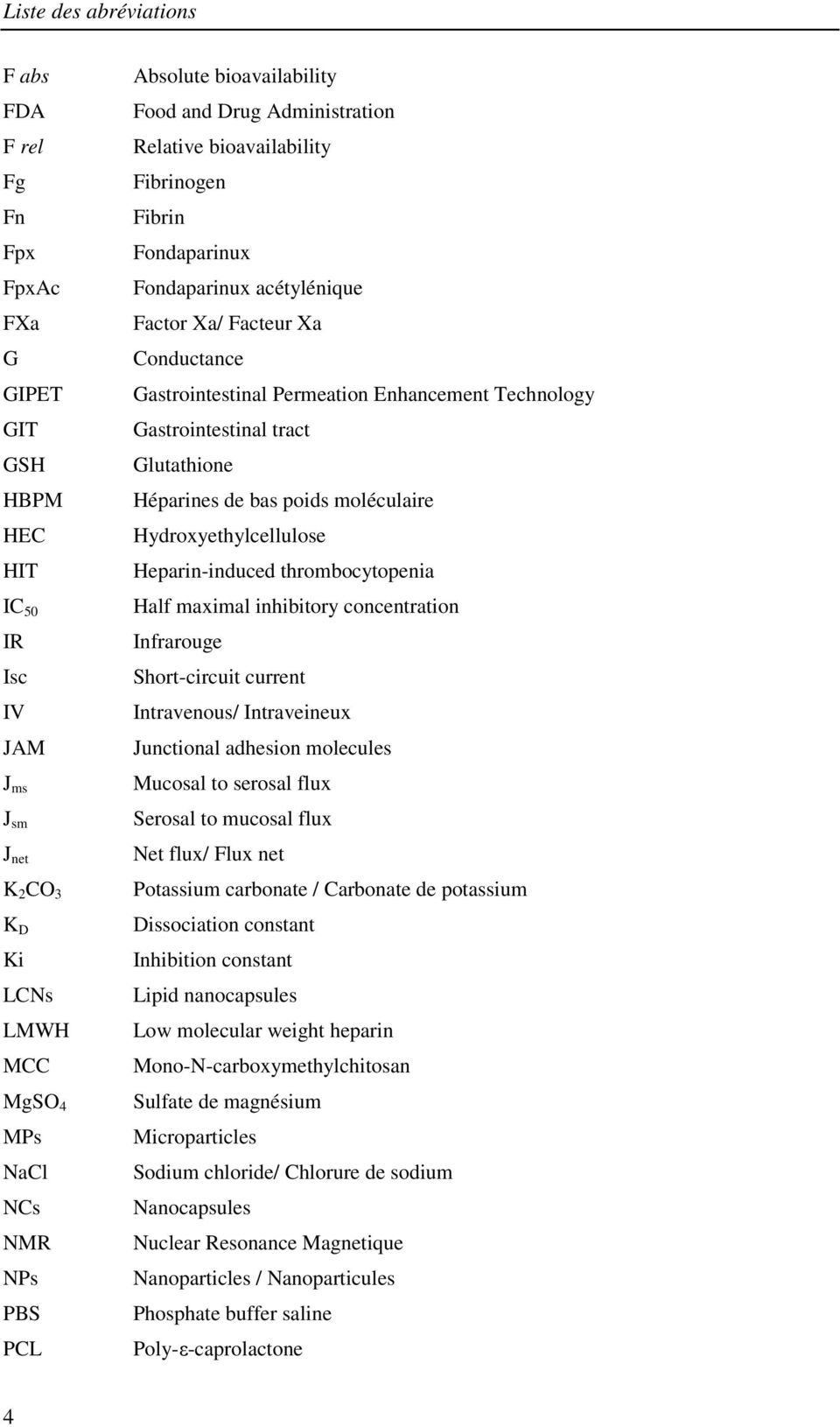
8 Liste des abréviations PCP-Cys Thiolated polycarbophil Pd Potential difference PD Pharmacodynamics PDI Polydispersity index PE Pulmonary embolism PEC Polyelectrolyte complex PF4 Platelet Factor 4 P-gp P-glycoprotein / P-glycoprotéine PK Pharmacokinetic PLGA Poly (lactic-co-glycolic acid) PTP Protein tyrosine phosphatase QELS Quasi Elastic Light Scattering R Rétro-orbitale RMN Résonance Magnétique Nucléaire SA Stearylamine SAXS Small-angle X-ray scattering SC Subcutaneous / sous-cutanée SDS Sodium dodecylsulfate SMEDDS Self-microemulsifying drug delivery systems SNAC N-[8-(2-hydroxybenzoyl) amino] caprylate SNAD sodium N-[10-(2-hydroxybenzoyl) amino] decanoate SNCC N-sulfonato-N,-carboxymethylchitosan Sq + Trimethyl (squalenyl) ammonium chloride salt Sq ++ SQ SqC TF TGI THF T max TMC TPP TEV UFH VKA VTE 1,20-bis-trimethylammonium (hexanorsqualenyl) dimethanesulfonate salt Squalene / Squalène Dérivé cationique squalénique Tissue factor Tractus gastrointestinal Tétrahydrofurane Time to maximum plasma concentration N-trimethylchitosan Tri-polyphosphate Thromboembolie veineuse Unfractionated heparin Vitamin K antagonist Venous thromboembolism 5
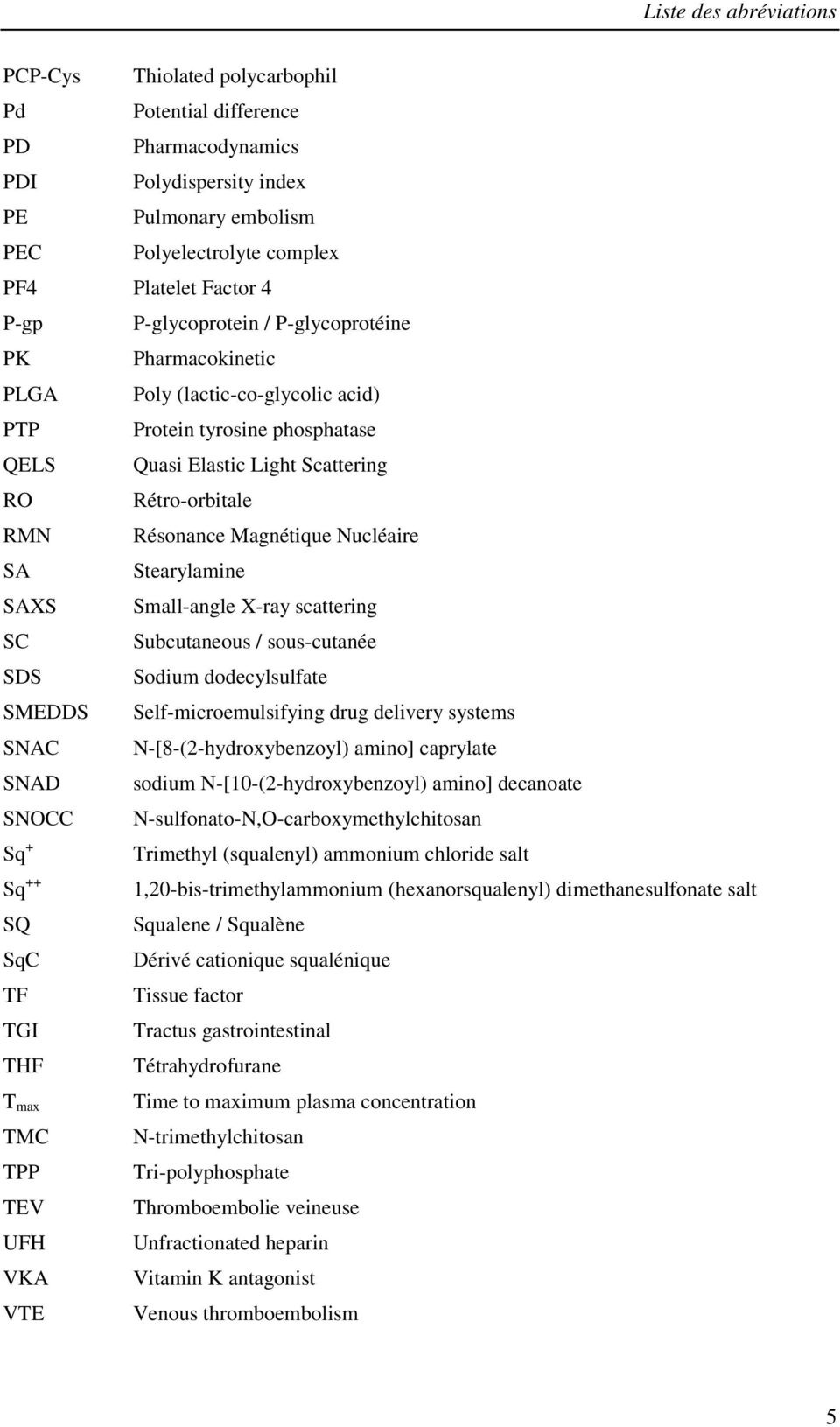
9 Table des matières Introduction générale PREMIERE PARTIE : TRAVAUX ANTERIEURS Préambule La voie orale La voie orale et sa problématique d administration L intestin Anatomie et physiologie de l intestin Absorption intestinale Facteurs influençant l absorption intestinale Stratégies développées pour améliorer la biodisponibilité orale Revue de littérature A la recherche de l'anticoagulant oral «idéal» Introduction Anticoagulation strategies ral anticoagulants Introduction Selective FXa inhibitors Direct thrombin inhibitors ral direct anticoagulants: advantages and drawbacks ral delivery system of heparins Chemical and pharmacological properties of heparins ral delivery of heparins ral delivery systems for fondaparinux Indirect selective FXa inhibitors Fondaparinux ral non-covalent delivery systems of fondaparinux ral delivery systems of heparins and fondaparinux: advantages and drawbacks Conclusion
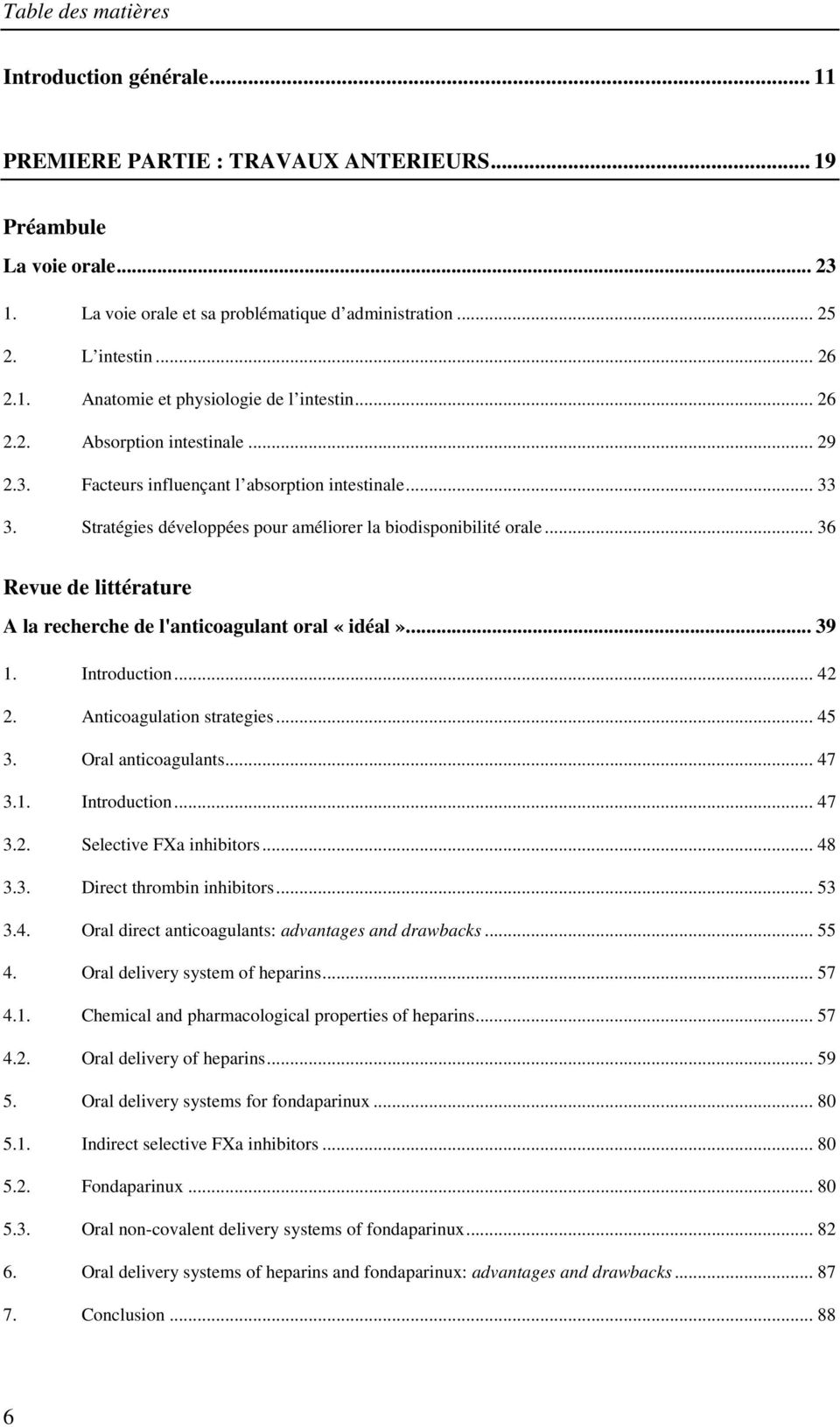
10 Table des matières DEUXIEME PARTIE : TRAVAUX EXPERIMENTAUX Chapitre 1 Application du concept de «squalénisation» Introduction Matériels et méthodes Matériels Méthodes Résultats et discussions Synthèse des dérivés squaléniques Alkylation du fondaparinux avec un dérivé bromé propargylique «Click chemistry» entre le fondaparinux acétylénique et l azidoacétate de trisnorsqualényle Analyse biologique Conclusion Chapitre 2 Synthèse, caractérisation et évaluation in vivo Introduction Results and discussion Synthesis and characterization of cationic squalenoyl derivatives ptimization of the formulation of Fpx: Sq + and Fpx: Sq ++ nanoparticles Stability of the Fpx:Sq + nanoparticles Determination of the amount of fondaparinux associated to the nanoparticles Supramolecular organization of the Fpx:Sq + nanoparticles In vivo anticoagulant activity Conclusion Experimental section Drugs and chemicals General Synthesis and characterization of Sq Synthesis and characterization of Sq Preparation and characterization of the nanoparticles
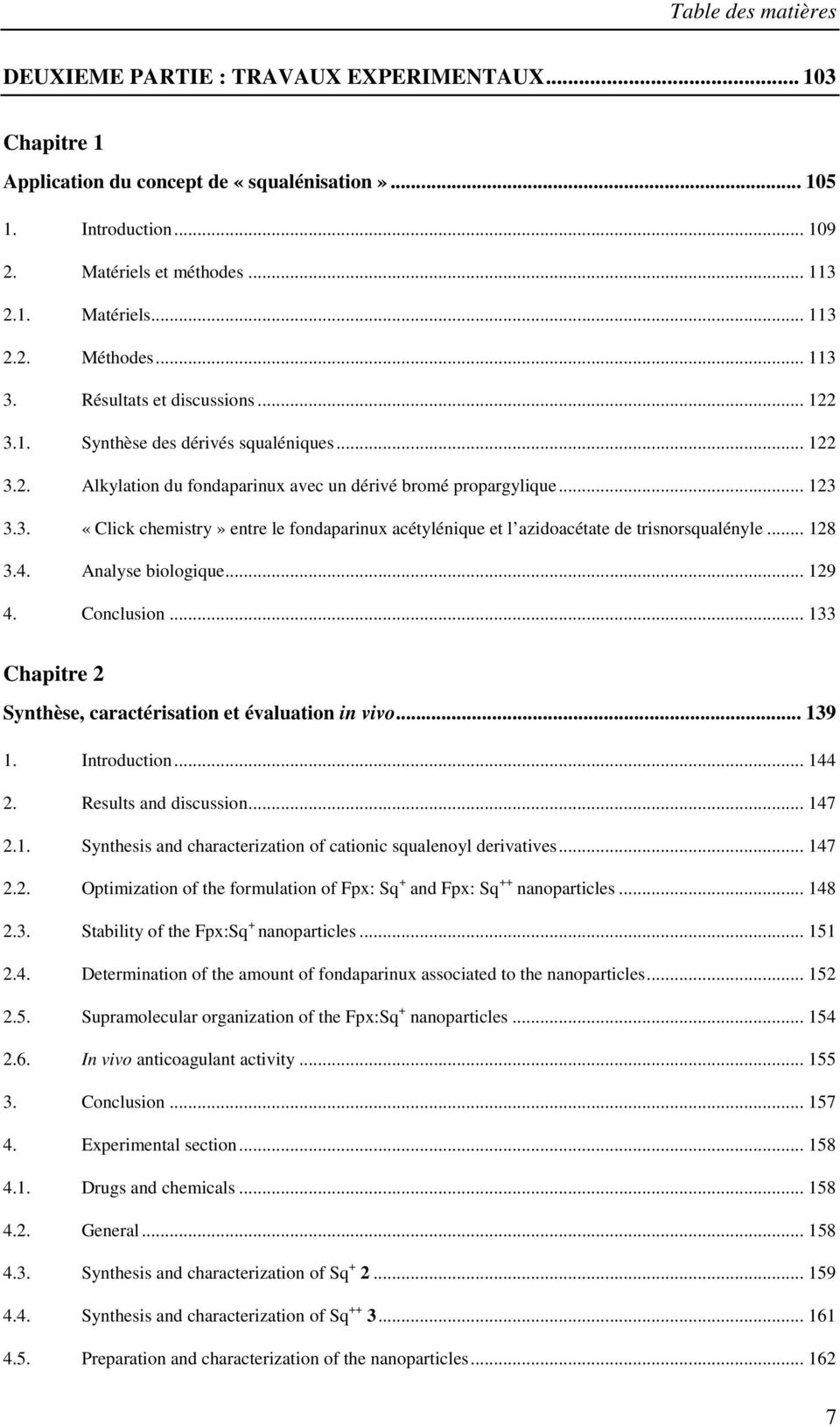
11 Table des matières 4.6. In vivo studies Supporting information Variation of the volume ratio Stability of the nanoparticles Amount of fondaparinux incorporated into Fpx:Sq + nanoparticles Chapitre 3 Développement d une forme solide entérique Introduction Materials and methods Materials Preparation and characterization of Fpx:Sq + nanoparticles Stability studies of Fpx:Sq + nanoparticles Preparation and characterization of freeze-dried Fpx:Sq + nanoparticles Preparation of Fpx:Sq + NPs-filled enteric-coated capsules In vivo study Results and discussion Stability studies Freeze-drying of Fpx:Sq + nanoparticles ptimization of enteric-coated capsules ral administration of Fpx:Sq + nanoparticles-filled enteric-coated capsules Conclusions Chapitre 4 Etude de passage in vitro Introduction Materials and methods Materials Synthesis of trimethyl(trisnor-squalenyl)ammonium chloride salt (Sq + ) Coupling of Fpx with a fluorophore, Alexa Fluor Preparation of the nanoparticles In vitro permeation studies across rat intestinal mucosa
12 Table des matières 3. Results Stability of Fpx in solution and associated to Sq + NPs in Ussing conditions Effect of Fpx and Fpx:Sq + NPs on the jejunal tissue viability Permeation of Fpx through the intestinal epithelium at 37 C either from solution or from loaded Fpx:Sq + NPs Fluxes of Fpx from solution and from loaded squalenoyl NPs through the intestinal epithelium at 4 C Confocal analysis of the permeation of Fpx from Fpx loaded NPs Discussion Conclusion TRISIEME PARTIE : DISCUSSIN GENERALE Association covalente du fondaparinux avec un dérivé squalénique Association non covalente entre le fondaparinux et un dérivé squalénique Synthèse et capacité d'auto-assemblage des dérivés squaléniques cationiques Mise au point des nanoparticules Morphologie des nanoparticules Stabilité colloïdale des nanoparticules Lyophilisation des nanoparticules et mise au point des gélules gastrorésistantes Etudes in vivo des nanoparticules Etude de passage au travers de la barrière intestinale Conclusions
13

14 Introduction générale 11
15

16 Introduction générale Introduction générale Le fondaparinux (Fpx) est un anticoagulant de la classe des inhibiteurs sélectifs indirects du facteur Xa (FXa), les pentasaccharides de synthèse (Bauer et al., 2002). Depuis sa commercialisation en 2002, il est devenu le traitement de référence dans la prévention et le traitement des maladies thromboemboliques avec les héparines et les antivitamines K (AVK) (Bates et al., 2008). Le Fpx est un inhibiteur synthétique, spécifique du FXa et sa structure reprend l'unité d'activité biologique de l'héparine. Ainsi, comme les héparines, son mécanisme d'action n intervient pas directement sur les facteurs de la coagulation. Le Fpx agit par l'intermédiaire d'un cofacteur, l'antithrombine (AT) qui est un inhibiteur plasmatique naturel de la coagulation (Herbert et al., 1997). Sa capacité de fixation à l'at est responsable du changement conformationnel nécessaire à son activité (van Boeckel et al., 1993). Le Fpx possède une masse moléculaire élevée (1728 Da), une forte charge anionique et une forte solubilité aqueuse. En raison de ses propriétés physicochimiques, le Fpx est peu absorbé au niveau du tractus gastrointestinal (TGI) lui conférant une très faible biodisponibilité orale. De plus, le Fpx est dégradé en milieu acide stomacal. Comme les héparines de bas poids moléculaire (HPBM), il peut être administré uniquement par voie sous-cutanée (SC). r, la voie parentérale est une voie contraignante pour les patients qui doivent procéder à des injections pluriquotidiennes. Par conséquent, le principal inconvénient du Fpx est son mode d'administration. La voie orale constitue la voie d'administration privilégiée en termes d'observance, de confort et de simplicité et également de sécurité d'emploi pour le patient. Pendant plus de 60 ans, les AVK représentaient le seul traitement anticoagulant oral (Ansell et al., 2008). Cependant, les AVK oraux présentent de nombreux inconvénients, notamment une variabilité interindividuelle importante, des effets tératogènes, de nombreuses intéractions médicamenteuses ou encore la nécessité d'une surveillance biologique étroite lors de la mise en place du traitement (Ansell et al., 2008). Récemment, le développement de nouveaux anticoagulants oraux directs est devenu un véritable enjeu de santé publique (Becattini et al., 2012). La mise sur le marché de trois 13
17 Introduction générale anticoagulants oraux dans la prévention et le traitement de la thromboembolie veineuse (TEV) après une chirurgie orthopédique et plus récemment dans le traitement de la TEV et dans la prévention des accidents vasculaires cérébraux (AVC) après une fibrillation auriculaire a permis de réduire la prescription des AVK. Cependant, le recul sur leur profil bénéfice/risque est encore trop court pour pouvoir les utiliser en remplacement des héparines et du Fpx. De plus, ces molécules présentent des risques hémorragiques similaires aux héparines (Miesbach et al., 2012). Dès lors, face à l'utilisation plus fréquente et plus répandue des héparines et du Fpx, le développement d'une forme orale de ces polysaccharides reste d'actualité. Le développement de nouvelles formes pharmaceutiques est devenu un véritable défi pour améliorer l'absorption orale des héparines (Paliwal et al., 2012). Depuis peu, des premières tentatives ont été appliquées au Fpx (Vetter et al., 2010; Ramadan et al., 2011; Meissonnier et al., 2011; Leonard et al., 2011). L'objectif de ce projet de thèse est de mettre au point un système d'administration associant le Fpx à des dérivés squaléniques afin de permettre l'amélioration de l'absorption orale du Fpx. En effet, le squalène (SQ) est un lipide naturel précurseur de la biosynthèse du cholestérol disposant d'une bonne absorption orale à plus de 60 % (Kelly, 1999). Pour atteindre cet objectif, deux stratégies ont été mises en place. La première stratégie consiste à associer par une liaison covalente le Fpx avec un dérivé squalénique selon la technique de la «squalénisation» (Desmaële et al., 2012). La deuxième stratégie est une nouvelle approche développée par notre Groupe consistant à associer par la formation de paires d'ions le Fpx à un dérivé squalénique cationique (SqC). Ce manuscrit est divisé en trois parties. La première partie présente les principales bases de l'absorption orale. Elle décrit aussi, sous la forme d'une revue de littérature les avancées de la thérapie anticoagulante orale, de la mise sur le marché de molécules anticoagulantes à la mise au point de formes galéniques innovantes des anticoagulants de référence, les héparines et le Fpx. La deuxième partie rassemble l'ensemble des travaux expérimentaux menés dans le cadre de notre projet de recherche. Cette partie comporte quatre chapitres, chacun présenté sous forme de publication scientifique. Le premier chapitre relate les avancées réalisées sur la stratégie de 14
18 Introduction générale couplage covalent basée sur le concept de la «squalénisation». Les trois chapitres suivants présentent les résultats obtenus par l'approche de l'association non covalente du Fpx à un SqC. Ce travail de thèse a permis la synthèse de nouveaux dérivés squaléniques, l'optimisation et la caractérisation physicochimique de nanoparticules et l'étude de l'absorption orale du système nanoparticulaire in vivo et in vitro. Enfin, la troisième et dernière partie du manuscrit donne lieu à une discussion générale de l'ensemble des résultats obtenus et à une conclusion générale sur les avancées et les perspectives du projet. 15
19 Introduction générale Références Ansell J, Hirsh J, Hylek E, Jacobson A, Crowther M, Palaretti G. Pharmacology and management of the vitamin K antagonists. American College of Chest Physicians Evidence-Based Clinical Practice Guidelines (8 th Edition). Chest, 2008, 133: 160S-198S Bates SM, Greer IA, Pabinger I, Sofaer S, Hirsh J. American College of Chest Physicians. Venous thromboembolism, thrombophilia, antithrombotic therapy, and pregnancy: American College of Chest Physicians Evidence-Based Clinical Practice Guidelines (8th Edition). Chest, 2008, 133: 844S 86S Bauer KA, Hawkins DW, Peters PC, Petitou M, Herbert JM, van Boeckel CAA, Meuleman DG: Fondaparinux, a synthetic pentasaccharide: The first in a new class of antithrombotic agents - The selective factor Xa inhibitors. Cardiovasc. Drug Rev., 2002, 20: Becattini C, Vedovati MC, Agnelli G. ld and new oral anticoagulants for venous thromboembolism and atrial fibrillation: A review of the literature. Thromb. Res., 2012, 129: Desmaële D, Gref R, Couvreur P. Squalenoylation: A generic platform for nanoparticular drug delivery. J. Control. Rel., 2012, 161: Herbert JM, Petitou M, Lormeau JC, Cariou R, Necciari J, Magnani HN, Zandberg P, van Amsterdam RGM, van Boeckel A, Meuleman DG. SR 90107/rg 31540, a novel anti-factor Xa antithrombotic agent. Cardiovasc. Drug Rev., 1997, 15: 1-26 Kelly, GS. Squalene and its potential clinical uses. Altern. Med. Rev., 1999, 4: Leonard TW, Coughlan DC, Cullen A. Pharmaceutical compositions of selective factor Xa inhibitors for oral administration. W 2011/ A1, 2011 Meissonnier J, Sicre N, Sabate G, Dubreucq G, Nancy-Portebois V, Petitou M. Pharmaceutical oral dosage form containing a synthetic oligosaccharide. W 2011/ A2,
20 Introduction générale Miesbach W, Seifried E. New direct oral anticoagulants-current therapeutic options and treatment recommendations for bleeding complications. Thromb. Haemost., 2012, 108: 1-7 Paliwal R, Paliwal SR, Agrawal GP, Vyas SP. Recent advances in search of oral heparin therapeutics. Med. Res. Rev., 2012, 32: Ramadan A, Lagarce F, Tessier-Marteau, Thomas, Legras P, Macchi L, Saulnier P, Benoit JP. ral fondaparinux: use of lipid nanocapsules as nanocarriers and in vivo pharmacokinetic study. Int. J. Nanomed., 2011, 6: van Boeckel CAA, Petitou M. The unique antithrombin III binding domain of heparin: A lead to new synthetic antithrombotics. Angew. Chem. Int. Ed. Engl., 1993, 32: Vetter A, Perera G, Leithner K, Klima G, Berknop-Schnürch A. Development and in vivo bioavailability study of an oral fondaparinux delivery system. Eur. J. Pharm. Sc., 2010, 41:
21
22 PREMIERE PARTIE : TRAVAUX ANTERIEURS 19
23
24 Travaux antérieurs La voie orale est la voie d administration de choix des médicaments. Depuis plusieurs années, la thérapie anticoagulante orale est en plein essor depuis la mise sur le marché notamment de nouvelles molécules anticoagulantes telles que le rivaroxaban (Xarelto ) et le dabigatran etexilate (Pradaxa ) afin de remplacer les anticoagulants oraux de référence, les antivitamines K (AVK) qui disposent de nombreux inconvénients. Cette première partie est divisée en deux chapitres, une description des principes de la voie orale et une revue de la littérature sur l état actuel de la thérapie anticoagulante orale. Les objectifs de cette partie sont : dans le premier chapitre, de présenter de façon synthétique les bases de l administration des médicaments par voie orale. dans le deuxième chapitre, de faire une revue de la littérature des principales stratégies pour la développement d une thérapie anticoagulante orale efficace, de la synthèse de molécules anticoagulantes orales commercialisées aux stratégies développées pour améliorer la biodisponibilité orale des anticoagulants de référence, les héparines et le Fpx dans le but de trouver des solutions alternatives plus efficaces aux anticoagulants oraux actuels, les AVK. 21
25
26 Préambule La voie orale 23
27
28 Travaux antérieurs - La voie orale 1. La voie orale et sa problématique d administration Compte tenu de sa simplicité et de son confort d administration pour le patient, la voie orale reste la voie d administration préférentielle des médicaments. C est la voie d administration la plus utilisée dans environ 80 % des formes pharmaceutiques. r, pour qu une molécule active puisse avoir un potentiel thérapeutique par voie orale, cette dernière doit être absorbée efficacement à partir du tractus gastrointestinal (TGI) et pour ensuite passer en quantité suffisante dans la circulation systémique (Figure 1). Administration orale du médicament Œsophage Foie Duodénum ph 6,6 Estomac ph 1,2/ 4,0 Pancréas Intestin grêle Jéjunum ph 7,0 7,4 Iléon ph 7,4 Gros intestin Figure 1. Les différents sites d absorption d un médicament après son administration par voie orale Par conséquent, cette molécule active doit être stable dans le gradient de ph croissant des milieux physiologiques du TGI, notamment dans l environnement acide de l estomac et également être stable par rapport à l action des nombreuses enzymes présentes tout au long du TGI (Daugherty et al., 1999). Cependant, de nombreuses molécules actives en développement ne peuvent être administrées par voie orale en raison de leur instabilité dans ces conditions gastrointestinales. Par ailleurs, lors de la prise orale d'un médicament, suivie d'une absorption gastrointestinale, la molécule active est d'abord transportée par la veine porte vers le foie avant d'atteindre la circulation systémique. Le foie est le site principal de métabolisation de l'organisme du fait 25
29 Travaux antérieurs - La voie orale des nombreuses enzymes qui s'y trouvent (Kruijtzer et al., 2002). r, une métabolisation importante au niveau du foie, également connue sous le nom d'effet de premier passage hépatique, peut entraîner une diminution importante de la quantité de molécule active dans la circulation systémique et stopper leur développement (Kruijtzer et al., 2002). Le TGI est la partie de l'organisme désignée pour empêcher l'entrée des pathogènes (Daugherty et al., 1999). L'intestin est divisé en deux parties, l'intestin grêle et le gros intestin. L'intestin grêle est l'organe responsable de l'assimilation des nutriments et des médicaments dans le sang. C'est ainsi l'organe essentiel à la digestion et à l'absorption et constitue la plus importante barrière biologique entre les environnements interne et externe (Daugherty et al., 1999). Dans ce contexte, il est important de comprendre les mécanismes d absorption d une molécule active au niveau intestinal. La voie orale est la voie d administration la plus étudiée. Les connaissances relatives à la physiologie de la muqueuse digestive et au comportement biopharmaceutique des principes actifs sont très étendues. L objectif de ce préambule est de présenter les principes de l absorption orale d une molécule active, de l absorption intestinale aux solutions pour l améliorer. 2. L intestin 2.1. Anatomie et physiologie de l intestin L intestin est la partie la plus longue du tube digestif, environ huit mètres (Daugherty et al., 1999). Le gros intestin est dans le prolongement de l'intestin grêle. Il est constitué de quatre parties: le caecum, l'appendice, le côlon et le rectum. L'intestin grêle est composé de trois parties, le duodénum, le jéjunum et l iléon avec un gradient de ph croissant (Daugherty et al., 1999) (Figure 1). L'intestin grêle dispose d'une surface importante d'environ 300 m² chez l'homme adulte (Söderholm et al., 2001). Cette surface fait de l intestin grêle, l organe principal de l absorption des nutriments et des vitamines. Cette caractéristique est due à la présence de villosités qui tapissent toute la surface de l'intestin et facilitent le passage des nutriments (Figure 2). 26
30 Travaux antérieurs - La voie orale lamina propia entérocyte veine vaisseau lymphatique réseau capillaire cellule dendritique artériole macrophages cellule caliciforme vaisseau lymphatique lymphocytes cellule M Figure 2. Schéma de l'épithélium intestinal et des différents cellules qui le composent (adaptée de Daugherty et al, 1999a) La muqueuse intestinale est constituée de cinq couches concentriques, une tunique séreuse, une couche de muscles longitudinaux, une couche de muscles circulaires, une couche sous-muqueuse et une tunique muqueuse. La tunique muqueuse, grâce à la présence des villosités à sa surface, joue un rôle essentiel dans le processus d'absorption des nutriments. Les villosités intestinales sont des replis de la muqueuse et de tissu conjonctif sous-jacent irriguées par des vaisseaux sanguins et un canal lymphatique (Figure 2). Elles sont bordées de deux types de cellules épithéliales, les cellules caliciformes qui sont les cellules sécrétrices du mucus et les entérocytes, les cellules responsables de l'absorption (Figure 2). L'épithélium intestinal exerce une importante défense physiologique par la sécrétion de fluides et de mucus. Le mucus forme un gel adhérant à la muqueuse intestinale dont la principale fonction est de protéger celle-ci contre l'action corrosive des enzymes, du suc intestinal et des composés ingérés lors de l'alimentation. Il est essentiellement constitué d'eau (95 %), de glycoprotéines et d'électrolytes divers. Son épaisseur est variable et son renouvellement se fait environ toutes les 24 à 48 h chez l'homme (Söderholm et al., 2001). 27
31 Travaux antérieurs - La voie orale Les entérocytes sont constituées d'une membrane apicale en bordure en brosse formée de microvillosités représentant un obstacle à la fixation des microorganismes au niveau de l'intestin (Figure 2) (Magalhaes et al., 2007). Cette barrière physique est renforcée par la présence d'une couche continue recouvrant la membrane apicale des entérocytes du glycocalix riche en enzymes hydrolytiques (aminopeptidase, phosphatase alcaline, disaccharidase) (Magalhaes et al., 2007). Le glycocalix est constitué de filaments de glycoprotéines orientées vers la lumière intestinale conférant une polarité à la membrane (Magalhaes et al., 2007). Au niveau du système lymphatique, en réponse aux signaux des lymphocytes sous-jacents, les cellules épithéliales couvrant les plaques de Peyer peuvent se différencier en cellules M impliquées dans la défense immunitaire (Figure 2) (Magalhaes et al., 2007). Les cellules M présentent également des microvillosités courtes et moins denses permettant un contact plus aisé entre la surface apicale et les composés présents dans la lumière intestinale (Figure 2). Ces cellules expriment en surface des récepteurs différents de ceux exprimés par les entérocytes. Cela permet aux microorganismes colonisant la muqueuse intestinale de se fixer spécifiquement aux cellules M par le biais de protéines apparentées aux lectines, les adhésines (Nicoletti, 2000). Par ailleurs, le système lymphatique peut également constituer une voie de passage intestinale notamment pour certaines macromolécules qui peuvent être adsorbées dans la circulation lymphatique via les cellules M des plaques de Peyer (Goldberg et al., 2003). Par ailleurs, les cellules épithéliales forment un épithélium dans lequel les cellules sont liées par des jonctions intercellulaires (Figure 3), notamment : les jonctions serrées (encore appelées zonula occludens ou «tight junctions» en anglais) de 80 nm de long responsables essentiellement de la cohésion et de la perméabilité du tissu épithélial. Leur structure dynamique permet la régulation de la perméabilité membranaire et constitue ainsi un principal composant de la barrière intestinale (Lapierre, 2000). 28
32 Travaux antérieurs - La voie orale les jonctions adhérentes (zonula adherens) qui assurent la cohésion mécanique entre les cellules (desmosomes et hémidesmosomes). les jonctions communicantes de type "gap" assurant le passage des petites molécules et d'ions. Lumière intestinale Membrane apicale Jonction serrée Jonction adhérente Desmosome Filaments d actine Jonctions type «gap» Hémidesmosomes Figure 3. Les différents types de jonctions intercellulaires entre les cellules épithéliales (adaptée de Guttman et al., 2009) 2.2. Absorption intestinale L'absorption intestinale se fait essentiellement dans les entérocytes. Les nutriments et/ou les molécules actives résultantes de la digestion traversent la membrane apicale au niveau des microvillosités. Ils traversent ensuite l'entérocyte et sortent au niveau de la membrane basale dans le milieu intercellulaire, puis passent dans les capillaires sanguins. En fonction de leurs caractéristiques physicochimiques, le passage de chaque molécule à travers la membrane cytoplasmique peut s'effectuer par deux types de transport, passif et actif impliquant ou non des transporteurs transmembranaires (Daugherty et al, 1999a ; Daugherty et al, 1999b) (Figure 4). La membrane cytoplasmique constitue une barrière physique. C'est une bicouche lipidique perméable aux molécules non polaires et polaires de petite taille (inférieure à Da) et imperméable 29
33 Travaux antérieurs - La voie orale aux molécules polaires de poids moléculaire supérieur à Da et aux ions (Goldberg et al, 2003) Transport passif Le transport passif est le mode de passage le plus fréquemment rencontré dans le cas des molécules actives. Il ne nécessite pas d'apport d'énergie de la part de la cellule épithéliale. Cette dernière contribue à la formation d'un gradient de concentration de part et d'autre de la membrane épithéliale. Le transport passif est régi par des lois physico-chimiques selon la loi de Fick: ( 2 1) D Ks S C C Vitesse de diffusion = (1) e avec: D: coefficient de diffusion de la molécule à travers la membrane Ks: coefficient de partage de la molécule entre la membrane et la phase aqueuse extérieure S: surface de la membrane C2-C1:différence de concentration de la molécule de part et d autre de la membrane e : épaisseur de la membrane A partir de cette équation, les facteurs régulant la diffusion passive sont aussi bien les caractéristiques de la molécule active que celles de la membrane intestinale. Il existe deux types de diffusion passive (Daugherty et al, 1999a et b) (Figure 4): la diffusion passive paracellulaire, la diffusion passive transcellulaire. La lipophilie des molécules est nécessaire pour leur passage à travers les cellules épithéliales par diffusion passive transcellulaire. Par ailleurs, la voie paracellulaire peut être envisagée par diffusion passive mais est restreinte aux petites molécules (de masse moléculaire inférieure à Da) (Goldberg et al, 2003). La diffusion passive paracellulaire est empruntée par les molécules pouvant traverser les jonctions serrées et ne nécessite l'implication d'aucune protéine membranaire. Ce mode de transport est non 30
34 Travaux antérieurs - La voie orale saturable et non inhibable. Il est favorable aux molécules lipophiles et non ionisées. Les molécules chargées peuvent toutefois emprunter ce mode de passage mais seule la fraction non ionisée est susceptible de traverser l'épithélium. Par ailleurs, afin de traverser les jonctions serrées, le poids moléculaire est un facteur important pour ce type de diffusion (Goldberg et al, 2003). La diffusion passive transcellulaire, encore appelée diffusion facilitée s'applique aux molécules polaires et à certains ions. Ce type de diffusion nécessite la prise en charge de la molécule par une protéine transporteuse membranaire évitant le contact avec la bicouche lipidique lors de son transfert (Daugherty et al, 1999a). Elle se fait toujours selon le gradient de concentration. Cependant, contrairement à la diffusion passive paracellulaire, la diffusion facilitée est saturable selon la cinétique de Michaelis-Menten. La vitesse de transport atteint un maximum (V max ) lorsque le transporteur membranaire est saturé. La diffusion facilitée peut être assurée par des transporteurs membranaires et des protéines-canal (Daugherty et al, 1999a). Les transporteurs membranaires sont des protéines qui se lient de façon spécifique aux molécules à transporter et subissent des changements conformationnels permettant le passage de la molécule à travers la membrane. Le glucose, par exemple, traverse la muqueuse intestinale par diffusion facilitée par l'utilisation de transporteurs spécifiques au glucose (Kellet et al., 2005). Les protéines canal forment quant à elles un pore au travers de la membrane qui, lors de son ouverture contrôlée permet une diffusion passive de toutes les molécules ayant une charge et une taille appropriées. Il existe plusieurs types de protéines canal, telles que les canaux ioniques, les connexines et les aquaporines (Daugherty et al, 1999a) Transport actif Le transport actif concerne essentiellement les molécules polaires ou faiblement lipophiles. Le transport actif nécessite un apport d'énergie de la part de la cellule épithéliale, généralement fourni directement ou indirectement par de l'atp (Figure 4). Le transport des molécules s effectue contre le gradient de concentration impliquant des systèmes de transporteurs membranaires 31
35 Travaux antérieurs - La voie orale (transcellulaire) ou mettant en jeu des vésicules d internalisation (endocytose) (Daugherty et al, 1999a). Comme la diffusion facilitée, le transport actif a une cinétique saturable de type Michaelis-Menten. avec: V max C Vitesse d ' absorption = + Kd C Km + C Vmax: vitesse maximale du transport actif C: concentration de la molécule active Km: concentration de la molécule active à Vmax/2 Kd: constante de diffusion (2) 1) Passage paracellulaire Passage transcellulaire Microvillosités Jonction intercellulaire Gradient de concentration Entérocyte Transporteur transmembranaire Flux sanguin 2) Passage transcellulaire vésiculaire (Endocytose) Microvillosités Passage transcellulaire Gradient de concentration Vésicule Jonction intercellulaire Entérocyte Flux sanguin Transporteur transmembranaire Energie Figure 4. Voies de passage d une molécule active au travers de la barrière intestinale par 1) diffusion passive et 2) transport actif 32
36 Travaux antérieurs - La voie orale 2.3. Facteurs influençant l absorption intestinale De nombreux facteurs sont responsables de l absorption orale d une molécule à travers la muqueuse intestinale. La muqueuse intestinale utilise des mécanismes physiologiques et biochimiques qui renforcent sa barrière physique pour prévenir l'entrée des xénobiotiques (Daugherty et al, 1999a) Barrières physiques et physiologiques L intensité de l absorption des médicaments par la voie orale est modulée par l existence de barrières physiques limitant l absorption au travers de la muqueuse intestinale, la membrane plasmique, le mucus et les jonctions serrées. La première barrière physique est la nature de la membrane plasmique. En effet, la membrane plasmique est une bicouche lipidique dont la partie centrale est hydrophobe. Cette hydrophobicité empêche le passage de la plupart des molécules hydrophiles et polaires. La membrane plasmique est donc perméable aux molécules lipophiles (Goldberg et al., 2003). Par ailleurs, la surface de l'épithélium intestinal est recouverte de mucus. Le mucus constitue la deuxième barrière à l'absorption intestinale. Sa fonction principale est de protéger la muqueuse intestinale (Söderholm et al., 2011). Ainsi, il représente une barrière à la diffusion de certaines molécules du fait de la couche d'eau qu'il maintient à la surface de l'épithélium digestif. Les molécules doivent diffuser à travers cette couche avant d'accéder à la membrane intestinale. Par ailleurs, le mucus est constitué de glycoprotéines avec lesquelles les molécules peuvent interagir par des liaisons hydrogène, hydrophobe ou ionique par la présence des résidus d'acide sialique conférant au mucus une charge négative limitant l'absorption des molécules anioniques (Magalhaes et al., 2007). La troisième barrière physique est la présence des jonctions serrées entre les entérocytes. Elles représentent la principale barrière au passage passif des fluides, électrolytes et des macromolécules par la voie paracellulaire (Guttman et al., 2007). Ces jonctions intercellulaires peuvent limiter le passage des molécules actives par diffusion passive (Yun et al., 2012). Les jonctions serrées sont constituées d'unités protéiques transmembranaires dont les principales molécules sont l'occludine, les claudines, les JAM 33
37 Travaux antérieurs - La voie orale ("junctional adhesion molecules") qui sont en relation avec des protéines cytoplasmiques, les Z- 1 et Z-2 (vergaard et al, 2011). Ces dernières interagissent avec les protéines du cytosquelette, les actines formant les jonctions serrées (vergaard et al, 2011) (Figure 5). Les jonctions serrées délimitent ainsi un intervalle de nature hydrophile entre les cellules qui constitue la voie paracellulaire. apical cellule épithéliale actine claudine occludine jonction serrée basolatéral transport paracellulaire Figure 5. Structure moléculaire des jonctions serrées (adaptée de vergaard et al., 2011) Barrières biochimiques L'activité enzymatique est indispensable au niveau de l'intestin dans l'assimilation des nutriments et pour la protection de l'organisme. Elle peut devenir une barrière à l'administration des médicaments par voie orale. Selon la nature de la molécule active, celle-ci peut être la cible des différents cytochromes ou d'autres enzymes. Les cytochromes P450, et plus particulièrement l'isoforme 3A4 (CYP3A4) dont la teneur intestinale est supérieure à celle des autres organes, jouent un rôle déterminant dans la quantité de molécules actives disponible pour l'absorption (Watkins, 1997). De plus, l'activité enzymatique varie énormément d'un individu à l'autre, ce qui augmente le risque de variabilité inter-individuelle. 34
38 Travaux antérieurs - La voie orale Par ailleurs, une activité sécrétrice de la muqueuse intestinale est présente du fait de la présence de protéines codées par les gènes de la famille protéique des transporteurs ABC (ABC signifiant ATP-binding cassette) et précisément à l'allèle ABCB1 qui code pour la P-glycoprotéine (P-gp). La P-gp est une protéine de 170 kda constituée de 12 domaines transmembranaires répartis en 2 sous-unités homologues contenant chacune un site de liaison à l'atp. La P-gp agit comme une pompe à efflux en participant à la détoxification de la cellule par l'efflux des substances toxiques. Elle est présente dans de nombreuses barrières physiologiques dont la barrière hématoencéphalique et la barrière intestinale (Kruijtzer et al., 2002). Par ailleurs, de nombreuses molécules actives sont substrats ou inhibiteurs de la P-gp et du CYP 3A4 (Kruijtzer et al., 2002). Cette collaboration entre ces deux protéines induit un renforcement du rôle de barrière de la muqueuse intestinale (Watkins, 1997) Propriétés physicochimiques de la molécule active Comme décrit ci-dessus, les paramètres physicochimiques de la molécule active peuvent également influencer son absorption intestinale. En effet, pour traverser la barrière intestinale, le type de passage emprunté dépend de ses propriétés physicochimiques telles que la solubilité aqueuse, la polarité, la lipophilie et le poids moléculaire de la molécule active. Ainsi, une molécule avec un potentiel thérapeutique peut avoir une biodisponibilité orale faible si elle dispose d'une ou plusieurs propriétés défavorables à son absorption à travers la barrière gastrointestinale. Dans ce contexte, de nombreuses approches d'optimisation de la formulation galénique ont été étudiées afin de pallier ces inconvénients. 35
39 Travaux antérieurs - La voie orale 3. Stratégies développées pour améliorer la biodisponibilité orale De nombreuses stratégies ont été développées pour améliorer l'absorption orale du principe actif. De manière générale, elles peuvent être appliquées à tous les principes actifs quels que soient leurs natures. Elles consistent par exemple en: l'utilisation de formes gastrorésistantes pour empêcher l'instabilité et la dégradation enzymatique en milieu gastrique acide du principe actif, l'emploi de promoteurs d'absorption pour favoriser le passage du principe actif à travers la muqueuse intestinale, la co-administration avec des inhibiteurs enzymatiques pour augmenter l absorption intestinale du principe actif, la vectorisation particulaire pour protéger le principe actif d'une instabilité et/ou d'une dégradation dans le TGI. Les stratégies développées pour améliorer le passage des anticoagulants de référence, les héparines et le Fpx seront détaillées dans la suite de cette partie - Travaux antérieurs. 36
40 Travaux antérieurs - La voie orale Références Daugherty AL, Mrsny RJ. Transcellular uptake mechanisms of the intestinal epithelial barrier Part one. PSTT, 1999 a, 2: Daugherty AL, Mrsny RJ. Regulation of the intestinal epithelial paracellular barrier. PSTT, 1999 b, 2: Goldberg M, Gomez-rellana I. Challenges for the oral delivery of macromolecules. Nat. Rev. Drug Disc., 2003, 2: Guttman JA, Finlay B. Tight junctions as targets of infectious agents. Bioch. Bioph. Acta, 2009, 1788: Kellet GL, Brot-Laroche E. Apical GLUT2. A major pathway of intestinal sugar absorption. Diabetes, 2005, 54: Kruijtzer CM, Beijnen JH, Schellens JH. Improvement of oral drug treatment by temporary inhibition of drug transporters and/or cytochrome P450 in the gastrointestinal tract and liver: an overview. ncologist, 2002, 7: Lapierre LA. The molecular structure of the tight junction. Adv. Drug Deliv. Rev., 2000, 41: Magalhaes, JG, Tattoli, I, Stephen E. Girardin, SE. The intestinal epithelial barrier: How to distinguish between the microbial flora and pathogens. Seminars in Immunology, 2007, 19: Nicoletti C. Unsolved mysteries of intestinal M cells. Gut, 2000, 47: vergaard CE, Daugherty BL, Mitchell LA, Koval M. Claudins: Control of Barrier Function and Regulation in Response to xidant Stress. A.R.s, 2011, 15: Söderholm JD, Perdue MH. Stress and intestinal barrier function. Am. J. Physiol. Gastroint. Liv. Phys., 2001, 280: G7-G13 Watkins PB. The barrier function of CYP3A4 and P-glycoprotein in the small bowel. Adv. Drug Del. Rev., 1997, 27:
41
42 Revue de littérature A la recherche de l'anticoagulant oral «idéal» 39
43
44 Revue - A la recherche de l'anticoagulant oral «idéal» In search of an "ideal" oral anticoagulant Review of literature Bettina Ralay-Ranaivo 1, Delphine Borgel 2, Patrick Couvreur 1, Ruxandra Gref 1 1 Institut Galien Paris-Sud CNRS UMR 8612, 5 rue J.B. Clément, Châtenay-Malabry Cedex, France 2 EA Ingénierie des protéines de l'hémostase à potentiel thérapeutique, 5 rue J.B. Clément, Châtenay-Malabry Cedex, France 41
45 Revue - A la recherche de l'anticoagulant oral «idéal» 1. Introduction Thromboembolic disorders are among the major causes of morbidity and mortality and anticoagulation remains the therapy of choice for prevention and treatment of these venous and arterial thromboembolic disorders (Bates et al., 2008; Singer et al., 2008). These disorders are caused by the formation of blood clots in the arterial circulation (arterial thrombosis) or venous circulation (venous thrombosis) which often break off and travel to other areas. They can cause major organ damage or even death. Atrial fibrillation (AF) is the most common cardiac arrhythmia affecting an estimated 4.5 million people in Europe and 5.1 million in the USA (Fuster et al., 2011). Its frequent complication is arterial embolism which can lead to stroke or systemic embolism (Lloyd-Jones et al., 2004). Venous thromboembolism (VTE) is a common complication during and after hospitalization for acute medical illness or surgery (Cohen et al., 2008). VTE consists of deep vein thrombosis (DVT) or phlebitis and its main complication is pulmonary embolism (PE) (Gross et al., 2008). Emboli that lodge in the lungs (pulmonary emboli) can rapidly cause death. PE accounts for 5-10 % of deaths in hospitalized patients, making VTE the most common preventable cause of in-hospital death (Geerts et al., 2008; Cohen et al., 2008). VTE affects one in 1000 adults yearly and it has been estimated to be the third most common cardiovascular disorder after ischaemic heart disease and stroke worldwide (Eikelboom et al., 2010). Major orthopaedic surgery without prophylaxis carries a risk of VTE (Mavrakanas et al., 2011). 40 % and 60 % of patients could develop DVT after major orthopaedic surgery without anticoagulant treatment. Rapid anticoagulation is necessary to minimize the risk of thrombus extension and PE in patients with VTE (Mavrakanas et al., 2011; Geerts et al., 2008). Currently, heparin (unfractionated heparin (UFH) and low molecular weight heparin (LMWH)), fondaparinux (Fpx) and vitamin K antagonists (VKA) are the primary treatments for venous thromboembolic diseases (Singer et al., 2008; Fuster et al., 2011; Geerts et al., 2008). Since their first application in 1936, heparins still represent the antithrombotic drugs of choice in short and medium-term prophylaxis and therapy thromboembolic diseases (Hirsh et al., 2004). 42
46 Revue - A la recherche de l'anticoagulant oral «idéal» Heparin, commonly known as UFH is a highly sulfated polysaccharide that displays anticoagulant activity by the inhibition of the coagulation factors, factor Xa (FXa) and thrombin through binding with the plasma protein inhibitor of coagulation, antithrombin (AT) (Petitou et al., 2003). UFH is well-known to have limitations such as frequent laboratory monitoring, risk of bleeding, heparin-induced thrombocytopenia (HIT) and heparin-associated osteoporosis (Hirsh et al., 2004). Its low bioavailability and its high interindividual variability led to the development of LMWH obtained by fractionation of heparin (Weitz, 1997). Heparins are extracted from animal tissues. Compared with UFH, LMWH exhibits greater bioavailability after subcutaneous (SC) injection, has a longer half-life and produces a more predictable anticoagulant response without routine monitoring. However, LMWH still retains the potential to cause HIT (Hirsh et al., 2004). In 2001, Fpx, a synthetic and structural analog of the AT-binding pentasaccharide domain of heparin was developed as a new antithrombotic drug under the name Arixtra (Bauer et al., 2002). Compared to UFH and LMWH, Fpx has selective anti-xa activity and longer half-life. However, even if the safety/efficacy profiles of LMWH and Fpx are better than UFH, heparin and Fpx-based therapeutic approaches are limited because these compounds are not absorbed in the intestine due to their high molecular weight, negatively charged structure and hydrophilic properties (Motlekar et al., 2006; Ramadan et al., 2011). Hence, these macromolecular drugs can be only administered by parenteral route (Jaques, 1980; Samama et al., 2003). Long-term anticoagulation therapy is even much more problematic because the administration of VKA requires high monitoring. Since their first introduction more than 60 years ago, VKA were until recently the only orally active anticoagulants available for clinical use (Ansell et al., 2008). Their anticoagulant effect is related to an interference with the γ-carboxylation of vitamin K- dependent coagulation Factors II, VII, IX, and X (Ansell et al., 2008). VKA are also challenging to use in clinical practice because they have a slow onset of action, a narrow therapeutic window, unpredictable pharmacokinetics (PK) and pharmacodynamics (PD), and multiple food drug and drug drug interactions (Ansell et al., 2008). Therefore, frequent coagulation monitoring and dose adjustment are necessary for a treatment with VKA (Ansell et al., 2008). Maintaining a 43
47 Revue - A la recherche de l'anticoagulant oral «idéal» therapeutic anticoagulation level requires a good understanding of their PK and PD as well as optimal physician patient communication. Without context, the oral route of administration remains more convenient than the parenteral route for patients. Due to the limitations of these traditional anticoagulants, there is an increasing interest in the development of new and better oral anticoagulants agents (Bauer, 2011). Some of these newly developed molecules have been approved for certain indications such as the prevention of VTE after orthopaedic surgery (Becattini et al., 2012) and recently for the treatment of VTE and the prevention of stroke after AF (Mangiafico et al., 2012). However, their safety/efficacy profile is not yet well-established due to their recent marketing and the risk of bleeding is equivalent to the LMWH (Miesbach et al., 2012). Hence, the "ideal" oral anticoagulant is not yet discovered. Taking into consideration all these data, the characteristics of such an "ideal" oral anticoagulant are reported in the Table 1. The ideal oral anticoagulant - High oral bioavailability - Predictable dose-response - Wide therapeutic window - Low inter-and intraindividual variability - nce-daily administration - No laboratory monitoring - No drug-drug and food-drug interaction - Low risk of bleeding - Presence of an antidote Table 1. The characteristics of the ideal oral anticoagulant 44
48 Revue - A la recherche de l'anticoagulant oral «idéal» In an attempt to address the important challenge of developing an "ideal" oral anticoagulant, alternative strategies have been explored, consisting in formulation approaches mainly with LMWH and Fpx which have well-established safety/efficacy profiles. Many approaches have been investigated with heparins, but no oral delivery system has reached the market yet. Since few years, first attempts were developed to enhance the oral bioavailability of Fpx. Currently, several reviews have reported either the advances in the field of oral administration of heparin (Paliwal et al., 2012a) or the development of the new oral anticoagulants (Gross et al., 2008; Becattini et al., 2012) However, no review summarizes all the strategies developed in the oral anticoagulant therapy in order to replace the VKA. In this context, the objectives of this review are to summarize the published literature concerning the oral anticoagulant drugs that are currently marketed and the advances in the development of oral delivery systems for the traditional parenteral anticoagulants, heparin and Fpx. 2. Anticoagulation strategies Coagulation consists of a cascade of enzymatic reactions involving coagulation factors, mainly serine proteases with active sites and subjected to activations and inhibitions (Eikelboom et al., 2011). The steps in the coagulation cascade are reported in the Figure 1. Coagulation is initiated when activated tissue factor (TF) on the surface of damaged cells binds and activates factor VII. The tissue factor/ factor VIIa (TF/VIIa) complex activates factors IX and X. Activated factor X (FXa) converts small amounts of prothrombin (II) to thrombin (IIa), which then feeds back to activate factors VIII and V, which are cofactors in the coagulation cascade. The process is propagated by activated factor IX (IXa), which together with activated factor VIII (VIIIa) assembles on the surface of activated platelets to form intrinsic tenase, a complex that efficiently activates factor X. FXa with activated factor V (Va), assembles on the surface of 45
49 Revue - A la recherche de l'anticoagulant oral «idéal» activated platelets to form prothrombinase. This complex generates a burst of thrombin that, in the final stage of the coagulation process, converts fibrinogen (Fg) to fibrin (Fn) (Figure 1) (Weitz, 2004). The coagulation is regulated by the action of various inhibitors including AT which inhibits the serine protease of the coagulation (Jin et al., 1997). Initiation Propagation Activated platelet IX TF VII (VIIa) II IIa XIa VIIIa IXa X TF-VII (VIIa) X Xa IIa IX IIa VIII V VaXa II IIa Fg IIa Fn Figure 1. Coagulation cascade (Adapted from Eikelboom et al., 2011) By inhibiting FXa in an AT-dependent fashion, heparin and Fpx block thrombin generation (Bauer et al., 2002; Jin et al., 1997). The AT-dependent anti-fxa has shown an efficacy for anticoagulation (Samama et al., 2003). Moreover, UFH and in less extend LMWH promote thrombin inhibition by AT (Petitou et al., 2003). All the new oral anticoagulants have been developed as direct and selective inhibitors of a specific step or enzyme of the coagulation cascade (Hirsh, 2003; Becattini et al., 2012). The first part of this review reports the main characteristics of the direct oral anticoagulants already approved. 46
50 Revue - A la recherche de l'anticoagulant oral «idéal» 3. ral anticoagulants 3.1. Introduction ver the past few years, the anticoagulant therapy was faced to major advances. Several oral direct anticoagulants have been developed and marketed to replace UFH, LMWH, Fpx and VKA (Bauer et al., 2011; Weitz et al., 2012). Although these reference drugs have proven effective in the treatment of thromboembolic disorders, several drawbacks were reported such as the necessity of parenteral administration, routine coagulation monitoring and dose adjustments. Hence, the "ideal" oral anticoagulant would be a convenient drug with a wide therapeutic window without coagulation monitoring and few drug-drug interactions (Table 1). In order to develop such an anticoagulant, several strategies have been focused on targeting a specific step or enzyme of the coagulation cascade. The targets of almost all the new anticoagulants are FXa or thrombin (Hirsh, 2003; Becattini et al., 2012). Non-peptidic small molecules have been identified as oral inhibitors of these serine proteases. This review focuses on the marketed molecules whose development is the most advanced: the thrombin inhibitor, dabigatran etexilate and the direct FXa inhibitors, rivaroxaban, apixaban and edoxaban (Figure 2). N N H N S Cl N N NH 2 N N Rivaroxaban (Xarelto) Apixaban (Eliquis) CH 3 N Cl CH 3 N H 3 C N S N N H HN HN N N HN NH 2 N N CEt CH 3 Edoxaban (Lixiana) Dabigatran etexilate (Pradaxa) Figure 2. Chemical structures of the oral anticoagulants: rivaroxaban, apixaban, edoxaban and dabigatran etexilate 47
51 Revue - A la recherche de l'anticoagulant oral «idéal» 3.2. Selective FXa inhibitors For effective anticoagulation, FXa has emerged as a promising target because it is positioned at the convergence point of the initiation and propagation steps of coagulation (Figure 1) (Perzborn, 2009). The development of selective FXa inhibitors was predominant in recent years (Perzborn, 2009). Unlike the indirect FXa inhibitors such as Fpx with an AT-dependent anticoagulant activity, the direct oral FXa inhibitors bind directly to the active FXa site. Thus, such molecules have the potential to inhibit free FXa, prothrombinase and clot-bound FXa activity (Perzborn, 2009) Rivaroxaban (Xarelto - Bayer HealthCare AG) Rivaroxaban is a highly selective, direct, reversible and specific FXa inhibitor without need of cofactors for its coagulant effect (Perzborn et al., 2011). It is the only oral anticoagulant approved for three therapeutic indications (Perzborn et al., 2011; Kaatz et al., 2012): - Prevention of VTE after orthopaedic surgery - Stroke prevention in AF - DVT treatment and prevention of recurrent DVT/PE A. Chemistry Rivaroxaban is a small molecule with a molecular weight of g.mol -1. Its chemical name is a 5-chloro-N-({ (5S) -2-oxo-3- [ 4-(3-oxomorpholin-4-yl) phenyl] -1,3-oxazolidin-5 yl}methyl) thiophene 2-carboxamide (Roehrig et al., 2005). Rivaroxaban belongs to the class of oxazolidinone derivatives. This chemical class was optimized in order to obtain highly potent FXa inhibitors without basic groups resulting in a low oral absorption (Roehrig et al., 2005). (S)-configuration of the oxazolidinone core induces the specific interaction with FXa and the 5-chlorothiophene-2-carboxamide moiety is essential for FXa 48
52 Revue - A la recherche de l'anticoagulant oral «idéal» inhibition. The optimization of the thiomorpholine group led to the identification of the morpholinone derivative with a subnanomolar anti-fxa potency (Roehrig et al., 2005). The X-ray crystal structure of rivaroxaban in complex with human FXa has been studied to elucidate its binding mode (Roehrig et al., 2005). The key interaction of rivaroxaban with FXa in its active site (S1 pocket) does not require basic or positively charged groups. The chlorine substituent of the chlorothiophene moiety interacts with the aromatic ring of Tyr 228 located at the bottom of the S1 pocket (Roehrig et al., 2005). B. Pharmacology The inhibition of human FXa by rivaroxaban is concentration-dependent and competitive with a low inhibition constant (Ki) of 0.4 nm. Rivaroxaban is highly selective for FXa with an inhibition effect more than 10,000-fold greater selectivity for FXa than for other serine proteases (Perzborn et al., 2005). The generation of thrombin from prothrombin is concentration-dependent with a half maximal inhibitory concentration (IC50) of 2.1 nm (Perzborn et al., 2005). The PK of rivaroxaban is predictable and dose-dependent over a wide dose range (Kubitza et al., 2005a). Rivaroxaban is a non-basic molecule, rapidly absorbed with maximum plasma concentrations obtained at 2-4 hours after oral administration (Kubitza et al., 2005a; Kubitza et al., 2005b). Given its lipophilicity, the solubility of rivaroxaban is limited at higher doses reducing its oral bioavailability. The best oral bioavailability (between 80 and 100 %) is obtained at the dose of 10 mg. An advantage to this bioavailability decrease could be to reduce the risk of overdosing (Kubitza et al., 2005b). The dose of 10 mg is administered in the case of the prevention of VTE after orthopaedic surgery and food does not affect the PK of rivaroxaban. No dietary restrictions are necessary at the 10 mg once-daily dose (Ufer, 2010). However, in the case of stroke prevention in AF and the DVT treatment and prevention of recurrent DVT/PE, rivaroxaban should be used at 20 mg once-daily taken with the evening meal (Kaatz et al., 2012). Indeed, in the fasted state, at this dose, the absolute bioavailability is approximately of 66 % 49
53 Revue - A la recherche de l'anticoagulant oral «idéal» whereas coadministration of rivaroxaban with food increases its PK parameters (Kubitza et al., 2006). Hence, depending on the administrated dose, food affects the PK of rivaroxaban. Rivaroxaban has a dual mode of elimination (Perzborn et al., 2011). It is mainly metabolized by the liver via the cytochrome P450 isoforms (particularly CYP3A4) to inactive metabolites (67 %) and eliminated by the kidneys as unchanged drug (33 %) (Perzborn et al., 2011). Because of its metabolization by CYP3A4, the strong CYP3A4/(P-glycoprotein) P-gp inhibitors (such as ketoconazole and HIV protease inhibitors) affect the metabolism of rivaroxaban and increase its plasma concentration upon co-administration (Perzborn et al., 2011). Despite this interaction, rivaroxaban has no drug-drug interactions with frequently used medications, such as acetylsalicylic acid or naproxen (Perzborn et al., 2011) Apixaban (Eliquis - BMS and Pfizer) Apixaban is a selective, direct, reversible and specific FXa inhibitor without need of cofactors for its coagulant effect. It has been recently approved for the prevention of VTE after orthopaedic surgery in member states of European Union and, it is currently under review by the FDA for stroke prevention in AF (Kaatz et al., 2012). A. Chemistry methoxyphenyl)-7-oxo-6-(4-(2-oxopiperidin-1-yl)phenyl)-4,5,6,7-tetrahydro-1h Apixaban is a small molecule with a molecular weight of g.mol -1. Its chemical name is 1-(4- pyrazolo[3,4- c]pyridine-3-carboxamide. It is a neutral bicyclic pyrazole FXa inhibitor (Pinto et al., 2007). It has been developed from the lead structure of razaxaban, the first oral FXa inhibitor whose development has been arrested in phase II for bleeding complications (Quan et al., 2005; Weitz et al., 2005). Both compounds are bicyclic pyrazolopyridinone analogues bearing the p- methoxyphenyl moiety. The pyrazole-carboxamido moiety is crucial for active-site directed 50
54 Revue - A la recherche de l'anticoagulant oral «idéal» binding of analogues to FXa (Wong et al., 2011). The metabolisation of razaxaban could lead to the possible formation of putatively mutagenic anilines in the course of amide hydrolysis (Wong et al., 2011). To increase the metabolic stability of apixaban, the carboxamido moiety of razaxaban was combined with a polar and neutral lactam moiety (Pinto et al., 2007). B. Pharmacology Apixaban is a highly selective, reversible and direct inhibitor of FXa with a Ki value of 0.08 nm which is 30,000 lower than the other serine proteases (Wong et al., 2011). Its oral bioavailability is approximately 50 % and peak plasma concentrations are reached within 2 to 4 hours after administration. Apixaban half-live is 10 to 14 hours (Wong et al., 2011). There are no reported interactions with food nor modification of its absorption with food uptake (Nutescu et al., 2011). Multiple pathways are required for the elimination of apixaban such as hepatic metabolism (25 %), renal excretion (25 %) and intestinal/biliary secretion (Wong et al., 2011). Apixaban is a substrate of CYP enzymes, BCRP (Breast Cancer Resistance Protein) and P- pg (Wang et al., 2010). Thus, it could probably interact with some drugs that modulate CYP system or these transporters. However, due to its multiple routes of elimination, drug-drug interactions are minor and apixaban can be used in the case of renal and hepatic impairment (Wong et al., 2011) Edoxaban (Lixiana, Daiichi Sankyo) Edoxaban is an oral, direct FXa inhibitor. Edoxaban is currently available only in Japan, licensed for the prevention of VTE in patients undergoing total knee arthroplasty, total hip arthroplasty and hip fracture surgery (Kawaji et al., 2012). It is in late-stage development in Europe. 51
55 Revue - A la recherche de l'anticoagulant oral «idéal» A. Chemistry Edoxaban is a small molecule with a molecular weight of g.mol -1. Its chemical name is N- (5-Chloropyridin-2-yl)-N'-[(1S,2R,4S)-4-(N,N-dimethylcarbamoyl)-2-(5-methyl-4,5,6,7 tetrahydro [1,3] thiazolo [5,4-c] pyridine-2-carboxamido) cyclohexyl] oxamide (Haginoya et al., 2004). Edoxaban is a non-amidine FXa inhibitor. It is a N-(6-chloronaphthalen-2 yl)sulfonylpiperazine derivative (Liang et al., 2003). The binding mode with FXa is carried out with 6-chlorothiophene and thiazolopyridine in the active sites of the enzyme (Liang et al., 2003). B. Pharmacology The inhibition of FXa is concentration-dependent, competitive with a Ki value of 0.56 nm. Edoxaban inhibits also the generation of thrombin from prothrombin by prothrombinase in a noncompetitive manner with a Ki value of 2.98 nm. It is highly selective with more than 10,000 fold more potent inhibition of FXa than other serine proteases (Furugorhi et al., 2008). Edoxaban has a predictable and linear PK with low intraindividual variability whatever the administered dose (gata et al., 2010). Edoxaban is rapidly absorbed with a time to maximum plasma concentration (T max ) of 1-2 h (gata et al., 2010). The oral bioavailability of edoxaban is approximately 60 % with a half life t 1/2 of 6 to 11 h (gata et al., 2010). Edoxaban is mainly eliminated unchanged, through multiple pathways essentially renal excretion (35 %) (Becattini et al., 2012; Kawaji et al., 2012). Edoxaban is metabolized by CYP systems mainly by CYP3A4 (Miesbach et al., 2012). Moreover, edoxaban is a P-gp substrate (Kawaji et al., 2012). Coadministration with P-gp inhibitors drugs could increase its plasma levels and thus the bleeding risk (Kawaji et al., 2012). In the phase I study, edoxaban was not found to interact significantly with food (Mendell et al., 2011). 52
56 Revue - A la recherche de l'anticoagulant oral «idéal» 3.3. Direct thrombin inhibitors Thrombin plays a central role as a procoagulant by converting Fg to Fn as well as by activating its other substrates (Figure 1). These molecules inhibit thrombin by directly binding to the active site of thrombin (Weitz et al., 2005). The first oral anticoagulant, ximelagatran, a prodrug of the direct thrombin inhibitor melagatran showed that targeting a specific enzyme of the cascade of coagulation could be efficacious in the prophylaxis and treatment of VTE (Bauer, 2011). However, due to its hepatotoxicity, ximelagatran never received FDA approval and was withdrawn from the market in 2006 in Europe (Bauer, 2011) Dabigatran etexilate (Pradaxa - Boerhinger Ingelheim Pharma KG) Dabigatran etexilate is the only oral anticoagulant belonging to the therapeutic class of direct thrombin inhibitor. It has been licensed for the prevention of VTE following total hip or knee arthroplasty in Europe and other countries world-wide (Ufer, 2010) and for prevention of stroke in patients with nonvalvular AF in Europe and in the United States (Connoly et al., 2009; Nutescu et al., 2011). A. Chemistry Dabigatran etexilate belongs to the nonpeptide thrombin inhibitors with a molecular weight of g.mol -1 (Hauel et al., 2002). Dabigatran etexilate is a 3-({2-[amino-[(E)- hexyloxycarbonylimino] methyl} phenylamino) methyl]-1-methyl-1h-benzoidazole-5 carbony} pyridin-2-yl-amino) propionic acid ethyl ester. Dabigatran etexilate is a prodrug that is converted to its active metabolite, dabigatran (BIBR 953), once it is absorbed in the gastrointestinal tract (GIT) (Hauel et al., 2002). Hirudin, an other direct thrombin inhibitor must be administrated only by parenteral route due to its peptidic structure. To allow an oral absorption, dabigatran has been developed from the lead peptide-like structure 53
57 Revue - A la recherche de l'anticoagulant oral «idéal» benzamidine-based inhibitor important for the binding affinity to the active site of thrombin (Hauel et al., 2002). Carboxylate groups were introduced to improve the in vivo potency but to increase also the hydrophilicity of the molecule. Due to these strongly acid functional groups, dabigatran is a very polar and permanently charged molecule (logp = -2.4) having therefore a low oral bioavailability (Hauel et al., 2002). Thus, the orally active prodrug, dabigatran etexilate has been developed by introducing a carbamate-ester instead of the amidinium moiety and by converting the carboxylate group into an ester. Dabigatran etexilate is rather a lipophilic molecule with a logp value of 2.6. The functional groups are rapidly restored by hydrolytic cleavage by plasma esterases after oral administration of dabigatran etexilate (Hauel et al., 2002). Furthermore, to increase its oral absorption, dabigatran etexilate is formulated as capsules containing microgranules. They consist of a central core of tartaric acid and a layer containing the active drug. This formulation provides an acidic environment favorable to the absorption of the molecule regardless of changes in gastric ph (Bauer, 2011). B. Pharmacology Dabigatran is a selective and reversible direct thrombin inhibitor. It binds with thrombin through nonpolar and hydrophobic interactions and allows a thrombin inhibition in the lower nanomolar range (Wienen et al., 2007). Its thrombin inhibition is concentration-dependent with a Ki value of 4.5 nm much lower than the inhibition of other serine proteases (Ki values nm) (Wienen et al., 2007). After a rapid oral absorption, dabigatran etexilate is converted into dabigatran (Blech et al., 2007). Peak plasma concentrations are reached after 2 h in normal conditions and with a delay up to 6 h on the day of the surgery due to the altered postsurgical peristalsis postsurgical (Stangier et al., 2007). However, dabigatran etexilate bioavailability is low (6-7 %) after oral administration (Stangier et al., 2007). This low oral bioavailability was explained by an incomplete absorption of 54
58 Revue - A la recherche de l'anticoagulant oral «idéal» the drug (Stangier et al., 2007). The dose escalation studies showed that dabigatran plasma concentrations were increased at higher doses. Its half-live is 14 h to 17 h and is not dosedependent (Stangier et al., 2007). Dabigatran etexilate predominant metabolism is its conversion to the active form, dabigatran by esterases (Blech et al., 2008). Therefore, the drug-drug interactions are poor, but dabigatran etexilate is a substrate of P-gp that regulates its plasma concentration (Bauer, 2011). Thus, drugs potentiating or inhibiting P-gp such as amiodarone, verapamil or clarithromycine could interfere with the absorption of dabigatran etexilate (Bauer, 2011). Dabigatran is mainly eliminated unchanged in kidneys (80 %) (Blech et al., 2007). Accordingly, it is against-indicated in patients with severe renal impairment and in patients with severe hepatic impairment (Blech et al., 2008) ral direct anticoagulants: advantages and drawbacks Although the FXa inhibitors rivaroxaban, apixaban and edoxaban and the thrombin inhibitor, dabigatran etexilate have been licensed for certain thromboembolism disorders, numerous oral anticoagulants have reached clinical development, such as betrixaban, letexaban or darexaban (Perzborn, 2009; Ahrens et al., 2012). In clinical trials, rivaroxaban, apixaban, dabigatran etexilate and edoxaban have been showed to be superior or non-inferior to the standard care. These new molecules are close to the characteristics of the "ideal" oral anticoagulant (Table 1). Indeed, they have predictable PD and PK profiles with a wide therapeutic window, few drug-drug and food-drug interactions. Thus, an anticoagulant therapy with such drugs does not require laboratory monitoring. However, as the indirect anti-fxa, Fpx, the oral direct anticoagulants do not have antidotes (Kaatz et al., 2012), which is necessary in case of major bleeding. As Miesbach et al. described in their review, the clinical studies with these direct oral anticoagulants showed that their bleeding risk was comparable to that of traditional anticoagulants (Miesbach et al., 2012). In 2011, FDA published a 55
59 Revue - A la recherche de l'anticoagulant oral «idéal» safety review of serious bleeding events with dabigatran etexilate, especially in renally impaired patients (Miesbach et al., 2012). Its main elimination route is urinary, which requires caution and dose-adjustments in renally impaired patients (Blech et al., 2007). Furthermore, the first oral anticoagulant, ximelagatran was withdrawn from the market in Europe due to its hepatotoxicity (Bauer, 2011). Although clinical trials with the following molecules showed no toxicity, monitoring is required with hepatic impaired patients. In conclusion, even if these new oral drugs have advantages compared to VKA, they keep some drawbacks which are mostly similar to the current anticoagulant therapy, in particular the risk of bleeding and the absence of specific antidotes (Bauer, 2011). Despite the great advance in the oral anticoagulant therapy, currently, heparins are the only anticoagulants to have an antidote, the protamine (Hirsh et al., 2004). Since many years, several strategies have been investigated to improve the oral administration of heparin. Furthermore, Fpx is a pentasaccharide analogue of the AT-binding site of heparin (Herbert et al., 1997). First attempts have also been described to improve its oral absorption. However, contrary to heparins, Fpx does not have a specific antidote but the development of a potent antidote to Fpx is in progress (Bianchini et al., 2011). Since the safety/efficacy profiles of heparins and Fpx are wellknown, the development of an oral delivery system of these traditional anticoagulants is of main interest. The following sections of the review describe the status of research in the development of oral delivery systems of heparin and Fpx. 56
60 Revue - A la recherche de l'anticoagulant oral «idéal» 4. ral delivery system of heparins 4.1. Chemical and pharmacological properties of heparins Heparins are highly sulfated polysaccharides constituted of repeated disaccharide units among which the most common is 2--sulphate-α-L-iduronic acid coupled to 2-N-sulphate-6--sulphateα-D-glucosamine. They belong to the glycosaminoglycan family (Petitou et al., 1999). Three main sugars constitute the structure of heparin: α-l-iduronic acid, β-d-glucuronic acid and α-dglucosamine and are linked in variably disaccharide units by 1,4-glycosidic linkage (Figure 3a) (Petitou et al., 1999). 80 % of these regular disaccharide units form heparin chains. The remaining 20 % consist of spacer sequences and specific sequences such as a trisaccharide which plays a key role in biological processes (Petitou et al., 1999; Petitou et al., 2009). When the trisaccharide is associated with the main disaccharide unit, they form a specific pentasaccharide sequence which is responsible of the specific biological activity of heparin (Petitou et al., 2003). nly one third of the heparin has a high AT affinity which account for most of its anticoagulant effect. The remaining two thirds have a low AT affinity (Petitou et al., 2009). The wide diversity of the basic structure of heparin is in part responsible for their chemical heterogeneity. a) H H b) H NH 2 H H H HC H H H H HC α-d-glucosamine β-d-glucuronic acid α-l-iduronic acid S 3H H H H H 3 C NH H C 2 H H Na 3 S S 3H NH H 3 S H H 2 C H H 3 S H S 3 H NH H 3 S Figure 3. Chemical structure of a) the three mains sugars of heparin and b) the AT-binding pentasaccharide site of heparin 57
61 Revue - A la recherche de l'anticoagulant oral «idéal» Heparin does not have a direct action on coagulation factors. It acts by the pentasaccharide sequence (Figure 3b) via a cofactor, AT which is a natural plasma inhibitor of coagulation (Petitou et al., 2003). The formation of a 1:1 covalent complex between heparin and AT with high affinity inactivates the activated coagulation factors mainly FIIa and FXa. The potentiating effect of heparin on the inhibitory activity of AT depends on two effects, the allosteric activation of AT by the pattern of heparin pentasaccharide and the matrix effect of long chains of heparin (Petitou et al., 2009). Two effects are at the origin of the inhibition of coagulation factors: i) a conformational change of AT that allows this recognition by the enzyme and ii) a template effect in which AT and the enzyme will be positioned just before they interact (Petitou et al., 2009). The allosteric activation of AT is crucial for the inhibition of FXa. The conformational change is obtained by the binding of the pentasaccharide sequence with AT which allows its activation. However, this conformational change is less important for the inhibition of thrombin, which depends more on the matrix effect of long chains of heparin (Petitou et al., 2009). n the other hand, the inhibition of the others factors is related to both conformational and template effect. In such cases, a longer heparin fragment is involved. For example, for thrombin a minimum chain length of around 18 monosaccharides is required (Petitou et al., 2009). Heparins are constituted of two classes: UFH and LMWH. Both are heterogeneous animal extracts (Dray et al., 2008). UFH are used since 1936 (Hirsh et al., 2004). They are sulfated acid polysaccharides from fragmentation of porcine intestinal and bovine lung mucosa. They have mean molecular weight of approximately 15,000 Da (Weitz et al., 2010). LMWH are synthesized by controlled enzymatic or chemical depolymerization of heparin to yield smaller fragments that have a mean molecular weight about one third that of heparin (approximately 5000 Da) (Weitz et al., 1997; Weitz et al., 2010). Because of their shorter chains, LMWH produce a more predictable anticoagulant response than UFH and allow once or twice daily administration without laboratory monitoring (Hirsh et al., 2004). 58
62 Revue - A la recherche de l'anticoagulant oral «idéal» However, the drawback of heparins is the risk of HIT which is lower with LMWH than UFH. It is caused by antibodies against the heparin-platelet factor 4 (PF4) complex for HIT (Chong et al., 2009) ral delivery of heparins Physicochemical characterization of heparins and their problematic Due to their high molecular weight (from 3 to 30 kda), UFH and LMWH are macromolecules with a strong overall charge related to numerous functional groups negatively charged (carboxyl and sulfate groups) (Dray et al., 2008). Thus, after administration by oral route, heparin absorption is limited across the intestinal mucosa because of repulsive interactions with the negative charged mucus and their high molecular weight (Moazed et al., 2009). Indeed, the oral bioavailability of many hydrophilic macromolecular drugs is often strongly limited by insufficient paracellular absorption from the GIT (Goldberg et al., 2003; Krauland et al., 2007). Moreover, heparins are instable in the GIT in acidic conditions and are enzymatically degraded by heparinase (Motlekar et al., 2006). All these conditions have led to very low oral bioavailability of heparins (Motlekar et al., 2006). This is why heparins can be only administrated by parenteral route. Since many years, intensive research has been carried on to develop oral forms for heparins administration, in order to avoid parenteral injection. Different oral delivery systems have been proposed to improve the oral absorption of heparins, such as permeation enhancer systems, lipidbased systems and polymeric nano- and microparticles. However, no oral formulation has reached the market despite the fact that few oral delivery systems reached the stage of clinical trials. The oral bioavailability of heparins was improved by strategies including cell-membrane permeabilization, tight junction modifications, increase of drug lipophilicity or protection against acidic ph of the stomach (Paliwal et al., 2012). Paliwal et al. described in their review the different approaches to improve heparin delivery approaches (Figure 4) (Paliwal et al., 2012). The 59
63 Revue - A la recherche de l'anticoagulant oral «idéal» mode of transport (transcellular or paracellular) across the intestinal barrier is dependent on the oral delivery system. Hence, transcellular transport (Figure 4A and C) is facilitated: A) in the case of the ion-pairing association between heparin and cationic molecule thanks to the decrease in the negative charge of the polysaccharide and C) in lipid-heparin conjugate due to the increase of the lipophilicity of heparin. n the contrary, the paracellular pathway is increased thanks to penetration enhancers (Figure 4B) due to their capacity to open the tight junctions. In the case of the novel carrier systems, the transport mode is dependent essentially of their physicochemical parameters. However, with these novel forms, some of them may cross the intestinal barrier by M cell uptake (Figure 4D). Figure 4. Schematic presentation of different approaches to improve heparin oral delivery (Adapted from Paliwal et al., 2012) Non-covalent delivery systems ne of the strategies for enhancing oral absorption of heparin is the non-covalent approach, in which the permeability of heparin is modified by molecules that interact non-covalently with heparin to enable its oral absorption safely and effectively without changing the chemical structure of heparin. 60
64 Revue - A la recherche de l'anticoagulant oral «idéal» A. Penetration enhancers Several types of penetration enhancers were investigated to improve the oral absorption of UFH and LMWH such as small molecules and polymers as reported in Figure 5 and Table 2. These compounds allow the opening of the tight junctions of intestinal epithelium which improve the permeation of polar molecules to systemic circulation and thus, their oral bioavailability (Paliwal et al., 2012). H X N N (CH 2 )n H X H a SH C H HS H NH H C C C HC N H H N CH NH 2 b CH 2 C - Na + H 2 C H H NH HH 2 C + Na - 3 S NHCH 2 C - Na + H NHCH 2 CHn c d Figure 5. Chemical structures of permeation enhancers used in oral delivery system of heparins: a) Acylated non-α-amino acids; b) Thiolated polymers in combination with glutathione (GSH); c) N-sulfonato-N,-carboxymethylchitosan (SNCC); d) Mono-N-carboxymethylchitosan (MCC) 61
65 Revue - A la recherche de l'anticoagulant oral «idéal» In 1997, synthetic penetration enhancers derived by N-acetylation of α- amino acids and non-αamino acids were used (Rivera et al., 1997). N-[8-(2-hydroxybenzoyl) amino] caprylate (SNAC) sodium N-[10-(2-hydroxybenzoyl) amino] decanoate (SNAD) were developed as penetration enhancers for the oral delivery of UFH and LMWH, respectively. SNAC favors passive paracellular process without causing apparent damage to intestinal epithelium (Rivera et al., 1997; Leone-Bay et al., 1998). SNAC and heparin form a noncovalent complex (Leone-Bay et al., 1998) that disrupt and facilitate the passive paracellular transport across the intestinal barrier (Brayden et al., 1997). In vivo studies in rats and monkeys demonstrated the effectiveness of SNAC for the oral delivery of UFH. After oral administration of 300 mg/kg of SNAC and 15 mg/kg of UFH in monkeys, the relative bioavailability was of 39 % (Rivera et al., 1997). SNAD was found to be about twice as effective as SNAC for facilitating the oral LMWH absorption in rats (Rivera et al., 1997). However, the bioavailability of SNAD/LMWH combination, administered orally to dogs as a solid dosage form, relative to SC injection, was only of 3 % (Brayden et al., 1997). Clinical trials were carried out with the combination of SNAC with UFH where they demonstrated a significant increase of the anticoagulant effect of heparin (Baughman et al., 1998; Hull et al., 2001; Pineo et al., 2004; Arbit et al., 2006). This delivery system established the feasibility of oral absorption of anticoagulant doses in humans in phase I and II clinical trials (Baughman et al., 1998; Hull et al., 2001). The phase III study did not meet the primary end-point of a superior antithrombotic effect of a 30-day treatment with heparin/snac combination oral solution over a 10-day regimen of twice daily enoxaparin injections (Berkowitz et al., 2003; Arbit et al., 2006). Moreover, these trials were negatively influenced by poor patient compliance associated with the undesirable taste of the liquid formulation that induced side effects, mainly gastrointestinal discomfort. Efforts were devoted to the development of solid dosage forms as a way to mitigate the taste issues. However, the PK responses were still lower than those obtained following administration of a heparin/snac oral solution formulations (Leone-Bay et al., 2002). 62
66 Revue - A la recherche de l'anticoagulant oral «idéal» Compared to acylated amino acids, mucoadhesive absorption enhancers present the advantage of not being absorbed by the intestinal barrier due to their polymer nature. Furthermore, they increase in a specific and reversible manner the paracellular transport during the oral absorption of drugs (Thanou et al., 2001a). In 2001, Thanou et al. used the Ca 2+ -chelating ability of a poly(acrylate) derivative, Carbopol C934P to interfere with the intercellular junctions and to increase the paracellular permeability (Thanou et al., 2011b). The absorption enhancer is approved by FDA and it is also used for the intestinal delivery of peptides. In vivo studies in rats and pigs were carried out at the concentration of carbopol of 1 % (w/v) and at heparin doses of 3600, 7200 and IU anti-xa/kg. After oral administration in rats and pigs, anti-xa activities of 0.3 IU/mL and 0.2 IU/mL were observed during 6 h and 7 h, respectively which, were sufficient for the prophylaxis of venous thrombosis (Thanou et al., 2011b) The association of thiolated polymers and GSH acted as a mucoadhesive matrix which enhanced significantly the permeation of LMWH (Kast et al., 2003). Glutathione in its reduced form (GSH) played an important role in the permeation enhancement of paracellular absorbable therapeutics across the intestinal mucosa when it was associated with thiolated polymers (Clausen et al., 2002). Mechanistically, GSH, exhibited a thiol group which interacted with protein tyrosine phosphatase (PTP) inducing the inactivation of the protein (Clausen et al., 2002). Consequently, the tight junctions lost their tightness and allowed their opening by formation of disulphide bounds with the mucosal tissue of the intestine. An oral bioavailability of 19.9 % was observed in rats after administration of enteric-coated tablets containing the mucoadhesive matrix and LMWH with a long therapeutic effect of LMWH (Kast et al., 2003). Chitosan (CS), a natural biodegradable polysaccharide is well-known to enhance the paracellular permeation of macromolecules (Hejazi et al., 2003). Mechanistically, CS increases the paracellular transport of hydrophilic macromolecules by widening of intercellular tight junctions of epithelium linings. However, its application is limited by its poor solubility in physiological 63
67 Revue - A la recherche de l'anticoagulant oral «idéal» media (Chen et al., 2003). To overcome this problem, a series of CS modifications have been carried out. Anionic CS derivatives have been found to increase permeation of anionic macromolecules through to a lesser extent than cationic derivatives. The mechanism of absorption enhancement is unknown but it is possible that mucoadhesion with paracellular permeation enhancement are promoting absorption of anionic macromolecules (Thanou et al., 2001c). Mono- N-carboxymethylchitosan (MCC) is a polyampholyte CS derivative. The paracellular absorption and hence, the absorption of LMWH was increased in the presence of the CS derivative (Thanou et al., 2001c). MCC enhanced the absorption of LMWH by the formation of a gel that provided sustained release and absorption of the polysaccharide (Thanou et al., 2001c). A sulfonated derivative of N, -carboxymethylchitosan (SNCC) was synthesized to investigate the effect of anionic CS derivatives on the paracellular permeation by the formation of polyelectrolyte complexes (PEC) with the anionic heparin (Thanou et al., 2007). Three viscosity grades (20, 40 and 60 cps) of SNCC were studied. The most effective proved to be the higher viscosity polymer. It has been suggested that SNCC polymers with a long enough chain length attach to and perturb the tight junctions due to their mucoadhesive properties (Thanou et al., 2007). The effect of paracellular permeability was mainly due to the opening of tight junctions. SNCC, following intraduodenal administration with LMWH in rats, increased 18.5 fold the AUC of LMWH. The anti-xa plasma content levels were above the threshold necessary to prevent thrombosis (Thanou et al., 2007). Papain, a proteolytic enzyme, was co-administrated with LMWH and was evaluated in vitro and in vivo as permeation enhancer (Grabovac et al., 2007). It is known that proteolytic enzymes affect the tightness of intercellular junctions and thus, open the paracellular route across the epithelium (Bock et al., 1998). Moreover, they have a mucolytic activity that split the bond within the amino acid sequence of mucus glycoproteins. The molar ratio 1:1 of papain to heparin showed better permeation rate through rat intestinal mucosa (Grabovac et al., 2007). Papain with its cationic moiety bound with strong electrostatic interactions with the negatively charged LMWH. The presence of heparin increased the α-helix content of papain and promoted a powerful increase 64
68 Revue - A la recherche de l'anticoagulant oral «idéal» in the affinity of the enzyme for the substrate (Grabovac et al., 2007). In vivo studies showed an improvement of the intestinal absorption of LMWH in presence of papain after oral administration of tablets of LMWH/papain/HEC. A relative bioavailability of 9.12 % referred to SC administration was obtained with an anti-xa concentration in plasma within the therapeutic range (higher than 0.2 UI/mL). Contrary to the common oral permeation enhancers, papain is considered to be safer because it is found in fruits like papaya and in drugs (Grabovac et al., 2007). B. Nano- and microparticulate oral delivery systems Drug carrier delivery systems are known to improve the oral PK of the loaded drugs by either protecting them from unfavorable bio-environment or by modifying their release at the target site (Ponchel et al., 1998). The main advantages of particulate delivery system as an oral medication are: - Particles as carriers of drugs can offer protection against acidic and enzymatic degradations, - The increase of the membrane permeability of the drugs, - The possibility to achieve a controlled release of the loaded drugs. After oral administration, the particles could transit directly and/or adhere to the mucosa depending on the nature of the polymers and the particle size. Since polymeric micro- and nanoparticles have long proven their capacity to protect and target drugs and proteins, oral heparin formulations were developed based on UFH-loaded polymeric particles (Jiao et al., 2002a; Jiao et al., 2002b; Jiao et al., 2002c). Jiao et al. developed polymeric particles composed by biodegradable, poly-ε-caprolactone (PCL) and poly (lactic-co-glycolic acid) (PLGA) and non-biodegradable positively charged polymers (Eudragit RS and RL) used alone or in combination (Jiao et al., 2002a; Jiao et al., 2002b; Jiao et al., 2002c). The nano- and microparticles were prepared by a double-emulsion method followed by solvent evaporation. It 65
69 Revue - A la recherche de l'anticoagulant oral «idéal» was demonstrated that the nature of the polymers influenced encapsulation efficiency and drug release (Jiao et al., 2002a; Jiao et al., 2002b; Jiao et al., 2002c). The highest encapsulation efficiencies were obtained with Eudragit (RS and RL) whereas the highest drug release was observed with PCL and PLGA (Jiao et al., 2002a; Jiao et al., 2002b; Jiao et al., 2002c). These results were explained by the fact that the quaternary ammonium groups of Eudragit allowed the formation of electrostatic interactions with the sulfate and carboxyl groups of heparin. In the case of UFH nanoparticulate system (Jiao et al., 2002c), these binding interactions promoted the encapsulation of heparin with efficiencies of 59 % and 97 % for Eudragit RS and RL, respectively. However, drug release was limited because of these strong ionic interactions difficult to disrupt. n the other hand, the biodegradable polymers (PLGA and PCL) are hydrophobic which led to weak interactions with UFH. Consequently, the encapsulation efficiencies in nanoparticles were low (14 % and 8 % for PLGA and PCL, respectively) but the heparin release was facilitated. The mixture of biodegradable and non-biodegradable polymers afforded a compromise between a good encapsulation and a suitable drug release. The anticoagulant effect of heparin was related to its absorption after its release from the nanoparticles after oral administration. Hence, the best absolute bioavailability (23 %) was observed with Eudragit RL/PCL formulation after administration in rabbits (Jiao et al., 2002c). Due to these promising results, Hoffart et al. applied this concept to the development of oral LMWH-loaded micro- and nanoparticles with a blend of neutral and polycationic polymers (Hoffart et al., 2003; Hoffart et al., 2006). The LMWH employed was tinzaparin. Tinzaparinloaded nanoparticles of mean diameter around 410 nm reached an encapsulation efficiency of 31 % with a blend of PCL and Eudragit RS. The good bioavailabilities and anti-xa activities presented with UFH (Jiao et al., 2002c) have been confirmed with tinzaparin (Hoffart et al., 2006). Indeed, after oral administration of two doses of tinzaparin-loaded NPs (200 and 600 anti- Xa U/kg) in rabbits, the absolute bioavailabilities were 59 % and 51 % respectively, higher than those obtained with UFH. ral absorption occurred between 4 and 12 h, with a delayed onset of 66
70 Revue - A la recherche de l'anticoagulant oral «idéal» action ranging from 3 to 4 h. This polymeric system showed a clear oral efficacy, with an anticoagulant effect prolonged up to 8 h (Hoffart et al., 2006). Several CS-based carrier systems were developed in order to protect heparin from the gradient of ph in the GIT and from enzymatic degradation (Chen et al., 2009; Sun et al., 2010; Paliwal et al., 2012b). Depending on the strategy, CS-based nanoparticulate systems were prepared either by ionic gelation or by self-assembly. As described above ( A), the limits for the biological application of CS are its high molecular weight and its poor solubility in physiological media. In order to increase its solubility, CS was depolymerized by an oxidizing agent, NaB 3 to obtain an average molecular weight of around 30 kda (Chen et al., 2009). Nanoparticles coated with depolymerized CS were prepared by a simple ionic gelation method. The optimal formulation (0.090 % (w/v) chitosan: 200 IU/mL heparin) allowed to obtain nanoparticles with mean diameter around 180 nm and excellent encapsulation efficiency (near 100 %). After oral administration in rats, a significant anticoagulant activity was observed with an absolute oral bioavailability of 20.5 % (Chen et al., 2009). Another strategy to increase the biological solubility of CS was to synthesize thiolated and methylated CS derivatives, such as N-trimethylchitosan (TMC), PEGylated TMC copolymers and CS-cysteine conjugates (Sun et al., 2010; Paliwal et al., 2012). Sun et al. developed polyelectrolyte complexes (PEC) between CS derivatives and the LMWH, enoxaparin (Sun et al., 2010). CS and its derivatives are cationic polysaccharides able to form ionpairing with the polyanionic LMWH by self-assembly. Strong bioadhesion between the positively charged PEC and the negatively charged mucus facilitated the PEC endocytocis. The interaction of CS derivatives with the cell membrane resulting in a structural reorganization of tight junctionassociated proteins could also play an important role in drug absorption via paracellular route in GIT. The particle size of PEC ( nm) was strongly dependent on the molecular weight of CS (Sun et al., 2010). CS chemical modification influenced the mucoadhesion behaviour and hence the oral absorption of enoxaparin. Compared to unmodified CS, PEGylated CS presented the same bioadhesion and bioavailability (7 %) whereas PEC obtained with TMC and thiolated CS improved bioadhesion and oral bioavailability of enoxaparin of around 9.5 % (Sun et al., 67
71 Revue - A la recherche de l'anticoagulant oral «idéal» 2010). Recently, Paliwal et al. developed also a CS-based nanoparticulate system for the oral delivery of LMWH (Paliwal et al., 2012b). They compared unmodified CS and N- trimethylchitosan (TMC) in nanoparticles loaded heparin (Paliwal et al., 2012b). The CS and TMC nanoparticles were prepared using the ionic gelation method optimizing the ratio of cationic polymer with the anionic tri-polyphosphate (TPP) counter ion. The optimum ratio (polymer to TPP) gave LMWH loaded nanoparticles below 200 nm with encapsulation efficiencies of 72 % (Paliwal et al., 2012b). However, both CS-based systems, CS-NPs-LMWH and TMC-NPs- LMWH increased the oral absorption of LMWH but the absolute bioavailabilities (0.24 % and 0.39 %, respectively) after administration in rats were low (Paliwal et al., 2012b). C. Lipophilic ion-pairing systems Heparin is a polyanionic macromolecular drug with a limited absorption across the GIT. In this context, a lipophilic ion-pairing approach was proposed and reported in Table 3. Due to the electrostatic interactions between a cationic lipophilic molecule and the anionic heparin polysaccharide, it was expected that the lipophilicity of the conjugates would be increased and that the negative charge would be shielded (Paliwal et al., 2012a). As Paliwal et al. described in their review, the optimization of lipophilic ion-pairing systems was indeed important for an effective permeation and consequently a good anticoagulant effect of heparin (Paliwal et al., 2012a). For the oral delivery of LMWH, several polycationic lipophilic-core dendrons were synthesized as penetration enhancers by forming lipophilic ion-pairs with the anionic polysaccharide (Hayes et al., 2006). The influence of the terminal cationic group (either lysine or arginine) was also tested on the effectiveness of the penetration enhancers. In comparison to free LMWH, the coadministration of LMWH with dendrons bearing terminal arginine moieties did not improve the anti-fxa activity of oral administered LMWH whereas dendrons bearing lysine moieties were more effective with therapeutically relevant anti-fxa activity of 0.24 IU/mL (Hayes et al., 2006). 68
72 Revue - A la recherche de l'anticoagulant oral «idéal» This difference has been explained by a stronger binding of heparin with arginine than with lysine thus, once absorbed, the arginine dendrons may not release bound heparin as readily as lysine dendrons (Hayes et al., 2006). Hence, polycationic dendrons with arginine were less effective as delivery agents. The absorption mechanism was unknown but according to the authors, dendrons are amphipathic molecules which are likely to possess surfactant properties and therefore could enhance drug absorption by interaction with membrane lipids and proteins (Hayes et al., 2006). However, the poor aqueous solubility of the LMWH-dendrons complex was an important factor limiting their absorption (Hayes et al., 2006). Deoxycholylethylamine (DCEA), a cationic bile acid derivative was synthesized, while preserving the natural characteristic of bile acid (Lee et al., 2007). The deoxycholic acid derivative has been associated by ion-pairing interaction with anionic LMWH. The lipophilicity of LMWH was improved with a saturation complexation LMWH/DCEA above 1:10 molar ratio. Propylene glycol, a water soluble organic solvent approved for oral administration (Lee et al., 2007) was chosen as a vehicle for oral administration of the LMWH/DCEA complexes (Lee et al., 2007). The complexes were completely solubilized in 80 % propylene glycol solution for absorption in the intestine. The oral absorption of LMWH in rats was proportional to the molar ratio of DCEA and to the administrated dose of complex. LMWH/DCEA complexes dissolved in 80 % propylene glycol improved the PK effect in a dose-dependent fashion. After administering 50 mg/kg of LMWH/DCEA complexes to rats, the oral bioavailability reached 3 %. The LMWH/DCEA complexes were found to be absorbable through the entire small intestine (Lee et al., 2007). D. Solid dosage forms ral anticoagulant therapy with heparin has been challenged by formulating heparin in oral solid preparation (Table 3). As described above ( B), polymeric systems have shown their efficacy to improve the oral delivery of heparins. In order to develop an industrialisable oral heparin form, granules of two LMWH, enoxaparin and bemiparin were prepared by wet 69
73 Revue - A la recherche de l'anticoagulant oral «idéal» granulation (Scala-Bertola et al., 2009). Two polymeric aqueous dispersions used alone or in combination (Eudragit RS30D and Aquacoat ECD30) were blended to granules. The solid forms have been evaluated for in vitro release and in vivo studies in rabbits to determine their ability to enhance oral absorption of enoxaparin and bemiparin. It was found that these compounds present different release behaviours and oral permeabilities with the granules loaded with Eudragit RS or with Aquacoat ECD (Scala-Bertola et al., 2009). This was explained on the basis of the different physicochemical properties of the polymers as already demonstrated in polymeric systems (Jiao et al., 2002c; Hoffart et al., 2006). Due to its positively charged quaternary ammonium groups, the formation of electrostatic bonds was promoted between Eudragit RS and the polyanionic LMWH. In term, these strong interactions decreased LMWH release in comparison to Aquacoat. However, due to the presence of sialic acid residues, the mucus has negative charges that led to electrostatic interactions with the cationic polymer which conferred mucoadhesive properties. Thus, the oral absorption of enoxaparin (5000 anti-xa IU) was increased, with a relative bioavailability of 19.6 % with Eudragit RS and 15.5 % with a mixture 50/50 Eudragit RS/Aquacoat whereas with Aquacoat alone, it was only of 6.66 % (Scala-Bertola et al., 2009). These results were explained by the mucoadhesivity and ability of Eudragit RS to open tight junctions (Scala-Bertola et al., 2009). A second LMWH, bemiparin was evaluated with this oral form. Compared to enoxaparin, bemiparin has a lower molecular weight. ral bioavailabilities of 29.0 % and 19.1 % were obtained at 600 IU/kg and 1200 IU/kg with Eudragit RS, respectively. These data confirmed the role of Eudragit RS polymer on the enhancement of heparin absorption by administration (Scala- Bertola et al., 2009). Leonard et al. described a Gastrointestinal Permeation Enhancement Technology (GIPET TM ) which was developed to deliver drugs with poor oral absorption across the small intestine in therapeutically relevant concentrations (Leonard et al., 2006). GIPET TM consists of medium-chain fatty acids, medium-chain fatty acid glycerides, a surfactant (Tween 80) formulated in/or as enteric-coated tablets (GIPET TM I) or capsules (GIPET TM II). GIPET TM I is an enteric-coated tablet consisting of the surface-active materials in powder form combined with the drug. GIPET TM 70
74 Revue - A la recherche de l'anticoagulant oral «idéal» II consists of microemulsions of oil and surfactant with a drug in enteric-coated capsules. An improved oral bioavailability of LMWH in humans was recorded following the administration of GIPET formulations (Leonard et al., 2006). Self-microemulsifying drug delivery systems (SMEDDS) were developed to disperse LMWH with a surfactant, PEG-8 caprylic/capric glycerides (Labrasol) (Ito et al., 2006). Increased intestinal absorptions of LMWH in rats have been demonstrated using Labrasol SMEDDS (Prasad et al., 2004). The plasma anti-xa activity obtained with Labrasol doses of 50 mg/kg dose after intraduodenal administration was above the therapeutic level, 0.2 IU/mL, and the effect was maintained for about 160 min (Prasad et al., 2004). The microemulsion was solidified with three kinds of adsorbents: microporous calcium silicate (Florite TM RE), magnesium alminometa silicate (Neusilin TM US 2 ) and silicon dioxide (Sylysia TM 320) and were then formulated into entericcoated capsules (Ito et al., 2006). After intraduodenal administration in rats and oral administration in dogs, the microporous calcium silicate-based system showed the best anticoagulant effect with plasma anti-xa activity beyond 0.2 IU/mL maintained for 1 h and 4 h, respectively (Ito et al., 2006) Covalent delivery systems To increase the lipophilicity of heparin, the formation of covalent linkage between the hydrophilic macromolecular drug and lipid molecules was investigated as reported in Table 4. Moreover, natural lipid molecules have a lower toxicity compared to synthetic permeation enhancers. However, the difficulty of this approach is not to alter the anticoagulant activity of heparin by chemical modification. Indeed, to avoid the loss of heparin biological activity, the coupling must be carried out on functional groups which are not present on the active site of heparin (Lee et al., 2000). 71
75 Revue - A la recherche de l'anticoagulant oral «idéal» A. Heparin-lipid derivatives Various lipid-heparin conjugates were synthesized to improve heparin intestinal absorption (Lee et al., 2000): heparin-deoxycholic acid (DCA), heparin-cholesterol, heparin-palmitic acid and heparin-lauric acid. The coupling reaction was carried out on the amine groups of heparin which were not on its active site and thus, did not interfere with its anticoagulant effect. The hydrophobicity of the lipid derivatives, cholesterol, palmitic acid and lauric acid is proportional to the number of carbon in their chain (24, 16 and 12 respectively) (Lee et al., 2000). The results indicated that the hydrophobicity of the heparin conjugate was an essential factor to enhance the absorption of heparin derivatives in the GIT. However, DCA which is less hydrophobic than cholesterol showed higher clotting time than heparin-cholesterol conjugate. According to Lee et al., this could be likely explained by the interaction of the coupled DCA and the bile acid receptors at the ileum which seemed to be more important to oral heparin delivery than the added hydrophobicity (Lee et al., 2000). B. Heparin-DCA In the previously reported studies, the synthesized chemical conjugate of LMWH and DCA was enhanced heparin absorption in the GIT (Lee et al., 2000; Lee et al., 2001). DCA is an endogenous bile acid without toxicity for the intestinal mucosa (Lee et al., 2001). Three derivatives were synthesized with different types of heparins: UFH and two LMWH with molecular weight of 3 and 6 kda to determine the influence of DCA (Lee et al., 2001). After oral administration in rats, LMWH (6 kda)-dca was revealed to have the highest anticoagulant effect with an oral bioavailability of 7.8 % at the 20 mg/kg dose (Lee et al., 2001). The LMWH- DCA conjugate promoted the intestinal absorption by enhancing the lipophilicity of LMWH and by increasing the interaction between heparin and the intestinal membrane. Moreover, DCA could interact with bile acid transporters in the intestine and thus aid heparin absorption (Lee et al., 2001). These lipid conjugates were promising in terms of tolerability but their bioavailability 72
76 Revue - A la recherche de l'anticoagulant oral «idéal» remained relatively low. Furthermore, Lee et al. demonstrated different in vivo results according to the animal models (rats, mice and monkeys). Indeed, after oral administration of LMWH- DCA in rats, mice and monkeys, maximum anti-fxa activities were of 0.76 IU/mL, 0.44 IU/mL and 0.15 IU/mL, respectively (Lee et al., 2006). Furthermore, when a single dose of LMWH- DCA was mixed with free DCA, the PK parameters of LMWH-DCA were considerably increased in mice and monkeys with maximum anti-fxa activity of 0.42 IU/mL and 0.97 IU/mL, respectively (Lee et al., 2006). The differences in the oral absorption of LMWH-DCA in rats, mice and monkeys were attributed to the anatomical differences in the GIT between these species. LMWH-DCA was not well-absorbed orally in mice and monkeys, whereas it was well-absorbed in rats. These results were explained by the absence or the presence of a gallbladder (Lee et al., 2006). Indeed, rats do not possess the gallbladder and bile solution is found in plentiful amounts in the rat intestine under the fasted condition. Thus, the orally administered LMWH-DCA could be well-dispersed in the intestine due to the surfactant effect of bile solution. n the other hand, mice and monkeys have a gallbladder that could store the bile solution under fasted condition (Lee et al., 2006). Thus, the oral bioavailability of DCA-conjugated heparin in mice and monkeys was affected by its tendency to self-assemble in nanoparticles in aqueous media due to the hydrophobic nature of the DCA molecules. Therefore, the hydrophilic surface of the LMWH-DCA nanoparticles hides the interaction of DCA with bile acid transporters and in addition, their large size hampers their absorption in the intestine (Lee et al., 2006). To increase the interaction of the conjugated DCA with the mucus layer of the intestine, it was important that the LMWH-DCA nanoparticles were entirely dissociated in the lumen of the intestine (Lee et al., 2006). For this purpose, the oral delivery system LMWH-DCA was reformulated in different conditions, using organic solvent (Kim et al., 2006; Kim et al., 2007; Kim et al., 2011) or as a microemulsion (Kim et al., 2005). To prevent the formation of particles in water limiting the oral absorption of the lipid conjugates, the LMWH-DCA conjugate was formulated in a microemulsion system (Kim et al., 2005). The microemulsion was composed of tricaprylin, an oil surfactant mixture of Tween 80 and Span 20 and LMWH-DCA in water. When the tricaprylin 73
77 Revue - A la recherche de l'anticoagulant oral «idéal» microemulsion was administrated in mice, LMWH-DCA and LMWH had oral bioavailabilities increased up to 1.5 % and 0.6 %, respectively as compared to non formulated LMWH (Kim et al., 2005). However, the absorption of the conjugated DCA under the microemulsion form was more significantly increased in monkeys than mice (Kim et al., 2005). Another approach was the use of DMS as solubilizer. This solvent is known for its penetrationenhancing properties (Kim et al., 2006; Kim et al., 2007; Kim et al., 2011). It penetrates the epithelium linings and increases the lipid fluidity by forming a solvation shell around polar head groups, which results in the disruption of lipid packing (Kim et al., 2011). Upon oral administration in mice and monkeys, the bioavailability of DCA-LMWH conjugates was increased up to 17.6 % and 9.1 %, respectively without causing any damages in the intestinal tissues (Kim et al., 2006; Kim et al., 2007). Studies in Caco-2 cells showed that the conjugated DCA interacted with ileal bile acid transporters, thereby increasing its concentration at the intestinal wall, and permeated intestinal wall through the transcellular pathway by simple diffusion (Kim et al., 2007). However, DMS is not approved by FDA as an excipient for oral administration (Kim et al., 2006). 74
78 Revue - A la recherche de l'anticoagulant oral «idéal» 75
79 Revue - A la recherche de l'anticoagulant oral «idéal» 76
80 Revue - A la recherche de l'anticoagulant oral «idéal» 77
81 Revue - A la recherche de l'anticoagulant oral «idéal» 78
82 Revue - A la recherche de l'anticoagulant oral «idéal» 79
83 Revue - A la recherche de l'anticoagulant oral «idéal» 5. ral delivery systems for fondaparinux 5.1. Indirect selective FXa inhibitors The pentasaccharide sequence is the AT-binding site in heparin that induces the allosteric activation of AT allowing a rapid inactivation of the serine protease (Petitou et al., 2003). The discovery of the AT-binding pentasaccharide allowed to determine a selective inhibition of FXa and thus, led to the development of a new class of antithrombotics, the selective indirect FXa inhibitors (van Boeckel et al., 1993). Fpx (Arixtra ) is the first developed of this class of antithrombotic agents (Bauer et al., 2002). These agents have been designed in order to be more selective in their target and more homogenous in their structure than heparin. Compared to heparin, the advantages of this class are the emancipation of the animal origin and the absence of HIT (Samama et al., 2003). Thus, these antithrombotic agents are devoid of the non-specific interactions developed by heparins such as neutralization by PF4 and associated induction of thrombocytopenia (Bauer et al., 2002) Fondaparinux Fpx is a synthetic, highly sulfated pentasaccharide, which has a sequence derived from the AT binding region of heparin (Figure 6). It is an α-methyl pentasaccharide derivative, which confers its chemical stability and improves its synthetic yield. It has the lowest molecular weight (1728 Da) to enable a biological activity among heparins (Herbert et al., 1997). S 3 Na H H Na 3 S NH H C 2 Na Na 2 C H Na 3 S NHS 3 Na H Na S 3 Na 3 S H H S 3 Na Na 3 S NH Me Fondaparinux Sodium Figure 6. Chemical structure of fondaparinux sodium (Fpx) 80
84 Revue - A la recherche de l'anticoagulant oral «idéal» Fpx binds with high and reversible affinity to AT with a dissociation constant (Kd) of 36 ± 11 nm in 1:1 stoechiometric relationship. It enhances the AT-mediated FXa inactivation approximately 300-fold and induces a conformational change that significantly increases the ability of AT to inactivate FXa (Herbert et al., 1997). Due to its structural homogeneity, Fpx follows a predictable and reproducible PK profile and thus, do not require laboratory monitoring. Fpx has a bioavailability of 100 % after SC injection, with half-maximal and peak serum concentrations reached in 25 minutes and 2 h following SC injection, respectively. The half-life of the drug is much longer (approximately 17 hours) than that of UFH and LMWH, allowing it to be given once daily. It is mainly eliminated by renal excretion (near 100 %) so it is contra-indicated in patients with severe renal insufficiency (Donat et al., 2002).Thanks to its safety/efficacy profile, Fpx became a drug of choice as heparin for the prevention and treatment of VTE (Cariou et al., 2004). However, Fpx remains a high hydrophilic and polyanionic macromolecule and for these reasons, it can be only administrated by SC route. Although Fpx is smaller than heparins (UFH and LMWH), its oral absorption is very limited (Ramadan et al., 2011). Moreover, it is well-known that the selected sulfate and carboxylate residues within the pentasaccharide sequence play a critical role for AT binding (Figure 7) (Jin et al., 1997). Figure 7. Binding of AT with the pentasaccharide binding site (Adapted from Jin et al., 1997) 81
85 Revue - A la recherche de l'anticoagulant oral «idéal» In this context, since few years, the strategies developed to improve the oral absorption of Fpx were the use of non-covalent delivery systems to avoid the modification of its anticoagulant activity (Table 5) ral non-covalent delivery systems of fondaparinux Penetration enhancers The permeation of Fpx across the GIT is very limited mainly due to its high molecular weight and its anionic charges (Ramadan et al., 2011). As described above in the case of LMWH and UFH, the addition of penetration enhancers was effective to improve oral absorption. This strategy was also applied in the case of Fpx. Vetter et al. have developed two oral solid forms (gels and minitablets) in combination with a penetration enhancement consisting in the association of thiolated polycarbophil (PCP-Cys) and glutathione (GSH) combined with sodium decanoate (Vetter et al., 2010). The permeation of LMWH was significantly enhanced by the association of PCP-Cys and GSH with an absolute bioavailability of 19.9 % (Kast et al., 2003). Moreover, sodium decanoate has demonstrated its positive effect as absorption enhancer by increasing the paracellular permeability of LMWH (Motlekar et al., 2005). The studies with the penetration enhancement system were conducted in vitro on Ussing chambers and in vivo on rats as animal model. It was showed that PCP-Cys/GSH in presence or in absence with sodium decanoate improved the intestinal permeability of Fpx of an enhancement ratio of 4.1 and 3.0, respectively. The additive effects of PCP-Cys/GSH and sodium decanoate were confirmed (Vetter et al., 2010). In vivo studies confirmed this increase by an oral administration of a single dose of Fpx (5 mg/kg) in gels and mini-tablets in rats. The oral PK was better with tablets with an oral bioavailability of 4.4 %. The difference between these two oral forms was explained by the different release behaviour of Fpx and enhancers. The release was prolonged in the presence of the tablets due to the high water absorbing capacity of thiolated polycarbophil (Vetter et al., 2010). However, as with most of the absorption promoters, the major concerns are their use in pharmaceuticals products. The local 82
86 Revue - A la recherche de l'anticoagulant oral «idéal» toxicity of sodium decanoate is known in the small intestine (Anderberg et al., 1993). Compared to sodium decanoate, the advantage of PCP-Cys in combination with GSH is the large molecular weight of the polymer (higher than 700 kda). Because of its size, it cannot be absorbed from the mucosa and do not induce toxicity (Vetter et al., 2010). However, the studies on Caco-2 cells showed that association of sodium decanoate with the polymer conjugate displayed almost 20 % viability after 24 h of exposure which demonstrated the toxicity of the permeation enhancement system (Vetter et al., 2010). Furthermore, no evidence of vigorous damages was observed in the intestinal wall (Vetter et al., 2010). Despite these conflicting results, the toxicity of this oral delivery system is certainly present mainly due to sodium decanoate Lipid-based particles delivery system A. Microemulsions Fpx was formulated in water-in-oil microemulsion systems comprising an internally dispersed aqueous phase containing the drug (Leonard et al., 2011; Meissonnier et al., 2011). As described above ( F), GIPET TM is an oral absorption-enhancement technology platform developed for several therapeutic classes (Leonard et al., 2006). Fpx in microemulsion enabled to achieve relative bioavailability over 16 % and even up to 18.5 % with GIPET II formulation after intraduodenal administration in dogs (Leonard et al., 2011). Meissonier et al. described a similar microemulsion system in enteric-coated capsules Meissonnier et al., 2011). This formulation consists of similar lipophilic components (Captex 355, Capmul MCM) and surfactants (polyoxyethylene monooleate). The resulting microemulsion differed from the previous one (Leonard et al., 2011) by the incorporation of a physical stabilization agent such as a hydrophobic colloidal silicon dioxide (Aerosil R972 Pharma). After oral administration in dogs, the optimal formulation in absence or presence of colloidal silicon dioxide presented an enhanced bioavailability up to 37 ± 29 % and 39 ± 12 %, respectively. These results indicated the necessity to use colloidal silicon dioxide for the physical stability of the 83
87 Revue - A la recherche de l'anticoagulant oral «idéal» microemulsion and the decrease of the bioavailability variability (Meissonnier et al., 2011). However, in such systems, Fpx was entrapped with a low efficiency (lower than 1 % by weight) (Leonard et al., 2011; Meissonnier et al., 2011). Moreover, to optimize the formulation, heating at 37 C is necessary (Meissonnier et al., 2011). B. Lipid nanocapsules As described above ( B), nanoparticulate systems could protect heparin against enzymatic degradation mainly in stomach and allowed a controlled release of heparins that in term increased their intestinal absorption. In this purpose, cationic lipid nanocapsules (clncs) have been developed to improve the oral delivery of Fpx (Ramadan et al., 2011). Lipid nanocapsules (LNCs) have shown a great potential to improve the oral bioavailability of lipophilic drugs such as paclitaxel (Peltier et al., 2006). This delivery system combines the advantages of colloidal particles and lipid delivery systems. However, lipid systems encapsulate hydrophilic macromolecules with low efficiency (Leonard et al., 2011; Meissonnier et al., 2011). Thus, to improve the encapsulation efficiency of Fpx, cationic surfactants were incorporated to the formulation of LNCs to allow the establishment of ionic interactions with the anionic Fpx at the nanoparticulate surface (Ramadan et al., 2011). The clncs were prepared by the phase inversion method. They are composed of an oily phase of caprylic-capric triglycerides surrounded by a rigid surfactant shell (a soybean lecithin at 69 % of phosphatidylcholine and a mixture of PEG 660 PEG 660 hydroxystearate) and dispersed into an aqueous phase. The cationic surfactant was incorporated in the primary emulsion (Ramadan et al., 2011). In order to obtain the best delivery system, two cationic surfactants were tested: hexadecyltrimethyl ammonium bromide (CTAB) and stearylamine (SA). The size of clncs was around 50 nm with positive surface charge (zeta potential of 42 mv with CTAB and 3 mv with SA). The association efficiency was higher with CTAB than with SA ( % and % respectively) whereas the oral bioavailability was higher with SA than with CTAB (21 % and 10 % respectively at the 5 mg/kg dose of Fpx). These 84
88 Revue - A la recherche de l'anticoagulant oral «idéal» results were explained by the difference of the chemical structure between the two cationic surfactants. SA is a primary amine, so the interactions are weaker with Fpx and consequently the surface charge and the encapsulation efficiency are lower than with CTAB which is a quaternary ammonium. n the other hand, the Fpx release is facilitated with SA (Ramadan et al., 2011). However, even if the concentration of CTAB and SA were lower than a tenth of their LD50, the use of cationic surfactants is always associated with toxicological concerns. 85
89 Revue - A la recherche de l'anticoagulant oral «idéal» 86
90 Revue - A la recherche de l'anticoagulant oral «idéal» 6. ral delivery systems of heparins and fondaparinux: advantages and drawbacks The development of an effective oral anticoagulant therapy is important to replace the VKA. Heparins and Fpx showed their efficacy in the prevention and the treatment of thromboembolic diseases. Their high anionic charge and molecular weight do not allow them to pass efficiently the intestinal barrier and thus, to be administered by oral route. Since 1962, several oral delivery systems of heparins were envisaged in order to increase their oral absorption while achieving therapeutic effects. Since 2009, the development of an oral form of Fpx started to attract interest too. Different approaches such as the use of permeation enhancers, the conjugation with lipids and the development of carriers and solid dosage forms loaded with the anionic polysaccharides showed significant enhancements in the bioavailability of the macromolecular drugs with some effectiveness depending on the system. However, the use of penetration enhancers and cationic surfactants is a concern because of potential toxicity. Although some permeation enhancers were considered to be safer such as polymers and natural molecules, the administered doses remained very high compared to the reference treatment to achieve anticoagulant effects with an optimal absorption. This could be explained by the fact that with such systems, heparins and Fpx were not protected from acid and enzymatic degradations before their oral absorption. n the contrary, when the macromolecular drugs were loaded in particulate systems, in microemulsions or in solid dosage forms, such systems were very promising for an effective oral absorption of heparin and Fpx. Indeed, the administered doses were decreased and the absorption rates were high. In these delivery systems, the polysaccharides were well-protected against degradation. Nevertheless, in such systems, the loadings of heparins or Fpx remained low; this is why the administered doses were still higher than the reference treatment by parenteral route. 87
91 Revue - A la recherche de l'anticoagulant oral «idéal» 7. Conclusion Since their first application, LMWH and Fpx showed their safety/efficacy profiles in the anticoagulant therapy. Nevertheless, parenteral administration is to be avoided for long-term use such as in the treatment of DVT and in the prevention of stroke in patients with AF. For more than 60 years, only VKA were used for long-term thromboprophylaxis. Their several drawbacks such as the narrow therapeutic range and the interactions with drugs and food have led to the search of a safe oral anticoagulant therapy. Thus, oral delivery systems of heparins and Fpx have been developed and showed an enhancement of their oral bioavailability but none has been yet marketed, mainly due to the high administered doses. The synthesis of direct oral anticoagulants allowed a major advance in the anticoagulant therapy. However, the risk of treatment-associated bleeding is the main limitation for the use of all these anticoagulants. Hence, the development of the "ideal" oral anticoagulant is still relevant. 88
92 Revue - A la recherche de l'anticoagulant oral «idéal» References Ahrens I, Peter K, Lip GY, Bode C. Development and clinical applications of novel oral anticoagulants. Part II. Drugs under clinical investigation. Discov. Med., 2012, 13: Anderberg EK, Lindmark T, Artursson P. Sodium caprate elicits dilatations in human intestinal tight junctions and enhances drug absorption by the paracellular route. Pharm. Res., 1993, 10: Ansell J, Hirsh J, Hylek E, Jacobson A, Crowther M, Palaretti G. Pharmacology and management of the vitamin K antagonists. American College of Chest Physicians Evidence-Based Clinical Practice Guidelines (8 th Edition). Chest, 2008, 133: 160S-198S Arbit E, Goldberg M, Gomez-rellana I, Majuru S. ral heparin: status review. Thromb. J., 2006, 4: 1-7 Bates SM, Greer IA, Pabinger I, Sofaer S, Hirsh J. American College of Chest Physicians. Venous thromboembolism, thrombophilia, antithrombotic therapy, and pregnancy: American College of Chest Physicians Evidence-Based Clinical Practice Guidelines (8th Edition). Chest, 2008, 133: 844S 86S. Bauer KA, Hawkins DW, Peters PC, Petitou M, Herbert JM, van Boeckel CAA, Meuleman DG. Fondaparinux, a synthetic pentasaccharide: the first in a new class of antithrombotic agents- the selective factor Xa inhibitors. Cardiovasc. Drug. Rev., 2002, 20: Bauer KA. Recent progress in anticoagulant therapy: oral direct inhibitors of thrombin and factor Xa. J. Thromb. Haemost., 2011, 9: Baughman RA, Kapoor SC, Agarwal RK, et al. ral delivery of anticoagulant doses of heparin: a randomized, double-blind, controlled study in humans. Circulation. 1998, 98:
93 Revue - A la recherche de l'anticoagulant oral «idéal» Becattini C, Vedovati MC, Agnelli G. ld and new oral anticoagulants for venous thromboembolism and atrial fibrillation: A review of the literature. Thromb. Res., 2012, 129 : Berkowitz SD, Marder VJ, Kosutic G, Baughman RA, ral heparin administered with a novel drug delivery agent (SNAC) in healthy volunteers and patients undergoing elective total hip arthroplasty, J. Thromb. Haemost., 2003, 1: Bianchini EP, Fazavana J, Picard V, Borgel D. Development of a recombinant antithrombin variant as a potent antidote to fondaparinux and other heparin derivatives. Blood, 2011, 117: Blech S, Ebner T, Ludwig-Schwellinger E, Stangier J, Roth W. The metabolism and disposition of the oral direct thrombin inhibitor, dabigatran, in humans. Drug Metab. Disp., 2008, 36: Bock U, Kolac C, Borchard G, Koch K, Fuchs R, Streichhahn P, Lehr CM. Transport of proteolytic enzymes across caco-2 cell monolayers. Pharm. Res., 1998, 15: Brayden D, Creed E, Connell A, Leipold H, Agarwal R, Leone-Bay A. Heparin absorption across the intestine: effects of sodium N-[8-(2-hydroxybenzoy)amino] caprylate in rat in situ intestinal installations and in caco-2 monolayers. Pharm. Res., 1997, 14: Cariou R. Le pentasaccharide (fondaparinux sodium, Arixtra ) : avantage à la synthèse. STV, 2004, 16 : Chen MC, Wong HS, Lin KJ, Chen HL, Wey SP, Sonaje K, Lin YH, Chu CY, Sung HW. The characteristics, biodistribution and bioavailability of a chitosan-based nanoparticulate system for the oral delivery of heparin. Biomaterials, 2009, 30: Chong BH, Isaacs A. Heparin-induced thrombocytopenia: what clinicians need to know. Thromb. Haemost., 2009, 101:
94 Revue - A la recherche de l'anticoagulant oral «idéal» Clausen AE, Kast CE, Bernkop-Schnürch A. The role of glutathione in the permeation enhancing effect of thiolated polymers. Pharm. Res., 2002, 19: Cohen AT, Tapson VF, Jean-Francois Bergmann JF, Goldhaber SZ, Kakkar AK, Deslandes B, Huang W, Zayaruzny M, Emery L, Anderson FA. Venous thromboembolism risk and prophylaxis in the acute hospital care setting (ENDRSE study): a multinational cross-sectional study. The Lancet, 2008, 371: Connolly SJ, Ezekowitz MD, Yusuf S, Eikelboom E, ldgren J, Parekh A, Pogue J, Reilly PA, Themeles E, Varrone J, Wang S, Alings M, Xavier D, Zhu J, Diaz R, Basil S. Lewis BS, Darius H, Diener HC, Joyner CD, Wallentin, L, the RE-LY Steering Committee and Investigators. Dabigatran versus warfarin in patients with atrial fibrillation. N. Engl. J. Med., 2009, 361: Dahlbäck B. Blood coagulation. Lancet, 2000, 335: Donat F, Duret JP, Santoni A, Cariou R, Necciari J, Magnani H et al. The pharmacokinetics of fondaparinux sodium in healthy volunteers. Clin. Pharmacok., 2002, 41: 1 9 Dray E, Mulloy B, Barrowcliffe TW. Heparin and low-molecular-weight heparin. Thromb. Haemost., 2008, 99: Eikelboom JW, Zelenkofske SL, Rusconi CP. Coagulation Factor IXa as a Target for Treatment and Prophylaxis of Venous Thromboembolism. Arterioscler. Thromb. Vasc. Biol., 2010, 30: Furugohri T, Isobe K, Honda Y, Kamisato-Matsumoto C, Sugiyama N, Nagahara T, Morishima Y, Shibano T. DU-176b, a potent and orally active factor Xa inhibitor: in vitro and in vivo pharmacological profiles. J. Thromb. Haemost., 2008, 6:
95 Revue - A la recherche de l'anticoagulant oral «idéal» Fuster V, Rydén LE, Cannom DS, Crijns HJ, Curtis AB, Ellenbogen KA, Halperin JL, Kay GN, Le Huezey JY, Lowe JE, lsson SB, Prystowsky EN, Tamargo JL, Wann LS ACCF/AHA/HRS Focused Updates Incorporated Into the ACC/AHA/ESC 2006 Guidelines for the Management of Patients With Atrial Fibrillation: A Report of the American College of Cardiology Foundation/American Heart Association Task Force on Practice Guidelines. Circulation, 2011, 123: e269-e367 Geerts W, Bergquist D, Pineo GF, Heit JA, Samama CM, Lassen MR, et al. Prevention of venous thromboembolism. American college of chest Physicians Evidence- Based Clinical Practice guidelines (8th Edition). Chest, 2008, 133: 381S 453S Goldberg M, Gomez-rellana I. Challenges for the oral delivery of macromolecules. Nat. Rev. Drug Disc., 2003, 2: Grabovac V, Schmitz T, Föger F, Berknop-Schnürch A. Papain: An effective permeation enhancer for orally administered low molecular weight heparin. Pharm. Res., 2007, 24: Gross PL, Weitz JI. New anticoagulants for the treatment of venous thromboembolism. Arterioscler Thromb. Vasc. Biol., 2008, 28: Haginoya N, Kobayashi S, Komoriya S, Yoshino T, Nagata T, Hirokawa Y, Nagahara T. Design, synthesis, and biological activity of non-amidine factor Xa inhibitors containing pyridine N-oxide and 2-carbamoylthiazole units. Bioorg. Med. Chem., 2004, 12: Hauel NH, Nar H, Priepke H, Ries U, Stassen JM, Wienen W. Structure-based design of novel potent nonpeptide thrombin inhibitors. J. Med. Chem., 2002, 45: Hayes PY, Ross BP, Thomas BG, Toth I. Polycationic lipophilic-core dendrons as penetration enhancers for the oral administration of low molecular weight heparin. Bioorg. Med. chem., 2006, 14:
96 Revue - A la recherche de l'anticoagulant oral «idéal» Hejazi R, Amiji M. Chitosan-based gastrointestinal delivery systems. J. Control. Rel., 2003, 89: Herbert JM, Petitou M, Lormeau JC, Cariou R, Necciari J, Magnani HN, Zandberg P, van Amsterdam RGM, van Boeckel CAA, Meuleman DG. SR 90107A/rg 31540, a novel anti-factor Xa antithrombotic agent. Cardiov. Drugs Rev., 1997, 1: 1-26 Hirsh J. Current anticoagulant therapy unmet clinical needs. Thromb. Res., 2003, 109 (Suppl. 1): S1-8 Hirsh J, Raschke R. Heparin and low-molecular-weight heparin. The Seventh ACCP Conference on Antithrombotic and Thrombolytic Therapy. Chest, 2004, 126: 188S-203S Hoffart V, Ubrich N, Lamprecht A, Bachelier C, Vigneron C, Lecompte T, Hoffman M, Maincent P. Microencapsulation of low molecular weight heparin into polymeric particles designed with biodegradable and nonbiodegradable polycationic polymers. Drug Del., 2003, 10: 1-7 Hoffart V, Lamprecht A, Maincent P, Lecompte T, Vigneron C, Ubrich N. ral bioavailability of a low molecular weight heparin using a polymeric delivery system. J. Control. Rel., 2006, 113: Hull R, Kakkar AK, Marder VJ, Baughman R, Leone-Bay A, Goldberg M. ral SNAC-heparin vs, enoxaparin for preventing venous-thromboembolism following total hip replacement. Blood, 2001, 100: 148 Ito Y, Kusawake T, Rama Prasad YV, Sugioka N, Shibata N, Takada K. Preparation and evaluation of oral solid heparin using emulsifier and adsorbent for in vitro and in vivo studies. Int. J. Pharm., 2006, 317: Jaques LB. Heparins: anionic polyelectrolyte drugs. Pharmacol. Rev., 1980, 31:
97 Revue - A la recherche de l'anticoagulant oral «idéal» Jiao Y, Ubrich N, Hoffart V, Marchand-Arvier M, Vigneron C, Hoffman M, Maincent P. Anticoagulant activity of heparin following oral administration of heparin-loaded microparticles in rabbits. J. Pharm. Sci., 2002a, 91: Jiao Y, Ubrich N, Hoffart V, Marchand-Arvier M, Vigneron C, Hoffman M, Maincent P. Preparation and characterization of heparin-loaded polymeric microparticles. Drug Dev. Ind. Pharm., 2002b, 28: Jiao Y, Ubrich N, Marchand-Arvier M, Vigneron C, Hoffman M, Lecompte T, Maincent P. In vitro and in vivo evaluation of oral heparin loaded polymeric nanoparticles in rabbits. Circulation, 2002c, 105: Jin L, Abrahams JP, Skinner R, Petitou M, Pike RN, Carrell RW. The anticoagulant activation of antithrombin by heparin. Proc. Natl. Acad. Sci. USA, 1997, 94: Kaatz S, Korrides PA, Garcia DA, Spyrolous AC, Crowther M, Douketis JD, Chan AKC, James A, Moll S, rtel TL, Vancott EM, Ansell J. Guidance on the emergent reversal of oral thrombin and factor Xa inhibitors. Am. J. Hematol., 2012, 87: S141-5 Kast CE, Guggi D, Langoth N, Bernkop-Schnürch A. Development and in vivo evaluation of an oral delivery system for low molecular weight heparin based on thiolated polycarbophil. Pharm. Res., 2003, 20: Kawaji H, Ishii M, Tamaki Y, Sasaki K, Takagi M. Edoxaban for prevention of venous thromboembolism after major orthopedic surgery. rth. Res. Rev., 2012, 4: Kim SK, Lee EH, Vaishali B, Lee S, Lee YK, Kim CY, Moon HT, Byun Y. Tricaprylin microemulsion for oral delivery of low molecular weight heparin conjugates. J. Control. Rel., 2005, 105:
98 Revue - A la recherche de l'anticoagulant oral «idéal» Kim SK, Vaishali B, Lee E, Lee S, Lee YK, Kumar TS, Moon HT, Byun Y. ral delivery of chemical conjugates of heparin and deoxycholic acid in aqueous formulation. Thromb. Res., 2006, 117: Kim SK, Lee DY, Lee E, Lee YK, Kim CY, Moon HT, Byun Y. Absorption study of deoxycholic acid-heparin conjugate as a new form of oral-anticoagulant. J. Control. Rel., 2007, 120: 4-10 Kim SK, Huh J, Kim SY, Byun Y, Lee DY, Moon HT. Physicochemical conjugation with deoxycholic acid and dimethylsulfoxide for heparin oral delivery. Bioconj. Chem., 2011, 22: Krauland AH, Alonso MJ. Chitosan/ cyclodextrin nanoparticles as macromolecular drug delivery system. Int. J. Pharm., 2007, 340: Kubitza D, Becka M, Wensing G, Voith B, Zuehlsdorf M. Safety, pharmacodynamics, and pharmacokinetics of BAY an oral, direct factor Xa inhibitor-after multiple dosing in healthy male subjects. Eur. J. Clin. Pharmacol., 2005a, 61: Kubitza D, Becka M, Voith B, Zuehlsdorf M, Wensing G,. Safety, pharmacodynamics, and pharmacokinetics of single doses of BAY , an oral, direct factor Xa inhibitor. Clin. Pharmacol. Ther., 2005b, 78: Kubitza D, Becka M, Zuehlsdorf M, Mueck W. Effect of food, an antacid, and the H 2 antagonist ranitidine on the absorption of BAY (Rivaroxaban), an oral, direct factor Xa inhibitor, in healthy subjects. J. Clin. Pharmacol., 2006, 46: Lee YK, Kim SH, Byun Y. ral delivery of new heparin derivatives in rats. Pharm. Res., 2000, 17:
99 Revue - A la recherche de l'anticoagulant oral «idéal» Lee YK, Nam JH, Shin HC, Byun Y. Conjugation of low molecular weight heparin and deoxycholic acid for the development of a new oral anticoagulant agent. Circulation, 2001, 104: Lee YK, Kim SK, Lee DY, Lee S, Kim CY, Shin HC, Moon HT, Byun Y. Efficacy of orally active chemical conjugate of low molecular weight heparin and deoxycholic acids in rats, mice and monkeys. J. Control. Rel., 2006, 111: Lee DY, Lee J, Lee S, Kim SK, Byun Y. Lipophilic complexation of heparin based on bile acid for oral delivery. J. Control. Rel., 2007, 123: Leonard TW, Lynch J, McKenna MJ, Brayden DJ. Promoting absorption of drugs in humans using medium-chain fatty acid-based solid dosage forms: GIPET. Exp. p. Drug Deliv., 2006, 3: Leonard TW, Coughlan DC, Cullen A. Pharmaceutical compositions of selective factor Xa inhibitors for oral administration. W 2011/ A Leone-Bay A, Paton D, Variano B, Leipold H, Rivera T, Miura-Fraboni J, Baughman R, Santiago N. Acylated non-α amino acids as novel agents for the oral delivery of heparin sodium. J. Control. Rel., 1998, 50: Leone-Bay A, 'Shaughnessy C, Agarwal R, Rivera-Schaub T, Rosado-Gray C, Gerspach L. ral low molecular weight absorption from solution and solid dosage form in rat, dog and monkey models. Pharm. Technol., 2002: Liang AM, Light DR, Kochanny M, Rumennik G, Trinh L, Lentz D, Post J, Morser J, Snider M. Discovery and characterization of a potent and selective non-amidine inhibitor of human factor Xa. Biochem. Pharmacol., 2003, 65:
100 Revue - A la recherche de l'anticoagulant oral «idéal» Lloyd-Jones DM, Wang TJ, Leip EP, Larson MG, Levy D, Vasan RS, D'Agostino RB, Massaro JM, Beiser A, Wolf PA, Benjamin EJ. Lifetime Risk for Development of Atrial Fibrillation: The Framingham Heart Study. Circulation, 2004, 110: Mangiafico RA, Mangiafico M. Emerging anticoagulant therapies in atrial fibrillation: New options, new challenges. Curr. Med. Chem., 2012, 19: Mavrakanas T, Bounameaux H. The potential role of new oral anticoagulants in the prevention and treatment of thromboembolism. Pharm. Therap., 2011, 130: Meissonnier J, Sicre N, Sabate G, Dubreucq G, Nancy-Portebois V, Petitou M. Pharmaceutical oral dosage form containing a synthetic oligosaccharide. W 2011/ A Mendell J, Tachibana M, Shi M, Kunitada S. Effects of food on the pharmacokinetics of edoxaban, an oral direct factor Xa inhibitor, in healthy volunteers. J. Clin. Pharmacol., 2011, 51: Miesbach W, Seifried E. New direct oral anticoagulants-current therapeutic options and treatment recommendations for bleeding complications. Thromb. Haemost., 2012, 108: 1-7 Moazed B, Hiebert LM. Movement of Heparins Across Rat Gastric Mucosa is Dependent on Molecular Weight and ph. Pharm Res., 2009, 26: Motlekar NA, Srivenugopal KS, Wachtel MS, Youan BB. ral delivery of low-molecular-weight heparin using sodium decanoate as absorption enhancer reaches therapeutic levels. J. Drug Target., 2005, 13: Motlekar NA, Youan BB. The quest for non-invasive delivery of bioactive macromolecules: a focus on heparins. J. Control. Rel., 2006, 113: Nutescu E, Chuatrisorn I, Hellenbart E. Drug and dietary interactions of warfarin and novel oral anticoagulants: an update. J. Thromb. Thromb., 2011, 31:
101 Revue - A la recherche de l'anticoagulant oral «idéal» gata K, Mendell-Harary J, Tachiban M, Masumoto H, guma T, Kojima M, Kunitada S. Clinical Safety, Tolerability, Pharmacokinetics, and Pharmacodynamics of the Novel Factor Xa Inhibitor Edoxaban in Healthy Volunteers. J. Clin. Pharmacol., 2010, 50: Paliwal R, Paliwal SR, Agrawal GP, Vyas SP. Recent advances in search of oral heparin therapeutics. Med. Res. Rev., 2012a, 32: Paliwal R, Paliwal SR, Agrawal GP, Vyas SP. Chitosan nanoconstructs for improved oral delivery of low molecular weight heparin: In vitro and in vivo evaluation. Int. J. Pharm., 2012b, 422: Peltier S, ger JM, Lagarce F, Couet W, Benoit JP. Enhanced oral paclitaxel bioavailability after administration of paclitaxel-loaded lipid nanocapsules. Pharm. Res., 2006, 23: Perzborn E, Strassburger A, Wilmen A, Pohlmann J, Roehrig S, Schlemmer KH, Straub A. In vitro and in vivo studies of the novel antithrombotic agent BAY an oral, direct Factor Xa inhibitor. J. Thromb. Haemost., 2005, 3: Perzborn E. Factor Xa inhibitors. New anticoagulants for secondary haemostasis. Hämostaseologie, 2009, 29: Perzborn E, Roehrig S, Straub A, Kubitza D, Misselwitz F. The discovery and development of rivaroxaban, an oral, direct factor Xa inhibitor. Nat. Rev. Drug Disc., 2011, 10: Petitou M, Herbert J. Héparines de synthèse. Médecine/Sciences, 1999, 15: Petitou M, Casu B, Lindahl U , a critical period in the history of heparin: the discovery of the antithrombin binding site. Biochemie, 2003, 85:
102 Revue - A la recherche de l'anticoagulant oral «idéal» Petitou M, Nancy-Portebois V, Dubreucq G, Motte V, Meuleman D, de Kort M, van Boeckel CAA, Vogel GMT, Wisse JAJ. From heparin to EP217609: The long way to a new pentasaccharide-based neutralisable anticoagulant with an unprecedented pharmacological profile. Thromb. Haemost., 2009, 102: Pineo G, Hull R, Marder V. ral delivery of heparin: SNAC and related formulations. Best Pract. Res. Clin. Haematol., 2004, 17: Pinto DJ, rwat MJ, Koch S et al. Discovery of 1-(4-methoxyphenyl)-7-oxo-6-(4-(2-oxopiperidin- 1-yl)phenyl)-4,5,6,7-tetrahydro-1H pyrazolo[3,4-c]pyridine-3-carboxamide (apixaban, BMS ), a highly potent, selective, efficacious, and orally bioavailable inhibitor of blood coagulation factor Xa. J. Med. Chem., 2007, 50: Ponchel G, Irache JM. Specific and non-specific particulate systems for oral delivery to the gastrointestinal tract. Adv. Drug Deliv. Rev., 1998, 34: Prasad YV, Minamimoto T, Yoshikawa Y, Shibata N, Mori S, Matsumura A, Takada A. In situ intestinal absorption studies on low molecular weight heparin in rats using Labrasol as absorption enhancer. Int. J. Pharm., 2004, 271: Quan ML, Lam PYS, Han Q, Pinto DJP, He MY, Li R, Ellis CD, Clark CG, Teleha CA, Sun JH, Alexander RS, Bai S, Luettgen JM, Knabb RM, Wong PC, Wexler RR. Discovery of 1-(3 - aminobenzisoxazol-5 -yl)-3-tri-fluoromethyl-n-[2-fluoro-4-[(2 -dimethylaminomethyl)imidazol-1- yl]phenyl]-1h-pyrazole-5-carboxyamide hydrochloride (razaxaban), a highly potent, selective, efficacious, and orally bioavailable inhibitor of blood coagulation factor Xa. J. Med. Chem., 2005, 48: Ramadan A, Lagarce F, Tessier-Marteau, Thomas, Legras P, Macchi L, Saulnier P, Benoit JP. ral fondaparinux: use of lipid nanocapsules as nanocarriers and in vivo pharmacokinetic study. Int. J. Nanomed., 2011, 6:
103 Revue - A la recherche de l'anticoagulant oral «idéal» Rivera TM, Leone-Bay A, Paton DR, Leipold HR, Baughman RA. ral delivery of heparin in combination with sodium N-[8-(2-hydroxybenzoyl) amino]caprylate: Pharmacological considerations. Pharm. Res., 1997, 14: Roehrig J, Straub A, Pohlmann J, Lampe T, Pernerstorfer J, Schlemmer KH, Reinemer P, Perzborn E. Discovery of the novel antithrombotic agent 5-chloro-N-({(5S)-2-oxo-3-[4-(3-oxomorpholin-4- yl)phenyl]-1,3-oxazolidin-5yl}methyl) thiophene 2 carboxamide (BAY ): An oral, direct Factor Xa inhibitor. J. Med. Chem., 2005, 48: Samama MM, Gerotziafas GT. Evaluation of the pharmacological properties and clinical results of the synthetic pentasaccharide (fondaparinux). Thromb. Res., 2003, 109: 1-11 Scala-Bertola J, Rabiskova M, Lecompte T, Bonneaux F, Maincent P. Granules in the improvement of oral heparin bioavailability. Int. J. Pharm., 2009, 374: Singer DE, Albers GW, Dalen JE, Fang MC, Go AS, Halperin JL, et al. Antithrombotic therapy in atrial fibrillation: American College of Chest Physicians Evidence-Based Clinical Practice Guidelines (8th Edition). Chest, 2008, 133: 546S 92S. Stangier J, Rathgen K, Stähle H, Gansser D, Roth W. The pharmacokinetics, pharmacodynamics and tolerability of dabigatran etexilate, a new oral direct thrombin inhibitor, in healthy male subjects. Br. J. Clin. Pharmacol., 2007, 64: Sun W, Mao S, Wang Y, Junyaprasert VB, Zhang T, Na L, Wang J. Bioadhesion and oral absorption of enoxaparin nanocomplexes. Int. J. Pharm., 2010, 386: Thanou M, Verhoef JC, Junginger HE. ral drug absorption enhancement by chitosan and its derivatives. Adv. Drug Deliv. Rev., 2001a, 52:
104 Revue - A la recherche de l'anticoagulant oral «idéal» Thanou C, Verhoef J, Nihot M, Verheidjen J, Jungiger H. Enhancement of the intestinal absorption of low molecular weight heparin in rats and pigs using carbopol 934P. Pharm. Res., 2001b, 18: Thanou M, Nihot MT, Jansen M, Verhoef JC, Junginger HE. Mono-N-carboxymethyl chitosan (MCC), a polyampholytic chitosan derivative, enhances the intestinal absorption of low molecular weight heparin across intestinal epithelia in vitro and in vivo. J. Pharm. Sci., 2001c, 90: Thanou M, Henderson S, Kydonieus A, Elson C. N-sulfonato-N,-carboxymethylchitosan: A novel polymeric absorption enhancer for the oral delivery of macromolecules. J. Control. Rel., 2007, 117: Ufer M. Comparative efficacy and safety of the novel oral anticoagulants dabigatran, rivaroxaban and apixaban in preclinical and clinical development. Thromb. Haemost., 2010, 103: van Boeckel CAA, Petitou M. The unique antithrombin III binding domain of heparin: A lead to new synthetic antithrombotics. Angew. Chem. Int. Ed. Engl., 1993, 32: Vetter A, Perera G, Leithner K, Klima G, Berknop-Schnürch A. Development and in vivo bioavailability study of an oral fondaparinux delivery system. Eur. J. Pharm. Sc., 2010, 41: Wang L, Zhang D, Raghavan N, Yao M, Ma L, Frost CE et al. In vitro assessment of metabolic drug-drug interaction potential of apixaban through cytochrome P450 phenotyping, inhibition, and induction studies. Drug Metab. Dispos., 2010, 38: Weitz JI. Low-molecular-weight heparins. N. Engl. J. Med., 1997, 337: Weitz JI. New anticoagulants for treatment of venous thromboembolism. Circulation, 2004, 110 (Suppl. I): I-19-I
105 Revue - A la recherche de l'anticoagulant oral «idéal» Weitz JI, Bates SM. New anticoagulants. J. Thromb. Haemost., 2005, 3: Weitz DS, Weitz JI. Update on heparin: what do we need to know? J. Thromb. Thrombol., 2010, 29: Weitz JI, Eikelboom JW, Samama MM. New antithrombotic drugs. Antithrombotic therapy and prevention of thrombosis, 9 th ed: American College of Chest Physicians Evidence-Based Clinical Practice Guidelines. Chest, 2012, 141: e120s-e151s Wienen W, Stassen JM, Priepke H et al. In-vitro profile and ex-vivo anticoagulant activity of the direct thrombin inhibitor dabigatran and its orally active prodrug, dabigatran etexilate. Thromb. Haemost., 2007, 98: Wong PC, Pinto DJP, Zhang D. Preclinical discovery of apixaban, a direct and orally bioavailable factor Xa inhibitor. J. Thromb. Thrombolysis, 2011, 31: Yun Y, Cho YW, Park K. Nanoparticles for oral delivery: Targeted nanoparticles with peptidic ligands for oral protein delivery. Ad. Drug Del. Rev., 2012, Accepted manuscrit Zafar MU, Vorchheimer DA, Gaztanaga J et al. Antithrombotic effects of factor Xa inhibition with DU-176b: Phase-I study of an oral, direct factor Xa inhibitor using an ex-vivo flow chamber. Thromb. Haemost., 2007, 98:
106 DEUXIEME PARTIE : TRAVAUX EXPERIMENTAUX 103
107
108 Couplage par association covalente Chapitre 1 Application du concept de «squalénisation» 105
109
110 Chapitre 1 - Application du concept de «squalénisation» Couplage par liaison covalente du fondaparinux à un dérivé squalénique Bettina Ralay-Ranaivo 1, Didier Desmaële 1, Elsa Bianchini 2, Myriam Taverna 1, Delphine Borgel 2, Patrick Couvreur 1, Ruxandra Gref 1 1 Institut Galien Paris-Sud, UMR CNRS 8612, 5 rue J.B. Clément, Châtenay-Malabry Cedex 2 EA 4531, Faculté de pharmacie de Châtenay-Malabry, 5 rue J.B. Clément, Châtenay-Malabry Cedex Travaux de recherche non publiés 107
111 Chapitre 1 - Application du concept de «squalénisation» La thérapie anticoagulante orale reste encore à ce jour un challenge. Le fondaparinux sodique (Fpx, Arixtra ) est la première molécule commercialisée de la classe des anticoagulants, les pentasaccharides de synthèse. Cependant, son usage reste limité du fait de son administration par voie sous-cutanée. L objectif de cette étude était de développer une forme orale du Fpx basée sur le concept de la «squalénisation». En effet, comme le squalène (SQ) présente une bonne absorption orale, nous nous sommes proposés de synthétiser un bioconjugué amphiphile fondaparinux-squalène (Fpx-SQ). Parmi les différents schémas de synthèse disponibles pour réaliser ce couplage, notre choix s est porté sur la cycloaddition 1,3-dipolaire azide-alcyne ou encore appelée «Click chemistry». Dans cette étude, un groupement alcyne a été introduit sur le Fpx par une réaction d alkylation avec un halogénure portant un groupement propargyle, le bromure de 4-propargyloxybenzyle pour ensuite le coupler sur un azide dérivant du SQ. L alkylation sur les groupements carboxylates du Fpx a été prouvée par les méthodes d analyse : RMN du proton, IR et électrophorèse capillaire. L étude a permis de révéler la présence d un conjugué mono ou dicouplé du Fpx lié de manière covalente au groupement propargyloxybenzyle. Cependant, la réaction de «Click chemistry» a été un échec. Par ailleurs, afin de déterminer si la modification chimique du Fpx n a pas affecté son activité anticoagulante, la mesure de l activité anti-xa du dérivé acétylénique du Fpx a été mesurée par une méthode chromogénique in vitro et in vivo. Ces expériences biologiques ont démontré que l estérification des carboxylates du Fpx entraînait une perte très importante de l activité anticoagulante. Cette stratégie a mis en évidence la difficulté majeure de synthétiser un bioconjugué covalent Fpx-SQ basé sur le concept de la «squalénisation» afin de développer un système d administration oral efficace du Fpx. 108
112 Chapitre 1 - Application du concept de «squalénisation» 1. Introduction Le développement de nouvelles molécules antithrombotiques privilégiant l inhibition du facteur de coagulation, facteur Xa (FXa), notamment le fondaparinux (Fpx) Arixtra a révolutionné la thérapeutique anticoagulante 1. Le Fpx 1 (Figure 1) est un pentasaccharide obtenu par synthèse chimique dont la structure reprend le motif pentasaccharidique de liaison des héparines à l antithrombine (AT) 1, protéine endogène inhibitrice de la coagulation. H H S 3 Na Na 3 S D NH H E F G H C 2 Na H Na 3 S S 3 Na Na 2 C H NHS 3 Na Na 3 S H H S 3 Na Na 3 S NH Me Figure 1. Structure du fondaparinux (Fpx) (1) Le Fpx constitue ainsi la plus petite molécule d héparine de synthèse du marché (1728 daltons). Cela lui confère des propriétés pharmacologiques et pharmacocinétiques originales et intéressantes en comparaison des héparines : une longue demi-vie plasmatique permettant une administration quotidienne unique et une composition homogène assurant une activité sélective et reproductible 1. Les héparines sont en effet extraites de tissus pulmonaires ou intestinaux de porc ou de bovins exposant les patients à un risque infectieux potentiel qui exige un monitoring biologique régulier 2. Le Fpx montre ainsi une efficacité et une sécurité satisfaisante en prévention de la maladie thromboembolique en chirurgie et dans le traitement de l embolie pulmonaire et des thromboses veineuses 3. Cependant, comme les héparines, le Fpx est administrable uniquement par voie parentérale. Pour pallier cet inconvénient majeur, nous nous sommes proposés de développer un bioconjugué amphiphile du Fpx à partir d un dérivé du squalène (SQ) pour permettre son administration par voie orale. Développé au sein de notre Laboratoire, le concept de «squalénisation» qui consiste à 109
113 Chapitre 1 - Application du concept de «squalénisation» coupler de manière covalente un principe actif à une chaine SQ a montré son efficacité notamment dans le cas des analogues nucléosidiques qui forment des conjugués amphiphiles capables de s auto-organiser en milieu aqueux en nanoparticules 4,5. Le SQ est un triterpène, précurseur de la biosynthèse du cholestérol. Absorbé à plus de 60 % chez l homme, il est également utilisé comme excipient dans de nombreux médicaments et permet d améliorer l absorption des molécules actives dont l efficacité thérapeutique est limitée 6. Développer un bioconjugué du Fpx à base de SQ (Fpx-SQ) permettrait ainsi d améliorer son absorption orale. Dans le but d obtenir une forme orale du Fpx, nous nous sommes tout d abord intéressés à la synthèse d un bioconjugué Fpx-SQ covalent. Parmi les différentes méthodes disponibles pour réaliser ce couplage notre choix s est porté sur la cycloaddition [3+2] de Huisgens des azidoalcanes avec les alcynes. Cette méthode souvent appelée «Click chemistry» connaît un extraordinaire succès pour le couplage des macromolécules à des ligands d intérêt en raison de son efficacité et de la facilité de sa mise en œuvre. En outre, elle peut être conduite dans l eau et est insensible à la présence de la plupart des autres fonctions de la chimie organique 7. Dans notre cas, nous avons choisi d introduire un groupement alcyne sur le Fpx et d utiliser un azide dérivant du SQ. La fonctionnalisation sélective d une molécule aussi complexe que le Fpx est une tache extrêmement difficile. Les modifications connues du Fpx, le couplage avec la biotine sur un autre pentasaccharide de synthèse, l idraparinux, sont effectuées par synthèse totale en modifiant un des sucres avant couplage, ce qui ne peut pas être envisagé dans notre cas. Une autre possibilité est de désulfater les groupements amino par hydrolyse, de les acyler avec le dérivé lipidique choisi et de resulfater les groupements amino restants 8. Cette méthode est délicate et peu chimiosélective, aussi avons-nous choisi de mettre à profit les deux carboxylates de sodium sur les cycles E et G pour tenter une alkylation directe avec un halogénure portant un groupement propargyle, le bromure de 4-propargyloxybenzyle 2 (Figure 1). L avantage de ce système est triple, d une part il assure une réactivité suffisante dans la réaction d alkylation par l utilisation d un halogénure benzylique, d autre part il éloigne la triple liaison réactive du cœur hydrophile du Fpx ce qui devrait faciliter la cycloaddition avec un azidoalcane très lipophile. Enfin le noyau aromatique 110
114 Chapitre 1 - Application du concept de «squalénisation» confère à l adduit une absorption dans l ultraviolet, facilitant l analyse et la purification. Le schéma de synthèse implique donc une réaction de cycloaddition 1,3-dipolaire azide-alcyne entre l ester du Fpx portant une chaîne latérale propargylique (FpxAc) 3 et l azidoacétate de trisnorsqualényle (AzSq) 4. L ester 3 étant lui-même obtenu par alkylation du Fpx avec le 4- propargyloxybenzyle 2 (Figure 1). L AzSq sera préparé par substitution nucléophile du bromoacétate de 1,1,2-trisnorsqualényle lui-même accessible par acylation du trisnorqualénol obtenu selon van Tamelen à partir du SQ 9. Afin de déterminer si la modification chimique du Fpx n a pas affecté son activité anticoagulante, la mesure de l activité anti-xa du FpxAc a été mesurée par une méthode chromogénique in vitro et in vivo. 111
115 Chapitre 1 - Application du concept de «squalénisation» H H S 3 Na Na 3 S D NH H E F G H C 2 Na H Na 3 S S 3 Na Na 2 C H NHS 3 Na Na 3 S H H S 3 Na Na 3 S NH Me Fondaparinux Sodium (1) HCNH 2, 50 C, 3 jours Br 2 S 3 Na H H Na 3 S NH H C 2 R R 2 C H Na 3 S NHS 3 Na H Na S 3 Na 3 S H H S 3 Na Na 3 S NH Me 3: R, = H ou N 3 4 H H S 3 Na Na 3 S NH H C 2 R R 2 C H Na 3 S NHS 3 Na H Na S 3 Na 3 S H H S 3 Na Na 3 S 5: R, = H ou NH Me N N N Figure 1. Schéma de synthèse par la réaction de cycloaddition 1,3-dipolaire azide-alkyne ou «Click chemistry» du bioconjugué Fpx-SQ 112
116 Chapitre 1 - Application du concept de «squalénisation» 2. Matériels et méthodes 2.1. Matériels Fondaparinux, Arixtra (Fpx, 1728 Da, 10 mg/0,8 ml) est fourni par GlaxoSmithKline. Tous les échantillons sont lyophilisés dans un lyophilisateur LYVAC GT2. Le squalène (98 %) et le formamide sont fournis par Sigma-Aldrich Chemical Co. Le trichlorure de phosphore (99 %) est fourni par Alfa Aesar. Le carbonate de potassium (> 99 %) est fourni par SDS. L éthyl-16 (diméthylamino-3-propyl)-3-carbodiimide (99 %), l azoture de sodium (99 %), l acide bromoacétique (99 %), le 4-diméthylaminopyridine (99 %), le N-bromosuccinimide (99 %), l ascorbate de sodium (> 99 %) et le N,N -dicyclohexylcarbodiimide (99 %) sont fournis par Acros rganics. Le sulfate de cuivre hydraté (CuS 4, 5 H 2 ), le sulfate de magnésium (MgS 4 ) (98,6 %) et les solvants (dimethylformamide (DMF), acétate d éthyle (AcEt), tétrahydrofurane (THF), éther diéthylique, éther de pétrole, éthanol, méthanol, dichlorométhane (DCM)) proviennent de VWR. L eau utilisée pour les réactions est de l eau MilliQ (Millipore). Le substrat chromogénique S 2222 est fourni par Instrumentation Laboratories, l Aclotine provient du LFB et le FXa est fourni par Enzyme Research Laboratories. Le plasma citraté provient d un pool de 10 donneurs volontaires sains Méthodes Tous les solvants anhydres utilisés sont séchés et fraîchement distillés avant leur utilisation ; le THF et l éther diéthylique sur Na/benzophénone, le DCM et le DMF sur hydrure de calcium. Toutes les réactions sensibles à l air ou à l humidité sont effectuées sous atmosphère d azote. Les CCM sont réalisées sur des plaques Merck 60 F 254 de 0.25 mm d épaisseur. La révélation des plaques se fait par le révélateur de Kagi-Misher (p-anisaldéhyde, H 2 S 4, EtH) ou l acide phosphomolybdique. Les chromatographies sur colonne sont réalisées sur gel de silice (Merck) de granulométrie 0,063 mm selon la technique site «Flash». Les spectres d absorption IR ont été 113
117 Chapitre 1 - Application du concept de «squalénisation» obtenus à partir de solides ou de liquides purs sur un spectromètre Bruker-Vector 22 à transformée de Fourrier. Seules les bandes d absorption significatives sont listées. Les spectres RMN du proton 1 H et du carbone 13 C ont été enregistrés sur des spectromètres Bruker Avance 300 (300 MHz et 75 MHz, pour le proton et le carbone, respectivement) et Bruker Avance 400 (400 MHz et 100 MHz, pour le proton et le carbone, respectivement). La reconnaissance des noyaux carbone méthyle, méthylène, méthyne et quaternaire en RMN 13 C repose sur la séquence spinécho J-modulé. Les solvants deutérés utilisés sont indiqués entre parenthèses. Les spectres de masse basse résolution ont été enregistrés sur un spectromètre Esquire-LC Bruker:Source:ESI (Ionisation par ElectroSpray) ou APCI (Ionisation Chimique à Pression Atmosphérique) Synthèse des dérivés du squalène Bromohydrine 6 : 20,0 g (48,78 mmol) de squalène 7 sont mis en solution dans 125 ml de THF anhydre. Le mélange est agité et 15 ml d eau sont ajoutés. La solution devient trouble. Quelques ml de THF sont alors ajoutés très lentement jusqu à ce que la solution redevienne limpide. La solution est agitée puis refroidie à 0 C à l aide d un bain eau/glace provoquant un nouveau trouble. Quelques gouttes de THF sont ajoutées pour que la solution redevienne limpide puis 10,4 g (58,48 mmol; 1,2 eq) de NBS sont ajoutés lentement. Le mélange est maintenu sous agitation pendant 2 h à 20 C. Le mélange est repris dans 50 ml d eau puis extrait par ml d éther de pétrole. Les phases organiques sont séchées sur MgS 4 anhydre puis filtrées. Les solvants sont distillés sous pression réduite. Le produit brut est chromatographié sur silice (éther de pétrole/éther diéthylique 95:5) pour donner 8,25 g de bromhydrine 7 (Rdt 33 %) sous forme d une huile jaune. IR (film, cm -1 ) ν : ; ; 1117 ; 961 ; 843 ; 868 ; 616 RMN 1 H (CDCl 3, 300 MHz); δ (ppm) : 1,32 (s, 3H, CH 3 ); 1,34 (s, 3H, CH 3 ); 1,52-1,71 (m, 18H, CH 3 ); 1,91-2,19 (m, 20H, 10CH 2 ); 3,94 (dd, 1H, J= 11,1 Hz, J = 1,4 Hz, CHBr); 5,04-5,25 (m, 5H, HC=) RMN 13 C (300 MHz, CDCl 3 ); δ (ppm) : 15,8 (CH 3 ); 25,8 (2CH 3 ); 15,9 (CH 3 ); 17,6 (CH 3 ); 25,6 (CH 3 ); 25,8(CH 3 ); 26,5 (CH 3 ); 26,6 (2CH 2 ); 26,7 (CH 2 ); 28,2 (CH 2 ); 32,0 (CH 2 ); 38,1 (CH 2 ); 39,5 (CH 2 ); 114
118 Chapitre 1 - Application du concept de «squalénisation» 39,6 (2CH 2 ); 70,7 (CH); 72,3 (CH); 124,2 (2CH); 124,37 (CH); 124,43 (CH); 125,95 (CH); 131,08 (Cq); 132,88 (Cq); 134,76 (2xCq); 135,00 (Cq) 2,3-Epoxysqualène (8) : 5,83 g (42,24 mmol ; 4 eq) de K 2 C 3 sont mis en suspension dans 95 ml de méthanol. 7,14 g de bromhydrine 7 (11,95 mmol) sont ajoutés. Après 15 heures d agitation à 20 C, une CCM (Ether de pétrole/éther diéthylique 95:5) indique que le substrat de départ est entièrement converti. Le mélange réactionnel est filtré, le solide est rincé à l éther et le filtrat est concentré sous pression réduite. Le mélange est repris dans 50 ml d eau puis extrait par ml d éther. Les phases organiques sont séchées sur du MgS 4 anhydre puis filtrées. Les solvants sont distillés sous pression réduite. Le produit brut est chromatographié sur silice (éther de pétrole/éther diéthylique 90:10) pour donner 6,43 g d époxyde 8 (Rdt 90 %) sous la forme d une huile incolore. IR (film, cm -1 ) ν : 2950 ; 2915 ; 2875 ; 1447 ; 1383 ; 1107 RMN 1 H (CDCl 3, 300 MHz); δ (ppm) : 1,25 (s, 3H, CH 3 ); 1,29 (s, 3H, CH 3 ); 1,59-1,71 (m, 18H, 6CH 3 ); 1,99-2,17 (m, 20H, 10CH 2 ); 2,69 (t, 1H, J = 6,21 Hz, HC); 5,06-5,21 (m, 5H, =CH) RMN 13 C (CDCl 3, 75 MHz); δ (ppm) : 135,1 (C q ); 134,9 (2C q ); 134,0 (C q ); 131,2 (C q ); 124,9 (CH); 124,4 (2CH); 124,3 (2CH); 64,2 (CH); 58,3 (C q ); 39,7 (3CH 2 ); 36,3 (CH 2 ); 28,3 (2CH 2) ); 27,5 (CH 2 ); 26,8 (CH 2 ); 26,7 (2CH 2 ); 25,7 (CH 3 ); 24,9 (CH 3 ); 18,7 (CH 3 ); 17,7 (CH 3 ); 16,0 (4CH 3 ) 1,1,2-Trisnorsqualénaldéhyde (9) : A une suspension de 5,6 g d acide périodique (24,57 mmol ; 1,2 eq) dans 260 ml d éther diéthylique, 9,87 g (20,48 mmol) de l époxysqualène 8 sont ajoutés. Le mélange est placé sous agitation pendant 1 heure et la disparition du substrat de départ est contrôlée par CCM (Ether de pétrole/ether diéthylique 95:5). Le mélange est alors repris dans 20 ml d eau puis extrait par ml d éther diéthylique. Les phases organiques sont rassemblées, lavées par 50 ml d eau, séchées sur MgS 4 anhydre puis filtrées. Les solvants sont distillés sous pression réduite et le résidu est chromatographié sur silice (éther de pétrole/éther 115
119 Chapitre 1 - Application du concept de «squalénisation» 95:5) pour donner 8,19 d aldéhyde 1,1,2-trisnorsqualénique 9 (Rdt 83 %) sous la forme d une huile incolore. IR (film, cm -1 ) ν : ; ; 1728 RMN 1 H (CDCl 3, 300 MHz) ; δ (ppm) : 1,55-1,71 (m, 18H, 6CH 3 ); 1,97-2,13 (m, 16H, 8 CH 2 ); 2,30 (t, 2H, J = 7,4 Hz, CH 2 ); 2,50 (m, 2H, CH 2 ); 5,06-5,20 (m, 5H, =CH); 9,74 (t, 1H, J = 1,9 Hz, CH) RMN 13 C (CDCl 3, 75 MHz); δ (ppm) : 202,6 (CH); 135,1 (C q ); 134,8 (C q ); 134,7 (C q ) ; 132,8 (C q ); 131,1 (C q ); 125,4 (CH); 124,5 (CH); 124,4 (CH); 124,2 (2CH); 42,1 (CH 2 ) ; 39,7 (2CH 2 ); 39,5 (CH 2 ); 31,9 (CH 2 ); 28,3 (2CH 2 ); 26,7 (CH 2 ); 26,6 (CH 2 ); 26,5 (CH 2 ); 25,6 (2CH 3 ); 17,6 (CH 3 ); 16,1 (CH 3 ); 16,0 (CH 3 ); 15,9 (CH 3 ) 1,1,2- Trisnorsqualénol (10) : 2,56 g d aldéhyde squalénique (9) (6,65 mmol) sont mis en solution dans 15 ml d éthanol. 236 mg de borohydrure de sodium (6,23 mmol) sont introduits dans le mélange qui est agité pendant 5 min à 0 C puis 15 min à 20 C. Quelques millilitres d acide chlorhydrique 3N sont ajoutés jusqu à l arrêt du dégagement gazeux. Le mélange est concentré sous vide et le résidu est ensuite repris avec 10 ml d eau puis extrait par 4 50 ml d AcEt. Les phases organiques combinées sont lavées par une solution saturée en NaCl, séchées sur du MgS 4 anhydre puis filtrées. Les solvants sont distillés sous pression réduite. Le produit brut est purifié par chromatographie sur colonne sur gel de silice (éther de pétrole/éther 4:2) pour donner 2,11 g d alcool 10 (Rdt 82 %) sous forme d une huile incolore. RMN 1 H (CDCl 3, 300 MHz); δ (ppm) : 1,60 (s, 15H, 5CH 3 ); 1,68 (s, 3H, CH 3 ); 1,90-2,15 (m, 20H, 10CH 2 ); 3,60 (t, J = 7,1 Hz, 2H, CH 2 ); 5,05-5,18 (m, 5H, =CH) Bromoacétate de squalènyle (11) : 1,0 g d alcool squalénique 10 sont dilués dans 8 ml de DCM puis agité à 0 C. 432 mg d acide bromoacétique (3,11 mmol) dissous dans du DCM sont ajoutés à la solution. 634 mg de DCC (3,07 mmol) sont dissous dans quelques gouttes de DCM puis sont introduits goutte à goutte dans le milieu réactionnel. Quelques mg de DMAP sont ajoutés. Après quelques minutes, un solide blanc précipite et le mélange est maintenu sous 116
120 Chapitre 1 - Application du concept de «squalénisation» agitation à 20 C pendant 20 h. Le mélange est ensuite purifié par chromatographie sur colonne où un dépôt de silice est réalisé (cyclohexane/acétate d éthyle 4:1) pour donner 0,7 g de bromoacétate de squalène 10 (Rdt 70 %) sous forme d une huile incolore. IR (film, cm -1 ) ν : ; 1739 ; 1700 ; 1448 ; 1382 ; 1276 ; 1381 RMN 1 H (CDCl 3, 300 MHz); δ (ppm) : 1,60 (s, 15H, 5CH 3 ); 1,68 (s, 3H, CH 3 ); 1,72-1,81 (m, 2H, CH 2 ); 1,98-2,17 (m, 18H, 9CH 2 ); 3,82 (s, 2H, BrCH 2 C 2 ); 4,14 (t, 2H, J = 7,0 Hz C 2 CH 2 ); 5,07-5,18 (m, 5H, =CH) RMN 13 C (75 MHz, CDCl 3 ); δ (ppm) : 167,2 (C); 135,0 (C); 134,8 (2C); 133,2 (C); 131,2 (C); 125,3 (CH); 124,4 (2CH); 124,2 (2CH); 65,9 (CH 2 ); 39,7 (2CH 2 ); 39,6 (CH 2 ); 35,5 (CH 2 ); 28,2 (2CH 2 ); 27,8 (CH 2 ); 26,6 (CH 2 ); 26,5 (2CH 2 ); 25,8 (CH 2 ); 25,6 (CH 3 ); 17,6 (CH 3 ); 16,0 (3 CH 3 ); 15,8 (CH 3 ) Azidoacétate de trisnorsqualényle (4) : A une solution de 200 mg de bromoacétate de squalènyle 11 (0,39 mmol) dans 10 ml de DMF sont ajoutés 154 mg d azoture de sodium (2,37 mmol ; 6 eq). La solution orangée obtenue est laissée sous agitation magnétique pendant 12 h à 75 C. La solution est ensuite refroidie à température ambiante et concentrée sous pression réduite sans venir à sec. Le résidu est repris par 30 ml d eau froide puis extrait 5 fois par de l AcEt. La phase organique est lavée deux fois avec de l eau saturée en chlorure de sodium puis les solvants sont évaporés. Le résidu est purifié par chromatographie sur colonne de gel de silice en éluant avec un mélange 7:1 cyclohexane / acétate d éthyle pour donner 160 mg d azidoacétate de trisnorsqualényle 4 (Rdt 80 %). IR (film, cm -1 ) ν : ; 2106 ; 1749 ; 1455 ; 1383 ; 1351 ; 1288 ; 1187 RMN 1 H (CDCl 3, 300 MHz); δ (ppm) : 1,62 (s, 15H, 5CH 3 ); 1,70 (s, 3H, CH 3 ); 1,74-1,83 (m, 2H, CH 2 ); 2,00-2,19 (m, 18H, 9CH 2 ); 3,84 (s, 2H, N 3 CH 2 C); 4,16 (t, J = 7,0 Hz, 2H, C 2 CH 2 ); 5,09-5,21 (m, 5H, =CH) 117
121 Chapitre 1 - Application du concept de «squalénisation» Couplage du fondaparinux 1 à l azidoacétate de trisnorsqualényle 4 A. Synthèse du 1-(Bromométhyl)-4-(2-propynyloxy) benzène 2 2-Propynyl-4-(2-propynyloxy) benzoate (12) : A une solution de 2,0 g d acide 4- hydroxybenzoïque 13 (0,01 mol) dans 30 ml de DMF sont ajoutés 6,08 g de carbonate de potassium (0,04 mol ; 4 eq) puis 5 ml de bromure de propargyle 14 (0,07 mol; 7 eq). La solution prend une couleur orange. Le milieu réactionnel est maintenu sous agitation pendant trois jours. Le mélange est ensuite repris avec 60 ml d eau glacée et il est laissé à décanter pendant 30 minutes. Le précipité obtenu est filtré sur Büchner. Il est ensuite extrait 3 fois par de l AcEt. Les phases organiques rassemblées sont séchées sur du MgS 4 anhydre puis filtrées. Les solvants sont distillés sous pression réduite pour donner 1,84 g du 2-propynyl-4-(2-propynyloxy) benzoate 12 (Rdt 92 %) sous la forme d une huile jaune. RMN 1 H (CDCl 3, 300 MHz); δ (ppm) : 2,50 (t, J = 2,5 Hz, 1H); 2,55 (t, J = 2,5 Hz, 1H); 4,75 (d, J = 2,5 Hz, 2H) ; 4,90 (d, J = 2,5 Hz, 2H) ; 7,01 (d, J = 9,0 Hz, 2H) ; 8,04 (d, J = 9,0 Hz, 2H) 4-(2-Propynyloxy) benzèneméthanol (15) : 326 mg de LiAlH 4 (8 mmol ; 1 eq) sont mis en suspension dans 20 ml de THF anhydre. 1,84 g d ester 12 (8 mmol) sont dissous dans 30 ml de THF et sont ajoutés goutte à goutte. Le milieu réactionnel est maintenu sous agitation pendant 45 min. 10 ml d AcEt sont ajoutés afin de décomposer l excès de LiALH 4. Le mélange est dilué dans 50 ml de THF et une solution aqueuse de sulfate de potassium est ajoutée goutte à goutte jusqu à précipitation totale des sels. Le mélange est filtré sur Célite. Le filtrat est concentré sous pression réduite et le résidu est purifié par chromatographie sur colonne de gel de silice en éluant avec un mélange 4:2 cyclohexane/acétate d éthyle pour donner 1,56 g du 4-(2-propynyloxy) benzèneméthanol 15 (Rdt 85 %) sous forme d une huile incolore 15. RMN 1 H (CDCl 3, 300 MHz); δ (ppm) : 2,10 (s épais, H, 1H); 2,52 (t, J = 2,4 Hz, 1H, HC C); 4,57 (s, 2H, CH 2 H); 4,69 (d, J = 2,4 Hz, 2H, HC CCH 2 ); 6,97 (d, J = 8,5 Hz, 2H); 7,30 (d, J = 8,5 Hz, 2H) 118
122 Chapitre 1 - Application du concept de «squalénisation» 1-(Bromométhyl)-4-(2-propynyloxy) benzène (2) : 500 µl d une solution de PBr 3 (0,46 µmol ; ½ eq) dans 2 ml d éther sont ajoutés à 150 mg de 4-(2-propynyloxy) benzèneméthanol 15 (0,92 µmol) dans 1,5 ml d éther. Après 30 min à 0 C, le mélange est repris dans 30 ml d éther diéthylique et lavé 3 fois avec 2 ml d eau. La phase organique est séchée sur du MgS 4 anhydre puis filtrée. Le solvant est distillé sous pression réduite pour donner 123 mg du 1-(bromomethyl)- 4-(2-propynyloxy) benzène 2 (Rdt 82 %) sous forme d une huile incolore 2. RMN 1 H (CDCl 3, 300 MHz); δ (ppm) : 2,53 (t, J = 2,5 Hz, 1H, HC C); 4,50 (s, 2H, CH 2 Br); 4,69 (d, J = 2,5 Hz, 2H, HC CCH 2 ); 6,97-6,93 (m, 2H); 7,35-7,32 (m, 2H) B. Alkylation du fondaparinux 1 avec le 1-(bromométhyl)-4-(2-propynyloxy) benzène 2 20 mg de Fpx 1 (5,84 µmol) sont mis en solution dans 600 µl de formamide. La solution est agitée à température ambiante jusqu à dissolution complète du Fpx. 50 mg du 1-(bromométhyl)-4- (2-propynyloxy) benzène 2 (0,12 mmol ; 20 eq) sont ajoutés. Le milieu réactionnel est maintenu sous agitation à 50 C pendant 3 jours. Le mélange est repris avec quelques ml de méthanol puis les solvants sont distillés sous pression réduite afin de donner une poudre blanche. Elle est ensuite précipitée trois fois par quelques ml d éthanol. Le précipité obtenu 3 est ensuite séché sous vide. Pour l analyse du spectre RMN 1 H, voir résultats et discussions - Figure 5. C. Cycloaddition entre le fondaparinux acétylénique 3 avec l azidosqualène 4 Une solution d AzSq 4 (10,3 mg, 0,022 mmol ; 2 eq) dans 1 ml de DMF est ajoutée à 10 mg d ester du Fpx 3 (0,011mmol ; 1 eq) dissous dans 0,5 ml d eau. Un trouble se forme dès la mise en contact des solutions, 1 ml de DMF est alors ajouté afin d homogénéiser le milieu. 8,7 mg d ascorbate de sodium (0,044 mmol ; 4 eq) sont introduits puis 6,5 mg de sulfate de cuivre hydraté (0,026 mmol ; 2 eq). La solution devient jaune. Le milieu est maintenu sous agitation à 40 C sous azote pendant 20 h. Après réaction, les solvants sont distillés. 119
123 Chapitre 1 - Application du concept de «squalénisation» Caractérisation des composés obtenus Fpx 1 et FpxAc 3 ont été analysés par électrophorèse capillaire en milieu aqueux. Cette technique analytique a été opérée avec un P/ACE System 2000 (Beckman Instruments, France). Les données sont rassemblées par un ordinateur Dell équipé du logiciel Beckman P/ACE Station Version 1.0. Les séparations électrophorétiques ont été réalisées à l aide d un tube capillaire de verre de silice vierge de 50 µm de diamètre et de 57 cm de longueur à 25 C. Les solutions électrolytiques utilisées sont des solutions tampons aqueuses de phosphate de 50 mm de ph 2,40, filtrées par des membranes de 0,20 µm. La différence de potentiel appliquée aux électrodes est de 25 kv. Le système de détection est une lampe UV utilisé à différentes longueurs d onde 200 et 280 nm Détermination de l activité biologique du fondaparinux acétylénique A. Etudes in vitro Les activités anticoagulantes de Fpx et FpxAc ont été évaluées par la mesure de l activité anti-xa. La méthode chromogénique est la méthode de référence. Elle mesure l'activité anti-xa à l'aide d'un substrat chromogène du FXa : le complexe AT-Fpx présent provoque une inactivation du FXa et donc la diminution de l'hydrolyse de son substrat. A l équilibre de la réaction, la D obtenue est inversement proportionnelle à la concentration en Fpx. Deux gammes de concentrations en Fpx et FpxAc ont été réalisées afin d évaluer si l activité biologique de FpxAc reste inchangée en comparaison de celle de Fpx. Dans une microplaque de 96 puits, 25 µl de Fpx ou du FpxAc sont ajoutés, puis 25 µl du substrat chromogénique S 2222 à 200 µm et 25 µl de l antithrombine (Aclotine ) à 40 nm. Le milieu réactionnel est laissé reposer 3-4 min avant d ajouter 125 µl de FXa à 2,5 nm. Dès l ajout du FXa, la cinétique est lancée pendant 20 min sur un lecteur de microplaques avec une mesure de l absorbance à 405 nm (Spectra PR2100 reader). La réaction est réalisée à température ambiante (20-25 C) en tampon cinétique, c'est-à-dire un tampon PBS (Dulbecco, France). 120
124 Chapitre 1 - Application du concept de «squalénisation» La mesure de l activité anticoagulante a également été réalisée en présence d estérases et dans du plasma citraté. Les solutions aqueuses de Fpx et FpxAc sont incubées avec une solution d estérase à 3 mg/ml ou du plasma citraté pendant 5 min puis diluées afin d obtenir une concentration de 6,4 µm. Les réactifs (S 2222, AT et FXa) sont ensuite ajoutés selon le protocole décrit ci-dessus et la cinétique est lancée pendant 20 min à 405 nm. L activité anticoagulante a enfin été réalisée en présence de microsomes hépatiques. 10 µl de la solution de FpxAc à 10 mm ou de tampon PBS sont introduits dans 10 µl de microsomes et incubés 30 min dans un bain thermostaté à 37 C. Après 30 min, les solutions sont diluées au 1/1000e et 25 µl de chaque solution sont introduits dans une microplaque de 96 puits. Les réactifs (S 2222, AT et FXa) sont ensuite ajoutés selon le protocole décrit ci-dessus et la cinétique est lancée pendant 20 min à 405 nm. B. Etudes in vivo Les activités biologiques de Fpx et FpxAc ont été évaluées in vivo sur des souris Suisse blanches de 18 à 20 g (Elevage Janvier, France). Trois groupes de souris (n = 6) ont été étudiés : solution aqueuse de Fpx à la dose de 0,5 mg/kg ; solution aqueuse de FpxAc à la dose de 0,5 mg/kg et tampon PBS (Dulbecco, France). Les souris sont anesthésiées par injection intra-péritonéale avec une solution de pentobarbital (1,6 mg/100 µl). Après 10 min, les différentes solutions sont administrées en sous-cutanée (SC) et en rétro-orbitale (R). Après 15 min, 500 µl de sang est prélevé par la veine cave de la souris avec une seringue pré-remplie de 50 µl de citrate de sodium à 100 mm. Les prélèvements sanguins sont centrifugés à 2300 g pendant 15 min à 15 C. Les plasmas sont conservés à -18 C jusqu au dosage de l activité anti-xa par la méthode chromogénique en utilisant le kit Rotachrom STA Heparin 8 (Diagnostica Stago). 121
125 Chapitre 1 - Application du concept de «squalénisation» 3. Résultats et discussions Les contraintes liées à l administration parentérale des héparines ont incité de nombreux chercheurs à étudier le moyen de permettre leur absorption par voie orale. De nombreux travaux ont été réalisés consistant soit à incorporer les héparines dans des systèmes particulaires soit à ajouter par liaison covalente ou non un promoteur d absorption. Depuis quelques années, des premières tentatives de systèmes d administration ont été développées dans le but d améliorer l absorption orale du Fpx. Toutes ces études utilisent des systèmes d administration non covalents A notre connaissance, aucune étude n a été réalisée dans le but de coupler le Fpx par liaison covalente à un promoteur d absorption. Dans cette étude, nous nous proposons de synthétiser un bioconjugué Fpx-SQ par l intermédiaire d un bras espaceur et d évaluer son activité anticoagulante in vitro et in vivo Synthèse des dérivés squaléniques Les différents dérivés squaléniques ont été préparés selon le protocole mis au point au sein du Laboratoire (Figure 2). Cette synthèse repose sur la monofonctionalisation du SQ 7 selon la méthode de Van Tamelen 9 puis estérification du trisnorsqualénol 10 obtenu par l acide bromoacétique et déplacement du brome par l azoture de sodium. En pratique, le SQ 7 est traité dans un premier temps par le N-bromosuccinimide dans un mélange eau/thf. La bromohydrine 6 obtenue avec un rendement de 33 % est ensuite traitée par du carbonate de potassium dans le méthanol pour donner le 2,3-époxydesqualène 8 avec un rendement de 90 %. L époxyde est alors traité par l acide périodique pour former l aldéhyde 1,1,2-trisnorsqualénique 9 par coupure oxydante avec un rendement de 83 %. L aldéhyde squalénique est réduit quantitativement en alcool squalénique 10 par NaBH 4 dans l éthanol avec un rendement de 82 %. L alcool est ensuite estérifié par action de l acide bromoacétique en présence de DCC et d une quantité catalytique de DMAP pour donner le bromoacétate de squalène 11 avec un rendement de 70 %. La substitution 122
126 Chapitre 1 - Application du concept de «squalénisation» nucléophile de l atome de brome du bromoacétate de squalène 11 par l azoture de sodium a été réalisée dans un solvant polaire, le DMF et à 75 C dans le DMF pour donner l azidoacétate de trisnorsqualényle AzSq 4 avec un rendement de 80 % 14. Le composé synthétisé montre par l analyse infrarouge l absorbance caractéristique de la fonction azide à 2107 cm -1 et la bande carbonyle à 1748 cm -1. NBS, H 2 / THF K 2 C 3, MeH 0 C, 1 h 30 T amb, 1 jour (Rendement = 83%) Br H (Rendement = 90 %) H 5 I 6, Et 2 T amb, 1 h BrCH 2 C 2 H, DCC/ DCM, DMAP NaBH 4, HCl / Ethanol 20 C, 20h T amb, 15 min Br 116 (Rendement = 70 %) H (Rendement = 82 %) H NaN 3, DMF 75 C, 12h (Rendement = 80 %) 4 N 3 Figure 2. Synthèse des dérivés du squalène 3.2. Alkylation du fondaparinux avec un dérivé bromé propargylique Synthèse chimique Dans nos travaux antérieurs effectués au Laboratoire, le premier schéma de synthèse que nous avons envisagé consistait à coupler directement par une liaison ester les groupements carboxylates du Fpx 1 au bromoacétate de squalényle 11. Malheureusement, cette voie de synthèse ne s est pas révélée efficace, probablement à cause de la différence entre les propriétés physicochimiques du 123
127 Chapitre 1 - Application du concept de «squalénisation» Fpx et du dérivé du SQ. En effet, le Fpx est une molécule de haut poids moléculaire (1728 daltons), très hydrophile, chargée négativement. Il est donc très soluble dans les milieux aqueux mais est totalement insoluble dans les solvants organiques, alors que les dérivés du SQ sont quant à eux très hydrophobes. En raison de ces différences de solubilité et de leur encombrement stérique, la synthèse d un bioconjugué amphiphile par un couplage covalent direct entre le Fpx et un dérivé squalénique semble difficile. Une nouvelle voie de synthèse a été mise au point consistant à alkyler le Fpx 1 à un dérivé bromé benzylique portant une chaîne propargylique 2 qui sera ensuite engagé dans une réaction de cycloaddition 1,3-dipolaire azide-alcyne ou encore appelée «Click chemistry» couplé à un dérivé azide du SQ 4. En effet, nos travaux antérieurs ont montré la réactivité du Fpx en présence de molécules peu encombrées stériquement et très électrophiles telles que des dérivés bromés avec un groupement benzyle. Le 1-(bromométhyl)-4 (2-propynyloxy) benzène 2 a alors été synthétisé (Figure 3) et condensé avec le Fpx 1 (Figure 4). Le bromé 2 a été préparé à partir de l acide 4-hydroxybenzoïque 13 selon la méthode de Kanamathareddy S. et al. 15 qui consiste à bis-alkyler l acide carboxylique et le groupement phénol puis à réduire l ester en alcool. Ainsi l alkylation des fonctions acide et phénol par le bromure de propargyle conduit à l ester 12 avec un rendement de 92 %. La réduction de la fonction ester par l hydrure double de lithium et d alumine conduit à l alcool benzylique 15 qui a été bromé par PBr 3 selon la méthode de Spraul et al. 16 (Figure 3). Le 1-(bromométhyl)-4-(2- propynyloxy) benzène 2 est ainsi obtenu avec un rendement de 82 %. CH CH 2 C CH H Br + Br K 2 C 3 / DMF RT,3 jours (Rdt = 92 %) LiAlH 4 / THF RT,45 min (Rdt = 85 %) PBr 3 / Ether C, 30 min (Rdt = 82 %) H CH 2 C CH CH 2 C CH CH 2 C CH Figure 3. Synthèse du 1-(bromométhyl)-4-(2-propynyloxy) benzène 2 124
128 Chapitre 1 - Application du concept de «squalénisation» L étape d alkylation du Fpx 1 par le dérivé bromé 2 a ensuite été effectuée en utilisant un équivalent de Fpx 1 avec dix équivalents du dérivé bromé 2 dans le formamide à 50 C pendant 72h (Figure 4). Après traitement, le composé obtenu est ensuite analysé par RMN 1 H et électrophorèse capillaire. S 3 Na H H Na 3 S NH H C 2 Na Na 2 C H Na 3 S NHS 3 Na H Na S 3 Na 3 S H H S 3 Na Na 3 S NH Me 1 HCNH 2, 50 C, 3 jours Br H H S 3 Na Na 3 S NH H 2 C 2 R R 2 C H Na 3 S NHS 3 Na H Na S 3 Na 3 S H H S 3 Na Na 3 S NH Me 3: R, = H ou Figure 4. Alkylation du Fpx 1 avec le 1-(bromométhyl)-4-(2-propynyloxy) benzène 2 Conditions de réaction : formamide, 50 C, 72h Caractérisation analytique Par comparaison avec le spectre RMN 1 H du Fpx dans le D 2 (Figure 5a), on observe sur le spectre RMN 1 H du FpxAc 3 (Figure 5b) l apparition de nouveaux pics dont ceux caractéristiques du noyau aromatique à 7,0 et 7,5 ppm et du proton acétylénique à 2,8 ppm. L intégration montre un rapport 1/1 entre le Fpx et le dérivé aromatique. Bien que difficile à interpréter le reste du spectre semble correspondre au Fpx inchangé. En particulier les protons anomériques sont toujours identifiables. Toutefois à 400 MHz, il est impossible de pousser l analyse plus loin pour 125
129 Chapitre 1 - Application du concept de «squalénisation» déterminer s il s agit d un produit unique ou d un mélange. De plus, le spectre IR montre une bande caractéristique d une liaison ester à 1725 cm -1. a) b) CH 2 C CH Figure 5. Spectre RMN 1 H (400 MHz) du a) Fpx et b) FpxAc Cependant, ces méthodes d analyse sont insuffisantes pour conclure définitivement au couplage entre les deux composés, les protons benzyliques étant masqués par les protons des sucres. D autre part, la régiosélectivité té du couplage ne peut être déterminée à 400 MHz. Une méthode d électrophorèse capillaire a donc été mise au point afin de confirmer le couplage entre le Fpx 1 et le dérivé bromé benzylique portant une fonction propargylique 2. La présence d un couplage a été déterminée en fonction de la différence d absorption entre ces deux 126
130 Chapitre 1 - Application du concept de «squalénisation» composés. L électrophorèse capillaire permet de séparer les différents composés présents au sein d un échantillon en fonction de leur rapport charge/masse. Sur l électrophorégramme du Fpx 1 à 200 nm (Figure 6a) deux pics sont observés : le deuxième pic correspondrait à celui du Fpx du fait de sa faible absorption dans l UV. En revanche, sur l électrophorégramme du FpxAc 3 à 200 nm (Figure 6b), plusieurs pics se distinguent avec des hauteurs d absorption plus importantes que celles obtenues avec le Fpx avec des temps de rétention semblables. Le Fpx comigre avec les conjugués lui donnant alors une meilleure absorption UV. Sur l électrophorégramme à 280 nm (Figure 6b), deux pics d intensité faibles apparaissent aux mêmes temps de rétention que ceux obtenus à 200 nm. Ces pics correspondraient aux groupements benzyles qui absorbent à 254 nm. b) a) 0, , , , , nm 280 nm -0, Minutes Minutes 7 8 Figure 6. Électrophorégrammes a) de Fpx 1 à 200 nm et b) de FpxAc 3 à 200 et 280 nm Conditions : Capillaire de silice vierge, 50 µm de diamètre 57 cm de longueur. Electrolyte: Tampon phosphate 50 mm ph 2,40. Différence de potentiel appliquée : + 25 kv. Détection UV La preuve d une alkylation sur les groupements carboxylates du Fpx est acquise. Les résultats obtenus par RMN 1H et IR ainsi que la modification de la solubilité de FpxAc 3 nous ont permis d avancer l hypothèse que le système pentasaccharide est lié de manière covalente au groupement propargyloxybenzyle. Cette dernière a été confirmée par les résultats obtenus par électrophorèse capillaire qui nous ont permis d identifier la présence de deux produits d addition sans qu il soit possible de savoir s il s agit de deux mono-esters ou d un mélange de mono- et de bis-ester
131 Chapitre 1 - Application du concept de «squalénisation» 3.3. «Click chemistry» entre le fondaparinux acétylénique et l azidoacétate de trisnorsqualényle En dépit des incertitudes quant à la structure exacte du produit d alkylation, la réaction de cycloaddition 1,3- dipolaire azide-alkyne («Click chemistry») avec l azide a été tentée (Figure 7). Cette méthode de synthèse représente une alternative intéressante pour obtenir le bioconjugué Fpx-SQ du fait de sa rapidité et de sa spécificité. Le protocole a consisté à ajouter dans le milieu réactionnel du sulfate de cuivre (II) et de l ascorbate de sodium permettant la réduction du cuivre (II) en cuivre (I) in situ 17 (Figure 7). Cependant, aucun couplage n a été observé. S 3 Na H H Na 3 S NH H C 2 R R 2 C H Na 3 S NHS H 3 Na S 3 Na Na 3 S S 3 Na H H NH Na 3 S Me N 3 4 3: R, = H ou Figure 7. «Click chemistry» entre FpxAc 3 avec AzSq 4 Réactifs et conditions : CuS 4 (2 eq) / Ascorbate de sodium (4 eq) ; 50:50 DMF/eau ; 40 C ; 20 h Les travaux ultérieurs effectués au Laboratoire ont montré que la conjugaison au SQ des composés hydrophiles par «Click chemistry» était difficile et nécessitait un ligand du cuivre (I) et un chauffage prolongé. Ces conditions auraient été tentées si les études biochimiques effectuées en parallèle n avaient démontré que l estérification des carboxylates entraînait une perte très importante de l activité anticoagulante. 128
132 Chapitre 1 - Application du concept de «squalénisation» 3.4. Analyse biologique Même si la réaction de cycloaddition 1,3-dipolaire azide-alcyne entre le FpxAc et l AzSq s est révélée être un échec, l activité anticoagulante du FpxAc a été déterminée par la mesure de son activité anti-xa par la méthode chromogénique. Cette méthode consiste à mesurer une constante cinétique correspondant à la compétition AT-Fpx versus substrat. A l équilibre de la réaction, les courbes présentées représentent la D qui est inversement proportionnelle à la quantité de complexe AT-Fpx. A partir de ces résultats, la constante d affinité K D entre le Fpx et l AT a pu être extrapolée Etudes in vitro Comme présentée sur la Figure 8, à des gammes de concentrations similaires, les activités anti-xa du Fpx et du FpxAc se montrent être différentes. En effet, à la gamme de concentrations (de 13 nm à 801 nm) où des activités anti-xa en Fpx sont connues (Figure 8a), le FpxAc ne présente aucune activité biologique (Figure 8b). En revanche, à une gamme de concentrations plus élevée (de 1 µm à 100 µm), des activités anti-xa sont observées avec le Fpx et le FpxAc avec des profils de cinétique différents (Figures 8c et d). En effet, dans le cas du Fpx, le complexe AT-Fpx provoque une inactivation immédiate et rapide du FXa ne laissant pas le temps au substrat de s hydrolyser (Figure 8c) alors que dans le cas du FpxAc, l inactivation du FXa est plus lente. A partir des courbes de cinétique, les constantes d affinité K D du Fpx ou du FpxAc avec l AT ont été extrapolées donnant des valeurs de K D d environ 50 nm et 10 µm, respectivement. Ainsi, le FpxAc a une activité anti-xa diminuée d un facteur d environ 200 par rapport au Fpx. Ces résultats montrent l importance des fonctions carboxylates du pentasaccharide pour sa liaison à l AT et ainsi pour son activité anticoagulante. En effet, le Fpx est le pentasaccharide de liaison des héparines à l AT responsable de son activité biologique 18. Toutes les fonctions du Fpx sont nécessaires pour son activité anticoagulante. En 2002, Lee et al. ont couplé des héparines avec différents dérivés lipophiles telles que l acide deoxycholique sans modifier leur activité biologique et en augmentant leur absorption orale 19,20. Toutefois dans ce cas, le couplage covalent 129
133 Chapitre 1 - Application du concept de «squalénisation» a été réalisé sur une des fonctions non présentes sur le site actif pentasaccharidique des héparines 19,20. a) b) c) d) Figure 8. Courbes de cinétique à deux gammes de concentrations en Fpx (a et c) et en FpxAc (b et d) Ainsi, étant donné que toutes les fonctions potentiellement disponibles pour le couplage au SQ du Fpx sont indispensables pour son activité biologique, la liaison covalente entre le Fpx et le bras espaceur doit être clivée. Dans les conditions physiologiques, cette dernière devra être hydrolysée par les estérases présentes dans le sang ou par les microsomes hépatiques dont leur rôle est important dans le métabolisme des xénobiotiques. Pour mimer les conditions physiologiques, la mesure de l activité anti-xa a été réalisée en incubant le FpxAc en présence d estérases (Figure 9a), dans du plasma citraté (Figure 9b) et dans des microsomes hépatiques (Figure 9c). 130
134 Chapitre 1 - Application du concept de «squalénisation» a) D 405 nm 0.28 Fpx Fpx + esterase 0.23 FpxAc 0.18 FpxAc + esterase PBS 0.13 PBS + esterase Temps (s) b) D 405 nm Fpx + plasma FpxAc + plasma plasma Temps (s) c) D 405 nm Fpx FpxAc + microsomes PBS + microsomes Temps (s) Figure 9. Courbes de cinétique a) en présence d estérases, b) en présence de plasma citraté et c) en présence de microsomes hépatiques Dans ces conditions, à des concentrations similaires en Fpx, aucune activité anti-xa n est détectée avec le FpxAc. A partir de ces résultats, nous pouvons émettre l hypothèse que cette très grosse molécule n est pas substrat des estérases, les groupements esters étant incapables d adopter la 131
135 Chapitre 1 - Application du concept de «squalénisation» conformation nécessaire au sein du site actif. L absence d hydrolyse des esters entraîne donc une perte quasi totale de l activité anti-xa du dérivé du Fpx. Pour confirmer cette hypothèse, des études in vivo ont été réalisées chez la souris Etudes in vivo Deux modes d injection ont été réalisées chez la souris : en sous-cutanée (SC) et en rétro-orbitale (R) pour s affranchir de la barrière cutanée. La dose administrée correspond à 5 fois la dose thérapeutique chez l homme. Ces études in vivo ont montré une activité anti-xa rapide du Fpx alors qu aucune activité anti-xa n est observée avec le FpxAc dans les deux modes d administration (Figure 10). a) b) Figure 10. Courbes de cinétique du Fpx (rouge), du FpxAc (vert) et du tampon PBS (noir) après administration SC (a) et R (b) chez la souris (n = 6) Ces résultats in vivo confirment ceux obtenus in vitro. La liaison ester n est pas accessible aux estérases et ne peut pas être clivée dans les milieux physiologiques, abolissant son activité biologique. Cependant, à partir de ces résultats, une autre hypothèse a pu être posée. Lors de la réaction d alkylation entre le Fpx et le bras espaceur, le chauffage à 50 C aurait pu désulfater le pentasaccharide. Les fonctions sulfates sont également des fonctions indispensables à la reconnaissance de l AT 18. Le FpxAc a été resulfaté par traitement par le complexe S 3.NMe 3 et 132
136 Chapitre 1 - Application du concept de «squalénisation» l activité anti-xa de ce FpxAc resulfaté a été mesurée (données non montrées). Malheureusement, aucune activité anticoagulante n a été observée. En conclusion, la perte de l activité anticoagulante du FpxAc est due à l introduction d une liaison covalente de type ester. btenir une forme orale du Fpx sur le concept de la «squalénisation» semble ainsi délicate. En effet, toutes les fonctions du pentasaccharide sont importantes pour la reconnaissance de l AT pour permettre ensuite son activité anticoagulante. 4. Conclusion Le Fpx et les dérivés squaléniques n ont pas pu être couplés directement par une simple liaison covalente à cause de leurs propriétés physicochimiques et de leur encombrement stérique. Un schéma de synthèse a été mis au point : dans un premier temps, il convient de synthétiser un dérivé acétylénique du Fpx ; dans un deuxième temps ce dernier est couplé à un azidoacétate de trisnorsqualényle par une méthode de «Click chemistry». La preuve d une alkylation sur les groupements carboxylates du Fpx est acquise. Les résultats obtenus par RMN 1 H, IR et en électrophorèse capillaire ont permis d identifier la présence d un conjugué mono ou dicouplé du Fpx lié de manière covalente au groupement propargyloxybenzyle. En revanche, le couplage du Fpx avec l AzSq a été un échec après la réaction de cycloaddition de Huisgen. De plus, les études in vitro et in vivo ont montrées une perte importante de l activité anticoagulante du Fpx modifié confirmant l importance de toutes les fonctions du pentasaccharide. Toutefois, un autre type de couplage covalent pourrait être envisagé. En effet, un autre pentasaccharide, l idraparinux a été synthétisé 21. En raison de sa trop longue demi-vie plasmatique, il a été couplé par liaison covalente à une biotine tout en maintenant son activité anticoagulante 21 (Figure 11). 133
137 Chapitre 1 - Application du concept de «squalénisation» S 3Na H Me Me Me Me C 2 Na Me S 3 Na Na 3 S Na 3 S Me Idraparinux Na 2 C S 3 Na Me Na 3S Na 3 S Me H S 3Na Me Me HN Me C 2 Na H N S 3 Na Na Me 3 S Na 3 S S Me HN Na 2 C NH Me Na 3 S S 3 Na Na 3 S Me Idrabiotaparinux Figure 11. Structure chimique de a) l idrabiotaparinux et de b) idrabiotaparinux Cependant, pour synthétiser une telle molécule, la chimie employée repose sur une modification des sucres avant couplage et nécessite donc une synthèse totale de plusieurs dizaines d étapes. Ainsi, le développement d un bioconjugué covalent Fpx-SQ s est heurté à des difficultés majeures et cette méthode ne semble pas adaptée au développement d une forme orale efficace du Fpx. 134
138 Chapitre 1 - Application du concept de «squalénisation» Références [1] Bauer KA, Hawkins DW, Peters PC, Petitou M, Herbert JM, van Boeckel CAA, Meuleman DG. Fondaparinux, a synthetic pentasaccharide: the first in a new class of antithrombotic agents- the selective factor Xa inhibitors. Cardiovasc. Drug. Rev., 2002, 20: [2] Hirsh J, Raschke R. Heparin and low-molecular-weight heparin. The Seventh ACCP Conference on Antithrombotic and Thrombolytic Therapy. Chest, 2004, 126: 188S-203S [3] Samama MM, Gerotziafas GT. Evaluation of the pharmacological properties and clinical results of the synthetic pentasaccharide (fondaparinux). Thromb. Res., 2003, 109: 1-11 [4] Reddy LH, Dubernet C, Lepetre Mouelhi S, Marque PE, Desmaële D, Couvreur P. A new nanomedicine of gemcitabine displays enhanced anticancer activity in sensitive and resistant leukemia types. J. Control. Rel., 2007, 124: [5] Couvreur P, Stella B, Reddy LH, Hillaireau H, Dubernet C, Desmaële D, Lepetre-Mouelhi S, Rocco F, Dereuddre-Bosquet N, Clayette P, Rosilio V, Marsaud V, Renoir JM, Cattel L. Squalenoyl Nanomedicines as Potential Therapeutics. NanoLetters, 2006, 6 : [6] Kelly G. S. Squalene and its potential clinical uses. Alt. Med. Rev., 1999, 4: [7] Kolb HC, Sharpless KB. The growing impact of click chemistry on drug discovery. Drug Discov. Today., 2003, 8: [8] Hoarau D, Boustta M, Braud C, Vert M. New amphiphilic derivatives of heparin, grafted to bile acids, useful as vectors for oral delivery. France Patent FR , 2003 [9] Van Tamelen EE, Curphey TJ. Tetra. Lett., 1962, 3: [10] Vetter A, Perera G, Leithner K, Klima G, Berknop-Schnürch A. Development and in vivo bioavailability study of an oral fondaparinux delivery system. Eur. J. Pharm. Sc., 2010, 41: [11] Leonard TW, Coughlan DC, Cullen A. Pharmaceutical compositions of selective factor Xa inhibitors for oral administration.w 2011/ A1,
139 Chapitre 1 - Application du concept de «squalénisation» [12] Meissonnier J, Sicre N, Sabate G, Dubreucq G, Nancy-Portebois V, Petitou M. Pharmaceutical oral dosage form containing a synthetic oligosaccharide. W 2011/ A2, 2011 [13] Ramadan A, Lagarce F, Tessier-Marteau A, Thomas, Legras P, Macchi L, Saulnier P, Benoit JP. ral fondaparinux: use of lipid nanocapsules as nanocarriers and in vivo pharmacokinetic study. Int. J. Nanomed., 2011, 6: [14] Aher N, Pore S, Patil S. Design, synthesis, and micellar properties of bile acid dimers and oligomers linked with a 1,2,3-triazole ring. Tetrahedron, 2007, 63: [15] Kanamathareddy S, Gutsche DC. Selective upper rim functionalization and lower rim bridge building with Calix (4) arenes and Calix (6) arenes. J. rg. Chem., 1996, 61: [16] Spraul B, Suresh S, Jin J, Smith D. Synthesis and Electronic Factors in Thermal Cyclodimerization of Functionalized Aromatic Trifluorovinyl Ethers. J. Am. Chem. Soc., 2006, 128: [17] Lin H, Walsh CT. A chemoenzymatic approach to glycopeptide antiobiotics. J. Am. Chem. Soc., 2004, 126: [18] Jin L, Abrahams JP, Skinner R, Petitou M, Pike RN, Carrell RW. The anticoagulant activation of antithrombin by heparin. Proc. Natl. Acad. Sci. USA, 1997, 94: [19] Lee YK, Nam JH, Shin HC, Byun Y. Conjugation of low molecular weight heparin and deoxycholic acid for the development of a new oral anticoagulant agent. Circulation, 2001, 104: [20] Lee YK, Kim SH, Byun Y. ral delivery of new heparin derivatives in rats. Pharm. Res., 2000, 17: [21] Harenberg J. Development of idraparinux and idrabioparinux for anticoagulant therapy. Thromb. Haemost., 2009, 102:
140 Le fondaparinux (Fpx) fait partie avec les héparines des anticoagulants de premier choix dans la prévention et le traitement à court et moyen terme des maladies thromboemboliques. En raison de sa masse moléculaire élevée et de sa forte charge anionique, cet anticoagulant dispose d'une faible absorption orale. Par conséquent, le Fpx est uniquement administré par voie sous-cutanée. Dans le but de permettre l absorption orale du Fpx, deux stratégies ont été développées. Basée sur le concept de la «squalénisation», la première stratégie consistait à augmenter la lipophilie du Fpx en le couplant à un dérivé du squalène (SQ). Malheureusement, cette approche n a pas pu être poursuivie en raison de la perte totale de l'activité biologique du Fpx après alkylation. La seconde stratégie a consisté à tirer profit des propriétés anioniques du Fpx pour l'associer par formation de paires d'ions à un dérivé squalénique cationique (SqC). Les trois chapitres suivants décrivent les résultats obtenus en utilisant cette stratégie.
141
142 Couplage par association non covalente Chapitre 2 Synthèse, caractérisation et évaluation in vivo 139
143
144 Chapitre 2 - Synthèse, caractérisation et évaluation in vivo La synthèse de deux SqC, le triméthylsqualénylammonium (Sq + ) et le bistriméthylsqualénylammonium (Sq ++ ) a été réalisée avec succès. Il a été montré que l'association non covalente de ces SqC avec le Fpx entraînait leur auto-assemblage sous forme de nanoparticules (NPs) en milieu aqueux. Différents paramètres ont été étudiés (choix du solvant, du ratio volumique solvant/eau et du ratio molaire Fpx: SqC) afin d'optimiser la formulation des NPs, obtenues par nanoprécipitation. Les meilleures conditions ont été obtenues avec le Sq + dissous dans l'acétone et un rapport molaire Fpx:Sq + de 1:6. Cette formulation optimale a permis l'obtention de NPs monodisperses, stables possédant un diamètre moyen compris entre 150 et 200 nm, un taux d'encapsulation du Fpx d'environ 80 % et une charge en Fpx de l'ordre de 39 % (pds). Des études morphologiques et structurales ont montré que l organisation supramoléculaire est de type multilamellaire ("oignons"). Par ailleurs, des études préliminaires menées in vivo ont montré que le Fpx était libéré dans le torrent circulatoire à partir des NPs après injection intraveineuse : les profils de concentration plasmatique sont similaires à ceux obtenus avec le Fpx sous forme libre. Cela suggère une dissociation efficace du Fpx à partir du Sq +. Après administration orale, les NPs ont permis d'augmenter les concentrations plasmatiques en Fpx de façon dosedépendante, alors que le Fpx administré sous forme libre n était pas absorbé. Cependant, la biodisponibilité orale de ce système nanoparticulaire reste faible (d'environ 0,3 %). 141
145 Chapitre 2 - Synthèse, caractérisation et évaluation in vivo Novel self assembling nanoparticles for the oral administration of fondaparinux: synthesis, characterization and in vivo evaluation Bettina Ralay-Ranaivo 1, Didier Desmaële 1, Elsa Bianchini 2, Elise Lepeltier 1, Claudie Bourgaux 1, Delphine Borgel 2, Patrick Couvreur 1, Ruxandra Gref 1 1 Institut Galien Paris-Sud, UMR CNRS 8612, 5 rue J.B. Clément, Châtenay-Malabry Cedex 2 EA 4531, Faculté de pharmacie de Châtenay-Malabry, 5 rue J.B. Clément, Châtenay-Malabry Cedex Etude en attente de publication 142
146 Chapitre 2 - Synthèse, caractérisation et évaluation in vivo Abstract. To overcome the low oral bioavailability of fondaparinux (Fpx), a new nanoparticulate carrier has been developed. These nanoparticles (NPs) spontaneously self assembled upon electrostatic and hydrophobic interactions between the polyanionic Fpx and cationic squalenoyl (CSq) derivatives. ptimal preparation conditions were obtained with a molar ratio (Fpx to Sq + ) of 1:6, leading to the obtention of monodisperse, stable NPs with a mean diameter in the range of nm. The encapsulation efficiencies were around 80 % and the Fpx loading reached 39 wt %. According to structural and morphological analysis, Fpx and CSq organized in spherical onion-type nanoparticles. Furthermore, preliminary in vivo studies in rats suggested that Fpx was totally dissociated from the NPs in the blood. After oral administration in rats, the Fpx:Sq + NPs improved the plasmatic concentration of Fpx in a dose-dependent manner. However, the oral bioavailability of these new nanoparticles remained low (around 0.3 %) suggesting the necessity to use gastroresistant capsules to protect the NPs towards in vivo degradation. Noteworthy, the C max obtained after oral administration of 50 mg/kg NPs was close to the prophylactic plasma concentration needed in the venous thromboembolism. Keywords: cationic squalenoyl derivative; fondaparinux; nanoparticles; self-assembly 143
147 Chapitre 2 - Synthèse, caractérisation et évaluation in vivo 1. Introduction Since its introduction on the market in 2002, fondaparinux (Fpx, 1, Figure 1) became an anticoagulant of choice in the treatment of short- and medium-term thromboembolic disease with the unfractionated heparin (UFH) and low molecular weight heparin (LMWH) [1]. Fpx is a synthetic analogue of the antithrombin-binding pentasaccharide found in heparin [2]. Although its molecular weight (1728 Da) is much lower than the one of LMWH, Fpx remains a hydrophilic polyanionic macromolecule showing a very low bioavailability by oral route [3]. This low oral absorption is the result of: i) a poor transport through the intestinal epithelial barrier; ii) a pronounced instability in acidic ph conditions in the stomach and iii) a fast enzymatic degradation [4]. Due to these drawbacks, Fpx is only administrated via subcutaneous route [5]. It is not questionable that oral delivery is the preferred route of administration. Few attempts have recently been made to develop emulsions as oral delivery forms for Fpx [6-8]. However, the preparation methods of the Fpx-based emulsions were complicated, needed heating and up to five different excipients [6-8]. Moreover, the Fpx loadings were low, less than 1 wt % [6-7] or 5 wt % [8]. In this context, the aim of this study was to develop an innovative oral form of Fpx able to associate large amounts of the drug using a simple method with only one excipient. Thus, to improve the poor oral bioavailability of Fpx, we have envisioned to associate it to squalene (SQ), well-known for its excellent oral absorption of more than 60 % [9,10]. Moreover, SQ derivatives have the property to self-assemble as stable nanoparticles (NPs) in water [9,11]. It could therefore be expected a protection of Fpx towards degradation by encapsulation into SQ-based NPs. To form NPs, a first approach was to synthesize amphiphilic Fpx-SQ conjugates [Chapter 1]. However, chemical conjugation of Fpx and SQ was a tremendous synthetic challenge and has led to the loss of the anticoagulant properties of Fpx [Chapter 1]. Alternative strategies based on ion-pairing to associate Fpx to SQ derivatives appear as much more appealing. Therefore, two lipophilic cationic squalenoyl derivatives (CSq) (2-3, Figure 1) were synthesized here to enable ion-pair formation with polyanionic Fpx. 144
148 Chapitre 2 - Synthèse, caractérisation et évaluation in vivo Ion-pairing has previously been shown to be a potential approach for improving the oral bioavailability of heparin [12-16]. The advantage of this approach is that cationic molecules such as polycationic-lipophilic-core dendrons [13], chitosan derivatives [14,15] or deoxycholylethylamine (DCEA) [16] efficiently interacted with heparin without changing its chemical structure, thus avoiding the risk of reducing heparin anticoagulant activity [16,17]. As an illustration of this strategy, Lee et al. synthesized a cationic bile acid derivative to associate with LMWH through the formation of ion pairs [16]. However, the oral bioavailability of the complex was low (3 %) with a high administered dose of 50 mg/kg [16]. Chitosan derivatives self-assembled with LMWH in nanocomplexes that were able to protect heparin from enzymatic degradation in the gastrointestinal tract (GIT) [14,15]. Despite these interesting results, to the best of our knowledge, no study deals with oral delivery forms of Fpx using the ion pairing approach. We report here on the synthesis and characterization of new CSq, on the formation and characterization of self-assemblies in aqueous media with high Fpx loadings (39 mg Fpx per 100 mg of nanoparticles) and on the physicochemical stability of the resulting NPs. Finally, preliminary in vivo studies have investigated the anticoagulant activity of this nanoparticulate system after intravenous and oral administrations in rats. 145
149 Chapitre 2 - Synthèse, caractérisation et évaluation in vivo S 3 Na H H Na 3 S NH H C 2 Na Na 2 C H Na 3 S NHS 3 Na H Na S 3 Na 3 S H H S 3 Na Na 3 S NH Me 1: Fondaparinux Sodium NMe 3 CH 3 S 3 NMe 3 Cl NMe 3 CH 3 S 3 2: Trimethyl (trisnor-squalenyl)ammonium chloride salt 3: 1,20-bis-trimethylammonium(hexanorsqualenyl) dimethanesulfonate salt Figure 1. Chemical structures of fondaparinux sodium (Fpx) and the cationic squalenoyl derivatives salts (CSq) 146
150 Chapitre 2 - Synthèse, caractérisation et évaluation in vivo 2. Results and discussion 2.1. Synthesis and characterization of cationic squalenoyl derivatives Trimethyl (squalenyl) ammonium chloride salt (Sq +, 2) and 1,20-bis-trimethylammonium (hexanorsqualenyl) dimethanesulfonate salt (Sq ++, 3) were synthesized from SQ according to the Figure 2. Briefly, to obtain Sq + 2, the trisnorsqualene alcohol 4 was prepared by sodium borohydride reduction of the corresponding aldehyde obtained by periodic acid cleavage of 2,3- epoxysqualene according to van Tamelen [18]. Alcohol 4 was activated as methanesulfonate by reaction with methanesulfonyl chloride in the presence of triethylamine. The latter was then converted into 1-chlorotrisnorsqualene 6 by nucleophilic substitution with lithium chloride in dimethylformamide. Finally, heating of chloride 6 with a large excess of trimethylamine at 100 C in ethanol in a sealed tube gave the desired trimethylammonium chloride salt (Sq + ) 2 in 98 % yield. In a similar manner, the known 1,20-hexanorsqualene diol 7 available from SQ via 2,3,22,23-dioxidosqualene [19] was converted to Sq ++ 3, via the symmetrical bismesylate 8 upon treatment with trimethylamine in 92 % yield as described above. The 1 H NMR spectra of Sq + and Sq ++ showed trimethylated amine peak at 3.21 ppm and 3.18 ppm respectively and for Sq ++ the mesylate peak was observed at 2.84 ppm. The presence of these peaks confirmed the successful synthesis of the two CSq. These two salts were fully characterized by 1 H, 13 C NMR, mass spectrometry and their purity was assessed by elemental analysis including dosage of sulfur and oxygen for salt
151 Chapitre 2 - Synthèse, caractérisation et évaluation in vivo Ref 18 H Squalene 4 Ref 16 H H 7 X X 5: X = Ms 6: X = Cl 2: X= Cl -, Me 3 N- X 8: X = Ms 3: X= CH 3 S 3 -, Me3 N- Figure 2. Synthesis of the cationic squalenoyl derivatives (CSq). Reagents and conditions: a) CH 3 S 2 Cl, Et 3 N, CH 2 Cl 2, 0 C, 2 h, 85 %; b) LiCl, DMF, 80 C, 2 h, 86 %; c) Me 3 N, EtH, 100 C, 180 h, 98 %; d) CH 3 S 2 Cl, Et 3 N, CH 2 Cl 2, 0 C, 2 h, 67 %; e )Me 3 N, EtH, 100 C, 180 h, 92 % 2.2. ptimization of the formulation of Fpx: Sq + and Fpx: Sq ++ nanoparticles Nanoparticles based on the formation of an ion-pair complex between CSq and polyanionic Fpx were prepared by nanoprecipitation (Figure 3). Nanoprecipitation is the most common technique used to prepare NPs. It combines the advantages of a one-step preparation, the facile scale-up and the use of less toxic solvents as compared to other fabrication methods [20]. 148
152 Chapitre 2 - Synthèse, caractérisation et évaluation in vivo + rganic phase: SqC Solvent volume 0.1 to 1 ml Aqueous phase: [Fpx] 2.5 mg/ml Evaporation of the solvent Figure 3. Schematic representation of the formation of Fpx-Sq + NPs by nanoprecipitation The synthesized Sq + and Sq ++ cationic derivatives were comparatively used for the formation of Fpx-loaded NPs. It was observed that the two SqC alone were not able to self-assemble as NPs in water, but formed aggregates when used alone in the nanoprecipitation technique. However, when used in combination with Fpx, the spontaneous formation of NPs in water was observed (Figure 3), likely due to electrostatic CSq /Fpx and hydrophobic CSq-CSq interactions. Particle size is an important parameter determining the in vivo fate of the NPs after oral administration and as a rule thumb, sizes smaller than 500 nm are considered to facilitate the interactions with the epithelia [15,21]. In this respect, the NPs preparation was optimized to obtain stable monodisperse colloidal suspensions together with high drug loadings. For this purpose, different parameters were tested: i) the nature of the organic solvent (acetone or ethanol), ii) the volume ratio of the two phases (organic/aqueous phases) and iii) the concentration of CSq. The first parameter needed to identify a solvent of CSq, also miscible in water. Sq ++ was insoluble in acetone, so NPs could be obtained only using ethanol. In the case of Sq +, the best solvent to obtain small (around 200 nm) and monodisperse NPs was acetone (results not shown). This solvent was chosen for further studies. The influence of the volume ratio acetone/water was investigated on the Fpx:Sq + NPs (see Supporting information, 5.1.). The lowest volume ratio organic to aqueous phase of 1:10 was the best to obtain monodisperse NPs (polydispersity of 0.07 ± 0.01) with small mean diameter (145 ± 149
153 Chapitre 2 - Synthèse, caractérisation et évaluation in vivo 6 nm). Thus, the volume ratio of 1:10 was chosen to evaluate the influence of the amount of CSq (Sq + and Sq ++ ) on the formation of the NPs. Table 1 reports the physicochemical parameters for the two types of NPs at various Fpx-CSq ratios. In the case of NPs prepared using Sq +, whatever the experimental conditions, nanoprecipitation was successful, leading to the formation of NPs with mean diameter lower than 200 nm and polydispersity index lower than 0.2. Zeta potential values were approximately -60 ± 5 mv. Above the threshold of molar ratio Fpx:Sq + of 1:6, the Zeta potential reached values close to zero. Taking into account that Fpx has ten negative charges, at molar ratios Fpx:Sq + of 1:10 and 1:20, the number of Sq + per Fpx chain was sufficient enough to neutralize the Fpx charges. This is a possible explanation of the fact that the global charge of the resulting Fpx:Sq + NPs was neutral. As a consequence, the stability of the system was poor (see for further details Supporting information, 5.2). Contrary to Sq +, Sq ++ failed to produce monodispersed NPs except at a ratio below 1:0.5. Indeed, aggregates or NPs with large sizes up to 772 nm were obtained (Table 1). Moreover, the NPs prepared with Sq ++ were less stable than the Sq + ones over time and precipitated within two days at 4 C (see Supporting information, 5.2). 150
154 Chapitre 2 - Synthèse, caractérisation et évaluation in vivo Type of NPs Molar ratio Charge ratio z [mv] d [nm] PDI Fpx:Sq + 1:0,5 10:0,5-54 ± ± ± :1 10:1-61 ± ± ± :2 10:2-61 ± ± ± :3 10:3-67 ± ± ± :4 10:4-58 ± ± ± :5 10:5-60 ± ± ± :6 10:6-60 ± ± ± :10 10:10-1 ± ± ± :20 10: ± ± ± 0.06 Fpx:Sq ++ 1:0.5 10:1-52 ± ± ± :1 10:2-60 ± ± ± :2 10:4-60 ± ± ± :3 10:6-30 ± ± ± :4 10:8-10 ± ± ± :6 10:12-5 ± ± ± 0.10 Table 1. Physicochemical characterization of the NPs of Fpx:Sq + and Fpx:Sq ++ with different molar ratios (mean values ± standard deviation, n=6): measurement of mean diameter (d), Zeta potential (z) and polydispersity index (PDI) 2.3. Stability of the Fpx:Sq + nanoparticles To determine the amount of incorporated Fpx, Fpx:Sq + NPs were submitted to destructuration studies in the presence of two surfactants, PVA and sodium cholate, a bile salt. The idea was to release totally Fpx from the NPs and quantify it. However, the NPs revealed to be particularly difficult to dissociate. nly sodium cholate at a high concentration of 10 % (w/v) resulted in a drastic size decrease, but no total destructuration could be achieved (see Supporting information, 5.3). Indeed, QELS measurements revealed the presence of one main population of size smaller than 10 nm and another population of a size around 50 nm. These results were confirmed by 151
155 Chapitre 2 - Synthèse, caractérisation et évaluation in vivo cryogenic-transmission electron microscopy (cryo-tem) where particles of around 10 nm together with some aggregates of up to six smaller particles were observed (see Supporting information, 5.3). As in all cases Fpx remained strongly associated with Sq + under the form of NPs, it was impossible to quantify the amount of Fpx by destructuration studies. Therefore, the amount of Fpx in the NPs was determined by an indirect method consisting in assessing the amount of non associated Fpx in the supernatants recovered after the NPs ultracentrifugation Determination of the amount of fondaparinux associated to the nanoparticles Encapsulation efficiency of the Fpx:Sq + nanoparticles The azure A assay was an effective method to determine the amount of non-associated Fpx in the supernatants. Figure 4 presents the encapsulation efficiencies (EE) obtained with this assay. Best EE were obtained with molar ratios (Fpx to Sq + ) of 1:6 and 1:10, showing that 85 % and 87 %, respectively, of Fpx was successfully associated with Sq + under the form of NPs. Calculated corresponding loadings reached 38.5 % at the ratio 1:6, which is the optimized ratio in this study. Indeed, although the NPs with the 1:10 ratio encapsulated large Fpx amounts too, they were unstable (see Supporting Information, 5.2.). EE (%) :0,5 1:1 1:2 1:3 1:4 1:5 1:6 1:10 Molar ratio Fpx: Sq + Figure 4. Encapsulation efficiency (EE) of Fpx within the Fpx:Sq + NPs. Fpx concentration of 2.5 mg/ml. Data represent mean values ± standard deviation (n = 6) 152
156 Chapitre 2 - Synthèse, caractérisation et évaluation in vivo To confirm these results, a direct method (elemental analysis) was developed to determine the amount of Fpx associated to the NPs in the pellets obtained after ultracentrifugation. Elemental analysis enabled determining four elements (carbon, hydrogen, nitrogen and sulfur) which were assayed in the pellet and in the supernatant (see Method section). Carbon, hydrogen and nitrogen are common to both Sq + and Fpx, while only sulfur is present in Fpx. In the elemental analysis of the optimized NPs (ratio 1:6), all the four elements were present, which clearly confirmed the presence of Fpx. Calculations have shown that 80 % of Fpx was associated with the NPs, whereas 20 % remained in the supernatants. This is in agreement with the dosage of Fpx in the supernatant using the Azure A assay (Figure 4) showing that in this case 85 % of Fpx was associated with the NPs. Moreover, it was found that in the NPs, one Fpx molecule was associated to 8 Sq + molecules and that in the supernatants, one Fpx molecule was associated to one Sq + (see Method section, 4.5.8). Hence, the existence of strong interactions between Fpx and Sq + could be confirmed, as these components were always associated, even in the supernatants Encapsulation efficiency of Fpx:Sq ++ nanoparticles For all the experimental conditions studied using the second CSq, Sq ++, less than 60 % of Fpx was effectively incorporated into the NPs (Figure 5). In conclusion, among the two CSq synthesized here, Sq + was the most adapted to encapsulate efficiently Fpx (EE over 80 %). 153
157 Chapitre 2 - Synthèse, caractérisation et évaluation in vivo EE (%) :0,5 1:1 1:2 1:3 Molar ratio Fpx: Sq ++ Figure 5. Encapsulation efficiency (EE) (%) of Fpx within the Fpx:Sq ++ NPs with different ratios. Fpx concentration in the NPs suspension is of 2.5 mg/ml. Data represent mean values ± standard deviation (n = 6) 2.5. Supramolecular organization of the Fpx:Sq + nanoparticles The morphology of the optimized Fpx:Sq + NPs (molar ratio Fpx to Sq + of 1:6) was investigated by cryo-tem (Figure 6a). The Fpx:Sq + NPs had a regular spherical shape with an inner oniontype structure. Synchrotron small-angle X-ray scattering (SAXS) was used in conjunction to cryo-tem to provide a better insight into the supramolecular organization of the NPs. A repeat order was observed around q = 0.13 Å -1 on the scattering curve obtained with the NPs (Figure 6c). Supposing a lamellar organization, a thickness of about 48 Å of the lamella could be estimated from the peak at 0.13 Å -1. This pattern is consistent with the interlamellar distance measured on the cryo-tem images (45-50 Å, Figure 6a). Taking into account these considerations, the hypothesized supramolecular organization of the Fpx:Sq + NPs is represented in Figure 6b. Possibly, the onion -like structure consists of hydrated layers of Fpx interacting with layers of Sq +. Presumably, both Fpx-Sq + electrostatic interactions and Sq + -Sq + hydrophobic interactions play a role for maintaining the cohesion of these assemblies. However, further studies would be needed to fully unravel the supramolecular organization of the NPs. 154
158 Chapitre 2 - Synthèse, caractérisation et évaluation in vivo a) b) ~ ~~ ~ ~ 100 nm c) q = 0.13 Å Intensity (a.u.) x q (Å -1 ) Figure 6. Supramolecular organization of Fpx:Sq + NPs at a ratio 1:6: a) cryo-tem image; b) hypothetical organization of Fpx and Sq + in aqueous phase showing ion pair formation (Fpx:Sq + ) and stabilization by interaction between lipophilic squalenoyl derivatives and c) SAXS pattern 2.6. In vivo anticoagulant activity The anticoagulant activity of the optimized Fpx:Sq + aqueous nanoparticulate suspensions was evaluated in vivo after oral and intravenous (IV) administration in male Sprague-Dawley rats. Blood samples were periodically taken and the plasma concentration of active Fpx was estimated using an anti-fxa assay. Figure 7A shows the plasma concentration-time profile of free Fpx (saline solution) as compared to encapsulated Fpx after IV administration. Both profiles were very similar, with maximum 155
159 Chapitre 2 - Synthèse, caractérisation et évaluation in vivo plasma concentration (C max ) of 0.16 mg/l and 0.12 mg/l for free Fpx and encapsulated Fpx, respectively. These results showed that the Fpx associated to the NPs could be released quickly in the blood, resulting in an anticoagulant activity similar to free Fpx. These data prove that Fpx could be effectively dissociated to the Sq + moieties in the blood stream. Figure 7B shows the plasma concentration-time profile of free Fpx (saline solution) as compared to encapsulated Fpx after oral administration. As expected, Fpx in saline solution was not absorbed. The concentration-profiles were similar to the control group. n the contrary, administration of nanoparticulate suspensions at two distinct concentrations resulted in an increase in plasma concentration of Fpx (Figure 7B). The NPs containing Fpx doses of 25 mg/kg and 50 mg/kg showed C max of about 0.11 mg/l and 0.22 mg/l, respectively with a time to maximum plasma concentration (T max ) of around 60 min in both cases. These results revealed a dose-dependent increase in C max whereas the time to reach maximal concentration (T max ) was dose-independent. Noteworthy, the C max obtained after oral administration of 50 mg/kg Fpx:Sq + was close to the prophylactic plasma concentration needed in the venous thromboembolism [3]. It was concluded that the newly developed nanoparticulate system could improve the oral delivery of Fpx as compared to the free Fpx. However, the absolute bioavailabilities still remained low (around 0.3 %) probably due to the instability of Fpx:Sq + at the acidic ph of the stomach which could be improved in the future by the development of a ph resistant solid dosage form. 156
160 Chapitre 2 - Synthèse, caractérisation et évaluation in vivo A B Fpx plasma concentration (mg/l) Fpx plasma concentration (mg/l) Time (min) Time (min) Figure 7. Plasma Fpx concentration versus time profiles of rats (A) after intravenous administration of saline solution of Fpx (200 µg/kg) ( ) and aqueous suspension of NPs (200 µg/kg) ( ) (n=3 for each studied group) and after oral administration of saline solution of Fpx (50 mg/kg) ( ), aqueous suspension of NPs at 25 mg/kg ( ) and 50 mg/kg ( ) and control solution ( ) (n=4 for each studied group) 3. Conclusion In this study, a new approach to form squalene-based nanoparticulate delivery system was developed to allow the oral absorption of the anticoagulant, Fpx. Self-assembled NPs were obtained by electrostatic interactions between cationic squalenoyl derivatives and the polyanionic pentasaccharide. ptimized formulations with Sq + were monodisperse, stable over storage and possessed a mean diameter in the range of nm suitable for the oral route. A multilamellar supramolecular organization has been shown in cryo-tem and SAXS. This nanoparticulate system allowed the oral absorption of Fpx with improved pharmacokinetics in a dose-dependent profile. This approach opens up challenging perspectives for the oral delivery of Fpx. 157
161 Chapitre 2 - Synthèse, caractérisation et évaluation in vivo 4. Experimental section 4.1. Drugs and chemicals Fondaparinux (Fpx, Arixtra, 10 mg/ 0.8 ml) was purchased from GlaxoSmithKline (UK). Squalene (SQ) was purchased from Sigma-Aldrich Chemical Co. (France), lithium chloride and trimethylamine hydrochloride from Alfa Aesar (France). Acetone, absolute ethanol, diethyl ether, dimethylformamide and dichloromethane were obtained from Carlo Erba (Italy). Filtered MilliQ water (Millipore, France) was used General IR spectra were obtained as solid or neat liquid on a Fourier Transform Bruker Vector 22 spectrometer. nly significant absorptions are listed. The 1 H and 13 C NMR spectra were recorded with Bruker Avance 300 (300 and 75 MHz, for 1 H and 13 C, respectively) or Bruker Avance 400 (400 and 100 MHz for 1 H and 13 C, respectively) spectrometers. Mass spectra were recorded with a Bruker Esquire-LC instrument. Elemental analyses were performed by the Microanalysis Service in ICSN CNRS, Gif-Sur-Yvette - France. Analytical thin-layer chromatography was performed with Merck silica gel 60F 254 glass precoated plates (0.25 mm layer) and Merck aluminum oxide 60F254 neutral sheets. Column chromatography was performed with Merck silica gel 60 ( mesh ASTM) and Fluka aluminum oxide type 507C neutral. All reactions involving air- or watersensitive compounds were routinely conducted in oven- or flame-dried glassware under a positive pressure of nitrogen. Except as otherwise indicated, all reactions were carried out in distilled solvents. Triethylamine was distilled over calcium hydride. Chemicals obtained from commercial suppliers were used without further purification. 158
162 Chapitre 2 - Synthèse, caractérisation et évaluation in vivo 4.3. Synthesis and characterization of Sq + 2 (4E,8E,12E,16E)-4,8,13,17,21-pentamethyldocosa-4,8,12,16,20-pentaen-1-yl methanesulfonate (5): To a stirred solution of trisnorsqualene alcohol 4 (582 mg, 1.5 mmol) in anhydrous CH 2 Cl 2 (7 ml) at 0 C, was added DMAP (10 mg) and dropwise, triethylamine (224 mg, 2.2 mmol) followed by methanesulfonyl chloride (205 mg, 1.8 mmol). The mixture was then slowly raised to room temperature and stirred for 2 h. The reaction was then quenched with brine and the mixture was extracted with CH 2 Cl 2 (4 50 ml). The combined organic extracts were washed with brine, dried over MgS 4 and concentrated in vacuo. The crude 1,1',2- trisnorsqualenyl methanesulfonate (5) (695 mg, 85 %) was used directly without further purification. 1 H NMR (300 MHz, CDCl 3 ) δ: (m,5h, CH vinyl), 4.12 (t, 2H, J = 6.5 Hz, CH 2 ), 2.91 (s, 3H, CH 3 S 2 ), (m,18h, CH 2 ), (m, 2H, CH 2, MsCH 2 CH 2 ), 1.58 (s, 3H, HC=C(CH 3 ) 2 ), 1.53 (s, 3H, 15H, HC=C(CH 3 )CH 2 ) 13 C NMR (300 MHz, CDCl 3 ) δ: (Cq), (Cq), (Cq), (Cq), (Cq), (CH), (CH), (CH), (2 CH), 69.7 (CH 2, CH 2 Ms), 39.7 (2 CH 2 ), 39.6 (CH 2 ), 37.3 (CH 3, S 2 CH 3 ), 35.1 (CH 2 ), 28.2 (2 CH 2 ), 27.2 (CH 2 ), 26.7 (CH 2 ), 26.6 (CH 2 ), 26.5 (CH 2 ), 25.6 (CH 3, HC=C(CH 3 ) 2 ), 17.6 (CH 3 ), 16.1 (CH 3 ), 16.0 (3 CH 3 ), 15.8 (CH 3 ) (6E,10E,14E,18E)-22-Chloro-2,6,10,15,19-pentamethyldocosa-2,6,10,14,18-pentaene (6): To a stirred solution of trisnorsqualenyl methanesulfonate (5) (500 mg, 1.08 mmol) in anhydrous DMF (5 ml) was added LiCl (456 mg, 10.8 mmol). The reaction mixture was heated at 80 C for 2 h. After cooling to room temperature, the mixture was concentrated under reduced pressure. The residue was taken in water then extracted with diethyl ether (5 12 ml). The combined organic phases were dried over MgS 4, filtered and concentrated in vacuo. The crude product was purified by chromatography on silica gel (cyclohexane/etac, 98:2 v/v) to give the 1- chlorotrisnorsqualene (6) as a colorless oil (377 mg, 86 %). IR (neat, cm -1 ) v = , 1441, 980,
163 Chapitre 2 - Synthèse, caractérisation et évaluation in vivo 1.91 (m, 18H, CH 2 ), (m, 2H, ClCH 2 CH 2 ), 1.61 (s, 3H, HC=C(CH 3 ) 2 ), 1.53 (m, 15H, HC=C(CH 3 )CH 2 ) 13 C NMR (300 MHz, CDCl 3 ) δ: (Cq), (Cq), (Cq), (Cq), (Cq), (CH), (CH), (CH), (2 CH), 44.5 (CH 2, CH 2 Cl), 39.8 (2 CH 2 ), 39.7 (CH 2 ), 39.6 (CH 2 ), 36.6 (CH 2 ), 30.8 (CH 2 ), 28.3 (2 CH 2 ), 26.8 (CH 2 ), 26.7 (CH 2 ), 26.6 (CH 2 ), 25.7 (CH 3, HC=C(CH 3 ) 2 ), 17.7 (CH 3 ), 16.0 (CH 3 ), 15.9 (2 CH 3 ), 15.8 (CH 3 ) 1 H NMR (300 MHz, CDCl 3 ) δ: (m, 5H, CH vinyl), 3.56 (t, 2H, J = 6.7 Hz, CH 2 Cl), Trimethyl[(4E,8E,12E,16E)-4,8,13,17,21-pentamethyldocosa-4,8,12,16,20-pentaen-1- yl]azanium chloride (2): A 50 % aqueous sodium hydroxyde solution was (20 ml) was added dropwise by mean of a dropping funnel to trimethylamine hydrochloride (3.0 g, 31.4 mmol) placed in a distilled flask. The evolved trimethylamine gas was passed through a washed bottle containing sodium hydroxide pellets and allowed to bubble through 4.0 g of anhydrous ethanol placed in another wash bottle and exactly weighted. The obtained Me 3 N (2.2 g, 37.2 mmol) ethanol solution was added to 1-chlorotrisnorsqualene (6) (300 mg, 0.71 mmol) in a screw cap sealed tube equipped with a stirred bar. The reaction mixture was stirred at 100 C for 72 h. After cooling to room temperature, the mixture was concentrated under reduced pressure to provide the tertiary ammonium salt 2 as a pale yellow oil (294 mg, 98 %). The crude product was used without further purification. 1 H NMR (300 MHz, [D4] MeH) δ: 5.26 (t, J = 6.0 Hz, 1H, CH vinyl), (m, 4H, CH vinyl), (m, 2H, Me 3 NCH 2 ), 3.21 (s, 9H, (CH 3 ) 3 N + ), (m, 20H, CH 2 ), 1.69 (s, 6H, CH 3 ), 1.62 (s, 12H, CH 3 ) 13 C NMR (300 MHz, [D4] MeH) δ: (2Cq), (Cq), (Cq), (Cq), (CH), (CH), (CH), (2CH), 68.5 (CH 2, CH 2 NMe 3 ), 54.5 (CH 3, N(CH 3 ) 3 ), (CH 3, N(CH 3 ) 3 ), 54.4 (CH 3, N(CH 3 ) 3 ), 41.7 (2CH 2 ), 41.6 (CH 2 ), 37.9 (CH 2 ), 30.1 (2CH 2 ), 28.7 (CH 2 ), 28.4 (CH 2 ), 26.8 (CH 3, HC=C(CH 3 ) 2 ), 23.1 (CH 2 ), 18.7 (CH 3 ), 17.1 (3CH 3 ), 16.7 (CH 3 ) MS (ESI): m/z (%) = 428 (100) Anal. Calcd for C 30 H 54 ClN (%): C 77.62, H 11.73, N Found: C 77.21, H 11.71, N
164 Chapitre 2 - Synthèse, caractérisation et évaluation in vivo 4.4. Synthesis and characterization of Sq ++ 3 (4E,8E,12E,16E)-20-(Methanesulfonyloxy)-4,9,13,17-tetramethylicosa-4,8,12,16-tetraen-1-yl methanesulfonate (8): To an ice-cooled stirred solution of 1.20-bis-trisnorsqualene alcohol (7) (1.2 g, 3.30 mmol) and few crystals of DMAP (10 mg) in anhydrous CH 2 Cl 2 (20 ml) was added dropwise triethylamine (1.27 ml, 9.90 mmol) followed by methanesulfonyl chloride (564 µl, 7.92 mmol). The reaction mixture was stirred at room temperature for 4h and water (40 ml) was added. The mixture was extracted with CH 2 Cl 2 (4 30 ml). The combined organic extracts were washed with brine, dried over MgS 4 and concentrated in vacuo. The residue was purified by flash chromatography on silica gel (AcEt/cyclohexane 1:2) to provide pure bis-mesylate 8 as colorless oil (800 mg, 67 %). 1 H NMR (300 MHz, CDCl 3 ) δ: (m, 4H, CH vinyl), 4.10 (t, 4H, J = 6.5 Hz, CH 2 Ms), 2.93 (s, 6H, CH 3 S 2 ), (m, 16H, CH 2 ), (m, 4H, CH 2 CH 2 Ms), 1.53 (s, 12H, HC=C(CH 3 )CH 2 ) Trimethyl[(4E,8E,12E,16E)-4,9,13,17-tetramethyl-20-(trimethylazaniumyl)icosa-4,8,12,16- tetraen-1-yl]azanium dimethanesulfonate (3): A solution of Me 3 N (4.0 g, 67.7 mmol) in ethanol (9 ml) was added to bis-trisnorsqualenylmethanesulfonate 8 (650 mg, 1.22 mmol) in a screw cap sealed tube equipped with a stirred bar. The reaction mixture was stirred at 100 C for 5 days and treated as described above for compound 2 to yield salt 3 (600 mg, 92 %). 1 H NMR (300 MHz, [D4]MeH ) δ: (m, 4H, CH vinyl), (m, 4H, CH2), 3.18 (s, 18H, J = 6.7 Hz, CH 3 N+), 2,84 (s, 6H, CH 3 S), (m, 18H, CH2), (m, 4H, CH 2 ), (m, 12H, CH 3 ) Anal. Calcd for C 33 H 68 N 2 6 S 2 (%): C 60.15, H 10.41, N 4.38, 15.02, S Found: C 60.06, H 10.50, N 4.38, 15.62, S
165 Chapitre 2 - Synthèse, caractérisation et évaluation in vivo 4.5. Preparation and characterization of the nanoparticles Preparation of the nanoparticles In order to prepare NPs, various amounts of Sq + (0.33 to mg) were dissolved in different volumes (0.1, 0.3, 0.5 and 1 ml) of solvent (acetone or absolute ethanol), Sq ++ (0.46 to 5.55 mg) were dissolved in 0.1 ml of absolute ethanol. The Fpx:Sq + and Fpx:Sq ++ NPs were prepared by nanoprecipitation. Briefly, 0.1 to 1 ml of Sq + or Sq ++ were added drop-wise under stirring (500 rpm) into 1 ml of aqueous solution of Fpx (2.5 mg/ml). NPs formation occurred spontaneously. Solvent was then evaporated using a Rotavapor (Buchi, France) and the nanoparticles suspension was stored at 4 C until further use. The obtained NPs were then ultracentrifuged at x g for 150 min at 4 C to isolate the supernatants Physicochemical characterization of the nanoparticles Quasi-elastic light scattering (QELS): The mean size and polydispersity index of the NPs were determined at 25 C by QELS using a nanosizer (Zetasizer Nano 6.12, Malvern Instruments Ltd., UK). The measurements were performed in triplicate, after 1/10 dilution of the NPs with MilliQ water. The zeta potential was determined using a Zetasizer (Zetasizer 4, Malvern Instruments ltd., UK) after 1/20 dilution of 1 ml of the NPs suspensions in 1 ml of an aqueous solution of KCl (1 mm). Cryogenic transmission electron microscopy (cryo-tem): The morphology of the optimal formulation of NPs (Fpx:Sq + 1:6) was visualized using cryo- TEM. 4 µl of aqueous NPs suspension was placed on 200 mesh R2/2 Quantifoil coated copper grids (Quantifoil, Germany). The excess amount of liquid was then blotted with a Whatman No.5 filter paper, and the grids were rapidly plunged into a liquid ethane bath at -180 C using a Leica EMGP Plunge Freezer (Leica Mikrosysteme GmbH, Austria). Afterward, the grids were 162
166 Chapitre 2 - Synthèse, caractérisation et évaluation in vivo constantly maintained in liquid nitrogen and carefully transferred to a Gatan 626 DH cryoholder (Gatan, USA). Preparations were examined at -180 C with a cryo-tem Jeol 2010 F electron microscope (JEL, USA) operating at an accelerating voltage of 200 kv. Images were recorded with 1-5 µm of underfocus under low-electron-dose conditions on DigitalMicrograph 2.0. Small-angle X-ray scattering (SAXS): The structure of the Fpx:Sq + NPs (ratio 1:6) was further investigated by SAXS. X-ray scattering experiments were performed on the Austrian synchrotron beamline at ELETTRA and on the SWING beamline at SLEIL. The scattered intensity was reported as a function of the scattering vector q = 4p sinq/l, where 2q was the scattering angle and l the wavelength of the incident beam. For both instruments the calibration of the q range was carried out with silver behenate. The Austrian SAXS beamline was operated at 8 kev. SAXS patterns were recorded using a position sensitive linear gas detector, argon- ethane filled, with sample-detector distance of 1 m. Exposure times were typically 300s. n SWING beamline operated at 11 kev the data were collected by a two-dimensional CCD detector. Intensity values were normalized to account for beam intensity, acquisition time and sample transmission. Each powder-like diffraction pattern, displaying a series of concentric rings, was then integrated circularly to yield the intensity as a function of q Stability measurements The physicochemical stability of the NPs was monitored for their size and polydispersity index by QELS for 5 days at 4 C. 163
167 Chapitre 2 - Synthèse, caractérisation et évaluation in vivo Determination of the encapsulation efficiency of fondaparinux into nanoparticles In order to determine the amount of Fpx associated with the NPs, NPs suspensions were ultracentrifuged at g for 150 min at 4 C. The supernatant was withdrawn and the concentration of Fpx was determined (see following paragraph). The encapsulation efficiency (EE) is defined as: Q EE = Q Fpxse dim ent 100 Fpxtotal where QFpx sediment is the percentage of the drug which was associated with the NPs and QFpx total is the total amount of Fpx in the colloidal suspension. Fpx was measured using the Azure A colorimetric method [3,10]. This method is based on the measurement of the metachromatic activity of Fpx with the dye, Azure A. Azure dye tightly binds to Fpx, thereby shifting color from blue to violet. Practically, azure A was dissolved in water (0.04 mg/ml) and 100 µl of this solution was added to 40 µl of the supernatants recovered after NPs ultracentrifugation into 96-well plate. The optical density of the solution was measured with a microplate spectra PR 2100 reader at 490 nm and the extinction was related to the Fpx concentration using a calibration curve Elementary analysis Elemental analyses were performed by the Microanalysis Service of ICSN CNRS, Gif-Sur- Yvette - France. Composition of the Fpx:Sq + NPs (%): C 64.65, H 9.72, N 2.90, S 4.91 which correspond after ChemDraw calculations to 8 Fpx for 1 Sq + : C 64.75, H 9.52, N 3.06, S 5.02 Compositions of the supernatant of the Fpx:Sq + NPs (%): C 12.49, H 2.31, N 1.63, S 6.14 which correspond after ChemDraw calculations to 1 Fpx for 1 Sq + : C 17.84, H 2.38, N 1.36, S
168 Chapitre 2 - Synthèse, caractérisation et évaluation in vivo 4.6. In vivo studies The animal experiments were carried out according to the principles of laboratory animal care and European legislation (recommendation 2007/526/EC). The protocol ethics were institutionally approved. Male Sprague-Dawley rats ( g) were used from the in vivo studies and purchased from Harlan Laboratories. The following formulations were administrated orally to the rats (n = 4) with the help of feeding needles (Harvard Apparatus, France): NPs at 25 mg/kg (eq. Fpx) and 50 mg/kg (eq. Fpx); Fpx aqueous solution at 50 mg/kg and isotonic sodium chloride solution as control. The volume of the administrated NPs was 1 ml per 100 g of the weight. Additionally, a saline solution of Fpx and Fpx:Sq + NPs, both at 200 µg/kg (eq. Fpx) were injected intravenously to the rats (n = 3) through the tail vein. Blood samples (450 µl) were taken from the jugular veins and mixed directly in the syringe with 50 µl 3.8 % (m/v) aqueous sodium citrate solution to prevent coagulation. Plasma was collected after centrifugation at 2300 x g for 15 min and stored at -20 C until analysis. The anti-factor Xa activity in plasma was determined using the chromogenic substrate assay (STA Rotachrom Heparin 8, Diagnostica Stago, France). This assay is based on the FXa binding with the Fpx-AT complex. The FXa activity was measured using a specific chromogenic substrate in the kit STA Rotachrom Heparin 8 (Diagnostica Stago, France). In brief, 10 µl of rat normal plasma was introduced in each well of a 96-well plate. 20 µl of sample was added in the wells, followed by 75 µl of substrat. After incubation at room temperature for 3 min, the reaction was initiated by the addition of FXa (75 µl) and was monitored continuously at 405 nm using a microplate spectra PR2100 reader for 20 min. The Fpx plasma concentration in the sample was directly deduced from a calibration curve. 165
169 Chapitre 2 - Synthèse, caractérisation et évaluation in vivo 5. Supporting information 5.1. Variation of the volume ratio The influence of the volume ratio acetone/water was investigated on the molar ratio (Fpx to Sq + ) of 1:3 (Table 2). For volume ratios below 0.5, the NPs had mean diameter lower than 200 nm and polydispersity index lower than 0.1. The physicochemical parameters tended to increase with increasing the volume of acetone. Volume ratio (Acetone/ Water) d [nm] PDI ± ± ± ± ± ± ± ± 0.05 Table 2. Physicochemical characterization of the Fpx:Sq + NPs molar ratio of 1:3 with different volume ratios (acetone/water) (mean values ± standard deviation, n = 6): measurement of mean diameter (d) and polydispersity index (PDI) 5.2. Stability of the nanoparticles The physical stability in water during storage at 4 C was studied in terms of change in particle size (Figure 8). In the case of Fpx:Sq +, the mean diameter of all the NPs at molar ratios below 1:6 was stable in water for 5 days (results not shown for the molar ratios 1:0.5; 1:2; 1:3; 1:4 and 1:5) (Figure 8A). For example, the mean diameters of the Fpx:Sq + NPs at the molar ratios 1:6 remained between 149 and 158 nm over 5 days. This stability could be explained by the surface charge of the NPs. Indeed, the zeta potential for all the molar ratios below 1:6 was around -60 mv. Due to this high zeta potential value reflecting a high surface charge, the repulsion between the NPs ensured their stability. However, the Fpx:Sq + NPs at the molar ratios 1:10 and 1:20 that had zeta potential close to zero were very unstable. The average particle size was increased from 166
170 Chapitre 2 - Synthèse, caractérisation et évaluation in vivo 147 nm to 258 nm and from 184 nm to 308 nm for 1:10 and 1:20 molar ratios respectively over 5 days. All these results demonstrated the impact of the surface charge on the NPs stability. In the case of Fpx: Sq ++, the stability could not be evaluated for the molar ratios greater than 1:4 due to the aggregation of the NPs soon after their formation (Figure 8B). Thus, the stability was investigated only on 24 hours for the molar ratios below 1:3. At high Sq ++ contents, the aggregation of the NPs continued to increase dramatically in water after 24 hours. However, at ratios lower than 1:1, the NPs were stable over one day. Unfortunately, for all the ratios, the NPs precipitated after only 48 hours. A B d (nm) d (nm) Time (days) Time (days) Figure 8. Stability in water at 4 C in terms of change of mean diameter (d) of: (A) Fpx:Sq + NPs for over 5 days at different molar ratios: 1:1 (orange), 1:6 (blue), 1:10 (green), 1:20 (red) ; (B) Fpx:Sq ++ at 4 C on 24h at different ratios: 1:0.5 (black), 1:1 (orange), 1:2 (white), 1:3 (grey). Fpx concentration 2.5 mg/ml. Data represent mean values ± standard deviations (n =4) In conclusion, Fpx:Sq + NPs were remarkably stable for the molar ratios below 1:6 over 5 days whereas Fpx: Sq ++ were stable only for 24 hours for the molar ratios below 1:1. 167
171 Chapitre 2 - Synthèse, caractérisation et évaluation in vivo 5.3. Amount of fondaparinux incorporated into Fpx:Sq + nanoparticles In the presence of sodium cholate at a concentration of 10 %, the NPs were destructurated. QELS measurements revealed the presence of two populations (lower than 10 nm and around 50 nm) of nanoparticles and/or aggregates (results not shown). The destructuration of the NPs was confirmed by the images obtained by cryo-tem (Figure 9). 200 nm Figure 9. Cryo-TEM image of Fpx:Sq + NPs after destructuration by a solution of sodium cholate (10 % (w/v)) However, whatever the concentration of surfactants used (PVA, sodium cholate), it was impossible to totally diassemble the Fpx:Sq + NPs. Therefore, it was not possible to determine by this method the amount of encapsulated Fpx. Acknowledgements Authors would like to thank G. Pehaud-Arnaudet for cryo-tem experiments (Institut Pasteur) and V. Domergue-Dupont for her technical help in the animal experiments (University of Paris-Sud, Faculty of pharmacy). The research leading to these results has received funding from the European Research Council under the European Community s Seventh Framework Programme FP7/ (grant agreement no ). 168
172 Chapitre 2 - Synthèse, caractérisation et évaluation in vivo References [1] Bates, S.M.; Greer, I.A.; Pabinger, I.; Sofaer, S., Hirsh, J. American College of Chest Physicians. Venous thromboembolism, thrombophilia, antithrombotic therapy, and pregnancy: American College of Chest Physicians Evidence-Based Clinical Practice Guidelines (8th Edition). Chest, 2008, 133, 844S 86S [2] Herbert, J.M.; Petitou, M.; Lormeau, J.C.; Cariou, R.; Necciari, J.; Magnani, H.N.; Zandberg, P.; van Amsterdam, R.G.M.; van Boeckel, C.A.A.; Meuleman, D.G. SR 90107/org 31540, a novel anti-factor Xa antithrombotic agent. Cardiov. Drug Rev., 1997, 15, 1-26 [3] Vetter, A.; Perera, G., Leithner, K.; Klima, G., Bernkop-Schnürch, A. Development and in vivo bioavailability study of an oral fondaparinux delivery system. Eur. J. Pharm. Sc., 2010, 41, [4] Motlekar, N.A; Youan, B.B.C. The quest for non-invasive delivery of bioactive macromolecules: A focus on heparins. J. Control. Rel., 2006, 113, [5] Bauer, K.A.; Hawkins, D.W.; Peters, P.C.; Petitou, M.; Herbert, J.M.; van Boeckel, C.A.A.; Meuleman, D.G. Fondaparinux, a synthetic pentasaccharide: the first in a new class of antithrombotic agents- the selective factor Xa inhibitors. Cardiov. Drug. Rev., 2002, 20, [6] Meissonnier, J.; Sicre, N.; Sabate, G.; Dubreucq, G.; Nancy-Portebois, V.; Petitou, M. Pharmaceutical oral dosage form containing a synthetic oligosaccharide.w 2011/ A2, 2011 [7] Leonard, T.W.; Coughlan, D.C.; Cullen, A. Pharmaceutical compositions of selective factor Xa inhibitors for oral administration. W 2011/ A1, 2011 [8] Ramadan, A.; Lagarce, F.; Tessier-Marteau, A., Thomas,., Legras, P., Macchi, L., Saulnier, P.; Benoit, J.P. ral fondaparinux: use of lipid nanocapsules as nanocarriers and in vivo pharmacokinetic study. Int. J. Pharm., 2012, 422:
173 Chapitre 2 - Synthèse, caractérisation et évaluation in vivo [9] Desmaële, D.; Gref R.; Couvreur, P. Squalenoylation: A generic platform for nanoparticular drug delivery. J. Control. Rel., 2012, 161, [10] Kelly, G.S. Squalene and its potential clinical uses. Alter. Med Rev., 1999, 4, [11] Couvreur, P.; Stella, B.; Reddy, L.H.; Hillaireau, H.; Dubernet, C.; Desmaële, D.; Lepêtre- Mouelhi, S.; Rocco, F.; Dereuddre-Bosquet, N.; Clayette, P. et al. Squalenoyl nanomedicines as potential therapeutics. Nano Lett. 2006, 6, [12] Paliwal, R.; Paliwal, S.R.; Agrawal, G.P.; Vyas, S.P. Recent advances in search of oral heparin therapeutics. Med. Res. Rev., 2012, 32, [13] Hayes, P.Y.; Ross, B.P.; Thomas, B.G.; Toth I. Polycationic lipophilic-core dendrons as penetration enhancers for the oral administration of low molecular weight heparin. Bioorg. Med. Chem., 2006, 14, [14] Sun, W.; Mao, S.; Mei, D.; Kissel T. Self-assembled polyelectrolyte nanocomplexes between chitosan derivatives and enoxaparin. Eur. J. Pharm. Biopharm., 2008, 69, [15] Sun, W.; Mao, S.; Wang, Y.; Junyaprasert, V.B.; Zhang, T.; Na, L.; Wang, J. Bioadhesion and oral absorption of enoxaparin nanocomplexes. Int. J. Pharm., 2010, 386, [16] Lee, D.Y.; Lee, J.; Lee, S.; Kim, S.K.; Byun, Y. Lipophilic complexation of heparin based on bile acid for oral delivery. J. Control. Rel., 2007, 123, [17] Moon, H.T.; Lee, Y.K.; Han J.K.; Byun, Y. A novel formulation for controlled-release of heparin-dca conjugate dispersed as nanoparticles in polyurethane film. Biomaterials. 2001, 22, [18] van Tamelen, E.E.; Curphey, T.J. Tetrah. Lett., 1962, [19] Sen, S.; Prestwich, G.D. Trisnorsqualene alcohol, a potent inhibitor of vertebrate squalene epoxidase, J. Am. Chem. Soc. 1989, 111, [20] Legrand, P.; Lesieur, S.; Bochot, A.; Gref, R.; Raatjes, W.; Barratt, G.; Vauthier, C. Influence of polymer behaviour in organic solution on the production of polylactide nanoparticles by nanoprecipitation. Int. J. Pharm., 2007, 344,
174 Chapitre 2 - Synthèse, caractérisation et évaluation in vivo [21] Jung, T.; Kamm, W.; Breitenbach, A.; Kaiserling, E.; Xiao, J.X.; Kissel, T. Biodegradable nanoparticles for oral delivery of peptides: is there a role for polymers to affect mucosal uptake?. Eur. J. Pharm. Biopharm. 2000, 50,
175
176 Couplage par association non covalente Chapitre 3 Développement d une forme solide entérique 173
177
178 Chapitre 3 - Développement d une forme solide entérique L'objectif de cette étude a été de décrire la mise au point des nouvelles nanoparticules (NPs) associées par couplage non covalent entre le fondaparinux (Fpx) et le dérivé squalénique cationique (Sq + ) dans le but d'obtenir une forme orale efficace pour l'administration du Fpx. Dans ce contexte, la stabilité colloïdale des NPs a tout d'abord été évaluée par diffusion dynamique de la lumière dans des milieux gastriques et intestinaux simulant le gradient de ph du tractus gastrointestinal. L'étude a montré une stabilité ph-dépendante des NPs Fpx:Sq +. En raison de leur agrégation instantanée dans le milieu stomacal acide, les NPs ont été lyophilisées avec succès en présence d'un cryoprotectant, le tréhalose à 20 % (m/m) afin de les encapsuler dans des gélules gastrorésistantes. L'enrobage entérique des gélules a été réalisé avec un polymère gastrorésistant de type Eudragit (Eudragit L100) par une technique d'immersion mise au point au sein du laboratoire. Après optimisation du protocole d'enrobage, les gélules remplies du Fpx sous forme libre ou encapsulé dans les NPs Fpx:Sq + ont été administrées à la dose de 10 mg/kg en Fpx par gavage oral à des rats. La concentration plasmatique en Fpx a ensuite été dosée par la méthode de dosage chromogénique de mesure de l'activité anti-xa. L'étude in vivo a montré une faible absorption orale du Fpx sous forme libre après administration orale chez le rat alors que les NPs Fpx:Sq + ont permis d'améliorer considérablement l'absorption orale du Fpx avec une influence positive de l ingestion de nourriture. Une biodisponibilité absolue orale de 9 % a été obtenue avec les NPs quand celles-ci ont été administrées dans des gélules gastrorésistantes. L ensemble de ces résultats démontre que ce nouveau système nanoparticulaire présente un fort potentiel pour améliorer l'absorption orale du Fpx. 175
179 Chapitre 3 - Développement d une forme solide entérique Development and in vivo evaluation of novel squalenoyl-fondaparinux nanoparticles as efficient delivery system for oral administration of anticoagulant agents Bettina Ralay-Ranaivo 1, Delphine Borgel 2, Gérard Pehaud-Arnaudet 3, Elsa Bianchini 2, Patrick Couvreur 1, Ruxandra Gref 1 1 Institut Galien Paris-Sud CNRS UMR 8612, 5 rue J.B. Clément, Châtenay-Malabry Cedex, France 2 EA Ingénierie des protéines de l'hémostase à potentiel thérapeutique, 5 rue J.B. Clément, Châtenay-Malabry Cedex, France 3 Plateforme de microscopie ultrastructurale - Institut Pasteur, 25 rue du Docteur Roux, Paris Cedex, France Etude en attente de publication 176
180 Chapitre 3 - Développement d une forme solide entérique Abstract Fondaparinux (Fpx) is a drug of choice in the anticoagulant therapy. However, its absorption across the gastrointestinal tract (GIT) is limited by its high molecular weight and its elevated anionic charge. This study describes the design of novel nanoparticles (NPs) based on a noncovalent coupling between a cationic squalenoyl derivative (Sq + ) and Fpx in order to improve its oral bioavailability. The Fpx:Sq + nanoparticles (Fpx:Sq + NPs) were prepared by nanoprecipitation. The two components self-assembled in water thanks to electrostatic and hydrophobic interactions which led to the formation of monodisperse NPs in the size range of nm and stable in water for over 40 days. Stability studies in simulated GIT media showed that Fpx:Sq + NPs had a ph-dependent colloidal stability. Due to their aggregation in gastric acid medium, the Fpx:Sq + NPs were freeze-dried to allow their incorporation in enteric-coated capsules. Fpx:Sq + NPs have been successfully freeze-dried with trehalose (20 %, w/w) as cryoprotectant. Capsules were filled with the freeze-dried NPs and coated with an enteric polymer, Eudragit L100 by an immersion technique. The concentration of Fpx in systemic circulation followed by oral administration of enteric-coated capsules was estimated using factor Xa (FXa) chromogenic assay. As expected, no significant anticoagulant activity was detected after oral administration of the free-form of Fpx in rats, whereas Fpx:Sq + NPs showed a clear enhancement of oral absorption of Fpx, which was further improved in fed rats. An absolute bioavailability of 9 % was obtained. These results suggest that the newly developed squalenoyl NPs are a potential delivery system for oral administration of Fpx. Keywords: anticoagulant; fondaparinux; squalene; freeze-dried nanoparticles; enteric-coated capsules; oral absorption 177
181 Chapitre 3 - Développement d une forme solide entérique 1. Introduction Thromboembolic diseases are a leading cause of morbidity and mortality [1-2]. They are caused by the formation of blood clots in the arterial circulation (arterial thrombosis) or venous circulation (venous thrombosis) which often break off and travel to other areas of the circulation. They can cause organ damage or death. Venous thromboembolism (VTE) is consisting of deep vein thrombosis (DVT) and its main complication, pulmonary embolism (PE) [3]. It has been estimated to be the third most common cardiovascular disorder after ischaemic heart diseases and stroke worldwide [4]. Atrial fibrillation (AF) is the most common cardiac arrhythmia affecting an estimated 4.5 million people in Europe and 5.1 million in the USA [5]. Its frequent complication is arterial embolism which can lead to stroke or systemic embolism [6]. Anticoagulation remains the therapy of choice for prevention and treatment of these venous and arterial thromboembolic disorders [1-2]. For many years and until today, heparin and vitamin K antagonists (VKA) are the primary treatments [2,5,7]. Unfractionated heparin (UFH) and its low molecular weight heparin (LMWH) represent the anticoagulant of choice in short- and medium-term prevention and treatment of VTE [8]. They are extracted from animal tissues such as porcine intestine or bovine lung. Due to their high molecular weight and their anionic charge, UFH and LMWH are administered by parenteral route. Their anticoagulant activity is the consequence of their binding with the enzyme inhibiting coagulation, antithrombin (AT) which leads to inactivation of thrombin and other proteases involved in blood clotting, most notably factor Xa (FXA) [8]. However, after administration of heparin, there are risks of bleeding, osteoporosis and heparininduced thrombocytopenia (HIT) which is reduced with LMWH [8]. VKA are the cornerstone for long-term treatment of VTE and prevention of thrombosis in patients with atrial fibrillation [9]. VKA have been available for more than 60 years and were the only oral anticoagulants. Their anticoagulant effect is related to an interference with the γ-carboxylation of vitamin-k dependent coagulation factors [9]. However, these drugs have several drawbacks like unpredictable pharmacokinetics and pharmacodynamics, a narrow therapeutic window, multiple drug-food, 178
182 Chapitre 3 - Développement d une forme solide entérique drug-drug interactions and inter- and intraindividual variability in dose response [9]. ver the last ten years, the development of new molecules promoting the inhibition of the coagulation factor, FXa has revolutionized the anticoagulant therapeutic. Fondaparinux (Fpx) is the first selective FXa inhibitor used as antithrombotic agents [10]. As UFH and LMWH, Fpx is widely used for prevention and treatment of venous and arterial thrombotic diseases [11]. Fpx is a synthetic chemical entity. Its structure corresponds to the heparin pentasaccharide sequence that mediates its interaction with AT [12]. Due to its structural homogeneity and its total synthesis, Fpx avoids the possibility of animal sources contaminants and has predictable pharmacokinetics which permits once-daily dosing without the need for routine laboratory monitoring [13]. However, like heparin, the polyanionic character of Fpx limits its oral passage through the intestinal epithelial barrier. Consequently, Fpx is administrated by subcutaneous injection [14]. Without context, oral delivery of drugs is the preferred mode of administration to improve patient compliance. Therefore, the conception of engineered delivery systems to improve the oral absorption of Fpx remains a tremendous challenge. Recently, various oral FXa inhibitors have been developed to replace VKA [15]. Although the new oral anticoagulants have few side effects compared to VKA, they are equivalent to Fpx and LMWH in terms of anticoagulant effect [15,16]. Thus, for many years, several strategies have been considered to improve the oral absorption of UFH and LMWH [17-30]. More recently, few attempts have been made in the case of Fpx [31-34]. In the case of LMWH, most of the delivery systems use permeation enhancers such as deoxycholic acid [17,18], papain [19], thiolated polymeric adjuvants with glutathione [20] or acylated non-α-amino acids [21-23]. Given the potential toxicity problems of these compounds, chitosan [24-27], polymeric [28,29] or lipid-based drug delivery systems [30] have been developed. To address the challenge of developing an efficient oral delivery system for Fpx, we have investigated the non-covalent association of Fpx with squalene (SQ) which in contrast to Fpx, is very well-absorbed (over 60 %) in humans [35]. SQ is a natural lipid precursor of cholesterol in 179
183 Chapitre 3 - Développement d une forme solide entérique sterol biosynthesis. Natural constituent of shark liver and olive oil, SQ is used as excipient in many drugs formulations and improves the oral absorption of active molecules whose therapeutic efficacy is limited [35]. For these reasons, SQ derivatives have been covalently coupled to a series of active molecules [36-37]. Remarkably, the SQ-bioconjugates self-organized in water as nanoparticles (NPs) of around 200 nm [37]. For example, in the case of gemcitabine, it has been shown that the NPs made of squalenoyl gemcitabine bioconjugates had dramatically increased anticancer activity compared to free gemcitabine [37-38]. Very recently, we have developed a new nanoparticulate system based on the formation of ion pairs between SQ and active molecule without the need of covalent coupling [Chapter 2]. The advantages of this approach are to avoid: i) fastidious synthesis; ii) the risk to lose activity of the drug by chemical modification and iii) problems related to incomplete degradation in biological media. The first application of this concept was performed on Fpx. A lipophilic cationic squalenoyl derivative, trimethyl(squalenyl)ammonium chloride (Sq + ) was synthesized to enable ion-pair formation with polyanionic Fpx [Chapter 2]. Like squalenoylated bioconjugates, Fpx and Sq + self-assembled in water. The driving forces were electrostatic interactions as well as hydrophobic interactions of Sq + which led to the formation of monodisperse NPs of nm average diameter size (Figure 1). However, a low oral absorption was observed after oral administration of the nanoparticulate suspensions in rats probably due to an instability of the system in the stomach [Chapter 2]. The aim of this study was to evaluate the potential of the Fpx:Sq + NPs filled in enteric-coated capsules as an oral delivery system for Fpx. Previously to the in vivo studies in rats, the physicochemical stability of NPs was studied in water and in different simulated ph conditions. Furthermore, the NPs were freeze-dried and optimized in terms of concentration and type of cryoprotectant. The optimal freeze-dried NPs formulation was filled in hard gelatin capsules and coated with an enteric polymer, Eudragit L100. The gastroresistance of the capsules was 180
184 Chapitre 3 - Développement d une forme solide entérique evaluated by dissolution in media at ph 1.2 and 6.8. Finally, the Fpx:Sq + NPs filled in entericcoated capsules were evaluated in vivo after oral administration in rats. a) S 3 Na H H Na 3 S NH H C 2 Na Na 2 C H Na 3 S NHS H 3 Na S 3 Na Na 3 S H H S 3 Na NH Na 3 S Me + Cl NMe 3 Fondaparinux Sodium (Fpx) Trimethyl (trisnor-squalenyl)ammonium chloride salt (Sq + ) Self-organisation in NPs by nanoprecipitation method b) Cryo-TEM image Figure 1. Schema of the formation of the Fpx:Sq + NPs: a) Chemical structures of Fpx and Sq + and b) cryogenic-transmission electron microscopy (cryo-tem) image of the Fpx:Sq + NPs 2. Materials and methods 2.1. Materials Fondaparinux (Fpx, Arixtra, 10 mg/0.8 ml) was purchased from GlaxoSmithKline (UK). Acetone, hydrochloric acid and isopropyl alcohol were obtained from Carlo Erba (Italy), STA Rotachrom Heparin 8 from Diagnostica Stago (France). Glucose, glycerol, trehalose, sodium phosphate dibasic, sodium phosphate monobasic, nile red and citrate concentrated solution were purchased from Sigma-Aldrich Chemical Co. (France). Filtered MilliQ water (Millipore, France) 181
185 Chapitre 3 - Développement d une forme solide entérique was used. Hard gelatin capsules (size 9el) and capsule feeding needle were purchased from Harvard Apparatus (France). Eudragit L100 was obtained as a gift sample from IMCD (France). Trimethyl (squalenoyl) ammonium chloride (Sq + ) was synthesized and characterized as reported earlier [see chapter 2]. Male Sprague-Dawley rats ( g) were obtained from Harlan Laboratories (France) Preparation and characterization of Fpx:Sq + nanoparticles Nanoparticles with optimal compositions (molar ratio Fpx to Sq + of 1:6) were prepared by nanoprecipitation [Chapter 2]. Briefly, Sq + (8 mg) was dissolved in 0.1 ml acetone and added drop-wise under stirring (500 rpm) into 1 ml of aqueous solution of Fpx (5 mg/ml). NPs formation spontaneously occurred. The solvent was then evaporated using a Rotavapor and the nanoparticulate suspension was stored at 4 C until further use. The mean nanoparticle size and polydispersity index (PDI) were determined at 25 C by quasielastic light scattering (QELS) using a nanosizer (Zetasizer Nano 6.12, Malvern Instruments Ltd., UK). The measurements were performed in triplicate, after 1/50 dilution of the NPs with MilliQ water. Nanoparticles of 150 nm were obtained with a PDI less than 0.1. The zeta potential was determined using a Zetasizer (Zetasizer 4, Malvern Instruments ltd., UK) after 1/50 dilution of 1 ml of the NPs suspensions in 1 ml of an aqueous solution of KCl (1 mm) Stability studies of Fpx:Sq + nanoparticles The stability of Fpx:Sq + NPs was evaluated in water for over 40 days in terms of variation of particle size, PDI and zeta potential. It was also performed in simulated gastrointestinal tract (GIT) ph conditions (simulated gastric fluid (SGF) ph 1.2 and simulated intestinal fluid (SIF) ph 182
186 Chapitre 3 - Développement d une forme solide entérique 6.0, ph 7.0 and ph 7.4) [18] for over 120 min in terms of changes of particle size and polydispersity index. For this, the NPs were examined at regular time intervals by QELS Preparation and characterization of freeze-dried Fpx:Sq + nanoparticles The freeze-dried NPs were prepared by nanoprecipitation. To prevent aggregation, different cryoprotectants were used at distinct concentrations during the freeze-drying process. In order to avoid the NPs dilution, the cryoprotectant was directly dissolved in the aqueous Fpx solution [39]. Briefly, cryoprotectant was added to an aqueous solution of Fpx (5 mg/ml). At this aqueous solution, Sq + (8 mg) dissolved in 0.1 ml acetone was added drop-wise under stirring (500 rpm). NPs formation immediately occurred. Acetone was then evaporated using a Rotavapor. 1 ml of nanoparticulate suspension was then incorporated in glass vials with flat bottom and frozen at - 18 C for 15 h. Vials containing the frozen nanoparticulate dispersions were lyophilized using an Alpha 1-2 L plus freeze-drier to obtain the freeze-dried Fpx:Sq + NPs in powder form. The mean particle size and the PDI of the freeze-dried NPs after rehydration were measured by QELS using a nanosizer (Zetasizer Nano 6.12, Malvern Instruments Ltd., UK). The morphology of the NPs was visualized by cryogenic-transmission electron microscopy (cryo- TEM). 4 µl of aqueous nanoparticulate suspension was placed on 200 mesh R2/2 Quantifoil coated copper grids (Quantifoil, Germany). The excess amount of liquid was then blotted with a Whatman No.5 filter paper, and the grids were rapidly plunged into a liquid ethane bath at -180 C using a Leica EMGP Plunge Freezer (Leica Mikrosysteme GmbH, Austria). Afterward, the grids were constantly maintained in liquid nitrogen and carefully transferred to a Gatan 626 DH cryoholder (Gatan, USA). Preparations were examined at -180 C with a cryo-tem Jeol 2010 F electron microscope (JEL, USA) operating at an accelerating voltage of 200 kv. Images were recorded with 1-5 µm of underfocus under low-electron-dose conditions on Digital Micrograph
187 Chapitre 3 - Développement d une forme solide entérique 2.5. Preparation of Fpx:Sq + NPs-filled enteric-coated capsules The optimal formulation of lyophilized Fpx:Sq + NPs was incorporated within hard gelatin capsules size 9el suitable for use in rats using a manual capsule-filling device (Harvard Apparatus, France). The NPs-filled capsules were then coated with the enteric coating polymer, Eudragit L100 to achieve the gastroresistance characteristics. Briefly, the capsules were immersed in a 15 % (w/v) isopropanol solution of Eudragit L100 [40]. Two procedures were investigated. Trace amounts (0.2 % v/v) of nile red, a dye was incorporated in the coating polymer solution to visually observe the homogeneity of the capsule coating and further evaluate their gastroresistance. The stability of the coatings of empty capsules was then evaluated in gradient ph media, simulating the GI environment at 37 C under agitation at 200 rpm. The dissolution media used were HCl solution at ph 1.2 (SGF) for 2h and phosphate buffer at ph 6.8 (SIF) In vivo study The animal experiments were carried out according to the principles of laboratory animal care and European legislation (recommendation 2007/526/EC). The protocol ethics were institutionally approved. Male Sprague-Dawley rats ( g) were used for the in vivo studies and purchased from Harlan Laboratories. Different enteric-coated capsules were administrated orally to the rats (n=6 for each studied group) with help of a feeding needle (Harvard Apparatus, France): i) Fpx:Sq + NPs-filled enteric coated capsules at 10 mg/kg (eq. Fpx) with fasted and fed rats and ii) Fpx-filled enteric coated capsules at 10 mg/kg. To estimate the absolute oral bioavailability of the Fpx:Sq + NPs, 200 µl of sterile isotonic sodium chloride solution containing Fpx (200 µg/kg) was injected intravenously in the tail vein. Blood samples of 450 µl were taken from the jugular veins and mixed directly in the syringe with 50 µl of 3.8 % (m/v) aqueous sodium citrate solution to prevent coagulation. Plasma was collected after centrifugation at 2300 x g for 15 min and stored at -20 C until analysis. The 184
188 Chapitre 3 - Développement d une forme solide entérique anti-factor Xa activity in plasma was determined with a chromogenic substrate assay using a standard kit (STA Rotachrom Heparin 8, Diagnostica Stago, France). The Fpx concentration in the sample was directly deduced from a calibration curve. The area under the curve (AUC) of the concentration-time profile was calculated with the trapezoidal method. The absolute bioavailability (F) was calculated according to the following equation: AUCoral Doseiv F(%) = 100 AUCiv Doseoral where AUC(oral) is the area under the curve after oral administration of Fpx:Sq + NPs, AUC(iv) is the area under the curve after intravenous administration of the isotonic chloride solution of Fpx, Dose(iv) is the intravenous administrated dose of the isotonic chloride solution of Fpx and Dose(oral) is the oral administrated dose of Fpx:Sq + NPs. 3. Results and discussion Recently, we have described for the first time the formation of NPs of Fpx and Sq + taking advantages of: i) electrostatic and hydrophobic interactions between Sq + and the negatively charged Fpx using the nanoprecipitation method and ii) intermolecular forces arising from the self-assembly of Sq + molecules in aqueous media (Figure 1). ptimum ratio (Fpx to Sq + of 1:6) produced monodisperse colloidal suspensions of mean diameter around 180 nm with encapsulation efficiency as high as 80 % [chapter 2]. ur important goal here was to develop a new delivery system to enhance the oral bioavailability of Fpx, based on the use of these optimized NPs, and to further test it, in vivo. 185
189 Chapitre 3 - Développement d une forme solide entérique 3.1. Stability studies For successful in vivo preclinical studies, the stability of the NPs has to be carefully investigated in different media. In this respect, the stability of Fpx:Sq + NPs was first evaluated in water for over 40 days in terms of particle size evolution (Table 1). The Fpx:Sq + NPs were remarkably stable at 4 C, as their mean diameter increased by only 3.8 % after 40 days. These results could be explained by considering the NPs zeta potential of -60 mv, which is among the highest (in absolute value) ever reported for nanoparticulate systems. Indeed, the higher the absolute value of Zeta potential, the higher the repulsive forces between the NPs. Electrostatic repulsive forces minimize the risks of aggregation and flocculation. Time (days) d (nm) ± ± ± ± ± ± 4 PDI 0.16 ± ± ± ± ± ± 0.05 z (mv) -60 ± 5-65 ± 3-67 ± 4-68 ± Table 1. Stability in water at 4 C of the Fpx:Sq + NPs. Data represent means values ± S.D. (n=4): d, mean diameter; PDI, polydispersity index and z, zeta potential Furthermore, it was essential to evaluate the stability of the Fpx:Sq + NPs at different ph values corresponding to the physiological ph changes in the GIT. The size and the polydispersity index of the NPs have been investigated over two hours of incubation in different media simulating the ph environment in the GIT (Figure 2). At ph 1.2 (simulating the ph in stomach), the mean diameter of the Fpx:Sq + NPs increased instantaneously from 187 nm to around 300 nm followed by total aggregation within a few minutes (Figure 2a). To explain this instability, one should consider that heparin is known to be the most acidic polyanion molecule found in nature [25]. It has acidic sulfates (with a pka value 186
190 Chapitre 3 - Développement d une forme solide entérique ranging from 0.5 to 1.0) and two carboxylic groups (with a pka value of ) [25]. Fpx is a synthetic analogue of the AT-binding pentasaccharide found in heparin [41] and is presumed to have an acidity equivalent to heparin [25]. At a ph 1.2, the carboxylic group of Fpx (pka 2-4) could be protonated, leading to a diminution of the ionic interactions between Fpx and Sq + followed by a NPs instability. In contrast, the NPs stability was improved at higher ph (Figure 2). For example, at ph 6.6 corresponding to the ph in the duodenum, both the mean diameter and the PDI of the NPs had a slight evolution (< 10 %) over 75 min of incubation. At ph 7.4 corresponding to the ileum and end of jejunum, the NPs were destabilized (diameter and PDI variation > 10 %) within 15 min. In particular, the high PDI values (> 0.2) reflected the presence of several populations (NPs aggregation). Finally, at a ph of 7.0 corresponding to the ph in the jejunum, the NPs were stable over 60 min. a) b) d (nm) PDI 1,1 0,9 0,7 0,5 0,3 0, , Time (min) Time (min) Figure 2. Stability of NPs at the optimal ratio Fpx to Sq + of 1:6 in terms of change of a) mean diameter (d) and b) polydispersity index (PDI) in different ph environment simulating the GIT: ph 1.20 (orange), ph 6.60 (green), ph 7.00 (blue) and ph 7.40 (red). Incubation was performed at room temperature. Data represent mean values ± SD (n = 6) Taking into account these stability studies in simulated GIT conditions, the presumed behaviour of the Fpx:Sq + NPs over the GIT is schematically represented in Figure
191 Chapitre 3 - Développement d une forme solide entérique Stomach ph 1.2 Duodenum ph 6.6 Aggregation of NPs Colloidal stability of NPs over 75 min Jejunum ph 7.0 End of jejunum / Ileum ph 7.4 Colloidal stability of NPs over 60 min Destabilization Colloidal stability of NPs over 15 min Destabilization Fpx:Sq + NPs Fpx Sq + Figure 3. Schematic illustration of the behaviour of Fpx:Sq + corresponding to the various regions of the GIT NPs in the physiological ph To consider an oral administration of Fpx:Sq + NPs shown to unstable at gastric ph, it was important to protect the NPs from the acidic environment. For this purpose, the Fpx:Sq + NPs were freeze-dried in order to be incorporated in enteric-coated capsules Freeze-drying of Fpx:Sq + nanoparticles Freeze-drying of NPs without cryoprotectant destabilized the colloidal suspensions and generated the irreversible aggregation and/or fusion of nanoparticles (results not shown). Thus, it was important to choose an optimal cryoprotectant for freezing to protect the NPs fragile structure against the mechanical stress due to ice crystals formation [40,43]. Mono-, di- or poly-saccharides are commonly used cryoprotectants forming a glassy matrix upon water sublimation [39]. The most common cryoprotectants, glucose, glycerol and trehalose were evaluated with regard to their ability to preserve the size and the PDI of the NPs after freeze-drying. Table 2 gathers the results obtained as a function of the cryoprotectant concentrations. 188
192 Chapitre 3 - Développement d une forme solide entérique Before freeze-drying, the size of the NPs increased from 150 nm to around 200 nm irrespective of the type and concentration of the cryoprotectant used (Table 2). Similar results have already been reported in the case of the squalenoylated gemcitabine nanoparticles [39]. It has been checked that this increase in the size of Fpx:Sq + NPs size did not induce Fpx release out of the NPs (data not shown). The PDI drastically increased after freeze-drying, from values less than 0.1 up to 0.4 (glucose 20 %, trehalose 30 %) (Table 2). In conjunction with the increased reported sizes in these cases (Table 2), this is a clear indication of aggregation phenomena leading to mixtures of several NPs populations. It is clear from Table 2 that trehalose at a concentration of 20 % was the best cryoprotectant, as it preserved the size and PDI of the nanoparticulate suspensions. The good cryoprotective ability of trehalose has already been proved with SQ-based NPs [39]. 189
193 Chapitre 3 - Développement d une forme solide entérique Before freeze-drying After freeze-drying and rehydration Cryoprotectant [Cryoprotectant] % (w/w) d (nm) PDI d (nm) Glucose ± ± 0.01 Incomplete redispersion PDI ± ± ± ± ± ± ± ±0.04 Glycerol ± ± 0.03 Incomplete redispersion ± ± ± ± ± ± ± ± 0.04 Trehalose ± ± ± ± ± ± ± ± ± ± ± ± ± ± ± ± ± ± ± ± ± ± ± ± 0.04 Table 2. Influence of the cryoprotectant at various concentrations on the physicochemical characteristics of the Fpx:Sq + NPs (n = 4). Data represent means values ± S.D.: d, mean diameter; PDI, polydispersity index Furthermore, the morphology of the NPs before and after freeze-drying using trehalose 20 % was studied by cryo-tem. As previously reported [Chapter 2], before freeze-drying, the NPs presented a lamellar-type structure (Figure 4a). The same type of structure has been observed also after freeze-drying and reconstitution in water (Figure 4b). In conclusion, the freeze-drying process did not alter the onion -type NPs structure. 190
194 Chapitre 3 - Développement d une forme solide entérique A 100 nm B 100 nm Figure 4. Cryo-TEM images of Fpx:Sq + NPs with 20 % (w/w) trehalose (A) before and (B) after freeze-drying 3.3. ptimization of enteric-coated capsules In a first attempt, the freeze-dried NPs filled in capsules were coated in an industrial pan coater where they were sprayed with an enteric polymer. Unfortunately, heating during the coating irreversibly aggregated the Fpx: x:sq + NPs (data not shown). To avoid NPs aggregation, the enteric coating was carried out by an alternativetive method consisting in immersing at room temperature the capsules into an alcoholic solution of an enteric polymer, Eudragit L100. Eudragit is an anionic copolymer based on methacrylic acid and methyl methacrylate with a ph-dependent drug release. Eudragit L100 is insoluble in the acidic stomach environment, while it is soluble in buffer solutions above ph 6.0 [44]. The enteric coating was obtained by immersing the capsules into a 15 % (w/v) isopropanol solution of Eudragit L100 at room temperature [40]. Two coating procedures were examined. The first was to immerse the 191
195 Chapitre 3 - Développement d une forme solide entérique capsule ten times by an end side whereas the second was to immerse the capsule five times in each end side. To observe the homogeneity of the resulting coatings, a dye, nile red was added to the alcoholic solution. By macroscopic observation, the capsules seemed homogenously coated. The enteric-coated capsules were evaluated in gradient ph media simulating the GIT environment at 37 C. In the first procedure repeated in three different experiments, only three out of the six coated capsules (50 %) resisted to the acidic environment (ph 1.2) during 2 h. Those were dissolved at ph 6.8 after 30 min. n the contrary, using the second procedure, enteric coatings were achieved for all the capsules. These results showed the necessity to coat the capsules by immersing them at both sides to achieve coating resistant in acidic conditions (ph 1.2). Changing the immersion side of the capsule gave better enteric-coated capsules than the immersion protocol with always the same side ral administration of Fpx:Sq + nanoparticles-filled enteric-coated capsules In order to prevent the NPs degradation in gastric medium, the freeze-dried Fpx:Sq + NPs were filled into Eudragit L100 coated capsules as previously described above (protocol with immersion in both sides). In vivo studies were performed to evaluate the anticoagulant activity of free Fpx and Fpx:Sq + NPs suspensions, both filled in enteric-coated capsules. The capsules were administrated orally in male Sprague-Dawley rats as described in Materials and Method section. The plasma concentration of Fpx was estimated using the anti-fxa chromogenic assay. Figure 5 shows the concentration-time profiles of free-form of Fpx and Fpx-loaded NPs administered orally in enteric-coated capsules. A very low plasma Fpx concentration was observed in the rats orally treated with the Eudragit L100 -coated capsules filled with the freeform of Fpx (C max of around 0.5 mg/l). n the contrary, oral administration of enteric-coated capsules filled with Fpx-loaded NPs showed a maximum plasma concentration of 0.44 mg/l at 3 h post-administration (Figure 5). The area under the plasma Fpx concentration versus time curve, 192
196 Chapitre 3 - Développement d une forme solide entérique AUC (0-5h) was ± mg.min/ml which corresponded to a bioavailability of 9.01 ± 2.60 %. Compared to the oral absorption of nanoparticulate suspensions where the T max was 1h [Chapter 2], the maximum plasma concentration was obtained with enteric-coated capsules at 3h and the bioavailability was increased by a factor of 30. It can be concluded that the use of enteric coatings delayed the Fpx absorption and improved the oral bioavailability of Fpx. Moreover, in order to determine the influence of food on oral absorption of Fpx, the NPs were administered orally to fasted rats (Figure 5). The fasted rats orally treated with the Eudragit L100 coated capsules filled with Fpx-loaded NPs resulted in a maximum plasma concentration of 0.23 mg/l at 2h post-administration, whereas oral administration to fed rats showed a maximum plasma concentration at 3h after treatment (Figure 5). The maximal plasma Fpx concentration decreased by 48 % with fasted rats. Thus, we can conclude that in our study, food enhanced the oral absorption of Fpx and delayed the peak plasma concentration. It can be noted that the groups treated with enteric-coated capsules filled with Fpx loaded-nps show a high interindividual variability. This could be explained by the variation of physiologic volumes in rats which could cause an incomplete redispersion of NPs in some rats. Moreover, heterogeneities in the enteric coating may have contributed to this interindividual variability. However, such a high variability has already been reported in the case of other Fpx delivery systems [32-34]. 193
197 Chapitre 3 - Développement d une forme solide entérique 0,7 Fpx plasma concentration (mg/l) 0,6 0,5 0,4 0,3 0,2 0, Time (min) Figure 5. Plasma Fpx concentration versus time profiles of rats after oral administration of Eudragit L100-coated capsules filled with: i) free-form of Fpx (10 mg/kg) ( ), fasted rats; ii) freeze-dried NPs in fasted ( ) and fed rats ( ) (n=6 for each studied group); control groups ( ) Fpx:Sq + loaded NPs with enteric-coated capsules reached the range of prophylactic concentration in plasma [31]. In comparison to the oral delivery systems of Fpx described in the literature, the absolute bioavailability of the Fpx:Sq + NPs was lower than most other systems [32-34] but appropriate comparisons cannot be made, as the animal models and the methods of administration were different. For exemple, Meissonnier et al. and Leonard et al. have used a dog model [33,34] and intraduodenal administration which overcomes the passage through the gastric barrier [33]. Nevertheless, in comparison to the oral delivery systems administrated orally in rats, the bioavailability of Fpx:Sq + NPs (9 %) is higher than that of the oral solid dosage forms (4.4 % for the tablets) [31] but lower than that of the cationic lipid nanocapsules (21.2 %) [32]. Therefore, further in vitro studies are necessary to explore the mechanism of passage of Fpx:Sq + NPs across the GI membrane to optimize this novel oral delivery system. 194
198 Chapitre 3 - Développement d une forme solide entérique 4. Conclusions A novel delivery system has been developed to efficiently entrap Fpx (loading of around 39 % w/w) into SQ-based NPs where electrostatic and hydrophobic interactions ensure the cohesion of the assemblies. This study has shown that the stability of the Fpx:Sq + NPs was ph-dependent. Due to the instability of the Fpx:Sq + NPs at a ph corresponding to the gastric environment, the NPs were freeze-dried to enable their administration in enteric-coated capsules. In vivo studies revealed an enhancement of oral absorption of Fpx. Indeed, Fpx in free form did not cross efficiently the intestinal barrier. In contrast, Fpx loaded NPs in enteric-coated capsules enabled to reach the range of prophylactic concentration in plasma, with bioavailabilities of around 9 %. With further studies, this system has potential application for the oral delivery of Fpx. Acknowledgements Authors would like to thank V. Domergue-Dupont for her technical help in the animal experiments (University of Paris-Sud, Faculty of pharmacy). The research leading to these results has received funding from the European Research Council under the European Community's Seventh Framework Programme FP7/ (grant agreement no ). 195
199 Chapitre 3 - Développement d une forme solide entérique References [1] Bates SM, Greer IA, Pabinger I, Sofaer S, Hirsh J. American College of Chest Physicians. Venous thromboembolism, thrombophilia, antithrombotic therapy, and pregnancy: American College of Chest Physicians Evidence-Based Clinical Practice Guidelines (8th Edition). Chest, 2008, 133: 844S 86S. [2] Singer DE, Albers GW, Dalen JE, Fang MC, Go AS, Halperin JL, et al. Antithrombotic therapy in atrial fibrillation: American College of Chest Physicians Evidence-Based Clinical Practice Guidelines (8th Edition). Chest, 2008, 133: 546S 92S. [3] Gross PL, Weitz JI. New anticoagulants for the treatment of venous thromboembolism. Arterioscler Thromb Vasc Biol., 2008, 28: [4] Eikelboom JW, Zelenkofske SL, Rusconi CP. Coagulation Factor IXa as a Target for Treatment and Prophylaxis of Venous Thromboembolism. Arterioscler Thromb Vasc Biol., 2010, 30: [5] Fuster V, Rydén LE, Cannom DS, Crijns HJ, Curtis AB, Ellenbogen KA, Halperin JL, Kay GN, Le Huezey JY, Lowe JE, lsson SB, Prystowsky EN, Tamargo JL, Wann LS ACCF/AHA/HRS Focused Updates Incorporated Into the ACC/AHA/ESC 2006 Guidelines for the Management of Patients With Atrial Fibrillation: A Report of the American College of Cardiology Foundation/American Heart Association Task Force on Practice Guidelines. Circulation, 2011, 123: e269-e367 [6] Lloyd-Jones DM, Wang TJ, Leip EP, Larson MG, Levy D, Vasan RS, D'Agostino RB, Massaro JM, Beiser A, Wolf PA, Benjamin EJ. Lifetime Risk for Development of Atrial Fibrillation: The Framingham Heart Study. Circulation, 2004, 110: [7] Geerts W, Bergquist D, Pineo GF, Heit JA, Samama CM, Lassen MR, et al. Prevention of venous thromboembolism. American college of chest Physicians Evidence- Based Clinical Practice guidelines (8th Edition). Chest, 2008, 133: 381S 453S. 196
200 Chapitre 3 - Développement d une forme solide entérique [8] Hirsh J, Raschke R. Heparin and low-molecular-weight heparin. The Seventh ACCP Conference on Antithrombotic and Thrombolytic Therapy. Chest, 2004, 126: 188S-203S [9] Ansell J, Hirsh J, Hylek E, Jacobson A, Crowther M, Palaretti G. Pharmacology and management of the vitamin K antagonists. American College of Chest Physicians Evidence- Based Clinical Practice Guidelines (8 th Edition). Chest, 2008, 133: 160S-198S [10] Bauer KA, David W. Hawkins DW, Peters PC, Petitou M, Herbert JM, van Boeckel CAA, Meuleman DG. Fondaparinux, a Synthetic Pentasaccharide: The First in a New Class of Antithrombotic Agents - The Selective Factor Xa Inhibitors. Cardiov Drug Rev., 2006, 20: [11] Weitz JI, Bates SM. New anticoagulants. J Thromb Haem., 2005, 3: [12] Herbert JM, Petitou M, Lormeau JC, Cariou R, Necciari J, Magnani HN, Zandberg P, van Amsterdam RGM, van Boeckel CAA, Meuleman DG. SR 90107/org 31540, a novel anti- Factor Xa antithrombotic agent. Cardiov Drug Rev., 1997,15: 1-26 [13] Samama MM. Gerotziafas GT. Evaluation of the pharmacological properties and clinical results of the synthetic pentasaccharide (fondaparinux).thromb Res., 2011, 109: 1-11 [14] Jaques LB. Heparins: anionic polyelectrolyte drugs. Pharmacol Rev., 1980, 31: [15] Becattini C, Vedovati MC, Agnelli G. ld and new oral anticoagulants for venous thromboembolism and atrial fibrillation. Thromb Res., 2012, 129: [16] Bauer KA. Recent progress in anticoagulant therapy: oral direct inhibitors of thrombin and factor Xa. J Thromb Haem., 2011, 9 (Suppl. 1): [17] Lee Y, Nam JH, Shim HC, Byun Y. Conjugation of low-molecular-weight heparin and deoxycholic acid for the development of a new oral anticoagulant agent. Circulation, 2001, 104: [18] Kim SK, Lee DY, Lee E, Lee YK, Kim CY, Moon HT, Byun Y. Absorption study of deoxycholic acid-heparin conjugate as a new form oral anticoagulant. J Control Rel., 2007, 120:
201 Chapitre 3 - Développement d une forme solide entérique [19] Grabovac V, Schmitz T, Föger F, Bernkop-Schnürch A. Papain: An effective permeation enhancer for orally administrated low molecular weight heparin. Pharm Res., 2007, 24: [20] Kast CE, Guggi D, Langoth N, Bernkop-Schnürch A. Development and in vivo evaluation of an oral delivery system for low molecular weight heparin based on thiolated polycarbophil. Pharm Res., 2003, 20: [21] Rivera TM, Leone-Bay A, Paton DR, Leipold HR, Baughman RA. ral delivery of heparin in combination with sodium N-[8-(2-hydroxybenzoyl)amino]caprylate: Pharmacological considerations. Pharm Res., 1997, 14: [22] Baughman RA, Kappor SC, Agarwal RK, Kisicki J, Catella-Lawson F, FitzGerald GA. ral delivery of anticoagulant doses of heparin. A randomized, double-blind, controlled study in humans. Circulation, 1998, 98: [23] Leone-Bay A, Paton DR, Variano B, Leipold H, Rivera T, Miura-Fraboni J, Baughman RA, Santiago N. Acylated non-alpha amino acids as novel agents for the oral delivery of heparin sodium USP. J Control Rel., 1998, 50:41-49 [24] Sun W, Mao S, Mei D, Kissel T. Self-assembled polyelectrolyte nanocomplexes between chitosan derivatives and enoxaparin. Eur J Pharm Biopharm., 2008, 69: [25] Chen MC, Wong HS, Lin KJ, Chen HL, Wey SP, Sonaje K, Lin YH, Chu CY, Sung HW. The characteristics, biodistribution and bioavailability of a chitosan-based nanoparticulate system for the oral delivery of heparin. Biomaterials, 2009, 30: [26] Sun W, Mao S, Wang Y, Junyaprasert VB, Zhang T, Na L, Wang J. Bioadhesion and oral absorption of enoxaparin nanocomplexes. Int J Pharm., 2010, 386: [27] Paliwal R, Paliwal SR, Agrawal GP, Vyas SP. Chitosan nanoconstructs for improved oral delivery of low molecular weight heparin: In vitro and in vivo evaluation. Int J Pharm., 2012, 422:
202 Chapitre 3 - Développement d une forme solide entérique [28] Hoffart V, Ubrich N, Lamprecht A, Bachelier K, Vigneron C, Lecompte T, Hoffman M, Maincent P. Microencapsulation of low molecular weight heparin into polymeric particles designed with biodegradable and non biodegradable polycationic polymers. Drug Deliv., 2003, 10:1-7 [29] Hoffart V, Lamprecht A, Maincent P, Lecompte T, Vigneron C, Ubrich N. ral bioavailability of a low molecular weight heparin using a polymeric delivery system. J Control Rel., 2006, 113:38-42 [30] Kim SK, Lee EH, Vaishali B, Lee S, Lee YK, Kim CY, Moon HT, Byun Y. Tricaprylin microemulsion for oral delivery of low molecular weight heparin conjugates. J Control Rel., 2005, 105:32-42 [31] Vetter A, Perera G, Leithner K, Klima G, Bernkop-Schnürch A. Development and in vivo bioavailability study of an oral fondaparinux delivery system. Eur J Pharm Sc., 2010, 41: [32] Ramadan A, Lagarce F, Tessier-Marteau A, Thomas, Legras P, Macchi L, Saulnier P, Benoit JP. ral fondaparinux: use of lipid nanocapsules as nanocarriers and in vivo pharmacokinetic study. Int J Pharm., 2012, 422: [33] Leonard TW, Coughlan DC, Cullen A. Pharmaceutical compositions of selective factor Xa inhibitors for oral administration. W 2011/ A1, 2011 [34] Meissonnier J, Sicre N, Sabate G, Dubreucq G, Nancy-Portebois V, Petitou M. Pharmaceutical oral dosage form containing a synthetic oligosaccharide.w 2011/ A2, 2011 [35] Kelly GS. Squalene and its potential clinical uses. Altern Med Rev., 1999, 4: [36] Desmaële D, Gref R, Couvreur P. Squalenoylation: A generic platform for nanoparticular drug delivery. J Control Rel., 2011, 161: [37] Couvreur P, Stella B, Reddy LH, Hilaireau H, Dubernet C, Desmaële D, Lepêtre-Mouelhi S, Rocco F, Dereudre-Bosquet N, Clayette P et al. Squalenoyl nanomedicines as potential therapeutics. Nano Lett., 2006, 6 :
203 Chapitre 3 - Développement d une forme solide entérique [38] Reddy LH, Ferreira H, Dubernet C, Lepêtre-Mouelhi S, Desmaële D, Rousseau B, Couvreur P. ral absorption and tissue distribution of a new squalenoyl anticancer nanomedicine. J Nano Res., 2008, 10: [39] Bildstein L, Hillaireau H, Desmaële D, Lepêtre-Mouelhi S, Dubernet C, Couvreur P. Freezedrying of squalenoylated nucleoside analogue nanoparticles. Int J Pharm., 2009, 381: [40] Sonaje K, Chen YJ, Chen HL, Wey SP, Juang JH, Nguyen HN, Hsu CW, Lin KJ, Sung HW. Enteric-coated capsules filled with freeze-dried chitosan/poly(γ-glutamic acid) nanoparticles for oral insulin delivery. Biomaterials, 2010, 31: [41] Weitz JI. Emerging anticoagulants for the treatment of venous thromboembolism. Thromb Haemost., 2006, 96: [42] Paliwal R, Paliwal SR, Agrawal GP, Vyas SP. Recent advances in search of oral heparin therapeutics. Med Res Rev., 2012, 32: [43] Abdelwahed W, Degobert G, Stainmesse S, Fessi H. Freeze-drying of nanoparticles: formulation, process and storage considerations. Adv Drug Deliv Rev., 2006, 58: [44] Akhgari A, Afrasiabi Garekani H, Sadeghi F, Azimaie M. Statistical optimization of indomethacin pellets coated with ph-dependent methacrylic polymers for possible colonic drug delivery. Int J Pharm., 2005, 305:
204 Couplage par association non covalente Chapitre 4 Etude de passage in vitro 201
205
206 Chapitre 4 - Etude de passage in vitro L'objectif de cette étude était de comprendre le mécanisme de passage du fondaparinux (Fpx) sous forme libre et encapsulé dans le nouveau système nanoparticulaire à base de squalène (Fpx:Sq + NPs) au sein de la barrière intestinale. Dans ce contexte, des expériences in vitro ont été réalisées au sein de l'intestin du rat en utilisant le modèle de la chambre d'ussing. Les flux bidirectionnels (du compartiment muqueux vers séreux et du compartiment séreux vers muqueux) du Fpx et des Fpx:Sq + NPs ont été évalué à 37 C et à 4 C, dans un milieu physiologique de ph 6,8, en présence ou non d'un inhibiteur de la P-gp, le vérapamil. Cette étude a tout d'abord confirmé les études in vivo présentées au chapitre précédent. En effet, le passage du Fpx à travers la barrière intestinale est significativement augmenté lorsqu'il est sous forme nanoparticulaire par rapport à la forme libre (J net = 0,05 ± 0,03 mmol.h -1.cm -2 pour Fpx sous forme libre versus 0,48 ± 0,17 mmol.h -1.cm -2 pour des NPs de Fpx:Sq +, p<0,05). Par ailleurs, cette étude a permis également de mettre en évidence des premiers éléments de réponse quant au mécanisme de transport du Fpx lorsqu'il est associé ou non au dérivé squalénique cationique (Sq + ). Lorsque le vérapamil est ajouté dans le compartiment séreux de la chambre d Ussing, les flux nets du Fpx sont significativement augmentés avec des valeurs de 0,34 ± 0,04 mmol.h -1.cm -2 sous forme libre et de 1,43 ± 0,21 mmol.h -1.cm -2 sous forme de NPs de Fpx:Sq +. Ces résultats nous ont permis d'émettre l'hypothèse que le mécanisme de passage du Fpx sous forme libre et sous forme nanoparticulaire serait influencée par la P-gp, protéine membranaire d'efflux présente en grande quantité dans la barrière intestinale. De plus, les expériences réalisées à 4 C ont révélé une diminution significative du passage du Fpx dans les deux cas. Cela permet de mettre en évidence le transport actif du Fpx sous forme libre et sous forme nanoparticulaire à travers la barrière intestinale. Cette étude a donc permis de confirmer: i) la faible absorption du Fpx à travers l'épithélium intestinal et ii) l'augmentation du passage du Fpx lorsqu'il est encapsulé dans les Fpx:Sq + NPs. Par ailleurs, de nouveaux éléments de réponse ont pu être révélés par cette étude quant au mécanisme de transport du Fpx et des Fpx:Sq + NPs. Le Fpx associé ou non au Sq + semble emprunter la voie de transport actif et ce transport serait influencé par la protéine d'efflux, P-gp. 203
207 Chapitre 4 - Etude de passage in vitro Improved fondaparinux permeation through the intestinal barrier using novel squalene-based nanoparticles Bettina Ralay-Ranaivo 1, Godefroy Mamadou 1,2, Gilles Ponchel 1, Didier Desmaële 1, Patrick Couvreur 1, Ruxandra Gref 1 1 Institut Galien Paris-Sud, UMR CNRS 8612, 5 rue J.B. Clément, Châtenay-Malabry Cedex, France 2 TBC-TransCell-Lab Laboratory, Faculty of Medicine Xavier Bichat, University Paris Diderot Paris 7, Paris, France Etude en attente de publication 204
208 Chapitre 4 - Etude de passage in vitro Abstract. Purpose: The intestinal permeation of fondaparinux (Fpx) either in solution or encapsulated in squalene-based nanoparticles (Fpx:Sq + NPs) was assessed in vitro in rat. Methods: Fondaparinux (Fpx) was loaded in NPs by ion-pairing between the active molecule and a cationic squalenoyl derivative (Sq + ) and the passage of fondaparinux from this new formulation through rat jejunum was measured using Ussing chambers. The bidirectional fluxes of Fpx were evaluated at 37 C or 4 C, in presence or absence of verapamil. Results: The passage through the intestinal epithelium of Fpx from Fpx:Sq + NPs increased significantly compared to that of Fpx solution (J net = 0.05 ± 0.03 mmol.hr -1.cm -2 for Fpx versus 0.48 ± 0.17 mmol.hr -1.cm -2, for Fpx:Sq + NPs, p<0.05) in normal conditions at 37 C. When verapamil was introduced in serosal medium, the net flux of Fpx in NPs increased 3 fold (J net = 1.48 ± 0.21 mmol. h -1 cm - ², p<0.05). In addition, at lower temperature (4 C), the quantity of Fpx in free form and loaded in NPs which traversed the intestinal membrane was highly reduced (J ms = 0.95±0.34 and 1.13±0.47 µmol.h -1.cm - ², p<0.05, respectively). Conclusion: The study confirmed the low permeability of the intestinal membrane to Fpx and showed that: i) the association of Fpx with Sq + in NPs could significantly increase its passage through the rat intestine; ii) the transport of Fpx in free form and in NPs was presumably partly regulated by P-gp and iii) the reduction of the permeated concentration of Fpx at 4 C suggested that Fpx passage through rat intestine was an active process. Keywords: fondaparinux; nanoparticles; squalene; Ussing chambers; intestinal permeation 205
209 Chapitre 4 - Etude de passage in vitro 1. Introduction Fondaparinux (Fpx) is a synthetic and specific anticoagulant inhibitor of factor Xa (FXa) (1). Fpx is the most used anticoagulant to prevent thromboembolic diseases, with heparin and vitamin K antagonists (VKA) (2). Fpx has a high solubility in water, a high molecular weight (1728 Da) and the presence of ten anionic charges. These physicochemical properties at least partly contribute to the low intestinal absorption and weak bioavailability of Fpx by oral route. Thus, as other low molecular weight heparins (LMWH), Fpx is administered only by subcutaneous injection. However, thanks to its long plasma half-life (17 hours), it needs only a daily injection (3). ral administration is the preferred route for patients, and presents without contest a facility and security for administration. Since 1960, vitamin K antagonists (VKAs) form a group of anticoagulant drugs which can be efficiently delivered orally. However, VKAs induce many inconveniences such as interindividual variability, teratogenic effects, and interactions with other drugs, needing close biological controls during treatment (4). ther oral anticoagulants were developed for prevention of venous thromboembolism (VTE) after orthopaedic chirurgical acts (5), and more recently for the treatment of VTE and for the prevention of stroke after atrial fibrillation (AF) (6). The emergence of these new molecules derived from heparin on the market has reduced the use of VKAs. However, these products exhibited a hemorrhagic risk similar of that of standard care (7). For those reasons, the development of oral formulations of heparin (8) and Fpx is an important challenge. Recently, research efforts were directed toward the development of an effective oral form for Fpx using promoters of absorption (9), lipid nanocapsules (10) or microemulsions (11, 12). However, these oral delivery systems showed reduced Fpx loadings (lower than 1 wt % (11,12) and 5 wt % (10)) and needed complex formulations using three to five ingredients (9-12). Very recently, some of us have developed a simple method to successfully entrap Fpx in nanoparticles (NPs) of around nm in size and with unprecedented loadings (39wt %, 80 % encapsulation efficiency) (13). The approach is based on the self-assembly in water of Fpx and 206
210 Chapitre 4 - Etude de passage in vitro a cationic squalenoyl derivative, trimethyl(trisnor-squalenyl)ammonium chloride salt (Sq + ) (13). Advantageously, only one excipient was used (Sq + ), which is a derivative of squalene. Unmodified squalene by itself is fairly well absorbed after oral delivery and in humans, about 60 percent of dietary squalene is absorbed (14). In vivo studies in a rat model showed that the oral available fraction of Fpx following oral delivery of a suspension of Fpx:Sq + NPs in enteric-coated capsules was around 9 % (15). However, this value was lower than that obtained for a lipid nanocapsules formulation for which the available fraction was 21% in rat (10). Nevertheless, compared to this delivery system, our nanoparticulate system offered a simplicity of preparation without need of heating steps, and consequently, easy to set-up at the industrial scale. Whatever, to improve the pharmacokinetic parameters of our new oral delivery system, it was important to understand the permeation mechanism of Fpx itself and to attempt to understand the effect of formulation when Fpx was loaded in NPs through the intestinal mucosa. Indeed, the intestinal permeation of Fpx is presumed to be similar to those of other LMWH (10). However, to our knowledge, in the literature, there is no in vitro study concerning the permeation of Fpx across the intestinal barrier. Hence, the goal of this study was to evaluate the passage of Fpx from water solution and when loaded in squalenoyl nanoparticulate system (Fpx:Sq + NPs) through rat intestine. In this purpose, the in vitro method chosen was the Ussing chambers. This method has been already found useful to investigate the permeation of heparins (16-18) and to prove effective in screening and predicting drug absorption in humans (18,19). 207
211 Chapitre 4 - Etude de passage in vitro 2. Materials and methods 2.1. Materials Fondaparinux (Fpx, Arixtra, 10 mg/0.8 ml) was purchased from GlaxoSmithKline (UK). Sodium phosphate dibasic, sodium phosphate monobasic, verapamil and azure A were obtained from Sigma-Aldrich Chemical Co. (France). Acetone was purchased from Carlo Erba (Italy) and Alexa Fluor 568 from Life Technologies (France). Filtered MilliQ water (Millipore, France) was used. Male Sprague-Dawley rats ( g) were obtained from Janvier SAS (France) Synthesis of trimethyl(trisnor-squalenyl)ammonium chloride salt (Sq + ) The synthesis of trimethyl(trisnor-squalenyl)ammonium chloride salt (Sq + ) was described previously (13). Briefly, a trimethylammonium ethanol solution was added to 1- chlorotrisnorsqualene in a screw cap sealed tube equipped with a stirred bar. The reaction mixture was stirred at 100 C for 72 h. After cooling to room temperature, the mixture was concentrated under reduce pressure to provide the tertiary ammonium salt as a pale yellow oil. The crude product was obtained without further purification Coupling of Fpx with a fluorophore, Alexa Fluor 568 Alexa Fluor 568 was conjugated to Fpx at the molar ratio 1:1. Briefly, 10 mg of Fpx was dissolved in 1 ml of a bicarbonate buffer ph mg of Alexa Fluor 568 was added to the reaction mixture and stirred at room temperature for 6 h. Then, the Fpx-Alexa Fluor 568 aqueous solution was dialysis against MilliQ water for 6 days and then lyophilized to obtain a pink powder. The crude product was characterized by 1 H NMR (data not shown). 208
212 Chapitre 4 - Etude de passage in vitro 2.4. Preparation of the nanoparticles Preparation of Fpx:Sq + NPs Fpx:Sq + NPs at the optimal ratio (Fpx to Sq + ) of 1:6 were prepared by nanoprecipitation method as described previously (13). Briefly, Sq + (8 mg) was dissolved in 0.1 ml acetone and added drop wise under gentle magnetic stirring into 1 ml of aqueous solution of Fpx (5 mg/ml). Nanoparticles formation spontaneously occurred. Acetone was then evaporated using a Rotavapor (Buchi, France) and the nanoparticulate suspensions were stored at 4 C until further studies Preparation of Fpx-Alexa:Sq + NPs The preparation of the NPs was done using the method described above. Briefly, Sq + (8 mg) was dissolved in 0.1 ml acetone and added drop wise under stirring (500 rpm) into a physical mixture of 1 ml of aqueous solution of Fpx and Fpx-Alexa 568 in molar ratio 1:1 (5 mg/ml). Nanoparticles formation spontaneously occurred. Acetone was then evaporated using a Rotavapor and the nanoparticulate suspensions were stored at 4 C until further studies Physicochemical characterization of the nanoparticles suspensions The mean particle size and polydispersity index of nanoparticles were determined at 25 C by quasi-elastic light scattering (QELS) using a nanosizer (Zetasizer Nano 6.12, Malvern Instruments Ltd., UK). The measures were performed in triplicate after dilution (1/50) of the NPs with MilliQ water. 209
213 Chapitre 4 - Etude de passage in vitro 2.5. In vitro permeation studies across rat intestinal mucosa Stability studies in Ussing conditions The isotonic Sorensen s Phosphate Buffer solution used throughout the experiments contained (in mm) 0.2 Na 2 HP 4, 0.2 NaH 2 P 4, H 2 with a ph of 6.8. To valid the in vitro permeation studies, the stabilities of Fpx and Fpx:Sq + NPs were studied in the conditions for Ussing chamber experiments, at 37 C and 4 C. The system was maintained at 37 C or 4 C and continuously oxygenated with 2 /C 2 (95 %/5 %) to ensure oxygenation and agitation. After equilibration at the temperature of the experiment (37 C or 4 C for 15 min or 45 min, respectively), Fpx and Fpx:Sq + NPs at an equivalent concentration of Fpx of 2 mg/ml were added in each half-chamber separated by a plastic paraffin film. For this purpose, 480 µl of Fpx at the concentration of 12.5 mg/ml was diluted to 2.52 ml of Sorensen buffer ph 6.8 prior to the addition to the halfchamber. After 0, 30, 60, 120 and 180 min, 500 µl samples were taken out from each halfchamber and replaced with the same volume of fresh transport medium pre-equilibrated at the experimental temperature conditions (4 C or 37 C). The samples were stored at 4 C until analysis Determination of the amount of permeated Fpx Fpx was quantified according to a chemical and biological method: Azure A assay and anti-xa chromogenic assay respectively, as described previously (13). Briefly, concerning the Azure A assay, azure A was dissolved in water (0.04 mg/ml) and 100 µl of this solution was added to 40 µl of sample into 96-well plate. The optical density of the solution was measured with a microplate spectra PR 2100 reader at 490 nm and the extinction was related to the Fpx concentration using a calibration curve. Regarding anti-xa chromogenic assay, the FXa activity was measured using a specific chromogenic substrate in the kit STA Rotachrom Heparin 8 (Diagnostica Stago, France). In brief, the samples were diluted with DPBS GIBC buffer (Invitrogen, France). 10 µl of rat normal plasma was added in a 96-well plate. 20 µl of 210
214 Chapitre 4 - Etude de passage in vitro sample was added and then 75 µl of substrat. After incubation at room temperature for 3 min, the reaction was initiated by the addition of FXa (75 µl) and was monitored continuously at 405 nm using a microplate spectra PR2100 reader for 20 min Permeation assays The studies were performed after approval by the responsible Ethical Committee of the University Paris-Sud (agreement number A ) in strict accordance with the European legislation in animal experiments. Ussing-type chambers were used to evaluate the permeability of Fpx in fresh intestinal tissues, under the free form and loaded in NPs. For permeation studies non fasting male Sprague Dawley rats weighting 250 to 300 g were used. After sacrificing the rats, jejunum from fresh small intestine was excised and rinsed with chilled physiological solution (Sorensen buffer ph 6.8). The excised intestine was cut into segments of 2-3 cm length and mounted in Ussing chambers (0.75 cm² surface area) bathed with Sorensen buffer ph 6.8 in mucosal and seroral sides. The system was maintained at 37 C or 4 C and continuously oxygenated with 2 /C 2 (95 % / 5%) (Fig. 1). Sampling every 30 min during 3 or 2h NPs Fpx:Sq + or Fpx ([Fpx] = 2 mg/ml) Serosal side Mucosal side 95% 2 / 5% C 2 Physiological medium Rat intestinal tissue Measurement of electrical parameters ISC: short-circuit current PD: potential difference G: transepithelial electrical conductance Fig. 1. Ussing chambers experimental set-up 211
215 Chapitre 4 - Etude de passage in vitro The 2 /C 2 bubbles ensured the agitation of the system. After equilibration at the temperature of the experiment (37 C or 4 C for 15 min or 45 min, respectively), Fpx in free form or loaded in NPs at the concentration of 2 mg/ml were added to the donor compartment. For this purpose, 1.2 ml of Fpx:Sq + NPs (at Fpx concentration of 5 mg/ml) were diluted in 1.8 ml of Sorensen buffer (ph 6.8) prior to the addition to the donor chamber. After 0, 30, 60, 90, 120, 150 and 180 min, 500 µl samples were taken out from the acceptor chambers and replaced with the same volume of fresh transport medium pre-equilibrated at the experimental temperature conditions (4 C or 37 C). The samples were stored at 4 C until analysis. Fpx was quantified by the Azure A assay and anti-xa assay as described above. The amount of Fpx in free form permeating in the mucosal to serosal (M-S) or serosal to mucosal (S-M) directions was evaluated. Moreover, the influence of different parameters such as the temperature, the addition of a P-gp inhibitor (verapamil) was investigated on the intestinal permeation of Fpx in free form or loaded in NPs. The amount of Fpx expressed in mmol of drug permeated through an intestinal membrane of 0.75 cm² was determined from the experimental flux values. The fluxes of Fpx from the mucosal-toserosal side (J ms ) or the serosal-to-mucosal (J sm ) were calculated using the following equation: dq Qt Qt J = = A dt A t t 1 2 ( ) 1 2 (1) where dq dt is the flux of Fpx, Qt 1 and Qt 2 are the amount of Fpx at time t 1 and t 2 in the receiver compartment and A is the surface of the membrane. The net Fpx and Fpx:Sq + NPs fluxes were the differences between the opposite unidirectional fluxes obtained on paired tissues. The net flux J net was calculated as the difference between the flux of Fpx from the mucosal to serosal side (J ms ) and the flux of Fpx from the serosal to mucosal side (J sm ): Jnet = Jms Jsm (2) 212
216 Chapitre 4 - Etude de passage in vitro Influence of verapamil in Fpx and NPs permeation Verapamil, a P-gp inhibitor was added to the Sorensen buffer at the concentration of 0.1 mm in the serosal compartment five minutes before the experiment. The influence of the inhibitor was evaluated on the permeability of Fpx in free form or loaded in the nanoparticulate suspensions Measurement of electrical parameters To determine the tissue viability and the opening of tight junctions, electrical parameters were recorded during all the experiments at 37 C. Potential difference (PD) was short-circuited throughout the experiment by a short-circuit current (Isc) via stainless steel 316L electrodes (TBC Biomécatronics, France) directly placed in each half-cells chambers connected with an automatic voltage-clamp. Delivered Isc, corrected for fluid resistance, was recorded continuously on a computer with a Biodacqsoft program (TBC Biomécatronics, France). Isc represents the sum of the net ion fluxes transported across the epithelium in the absence of an electrochemical gradient (mainly Na +, Cl -, and HC - 3 ). + Isc = J + J + J Cl Na HC3 net net net (3) The transepithelial electrical conductance (G) was calculated according to hm s law: G = Isc PD (4) To evaluate the viability of the intestinal tissues, a further test consisted in the addition of carbamylcholine ethanol solution (10-4 M) in the serosal compartment at the end of the experiment. Carbamylcholine is a cholinomimetic drug which binds and activates the acetylcholine receptor. This leads to an increase of chloride ion secretion by the cells which in turn increases the Isc. In the absence of such an Isc increase, it can be concluded that the tissues are damaged (20) and experiments should be discarded. 213
217 Chapitre 4 - Etude de passage in vitro Statistics Results are reported as means ± SEM. All determinations were performed in at least six pieces of excised tissue from at least 3 rats. Results were analyzed by one-way or two-way analysis of variance (ANVA) with Tukey Kramer multiple comparisons post-test performed using Graph Pad Prism version 5 for Windows (Graphpad software Inc., San Diego, CA). Statistical significance was set at p < Results 3.1. Stability of Fpx in solution and associated to Sq + NPs in Ussing conditions The transport of Fpx from solution and from Fpx-loaded NPs was determined in vitro in Ussingtype chambers using rat small intestine as an absorption barrier. The isotonic Sorensen s phosphate buffer solution was used as physiological medium throughout the experiments and was adjusted to the ph of 6.8 according to the ph-dependent stability of the Fpx:Sq + NPs (15). The stability of Fpx in solution and loaded in NPs was investigated in the condition in which in vitro studies were performed, namely at 37 C and at 4 C in Sorensen medium without tissues. After three hours, the concentration of Fpx slightly diminished (10 ± 2 % at 37 C and 8 ± 3 % at 4 C). It could be therefore concluded that Fpx degradation or adsorption onto the experimental set up was low and that experiments could be carried on under these conditions for up to three hours. Besides, the colloidal stability of the Fpx:Sq + NPs was also investigated in Sorensen medium, for three hours at 37 C and 4 C, by monitoring their size and polydispersity (Table 1). In these experimental conditions, the mean diameters of the Fpx:Sq + NPs was increased from 201 nm to 282 nm and from 199 nm to 240 nm at 37 C and 4 C, respectively with acceptable polydispersity index (around 0.2) (Table 1). 214
218 Chapitre 4 - Etude de passage in vitro Table 1. Evolution of the physicochemical parameters of the Fpx:Sq + in the in vitro conditions at 37 C and 4 C Fpx :Sq + NPs (Fpx = 2 mg/ml) 37 C 4 C 0 min 180 min 0 min 180 min d (nm) 201 ± ± ± ± 12 PDI 0.14 ± ± ± ± 0.06 It was concluded that the Fpx:Sq + NPs were sufficiently stable in the in vitro Ussing conditions to carry on the experiments Effect of Fpx and Fpx:Sq + NPs on the jejunal tissue viability Before measuring the permeation of Fpx through the rat intestine either from solution or when loaded in NPs, the effect of the drug and the formulation on the integrity of the intestinal tissue was assessed by measuring the short-circuit current (Isc) (Fig. 2a) and the conductance (G) (Fig. 2b). Experiments were also carried on with Sorensen solutions as a reference. Figure 2a represents a typical recording of the effect of Fpx and Fpx:Sq + NPs and Sorensen solution on the I sc. It can be concluded that in all cases, the experiment did not affect the tissue which remained alive after the 3 h experiment. The addition of carbamylcholine (carbachol) at the end of the experiment showed that ionic channels were still active, which did induce an increase of Isc (20). Furthermore, the addition of Fpx:Sq + NPs in mucosal medium, induced a net reduction of Isc, indicating a modification of the net ion fluxes under the effect of the NPs, which was not observed with free Fpx nor with Sorensen medium as a reference (Fig. 2a). As previously stated, the modification of the net ion fluxes with the NPs did not deteriorate the tissues. 215
219 Chapitre 4 - Etude de passage in vitro To have a further insight of the integrity of the intestinal tissue after exposure to Fpx:Sq + NPs, the tissue conductance (G) was monitored over the 3h experiments (Fig. 2b). The variation of G was lower than 25%. It is general accepted that if G, which evidence the functional integrity of tissue, can be maintained over 2 h with variation lower to 25%, the intestinal mucosa can be considered as viable (21). This was further confirmed through histological examination of intestinal segments incubated for 2 h, which showed no signs of shedding or abnormal appearance of the intestinal tissue (21). As this was not the case with Fpx:Sq + NPs, it could be concluded that these NPs did not affect tissue integrity. a) Carbamylcholine addition b) Fig. 2. Typical recording of the electrical parameters for Fpx (blue), Fpx:Sq + NPs (red) preparation and Sorensen solution (black) on: a) the short-circuit current (Isc) and b) the conductance (G) of the tissue during 180 minutes in Sorensen solution. The values were represented as mean ± SEM of G 3.3. Permeation of Fpx through the intestinal epithelium at 37 C either from solution or from loaded Fpx:Sq + NPs To the best of our knowledge, no studies deal with Fpx permeation through the intestinal barrier. So, firstly, we have investigated the characteristics of permeation of free Fpx through the intestinal epithelium at 37 C, in the two directions (mucosal-to-serosal, M-S, absorptive direction 216
220 Chapitre 4 - Etude de passage in vitro and serosal-to-mucosal, S-M, secretory direction) (see Fig. 1) and in presence or not of verapamil, an inhibitor of P-gp (Fig. 3). Fig. 3 shows that Fpx was poorly transported through the rat intestine, with a maximal permeated concentration of 4.5 µg/ml at 120 min in the M-S direction. When the Fpx passage was studied from the S-M direction, the concentration of the permeated drug was slightly higher than that observed in the M-S direction (7.8 µg/ml as compared to 4.9 µg/ml after 180 min of permeation). However, no statistical difference was observed between the two directions. n the contrary, when verapamil was added in the receptor compartment, its presence increased significantly the transport of Fpx. For example, permeated Fpx concentrations reached 12.6 µg/ml after 180 min of passage in the M-S direction (Figure 3). Permeated fondaparinux (µg/ml) Time (min) Fig. 3. Comparison of the permeation of Fpx across the intestinal tissue under the following experimental conditions: mucosal-to-serosal direction (M-S, continuous lines); serosal-to-mucosal direction (S-M, broken line) and in presence (open symbols) or in absence (filled symbols) of verapamil. Donor chambers contained initially 2 mg/ml of Fpx. Data represent means ± SEM of at least six independent experiments Fig. 4 shows, in the case of Fpx:Sq + NPs, the amounts of Fpx which permeated through the intestinal epithelium in presence or not of verapamil added in the serosal side. Interestingly, in absence of verapamil, the passage of Fpx increased with time within the first 120 min, with a Fpx concentration reaching around 19 µg/ml. This represents a 4-fold increase as compared to Fpx in 217
221 Chapitre 4 - Etude de passage in vitro the absence of NPs (Fig. 4) showing the interest of using nanoparticulate carriers to improve the permeation of Fpx through the intestinal barrier. It is interesting to point out that, after 120 min, the Fpx flux using Fpx:Sq + NPs displayed a progressive stabilization until the end of the experiment. To better understand this phenomenon, the nanoparticulate suspension was renewed in the donor compartment after 75 min. The permeated concentration of Fpx was increased up to 27 µg/ml, as compared to 19 µg/ml without renewing the NPs suspension. However, a stabilisation of the permeated concentration of Fpx occurred after 120 min (Fig. 4). Furthermore, in presence of verapamil, the flux of Fpx from the Fpx:Sq + NPs was increased with an enhancement ratio close to 3 (Fig. 4). 50 Permeated fondaparinux (µg/ml) Time (min) Fig. 4. Time course of permeation of Fpx when added in the form of a Fpx:Sq + NPs suspension, in absence (red filled symbols) or in presence of verapamil (red open symbols) and after renewal of the NPs suspension after 75 min in absence of verapamil (black symbols). Donor chambers contained 2 mg/ml of Fpx and Sq + in molar ratio Fpx to Sq + 1:6. Data represent means ± SEM of at least six independent experiments 218
222 Chapitre 4 - Etude de passage in vitro The net fluxes of Fpx in free form and loaded in Fpx:Sq + NPs in presence or in absence of verapamil are presented in Fig. 5. The free Fpx fluxes are increased by a factor of 4.2 in the presence of verapamil. Furthermore, Fpx fluxes are increased by a factor of 9.6 using Fpx-Sq + NPs. The highest fluxes (1.45 mmol/h/cm 2 ) were obtained with Fpx-Sq + NPs and in the presence of verapamil Jnet (mmol/h/cm²) ** **** * 0.0 Fpx:Sq NPs Fpx:Sq NPs + verapamil Fpx Fpx + verapamil Fig. 5. Net fluxes of Fpx in free form or in Fpx:Sq + NPs in presence or not of verapamil when added in serosal side at 180 min. Values are indicated as means ± SEM at least six experiments. (** p< 0.05) Fpx:Sq + NPs vs Fpx:Sq NPs + verapamil; (* p< 0.05) Fpx vs Fpx:Sq + NPs; (**** p<0.05) Fpx + verapamil vs Fpx The presence of Sq + associated in small amounts with Fpx strongly interferes with the dosage using anti-xa assay, but not with the Azure A assay (see for further details Supporting Information). It has thus been determined that Fpx was released under the free (non associated with Sq + ) form from the intestinal membrane. 219
223 Chapitre 4 - Etude de passage in vitro 3.4. Fluxes of Fpx from solution and from loaded squalenoyl NPs through the intestinal epithelium at 4 C In order to investigate the type (passive or active) of transport of Fpx through rat intestinal epithelium, experiments were performed at 4 C for 120 min either using a Fpx solution or Fpx loaded NPs. Table 4 reports the permeated Fpx concentrations in both cases at 120 min as compared to those obtained at 37 C. When the experiment was carried out at 4 C, the amount of permeated Fpx was decreased by a factor of 3 and 8 when it was in free form and loaded in NPs, respectively compared to the experiment at 37 C. Table 4. Influence of the temperature of the experiment in the permeation of Fpx from solution and from loaded NPs. Donor chambers contained initially 2 mg/ml of Fpx. Data represent values ± SEM on 6 independent experiments Temperature of the experiment 37 C 4 C Permeated Fpx concentration (µg/ml) Fpx 4.21 ± ± 0.31 Fpx:Sq + NPs ± ± Confocal analysis of the permeation of Fpx from Fpx loaded NPs Fpx was coupled with a fluorochrome (Alexa Fluor 568) in order to evaluate the passage of Fpx loaded in squalenoyl NPs through intestinal epithelium. In presence of the fluorochrome, the physicochemical parameters of NPs were not significantly modified. Before permeation studies, confocal microscopy analysis showed no autofluoresence of the intestinal tissue (Fig. 6a). However, strong staining of intestinal tissues of the serosal side as well as the mucosal side as shown in Fig. 6b after suggested an accumulation of Fpx labelled with the fluorochrome in the barrier membrane. 220
224 Chapitre 4 - Etude de passage in vitro a) mucosal side serosal side b) mucosal side serosal side Figure 6. Typical confocal images of the intestinal tissue: a) before and b) after the permeation studies of Fpx-Alexa:Sq + NPs after 30 min of the experiment 221
225 Chapitre 4 - Etude de passage in vitro 4. Discussion LMWH and Fpx are the treatment of choice in the thromboembolic diseases due to their good safety/efficacy profiles. However, these hydrophilic macromolecular drugs are poorly absorbed in the gastrointestinal tract and consequently, they are administered only by parenteral route. Recently, our laboratory has developed a new approach of squalene-based NPs to improve the oral absorption of Fpx. High Fpx loadings (39 wt %) were achieved and the cohesion of the NPs resulted from: i) electrostatic interactions between Fpx and a Sq + and ii) hydrophobic interactions between the Sq + molecules, which lead to self-assembly in water as monodisperse and stable NPs of around nm. These novel NPs have demonstrated their potential to enhance the oral bioavailability in rats in previous in vivo studies (15). Hence, the goals of this study were to confirm in vitro the enhanced intestinal passage of Fpx under the nanoparticulate form and to evaluate the mechanism of passage of Fpx from this new nanoparticulate delivery system. Furthermore, to our knowledge, no in vitro study was carried out to determine the transport of Fpx across the intestinal epithelium. Indeed, its mechanism of passage was presumed similar to that of LMWH (10) which has been described to be active and ph-dependent (18). In this context, the transport of Fpx in free form and in NPs across the intestinal epithelium was determined in vitro in Ussing-type chambers, by varying the experimental conditions. Compared to the Caco-2 cell culture, widely used to assess the interaction with drugs (22, 23), the main advantages of Ussing-type chambers are: i) the use of rat intestine as absorption barrier, which is our animal model in the in vivo studies; ii) the separation of the mucosal and serosal sides of the intestinal tissue; iii) the presence of the mucus layer; iiii) the preservation of the viability of the intestinal tissue and consequently the expression of the membrane transporters during 3h experiments. The physiological medium chosen in the present work was the isotonic Sorensen buffer adjusted at ph 6.8 to simulate the jejunum ph. It was shown that the Fpx:Sq + NPs, as well as free Fpx, were stable enough in Sorensen solutions (Table 1). Furthermore, evaluation of integrity of tissue was performed by monitoring the electrical parameters (Fig. 2). This study 222
226 Chapitre 4 - Etude de passage in vitro showed that Sorensen solution, Fpx in free form and in Sq + NPs did not alter the transport and barrier functions of epithelium (Fig. 2). In this context, the in vitro studies have been conducted as the intestinal barrier integrity was proven. The Fig. 3 to 5 clearly showed that both Fpx in free form or loaded in NPs wer able to cross the epithelium. However, the passage of Fpx under the free form was low (4.5 µg/ml). The transport was significantly enhanced when Fpx was loaded in Sq + NPs as compared to free Fpx (J net of 1.43 mmol/h/cm² and 0.48 mmol/h/cm², respectively) (Fig. 5). This result indicates that, when Fpx was loaded in Sq + NPs, its transport through the epithelium was facilitated and confirms the in vivo studies (15). Furthermore, a stabilization of the permeated concentration of Fpx was observed in the case of Fpx in Sq + NPs (Fig. 4). The concentration reached 19 µg/ml after 120 min followed by a plateau (Fig. 4). It has been previously shown that a cyclodextrin nanoparticulate system for the oral administration of paclitaxel (24) induced a similar saturation effect after permeation across the intestinal barrier by Ussing chambers. This observation was explained by a progressive saturation of the donor compartment and consequently the saturation of the membrane which stored the drug (24). Furthermore, it is known that active transport is mediated by membrane transporters with a saturable kinetic (25). It is possible that such a saturation effect occurs also in the case of Fpx in Sq + NPs. More generally, the stabilization of the permeated concentration of Fpx loaded in the NPs (Fig. 4) could be explained by the following hypotheses: i) the increase in size of the NPs in the mucosal side during incubation in the Sorensen medium (Table 1) hinders the passage of Fpx; ii) a saturation of Fpx of the intestinal membrane which stores the drug without releasing it and/or iii) an active transport of Fpx, under the free form or associated with Sq + in the NPs. The first hypothesis has been invalidated by experiments carried out by renewing the nanoparticulate suspension 75 min after the beginning of the experiment. At that time, no evolution of the NPs mean diameter or polydispersity could be observed (results not shown). 223
227 Chapitre 4 - Etude de passage in vitro However, even by adding a fresh NPs suspension, the concentration in the receptor compartment could not be significantly increased (Fig. 4) and quickly, a new plateau was found. The second hypothesis seems more likely. Indeed, confocal images showed equivalent fluorescence intensities on both sides of the membrane (Fig. 6). The intestinal barrier appeared like a saturated reservoir slowly releasing Fpx. However, these studies were not quantitative and a dosage of Fpx in the membrane at different depth should be performed to confirm this hypothesis. Regarding the third hypothesis, the possibility of an active transport can be investigated by changing the temperature of the experiment. An active transport of a molecule is ATP-dependent. The activity of the ATP efflux pump is disabled at 4 C (24). Consequently, if an active molecule has a diffusion profile similar at 37 C and at 4 C, its transport is a passive one (24,26). Table 4 showed that the transport of Fpx from the nanoparticulate form was strongly diminished at low temperature, suggesting that Fpx transport was active. Furthermore, Fig. 4 showed also that there were significant differences in the Fpx permeation rates through the intestinal membrane in M-S and S-M directions. This is considered to be a clear indication that the efflux pumps are involved in the transport of this drug across the intestinal tissue (27). Moreover, studies using verapamil, a P-gp inhibitor, confirmed this hypothesis (Fig. 4). Indeed, the transport rate of Fpx or Fpx:Sq + nanoparticulate suspension increased significantly in the presence of verapamil, suggesting that this transport was influenced by P-glycoprotein (P-gp) (Fig. 5). P-gp is a natural efflux pump which drastically reduced the intracellular accumulation of xenobiotics (28). P-gp was reported to be present abundantly in the gastrointestinal tract (28) and elicited the weak absorption of drugs. Hence, this study enabled to draw conclusions concerning the mechanism of transport of Fpx in free form and loaded in Sq + NPs. Fpx associated or not with Sq + appeared to follow an active transport dependent on the P-gp efflux pump. Furthermore, the association of Fpx with Sq + improved significantly the intestinal absorption of the drug, thus confirming the good Fpx bioavailability observed in the in vivo studies (15). These results showed that the cationic squalenoyl derivative played an important role in the Fpx transport. Presumably, Fpx remained 224
228 Chapitre 4 - Etude de passage in vitro associated with Sq + when it passed through the intestinal membrane. However, it has been ascertained that Fpx released in the receiver compartment was entirely dissociated from Sq + (see Supporting information). According to these considerations, the presumed mechanism of translocation of Fpx using NPs is schematically represented in Fig. 7. As shown in Fig. 7, we could hypothesize that the NPs would transport Fpx associated with Sq + till the surface of the mucosa. Then, the NPs could probably dissociate and release the drug associated with Sq +. These complexes are then interacting with membrane transporters and taken up by cells. The membrane becomes presumably saturated with the Sq-Fpx complexes and acts further as a reservoir. Furthermore, the P-gp efflux pump was shown to play a crucial role in Fpx transport across the membrane by releasing Fpx out of the intestinal membrane. Mucosal side Efflux pump (Pgp) Membrane transporter Serosal side ATP Fig. 7. Hypothetical mechanism of passage of Fpx from Fpx:Sq + NPs across ~ the intestinal membrane: Fpx( ), Sq + ( ) 225
229 Chapitre 4 - Etude de passage in vitro 5. Conclusion This study has allowed to gain insight on the mechanism of passage of Fpx across the intestinal barrier. Like LMWH, Fpx uses an active transport. Further studies should be carried out to identify the membrane transporters responsible of this mechanism. Besides, it has been ascertained that P-gp plays a major role in the Fpx transport. Indeed, Fpx translocation was highly improved in the presence of verapamil, a P-gp inhibitor. Furthermore, this study confirmed the interest to use squalene-based nanocarriers to enhance the passage of Fpx through the intestinal barrier. This opens up challenging perspectives for the use of these NPs to allow an oral administration of Fpx. 226
230 Chapitre 4 - Etude de passage in vitro Supporting information Two methods, azure A and anti-xa assays have been comparatively used to determine the amounts of Fpx in aqueous solutions. Small amounts of Sq + (< 0.2 Sq + per Fpx) have been added to determine the influence of this compound on each assay. It has been found that azure A assay was not influenced by Sq +, contrary to the anti-xa assay. The anti-xa assay gave Fpx concentration values underestimated by at least a factor of four in the presence of Sq +, even in trace amounts. Sq + seems to influence the assay by interaction with AT. However, both methods were in perfect agreement only in the absence of Sq +. Azure A and anti-xa assays have been used to determine the concentrations of permeated Fpx in the serosal compartment. In all cases, the results were in perfect agreement. nly the addition of Sq + in the serosal compartment (< 0.2 Sq + per Fpx) induced an underestimation of Fpx concentration using the anti-xa, but not the azure A assay, as stated before. It was therefore concluded that most probably, Fpx is present in the free form (not associated with Sq + ) in the serosal compartment. Acknowledgements The authors would like to thank B. Eto for his technical advices concerning the Ussing chambers technique (TBC-TransCell-Lab Laboratory) and V. Nicolas for the confocal analysis (University Paris-Sud 11). The research leading to these results has received funding from the European Research Council under the European Community's Seventh Framework Programme FP7/ (grant agreement no ). 227
231 Chapitre 4 - Etude de passage in vitro References 1. K.A. Bauer, D.W. Hawkins, P.C. Peters, M. Petitou, J.M. Herbert, C.A.A. van Boeckel, D.G. Meuleman. Fondaparinux, a synthetic pentasaccharide: the first in a new class of antithrombotic agents- the selective factor Xa inhibitors. Cardiov. Drug. Rev. 20: (2002). 2. S.M. Bates, I.A. Greer, I. Pabinger, S. Sofaer, J. Hirsh. American College of Chest Physicians. Venous thromboembolism, thrombophilia, antithrombotic therapy, and pregnancy: American College of Chest Physicians Evidence-Based Clinical Practice Guidelines (8th Edition). Chest. 133: 844S 86S (2008). 3. M.M Samama, G.T. Gerotziafas. Evaluation of the pharmacological properties and clinical results of the synthetic pentasaccharide (fondaparinux). Thromb. Res.109: 1-11 (2003). 4. J. Ansell, J. Hirsh, E. Hylek, A. Jacobson, M. Crowther, G. Palaretti. Pharmacology and management of the vitamin K antagonists. American College of Chest Physicians Evidence- Based Clinical Practice Guidelines (8 th Edition). Chest. 133: 160S-198S (2008). 5. C. Becattini, M.C. Vedovati, G. Agnelli. ld and new oral anticoagulants for venous thromboembolism and atrial fibrillation: A review of the literature. Thromb. Res.129: (2012). 6. E. Nutescu, I. Chuatrisorn, E. Hellenbart. Drug and dietary interactions of warfarin and novel oral anticoagulants: an update. J. Thromb. Thromb. 31: (2011). 7. W. Miesbach W, E. Seifried. New direct oral anticoagulants-current therapeutic options and treatment recommendations for bleeding complications. Thromb. Haemost. 108: 1-7 (2012). 8. R. Paliwal, S.R. Paliwal, G.P. Agrawal, S.P. Vyas. Recent advances in search of oral heparin therapeutics. Med. Res. Rev.32: (2012). 9. A. Vetter, G. Perera, K. Leithner, G. Klima, A. Berknop-Schnürch. Development and in vivo bioavailability study of an oral fondaparinux delivery system. Eur. J. Pharm. Sc. 41: (2010). 228
232 Chapitre 4 - Etude de passage in vitro 10. A. Ramadan, F. Lagarce, A. Tessier-Marteau,. Thomas, P. Legras, L. Macchi, P. Saulnier, J.P. Benoit. ral fondaparinux: use of lipid nanocapsules as nanocarriers and in vivo pharmacokinetic study. Int. J. Nanomed. 6: (2011). 11. J. Meissonnier, N. Sicre, G. Sabate, G. Dubreucq, V. Nancy-Portebois, M. Petitou M. W 2011/ A T.W. Leonard, D.C. Coughlan, A. Cullen. W 2011/ A B. Ralay-Ranaivo, D. Desmaële, E. Bianchini, E. Lepeltier, C. Bourgaux, D. Borgel, P. Couvreur, R. Gref. Novel self assembling nanoparticles for the oral administration of fondaparinux : synthesis, characterization and in vivo evaluation. Unpublished. 14. G.S. Kelly. Squalene and its potential clinical uses. Alt. Med. Rev. 4: (1999). 15. B. Ralay-Ranaivo, D. Borgel, E. Bianchini, P. Couvreur, R. Gref. Development and in vivo evaluation of novel squalenoyl-fondaparinux nanoparticles as efficient delivery for oral administration of anticoagulant agents. Unpublished. 16. B. Moazed, L.M. Hiebert. An in vitro study with an ussing chamber showing that unfractionated heparin crosses rat gastric mucosa. J. Pharmacol. Exp. Ther. 322: (2007). 17. B. Moazed, L.M. Hiebert. Low molecular weight heparins cross rat gastric mucosa mounted in an Ussing chamber. Int. J. Pharmacol. 4: (2008). 18. B. Moazed, L.M. Hiebert. Movement of heparins across rat gastric mucosa in dependent on molecular weight and ph. Pharm. Res. 26: (2009). 19. E. Watanabe, M. Takahashi, A. Hayashi. A possibility to predict the absorbability of poor water-soluble drugs in humans based on rat intestinal permeability assessed by an in vitro chamber method. Eur. J. Pharm. Biophar. 58: (2004). 20. M.G. Lionato, M.E. Giordano, F. De Nuccio, G. Nicolardi, E.K. Hoffmann, T. Schettino. Hypotonicity induced K+ and anion conductive pathways activation in cell intestinal epithelium. J. Exp. Biol. 208: (2005). 229
233 Chapitre 4 - Etude de passage in vitro 21. N. Pantzar, S. Lundin, L. Wester, B.R. Weström. Bidirectional Small-Intestinal Permeability in the Rat to Some Common Marker Molecules in vitro. Scand. J. Gastroenter. 29: (1994). 22. S.K. Kim, D.Y. Lee, E. Lee, Y.K. Lee, C.Y. Kim, H.T. Moon, Y. Byun. Absorption study of deoxycholic acid-heparin conjugate as a new form of oral anti-coagulant. J. Control. Rel. 120: 4-10 (2007). 23. P. Artursson, K. Palm, K. Luthman. Caco-2 monolayers in experimental and theoretical predictions of drug transport. Adv. Drug Del. Rev. In press (2012). 24. M. Agüeros, L. Ruiz-Caron, C. Vauthier, K. Bouchemal, S. Espuelas, G. Ponchel, J.M. Irache. Combined hydroxypropyl-β-cyclodextrin and poly(anhydride) nanoparticles improve the oral permeability of paclitaxel. Eur. J. Pharm. Sc. 38: (2009). 25. A.L. Daugherty, R.J. Mrsny. Transcellular uptake mechanisms of the intestinal barrier Part ne. PSTT. 2: (1999). 26. P. Mardones, D. Andrinolo, A. Csendes, N. Lagos. Permeability of human jejunal segments to gonyautoxins measured by the Ussing chamber technique. Toxicon. 44: (2004). 27. M.V. Varma, R. Panchagnula. Enhanced oral paclitaxel absorption with vitamin E-TIGS: effects on solubility and permeability in vitro, in situ and in vivo. Eur. J. Pharm. Sci. 25: (2005). 28. C.M. Kruijtzer, J.H. Beijnen, J.H. Schellens. Improvement of oral drug treatment by temporary inhibition of drug transporters and/or cytochrome P450 in the gastrointestinal tract and liver: an overview. ncologist. 7: (2002). 230
234 TRISIEME PARTIE : DISCUSSIN GENERALE 231
235
236 Discussion générale Le fondaparinux (Arixtra ) est un anticoagulant mis sur le marché en 2002 dans la prévention et le traitement des maladies thromboemboliques. Son profil bénéfice/risque favorable fait de ce médicament un anticoagulant de référence. Le fondaparinux (Fpx) est un pentasaccharide synthétique reprenant le site actif de liaison des héparines à l antithrombine (AT). Son mécanisme d action est donc similaire aux héparines, plus particulièrement aux héparines de bas poids moléculaire (HBPM). Comme les héparines, cet anticoagulant ne peut être administré que par voie parentérale en raison de sa masse moléculaire élevée et de sa forte charge polyanionique. L objectif de notre projet de recherche a été de développer un système nanoparticulaire à base de squalène (SQ) permettant l administration orale du Fpx. En effet, la voie orale constitue la voie d administration des médicaments privilégiée permettant une sécurité dans l administration et un idéal de confort et de simplicité pour les patients. Jusqu à présent de nombreuses études ont été menées afin de développer une forme efficace pour l administration orale des héparines mais peu d entre elles concernent le Fpx. Dans ce contexte, nous avons proposé dans ce projet de recherche de mettre au point un système d administration à base de dérivés squaléniques pour améliorer l absorption orale du Fpx. Le SQ est en effet un composé isoprénoïde endogène intervenant dans la synthèse du cholestérol présentant une bonne absorption orale à plus de 60 % avec aucun potentiel toxique connu (Kelly, 1999). Nous avons donc pensé donc que l association stable, sous la forme de nanoparticules, entre le SQ et le Fpx pourrait améliorer l absorption de ce dernier. Afin d obtenir une forme orale optimale du Fpx, deux stratégies ont été étudiées: 1. l association covalente du Fpx avec un dérivé squalénique basée sur le concept de la «squalénisation», 2. l association non covalente du Fpx avec un dérivé squalénique. Dans le cas de la stratégie la plus prometteuse, c est-à-dire l association non covalente, ce projet a permis d optimiser les propriétés physicochimiques du système nanoparticulaire et d évaluer son absorption orale in vitro et in vivo. 233
237 Discussion générale 1. Association covalente du fondaparinux avec un dérivé squalénique Le concept de «squalénisation» permet de vectoriser des molécules actives hydrophiles dont l'efficacité thérapeutique est limitée (Desmaële et al., 2012). Dans ce contexte, la première stratégie envisagée a été d'appliquer ce concept en synthétisant un bioconjugué amphiphile du Fpx à partir d un dérivé du SQ pour permettre son administration par voie orale (Chapitre 1). Développé au sein de notre Laboratoire, le concept de «squalénisation» a montré son efficacité notamment par le couplage covalent d analogues nucléosidiques avec une chaine SQ permettant de former des molécules amphiphiles capables de s auto-organiser en milieu aqueux en nanoparticules (Couvreur et al., 2006) avec des charges élevées en principe actif (Bekkarah- Aounallah et al., 2008; Dosio et al., 2010). Pour permettre la formation de ces nouveaux bioconjugués squalénisés, le SQ nécessite d être préalablement fonctionnalisé pour pouvoir réagir avec les molécules actives (Couvreur et al., 2006 ; Desmaële et al., 2012). Ces étapes présentent parfois des difficultés expérimentales et conduisent à de faibles rendements de synthèse. Dans le but d appliquer ce concept au Fpx, le premier schéma de synthèse consistait à coupler par une liaison ester le groupement carboxylate équatorial du Fpx au bromoacétate de squalényle. En effet, ce groupement carboxylate était supposé être le plus réactif des deux groupements carboxylates du Fpx. r, dans nos travaux antérieurs, cette voie de synthèse s est révélée inefficace, compte-tenu des différences de solubilité entre le Fpx et le dérivé du SQ. Le Fpx est très soluble dans les milieux aqueux mais son caractère polyanionique limite sa solubilité dans les solvants organiques, alors que les dérivés du SQ sont quant à eux très hydrophobes. De plus, l encombrement stérique des deux molécules limite leur réactivité chimique. Dans ce contexte, le deuxième schéma de synthèse qui nous a semblé le plus optimal a été d intercaler un bras espaceur entre le Fpx et le dérivé squalénique pour augmenter leur réactivité chimique (Chapitre 1). Un groupement alcyne a été introduit par une réaction d alkylation sur le Fpx. Le couplage a été confirmé par les analyses en RMN du proton et en électrophorèse capillaire. Le dérivé 234
238 Discussion générale acétylénique du Fpx a ensuite été mis en réaction avec un dérivé squalénique portant un groupement azide par une réaction de cycloaddition 1,3-dipolaire azide-alcyne, encore appelée «click chemistry». Aucun couplage n a pu être observé avec cette réaction, principalement en raison des problèmes de solubilité du produit obtenu. Cependant, même si la réaction de «click chemistry» a conduit à un échec, l activité anticoagulante du dérivé acétylénique du Fpx a été évaluée par la mesure de l activité anti-xa in vitro et in vivo (Chapitre 1). Les études in vitro ont révélé une perte importante de l activité biologique du Fpx modifié avec une constante d affinité K D antithrombine (AT)-Fpx diminuée d un facteur 200. L ajout d estérases, de plasma ou de microsomes hépatiques n a pas amélioré l activité anti-xa du Fpx modifié, ce qui suggère l absence d hydrolyse de la liaison ester entre le Fpx et le bras espaceur. Aussi, les études in vivo ont confirmé les études in vitro montrant une absence totale d activité anticoagulante du dérivé acétylénique du Fpx (Chapitre 1). Ces résultats démontrent l importance des groupements carboxylates du Fpx pour sa liaison à l AT et par conséquent son activité anticoagulante. Ainsi, nous soutenons que pour développer un bioconjugué du Fpx, la liaison covalente doit être clivée de façon contrôlée pour maintenir son activité anticoagulante. Dans la littérature, à notre connaissance, aucune approche de modification chimique n a été étudiée dans le cas du Fpx pour augmenter son absorption orale. En 2000, Lee et al. ont été les seuls à avoir couplés par liaison covalente des héparines à des composés endogènes tels que l acide deoxycholique ou le cholestérol dans le but d améliorer leur absorption orale (Lee et al., 2000 ; Lee et al., 2001). Ce couplage covalent a permis d augmenter le passage membranaire des héparines. Le couplage a été réalisé sur une des fonctions amines non présentes sur le site pentasaccharidique de liaison à l AT, ce qui explique que l activité anticoagulante de l héparine n ait pas été réduite. En revanche, étant donné l importance de toutes les fonctions du Fpx pour son activité biologique, l emploi d une telle approche nécessite un clivage contrôlé. En raison des différents obstacles de couplages rencontrés et de la perte de l activité anti-xa du dérivé du Fpx, 235
239 Discussion générale cette stratégie ne nous a pas semblé adapter pour permettre une administration orale efficace du Fpx. Elle a ainsi été abandonnée au profit de la stratégie par l association non covalente. 2. Association non covalente entre le fondaparinux et un dérivé squalénique Dans la littérature, les systèmes d administration développés sont basés sur des associations non covalentes avec le Fpx pour améliorer son absorption orale. Ils consistent soit à l'emploi de promoteurs d'absorption qui augmentent la perméabilité membranaire du Fpx (Vetter et al., 2010) soit à l'utilisation de formes galéniques innovantes telles que des nanocapsules (NCs) lipidiques cationiques (Ramadan et al., 2011) et des microémulsions (Leonard et al., 2011; Meissonnier et al., 2011) qui permettent de masquer les charges négatives du Fpx. Basée sur le même principe, la deuxième stratégie a consisté à tirer profit des propriétés polyanioniques du Fpx pour l associer par interactions non covalentes à un dérivé squalénique cationique (SqC). Par comparaison aux systèmes développés, cette association présente l'avantage de former des nanoparticules (NPs) par auto-assemblage. Ce phénomène est lié à deux forces motrices principales, d une part les interactions électrostatiques entre le SqC et le Fpx, et d autre part les interactions hydrophobes intermoléculaires entre les SqC formant les NPs Synthèse et capacité d'auto-assemblage des dérivés squaléniques cationiques Au cours de cette étude, deux sels d'ammonium quaternaire de SqC ont été synthétisés (Chapitre 2). Pour évaluer l'influence du nombre de charges cationiques sur les propriétés physicochimiques des NPs, il nous a semblé intéressant de synthétiser deux SqC avec une charge cationique, le chlorure de trimethylsqualenylammonium (Sq + ) et avec deux charges cationiques, le mésylate de bis-trimethylsqualenylammonium (Sq ++ ) obtenus en 7 ou 8 étapes à partir du SQ. La 236
240 Discussion générale synthèse des différents dérivés du SQ étant bien connue au sein de notre Laboratoire, elle nous a permis ainsi d'obtenir des composés purs avec de bons rendements. Une fois les SqC synthétisés, leur capacité d'auto-assemblage a été évaluée en utilisant la méthode de nanoprécipitation. En effet, il a été montré que certains dérivés squaléniques tels que l'acide trisnorsqualénique ont la propriété de s'auto-assembler en milieu aqueux en NPs monodisperses de diamètre moyen d'environ 200 nm sans couplage covalent à une molécule active (résultats non publiés). En revanche, en ce qui concerne les SqC, ces derniers ne disposent pas de la propriété d auto-assemblage en NPs en milieu aqueux. Ils provoquent la formation de particules larges qui précipitent dans le cas du Sq ++. Cela peut être expliqué par la présence des charges cationiques qui ne favorise pas leur solubilité et/ou leur association en solution aqueuse. Néanmoins, en présence du pentasaccharide polyanionique, la formation de NPs a lieu quel que soit le SqC. Ainsi, la présence du Fpx favorise les interactions électrostatiques notamment à l'origine de l organisation en NPs Mise au point des nanoparticules Les NPs sont fabriquées à partir de la méthode de nanoprécipitation par formation de paires d ions entre le Fpx et le SqC (Figure 1). SqC + solvant Ultracentrifugation Solution aqueuse de Fpx Évaporation du solvant Figure 1. Etapes de préparation des NPs par la méthode de nanoprécipitation 237
241 Discussion générale L objectif de cette étude a été ici, de concevoir des NPs monodisperses avec des taux d encapsulation et de charge élevés en Fpx (Chapitre 2). Dans ce but, leur formulation a été étudiée en mettant en jeu différents paramètres tels que le ratio volumique solvant/eau et le ratio molaire Fpx:SqC. Ces études d optimisation ont permis de sélectionner la meilleure formulation. Celle-ci a été obtenue avec le Sq + au ratio molaire Fpx:Sq + de 1:6 avec un ratio volumique acétone/eau de 0,1. Les NPs ont des diamètres moyens compris entre 150 et 200 nm avec des potentiels zêta d environ - 60 mv et des indices de polydispersité inférieurs à 0,15. La valeur du potentiel zêta se trouve être très négatif, ce qui laisse supposer l'ionisation des groupements carboxylates et sulfates du Fpx et donc la présence du pentasaccharide à la surface des NPs. Cette charge négative élevée peut diminuer l absorption du Fpx liée aux charges négatives présentes à la surface du mucus. Néanmoins, en raison de cette valeur absolue élevée, ce système nanoparticulaire est fortement stabilisé de manière électrostatique, les NPs présentant un diamètre stable sur environ 2 mois. Cette valeur de potentiel zêta présente comme avantage de laisser entrevoir une très bonne stabilité de ce type de système nanoparticulaire. D autre part, les associations SqC-SqC dans les NPs assurent une excellente stabilisation de celles-ci. En effet, il a été extrêmement difficile de dissocier totalement le Fpx du SqC. Afin de déterminer le taux d encapsulation en principe actif dans les NPs, des essais de destructuration ont été réalisés avec des sels biliaires dans le but de dissocier le Fpx du SqC (Chapitre 2). Bien que les distributions de taille en diffusion dynamique de la lumière montrent la destructuration partielle des NPs en présence des sels biliaires, les interactions électrostatiques entre les deux molécules restent fortes, ce qui empêche le dosage du Fpx dans les NPs. En effet, il a été montré dans la mise au point des méthodes de dosage que l'association entre le SqC et le Fpx à des concentrations élevées interférait avec le dosage du Fpx (Chapitre 4). Le taux d encapsulation a ainsi été déterminé par une méthode indirecte en dosant le Fpx libre présent dans le surnageant après ultracentrifugation. Les NPs Fpx:Sq + aux conditions de 238
242 Discussion générale formulation optimales ont un taux d encapsulation de 80 % avec des charges en Fpx de 39 % (m/m). Ces résultats confortent la forte affinité entre le Fpx et le Sq +. Ces études de mise au point ont permis de montrer le potentiel de cette nouvelle approche de formation de NPs à partir de dérivé cationique du SQ. Similairement aux bioconjugués formés par le concept de «squalénisation», l association par formation de paires d ions entre un SqC et le Fpx entraîne un auto-assemblage en NPs en milieu aqueux. Cette approche a conduit à l obtention d un nouveau système nanoparticulaire et pourrait être ainsi appliquée à d autres molécules actives chargées. Les avantages d une telle approche en comparaison aux systèmes d administration développés pour l administration orale du Fpx sont : - la facilité de la méthode de préparation réalisée en deux étapes, - l absence de chauffage, - l emploi d un seul excipient, le SqC, - l utilisation d une faible proportion de solvant : ratio volumique solvant/ eau de 0,1 qui est ensuite évaporé. De plus, au ratio molaire optimal, les NPs Fpx:Sq + présentent des charges en Fpx plus élevées que tous les autres systèmes décrits dans la littérature (Travaux antérieurs - Revue de littérature) (Tableau 1). En effet, les formes d'administration employées sont pour la plupart des systèmes émulsionnés (Leonard et al., 2011; Meissonnier et al., Ramadan et al., 2011). Une émulsion est constituée d'une phase aqueuse et d'une phase huileuse et nécessite l'emploi d'un certain nombre d'excipients dont des triglycérides caprylate/caprique et des tensioactifs pour la stabilisation de l'émulsion. La formulation d'un tel système est réalisée en plusieurs temps avec de nombreuses étapes de chauffage notamment pour la dissolution des triglycérides. Par ailleurs, Meissonnier et al. précise dans leur brevet que leur microémulsion peut nécessiter un chauffage à 37 C afin d'homogénéiser le système. De plus, pour la stabilité de l'émulsion, ce type de formes d'administration ne permet pas d'obtenir des charges élevées en principe actif (Tableau 1). 239
243 Discussion générale Pour conclure, en termes de facilité de préparation et de taux de charge en Fpx, notre système nanoparticulaire est d'une part plus simple à préparer, et d'autre part permet d'obtenir des charges élevées en Fpx contrairement aux systèmes émulsionnées. Systèmes d administration (Référence) Méthodes de préparation Taux d encapsulation en Fpx (%) Taux de charge en Fpx (% m/m) Fpx:Sq + NPs ratio molaire 1 :6 (Ralay-Ranaivo et al.) Microémulsions GIPET (Merrion Pharmaceuticals- Leonard et al., 2011) Microémulsions (Endotis Catalent- Meissonnier et al., 2011) NCs lipidiques cationiques (Ramadan et al., 2011) Nanoprécipitation : Pas de chauffage 1 excipient Emulsion: Chauffage 3/4 excipients Emulsion: Chauffage 3/4 excipients Emulsion par inversion de phase: Chauffage 5 excipients ,5-0, Tableau 1. Comparaison des systèmes d administration en Fpx en termes de méthode de préparation, de taux d encapsulation et de charge en Fpx Par ce nouveau système nanoparticulaire, il a été possible pour la première fois d'associer un dérivé squalénique sans liaison covalente. Ainsi, cette nouvelle approche par formation de paires d ions conserve les avantages du concept de «squalénisation» par couplage covalent d une part, par la capacité de formation immédiate des NPs dans l eau, et d autre part par l obtention de charges élevées en molécules actives. Les NPs ont montré une bonne stabilité sur plus d'un mois. De plus, cette approche par interactions ioniques et hydrophobes entre les deux composés évite des étapes supplémentaires de synthèse chimique et présente donc un avantage considérable de maintenir l'activité anticoagulante du Fpx (Chapitre 2). 240
244 D Discussion générale 2.3. Morphologie dess nanoparticules L'organisation supramoléculaire ire des NPs Fpx:Sq+ a été évaluée à la concentrati ration la plus diluée en Fpx (2,5 mg/ml) par deux méth éthodes, la cryomicroscopie électronique à trans nsmission (cryomet) et par diffraction aux rayonss X (DRX) (Chapitre 2). Les observations cry cryomicroscopiques à transmission ont montré une morphologie mo sphérique des NPs de type "oignons" ns" laissant suggérer à une structure en phase mult ultilamellaire. La distance interlamellaire calc alculée à partir des diffractogrammes réalisées enn DRX (48 nm) correspond bien à celle déter terminée à partir des observations en microscopie (c (cryomet). Cependant, ces mêmes études enn cryomet montrent qu à des concentrations plus él élevées que celles utilisées dans nos études,, les le NPs perdent leur structure sphérique et présente tent des facettes (Figure 2). Par ailleurs, les ddiffractogrammes en DRX suggèrent la formation de phases hexagonales qui coexistent probablem ement avec les phases lamellaires (données non montr ntrées). Ainsi, des études plus approfondies sero eront nécessaires pour étudier les évolutions morpholo ologiques de ce type de NPs en fonction de leur ur concentration et au cours de leur conservation. A B Figure 2. Images es de cryomet des NPs Fpx:Sq+ à 10 mg/ml (A) et 20 mg/ml (B) en éq. Fpx 241
245 Discussion générale 2.4. Stabilité colloïdale des nanoparticules Les NPs Fpx:Sq + au ratio molaire 1:6 ont montré une très bonne stabilité dans l eau après 40 jours (Chapitre 3). En raison de leur potentiel de surface négatif (-60 mv), les forces électrostatiques de répulsion entre les particules favorisent leur stabilité colloïdale. En outre, pour les études in vitro et in vivo, il est important de comprendre le comportement du système nanoparticulaire dans les milieux biologiques, notamment dans les milieux gastriques et intestinaux simulés. Des études ont montré que la stabilité des systèmes particulaires pouvait être influencée par la force ionique, le ph ou la présence de protéines du milieu (Heurtault et al., 2003; Bildstein et al., 2010). r, un médicament administré par voie orale doit passer par la barrière gastro-intestinale constituée d un gradient de ph croissant (Figure 3). Le ph dans le tractus gastrointestinal (TGI) est donc l un des facteurs importants pouvant affecter l absorption d une molécule active. La stabilité colloïdale des NPs Fpx:Sq + a donc évaluée dans cette optique (Chapitre 3). Les NPs Fpx:Sq + ont présenté un comportement différent en fonction du ph dans des milieux gastriques et intestinaux simulés. En milieu gastrique simulé à ph acide, une forte instabilité des NPs a été mise en évidence entraînant leur agrégation instantanée. Cela peut être expliqué d une part par une dégradation acide du Fpx présent à la surface des NPs, et d autre part par l ionisation de toutes les charges des molécules entraînant la formation d agrégats polydisperses. En fonction de ces résultats, la dégradation en milieu gastrique de ces vecteurs particulaires a été évitée pour envisager une absorption efficace par voie orale. Pour cela, une forme solide gastrorésistante a été mise au point afin d y incorporer les NPs Fpx:Sq + (Chapitre 3). Les études de stabilité en milieux intestinaux simulés ont montré que les NPs étaient stables aux ph compris entre 6,6 et 7,0 et instables aux ph supérieurs à 7,4. 242
246 Discussion générale Duodénum ph 6,6 Estomac ph 1,2 Agrégation des NPs Stabilité colloïdale des NPs pendant 75 min Jéjunum ph 7,0 Fin du jéjunum / Iléon ph 7,4 Stabilité colloïdale des NPs pendant 60 min Stabilité colloïdale des NPs pendant 15 min Figure 3. Evolution de la stabilité colloïdale des NPs en fonction du gradient de ph du TGI Pour conclure, les études de stabilité ont mis en évidence la stabilité colloïdale des NPs Fpx:Sq + dans différents milieux biologiques. Elles présentent une bonne stabilité dans l eau après conservation à 4 C pendant un mois et dans les milieux biologiques aux ph compris entre 6,6 et 7,0 pendant environ 2 h. Leur instabilité au ph physiologique (ph 7,4) laisse suggérer à une libération du Fpx dans la circulation sanguine permettant ainsi son activité anticoagulante. En revanche, leur instabilité en milieu acide nécessite leur protection contre l environnement gastrique par une forme solide gastrorésistante Lyophilisation des nanoparticules et mise au point des gélules gastrorésistantes Les NPs Fpx:Sq + ont été lyophilisées pour pouvoir les incorporer dans des gélules (Chapitre 3). Compte-tenu de la structure fragile des vecteurs nanoparticulaires, il est connu dans la littérature que le processus de lyophilisation entraîne leur agrégation irréversible et/ou leur fusion (Abdelwahed et al., 2006; Sonaje et al., 2010 ). Afin d éviter ces phénomènes, un cryoprotectant est ajouté à la formulation. Des études d optimisation du choix et de la concentration du 243
247 Discussion générale cryoprotectant et des conditions de congélation ont été réalisées. En accord avec les travaux de Bildstein et al. et Sonaje et al., le tréhalose s est montré être la molécule avec les meilleures propriétés cryoprotectrices. Ainsi, les meilleurs paramètres physicochimiques (en terme de morphologie, de diamètre moyen et d'indice de polydispersité) des NPs Fpx:Sq + ont été obtenus avec le tréhalose à 20 % (m/m) en pré-congelant 15 h à -18 C. Les NPs Fpx:Sq + lyophilisées ont été étudiées après redispersion dans l eau grâce aux observations cryomicroscopiques électroniques à transmission. Il a été montré que la morphologie ainsi que le diamètre des NPs étaient conservés après lyophilisation (Chapitre 3). Une fois la formulation optimale des NPs lyophilisées obtenue, dans le cadre de ce projet, il nous a semblé important de développer un protocole d enrobage gastrorésistant permettant une libération des NPs dans le milieu intestinal où elles sont stables (Chapitre 3). Dans cet objectif, deux types de techniques d enrobage ont été mis en place : une technique industrielle avec l utilisation d un «Pan coater» et une technique de laboratoire par immersion de la gélule. La technique industrielle devait être la méthode la plus adaptée pour obtenir des enrobages entériques homogènes pour un lot de gélules. Cependant, dans le cas de notre formulation, elle a rencontré de nombreux inconvénients : d une part cette technique n est pas adaptée aux gélules de petite taille pour l administration chez le rat, et d autre part elle nécessite un chauffage constant à 40 C pendant plus de 2 h qui a entraîné l agrégation irréversible des NPs Fpx:Sq +. En raison de ces inconvénients, une technique d enrobage a été mise au point au Laboratoire. Basée sur les travaux de Sonaje et al. et de la méthode d enrobage utilisée en pharmacie d officine, la technique a consisté à immerger plusieurs fois, la gélule remplie des NPs Fpx:Sq + lyophilisées dans une solution alcoolique d un polymère gastrorésistant. Notre choix de polymère gastrorésistant s est porté sur un copolymère de l acide méthacrylique et de méthacrylate de méthyle, l Eudragit L100. Il a la propriété d être soluble au ph supérieur à 6,0. Selon les études de stabilité en milieux intestinaux simulés, les NPs Fpx:Sq + sont plutôt stables à ph 6,0. n a pu ainsi émettre l hypothèse que les NPs seront protégées du milieu acide gastrique par cet enrobage et seront 244
248 Discussion générale libérées dans l intestin dans les milieux proches de ph 6,0 sans être dégradées. La gastrorésistance des gélules a été étudiée par des essais de dissolution dans des milieux gastriques (ph 1,2) et intestinaux (ph 6,8) simulés. Ces essais ont montré qu en fonction du nombre d essais d enrobage réalisés, l enrobage était plus ou moins reproductible. Cette technique d enrobage est délicate en trois principaux points : i) les gélules étant fixées à un support pendant le séchage de leur enrobage à base d Eudragit L100, toute chute de la gélule altère son enrobage ; ii) la reproductibilité du processus est difficile à maîtriser liée au fait que l enrobage est réalisé gélule par gélule et iii) la réussite de l enrobage est expérimentateur-dépendant. De plus, l enrobage entérique des gélules administrées aux rats ne peut être clairement défini lors des essais in vivo. Toutefois, les gélules ont montré une gastrorésistance efficace après les essais de dissolution avec une réussite d'enrobage de 100 % sur deux expérimentateurs Etudes in vivo des nanoparticules Les études in vivo réalisées sur le rat ont montré que notre système non covalent à base de SQ améliorait l absorption orale du Fpx essentiellement quand il est administré dans des gélules gastrorésistantes (Chapitre 3). En effet, l administration orale sous la forme d une suspension aqueuse des NPs Fpx:Sq + a permis d obtenir une biodisponibilité absolue d environ 0,3 % (Chapitre 2). Cette faible valeur a été expliquée par l instabilité gastrique des NPs en milieu acide confortant ainsi les résultats de stabilité. Par ailleurs, l administration intraveineuse des NPs a montré un profil de concentrations plasmatiques en Fpx similaire à celui obtenu avec la solution aqueuse de Fpx (Chapitre 2). Cette étude a permis de mettre en évidence la libération et la dissociation du Fpx des NPs dans la circulation générale. Ceci est un point essentiel pour permettre son activité anticoagulante par son interaction avec la protéine naturelle inhibitrice de la coagulation, l'at, nécessaire au changement conformationnel de cette dernière. 245
249 Discussion générale En ce qui concerne l administration des NPs Fpx:Sq + dans des gélules gastrorésistantes, une C max de 0,43 mg/ml et une biodisponibilité absolue d environ 9 % sont obtenues (Chapitre 3). Il est intéressant de mentionner que la C max obtenue se trouve être dans les concentrations en Fpx ayant un effet anticoagulant pour la prévention de la thromboembolie veineuse (Vetter et al., 2010). Nous avons noté également une influence de l ingestion de nourriture sur l absorption orale des NPs. En effet, la présence de nourriture a augmenté de 48 % la concentration plasmatique en Fpx. Cependant, une forte variabilité inter-individuelle est observée chez les rats ayant reçus les NPs Fpx:Sq +. Par ailleurs, le choix de la dose orale d administration (10 mg/kg) a été établi en fonction des doses administrées utilisées pour l administration orale du Fpx (Vetter et al., 2010). C est pourquoi il a été décidé que la dose orale soit 50 fois plus élevée (10 mg/kg) que la dose intraveineuse (200 µg/kg) (Chapitres 2 et 3). Par comparaison aux systèmes oraux développés pour le Fpx, la biodisponibilité absolue des NPs Fpx:Sq + est plus faible que la plupart des autres systèmes (Tableau 3). Par ailleurs, les systèmes microémulsionnés ayant les biodisponibilités les plus élevées (39 % et 18 %) ne peuvent pas être comparés entre eux ni avec notre système en raison de la différence du modèle animal utilisé et du mode d administration (Leonard et al., 2011 ; Meissonnier et al., 2011). En effet, dans le cas des microémulsions développées par Meissonnier et al., l'administration a été réalisée chez le chien par gavage oral alors que dans le cas des microémulsions de Leonard et al., celle-ci a été réalisée par injection intraduodénale chez le chien pour s'affranchir de la barrière gastrique. Ainsi, ces deux modes d'administration ne peuvent être comparables. Par contre, en ce qui concerne les systèmes développés par Ramadan et al. et Vetter et al., les NPs Fpx:Sq + ont une biodisponibilité absolue orale soit plus faible soit plus élevée chez le rat, 21 % et 4 % respectivement (Tableau 3). En revanche, dans la littérature, une variabilité inter-individuelle a été reportée pour certains systèmes d administration orale du Fpx (Ramadan et al., 2011 ; Meissonnier et al., 2011). Elle a été reliée en partie aux systèmes d administration. Meissonnier et al. ont expliqué cette variabilité inter-individuelle par une instabilité de la microémulsion. En effet, en l absence d'un agent 246
250 Discussion générale stabilisant, la formation d une séparation de phase a été observée dans certains cas lors du procédé d encapsulation. Une biodisponibilité de 37 % a ainsi été obtenue avec une variabilité de 29 % chez le chien. Cette variabilité inter-individuelle a pu être améliorée par l addition de dioxyde de silicium qui joue un rôle d agent stabilisant de la microémulsion. Ils ont en effet augmenté la biodisponibilité orale à 39 % tout en diminuant la variabilité de plus de 50 %. Concernant les NCs lipidiques cationiques de Ramadan et al., cette forte variabilité inter-individuelle chez le rat a été observée dans les études réalisées par le même groupe sur une autre molécule active, le paclitaxel (Peltier et al., 2006). En revanche, la cause de cette variabilité n est pas connue. n peut émettre l hypothèse que cette variabilité inter-individuelle est plutôt liée au système d administration. Dans le cas de notre système nanoparticulaire, les valeurs de variabilité inter-individuelle et de biodisponibilité peuvent être expliquées selon trois hypothèses. La première est l hétérogénéité de l enrobage entérique des gélules lors du processus d immersion dans la solution de polymère gastrorésistant. Comme cela est expliqué au paragraphe 2.5., la certitude d une homogénéité de l enrobage entre les gélules ne peut être aisément prouvée, bien que les essais de dissolution sur un lot de gélules montrent leur résistance au ph acide. Ainsi, la différence de libération dans le TGI entre les gélules peut entraîner une variation d absorption entre les rats. La deuxième hypothèse est le modèle animal choisi. En effet, les NPs Fpx:Sq + ont été préalablement lyophilisées pour être encapsulées dans les gélules. Une fois l enrobage entérique des gélules dissout au ph intestinal, ces dernières doivent être totalement redispersées par le liquide physiologique de l intestin pour pouvoir libérer efficacement le Fpx dans la circulation sanguine. L hypothèse est donc que le faible volume de milieu physiologique présent chez le rat ainsi que la différence de volume entre les rats empêchent la complète redispersion des NPs. Cela entraîne d une part une diminution de la biodisponibilité, et d autre part une augmentation de la variabilité entre les rats. 247
251 Discussion générale La troisième hypothèse pourrait être liée au mode de passage des NPs Fpx:Sq + à travers la muqueuse intestinale. Dans la littérature, le mécanisme de passage intestinal des héparines dont les HBPM est peu connue (Moazed et al., 2008). Les études in vitro de Moazed et al. ont montré un transport actif ph-dépendant des HBPM à travers la muqueuse intestinale. Compte-tenu de la similitude structurale des HBPM avec le Fpx, l hypothèse selon laquelle le transport intestinal du Fpx est actif peut alors être posée. Comme cela est expliqué dans la première partie de ce manuscrit (Travaux antérieurs Voie orale), le type de passage d'une molécule active est lié à ses propriétés physicochimiques. Ainsi, si l'on suppose que le Fpx a un transport actif comme les NPs Fpx:Sq + (Figure 4a), cela pourrait expliquer les paramètres pharmacocinétiques observés en raison de la saturabilité de ce type de transport (Figure 4b). a) Passage transcellulaire vésiculaire (Endocytose) Microvillosités Passage transcellulaire Gradient de concentration Vésicule Jonction cellulaire Entérocyte Flux sanguin Transporteur transmembranaire Energie b) Vitesse de transport Concentration de la molécule active transportée Figure 4. a) Mécanismes de transport actif d'une molécule active à travers la barrière intestinale; b) Courbe de cinétique type d un transport actif 248
252 Discussion générale Selon ces hypothèses, de meilleurs résultats de pharmacocinétique pourraient être obtenus en améliorant l enrobage gastrorésistant des gélules, en utilisant par exemple un modèle animal différent du rat (comme le chien) et également en comprenant le mécanisme de passage intestinal des NPs Fpx:Sq Etude de passage au travers de la barrière intestinale L objectif de cette étude a été de confirmer les études in vivo et d élucider le mécanisme de passage du Fpx sous forme libre et sous forme nanoparticulaire (Chapitre 4). Une méthode de choix d étude in vitro est le modèle de perméation en chambre d Ussing (Figure 5) Principe du modèle in vitro de la chambre de Ussing La chambre d Ussing est constituée de deux compartiments séparés par le tissu intestinal prélevé chez le rat. Les deux compartiments contenant la solution physiologique (tampon Sorensen ph 6,8) isolent les côtés muqueux et séreux du tissu en vue de reproduire au mieux le principe de barrière sélective (Figure 5). La solution physiologique est maintenue à la température de l expérience (37 C ou 4 C) et est continuellement oxygénée par un bullage de carbogène (95 % 2-5 % C 2 ). Le bullage a l avantage également de mélanger la solution. Dans ces conditions expérimentales, le tissu garde une viabilité fonctionnelle supérieure à 3 heures ce qui permet d étudier les transports actifs et passifs à travers le tissu. Les deux demi-chambres sont reliées à des électrodes permettant de mesurer différents paramètres électriques, témoins du passage des molécules chargées électriquement et de la viabilité du tissu : la différence du potentiel (PD), le courant du court-circuit (Isc) et la conductance (G). 249
253 Discussion générale Prélèvement toutes les 30 min pendant 2 ou 3h Compartiment séreux Compartiment muqueux NPs Fpx:Sq + ou Fpx ([Fpx] = 2 mg/ml) Parois maintenues à 37 C ou 4 C Bulles 95% 2 / 5% C 2 Milieu physiologique Tissu intestinal de rat Prise des paramètres électriques ISC: courant du court-circuit PD: différence de potentiel G: conductance Figure 5. Principe du modèle de perméation en chambre d Ussing Etude du passage du fondaparinux Les travaux de Moazed et al. réalisés en chambre d Ussing ont montré un transport actif des HBPM à ph 7,0 à travers la barrière intestinale. Cependant, à ce jour, aucune étude in vitro n a été réalisée afin de comprendre le passage intestinal du Fpx. En raison de leur similitude structurale et de leur activité biologique, l absorption orale du Fpx a été présumée équivalente à celle des HBPM (Ramadan et al., 2011). Afin de confirmer cette hypothèse, nous avons réalisé des études in vitro afin de mettre en évidence le mécanisme de passage du Fpx sous forme libre et sous forme nanoparticulaire à travers la muqueuse intestinale (Chapitre 4). Dans un premier temps, les expériences réalisées à 37 C pendant 3 h ont montré que le Fpx sous forme libre passe à travers la muqueuse intestinale à des concentrations inférieures à 5 µg/ml, soit environ 0,25 % de la concentration initiale en Fpx (2 mg/ml) présente dans le compartiment muqueux (Figure 6). De plus, une saturation de la concentration en Fpx a été observée à la concentration de 5 µg/ml à 120 min. Comme les HBPM, le Fpx semble utiliser un transport actif pour traverser la muqueuse intestinale. Cette hypothèse est soutenue par les études à 4 C. En effet, dans ces conditions de 250
254 Discussion générale température, l'activité des pompes à efflux ATP-dépendantes est désactivée et empêche ainsi le passage des molécules empruntant un transport actif. Pour rappel, le transport actif nécessite de l'énergie fournie directement ou indirectement par de l'atp (Figure 4) (Travaux antérieurs - Voie orale). Ainsi, dans le cas du Fpx, lorsque tous les transporteurs sont bloqués, la concentration de passage en Fpx d'environ 1,5 µg/ml est inférieure à celle observée à 37 C (Figure 6). Concentration en Fpx ((µg/ml) Temps (min) Figure 6. Etude du passage du Fpx en chambre de perméation d Ussing à 37 C ( ) et à 4 C ( ) En supposant l'hypothèse que le Fpx utilise des transporteurs membranaires (Figure 4a), il nous a semblé intéressant de vérifier si son passage n'était pas influencé par la protéine d'efflux, la P- glycoprotéine (P-gp). La P-gp fonctionne comme une pompe d'efflux dépendant de l'atp et est présente abondamment dans le TGI (Kruijtzer et al., 2002). De nombreux médicaments dont les anticoagulants oraux, rivaroxaban et apixaban sont substrats de la P-gp (Travaux antérieurs-revue de littérature). Leur concentration plasmatique est considérablement augmentée en présence de P- gp. Des études notamment sur le paclitaxel ont jugé que la faible absorption de certaines molécules actives résultait de la P-gp en diminuant leur accumulation intracellulaire par leur expulsion hors de la cellule (Sparreboom et al., 1997; Kruijtzer et al., 2002). D'autres principes actifs sont quant à eux inhibiteurs de la P-gp, par exemple le vérapamil (Leveque et al., 1995). 251
255 Discussion générale Afin d'évaluer l'influence de la pompe d'efflux sur le passage du Fpx, le vérapamil a été choisi comme inhibiteur de la P-gp et a été ajouté du côté séreux. L'étude a montré une augmentation significative du flux net du Fpx en présence de vérapamil (Chapitre 4). A partir de cette étude, une hypothèse a pu être posée: la P-gp est-elle impliquée dans la faible absorption orale du Fpx? A partir de cette hypothèse, l'explication de la faible absorption orale du Fpx pourrait être expliquée par i) sa dégradation enzymatique acide, ii) sa forte charge anionique et son poids moléculaire élevé et iii) l'influence de transporteurs membranaires dont la P-gp sur son passage à travers la muqueuse intestinale. Ces résultats devront être complétés par d autres études complémentaires in vitro et in vivo Etude du passage des nanoparticules L'étude du mécanisme de passage du Fpx encapsulé dans les NPs squalénisées a également été abordée (Chapitre 4). Les études in vivo ont montré une augmentation de l'absorption orale du Fpx avec les NPs Fpx:Sq + et ont été confirmées par les études in vitro. En effet, dans les expériences en chambre d Ussing réalisées à 37 C, le flux net du Fpx est augmenté d'un facteur de 9,6 en présence des NPs Fpx:Sq +. En revanche, le mécanisme de passage des NPs semble similaire à celui du Fpx sous forme libre. Une saturation de la concentration en Fpx à environ 20 µg/ml ainsi qu'une faible proportion de Fpx (1 %) traversant la membrane intestinale sont observées après 2h d'expérience (Figure 7). Plusieurs hypothèses peuvent expliquer ces résultats. La première est la dégradation des NPs Fpx:Sq + dans le milieu physiologique utilisé (tampon Sorensen ph 6,8) après 3 h. Les études de stabilité réalisées à ph 6,8 ont montré un début d'agrégation traduit par une augmentation de l'indice de polydispersité et du diamètre moyen des NPs après 3 h (Chapitre 4). Afin d'infirmer cette hypothèse, les expériences en chambre d Ussing ont été réalisées à 37 C en renouvelant la suspension aqueuse des NPs Fpx:Sq + après 75 min par une nouvelle suspension aqueuse fraiche de NPs Fpx:Sq + dans le compartiment muqueux. A partir de cette étude, la proportion de Fpx 252
256 Discussion générale traversant la muqueuse intestinale a été légèrement augmentée (1,25 %) après changement de la suspension aqueuse des NPs Fpx:Sq + (Figure 7). Cependant, la concentration en Fpx reste très faible (25 µg/ml) et saturable après 2 h. Une deuxième hypothèse pour expliquer le faible passage du Fpx et la saturation à 1 % après 2 h est le stockage tissulaire du Fpx. En effet, lors de ces études, la surface du tissu intestinal prélevé est de 0,75 cm² et la concentration en Fpx des NPs Fpx:Sq + est de 2 mg/ml. Dans la réalité, la surface intestinale du rat est d'environ 40 cm² soit 53 fois plus élevé que la surface intestinale utilisée lors de l'étude in vitro. De plus, la dose administrée chez le rat lors des études in vivo est de 10 mg/kg en Fpx dans les NPs, ce qui correspond à 2,5 mg de Fpx administré. Ainsi, la concentration en Fpx des NPs Fpx:Sq + peut être considérée comme élevée (2 mg/ml) en comparaison à la surface du tissu intestinal utilisé (0,75 cm²), ce qui entraînerait la saturation de la membrane intestinale. Pour confirmer ce stockage tissulaire, le dosage du Fpx devrait être réalisé dans le tissu. La troisième hypothèse est que les NPs Fpx:Sq + utilise un transport actif pour traverser la muqueuse intestinale. Comme démontré ci-dessus (paragraphe 2.7.2), le Fpx utilise un transport actif pour traverser la muqueuse intestinale. Le passage des NPs étant saturable, il pourrait donc être influencé par le Fpx. Par ailleurs, les études in vivo et in vitro ont montré une amélioration significative de l'absorption orale et intestinale du Fpx encapsulé dans le système nanoparticulaire (Chapitres 3 et 4). Cela laisse considérer que le Fpx est toujours lié au Sq +. Ainsi, le mode de passage est également lié au Sq + qui dispose d'une très bonne absorption orale (Kelly, 1999). Cependant, actuellement, aucune technique ne nous permet de doser les dérivés squaléniques. Les expériences à 4 C ont confirmé l'hypothèse de transport actif des NPs Fpx:Sq + (Chapitre 4). La concentration en Fpx des NPs est diminuée d un facteur 8 à 4 C après 2 h (Chapitre 4). Cela peut expliquer la saturation de la concentration en Fpx à 20 µg/ml après 2 h. 253
257 Discussion générale Par ailleurs, comme cela est montré au paragraphe , le passage du Fpx est influencé par la présence du vérapamil du côté séreux. Des expériences réalisées en présence du vérapamil ont montré également l'effet de cette molécule sur le passage des NPs Fpx:Sq +. En effet, le Fpx associé au Sq + sous forme nanoparticulaire à une concentration d'environ 45 µg/ml (Figure 7) avec son flux net augmenté d'un facteur 3 en présence de vérapamil (Tableau 2). 50 Concentration en Fpx (µg/ml) Temps (min) Figure 7. Etude du passage des NPs Fpx:Sq + à 37 C en absence de vérapamil (vert), après renouvellement de la suspension aqueuse de NPs (bleu) et en présence de vérapamil (rouge) Formulation J net (mmol/h/cm²) Fpx 0,05 ± 0,03 Fpx + vérapamil 0,34 ± 0,04 NPs Fpx:Sq + 0,48 ± 0,17 NPs Fpx:Sq + + vérapamil 1,43 ± 0,21 Tableau 2. Flux net (J net ) du Fpx sous forme libre ou nanoparticulaire (NPs Fpx:Sq + ) en présence ou non de vérapamil Selon ces résultats, le Fpx sous forme libre et sous forme nanoparticulaire présente un transport actif à travers la barrière intestinale avec un passage significativement amélioré en présence du vérapamil. Ceci laisse supposer à une influence de la P-gp sur son passage intestinal. Ces résultats 254
258 Discussion générale pourraient expliquer la variabilité inter-individuelle observée entre les rats après administration orale des gélules gastrorésistantes des NPs Fpx:Sq +. Néanmoins, ces études ne nous permettent pas d'affirmer que l'amélioration des paramètres de passage du Fpx sous forme libre et sous forme nanoparticulaire soit liée à la P-gp. Des études in vitro complémentaires doivent être réalisées avec d'autres inhibiteurs de la P-gp et avec du tissu intestinal de souris déficientes en P-gp. Par ailleurs, une expérience in vivo préliminaire a été réalisée en administrant oralement des gélules gastrorésistantes de Fpx sous forme libre ou encapsulé dans des NPs Fpx:Sq + après prétraitement avec du vérapamil (5 mg/kg) pendant une demi-heure selon le protocole décrit par Choi et al. (Choi et al., 2005). De cette expérience, dans les deux cas, l'absorption orale du Fpx a été retardée et des concentrations plasmatiques en Fpx n'ont pu être observées qu'à partir de 4 h et 5 h. Malheureusement, aucun résultat concluant n'a été tiré de cette expérience en raison de la durée de l'expérience qui avait été fixée à 5 h. Le protocole in vivo doit être optimisé et réalisé dans différentes conditions de coadministration avec le vérapamil pour évaluer son influence sur l'absorption orale du Fpx. Pour conclure, ces études in vitro en chambre d Ussing ont permis de confirmer les études in vivo. En effet, les NPs Fpx: Sq + améliorent significativement le passage du Fpx à travers la muqueuse intestinale et par conséquent son absorption orale (Tableau 2). Ces études nous ont permis également de donner des premières éléments de réponse quant au mécanisme de passage du Fpx sous forme libre et sous la forme de NPs Fpx:Sq +. Ainsi, le Fpx et les NPs Fpx:Sq + présentent un transport actif saturable lié à des transporteurs membranaires. Les images de microscopie confocale ont permis de visualiser la présence du Fpx après passage des NPs Fpx:Sq + du côté séreux confirmant ainsi son passage (Chapitre 4). En revanche, des études complémentaires doivent être réalisées afin de déterminer le transporteur membranaire responsable du passage intestinal du Fpx. Cependant, grâce à ces études, nous pouvons affirmer que le Fpx est complètement dissocié des NPs et du Sq + après passage dans le compartiment séreux. En effet, les deux méthodes de dosage (biologique et spectrophotométrique) ont donné des résultats de 255
259 Discussion générale concentration en Fpx identiques dans le compartiment receveur. r, lors de la mise au point de ces deux méthodes de dosage, il a été démontré que la présence d'une faible quantité de Sq + associée au Fpx contribuait à sous-estimer la concentration en Fpx avec le dosage biologique et non avec le dosage spectrophotométrique (Chapitre 4). Ainsi, le fait que les deux méthodes de dosage donnent des concentrations en Fpx identiques prouve que le Fpx serait complètement dissocié du Sq + après son passage à travers la muqueuse intestinale. Compartiment muqueux Protéine d efflux (Pgp) Transporteur transmembranaire Compartiment séreux Energie ~ Fpx Sq + Figure 8. Hypothèses de passage des NPs Fpx:Sq + au travers du tissu intestinal 256
260 Discussion générale 3. Conclusions Ce projet de recherche nous a permis de développer un nouveau système nanoparticulaire basé sur la formation de paires d'ions entre une molécule active chargée et un dérivé squalénique cationique. La preuve du système a été démontrée par la première molécule active étudiée, le Fpx. Cette approche a en effet, montré un avantage majeur en comparaison au concept de «squalénisation» dans le cas des molécules actives chargées où leurs groupements fonctionnels sont nécessaires à leur activité biologique. L'absence de couplage covalent n'induit pas de perte d'activité et en plus, limite le nombre d'étapes, plus ou moins longues, de synthèse chimique. Dans le cas du Fpx où ces groupements fonctionnels sont nécessaires pour son activité anticoagulante et également de ces propriétés physicochimiques, le couplage covalent avec un dérivé squalénique s'est révélé problématique car se présentent d'une part la difficulté de la synthèse, et d'autre part la perte de l'activité biologique de la molécule. Dans la littérature, toutes les formes développées dans l'amélioration de l'absorption orale du Fpx utilisent des systèmes d'administration par couplage non covalent. Le Tableau 3 répertorie les principales caractéristiques de la formulation optimisée de notre système nanoparticulaire en le comparant aux systèmes d'administration déjà développés pour l'amélioration de l'absorption orale du Fpx. Ce nouveau système nanoparticulaire a montré son efficacité dans l'amélioration de l'absorption orale du Fpx. Des concentrations plasmatiques en Fpx sont obtenues à des concentrations prophylactiques pour le traitement de la thromboembolie veineuse. Cependant, en comparaison des NCs lipidiques cationiques développées par Ramadan et al., la biodisponibilité absolue orale et la C max sont plus faibles avec nos NPs Fpx:Sq +. Afin d'améliorer la biodisponibilité orale de notre système, ce projet a également permis de mieux comprendre le mécanisme de passage du Fpx à travers la barrière intestinale. Comme démontré par Moazed et al., le Fpx présente comme 257
261 Discussion générale les HBPM un transport actif dépendant de transporteurs membranaires. Ce transport actif est conservé par les NPs Fpx:Sq +. De nombreuses études in vitro et/ou in vivo doivent cependant être réalisées pour : i) élucider le(s) transporteur(s) membranaire(s) responsable(s) du passage intestinal du Fpx sous forme libre et sous forme nanoparticulaire, ii) mettre au point des techniques de dosage du Sq + pour comprendre son rôle dans le passage du Fpx sous forme nanoparticulaire, iii) évaluer l'action pharmacologique des NPs Fpx:Sq + par la mesure de la variation de la taille d'un thrombus chez l'animal et iiii) déterminer la toxicité du dérivé squalénique cationique et des nanoparticules de la formulation optimale. Systèmes développés NPs Fpx:Sq + NC lipidiques cationiques (Ramadan et al., 2011.) Microémulsions GIPET (Merrion Pharmaceuticals - Leonard et al., 2011)) Microémulsions (Endotis Catalent- Meissonnier et al., 2011) Comprimés à base de thiomères associés au glutathione et au décanoate de sodium (Vetter et al., 2010) Paramètres physicochimiques d = 180 nm z = -50 mv PDI < 0,15 TE = 75 % - TC = 39 % d = 50 nm z = 4 mv PDI = 0,15 TE = 80 % - TC = 5 % TC = 0,5 % TC = 0,9 % - Paramètres pharmacocinétiques Gavage oral à des rats Dose en Fpx = 10 mg/kg Fabs = 9 ± 2 % C max = 0,43 µg/ml Gavage oral à des rats Dose en Fpx = 5 mg/kg Fabs = 21 ± 6 % C max = 1,31 µg/ml Injection intraduodénale à des chiens Dose en Fpx = 5 mg/kg Frel = 19 ± 6 % C max = 1,8 ± 0,5 µg/ml Gavage oral à des chiens Dose en Fpx = 0,8 mg/kg F abs = 39 ± 12 % Gavage oral à des rats Dose en Fpx = 5 mg/kg Fabs = 4 % Cmax = 0,23 µg/ml Tableau 3. Principales caractéristiques des NPs Fpx:Sq + en comparaison à la littérature Abréviations: d: diamètre moyen; PDI: polydispersity index (indice de polydispersité); z: potential zêta; TE: taux d'encapsulation; TC: taux de charge; Fabs: biodisponibilité absolue; Frel: biodisponibilité relative; C max : concentration plasmatique maximale 258
262 Discussion générale Par ailleurs, deux autres dérivés squaléniques cationiques, le mésylate et le chlorure de diméthyléthanolammonium de trisnorsqualényle (DMASQ) ont été synthétisés (Figure 9). Cependant, le chlorure de DMASQ a été abandonné en raison de la non-reproductibilité et du faible rendement de la réaction. Les premiers essais de formulation réalisés avec le mésylate de DMASQ ont montré que ce dernier s'auto-assemblait en NPs en absence et en présence de Fpx en milieu aqueux avec des diamètres moyens d'environ 200 et 150 nm, respectivement. Les NPs ont également montré une bonne stabilité sur deux semaines à 4 C. Ainsi, il serait pertinent de réaliser des expériences équivalentes à ce projet sur ce nouveau dérivé squalénique cationique afin de comparer les deux SqC et de sélectionner le meilleur système nanoparticulaire. CH 3 S 3 H N H Cl N Mésylate diméthyléthanolammonium de trisnorsqualényle Chlorure de diméthyléthanolammonium de trisnorsqualényle Figure 9. Structures chimiques du mésylate et du chlorure de diméthyléthanolammonium de trisnorsqualényle (DMASQ) Ce nouveau système nanoparticulaire basé sur la formation de paires d'ions a prouvé son efficacité pour son application à des (macro)molécules chargées afin d'améliorer leur potentiel thérapeutique sans modifier leur activité biologique. Dans le cas de la première molécule étudiée, le Fpx, anticoagulant avec une biodisponibilité orale limitée, ce nouveau système nanoparticulaire a permis d'améliorer considérablement l'absorption orale de la molécule. De plus, en comparaison à la littérature dans le cas des formes orales d'administration, cette approche présente de nombreux avantages tels que la facilité de la technique de formulation facilement transposable industriellement, l'emploi d'un seul excipient et l'obtention de charges élevées en Fpx. Grâce à ces caractéristiques, un brevet est actuellement en cours de dépôt. 259
263 Discussion générale Références Abdelwahed W, Degobert G, Stainmesse S, Fessi H. Freeze-drying of nanoparticles: formulation, process and storage considerations. Adv. Drug Deliv. Rev., 2006; 58: Bekkarah-Aounallah F, Gref R, thman M, Reddy LH, Pili B, Bourgaux C, Hillaireau H, Lepêtre-Mouelhi S, Desmaële D, Nicolas J, Chafi N, Couvreur P. Novel PEGylated nanoassemblies made of self-assembled squalenoyl nucleoside analogues. Adv. Funct. Mater., 2008, 18: Bildstein L, Hillaireau H, Desmaële D, Lepêtre-Mouelhi S, Dubernet C, Couvreur P. Freezedrying of squalenoylated nucleoside analogue nanoparticles. Int. J. Pharm., 2009; 381: Choi JS, Li X. The effect of verapamil on the pharmacokinetics of paclitaxel in rats. Eur. J. Pharm. Sc., 2005, 24: Couvreur P, Stella B, Reddy LH, Hillaireau H, Dubernet C, Desmaële D, Lepêtre-Mouelhi S, Rocco F, Dereudre-Bosquet N, Clayette P et al. Squalenoyl nanomedicines as potential therapeutics. Nano Lett., 2006, 6 : Desmaële D, Gref R, Couvreur P. Squalenoylation: A generic platform for nanoparticular drug delivery. J. Control. Rel., 2012, 161: Dosio F, Reddy LH, Ferrero A, Stella B, Cattel L, Couvreur P. Novel nanoassemblies composed of squalenoyl-paclitaxel derivatives: synthesis characterization, and biological evaluation. Bioconjug. Chem., 2010, 21:
264 Discussion générale Kruijtzer CM, Beijnen JH, Schellens JH. Improvement of oral drug treatment by temporary inhibition of drug transporters and/or cytochrome P450 in the gastrointestinal tract and liver: an overview. ncologist, 2002, 7: Lee YK, Kim SH, Byun Y. ral delivery of new heparin derivatives in rats. Pharm. Res., 2000, 17: Lee YK, Nam JH, Shin HC, Byun Y. Conjugation of low molecular weight heparin and deoxycholic acid for the development of a new oral anticoagulant agent. Circulation, 2001, 104: Leonard TW, Coughlan DC, Cullen A. Pharmaceutical compositions of selective factor Xa inhibitors for oral administration. W 2011/ A1, 2011 Leveque D, Jehl F. P-glycoprotein and pharmacokinetics. Anticancer Res., 1995, 15: Meissonnier J, Sicre N, Sabate G, Dubreucq G, Nancy-Portebois V, Petitou M. Pharmaceutical oral dosage form containing a synthetic oligosaccharide. W 2011/ A2, 2011 Moazed B, Hiebert LM. Low molecular weight heparins cross rat gastric mucosa in an Ussing chamber. Int. J. Pharmacol., 2008, 4: Peltier S, Jean-Michel ger JM, Lagarce F, Couet W, JP. Enhanced ral Paclitaxel Bioavailability After Administration of Paclitaxel-Loaded Lipid Nanocapsules. Pharm. Res., 2006, 23: Ramadan A, Lagarce F, Tessier-Marteau, Thomas, Legras P, Macchi L, Saulnier P, Benoit JP. ral fondaparinux: use of lipid nanocapsules as nanocarriers and in vivo pharmacokinetic study. Int. J. Nanomed., 2011, 6:
265 Discussion générale Sonaje K, Chen YJ, Chen HL, Wey SP, Juang JH, Nguyen HN, Hsu CW, Lin KJ, Sung HW. Enteric-coated capsules filled with freeze-dried chitosan/poly(γ-glutamic acid) nanoparticles for oral insulin delivery. Biomaterials, 2010, 31: Sparreboom A, van Asperen J, Mayer U, Schinkel AH, Smit JW, Meijer DK, Borst P, Nooijen WJ, Beijnen JH, and van Tellingen. Limited oral bioavailability and active epithelial excretion of paclitaxel (Taxol) caused by P-glycoprotein in the intestine. Proc. Natl. Acad. Sci. USA, 1997, 94: Vetter A, Perera G, Leithner K, Klima G, Berknop-Schnürch A. Development and in vivo bioavailability study of an oral fondaparinux delivery system. Eur. J. Pharm. Sc., 2010, 41:
266 RESUME Le fondaparinux (Arixtra ), anticoagulant de la classe des pentasaccharides de synthèse, est le premier inhibiteur d'origine synthétique, spécifique et indirect du facteur Xa de la coagulation. Il résulte de la synthèse chimique de l'unité pentasaccharidique des héparines, capable de se lier à l'antithrombine, une protéine endogène, inhibitrice de la coagulation. Cependant, son utilisation reste limitée par son administration uniquement possible par voie parentérale. L'objectif de ce travail de thèse est de développer une forme orale du fondaparinux en l'associant à un dérivé squalénique. Le squalène, terpénoïde naturel précurseur de la synthèse du cholestérol, possède une très bonne absorption orale (supérieure à 60 %). Dans ce contexte, deux stratégies d'association ont été développées: la première consistant à associer par liaison covalente le fondaparinux à un dérivé squalénique selon le concept de la «squalénisation» et la deuxième à associer par interactions non covalentes le fondaparinux à un dérivé squalénique cationique. Les travaux expérimentaux ont montré que la première stratégie était délicate à mettre en oeuvre en raison d'une part de la difficulté à synthétiser un bioconjugué fondaparinux-squalène et d'autre part de la perte de l'activité anticoagulante du fondaparinux. En raison de ces obstacles, le concept de la «squalénisation» n'est pas adapté à ce type de molécule active. En revanche, la deuxième stratégie s'est montrée très prometteuse. Elle a consisté à formuler des nanoparticules par association non covalente du fondaparinux, chargé négativement, à un dérivé squalénique cationique. Cette approche a permis de mettre en évidence l excellente capacité d'auto-assemblage en milieu aqueux de ces deux composés, liée à l établissement de deux types d interactions, électrostatiques et hydrophobes (entre les molécules de squalène). L'absorption orale du fondaparinux a été considérablement augmentée grâce à ce nouveau système nanoparticulaire. Cette nouvelle approche à base de squalène a ainsi montré son efficacité dans l'amélioration de l'administration orale du fondaparinux et pourrait représenter un système thérapeutique potentiel dans le traitement des maladies thromboemboliques. MTS CLES Fondaparinux, squalène, liaison covalente, interaction non covalente, nanoparticules, voie orale, biodisponibilité LABRATIRE DE RATTTACHEMENT Institut Galien Paris-Sud, UMR CNRS 8612, 5 rue Jean-Baptiste Clément, Châtenay-Malabry Cedex PÔLE : PHARMACTECHNIE ET PHYSIC-CHIMIE PHARMACEUTIQUE UNIVERSITÉ PARIS-SUD 11 UFR «FACULTÉ DE PHARMACIE DE CHATENAY-MALABRY» 5, rue Jean Baptiste Clément CHÂTENAY-MALABRY Cedex
LES NOUVEAUX ANTICOAGULANTS
 LES NOUVEAUX ANTICOAGULANTS Pr. Alessandra Bura-Rivière, Service de Médecine Vasculaire Hôpital Rangueil, 1 avenue Jean Poulhès, 31059 Toulouse cedex 9 INTRODUCTION Depuis plus de cinquante ans, les héparines
Intravenous and oral anticoagulants Mechanisms of action
 Intravenous and oral anticoagulants Mechanisms of action Grigoris T Gerotziafas Groupe de Thrombose Equipe de recherche ER2UPMC Interactions cellulaires tumorales et leur environnement et réponses aux
Nouveaux Anticoagulants. Dr JF Lambert Service d hématologie CHUV
 Nouveaux Anticoagulants Dr JF Lambert Service d hématologie CHUV Plan Petit rappel d hémostase Anticoagulant oraux classiques Les nouveaux anticoagulants (NAC) Dosage? Comment passer de l'un à l'autre
Deux nouveaux anticoagulants oraux : Dabigatran et Rivaroxaban
 Deux nouveaux anticoagulants oraux : Dabigatran et Rivaroxaban Améliorations attendues et problèmes M.M. Samama, M-H. Horellou, J. Conard Groupe Hémostase-Thrombose Hôtel-Dieu L. Le Flem, C. Guinet, F.
Nouveaux anticoagulants oraux (NOAC)
 Nouveaux anticoagulants oraux (NOAC) Mécanisme d action Suivi biologique: comment et quand? A.Demulder IRIS-Lab 15/05/2013 1 Anticoagulants «traditionnels»: HNF Parentéral Suivi biologique avec ajustement
Cibles Nouveaux ACO AVK. Fondaparinux HBPM HNF. Xarelto. Eliquis Lixiana. Pradaxa PARENTERAL INDIRECT ORAL DIRECT. FT / VIIa.
 Accidents hémorragiques aux nouveaux anticoagulants Gérard Audibert Anesthésie Réanimation CHU de Nancy Remerciements au Pr A. Steib GIHP Cibles Nouveaux ACO ORAL DIRECT FT / VIIa PARENTERAL INDIRECT AVK
Suivi Biologique des Nouveaux Anticoagulants
 Suivi Biologique des Nouveaux Anticoagulants M.M. Samama, M-H. Horellou, C. Flaujac, J. Conard Groupe Hémostase-Thrombose Hôtel-Dieu L. Le Flem, C. Guinet, F. Depasse Biomnis - Ivry sur Seine TFPI TFPI
Prise en charge de l embolie pulmonaire
 Prise en charge de l embolie pulmonaire Dr Serge Motte Liège 06.12.14 - Laack TA et Goyal DG, Emerg Med Clin N Am 2004; 961-983 2 PLAN Diagnostic Prise en charge: Phase aiguë: analyse de gravité Choix
Après la prévention veineuse
 Les nouveaux anticoagulants oraux s attaquent à l embolie pulmonaire Résumé : Les nouveaux anticoagulants oraux vont transformer la prise en charge de la maladie thromboembolique veineuse, que ce soit
Anticoagulation chez le sujet âgé cancéreux en traitement. PE Morange Lab.Hématologie Inserm U1062 CHU Timone Marseille
 Anticoagulation chez le sujet âgé cancéreux en traitement PE Morange Lab.Hématologie Inserm U1062 CHU Timone Marseille Le cancer est un FDR établi de TV X 4.1 Heit JA Arch Int Med 2000 Délai diagnostic
Pharmacologie des «nouveaux» anticoagulants oraux
 Pharmacologie des «nouveaux» anticoagulants oraux Apixaban, Dabigatran, Rivaroxaban Pr D. DEPLANQUE Département de Pharmacologie médicale EA 1046 et CIC 9301 INSERM-CHRU, Institut de Médecine Prédictive
Nouveaux anticoagulants oraux : gestion des accidents hémorragiques
 Nouveaux anticoagulants oraux : gestion des accidents hémorragiques PY Cordier Service de Réanimation HIA Laveran - Marseille Février 2014 Introduction Anticoagulants oraux : historique Antivitamines K
Les nouveaux anticoagulants oraux sont arrivé! Faut il une surveillance biologique?
 Les nouveaux anticoagulants oraux sont arrivé! Faut il une surveillance biologique? Références : Pr Samama Journée de Biologie Praticienne Décembre 2011 I. Gouin-Thibault Journée de Biologie Clinique 2012
PICT DOSAGE DES ANTICOAGULANTS 1. PEFAKIT PICT. Dosage chronométrique. PEFAKIT PiCT. PEFAKIT PiCT Calibrateur HNF. PEFAKIT PiCT Contrôles HNF
 Dosage chronométrique PICT 1. PEFAKIT PICT Nombre de tests 8-505-01 coffret 80 3 flacons d activateur (2 ml) 3 flacons de réactif Start (2 ml) Mesure des anticoagulants par méthode chronométrique. 1 2
Nouveaux Anti-thrombotiques. Prof. Emmanuel OGER Pharmacovigilance Pharmaco-épidémiologie Faculté de Médecine Université de Rennes 1
 Nouveaux Anti-thrombotiques Prof. Emmanuel OGER Pharmacovigilance Pharmaco-épidémiologie Faculté de Médecine Université de Rennes 1 Classification Antithrombines directes o Ximélagatran EXANTA o Désirudine
Les anticoagulants oraux directs dans la pratique médicale: implications pour le laboratoire d hémostase
 Pipette 6-2014, Seite 17 18 Les anticoagulants oraux directs dans la pratique médicale: implications pour le laboratoire d hémostase Anne Angelillo-Scherrer Références, Figures 1 5 et Table 1 Références
Hémorragies cérébrales et nouveaux anticoagulants
 Hémorragies cérébrales et nouveaux anticoagulants Gérard Audibert Anesthésie Réanimation CHU de Nancy Remerciements au Pr A. Steib GIHP BHR, Boeringer, LFB, Fresenius-Kabi, Integra-Neurosciences Patient
Les nouveaux anticoagulants ont ils une place aux Urgences?
 Les nouveaux anticoagulants ont ils une place aux Urgences? Emmanuel Andrès Service de Médecine Interne Diabète et Maladies métabolique Clinique Médicale B - CHRU de Strasbourg Remerciements au Professeur
Gestion des anticoagulants oraux directs dans le cadre de l urgence
 Gestion des anticoagulants oraux directs dans le cadre de l urgence Vendredi 23 mai 2014 Valérie Poirier Clément d Audigier Service d Hématologie biologique Hôpital Saint-Antoine Les anticoagulants oraux
voie extrinsèque voie intrinsèque VIIa IXa XIa XIIa IX XI prothrombine Xa, V, Ca, PL thrombine IIa facteurs contact XII fibrinogène fibrine
 Les nouveaux anticoagulants oraux Pierre Avinée EPU B Septembre 2012 Anticoagulants:pourquoi des nouveaux? Héparines Voie parentérale (1 à 3 fois par jour) Surveillance biologique (HNF) Risque: TIH, ostéoporose
Apixaban. Rivaroxaban. Dabigatran (Pradaxa ) (Xarelto ) (Eliquis ) 6X (ClCr 10-30ml/min)
 dapté et modifié de: J.Eikelboom et l. Circulation. 2010;121:1523-1532 Apixaban (Eliquis ) Rivaroxaban (Xarelto ) Dabigatran (Pradaxa ) Mécanisme d action Inhibiteurs directs du FXa Inhibiteur direct du
Le RIVAROXABAN (XARELTO ) dans l embolie pulmonaire
 Le RIVAROXABAN (XARELTO ) dans l embolie pulmonaire Dr Florence Parent Service de Pneumologie et Soins Intensifs de Pneumologie Hôpital Bicêtre, AP-HP Inserm U999. Université Paris-Sud Traitement anticoagulant
Les nouveaux anticoagulants oraux : quelles interactions médicamenteuses?
 Les nouveaux anticoagulants oraux : quelles interactions médicamenteuses? Dr Stéphanie Chhun, Pharmacologue (Hôpital Universitaire Necker Enfants-Malades) Pr Stéphane Mouly, Interniste (Hôpital Lariboisière)
Les Nouveaux Anticoagulants Oraux (NAC) Société STAGO -HOTEL MERCURE 22 Novembre 2012 - Troyes
 Les Nouveaux Anticoagulants Oraux (NAC) Société STAGO -HOTEL MERCURE 22 Novembre 2012 - Troyes 1 Marché global des anticoagulants Un Marché en explosion: 6 milliards de $ en 2008 9 milliards de $ attenduen
Hémostase et Endocardite Surveillance des anticoagulants. Docteur Christine BOITEUX
 Hémostase et Endocardite Surveillance des anticoagulants Docteur Christine BOITEUX Théorie Endocardites et anticoagulation POUR Thromboses Emboles septiques CONTRE Favorise emboles septiques et diffusion
Fibrillation atriale chez le sujet âgé
 Dr Benoit Blanchard LE HAVRE Le 18 MARS 2014 Fibrillation atriale chez le sujet âgé Le plus fréquent des trouble du rythme cardiaque, 750,000 personnes atteintes de FA en France, 100,000 nouveaux cas chaque
Les nouveaux anticoagulants dans la Fibrillation atriale en pratique
 Conflits d intd intérêts (en rapport avec le thème de la conférence) Les nouveaux anticoagulants dans la Fibrillation atriale en pratique Oratrice lors de journées de formation sur les nouveaux anticoagulants
Fibrillation auriculaire non valvulaire Du bon usage des anticoagulants oraux directs en médecine générale PHILIPPE VORILHON DMG CLERMONT-FERRAND
 Fibrillation auriculaire non valvulaire Du bon usage des anticoagulants oraux directs en médecine générale PHILIPPE VORILHON DMG CLERMONT-FERRAND Déclaration de conflit d'intérêt: aucun Risque de survenue
Aspects pratiques du traitement de la MTEV
 JFA Aspects pratiques du traitement de la MTEV 1 er février 2013 Isabelle Mahé Hôpital Louis Mourier Médecine Interne APHP, Université Paris 7 Conflits d intérêt Conseil en développement Daiichi Sankyo,
Actualité sur les nouveaux anticoagulants oraux
 Actualité sur les nouveaux anticoagulants oraux Jacqueline Conard Hématologie Biologique Hôtel-Dieu-Cochin, Paris Pourquoi rechercher de nouveaux Anticoagulants oraux? HNF HBPM AVK Voie IV ou SC IV ou
Système de diffusion d information pour encourager les PME-PMI à améliorer leurs performances environnementales
 Système de diffusion d information pour encourager les PME-PMI à améliorer leurs performances environnementales Natacha Gondran To cite this version: Natacha Gondran. Système de diffusion d information
La Maladie Thrombo-Embolique Veineuse (MTEV) et sa prise en charge médicamenteuse
 La Société de Pharmacie de Lyon, le 17 novembre 2011 Le risque thrombo-embolique : actualités thérapeutiques et sa prise en charge La Maladie Thrombo-Embolique Veineuse (MTEV) et sa prise en charge médicamenteuse
Les nouveaux anticoagulants. Lucia Mazzolai Service d Angiologie CHUV, Lausanne
 Les nouveaux anticoagulants Lucia Mazzolai Service d Angiologie CHUV, Lausanne Most common drug adverse events Insuline and warfarin are the drugs most commonly implicated in adverse events in an emergency
Une forte dynamique des prescriptions de ces nouveaux anti-coagulants oraux
 27 novembre 2013 Nouveaux anti-coagulants oraux : une étude de l Assurance Maladie souligne la dynamique forte de ces nouveaux médicaments et la nécessité d une vigilance accrue dans leur utilisation Les
27 ème JOURNEE SPORT ET MEDECINE Dr Roukos ABI KHALIL Digne Les Bains 23 novembre 2013
 27 ème JOURNEE SPORT ET MEDECINE Dr Roukos ABI KHALIL Digne Les Bains 23 novembre 2013 Les Nouveaux Anticoagulants Oraux (NACO) dans la maladie thrombo embolique veineuse INTRODUCTION Thrombose veineuse
Nouveaux anticoagulants Tests de Coagulation Antidotes. Indications sans recommandations
 Nouveaux anticoagulants Tests de Coagulation Antidotes Indications sans recommandations Pr. I. Elalamy Service d Hématologie Biologique Hôpital Tenon ER2 UPMC Paris Conflits d intérêts Bayer HealthCare
PRINTEMPS MEDICAL DE BOURGOGNE ASSOCIATIONS ANTIAGREGANTS ET ANTICOAGULANTS : INDICATIONS ET CONTRE INDICATIONS
 PRINTEMPS MEDICAL DE BOURGOGNE ASSOCIATIONS ANTIAGREGANTS ET ANTICOAGULANTS : INDICATIONS ET CONTRE INDICATIONS Dr Mourot cardiologue Hôpital d Auxerre le 31 mars 2012 PLAN DE LA PRESENTATION ASSOCIATION
Les anticoagulants oraux: des AVK aux «NOACs» NOACs ou NACOs? Bandes des rues de Mexico responsables d incivilités permanentes
 Les anticoagulants oraux: des AVK aux «NOACs» NOACs ou NACOs? NACO: Contraction de «Narcissistes compacts» Bandes des rues de Mexico responsables d incivilités permanentes Les Nacos ne boivent pas d alcool
Infospot. Les nouveaux anticoagulants oraux (NACOs) Octobre - Novembre - Decembre 2014
 Infospot Les nouveaux anticoagulants oraux (NACOs) Octobre - Novembre - Decembre 2014 Les nouveaux anticoagulants oraux (NACOs) - Octobre - Novembre - Decembre 2014 1 I. Définition Il est actuellement
Les nouveaux anticoagulants oraux, FA et AVC. Docteur Thalie TRAISSAC Hôpital Saint André CAPCV 15 février 2014
 Les nouveaux anticoagulants oraux, FA et AVC Docteur Thalie TRAISSAC Hôpital Saint André CAPCV 15 février 2014 Un AVC toutes les 4 minutes 1 130 000 AVC par an en France 1 770 000 personnes ont été victimes
Gestion périopératoire et des évènements hémorragiques sous nouveaux anticoagulants oraux
 Gestion périopératoire et des évènements hémorragiques sous nouveaux anticoagulants oraux Anne GODIER Service d Anesthésie-Réanimation Hopital Cochin Paris Table ronde anticoagulants 15 novembre 2013 Conflits
La voix en images : comment l évaluation objectivée par logiciel permet d optimiser la prise en charge vocale
 La voix en images : comment l évaluation objectivée par logiciel permet d optimiser la prise en charge vocale Stéphanie Perriere To cite this version: Stéphanie Perriere. La voix en images : comment l
Surveillance biologique d'un traitement par Héparine de Bas Poids Moléculaire (HBPM)
 Hématologie biologique (Pr Marc Zandecki) Faculté de Médecine CHU 49000 Angers France Surveillance biologique d'un traitement par Héparine de Bas Poids Moléculaire (HBPM) 1. Structure et mode d'action
Photoactivatable Probes for Protein Labeling
 Photoactivatable Probes for Protein Labeling THÈSE N O 4660 (2010) PRÉSENTÉE LE 26 MARS 2010 À LA FACULTÉ SCIENCES DE BASE LABORATOIRE D'INGÉNIERIE DES PROTÉINES PROGRAMME DOCTORAL EN CHIMIE ET GÉNIE CHIMIQUE
Livret des nouveaux anticoagulants oraux. Ce qu il faut savoir pour bien gérer leur utilisation
 Livret des nouveaux anticoagulants oraux Ce qu il faut savoir pour bien gérer leur utilisation DONNÉES DU PATIENT Nom Adresse Tél MÉDECIN TRAITANT Nom Adresse Tél SPÉCIALISTE Nom Hôpital Tél MÉDICAMENT
Plan. Introduction. Les Nouveaux Anticoagulants Oraux et le sujet âgé. Audit de prescription au Centre Hospitalier Geriatrique du Mont d Or
 Plan Introduction Les Nouveaux Anticoagulants Oraux et le sujet âgé Audit de prescription au Centre Hospitalier Geriatrique du Mont d Or Introduction NACO: une actualité brûlante! AVK: Plus forte incidence
journées chalonnaises de la thrombose
 Nos connaissances certaines et notre pratique journalière : Les Nouveaux Anticoagulants dans la thromboprophylaxie de la chirurgie prothétique du MI Benoit Cots et Jean Marc Royer le 29/11/12-1 Recommandations
2015-01-29 OBJECTIFS INTRODUCTION CONFLITS D INTÉRÊT POTENTIEL L ANTICOAGULANT IDÉAL N EXISTE PAS ENCORE LES ANTICOAGULÉS
 LES NACOS: LES (MOINS) NOUVEAUX ANTICOAGULANTS ORAUX. OBJECTIFS 1. Renforcer nos connaissances pharmacologiques des NACOs 2. Revoir les indications approuvées pour leur utilisation Montebello 2015 Dr Luc
Médecine Physique Prévention de la maladie thrombo-embolique veineuse. Pr Philippe NGUYEN Vendredi 17 Décembre 2010
 Médecine Physique Prévention de la maladie thrombo-embolique veineuse Pr Philippe NGUYEN Vendredi 17 Décembre 2010 Situation clinique : «prévention de la MTEV» Femme, 72 ans, poids = 87 kg, taille = 1,56
Les nouveaux anticoagulants sur le marché en Europe? N. Rosencher, L Bellamy
 Les nouveaux anticoagulants sur le marché en Europe? N. Rosencher, L Bellamy Departement d Anesthésie, Hôpital Cochin (AP-HP) Résumé La grande majorité des anticoagulants actuellement sur le marché agissent
Exemple PLS avec SAS
 Exemple PLS avec SAS This example, from Umetrics (1995), demonstrates different ways to examine a PLS model. The data come from the field of drug discovery. New drugs are developed from chemicals that
Sur le grossissement des divers appareils pour la mesure des angles par la réflexion d un faisceau lumineux sur un miroir mobile
 Sur le grossissement des divers appareils pour la mesure des angles par la réflexion d un faisceau lumineux sur un miroir mobile W. Lermantoff To cite this version: W. Lermantoff. Sur le grossissement
Les anticoagulants oraux directs: Pr. David SMADJA Service d hématologie biologique, HEGP, Paris Inserm UMR-S 1140, Université Paris Descartes
 Les anticoagulants oraux directs: -Quel positionnement dans la MTEV? -Quelle est la place de la biologie dans leur suivi/utilisation? Pr. David SMADJA Service d hématologie biologique, HEGP, Paris Inserm
Cas clinique n 1. Nouveaux anticoagulants. IIa. Nouveaux anticoagulants Comment s y retrouver? fibrine. Facteur tissulaire VIIa
 Cas clinique n 1 Nouveaux anticoagulants Comment s y retrouver? Indications et contre-indications Dre Françoise Boehlen Prof. Jean-Luc Reny & Prof. Arnaud Perrier Updates de Médecine interne générale 21
Les anticoagulants oraux directs
 Les anticoagulants oraux directs Pr Nadine Ajzenberg Département d hématologie et d Immunologie Biologiques Hôpital Bichat, Paris [email protected] 13 février 2015 Anticoagulants oraux directs
PLACE DES NOUVEAUX ANTICOAGULANTS ORAUX CHEZ LE SUJET AGE
 Journée Club NeuroVasculaire Ile-de-France 27 mai 2014 PLACE DES NOUVEAUX ANTICOAGULANTS ORAUX CHEZ LE SUJET AGE Eric PAUTAS Hôpital Charles Foix UFR Médecine G.H. Pitié-Salpêtrière-Ch.Foix Inserm U765
CLIM/GTP/27/8 ANNEX III/ANNEXE III. Category 1 New indications/ 1 re catégorie Nouvelles indications
 ANNEX III/ANNEXE III PROPOSALS FOR CHANGES TO THE NINTH EDITION OF THE NICE CLASSIFICATION CONCERNING AMUSEMENT APPARATUS OR APPARATUS FOR GAMES/ PROPOSITIONS DE CHANGEMENTS À APPORTER À LA NEUVIÈME ÉDITION
Natixis Asset Management Response to the European Commission Green Paper on shadow banking
 European Commission DG MARKT Unit 02 Rue de Spa, 2 1049 Brussels Belgium [email protected] 14 th June 2012 Natixis Asset Management Response to the European Commission Green
Nouveaux AntiCoagulants par Voie Orale. Dr. François PAPON 27 juin 2013
 Nouveaux AntiCoagulants par Voie Orale Dr. François PAPON 27 juin 2013 Limites des traitements anticoagulants standards «Nécessité» nouveaux anticoagulants Objectif; se rapprocher de l antithrombotiqueidéal
NOUVEAUX ANTITHROMBOTIQUES. ARRES ASSPRO Genève 10 novembre 2012 Zuzana Vichova DAR Hôpital Cardiologique Lyon
 NOUVEAUX ANTITHROMBOTIQUES ARRES ASSPRO Genève 10 novembre 2012 Zuzana Vichova DAR Hôpital Cardiologique Lyon Fondaparinux AT Traitement anjcoagulant NACO disponibles P. Albaladejo, SFAR 2012 NACO chirurgie
Les nouveaux anticoagulants oraux (NAC)
 Les nouveaux anticoagulants oraux (NAC) Dr Jean-Marie Vailloud Cardiologue libéral/ salarié (CHU/clinique) Pas de lien d'intérêt avec une entreprise pharmaceutique Adhérent à l'association Mieux Prescrire
Groupe d Intérêt en Hémostase Périopératoire
 Accidents des anticoagulants oraux Anne GODIER Service d Anesthésie-Réanimation Hôtel-Dieu Paris Groupe d Intérêt en Hémostase Périopératoire Conflits d intérêt LFB Octapharma CSL-Behring Bayer BMS-Pfizer
Informations sur le rivaroxaban (Xarelto md ) et l apixaban (Eliquis md )
 Informations sur le rivaroxaban (Xarelto md ) et l apixaban (Eliquis md ) Préambule Ce document présente plusieurs informations utiles pour les prescripteurs afin de les aider lors de l utilisation du
Application Form/ Formulaire de demande
 Application Form/ Formulaire de demande Ecosystem Approaches to Health: Summer Workshop and Field school Approches écosystémiques de la santé: Atelier intensif et stage d été Please submit your application
ETABLISSEMENT D ENSEIGNEMENT OU ORGANISME DE FORMATION / UNIVERSITY OR COLLEGE:
 8. Tripartite internship agreement La présente convention a pour objet de définir les conditions dans lesquelles le stagiaire ci-après nommé sera accueilli dans l entreprise. This contract defines the
Les Nouveaux AntiCoagulants Oraux
 Les Nouveaux AntiCoagulants Oraux (NACO) Emmanuel HAZARD/Jean-loup HERMIL Chronologie Héparine non fractionnée 1950 HBPM 1980 NACO >2008 AVK 1960 Fondaparinux 2002 2 Les indications des NACOs En médecine
Pharmacovigilance des nouveaux anticoagulants oraux
 Pharmacovigilance des nouveaux anticoagulants oraux Dr A.Lillo-Le Louët, Centre Régional de Pharmacovigilance (CRPV) Paris-HEGP Avec avec Dr P.Lainé, CRPV - Angers Préambule Directeur du Centre Régional
Nouveaux anticoagulants oraux : aspects pratiques
 Nouveaux anticoagulants oraux : aspects pratiques Christelle MARQUIE CHRU de Lille Clinique de Cardiologie L i l l e 2 Université du Droit et de la Santé Les NOAG: QCM 1. ont les mêmes indications que
Actualités dans la FA : Place des nouveaux anticoagulants
 Actualités dans la FA : Place des nouveaux anticoagulants Professeur Jérôme RONCALLI Service de Cardiologie A CHU de Toulouse Mise à jour juin 2013 Coeur et Sport, Toulouse le 23 Novembre 2012 Principale
Dabigatran, rivaroxaban et apixaban: le point sur les nouveaux anticoagulants oraux
 , rivaroxaban et apixaban: le point sur les nouveaux anticoagulants oraux Damian Ratano a, Philippe Beuret a, Sébastien Dunner b, Alain Rossier b, Marc Uhlmann b, Gérard Vogel b, Nicolas Garin b Quintessence
Qui et quand opérer. au cours du traitement de l EI?
 Qui et quand opérer au cours du traitement de l EI? Gilbert Habib Département de Cardiologie - Timone Marseille 7es JNI Bordeaux, 8 juin 2006 Université de la Méditerranée Faculté de Médecine de Marseille
Thromboprophylaxie périopératoire : revue et recommandations
 51 e Congrès national d anesthésie et de réanimation. Médecins. Les essentiels. 2009 Elsevier Masson SAS. Tous droits réservés Thromboprophylaxie périopératoire : revue et recommandations Ch.-M. Samama
le médicament du mois Rivaroxaban (Xarelto ) : nouvel anticoagulant oral, inhibiteur direct sélectif du facteur Xa
 le médicament du mois Rivaroxaban (Xarelto ) : nouvel anticoagulant oral, inhibiteur direct sélectif du facteur Xa A.J. Scheen (1) RÉSUMÉ : Le rivaroxaban (Xarelto, Bayer Schering Pharma), couronné par
Quatre axes au service de la performance et des mutations Four lines serve the performance and changes
 Le Centre d Innovation des Technologies sans Contact-EuraRFID (CITC EuraRFID) est un acteur clé en matière de l Internet des Objets et de l Intelligence Ambiante. C est un centre de ressources, d expérimentations
Les Champs Magnétiques
 Les Champs Magnétiques Guillaume Laurent To cite this version: Guillaume Laurent. Les Champs Magnétiques. École thématique. Assistants de prévention, Paris, France. 2014, pp.31. HAL Id:
Antiagrégants plaquettaires Anticoagulants
 Antiagrégants plaquettaires Anticoagulants Céline Moch Docteur en pharmacie Cours infirmier 30 octobre 2012 Epidémiologie En 2011, environ 4% de la population française affiliée au régime général de la
Forthcoming Database
 DISS.ETH NO. 15802 Forthcoming Database A Framework Approach for Data Visualization Applications A dissertation submitted to the SWISS FEDERAL INSTITUTE OF TECHNOLOGY ZURICH for the degree of Doctor of
L. Obert, T. Lascar, A. Adam
 Améliorer la consolidation des tubérosités grâce au système OMS (Offset Modular System) et l autogreffe Improving tuberosity consolidation using the OMS system (Offset Modular System) L. Obert, T. Lascar,
Rapport sur les anticoagulants oraux directs (AOD) (antérieurement appelés «nouveaux anticoagulants oraux» ou NACO)
 ACADÉMIE NATIONALE DE MÉDECINE 16, rue Bonaparte - 75272 PARIS CEDEX 06 Tél. : 01 42 34 57 70 Rapport sur les anticoagulants oraux directs (AOD) (antérieurement appelés «nouveaux anticoagulants oraux»
ELIQUIS MC Traitement des thromboembolies veineuses et prévention des récidives JUIN 2015
 ELIQUIS MC Traitement des thromboembolies veineuses et prévention des récidives JUIN 2015 Marque de commerce : Eliquis Dénomination commune : Apixaban Fabricants : B.M.S. Forme : Comprimé Teneurs : 2,5
AGROBASE : un système de gestion de données expérimentales
 AGROBASE : un système de gestion de données expérimentales Daniel Wallach, Jean-Pierre RELLIER To cite this version: Daniel Wallach, Jean-Pierre RELLIER. AGROBASE : un système de gestion de données expérimentales.
E04a - Héparines de bas poids moléculaire
 E04a - 1 E04a - Héparines de bas poids moléculaire Les héparines de bas poids moléculaire (HBPM) sont un mélange inhomogène de chaînes polysaccharidiques obtenues par fractionnement chimique ou enzymatique
Les NOACs en situation de crise
 Les NOACs en situation de crise Vanderhofstadt Quentin Stagiaire en médecine interne (CHHF) Février 2013 Supervision : Dr Guillen 1 Les NOACs en situation de crise Pourquoi un staff à ce sujet R/ de plus
Les nouveaux anticoagulants en 2012
 Les nouveaux anticoagulants en 2012 Actualités thérapeutiques 1 er décembre 2012 Dr Jérôme CONNAULT Service de Médecine Interne Hôtel-Dieu CHU de Nantes [email protected] Pourquoi de nouveaux
AGREGATION DE BIOCHIMIE GENIE BIOLOGIQUE
 AGREGATION DE BIOCHIMIE GENIE BIOLOGIQUE CONCOURS EXTERNE Session 2005 TRAVAUX PRATIQUES DE BIOCHIMIE PHYSIOLOGIE ALCOOL ET FOIE L éthanol, psychotrope puissant, est absorbé passivement dans l intestin
LES NOUVEAUX ANTICOAGULANTS ORAUX
 EPU 95Montmorency FormationMédicaleContinueduVald'Oise AgrémentFMC100 039 ASSOCIATIONAMICALED ENSEIGNEMENTPOSTUNIVERSITAIREDELARÉGIONDEMONTMORENCY Siègesocial:1rueJeanMoulin95160Montmorency Secrétariat:16,ruedelaFerme95460Ézanville
La filtration glomérulaire et sa régulation
 UE3-2 - Physiologie rénale Chapitre 4 : La filtration glomérulaire et sa régulation Professeur Diane GODIN-RIBUOT Année universitaire 2010/2011 Université Joseph Fourier de Grenoble - Tous droits réservés.
AVK AVEC ASSISTANCE! ADOS EN EXAMEN : Pharmacologie et Effets sur les tests d hémostase
 ADOS EN EXAMEN : Pharmacologie et Effets sur les tests d hémostase Pr. I. Elalamy Service d Hématologie Biologique Hôpital Tenon ER2 UPMC Paris Clot progression driven by blood borne hypercoagulability
Le trajet des aliments dans l appareil digestif.
 La digestion. La digestion, c est la transformation des aliments en nutriments assimilables par l organisme. Dans le tube digestif, les aliments subissent une série de dégradations mécaniques et chimiques
RIVAROXABAN ET TESTS DE BIOLOGIE MEDICALE
 RIVAROXABAN ET TESTS DE BIOLOGIE MEDICALE Ce texte est une mise au point d Octobre 2012, dont le contenu sera revu en fonction de l avancement des connaissances Rédacteurs : Isabelle Gouin-Thibault 1,
How to Login to Career Page
 How to Login to Career Page BASF Canada July 2013 To view this instruction manual in French, please scroll down to page 16 1 Job Postings How to Login/Create your Profile/Sign Up for Job Posting Notifications
The new consumables catalogue from Medisoft is now updated. Please discover this full overview of all our consumables available to you.
 General information 120426_CCD_EN_FR Dear Partner, The new consumables catalogue from Medisoft is now updated. Please discover this full overview of all our consumables available to you. To assist navigation
Instructions Mozilla Thunderbird Page 1
 Instructions Mozilla Thunderbird Page 1 Instructions Mozilla Thunderbird Ce manuel est écrit pour les utilisateurs qui font déjà configurer un compte de courrier électronique dans Mozilla Thunderbird et
Gestion périopératoire des anticoagulants oraux directs
 Le Congrès Médecins. Conférence d Actualisation 2014 SFAR. TOUS DROITS RESERVES. Gestion périopératoire des anticoagulants oraux directs Anne Godier 1,2, Isabelle Gouin-Thibault 2,3, Nadia Rosencher 4,
RISK-BASED TRANSPORTATION PLANNING PRACTICE: OVERALL METIIODOLOGY AND A CASE EXAMPLE"' RESUME
 RISK-BASED TRANSPORTATION PLANNING PRACTICE: OVERALL METIIODOLOGY AND A CASE EXAMPLE"' ERTUGRULALP BOVAR-CONCORD Etwiromnental, 2 Tippet Rd. Downsviel+) ON M3H 2V2 ABSTRACT We are faced with various types
masque anti-thrombotiques Deuxième niveau Troisième niveau Quatrième niveau Cinquième niveau Sahnoun Z - Hakim A Faculté de médecine de Sfax
 Cliquez pour modifier le XXèmes Journées Nationales de Médecine style Cliquez pour Les modifier nouveaux les styles du texte du masque anti-thrombotiques Deuxième niveau Troisième niveau Quatrième niveau
Thrombotiques. Réanimation. Limoges Sept 2008. B. Honton
 Les Nouveaux Anti- Thrombotiques DESC Réanimation Médicale Limoges Sept 2008 B. Honton La coagulation pour les Nuls LA PROBLEMATIQUE en réanimation SEPSIS et ARDS: Activation de la voie extrinsèque Augmentation
QUESTIONNAIRE DESTINE AUX VETERINAIRES ET AUX RESPONSABLES DE CLINIQUE VETERINAIRES
 SNVEL - France QUESTIONNAIRE DESTINE AUX VETERINAIRES ET AUX RESPONSABLES DE CLINIQUE VETERINAIRES QUESTIONNAIRE FOR VETERNARY SURGEONS AND PERSONS IN CHARGE OF VETERNARY CLININCS Ce questionnaire a été