
L AUTHENTICITÉ ET L INTÉGRITÉ DANS UN CONTEXTE AFRICAIN AUTHENTICITY AND INTEGRITY IN AN AFRICAN CONTEXT
|
|
|
- Ernest Beauchamp
- il y a 10 ans
- Total affichages :
Transcription
1

2 L AUTHENTICITÉ ET L INTÉGRITÉ DANS UN CONTEXTE AFRICAIN RÉUNION D EXPERTS - GRAND ZIMBABWE, ZIMBABWE MAI 2000 AUTHENTICITY AND INTEGRITY IN AN AFRICAN CONTEXT EXPERT MEETING - GREAT ZIMBABWE, ZIMBABWE MAY 2000 Editor Galia Saouma-Forero

3 CETTE RÉUNION ET CETTE PUBLICATION ONT ÉTÉ FINANCÉES PAR LES FONDS DU PATRIMOINE MONDIAL ET LE BUREAU NORDIQUE DU PATRIMOINE MONDIAL..a... THIS MEETING AND PUBLICATION WERE FUNDED BY THE WORLD HERITAGE FUND AND THE NORDIC WORLD HERITAGE Coordination et conception graphique : Silvia Gasparetto 0 UNESCO 2001 ISBN CRATerre

4 Authenticité et intégrité dans un contexte africain /Authenticity and Integrity in an African Context RÉUNION SUR L AUTHENTICITÉ ET L INTÉGRITÉ DANS UN CONTEXTE AFRICAIN MEETING ON AUTHENTICITY AND INTEGRITY IN AN AFRICAN CONTEXT TABLE DES MATIÈRES / TABLE OF CONTENTS Liste des auteurs / List of contributors APPROCHES CONCEPTUAL CONCEPTUELLES APPROACHES 9 Remarques préliminaires Introductory remarks ,......, G. Saouma-Forero Les notions d intégrité et d authenticité : les modèles émergents en Afrique The notions of integrity and authenticity: the emerging patterns in Africa D. Munjeri La dimension immatérielle des monuments et des sites The intangible dimension of monuments and sites ,...,..., J-L. Luxen L authenticité et l intégrité Authenticity and conservation: reflections on the current state of understanding..,.. J. Jokilehto & J. King La notion d intégrité pour les biens naturels et les paysages culturels The notion of integrity for natural propetties and cultural landscapes E. Edroma Authenticité et intégrité dans les langues africaines : pistes pour une réflexion..... Authenticity and integrity in African languages: approaches to establish a body of thought 0. B. Yaï l-
5 L Authenticité et l intégrité dans un contexte africain /Authenticity and Intenrity in an African Context Le patrimoine culturel africain et l application du concept d authenticité dans la Convention del The African cultural heritage and the application of the concept of authenticity in the 1972 Convention L. Lévi-Strauss L importance des éléments culturels et de la définition des valeurs culturelles dans les biens naturels en Afrique S. Mankoto & E. Adjanohoun PRÉSENTATION PRESENTATION DES ÉTUDES DE CAS OF CASE STUDIES 79 Le sanctuaire naturel et culturel de la falaise de Bandiagara au Mali The natural and cultural sanctuary of the cliff of Bandiagara, Mali M. Dembelé The Sukur and Benin cultural landscapes as case studies on current issues of authenticity andintegrity Dr. 0. J. Eboreime The issues of authenticity and integrity as they relate to the sacred Mijikenda Kayas of the Kenya toasts A. Githitho De l authenticité et de l intégrité de la colline royale d Ambohimanga (Madagascar), paysage culturel associatif Authenticity and Integrity of the Royal Hill of Ambohimanga (Madagascar), an associative culturallandscape... Dr. A. Rafolo Victoria Falls / Mosi-Oa-Tunya World Heritage site (Zambia and Zimbabwe): issues andvalues A. Kumirai, J. Muringaniza & D. Munyikwa Architectural conservation and environmental management of Great Zimbabwe E. Matenga RAPPORTS REPORTS Rapport synthétique de la réunion d experts sur l authenticité et l intégrité dans un contexte africain Synthesis report of the expert meeting on Authenticity and Integrity in an African Context Recommandations Recommendations Liste des participants l List of participants Rapport de la deuxième réunion du comité scientifique Report of the second Scientitïc Committee meeting., _ Membres du comité scientifique / Members of the Scientific Committee
6 Authenticité et intégrité dans un contexte africain / Authenticity and Integrity in an African Context DOCUMENTS REFERENCE DE RÉFÉRENCE DOCUMENTS 185 Critères pour l inscription sur la Liste du patrimoine mondial Criteria for inclusion in the World Heritage List Document de Nara sur l authenticité... The Nara Document on Authenticity Bibliographie générale General Bibliographie Remerciements... Acknowledgements
7 Authenticité et intégrité dans un contexte africain /Authenticity and Integrity in an African Context LISTE DES AUTEURS / MST OF CONTRBUTORS E. Adjanohoun Professeur émérite de l université Michel de Montaigne Bordeaux II Bordeaux, France. M. Dembelé Archéologue Directeur adjoint Institut des sciences Bamako, Mali. humaines Dr. J. Eboreime Coordinator Nigerian World Heritage Program National Museum Benin City, Nigeria. Prof. E. Edroma IUCN Councillor for Africa Kampala, Uganda. A. Githitho Coastal Forest Conservation National Museums of Kenya Kifili, Kenya. J. Jokilehto Former Assistant ICROM Rome, Italy. J. King Coordinator Africa 2009 Rome, Italy. A. Kumirai Director of the National Bulawayo, Zimbabwe. Unit to the Director General of History Museum L. Lévi-Strauss Deputy Director, Division of Cultural Heitage, UNESCO Paris, France. J-L. Luxen Secretary general, ICOMOS Brussels, Belgium. S. Mankoto Spécialiste de programme Division des sciences écologiques, Paris, France UNESCO E. Matenga Regional Director, Great Zimbabwe Monuments Masvingo, Zimbabwe. D. Munjeri Executive Director The National Museums Harare, Zimbabwe. and Monuments S.J. Muringaniza Senior Curator of Monuments Natural History Museum of Zimbabwe Bulawayo, Zimbabwe. D. Munyikwa Senior Curator of Palaeontology Natural History Museum of Zimbabwe Bulawayo, Zimbabwe. Dr. A. Rafolo Director of the Centre of Art and Archaeology, University of Antananarivo Antananarivo, Madagascar. G. Saouma-Forero Senior Program Specialist, UNESCO World Heritage Centre Paris, France. S. Ext. 0. B. Yaï Ambassadeur Délégué permanent I UNESCO Paris, France. du Bénin auprès de 4-

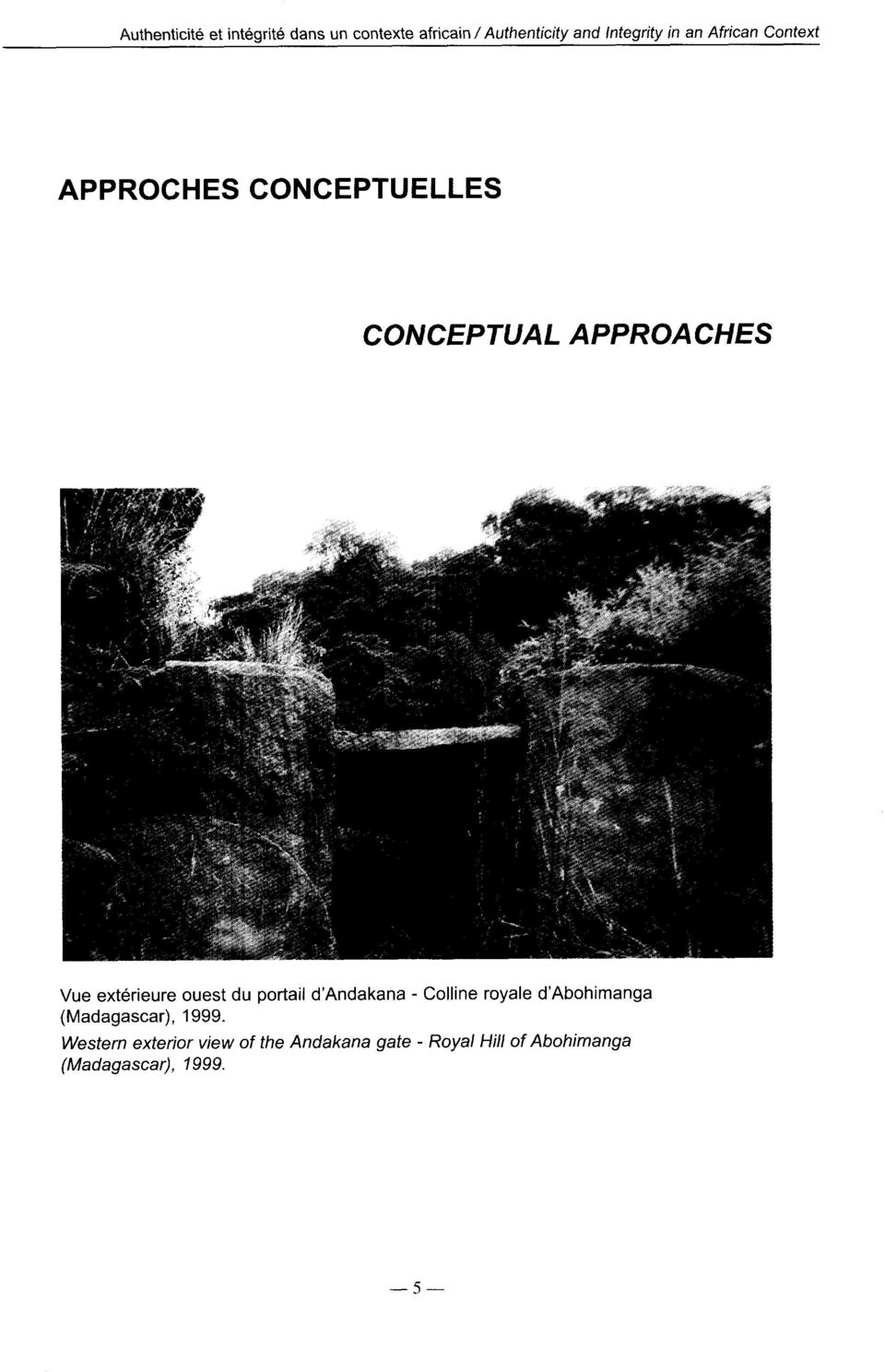
8 Authenticité et intégrité dans un contexte africain /Authenticity and Integrity in an African Context APPROCHES CONCEPTUELLES CONCEPTUAL APPROACHES Vue extérieure ouest du portail d Andakana - Colline royale d abohimanga (Madagascar), Western exterior view of the Andakana gate - Royal Hill of Abohimanga (Madagascar), A--
9 Authenticité et intégrité dans un contexte africain REMARQUES PRÉLIMINAIRES GALIA SAOUMA-FORER0 C est un privilège tout particulier de revenir au Zimbabwe cinq ans après la première réunion de Stratégie globale et de poursuivre le travail déterminant de la première réunion d experts africains sur les moyens d améliorer la représentation du patrimoine africain sur la Liste du patrimoine mondial. Je voudrais tout d abord vous souhaiter la bienvenue au nom du Directeur général de I UNESCO qui a présidé le Comité du patrimoine mondial en 1999 et qui a fermement exprimé son plein appui à la reconnaissance internationale du patrimoine africain. Nous avons de nombreuses raisons de nous réjouir. Depuis 1995, nous avons réussi à bâtir un réseau d experts africains maintenant familiarisés avec le mode de fonctionnement de la Convention de Nous avons suscité une sensibilisation au patrimoine africain au niveau international et attiré I attention sur sa diversité, sa richesse et ses particularités. Trois sites ont été inclus sur la Liste du patrimoine mondial en décembre Nous avons également réussi à réunir une pléiade d experts africains et internationaux. Les trois organismes consultatifs de la Convention nous ont rejoints ici et leurs contributions devraient s avérer instructives. Comme vous le savez, cette réunion s inscrit dans le prolongement de la réunion d experts sur les paysages culturels africains qui s est tenue au Kenya en Certains d entre vous ont assisté à cette réunion et se souviennent que l une de ses recommandations soulignait la nécessité de clarifier les concepts d authenticité et d intégrité, à la lumière du Document de NaraI. Vous avez tous ici une formation scienti- Document de Nara sur l authenticité (1994). fique de haut niveau, ainsi qu une grande expérience du terrain. II ne fait aucun doute que votre participation active aux débats sur les notions d authenticité et d intégrité et sur leur application dans un contexte africain ouvrira la voie à la résolution de cette question. Depuis l adoption de la Stratégie globale en décembre 1994 par le Comité du patrimoine mondial, le Centre a organisé chaque année des réunions et des séminaires régionaux et nationaux, dans le but de permettre aux experts africains de mieux cerner la notion de patrimoine africain, d identifier ses caractéristiques et de stimuler la préparation de listes indicatives et de propositions d inscription sur la Liste du patrimoine mondial. Cinq publications ont été préparées et largement disséminées. Au-delà de l impact qu elles ont eu à l échelle africaine, elles ont permis également aux membres du Comité et à la communauté internationale de mieux aborder les notions de cultures vivantes et de liens intrinsèques entre nature et culture, qui constituent la spécificité de la Convention de 1972 et qui sont amplement illustrées sur le continent. Les publications sont disponibles au Centre et les présentations à cette réunion feront état des avancées en matière de réflexion patrimoniale en Afrique. Aujourd hui une fois de plus, à la demande du Comité du patrimoine mondial, experts africains et européens sont réunis pour aborder les questions centrales d intégrité et d authenticité qui doivent être appliquées dans le cadre de la présentation des propositions d inscription. Elles ont fait l objet de recommandations à Amsterdam en 1998, mais n ont pas encore été reflétées dans les Orientations. Ces recommandations appellent le Comité à se prononcer sur une proposi- -6-
10 G. Saouma-Forero - Remaraues oréliminaires tion qui vise à unifier les critères d évaluation reliant les conditions d intégrité et d authenticité, pour l inscription de biens sur la Liste du patrimoine mondial. Notre réunion doit, sur la base de la proposition d Amsterdam, définir des modalités d application de ces notions dans le contexte africain. Des experts ayant participé à cette réunion en 1998 vous présenteront ces notions et argumenteront la proposition. D autres illustreront le propos en se référant au Document de Nara et feront état de la spécificité du patrimoine africain. Enfin, des études de cas nous permettront de juger dans quelle mesure ces définitions doivent s adapter aux particularismes des sites africains. Des exemples ont été choisis en fonction de certains types de biens : notamment les établissements humains traditionnels, les modes d occupation des sols et de l espace, les paysages culturels, et les lieux sacrés et cérémoniels. Ils témoignent tous des pratiques des cultures vivantes dans des sociétés traditionnelles. Pour avoir organisé ces réunions dites de Stratégie globale, édité les publications et contribué à la constitution d un réseau d experts africains qui s appuie depuis 1999 sur un programme de formation en Afrique (Africa 2009) je voudrais attirer l attention sur quelques points forts qui se sont dégagés au fil des débats. Ces remarques pourraient permettre de préciser, de manière constructive, le contexte dans lequel ont été discutées les notions d intégrité et d authenticité quand il a fallu prendre la mesure de ce qui séparait une approche monumentale du patrimoine d une approche plus large, au sens anthropologique du terme. En effet, la nouvelle démarche n impose-t-elle pas que l on intègre dans la réflexion les manières dont le patrimoine est intériorisé et les relations vivaces entre I environnement physique et non physique qui tissent l identité des communautés et des individus qui les composent? Au-delà des influences européennes qui ont marqué sa façade atlantique, des traces d échanges avec l Océan Indien et de I empreinte de l islam, l Afrique, dans toute sa diversité géographique et culturelle, témoigne d une relation dynamique entre l homme et son environnement ; un rapport fondé sur une acceptation et une utilisation des contraintes naturelles, plutôt que sur leur modification. Ainsi, on peut évoquer une véritable homéostasie des sociétés qui ont défini les affectations d usage de leur cadre de vie et tiré parti de l environnement. Ces sociétés rurales ont investi les espaces tout en respectant leurs caractéristiques écologiques et ont longtemps évité la surexploitation des ressources végétales et animales. Elles ont par ailleurs exprimé de diverses manières leur perception des mystères de la nature, en élaborant des mythes fondateurs qui ont encore cours et qui déterminent la structuration symbolique et fonctionnelle des aires d habitat, de culture, de chasse, de pêche, de cueillette. Cette organisation fait écho à des cosmogonies auxquelles elle est liée par des pratiques cérémonielles dont les finalités ont toujours un but éducatif et une consolidation identitaire. Évoquer les liens indissociables entre la nature et la culture en Afrique revient à dire que les façons d être, de penser, de conserver, de développer, d aménager le patrimoine dans son ensemble, relèvent d un corpus de savoirs religieux, sociaux voire philosophiques et technologiques souvent implicites au sein de la communauté mais connus uniquement d un cercle d initiés. Aussi ne faudrait-il pas appréhender les notions d intégrité et d authenticité en tenant compte de ce contexte et des modes d occupations spatiales et territoriales, où les espèces naturelles sont gérées plutôt que domestiquées? En effet, les réseaux de circulation et d échanges prennent appui sur des éléments naturels tels que les voies fluviales, mais aussi sur la valeur symbolique attachée à des rochers, des arbres parfois isolés, des tumulus plutôt que sur des relais tangibles ou des constructions ; de même, les villages appartenant à de vastes ensembles s intègrent aux paysages et donnent à lire des composantes fonctionnelles, matérielles et spirituelles spécifiques. Comment appliquer le concept d authenticité sans chercher des références qui déchiffrent ce qui ne se donne pas à voir mais qui néanmoins existe? Comment prendre acte des représentations mentales, des dimensions spirituelles, des pratiques cultuelles? C est dire que le monument ne saurait être l entité de référence, mais que les vastes espaces investis par des communautés et qui restent le plus souvent la propriété des Ancêtres, doivent être considérés à travers la trame complexe de cultures vivantes. Comment aborder la notion d intégrité sans se référer aux rituels associés à la gestion des sites sacrés? Comment cerner la part de secret que recèlent les rites d initiation, même adaptés à la -7-
11 Authenticité et intégrité dans un contexte africain vie moderne? Ceux-ci ont en effet permis aux communautés de perpétuer leurs modes d occupation des sols et de concevoir des habitats vernaculaires, couvrant de larges espaces reliés entre eux et se présentant généralement en petits hameaux articulés autour de lieux de rencontres et d échange. Les togu nas du pays dogon, arbres à palabres, structures construites et éléments végétaux continuent de remplir cette fonction et revêtent la même importance. La structure sociale reflétée dans les espaces publics et privés, le prisme des croyances établies et éprouvées, les connotations symboliques ne doivent-elles pas être prises en considération au moment de définir I applicabilité de l authenticité et de l intégrité dans des contextes non européens? Comment formuler, au-delà des particularismes communautaires, ce qui structure leur approche patrimoniale et, au-delà des invasions de la modernité, ce qui continue de déterminer leurs relations avec la nature, I habitat et l organisation de l espace? Un autre point concerne le rôle primordial des communautés investies du droit coutumier et qui ont eu la charge, bien avant l émergence des États modernes ou l arrivée des puissances coloniales, de préserver ce patrimoine. II est d usage de préciser que les aires communautaires peuvent s étendre au-delà des frontières modernes, mais certaines communautés ne reconnaissent pas de délimitations aux espaces investis par les Esprits, qui peuvent dépasser les contrées qu ils occupent. En effet, le concept de propriété collective inclut souvent un droit de propriété par fidéicommis accordé aux générations présentes comme aux générations passées et futures de cette communauté. De plus, les communautés sont rarement des entités homogènes et autonomes. Toutefois, elles définissent leur cohésion à travers la gestion des ressources et les relations qu elles entretiennent avec l environnement dont elles tirent leurs moyens d existence. Les responsabilités de la gestion des terres, de la mémoire, de la parole, etc. sont, semble-t-il, un facteur clé défini par les traditions et bien souvent en conflit avec la structure étatique moderne, autre source de pouvoir et d autorité. Alors ne conviendrait-il pas de définir une hiérarchie cohérente des sources d autorité pour assurer des actions concertées de conservation, de développement et d aménagement durable? II semblerait indispensable de plaider le pluralisme juridique, en vue de stabiliser ou de concevoir des systèmes de gestion communautaire qui tiennent compte de la complexité des paramètres économiques, sociaux et culturels et qui se fondent à la fois sur la tradition et le changement, à travers un développement maîtrisé - et même ne doit-on pas dire durable? Ne faudraitil pas que les notions d intégrité et d authenticité acceptées depuis Nara respectent également le substrat de ce qui constitue l intégrité fonctionnelle d une culture vivante? La gageure n estelle pas de prendre la juste mesure des éléments non physiques et de ne pas se focaliser sur la pure matérialité des éléments physiques, bien qu ils soient connotés de valeurs symboliques et spirituelles? II nous faudra certainement échapper à des conceptions limitatives, sans pour autant nous cantonner au strictement spécifique. II faudra se faire l écho de la Convention de 1972 qui prône la valeur universelle et recherche des illustrations différenciées aux réponses variées que les sociétés ont apportées aux questionnements de l homme face à la nature, au sacré, à l être, ainsi que les modalités de leur coexistence dans le temps et l espace. Nous sommes réunis ici dans le but de trouver des réponses adaptées qui tiennent compte de la complexité des cultures vivantes. De nombreux aspects de nos débats n ont pas encore été discutés dans un cadre non européen. Notre réunion va préparer des recommandations qui seront soumises au Comité scientifique qui a été créé avec l appui généreux du Bureau nordique du patrimoine mondial. Comme vous le savez, ce Comité scientifique s est réuni en janvier 2000 pour décider du contenu de cette rencontre ; il se réunira de nouveau pour rédiger le texte, fondé sur vos recommandations, qui sera proposé pour intégration aux Orientations. Je propose qu après l audition des exposés et la table ronde qui suivra, nous nous répartissions en petits groupes qui prépareront chacun un ensemble de recommandations à débattre en séance plénière. Pour faciliter le travail, et en se fondant sur les contributions écrites reçues après la date limite du 15 avril, nous distribuerons un bref schéma qui pourra être discuté par chaque groupe. Je suis persuadée que cette réunion contribuera à éclairer les messages que le patrimoine africain peut offrir au monde et je vous remercie -8-

12 G. Saouma-Forero - Remarques préliminaires tous sincèrement d être venus au Grand Zimbabwe. Je voudrais aussi remercier les Musées et monuments nationaux du Zimbabwe (NMMZ), ainsi que M. Munjeri, membre du Comité du patrimoine mondial, et le Directeur du bureau de I UNESCO à Harare, qui ont assuré la logistique, élément essentiel, nous le savons tous, à la réussite d une réunion. Cette assemblée bénéficiera de la sagesse des Ancêtres dont les esprits demeurent au Grand Zimbabwe. Sachons maintenant profiter de cette occasion unique et accomplir le travail qui nous attend. -9-

13 Authenticity and lntegrity in an African Context INTRODUCTORY REMARKS GALIA SAOUMA-FORER0 It is a special privilege to be back in Zimbabwe five years after the first Global Strategy meeting and to pursue the seminal work of the first meeting of African experts on ways and means of improving the representation of African heritage on the World Heritage List. First of all, I should like to welcome you on behalf of the Director-General of UNESCO, who chaired the World Heritage Committee in 1999 and steadfastly expressed his full support for international recognition of the African heritage. We have many reasons for rejoicing: since 1995, we have succeeded in building up a network of African experts who are now familiar with the modus operandi of the 1972 Convention. We have raised awareness of the African heritage at the international level and drawn attention to its diversity, richness and particularities. Three sites were included on the World Heritage List in December We have also succeeded in bringing together a galaxy of African and international experts. The Convention s three Advisory Bodies have joined us here and their contributions should prove instructive. As you know, this meeting is a follow-up to the expert meeting on African Cultural Landscapes, which took place in Kenya in Some of you attended that meeting and Will recall that one of its recommendations stressed the need to clarify the concepts of authenticity and integrity in the light of the Nara Document.1 All of you here have an impressive scientific background, as well as wide experience on site. There is no doubt that your active participation in the discussions on the notions of authenticity and integrity and their application in an African Nara Document on Authenticity (1994). context Will pave the way to resolving this question. Since 1994, when the World Heritage Committee adopted the Global Strategy, the Centre has organised regional and national meetings and seminars each year with the aim of enabling African experts to acquaint themselves with every aspect of the African heritage, to identify its characteristics and to encourage the preparation of tentative lists of sites and nominations for their inclusion on the World Heritage List. Five publications have been prepared and widely distributed; they cari also be obtained from the Centre. Quite apart from their impact on the continent itself, they have helped the members of the Committee and the international community to reflect on the notion, of living cultures and the intrinsic links between nature and culture SO amply illustrated in Africa that constitute the specificity of the 1972 Convention. The papers presented at this meeting Will report on the state of progress concerning the consideration given in Africa to heritage issues. Today, at the request of the World Heritage Committee, African and European experts have gathered once again to tackle the central notions of integrity and authenticity that must be embodied in the presentation of nominations of sites for inclusion on the List, and which were the subject of recommendations at Amsterdam in 1998 but have not yet been reflected in the Operational Guidelines. Those recommendations request the Committee to reach a decision on a proposa1 that aims at uniting the evaluation criteria linking the conditions of integrity and authenticity for inclusion of properties on the World Heritage List. - lo-
14 G. Saouma-Forero - Introductory remarks On the basis of the Amsterdam proposal, this meeting Will have to decide on the detailed rules for its application with regard to the African heritage. Experts who took part in the 1998 Global Strategy meeting Will present the subject and discuss the proposal. Others Will expand upon this topic making reference to the Nara Document and Will illustrate the specificity of the African heritage. Finally, case studies Will enable us to judge the extent to which these definitions need to be adapted to the particularities of African sites. Examples have been chosen according to certain types of property, notably traditional human settlements, the manner in which the land and space are used, cultural landscapes, and sacred and ceremonial sites. All of these testify to the practices pertaining to living cultures in traditional societies. Having organised these Global Strategy meetings, edited publications and contributed to the constitution of a network of African experts which, since 1999, is backed up by a training programme in Africa (Africa 2009), I should like to draw your attention to certain salient points which have emerged from the various debates. These remarks may help to give a more exact idea of the context in which the concepts of integrity and authenticity were discussed, when it was necessary to assess the difference between a monumental approach to heritage and a more general approach, in the anthropological sense of the term. This new step makes it essential to appreciate fully the way in which heritage is internalised, as well as the strong relationship between the physical and the non-physical environment which fashions the identity both of communities as a whole and of their individual members. Setting aside the influence of Europe that has marked the whole Atlantic seaboard, the traces of exchanges across the Indian Ocean and the imprint left by Islam, Africa, in all its geographical and cultural diversity, bears witness to the dynamic relationship between human beings and their environment, based on their accepting and using it rather than on modifying its natural constraints. It is thus possible to speak of a veritable homeostasis of the continents societies which have laid down rules for the way in which their living environment is used and been able to turn it to good account. Through the way in which they have occupied the land, these rural societies have respected its ecological characteristics and were for a long time able to avoid overexploiting its plant and animal resources. Moreover, they express in various ways their perception of the mysteries of nature, through the founding myths of their history which still hold sway and determine the symbolic and functional arrangement of their villages, agriculture, hunting, fishing and food-gathering, and which echo their particular cosmogony and through their ceremonies, which ultimately have an educational purpose and also serve to bind the community together in a single identity. Any mention of the indissoluble links between nature and culture in Africa automatically implies that the ways of being and thinking, as well as the ways of conserving, developing and managing heritage, whether natural or cultural, draw on a body of religious, social and even philosophical or technical knowledge which in many cases remains implicit but which may be known to inner circles of initiates. Thus, when considering the notions of integrity and authenticity, it would seem advisable to bear this context in mind, as well as the manner of occupying land and space, where natural species are managed rather than domesticated, where exchange and communication between communities rely on natural features such as rivers but equally on the symbolic value attached to rocks, trees (sometimes single trees) and tumuli, rather than on man-made features, and where villages form part of vast ensembles which, with their specific functional, material and spiritual components, are at one with the landscape. How cari we give effect to the concept of authenticity without seeking the means to decipher what is invisible but nevertheless exists? How cari we take formal note of mental images, spiritual dimensions and religious practices? It is clear that the natural or cultural feature itself cannot be the item of reference; the vast spaces occupied by communities, which for the most part remain the property of the Ancestors, must rather be considered in the context of the complex tissue of living cultures. How cari we address the concept of integrity without reference to the rituals associated with the management of sacred sites? How cari we delineate the element of secrecy of initiation ceremonies, even when they have been adapted to modern life, which have enabled communities -ll-

15 Authenticity and lntegrity in an African Context to perpetuate their own ways of occupying territory and to design vernacular settlements covering large areas linked to one another and generally forming a number of small villages grouped around a central meeting-place? The Togu nas in the land of the Dogons, the Palaver trees, certain constructions and plant features continue to carry out that role and to be imbued with their age-old significance. The social structure reflected in private and public space together with the influence of traditional beliefs and symbolic connotations all need to be taken into consideration when defining how to apply the concept of authenticity and integrity in a non-european context. It is necessary to identify what underlies the overall, as distinct from the community approach to heritage in Africa, and what continues to determine disregarding modern intrusions people s relations with nature, habitat and the organisation of space. The second main point concerns the leading role of communities who, long before the arriva1 of the colonial powers and before the emergence of modern states, have been and continue to be vested with the traditional right and responsibility for preserving this heritage. It is customary to stress that the land occupied by communities often extends beyond modern state borders. However, certain communities do not recognise any limitations placed on the regions inhabited by the spirits, which cari extend well beyond national boundaries; indeed, the concept of collective property often includes the right to property by fidei-commissum (ownership in trust) granted to past, present and future generations of these communities. Added to that, communities are rarely homogeneous or autonomous entities. However, the defining element that binds them together is their relationship with their environment, from which they derive their means of existence through the management of its resources. It would appear that responsibilities for land management, their history and their religious beliefs etc. are a key factor defined by tradition and frequently in conflict with the structures of the state, the other source of power and authority. Thus it would appear advisable to establish a coherent hierarchy of the sources of authority SO as to ensure concerted action for sustainable conservation, development and planning. In addition, it seems essential to put in a plea for legal pluralism with a view to stabilising or elaborating systems of community management that would take into account the complex nature of the economic, social and cultural parameters and would be based both on tradition and change, by means of a controlled, sustainable environment. Surely, the concepts of integrity and authenticity that have been accepted since the Nara Document should respect the underlying factors that go to make up the functional integrity of a living culture? The chief issue here, no doubt, is to make an accurate assessment of the non-physical elements rather than to focus on the purely material aspects of physical elements that also have symbolic and spiritual connotations. While we must certainly avoid restrictive concepts, that does not mean we should confine ourselves to the narrowly specific. We must keep uppermost in our minds the overall aim of the 1972 Convention, which defends the universal value of heritage and seeks to preserve a wide array of the varied answers given by societies to humanity s questioning confronted with nature, the sacred and human beings, while instituting arrangements for their coexistence in time and space. We are gathered here for the purpose of identifying appropriate answers which take into account the complexity of living cultures. Many aspects of our discussions have not yet been debated in a non-european setting. Our meeting Will prepare recommendations that Will be submitted to the Scientific Committee, which has been set up with the generous support of the Nordic World Heritage Office. As you know, the Scientific Committee met in January this year to decide on the content of this meeting; it Will meet again to draft the text, based on your recommendations, that Will be proposed for integration in the Operational Guidelines. I suggest that, after listening to the presentations today and tomorrow, and after the proposed roundtable, we break up into smaller groups, each of which Will prepare a set of recommendations that Will be debated in plenary. TO facilitate the work, and on the basis of written contributions received after the deadline of 15 April, we shall be distributing a brief outline which cari be discussed by each group. Confident that this meeting Will be instrumental in shedding light on the messages that African heritage cari offer the world, I thank you all sincerely for coming to Great Zimbabwe. I should - 12-
16 G. Saouma-Forero - Introductorv remarks also like to thank the National Museums and Monuments of Zimbabwe (NMMZ) and its Director, Mr. Munjeri, member of the World Heritage Committee, as well as UNESCO Office in Harare, who were responsible for the logistic arrangements which as we all know are essential to conducting a productive meeting. This meeting Will benefit from the wisdom of the Ancestors whose spirits live in Great Zimbabwe. Let us now make the most of this unique opportunity and accomplish the work ahead of us

17 Authenticité et intégrité dans un contexte africain LES NOTIONS D INTÉGRITÉ ET D AUTHENTICITÉ : LES MODÈLES ÉMERGENT~ EN AFRIQUE DAWSON MUNJERI PROBLÈMES DE DÉFINITION Pour construire une vision du futur, il faut préserver une vision du passé. Les cultures vivantes sont fondées sur la notion que le message qui appartient à un présent a été et restera actuel. Avec toutefois quelques restrictions : cette notion devrait prévoir une place pour des cheminements spécifiques à travers d autres influences, sinon les cultures vivantes deviennent des authenticités menacées. C est dans ce cadre qu il faut considérer nombre de sociétés «non industrielles», «proto - industrielles», «non - urbaines», «traditionnelles». La multiplicité des possibilités, implicite dans la pléthore de dichotomies des sociétés, pose des problèmes de définition. De plus, pour ce qui est de l Afrique, la diversité de sa nature complique encore les notions d intégrité et d authenticité, sans parler du fait que dans leur propre contexte, ces notions sont à la fois évanescentes et envahissantes. LES IMPLICATIONS DU MODÈLE DE DÉFINITION SUR LES QUESTIONS D AUTHENTICITÉ ET D INTÉGRITÉ Le concept d authenticité présente quatre aspects en rapport avec la Liste du patrimoine mondial. L authenticité des matériaux Parfois décrite comme «la fidélité à l objet», la notion d authenticité des matériaux met l accent sur les valeurs de la substance physique du bien culturel original. Dans le contexte des cultures vivantes, l absence d un élément tangible signi- fie-t-elle qu un phénomène n existe pas? La traite des esclaves peut ne pas avoir laissé de traces physiques sous forme de monuments, il est indéniable pourtant que ce phénomène a existé. La réunion commune de I ICOMOS et du gouvernement espagnol sur les itinéraires culturels en novembre 1994 a défini ces routes du patrimoine comme étant «composées d éléments tangibles dont la signification culturelle dérive d échanges et d un dialogue pluridimensionnel entre les pays ou les régions». Au Bénin, la route de l esclave entre Abomey et Ouidah ne possède pas de témoignages tangibles et serait donc exclue selon cette définition. Selon de nombreuses traditions culturelles vivantes, ce qui fait l authenticité d un vestige est moins ce qu il était (en terme de forme) que ce qu il a fait. L authenticité de l exécution On s attache ici à garder un témoignage de l exécution, conformément à la notion que les biens représentent des chefs-d œuvre du génie créateur humain. Dans les cultures vivantes, c est la fonction plutôt que les considérations esthétiques qui détermine la présentation et la forme du produit. En dépit de toute sa majesté, le Grand Zimbabwe est une déclaration spirituelle et politique plutôt qu un produit du génie créateur humain en lui-même. En fait, il est façonné et conçu par un environnement naturel géomorphologique et constitue une tentative de réponse aux questions existentielles de l humanité. Le patrimoine bâti n est donc qu un signe et peut ne pas avoir de valeur du point de vue de I exécution. Les communautés locales considèrent - 14-
18 D. Munjeri - Les notions d intégrité et d authenticité : les modèles émergents en Afrique comme très positif l effondrement des murs du site du patrimoine mondial du Grand Zimbabwe car cela prouve la volonté manifeste des esprits. Ce qui est important ici, c est le fait que l on ne peut interpréter le tangible qu à travers I intangible. L authenticité de la conception Les valeurs résident dans les intentions initiales de l architecte, de l artiste, de l ingénieur. Dans un certain nombre de cultures, ces intentions peuvent être mal déchiffrées ou mal interprétées. Les temples vaudous sont l expression la plus tangible des pratiques religieuses traditionnelles mais à Ouidah, les plus importantes pratiques du culte n ont pas lieu dans les temples. Une pièce, un arbre ont plus de valeur dans la pratique religieuse que le temple lui-même qui représente le culte. Le délabrement du temple représente le message spirituel authentique, tandis que la finesse et le caractère majestueux du tissu physique évoquent la véritable décadence des valeurs culturelles et spirituelles. C est le message qui prime et non les intentions (exprimées par la conception). L authenticité de l environnement (fidélité au contexte) Dans l esprit de la Convention du patrimoine mondial, l authenticité de l environnement souligne les relations entre le bien culturel et le contexte physique. Dans l organisation spatiale des Shona, la façade d une habitation est associée aux activités publiques et profanes, alors que l arrière de I habitation constitue le domaine privé associé aux forces sacrées et vitales. Dans la tradition, le fidèle communique avec l esprit de ses ancêtres (mudzimu) au fond de la cuisine de son épouse, sur une plate-forme (chikuva) où elle range ses pots. La chikuva devient le lien entre les vivants et les morts. Lorsque ce même fidèle s installe à la ville, il pratique aussi bien ses rituels dans son salon meublé à l occidentale. Les questions concernant l environnement tournent invariablement en rond. Quel est le véritable domicile ou l environnement du mudzim? L essence de la notion d authenticité renforcerait donc la conclusion de la conférence de Nara sur l authenticité selon laquelle cette notion est relative. Dans les sociétés africaines traditionnelles, elle n est pas fondée sur le culte des objets phy- siques, sur le tangible, et certainement pas sur l état ou sur les valeurs esthétiques. Dans ces sociétés, l interaction entre les valeurs sociologiques et religieuses prime dans la détermination de la notion d authenticité. Les conclusions de la réunion régionale de I ICOMOS tenue le 14 octobre 1995 à Harare restent encore un bon point de départ. «II faut tempérer l approche scientifique du monde occidental fondée sur des faits bruts en y incluant les notions abstraites et métaphysiques des traditions africaines. En Afrique, parfois, l esprit du site prédomine sur la substance. L importance accordée à la rigueur analytique du classement, de la division et de la qualification doit être contrebalancée par des modes d interprétation synthétiques d intégration et d association généralement préférés dans les traditions et cultures africaines». L intégrité Le concept d intégrité insiste sur la «totalité», la «virtuosité» non entravées par des intrusions humaines et non humaines, organiques et inorganiques. Des considérations spatiales en grande partie de nature physique, déterminent les niveaux d une telle intégrité. Un système d interdictions et de tabous maintient cette intégrité. Comme l a observé Léon Pressouyre, la notion consistait essentiellement à l origine, à classer un ensemble de zones matérielles présentant le plus grand nombre possible de caractéristiques géologiques, climatiques et biologiques, existant en dehors de toutes les tentatives humaines connues comme nuisibles pour l équilibre écologique. Cela est très bien exprimé dans les termes de réserves naturelles et de parcs nationaux, en particulier dans «l apartheid écologique». Dans de telles situations, le bien-être écologique prime sur le bien-être humain. C est un anathème pour les sociétés dont les ethnosystèmes s appuient sur les écosystèmes car les cultures africaines ont évolué en relation avec la nature où elles puisent encore leur légitimité. Cette situation ne se limite pas nécessairement aux pays africains mais est largement répandue dans les sociétés «non-industrielles». Les kunwinjku d Australie en sont un exemple typique. Ils dépendent entièrement du cycle des saisons de la région de l ouest de la Terre d Arnhem. Alors que les Australiens non aborigènes ne reconnaissent que deux saisons, la saison des pluies et la saison sèche, les kunwinjla vivent depuis plus de mille ans selon la réalité de six - 15-

19 Authenticité et intégrité dans un contexte africain saisons distinctes : Kudjewk, Baigkerrena, Yekke, Wurrekeng, Kurrung et Kurnumeleng. Le profond attachement à leur terre soutient I harmonie profonde que les populations maintiennent avec la flore et la faune environnantes. En réagissant aux nuances des saisons, les habitants savent toujours où la nourriture est abondante et se déplacent en conséquence. II n existe pas de limites. En Afrique, cela s exprime aussi à travers un triple patrimoine : il n y a pas de distinctions entre la nature et le créateur et aucune séparation nette en matière d habitat entre l humanité et la nature. Le triple patrimoine est un patrimoine symbiotique fondé sur le fait que dans les systèmes de croyances autochtones, l être humain n a pas le monopole de l âme. Les arbres, les montagnes, les rochers, les forêts, les animaux, tous peuvent avoir une âme et méritent donc le respect. Cela étant, il y a toujours une sorte de pacte qui préserve à la fois les humains et les espèces naturelles dans un même environnement. Les implications pour les questions d intégrité La catégorie des paysages culturels, exemple typique, répond à la condition d inscription sur la Liste du patrimoine mondial pour autant qu il existe des limites sensées, logiques et identifiables en termes de nature, de population et de gestion, afin d assurer l intégrité des paysages culturels et faire également en sorte d éviter un développement intensif susceptible d avoir un impact nuisible sur les paysages. Comment reconnaître une telle intégrité quand il n existe pas de limites pour séparer traditionnellement le monde du créateur de celui de l humanité et le monde du créateur de celui de la nature? Dans la zone qui entoure le site du patrimoine mondial du Grand Zimbabwe, des problèmes récurrents ont surgi lorsque l on a fixé sur le plan juridique les limites du site contre l avis de la communauté environnante qui a toujours su que «duma haring muganhu» (les duma n ont pas de limites). L approche Iégaliste suscite toujours des problèmes. La solution réside dans une reconnaissance de facto que les communautés autochtones sont foncièrement des peuples de I écosystème, intégralement liés à I écosystème dans lequel ils vivent. Tels sont les facteurs de l équation de l intégrité. Les communautés peuvent approuver l espace utilitaire et, par leurs systèmes de contrôle et d équilibre, garantir cette intégrité. C est dans ce contexte qu il faut encourager et renforcer leurs coutumes et leurs croyances. On peut citer de nombreux exemples de réussites dues à cette approche, notamment la sauvegarde des tombes sacrées des forêts de Kaya au Kenya, d Oshun au Nigéria, de Tali au Ghana, etc. Là encore, comme pour la définition de I authenticité, il faut bien reconnaître la puissante influence du spirituel sur les questions d intégrité, tout le reste n étant que secondaire. Depuis des milliers d années, comme l attestent les peuples de l âge de pierre, le monde est perçu comme fondé sur des énergies spirituelles potentiellement créatrices, susceptibles de transformer et de dépasser de nombreuses limites physiques. Ces énergies résident dans un système du tout, dans le feu, l air, les sons, les éclairs, les abeilles, la terre. L art montre que le monde des hommes et le monde spirituel ne font qu un, tout comme le monde des choses et des gens. II en a été ainsi et cela continue au deuxième millénaire. On ne peut distinguer l authenticité du paysage culturel de son intégrité. Ce qui précède tente de montrer que dans de nombreux cas, en Afrique et ailleurs, il existe des sociétés qui n entrent pas dans ces cadres
20 D. Munjeri - The notions of integrity and authenticity: the emerging patterns in Africa THE NOTIONS OF INTEGRITY AND AUTHENTICITY: THE EMERGING PATTERNS IN AFRICA DAWSON MUNJERI PROBLEMS OF DEFINITION TO envision the future, there is need to preserve a vision of the past. Living cultures are based on the notion that the message which belongs to a now has been and Will ever be present. With some measures of qualification however, the notion should make space for specific paths through other influences or else living cultures become endangered authenticities. It is within this framework that many nonindustrial, proto-industrial, non-urban, traditional societies have to be considered. The multiplicity of possibilities, implicit in the plethora of dichotomies of societies presents challenges of definition. Compounding this, with respect to Africa, is the variegated nature of Africa which further complicates the notions of integrity and authenticity, not to mention that in their own contexts, notions of authenticity and integrity are both evanescent and pervasive. THE IMPLICATIONS OF THE DEFINITION MATRIX ON ISSUES OF AUTHENTICITY AND INTEGRITY The concept of authenticity in relation to the World Heritage List has four aspects: Authenticity In Materials Sometimes referred to as fidelity to the abject, this emphasises the values of the physical substance of the original cultural resource. In the context of living cultures does the absence of the tangible element mean that a phenomenon did not exist? The slave trade may not have left a physical imprint in the form of monuments and yet it is an undeniable fact that the phenomenon existed. The November 1994 joint ICOMOS/Government of Spain meeting on cultural itineraries defined heritage routes as composed of tangible elements of which the cultural significance cornes from exchanges and multi-dimensional dirge across countries and regions. The slave trade route between Abomey and Ouidah (Benin) has no tangible evidence and thus would be excluded by this definition. In a number of living cultural traditions, what makes a relit authentic is less what it was (in form) than what it did. Authenticity In Workmanship The focus is on keeping the evidence of workmanship consistent with the notion that products represent masterpieces of human creative genius. In living cultures, function, rather than aesthetic considerations determine the format and shape of the product. For all its grandeur, Great Zimbabwe is a spiritual and political statement rather than a product of human creative genius per se. In fact it is shaped and designed by a natural geomorphological environment and is an attempt to answer humanity s existential questions. The built heritage is thus only a sign and may not have value in its workmanship. The wall collapses at Great Zimbabwe World Heritage site are much welcomed by local communities because the collapses represent the Will of the spirits. What this underscores is the fact that the tangible cari only be interpreted through the intangible. Authenticity in Design Values lie in the original intentions of the architect, artist, engineer. In a number of living cultures such intentions may be misread or -17-

21 Authenticity and Integrity in an African Context misconstrued. Voodoo temples are the most physical expression of traditional religious practices but Ouidah s most important worship practices do not take place in temples. A room, a tree have greater value in the religious practice than the temple which represents the cuit. The decay of the temple represents the authentic spiritual message whereas finesse and grandeur of the physical fabric represents the real decadence of cultural and spiritual values. The message and not the intentions (expressed in design) reigns supreme. Authenticity of Setting (fidelity to context) In the spirit of the World Heritage Convention, this underscores the relationship between the cultural resource and the physical context. In Shona spatial organisation the front of a residence is associated with the public and profane activities while the back is the private area associated with the sacred and life-giving forces. A traditional worshipper communicates with his ancestral spirit (mudzimu) in the back of the wife s kitchen at a platform (chikuva) where her pots are stored. The chikuva is the link between the living and the dead. The same worshippers move to the city and in a wellfurnished western-style lounge room similar rituals are conducted. The issues of setting invariably become lop-sided., Which is the real domicilium or setting of the mudzimu? The essence of the notion of authenticity would thus reinforce the Nara Conference conclusion that the notion is culturally relative. In the traditional African societies it is not based on the cuit of physical abjects, the tangible, and certainly not on condition and aesthetic values. In these societies, the interplay of sociological and religious forces has an Upper hand in shaping the notion of authenticity. The ICOMOS regional meeting conclusions of 14 October 1995 (Harare) still remain a valid departure point. The hard facts scientific approach of western society needs to be tempered with the abstract and metaphysical notions of African traditions. For Africa sometimes, the spirit of the site takes precedence over the substance. The emphasis on the analytical rigours of categorisation, division and qualification must be matched by synthesised interpretative modes of integration and association which African traditions and cultures tend to favour. Integrity The concept of integrity emphasises wholeness, virtuosity, unfettered by perceived organic and inorganic human and non-human intrusions. Spatial considerations largely of a physical nature determine the levels of such integrity. A system of no-gos or taboos sustains the integrity. As noted by Léon Pressouyre, the notion was primarily concerned with designating a series of material zones where the greatest number of geological, climatic and biological characteristics would be preserved from all human endeavours perceived to be destructive of ecological balance. It finds its finest expressions in the notion of nature reserves and National Parks: in essence, in ecological apartheid. In such situations ecological welfarism takes precedence over human welfare. This is anathema to those societies whose ethnosystems are underwritten by ecosystems because cultures of Africa have evolved out of nature and still draw their authority from it. Nor is this necessarily confined to African countries but is widespread among non-industrial societies. The Kunwinjku of Australia are a case in point: they are dependent entirely on the seasonal cycles of West Arnhem land. While non-aboriginal Australians recognise just two seasons, the wet and the dry, for a millennium the Kunwinjla have lived according to the real world of six distinct seasons: Kudjewk, Baigkerrena, Yekke, Wurrekeng, Kurrung and Kurnumeleng. The deep connection to their land keeps people finely attuned to the flora and fauna around them. By responding to the season s nuances the people always know where foods are most abundant and relocate accordingly. There are no boundaries. In Africa as well this is expressed in a triple heritage: there is no distinction between nature and the Creator and no Sharp separation in habitat between humanity and nature. The triple heritage was a symbiotic one based on the fact that in indigenous belief systems the human being did not assert a monopoly of his seul. Trees, mountains, rocks, forests, animals: all could have a sou1 and therefore deserved respect. That being SO, there was always some covenant that preserved both the human and natural species in a shared environment
22 D. Munjeri - The notions of integrity and authenticity: the emerging patterns in Africa The implications of integrity Taking the category of cultural landscapes as a typical example, it is a condition for enlistment on the World Heritage List that there be sensible, logical and identifiable boundaries in terms of nature, people and management to ensure the integrity of the cultural landscape as well as ensuring that intensive development does not take place in a way that impacts negatively on the landscapes. How cari such integrity be recognisable when there are no boundaries traditionally demarcating the world of the Creator from that of humanity and from that of nature? In the area around the Great Zimbabwe World Heritage site constant problems have arisen when the boundaries of the World Heritage site have been asserted and legally enforced against a surrounding community who have always known that Duma harina muganhu (the Duma have no boundary). Therefore problems Will always exist using the legalistic modes. The solution lies in recognising that indigenous communities are at heart ecosystem people, integrally linked to the ecosystem they inhabit. They are part of the integrity equation. It is they who cari sanction utilitarian space and through their systems of checks and balances are the underwriters of that integrity. It is in this context that their customs and beliefs need to be encouraged and reinforced. Cases abound where success stories hinge on this approach e.g. the survival of sacred groves of Kaya (Kenya), Oshun (Nigeria), Tali (Ghana). Again, as in the issues of authenticity, one cannot but accept the powerful influence of the spiritual realm in issues of integrity: all else is incidental. From thousands of years ago, as evidenced by the Stone Age peoples through their rock art, the world has been perceived as one based on spiritual energies that cari create, transform and override many physical limitations. These energies reside in some form of everything: fire, air, sounds, lightning, bees, land. The art shows that the human and the spiritual world are one. It also shows that the world of things and people is equally one. This was and continues to be in the second millennium. Authenticity of the cultural landscape cannot be distinguished from the integrity of the same. The foregoing sections try to show that in many cases in Africa and elsewhere, there are societies who shun those demarcations
23 Authenticité et intégrité dans un contexte africain LA DIMENSION IMMATÉRIELLE DES MONUMENTS ET DES SITES AVEC RÉFÉRENCES À LA LISTE DU PATRIMOINE MONDIAL DE L UNESCO JEAN-LOUIS LUXEN MISE EN PERSPECTIVE Au cours des trente dernières années, la notion de patrimoine culturel n a cessé de s élargir. La Charte de Venise parlait de «monuments et sites» et traitait du patrimoine architectural. Bien vite, la problématique a été étendue aux ensembles bâtis, à l architecture vernaculaire, aux édifices industriels ou du XXe siècle. Audelà de l étude des jardins historiques, la notion de paysage culturel a mis en évidence I interpénétration de la culture et de la nature. Aujourd hui, une approche anthropologique du patrimoine conduit à le considérer comme un ensemble social de manifestations diverses, complexes, interdépendantes, reflet de la culture d une communauté humaine. La conservation représente une exigence d harmonie dans la durée entre un groupe social et son environnement, qu il soit naturel ou bâti, tandis que la protection de ce cadre de vie est perçu comme une dimension majeure d un développement humain durable. Récemment, la question de l authenticité a retenu une attention particulière. La diversité des catégories de patrimoine, de leurs matériaux et des méthodes de construction ou d aménage- ment, a conduit à définir des normes variables pour une conservation authentique. Parallèlement, il a fallu aussi prendre en compte les interprétations différentes, selon les diverses traditions culturelles, du concept même d authenticité. Le Document de Naral amène à compenser un certain relativisme des conceptions par l exigence universelle de référence explicite aux valeurs que représente un bien culturel aux yeux de la communauté humaine concernée. Document de Nara sur l authenticité (1994). Ces évolutions ont conduit les professionnels de la conservation à dépasser la question : Comment conserver? Pour poser les questions de fond : Pourquoi conserver? Pour qui conserver? Quel est le sens de la conservation? La recherche du message des biens culturels appelle à mettre en évidence les valeurs éthiques, les usages sociaux, les croyances ou les mythes dont les éléments du patrimoine physique seraient les signes, l expression, dans le temps et dans l espace. Les valeurs d authenticité ou d identité sont mises en avant pour dégager la signification des œuvres architecturales ou urbanistiques et attirer l attention sur des transformations du milieu naturel dues à I intervention humaine. À la limite, le concept ou la représentation sociale d un bien culturel revêt plus d importance que l objet dont il est question : la dimension immatérielle prévaut. II en résulte un approfondissement de la démarche pour mieux situer la singularité des biens culturels, le génie propre d un groupe social et ses racines, par rapport à des transformations sociales rapides et à une large ouverture aux influences extérieures. Cette démarche se fonde sur une prise de conscience lucide et une mobilisation dynamique. Mais elle comporte aussi des risques d affirmations identitaires excessives, voire chauvines ou conflictuelles, quand cette démarche perd de vue les valeurs universelles et la richesse du dialogue entre les cultures et de la reconnaissance de l altérité. La distinction entre patrimoine physique et patrimoine immatériel apparaît aujourd hui factice. Le patrimoine physique ne prend pleinement son sens qu à la lumière des valeurs que le sous-tendent. Et réciproquement, la dimension immatérielle, pour sa conservation, doit s incarner dans
24 J-L. Luxen - La dimension immatérielle des monuments et des sites des manifestations tangibles, des signes visibles. Cette dialectique peut se révéler particulièrement féconde pour assurer une meilleure représentation des cultures du monde qui privilégient l oral par rapport à l écrit, les arts et traditions populaires par rapport aux expressions artistiques savantes. Sont concernées tout particulièrement les régions géo-culturelles d Afrique ou d Océanie, par exemple, dont le patrimoine physique se caractérise par des œuvres humbles en matériaux périssables que I approche monumentale a trop longtemps négligées. L apport spécifique de ces cultures représente pourtant un grand enrichissement de I inventaire universel du patrimoine. Mais une définition précise des biens culturels est indispensable pour fonder, en termes opérationnels, une politique de conservation appropriée, dans ses diverses dimensions : identification et inventaires, protection juridique, conservation et restauration, gestion et promotion, sensibilisation publique et formation spécialisée. Une forme de matérialité est indispensable, dans une relation significative du patrimoine immatériel avec le milieu naturel transformé, ou avec les édifices élevés par l homme. Cette matérialité a déjà été recherchée et illustrée concrètement, en fonction de diverses catégories récemment élaborées et qui ont déjà permis d accueillir certains biens culturels sur la Liste du patrimoine mondial. Ces catégories particulières offrent des champs d action spécifiques : 0 Les routes culturelles ou les itinéraires, dont les traces tangibles et les signes construits portent la marque d échanges culturels et artistiques, à travers les frontières et les siècles : itinéraires de pèlerinage, comme le chemin de Saint Jacques de Compostele, en France et en Espagne ; routes commerciales, comme la Route de la soie; itinéraires de migrations ou d explorations, comme la Route du sel ou les Routes des esclaves et l île de Gorée, au Sénégal. Chaque fois, l identification de la route se fonde sur des «inscriptions en série» de témoignages physiques, mais c est la route comme telle qui est identifiée comme un patrimoine culturel. 0 Les paysages culturels, qui portent la marque des systèmes d agriculture ou d élevage, comme les rizières en terrasses, les vignobles ou les bocages ; ou qui inscrivent la marque de traditions de peuplement ou de formes d établissements humains, comme l habitat troglodyte de Cappadoce en Turquie, le site de Sukur au Nigéria ou les falaises de Bandiagara du pays dogon, au Mali. Les sites associatifs, qui évoquent une légende ou un mythe, comme les sites de Tongariro, en Nouvelle-Zélande ou de Uluru- Kata Tjuta, en Australie, où aucune construction humaine ne peut être observée, mais qui ne possèdent pas moins une haute valeur de patrimoine culturel pour les populations locales. Les lieux de mémoire, sont marqués par un événement dramatique de l histoire de I humanité, comme le camp de concentration d Auschwitz, en Pologne ; le Dôme de Genbaku, Mémorial de la paix à Hiroshima au Japon ; ou Robben Island, en Afrique du Sud. Ces exemples montrent des possibilités fort intéressantes, qui sont loin d avoir été toutes exploitées. Mais ils font apparaître aussi les risques de dérives, en particulier dans la catégorie des «lieux de mémoire», de faible valeur physique mais de forte charge symbolique, catégorie qui risque d accueillir une liste de champs de bataille qui serait l expression de commémorations troubles. C est la raison pour laquelle le Comité du patrimoine mondial (1996) a décidé qu aucun bien culturel ne pourrait dorénavant être inscrit au titre du seul critère (vi) des Orientations pour la mise en œuvre de la Convention : «être directement ou matériellement associé à des événements ou des traditions vivantes, des idées, des croyances ou des œuvres artistiques et littéraires ayant une signification universelle exceptionnelle». Toutefois, il est important de noter que cette décision prête à controverse, car elle représente une sérieuse limitation à la reconnaissance de formes de patrimoine culturel dont la dominante est immatérielle. Le récent séminaire de Canterbury (avril 2000) a évoqué cette question, et ses conclusions proposent de revenir sur cette disposition. Mise en garde Dans l exploration de cette dimension immatérielle du patrimoine, il importe de garder le contact avec le champ de nos spécialisations. Veillons à considérer les dimensions immatérielles dans leurs relations avec le patrimoine physique, les monuments et les sites, c est-àdire notre domaine d étude et d action. C est à -2l-
25 Authenticité et intégrité dans un contexte africain cette condition que notre contribution au débat général sera la plus fructueuse. Ne nous égarons pas dans l analyse des diverses facettes du patrimoine immatériel que sont les coutumes et traditions, la musique, la langue, la poésie et autres formes d expressions humaines, autant de domaines hors de la compétence professionnelle de la plupart de nos membres. LES TECHNIQUES ET LES SAVOIR FAIRE La conservation du patrimoine construit constitue aussi un conservatoire de procédés de constructions spécialisés ou de technologies traditionnelles dont l ingéniosité mérite une reconnaissance et une protection. Cette reconnaissance est d ailleurs souvent indispensable pour assurer la pérennité de nombreux édifices ou aménagements de l espace, hérités du passé et dont l adéquation aux besoins climatiques et économiques est le fruit d une tradition séculaire. Sans doute notre Comité scientifique international de la formation que préside Jukka Jokilehto, grand connaisseur de la Convention du patrimoine mondial devrait prêter une attention particulière aux métiers du patrimoine. Dépassant I intérêt trop souvent porté aux fonctions de conception, ce Comité devrait mettre en lumière l importance des savoir-faire et des techniques les plus appropriés aux interventions sur des biens culturels anciens. DES RÉFÉRENCES IMMATÉRIELLES Deux démarches complémentaires peuvent être préconisées : d une part, chercher à mettre en évidence la dimension intangible d un bien physique ; d autre part, en prenant en considération une forme intangible de patrimoine, chercher à l incarner dans un bien matériel. Pour ce double exercice, il est intéressant de distinguer, à partir de la Liste du patrimoine mondial, les biens culturels physiques qui ont reçu une référence immatérielle, de ceux qui ne l ont pas reçue alors qu elle se justifierait, et d autres biens culturels qui pourraient la recevoir. Cela en fonction de références claires : La référence spirituelle C est assurément la référence la mieux perçue et la mieux illustrée. Elle possède une dominante européenne et chrétienne, avec des sites comme le Vatican au Saint-Siège, Santa Maria de Guadalupe en Espagne, Vézelay en France, les monastères du Mont-Athos, la grotte de l Apocalypse de Patmos en Grèce ou les monuments commémoratifs de Luther à Esleben et Wittenbergen en Allemagne. Jérusalem est considérée comme ville sainte dans les trois religions monothéistes du Livre. L Islam est représenté notamment par Kairouan en Tunisie et Le Caire islamique en Égypte ; le Bouddhisme par Borobudur en Indonésie, le temple de Kandy au Sri Lanka et les ensembles de Horyu-ji et de Nara au Japon. On relève encore le temple shinto d ltsukushima, au Japon, ou la résidence et le temple de Confucius, en Chine, de même que divers temples hindouistes en Inde. La référence spirituelle n a pas été retenue pour les églises de Lalibela en Éthiopie, ni pour les missions jésuites d Amérique du Sud, pas plus d ailleurs que pour la cathédrale de Chartres ou Avignon, en France. La référence aux origines de l homme Quelques sites ont été protégés en raison de leur illustration de certaines étapes de l évolution de l espèce humaine, comme le site de Sangiran, en Indonésie, celui de Zhoukoudian, près de Beijing, en Chine, ou ceux de Sterkfontein, en Afrique du Sud. Le précipice à bisons, Head-Smashed-in Buffalo, au Canada, est aussi un exemple intéressant. Ces sites sont encore peu nombreux et il est curieux de constater que la basse vallée de I Omo, en Éthiopie, malgré son importance majeure, ne se soit pas vue appliquer le critère (vi). II y a certainement une exploration significative à effectuer dans ce champ scientifique, notamment autour des très nombreux sites d art rupestre. La référence politique Souvent présente implicitement, cette référence est plus fréquente qu il n y paraît à première vue. Seuls quelques exemples sont clairement identifiés, comme I lndependence Hall de Philadelphie, ou la statue de la Liberté, à New York, aux États Unis. Le monastère de Rila, dont l authenticité a été compromise suite à des incendies destructeurs, n a été inscrit qu au titre du critère (vi), comme manifestation emblématique de la renaissance bulgare après I occupation ottomane, tandis que la ville ancienne de Varsovie après sa complète reconstruction doit aussi être considérée comme la manifestation d une volonté nationale polonaise de renouveau
26 J-L. Luxen - La dimension immatérielle des monuments et des sites Sans doute faut-il prendre garde aux risques d une référence politique trop fréquente dans les inscriptions, à défaut d avoir l assurance que prévalent des valeurs tout à fait conformes aux droits de l homme et aux idéaux de paix et de tolérance dans les relations entre les peuples. La référence sociale Plusieurs inscriptions sur la Liste du patrimoine mondial, visent à distinguer le génie d une occupation humaine dans un site naturel ou une ville historique : Venise et sa lagune en Italie ; le Grand Zimbabwe ; Zabid et Sana a au Yemen ; la vallée de Kathmandou au Népal ; les villes historiques de Potosi, Morelia ou Guanajuato au Mexique. Mais plusieurs inscriptions de signification aussi forte ne se sont pas vues appliquer le critère (vi), telles celles d Istanbul en Turquie, Tombouctou au Mali, Kyoto au Japon, Pueblo de Taos aux États-Unis, ou bien encore Abomey au Bénin. Surtout, la référence à l histoire sociale au sens propre est très peu appliquée. Seules les inscriptions de Ironbridge au Royaume-Uni ; du canal du Midi en France ; ou les ascenseurs du canal du Centre en Belgique illustrent la révolution industrielle. Tandis que la cité ouvrière de Crespi d Adda, en Italie, n est pas distinguée au titre du critère (vi) pas plus que le site sidérurgique de Volklingen, en Allemagne. Sans doute, une attention particulière doit-elle être réservée au patrimoine industriel et au patrimoine du XXe siècle, dont les réalisations d ensembles urbanistiques de logements, d industries, de commerces, d équipements collectifs, ne trouvent leur pleine explication qu en référence à I évolution des rapports sociaux. Les explorations et les migrations En anticipation de la reconnaissance du concept d itinéraire culturel, des sites ont été inscrits comme témoignage de mouvements migratoires. Ainsi de l anse aux Meadows au Canada, ou de l île de Mozambique. Tout patticulièrement, l exploration du Nouveau monde a reçu un début d identification avec Angra do Heroismo aux Açores ; les vieilles villes de Santo Domingo en République dominicaine ; ou Carthagène en Colombie ; et les archives des Indes à Séville en Espagne, qui sont tous des sites à forte représentation monumentale. II conviendrait d étoffer cette identification en mettant l accent sur les influences réciproques que ces mouvements ont eues. Mais surtout, il convient d identifier d autres voies migratoires, comme les routes transsahariennes ou les sites de débarquement dans les îles du Pacifique. Ou, tout simplement, de mieux illustrer dans des témoignages tangibles, les échanges bien identifiés, comme ceux de la Route de la soie. Ces approches sont particulièrement intéressantes parce qu elles traversent les frontières politiques et scientifiques et mettent l accent sur les fécondations culturelles et artistiques croisées. La référence artistique Sans doute est-ce là une référence trop peu fréquente. Parmi les biens culturels inscrits, quelques hauts lieux de l architecture sont distingués, comme l acropole d Athènes, en Grèce, I Escurial à Madrid en Espagne ou le Bauhaus et ses sites à Weimar et Dessau en Allemagne. Mais, curieusement, le critère (vi) n a pas été retenu pour I Alhambra de Grenade en Espagne, le palais impérial de Pékin en Chine ou les villas de Palladio, autour de Vicence en Italie. Plus pauvres encore sont les références aux autres expressions artistiques. Les seuls exemples clairs sont Salzbourg, en Autriche pour honorer Mozart, ou le mont Taishan, pour son influence déterminante sur la peinture chinoise ou bien encore les grottes de Mogao, en Chine également. II y a là certes une veine très riche à exploiter qui permet aux écrivains, aux musiciens, aux plasticiens d être distingués à travers les lieux qu ils ont fréquentés. Certains collègues français envisagent, par exemple, de classer la montagne Sainte-Victoire en hommage à Cézanne. Les lieux de convivialité Une nouvelle référence mériterait d être explorée qui vise les places publiques ou les lieux de rassemblement où s expriment des formes de culture populaire. Cette reconnaissance est très importante pour permettre de prendre en compte le génie de civilisations fondées sur la tradition orale, ou des formes d expression artistique éphémères. À cet égard, un exemple significatif mérite d être mis en exergue : il s agit de la place Djama-el-Fnâ à Marrakech, au Maroc. Simple place de marché, sans édifice remarquable, à l entrée de la ville, ce lieu est, de tradition immémoriale, un centre de créativité extraordinaire où s expriment des conteurs, des saltimbanques, des musiciens, des sculpteurs
27 Authenticité et intégrité dans un contexte africain Les lieux naturels sacrés Cette référence est encore peu élaborée alors qu elle revêt une importance majeure dans diverses régions du monde : il s agit de lieux sacrés ou commémoratifs, des bois sacrés, des rivières ou des montagnes sacrées, des arbres sacrés. Leur reconnaissance demande une plus grande exploration des relations entre culture et nature. Elle réclame aussi des formes appropriées d identification, en raison du fait que, souvent, les valeurs de ces biens naturels ne sont connues que des initiés et que le caractère confidentiel est inhérent à ces valeurs. LIMITES DE L EXERCICE Au terme de cette analyse, il apparaît que des progrès sont absolument nécessaires dans l identification des éléments immatériels à associer au patrimoine tangible, de manière à donner à celui-ci toute sa dimension d expression des valeurs spirituelles, culturelles et artistiques. Sans doute aussi faut-il faire preuve d imagination et de créativité, en inventant des procédures nouvelles, comme les Japonais, par exemple, qui ont développé une politique originale de protection des «trésors nationaux vivants», ces maîtres détenteurs des savoirs et des traditions culturelles et artistiques majeures. Mais il faut admettre aussi que l exercice a ses limites. II restera toujours des formes d expression humaine, souvent les plus élaborées, comme la musique ou la poésie, qui ne pourront qu être réduites si elles sont traitées à travers les outils conceptuels et les mécanismes de protection juridique et de conservation du patrimoine physique. Songeons à la problématique majeure des langues, dont la diversité est une grande richesse pour l humanité, mais qui, aujourd hui, sont exposées aux appauvrissements, aux dénaturations, voire à la disparition. Des politiques particulières s avèrent ici indispensables, dont l objet est précisément l identification et la promotion de ces expressions, souvent parmi les plus nobles que l humanité aient produites
28 J-L. Luxen - The intangible dimension of monuments and sites THE INTANGIBLE DIMENSION OF MONUMENTS AND SITES WITH REFERENCE TO THE UNESCO WORLD HERITAGE LIST JEAN-LOUIS LUXEN CONTEXT Over the past thirty years, the concept of cultural heritage has been continually broadened. The Venice Charter made reference to monuments and sites and dealt with architectural heritage. The question rapidly expanded to caver groups of buildings, vernacular architecture, industrial or 20th-Century built heritage. Over and above the study of historic gardens, the concept of cultural landscape highlighted the interdependence of culture and nature. Today an anthropological approach to heritage leads us to consider it as a social ensemble of many different, complex and intersecting manifestations, reflecting the culture of a human community. Conservation represents an insistence on harmony over time between a social group and its environment, whether natural or man-made, while the protection of this lifestyle is perceived as a major aspect of sustainable human development. Recently the question of authenticity has attracted our particular attention. The diversity of heritage categories, the building materials used and the methods of construction or adaptation have led to the establishment of variable standards of authentic conservation. At the same time, it was also necessary to take into account differing interpretations, in the light of different cultural traditions, of the very concept of authenticity itself. The Nara Document1 introduces a form of compensation for a certain relativism of concepts by the universal requirement for explicit reference to the values that a cultural property represents in the eyes of the human community concerned. Nara Document on Authenticity (1994). These changes have led conservation professionals to go beyond the question of: how to conserve? to more fundamental questions: why conserve? conserve for whom? what is the meaning of conservation? The quest for the message of cultural properties requires us to identify the ethical values, social customs, beliefs or myths of which physical heritage is the sign, the expression, in time and space. Values of authenticity or identity are advanced in order to reveal the significance of architectural or urban constructions and transformation of the natural landscape through human intervention. In the end, the concept or social representation of the cultural property is more important than the abject itself: the intangible dimension prevails. The result is a more comprehensive approach designed to give a better appreciation of the uniqueness of cultural properties, the presiding genius of a cultural group and its roots, against a background of rapid social change and openness to external influences. This approach is based on a lucid awareness and dynamic mobilisation of a community. However, it also carries with it the risk of excessive and even chauvinistic or conflictual affirmation of identity if it loses sight of universal values and the richness of dialogue between cultures and openness to others. The distinction between physical heritage and intangible heritage is now seen as artificial. Physical heritage only attains its true significance when it sheds light on its underlying values. Conversely, intangible heritage must be made incarnate in tangible manifestations, in visible signs, if it is to be conserved. This dialectic may
29 Authenticity and Integrity in an African Context prove particularly fruitful in providing greater representation for those cultures of the world which place more importance on the oral tradition than on the written, on folk arts and traditions rather than sophisticated artistic expression. The geo-cultural regions that stand to benefit in particular are Africa and Oceania, whose physical heritage consists of more humble works in perishable materials, a heritage that the monumentalist approach has for too long neglected. Yet the specific contribution made by these cultures represents a significant enrichment of the global heritage catalogue. A precise definition of cultural properties is nonetheless indispensable as an operational basis for an appropriate conservation policy in all its various dimensions: identification and cataloguing, legal protection, conservation and restoration, management and promotion, public awareness and professional training. Some form of materiality is essential for a significant relationship between intangible heritage and the natural landscape altered, or buildings constructed, by man. Such materiality has already been sought out and illustrated in concrete terms according to a number of recently formulated categories, and has already made it possible to include certain cultural properties on the World Heritage List. These categories offer the following specific fields of action: cultural routes or itineraries whose tangible traces and constructed signs bear the mark of cultural and artistic interchanges across frontiers and across the centuries: pilgrim routes such as the road to Santiago de Compostela; trade routes such as the Silk Road; migration or exploration routes such as the Salt Road or the slave roads, with the island of Gorée off Senegal. In each instance, the route identification is based on serial inscriptions of physical evidence: it is the route as such, however, that is identified as a cultural property. cultural landscapes, which bear the mark of systems of agriculture or husbandry, such as terraced rice paddies, vineyards, or the wooded countryside of the bocages in northern France, or of traditions of human habitation or forms of community, such as the troglodyte dwellings of Cappadocia in Turkey, the site of Sukur in Nigeria or the cliffs of Bandiagara in the Dogon lands. Associative sites, which evoke a legend or myth, such as the sites of Tongariro in New Zealand or Uluru-Kata Tjuta in Australia, where there is no human construction to be seen but which nonetheless represent significant cultural heritage value to the local population. commemorative sites, marked by a dramatic moment in human history, such as the Auschwitz concentration camp in Poland, Robben Island in South Africa or the Genbaku Dome, the Memorial to Peace in Hiroshima, Japan. These examples suggest exciting possibilities that are far from having been fully exploited. They also carry a risk of loss of focus, particularly in the commemorative sites, with limited physical value but laden with symbolic meaning; this category risks attracting a host of battlefields expressing a confused sense of commemoration. It was for this reason that the World Heritage Committee (1996) decided that no cultural property should henceforth be inscribed on the World Heritage List solely on the basis of criterion (vi) of the Guidelines for irnplementation of fhe Convention: direct or material association with events or living traditions, ideas, beliefs or artistic and literary works of outstanding universal significance. It should be noted, however, that this decision is highly controversial in that it represents a severe limitation on recognition of those forms of cultural heritage in which the intangible element predominates. The recent Canterbury Seminar (April 2000) in its conclusions, raises this point of discussion. Precautions In any exploration of this intangible dimension of heritage, it is important to remain in touch with our fields of specialisation. We must take tare to consider the intangible dimensions in the context of their relationship to physical heritage, i.e. to the monuments and sites that are our field of study and action. It is only on this condition that our contribution to the general debate Will be fruitful. Let us not become distracted by analysis of the various aspects of intangible heritage such as customs and traditions, music, language, poetry and other forms of human expression, fields which lie outside the professional competencies of most of our members
30 J-L. Luxen - The intangible dimension of monuments and sites TECHNIQUES AND KNOW-HOW The conservation of heritage construction also constitutes a conservatory of specialised construction techniques or traditional technologies, whose ingenuity merits recognition and protection. Such recognition is, indeed, often indispensable in ensuring the survival of many edifices or modifications of the landscape inherited from the past, and whose adaptation to local climatic and economic needs is the products of centuries-old tradition. No doubt our International Scientific Committee for Training, chaired by Jukka Jokilehto, a great connaisseur of the World Herifage Convention, should pay particular attention to heritage crafts and skills. The Committee should perhaps look beyond the interest too often confined to the functions of architecture or urbanism, and focus its attention on the importance of the know-how and techniques best suited to interventions on ancient examples of cultural heritage. INTANGIBLE REFERENCES Two complementaty approaches are recommended: one, seeking to reveal the intangible dimension of a physical construction; the second, seeking to incarnate an intangible form of heritage in a material abject. It is interesting as part of this twofold approach to distinguish from the World Heritage List those physical cultural properties that have acquired an intangible reference from those that have not, however justified it might seem, and those that might be eligible for such a reference. This is based on very distinct references: Spiritual reference This is undoubtedly the easiest to perceive and the best illustrated of references. It reflects a predominance of European and Christian culture with sites such as the Vatican, Santa Maria de Guadalupe in Spain, Vézelay in France, the monasteries of Mount Athos, the Cave of the Apocalypse in Patmos in Greece, or the monuments commemorating Luther at Esleben and Wittenberg in Germany. Jerusalem is considered a holy city for the three monotheistic religions of the Book. Islam is represented primarily by Kairouan and Islamic Cairo, and Buddhism by Borobudur, the temple of Kandy and the Horyu-Ji of Nara. There is also the Itsukushima Shinto temple in Japan, or the residence and temple of Confucius in China, as well as a number of Hindu temples in India. The spiritual reference was not considered in the case of the churches of Lalibela in Ethiopia, nor for the Jesuit missions of South America, any more than for the cathedra1 of Chartres or Avignon in France. Reference to the origins of man Some sites have been protected because of the illustration they offer of certain stages in the evolution of the human race, such as the site of Sangiran in Indonesia, that of Zhoukoudian near Beijing or the site of Sterkfontein in South Africa. The bison cliff, Head-Smashed-in Buffalo, in Canada is another interesting example. There are still too few such sites. It is curious to note that criterion (vi) has never been applied to the Lower Omo Valley in Ethiopia, despite its considerable importance. There is great scope for significant exploration to be made in this scientific field, particularly in the many sites featuring cave paintings. Political reference Often implicitly present, this reference is more frequent than might at first appear. Only a handful of examples are clearly identified, such as the Hall of Independence in Philadelphia or the Statue of Liberty in New York, United States of America. The Rila monastery, whose authenticity was compromised by devastating fires, was inscribed solely on the grounds of criterion (vi), as a symbolic manifestation of the Bulgar renaissance after the Ottoman occupation. The Old City of Warsaw, after its complete reconstruction, must also be considered as the manifestation of the Polish nation s desire for renewal. Undoubtedly we must be wary of too frequent political references in inscriptions unless it is abundantly clear that the values that prevail are wholly in accordance with human rights and ideas of peace and tolerance in relations between peoples. Social reference A number of inscriptions acknowledge the spirit of human occupation of a natural site or historic City: Venice and its lagoon in Italy, Great Zimbabwe, Zabid and Sana a in Yemen, the valley of Katmandu, the historic towns of Potosi,
31 Authenticity and Integrity in an African Context Morelia or Guanajuato. Yet criterion (vi) has not been applied to many inscriptions of equally powerful significance such as Istanbul in Turkey, Timbuktu in Mali, Kyoto in Japan, Pueblo de Taos in the United States of America or Abomey in Benin. Above all, there are few instances of reference to social history in the strict sense. Ironbridge in the United Kingdom, the Canal du Midi in France and the Lit?s of the Canal du Centre in Belgium are the few inscriptions illustrating the Industrial Revolution. The workers town of Crespi d Adda in Italy is not singled out on the basis of criterion (vi), nor is the Volklingen steelworks in Germany. Special attention must undoubtedly be paid to industrial and 20th-Century heritage, including urban housing developments, industry, trade and communal infrastructure which cari only be fully explained by reference to social changes in the recent past. Explorations and migrations Anticipating the recognition of the concept of cultural itineraries, some sites have been inscribed as testimony to migratory movements, such as Anse aux Meadows in Canada, or Mozambique Island. The first identifications of exploration of the New World have emerged, with Angra do Heroismo in the Azores, the old towns of Santo Domingo, Dominican Republic, or Cartagena in Colombia, and the Indian Archives in Seville, Spain, all sites of strong monumental interest. This identification should be reinforced, with emphasis on the reciprocal influences such movements have had. Above all, however, other migration routes need to be identified, such as the trans-saharan routes or the Pacifie Island landing sites. Or else what is needed is, quite simply, a better illustration of clearly identified interchanges in the tangible testimony, as in the case of the Silk Road. These approaches are particularly interesting because they cross political and scientific boundaries and lay emphasis on cultural and artistic cross-fertilisation. Artistic reference This is undoubtedly a reference too often lacking. The cultural properties inscribed on the World Heritage List do include a number of architectural treasures, such as the Acropolis in Athens, Greece, the Escorial in Madrid, Spain, or the Bauhaus and its sites at Weimar and Dessau in Germany. Curiously enough, however, criterion (vi) was not applied to the Alhambra in Granada, Spain, the Imperial Palace in Beijing, China, or the Palladian villas around Vicenza in Italy. Rarer still are references to any other form of artistic expression. The only clear examples are Salzburg, in honour of Mozart, or Mount Taishan in China, for its definitive influence on Chinese painting, or the grottoes of Mogao, also in China. Here is surely a rich vein to be mined, enabling writers, musicians and visual artists to be honoured through the places they frequented. Some of our French colleagues, for example, envisage the listing of the Montagne Sainte Victoire, in homage to Cézanne. Gathering-places A new reference merits consideration, relating to public areas or gathering-places in which forms of popular culture are expressed. Such recognition is of vital importance if we are to take into account the particular genius of civilisations based on oral tradition or on ephemeral forms of artistic expression. One outstanding example deserves special mention: Djema-el-Fnâ square in Marrakech, Morocco. This simple Market-place, with no remarkable buildings to recommend it, has from time immemorial been a centre of extraordinary creativity where story-tellers, tumblers and jugglers, musicians, sculptors and others ply their arts. Sacred natural sites Another reference little developed, although it is of major importance in many areas of the world, is that of sacred natural sites: woods, rivers, or mountains, sacred or commemorative trees. Their recognition demands further exploration of the links between culture and nature. It also demands appropriate forms of identification, because the values of these natural abjects are often known only to initiates: indeed, secrecy is an important component of such values. LIMITS OF THE EXERCISE At the close of this analysis, it is apparent that progress must be made towards the identification of intangible elements to be associated with physical heritage, in order to bring out the fullest expression of its spiritual, cultural and artistic values. No doubt imagination and creativity Will also be required in inventing
32 J-L. Luxen - The intangible dimension of monuments and sites new procedures, according to the example of the Japanese who have developed an original policy for the protection of living national treasures, masters possessing the gift of knowledge and major cultural and artistic traditions. It must also be admitted, however, that this exercise has its limits. There Will always be forms of human expression, often the most sophisticated forms like music or poetry, which cari only be impoverished by being handled with the conceptual tools and mechanisms of legal protection and conservation appropriate to physical heritage. Let us consider for one moment the major problem posed by languages: their diversity is a source of enormous richness for humankind, yet today they are being impoverished, denatured and even, in some cases, wiped out. Specific policies are now essential to allow for the identification and promotion of such forms of expression, often among the most noble produced by mankind
33 Authenticité et intégrité dans un contexte africain L AUTHENTICITÉ ET L INTÉGRITÉ JUKKA JOKILEHTO ET JOSEPH KING UN PROCESSUS STRATÉGIQUE INTÉGRÉ La Convention du patrimoine mondial précise que les États parties ont l obligation d «assurer l identification, la protection, la conservation, la mise en valeur et la transmission aux générations futures du patrimoine culturel et naturel d une valeur universelle exceptionnelle». La Convention propose également «la mise en place d un système de coopération et d assistance internationales visant à seconder les États parties à la Convention dans les efforts qu ils déploient pour préserver et identifier ce patrimoine» (art. 7). Ce cadre définit les initiatives visant à mettre en œuvre la Stratégie globale conçue pour assurer la représentativité de la Liste du patrimoine mondial, accroître les aspects de la formation et sensibiliser aussi bien les décideurs que le public le plus large. Ces tâches peuvent se répartir en trois phases distinctes d un même processus : l identification des ressources du patrimoine; l évaluation des proposition d inscription sur la Liste du patrimoine mondial ; la gestion de la conservation des sites du patrimoine mondial. L objectif de ce processus stratégique intégré est d assurer que la Liste du patrimoine mondial reflète bien la diversité des cultures passées et vivantes et d élaborer un système cohérent de coopération et d assistance internationales pour seconder les États parties à la Convention dans leurs efforts de conservation de ce patrimoine. Ce processus intégré facilite la mise au point d approches cohérentes pour les différentes phases, favorise une planification prospective et associe les phases d identification et de préparation des propositions d inscription à l élaboration des plans de gestion et de conservation, en tenant pleinement compte de la spéci- Document de Nara sur l authenticité (1994). ficité des différentes ressources du patrimoine et de leur contexte culturel et physique. L EXAMEN DE L AUTHENTICITÉ PAR RAP- PORT AUX CONDITIONS D INTÉGRITÉ L exigence de satisfaire à la définition rigoureuse de ce qui est authentique peut être comprise comme la nécessité d être dans le vrai, c est-àdire que le bien proposé pour inscription doit véritablement être ce que l on prétend qu il est. Comme le définit le Document de NaraI, cet aspect pourrait comporter de nombreux paramètres, y compris «conception et forme, matériaux et substance, usage et fonction, tradition et techniques, situation et emplacement, esprit et expression, et autres facteurs internes et externes». Lorsque l on considère les six critères de patrimoine culturel de la Convention du patrimoine mondial, on constate qu ils représentent trois types de notions spécifiques décrivant l authenticité conformément aux paramètres mentionnés plus haut : - le critère (i) concerne le génie créateur humain : satisfaire à l examen d authenticité signifie que le bien proposé fait preuve de créativité humaine, c est-à-dire que l œuvre est authentique et se distingue par sa propre valeur ; - les critères (iii), (iv) et (v) concernent un témoignage ou un exemple représentatif : l examen d authenticité consistera en une vérification que ce qui est proposé est une représentation réelle de la tradition culturelle indiquée ou un exemple valable de type de construction ou d occupation du territoire ; - les critères (ii) et (vi) concernent un échange de valeurs ou une association
34 J. Jokilehto et J. King - L authenticité et l intégrité d idées : l examen d authenticité devra vérifier qu il y a effectivement eu échange de valeurs ou que les événements ou les idées sont réellement associés au site en question. Le Document de Nara s est proposé d étudier le sens et I applicabilité du concept d authenticité dans différentes cultures ; il s attache, comme il se doit, à la diversité et à la spécificité des biens du patrimoine, ainsi qu à la diversité des valeurs qui leur sont associées. II reconnaît que notre aptitude à comprendre de telles valeurs dépend du degré de crédibilité ou de fiabilité des sources d information, constituant ainsi «le fondement de l estimation de tous les aspects de I authenticité». Bien que l on ait noté que le mot «authentique» n est pas nécessairement utilisé dans toutes les langues, il est reconnu que le concept même de caractère véritable ou vrai et donc authentique existe. II s ensuit donc que la tradition de reconstruction rituelle de sanctuaires religieux n est pas exclue du concept, dans la mesure où elle se fonde sur de vraies valeurs culturelles et où la reconstruction n est pas conçue uniquement comme élément de la présentation d un site aux visiteurs. Cela s applique également au maintien des cultures traditionnelles dans lesquelles on assiste à un processus permanent d entretien, de réparation et de reconstruction en utilisant des formes, des méthodes de construction, un art et des matériaux traditionnels, ainsi que d autres paramètres. Cinq ans de discussions et de débats ont abouti à l adoption du Document de Nara par I ICOMOS en 1999, ce qui représente une acceptation générale de sa teneur par la communauté mondiale des professionnels de la conservation. La conférence de Nara a été l occasion de susciter un dialogue plus large sur le concept d authenticité dans les différents contextes régionaux. La présente réunion au Zimbabwe est un exemple de ce dialogue permanent. Elle constitue un moyen d affiner les principes pour répondre à la grande diversité des traditions et valeurs culturelles. La différence entre le patrimoine culturel et le patrimoine naturel réside essentiellement dans les valeurs qui leur sont associées. Bien que l on puisse classer les ressources du patrimoine culturel par type ou par fonction, chacun des sites continue à être qualifié pour sa spécificité et son unicité, pour le type de génie du lieu. Ainsi, par exemple, lorsque l on définit une œuvre comme le résultat du génie créateur humain, celle-ci acquiert un caractère unique et ne correspond pas nécessairement à une classe ou à une catégorie particulière. S agissant du patrimoine naturel, l accent est souvent mis sur des particularités d un site qui, selon son caractère ou I écosystème concerné, doit répondre aux conditions d intégrité. Ce n est généralement pas le cas pour le patrimoine culturel étant donné sa spécificité. Le sens général du mot intégrité évoque un tout matériel, un état complet et intact. S agissant du patrimoine naturel, la «condition d intégrité» évoque un tout organique ou fonctionnel. S agissant du patrimoine culturel, cela peut mener à des contradictions dans la présentation de vestiges architecturaux anciens réduits à l état de fragments. Cependant, la notion est utile à des fins de gestion et de conservation, après que l on ait défini le bien et ses qualités. Cela s applique tout particulièrement aux établissements historiques et aux paysages culturels qui possèdent souvent une grande intégrité historique et où la notion d intégrité fonctionnelle associe des éléments distincts (bâtiments, places, jardins) au réseau de l infrastructure et aux fonctions, en raison de leur évolution au cours du temps. LA NOTION DE «VALEUR UNIVERSELLE EXCEPTIONNELLE» Les divers éléments du patrimoine mondial se caractérisent par leur spécificité et leur diversité qui reflètent les valeurs de chaque culture et de chaque région. Le concept de «valeur universelle» désigne de véritables et d authentiques exemples du patrimoine de différentes cultures, en tant que parties intégrantes du patrimoine universel de l humanité. La définition de la «valeur universelle exceptionnelle» d un site du patrimoine doit donc se fonder sur une étude comparative critique prenant en compte le phénomène culturel concerné. Étant donné la complexité et la diversité du patrimoine dans les différentes cultures, il existe une grande variété de sources d informations à prendre en compte. On doit donc définir l authenticité à partir d une évaluation critique de chaque site, en tenant compte de sa spécificité et des paramètres pertinents. -3l-
35 Authenticité et intégrité dans un contexte africain CONCLUSION Dans le cadre de la Convention du patrimoine mondial, le meilleur moyen de parvenir à sauvegarder le patrimoine culturel et naturel d une valeur universelle exceptionnelle serait de coordonner les différentes activités selon un processus stratégique intégré. La notion d authenticité, en continuelle évolution, est un facteur essentiel de qualification et un élément fondamental de la conservation moderne du patrimoine culturel. On peut associer à ce concept la notion d intégrité, lorsqu il s agit notamment d établissements urbains et ruraux historiques ou de paysages du patrimoine. La mise au point de ces facteurs de qualification, en tenant compte de la pluralité des valeurs et de la diversité culturelle, nous permettra d assurer une représentation plus équilibrée des sites sur la Liste du patrimoine mondial
36 J, Jokilehto et J. King - Authenticity and conservation: reflections on the current state of understanding AUTHENTICITY AND CONSERVATION: REFLECTIONS ON THE CURRENT STATE OF UNDERSTANDING JUKKA JOKILEHTO AND JOSEPH KING WHY AUTHENTICITY IS SUCH A KEY ISSUE The question of authenticity has become a key issue in current debates on conservation of cultural heritage. This cari be quite understandable, especially as we live in the world of scientific thought where a major aim is to discover the truth. In fact, the test of authenticity cari be seen as the search for truth in the field of culture. This search, however, becomes complex, considering that in the cultural field, truth is related to the understanding of values, and there may be more than one response. Indeed, much depends on the way we define our heritage, and what is considered valuable in the heritage resource, i.e., what qualities society or particular communities associate with such abjects or places. Consequently, the issue of authenticity is not only an administrative verification of truth; it is above all the critical foundation for the conservation and restoration of this heritage. Traditionally the issue of truth was associated with religion, as is the case with the main religions in the Mediterranean which have based their message on the concept. However, there has been a historic process where this message has been gradually extended from the spiritual field to humanities in general, and to other areas of society. We cari find indications of this movement in the Islamic world of the 14th Century, when Ibn Khaldun saw historiography as the search for truth in order to explain accurately the causes and origins of facts, and to know in depth why and how events had happened (Al-Muqaddima, ca. 1382). In European philosophy, a similar enquiry for truth star-ted evolving from the 16th and the 17th centuries. As a result, and especially since the 18th Century, there has been an understanding of the relativity of values. History has been seen as of man s making, and therefore related to the diversity of cultural values in society. Thus, understanding the truth of an abject was related to understanding the particular culture having given the relevant context. Against this background we cari understand that the human universe is characterised by diversity, being based on systems of values, where the emphasis may vary from one culture to another. The concept of universal value, therefore, is not seen in resemblances but rather in being a true and authentic expression of the values of a particular culture. Through such a process, an abject cari be associated with particular significance and identified as cultural heritage. The modern movement in herita e conservation has evolved mainly from the 18 tl? Century. It cari be seen as having started in various European countries, but in the lgth Century some ideas were already taken over to North America, to India and even to Japan. The movement was thus made international almost from the beginning. At the time of the first international conference in Athens in 1931, the debates emphasized the priority of conserving the original and authentic at-tefact or monument, rather than rebuilding it. After the Second World War, with the establishment of UNESCO and other international organisations, such initial ideas have been formulated into a series of international documents, identifying different types of heritage resources and indicating appropriate types of protection and conservation policies
37 Authenticity and Integrity in an African Context In regard to Africa, there is a need to examine systematically the issue of truth and how it has been passed down from earlier times to the present day. It is very important to understand Africa s rich intangible heritage, its oral traditions and religious and cultural rituals, which continue to give meaning to the immovable heritage of the region. By understanding these intangibles and the values that were and are behind them, it Will be possible to establish the necessary critical foundation for the conservation and restoration of the heritage from the perspective of the living cultures of the region rather than from the outside. This is especially true in an area where there are SO many competing cultural value systems. By making these various values more explicit and open, it could lead to the promotion of a better understanding which cari be used to advance more peaceful means of dealing with difference and conflict. CONSERVATION AND AUTHENTICITY The conservation and restoration of physical cultural heritage cari be defined on the basis of a critical methodology, which starts from the recognition of the resource in its physical reality, and takes into account its historic and aesthetic aspects, in view of its transmission to the future. Especially when dealing with historic buildings and sites, it is necessary to bear in mind the social and economic context, even though this would not be the basis for restoration in the strict sense. Restoration of historic structures is therefore seen as a process, in fact, a cultural process sustained by scientific methods of survey and analysis and based on a critical judgement. This means that the identification of the nature and limits of restoration Will result from this process, and the outcome cari vary from one case to another, subject to the character and significance of the resource, i.e. depending on the values associated with it. This cari be seen as the basis for the doctrine expressed in the 1964 Venice Charter, and it is also the main reference for the 1994 Nara Document on Aufhenficify. Obviously, when dealing with the conservation of large ensembles, such as living historic towns and villages or cultural landscapes, the issues become more complex. However, the question remains essentially one of methodology even though it Will be necessary to involve larger numbers of protagonists or entire communities in the decision-making process. It is understood that the design and construction of a particular abject or structure also result from a process. Such products, i.e. the at-tefacts or buildings, are associated with the cultural, social and physical conditions of a particular time, and are defined by a set of values that relate to the culture or cultures concerned. Due to the fact that values are not permanent but are continuously generated by individuals and communities, they necessarily vary over time. As a result, a construction when built acquires a particular significance in relation to the relevant cultural context at that specific moment (and, for example, would be different from our conception at the present time). Consequently, the work attains authenticity in relation to the process that has generated its design and physical construction in that particular time and place. Through changes in time, the work also acquires its particular historic integrity which defines the relative connection of its constituent elements to the (artistic and historic) whole. Even though the values Will vary from one community to another and from one culture to another, and even though the resulting heritage abjects thus are of an enormous variety, it has still been possible to identify some fundamental references that cari guide restoration. These principles emerge from a long debate which has been brought to an international context, especially in the second half of the 20th Century. Some of the key issues of restoration have found expression in various international documents, and particularly in the Venice Charter, which has been recognised as a key document also for the M/or/d Herifage Convention. The Charter defines a heritage resource as something that is historically and culturally specified. It also states that there is an increasing consciousness of the unity of human values ; as a consequence ancient monuments are regarded as a common heritage. The fundamental condition for maintaining the values of such monuments is to guarantee that they are handed on to the future in the full richness of their authenticity. What this would mean is that the unity of human values, and hence the universal significance of the monument is based on the quality of being authentic and specific. While the Venice Charter does not specify a definition, it nevertheless provides guidelines for safeguarding the authenticity of the heritage. It is thus understood that a historic monument should
38 J. Jokilehfo et J. King - Authenticity and conservation: reflections on the current state of understanding be maintained with regard to its aesthetic and historic values; the use of such monuments and places should be managed SO as to guarantee proper tare without introducing incompatible changes or transformations. The Char-fer furthermore insists that the monument is part of its historic setting, and that its historically achieved integrity should be defended. Such integrity embraces the various changes and additions that have taken place. The purpose of restoration is to star-t by identifying the current state of the monument and its significant transformations in time, and to develop an understanding of its character and significance as a basis for any intervention. Priority should be given to preservation in sifu. Any removal of parts of the historic whole should be considered carefully, and any reconstruction or reintegration of lost elements should be undertaken according to specified guidelines, respecting the historical integrity of the monument. The Charter does not give a full definition of what is meant by the notion monuments and sites. However, it does mention that this applies not only to great works of art but also to more modest works of the past, which have acquired cultural significance with the passing of time (art. 1). Thirty years after the Venice Charter, there has been a need to further clarify the concept of authenticity. For this purpose two meetings were organised, one in Bergen (Norway) and the other in Nara (Japan) in 1994, followed by other meetings in regional or national contexts. The Nara Document on Aufhenficify was thus based on an international collaboration with the special contribution of Japan and Canada. The papers of both meetings have enlarged our Iiterature on the related issues, and have confirmed the fundamental role that authenticity plays in the field of conservation as the essential qualifying factor concerning values. The main emphasis in the Nara Document, however, is on the recognition of cultural diversity and the plurality of values, mentioning that conservation of cultural heritage in all its forms and historical periods is rooted in the values attributed to the heritage (art. 7). At the same time, the Document insists on the verification that the relevant information sources about these values be understood as credible or truthful. We cari thus conclude that one of the principal references for authenticity is being true. As it has continued to develop, authenticity cari be seen in reference to three main aspects: a) historicity and material, b) creativity and form, and c) cultural values and continuing tradition. All of these aspects have strong implications for the understanding of, and hence, conservation of immovable heritage in Africa. While the most recent attention to the African situation has focused primarily on the last of these three aspects, cultural values and continuing tradition, in fact, an understanding of the issues facing Africa related to all three aspects would play a very important role in giving more clarity to the concepts as they are used throughout the world. THE ASPECTS OF AUTHENTICITY The most common reference for the authenticity of cultural heritage involves the authentication of what the heritage resource is said to be, i.e., the verification of the truthfulness of the historicity or the proven origin of a particular heritage abject or structure. This is almost like a legal process, and it is generally referred to historic material or physical substance. It is noted, however, that material ages over time, therefore historic authenticity does not mean that the material has remained exactly the same from year to year. Rather, it may have gradually lost part of its initial consistency and acquired a different look, obtaining a patina of age. In fact, historicity does not refer only to one historic period, but to the entire lapse of time that has passed since the first making or construction of an artefact or building. Over such a historic time line of the heritage resource, there may be changes in its material, its structural system, and/or its aesthetic form. These changes may be partly the effects of weathering and ageing; they may be caused partly by transformations in the abject, its setting, or its functions; they may result partly from natural or manmade disasters. While all such changes would become part of the historicity of the place or structure, some alterations may turn out to be considered more significant than others. In fact, the Venice Charfer stresses that the valid contributions of all periods to the building of a monument must be respected, since unity of style is not the aim of a restoration (art. 11). Issues related to material or physical substance have a particular complexity in Africa where much (although by no means all) of the materials used in the built heritage are fragile in nature. Historic monuments built of durable materials, such as Great Zimbabwe or the Swahili towns
39 Authenticity and lntegrity in an African Context and monuments found along the eastern toast of Africa, cari present a more straightforward analysis of their historicity and change over time. In the case of more fragile building materials however, the heritage, by necessity, may have been undergoing a continuous process of regeneration over centuries, with materials constantly being renewed and replaced to ensure its continued maintenance and use. The mosques of Timbuktu in Mali are but one well-known example of this continued process of renewal that must be taken into account when understanding authenticity of material in African contexts. Care must also be given to those places where the associated values of the heritage lie not in its physical manifestation, but rather in its spiritual or religious value for the community. In such cases, balances must be struck to ensure that, first and foremost, the community values are protected during any planning for the conservation of the physical material. (It should be emphasized that in such cases the full involvement of the community Will be necessary in all phases of planning and implementing works). While the aspect of historicity and material is a fundamental reference to modern conservation philosophy, it should be clear that even in the more straightforward cases, it cannot become the only orientation for conservation work. Another aspect of authenticity relates to the mental and in some cases social process required for the design and construction of a particular abject. This could be understood as the creative aspect of authenticity, and in the best case it cari result in a masterpiece of human creative genius, as is stated in the first cultural criterion in the World Heritage Operafional Guidelines (paragraph 24 (a),(i)). However, such a process is required also for more modest creativity, and is therefore relevant to any human production that requires an effort to do or make something that has not existed before. It is noted that such a mental process exists also in a traditional context, where buildings or abjects reflect consolidated typologies, often specific to particular communities and localities, and where the transmission of know-how and skills would be acquired through a learning process and transmitted from generation to generation. While such a learning process establishes the basis, individuals or groups cari sometimes achieve remarkable results, either in improving and perfecting the forms, or giving them new creative meaning. Such achievements may become outstanding examples of particular types of heritage, and cari also become a reference for developments and exchange of values over extensive areas and long time spans. This second aspect of authenticity also has important considerations that cari be looked at in Africa for a better understanding. In many cases in the so-called developed countries, much of the know-how and its means of transmission have been lest, leading to a need either to recover the lost skills or devise new methodologies for conservation of the heritage. In many places in Africa, this know-how is either still fully being utilised and passed on, or at least exists in a passive form with older craftsmen. Again, one example of this cari be found in Timbuktu where periodic maintenance of the mosques is carried out by the community under the guidance of local craftsmen. Another example cari be found at the Kasubi Tombs site in Uganda where particular clans are still responsible for certain maintenance tasks. It should be noted that this continuity of know-how is not only important from the point of view of continued creativity of expression in monumental forms, but cari also be used as a means of developing skills in the economic and social realms. Finally, the importance of this continuity of know-how and creative expression should not be underestimated in regard to the third aspect of authenticity, that regarding the issue of culture itself and the generation or regeneration of values. A particular community generally establishes certain customs and practices, which become consolidated in time and thus a reference in defining choices and priorities. Such preferences also guide building practices, and the design of particular artefacts, as well as being reflected in the land use. While there cari be variations to the rules, the changes are generally gradua1 over a longer period of time. This cultural framework becomes the principal reference for values that are generated in the community, and which thus tend to be fairly coherent. Drastic changes to the economic or land-use systems cari however modify the basis for value systems, e.g., by the introduction of new types of equipment or new functions, such as tourism. This may lead to giving a new - 36-
40 J. Jokilehto et J. King - Authenticity and conservation: refiections on the current state of understanding meaning even to traditional types of activities. As a result, especially when such changes are rapid, there may be conflicts between new and old, and even a destruction of elements that represent traditions. There may also be a continuity of production of traditional equipment or abjects, but which are given a new meaning. It may be noted here that this is often the moment when certain artefacts and structures are identified as cultural heritage, and may become abjects of protection, conservation and restoration. Another issue is to identify the parameters in a particular heritage resource to be tested for their authenticity. While the Operafional Guidelines make a list of design, material, workmanship or setting as possible parameters, the Nara Document has broadened the picture referring to the nature of the heritage, its cultural context and evolution through time. Verification of authenticity may thus be linked to a great variety of sources of information, such as form and design, materials and substance, use and function, traditions and techniques, location and setting, and spirit and feeling, and other interna1 and external factors (art. 13). At the end, however, the main issue remains the need to make a critical judgement, taking into account the relevant parameters. The issue of authenticity is not just a matter of form, but it is essentially a question of meaning. The pertinent artistic, historic, social and scientific dimensions of the cultural heritage also become meaningful when tested on authentic cultural heritage. It has often been noted that the validity of a hypothesis cari only be verified on an original, not on a replica. AUTHENTICITY AND HERITAGE DIVERSITY When the Charter of Venice was adopted in the 196Os, the terminology regarding the built heritage was limited to the notion of monuments and sites, although the article 1 of the Charter does affirm that the concept of an historic monument embraces not only the single architectural work but also the urban or rural setting that is considered significant. The article also states that this would not apply only to great works of art, but also to more modest works of the past which have acquired cultural significance. The World Herifage Convention, in the early 197Os, identifies the categories of a monument, group of buildings, or site. In particular, the notion of site is related to: works of man or the combined works of nature and of man, and areas including archaeological sites (art. 23). The categories have since been enlarged providing specifications also for groups of urban buildings (historic towns) and cultural landscapes. Within the context of the Global Strategy, the World Heritage Committee is now trying to explore ways to identify better and define heritage at the regional level. Three meetings have already taken place in Africa where specific attention has been paid to archaeological heritage, traditional know-how, technical heritage, religious and spiritual heritage, human settlements in their broadest sense, and cultural itineraries and exchange routes. The important links between culture and nature and the crucial role of intangible heritage on the built environment has also been explored. This evolving terminology used in this context reflects a growing awareness of the diversity of heritage as it has been conceived in different cultures. The notions have also been accompanied by a number of international charters and recommendations, e.g. by UNESCO and ICOMOS, providing guidance for the identification and protection of such heritage. As a general observation, we cari note that the evolution of conservation policies at the international level has been particularly active in the past ten or fifteen years. It would not be a surprise if more time were required to test and consolidate such concepts and policies in the various cultural realities. The question cari be raised: how should the test of authenticity be applied to different types of heritage? Their nature may vary from static to dynamic, for example, depending on whether the areas are uninhabited or inhabited, and whether the process of changes is slow or fast. In each case, however, it should be possible to identify parameters or aspects that would help to define the character and the significance of the heritage resource concerned. In fact, the parameters should follow from the definition of their outstanding universal significance. One of the concerns in relation to heritage areas is the presence of hazards or trends that cari modify the condition of the place more or less rapidly. This is an especially strong concern in Africa where the pressure for modernisation and development is enormous, and the conservation
41 Authenticity and Integrity in an African Context of cultural heritage is often seen as a barrier to this development. Taking the example of sacred places, tombs, or archaeological areas, these are generally fairly static in themselves. However, such heritage may be part of a larger ensemble or area, which may be subject even to drastic changes. This is the case of archaeological layers within actively developing urban areas, where the heritage cari be extremely vulnerable due to changes in urban infrastructures and constructions. Such changes Will obviously affect the urban fabric itself; this is particularly acute in areas where there is a lack of proper planning control, or a lack of indispensable resources to sustain the protection and maintenance of the heritage. Furthermore, the situation in traditional habitats is generally aggravated once there is a decline in traditional management systems, and when buildings are abandoned or remain uninhabited. Historic buildings or monuments with public functions, such as government buildings, royal palaces, religious ensembles, or fortifications, have usually been built to a more lasting quality using selected materials. From the technical point of view, they cari thus be more apt for rehabilitation and new types of uses, including even museum use. Residential buildings instead are often more fragile, requiring not only ordinary maintenance but frequently also the continuation of the traditional types of activities for which they were intended. As a result of the various processes of decay and change, the establishment of the authenticity of a place is often problematic. Therefore, it Will be necessary first to identify the character and the consistent parts of that particular heritage, as well as its significance. It is then proper to verify the present state of the heritage abject or place, and to study the extent and implication of changes on itself and its physical and cultural setting. When dealing with traditional habitat, a village, a town, a medina, with its complex fabric of buildings, streets, alleys, public squares, and monuments, the functions themselves become a fundamental part of the heritage. In fact, the UNESCO 1976 Recommendation on Safeguarding Historic Areas affirms: Every historic area and its surroundings should be considered in their totality as a coherent whole whose balance and specific nature depend on the fusion of the parts of which it is composed and which include human activities as much as the buildings, the spatial organisation and the surroundings. All valid elements, including human activities, however modest, thus have a significance in relation to the whole which must not be disregarded (art. 3). One of the major challenges for modern conservation policies is the demand to conciliate two extremes, maintaining a status quo and allowing change. In fact, it may sometimes be taken as arrogance to insist on conservation of traditional ways of life if the population does not appreciate this or does not have the necessary conditions to make it feasible. If such habitat is transformed into a museum use, it Will inevitably lose something that has been essential, i.e. its functions and its life. If the functions continue, they Will also necessarily involve change. The question then arises of how to control and guide such modifications in life patterns and in the physical fabric of the place? It may not be possible to insist on continuing traditional habitat as a frozen entity, but there may be possibilities to identify alternative functions that would allow the maintenance and upkeep of what is seen as most significant. It also means that the present community should be given every opportunity to appreciate and respect what is being inherited from previous generations. This is a learning process, which may require incentives and examples, and which is especially founded in a close collaboration between the population and authorities. With the help of such grassroot movements, it may be possible to identify ways to generate a cultural process that desires such heritage, and therefore takes tare of its safeguarding. A WORD TO CONCLUDE The Nara Document on Aufhenficify has declared that there is a desire to apply the test of authenticity in ways which accord full respect to the social and cultural values of all societies (art. 2). Such a respect should not be understood as an acceptance of absolute liberty and of whatever is done. Rather, it is an invitation to undertake a process where the authenticity of the heritage is gradually being revealed as the true essence of the place. Even though encouragement and guidance cari be received from outside, the implications of such a cultural process cannot be imported from elsewhere. Instead, the value systems need to be generated within each culture, and it is only on such a base that heritage conservation cari become integra
42 J. Jokilehto et J. King - Authenticitv and conservation: refiections on the current state of understandina ted into the culture itself, as a way of life. It is on this basis that there is a possibility to increase awareness of the variety of heritage resources in a particular community or society, and to build up a common agreement about the proper actions. The purpose of international collaboration cari be seen partly in the aim to sustain efforts at national and local levels to identify and tare for heritage. Partly, such collaboration should allow for the individual countries and communities to corne together and to compare problems and results in view of continuous improvement and the development of common methodologies and strategies of action that cari be examples to the world for a sustainable and sensitive conservation and development. This meeting in Zimbabwe is an important step in establishing a critical methodology which Will help the cultural heritage professionals of sub-saharan Africa to preserve better their heritage, both tangible and intangible, within the necessary contexts to give it meaning and applicability here in Africa
43 Authenticité et intégrité dans un contexte africain LA NOTION D INTÉGRITÉ POUR LES BIENS NATURELS ET LES PAYSAGES CULTURELS ERIC L. EDROMA INTRODUCTION Cette étude traite de l Africain autochtone, de son attachement tout particulier à Dieu, de ses croyances spirituelles, de son lien inséparable avec les objets et les phénomènes naturels, de la manière dont il gère traditionnellement les ressources naturelles et culturelles, pour apprécier sa notion de l intégrité des biens naturels et culturels. Nous présentons ici les problèmes qui se posent aux systèmes traditionnels, ainsi qu une stratégie pour les préserver. La notion d intégrité englobe les systèmes et les tabous culturels, religieux ou coutumiers qui maintiennent l ensemble de la structure, la diversité et le caractère particulier des biens naturels et des paysages culturels tels qu ils ont été perçus et acceptés. Cette notion a abouti au classement de caractéristiques géologiques, climatiques, biologiques et culturelles comme aires protégées contre des forces destructrices. Lorsque les intérêts de la conservation I emportent sur ceux du bien-être humain et que le rôle des sociétés traditionnelles n est pas reconnu, il se pose de sérieux problèmes qui finissent par affaiblir la planification, la gestion et l utilisation des biens naturels et des paysages culturels. Cela entraîne une dégradation des biens naturels qui perdent leur caractère sauvage unique, tandis que nombre de biens culturels sont négligés, abandonnés et laissés à la merci des forces de l environnement. Pour débattre de la notion d intégrité appliquée aux biens naturels et aux vastes paysages culturels des sociétés agro-pastorales d Afrique, nous commencerons par définir les trois expressions essentielles du titre. PAYSAGES CULTURELS La culture est une combinaison de valeurs, de symboles et de technologies créée par un groupe de gens. Cette somme totale de leur mode de vie englobe les normes et les valeurs de la société, ses croyances, sa religion, son économie, ses pratiques thérapeutiques, ses normes matrimoniales, sa technologie, sa politique, sa langue, ses lois communes, son architecture, ses systèmes de culture, ses habitudes alimentaires, ses pratiques funéraires et autres pratiques cérémonielles. Cette création humaine (la culture) avec tout ce que cela implique (la fluidité, la diversité, l influence du pouvoir, les relations, etc.) est une force agissante qui modifie le paysage africain. La culture évolue et s adapte tandis que les gens continuent à vivre dans différents environnements physiques et sociaux. Elle change selon les progrès des connaissances et des savoir-faire et s acquiert lors d interactions avec des migrants d autres identités. Les cultures des différents peuples ont été modelées par l environnement naturel et social des régions où chacun de ces peuples a vécu et d où il a émigré. L Afrique a une culture riche et diversifiée qui a parsemé son paysage de ses empreintes. Les peuples autochtones attachent un grand prix à ces caractéristiques culturelles d importance locale, nationale ou internationale qu ils préservent et conservent jalousement. Vingt-deux sites culturels monuments, ensembles de bâtiments et sites possédant une valeur universelle exceptionnelle du point de vue de l histoire, de l art, de la science, de l esthétique, de l archéologie, de la paléontologie et de l anthropologie ont été
44 E. Edroma - La notion d intéarité pour les biens naturels et les pavsages culturels classés comme biens culturels au titre de la Convention du patrimoine mondial. Rien dans notre vie n échappe aux influences culturelles. Les Africains ont une culture qui leur donne un profond sentiment d identité et d appartenance. La culture permet aux tribus africaines de revendiquer une histoire, une terre et des droits d appartenance à des groupes particuliers. Le droit au patrimoine culturel est un droit de l homme fondamental qui a cependant été souvent bafoué en Afrique. Les guerres, le pillage et la vente d objets culturels à des musées, à des galeries d art ou à des collectionneurs privés ont contribué à la destruction de notre patrimoine culturel. Lorsque des sites culturels sont détruits, il devient plus facile de déposséder et de dominer les groupes qui ont perdu leurs biens. Les groupes les plus puissants réécrivent souvent l histoire pour justifier leurs anciennes revendications envers une terre et un gouvernement qu ils ont conquis. Le droit à un patrimoine culturel signifie-t-il pour autant que toutes les caractéristiques culturelles de toutes les cultures méritent le respect? Bien des témoignages attestent que des aspects spécifiques de certaines cultures nuisent aux individus. La politique a souvent servi à manipuler de façon destructive le droit au patrimoine culturel. Le régime sud-africain de l apartheid en est un bon exemple : il a justifié sa politique de discrimination raciale en faussant l argument selon lequel il faut protéger les cultures de leur influence mutuelle. En revanche, il ne faut pas utiliser les droits d un peuple à un patrimoine culturel pour refuser aux membres d une société le droit de souhaiter s éloigner des traditions de leur culture. Les transformations sociales, économiques et politiques rendent l évolution culturelle inévitable et les communautés locales ne peuvent totalement y résister. L État a la lourde responsabilité de protéger la culture. Les États n ont souvent ni les ressources ni la capacité pour remplir leur tâche et certains États ont pu dans certains cas abuser de leurs droits pour marginaliser, déplacer et déposséder des groupes sociaux. L expérience du peuple swahili illustre les conséquences d un abus étatique du droit au patrimoine culturel. La terre de ce peuple a été illégalement vendue à des investisseurs qui ont rasé ses sites culturels pour réaliser des projets d aménagement. Cette destruction a dépossédé les Swahili de leurs liens visibles avec les ancêtres qui avaient vécu sur cette terre pendant des centaines d années. Les événements survenus dans la région des Grands Lacs sont un autre exemple frappant. Pendant très longtemps, des groupes puissants ont tenté de détruire les sanctuaires et autres sites culturels de groupes plus faibles de la région. C est le cas de certains sanctuaires d Ouganda qui marquent un lieu de sépulture de roi ou de chef, l emplacement d une capitale ou un site lié aux rites pratiqués lors de I intronisation de chefs de clan ou de rois ; ces vestiges attestent bien de leur appartenance aux traditions, croyances et pratiques religieuses populaires. De tels lieux, ainsi que les «arbres aux sorciers» sont de véritables bibliothèques où les jeunes générations apprennent la culture de leurs ancêtres. C est pourquoi les Africains traditionnels supportent mal le contrôle de leurs biens culturels autochtones par des agents de l État. Ils ressentent profondément leur appartenance à l équipe qui protège, préserve, répare, entretient, gère et profite de l utilisation de leurs biens culturels. Les tribus supportent mal d être privées de leurs droits économiques, sociaux et culturels. Leur culture possède une dignité et une valeur qu il faut respecter et préserver. Leur aliénation a entraîné l abandon, la destruction et la détérioration permanente des biens culturels qui se trouvent maintenant sous le contrôle de l État central. Biens naturels Les biens naturels sont les ressources naturelles créées par la nature qui ont de la valeur pour l homme et pour son bien-être. Ils satisfont ses besoins sociaux, économiques, culturels et politiques ainsi que sa curiosité scientifique. Ils représentent à peu près tout ce qui n est pas fabriqué par l homme : le paysage ou le cadre naturel, les grandes étendues sauvages, les minéraux, le sol, l eau, les plantes et les animaux en tous genres, les fleuves, les lacs et autres eaux, l air, le climat et les conditions atmosphériques et tous les autres éléments et phénomènes naturels d origine terrestre et céleste. Les paysages naturels comportent des caractéristiques très variées résultant de différents processus géomorphologiques. Parmi les caractéristiques communes sur le continent, on peut citer les montagnes, pics, plateaux, plaines -4l-
45 Authenticité et intégrité dans un contexte africain étales, falaises, aires côtières, basses terres, grottes, cirques et moraines, entre autres. Ils ont invariablement contribué au plaisir esthétique et à la satisfaction des peuples du continent. Nombre de caractéristiques du relief, lorsque leurs processus biophysiques sont encore relativement intacts, ont été officiellement classés comme parcs nationaux, réserves de faune sauvage et/ou réserves naturelles et autres formes d aires protégées. Trente de ces aires protégées aux valeurs véritablement exceptionnelles ont été classées sur la Liste du patrimoine mondial. Le processus de classement officiel de ces aires protégées ou leur inscription au patrimoine mondial ou l établissement de leurs plans de gestion et la réalisation d activités se sont faits sans la participation de la population locale dans la plupart des cas. Parfois même, on l a à peine consultée. L exclusion des populations locales de la planification, de la gestion, de l évaluation et de l utilisation des ressources a rendu incomplète la notion africaine d intégrité pour les biens naturels et culturels. Les idées, les croyances, les tabous, les mythes, les valeurs, les normes culturelles, les traditions et la participation de ces populations doivent être mis en valeur dans la notion d intégrité. Intégrité La notion d intégrité peut être utilisée pour décrire un caractère honnête et droit doté de principes moraux forts. C est aussi l état de ce qui est complet. Comme l a déclaré Dawson Munjeri, cela décrit «une totalité, une virtuosité non entravées par des intrusions humaines et non humaines». Les biens naturels et les sites culturels inscrits ou non au titre de la Convention du patrimoine mondial doivent obligatoirement posséder des limites indiscutables et facilement identifiables, un personnel qualifié pour les gérer, ainsi que des plans de gestion pour assurer leur intégrité qui ne doit en aucun cas être menacée par des aménagements touristiques intensifs et autres. Les autorités de gestion des biens culturels, et dans une moindre mesure des biens naturels, ont découvert que la notion d intégrité, selon l Africain traditionnel, n est pas celle qui était initialement perçue par la Convention du patrimoine mondial. L Africain traditionnel éprouve des difficultés à comprendre pourquoi on sépare le créateur de la nature de ses créatures dont lui-même fait partie. Ensuite, il trouve encore plus difficile de se trouver écarté de l équation de l intégrité pour la gestion des biens naturels et des paysages culturels. L Africain, même s il est agriculteur et berger, pratique également la chasse et la pêche. II ne fait absolument qu un avec la nature. La définition de limites arbitraires posées sans sa pat-ticipation ou sa consultation est une insulte à I intégrité de son existence. C est avant tout sur le dynamisme et la flexibilité de la culture en évolution, sur les coutumes, les croyances et les savoir-faire de la communauté qui ont résisté à l épreuve de milliers d années qu il faudrait fonder la stratégie de gestion des ressources paysagères africaines. Les peuples africains croient traditionnellement que le ciel et la terre, dont l homme est partie intégrante, sont la propriété de Dieu qui en est le créateur et qui a sur eux un droit. C est ainsi que les Africains traditionnels, notoirement religieux, prennent un soin extrême à assurer une répartition et un usage équitables ainsi qu une gestion durable des biens naturels terrestres de leur créateur. Voyons maintenant ce qu il en est de ces biens. LE RAPPORT ENTRE L AFRICAIN ET LA NATURE Qu est-ce qui rend les peuples africains indispensables et intégralement liés aux systèmes naturels et culturels? Plusieurs facteurs ont contribué à faire de l Africain traditionnel une partie de l équation d intégrité pour les biens naturels et les paysages culturels. Les peuples africains On trouve en Afrique contemporaine toutes les principales races et ethnies du monde : négroïde, pygmoïde, bushmano ide, mongoloïde et caucasoïde. Les peuples autochtones actuels vivent depuis des milliers d années dans des ensembles de 800 à 1200 personnes par tribu (Murdock, 1959). Chacun est membre d une tribu qu il ne peut quitter bien qu il y ait occasionnellement des adoptions. La tribu est subdivisée en clans totémiques symbolisés par un animal, une plante, une pierre ou un minéral. Les membres de chaque clan prennent soin de leur totem qui n est ni tué ni mangé. Le totem est un symbole visible d unité, de parenté, d appartenance, de camaraderie et d affinité commune. Le système des clans assure une plus étroite solidarité humaine spécialement dans l adversité pour combattre un agresseur et résoudre les conflits
46 E. Edroma - La notion d intégrité pour les biens naturels et les paysages culturels Le lien de solidarité est encore renforcé par I organisation de la population aux niveaux de la famille, du foyer et de l individu. En Afrique, la famille est beaucoup plus étendue que dans le monde industriel. Elle comprend les enfants, les parents, les grands-parents, les oncles, les frères et sœurs avec leurs enfants et autre parentèle. La famille comprend aussi les parents défunts, dont les membres survivants gardent un souvenir très vif et qui, dit-on, continuent à s intéresser aux affaires de leur famille terrestre d autrefois. Le concept africain de la famille inclut aussi ceux qui ne sont pas encore nés, qui représentent l espoir, les attentes et la continuité de l existence de cette famille. Le foyer est la plus petite unité familiale : il comprend les enfants, les parents et les grands-parents. L Africain n existe pas en tant qu individu mais en groupe. II doit son existence à d autres : ses contemporains, les défunts et ceux qui naltront plus tard. II fait partie d un tout. La communauté crée, produit et façonne par conséquent I individu. Celui qui est né doit subir des rites d initiation pour pouvoir s intégrer totalement à l ensemble de la société. Cette organisation selon les liens et les réseaux a une importance considérable sur la conservation des biens naturels et du paysage culturel des peuples agro-pastoraux. L être même de l individu, ses activités, ses devoirs, ses privilèges et ses responsabilités, tout cela crée des rapports entre lui et les autres. Le profond sentiment de parenté est l une des plus grandes forces de la vie traditionnelle africaine. II contrôle les relations sociales entre personnes au sein d une communauté. II régit les coutumes et règlements, il détermine le comportement entre les individus, il lie la vie de la tribu étendue à celle des animaux, des plantes et des objets inanimés par l intermédiaire du système totémique. La parenté est une sorte de vaste réseau qui s étend horizontalement dans toutes les directions, pour atteindre tous les membres du groupe. L étranger ou celui qui ne remplit pas ses engagements est facilement remarqué et réprimandé. Religions et philosophie africaines Les Africains traditionnels sont excessivement religieux et chaque tribu considère que c est Dieu qui a créé le monde et tout ce qu il contient, qui a établi les lois et règlements de la nature et des coutumes humaines pour un monde bien réglé, harmonieux et en évolution et qui a fixé le destin de ses créatures. Selon l une des croyances fondamentales largement répandues, Dieu subvient aux besoins (soleil, pluie, fertilité, santé, vêtements, abri, prospérité, bonheur, bien-être et autres) de toutes ses créatures (y compris l homme) pour que leur existence se maintienne et se poursuive sans limites. Ces croyances mettent l accent sur le concept de propriété commune, de responsabilité et d utilisation des ressources naturelles. L Afrique est riche de mythes qui racontent la création des animaux et des plantes, comme celle de l homme lui-même. Les mythes dénotent de fortes relations de parenté entre les peuples/tribus et les ressources biologiques d une part et entre le créateur et les ressources d autre part. Les sociétés tribales ont donc jugé qu à l instar de Dieu, elles doivent faire partie de l équation d intégrité pour assurer la survie de leurs compagnons en liberté dans la nature. L implication de la religion africaine dans la notion d intégrité pour les biens naturels et culturels indique qu il ne faut pas négliger les considérations spirituelles qui font partie du triple patrimoine Dieu/homme/nature. La gestion pour l éternité des biens classés ou non au titre de la Convention du patrimoine mondial devrait donc inclure de manière traditionnelle la philosophie religieuse, ainsi que la totale participation des peuples africains en tant que propriétaires et bénéficiaires directs des ressources. Ne pas le faire ôte toute signification à la notion d intégrité pour la gestion des ressources naturelles et culturelles. L Africain et les éléments et les phénomènes naturels Les peuples africains considèrent traditionnellement les éléments et les phénomènes naturels comme un univers religieux et le ciel comme l équivalent de la terre, comme une partie de la demeure de Dieu où il vit et règne. Dieu est identifié au ciel, au soleil, à la lune, aux étoiles, aux comètes et aux météores qui en sont les principales manifestations. La pluie est considérée par les peuples africains comme l un des plus grands dons de la nature et l une de ses bénédictions. La pluie est une divinité, un être surnaturel ou un fils de Dieu. Les Ila (Zambie) et les Nuer (Soudan) parlent de Dieu comme «tombant avec la pluie», tandis que les Akamba (Kenya) et les Tiv (Nigéria) pensent que
47 Authenticité et intégrité dans un contexte africain la pluie est la salive de Dieu, symbole de bénédiction. Nombre de sociétés, directement ou par l intermédiaire de faiseurs de pluie, font des sacrifices, des offrandes et des prières à Dieu pour qu il envoie la pluie pendant les périodes de sécheresse ou qu il l arrête en cas de trop fortes précipitations. Pour beaucoup de tribus, le tonnerre et la foudre sont la voix de Dieu et représentent ses mouvements d un lieu sacré à un autre, la foudre lui ouvrant la voie. Nombre de sociétés considèrent le tonnerre comme une indication de la colère de Dieu et la foudre comme un instrument qu il utiliserait pour punir les malfaiteurs. Certaines tribus décrivent Dieu comme le vent ou l air ou une présence se déplaçant comme un vent très fort. Les tempêtes et la grêle sont considérées comme des indications de la colère de Dieu qui les utiliserait pour punir les médisances, les mauvaises actions et le non-respect des règles établies. La terre compte de très nombreux éléments et phénomènes naturels. Les tremblements de terre, fréquents dans la vallée du Grand Rift, seraient dus au fait que Dieu y marche. Beaucoup de tribus riveraines de la vallée tiennent les divinités des tremblements de terre pour responsables des secousses. Les mythes qui traversent le continent se concentrent autour du Nil, du Niger, du Zambèze, du Congo et de nombreux autres bassins de drainage à qui l on attribue des divinités ou de grands esprits. Les océans, les lacs et les étangs permanents passent pour être habités par des esprits et des divinités que l on doit apaiser par des offrandes lorsque l on utilise l eau. Les rochers sont censés être des manifestations de Dieu qui a laissé des traces de ses pas, toujours visibles sur certains d entre eux. Les Akamba disent que Dieu aurait fait sortir les premiers hommes d un rocher, alors que d autres sociétés croient que Dieu a utilisé de la glaise pour modeler des êtres humains. On utilise les pierres et les rochers sacrés pour les observances et rites religieux et les cérémonies pour faire tomber la pluie. Les rochers et les grosses pierres sont considérés comme les demeures des esprits et des morts-vivants. Les montagnes et les collines exceptionnelles ont une grande importance symbolique, spirituelle et rituelle pour ceux qui y vivent. Les Bavenda (Afrique du Sud) et les Shona (Zimbabwe) considèrent les montagnes du Matopo comme le lieu d une manifestation spéciale de Dieu. Pour les Kikuyu, le mont Kenya est sacré car c est la demeure de Dieu quand il visite la terre. On dit que ce sont les esprits qui ont provoqué les éruptions du Muhavura et du Mgahinga en Ouganda et qu un énorme serpent reposerait sur des minéraux précieux et des biens du foyer au sommet de la montagne. Les montagnes et les collines à travers le continent ont un statut spirituel important et la population les considère comme la demeure de ses dieux. II est interdit de s y rendre, sauf si ce sont des lieux de pèlerina- ge. Certains trous, grottes et cratères sont dotés de caractères spirituels. Selon les croyances, les esprits mauvais vivent aussi dans les montagnes. II n est donc pas permis aux enfants de se promener dans les forêts des montagnes. On n est pas supposé chasser certains oiseaux, serpents et autres animaux qui sont traités avec beaucoup d égards. Les exemples qui précèdent s appliquent aussi à d autres montagnes et d autres paysages dans la mesure où ils font partie intégrante de la vie culturelle et spirituelle des populations agro-pastorales locales. Les croyances sont des symboles de cohésion socioculturelle et économique. Ces croyances expliquent que les paysages culturels sont des lieux de culte essentiels, spécialement en période de calamités comme la sécheresse, la maladie, la mort, I aridité du sol et les glissements de terrain. On offre des sacrifices aux dieux pour résoudre de tels problèmes. Les peuples utilisent les croyances spirituelles, les peurs et les tabous pour renforcer les normes de civilité, restreindre les accès et contrôler l utilisation des ressources. Mécanismes traditionnels pour une gestion durable des ressources naturelles L Africain traditionnel se considère comme partie intégrante de la nature dans laquelle il vit et dont il tire sa subsistance. II observe ses ressources biologiques avec perplexité et compassion. Ses rituels sont conçus pour préserver les biens naturels et les paysages culturels. À travers I histoire, il a visité les sites sacrés. II a chanté les chants des ancêtres pour rendre grâce aux forêts, à la nature sauvage et aux autres caractéristiques du paysage. Depuis des temps immémoriaux, l Africain a tiré sa nourriture, son abri, ses vêtements, sa médecine, ses cachettes et sa liberté des réserves de
48 E. Edroma - La notion d intégrité pour les biens naturels et les paysages culturels sa terre. II a également attaché des valeurs particulières au paysage en tant qu objet esthétique permettant d apprécier l environnement par la vue, l odorat, le goût, l ouïe et la perception. L Africain autochtone possédait une grande bravoure physique ainsi qu une intelligence qui lui ont permis de développer une capacité d acquisition et de traitement de grandes quantités d informations sur son environnement. II s est adapté à des environnements différents. II s est servi du feu pour modifier et gérer le paysage, pour chasser et récolter de la nourriture, pour faciliter ses déplacements et se protéger des animaux dangereux, des mauvais esprits et des ennemis humains, pour augmenter la biomasse utilisable de la terre et favoriser des biomes comme la savane. II a remplacé une grande partie des forêts humides de plaine par des habitats visant à renforcer les activités agro-pastorales. II a évité le désert et les épaisses forêts et il est resté à proximité des étendues d eau douce où il pouvait s approvisionner. Comment l Africain traditionnel a-t-il réussi sa symbiose au paysage? Avec toute la variété de flore et de faune de leur environnement, ces Africains aux riches cultures ont conçu, appris et acquis localement et traditionnellement des connaissances autochtones et des pratiques qui leur ont permis d assurer leur subsistance et de gérer les ressources naturelles. Ce savoir n a pas été consigné par écrit mais est passé à la postérité par transmission orale. II est spécifique à une classe sociale et un sexe (Pretty et a/., 1992 ; Turnbull, 1985 ; Colchester, 1993) et lié à la division du travail au sein de la communauté. La majeure partie de ce savoir peut maintenant être expliquée scientifiquement. La crédibilité, la faisabilité et le succès de ses applications reposent pour une large part sur l engagement des partenaires concernés et des bénéficiaires. La plupart des communautés à travers le continent ont mis au point leurs propres systèmes communautaires de gestion des ressources fondés sur des contrôles sacrés et pragmatiques, des contrats civiques et la création de nouvelles institutions et de règles de contrôle. 0 Contrôles sacrés : certains lieux comme les forêts, les grottes, les rives des fleuves, certaines collines, montagnes, vallées sont réservés, protégés et gardés. Ils servent pour les prières, les rituels et les cérémonies traditionnelles et comme lieux de sépulture. Les arbres et leurs habitats associés que l on estime chargés de valeurs psychoactives pour la pratique des interdits sont traités comme des bois sacrés possédant une importance religieuse et spirituelle. Les arbres, les animaux et certains objets, ainsi que les sites utilisés lors des rituels et des manifestations de sorcellerie, sont déclarés demeures d ancêtres surnaturels et donc protégés et préservés par les anciens de toute ingérence. Les valeurs sociales et politiques, la morale, les normes culturelles, les lois coutumières et les traditions sont transmises aux jeunes générations dans les bois sacrés. Dans de nombreuses sociétés, chaque famille, clan ou communauté possède un arbre choisi par les anciens en consultation avec un voyant reconnu. Les gros arbres sous lesquels s asseyaient les anciens pour débattre de questions politiques, judiciaires et sociales sont devenus sacrés pour la communauté. Le continent est véritablement parsemé de forêts, d arbres, de fourrés, d arbustes, de montagnes, de collines, de rochers et autres sites conçus pour certaines cérémonies rituelles et spirituelles. L Africain se considère comme faisant partie des éléments du paysage et doit être totalement impliqué dans les questions qui s y rapportent. En raison de ces croyances, beaucoup de bois sacrés et d éléments caractéristiques du paysage sont restés protégés et n ont pas souffert des attaques des charbonniers, de l abattage, du ramassage du bois de feu, du braconnage ou de la chasse, de la persécution des animaux par les hommes, de l incendie, de l érosion, du surpâturage et des empiétements agricoles. Les tabous associés à la coupe des arbres ont contribué à la protection des zones sacrées et ont joué en fait le rôle de mesures de conservation. Ces zones sont ainsi restées intactes et constituent des banques de renouvellement de la vie végétale et animale. l Contrôles pragmatiques : des mécanismes sont en place pour favoriser la conservation des ressources et assurer leur rendement constant. Ainsi, quand on récolte le miel, il faut en laisser un peu dans la ruche ou la colonie ; si l on emportait tout, cela chasserait les abeilles et il n y aurait plus rien pour faire face aux besoins futurs. Lorsque l on extrait les racines latérales d herbes médicinales, il faut se garder de déraciner la plante et de -45 -
49 Authenticité et intéarité dans un contexte africain retourner le sol après la cueillette. II existe des règles et des mesures qui permettent de contrôler l excès de cheptel et le surpâturage, l érosion du sol, les pratiques agricoles non durables, les feux non contrôlés, les querelles d attribution, l utilisation et la gestion des ressources agricoles, les pratiques de chasse, le flux des réseaux de drainage, la cueillette des plantes médicinales. Au Kenya, on peut utiliser les espèces d arbres ayant une biomasse importante mais peu de valeur pour en faire des clôtures et de la nourriture pour le bétail ; d autres espèces importantes sont au contraire réservées pour le bois d œuvre et la construction. Aucun arbre vivant ne peut être utilisé comme bois de feu, seule la collecte du bois mort est autorisée. Normes de civilité : les sociétés africaines ont contesté, discuté, négocié et finalement établi des normes d autorisations et d interdits qui limitent les accès et servent à contrôler l utilisation des ressources. Les forêts, prairies et zones d élevage sont soigneusement gérées selon des règles cohérentes sur le plan interne ; elles prescrivent des récompenses et des punitions et désignent les institutions qui en contrôlent l utilisation et I accès. Ces institutions orientent la formulation de nouvelles règles par consensus et supervisent leur application, leur conception et les mesures disciplinaires à prendre en cas d infraction. Elles jouent un rôle actif dans la résolution des conflits. C est ainsi que l on n a pas le droit de voler des morceaux de bois de feu coupés et empilés pour l usage personnel, au risque d être sévèrement puni. Tabous et mythes : ils ont été utilisés pour renforcer les contrats civils. Ces règles traditionnelles se sont avérées servir la conservation. Par exemple, le discernement dont font preuve les pygmées pour ramasser et préserver les herbes médicinales est exemplaire à cet égard. Les plantes sont soigneusement ramassées et préservées. Elles ne sont ni arrachées, ni déracinées, ni broutées ou abîmées de quelque manière que ce soit (Agarwal, 1991 ; Blomet, 1997). II est interdit de cueillir les espèces rares et les plantes médicinales pour faire du feu. Seules les branches mortes et les brindilles peuvent être ramassées pour le feu. Même les espèces que l on trouve au cœur de la forêt restent intactes mais on peut planter leurs graines près des terres que l on cultive. L usage durable est assuré par le séchage, le grillage et la préservation des espèces médicinales rares. Les règles dictent exactement quelle partie de la plante il faut prélever et en quelle quantité et des mesures aident à la régénération de la plante après sa récolte partielle. l Le succès des systèmes traditionnels : les succès remportés par l utilisation de connaissances techniques autochtones et de systèmes communautaires pour la gestion des ressources naturelles en Afrique ont fourni suffisamment de raisons pour remettre en question les fondements, le degré et la justification des interventions étatiques coloniales et post-coloniales. Les politiques et décrets interdisant l accès et la collecte dans les forêts d État et dans les zones humides protégées ont entraîné des conflits continuels entre communautés locales et autorités de gestion. II en résulte souvent une mauvaise gestion et une dégradation catastrophique des ressources naturelles. Bien des raisons permettent de conclure que la plupart des communautés d Afrique ont disposé de mécanismes traditionnels pour assurer la gestion durable des ressources naturelles essentielles et des paysages culturels. L importance des institutions locales, comme le conseil des anciens, et des chefs traditionnels avec leurs connaissances techniques a évolué pendant des milliers d années et répond aux besoins de I environnement et a été largement documentée (Odhiambo, 1993 ; Ongugo et Mwangi, 1996). Avant la période coloniale, les systèmes communautaires fonctionnaient avec succès. Les communautés, malgré la diversité de leurs points de vue, partageaient un lien fonctionnel commun (la parenté, la résidence, la religion, etc.) et avaient établi un ensemble de mesures et de règles qui déterminaient l importance et les conditions de l utilisation des ressources naturelles par les hommes. Ces systèmes traditionnels intégraient presque tous des processus décisionnels qui s étaient révélés dynamiques et ne s étaient modifiés qu au cours du temps et des circonstances. l Les systèmes traditionnels en question : les systèmes de gestion traditionnels des ressources naturelles et des paysages culturels -46-
50 E. Edroma - La notion d intégrité pour les biens naturels et les paysages culturels ont été très sérieusement remis en question par des changements radicaux (colonisation du continent, communication moderne régie par l ordinateur, médias, urbanisation, industrialisation, modernisation, introduction de la culture occidentale, politique, médecine, tourisme international, privatisation, mondialisation et nouvelles méthodes de conquête de la nature, entre autres). Les systèmes traditionnels qui avaient subi l épreuve du temps disparaissent malheureusement et n ont pas été totalement intégrés à la gestion contemporaine des ressources. Certaines politiques gouvernementales ont systématiquement privé les institutions traditionnelles de leur autorité et de leur influence. Ces politiques ont transféré les pouvoirs à des institutions relevant d administrations locales et rivales et à des bureaucraties d État, ce qui a entraîné : - une importante érosion des systèmes locaux traditionnels chargés de la gestion des ressources ; - une montée du mécontentement au sein des populations locales ; - une tension entre les responsables d aires protégées et les communautés locales ; - le passage d une gestion praticable des ressources à des pratiques nuisibles pour la conservation ; - une plus large introduction de lois foncières et d idéologies étrangères, créant une séparation par rapport aux lois traditionnelles existantes ; - l imposition d une économie de marché ; - la difficulté à faire face à la démographie humaine croissante qui exerce une pression trop importante mettant en danger les ressources du paysage et entraînant une fragmentation des ressources ; - une lutte pour les systèmes de droit individuel à la propriété ; - une migration de l intérieur des pays qui introduit de nouvelles valeurs ; - un mépris total pour les systèmes traditionnels existants et - l introduction et le développement de nouvelles croyances religieuses. Ces problèmes à titre individuel ou collectif ont sérieusement ébranlé les systèmes traditionnels selon lesquels le Dieu créateur, le paysan africain traditionnel et les ressources naturelles et culturelles sont parties intégrantes de l équation de l intégrité. l Nécessité de préserver les systèmes traditionnels : la gestion des biens naturels et culturels exige d urgence une relance. Les changements radicaux qui frappent le continent en si peu de temps faussent la notion africaine d intégrité pour la gestion des ressources. Dans la vie africaine traditionnelle, un changement est soit inconnu, soit méprisé, soit au mieux si lent qu on le remarque à peine. Il faut soigneusement analyser et si nécessaire arrêter ou inverser cette vague de changements radicaux. Étant donné la réussite des systèmes traditionnels dans la gestion des ressources naturelles, il faut d urgence formuler de nouvelles stratégies adaptées destinées à : - préserver et légitimer les pratiques traditionnelles, donner du pouvoir aux communautés qui sont les propriétaires/parties prenantes concernés et améliorer leur capacité à contrôler leur vie et à planifier, gérer et utiliser durablement leurs ressources ; - faire participer les communautés locales en particulier à la planification de la gestion du paysage en tenant compte des besoins et des aspirations de ces communautés ; - créer un nouveau système de gestion, fondé sur la banque de données des connaissances techniques autochtones, qui puisse facilement être évalué et intégré dans des plans de gestion modernes ; - formuler des programmes polyvalents pour les communautés qui vivent à proximité des aires protégées afin qu elles bénéficient des systèmes de gestion et en tirent profit ; - introduire des programmes de partage des ressourceshevenus véritablement motivants qui inciteront les communautés locales à protéger les ressources naturelles et culturelles aux alentours ; - entreprendre une étude comparative sur l efficacité des différentes approches : la conservation traditionnelle et les systèmes contemporains qui favorisent l État et les individus ; - définir les moyens de rassembler les compétences des chefs des communautés
51 Authenticité et intéarité dans un contexte africain populaires et celles des responsables actuels de la gestion des ressources naturelles pour parvenir à un résultat effectif. II faudrait mesurer les faiblesses et les points forts des deux systèmes afin de n intégrer que les aspects positifs et de créer des mécanismes pour supprimer les points faibles ; - mettre au point un plan de gestion global des ressources des communautés locales qui utiliserait les pratiques de gestion traditionnelles des ressources durables et des compétences professionnelles ; - expliquer clairement la nécessité de respecter les droits et pratiques traditionnels et - créer des organisations locales bénévoles dans le domaine de la conservation des biens culturels et naturels et du renforcement des capacités. II est nécessaire d offrir aux dépositaires des connaissances techniques en gestion des ressources un cadre et une reconnaissance officielle. L adoption des connaissances techniques autochtones traditionnelles, des compétences scientifiques modernes et de la gestion participative pour la collecte des informations, la planification, la consultation, la prise de décision et l évaluation sont des conditions préliminaires à la reconstruction de cette intégrité qui pourrait permettre d espérer une gestion et une conservation durables des biens naturels et culturels. Agatwal (1991) a observé que la science et la technologie du réseau de connaissances locales étaient profondément enracinées dans les communautés locales et pourraient donc fournir un modèle pour le développement. La science et la technologie occidentales peuvent compléter les approches traditionnelles. L utilisation associée des deux systèmes peut donner au développement un meilleur rapport coût-efficacité, le rendre plus équitable, durable et véritablement adapté aux conditions africaines. L application de connaissances techniques autochtones que possèdent déjà les communautés de base compte de nombreux avantages et succès qu il ne faut pas sous-estimer. Les populations africaines autochtones continuent à vivre comme autrefois en harmonie avec la nature. Leur faire abandonner leurs croyances crée un vide dans le concept d intégrité pour la gestion des ressources naturelles. La notion d intégrité insiste sur plusieurs aspects importants : associer la gestion des ressources du paysage aux activités socio-économiques et culturelles des communautés locales ; augmenter le soutien aux communautés pour l éducation, le partage des ressources, l accès à ces ressources et la participation à la prise de décision ; assurer que la conservation des ressources profite aux populations ; et cultiver leur compréhension des relations complexes, souvent hostiles et variables entre les communautés rurales traditionnelles et la gestion des ressources naturelles et des paysages culturels. La population doit être considérée comme partie intégrante des ressources. Elle doit tirer des avantages économiques, sociaux et culturels, matériels et mesurables de la gestion des ressources du paysage. CONCLUSION La notion africaine d intégrité pour les biens naturels est un mécanisme de production durable des ressources sans dégradation, de subvention aux besoins sans danger pour les ressources ni pour la population qui en dépend. Selon cette notion, la terre doit être possédée, utilisée et gérée en commun ou collectivement et chacun doit avoir le souci et la responsabilité de son utilisation durable. Tous les membres de la société doivent respecter les limites des terres car elles sont la propriété des familles et des clans. II faut respecter ce qui se trouve sur la terre de quelqu un. Ainsi lors des chasses, la carcasse de la proie tuée doit être partagée. Les ressources naturelles d utilisation durable doivent être partagées dans un esprit familial. Le partage s étend aussi aux êtres spirituels, aux dieux des forêts, des fleuves, des lacs, des montagnes sinon les contrevenants sont frappés de grands malheurs, notamment de maladies et autres calamités. Le concept d intégrité assure une répartition équitable et une gestion durable des ressources. On reconnaît I importance du rôle de chaque plante et de chaque animal dans le maintien du fonctionnement des systèmes écologiques. II ne faut donc pas gaspiller les ressources. La capacité de la nature à se régénérer n est pas sollicitée à l excès. On pratique le brûlis pour favoriser la repousse des herbages. Les populations africaines respectueuses de l intégrité ne sont pas avides de profits. Elles avaient encore récemment un taux démographique bas et une consommation maîtrisée. II faut espérer qu une éducation et une recherche adaptées contribueront à neutraliser -48 -
52 E. Edroma - La notion d intégrité pour les biens naturels et les paysages culturels la force de l économie moderne de marché et à favoriser l utilisation rationnelle et durable des ressources pour que la nature reste un ensemble d écosystèmes en action. BIBLIOGRAPHIE AGARWAL, B. - Engendering the environment debafe; Lessons from the Indian Sub-Continent, E. Lansing, Michigan, BLOMET, J. - Utilisation of the traditional knowledge in medicine and pharmacy and immediate distribution of available products according to regions, In: Conseil africain et malgache pour L Enseignement supérieur, Troisième Colloque du GAMES, Médecine traditionnelle et pharmacopée africaines, Kigali, Rwanda, COLCHESTER, M. - Salvaging Nature; Indigenous peoples, protected areas and biodiversity conservation. In: UN Research Institute for Social Development, WWF. Rapport inédit, MURDOCK, G.P. - Africa: Its peoples and their culture hisfory, New York & Londres, PRETTY, J. GUIJT, 1. and J. THOMPSON - Regenerating Agriculture, In: Making development sustainable: redefining institutions, policy and economics, John Holmberf (ed.), Washington D.C., Island Press, ODHIAMBO, M Liberalization, Law and the management of common property resources in Kenya, East African Symposium on Common Property Resources Management, Makerere University Institute of Social Research and the Ford Foundation, ONGUGO, P. and MWANGI, E. - Community Forest Management in Kenya. Analysis of National Constraints and Opportunities. East African Symposium on Common Property Resources Management, Makerere University Institute of Social Research and the Ford Foundation, TURNBULL, C. - The Mbuti Pygmies, An Ethnographie Survey, New York,
53 Authenticity and Integrity in an African Context THE NOTION OF INTEGRITY FOR NATURAL PROPERTIES AND CULTURAL LANDSCAPES ERIC L. EDROMA INTRODUCTION This paper discusses the indigenous African, his special attachment to God, his spiritual beliefs, his inseparable link to natural abjects and phenomena, how he traditionally manages natural and cultural resources in order to appreciate his notion of integrity on natural and cultural properties. The challenges the traditional systems are facing, and a strategy to salvage them are proposed. The notion of integrity embraces cultural, religious or customary systems and taboos that sustain the complete structure, diversity and distinctive character of natural properties and cultural landscapes, as perceived at the time of their recognition. The designation for protection of geological, climatic, biological, and cultural characteristics from destructive forces was one outcome of such a notion. Where the interests of conservation in such situations override those of human welfare, and the role of the indigenous traditional societies is not recognised, then serious problems arise that ultimately weaken the planning, management and utilisation of natural properties and cultural landscapes. Consequently the natural properties are experiencing degradation and loss of their unique wilderness, while many of the cultural sites are neglected, abandoned and left to the mercy of the environmental forces. In discussing the notion of integrity applied to natural properties and cultural landscapes of extended dimensions belonging to agropastoral societies in Africa, let us define the three key phrases in the title. Cultural Landscapes Culture is a combination of values, symbols and technology created by a group of people. It is a total sum of the people s way of life that includes norms and values of the society, their beliefs, religion, economics, medicinal practices, marriage norms, technology, politics, language, communal laws, architecture, farming systems, eating habits, burial and other ceremonial practices. This human creation (culture) with all that this implies (e.g. fluidity, diversity, influence of power, relations) is a driving force in modifying the African landscape. It evolves and adapts as people continue to live in different physical and social environments in the course of a society s development. It changes due to advancement in knowledge and skills, and it is acquired in the course of interaction with people who migrate from other identities. The cultures of different peoples have been moulded by the natural and social environment in the specific areas where a particular people lived or migrated from. Africa has rich and diverse cultures whose imprints are littered throughout its landscape. These cultural features, whether of local, national or international significance, are highly treasured, preserved and jealously guarded by the indigenous peoples. A total of twenty-two of the African cultural features in the form of monuments, groups of buildings and sites with outstanding universal value from the point of view of history, art, science, aesthetics, archaeology, palaeontology and anthropology, have been listed as cultural properties under the World Heritage Convention
54 E. Edroma - The notion of integrity for natural propetties and cultural landscapes Nothing in our lives is free from cultural influences. Africans have culture that helps them feel a strong sense of identity and belonging. Culture gives African tribes claims to a history, land and rights to membership of particular groups. The right to cultural heritage is a fundamental African human right. However this right has been abused frequently and often deliberately. Wars, looting and selling of cultural artefacts to museums, art galleries and private collectors have contributed to the destruction of our cultural heritage. When cultural sites are destroyed, dispossession and domination over those groups who have lost their cultural heritage becomes easier. Often the more powerful groups then rewrite history to justify their ancient claims to that land and government. But does the right to a cultural heritage mean that every element of every culture deserves to be respected? Evidence exists that specific aspects of particular cultures harm people. Politics have often been used to manipulate the right to a cultural heritage in destructive ways. A good example is the South African apartheid regime that justified its policies of racial discrimination by twisting the argument that cultures must be protected from each other s influence. TO the contrary, people s rights to a cultural heritage should not be used to deny members of the society who wish to deviate from the traditions of their culture. With all the social, economic and political changes, cultural evolution that the tribes cannot wholly resist is inevitable. The state is normally entrusted with considerable responsibility for protecting culture. Often states do not have the resources and capacity to perform their tasks, and in some cases state abuse of the right to a cultural heritage has been used to marginalise, displace, and dispossess social groups. The experience of the Swahili people illustrates consequences of state abuse of the right to a cultural heritage. Their land was illegally sold to investors who bulldozed their cultural sites for development projects. The destruction has robbed the Swahili tribe of visible ties to their ancestors who had lived on this land for hundreds of years. Events in the Great Lakes Region are dramatically illustrative. For a very long time stronger groups have attempted to destroy shrines and other cultural sites of weaker groups in this region. Some shrines in Uganda, for example, are linked to the burial grounds of kings and chiefs, location of capitals, and sites for petforming rituals to mark installation of clan heads and kings, all of which are tied to the oral traditions and religious beliefs and practices of the people. Places like these and the witches trees act like libraries from which new generations learn about the culture of their ancestors. The traditional Africans have consequently resented the control of their indigenous cultural properties by agents of the state. They feel strongly that they should be an integral part of the team that protects, preserves, repairs, maintains, manages and benefits from the utilisation of their cultural properties. The tribes resent being deprived of their economic, social and cultural rights. Their culture has a dignity and value, which must be respected and preserved. Their alienation has resulted in neglect, sabotage and continued deterioration of the cultural properties now under state control. Natural Properties Natural properties are resources created by nature that are of value to man and his wellbeing. They satisfy his social, economic, cultural and political needs as well as his scientific curiosity. They are virtually everything that is not man-made including the landscape or natural scenery, wilderness landscapes, minerals, the soil, water, plants and animals of all types, rivers, lakes and other water bodies, air, climate and the atmospheric conditions, and any other natural abjects and phenomena of earthly and heavenly origin. Natural landscapes contain a variety of features brought about by different geomorphological processes. The features common on the continent are mountains, peaks, plateaux, laval planes, cliffs, coastal areas, lowlands, caves, cirques and moraines among others. They have invariably contributed to the aesthetic pleasure and satisfaction of the continent. Many of the landform features where their biophysical processes are still comparatively intact have been gazetted by the respective states as National Parks, wildlife reserves and/or nature reserves, and other forms of protected areas. Those protected areas with the most outstanding unique values, numbering thirty in Africa have been listed on the World Heritage List. The -51-
55 Authenticity and Integrity in an African Context process of gazetting some of them as protected areas or of enlistment on the World Heritage List, or of drawing their management plans and activities did not in most instances involve the local people. In some cases the latter were merely consulted. The exclusion of the local peoples from the planning, management, evaluation and use of the resources has made the African notion of integrity for natural and cultural properties incomplete. Their ideas, beliefs, taboos, myths, values, cultural norms, traditions and participation should be emphasized in the notion of integrity. Integrity The notion of integrity may be taken to signify the quality of being honest and upright in character and having strong moral principles. It is a state or condition or being complete. As Dawson Munjeri has stated, it emphasizes wholeness, virtuosity and is unfettered by organic and inorganic human and non-human intrusions. The natural properties and cultural sites, whether or not inscribed under the World Heritage Convention, should, as condition, have unquestionable and easily identifiable boundaries, staff with relevant skills to manage them, and have approved up-to-date management plans in order to ensure their integrity which should not be threatened in any way by intensive tourist and other developments. Management authorities of the cultural properties and, to a lesser extent, of the natural sites have discovered that the notion of integrity as seen by the traditional African is not as it was originally perceived by the World Heritage Convention. The traditional African finds it difficult to understand the basis of separating the Creator of nature from His creatures of which he is a member. Secondly, he is in greater difficulty to find himself pushed out of the integrity equation for managing the natural properties and cultural landscapes. The agro-pastoral African, who is predominantly agricultural and pastoral, may practice hunting and fishing as well. He is for all intent and purposes one with nature. Arbitrary drawing of boundaries where he is not involved or consulted is an insult to the integrity of his existence. If anything, the management strategy of the landscape resources in Africa should be based on the dynamism and flexibility of the evolving culture, customs, beliefs and skills of the community that has stood the test of thousands of years. African peoples traditionally believe that the heavens and the earth of which man is himself an integral part are God s property by creation and by right of ownership. As such the indigenous Africans, being notoriously religious, attach considerable tare to ensure equitable distribution and use, and sustainable management of their Creator s natural properties on earth. And to these we shall now proceed. THE LINKAGE BETWEEN THE AFRICAN AND NATURE What makes the African peoples indispensable and integrally linked to the natural and cultural systems? Several factors have contributed in making the traditional African part of the integrity equation for natural properties and cultural landscapes. The African Peoples Africa has all the world s main ethnie races: negroid, pygmoid, bushmanoid, mongoloid and the caucasoid. The present indigenous peoples have lived for thousands of years in clusters of tribes/peoples (Murdock, 1959). A person is born a member of a tribe, which he cannot change, though adoption into another tribe occasionally occurs. The tribe is sub-divided into clans which are totemic symbolised by an animal or plant or stone or mineral. Members of a particular clan treat their totem with tare without killing or eating it. The totem is a visible symbol of unity, kinship, belonging, togetherness and common affinity. The clan systems provide closer human co-operation especially in times of need, fighting an aggressor, and in solving conflicts. The bond of solidarity is strengthened further through organisation of the people at family, household and individual levels. The family in Africa has a wider membership than in the industrial world, and it includes children, parents, grandparents, uncles, aunts, brothers and sisters with their children and other immediate relatives. The family also includes the departed relatives whose memories linger vividly in the minds of the surviving family members, and are said to be interested in the affairs of the family to which they once belonged on earth. The African concept of family also includes the unborn who Will be the buds of hope, expectation and continued existence of the family. The household
56 E. Edroma - The notion of integrity for natural properties and cultural landscapes is the smallest unit of family comprised of children, parents and grandparents. The African as an individual does not exist alone but corporatively. He owes his existence to other people: his contemporaries, the departed and the unborn. He is part of the whole. The community therefore makes, creates or produces the individual. A person born must go through rites of incorporation SO as to integrate him fully into the entire society. This set up of linkage or network has considerable significance on conservation of the natural properties and the cultural landscape of the agro-pastoral peoples. The individual s own being, activities, duties, privileges, and responsibilities all relate to him as well as to the other people. The deep sense of kinship has been one of the strongest forces in traditional African life. It controls social relationships between people in a community. It governs customs and regulations, it determines the behaviour of one individual towards another, it binds the life of the tribe extended to caver animals, plants and non-living abjects through the totemic system. The kinship is like a vast network stretching horizontally in all directions to embrace everybody in the group. Everyone has towards behave to one another according to the accepted behaviour set down by the society. A stranger or defaulter would easily be spotted and apprehended. African religions and philosophy Traditional Africans are overly religious, and each tribe holds that it was God who created the world and all that it holds, established laws and regulations of nature and human customs for an orderly, harmonious and evolving world, and He ordained the destiny of His creatures. One of the widespread fundamental beliefs is that God supplies the needs (sunshine, rain, fertility, health, wear, food, shelter, prosperity, happiness, welfare, and others) of all His creatures (including man), SO that their existence cari be maintained and continued without boundaries. These beliefs emphasize the concept of communal ownership, responsibility and use of the resources. Africa is full of myths which tell how animals and plants originated, and in the same way as man himself. The myths signify strong relationship of kinship between the peoples/tribes and the biological resources on one hand, and between the Creator and the resources on the other. The tribal societies have therefore determined that just like God, they must be part of the integrity equation in order to ensure that their companions in the wild are guaranteed a right to survive. The implication of the African religion in the notion of integrity on natural and cultural properties is that religious considerations which are part of the triple God/man/nature heritage should not be overlooked. The management for eternity of the properties whether or not listed under the World Heritage Convention would traditionally incorporate religious philosophy as well as the full participation of the indigenous African peoples as owners and direct beneficiaries of the resources. Anything short of that makes the notion of integrity on natural and cultural resources management meaningless. The African and Natural abjects and phenomena African peoples traditionally regard the natural abjects and phenomena as religious universe. They consider heaven as the counterpart of the earth and a part of the dwelling place of God, who lives and reigns there. He is identified with the sky, the sun, moon, and the stars, cornets and meteors as the chief manifestation. Rain is regarded by the African peoples to be one of the greatest gifts and blessings of nature. They personify rain as a divinity, supernatural being or a Son of God. The Ila (Zambia) and Nuer (Sudan) speak of God as falling in the rain while the Akamba (Kenya) and Tiv (Nigeria) consider rain to be the saliva of God, as a symbol of blessing. Many societies directly or through rainmakers make sacrifices, offerings and prayers to God to provide rain during periods of drought or to halt it if too much falls. Thunder and lightning are taken by many tribes to be God s voice and the movement of God from one sacred place to another after lightning clears the way. Many societies regard thunder as an indication of God s anger, and they see lightning as an instrument of God by means of which He punishes wrong-doers. Some tribes describe God as being like the wind or air or moving like the wind in great power. Storms and hail are considered to be indications of God s anger, used by God to punish wicked talks, actions and departure from established norms
57 Authenticitv and Intearitv in an African Context The earth has many natural abjects and phenomena. Earthquakes common in the Great Rift Valley are thought to have been caused by God walking in them. Many tribes along the entire stretch of the Valley hold earthquake divinities responsible for causing the earth to tremble. Myths across the continent surround the Nile, Niger, Zambezi, Congo and many other drainage basins. Divinities or major spirits are attributed to them. Oceans, lakes and permanent ponds are thought to be inhabited by spirits or divinities who must be appeased with offerings when using the water. Rocks are held as manifestation of God who left his footprints on certain rocks which cari be seen today. The Akamba tell that the first men were brought by God out of a rock, while other societies believe that God used clay to form human beings. Sacred stones and rocks are used for religious rites and observances and rainmaking ceremonies. Rocks and boulders are considered to be the dwelling places of the spirits and of the living dead. Outstanding mountains and hills have great symbolic spiritual and ritual significance to their inhabitants. The Bavenda (South Africa) and Shona (Zimbabwe) consider the Matopo Mountains to be the place of God s special manifestation. The Kikuyu take Mount Kenya to be sacred as the dwelling place of God when He visits the earth. The Muhavura and Mgahinga in Uganda are believed to have erupted by powers of spirits, and a huge snake is believed to be lying on precious minerals and household properties located at the mountain peak. Mountains and hills across the continent have significant spiritual status, perceived by the people around them as the home of their gods. They must be avoided except those which are used for pilgrimage. Certain holes, caves and craters are given spiritual attachments. Evil spirits are also believed to live in the mountains. Children are therefore not allowed to wander in mountain forests. Some birds, snakes, and other animals are not supposed to be hunted or trapped. They are strongly revered. The foregoing examples speak for other mountains and other landscapes in that they play an integral part in the cultural, social and spiritual lives of the agro-pastoral peoples living within and around them. The beliefs are symbols of socio-cultural and economic cohesion. Due to these beliefs the cultural landscapes are central places of worship especially during periods of calamities like drought, disease outbreaks, death, barrenness and landslides. Sacrifices are taken to the gods to solve such problems. The peoples use the spiritual beliefs, fears and taboos to reinforce norms of civility and to restrain access and serve to regulate use of the resources. Traditional Mechanisms for Sustainable Management of the Natural Resources The traditional African considers himself as part and parce1 of nature within which he lives and from which he obtains his livelihood. He views this biological resource with bewilderment and compassion. His rituals are designed to maintain the natural properties and cultural landscapes. Throughout history he visited sacred sites. He sang songs of the ancestors in praise of the rocks, rivers, forests, the wildlife and other features of the landscapes. From time immemorial the African obtained his food, shelter, clothing, health tare, hiding, and escape from resources of the land. He also attached special values to the landscape as an aesthetic abject for appreciating the environment through his perception attributes: vision, smell, taste, touch, and hearing. The indigenous African possessed considerable physical prowess as well as wits that enabled him to develop an ability to acquire and process large amounts of information about his environment. He adapted to different environments and modified and managed the landscape with fire for hunting and gathering food, facilitating travel, and for clearing the surrounding hideouts of dangerous animals, evil spirits and human enemies, for increasing the usable biomass of the land, and for encouraging Savannah-like biomes. He replaced much of the lowland rainforests with habitats to support agro-pastoral activities. He avoided deserts and thick forests and remained close to aquatic bodies for fresh water supply. How did the indigenous African make a success on the landscape? With all the variety of flora and fauna around, these richly cultured Africans generated, learned and acquired locally and traditionally indigenous technical knowledge (ITK) and practices that have sustained both their livelihood and that of natural resource management. The knowledge was not recorded but verbally passed on for posterity. It is class
58 E. Edroma - The notion of integrity for natural properties and cultural landscapes and gender specific (Pretty et a/, 1992; Turnbull, 1985; Colchester, 1993) and linked to division of labour in the community. Most of the ITK cari be scientifically explained today and the reliability, practicability and success of its application relies heavily on the commitment of stakeholders and beneficiaries. Most of the communities across the continent developed their own community based resource management systems based on sacred and pragmatic controls, civic contracts, and initiation of new controlling institutions and rules. l Sacred Controis: Areas such as forests, caves, river banks, special hills, mountains, valleys are set aside, protected and guarded for prayers, rituals and traditional ceremonies and burial grounds. Trees and their associated habitats believed to be of psychoactive values for practising taboos are treated as sacred groves of religious and spiritual significance. Trees, animals and other abjects and the sites used in rituals and witchcraft events are claimed to be homes of supernatural ancestors and are therefore protected and guided by elders from interference. Social and political values, morals, cultural norms, secrets, customary laws and traditions are passed to the Young generations from the sacred groves. Among many societies, each family, clan or community has a sacred tree selected by elders in consultation with a prominent seer. Big trees under which the elders sat to discuss political, judicial and social issues became sacred to the community. The continent is literally littered with sacred forests, trees, thickets, shrubs, mountains, hills, rocks and other sites designated for specific ritual and spiritual ceremonies. The African sees himself as part of the landscape abjects and feels he must be fully involved on matters concerning them. Because of these beliefs many sacred forests and special features of the landscape are still secure and have not suffered from the onslaught of charcoal burners, logging, fuelwood collection, poaching/hunting, human harassment of animals, fire, erosion, overgrazing, and agricultural encroachment in the areas. Taboos against cutting trees have contributed to the protection of the sacred areas thereby providing de facto conservation measures. Areas rich in sacred sites have remained intact and a bank for plant germplasm animal life. and l Pragmatic Controls: These are mechanisms put in place to promote conservation of resources to ensure their steady supply. For example, in honey harvesting, some honey must be left behind in the beehive or colony as its complete removal would chase away the bees and there would be nothing for future times of need. In extraction of lateral roots from medicinal herbs, tare should be taken to avoid ripping the plant out of its roots, and the soi1 must be returned after harvesting. Rules and measures are in place to control overstocking and overgrazing, soi1 erosion, unsustainable farming practices, uncontrolled fires, wrangles over allocation, utilisation and management of land resources, hunting practices, flow of drainage systems, harvesting of medicinal plants. In Kenya tree species with abundant biomass and low value cari be used for fencing and fodder while other important species are reserved for timber and construction purposes. Only dead trees cari be collected for firewood. l Norms of Civility: The African societies have contested, challenged, negotiated and finally established norms of other do s and don ts that restrain access and serve to regulate use of resources. The forest, rangeland and pastoral resources are carefully managed through internally coherent rules, prescribing rewards and punishments, and designating institutions which regulate use and access. The institutions guide formulation of new rules by consensus and oversee their enforcement, design, disciplinary measures for infractions, and play active roles in conflict resolutions. For example a person is not to steal, tut or stack poles of firewood kept for collection; if SO the offender is hit by severe misfortunes. l Taboos and Myths: These have been used to reinforce civil contracts. These traditional rules have proved conservation-friendly. For instance, the skills the pygmies display in collecting and preserving medicinal herbs are exemplary in this area. The herbs are carefully harvested, preserved and protected from being tut, uprooted, grazed or harmed in any way (Agarwal, 1991; Blomet, 1997). Rare species and medicinal herbs are not
59 Authenticity and Integrity in an African Context allowed to be tut for fuelwood. Only dead branches and twigs cari be collected for firewood. Those species found deep inside forests are left intact but their seeds may be planted near homesteads. Sustainability of use is ensured by drying, roasting, and preserving some of the rare herbal species. Rules dictate what part of a plant should be removed, when, how, and how much, and measures allow regeneration of the plant after harvesting part of it. The success of traditional systems: The successes in the use of indigenous technical knowledge and community based systems in natural resource management in Africa have provided a reasonable ground for questioning the basis, degree and justification of colonial and post-colonial state interventions. Government policies and decrees prohibiting entry to and harvesting from state-owned forest, wildlife and wetland protected areas have lead to continued conflicts between the local communities and the management authorities and often to poor management and catastrophic degradation of the natural resources. There is strong justification to conclude that most communities in Africa have had traditional mechanisms for sustainable management of critical natural resources and cultural landscapes. The importance of local institutions such as Council of Elders and traditional leaders together with their indigenous technical knowledge that had evolved over thousands of years by the peoples in response to environmental needs have been widely documented (Odhiambo, 1993; Ongugo and Mwangi, 1996). Prior to colonial times community based systems operated successfully. The communities, though with diversity of views, had shared a common functional link (e.g. kinship, residence, religion) and developed series of actions and rules which determined extent and condition of human use of the resources. These traditional systems had not lacked organised decision-making mechanisms and they had been dynamic and subject to change only with time and circumstances. Challenges to the traditional systems: The traditional management systems for natural resources and cultural landscapes have been critically challenged by radical changes (colonisation of the continent, having been caught up in a world revolution, introduction of modern science and technology, modern computer-driven communication, mass media, urbanisation, industrialisation, modernisation, introduction of western culture, politics, medicines, international tourism, privatisation, globalisation, and new methods of conquering nature among others). The traditional systems that had stood the test of time are sadly disappearing and have not been fully incorporated into the contemporary management of resources. Some government policies have systematically stripped the traditional institutions of their authority and influence. Such policies have transferred powers to competing local government institutions and state bureaucraties. This has led to: Severe erosion of the existing traditional local systems of resource management; Mounting resentment among local peoples; Tension between protected area officiais and the local communities; A drift from practicable resource management to unfriendly conservation practices; Further introduction of alien western land laws and ideologies to separate the existing traditional laws; Imposition of market-driven economy; Difficulty arising from the increasing human population that is exerting pressure and causing fragmentation and further degradation of the landscape resources; Struggle for individuals tenure systems; Domestic migration that introduces new values; Outright disregard for existing traditional systems; and to Introduction and spread of new religious beliefs. These challenges, individually and in combination, have severely undermined the traditional systems that take God, the Creator, the traditional African rural man and the natural and cultural resources to be an integral component of the integrity equation. - 56
60 E. Edroma - The notion of integrity for natural properties and cultural landscapes l Need to salvage the traditional systems: The management of natural and cultural properties urgently requires revitalisation. The radical pace of changes that have hit the continent over a short period of time have distorted the African notion of integrity for resources management. In traditional African life a radical change is either unknown, or resented or should at best be SO slow that it is hardly noticed. The wave of radical changes must be carefully analysed, and if necessary halted or reversed. Considering the success stories the traditional systems achieved in natural resource management, there is a need to formulate urgently new appropriate strategies aimed at: - Preserving and legitimising traditional practices, empowering the communities who are the rightful owners/stakeholders, and improving their ability to control their lives and to plan, manage and utilise their resources sustainably; - Involving the local communities in planning for the landscape management that addresses the needs and aspirations of the communities; - Building a new management system on the indigenous technical knowledge data bank that cari easily be assessed and integrated in modern management plans: - Formulating multiple use schemes for communities that live adjacent to the protected areas. The indigenous societies should be seen to benefit and gain from the management regimes; - Introducing resource/revenue sharing schemes that Will provide unquestionable incentive and increase the need for the local communities to protect the natural and cultural resources in their neighbourhood; - Mounting a survey to document and compare the efficiency of the various traditional conservation approaches against those of contemporary systems that favour the state and private individuals; - Identifying ways and means of bringing together the skills from the popular community leaders and those of the contemporary natural resource management officiais for achieving an effective result. The weaknesses and strengths in the two systems ought to be measured with a view to integrating only the positive aspects and devising mechanisms to discard the weaknesses; - Developing comprehensive local community resource management plans that would use traditional sustainable resource management practices and professional skills; - Spelling out clearly the need to respect traditional rights and practices; and - Creating voluntary local organisations in natural and cultural properties conservation and capacity building. Custodians of indigenous technical knowledge in resource management who are SO knowledgeable and skilful need organisation and recognition. Adoption of the traditional indigenous technical knowledge, modern scientific skills and joint participatory management in information gathering, planning, consultation, decision making and evaluation are preconditions necessary for rebuilding this integrity that may offer hope for sustainable management and conservation of natural and cultural properties. Agarwal (1991) observed the science and technology of the indigenous knowledge system as deeply rooted in the local communities, and would therefore provide a mode1 for development. Western science and technology cari complement the traditional efforts. The combined use of the two systems cari make development more cost effective, equitable, sustainable and most appropriate to the African conditions. The advantages of and success stories resulting from application of indigenous technical knowledge, which the grassroots communities already have, are numerous and should not be sidelined. In the past and even now, the indigenous African populations are living in harmony with nature and divorcing them and their beliefs creates a vacuum in the concept of integrity for natural resource management. The notion of integrity emphasizes the importance of linking the landscape resources management with the socio-economic and cultural activities of the local communities, increasing support for communities through education, resource sharing, access to resources, participation in decision making, ensuring that conservation of the resources is people-oriented; promoting co-operation and -57 -
61 Authenticity and Integrity in an African Context support of the local communities for conservation; and cultivating understanding of the complex, often hostile and variable relationships between the traditional rural communities and the management of the natural properties and the cultural landscapes. The people must be seen to be part of the resources and to be allowed to realise tangible and measurable economic, social and cultural benefïts from the management of the landscape resources. CONCLUSION The African notion of integrity on natural properties is a mechanism for resource sustaining production without degradation, and for supporting life without endangering the resources and the people who depend on them. With this notion, the land must be owned, used and managed communally or collectively. Everyone is expected to take tare and responsibility in utilising it on a sustainable basis. Every member of the society must respect boundaries of land because they belong to the families and clans. What is on someone s land must be respected. In times of hunting, the carcass of the kill must be shared. Hard natural resources must be shared in spirit of kinship. The sharing is extended to spiritual beings the gods of, for example, forests, rivers, lakes, mountains. The activities in the areas of natural resources are respected as with those of spiritualism. If not, the offenders get hit by severe misfortunes such as sicknesses and other calamities. The concept of integrity ensures equitable distribution and sustainable utilisation and management of the resources. The signifïcant role of the individual plant and animal in maintaining the functioning of the ecological systems is recognised. There should therefore be no wastage of resources. The capacity of nature to regenerate itself is not overstretched. Burning is practised to encourage sprouting of herbage. The indigenous African under the concept of integrity is less greedy and until recently he has had low population. His consumption is sustainable. It is hoped that appropriate education and research Will contribute towards neutralising the force of modern market economics, and towards promoting rational and sustainable use in order to maintain nature as functioning ecosystems. BIBLIOGRAPHY AGARWAL, B. - Engendering the environment debate; Lessons from the Indian Sub-Continent, E. Lansing, Michigan, BLOMET, J. - Utilisation of the traditional knowledge in medicine and pharmacy and immediate distribution of available products according to regions, In: Conseil africain et malgache pour L Enseignement supérieur, Troisième Colloque du GAMES, Médecine traditionnelle et pharmacopée africaines, Kigali, Rwanda, COLCHESTER, M. - Salvaging Nature; Indigenous peoples, protected areas and biodiversity conservation. In: UN Research Institute for Social Development, WWF. Rapport inédit, MURDOCK, G.P. - Africa: Its peoples and their culture history, New York & Londres, PRETTY, J. GUIJT, 1. and J. THOMPSON - Regenerating Agriculture, In: Making development sustainable: redefining institutions, policy and economics, John Holmbeti (ed.), Washington D.C., Island Press, ODHIAMBO, M Liberalization, Law and the management of common property resources in Kenya, East African Symposium on Common Property Resources Management, Makerere University Institute of Social Research and the Ford Foundation, ONGUGO, P. and MWANGI, E. - Community Forest Management in Kenya. Analysis of National Constraints and Opportunities. East African Symposium on Common Property Resources Management, Makerere University Institute of Social Research and the Ford Foundation, TURNBULL, C. - The Mbuti Pygmies, An Ethnographie Survey, New York,
62 O.B. Yaï - Authenticité et intégrité dans les langues africaines : pistes pour une réflexion AUTHENTICITÉ ET INTÉGRITÉ DANS LES LANGUES AFRICAINES : PISTES POUR UNE RÉFLEXION OLABIYI BABALOLA YAï PROLÉGOMÈNES : PRÉALABLES ÉP~STÉM~L~GKXJES Notre intitulé se trouve d entrée de jeu confronté à un préalable de nature épistémologique. En effet, tout discours en une langue non africaine et qui use de notions et de concepts tirés des langues africaines ou réputés tels, doit d abord avouer et assumer son hybridité fondatrice. Mais surtout il doit expliciter sa stratégie de traduction pour s assurer et garantir qu il se donne des outils d intelligibilité fiables. À se soustraire à cet exercice, on court le risque de produire un discours de crédibilité douteuse qui autorise fantaisies et fantasmes, tout en bloquant un réel décollage discursif dans/vers cet heureux «entre-deux» culturel ; une situation qui aurait permis un dialoguekchange fondé sur une clarification des concepts dans la langue africaine de départ, ingrédient indispensable d une fertilisation du débat dans la langue d arrivée européenne du discours. Le préalable est d autant plus incontournable, dans le cas qui nous concerne, que nous avons affaire à un concept fondateur, un conceptestampille, celui-là même qui confère comme un imprimatur d africanité à tous les autres. Car si notre notion d authenticité n est pas africaine, on ne sait plus ce que l on dit. C est dire que tout discours sur l authenticité est un métadiscours, en même temps qu un discours étalon. Deux démarches seulement s offrent à l analyste qui se propose de parler de concepts et de notions africains par le truchement d une langue non - africaine. Les deux sont polaires et ne peuvent qu exceptionnellement donner des résultats semblables. Chacune dépend du lieu d où part et dont parle l analyste, de son positionnement premier, voire de sa position. La première consiste à partir du mot et du concept dans la langue non - africaine, le plus souvent européenne, et à les traduire dans la langue africaine. Elle part du présupposé, souvent doublé d un complexe d infériorité, lorsque le concept de départ est exprimé dans une langue européenne de colonisation, que les notions et concepts de la langue de départ possèdent des équivalents dans la langue africaine. «Nous aussi, nous avons cela», entend-on parfois dire, comme s il s agissait d un droit humain. L analyste ainsi armé d un concept souvent inventé par traduction/projection, retourne dans la langue non-africaine, invariablement européenne, pour produire un discours d autant moins africain de contenu que les fondements sont d une africanité douteuse. On songe aux vers du célèbre poète Tristan Tzara : «Nous avons déplacé les notions et confondu leurs vêtements avec leurs noms». Avec dans notre cas, la circonstance aggravante qu il s agit de vêtements d emprunt. Cette démarche ne sera donc pas la nôtre. La deuxième démarche consiste à parler de I intérieur. Elie part de notions et concepts attestés dans les langues africaines et à l œuvre dans des discours canoniques et autres. Autrement dit, son positionnement de départ est celui de l Africain monolingue, quitte à confronter le raisonnement de celui-ci avec des concepts et modes de raisonnement d ailleurs, l analyste étant souvent bilingue et, d une certaine façon, biculturel
63 Authenticité et intégrité dans un contexte africain Cette démarche, qui n est assurément pas sans ses problèmes, est à nos yeux potentiellement, éminemment plus porteuse de crédibilité africaine. II me semblait important d approfondir et de compléter l excellent travail commencé par le Document de NaraI qui parlait, non sans raison, de «la crédibilité et la fiabilité des sources d information qui le concernent [le patrimoine de chaque culture]», en énonçant rapidement les conditions de possibilité d un discours sur la notion d authenticité dans le contexte africain. DE LA PROBLÉMATIQUE : ABSENCE D UN VOCABLE POUR «AUTHENTICITÉ» Le Document de Nara faisait déjà remarquer que «dans certaines langues du monde il n existe pas de mot pour exprimer précisément le concept d authenticité». Remarque juste, à n en pas douter, mais demi-vérité à l analyse. Car nous sommes ici au cœur de la problématique sur le façon dont les cultures agencent le mot et la chose. Les Esquimaux, on le sait, n ont pas un mot pour dire «la neige». Ils possèdent en revanche une vingtaine de mots pour exprimer les différentes variétés de neige, telles qu ils les perçoivent. Est-on en droit de dire qu ils n expriment pas précisément la neige? De même, avant les traductions très approximatives des missionnaires qui, naïvement, croyaient les enrichir en ce domaine, beaucoup de langues africaines n avaient pas un vocable pour «religion», «philosophie» ou «littérature». Dieu sait pourtant que, de tout temps, les Africains non seulement pratiquent la religion, la philosophie et la littérature, mais qu ils en ont une pratique discursive et une abondante terminologie. Pour ce qui est de l authenticité, dans de nombreuses langues africaines, elle est, selon la belle expression de Dawson Munjeri, «à la fois évanescentes et envahissante». Ce qui nous enjoint comme tâche d interroger les pratiques et de les confronter aux textes oraux canoniques de chaque culture : proverbes, textes sacrés, divinations, épopées, etc. L on s apercevra alors que la plupart des langues et cultures africaines disposent d une constellation de concepts pour exprimer ce qui est traduit par authenticité et intégrité dans les langues européennes par exemple. II s agit donc de mettre au jour ces constellations. Document de Nara sur l authenticité (1994). À notre avis, il y a un certain ethnocentrisme inconscient à s attendre à ce que toutes les pratiques subsumées sous le vocable «authenticité» en français soient nécessairement exprimées par un seul concept réducteur, au lieu d une constellation de concepts complémentaires. AUTHENTICITÉ-INTÉGRITÉ DANS DEUX LANGUES EXPRIMÉES AFRICAINES Nous inspirant de la deuxième démarche rapidement esquissée plus haut, examinons les concepts d authenticité et d intégrité dans deux langues africaines. Dendi En dendi, langue du groupe songhay parlée au nord du Bénin et au Niger, le mot cirici exprime la notion d authenticité-intégrité. Cirici est dérivé du verbe Ciyo = dire. Cirici peut être traduit mot à mot par «dis-pourque-nous-le-disions» C est donc le dire primordial, le «dire qui vient de l intérieur». Cirici se réfère à ce qui est irréprochable et matriciel. II est à noter que la structure même du mot, par l itération de la consonne (c) et de la voyelle (i), suggère à l oreille une certaine idée de l histoire : un dire matriciel et des générations d hommes qui répètent la perfection de ce dire. Beri est le mot dendi constellé à cirici, et qui s applique surtout aux lieux de mémoire. II signifie «grand», «immense» dans l acception africaine du terme, c est-à-dire premier, lieu d origine, antériorité majeure et matricielle. Yoruba En yoruba, langue parlée dans le golfe du Bénin, il existe en réalité, jusque dans l expression linguistique, plusieurs niveaux pour dire I authenticité des faits, gestes et créatures. Au niveau de la langue ordinaire, disons, pour simplifier, profane, le mot le plus usité est gidi. II est parfois affublé du superlatif gan-an pour en souligner la pureté. II faut signaler, pour montrer la concentration et la pureté inhérentes au mot gidi, qu il est à l origine un idéophone, monomorphémique qui peut être usité comme un adjectif. ou un substantif. L autre acceptation de gidi, c est-à-dire ce qui vainement l imite, est àcfàmrkfi, un autre idéophone dont la longueur et la structure vocalique composite (a, 0, i)
64 O.B. Yaï - Authenticité et intégrité dans les langues africaines : pistes pour une réflexion suggère l impureté et l inauthenticité, à l opposé de gidi qui est court (deux syllabes contre quatre pour àdàmodi) et à voyelle unique (i). Mais il existe en yoruba un niveau plus profond (ijin/ è ohùn) où le concept d authenticité est exprimé. À ce niveau, qui est de plus grande pertinence pour nous, opère un concept central qui génère pour ainsi dire les expressions du concept d authenticité-intégrité que sont dwo et èèwo. Ce concept générateur-structurant est àse ou force vitale. Àse est l émanation de Eledti, le Créateur qui l insuffle dans toute créature (èd5). Ainsi un existant (lieu, être humain, arbre, parole, etc.) qui possède une très grande concentration de àse est doué de OwO (authenticité-intégrité). C est donc la force vitale (àse) qui confère l authenticité et l intégrité. Le mot owo est un nom qui peut étymologiquement se décomposer comme suit : 0 : morphème de nominalisation de signifié négatif wo : base verbale = pénétrer, entrer. Étymologiquement donc, Owo veut dire : «si entier au point d être impénétrable». En yoruba, le concept de Owo intègre les concepts d immunité, de distance et de respect religieux. Le concept connexe de èèwo (étymologiquement è-wiwo = pas d entrée) traduit, au-delà de l intégrité, l interdit, le tabou. Un exemple : les pieds-bots (aro) les bossus (abuké) et les albinos (àfin) sont doués, dans la pensée yoruba, d un àse spécial qu ils tiennent de Obafala, la divinité de la création et de la créativité à laquelle ils sont du reste consacrés. Pour le non-yoruba ou le Yoruba superficiel ou déculturé, ils sont diminués. Au contraire, pour le Yoruba initié ou tout simplement cultivé, ce sont des êtres auxquels leur surplus d àse a conféré un Owo (respect religieux) spécial. Ils sont pour ainsi dire «authentifiés» et «intégrés» par le àse de leur divinité tutélaire. Aussi est-il interdit (èèwo) de les insulter ou de leur faire du mal, sous peine d encourir les foudres des dieux, sous des formes diverses. De cette rapide exploration dans deux langues africaines appartenant à deux familles distinctes, on peut déjà tirer quelques leçons. Les termes d authenticité et d intégrité n ont pas de répondants exacts dans plusieurs langues africaines. On ne devrait pas s en étonner, car il n y a pas de relations équipolaires entre les termes de deux langues. Mais, ici, «absence of evidence is no evidence of absence» comme l on dit. À l analyse, les notions et pratiques subsumées par «authenticité» et «intégrité» renvoient, dans ces langues, à une constellation de notions et de concepts interdépendants. Cette profusion est une richesse et elle reflète à sa manière la weltanschauung africaine pour laquelle «tout est en tout». Pour un meilleur entendement des notions d authenticité et d intégrité, les constellations de termes africains y correspondant devront être identifiées activement, c est-à-dire en situation, à l intérieur de textes souvent oraux réputés importants ou canoniques pour chaque culture africaine. II est symptomatique qu en dendi, la notion d authenticité réfère à un dire, en fait un «dire-nous» (ciri@. II faut y entendre, aujourd hui, une nécessité de recentrement autour des valeurs de la communauté, de leurs «paroles profondes». Dans la même veine, les Yoruba disent : Enu rit-an iojti lo «la bouche voit plus loin que les yeux» et Enu la bo «II faut offrir sacrifice à la bouche». Par quoi il faut comprendre que le clivage matériekpirituel fait peu de sens dans le contexte africain. Par exemple, ruines, dégradations par les intempéries n altèrent en rien l intégrité et le caractère authentique d un site si, à travers leurs dires et leur spiritualité, les communautés lui témoignent un attachement et une valeur intenses. Ce sont les hommes et les femmes d aujourd hui qui, investis de l esprit, des valeurs et des paroles des ancêtres créent et entretiennent l authenticité et l intégrité
65 Authenticity and Integrity in an African Context AUTHENTICITY AND INTEGRITY IN AFRICAN LANGUAGES: APPROACHES TO ESTABLISH A BODY OF THOUGHT OLABIYI BABALOLA YAï PROLEGOMENA: PREREQUISITES EPISTEMOLOGICAL TO begin with, our title is confronted with a prerequisite which is epistemological in nature, since any discourse in a non-african language employing or attempting to employ concepts and notions taken from an African language, must first and foremost clearly admit to and take on board its fundamentally hybrid nature. But above all such a discourse must explicitly express its own translation strategy in order to ensure, both for itself and for others, that it is giving itself dependable tools for its own intelligibility. If one avoids such an exercise, there is a real risk of producing a discourse of doubtful credibility, which authorises all manner of fantasies and dreamlike interpretations, thus blocking off a true take-off towards, and/or into, that happy in-between cultural area which permits dialogue and exchange based on clarifying concepts expressed in the original African language. One cari consider this to be an indispensable ingredient for a fruitful debate in the European language such a discourse is being translated into. This prerequisite is all the more unavoidable, in the case we are dealing with here, in SO far as we are faced with a basic concept, a template which confers a sort of African imprimatur on all others. For if the notion of authenticity we deal with is not African, one no longer knows what one is talking about. This means that any statement about authenticity is both a meta-discourse and a standard-establishing discourse. There are basically only two approaches that cari be adopted when attempting to analyse African notions and concepts through the vehicle of a non-african language. Both approaches begin at opposite ends of the spectrum, and Will only very occasionally produce similar results. Each of the approaches depend on the persona1 position taken up by the analyst, the place where this person cornes from, on the preliminary position adopted, and on the analyst s basic stance. The first approach consists of basing oneself on a word or concept of non-african, generally European, origin, which is then translated into the African language. There is a tacit assumption here, often reflected by an inferiority complex when the original concept is expressed in one of the European colonial languages. It is that the notion or concept in the original language must have an equivalent in the African language it is being translated into. We have that as well is something one sometimes hears, as if it was a kind of basic human right. The analyst therefore turns up with what is often an invented translation-projection as a weapon which is then taken back to the inevitably European non-african language, in order to produce a discourse which Will be all the less African since it is predicated on a more than doubtful African basis. The words of the celebrated poet Tristan Tzara corne to mind: We have displaced notions and taken their clothes to represent their names with the aggravating factor that, in our case, the clothes were borrowed to star-t with. Such an approach cannot therefore be the one we adopt. The second approach is to speak about such things from the inside. This means basing oneself on concepts and notions, which are averred to exist in African languages, and which function in canonical and other types of discourse. In other words, it takes the monolingual African as its basis, although it cari also confront the reasoning of this entity with concepts and ways
66 O.B. Yaï - Authenticity and integrity in African languages: approaches to establish a body of thought of thinking from elsewhere, in SO far as the person making the analysis is quite often bilingual, and to a certain extent, bicultural. In this day and age, such an approach, which is doubtless not without its own problems, is clearly the best potential vehicle for communicating African credibility. I thought it was important to delve more deeply into and possibly complete the excellent work that has already been accomplished by the Nara Document1 which very justifiably mentions the credibility and truthfulness of related information sources by defining as soon as possible what the enabling conditions might be for a discourse on the notions of authenticity in an African context. ON THE PROBLEMATICAL ABSENCE OF VOCABULARY FOR AUTHENTICITY The Nara Document has already pointed out that in some world languages no word exists to express the concept of authenticity. This point is doubtless well taken, but closer analysis reveals it to be a half-truth. We are here right at the heart of the problem of how cultures organise words and things. It is known that the Eskimos have no word for snow although there are twenty-odd words to describe different varieties of snow according to how it is perceived. Can anyone therefore possibly say that they do not have a precise expression for snow? Similarly, before the very approximate translations by missionaries who thought they were contributing towards the languages they worked on, a number of African languages have no word for religion, philosophy or literature ; even though all these things have been practised using a very sophisticated terminology. The concept of authenticity in many African languages, in the beautiful words of Dawson Munjeri, is both evanescent and pervasive. This means that the task we are enjoined to undertake is to investigate practices and refer them to the oral texts that are the canon of each culture: i.e., proverbs, sacred texts, divinations, epics, etc. It Will then be seen that most African languages and cultures possess a vast field of concepts for communicating what is expressed by authenticity and integrity in European languages. What Will then have to be done is simply to identify this conceptual constellation. Nara Document on Authenticity (1994). Our opinion is that there is a certain unconscious ethnocentrism in expecting that all practices subsumed by the Word authenticity (in French, for instance) could necessarily be expressed within a single limited expression, instead of through a vast field of interrelated concepts. AUTHENTICITY AND INTEGRITY AS EXPRESSED IN TWO AFRICAN LANGUAGES We Will base ourselves on the second of the two foregoing approaches in order to examine the concepts of authenticity and integrity in two African languages. Dendi In Dendi, a language of the Songhay group spoken in notthern Benin and Niger, the word Cirici expresses the notion of authenticity-integrity. Cirici is derived from the verb Ciyo = to say. Cirici might be translated word for word as say it SO that we cari say it. It thus expresses the idea of fundamental speech or word of precedence, the words that corne from inside. Cirici refers to what is irreproachable and derived from the matrix. Since the iteration of the consonant c and the vowel 7 implies a certain idea of history to the ear, it should be noted that the very structure of the Word is tantamount to matrix-related speech, and generations of humans that unendingly repeat the perfection of that foundational act. Beri is a word in Dendi which follows in the wake of cirici, and which applies in particular to places associated with memory. It means grand and immense in the African sense of the meaning, that of prima1 importance, place of origin, preceding in seniority and matrix-related. Yoruba In the reality of the Yoruba language, there are linguistic expressions, which describe several levels of authenticity for events, gestures and creatures. TO simplify for the neophyte, we cari say in terms of daily speech that the most usual word used is gidi. It is sometimes associated with the superlative gan-an in order to stress its purity. In order to show the purity and concentration inherent in the word gidi, it should be pointed out that it was originally a monomorphemic ideophone that could be used both as adjective and substantive. The other level of gidi, in other
67 Authenticity and Integrity in an African Context words that which imitates it in vain, is àdàmodi, another ideophone whose length and composite vocal structure (a,o,i) implies impurity and lack of authenticity, as opposed to gidi which is short (two syllables as against four for àdàmodi) and has only one vowel. But in Yoruba there also exists a deeper level (uinl è, ohùn) at which the concept of authenticity is expressed. It is extremely relevant to our purposes that a central concept operates at this level which cari be said to generate the authenticity-integrity concept contained in owo, and èèwo. This generating and structuring concept is àse, or vital force. Àse is the emanation of E/ed& the Creator, who bestows a certain dose of it in all creatures (èda). Therefore any existing entity (whether place, human being, tree, statement, etc.) that is in possession of a high concentration of &e is endowed with Owo. Authenticity and integrity are therefore conferred by vital force (àse). The word dwo is a noun whose etymology cari be explained as follows: o: negator morphene. wo: verbal root = penetrate, enter. Etymologically Owo thus means SO consistent (or whole) as to be impenetrable. In Yoruba, the concept of dwo integrates the concepts of immunity, distance and religious respect. The connected concept of èèwo (which is etymologically è-wiwo = cannot be entered) expresses something beyond integrity, the forbidden or the taboo. This is exemplified by the words for the club-footed (aro), the humpback (abuké), and albino (àfin), all of whom, in Yoruba thinking, are holders of a special ase which cornes to them through Obatala, the divinity of creation and creativity to which they are devoted. For a non-yoruba or for a Yoruba who has become superficial or acculturated, they are handicapped. On the other hand for the initiated, or even for just a cultivated Yoruba, they are persons whose surplus of ase has given them a special owo (religious respect). They have in a sense been authenticated and integrated by the ase of their guiding divinity. It is therefore forbidden (èèwo) to insult them or to harass them, under threat of various forms of divine retribution. From this rapid overview involving two African languages belonging to two different families, it is possible to deduce several conclusions: The notions of authenticity and integrity do not have a precise correspondence in several African languages. This should not be a cause for surprise, in SO far as terms between two languages are not equipollent. But here again, absence of evidence is no evidence of absence. Upon analysis, the notions and practices in these languages that are subsumed by authenticity and integrity refer to a wide constellation of independent notions and concepts. This profusion is in itself a source of riches, and in its own way, reflects the African weltanschauung, in which all is part of everything. In order to arrive at a better understanding of the notions of authenticity and integrity, the wide field of corresponding African terms Will have to be actively identified: in other words, the way they function within the body of oral and written texts which are considered important or which are canonical for each African culture. It is symptomatic that in Dendi, the notion of authenticity bases itself on speech, which is in fact our own talk (ciricfl. By this one must understand that today there is a requirement to recentre values around those of the community, and their deep talk. In the same vein, the Yoruba say: Enu riranjojù 10 (the mouth sees further than the eyes) and E nu la n bo (sacrifice must be offered to the mouth). Through the above, it should be understood that the gap between the material and the spiritual makes little sense in an African context. For instance, the ruination or the degradation of a site by bad weather Will not alter the integrity or the authenticity of such a site, if the communities and in soirit and consider it immensely valuable. It is the men and women of today, invested with the spirit, the values and the word of their ancestors, who create and maintain authenticity and integrity
68 L. Lévi-Strauss - Le patrimoine culturel africain et l application du concept d authenticité dans la Convention de 1972 LE PATRIMOINE CULTUREL AFRICAIN ET L APPLICATION DU CONCEPT D AUTHENTICITÉ DANS LA CONVENTION DE 1972 LAURENT LÉVI-STRAUSS II peut paraître surprenant, et même paradoxal, que la Convention du patrimoine mondial soit effectivement parvenue aujourd hui à une sorte d universalité par son succès au sein de la communauté internationale plus de 85% des États membres des Nations Unies ou de I UNESCO l ont déjà ratifiée alors que vingt-huit ans après son adoption, les interrogations sur l universalité et la représentativité de la Liste du patrimoine mondial (l Afrique y possède moins de 5% des biens culturels) ne se sont jamais posées de façon plus récurrente, tant au sein du Comité Iuimême que de la communauté des chercheurs et conservateurs spécialistes du patrimoine. C est sans doute que le passage de l affirmation d un principe l identification d un patrimoine universel pour la protection duquel la communauté internationale tout entière a le devoir de coopérer à sa mise en œuvre effective l établissement de la Liste du patrimoine mondial ne pouvait manquer de soulever de nombreuses questions. Celles-ci tiennent à la fois à l absence de toute explicitation de la notion d universalité dans la Convention elle-même, à l inspiration très européenne de la définition du patrimoine culturel qu elle donne dans son article 1 et de celle de l authenticité requise mentionnée à l article 24 (b) de ses Orientations, et enfin à la manière dont ces trois concepts clé furent appliqués depuis les premières inscriptions sur la Liste. À l issue d une réunion restreinte d experts représentatifs des différentes régions du monde, organisée en juin 1994 et de laquelle devait naître la «Stratégie globale pour améliorer la représentativité de la Liste du patrimoine mondial» qui nous réunit aujourd hui, ceux-ci soulignèrent que le développement des connais- sances et de la réflexion au sein de la communauté scientifique internationale avait conduit, depuis vingt ans, à une évolution dans le contenu et l extension de la notion de patrimoine culturel, une vision trop exclusivement monumentaliste y ayant été abandonnée au profit d une approche beaucoup plus anthropologique et globale des témoignages matériels des différentes cultures du monde. Ceux-ci ne devront désormais plus être envisagés isolément, mais dans tout leur contexte et dans les multiples relations qu ils entretiennent, de façon réciproque, avec leur environnement physique et non physique. Même l habitat populaire, lorsqu il figurait sur la Liste, avait été inscrit avant tout sous l angle de sa valeur architecturale, sans tenir compte de ses multiples dimensions économiques, sociales et symboliques et de ses interrelations constantes avec son milieu naturel dans toute sa diversité. Les experts mirent également en évidence que la Liste présentait d importants déséquilibres. L Europe, la chrétienté, les villes anciennes, l architecture monumentale et les périodes historiques étaient largement surreprésentées, au détriment notamment des patrimoines archéologiques et techniques, de ceux des cultures et des spiritualités non européennes et, d une façon plus générale, de ceux de toutes les cultures vivantes, spécialement des sociétés dites traditionnelles. II était apparu ainsi que les patrimoines culturels africain et océanien étaient, en particulier extrêmement mal représentés au sein de la Liste, malgré leurs richesses archéologiques, techniques, architecturales, spirituelles, leurs modes originaux d occupation du sol et de l espace, leurs systèmes de réseaux d échange de marchandises et d idées
69 Authenticité et inténrité dans un contexte africain Cet appauvrissement de l expression culturelle des sociétés humaines résidait sans doute également dans une opposition trop réductrice entre biens culturels et biens naturels, qui ne tenait pas compte du fait que, dans la plupart des sociétés humaines, le paysage, créé et en tout cas vécu par l homme, est représentatif et significatif des modes de vies passés et présents des populations qui I habitent et, en ce sens, également porteur de culture. Dans cet esprit, la Liste du patrimoine mondial devra refléter de manière totalisante, multidimensionnelle et non réductrice la diversité culturelle et donc intellectuelle, religieuse, esthétique et sociologique de l humanité. Loin d être une simple chronique d événements artistiques, il lui faudra au contraire recenser les manifestations majeures de la pluralité des cultures de I humanité, y compris, naturellement, de celles des cultures vivantes. Pour mettre en œuvre cette nouvelle approche du patrimoine culturel, le Comité du patrimoine mondial a adopté trois ensembles de mesures. l L organisation d une série de réunions dans différentes régions du monde sous-représentées, en particulier en Afrique et en Océanie (en Afrique : Harare, 1995 ; Addis-Abéba, 1996 et Porto-Novo, 1998). Associant scientifiques et responsables du patrimoine culturel de la région, ces réunions permirent tout à la fois de mettre en évidence des types et des catégories de biens nouveaux pour la Convention, présents dans les cultures locales mais peu ou pas représentés dans la Liste, de s interroger sur la pertinence des critères culturels d inscription par rapport à ces catégories nouvelles et de proposer les adaptations nécessaires pour leur prise en compte. Enfin, des sites particuliers susceptibles d être présentés pour inscription furent également identifiés et certains États encouragés à préparer des listes indicatives ou à ratifier la Convention, pour ceux qui ne l avaient pas encore fait. II est à noter à cet égard que, désormais, grâce au travail accompli depuis 1995, l Afrique est la région où la proportion des listes indicatives établies par rapport au nombre d États parties est la plus élevée. C est ainsi que furent mis en évidence un certain nombre de types de biens abondants dans ces régions mais absents, ou presque, de la Liste : - les sites et paysages archéologiques, - les établissements humains traditionnels, les modes d occupation du sol et de I espace et les paysages culturels, - les lieux d origine (d une particulière importance pour les cultures du Pacifique), les lieux cérémoniels et les lieux sacrés, - les savoirs techniques traditionnels et un riche patrimoine proto-industriel, - les routes d échanges économiques et les itinéraires spirituels, dont l Afrique possède beaucoup d exemples. De plus, un certain nombre de traits de ce patrimoine culturel soulevaient des questions nouvelles et fondamentales dans la mise en œuvre de la Convention, comme la totale interpénétration et le caractère indissociable de la nature et de la culture dans la plupart des sociétés traditionnelles du monde, et particulièrement en Afrique, les fortes valeurs culturelles, spirituelles et sacrées que peuvent posséder des éléments qui n apparaissent à la perception occidentale que comme purement naturels (montagnes, bois, rochers, sources, etc.), enfin le changement d échelle dans la dimension des sites culturels qu impose la reconnaissance des composantes fonctionnelles, matérielles et spirituelles des établissements humains traditionnels. 0 Comme l avait excellemment montré Léon Pressouyre dans sa communication présentée lors de la seconde réunion de Stratégie globale organisée à Addis-Abéba en juilletaoût 1996, la révision des critères culturels d inscription figurant dans la partie (a) de I article 24 des Orientations dans un sens plus ouvert, et selon trois directions : - la disparition graduelle de la notion de chef-d oeuvre artistique, illustrée par la nouvelle rédaction des critères fi) et (ii) ; - l émergence d un concept de la culture plus proche de la définition très englobante qu en donnent les anthropologues, traduite tout d abord par la révision du critère (iii), où les notions de tradition culturelle et de civilisation vivante font leur apparition. Elle sous-tend également les amendements successifs apportés au critère (iv) qui inclut désormais le patrimoine technique et les paysages et uui, ne concernant primitivement que les établissements
70 L. Lévi-Strauss - Le patrimoine culturel africain et l application du concept d authenticité dans la Convntion de humains, s est étendu à l occupation du territoire ; - la réconciliation progressive entre patrimoine culturel et patrimoine naturel, qui se traduit notamment par l adoption de la catégorie nouvelle des paysages culturels et vraisemblablement, à terme, par I intégration en une série unique et continue des critères, jusqu ici distincts, utilisés pour l inscription des biens culturels et des biens naturels, de façon à réduire la césure que l on peut actuellement constater dans la Convention entre nature et culture et à mieux prendre en compte leur continuité dans de nombreux types de biens et dans les conceptions de beaucoup de sociétés. Enfin, j ajouterai pour ma part, pour ce qui nous concerne plus particulièrement aujourd hui, la révision du concept d authenticité, tel qu il figure dans la partie (b) de ce même article 24 des Orientations, qui s est effectuée dans des circonstances inattendues. - Paradoxalement en effet, c est la ratification de la Convention par le Japon, en 1992, qui allait soulever la question conceptuelle fondamentale de la définition de l authenticité que doivent posséder les biens culturels pour pouvoir être inscrits sur la Liste, aboutissant à une remise en cause qui allait également bénéficier aux sites culturels des sociétés au patrimoine culturel non monumental et notamment au patrimoine culturel africain. La notion d authenticité appliquée jusque-là par la Convention était très étroitement inspirée de la Charte de Venise, et mettait en avant la conservation du matériau de construction d origine. Les articles 9 et 12 de la Charte insistent en effet sur le «caractère exceptionnel de la restauration», le «respect de la substance ancienne» et la règle que les éléments destinés à remplacer les parties manquantes doivent se distinguer des parties originales. - Comment était-il désormais possible de maintenir ces principes de façon exclusive, au regard de la valeur historique des monuments du Japon, parvenus jusqu à nous dans un contexte intellectuel et matériel étranger aux principes occidentaux? Car d une part, comme l a fait remarquer M. Nobuo Ito, de l université de Kobe, lors de la conférence de Nara organisée en 1994 pour tenter de résoudre ces contradictions, la langue japonaise et bien d autres langues asiatiques n ont pas de mot pour traduire «authenticité» et sans doute cette observation est-elle également vraie pour de nombreuses langues africaines. D autre part, il était évident que les matériaux végétaux périssables dont sont construits la quasi-totalité des édifices historiques du Japon, mais aussi de l Afrique, nécessitent des restaurations régulières et le remplacement périodique de certains de leurs éléments. De plus, dans certains cas, au Japon, les démembrements et reconstructions périodiques font partie de la nature même du monument et de ses significations. II n en reste à l évidence pas moins, qu entre autres, l ensemble d Horyu-ji, les plus anciens bâtiments en bois du monde, qui remontent au VIIIe siècle, mais ont bien sûr été restaurés à plusieurs reprises, autant que le sanctuaire d lse, reconstruit rituellement à l identique en 1993 pour la 61e fois, constituent des chefs-d œuvre dont I authenticité ne saurait être mise en question. C est pourquoi le Document1 adopté à l issue de la conférence de Nara proposa une conception moins étroite de l authenticité en ajoutant, à coté de celle du matériau, la prise en compte du respect de la conception et de la forme, de l usage et de la fonction, des traditions et des techniques et enfin de l esprit et de l impression émanant du monument. Dans son article 11, le Document reconnaît également, et c est essentiel pour une mise en œuvre moins européocentriste de la Convention, que les jugements de valeur et d authenticité peuvent différer de culture à culture et ne peuvent donc se fonder sur des critères uniques. Aussi, l application de la notion d authenticité pour le patrimoine culturel africain nous paraîtelle devoir se situer au moins à deux niveaux. Celui du bâtiment ou du groupe de bâtiments, d une part, qu il s agisse d édifices privés, à usage collectif ou religieux, pour lequel I approche élargie de l authenticité adoptée à Nara semble suffisante, et celui des vastes territoires qui sont le cadre et le moyen d existence biologique et sociale de toutes les sociétés tradition- Document de Nara sur l authenticité (1994)
71 Authenticité et intéarité dans un contexte africain nelles, et qui inclut l habitat, l ensemble du domaine agro-pastoral, de pêche, de chasse et de cueillette, les lieux d où proviennent les ressources naturelles nécessaires à la vie de la communauté et les lieux de production technique, l ensemble des territoires qui revêtent pour elles des valeurs et des fonctions religieuses et symboliques, enfin les lieux d échange, les routes et les terres des confins, et d une manière encore plus générale et plus englobante toute l aire géographique où s effectuent les interactions entre la dynamique des systèmes naturels et celle des sociétés qui y vivent et les utilisent et que les sciences de l homme et de la nature désignent aujourd hui comme «anthroposystèmes». Dans le premier cas, celui des bâtiments, devront être préservées non seulement I authenticité du type de matériau, des techniques et de la morphologie, mais aussi toutes les valeurs sociales, culturelles et symboliques de l édifice. On sait en effet, par exemple, que la maison et son environnement immédiat, le grenier, l étable et la cour, sont, parmi les legs de la société traditionnelle, au nombre de ceux qui offrent la plus grande variété et le plus grand nombre de significations. Siège d un groupe familial et foyer autour duquel s organise la vie domestique, la maison et ses annexes sont aussi le lieu d activités économiques et sociales multiples. Profondément inscrite dans le terroir, elle en révèle, par les matériaux dont elle est construite et par les produits qu elle rassemble, les particularités et le fonds ; elle signe, par la répartition des espaces et l organisation des accès, le mode original d organisation du groupe humain qui I habite et les relations qu il entretient avec les minéraux, les végétaux et les animaux environnants ; elle annonce enfin, par sa face visible, la qualité et le rang de ceux qui y vivent, elle affiche la fonction qu ils occupent dans la société et la place qu ils ambitionnent d y tenir. Dans le second cas, qu il s agisse du patrimoine archéologique, de celui de sociétés vivantes, de patrimoine spirituel, de lieux de protection technique ou de routes d échange, la problématique de l authenticité à prendre en compte nous paraît en fait, dans le vocabulaire de la Convention de 1972, plus proche de la notion d intégrité exigée pour les sites naturels au titre du paragraphe 44(b) des Orientations, que de celle, beaucoup trop restrictive, même dans son acception «post-nara», retenue pour le patri- moine culturel à leur article 24(b). Ceci n a d ailleurs rien de surprenant si l on considère d une part l aspect global, complexe et multifonctionnel des établissements humains et de leurs modes d occupation du sol et de l espace, et de l autre, la totale interpénétration de la nature et de la culture dans les sociétés africaines où il n y a pas, à de très rares exceptions près, d espace naturel qui ne soit ou n ait été investi par l homme et qui ne soit devenu le lieu de pratiques sociales et culturelles. Un site culturel africain «authentique», pour la Convention de 1972, devra donc être de très vaste dimension et inclure toutes les composantes naturelles, culturelles, économiques, sociales et symboliques qui le constituent et lui donnent son sens et sa réalité, avec ses paysages, témoins des conditions de vie du présent mais aussi du passé. Le site d Uluru Kata Juta en Australie, et mieux encore celui des rizières en terrasses des Philippines qui s étend sur plusieurs centaines de kilomètres carrés, en donnent de bons exemples. Dans ce dernier cas, ce n est pas l authenticité au sens étroit de chaque habitation ou de chaque terrasse qui est recherchée, mais bien plutôt l intégrité fonctionnelle de tout un ensemble complexe, économique, social et culturel. De surcroît, la prise en compte de sites de grande dimension aux aspects multiples n est pas seulement indispensable pour rendre compte de la richesse et de la complexité des cultures africaines, mais est aussi la seule manière d éviter que tel ou tel village ne devienne un espace de réserve visitable par les touristes et de s opposer à toute tentative de fossilisation ou de «muséification» d antiques modes de vie, en permettant que se poursuive le lien à la fois dynamique et durable qu entretiennent les groupes humains avec leur environnement. Plus que jamais, nous constatons alors qu il est impossible d enfermer une notion comme celle d authenticité dans une définition limitative qui pourrait être applicable à toutes les cultures et à toutes les époques. C est que dans ses multiples acceptions, la notion d authenticité et les représentations que l on s en fait sont intimement liées à des questions philosophiques aussi fondamentales que les relations entre la forme et la substance, l identité et le changement, et sans doute aussi les conceptions philosophiques de l être et du temps, auxquelles les réponses apportées par les différentes sociétés humaines ne sont jamais identiques. Même dans le cadre d un ins
72 L. Lévi-Strauss - Le oatrimoine culturel africain et I aoolication du concert d authenticité dans la Convention de 1972 trument normatif international comme la Convention de 1972, ces réponses différentes devront toujours être prises en compte, chacune dans sa spécificité. Car, comme nous le commande dans son préambule la Convention du patrimoine mondial elle-même, nous devons, pour aussi longtemps qu il nous sera accordé de le faire, préserver et prendre en compte ces réponses différentes qui font elles aussi partie de la diversité culturelle des sociétés humaines qu il est de notre devoir de préserver et de faire connaître par tous les moyens à notre disposi- tion parmi lesquels, précisément, la Liste du patrimoine de l humanité
73 Authenticity and Integrity in an African Context THE AFRICAN CULTURAL HERITAGE AND THE APPLICATION OF THE CONCEPT OF AUTHENTICITY IN THE 1972 CONVENTION LAURENT LÉVI-STRAUSS It may seem surprising, even paradoxical, that today the World Heritage Convention has actually attained a sort of universality through its success within the international community more than 85% of the Member States of the United Nations or UNESCO have already ratified it whilst, twenty-eight years after its adoption, more and more questions are being asked concerning the universality and representativity of the World Heritage List (Africa has less than 5% of the cultural properties inscribed on the List), both within the Committee itself and in the community of researchers and heritage professionals. Indeed the leap from the affirmation of a principle the identification of a universal heritage which the entire international community has the obligation of protecting to its effective implementation and the establishment of the World Heritage List, could not fail to raise numerous questions. These are based on the absence of all explanation of the concept of universality in the Convention itself, to its very European-inspired definition of cultural heritage set out in Article 1, to that of the required authenticity mentioned in Article 24 (b) of its Operational Guidelines, and finally to the manner in which these three key concepts have been applied since the first inscriptions on the List. At the end of a small expert meeting representing the different regional groups organised in June 1994, and from which the issue that convenes us today was developed the Global Strategy to improve the representativity of the World Heritage List the experts stressed that the development of knowledge and reflection within the international scientific community had, over the past twenty years, led to an evolution in the content and extension of the concept of cultural heritage: a too exclusively monumentalist vision had been abandoned in favour of a much more anthropological and global approach to the material witnesses of the different cultures of the world. These should no longer be considered in isolation, but in their entire context, and in their many relationships with their physical and non-physical environment. Even working-class dwellings had been inscribed on the List primarily for their architectural value, without taking into account their multiple economic, social and symbolic dimensions and their continua1 interrelation with their natural environment in its entire diversity. The experts also stressed that the List revealed significant imbalances. Europe, Christianity, ancient villages, monumental architecture and the historic periods were highly over-represented, notably to the disadvantage of the archaeological heritages and techniques, those of non-european cultures and beliefs, and, in a more general manner, those of living cultures, especially the so-called traditional societies. It thus appeared that the African and Oceanic cultural heritages, in particular, were seriously under-represented on the List, in spite of their archaeological, technical, architectural and spiritual wealth, their unique modes of land use, and their networking systems for the exchange of goods and ideas. This impoverishment of cultural expression in human societies also resided perhaps in an over-simplistic comparison between cultural properties and natural properties which did not take into account the fact that, in most human societies, the landscape, created and in any event lived in by man, is representative and
74 L. Lévi-Strauss - The Aftican cultural heritage and the application of the concept of authenticity in the 1972 Convention significant of the past and present ways of life of the populations that inhabit it and in this sense, also a vector of culture. In this spirit, the World Heritage List should reflect cultural diversity in a global, multidimensional and non-simplistic manner, and therefore, humanity s intellectual, religious, aesthetic and sociological diversity. Far from being a simple chronicle of artistic events, it is necessary, on the contrary, to register the major manifestations of the plurality of the cultures of humanity, including, naturally, those of the living cultures. TO implement this new approach to cultural heritage, the World Heritage Committee adopted three type measures: l The organisation of a series of meetings in different regions of the world that are under-represented, in particular in Africa and in Oceania (in Africa, Harare, 1995 ; Addis Ababa, 1996 and Porto NOV~, 1998). Bringing together cultural heritage professionals and decision makers of the region, these meetings highlighted the types and categories of new properties for the Convention, present in the local cultures, but little or not at all represented on the List. It also questioned the pertinence of the cultural criteria for inscription in relation to these new categories and proposed the necessary modifications for taking them into consideration. Finally, the particular sites likely to be presented for inscription were also identified, certain States were encouraged to prepare tentative lists, and those which had not yet done SO were encouraged to ratify the Convention. It should be noted in this respect that henceforth, thanks to the work accomplished since 1995, the region with the highest proportion of tentative lists drawn up in comparison to the number of State Parties is Africa. Thus a number of types of properties abundant in these regions but almost totally missing on the List were revealed: - archaeological sites and landscapes, - traditional human establishments, modes of land use and cultural landscapes, - places of origin (of special importance for the cultures of the Pacifie), ceremonial and sacred places, - traditional technical know-how and a rich proto-industrial heritage, - routes of economic exchanges and spiritual itineraries, of which Africa has many examples. Moreover, a number of characteristics of this cultural heritage raise new and fundamental questions for the implementation of the Convention, such as the total interdependence and the strong ties between nature and culture in most of the traditional societies of the world; and, particularly in Africa, the strong cultural, spiritual and sacred values that elements perceived by the Western way of thinking as purely natural elements (mountains, woods, rocks, Springs) cari possess; and finally the change of scale in the dimension of cultural sites imposed by the acknowledgement of the functional, material and spiritual components of traditional human establishments. l As Léon Pressouyre excellently pointed out in his communication presented during the Second Global Strategy meeting organised in Addis Ababa in July-August 1996, the revision of the cultural criteria for inscription in part (a) of Article 24 of the Operational Guidelines should be undertaken with a broader perspective and in respect of three considerations: - The graduai disappearance of the concept of artistic masterpiece, illustrated by the new wording of criteria (i) and (ii). - The emergence of a concept of culture closer to the very encompassing definition given by the anthropologists, translated first by the revision of criterion (iii), where the notions of cultural tradition and living civilisation make their appearance. It also underpins the successive amendments made to criterion (iv), which originally concerned only human establishments, and now includes technical heritage and landscapes, as well as modes of land use. - The progressive reconciliation between cultural heritage and natural heritage that is reflected notably by the adoption of the new category of cultural landscapes and, quite probably in the long run, by the integration in a single and harmonious series of criteria, separated until now, used for the inscription of cultural and natural properties. This aims to reduce the present division between nature and culture in the Convention, and to take -71
75 Authenticity and Integrity in an African Context l better account of their continuity in the numerous types of properties and in the conceptualisation of many societies. Finally, I would add for my part, and for that which concerns us in particular today, the revision of the concept of authenticity as set out in part (b) of this same Article 24 of the Operational Guidelines, and which is applied in exceptional circumstances. - Paradoxically in fact, it is the ratification of the Convention by Japan, in 1992, that raised the fundamental conceptual question of the definition of authenticity that cultural properties must possess in order to be inscribed on the List, leading to a revision that would also benefit the cultural sites of societies with nonmonumental cultural heritage, and notably the African cultural heritage. The notion of authenticity applied by the Convention until then was highly inspired by the Charter of Venice; it advocated the conservation of the original building material. In fact, Articles 9 and 12 of the Charter stressed that the process of restoration is a highly specialised operation based on respect for original material, and the rule that replacements of missing parts must be distinguishable from the original. - How was it henceforth possible to maintain these principles in an exclusive manner, with regard to the historic value of the monuments of Japan, presented to us in an intellectual and material context foreign to western principles? Because on the one hand, as Mr. Nobuo Ito of the University of Kobe remarked during the Nara Conference organised in 1994, to attempt to resolve these contradictions, the Japanese language and many other Asian languages have no word to translate authenticity, and no doubt this observation also holds true for many African languages. It was evident that the perishable vegetal material of which the quasi-totality of the historical buildings of Japan, but also of Africa, are constructed, necessitate regular restorations and periodic replacement of certain of their elements. Moreover, in certain cases, in Japan, dismemberment and periodic reconstruction are part of the very nature of the monument and its significance. It nonetheless remains that the Horyu-ji group, the oldest wooden buildings in the world which date from the 8th Century, but which have of course been restored several times (as has the Ise Sanctuary, identically and ritually rebuilt in 1993 for the 61 st time), are, amongst others, masterpieces of indisputable authenticity. This is why the Document1 adopted by the Nara Conference proposed a wider concept of authenticity by adding, alongside that of the materials, the consideration of the respect for the concept and form, use and function, traditions and techniques, and finally the spirit and the feeling emanating from the monument. In Article 11, the Document also acknowledged and this is essential for a less Eurocentrist implementation of the Convention that value judgements and authenticity cari differ from culture to culture and cannot therefore be based on restricted criteria. Thus, it appears that the application of the concept of authenticity to the African cultural heritage should be considered on at least two levels. On the one hand, for buildings, whether private or collective for which the wider approach of authenticity adopted in Nara seems sufficient. And on the other hand, in consideration of the vast territories that are the framework and the means of biological and social existence of all the traditional societies, and which include: the habitat, the agro-pastoral, fishing, hunting and gathering ensembles, the places providing the natural resources necessary for community life and the places of technical production; the group of territories that embodies values, and religious and symbolical functions; finally the places of exchange, routes, border lands; and more generally and globally, the entire geographical area where interactions occur between the dynamics of the natural systems and those of the societies that live there and use them, and which are designated today in human and natural sciences as anthroposystems. In the first case, that of the buildings, not only should the authenticity of the type of material, the techniques and the morphology be preserved but also all the social, cultural and symbolic values of the building. We know in fact, for example, that the house and its immediate environment, Nara Document on Authenticity (1994)
76 L. Lévi-Strauss - The African cultural heritage and the application of the concept of authenticity in the 1972 Convention the loft, stable and the courtyard, are, in the legacy of traditional society, some of the elements that offer the greatest variety and significance. Seat of a family group and hearth around which domestic life is organised, the house and its annexes are also the place of multiple economic and social activities. Profoundly linked to the land, it reveals by the materials of which it is built and the products that it assembles, distinctive features and resources. It demonstrates, by the division of its space and accesses, the special mode of organisation of the human group which lives there and its relationship with its mineral, vegetable and animal environments. Finally, with its visible facade, it announces the rank of those who live there, the function they occupy in society and the position they aim to hold. In the second case, be it a matter of archaeological heritage, the heritage of living societies, spiritual heritage, places of technical protection or exchange routes, the issue of authenticity to be taken into consideration appears to us in fact, in the vocabulary of the 1972 Convention, closer to the concept of integrity required for the natural sites (paragraph 44 (b) of the Operational Guidelines), than the one that is much more restrictive even in its post-nara acceptation retained for the cultural heritage in Article 24 (b). However, this is not surprising if one considers on the one hand the global, complex and multifunctional aspect of human establishments and their modes of spatial organisation and land use, and on the other hand, the total interpretation of nature and culture in African societies, where, with some very rare exceptions, there is no natural space that is not or that has not been utilised by man, and which has not become a place for social and cultural activity. For the 1972 Convention, an authentic African cultural site should thus be of vast size, and include all the natural, cultural, economic, social and symbolic components of which it is composed and which give it its meaning and raison d être, together with its landscapes, witnesses of past and present lifestyles. The site of Uluru Kata Juta in Australia, and, better still, that of the terraced rice paddies in the Philippines which extend over several hundred square kilometres, are some good examples. In this last case, it is not the authenticity in the narrow sense of each habitation or each terrace that is sought, but rather the functional integrity of an entire complex economic, social and cultural group. Moreover, the taking into consideration of large sites with multiple aspects is not only indispensable in order to ascertain the wealth and complexity of the African cultures, but it is also the only manner to avoid that such and such a village becomes a reserve space, visited by tourists, and to combat all attempt at fossilisation or the museumifïcation of ancient lifestyles, and at the same time to enable the propagation of the dynamic and sustainable relationships between human groups and their environment. It is increasingly obvious that it is not possible to confine a notion such as authenticity to a restricted definition that cannot be applied to all cultures and to all time. The concept of authenticity, its multiple meanings and what it represents are closely linked to basic philosophical issues such as the relationship between form and substance, identity and change, and no doubt also to the philosophical concepts of being and time, about which answers given by different human societies are never the same. Even in the framework of a normative international instrument like the 1972 Convention, these different responses must always be taken into account, each within its specificity. Because, as stated in the preamble of the World Herifage Convention itself, we should endeavour, for as long as we are entrusted with the task, to preserve and take into consideration the different responses that are also part of the cultural diversity of human societies, and which it is our duty to preserve and to make known by all available means, one of which is, precisely, the List of the heritage of humanity
77 Authenticité et intégrité dans un contexte africain L IMPORTANCE DES ÉLÉMENTS CULTURELS ET DE LA DÉFINITION DES VALEURS CULTURELLES DANS LES BIENS NATURELS EN AFRIQUE ÉDOUARD ADJANOH~UN ET SAMI MANK~T~ MA MBAELELE INTRODUCTION-PROBLÉMATIQUE Dès le départ, les pères fondateurs du traité international ont voulu mettre l accent sur le concept unificateur de patrimoine mondial qui comprend à la fois le patrimoine culturel et le patrimoine naturel. Mieux connu sous le nom de Convention concernant la protection du patrimoine mondial, culturel et naturel, ce texte est adopté par la Conférence générale de I UNESCO le 16 novembre En effet, il a été estimé que le patrimoine mondial constituait un continuum du fait que tous les lieux ont subi dans une certaine mesure l influence humaine. Ces lieux ou sites représentent en même temps une modification de la nature, d où la mise en œuvre de la Convention ; le besoin s est fait sentir de lancer une Stratégie globale couvrant le patrimoine à la fois mondial et culturel. Celle-ci sera votée par le Comité du patrimoine mondial en décembre Le souci d équilibre entre biens naturels et biens culturels n apparait pas explicitement dans le texte de la Convention, mais il est clairement signalé dans les «Principes généraux» (paragraphes 6 (ii0 et 15) et dans «I Equilibre entre le patrimoine culturel et le patrimoine naturel dans la mise en œuvre de la Convention» des Orientations. Ces paragraphes précisent qu il ne s agit pas seulement d un équilibre numérique. La question du déséquilibre entre biens culturels et biens naturels se dégage très tôt dans I histoire de la Convention. De fait, dès 1978, soit six ans après son adoption par la Conférence générale de I UNESCO, on comptait moitié moins de sites naturels que culturels dans le monde. Depuis, cet écart s est creusé pour atteindre une proportion de 1 pour 3. Toutefois la situation est différente en Afrique et nécessite une attention particulière. En effet, les biens culturels de l Afrique, malgré les immenses richesses archéologiques, architecturales, techniques, spirituelles, ses modes remarquables d occupation des sols et de l espace, ses paysages culturels évolutifs et/ou associatifs (lieux sacrés ou cérémoniels), sont particulièrement sous-représentés. Ainsi l Afrique sub-saharienne ne compte, en janvier 2000, que 50 sites inscrits sur la Liste du patrimoine mondial, dont 30 sites naturels, 19 sites culturels et 1 site mixte (naturel et culturel) sur un total de 630 biens inscrits,sur la Liste du patrimoine mondial. Importance des éléments culturels et de la définition des valeurs culturelles dans les biens naturels en Afrique Dans une communication antérieure, un des coauteurs a bien démontré l importance des liens nature-culture qui existent de facto dans le contexte africain ; le facteur temps étant primordial pour entériner et authentifier les sites équilibrés durables (E. Adjanohoun, Actes de la auatrième Stratéaie globale, 16-I 9 septembre 1998, Porto-Novo, Bénin, p.69-76). Cela étant, il n est pas toujours aisé de définir les valeurs culturelles pour évaluer et protéger les biens naturels d autant que chaque culture a sa propre représentation mentale de I environnement qui l entoure. Néanmoins, les mots-clés qui reviennent quand il s agit des critères pour les propositions d inscription de biens naturels et culturels du patrimoine mondial sont :
78 S. Mankoto et E. Adianohoun - L importance des éléménts culturels et de la définition des valeurs culturelles - valeur universelle exceptionnelle, - critères relatifs à l inscription de biens naturels-culturels sur la Liste du patrimoine mondial, - intégrité, - authenticité. La réunion d experts sur l évaluation des principes généraux et des critères pour les propositions d inscription de sites naturels du patrimoine mondial, qui s est tenue du 22 au 24 mars 1996 au parc national de la Vanoise (France) a précisé ces concepts qui peuvent se résumer comme suit : - Valeur universelle exceptionnelle : pointclé de l établissement d une liste sélective du patrimoine mondial. Ce concept se retrouve dans la définition du patrimoine culturel et naturel. Dans un certain nombre de cas, cette expression a été interprétée comme signifiant «le meilleur exemple du genre». Les experts ont souligné que la notion de valeur universelle exceptionnelle s est forgée avec le temps et peut - être interprétée comme un concept associant l unicité et la représentativité, et que le concept d universalité devait être interprété dans une perspective régionale. La beauté naturelle et I esthétique d un bien peuvent être étroitement associées aux valeurs culturelles. C est pourquoi les experts ont estimé que le critère naturel (iii) devait être utilisé uniquement conjointement avec d autres critères naturels et/ou culturels excepté dans des circonstances très exceptionnelles ; - Naturel : sachant que tous les sites naturels ont subi l influence humaine, la notion de nature vierge est donc relative. II existe plutôt un continuum nature-culture, une complexité des interactions entre la nature et la culture qui nécessite une approche globale et systémique pour aborder la question de la protection du patrimoine de l humanité ; - Intégrité : notion ne figurant pas dans le texte de la Convention de La mention en est faite dans les Orientations. Le symétrique de l intégrité pour les biens culturels est le critère d authenticité. La Conférence de Nara (1994) a permis de montrer toute la complexité de cette notion d authenticité. Du point de vue étymologique, la notion d intégrité fait référence au caractère intact d un objet, à partir du concept latin integritas désignant la «virginité». Cela fait référence à la plénitude, à la totalité, au caractère complet de cet objet. C est donc un concept qualitatif faisant référence à la nature d un contenu plutôt qu un concept quantitatif faisant référence au nombre d entités incluses dans l objet et pour lequel «intégralité» convient mieux. D une certaine façon, par exemple en matière de forêt, la notion d intégrité correspondrait typiquement à ce que l on appelle «forêt vierge». (M. le Berre, Quel patrimoine pour / humanité, parc de la Vanoise, 1996). Au regard du paragraphe 44 (b) des Orientations, le groupe d experts de la Vanoise a reconnu que du point de vue du patrimoine naturel, il existait différentes notions d intégrité : intégrité structurelle (composition des espèces d un écosystème ou diversité biologique) ; intégrité fonctionnelle (ensemble glaciaire comprenant le glacier lui-même et ses dépôts caractéristiques) ; intégrité visuelle, en référence au patrimoine à la fois naturel et culturel (définit différents types de paysages culturels, lesquels sont inventoriés au paragraphe 39 des Orientations et sont considérés comme un élément du patrimoine culturel). La réunion d experts de la Vanoise a fait ressortir la dichotomie résultant de l existence de critères différents et de types différents d authenticité, définis comme «tests d authenticité» (paragraphe 24 (b),(i)) pour le patrimoine culturel, et définis comme «conditions d intégrité» (paragraphe 44 (b)) pour le patrimoine naturel. II a été suggéré que les notions d authenticité et d intégrité soient réétudiées afin de mettre au point une conception commune de l intégrité. Cela préfigurerait une interprétation plus cohérente de la Convention et de son pouvoir unique dû au fait qu elle associe la protection de la nature et celle de la culture. EXEMPLES DES SITES NATURELS AFRI- CAINS A GRANDES VALEURS CULTU- RELLES Trois exemples sont à mettre en évidence : le parc national et la réserve de biosphère du W du Niger en Afrique de l Ouest et la réserve de
79 Authenticité et intégrité dans un contexte africain faune à okapis en République démocratique du Congo, en Afrique centrale et la mare Bolé dans le village de Baro. Ces deux sites ont été recommandés à I inscription sur la Liste du patrimoine mondial naturel à la vingtième session du Comité du patrimoine mondial (1996). Une réunion de formation des gestionnaires des sites du patrimoine mondial et des réserves de biosphère (Tapoa, Niger, 29 septembre-5 octobre 1996) a démontré I importance spirituelle de la région du W pour les populations de la vallée du Niger ; cette région est le lieu d origine du mythe fondateur de Dongo et serait le lieu de naissance du personnage mythi- CO-historique de Faran Maka Boté, fondateur du peuple songaï. Parc national du W : La portion du parc national du W située au Niger se trouve dans une zone de transition entre savanes et forêts claires et représente une partie de I écosystème caractéristique et important de la province biogéographique de forêts claires/savanes d Afrique de l ouest. Le site reflète les interactions entre les ressources naturelles et l homme, depuis le Néolithique, qui sont à l origine de paysages et de formations végétales caractéristiques ; il symbolise l évolution de la diversité biologique dans cette région. Le Niger, un des plus grands fleuves d Afrique qui longe ce site, constitue une zone humide importante pour la survie d espèces d oiseaux. Ce fleuve représente une longue aire linéaire, un des réseaux significatifs de transport, de communication et d échanges culturels. Réserve de faune à okapis : le Comité inscrit ce bien sur la base du critère (iv) du fait de la conservation d espèces rares et endémiques dont l okapi. De plus il mentionne I importante de la population des Pygmées vivant dans le site et l interaction entre les populations naturelles et la nature. Le Comité a donc encouragé l État partie à passer en revue les valeurs culturelles du site et à envisager également à l avenir la proposition d inscription sur la base de critères culturels. La mare Bolé dans le village de Baro : cet exemple, tiré du rapport de Michel Le Berre et de Colette Le Cour Grandmaison (2000), sur l élaboration d une liste indicative de biens naturels et culturels en Guinée. II montre bien l importance des liens culture-nature des patrimoines africains. En effet, la jonction entre la mare Bolé et le village se fait par un bosquet sacré, remarquable par la présence d énormes fromagers. Cet espace est important pour la tradition locale et ouest-africaine, car il s agit d un site sacré habité par des génies. II établit un lien entre le détenteur du pouvoir et les entités qui apportent une valeur spirituelle à ces lieux. Ce pouvoir s exerce au cours d un pèlerinage qui donne lieu à une fête annuelle au village. Les auteurs de ce rapport estiment que cet ensemble du village de Baro et de la mare sacrée Bolé constituent un ensemble éminent de paysage culturel associatif caractéristique des civilisations soudano-guinéenne (critères des Orientations, paysages culturels, 38-39, (iii)) Ce site répond au critère d authenticité (i) pour ce qui est de sa conception, de ses matériaux, de son exécution et de son environnement. Il satisfait également au critère d authenticité (ii) en bénéficiant d une protection traditionnelle adéquate garantie par le conseil des anciens du village. Mais d après les auteurs du rapport, il serait utile de préciser le type de mécanismes de gestion pour assurer à long terme la conservation de l ensemble architectural et du paysage culturel avant toute proposition d inscription. PATRIMOINE MONDIAL ET RÉSERVES DE BIOSPHÈRE : DEUX FACES DE LA MÊME MONNAIE II y a aujourd hui 630 sites naturels et culturels sur la Liste du patrimoine mondial et 357 réserves de biosphère qui sont rattachés au réseau mondial. On compte 53 réserves de biosphère qui sont, en tout ou partie, des sites du patrimoine mondial, dont 6 en Afrique, notamment : - les parcs nationaux de Taï et de la Comoé (Côte d lvoire) ; - la réserve naturelle du mont Nimba (Guinée/Côte d lvoire) ; - le parc national et la forêt naturelle du mont Kenya (Kenya) ; - le parc national du W du Niger et les réserves naturelles de l Air et Ténéré (Niger) ; Par Peter Bridgewater, directeur de la Division des sciences écologiques et secrétaire du Programme intergouvernemental MAB (l homme et la biosphère)
80 S. Mankoto et E. Adjanohoun - L importance des éléménts culturels et de la définition des valeurs culturelles - la zone de conservation de Ngorongoro et le parc national de Serengeti (Tanzanie) ; - le parc national du Niokolo-Koba (Sénégal). Toute réserve de biosphère remplit trois fonctions complémentaires : - la conservation de la biodiversité axée sur la conservation d un échantillon représentatif des principaux écosystèmes ; - le développement centré sur la prise en compte des problèmes humains des populations locales. Un accent particulier est mis sur la consultation et la participation de celles-ci à la gestion de leur patrimoine naturel et culturel afin d éviter leur exclusion comme le font les systèmes classiques de protection de la nature ; - et le support logistique (englobant la recherche, l éducation et la formation en termes de conservation, ainsi que de suivi de l état de conservation). La Stratégie de Séville et le cadre statutaire du réseau mondial de réserves de biosphère adoptés par la Conférence générale de I UNESCO en novembre 1995, permettent d évaluer périodiquement (tous les dix ans) les résultats et la fonctionnalité des réserves de biosphère. C est une manière de s assurer que celles-ci contribuent bien à concilier la conservation de la diversité biologique, la quête vers le développement économique et social et le maintien des valeurs culturelles associées. Plusieurs exemples dans le monde illustrent la manière dont le classement des réserves de biosphère et l inscription comme sites du patrimoine mondial peuvent se renforcer mutuellement. Dans plusieurs cas, les désignations conviennent en particulier dans la perspective d un développement plus large de concept de paysage culturel. Ce concept est sans aucun doute la clé de voûte de la conservation de la diversité biologique et du maintien des valeurs culturelles dans le prochain millénaire. CONCLUSION La conservation d un bien ou d un site ne peut se faire de façon durable que si en plus des critères d intégrité-authenticité, qui relèvent de la simple protection des sites et de leurs composantes, il est tenu compte de l homme au centre du développement. En effet, la multiplication des situa- tions de péril pour de nombreux sites, en pat-ticulier africains comme le fait remarquer Michel Le Berrez, est un indice révélateur d un conflit entre les besoins économiques et humains et la jouissance de ces richesses. Pour envisager l avenir il nous faut tout d abord préserver le passé et le présent. Nous devons également tirer parti des cultures vivantes. L héritage culturel et naturel de l Afrique appartient tant au passé qu au présent. Mais sa valeur et sa spécificité sont toujours insuffisamment reconnues. Seules une meilleure compréhension et une parfaite identification ouvriront la voie à une véritable reconnaissance et conservation. II existe une solution visant à la durabilité des sites du patrimoine mondial. À l instar du concept de développement intégré appliqué aux réserves de biosphère et aux paysages culturels de la Convention, il faudrait consulter les populations locales à la base du processus de proposition d inscription du bien ou du site, faire en sorte que les sites du patrimoine mondial intègrent également dans leurs plans de gestion une assurance de partage équitable des bénéfices pour les populations riveraines. C est une politique de Win, Win, Win qui doit être adoptée : «gagnant» pour les populations locales, «gagnant» pour les sites, «gagnant» pour la communauté internationale. II faut que le Comité du patrimoine mondial développe une réflexion sur le sujet et envisage de prendre réellement en compte les aspects socio-économiques de la conservation, sans lesquels l existence des patrimoines deviendra un luxe élitiste insoutenable dans les années à venir. BIBLIOGRAPHIE LE BERRE, M., LE COUR GRANDMAISON, C., Assistance à l élaboration d une liste indicative des sites naturels et culturels de la République de Guinée, susceptibles d être inscrits sur la Liste du patrimoine mondial, Rapport de mission mars 2000, 48 p. Michel Le Berre, La durabilité, un impératif pour la conservation et la valorisation des patrimoines africains, Actes d Atelier sous-régional de formation de gestions des sites du patrimoine mondial et de réserves de biosphère, Tapoa, Niger, 29 septembre 5 octobre
81 Authenticité et intégrité dans un contexte africain BRIDGEWATER, P., Biosphere Reserves and World Heritage, World Heritage Review, N-13, Octobre MACKINNON, J., MACKINNON, K., Review of the protected areas system in the Afro-tropical realm, IUCN, Gland, ROBINSON, R., The future of protected areas in Africa, Proceedings of the IUCN Commission on National Parks and Protected Areas, African regional working session, Pretoria, National Parks Board, ed. African Heritage 2000, STUART, S.N., ADAMS, R.J., Biodiversity in sub-saharan Africa and ifs islands: conservation, management and sustainable use, IUCN, Gland, STUART, S.N., ADAMS, R.J., Biosphere Reserves: The Seville Strategy and the Statutory Framework of the World Network, UNESCO, STUART, S.N., ADAMS, R.J., La gestion du tourisme dans les sites naturels du patrimoine mondial, Rapport du séminaire international tenu à Dakar, Sénégal, novembre 1993, UNES- COIPNUE,
82 Authenticité et intégrité dans un contexte africain /Autenticity and Integrity in an African Context PRÉSENTATION DE~ ÉTUDES DE CAS PRESENTATION OF CASE STUDIES Mosi-Oa-Tunya / Les chutes Victoria, vue aérienne (Zambie/Zimbabwe), Mosi-Oa-Tunya / Victoria Falls, aerial view (Zambia /Zimbabwe),
83 Authenticité et intégrité dans un contexte africain LE SANCTUAIRE NATUREL ET CULTUREL DE LA FALAISE DE BANDIAGARA AU MALI MAMADI DEMBELÉ Le pays dogon, encore appelé plateau de Bandiagara, occupe un plateau qui domine les basses terres du Macina. Compris entre de latitude nord et de longitude ouest, le pays dogon est rattaché à la région administrative de Mopti qui totalise sept cercles dont quatre, Bandiagara, Bankass, Douentza et Koro sont peuplés de Dogons, une population estimée à âmes d après le recensement de Ce site, d une superficie de 4000 k&, a été classé sur la Liste du patrimoine mondial en décembre II recèle un patrimoine éminemment riche et varié, mais aussi menacé dans son intégrité. LES DOGONS ET LEUR ENVIRONNEMENT Le site traditionnel des Dogons est le plateau de Bandiagara, d où ils se seraient dispersés en direction de la falaise et de la plaine. Actuellement, les Dogons occupent trois domaines géoclimatiques, à savoir le plateau, la falaise et la plaine. Le plateau : localement appelé Tore et culminant à près de 600 m d altitude, est une région naturelle, constituée de tables de grès ferrugineux, inclinées vers l ouest. C est une région très peu habitée par l homme à cause de conditions de vie austères et d une très faible pluviométrie. L agriculture, activité essentielle des Dogons, y est très difficile. Seule la rivière Yamé, qui parcourt la région avec ses diverticules, autorise la pratique de cultures irriguées. Le peuplement est très faible, les plus grands centres sont Bandiagara, Sangha et Pelou. La falaise : appelée Koko, elle correspond à un grand escarpement rectiligne dont le rebord dépasse 700 m d altitude. Elle jouxte la plaine du Séno-Gondo sur 300 à 500 m dans la longueur. Ici, la vie est moins austère que sur le plateau ; la végétation est relativement plus dense et les températures moins rudes. Quoique la pluviométrie soit identique à celle du plateau, la falaise reçoit en plus les eaux de ruissellement de celuici dans leur descente vers la plaine. Les sols sont beaucoup plus riches du fait de I accumulation de débris végétaux entre les éboulis de pierre. Le nombre d établissement humains y est aussi plus important : Sangha, Nombori, Iréli. La plaine : appelée aussi Séno ou Manu, elle s étend au pied de la falaise et se prolonge vers la frontière avec le Burkina-Faso. C est une immense bande, de sol fertile, très humide en saison pluvieuse, et revêtant une allure désertique dans sa partie nord-est ; cette dernière est parsemée de dunes pouvant atteindre plus de 20 m de haut. L occupation définitive de la plaine par les Dogons est relativement récente, à cause des convoitises de chefferies voisines peul et mossi. Malgré son occupation récente, la plaine enregistre le peuplement Dogon le plus dense, avec de grosses agglomérations telles que Koro, Bankass, Diankabou, Pel. D après la tradition orale, les populations Dogons sont originaires du Mandé et elles auraient migré par vagues successives du XIe au XIVe siècle, en direction du delta central pour occuper la région qui porte actuellement leur nom. Les Dogons se seraient fixés d abord à l extrémité sud-ouest de la falaise, précisément à Kani, d où ils se sont dispersés sur le plateau, dans la falaise et dans la plaine. Dans la falaise ils se sont mêlés à d autres groupes humains, - so-
84 M. Dembelé - Le sanctuaire naturel de la falaise de Bandiagara au Mali qui habitaient des cavernes, appelés Tellem ce qui signifie en dogon «ceux que nous avons trouvés sur place». Les Tellem avaient déjà bâti une civilisation fondée sur la maîtrise des techniques de la métallurgie, de la poterie et du tissage. Leurs habitats flanqués dans les falaises sont actuellement abandonnés. D après les Dogons, ils se seraient repliés dans les régions montagneuses voisines en territoire du Burkina- Faso. L originalité même de la culture dogon repose sur son architecture typique, représentée sur le plateau et surtout dans les falaises par de véritables sites perchés. En effet, l habitat est composé de constructions vernaculaires, maisons, greniers, autels, Togu na, marquées par les empreintes de plusieurs siècles d existence et par des mutations historiques, mythiques et cosmogoniques. La physionomie de l habitat dogon est aussi marquée par son environnement naturel. La pierre constitue le principal matériau de construction sur le plateau ou dans les falaises où elle est associée à du banco. En revanche dans la plaine, l argile et le banco ont remplacé la pierre. Les principales composantes de I architecture dogon sont : - la gin ma ou maison du patriarche. C est une maison spéciale où réside le chef de la famille élargie ; c est aussi le lieu où sont gardés tous les témoins de l histoire de la famille (reliques, fétiches protecteurs, mobiliers, etc) ; - le togu na, ou hangar, lieu de causeries, de concertations des hommes sur tout problème concernant la communauté ; - le gè (ou greniers), à la fois, chambres à coucher, mais surtout lieux de stockage de vivres, et d objets mobiliers ; - la ogo-giné, ou maison du Hogon, le chef suprême de la communauté dogon ; - la ya punon giné, ou case des femmes menstruées ; - la binu qimu giné, ou les maisons sanctuaires. Ces différents éléments d architecture traditionnelle s intègrent dans un ensemble d édifices communautaires ou privés et acquièrent leur sens véritable grâce à la présence de génies protecteurs. Toutefois, cette architecture à la fois originale et séculaire, se trouve dans la plupart des cas dans un état fort avancé de délabrement en raison des sécheresses des années soixante-dix qui ont poussé beaucoup de villages à abandonner les anciens sites sur la falaise et le plateau au profit de la plaine, ou occasionné des baisses importantes de revenus au niveau des populations. On peut citer également les effets négatifs dus aux religions nouvelles (christianisme, islam) qui incitent la population à abandonner les pratiques ancestrales. La principale activité qui occupe les Dogons est l agriculture, essentiellement de céréales (mils, sorgho, riz) et de fonio. Les pratiques agricoles imposées par la nature des sols rocailleux sont rudimentaires. Les récoltes ne parviennent pas à couvrir les besoins alimentaires. Ce qui a poussé les Dogons à pratiquer des cultures complémentaires d oignon, de tabac et d oseille, principalement destinées à la vente sur les marchés ambulants de la zone ou les marchés fixes de centres urbains à l échelle même de la sousrégion. Ces cultures se sont développées depuis la construction de micro-barrages sur le plateau et le forage de puits dans la plaine. Les revenus ainsi obtenus occupent une place importante dans l économie familiale des Dogons, contribuant du coup à réduire considérablement le phénomène de l exode, en direction de centres comme Mopti, le delta intérieur du Niger, Bamako et même Abidjan en Côte d lvoire. Les activités artisanales occupent également beaucoup les Dogons car dans la société dogon, l artisanat n est le monopole d aucune caste à l exception du travail du fer réservé au forgeron (outils de chasse, instruments aratoires). Ainsi, le Dogon construit lui même sa maison, confectionne son lit, ses nattes, ses paniers, ses portes et serrures, ses instruments de musique, ses masques. Cependant, la confection des beaux spécimens d artisanat d art (masques, escabeaux sculptés, portes et serrures sculptées) est le fait d un nombre très limité de Dogons. Les activités culturelles et récréatives, c est à dire les fêtes traditionnelles, occupent également une place importante dans la vie quotidienne des Dogons. En effet, le Dogon est très proche de sa culture, de sa civilisation, léguée par le Grand ncêtre (le Nomma) qu il convient de protéger et de perpétuer pour les générations futures. Cependant, contrairement à d autres sociétés maliennes (barnanan, bwa, senoufo), les fêtes traditionnelles ne sont pas toujours -81-
85 Authenticité et intégrité dans un contexte africain liées aux récoltes. Leurs dates ou périodes sont le plus souvent fonction de considérations d ordre mythique ou métaphysique. UN DILEMME : LA NÉCESSAIRE CONSERVA- TION DU PATRIMOINE FACE AUX EXI- GENCES DU DÉVELOPPEMENT Le pays dogon est une entité géo-culturelle caractérisée par la combinaison d éléments naturels et culturels qui donna corps à l un des plus beaux sites en Afrique. La culture et le paysage dogon magnifiés par plusieurs travaux de scientifiques et d hommes de presse retiennent actuellement l attention des autorités maliennes ; en témoigne la création d une mission culturelle, structure légère de gestion du site. Depuis 1973 le pays dogon tout comme I ensemble du Sahel, est frappé par une sécheresse endémique qui a créé au niveau des populations du site un déficit alimentaire structurel. Ce phénomène est à l origine de plusieurs maux sociaux et économiques dont : - l exode des jeunes des villages vers les grands centres urbains (Mopti, Bamako, Ouagadougou, Abidjan, Dakar) ; - la braderie d objets mobiliers (statuaires) de grande valeur ; - l impact négatif de plus en plus affiché d un tourisme culturel mal maîtrisé. À ces mutations socio-économiques provoquées par des facteurs exogènes, il faut ajouter la volonté de certaines localités d accéder à des conditions de vie meilleures, dès lors que les raisons qui ont prévalu (guerres et razzias) à leur installation sur des sites difficiles d accès n existent plus. L essentiel de ces difficultés se résume à un problème de survie : être ou disparaître (to be or not to be). La longue sécheresse qui frappe la région sahélienne depuis deux décennies a rendu les pratiques agricoles peu rentables. Les Dogons étant des agriculteurs renommés (ne vivant que de céréales) ont fini par désespérer et l insécurité vivrière a créé une instabilité des hommes dont l expression la plus forte est I exode. Celui-ci se manifeste de deux façons en pays dogon : l exode saisonnier, caractérisé par le départ des bras valides pour s assurer de la ration alimentaire en période d hivernage et l exode massif, qui est plus important parce qu il se manifeste par le déplacement de tout un village ou de toute une communauté, au départ vers la plaine du Séno-Gondo et ensuite plus loin vers le sud du Mali où des villages entiers furent réinstallés par le SECAMA (Secours catholique malien). Ce phénomène d exode a contribué énormément à la dégradation des valeurs culturelles authentiques du fait que le contact avec d autres cultures (cultes) et d autres civilisations a joué sur les pratiques culturelles ancestrales. Même l habitat et/ou l architecture ont connu un changement négatif profond. L agriculture reste difficile, y compris la gestion des terres. Zone essentiellement agricole malgré l austérité des sols arables, le pays dogon connaît actuellement une impasse pour I amélioration des conditions d exploitation des terres. C est vrai que l État et certains partenaires au développement (la GTZ, organisme allemand de développement) ont entrepris une politique de rétention des eaux de pluies par la construction de petits barrages, de digues et diguettes. Celleci a permis à certaines localités d améliorer leurs revenus par la pratique de cultures de contre saison (essentiellement l oignon), mais cette pratique a ses limites si l on estime la baisse de la pluviométrie annuelle. Les ressources en eau étant insuffisantes et l occupation des terres par des populations en perpétuel déplacement de plus en plus préoccupante, il va sans dire que les besoins céréaliers augmentent, d où la nécessité de trouver ailleurs un complément vivrier. En 1996 le cercle de Bandiagara a connu un déficit conjoncturel ; certains villages n ont rien récolté à cause d une pluviométrie insuffisante et aussi de l attaque des champs par les sauterelles. Cette situation a vidé des villages de bras valides et les habitants restés sur place se sont livrés à la braderie des biens culturels importants à la faveur d un tourisme devenu trop mercantile. Les potentialités existent et peuvent permettre de sauver la culture dogon à condition de créer des conditions d exploitation rationnelle et efficiente. II s agit pour l État malien et la communauté internationale (PNUD, UNESCO, etc.) d envisager des actions allant dans le sens de : - l organisation d un ethno-tourisme au profit des populations en équipant des sites pour une exploitation touristique rentable et maîtrisée ; - l aménagement du terroir et une politique de protection de l environnement pour fixer les sols et les eaux (lutte anti-érosion) ;
86 M. Dembelé - Le sanctuaire naturel de la falaise de Bandiagara au Mali - le développement des ressources humaines par la multiplication des centres de santé et des centres de formation (écoles et infrastructures culturelles). Au centre de ce débat, il est nécessaire de sensibiliser le Dogon à la préservation de son identité culturelle. Pour cela il faut renforcer les mesures d information, d éducation et de communication entreprises par les services du Ministère de la culture en collaboration avec I UNESCO à travers le Centre de patrimoine mondial et d autres partenaires. LA CULTURE DOGON, UN PATRIMOINE MENACÉ DANS SON INTEGRITÉ L Architecture occupe une place importante dans le patrimoine dogon, avec pour éléments essentiels, les gin ma, les togu na, les go (ougé), des ogo giné, etc. Cette architecture est actuellement exposée à certains dangers comme I abandon du site, l émergence de nouveaux styles de construction, l altération de l environnement naturel, la dégradation,des mœurs, entraînant une perte significative de l authenticité. Le pays dogon appartient au domaine sahélien, caractérisé par la pauvreté du couvert végétal et par des bandes de terres sablonneuses. La région est parcourue par une chaîne de rocs à pic s étendant sur plus de 200 km, parallèlement au fleuve Niger. Cette région rocheuse est une réserve naturelle qui abrite et intègre une architecture riche et variée. On assiste à une combinaison entre éléments naturels et culturels qui malheureusement commence à être remise en cause suite à une forte dégradation de I environnement ; celle-ci est due, entre autres, aux effets néfastes de la sécheresse qui a bouleversé tout le Sahel, dans les années soixante-dix dégradation de I écosystème, mouvements de populations et à l influence des religions révélées. L architecture traditionnelle et multiséculaire connue des Dogons est en train d être affectée par une nouvelle forme d architecture qui s inscrit dans une logique d occupation d espaces plus larges et plus aérés et l utilisation de matériaux modernes (ciment, tôles ondulées, portes métalliques). Rappelons que les premiers villages dogon des falaises ou du plateau étaient de véritables forteresses encastrées dans des cuvettes rocheuses ou perchées sur des blocs de roches qui faisaient office de guets. L architecture traditionnelle s est adaptée à des situations urbanistiques difficiles pour satisfaire à des besoins évidents d autoprotection. Il s agissait avant tout de sites stratégiques pour se protéger des razzias, des guerres intestines, des conquêtes religieuses ou esclavagistes. Avec la disparition de ces contingences historiques, l architecture s est développée au delà des sites traditionnels. Dans le cas des plateaux ou des falaises, les habitats se sont étendus plus bas, dans la plaine, abandonnant ainsi le caractère d habitats camouflés. II est vrai que les conditions d accès aux sites anciens sont généralement pénibles pour les corvées d eau et de bois de chauffe. Mais cela peut-il constituer un argument pour abandonner le style architectural vernaculaire qui est l une des plus importantes richesses de cette région? Avec les mouvements de population, c est-à-dire migration régionale et même internationale, le développement des tissus urbains, on assiste de plus en plus à l abandon des villages perchés et fortifiés, exception faite des sites bénéficiaires d une protection naturelle, tels que les habitats tellem. La culture dogon est aussi profondément marquée par le symbolique. Dans la société dogon, rien ne se fait au hasard, tout a un sens : la gin ma est interprétée comme «la sphère de transmission du patrimoine familial», avec ses rites et ses symboles; les binu (sanctuaires, autels) ont leurs interdits et leurs totems ; les togu na et d autres édifices ont une orientation précise par rapport aux points cardinaux et une position particulière dans la cité. Ainsi, un monument se caractérise par sa fonctionnalité et la dynamique cultuelle qui est à l origine de sa construction. La dimension ethnologique de la culture dogon est fondamentale et se manifeste dans presque tous les champs du patrimoine physique : la gin ma ne signifie rien en dehors des fonctions rituelles qu elle remplit à l endroit du lignage, elle n a aucun sens sans les bundo, poteries funéraires laissées pour l esprit des ancêtres. Les binu sont «sans âmes» et inefficaces s ils ne reçoivent pas les libations et autres pratiques sacrificielles périodiques. La situation est identique pour l ensemble des éléments du patrimoine. Ainsi, la gestion du patrimoine dogon ne saurait se limiter à une simple conservation des éléments matériels. II s agit surtout de la rendre vivante par une prise en compte de la dimension immatérielle qui le soustend
87 Authenticité et intéarité dans un contexte africain Toutefois, la véritable clé pour sauvegarder le patrimoine dogon dans son intégrité réside dans la mise en œuvre d un plan de conservation intégrée, axée autour des points focaux suivants : la poursuite des actions de recherches qui ont démarré en 1995 avec l appui du Centre du patrimoine mondial de I UNESCO et de l université technique de Constance (Allemagne). Ces recherches concernent les biens immobiliers, les biens mobiliers, mais surtout les biens immatériels (la cosmogonie, les contes, les chants, les cérémonies initiatiques), qui constituent en fait le soubassement de la culture dogon ; le développement du tourisme, car il est utile de rappeler que le pays Dogon est la principale région touristique du Mali. Cette activité mérite d être mieux gérée, grâce à la construction et à la réhabilitation d infrastructures d accueil, à l amélioration de pistes d accès, à la restauration de sites et d édifices majeurs et surtout, en favorisant une forte implication des populations dans la gestion de la chose touristique (création de syndicats d initiative) ; la poursuite des actions en cours avec la mission culturelle, en matière de communication et d éducation, c est à dire un dialogue entre populations, responsables locaux, touristes. Les activités vont des séances d animation dans les villages en passant par des programmes culturels et touristiques, par exemple la diffusion de calendriers des fêtes traditionnelles à I attention des touristes. L école occupera une place importante dans ces actions de sensibilisation et d éducation ; l appui à la créativité en vue de développer un artisanat de qualité. Une telle action passe par l organisation des artisans, la confection de kiosques et de boutiques artisanales. Ceci aura le double avantage de fournir des revenus à la population, mais aussi de protéger les objets authentiques
88 M. Dembelé - The natural an cultural sanctuaty of the cliff of Bandiagara, Mali THE NATURAL AND CULTURAL SANCTUARY OF THE CLIFF OF BANDIAGARA, MALI MAMADI DEMBELÉ The land of the Dogons, which is also known as the Bandiagara plateau, lies between latitude North and longitude West and overlooks the lowlands of the Macina. It forms part of the Mopti administrative region, four of whose seven districts, namely Bandiagara, Bankass, Douentza and Koro, are inhabited by the Dogon people whose population was estimated in the 1987 census to number 250,000. The site was inscribed on the World Heritage List in December Covering an area of some 4,000 square kilometres, the site has a particularly rich and varied heritage, the integrity of which, however, is threatened. THE DOGONS AND THEIR ENVIRONMENT The traditional site of the Dogons is the plateau, from which they appear to have spread out to the cliff and the plain. At present, they occupy three geo-climatic regions: the plateau, the cliff and the plain. The plateau: called Toro is a largely untouched region, the highest parts of which reach an altitude of almost 600m, while its ferruginous sandstone tableland slopes to the west. Owing to the harsh living conditions and very low rainfall, the region is very sparsely inhabited: the population is mainly concentrated in Bandiagara, Sangha and Pelou. Agriculture, the Dogons chief activity, is extremely difficult here as the sole source of irrigation in the region is the river Yamé and its side-streams. The cliff: called Koko forms a great rectilinear escarpment more than 700m high bordering the Seno-Gondo plain for 300 to 500m. Life here is less harsh than on the plateau, the vegetation is denser and the temperatures less extreme. Although the rainfall is identical to that of the plateau, the cliff benefits from the waters trickling down from the plateau to the plain below. Moreover, the soil is much richer owing to the decaying plant matter accumulated in the scree. In comparison with the plateau, more centres of human habitation are to be found here, such as Sangha, Nombori, Iréli and others. The plain: also called Seno or Manu stretches out from the base of the cliff in the direction of the border between Mali and Burkina-Faso. This immensely wide band of territory has fertile soil and is extremely wet in the rainy season, yet it is more like a desert in its north-eastern par-t, which has sand dunes that cari reach a height of 20m. The definitive occupation of the plain by the Dogons is relatively recent, since the plain was much coveted by neighbouring Peul and Mossi chiefs; nevertheless, it is here that the Dogon population is the most dense, with large towns such as Koro, Bankass, Diankabou, Pel. According to oral tradition, the Dogon people originally came from the Mandé, migrating in successive waves from the 1 Ith to the 14 th Century in the direction of the central delta to occupy the region that bears their name today. It would seem that they first settled in the extreme south-western part of the cliff, at Kani, and subsequently spread out over the plateau, in the cliff region and on the plain. In the cliff area, they mingled with groups of cave-dwellers, called Tellem in Dogon, meaning those whom we found here. The Tellem already had a civilized way of life, based on metal-working, potterymaking and weaving. Their dwellings in the cliff face are now abandoned and, according to Dogon lore, their former occupants retreated to the nearby mountainous regions in Burkina- Faso
89 Authenticitv and Intearitv in an African Context The originality of the Dogons culture resides in their typical architecture represented by dwellings perched high up on the plain and more especially in the cliff area. The settlements consist of vernacular constructions, houses, granaries, altars, Togu na, which bear the imprint of several centuries of existence as well as of the transformations wrought by historic events, myth and cosmogony. Furthermore, the influence of the natural environment is evident in the Dogon settlements: on the plateau, stone is the chief building material, while in the cliff areas, stone is used in association with banco (a local variant of pisé); on the plain, however, clay and banco are used, rather than stone. The main components of Dogon architecture comprise: - The Gin ma, or Patriarch s House. This special house is the residence of the head of the extended family; it is also where all abjects concerning the family s history are kept (relies, protective fetishes, items of furniture etc.). - The Togu na, or open-sided construction, where the men meet to talk and to discuss any problem concerning the community. - The Gè, or granaries, which serve both as sleeping quarters and as places to store food and items of furniture. - The Ogo-Giné, or House of the Hogon, the supreme chief of the Dogon community. - The Ya Punon Giné, or house of sexually mature women and girls. - The Binu Qimu Giné, or houses of sanctuary. Taken individually, none of these constructions carries real significance; each forms part of an ensemble of community or private buildings or places and, above all, of protective spirits. However, this original, civil architecture is for the most part, and for many different reasons, in a serious state of dilapidation. The droughts of the 1970s forced the inhabitants of many villages to abandon the old living sites (i.e. the cliff and the plateau) and to move to the plain or to suffer a serious drop in income. Another factor is the negative effects of the newer religions of Christianity and Islam, which prompted the population to abandon its ancestral ways. Agriculture constitutes the principal occupation of the Dogons, essentially the cultivation of cereals (millet and sorghum), rice. Because of the rocky soil, agricultural methods are rudimentary, while the crops are insufficient to caver subsistence needs. The Dogons therefore grow onions, tobacco and sorrel, chiefly for sale in the local itinerant markets or in the permanent markets of the urban settlements, including those at sub-regional level. Growing these crops has been possible since the construction of mini-dams on the plateau and the sinking of Wells on the plain. The income derived from them is an important element in Dogon family finance and has played a considerable role in reducing migration to urban centres such as Mopti, the inner delta of the Niger, Bamako and even Abidjan in Côte d lvoire. The crafts are another important occupation since in Dogon society they are not restricted to any specific caste, with the exception of iron-working, which is exclusive to blacksmiths (hunting weapons, ploughing implements). Thus, the Dogons build their own houses, make their own doors, locks, beds, mats, baskets, musical instruments and masks. However, the finest specimens of Dogon art (masks, carved stools, sculptured doors and locks) are the work of a very small number of people. An important place in Dogon daily life is reserved for cultural and recreational activities, in the form of traditional celebrations. The Dogons have close links with their culture and civilization, as laid down by the Great Ancestor (the Nommo), which must be protected and passed down to future generations. Unlike other Malian societies (Bamanan, Bwa, Senufo etc.), however, these celebrations are not always linked to harvests, their timing depending more often than not on mythical and metaphysical considerations. THE DILEMMA OF CONSERVATION VERSUS DEVELOPMENT The land of the Dogons is a geo-cultural entity which is characterised by a combination of natural and cultural features that form one of the most beautiful sites in Africa. Numerous publications by scientists and journalists have highlighted the culture and the countryside of the Dogons, which are now a focus of attention on the part of the Malian authorities, as shown by the institution of a light management structure for the site, entitled Cultural Mission. Since 1973, the land of the Dogons, along with the whole of the Sahel, has been hit by an
90 M. Dembelé - The natural an cultural sanctuary of the cliff of Bandiagara, Mali endemic drought which has led to a structural food deficit, the root cause of several social and economic evils, including: - the migration of Young villagers to the big towns (Mopti, Bamako, Ouagadougou, Abidjan and Dakar); - the tut-price sale of abjects (chiefly statues) of great value; - the increasingly evident negative impact of poorly managed cultural tourism. Added to these socio-economic changes due to external factors, there is the determination of certain localities to attain better living conditions now that the original reasons (wars and raids) for their having settled in sites difficult to access no longer exist. Basically, these difficulties may be summed up as a matter of surviving: to be or not to be. The long drought that has afflicted the Sahel for some twenty years has meant that the old agricultural practices are no longer a viable proposition. The Dogons who were renowned as farmers, living only on cereals have finally despaired and the instability of food production has resulted in a corresponding instability in the population, manifested most strongly in migration to the towns. This migration takes two forms: the seasonal migration of the able-bodied men to ensure an adequate food supply during the winter period; and the wholesale migration of an entire village or community, at the outset to the Seno-Gondo plain, and subsequently further, towards the south of the country, where whole villages have been installed by SECAMA, the Malian Catholic aid organisation. Migration has contributed enormously to the degradation of authentic cultural values, owing to the negative effect on ancestral cultural practices of contact with other cultures, religions and civilizations. A profoundly negative change is visible even in housing and architecture. Agriculture, including land management, remains difficult. Despite the poor arable soils, the land of the Dogons is essentially an agricultural zone, but at present, it has reached a deadlock with regard to improving land-use conditions. The state and certain development partners (notably the German co-operation agency, the GTZ) have indeed taken measures to retain rainwater through the construction of small dams, dikes and small irrigation channels. However, while some localities have consequently been able to increase their income by growing certain crops out of season (chiefly onions), this practice has its limits in view of the diminishing annual rainfall. Since the water resources are inadequate and the population is permanently on the move, it is obvious that the demand for cereals Will increase, hence the necessity to find complementary food supplies elsewhere. In 1996, the Bandiagara district suffered a deficit owing to a combination of unfavourable circumstances: inadequate rainfall as well as attacks by swarms of locusts meant that certain villages could not harvest any crops. As a result, they were emptied of all the able-bodied met-r, while the remaining inhabitants sold off important cultural properties at derisory prices, thus favouring tourism that had become purely mercantile, to the detriment of the sites visited. Possibilities exist that could enable the Dogon culture to be preserved, provided that rational and efficient conditions for exploiting them are established. It is necessary for Mali and the international community (UNDP, UNESCO, etc.) to envisage action along the following lines: - Organisation of ethno-tourism that would benefit the local population through the fitting up of sites for well-managed, rational and profitable tourism. - Rural development and an environmental protection policy with a view to stabilising soils and water and thus combating erosion. - Development of human resources by increasing the numbers of health centres and training centres (schools and cultural infrastructures). At the heart of all such action, the Dogons themselves must be alerted to the need to preserve their cultural identity. TO do that, it is necessary to strengthen the measures concerning information, education and communication taken by the different departments of the Ministry of Culture in collaboration with UNESCO s World Heritage Centre and other partners. DOGON CULTURE: THE INTEGRITY OF A HERITAGE IN PERIL Architecture, with its essential elements of the gin ma, togu na, go (ougé), Ogo Giné, etc., is of considerable importance in the Dogon heritage. At present, it is exposed to certain dangers, such as abandonment of the site, the emergence of new styles of construction, changes in the natural
91 Authenticity and Integrity in an African Context environment, and degradation of traditional customs, all of which cause a significant loss of authenticity. The land of the Dogons forms part of the Sahel region, which is characterised by the paucity of plant caver and by wide stretches of sandy soil. The region is traversed by a 200km-long chain of jagged, rocky hills running parallel with the river Niger. This rocky region is a natural reserve that is home to a rich and varied architecture. Unfortunately, the combination of natural and cultural features is beginning to be endangered, following a serious deterioration of the environment due, among other things, to the consequences of the terrible drought that affected the whole of the Sahel in the 197Os, the degradation of the ecosystem, the migration of populations and the influence of the revealed religions. The centuries-old traditional architecture of the Dogons is becoming affected by a new style of architecture that favours more spacious and airier rooms, and the use of modern building materials (such as concrete, corrugated iron, metal doors, etc.). It is worth recalling that the first Dogon villages, whether in the cliff area or on the plateau, were veritable for-tresses perched high up on ledges of rock, which also served as look-out posts, or set in rocky basins. The traditional architecture took little account of urban considerations for obvious reasons of self-protection. The essential point was to have a site strategically situated for defence against raids, internecine wars, religious conquests or slave-raiding parties. With the disappearance of these historic contingencies, the architecture continued to develop outside the traditional sites. Rather than on the plateau or in the cliff area, settlements developed on the plain, thus relinquishing their camouflaged aspect. Admittedly, access to the old sites was difficult, which made the tasks of fetching water and firewood tiring. Even SO, that is hardly a reason to abandon the vernacular style of architecture which is one of the most important treasures of this region. With the migrations of people at regional and even international level and the development of urban areas, more and more of these fortified villages and villages perched high up on the cliffs are being deserted, with the exception of sites that benefit from some form of natural protection, such as the Tellem settlements. The Dogon culture is profoundly marked by symbolism. In Dogon society, nothing is done by chance: everything has a meaning. Thus, the Gin ma signifies the place where the family heritage is passed down, with its attendant rites and symbols; the Binu (sanctuaries and altars) have their interdicts and totems, and the Togu na and other buildings are oriented very precisely in relation to the cardinal points and a particular position in the City. Hence, a monument is characterised both by its functionality and the religious dynamic underlying its construction. The ethnological aspect of Dogon culture is fundamental and is evident in all spheres of the physical heritage: the Gin ma has no significance apar-t from its ritual functions concerning family lineage and is devoid of meaning without the bundo, the funeral pottery abjects left for the spirits of the ancestors; the Binu have no SOU~ and are ineffective unless they receive libations and other periodic sacrificial practices. The situation is exactly the same for the whole ensemble of heritage features. Thus, management of the Dogon heritage cannot be confined to the mere preservation of material abjects. It is essential to make it a living process, by taking into account the underlying intangible dimension of that heritage. The real key, however, to safeguarding the integrity of the Dogon heritage lies in the implementation of an integrated conservation plan, articulated around the following main points: - Continuation of the research work begun in 1995 with the support of the UNESCO World Heritage Centre and the Technical University of Constance (Germany). Future research should concern immovable propet-ties, movable abjects and, above all, intangible properties (cosmogony, folk tales, songs and initiation ceremonies) which constitute the basis of Dogon culture. - Development of tourism (it is worth recalling that the land of the Dogons is the chief tourist region in Mali). This activity deserves better management through the construction and rehabilitation of visitor centres, improvement of the dirt roads providing access to the sites and restoration of the major sites and buildings; above all, however, it is essential to encourage the active involvement of the population in the management of tourism through the creation of tourist information centres
92 M. Dembelé - The natural an cultural sanctuary of the cliff of Bandiagara, Mali Continuation of the action in progress with regard to communication and education, in co-operation with the Cultural Mission; this involves a dialogue between the local populations, local officiais, and tourists. Activities could include events in villages, such as cultural and tourist programmes, and the dissemination of calendars for tourists indicating the dates of traditional celebrations. Schools should play an important role in these educational and awareness-raising activities. Practical encouragement of creativity with a view to developing high-quality craftsmanship. This activity requires the organisation of craftspeople as well as the construction of kiosks and shops. This would have the dual advantage of providing the local population with a source of income and of protecting authentic cultural abjects
93 Authenticity and /ntegrity in an African Context THE SUKUR AND BENIN CULTURAL LANDSCAPES AS CASE STUDIES ON CURRENT ISSUES OF AUTHENTICITY AND INTEGRITY DR. O.J. EBOREIME BACKGROUND Benin Earthworks (lya) and Hidi Palace (Sukur), were the first two out of eighteen properties earmarked by Nigeria for enlistment on the World Heritage List in 1996 and later rescheduled for It was not until December 1999 that the larger Sukur cultural landscape within which the Hidi Palace is located was approved by the World Heritage Committee as a World Heritage site under criteria (iii), (v) and (vi), thanks to the Global Strategy, ICOMOS and the World Heritage Centre. As globally popular as the living heritage of Benin and its history are, the nomination of Benin Earthworks was deferred until the issues raised by the ICOMOS Mission in its 1997 report and emphasised by Dawson Munjeri as recently as November 1999, were fully addressed. What are these issues? What values and advantages has Sukur over Benin? What were the evaluation procedures and the factors that favoured one over the other? These are the questions being posed by the Oba (king) of Benin and other stakeholders whose positions seem to be reinforced by claims that the Benin City walls had appeared in the Guinness Book of Records many years ago as the most complex earthworks in the World followed by the Great Wall of China. How corne little-known Sukur has entered into the World Heritage List before the Benin kingdom walls? Within the context of competing multi-ethnie Nigeria these questions pose very delicate challenges on the integrity of the Federal Agency (the National Commission for Museums and Monuments) charged with implementing the World Heritage Convention on behalf of the State Party, Nigeria. It is against this multivalent background that the issues and notions of authenticity and integrity are comparatively examined for Sukur and Benin. THE SUKUR CULTURAL LANDSCAPE The Sukur chiefdom evolved from the development of Sukur into an iron-producing centre dating back to the 17th Century when the chiefly dynasty, built around the spirit and personality of the Hidi, became pivota1 in the influence which the Sukur chiefdom exercised over North-Eastern Nigeria: technologically, in the manufacture and supply of iron implements and spiritually in the power of the Hidi. The values and integrity of the Sukur cultural landscape have been preserved by natural defence systems provided by giant granite and river gullies coupled with a religious system which has reinforced the socio-structural order by mirroring the Hidi as a wife to the rest of society. Within this context, age groups have the obligation to the Hidi in farming, carrying out repair works on the paved ways and the palace. The palace itself is a visual metaphor of this relationship between Hidi as wife and citizens as a collective husband. The annual harvest rituals give ideological vitality and validity to this perception. The ordering of space and its use within and outside the palace serve as reminders and unwritten codes which prescribe obligations, roles and responsibilities for wife (Hidi) and husband (the Elders as Trustees) and Children (Youths/age-grades). The Blacksmiths and the Rain Makers are the ritual functionaries and bearers of local knowledge whose roles emanate from the Hidi. The cohesiveness and effectiveness
94 0. J. Eboreime - The Sukur and Benin cultural landscapes as case studies on the curent issues of authenticity and integrity of the modern-day Sukur Development Association stem from this socio-structural fabric of traditional Sukur society. The domesticated landscape of the Sukur plateau is characterised by extensive terraces. The Sukur terraces are themselves the product of the social organisation whose working parties maintained and progressively extended them through slash-and-burn and fallow regimes of farming. Interlaced with sacred trees, entrantes and ritual sites, the terraces are also invested with spiritual significance which the impressive but purely functional terraces in the Philippine Cordilleras do not possess. The villages in the Sukur cultural landscape situated on low-lying ground below the Hidi Palace are characterised by their own unique vernacular architecture: dry stone walls used as social markers and defensive enclosures, sunken animal pens, granaries, and threshing floors. The local granite is the main source of constructional materials. The living huts are simple circular structures made out of clay with roofs of thatch and delicately woven mats. The Sukur cultural landscape as a whole is an integrated one; an organically evolved landscape that faithfully mirrors the social structure, religious beliefs and the economic base of the society that created it centuries ago and continues to live in it. Authenticityllntegrity The key features of this landscape have not been significantly modified over the centuries. The ways in which they have been maintained have remained traditional in the form of materials and techniques which are sustained by rituals. Sukur has been exposed to no adverse external influences and its continuance is assured by the existing socio-cultural institutions and practices combined with statutory protection and conservation measures outlined in the Management Plan submitted by the State Party. For instance, during non-festive times, the roofs of ritual houses are left to dry and fall off exposing the granite boulders and fentes to the vagaries of the elements of sun and rain until the approach of a new festival time when refurbishment is carried out. A section of the Hidi Palace is abandoned and cannot be rebuilt because it was the dwelling place of a Hidi who died a violent death, having either committed suicide or been murdered in the increased spate of raids carried out by the leader of a neighbou- ring district, Hamnan Yaji, between 1912 and A total of 66 Sukur people including 17 children were said to have been killed. This was too much of a holocaust for the Sukur to forget. This and such other sites are deliberately left in partial ruins as reminders of authentic episodes of sadness in the history of the Sukur. All these are re-enacted in myths, songs and rituals which bring the tangible to life in renewed cycles of periodic festivals where communal ethos and ideology are brought to the fore in the deployment of the work force to carry out public works. The authenticity of the Sukur cultural landscape owes much to a multiplicity of interactions between the tangible and the intangible values, reinforcing one another to sustain a continuing cultural landscape which is underpinned by tradition, socio-political and religious systems. It is against this holistic background which took cognisance of the dynamic interrelationship between tangible and intangible the plateau and the lowlands, the Hidi and the people authenticated by shrines, sustainable land-use pattern, technological and spiritual values, such as sacred trees, graveyards and iron furnaces that advisedly made Nigeria resubmit a revised dossier (file C.845) under the new title Sukur cultural landscape instead of the Hidi Palace alone. THE BENIN CITY WALLSNILLAGE EARTHWORKS Benin City is the capital of the ancient Benin kingdom of ivory and bronze which became part of amalgamated Nigeria in 1914 after the restoration of the monarchy had been sacked in 1897 by the British Forces. It is today the capital of the new Edo State; one of such thirty-six territorial administrative post-colonial units created to satisfy the yearnings and sentiments of ethnie nationalities in contemporary Nigeria. Edo State however is contiguous to the area occupied by the Edo-speaking peoples over whom the King (Oba) of Benin exercised influence and authority when the Benin kingdom was at its peak between the 15th and 16th centuries. Today the Benin monarch (Oba) maintains an elaborate palace (a reduced relit of the 1897 version) within the inner walls of the city (Oredo). He remains at the centre of tradition, customary law and practices sanctioned by the living dead of the collective ancestors of the Bini people -9l-
95 Authenticity and Integrity in an African Context whose shrines the Oba keeps within a cycle of periodic rites and rituals. The Oba remains the de facto owner of all Bini land, while the state theoretically holds all land in trust for the people. Benin City was surrounded by three huge earthworks that involved considerable engineering skill. According to Graham Connah (1975) it must have taken a labour force of about 5,000 men working ten hours a day for seven days a week for about nine months to complete the gigantic bank and ditch of the innermost walls, these being the most sophisticated of the three. Thus the walls are the culmination of a thousand-year long process that created the world s longest earthworks: some 10,000 miles of banks and ditches in a reticulated complex covering about 2,000 square miles up to the neighbouring Edoid Ishan chiefdoms to the nor-th west of Benin City (Darling 1984). Three rings of interconnected earthworks are discernible; two of which are ascribed by oral traditions to the rei n of the 5th king, Oba Oguola, at about the 13 il Century and were intended to serve as a defence mechanism against menacing giants (Akpanigiakon). The same version credits the same king with ordering the network of village walls to be constructed along the city models. The innermost walls (the third) are credited to the reign of Oba Ewuare ( AD) who is said to have ordered their construction to check the massive exodus from Benin City occasioned by his reign of terror. Medicine pots were placed at all nine entrantes to the city through the walls which were also manned by able-bodied men. At the annual Igue festival these shrines are still propitiated to prevent malevolent spirits from attacking the village with epidemics or untimely deaths arising from accidents. Unpropitiated spirits are banished to the ancient rival kingdom of Udo to the south-west. The earthworks and city wall had been perceived as barriers between the spirit world and the real world, a limbo of restless spirits into which the corpses of deceased people who had no sons to perform their mortuary rites were dumped by the community. The main city wall was perceived as impregnable until 1897 when the rackets of the invading British Army defied the gods, forcing the Oba out of the city into refuge in one of the outlying villages. With their mystical and physical defensive functions breached, the walls tended to lose their aura in the lives of the Bini people. Their continued association as limbo for disposa1 of wastes and the unwanted has aggressively intensified with urban pressure, creating environmental hazards in floods, erosion and refuse dumps! However, the moats serve as visual metaphors acting as unwritten codes, boundary and space makers in ordering space during burial processions and those associated with installation of chiefs and titled men as well as helping to resolve conflicts over land. The present kings coronation routes in 1979 were ordered and mapped by their association with walls and moats in relation to extant shrines (Eboreime 1979). The walls helped to define the built-up areas of the city which was divided into two unequal parts; the Ogbe (Royal Section) to the south-west and the Ore (the town), to the north-east. The occupational guilds, numbering forty-fifty wards, were located in the town. Surrounding the major residential area of the town were a number of isolated settlements that lay outside the main inner walls but within a second wall, a kilometre or SO farther out. The seven Councillors of State, Uzama (king-makers), had and still have their villages outside the inner walls of the City. Wide roads were constructed from the palace to each of the Uzama villages. The roads provided the framework upon which straight streets were laterally laid. Ritual specialists and toll collectors resided at the entry points/gates to the city (Onokerhoraye 1995). As this layout and residential pattern have remained more or less the same to this day, SO are the associated rituals, the processions, and the myths which reinforce Benin tradition and identity within the pluralistic structure of Nigeria s modern nation state, where ethnie solidarity is more instrumental than party affiliation in negotiating for centrally controlled resources. The politics of authenticity In spite of the global importance of Benin City, its history, architecture, earthworks and traditions, it has been difficult until recently to take the nomination of Benin City beyond what it was in The complexity of the Benin material was accentuated by the conflicts of the principal stakeholders, the Government and the Oba. While the military government had a radical perception of development which at times involved the demolition of monuments and the alteration of the age-long pattern of settlements, the Oba was rather circumspect of radical changes. Time was required for more consultations
96 0. J. Eboreime - The Sukur and Benin culturai landscapes as case studies on the current issues of authenticity and integtity with all the players and stakeholders to understand and appreciate their respective roles in relationship to the World Heritage Convention. The first dossier, compiled through the solo effort of a Western-oriented expatriate excluded the cultural context within which the walls exist. These include the shrines, the unique traditional architecture of the various hierarchies of chiefs, the sacred grounds, the technological heritage of the lost-wax method of bronze casting, which still exists in the form of a living museum and craft centre; and the royal palace of the Oba where traditional and protective rites are still practised. Incorporated within a new management plan, Benin City is being repackaged as a historic town along the lines of Medinas in Morocco and the historic centre of Ferrara. Thus an active conservation of the historical, architectural, urban heritage as well as the associated economic activities Will be integrated into local planning, in such a way that social services are introduced without altering the city s original structure. The plan must allow for ritual drama and royal processions along points and places of cultural memories. The Nigerian World Heritage Committee Will require massive funds, and technical assistance for this integrated approach at restoration and conservation of this still endangered heritage. Given the magnitude and variegated nature of the Benin Earthworks (i.e. Benin City walls, Udo town walls, village earthworks) it was recommended that Ekhor village whose dating, data and integrity typifies an authentic landscape with primary earthworks dating back to pre-dynastie times, should be prepared and presented as a pilot since it is not possible to understand fully the macro-dimension of Benin without the microdimension of Ekhor (Munjeri 1999). Oral tradition credits the founder of Ekhor, Orhian, with SO much magical power as to have effectively resisted Oba Ozolua, the revered warrior king of Benin who ruled in the late 15th Century. Studies to date (Darling 1984) suggest that the earliest earthworks in the Benin kingdom could be those of Ekhor dating back to the early 8th Century AD. The earthworks constitute intricate community enclosures separated by cordon sanitaires (no-man s lands). Ekhor linear banks and ditches range from 2-6 metres high ditch-bottom-tobank-top small primary enclosures, which indicate an initial phase of independent settlements and villages. The earthworks still retain utilitarian roles in defining spaces in terms of land rights and usage. The evolutionary processes of the earthworks narrate the history of Ekhor and Benin at large: - 8th to gth Century: Ekhor independent villages - 13th Century: Udo chiefdom development as evidenced in the walls and ruins - 14th to 16th Century: Benin kingdom development. But it has been difficult convincing the present monarch and most Binis that the village eat-thworks are older than the city walls, even in the face of scientific dating. This is because the Binis view of their history has become decidedly monarchical, indistinguishable from the history of any autochtonous peoples. Yet the coronation rituals (witnessed by the writer in 1979) are re-enactments of the difficulties which the ruling dynasty from Ife (Yoruba land) encountered in integrating itself into an original tore of Benin society and values represented by the Uzama. Hence the long trek from outlying village of Egor, the symbolic climbing of a palm tree, the crossing of the first and second moats, the crossing of a bridge erected over a river culminating in a mock battle with Chief Ogiamwen, a pre-existing dynasty dating back to the 10th Century. All village chiefs (Enigie) are appointed by the Oba who is regarded as the owner of the land. Their consent and that of the Oba had to be obtained as part of conservation management as well as troubleshooting. Having convinced the Oba that Ekhor was only a pilot project that would set a manageable pace for the nomination of entire Benin City as a historic City, he has finally agreed that his hitherto inaccessible palace and associated shrines be part of the values to be added to the walls in the current nominations. The Chief of Ekhor has been less confrontational than the lyase of Udo whose ancestors had constituted a worrying opposition to Oba Esigie in the 16th Century. A retired police officer, the Iyase of Udo has been at the forefront of upgrading the statuses of some chiefs to first class SO as to enjoy government perquisites as the Oba alone presently enjoys. It would also have raised the touching issue of rotation of the chairmanship of the Edo State traditional Council of Chiefs which the present Oba and his progenitors have enjoyed since colonial rule. TO the Binis the action of the lyase
97 Authenticity and lntegrity in an African Context of Udo appointed by the Oba is a resurgence of the stubbornness of his ancestor which until this day is ritually remembered by the invocation of all capricious spirits from Benin to Udo. The lyase has since been suspended by the Oba. Against this conflictual background the Nigerian World Heritage Committee is employing wisdom by adopting a pilot approach with Ekhor, the most authentic and consensual mode1 of the co-relationship of cultural diversity and biodiversity, as well as providing an integral landscape of vital historical interpretation of settlement: territory growth, inter-settlement relationship and socio-political statuses involved in kingdom development which is epitomised by Benin City in the Guinea Forest of Southern Nigeria. A serial nomination as earlier proposed for the walls of Ekhor Benin City Udo (Benin Kingdom) and Sungbo s Eredo (Yoruba Kingdom) would have further politicised the nominations and delayed it forever. Thanks again to UNESCO/ICOMOS advice and assistance, Ekhor (Benin Kingdom Earthworks) may well be Nigeria s second cultural landscape to take further advantage of the Global Strategy. MUNJERI, D. - Report on the Nomination of Benin Eat-thworks (C844) and the Hidi Palace Sukur (845), UNESCO World Heritage Centre, MUNJERI, D. - Report on the preparation of Nomination Dossiers for Ekhor and Osun-Osogbo sites proposed by the State Party of Nigeria as Possible World Heritage Site, Mission Report NHWC (Benin) and WHC (Paris), ONOKERHORAYE, A.G. - Benin : A Traditional African City in Transition, The Benin Social Science series for A frica, Nigeria, BIBLIOGRAPHY BRADBURY, R.E. - The Benin kingdom and Edo-Speaking people of South Western Nigeria, International Africa Institution, London, BRADBURY, R.E. - Benin Studies, Oxford University Press, London and Ibadan, CONNAH, G. - The Archaeology of Benin, Clarendon Press, Oxford, DARLING, P.J. - Archaeology and History in southern Nigeria: the ancient linear earthworks of Benin and Ishan, Oxford, DR. EBOREIME, O.J. - Coronation as Drama The Installation of a Benin Monarch as a Continuity of tradition and the Manufacture of Ethnie Identity, Cambridge Anthropology, Vol. 70, No. 2, EGHAREVHA, J.U. - A Short History of Benin, Ibadan University Press, LEACH, E. - Culture and Communication: An Introduction to the use of Structuralist Analysis in Social Anthropology, Cambridge University Press,
98 A. Githitho - The issue of authenticity and integrity as they relate to the sacred Mijikenda Kayas of the Kenya toast THE ISSUES OF AUTHENTICITY AND INTEGRITY AS THEY RELATE TO THE SACRED MIJIKENDA KAYAS OF THE KENYA COAST ANTHONY GITHITHO THE WORLD HERITAGE CONVENTION The World Heritage Convention of 1972 was adopted as a result of the increasing recognition by Member States of UNESCO that they were fast losing manifestations of cultural and natural heritage. Many such threatened cases were accepted as priceless and irreplaceable possessions, not only of each nation but of mankind of a whole (UNESCO, 1998) and the Convention undertook to protect them. The Convention established a World Heritage List which would include cultural and natural properties of outstanding universal value which were to be protected under its provisions. The World Heritage Committee and World Heritage Fund were subsequently set up in TO assist Member countries in making applications for inclusion of properties within their territories in the World Heritage List, UNESCO published the Operational Guidehnes (1998) setting out the principles which guide the work of the Committee in establishing the List and in granting international assistance under the World Heritage Fund. An important principle was that decisions were based on considerations which were as objective and scientific as possible. Such decisions would need to depend on prepared criteria, thorough procedures and reference to expert sources. AUTHENTICITY AND INTEGRITY CRITERIA Among the primary criteria for inclusion on the list are those of authenticity and integrity. By authenticity is meant authenticity in design, material, workmanship or setting or, in the case of cultural landscapes, their distinctive character and components. TO have integrity as per the criteria, a property needs to have adequate legal and/or traditional protection and management mechanisms to ensure its conservation and protection. The Nara Document of 1994 expanded on the concept of authenticity. It recognised that conservation of cultural heritage in all its forms and historical periods is rooted in the values attributed to the heritage. It however stressed the need for information sources on these values to be credible and truthful in order for our knowledge to be sound and consistent. This aspect of truthfulness was a requirement of assessing all aspects of authenticity. However, it was accepted that judgements attributed to cultural properties and the credibility of related information sources differed from culture to culture and even within the same cultural unit. It was thus impossible to base them within fixed criteria, and heritage properties needed to be judged within their own specific cultural contexts. A great variety of sources may be resorted to including aspects such as form and design, materials and substance, use and function, traditions and technique, location and setting, spirit and feeling, etc. Cultural landscapes are distinct from purely natural and cultural heritage sites in that natural and cultural aspects are in synergy or overlap. It seems necessary in their case to consider the requirements of authenticity and integrity simultaneously, in particular in African sites, as Africa s societies were based on a synergy in which their culture and spirituality are deeply buried and feed upon traditional interpretation of phenomena and natural environment resources (UNESCO, 1999)
99 Authenticitv and Intearitv in an African Context THE MIJIKENDA KAYA FOREST The sacred Kaya forests are situated in the coastal plain and hills of Kenya, East Africa. They tend to be residual patches (av. IOha- 400ha) of once extensive diverse lowland forest found in Eastern Africa occurring within the Zanzibar-lnhambane Regional Mosaic (UNESCO classification). They are very botanically diverse and have a high conservation value as determined by various biological studies, particularly two undertaken by the National Museums of Kenya with funding from the WWF (Robertson, 1987; Robertson and Luke, 1993). More than half of Kenya s rare plants are found within the toast region, many within the Kayas on the coastal strip. At present, over forty of these forest patches have been identified in the contiguous coastal districts of Kwale, Mombasa, Klifi and Malindi. The Kayas owe their existence primarily to the beliefs, culture and history of the nine coastal Mijikenda ethnie groups. According to local traditions, the forests historically sheltered small fortified villages of the various groups when they first appeared in the region three or more centuries ago from the north pursued by nomadic enemies (hence Kaya which means homestead in many Bantu languages). It is presumed that as conditions became more secure, especially in the late lgth Century, the various groups left the forest refuges and began to clear and cultivate away from them. However, the forested localities of the original settlement and their old clearings were maintained by communities led by their elders as sacred places and burial grounds. Each ethnie group identifies with a pat-ticular Kaya or Kayas. Cutting of trees and destruction of vegetation was prohibited in order to maintain the forest as a screen for the sacred central clearing where the Fingo or protective magie of the community was buried. Hence, while the surrounding areas were gradually converted to farmland, the Kayas were preserved as forest patches of varying sizes. The sites selected for the Kayas, usually in strategic places like hilltops, served to make them even more distinct as landmarks. Over the past three or four decades, there has been a decline in knowledge and respect for traditional values due to cultural, social, economic and other changes in local society. Coupled with increase in population and the resulting demand for land and forest products, this had led to destruction and loss of many of the small Kaya forests and groves. In response to this threat, the Government has now gazetted most of the sites as National Monuments or Forest Reserves. The Kayas have been proposed by Kenya for inclusion in the Tentative List. In doing SO the country is making a case for the Kayas as being of outstanding universal value, particularly in the sense of cultural landscapes which represent the combined works of nature and man (Operational Guidelines, paragraph 36). They are clearly illustrative of the evolution of human settlement over time under the physical constraints/ opportunities of their natural environment and social, economic and cultural forces (paragraph 36). They are also an example of the continued existence of traditional forms of land use which supports biological diversity. This way of life is not static but evolving, resulting in the increasing isolation of the forest patches within farmland and other zones. They are thus etched more clearly in the panoramic view. The importance of the Kayas for coastal plant conservation suggests universal value in a natural sense and they may also be considered as mixed sites. CRITERIA OF AUTHENTICITY AND INTEGRI- TY AS APPLIED TO THE KAYAS The Kayas are authentic both in their distinct character and components and indisputably embedded in the local cultural, social, historical and natural context. The location of each of the major or primary Kaya forests is related inextricably to the oral migration history as passed down through the generations. This account relates that the ancestors of the Mijikenda came south and settled in six identified fortified hilltop Kayas along the ridge behind the Southern Kenya toast. Three more Kayas were built subsequently. It was the settlement of these nine Kayas in a distinct chronological order which, in the vision of the past, defined each of the nine distinct groups which make up the Mijikenda, (Willis 1996). The sites of these Kayas also form the nucleus of the areas where each of the distinct groups are predominant. Thus Kaya Kambe forest is found in the physical centre of Kambe location and Kaya Kauma is found in Kauma location. While archaeological investigation may offer a differing version of settlement history, there is no doubt that the Kayas to which each Mijikenda cari in theory trace his origin are unimpeachably authentic in
100 A. Githitho - The issue of authenticity and integrity as they relate to the sacred Mijikenda Kayas of the Kenya toast their setting and location. Kayas are central to the ot-thodox vision of the Mijikenda past: the singularity of each group s Kaya is the root of identity (Willis, 1996). The Kaya elders who have been and continue to be the main source of oral history have been highly consistent with each other in their accounts of the events surrounding the migration and settlement of each community. In an oral culture like Mijikenda traditional culture, it is the consistency of narrative and interpretation that defines authenticity. Oral history about the development of the Mijikenda is also suppor-ted by a linguistic analysis of their dialects (Spear, 1978). While by no means all the Kayas are actively used, a number are still frequented by Kaya elders who hold meetings in the central clearings and conduct traditional ceremonies and prayers. In one or two, the elders are in permanent residence. Burial sites are clearly identified and are still used in some Kayas by members of the community. Seedlings to be used for grave markers outside the Kaya are normally obtained in the Kaya forest and carved wooden graveposts (Vigango) were traditionally placed in the Kaya forests for a prescribed period before removal to individual homesteads (Tengeza, 1999). Various surveys within the local communities indicate that they are aware of the significance of these forest patches and the link to their identity (Nyamweru, 1997). In fact, the Kaya for better or worse have inevitably served as potent political symbols. As the natural and cultural aspects of the Kaya s heritage are SO closely linked, it follows that the integrity or security of this heritage is closely linked to its authenticity. In other words, Kayas Will only continue to exist and be protected as long as local beliefs and regard for them or use for them persists. That is their authenticity in a sense. This was already happening before the government, through the National Museums, moved in to protect the sites as National Monuments. Part of the NMKs programme for the conservation of the Kayas is to revive interest in the sites as centres of culture and history. Whatever the case, however, even on inactive sites, the Kayas are still historically authentic. They remain genuine examples of cultural landscapes in which culture and values have significantly shaped landscapes, and in this sense they Will not cesse to be an authentic heritage in the forseeable future. BIBLIOGRAPHY ROBERTSON, S. A. - Preliminary Floristic Survey of the Kaya Forests of Coastal Kenya. Unpublished Report to the Director, National Museums of Kenya and WWF International, NMK, Nairobi, Kenya, ROBERTSON, S. A. and W.R.Q., Luke - Kenya Coastal Forests, the Report of the NMKIWWF Coast Forest Survey WWF Project Unpublished Report to the Director, National Museums of Kenya and WWF International, NMK, Nairobi, Kenya, UNEP - Convention on Biological Diversity, WILLIS, Justin - The Northern Kayas of the Mijikenda: a Gazeteer, and an Historical Reassessment, Azania, NYARNWERU, Celia - Report on Socio-cultural Research carried out in Kwale and Districts of Kenya, March to May 1997, NMK/CFCU, Department of Anthropology, St Lawrence University Canton, NY, USA, SPEAR, T.T. - The Kaya Complex, Kenya Literature Bureau, Nairobi, TENGEZA, A. H. - The Mijikenda Gravemarkers: Report of a Study on Timber and Live Tree Grave-markers and Associated Traditions in Kaya Forests and Adjacent Areas of Kilifi District, NMWCFCU, UNESCO - Operational Guidelines for the Implementation of the World Heritage Convention, Intergovernmental Committee for the Protection of the World Cultural and Natural Heritage, UNESCO - Format for the Nomination of Cultural and Natural Properties for Inscription on The World Heritage List, Convention concerning the Protection of the World Cultural and Natural Heritage, undated. UNESCO - Information Document : Synthesis Report of the Expert Meeting on African Cultural Landscapes, Tiwi, Kenya, 9-14 March 1999, Convention Concerning the Protection of the World Cultural and Natural Heritage, Bureau of the World Heritage Committee, ANON. - Conservation of the Sacred Kaya Forests of Coastal Kenya, the Work of, the National Museums, NMWCFCU (Leaflet),
101 Authenticité et intégrité dans un contexte africain DE L AUTHENTICITÉ ET DE L INTÉGRITÉ DE LA COLLINE ROYALE D AMBOHIMANGA (MADAGASCAR), PAYSAGE CULTUREL ASSOCIATIF DR ANDRIANAIVOARIVONY RAFOLO Le site d Ambohimangal est établi sur une colline2 des hautes terres centrales malgaches, à 22 km au nord d Antananarivo. Témoignage remarquable des cultures austronésiennes, à travers le culte des ancêtres et les pratiques agricoles de riziculture en terrasses à la rencontre des cultures africaines centrées sur le culte de la personne royales, le site comprend une cité royale protégée par une haute muraille surmontée de palissades de bois, des sites funéraires à l intérieur et à Ilextérieur de la cité, un ensemble de lieux sacrés composés de bois, fontaine, étang, rochers et d un système de fortifications associant fossés, portail& et chemins. Berceau du royaume et de la dynastie qui ont fait de Madagascar un État moderne et internationalement reconnu dès 18175, le site d ambohimanga est associé à des valeurs identitaires et religieuses très fortes et continue d être l objet de culte populaire à travers sa fréquentation par de nombreux pèlerins nationaux et des Îles Mascareigne@. À sa valeur spirituelle s ajoutent également la valeur historique et architecturale des ensembles bâtis et la valeur écologique des écosystèmes naturels ou peu modifiés7, conservatoires de nombreuses espèces végétales endémiques, qu il réunit. Un dossier de proposition d inscription du site sur la Liste du patrimoine mondial a été présenté en juillet Longitude : est ;, latitude : sud ; altitude : 1468m. 3 Le Berre M., 1999, p Au nombre de Signature d un traité entre le roi Radama I ( ) et la Grande Bretagne en octobre Notamment de l île de la Réunion. 7 Le bois sacré. Trois éléments majeurs fondent la justification d Ambohimanga comme paysage culturel associatif tel que le définit le paragraphe 39 (iii) des Orien ta tien.@ : - la colline boisée et la rovag en font un «monument naturel et un site de caractère historique» ; - la pierre sacrée où jouait le roi et le lieu de culte pour la population en font un «monument naturel et un site de caractère légendaire ou ethnographique» et - la colline boisée et le point de vue en font un «monument naturel et un site de caractère pittoresquelo». L objet de la présente contribution est justement de faire état de l authenticité et de l intégrité de ce site dont l importance et l état de conservation sont uniques à Madagascar. LES CRITÈRES D AUTHENTICITÉ D AMBOHI- MANGA L authenticité de la colline royale d Ambohimanga est justifiée par la conception même du site, les matériaux utilisés, l exécution des constructions et l environnement anthropique du site. a Orientations devant guider la mise en oeuvre de la Convention du patrimoine mondial, 1998, UNESCO. C est le mot malgache désignant l enclos royal. O Ces trois éléments justifiant le caractère paysager d ambohimanga sont cités par l arrêté du 8 février 1939 portant inscription des monuments naturels et des sites de la colonie de Madagascar et dépendances. 11 Développement largement inspiré du rapport Le Berre,
102 A. Rafolo - De l authenticité et de l intégrité de la colline royale d Abohimanga (Madagascar), paysage culture associatif La conception du site L implantation de l enclos royal au sommet d une colline est caractéristique des résidences royales des hautes terres centrales de Madagascar. La disposition des édifices à I intérieur de l enclos fortifié, les affectations d espaces à l intérieur des habitations sont représentatives d une vision cosmogonique et hiérarchique de l espace, conforme avec la tradition de I lmerinalz en particulier et de Madagascar en générails. Les différents éléments pris séparément sont représentatifs de savoir-faire et de croyances traditionnels : ainsi les habitations sont construites en bois et en matières végétales matériaux nobles et vivants les demeures des morts, en ravanche, sont édifiées en pierre, matériau froid et inerte. Les matériaux utilisés Les matériaux utilisés dans les constructions traduisent bien l authenticité de ces édifices. La maison du roi Andrianampoinimerina ( ), construite en 1790 selon le savoir-faire des populations malgaches des hautes - terres, est caractéristique de cette époque ; c est-à-dire soubassements en pierres équarries, murs en madriers verticaux assemblés par feuillure, structure soutenue par trois piliers médians dont un central ayant une forte valeur symbolique et organisatrice de l espace intérieur domestique. La couverture à deux pans est réalisée à l aide de bardeaux, selon la mode de l époque. Tous les assemblages sont réalisés avec des chevilles de bois à l exclusion de tout élément métallique. Les deux pavillons de la reine (palais Fandriampahalemana et Tranofitaratra)ls, exécutés au XIXe siècle, sont toujours en bois conformément à la tradition mais leur plan d aménagement est foncièrement nouveau, inspiré par des architectes britanniques dont James * La région d Antananarivo. l3 Cf. à ce sujet l étude de J.C. Hebert, l4 Ce sont en fait des cloisons. l5 Respectivement «palais Tranquillité» et «palais de Verre». Ce sont des palais de villégiature, la résidence principale étant dans l enclos royal d Antananarivo. Cameron16. Ils traduisent l ouverture de Madagascar sur le monde européen. Des matériaux nouveaux apparaissent dans la construction, comme le verre pour les ouvertures, les tapisseries de soie et de cuir pour les revêtements muraux, les tôles de zinc pour la couverture des toits à quatre pans. Lors des réparations ultérieures, les mêmes matériaux (en particulier les essences pour les parties boisées) sont utilisés en raison du fort caractère symbolique qui est attaché à ces éléments. L exécution des constructions Les proportions des pignons de la maison d Andrianampoinimerina traduisent d étroites relations avec la cosmologie17 ; les proportions de hauteur, de longueur et de largeur sont également très précises. Toutes les constructions respectent une orientation selon les cinq points cardinaux malgaches 8 et on affecte des espaces à des activités et à des personnes bien définies dans la hiérarchie socialels. Les opérations d entretien depuis 1996 ont conservé les caractéristiques et les modalités de construction et d assemblages originelles. Les édifices sont maintenus hors d eau et les surfaces exposées aux attouchements des pèlerins sont protégéesles modifications apportées par la colonisation française avant 1904 telle l installation d un poste de garnison avec réfectoire à I emplacernent des tombes royales ont été supprimées ; et la zone sacrée délimitée par ces tombes a été cernée par une clôture de bois peinte en rouge et blanc, couleurs royales et sacrées de I lmerina. Le rez-de-chaussée du pavillon de Verre, jadis transformé en loge des gardiens équipée d un téléphone durant la période coloniale, a retrouvé sa situation d origine. l6 James Cameron était l architecte de la reine. C est à ce titre qu il a également construit le grand palais de pierre d Antananarivo, appelé communément «palais de la Reine». L angle du pignon est, par exemple, contenu neuf fois dans un cercle. l8 nord, sud, est, ouest et centre. Ainsi le Nord est associé au pouvoir, à l autorité et au dominants ; l Est au sacré, aux ancêtres et au Créateur ; le Sud aux humbles, à la soumission et à l asservissement (secteur dévolu aux esclaves) et l Ouest au profane, à l intrus, à l impur. Cf. également notes 11 et
103 Authenticité et intégrité dans un contexte africain L environnement anthropique Depuis la fin de l époque royale, en août 1896, la colline d Ambohimanga a perdu sa fonctionnalité en matière de pouvoir et d autorité, mais elle a continué à bénéficier du caractère sacré que lui avaient donné les différents souverains. La colonisation a décidé pour des raisons politiques de transférer les dépouilles royales à Antananarivo en mars Cette opération destinée également à supprimer le caractère sacré du site n a pas atteint son but. L environnement anthropique a donc peu évolué depuis cette époque, comme en témoignent d ailleurs les documents photographiques encore disponibles*c. Certaines maisons du versant nord et ouest ont disparu, d autres ont été construites et il semble qu il y ait moins de présence humaine sur le site actuellement qu à l époque royale. Les espaces agricoles situés juste en dessous de la forêt sacrée continuent d être cultivés avec peu de changement depuis le XVIIIe siècle. Une colonie de bambusées occupe le secteur habité autrefois du versant sud-ouest. Ces espaces agricoles confortent d ailleurs également les critères d intégrité du site d Ambohimanga. LES CRITÈRES D INTÉGRITÉ D AMBOHI- MANGA Ils touchent les composantes du paysage culturel d Ambohimanga et se repartissent à travers ce qui est visible, structure1 ou fonctionnel. Caractères et composantes distinctifs du paysage culturel d Ambohimanga Le paysage culturel de la colline royale d ambohimanga s appuie sur une ligne de crête granitique orientée est-ouest située à 15 km à vol d oiseau d antananarivo. Ce paysage s est mis en place il y a plusieurs siècles à la faveur de l expansion démographique de la population merina, particulièrement dès le XVe siècle, époque où apparaissent les royaumes un peu partout dans l île. Au XVIIIe siècle ou même avant, les zones basses avaient été défrichées et aménagées en terrasses pour les cultures sèches et en gradins pour les rizières. À la fin du siècle, avec le passage de l habitat collectif à l habitat individuel lié au retour de la paix, certaines propriétés étaient délimitées par de * Photographies anciennes de 1898 et de 1901 sur le site. grands murs de terre battue *l; de même, le territoire princier a été borné par des éléments mégalithiques imposants dont quelques restes subsistent dans les environs du site, notamment au sud-ouest. À cette époque, les forêts se limitaient aux versants. Les espaces boisés n ont dû leur survie qu à leur caractère royal et sacré. Avec le temps, ce caractère sacré s est estompé peu à peu et les forêts ont été grignotées. C est le cas général de toutes les lignes de crête des hautes terres centrales malgaches. Ainsi la colline de Mangabe, site sacré jouxtant Ambohimanga à l ouest, a perdu tout son couvert forestier. Les seuls vestiges actuels de la forêt originelle sont le bois sacré d Ambohimanga et le bois d Analamanitra situé à 2 km au nord-est d Ambohimanga. Le roi Andrianampoinimerina avait dit aux habitants d Ambohimanga : «Je vous confie ma forêt: elle est sacrée. Que Dieu punisse celui qui la profane». L usage de la forêt était alors limité à la cueillette de plantes médicinales pour la pharmacopée traditionnelle et au ramassage du bois mort par les veuves. Le bois sacré qui recouvre I ensemble des pentes abruptes de la colline d ambohimanga constitue l élément le plus important du paysage culturel associatif, avec les plans d eau et les rochers. Intégrité visuelle La végétation recouvre de façon continue les pentes de la colline. Cependant, par rapport à la formation végétale d origine, des modifications sont intervenues, soit volontairement du fait de prélèvements par les habitants (défrichements, coupes), soit du fait de l introduction (généralement par voie spontanée, anémochorie ou zoochorie, ou voulue par le colonisateur) d espèces exotiques poussant dans les terres cultivées du voisinage. L action des cyclones est tout à fait rare dans la région mais elle a pu à l occasion contribuer à la chute de certains arbres et à produire du Chablis. Les versants nord-ouest et sud-ouest de la colline jadis habités présentent la dégradation la plus marquée. Le couvert végétal est devenu une savane graminéenne (près de la moitié de la surface) et de nombreuses espèces exotiques (pifws, lanfana) ou locales (bambusa) ont enva- Appelés tamboho en malgache, de l indonésien tembok. - loo-
104 A. Rafolo - De l authenticité et de l intégrité de la colline royale d Abohimanga (Madagascar), paysage culture associatif hi cet espace. Des feux de brousse, généralement involontaires et occasionnels ont été suivis par l apparition d espèces pionnières, significatives d un sol pauvre (canarium, ecbolium, elephantopus) et ont favorisé le développement d espèces pyrophiles comme les brachyleana, dichaetanthera ou Melia. Le versant nord est moyennement dégradé et occupe le quart de la surface totale. II se caractérise par une prédominance d espèces endémiques qui se régénèrent naturellement (craspidospernum verticillatum, tambourissa purpurea, brachyleana ramiflora, etc.). Les versants est et sud, particulièrement bien préservés, occupent le quart du domaine. Ils sont constitués par une forêt sempervirente de moyenne altitude, caractérisée par une strate arborée (12 à 15 m de hauteur, avec phyllartron madagascariensis), une strate arbustive (1 à 6 m de hauteur, avec olea Perrier/) et une strate herbacée formant le sous-bois. Des arbres fruitiers exotiques sont également nombreux (eryobotria japonica, psidium cattleanum, psidium guyavia, mangifera indica ou melia azedarach, etc.). Les zones rocheuses découvertes (chaos granitique) permettent l installation d une végétation rupicole, généralement basse, comprenant des bryophytes, des aloe, des kalanchoe, des pachypodium et senecio crassulescents. Intégrité structurelle (biodiversité) La forêt d ambohimanga constitue actuellement l élément relictuel le plus important de la forêt primaire à feuilles caduques qui recouvrait auparavant I lmerina et l intérieur de Madagascar. Elle couvre environ 13 hectares, dont la moitié en forêt primaire modifiée. La forêt primaire originelle était une forêt notophylle semi-décidue à lianes (semi-deciduous notophyll vine forest). Les lianes représentent 7% des espèces actuelles. La végétation actuelle présente un taux d endémisme générique de 58%. Elle comprend, pour les espèces endémiques, 21 genres et 24 espèces ligneuses et 8 espèces herbacées dont 6 d orchidées annuelles. Les espèces introduites sont représentées par 19 espèces ligneuses et 15 espèces herbacées. Parmi les espèces endémiques présentes, certaines sont caractéristiques de la forêt primaire de moyenne altitude du domaine du centre de Madagascar (schizoa dichotoma, craspidospermum verticillatum, gymnosporia trigyna, agauria polyphylla, aphloia theaformis, homalium SP., streptocarpus SP., tambourissa SP., oncostemon, enterospermum, psychotria, saldinia, fiiicium, phyllartron madagascariensis, setaria, brachylaena ramifiora, dracaena reflexa, etc.). Dans cette forêt, l abondance du zahona (phyllartron madagascariensis) est remarquable. Cet arbre constitue I essentie1 de la strate supérieure de la forêt alors que dans la forêt climatique, il n est représenté que par des individus dispersés. Cette abondance ne peut relever que de l homme qui a procédé à une sélection ; le port majestueux de l arbre ayant séduit les souverains d Ambohimanga et d ailleurs**, ils en favorisèrent le développement. L abondance des plantes médicinales est une autre caractéristique de la forêt d Ambohimanga où l on en a recensé 39 espèces ayant un effet thérapeutique. L abondance des chaméphytes (35%) montre le caractère dégradé de la formation, de même que l absence d épiphytes qui sont généralement abondantes dans les forêts malgaches de moyenne altitude. Cependant, des espèces généralement épiphytes (orchidées, peperomia, kalanchoe) poussent ici sur le sol, la dissociation de la canopée leur apportant suffisamment de lumière. Dans la partie nord, la plus dégradée, la stratification de la forêt ne se retrouve plus. La voûte forestière n est plus continue et la strate inférieure est colonisée par des espèces exotiques arbustives comme lantana camara et mimosa latispinosa. Intégrité fonctionnelle La présence de germinations et de jeunes plants des espèces endémiques montrent que cette forêt a gardé son pouvoir de régénération. II est donc possible d envisager sa réhabilitation à partir de pépinières villageoises23. Ce couvert végétal important protège les pentes d une érosion trop intense. Par ailleurs, les cycles biogéochimiques, en particulier le cycle de l eau, continuent d être actifs, comme l atteste I approvisionnement régulier de la fontaine sacrée et le maintien en eau de l étang sacré d Amparihy, situé en contrebas du versant nord de la colline. Un projet de régénération de la forêt développé par ** La forêt résiduelle des rares collines sacrées qui en ont encore (Antsahadinta, Andramasina, Babay, Ikaloy, etc.) présente la même abondance de zahona ; parmi ces arbres royaux, on doit citer également les diverses variétés de Ficus. 23 On compte actuellement quatre pépinières dans la commune d Ambohimanga
105 Authenticité et intégrité dans un contexte africain l ancien maire, horticulteur un début d application. de son état, a connu CONCLUSION L authenticité et l intégrité de la colline royale d Ambohimanga résultent de la protection juridique adéquate de longue date dont elle jouit et de la protection traditionnelle issue de la pérennité de son caractère sacré. Le site a été incorporé au service des Domaines de la colonie dès février et inscrit à l inventaire national de la colonie de Madagascar et dépendances depuis février 1939*s. De plus il bénéficie des dispositions de l ordonnance du 6 novembre 1982 et du décret d application 83-l 16 du 31 mars 1983 relatifs à la sauvegarde, la protection et la conservation du patrimoine national. Le caractère sacré se fonde, quant à lui, sur le culte des rois défunts et des ancêtres associé aux éléments du paysage que sont la forêt et le lac sacrés d un côté, la cité royale et les tombes royales de l autre. BIBLIOGRAPHIE HEBERT, J.C., L énumération des points cardinaux et l importance du nord-ouest à Madagascar, In Annales de / Université de Madagascar, série Lettres et Sciences Humaines, Taloha 7, Tananarive, pp , LE BERRE, M., Mission d assistance à I élaboration du dossier d inscription de la Colline royale d ambohimanga, Rapport de mission UNES- COKentre du Patrimoine Mondial, 80 p., DR RAFOLO, A., Cité royale, bois sacrés et arbres royaux d Ambohimanga : un exemple de paysage culturel associatif malgache des hautes terres, Actes de la réunion thématique régionale sur les paysages culturels en Afrique, Tiwi, Kenya, UNESCO/Centre du Patrimoine Mondial, 9 p., Par I Arrêté NO 435 du 28 février 1897 signé par le général Galliéni, alors commandant le corps d occupation et résident général de France à Madagascar. 25 Par I Arrêté du 8 février 1939 signé par Léon Cayla, gouverneur général de Madagascar et dépendances
106 A. Rafolo - Authenticity and lntegrity of the royal hi// of Abohimanga (Madagascar), an associative cultural landscape AUTHENTICITY AND INTEGRITY OF THE ROYAL HILL OF AMBOHIMANGA (MADAGASCAR), AN ASSOCIATIVE CULTURAL LANDSCAPE DR. ANDRIANAIVOARIVONY RAFOLO Ambohimangal is situated on a hiil in the central highlands of Madagascar, 22km north of Antananarivo. The site which bears remarkable testimony to the blending of Austronesian cultures, in the form of ancestor worship and agricultural methods such as the terrace-cultivation of rice, and African cultures, in the form of the worship of royaltys comprises a royal city protected by a high wall topped by a wooden palisade; burial sites both inside and outside the City; and a number of sacred places that include woods, a spring, a lake, rocks and a fortification system which groups dry moats, porta@ and pathways. As the cradle both of the kingdom and the dynasty responsible for making Madagascar a modern and internationally recognised state from 1817s onwards, the site of Ambohimanga has powerful identity and religious associations and continues to be widely venerated, as witnessed by the many pilgrims coming to it from both inside the country and the Mascarene Islands.6 In addition to its spiritual associations, the site possesses the historic and architectural value of all the various constructions, as well as the ecological value of virgin or only slightly modified7 ecosystems which have preserved Preparation of a file for the nomination of the site for inclusion on the World Heritage List has been submitted in July Longitude East; latitude South; altitude 1468m. 3 Le Berre, M., 1999, p Founeen in number. 5 Treaty signed in October 1817 between King Radama I (1810-I 828) and Great Britain. 6 In particular from the island of Réunion. numerous endemic plant species. Three major features underlie the nomination of Ambohimanga as an associative cultural landscape, as defined in paragraph 39 (iii) of the Guide/ines,* namely: - the wooded hill and the Rovag constitute a natural feature and a historic site ; - sacred stone where the king usually played, a place of religious significance for the people, constitutes a natural feature and a site of legendary or ethnographie nature, and - the wooded hill and the outlook from it constitute a natural feature and a site of natural beauty.lo The importance of this site and its state of conservation are unique in Madagascar. The aim of the present paper is to demonstrate the site s authenticity and integrity. THE TEST OF AUTHENTICITY MANGA OF AMBOHI- The authenticity of the royal hill of Ambohimanga is borne out by the layout of the site, the materials used, the quality of the constructions and the The sacred grove. Operational Guidelines for the Implementation of the World Heritage Convention, 1998, UNESCO. Malagasy word signifying the royal compound. These three factors underlying the scenic character of Ambohimanga are mentioned in the decree dated 8 February 1939, which lists the natural monuments and sites of the Colony of Madagascar and Dependencies. Development due largely to the Le Berre Report,
107 Authenticity and Integrity in an African Context anthropic environment of the site. The layout of the site Placing the royal compound at the top of a hill is characteristic of the royal residences of the central highlands of Madagascar. The placing of the buildings inside the fortified compound and the use of space inside dwellings are representative of a cosmogonie and hierarchical view of space in line with the tradition of the Imerinal* in pat-ticular and of Madagascar in general.13 Taken individually, the different features are representative of traditional know-how and beliefs: thus, the dwellings of living beings are built of wood and other vegetable matter, that is, of noble, living materials, while the dwelling places of the dead are built of stone, a cold and inert material. The materials used The materials used in the constructions show clearly the authenticity of these buildings. The house of King Andrianampoinimerina ( ), which was built in 1790 in accordance with the knowledge and skills of the people of the Malagasy highlands, is characteristic of the period, that is, it has a base of quarried stone, wallsl4 of rabbeted beams; the whole structure is supported by three median pillars, of which the central one is endowed with a powerful symbolic value and determines the arrangement of the domestic space. The two-sided roof is made of shingles in the style of the period. Nothing metallic is used in the construction, which is assembled solely by means of wooden dowels. The two villas of the Queen (the Fandriampahalemana and Tranofitaratra Palaces)ls built in the lgth Century, although constructed in wood in accordance with tradition, had an entirely new layout under the influence of British architects, one of whom was James Cameron,ls and are illustrative of the opening up l2 The Antananarivo region. l3 See also the study by J.C. Hébert, 1965, in this respect. l4 Partitions, more exactly. l5 These were used for holidays; their names mean Tranquillity Palace and Crystal Palace respectively. The main residence was the royal compound at Antananarivo. of Madagascar to European ideas. New building materials began to be used, such as glass for the Windows, wall hangings in silk and leather, and sheet zinc for four-sided roofs. In the repair work carried out at a later date, exactly the same materials were used (in particular the types of wood) because of their powerful symbolic associations. The building work The proportions of the gables of Andrianampoinimerina s house show the close relation with cosmologyl7 and the proportions of height, length and width are also extremely precise. All of these constructions are oriented in accordance with the fivets Malagasy cardinal points, with the space apportioned to clearly defined activities and persons in the social hierarchy.lg Maintenance work carried out since 1996 has respected and preserved the original characteristics and methods of construction and assembling. Buildings are kept free from contact with water and surfaces touched by pilgrims hands are protected. Modifications made during the French colonial period prior to 1904 for example the installation of a garrison with a mess hall on the site of the royal tombs have been abolished and the sacred zone of the tombs has been surrounded with a wooden enclosure painted in red and white, which are the royal and sacred colours of the Imerina. The ground floor of the Crystal Palace, which during the colonial period served as the caretakers lodge and was equipped with a telephone, has been restored to its original state. The anthropic environment Since August 1896, which marked the end of the royal period, the hill of Ambohimanga has lost its functional character concerning power and James Cameron was the Queens architect and, in that capacity, he also built the great palace in stone, commonly known as the Queen s Palace. l7 For example, the angle of the gable fits nine times into a circle. l8 North, South, East, West and Centre. The North is associated with power, authority and those wielding them; the East with what is sacred, with ancestors and the Creator; the South with poor people, submission and subservience (it was the sector reserved for slaves); and the West with the profane, the intruder and the impure. See also footnotes 11 and
108 A. Rafolo - Authenticity and lntegrity of the royal hi// of Abohimanga (Madagascar), an associative cultural landscape authority but continues to possess the sacred character conferred upon it by the different kings. For political reasons, the colonial power decided to transfer the royal remains to Antananarivo in March That operation, which was intended to abolish the sacred character of the site, did not achieve its aim. Thus the anthropic environment has changed very little since that time, as is evident from the photographie documents still available.20 Certain houses on the northern and western slopes have disappeared while others have been built, yet it seems that there is now less human presence on the site than there was during the royal period. The agricultural areas situated just below the sacred forest have continued to be cultivated in very much the same way as they were in the 18th Century and the formerly inhabited sector on the south-western slopes is now overgrown with bambusa. At the same time these agricultural areas meet the criteria of integrity of the site of Ambohimanga. CRITERIA OF INTEGRITY OF AMBOHIMANGA These criteria concern the various aspects tangible, structural and functional of the cultural landscape of Ambohimanga. Distinctive character and components of the cultural landscape of Ambohimanga The cultural landscape of the royal hill of Ambohimanga is situated along an east-westfacing granite ridge, 15km from Antananarivo as the crow flies. This landscape came into being several centuries ago with the demographic expansion of the Merina population, notably from the 15jth Century onwards, when kingdoms began to appear practically everywhere on the island. In the 18th Century, or even before that time, the lower zones had been cleared and terraces created for dry crops and the cultivation of rice. By the end of the Century, with the transition from collective housing to individual dwellings following the return to peace, certain properties were surrounded by great walls of beaten earth*l and the princely estate was bounded by imposing megalithic features, some remains of which are still to be seen in the 2o Old photographs of the site, taken in 1898 and * Called tamboho in Malagasy, from the Indonesian tembok. environs of the site, especially to the south-west. During that period, the forests were to be found only on the slopes. The wooded areas owed their survival solely to their royal and sacred character. In time, however, their sacred character gradually faded and little by little the forests were tut down. This is the general case of all the hill crests of the central highlands of Madagascar. Thus, the Mangabe hill, a sacred site adjoining Ambohimanga to the west, is now completely denuded of its forest caver. All that remains today of the original forest is the sacred grove of Ambohimanga and the Analamanitra wood 2km north-east of Ambohimanga. King Andrianampoinimerina had said to the inhabitants of Ambohimanga: 1 entrust my forest to you; it is sacred. May God punish whosoever desecrates it. Use of the forest was at that time confined to the gathering of medicinal plants for the traditional pharmacopoeia and to the collecting of dead wood by widows. The sacred grove which covers all the steep slopes of the Ambohimanga hill constitutes the most important feature of the associative cultural landscape, together with the pools and rocks. Visual integrity The slopes of the hill have unbroken plant caver. However, in comparison with the original plant formation, there have been modifications, either deliberate, through the removal of plants by the inhabitants (clearing for cultivation, and felling) or through the introduction (in the main, spontaneously through anemochory or zoochory, or else brought about by the colonisers) of exotic species growing in nearby cultivated land. Cyclones very rarely have any effect on the region but they may upon occasion have been a factor in causing certain trees to be blown down and in the resultant devastation of parts of the forest. The most marked degradation is found on the formerly inhabited north-west and south-west slopes. There the plant caver is now open grassland (almost half of the total surface) which has been invaded by several exotic species (pinus, Lantana) or local species (Bambusa). Brush fires for the most part unintentional and occasional have been followed by the appearance of pioneering species which are indicative of poor soi1 (Canarium, Ecbolium, Elephantopus) and have encouraged the
109 Authenticity and lntegrity in an African Context development of pyrophilic species such as Brachyleana, Dichaetanthera or Melia. The northern slope is moderately degraded and accounts for a quarter of the total surface. It is characterised by a predominance of naturally regenerating endemic species (Craspidospemum vetticillatum, Tambounssa purpurea, Brachyleana ramiflora). The eastern and southern slopes make up a quarter of the site and are particularly well preserved. They are covered by a mediumaltitude evergreen forest which is characterised by a tree layer (12 to 15m in height, with Phyllattron madagascariensis), a shrub layer (1 to 6m. in height, with Olea perrierï) and a herbaceous layer that forms the undergrowth. There are also many exotic fruit trees, such as Eryobotria japonica, Psidium cattleanum, Psidium guyavia, Mangifera indica, Melia azedarach. The zones of bare rock (granitic chaos) are home to rock plants, generally short-stemmed, including bryophytes, Aloe, Kalanchoe, Pachypodium and Senecio crassulescents. Structural integrity (biodiversity) The forest of Ambohimanga now constitutes the most important relict element of the deciduous primary forest that formerly covered the Imerina and interior of Madagascar. It covers some 13 hectares, half of which consists of modified primary forest. The original primary forest was a semi-deciduous notophyll vine forest. Vines account for 7% of the present species. Some 58% of the present vegetation is generically endemic. With regard to the endemic species, there are 21 genera, 24 ligneous species and 8 herbaceous species, 6 of which are annual orchids. The non-endemic species comprise 19 ligneous species and 15 herbaceous species. Certain species among those present are characteristic of the medium-altitude primary forest in the centre of the island (such as Schizoa dichotoma, Craspidospermum verticillatum, Gymnosporia trigyna, Agauria polyphylla, Aphloia theaformis, Homalium SP., Streptocatpus SP., Tambourissa SP., Oncostemon, Enterospermum, Psychotria, Saldinia, Filicium, Phyllartron madagascariensis, Setaria, Brachylaena ramiflora, Dracaena reflexa). In this forest, there is a remarkable abundance of zahona (Phyllarfron madagascariensis); indeed, it constitutes the major part of the Upper layer of the forest, whereas in the climaxic forest only scattered individual specimens of it are to be found. Such a profusion cari be due only to human intervention: this majestic tree was greatly appreciated by the rulers of Ambohimanga and elsewhere,** a circumstance that favoured its cultivation. Another notable feature of the forest of Ambohimanga is the presence of numerous medicinal plants, of which 39 species have been found to have therapeutic properties. The abundance of chamaephytes (35%) is indicative of the degraded nature of the forest, as is the absence of epiphytes which are normally plentiful in the island s forests at medium altitude. Certain species which are generally epiphytic (such as orchids, Peperomia and Kalanchoe) grow here at ground level, as the breaks in the forest canopy allow sufficient light to reach them. In the northern section of the forest, which is the most degraded, the normal stratification no longer exists. The tree tops no longer form a continuous layer, while the lower layer has been invaded by exotic shrub species such as Lantana camara and Mimosa latispinosa. Functional integrity The presence of seedlings and Young plants of the endemic species shows that the forest of Ambohimanga has maintained its ability to regenerate and thus its rehabilitation could be envisaged by means of village plant nurseries. This important plant caver protects the hillsides from excessive erosion. Furthermore, the biogeo-chemical cycles, the water cycle in particular, continue to be active, as is evident from the uninterrupted supply to the sacred spring and to the sacred pool of Amparihy, situated below the northern slope of the hill. A project for the regeneration of the forest has been prepared by the former mayor, a professional horticulturist, and a star-t has been made in implementing it. CONCLUSION The authenticity and integrity of the royal hill of Ambohimanga are the outcome of the long- standing adequate legal protection it enjoys, and 22 The residual forest, on the rare sacred hills (such as Antsahadinta, Andramasina, Babay and Ikaloy) that still possess any, exhibits the same profusion of zahona; among these royal trees, mention must also be made of the different varieties of Ficus. 23 At present, Ambohimanga District has four nurseries
110 A. Rafolo - Authenticity and Integrity of the royal hill of Abohimanga (Madagascar), an associative cultural landscape the traditional protection stemming from its age-old, continuing sacred character. The site was incorporated in the Department of the Domains of the Colony in February and included from February 1939*5 onwards in the national inventory of the Colony of Madagascar and Dependencies; it is covered by the provisions of edict of 6 November 1982 and ruling of 31 March 1983 relating to the safeguarding, protection and preservation of the national heritage. The sacred character of the site derives from the worship of bygone kings and ancestors which is here associated with features of the landscape that include, on the one hand, the forest and the sacred lake and, on the other hand, the royal city and the royal tombs. BIBLIOGRAPHY HEBERT, J.C. - L énumération des points cardinaux et l importance du Nord-Ouest à Madagascar (Enumeration of the Cardinal Points and the Importance of the North-West in Madagascar), In the Annales de / Université de Madagascar, in the series Lettres et Sciences Humaines, Taloha 1, Tananarive, pp , LE BERRE, M. - Report on a mission to assist in preparing a file for the inclusion of the Royal Hill of Ambohimanga on the World Heritage List (in French only), UNESCO/World Heritage Centre, 8Op., DR RAFOLO, A. - Cité royale, bois sacrés et arbres royaux d Ambohimanga: un exemple de paysage culturel associatif malgache des Hautes-Terres (The royal City, sacred woods and royal trees of Ambohimanga: an example of an associative cultural landscape in the Malagasy Highlands), Proceedings of the Regional thematic Expert Meeting on cultural landscape in Africa, Tiwi, Kenya, UNESCOAUorld Heritage Centre, 9 p., By Decree N 435 dated 28 February 1897, signed by General Galliéni, then at the head of the Occupation Corps and Resident General of France in Madagascar. 25 By the Decree dated 8 February 1939 signed by Léon Cayla, Governor General of Madagascar and Dependencies
111 Authenticitv and Integritv in an African Context VICTORIA FALLSIMOSI-OA-TUNYA WORLD HERITAGE SITE (ZAMBIA AND ZIMBABWE): ISSUES AND VALUES A. KUMIRAI, S. J. MURINGANIZA, AND D. MUNYIKWA ABSTRACT This paper acknowledges the natural attributes that persuaded the international community through the World Heritage Committee to accord Victoria Falls/Mosi oa Tunya the World Heritage status in We contend that the natural environment is but one side of the Victoria Falls story, with the other side comprising cultural attributes that were largely ignored during the process of data collection for the nomination of this site on to the World Heritage List. It is advocated that a holistic approach be adopted for the process of nomination and subsequent monitoring of the test of authenticity and integrity of sites similar to the Victoria Falls, to include the intangible heritage values associated with such sites. INTRODUCTION The Victoria Falls World Heritage Site and its environs on either side of the Zambezi River possesses the universal natural attributes for which it was inscribed on the World Heritage List in 1989, on the basis of natural criteria 44(a) (ii) and (iii), and the conditions of integrity described in article 44(b) of the Operational Guidelines. Emphasis is placed on values and attributes that demonstrate the ecological and biological processes, evidence of ecosystem evolution, and aesthetic values of the landscape. ISSUES OF INTEGRITY ECOSYSTEMS OF NATURAL The conservation of natural areas is justified in terms of maintaining ecosystem integrity and biotic diversity. Ecological integrity is a critical issue in considerations of zoning of national parks and drawing up of management plans. Whilst the State Party and the World Heritage Committee are legally mandated to protect biological diversity and the ecological integrity of the nominated site, there are other values considered important by the local communities which must be factored into the policy framework for the management of these sites, especially within the African context. The scientific process of sustainable management must be balanced with intangible social and spiritual imperatives that connect the protected area to the local communities that depend on the site. Regier (1993) states that the relevant normative goal of human environmental relationships is to seek and maintain the integrity of a natural/cultural ecosystem, which is an expression of both ecological understanding and an ethic that guides the search for proper relationships. He states that a living system should, when disturbed, sustain an organising, self-correcting capability to recover toward an end-state that is normal and good for that system. What therefore is required is a synthesis of the holistic perception of the natural scientist and the reductionist analytical approach of the theoretical scientist. This is the comparative empirical approach recommended by Regier (1993). The effort to integrate the cultural needs and the natural integrity of the Victoria Falls may be analysed from the points of view of four main types of interests as defined by Norton (1989). - The utilist or conservationist interest, which demarcates nature into valuable parts, harmful parts, and areas of no concern, and conserves the productive
112 A. Kumirai et J. Muringaniza et D. Munyikwa - Victoria Falls/Mosi-Oa-Tunya World Heritage site components while eradicating the harmful processes. - The exploitist or value-oriented interest, which sees nature and its raw materials as of no value until man converts the raw materials into crafts of economic value. - The integrist or natural preservationist interests which hold the view that while all natural phenomena are of systemic benefit to the ecosystem, not all cultural phenomena are beneficial in the long run. The colonial powers who decided to remove the local people from Victoria Falls took this natural preservationist approach. They decided to sustain the integrity of the Victoria Falls area by disintegrating its link with the cultural and spiritual elements, and thus negating the importance of the intangible aspect of the heritage of that area. This approach favoured a landscape or ecosystem mosaic guided by large-scale zoning. It is guided by the belief that human culture must naturally be adaptive to the natural evolving process. - The inherentist interests ascribe value to living organisms, believing that, just like humans, animals and some inanimate phenomena have rights inherent to their nature and those rights must be protected. It is evident that the integrist orientation is inherent in the concept of integrity of the combined natural/cultural ecosystem. The Victoria Falls and the rain forest were gazetted as a National Monument in 1937 under the responsibility of the Historical Monuments Commission. When in 1972 the perimeter fente of the National Monument was erected the authorities excluded from the area of the fenced monument a baobab tree nearby known as the Big Tree. The Big Tree served as a ritual shrine for the local communities for traditional rainmaking and propitiation ceremonies. The management of the Victoria Falls and the adjacent area was closely linked to these ritual practices. Currently, the site is managed based on the division into a) the National Monument, which is fenced and covers the rain forest and its environs, b) sections of the Victoria Falls National Park and Zambezi National Park, and c) the World Heritage landscape which includes the National Monument, the Victoria Falls National Park and the Mosi oa Tunya National Park in Zambia. The Operational Guidelines require that the test of authenticity be met with respect to cultural landscapes nominated for inscription on the World Heritage List. Authenticity in the context of section 24(b)(i) is required in terms of design, material, workmanship or setting. However, natural heritage sites are required to meet the conditions of integrity specified in section 44(b) of the Operational Guidelines, in addition to meeting the requirements of article 43, and at least one of the nomination criteria in article 44(a). The Victoria Falls has intangible cultural attributes that were largely ignored when the site was nominated. It cari be argued that the site could have qualified for nomination as a mixed site if these cultural attributes had been considered. There is a deep spiritual and cultural connection between the people who were displaced from the Victoria Falls area and the Zambezi River, the waterfall and the Big Tree. This connection is still evident on the Zambian side of the Victoria Falls with the traditional rituals, rainmaking and propitiation ceremonies that are performed regularly by Chief Mukuni and his people. Ethnographie evidence in some parts of Zimbabwe where traditional practices are still respected indicates that the natural environment has benefited through there being social designation of some areas as sacred. In the Bikita District of Masvingo Province for example, the Norumedzo people have spared a forest of Uapaca kirkiana (Mashukul Mazhanje) because they believe the forest (Jiro to be endowed with spiritual values, and they benefit from harvesting the fruit of these trees and also from harvesting the edible insects Haplosterna delagourgei (Harunn/a). At Victoria Falls, however, the local people cari only perform spiritual activities clandestinely because the law regards them as intruders on the site. In addition, they are expected to pay in order to gain access into the enclosed area because the law does not recognise or respect their traditional custodianship. WORLD HERITAGE ATTRIBUTES The choice as to what kind of ecosystem with integrity we prefer is as Clark (1986) put it: What kind of garden do we want? What kind of garden
113 Authenticity and lntegrity in an African Context cari we get? We cari choose to integrate the natural with the cultural using rules borrowed from past experiences, but we cannot predict the future ecosystem while we try to cultivate the relations we prefer. We must always be flexible enough to deal with the sudden changes that Will occur due to the dynamics of the ecosystem (Regier, 1993). Ecosystems that have evolved successfully are said to have integrity, and this success is the correct interpretation of sustainable development. Evolution has taken place over millions of years and the development was sustained through successful adaptation to the changes in the environment (Munn, 1993). The properties of an ecosystem with integrity have been summarised by Steadman and Regier (1990) to include: strong, energetic and evolving ecosystems that are self-organising, selfdefending against invasions, that cari recover from severe crises, and are productive and attractive to humans. An ecosystem approach is therefore desirable for Victoria Falls to preserve its integrity. The current strategy of piecemeal management of Town Planning, the National Parks and the National Monuments on the Zimbabwean and Zambian sides of the Zambezi is insufficient and undesirable for the maintenance of the integrity of the site. The integrity of the site has been affected by conservation and administrative boundaries created by the fente which restricts the movement of big game animals and concentrates human movement inside the most sensitive ecological zone of the site, the rain forest and riparian woodland. Invasive alien species of plants such as Lantana camara have found their way into the riparian woodland and are threatening to displace the natural vegetation and affect the wilderness value essential for meeting the conditions of integrity of the site from a conservation point of view as stipulated in article 44(b)(ii) of the Operational Guidelines, which requires the maintenance of key elements for the conservation of ecosystems and biological diversity. MONITORING ECOSYSTEM INTEGRITY Key ecosystem components must be identified within the landscape, involving the opinions of principal stakeholders. A balance of the divergent needs of the stakeholders Will have to be struck in the management plan. Those who have visited Victoria Falls during the dry season or when the area has been affected by a severe drought bear witness that the Zambian section of the Victoria Falls Will be completely dry because the Zambian authorities abstract the water upstream for the production of hydro-electricity. One cari list the different factors affecting the integrity of the Victoria Falls landscape on both the Zimbabwean and the Zambian sides of the Zambezi. In the long term these various pressures Will leave a mark on the ecosystem and reduce its integrity to a greater or lesser extent. A conceptual framework of ecosystem behaviour must guide the management principles adopted with indicators of integrity such as stressresponse indicators carefully noted. Threats from external influences must be monitored and evaluated. These may also corne from activities within that ecosystem but which are external to the proper functioning of the ecosystem such as pollution, climatic factors, even economic and policy shifts. Early warnings may be detected by monitoring environmental indicators such as rainfall, temperature, droughts, and other parameters overtime. The process must also be reproducible each time someone else takes over the management process. From a conventional perception of ecological integrity it cari be argued that the process of monitoring is empirical, repeatable according to the scientific method, and measurable over time. The rain forest that derives its existence and sustenance from the spray of the waterfall enjoys unusually high average precipitation and possesses rare species of herbaceous plants and a rich diversity of riparian vegetation. Endemic floral species have been recorded (Fanshawe, 1974: ; IUCN 1996: Appendix 4). The question of maintaining the integrity of the site is interwoven with the human pressure exerted on the site from various user needs and the ability of the management of the various sections of the site to control those pressures. The rain forest depends on the spray of the waterfall and therefore responds to the amount of water that falls over the gorges. When there is a combination of abundant water and strong winds the resultant spray extends fut-ther inland and supports a wider rain forest. The reverse is equally true when there is little energy - IlO-
114 A. Kumirai et J. Muringaniza et D. Munyikwa - Victoria Falls/Mosi-Oa-Tunya World Heritage site in the waterfall and the winds are calm, resulting in the shrinking of the rain forest area. The extent and luxuriance of the vegetation in the rain forest as well as the species richness depend entirely on the fluctuations of the quantity of water that falls over the gorges. Those who have visited the Zambian side of the Falls during the dry season when very little water is flowing notice that the rain forest shows clear signs of moisture stress. The integrity of the rain forest on the Zimbabwean side is maintained in relative balance by the constancy of the deluge over the gorges. Geological evidence shows that there were arid and wet periods in the Victoria Falls in the past and these must have resulted in the shrinking and expansion of the rain forest. VICTORIA FALLS AND THE CONCEPT OF AUTHENTICITY The application of the test of authenticity is invariably applied to cultural landscapes according to the Operafional Guidehes of the World Heritage Convention. For thousands of years, the waterfalls, gorges and the rain forest have been receding upstream of the Zambezi River following the fault lines of extruded basalts. The waterfall is currently on gorge number eight since the origin of the gorges at Batoka Gorge. The rain forest has obviously followed the gorge formation process until the current position at Devils Cataract. The inclusive landscape covers all the eight gorges but the representative landscape is the one where the rain forest is currently situated. The management decision that was taken to fente off the rain forest and the associated National Monument in 1972 rendered the fenced area an artifice of the integral landscape of the Victoria Falls. The exclusion of large game animals from the rain forest environment in order to allow tourists free reign is a falsification of the extent of the boundaries of the natural ecosystems included in the World Heritage landscape. The physical environment is regarded as pristine in as far as floral integrity is concerned and the aesthetic beauty of the views over the gorges are spectacular to the visiting public, but there is no more faunal integrity in the 20-IOOm wide area of riparian forest close to the rain forest. PERCEPTIONS OF LOCAL COMMUNITIES The tourists see a befitting natural wonder of the world at Victoria Falls. Some visitors make pilgrimages to the Victoria Falls as if on a spiritual fulfilment quest. Some foreign agents have even placed a plaque declaring that the Victoria Falls is a nerve centre for peace in the world, a peace shrine. However, the same environment is perceived by the traditional elements of the local communities in a different way. When David Livingstone, the first white man to see the waterfall, was brought to Mosi oa Tunya by the local people, in 1855, the river, waterfall, gorges and the environs were in a pristine condition. Even before David Livingstone, the Makololo and the Tonga and later the Nambya people found the waterfall and the rain forest in a natural condition. Oral tradition and documentary evidence attest to the fact that local people used to perform rainmaking and other ceremonies in the gorges of the present waterfall. The rituals were conducted under a baobab tree on the land hence the significance of the Big Tree that is situated about 500m west of the waterfall. Colonial policies and various pieces of legislation resulted in the local communities being forcibly removed from the Victoria Falls area. These people were relocated in the Hwange Communal area. On the Zambian side Chief Mukuni and his followers have always been in the Victoria Falls area and have continued to associate with the spiritual values of the area. The Tonga on both sides of the Zambezi River and the Nambya people on the Zimbabwean side perceive the waterfall and the rain forest differently. The spirits of the Zambezi River provided the people with water, fish and other aquatic resources that were found in the river. They also provided plant food, medicinal herbs and wood for carving wooden tools and crafts. These spirits spoke to them through the thunder that is characteristic of the falling water. The local people therefore paid homage to the spirits by performing rituals in and out of the water. The gorges and the rain forest symbolised the home of the spirits and the rituals they performed ensured their coexistence with the spirits in the area. By relocating the local people to Hwange and Jambezi, Victoria Falls was not only desecrated, but left without its life force. TO the local people, Victoria Falls is like an abandoned home. There is no more life in the Victoria Falls because the life force, which used to reside there, moved out when the local people were relocated. - lll-
115 Authenticity and Integrity in an African Context The local people have identified alternative pools along the Zambezi River to represent the pools of the Victoria Falls, and they have nominated surrogate baobab trees on the land to represent the Big Tree near the Victoria Falls. The spirits of the Zambezi, originally present at Victoria Falls, the people allege, have migrated to these new pools and baobab trees, but these new places are poor substitutes for their original shrines. Unlike the situation on the Zambian side where corridors have been left open to facilitate Chief Mukuni and his people to access the Falls for their rituals, no similar provision was made for Chief Shana and his followers on the Zimbabwean side. Droughts, famines and other social ills are blamed on this. The local people view Victoria Falls and the rain forest a skeleton, devoid of life because the life-providing elements, the spirits, were removed. Without the traditional practices, Victoria Falls is like a corpse and the question is: how authentic cari a corpse be as a manifestation of the human form? Without life, the activities that normally go with a human body are absent. How authentic is a lifeless body? The removal of the local people and their traditional practices from the Victoria Falls area, for whatever reason, affected the integrity of the area. The current population of alien migrant workers are not native to the Victoria Falls area. They were recruited from far and wide as employees in the hotel and tourism industry, and even they do not quite enjoy the splendour and the glitz of the high life led by tourists. They are packed in a shantytown called Chinotimba, literally it digs, as if in reference to the hard labour they have to endure to survive in a landscape of supposed boundless wealth. The sad thing is the fake traditional dances that are put on show for the benefit of the tourists when the authentic practices are being pet-formed far away by the rightful people in makeshift surrogate settings. In place of these traditional practices are modern tourist activities such as bungi jumping, hot air ballooning, white water rafting and aircraft flights. Whilst the traditional practices were labelled as pagan, backward, uncivilised, these modern practices are the manifestations of the so-called civilised society. It is argued here that all the modern tourist activities listed above show very little if any empathy with the Victoria Falls environment especially when compared with the traditional practices. For that reason therefore they contribute negatively to the management and integrity of the World Heritage landscape. Traditional practices are governed by a series of social taboos, which for Victoria Falls contributed towards the maintenance and enhancement of the integrity of the natural environment. The area where the waterfall and the rain forest are situated is fenced off. Visitors enter through one entrante only and are expected to follow designated paved routes with concrete surfaces to prevent erosion. The point to note here is that people have access into the fenced area but the fente keeps out many animals. The faunal diversity in the fenced area is no longer natural since human activity and developments have interfered with free movement of some animal species. The integrity of the wilderness value is greatly affected by these developments. One cari no longer see hippopotamus, elephant, lions, antelope and many species of waterfowl near the rain forest area of the Zambezi River at Victoria Falls. The same is true about the plant life in the World Heritage landscape. Problem plants such as Lanfana camara have invaded some sections of the natural vegetation thus reducing the integrity of the floral species diversity. New plant species have been introduced displacing some endemic species of the riparian woodland. Victoria Falls is an important tourist destination. Numerous activities are on offer to the visitors, and some of these activities impact negatively on the World Heritage landscape. White water rafting, for example, involves participants entering and exiting the river at certain points along its course. One such point was established at the confluence of rivers Zambezi and Masuie, just outside the southern boundary of the World Heritage landscape. Earlier archaeological surveys had shown that this same area was rich in stone tools. These have since disappeared due to the concentration of vehicles and people on a small area. Landmines caver a considerable area of the hinterland of the World Heritage landscape at Victoria Falls. These were planted during the war of liberation by the Rhodesian government. There is a possibility that when landmines, which are the single most important deterrent of
116 A. Kumirai et J. Murinqaniza et D. Munvikwa - Victoria Falls/Mosi-Oa-Tunva World Heritage site developments, are eventually removed, the World Heritage landscape may be invaded by these tourist-oriented activities. The effects of an invasion such as tourist influx, erosion and deforestation Will obviously reduce the integrity of the World Heritage landscape. There is therefore need to monitor these developments and incorporate into the Management Plan for Victoria Falls mechanisms to nip these potentially destructive elements in the bud. CONCLUSION AND RECOMMENDATIONS The management of Victoria Falls World Heritage site poses some irreconcilable contradictions. The attitude of the colonial power viewed the local cultures and practices with disdain resulting in their displacement and relocation far from their heritage. Our view is that the modern tourist activities such as bungi jumping, white water rafting and ballooning, impinge on the authenticity and integrity of the World Heritage site much more than did the traditional practices. Our recommendation is that traditional practices should not only be encouraged at Victoria Falls but incorporated into the management plan and strategic initiatives of the World Heritage site. The Operational Guidelines must be amended to cater specifically for intangible spiritual, metaphysical and historical heritage, where such heritage cari reasonably and reliably be attested by reputable and authoritative sources. Where two State Parties to the World Heritage Convention jointly manage a World Heritage landscape, there must be put in place overarching by-laws and enforceable statutes with respect to the management of the joint landscape. The Victoria Falls is an example of a landscape which, had it not been nominated and enlisted in 1989, could have been nominated today as a mixed site based essentially on the cultural and spiritual relevance of the current traditional practices on the Zambian side, and the wealth of ethnographie, archaeological and historical evidence of this site as a cultural landscape. BIBLIOGRAPHY NORTON, B.G. - Intergenerational equity and environmental decisions: a mode1 using Rawl s veil of ignorance, Ecological Economies (1: ), CLARK, W.C. - Sustainable development of the biosphere: themes for a research program, In: Sustainable Development of the Biosphere, WC. Clark and R. E. Munn (eds), Cambridge Univ. Press. 49lpp., STEADMAN, R.J., and REGIER, H.A. - Ecological basis for an understanding of ecosystem integrity in the Great Lakes Basin, In: Proc. Workshop on an Ecosystem Approach to the Integrity of fhe Great Lakes in Turbulent Times, Great Lakes Fishery Commision, Ann Arbor, Michigan. Pub. (90-4: ), REGIER, H.A. - The notion of natural and cultural integrity, In: Ecological Integrity and the Management of Ecosystems, S. Woodley, J. Kay and G. Francis (eds), St Lucie Press, USA, 22Opp., MUNN, R.E. - Monitoring for ecosystem integrity, In: Ecological Integrity and the Management of Ecosystems, S. Woodley, J. Kay, and G. Francis (eds), St Lucie Press, USA, 22Opp., FANSHAWE, D.B. - The Flora, In: Mosi oa Tunya: A Handbook to the Victoria Falls Region, D. W. Phillipson (ed.), Longman, Rhod., 222pp., IUCN ROSA - Strategic Environmental Assessment of the Developments Around the Victoria Falls, PJ. Meynell, L. Sola, N. Nalumino (eds). Volume 1: Strategic Environmental Assessment Report,
117 Authenticitv and Inteuritv in an African Context ARCHITECTURAL CONSERVATION AND ENVIRONMENTAL MANAGEMENT OF GREAT ZIMBABWE EDWARD MATENGA BACKGROUND: PRIMARY VALUES OF GREAT ZIMBABWE The management of Great Zimbabwe in the past twenty years has endeavoured as much as possible to relate to the significance of the site. As such, the management of the site has been, in practice, sympathetic to issues relating to authenticity and integrity of cultural heritage property. I take note, however, of conflicting views on authenticity and integrity which have been the subject of debate at several international meetings. I therefore feel that I had better leave it to international delegates to this present meeting to evaluate the merits and shortcomings of our management practices at Great Zimbabwe in the context of both the African and global experiences. The cultural values attached to the Great Zimbabwe site are primarily religious and historical. These values significantly influenced the character of the architecture and the choice of physical setting (landscape). They have also impacted upon the course of evolution of conservation practices, in particular in the period after the attainment of independence from colonial rule in It is necessary to provide a definitive outline of these values. The Great Zimbabwe site comprises a series of walls of dry stone masonry forming enclosures, platforms and terraces perching on a granite hill and spreading into an adjacent valley. The site is a great monument compared to any other pre-colonial human constructions in sub-saharan Africa. On first impressions the monument therefore passes as a symbol of human creative genius and a beautiful thing to behold. This quality has brought with it considerable economic benefits as there is a thriving hospitality and catering indus@ serving international tourists to the site. This and other developments are however only secondary or ancillary values of the site. The spiritual significance of Great Zimbabwe features more prominently than any other functions of the site. The site was a religious centre before and during its life as a political centre. The deep caves and crevices set between towering boulders and a micro-climate which often conceals the settlement in a thick fog were awe-inspiring and considered to be a religious phenomenon. The spiritual significance of the Great Zimbabwe site is further attested by the presence of eight soapstone carvings of birds surmounting columns about 1.6m tall. These artefacts were planted in three locations at the site. The bird images represented a species of eagle held sacred as an intercessor between the high god, Mwari, and ancestral guardian spirits. This is further evidence of the priestly functions which were held at the site during and after its occupation. There were other locations which were also held sacred such as the fountain near the Great Enclosure and an eastern threshold to the site called Mujeje. Religious ceremonies continued to be held at the site after the collapse of the settlement. During the time of the first European visit by Carl Mauch in 1871, the site was entrusted to a custodian or priest appointed by the chief. Carl Mauch tells us that an annual ceremony was held after harvest in May. It was a thanksgiving ritual dedicated to the high god Mwari SO that he provided adequate rains to bring forth a good harvest. The ceremony was presided over by a high priest assisted by two virgins, two Young women, and one man. Two oxen and a
118 E. Matenga - Architectural conservation and environmental management of Great Zimbabwe heifer (completely black) were driven to the top of the Zimbabwe Hill where the heifer was tied down and burnt alive, one oxen was slaughtered and consumed by the attendant crowd, while the other was driven down the hill and slaughtered some distance away from the hill, the carcass butchered and left to wild animals and scoundrels. The priest then entered a cave (on the Hill Complex), made an offering of beer and prayed to the ancestors.1 The responsibility of looking after Great Zimbabwe was a prestigious profession SO much coveted by several clans living around the site that it generated intense rivalry. Two clans fought over custody of the ruins in the lgth Century. The descendants of both clans live around the site today and continue to play an active religious involvement at the site. National Museums and Monuments (NMMZ) has maintained communication with these communities through a Community Advisory Board of which the clan heads are members. Great Zimbabwe was a city of kings. The Shona Kings who ruled at Great Zimbabwe commanded immense political authority and wealth in a country stretching from the modern borders of Botswana and Zimbabwe in the west to the Indian Ocean in the east, from the Limpopo River in the south to the Zimbabwe River in the north. It was found fitting to express state power and wealth in the construction of prestigious dry stone walled buildings. This eventually became an architectural tradition of symbolising power and flamboyante, and was replicated at many centres, large and small, over a period of about 600 years from 1200 to 1800 AD. The 20th-Century nationalist vision to build a post-colonial nation, Zimbabwe, on the concept of a renaissance of ancient Great Zimbabwe is a political value cherished by many people today. CONSERVATION OF STONE WALLS Documentation and condition surveys The Conservation Department which is manned by a surveyor/photogrammetrist, a curator of Burke, E. E. - The Journals of Carl Mauch, : His Travels in Rhodesia and the Transvaal. pp , This section is largely based on information given by photogrammetristisurveyor, Onesimo Nehowa, Great Zimbabwe Monument. archaeology and several technical support people is responsible for the curating and conservation of stone walls. One of the most important requirements indeed is documentation: the process of collecting information about a site, in particular the walls, through photography, recording and interpretation in order to produce a record. Full technical reports are produced which provide the necessary support data for conservation planning. The reports are deposited in conservation archives in the Conservation Centre as a source of primat-y data which may be sought by researchers in the future. Various methods of documentation of stone walls are employed. Visual inspection of the walls is the least expensive; no technical inputs are required except for a recording sheet. Technicians are sent into the field at regular intervals to inspect the condition of the walls. Where changes are suspected, photographs are examined for verification. The need for comparative referencing with existing documents and archives (photographs, texts, maps, etc.) is in the first place the reason why the Conservation Centre periodically and continually compiles data on the condition of the stone walls. It is necessary here to mention, for instance, that an observation made in 1871 by the German geologist and explorer, Carl Mauch, and later Theodore Bent in 1890, that two entrantes to the Great Enclosure, the north and north-west, originally had wooden lintels supporting continuous walling above the entrantes, was used to guide a major restoration of one of the entrantes in Oral traditions, especially those coming from long-time workers or former employees at the site, complement existing data and archiva1 sources. The oral testimonies are, of course, subjected to rigorous scientific verification. Early photographs taken by pioneer Rhodesian settlers provide invaluable insight into the conservation history of the site. Lots of photographs of Great Zimbabwe exist at the Conservation Centre and at the National 3 Burke, E. E. Ibid. p. 186; Bent, J.T. The Ruined Cities of Mashonaland. London: MacMillan pp.93-94, 1896; Matenga, E. Restoration of wooden lintels at the Western entrante to the Great Enclosure, Great Zimbabwe, Zimbabwean Prehistory 22, pp.6-13,
119 Authenticity and Integrity in an African Context Archives in Harare. These were taken at various times and by various individuals and agencies. These photographs are very useful, although when put together they cannot form a coherent body of data on the status of the site at any particular time. The first comprehensive photographie survey covering the whole site at once was carried out by experts from Finland in It is necessary to undertake such wholesale photographie surveys from time to time, notwithstanding the high cost of such exercises. Currently the Conservation Centre is compiling a wall register to correlate photographs with the site layout map, with numbered walls, dimensions, descriptive notes, and problems affecting the walls. MONITORING TO ensure the continued existence of the walls, monitoring systems are implemented to assess the rate of deterioration and the stability of the structures. There are several monitoring techniques ranging from simple visual monitoring mentioned above to complicated metric monitoring by photogrammetric methods. Glass wire tell-tales are used for determining minute movements within structures but cannot, however, accurately quantify the movements. The system makes use of glass wires stuck at the ends across areas suspected to be under stress. If the wall is moving the glass wire Will break showing that the wall has moved and indicating the direction of movement. Because this method does not allow for quantification of the movement, a demec strain gauge is preferred. Six-millimetre demec discs with 0.5 mm-wide punched holes are stuck on blocks on the affected wall. A strain gauge is used periodically to measure the distance between the discs. The use of the two methods outlined above measures localised in-plane movements and cannot capture the global behaviour of the structure. This cari be addressed by theodolite triangulation and photogrammetry. Intervention It is virtually impossible not to intervene when conservation problems are detected and threaten the existence of the structures. The process of monitoring the structures in itself is a form of intervention. There are other degrees of intervention which alter the form, face and constituency of the stone walls. When it is feared that a wall has deteriorated to the point when it might collapse, it is marked with a colour coding, SO that in the event of collapse, the face stones cari be isolated and returned to their original positions. Reconstruction/restoration is a common form of intervention. Some reconstructions are done to arrest further deterioration of structures. Others are done to rehabilitate sites in a bad state SO that certain elements or values are retained. Restoration is usually carried out to correct problems affecting walls. ENVIRONMENTAL MANAGEMENT An Environmental Management Plan for the Great Zimbabwe site was launched in The plan spelt out strategies for the restoration and conservation of the historical landscape and environment of the site. Priorities included the elimination of intrusive exotic tree species and weeds, the reclamation and restoration of indigenous Woody flora and the management of modern amenities. Subsequently a botanical survey of the environs of Great Zimbabwe was undertaken in 1998 by Thomas Mueller, a Swiss botanist. The survey provided recommendations for planting of indigenous trees and shrubs in the central area of the monument. Three objectives of planting were identified: - to repair the natural vegetation of the site where it has been damaged or degraded; - to re-establish the original woodland in suitable places; and - to shape and transform the open areas into a Park-like landscape. The botanical survey revealed that the Woody vegetation before and possibly during part of the occupation period of Great Zimbabwe was dominated by Brachystegia species and Julbernardia globiflora. As such, the environment of the central area of the site is to some degree degraded. The main causes of degradation of the woodland in the central area of the site were exploitation of the woodland in ancient and modern times for firewood and timber. Such exploitation of the environment is thought to have been responsible for the collapse of the site in the 1!jth Century. Seasonal bush fires added to the toll in both ancient and modern times. Richard Hall, the first Curator of Great Zimbabwe appointed in 1902, cleared large parts of the
120 E. Matenaa - Architectural conservation and environmental management of Great Zimbabwe central area of trees supposedly to open the site and make it more attractive to tourists (Garlake, 1973, p. 72). Furthermore, during the last centut-y, seasonal shearing of grass by mowing has precluded regeneration of Woody flora as seedlings have been indiscriminately destroyed in the process. Reforestation programme Planting of indigenous trees started in wet season when 400 seedlings were planted under the supervision of the consultant botanist. During these trials three workers in the Department of Conservation were trained in the preparation and long-term maintenance of the plants. During the following wet season an additional 500 trees have been planted. Mortality rate is below 5%. Replacements are made as soon as loss occurres. Table one provides a list of the species which have been selected for replanting. Weeds and climbers grow on or near walls causing them to disintegrate and to obscure the visibility of the walls. At Great Zimbabwe weeds and climbers grow all year round, although they tend to be more aggressive during the wet season. Their control is a perennial exercise. Elimination of exotic weeds At least six exotic and invasive trees have been identified on the Great Zimbabwe Estate (Table 2). Two of these, Jacaranda and Eucalyptus, were introduced deliberately. Jacaranda was planted for ornamental purposes while Eucalyptus was introduced partly for timber and for environmental control purposes. Common Name Botanical Name Sweet thorn Acacia karoo Paperbark acacia Acacia sieberiana 1 Snot apple Azanza garckeana 1 Mupfuti Brachystegia boehemi Mountain acacia/muunze Brachystegia glaucescens Mitzeeri Bridelia micran tha Wild mango Cordyla africana Lucky bean tree Erythrina abbysinica Big leafed fig Cape fig Ficus lutea Ficus carpensis Common wild fig Ficus nataliensis Black wattle Peltrophorum africana Murula/Elephant tree Sclerocarya caffra African walnut Schotia brachypetala Buffalo thorn Ziziphus mocronata Table 1. Indigenous tree species which were replanted,
121 Authenticity and Integrity in an African Context Common Gum tree Guava Jacaranda Prickly pear Name Scientific Name Eucalyptus terreticornis & Eucalyptus grandis Psidium guajava Jacaranda mimosifolia Euphorbia confinalis subsp. Nativity Australia Tropical America South America Tropical America 1 Seringa 1 Melia azedarach South America 1 Tick berry Lantana camara South America Table 2. Exotic and invasive trees growing on the Great Zimbabwe Estate. The other exotic species are generally invasive and adapt well to the Savannah ecosystems. Lantana camara is probably the most aggressive of these; it colonises bushveld, river banks and disturbed terrain. Colonies of this weed sometimes form a thick impenetrable forest and stifle the growth of indigenous trees and shrubs. A chemical called tordon has been applied on a limited scale, but we have desisted from wholesale chemical application for fear of causing environmental pollution. The control of the weed by uprooting is therefore labour intensive. Work has proceeded in phases. During the first phase 1996-I 999 the weed was destroyed in the central part of the monument which is now almost completely free of it. During the same period, mopping operations were carried out in the same areas to get rid of new germinates stemming from an old seed bank. The management of Lantana camara is a long-term, even perennial, programme. There are free colonies of the weeds in neighbouring Morgenster Mission Farm, the communal lands and the river banks. These Will continue to supply seeds into the monuments through the aid of birds which feed on the tiny fruits and disperse the seeds in excrement. The prickly pear and guava are equally resilient invaders and conquer entire patches of land to become colonies. There may be a tendency to be lenient about these invaders because they produce delicious fruits which are harvested by the local community. Eucalyptus has a reputation for consuming gallons of water per day. Because they affect the water table they cari influence the balance of the ecosystem. There were three small Eucalyptus plantations on the Great Zimbabwe estate. These had been planted for the supply of timber and to reclaim some marshland on a golf course opened in the 1950s and closed in In all Eucalyptus were eliminated from the central area. One wood-lot located on the southern outskirts of the estate has been spared for the supply of firewood and timber. Fire prevention A comprehensive bush fire prevention programme is followed. But it is taken into account that the Great Zimbabwe area is part of the Savannah which is a fire-adapted ecosystem. The vegetation system in fact has thrived for thousands of years under a regime of recurrent, seasonal fires. The principle therefore is basically to prevent accidental fires and to undertake controlled burning when it is necessary. Landscape management Trees are being planted in certain areas SO that when they grow to maturity they shield modern buildings. Certain buildings and other installations are obtrusive and visually offensive. Attempts have been made to conceal them with a shutter olive green Paint. A long-term and sustainable solution is the introduction of vegetation shields. Underground cabling for telecommunication lines and electricity is underway and overhead lines are being eliminated as the underground system expands. In the interest of maintaining a sound environmental buffer zone around the estate, NMMZ is consulted on all developmental issues taking place in the area surrounding the ruins, over a radius of IOkm from the centre of the estate
122 E. Matenga - Architectural conservation and environmental management of Great Zimbabwe CO-management: Community involvement in the management of Great Zimbabwe We have already seen that prior to the introduction of modern government in 1890, Great Zimbabwe was under the custodianship of a chief of the Duma, a Shona clan. The chief appointed a resident keeper who was his close relative and advisor. At least from around 1870 the keeper s homestead was situated on the Zimbabwe Hill, very close to the ruins complex. The keeper played host to ritual ceremonies most of which rain making, cleansing or thanksgiving. We have already seen that keeping the ruins was a subject of competitive rivalry between several clans. The Duma had annexed the ruins from Nemanwa clan. Nemanwa had allied with another clan, Charumbira, to stop further territorial losses. The competition between these three clans has been handed down to present generations. SO has been the desire by these communities to continue with rituals at the site. The three communities consider the ruins to be theirs. As such, they are legitimate stakeholders in the management of Great Zimbabwe. It is also considered that their participation in rituals adds value to the site. It is regrettable, however, that in the colonial context of Rhodesia these traditions were discontinued due to the displeasure of the government with the historical attachment of the Africans to the site which was perceived to incite political pride. This was not tolerable at the time. It is sad that at the attainment of independence in 1980 attempts to revive these traditions by inviting local communities to practice them were not successful. The major problem was that it was a well nigh impossible task to find a common position between the neighbouring clans, especially Nemanwa and Mugabe, on the subject of ownership of the ruins. by the erection of a concrete structure in the 1960s. The organisation has also offered to sponsor one ritual ceremony annually in which community participation is invited. A local primary school enrolling mainly pupils from the local communities was elected to adopt the Great Zimbabwe site. In this capacity the school uses the site as a teaching resource. Teachers are given an opportunity to hold environmental and history classes in the monument. Pupils periodically clean the site of litter. A selection of villagers also runs a traditional village, which is located on the site. This is a condensed ethnographie recreation of village life in Zimbabwe. The village tenants perform activities enacting Zimbabwean rural life and experiences. The tenants perform incomegenerating activities in which they are the sole beneficiaries. They make handicrafts such as wooden and stone carvings and clay pots which are sold to visitors. The villagers also charge a fee for musical and dancing performances. CONCLUSION The above is an outline of the management system practised at Great Zimbabwe and is presented here merely as a case study of the management at an African World Heritage site. No critical evaluation has been attempted here on its merits or otherwise in SO far as authenticity and integrity is concerned. On its part, however, NMMZ has opened a number of opportunities for community participation at Great Zimbabwe. A comanagement body comprising two chiefs and a headman has been set up. It meets twice a year to discuss various issues of common interest. The local elders are allowed to enter the monument as individuals or in organised groups to carry out their private rituals. National Museums and Monuments has offered to sponsor a ritual to rehabilitate a sacred fountain which, according to the elders, was desecrated
123 Authenticité et intégrité dans un contexte africain /Authenticity and Integrity in an African Context RAPPORTS REPORTS Togu na - Falaises de Bandiagara (Mali) Togu na - Cliffs of Bandiagara (Mali)
124 Authenticité et intégrité dans un contexte africain RAPPORT SYNTHÉTIQUE DE LA RÉUNION D EXPERTS SUR L AUTHENTICITÉ ET L INTÉGRITÉ DANS UN CONTEXTE AFRICAIN MONUMENT NATIONAL DU GRAND ZIMBABWE, ZIMBABWE, MAI 2000 RÉSUMÉ Organisée dans le cadre du plan d action régional de la Stratégie globale pour l Afrique, la réunion a rassemblé 17 experts venus de 10 pays d Afrique, des représentants des trois organes consultatifs, des membres du Comité scientifique établi pour cette réunion, des membres du personnel du Centre du patrimoine mondial et de la Division du patrimoine culturel de I UNESCO. Cette réunion a été organisée par le Centre en coopération avec les Musées et monuments nationaux du Zimbabwe et le bureau de I UNESCO à Harare. Elle a été financée par le Fonds du patrimoine mondial et le Bureau nordique du patrimoine mondial. Neuf contributions sur les approches conceptuelles et sept études de cas ont été présentées. Les résumés de ces contributions ont été diffusés sur le site Internet de Africa 2009, avant la réunion. Cette réunion a fait suite à celle des experts sur les paysages culturels en Afrique (Kenya 1999). Les discussions ont souligné l importance des langues et d autres formes de patrimoine intangible. Des propositions ont été formulées afin d inclure dans les Orientations certains paragraphes pertinents du Document de Nara, afin de fusionner les critères naturels et culturels, d élargir la définition de l intégrité et de clarifier le rôle des communautés locales à tous les stades de la préparation du dossier d inscription et du processus de gestion. Trois recommandations ont été adoptées par acclamation. Deux sont adressées aux États parties et au Comité scientifique : l recommandation sur l authenticité, l intégrité et les concepts connexes ; l recommandation sur l importance des communautés locales dans le processus de soutien à la gestion du patrimoine. La troisième, adressée au Comité du patrimoine mondial, souligne que les problématiques discutées dans un contexte africain pourraient s appliquer aux cultures vivantes du monde entier. Une réunion du Comité scientifique aura lieu avant le 15 octobre 2000 afin de rédiger le texte qui sera inclus dans le document de travail sur les Orientations et qui sera examiné par le Comité en décembre Action par le Bureau : Le Bureau souhaitera peut-être prendre note du rapport et des recommandations. INTRODUCTION À l invitation du Centre du patrimoine mondial, la réunion d experts sur l authenticité et l intégrité dans un contexte africain s est tenue du 26 au 29 mai 2000 au Monument national du Grand Zimbabwe, site du patrimoine mondial. Cette réunion fait suite à la décision prise lors de la vingt-troisième session du Comité du patrimoine mondial (décembre 1999), qui a avalisé une recommandation de la réunion d experts sur les paysages culturels africains (Kenya, mars 1999) de «demander au Centre du patrimoine mondial en coopération avec les organes consultatifs d organiser une réunion d experts africains en l an 2000, afin de donner suite aux recommandations de Nara et idéalement de formuler, à partir d exemples, une charte africaine». Cette réunion a été financée par le Fonds du patrimoine mondial et le Bureau nordique du patrimoine mondial. Elle a été organisée par le Centre en
125 Rapport synthétique de la réunion d experts sur l authenticité et I intéqrité dans un contexte africain coopération avec le bureau de I UNESCO à Harare et les Musées et monuments nationaux du Zimbabwe (NMMZ). Grâce à la contribution financière du Bureau nordique du patrimoine mondial, un Comité scientifique a été établi afin de définir l objet de la réunion du Grand Zimbabwe et, par la suite, à partir de ses recommandations, de rédiger un texte qui sera inclus au document de travail des Orientations et qui sera examiné par Comité du patrimoine mondial en décembre Lors de sa première réunion en janvier 2000, le Comité scientifique, qui comprend des représentants des trois organes consultatifs et du Bureau nordique du patrimoine mondial, a défini l objet, les objectifs et les résultats escomptés. l Objet Assurer un forum de discussions entre les experts européens et africains sur les notions d authenticité et d intégrité des biens susceptibles d être inscrits sur la Liste du patrimoine mondial et portant sur les sociétés traditionnelles (c est-à-dire non industrielles et non urbaines). l Objectifs - Mettre en lumière l universalité de plusieurs aspects du patrimoine africain, tels que l importance des liens entre nature et culture et entre le patrimoine matériel et immatériel, les interactions entre les populations et la terre (peuplements, mode de subsistance, évolution technologique), l homme en société (spiritualité et expressions créatrices), exprimant la diversité et la richesse de cultures vivantes ou passées. - Définir les implications de I applicabilité des notions d intégrité et d authenticité pour ce type de sociétés. - Proposer des paramètres opérationnels appropriés. l Résultats escomptés - Présenter des propositions à intégrer dans les Orientations. - Préparer et diffuser la publication des Actes de la réunion. Dix-sept experts de dix pays d Afrique, les trois organes consultatifs, et les membres du Comité scientifique ont participé à cette réunion. La réunion a été divisée en six périodes : session d ouverture, avec le Ministre de I intérieur du Zimbabwe, le Président du conseil de NMMZ, le représentant de I UNESCO au Zimbabwe et le Directeur exécutif de NMMZ ; les approches conceptuelles présentées par le Comité scientifique. Les deux sessions et le débat général ont été présidés par M. Edroma, représentant de I IUCN ; études de cas : sept études de cas ont été présentées. Les deux sessions et le débat général ont été présidés par M. Jokilehto, membre du Comité scientifique ; une table ronde, présidée par M. Luxen, Secrétaire général de I ICOMOS, où il a été décidé de mettre en place deux groupes de travail afin d aborder : - les problématiques des notions d authenticité et d intégrité, - le rôle des communautés locales, point qui avait été souligné dans toutes les contributions des participants à la réunion ; Une visite de terrain du monument national du Grand Zimbabwe, site du patrimoine mondial ; Les résultats des groupes de travail ont été examinés à deux reprises par tous les pat-ticipants avant leur adoption en présence du Secrétaire permanent du Ministère de I éducation supérieure et de la technologie et aussi Vice-président de la Commission nationale auprès de I UNESCO. II convient de rappeler que : l la deuxième réunion du Comité scientifique pour examiner les recommandations est prévue au plus tard le 15 octobre ; l afin de faciliter la diffusion de l information avant la réunion au Grand Zimbabwe, le programme Africa 2009 avait convenu de mettre en place un site Internet sur la réunion incluant les objectifs de cette réunion, un agenda provisoire, une liste des participants et les résumés des contributions qui y seraient présentées. II était prévu une rédaction quotidienne des résumés des discussions. Bien que la connexion à Internet au Grand Zimbabwe n ait pu être établie, les résumés de ces quatre journées de délibérations ont néanmoins été diffusés sur le site Internet dès le Ier juin
126 Authenticité et intéarité dans un contexte africain SESSION D OUVERTURE M. Munjeri, Directeur exécutif du NMMZ, a exprimé l honneur qu il avait de voir son pays accueillir cet événement. II a précisé que malgré le désir de nombreuses personnes d assister à cette réunion, la nécessité d avoir des sessions de travail très interactives a contraint à limiter le nombre de participants. Les participants ont été choisis par le Comité scientifique lors de sa réunion en janvier II a ensuite souhaité la bienvenue au Directeur Représentant régional de I UNESCO à Harare, à l équipe du Centre du patrimoine mondial de I UNESCO, aux membres des organismes consultatifs du Comité du patrimoine mondial (ICOMOS, ICCROM et IUCN), aux membres du Comité scientifique de cette réunion, ainsi qu aux experts africains. M. Makonese, Président du Conseil de NMMZ, a indiqué que le choix de I UNESCO du Grand Zimbabwe pour cette réunion attirait l attention sur l importance de ce site du patrimoine mondial. II a fait remarquer que le Zimbabwe était le seul pays au monde à être nommé d après un site archéologique et que son peuple, fortement attaché à ce patrimoine, en assurait la pérennité physique et spirituelle. C est pourquoi les délibérations de cette réunion seraient importantes non seulement pour le Zimbabwe mais également pour l Afrique dans son ensemble. M. Mbamba, Directeur du bureau de I UNESCO à Harare, a transmis les salutations du Directeur général de I UNESCO. II a chaleureusement remercié le Gouvernement du Zimbabwe d accueillir cette réunion. Depuis son indépendance, le Zimbabwe a participé aux activités de I UNESCO, notamment en qualité de membre du Conseil exécutif de I UNESCO et du Comité du patrimoine mondial (depuis 1997). M. Mbamba a rappelé que le Zimbabwe avait accueilli la première réunion de Stratégie globale en 1995 et qu il avait envoyé des experts dans la région afin d aider à la protection du patrimoine culturel. Ensuite, M. Dabengwa, membre du Parlement et Ministre des affaires intérieures du Zimbabwe, a officiellement ouvert la réunion. II a évoqué les troubles actuels qui secouent le pays, mais a assuré au groupe d experts qu ils n avaient rien à craindre. II a remercié M. Mbamba pour ses aimables paroles au sujet de l engagement du Zimbabwe aux côtés I UNESCO, mais a noté que le Zimbabwe avait également bénéficié de cette coopération, notamment en tant qu État partie à la Convention du patrimoine mondial. II a rappelé qu en 1980, lors de l accession du Zimbabwe à l indépendance, son patrimoine était mal entretenu. Le pays a cependant été à même d accroître ses capacités, pat-ticulièrement en ce qui concerne les ressources humaines. M Dabengwa a également noté les efforts considérables du Gouvernement du Zimbabwe pour organiser l infrastructure nécessaire, et son soutien au NMMZ afin de mettre en œuvre d importants travaux de conservation. II a évoqué le travail effectué dans le passé au Grand Zimbabwe, ainsi que la mise en œuvre du plan de gestion Khami qui a été financé par le Fonds du patrimoine mondial. M. Dabengwa a indiqué que si le mot authenticité a un sens, celui-ci réside dans les valeurs originelles du patrimoine. II faudrait être plus attentif au patrimoine indigène qu au patrimoine colonial. II a enfin invité tout le monde à grimper sur les hauteurs du Grand Zimbabwe afin de ressentir l inspiration des esprits ancestraux du Zimbabwe. APPROCHES CONCEPTUELLES Mme. Saourna-Forero, du Centre du patrimoine mondial, n a pas jugé utile de se référer à sa contribution écrite qui avait été distribuée et qui faisait état des spécificités du patrimoine africain. Lors de ses «Remarques introductives», elle a attiré l attention sur les résultats positifs de la Stratégie globale en Afrique depuis Elle a précisé que 34 États africains avaient ratifié la Convention du patrimoine mondial, soit 5 de plus qu en Alors qu à cette date aucun État partie n avait préparé de liste indicative, en mai 2000 on compte 22 listes indicatives en Afrique au sud du Sahara. Trois sites ont été inscrits en 1999 et 4 sites seront examinés par le Comité du patrimoine mondial en Un certain nombre de propositions d inscription sont attendues avant le Ier juillet De plus, cinq publications ont été préparées depuis 1995 et les Actes de la réunion d experts sur les paysages culturels africains, qui s est tenue au Kenya en 1999, ont été distribués au Grand Zimbabwe. Elle a indiqué que l objet de cette réunion était de tirer au clair les concepts d authenticité et d intégrité dans un contexte africain et d examiner les problématiques des critères. II s agit donc de poser les questions suivantes :
127 Rapport synthétique de la réunion d experts sur l authenticité et l intégrité dans un contexte africain - Faudrait-il recommander la fusion des critères naturels et culturels? - Comment la notion d authenticité, définie dans le Document de Nara, pourrait-elle devenir opérationnelle? - Faudrait-il proposer une définition plus large de l intégrité comme «un mécanisme pour la gestion des ressources par les communautés qui possèdent la terre et qui devraient en rester les bénéficiaires directs», telle que l a énoncée M. Edroma dans sa contribution? - La notion d intégrité devrait-elle s appliquer aussi bien pour les biens naturels que culturels? - Serait-il nécessaire de préciser le rôle des communautés locales? M. Munjeri a présenté sa contribution : «Les notions d intégrité et d authenticité : les modèles émergents en Afrique». En exprimant toute la difficulté de la définition, il a dit que «pour construire une vision du futur, il faut préserver une vision du passé». Les cultures vivantes sont fondées sur la notion que le message qui appartient à un présent a été et restera actuel. Avec toutefois quelques restrictions, cette notion devrait rester ouverte aux cheminements spécifiques issus d autres influences, sinon l authenticité des cultures vivantes est menacée. La multiplicité des possibilités, implici- te dans la pléthore de dichotomies des sociétés, pose des problèmes de définition. De plus, la diversité inhérente à l Afrique complique encore les notions d intégrité et d authenticité qui sont à la fois évanescentes et envahissantes. M. Munjeri a défini les aspects du concept d authenticité par rapport à la Liste du patrimoine mondial. L authenticité des matériaux qui met I accent sur les valeurs de la substance physique du bien culturel original. Dans le contexte des cultures vivantes, l absence d un élément tangible signifie-t-elle qu un phénomène n existe pas? Cependant, selon de nombreuses traditions culturelles vivantes, ce qui fait l authenticité d un vestige est moins ce qu il était (en termes de forme) que ce qu il représentait. L authenticité de l exécution Dans les cultures vivantes, c est la fonction, plutôt que les considérations esthétiques, qui détermine la présentation et la forme du produit. En dépit de toute sa majesté, le Grand Zimbabwe est une déclaration spirituelle et politique plutôt qu un produit du génie créateur humain en lui-même. En fait, il est façonné et conçu par un environnement naturel géomorphologique et constitue une tentative de réponse aux questions existentielles de l humanité. Le patrimoine bâti n est donc qu un signe et peut ne pas avoir de valeur du point de vue de l exécution. Il a souligné le fait que l on ne peut interpréter le tangible qu à travers I intangible. l l authenticité de la conception Les valeurs résident dans les intentions initiales de I architecte, de l artiste, de l ingénieur. Dans un certain nombre de cultures vivantes, ces intentions peuvent être mal déchiffrées ou mal interprétées. Les temples vaudous sont l expression la plus tangible des pratiques religieuses traditionnelles mais, à Ouidah, les plus importantes pratiques du culte n ont pas lieu dans les temples. Le délabrement du temple représente le message spirituel authentique. C est le message qui prime et non les intentions (exprimées par la conception). l L authenticité de l environnement (fidélité au contexte) souligne les relations entre le bien culturel et le contexte physique. Dans l organisation spatiale des Shona, la façade d une habitation est associée aux activités publiques et profanes, alors que l arrière de l habitation constitue le domaine privé associé aux forces sacrées et vitales. II a conclu que l essence de la notion d authenticité est donc relative. Dans les sociétés africaines traditionnelles, elle n est pas fondée sur le culte des objets physiques, sur le tangible, et certainement pas sur l état ou sur les valeurs esthétiques. Dans ces sociétés, l interaction entre les valeurs sociologiques et religieuses prime dans la détermination de la notion d authenticité. II a ensuite estimé que le concept d intégrité souligne la totalité et la virtuosité non entravées par des intrusions humaines et non humaines, organiques et inorganiques. II s est ensuite référé à la catégorie des paysages culturels en abordant les implications pour les questions d intégrité et s est demandé comment reconnaître l intégrité quand il n existe pas de limites pour séparer tra
128 Authenticité et intégrité dans un contexte africain ditionnellement le monde du créateur de celui de l humanité et de celui de la nature? Dans la zone qui entoure le site du patrimoine mondial du Grand Zimbabwe, des problèmes récurrents ont surgi lorsque l on a fixé les limites du site du patrimoine mondial, qui ont été légalement adoptées contre l avis de la communauté concernée qui a toujours su que «duma haring muganhu» (les duma n ont pas de limites). La solution réside dans une reconnaissance du fait que les communautés autochtones sont foncièrement des peuples de I écosystème, intégralement liés à I écosystème dans lequel ils vivent. Ce sont des facteurs de l équation de l intégrité. Ils peuvent légitimer l espace utilitaire et, par leurs systèmes de contrôle et d équilibre, garantir cette intégrité. C est dans ce contexte qu il faut encourager et renforcer les coutumes et les croyances. II a conclu que comme pour l authenticité, il faut bien reconnaître la puissante influence du spirituel sur les questions d intégrité, tout le reste n étant que secondaire. Ainsi, on ne peut distinguer l authenticité du paysage culturel de son intégrité. M. Luxen, Secrétaire général de I ICOMOS, en présentant sa contribution, «La dimension immatérielle des monuments et des sites», a fait référence au Document de Nara qui introduit un certain relativisme des conceptions par I exigence universelle de référence explicite aux valeurs que représente un bien culturel aux yeux de la communauté humaine concernée. Ces évolutions ont conduit les professionnels de la conservation à dépasser la question : «Comment conserver?» pour poser les questions de fond : «Pourquoi conserver?» «Pour qui conserver?» et «Quel est le sens de la conservation?» La recherche du message des biens culturels implique que l on explicite les valeurs éthiques, les usages sociaux, les croyances ou les mythes dont les éléments du patrimoine physique seraient les signes, I expression dans le temps et dans l espace. Les valeurs d authenticité sont mises en avant pour dégager la signification des œuvres architecturales ou urbanistiques et des transformations du milieu naturel dues à l intervention humaine. En fin de compte, le concept ou la représentation sociale d un bien culturel revêt plus d importance que l objet dont il est question : la dimension immatérielle prévaut. M. Luxen a considéré que la distinction entre patrimoine physique et patrimoine immatériel apparaît aujourd hui factice. Le patrimoine physique ne prend pleinement son sens qu à la lumière des valeurs qu il sous-tend. Réciproquement, la dimension immatérielle doit s incarner dans des manifestations tangibles, des signes visibles, en vue de sa conservation. Cette dialectique peut se révéler particulièrement féconde pour assurer une meilleure représentation des cultures vivantes. Une définition précise des biens culturels est néanmoins indispensable pour fonder, en termes opérationnels, une politique de conservation appropriée dans ses diverses dimensions : identification et inventaire, protection juridique, conservation et restauration, gestion et promotion, sensibilisation du public et formation spécialisée. Par conséquent, une forme de matérialité est fondamentale pour établir une relation significative entre le patrimoine matériel et immatériel. M. Jokilehfo et M. King (ICCROM) ont présenté leur contribution : «L authenticité et la conservation : réflexions sur la compréhension actuelle de ces notions». Ils ont constaté que la notion d authenticité était devenue la clé des débats actuels sur la conservation du patrimoine culturel. En effet, l examen de l authenticité peut être envisagé comme la recherche de la vérité dans le domaine culturel. Cette recherche est d autant plus complexe que, dans le domaine culturel, la vérité est liée à la compréhension des valeurs, et donc plus d une réponse est possible. L authenticité n est pas seulement une vérification administrative de la vérité, mais elle pose surtout le fondement critique de la conservation et de la restauration de ce patrimoine. En ce qui concerne l Afrique, ils ont souligné I importante de la prise en compte de la richesse de son patrimoine intangible, des ses traditions orales et de ses rituels culturels et religieux qui pérennisent le sens du patrimoine immobilier. Ces éléments intangibles et les valeurs qui ont été et sont toujours présentes permettent d établir la nécessaire fondation critique pour la conservation et la restauration de ce patrimoine à partir de la perspective intérieure, plutôt qu extérieure, des cultures vivantes. Étant engendrées par les individus et les communautés, les valeurs ne peuvent être permanentes et varient donc inévitablement avec le temps. Ainsi, une bâtisse acquiert une signification particulière au moment de sa construction,
129 Rapport synthétique de la réunion d experts sur l authenticité et l intégrité dans un contexte africain en rapport avec son contexte culturel à ce moment donné. En conséquence, l authenticité du bien est définie dans le temps et l espace, en relation avec le processus qui a généré sa conception et son aspect physique. Bien que les valeurs varient d une communauté à l autre et d une culture à l autre, et bien que le patrimoine mobilier qui en résulte soit d une grande diversité, il a malgré tout été possible d identifier des références fondamentales permettant de guider les travaux de restauration. Le Document de Nara va plus loin dans la clarification du concept d authenticité, ont-ils remarqué, car il met l accent sur la reconnaissance des diversités culturelles et de la pluralité des valeurs, évoquant que «la conservation du patrimoine culturel dans toutes ses formes et périodes historiques est enraciné dans les valeurs qui sont attribuées à ce patrimoine» (art. 7). D autre part, le document insiste sur la fiabilité des sources d information de ces valeurs afin que celles-ci soient «crédibles ou véridiques». La notion d authenticité, en continuelle évolution, peut être comprise en référence à trois aspects principaux : 1) historicité et matériau, 2) créativité et forme et 3) valeurs culturelles et tradition continue. Tous ces aspects ont de fortes implications pour la compréhension et la conservation des biens immobiliers en Afrique. l Historicité et matériau. Les problématiques issues du matériau ou de la substance physique sont d une complexité particulière en Afrique où la plupart (mais fort heureusement pas tous) des matériaux utilisés pour le patrimoine bâti sont par nature fragiles. Une attention particulière doit être apportée aux sites où la valeur du patrimoine ne réside pas dans sa manifestation physique mais plutôt dans les valeurs spirituelles et religieuses reconnues par les communautés. Dans ces cas, il faut trouver un équilibre qui garantisse avant tout la protection des valeurs communautaires dans le cadre du plan de conservation. II apparaît important de souligner la nécessaire implication de la communauté lors de toutes les phases de planification et de l accomplissement du travail. l Créativité et forme. Dans de nombreux pays dits développés, les savoir-faire et les moyens de transmission se sont perdus ; il a fallu donc tenter soit de retrouver les savoirfaire, soit de découvrir de nouvelles méthodes de conservation de ce patrimoine. Dans beaucoup d endroits d Afrique, en revanche, ce savoir-faire est toujours utilisé ou du moins transmis à la génération suivante. l Valeurs culturelles et tradition continue. Le Document de Nara a élargi les horizons en ce qui concerne la nature du patrimoine, son contexte culturel et son évolution dans le temps. Ainsi peut-on lier à la vérification de l authenticité une grande variété de sources d information telles que «conception et forme, matériaux et substance, usage et fonction, tradition et techniques, situation et emplacement, esprit et expression, et autres facteurs internes et externes» (art. 13). Finalement, le problème principal demeure néanmoins le besoin de faire une évaluation critique en tenant compte de paramètres pertinents. L un des défis majeurs des politiques modernes de conservation réside dans l exigence de concilier deux extrêmes : d un côté maintenir un statu quo et de l autre permettre le changement. La transformation d une habitation en musée va inévitablement lui faire perdre ce qui lui était essentiel, c est-à-dire ses fonctions et sa vie. D un autre côté, si ses fonctions persistent, elles impliqueront forcément un changement. La question qui se pose alors est de contrôler et guider de telles modifications du style de vie et de la conception physique d un site. Ils ont conclu qu une ouverture dans l approche de la conservation était nécessaire afin d inclure non seulement les conservateurs professionnels, mais surtout les communautés locales qui ont préservé le site au cours des temps. Ils ont également indiqué que chaque site possèdait sa propre intégrité et authenticité. M. Edroma, représentant de I IUCN, a présenté sa contribution : «La notion d intégrité pour les biens naturels et les paysages culturels». II a défini la notion africaine autochtone, avec ses croyances spirituelles, son lien avec les objets et les phénomènes naturels, et la gestion traditionnelle des ressources naturelles et culturelles. II a proposé une analyse de la notion d intégrité des biens naturels et culturels, des problèmes qui se posent aux systèmes traditionnels, ainsi qu une stratégie pour les préserver. II a fait remarquer que la notion d intégrité englobait les systèmes culturels, religieux ou coutu
130 Authenticité et intégrité dans un contexte africain miers, ainsi que la diversité et le caractère particulier des biens naturels et des paysages culturels tels qu ils ont été perçus et acceptés. En débattant de la notion d intégrité appliquée aux biens naturels et aux vastes paysages culturels des sociétés agro-pastorales d Afrique, il a défini les trois concepts clés : les paysages culturels, les biens naturels et l intégrité. II a expliqué que la culture est une combinaison de valeurs, de symboles et de technologie créée par un groupe. Elle affirme l ensemble du mode de vie des populations. Elle comprend les normes et les valeurs de la société, ses croyances, sa religion, son économie, ses pratiques thérapeutiques, ses normes matrimoniales, sa technologie, sa politique, sa langue, ses lois communes, son architecture, ses systèmes de culture, ses habitudes alimentaires, ses pratiques funéraires et autres pratiques cérémonielles. Cette création humaine est une force agissante qui modifie le paysage africain, qui évolue et s adapte tandis que les groupes continuent à vivre dans différents environnements physiques et sociaux au cours du temps. Les cultures des différents peuples ont été modelées par l environnement naturel et social des différentes régions où chacun de ces peuples a vécu et d où ils ont émigré. L Afrique a une culture riche et diversifiée qui a parsemé son paysage de ses empreintes, ce qui façonne un profond sentiment d identité et d appartenance. La culture permet aux Africains de revendiquer une histoire, une terre et des droits d appartenance à des groupes particuliers. Leur culture possède une dignité et une valeur qu il faut respecter et préserver. L État a normalement la lourde responsabilité de protéger la culture. Les États n ont souvent ni les ressources ni la capacité pour remplir leur tâche et dans certains cas des groupes sociaux ont été déplacés. Les événements survenus dans la région des Grands Lacs en sont un exemple frappant. Les communautés ont par conséquent mal supporté le contrôle de leurs biens culturels par des agents de l État. Ils aspirent profondément à être intégrées à l équipe qui protège, préserve, répare, entretient, gère et profite de I utilisation de leurs biens culturels. M. Edroma a estimé que les biens naturels sont les ressources naturelles créées par la nature qui ont de la valeur pour l homme et pour son bien-être. Ils satisfont des besoins sociaux, économiques, culturels et politiques ainsi que des visées scientifiques. Les paysages naturels comportent des caractéristiques très variées résultant de différents processus géologiques et géomorphologiques. Nombre de caractéristiques du relief, lorsque leurs processus biophysiques sont encore relativement intacts, ont été officiellement protégés. Les aires protégées ayant des valeurs universelles exceptionnelles ont été classées sur la Liste du patrimoine mondial. Cependant, l établissement de leurs plans de gestion et la réalisation d activités, dans la plupart des cas, n ont pas impliqué la participation de la population locale. Son exclusion de la planification, de la gestion, de l évaluation et de I utilisation des ressources a rendu incomplète la notion africaine d intégrité pour les biens naturels et culturels. C est pourquoi les idées, les croyances, les tabous, les mythes, les valeurs, les normes culturelles, les traditions et la participation de ces populations doivent être soulignées dans la notion d intégrité. La notion d intégrité peut être utilisée pour décrire un caractère honnête et droit fondé sur des principes moraux forts, de manière à accentuer l état de ce qui est «complet». Les biens naturels et les sites culturels doivent obligatoirement posséder des limites indiscutables et facilement identifiables, un personnel qualifié, ainsi que des plans de gestion à jour afin d assurer leur intégrité qui ne doit en aucun cas être menacée d aménagements touristiques intensifs ou autres. Les autorités de gestion des sites du patrimoine mondial ont découvert que la notion d intégrité selon l Africain traditionnel n est pas celle qui était initialement perçue par la Convention. L Africain traditionnel éprouve d une part des difficultés à comprendre la séparation entre nature et culture ; et d autre part, il trouve encore plus difficile de se trouver écarté de l équation de l intégrité pour la gestion des biens naturels et des paysages culturels, particulièrement s il appartient à une société de type agropastorale. En précisant le rapport entre l Africain et la nature, M. Edroma a souligné l intégralité des liens entre les systèmes naturels et culturels et a insisté sur les mécanismes traditionnels pour assurer une gestion durable des ressources naturelles. L Africain autochtone s est adapté à des environnements différents et a modifié et géré le paysage avec le feu pour chasser et récolter de la nourriture, faciliter les déplacements et se protéger des animaux dangereux,
131 Rannort svnthétiaue de la réunion d exnerts sur l authenticité et I intéarité dans un contexte africain des mauvais esprits et des ennemis humains, augmenter la biomasse utilisable de la terre et favoriser des biomes comme la savane. L Africain se considère comme faisant partie des éléments du paysage. En raison de nombreuses croyances, beaucoup de bois sacrés et d éléments caractéristiques du paysage sont toujours protégés et n ont pas souffert de dégradations. Les contrats civils sont renforcés par les interdits et les mythes ainsi que par la mise en place de contrôles pragmatiques et de normes de civilité. Le succès des systèmes traditionnels ne doit pas être sous-estimé. II a constaté que les succès de l utilisation de connaissances techniques traditionnelles et de systèmes communautaires pour la gestion des ressources naturelles en Afrique ont remis en question les fondements, le degré et la justification des interventions étatiques coloniales et post-coloniales. Les politiques et décrets interdisant l accès et la collecte dans les forêts d État, dans les zones humides protégées et dans les zones de faune sauvage, ont entraîné des conflits continuels entre communautés locales et autorités de gestion qui ont souvent abouti à une mauvaise administration et à une dégradation catastrophique des ressources naturelles. Par ailleurs, il a souligné que la notion africaine d intégrité pour les biens naturels est un mécanisme de production durable des ressources sans dégradation et une manière de subvenir aux besoins des personnes sans danger pour les ressources ni pour la population qui en dépend. Ce qui implique que la terre doit être possédée, utilisée et gérée par la communauté ou la collectivité. Les processus décisionnels des systèmes traditionnels se sont révélés dynamiques et ne se sont modifiés qu au cours du temps et des circonstances. Après avoir analysé les défis qui se posent aux systèmes traditionnels, M. Edroma a proposé des stratégies adéquates pour les sauvegarder. II a constaté que l adoption des connaissances techniques traditionnelles, des compétences scientifiques modernes et de la gestion participative pour la collecte des informations, la planification, la consultation, la prise de décision et l évaluation sont des conditions préliminaires nécessaires à la reconstitution de cette intégrité. Elle permettrait effectivement une gestion et une conservation durables des biens naturels et culturels. II a défini l intégrité comme un «mécanisme pour la gestion des ressources par les communautés propriétaires des terres et qui devraient en rester les bénéficiaires directs». Cette notion souligne l importance de l association des activités socioéconomiques et culturelles des communautés locales à la gestion des ressources du paysage, du soutien accru à l éducation, du partage des ressources, et de la participation à la prise de décision. Assurer la conservation des ressources, pour les populations, promouvoir la coopération et l appui des communautés locales pour la conservation et la culture nécessite une compréhension des rapports complexes, souvent hostiles et variables, entre les communautés rurales traditionnelles et les gestionnaires des biens naturels et des paysages culturels. L Ambassadeur Yai a présenté une contribution ayant pour thème «Authenticité et intégrité dans les langues africaines : pistes pour une réflexion». II a constaté que son intitulé se trouvait d entrée de jeu confronté à un préalable de nature épistémologique, étant donné que tout discours en une langue non africaine et qui use de notions et concepts tirés des langues africaines ou réputés tels, doit d abord avouer et assumer son hybridité fondatrice. Mais surtout, il doit expliciter sa stratégie de traduction pour s assurer et garantir qu il se donne des outils d intelligibilité fiables. De fait, seules deux démarches s offrent pour parler de concepts et de notions africains, par le truchement d une langue non africaine. Les deux sont polaires et ne peuvent qu exceptionnellement donner des résultats semblables. La première consiste à partir du mot et du concept dans la langue non africaine, et à le traduire dans la langue africaine. Elle part du présupposé, souvent doublé d un complexe d infériorité lorsque le concept de départ est exprimé dans une langue européenne de colonisation, que les notions et concepts de la langue de départ possèdent des équivalents dans la langue africaine. «Nous aussi, nous avons cela», entend-on parfois dire, comme s il s agissait d un droit humain. L analyste, ainsi armé d un concept souvent inventé par traduction/projection, retourne dans la langue non africaine, invariablement européenne, pour produire un discours d autant moins africain de contenu que les fondements sont d une africanité douteuse. Cette démarche n a pas été la sienne
132 Authenticité et intégrité dans un contexte africain La deuxième démarche consiste à parler de I intérieur. Elle part de notions et concepts attestés dans les langues africaines et en situation dans des discours canoniques et autres. Autrement dit, son positionnement de départ est celui de l Africain monolingue, quitte à confronter le raisonnement de celui-ci avec des concepts et modes de raisonnement d ailleurs, l analyste étant souvent bilingue et, d une certaine façon, biculturel. Cette démarche, qui n est assurément pas sans problèmes, est, de nos jours, potentiellement beaucoup plus porteuse de crédibilité africaine. II a noté que le Document de Nara faisait déjà remarquer que «dans certaines langues du monde il n existe pas de mot pour exprimer précisément le concept d authenticité» et souligné le cœur de la problématique de la manière dont les cultures agencent le mot et la chose. Les Esquimaux, on le sait, n ont pas un mot pour dire «la neige». Ils possèdent en revanche une vingtaine de mots pour exprimer les différentes variétés de neige telles qu ils les perçoivent. Est-on en droit de dire qu ils n expriment pas précisément la neige? De même, avant les traductions très approximatives des missionnaires qui, naïvement, croyaient les enrichir, il était admis que beaucoup de langues africaines n ont pas un vocable pour «religion», «philosophie» ou «littérature», alors que les Africains ont une pratique discursive de ces domaines avec une abondante terminologie. Pour ce qui est de l authenticité, dans de nombreuses langues africaines, elle est, selon la belle expression de Dawson Munjeri, à la fois «évanescente et envahissante». Ce qui enjoint à interroger les pratiques et à les confronter aux textes oraux canoniques de chaque culture : proverbes, textes sacrés, divination, épopées, etc. L on s apercevra alors que la plupart des langues et cultures africaines disposent d une constellation de concepts pour exprimer ce qu expriment «authenticité» et «intégrité» dans les langues européennes par exemple. II apparaît donc important d identifier les constellations conceptuelles. Après une rapide exploration dans deux langues africaines, dendi et yoruba, des notions d authenticité et d intégrité, il en déduit que : l Les notions d authenticité et d intégrité n ont pas de répondants exacts dans plusieurs langues africaines. Mais, ici encore, «absen- ce of evidence is no evidence of absence». À l analyse, les notions et pratiques subsumées par authenticité et intégrité renvoient, dans ces langues, à une large constellation de notions et de concepts interdépendants. Cette profusion est une richesse, et elle reflète à sa manière la weltanschauung africaine pour laquelle «tout est en tout». Pour un meilleur entendement des notions d authenticité et d intégrité, les constellations de termes africains y correspondant devront être identifiées activement, c est-à-dire en situation à l intérieur de textes, souvent oraux, réputés importants ou canoniques pour chaque culture africaine. Le clivage matérielkpirituel fait peu de sens dans le contexte africain. Par exemple, les dégradations n altèrent en rien l intégrité et le caractère authentique d un site si, à travers leurs dires et leur spiritualité, les communautés lui témoignent un attachement et une valeur intenses. a conclu en affirmant que «Ce sont les hommes et femmes d aujourd hui qui, investis de l esprit, des valeurs et des paroles des ancêtres créent et entretiennent l authenticité et l intégrité». M. Pressouyre, dans sa présentation intitulée «Réconcilier les sociétés africaines avec leur patrimoine», a souligné que cinq ans après la première réunion de Stratégie globale, l Afrique est aujourd hui en mesure de proposer des modèles positifs de conservation intégrée. II s est référé à l évolution de la Convention et au fait que 30 ans auparavant, on estimait que les valeurs naturelles et culturelles ne pouvaient coïncider. Cette situation desservait l Afrique : le patrimoine naturel, tel qu il a été longtemps perçu, était une conception euro-centrique. II s est félicité de la nouvelle approche de I IUCN présentée par M. Edroma, particulièrement en ce qui concerne les liens entre Dieu, l homme et la nature. II a recommandé de revoir les sites du patrimoine mondial naturel africain, comme le suggère le réexamen du parc national Krüger par l Afrique du Sud, pour reconnaître I importance des cultures vivantes qui évoluent harmo- nieusement avec leur environnement, afin de réconcilier nature et culture. II a démontré que, compte tenu des évolutions conceptuelles récentes, l Afrique a acquis une
133 Rapport synthétique de la réunion d experts sur l authenticité et l intégrité dans un contexte africain position privilégiée sur la scène mondiale : elle est aujourd hui en mesure de proposer des modèles positifs de conservation intégrée et de servir d exemple à d autres régions conduites à réviser leurs politiques patrimoniales. II lui est apparu en effet, de plus en plus, que le problème de la survie et de l adaptation des cultures traditionnelles ne peut être résolu selon les schémas ethnologiques à l honneur au moment où fut élaborée la Convention. Les politiques culturelles du XIXe siècle, coloniales ou non, préconisaient un système de réserves qui ne trouve plus aujourd hui, fort heureusement, aucun défenseur. Pour se perpétuer, c est-à-dire pour évoluer sans perdre ses repères symboliques, toute culture a besoin d espace et de liberté. Le paradoxe est que la plupart des zones réputées inviolables réserves de biosphère ou sites du patrimoine mondial sont des sanctuaires réservés par l homme à une nature dont il s est volontairement exclu. II est temps que des populations ignorées ou marginalisées soient associées à la gestion de ces grands espaces. Un exemple de cette reconversion pourrait être offert par le parc national Krüger (Afrique du Sud) figurant sur la liste indicative, dans la mesure où l administration des South African National Parks considère cet espace de deux millions d hectares comme un paysage culturel et souhaite impliquer dans sa gestion des communautés locales écartées depuis un siècle. Elle a également tenu compte des cultures vivantes où subsistent des traditions de métallurgie et d agro-pastoralisme qui n ont pu être réduites par les politiques répressives du régime de l apartheid. II a conclu que l une des premières pistes susceptibles de réconcilier l Afrique avec son patrimoine consisterait à réviser les politiques de gestion dans les grands ensembles déjà inscrits sur la Liste du patrimoine mondial en intégrant une dimension humaine souvent masquée par la présentation des dossiers de proposition d inscription. L idée que les parcs naturels sont surtout menacés par des populations pratiquant la déforestation, le braconnage ou divers trafics a motivé, lors de la mise en œuvre de la Convention de 1972, des silences délibérés qui ont contribué à brouiller les populations africaines avec leurs patrimoines. M. Lévi-Strauss, de la Division du patrimoine culturel de I UNESCO, lors de sa contribution sur «Le patrimoine culturel africain et I application du concept d authenticité dans la Convention de 1972», a estimé que le passage de l affirmation d un principe l identification d un patrimoine universel pour la protection duquel la communauté internationale tout entière a le devoir de coopérer à sa mise en œuvre effective et à l établissement de la Liste du patrimoine mondial, ne pouvait manquer de soulever de nombreuses questions. Celles-ci tiennent à la fois à l absence de toute explicitation de la notion d universalité dans la Convention elle-même, à l inspiration très européenne de la définition du patrimoine culturel qu elle donne dans son article 1 et de celle de l authenticité requise mentionnée à l article 24 (b) de ses Orientations, et enfin à la manière dont ces trois concepts clés furent appliqués depuis les premières inscriptions sur la Liste. Il a rappelé que l adoption de la Stratégie globale pour améliorer la représentativité de la Liste du patrimoine mondial avait conduit à une évolution dans le contenu et l extension de la notion de patrimoine culturel, une vision trop exclusivement monumentaliste ayant été abandonnée au profit d une approche beaucoup plus anthropologique et globale des témoignages matériels des différentes cultures du monde. Ceux-ci ne devront désormais plus être envisagés isolément mais dans tout leur contexte et dans les multiples relations qu ils entretiennent avec leur environnement physique et non physique. L appauvrissement de l expression culturelle des sociétés humaines résidait également dans une opposition trop réductrice entre biens culturels et biens naturels, qui ne tenait pas compte du fait que, dans la plupart des sociétés humaines, le paysage, créé et en tout cas vécu par l homme, est représentatif et significatif des modes de vies passés et présents des populations qui I habitent et, en ce sens, également porteur de culture. Pour mettre en œuvre cette nouvelle approche du patrimoine culturel, le Comité du patrimoine mondial adopta trois ensembles de mesures : l L organisation d une série de réunions dans différentes régions du monde sous représentées, en particulier en Afrique (Harare, 1995 ; Addis Abéba, 1996 et Porto NOV~, 1998), dans les Caraïbes et dans le Pacifique. II a noté à cet égard que désormais, grâce au travail accompli depuis 1995, l Afrique est la région où la proportion des listes indicatives établies par rapport au nombre d États par
134 Authenticité et intégrité dans un contexte africain ties est la plus élevée. C est ainsi que furent mis en évidence un certain nombre de types de biens abondants dans ces régions mais absents de la Liste : - les sites et paysages archéologiques, - les établissements humains traditionnels, les modes d occupation du sol et les paysages culturels, - les lieux d origine (d une particulière importance pour les cultures du Pacifique), les lieux cérémoniels et les lieux sacrés, - les savoirs techniques traditionnels et un riche patrimoine proto-industriel, - les routes d échanges économiques et les itinéraires spirituels dont l Afrique possède beaucoup d exemples. De plus, un certain nombre de traits de ce patrimoine culturel soulevaient des questions nouvelles et fondamentales dans la mise en œuvre de la Convention, comme les liens indissociables entre la nature et la culture dans la plupart des sociétés traditionnelles du monde, et particulièrement en Afrique. II a également évoqué le changement d échelle dans la dimension des sites culturels qu impose la reconnaissance des composantes fonctionnelles, matérielles et spirituelles des établissements humains traditionnels. La révision des critères culturels d inscription figurant dans la partie (a) de l article 24 des Orientations devrait être entreprise dans un sens plus ouvert et selon trois directions : - la disparition graduelle de la notion de chef-d œuvre artistique, illustrée par la nouvelle rédaction des critères (i) et (ii) ; - l émergence d un concept de la culture plus proche de la définition très englobante qu en donnent les anthropologues, traduite tout d abord par la révision du critère (iii), où les notions de tradition culturelle et de civilisation vivante font leur apparition. Elle sous-tend également les amendements successifs apportés au critère (iv) qui inclut désormais le patrimoine technique et les paysages et qui, ne concernant primitivement que les établissements humains, s est étendu à l occupation du territoire ; - la réconciliation progressive entre patrimoine culturel et patrimoine naturel, qui se traduit notamment par l adoption de la catégorie nouvelle des paysages culturels et vraisemblablement, à terme, par I intégration en une série unique et continue des critères, jusqu ici distincts, utilisés pour l inscription des biens culturels et des biens naturels. l La révision du concept d authenticité tel qu il figure dans la partie (b) de ce même article 24 des Orientations, s est effectuée dans des circonstances inattendues. Paradoxalement en effet, c est la ratification de la Convention par le Japon, en 1992, qui allait soulever la question conceptuelle fondamentale de la définition de l authenticité que doivent posséder les biens culturels pour pouvoir être inscrits sur la Liste, aboutissant à une remise en cause qui allait également bénéficier aux sites culturels des sociétés au patrimoine culturel non monumental, et notamment au patrimoine culturel africain. Aussi, l application de la notion d authenticité pour le patrimoine culturel africain devrait être considérée au moins à deux niveaux. Celui du bâtiment ou du groupe de bâtiments, d une part, qu il s agisse d édifices privés, à usage collectif ou religieux, pour lequel l approche élargie de l authenticité adoptée à Nara semble suffisante ; et d autre part celui des territoires qui sont le cadre et le moyen d existence biologique et social des sociétés traditionnelles, et qui inclut l habitat, l ensemble du domaine agro-pastoral, les lieux de production technique, les lieux d échange, les groupes de territoires qui incarnent des valeurs et des fonctions religieuses et symboliques. II a souligné l importance de la prise en compte des aires géographiques entières où s effectuent les interactions entre la dynamique des systèmes naturels et celle des sociétés qui y vivent et les utilisent. Dans le premier cas, devront être préservées non seulement l authenticité du type de matériau, des techniques et de la morphologie, mais aussi toutes les valeurs sociales, culturelles et symboliques de l édifice. Dans le second cas, qu il s agisse du patrimoine archéologique, de celui de sociétés vivantes, de patrimoine spirituel ou de routes d échange, la problématique de l authenticité à prendre en compte paraît en fait, dans le vocabulaire de la Convention de 1972, plus proche de la notion d intégrité exigée pour les sites naturels au titre du paragraphe 44(b)
135 Rapport synthétique de la réunion d experts sur l authenticité et l intégrité dans un contexte africain des Orientations, que de celle, beaucoup plus restrictive dans son acception «post-nara», retenue pour le patrimoine culturel à l article 24(b). Il a conclu qu un site culturel africain «authentique», pour la Convention de 1972, devra donc être de très vaste dimension et inclure toutes les composantes naturelles, culturelles, économiques, sociales et symboliques qui lui donnent son sens et sa raison d être, avec ses paysages, témoins des conditions de vie du présent mais c est aussi du passé. La prise en compte de sites de grande dimension aux aspects multiples n est pas seulement indispensable pour rendre compte de la richesse et de la complexité des cultures africaines, mais c est aussi la seule manière d éviter que tel ou tel village ne devienne un espace de réserve visitable par les touristes. Mme R&ss/er, du Centre du patrimoine mondial, a présenté la contribution d Édouard Adjanohoun et de Sami Mankoto Ma Mbaelele, dans laquelle les auteurs ont souligné le caractère unique de la Convention du patrimoine mondia/ qui protège les biens naturels et culturels ayant une valeur universelle exceptionnelle. Ils ont remarqué que, bien que sa mise en pratique fasse apparaître des déséquilibres d une part entre les régions, et d autre part entre les biens culturels et naturels, la philosophie de la Convention est d assurer une continuité entre nature et culture. Cette question a été soulevée dans des discussions qui ont abouti à la Stratégie globale en 1994, prenant en compte le patrimoine naturel en 1996, et qui est reflétée dans les Orientations afin de rétablir un équilibre entre les biens naturels et culturels. Les auteurs ont aussi mis l accent sur I existence de valeurs culturelles dans les sites naturels, particulièrement en Afrique où la continuité entre nature et culture est cruciale. La nature universelle exceptionnelle, les critères culturels et naturels ainsi que l intégrité et l authenticité sont des concepts et mots clés qu il faudrait réviser. Lors de la réunion de la Vanoise, les experts avaient déjà soulevé en termes généraux les différents aspects de l intégrité. Ils avaient illustré leur propos de quelques exemples concrets : le parc national W du Niger qui possède des valeurs associatives pour les populations locales, et qui se trouve le long du couloir de communication de la vallée du Niger ; et la réserve de faune à okapis (République Démocratique du Congo), qui est un exemple de la culture pygmée et des interactions complexes entre les populations et leur environnement. Les auteurs ont souligné la mise en valeur du rôle des populations locales par les concepts des réserves de biosphère (MAB) et des paysages culturels dans les sites du patrimoine mondial qui mettent l accent sur le développement durable. Ils ont défini le nouveau paradigme : les populations locales doivent tirer un bénéfice général de la sauvegarde des sites et des aires protégés, qui ne peuvent exister sans la participation des populations locales à leur protection, gestion et conservation. En conclusion, les auteurs ont souhaité que les concepts d intégrité et d authenticité soient élargis et ont encouragé une réflexion autour des notions de population locale et de développement durable, fondée sur les expériences de terrain dans les réserves de biosphère et dans les sites du patrimoine mondial en Afrique. DISCUSSION SUR LES APPROCHES CONCEPTUELLES Après les présentations, une discussion générale a abordé un certain nombre de thèmes qui avaient été soulignés par les participants. Authenticité et intégrité Bien que les questions autour de l authenticité et l intégrité soient évoquées dans de nombreux forums, il a cependant été souligné que les concepts d authenticité et d intégrité étaient différents et spécifiques à chaque site. Utilisée dans le contexte naturel, l intégrité a été définie comme fonctionnelle, structurelle et visuelle, et s applique surtout aux problèmes de gestion. II est apparu important de comprendre les relations entres les différentes composantes de chaque bien et leurs liens avec la fonctionnalité du site. Ces concepts peuvent s appliquer également à de vastes sites culturels tels que les villes historiques et les paysages culturels. De nombreux participants ont souligné la valeur du Document de Nara sur / authenticité, perçu comme un avantage, avec cependant des limites. Ce Document est important car il a permis une avancée sur le problème de I authenticité, auparavant empreinte d une vision euro-centrique focalisée sur l authenticité des matériaux. Le Document de Nara n est cependant pas opérationnel. Cette déclaration de principes essen
136 Authenticité et intégrité dans un contexte africain tiels est difficile à mettre en œuvre. La réunion d experts a étudié le moyen d aller plus loin dans le but d une application plus concrète du Document de Nara. Nature et Culture La plupart des contributions ont mis en évidence l importance en Afrique des liens indissociables entre le patrimoine naturel et culturel. Cette dichotomie est en réalité fausse, car une telle distinction n existe pas dans les cultures africaines qui ne dissocient pas les éléments naturels des pratiques culturelles. La Convention de 1972 est un instrument unique pour aborder ces liens puisqu elle englobe les deux types de patrimoine à l intérieur d un seul texte. À l instar des demandes d autres groupes d experts ces dernières années, la fusion des critères d inscription naturekulture sur la Liste du patrimoine mondial a été fermement recommandée. Valeurs La nécessité de comprendre les liens entre les valeurs tangibles et intangibles, évoquée à maintes reprises dans plusieurs réunions d experts africains, a été soulignée. II a également été fait état du changement des valeurs dans le temps et de la nécessité de tenir compte de ces évolutions. Jusqu à présent il n y a jamais eu de définition des valeurs universelles ; bien que la Convention mentionne la valeur universelle exceptionnelle comme le critère définissant I inscription sur la Liste du patrimoine mondial, le texte de la Convention ne fournit aucune définition. La valeur universelle peut être entendue comme la capacité des hommes à résoudre les différents défis liés à la création des établissements humains, à l utilisation de la terre, aux interactions avec l environnement, à l expression de la spiritualité, etc. Un participant a évoqué la valeur universelle comme une structure permettant de juger si la spécificité d un site donné était exceptionnelle. Ce point de vue a été soutenu par un autre intervenant. Pour lui il existe une approche universelle dans la manière que nous avons de comprendre notre environnement et la réalité qui nous entoure, mais ces réalités s expriment selon des modalités différentes. Comprendre l interaction entre ces deux niveaux permettrait une meilleure appréhension cevons comme authentique. de ce que nous per- L attention a été attirée sur le fait que la distinction entre les éléments spirituels et matériels, tangibles et intangibles, était inappropriée dans un contexte africain. En Afrique, l approche est plurielle. La question de savoir qui détient ces valeurs et comment celles-ci sont transmises est importante. II faut donc prendre en compte aussi bien le rôle des communautés locales détentrices des traditions, que la pression constante de la modernisation et de la globalisation. Langue Plusieurs participants ont noté que la langue est un élément important de la conservation du patrimoine. La langue est non seulement porteuse de culture mais elle contribue également à la compréhension ou à la signification du site. L accent a été mis sur le lien entre la langue et la pensée. Une recherche approfondie sur les traditions orales et leurs liens avec le patrimoine bâti a été préconisée afin d enrichir le savoir et de permettre ainsi une meilleure compréhension des valeurs que les communautés attribuent à leur patrimoine culturel. Le patrimoine culturel ne peut par conséquent être séparé des langues locales. Orientations qui donnent suite à la Convention do patrimoine mondial On a estimé bien que les modifications fréquentes des Orientations ne soient pas judicieuses, car une continuité est nécessaire toutefois, le Comité du patrimoine mondial a consacré des efforts importants à la révision des Orientations, en vue de faciliter leur utilisation et d améliorer la représentativité de la Liste. Un des objectifs de la réunion d experts est donc de proposer des recommandations en vue de la révision du texte des Orientations relatif aux notions d authenticité et d intégrité, en tenant compte du contexte africain. L accent a été mis sur la nécessité de clarifier le rôle des communautés locales et de proposer des amendements au paragraphe 14 des Orientations. Les participants ont fait remarquer l implication nécessaire des communautés locales dans le processus de conservation dès la préparation des listes indicatives, des dossiers d inscriptions, puis dans la conservation et le suivi du site
137 Rapport synthétique de la réunion d experts sur l authenticité et l intégrité dans un contexte africain Un troisième sujet concernait le critère culturel (vi). Lors de la réunion de Mérida en 1996, le Comité du patrimoine mondial avait pris la décision de ne pas appliquer ce critère de manière isolée, mais en association avec d autres critères. Toutefois, le caractère spirituel de certains biens africains susceptibles d être inscrits sur la Liste nécessitait un réexamen de la situation et il a été décidé de préparer une recommandation argumentée. II a été observé que la révision des Orientations n augmenterait pas de manière automatique le nombre de sites africains sur la Liste. Le besoin de renforcer les capacités de conservation afin d établir les listes indicatives, les propositions d inscription, les plans de gestion et de conservation durable a été souligné. Toutefois, une modification des Orientations favoriserait I inscription sur la Liste de certaines catégories du patrimoine africain et d autres régions du monde. PRÉSENTATION DES ÉTUDES DE CAS M. Dembelé a présenté «Le sanctuaire naturel et culturel de la falaise de Bandiagara au Mali». II a souligné que les Dogons actuellement occupent trois aires : le plateau, la falaise et la plaine, et que la physionomie de l habitat est marquée par l environnement naturel. La pierre constitue le principal matériau de construction sur le plateau ou dans les falaises où elle est associée à du banco (une variante locale de pisé). En revanche dans la plaine, I argile et le banco ont remplacé la pierre. II a décrit les principales composantes de l architecture dogon qui comporte dans un ensemble d édifices communautaires ou privés, des places publiques et surtout des endroits consacrés aux génies protecteurs. II s est référé à : - la gin ma ou maison du patriarche. C est une maison spéciale où réside le chef de la famille élargie ; c est aussi le lieu où sont gardés tous les témoins de l histoire de la famille (reliques, fétiches protecteurs, mobiliers, etc.) ; - le togu na, ou hangar, lieu de causeries, de concertations des hommes sur tout problème concernant la communauté ; - le gè, ou grenier, à la fois chambre à coucher, mais surtout lieu de stockage de vivres, et d objets mobiliers ; - la ogo-giné, ou maison du Hogon, le chef suprême de la communauté dogon ; - la ya punon giné, ou case des femmes menstruées ; - la binu qimu giné, ou les maisons sanctuaires. II estime que cette architecture se trouve dans la plupart des cas dans un état avancé de délabrement, en raison des sécheresses des années 70 qui ont incité beaucoup de villages à abandonner les anciens sites (falaise, plateau) au profit de la plaine, ou occasionné des baisses importantes des revenus. Un facteur de délabrement est lié aux effets négatifs dus aux religions nouvelles (christianisme, islam) qui incitent la population à abandonner les pratiques ancestrales. II a ensuite mis l accent sur le dilemme entre la nécessaire conservation du patrimoine et les exigences du développement qui a provoqué : - l exode des jeunes des villages vers les grands centres urbains (Mopti, Bamako, Ouagadougou, Abidjan et Dakar), - la braderie d objets mobiliers (statuaires) de grande valeur, - l impact négatif de plus en plus affiché d un tourisme culturel mal maîtrisé. M. Dembelé considère que le patrimoine dogon est menacé dans son intégrité et son authenticité car l on constate l abandon de certains villages, l émergence de nouveaux styles de construction, la perte des coutumes traditionnelles et l altération de l environnement naturel. II souligne que la culture dogon est profondément marquée par le symbolique. Dans la société dogon, rien ne se fait au hasard, tout a un sens : la gin ma est interprétée comme «la sphère de transmission du patrimoine familial», avec ses rites et ses symboles ; les binu (sanctuaire, autels) ont leurs interdits et leurs totems ; les togu na et d autres édifices ont une orientation précise par rapport aux points cardinaux et une position particulière dans la cité. Ainsi, un monument se caractérise par sa fonctionnalité et la dynamique cultuelle qui est à l origine de sa construction. Cette dimension ethnologique est fondamentale, elle se manifeste dans presque tous les champs du patrimoine physique : la gin ma ne signifie rien en dehors des fonctions rituelles qu elle remplit à l endroit du lignage, elle n a aucun sens sans les bundo, poteries funéraires laissées pour l esprit des ancêtres ; les binu sont «sans âmes» et inefficaces s ils ne reçoivent pas les libations et autres pratiques
138 Authenticité et intégrité dans un contexte africain sacrificielles périodiques. La situation est identique pour l ensemble des éléments du patrimoine. Ainsi, la gestion du patrimoine dogon ne saurait se caractériser à une simple conservation des éléments matériels. II s agit surtout de la rendre vivante, par une prise en compte de la dimension immatérielle qui le sous-tend. En conclusion, il estime que la véritable clé pour sauvegarder le patrimoine dogon dans son intégrité réside dans la mise en œuvre d un plan de conservation intégrée, axé autour des points suivants : l La poursuite des actions de recherches qui ont démarré en 1995 avec l appui du Centre du patrimoine mondial de I UNESCO et de l université technique de Constance (Allemagne). Ces recherches concerneront les biens immobiliers, les biens mobiliers, mais surtout les biens immatériels (la cosmogonie, les contes, les chants, les cérémonies initiatiques), qui constituent en fait le soubassement de la culture dogon ; l Le développement du tourisme, qui mérite d être mieux géré grâce à la construction et à la réhabilitation d infrastructures d accueil, à l amélioration de pistes d accès, à la restauration de sites et d édifices majeurs et surtout en favorisant une forte implication des populations dans la gestion de la chose touristique au travers la création de syndicats d initiative ; l La poursuite des actions en cours avec la mission culturelle en matière de communication et d éducation, c est à dire un dialogue entre populations, responsables locaux, touristes. Les activités vont des séances d animation dans les villages en passant par des programmes culturels et touristiques, comme la diffusion de calendriers des fêtes traditionnelles à l attention des touristes. L école occupera une place importante dans ces actions de sensibilisation et d éducation ; l L appui à la créativité en vue de développer un artisanat de qualité. Une telle action passe par l organisation des artisans, la confection de kiosques et de boutiques artisanales. Ceci aura le double avantage de fournir des revenus à la population, mais aussi de protéger les objets authentiques. Dr Eboreime a présenté sa contribution sur «Les paysages culturels de Sukur et de Benin : étude de cas sur les problématiques de l authenticité et l intégrité» Dans son introduction il rappelle I historique des deux sites : le paysage culturel de Sukur (Nigéria) et les terrassements de Benin. Le site de Sukur a d abord été inscrit sur la liste indicative du Nigéria en 1996, puis inscrit sur la Liste du patrimoine mondial en Le site de Sukur est situé dans les monts du Mandara qui jouxtent la frontière camerounaise. II est constitué par un plateau qui domine les collines caractéristiques de la région nigérianocamerounaise. Habité depuis les temps anciens, Sukur était spécialisé dans la production du fer au XVIIe siècle. Les artisans du fer, les faiseurs de pluie et d autres habitants de Sukur sont associés dans une institution pyramidale localisée à l intérieur du palais de granit de Hidi. Hidi est le symbole de la femme collective de la communauté sukur. Le palais de Hidi est une métaphore visuelle. Intégrant des éléments de valeur spirituelle, le site se compose d un paysage domestiqué, caractérisé par des étendues de terrasses et par l architecture vernaculaire en pierre de granit locale, qui témoignent d une organisation sociale et d une division du travail. Le site de Sukur est représentatif de la diversité et de la complexité des paysages culturels africains. Ce paysage, qui réunit des caractéristiques associatives, technologiques et agricoles, illustre I histoire d hier et la vie quotidienne d aujourd hui d une communauté vieille de plusieurs siècles. Concernant l authenticité et l intégrité du site, il remarque que le paysage n a pas été modifié de façon significative à travers les siècles. C est un paysage vivant qui perdure grâce d une part à des pratiques socio-culturelles et d autre part grâce aux mesures de protection établies par le plan de gestion. Ainsi, par exemple, la rénovation de la maison rituelle se fait selon le calendrier des festivités. L authenticité du paysage de Sukur se fonde sur les interactions entre le tangible et l intangible, étayées par la tradition et les systèmes religieux et socio-politiques. L interaction dynamique entre le paysage et les populations, illustrée par ces éléments, souligne sa valeur universelle exceptionnelle. Quant au site de terrassements de Benin, Dr Eboreime a expliqué que la ville de Benin était la capitale de l ancien Royaume d ivoire et de bron
139 Rapport synthétique de la réunion d experts sur l authenticité et l intégrité dans un contexte africain ze du Bénin. C est aujourd hui la capitale de I État d Edo. Aujourd hui encore, le monarque oba possède un palais à l intérieur des murs de la ville, centre de la loi coutumière traditionnelle et de pratiques qui commémorent les ancêtres de la population bini. Le oba détient la terre au nom de son peuple. La ville est entourée de terrassements, remarquable témoignage d un savoirfaire en ingénierie. Ces trois cercles de murs qui communiquent entre eux ont été construits sur des milliers d années et constituent les plus grands terrassements du monde, couvrant une surface de plus de miles carrés. Ils sont également documentés par les traditions orales et les rituels (festival /gue) ainsi que par les codes non écrits des populations. Le site est actuellement menacé par I urbanisation et le délabrement. Un nouveau plan de gestion est cependant en préparation en vue d une proposition d inscription. Ce plan met l accent sur une conservation active du patrimoine ; il y associe les activités économiques et sociales intégrées dans un plan de développement local, et la préservation de la diversité biologique. M. Githitho, lors de sa contribution sur «Les problématiques de l authenticité et de I intégrité des Kayas mijikenda sacrés de la côte kenyane», a fait remarquer que la Convention du patrimoine mondial avait attiré l attention de la communauté internationale sur les menaces croissantes à l encontre de l irremplaçable patrimoine de l humanité. La mise en œuvre de la Convention se fonde sur des principes et procédures scientifiques exposés dans les Orientations. Le concept d authenticité figure parmi les critères et les conditions d inscriptions exposés dans les Orientations. L authenticité d un bien se réfère à «sa conception, ses matériaux, son exécution ou son environnement et dans le cas d un paysage culturel, à son caractère ou ses composants distinctifs», alors que l intégrité répond à toute une série de conditions, y compris la protection juridique. Le Document de Nara a élargi le concept de l authenticité et a mis l accent sur la nécessité de pouvoir s appuyer sur des sources crédibles et véridiques. Ces notions variant d une culture à l autre, on ne peut par conséquent appliquer un critère qui n évolue pas. II faut donc prendre en compte un grand nombre d aspects, y compris les matériaux, l utilisation et la fonction, les traditions et techniques, le lieu, l environnement, l esprit et la sensibilité. II remarque que les paysages culturels sont fondés sur une synergie dans laquelle culture et spiritualité s entrelacent dans une interprétation traditionnelle des phénomènes et ressources naturels. Comme cas particulier, il a présenté les kayas mijikenda sacrés de la côte kenyane. Ces parcelles d un reliquat des forêts de plaine d Afrique de l Est possèdent une grande diversité botanique et une importante valeur en matière de conservation. Un projet du WWF et des Musées nationaux a identifié l existence de plus de 40 forêts de ce genre. Les kayas sont fondés sur les croyances, la culture et l histoire des groupes ethniques vivant sur la côte. Au XVIIe siècle, ces groupes se sont réfugiés dans des villages fortifiés établis dans les forêts afin d échapper à leurs ennemis nomades. Bien que ces refuges forestiers aient été abandonnés au XIXe siècle, les forêts demeurent néanmoins des lieux sacrés entretenus par les communautés et les anciens. C est ainsi que ces kayas, souvent situés en haut d une colline, ont été préservés. Les kayas ont été portés sur la liste indicative du Kenya dans le but d être inscrits comme paysage culturel sur la Liste du patrimoine mondial. Ils représentent une symbiose entre la nature et l homme ainsi que la pérennité des formes traditionnelles d utilisation de la terre, et ont préservé ainsi leur diversité biologique. L importance universelle des kayas relève aussi bien de leurs valeurs spirituelles que de leur rôle de conservateurs de la flore côtière. Appliquant les concepts d authenticité et d intégrité aux kayas, M. Githitho a mis l accent sur l authenticité des kayas qui se justifie à la fois par le caractère distinctif de leurs composants, mais également par le fait qu ils sont inscrits dans les contextes local culturel, social et natu- rel. Chaque kaya est relié à l histoire orale des migrations. Les neufs kayas distinctifs permettent d illustrer l ordre chronologique des visions du passé. Chaque groupe ethnique mijikenda peut ainsi retracer son origine et reconnaître l authenticité dans l environnement et la situation géographique du kaya. Les anciens sont les garants de l histoire orale au travers des récits narratifs. Ceci a été confirmé par les recherches linguistiques sur les dialectes. Des sites funéraires ont également été
140 Authenticité et intégrité dans un contexte africain identifiés grâce à des Pierres tombales. Des sondages auprès des communautés locales ont étayé l importance de leurs liens avec l identité des populations. Les valeurs culturelles et naturelles étant indissociables, M. Githitho a suggéré que les concepts d authenticité et d intégrité sont égale- ment liés. Les kayas ne doivent leur existence qu à la continuité des croyances des groupes ethniques, et même si celles-ci ne sont pas mises en pratique, elles peuvent être perçues comme historiquement authentiques. II a conclu que les kayas demeuraient d authentiques exemples de paysages culturels exceptionnels dans lesquels les valeurs culturelles ont façonné l environnement. Dr Rafolo a présenté sa contribution sur «L authenticité et l intégrité de la colline royale d Abohimanga (Madagascar), paysage culturel associatif». Le site d Ambohimanga est établi sur une colline des hautes-terres centrales malgaches à 22 km au nord d Antananarivo. C est un témoignage remarquable de la rencontre de cultures austronésiennes, à travers le culte des ancêtres et les pratiques de riziculture en terrasses, et de cultures africaines à travers le culte de la personne royale. Berceau du royaume et de la dynastie qui ont fait de Madagascar un État moderne et reconnu sur le plan international, le site d Ambohimanga est associé à des valeurs identitaires et religieuses très fortes et continue d être l objet de culte populaire comme en témoigne les nombreux pèlerins. À la valeur spirituelle du site s ajoutent également celle des ensembles bâtis et d un environnement anthropique qui ont conservé leur authenticité et leur intégrité. Trois éléments majeurs fondent la justification d ambohimanga comme paysage culturel associatif tel que le définit le paragraphe 39 (iii) des Orientations : - la colline boisée et le rova en font un «monument naturel et un site de caractère historique» ; - la pierre sacrée où jouait le roi et le lieu de culte pour la population en font un «monument naturel et un site de caractère légendaire ou ethnographique» et - la colline boisée et le point de vue en font un «monument naturel et un site de caractère pittoresque». Dr Rafolo estime que l authenticité de la colline royale d Ambohimanga est justifiée par la conception même du site, les matériaux utilisés, la qualité d exécution des constructions fondée sur le savoir-faire et les croyances traditionnels. Ainsi les habitations des vivants sont construites en bois et en matières végétales, matériaux nobles et vivants ; les demeures des morts, en revanche, sont édifiées en pierres, matériau froid et inerte. II a décrit la maison du roi Andrianampoinimerina, construite en 1790 selon le savoir-faire des populations malgaches des hautes-terres, dotée d une grande valeur symbolique qui détermine l aménagement de l espace domestique, et les deux pavillons de la reine (palais Fandriampahalemana et Tranofitaratra), qui ont été inspirés par des architectes britanniques, et traduisent l ouverture de Madagascar sur le monde européen. II a noté que, même si depuis la fin de l époque royale en août 1896, la colline d Ambohimanga a perdu sa fonctionnalité en matière de pouvoir et d autorité, elle a continué à bénéficier du caractère sacré que lui avaient donné les différents souverains. L environnement anthropique a donc peu changé depuis cette époque. II a ensuite décrit les caractères et composantes distinctifs du paysage culturel : la colline royale d ambohimanga s appuie sur une ligne de crête granitique orientée est-ouest située à 15 km à vol d oiseau d Antananarivo. Ce paysage s est mis en place il y a plusieurs siècles avec I expansion démographique de la population merina, particulièrement à partir du XVe siècle, où apparaissent les royaumes un peu partout à travers l île. Au XVIIIe siècle ou même avant, les zones basses ont été défrichées et aménagées en terrasses de cultures sèches et de rizières. À la fin du siècle, avec le passage de l habitat collectif à l habitat individuel lié au retour de la paix, certaines propriétés ont été délimitées par de grands murs de terre battue et le territoire princier borné par des éléments mégalithiques imposants dont quelques restes subsistent dans les environs du site. Les espaces boisés n ont dû leur survie qu à leur caractère royal et sacré. Les seuls vestiges actuels de la forêt originelle sont le bois sacré d Ambohimanga et le bois d analamanitra situé à 2 km au nord-est
141 Rapport synthétique de la réunion d experts sur l authenticité et l intégrité dans un contexte africain d Ambohimanga. Le bois sacré qui recouvre I ensemble des pentes abruptes de la colline d Ambohimanga constitue l élément le plus important du paysage culturel associatif, avec les plans d eau et les rochers. II a également décrit les trois aspects de son intégrité : Intégrité visuelle. La végétation recouvre de façon continue les pentes de la colline. Cependant, par rapport à la formation végétale d origine, des modifications sont intervenues, soit volontairement du fait de prélèvements par les habitants (défrichements), soit du fait de l introduction d espèces exotiques poussant dans les terres cultivées du voisinage. Intégrité structurelle (biodiversité). La forêt d Ambohimanga constitue actuellement I élément relictuel le plus important de la forêt primaire à feuilles caduques qui recouvrait auparavant I lmerina et l intérieur de Madagascar. Elle couvre environ 13 hectares, dont la moitié est de la forêt primaire modifiée. La forêt primaire originelle était une forêt notophylle semi-décidue, à lianes qui représentent 7% des espèces actuelles. La végétation actuelle présente un taux d endémisme générique de 58%, parmi lesquelles certaines sont caractéristiques de la forêt primaire de moyenne altitude du domaine du centre de Madagascar. On peut constater l abondance remarquable du zahona dans cette forêt. Cette abondance ne peut relever que de l intervention humaine, le port majestueux de l arbre ayant séduit les souverains d Ambohimanga et d ailleurs, qui en ont favorisé le développement. L abondance des plantes médicinales est un autre caractère particulier de la forêt d Ambohimanga. Intégrité fonctionnelle. La présence de germinations et de jeunes plants des espèces endémiques montrent que cette forêt a gardé son pouvoir de régénération. Ce couvert végétal important protège les pentes d une érosion trop intense. Par ailleurs, les cycles biogéochimiques, en particulier le cycle de l eau, continuent d être actifs, comme I attestent l approvisionnement régulier de la fontaine sacrée et le maintien en eau de l étang sacré d Amparihy, situé en contrebas du versant nord de la colline. Au terme de son analyse, Dr Rafolo a rappelé que la colline royale d Ambohimanga bénéficie de longue date d une protection juridique nationale adéquate aussi bien que d une protection traditionnelle issue de la pérennité de son caractère sacré. M. Chikumbi (Zambie) et M. Kumirai (Zimbabwe) ont présenté une étude de cas sur le site du patrimoine mondial des chutes VictorialMosioa Tunya. Les valeurs naturelles de ce site se retrouvent principalement dans son écosystème et dans sa beauté naturelle (critère 44(ii) et (iii)), alors que le site n a pas été reconnu pour ses valeurs culturelles. La dimension culturelle comprend les sites préhistoriques, les sites traditionnels et rituels, et les établissements humains de 16 îles. Le caractère unique de ce site se justifie par ses caractéristiques naturelles et ses ressources culturelles. Ces éléments devraient être reflétés dans une nouvelle perspective qui présenterait les éléments culturels et naturels. Ils ont fait état de la gestion du site et souligné son caractère complexe. En effet, le site est entièrement géré par les deux gouvernements ainsi que par les organisations suivantes : les Musées et monuments nationaux du Zimbabwe, le parc national du Zambèze (Zimbabwe) et le parc national de Mosi-oa Tunya (Zambie). Les approches dans la gestion du site diffèrent avec, d un côté, la privatisation sur le site zambien, et davantage d implication des populations locales du côté Zimbabwéen. La question du développement durable qui se réfère à l évolution de I écosystème et à son adaptation aux besoins des populations a été soulignée. L accent a également été mis sur la nécessité de définir un cadre conceptuel, fondé sur les principes de gestion, qui souligne l interaction entre les communautés locales et leur environnement, ainsi que leurs valeurs culturelles (cérémonies et rites traditionnels). M. Kamuhangire a brièvement présenté le site des tombes Kasubi en Ouganda. Le site abrite les tombes royales des rois Buganda dans une hutte en chaume gigantesque, unique exemple survivant d un style architectural développé au XIIIe siècle. II comprend également le palais de Muteesa 1, Kabaka du Royaume de Buganda ( ). II demeure un centre spirituel majeur pour les populations buganda. Le site,
142 Authenticité et intégrité dans un contexte africain d environ 30 hectares, est situé en plein centre urbain de Kampala. L extraordinaire tombe centrale et son toit de chaume en forme de dôme, ainsi que le système de gestion qui tient compte des aspects intangibles des pratiques culturelles et religieuses en font un site unique. II a noté que, en ce qui concerne l authenticité du site, des travaux de consolidation ont été entrepris au début du XXe siècle sur la tombe centrale, incorporant des matériaux modernes comme quelques colonnes de béton et des barres en acier au plafond. II a cependant indiqué que ces rajouts n avaient pas grandement affecté I authenticité du site car ils sont très discrets et n ont pas altéré l espace, les matériaux et les fonctions du site. M. Chipunza a présenté les problématiques de l authenticité et de l intégrité sur le site du patrimoine mondial du monument national du Grand Zimbabwe, inscrit sur la Liste du patrimoine mondial en 1986 sous les critères (i), (iii) et (vi). L authenticité dépend des relations des populations avec le site et son environnement. Le rôle des chefs spirituels demeure important, particulièrement pour les cérémonies «des faiseurs de pluie» et les autres rituels exercés sur le site. Des études ont été entreprises sur la perception de ces valeurs par différents groupes sociaux fréquentant le site, tels que les touristes étrangers ou locaux, les communautés locales ainsi que le personnel local. Alors que les valeurs esthétiques, scientifiques et historiques prévalent pour les touristes, la population locale attache plus d importance aux valeurs économiques et sociales. M. Matenga a exposé la conservation architecturale et la gestion de l environnement du Grand Zimbabwe. II a remarqué que la documentation sur les valeurs historiques et spirituelles repose sur plusieurs sources, y compris des témoignages archéologiques. II a expliqué les activités spécifiques du plan de gestion, par exemple les études de documentation et de condition, le suivi et les interventions. Concernant la gestion de l environnement, le plan prévoit en priorité I identification des espèces envahissantes d arbres, la réhabilitation du site avec des espèces indigènes d arbres et d arbustes, et la prévention des incendies. M. Ndoro a mis l accent sur les approches différentes du site par les communautés locales, qui, par exemple, ne sont pas attachées aux parties matérielles du site (murs etc.), contrairement aux gestionnaires qui accordent une grande importance à l entretien de ces aspects physiques. II a posé la question : «Pour qui devons-nous conserver ce site, et quelles devraient être les priorités en matière de conservation»? discussion SUR LE~ ÉTUDES DE CAS Commentaires sur les falaises de Bandiagara, Mali Un participant a soulevé la question de I implication des communautés dans les structures de gestion des sites du patrimoine mondial au Mali. Un complément d information sur la mission culturelle a été demandé. Dans sa réponse, M. Dembelé a précisé que trois missions culturelles avaient été créées par décret présidentiel au Mali, une pour chaque site du patrimoine mondial, dans le but de sensibiliser les populations locales et de les aider à gérer leur patrimoine. Malgré une méfiance initiale des communautés locales envers ces missions, elles s y adressent de plus en plus pour résoudre les problèmes ou répondre aux questions relatives au patrimoine. L objectif de ces missions est de travailler avec les chercheurs sur les sites et d analyser la documentation collectée par le Centre du patrimoine mondial ; deux copies des travaux seront gardées dans chaque mission culturelle et une à Bamako. Cette documentation se révélera utile pour le développement des plans de gestion des sites. II a été suggéré que le moment était venu pour la mission culturelle de préparer un plan de gestion et d y impliquer les populations. Commentaires sur les chutes VictorialMosioa Tunya, ZambielZimbabwe Bien que les chutes Victoria soient inscrites comme site naturel, la nécessité d examiner leurs valeurs culturelles a été soulignée, même s il est établi que celles-ci ne sont pas considérées comme «universelles» et à ce titre, ne peuvent s appliquer aux critères d inscription d un site mixte. Cette étude de cas a illustré la nécessité d une coopération entre les organisations administratives chargés des aspects naturels et culturels, et ce même si les chutes Victoria n ont pas été inscrites comme site mixte. Les difficultés de gérer un site transfrontalier ont été soulignées. II a cependant été déclaré que malgré des incertitudes d entente qui existaient encore des deux côtés, des efforts étaient en cours pour discuter de la possibilité de mettre en
143 Rapport synthétique de la réunion d experts sur l authenticité et l intégrité dans un contexte africain place une seule autorité de gestion. Celle-ci assurerait ainsi une approche systématique de la gestion des valeurs du patrimoine mondial des deux côtés de la frontière. Dans cette finalité, la possibilité d un Accord entre les deux pays est à l étude. Commentaires Généraux S appuyant sur les études de cas présentées, il a été ressenti que l intégrité pouvait également s appliquer aux sites du patrimoine culturel, particulièrement aux paysages culturels et aux villes historiques. On a évoqué également que la préparation efficace des plans de gestion devait se fonder sur la définition claire du site et se fonder sur ses critères d inscription. Le besoin d insister sur la déclaration de signification en tant que référence, à la fois pour les propositions d inscription et au cours du processus de gestion, a été souligné. II a été remarqué qu il est aussi important d analyser, de manière à les approfondir, les valeurs du patrimoine afin d être en mesure de définir les critères des propositions d inscription, car c est à partir de ces valeurs que I authenticité et l intégrité d un patrimoine sont vérifiées. Outre qu elle donne des Orientations dans le processus de nomination, la déclaration de signification est la base pour la gestion des stratégies du patrimoine. TABLE RONDE ET GROUPES DE TRAVAIL Une table ronde a eu lieu afin de mettre en place des groupes de travail. Un certain nombre de questions ont été posées aux participants. Considérant la convergence des opinions sur : - l importance de fusionner les critères naturels et culturels ; - l importance du Document de Nara et la nécessité de définir plus largement la notion d intégrité ; - l importance des cultures vivantes pour le patrimoine africain et le rôle essentiel des communautés locales. l Faudrait-il recommander la fusion des critères? l La notion d authenticité définie dans le Document de Nara devrait-elle être reflétée dans les Orientations? Si c est le cas, quels amendements pourraient être proposés aux Orien ta tions? Faudrait-il proposer une définition plus large de l intégrité comme «un mécanisme pour la gestion des ressources par les communautés propriétaires des terres et qui devraient en rester les bénéficiaires directs»? Si c est le cas, faudrait-il proposer des amendements aux Orientations? Faudrait-il appliquer la notion d intégrité à la fois aux biens naturels et culturels? Faudrait-il recommander une définition des liens entre les lois nationales et coutumières? Et la prise en compte des mécanismes traditionnels de prise de décision? Faudrait-il souligner l importance du paragraphe 14 des Orientations, concernant la participation des communautés locales dans le processus de nomination, et l élargir à la préparation des listes indicatives? Faudrait-il recommander, pour la gestion des ressources, l utilisation des savoir et pratiques des techniques indigènes traditionnelles apprises et acquises localement? Après une courte discussion, il a été décidé de constituer deux groupes de travail. Le premier devait traiter des notions d authenticité et d intégrité et le deuxième de l importance des communautés locales dans le processus de gestion durable du patrimoine. Chaque groupe de travail avait une série de questions à aborder durant ses délibérations. Groupe 1 : Authenticité et intégrité Ce groupe était présidé par M. Munjeri. Les questions à aborder étaient : Est-il possible de suggérer des ajouts au Document de Nara et des clarifications sur la notion d intégrité qui pourraient être incluses dans les Orientations? Faudrait-il considérer une révision du critère (vi) afin de prendre en compte la spécificité des valeurs associatives dans le contexte africain? Serait-il possible d envisager une étude systématique des valeurs culturelles dans les sites naturels protégés d Afrique? Quelles sont les principales cultures ou styles de vie dont les sites potentiels (établissements humains, sites liés à des savoirs technologiques, archéologiques ou sacrés, etc.)
144 Authenticité et intégrité dans un contexte africain différeraient de façon assez significative pour justifier des nominations distinctes sur la Liste du patrimoine mondial? l Quelles sont les caractéristiques significatives des établissements humains, des paysages culturels, etc. qui doivent être comprises dans chaque proposition d inscription afin que le site puisse être considéré comme authentique et que son l intégrité soit respectée? Groupe 2 : Importance des communautés locales dans le processus de gestion durable du patrimoine Ce groupe était présidé par M. Edroma. Les questions à aborder étaient : l Considérant le rôle des communautés locales, comment définir leur participation dans le cadre de la Convention du patrimoine mondial? Jusqu à quel point est-il possible de tenir compte des mécanismes traditionnels de prise de décision? Faudrait-il prévoir un partage des responsabilités entre l État partie et les communautés locales? l Comment est-il possible de parvenir à assurer une protection juridique efficace en tenant compte des lois nationales et coutumières? l Comment est-il possible de définir clairement le respect nécessaire des droits et pratiques traditionnels? l Est-il possible de préserver les pratiques traditionnelles pour la gestion des ressources? Est-il possible d associer ces pratiques à la technologie moderne? l Quelle superficie un site africain devrait-il avoir afin d assurer à la fois sa raison d être et protéger ses cultures vivantes, tout en évitant une «museification» qui serait liée à un développement non durable et au tourisme? Après la table ronde, les groupes de travail ont tenu leurs sessions de discussions. Les résultats préliminaires ont été examinés lors d une courte réunion plénière et un comité de rédaction composé d experts africains a été désigné. Les recommandations mises au point par le comité de rédaction ont été présentées et approuvées par acclamation par tous les participants. SESSION DE CLÔTURE M. Munjeri a débuté en citant la phrase de Winston Churchill : «Nous ne dirons pas que c est la fin, ni le commencement de la fin, mais plutôt la fin du commencement». II a déclaré que la réunion avait atteint un stade au-delà de «la fin du commencement». II a rappelé I adoption de la Stratégie globale en 1994, suivie des réunions d Harare en 1995, Addis-Abeba en 1996 et Porto-Novo en 1998, ainsi que la réunion au Kenya en Cette dernière constitue un point de repère dû au souhait d identifier les concepts africains du patrimoine culturel et naturel. Ce travail a été accompli lors de la réunion au Grand Zimbabwe. II a fermement déclaré que la véritable solution pour remédier aux déséquilibres de la Liste du patrimoine mondial résidait dans la manière de traiter la problématique du critère culturel (vi). La voix africaine est sans équivoque sur la question : «Le critère (vi) doit pouvoir être présenté sans aucun autre critère». II a pressenti que les résultats de cette réunion aideront à la réalisation de cet objectif. Au nom de tous les participants, / Ambassadeur Yaï a remercié le Gouvernement du Zimbabwe de sa chaleureuse hospitalité dans un environnement aussi favorable aux délibérations. II a remercié M. Dawson Munjeri, le personnel du NMMZ, le personnel de I UNESCO et les interprètes. II a estimé que la réunion avait pallié un manque et souligné la dimension africaine des notions d authenticité et d intégrité. II a précisé que ceci avait été accompli en évitant de confiner les cultures africaines dans un bantusfan culturel. M. Mambo, Secrétaire permanent du ministère de l éducation supérieure et de la technologie et Vice-président de la Commission nationale du Zimbabwe auprès de I UNESCO, a ensuite officiellement clôturé la réunion. II a souhaité aux participants un bon retour chez eux. II a déclaré que malgré la colonisation, malgré le processus d acculturation et ce que le professeur Ali Mazrui appelle «le syndrome du triple patrimoine», il est encore possible aujourd hui de se référer à une identité africaine. L authenticité de nos ressources culturelles se trouve dans I identification, l évaluation et l interprétation des vraies valeurs, telles qu elles étaient perçues dans le passé par nos ancêtres, et aujourd hui par nousmêmes, dans une société pluri-ethnique en plei
145 Rapport synthétique de la réunion d experts sur l authenticité et l intégrité dans un contexte africain ne évolution. II a également mis l accent sur le patrimoine intangible en tant que lien essentiel avec les éléments tangibles des sites du patrimoine naturel et culturel. À ce sujet, il a fait remarquer que le Zimbabwe sera l hôte de la XIIIe Assemblée générale de I ICOMOS, en 2002, qui aura pour thème l importance du patrimoine intangible
146 Authenficity and Integrity in an African Context SYNTHESIS REPORT OF THE EXPERT MEETING ON AUTHENTICITY AND INTEGRITY IN AN AFRICAN CONTEXT GREAT ZIMBABWE NATIONAL MONUMENT, ZIMBABWE, MAY 2000 SUMMARY Seventeen experts from ten African countries, representatives of the three advisory bodies, members of the Scientific Committee set up for this meeting, staff members from the World Heritage Centre and the Division of Cultural Heritage of UNESCO attended this meeting which had been approved under the Global Strategy regional action plan for Africa. It was organised by the Centre in co-operation with the National Museums and Monuments of Zimbabwe and UNESCO office in Harare. It was funded by the World Heritage Fund and the Nordic World Heritage Office. Nine papers focsing on conceptual approaches and seven case studies were presented. The summaries of the papers were posted prior to the meeting on Africa 2009 web site. The meeting was a follow-up of the expert meeting on African Cultural Landscapes (Kenya 1999). The discussions emphasized the importance of language and other forms of intangible heritage. Proposals were made to include relevant paragraphs of the Nara Document in the Operational Guidelines, to merge the natural and cultural criteria, to enlarge the definition of integrity, and clarify the role of local communities at all stages of the nomination and management processes. Three recommendations were adopted by acclamation. Two are addressed to the States Parties and the Scientific Committee: l recommendation on authenticity, integrity and related concepts; l recommendation on the importance of local communities in the sustainable heritage management process. The third one addressed to the World Heritage Committee underlines that the issues discussed in an African context could be applicable to living cultures all over the world. A meeting of the Scientific Committee Will be held before 15 October 2000 in order to draft the text which should be included in the working document on the Operational Guidelines to be examined by the Committee in December Action by the Bureau: The Bureau may wish to take note of the report and the recommendations. INTRODUCTION An expert meeting on Authenticity and Integrity in an African Context was held at Great Zimbabwe National Monument World Heritage site from 26 to 29 May 2000, at the invitation of the World Heritage Centre. It was a follow-up of the decision taken during the twenty-third session of the World Heritage Committee (December 1999) that endorsed a recommendation of the expert meeting on African Cultural Landscapes (Kenya, March 1999) which requested the World Heritage Centre to organise in co-operation with the advisory bodies a meeting of African experts in the year 2000 to follow up the Recommendations of the Nara Document and to formulate, on the basis of examples, ideally an African Charter. The meeting was financed by the World Heritage Fund and the Nordic World Heritage Office. It -144-
147 Synthesis report of the expert meeting on Authenticity and Integrity in an African Context was organised by the Centre in co-operation with UNESCO office in Harare and the National Museums and Monuments of Zimbabwe (NMMZ). Thanks to the financial contribution of the Nordic World Heritage Office, a Scientific Committee was set up in order to define the purpose of the Great Zimbabwe meeting, and draft subsequently, based on its recommendations, the text to be included in the working document to the Operational Guidelines to be examined by the World Heritage Committee in December At its first meeting in January 2000, the Scientific Committee which comprises representatives of the three advisory bodies and the Nordic World Heritage Office defined the following purpose, objectives and outputs: 0 Purpose l l to provide a forum for discussions by European and African experts on the notions of authenticity and integrity for potential World Heritage properties in traditional societies (i.e. non-industrial and non-urban). Objectives - to highlight the universality of several aspects of African heritage: namely the importance of the links between nature and culture, tangible and non-tangible heritage, the interactions between human beings and the land (settlements, modes of subsistence, technological evolution), human beings in society (spirituality and creative expressions), expressing the diversity and richness of living or past cultures; - to define the implications of the applicability of the notions of authenticity and integrity to these kinds of societies; - to propose applicable operational parameters. Outputs - to present proposals for integration into the Operational Guidelines; - to prepare and disseminate a publication on the Proceedings of the meeting. Seventeen experts from ten African countries, the three advisory bodies, and the members of the Scientific Committee participated in the meeting. (List of Participants is included below). The meeting was divided into six parts: l Opening session by the Minister of Home Affairs of Zimbabwe, the Chair of the Board of NMMZ, UNESCO representative in Zimbabwe and the Executive Director of NMMZ; l Conceptual approaches presented by the Scientific Committee. The two sessions and the general discussion that took place were chaired by the IUCN representative Mr. Edroma; l Case studies: seven case studies were presented. The two sessions and general discussion that took place were chaired by Mr. Jokilehto, member of the Scientific Committee; l A roundtable discussion chaired by Mr. Luxen, Secretary General of ICOMOS, at which it was decided to set up two working groups in order to: l - address the issues of authenticity and integrity, and - address the role of local communities, which was underlined by all participants papers to the meeting; A field visit to the World Heritage site of Great Zimbabwe National Monument; l The results of the working groups were reviewed by all participants twice before their adoption in the presence of the Permanent Secretary in the Ministry of Higher Education and Technology and Vice Chairman of UNESCO National Commission. It should be noted that: l the second meeting of the Scientific Committee to examine the recommendations Will be scheduled no later than 15 October; and that l in order to facilitate the dissemination of information, the Africa 2009 programme had agreed to provide prior to the meeting in Great Zimbabwe, a web site which included objectives, draft agenda, list of participants and summaries of the papers to be presented. It was foreseen to prepare daily summaries of the discussions. However, the Internet connection in Great Zimbabwe was not available during the meeting, but the summary of the four days deliberations was posted on the web site on 1 June
148 Authenticity and Integrity in an African Context OPENING SESSION Mr. Munjeri, Executive Director of NMMZ, expressed his pleasure that his country hosted the event. He noted that many others wished to be here at this meeting, but due to the need for highly interactive working sessions, there was a need to limit the number of participants. The participants were selected by the Scientific Committee at its meeting in January He then welcomed the Director and Regional Representative of UNESCO in Harare, the staff of the UNESCO World Heritage Centre, the members of the advisory bodies to the World Heritage Committee (ICOMOS, ICCROM, and IUCN), the members of the Scientific Committee for this meeting and the African experts. Mr. Makonese, Chair of the NMMZ Board, said that the choice of Great Zimbabwe, by UNESCO for this meeting showed the importance of this World Heritage site. He noted that Zimbabwe is the only country in the world named after an archaeological site, and that its people have a strong attachment to their heritage and ensure its maintenance, both physically and spiritually. He said that the deliberations Will be important both in Zimbabwe and in Africa as a whole. Mr. Mbarnba, Director of the Harare office of UNESCO, transmitted greetings from the Director General of UNESCO. He warmly thanked the Government of Zimbabwe for hosting the meeting. He noted that since its independence, Zimbabwe has been very active in UNESCO activities including membership of the UNESCO Executive Board and the World Heritage Committee (since 1997). He recalled that Zimbabwe hosted the first Global Strategy meeting in 1995, and had sent experts in the region to assist with the protection of cultural heritage. Mr. Dabengwa, Member of Parliament and Minister of Home Affairs for Zimbabwe, then officially opened the meeting. He mentioned the current unrest in the country, but assured the group of experts that there was nothing to worry about. He thanked Mr. Mbamba for the kind words he had said about Zimbabwe s involvement in UNESCO, but noted that Zimbabwe had also benefited from UNESCO and as a State Par-ty to the World Heritage Convention. He said that in 1980, when Zimbabwe became independent, its heritage was in a state of neglect. However, the country was able to build its capacity, particularly in relationship to human resources. He also noted that the Government of Zimbabwe has made important efforts to provide the necessary infrastructure and support to the NMMZ in order to carry out the important conservation work. He mentioned the work that had been done at Great Zimbabwe in the past, and stated that Khami management plan for the site that was supported by the World Heritage Fund was being implemented. On the subject of authenticity, he said that if the word has meaning, it must lie in the values that underlie the heritage, and that there was a need to pay more attention to indigenous heritage rather than focusing on colonial heritage. Finally, he invited everyone to climb to the heights of Great Zimbabwe in order to experience the inspiration of the ancestral spirits of Zimbabwe. CONCEPTUALAPPROACHES Mrs. Saouma-Forero, World Heritage Centre, in her lntroductory remarks, did not refer to her written text which has been distributed and described the specificities of African heritage, but pointed out the achievements of the Global Strategy in Africa since 1995 with five more African countries ratifying the World Heritage Convention for a total of thirty-four sub-saharan States Parties. While in 1995 no tentative list existed, now there are twenty-two. Three sites have been inscribed in 1999, and four sites are to be considered by the World Heritage Committee and its Bureau in A number of nominations are expected to be received before 1 July Five publications have been produced since 1995, and the Proceedings of the expert meeting on African Cultural Landscapes held in Kenya in 1999 were distributed at Great Zimbabwe. She said that the purpose of this meeting was to clarify the concepts of authenticity and integrity in an African context, and examine the issue of the criteria. Therefore the following questions have to be asked: - Should we recommend the combination of the natural and cultural criteria? - How could the notion of authenticity defined in the Nara Document become operational? - Should we propose a larger definition of integrity as a mechanism for resource management by the communities which own the land and which should remain the
149 , Synthesis report of the expert meetina on Authenticitv and Intearitv in an African Context 2 direct beneficiaries as stated by Mr. Edroma in his paper? - Should the notion of integrity be applied to both natural and cultural properties? - Does the role of local communities need to be clarified? Mr. Munjeri presented his paper The notions of integrity and authenticity the emerging patterns in Africa. He raised the problem of definition by stating: to envision the future, there is need to preserve a vision of the past. Living cultures are based on the notion that the message which belongs to a now has been and Will ever be present. With some qualifications, however, the notion should allow for specific paths through other influences, or else living cultures become endangered authenticities. The multiplicity of possibilities, implicit in the plethora of dichotomies of societies, presents challenges for a definition which, when compounded with the diversity of Africa, blurs the notions of integrity and authenticity which are both evanescent and pervasive. He defined the aspects of the concept of authenticity in relation to the World Heritage List: authenticity in materials: which emphazises the values of the physical substance of the original cultural resource. In the context of living cultures, does the absence of the tangible element mean that a phenomenon did not exist? However, in a number of living cultural traditions, what makes a relit authentic is less what it was (in form) than what it did. authenticity in workmanship: in living cultures, function, rather than aesthetic considerations, determine the format and shape of the product. For all its grandeur, Great Zimbabwe is a spiritual and political statement rather than a product of human creative genius per se. In fact it is shaped and designed by a natural geo-morphological environment and is an attempt to answer humanity s existential questions. The built heritage is thus only a sign and may not have value in its workmanship. What this underscores is the fact that the tangible cari only be interpreted through the intangible. authenticity in design: values lie in the original intentions of the architect, artist, engineer. In a number of living cultures such intentions may be misread or misconstrued. Voodoo temples are the most physical expression of traditional religious practices, but Ouidah s most important worship practices do not take place in temples. The decay of the temple represents the authentic spiritual message whereas finesse and grandeur of the physical fabric represent the real decadence of cultural and spiritual values. The message and not the intentions (expressed in design) reigns supreme. l authenticity of setting (context): this underscores the relationship between the cultural resource and the physical context. In Shona spatial organisation the front of a residence is associated with the public and profane activities while the back is the private area associated with the sacred and life-giving forces. He concluded by stating that the essence of the notion of authenticity is culturally relative. In traditional African societies it is not based on the cuit of physical abjects, the tangible, and certainly not on condition and aesthetic values. In these societies, the interplay of sociological and religious forces has an Upper hand in shaping the notion of authenticity. He then referred to the concept of integrity which emphasizes wholeness, virtuosity, unfettered by perceived organic and inorganic human and non-human intrusions. In addressing the implications of the issue of integrity by taking the category of cultural landscapes, he said: How cari such integrity be recognisable when there are no boundaries traditionally demarcating the world of the Creator from that of humanity and from that of nature? In the area around the Great Zimbabwe World Heritage site, constant problems have arisen when its boundaries have been asserted and legally enforced against a surrounding community who have always known that Duma harina muganhu (the Duma have no boundary). The solution lies in recognising that indigenous communities are at hear-t ecosystem people, integrally linked to the ecosystem they inhabit. They are part of the integrity equation. It is they who cari sanction utilitarian space and, through their systems of checks and balances, are the underwriters of that integrity. It is in this context that their customs and beliefs need to be encouraged and reinforced. He concluded by saying that in dealing with the issues of authenticity and integrity, one cannot but -147-
150 Authenticity and Integrity in an African Context accept the powerful influence of the spiritual realm; all else is incidental. Therefore authenticity of the cultural landscape cannot be distinguished from its integrity. Mr. Luxen, Secretary General of ICOMOS, in presenting his paper on The intangible dimension of monuments and sites, referred to the Nara Document which introduces a certain relativism of concepts by the universal requirement for explicit reference to the values that a cultural property represents in the eyes of the human community concerned. These changes have led conservation professionals to go beyond the question of how to conserve to more fundamental questions: why conserve; conserve for whom; and what is the meaning of conservation? The quest for the message of cultural properties requires us to identify the ethical values, social customs, beliefs or myths of which physical heritage is the sign, the expression, in time and space. Values of authenticity are advanced in order to reveal the significance of archi- tectural or urban constructions and transfomation of the natural landscape through human intervention. In the end, the concept or social representation of the cultural property is more important than the abject itself: the intangible dimension prevails. He considered that the distinction between physical heritage and intangible heritage is now seen as artificial. Physical heritage only attains its true significance when it sheds light on its underlying values. Conversely, intangible heritage must be made incarnate in tangible manifestations, in visible signs, if it is to be conserved. This dialectic may prove particularly fruitful in providing greater representation for living cultures. A precise definition of cultural properties is nonetheless indispensable as an operational basis for an appropriate conservation policy in all its various dimensions: identification and cataloguing, legal protection, conservation and restoration, management and promotion, public awareness and professional training. Therefore some form of materiality is essential to establish a significant relationship between tangible and intangible heritage. ML Jokilehto and Mr King (ICCROM) presented a paper on Authenticity and conservation; reflections on the current state of understanding. They noted that the question of authenticity has become a key issue in current debates on conservation of cultural heritage. In fact, the test of authenticity cari be seen as the search for truth in the field of culture. This search, however, becomes complex considering that in the cultural field, truth is related to the understanding of values, and there may be more than one response. The issue of authenticity is not only an administrative verification of truth: it is above all the critical foundation for the conservation and restoration of this heritage. In regard to Africa they underlined the importance of understanding the richness of its intangible heritage, its oral traditions and religious and cultural rituals, which continue to give meaning to the immovable heritage. These intangibles, and the values that were and are behind them, enable the establishment of the necessary critical foundation for the conservation and restoration of the heritage from the perspective of the living cultures, from the inside rather than from the outside. Due to the fact that values are not permanent, but are continuously generated by individuals and communities, they necessarily vary over time. As a result, a construction when built acquires a particular significance in relation to the relevant cultural context at that specific moment. Consequently, the work attains authenticity in relation to the process that has generated its design and physical construction in that particular time and place. Even though the values Will vary from one community to another, and from one culture to another, and even though the resulting heritage abjects thus are of an enormous variety, it has still been possible to identify some fundamental references that cari guide restoration. They noted that the Nara Document further clarifies the concept of authenticity, laying emphasis on the recognition of cultural diversity and the plurality of values and mentioning that conservation of cultural heritage in all its forms and historical periods is rooted in the values attributed to the heritage (art. 7). At the same time, the Document insists on the verification that the relevant information sources about these values be understood as credible or truthful. Therefore, as it has continued to develop, authenticity cari be seen in reference to three main aspects: 1) historicity and material, 2) creativity and form, and 3) cultural values and
151 Synthesis report of the expert meeting on Authenticity and Integrity in an African Context continuing tradition. All of these aspects have strong implications for the understanding, and hence conservation of immovable heritage in Africa. Historicity and material: issues related to material or physical substance have a particular complexity in Africa where much (although by no means ail) of the materials used in the built heritage are fragile in nature. Care must also be given to those places where the associated values of the heritage lie not in its physical manifestation, but rather in its spiritual or religious value for the community. In such cases, balances must be struck to ensure that, first and foremost, the community values are protected during any planning for the conservation of the physical material. It should be emphasized that in such cases, the full involvement of the community Will be necessary in all phases of planning and implementing works. Creativity and form: in many cases in the so-called developed countries, much of the know-how and its means of transmission have been lest, leading to a need either to recover the lost skills or devise new methodologies for conservation of the heritage. In many places in Africa, this know-how is either still being fully utilised or at least passed on to the next generation. Cultural values and continuing tradition: the Nara Document has broadened the picture referring to the nature of the heritage, its cultural context and evolution through time. Verification of authenticity may thus be linked to a great variety of sources of information, such as form and design, materials and substance, use and function, traditions and techniques, location and setting, and spirit and feeling, and other interna1 and external factors (art. 13). At the end, however, the main issue remains the need to make a critical judgement, taking into account the relevant parameters. One of the major challenges for modern conservation policies is the demand to conciliate two extremes, maintaining a status quo and allowing change. If habitat is transformed into a museum use, it Will inevitably lose something that has been essential, i.e. its functions and its life. If the functions continue, they Will also necessarily involve change. The question then arises of how to control and guide such modifications in life patterns and in the physical fabric of the place. They concluded that there is a need to broaden our approach in conservation to include not only the professional conservators, but more importantly the local communities who have been conserving the sites over time. They also pointed out that each place has its own integrity and authenticity. Mr. Edroma, representative of IUCN, presented a paper on The notion of integrity for natural properties and cultural landscapes. He discussed the indigenous African and his spiritual beliefs, links to natural abjects and phenomena, and the traditional management of natural and cultural resources. He presented an analysis of the notion of integrity in natural and cultural properties, and reviewed challenges the traditional systems are facing and strategies to be proposed. He pointed out that the notion of integrity embraces cultural, religious or customary systems, and the diversity and distinctive character of natural properties and cultural landscapes, as perceived at the time of their recognition. In discussing the notion of integrity applied to natural properties and cultural landscapes of extended dimensions belonging to agro-pastoral societies in Africa, he defined three key concepts: cultural landscapes, natural properties and integrity. He explained that culture is a combination of values, symbols and technology created by a group of people. It is a total sum of the people s way of life that includes norms and values of the society, their beliefs, religion, economics, medicinal practices, marriage norms, technology, politics, language, communal laws, architecture, farming systems, eating habits, burial and other ceremonial practices. This human creation is a driving force in modifying the African landscape. It evolves and adapts as people continue to live in different physical and social environments in the course of a society s development. The cultures of different peoples have been modified by the natural and social environment in specific areas where particular people lived or migrated. Africa has rich and diverse cultures whose imprints are visible throughout its landscape, which shapes a strong sense of identity and
152 Authenticity and lntegrity in an African Context belonging. Culture gives Africans claims to a history, land, and rights to membership of particular groups. Their culture has a dignity and value which must be respected and preserved. The state is normally entrusted with considerable responsibility for protecting culture. Often states do not have the resources and capacity to perform their tasks, and in some cases social groups have been displaced. Events in the Great Lakes Region are dramatically illustrative. The traditional Africans have consequently resented the control of their indigenous cultural properties by agents of the state. They aim strongly to be an integral part of the team that protects, preserves, repairs, maintains, manages and benefits from the utilisation of their cultural properties. lie assessed that natural properties are resources created by nature and valuable to people and their wellbeing. They satisfy social, economic, cultural and political needs as well as scientific purposes. The natural landscapes contain a variety of features brought about by different geological and geo-morphological processes. Many of the landform features where biophysical processes are still comparatively intact have been protected. Those protected areas with the most outstanding, unique values have been listed as World Heritage sites. However, the process of drawing management plans and activities did not often involve local people. Their exclusion from the planning, management, evaluation and use of the resources has made the African notion of integrity for natural and cultural properties incomplete. Therefore ideas, beliefs, taboos, myths, values, cultural norms, traditions and participation of local communities should be emphasized in the notion of integrity. The notion of integrity may be taken to signify the quality of being honest and upright in character and having strong moral principles. It emphasizes wholeness. Natural properties and cultural sites should have unquestionable and easily identifiable boundaries, staff with relevant skills, and up-to-date management plans in order to ensure their integrity which should not be threatened by intensive tourist and other developments. Management authorities of the World Heritage sites have discovered that the notion of integrity as seen by the traditional African is notas it was originally perceived by the Convention. The traditional African finds it difficult to understand the basis of separating nature and culture. Secondly, he faces difficulties with the integrity equation if he is not involved in the management of natural properties and cultural landscapes, in particular in agro-pastoral societies. In reviewing the relationship between the African and nature, Mr. Edroma highlighted the integral links between natural and cultural systems and emphasized traditional mechanisms for sustainable management of natural resources. The indigenous African adapted to different environments, and modified and managed the landscape with fire for hunting and gathering food, facilitating travel, and for clearing the surrounding hideouts of dangerous animals, evil spirits and human enemies, for increasing the usable biomass of the land, and for encouraging Savannah-like biomes. The African still sees himself as a part of the landscape. Many sacred forests and special features of the landscape are still secure and did not suffer degradation because they are protected by sets of beliefs. Pragmatic controls are also in place as well as norms of civility, taboos and myths, which reinforce civil contracts. The success of traditional systems cannot be underestimated. He noted that the successes in the use of indigenous technical knowledge and community based systems in natural resource management in Africa have questioned the basis, degree and justification of colonial and post-colonial state interventions. Government policies and decrees prohibiting entry to and harvesting from state-owned forest, wildlife and wetland protected areas have led to continued conflicts between the local communities and the management authorities, and often to poor management and catastrophic degradation of the natural resources. On the other hand, the African notion of integrity for natural properties is a mechanism for resource sustaining production without degradation, and for supporting life without endangering the resources and the people who depend on them. It implies that the land must be owned, used and managed communally or collectively. In traditional systems decision-making mechanisms have been dynamic and only subject to change with time and circumstances. After reviewing the challenges to the traditional systems, he proposed appropriate strategies to salvage them. He noted that the adoption of the traditional indigenous technical knowledge,
153 Svnthesis report of the expert meeting on Authenticity and Integrity in an African Context modern scientific skills and joint participatory management in information gathering, planning, consultation, decision making and evaluation are preconditions necessary to rebuild this integrity that may offer hope for sustainable management and conservation of natural and cultural properties. He defined integrity as: a mechanism for resource management by the communities which own the land and who should remain the direct beneficiaries. This notion emphasizes the importance of linking landscape resource management with socio-economic and cultural activities of local communities, increasing support for their education, resource sharing, and participation in decision making. Ensuring conservation of resources for the people, and promoting co-operation and support of the local communities for conservation and cultivation requires an understanding of the complex, often hostile and variable, relationships between traditional rural communities and managers of natural properties and cultural landscapes. Ambassador Yaï presented a paper on Authenticity and integrity in African languages: approaches to establish a body of thought. He noted that his title was confronted with a prerequisite which is epistemological in nature, since any discourse in a non-african language employing or attempting to employ concepts and notions taken from an African language must first and foremost clearly admit and take on board its fundamentally hybrid nature. But above all, such a discourse must explicitly express its own translation strategy in order to ensure, both for itself and for others, that it is giving itself dependable tools for its own intelligibility. Basically, only two approaches cari be adopted when attempting to analyse African notions and concepts through the vehicle of a non-african language. Each approach begins at opposite ends of the spectrum, and Will only very occasionally produce similar results. The first approach consists of basing oneself on a word or concept of non-african origin which is then translated into the African language. There is a tacit assumption here, often reflected by an inferiority complex when the original concept is expressed in one of the European colonial languages, that the notion or concept in the original language must have an equivalent in the African language it is being translated into. We have that as well is something one sometimes hears, as if it was a kind of basic human right. The analyst therefore turns up with what is often an invented translation-projection as a weapon which is then taken back to the inevitably European non-african language, in order to produce a discourse which Will be all the less African since it is predicated on a more than doubtful African basis. He did not adopt such an approach. The second approach is to speak about such things from the inside. This means basing oneself on concepts and notions which are averred to exist in African languages and which function in canonical and other types of discourse. In other words, it takes the monolingual African as its basis, although it cari also confront the reasoning of this entity with concepts and ways of thinking from elsewhere, in SO far as the person making the analysis is quite often bilingual, and to a certain extent, bicultural. In this day and age, such an approach, which is doubtless not without its own problems, is clearly the best potential vehicle for communicating African credibility. He noted that the Nara Document has already pointed out that in some world languages no word exists to express the concept of authenticity. Thus, the issue raised is how cultures organise words and things. It is known that the Eskimos have no word for snow although there are twenty-odd words to describe different varieties of snow according to how it is perceived. Can anyone therefore possibly say that they do not have a precise expression for snow? Similarly, before the very approximate translations by missionaries who thought they were contributing towards the languages they worked on, it was believed that a number of African languages have no word for religion, philosophy or literature, even though all these things have been practised using a very sophisticated terminology. The concept of authenticity in many African languages, in the beautiful words of Dawson Munjeri, is both evanescent and pervasive. This means that the task is to investigate practices and refer them to the oral texts that are the canon of each culture: i.e. proverbs, sacred texts, divinations, epics, etc. It Will then be clear that most African languages and cultures possess a vast fïeld of concepts for communicating
154 Authenticity and lntegrity in an African Context what is expressed by authenticity and integrity in European languages. It is therefore important to simply identify the conceptual constellations. After a rapid overview of the concepts of authenticity and integrity in two African languages, Dendi and Yoruba, he deduced that: The notions of authenticity and integrity do not have a precise correspondence in several African languages. But here again, absence of evidence is no evidence of absence. Upon analysis, the notions and practices in these languages that are subsumed by authenticity and integrity refer to a wide constellation of independent notions and concepts. This profusion is in itself a source of riches, and in its own way, reflects the African weltanschauung, in which all is part of everything. In order to arrive at a better understanding of the notions of authenticity and integrity, the wide field of corresponding African terms Will have to be actively identified: in other words, the way they function within the body of oral and written texts which are considered important or which are canonical for each African culture. The gap between the material and the spiritual makes little sense in an African context. For instance, the degradation of a site Will not alter its integrity or authenticity if the communities concerned maintain their attachment to it in speech and in spirit and consider it immensely valuable. He concluded by saying: lt is the men and women of today, invested with the spirit, the values and the Word of their ancestors, who create and maintain authenticity and integrity. Mr, Pressouyre in his presentation A way to reconcile African societies with their heritage stressed that Africa is now, five years after the first Global Strategy meeting, in a position to propose positive models of integrated conservation. He highlighted the evolution of the Convention and the fact that thirty years ago, it was felt that natural and cultural values did not coincide. This situation has been harmful for Africa: the natural heritage, as perceived for a long time, was a Eurocentric concept. He welcomed the new IUCN approach presented by Mr. Edroma, in particular the links between God, man and nature. He recommended revisiting the African natural World Heritage sites, as suggested by the example of the South African review of Krüger National Park to acknowledge the importance of living cultures which evolve harmoniously with their environment to reconcile culture and nature. He demonstrated that, bearing in mind recent conceptual changes, Africa cornes to occupy a privileged position on the world scene: today, the continent is able to propose positive models of integrated conservation and to serve as an example to other regions which had been induced to revise their heritage policies. He noted that it is increasingly apparent that the problem of the survival and adaptation of traditional cultures cannot be resolved by the ethnological thinking in vogue when the Convention was being drawn up. The cultural policies of the nineteenth Century, whether colonial or not, advocated a system of reserves which fortunately has no supporters today. Every culture, if it is to be perpetuated that is, if it is to evolve without losing its symbolic references needs space and freedom. It is ironie that most of the reputedly inviolable zones (biosphere reserves or World Heritage sites) should be sanctuaries that man has created for nature, from which he has deliberately excluded himself. It is time now to associate the hitherto ignored or marginalised populations with the management of these great tracts of land. An example of such a reconversion could be provided by the Krüger National Park (South Africa), which is on the tentative list, in SO far as the administration of the South African National Parks considers this area of two million hectares a cultural landscape, and plans to involve the local communities, who have been excluded from its management for a Century. The South African National Parks have taken living cultures into account, where metal-working and agro-pastoral traditions still subsist and survive the repressive policies of apartheid. He concluded that one of the first ways towards reconciling Africa with its heritage would be to revise the management policies of large ensembles already included on the World Heritage List by incorporating a human dimension that is often concealed in the presentation of nomination dossiers. When the World Heritage Convention came to be implemented, the idea that natural parks were threatened above all by
155 Synthesis report of the expert meeting on Authenticity and Integrity in an African Context populations who engage in deforestation, poaching and various other illicit practices was the cause of the deliberate silence in many quarters that has contributed to setting African populations at odds with their heritage. Mr. Lévi-Strauss, UNESCO Division of Cultural Heritage, in his paper The African cultural heritage and the application of the concept of authenticity in the 1972 Convenfion noted that the leap from the affirmation of a principle the identification of a universal heritage which the entire international community has the obligation of protecting to its effective implementation and the establishment of the World Heritage List, could not fail to raise numerous questions. These are based on the absence of all explanation of the concept of universality in the Convention itself, to its very European-inspired definition of cultural heritage set out in Article 1, that of the definition of authenticity in Article 24 (b) of the Operational Guidelines, and the manner in which these three key concepts have been applied since the first inscriptions on the List. He recalled that the adoption of the Global Strategy to improve the representativity of the World Heritage List led to an evolution in the content and extension of the concept of cultural heritage: a too exclusively monumentalist vision had been abandoned in favour of a much more anthropological and global approach to the material witnesses of the different cultures of the world. These should no longer be considered in isolation, but in their entire context, and in their many relationships with their physical and non-physical environment. The impoverishment of cultural expression in human societies has also resided in an over-simplistic opposition between cultural properties and natural properties which did not take into account the fact that in most human societies, the landscape created and in any event lived in by man is representative and significant of the past and present ways of life of the populations that inhabit it, and in this sense also a vector of culture. TO implement this new approach to the cultural heritage, the World Heritage Committee adopted three type measures: l The organisation of a series of meetings in different regions of the world that are under-represented, in particular in Africa (Harare, 1995; Addis Ababa, 1996 and Porto NOV~, 1998), in the Caribbean and in the Pacifie. He noted in this respect that henceforth, thanks to the work accomplished since 1995, the region with the highest proportion of tentative lists drawn up in comparison to the number of States Parties is Africa. Thus were revealed a number of types of properties abundant in these regions which were missing on the List: - archaeological sites and landscapes; - traditional human settlements, modes of land use and cultural landscapes; - places of origin (of special importance for the cultures of the Pacifie), ceremonial and sacred places; - traditional technical know-how and a rich proto-industrial heritage; - routes of economic exchanges and spiritual itineraries, of which Africa has many examples. Moreover, a number of characteristics of this cultural heritage raise new and fundamental questions for the implementation of the Convention, such as the strong ties between nature and culture in most traditional societies of the world and particularly in Africa. He also mentioned the change of scale in the dimension of cultural sites imposed by the acknowledgement of the functional, material and spiritual components of traditional human establishments. l The revision of the cultural criteria for inscription in part (a) of Article 24 of the Operational Guidelines should be undertaken with a broader perspective and in respect of three considerations: - The gradua1 disappearance of the concept of artistic masterpiece, illustrated by the new wording of criteria (i) and (ii): - the emergence of a concept of culture closer to the very encompassing definition given by the anthropologists, translated first by the revision of criterion (iii), where the notions of cultural tradition and living civilization make their appearance. It also underpins the successive amendments made to criterion (iv), which originally concerned only human establishments, and now includes technical heritage and landscapes, as well as modes of land use;
156 Authenticity and Integrity in an African Context - the progressive reconciliation between cultural heritage and natural heritage that is reflected notably by the adoption of the new category of cultural landscapes and, quite probably in the long run, by the integration in a single and harmonious series of criteria, separated until now, used for the inscription of cultural and natural properties. l The revision of the concept of authenticity as set out in part (b) of this same Article 24 of the Operational Guidelines, which has occurred in unexpected circumstances. Paradoxically in fact, it is the ratification of the Convention by Japan, in 1992, that raised the fundamental question of the definition of authenticity that cultural properties must possess in order to be inscribed on the List, leading to a revision that would also benefit the cultural sites of societies with non-monumental cultural heritage and notably the African cultural heritage. Thus, the application of the concept of authenticity for the African cultural heritage should be considered on at least two levels. On the one hand, the wider approach of authenticity adopted in Nara seems satisfactory when applied to the building or the group of buildings, whether they be private buildings or for collective or religious use. On the other hand, one should not fail to consider territories that are the framework and the means of biological and social existence of traditional societies and which include habitat, agro-pastoral lands, places of technical production, places of exchange, groups of territories that embody values, and religious as well as symbolic functions. He underlined the importance of taking into account entire geographical areas where interactions occur between the dynamics of the natural systems and those of the societies that live there and use them. In the first case, not only the authenticity of the type of material, the techniques and the morphology should be preserved but also all the social, cultural and symbolic values of the buildings. In the second case, be it a matter of archaeological heritage, heritage of living societies, spiritual heritage or exchange routes, the issue of authenticity appears, in the 1972 Convention, closer to the concept of integrity required for natural sites (paragraph 44 (b) of the Operational Guidelines), and therefore more restrictive than the post-nara acceptation retained for the cultural heritage in Article 24 (b). He concluded that for the 1972 Convention, an authentic African cultural site should thus be of vast size, and include all its natural, cultural, economic, social and symbolic components which provide its meaning and raison d être, together with its landscapes, witnesses of past and present lifestyles. The taking into consideration of large sites with multiple aspects is not only indispensable in order to ascertain the wealth and complexity of the African cultures, but it is also the only manner to avoid villages becoming reserve spaces visited by tourists. Mrs. Ross/er, World Heritage Centre, presented the paper of Edouard Adjanohoun and Sami Mankoto Ma Mbaelele in which the authors highlighted the uniqueness of the Wor/d Heritage Convention, protecting at the same time cultural and natural properties of outstanding universal value. They pointed out that although the philosophy of the Convention was that of a continuum of nature and culture, the practice of its implementation was of imbalances between regions and natural and cultural properties. This issue was addressed in discussions, which led to the Global Strategy in 1994 and its extension to natural heritage in 1996, but it was also reflected in the Operational Guidelines in order to enhance an equilibrium between culture and nature. The authors also emphasized that cultural values exist in natural sites, in particular in the African region and that the nature-culture continuum is crucial in the African context. The key words and concepts which have to be reviewed are: outstanding universal value, natural and cultural criteria, as well as integrity and authenticity. The different aspects of integrity have already been addressed in general terms by the expert meeting in La Vanoise. They gave a number of concrete examples and mentioned the National Park of W (Niger), which has associative values for the local people and is located along the transportation and communication corridor of the Niger valley, and the Okapi Wildlife Reserve (Democratic Republic of Congo), which is an example of the Pygmy culture and the complex interaction between people and their environment
157 Synthesis report of the expert meeting on Authenticity and lntegrity in an African Context The authors pointed out that the concepts of Biosphere Reserves (MAB) and of cultural landscapes in the World Heritage sites enhanced the role of local populations by focusing on sustainable development. The new paradigm is: local populations have to benefit from the protection of sites and protected areas in general which cari only exist if local people are included in their protection, management and conservation. In conclusion, the authors hoped that the concept of integrity and authenticity could be enlarged and that a reflection on the notion of local people and sustainable development could be encouraged, following the practical experiences from Biosphere Reserves and World Heritage sites in Africa. DISCUSSION ON CONCEPTUAL APPROACHES Following the presentations, a wide-ranging discussion was held and a number of themes were highlighted by the participants. Authenticity and Integrity It was mentioned that questions about authenticity and integrity are being discussed in many fora. It was felt, however, that the concepts of authenticity and integrity are different and site-specific. Used in the natural context, integrity has been defined as functional, structural, and visual, and is applied mostly to management issues. It is important to understand the relationship of various components of each property and how they relate to the functionality of a place. These concepts cari also be applied to large cultural sites such as historic towns and cultural landscapes in addition to natural sites. Many participants emphasised the value of the Nara Document on Authenticity. It was seen as an asset, but with some limitations. The Document is important because it has opened people s minds on the issue of authenticity, moving it away from the old Eurocentric version that was focused on authenticity of materials. However, the Nara Document is not operational. It is a declaration of important principles, but it is difficult to put into practice. The expert meeting considered how to move one step forward from the Nara Document with the aim of making it more concrete. Nature and Culture Most of the presentations emphasized the importance of strong links in Africa between natural and cultural heritage. In fact, it was stated that this dichotomy is false, because such a distinction does not exist in African cultures which incorporate natural elements within their cultural practices. The 1972 Convention is a unique tool to address these links, since it covers both types of heritage within a single text. It was mentioned that the expert group should strongly recommend the combination of the criteria for inscription on the World Heritage List, as have other expert groups in recent years. Values As has been said in many African expert meetings, the need to understand the tangible and intangible values was underlined. It was also mentioned that values change over time and that changes should be taken into account. It was pointed out that there has never been a definition of universal values. There is no definition of outstanding universal value in the Convention, although it does mention it as the defining criterion for inscription on the World Heritage List. Universal value could be understood as how people have been able to solve the various challenges when dealing with human settlements, land use, interactions with the environment, spirituality, etc. One participant mentioned that universal value cari be seen as the structure around which the specificity of a given site cari be judged to be outstanding. This was supported by another point which stated that there is a universal approach in the way we comprehend our environment and the reality around us, but that these realities are expressed in different ways. Understanding how these two levels interact would lead to a better comprehension of what we perceive as authentic. It was mentioned that, in an African context, the distinction between spiritual and material, tangible and intangible elements is inappropriate. In Africa, the approach is more pluralistic. The question of who holds on to these values and how they are transmitted becomes important. Therefore the role of local communities as holders of traditions should be taken into account as well as the constant pressure of modernisation and globalisation
158 Authenticity and lntegrity in an African Context Language A number of participants noted that language is an important element for the conservation of heritage. It carries the culture and contributes to the understanding or significance of place. The link between language and thought was stressed. It was advocated that more research on oral traditions and their links to built heritage Will enrich knowledge and allow a better understanding of the values that communities place on their cultural heritage. Therefore cultural heritage cannot be separated from local languages. Operational Guidelines for fhe implemen tation of fhe World Herifage Convention It was pointed out that it is not judicious to make continuous changes to the Operational Guidelines because there is a need for continuity. However, as the World Heritage Committee has undertaken a major effort to revise and make them more user-friendly, improvements aimed at increasing the representativity of the List cari be presented. One of the objectives of the expert meeting was to propose recommendations for revisions to the Operational Guidelines relating to the notions of authenticity and integrity in an African context. The need to clarify the role of the local communities and to propose amendments to Paragraph 14 of the Operational Guidelines was underlined. The participants pointed out the necessary involvement of local communities in the conservation process from the preparation of the tentative lists, the nomination and the conservation and monitoring of the site. A third issue of concern was related to cultural criterion (vi). At its meeting in Merida in 1996, the World Heritage Committee decided that this criterion may only be used in combination with other criteria. It was felt that due to the specific spiritual character of some potential African World Heritage sites, the situation should be reviewed and a principled and specific recommendation be made. It was pointed out that by revising the Guidelines, it would not automatically increase the number of African sites on the List. There is also a need for capacity building for preparing nominations and management plans and for sustainable conservation of sites after listing. Nevertheless, changes to the Guidelines would help certain categories of African heritage, as well as other regions, to be better represented on the List. PRESENTATION OF CASE STUDIES Mr. Dembelé in his presentation of The natural and cultural sanctuary of the cliff of Bandiagara, Mali, underlined that the Dogons have settled in three areas: the plateau, the cliff, and the plain. Furthermore, the influence of the natural environment is evident in the Dogon settlements: on the plateau, stone is the chief building material, while in the cliff areas, stone is used in association with banco (a local variant of pisé); on the plain, however, clay and banco are used, rather than stone. He described the main components of Dogon architecture which is composed of an ensemble of groups of buildings (under private or communal ownership), public places and, above all, areas devoted to protective spirits. He referred to: The Gin ma, or Patriarch s house. This special house is the residence of the head of the extended family; it is also where all abjects concerning the family s history are kept (relies, protective fetishes, items of furniture, etc.). The Togu na, or open-sided construction, where the men meet to talk and to discuss any problem concerning the community. The Gè, or granaries, which serve both as sleeping quarters and as places to store food and items of furniture. The Ogo-Giné, or house of the Hogon, the supreme chief of the Dogon community. The Ya Punon Giné, or house of sexually mature women and girls. The Binu Qimu Giné, or houses of sanctuary. He considered that these architectural elements are in a serious state of degradation due to the droughts of the 1970s which forced the inhabitants of many villages to abandon the old living sites (i.e. the cliff and the plateau) and to move to the plain and resulted in a serious drop in income. Another factor is the negative effect of the newer religions of Christianity and Islam, which prompted the population to abandon traditional ways of life. He then underlined versus development the dilemma of conservation which provoked: -156-
159 Synthesis report of the expert meeting on Authenticity and Integrity in an African Context - the migration of Young villagers to the big towns (Mopti, Bamako, Ouagadougou, Abidjan and Dakar); - the tut-price sale of abjects (e.g. chiefly statues) of great value; - the increasingly evident negative impact of poorly managed cultural tourism. Mr. Dembelé considered that Dogon heritage was threatened in its integrity and authenticity because villages were being abandoned, new styles of construction were emerging, traditional customs were being lost and environmental changes occurring. He underlined that the Dogon culture is profoundly marked by symbolism. In Dogon society nothing is done by chance; everything has a meaning. Thus, the Gin ma signifies the place where the family heritage is passed down with its attendant rites and symbols; the Binu (sanctuaries and altars) have their interdicts and totems, and the Togu na and other buildings are oriented very precisely in relation to the cardinal points and a particular position in the City. Hence, a monument is characterised both by its functionality and the religious dynamic underlying its construction. The ethnological aspect of Dogon culture is fundamental and is evident in all spheres of the physical heritage: the Gin ma has no significance apart from its ritual functions concerning family lineage and is devoid of meaning without the bundo, the funeral pottery abjects left for the spirits of the ancestors; the f3inu have no SOU~ and are ineffective unless they receive libations and other periodic sacrificial practices. The situation is exactly the same for the whole ensemble of heritage features. Thus, management of the Dogon heritage cannot be confined to the mere preservation of material abjects. It is essential to make it a living process, by taking into account the underlying intangible dimension of that heritage. In concluding, he noted that the real key, however, to safeguarding the integrity of the Dogon heritage lies in the implementation of an integrated conservation plan, articulated around the following points: l Continuation of the research work begun in 1995 with the support of the UNESCO World Heritage Centre and the Technical University of Constance (Germany). Future research should concern immovable properties, movable abjects and, above all, intangible properties (cosmogony, folk tales, songs and initiation ceremonies) which constitute the basis of Dogon culture. Development of tourism which deserves better management through the construction and rehabilitation of visitor centres, improvement of the dirt roads providing access to the sites, and restoration of the major sites and buildings. Above all, however, it is essential to encourage the active involvement of the population in the management of tourism through the creation of tourist information centres. Continuation of the action in progress with regard to communication and education, in co-operation with the Cultural Mission; this involves a dialogue between the local populations, local officiais, and tourists. Activities could include events in villages, such as including cultural and tourist programmes, and the dissemination of calendars for tourists indicating the dates of traditional celebrations. Schools should play an important role in these educational and awareness-raising activities. Practical encouragement of creativity with a view to developing high-quality craftsmanship. This activity requires the organisation of craftspeople as well as the construction of kiosks and shops. This would have the dual advantage of providing the local population with a source of income and of protecting authentic cultural abjects. Dr. Eboreime presented a paper on The Sukur and Benin cultural landscapes as case studies on current issues of authenticity and integrity. In his introduction he provided the background for the two sites: Sukur cultural landscape and Benin Earthworks (Nigeria), which were first included in 1996 in Nigeria s tentative list. Sukur was subsequently nominated and inscribed on the World Heritage List in December Situated in the Mandara Mountains, the site of Sukur is close to the frontier of Cameroon. It comprises a plateau dominating the hills which are characteristic of the Nigeriano-Camerooni area. Sukur was inhabited in ancient times and specialised in iron production in the 17th Century. At Sukur, craftsmen in iron, rainmakers, and other inhabitants are associated in a pyramid
160 Authenticitv and Intearitv in an African Context shaped building located in the granite palace of Hidi, the symbolic and collective women of the Sukur community. The Hidi Palace is a visual metaphor. The site includes integrated elements of spiritual value and domesticated landscape characterised by extensive terraces, which are the product of the social organisation and division of labour. This is also expressed in the vernacular architecture in local granite stone. The site of Sukur is representative of the diversity and complexity of African cultural landscapes. This landscape unites associative, technological and agricultural characteristics which constitute the story of past and present-day life of an entire community over several centuries. Concerning the authenticity and integrity of the place, he noted that the landscape has not been significantly modified over centuries. It is a continuing living landscape assured by socio-cultural practices combined with protection measures indicated in the management plan. Refurbishment, for example, of the ritual house takes place according to the festive times. The authenticity of the Sukur landscape is based on interactions between the tangible and intangible, underpinned by tradition, socio-political and religious systems. The dynamic interaction between the landscape and the people illustrated in these elements highlights its outstanding universal value. As for the site of the Benin Earthworks, Dr. Eboreime explained that Benin City is the capital of the ancient Benin kingdom of ivory and bronze. Today it is the capital of Edo State. Even today the monarch, the Oba, maintains a palace within the city walls which is a centre of traditional customary law and practices to commemorate the ancestors of the Bini people. The Oba is the holder of the land for his people. The city is surrounded by earthworks displaying considerable engineering skills. These three rings of interconnected walls have been built over one thousand years and are the largest earthworks in the world, covering 2,000 square miles. They are also documented in the oral tradition and rituals (/gue festival) as well as being illustrations for unwritten codes of the people. The site is currently threatened by urbanisation and decay, however a new management plan is being prepared in view of a World Heritage nomination. It focuses on active heritage conservation by associating economic and social activities integrated in local development plans and on the preservation of the biological diversity. Mr. Githifho, in presenting his paper on The issues of authenticity and integrity as they relate to the sacred Mijikenda Kayas of the Kenya toast, pointed out that the World Heritage Convention drew the attention of the international community to the fact of increasing threats to the irreplaceable heritage of humankind. The implementation of the Convention is based on scientific principles and procedures set out in the Operational Guidelines. Among the criteria and conditions set out in these Operational Guidelines is the concept of authenticity. Authenticity refers to design, material, workmanship or setting and in the case of cultural landscapes their distinctive character and components, whereas integrity refers to a whole set of conditions, including legal protection. The Nara Document expanded the concept of authenticity and stressed the need for credibility and truthfulness of the resources. However, these notions differ from culture to culture and therefore no static criteria cari be applied. A great variety of aspects has to be considered, including material, use and function, traditions and techniques, location, setting, spirit and feeling. He pointed out that cultural landscapes are based on a synergy in which culture and spirituality are intertwined in the traditional interpretation of phenomena and natural resources. He presented, as a case in point, the sacred Mijikenda Kayas of the Kenyan toast which are remaining patches of diverse lowland forests of Eastern Africa, with an immense botanical diversity and a high conservation value, documented by a WWF/National Museums project, which identified more than forty of these forests. The Kayas are based in the beliefs, culture and history of the coastal ethnie groups who in the 17th Century sheltered in small groups in fortified villages in the middle of the forests when pursued by nomadic enemies. In the 19th Century the forest refuges were abandoned, but the
161 Synthesis report of the expert meeting on Authenticitv and Integrity in an African Context forests continued to be maintained by the communities and their elders as sacred places. These Kayas, often located on hilltops, were preserved. The Kayas have been included on the tentative list of Kenya with the intention to nominate them as a cultural landscape on the World Heritage List. They display the combined works of nature and man, and the continued existence of traditional forms of land use which preserve biological diversity. The universal importance of the Kayas lies both in their spiritual value and in coastal plant conservation. In applying authenticity and integrity to the Kayas, Mr. Githitho stressed that the Kayas are authentic both in their distinct character and their components as they are embedded in local cultural, social and natural contexts. Each Kaya is linked to the oral history of migrations. The nine distinct Kayas illustrate a chronological order indicating the vision of the past. Each Mijikenda ethnie group cari trace its origin and acknowledge authenticity in the setting and geographical location of the Kaya. The elders guarantee the consistency of oral history in the narrative interpretation. This has been confirmed by linguistic research of the dialects. Also, burial sites have been identified with wooden graveposts. Surveys among the local communities underpin the importance of the Kayas in their links with the identity of the people. As the natural and cultural values are intrinsically linked, Mr. Githitho suggested that integrity is linked with authenticity. The Kayas exist only if the beliefs of the ethnie groups continue to exist and therefore, even if they are not used, they cari be perceived as historically authentic. He concluded that they remain genuine examples of outstanding cultural landscapes in which cultural values have shaped the environment. Dr. Rafolo presented a paper on Authenticity and integrity of the Royal Hill of Ambohimanga (Madagascar), an associative cultural landscape. The site of Ambohimanga is situated on a hill in the central highlands of Madagascar, 22km north of Antananarivo. The site bears remarkable testimony to the blending of Austronesian cultures, in the form of ancestor worship and agricultural methods such as the terrace cultivation of rice, and African cultures in the form of the worship of royalty. As the cradle of the dynasty responsible for making Madagascar a modern and internationally recognised state, the site of Ambohimanga has powerful identity and religious associations and continues to be widely venerated, as witnessed by the many pilgrims. In addition to its spiritual associations, the site is composed of built elements and an anthropic environment which have retained their authenticity and integrity. Three major features underlie the nomination of Ambohimanga as an associative cultural landscape, as defined in paragraph 39 (iii) of the Operational Guidelines, namely: - the wooded hill and the Rova constitute a natural feature and a historic site : - the sacred stone where the king usually played, a place of religious significance for the people, constitutes a natural feature and a site of legendary or ethnographie nature, and - the wooded hill and the outlook from it constitute a natural feature and a site of natural beauty. Dr. Rafolo noted that the authenticity of the Royal Hill of Ambohimanga is born out by the layout of the site, the materials used, and the quality of the constructions based on traditional know-how and beliefs. Thus, the dwellings of living beings are built of wood and other vegetable matter, that is, of noble living materials, while the dwelling places of the dead are built of stone, a cold and inert material. He described the house of King Andrianampoinimerina, built in 1790 in accordance with the knowledge and skills of the people of the Malagasy Highlands, which is endowed with a powerful symbolic value and determines the arrangement of the domestic space, and the two villas of the Queen (the Fandriampahalemana and Tranofitaratra Palaces) built under the influence of British architects which are illustrative of the opening-up of Madagascar to European ideas. He noted that since August 1896, which marked the end of the royal period, the hill of Ambohimanga has lost its functional character concerning power and authority but continues to possess the sacred character conferred upon it by the different kings. Thus, the anthropic environment has changed very little since that time
162 Authenticity and lntegrity in an African Context He then described the distinctive character and components of the cultural landscape: the Royal Hill of Ambohimanga is situated along an east-west-facing granite ridge, 15km from Antananarivo as the crow flies. This landscape came into being several centuries ago with the demographic expansion of the Merina population, notably from the 15th Century onwards, when kingdoms began to appear practically everywhere on the island. In the 18th Century, or even before that time, the lower zones had been cleared and terraces created for dry crops and the cultivation of rice. By the end of the Century, with the transition from collective housing to individual dwellings following the return to peace, certain properties were surrounded by great walls of beaten earth and the princely estate was enclosed by imposing megalithic features, some remains of which are still be to seen in the environs of the site. The wooded areas owed their survival solely to their royal and sacred character. All that remains today of the original forest is the sacred grove of Ambohimanga and the Analamanitra Wood, 2km north-east of Ambohimanga. The sacred grove which covers all the steep slopes of the Ambohimanga hill constitutes the most important feature of the associative cultural landscape, together with the pools and rocks. He also described three aspects of its integrity: l Visual integrity: the slopes of the hill have unbroken plant caver. However, in comparison with the original plant formation, there have been modifications, either deliberate through the removal of plants by the inhabitants (clearing for cultivation, and felling), or through the introduction of exotic species growing in nearby cultivated land. l Structural integrity (biodiversity): the forest of Ambohimanga now constitutes the most important relict element of the deciduous primat-y forest that formerly covered the Imerina and interior of Madagascar. It covers some 13 hectares, half of which consists of modified primary forest. The original primary forest was a semi-deciduous notophyll vine forest. Vines account for 7% of the present species. Some 58% of the present vegetation is generically endemic, part of it characteristic of the medium-altitude primary forest in the centre of the island. In this forest, there is a remarkable abundance l of zahona. Such a profusion cari be due only to human intervention: this majestic tree was greatly appreciated by the rulers of Ambohimanga and elsewhere, a circumstance that favoured its cultivation. Another notable feature of the forest of Ambohimanga is the presence of numerous medicinal plants. Functional integrity: the presence of seedlings and Young plants of the endemic species shows that the forest of Ambohimanga has maintained its ability to regenerate. This important plant protects the hillsides from excessive erosion. Furthermore, the biogeo-chemical cycles, the water cycle in particular, continue to be active, as is evident from the uninterrupted supply to the sacred spring and to the sacred pool of Amparihy, situated below the northern slope of the hill. In his conclusion, Dr. Rafolo recalled that the Royal Hill of Ambohimanga is protected by a longstanding adequate national legal protection, and the traditional customary laws stemming from its continuing sacred character. Mr. Chikumbi (Zambia) and Mr. Kumirai (Zimbabwe) presented the case of the natural World Heritage site of Victoria FallslMosi-oa Tunya. The natural values are found mainly in its ecosystem and natural beauty (criteria 44 (ii) and (iii)) whereas the site has not been recognised for its cultural values. The cultural dimension includes prehistoric sites, traditional and ritual places, and settlements on some of the sixteen islands. The site is unique both for its natural features and the compendium of cultural resources. This should be included in a new perspective for the Falls, linking cultural and natural elements. Concerning the management of the site, they highlighted the complexity of the situation. The site, in its entirety, is managed by two governments and the following organisations: National Monument and Museums of Zimbabwe, the Zambesi National Park (Zimbabwe) and Mosi-oa Tunya National Park (Zambia). Management perspectives are different with privatisation on the Zambian side and more involvement of the local populations on the Zimbabwe side. The question of sustainable development, which refers to the evolution of the ecosystem and the successful human adaptation was emphasized, as well as the need to define a
163 Synthesis report of the expert meeting on Authenticity and Integrity in an African Context conceptual framework based on management principles, highlighting the interaction between the local communities and their environment, as well as their cultural values (traditional ceremonies and rites). Mr. Kamuhangire briefly presented the Kasubi Tombs site in Uganda. The site shelters the royal tombs of Buganda kings, in a gigantic thatched hut which is a unique surviving example of an architectural style developed in the 13th Century. It also includes the palace of the Muteesa 1, Kabaka of the Buganda kingdom ( ). It is still a major spiritual centre for the Buganda people. The site (approximately 30 ha.) is located in the middle of the urban area of Kampala. The uniqueness of the site is found both in the outstanding main tomb which has a large domed thatched roof, and in its traditional management system which is related to intangible aspects including religious and cultural practices. In relation to authenticity, he noted that in the early part of the 20th Century, reinforcing work was done on the main tomb with the incorporation of some modern materials including a few concrete columns and steel bars in the roof. He stated, however, that these additions did not greatly affect the authenticity of the site because the additions were done in a very discrete, hidden manner which preserved space, materials and functions. Mr. Chipunza presented the issues of integrity and authenticity at the World Heritage site of Great Zimbabwe National Monument, inscribed on the World Heritage List in 1986 under criteria (i), (iii) and (vi). The authenticity depends on the people s relationship with the site and the surrounding land. The role of spiritual leaders is still important, in particular for rain-making ceremonies and rituals that are carried out at the site. Studies have been carried out on the values perceived by different groups using the site, such as international and local tourists, local people and local workers. Whereas for the tourists the aesthetic, scientific, and historic values are more important, for the local population, social and economic values are predominant. Mr. Matenga presented the architectural conservation and environmental management of Great Zimbabwe. He pointed out that the historical and spiritual values are documented through a variety of means including the archaeological evidence. He explained the specific activities of the management plan, e.g. documentation and condition surveys, monitoring, and intervention. Concerning the environmental management, the identification of invasive tree species, the rehabilitation of the site with indigenous tree species and shrubs, and the prevention of bush fires are priorities. Mr. Ndoro emphasized the different approaches of local communities to the site, as they are, for example, not SO much attached to the material parts (walls etc.), while the site managers attribute a high importance to the maintenance of physical aspects. Therefore, he asked, for whom are we conserving the site and how do we prioritise conservation aspects. DISCUSSION OF CASE STUDIES Comments on Cliffs of Bandiagara, Mali A question was raised as to the involvement of the community within the management structures for World Heritage sites in Mali. In particular, more information was sought on the mission culturelle. In response, it was explained that there are three missions culturelles in Mali created by presidential decree, one for each World Heritage site. These have been set up by the government, with the objective of sensitising the local population and helping them to manage their heritage. Initially, there were some suspicions among the local community. But, more and more, local people are coming to the missions when they have problems or questions related to heritage. Other objectives include working with researchers at the sites and analysing the documentation collected by the World Heritage Centre and placed in two copies at each mission culturelle and in Bamako. This documentation Will be very useful in the development of management plans for the sites. It was suggested that now would be a good time for the mission culturelle to prepare a management plan and involve the populations. Comments on Victoria Falls/Mosi-oa Tunya, ZambialZimbabwe In relation to Victoria Falls, it was stressed that there is a need to examine the cultural values even though it is listed only as a natural site. This is true, even if the cultural values are not considered universal, and therefore do not
164 Authenticity and Integrity in an African Context corne into play when developing criteria of inscription as a mixed site. This case study also illustrated the need for co-operation between the natural and cultural administrative organisations, even when the site is not mixed. The difficulties of managing the site across an international border were also stressed. It was stated, however, that although there were still some uncertainties on both sides, efforts were underway to discuss the possibility of setting up a single management authority which would ensure a systematic approach to the management of the World Heritage values on both sides of the border. Towards this end, the possibility of a Memorandum of Understanding between the two sides is currently being considered. General Comments Based on the case studies presented, it was felt that integrity could also be applied to cultural heritage sites, especially cultural landscapes and historic towns. It was also mentioned that there was a need to define the site and its criteria as the basis for the preparation of effective management plans. The need to stress the statement of significance as reference both for nomination and management processes for heritage was underlined. In order to arrive at the criteria for nomination it is important to consider the variety of issues concerning the values of the heritage. It is from these values that the authenticity and integrity of the heritage are verified. The statement of significance summarises these values as well as giving guidelines for the process of nomination, and is the basis for all management strategies of the heritage. ROUNDTABLE DISCUSSION AND WORKING GROUPS A roundtable discussion was held with the aim of setting up working groups. The following questions were posed to the participants, based on the convergence of views on: - the importance of combining natural and cultural criteria; - the importance of the Nara Document and the need for a larger definition of integrity; - the importance of living cultures for African heritage and the crucial role of local communities. Should we recommend the combination of the criteria? Should the notion of authenticity defined in the Nara Document be reflected in the Operational Guidelines? If SO, what amendments could be proposed to the Operational Guidelines? Should we propose a larger definition of integrity as a mechanism for resource management by the communities which own the land and who should remain the direct beneficiaries? If SO, should we propose amendments to the Operafional Guidelines? Should the notion of integrity be applied to both natural and cultural properties? Should we recommend that the relationship between national law and customary laws be spelt out? And that the traditional decision-making mechanisms be taken into account? Should we underline the importance of paragraph 14 of the Operational Guidelines which concerns the participation of local communities in the nomination process, and enlarge it to include the preparation of tentative lists? Should we recommend that the learnt and acquired local and traditional indigenous technical knowledge and practices be used for resource management? After a short discussion, it was agreed that the meeting should break into two working groups. The first was to deal with the notions of authenticity and integrity, and the second was to deal with the issue of the importance of local communities in the sustainable heritage management process. Each of the working groups was given a set of questions to consider during their deliberations. Group 1: Authenticity and Integrity This group was chaired by Mr. Munjeri. Questions to be considered were: l Can we suggest additions to the Nara Document and clarifications to the notion of integrity which should be included in the Operational Guidelines? -162-
165 Synthesis report of the expert meeting on Authenticity and lntegrity in an African Context Should we consider a revision to criterion (vi) to take into account the specificity of associative values in the African context? Would it be possible to envisage a systematic study of cultural values in natural protected areas in Africa? What are the major cultures or types of way of life whose potential sites (human settlements; technical, archaeological or sacred sites, etc.) differ from each other significantly enough to warrant distinct nominations to the World Heritage List? What significant features of human settlements, cultural landscapes, etc. must be included in each nomination SO that the site may be considered to be authentic and its integrity respected? Group 2: Importance of Local Communities in the Sustainable Heritage Management Process This group was chaired by Mr. Edroma. Questions to be considered were: Given the role of local communities, how to define their participation in the framework of the World Heritage Convention? How much cari we rely on the traditional decision-making mechanisms? Should we foresee a shared responsibility of the State Party and the local communities? How cari we achieve an efficient legal protection by taking into account national laws and customary laws? How cari we spell out clearly the need to respect traditional rights and practices? Can we preserve traditional practices for resource management? Can we combine them with modern technology? What size surface area of a nominated African site would be sufficient both to ensure its significance but avoid its musealisation as a result of non-sustainable development and tourism, and protect living cultures? Following the Roundtable, working groups held their discussion sessions. At a short plenary meeting, the preliminary results were examined and a drafting committee of African experts was appointed. The recommendations as finalised by the drafting committee were presented and approved by all participants by acclamation. CLOSING SESSION Mr. Munjeri started by recalling the words of Winston Churchill: we shall not be saying this is the end, nor is it the beginning of the end, but perhaps the end of the beginning. He stated that the meeting had reached a point beyond the end of the beginning. He brought to mind the adoption of the Global Strategy in 1994, followed by meetings in Harare in 1995, Addis Ababa in 1996, and Porto Novo in 1998 and the meeting in Kenya in 1999 which stands out as a landmark arising from its desire to identify African concepts of cultural and natural heritage. This work has been carried out at the Great Zimbabwe meeting. He stated firmly that the world s resolve in genuinely addressing the issue of imbalance on the World Heritage List Will depend very much on how the issue: of cultural criterion (vi) is dealt with. The African voice is unequivocal on this issue, criterion (vi) must stand in its own right. He felt that the results of this meeting Will aid in the achievement of this objective. Ambassador Yai; on behalf of all the participants, thanked the Government of Zimbabwe for its warm hospitality and for offering a conducive environment for the deliberations. He thanked Mr. Munjeri, the staff of the NMMZ, the staff of UNESCO and the interpreters. He cited the landmark achievement of the meeting as highlighting the hitherto missing African dimension of authenticity and integrity. He said that this was accomplished while avoiding the obstacle of confining African cultures into a cultural bantustan. Mr. Mambo, Permanent Secretary in the Ministry of Higher Education and Technology and Vice Chairman of the UNESCO National Commission for Zimbabwe, then officially closed the meeting. He wished all the participants a safe journey home. He said that in spite of colonialism, the process of acculturation, and what Professor Ali Mazrui calls the triple heritage syndrome, it is still possible to refer to an African identity. Authenticity of our cultural resources lies in identification, evaluation, and interpretation of true values as perceived by our ancestors in the past
166 Authenticity and lntegrity in an African Context and by ourselves now as an evolving and diverse society. He also stressed the importance of the intangible heritage as an important link to the tangible elements of both cultural and natural heritage sites. In this regard, he noted that Zimbabwe Will be hosting the 13th General Assembly of ICOMOS in 2002 which Will have as its theme the importance of intangible heritage
167 Recommandations RECOMMANDATIONS DE LA RÉUNION D EXPERTS SUR L AUTHENTICITÉ ET L INTÉGRITÉ DANS UN CONTEXTE AFRICAIN RECOMMANDATIONS SUR L AUTHENTICITÉ, L INTÉGRITÉ ET LES NOTIONS CONNEXES Aux États parties : Dans le contexte de la Convention du patrimoine mondial, les notions d authenticité et d intégrité ne peuvent se définir isolément. Les critères d inscription reposent sur les valeurs culturelles et naturelles du patrimoine. Tels sont les fondements de la signification universelle exceptionnelle. II est donc fondamental de mettre en exergue la déclaration de signification en référence au processus d inscription et à la gestion du patrimoine. Pour aboutir aux critères qui fondent la proposition d inscription, il est important de réfléchir à diverses questions concernant les valeurs du patrimoine. C est à partir de ces valeurs que se vérifient l authenticité et l intégrité du patrimoine. La déclaration de signification résume ces valeurs outre qu elle oriente le processus d inscription, elle est la base de toutes les stratégies de gestion du patrimoine. La signification du patrimoine représente, en général, un ensemble de valeurs créées par l homme. Ces valeurs comprennent des normes et des croyances, ainsi que des aspects matériels et techniques. Culture et nature sont le plus souvent inséparables. C est pourquoi les valeurs du patrimoine contiennent des aspects matériels et immatériels qui sont d égale importance pour l authenticité et l intégrité du patrimoine. Cependant, les valeurs immatérielles constituent parfois l intégralité du patrimoine et doivent être soumises à un examen propre sur la base de sources vérifiables. Le langage exprime dans bien des cas les aspects immatériels du patrimoine et en accroît la signification. Vecteur de la culture, il aide à comprendre la signification d un lieu. II joue en même temps un rôle important dans la transmission des valeurs et en tant que source d information. II est donc recommandé aux États parties d accompagner leur dossier d inscription d une déclaration de signification exhaustive faisant référence à l authenticité et à l intégrité du site. II est également recommandé de prêter l attention qu il convient à l importance du langage et des autres formes de patrimoine immatériel qui renferment des valeurs importantes liées au patrimoine. Au Comité scientifique : l L authenticité Le Document de Nara est considéré comme un document de référence important dont certains aspects, comme ceux des paragraphes 9, 11 et 13, devraient figurer dans les Orientations. II est recommandé qu une plus large définition de l authenticité soit apportée au paragraphe 24(b) (i) et que le Comité scientifique envisage les ajouts suivants : 9. La conservation du patrimoine historique, sous toutes ses formes et de toutes les périodes, trouve sa justification dans les valeurs qu'on attribue à ce patrimoine. La perception la plus exacte possible des valeurs qu'on attribue au patrimoine dépend, entre autres, de la crédibilité des sources d'information à leur sujet. Leur connaissance, leur
168 Authenticité et intéarité dans un contexte africain compréhension et leur interprétation par rapport aux caractéristiques originelles et subséquentes du patrimoine, à son devenir historique, ainsi qu'à sa signification, fondent le jugement d'authenticité de l'œuvre en cause et concernent autant la forme que tous les autres aspects. HY Tant les jugements sur les valeurs reconnues au patrimoine culturel que sur les facteurs de crédibilité des sources d'information peuvent différer d'une culture à l'autre, voire au sein d'une même culture. 4% czt usr,c cxclü,üc 12s ;ü- FRc;ltû tic -"-ull%r cît cl'2ltl+k~t~ I. cr;tcrcv ürll~cû. Xü CarAtr~lrz Le respect dû à toutes ces cull tures exige que WYCF~~-& le patrimoine culturel soit considéré et jugé par rapport aux critères qui caractérisent le contexte culturel auquel il appartient. Gk Dépendant de la nature du monument ou du site, de son contexte culturel et de son évolution au cours du temps, le jugement sur l'authenticité est lié à une variété de sources d'information. Ces dernières comprennent conception et forme, matériaux et substance, usage et fonction, tradition, techniques et systèmes de gestion, situation et emplacement, langage et autres formes de patrimoine intangible, esprit et expression, état original et devenir historique. Ces sources sont internes à l'œuvre ou elles lui sont externes. L'utilisation de ces sources offre la possibilité de décrire le patrimoine culturel dans ses dimensions spécifiques sur les plans artistique, technique, historique et social. Les sources d'information se définissent comme toutes les sources matérielles, écrites, orales et figuratives qui permettent de connaître la nature, les spécificités, le sens et l'histoire du patrimoine culturel. 0 L intégrité On constate que les conditions d intégrité, lorsqu elles s appliquent au patrimoine naturel (44 (b) (i), (ii), (iii), (iv), (vii)), sont très spécifiques et relèvent directement des critères naturels énoncés au paragraphe 44(a) (i) à (iv). On estime, toutefois, que la notion d intégrité pourrait aussi s appliquer au patrimoine culturel et qu elle est particulièrement pertinente dans le cas des paysages culturels, des établissements humains, des modes d occupation du territoire, des routes culturelles et des lieux de production technique, ainsi que des sites présentant d étroites associations avec le patrimoine immatériel. À cet égard, il est important qu un site représentatif d un certain mode de vie ait les dimensions suffisantes et contienne toutes les caractéristiques et les éléments remarquables afin de respecter son intégrité. II est recommandé d étendre les conditions d intégrité et d appuyer fermement la définition suivante : «La notion d intégrité englobe les tabous et les systèmes culturels, religieux ou coutumiers qui sous-tendent la structure complète, la diversité et le caractère distinctif des biens naturels et des paysages culturels». On observe que les concepts d intégrité, à savoir l intégrité structurelle, fonctionnelle et visuelle, ont été suggérés par les participants à la réunion d experts sur l évaluation des principes généraux et des critères d inscription des sites naturels du patrimoine mondial (la Vanoise, France, 1996). Toutefois, leur application au patrimoine culturel nécessiterait plus ample réflexion. II est recommandé que des dispositions pertinentes soient énoncées directement après le paragraphe 24 (b) (i) et que le Comité scientifique étudie les propositions mentionnées cidessus
169 Recommandations 0 Critères Fusion des critères II est recommandé de fusionner les critères culturels et naturels (paragraphes 24 (a) et 44 (a) des Orientations). Valeurs associatives : critère (vi) En étudiant le critère (vi), il a été souligné que le patrimoine culturel peut exister pleinement sous des formes spirituelles en l absence de témoignage matériel sur un site donné. Les vestiges matériels sont parfois insignifiants, ce qui est souvent le cas sur les sites sacrés. II pourrait y avoir des cas où l absence de témoignage matériel ne permettrait pas d inscrire un bien sur la Liste, même s il a une valeur universelle exceptionnelle. En conséquence, deux solutions sont proposées : Réviser l actuel critère (vi) pour lui redonner la forme qu il avait avant Cela signifierait qu il pourrait être invoqué seul, sans aucun autre critère ; Envisager la possibilité d utiliser le critère (iii) témoignage exceptionnel sur une tradition culturelle ou une civilisation ou (v) exemple d établissement humain ou d occupation du territoire traditionnels relatif au témoignage immatériel d une civilisation. Cela voudrait dire que le critère (iii) ou (v) serait associé au (vi). On constate que les critères (iii) et (v) ont seulement été retenus jusqu à maintenant pour des témoignages matériels. En outre, il est souligné que la valeur universelle exceptionnelle est le concept sousjacent de la Convention et doit s appliquer dans tous les cas. Du point de vue africain, une nette préférence s est exprimée pour l option (a) sachant qu il y a des sites susceptibles de ne pas être évalués selon d autres critères que le (vi). RECOMMANDATIONS SUR L IMPORTANCE DES COMMUNAUTES LOCALES DANS LE PROCESSUS DE GESTION DURABLE DU PATRIMOINE Aux États parties : II est recommandé que les États parties tiennent compte de ce qui suit s agissant des sites du patrimoine mondial. La participation des communautés locales et des autres acteurs est un aspect nécessaire et posi- tif dans toutes les phases du processus de conservation durable des sites du patrimoine mondial. Cette participation devrait commencer dès l établissement de listes indicatives et se poursuivre au cours du processus d inscription, l élaboration d un plan de gestion et sa mise en œuvre à travers la gestion, le suivi et la conservation du patrimoine. Ce processus devrait aboutir à une prise en charge du site par le biais du développement participatif, fondé sur le partenariat et le partage des responsabilités en matière de gestion et d exploitation des ressources et des avantages qui en découlent. Cette participation communautaire devrait inclure, les principes du droit à l information et du droit de prendre part aux décisions et aux processus de mise en œuvre de la Convention du patrimoine mondial. Les acteurs devraient être identifiés de manière appropriée, mais pourraient inclure des relations de proximité en tenant compte de la spiritualité ou tout autre attachement à un lieu, ainsi que d autres parties intéressées et/ou affectées. Les systèmes de gestion traditionnels, là où ils existent, devraient être pris en compte dans la gestion durable du patrimoine. Ces mêmes systèmes devraient être intégrés dans le cadre juridique et dans la politique générale de conservation du patrimoine national. Faute de tenir compte de ces systèmes traditionnels, les gestionnaires du patrimoine courent le risque d aliéner les communautés qui sont les premières gardiennes de leur patrimoine. Une attention particulière devrait être consacrée au renforcement des capacités pour assurer la continuité de la conservation du patrimoine dans son cadre traditionnel. Pour les sites déjà protégés à titre de réserves naturelles, tous les moyens devraient être donnés aux populations locales pour préserver leur mode de vie traditionnel tout en facilitant leur insertion dans la vie moderne. Lorsque que l on délimite le périmètre d un site, il faut veiller à ce que ses dimensions correspondent à la surface dont a besoin la population locale pour continuer à assurer sa subsistance et son mode de vie traditionnel. II est recommandé de privilégier la notion de pluralisme juridique pour la protection du patrimoine culturel et naturel. Ce concept part du principe que la protection juridique du patrimoine est mieux garantie par un régime de protection qui intègre les divers systèmes normatifs en vigueur
170 Authenticité et intégrité dans un contexte africain dans les communautés africaines concernées, à savoir les règles du droit écrit et du droit coutumierkonsacré par l usage. Ces deux régimes seraient placés dans un rapport symbiotique et complémentaire plutôt qu antagoniste. Le cadre juridique national devrait tenir compte et être le soutien du droit traditionnelkoutumier, afin d assurer la bonne protection du patrimoine. Les règles et les pratiques traditionnelles sont une part intrinsèque et essentielle des valeurs du patrimoine. En conséquence, elles doivent être incluses dans toutes les activités de planification de la gestion. Les plans de gestion devraient garantir l accès aux sites pour permettre le déroulement des pratiques traditionnelles. Les compétences, les techniques et les connaissances autochtones devraient être documentées en insistant sur leur continuation. II faudrait veiller à garantir l authenticité et la qualité des compétences et des techniques. La diffusion des connaissances, des compétences et des techniques devrait se faire selon diverses approches, dans le cadre de l éducation formelle et informelle, et à tous les niveaux, dans la formulation des plans de gestion, l adoption de mesures incitatives et la création de nouveaux débouchés pour l artisanat de qualité. L information peut aussi être diffusée par les nouvelles technologies et les moyens de communication modernes. Ceuxci devraient être disponibles dans la langue locale. II faudrait aussi, et surtout, chercher à sensibiliser les jeunes. En conclusion, le groupe de travail souligne que le plan de gestion, qu il soit fondé sur des pratiques autochtones et/ou des méthodes de planification modernes, est un outil indispensable pour répondre aux besoins des communautés locales et aux impératifs de la conservation du patrimoine. Le plan de gestion constitue le meilleur atout pour préserver l authenticité et I intégrité des sites du patrimoine culturel et naturel en tenant compte de leurs éléments matériels et immatériels. Au Comité scientifique : II est recommandé que le Comité scientifique soumette à l examen du Comité du patrimoine mondial les amendements suivants au paragraphe 14 des Orientations. Actuel paragraphe 74 : La participation de la population locale au processus d inscription est essentielle pour la sensibiliser à la part de responsabilité qu elle partage avec l État partie quant à l entretien du site. Nouveau paragraphe 74 : La participation des communautés locales et des autres acteurs est un aspect nécessaire et positif dans toutes les phases du processus de conservation durable des sites du patrimoine mondial. Cette participation devrait commencer dès l établissement de listes indicatives et se poursuivre au cours du processus d inscription, de l élaboration d un plan de gestion et de sa mise en œuvre à travers la gestion, le suivi et la conservation du patrimoine. Ce processus devrait aboutir à une prise en charge par le biais du développement participatif fondé sur le partenariat et le partage des responsabilités en matière de gestion et d exploitation des ressources et des avantages qui en découlent. Cette participation communautaire devrait inclure les principes du droit à I information et du droit de prendre part aux décisions et aux processus de mise en œuvre de la Convention du patrimoine mondial. II est également recommandé que le Comité scientifique prépare les additifs suivants à inclure en bonne et due place dans le texte des Orientations sur la base des révisions recommandées à la réunion de Canterbury. Nouveau paragraphe (1) : Les systèmes de gestion traditionnels, là où ils existent, devraient être pris en compte dans la gestion durable des sites. Ces mêmes systèmes devraient être intégrés dans le cadre juridique et dans la politique générale de conservation du patrimoine national. Nouveau paragraphe (2) : Lorsque l on délimite le périmètre d un site, il faut veiller à ce que ses dimensions correspondent à la surface qui permet à la population locale de continuer à assurer sa subsistance et son mode de vie traditionnel. Nouveau paragraphe (3) : Les règles et les pratiques traditionnelles doivent être incluses dans toutes les activités de planification de la gestion. Les plans de gestion devraient garantir l accès aux sites pour l application des pratiques traditionnelles. Nouveau paragraphe (4) : Le plan de gestion, qu il soit fondé sur des pratiques traditionnelles et/ou des méthodes de planification modernes, constitue le meilleur atout pour préserver I authenticité et l intégrité des sites du patrimoine
171 Recommandations culturel et naturel en tenant compte de leurs éléments matériels et immatériels. Au Comité du patrimoine mondial : Les questions relatives à l authenticité, I intégrité, la spiritualité et la participation des communautés locales dans le contexte africain pourraient s appliquer aux cultures vivantes du monde entier. L absence de termes spécifiques pour décrire l authenticité et l intégrité n implique pas nécessairement leur inexistence dans la pratique. En conséquence, il est recommandé d encourager la recherche contextuelle dans toutes les sociétés pour articuler les différences dans nos pratiques culturelles analogues et les ressemblances dans nos différences. Nous serons ainsi en mesure d établir la valeur universelle exceptionnelle dans l esprit de la Convention de
172 Authenticity and Integrity in an African Context RECOMMENDATIONS OF THE EXPERT MEETING ON AUTHENTICITY AND INTEGRITY IN AN AFRICAN CONTEXT GREAT ZIMBABWE NATIONAL MONUMENT, ZIMBABWE, MAY 2000 RECOMMENDATIONS ON AUTHENTICITY, INTEGRITY AND RELATED CONCEPTS TO the State Parties: In the context of the World Herifage Convention, the notions of authenticity and integrity cannot be expressed in isolation. The basis for the criteria for nomination is in the cultural and natural values of the heritage. This is the foundation of the outstanding universal significance. It is therefore fundamental to stress the of significance as reference both for nomination and management processes for heritage. In order to arrive at the criteria for nomination it is important to consider the variety of issues concerning the values of the heritage. It is from these values that the authenticity and integrity of the heritage are verified. The statement of significance summarises these values and, apart from giving guidelines to the process of nomination, is the basis for all management strategies for the heritage. The meaning of heritage is usually a combination of values created by people. These values include norms and belief systems, as well as material and technological aspects. In most instances culture and nature are inseparable. Thus the values of the heritage include tangible and intangible aspects. These are of equal importance for the authenticity and integrity of the heritage. However, intangible values may constitute the totality of the heritage and these have to be considered on their own on the basis of verifiable sources. In many instances language expresses the intangible aspects of the heritage and enhances its significance. Language carries the culture and contributes to the understanding of the significance of a place. At the same time, it plays an important role in the transmission of the values and as a source of information. It is therefore recommended to States Parties to provide, in the nomination file, comprehensive statements of significance which include reference to authenticity and integrity of the heritage. It is also recommended to give due attention to the importance of language and other forms of intangible heritage which capture important values related to the heritage. TO the Scientific l Authenticity Committee: The Nara Document is considered as an important reference document, aspects of which should be incorporated into the Operational Guidelines, in particular from paragraphs 9, 11, and 13. It is recommended that a broadened definition of authenticity could go into paragraph 24(b) (i) and recommends that the Scientific Committee considers the following additions: 9. lr; : fcrmu ur;u h;vtvr;czl P=rT-A= ;= z-=ct,d ;n tk - XL:== LLtr;!xtLU tc tk, kr;t-.gc. cür The ability to understand the values, attributed to the heritage, depends in part on the degree to which information sources about these values may be understood as credible or truthful
173 Recommendations Knowledge and understanding of these sources of information, in relation to original and subsequent characteristics of the cultural heritage, and their meaning, is a requisite basis for assessing a11 aspects of authenticity. 34~ Al1 judgements about values attributed to cultural heritage as well as the credibility of related information sources may differ from culture to culture, and even within the same culture. TC : ^ el-...?. - r-j*",-,-- L,^ C^ C" l.-- --"3, elehcr,t;e;t;- z:..-.a ccitcr:u. $7, thc CCT;~LUL~, The respect due to a11 cultures requires that cultural heritage Cd cs must be considered and judged within the cultural contexts to which it belongs. 32~ Depending on the nature of the cultural heritage, and its cultural context, authenticity judgements may be linked to the worth of a great variety of sources of information. Aspects of the sources may include form and design, materials and substance, use and function, traditions, techniques and management systems, location and setting, language, and other forms of intangible heritage, spirit and feeling, and other interna1 and external factors. The use of these sources permits elaboration of the specific artistic, historic, social, and scientific dimensions of the cultural heritage being examined. Information sources are defined as a11 physical, written, oral, and figurative sources, which make it possible to know the nature, specificities, meaning, and history of the cultural heritage. 0 Integrity It is noted that the conditions of integrity, as they apply to natural heritage (44 (b) (i), (ii), (iii), (iv), (vii)) are very specific and relate directly to the natural criteria in paragraph 44(a) (i) to (iv). However, it is considered that the concept of integrity could also be applied to cultural heritage, and that it is particularly relevant, for example, to cultural landscapes, human settlements, modes of occupation of land, cultural routes, and sites of technical production, as well as to sites with strong associations with intangible heritage. In this regard it is important that a site representative of a certain way of life has sufficient dimensions and contains all significant features and elements to respect its integrity. It is recommended to widen the conditions of integrity and to support strongly the following definition: The notion of integrity embraces cultural, religious, or customary systems and taboos that sustain the complete structure, diversity and distinctive character of natural properties and cultural landscapes. It is noted that the concepts of integrity, namely structural, functional, and visual integrity, were suggested by the Expert Meeting on Evaluation of general principles and criteria for nomination of natural World Heritage sites (La Vanoise, France, 1996). However, to apply these to the cultural heritage would require fur-ther consideration. It is recommended that relevant provisions could be made directly after paragraph 24 (b) (i) and that the Scientific Committee considers the suggestions made above. 0 Criteria Merging of criteria It is recommended to merge the cultural and natural criteria (paragraphs 24 (a) and 44 (a) of the Operational Guidehes). Associative values: criterion (vi) In considering criterion (vi) it was pointed out that cultural heritage cari exist in spiritual forms in its own right with the absence of any tangible evidence at a particular site. Physical remains could be insignificant, which is often the case in sacred sites
174 Authenticity and Integrity in an African Context There could be cases where the absence of tangible evidence would not allow the inclusion in the List, although they may be of outstanding universal value. As a result two alternative solutions are being proposed: (a) TO revise the existing criterion (vi) to the form it was before This would mean that this criterion could be used alone without any other criteria. (b) TO consider the possibility of using criterion (iii) the exceptional testimony to a cultural tradition or civilisation or (v) traditional human settlement or land use in relation to intangible testimony of a civilization. This would mean using criteria (iii) or (v) together with (vi). It is noted that criteria (iii) and (v) SO far have only been used for tangible evidence. Furthermore, it is pointed out that outstanding universal value is the underlying concept of the Convention and has to be applied in all cases. From an African point of view, it was expressed that there is a strong preference for option (a) since sites exist which may not be considered under any other criteria than (vi). RECOMMENDATIONS ON THE IMPORTANCE OF LOCAL COMMUNITIES IN THE SUSTAINABLE HERITAGE MANAGEMENT PROCESS TO the States Parties: It is recommended that States Parties take into account the following in regard to World Heritage sites. Participation of local communities and other stakeholders is a necessary and positive aspect in all phases of the sustainable conservation process of World Heritage sites. This involvement should begin with the development of tentative lists and move through the nomination process and the development of management plans and their implementation through management, monitoring, as well as conservation of the heritage. This process should lead to empowerment through participatory development, based on partnership and shared responsibility in resource management, use, and associated benefits. This community participation should, in essence, involve the right to information, and the right to be involved in decision making and implementation processes of the World Heritage Convention. Stakeholders should be identified in an appropriate way, but could include relationships of proximity, spirituality or other attachment to a place, and other interested and/or affected parties. Traditional management systems, where they exist, should be taken into account in the sustainable management of the heritage. These traditional management systems should be integrated within the legal and policy frameworks of national heritage conservation. By not taking into account these traditional systems, heritage managers run the risk of alienating the communities who are the primat-y custodians of their heritage. Special attention should be given to capacity building in order to ensure continuity in the conservation of the heritage within traditional frameworks. For large sites already protected as natural reserves, every possibility should be given to local populations to continue to live their traditional lifestyles while allowing for their involvement in modern life. When drawing the boundaries of sites, there is a need to ensure that their sizes correspond to the area necessary for their populations to continue to practice their livelihoods and traditional styles of life. It is recommended that the concept of legal pluralism is best suited to protecting cultural and natural heritage. The concept is premissed on the idea that legal protection of heritage is best provided by a protective system which incorporates the various normative systems that, in practice, operate in the African communities concerned, i.e. the state law regime and the customary/traditionai law regime. Both regimes would be placed in a symbiotic and complementary rather than antagonistic relationship. The national legal framework should take into account and be able to back up the traditional/customary laws, in order to ensure the proper protection of the heritage. Traditional rights and practices are an intrinsic and essential part of the values of the heritage. Therefore, they have to be included in any management planning activity. These management plans should ensure access to the sites for the carrying out of traditional practices. Indigenous knowledge, skills, and technology should be documented with an emphasis on their continuation. Care should be taken to
175 Recommendations ensure the authenticity and quality of skills and technology. Dissemination of knowledge, skills, and technology should take a variety of approaches including educational systems, both formal and informa1 and at all levels, incorporation into management plans, creation of incentives, and opening of new avenues for quality craftsmanship. Information may also be disseminated using modern media and technology. These should be made available in local languages. Emphasis should also be placed on reaching the youth. In conclusion, the working group emphasizes that management plans, be they based on traditional practices and/or modern planning methodologies, are an essential tool for meeting the needs of the local communities as well as the requirements of conservation of the heritage. Management plans Will be the best asset for preserving the authenticity and integrity of cultural and natural heritage sites by taking into account their tangible and intangible components. TO the Scientific Committee: It is recommended that the Scientific Committee prepares for consideration by the World Heritage Committee the following change to paragraph 14 of the Operational Guidelines. Carrent Paragraph 74: Participation of local people in the nomination process is essential to make them feel a shared responsibility with the State Party in the maintenance of the site. New Paragraph 74: Participation of local communities and other stakeholders is a necessary and positive aspect in all phases of the sustainable conservation process of World Heritage sites. This involvement should begin with the development of tentative lists and move through the nomination process and the development of management plans and their implementation through management, monitoring, as well as conservation of the heritage. This process should lead to empowerment through participatory development, based on partnership and shared responsibility in resource management, use, and associated benefits. This community participation should, in essence, involve the right to information, and the right to be involved in decision making and implementation processes of the World Heritage Convention. It is also recommended that the Scientific Committee prepares the following new additions for the Operational Guidelines to be inserted in the appropriate places based on the revisions recommended by the Canterbury meeting. New faragraph (7): Traditional management systems, where they exist, should be taken into account in the sustainable management of the sites. These traditional management systems should be integrated within the legal and policy frameworks of national heritage conservation. New Paragraph (2): When drawing the boundaries of sites, there is a need to ensure that their sizes correspond to the area necessary for their populations to continue to practise their livelihoods and traditional styles of life. New Paragraph (3): Traditional rights and practises have to be included in any management planning activity. These management plans should ensure access to the sites for the carrying out of traditional practises. New Paragraph (4): Management plans, be they based on traditional practices or modern planning methodologies, are the best asset for preserving the authenticity and integrity of cultural and natural heritage sites and must take into account both tangible and intangible components. TO THE WORLD HERITAGE COMMITTEE The issues relating to authenticity, integrity, spirituality, and involvement of local communities in the African context could be applicable to living cultures all over the world. The non-existence of particular words to describe authenticity and integrity does not necessarily imply their absence in practice. Therefore, it is recommended that contextual research should be encouraged in all societies to articulate the differences in our similar cultural practices and the similarities in our differences. This way we Will be able to establish outstanding universal value in the spirit of the 1972 Convention
176 Authenticité et intéarité dans un contexte africain LISTE DES PARTICIPANTS / LIST OF PARTICIPANTS COMITÉ SCIENTIFIQUE / SCIENTIFIC COMMI~EE Prof. Eric L. EDROMA IUCN Councillor for Africa P.O. Box Kampala Uganda Tel: ( ) mob. Fax: (256-41) [email protected] Mr. Jukka JOKILEHTO Former Assistant to the Director-General of ICCROM Via Anicia 6iA Roma Italy Tel: (39-6) / (39-6) [email protected] Mr. Joseph KING Co-ordinator Africa , Via di San Michele Rome Italy Tel: (39-6) Fax: (39-6) [email protected] Mr. Jean-Louis LUXEN Secretary-General ICOMOS B.P. 121 Molenbeek 5 B-l 080 Brussels Belgium Tel: (32-2) Fax: (32-2) [email protected] Mr. Dawson MUNJERI Executive Director The National Museums and Monuments Penrose Hill, 107 Rotten Row P.O. Box CY 1485, Causeway Harare Zimbabwe Tel: (263-4) / Fax: (263-4) [email protected] Prof. Léon PRESSOUYRE Professeur à l université de Paris I UNESCO 7, place de Fontenoy Paris 07 SP France Tel: (33-l) Fax: (33-l)
177 Liste des oarticiuants / List of Participants EXPERTS BÉNIN S. Ext. M. Olabiyi Babalola Joseph YAï Ambassadeur, Délégué permanent Délégation permanente du Bénin auprès de I UNESCO 1, rue Miollis Paris, Cedex 15 Tel: (33-l) Fax : (33-l) [email protected] MALI Mr. Mamadi DEMBELÉ Archéologue Directeur adjoint Institut des sciences humaines B.P. 159 Bamako Tel: (223) Fax: (233) c/o KANOUTE [email protected] BOTSWANA Ms. Tickey T. PULE Director of National Museum, Monuments and Art Gallery P.O. Box Gaborone Tel: (267) Fax: (267) [email protected] NIGERIA Dr. Joseph EBOREIME Co-ordinator Nigerian World Heritage Programme National Museum, PmB 1115, Ring Road Benin City, Nigeria TeVFax: (234-52) Fax: (234-52) [email protected] or [email protected] KENYA Mr. Anthony GITHITHO Coastal Forest Conservation Unit National Museums of Kenya P.O. Box 596 Kifili Tel: ( ) Fax: ( ) [email protected] SOUTH AFRICA Ms. Juanita PASTOR-MAKHURAWE Heritage Resources Manager Robben Island Museum, Robben Island, Cape Town 7400 South Africa Tel.: (27-21) / / Fax :(27-21) [email protected] MADAGASCAR Dr. Andrianaivoarivony RAFOLO Directeur Centre d Art d archéologie Université d Antananarivo Imm. R. Depui 45-47, avenue du 26 juin B.P Antananarivo Tel: (261-20) Fax: (261-20) Portable: (261) [email protected] UGANDA Dr. Ephraïm KAMUHANGIRE Commissioner for Antiquities and Museums Department of Antiquities and Museums Ministry of Tourism, Trade and Industry P.O. Box 5718 Kampala Tel: (256-41) (dir) Fax: (256-41) [email protected]
178 Authenticité et intéarité dans un contexte africain ZAMBIA Mr. Donald C. CHIKUMBI Regional Director South West National Heritage Commission 140 Chishimba Falls Road Box Livingstone Zambia Tel: (260-3) / Fax: (260-3) [email protected] ZIMBABWE Mr. Kundishora T. CHIPUNZA Chief Monuments Inspecter National Museums and Monuments of Zimbabwe P.O. Box CY 1485 Causeway Harare Tel.: (263-4) Fax: (263-4) [email protected] Mr S.J. MURINGANIZA Senior Curator of Monuments Natural History Museum of Zimbabwe P.O. Box 240 Bulawayo Zimbabwe Tel.: (263-9) Fax: (263-4) Mobile : (263-11) [email protected] Mr. Webber NDORO University of Zimbabwe P.O. Box MP 167 Mt. Pleasant Harare Tel: (263-4) Fax: (263-4) [email protected] Ms. Tracey MUTAVIRI Dean, Faculty of Commerce University of Zimbabwe P.O. Box MP 167 Mt. Pleasant Harare Tel: (263-4) Fax: (263-4) [email protected] Mr. Albert KUMIRAI Director Natural History Museum P.O. Box 240 Bulawayo Tel: (263-9) Fax: (263-9) [email protected] Mr D. MUNYIKWA Senior Curator of Palaeontology Natural History Museum of Zimbabwe P.O. Box 240 Bulawayo Zimbabwe Tel.: (263-9) Fax: (263-4) Mobile : (263-11) [email protected] Ms. Linet MAVESERE Curator of Ethnography National Museums and Monuments of Zimbabwe P.O. Box CY 33 Causeway Harare Tel: (263-4) /8 Fax: (263-4) [email protected] Dr. Godfrey MACHACHI Deputy Director National Museums and Monuments of Zimbabwe P.O. Box CY 1485 Causeway Harare Tel: (263-4) Fax: (263-4) [email protected] Dr. Primrose KURASHA Lecturer University of Zimbabwe Dept. of Business Studies P.O. Box MP 167 Mt. Pleasant Harare, Zimbabwe Tel: (263-4) ext Fax: (263-4) [email protected] 176-
179 Liste des participants / List of Participants Mr. Edward MATENGA Regional Director Great Zimbabwe Monuments P. 0. Box 1060 Masvingo Tel. : (263-39) Fax : (263-39) [email protected] UNESCO - PARIS Ms. Galia SAOUMA-FORER0 Senior Program Specialist Member of the Scientific Committee UNESCO World Heritage Centre 7, place de Fontenoy Paris 07 SP France Tel: (33-l) Fax: (33-l) [email protected] Mr. Laurent LÉVI-STRAUSS Deputy Director - Division of Cultural Member of the Scientific Committee 7, place de Fontenoy Paris 07 SP France Tel.: (33-l) Fax: (33-l) [email protected] Dr. Mechtild ROSSLER Program Specialist Member of the Scientific Committee UNESCO World Heritage Centre 7, place de Fontenoy Paris 07 SP France Tel: (33-l) Fax: (33-l ) [email protected] Ms. Silvia GASPARETTO Associate Expert UNESCO World Heritage Centre 7, place de Fontenoy Paris 07 SP France Tel: (33-l) Fax: (33-l ) [email protected] Heritage UNESCO - HARARE Dr. A. Mauno MBAMBA Director and Representative 8 Kenilworth Road P.O. Box HG 435 Highlands Harare Tel.: (263-4) /9 Fax: (263-4) [email protected] Ms. Mulekeni NGULUBE-MOYO Assistant Programme Specialist (Culture) 8 Kenilworth Road P.O. Box HG 435 Highlands Harare Tel: (263-4) /9 Fax: (263-4) [email protected] [email protected]
180 Authenticité et intégrité dans un contexte africain RAPPORT DE LA DEUXIÈME RÉUNION DU COMITÉ SCIENTIFIQUE SUR L AUTHENTICITÉ ET L INTÉGRITÉ DANS UN CONTEXTE AFRICAIN OBJECTIF DE LA RÉUNION Le Comité scientifique, constitué pour la réparation et le suivi de la réunion sur l authenticité et l intégrité dans un contexte africain, a tenu sa deuxième réunion le 29 septembre afin de rédiger les textes portant sur la révision des Orientations devant guider la mise en œuvre de /a Convention du patrimoine mondial qui devront être examinés par le Comité dans le cadre des efforts poursuivis en vue de la rationalisation des Orientations. Ces propositions devaient être fondées sur les recommandations adoptées à la réunion d experts au Grand Zimbabwe en mai Celles-ci concernent a) l importance de la population dans le processus de gestion durable du patrimoine ; b) les recommandations sur I authenticité, l intégrité et les notions connexes et c) Les cultures vivantes dans le monde entier. Le Comité scientifique a examiné ces recommandations conformément à l ordre des paragraphes des Orientations devant guider la mise en œuvre de /a Convention du patrimoine mondial. RECOMMANDATIONS SCIENTIFIQUE DU COMITÉ Recommandations sur l importance des communautés locales dans le processus de gestion durable du patrimoine l Nouveau paragraphe (14) La participation des communautés locales et des autres acteurs est un aspect nécessaire et positif dans toutes les phases du processus de conservation durable des sites du patrimoine mondial. Cette participation devrait commencer dès l établissement de listes indicatives et se poursuivre au cours du processus d inscription, l élaboration d un plan de gestion et sa mise en œuvre à travers la gestion, le suivi et la conser- vation du patrimoine. Ce processus devrait aboutir à une prise en charge par le biais du développement participatif fondé sur le partenariat et le partage des responsabilités en matière de gestion et d exploitation des ressources et des avantages qui en découlent. Cette participation communautaire devrait inclure les principes du droit à l information et du droit de prendre part aux décisions et aux processus de mise en œuvre de la Convention du patrimoine mondial. Les systèmes de gestion traditionnels, là où ils existent, devraient être pris en compte dans la gestion durable du patrimoine. Ces mêmes systèmes devraient être intégrés dans le cadre juridique et dans la politique générale de conservation du patrimoine national. Lorsque que l on délimite le périmètre d un site, il faut veiller à ce que ses dimensions correspondent à la surface dont a besoin la population locale pour continuer à assurer sa subsistance et son mode de vie traditionnel. Les règles et les pratiques traditionnelles doivent être incluses dans toutes les activités de planification de la gestion. Les plans de gestion devraient garantir l accès aux sites pour permettre le déroulement des pratiques traditionnelles. Recommandations sur l authenticité, I intégrité et les notions connexes Paragraphe l Paragraphe (24) 24 devrait être modifié comme suit: Un monument, un ensemble ou un site tels qu ils sont définis ci-dessus proposé pour inscription sur la Liste du patrimoine mondial sera considéré comme ayant une valeur universelle exceptionnelle aux fins de la Convention lorsque
181 Rapport de la deuxième réunion du Comité scientifique le Comité considère que ce bien répond à l un au moins des critères naturels et culturels ciaprès et au critère d authenticité effou intégrité. l Paragraphe (24) (a) (vi) soit être directement ou matériellement associé à des événements ou des traditions vivantes, des idées, des croyances ou des œuvres artistiques et littéraires ayant une signification universelle exceptionnelle (à l exception des traditions vivantes, le Comité considère que ce critère ne devrait justifier une inscription sur la Liste que dans des circonstances exceptionnelle, et de préférence lorsqu il est appliqué concurremment avec d autres critères culturels ou naturels) ; Le Comité scientifique recommande au Comité, lors de l examen des propositions d inscription, d élargir la possibilité d application du critère (iii) le témoignage exceptionnel d une tradition culturelle ou civilisation ou (4 établissement humain, mode d occupation du territoire traditionnel afin de tenir compte des témoignages intangibles d une civilisation. En outre, il a été souligné que la valeur universelle exceptionnelle est le concept sous-jacent de la Convention qui doit être appliqué dans tous les cas. l Nouveau paragraphe (24) (b) (i): Authenticité La réunion d experts et le Comité scientifique considèrent le Document de Nara comme un document de référence important (notamment ses paragraphes 9, 11 et 13). Les modifications adoptées au Grand Zimbabwe et approuvées par le Comité scientifique devraient être entièrement prises en compte durant le processus de rationalisation des Orientations devant guider /a mise en œuvre de la Convention du patrimoine mondial. Le texte approuvé au Grand Zimbabwe est cité ci-après:. CutlGr: uzr,u 12û * -ulcür Cp%i?.. -ûttr;l;z ; cc p2trx+x;z2. La perception la plus exacte possible de ces valeurs attribuées au patrimoine dépend, cntrc uütrcs, de la crédibilité des sources d'information à leur sujet. Leur connaissance, leur compréhension et leur interprétation par rapport aux caractéristiques originelles et subséquentes du patrimoine, à son devenir historique ainsi qu'à sa signification, fondent le jugement d'authenticité concernant l'œuvre en cause et concernent tout autant la forme que la matière des biens concernés. %k Tant les jugements sur les valeurs reconnues au patrimoine culturel que sur les facteurs de crédibilité des sources d'information peuvent différer de culture à culture, et même au sein d'une même culture. M A-,.-+ 4 c;=; rr-l c-l-.lll czllcû CL u2 fs-acr;t ûür ~CE3 I. cr1tcrcu YULU. A. cvr;tru;re, Le respect dû à ces cultures exige que ehaqzjw3e le patrimoine culturel soit considéré et jugé par rapport aux critères qui caractérisent le contexte culturel auquel il appartient. + Dépendant de la nature du monument ou du site, de son contexte culturel et de son évolution au cours du temps, le jugement sur l'authenticité est lié à une variété de sources d'information. Ces dernières comprennent conception et forme, matériaux et substance, usage et fonction, tradition et techniques, systèmes de gestion, situation et emplacement, langage et autres formes de patrimoine intangible, esprit et expression, état original et devenir historique. Ces sources sont internes à l'œuvre ou elles lui sont externes
182 Authenticité et intégrité dans un contexte africain L'utilisation de ces sources offre la possibilité de décrire le patrimoine culturel dans ses dimensions spécifiques sur les plans artistique, technique, historique et social. Les sources d'information se définissent comme toutes les sources matérielles, écrites, orales et figuratives qui permettent de connaître la nature, les spécificités, le sens et l'histoire du patrimoine culturel. l Nouveau paragraphe (44) (b) (i), (ii), (iii), (iv), (vii) : Intégrité En raison de l absence de I IUCN à la réunion du Comité scientifique et du fait que des commentaires écrits n avaient pas été préparés préalablement à la réunion, le Comité scientifique a décidé de demander aux organismes consultatifs de proposer des modifications aux Orientations devant guider la mise en œuvre de la Convention du patrimoine mondial fondées sur le texte approuvé au Grand Zimbabwe. Ces commentaires devraient être envoyés ensemble et à temps au Secrétariat afin qu ils soient transmis à la 25e session du Bureau en juin Le texte approuvé au Grand Zimbabwe est cité ciaprès : On constate que les conditions d intégrité, lorsqu elles s appliquent au patrimoine naturel (44 (b) (i), (ii), (iii), (iv), (vii)), sont très spécifiques et relèvent directement des critères naturels énoncés au paragraphe 44(a) (i) à (iv). On estime, toutefois, que la notion d intégrité pourrait aussi s appliquer au patrimoine culturel et qu elle est particulièrement pertinente dans le cas des paysages culturels, des établissements humains, des modes d occupation du territoire, des routes culturelles et des lieux de production technique, ainsi que des sites présentant d étroites associations avec le patrimoine immatériel. À cet égard, il est important qu un site représentatif d un certain mode de vie ait les dimensions suffisantes et contienne toutes les caractéristiques et les éléments remarquables afin de respecter son intégrité. II est recommandé d étendre les conditions d intégrité et d appuyer fermement la définition suivante : «La notion d intégrité englobe les tabous et les systèmes culturels, religieux ou coutumiers qui sous-tendent la structure complète, la diversité et le caractère distinctif des biens naturels et des paysages culturels». Recommandation sur les cultures vivantes Le Comité scientifique a décidé de soumettre au Comité le texte ci-après adopté au Grand Zimbabwe. Les questions relatives à l authenticité, I intégrité, la spiritualité et la participation des communautés locales dans le contexte africain pourraient s appliquer aux cultures vivantes du monde entier. L absence de termes spécifiques pour décrire l authenticité et l intégrité n implique pas nécessairement leur inexistence dans la pratique. En conséquence, il est recommandé d encourager la recherche contextuelle dans toutes les sociétés pour articuler les différences dans nos pratiques culturelles analogues et les ressemblances dans nos différences. Nous serons ainsi en mesure d établir la valeur universelle exceptionnelle dans l esprit de la Convention de
183 Repoii of the 2nd Scientific Committee meeting REPORT OF THE SECOND SCIENTIFIC COMMITTEE MEETING ON AUTHENTICITY AND INTEGRITY IN AN AFRICAN CONTEXT PURPOSE OF THE MEETING The Scientific Committee, set up for the preparation and the follow up of the meeting on Authenticity and Integrity in an African Context, held its second meeting on 29 September in order to draft a text which proposes revisions to the Operational Guidelines to be examined by the Committee as part of its larger efforts to rationalise them. These proposals were to be based on the recommendations adopted at the Expert Meeting in Great Zimbabwe in May They concern a) the Importance of Local Communities in the Sustainable Heritage Management Process; b) Authenticity, Integrity and Related Concepts; and c) Living Cultures all over the world. The Scientific Committee examined them in accordance with the existing sequence of paragraphs in the Operational Guidelines. RECOMMENDATIONS OF THE SCIENTIFIC COMMITTEE Recommendations on the Importance of Local Communities in the Sustainable Heritage Management Process l New Paragraph (14) Participation of local communities and other stakeholders is a necessary and positive aspect in all phases of the sustainable conservation process. This involvement should begin with the development of tentative lists and move through the nomination process and the development of management plans and their implementation. This process should lead to empowerment through participatory development, based on partnership and shared responsibility in resource management, use, and associated benefits. This community participation should, in essence, involve the right to information and the right to be involved in decision-making and implementation processes of the World Heritage Convention. Traditional management systems including both tangible and intangible components, where they exist, should be taken into account in the sustainable management of the sites. These traditional management systems should be integrated within the legal and policy frameworks of national heritage conservation. When drawing the boundaries of sites, there is a need to ensure that their sizes correspond to the area necessary for their populations to continue to practise their livelihoods and traditional styles of life. Traditional rights and practices have to be included in any management planning activity. These management plans should ensure access to the sites for the carrying out of traditional practices. Recommendation on Authenticity, Integrity and Related Concepts Paragraph 24 should be amended as follow: l Paragraph (24) A monument, group of buildings or site as defined above which is nominated for inclusion in the World Heritage List Will be considered to be of outstanding universal value for the purposes of the Convention when the Committee finds that it meets one or more of the following natural and cultural criteria and the test of authenticity andlor integrity. l Paragraph (24) (a) (vi) be directly or tangibly associated with events or living traditions, with ideas, or with beliefs, with
184 Authenticity and Integrity in an African Context artistic and literary works of outstanding universal significance (except in the case of living traditions, the Committee considers that this criterion should justify inclusion in the List only in exceptional circumstances and preferably in conjunction with other criteria cultural or natural); The Scientific Committee also recommends to the Committee, when examining nominations, to widen the possibility of using criterion (iii) the exceptional testimony to a cultural tradition or civilization or (v) traditional human settlement or land use in relation to intangible testimony of a civilisation. Furthermore, it is pointed out that outstanding universal value is the underlying concept of the Convention and has to be applied in all cases. l New Paragraph (24) (b) (i): Aufhenficify The expert meeting and the Scientific Committee consider the Nara Document as an important reference document (particularly paragraphs 9, 11, and 13). The changes adopted at Great Zimbabwe and endorsed by the Scientific Committee should be taken fully into account during the process of rationalisation of the Operational Guidehnes. The text adopted at Great Zimbabwe is quoted below: 97 c!s~~z??+~ti~~ F 1 C...,.-1 krit2sz ir; ci11 its f~ri+k3 tirlu 2 l-4-e,.y:?.-1 11LYL.VLLbUI ---:-A.-. pbli UU A.3 : rcxttz< ;z tk - -ulüzu uttri büt,u tc tk kritu,-z. CÜL The ability to understand the values, attributed to the heritage, depends in part on the degree to which information sources about these values may be understood as credible or truthful. Knowledge and understanding of these sources of information, in relation to original and subsequent characteristics of the cultural heritage, and their meaning, is a requisite basis for assessing a11 aspects of authenticity. + Al1 judgements about values attributed to cultural heritage as well as the credibility of related information sources may differ from culture to culture, and even within the same culture. +ie CLr.- + %.Y.,.-.:, - +FI L Y-,-~, Lu -u+j? critzr;~. CI1 tix ccfttr2r; The respect due to a11 cull tures requires that cultural heritage ~ertics must be considered and justified within the cultural contexts to which it belongs. Depending on the nature of the cultural heritage, and its cultural context, authenticity judgements may be linked to the worth of a great variety of sources of information. Aspects of the sources may include form and design, materials and substance, use and function, traditions, techniques and management systems, location and setting, language and other forms of intangible heritage, spirit and feeling, and other interna1 and external factors. The use of these sources permits elaboration of the specific artistic, historic, social, and scientific dimensions of the cultural heritage being examined. Information sources are defined as a11 physical, written, oral, and figurative sources, which make it possible to know the nature, specificities, meaning, and history of the cultural heritage. l New Paragraph (44) (b) (i), (ii), (iii), (iv), (vii): Infegrify Due to the absence of IUCN from the Scientific Committee meeting and the fact that they had not presented any written comments prior to the meeting, the Scientific Committee decided to request the advisory bodies to propose changes to the Operational Guidelines based on the text -182-
185 Report of the 2nd Scientific Committee meeting adopted at Great Zimbabwe. These joint comments should be sent to the Secretariat in due time for their submission to the 25th Session of the Bureau in June The text adopted at Great Zimbabwe is quoted below: It is noted that the conditions of integrity, as they apply to natural heritage (44 (b) (i), (ii), (iii), (iv), (vii)) are very specific and relate directly to the natural criteria in paragraph 44(a) (i) to (iv). However, it is considered that the concept of integrity could also be applied to cultural heritage, and that it is particularly relevant, for example, to cultural landscapes, human settlements, modes of occupation of land, cultural routes, and sites of technical production, as well as to sites with strong associations with intangible heritage. In this regard it is important that a site representative of a certain way of life has sufficient dimensions and contains all significant features and elements to respect its integrity.f It is recommended to widen the conditions of integrity and to support strongly the following definition: The notion of integrity embraces cultural, religious, or customary systems and taboos that sustain the complete structure, diversity and distinctive character of natural properties and cultural landscapes. LISTE DES PARTICIPANTS À LA DEUXIÈME RÉUNION DU COMITÉ SCIENTIFIQUE LIST OF PARTICIPANTS AT THE SECOND MEETING OF THE SCIENTIFIC COMMITEE Mr. J. Jokilehto, ICCROM s Representative to the Nara Conference and Amsterdam Meeting Mr. J. King, Co-ordinator Africa 2009, ICCROM Mr. L. Lévi-Strauss, Deputy Director Division of Cultural Heritage, UNESCO Mr. J.-L. Luxen, Secretary-General, ICOMOS Mr. D. Munjeri, Director of the National Museums and Monument of Zimbabwe, Member of the World Heritage Committee UNESCO World Heritage Centre: Ms. M. Yang, Deputy Director Ms. G. Saouma-Forero, Chief of Unit Ms. S. Gasparetto, Associate Expert Recommendation on Living Cultures The Scientific Committee decided to submit the following text from the expert meeting at Great Zimbabwe to the Committee. The issues relating to authenticity, integrity, spirituality, and involvement of local communities in the African context could be applicable to living cultures all over the world. The non-existence of particular words to describe authenticity and integrity does not necessarily imply their absence in practice. Therefore, it is recommended that contextual research should be encouraged in all societies to articulate the differences in our similar cultural practices and the similarities in our differences. This way we Will be able to establish outstanding universal value in the spirit of the 1972 Convention
186 Membres du comité scientifique / Members of the Scientific Committee MEMBRES DU COMITÉ SCIENTIFIQUE / MEMBERS OF THE SCIENTIFIC COMMITTEE Ms. Kris Endersen Mr. J. Jokilehto Director of the Nordic World Heritage Office ICCROM s Representative to the Nara Conference and Amsterdam Meeting Mr. J. King Co-ordinator Africa 2009, ICCROM Mr. L. Lévi-Strauss Mr. J-L. Luxen Deputy Director UNESCO Secretary-General, Division of Cultural Heritage, ICOMOS Mr. D. Munjeri Mr. L. Pressouyre Director of the National Museums and Monument of Zimbabwe, Member of the World Heritage Committee Professor at Paris-l University Dr. M. Rossler Program Specialist, UNESCO World Heritage Centre Ms. G. Saouma Forero Chief of Unit World Heritage Centre UNESCO - 1x4-
187 Authenticité et intégrité dans un contexte africain/authenticity and Integrity in an African Context DOCUMENTS DE RÉFÉRENCE REFERENCE DOCUMENTS Xanwe, frère de!chef Kung - Tsodilo (Botswana), Xanwe, brother to!kung Chief - Tsodilo (Botswana),
188 . Authenticité et intégrité dans un contexte africain CRITÈRES RELATIFS À L INSCRIPTION DE BIENS CULTURELS ET NATURELS SUR LA LISTE DU PATRIMOINE MONDIAL Orientations devant guider la mise en œuvre de la Convention du patrimoine mondial (version mars 1999) C. Critères relatifs à l inscription de biens culturels sur la Liste du uatrimoine mondial 23. Les critères d inscription des biens culturels sur la Liste du patrimoine mondial doivent toujours être considérés les uns par rapport aux autres et dans le contexte des définitions figurant à l article 1 de la Convention reproduit ci-dessous : «les monuments : œuvres architecturales, de sculpture ou de peinture monumentales, éléments ou structures de caractère archéologique, inscriptions, grottes et groupes d éléments, qui ont une valeur universelle exceptionnelle du point de vue de l histoire, de l art ou de la science, les ensemble : groupes de constructions isolées ou réunies, qui, en raison de leur architecture, de leur unité, ou de leur intégration dans le paysage, ont une valeur universelle exceptionnelle du point de vue de l histoire, de l art ou de la science, les sites : œuvres de l homme ou œuvres conjuguées de l homme et de la nature, ainsi que les zones y compris les sites archéologiques qui ont une valeur universelle exceptionnelle du point de vue historique, esthétique, ethnologique ou anthropologique.» 24. Un monument, un ensemble ou un site - tels qu ils sont définis ci-dessus - proposé pour inscription sur la Liste du patrimoine mondial sera considéré comme ayant une valeur universelle exceptionnelle aux fins de la Convention lorsque le Comité considère que ce bien répond à l un au moins des critères ci-après ti au critère d authenticité. En conséquence, tout bien devrait: (4 Ci> (ii) (iii) (iv> soit représenter un chef-d œuvre du génie créateur humain; ou soit témoigner d un échange d influentes considérable pendant une période donnée ou dans une aire culturelle déterminée, sur le développement de l architecture ou de la technologie, des arts monumentaux, de la planification des villes ou de la création de paysages; ou soit apporter un témoignage unique ou du moins exceptionnel sur une tradition culturelle ou une civilisation vivante ou disparue; ou soit offrir un exemple éminent d un type de construction ou d ensemble architectural ou technologique ou de paysage illustrant une ou des période(s) significative(s) de l histoire humaine; ou soit constituer un exemple éminent d établissement humain ou d occupation du territoire traditionnels représentatifs d une culture (ou de cultures), surtout quand il devient vulnérable sous l effet de mutations irréversibles; cv> soit être directement ou matériellement associé à des événements ou des traditions vivantes, des idées, des croyances ou des œuvres artistiques et littéraires ayant une signification universelle exceptionnelle (le Comité considère que ce critère ne devrait justifier une inscription sur la Liste que dans des circonstances exceptionnelles, et lorsqu il est appliqué concurremment avec d autres critères culturels ou naturels) ;
189 Critères culturels et naturels I-.1 (b) (9 répondre au critère d authenticité pour ce qui est de sa conception, de ses matériaux, de son exécution ou de son environnement et dans le cas d un paysage culturel, de son caractère ou de ses composants distinctifs (le Comité a souligné que la reconstruction n est acceptable que si elle s appuie sur une documentation complète et détaillée de l original et si elle n est aucunement conjecturale) ; (ii) bénéficier d une protection juridique et/ou contractuelle et/ou d une protection traditionnelle adéquates et de mécanismes de gestion afin d assurer la conservation des biens ou des paysages culturels inscrits. L existence d une législation de protection aux niveaux national, provincial et municipal et/ou d une protection contractuelle ou traditionnelle bien établie ainsi que de mécanismes de gestion adéquats et/ou de mécanismes de contrôle de la planification est essentielle et, comme cela est précisé au paragraphe ci-dessous, doit être clairement indiquée sur la proposition d inscription. Les assurances d une application efficace de ces lois et/ou de cette protection contractuelle et/ou traditionnelle, ainsi que de ces mécanismes de gestion, sont également demandées. En outre, afin de préserver l intégrité des sites culturels, particulièrement de ceux qui sont ouverts à de grands nombres de visiteurs, 1 Etat partie concerné devrait être en mesure de fournir des preuves de dispositions administratives propices à assurer la gestion du bien, sa conservation et son accessibilité au public. 35. En ce qui concerne les pavsages culturels, le Comité a adopté les orientations suivantes pour leur inscription sur la Liste du patrimoine mondial. 36. Les paysages culturels représentent les «ouvrages combinés de la nature et de l homme» désignés à 1 Article 1 de la Convention. Ils illustrent l évolution de la société et des établissements humains au cours des âges, sous l influence de contraintes et/ou des atouts présentés par leur environnement naturel et les forces sociales, économiques et culturelles successives, internes et externes. Ils devraient être choisis sur la base de leur valeur universelle exceptionnelle et de leur représentativité en terme de région géo-culturelle clairement définie et de leur pouvoir d illustrer les éléments culturels essentiels et distincts de telles régions. 37. Le terme «paysage culturel» recouvre une grande variété de manifestations interactives entre l homme et son environnement naturel. 38. Les paysages culturels reflètent souvent des techniques spécifiques d utilisation viable des terres, prenant en considération les caractéristiques et les limites de l environnement naturel dans lequel ils sont établis ainsi qu une relation spirituelle spécifique avec la nature. La protection des paysages culturels peut contribuer aux techniques modernes d utilisation viable et de développement des terres tout en conservant ou en améliorant les valeurs naturelles du paysage. L existence permanente de formes traditionnelles d utilisation des terres soutient la diversité biologique dans de nombreuses régions du monde. La protection des paysages culturels traditionnels est par conséquent utile pour le maintien d une diversité biologique. 39. Les paysages culturels se divisent en trois catégories majeures: (9 Le plus facilement identifiable est le paysage clairement défini, conçu et créé intentionnellement par l homme, ce qui comprend les paysages de jardins et de parcs créés pour des raisons esthétiques qui sont souvent (mais pas toujours) associés à des constructions ou des ensembles religieux. (ii) La deuxième catégorie est le paysage essentiellement évolutif. Il résulte d une exigence à l origine sociale, économique, administrative et/ou religieuse et a atteint sa forme actuelle par association et en réponse à son environnement naturel. Ces paysages rellè
190 Authenticité et intégrité dans un contexte africain tent ce processus évolutif dans leur forme et leur composition. Ils se subdivisent en deux catégories: l un paysage relique (ou fossile) est un paysage qui a connu un processus évolutif qui s est arrêté, soit brutalement soit sur une période, à un certain moment dans le passé. Ses caractéristiques essentielles restent cependant matériellement visibles; 0 un paysage vivant est un paysage qui conserve un rôle social actif dans la société contemporaine étroitement associé au mode de vie traditionnel et dans lequel le processus évolutif continue. En même temps, il montre des preuves manifestes de son évolution au cours des temps. (iii) La dernière catégorie comprend le paysage culturel associatif. L inclusion de ce type de paysages sur la Liste du patrimoine mondial se justifie par la force d association des phénomènes religieux, artistiques ou culturels de l élément naturel plutôt que par des traces culturelles tangibles, qui peuvent être insignifiantes ou même inexistantes. 40. Le champ pour l inscription du paysage culturel sur la Liste du patrimoine mondial est délimité par ses aspects fonctionnel et intelligible. En tout cas, l exemple choisi doit être assez substantiel pour représenter la totalité du paysage culturel qu il illustre. La possibilité de désigner de longues aires linéaires représentant des réseaux significatifs de transport et de communication ne doit pas être écartée. 41. Les critères généraux pour la conservation et la gestion définis ci-dessus au paragraphe 24 (b) (ii) peuvent également s appliquer aux paysages culturels. Il est également important de porter une attention particulière aux valeurs culturelles et naturelles des paysages concernés et de préparer les propositions d inscription en collaboration et en complet accord avec les communautés locales. 42. L existence d une catégorie de «paysages culturels» incluse dans la Liste du patrimoine mondial sur la base du critère défini au paragraphe 24 ci-dessus, ne doit pas exclure l inscription de sites d importance exceptionnelle en relation à la fois avec les critères naturels et culturels qui doivent continuer à être inscrits. Dans de tels cas, leur valeur universelle exceptionnelle doit être justifiée dans les deux catégories de critères. D. Critères relatifs à l inscription de biens naturels sur la Liste du patrimoine mondial 43. Conformément à l article 2 de la Convention, sont considérés comme «patrimoine naturel B: «les monuments naturels constitués par des formations physiques et biologiques ou par des groupes de telles formations qui ont une valeur universelle exceptionnelle du point de vue esthétique ou scientifique; les formations géologiques et physiographiques et les zones strictement délimitées constituant l habitat d espèces animale et végétale menacées, qui ont une valeur universelle exceptionnelle du point de vue de la science ou de la conservation; les sites naturels ou les zones naturelles strictement délimitées, qui ont une valeur universelle exceptionnelle du point de vue de la science, de la conservation ou de la beauté naturelle.» 44. Un bien du patrimoine naturel - tel qu il est défini précédemment - proposé pour inscription sur la Liste du patrimoine mondial sera considéré comme ayant une valeur universelle exceptionnelle aux fins de la Convention lorsque le Comité considère que ce bien répond au moins à l un des critères ci-après et aux conditions d intégrité énoncées ci-dessous. En conséquence, les biens proposés devront: (4 (9 être des exemples éminemment représentatifs des grands stades de l histoire de la terre, y compris le témoignage de la vie, de processus géologiques en cours dans le développement des formes terrestres ou d éléments géomorphiques ou physiographiques ayant une grande signification; ou
191 Critères culturels et naturels (ii) (iii) (iv> être des exemples éminemment représentatifs de processus écologiques et biologiques en cours dans l évolution et le développement des écosystèmes et communautés de plantes et d animaux terrestres, aquatiques, côtiers et marins; ou représenter des phénomènes naturels ou des aires d une beauté naturelle et d une importance esthétique exceptionnelles; ou contenir les habitats naturels les plus représentatifs et les plus importants pour la conservation in situ de la diversité biologique, y compris ceux où survivent des espèces menacées ayant une valeur universelle exceptionnelle du point de vue de la science ou de la conservation; (b) répondre aux conditions d intégrité suivantes : 0) Les sites décrits au paragraphe 44 (a) (i) devraient contenir la totalité ou la plupart des éléments connexes et interdépendants dans leurs rapports naturels; ainsi, une zone de «l ère glaciaire» devrait comprendre le champ de neige, le glacier lui-même ainsi que les formes typiques d érosion glaciaire, de dépôts et de colonisation végétale (par exemple striations, moraines, premiers stades de la succession des plantes, etc.); dans le cas des sites volcaniques la série magmatique devrait être complète et toutes ou la plupart des variétés de roches éruptives et types d éruption représentés. (ii) (iii) (iv> Les sites décrits au paragraphe 44 (a) (ii) devraient être assez étendus et contenir les éléments nécessaires à l illustration des principaux aspects de ces processus essentiels à la conservation à long terme des écosystèmes et de la diversité biologique qu ils contiennent; c est ainsi qu une zone de «forêt tropicale humide» devrait comprendre une certaine quantité de variation d altitude par rapport au niveau de la mer, des modifications de la topographie et des types de sol, des systèmes fluviaux et des parcelles de régénération naturelle; de même, un récif de corail devrait comprendre par exemple des herbiers marins, des mangroves et autres écosystèmes contigus régulateurs des dépôts de nutriment et de sédiment dans le récif. Les sites décrits au paragraphe 44 (a) (iii) devraient être d une valeur esthétique exceptionnelle et inclure des zones dont la conservation est essentielle à la sauvegarde de la beauté du site. C est ainsi qu un site, auquel une chute d eau conférerait des valeurs esthétiques, devrait également inclure le bassin qui l alimente ainsi que des habitats en aval dont la conservation est liée à la sauvegarde des caractéristiques esthétiques du site. Les sites décrits au paragraphe 44 (a) (iv) devraient contenir des habitats pour le maintien d un maximum de diversité animale et végétale caractéristique des provinces et écosystèmes biogéographiques concernés; c est ainsi qu une savane tropicale devrait inclure un ensemble unique d herbivores et de plantes ayant évolué ensemble; un écosystème insulaire devrait offrir des habitats pour le maintien de sa diversité biologique endémique; là où se trouve une très grande variété d espèces menacées, les sites devraient couvrir une zone assez vaste pour contenir les habitats les plus critiques essentiels à la survie des populations viables de ces espèces. Dans le cas des espèces migratoires, les lieux de reproduction et de nidification saisonnière et les voies migratoires, quelle que soit leur localisation, devraient être protégées de façon adéquate; les Conventions internationales, telles que la Convention relative aux Zones humides d importance Internationale, particulièrement comme habitats des oiseaux d eau (Convention de Ramsar), pour assurer la protection des habitats
192 Authenticité et intégrité dans un contexte africain cv> des espèces migratoires d oiseaux d eau, et autres accords bi- et multilatéraux, pourraient donner la garantie de cette protection. Tous les sites décrits au paragraphe 44 (a) devraient faire l objet de plans de gestion. Lorsqu un site ne dispose pas de plan de gestion au moment de la proposition d inscription auprès du Comité du patrimoine mondial, 1 Etat partie intéressé devrait indiquer quand un tel plan sera disponible et comment il se propose de mobiliser les ressources nécessaires à l élaboration et à la mise en œuvre du plan. L Etat partie devrait également fournir d autres documents (par exemple des plans d action) qui pourraient orienter la gestion du site jusqu à ce que le plan de gestion soit finalisé. (4 Les sites décrits au paragraphe 44 (a) devraient avoir une protection législative, réglementaire, institutionnelle ou traditionnelle adéquate à long terme. Les limites du site devraient prendre en compte les nécessités des habitats, des espèces, des processus ou phénomènes qui justifient la proposition d inscription sur la Liste du patrimoine mondial. Ces limites devraient comprendre des zones adjacentes à la zone de valeur universelle exceptionnelle suffisantes pour que les valeurs du site soient protégées des effets directs des empiétements par les populations et des impacts de l utilisation des ressources en dehors de la zone proposée. Les limites du site proposé peuvent coïncider avec une zone protégée existante ou en projet, comme un parc national ou une réserve de la biosphère, ou en constituer une partie. Alors qu une aire protégée existante ou en projet peut comprendre plusieurs unités de gestion, il se peut que seules certaines de ces zones satisfassent aux critères décrits au paragraphe 44 (a); d autres zones, bien que ne remplissant pas les critères du paragraphe 44 (a) peuvent être essentielles pour la gestion afin d assurer l intégrité du site proposé; dans le cas d une réserve de la biosphère, par exemple, il se peut que seule la zone centrale satisfasse aux critères et aux conditions d intégrité, alors que les autres zones, c est-à-dire la zone-tampon et la zone de transition, seront importantes pour la conservation de la réserve de la biosphère dans sa totalité. (vii) Les sites décrits au paragraphe 44 (a) devraient être les sites les plus importants pour la conservation de la diversité biologique. Celle-ci, selon la nouvelle Convention sur la Diversité Biologique, est définie comme la variabilité parmi les organismes vivant dans les écosystèmes terrestres, marins et aquatiques et les complexes écologiques dont ils font partie, et comprend la diversité parmi les espèces, entre les espèces et des écosystèmes. Seuls les sites les plus divers du point de vue biologique sont susceptibles de satisfaire aux critères (ii) et (iv) du paragraphe 44 (a)
193 Cultural and natural criteria CRITERIA FOR THE INCLUSION OF CULTURAL AND NATURAL PROPERTIES IN THE WORLD HERITAGE LIST Operational Guidelines for the Implementation of the World Heritage Convention (version March 1999) C. Criteria for the inclusion of cultural urouerties in the World HeritaPe List 23. The criteria for the inclusion of cultural properties in the World Heritage List should always be seen in relation to one another and should be considered in the context of the definition set out in Article 1 of the Convention which is reproduced below: monuments: architectural works, works of monumental sculpture and painting, elements or structures of an archaeological nature, inscriptions, cave dwellings and combinations of features, which are of outstanding universal value from the point of view of history, art or science; groups of buildings: groups of separate or connected buildings which, because of their architecture, their homogeneity or their place in the landscape, are of outstanding universal value from the point of view of history, art or science; sites: works of man or the combined works of nature and of man, and areas including archaeological sites which are of outstanding universal value from the historical, aesthetic, ethnological or anthropological points of view. 24. A monument, group of buildings or site - as defined above - which is nominated for inclusion in the World Heritage List Will be considered to be of outstanding universal value for the purposes of the Convention when the Committee finds that it meets one or more of the following criteria and the test of authenticity. Each property nominated should therefore: (a> 6) (ii) (iii) (iv> cv> (vi> represent a masterpiece of human creative genius; or exhibit an important interchange of human values, over a span of time or within a cultural area of the world, on developments in architecture or technology, monumental arts, town-planning or landscape design; or bear a unique or at least exceptional testimony to a cultural tradition or to a civilization which is living or which has disappeared; or be an outstanding example of a type of building or architectural or technological ensemble or landscape which illustrates (a) significant stage(s) in human history; or be an outstanding example of a traditional human settlement or land-use which is representative of a culture (or cultures), especially when it has become vulnerable under the impact of irreversible change; or be directly or tangibly associated with events or living traditions, with ideas, or with beliefs, with artistic and literary works of outstanding universal significance (the Committee considers that this criterion should justify inclusion in the List only in exceptional circumstances and in conjunction with other criteria cultural or natural);
194 Authenticity and Integrity in an African Context L.-l (b) (9 meet the test of authenticity in design, material, workmanship or setting and in the case of cultural landscapes their distinctive character and components (the Committee stressed that reconstruction is only acceptable if it is carried out on the basis of complete and detailed documentation on the original and to no extent on conjecture). (ii) have adequate legal and/or traditional protection and management mechanisms to ensure the conservation of the nominated cultural properties or cultural landscapes. The existence of protective legislation at the national, provincial or municipal level and/or a well-established contractual or traditional protection as well as of adequate management and/or planning control mechanisms is therefore essential and, as is clearly indicated in the following paragraph, must be stated clearly on the nomination form. Assurances of the effective implementation of these laws and/or contractual and/or traditional protection as well as of these management mechanisms are also expected. Furthermore, in order to preserve the integrity of cultural sites, particularly those open to large numbers of visitors, the State Party concerned should be able to provide evidence of suitable administrative arrangements to caver the management of the property, its conservation and its accessibility to the public. 35. With respect to cultural landscapes, the Committee has furthermore adopted the following guidelines concerning their inclusion in the World Heritage List. 36. Cultural landscapes represent the combined works of nature and of man designated in Article 1 of the Convention. They are illustrative of the evolution of human society and settlement over time, under the influence of the physical constraints and/or opportunities presented by their natural environment and of successive social, economic and cultural forces, both external and internal. They should be selected on the basis both of their outstanding universal value and of their representativity in terms of a clearly defined geo-cultural region and also for their capacity to illustrate the essential and distinct cultural elements of such regions. 37. The term cultural landscape embraces a diversity of manifestations of the interaction between humankind and its natural environment. 38. Cultural landscapes often reflect specific techniques of sustainable land-use, considering the characteristics and limits of the natural environment they are established in, and a specific spiritual relation to nature. Protection of cultural landscapes cari contribute to modern techniques of sustainable land-use and cari maintain or enhance natural values in the landscape. The continued existence of traditional forms of land-use supports biological diversity in many regions of the world. The protection of traditional cultural landscapes is therefore helpful in maintaining biological diversity. 39. Cultural landscapes fa11 into three main categories, namely: (9 The most easily identifiable is the clearly defined landscape designed and created intentionally by man. This embraces garden and parkland landscapes constructed for aesthetic reasons which are often (but not always) associated with religious or other monumental buildings and ensembles. (ii) The second category is the organically evolved landscape. This results from an initial social, economic, administrative, and/or religious imperative and has developed its present form by association with and in response to its natural environment. Such landscapes reflect that process of evolution in their form and component features. They fa11 into two sub-categories: 0 a relict (or fossil) landscape is one in which an evolutionary process came to an end at some time in the past, either abruptly or over a period. Its significant distinguishing features are, however, still visible in material form
195 Cultural and natural criteria l a continuing landscape is one which retains an active social role in contem porary society closely associated with the traditional way of life, and in which the evolutionary process is still in progress. At the same time it exhibits significant material evidence of its evolution over time. (iii) The final category is the associative cultural landscape. The inclusion of such landscapes on the World Heritage List is justifiable by virtue of the powerful religious, artistic or cultural associations of the natural element rather than material cultural e vidence, which may be insignificant or even absent. 40. The extent of a cultural landscape for inclusion on the World Heritage List is relative to its functionality and intelligibility. In any case, the sample selected must be substantial enough to adequately represent the totality of the cultural landscape that it illustrates. The possibility of designating long linear areas which represent culturally significant transport and communication networks should not be excluded. 41. The general criteria for conservation and management laid down in paragraph 24 (b) (ii) above are equally applicable to cultural landscapes. It is important that due attention be paid to the full range of values represented in the landscape, both cultural and natural. The nominations should be prepared in collaboration with and the full approval of local communities. 42. The existence of a category of cultural landscape, included on the World Heritage List on the basis of the criteria set out in paragraph 24 above, does not exclude the possibility of sites of exceptional importance in relation to both cultural and natural criteria continuing to be included. In such cases, their outstanding universal significance must be justified under both sets of criteria. D. Criteria for the inclusion of natural prouerties in the World HeritaPe List 43. In accordance with Article 2 of the Convention, the following is considered as natural heritage : natural features consisting of physical and biological formations or groups of such formations, which are of outstanding universal value from the aesthetic or scientific point of view; geological and physiographical formations and precisely delineated areas which constitute the habitat of threatened species of animals and plants of outstanding universal value from the point of view of science or conservation; natural sites or precisely delineated natural areas of outstanding universal value from the point of view of science, conservation or natural beauty. 44. A natural heritage property - as defined above - which is submitted for inclusion in the World Heritage List Will be considered to be of outstanding universal value for the purposes of the Convention when the Committee finds that it meets one or more of the following criteria and fulfils the conditions of integrity set out below. Sites nominated should therefore: (a) 6) be outstanding examples representing major stages of earth s history, including the record of life, significant on-going geological processes in the development of landforms, or significant geomorphic or physiographic features; or (ii) be outstanding examples representing significant on-going ecological and biological processes in the evolution and development of terrestrial, fresh water, coastal and marine ecosystems and communities of plants and animals; or (iii) contain superlative natural phenomena or areas of exceptional natural beauty and aesthetic importance; or -193-
196 Authenticity and Integrity in an African Context (b) (iv> contain the most important and significant natural habitats for in-situ conservation of biological diversity, including those containing threatened species of outstanding universal value from the point of view of science or conservation; and also fulfil the followina conditions of integritv: (9 (ii) (iii) (iv> cv> (vi> The sites described in 44(a)(i) should contain a11 or most of the key interrelated and interdependent elements in their natural relationships; for example, an ice age area should include the snow field, the glacier itself and samples of cutting patterns, deposition and colonization (e.g. striations, moraines, pioneer stages of plant succession, etc.); in the case of volcanoes, the magmatic series should be complete and a11 or most of the varieties of effusive rocks and types of eruptions be represented. The sites described in 44(a)(ii) should have sufficient size and contain the necessary elements to demonstrate the key aspects of processes that are essential for the long-term conservation of the ecosystems and the biological diversity they contain; for example, an area of tropical rain forest should include a certain amount of variation in elevation above sea-level, changes in topography and soi1 types, patch systems and naturally regenerating patches; similarly a coral reef should include, for example, seagrass, mangrove or other adjacent ecosystems that regulate nutrient and sediment inputs into the reef. The sites described in 44(a)(iii) should be of outstanding aesthetic value and include areas that are essential for maintaining the beauty of the site; for example, a site whose scenic values depend on a waterfall, should include adjacent catchment and downstream areas that are integrally linked to the maintenance of the aesthetic qualities of the site. The sites described in paragraph 44(a)(iv) should contain habitats for maintaining the most diverse fauna and flora characteristic of the biographie province and ecosystems under consideration; for example, a tropical Savannah should include a complete assemblage of co-evolved herbivores and plants; an island eocsystem should include habitats for maintaining endemic biota; a site containing wide-ranging species should be large enough to include the most critical habitats essential to ensure the survival of viable populations of those species; for an area containing migratory species, seasonal breeding and nesting sites, and migratory routes, wherever they are located, should be adequately protected; international conventions, e.g. the Convention of Wetlands of International Importance Especially as Waterfowl Habitat (Ramsar Convention), for ensuring the protection of habitats of migratory species of waterfowl, and other multi- and bilaterial agreements could provide this assurance. The sites described in paragraph 44(a) should have a management plan. When a site does not have a management plan at the time when it is nominated for the consideration of the World Heritage Committee, the State Party concerned should indicate when such a plan Will become available and how it proposes to mobilize the resources required for the preparation and implementation of the plan. The State Party should also provide other document(s) (e.g. operational plans) which Will guide the management of the site until such time when a management plan is finalized. A site described in paragraph 44(a) should have adequate long-term legislative, regulatory, institutional or traditional protection. The boundaries of that site -194-
197 Cultural and natural criteria (vii) should reflect the spatial requirements of habitats, species, processes or phenomena that provide the basis for its nomination for inscription on the World Heritage List. The boundaries should include sufficient areas immediately adjacent to the area of outstanding universal value in order to protect the site s heritage values from direct effects of human encroachment and impacts of resource use outside of the nominated area. The boundaries of the nominated site may coincide with one or more existing or proposed protected areas, such as national parks or biosphere reserves. While an existing or proposed protected area may contain several management zones, only some of those zones may satisfy criteria described in paragraph 44(a); other zones, although they may not meet the criteria set out in paragraph 44(a), may be essential for the management to ensure the integrity of the nominated site; for example, in the case of a biosphere reserve, only the tore zone may meet the criteria and the conditions of integrity, although other zones, i.e. buffer and transitional zones, would be important for the conservation of the biosphere reserve in its totality. Sites described in paragraph 44(a) should be the most important sites for the conservation of biological diversity. Biological diversity, according to the new global Convention on Biological Diversity, means the variability among living organisms in terrestrial, marine and other aquatic ecosystems and the ecological complexes of which they are part and includes diversity within species, between species and of ecosystems. Only those sites which are the most biologically diverse are likely to meet criterion (iv) of paragraph 44(a)
198 Authenticitk et intégrité dans un contexte africain DOCUMENT DE NARA SUR L AUTHENTICITÉ Préambule 1. Nous, experts réunis à Nara (Japon), tenons à saluer la générosité et la vision intellectuelle des autorités japonaises qui nous ont ménagé l opportunité d une rencontre destinée à mettre en question des notions devenues traditionnelles en matière de conservation du patrimoine culturel et à instaurer un débat sur les voies et moyens d élargir les horizons dans la perspective d assurer un plus grand respect de la diversité des cultures et des patrimoines dans la pratique de la conservation. 2. Nous avons apprécié à sa juste valeur le cadre de discussion proposé par le Comité du Patrimoine Mondial. Celui-ci s est déclaré désireux de mettre en application, lors de l examen des dossiers d inscription qui lui sont soumis, un concept d authenticité respectueux des valeurs culturelles et sociales de tous les pays. 3. Le «Document de Nara sur l authenticité» est conçu dans l esprit de la «Charte de Venise» de Fondé sur cette charte, il en constitue un prolongement conceptuel. Il prend acte de la place essentielle qu occupe aujourd hui, dans presque toutes les sociétés, le patrimoine culturel. 4. Dans un monde en proie aux forces de globalisation et de banalisation et au sein duquel la revendication de l identité culturelle s exprime parfois au travers d un nationalisme agressif et de l élimination des cultures minoritaires, la contribution première de la prise en compte de l authenticité consiste, aussi dans la conservation du patrimoine culturel, à respecter et mettre en lumière toutes les facettes de la mémoire collective de l humanité. Diversité culturelle et diversité du patrimoine 5. La diversité des cultures et du patrimoine culturel constitue une richesse intellectuelle et spirituelle irremplaçable pour toute l humanité. Elle doit être reconnue comme un aspect essentiel de son développement. Non seulement sa protection, mais aussi sa promotion, demeurent des facteurs fondamentaux du développement de l humanité. 6. Cette diversité s exprime aussi bien dans une dimension spatiale que temporelle tant pour les cultures que pour les modes de vie qui leur sont liés. Dans le cas où les différences entre cultures seraient à l origine de situations conflictuelles, le respect de la diversité culturelle requiert la reconnaissance de la légitimité des valeurs spécifiques de toutes les parties en cause. 7. Les cultures et les sociétés s expriment dans des formes et des modalités d expression, tant tangibles que non tangibles, qui constituent leur patrimoine. Ces formes et modalités doivent être respectées importe de rappeler que 1 Unesco considère comme principe fondamental le fait que le patrimoine culturel de chacun est le patrimoine culturel de tous. De la sorte, les responsabilités sur le patrimoine et sur la manière de le gérer appartiennent en priorité à la communauté culturelle qui la génère où à celle qui en a la charge. Toutefois, l adhésion aux chartes et aux conventions relatives au patrimoine culturel implique l acceptation des obligations et de l éthique qui sont à la base de ces chartes et conventions. De ce fait la pondération des propres exigences à l égard d un même patrimoine est hautement souhaitable, toutefois sans qu elle ne contrevienne aux valeurs fondamentales des cultures de ces communautés. Valeurs et authenticité 9. La conservation du patrimoine historique, sous toutes ses formes et de toutes les époques, trouve sa justification dans les valeur qu on attribue à ce patrimoine. La perception la plus exacte possible de ces valeurs dépend, entre autres, de la crédibilité des sources d information à leur sujet. Leur connaissance, leur compréhension et leur interprétation par rapport aux caractéristiques originelles
199 Document de Nara sur l authenticité et subséquentes du patrimoine, à son devenir historique ainsi qu à sa signification, fondent le jugement d authenticité concernant l œuvre en cause et concerne tout autant la forme que la matière des biens concernés. lo.l authenticité, telle qu elle est ainsi considérée et affirmée dans la «Charte de Venise», apparaît comme le facteur qualitatif essentiel quant à la crédibilité des sources d information disponibles. Son rôle est capital aussi bien dans toute étude scientifique, intervention de conservation ou de restauration que dans la procédure d inscription sur la Liste du Patrimoine Mondial ou dans tout autre inventaire du patrimoine culturel. 11.Tant les jugements sur les valeurs reconnues au patrimoine que sur les facteurs de crédibilité des sources d information peuvent différer de culture à culture, et même au sein d une même culture. Il est donc exclu que les jugements de valeur et d authenticité qui se rapportent à celles-ci se basent sur des critères uniques. Au contraire, le respect dû à ces cultures exige que chaque œuvre soit considérée et jugée par rapport aux critères qui caractérisent le contexte culturel auquel elle appartient. 12.En conséquence, il est de la plus haute importance et urgence que soient reconnus, dans chaque culture, les caractères spécifiques se rapportant aux valeurs de son patrimoine, ainsi qu à la crédibilité et la fiabilité des sources d information qui le concernent. 13.Dépendant de la nature du monument ou du site et de son contexte culturel, le jugement sur I authenticité est lié à une variété de sources d information. Ces dernières comprennent conception et forme, matériaux et substance, usage et fonction, tradition et techniques, situation et emplacement, esprit et expression, état original et devenir historique. Ces sources sont internes à l œuvre ou elles lui sont externes. L utilisation de ces sources offre la possibilité de décrire le patrimoine culturel dans ses dimensions spécifiques sur les plans artistique, technique, historique et social. Le Document de Nara sur 1 Authenticité a été rédigé par 45 participants à la Conférence de Nara sur I Authenticité dans le cadre de la Convention du patrimoine mondial, tenue à Nara, Japon, du 1 au 6 novembre 1994, sur l invitation de la Direction des Affaires Culturelles du Gouvernement Japonais et de la Préfecture de Nara. La Direction des Affaires Culturelles a organisé la Conférence de Nara en coopération avec I UNESCO, I ICCROM et 1 ICOMOS. Cette version finale du Document de Nara a été dirigée par les rapporteurs généraux de la Conférence, M. Raymond Lemaire et M. Herb Stovel
200 Authenticity and Integrity in an African Context NARA DOCUMENT ON AUTHENTICITY Preamble 1. We, the experts assembled in Nara (Japan), wish to acknowledge the generous spirit and intellectual courage of the Japanese authorities in providing a timely forum in which we could challenge conventional thinking in the conservation field, and debate ways and means of broadening our horizons to bring greater respect for cultural and heritage diversity to conservation practice. 2. We also wish to acknowledge the value of the framework for discussion provided by the World Heritage Committee s desire to apply the test of authenticity in ways which accord full respect to the social and cultural values of a11 societies, in examining the outstanding universal value of cultural properties proposed for the World Heritage List. 3. The Nara Document on Authenticity is conceived in the spirit of the Charter of Venice, 1964, and builds on it and extends it in response to the expanding scope of cultural heritage concerns and interests in our contemporary world. 4. In a world that is increasingly subject to the forces of globalization and homogenization, and in a world in which the search for cultural identity is sometimes pursued through aggressive nationalism and the suppression of the cultures of minorities, the essential contribution made by the consideration of authenticity in conservation practice is to clarify and illuminate the collective memory of humanity. Cultural Diversity and Heritage Diversity 5. The diversity of cultures and heritage in our world is an irreplaceable source of spiritual and intellectual richness for a11 humankind. The protection and enhancement of cultural and heritage diversity in our world should be actively promoted as an essential aspect of human development. 6. Cultural heritage diversity exists in time and space, and demands respect for other cultures and a11 aspects of their belief systems. In cases where cultural values appear to be in conflict, respect for cultural diversity demands acknowledgement of the legitimacy of the cultural values of a11 parties. 7. Al1 cultures and societies are rooted in the particular forms and means of tangible and intangible expression which constitute their heritage, and these should be respected. 8. It is important to underline a fundamental principle of UNESCO, to the effect that the cultural heritage of each one is the cultural heritage of ah. Responsibility for cultural heritage and the management of it belongs, in the first place, to the cultural community that has generated it, and subsequently to that which cares for it. Adherence to the international charters and conventions developed for conservation of cultural heritage obliges consideration of the principles and responsibilities flowing from them. Balancing their own requirements with those of other cultural communities is, for each community, highly desirable, provided achieving this balance does not undermine their fundamental cultural values. Values and authenticity 9. Conservation of cultural heritage in a11 its forms and historical periods is rooted in the values attributed to the heritage. Our ability to understand these values depends, in part, on the degree to which information sources about these values may be understood as credible or truthful. Knowledge and understanding of these sources of information, in relation to original and subsequent characteristics of the cultural heritage, and their meaning, is a requisite basis for assessing a11 aspects of authenticity
201 Nara Document on Authenticity lo.authenticity, considered in this way and affirmed in the Charter of Venice, appears as the essential qualifying factor concerning values. The understanding of authenticity plays a fundamental role in a11 scientific studies of the cultural heritage, in conservation and restoration planning, as well as within the inscription procedures used for the World Heritage Convention and other cultural heritage inventories. 11. Al1 judgements about values attributed to heritage as well as the credibility of related information sources may differ from culture to culture, and even within the same culture. It is thus not possible to base judgements of value and authenticity on fixed criteria. On the contrary, the respect due to a11 cultures requires that cultural heritage must be considered and judged within the cultural contexts to which it belongs. 12.Therefore, it is of the highest importance and urgency that, within each culture, recognition be accorded to the specific nature of its heritage values and the credibility and truthfulness of related information sources. 13.Depending on the nature of the cultural heritage, its cultural context, and its evolution through time, authenticity judgements may be linked to the worth of a great variety of sources of information. Aspects of the sources may include form and design, materials and substance, use and function, traditions and techniques, location and setting, and spirit and feeling, and other interna1 and external factors. The use of these sources permits elaboration of the specific artistic, historic, social, and scientific dimensions of the cultural heritage being examined. The Nara Document on Authenticity was drafted by the 45 participants at the Nara Conference on Authenticity in Relation to the World Heritage Convention, held at Nara, Japan, from l-6 November 1994, at the invitation of the Agency for Cultural Affairs (Govemment of Japan) and the Nara Prefecture. The Agency organized the Nara Conference in cooperation with UNESCO, ICCROM and ICOMOS. This final version of the Nara Document has been edited by the general rapporteurs of the Nara Conference, Mr. Raymond Lemaire and Mr. Herb Stovel
202 Authenticité et intégrité dans un contexte africain IAuthenticity and Integrity in an African Context BIBLIOGRAPHIE GÉNÉRALE / GENERAL BIBLIOGRAPHY TEXTES DE BASE I REFERENCE TEXTS 1972 l Convention concernant la protection du patrimoine mondial, culturel et naturel. l Convention concerning the Protection of the World Cultural and Natural Heritage. WHC-99/2 March Orientations devant guider la mise en œuvre de la Convention du patrimoine mondial.. Operational Guidelines for the Implementation of the World Heritage Convention. WHC-97/CONF.208/lNF.13 l Glossary of World Heritage Terms. A Glossary of Terms relating to the Implementation of the World Heritage Convention, Intergovernmental Committee for the protection of the World Natural and Cultural Heritage. 1997, l-6 December, 21St Session of the World Heritage Committee. 1994, 1-6 November, Nara,Japan l Document de Nara sur l authenticité l The Nara Document on Authenticity. DOCUMENTS ET PUBLICATIONS DE L UNESCO /UNESCO DOCUMENTS AND PUBLICATIONS WHC-93/CONF.002/INF , 6-l 1 December, 17th Session of the World Heritage Committee.. Action Plan of the International Expert Meeting on Cultural Landscapes of Outstanding Universal Value, (Templin, Germany, October 1993). WHC-94/CONF.003/INF , December, 18th Session of the World Heritage Committee. l Report of the Expert Meeting on the Global Strategy and thematic studies for a representative World Heritage List. l Rapport de la réunion d experts sur la Stratégie globale pour assurer la représentativité de la Liste du patrimoine mondial
203 Bibliographie générale / General bibliography WHG94KONE 003/INE , December, 18th Session of the World Heritage Committee. l Report of the Conference on Authenticity in relation to the World Heritage Convention. WHC-94/CONEOO3/INE , 12-I 7 December, 18th Session of the World Heritage Committee. l Report of the Expert Meeting on Heritage Cana/s (Canada, September 1994). l Rapport de /a réunion d experts sur /es canaux du patrimoine (Canada, septembre1994). WHC-94/CONE003/lNE , December, 18th Session of the World Heritage Committee. l Report of the expert meeting on Routes as Part of the Cultural Heritage, (Madrid, Spain, November 1994). l Rapport de la réunion d experts sur les itinéraires comme patrimoine culturel, (Madrid, Espagne, novembre 1994). WHC-96/CONE202/lNE9 1996, November, 20th Session of the Bureau of the World Heritage Committee. l Report of the Expert Meeting on évaluation of general Princip/es and criteria for nominations of naturai World Heritage sites, (Parc de la Vanoise, France, March 1996). l Rapport de la réunion d experts sur / Evaluation des principes généraux et des critères pour la proposition d inscription des biens naturels du patrimoine mondia/(parc de la Vanoise, France, mars 1996). WHC-98/CONE203/INE , 30 November-5 December, 22nd Session of the World Heritage Committee. l Repotî on the World Heritage Global Strategy Natural and Cultural Heritage Expert Meeting (Amsterdam, The Netherlands, March 1998). l Rapport sur la réunion d experts sur la Stratégie globale pour les biens naturels et culturels du patrimoine mondial, (Amsterdam, Pays bas, mars 1998). WHC-99/CONE204/INE , 5-10 July, 23rd Session of the Bureau of the World Heritage Committee. l Synthesis Report of the Expert Meeting on Management Guidelines for Cultural Landscapes, (Banska Stiavnika, Slovakia, June 1999). WHC-99/CONE209/lNE , 30 November - 5 December, 23rd Session of the Bureau of the World Heritage Committee. l Report on the Regional Thematic Expert Meeting on Cultural Landscapes in Eastern Europe, (Bialystok, Poland, 29 September - 3 October 1999). l Rapport de la réunion thématique régionale de Stratégie globale sur les paysages culturels en Europe de / Est, (Bialystok, Pologne, 29 septembre - 3 octobre 1999). 1995, 4-9 December, 19th Session of the World Heritage Committee. l Global Strategy Meeting for African Cultural Heritage of the World Heritage Convention (Harare, Zimbabwe, Il-l 3 October, 1995). l Réunion de Stratégie globale sur le patrimoine culturel africain dans la Convention du patrimoine mondial (Harare, Zimbabwe, II-13 octobre, 1995). -2Ol-
204 Authenticité et intégrité dans un contexte africain IAuthenticity and /ntegrity in an African Context WHCB6/CONE201/lNE , 2-7 December, 21st Session of the World Heritage Committee. l Synthesis Report of the Second Meeting on Global Strategy of the African Cultural Heritage and the World Heritage Convention (Addis Ababa, Ethiopia, 29 July-1 August 1996). l Rapport de synthèse de la deuxième réunion de Stratégie globale sur le patrimoine culturel africain et /a Convention du patrimoine mondial (Addis-Abeba, Éthiopie, 29 juillet-ier août 1996). WHG98KONE 203ANE , 30 November-5 December, 22nd Session of the World Heritage Committee. l Synthesis Report of the Fourth Meeting on Global Strategy of the African Cultural Heritage and the World Heritage Convention (Porto-Novo, Benin, September 1998). l Rapport de synthèse de la quatrième réunion de Stratégie globale sur le patrimoine culturel africain et /a Convention du patrimoine mondial (Porto-Novo, Bénin, septembre 1998). WHC-99KONE204ANE4 23 BUR 1999, 5-10 July, 23rd Session of the Bureau of the World Heritage Committee. l Synthesis Report of the Expert Meeting on Cultural Landscape in Africa (Tiwi, Kenya, 9-14 March, 1999). l Rappoti synthétique de la réunion d experts sur les paysages culturels africains (Tiwi, Kenya, 9-14 mars 1999). l African Cultural Heritage and the World Heritage Convention - First Global Strategy Meeting The World Heritage Centre, The National Museums and Monuments of Zimbabwe, Dawson Munjeri, Weber Ndoro, Catherine Sibanda, Galia Saouma-Forero, Laurent Lévi-Strauss, Lupwishi Mbu Yamba, eds. 1995, II -13 October, Harare, Zimbabwe [not available]. l African Cultural Heritage and the World Heritage Convention - Second Global Strategy Meeting, Addis Ababa, Ethiopia. Bertrand Hirsch, Laurent Lévi-Strauss, Galia Saouma-Forero, eds. l Le patrimoine culturel africain et la Convention du patrimoine mondial - Deuxième reunion de Stratégie globale, Addis-Abeba, Éthiopie. Bertrand Hirsch, Laurent Lévi-Strauss, Galia Saouma-Forero, dir. publ. 1996, 29 July-1 August, Addis Ababa, Ethiopia [UNESCO, 1997 ISBN: l ICOMOS Africa, Scientific Journal, no. 7, ICOMOS. l ICOMOS Afrique, Journal scientifique, no. 7, ICOMOS [ICOMOS ISBN: l Exhibition Catalogue, Africa Revisited - bilingual brochure, UNESCO, World Heritage Centre. l Catalogue de l exposition Nouveau Regards sur / Afrique - brochure bilingue, UNESCO, Centre du patrimoine mondial. 1998, September, Paris. l African Cultural Heritage and the World Heritage Convention - Fourth Global Strategy Meeting. Colette Le Cour Grandmaison et Galia Saouma-Forero, eds. l Le patrimoine culturel africain et la Convention du patrimoine mondial - Quatrième réunion de Stratégie globale. Colette Le Cour Grandmaison et Galia Saouma-Forero, dir. publ. 1998, September, Porto NOV~, Benin [UNESCO, 1998 ISBN: O-3]
205 Bibliographie générale / General bibliography l The World Heritage Convention and cultural landscape in Africa Expert Meeting. Mechtild Rossler et Galia Saouma-Forero, eds. l La Convention du patrimoine mondial et les paysages culturels en Afrique Réunion d experts Mechtild Rossler et Galia Saouma-Forero, dir. Publ. 1999, 9-14 March, Tiwi, Kenya [UNESCO, 1999 ISBN: O-3]. PUBLICATIONS GÉNÉRALES / GENERAL PUBLICATIONS l Conference on Authenticity in Relation to the World Heritage Convention, Preparatory Workshop, edited by Knut Larsen and Nils Marstein, published by The Norwegian Directorate of Cultural Heritage. 1994, 31 January-2 February, Bergen, Norway [1994 ISBN: O].. Nara Conference on Authenticity in relation to the World Heritage Convention, edited by Knut Einar Larsen, published by Tapir Publishers, N-7005 Trondheim, Norway. 1994, l-6 November, Nara, Japan. Conférence de Nara sur l authenticité dans le cadre de la Convention du patrimoine mondial, rédacteur Knut Einar Larsen, publié par Tapir Publishers, N-7005 Trondheim, Norvège. [Agency for Cultural Affairs, 1995 ISBN Nara Document on Authenticity (pages xxi-xxv). Document de Nara sur l authenticité (pages xxvii-xxxi). Bernd von Droste and Ulf Bertilsson, Authenticity and World Heritage (pages 3-15). Jukka Jokilehto, Authenticity: a General Framework for the Concept (pages 17-34). P. Jimbi Katana and George H.O. Abungu, The World Heritage Convention and Kenyan Historical Sites (pages 157-I 65) Françoise Choay, Seven propositions on the Concept of Authenticity (pages ), «Sept propostions sur le concept d authenticité» (pages ), «Sept propostions sur le concept d authenticité et son usage dans les pratiques du patrimoine historique» (pages ). Nobuo Ito, Authenticity Inherent in Cultural Heritage in Asia and Japan (pages ). Knut Einar Larsen The test of Authenticity» and National Heritage Legislation (pages ).. Christina Cameron, (Canada) - Introduction to the Concept of Authenticity (pages 9-15), in: Proceedings of the Interamerican Symposium on Authenticity in the Conservation and Management of the Cultural Heritage of the Americas, Published by GCI, USICOMOS. 1996, March, San Antonio, Texas [1999 ISBN: X]. l Linking Nature and Culture - Report of the Global Strategy Natural and Cultural Heritage Expert Meeting. Bernd von Droste, Mechtild Rossler and Sarah Titchen ed., published by the Netherlands Ministry for Education, Culture and Science, Directory for Cultural Heritage, The Netherlands, , March, Amsterdam, The Netherlands [not available]
206 Remerciements /Acknowledgements Crédits photographiques l Phofographic credifs Maulidi Festival. Every year Muslims from all over East Africa and the Indian Ocean corne to Lamu to commemorate the Prophet s Birthday, in: Lamu Old Town s nomination file submitted by Dr. George H. 0. Abungu, Director General, National Museums of Kenya, Kenya. Exterior view of the Amboara gate, in: Colline royale d Abohimanga s nomination fi/e submitted by Dr. Andrianaivoarivony Rafolo, Director, Centre of Art and Archaeology, University of Antananarivo, Madagascar. Mosi-oa-Tunya / Victoria Falls aerial view, Zambia/ Zimbabwe, B. Petit, UNESCO Photo bank Togu-na Cliffs of Bandiagara, Mali, Giovanna Antongini e Toto Spini. Xanwe, brother to!kung Chief, in: Tsodilo s nomination file submitted by Ms. Tickey T Pu/e, Director, National Museum, Monuments & Art Gallery, Botswana. Royal dance in Honmé Palce, Porto-Novo - Benin, t? Verger, in: «Un roi africain et sa musique de cour» Gilbert Rouget, Paris, Édition CNRS, 1996 Remerciements Joseph King et Dr Mechtild Rossler, membres du Comité Scientifique, qui ont apporté leur précieux concours lors de la rédaction des rapports ; Mlle Gwennan Le Lidec et Madame Dominique Pagés, stagiaires, qui ont collaboré à la préparation du manuscrit ; L équipe du programme Africa 2009 qui a diffusé sur son site web les textes de la réunion. Acknowledgments Joseph King and Dr. Mechtild Rossler, members of the Scientific preparation of the reports; Committee, who greatly assisted in the Mrs. Gwennan Le Lidec and Ms. Dominique Pagés, interns, who contributed to the editing; The Africa 2009 team who posted the working documents on their web site
207 Achevé d imprimer L UNION (Toulouse) Tél Dépôt légal : Mars 2001 Imprimé en France N irnprcsswn : Y
208
COUNCIL OF THE EUROPEAN UNION. Brussels, 18 September 2008 (19.09) (OR. fr) 13156/08 LIMITE PI 53
 COUNCIL OF THE EUROPEAN UNION Brussels, 18 September 2008 (19.09) (OR. fr) 13156/08 LIMITE PI 53 WORKING DOCUMENT from : Presidency to : delegations No prev. doc.: 12621/08 PI 44 Subject : Revised draft
Discours du Ministre Tassarajen Pillay Chedumbrum. Ministre des Technologies de l'information et de la Communication (TIC) Worshop on Dot.
 Discours du Ministre Tassarajen Pillay Chedumbrum Ministre des Technologies de l'information et de la Communication (TIC) Worshop on Dot.Mu Date: Jeudi 12 Avril 2012 L heure: 9h15 Venue: Conference Room,
that the child(ren) was/were in need of protection under Part III of the Child and Family Services Act, and the court made an order on
 ONTARIO Court File Number at (Name of court) Court office address Applicant(s) (In most cases, the applicant will be a children s aid society.) Full legal name & address for service street & number, municipality,
Natixis Asset Management Response to the European Commission Green Paper on shadow banking
 European Commission DG MARKT Unit 02 Rue de Spa, 2 1049 Brussels Belgium [email protected] 14 th June 2012 Natixis Asset Management Response to the European Commission Green
Préconisations pour une gouvernance efficace de la Manche. Pathways for effective governance of the English Channel
 Préconisations pour une gouvernance efficace de la Manche Pathways for effective governance of the English Channel Prochaines étapes vers une gouvernance efficace de la Manche Next steps for effective
Le passé composé. C'est le passé! Tout ça c'est du passé! That's the past! All that's in the past!
 > Le passé composé le passé composé C'est le passé! Tout ça c'est du passé! That's the past! All that's in the past! «Je suis vieux maintenant, et ma femme est vieille aussi. Nous n'avons pas eu d'enfants.
Comprendre l impact de l utilisation des réseaux sociaux en entreprise SYNTHESE DES RESULTATS : EUROPE ET FRANCE
 Comprendre l impact de l utilisation des réseaux sociaux en entreprise SYNTHESE DES RESULTATS : EUROPE ET FRANCE 1 Objectifs de l étude Comprendre l impact des réseaux sociaux externes ( Facebook, LinkedIn,
Instructions Mozilla Thunderbird Page 1
 Instructions Mozilla Thunderbird Page 1 Instructions Mozilla Thunderbird Ce manuel est écrit pour les utilisateurs qui font déjà configurer un compte de courrier électronique dans Mozilla Thunderbird et
First Nations Assessment Inspection Regulations. Règlement sur l inspection aux fins d évaluation foncière des premières nations CONSOLIDATION
 CANADA CONSOLIDATION CODIFICATION First Nations Assessment Inspection Regulations Règlement sur l inspection aux fins d évaluation foncière des premières nations SOR/2007-242 DORS/2007-242 Current to September
AUDIT COMMITTEE: TERMS OF REFERENCE
 AUDIT COMMITTEE: TERMS OF REFERENCE PURPOSE The Audit Committee (the Committee), assists the Board of Trustees to fulfill its oversight responsibilities to the Crown, as shareholder, for the following
RULE 5 - SERVICE OF DOCUMENTS RÈGLE 5 SIGNIFICATION DE DOCUMENTS. Rule 5 / Règle 5
 RULE 5 - SERVICE OF DOCUMENTS General Rules for Manner of Service Notices of Application and Other Documents 5.01 (1) A notice of application or other document may be served personally, or by an alternative
Institut d Acclimatation et de Management interculturels Institute of Intercultural Management and Acclimatisation
 Institut d Acclimatation et de Management interculturels Institute of Intercultural Management and Acclimatisation www.terresneuves.com Institut d Acclimatation et de Management interculturels Dans un
Francoise Lee. www.photoniquequebec.ca
 Francoise Lee De: Francoise Lee [[email protected]] Envoyé: 2008 年 11 月 17 日 星 期 一 14:39 À: 'Liste_RPQ' Objet: Bulletin #46 du RPQ /QPN Newsletter #46 No. 46 novembre 2008 No. 46 November
Application Form/ Formulaire de demande
 Application Form/ Formulaire de demande Ecosystem Approaches to Health: Summer Workshop and Field school Approches écosystémiques de la santé: Atelier intensif et stage d été Please submit your application
Forthcoming Database
 DISS.ETH NO. 15802 Forthcoming Database A Framework Approach for Data Visualization Applications A dissertation submitted to the SWISS FEDERAL INSTITUTE OF TECHNOLOGY ZURICH for the degree of Doctor of
Rountable conference on the revision of meat inspection Presentation of the outcome of the Lyon conference
 Rountable conference on the revision of meat inspection Presentation of the outcome of the Lyon conference Brussels 18 May 2010- Dr Pascale GILLI-DUNOYER General Directorate for Food Ministry of Food,
Improving the breakdown of the Central Credit Register data by category of enterprises
 Improving the breakdown of the Central Credit Register data by category of enterprises Workshop on Integrated management of micro-databases Deepening business intelligence within central banks statistical
Editing and managing Systems engineering processes at Snecma
 Editing and managing Systems engineering processes at Snecma Atego workshop 2014-04-03 Ce document et les informations qu il contient sont la propriété de Ils ne doivent pas être copiés ni communiqués
Integrated Music Education: Challenges for Teaching and Teacher Training Presentation of a Book Project
 Integrated Music Education: Challenges for Teaching and Teacher Training Presentation of a Book Project L enseignement intégré de la musique: Un défi pour l enseignement et la formation des enseignants
Instaurer un dialogue entre chercheurs et CÉR: pourquoi? Me Emmanuelle Lévesque Centre de génomique et politiques Université McGill
 Instaurer un dialogue entre chercheurs et CÉR: pourquoi? Me Emmanuelle Lévesque Centre de génomique et politiques Université McGill Perceptions de perte de confiance dans la littérature récente: des exemples
APPENDIX 6 BONUS RING FORMAT
 #4 EN FRANÇAIS CI-DESSOUS Preamble and Justification This motion is being presented to the membership as an alternative format for clubs to use to encourage increased entries, both in areas where the exhibitor
ONTARIO Court File Number. Form 17E: Trial Management Conference Brief. Date of trial management conference. Name of party filing this brief
 ONTARIO Court File Number at (Name of court) Court office address Form 17E: Trial Management Conference Brief Name of party filing this brief Date of trial management conference Applicant(s) Full legal
Présentation par François Keller Fondateur et président de l Institut suisse de brainworking et M. Enga Luye, CEO Belair Biotech
 Présentation par François Keller Fondateur et président de l Institut suisse de brainworking et M. Enga Luye, CEO Belair Biotech Le dispositif L Institut suisse de brainworking (ISB) est une association
Working Group on Implementation of UNGCP Meeting
 United Nations Guidelines on Consumer Protection Working Group on Implementation of UNGCP Meeting 24 March 2014 10 a.m. and 3.00 p.m. (Geneva time) SUMMARY OF THE MEETING Participants: - Chair: Permanent
AXES MANAGEMENT CONSULTING. Le partage des valeurs, la recherche de la performance. Sharing values, improving performance
 AXES MANAGEMENT CONSULTING Le partage des valeurs, la recherche de la performance Sharing values, improving performance Abeille (apis) : les abeilles facilitent la pollinisation en passant d une fleur
Quatre axes au service de la performance et des mutations Four lines serve the performance and changes
 Le Centre d Innovation des Technologies sans Contact-EuraRFID (CITC EuraRFID) est un acteur clé en matière de l Internet des Objets et de l Intelligence Ambiante. C est un centre de ressources, d expérimentations
LE FORMAT DES RAPPORTS DU PERSONNEL DES COMMISSIONS DE DISTRICT D AMENAGEMENT FORMAT OF DISTRICT PLANNING COMMISSION STAFF REPORTS
 FORMAT OF DISTRICT PLANNING COMMISSION STAFF REPORTS LE FORMAT DES RAPPORTS DU PERSONNEL DES COMMISSIONS DE DISTRICT D AMENAGEMENT A Guideline on the Format of District Planning Commission Staff Reports
Règlement sur le télémarketing et les centres d'appel. Call Centres Telemarketing Sales Regulation
 THE CONSUMER PROTECTION ACT (C.C.S.M. c. C200) Call Centres Telemarketing Sales Regulation LOI SUR LA PROTECTION DU CONSOMMATEUR (c. C200 de la C.P.L.M.) Règlement sur le télémarketing et les centres d'appel
Form of Deeds Relating to Certain Successions of Cree and Naskapi Beneficiaries Regulations
 CANADA CONSOLIDATION CODIFICATION Form of Deeds Relating to Certain Successions of Cree and Naskapi Beneficiaries Regulations Règlement sur la forme des actes relatifs à certaines successions de bénéficiaires
EN UNE PAGE PLAN STRATÉGIQUE
 EN UNE PAGE PLAN STRATÉGIQUE PLAN STRATÉGIQUE EN UNE PAGE Nom de l entreprise Votre nom Date VALEUR PRINCIPALES/CROYANCES (Devrait/Devrait pas) RAISON (Pourquoi) OBJECTIFS (- AN) (Où) BUT ( AN) (Quoi)
Dans une agence de location immobilière...
 > Dans une agence de location immobilière... In a property rental agency... dans, pour et depuis vocabulaire: «une location» et «une situation» Si vous voulez séjourner à Lyon, vous pouvez louer un appartement.
Archived Content. Contenu archivé
 ARCHIVED - Archiving Content ARCHIVÉE - Contenu archivé Archived Content Contenu archivé Information identified as archived is provided for reference, research or recordkeeping purposes. It is not subject
INDIVIDUALS AND LEGAL ENTITIES: If the dividends have not been paid yet, you may be eligible for the simplified procedure.
 Recipient s name 5001-EN For use by the foreign tax authority CALCULATION OF WITHHOLDING TAX ON DIVIDENDS Attachment to Form 5000 12816*01 INDIVIDUALS AND LEGAL ENTITIES: If the dividends have not been
Sub-Saharan African G-WADI
 Sub-Saharan African G-WADI Regional chapter of the Global network on Water and Development Information for Arid Lands Prof. Cheikh B. Gaye G-WADI Workshop 20-21 April 2010 Dakar, Senegal 35 participants
L ESPACE À TRAVERS LE REGARD DES FEMMES. European Economic and Social Committee Comité économique et social européen
 L ESPACE À TRAVERS LE REGARD DES FEMMES 13 European Economic and Social Committee Comité économique et social européen 13 This publication is part of a series of catalogues published in the context of
Elégance et raffinement Elegance & sophistication
 Elégance et raffinement Elegance & sophistication La Maison Bricard Bricard, a House of excellence Quand l artisanat, dans la plus grande tradition française, s allie à l art de la création, c est la naissance
Must Today s Risk Be Tomorrow s Disaster? The Use of Knowledge in Disaster Risk Reduction
 Must Today s Risk Be Tomorrow s Disaster? The Use of Knowledge in Disaster Risk Reduction Website: https://dce.yorku.ca/crhn/ Submission information: 11th Annual Canadian Risk and Hazards Network Symposium
THE OUAGADOUGOU RECOMMENDATIONS INTERNET INFRASTRUCTURE FOR AN AFRICAN DIGITAL ECONOMY 5-7 MARCH 2012
 THE OUAGADOUGOU RECOMMENDATIONS INTERNET INFRASTRUCTURE FOR AN AFRICAN DIGITAL ECONOMY 5-7 MARCH 2012 We, the participants, assembled in Ouagadougou, Burkina Faso, from 5-7 March 2012, for the meeting
Exemple PLS avec SAS
 Exemple PLS avec SAS This example, from Umetrics (1995), demonstrates different ways to examine a PLS model. The data come from the field of drug discovery. New drugs are developed from chemicals that
Deadline(s): Assignment: in week 8 of block C Exam: in week 7 (oral exam) and in the exam week (written exam) of block D
 ICM STUDENT MANUAL French 2 JIC-FRE2.2V-12 Module Change Management and Media Research Study Year 2 1. Course overview Books: Français.com, niveau intermédiaire, livre d élève+ dvd- rom, 2ième édition,
Data issues in species monitoring: where are the traps?
 Data issues in species monitoring: where are the traps? French breeding bird monitoring : Animations locales : - dealing with heterogenous data - working with multi-species multi-sites monitoring schemes
CEPF FINAL PROJECT COMPLETION REPORT
 CEPF FINAL PROJECT COMPLETION REPORT I. BASIC DATA Organization Legal Name: Conservation International Madagascar Project Title (as stated in the grant agreement): Knowledge Management: Information & Monitoring.
Consultation Report / Rapport de consultation REGDOC-2.3.3, Periodic Safety Reviews / Bilans périodiques de la sûreté
 Consultation Report / Rapport de consultation REGDOC-2.3.3, Periodic Safety Reviews / Bilans périodiques de la sûreté Introduction Regulatory document REGDOC-2.3.3, Periodic Safety Reviews, sets out the
NORME INTERNATIONALE INTERNATIONAL STANDARD. Dispositifs à semiconducteurs Dispositifs discrets. Semiconductor devices Discrete devices
 NORME INTERNATIONALE INTERNATIONAL STANDARD CEI IEC 747-6-3 QC 750113 Première édition First edition 1993-11 Dispositifs à semiconducteurs Dispositifs discrets Partie 6: Thyristors Section trois Spécification
affichage en français Nom de l'employeur *: Lions Village of Greater Edmonton Society
 LIONS VILLAGE of Greater Edmonton Society affichage en français Informations sur l'employeur Nom de l'employeur *: Lions Village of Greater Edmonton Society Secteur d'activité de l'employeur *: Développement
WEST AFRICA INTERNET GOVERNACE FIFTH GLOBAL INTERNET GOVERNACE FORUM. 14th to 17th Septembre 2010 VILNIUS, LITHUANIA. Participants REPORT
 WEST AFRICA INTERNET GOVERNACE FIFTH GLOBAL INTERNET GOVERNACE FORUM 14th to 17th Septembre 2010 VILNIUS, LITHUANIA Participants REPORT Introduction : The fifth Global forum on internet governance was
Tammy: Something exceptional happened today. I met somebody legendary. Tex: Qui as-tu rencontré? Tex: Who did you meet?
 page: pro10 1. quelqu'un, quelque chose 2. chacun vs. aucun 3. more indefinite pronouns A pronoun replaces a noun which has been mentioned or is obvious from context. An indefinite pronoun refers to people
Nouveautés printemps 2013
 » English Se désinscrire de la liste Nouveautés printemps 2013 19 mars 2013 Dans ce Flash Info, vous trouverez une description des nouveautés et mises à jour des produits La Capitale pour le printemps
PIB : Définition : mesure de l activité économique réalisée à l échelle d une nation sur une période donnée.
 PIB : Définition : mesure de l activité économique réalisée à l échelle d une nation sur une période donnée. Il y a trois approches possibles du produit intérieur brut : Optique de la production Optique
Lesson Plan Physical Descriptions. belle vieille grande petite grosse laide mignonne jolie. beau vieux grand petit gros laid mignon
 Lesson Plan Physical Descriptions Objective: Students will comprehend and describe the physical appearance of others. Vocabulary: Elle est Il est Elle/Il est Elle/Il a les cheveux belle vieille grande
ETABLISSEMENT D ENSEIGNEMENT OU ORGANISME DE FORMATION / UNIVERSITY OR COLLEGE:
 8. Tripartite internship agreement La présente convention a pour objet de définir les conditions dans lesquelles le stagiaire ci-après nommé sera accueilli dans l entreprise. This contract defines the
MELTING POTES, LA SECTION INTERNATIONALE DU BELLASSO (Association étudiante de lʼensaparis-belleville) PRESENTE :
 MELTING POTES, LA SECTION INTERNATIONALE DU BELLASSO (Association étudiante de lʼensaparis-belleville) PRESENTE : Housing system est un service gratuit, qui vous propose de vous mettre en relation avec
Frequently Asked Questions
 GS1 Canada-1WorldSync Partnership Frequently Asked Questions 1. What is the nature of the GS1 Canada-1WorldSync partnership? GS1 Canada has entered into a partnership agreement with 1WorldSync for the
For the attention of all Delegations/ A l attention de toutes les Délégations
 Postal address Adresse postale F-67075 Strasbourg Cedex France With the compliments of the Human Resources Directorate 17 September 2013 Avec les compliments de la Direction des Ressources Humaines DRH(2013)529
CONSOLIDATION OF ABORIGINAL CUSTOM ADOPTION RECOGNITION ACT S.N.W.T. 1994,c.26 In force September 30, 1995; SI-009-95
 CONSOLIDATION OF ABORIGINAL CUSTOM ADOPTION RECOGNITION ACT S.N.W.T. 1994,c.26 In force September 30, 1995; SI-009-95 CODIFICATION ADMINISTRATIVE DE LA LOI SUR LA RECONNAISSANCE DE L ADOPTION SELON LES
Cité du design - Concours d entrée Sadrine Binoux
 Partageant le constat du besoin de préparation des étudiants internationaux aux concours d entrée des écoles d art et design en France, l Université de Saint-Etienne et l Ecole Supérieure d art et design
CLIQUEZ ET MODIFIEZ LE TITRE
 IUFRO International Congress, Nice 2015 Global challenges of air pollution and climate change to the public forest management in France Cliquez pour modifier le style des sous-titres du masque Manuel Nicolas
Small Businesses support Senator Ringuette s bill to limit credit card acceptance fees
 For Immediate Release October 10, 2014 Small Businesses support Senator Ringuette s bill to limit credit card acceptance fees The Senate Standing Committee on Banking, Trade, and Commerce resumed hearings
CLIM/GTP/27/8 ANNEX III/ANNEXE III. Category 1 New indications/ 1 re catégorie Nouvelles indications
 ANNEX III/ANNEXE III PROPOSALS FOR CHANGES TO THE NINTH EDITION OF THE NICE CLASSIFICATION CONCERNING AMUSEMENT APPARATUS OR APPARATUS FOR GAMES/ PROPOSITIONS DE CHANGEMENTS À APPORTER À LA NEUVIÈME ÉDITION
The new consumables catalogue from Medisoft is now updated. Please discover this full overview of all our consumables available to you.
 General information 120426_CCD_EN_FR Dear Partner, The new consumables catalogue from Medisoft is now updated. Please discover this full overview of all our consumables available to you. To assist navigation
Projet de réorganisation des activités de T-Systems France
 Informations aux medias Saint-Denis, France, 13 Février 2013 Projet de réorganisation des activités de T-Systems France T-Systems France a présenté à ses instances représentatives du personnel un projet
Conseillère : Stephanie Penwarden
 REPORT OF THE FINANCE AND BY-LAWS AND REGULATIONS RESOLUTIONS COMMITTEE To the 6 th NATIONAL CAPITAL REGION TRIENNIAL CONVENTION of the PUBLIC SERVICE ALLIANCE OF CANADA May 9-11, 2014 HÔTEL LAC LEAMY,
Statement of the European Council of Medical Orders on telemedicine
 Statement of the European Council of Medical Orders on telemedicine The CEOM statement on telemedicine was formally adopted by its participating organisations during the CEOM plenary meeting held in Bari
SOS! Parent Teens Acculturation Conflict in Immigrant Families
 Inclusive Leadership & Intercultural Management Training & Coaching SOS! Parent Teens Acculturation Conflict in Immigrant Families Best Practices that Foster Positive Family-School Learning Conditions,
Gestion des prestations Volontaire
 Gestion des prestations Volontaire Qu estce que l Income Management (Gestion des prestations)? La gestion des prestations est un moyen de vous aider à gérer votre argent pour couvrir vos nécessités et
Secrétaire générale Fédération Internationale du Vieillissement Secretary general International Federation on Ageing Margaret Gillis Canada
 Vieillir et ne pas retourner dans le placard Jane Barrat Australie Secrétaire générale Fédération Internationale du Vieillissement Secretary general International Federation on Ageing Margaret Gillis Canada
Appointment or Deployment of Alternates Regulations. Règlement sur la nomination ou la mutation de remplaçants CONSOLIDATION CODIFICATION
 CANADA CONSOLIDATION CODIFICATION Appointment or Deployment of Alternates Regulations Règlement sur la nomination ou la mutation de remplaçants SOR/2012-83 DORS/2012-83 Current to August 30, 2015 À jour
Les contraintes de financement des PME en Afrique : le rôle des registres de crédit
 Les contraintes de financement des PME en Afrique : le rôle des registres de crédit Ondel ansek Kay Sommaire Il ressort du débat sur le développement économique de l Afrique subsaharienne (ASS) que les
English Q&A #1 Braille Services Requirement PPTC 144918. Q1. Would you like our proposal to be shipped or do you prefer an electronic submission?
 English Q&A #1 Braille Services Requirement PPTC 144918 Q1. Would you like our proposal to be shipped or do you prefer an electronic submission? A1. Passport Canada requests that bidders provide their
Qualité et ERP CLOUD & SECURITY (HACKING) Alireza MOKHTARI. 9/12/2014 Cloud & Security
 Qualité et ERP CLOUD & SECURITY (HACKING) Alireza MOKHTARI 9/12/2014 Cloud & Security Sommaire Rappel court de Cloud Pour quoi cette sujet est important? Données sensibles dans le Cloud Les risques Top
INSTITUT MARITIME DE PREVENTION. For improvement in health and security at work. Created in 1992 Under the aegis of State and the ENIM
 INSTITUT MARITIME DE PREVENTION For improvement in health and security at work Created in 1992 Under the aegis of State and the ENIM Maritime fishing Shellfish-farming Sea transport 2005 Le pilier social
LOI SUR LE RÉGIME D ASSURANCE COLLECTIVE DE LA FONCTION PUBLIQUE PUBLIC SERVICE GROUP INSURANCE BENEFIT PLAN ACT
 PUBLIC SERVICE GROUP INSURANCE BENEFIT PLAN ACT LOI SUR LE RÉGIME D ASSURANCE COLLECTIVE DE LA FONCTION PUBLIQUE Application of this Act 1(1) This Act applies to the following (a) persons employed by the
Utiliser une WebCam. Micro-ordinateurs, informations, idées, trucs et astuces
 Micro-ordinateurs, informations, idées, trucs et astuces Utiliser une WebCam Auteur : François CHAUSSON Date : 8 février 2008 Référence : utiliser une WebCam.doc Préambule Voici quelques informations utiles
CONVENTION DE STAGE TYPE STANDART TRAINING CONTRACT
 CONVENTION DE STAGE TYPE STANDART TRAINING CONTRACT La présente convention a pour objet de définir les conditions dans lesquelles le stagiaire ci-après nommé sera accueilli dans l entreprise. This contract
How to Login to Career Page
 How to Login to Career Page BASF Canada July 2013 To view this instruction manual in French, please scroll down to page 16 1 Job Postings How to Login/Create your Profile/Sign Up for Job Posting Notifications
PLAN DIRECTEUR DES PARCS, MILIEUX NATURELS ET ESPACES VERTS PARKS, NATURAL HABITATS AND GREEN SPACES MASTER PLAN
 PLAN DIRECTEUR DES PARCS, MILIEUX NATURELS ET ESPACES VERTS PARKS, NATURAL HABITATS AND GREEN SPACES MASTER PLAN Présentation publique du jeudi 10 septembre, 2009 Public presentation of Thursday, September
The space to start! Managed by
 The space to start! Managed by ESA Business Incubation Centers (ESA BICs) : un programme de soutien à la création d entreprises L Agence Spatiale Européenne (ESA) dispose d un programme de transfert de
La conservation préventive: une méthodologie d approche basée sur le monitoring
 La conservation préventive: une méthodologie d approche basée sur le monitoring Koenraad VAN BALEN Directeur RLICC et titulaire de la chair Unesco PRECOMOS Contenu La conservation préventive à l interface
Le projet WIKIWATER The WIKIWATER project
 Le projet WIKIWATER The WIKIWATER project Eau et assainissement pour tous Water and sanitation for all Faire connaitre facilement les moyens techniques, financiers, éducatifs ou de gouvernance pour faciliter
PROFESSOR. Masters in Development (MDEV)
 Masters in Development (MDEV) Academic year 2014-2015 Strategic Project Management: Preparation, Actor Analysis and Implementation for development projects/gestion stratégique de projets de développement:
RISK-BASED TRANSPORTATION PLANNING PRACTICE: OVERALL METIIODOLOGY AND A CASE EXAMPLE"' RESUME
 RISK-BASED TRANSPORTATION PLANNING PRACTICE: OVERALL METIIODOLOGY AND A CASE EXAMPLE"' ERTUGRULALP BOVAR-CONCORD Etwiromnental, 2 Tippet Rd. Downsviel+) ON M3H 2V2 ABSTRACT We are faced with various types
FCM 2015 ANNUAL CONFERENCE AND TRADE SHOW Terms and Conditions for Delegates and Companions Shaw Convention Centre, Edmonton, AB June 5 8, 2015
 FCM 2015 ANNUAL CONFERENCE AND TRADE SHOW Terms and Conditions for Delegates and Companions Shaw Convention Centre, Edmonton, AB June 5 8, 2015 Early-bird registration Early-bird registration ends April
iqtool - Outil e-learning innovateur pour enseigner la Gestion de Qualité au niveau BAC+2
 iqtool - Outil e-learning innovateur pour enseigner la Gestion de Qualité au niveau BAC+2 134712-LLP-2007-HU-LEONARDO-LMP 1 Information sur le projet iqtool - Outil e-learning innovateur pour enseigner
Un système KYC robuste et sa valeur ajoutée commerciale
 MY JOURNEY BEGAN AT 19, WHEN I LANDED IN THE COLDEST PLACE I D EVER EXPERIENCED. MAJID AL-NASSAR BUSINESS OWNER AND PROPERTY INVESTOR. EVERY JOURNEY IS UNIQUE. Un système KYC robuste et sa valeur ajoutée
Acce s aux applications informatiques Supply Chain Fournisseurs
 Acce s aux applications informatiques Supply Chain Fournisseurs Toujours plus de service pour vous ; rapide, pratique, sécurisé, écologique et gratuit! Vous vous connectez à notre site MESSIER BUGATTI
Calculation of Interest Regulations. Règlement sur le calcul des intérêts CONSOLIDATION CODIFICATION. Current to August 4, 2015 À jour au 4 août 2015
 CANADA CONSOLIDATION CODIFICATION Calculation of Interest Regulations Règlement sur le calcul des intérêts SOR/87-631 DORS/87-631 Current to August 4, 2015 À jour au 4 août 2015 Published by the Minister
BNP Paribas Personal Finance
 BNP Paribas Personal Finance Financially fragile loan holder prevention program CUSTOMERS IN DIFFICULTY: QUICKER IDENTIFICATION MEANS BETTER SUPPORT Brussels, December 12th 2014 Why BNPP PF has developed
IDENTITÉ DE L ÉTUDIANT / APPLICANT INFORMATION
 vice Direction des Partenariats Internationaux Pôle Mobilités Prrogrramme de bourrses Intterrnattiionalles en Mastterr (MIEM) Intterrnattiionall Mastterr Schollarrshiip Prrogrramme Sorrbonne Parriis Ciitté
Contents Windows 8.1... 2
 Workaround: Installation of IRIS Devices on Windows 8 Contents Windows 8.1... 2 English Français Windows 8... 13 English Français Windows 8.1 1. English Before installing an I.R.I.S. Device, we need to
LOI SUR LA RECONNAISSANCE DE L'ADOPTION SELON LES COUTUMES AUTOCHTONES ABORIGINAL CUSTOM ADOPTION RECOGNITION ACT
 ABORIGINAL CUSTOM ADOPTION RECOGNITION ACT ABORIGINAL CUSTOM ADOPTION RECOGNITION REGULATIONS R-085-95 In force September 30, 1995 LOI SUR LA RECONNAISSANCE DE L'ADOPTION SELON LES COUTUMES AUTOCHTONES
8th EUA-CDE Annual Meeting The Future of Doctoral Education Where do we go from here? An introduction to Doctoral Education
 8th EUA-CDE Annual Meeting The Future of Doctoral Education Where do we go from here? An introduction to Doctoral Education Dr. Paule Biaudet Institute of Doctoral Education University Pierre and Marie
RAPID 3.34 - Prenez le contrôle sur vos données
 RAPID 3.34 - Prenez le contrôle sur vos données Parmi les fonctions les plus demandées par nos utilisateurs, la navigation au clavier et la possibilité de disposer de champs supplémentaires arrivent aux
Stéphane Lefebvre. CAE s Chief Financial Officer. CAE announces Government of Canada participation in Project Innovate.
 Stéphane Lefebvre CAE s Chief Financial Officer CAE announces Government of Canada participation in Project Innovate Montreal, Canada, February 27, 2014 Monsieur le ministre Lebel, Mesdames et messieurs,
THE ICOMOS CHARTER ON CULTURAL ROUTES CHARTE ICOMOS DES ITINERAIRES CULTURELS
 THE ICOMOS CHARTER ON CULTURAL ROUTES CHARTE ICOMOS DES ITINERAIRES CULTURELS Prepared by the International Scientific Committee on Cultural Routes (CIIC) of ICOMOS Ratified by the 16 th General Assembly
THE LAW SOCIETY OF UPPER CANADA BY-LAW 19 [HANDLING OF MONEY AND OTHER PROPERTY] MOTION TO BE MOVED AT THE MEETING OF CONVOCATION ON JANUARY 24, 2002
![THE LAW SOCIETY OF UPPER CANADA BY-LAW 19 [HANDLING OF MONEY AND OTHER PROPERTY] MOTION TO BE MOVED AT THE MEETING OF CONVOCATION ON JANUARY 24, 2002](/thumbs/19/276456.jpg "THE LAW SOCIETY OF UPPER CANADA BY-LAW 19 [HANDLING OF MONEY AND OTHER PROPERTY] MOTION TO BE MOVED AT THE MEETING OF CONVOCATION ON JANUARY 24, 2002") 2-aes THE LAW SOCIETY OF UPPER CANADA BY-LAW 19 [HANDLING OF MONEY AND OTHER PROPERTY] MOTION TO BE MOVED AT THE MEETING OF CONVOCATION ON JANUARY 24, 2002 MOVED BY SECONDED BY THAT By-Law 19 [Handling
2-aes THE LAW SOCIETY OF UPPER CANADA BY-LAW 19 [HANDLING OF MONEY AND OTHER PROPERTY] MOTION TO BE MOVED AT THE MEETING OF CONVOCATION ON JANUARY 24, 2002 MOVED BY SECONDED BY THAT By-Law 19 [Handling
de stabilisation financière
 CHAPTER 108 CHAPITRE 108 Fiscal Stabilization Fund Act Loi sur le Fonds de stabilisation financière Table of Contents 1 Definitions eligible securities valeurs admissibles Fund Fonds Minister ministre
Miroir de presse. International Recruitment Forum 9-10 mars 2015
 Miroir de presse International Recruitment Forum 9-10 mars 2015 Contenu 1. L Agefi, 9'510 ex., 02.03.2015 2. Market, online, 12.3.2015 3. Studyrama, online, 13.3.2015 4. Venture Magazine, online, 15.3.2015
Mon Service Public - Case study and Mapping to SAML/Liberty specifications. Gaël Gourmelen - France Telecom 23/04/2007
 Mon Service Public - Case study and Mapping to SAML/Liberty specifications Gaël Gourmelen - France Telecom 23/04/2007 Agenda Brief presentation of the "Mon Service Public" project (main features) Detailed
Cheque Holding Policy Disclosure (Banks) Regulations. Règlement sur la communication de la politique de retenue de chèques (banques) CONSOLIDATION
 CANADA CONSOLIDATION CODIFICATION Cheque Holding Policy Disclosure (Banks) Regulations Règlement sur la communication de la politique de retenue de chèques (banques) SOR/2002-39 DORS/2002-39 Current to