
Manitoba Water Stewardship Annual Report Gestion des resources hydriques Manitoba Rapport annuel
|
|
|
- Roland Lépine
- il y a 10 ans
- Total affichages :
Transcription
1 Manitoba Water Stewardship Annual Report Gestion des resources hydriques Manitoba Rapport annuel 28-29
2 MINISTER OF WATER STEWARDSHIP Legislative Building Winnipeg, Manitoba, CANADA R3C V8 His Honour The Honourable Philip S. Lee, C.M., O.M. Lieutenant-Governor of Manitoba Room 235 Legislative Building Winnipeg MB R3C V8 Your Honour: I am pleased to present the Annual Report of Manitoba Water Stewardship for the year ending March 31, 29. Manitoba Water Stewardship is committed to the goals of: protecting aquatic ecosystem health; providing safe water for human health; managing water-related risks for human security; and stewarding the societal and economic values of our waterways, lakes and wetlands; for the best water for all life and lasting prosperity. The Department s Annual Report details the Department s many accomplishments over the past fiscal year including: A new Instream Flow Program (IFN) was initiated to address instream flow needs for the protection of aquatic ecosystem health. This program is intended to meet legislated responsibilities detailed in the Water Protection Act (25). A total of 22 Integrated Watershed Management Plans have been initiated involving 16 Conservation Districts. Seven of the plans are nearing completion and the others are in varying stages of development. These plans identify priority land and water-related issues in each watershed and provide a process for cooperative stewardship on a local watershed basis. A dedicated Water Control Works and Draining Licensing Branch was established to ensure that timely licensing and enforcement is achieved as part of the Drainage Regulation Action Plan. An enforcement program for two regulations under the Drinking Water Safety Act was developed by the Office of Drinking Water, to further enhance the health of our drinking water for all Manitobans.
3 - 2 - A successful flood fighting campaign was carried out in the early spring of 29, including ice jam monitoring and mitigation, flood tube procurement, implementation coordination with local authorities, assisting with provincial flood control infrastructure operation and analyses, and coordination of various flood fighting activities. We are privileged to have an abundance of waterways, lakes, wetlands, and high-quality water in Manitoba to support our environment, our economy and our society. I am pleased to report on the Department s accomplishments in the stewardship of this resource for current and future generations. Respectfully Submitted, Original Signed by Christine Melnick Minister of Water Stewardship
4 Deputy Minister of Water Stewardship Legislative Building Winnipeg, Manitoba Canada R3C V8 The Honourable Christine Melnick Minister of Water Stewardship Room 314, Legislative Building Winnipeg MB R3C V8 Dear Minister: I am pleased to provide the Annual Report of Manitoba Water Stewardship for the year ending March 31, 29. The Report profiles the accomplishments of the Department that this year includes the launching of a Wetland Restoration Incentive Program, the initiation of a Drought Preparedness Strategy, and continued progress on implementing the Drainage Regulation Action Plan. Detailed information on all programs, their objectives and key results is reported along with statistical information related to key activities and performance measures. Respectfully submitted, Original Signed by Don Norquay Deputy Minister
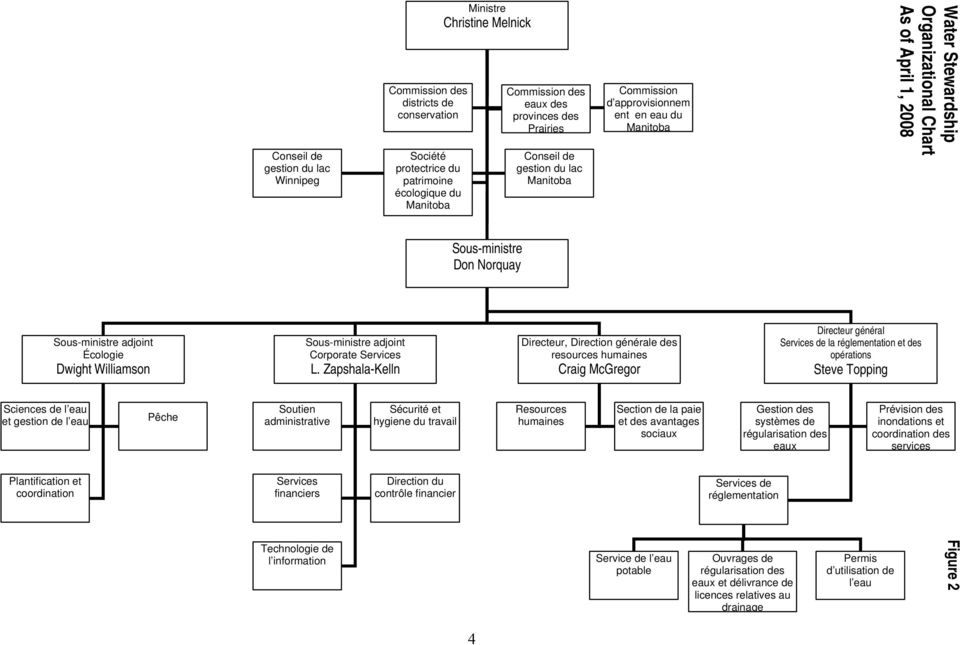
5 List of Tables... 2 HIGHLIGHTS...5 FAITS SAILLANTS...7 ADMINISTRATION AND FINANCE...1 Minister s Salary...1 Executive Support...1 Administration and Finance...1 Financial Services...11 Human Resources Services...12 Information Technology Services...14 ECOLOGICAL SERVICES...15 Administration...15 Planning and Coordination Branch...16 Water Science and Management - Administration...22 Water Science and Management - Groundwater Management...23 Water Science and Management - Surface Water Management...25 Water Science and Management - Water Quality Management...27 Fisheries Branch - Administration...29 Fisheries Branch - Aquatic Ecosystem Management...3 Fisheries Branch - Sport and Commercial Fishing Management...33 Fisheries Branch - Regional Fisheries Resources...35 Fisheries Branch - Northern Fisherman s Freight Assistance...39 Fisheries Branch - Fisheries Enhancement Fund...39 Conservation District and Watershed Assistance...48 REGULATORY AND OPERATIONAL SERVICES...5 Regulatory and Operational Services - Administration...5 Regulatory and Operational Services - Flood Forecasting and Flood Response Coordination...5 Regulatory and Operational Services - Water Control Systems Management...52 Regulatory and Operational Services - Office of Drinking Water...54 Regulatory and Operational Services - Water Control Works and Drainage Licensing...55 Regulatory and Operational Services - Water Use Licensing...56 Waterway Planning and Operational Services Support...57 WATER STEWARDSHIP INITIATIVES...58 Costs Related to Capital Assets...69 PART B CAPITAL INVESTMENT...7 Sustainable Development Activities and Accomplishments...71 Revenue and Expenditure Summaries...84 MANITOBA WATER STEWARDSHIP PERFORMANCE REPORTING TABLE...9 GESTION DES RESSOURCES HYDRIQUES MANITOBA Tableau d information sur le rendement...1 The Public Interest Disclosure (Whistleblower Protection) Act...11 Loi sur les divulgations faites dans l intérêt public (protection des divulgateurs d actes répréhensibles) LEGISLATION Publications
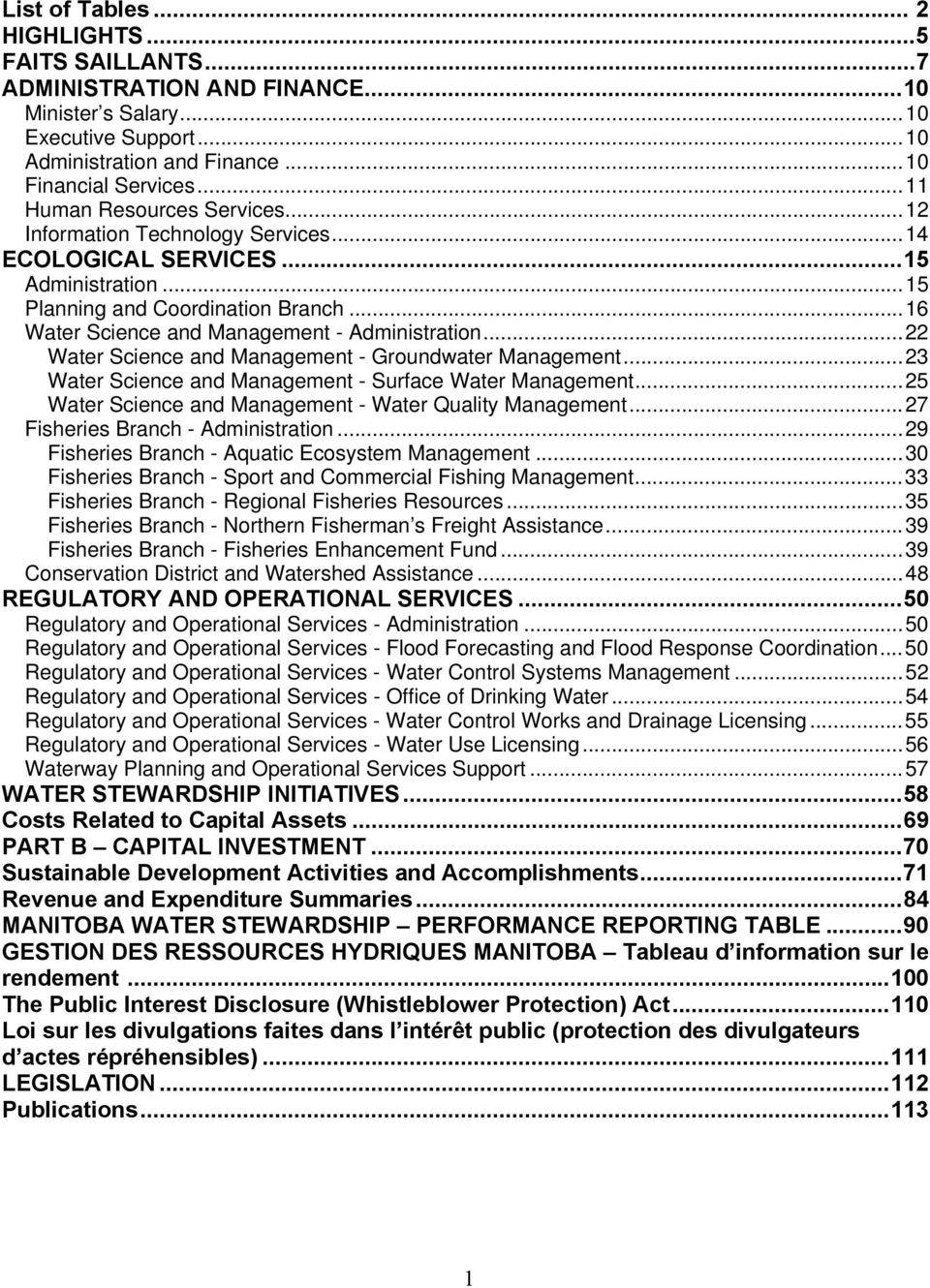
6 List of Tables AF.1 Expenditure, Minister's Salary...1 AF.2 Expenditure, Executive Support...1 AF.3 Employment Equity Representation...13 AF.4 Expenditure, Administration & Finance...13 AF.5 Expenditure, Information Technology Services...14 EC.1 Expenditure, Ecological Services, Administration...15 EC.2 Expenditure, Planning and Coordination...22 EC.3 Expenditure, Water Science and Management Branch, Administration...23 EC.4 Expenditure, Groundwater Management...25 EC.5 Expenditure, Surface Water Management...26 EC.6 Expenditure, Water Quality Management...28 FI.1 FI.2 FI.3 FI.4 FI.5 FI.6 FI.7 FI.8 FI.9 FI.1 Expenditure, Fisheries Branch, Administration...3 Distribution to Sport Fishing Waters from Fish Hatcheries...32 Expenditure, Aquatic Ecosystem Management...33 Expenditure, Sport and Commercial Fishing Management...35 Expenditure, Regional Fisheries Resources...39 Expenditure, Northern Fishermen s Freight Assistance...39 Expenditure, Fisheries Enhancement Fund...4 Licensed Commercial Fishers in Manitoba Commercial Fishery, 27/8...4 Commercial Fishing Production (round Kg), Total Value and Employment (of Licensed Fishers Plus Hired Persons) 1997/98 to 27/ Commercial Fishing Production (round weights kg) by Area and Total Value by Species, 27/ FI.11 Angling Licence Sales and Revenue 1997/98 to 27/ FI.12 Bait Fishing Industry Statistics FI.13 Manitoba Fish Farming Statistics FI.14 Fisheries Monitoring 28/ CA.1 Expenditure, Conservation District and Watershed Assistance RS.1 Expenditure, Regulatory and Operational Services, Administration... 5 RS.2 Expenditure, Flood Forecasting and Flood Response Coordination RS.3 Expenditure, Water Control System Mgmt RS.4 Expenditure, Office of Drinking Water RS.5 Expenditure, Water Control Works and Drainage Licencing RS.6 Expenditure, Water Use Licensing RS.7 Expenditure, Waterway Planning and Operational Services Support WS.1 Expenditure, Water Stewardship Initiatives CI.1 Expenditure, Costs Related to Capital Assets CI.2 Expenditure, General Assets... 7 RE.1 Reconciliation Statement RE.2 Revenue Summary by Source RE.3 Expenditure Summary RE.4 Five-Year Expenditure and Staffing Summary by Appropriation LIST OF FIGURES Organization Chart... 3 Organigramme
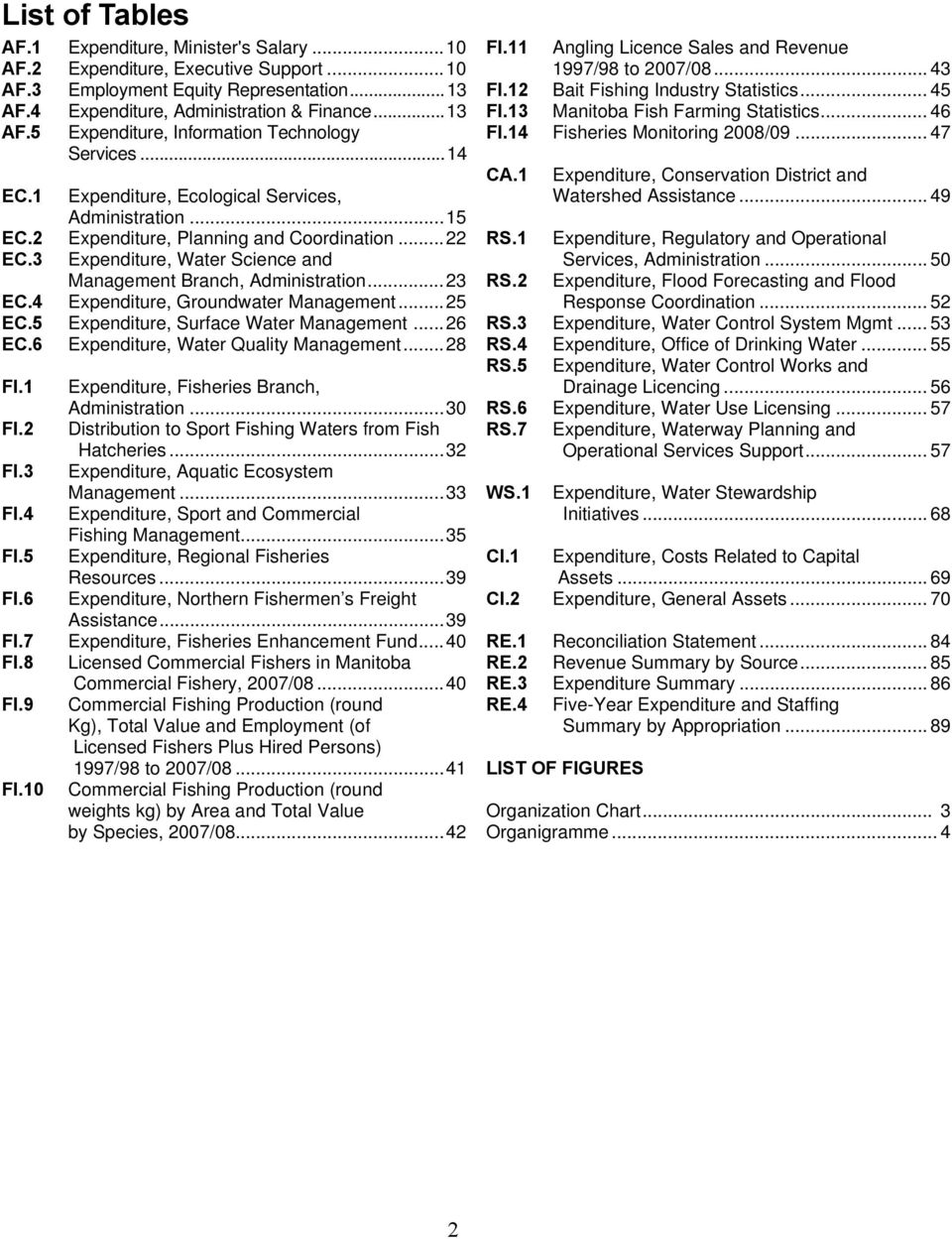
7 Lake Winnipeg Stewardship Board Conservation Districts Commission Manitoba Habitat Heritage Corporation Minister Christine Melnick Prairie Province Water Board Lake Manitoba Stewardship Board Manitoba Water Council Water Stewardship Organizational Chart As of April 1, 28 Deputy Minister Don Norquay Assistant Deputy Minister Ecological Services Dwight Williamson Water Science & Management Fisheries Assistant Deputy Minister Corporate Services L. Zapshala-Kelln Administrative Support Services Workplace Safety and Health Director Consolidated Human Resources Craig McGregor Human Resources Pay and Benefits Unit Executive Director Regulatory & Operational Services Steve Topping Water Control Systems Management Flood Forecasting And Response Planning and Coordination Financial Services Comptrollership Regulatory Services Information Technology Services Office of Drinking Water Water Control Works & Drainage Licensing Water Use Licensing Figure 1 3
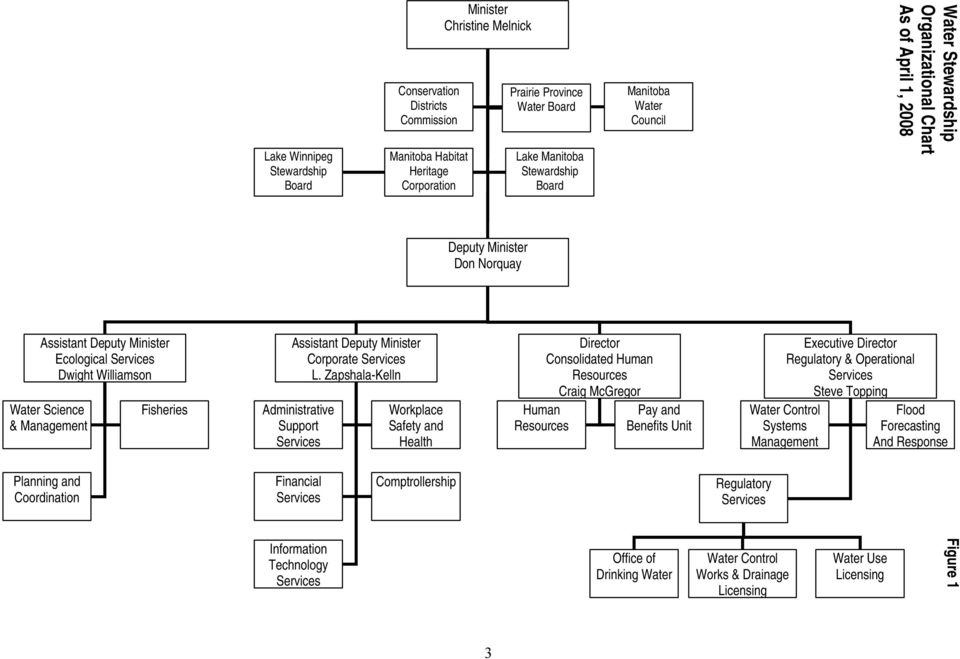
8 Conseil de gestion du lac Winnipeg Commission des districts de conservation Société protectrice du patrimoine écologique du Manitoba Ministre Christine Melnick Commission des eaux des provinces des Prairies Conseil de gestion du lac Manitoba Commission d approvisionnem ent en eau du Manitoba Water Stewardship Organizational Chart As of April 1, 28 Sous-ministre Don Norquay Sous-ministre adjoint Écologie Dwight Williamson Sous-ministre adjoint Corporate Services L. Zapshala-Kelln Directeur, Direction générale des resources humaines Craig McGregor Directeur général Services de la réglementation et des opérations Steve Topping Sciences de l eau et gestion de l eau Pêche Soutien administrative Sécurité et hygiene du travail Resources humaines Section de la paie et des avantages sociaux Gestion des systèmes de régularisation des eaux Prévision des inondations et coordination des services Plantification et coordination Services financiers Direction du contrôle financier Services de réglementation Technologie de l information Service de l eau potable Ouvrages de régularisation des eaux et délivrance de licences relatives au drainage Permis d utilisation de l eau Figure 2 4
9 HIGHLIGHTS Ecological Services Division The Conservation Districts Commission approved the Conservation Districts Program Framework for the Future Consensus Document. A consensus committee with representation from the Association of Manitoba Municipalities, the Manitoba Conservation Districts Association and Manitoba Water Stewardship held meetings throughout the year to achieve consensus towards a future strategy for the Conservation Districts Program. The West Interlake Watershed became Manitoba s 18 th conservation district. The Assiniboine Hills Conservation District was formed as a merger between the Tiger Hills and Mid Assiniboine River Conservation District. The program now includes 154 municipal partners. The Wetland Restoration Incentive Program was initiated as part of the province s climate change adaptation strategy, to help restore the condition of wetlands, improve water quality, and reduce greenhouse gas emissions through a one-time payment and Conservation Agreement to landowners. A Wetland Restoration Working Group has been established led by Manitoba Water Stewardship with representatives from the University of Manitoba, Environment Canada, International Institute for Sustainable Development, Ducks Unlimited Canada, Nature Conservancy of Canada, and Manitoba Conservation. This group will initially oversee undertaking baseline biological studies and scoping engineering feasibility and design studies for the restoration of two of Manitoba s large lake marshes - Delta Marsh on Lake Manitoba and Netley-Libau Marsh on Lake Winnipeg. In 28/9 a draft conceptual framework/outline for Manitoba s drought preparedness strategy and plan was developed. Work on this project will continue in 29/1. Water Stewardship has also taken the lead for developing a western drought action plan for the seven jurisdictions participating in the Western Water Stewardship Council. Staff coordinated the 54 agencies participating in the Southeast Regional Groundwater Management Planning group as it gathered and studied resource information towards the compilation of a groundwater management plan. In collaboration with Manitoba Health, the Ecological Services Division continues to lead efforts to provide information to the general public concerning recreational water quality. Recreational water at Manitoba beaches is monitored for densities of the fecal indicator bacteria, Escherichia coli, and results are posted on the Department s website. Algal blooms are also monitored for concentrations of toxic algae. Incidents of Swimmer s Itch and subsequent beach posting are coordinated by the Section. The Nutrient Management Regulation 62/28 was passed in June 28 under The Water Protection Act (C.C.C. M. c. W65). This regulation encourages responsible nutrient planning and regulates the land application of substances containing nitrogen and phosphorus and restricts the development of certain types of nutrient generating facilities in sensitive areas. In 28/9, public educational materials were developed and distributed to heighten public and sector awareness of regulation. Also in 28/9, the regulation was amended to limit the phosphorus content in fertilizers used in urban and built-up areas. The amendments to the Prohibited Species List of the Manitoba Fisheries Regulations under the Fisheries Act came into effect. There are now 73 fish species and 14 invertebrate species on the list. Established a Dauphin Lake Steering Committee to guide Crown-Aboriginal consultations on possible conservation measures being considered for Dauphin Lake and tributaries for the 29 spring fishery. The consultations were part of government s obligation to consult with First Nations and Métis communities in a meaningful way on matters that may infringe on constitutionally-protected treaty and aboriginal rights when fishing for food. 5
10 Following the Goodon court ruling (recognizing that Métis have communal harvesting rights to hunt that extend throughout southwestern Manitoba), Manitoba Water Stewardship along with Manitoba Conservation continued development of policies regarding domestic Métis harvesting in Manitoba defining Métis Regional communities, determining who are Métis Rights Holders, Natural Resource allocations, interim enforcement direction, and required amendments to Provincial Legislation. Coordinated Winnipeg s Urban Angling Partnership comprised of Manitoba Wildlife Federation, Fish Futures Inc., Mid-Canada Marine Dealers Association, The Complete Angler, City Cats, City of Winnipeg and Government of Manitoba. Urban Angling Partnership offers residents and visitors recreational angling opportunities through structured programs, including Learn to Fish Clinics, Winnipeg Fish Festival, Youth Angling Camps, Fish Winnipeg Media/Corporate Challenge (monies raised for youth angling programs) and Urban Fall Fishing Derby. The program s goal is to encourage participation in recreational fishing and address declining angling license sales. Regulatory and Operational Services Division Outlooks and daily flood reports and forecasts were issued for streams with high water conditions or flooding. These reports were widely distributed for use by all levels of government, emergency management and the public for both spring floods and summer rain generated events. River flows and forecasts and lake and reservoir forecasts were provided for operation of floodways, diversions and dams and for deployment of ice breaking equipment for the purpose of flood control and water supply. Advanced the procurement of a provincially-owned Amphibex ice-breaker and three ice cutter units, in concert with the North Red Community Water Maintenance Inc. and the Vehicle and Equipment Management Agency, which assumed ownership of the ice-breaker. Directed the ice breaking work of the provincially-owned Amphibex, the three provincially-owned ice cutters, and the Ground-Penetrating Radar ice thickness monitoring program, in the early spring of 29, on the Red River at and north of Selkirk. Continued to work with the North Red Community Water Maintenance Inc. regarding ice jam mitigation work by its Amphibex ice-breaker, by establishing annual ice-breaking work plans and assisting with technical issues and problems. For the provincial waterway infrastructure, multi-year capital planning was undertaken in concert with Manitoba Infrastructure and Transportation. The works include agricultural drainage and other waterways, water crossings, water control structures, dams and diking systems. Participated in flood fighting activities in the early spring of 29, including ice jam monitoring and mitigation, flood tube procurement, implementation coordination with local authorities, assisting with provincial flood control infrastructure operation and analyses, and coordination of various flood fighting activities. Participated in the co-ordination of operator training and certification programs to ensure compliance with the requirements of the Water and Wastewater Certification Regulation administered by Manitoba Conservation. Continued progress on implementing the Drainage Regulation Action Plan. Regulations were added to The Summary Convictions Act to allow for set fines for related offenses under The Water Rights Act. Water Stewardship now employs 18 trained Water Resource Officers throughout rural Manitoba. All Officers now have successfully completed training through the Northwest Law Enforcement Academy. Completed Fisher River and Sturgeon Creek hydrologic modeling studies. 6
11 FAITS SAILLANTS Division des services écologiques La Commission des districts de conservation a approuvé le document de consensus intitulé Framework for the Future, un cadre pour l avenir, du Programme des districts de conservation. Un comité de concertation, composé de représentants de l Association of Manitoba Municipalities, de l Association des districts de conservation du Manitoba et du ministère de la Gestion des ressources hydriques du Manitoba, s est réuni à diverses reprises pendant l année afin d établir la stratégie à long terme du Programme des districts de conservation. Le bassin hydrographique d Entre-les-Lacs Ouest est devenu le 18 e district de conservation du Manitoba. De plus, le District de conservation des collines Assiniboine a été créé par la fusion des districts de conservation des collines Tiger et de la Moyenne-Assiniboine. Le Programme des districts de conservation compte désormais 154 partenaires municipaux. Le Programme de restauration des milieux humides a été mis en place dans le cadre de la stratégie provinciale d adaptation au changement climatique, et ce, dans le but de rétablir les conditions des milieux humides, d améliorer la qualité de l eau et de réduire les émissions de gaz à effet de serre, au moyen d ententes de conservation avec les propriétaires de terre et de paiements ponctuels. Sous la direction de Gestion des ressources hydriques Manitoba, un groupe de travail sur la restauration des milieux humides a été formé et réunit des représentants de l Université du Manitoba, d Environnement Canada, de l Institut international du développement durable, de Canards illimités Canada, de Conservation de la nature Canada et de Conservation Manitoba. Le groupe supervisera au départ la réalisation d études biologiques de base et évaluera les études de faisabilité technique et les travaux de conception pour la remise en état de deux grands marais du Manitoba, soit le marais Delta, le long du lac Manitoba, et le marais Netley-Libau, à l embouchure du lac Winnipeg. En 28/9, le ministère a élaboré un cadre conceptuel préliminaire pour une stratégie et un plan du Manitoba en matière de préparation à la sécheresse. Les travaux sur la question se poursuivront en 29/1. Le ministère a également pris la direction dans l élaboration d un plan de lutte contre la sécheresse dans l Ouest du pays, un plan qui visera les sept provinces et territoires du Western Water Stewardship Council, un conseil chargé de la gestion des ressources hydriques dans l Ouest canadien. Le personnel du ministère a assuré la coordination des 54 organismes du groupe de planification de la gestion des eaux souterraines de la région du sud-est lors de leurs réunions et dans leur étude des ressources en vue de l élaboration d un plan de gestion des eaux souterraines. En collaboration avec Santé Manitoba, la Division des services écologiques a poursuivi son travail d information du public au sujet de la qualité des eaux destinées aux loisirs. La qualité de ces eaux pour les plages du Manitoba est testée afin d établir la densité des bactéries indicatrices de matières fécales, Escherichia coli, et les résultats sont publiés sur le site Web du ministère. La prolifération des plantes aquatiques est également suivie afin de relever les concentrations d algues toxiques. Une équipe du ministère se charge de répertorier les cas de dermatite des nageurs et de publier les avis qui en découlent sur les plages concernées. Le Règlement sur la gestion des nutriants 62/28 a été adopté en mars 28 en vertu de la Loi sur la protection des eaux (C.P.L.M., c. W65). Le règlement favorise une planification responsable de l utilisation des nutriants et régit l épandage sur les terres de substances contenant de l azote ou du phosphore, ainsi que l aménagement de certains types d installations génératrices de nutriants dans les zones écologiquement vulnérables. En 28/9, le ministère a élaboré et diffusé du matériel d éducation publique afin de mieux faire connaître le règlement parmi la population et dans le secteur. De plus, au cours de ce même exercice, le règlement a été modifié afin de limiter la teneur en phosphore des engrais utilisés dans les zones urbaines et bâties. 7
12 Les modifications à la liste des espèces interdites du Règlement de pêche du Manitoba, pris en application de la Loi sur les pêches (loi fédérale), sont entrées en vigueur. La liste comprend désormais 73 espèces de poissons et 14 espèces d invertébrés. Le ministère a créé un comité de direction du lac Dauphin afin d orienter les discussions entre le gouvernement et les Autochtones au sujet des mesures de conservation envisagées par rapport au lac Dauphin et à ses affluents pour la pêche du printemps 29. Les discussions découlaient de l obligation du gouvernement de consulter adéquatement les communautés des Premières nations et des Métis sur les questions susceptibles d empiéter sur les droits ancestraux et issus des traités constitutionnellement garantis en matière de pêche de subsistance. À la suite du jugement du tribunal concernant le dossier Goodon (selon lequel les Métis ont un droit collectif de chasse, lequel droit vise tout le sud-ouest du Manitoba), Gestion des ressources hydriques Manitoba et Conservation Manitoba ont continué d élaborer des politiques concernant la récolte de subsistance des Métis au Manitoba les travaux ont porté sur la définition de la notion de communauté régionale métisse, la détermination des titulaires de droits de Métis, l attribution des ressources naturelles, l application temporaire de la loi et la demande de modifications de la loi provinciale. Le ministère a assuré la coordination du Winnipeg s Urban Angling Partnership, un partenariat pour la pêche urbaine à Winnipeg, qui est formé par la Manitoba Wildlife Federation, Fish Futures Inc., la Mid- Canada Marine Dealers Association, The Complete Angler, City Cats, la Ville de Winnipeg et le gouvernement du Manitoba. Ce groupe de partenaires offre aux résidents et aux visiteurs des possibilités de pêche dans le cadre de programmes structurés, notamment des ateliers sur les techniques de pêche, le Winnipeg Fish Festival, des camps de pêche pour les jeunes, le Fish Winnipeg Media/Corporate Challenge (activité de financement pour les programmes de pêche pour les jeunes) et le Urban Fall Fishing Derby. L objectif des programmes est d encourager la pêche sportive et de stimuler les ventes de permis de pêche, actuellement en baisse. Division des services de la réglementation et des opérations Le ministère a publié des perspectives, des rapports quotidiens sur les inondations et des prévisions concernant les crues ou le niveau élevé des eaux. Ses rapports ont été largement distribués afin qu ils puissent être utilisés par les administrations publiques de tous les échelons, les gestionnaires des mesures d urgence et la population, tant pendant les crues printanières que lors de fortes pluies estivales. Le ministère a fourni des données sur le débit des rivières et des prévisions à ce sujet, ainsi que des prévisions concernant les lacs et les réservoirs, pour l utilisation des voies de dérivation, des dispositifs de captage et des barrages et pour le déploiement des dispositifs brise-glace, et ce, à des fins de lutte contre les inondations et d approvisionnement en eau. Le ministère a fait avancer l achat par la province d un brise-glace de type Amphibex et de trois appareils coupe-glace, de concert avec l entreprise North Red Community Water Maintenance Inc. et l organisme chargé des véhicules gouvernementaux, qui est devenu le propriétaire attitré du brise-glace. Dès le début du printemps 29, le ministère a également dirigé sur la rivière Rouge, à la hauteur de Selkirk et plus au nord de la ville, les travaux du brise-glase Amphibex provincial et des appareils coupe-glace, ainsi que le programme de surveillance de l épaisseur des glaces au moyen d un géoradar. Le ministère a continué à travailler de concert avec l entreprise North Red Community Water Maintenance Inc. à la réduction des embâcles au moyen du brise-glace Amphibex, en établissant des plans de travail annuels pour le brisage des glaces et en aidant l entreprise en cas de questions et de problèmes techniques. En ce qui concerne l infrastructure des voies d eau provinciales, le ministère a entrepris la réalisation d un plan pluriannuel d immobilisations, de concert avec Infrastructure et Transports Manitoba. Les travaux concernent les voies de drainage agricole et autres voies d eau, les ouvrages de franchissement des cours d eau, les structures de régularisation des eaux, les barrages et les digues. 8
13 Le ministère a participé aux activités de lutte contre les inondations au début du printemps 29, notamment pour la surveillance et la réduction des embâcles, l achat de tubes anti-inondation, la coordination des mesures avec les autorités locales, l aide aux analyses et à l utilisation des infrastructures de régularisation des crues dans la province et la coordination de diverses activités de lutte contre les inondations. Le ministère a participé à la coordination des programmes de formation et de certification des exploitants conformément aux exigences du Règlement sur les exploitants d installations de traitement des eaux, un règlement dont l administration relève de Conservation Manitoba. Le ministère a poursuivi son travail de mise en œuvre du plan d action concernant l application des règles relatives aux activités de drainage. Des modifications ont été apportées à la Loi sur les poursuites sommaires afin de prévoir des amendes en conséquence d infractions à la Loi sur les droits d utilisation de l eau. Le ministère emploie actuellement 18 agents des ressources hydriques formés qui travaillent dans toutes les régions rurales du Manitoba. Tous les agents ont suivi avec succès une formation donnée à la Northwest Law Enforcement Academy. Le ministère a réalisé des études de modélisation hydrologique de la rivière Fisher et du ruisseau Sturgeon. 9
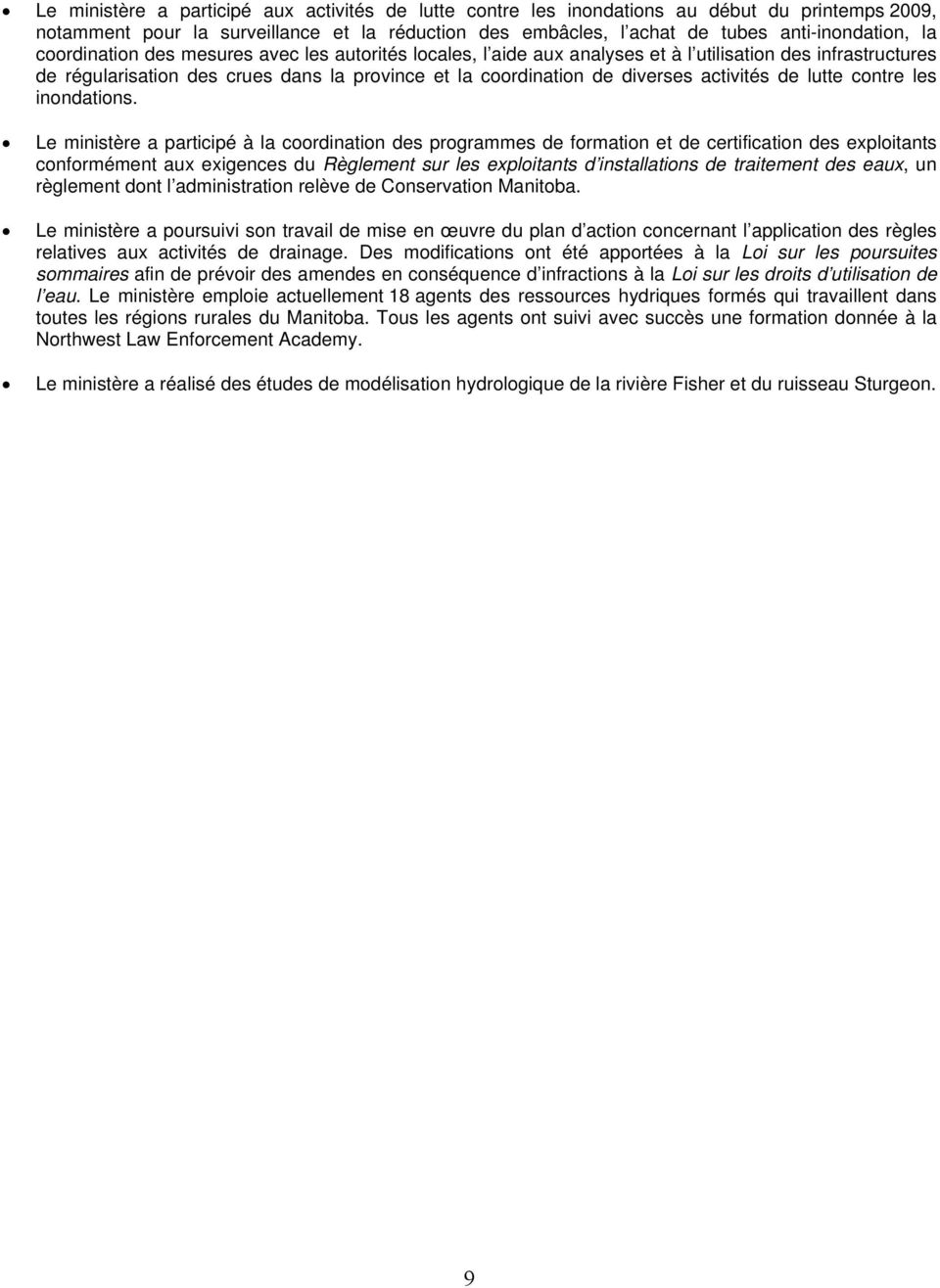
14 ADMINISTRATION AND FINANCE The Administration and Finance Division provides executive management of programs and management services, including financial, human resource, information technology, and administrative support. Minister s Salary The Minister s salary provides the Minister with additional compensation to which an individual appointed to Executive Council is entitled. Table AF (a) Minister's Salary Expenditures by Subappropriation Actual 28/9 $() FTE s Estimate 28/9 $() Variance Over/(Under) $() Salaries and Employee Benefits Total Sub-Appropriation Expl. No. Executive Support This area comprises support staff in the Offices of the Minister and Deputy Minister of Water Stewardship. The purpose of Executive Support is to develop, implement and oversee policies and programs that are designed to attain, over the long term, the goals set in the Department s vision and mission statements; advise the Minister on matters relating to the Department; provide policy direction for departmental programs; coordinate departmental communications, activities, and initiatives; and provide administrative support for the Offices of the Minister and Deputy Minister. Table AF (b) Executive Support Expenditures by Subappropriation 28/9 Actual $() FTE s Estimate 28/9 $() Variance Over/(Under) $() Salaries and Employee Benefits (18) 1 Other Expenditures (12) 2 Total Sub-Appropriation (228) 1. Under expenditure is due to resource management. 2. Under expenditure is due to lower expenditures as a result of resource management. Administration and Finance Corporate Services Division provides shared services for the departments of Conservation and Water Stewardship, including administrative; financial; safety, health and risk management; equipment warehousing; library and public information services; and information technology services. Human Resource services are also provided through a service shared with other departments. Expl. No. 1
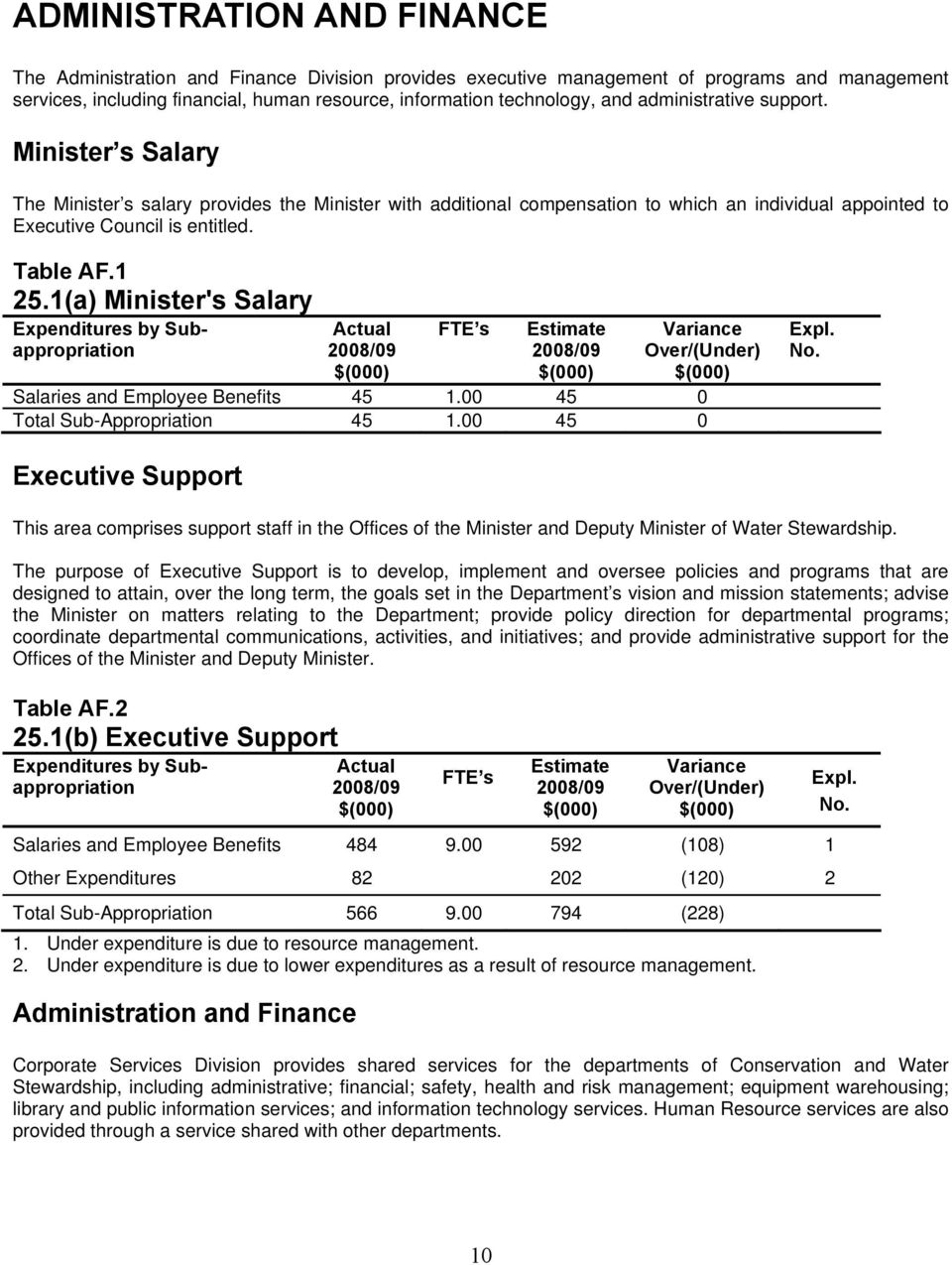
15 Administrative services include fleet vehicle coordination, office accommodation and parking administration, environmental impact file searches, records management, coordination of departmental French language services, and compliance with The Freedom of Information and Protection of Privacy Act. The Safety, Health and Risk Management section provides leadership, direction and support to departmental staff and senior management on compliance with recognized standards in these areas through policies, monitoring and training. The Conservation and Environment Library supports access to print and electronic specialized information resources for Manitoba Conservation, Manitoba Water Stewardship, Environment Canada in Winnipeg, the Canadian Council of Ministers of the Environment, and the public. Interlibrary loans are coordinated with other Libraries and Educational Institutions. Current information related to the mandates of each partner organization is made available to staff and to the public. The departmental warehouse is the equipment/supply storage and mobilization point for branches and the Fire Operations Centre. In emergencies, such as fire and flood, the warehouse becomes the logistical support base for all equipment. Key Results Achieved: In the 28 calendar year, 249 requests for information were processed under The Freedom of Information and Protection of Privacy Act. In the 28/9 year, the library responded to over 3, requests for information both from staff and the public, and over 1,8 items were added to our physical collection. The Department continues to implement its French Language Services Plan to reflect current operations and in keeping with the Chartier Report on French Language Services. Further translation of documents and the website occurred in 28/9 as well as participation in the Bilingual Service Centres. A total of 662 environmental file searches on listed properties within the province of Manitoba were completed, generating revenue of $62,226. The Safety, Health and Risk Management program began to implement the directions of the policy manual distributed in the previous year as well as identifying other areas of need. Financial Services The Financial Services Branch develops, communicates, monitors and evaluates departmental financial policies, systems, processes and procedures to ensure the effective, efficient and economical operation of departmental financial functions in compliance with requirements of the Department, Treasury Board, the Department of Finance, the Office of the Auditor General, and Generally Accepted Accounting Principles. Key Results Achieved: The Branch provided financial support and leadership to all branches, regions, and business units of the departments of Conservation and Water Stewardship, including: timely completion of estimates information, detailed budget, forecast and other financial reports; adherence to departmental and Government policy and procedures related to financial operations; provision of quality financial information to departmental managers to enable proper management of programs; prompt and accurate payment of accounts payable; collection and deposit of all revenues and receipts to which the Department was entitled; capital asset financial planning and management; advice, guidance and administration related to contracts and grants; overall comptrollership support; and timely and convenient sale of angling licences to the public. 11
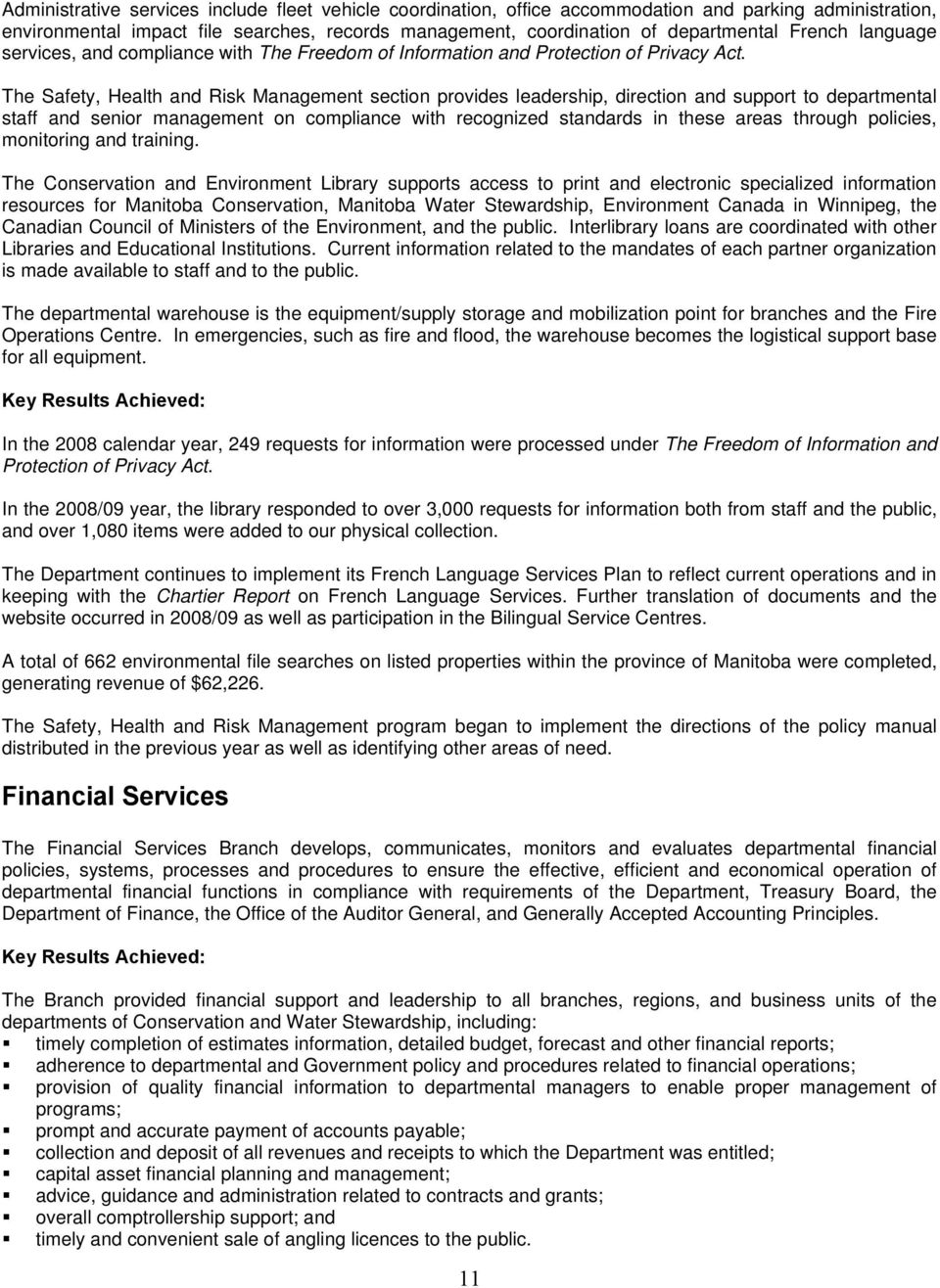
16 The Licensing Section managed a province-wide network of 775 private and 141 departmental licence vendors through which convenient access was provided to the public for angling, hunting, migratory waterfowl, trapping, fur dealer, park vehicle entry, camping, arborist and various other licences, permits and related information (e.g., Anglers Guide, Hunting Guide, Trapper s Guide). For the period April 1, 28 to March 31, 29, Licensing Section recorded 752,473 transactions with net revenue of $13,618,51. Vendor activity for the same period included 5 new appointments, 98 discontinuances, 33 suspensions, and 26 reinstatements. A total of 714 private vendors are located in rural areas. The Public Information section provided information to the public regarding the numerous programs delivered by the Departments of Conservation and Water Stewardship. This service was provided in person, by telephone, Internet and mail, including the following responses to requests for information and assistance in 28/9: 33,151 direct telephone requests to the Information Officers 3,74 calls were received by the automated Public Information Line, of which 1,52 where handled directly by the line. 71,966 in person requests 1,261 requests through the Internet 5,135 information packages mailed. The Revenue Management section managed the collection, security, deposit and reporting of revenue for over 5 revenue streams for the Departments of Conservation and Water Stewardship. The section s Winnipeg Cashier s Office handled 6,78 direct sales totaling $2,41,8 and processed over 15, mailed remittances from customers and departmental field offices totaling $27,416,5. Credit cards were accepted at 45 locations, of which 39 also accepted debit cards. Human Resources Services Staffing Staff provided advice and guidance on all aspects of Human Resource Management including: labour/employee relations; classifications; pay & benefits; organizational review and development and employment equity. There were 144 staffing activities of which 33 were through competitive appointments; 13 direct appointments; 18 acting status appointments; 9 lateral transfer appointments; 57 term & departmental appointments, 2 Order-In-Councils & 8 other staffing transactions. In addition, HR processed 6 seasonal departmental recalls throughout the year. Guidance and advice were provided on Regular Employees and 8.31 Departmental Employees. There were no selection appeals during the last fiscal year. Provided guidance and advice to management on 18 outstanding labour relations issues, including appropriate course of actions and negotiating settlements or resolutions to resolve issues before the formal grievance stage. There were no formal grievances initiated during this period. Classification 9 positions were reviewed and completed in 28/9. There were no classification appeals. Pay and Benefits Processed pay and benefits for 21 staff and provided guidance and advice on pay administration issues. Provided guidance and advice on implementation of organizational changes and the maintenance of organizational charts for the department. 12
17 Employment Equity Continued to advise and guide staff in regards to Employment Equity a consideration in all staffing & acting status activities. Liaised with schools and organizations to promote careers within the department. Participated at a number of Career Fairs. Developed a Diversity and Employment Equity Strategy Table AF.3 Employment Equity Representation: March 31 st, 25 to March 31 st, 29 Total Male Aboriginal Persons Visible Fiscal Year Female with Disability Minority # % # % # % # % # % # % Government Goal Table AF (c) Administration and Finance Expenditures by Subappropriation 28/9 Actual FTE s $() Estimate 28/9 $() Variance Over/(Under) $() Salaries and Employee Benefits Other Expenditures (39) 1 Total Sub-Appropriation (33) 1. Under expenditure is due to expenditure management. Expl. No. 13
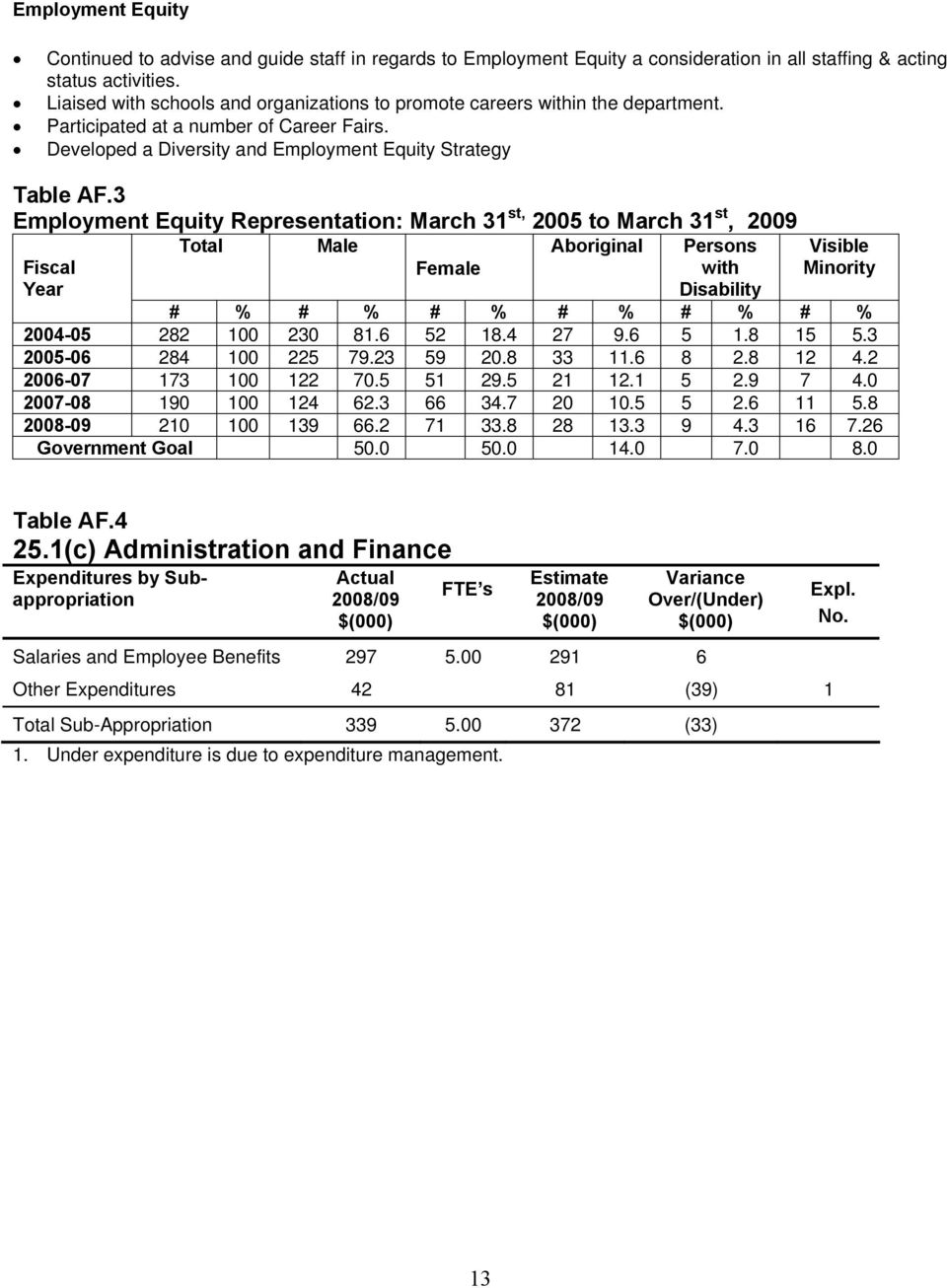
18 Information Technology Services The Branch provides internal information technology services and expertise, including technology and business consulting, systems analysis, design, implementation, corporate database management, and development and management of a yearly department-wide information technology systems plan. The Branch develops and maintains the Manitoba Land Initiative spatial data warehouse. Table AF (d) Information Technology Services Expenditures by Subappropriation FTE s Actual 28/9 $() Estimate 28/9 $() Variance Over/(Under) $() Salaries and Employee Benefits Other Expenditures (4) Total Sub-Appropriation Expl. No. 14
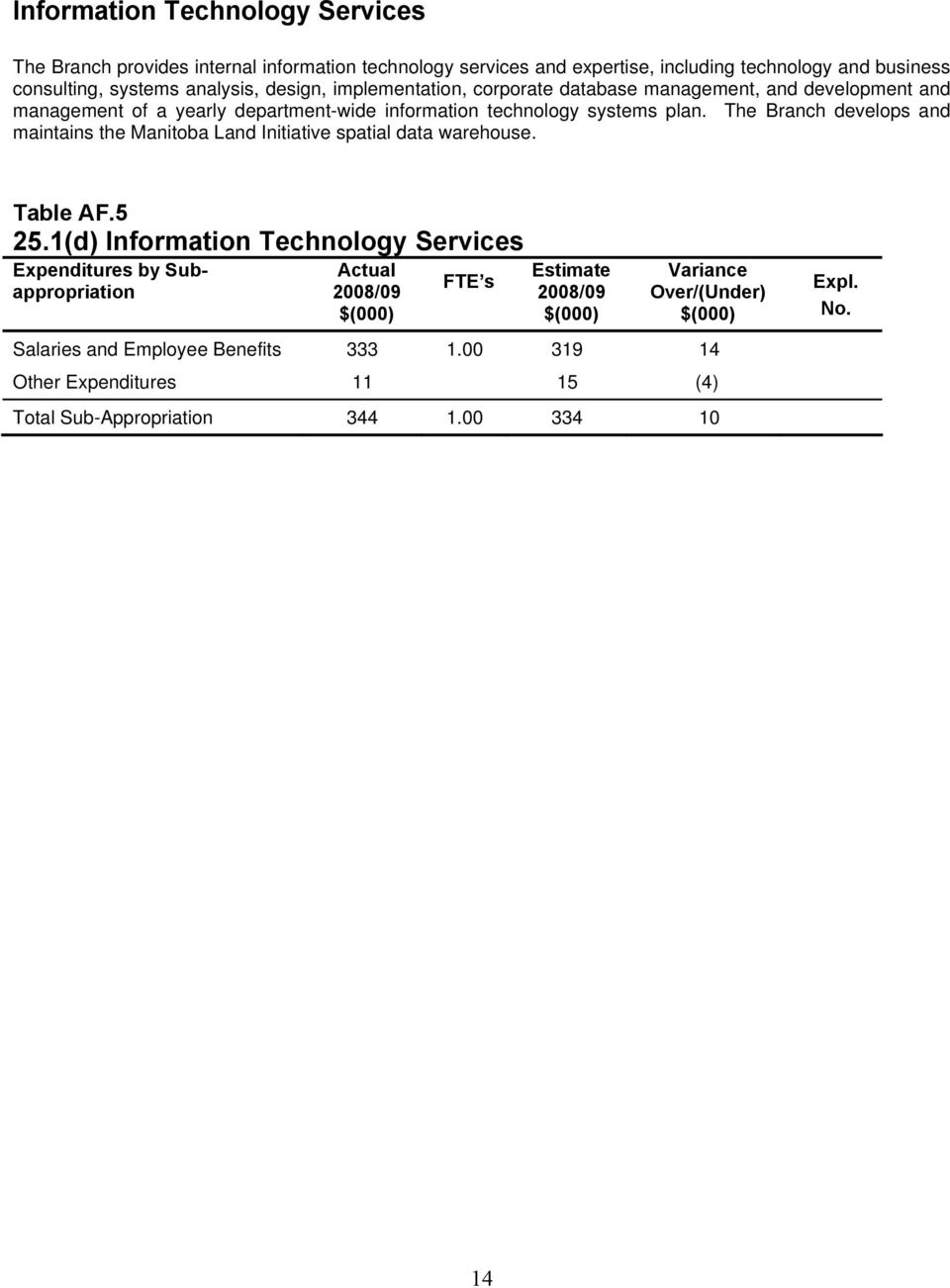
19 ECOLOGICAL SERVICES Administration Staff provide the necessary direction and program coordination for the Ecological Services Division to ensure sustainable development, allocation, and conservation of water resources by developing new policy direction and adhering to current policy and procedures. Staff oversee funding, negotiate and administer contracts, and monitor efficiency and effectiveness of expenditures. In addition, the Assistant Deputy Minister sits on the following boards, councils, and commissions: International Joint Commission s International Red River Board International Joint Commission s International Souris River Board Red River Basin Commission Lake Winnipeg Stewardship Board Federal - Provincial Lake Winnipeg Basin Committee Board of Directors, Lake Winnipeg Research Consortium Inc. Lake of the Woods Multi-Agency Working Arrangement Alternate Member, Prairie Provinces Water Board Working Group on Canadian Recreational Water Quality Guidelines Western Water Stewardship Council Netley/Libau and Delta Marsh Restoration Working Group Table EC (a) Administration Expenditures by Subappropriation Actual 28/9 $() FTE s Estimate 28/9 $() Variance Over/(Under) $() Salaries and Employee Benefits (12) Other Expenditures (17) 1 Grants Minor Capital (11) Total Sub-Appropriation Under expenditure is due to reduced general operating costs, including office, vehicle and legal expenses. 2. Over expenditure is due to provision of grant funding to the Manitoba Habitat Heritage Corporation for transition for a new Chief Operating Officer. Expl. No. 15
20 Planning and Coordination Branch Administration The Planning and Coordination Branch, through the four sections of Watershed Planning and Programs, Basin and Aquifer Planning, Information and Knowledge Management, and Policy and Legislation, leads, directs and coordinates: the strategic planning process of Manitoba Water Stewardship; the development of provincial water policy and legislation; the provision of advice and secretariat support to the Manitoba Water Council; the implementation of the watershed planning provisions of The Water Protection Act; the provision of advice and support to Conservation Districts Boards to enable the effective delivery of its mandate to deliver conservation-based soil and water programs within local communities; the development of basin, aquifer, and major water body sustainable management plans; the review of proposed developments to ensure consistency with legislative requirements and approved watershed plans; the implementation of business processes that streamline the collection, organization and dissemination of knowledge and information; the use of spatial and non-spatial data and services in support of information and knowledge management and decision making activity; and website development, development of web services, and active management of website function and content in support of an effective and efficient information network and knowledge distribution methodology. The Branch is represented on numerous inter-departmental, provincial, national, and international boards and committees including the following: Ag-Water Forum Prairie Region Centre Port Canada Advisory Committee Canadian Council of Ministers of the Environment Environmental Planning and Protection Committee Lake of the Woods Water Sustainability Foundation Partners FOR the Saskatchewan River Basin Prairie Habitat Joint Venture Red-Assiniboine Land Use Evaluation Project Red River Basin Commission Communications Committee Canadian Council of Ministers of the Environment Water Agenda Development Committee Canadian Council of Ministers of the Environment Water Agenda Development Committee (Valuation)(Climate Change) Waterlution Prairie Regional Adaptation Collaborative Natural Resources Canada Western Water Stewardship Council s Working Group Basin and Aquifer Planning The Basin and Aquifer Panning Section coordinates community-based aquifer management planning, supports aquifer management advisory Boards, leads Manitoba s participation in large basin (inter-provincial and international) planning, coordinates the Water Stewardship Fund, coordinates the department s technical review of Environment Canada Lake Winnipeg Basin Stewardship Fund project proposals and coordinates the department s review of development related proposals and projects. 16
21 Key Results Achieved: Coordinated the 54 agencies participating in the Southeast Regional Groundwater Management Planning group as it gathered and studied resource information towards the compilation of a management plan. Participated on the Red River Basin Commission s Communications Committee including participating in the organization of the Commission s 27 th annual conference in Winnipeg and on the Commission s Plan Implementation Committee. Participated on the Partners for the South Saskatchewan River Basin s State of the Basin Report review committee. Provided planning and administrative assistance to the Assiniboine Delta Aquifer Management Advisory Board. Participated on the Winkler Aquifer Management Advisory Board. Managed the $35. Water Stewardship Fund including the evaluation of 35 project proposals and the funding of 18 projects. Coordinated Manitoba Water Stewardship s technical review of 33 project applications to the Lake Winnipeg Basin Stewardship Fund and provided funding recommendations to Environment Canada. Coordinated the review of 1268 development related proposals, as indicated in the following table, to minimize negative impacts on water. Development Proposals Processed # The Environment Act and Dangerous Goods and Transportation Act Proposals and Draft Licences. 119 Subdivision Applications. 647 Development Plans and Zoning By-laws. 27 Infrastructure and Transportation Pre-screenings. 12 Energy and Mines Proposals 14 Special Projects. 5 Crown Land Transactions 264 Total 1,268 Information and Knowledge Management This Section establishes and manages cross-cutting departmental work teams to provide leadership, innovation, coordination and integration of the department s information and knowledge systems. Activities include coordination and facilitation services to identify information and knowledge gaps and appropriate solutions. Leadership to facilitate integrated departmental solutions is provided to ensure the accurate and timely collection and dissemination of information and knowledge of a scientific, technical, and policy nature to support the department. This Section also provides leadership and coordinates the department s activities related to geographic information system science, internet/intranet, capacity building, education, and information dissemination. Key Results Achieved: Collaborated with Natural Resources Canada in the production of a geospatial hydrography data model and vector topographic dataset that synthesizes key concepts of hydrography and hydrology and provides a quality geometric description of Manitoba surface water systems. This model and dataset supports and facilitates water and watershed management and provides the department and the public a resource for network and water flow analysis and a multitude of cartographic applications. 17
22 Managed the Watershed MAPS Project (a GIS-enabled, web-based information management, planning and reporting system), which allows water planning authorities and other stakeholders involved in watershed planning and management access to a tool designed to meet their watershed planning and priority setting need through the tracking of management practices and project delivery/effectiveness. Implemented a centralized GIS software licence management model to better manage, track and coordinate the department s GIS tool suite and to help identify and optimize current and future GIS investment. Provided spatial analysis expertise to numerous projects from across the department, including a spatial assessment of high risk areas for point and non-point source impacts to water and an identification of target areas for source water and watershed protection projects. Facilitated departmental implementation of new government web standards and templates. Provided leadership and improved coordination of information on the department s Internet site. Re-engineered the department s management information system, PEAK, which will better help departmental workgroup clients establish and maintain work priority, deliver on workgroup plan, and work with other groups (internal and external to the department) to understand how priority integrates with these groups and how each connects to overall departmental strategy and goal. Generated new opportunities for departmental collaboration and productivity, and distributed decision making through implementation of GoToMeeting/Webinar software and through development of a departmental Intranet site. Policy and Legislation This Section is responsible for coordinating: the review, amendment and development of legislation, regulations and policy required to support the sustainable management of Manitoba s water; major department wide strategy documents (annual report, program inventory, Priorities and Strategies Overview, estimates book and house briefing materials); the departmental planning process; and responses to public inquiries received through correspondence, website and phone. This section is also responsible for Climate Change mitigation and adaptation strategies within the department and across government when they pertain to water, as well as the WaterSmart Manitoba program, a water conservation and efficiency initiative for all Manitobans. Secretariat and policy support is provided to the Manitoba Water Council. Briefing materials are developed and policy support is provided for the department on water issues for the Federal/Provincial Relations Branch (Council of the Federation, Western Premiers Conference) and other information requests of a national or international basis. This section also provides representation for the department on intergovernmental bodies and external agencies, boards and committees. Key Results Achieved: A Wetland Restoration Working Group has been established, led by Manitoba Water Stewardship with representatives from the University of Manitoba, Environment Canada, International Institute for Sustainable Development, Ducks Unlimited Canada, Nature Conservancy of Canada, and Manitoba Conservation. This group will initially oversee undertaking baseline biological studies and scoping engineering feasibility and design studies for the restoration of two of Manitoba s large lake marshes, Delta Marsh on Lake Manitoba, and Netley-Libau Marsh on Lake Winnipeg. Representatives from Manitoba Water Stewardship participate as members of the Western Water Stewardship Council, which functions as the formal body to facilitate a collaborative approach to water conservation and watershed management. Three themes are being championed; water efficiency, water governance, and drought preparedness. Manitoba is the lead on drought preparedness. 18
23 Beneficial Management Practice Top Up Incentive Program - Manitoba Water Stewardship completed the final year of a Contribution Agreement with Agriculture and Agri-Food Canada to deliver a top-up incentive program to qualified landowners to select from three Best Management Practices that would positively influence water quality. The organization and hosting of the first-ever Manitoba-Israel symposium on water protection. The symposium united policy makes and leading scientists from Manitoba and Israel to share strategies and best practices on protecting water resources. Manitoba Water Stewardship and the South Australia Department of Water, Land and Biodiversity Conservation signed a Memorandum of Understanding, and began exchanging information and developing joint projects via conference calls and exchange visits. Developed the WaterSmart program - a conservation and efficiency initiative to reduce consumption of water by Manitobans. Activities included the implementation of a successful toilet rebate event, education and public outreach, the development of future regulations, and support in the development of new building codes for water efficiency. The Wetland Restoration Incentive Program was initiated in order to help restore the condition of wetlands, improve water quality and reduce greenhouse gas emissions through a one-time payment and Conservation Agreement to landowners. The development of two pieces of legislation, the Shellmouth Dam and Other Water Control Works Management and Compensation Act (under the Water Resources Administration Act) and the Phosphorus Reduction Act (under the Water Protection Act), which were presented and passed in the Legislature. Riparian Easements Program - a grant of $1. was provided to Manitoba Habitat Heritage Corporation to secure, in perpetuity, conservation easements from landowners. Provided secretariat and advisory services for the Manitoba Water Council. The Water Council was formally established in February 27 and provides Ministerial advice on policies, programs, plans, and legislation needed to achieve the department s vision, mission and guiding principles. The Council helps to build a broad-based consensus among Manitobans on sustainable solutions to water protection and water management. Assisted branches within both divisions of the department with the development of documents for Treasury Board, Cabinet, Ombudsman and the Auditor General. Participated in the Canadian Council for the Ministers of the Environment activities, including the development of a guidance document in water valuation, chairing of the committee on groundwater, and cochairing the Water Agenda Development Committee. Watershed Planning and Programs The Watershed Planning & Programs Section provides secretariat services to the Conservation District Commission, the governing body responsible and accountable to the Minister of Water Stewardship for overall Conservation District Program management and administration under the authority of The Conservation Districts Act. The section also manages and provides advisory and planning services to the Conservation Districts Program and coordinates community-based watershed management planning in Manitoba as mandated by The Water Protection Act. Activities include: forming new conservation districts; expanding existing conservation districts; facilitating watershed management planning; building capacity to promote effective board governance; coordinating provincial services; and administering conservation district budgets, provincial grant funding, and provincial policy. 19
24 The Watershed Planning and Programs Section continued to build provincial-municipal partnerships in watershed management through the Conservation Districts Program. The program is responsible for land and water conservation programming in eighteen conservation districts, involving 154 member municipal governments. Total program expenditures approached $9. million, of which $5.2 million was provincial grant funding. Key Results Achieved Progressed with the Conservation District framework for the future document. Three regional public consultations were held across Manitoba. Presentations were also provided at the Municipal Officials seminar and at Manitoba Conservation Districts Association meetings. A What You Told Us document was produced summarizing comments from the public meetings. The draft Framework for the Future Consensus Document was written. The document proposes a new vision, mission, goals, objectives, provincial priorities, and strategies for the CD program over the next 15 to 2 years. Initiated working committees for the development of new funding and appointment models recommended through action items from the Conservation Districts Program Framework for the Future Consensus Document. Managed and administered over $5. million in provincial grants to the Conservation Districts with total program funding administration of almost $9. million. Coordinated expansion activities of the Seine-Rat River Conservation District to include the Rural Municipality of Montcalm and the East Interlake Conservation District to include the Rural Municipalities of West St. Paul and Woodlands and the City of Selkirk. The West Interlake Watershed Conservation District was formed as a partnership between the Province of Manitoba and six municipal authorities consisting of the Rural Municipalities of Armstrong, Coldwell, Eriksdale, St. Laurent, Siglunes and Woodlands. Formed the Assiniboine Hills Conservation District as a result of a merger between Tiger Hills and Mid Assiniboine River Districts, including expansion into the Rural Municipalities of Whitewater, Riverside and Oakland, the Village of Wawanesa, and the Town of Souris. Provided support services to 18 Conservation District Boards and staff including all aspects of governance, finance, policy development, programming, operations, planning, and human resources. Hosted 35 internal and external meetings with watershed partners to improve the integrated watershed management planning process. Results included improvements to the plan process, plan agreements, data requisition template, communication documents and presentations for the public and Watershed Teams. Continued to provide planning and support services for seven watershed plan processes as required through provisions of The Water Protection Act including; - Icelandic River-Washow Bay - La Salle River - Seine River - Arrow/Oak River - Little Saskatchewan River - Shell River - Birdtail River Started public consultations for The East Duck Mountain-Sagemance Bay, West Souris River, Netley- Grassmere Creek and two Pembina River watershed plan processes. Nine additional memorandums of understanding were signed to designate water planning authorities to initiate the integrated watershed management planning process in 1 watersheds, bringing the total number of plans approved for development to 22. 2
25 Support was provided to the conservation districts to transition, develop and focus programming to address objectives and priorities highlighted through the planning process, to measure progress against their planned objectives, and to report on their successes. Coordinated two sub-watershed riparian and aquatic habitat assessments. Initiated a series of workshops on capacity building focusing on governance, policy, project management, roles of provincial appointees on Conservation District Boards and coordination of basin board initiatives with watershed boards. Coordinated two Conservation District Commission meetings and provided orientation services for three new commission members, including the Deputy Minister of Health and two citizen appointments. Managed, coordinated and inspected projects submitted through the Capital Investment Initiative Program, a long term capital investment providing financial resources to the four conservation districts that manage and maintain provincially-owned waterway infrastructure. Coordinated the development and printing of the Annual Report for the Office of the Auditor General containing the activities and expenditures of all 18 conservation districts. Developed a Conservation Districts Financial and Program Activities Summary highlighting the activities of all 18 districts and the Watershed Planning and Programs Section. Acted in extension and advisory capacity to the Manitoba Conservation Districts Association, the Association of Manitoba Municipalities, and other partner agencies. Active participant on six interdepartmental land, water, and planning based committees. Produced an integrated watershed management pamphlet outlining the steps of the planning process. Assisted with updates to the department web site with watershed planning and watershed extension information. Water Stewardship Fund The Water Stewardship Fund was developed through the Water Protection Act, for the purpose of providing financial assistance to develop, implement, and promote projects that maintain or improve the stewardship of Manitoba s water. The objectives of the Water Stewardship Fund are: to support and promote research projects and activities that further the goals of The Water Protection Act; to encourage the development and implementation of watershed management plans, water conservation programs, and water quality initiatives; the stimulate economic development and diversification that will improve the quality of life and the environment in Manitoba. Key Results Achieved: 18 projects were funded in the 28/9 fiscal year, totalling $349, project proposals were reviewed, requesting $1,13,334.6 in total funding 21
26 Table EC (b) Planning and Coordination Expenditures by Subappropriation 28/9 Actual FTE s $() 22 Estimate 28/9 $() Variance Over/(Under) $() Salaries and Employee Benefits 1, ,583 2 Other Expenditures 1, Expl. No. Total Sub-Appropriation 2, , Over expenditure is due to Water Efficiency Strategy expenditure rebates on the purchase of dual flush toilets. Water Science and Management - Administration The Water Science and Management Branch consists of over 3 scientific and technical personnel including hydrologists, limnologists and aquatic biologists, hydrogeologists, and support staff to provide services in the following main areas: managing and protecting the quality and quantity of ground water and surface water including beach water quality; providing hydrological scientific services to support the sustainable use of surface water, to assure the protection of people, and to minimize damage to property from floods and droughts; protecting the biological and ecosystem health of Manitoba s water systems including programs aimed at preventing the introduction of invasive species; managing transboundary water issues that may have potential to affect the quality or quantity of waters that flow to Manitoba from upstream jurisdictions; developing and implementing programs aimed at restoring the health of Lake Winnipeg. The Branch is organized into three sections: Groundwater Management Section, Surface Water Management Section, and the Water Quality Management Section. Services are provided to the public, local governments, other units within the department, other Manitoba provincial government departments, and other provincial, federal, and international governments. The Water Science and Management Branch delivers strong scientifically-based programs to ensure Manitoba s water resources and environment are managed and protected in a sound and sustainable manner including the protection of human health and property. The Branch is represented on numerous inter-departmental, provincial, national, and international boards and committees including the following: Lake of the Woods Control Board Red River Floodway Operation Advisory Board Shellmouth Operation Advisory Board Aquatic Ecosystem Health Committee of the International Joint Commission s International Red River Basin Board Aquatic Ecosystem Health Committee of the International Joint Commission s International Souris River Basin Board Prairie Provinces Water Board - Hydrology Committee Prairie Provinces Water Board - Water Quality Committee Prairie Provinces Water Board - Groundwater Committee Canadian Council of Ministers of the Environment - Water Quality Committee Canadian Council of Ministers of the Environment Water Agenda Development Committee (Groundwater) Canadian Council of Fisheries and Aquaculture Ministers - National Aquatic Invasive Species Committee Invasive Species Council of Manitoba Canada-Manitoba Fisheries Advisory Board Aquatic Invasive Species Committee
27 Lake Manitoba Stewardship Board Federal - Provincial Lake Winnipeg Basin Science Sub- Committee Canada - Manitoba Hydrometric Agreement Coordination Committee Activities across the Water Science and Management Branch in included the following: Activity Number Reviewed proposals for livestock operations 9 Reviewed proposals for drainage or culvert Water Rights licences 142 Reviewed proposed development plans, by-laws and subdivisions 28 Reviewed proposals for sale or lease of Crown lands 272 Reviewed proposals for highway culverts, bridges, etc. 4 Reviewed proposals and draft licences under The Environment Act, plans for mine closures, pipelines and Canada-Manitoba Infrastructure projects 136 Reviewed proposals for funding under the Sustainable Development Innovations Fund and the Water Stewardship Fund 14 Reviewed proposals for funding under the Lake Winnipeg Basin Stewardship Fund 26 Table EC (c).1 Water Science and Management - Administration Expenditures by Subappropriation FTE s Actual 28/9 $() Estimate 28/9 $() Variance Over/(Under) $() Salaries and Employee Benefits (51) 1 Other Expenditures (47) 2 Total Sub-Appropriation (98) 1. Under expenditure is due to resource management. 2. Under expenditure is due to lower operating expenses as a result of resource management. Water Science and Management - Groundwater Management The Groundwater Management Section is responsible for evaluating, monitoring and protecting the province s groundwater resources. Major activities include administering The Ground Water and Water Well Act; studies to map the occurrence and quality of groundwater; monitoring groundwater quality and water levels, and storing this information in data bases; evaluating the sustainable development capacity of aquifers, and carrying out studies to assess the potential for water quality impacts from various anthropogenic activities. Expl. No. 23
28 Key Results Achieved: Groundwater mapping was undertaken in several parts of the province to support integrated watershed or aquifer management plans. Staff from the Section participated in eleven watershed and four aquifer management projects that are either in the implementation or development stage. Updates on aquifer conditions were provided for the Oak Lake, Winkler and Assiniboine Delta aquifers as part of continuing input to these plans. A review of groundwater levels in the Assiniboine Delta aquifer from was carried out and a draft report completed. Detailed field, office and modeling work continued in south-eastern Manitoba to improve our understanding of groundwater conditions in this area and move toward finalizing the digital groundwater model which can then be used for sustainability evaluations. Eight additional continuously cored holes were drilled to evaluate the hydro-stratigraphy of the Sandilands area and most of these wells were completed as observation points. Additional groundwater sampling and evaluation of aquifer hydraulics was also carried out. The groundwater model has been developed but more work is needed before it is fully functional. Two papers on this work were presented at a national conference in 28. Thirty firms were licensed under The Ground Water and Water Well Act to drill water wells in Manitoba with liaison between the well drilling industry and government provided by regular visits and communication with the Well Drilling Liaison Officer who also investigated and resolved a number of complaints. Staff provided support through geophysical logging and technical input to the sealing of a number of abandoned water wells in the province, including several deep wells in the Winnipeg area. The Section has continued to work through a federal/provincial committee to support the process for selection of burial sites for livestock mortalities in the event of a mass mortality event. Key Program Outputs: The Section operated a groundwater monitoring network consisting of approximately 55 monitoring wells located on major and minor aquifers. Groundwater levels were recorded continuously at most sites while groundwater quality sampling was done on selected wells. The groundwater monitoring network update and modification was continued as part of an ongoing comprehensive evaluation. Pumping tests, geophysical logging and water sampling were carried out on approximately 1 observation wells to characterize the response of the aquifers at these locations and provide information for groundwater sustainability evaluations. About thirty observation wells that had become redundant over the years were permanently sealed. Approximately 152 water well logs and 2 abandoned well reports submitted in 28/9 or obtained during water well inventories carried out by Conservation Districts were entered into the GWDrill data base, generally within 3 days of receipt. Approximately 65 groundwater chemistry analyses were also entered into the data base, associated with well logs. Water level information collected from the observation well network was also entered in the HYDATA data base. Information from these data bases is available on request to the public or private sectors. The Section responded to close to 1 telephone and written requests for groundwater information and advice from the private and public sectors and also provided reviews and comments on approximately 15 development proposals under The Environment Act and other review processes. Copies of the full water well data base were provided to 66 public and private users and support was provided for additional access to the data base on-line to the Office of Drinking Water and Conservation. The Section also worked cooperatively with the Geological Survey of Canada in the development of a national groundwater data base and software to allow mapping and data analysis to be carried out. 24
29 As part of the inter-departmental review process, provided comments and advice on the need or lack thereof for groundwater monitoring programs as part of development proposals. At the request of other departments, reviewed and provided comments on the results of established monitoring programs at existing developments Monitoring of the impacts on groundwater of the use of livestock manure as a fertilizer on a shallow sand aquifer continued during the fiscal year. The field program of these studies will finish in 29/1 and a report will follow. Through participation on watershed and aquifer management programs and through support for regional water well surveys being undertaken by Conservation Districts, the public and other government agencies have become more informed of groundwater conditions in many parts of the province and homeowners have been made aware of the water quality from their well and individual responsibilities for well maintenance. Table EC (c).2 Water Science and Management - Groundwater Management Expenditures by Subappropriation FTE s Actual 28/9 $() Estimate 28/9 $() Variance Over/(Under) $() Salaries and Employee Benefits (19) Other Expenditures (135) 1 Expl. No. Total Sub-Appropriation 1, ,641 (154) 1. Under expenditure is due to lower lab costs as a result of inclement weather in January and February. Water Science and Management - Surface Water Management The Surface Water Management Section provides hydrological scientific services to support the sustainable use of surface water, to assure the protection of people and to minimize damage to property from floods and droughts. This is done through various activities, including the collection of hydrometric data and providing advice on the operation of control works and flood protection facilities. Planning and engineering studies are undertaken to guide water use, allocation and licensing decisions, to plan and design waterways, and to provide input to multi-disciplinary resource management activities. Hydraulic and hydrologic information is provided to the public. Advice for operations of dams is provided for water supply, conservation, flood control, fish and wildlife habitat, and recreation. Key Results Achieved: The Surface Water Management Section provided input and advice on the sustainable supply of water available for allocation and for instream flows under The Water Rights Act and The Water Protection Act. In 28/9, the Section assisted in the preparation of an environmental assessment on additional flood mitigation and water supply enhancement measures for the Assiniboine River through modifications to the Shellmouth Dam. In 28/9, the Section developed a draft conceptual framework/outline for Manitoba s drought preparedness strategy and plan. Work on this project will continue in 29/1. The Section participated on the Red River Basin Commission s Working Group s preparation of the Immediate Drought Reponses Process as part of the Red River Basin Drought Preparedness Strategy. 25
30 The Section manages the hydrometric monitoring needs of the province including the delivery of Manitoba portion of the Canada-Manitoba Hydrometric program which forms a part of the National Hydrometric Program. Maintained databases containing historical streamflow and water level information. Acquired real-time water level data for drought and flood monitoring The Section provided information to North American Drought Monitor, Agriculture and Agri-Food Canada for updating the Monthly Regional Drought Map. In 28/9, the Section provided advice on the operation of the Red River Floodway and other flood control works, including the operation of over 1 provincially owned dams. The Section also developed discharges for design of waterways and waterway openings and to accommodate passage of fish for infrastructure planning, design and environmental approvals. The Section continued to work on the joint Canada - Manitoba flood protection project for the Fisher River. The main elements of the project involved completion of LiDAR (Light Detection and Ranging) surveys to accurately determine land and infrastructure elevations and the development of a MIKE-11 model to determine the causes and solutions to flooding problems along the Fisher River. Key Program Outputs: Operation of stream flow and lake level gauging stations in partnership with the federal government under the Canada-Manitoba Agreement for Water Quantity Surveys Hydrologic analysis of the sustainable supply of water available for allocation under The Water Rights Act or provided input to assessments Design and fish passage discharges for Manitoba Infrastructure and Transportation and other sites Prepare Water Availability and Drought Condition Reports Provided hydrological support for the development of a number of integrated watershed management plans under The Water Protection Act Table EC (c).3 Water Science and Management - Surface Water Management Expenditures by Subappropriation FTE s Actual 28/9 $() Estimate 28/9 $() Variance Over/(Under) $() Salaries and Employee Benefits (67) 1 Other Expenditures (9) Total Sub-Appropriation (76) 1. Under expenditure is due to resource management. Expl. No. 26
31 Water Science and Management - Water Quality Management The Water Quality Management Section provides services in support of the Department's mission by protecting, maintaining, and where necessary, rehabilitating the quality of Manitoba's aquatic ecosystems. This is achieved through a number of activities including operating and maintaining long-term and short-term water quality programs, managing and providing water quality data to various client groups, responding in a timely manner to emergencies and emerging water quality issues, and developing policy to further protect and enhance Manitoba s surface water quality. Key Results Achieved Regular monitoring of water chemistry and benthic invertebrates from numerous Manitoba streams and rivers. Data are used to establish long-term trends in water quality such as nutrient loading, and to qualify general water quality conditions such as the Water Quality Index. Benthic invertebrate data are used in concert with water chemistry to further assess the aquatic health of Manitoba s streams and rivers. Coordination of the acquisition of on-going high quality laboratory analytical services to meet the needs of Manitoba Water Stewardship, Manitoba Conservation, and Manitoba Health and Healthy Living. In 28/9, new Chemical Analytical Services and Biological Services contracts were tendered and awarded. The Water Quality Management Section in collaboration with Manitoba Health leads efforts to provide information to the general public concerning bathing water quality. Bathing water at Manitoba beaches is monitored for densities of the fecal indicator bacteria, Escherichia coli, and results are posted on the Department s website. Algal blooms are also monitored for concentrations of toxic algae. Incidents of Swimmer s Itch and subsequent beach posting are coordinated by the Section. The Nutrient Management Regulation 62/28 was passed in June 28 under The Water Protection Act (C.C.C. M. c. W65). This regulation encourages responsible nutrient planning and regulates the application to land of substances containing nitrogen and restricting the development of certain types of nutrient generating facilities in sensitive areas. The Water Quality Management Section is responsible for implementing the Nutrient Management Regulation. In 28/9, public educational materials were developed and distributed to heighten public and sector awareness of regulation. Also in 28/9, the regulation was amended to limit the phosphorus content in fertilizers used in urban and built-up areas. The continuation of collaborative work with Environment Canada and other federal and provincial government departments to reduce nutrient contributions to Lake Winnipeg and its watershed. In 28/9, the Section conducted physical, chemical and biological sampling on Lake Winnipeg from the MV Namao. Three scientific cruises on Lake Winnipeg were completed in 28. The Section also led the 29 winter sampling on Lake Winnipeg in both the north and south basins. Key Program Outputs: Water quality was monitored at 78 long-term stations across Manitoba during 28/9. The Section worked in collaboration with Conservation Districts, Environment Canada, the University of Manitoba, and Manitoba Hydro in collecting some of these samples. Benthic invertebrates were monitored at 12 sites across Manitoba. Approximately 6 beaches were monitored during the summer of water samples were collected for analysis of algal toxins and 36 samples were collected for enumeration of cyanobacteria to assess the risk to bather health. The Section provides technical and scientific support to a variety of audiences including other government agencies, the public, stakeholders, etc. and recommends activities to alleviate or abate specific water quality concerns. 27
32 The Section also provides educational material, such as The Water Protection Handbook, and support to the public on water quality to foster greater awareness and to empower local stewardship. Data, interpretation, and water quality recommendations concerning improvements to surface water quality are made through the Integrated Watershed Management Planning Process. The Section works closely with Conservation Districts to deliver land-based programming aimed at reducing impacts to water quality. The Section implements a cooperative, proactive strategy to prevent the accidental introduction of zebra mussels and other aquatic invasive species. In 28, over 7 inspections were made to aquatic based equipment being tailored into and across Manitoba. Table EC (c).4 Water Science and Management - Water Quality Management Expenditures by Subappropriation FTE s Actual 28/9 $() Estimate 28/9 $() Variance Over/(Under) $() Salaries and Employee Benefits (113) 1 Other Expenditures (186) 2 Total Sub-Appropriation 1, ,71 (299) 1. Under expenditure is due to resource management. 2. Under expenditure is due to lower operating expenses as a result of resource management. Expl. No. 28
33 Fisheries Branch - Administration Fisheries Branch ensures sustainable development of fisheries resources. Management programs are developed to provide greatest benefits to Manitobans, by maintaining or enhancing populations and habitat, monitoring harvest and habitat alterations, and allocating resources for best return. The Branch directs and reports on programs and budgets, legislation and policy, standards and guidelines, and co-ordination and monitoring. The Branch also administers the Northern Fishermen's Freight Assistance Program. Head Office and Regional Fisheries Managers report to the Fisheries Director responsible for operational decision-making and program delivery. The objective of the Branch is to direct effective branch operations through appropriate allocation of staff and budget, and by identifying management priorities and programs consistent with government policy and to develop and interpret branch policies to ensure consistency with sustainable development principles and guidelines. Key Results Achieved Branch annual planning process links regional and head office program delivery to the Branch Strategic Plan which supports the Department Priorities and Strategies Overview document. Regulatory variances were prepared as required to address season opening and closing dates and quota adjustments for sustainability purposes. A review of fisheries governance was initiated to assure contemporary approaches to partnering and collaboration on management activities with key interest groups. Staff participated in professional training opportunities including conference attendance and a training workshop during the annual Branch meeting. Branch input provided to policy development in key areas particularly aboriginal consultation. User group involvement through integrated planning is a key principle in Branch planning and was highlighted this year with the work of the Fisheries Enhancement Fund Project Review Committee. Public education on priorities of fish resource allocation is provided at every opportunity. Participated in the Interjurisdictional Working Group, Aquatic Invasive Species Task Group, Aquaculture Task Group, Species at Risk Task Group, and the Aquaculture Task Group reporting to the Canadian Council of Fisheries and Aquaculture Ministers, and the Freshwater Fisheries Committee reporting to the Inter-jurisdictional Working Group. These task groups and committees are working on priority national fisheries issues to develop policies and strategic actions to address challenges and opportunities collaboratively and facilitate administrative efficiency and effectiveness. Participated on the Eco-certification Task Group with the primary objective of developing a national strategy to support fisheries and aquaculture industries to respond to global demand in major seafood markets for third party certification ( eco-labeling ), indicating that fish were harvested from a biologically sustainable fishery. As a product of the recommended actions in the National Freshwater Fisheries Strategy approved by the Canadian Council of Fisheries and Aquaculture Ministers a bilateral working group of the Department of Fisheries and Oceans and Manitoba Water Stewardship officials was established to explore their mandates and relationship with a view to increased cooperation and coordination on freshwater issues, more efficient and effective program delivery, enhanced action on priorities of common concern and identification of areas of challenge and opportunity. Manitoba Water Stewardship and Department of Fisheries and Oceans have agreed to establish a Canada-Manitoba Fisheries Advisory Board as the governance structure for moving forward on bilateral cooperation which could lead to a Canada-Manitoba Cooperative Agreement. 29
34 Table FI (d).1 Fisheries Branch - Administration Expenditures by Subappropriation FTE s Actual 28/9 $() Estimate 28/9 $() Variance Over/(Under) $() Salaries and Employee Benefits Other Expenditures Total Sub-Appropriation Expl. No. Fisheries Branch - Aquatic Ecosystem Management The Section supports conservation, evaluation, restoration, and enhancement of fish and aquatic ecosystems to achieve a net gain in healthy, productive fish stocks. The objective of the section is to develop, co-ordinate and evaluate an aquatic ecosystem program that supports the sustainability of aquatic ecosystems, and enhances, restores and develops fish habitat providing the potential for the habitat to sustain fish resources and the benefits that they provide Manitoba. Key Results Achieved A total of 623 (up from 573) development proposals were reviewed. 63 proposals were reviewed under The Environment Act. Proposals included, but were not limited to, water treatment plants, wastewater treatment lagoons, water supply projects, irrigation projects, fertilizer storage, sewage treatment plants, pork and beef processing facilities, and bridges. 28 draft licenses, four pre-licensing environmental screening proposals, one Environmental Impact Assessment and five Dangerous Goods and Handling and Transportation proposals were reviewed. Another 522 proposals (up 65 from last year) not requiring review under The Environment Act but having potential implications for aquatic ecosystems were reviewed. These included, but were not limited to, Crown Lands sale/lease/permit applications, municipal development plans/amendments/ zoning bylaws, Mines Branch proposals for oil batteries/mine closures/surface leases, and water withdrawal requests. Issued 62 Scientific Collection, 24 Live Fish Handling, and seven Export permits. The Drain Maintenance Guidelines Committee is co-chaired by Fisheries Branch and the Department of Fisheries and Oceans Canada and is developing guidelines that ensure all drain maintenance resource interests are recognized/accommodated. Draft Agricultural Drain Classification maps were approved and returned from the federal government. All documents are being translated into French, and Department of Fisheries and Oceans is developing an implementation and stakeholder engagement plan. As part of the Environmental Effects Monitoring Program, the monitoring of two pulp and paper, and 1 mining effluent proposals/programs continued. Environmental Effects Monitoring Program is required by regulation under The Fisheries Act (Canada). Fisheries Branch staff continued to participate on the Forest Practices Committee, updating and developing Forest Management Guidelines. The focus was on the Terrestrial and Forest Health Guidelines. Continue to participate on the Technical Advisory Committee for the Manitoba Hydro Environmental Management Plan for the former Manufactured Gas Plant. Continue to participate on the Manitoba Floodway Fisheries Technical Experts Committee. 3
35 Six committee meetings took place. Consultants were hired to initiate the fish habitat compensation options study to determine the amount of Harmful Alteration, Disruption or Destruction of fish habitat compensation required due to floodway expansion project works. The committee provided information on the project deliverables to the consultants as well as survey reports in nearby waterways (e.g., Seine, La Salle, and Rat rivers) where stream habitat protection projects have been identified. Field surveys were completed by the consultant along the floodway project site during the summer/fall period. The consultants provided the committee with a draft of the proposed methods approach for evaluation and estimate of fish habitat gains and losses at the project site, along with a review of potential habitat compensation sites on various waterways in proximity to the floodway. The committee requested further clarification on the suggested approach for evaluation and estimating fish habitat gains and loses which was provided by the consultant at a subsequent meeting and the committee provided comments and advice which will be included in the consultants second draft report. The Kenbro Dam pool and riffle fishway located on the Brokenhead River (north-east of Beausejour) was monitored to determine fish passage success during the spring spawning run. Approximately 6, fish were captured in a hoop net placed at the fishway exit in four days indicating very successful fish passage over the dam. Two instream flow hydraulic survey and modelling sites were established and measured on the Whitemud River. Completion of the first draft of the Assiniboine River Instream Flow Needs study report revealed a gap in the Hydrology section which was later addressed. Introductions and Transfers Committee activities : Three proposals for new fish introductions into the province were reviewed and risk assessments were requested to be done by proponents as per Introductions and Transfers guideline directions. Provided the Branch response to the draft report on the new National Aquatic Animal Health Program (new regulations) that will be administered by the Canadian Food Inspection Agency. Participated in five phone conference meetings of the National Introductions and Transfers Committee which has representation from all provincial jurisdictions, This committee provides a forum to discuss issues, concerns, and challenges with introductions and transfers of aquatic organisms within provinces and evaluate risk assessment process outlined in the National Code for Introduction and Transfer of Aquatic Organisms. Aquatic Invasive Species educational activities included: Development of 7,5 brochures for boaters. Development and placement of two highway billboard signs near the Ontario Border on the TransCanada Highway and near the American border south of Sprague. Development five flex species mounts for educational displays. Development of 1, boat stickers. Development of a portable display. A total of 12 presentations were given to various stakeholder groups (Fish and Game associations, cottage owner associations). Two displays were set up at the Whiteshell Hatchery Interpretive Centre and at the International Peace Gardens (museum). The amendments to the Prohibited Species List of the Manitoba Fisheries Regulations under the Fisheries Act came into effect. There are now 73 fish species and 14 invertebrate species on the list. Participated on the Canadian Council of Fisheries and Aquaculture Ministers National Aquatic Invasive Species Committee. This committee which includes participation from all provinces meets via a phone conference once a month and has an annual face-to-face meeting. The committee was established in 28 and has been investigating regulatory framework, risk assessment, early detection, and rapid response models that could be used to reduce the threat of Aquatic Invasive Species in all provinces. Committee on the Status of Endangered Wildlife in Canada fish status reports were reviewed (1 fish species) and status recommendations were provided to Committee on the Status of Endangered Wildlife in 31
36 Canada. One Manitoba species, the bigmouth buffalo was included in the assessment but was deferred to the following year due to lack of data. Continued working with the Fairford Fishway Working Group. Six local people were selected and trained to operate a crane/counterweight system to lower people over the side of the bridge and clean debris away from the fishway entrance and exit. The crane/counterweight system was purchased along with supporting equipment. A contract was tendered to draft a report reviewing all available literature germane to fish passage at the Fairford River Water Control Structure, and the Denil fishway located in the control structure. The report also discusses whether fish passage at the structure is impeded based on the research literature reviewed, and provides recommendations for additional fish passage opportunities at the structure and through the fishway. Continued developing Kindergarten to Grade 12 lessons to be included on the sustainable development education website. Existing Kindergarten to Grade 4 lessons were revised to reflect a new lesson design and format. Grade 5 to 12 lesson revisions were completed and will be added to the website. The site was promoted at various educational events throughout the province (including the East Interlake Conservation District s Water Days) and educational institutions throughout the province. The site provides educators and students with on-line fisheries information and grade-specific exercises to meet prescribed outcomes. Participated in the Manitoba Envirothon by co-chairing the Test Writing Committee. This year the competition was held in Pinawa with 34 Manitoba school teams entered. Fish Culture The Fish Culture Section operates three fish hatcheries for the distribution of fish fingerlings and fry to meet requirements for commercial, recreational and conservation stocking in Manitoba. A total of 35 million walleye were stocked Of those, 25 million were marked with oxytetracycline and stocked into five commercial fishing lakes, 12.5 million of which were stocked into Lake Manitoba. 23 million stocked into 147 recreationally fished lakes. A total of 418,172 trout were stocked. A total of 9,366 sturgeon were stocked. Table FI.2 Distribution to Recreational Angling Waters from Fish Hatcheries Species Fry Fish <18cm Fish 18cm Fingerlings yearlings Total Brook x Brown Hybrid 13,842 13,842 Brook x Lake Hybrid 39,9 39,9 Brook Trout 22, 19,33 41,33 Brown Trout 81,8 21,3 13,1 Rainbow Trout 183,6 36,4 22, Total Trout 327,3 9, ,172 Walleye* 35,, 35,, *does not include stocking to commercially fished lakes Key Results Achieved The Stocking and Fisheries Inventory and Habitat Classification System applications in the FISHin corporate database were updated. STEP students entered data from fisheries research reports into Fisheries Inventory and Habitat Classification System, and stocking data was entered and an annual stocking list was generated. 32
37 Provided technical assistance in Geographical Information Systems, aerial photography, database querying, stocking updates and computer operation issues related to a variety of projects (e.g., bait blocks, stocking, stream habitat enhancements). An estimated 4,5 people visited the Whiteshell Hatchery Interpretive Centre. Table FI (d).2 Fisheries Branch - Aquatic Eco-System Management Expenditures by Subappropriation FTE s Actual 28/9 $() 33 Estimate 28/9 $() Variance Over/(Under) $() Salaries and Employee Benefits 1, ,243 (196) 1 Other Expenditures Total Sub-Appropriation 1, ,453 (191) 1. Under expenditure is due to resource management. Fisheries Branch - Sport and Commercial Fishing Management The Section develops, administers, and evaluates management programs and policies for recreational, commercial, and domestic use, including commercial bait fishing and trout farming. It also manages the Northern Fishermen's Freight Assistance Program, distribution and reconciliation of commercial fishing licenses, and fish production information. The objective of the Section is to develop and evaluate the recreational, commercial and domestic fisheries management programs in an integrated manner that ensures sustainability of the resource and maximizes benefits from its use. Key Results Achieved As a part of Manitoba s delegated role of administering federal government regulations, amendments necessary for the proper management of Manitoba s fisheries resource were completed and forwarded to the Department of Fisheries and Oceans for inclusion in the Manitoba Fisheries Regulations (1987). One annual amendment package and one closed time project amendment were initiated. Established a Dauphin Lake Steering Committee to guide Crown-Aboriginal consultations on possible conservation measures being considered for Dauphin Lake and tributaries for the 29 spring fishery. The consultations were part of government s obligation to consult with First Nations and Métis communities in a meaningful way on matters that may infringe on constitutionally protected treaty and aboriginal rights when fishing for food. Following the Post Goodon ruling (recognized that Métis have communal harvesting rights to hunt that extend throughout southwestern Manitoba), Manitoba Water Stewardship along with Conservation continued development of policies regarding domestic Métis harvesting in Manitoba defining Métis Regional communities, determining who are Métis Rights Holders, Natural Resource allocations, interim enforcement direction, and required amendments to Provincial Legislation. For the major commercially fished lakes in Manitoba, employment and production statistics are provided in reference tables FI.8, FI.9 and FI.1. Discontinued the three inch mesh perch fishery, as part of the Department s commitment to the rehabilitation of the Lake Winnipegosis walleye stocks; supporting efforts to help address walleye recruitment challenges and assist in the long-term recovery towards a sustainable fishery. A Manitoba Special Dealer's License issued by the Freshwater Fish Marketing Corporation permits the licensee to purchase fish from licensed commercial fishers in the Province of Manitoba and to sell this fish Expl. No.
38 within the Province of Manitoba to fish consumers or to restaurants and retail outlets for consumption in Manitoba. Thirty nine Special Dealers Licenses were issued from May 1, 28 to April 3, 29 with 94,955 kilograms (29,334 pounds) of fish sold within Manitoba. The species percentage was pickerel 76%, whitefish 11%, goldeye 5%, others (perch, tullibee, catfish, mullet, pike, silver bass, pickerel cheeks) 8%. In cooperation with the Lake Winnipeg Research Consortium and Department of Fisheries and Oceans, and with support from the Fisheries Enhancement Fund, the Branch continued its annual trawling monitoring program on the Namao research vessel to assess relative abundance and distribution of fish species in Lake Winnipeg. The provincial fish ageing unit processed and aged over 9, structures to support regional fisheries program operations. Manitoba Water Stewardship, in partnership with the Manitoba Commercial Inland Fishers Federation, continued the Long Service Fisher Award program which recognizes the contributions of commercial fishers to Manitoba s social and cultural foundations and economic well-being and who have been involved in commercial fishing for 5 years or more. In conjunction with the Long Service Fisher Award, Manitoba Commercial Inland Fishers Federation, in partnership with Manitoba Water Stewardship, also created an Exceptional Contribution Award to recognize certain individuals from their organization who have made notable, life-long contributions to Manitoba s commercial fishing industry. This year, forty seven Long Service Fisher Award plaques and three Exceptional Contribution Awards plaques were distributed. The Branch participated in a series of workshops to conduct a review of alternative fisheries governance models. Changes in resource user interactions, the need for new co-management approaches, and challenges facing socio-economic, cultural and resource allocation issues require new and innovative decision-making processes to meet client demands. As a result, the Branch working in cooperation with Lake Winnipeg fishers began the development of a Memorandum of Understanding to establish a new Lake Winnipeg Fishery Resource Management Board that will provide enhanced participation of harvesters into fisheries management decisions. As an interim step in the establishment of a new Lake Winnipeg Management Board, and to address fishers requests for increasing lake quota, a Lake Winnipeg Quota Review Task Force was struck consisting of scientific advisors and commercial fishers. The intent of the Task Force was to conduct a biological review/assessment to determine if quotas could be adjusted or should be maintained. Participated on the National Eco-Certification and Traceability Task Groups established under the Canadian Council of Fisheries and Aquaculture Ministers to address increasing demands from global markets to purchase fish and seafood from biologically sustainable fisheries resources. In response to increasing consumer demands and seafood buyer s eco-labelling requirements, the Branch undertook a preassessment survey of the Lake Winnipeg commercial fishery to determine full certification requirements to ensure that Manitoba is positioned to meet present and future industry demands. The Department working in cooperation with fishers implemented a new whitefish optimization quota allocation on a one-year trial basis to provide additional economic opportunities to fishers by encouraging whitefish deliveries. The bait industry (consisting of 61 commercial bait fish fishers and 32 leech harvesters) had estimated gross sales of $1,4,93. Forty-two live bait dealer licences were issued, allowing retail sale of live bait fish and leeches. For statistics related to the bait fishing industry please refer to table FI.12. There were 29 licensed fish farmers and about 8 hobby farmers in private waters (refer to Table FI.13). Three major operators (all brokers/importers with one also producing their own fingerlings) distribute fingerlings to hobby farmers each spring. Five fee-for-fishing operations, where customers pay to fish in privately-stocked ponds or Crown waters, generally provide easy access to fishing from shore, and are ideal for small children and individuals otherwise unable to angle. 34
39 In partnership with Fish Futures Inc. published the 29 Manitoba Anglers Guide that summarizes angling regulations, highlights new and proposed regulations, and includes management and other information. Anglers and user groups continued to play an important role in developing regulations and attention is continued to be focussed on simplifying regulations without diminishing conservation. Coordinated Winnipeg s Urban Angling Partnership comprised of Manitoba Wildlife Federation, Fish Futures Inc., Mid-Canada Marine Dealers Association, The Complete Angler, City Cats, City of Winnipeg and Government of Manitoba. Urban Angling Partnership offers residents and visitors recreational angling opportunities through structured programs, including Learn to Fish Clinics, Winnipeg Fish Festival, Youth Angling Camps, Fish Winnipeg Media/Corporate Challenge (monies raised for youth angling programs) and Urban Fall Fishing Derby. The program s goal is to encourage participation in recreational fishing and address declining angling licenses sales (refer to Table FI.11). Working in partnership with the Manitoba Wildlife Federation and Manitoba Recreation Connections, Manitoba s Recreational Fishing League completed another successful season. The league is designed to provide a community based youth angling program, re-connect youth with the environment around them, and build life coping and self-esteem skills for the future. Table FI (d).3 Sport and Commercial Fishing Management Expenditures by Subappropriation FTE s Actual 28/9 $() Estimate 28/9 $() Variance Over/(Under) $() Salaries and Employee Benefits Other Expenditures (7) Total Sub-Appropriation Expl. No. Fisheries Branch - Regional Fisheries Resources The objective of the Regional Fisheries Resources Section is to deliver Fisheries programs at a regional level and to assist in the development and management of related provincial programs; to ensure the maintenance of healthy aquatic ecosystems for the use and well being of present and future generations of Manitobans; to provide input to compliance priorities and to assure the maintenance of long term sustainability of fisheries resources; and, to ensure an effective consultation role on behalf of the branch with all fishers. Key Results Achieved All Regions Continued to work with Manitoba Hydro as per the Manitoba and Manitoba Hydro Memorandum of Understanding about Lake Winnipeg Regulation/Churchill River Diversion Monitoring Activities. The Coordinated Aquatic Monitoring Pilot Program was designed and implemented. Environmental monitoring activities conducted by both Manitoba and Manitoba Hydro have been coordinated and are now using common methodology. The common methodology means that Fisheries Branch will have access to fish stock assessment data from its own test netting programs and assessment data collected by Manitoba Hydro s consultants. This will significantly increase the amount of fish stock assessment data available throughout northern Manitoba. 28/9 was a test year and both methodology and logistics proved practical. A workshop was held to follow up the original design workshop in 27/8, with participants from Hydro, Manitoba, Canada and consultants. Meetings were held with Resource Management Boards, First Nations and fisher groups in northern Manitoba to advise them of the program and begin to solicit their input. 35
40 Northwest Region Co-chaired the Cedar Lake Resource Management Board and provided input to the Opaskwayak Cree Nation, Moose Lake and Cormorant Resource Management Boards. Reviewed and provided recommendations to Licencing Advisory Committee on applications for outcamps, outfitting licenses and other resource related tourism activities. In conjunction with Manitoba Conservation, reviewed and commented on applications for commercial fish camps, recreational cabins and other proposed uses of Crown Land. Reviewed and provided comments for environmental proposals, in particular, Tolko forest harvesting plans and road access as well as road closures, Hydro transmission lines and an orphan mine rehabilitation project at Sherridon. Assisted Crown Lands with the development of Provincial policies for licensing wild rice harvest and propagation in Manitoba. Planned, coordinated and assisted the Grand Rapids hatchery with trout stocking in the Region. Issued commercial fishing licenses, bait fishing licenses, fish farming licenses and derby permits in conjunction with Manitoba Conservation Regional and District offices. Participated in the Saskatchewan River Sturgeon Management Board and managed the Manitoba portion of the sturgeon field program. A total of 181 sturgeon were tagged and released on the Saskatchewan River in 28, along with 1 recaptures of previously tagged sturgeon, 6 from Manitoba and 4 that were originally tagged in Saskatchewan. Northeast Region Participated in the Norway House Resource Management Board along with Regional Conservation and Aboriginal and Northern Affairs Staff. Provided input to four other Resource Management Boards in the Region. The purpose is to represent Manitoba on the Boards fulfilling the obligations of specific agreements and to develop meaningful relationships with Aboriginal communities and resource users. Participated in the Southern Indian Lake Environmental Monitoring Committee with representatives from the First Nation, commercial fishers and Manitoba Hydro. This is an ongoing Committee that works to address environmental issues on Southern Indian Lake arising from Hydro development. Annual monitoring of whitefish stocks continues and stocks appear to be in good condition with no indication of year class failures. Walleye stocks continue to remain low for a lake of this size. Repeated last year s efforts and evaluated the Gauer River as a potential source of walleye spawn in a remote river for use in rehabilitation efforts. Walleye were present, but not in numbers sufficient to support a spawn taking operation. Efforts will focus more to other areas next year. Participated in the Nelson River Sturgeon Board and managed their field program. The Board obtained grant funding from the Federal Habitat Stewardship Fund and Aboriginal Funds for Species at Risk, significantly increasing its budget for field studies and outreach. The Board operates a continuing program to raise sturgeon fingerlings. 473 sturgeon were raised over the winter and stocked out as yearlings. This was the first time that overwintering of sturgeon in recirculated warm water was attempted at Grand Rapids Fish Hatchery. The yearlings were tagged and released at Sea Falls near Norway House. Eastern Region Developed Non Lethal Sampling Protocols for assessing fisheries populations for the accessible and developed lakes of the Eastern Region. The use of trap nets and electro-fishing methods play a major role in this initiative. This equipment was procured with monies from the Fisheries Enhancement Fund. Non Lethal Sampling Protocols will allow Eastern Region Fisheries staff to monitor recreational lakes that normally receive heavy angling pressure, without the typical fish mortalities involved with index netting programs. As well, regional staff will be assessing the walleye fry stocking program. 36
41 Completed all regional trout stocking and updated the three year regional stocking plan and trout requirement projections. The stocking program is a key component of the regional fisheries program and provides angling diversity for a wide variety of users, both local as well as visitors to the region. Completed reviews of all regional environmental licensing proposals, land use applications, resource allocation requests, development proposals and scientific collection permit applications. Fisheries Branch input into these reviews is critical to ensuring the long term sustainability of fisheries and fish habitat in the region. Completed the annual Winnipeg River sturgeon monitoring program. This program has been in place since the early 199 s and information gathered through this program will be critical in the long term management of lake sturgeon, currently recommended by the Committee On the Status of Endangered Wildlife in Canada for listing as endangered under the federal Species at Risk Act. Participated with the Department of Fisheries and Oceans on monitoring and public education relative to aquatic invasive species. Continued to increase contact with regional fisher groups and competitive fishing event organizers towards implementing more efficient methods to reduce fish handling at derbies and tournaments. Completed year one of the annual Falcon Creek walleye monitoring project. This involves enumeration and tagging of walleye in conjunction with the spawn taking operation. This method allows for a Falcon Lake walleye population assessment using non-lethal means on an annual basis. Falcon and Hamilton Creeks were also assessed for available spawning habitat and utilization by Falcon Lake walleye. Project equipment was funded by the Fisheries Enhancement Fund. Central Region Began planning population monitoring of commercial fisheries around the anticipated requirements of Marine Stewardship Council eco-certification. Biological performance indicators reflecting survival, growth, and reproduction have been identified to track populations in a manner that will satisfy auditors. Other necessary changes include a change to more accurate aging structures and the inclusion of additional meshes to index gangs in order to generate proper mortality estimates. Regional staff took a leadership role in responding to the carp die-off on Lake Manitoba in the summer of 28. Staff investigated fish mortalities on the lake and coordinated with Natural Resource Officers in the collection of moribund carp. Finally moribund carp were caught by Lundar Natural Resources Officers; the agent, koi herpes virus, was isolated from these samples. Regional staff then contributed to the Branch public awareness initiative and planning. Completed data collection of the Red River Recreational Creel Survey funded by the Fisheries Enhancement Fund. Contributed science to the Lake Winnipeg Fisheries Quota Review Task Force. Attended commercial fishing meetings in communities around Lake Winnipeg. These meetings represent a critical communication link between the Branch and stakeholders. Participated in meetings with commercial fishers from the Waterhen Lake, Lake Manitoba, and Lake St. Martin. Participated in the regional Integrated Resource Management Team and Block Planning Committee. Delivered the first year of the lost nets working group program on Lake Manitoba which resulted in three days of collection of lost commercial nets. 37
42 Participated on the Technical Advisory Committees for the Netley Grassmere Watershed Planning process. Revised and implemented the annual regional stocking plan for walleye and trout. The stocking program is a key component to many of Central Region s recreational and commercial fisheries. Reviewed and provided comments on environmental licensing proposals, crown land sales, and scientific collection permits. Commercial and recreational fishing licenses, commercial bait fishing and fish farming licenses, and competitive fishing event permits were issued out of the regional office as well as various District offices. Reviewed and made recommendations on allocation requests through the Licensing Advisory Committee. Completed annual stock assessment, including index netting and commercial sampling, on lakes Winnipeg and Manitoba. Lakes Winnipeg and Manitoba are Manitoba s two largest commercial net fisheries. Stock monitoring on these two lakes are a key component to Central Region s annual assessment activities. Commercial samples from Lake Manitoba are also being analyzed for the presence of an oxytetracyline mark indicating these fish were stocked by Fisheries Branch.. Delivered educational extension programs to school groups, Manitoba Fly Fishers, and attendees of the Mid-Canada Boat Show. Provided technological expertise to the Delta Marsh Restoration Group. Western Region Conducted consultation with West Regional Tribal Council and other First Nations and Metis concerning additional conservation measures for the walleye stocks of Dauphin Lake over the course of the year. The 28 annual Index netting on Dauphin Lake showed a weakness in walleye recruitment. The walleye stocks of Dauphin Lake are now dependent upon one strong year class. During the consultation process Manitoba was informed of the importance of the spring fishery to Aboriginal communities. Several proposed management options were reviewed. Acted in an advisory capacity to 12 Conservation Districts in the region. Participated on the Technical Advisory Committee for the Integrated Watershed Planning process for the Wilson River Watershed, and continued work on the Little Saskatchewan Watershed Plan. Assisted Intermountain Sport Fish Enhancement Group with the operation of the Methley rearing ponds. Assisted Pelican Lake Fish Enhancement and Oak Lake Water and Fish Enhancement committees to evaluate the effectiveness of their surface aeration systems in Pelican and Oak lakes respectively. Completed regional stocking of 18,4, walleye and 335,7 salmonids in approximately 8 waterbodies throughout the Western region to supplement natural recruitment and diversify angling opportunities. There were also 7,9 Sturgeon stocked in the Assiniboine River. Completed reviews of environmental licensing proposals, land use applications, and development proposals through the regional Integrated Resource Management Team and the Block Planning Committee. Staff reviewed Forestry Annual Operational Plans near waterways with the industry. Approximately 1 harvest blocks and associated crossings were mitigated in collaboration with the Department of Fisheries and Oceans. 38
43 Table FI (d).4 Regional Fisheries Resources Expenditures by Subappropriation 28/9 Actual FTE s $() Estimate 28/9 $() Variance Over/(Under) $() Salaries and Employee Benefits Other Expenditures (1) Total Sub-Appropriation 1, ,116 6 Expl. No. Fisheries Branch - Northern Fisherman s Freight Assistance The Northern Fishermen's Freight Assistance program assists marginal commercial operations by partial subsidization of transporting certain species from selected lakes to Winnipeg. Fishers pay the first 2 /kg of freight, Manitoba pays the next 45 /kg, and fishers pay any costs over 65 /kg. Eligible species are whitefish, pike, lake trout, perch, goldeye, tullibee and sucker. Subsidy payments to fishers are issued weekly by Freshwater Fish Marketing Corporation on behalf of Manitoba. Fisheries allowed to opt out of Freshwater Fish Marketing Corporation are paid by the Branch at season end. Key Results Achieved To ensure expenditure does not exceed the $4, cap set in 2, fishers receive an initial payment, usually 7% of their estimated eligibility. They receive final payment at fishing-year end. While a full 3% final payment may not be possible when production is high, a final payment higher than 3% may occur in low-production years. The Northern Fishermen s Freight Assistance paid about $353,9 to 28 fishers for 28 summer season. Payments to 5 fishers for winter season were about $46,1. Table FI (d).5 Northern Fisherman s Freight Assistance Expenditures by Subappropriation FTE s Salaries and Employee Benefits Actual 28/9 $() Estimate 28/9 $() Variance Over/(Under) $() Other Expenditures Total Sub-Appropriation Expl. No. Fisheries Branch - Fisheries Enhancement Fund The Manitoba Fisheries Enhancement Initiative was established in 1993 when Manitoba sport fishing groups and commercial fishers indicated a willingness to pay more for their fishing license if a portion went to build fish stocks. Using a notional linkage to this revenue the Fisheries Enhancement Initiative has funded over 292 projects throughout Manitoba. These projects have aimed at strengthening fish populations, improving fish habitat or fisheries education. The Fisheries Enhancement Fund was introduced in March 27, a significant enhancement to existing programming into new categories of: fisheries research; fish stock assessment and monitoring; fisheries development, by way of capital investment and stocking; fisheries habitat rehabilitation and enhancement; and education initiatives pertaining to fisheries. The project review committee will include broader representation from a number of associations and stakeholders who have an interest in enhancing Manitoba s fisheries. 39
44 The objective of the Fisheries Enhancement Fund is to ensure that adequate fish stocks exist for the use and enjoyment of current and future generations of Manitobans; to promote local involvement of fisheries resource stakeholders, and; to increase public understanding of the importance and value of fish and fish habitat. Key Results Achieved Received 54 project applications of which 39 projects were funded. The annual Fisheries Enhancement stamp competition was held. The winning artwork Fishing the Whiteshell painted by Al Dutcheshen was unveiled at Oak Hammock Marsh in September 28. Table FI (d).6 Fisheries Enhancement Fund Expenditures by Subappropriation 28/9 Actual FTE s $() Salaries and Employee Benefits Estimate 28/9 $() Variance Over/(Under) $() Other Expenditures (29) Grants Total Sub-Appropriation (29) Expl. No. Table FI.8 Licensed Commercial Fishers in Manitoba Commercial Fishery, 27/8 Summer Licence Holders Winter Licence Holders Northern Lakes Lake Winnipeg Lake Manitoba Lake Wpgosis Other Lakes Overall * , Annual Licence ,258 Holders Note: Those fishers who fish in more than one area or season are counted only once in the appropriate column. Commercial fishing statistics for 28/9 fiscal year were not available in time to be included in this report. They will appear in the annual report for the next fiscal year. Annually, licensed commercial fishers hire approximately 1, hired men/helpers. 4
45 Table FI.9 Commercial Fishing Production (Round kg), Total Value and Employment (Licensed Fishers) 1997/98 to 27/8. Northern Lakes Lake Winnipeg Lake Manitoba Year Weight (kg) $ Value Weight (kg) $ Value Weight (kg) $ Value ,621,55 2,761,8 3,235,65 3,318,65 3,188,1 3,26,35 3,25,25 2,813,9 2,231,6 2,294,4 2,14,914 3,565,75 4,35,5 5,87,5 5,68,8 5,341,85 5,75, 4,883,1 4,299,4 3,135,35 3,9,4 3,3,29 3,991,6 4,825,6 5,419,5 6,217,85 6,237,95 6,24,15 6,543,3 6,38,1 6,397,5 6,355,55 6,21,618 8,34,5 14,119,35 16,983,5 2,386,75 2,38,35 2,894,4 17,3,25 16,724,9 16,736,25 17,77,5 19,5,929 1,518, 1,734,45 1,943,95 2,342,4 2,115,75 2,286,85 1,995,65 1,362,65 1,74, 1,211,95 935,163 2,27,8 2,284,8 2,416,95 2,847,5 3,797,1 2,877,65 1,992,4 1,46,9 1,21,5 1,575,5 1,321,59 Year Lake Winnipegosis Other Lakes Manitoba Total Weight (kg) 1,465,5 2,16,55 2,719,85 2,753,55 2,577, 2,681,15 2,221,55 1,79,35 1,343,6 1,228,9 1,143,477 $ Value 842,8 1,892,65 2,266,25 2,4,2 1,846,6 1,416,4 1,111,3 842, 854, 916,5 95,694 Weight (kg) 915,7 775, 778,55 892,25 72,4 661,25 1,171,2 1,113,8 1,16,6 1,11,45 722,618 $ Value 725,5 1,273, 951,85 1,131,45 917,2 827,8 1,832,85 1,826,65 1,852,5 1,879,4 914,714 Weight (kg) 1,511,9 12,23,4 14,97,5 15,524,7 14,821,2 15,93,75 14,956,95 12,749,8 12,63,3 12,21,25 11,143,789 $ Value 15,681,45 23,92,3 27,76,5 31,978,25 32,283,1 31,766,25 26,849,9 24,739,85 23,779,6 25,979,3 25,493,766 No, of Licensees * 2,257 2,79 2,153 2,228 2,156 2,24 2,354 2,44 2,31 2,26 2,258 NOTE: Total value includes both Initial Value and Final Payment. Commercial fishing statistics for 28/9 fiscal year were not available in time to be included in this report. They will appear in the annual report for the next fiscal year. * Annually, licensed commercial fishers hire approximately 1, hired men/helpers. 41
46 Table FI.1 Commercial Fishing Production (Round Weights kg) by Area and Total Value by Species, 27/8 Species Bass Carp Carp Roe Catfish Goldeye Mullet Perch Pickerel Pike Pike Roe Sauger Trout Tullibee Whitefish Whitefish Roe Northern Lakes Lake Winnipeg Lake Manitoba Lake Winnipegosis Summer Winter Summer Winter Summer Winter Summer Winter , , , , , , , ,4.22 7, , , , , , , , , , , , , ,578, , , , , , , , , , , , , , , , , , , , , , , , , , , , , , , , , , , Total 1,989, , ,562, , , , , , Species Bass Carp Carp Roe Catfish Goldeye Mullet Perch Pickerel Pike Pike Roe Sauger Trout Tullibee Whitefish Whitefish Roe Other Lakes 1 Total Production Total Value $ 3 Summer Winter Summer Winter Total Summer Winter Total 9, , , , , , , , , , , , , , , , , , , , , ,33, , , , , ,18, , , ,9. 2, , , , , , , , , , , , , ,448, , ,745, ,542, , , , , ,54, , , , , , , , ,552, , , , , ,343, , , , , , , ,61, , , , , , , , ,4.1 71, , , ,162, ,114, , , , , ,935, , Total 323, , ,457, ,686, ,143, ,427, ,52, ,493, Includes Cedar, Chitek, Crab, Dauphin, Inland, Little Limestone, Little Strong, Pelican, Red Deer, St. Martin, Swan, Tan, Waterhen, William 2. Small amount. 3. Total $ value includes both initial value and final payment. NOTE: Commercial fishing statistics for 28/9 fiscal year were not available in time to be included in this report. They will appear in the annual report for the next fiscal year.
47 Table FI.11 Angling Licence Sales and Revenue 1997/98 to 27/8 Resident/Manitoba Senior Conservation Total: Resident of Manitoba Senior Year Number Fee $ Revenue $ Number Revenue $ 1997/98 7, , ,878 36, /99 8, ,315. 8,7 4, / 8, , ,935 41, /1 8, , ,532 39, /2 8, , ,621 39, /3 8, , ,341 38, /4 12,256 (9,593.98) 12,256 (9,593.98) 24/5 12,53 (12,5.) 12,53 (12,5.) 25/6 12,977 (12,491.) 12,977 (12,491.) 26/7 13,923 (13,394.) 13,923 (13,394.) 27/8 13,978 (13,518.) 13,978 (13,518.) Resident of Manitoba- Regular Resident of Manitoba- Conservation Total: Resident of Manitoba (includes Sr. licenses above) Year Number Fee $ Revenue $ Number Fee $ Revenue $ Number Revenue $ 24/5 44, , , , ,349 1,344, /6 44, , , , ,317, /7 46, , , , ,584 1,379, /8 48, , , , ,716 1,383, Resident of Canada-Regular Resident of Canada- Conservation Total: Resident of Canada Year Number Fee $ Revenue $ Number Fee $ Revenue $ Number Revenue $ 1993/94 58, , , , ,6 1,219, /95 57, ,44. 77, , ,499 1,238, /96 55, , , , ,79 1,21, /97 52, , , , ,239 1,153, /98 51, , , , ,462 1,223, /99 57, , , , ,381 1,371, / 57, , , , ,55 1,381, /1 56, , , , ,348 1,363, /2 56, , , , ,174 1,382, /3 54, , , , ,43 1,32, /4 53, , , , ,571 1,316, /5 1, , , , , , /6 1, ,55.9 8, , ,2 212, /7 1, , , , , , Continued... 43
48 Resident of Canada, Non Resident of Manitoba- Regular Resident of Canada, Non Resident of Manitoba- Conservation Total: Resident of Canada, Non Resident of Manitoba Year Number Fee $ Revenue $ Number Fee $ Revenue $ Number Revenue $ 27/8 2, , , , ,24 238, Non-Resident of Canada Regular Non-Resident of Canada- Conservation Total: Non-Resident of Canada Year Number Fee $ Revenue $ Number Fee $ Revenue $ Number Revenue $ 1993/94 8, ,744. 2, , , , /95 8, , , ,72.5 3,25 638, /96 7, , , ,856. 3, , /97 6, , , , , , /98 6, , , , ,118 73, /99 7, , , , , , / 7, , , , , , /1 6, , , , ,89 89, /2 6, , , , , , /3 6, , , , , , /4 5, , , , ,926 75, /5 4, , , , , , /6 4, , , , ,387 84, /7 3, , , , ,47 763, /8 3, , , , , , Total Regular Licenses Total Conservation Licenses Total Licenses Year Number Revenue $ Number Revenue $ Number Revenue $ 1993/94 67,63 987, , , ,572 1,853, /95 66,82 959, , , ,74 1,876, /96 63,56 913, ,292 92, ,348 1,833, /97 58, , , , ,836 1,742, /98 58, , ,887 1,41, ,458 1,963, /99 64,53 1,8, ,923 1,177, ,453 2,185, / 64,759 1,12, ,24 1,23, ,783 2,215, /1 62, , ,747 1,258, ,969 2,213, /2 63,71 965, ,56 1,222, ,631 2,187, /3 6, , ,91 1,155, ,967 2,91, /4 59, , ,784 1,91, ,753 2,13, /5 51, , ,492 1,484, ,38 2,463, /6 5, , ,743 1,424, ,57 2,37, /7 52,335 95, ,233 1,42, ,568 2,371, /8 54, , ,36 1,381, ,737 2,356, Note: Revenue figures are net (less vendor s commission). Resident of Manitoba Senior s Conservation Licenses were introduced in 1998/99. Starting with the 1999/ season angling licenses will be valid from May 1 April 3. License sale statistics for the 28/9 Annual Report will be based on the most recent complete season (i.e. the 27/8 season). Resident of Canada, Non Resident of Manitoba Regular and Conservation Licenses were introduced in 24/5. 44
49 Table FI.12 Bait Fishing Industry Statistics Year 24/5 25/6 26/7 27/8 28/9 No. of licensed bait fish Fishers (frozen & live) No. licensed for collection of live bait fish No. of leech harvesters No. of live bait dealers No. of kgs of Frozen Bait Fish Produced 82,1 85,75 65,28 65,9 18,35 No. of live bait fish Produced (dozen) 15,71 133,66 129,38 127,18 93,1 No. of kgs of Leeches Produced 1,9 1,72 1,68 1,48 1,5 Estimated Gross sales Live bait fish Frozen bait fish Leeches $147,65 $558,15 $85,29 $199,2 $542,43 $78,78 $222,23 $473,34 $78,59 $199,7 $531,72 $73,38 $141,67 $812,96 $86,3 Total $791,9 $82,41 $774,16 $84,17 $1,4,93 45
50 Table FI.13 Manitoba Fish Farming Statistics Year 24/5 25/6 26/7 27/8 28/9 No. of Licensed Operators Species No. of Eggs Imported Rainbow Trout Arctic Char Brook Trout Other 2, 15,5 115, 27,5 114, No. of Fingerlings Imported Rainbow Trout Arctic Char Brook Trout Other 2, 15,5 12, 12,8 125,3 No. of Eggs/Fry Purchased in Manitoba Rainbow Trout Arctic Char Brook Trout Other 2, 214, 3, 129, No. of Fingerlings Purchased in Manitoba Rainbow Trout Arctic Char Brook Trout Other 4, 9, 8,1 9,3 6,85 22,75 43,54 2 No. of Fingerlings Sold Rainbow Trout Arctic Char Brook Trout Other 191, 1, 162,2 168,27 17,5 3, 183,8 43,54 No. of Kgs of Fish Sold Rainbow Trout Arctic Char Brook Trout Other 1,227 4, ,7 1,52 7,159 1,8 13,18 21,1 4, 2 2,18 3,13 35 No. of Fingerling Customers
51 Table FI.14 Fisheries Monitoring 28/9 Background Fisheries Branch of the Department of Water Stewardship undertakes an annual fish stock monitoring program to evaluate the status of fish stocks and make management changes necessary for the sustainability of the resource. Below is the list of lakes index netted in 28/9. Western Region Dauphin Lake Lake of the Prairies Lake Winnipegosis Beautiful Lake Pelican Lake North Steeprock Lake Northwest Region Cormorant Lake Saskatchewan River (sturgeon) Eastern Region Winnipeg River (sturgeon) Lac du Bonnet Manigotagan Lake Falcon Lake (walleye) Central Region Lake Winnipeg Lake Manitoba Northeast Region Lake Winnipeg (Mossy Bay) Southern Indian Lake Granville Lake Setting Lake Nelson River (sturgeon) It should be noted that while some major fisheries are monitored each year, others are monitored on a rotating or as required basis. 47
52 Conservation District and Watershed Assistance The Conservation Districts Program is a partnership between the Province and the participating municipalities to provide for the conservation, control and prudent use of resources through the establishment of conservation districts, under The Conservation Districts Act. The mandate of the program is to promote the sustainable use and management of land, water and related resources on a watershed basis. The Province promotes watershed based partnerships with municipalities to: develop integrated watershed management plans; implement voluntary, incentive based programs and projects through partnerships that address risks to water resources and aquatic ecosystems; and ensure that the ecological integrity and overall health of each watershed is protected by empowering the local district boards to make decisions that will have impacts for present and future generations. Manitoba provides grants to support the Conservation Districts Program in areas such as water protection, water management, soil conservation, water storage, wildlife habitat, historic resources and recreation, public education, administration and a variety of other programs that promote sustainable resource management. In 28/9 provincial grants totalling $5,215, were provided to 18 Conservation Districts, as follows: Alonsa $26,. Assiniboine Hills $25,. Cooks Creek $35,. East Interlake $335,. Inter-Mountain $28,. Kelsey $139,. Lake of the Prairies $173,. La Salle Redboine $27,. Little Saskatchewan River $19,. Pembina Valley $4,. Seine-Rat River $34,. Swan Lake Watershed $165,. Turtle Mountain $34,. Turtle River Watershed $43,. Upper Assiniboine River $282,. West Interlake $1,. West Souris $226,. Whitemud Watershed $73,. Total: $5,215,. The annual budgets and activities of the eighteen conservation districts are overseen and directed by the Conservation Districts Commission, chaired by the Deputy Minister of Manitoba Water Stewardship. The Conservation Districts Commission is comprised of ten people having a direct relationship with the program. Watershed Planning and Program staff provides assistance to the conservation districts in developing sustainable, integrated watershed management plans, administering provincial grant funding and policy and monitoring the activities of the Conservation District Program. 48
53 Table CA (e) Conservation District and Watershed Assistance Expenditures by Subappropriation FTE s Salaries and Employee Benefits Actual 28/9 $() Estimate 28/9 $() Variance Over/(Under) $() Expl. No. Other Expenditures 5,215 5,335 (12) 1 Less Recoverable from Other (925) (925) - Appropriations Total Sub-Appropriation 4,29 4,41 (12) 1. Under expenditure is due to work in progress for development and expansion of a new conservation district. 49
54 REGULATORY AND OPERATIONAL SERVICES Regulatory and Operational Services - Administration Staff provide the necessary direction and program coordination for the Regulatory and Operational Services Division of Manitoba Water Stewardship so that the optimum development, allocation, and conservation of the water resources of the province are ensured. Staff provide administrative and policy direction, control and monitor funding, monitor efficiency and effectiveness of divisional programs, achieving goals consistent with provincial and departmental policies. Programs are administered within budgeted funding and schedules. The Executive Director sits on the following boards, councils, and commissions: International Joint Commission s International Red River Board Red River Basin Commission Member, Prairie Provinces Water Board National Hydrometric Administrator Committee Board Member, Partners FOR the Saskatchewan River Basin Table RS (a) Regulatory and Operational Services - Administration Expenditures by Subappropriation FTE s Actual 28/9 $() Estimate 28/9 $() Variance Over/(Under) $() Salaries and Employee Benefits (3) 1 Other Expenditures (74) 2 Total Sub-Appropriation ,79 (14) 1. Under expenditure is due to resource management. 2. Under expenditure is due to lower operating expenses as a result of resource management. Regulatory and Operational Services - Flood Forecasting and Flood Response Coordination Expl. No. The Flood Forecasting and Flood Response Coordination Branch operates a Hydrologic Forecast Centre which provides a hydrologic reporting, forecasting and warning service to all levels of government and the public. Its purpose is to promote public safety, give direction to emergency response and facilitate optimum operation of water control works such as dams, diversions and floodways for flood damage reduction. The Branch also includes a Development Review component which promotes long-term flood damage reduction by ensuring that developments, subdivisions, permits and crown land sales adhere to provincial land use policies regarding the risk of flooding and erosion. The Branch also directs dam operations to ensure a sufficient supply of water in reservoirs and rivers and suitable lake levels for recreation and fish. It also contributes climatic information for the design of water control structures. The Branch also performs hydraulic analysis using state-of-the-art hydrodynamic models for flood damage reduction studies and to assess impacts of infrastructure changes such as road and bridge replacements. The Branch also operates a provincial network of water level and streamflow gauges and provides hydrometric data in near real time for multiple uses. Key Results Achieved: Spring flood outlooks as well as daily flood reports and forecasts were issued for streams with high water conditions or flooding. These reports were widely distributed for use by all levels of 5
55 government, emergency management and the public for both spring floods and summer rain generated events. River flows and forecasts and lake and reservoir forecasts were provided for operation of floodways, diversions and dams and for deployment of ice breaking equipment for the purpose of flood control and water supply. Flash flood watches and warnings were provided for emergency water management and to promote public safety. Dams were operated to ensure optimum lake levels for recreation, flood control, water supply, and environmental maintenance. Applications for subdivisions and crown land sales/leases and development permits were reviewed to ensure adherence to land use policies for flood and erosion control. Hydraulic studies to determine impacts of infrastructure changes such as the raising of dams or roads and replacement of bridges and culverts are completed. Development of a real time weather network continued in collaboration with Weatherbug and the Canadian Wheat Board. The provincial hydrometric network is operated to provide water level and strreamflow data in near real time and data is archived for multiple use. A web site containing information on precipitation and hydrologic conditions was maintained and regularly updated. Numerous calls for hydrometeorological information, via , web site and telephone were responded to. Succession planning, enhancement and continuity of the Branch was promoted by training of new staff. Key Program Outputs: Activity Number Flood reports issued, including data tables and forecasts 65 News Releases drafted 12 Spring flood outlooks issued 3 Flash flood watches/warnings or high water advisories issued 8 Precipitation Maps prepared 22 Forecasts and Operations of Shellmouth Dam (gate changes) 15 Operations of Whiteshell recreational dams 18 Briefings of the Shellmouth Operation Liaison Committee 12 Media briefings (City and Rural) 15 Briefing Notes Prepared 6 Special Requests from Senior Management to Deputy Minister 2 Inter-Agency Emergency Management Committee briefings 4 Watersheds for which forecast procedures updated 12 Coordination sessions with other water management agencies 1 Requests for hydrometeorological information responded to 5 Presentations at conferences and workshops 6 New positions created and filled 1 Number of new staff trained (ongoing) 3 Conference calls and workshops on development and investigations 9 51
56 Subdivision requests reviewed 647 Crown land sales, leases, permits reviewed 228 Development plans and Zoning By-Law Proposals reviewed 27 Disaster financial assistance permits issued 22 Licensing Advisory Committee reviews 12 Designated flood area permits 2 Quarry permits 58 Operated this number of provincial hydrometric stations and archived data to 11 national standards for multiple use Table RS (b) Regulatory and Operational Services - Flood Forecasting and Flood Response Coordination Expenditures by Subappropriation Actual 28/9 $() FTE s Estimate 28/9 $() Variance Over/(Under) $() Salaries and Employee Benefits Other Expenditures (42) 1 Total Sub-Appropriation (19) 1. Under expenditure is due to lower LiDAR survey costs. Regulatory and Operational Services - Water Control Systems Management Expl. No. The Branch participates in programs, planning exercises, studies, analyses and other activities related to provincial waterways; water control infrastructure such as agricultural drains, flood control works, and dams and reservoirs; erosion control programs; flood preparedness, coordination and response; and various water management issues regarding drainage and flooding. Key Results Achieved: For the provincial waterway infrastructure, multi-year capital planning was undertaken in concert with Manitoba Infrastructure and Transportation. The works include agricultural drainage and other waterways, water crossings, water control structures, dams and diking systems. Provided engineering design and technical support for a number of infrastructure projects, as support to Manitoba Infrastructure and Transportation in its infrastructure-delivery functions. The hydraulic capacity of a number of Manitoba Infrastructure and Transportation highway crossings were reviewed and approved. Development proposals that could affect the provincial waterway infrastructure were investigated and authorization permits were issued outlining the terms and conditions for those developments, to ensure the continued safe and effective functioning of the infrastructure. Provided technical and engineering input, advice, planning assistance, assessments, and information for integrated watershed management plans and surface water management plans being developed by watershed planning authorities. Similar technical and engineering services were provided to conservation districts for a variety of water management problems and water infrastructure proposals, as well as for the capital works program planning process in conservation districts that manage large, trunk drainage waterway infrastructure. Provided engineering and technical support to the Water Control Works and Drainage Licensing Section for evaluating the effects and technical soundness of drainage or other water control works proposed by applicants for licences of works under The Water Rights Act. 52
57 Advanced the procurement of a provincially-owned Amphibex ice-breaker and three ice cutter units, in concert with the North Red Community Water Maintenance Inc. and the Vehicle and Equipment Management Agency, which assumed ownership of the ice-breaker. Directed the ice breaking work of the provincially-owned Amphibex, the three provincially-owned ice cutters, and the Ground- Penetrating Radar ice thickness monitoring program, in the early spring of 29, on the Red River at and north of Selkirk. Continued to work with the North Red Community Water Maintenance Inc. regarding ice jam mitigation work by its Amphibex ice-breaker, by establishing annual ice-breaking work plans and assisting with technical issues and problems. Continued development of emergency preparedness plans for the Morden and Rivers provincial dams through an engineering consultant contract with SNC-Lavelin Engineering, and acquired LiDAR topographic data for the future development of emergency preparedness plans for the Minnedosa, St. Malo and Stephenfield provincial dams. Along with participants from Manitoba Hydro, the City of Winnipeg, and a number of engineering consulting firms, completed plans for the 28 Annual Canadian Dam Association conference in Winnipeg. Continued to work with the Canada Prairie Farm Rehabilitation Administration on the on-going study of pertinent engineering and environmental issues related to the potential addition of gates on the spillway structure of the Shellmouth Dam. Continued review and oversight by the Diking Commissioner of the City of Winnipeg s primary diking system. Continued participation in the Shoreline Erosion Technical Committee, which reviews proposals for shoreline erosion projects along the shores of Lake Winnipeg, made by local governments and individuals and permitted by the local planning authority. The Committee has members from Manitoba Water Stewardship, Manitoba Conservation, Manitoba Hydro, Fisheries and Oceans Canada, and local planning districts and local municipalities. Initiated plans to expand the geographic scope of the Committee to the balance of southern Manitoba. Continued the migration to and maintenance of an electronic database of maps, plans, field/survey information and reports regarding provincially-owned water control infrastructure and water management studies. Requests for information and electronic or paper copies from this database were filled and specialized equipment and supplies were maintained. Participated in flood fighting activities in the early spring of 29, including ice jam monitoring and mitigation, flood tube procurement and implementation coordination with local authorities, assisting with Red River Floodway operation analyses, and coordination of various activities. Completed the Sturgeon Creek hydrologic modeling study through an engineering consultant contract with AECOM. Table RS (c) Regulatory and Operational Services - Water Control System Management Expenditures by Subappropriation Actual 28/9 $() FTE s Estimate 28/9 $() Variance Over/(Under) $() Salaries and Employee Benefits (52) 1 Other Expenditures Total Sub-Appropriation (47) 1. Under expenditure is due to resource management. Expl. No. 53
58 Regulatory and Operational Services - Office of Drinking Water The Office of Drinking Water was established to coordinate the activities of the province s drinking water program under The Drinking Water Safety Act, with the objectives: to administer and enforce The Drinking Water Safety Act and the regulations, licences, permits, advisories and orders made under it to assure public drinking water supplies are safe, adequate, aesthetically pleasing and acceptable for present and future residents of, and visitors to, Manitoba; to provide a program that employs flexibility and prevention as an effective approach to public health protection; to provide guidance, technical expertise and up-to-date information and educational materials about drinking water safety to water suppliers and the public; to promote involvement of public, government agencies and departments, communities and private organizations in the decision-making process, and to share expertise and to facilitate co-operative efforts in drinking water programs and policies for ensuring safe drinking water; and to provide adequate, clear, concise, and publicly visible documentation of results. Key Results Achieved: Reviewed and approved the design plans and specifications for the construction of public and semipublic water supply and distribution systems and wastewater collection and pumping systems to ensure compliance with guidelines and standards. Issued permits and licenses for the construction and operation of public water supplies and identified semi-public water supplies. Undertook routine and unscheduled on-site inspections of water systems to verify their adequacy and reliability for producing and distributing safe water. Obtained enforcement training for all staff through the Northwest Law Enforcement Academy. Monitored the operation of water treatment and distribution works. Monitored water quality (raw and treated) through the evaluation and reporting of results from laboratory water quality analyses. Participated in the co-ordination of operator training and certification programs to ensure compliance with the requirements of the Water and Wastewater Certification Regulation administered by Manitoba Conservation. Facilitated the provision of on-going educational opportunities (workshops and seminars) for Water and Wastewater System Operators through representation on the Manitoba Water and Wastewater Association Board. Presented at each of the 11 Operator training workshops sponsored by the Manitoba Water and Wastewater Association. Developed a template to assist Water Utilities with Emergency Planning (March 29), and presented the information to Manitoba Operators at the Annual Manitoba Water and Wastewater Association Conference. Provided Operator Training by lecturing at the Red River College Water and Wastewater School (annual one week program). Provided technical support for two University of Manitoba research projects. Participated in the development of watershed management and wellhead protection initiatives for the protection source water quality. 54
59 Provided technical support to the Office of the Chief Medical Officer of Health and Regional Medical Officers of Health. Provided on-going technical support to Water Plant Operators in need of such service. Provided technical support for emergency response services to environmental accidents involving drinking water. Represented the department on various national committees and organizations to achieve efficiencies and facilitate a pro-active response to emerging issues. Prepared a guideline to assist Public Water Systems in preparing their Annual Reports (February 29). Assisted with 29 Spring Flood Response Program as it related to Public, Semi-Public and Private Water Systems. Table RS (d).1 Regulatory and Operational Services - Office of Drinking Water Expenditures by Subappropriation Actual 28/9 $() FTE s Estimate 28/9 $() Variance Over/(Under) $() Salaries and Employee Benefits 1, ,355 (3) 1 Other Expenditures 1,17 1,587 (417) 2 Total Sub-Appropriation 2, ,942 (717) 1. Under expenditure is due to resource management. 2. Under expenditure is due to lower operating expenses as a result of resource management. Regulatory and Operational Services - Water Control Works and Drainage Licensing Expl. No. This program area ensures that private and municipal drainage, dams and other water control works are constructed, established, operated or maintained in accordance with The Water Rights Act. Key Results Achieved: The Section has continued progress on implementing the Drainage Regulation Action Plan. This action plan consists of the following: Legislative change added regulations to The Summary Convictions Act to allow for set fines for related offenses under The Water Rights Act. Fines range from $19 to $2,324 per offence. Staffing Water Control Works and Drainage Licensing Section has now 18 trained Water Resource Officers throughout rural Manitoba. All Officers now have successfully completed training through the Northwest Law Enforcement Academy. There are also 2 Senior Water Resource Officers and 2 Geographic Information Systems Operators within the section. Licensing Water Control Works and Drainage Licensing Section received more than 75 new applications and concluded over 8 applications for construction of water control works. More than 4 subdivisions were reviewed by section staff. Enforcement Water Control Works and Drainage Licensing Section received approximately 55 complaints and concluded over 4 complaint files. Several offenders were charged and given ministerial orders in various locations across the Province in order to encourage and achieve compliance with legislation. 55
60 Policy review Consultations on a new minor works policy have been carried out and the new policy will be implemented province wide following public communications. Communications Presentations regarding the Drainage Regulation Action Plan to municipal councils, Association of Manitoba Municipalities, Manitoba Conservation Districts Association and Keystone Agricultural Producers. Section staff returned to Ag Days in January 29 to promote changes underway. Tracking Progress implemented a computer database to track project files. Data migration into the database is currently underway, enabling province-wide tracking of licensing and enforcement matters related to water control works and The Water Rights Act. Table RS (d).2 Regulatory and Operational Services - Water Control Works and Drainage Licensing Expenditures by Subappropriation Actual 28/9 $() FTE s Estimate 28/9 $() Variance Over/(Under) $() Salaries and Employee Benefits 1, ,541 (29) Other Expenditures Total Sub-Appropriation 2, , Over expenditure is due to increased Water Control and Drainage Licensing project activities. Regulatory and Operational Services - Water Use Licensing Expl. No. Water Use Licensing consists of two distinct program areas: the licensing of water abstraction projects as required under the provisions of The Water Rights Act and the licensing of water power (hydroelectric) projects under The Water Power Act. The common theme of both programs is the allocation of a valuable provincial Crown resource for a beneficial purpose while ensuring the protection of the interest of all Manitobans and potentially affected third parties. The section is comprised of 22 Full Time Equivalent positions, including 14 Full Time Equivalents working on water rights licensing issues, 7 assigned to water power licensing issues, and the section manager. The academic backgrounds of staff include engineers, hydrogeologists, environmental scientists, engineering technologists, and a database management specialist. Water Rights Licensing Program: Working under the authority of The Water Rights Act, staff of the Water Rights Licensing program process applications requesting the allocation of surface water or groundwater for municipal, agricultural (i.e. livestock), industrial, irrigation and other purposes. All new projects require the issuance of either a Development Authorization for surface water projects or a Groundwater Exploration Permit for groundwater sourced projects in advance of such projects proceeding to construction. Water rights licences are issued to the applicants subsequent to the satisfactory completion of a project. In addition to these instruments, water rights licensing staff also respond to requests to divert water for short term purposes for example the hydrostatic testing of petroleum products pipelines, for dust suppression purposes on road construction projects, etc. In such cases a letter of authorization is normally issued rather than a formal licence. Three staff are located in Carberry at the Canada-Manitoba Crop Development Centre. Two of these are directly involved in licensing irrigation projects. The third person is an irrigation specialist who conducts programs into the safe and efficient application of irrigation water to crops, thus ensuring the sustainability of Manitoba s irrigation sector. 56
61 Water Power Regulation and Crown Land Development Review: The Water Power Licensing program is responsible for two important sub-program areas, the most high profile of which is the licensing (or re-licensing) of new and existing hydroelectric power stations. Currently, there are 18 water power projects that have been licensed, some of which were first licensed over 5 years ago. Licensing continues to react to evolving societal expectations regarding issues of stewardship of the resource and equity issues for both locally affected residents and Manitobans as a whole. It is anticipated that the water power licensing process will continue to evolve in the coming decade. The other sub-program is concerned with the assessment and transfer of lands to Canada to fulfill obligations under the Treaty Land Entitlement program, and the disposition of applications to develop Crown land parcels located within the Water Power Licence Areas and/or Water Power Reserve Areas. Although these projects have a short time frame compared to the licensing of water power stations they are of great importance to the applicant. Table RS (d).3 Regulatory and Operational Services - Water Use Licensing Expenditures by Subappropriation Actual 28/9 $() FTE s Estimate 28/9 $() Variance Over/(Under) $() Salaries and Employee Benefits 1, ,185 (18) 1 Other Expenditures Total Sub-Appropriation 1, ,297 (97) 1. Under expenditure is due to resource management. Waterway Planning and Operational Services Support Expl. No. To enhance the various water management objectives of the province, regarding water management issues in general, regarding flood protection, and regarding dam safety and preparedness. Table RS (e) Waterway Planning and Operational Services Support Expenditures by Subappropriation FTE s Salaries and Employee Benefits Actual 28/9 $() Estimate 28/9 $() Variance Over/(Under) $() Other Expenditures (139) 1 Total Sub-Appropriation (139) 1. Under expenditure is due to project delays as a result of inclement weather and timelines. Expl. No. 57
62 WATER STEWARDSHIP INITIATIVES The Water Stewardship Initiatives provides funding for scientific research, projects, incentives and activities that further the protection and stewardship of Manitoba s water resources and aquatic ecosystems. The Water Stewardship Initiatives funding assists in the development and implementation of watershed management plans or water conservation programs. Funding also promotes and supports priority initiatives and partnerships toward achieving Manitoba s ambient water quality, source water protection, riparian and wetland protection, water resource management, flood protection, and waterrelated economic development objectives. The following are some of the initiatives and activities supported by the Water Stewardship Initiatives in 28/9: WATER STEWARDSHIP INITIATIVES The Water Stewardship Initiatives provides funding for scientific research, projects, incentives and activities that further the protection and stewardship of Manitoba s water resources and aquatic ecosystems. The Water Stewardship Initiatives funding assists in the development and implementation of watershed management plans or water conservation programs. Funding also promotes and supports priority initiatives and partnerships toward achieving Manitoba s ambient water quality, source water protection, riparian and wetland protection, water resource management, flood protection, and waterrelated economic development objectives. The following are some of the initiatives and activities supported by the Water Stewardship Initiatives in 28/9: Project Nutrient Management Regulation Implementation Riparian Area and Source Water Protection Easements Amount Description (s) 18.4 Implementation of the Nutrient Management Regulation continued in 28 and 29, affecting operations in Zone N4, golf courses, and Nutrient Buffer Zones. 2. On behalf of Manitoba Water Stewardship, Manitoba Habitat Heritage administered the purchase of riparian easements under The Conservation Easement Act. Wetland Restoration BFO Authorization was received in the 28/9 Estimates to launch a Wetland Restoration Incentive Program, funded as one component of the Sustainable Agricultural Practices Program through the Budgeting for Outcomes process. A three-year Wetland Protection and Restoration Initiative was initiated in order to develop a comprehensive wetland policy, and tools for implementation of the policy. Restoration of Delta Marsh and Netley-Libau Marsh require undertaking ongoing engineering and biological studies with appropriate partners. Ducks Unlimited 3. A grant was given to Ducks Unlimited Canada to implement activities to restore the health of Delta Marsh on the southern shore of Lake Manitoba and Netley / Libau on the southern shore of Lake Winnipeg. 58
63 Project Water and Wastewater Certification Research Project and Water Experts from Israel Lake Winnipeg Research Consortium: Support to the Namao Lake Winnipeg Collaborative Scientific Research Project 1: Setting Long-term Water Quality Objectives for Nutrients - Paleolimnology Project 2: Setting Long-term Water Quality Objectives for Nutrients Limiting Nutrient Studies Amount Description (s) 3. The Departments of Advanced Education and Literacy and Water Stewardship provided a onetime grant to Red River College in support of start-up and initial short term program funding for the Water Quality Technician training program. The program will meet all requirements for Certification of Water Treatment Facility Operators, as specified by Manitoba Conservation, the Provincial and Territorial Water and Wastewater Certifying Authority and the Association of Boards of Certification The Symposium with water experts from Israel and Manitoba was held in August 28 in Winnipeg. The focus of the symposium was water conservation, drought management, and wastewater re-use. Arising from the symposium was at least one joint water project expected to cost $1.. Once the joint project is defined, separate authorization will be sought. 3. The former Canadian Coast Guard vessel Namao is now owned and operated by the Lake Winnipeg Research Consortium. The Consortium is incorporated and is comprised of about 3 agencies and organizations with an interest in Lake Winnipeg. Total estimated annual costs are around $65.. Much of the financial support has been provided jointly by Manitoba Hydro, Fisheries and Oceans Canada, and Manitoba Water Stewardship. This funding supports operation of the ship Namao to provide a platform for research on Lake Winnipeg. 3. This funding will support Water Stewardship's component of joint federal-provincial science activities on Lake Winnipeg, much of which is conducted from the Lake Winnipeg Research Consortium's ship Namao. 75. A grant will be provided to Dr. Peter Leavitt at the University of Saskatchewan in Regina. Dr. Leavitt is a recognized world expert on paleolimnological techniques and has completed some work on Lake Winnipeg. The main purpose of the study is to identify trophic condition and nitrogen and phosphorus concentrations most likely to have existed in Lake Winnipeg prior to widespread European settlement of basin. This funding will support implementation of recommendation 4.1 of the LWSB Report. 1.2 To assist in developing ecologically-relevant water quality objectives for Lake Winnipeg, its contributing watershed, and the downstream environment, nutrient addition experiments will be conducted from Lake Winnipeg, key lakes and rivers in southern Manitoba, and several 59
64 Project Beneficial Management Practices Research and Demonstrations Amount (s) Description important rivers in northern Manitoba including the Nelson River immediately downstream of Lake Winnipeg. Assessment will be made on the degree to which nitrogen and phosphorus added individually and together increase algal production. This information is critical to setting long-term ecologically-relevant objectives for Lake Winnipeg. This funding will also support implementation of recommendation 4.1 of the LWSB Report The Manitoba Conservation Districts Association, in collaboration with Drs. Don Flaten and Kim Ominski from the University of Manitoba, are developing plans to assess two Beneficial Management Practices. The first involves assessment of the degree to which provision of off-stream watering in the absence of fenced waterways will limit livestock access to streams, and the second involves the further evaluation of grassed buffer strips as a means of minimizing nutrient losses to waterways. The Manitoba Conservation Districts Association will also be seeking funding from the Manitoba Rural Adaptation Council and from the Sustainable Innovations Fund. $25. will be directed to each project for the purpose of assisting to undertake the necessary water quality measurements and assessment. This work will implement recommendations 33.1 and 33.2 of the Lake Winnipeg Stewardship Board Report. E-Coli Research.5 Specific research has been conducted since 23 to identify the main source of E. coli at Lake Winnipeg beaches and to investigate the mechanism by which E. coli are transferred from this source to bathing areas. Work will continue in this area specifically in developing and testing a predictive model that would allow managers to predict those times when densities of E. coli would be elevated at the beaches. Currently, there are no reliable tests to provide real-time densities of E. coli in surface water. At present, advice to bathers can only be provided about 24 hours after samples are taken. Many jurisdictions in North America are developing predictive models based on local conditions to provide the best estimate of E. coli densities. The goal of this work is to provide real-time, daily predictability of E. coli levels with the aim to better protect the health of Manitoba bathers at Lake Winnipeg beaches. $6. will be directed at developing and testing a predictive model through a contract. Clean Beaches Program 3.3 In 24/5, a program was launched to provide information to individuals, municipalities, and others on measures that can be taken to protect 6
65 Project Research on phosphorus to implement Recommendation 9.4 of the CEC report on sustainability of the hog sector Green Campaign Communication Initiative Lake of the Woods Nutrient Loading Study Amount (s) Description both the health of individual bathers and to reduce bacterial contamination of beach sand. In FY 25/6, signage and web-based information was developed to better reflect the results of scientific research conducted in 24/5. Permanent signage was placed on all beaches in Manitoba where E. coli was routinely sampled. As part of the program, brochures were produced and provided to Rural Municipalities, regional government offices, and Provincial Parks. Additional printing of the brochure and production of additional signs due to normal damage and vandalism is required on an on-going basis. 3. The Clean Environment Commission recommended that the "Manitoba government immediately conduct, facilitate, collaborate and commission research on soil test phosphorus and transport mechanisms that will lead to the calculation of a phosphorus threshold specifically for Manitoba soils and climatic conditions. This research should include an examination of the effectiveness of phosphorus index for Manitoba. This threshold should be considered in review of the phosphorus regulation." Manitoba Water Stewardship will take the lead on this and will work with Conservation and Agriculture, Food and Rural Initiatives. Some of the work may be done by provision of a grant to the Department of Soil Science, University of Manitoba. 1. Treasury Board authorized Communications Services Manitoba to work with departments to deliver and fund five major communications campaigns in Fiscal Year 28/9 having a total value of $2,3. (T.B. 2A/28 - ITEM 14, May 13, 28). Of these five initiatives, the "Green Campaign" is being led by Science, Technology, Energy and Mines for a total value of $625.. An attachment to the Treasury Board submission that resulted in T.B. 2A/28 - ITEM 14, May 13, 28 lists Water Stewardship as a contributing department and will contribute $1. to the overall campaign. This level of support is consistent with Water Stewardship's contributions in past years. 75. Ontario, Minnesota, and the Lake of the Woods Sustainability Foundation have invited Manitoba to join an effort to improve water quality on Lake of the Woods. Manitoba has an interest in Lake of the Woods for a number of reasons: (1) water from Lake of the Woods flows to Lake Winnipeg via the Winnipeg River - studies show nutrient loading has increased in the Winnipeg River over the last three decades, almost certainly due to changes being experienced in Lake of the Woods; (2) about 3 % of Lake of the Woods is in 61
66 Project Minister s Scholarship (TB35B/28-Item 25) Transboundary Water Protection Actions Support for Transboundary Staff in Washington DC In-Stream Flow Reserve Studies Amount (s) Description Manitoba while the majority of the lake is located in Ontario and a lesser area in Minnesota; (3) a large number of Manitobans have cottages on Lake of the Woods and so, contribute to its water quality problems. Jurisdictions are joining together to begin a nutrient loading study on Lake of the Woods. 25. Treasury Board authorized the Department of Water Stewardship to provide grant assistance of $25. annually for the next 1 years beginning in 27/8 to support a Minister of Water Stewardship Scholarship (T.B. 35B/27 - ITEM 25, October 23, 27) Costs are incurred each year for legal counsel and for professional consultants to assist Manitoba respond to transboundary water threats such as Devils Lake and Garrison diversion projects (TB 9B/28 - Item 25, February 26, 28). Addition legal advice is required on an on-going basis for the two Garrison Diversion projects - Northwest Area Water Supply project and the Red River Valley Water Supply project. 7.7 Marianne Rude works under contract to Federal- Provincial & International Relations Branch to act as Manitoba s representative in Washington D.C. Ms. Rude spends approximately 1% of her time on water-related issues (e.g., Devils Lake, Red River Water Supply etc.). 5.3 To date, flows in rivers have exceeded demand for water allocations but the amount of available water decreases as development increases. The amount of water available for allocation has typically been determined using minimum instream flows for sewage dilution. Minimum instream flows fail to provide intra-annual and interannual flow variability which result in the ecological functions and processes necessary for the sustainability of healthy aquatic ecosystems. Moreover, the Water Protection Act amended the Water Rights Act to include the consideration of in-stream flows to ensure that aquatic ecosystems are protected and maintained. An effective in-stream flow program requires a well coordinated, interdisciplinary team with adequate staff, training, and funding to address all instream flow and related issues that fall under Water Stewardship's responsibilities. Dauphin Lake Consultation 11.3 Scientific data indicate that walleye recruitment into the Lake Dauphin fishery may be declining, requiring additional conservation protection measures including prohibiting First Nations and Metis fishing during the spring spawning season for sustenance. Lake Winnipeg Fish Mgmt 54.3 This initiative is to investigate new governance approaches to fisheries management and review 62
67 Project Replacement of Lake Winnipegosis Commercial Fishers 3 Mesh nets Certification and Eco-labelling of Manitoba Fisheries and Fish Products Amount Description (s) the quota entitlement process and system for Lake Winnipeg. 15. Lake Winnipegosis walleye stocks have historically been fished at unsustainable harvest levels and continue to remain depressed. The Department has closed the 3" mesh perch fishery to reduce the unintended catch of small walleye. To compensate, the department will replace fishers' 3 mesh nets with 4 mesh nets as part of a Departmental initiative to rehabilitate walleye stocks on Lake Winnipegosis. 5. Treasury Board approved in-principle the ecocertification of the Lake Winnipeg fishery and approved expenditures of up to $5,. in 28/9 for consulting services to advise on the eco-certification process and to complete a preassessment of the Lake Winnipeg fishery. Fairford Fishway Study 22.4 Manitoba Commercial Inland Fishers Federation has prioritized this project, which replaces the Whiteshell Study completed last year. The result of this research will provide a definitive assessment of spring run walleye and sucker passage through the Fairford Dam fishway and adjoining spillways. If the results indicate that fish passage is impeded by the fishway and/or the dam then further assessment would be required to improve fish passage conditions. Groundwater resource evaluation & monitoring Sandilands Aquifer Management Plan Canada-Manitoba Hydrometric Agreement 15. The purpose of this initiative is to define and evaluate first, the important aquifer systems supplying groundwater to regions around and south-east of Winnipeg, then the other major aquifers in Manitoba. The key objective of the initiative will be to develop regional groundwater flow models for the purpose of providing estimates of aquifer capacity and sustainable yield to allow assessment and determination of allocation limits for groundwater users within the regions. A small amount of work was undertaken on this project in FY 25/6, followed by the installation of monitoring wells in a part of the area in 26/7. Work this year focused on the Sandilands Aquifer Complex Manitoba Water Stewardship has started work on a management plan for the Sandilands Aquifer Complex. Public consultations were initiated in 27/8 with a goal of having a final management plan completed by in Water level and stream flow data collected under the Canada-Manitoba Hydrometric Agreement supports activities such as operating water control works, flow forecasting, water rights licensing, water management investigations and hydrologic studies, fish passage and instream flow needs, and other ecosystem protection and scientific studies. 63
68 Project Integrated Watershed Management Planning (IWMP) Facilitator to Develop Consensus-based Conservation Districts Framework Discussion Document Integrated Watershed Management Implementation and Source Water Protection; Lake Winnipeg Basin Stewardship Fund Peguis/Fisher River Flood Modelling and Protection Works Morden Dam Safety Assessment and Emergency Plan Amount Description (s) 25. Manitoba Water Stewardship in partnership with Conservation Districts initiates approximately 5 Integrated Watershed Management Plans per year until all 35 watersheds in municipal Manitoba are part of an Integrated Watershed Management Plan. In 29/1 an additional 5 planning processes will be initiated During 27/8, the Department released a Conservation Districts Framework Discussion document for consultation. Several elements in the discussion document became controversial especially the proposed formula for funding. Following completion of the first round of consultations, the Department, the Association of Manitoba Municipalities, and the Conservation Districts Association have agreed to work together to develop a consensus-based framework document that will then be subjected to additional discussions with municipalities and conservation districts. All agreed that a facilitator was necessary in order to engage and assist the parties to develop the consensus document. 75. The province has committed to Integrated Watershed Management Planning as one of the core sections of the Water Protection Act. Eight Integrated Watershed Management Plans (IWMPs) will soon be completed and will move into the implementation phase. Core funding through the Conservation Districts Program grants allows the Water Planning Authorities to begin implementation of only a few top priorities from their IWMPs. However, additional funding support was made available for the implementation phase of Integrated Watershed Management Planning. This funding was made available to Water Planning Authorities through a proposal-based process to implement identified priorities within their plans. This funding also leveraged federal funding from the Lake Winnipeg Basin Stewardship Fund by Environment Canada for the projects Work continued during FY 28/9 to complete the hydrologic modelling studies being implemented on the Fisher River through the Peguis First Nation and make infrastructure improvements. This flood protection program was initiated in FY 25/6 through a 4-year cost-shared program with Canada. Pending completion of the Fisher River Waterway Crossing Study necessary to establish priorities for bridge and crossing upgrades, $938.1 was lapsed through in-year financial management An assessment based on universally accepted standards was completed for the Morden Dam. Manitoba Infrastructure and Transportation is 64
69 Project Shoal Lakes Water Management Study Rivers Dam Safety Assessment and Emergency Plan St. Malo Dam Safety Assessment and Emergency Plan Minnedosa Dam Safety Assessment and Emergency Plan Amount (s) Description responsible for ensuring the physical integrity of this dam and Manitoba Water Stewardship is responsible for assessing public safety issues and preparing emergency preparedness and response plans A comprehensive water management study was required in order to address drainage and flooding problems in the area, as high water levels have resulted in significant flood damages. The wetland resource is very important in this area; therefore a multi-disciplinary study was required. Follow up consultations will be held on the results of the study in 29/ An assessment based on universally accepted standards was completed for the Rivers Dam. Manitoba Infrastructure and Transportation is responsible for ensuring the physical integrity of this dam and Manitoba Water Stewardship is responsible for assessing public safety issues and preparing emergency preparedness and response plans An assessment based on universally accepted standards was completed for the St. Malo Dam. Manitoba Infrastructure and Transportation is responsible for ensuring the physical integrity of this dam and Manitoba Water Stewardship is responsible for assessing public safety issues and preparing emergency preparedness and response plans An assessment based on universally accepted standards was completed for the Minnedosa Dam. Manitoba Infrastructure and Transportation is responsible for ensuring the physical integrity of this dam and Manitoba Water Stewardship is responsible for assessing public safety issues and preparing emergency preparedness and response plans. Ice Jam Mitigation Manitoba is working with municipalities between the City of Winnipeg and Lake Winnipeg to purchase and operate ice breaking equipment including two Amphibexes plus several ice cutting and amphibious vehicles. The equipment is also deployed to other regions in the province. Manitoba Water Council 25.2 The Water Protection Act established the Manitoba Water Council. Subject to the direction of the Minister, the Water Council: a) monitors the development and implementation of watershed management plans in the province; b) reviews regulations respecting water quality management zones, and provides advice to the Minister; c) advises the Minister about matters relating to water generally; d) coordinates the activities of advisory boards and similar entities that perform functions relating 65
70 Project Lake Manitoba Stewardship Board Support Manitoba Conservation Agreements Board Amount (s) Description to water, including advisory boards and other entities specified by regulation; e) assists in reporting sustainability indicators relating to water Similar to the Lake Winnipeg Stewardship Board, a new board has been established for Lake Manitoba. The board consists of 15 members, meets monthly, and is supported by a technical secretariat through external contract. The Lake Manitoba Stewardship Board focuses on implementing the recommendations of the Lake Manitoba Regulation Review Advisory Committee and deals with a variety of other lake level, water quality, and fisheries management issues..6 The Conservation Agreements Act was proclaimed in force on July 1, The Act allows conservation agencies and landowners to enter into conservation agreements to protect and enhance natural ecosystems, wildlife or fisheries habitat or plant and animal species. The Conservation Agreements Board was established under this Act. The role of the Board is to provide a forum for discussion for interested parties regarding Conservation Agreements, assist interested parties who apply to the Board to consider the implications of a conservation agreement, assist in the resolution of disputes between interested parties regarding conservation agreements, and fulfill functions prescribed by regulation. The Board is comprised of 7 members and is supported by a technical secretariat from Water Stewardship. In past years, the Board has been relatively inactive and has been funded from Conservation and Water Stewardship base budgets. Its level of activity increased in 28/9 as it began to play a more proactive role in ensuring the orderly delivery of conservation easement programs. Prairie Provinces Water Board 189. The Prairie Provinces Water Board (PPWB) is funded 5 per cent by Canada and per cent by each of the provinces of Alberta, Saskatchewan and Manitoba. PPWB s primary responsibility is the administration of the Master Agreement on Apportionment. Red River Basin Commission 2.1 The Red River Basin Commission was formed in 22 to initiate a grass roots effort to address land and water issues in the Red River basin; Funding included support for a joint, basin-wide drought management plan. This grant represents Manitoba s base funding for FY 28/9 and FY 29/1. Red River Basin Commission Investigate Establishment of a Stakeholder Group on the 7.5 A grant was provided to the Red River Basin Commission at the end of FY 27/8 to explore the potential for establishing a stakeholder group 66
71 Winnipeg River Project Lake Winnipeg Stewardship Board Support Manitoba Commercial Inland Fishers Federation Partners For the Saskatchewan River Basin Lake Winnipeg Shoreline Erosion Technical Committee Stephen Lewis Foundation (TB36B/28-Item 25) Expansion of the Shoreline Erosion Technical Committee Province-Wide Amount (s) Description on the Assiniboine River. An additional grant was provided in the FY 28/9 to similarly explore the potential for establishing a stakeholder group on the Winnipeg River The Lake Winnipeg Stewardship Board was formed on July 18, 23 to assist the Manitoba Government to implement its Lake Winnipeg Action Plan. The Lake Winnipeg Stewardship Board is comprised of 18 key members including community leaders, representatives of key stakeholders (e.g., Keystone Agricultural Producers, Association of Manitoba Municipalities, Lake Winnipeg Research Consortium). In order to better meet its mandate, the Board formed five committees. The Board meets monthly while the individual committees meet as required, but usually at least monthly. 5. Water Stewardship has committed to provide ongoing support to the Manitoba Commercial Inland Fishers' Federation. This contribution helps to maintain a single entity with which the Department can interact, that represents all commercial fishers' activities in Manitoba. 25. This organization is completing a State of the Saskatchewan River Basin report in partnership with the Prairie Provinces and community organizations. 28/9 was the second year of a two year commitment totalling $5. K The Lake Winnipeg Shoreline Erosion Technical Committee provides technical advice to landowners regarding effective shoreline erosion control methods. This committee conducted three shoreline erosion demonstration projects at Winnipeg Beach, Traverse Bay, and Hnausa. 1. This grant supports a variety of water-related projects in Uganda. The provincial grant will be used to help Ugandans drill bore wells, install gutters and barrels to collect rain water, store water by putting up new tin roofs to hold water tanks, buy purification tablets, and construct latrines. 1.6 Two positions were proposed to enable the Shoreline Erosion Technical Committee to expand from its past mandate along Lake Winnipeg to a province-wide mandate. An EG3 is a geotechnical engineer and acts as chairperson of the Committee, which consists of representatives from Conservation, Water Stewardship, Manitoba Hydro, the federal Department of Fisheries and Oceans, and local planning districts and rural municipalities. The chairperson participates in a technical capacity with the Committee s work, manages and guides the working of the Committee, and follows 67
72 Project Amount (s) Description through with the technical, project, and policy work of the Committee between their formal meetings. Program. A Clerk 4 acts as the administrator of the Committee project and program work. Enhance water data bases 15.3 Extensive upgrades were required to water data bases used by the Water Science and Management Branch to store, retrieve, and manage water quality data (EMS), hydrological data (HYDAT), and groundwater data (GWDRILL). While EMS is a relatively new program, additional resources were required to migrate historical data to the system. HYDAT and GWDRILL required major programming upgrades. Ortho Refresh Project 21.7 Manitoba Water Stewardship is one of several departments contributing towards the refresh of the province s Ortho photography through a multi-year project. The Department utilizes the ortho photography to support geospatial analysis requirements for watershed planning and other decision-making. National Hydro Network GIS 4. This project provides Manitoba with one of the basic tools necessary to; 1) protect the public water supplies, 2) respond to emergency situations, 3) facilitate and support integrated watershed planning and management, and 4) secure aquatic ecosystems, riparian and wetland areas. The 28/9 fiscal year represented the third year of a three year Federal: Provincial 5:5 cost shared project. This project involves providing the basic framework for geospatial data that is necessary for Water Stewardship to perform its functions and achieve its goals. Unallocated 1.8 Table WS Water Stewardship Initiatives Expenditures by Subappropriation 28/9 Actual $() Salaries and Employee Benefits FTE s Estimate 28/9 $() Variance Over/(Under) $() Other Expenditures 5,764 5,834 (7) Total Sub-Appropriation 5,764 5,834 (7) Expl. No. 68
73 Costs Related to Capital Assets The department expended the annual amortization costs of all completed assets based on the useful life of each asset. Assets purchased or constructed in 28/9 were expended at one-half the annual amortization rate. The amortization expense also included the portion of corporate information technology projects attributable to the department Table CI Costs Related to Capital Assets Expenditures by Subappropriation 28/9 Actual FTE s $() (a) Desktop Services Estimate 28/9 $() Variance Over/(Under) $() (1) Amortization Expense - 22 (22) Transition (2) Enterprise Software Licenses (b) General Assets (1) Amortization Expense (2) Interest Expense Total Sub-Appropriation (18) Expl. No. 69
74 PART B CAPITAL INVESTMENT Capital Investment General Assets provides for the refurbishment and upgrade of facilities and the acquisition of machinery and equipment. Equipment purchases in 28/9 totalled $159 and included: Outboard motor and trailer $ 17 Ductless Fume Hood 11 Snowmobile 1 All Terrain Vehicle 11 Data Feed Weather Station 21 Two Doppler River Surveyors 89 $ 159 Table CI.2 Part B.25 General Assets Expenditures by Subappropriation 28/9 Actual $() FTE s Estimate 28/9 $() Variance Over/(Under) $() B Expl. No. Total Sub-Appropriation
75 Sustainable Development Activities and Accomplishments Manitoba Water Stewardship exemplifies commitment to the Sustainable Development Principles of Stewardship. The department in its Vision, Mission and Values statements articulates clearly its commitment to ensuring today s decisions are balanced with tomorrow s consequences, recognizing that Manitobans are caretakers of water resources for the benefit of present and future generations. Activities of Manitoba Water Stewardship that incorporate or apply Sustainable Development Principles and Guidelines: The Water Protection Act was proclaimed in force on January 1, 26, the first act of its kind in Canada. The Water Protection Act represents the single most significant action of the Department to ensure the Principles and Guidelines of Sustainable Development are incorporated into and applied in its everyday operations. The Water Protection Act embodies and articulates Sustainable Development Guidelines and Principles in establishing the legislative framework around which Manitoba s water resources will be protected. It provides a key legislative and policy mandate for the department. SUSTAINABLE DEVELOPMENT PRINCIPLES: 1. Integration of Environmental and Economic Decisions: Economic decisions should adequately reflect environmental, human health and social effects. Environmental and health initiatives should adequately take into account economic, human health and social consequences. Water Stewardship staff reviewed proposed licenses, permits and development plans under The Environment Act, The Water Rights Act, municipal and planning district development plans and amendments, and municipal subdivisions to ensure the integrity and sustainability of Manitoba s drinking water, commercial water resources, fisheries, wetlands and riparian areas. Ensuring that Manitobans and their investments are protected from water related hazards and shortages are an important component of the licensing and review process. 2. Stewardship: Water and fish resources should be managed for the equal benefit of present and future generations. Manitobans are caretakers of our water and fish resources for the benefit of present and future generations. The department provides a strong stewardship function in managing drinking water systems throughout Manitoba for today and into the future. This is accomplished through regulatory development and enforcement, emergency investigations, monitoring, technical support, testing services and operator guidance and support. The maintenance and operation of drainage systems and activities, dams and dikes is a critical stewardship function of Water Stewardship. The proper construction and operation of infrastructure for the benefit of individuals, communities, industry and the environment is essential. Working together with irrigators, high levels of compliance on water use reporting has occurred. This ensures reliable water use records and an enhanced ability to manage these resources sustainably into the future. 3. Shared Responsibility and Understanding: Manitobans should acknowledge responsibility for sustaining water and fish resources with each being accountable for decisions and actions in a spirit of partnership and cooperation. Manitobans share a common economic, physical and social environment. Manitobans should understand and respect differing economic and social views, values, traditions and aspirations. 71
76 Manitobans should consider the aspirations, needs and views of the people of the various geographical regions and ethnic groups in Manitoba, including aboriginal peoples, to facilitate equitable management of Manitoba s common resources. Manitoba Water Stewardship shares the responsibility to provide safe drinking water with water system owners and operators across Manitoba. This cooperation is demonstrated through outreach activities, presentations, and feedback on annual water system operations. Manitoba Water Stewardship has undertaken the Southeast Regional Groundwater Management Planning process where departmental staff are working in conjunction with 54 external stakeholder agencies and 15 science/government stakeholder agencies to compile a management plan for the groundwater resources in southeast Manitoba. Management of water control systems (waterway and drainage systems, dams, crossings, etc.) affects the well-being and sustainability of many communities and individuals. Sharing technical expertise with municipalities and conservation districts, collaborating with local technical advisory groups and facilitating cost-shared developments are examples of the department s cooperative efforts. Manitoba Water Stewardship continues to work with various stakeholders in the establishment of basin, watershed and aquifer management plans, and the provision of administrative assistance to several management advisory boards. The department relies on water level and stream flow data collection under the Canada-Manitoba Hydrometric Agreement for operation of water control works, flood forecasting and water management investigations and hydrologic studies. The department supports and facilitates the work of the Lake Winnipeg Stewardship Board and the Lake Manitoba Stewardship Board. Manitoba Water Stewardship and Indian and Northern Affairs Canada entered into the Canada-Manitoba Partnership Agreement on Fisher River Flood Protection in August 25. The Agreement enables Canada and Manitoba to implement, in partnership with Peguis First Nation, Fisher River First Nation, the Communities of Dallas/Red Rose, Harwill, and Fisher Bay, and the Rural Municipality of Fisher, a program to protect people and property in the Fisher River watershed from the ongoing risk of flooding. Continued work included the completion of LiDAR surveys and the development of a Mike-11 model to determine the cause and solutions to flooding problems along the Fisher River. The department continues to work with First Nations and other stakeholders to develop fisheries management approaches that accommodate constitutional obligations and other stakeholder interests. Departmental regional staff updated a management plan for Dauphin Lake in partnership with Western Regional Tribal Council (WRTC) in attempt to co-manage harvest of walleye in Dauphin Lake. Consultations were conducted regarding additional conservation measures throughout the year. The 28 annual Index netting for the lake showed a weakness in walleye recruitment. The walleye stocks are now dependent upon one strong year class. The consultation highlighted the importance of spring fishery to Aboriginal communities and several management options were reviewed. The West Interlake Watershed Conservation District was formed as a partnership between the Province of Manitoba and six municipal authorities. The Assiniboine Hills Conservation District was formed as a result of a merger between Tiger Hills and Mid Assiniboine River Districts and expanded to include an additional six municipal authorities. The Seine-Rat River Conservation District expanded to include the Rural Municipality of Montcalm, and the East Interlake Conservation District expanded to include three additional municipal authorities. 4. Prevention: Manitobans should anticipate, and prevent or mitigate, significant adverse economic, environmental, human health and social effects of decisions and actions, having particular careful 72
77 regard to decisions whose impacts are not entirely certain but which, on reasonable and wellinformed grounds, appear to pose serious threats to the economy, the environment, human health and social well-being. Existing ongoing licensing systems for water allocation, development and drainage all enhance the ability of Water Stewardship to anticipate, prevent or mitigate significant adverse effects of activity on drinking water, commercial water sources, fisheries, wetlands and riparian areas. Water Stewardship continued to work toward protection of endangered aquatic species in Manitoba by working with the federally appointed Committee on the Status of Endangered Wildlife in Canada (COSEWIC), and cooperating with the federal Department of Fisheries and Oceans (DFO) to develop recovery/management plans to address aquatic species of concern under the federal Species at Risk Act. The Department continued to collaborate with other provincial and federal counterparts on public education and awareness of aquatic invasive species issues. The department operates an ambient monitoring network on major streams, lakes and recreational beaches, assisted by volunteers, regional personnel and organizations, such as conservation districts. Over 5 sites across Manitoba were regularly monitored for up to 1 chemical parameters, and 6 beaches were monitored, with information posted on the department s website. Over 75 % of public drinking water systems abide by newly established requirements for all utilities to apply for, and comply with an operating licence. Within this licence are operating and monitoring requirements to minimize any potential risk to public health resulting from the operation of the facility. Further to this, to mitigate long term adverse economic impacts, utilities are required to carry out an engineering assessment of their water treatment works once every five years. The intent of the assessment is to identify deficiencies in the infrastructure. The utility is then required to develop a compliance plan to address the deficiencies in a timely manner to ensure the public health is protected and satisfactorily address the economic impact of the required work. Two pieces of legislation, the Shellmouth Dam and Other Water Control Works Management and Compensation Act (under the Water Resources Administration Act) and the Phosphorus Reduction Act (under the Water Protection Act), were presented and passed in legislature. Manitoba s 18 conservation districts offer over 4 preventative best management practice incentive programs to support sustainable land use and water management protecting thousands of hectares of sensitive lands and waters. 5. Conservation and Enhancement: Maintain the ecological processes, biological diversity and life-support systems of the environment. Harvest renewable resources on a sustainable yield basis. Make wise and efficient use of renewable and non-renewable resources. Enhance the long-term productive capability, quality and capacity of natural ecosystems. The present water allocation licensing process and associated hydrological yield analysis has resulted in significant numbers of applications being placed on permanent hold on aquifers where sustainable yields are fully allocated. In annually permitting and licensing water use and fish harvest, the department ensures that the sustainability of those resources is not compromised. A Riparian Easements Delivery Program continued to operate in partnership with Manitoba Habitat Heritage Corporation to protect water sensitive lands, including wetlands, riparian areas and fragile landscapes, through Conservation Easement Agreements. 73
78 Conservation District Secretariat Staff worked with 18 conservation districts in the development and delivery of water and soil conservation programs and projects. The Fisheries Enhancement Fund (formerly the Fisheries Enhancement Initiative) has funded over 3 projects directed at enhancing fish populations and their habitat as well as funding educational opportunities. In 28/9, the FEF funded 39 projects totalling $811, Rehabilitation and Reclamation: Endeavour to repair damage to or degradation of the environment. Consider the need for rehabilitation and reclamation in future decisions and actions. The department continued to provide co-ordination and planning assistance for a number of watershed/stream restoration projects in Manitoba. An integrated planning approach joins local stakeholder groups and agencies in restoring the health and functions of watersheds. The Department continued to provide planning and support services for seven watershed plan processes as required through provisions of The Water Protection Act including; Icelandic River-Washow Bay; La Salle River; Seine River; Arrow/Oak River; Little Saskatchewan River; Shell River; and Birdtail River. Public consultations were initiated for The East Duck Mountain-Sagemance Bay, West Souris River, Netley-Grassmere Creek and two Pembina River watershed plan processes. Nine additional memorandums of understanding were signed to designate water planning authorities to initiate the integrated watershed management planning process in 1 watersheds, bringing the total number of plans approved for development to 22. The Wetland Restoration Incentive Program was initiated as part of the province s climate change adaptation strategy, to help restore the condition of wetlands, improve water quality, and reduce greenhouse gas emissions through a one-time payment and Conservation Agreement to landowners. 7. Global Responsibility: Manitobans should think globally when acting locally, recognizing that there is economic, ecological and social interdependence among provinces and nations, and working cooperatively, within Canada and internationally, to integrate economic, environmental, human health and social factors in decision-making while developing comprehensive and equitable solutions to problems Manitoba Water Stewardship participates in the Canadian Council of Ministers of the Environment s through its Environmental Planning and Protection Committee and Water Agenda Development Committee. The department supports the work of a number of the task groups associated with these Committees; the Water Quality Task Group, the Water Valuation Task Group, The Groundwater Task Group, Nutrients Task Group and the Monitoring for Climate Change Task Group. The department also participates in national level committees to ensure the Canadian Drinking Water Quality Guidelines benefit Manitobans as well as all Canadians. Participation in watershed and basin planning ensures that drinking water issues that transcend local, regional and provincial boundaries are addressed. The department participated in and supported the Red River Basin Commission dedicated to the environmental, economic and social sustainability of the Red River Valley. Manitoba Water Stewardship continued its partnership agreement with Natural Resources Canada to implement the National Hydrographic Network. The department participates on a number of inter-provincial and international boards and committees directed at the sustainable management of shared waters within the Hudson Bay Drainage Basin, including the Prairie Provinces Water Board, the Red River Basin Commission, the Lake of the Woods Control Board, Lake of the Woods Sustainability group and the Western Water Stewardship Council. 74
79 SUSTAINABLE DEVELOPMENT GUIDELINES 1. Efficient Uses of Resources: Encouraging and facilitating development and application of systems for proper resource pricing, demand management and resource allocation together with incentives to encourage efficient use of resources. Employing full-cost accounting to provide better information for decision makers. Manitoba Water Stewardship participated on a sub-committee of the Canadian Council of Ministers of the Environment on Water Valuation identifying economic instruments and demand side management to support the efficient use of water. 2. Public Participation: Establishing forums which encourage and provide opportunity for consultation and meaningful participation in decision-making processes by Manitobans. Endeavouring to provide due process, prior notification, and appropriate and timely redress for those adversely affected by decisions and actions. Striving to achieve consensus amongst citizens with regard to decisions affecting them. Technical advisory committees and community meetings were held to work to alleviate flooding on several First Nations lands. Such forums facilitated the identification of solutions that would sustain communities into the future. Discussions progressed with four new water planning authorities were designated as per The Water Protection Act to develop, in consultation with stakeholders, watershed management plans for the protection and management of surface and ground water resources. Manitoba Water Stewardship staff supported ongoing integrated watershed management plans with seven water planning authorities. Manitoba Water Stewardship established the Manitoba Water Council to provide Ministerial advice on policies, programs, plans and legislation needed to achieve the department s vision of the best water for all life and lasting prosperity. The Council will help build a broad-based consensus among Manitobans on sustainable solutions for water protection and water management. The Shellmouth Dam and Other Water Control Works Management and Compensation Act was presented and passed in legislature. This Act works to create operating guidelines for the dam, and ensures public participation through the establishment of an advisory committee to provide advice to the Minister about water control works. 3. Access to Information: Encouraging and facilitating the improvement and refinement of economic, environmental, human health and social information. Promoting the opportunity for equal and timely access to information by all Manitobans. Manitoba Water Stewardship provides information covering all aspects of the water resources to the public through the department s website. Specific information is provided through open houses and public meetings. Departmental staff participated in Manitoba Envirothon by working with the test-writing committee, preparing questions, and assisting in the field day and oral components. Envirothon is an annual Olympic-style academic and environmental program. High school students (Senior I to IV) are tested in four discipline areas (aquatics, forestry, soils, and wildlife) and the annual theme. Manitoba Water Stewardship continued to work in partnership with MB Education and volunteer teachers to develop, expand, and deliver on-line, grade-specific lessons and activities that promote sustainable fisheries development focused on the Kindergarten to Grade 12 Science curriculum. 75
80 A total of 65 flood reports were issued in 28 and 29 for various areas in Manitoba. These reports were also posted on the department s website. The Whiteshell Fish Hatchery Visitor Centre gave tours to approximately 4,5 people from June through the September long weekend. Interpretive exhibits include information on species reared at the hatchery, life stages of fish, how water is use, a history of the hatchery, aquatic invasive species, and ecosystem interaction. Daily updates on recreational water quality at beaches across Manitoba were provided on the Department s web site. News releases were issued every Friday during the recreational season to provide information on recent test results, advisory signs, and how Manitobans can protect the beach and themselves. The department distributed updated mercury in fish consumption guidelines to the public and stakeholder through a brochure and the Water Stewardship website. 4. Integrated Decision Making and Planning: Encouraging and facilitating decision-making and planning processes that are efficient, timely, accountable, and cross-sectoral and which incorporate an inter-generational perspective of future needs and consequences. Manitoba Water Stewardship continued to develop the template and model for Integrated Water Planning and Management in Manitoba. This approach will ensure the integration of decision making and management of land, water and related resources. Manitoba Water Stewardship partnered with conservation districts to initiate public consultations for four watershed planning processes, and signed nine additional memorandums of understanding to initiate the integrated watershed management planning process in 1 watersheds. In 28/9, provincial grants totalling $5.215 million were provided to 18 conservation districts to support the Conservation Districts Programs in areas such as water management, soil conservation, water storage, wildlife habitat, preservation of historic resources, recreation, public education, administration and other programs that promote sustainable resource management. 5. Waste Minimization and Substitution: Encouraging and promoting the development and use of substitutes for scarce resources where such substitutes are both environmentally sound and economically viable. Reducing, reusing, recycling and recovering the products of society. WaterSmart Manitoba is a provincial water conservation initiative that will help Manitobans to become more efficient at conserving our water resource for future generations. Initially focusing on single family residential households, the initiative will be built over a multi-year timeframe to include other water use sectors such as municipal and commercial. On February 21 st, 29 the WaterSmart Manitoba program issued 1,143 in-store instant rebates to Manitobans totalling $57.1. The department also put forward $112. in grants for retrofitting toilets in low income housing. 6. Research and Innovation: Means encouraging and assisting the researching, development, application and sharing of knowledge and technologies which further our economic, environmental, human health and social well-being. The department supported research on Lake Winnipeg through a grant to the Lake Winnipeg Research Consortium for operation of The Namao and in kind contributions. The Water Stewardship Fund provides $35, in grants annually to develop, implement, and promote activities in research that maintain or improve the quality and availability of Manitoba s water. 76
81 ACTIVITÉS ET RÉALISATIONS AU CHAPITRE DU DÉVELOPPEMENT DURABLE Le ministère de la Gestion des ressources hydriques du Manitoba illustre par de nombreux exemples la façon dont il applique les principes de développement durable de la supervision de la gestion de l environnement. Dans l énoncé de sa vision, de sa mission et de ses valeurs, le ministère indique clairement son engagement à veiller à ce que les décisions d aujourd hui tiennent compte des conséquences futures, reconnaissant le fait que les Manitobains sont les dépositaires de leurs ressources hydriques pour le bien des générations actuelles et à venir. Activités du ministère qui intègrent ou appliquent les principes et les lignes directrices du développement durable : Entrée en vigueur le 1 er janvier 26, la Loi sur la protection des eaux est la première du genre au Canada. Cette loi représente la principale grande mesure adoptée par le ministère pour intégrer les principes et les lignes directrices du développement durable à ses activités quotidiennes et les mettre en application. La Loi concrétise et articule les principes et les lignes directrices du développement durable, en ce sens qu elle établit le cadre législatif qui régit la façon dont les ressources hydriques du Manitoba sont protégées. Elle prévoit l essentiel du mandat législatif et politique du ministère de la Gestion des ressources hydriques. LES PRINCIPES DU DÉVELOPPEMENT DURABLE : 1. L intégration des décisions environnementales et économiques : Les décisions économiques devraient refléter de façon adéquate leurs conséquences sur l environnement, la santé humaine et la société. Les initiatives en matière d environnement et de santé devraient prendre en compte de façon adéquate leurs conséquences sur l économie, la santé humaine et la société. Le personnel du ministère de la Gestion des ressources hydriques examine les demandes de licences et de permis ainsi que les plans d aménagement proposés en vertu de la Loi sur l environnement et de la Loi sur les droits d utilisation de l eau, les plans d aménagement des municipalités et des districts de planification, les modifications à ces plans, de même que le lotissement municipal, pour garantir l intégrité et la durabilité de l eau potable, des ressources hydriques commerciales, de la pêche, des terres humides et des zones riveraines du Manitoba. Le processus d examen des demandes et de délivrance de permis vise principalement à assurer la protection des Manitobains et de leurs biens contre les risques associés à l eau et contre les pénuries d eau. 2. La supervision de la gestion de l environnement : Les ressources en eau et en poissons devraient être gérées tant pour le bien des générations actuelles que pour celui des générations à venir. Les Manitobains sont les dépositaires de leurs ressources en eau et en poissons pour le bien des générations actuelles et à venir. Le ministère gère les réseaux d approvisionnement en eau potable du Manitoba à court terme et à long terme, assurant ainsi une part essentielle de la supervision de la gestion de l environnement. Parmi les activités du ministère, citons l élaboration de règlements et leur mise en application, la réalisation d enquêtes d urgence, la surveillance, le soutien technique, les services d analyse et l encadrement et le soutien des exploitants. De plus, Gestion des ressources hydriques Manitoba assure la gestion de l entretien et de l exploitation des systèmes et des activités de drainage, ainsi que des barrages et des digues. Le ministère veille également à la construction et à l exploitation adéquates de l infrastructure, et ce, au profit des particuliers, des collectivités, de l industrie et de l environnement. De concert avec les responsables de l irrigation, le ministère a obtenu un excellent niveau de respect des exigences concernant les rapports sur l utilisation de l eau. Ces rapports permettent d établir des données 77
82 fiables sur l utilisation de l eau et améliorent la capacité à long terme de gérer la durabilité de ces ressources. 3. La responsabilité partagée et la compréhension : Les Manitobains devraient reconnaître qu ils sont responsables du développement durable des ressources en eau et en poissons, chacun étant responsable de prendre des décisions et d agir dans un esprit de collaboration et de coopération. Les Manitobains partagent un environnement économique, physique et social commun. Les Manitobains devraient comprendre et respecter les divers points de vue, valeurs, traditions et aspirations en matière économique et sociale. Les Manitobains devraient prendre en compte les aspirations, les besoins et les points de vue des diverses régions et des divers groupes ethniques du Manitoba, notamment ceux des peuples autochtones, pour faciliter une gestion équitable des ressources communes de la province. Le ministère assure une alimentation en eau potable de qualité en collaboration avec les exploitants et les propriétaires de réseaux d alimentation en eau du Manitoba. Il fait connaître cette collaboration par des activités de sensibilisation, des présentations et une rétroaction sur les activités annuelles du réseau d alimentation en eau. Gestion des ressources hydriques Manitoba a lancé un processus de planification de la gestion des eaux souterraines de la région du sud-est, dans le cadre duquel le personnel du ministère travaille à l élaboration d un plan de gestion des ressources hydriques souterraines pour le sud-est du Manitoba en collaboration avec 54 organismes d intervenants externes et 15 organismes d intervenants des secteurs scientifiques et publics. La gestion des ouvrages d aménagement hydraulique (cours d eau et systèmes de drainage, barrages, ponts, etc.) a des répercussions sur le bien-être des personnes et la durabilité de nombreuses collectivités. L échange de savoir-faire technique avec les municipalités et les districts de conservation, la collaboration avec des groupes-conseils techniques locaux et le partage du coût des aménagements sont des exemples des efforts de coopération que fait le ministère. De plus, le ministère continue de travailler avec diverses parties concernées à l établissement de plans de gestion des bassins, des bassins hydrographiques et des aquifères, et de fournir un soutien administratif à plusieurs conseils consultatifs sur la gestion. Le ministère utilise les données sur le débit et le niveau d eau recueillies dans le cadre de l Accord relatif à l hydrométrie entre le Canada et le Manitoba pour l exploitation des ouvrages d aménagement hydraulique, la prévision des inondations, les recherches sur la gestion de l eau et les études hydrologiques. Le ministère soutient et facilite le travail du Conseil de gestion du lac Winnipeg et du Conseil de gestion du lac Manitoba. En août 25, Gestion des ressources hydriques Manitoba et Affaires indiennes et du Nord Canada ont conclu l Entente d association Canada-Manitoba sur la protection de la rivière Fisher contre les inondations. Cette entente permet au Canada et au Manitoba de mettre en œuvre, en collaboration avec la Première nation Peguis, la Première nation de Fisher River, les collectivités de Dallas-Red Rose, d Harwill et de Fisher Bay et la municipalité rurale de Fisher, un programme visant à protéger la population et les biens du bassin hydrographique de la rivière Fisher contre les risques permanents d inondations. Les travaux effectués comprennent la réalisation d études au moyen d un radar optique et l élaboration d un modèle Mike-11 dans le but d établir la cause des problèmes d inondations le long de la rivière Fisher et de trouver des solutions. Gestion des ressources hydriques Manitoba continue de travailler avec les Premières nations et d autres parties concernées afin de mettre en place des mesures de gestion des pêches qui respectent les obligations constitutionnelles ainsi que les intérêts de toutes les parties. 78
83 En partenariat avec le Conseil tribal de la région de l Ouest, le personnel régional du ministère a modifié le plan de gestion du lac Dauphin pour tenter de gérer conjointement la récolte du doré jaune. Des consultations ont eu lieu tout au long de l année au sujet de mesures de conservation complémentaires. Les captures repères annuelles 28 pour le lac ont montré une faiblesse dans le recrutement du doré jaune. Les stocks de doré jaune reposent actuellement sur une seule classe annuelle forte. Les consultations ont mis en évidence l importance de la pêche printanière pour les communautés autochtones et plusieurs scénarios de gestion ont été examinés. Le District de conservation d Entre-les-Lacs Ouest a été formé dans le cadre d un partenariat entre le gouvernement du Manitoba et six administrations municipales. De plus, le District de conservation des collines Assiniboine, créé à la suite d une fusion des districts de conservation des collines Tiger et de la Moyenne-Assiniboine, a été élargi pour englober six autres municipalités. Enfin, le District de conservation des rivières Seine et aux Rats a été agrandi pour englober la municipalité rurale de Montcalm et celui de la région d Entre-les-Lacs Est a été élargi pour comprendre trois autres municipalités. 4. La prévention : Les Manitobains devraient prévoir les conséquences néfastes d envergure pour l économie, l environnement, la santé humaine et la société des décisions prises et des actions accomplies, les prévenir et en limiter les effets, en tenant tout particulièrement compte des décisions dont les conséquences ne sont pas parfaitement définies, mais qui, en se fondant sur des motifs raisonnables et bien informés, semblent créer des menaces potentiellement graves pour l économie, l environnement, la santé humaine et le bien-être social. Les mécanismes de délivrance de permis pour la répartition, l aménagement et le drainage des eaux aident mieux que jamais le ministère de la Gestion des ressources hydriques du Manitoba à prévoir, à prévenir ou à limiter les effets néfastes considérables des activités sur l eau potable, les ressources hydriques commerciales, la pêche, les terres humides et les zones riveraines. Gestion des ressources hydriques Manitoba a poursuivi son travail de protection des espèces aquatiques menacées de disparition au Manitoba en collaboration avec le Comité sur le statut des espèces menacées de disparition au Canada (CSEMDC), dont les membres sont nommés par le gouvernement fédéral, ainsi qu avec le ministère des Pêches et des Océans du Canada, afin de mettre sur pied des plans de gestion et de rétablissement des espèces aquatiques préoccupantes citées dans la Loi sur les espèces en péril. Le ministère a continué son travail d éducation et de sensibilisation du public à propos des espèces aquatiques envahissantes avec l aide des ministères pertinents du gouvernement fédéral et des autres provinces. Le ministère a exploité un réseau de surveillance du milieu ambiant des cours d eau, des lacs et des plages de plaisance d importance, avec l aide de bénévoles et de son personnel régional et d organismes locaux, tels les districts de conservation. Ainsi, jusqu à 1 paramètres chimiques ont fait l objet de contrôles réguliers à plus de 5 endroits du Manitoba, et 6 plages ont été surveillées. Les données obtenues ont été affichées sur le site Web du ministère. Plus de 75 % des systèmes publics d eau potable respectent les nouvelles exigences selon lesquelles tous les services publics sont tenus de demander une licence d exploitation et de se conformer aux conditions applicables. Toute licence est assortie de conditions d exploitation et de surveillance qui visent à réduire les risques pour la santé du public qui sont associés à l exploitation des réseaux d alimentation en eau. De plus, pour réduire les répercussions économiques négatives à long terme, les services publics doivent effectuer tous les cinq ans une évaluation de leur infrastructure de traitement des eaux. Les évaluations visent à détecter toute lacune de l infrastructure. Les services publics doivent ensuite élaborer un plan de conformité pour corriger les lacunes en temps opportun, de manière à protéger la santé du public et à atténuer les répercussions économiques des travaux requis. 79
84 Deux lois ont été présentées à l Assemblée législative et adoptées par celle-ci, à savoir, la Loi sur la gestion du barrage Shellmouth et d autres ouvrages d aménagement hydraulique et sur l indemnisation découlant de leur fonctionnement (modification de la Loi sur l aménagement hydraulique) et la Loi sur la réduction du phosphore (modification de la Loi sur la protection des eaux). Les 18 districts de conservation du Manitoba ont offert plus de 4 programmes d encouragement à la mise en œuvre de pratiques exemplaires de gestion préventive afin de favoriser une utilisation des terres et une gestion des eaux durables, pour la protection de milliers d hectares de terres et d eaux sensibles. 5. La conservation et la promotion : Maintenir les processus écologiques, la biodiversité et le milieu vital de l environnement. Exploiter les ressources renouvelables en visant un rendement équilibré. Faire une utilisation sage et efficace des ressources renouvelables et non renouvelables. Promouvoir la capacité de production, la qualité et la capacité à long terme des écosystèmes naturels. Le mécanisme actuel de délivrance de permis pour la répartition des eaux et les analyses du rendement hydrologique qui y sont associées ont entraîné la retenue permanente de nombreuses demandes concernant les aquifères dont le rendement équilibré était complet. En délivrant annuellement des permis et des licences pour encadrer l utilisation de l eau et la récolte de poissons, le ministère assure la durabilité de ces ressources. La mise en œuvre d un programme de servitudes riveraines se poursuit en collaboration avec la Société protectrice du patrimoine écologique du Manitoba dans le but de protéger les terres sensibles à l eau, dont les terres humides, les zones riveraines et les paysages fragiles, et ce, grâce à des accords sur les servitudes du patrimoine. Le personnel du secrétariat du Programme des districts de conservation a travaillé de concert avec 18 districts de conservation à l élaboration et à la mise en œuvre de programmes et de projets de conservation de l eau et des sols. Le Fonds de mise en valeur de la pêche (anciennement l Initiative de mise en valeur de la pêche) a financé plus de 3 projets visant à développer les stocks de poissons et leur habitat, ainsi que des projets éducatifs. En 28/9, le Fonds a permis de financer 39 projets, qui se sont partagés la somme totale de $. 6. La récupération et la remise en état : S engager à remédier aux dommages et à la détérioration qu a subis l environnement. Prendre en compte les besoins en matière de récupération et de remise en état avant de prendre de nouvelles décisions ou d accomplir de nouvelles actions. Le ministère a continué à appuyer la coordination et la planification de plusieurs projets de restauration des bassins hydrographiques et des cours d eau du Manitoba. À cet égard, des groupes d intérêt et des organismes locaux travaillent en partenariat selon une méthode de planification globale pour rétablir la santé et les fonctions des bassins hydrographiques. Conformément aux dispositions de la Loi sur la protection des eaux, le ministère a continué de fournir des services de planification et de soutien pour sept plans relatifs aux bassins hydrographiques suivants : rivière Icelandic et baie Washow, rivière LaSalle, rivière Seine, rivières Arrow et Oak, rivière Little Saskatchewan, rivière Shell et rivière Birdtail. Des consultations publiques ont eu lieu concernant les processus relatifs aux plans des bassins hydrographiques de la rivière Duck Mountain Est et de la baie Sagemace, de la rivière Souris Ouest, des ruisseaux Netley et Grassmere et à deux plans pour le bassin hydrographique de la rivière Pembina. Neuf nouveaux protocoles d entente ont été signés en vue de désigner des organismes responsables de la planification des eaux qui entreprendront un processus intégré de planification et de gestion des bassins hydrographiques pour 1 bassins, ce qui portera le nombre total de plans d aménagement approuvés à 22. 8
85 Le Programme de restauration des milieux humides a été mis en place dans le cadre de la stratégie provinciale d adaptation au changement climatique, et ce, dans le but de rétablir les conditions des milieux humides, d améliorer la qualité de l eau et de réduire les émissions de gaz à effet de serre, au moyen d ententes de conservation avec les propriétaires de terre et de paiements uniques. 7. La responsabilité planétaire : Les Manitobains devraient adopter un point de vue planétaire lorsqu ils accomplissent un geste en un lieu donné, en reconnaissant qu il n existe aucune frontière à l économie et à l environnement et qu il existe une interdépendance écologique et économique entre les provinces et les nations; ils devraient travailler en collaboration, à l intérieur du Canada et sur la scène internationale, pour accélérer la fusion des facteurs économiques, environnementaux, de santé et sociaux à prendre en compte dans la prise des décisions tout en élaborant des solutions équitables et exhaustives pour régler les problèmes. Le ministère continue de participer au Conseil canadien des ministres de l environnement en siégeant au Comité de protection et de planification relatives à l environnement et au Comité d élaboration du programme de l eau. Il participe également aux activités de divers groupes de travail associés à ces comités, notamment aux activités des groupes de travail sur la qualité des eaux, la valeur de l eau, les eaux souterraines, les nutriants et le changement climatique. Le ministère siège aussi à des comités nationaux afin de s assurer que les Recommandations pour la qualité de l eau potable au Canada profitent tant aux Manitobains qu à l ensemble des Canadiens. La participation du ministère à l aménagement des bassins hydrographiques et autres bassins lui permet d aider à résoudre des questions relatives à l eau potable qui dépassent les limites locales, régionales et provinciales. Gestion des ressources hydriques Manitoba a continué à soutenir la Commission du bassin de la rivière Rouge, qui se consacre à la durabilité environnementale, économique et sociale de la vallée de la rivière Rouge. En outre, le ministère maintient son entente d association conclue avec Ressources naturelles Canada afin de mettre en place le Réseau hydrographique national. Le ministère a participé à plusieurs commissions et comités interprovinciaux et internationaux axés sur la gestion durable des eaux transfrontières situées dans le bassin de drainage de la baie d Hudson, notamment à la Commission des eaux des provinces des Prairies, à la Commission du bassin de la rivière Rouge, au groupe pour la durabilité du lac des Bois et au Western Water Stewardship Council, un conseil chargé de la gestion des ressources hydriques dans l Ouest canadien. DIRECTIVES DE DÉVELOPPEMENT DURABLE 1. L utilisation efficace des ressources : Encourager et faciliter l élaboration et l application de systèmes permettant une détermination juste du prix des ressources, une régulation de la demande et une répartition des ressources liée à des incitations à leur utilisation efficace. Appliquer la méthode du coût de revient complet pour permettre de mieux renseigner les décideurs. Gestion des ressources hydriques Manitoba a siégé à un sous-comité du Conseil canadien des ministres de l environnement s intéressant à la valeur de l eau et travaillant à la mise au point d instruments économiques et à la gestion axée sur la demande afin de favoriser une utilisation efficace de l eau. 2. La participation du public : 81
86 Créer des forums en vue d encourager la consultation des Manitobains et leur participation véritable au processus décisionnel. S engager à respecter une procédure équitable et à accorder un avis préalable aux personnes dont les intérêts sont touchés de manière défavorable par des décisions et des actions. Mettre tout en œuvre pour réaliser un consensus parmi les citoyens sur les décisions qui les concernent. Au cours de l exercice, des comités consultatifs techniques ont été formés et des rencontres communautaires ont eu lieu pour contribuer à atténuer les effets des inondations sur plusieurs terres des Premières nations. Ces forums ont aidé à trouver des solutions qui soutiendront les collectivités à l avenir. Des discussions ont porté leurs fruits et quatre nouveaux organismes de planification des eaux ont été désignés conformément à la Loi sur la protection des eaux. Ces organismes seront chargés d élaborer, de concert avec les parties concernées, des plans de gestion des bassins hydrographiques qui assureront la protection et la gestion des eaux de surface et des eaux souterraines. Le personnel du ministère a fourni du soutien à sept organismes de planification des eaux dans la réalisation de leur plan intégré de gestion des bassins hydrographiques. Le ministère a établi le Conseil des eaux du Manitoba afin qu il conseille le ministre sur les politiques, programmes, plans et dispositions législatives nécessaires pour réaliser la vision de Gestion des ressources hydriques Manitoba : «La meilleure eau pour toute la vie et une prospérité durable». Le Conseil aidera à créer un consensus à grande échelle au sein de la population manitobaine à propos des solutions durables pour résoudre les questions de protection et de gestion des eaux. La Loi sur la gestion du barrage Shellmouth et d autres ouvrages d aménagement hydraulique et sur l indemnisation découlant de leur fonctionnement a été présentée à l Assemblée législative et adoptée. Cette loi vise à établir des directives en matière de fonctionnement du barrage et à assurer la participation du public par la création d un comité consultatif chargé de conseiller le ministre sur les ouvrages d aménagement hydraulique. 3. L accès à l information : Encourager et faciliter l amélioration de l information de nature économique, environnementale, sanitaire et sociale. Promouvoir, pour tous les Manitobains, un accès égal et rapide à l information. À l aide de son site Web, Gestion des ressources hydriques Manitoba donne à la population des renseignements sur tous les aspects des ressources en eau. Le ministère fournit aussi des renseignements sur des sujets précis à l occasion de portes ouvertes et d assemblées publiques. Le personnel du ministère a continué de participer au Manitoba Envirothon en siégeant au comité de rédaction du test, en préparant les questions et en prêtant main-forte à l organisation de la journée et au volet oral. L Envirothon est un programme scolaire et environnemental annuel s inspirant des Jeux olympiques. Il met à l épreuve les connaissances d élèves du secondaire (secondaires 1 à 4) dans quatre disciplines (vie aquatique, foresterie, sols et faune), sur un thème annuel. Gestion des ressources hydriques Manitoba a continué son partenariat avec Éducation, Citoyenneté et Jeunesse Manitoba et des enseignants bénévoles afin de concevoir, d élargir et d offrir en ligne des leçons et des activités adaptées à chaque niveau scolaire et axées sur le programme de sciences de la maternelle à la 12 e année en vue de promouvoir le développement de la pêche durable. En tout, 65 avis d inondation ont été publiés en 28/9 pour différentes régions du Manitoba. Ces rapports ont également été affichés sur le site Web du ministère. Le personnel du centre d accueil de la pisciculture de Whiteshell a fait visiter les lieux à environ 4 5 personnes du mois de juin au week-end de la fête du Travail. Les panneaux d interprétation fournissent des renseignements sur les espèces élevées à la pisciculture, les stades du 82
87 développement des poissons, la façon dont l eau est utilisée, l histoire de la pisciculture, les espèces aquatiques envahissantes et les interactions dans l écosystème. Des rapports quotidiens sur la qualité des eaux destinées aux loisirs pour les plages du Manitoba ont été publiés sur le site Web du ministère. Des communiqués ont paru tous les vendredis en période d activités aquatiques pour renseigner la population sur les résultats des derniers tests, les avertissements, la protection des plages et la protection personnelle. Le ministère a préparé une mise à jour des lignes directrices relatives à la consommation de poissons et le mercure, et les a diffusées auprès du public et des parties concernées au moyen d une nouvelle brochure et du site Web du ministère 4. La planification et la prise de décision intégrées : Encourager et favoriser les processus de planification et de prise de décisions qui sont efficaces, opportuns, responsables et intersectoriels et qui prennent en compte la perspective transgénérationnelle des conséquences et des besoins futurs. Gestion des ressources hydriques Manitoba a poursuivi l élaboration du modèle de système intégré de gestion et de planification de l eau au Manitoba. Ce modèle permettra d assurer l intégration de la prise de décisions et de la gestion des sols, de l eau et des ressources connexes. Le ministère a travaillé en partenariat avec des districts de conservation afin de tenir des consultations publiques concernant quatre processus de planification de bassins hydrographiques, et a signé neuf nouveaux protocoles d entente pour la mise en place d un processus intégré de planification et de gestion concernant dix bassins hydrographiques. En 28/9, des subventions provinciales atteignant $ ont été octroyées aux 18 districts de conservation afin d appuyer leurs programmes dans divers domaines, dont la gestion des eaux, la conservation des sols, le stockage des eaux, l habitat faunique, la préservation de ressources historiques, les loisirs, l éducation du public, l administration et d autres programmes favorisant une gestion durable des ressources. 5. La réduction des déchets et la substitution : Encourager et promouvoir le développement et l utilisation de produits de substitution en remplacement des ressources rares lorsque de tels produits de substitution sont viables tant sur le plan économique qu environnemental. Diminuer, réutiliser, recycler et transformer les produits de la société. Le ministère a ajouté une note publicitaire sur le site Écoleau et a indiqué le nombre de remises et les montants versés au titre du programme BUILD (Building Urban Industries for Local Development) pour le remplacement de toilettes dans des logements à loyer modique. 6. La recherche et l innovation : Encourager et aider la recherche, le développement, la mise en pratique et le partage des connaissances et des technologies qui contribuent à l amélioration de notre économie, environnement, état de santé et bien-être social. Gestion des ressources hydriques Manitoba a appuyé la recherche sur le lac Winnipeg en accordant une subvention au Consortium de recherche du lac Winnipeg pour l exploitation du Namao, ainsi que des contributions en nature. Le Fonds de gérance des eaux verse annuellement 35 $ en subventions pour des projets visant l élaboration, la mise en œuvre et la promotion d activités de recherche qui maintiennent ou améliorent la qualité et la disponibilité de l eau au Manitoba. 83
88 Revenue and Expenditure Summaries Table RE.1 Reconciliation Statement DETAILS Printed Estimates of Expenditure 28/ ESTIMATES $33,361 Allocation from Internal Reform Water Efficiency Strategy ESTIMATES $33,561 84
89 Table RE.2 Revenue Summary By Source For the year ended March 31, 29 with comparative figures for the previous fiscal year Actual Increase Actual Estimate Variance Expl. 27/8 28/9 (Decrease) Source 28/9 28/9 No. OTHER REVENUE: (153) (a) Fisheries Fees and Sundry (225) 1 2,348 2, (b) Licence Sales by Vendors 2,579 3,91 (513) 2 117, ,66 (1,664) (c) Water Power Rentals 115,66 15, 1, (d) Water Resources Sundry (64) 4 (e) Drinking Water Fees (f) Reconciliation (Reorg) 12,41 118,482 (1,559) Subtotal 118,482 18,624 9,857 GOVERNMENT OF CANADA: (84) Fisher River Flood Protection 4 47 (43) (84) Subtotal 4 47 (43) 12, ,522 (1,643) Total 118,522 19,95 9,427 Explanation Number: 1. Lower revenue from Manitoba Hydro for Grand Rapids Hatchery support and less commercial fishing licence sales. 2. Fewer angling licences purchased and changes in accounting policy. 3. Good water supply conditions and strong domestic and export demands for electricity throughout the year. 4. Water usage less than anticipated and delays in fee structure for Water Rights Application Fees and Water Use Charges. 5. Revenue recorded based on expenditures incurred and work completed for Fisher River Peguis Flood Mitigation, which was less than anticipated for 28/9. 85
90 Table RE.3 Expenditure Summary For fiscal year ended March 31, 29 with comparative figures for the previous year. Estimate Actual Actual Increase Expl 28/9 Appropriation 28/9 27/8 (Decrease) No Administration and Finance 45 (a) Minister s Salary (b) Executive Support 592 Salaries and Employee Benefits (178) 1 22 Other Expenditures (15) (c) Administration & Financial Services 292 Salaries and Employee Benefits Other Expenditures (d) Information Technology Services 319 Salaries and Employee Benefits Other Expenditures (4) 1,544 Total ,294 1,466 (172) 25-2 Ecological Services (a) Administration 279 Salaries and Employee Benefits Other Expenditures Grant Assistance Minor Capital Total 25-2a (b) Planning and Coordination 1,583 Salaries and Employee Benefits 1,585 1, Other Expenditures 1, ,98 Total 25-2b 2,83 1,712 1,91 (c) Water Science and Management (1) Administration 222 Salaries and Employee Benefits (79) Other Expenditures (2) Groundwater Management 939 Salaries and Employee Benefits Other Expenditures (49) (3) Surface Water Management 556 Salaries and Employee Benefits Other Expenditures (1) (4) Water Quality Management 875 Salaries and Employee Benefits Other Expenditures ,467 Total 25-2c 3,84 3, (d) Fisheries Branch (1) Administration 162 Salaries and Employee Benefits Other Expenditures (2) Aquatic Eco-System Management 1,244 Salaries and Employee Benefits 1,47 1,77 (3) 21 Other Expenditures (3) Sport and Commercial Fishing Management 642 Salaries and Employee Benefits Other Expenditures
91 Estimate Actual Actual Increase Expl 28/9 Appropriation 28/9 27/8 (Decrease) No. (4) Regional Fisheries Resources 888 Salaries and Employee Benefits Other Expenditures (9) 41 (5) Northern Fisherman's Freight Assistance (6) Fisheries Enhancement Initiative ,994 Total 25-2d 4,818 4, (e) Conservation District and Watershed Assistance 5,335 Conservation District and Watershed Assistance 5,215 4, (925) Less: Recoverable from Rural Economic (925) (425) (5) 1 Development Initiative 4,41 Total 25-2e 4,29 4,41 (12) 16,472 Total ,419 14,698 1, Infrastructure and Operations (a) Administration 452 Salaries and Employee Benefits (57) 627 Other Expenditures (b) Flood Forecasting and Flood Response Coordination 586 Salaries and Employee Benefits Other Expenditures (c) Water Control Systems Management 633 Salaries and Employee Benefits Other Expenditures (8) (d) Regulatory Services (1) Office of Drinking Water 1,355 Salaries and Employee Benefits 1,55 1,69 (14) 1,587 Other Expenditures 1,17 1,192 (22) (2) Water Control Works and Drainage Licensing 1,541 Salaries and Employee Benefits 1, Other Expenditures (3) Water Use Licensing 1,186 Salaries and Employee Benefits 1, Other Expenditures (e) Waterway Planning and Operational Services Support (265) 14 9,385 Total ,278 7, Water Stewardship Initiatives 5,764 4, ,835 Total ,764 4, Costs Related to Capital Assets (a) Desktop Services 22 (1) Amortization Expense Hardware and Transition 22 (22) 39 (2) Enterprise Software Licenses (b) General Assets 224 (1) Amortization Expense (2) Interest Expense (2) 326 Total (1) 87
92 Estimate Actual Actual Increase Expl 28/9 Appropriation 28/9 27/8 (Decrease) No. 33,561 TOTAL EXPENDITURES 32,62 28,834 3, B.18 Capital Investments General Assets (73) TOTAL CAPITAL INVESTMENT (73) Explanation Number: 1. Severance and vacation paid out for retirements in 27/8 2. Grant paid to Manitoba Habitat Heritage Corporation in 28/9 3. Vacancies filled in 28/9 4. General operating costs higher in 28/9 as a result of filled vacancies 5. Severance and vacation paid out for retirements in 27/8 6. Vacancies filled in 28/9 7. Vacancies filled in 28/9 8. Year-over-year differences in Fisheries Enhancement Fund project activities 9. Conservation District program increase for development and expansion of new conservation district activities to promote Sustainable Resource Management 1. Increase in recovery from Rural Economic Development Initiatives in 28/9 to support increased funding to Conservation District program 11. Higher legal costs in 28/9 12. Vacancies filled in 28/9 13. Vacancies filled in 28/9 14. Year-over-year differences in Waterway Planning and Operational Services Support project activities 15. Year-over-year differences in Water Stewardship Initiatives project activities 16. Fewer assets purchased in 28/9 88
93 Table RE.4 Five Year Expenditure and Staffing Summary by Appropriation For year ending March 31, 25 March 31, 29* Administration and Finance Conservation Support Services Regional Operations Conservation Programs Environmental Stewardship International Institute for Sustainable Development Minor Capital Projects Costs Related to Capital Assets Total Appropriations 24/5 25/6 26/7 27/8 28/9 FTEs $() FTEs $() FTEs $() FTEs $() FTEs $() , , , , , , , , , , , , , , , , , , , , , , , , ,511 1,31 1,146 1,196 1,196 1,196 4,777 3,621 3,556 3,227 3,336 5,242 5,441 5,974 6,564 6,319 1, ,11 1, , 1, ,94 1, ,17 1, ,456 *Adjusted figures reflect historical date on a comparable basis in those appropriations affected by re-organization, during the years under review. 89
94 MANITOBA WATER STEWARDSHIP PERFORMANCE REPORTING TABLE The following section provides information on key performance measures for the department for the 28-9 reporting year. All Government of Manitoba departments include performance measures in their Annual Reports to complement the financial results and provide Manitobans with meaningful and useful information about government activities and their impact on the province and its citizens. For more information on performance reporting and the Manitoba government, visit Your comments on performance measures are valuable to us. You can send comments or questions to What is being measured and how? The status of fish stocks, by comparing commercial production of the most valuable fish species (i.e. walleye) against maximum sustainable yield (MSY) estimates for four large commercial fisheries (Cedar Lake, Lake Manitoba, Lake Winnipeg and Lake Winnipegosis). Why is it important to measure this? It is important to measure the status of fish stocks as they are an indicator of aquatic ecosystem health and economic opportunity for fishers. It is important to track production of highly sought species against estimated MSY, as the harvest of consistently valuable species is reflective of abundance (less influenced by market factors; i.e. price paid). Where are we starting from? The baseline measure is the annual MSY for each lake Lake Winnipegosis 263,32 kg (walleye) Lake Manitoba 97,2 kg (walleye, sauger) Cedar Lake 496,6 kg (walleye, sauger, goldeye, whitefish) tolerance: not more than 3, can be walleye Lake Winnipeg 6,2, kg (walleye, sauger, whitefish) What is the most recent available value for this indicator? See Graphs below What is the trend over time for this indicator? Lake Winnipegosis stocks considered collapsed. Lake Manitoba production has experienced long term decline. Cedar Lake recent increases in production reflect five-year closure due to decreased fishery. Lake Winnipeg production at record levels but high nutrients and invasive species leaves concerns for stability. Comments/recent actions/report links Lake Winnipegosis An action plan has been drafted in response to the recommendations of the Lake Winnipegosis Management Board. Activities completed include implementation of angling regulations directed at protecting mature and spawning walleye, coordination and provision of funding for a study to determine whether the Fairford Dam fishway is working effectively, stocking of 5 million walleye fry annually into the lake. Lake Manitoba a lake stewardship board has been established with one of its tasks to review fisheries management plans and a plan framework is being developed for guidance from the board on elements to be included and a public consultation process. Cedar Lake Recovery of fish stocks is not complete. Fishery continues to be adjusted, in accordance with the management plan implemented in June 26 and a restructuring program evaluation is underway. 9
95 91 Lake Winnipeg Monitoring efforts on Lake Winnipeg are continuing.
96 Commercial production and maximum sustainable yield (MSY) on four large Manitoba fisheries. Lake Manitoba ANNUAL YIELD (kg.) Lake Manitoba commercial fishery WALLEYE YIELD Colby's MSY 1 kg./ha. MSY Time (year) Lake Winnipegosis ANNUAL YIELD (kg.) Lake Winnipegosis commercial fishery WALLEYE YIELD 12 Colby's MSY 1 1 kg./ha. MSY Time (year) Lake Winnipeg ANNUAL YIELD (kg.) Lake Winnipeg commercial fishery WALLEYE YIELD Colby's MSY 1 kg./ha. MSY catch-effort MSY Time (year) Cedar Lake ANNUAL YIELD (kg.) Cedar Lake commercial fishery 5 45 WALLEYE YIELD 4 35 Colby's MSY 3 1 kg./ha. MSY Time (year) 92
97 What is being measured and how? Water quality in Manitoba, by assessing water quality data using the CCME (Canadian Council of Ministers of the Environment) Water Quality Index. Why is it important to measure this? It is important to measure water quality because we want to protect drinking water, fish and other aquatic life, recreation, and other important water uses. Where are we starting from? Water quality has been tested at many rivers, streams and lakes since the early 197s. The Water Quality Index has been calculated for about 4 to 5 sites since What is the most recent available value for this indicator? The latest data available is for 27. Within the Prairie Ecozone, the CCME Water Quality Index Value was 76 or of fair quality. Within the Boreal Plains, the CCME Water Quality Index Value was 83 or of good quality. What is the trend over time for this indicator? The Water Quality Index in Manitoba has been stable since 1992 (see graphs below). Comments/recent actions/report links Work is underway to protect, maintain and improve water quality in Manitoba including measures to reduce nutrient loading to waterways. For example, in 28/9, Water Stewardship began to implement the Nutrient Management Regulation under The Water Protection Act including new measures restricting the phosphorus content in fertilizers used in urban and rural residential areas. Since development and drainage can also impact water quality, Water Stewardship recommends mitigation measures to minimize impacts. Mitigation measures implemented during 28/9 include nitrogen and phosphorus limits at the City of Winnipeg s West End Water Pollution Control Centre. Finally, Manitoba introduced three new regional moratoriums on new or expanding hog operations to protect water quality and ensure the long-term sustainability of the hog industry. Within the Boreal Shield Ecozone, the CCME Water Quality Index Value was 94 or of good quality. 93
98 CCME Water Quality Index for Manitoba Prairie Waterbody Average CCME Water Quality Index Boreal Plains Waterbody Average CCME Water Quality Index Excellent Good Fair Marginal Poor Excellent Good Fair Marginal Poor Boreal Shield Waterbody Average CCME Water Quality Index Excellent Good Fair Marginal Poor The Water Quality Index compares a number of important water quality parameters against established standards, objectives, or guidelines. When compared over time, it provides a useful indicator of how water quality may be changing. Annual data from 4 to 5 consistently monitored sites are used in the WQI. The Water Quality Index yields a number between and 1 that is indicative of the overall water quality. Excellent: (CCME WQI Value 95-1) - water quality is protected with a virtual absence of threat or impairment; conditions very close to natural or pristine levels. These index values can only be obtained if all measurements are within objectives virtually all of the time. Good: (CCME WQI Value 8-94) - water quality is protected with only a minor degree of threat or impairment; conditions rarely depart from natural or desirable levels. Fair: (CCME WQI Value 65-79) - water quality is usually protected but occasionally threatened or impaired; conditions sometimes depart from natural or desirable levels. Marginal: (CCME WQI Value 45-64) - water quality is frequently threatened or impaired; conditions often depart from natural or desirable levels. Poor: (CCME WQI Value -44) - water quality is almost always threatened or impaired; conditions usually depart from natural or desirable levels
99 What is being measured and how? The effectiveness of Manitoba s flood risk management in vulnerable communities by measuring the number of existing Red River Valley homes and communities that are protected to the 1997 plus 2 feet flood protection level. Why is it important to measure this? It is important to measure the effectiveness of flood risk management, because Manitobans face risks from both surplus and scarcity of water, which impacts economic prosperity and human health and security. Where are we starting from? The baseline measure for this is the number of buildings and communities protected to the 1997 plus 2 feet flood level in 1995/96. 6 homes, farms and businesses were so protected by 1995/96. Four communities, or significant portions of those communities, were so protected by 1995/96, while others were protected to a lower standard What is the most recent available value for this indicator? Since 1997, 1,86 homes, farms, and businesses in the Red River Valley were individually flood protected to the 1997 plus 2 feet flood level, resulting in about 97 per cent of such developments being protected. In addition, 14 communities in the Red River Valley have been protected to the 1997 plus two feet flood level. What is the trend over time for this indicator? The trend is stable. Note: The department has been measuring the number of existing Red River Valley homes and communities that are protected to the 1997 plus 2 feet flood protection level. This indicator has reached its maximum limit and will be replaced next year. All new construction in the Red River Valley incorporates 1997 plus 2 feet as minimum code. Comments/recent actions/report links The Department continues to review the flood risk for subdivisions, crown land sales and leases and development permits. All major flood control works were operated during fiscal 28/9. Flood forecasting contributed to flood damage reduction through proper planning for flood protection and mitigation. A comprehensive, province-wide flood mitigation strategy document has been initiated, to address continuing flood risk in portions of Winnipeg, in a number of rural communities, and for individuals living in floodplains outside of communities. The strategy is also aimed at addressing the need for additional, more precise information on flood risk, and the need for more effective control mechanisms to restrict new developments in flood plains. An enhanced ice jam mitigation program has been developed that includes the purchase of three ice cutters. Red River Floodway expansion is on target Slope stabilization work was undertaken on the river bank at St. Adolphe. 95
100 What is being measured and how? Why is it important to measure this? Where are we starting from? What is the most recent available value for this indicator? What is the trend over time for this indicator? Comments/recent actions/report links The environmental footprint related to water use and the effectiveness of our water awareness programs in Manitoba by measuring per capita water consumption for both industrial and domestic uses (Winnipeg, Brandon and Portage). Currently this is only a measure of our urban footprint and urban user awareness. It is important to measure our environmental footprint and effectiveness of awareness programs because we want to reduce our environmental footprint; per capita water usage has an impact on our infrastructure needs; intensity of use of water is a key environmental indicator (Organization for Economic Cooperation and Development). Baseline measure for overall water consumption for the City of Winnipeg is l/c/d for Per capita water use for the City of Winnipeg for 28/9 was 326 litres/per capita/per day (l/c/d) (combined residential, commercial/industrial and loss). Estimated residential 22 l/c/d, commercial 73 l/c/d, and industrial 33 l/c/d. Per capita water use for the City of Portage la Prairie for 28/9 was l/c/d (excluding regional); l/c/d for residential; 86.2 l/c/d for commercial/ industrial; l/c/d for Simplot; l/c/d for McCain s. Regional water use was 89.4 l/c/d for a total per capita water use of l/c/d. Per capita water use for the City of Brandon for 28/9 was 432 l/c/d; 221 for residential; and 211 l/c/d for commercial/industrial. The trend in overall water consumption (both residential and commercial) for the City of Winnipeg has been steadily declining from a high of l/c/d in 1988, to 326 l/c/d in 28. The trend in overall water consumption for Portage la Prairie has slightly decreased since 25 from 969 l/c/d to 924 l/c/d in 28/9, however figures for water loss were not available this year. The trend in overall water consumption for Brandon has decreased slightly from l/c/d in 27/8 to 432 l/c/d in 28/9, however figures for water loss were not available this year. WaterSmart Manitoba is a provincial waterefficiency program which came into effect November 12, 28, with the aim of educating and promoting water conservation and water efficiency strategies, initially focused on family residential households, and then expanding to other water use sectors. On February 21, 29 a one-day in-store rebate for maximum efficiency dual flush toilets was offered at over 12 retailers across Manitoba. This event was a huge success. In total 1,623 dual flush toilets were purchased, accounting for annual savings of over 312 million litres of water. The Organization for Economic Cooperation and Development, in their reference paper OECD Environmental Indicators Development, Measurement and Use, identifies the intensity of use of water as a key environmental indicator. This indicator links with national and other international initiatives. Environment Canada and other provinces identify and track water use as a measure of effectiveness of programs and activities to educate and inform the public of the importance and value of water. While this is currently only a measure of our urban water use and awareness, we will work towards expanding this measure to include all of Manitoba. 96
101 What is being measured and how? Why is it important to measure this? Where are we starting from? What is the most recent available value for this indicator? What is the trend over time for this indicator? Comments/recent actions/report links With future water efficiency programs/measures that Manitoba Water Stewardship, in cooperation with Manitoba Science, Technology, Energy and Mines, is implementing, it is expected that there will be additional reductions in water usage. 97
102 What is being measured and how? Manitoba s 4 public water supply systems serve approximately 85% of Manitoba residents. The remainder of the population is served primarily by private wells or fall within federal jurisdiction, e.g. First Nations. The provincial public systems are monitored to ensure compliance with: bacteriological testing schedules, bacteriological water quality standards, chlorine residual testing schedules, and chlorine residual standards. Compliance with these factors are averaged to establish the compliance index used for the Why is it important to measure this? It is important to measure the safety of Manitoba s drinking water to minimize the risks to public health through consuming water that may contain disease causing organisms. Monitoring disinfectant concentrations (typically chlorine) is required to confirm the effectiveness of the disinfection process and thereby the ongoing the protection of public health. Where are we starting from? The baseline compliance index value for public water systems in Manitoba was 72% (systems in compliance) in 23. The Office of Drinking Water compliance monitoring program was initiated that year. What is the most recent available value for this indicator? The most recent compliance index value available for public water systems in Manitoba is 78% based on 27 information. The 78% value represents the average compliance of the 4 public water systems many of which are small and lack resources to maintain compliance. From a population perspective, >95% of the population serviced by a public water system receive water from a utility that is in compliance What is the trend over time for this indicator? Between 23 and 26, the percentage of compliance improved because of the presence of new drinking water officers in the field providing regulatory and technical service. As anticipated in last year s report, compliance diminished slightly as officers discovered previously unknown smaller systems that lack the resources to achieve compliance. Public water systems are being issued licences under the DWSA with more stringent operational and monitoring requirements. As Comments/recent actions/report links For more information, see the Office of Drinking Water web site: The site contains several technical documents associated with Manitoba s drinking water program. Drinking water safety is protected through the use of construction permits and operating licences for water suppliers, scheduled and non-scheduled inspection of facilities, scheduled quality monitoring and ongoing utility and public education. Licensing and permitting ensures that minimum engineering and construction standards are met or exceeded. Inspections ensure that minimum operational performance and water quality standards are met by utilities and, that there is ongoing pubic reporting and accountability. All of the activities focus on the importance of public health protection through the assurance of water supply quality and reliability and maintain public confidence. 98
103 What is being measured and how? purposes of this report. Testing frequencies and acceptable limits are established by Health Canada s Guidelines for Canadian Drinking Water Quality and provincial standards. The frequency of compliance with the above factors is measured to indicate the percentage of systems that are meeting regulatory requirements. Why is it important to measure this? Where are we starting from? What is the most recent available value for this indicator? >95% of the time. Approximately 1% of Manitobans use privatelyowned wells and 5% of Manitobans reside on First Nations lands. What is the trend over time for this indicator? the basis by which compliance is determined is expanding, it is expected that there will be a decline in the percentage of utilities in compliance. For semi-public systems, testing schedules have become enforceable as of March 1, 28. Comments/recent actions/report links 99
104 GESTION DES RESSOURCES HYDRIQUES MANITOBA Tableau d information sur le rendement La section ci-dessous fournit de l'information sur certaines mesures clés de performance relativement aux activités du ministère pendant l'année 28/9. L'ensemble des ministères du gouvernement du Manitoba font état de mesures de performance dans leurs rapports annuels pour ajouter aux données sur les résultats financiers et mettre à la disposition des Manitobains et Manitobaines des renseignements valables et utiles sur les activités du gouvernement et leurs retombées pour la province et sa population. Pour de plus amples informations quant aux rapports sur la performance et au gouvernement du Manitoba, veuillez consulter le site : Nous apprécions beaucoup vos commentaires sur les mesures de performance. N'hésitez pas à nous transmettre vos observations ou questions à l'adresse : [email protected] Indicateur et méthode utilisée La situation des stocks de poissons, évaluée en comparant la production commerciale des espèces les plus précieuses (p. ex., le doré jaune) au rendement équilibré maximal (REM) prévu pour quatre grands lieux de pêche commerciale Importance de l indicateur Il est important de mesurer la situation des stocks de poissons, car elle constitue un indicateur de la santé de l écosystème aquatique ainsi que des possibilités économiques pour les pêcheurs. Il importe également de comparer la production des Point de départ La mesure de référence utilisée est le rendement équilibré maximal (REM) de chacun des lacs. Lac Winnipegosis kg (doré jaune) Lac Manitoba 97 2 kg (doré jaune, doré noir) Lac Cedar kg (doré jaune, doré noir, laquaiche aux yeux d or, corégone) Valeurs les plus récentes Voir les graphiques ciaprès. Tendance à long terme Lac Winnipegosis On constate un effondrement des stocks. Lac Manitoba La production diminue depuis longtemps. Lac Cedar Les récentes hausses de production sont le résultat de la fermeture du lac pendant cinq ans à la suite d une réduction de la pêche. Notes, mesures récentes ou liens vers des rapports Lac Winnipegosis Un plan d action a été préparé en réponse aux recommandations du Conseil de gestion du lac Winnipegosis. Parmi les activités réalisées, citons la mise en application des règlements sur la pêche à la ligne visant à protéger le doré jaune mature et en âge de frayer, la coordination et le financement d une étude qui a pour but de déterminer si la passe à poissons du barrage Fairford fonctionne bien et l ensemencement de cinq millions d alevins de doré jaune dans le lac chaque année. Lac Manitoba Un conseil de gérance du lac a été créé, et l une de ses tâches est d examiner les plans de gestion des pêches. Un plan-cadre est en cours d élaboration pour définir le rôle d orientation du conseil (les éléments à inclure) ainsi qu un processus de consultations publiques. 1
105 Indicateur et méthode utilisée (lac Cedar, lac Manitoba, lac Winnipeg et lac Winnipegosis). Importance de l indicateur espèces très recherchées au REM prévu, car les données de récolte d espèces qui demeurent précieuses reflètent véritablement l abondance de ces espèces (la récolte est moins influencée par les facteurs du marché, comme le prix déboursé). Point de départ tolérance : au plus 3 kg de doré jaune Lac Winnipeg 6 2 kg (doré jaune, doré noir, corégone) Valeurs les plus récentes Tendance à long terme Lac Winnipeg La production atteint des niveaux sans précédent, mais la grande quantité d éléments nutritifs et d espèces envahissantes est préoccupante du point de vue de la stabilité. Notes, mesures récentes ou liens vers des rapports Lac Cedar Le rétablissement des stocks de poissons n est pas terminé. On continue d apporter les modifications recommandées, en conformité avec le plan de gestion mis en œuvre en juin 26, et une évaluation du programme de restructuration est en cours. Lac Winnipeg La surveillance du lac Winnipeg se poursuit. 11
106 Production commerciale et rendement équilibré maximal (REM) de quatre grandes pêcheries du Manitoba Lac Manitoba Rendement Annuel (en kg) Pêche commerciale du lac Manitoba Rendement du Dorée Jaune REM de Colby REM 1 kg/ha Temps (année) Lac Winnipegosis Rendement Annuel (en kg) Pêche commerciale du lac Winnipegosis Rendement du Doré Jaune REM de Colby REM 1 kg/ha Temps (année) Lac Winnipeg Rendement Annuel (en kg) Pêche commerciale du lac Winnipeg Rendement du Doré Jaune REM de Colby REM 1 kg/ha REM de l'effort de pêche Lac Cedar Rendement Annuel (en kg) Pêche commerciale du lac Cedar Rendement du Doré Jaune REM de Colby REM 1 kg/ha Temps (année) Temps (anneé) 12
107 Indicateur et méthode utilisée La qualité de l eau au Manitoba, en évaluant les données recueillies sur la qualité de l eau à l aide de l indice de la qualité des eaux du CCME (Conseil canadien des ministres de l environneme nt). Importance de l indicateur Il est important de mesurer la qualité de l eau si l on veut protéger l eau potable, les poissons et les autres formes de vie aquatique, les loisirs et d autres utilisations importantes de l eau. Point de départ La qualité de l eau d un grand nombre de rivières, de ruisseaux et de lac est analysée depuis le début des années 197. L indice de la qualité des eaux est établi pour environ 4 à 5 sites depuis Valeurs les plus récentes Les données de 27 sont les dernières données dont on dispose. Dans l écozone des prairies, l indice de la qualité des eaux du CCME était de 76, ce qui représente une qualité «passable». Dans l écozone des plaines boréales, l indice de la qualité des eaux du CCME était de 83, ce qui représente une «bonne» qualité. Tendance à long terme Au Manitoba, l indice de la qualité des eaux demeure stable depuis 1992 (voir les graphiques ciaprès). Notes, mesures récentes ou liens vers des rapports Le gouvernement travaille actuellement à la protection, au maintien et à l amélioration de la qualité de l eau dans la province et prend notamment des mesures pour réduire la charge de nutriants dans les voies d eau. Par exemple, en 28/9, le ministère a commencé à mettre en application le Règlement sur la gestion des nutriants, un règlement d application de la Loi sur la protection des eaux, y compris les nouvelles mesures de limitation de la teneur en phosphore des engrais utilisés dans les zones résidentielles urbaines et rurales. Étant donné que les aménagements et le drainage peuvent aussi avoir un impact sur la qualité de l eau, le ministère recommande l application de mesures d atténuation afin de minimiser les impacts. Les mesures d atténuation mises en place en 28/9 comprennent l entrée en vigueur de limites d azote et de phosphore au West End Water Pollution Control Centre, un centre de traitement des eaux de la Ville de Winnipeg. Enfin, le Manitoba a adopté trois nouveaux moratoires régionaux sur la création ou l agrandissement d exploitations porcines afin de protéger l eau et de garantir la durabilité à long terme de l industrie porcine. Dans l écozone du bouclier boréal, l indice de la qualité des eaux du CCME était de 94, ce qui représente une «bonne» qualité. 13
108 Indice de la qualité des eaux du CCME pour le Manitoba Indice de la qualité des eaux (%) Moyenne des eaux des prairies Indice de la qualité des eaux du CCME 1 Excellente 9 Bonne 8 7 Passable 6 5 Médiocre 4 Mauvaise Indice de la qualité des eaux (% Moyenne des eaux des plaines boréales Indice de la qualité des eaux du CCME Excellente Bonne Passable Médiocre Mauvaise Indice de la qualité des eaux (%) Moyenne des eaux du bouclier boréal Indice de la qualité des eaux du CCME Excellente Bonne Passable Médiocre Mauvaise L indice de la qualité des eaux compare différents paramètres essentiels de la qualité de l eau à des normes établies, à des objectifs ou à des lignes directrices. Évalué sur une longue période, il constitue un indicateur utile de l évolution de la qualité de l eau. L indice est établi à partir des données annuelles recueillies dans 4 à 5 sites sous surveillance constante. Excellente : (Valeur IQE du CCME de 95 à 1) La qualité des eaux est protégée; elle n est pratiquement pas menacée ou dégradée; les conditions sont très proches de l état naturel ou vierge. Ces valeurs-indices ne sont atteintes que si la totalité des mesures correspond presque toujours aux objectifs. Bonne : (Valeur IQE du CCME de 8 à 94) La qualité des eaux est protégée; elle est faiblement menacée ou dégradée; les conditions s éloignent rarement des niveaux naturels ou désirables. Passable : (Valeur IQE du CCME de 65 à 79) La qualité des eaux est généralement protégée; elle est occasionnellement menacée ou dégradée; les conditions s éloignent parfois des niveaux naturels ou désirables. Médiocre : (Valeur IQE du CCME de 45 à 64) La qualité des eaux est souvent menacée ou dégradée; les conditions s éloignent souvent des niveaux naturels ou désirables. Mauvaise : (Valeur IQE du CCME de à 44) La qualité des eaux est presque toujours menacée ou dégradée; les conditions s éloignent généralement des niveaux naturels ou désirables. 14
109 Indicateur et méthode utilisée L efficacité de la gestion manitobaine des risques d inondation dans les collectivités vulnérables, mesurée d après le nombre de domiciles et de collectivités de la vallée de la rivière Rouge qui bénéficient de protections leur permettant de résister à un niveau des eaux correspondant à celui des inondations de 1997 plus 2 pieds. Importance de l indicateur Il est important de mesurer l efficacité de la gestion des risques d inondation, car les Manitobains et Manitobaines peuvent être victimes tant de la surabondance d eau que de sa rareté, deux situations qui nuisent à la prospérité économique ainsi qu à la santé et à la sécurité de la population. Point de départ La mesure de référence utilisée ici correspond au nombre de bâtiments et de collectivités qui bénéficiaient en 1995/96 de protections leur permettant de résister au niveau des eaux atteint lors des inondations de 1997 plus 2 pieds. Six cents domiciles, fermes et commerces avaient ce niveau de protection en 1995/96, ainsi que quatre collectivités ou du moins, une grande partie de celles-ci, tandis que les autres bénéficiaient d un niveau de protection inférieur. Valeurs les plus récentes Depuis 1997, 1 86 domiciles, fermes et commerces de la vallée de la rivière Rouge (soit environ 97 % des bâtiments) ont fait l objet de mesures de protection individuelles pour résister à un niveau correspondant à celui des inondations de 1997 plus 2 pieds. De plus, 14 collectivités de la vallée de la rivière Rouge ont également fait l objet de travaux pour bénéficier d un niveau de protection semblable. Tendance à long terme La tendance est stable. Note : Le ministère a mesuré le nombre de domiciles et de collectivités de la vallée de la rivière Rouge bénéficiant d un niveau de protection pour faire face à un niveau d eau correspondant à celui des inondations de 1997 plus 2 pieds. Cet indicateur a atteint sa limite maximum et sera remplacé l année prochaine. Toutes les nouvelles constructions dans la vallée de la rivière Rouge sont construites pour résister au minimum, de par le code du bâtiment, au niveau des inondations de 1997 plus 2 pieds. Notes, mesures récentes ou liens vers des rapports Le ministère continue d évaluer les risques d inondations lorsqu il est question de lotissement, de vente et de location de terres de la Couronne et de permis d aménagement. Tous les principaux ouvrages de défense contre les inondations ont été utilisés pendant l exercice financier 28/9. La prévision des crues a contribué à la réduction des dommages causés par les inondations grâce à une planification adéquate des mesures de protection contre les inondations et d atténuation des impacts. L élaboration d une stratégie globale d atténuation des risques liés aux inondations dans la province est en cours afin de gérer les risques continus d inondation à divers endroits de Winnipeg et dans différentes collectivités rurales ainsi que pour les personnes qui vivent en zones inondables à l extérieur des collectivités. La stratégie vise également à remédier au besoin de données complémentaires précises sur les risques d inondation et à la nécessité de mettre en place des mécanismes de contrôle renforcés pour limiter les nouveaux aménagements dans les plaines inondables. Le ministère a mis au point un nouveau programme de réduction des embâcles, qui comprend l achat de trois coupe-glace. L agrandissement du canal de dérivation de la rivière Rouge respecte les délais prévus. Des travaux de consolidation des talus ont été effectués sur les berges de la rivière à Saint-Adolphe. 15
110 Indicateur et méthode utilisée Importance de l indicateur Point de départ Valeurs les plus récentes Tendance à long terme Notes, mesures récentes ou liens vers des rapports L empreinte environnementale associée à l utilisation de l eau et l efficacité des programmes de sensibilisation à la question de l eau au Manitoba, d après la consommation d eau par habitant, tant pour des usages domestiques qu industriels (à Winnipeg, à Brandon et à Portage-la- Prairie). À l heure actuelle, on mesure uniquement l empreinte environnementale et la sensibilisation des usagers en milieu urbain. Il est important de mesurer l empreinte environnementale et l efficacité des programmes de sensibilisation, car : on vise la réduction de l empreinte environnementale; la consommation d eau par habitant influence les besoins en infrastructures; l intensité de l utilisation des ressources en eau est un indicateur environnemental clé (Organisation de coopération et de développement économiques [OCDE]). La consommatio n d eau globale de la Ville de Winnipeg était de 495,2 litres par habitant par jour (l/h/j) en En 28/9, à Winnipeg, la consommation d eau par habitant était de 326 l/h/j (usages résidentiels, commerciaux et industriels, y compris les pertes). La consommation estimative se répartit comme suit : 22 l/h/j pour les usages résidentiels, 73 l/h/j pour les usages commerciaux et 33 l/h/j pour les usages industriels. En 28/9, à Portage-la-Prairie, la consommation d eau par habitant était de 924,3 l/h/j (à l exception de l usage régional), soit 262,4 l/h/j pour l usage résidentiel, 86,2 l/h/j pour l usage commercial et industriel, 252,3 l/h/j pour Simplot et 323,4 l/h/j pour McCain. La consommation d eau La tendance en ce qui concerne la consommation d eau globale (résidentielle et commerciale) pour la ville de Winnipeg indique une diminution constante. Elle est passée de 495,2 l/h/j en 1988 à 326 l/h/j en 28. La consommation d eau globale à Portage-la-Prairie montre une tendance légèrement à la baisse et est passée de 969 l/h/j en 25 à 924 l/h/j en 28/9. Les données concernant les pertes d eau n ont cependant pas été publiées cette année. La consommation Écoleau Manitoba est un programme provincial sur l utilisation efficace de l eau qui est entré en vigueur le 12 novembre 28. Son but est de renseigner la population et de promouvoir les stratégies de conservation et de valorisation de l eau. Il met d abord l accent sur les résidences familiales et englobera par la suite d autres secteurs d utilisation de l eau. Le 21 février 29, plus de 12 détaillants du Manitoba ont offert en magasin une remise à l achat d une toilette à double chasse d eau à efficacité maximale. Cette promotion a connu un énorme succès. Au total, les détaillants ont vendu toilettes à double chasse d eau, ce qui équivaut à des économies annuelles de plus de 312 millions de litres d eau. L Organisation de coopération et de développement économiques (OCDE) précise dans son document Environmental Indicators Development, Measurement and Use que l intensité de l utilisation des ressources en eau constitue un indicateur environnemental clé. Cet indicateur permet d établir des liens entre des projets nationaux et internationaux. Environnement Canada et les provinces mesurent l utilisation des ressources en 16
111 Indicateur et méthode utilisée Importance de l indicateur Point de départ Valeurs les plus récentes Tendance à long terme Notes, mesures récentes ou liens vers des rapports régionale était de 89,4 l/h/j pour une consommation totale par habitant de 1 13,7 l/h/j. En 28/9, à Brandon, la consommation d eau par habitant était de 432 l/h/j pour l usage résidentiel et de 211 l/h/j pour l usage commercial et industriel. d eau globale à Brandon a légèrement baissé et est passée de 438,6 l/h/j en 27/8 à 432 l/h/j en 28/9. Les données concernant les pertes d eau n ont cependant pas été publiées cette année. eau et en font le suivi pour évaluer l efficacité des programmes et des activités de sensibilisation de la population à l importance et à la valeur de l eau. Actuellement, on ne mesure l utilisation de l eau et la sensibilisation à cet égard qu en milieu urbain, mais on s emploiera à étendre cette mesure à tout le Manitoba. À l aide des programmes et des mesures d utilisation efficace de l eau mis en œuvre par Gestion des ressources hydriques Manitoba, en collaboration avec Sciences, Technologie, Énergie et Mines Manitoba, on s attend à réaliser davantage d économies d eau. 17
112 Indicateur et méthode utilisée Les 4 réseaux publics d alimentation en eau potable du Manitoba desservent environ 85 % des résidents de la province. Le reste de la population utilise des puits privés ou relève du gouvernement fédéral, comme c est le cas pour les Premières nations. Les réseaux publics provinciaux sont surveillés pour vérifier si les calendriers d analyse et les normes bactériologiques de l eau, ainsi que les calendriers d analyse du chlore résiduel et les normes correspondantes sont respectés. On fait une Importance de l indicateur Il est important de mesurer la salubrité de l eau potable du Manitoba afin de réduire les risques pour la santé publique que pourrait causer la consommation d eau contenant des organismes pathogènes. Il est important de mesurer les concentrations de désinfectants (généralement de chlore) pour vérifier l efficacité du processus de désinfection des eaux, et ce, afin de garantir la protection de la santé publique en tout temps. Point de départ La valeur-indice de référence quant au respect des exigences pour les réseaux publics d alimentation en eau du Manitoba se situait à 72 % (réseaux conformes) en 23. Le programme de surveillance de la conformité du Service de l eau potable a été mis en place cette même année. Valeurs les plus récentes La valeur-indice la plus récente quant au respect des exigences pour les réseaux publics d alimentation en eau du Manitoba se situait à 78 %, selon les données de 27. Cette valeur de 78 % représentait le pourcentage moyen de conformité associé aux 4 services publics d alimentation en eau, parmi lesquels bien des installations sont petites et ne disposent pas des ressources nécessaires au maintien de la conformité. Pour ce qui est de la population, plus de 95 % de la population Tendance à long terme De 23 à 26, le pourcentage de conformité s est amélioré en raison de la présence de nouveaux agents du Service de l eau potable sur le terrain, lesquels fournissent des services liés à la réglementation, ainsi que des services techniques. Comme on l avait prévu dans le rapport de l an dernier, la conformité a diminué légèrement, car les agents ont découvert de petits réseaux qui n étaient pas connus auparavant et qui ne disposent pas des ressources nécessaires pour se conformer aux règlements. En vertu de la Loi Notes, mesures récentes ou liens vers des rapports Pour de plus amples renseignements, consultez le site Web du Service de l eau potable à l adresse suivante : (en anglais seulement). Le site contient plusieurs documents techniques relatifs au programme d eau potable du Manitoba. La qualité de l eau potable est protégée grâce à l obligation pour les fournisseurs de services d eau d obtenir des permis de construire et des licences d exploitation, aux inspections régulières et ponctuelles des installations, à la surveillance de la qualité selon le calendrier obligatoire et à l éducation continue du public et du personnel des services publics. L obligation d obtenir une licence ou un permis assure au moins un respect minimum des normes techniques et des normes de construction. Les inspections des installations permettent de s assurer que les services publics respectent les normes de performance opérationnelle et de qualité de l eau minimales et l obligation continue de faire rapport et de rendre des comptes au public. Toutes les activités sont axées sur l importance de la protection de la santé publique, une protection qui passe par l assurance de la qualité et de la fiabilité de l approvisionnement en eau et par le maintien de la confiance du public. 18
113 Indicateur et méthode utilisée moyenne des facteurs respectés pour établir l indice de conformité aux règles qui est utilisé aux fins du présent rapport. Les fréquences d analyse et les limites de concentration acceptables sont établies à partir des Recommandatio ns pour la qualité de l eau potable au Canada de Santé Canada et des normes provinciales. On mesure la fréquence avec laquelle les facteurs présentés cidessus sont respectés de manière à indiquer le pourcentage de réseaux qui satisfont aux exigences règlementaires. Importance de l indicateur Point de départ Valeurs les plus récentes desservie par un réseau public d alimentation en eau recevait de l eau d un réseau conforme aux exigences plus de 95 % du temps. Environ 1 % de la population du Manitoba utilise des puits privés, et 5 % des Manitobains et Manitobaines résident sur des terres des Premières nations. Tendance à long terme sur la qualité de l eau potable, les réseaux publics d alimentation doivent être visés par des licences assorties de normes plus strictes en matière d exploitation et de surveillance. Étant donné que les critères servant à établir la conformité se multiplient, on s attend à une diminution du pourcentage de réseaux conformes. Les calendriers d analyse applicables aux réseaux semipublics sont entrés en vigueur le 1 er mars 28. Notes, mesures récentes ou liens vers des rapports 19
114 The Public Interest Disclosure (Whistleblower Protection) Act The Public Interest Disclosure (Whistleblower Protection) Act came into effect in April 27. This law gives employees a clear process for disclosing concerns about significant and serious matters (wrongdoing) in the Manitoba public service, and strengthens protection from reprisal. The Act builds on protections already in place under other statutes, as well as collective bargaining rights, policies, practices and processes in the Manitoba public service. Wrongdoing under the Act may be: contravention of federal or provincial legislation; an act of omission that endangers public safety, public health or the environment; gross mismanagement; or, knowingly directing or counseling a person to commit a wrongdoing. The Act is not intended to deal with routine operational or administrative matters. A disclosure made by an employee in good faith, in accordance with the Act, and with a reasonable belief that wrongdoing has been or is about to be committed is considered to be a disclosure under the Act, whether or not the subject matter constitutes wrongdoing. All disclosures receive careful and thorough review to determine if action is required under the Act, and must be reported in a department s annual report in accordance with Section 18 of the Act. The following is a summary of disclosures received by Manitoba Water Stewardship for fiscal year 28/9. Information Required Annually (per Section 18 of The Act) The number of disclosures received and the number acted on and not acted Subsection 18(2)(a) The number of investigations commenced as a result of a disclosure. Subsection 18(2)(b) In the case of an investigation that results in a finding of wrongdoing, a description of the wrongdoing and any recommendations or corrective actions taken in relation to the wrongdoing, or the reasons why no corrective action was taken. Subsection 18(2)(c) Fiscal Year NIL NIL NIL 11
115 Loi sur les divulgations faites dans l intérêt public (protection des divulgateurs d actes répréhensibles) La Loi sur les divulgations faites dans l'intérêt public (protection des divulgateurs d'actes répréhensibles) est entrée en vigueur en avril 27. Cette loi prévoit une démarche claire à suivre par les employés lorsqu ils veulent communiquer leurs inquiétudes concernant certains actes répréhensibles graves commis dans la fonction publique, et protège également les divulgateurs contres les représailles. La Loi vient s ajouter à d'autres mesures de protection déjà en place en vertu d autres lois ainsi qu aux droits issus d une négociation collective, de politiques, de pratiques ou de processus en vigueur dans la fonction publique du Manitoba. Les actes suivants sont considérés comme répréhensibles en vertu de la Loi : infractions aux lois fédérales ou provinciales; actions ou omissions causant un risque pour la sécurité ou la santé du public ou pour l environnement; cas graves de mauvaise gestion ou le fait de sciemment ordonner ou conseiller à une personne de commettre un acte répréhensible. La Loi n a pas pour objet de traiter des questions courantes de fonctionnement ou d administration. Une divulgation faite de bonne foi, conformément à la Loi, par un employé qui a des motifs raisonnables de croire qu un acte répréhensible a été commis ou est sur le point de l être, est considérée une divulgation en vertu de la Loi, peu importe si l objet de la divulgation constitue un acte répréhensible. Toutes les divulgations font l objet d un examen attentif et approfondi en vue de déterminer si des mesures s imposent en vertu de la Loi, et elles doivent être signalées dans le rapport annuel du ministère, conformément à l'article 18 de la Loi. Vous trouverez ci-dessous un compte rendu des divulgations reçues par le ministère Gestion des resources hydriques Manitoba pour l exercice 28/9: Renseignements exigés annuellement (selon l art. 18 de la Loi) Le nombre de divulgations reçues et le nombre de divulgations auxquelles il a été donné suite et auxquelles il n a pas été donné suite. Alinéa 18(2)a) Le nombre d enquêtes ouvertes à la suite d une divulgation. Alinéa 18(2)b) Dans le cas où, par suite d une enquête, il est conclu qu un acte répréhensible a été commis, la description de l acte en question ainsi que les recommandations faites ou les mesures correctives prises relativement à cet acte, ou les motifs invoqués pour ne pas en prendre. Alinéa 18(2)c) Exercice NÉANT NÉANT NÉANT 111
116 LEGISLATION The Conservation Agreements Act, C.C.S.M. chapter C173 The Conservation Districts Act, C.C.S.M. chapter C175 The Drinking Water Safety Act, C.C.S.M. chapter D11 The Dyking Authority Act, C.C.S.M. chapter D11 The Fisheries Act, C.C.S.M. chapter F9 [except Part III] The Fishermen's Assistance and Polluters' Liability Act, C.C.S.M. chapter F1 The Ground Water and Water Well Act, C.C.S.M. chapter G11 The Manitoba Habitat Heritage Act, C.C.S.M. chapter H3 The Lake of the Woods Control Board Act, C.C.S.M. chapter L3 The Manitoba Natural Resources Transfer Act (as it relates to water and fisheries), C.C.S.M. chapter N3 The Natural Resources Agreement Act, 1938, C.C.S.M. chapter N4 An Act to ratify a certain Agreement between the Government of the Dominion of Canada and the Government of the Province of Manitoba, C.C.S.M. chapter N5 The Phosphorus Reduction Act (Water Protection Act Amended), SM 28, chapter W65 The Red River Floodway Act, C.C.S.M. chapter R2 The Shellmouth Dam and Other Water Control Works Management and Compensation Act (Water Resources Administration Act Amended), SM 28, chapter W7 The Water Power Act, C.C.S.M. chapter W6 The Water Protection Act, C.C.S.M. chapter W65 The Water Resources Administration Act, C.C.S.M. chapter W7 The Water Resources Conservation Act, C.C.S.M. chapter W72 The Water Rights Act, C.C.S.M. chapter W8 The Water Supply Commissions Act, C.C.S.M. chapter W1 and: Manitoba Fishery Regulations made pursuant to section 43 of the Fisheries Act (Canada) As per Schedule "Q", Order-In-Council 418/26 112
117 Publications Conservation Districts of Manitoba Annual Report 27-8 (October 28). Integrated Watershed Management Planning Brochure (January 29). Manitoba Anglers Guide Manitoba Anglers Survey Manitoba Fish Key Hook and Cook Recipe Series Fish Facts A Profile of Manitoba's Commercial Fishery Commercial Fishing Guide Guide to Intensive Aquaculture in Manitoba Trout Farming in Manitoba Manitoba Fish Farming Operations Bait Fish Guide Manitoba Stocking Report A Landowner s Guide to Conservation Agreements Leaving a Legacy: Donating Land or Conservation Agreements for Wildlife Habitat Donation Factsheet Managing Riparian Areas: Experiences from Five Manitoba Farms Grazing Strategies for Riparian Areas in Manitoba (produced by Manitoba Riparian Health Council) Riparian Grazing Strategies fact sheets: 1) What are Riparian Areas? 2) Riparian Grazing Plans 3) Stocking Rate and Carrying Capacity 4) Improving Bank Stability 5) Improving Water Quality 6) Improving Biodiversity Manitoba field guide for Riparian Health Assessment for Streams and Small Rivers Managing the Water s Edge promotional brochure and posters Spring 29 Red River Floodway Operation Report An Overview of 29 Spring Flooding in Manitoba The Manitoba 29 Spring Flood Report 113
AUDIT COMMITTEE: TERMS OF REFERENCE
 AUDIT COMMITTEE: TERMS OF REFERENCE PURPOSE The Audit Committee (the Committee), assists the Board of Trustees to fulfill its oversight responsibilities to the Crown, as shareholder, for the following
Sub-Saharan African G-WADI
 Sub-Saharan African G-WADI Regional chapter of the Global network on Water and Development Information for Arid Lands Prof. Cheikh B. Gaye G-WADI Workshop 20-21 April 2010 Dakar, Senegal 35 participants
Préconisations pour une gouvernance efficace de la Manche. Pathways for effective governance of the English Channel
 Préconisations pour une gouvernance efficace de la Manche Pathways for effective governance of the English Channel Prochaines étapes vers une gouvernance efficace de la Manche Next steps for effective
CEPF FINAL PROJECT COMPLETION REPORT
 CEPF FINAL PROJECT COMPLETION REPORT I. BASIC DATA Organization Legal Name: Conservation International Madagascar Project Title (as stated in the grant agreement): Knowledge Management: Information & Monitoring.
POSITION DESCRIPTION DESCRIPTION DE TRAVAIL
 Supervisor Titre du poste de la superviseure ou du superviseur : Coordinator, Communications & Political Action & Campaigns Coordonnatrice ou coordonnateur de la Section des communications et de l action
CODIFICATION CONSOLIDATION. Current to August 30, 2015. À jour au 30 août 2015. Last amended on December 12, 2013
 CANADA CONSOLIDATION CODIFICATION Order Transferring to Shared Services Canada the Control and Supervision of Certain Portions of the Federal Public Administration in each Department and Portion of the
Manager, Construction and Engineering Procurement. Please apply through AECL website:
 Position: Location: How to Apply: Manager, Construction and Engineering Procurement Chalk River, Ontario Please apply through AECL website: http://www.recruitingsite.com/csbsites/aecl/en/jobdescription.asp?jobnumber=709148
LE FORMAT DES RAPPORTS DU PERSONNEL DES COMMISSIONS DE DISTRICT D AMENAGEMENT FORMAT OF DISTRICT PLANNING COMMISSION STAFF REPORTS
 FORMAT OF DISTRICT PLANNING COMMISSION STAFF REPORTS LE FORMAT DES RAPPORTS DU PERSONNEL DES COMMISSIONS DE DISTRICT D AMENAGEMENT A Guideline on the Format of District Planning Commission Staff Reports
Quatre axes au service de la performance et des mutations Four lines serve the performance and changes
 Le Centre d Innovation des Technologies sans Contact-EuraRFID (CITC EuraRFID) est un acteur clé en matière de l Internet des Objets et de l Intelligence Ambiante. C est un centre de ressources, d expérimentations
Annex 1: OD Initiative Update
 Fondements du D Cadre de travail stratégique Stratégie de Stratégie de programmes rédigée et Projet de stratégie de programmes partagée avec la Commission programmes Consultative Statut Commentaires/problèmes/
la valorisation des externalités positives des services d eau potable et d assainissement
 Séminaire CGDD Monétarisation des biens environnementaux : Quelles utilisations pour les politiques publiques et les décisions privées? la valorisation des externalités positives des services d eau potable
UPFI URBAN PROJECTS FINANCE INITIATIVE
 UPFI URBAN PROJECTS FINANCE INITIATIVE Union pour la Méditerranée Union for the Mediterranean Lors de la conférence ministérielle des 9 et 10 novembre 2011 à Strasbourg sur le développement urbain durable,
RESTRUCTURATION DES PROGRAMMES DE SOUTIEN AUX GOUVERNEMENTS INDIENS REDESIGN OF THE INDIAN GOVERNMENT SUPPORT PROGRAMS. Chef et membres du Conseil,
 REDESIGN OF THE INDIAN GOVERNMENT SUPPORT PROGRAMS RESTRUCTURATION DES PROGRAMMES DE SOUTIEN AUX GOUVERNEMENTS INDIENS Dear Chief and Council, I am writing to update you on the progress that has been made
Mise en place d un système de cabotage maritime au sud ouest de l Ocean Indien. 10 Septembre 2012
 Mise en place d un système de cabotage maritime au sud ouest de l Ocean Indien 10 Septembre 2012 Les défis de la chaine de la logistique du transport maritime Danielle T.Y WONG Director Logistics Performance
Emergency Management Act. Loi sur la gestion des urgences CODIFICATION CONSOLIDATION. S.C. 2007, c. 15 L.C. 2007, ch. 15. À jour au 4 août 2015
 CANADA CONSOLIDATION CODIFICATION Emergency Management Act Loi sur la gestion des urgences S.C. 2007, c. 15 L.C. 2007, ch. 15 Current to August 4, 2015 À jour au 4 août 2015 Last amended on August 3, 2007
Provide supervision and mentorship, on an ongoing basis, to staff and student interns.
 Manager, McGill Office of Sustainability, MR7256 Position Summary: McGill University seeks a Sustainability Manager to lead the McGill Office of Sustainability (MOOS). The Sustainability Manager will play
de stabilisation financière
 CHAPTER 108 CHAPITRE 108 Fiscal Stabilization Fund Act Loi sur le Fonds de stabilisation financière Table of Contents 1 Definitions eligible securities valeurs admissibles Fund Fonds Minister ministre
Le projet WIKIWATER The WIKIWATER project
 Le projet WIKIWATER The WIKIWATER project Eau et assainissement pour tous Water and sanitation for all Faire connaitre facilement les moyens techniques, financiers, éducatifs ou de gouvernance pour faciliter
If the corporation is or intends to become a registered charity as defined in the Income Tax Act, a copy of these documents must be sent to:
 2014-10-07 Corporations Canada 9th Floor, Jean Edmonds Towers South 365 Laurier Avenue West Ottawa, Ontario K1A 0C8 Corporations Canada 9e étage, Tour Jean-Edmonds sud 365 avenue Laurier ouest Ottawa (Ontario)
Tier 1 / Tier 2 relations: Are the roles changing?
 Tier 1 / Tier 2 relations: Are the roles changing? Alexandre Loire A.L.F.A Project Manager July, 5th 2007 1. Changes to roles in customer/supplier relations a - Distribution Channels Activities End customer
Technical Assistance for Sustainable National Greenhouse Gas Inventory Management Systems in West Africa (West Africa GHG Project)
 Technical Assistance for Sustainable National Greenhouse Gas Inventory Management Systems in West Africa (West Africa GHG Project) Dr. Sabin Guendehou, Regional Project Coordinator Cluster Francophone
First Nations Assessment Inspection Regulations. Règlement sur l inspection aux fins d évaluation foncière des premières nations CONSOLIDATION
 CANADA CONSOLIDATION CODIFICATION First Nations Assessment Inspection Regulations Règlement sur l inspection aux fins d évaluation foncière des premières nations SOR/2007-242 DORS/2007-242 Current to September
Cheque Holding Policy Disclosure (Banks) Regulations. Règlement sur la communication de la politique de retenue de chèques (banques) CONSOLIDATION
 CANADA CONSOLIDATION CODIFICATION Cheque Holding Policy Disclosure (Banks) Regulations Règlement sur la communication de la politique de retenue de chèques (banques) SOR/2002-39 DORS/2002-39 Current to
Name of document. Audit Report on the CORTE Quality System: confirmation of the certification (October 2011) Prepared by.
 AUDIT REPORT ON THE CORTE QUALITY SYSTEM: CONFIRMATION OF THE CERTIFICATION (OCTOBER 2011) Name of document Prepared by Audit Report on the CORTE Quality System: confirmation of the certification (October
LOI SUR LE PROGRAMME DE TRAVAUX COMPENSATOIRES L.R.T.N.-O. 1988, ch. F-5. FINE OPTION ACT R.S.N.W.T. 1988,c.F-5
 FINE OPTION ACT R.S.N.W.T. 1988,c.F-5 LOI SUR LE PROGRAMME DE TRAVAUX COMPENSATOIRES L.R.T.N.-O. 1988, ch. F-5 INCLUDING AMENDMENTS MADE BY S.N.W.T. 1997,c.3 S.N.W.T. 2003,c.31 In force April 1, 2004;
Conseil / Council. Personnes ressources / Resource persons. Directeur général / greffier/ trésorier Greffière adjointe Marielle Dupuis Deputy-Clerk
 34 VILLAGE DE CASSELMAN VILLAGE OF CASSELMAN ASSEMBLÉE ORDINAIRE REGULAR MEETING LE MARDI 17 MARS 2014 À 19 H 15 TUESDAY, MARCH 17 TH, AT 7:15 P.M. COMPLEXE J.R.BRISSON J.R. BRISSON COMPLEX CASSELMAN,
LOI SUR LE RÉGIME D ASSURANCE COLLECTIVE DE LA FONCTION PUBLIQUE PUBLIC SERVICE GROUP INSURANCE BENEFIT PLAN ACT
 PUBLIC SERVICE GROUP INSURANCE BENEFIT PLAN ACT LOI SUR LE RÉGIME D ASSURANCE COLLECTIVE DE LA FONCTION PUBLIQUE Application of this Act 1(1) This Act applies to the following (a) persons employed by the
Sustainability Monitoring and Reporting: Tracking Your Community s Sustainability Performance
 Sustainability Monitoring and Reporting: Tracking Your Community s Sustainability Performance Thursday, February 11 th, 2011 FCM Sustainable Communities Conference, Victoria, BC The Agenda 1. Welcome and
La Poste choisit l'erp Open Source Compiere
 La Poste choisit l'erp Open Source Compiere Redwood Shores, Calif. Compiere, Inc, leader mondial dans les progiciels de gestion Open Source annonce que La Poste, l'opérateur postal français, a choisi l'erp
Paxton. ins-20605. Net2 desktop reader USB
 Paxton ins-20605 Net2 desktop reader USB 1 3 2 4 1 2 Desktop Reader The desktop reader is designed to sit next to the PC. It is used for adding tokens to a Net2 system and also for identifying lost cards.
La gestion des risques IT et l audit
 La gestion des risques IT et l audit 5èmé rencontre des experts auditeurs en sécurité de l information De l audit au management de la sécurité des systèmes d information 14 Février 2013 Qui sommes nous?
EMPLOYMENT OPPORTUNITY
 File Number: 6004-8 (28) 15-060 EMPLOYMENT OPPORTUNITY Competition: # OTT-15-060 Open to: This Category I position is open to all interested parties * * * * * * Corporate Services Administrator Personal
Application Form/ Formulaire de demande
 Application Form/ Formulaire de demande Ecosystem Approaches to Health: Summer Workshop and Field school Approches écosystémiques de la santé: Atelier intensif et stage d été Please submit your application
Archived Content. Contenu archivé
 ARCHIVED - Archiving Content ARCHIVÉE - Contenu archivé Archived Content Contenu archivé Information identified as archived is provided for reference, research or recordkeeping purposes. It is not subject
BNP Paribas Personal Finance
 BNP Paribas Personal Finance Financially fragile loan holder prevention program CUSTOMERS IN DIFFICULTY: QUICKER IDENTIFICATION MEANS BETTER SUPPORT Brussels, December 12th 2014 Why BNPP PF has developed
BILL 203 PROJET DE LOI 203
 Bill 203 Private Member's Bill Projet de loi 203 Projet de loi d'un député 4 th Session, 40 th Legislature, Manitoba, 63 Elizabeth II, 2014 4 e session, 40 e législature, Manitoba, 63 Elizabeth II, 2014
Règlement relatif à l examen fait conformément à la Déclaration canadienne des droits. Canadian Bill of Rights Examination Regulations CODIFICATION
 CANADA CONSOLIDATION CODIFICATION Canadian Bill of Rights Examination Regulations Règlement relatif à l examen fait conformément à la Déclaration canadienne des droits C.R.C., c. 394 C.R.C., ch. 394 Current
EU- Luxemburg- WHO Universal Health Coverage Partnership:
 EU- Luxemburg- WHO Universal Health Coverage Partnership: Supporting policy dialogue on national health policies, strategies and plans and universal coverage Year 2 Report Jan. 2013 - - Dec. 2013 [Version
Must Today s Risk Be Tomorrow s Disaster? The Use of Knowledge in Disaster Risk Reduction
 Must Today s Risk Be Tomorrow s Disaster? The Use of Knowledge in Disaster Risk Reduction Website: https://dce.yorku.ca/crhn/ Submission information: 11th Annual Canadian Risk and Hazards Network Symposium
Special Operating Agencies Designation Regulation, amendment. Règlement modifiant le Règlement sur la désignation des organismes de service spécial
 THE SPECIAL OPERATING AGENCIES FINANCING AUTHORITY ACT (C.C.S.M. c. S185) Special Operating Agencies Designation Regulation, amendment LOI SUR L'OFFICE DE FINANCEMENT DES ORGANISMES DE SERVICE SPÉCIAL
THE OUAGADOUGOU RECOMMENDATIONS INTERNET INFRASTRUCTURE FOR AN AFRICAN DIGITAL ECONOMY 5-7 MARCH 2012
 THE OUAGADOUGOU RECOMMENDATIONS INTERNET INFRASTRUCTURE FOR AN AFRICAN DIGITAL ECONOMY 5-7 MARCH 2012 We, the participants, assembled in Ouagadougou, Burkina Faso, from 5-7 March 2012, for the meeting
CONSOLIDATION CODIFICATION. Current to August 30, 2015 À jour au 30 août 2015
 CANADA CONSOLIDATION CODIFICATION Order Transferring to the Department of Supply and Services the Control and Supervision of the Government Telecommunications Agency and the Translation Bureau and Transferring
Projet de réorganisation des activités de T-Systems France
 Informations aux medias Saint-Denis, France, 13 Février 2013 Projet de réorganisation des activités de T-Systems France T-Systems France a présenté à ses instances représentatives du personnel un projet
Frequently Asked Questions
 GS1 Canada-1WorldSync Partnership Frequently Asked Questions 1. What is the nature of the GS1 Canada-1WorldSync partnership? GS1 Canada has entered into a partnership agreement with 1WorldSync for the
Railway Operating Certificate Regulations. Règlement sur les certificats d exploitation de chemin de fer CODIFICATION CONSOLIDATION
 CANADA CONSOLIDATION CODIFICATION Railway Operating Certificate Regulations Règlement sur les certificats d exploitation de chemin de fer SOR/2014-258 DORS/2014-258 Current to September 10, 2015 À jour
Credit Note and Debit Note Information (GST/ HST) Regulations
 CANADA CONSOLIDATION CODIFICATION Credit Note and Debit Note Information (GST/ HST) Regulations Règlement sur les renseignements à inclure dans les notes de crédit et les notes de débit (TPS/ TVH) SOR/91-44
Township of Russell: Recreation Master Plan Canton de Russell: Plan directeur de loisirs
 Township of Russell: Recreation Master Plan Canton de Russell: Plan directeur de loisirs Project Introduction and Stakeholder Consultation Introduction du projet et consultations publiques Agenda/Aperçu
Discours du Ministre Tassarajen Pillay Chedumbrum. Ministre des Technologies de l'information et de la Communication (TIC) Worshop on Dot.
 Discours du Ministre Tassarajen Pillay Chedumbrum Ministre des Technologies de l'information et de la Communication (TIC) Worshop on Dot.Mu Date: Jeudi 12 Avril 2012 L heure: 9h15 Venue: Conference Room,
CLIQUEZ ET MODIFIEZ LE TITRE
 IUFRO International Congress, Nice 2015 Global challenges of air pollution and climate change to the public forest management in France Cliquez pour modifier le style des sous-titres du masque Manuel Nicolas
Règlement sur le télémarketing et les centres d'appel. Call Centres Telemarketing Sales Regulation
 THE CONSUMER PROTECTION ACT (C.C.S.M. c. C200) Call Centres Telemarketing Sales Regulation LOI SUR LA PROTECTION DU CONSOMMATEUR (c. C200 de la C.P.L.M.) Règlement sur le télémarketing et les centres d'appel
Conseillère : Stephanie Penwarden
 REPORT OF THE FINANCE AND BY-LAWS AND REGULATIONS RESOLUTIONS COMMITTEE To the 6 th NATIONAL CAPITAL REGION TRIENNIAL CONVENTION of the PUBLIC SERVICE ALLIANCE OF CANADA May 9-11, 2014 HÔTEL LAC LEAMY,
Lean approach on production lines Oct 9, 2014
 Oct 9, 2014 Dassault Mérignac 1 Emmanuel Théret Since sept. 2013 : Falcon 5X FAL production engineer 2011-2013 : chief project of 1st lean integration in Merignac plant 2010 : Falcon 7X FAL production
Appointment or Deployment of Alternates Regulations. Règlement sur la nomination ou la mutation de remplaçants CONSOLIDATION CODIFICATION
 CANADA CONSOLIDATION CODIFICATION Appointment or Deployment of Alternates Regulations Règlement sur la nomination ou la mutation de remplaçants SOR/2012-83 DORS/2012-83 Current to August 30, 2015 À jour
COUNCIL OF THE EUROPEAN UNION. Brussels, 18 September 2008 (19.09) (OR. fr) 13156/08 LIMITE PI 53
 COUNCIL OF THE EUROPEAN UNION Brussels, 18 September 2008 (19.09) (OR. fr) 13156/08 LIMITE PI 53 WORKING DOCUMENT from : Presidency to : delegations No prev. doc.: 12621/08 PI 44 Subject : Revised draft
Séminaire EIFR 7 Mars 2012. Sébastien Rérolle
 Séminaire EIFR 7 Mars 2012 Sébastien Rérolle 1 Focus sur le risque de crédit L approche basée sur les notations internes de Bâle 2, qui concerne la totalité des grandes banques françaises, requiert l évaluation
MANAGEMENT SOFTWARE FOR STEEL CONSTRUCTION
 Ficep Group Company MANAGEMENT SOFTWARE FOR STEEL CONSTRUCTION KEEP ADVANCING " Reach your expectations " ABOUT US For 25 years, Steel Projects has developed software for the steel fabrication industry.
BILL 13 PROJET DE LOI 13. certains droits relatifs à l approvisionnement en bois et à l aménagement forestier
 1st Session, 56th 58th Legislature New Brunswick 63-6456 Elizabeth II, II, 2014-2015 2007 1 re session, 56 58 e législature Nouveau-Brunswick 63-64 56 Elizabeth II, II, 2014-2015 2007 BILL 13 PROJET DE
Editing and managing Systems engineering processes at Snecma
 Editing and managing Systems engineering processes at Snecma Atego workshop 2014-04-03 Ce document et les informations qu il contient sont la propriété de Ils ne doivent pas être copiés ni communiqués
Le MDM (Master Data Management) Pierre angulaire d'une bonne stratégie de management de l'information
 Darren Cooper Information Management Consultant, IBM Software Group 1st December, 2011 Le MDM (Master Data Management) Pierre angulaire d'une bonne stratégie de management de l'information Information
Natixis Asset Management Response to the European Commission Green Paper on shadow banking
 European Commission DG MARKT Unit 02 Rue de Spa, 2 1049 Brussels Belgium [email protected] 14 th June 2012 Natixis Asset Management Response to the European Commission Green
INVESTMENT REGULATIONS R-090-2001 In force October 1, 2001. RÈGLEMENT SUR LES INVESTISSEMENTS R-090-2001 En vigueur le 1 er octobre 2001
 FINANCIAL ADMINISTRATION ACT INVESTMENT REGULATIONS R-090-2001 In force October 1, 2001 LOI SUR LA GESTION DES FINANCES PUBLIQUES RÈGLEMENT SUR LES INVESTISSEMENTS R-090-2001 En vigueur le 1 er octobre
We Generate. You Lead.
 www.contact-2-lead.com We Generate. You Lead. PROMOTE CONTACT 2 LEAD 1, Place de la Libération, 73000 Chambéry, France. 17/F i3 Building Asiatown, IT Park, Apas, Cebu City 6000, Philippines. HOW WE CAN
APPENDIX 2. Provisions to be included in the contract between the Provider and the. Holder
 Page 1 APPENDIX 2 Provisions to be included in the contract between the Provider and the Obligations and rights of the Applicant / Holder Holder 1. The Applicant or Licensee acknowledges that it has read
iqtool - Outil e-learning innovateur pour enseigner la Gestion de Qualité au niveau BAC+2
 iqtool - Outil e-learning innovateur pour enseigner la Gestion de Qualité au niveau BAC+2 134712-LLP-2007-HU-LEONARDO-LMP 1 Information sur le projet iqtool - Outil e-learning innovateur pour enseigner
EUROPEAN NEIGHBOURHOOD
 EUROPEAN NEIGHBOURHOOD TWINNING NEWS 28 European Neighbourhood Twinning Projects Pipeline for August, September and Twinning number ALGERIA Project title Renforcement des structures, pouvoirs et compétences
Support Orders and Support Provisions (Banks and Authorized Foreign Banks) Regulations
 CANADA CONSOLIDATION CODIFICATION Support Orders and Support Provisions (Banks and Authorized Foreign Banks) Regulations Règlement sur les ordonnances alimentaires et les dispositions alimentaires (banques
Loi sur l aide financière à la Banque Commerciale du Canada. Canadian Commercial Bank Financial Assistance Act CODIFICATION CONSOLIDATION
 CANADA CONSOLIDATION CODIFICATION Canadian Commercial Bank Financial Assistance Act Loi sur l aide financière à la Banque Commerciale du Canada S.C. 1985, c. 9 S.C. 1985, ch. 9 Current to September 10,
Francoise Lee. www.photoniquequebec.ca
 Francoise Lee De: Francoise Lee [[email protected]] Envoyé: 2008 年 11 月 17 日 星 期 一 14:39 À: 'Liste_RPQ' Objet: Bulletin #46 du RPQ /QPN Newsletter #46 No. 46 novembre 2008 No. 46 November
Forthcoming Database
 DISS.ETH NO. 15802 Forthcoming Database A Framework Approach for Data Visualization Applications A dissertation submitted to the SWISS FEDERAL INSTITUTE OF TECHNOLOGY ZURICH for the degree of Doctor of
For the attention of all Delegations/ A l attention de toutes les Délégations
 Postal address Adresse postale F-67075 Strasbourg Cedex France With the compliments of the Human Resources Directorate 17 September 2013 Avec les compliments de la Direction des Ressources Humaines DRH(2013)529
affichage en français Nom de l'employeur *: Lions Village of Greater Edmonton Society
 LIONS VILLAGE of Greater Edmonton Society affichage en français Informations sur l'employeur Nom de l'employeur *: Lions Village of Greater Edmonton Society Secteur d'activité de l'employeur *: Développement
Name Use (Affiliates of Banks or Bank Holding Companies) Regulations
 CANADA CONSOLIDATION CODIFICATION Name Use (Affiliates of Banks or Bank Holding Companies) Regulations Règlement sur l utilisation de la dénomination sociale (entités du même groupe qu une banque ou société
Institut d Acclimatation et de Management interculturels Institute of Intercultural Management and Acclimatisation
 Institut d Acclimatation et de Management interculturels Institute of Intercultural Management and Acclimatisation www.terresneuves.com Institut d Acclimatation et de Management interculturels Dans un
Consultation Report / Rapport de consultation REGDOC-2.3.3, Periodic Safety Reviews / Bilans périodiques de la sûreté
 Consultation Report / Rapport de consultation REGDOC-2.3.3, Periodic Safety Reviews / Bilans périodiques de la sûreté Introduction Regulatory document REGDOC-2.3.3, Periodic Safety Reviews, sets out the
PART II / PARTIE II Volume 31, No. 11 / Volume 31, n o 11
 PART II / PARTIE II Volume 31, No. 11 / Volume 31, n o 11 Yellowknife, Northwest Territories / Territoires du Nord-Ouest 2010-11-30 TABLE OF CONTENTS / SI: Statutory Instrument / R: Regulation / TABLE
Plan de la présentation
 Etude comparative des pratiques de l intelligence économique entre le Maroc, l Afrique du Sud et le Brésil Par: Mourad Oubrich 3 Plan de la présentation Contexte Cadre conceptuel de l IE Etude empirique
Gestionnaire des services des parcs et des loisirs
 MUNICIPALITÉ de CASSELMAN Gestionnaire des services des parcs et des loisirs GENRE DE POSTE: Permanent, Temps plein La Municipalité de Casselman requiert les services d un Gestionnaire des services des
Marie Curie Individual Fellowships. Jean Provost Marie Curie Postdoctoral Fellow, Institut Langevin, ESCPI, INSERM, France
 Marie Curie Individual Fellowships Jean Provost Marie Curie Postdoctoral Fellow, Institut Langevin, ESCPI, INSERM, France Deux Soumissions de Projet Marie Curie International Incoming Fellowship Finance
Return of the Introduction of a Prince 2 Procedure to Manage the IT Projects of the Liege University Hospital
 Return of the Introduction of a Prince 2 Procedure to Manage the IT Projects of the Liege University Hospital Agenda Liege University Hospital Why a Project Management Method? How did we organize it? Methodology
Working Group on Implementation of UNGCP Meeting
 United Nations Guidelines on Consumer Protection Working Group on Implementation of UNGCP Meeting 24 March 2014 10 a.m. and 3.00 p.m. (Geneva time) SUMMARY OF THE MEETING Participants: - Chair: Permanent
CHAPTER 101 CHAPITRE 101
 CHAPTER 101 CHAPITRE 101 Adult Education and Training Act Loi sur l enseignement et la formation destinés aux adultes Table of Contents 1 Definitions Department ministère institution établissement Minister
PLAN DIRECTEUR DES PARCS, MILIEUX NATURELS ET ESPACES VERTS PARKS, NATURAL HABITATS AND GREEN SPACES MASTER PLAN
 PLAN DIRECTEUR DES PARCS, MILIEUX NATURELS ET ESPACES VERTS PARKS, NATURAL HABITATS AND GREEN SPACES MASTER PLAN Présentation publique du jeudi 10 septembre, 2009 Public presentation of Thursday, September
NOM ENTREPRISE. Document : Plan Qualité Spécifique du Projet / Project Specific Quality Plan
 Document : Plan Qualité Spécifique du Projet Project Specific Quality Plan Référence Reference : QP-3130-Rev 01 Date Date : 12022008 Nombre de Pages Number of Pages : 6 Projet Project : JR 100 Rédacteur
Input Tax Credit Information (GST/HST) Regulations
 CANADA CONSOLIDATION CODIFICATION Input Tax Credit Information (GST/HST) Regulations Règlement sur les renseignements nécessaires à une demande de crédit de taxe sur les intrants (TPS/ TVH) SOR/91-45 DORS/91-45
EN UNE PAGE PLAN STRATÉGIQUE
 EN UNE PAGE PLAN STRATÉGIQUE PLAN STRATÉGIQUE EN UNE PAGE Nom de l entreprise Votre nom Date VALEUR PRINCIPALES/CROYANCES (Devrait/Devrait pas) RAISON (Pourquoi) OBJECTIFS (- AN) (Où) BUT ( AN) (Quoi)
ISO/IEC 27002. Comparatif entre la version 2013 et la version 2005
 ISO/IEC 27002 Comparatif entre la version 2013 et la version 2005 Évolutions du document Version Date Nature des modifications Auteur 1.0 22/07/2014 Version initiale ANSI Critère de diffusion Public Interne
AXES MANAGEMENT CONSULTING. Le partage des valeurs, la recherche de la performance. Sharing values, improving performance
 AXES MANAGEMENT CONSULTING Le partage des valeurs, la recherche de la performance Sharing values, improving performance Abeille (apis) : les abeilles facilitent la pollinisation en passant d une fleur
Flood risk assessment in the Hydrographic Ebro Basin. Spain
 Flood risk assessment in the Hydrographic Ebro Basin. Spain Évaluation du Risque d Inondation dans la Démarcation Hydrographique de Congrès SHF, Evénements extrêmes fluviaux et maritimes, Paris, 1-2 février
ETABLISSEMENT D ENSEIGNEMENT OU ORGANISME DE FORMATION / UNIVERSITY OR COLLEGE:
 8. Tripartite internship agreement La présente convention a pour objet de définir les conditions dans lesquelles le stagiaire ci-après nommé sera accueilli dans l entreprise. This contract defines the
Order Assigning to the Minister of the Environment, the Administration, Management and Control of Certain Public Lands
 CANADA CONSOLIDATION CODIFICATION Order Assigning to the Minister of the Environment, the Administration, Management and Control of Certain Public Lands Décret attribuant au ministre de l Environnement
BASE DE DONNÉES DES ASPECTS SOCIOÉCONOMIQUES EN MÉDITERRANÉE OCCIDENTALE
 BASE DE DONNÉES DES ASPECTS SOCIOÉCONOMIQUES EN MÉDITERRANÉE OCCIDENTALE CETMO-ASE Version 08.01 Année de référence 2008 Février 2013 BASE DE DONNÉES DES ASPECTS SOCIOÉCONOMIQUES EN MÉDITERRANÉE OCCIDENTALE
Nouveautés printemps 2013
 » English Se désinscrire de la liste Nouveautés printemps 2013 19 mars 2013 Dans ce Flash Info, vous trouverez une description des nouveautés et mises à jour des produits La Capitale pour le printemps
Présentation par François Keller Fondateur et président de l Institut suisse de brainworking et M. Enga Luye, CEO Belair Biotech
 Présentation par François Keller Fondateur et président de l Institut suisse de brainworking et M. Enga Luye, CEO Belair Biotech Le dispositif L Institut suisse de brainworking (ISB) est une association
Quick Start Guide This guide is intended to get you started with Rational ClearCase or Rational ClearCase MultiSite.
 Rational ClearCase or ClearCase MultiSite Version 7.0.1 Quick Start Guide This guide is intended to get you started with Rational ClearCase or Rational ClearCase MultiSite. Product Overview IBM Rational
OFFICIAL STATUS OF CONSOLIDATIONS CARACTÈRE OFFICIEL DES CODIFICATIONS
 CANADA CONSOLIDATION CODIFICATION Payment Card Networks Act Loi sur les réseaux de cartes de paiement S.C. 2010, c. 12, s. 1834 L.C. 2010, ch. 12, art. 1834 [Enacted by section 1834 of chapter 12 of the
Import Allocation Regulations. Règlement sur les autorisations d importation CONSOLIDATION CODIFICATION
 CANADA CONSOLIDATION CODIFICATION Import Allocation Regulations Règlement sur les autorisations d importation SOR/95-36 DORS/95-36 Current to May 17, 2011 À jour au 1 er 17 mai 2011 Published by the Minister
Plateforme Technologique Innovante. Innovation Center for equipment& materials
 Plateforme Technologique Innovante Innovation Center for equipment& materials Le Besoin Centre indépendant d évaluation des nouveaux produits, procédés et services liés à la fabrication des Micro-Nanotechnologies