
ÉCOLE POLYTECHNIQUE FÉDÉRALE DE LAUSANNE
|
|
|
- Gautier Piché
- il y a 9 ans
- Total affichages :
Transcription
1 1 ÉCOLE POLYTECHNIQUE FÉDÉRALE DE LAUSANNE Plan d études Systèmes de communication arrêté par la direction de l'epfl le 18 mai 2015 Directeur de section Conseillers d'études : Année propédeutique 1ère année cycle bachelor 2ème année cycle bachelor 1ère année cycle master 2ème année cycle master Projet de master Responsable passerelle HES Délégué à la mobilité Coordinatrice des stages d ingénieur Adjointe du directeur de section Secrétariat Bachelor Secrétariat Master Prof. P. Thiran Prof. A. Shokrollahi Prof. J.-P. Hubaux Prof. M. Gastpar Prof. K. Aberer Prof. M. Grossglauser Prof. A. Wegmann Mme S. Dal Mas M. J.-L. Benz Mme S. Dal Mas Mme S. Dal Mas Mme M. Emery Mme N. Dahmouni Martin Aux cycles bachelor et master, selon les besoins pédagogiques, les heures d exercices mentionnées dans le plan d études pourront être intégrées dans les heures de cours ; les scolarités indiquées représentent les nombres moyens d heures de cours et d exercices hebdomadaires sur le semestre.
2 SYSTÈMES DE COMMUNICATION Cycle Propédeutique Cursus commun IN-SC 2 Code Matières Type de Enseignants Sections Semestres Coeff. Période Type branches sous réserve BA1 BA2 des examen de modification c e p c e p épreuves Bloc 1 : 34 MATH-101eAnalyse I (en français) ou Lachowska MA MATH-101dAnalyse I (en allemand) ou Polytechnique Kressner/Krumscheid MA H écrit MATH-101eAnalyse I (en anglais) Hausel MA MATH-106eAnalyse II (en français) ou Lachowska MA MATH-106dAnalyse II (en allemand) ou Polytechnique Shokrollahi MA E écrit MATH-101eAnalyse II (en anglais) Hesthaven MA MATH-111eAlgèbre linéaire (en français) ou Jetchev MA MATH-111dAlgèbre linéaire (en allemand) ou (pas donné en 15-16) Polytechnique Eisenbrand MA H écrit MATH-111eAlgèbre linéaire (en anglais) Pach MA CS-150 Discrete structures Spécifique Shokrollahi IN H écrit PHYS-101g Physique générale I (en français) ou Fuerbringer PH PHYS-101dePhysique générale I (en allemand) ou Polytechnique Gruetter PH H écrit PHYS-101enPhysique générale I (en anglais) Manley PH COM-101 Information sciences Spécifique Rimoldi SC E écrit Bloc 2 : 27 CS-173 Conception de systèmes numériques Spécifique Sanchez IN sem P HUM-1nn Enjeux mondiaux Polytechnique Divers enseignants CDH sem P CS-110e Information, computation, communication Polytechnique Lenstra SC sem A CS-107 Introduction à la programmation Polytechnique Sam IN sem A CS-108 Pratique de la programmation orientée-objet Spécifique Schinz IN sem P Totaux : Totaux par semaine : 31 31

3 SYSTÈMES DE COMMUNICATION Cycle Bachelor Code Matières Enseignants Sections Semestres Crédits Période Type sous réserve Filières BA3 BA4 BA5 BA6 des examen de modification c e p c e p c e p c e p 2e 3e épreuves Bloc A 11 COM-208 Computer networks Argyraki/Dobrescu/Ford SC/IN sem A MATH-232 Probability and statistics Davison MA E écrit Bloc B 17 CS-250 Algorithms Svensson IN H écrit CS-208 Architecture des ordinateurs Ienne IN sem A CS-207 Programmation orientée système Chappelier IN sem P CS-251 Theory of computation Vishnoi IN sem P Bloc C 19 MATH-203 Analyse III Nguyen H-M MA H écrit MATH-207 Analyse IV Nguyen H-M MA E écrit EE-204 Circuits et systèmes I Rachidi EL H écrit EE-205 Circuits and systems II Gastpar SC E écrit PHYS-114 General physics II Dil PH H écrit Bloc D 18 COM-300 Modèles stochastiques pour les communications Thiran SC H écrit COM-302 Principles of digital communications Urbanke SC E écrit COM-303 Signal processing for communications Prandoni SC E écrit Bloc E 7 MATH-310 Algèbre Chabloz MA H écrit COM-301 Sécurité des réseaux Oechslin SC H écrit Groupe "projet" 8 COM-307 Projet en Systèmes de Communication I Divers enseignants 2 8 sem A ou P Groupe options CS-209 Architecture des Systems-on-Chip Ienne IN sem P CS-308 Calcul quantique Macris SC E écrit CH-nnn Chimie générale avancée (cours selon disponibilité horaire) Divers enseignants CGC H écrit CS-320 Computer Language Processing Kuncak IN sem A EE-200 Électromagnétisme I : lignes et ondes Mosig/Mattes EL H écrit EE-201 Électromagnétisme II : calcul des champs Mosig/Mattes EL E écrit EE-202b Electronique I Zysman SC sem A EE-203b Électronique II Zysman SC sem A EE-381 Electronique III Zysman SC sem P CS-210 Functional programming Kuncak/Odersky IN sem A CS-321 Informatique du temps réel Decotignie SC H écrit CS-330 Intelligence artificielle Faltings IN sem P COM-308 Internet analytics (pas donné en 15-16) Grossglauser SC E écrit CS-211 Introduction à l'informatique visuelle Dillenbourg IN E écrit BIO-107 Introduction aux sciences du vivant (pour IC) Zufferey R. SV E écrit CS-341 Introduction to computer graphics Pauly IN E écrit CS-310 Introduction to computer vision Süsstrunk SC H écrit CS-322 Introduction to database systems Ailamaki IN E écrit CS-307 Introduction to multiprocessor achitecture Falsafi IN sema CS-323 Operating systems Zwaenepoel IN sem P CS-206 Parallelism and concurrency Kuncak/Odersky IN sem P CS-309 Projet de Systems-on-Chip Beuchat IN sem P CS-207a Projet programmation système Bugnion/Chappelier IN sem P CS-212 Reactive programming (pas donné en 15-16) Kuncak/Odersky IN sem P MGT-365 Ressources humaines dans les projets Monnin SC 2 2 sem A CS-305 Software engineering Larus IN sem A CS-352 Theoretical computer science (pas donné en 15-16) vacat IN sem A COM-309 Traitement quantique de l'information Macris SC H écrit Bloc D "SHS transversal" : 8 HUM-nnn SHS : Cours à choix I selon Plan d'études SHS Divers enseignants SHS 2 2 sem A HUM-nnn SHS : Cours à choix II selon Plan d'études SHS Divers enseignants SHS 2 2 sem P HUM-nnn SHS : Cours à choix III selon Plan d'études SHS Divers enseignants SHS 2 2 sem A HUM-nnn SHS : Cours à choix IV selon Plan d'études SHS Divers enseignants SHS 2 2 sem P Totaux: Filières obligatoires : Filières optionnelles : - Networks and Communications (1) - Computer Engineering (4) - Security, Cryptography, and Privacy (2) - Software Construction (5) - Signal and Image Processing (3) - Visual Computing (6) - Biocomputing (7)

4 SYSTÈMES DE COMMUNICATION Cycle Bachelor Code Matières Enseignants Sections Crédits Période sous réserve des de modification 2e 3e cours Obligatoire Filière 1 "Networks and Communications" 23 COM 208 Computer networks* Argyraki/Dobrescu/Ford SC/IN 5 A COM 300 Modèles stochastiques pour les communications* Thiran SC 6 A COM 302 Principles of digital communications* Urbanke SC 6 P COM 308 Probability and statistics* Davison MA 6 P Obligatoire Filière 2 "Security, Cryptography, and Privacy" 17 CS 250 Algorithms* Svensson IN 6 A MATH 310 Algèbre* Chabloz MA 3 A COM 301 Sécurité des réseaux* Oechslin SC 4 A CS 251 Theory of computation* Vishnoi IN 4 P Obligatoire Filière 3 "Signal and Image Processing" 17 MATH 207b Analyse IV* Nguyên H. M. MA 4 P EE 204 Cricuits et systèmes I* Rachidi EL 3 A EE 205 Circuits and systems II* Gastpar SC 4 P CM 303 Signal processing for communications* Prandoni SC 6 P Optionnel Filière 4: "Computer Engineering" 7 / 10 CS 209 Architecture des Systems on Chip* Ienne IN 4 p CS 307 Introduction to multiprocessor architecture* Falsafi IN 3 A CS 309 Projet de Systems on Chip Beuchat IN 3 P Optionnel Filière 5 "Software Construction" 23 / 27 CS 210 Functional programming* Kuncak/Odersky IN 5 A CS 322 Introduction to database systems* Ailamaki IN 4 P CS 323 Operating systems* Zwaenepoel IN 4 P CS 206 Parallelism and concurrency* Kuncak/Odersky IN 4 P CS 207a Projet programmation système Bugnion/Chappelier IN 2 P CS 212 Reactive programming (pas donné en 15 16) Kuncak/Odersky IN 2 P CS 305 Software engineering* Larus IN 6 A Optionnel Filière 6 "Visual Computing" 14 CS 211 Introduction à l'informatique visuelle* Dillenbourg IN 4 P CS 341 Introduction to computer graphics* Pauly IN 6 P CS 310 Introduction to computer vision* Süsstrunk SC 4 A Optionnel Filière 7 "Biocomputing" 12 CH nnnn Chimie générale avancée (cours selon disponibilité horaire)* Divers enseignants CGC 6 A BIO 107 Introduction aux sciences du vivant (pour IC) Zufferey R. SV 6 P * cours obligatoire dans la filière en italique : cours optionnel dans la filière

5 SYSTÈMES DE COMMUNICATION Cycle Master Code Matières Enseignants Sections Spécialisations Semestres Crédits Période Type sous réserve MA1 MA2 des examen de modification c e p c e p épreuves Groupe "Core courses et options" 72 Groupe 1 "Core courses" min. 30 COM-510 Advanced digital communications Gastpar SC A H écrit COM-401 Cryptography and security Vaudenay SC C E G H écrit CS-451 Distributed algorithms Guerraoui SC E H écrit CS-423 Distributed information systems Aberer SC C E E écrit COM-404 Information theory and coding Telatar SC A H écrit COM-405 Mobile networks Hubaux SC A C E G E écrit CS-433 Pattern classification and machine learning Khan E IN B H écrit Statistical signal and data processing through COM-500 Ridolfi SC A B E écrit applications COM-407 TCP/IP networking Le Boudec SC C G H écrit Groupe 2 "Options" (la somme des crédits des groupes 1 et 2 doit être de 72 crédits au minimum) --- Cours à option Divers enseignants Divers Bloc "Projets et SHS" : 18 COM-416 Projet en systèmes de communication II divers enseignants SC 2 12 sem A ou P HUM-nnn SHS : introduction au projet divers enseignants SHS sem A HUM-nnn SHS : projet divers enseignants SHS 3 3 sem P Total des crédits du cycle master 90 Spécialisations : A : Wireless Communications B : Signals, Images, and Interfaces C : Networking and Mobility E : Internet Computing G : Information Security Stage d'ingénieur : Stage obligatoire pour les étudiants commençant le master à partir de l'automne 2010 Voir les modalités dans le règlement d'application Mineurs : Le cursus peut être complété par un des mineurs figurant dans l'offre de l'epfl (renseignements à la page sac.epfl.ch/mineurs ), à l'exclusion des mineurs "Information security" et "Systèmes de communication" qui ne peuvent pas être choisi. Parmi les mineurs offerts par l'epfl, la section recommande à ses étudiants les mineurs suivants : - Biocomputing (SIN) - Études asiatiques contemporaines (CDH) - Management de la technologie et entrepreneuriat (SMTE) - Technologies biomédicales (SMT) - Technologies spatiales (SEL) Le choix des cours de tous les mineurs se fait sur conseil de la section de l'étudiant et du responsable du mineur.

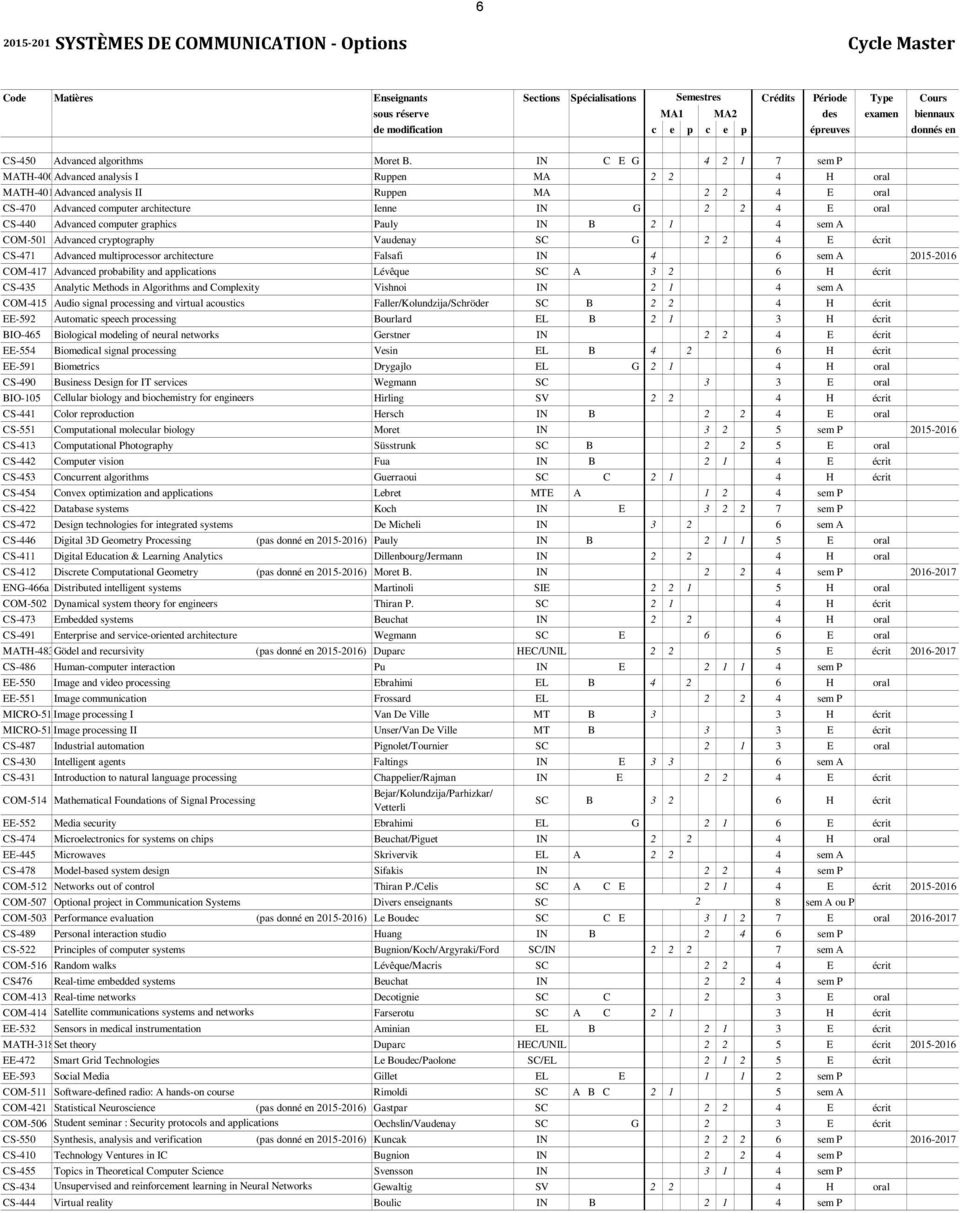
6 SYSTÈMES DE COMMUNICATION Options Cycle Master Code Matières Enseignants Sections Spécialisations Semestres Crédits Période Type Cours sous réserve MA1 MA2 des examen biennaux de modification c e p c e p épreuves donnés en CS-450 Advanced algorithms Moret B. IN C E G sem P MATH-400Advanced analysis I Ruppen MA H oral MATH-401Advanced analysis II Ruppen MA E oral CS-470 Advanced computer architecture Ienne IN G E oral CS-440 Advanced computer graphics Pauly IN B sem A COM-501 Advanced cryptography Vaudenay SC G E écrit CS-471 Advanced multiprocessor architecture Falsafi IN 4 6 sem A COM-417 Advanced probability and applications Lévêque SC A H écrit CS-435 Analytic Methods in Algorithms and Complexity Vishnoi IN sem A COM-415 Audio signal processing and virtual acoustics Faller/Kolundzija/Schröder SC B H écrit EE-592 Automatic speech processing Bourlard EL B H écrit BIO-465 Biological modeling of neural networks Gerstner IN E écrit EE-554 Biomedical signal processing Vesin EL B H écrit EE-591 Biometrics Drygajlo EL G H oral CS-490 Business Design for IT services Wegmann SC 3 3 E oral BIO-105 Cellular biology and biochemistry for engineers Hirling SV H écrit CS-441 Color reproduction Hersch IN B E oral CS-551 Computational molecular biology Moret IN sem P CS-413 Computational Photography Süsstrunk SC B E oral CS-442 Computer vision Fua IN B E écrit CS-453 Concurrent algorithms Guerraoui SC C H écrit CS-454 Convex optimization and applications Lebret MTE A sem P CS-422 Database systems Koch IN E sem P CS-472 Design technologies for integrated systems De Micheli IN sem A CS-446 Digital 3D Geometry Processing (pas donné en ) Pauly IN B E oral CS-411 Digital Education & Learning Analytics Dillenbourg/Jermann IN H oral CS-412 Discrete Computational Geometry (pas donné en ) Moret B. IN sem P ENG-466a Distributed intelligent systems Martinoli SIE H oral COM-502 Dynamical system theory for engineers Thiran P. SC H écrit CS-473 Embedded systems Beuchat IN H oral CS-491 Enterprise and service-oriented architecture Wegmann SC E 6 6 E oral MATH-483Gödel and recursivity (pas donné en ) Duparc HEC/UNIL E écrit CS-486 Human-computer interaction Pu IN E sem P EE-550 Image and video processing Ebrahimi EL B H oral EE-551 Image communication Frossard EL sem P MICRO-51 Image processing I Van De Ville MT B 3 3 H écrit MICRO-51 Image processing II Unser/Van De Ville MT B 3 3 E écrit CS-487 Industrial automation Pignolet/Tournier SC E oral CS-430 Intelligent agents Faltings IN E sem A CS-431 Introduction to natural language processing Chappelier/Rajman IN E E écrit COM-514 Mathematical Foundations of Signal Processing Bejar/Kolundzija/Parhizkar/ Vetterli SC B H écrit EE-552 Media security Ebrahimi EL G E écrit CS-474 Microelectronics for systems on chips Beuchat/Piguet IN H oral EE-445 Microwaves Skrivervik EL A sem A CS-478 Model-based system design Sifakis IN sem P COM-512 Networks out of control Thiran P./Celis SC A C E E écrit COM-507 Optional project in Communication Systems Divers enseignants SC 2 8 sem A ou P COM-503 Performance evaluation (pas donné en ) Le Boudec SC C E E oral CS-489 Personal interaction studio Huang IN B sem P CS-522 Principles of computer systems Bugnion/Koch/Argyraki/Ford SC/IN sem A COM-516 Random walks Lévêque/Macris SC E écrit CS476 Real-time embedded systems Beuchat IN sem P COM-413 Real-time networks Decotignie SC C 2 3 E oral COM-414 Satellite communications systems and networks Farserotu SC A C H écrit EE-532 Sensors in medical instrumentation Aminian EL B E écrit MATH-318Set theory Duparc HEC/UNIL E écrit EE-472 Smart Grid Technologies Le Boudec/Paolone SC/EL E écrit EE-593 Social Media Gillet EL E sem P COM-511 Software-defined radio: A hands-on course Rimoldi SC A B C sem A COM-421 Statistical Neuroscience (pas donné en ) Gastpar SC E écrit COM-506 Student seminar : Security protocols and applications Oechslin/Vaudenay SC G 2 3 E écrit CS-550 Synthesis, analysis and verification (pas donné en ) Kuncak IN sem P CS-410 Technology Ventures in IC Bugnion IN sem P CS-455 Topics in Theoretical Computer Science Svensson IN sem P CS-434 Unsupervised and reinforcement learning in Neural Networks Gewaltig SV H oral CS-444 Virtual reality Boulic IN B sem P
7 SYSTÈMES DE COMMUNICATION Spécialisations 7 Les enseignants, les crédits et la période des cours sont indiqués sous réserve de modification. Code Matières Enseignants Sections Crédits Période des cours Spécialisation A. "WIRELESS COMMUNICATIONS" Responsable : Prof. E. Telatar 51 COM-510 Advanced digital communications Gastpar SC 7 A COM-417 Advanced probability and applications Lévêque SC 6 A CS-454 Convex optimization and applications Lebret MTE 4 P COM-404 Information theory and coding Telatar SC 7 A EE-445 Microwaves Skrivervik EL 3 A COM-405 Mobile networks Hubaux SC 4 P COM-512 Networks out of control Thiran P./Celis SC 4 P EE-345 * Rayonnement et antennes Mosig/Skrivervik EL 3 A COM-414 Satellite communications systems and networks Farserotu SC 3 A COM-511 Software-defined radio : A hands-on course Rimoldi SC 5 A COM-500 Statistical signal and data processing through applications Ridolfi SC 5 P Spécialisation B. "SIGNALS, IMAGES, AND INTERFACES" Responsables : Prof. R. Hersch et Prof. M. Vetterli 89 CS-440 Advanced computer graphics Pauly IN 4 A COM-415 Audio signal processing and virtual acoustics Faller/Schröder/Kolundzija SC 4 A EE-554 Automatic speech processing Bourlard EL 3 A EE-512 Biomedical signal procesing Vesin EL 6 A CS-441 Color reproduction Hersch IN 4 P CS-413 Computational Photography Süsstrunk SC 5 P CS-442 Computer vision Fua IN 4 P CS-446 Digital 3D Geometry Processing (pas donné en ) Pauly IN 5 P EE-550 Image and video processing Ebrahimi EL 6 A MICRO-511 Image processing I Van De Ville MT 3 A MICRO-512 Image processing II Unser/Van De Ville MT 3 P CS-341 Introduction to computer graphics Pauly IN 6 P COM-514 Mathematical Foundations of Signal Processing Kolundzija/Vetterli/Bejar/Parhizkar SC 6 A CS-433 Pattern classification an machine learning Khan IN 7 A CS-489 Personal interaction studio Huang IN 6 P EE-511 Sensors in medical instrumentation Aminian EL 3 P COM-511 Software-defined radio: A hands-on course Rimoldi SC 5 A COM-500 Statistical signal and data processing through applications Ridolfi SC 5 P CS-444 Virtual reality Boulic IN 4 P Spécialisation C. "NETWORKING AND MOBILITY" Responsable : Prof. J.-Y. Le Boudec 46 CS.450 Advanced algorithms Moret B. IN 7 P CS.453 Concurrent algorithms Guerraoui SC 4 A COM-401 Cryptography and security Vaudenay SC 7 A CS-423 Distributed information systems Aberer SC 4 P COM-405 Mobile networks Hubaux SC 4 P COM-512 Networks out of control Thiran P./Celis SC 4 P COM-503 Performance evaluation (pas donné en ) Le Boudec SC 7 P COM-413 Real-time networks Decotignie SC 3 P COM-414 Satellite communications systems and networks Farserotu SC 3 A COM-511 Software-defined radio: A hands-on course Rimoldi SC 5 A COM-407 TCP/IP networking Le Boudec SC 5 A Légende : * = cours hors plan d'études pour les étudiants ne faisant pas la spécialisation A = automne, P = printemps - 1 semestre comprend 14 semaines

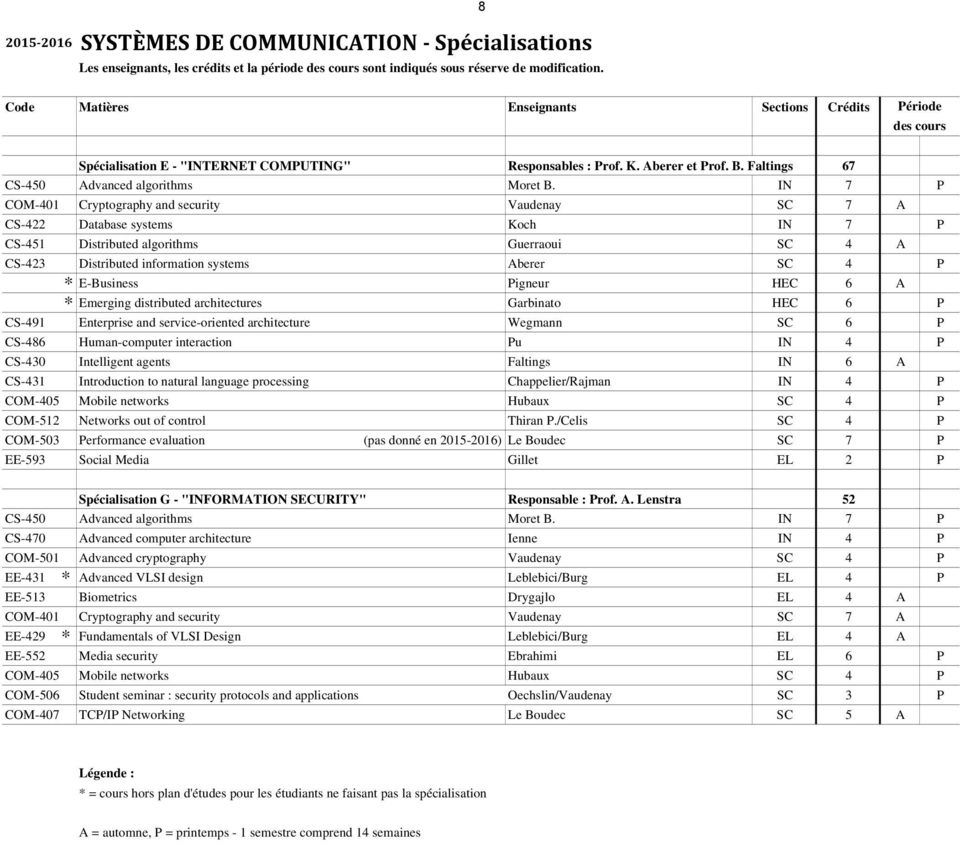
8 SYSTÈMES DE COMMUNICATION Spécialisations Les enseignants, les crédits et la période des cours sont indiqués sous réserve de modification. 8 Code Matières Enseignants Sections Crédits Période des cours Spécialisation E - "INTERNET COMPUTING" Responsables : Prof. K. Aberer et Prof. B. Faltings 67 CS-450 Advanced algorithms Moret B. IN 7 P COM-401 Cryptography and security Vaudenay SC 7 A CS-422 Database systems Koch IN 7 P CS-451 Distributed algorithms Guerraoui SC 4 A CS-423 Distributed information systems Aberer SC 4 P * E-Business Pigneur HEC 6 A * Emerging distributed architectures Garbinato HEC 6 P CS-491 Enterprise and service-oriented architecture Wegmann SC 6 P CS-486 Human-computer interaction Pu IN 4 P CS-430 Intelligent agents Faltings IN 6 A CS-431 Introduction to natural language processing Chappelier/Rajman IN 4 P COM-405 Mobile networks Hubaux SC 4 P COM-512 Networks out of control Thiran P./Celis SC 4 P COM-503 Performance evaluation (pas donné en ) Le Boudec SC 7 P EE-593 Social Media Gillet EL 2 P Spécialisation G - "INFORMATION SECURITY" Responsable : Prof. A. Lenstra 52 CS-450 Advanced algorithms Moret B. IN 7 P CS-470 Advanced computer architecture Ienne IN 4 P COM-501 Advanced cryptography Vaudenay SC 4 P EE-431 * Advanced VLSI design Leblebici/Burg EL 4 P EE-513 Biometrics Drygajlo EL 4 A COM-401 Cryptography and security Vaudenay SC 7 A EE-429 * Fundamentals of VLSI Design Leblebici/Burg EL 4 A EE-552 Media security Ebrahimi EL 6 P COM-405 Mobile networks Hubaux SC 4 P COM-506 Student seminar : security protocols and applications Oechslin/Vaudenay SC 3 P COM-407 TCP/IP Networking Le Boudec SC 5 A Légende : * = cours hors plan d'études pour les étudiants ne faisant pas la spécialisation A = automne, P = printemps - 1 semestre comprend 14 semaines
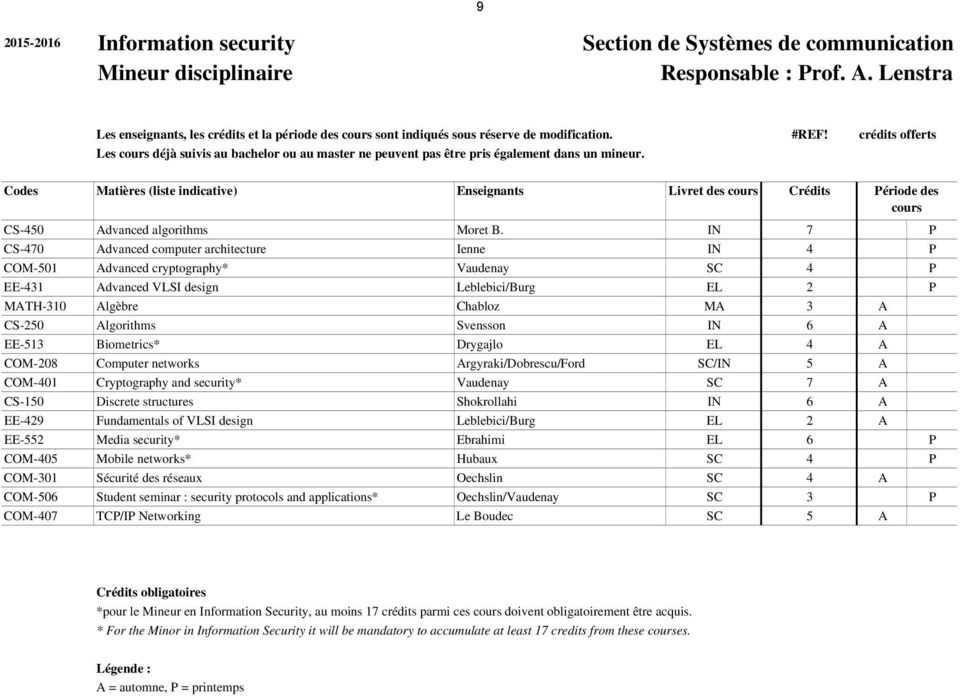
9 Information security Section de Systèmes de communication Mineur disciplinaire Responsable : Prof. A. Lenstra Les enseignants, les crédits et la période des cours sont indiqués sous réserve de modification. #REF! crédits offerts Les cours déjà suivis au bachelor ou au master ne peuvent pas être pris également dans un mineur. Codes Matières (liste indicative) Enseignants Livret des cours Crédits Période des cours CS-450 Advanced algorithms Moret B. IN 7 P CS-470 Advanced computer architecture Ienne IN 4 P COM-501 Advanced cryptography* Vaudenay SC 4 P EE-431 Advanced VLSI design Leblebici/Burg EL 2 P MATH-310 Algèbre Chabloz MA 3 A CS-250 Algorithms Svensson IN 6 A EE-513 Biometrics* Drygajlo EL 4 A COM-208 Computer networks Argyraki/Dobrescu/Ford SC/IN 5 A COM-401 Cryptography and security* Vaudenay SC 7 A CS-150 Discrete structures Shokrollahi IN 6 A EE-429 Fundamentals of VLSI design Leblebici/Burg EL 2 A EE-552 Media security* Ebrahimi EL 6 P COM-405 Mobile networks* Hubaux SC 4 P COM-301 Sécurité des réseaux Oechslin SC 4 A COM-506 Student seminar : security protocols and applications* Oechslin/Vaudenay SC 3 P COM-407 TCP/IP Networking Le Boudec SC 5 A Crédits obligatoires *pour le Mineur en Information Security, au moins 17 crédits parmi ces cours doivent obligatoirement être acquis. * For the Minor in Information Security it will be mandatory to accumulate at least 17 credits from these courses. Légende : A = automne, P = printemps
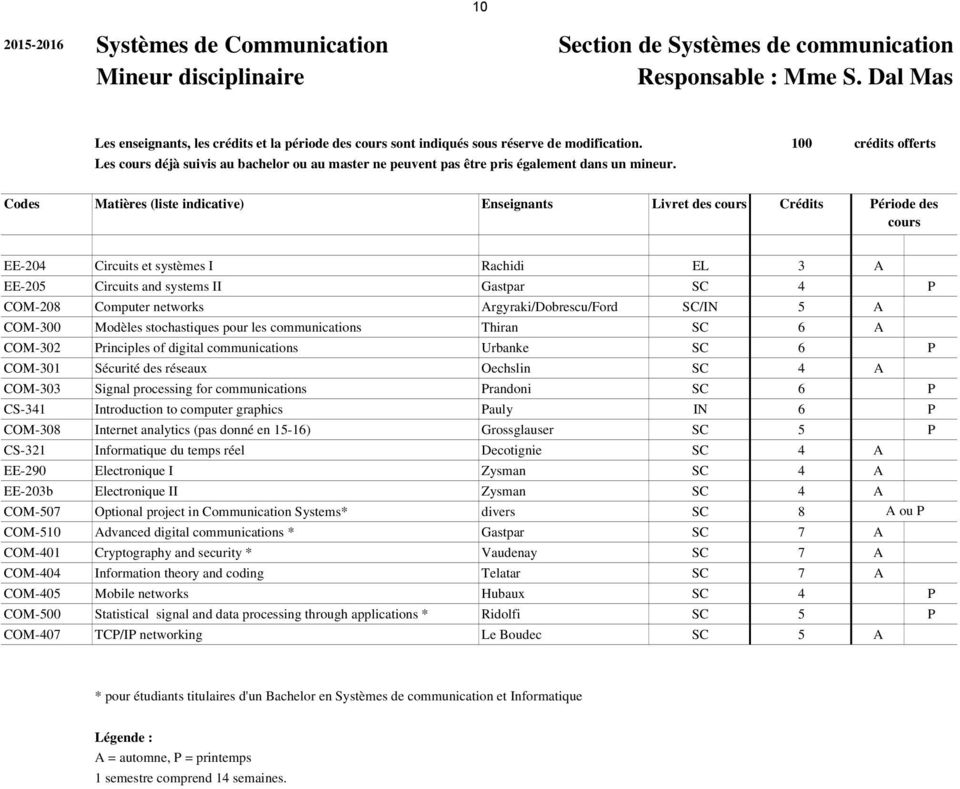
10 Systèmes de Communication Section de Systèmes de communication Mineur disciplinaire Responsable : Mme S. Dal Mas Les enseignants, les crédits et la période des cours sont indiqués sous réserve de modification. 100 crédits offerts Les cours déjà suivis au bachelor ou au master ne peuvent pas être pris également dans un mineur. Codes Matières (liste indicative) Enseignants Livret des cours Crédits Période des cours EE-204 Circuits et systèmes I Rachidi EL 3 A EE-205 Circuits and systems II Gastpar SC 4 P COM-208 Computer networks Argyraki/Dobrescu/Ford SC/IN 5 A COM-300 Modèles stochastiques pour les communications Thiran SC 6 A COM-302 Principles of digital communications Urbanke SC 6 P COM-301 Sécurité des réseaux Oechslin SC 4 A COM-303 Signal processing for communications Prandoni SC 6 P CS-341 Introduction to computer graphics Pauly IN 6 P COM-308 Internet analytics (pas donné en 15-16) Grossglauser SC 5 P CS-321 Informatique du temps réel Decotignie SC 4 A EE-290 Electronique I Zysman SC 4 A EE-203b Electronique II Zysman SC 4 A COM-507 Optional project in Communication Systems* divers SC 8 A ou P COM-510 Advanced digital communications * Gastpar SC 7 A COM-401 Cryptography and security * Vaudenay SC 7 A COM-404 Information theory and coding Telatar SC 7 A COM-405 Mobile networks Hubaux SC 4 P COM-500 Statistical signal and data processing through applications * Ridolfi SC 5 P COM-407 TCP/IP networking Le Boudec SC 5 A * pour étudiants titulaires d'un Bachelor en Systèmes de communication et Informatique Légende : A = automne, P = printemps 1 semestre comprend 14 semaines.
11 11 RÈGLEMENT D APPLICATION DU CONTRÔLE DES ÉTUDES DE LA SECTION DE SYSTÈMES DE COMMUNICATION pour l année académique du 18 mai 2015 La direction de l'école polytechnique fédérale de Lausanne vu l'ordonnance sur la formation menant au bachelor et au master de l'epfl du 14 juin 2004, vu l'ordonnance sur le contrôle des études menant au bachelor et au master à l'epfl du 14 juin 2004, vu le plan d études de la section de systèmes de communication arrête: Article premier - Champ d'application Le présent règlement fixe les règles d application du contrôle des études de bachelor et de master de la section de systèmes de communication qui se rapportent à l année académique Art. 2 Étapes de formation 1. Le bachelor est composé de deux étapes successives de formation : - le cycle propédeutique d une année dont la réussite se traduit par 60 crédits ECTS acquis en une fois, condition pour entrer au cycle bachelor. Le cycle propédeutique est commun avec celui de la section informatique. - le cycle bachelor s étendant sur deux ans dont la réussite implique l acquisition de 120 crédits, condition pour entrer au master. 2. Le master effectué à l EPFL est composé de deux étapes successives de formation : - le cycle master d une durée de 3 semestres dont la réussite implique l acquisition de 90 crédits, condition pour effectuer le projet de master. - le projet de master, d une durée de 17 semaines à l EPFL ou de 25 semaines hors EPFL (industrie ou autre haute école) et dont la réussite se traduit par l acquisition de 30 crédits. Il est placé sous la responsabilité d'un professeur ou MER affilié à la section de systèmes de communication.. Art 3 Sessions d examen 1. Les branches d examen sont examinées par écrit ou par oral pendant les sessions d hiver ou d été. Elles sont mentionnées dans le plan d études avec la mention H ou E. 2. Les branches de semestre sont examinées pendant le semestre d automne ou le semestre de printemps. Elles sont mentionnées dans le plan d études avec la mention sem A ou sem P. 3. Une branche annuelle, c est à dire dont l intitulé tient sur une seule ligne dans le plan d étude, est examinée globalement pendant la session d été (E). 4 Pour les branches de session, la forme écrite ou orale de l examen indiquée pour la session peut être complétée par des contrôles de connaissances écrits ou oraux durant le semestre, selon indications de l enseignant. Chapitre 1 : Cycle propédeutique Art. 4 - Examen propédeutique 1 L examen propédeutique comprend des branches «Polytechniques» pour 35 coefficients et des branches «Spécifiques» pour 26 coefficients, distribuées indifféremment sur deux blocs. 2 Le premier bloc de branches correspond à 34 coefficients et le second bloc de branches correspond à 27 Chapitre 2 : Cycle bachelor Art. 5 - Organisation 1 Les enseignements du bachelor sont répartis en cinq blocs, le groupe «projet», le groupe «options» et le bloc transversal SHS. 2 Le groupe «options» se compose de toutes les branches à option figurant dans la liste du plan d études de 2 ème année et 3 ème année. 32 crédits doivent être obtenus individuellement dans le groupe «options», dont 9 crédits dans les options de 2 ème année. Les crédits pris en supplément des 9 crédits exigés de 2 ème année peuvent être validés comme crédits à options de 3 ème année. 3 En 3 ème année, des cours comptant pour un maximum de 10 crédits au total peuvent être choisis en dehors de la liste du plan d études. Les cours pris en dehors de cette liste doivent être acceptés préalablement par le directeur de la section. Art. 6 Filières 1 Les filières obligatoires sont acquises automatiquement par la réussite des blocs A, B C, D et E. 2 Les étudiants doivent réussir au minimum une filière optionnelle parmi les quatre proposées 3 Une filière est réussie lorsque tous les crédits des cours obligatoires de la filière sont obtenus individuellement. Art. 7 - Examen de 2 ème année 1 Les 11 crédits du plan d études sont obtenus lorsque le bloc A est réussi. 2 Les 17 crédits du plan d études sont obtenus lorsque le bloc B est réussi. 3 Les 19 crédits du plan d études sont obtenus lorsque le bloc C est réussi.
12 12 4 Les 9 crédits de 2 ème année du groupe «options» s acquièrent de façon indépendante, par réussite individuelle de chaque branche. Art. 8 - Examen de 3e année 1 Les 18 crédits du plan d études sont obtenus lorsque le bloc D est réussi. 2 Les 7 crédits du plan d études sont obtenus lorsque le bloc E est réussi. 3 Les 8 crédits du groupe «projet» s acquièrent de façon indépendante, par réussite individuelle du projet. 4 Les 23 crédits de 3 ème année du groupe «options» s acquièrent de façon indépendante, par réussite individuelle de chaque branche. Art. 9 - Examen de 2e et 3e années Le bloc «SHS transversal» est réussi lorsque les 8 crédits du plan d études sont obtenus. Chapitre 3 : Cycle master Art Organisation 1. Les enseignements du cycle master sont répartis en deux groupes et un bloc dont les crédits doivent être obtenus de façon indépendante. Ils peuvent donner lieu à l obtention d une spécialisation ou d un mineur. 2. Le bloc «Projets et SHS» est composé d un projet de 12 crédits et de l enseignement SHS. 3. Le groupe 1 «Core courses» est composé des cours de la liste du plan d études dans la rubrique «Master». 4. Le groupe 2 «Options» est composé - des cours de la liste du groupe 2 «options» du plan d études dans la rubrique «Master» ; - des crédits surnuméraires obtenus dans le groupe 1 «Core courses» ; - d un projet optionnel de 8 crédits suivant l alinéa 5 ; - de cours hors plan d études suivant l alinéa 6 ; - de cours liés à une spécialisation ou un mineur suivant l art Le projet du bloc «Projets et SHS» et le projet optionnel du groupe 2 ne peuvent être effectués dans le même semestre. 6. Des cours, comptant pour un maximum de 15 crédits au total, peuvent être choisis en dehors de la liste des cours du plan d études dans la rubrique «Master». Le choix de ces cours doit être accepté préalablement par le directeur de la section qui peut augmenter le maximum de 15 crédits si la demande est justifiée. Art Examen du cycle master 1. Le bloc «Projets et SHS» est réussi lorsque 18 crédits sont obtenus. 2. Le groupe «Core courses et Options», composé du groupe 1 «Core courses» et du groupe 2 «Options» est réussi lorsque 72 crédits sont obtenus. 3. Le groupe 1 «Core courses» est réussi lorsqu au moins 30 crédits sont obtenus. Art Enseignement SHS 1. La formation SHS au cycle master commence uniquement en automne. Le semestre d'automne est un enseignement présentiel qui prépare à la réalisation du projet au second semestre. La branche SHS donne lieu à 3 crédits par semestre. 2. Lorsque, pour un motif important et dument justifié, l'étudiant est dans l'impossibilité de réaliser son projet immédiatement après le premier semestre, il peut être autorisé à le délivrer durant l un des semestres de l année académique suivante. 3. Toute dérogation à ces principes doit être dûment documentée et sollicitée par écrit auprès de la direction du Collège des Humanités. Art. 13 Mineurs et spécialisations 1. Afin d approfondir un aspect particulier de sa formation ou de développer des interfaces avec d autres sections, l étudiant peut choisir la formation offerte dans le cadre d'un mineur figurant dans l offre de l EPFL ou d une spécialisation de la section de systèmes de communication. 2. Le choix des cours qui composent un mineur se fait avec la section de systèmes de communication et avec le responsable du mineur. Les mineurs «Information security» et «Systèmes de Communication» ne peuvent pas être choisis. 3. Le choix des cours qui composent une spécialisation est soumis, pour concertation à la section de systèmes de communication. 4. L étudiant annonce le choix d un mineur à sa section au plus tard à la fin du premier semestre des études de master. 5. L étudiant qui choisit une spécialisation dans la liste figurant dans le plan d études s inscrit au plus tard au début du troisième semestre des études de master. 6. Un mineur ou une spécialisation est réussi quand 30 crédits au minimum sont obtenus parmi les branches avalisées.
13 Chapitre 4 : Stage et Projet de master 13 Art. 14 Stage d ingénieur 1. Les étudiants commençant leur cycle master doivent effectuer un stage d ingénieur durant leur master : - soit un stage d été de minimum 8 semaines u - soit un stage de minimum 6 mois en entreprise (en congé durant un semestre) - soit un Projet de Master de 25 semaines en entreprise (valide le stage et le Projet de Master) 2. Le stage peut être effectué dès le 2 ème semestre du cycle master, mais avant le projet de master. 3. Le responsable du stage de la section évalue le stage, par l appréciation «réussi» ou «non réussi». Sa réussite sera une condition pour l admission au projet de master. En cas de non réussite, il pourra être répété une fois, en règle générale dans une autre entreprise. 4. Il est validé avec les 30 crédits du projet de master. 5. Les modalités d organisation et les critères de validation du stage font l objet d une directive interne à la section. Chapitre 5 : Mobilité Art. 15 Périodes de mobilité autorisées Les étudiants de la section des systèmes de communication peuvent effectuer un séjour de mobilité en 3 ème année de bachelor et/ou dans le cadre du projet de master. Art Conditions 1. Pour une mobilité en 3 ème année de bachelor, l étudiant doit avoir réussi l examen propédeutique avec une moyenne minimale de 4,5 et ne pas avoir de retard dans l acquisition des 60 crédits de la 2 ème année de bachelor. 2. Pour une mobilité au projet de master, l étudiant doit avoir réussi le cycle master. 3. Des conditions spécifiques existant en fonction des destinations, l accord du délégué à la mobilité est nécessaire pour partir en séjour de mobilité. Au nom de la direction de l'epfl Le président, P. Aebischer Le vice-président pour les affaires académiques, P. Gillet Lausanne, le 18 mai 2015
14 14

15 15 ÉCOLE POLYTECHNIQUE FÉDÉRALE DE LAUSANNE SECTION DE SYSTEMES DE COMMUNICATION Cycle Propédeutique (1ère année) 2015 / 2016

16 16

17 LIVRET DE COURS 17 MATH-111(e) Algèbre linéaire Jetchev Dimitar Petkov Cursus Sem. Type Informatique BA1 Obl. Systèmes de communication BA1 Obl. Langue français Coefficient 6 Session Hiver Semestre Automne Examen Ecrit Charge 180h Semaines 14 Heures 6 hebdo Cours 4 hebdo Exercices 2 hebdo RESUME L'objectif du cours est d'introduire les notions de base de l'algèbre linéaire et ses applications. CONTENU 1. Systèmes linéaires; 2. Algèbre matricielle; 3. Espaces vectoriels et applications linéaires; 4. Bases et dimension; 5. Valeurs propres et vecteurs propres; 6. Produit scalaire, orthogonalité, formes quadratiques. MOTS-CLES espace vectoriel, linéarite, matrice, déterminant, orthogonalité, produit scalaire COMPETENCES REQUISES Cours prérequis indicatifs cours de base ACQUIS DE FORMATION A la fin de ce cours l'étudiant doit être capable de: Effectuer des calculs standards en algèbre linéaire et en interprêter les résultats; Définir des concepts théoriques relevants de l'algèbre linéaire et en donner des exemples illustratifs; Identifier des exemples de concepts théoriques relevants de l'algèbre linéaire; Construire rigoureusement un raisonnement logique simple; Identifier quelques liens entre l'algèbre linéaire et d'autres branches des mathématiques. METHODE D'ENSEIGNEMENT Cours ex cathedra, exercices en salle METHODE D'EVALUATION examen écrit ENCADREMENT Office hours Assistants Non Oui Algèbre linéaire Page 1 / 2

18 LIVRET DE COURS 18 Forum électronique Non RESSOURCES Bibliographie Algèbre linéaire et applications, David C. Lay, 4e edition, editeur: Pearson, ISBN: Ressources en bibliothèque Algèbre linéaire et applications / Lay Références suggérées par la bibliothèque PREPARATION POUR Algèbre Linéaire II; Analyse II Algèbre linéaire Page 2 / 2

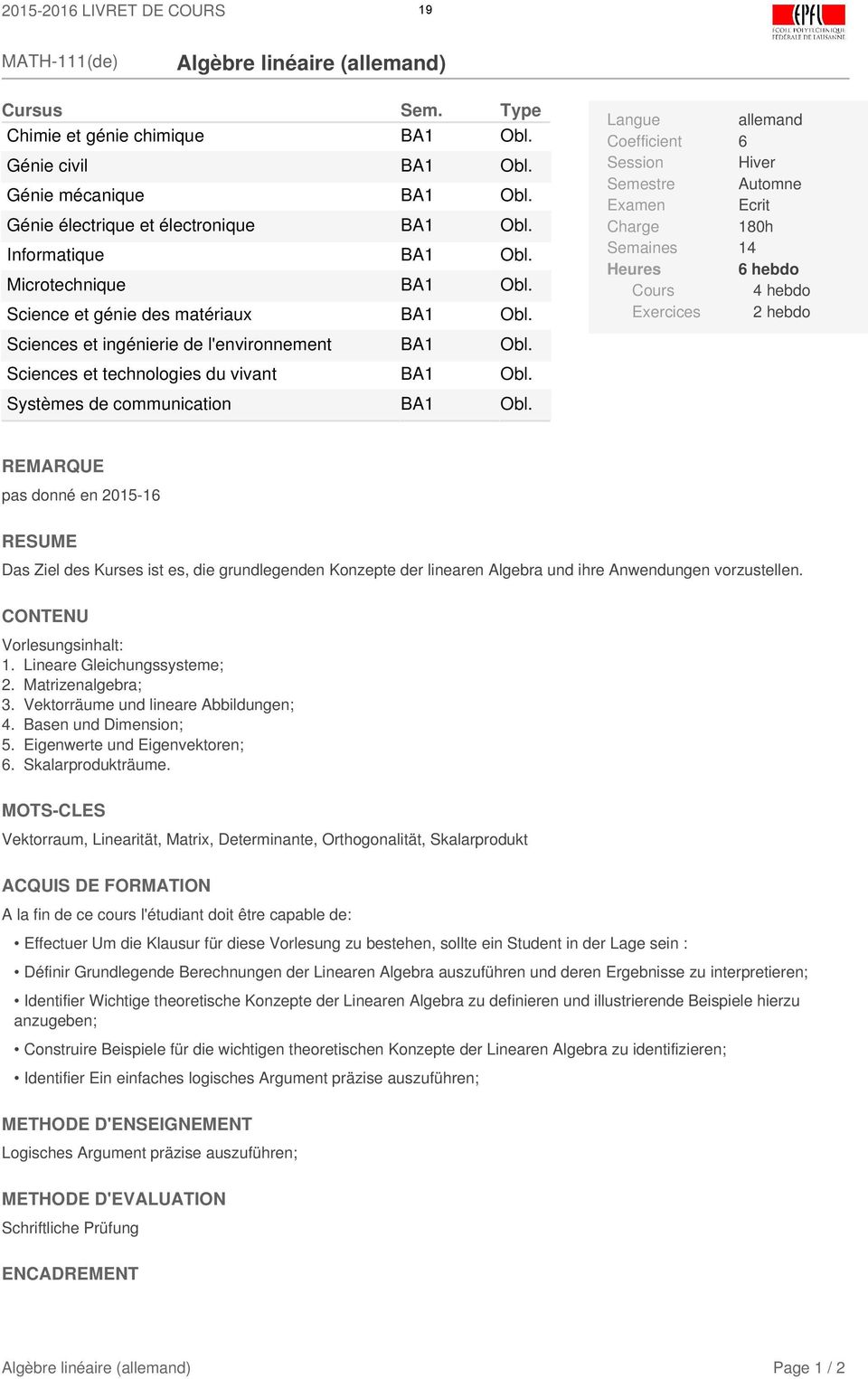
19 LIVRET DE COURS 19 MATH-111(de) Algèbre linéaire (allemand) Cursus Sem. Type Chimie et génie chimique BA1 Obl. Génie civil BA1 Obl. Génie mécanique BA1 Obl. Génie électrique et électronique BA1 Obl. Informatique BA1 Obl. Microtechnique BA1 Obl. Science et génie des matériaux BA1 Obl. Sciences et ingénierie de l'environnement BA1 Obl. Sciences et technologies du vivant BA1 Obl. Systèmes de communication BA1 Obl. Langue allemand Coefficient 6 Session Hiver Semestre Automne Examen Ecrit Charge 180h Semaines 14 Heures 6 hebdo Cours 4 hebdo Exercices 2 hebdo REMARQUE pas donné en RESUME Das Ziel des Kurses ist es, die grundlegenden Konzepte der linearen Algebra und ihre Anwendungen vorzustellen. CONTENU Vorlesungsinhalt: 1. Lineare Gleichungssysteme; 2. Matrizenalgebra; 3. Vektorräume und lineare Abbildungen; 4. Basen und Dimension; 5. Eigenwerte und Eigenvektoren; 6. Skalarprodukträume. MOTS-CLES Vektorraum, Linearität, Matrix, Determinante, Orthogonalität, Skalarprodukt ACQUIS DE FORMATION A la fin de ce cours l'étudiant doit être capable de: Effectuer Um die Klausur für diese Vorlesung zu bestehen, sollte ein Student in der Lage sein : Définir Grundlegende Berechnungen der Linearen Algebra auszuführen und deren Ergebnisse zu interpretieren; Identifier Wichtige theoretische Konzepte der Linearen Algebra zu definieren und illustrierende Beispiele hierzu anzugeben; Construire Beispiele für die wichtigen theoretischen Konzepte der Linearen Algebra zu identifizieren; Identifier Ein einfaches logisches Argument präzise auszuführen; METHODE D'ENSEIGNEMENT Logisches Argument präzise auszuführen; METHODE D'EVALUATION Schriftliche Prüfung ENCADREMENT Algèbre linéaire (allemand) Page 1 / 2
20 LIVRET DE COURS 20 Office hours Assistants Forum électronique Non Oui Non PREPARATION POUR Algèbre linéaire II; Analyses II Algèbre linéaire (allemand) Page 2 / 2

21 21 MATH-111(en) Algèbre linéaire (anglais) Pach János Cursus Sem. Type Chimie et génie chimique BA1 Obl. Génie civil BA1 Obl. Génie mécanique BA1 Obl. Génie électrique et électronique BA1 Obl. Informatique BA1 Obl. Microtechnique BA1 Obl. Science et génie des matériaux BA1 Obl. Sciences et ingénierie de l'environnement BA1 Obl. Sciences et technologies du vivant BA1 Obl. Systèmes de communication BA1 Obl. Language English Coefficient 6 Session Winter Semester Fall Exam Written Workload 180h Weeks 14 Hours 6 weekly Lecture 4 weekly Exercises 2 weekly SUMMARY The purpose of the course is to introduce the basic notions of linear algebra and its applications. CONTENT 1. Linear systems; 2. Matrix algebra; 3. Vector spaces and linear applications; 4. Bases and dimension; 5. Eigenvalues and eigenvectors; 6. Inner product, orthogonality, quadratic forms. KEYWORDS vector space, linearity, matrix, determinant, orthogonality, inner product LEARNING OUTCOMES By the end of the course, the student must be able to: Accurately make standard computations relevant to linear algebra and interpret the results; Define and provide illustrative examples of relevant theoretical notions; Identify examples of relevant theoretical notions; Construct a simple logical argument rigorously; Identify some connections between linear algebra and other branches of mathematics. TEACHING METHODS Lectures and exercises in the classroom ASSESSMENT METHODS Written exam SUPERVISION Office hours Assistants Forum No Yes No PREREQUISITE FOR Algèbre linéaire (anglais) Page 1 / 2
22 22 linear algebra II; Analysis II Algèbre linéaire (anglais) Page 2 / 2
23 LIVRET DE COURS 23 MATH-101(e) Analyse I Lachowska Anna Cursus Sem. Type Informatique BA1 Obl. Systèmes de communication BA1 Obl. Langue français Coefficient 6 Session Hiver Semestre Automne Examen Ecrit Charge 180h Semaines 14 Heures 6 hebdo Cours 4 hebdo Exercices 2 hebdo RESUME Étudier les concepts fondamentaux d'analyse et le calcul différentiel et intégral des fonctions réelles d'une variable. CONTENU - Raisonner, démontrer et argumenter en mathématiques - Nombres, structures et fonctions - Suites, limites et continuité - Séries numériques - Fonctions réelles et processus de limite - Calcul différentiel et intégral MOTS-CLES nombres réels, fonction, suite numérique, suite convergente/divergente, limite d'une suite, sous-suite, fonction, limite d'une fonction, fonction continue, série numérique, série convergente/divergente, convergence absolue, dérivée, classe C^k, théorème(s) des accroissements finis, développement limité, série entière, intégrale de Riemann, primitive, théorème de la valeur moyenne ACQUIS DE FORMATION Le but fondamental de ce cours est d'acquérir les compétences suivantes : Raisonner rigoureusement pour analyser des problèmes Choisir ou sélectionner les outils d'analyse pertinents pour résoudre des problèmes Identifier les concepts inhérents à chaque problème Appliquer efficacement les concepts pour résoudre les exercices similaires aux exemples et exercices traités au cours Se montrer capable d'analyser et de résoudre des problèmes nouveaux Résoudre les problèmes de convergence, de suites et de séries Maîtriser les techniques du calcul différentiel et intégral Parmi les outils de base, on trouve les notions de convergence, de suites et de séries. Les fonctions d'une variable seront étudiées rigoureusement, avec pour but une compréhension approfondie des techniques du calcul différentiel et intégral. METHODE D'ENSEIGNEMENT Cours ex cathedra et exercices en salle METHODE D'EVALUATION Analyse I Page 1 / 2
24 LIVRET DE COURS 24 Examen écrit ENCADREMENT Office hours Assistants Forum électronique Autres Non Oui Non Tutorat des exercices autres mesures à définir RESSOURCES Bibliographie Jacques Douchet and Bruno Zwahlen: Calcul différentiel et intégral. PPUR, Analyse I Page 2 / 2
25 LIVRET DE COURS 25 MATH-101(de) Analyse I (allemand) Kressner Daniel, Krumscheid Sebastian Cursus Sem. Type Chimie et génie chimique BA1 Obl. Génie civil BA1 Obl. Génie mécanique BA1 Obl. Génie électrique et électronique BA1 Obl. Informatique BA1 Obl. Microtechnique BA1 Obl. Science et génie des matériaux BA1 Obl. Sciences et ingénierie de l'environnement BA1 Obl. Sciences et technologies du vivant BA1 Obl. Systèmes de communication BA1 Obl. Langue allemand Coefficient 6 Session Hiver Semestre Automne Examen Ecrit Charge 180h Semaines 14 Heures 6 hebdo Cours 4 hebdo Exercices 2 hebdo RESUME Étudier les concepts fondamentaux d'analyse et le calcul différentiel et intégral des fonctions réelles d'une variable. CONTENU - Raisonner, démontrer et argumenter en mathématiques - Nombres, structures et fonctions - Suites, limites et continuité - Séries numériques - Fonctions réelles et processus de limite - Calcul différentiel et intégral MOTS-CLES nombres réels, fonction, suite numérique, suite convergente/divergente, limite d'une suite, sous-suite, fonction, limite d'une fonction, fonction continue, série numérique, série convergente/divergente, convergence absolue, dérivée, classe C^k, théorème(s) des accroissements finis, développement limité, série entière, intégrale de Riemann, primitive, théorème de la valeur moyenne ACQUIS DE FORMATION Le but fondamental de ce cours est d'acquérir les compétences suivantes : Raisonner rigoureusement pour analyser des problèmes Choisir ou sélectionner les outils d'analyse pertinents pour résoudre des problèmes Identifier les concepts inhérents à chaque problème Appliquer efficacement les concepts pour résoudre les exercices similaires aux exemples et exercices traités au cours Se montrer capable d'analyser et de résoudre des problèmes nouveaux Résoudre les problèmes de convergence, de suites et de séries Maîtriser les techniques du calcul différentiel et intégral Parmi les outils de base, on trouve les notions de convergence, de suites et de séries. Les fonctions d'une variable seront étudiées rigoureusement, avec pour but une compréhension approfondie des techniques du calcul différentiel et intégral. METHODE D'ENSEIGNEMENT Analyse I (allemand) Page 1 / 2
26 LIVRET DE COURS 26 Cours ex cathedra et exercices en salle METHODE D'EVALUATION Examen écrit ENCADREMENT Office hours Assistants Forum électronique Autres Non Oui Non Tutorat des exercices autres mesures à définir RESSOURCES Bibliographie Jacques Douchet and Bruno Zwahlen: Calcul différentiel et intégral. PPUR, PREPARATION POUR Analysis II Analyse I (allemand) Page 2 / 2
27 27 MATH-101(en) Analyse I (anglais) Hausel Tamás Cursus Sem. Type Chimie et génie chimique BA1 Obl. Génie civil BA1 Obl. Génie mécanique BA1 Obl. Génie électrique et électronique BA1 Obl. Informatique BA1 Obl. Microtechnique BA1 Obl. Science et génie des matériaux BA1 Obl. Sciences et ingénierie de l'environnement BA1 Obl. Sciences et technologies du vivant BA1 Obl. Systèmes de communication BA1 Obl. Language English Coefficient 6 Session Winter Semester Fall Exam Written Workload 180h Weeks 14 Hours 6 weekly Lecture 4 weekly Exercises 2 weekly SUMMARY We study the fundamental concepts of analysis, calculus and the integral of real-valued functions of a real variable. CONTENT - Reasoning, proving and arguing in mathematics - Numbers, structures and functions - Sequences, limit and continuity - Series of reals - Real-valued functions of a real variable and convergence - Differential Calculus and the Integral KEYWORDS real numbers, function, sequence,convergent/divergent sequence, limit, subsequence, limit of a function, continuous function, series of real numbers, convergent/divergent series, absolute convergence, derivative, class C^k, mean value theorem, Taylor's theorem, Taylor series, Riemann integral, indefinite integral, intermediate valuetheorem LEARNING OUTCOMES The intended learning outcomes of this course are that students acquire the following capacities: Reason rigorously to analyse problems Choose appropriate analytical tools for problem solving. Be able to conceptualise in view of the applications of analysis. Apply efficiently mathematical concepts for problem solving by means of examples and exercises Analyze and to solve new problems. Master the basic tools of analysis as, for example, notions of convergence, sequences and series. Studying rigorously real functions we intend that students will demonstrate a deep understanding of calculus TEACHING METHODS Ex cathedra lecture and exercises in the classroom ASSESSMENT METHODS Written exam Analyse I (anglais) Page 1 / 2
28 28 SUPERVISION Office hours Assistants Forum Others No Yes No Tutoring of exercises other measures to be defined Analyse I (anglais) Page 2 / 2
29 LIVRET DE COURS 29 MATH-106(e) Analyse II Lachowska Anna Cursus Sem. Type Informatique BA2 Obl. Systèmes de communication BA2 Obl. Langue français Coefficient 6 Session Eté Semestre Printemps Examen Ecrit Charge 180h Semaines 14 Heures 6 hebdo Cours 4 hebdo Exercices 2 hebdo RESUME Étudier les concepts fondamentaux d'analyse et le calcul différentiel et intégral des fonctions réelles de plusieurs variables. CONTENU - L'espace R^n - Calcul différentiel des fonctions à plusieurs variables - Intégrales multiples - Équations différentielles ordinaires MOTS-CLES Espace vectoriel euclidien,, dérivée partielle, différentielle, matrice jacobienne, théorème de la valeur moyenne, matrice hessienne, développement limité, gradient, divergence, rotationnel, Laplacien, règle de composition, théorème des fonctions implicites, multiplicateur de Lagrange, intégrale multiple, équation différentielle ordinaire COMPETENCES REQUISES Cours prérequis obligatoires Analyse I, Algèbre linéaire I Cours prérequis indicatifs Analyse I, Algèbre linéaire I Concepts importants à maîtriser - ACQUIS DE FORMATION Le but fondamental de ce cours reste, comme pour la partie I, d'acquérir les capacités suivantes : Appliquer avec aisance et approfondir les compétences et connaissances acquises en Analyse I : Raisonner rigoureusement pour analyser les problèmes Choisir ou sélectionner les outils d'analyse pertinents pour résoudre des problèmes Identifier les concepts inhérents à chaque problème Analyse II Page 1 / 2
30 LIVRET DE COURS 30 Appliquer efficacement les concepts pour résoudre les exercices similaires aux exemples et exercices traités au cours Se montrer capable d'analyser et de résoudre des problèmes nouveaux Maîtriser les techniques du calcul différentiel et intégral. Maîtriser les équations différentielles élémentaires, l'espace R^n, les fonctions de plusieurs variables, les dérivées partielles et les intégrales multiples. METHODE D'ENSEIGNEMENT Cours ex cathedra et exercices en salle METHODE D'EVALUATION Examen écrit ENCADREMENT Office hours Assistants Forum électronique Autres Non Oui Non Tutorat des exercices autres mesures à définir RESSOURCES Bibliographie Jacques Douchet and Bruno Zwahlen: Calcul différentiel et intégral. PPUR, L'enseignant précisera les manuels recommandés dans son cours. Analyse II Page 2 / 2
31 LIVRET DE COURS 31 MATH-106(de) Analyse II (allemand) Shokrollahi Mohammad Amin Cursus Sem. Type Chimie et génie chimique BA2 Obl. Génie civil BA2 Obl. Génie mécanique BA2 Obl. Génie électrique et électronique BA2 Obl. Informatique BA2 Obl. Microtechnique BA2 Obl. Science et génie des matériaux BA2 Obl. Sciences et ingénierie de l'environnement BA2 Obl. Sciences et technologies du vivant BA2 Obl. Systèmes de communication BA2 Obl. Langue allemand Coefficient 6 Session Eté Semestre Printemps Examen Ecrit Charge 180h Semaines 14 Heures 6 hebdo Cours 4 hebdo Exercices 2 hebdo RESUME Es werden die Grundlagen der Analysis sowie der Differential- und Integralrechnung von Funktionen mehrerer reeller Veränderlicher erarbeitet. CONTENU - Der Raum R^n - Differenzialrechnung von Funktionen mehrerer Veränderlicher - Integrale ueber Teilmengen des R^n - Gewöhnliche Differentialgleichungen (wenn nicht schon im Teil I behandelt) MOTS-CLES Euclidische Raeume, totale und partielle Ableitungen, Jacobideterminante, Hess'sche, Gradient, Laplaceoperator, Kettenregel, Satz ueber implizite Funktionen, Lagrange Multiplikatoren, Integrale ueber Gebiete des R^n, Differentialgleichungen COMPETENCES REQUISES Cours prérequis obligatoires Analysis I, Lineare Algebra (I) Concepts importants à maîtriser - Differential- und Integralrechnung in einer reellen Variablen - Konvergenz - Vektorraeume, Matritzen, Eigenwerte ACQUIS DE FORMATION Das Ziel dieser Vorlesung, wie auch fuer Analysis I, ist, dass Studenten die folgenden Faehigkeiten entwickeln: Vertiefen der Fertigkeiten und Kentnisse aus der Vorlesung Analysis I Strenges argumentieren und analysieren von Problemen Auswaehlen von angemessenen analytischen Werkzeugen zur Loesung von Problemen Conzeptualisieren von Problemen Effizientes Anwenden von mathematischen Konzepten an Hand von Beispielen und Uebungen der Vorlesung Analyse II (allemand) Page 1 / 2
32 LIVRET DE COURS 32 Analysieren und Loesen von neuen Problemen Meistern einfacher Techniken der Differential- und Integralrechnung Meistern einfacher Differentialgleichungen, den Raum R^n, Funktionen auf Gebieten des R^n, ihren Ableitungen und Integralen. METHODE D'ENSEIGNEMENT Ex Cathedra Vorlesungen und Uebungen in Gruppen METHODE D'EVALUATION Schriftliches Examen ENCADREMENT Office hours Assistants Forum électronique Autres Non Oui Oui Tutorat bei den Uebungen RESSOURCES Bibliographie Jacques Douchet and Bruno Zwahlen: Calcul différentiel et intégral. PPUR, Liens Moodle PREPARATION POUR Analyse III Analyse II (allemand) Page 2 / 2
33 33 MATH-106(en) Analyse II (anglais) Hesthaven Jan Sickmann Cursus Sem. Type Chimie et génie chimique BA2 Obl. Génie civil BA2 Obl. Génie mécanique BA2 Obl. Génie électrique et électronique BA2 Obl. Informatique BA2 Obl. Microtechnique BA2 Obl. Science et génie des matériaux BA2 Obl. Sciences et ingénierie de l'environnement BA2 Obl. Sciences et technologies du vivant BA2 Obl. Systèmes de communication BA2 Obl. Language English Coefficient 6 Session Summer Semester Spring Exam Written Workload 180h Weeks 14 Hours 6 weekly Lecture 4 weekly Exercises 2 weekly SUMMARY The course studies fundamental concepts of analysis and the calculus of functions of several variables. CONTENT -The Euclidean space R^n. -Vector functions and curves -Differentiation of functions of several variables. -Multiple integrals -Ordinary differential equations. KEYWORDS Euclidean vector space, partial derivative,differential, Jacobian, Hessian, Taylor expansion, gradient, chain rule, implicit function theorem, Lagrange multipliers, multiple integrals, ordinary differential equation LEARNING PREQUISITES Required courses Analysis I, Linear Algebra I Important concepts to start the course - LEARNING OUTCOMES The goal of this course consists as for Analysis 1 is that students acquire the following capacities: Consolidate the skills and knowledge they acquired in Analysis 1. Reason rigorously and to analyse problems Choose appropriate analytical tools for problem solving. Conceptualize problems Apply Analyse II (anglais) Page 1 / 2
34 34 efficiently mathematical concepts for problem solving by means of examples and exercises Analyze and to solve new problems. Master the basic tools of analysis Master the basic tools of elementary ordinary differential equations, the Euclidean space R^n and functions of several variables TEACHING METHODS Ex cathedra lectures, exercises sessions in the classroom. ASSESSMENT METHODS Written exam SUPERVISION Office hours Assistants Forum Others No Yes No Tutoring of exercises other measures to be defined RESOURCES Bibliography Jacques Douchet and Bruno Zwahlen: Calcul différentiel et intégral. PPUR, Websites Analyse II (anglais) Page 2 / 2
35 LIVRET DE COURS 35 CS-173 Conception de systèmes numériques Sanchez Eduardo Cursus Sem. Type Informatique BA2 Obl. Systèmes de communication BA2 Obl. Langue français Coefficient 6 Session Eté Semestre Printemps Examen Pendant le semestre Charge 180h Semaines 14 Heures 6 hebdo Cours 4 hebdo Projet 2 hebdo RESUME Les étudiants se familiarisent avec les composants numériques de base des systèmes de traitement de l'information, et apprennent à utiliser des méthodes modernes d'analyse et de synthèse des systèmes combinatoires et séquentiels, à l'aide notamment des langages tels que VHDL. CONTENU 1. Numérique vs analogique. Logique : principes et opérateurs 2. Algèbre booléenne. Synthèse combinatoire. Table de Karnaugh 3. Technologie 4. Dispositifs combinatoires 5. Elément de mémoire. Bascule bistable 6. Machines séquentielles : modes de représentation et d'analyse 7. Machines séquentielles : synthèse 8. Les mémoires et les circuits programmables 9. Structure d'un processeur: unité de contrôle et unité de traitement 10. Le langage VHDL pour la synthèse de systèmes numériques MOTS-CLES Systémes numériques, portes logiques, algèbre booléenne, systèmes combinatoires, systèmes séquentiels, systèmes de numération, VHDL, architecture des processeurs COMPETENCES REQUISES Cours prérequis obligatoires Rien Cours prérequis indicatifs Rien ACQUIS DE FORMATION A la fin de ce cours l'étudiant doit être capable de: Expliquer le fonctionnement des éléments de base d'un ordinateur. Utiliser les principaux dispositifs logiques et arithmétiques des systèmes de traitement de l'information. Expliquer les modes de représentation des systèmes combinatoires et séquentiels. Utiliser des méthodes modernes de synthèse et de simplification des systèmes combinatoires et séquentiels. Utiliser un langage tel que VHDL pour la synthèse d'éléments numériques complexes. Expliquer les modes de représentation des principaux types de données. Conception de systèmes numériques Page 1 / 2
36 LIVRET DE COURS 36 Choisir ou sélectionner les composants et les méthodes de synthèse pour concevoir un système numérique complexe. Développer des systèmes numériques complexes. METHODE D'ENSEIGNEMENT Cours ex cathedra, exercices et projets de laboratoire TRAVAIL ATTENDU L'étudiant doit assister au cours, préparer et résoudre les exercices, préparer et réaliser les projets de laboratoire METHODE D'EVALUATION Test intermédaire (50%) Examen final (50%) RESSOURCES Bibliographie W. J. Dally and R. C. Harting, Digital design : A systems approach, Cambridge University Press, 2012 J. Wakerly, Digital design (4th edition), Prentice Hall, 2005 P. J. Ashenden, The student's guide to VHDL (2nd edition), Morgan Kaufmann, 2008 C. Maxfield, Bebop to the boolean boogie: An unconventional guide to electronics (3rd edition), Newnes, 2008 Ressources en bibliothèque Digital design : A systems approach / Dally Digital design / Wakerly The student's guide to VHDL Bebop to the boolean boogie / Maxfield Références suggérées par la bibliothèque Polycopiés Copies des transparents disponibles sur le site web du cours PREPARATION POUR Architecture des ordinateurs (CS-270) Conception de systèmes numériques Page 2 / 2
37 37 CS-150 Discrete structures Shokrollahi Mohammad Amin Cursus Sem. Type Information security minor H Opt. Informatique BA1 Obl. Systèmes de communication BA1 Obl. Language English Credits 6 Session Winter Semester Fall Exam Written Workload 180h Weeks 14 Hours 6 weekly Lecture 4 weekly Exercises 2 weekly SUMMARY Discrete mathematics is a discipline with applications to almost every area of study, and provides an indispensable set of tools to computer science in particular. This course introduces students to topics as diverse as mathematical reasoning, combinatorics, discrete structures, algorithmic thinking CONTENT I. Mathematical reasoning: propositional logic, propositional functions, quantifiers, rules of inference. II. Sets and counting: cardinalities, inclusion/exclusion principle, sequences and summations. III. Algorithms and complexity: basic algorithms, computational complexity, big-o notation. IV. Basic number theory: modular arithmetic, integer division, prime numbers, hash functions, pseudorandom number generation; applications. V. Induction and recursion: mathematical induction, recursive definitions and algorithms. VI. Basic combinatorial analysis: permutations, binomial theorem, Catalan numbers, basic generating functions. VII. Basic probability: events, independence, random variables, Bayes' theorem. VIII. Structure of sets: relations, equivalence relations, power set, posets. IX. Elementary graph theory: graphs, Euler and Hamilton paths, Dijkstra's algorithm, spanning trees. KEYWORDS Propositional logic, counting, complexity, modular arithmetic, induction, combinatorial analysis, graph theory. LEARNING OUTCOMES By the end of the course, the student must be able to: Recognize mistakes in proofs Apply general problem-solving techniques Recognize the mathematical structures present in applications Apply the tools studied in class to solve problems Demonstrate familiarity with mathematical reasoning Formulate complete, clear mathematical proofs Transversal skills Discrete structures Page 1 / 2
38 38 Assess one's own level of skill acquisition, and plan their on-going learning goals. Continue to work through difficulties or initial failure to find optimal solutions. TEACHING METHODS Ex cathedra lectures and in class exercises ASSESSMENT METHODS Graded homeworks 10%, midterm 30%, final examination 60%. SUPERVISION Office hours Assistants Forum Yes Yes Yes RESOURCES Bibliography "Discrete Mathematics and Its Applications", Kenneth H. Rosen, 7th ed, McGraw-Hill Ressources en bibliothèque Discrete Mathematics and its applications / Rosen Références suggérées par la bibliothèque Websites Moodle Link Discrete structures Page 2 / 2
39 39 CS-110(e) Information, computation, communication Lenstra Arjen Cursus Sem. Type Informatique BA1 Obl. Systèmes de communication BA1 Obl. Language English Coefficient 3 Session Winter Semester Fall Exam During the semester Workload 90h Weeks 14 Hours 3 weekly Lecture 2 weekly Exercises 1 weekly SUMMARY The course is structured into 3 modules. Module 1 present the concepts of algorithms and representation of information. Module 2 focuses on sampling and compression. Module 3 offer an overview of systems: CPU, memory, communication and security. CONTENT Module 1 : Computation Computation and algorithms Computation strategies Theory of Computation Representation of Information Module 2 : Information Sampling of a signal Reconstruction of a signal from samples Data compression Module 3 : Systems von Neumann architecture Memory hierarchy Communication networks Security KEYWORDS Computer, algorithm, information, computation, communication LEARNING OUTCOMES By the end of the course, the student must be able to: Express an algorithm Design an algorithm Explain what can be solved with an algorithm Explain what can be solved efficiently with an algorithm Expound how to represent numbers and symbols Expound how to sense physical reality with numbers Explain how to rebuild reality from numbers Information, computation, communication Page 1 / 2
40 40 Expound how to measure information in data Explain how to store data while using the least possible space TEACHING METHODS Ex cathedra ASSESSMENT METHODS 3 exams during the semester, 33% each. Information, computation, communication Page 2 / 2
41 41 COM-101 Information sciences Rimoldi Bixio Cursus Sem. Type Informatique BA2 Obl. Systèmes de communication BA2 Obl. Language English Coefficient 5 Session Summer Semester Spring Exam Written Workload 150h Weeks 14 Hours 5 weekly Lecture 3 weekly Exercises 2 weekly SUMMARY Files exchanged over the Internet or stored in a device contain information that eventually becomes sounds, images or text. How is the information measured? compressed? protected? secured? CONTENT I. How to measure information. Sources and probability. Entropy, entrpoy per symbol. Source coding. Compression and the first theorem of information theory. II. Cryptography and information security. Modular arithmetic, modern algebra and numer theory. The Chinese remainder theorem and RSA. III. Protecting information. A few finite fields. Linear spaces. Hamming distance. Linear codes. Reed Solomon codes. KEYWORDS Shannon's entropy Linear codes Reed-Solomon codes Number theory Asymetric Cryptography, RSA LEARNING OUTCOMES By the end of the course, the student must be able to: Understand Shannon's entropy Compute an optimal code Understand elementary number theory Know what an abelian group is Recognize a hidden isomorphism Know how RSA works Know a few linear codes on simple finite fields Transversal skills Take feedback (critique) and respond in an appropriate manner. Assess one's own level of skill acquisition, and plan their on-going learning goals. TEACHING METHODS Ex cathedra with clickers + exercises EXPECTED STUDENT ACTIVITIES Information sciences Page 1 / 2
42 42 One homework (graded written) every week ASSESSMENT METHODS Continuous evaluations 10% and exam final 90% RESOURCES Bibliography "Sciences de l'information", J.Y. Le Boudec, R. Urbanke et P. Thiran, online Websites Moodle Link PREREQUISITE FOR CS-108 Pratique de la programmation orientée-objet Information sciences Page 2 / 2
43 LIVRET DE COURS 43 CS-107 Introduction à la programmation Sam Jamila Cursus Sem. Type Informatique BA1 Obl. Systèmes de communication BA1 Obl. Langue français Coefficient 5 Session Hiver Semestre Automne Examen Pendant le semestre Charge 150h Semaines 14 Heures 5 hebdo Cours 2 hebdo Exercices 3 hebdo RESUME Ce cours aborde les concepts fondamentaux de la programmation et de la programmation orientée objet (langage JAVA). Il permet également de se familisarier avec un environnement informatique (station de travail sous UNIX) CONTENU Introduction à l'environnement UNIX (connection, multi-fenêtrage, édition de textes, ,...), éléments de base du fonctionnement d'un système informatique et prise en main d'un environnement de programmation (éditeur, compilateur,...). Initiation à la programmation (langage JAVA) : variables, expressions, structures de contrôle, modularisation, entrées-sorties Introduction à la programmation objet (langage JAVA) : objets, classes, méthodes, encapsulation, héritage, polymorphisme Pratique de concepts algorithmques fondamentaux (récursion, recherche, tri etc.). MOTS-CLES Java, programmation orientée-objet, Unix. COMPETENCES REQUISES Cours prérequis obligatoires Aucun Cours prérequis indicatifs Aucun Concepts importants à maîtriser Aucun ACQUIS DE FORMATION A la fin de ce cours l'étudiant doit être capable de: Concevoir des algorithmes résolvant des tâches simples Transcrire un algorithme en son programme équivalent en Java Modéliser en langage Java une situation simple du monde réelle Introduction à la programmation Page 1 / 2
44 LIVRET DE COURS 44 Structurer un problème complexe en sous-problèmes Analyser un code pour en décrire le résultat ou le corriger Argumenter la validité de décision de conception de base dans un programme orienté-objet Tester l'adéquation du résultat d'un programme par rapport à la tâche visée Réaliser de façon autonome une application de petite taille au moyen du langage Java et en utilisant les concepts fondamentaux de la programmation orientée objet Compétences transversales Utiliser les outils informatiques courants ainsi que ceux spécifiques à leur discipline. Persévérer dans la difficulté ou après un échec initial pour trouver une meilleure solution. Utiliser une méthodologie de travail appropriée, organiser un/son travail. Accéder aux sources d'informations appropriées et les évaluer. METHODE D'ENSEIGNEMENT Ex cathedra, travaux pratiques sur ordinateur et support en ligne MOOC TRAVAIL ATTENDU participation au cours, résolutions d'exercices. METHODE D'EVALUATION 1- Examen écrit individuel (50%) 2- Mini-projet 1 (20%) 3- Mini-projet 2 (30 %) Les mini-projets se font à deux. ENCADREMENT Office hours Assistants Forum électronique Non Oui Oui RESSOURCES Bibliographie Notes de cours disponibles en ligne. Livre(s) de référence indiqué(s) en début de semestre Liens Moodle PREPARATION POUR Pratique de la programmation orientée-objet (CS-108) Introduction à la programmation Page 2 / 2
45 LIVRET DE COURS 45 PHYS-101(g) Physique générale I Fuerbringer Jean-Marie Cursus Sem. Type Systèmes de communication BA1 Obl. Langue français Coefficient 5 Session Hiver Semestre Automne Examen Ecrit Charge 150h Semaines 14 Heures 5 hebdo Cours 3 hebdo Exercices 2 hebdo RESUME Le but du cours de physique générale est de donner à l'étudiant les notions de base nécessaires à la compréhension des phénomènes physiques. L'objectif est atteint lorsque l'étudiant est capable de prévoir quantitativement les conséquences de ces phénomènes avec des outils théoriques appropriés. CONTENU Introduction et Cinématique : référentiels, trajectoire, vitesse, accélération, coordonnées cartésiennes et cylindriques. Dynamique du point matériel : quantité de mouvement, lois de Newton, forces fondamentales, empiriques et de liaison, mouvement oscillatoire, moment cinétique. Travail, puissance, énergie : énergies cinétique, potentielle, mécanique, lois de conservation, mouvements gravitationnels, collisions. Changement de référentiels : dynamique dans les référentiels non inertiels Dynamique des systèmes : centre de masse, moment cinétique, énergie Solide indéformable : moment cinétique, moment d'inertie, effets gyroscopiques Compléments L'enseignement peut contenir, mais pas exclusivement, les éléments suivants: mécanique analytique, coordonnées sphériques, relativité restreinte MOTS-CLES Physique générale, mécanique du point matériel, mécanique du solide, coordonnées, cinématique, relativité, énergie, travail COMPETENCES REQUISES Cours prérequis indicatifs Niveau mathématique de la maturité fédérale, voir par exemple " "Savoir-Faire en Maths - bien commencer ses études scientifiques", Y. Biollay, A. Chaabouni, J. Stubbe, PPUR, 2010 Concepts importants à maîtriser Espace vectoriel, produit scalaire et produit vectoriel, dérivation et intégration d une fonction réelle, équations différentielles ordinaires ACQUIS DE FORMATION A la fin de ce cours l'étudiant doit être capable de: Elaborer un modèle physique d'un système mécanique Démontrer un savoir-faire dans la résolution de problèmes Structurer les modèles en termes d'équations différentielles Physique générale I Page 1 / 2
46 LIVRET DE COURS 46 Formuler et utiliser des hypothèses simplificatrices pour décrire une expérience Utiliser les modèles théoriques qui décrivent la Nature Estimer les ordres de grandeur Relier les notions de cours et les observations du monde quotidien Compétences transversales Utiliser une méthodologie de travail appropriée, organiser un/son travail. METHODE D'ENSEIGNEMENT Cours, exercices en salle et travail personnel METHODE D'EVALUATION Examen écrit à la session d'hiver RESSOURCES Bibliographie Livre de cours: "Mécanique", J.-Ph. Ansermet, Presses polytechniques universitaires romandes, 2009, ISBN MOOC: "Mécanique", J.-Ph. Ansermet, Autres références: Physique Générale (vol.1) 2ème édition, Alonso & Finn, InterEditions, Paris, 1988 Physics for scientists and engineers, 4ème édition, Giancoli. International Edition, Prentice Hall Conceptual Physics, 10th edition, Paul G. Hewitt, City college San Francisco, 2005 Ressources en bibliothèque Physics for scientists and engineers / Giancoli La Mécanique / Ansermet Mécanique / Ansermet Physique Générale / Alonso Conceptual Physics / Hewitt Polycopiés Copie des transparents et autres ressources disponibles sur le site web du cours dans moodle. Sites web Liens Moodle PREPARATION POUR Physique générale II Physique générale I Page 2 / 2
47 LIVRET DE COURS 47 PHYS-101(de) Physique générale I (allemand) Gruetter Rolf Cursus Sem. Type Chimie et génie chimique BA1 Obl. Génie civil BA1 Obl. Génie mécanique BA1 Obl. Génie électrique et électronique BA1 Obl. Informatique BA1 Obl. Mathématiques BA1 Obl. Microtechnique BA1 Obl. Science et génie des matériaux BA1 Obl. Sciences et ingénierie de l'environnement BA1 Obl. Sciences et technologies du vivant BA1 Obl. Systèmes de communication BA1 Obl. Langue allemand Coefficient 5 Session Hiver Semestre Automne Examen Ecrit Charge 150h Semaines 14 Heures 5 hebdo Cours 3 hebdo Exercices 2 hebdo RESUME Die Studenten erwerben die Grundkenntnisse zum Verständnis von physikalischen Phänomenen der Mechanik. Sie entwickeln die Fähigkeit, die Auswirkungen dieser Phänomene mit den entsprechenden theoretischen Werkzeugen quantitativ zu bestimmen. CONTENU Enleitung und Kinematik: Abschätzen von Grössenordnungen, physikalische Denkweise, Bezugssysteme, Bahnkurve, Geschwindigkeit, Beschleunigung, kartesische und zylindrische Koordinatensysteme Dynamik des Massenpunktes: Impuls, Newton's Axiome, grundlegende und empirische Kräfte(verhältnisse), Mechanische Schwingungen, Drehimpuls. Arbeit, Leistung, Energie: Kinetische, potentielle und mechanische Energie, Erhaltungssätze, Gravitation. Kollisionen. Aenderung der Bezugssysteme: beschleunigte Bezugssysteme Mechanik von Systemen: Massenzentrum, (Dreh)impuls, Energie Mechanik starrer Körper: Drehimpuls, Trägheitsimpuls, Hebelgesetz, gyroskopische Effekte Ergänzungen: Der Stoff kann folgende nicht-inklusive Elemente beinhalten: sphärische Koordinatensystem, Einführung in die spezielle Relativitätstheorie MOTS-CLES Allgemeine Physik, Koordinaten, Kinematik, Energie, Arbeit, Mechanik des starren Körpers, Koordinaten, Relativität. COMPETENCES REQUISES Cours prérequis indicatifs Ausgezeichnete Grundkenntnisse der Mathematik Niveau Schweizerische Maturitätsprüfung (zb. Concepts importants à maîtriser Vektoralgebra: Skalar- und Vektorprodukt, Zerlegen von Vektoren. Beziehungen des rechtwinkligen Dreiecks. Lösung von linearen Gleichungsystemen mit 2 oder 3 Unbekannten. Integration/Differentiation von Funktionen und Vektoren. Umwandlung physikalischer Einheiten ACQUIS DE FORMATION Physique générale I (allemand) Page 1 / 3
48 LIVRET DE COURS 48 A la fin de ce cours l'étudiant doit être capable de: Erstellen eines physikalischen Modells eines mechanischen Systems. Know-how entwickeln, um ein Problem zu lösen Erkennen der korrekten Einheiten Beurteilen benutzter vereinfachender Annahmen Identifizieren des vorhergesehenen qualtitativen Verhaltens Abschätzen von Größenordnungen Zusammenhänge zwischen Vorlesung und Alltag erkennen Berücksichtigen der signifikanten Stellen Herleiten der Bewegungsgleichungen Compétences transversales Utiliser une méthodologie de travail appropriée, organiser un/son travail. METHODE D'ENSEIGNEMENT Kurs, Ubungen im Saal und persönliche Arbeit. TRAVAIL ATTENDU Neben der Vorlesung und Ubungs-sessionen (Diese Zeitangaben können von der geleisteten Vorbereitung aufs Studium und der Qualität der Arbeitsorganisation abhangen): Vor der Vorlesung, ca. 2 bis 3 Seiten im Vorlesungswerk lesen (ca. 15 min) Nach der Vorlesung, eine ZUsammenfassung/Formelsammlung erstellen (ca. 30 min.), gefolt von mehreren Vorbereitungsübungen (ca. 60 min) Ubungen vervollständigen (ca. 3 h), online quiz beantworten (ca. 15 min) METHODE D'EVALUATION schriftliche Prüfung ENCADREMENT Office hours Assistants Oui Oui RESSOURCES Bibliographie Physics for scientists and engineers, 4ème édition, Giancoli. International Edition, Pearson/Prentice Hall Mathematics for physics with calculus, Das, Pearson/Prentice Hall W. Demtröder, Experimentalphysik 1, Springer Verlag Ressources en bibliothèque Experimentalphysik / Demtröder Références suggérées par la bibliothèque Polycopiés Eine Spezialausgabe von Giancoli/Das ist in der Buchhandlung La Fontaine erhältlich. Sites web Liens Moodle Physique générale I (allemand) Page 2 / 3
49 LIVRET DE COURS 49 PREPARATION POUR Physik II Physique générale I (allemand) Page 3 / 3
50 50 PHYS-101(en) Physique générale I (anglais) Manley Suliana Cursus Sem. Type Chimie et génie chimique BA1 Obl. Génie civil BA1 Obl. Génie mécanique BA1 Obl. Génie électrique et électronique BA1 Obl. Informatique BA1 Obl. Mathématiques BA1 Obl. Microtechnique BA1 Obl. Science et génie des matériaux BA1 Obl. Sciences et ingénierie de l'environnement BA1 Obl. Sciences et technologies du vivant BA1 Obl. Systèmes de communication BA1 Obl. Language English Coefficient 5 Session Winter Semester Fall Exam Written Workload 150h Weeks 14 Hours 5 weekly Lecture 3 weekly Exercises 2 weekly SUMMARY Students will learn the principles of mechanics to enable a better understanding of physical phenomena, such as the kinematics and dyamics of point masses and solid bodies. Students will acquire the capacity to quantitatively analyze these effects with the appropriate theoretical tools. CONTENT The course may contain, but not exclusively, the following elements : Mechanics Introduction and kinematics Reference frames, trajectories, velocity, acceleration, Cartesian, spherical and cylindrical coordinates. Dynamics of the point mass and solid body Momentum, Newton's laws, fundamental forces, empirical forces and constraints. Oscillatory motion, Angular momentum. Work, power, energy Kinetic energy, potential energy, conservation laws, gravitational motion. Collisions. KEYWORDS General physics, point masses, coordinates, kinematics, energy, work LEARNING PREQUISITES Recommended courses Math level required for "maturité fédérale", see on the left the hyperlinks and the book, indicative of the level of math appropriate for a good start at EPFL. LEARNING OUTCOMES By the end of the course, the student must be able to: Develop a know-how to solve a problem Structure models in terms of differentials equations Apply simplifying assumptions to describe an experience Physique générale I (anglais) Page 1 / 2
51 51 Estimate orders of magnitude Distinguish the theoretical models describing Natura Contextualise theoretical models in every day life Formulate a physical model Transversal skills Use a work methodology appropriate to the task. TEACHING METHODS Lectures + exercises ASSESSMENT METHODS The course concludes with a written exam RESOURCES Bibliography Serway, Physics for Scientists and Engineers. Douglas Giancoli. Physics for Scientists and Engineers. 4th Edition. D. Halliday, R. Resnick, K. S. Krane. Physics, Volume 1. Ressources en bibliothèque La Mécanique / Ansermet Conceptual Physics / Hewitt Physique Générale / Alonso Physics for scientists and engineers / Giancoli Mooc-Mécanique / Ansermet Références suggérées par la bibliothèque PREREQUISITE FOR General physics II Physique générale I (anglais) Page 2 / 2
52 LIVRET DE COURS 52 CS-108 Pratique de la programmation orientée-objet Schinz Michel Cursus Sem. Type Informatique BA2 Obl. Systèmes de communication BA2 Obl. Langue français Coefficient 9 Session Eté Semestre Printemps Examen Pendant le semestre Charge 270h Semaines 14 Heures 10 hebdo Cours 2 hebdo Exercices 2 hebdo Projet 6 hebdo RESUME Les étudiants perfectionnent leurs connaissances en Java et les mettent en pratique en réalisant un projet de taille conséquente. Ils apprennent à utiliser et à mettre en œuvre les principaux types de collections (listes, ensembles, tables associatives), et examinent quelques patrons de conception. CONTENU Approfondissement des connaissances du langage Java, en particulier des concepts suivants : généricité (polymorphisme paramétrique), classes imbriquées et anonymes, fonctions anonymes. Introduction à différents aspects de la bibliothèque standard Java : collections, entrées-sorties, interfaces utilisateur graphiques, etc. Etude des mises en œuvre des collections par chaînage, arbres binaires de recherche ou hachage. Introduction aux patrons de conception (design patterns) et examen des plus importants (Decorator, Composite, Builder, etc.). Examen de l'utilisation judicieuse de l'héritage et de l'immutabilité. Réalisation d'un projet de programmation conséquent en Java. MOTS-CLES Java, programmation orientée-objets, collections, patrons de conception. COMPETENCES REQUISES Cours prérequis obligatoires Introduction à la programmation. ACQUIS DE FORMATION A la fin de ce cours l'étudiant doit être capable de: Concevoir et écrire des programmes Java de taille moyenne. Utiliser à bon escient la totalité des concepts de Java. Utiliser et concevoir des classes et méthodes génériques en Java. Utiliser et implémenter les principales sortes de collection (listes, ensembles, tables associatives). Utiliser judicieusement l'héritage et la mutabilité dans les langages orienté-objets. Reconnaitre et savoir utiliser plusieurs patrons de conception. Compétences transversales Pratique de la programmation orientée-objet Page 1 / 2
53 LIVRET DE COURS 53 Utiliser les outils informatiques courants ainsi que ceux spécifiques à leur discipline. METHODE D'ENSEIGNEMENT Ex-cathedra. TRAVAIL ATTENDU Participation au cours, réalisation des exercices, réalisation du projet. METHODE D'EVALUATION Durant le semestre : projet (60%), examen intermédiaire (15%) et examen final (25%). ENCADREMENT Office hours Assistants Forum électronique Non Oui Oui RESSOURCES Sites web Pratique de la programmation orientée-objet Page 2 / 2
54 54
55 55 ÉCOLE POLYTECHNIQUE FÉDÉRALE DE LAUSANNE SECTION DE SYSTEMES DE COMMUNICATION Cycle Bachelor (2 ème et 3 ème année) 2015 / 2016
56 56
57 LIVRET DE COURS 57 MATH-310 Algèbre Chabloz Philippe Cursus Sem. Type Chimie BA5 Obl. HES -SC H Obl. Information security minor H Opt. Informatique BA5 Opt. Systèmes de communication BA5 Obl. Langue français Crédits 3 Session Hiver Semestre Automne Examen Ecrit Charge 90h Semaines 14 Heures 3 hebdo Cours 2 hebdo Exercices 1 hebdo RESUME Le but de ce cours est d'introduire et d'étudier certaines notions fondamentales de l'algèbre qui sont particulièrement utiles dans des applications. CONTENU 1. Basic arithmetic 2. Congruences and congruence classes 3. Rings and fields 4. Groups 5. Polynomials 6. Finite fields COMPETENCES REQUISES Cours prérequis indicatifs Obligatoire pour IN/SC: Analyse III, Physique générale I, Physique générale II et Probabilités et statistique ACQUIS DE FORMATION A la fin de ce cours l'étudiant doit être capable de: Construire des connaissances sur les bases de l'algèbre RESSOURCES Bibliographie L.N. Childs "A concrete introduction to higher Algebra", Springer Ressources en bibliothèque A concrete introduction to higher Algebra / Childs Références suggérées par la bibliothèque Algèbre Page 1 / 1
58 58 CS-250 Algorithms Svensson Ola Nils Anders Cursus Sem. Type HES - IN H Obl. HES -SC H Obl. Information security minor H Opt. Informatique BA3 Obl. Mathématiques BA5 Opt. Science et ing. computationelles MA1, MA3 Opt. Systèmes de communication BA3 Obl. Language English Credits 6 Session Winter Semester Fall Exam Written Workload 180h Weeks 14 Hours 6 weekly Lecture 4 weekly Exercises 2 weekly SUMMARY The students learn the theory and practice of basic concepts and techniques in algorithms. The course covers mathematical induction, techniques for analyzing algorithms, elementary data structures, major algorithmic paradigms such as dynamic programming, sorting and searching, and graph algorithms. CONTENT Mathematical Induction Mathematical background, Euler's formula for trees, Schwartz-Zippel lemma. Analysis of Algorithms O-notation, time and space complexity, recurrence relations, probabilistic analysis. Data structures Arrays, linked lists, trees, heaps, hashing, graphs. Design of algorithms by induction Evaluating polynomials, divide-and-conquer algorithms, dynamic programming. Greedy Algorithms Spanning tree and shortest path algortihms Sorting and searching Merge sort, bucket sort, quicksort, heapsort, binary search. Graphs algorithms and data structures Graphs traversals, shortest paths, spanning trees, transitive closure, decompostitions, matching, network flows. Complexity Polynomial reductions, NP-completeness. KEYWORDS algorithms, data structures, efficiency, problem solving LEARNING PREQUISITES Recommended courses Algorithmic LEARNING OUTCOMES By the end of the course, the student must be able to: Illustrate the execution of algorithms on example inputs Describe basic data structures such as arrays, lists, stacks, queues, binary search trees, heaps, and hash tables Algorithms Page 1 / 2
59 59 Analyze algorithm efficiency Compare alternative algorithms and data structures with respect to efficiency Choose which algorithm or data structure to use in different scenarios Use algorithms and data structures taught in the course on concrete problem instances Design new algorithms and data structures based on known methods Prove the correctness of an algorithm TEACHING METHODS Ex cathedra lecture, exercises in classroom ASSESSMENT METHODS Continuous assessment with final exam. RESOURCES Bibliography Thomas Cormen, Charles Leiserson, Ronald Rivest, Clifford Stein: Introduction to algorithms, Third Edition, MIT Press, Ressources en bibliothèque Introduction to algorithms / Cormen Références suggérées par la bibliothèque Websites Algorithms Page 2 / 2
60 LIVRET DE COURS 60 MATH-203(c) Analyse III Nguyên Hoài-Minh Cursus Sem. Type HES - IN H Obl. HES -SC H Obl. Informatique BA3 Obl. Systèmes de communication BA3 Obl. Langue français Crédits 4 Session Hiver Semestre Automne Examen Ecrit Charge 120h Semaines 14 Heures 4 hebdo Cours 2 hebdo Exercices 2 hebdo RESUME Le cours étudie les concepts fondamentaux de l'analyse vectorielle et l'analyse de Fourier en vue de leur utilisation pour résoudre des problèmes pluridisciplinaires d'ingénierie scientifique. CONTENU Le cours contient deux parties: 1) Analyse vectorielle Les opérateurs gradient, rotationnel et divergence. Intégrales curvilignes et intégrales de surfaces. Champs vectoriels et potentiels. Théorèmes de Green, de la divergence et de Stokes. 2) Analyse de Fourier Séries de Fourier. Identité de Parceval. Transformées de Fourier. Identité de Plancherel. COMPETENCES REQUISES Cours prérequis obligatoires Analyse I, Analyse II, Algèbre linéaire. ACQUIS DE FORMATION A la fin de ce cours l'étudiant doit être capable de: Comprendre et maîtriser les notions, les concepts et les méthodes étudiés au cours. Comprendre et maîtriser les notions, les concepts et les méthodes pratiqués dans les séries d'exercices. METHODE D'ENSEIGNEMENT Cours ex cathedra, exercices en salle. METHODE D'EVALUATION Examen écrit. ENCADREMENT Assistants Oui RESSOURCES Bibliographie B. Dacorogna et C. Tanteri, Analyse avancée pour ingénieurs, PPUR Ressources en bibliothèque Analyse avancée pour ingénieurs / Dacorogna Analyse III Page 1 / 2
61 LIVRET DE COURS 61 Références suggérées par la bibliothèque PREPARATION POUR Analyse IV. Analyse III Page 2 / 2
62 LIVRET DE COURS 62 MATH-207(b) Analyse IV Nguyên Hoài-Minh Cursus Sem. Type HES -SC E Obl. Informatique BA4 Opt. Systèmes de communication BA4 Obl. Langue français Crédits 4 Session Eté Semestre Printemps Examen Ecrit Charge 120h Semaines 14 Heures 4 hebdo Cours 2 hebdo Exercices 2 hebdo RESUME Analyse complexe: emploi de fonctions multivoques, équations de Cauchy-Riemann, intégration complexe, théorème de Cauchy, formule de Cauchy, séries de Laurent, théorème des résidus. Distributions tempérées sur la droite réelle: définition, exemples, calcul sur les distributions tempérées. CONTENU Analyse complexe: intégration complexe, équations de Cauchy-Riemann, théorème de Cauchy et formule de Cauchy, séries de Laurent, théorème des résidus. Distributions tempérées sur la droite réelle: définition et exemples, opérations sur les distributions tempérées. COMPETENCES REQUISES Cours prérequis obligatoires Algèbre linéaire, Analyse I, II, III Concepts importants à maîtriser ACQUIS DE FORMATION A la fin de ce cours l'étudiant doit être capable de: Comprendre et maîtriser les notions, les concepts et les méthodes étudiés au cours Comprendre et maîtriser les notions, les concepts et les méthodes pratiqués en exercices METHODE D'ENSEIGNEMENT Cours ex cathedra et exercices en salle RESSOURCES Bibliographie B. Dacorogna et C. Tanteri, Analyse avancée pour ingénieurs, PPUR, 2e édition. S. D. Fisher, Complex Variables, Dover. D. W. Kammler, A first course in Fourier analysis, Prentice Hall. E. Kreyszig, Advanced engineering mathematics, Wiley. Ressources en bibliothèque Advanced engineering mathematics / Kreyszig Analyse avancée pour ingénieurs / Dacorogna A first course in Fourier analysis / Kammler Analyse IV Page 1 / 2
63 LIVRET DE COURS 63 Complex Variables / Fisher Références suggérées par la bibliothèque Analyse IV Page 2 / 2
64 LIVRET DE COURS 64 CS-208 Architecture des ordinateurs Ienne Paolo Cursus Sem. Type HES - IN H Obl. Informatique BA3 Obl. Systèmes de communication BA3 Obl. Langue français Crédits 4 Session Hiver Semestre Automne Examen Pendant le semestre Charge 120h Semaines 14 Heures 4 hebdo Cours 2 hebdo Projet 2 hebdo RESUME Le cours introduit les étudiants aux concepts de base de l'architecture des ordinateurs et en particulier au choix du répertoire d'instructions et à la hiérarchie mémoire des ordinateurs contemporains. CONTENU Systèmes logiques complexes en VHDL. Composants de base d'un ordinateur. Architecture au niveau du répertoire d'instructions. Programmation en langage assembleur. Implémentation multi-cycle des processeurs. Caches. Mémoire virtuelle. MOTS-CLES Architecture des ordinateurs, Architecture des processeurs, Sets d'instructions, Caches, Mémoire virtuelle. COMPETENCES REQUISES Cours prérequis obligatoires Systèmes logiques I and II (livret de cours jusqu'à ). Conception de systèmes numériques (livret de cours dès ). ACQUIS DE FORMATION A la fin de ce cours l'étudiant doit être capable de: Concevoir et implémenter un processeur au niveau "Register Transfer" en utilisant des outils de synthèse logiques et des simulateurs. Réaliser des programmes en langage assembleur. Justifier l'organisation de systèmes de mémoires modernes y compris la hiérarchie et mémoire virtuelle. METHODE D'ENSEIGNEMENT Cours et travaux pratiques sur une carte FPGA dediée. METHODE D'EVALUATION Examen de fin de trimestre et examen final. Sessions de travaux pratiques hebdomadaires notés. RESSOURCES Architecture des ordinateurs Page 1 / 2
65 LIVRET DE COURS 65 Bibliographie David A. Patterson and John L. Hennessy, Computer Organization and Design: The Hardware/Software Interface, Morgan Kauffman, 5th edition, Sites web - PREPARATION POUR Architecture des systems-on-chip. Architecture des ordinateurs Page 2 / 2
66 LIVRET DE COURS 66 CS-209 Architecture des systems-on-chip Ienne Paolo Cursus Sem. Type HES - IN E Obl. Informatique BA4 Obl. Systèmes de communication BA4 Opt. Langue français Crédits 4 Session Eté Semestre Printemps Examen Pendant le semestre Charge 120h Semaines 14 Heures 4 hebdo Cours 2 hebdo TP 2 hebdo RESUME Le cours continue l'introduction des étudiants aux concepts de base de l'architecture des ordinateurs (entrée/sorties, interruptions et exceptions). Il aborde aussi le thème du parallélisme au niveau des instructions (pipelines, etc.) et les problèmes de la hiérarchie mémoire des multiprocesseurs. CONTENU Entrées/sorties et interruptions. Exceptions. Accès directe à la mémoire. Performance des ordinateurs. Pipelines. Processeurs à ordonnancement dynamique. Processeurs superscalaires et VLIW. Multiprocesseurs. MOTS-CLES Architecture des ordinateurs, Systèmes-on-chip, Processeurs, Interruptions et exceptions, Parallélisme au niveau des instructions, Multiprocesseurs. COMPETENCES REQUISES Cours prérequis obligatoires Systèmes logiques I and II (livret de cours jusqu'à ). Conception de systèmes numériques (livret de cours dès ). Architecture des ordinateurs. ACQUIS DE FORMATION A la fin de ce cours l'étudiant doit être capable de: Réaliser des gestionnaires d'exception simples en langage assembleur. Concevoir au niveau "Register Transfer Logic" des systèmes digitaux en pipeline. Optimiser la performance d'un pipeline en réordonnançant les opérations. Illustrer es difficultés liées à la construction de systèmes multiprocesseurs. METHODE D'ENSEIGNEMENT Architecture des systems-on-chip Page 1 / 2
67 LIVRET DE COURS 67 Cours et travaux pratiques sur une carte FPGA dediée. METHODE D'EVALUATION Examen final plus jusqu'à 1 point bonus pour les travaux pratiques. ENCADREMENT Office hours Assistants Forum électronique Non Oui Oui RESSOURCES Bibliographie David A. Patterson and John L. Hennessy, Computer Organization and Design: The Hardware/Software Interface, Morgan Kauffman, 5th edition, Ressources en bibliothèque Computer Organization and Design / Patterson Références suggérées par la bibliothèque Sites web - PREPARATION POUR Advanced Computer Architecture. Architecture des systems-on-chip Page 2 / 2
68 LIVRET DE COURS 68 CS-308 Calcul quantique Macris Nicolas Cursus Sem. Type Informatique BA6 Opt. Systèmes de communication BA6 Opt. Langue français Crédits 4 Session Eté Semestre Printemps Examen Ecrit Charge 120h Semaines 14 Heures 4 hebdo Cours 3 hebdo Exercices 1 hebdo REMARQUE Cours indépendant de "Traitement quantique de l'information" (COM-309) RESUME Avec la miniaturisation des ordinateurs nous sommes conduits à réviser les paradigmes du calcul classique pour développer des modèles de calcul quantique. Le cours introduit les notions de bit quantique, les portes logiques et circuits quantiques, puis traite les principaux algorithmes quantiques. CONTENU Intrduction au calcul quantique - Calcul classique: modèle des circuits classiques, calcul réversible. - Bits quantiques, espace de Hilbert de N qubits, transformations unitaires et portes logiques élémentaires, postulat de la mesure. - Modèle des circuits quantiques, portes universelles. - Problème de Deutsch et Josza. Algorithmes de base - Sous espace vectoriel cache et algorithme de Simon. - Intermède mathématique: factorisation d'un entier et période de fonctions discrètes. Notions sur les fractions continuées. - Transformée de Fourier quantique et algorithme de recherche de la période d'une fonction discrète. - Algorithme de factorisation de Shor. - Algorithme de Grover pour la recherche dans une base de donnée. Intrication (sujet a choix et facultatif) - Etats intriques et circuits associés. - Protocoles avec opérations locales quantiques + communication classique. - Protocole de distillation et mesure de l'intrication. Codage (sujet a choix et facultatif) - Modèles de bruit et erreurs dans les états quantiques. - Code correcteurs de Shor et Steane. - Codes stabilisateurs. MOTS-CLES Calcul quantique, circuits quantiques, portes universelles, transformée de Fourier quantique, algorithme de Shor, Grover, intrication, codes quantiques. COMPETENCES REQUISES Cours prérequis obligatoires Algèbre linéaire. Concepts importants à maîtriser Calcul quantique Page 1 / 2
69 LIVRET DE COURS 69 Matrices, valeurs et vecteurs propres, produit scalaire, nombre complexes. ACQUIS DE FORMATION A la fin de ce cours l'étudiant doit être capable de: Expliquer le concept d'algorithme quantique sur le modèle des circuits. Connaitre les portes universelles utilisées dans un circuit quantique. Expliquer les principaux algorithmes quantiques Calculer l'évolution d'un état à travers un circuit quantique Appliquer le postulat de la mesure Faire des calculs algébriques impliquant des états à plusieurs qubits en notation de Dirac METHODE D'ENSEIGNEMENT Ex-Cathedra. Exercices. Lectures d'articles pedagogiques sur les sujets a choix. TRAVAIL ATTENDU Participation au cours, exercices et lectures pedagogiques sur les sujets a choix. METHODE D'EVALUATION Examen ecrit. RESSOURCES Bibliographie N. David Mermin: Quantum Computer Science, an introduction. Cambridge University Press Nielsen and Chuang: Quantum Computation and Information. Cambridge University Press Polycopiés Notes de cours Sites web PREPARATION POUR COM-611 Quantum Information Theory and Computation Calcul quantique Page 2 / 2
70 LIVRET DE COURS 70 CH-160 Chimie générale avancée (à choix) Profs divers * Cursus Sem. Type Informatique BA5 Opt. Systèmes de communication BA5 Opt. Langue Crédits 6 Session Semestre Automne Examen Charge 180h Semaines 14 Heures 5 hebdo Cours 3 hebdo Exercices 2 hebdo REMARQUE Choisir un des cours de chimie générale avancée selon disponibilité horaire CONTENU Chimie générale avancée (à choix) Page 1 / 1
71 LIVRET DE COURS 71 EE-204 Circuits et systèmes I Rachidi-Haeri Farhad Cursus Sem. Type Génie électrique et électronique BA3 Obl. HES - EL H Opt. HES -SC H Obl. Informatique BA3 Opt. Systèmes de communication BA3 Obl. Langue français Crédits 3 Session Hiver Semestre Automne Examen Ecrit Charge 90h Semaines 14 Heures 3 hebdo Cours 2 hebdo Exercices 1 hebdo RESUME Ce cours présente une introduction à la théorie et aux méthodes d'analyse et de résolution des circuits électriques. CONTENU 1. Concepts de base et lois fondamentales - charge, courant, tension - puissance et énergie - éléments de circuits (R, L, C, sources indép. et commandées, inductances couplées) - lois de Kirchhoff - limitations des équations de Kirchhoff - Combinaison d éléments/méthodes de réduction de circuit - Diviseurs de tension/courant - Substitution de source 2. Théorèmes fondamentaux - Théorème de Thévenin - Théorème de Norton - Transfert maximal de puissance - Théorème de Superposition 3. Méthodes d analyse - Analyse nodale - Analyse de maille 5. Analyse des circuits en régime sinusoïdal - Phaseurs et calcul complexe - Impédance et admittance - Puissance active et réactive - Théorèmes de Thévenin et Norton en régime sinusoïdal - Transfert de Puissance active - Optimisation pour la transmission d'information et pour la transmission d'énergie 6. Circuits en régime triphasé - Systèmes triphasés symétriques - Transformation triangle-étoile - Puissances en régime triphasé - Systèmes triphasés asymétriques 7. Régimes transitoires - Réponse impulsionnelle et indicielle - Méthode d analyse - Réponse indicielle des circuits du premier ordre, constantes de temps - Réponse indicielle de circuits du second ordre 8. Quadripôles - Paramètres d impédance et d admittance - Paramètres hybrides - Paramètres de transmission - Relation entre paramètres Circuits et systèmes I Page 1 / 3
72 LIVRET DE COURS 72 COMPETENCES REQUISES Cours prérequis indicatifs Analyse I et II, Algèbre linéaire ACQUIS DE FORMATION A la fin de ce cours l'étudiant doit être capable de: Analyser un circuit électrique en régime permanent et transitoire. Analyser Compétences transversales Communiquer efficacement et être compris y compris par des personnes de languages et cultures différentes. Utiliser une méthodologie de travail appropriée, organiser un/son travail. METHODE D'ENSEIGNEMENT Ex cathedra. Exercices sur papier. METHODE D'EVALUATION Examen écrit. ENCADREMENT Office hours Assistants Forum électronique Oui Oui Oui RESSOURCES Bibliographie M. Jufer et Y. Perriard, Electrotechnique, PPUR, 2e édition, C.K. Alexander et M.N.O. Sadiku, Analyse des circuits électriques, De Boeck, 2012 K.C.A. Smith and R.E. Alley, Electrical Circuits: An Introduction, Cambridge University Press, James W. Nilsson et al.,"electric Circuits". Prentice Hall, 7th ed., Circuits et Systèmes, Martin Hasler, Notes de cours, Edition 1999, EPFL. Support distribué au cours Ressources en bibliothèque Analyse des circuits électriques / Alexander Electrotechnique / Jufer Electrical Circuits / Smith Signals and Systems / Oppenheim Electric Circuits / Nilsson Circuits et Systèmes / Hasler Références suggérées par la bibliothèque Liens Moodle PREPARATION POUR Circuits et systèmes II, Filtres électriques, Automatique, Réseaux électriques. Circuits et systèmes I Page 2 / 3
73 73 EE-205 Circuits and systems II Gastpar Michael Christoph Cursus Sem. Type Génie électrique et électronique BA4 Obl. HES - EL E Opt. HES -SC E Obl. Informatique BA4 Opt. Systèmes de communication BA4 Obl. Language English Credits 4 Session Summer Semester Spring Exam Written Workload 120h Weeks 14 Hours 3 weekly Lecture 2 weekly Exercises 1 weekly SUMMARY This class teaches the theory of linear time-invariant (LTI) systems. These systems serve both as models of physical reality (such as the wireless channel) and as engineered systems (such as electrical circuits, filters and control strategies). CONTENT The design of advanced systems (such as WiFi, cell phones, drones, airplanes) requires a thorough theoretical underpinning. This class teaches one of the most powerful and important pillars: The theory of linear time-invariant (LTI) systems. These systems serve both as models of physical reality (such as the wireless channel) and as engineered systems (such as filters and control strategies). The class will cover the following topics: 1. Systems: Definitions (1 week) 2. LTI Systems (3 weeks) 3. The Frequency Response of stable LTI Systems (1 week) 4. Fourier Techniques for stable LTI Systems (3 weeks); with applications to Communication Systems and Signal Processing 5. The Transfer Function of LTI Systems (1 week) 6. Laplace and Z-Transform Techniques for LTI Systems (5 weeks); with applications to Control Systems KEYWORDS Systems, Circuits, Signals, Frequency Response, Transfer Function, Fourier Transform, Laplace Transform, Z Transform, Stability, Causality, Sampling LEARNING PREQUISITES Required courses Analysis I, II, III. Linear algebra I. Circuits and Systems I Recommended courses Linear algebra II LEARNING OUTCOMES By the end of the course, the student must be able to: Describe properties of LTI systems Solve for poles and zeros of IIR filters Recall properties of CT Fourier transform Circuits and systems II Page 1 / 2
74 74 Implement basic Matlab scripts Analyze filter by spectral analysis Operate with Fourier series Work out / Determine impulse response of CT LTI TEACHING METHODS Classroom lectures Written exercises Graded homework problems EXPECTED STUDENT ACTIVITIES Read course book in english (the course is taught in english) ASSESSMENT METHODS Homeworks and written mid-term exam and final exams RESOURCES Bibliography The following is a recommended (but not required) book: A. V. Oppenheim and A. S. Willsky, with S. Hamid Nawab, Signals and Systems. Upper Saddle River, NJ: Prentice Hall, 2nd ed., Ressources en bibliothèque Signals and Systems / Oppenheim Références suggérées par la bibliothèque Notes/Handbook will be made available Circuits and systems II Page 2 / 2
75 75 CS-320 Computer language processing Kuncak Viktor Cursus Sem. Type Informatique BA5 Opt. Systèmes de communication BA5 Opt. Language English Credits 6 Session Winter Semester Fall Exam During the semester Workload 180h Weeks 14 Hours 6 weekly Lecture 2 weekly Exercises 2 weekly Practical 2 weekly work SUMMARY We teach the fundamental aspects of analyzing and interpreting computer languages, including the techniques to build compilers. The new title is "Computer Language Processing". CONTENT 1. Overview, source languages and run-time models 2. Review of formal languages 3. Lexical analysis 4. Syntactic analysis (parsing) 5. Name analysis 6. Type checking 7. Code generation 8. Data-flow analysis 9. Run-time organization and memory management KEYWORDS programming language; compiler; interpreter; regular expression; context-free grammar; type system; code generation; static code analysis LEARNING PREQUISITES Recommended courses Discrete structures Theoretical computer science Programming in Scala Computer architecture I LEARNING OUTCOMES By the end of the course, the student must be able to: Design a programming language Computer language processing Page 1 / 3
76 76 Construct a compiler Coordinate development with project partner Formulate correctness conditions for compiler Estimate time to implement a programming language feature Produce a working programming language implementation Decide which language features make implementation difficult Specify programming language and compiler functionality Transversal skills Assess progress against the plan, and adapt the plan as appropriate. Evaluate one's own performance in the team, receive and respond appropriately to feedback. Respect the rules of the institution in which you are working. Continue to work through difficulties or initial failure to find optimal solutions. Demonstrate a capacity for creativity. Take feedback (critique) and respond in an appropriate manner. Make an oral presentation. Write a scientific or technical report. TEACHING METHODS Ex catedra Exercises on whiteboard Exercises using dedicated software Project work, indepdently and under supervision of assistants ASSESSMENT METHODS 50% Project 25% Mid-term quiz 25% End-of-term quiz in December RESOURCES Bibliography Andrew W. Appel, Modern compiler implementation in Java (or ML), Addison-Wesley 1997 (full PDF available from EPFL library) Alfred V. Aho, Monica S. Lam, Ravi Sethi, Jeffrey D. Ullman: Compilers: Principles, Techniques, and Tools (2nd Edition, 2006) Niklaus Wirth: Compiler Construction, neat textbook from a prominent classical authority. Freely available Ressources en bibliothèque Additionally, all material Modern compiler implementation in Java / Appel Compiler Construction / Wirth Compilers, principle, techniques and tools / Aho Références suggérées par la bibliothèque Notes/Handbook Computer language processing Page 2 / 3
77 77 Faboulous and gently paced videos: PREREQUISITE FOR Synthesis, analysis and verification Advanced compiler construction Recommended for Foundations of software Computer language processing Page 3 / 3
78 78 COM-208 Computer networks Argyraki Aikaterini, Dobrescu Mihai, Ford Bryan Alexander Cursus Sem. Type HES - IN H Obl. HES -SC H Obl. Information security minor H Opt. Informatique BA3 Obl. Systèmes de communication BA3 Obl. Language English Credits 5 Session Winter Semester Fall Exam During the semester Workload 150h Weeks 14 Hours 4 weekly Lecture 2 weekly Exercises 2 weekly SUMMARY This course provides an introduction to computer networks. It describes the principles that underly modern network operation and illustrates them using the Internet as an example. CONTENT Overview of Internet operation (main components and protocols). Application layer (web, cookies, ads, , peer to peer). Socket programming (how to write a very simple network application). Transport layer (UDP, TCP, congestion control). Network layer (IP forwarding and basic routing). Data link layer (switching and basic shared access protocols). Security (secure , SSL, IPsec). KEYWORDS Computer networks Internet HTTP Peer-to-peer networks Sockets, TCP/IP, congestion control, routing, switching, network security. LEARNING PREQUISITES Required courses CS Introduction to programming COM Information sciences LEARNING OUTCOMES By the end of the course, the student must be able to: Design simple network applications. Choose which functions to implement at each network layer. Compare different network protocols. Computer networks Page 1 / 2
79 79 Perform simple network troubleshooting. Use simple network monitoring tools. Implement simple client-server applications. Investigate simple network attacks. Explain how basic Internet applications work. Explain how TCP/IP works. TEACHING METHODS Lectures Reading sssignments Homework problems Hands-on exercises EXPECTED STUDENT ACTIVITIES The students are expected to: attend the lectures read the assigned book sections complete homework problems complete hands-on exercises. ASSESSMENT METHODS Quizzes and short essay (bonus points that can contribute up to 10% of the grade). Midterm exam (40% of the grade). Final exam (60% of the grade). SUPERVISION Office hours Assistants Forum Yes Yes No RESOURCES Bibliography Computer Networking: A Top-Down Approach by James F. Kurose and Keith W. Ross. Ressources en bibliothèque Computer Networking / Kurose Références suggérées par la bibliothèque Websites Computer networks Page 2 / 2
80 LIVRET DE COURS 80 EE-200 Electromagnétisme I : lignes et ondes Mattes Michael, Mosig Juan Ramon Cursus Sem. Type Génie électrique et électronique BA3 Obl. HES - EL H Obl. Informatique BA5 Opt. Systèmes de communication BA5 Opt. Langue français Crédits 3 Session Hiver Semestre Automne Examen Ecrit Charge 90h Semaines 14 Heures 3 hebdo Cours 2 hebdo Exercices 1 hebdo RESUME Le signal électrique est un vecteur essentiel pour la transmission d'information et d'énergie. En haute fréquence elle se manifeste comme un signal électromagnétique dont l'étude demande le développement de modèles physiques et mathématiques spécifiques basés sur les équations d'onde. CONTENU 1) Le signal électromagnétique Aspects spécifiques du signal électromagnétique: Signaux scalaires et vectoriels. Signaux guidés et rayonnés. Domaines temporels et fréquentiel. Affaiblissement, dispersion et distorsion. Puissance transmise et vecteur de Poynting. 2) Lignes de transmission et circuits HF Dimensions du circuit, fréquence et longueur d'onde. Eléments discrets (localisés) et distribués. Circuits à un et à plusieurs accès, éléments réciproques et sans pertes, bilan de puissance. Matrice de répartition d'un quadripôle. Vitesses de phase et de groupe, impédance caractéristique, réflexion et transmission, ondes stationnaires, transfert de puissance et méthodes d'adaptation. Abaque de Smith 3) Propagation d'ondes Analogie avec la théorie des lignes de transmission. Equations de Maxwell. Polarisation linéaire, circulaire et elliptique. Incidence normale et oblique sur un obstacle plan. Réflexion et transmission. Diffraction. Étude de cas particuliers. 4) Rayonnement et antennes Mécanisme de rayonnement d'une antenne, sources élémentaires de rayonnement. Paramètres caractéristiques d'une antenne: impédance, diagramme de rayonnement, gain, directivité, rendement, polarisation, bande passante, température de bruit. Quelques antennes particulières. Introduction aux réseaux. MOTS-CLES Signal électromagnétique, Lignes de transmission, Ondes électromagnétiques, Réflexion et transmission, Circuits équivalents, Circuits radiofréquences, Propagation et Rayonnement, Antennes COMPETENCES REQUISES Cours prérequis obligatoires Electrotechnique Cours prérequis indicatifs Algèbre, Analyse I et II, Physique générale Concepts importants à maîtriser Propriétés du signal électromagnétique: vitesse, fréquence, longueur d'onde. Nature et comportement des signaux et ondes électromagnétiques: propagation guidée unidimensionnelle (lignes de transmission), champs électromagnétiques, polarisation, interaction avec la matière, réflexion et transmission, rayonnement ACQUIS DE FORMATION Electromagnétisme I : lignes et ondes Page 1 / 2
81 LIVRET DE COURS 81 A la fin de ce cours l'étudiant doit être capable de: Analyser un système des lignes de transmission Calculer les impédances et paramètres électriques associés d'un circuit radiofréquence Modéliser une interaction simple entre onde électromagnétique et matière METHODE D'ENSEIGNEMENT Ex cathedra avec exercices en salle et exemples traités à l'ordinateur (MatLab). TRAVAIL ATTENDU Participation active au cours et aux séances d'exercices. METHODE D'EVALUATION Examen écrit. ENCADREMENT Office hours Assistants Oui Oui RESSOURCES Bibliographie 1) "Électromagnétisme", Vol. III du Traité d'électricité de l'epfl - 2) Ramo: "Fields and Waves in Communication Electronics" - 3) Notes supplémentaires polycopiées Ressources en bibliothèque Fields and Waves in Communication Electronics / Ramo Electromagnétisme / Gardiol Références suggérées par la bibliothèque Sites web Liens Moodle PREPARATION POUR Transmissions Hyperfréquences et Optiques, Télécommunications, Rayonnement et Antennes, Propagation, Audio, cycle Master EPFL-SEL et EPFL-SC Electromagnétisme I : lignes et ondes Page 2 / 2
82 LIVRET DE COURS 82 EE-201 Electromagnétisme II : calcul des champs Mattes Michael, Mosig Juan Ramon Cursus Sem. Type Génie électrique et électronique BA4 Obl. HES - EL E Obl. Informatique BA6 Opt. Systèmes de communication BA6 Opt. Langue français Crédits 3 Session Eté Semestre Printemps Examen Ecrit Charge 90h Semaines 14 Heures 3 hebdo Cours 2 hebdo Exercices 1 hebdo RESUME Après une révision des concepts de base d'electrostatique et Magnetostatique, on décrit les modèles mathématiques liant les sources (charges, courants électriques) aux effets (champs électriques et magnétiques, capacités, inductances)et les techniques mathématiques pour leur calcul. CONTENU 1) Révision des notions de base Charges et champs électriques. Courants et champs magnétiques. Equations de l'électromagnétisme. Electrostatique et magnétostatique. Conditions aux limites. Potentiels, flux et énergie. Distribution de charges électriques. Champ électrique et potentiel électrostatique. Capacité et inductance. La matière: conducteurs électriques et magnétiques; milieux diélectriques et magnétiques. Permittivité et perméabilité. 2) Champs statiques : méthodes intégrales Champs créés par distributions simples de charges et courants. Distributions continues de sources. Singularités des champs. Formulation intégrales et matrices de Green. Champs propres, crées par des distributions de sources sur elles mêmes. Exemples : résolution numérique de problèmes canoniques, capacités d'un résonateur plan, capacités et inductances d'une ligne imprimée ouverte. 3) Champs statiques : méthodes différentielles Equations de Laplace et de Poisson. Conditions aux limites. Techniques de solution directe. Exemples : la jonction à semiconducteurs p-n, la ligne coaxiale. Techniques analytiques: méthode des images, séparation de variables (coordonnées cartésiennes, cylindriques, sphériques), transformation conforme. Méthodes numériques pour traitement à l'ordinateur : différences finies, éléments finis. Exemples: capacités et inductances d'une ligne imprimée blindée. 4) Problèmes inverses : méthodes numériques Calcul et estimation des sources à partir des champs. Existence et unicité des solutions. Méthodes différentielles et ses limitations. Linéarisation des problèmes inverses. Equations intégrales et fonctions de Green. La méthode des moments en Electromagnétisme. MOTS-CLES Electrostatique, magnétostatique, distributions de charges et courants électriques, champs électriques et magnétiques, capacité, inductance, équations différentielles et intégrales, méthodes numériques COMPETENCES REQUISES Cours prérequis obligatoires Physique Générale Cours prérequis indicatifs Analyse I et II, Electrotechnique ACQUIS DE FORMATION A la fin de ce cours l'étudiant doit être capable de: Electromagnétisme II : calcul des champs Page 1 / 2
83 LIVRET DE COURS 83 Evaluer les champs électriques et magnétiques crées par des distributions de charges et des courants électriques Déterminer les distributions de sources électriques à partir de leurs effets Calculer les inductances et les capacités associées à des géométries simples par des méthodes analytiques ou numériques METHODE D'ENSEIGNEMENT Ex cathedra avec exercices en salle et exemples traités à l'ordinateur (MatLab). TRAVAIL ATTENDU Participation active au cours et aux séances d'exercices. METHODE D'EVALUATION Examen écrit. ENCADREMENT Office hours Assistants Oui Oui RESSOURCES Bibliographie 1) "Électromagnétisme", Vol. III du Traité d'électricité de l'epfl 2) Ramo: "Fields and Waves in Communication Electronics" 3) Notes supplémentaires polycopiées Ressources en bibliothèque Electromagnétisme / Gardiol Fields and Waves in Communication Electronics / Ramo Références suggérées par la bibliothèque Polycopiés Disponible sur Moodle Sites web Liens Moodle PREPARATION POUR Transmissions Hyperfréquences et Optiques, Télécommunications, Orientation Communications mobiles, Rayonnement et Antennes, Propagation, Audio Electromagnétisme II : calcul des champs Page 2 / 2
84 LIVRET DE COURS 84 EE-202(b) Electronique I Zysman Eytan Cursus Sem. Type Informatique BA3 Opt. Systèmes de communication BA3 Opt. Langue français Crédits 4 Session Hiver Semestre Automne Examen Pendant le semestre Charge 120h Semaines 14 Heures 3 hebdo Cours 2 hebdo Exercices 1 hebdo RESUME Découvrir le monde de l'électronique depuis les lois fondamentales des composants discrets linéaires et non linéaires. Les circuits obtenus avec des assemblages de composants nécessitent de nombreuses techniques de modélisation et d'analyse ainsi que des vérification exploitant un simulateur CONTENU Cours Composants passifs linéaires Techniques de résolution de circuits linéaires Les diodes introduction aux transistors Techniques de modélisation des composants non linéaires Simulation électronique Exercices L'étudiant appliquera les nombreuses méthodes vues en cours pour résoudre des exercices pratiques qui pourront être vérifiés avec la simulation. MOTS-CLES Composants passifs, composants actifs, composants linéaires, composants non linéaires, diodes, transistors, modélisation, simulation, Lois de Kirchhoff, Thévenin-Norton, Superposition, impédances complexes, fonctions de transfert, Bode, concept d'amplification. COMPETENCES REQUISES Cours prérequis obligatoires Cours d'analyse: équation différentielles du premier et second ordre, nombres complexes, résolution de système d'équations linéaires. Cours prérequis indicatifs Electricité de base: électrostatique, électrocinétique. ACQUIS DE FORMATION A la fin de ce cours l'étudiant doit être capable de: Analyser des circuits complexes Modéliser des composants non linéaires Modéliser des circuits complexes Electronique I Page 1 / 2
85 LIVRET DE COURS 85 Raisonner à partir de méthode d'observation Dessiner des comportements temporels et fréquentiels Interpréter des signaux de natures diverses Utiliser les bonnes méthodes de résolution Compétences transversales Utiliser les outils informatiques courants ainsi que ceux spécifiques à leur discipline. Auto-évaluer son niveau de compétence acquise et planifier ses prochains objectifs d'apprentissage. METHODE D'ENSEIGNEMENT Cours ex cathedra et exercices dirigés en salle. METHODE D'EVALUATION Plusieurs quiz répartis sur le semestre Travail écrit ENCADREMENT Office hours Assistants Forum électronique Non Oui Oui RESSOURCES Bibliographie Principes d'électronique: cours et exercices corrigés. Albert Paul Malvino ; trad. de l'américain par Bernard Boittiaux ; Paris : Dunod, 2002 Ressources en bibliothèque Principes d'électronique / Malvino Références suggérées par la bibliothèque Polycopiés liste de sites approfondissant les notions vues en cours Diapositives du cours Diapositives commentées Exercices et corrigés. Développements en cours sur Tablet Liens Moodle PREPARATION POUR Électronique II Electronique I Page 2 / 2
86 LIVRET DE COURS 86 EE-203(b) Electronique II Zysman Eytan Cursus Sem. Type Informatique BA5 Opt. Systèmes de communication BA5 Opt. Langue français Crédits 4 Session Hiver Semestre Automne Examen Pendant le semestre Charge 120h Semaines 14 Heures 4 hebdo Cours 2 hebdo Exercices 2 hebdo RESUME Maîtriser des blocs fonctionnels nécessitant un plus haut niveau d'abstraction. Réalisation de fonctions électroniques de haut niveau exploitant les amplificateurs opérationnels. CONTENU Cours Modèles d'amplificateurs Bande passante des amplificateurs Familles logiques l'amplificateur opérationnel en réaction négative l'amplificateur opérationnel en réaction positive les filtres actifs d'ordre N l'amplificateur opérationnel et ses imperfections les bascules Exercices et travaux pratiques Comme en électronique I, l'étudiant appliquera de nombreuses méthodes vues en cours pour résoudre des exercices pratiques qui pourront être vérifiés avec la simulation. MOTS-CLES Amplificateur, Modèle de quadripôle, polarisation, schéma petit signaux, Filtres, bande passante, puissante statique, puissance dynamique, Slew-rate, Tchebychev, Butterworth, Trigger de Schmitt, comparateur, intégrateur, différentiateur, monostable, bistable, astable, générateur de signaux, marge de bruit, Fan-In, Fan-Out, Puissance dissipée, tension d'offset. COMPETENCES REQUISES Cours prérequis indicatifs Électronique I ACQUIS DE FORMATION A la fin de ce cours l'étudiant doit être capable de: Concevoir des filtres actifs Concevoir des circuits amplificateurs Comparer les différentes familles logiques Analyser la bande passante d'une fonction électronique Electronique II Page 1 / 2
87 LIVRET DE COURS 87 Exploiter des blocs fonctionnels de haut niveau Représenter la notion de temps Synthétiser des circuits logiques Compétences transversales Utiliser les outils informatiques courants ainsi que ceux spécifiques à leur discipline. Auto-évaluer son niveau de compétence acquise et planifier ses prochains objectifs d'apprentissage. METHODE D'ENSEIGNEMENT Cours ex cathedra et exercices dirigés en salle. METHODE D'EVALUATION Plusieurs quiz répartis sur le semestre Travail écrit ENCADREMENT Office hours Assistants Forum électronique Non Oui Oui RESSOURCES Bibliographie Principes d'électronique: cours et exercices corrigés. Albert Paul Malvino ; trad. de l'américain par Bernard Boittiaux ; Paris : Dunod, 2002 Ressources en bibliothèque Principes d'électronique / Malvino Références suggérées par la bibliothèque Polycopiés liste de sites approfondissant les notions vues en cours Diapositives du cours Diapositives commentées Exercices et corrigés. Développements en cours sur Tablet Liens Moodle PREPARATION POUR Electronique III Electronique II Page 2 / 2
88 LIVRET DE COURS 88 EE-381 Electronique III Zysman Eytan Cursus Sem. Type Informatique BA6 Opt. Systèmes de communication BA6 Opt. Langue français Crédits 3 Session Eté Semestre Printemps Examen Pendant le semestre Charge 90h Semaines 14 Heures 3 hebdo Cours 2 hebdo Exercices 1 hebdo RESUME Comparaison entre les systèmes à composants discrets et les systèmes intégrés. Introduction aux systèmes électroniques numériques et analogiques et à leur interfaçage. Analyse sous forme d'un projet d'un cahier des charges d'un système intégré mixte analogique/numérique. CONTENU Cours Cellules analogiques: miroir de courant, paire différentielle, Push-pull,... Conversion A/N et N/A : introduction - définitions, conversion numérique/analogique, conversion analogique/numérique. Oscillateur et boucles à verrouillage de phase ou Phase-Locked Loops (PLL) Introduction aux technologies mixtes analogiques et numériques Techniques de conception de circuits intégrés Application aux ASIC analogiques/numériques Exercices l'étudiant analysera et simulera de nombreux blocs fonctionnels vus en cours projet L'étudiant fera la conception d'un petit système électronique mixte analogique et numérique et évaluera sa complexité sous forme de circuit intégré. MOTS-CLES paire différentielle, miroir de courant, structure cascod, charge active, Push-Pull, Darlington, Wilson, Widlar, Full Custom, Semi-custom, Librairie de cellules, FPGA, EPLD, PLA, ROM, Architecture de circuit intégré, Technologie des semiconducteurs, PLL, Stabilité, Oscillateur, Convertisseur incrémental, convertisseur logarithmique, convertisseur flash et semi Flash, Sigma/Delta. COMPETENCES REQUISES Cours prérequis indicatifs Cours d'électronique de base I et II Concepts importants à maîtriser Automates de Moore et de Mealy. Transformée de Laplace. ACQUIS DE FORMATION A la fin de ce cours l'étudiant doit être capable de: Electronique III Page 1 / 3
89 LIVRET DE COURS 89 Analyser un cahier des charges en électronique Concevoir un système électronique Décrire le comportement du circuit sous forme algorithmique Estimer la complexité et les performances du circuit Compétences transversales Fixer des objectifs et concevoir un plan d'action pour les atteindre. Planifier des actions et les mener à bien de façon à faire un usage optimal du temps et des ressources à disposition. Communiquer efficacement et être compris y compris par des personnes de languages et cultures différentes. Utiliser les outils informatiques courants ainsi que ceux spécifiques à leur discipline. Accéder aux sources d'informations appropriées et les évaluer. Ecrire un rapport scientifique ou technique. Faire une présentation orale. METHODE D'ENSEIGNEMENT Cours ex cathedra et exercices dirigés en salle. Animation de séances de projet TRAVAIL ATTENDU Remise d'un rapport d'analyse de système électronique METHODE D'EVALUATION Travail écrit Rapport et présentation orale du projet ENCADREMENT Office hours Assistants Forum électronique Non Non Oui RESSOURCES Bibliographie Traité de l'électronique analogique et numérique, 1, Techniques analogique et numérique, Paul Horowitz, Winfield Hill, Elektor, 2009 Ressources en bibliothèque Traité de l'électronique analogique et numérique / Horrowitz Références suggérées par la bibliothèque Polycopiés liste de sites approfondissant les notions vues en cours Diapositives du cours Diapositives commentées Exercices et corrigés. Développements en cours sur Tablet Cahier des charges du projet Electronique III Page 2 / 3
90 90 CS-210 Functional programming Kuncak Viktor, Odersky Martin Cursus Sem. Type Informatique BA3 Obl. Systèmes de communication BA3 Opt. Language English Credits 5 Session Winter Semester Fall Exam During the semester Workload 150h Weeks 14 Hours 4 weekly Lecture 2 weekly Exercises 2 weekly SUMMARY Understanding of the principles and applications of declaratative programming, the fundamental models of program execution, application of fundamental methods of program composition,meta-programming through the construction of interpreters and advanced programming techniques. CONTENT Introduction to programming in Scala Expressions and functions Classes and objects Evaluation by rewriting Pattern matching Polymorphism Evaluation strategies Domain-specific languages Constraint programming Language interpretation An interpreter for Lisp An interpreter for Prolog LEARNING PREQUISITES Required courses Introduction to the programming objet Theory and practice of programming Important concepts to start the course Compiler Construction Foundations of Software LEARNING OUTCOMES By the end of the course, the student must be able to: Create functional programs Design robust and readable software Formalize program correctness Interpret programs automatically Prove correctness using induction Construct software Transversal skills Functional programming Page 1 / 2
91 91 Demonstrate a capacity for creativity. Use a work methodology appropriate to the task. Set objectives and design an action plan to reach those objectives. Give feedback (critique) in an appropriate fashion. TEACHING METHODS MOOC. Ex Cathedra. Exercises and projects ASSESSMENT METHODS Continuous and written test at the end of the course RESOURCES Bibliography Abelson/Sussman : Structure and Interpretation of Computer Programs, MIT Press Ressources en bibliothèque Structure and Interpretation of Computer Programs / Abelson Références suggérées par la bibliothèque Websites Functional programming Page 2 / 2
92 92 PHYS-114 General physics II Dil Jan Hugo Cursus Sem. Type HES - IN H Obl. HES -SC H Obl. Informatique BA3 Obl. Systèmes de communication BA3 Obl. Language English Credits 4 Session Winter Semester Fall Exam Written Workload 120h Weeks 14 Hours 4 weekly Lecture 2 weekly Exercises 2 weekly SUMMARY The course first develops the basic laws of electricity and magnetism and illustrates the use in understanding various electromagnetic phenomena. CONTENT ELECTRICITY AND MAGNETISM Electric fields: electric charges and fields; Coulomb's law; Gauss's law Electric potential and energy: potential; energy; capacitance and capacitors; dielectric materials Magnetism: magnetic forces and fields; Ampere's law; Biot-Savart law Electromagnetism: electromotive force; Farady's law; inductance and inductors; Maxwell's equations Electromagnetic waves: electromagnetic spectrum; antennas LEARNING PREQUISITES Recommended courses General Physics I LEARNING OUTCOMES By the end of the course, the student must be able to: Formulate approach for solving physics problems Analyze physical systems Establish competence in complex problem solving Transversal skills Use a work methodology appropriate to the task. Take feedback (critique) and respond in an appropriate manner. Access and evaluate appropriate sources of information. TEACHING METHODS Ex cathedra with demonstrations, exercises in class SUPERVISION Assistants Yes RESOURCES Bibliography General physics II Page 1 / 2
93 93 polycopiés / course notes General physics II Page 2 / 2
94 LIVRET DE COURS 94 CS-321 Informatique du temps réel Decotignie Jean-Dominique Cursus Sem. Type Informatique BA5 Opt. Systèmes de communication BA5 Opt. Langue français Crédits 4 Session Hiver Semestre Automne Examen Ecrit Charge 120h Semaines 14 Heures 4 hebdo Cours 3 hebdo Projet 1 hebdo RESUME A l'issue du cours, l'étudiant aura acquis les connaissances principales liées à la conception et à la réalisation des systèmes temps réel. Les différentes notions seront illustrées par des exercices et des laboratoires. CONTENU 1. Introduction sur l'informatique du temps-réel et ses particularités 2. Modélisation des systèmes temps-réel - contexte, types 3. Modélisation asynchrone du comportement logique - Réseaux de Petri 4. Modélisation des systèmes temps-réels - GRAFCET 5. Types de programmation (polling, par interruption, par états, exécutifs cycliques, coroutines, tâches) 6. Noyaux et systèmes d'exploitation temps-réel - problèmes, principes, mécanismes (tâches synchrones et asynchrones, synchronisation des tâches, gestion du temps et des événements) 7. Ordonnancement - problèmes, contraintes, nomenclature 8. Ordonnancement à priorités statiques (Rate Monotonic) et selon les échéances (EDF) 9. Ordonnancement en tenant compte des ressources, des relations de précédence et des surcharges 10. Ordonnancement de tâches multimédia 11. Evaluation des temps d'exécution 12. Introduction aux systèmes répartis temps réel MOTS-CLES temps réel, systèmes embarqués, systèmes enfouis, noyaux, ordonnancement, modélisation, GRAFCET, réseaux de Petri. COMPETENCES REQUISES Cours prérequis obligatoires aucun Cours prérequis indicatifs Programmation ACQUIS DE FORMATION A la fin de ce cours l'étudiant doit être capable de: maîtrise des différentes techniques d'ordonnancement capacité de vérifier la garantie des contraintes temporelles modélisation des applications et vérifications de leurs proporiétés large connaissance de l'architecture des systèmes embarqués METHODE D'ENSEIGNEMENT Informatique du temps réel Page 1 / 2
95 LIVRET DE COURS 95 Ex cathedra + laboratoires + exercices TRAVAIL ATTENDU apprentissage de la matière du cours, résoudre les exercices, réalisation des expériences pratiques METHODE D'EVALUATION Examen final 100% ENCADREMENT Office hours Assistants Forum électronique Non Oui Oui RESSOURCES Bibliographie G. Buttazzo, "Hard Real-Time Computing Systems", Kluwer Academic, Boston P. Laplante, "Real-Time Systems Design & Analysis : An Engineer's Handbook", IEEE R. David, A. Alla, "Petri nets and Grafcet", Prentice Hall Ressources en bibliothèque Petri nets and Grafcet / David Hard Real-Time Computing Systems / Buttazzo Real-Time Systems Design & Analysis / Laplante Références suggérées par la bibliothèque Sites web - Liens Moodle PREPARATION POUR Embedded systems, Real-time embedded systems, Real-time networks Informatique du temps réel Page 2 / 2
96 LIVRET DE COURS 96 CS-330 Intelligence artificielle Faltings Boi Cursus Sem. Type Informatique BA6 Opt. Systèmes de communication BA6 Opt. Langue français Crédits 4 Session Eté Semestre Printemps Examen Pendant le semestre Charge 120h Semaines 14 Heures 4 hebdo Cours 2 hebdo Projet 2 hebdo RESUME Introduction aux techniques de l'intelligence Artificielle, complémentée par des exercices de programmation qui montrent les algorithmes et des exemples de leur application à des problèmes pratiques. CONTENU Le cours comporte trois segments qui traitent les 3 différents formes d'inférence logique : déduction, abduction et induction : 1. Représentation de connaissances en logique de prédicats, algorithmes d'inférence 2. Systèmes experts 3. Raisonnement imprécis et incertain 4. Algorithmes de recherche 5. Satisfaction de Contraintes 6. Diagnostic et Planification 7. Apprentissage supervisé et non-supervisé COMPETENCES REQUISES Cours prérequis indicatifs Programmation avancée Concepts importants à maîtriser Logique de prédicats Algorithmes de base Théorie de probabilités Programmation ACQUIS DE FORMATION A la fin de ce cours l'étudiant doit être capable de: Choisir le bon type d'inférence pour une application Choisir la méthode la plus appropriée pour un certain type d'inférence Evaluer la faisabilité d'une application de l'intelligence Artificielle Choisir, implémenter et décrire des algorithmes d'inférence déductive sur la base de calcul de prédicats Formuler des connaissances utilisant la logique des prédicats Décrire des méthodes d'inférence avec des informations imprécises et incertaines Choisir, implémenter et décrire des algorithmes de recherche et de satisfaction de contraintes Intelligence artificielle Page 1 / 2
97 LIVRET DE COURS 97 Choisir et décrire des méthodes pour le diagnostic Choisir, implémenter et décrire des méthodes pour la planification Choisir, implémenter et décrire des méthodes d'apprentissage supervisé sur la base d'exemples Choisir, implémenter et décrire des méthodes d'apprentissage non-supervisé METHODE D'ENSEIGNEMENT Ex cathedra, travaux pratiques sur ordinateur TRAVAIL ATTENDU Participation au cours et exercices: 4 heures/semaine Lecture: 2 heures/semaine Travail independant: 3 heures/semaine METHODE D'EVALUATION Exercices 30%, examens intermediaire et final 70% RESSOURCES Bibliographie Boi Faltings, Michael Schumacher : Intelligence Artificielle par la pratique, PPUR (Russel & Norvig : Artificial Intelligence : A Modern Approach / Prentice Hall) Ressources en bibliothèque Artificial Intelligence / Russell Intelligence Artificielle par la pratique / Faltings Références suggérées par la bibliothèque Sites web - PREPARATION POUR Intelligent Agents Intelligence artificielle Page 2 / 2
98 98 COM-308 Internet analytics Cursus Sem. Type Informatique BA6 Opt. Systèmes de communication BA6 Opt. Language English Credits 5 Session Summer Semester Spring Exam Written Workload 150h Weeks 14 Hours 5 weekly Lecture 2 weekly Exercises 1 weekly Project 2 weekly REMARQUE pas donné en SUMMARY Internet analytics is the collection, modeling, and analysis of user data in large-scale online services, such as social networking, e-commerce, search, and advertisement. This class explores a number of the key functions of such online services that have become ubiquitous over the past decade. CONTENT The class seeks a balance between foundational but relatively basic material in algorithms, statistics, graph theory and related fields, with real-world applications inspired by the current practice of internet and cloud services. Specifically, we look at social & information networks, recommender systems, clustering and community detection, search/retrieval/topic models, dimensionality reduction, stream computing, and online ad auctions. Together, these provide a good coverage of the main uses for data mining and analytics applications in social networking, e-commerce, social media, etc. The course is combination of theoretical materials and weekly laboratory sessions, where we explore several large-scale datasets from the real world. In this course you have the great opportunity to work with a dedicated Hadoop infrastructure and learn the MapReduce programming model. KEYWORDS data mining; machine learning; social networking; map-reduce; hadoop; recommender systems; clustering; community detection; topic models; information retrieval; stream computing; ad auctions LEARNING PREQUISITES Required courses Stochastic models in communication (COM-300) Recommended courses Basic linear algebra Algorithms & data structures Important concepts to start the course Graphs; linear algebra; Markov chains; Java LEARNING OUTCOMES Internet analytics Page 1 / 2
99 99 By the end of the course, the student must be able to: Explore real-world data from online services Develop frameworks and models for typical data mining problems in online services Analyze the efficiency and effectiveness of these models data-mining and machine learning techniques to concrete real-world problems TEACHING METHODS Ex cathedra + homeworks + lab sessions EXPECTED STUDENT ACTIVITIES Lectures with associated homeworks explore the basic models and fundamental concepts. The labs are designed to explore very practical questions based on a number of large-scale real-world datasets we have curated for the class. The labs draw on knowledge acquired in the lectures, but are hands-on and self-contained. ASSESSMENT METHODS Project 20%, midterm 30%, final exam 50% RESOURCES Bibliography C. Bishop, Pattern Recognition and MachineLearning, Springer, 2006 A. Rajaraman, J. D. Ullman: Mining of Massive Datasets, 2012 M. Chiang: Networked Life, Cambridge, Cambridge, 2012 D. Easley, J. Kleinberg: Networks, Crowds, and Markets, Cambridge, 2010 Ch. D. Manning, P. Raghavan, H. Schütze: Introduction to Information Retrieval, Cambridge, 2008 M.E.J. Newman: Networks: An Introduction, Oxford, 2010 Websites Internet analytics Page 2 / 2
100 LIVRET DE COURS 100 CS-211 Introduction à l'informatique visuelle Dillenbourg Pierre Cursus Sem. Type Informatique BA4 Opt. Systèmes de communication BA4 Opt. Langue français Crédits 4 Session Eté Semestre Printemps Examen Ecrit Charge 120h Semaines 14 Heures 4 hebdo Cours 2 hebdo Projet 2 hebdo RESUME Ce cours constitue le point d'entrée du thème 'visual computing' qui se continue dans le curriculum en informatique au bachelor et au master. Il explore le rôle des images, statiques ou animées, dans l'interaction entre un ordinateur, les utilisateurs et leur environnement. CONTENU 1. Introduction à "Computer graphics" : Comment produire une image 2D à partir d'un ensemble d'objets 3D? Comment modifier cet image en cas de déplacement de la caméra, de rotation des objects, de translation des pojets, etc.? 2. Introduction à "Computer Vision": Comment reconnâitre le contour d'un objet? comment identifier des "blobs"? 3. Introduction à l'interaction personne-machine (HCI): Styles d'iteraction, princioes de design, vision humaine, mémoire de travail et charge cognitive, metacognition, mesures de 'usability' et conception d'expérirence. 4. Jeux: Mécanismes du jeu, théorie du 'flow', effets du jeu sur le cerveau, MOTS-CLES Informatique visuelle, traitement de l image, graphisme, visualisation, jeux COMPETENCES REQUISES Cours prérequis obligatoires Programmation en JAVA ACQUIS DE FORMATION A la fin de ce cours l'étudiant doit être capable de: Expliquer les effets d'images en termes de processus cognitfs Réaliser un jeu de réalité agumentée Décrire un dispositif expérimenzal Expliquer les erreurs d'un utilisateur Critiquer une interface Appliquer des algorithmes de graphisme Appliquer des algorithmes de vision METHODE D'ENSEIGNEMENT Cours participatif et projet concernant la mesure empirique des effets d apprentissage d une technologie. TRAVAIL ATTENDU Introduction à l'informatique visuelle Page 1 / 2
101 LIVRET DE COURS 101 Le projet comprendra plusieurs étapes de rendu au cours du semestre METHODE D'EVALUATION Projet + Exam 50 / 50 ENCADREMENT Office hours Assistants Forum électronique Non Oui Oui RESSOURCES Liens Moodle Introduction à l'informatique visuelle Page 2 / 2
102 LIVRET DE COURS 102 BIO-109 Introduction aux sciences du vivant (pour IC) Zufferey Romain Cursus Sem. Type Informatique BA6 Opt. Mineur en Biocomputing E Opt. Systèmes de communication BA6 Opt. Langue français Crédits 6 Session Eté Semestre Printemps Examen Ecrit Charge 180h Semaines 14 Heures 6 hebdo Cours 4 hebdo Exercices 2 hebdo RESUME Ce cours présente les principes fondamentaux à l'oeuvre dans les organismes vivants. Autant que possible, l'accent est mis sur les contributions de l'informatique aux progrès des Sciences de la VIe. CONTENU Le cours aborde la plupart des concepts fondamentaux des Sciences de la Vie. Les sujets développés parce qu'ils sont à l'interface avec l'informatique incluent : - alignement des séquences, assemblage de séquences en génome - matrice de distances et déduction d'un arbre phylogénétique - détection de domaines transmembranaires et de signaux de localisation subcellulaire dans une séquence d'acides aminés. - compositon en bases d'un génome entier, deuxième loi de parité de Chargaff, variations locales de la densité en CpG - optimisation des codons dans diverses application pratiques. MOTS-CLES Bioinformatique, génome, séquençage, évolution, communication intercellulaires ACQUIS DE FORMATION A la fin de ce cours l'étudiant doit être capable de: Identifier les principales structures cellulaires et comprendre les méthodes utilisées pour les observer Identifier les segments informatifs d'un génome Appliquer des algorithmes pour résoudre des questions en relation avec les Sciences de la Vie Expliquer le processus de l'expression génique Analyser des données expérimentales brutes et en tirer des conclusions sensées Compétences transversales Accéder aux sources d'informations appropriées et les évaluer. Communiquer efficacement et être compris y compris par des personnes de languages et cultures différentes. TRAVAIL ATTENDU En plus de la participations active aux cours et aux exercices, 4 heures de travail personnel sont attendues. METHODE D'EVALUATION Examen écrit durant la session d'été. ENCADREMENT Introduction aux sciences du vivant (pour IC) Page 1 / 2
103 LIVRET DE COURS 103 Office hours Assistants Forum électronique Oui Oui Non RESSOURCES Polycopiés Les dias du cours et les séries d'exercices sont mises à disposition du Moodle. Introduction aux sciences du vivant (pour IC) Page 2 / 2
104 104 CS-341 Introduction to computer graphics Pauly Mark Cursus Sem. Type Génie électrique et électronique MA2 Opt. Informatique BA6 Opt. Systèmes de communication BA6 Opt. Language English Credits 6 Session Summer Semester Spring Exam Written Workload 180h Weeks 14 Hours 5 weekly Lecture 2 weekly Exercises 1 weekly Practical 2 weekly work SUMMARY The students study and apply fundamental algorithms for realtime rendering and geometry synthesis. They design and implement their own interactive graphics programs using the OpenGL graphics API. CONTENT This course provides an introduction to the field of Computer Graphics with a focus on image synthesis. We will first cover the basic mathematical concepts, such as 2D and 3D transformations, examine the interaction of light with geometry to derive suitable shading models, and discuss elementary rendering algorithms, such as rasterization or visibility computations. We will then investigate how these fundamental components are integrated in current graphics processors and study the corresponding programming APIs, in particular OpenGL. Students will experiment with modern graphics programming and build small interactive demos in OpenGL. Complemented by some theoretical exercises, these programming tasks lead to a graphics software project, where small teams of students design and implement a complete graphics application. KEYWORDS Pixels and images, 2D and 3D transformations, perspective transformations and visibility, rasterization, interpolation and lighting, OpenGL graphics API, shader programming, texture mapping, procedural modeling, curves and surfaces LEARNING PREQUISITES Required courses Nothing Recommended courses Linear Algebra LEARNING OUTCOMES By the end of the course, the student must be able to: Explain and apply the fundamental mathematical concepts computer-based image synthesis Implement a basic rendering pipeline based on rasterization and z-buffer visibility Explain the core functionalities of the OpenGL graphics API Develop simple graphics programs in OpenGL using shader programming Design and implement geometry synthesis methods based on procedural techniques Coordinate a team during a software project TEACHING METHODS Introduction to computer graphics Page 1 / 2
105 105 Lectures, interactive demos, theory and programming exercises, programming project, project tutoring EXPECTED STUDENT ACTIVITIES The student are expected to study the provided reading material and actively participate in class. They should prepare and resolve the exercises, prepare and carry out the programming project. Exercises and project are done in groups of three students. ASSESSMENT METHODS Exercises and Project: 50%, Final Examination: 50% SUPERVISION Office hours Assistants Forum Yes Yes Yes RESOURCES Bibliography A list of books will be provided at the beginning of the class Notes/Handbook Slides and online resources will be provided in class Websites PREREQUISITE FOR Advanced Computer Graphics Introduction to computer graphics Page 2 / 2
106 106 CS-310 Introduction to computer vision Süsstrunk Sabine Cursus Sem. Type Informatique BA5 Opt. Systèmes de communication BA5 Opt. Language English Credits 4 Session Winter Semester Fall Exam Written Workload 120h Weeks 14 Hours 4 weekly Lecture 2 weekly Exercises 2 weekly SUMMARY Advanced Image Processing, Computer Vision, Computational Photography, and Computer Graphics classes all require mastery of physical concepts and mathematical tools. Also required is an understanding of image formation and perception processes. This course aims at supplying this knowledge. CONTENT Course Topics: Human perception. Cameras and optics Light, light sources, shadows, and shading. Measuring and sampling light. Color models and color encoding. Basic image filtering (Linear filters, convolution, domain transform) In-camera processing (noise removal, white-balancing, high-dynamic range image rendering, video, compression). Exercises: The exercises consist of implementing selected topics using Matlab. KEYWORDS human perception, camera, image formation, digital photography, computer vision, basic linear filtering. LEARNING PREQUISITES Required courses Linear Algebra Recommended courses Introduction to Visual Computing Important concepts to start the course Linear Algebra Basic physics An interest how a computer "sees." LEARNING OUTCOMES Introduction to computer vision Page 1 / 3
107 107 By the end of the course, the student must be able to: Synthesize knowledge in digital imaging Judge the performance of a digital camera Develop basic image processing algorithms in Matlab Differentiate how the human visual system and a machine vision system process visual information Categorize different components of a digital imaging system Transversal skills Demonstrate a capacity for creativity. Use both general and domain specific IT resources and tools Demonstrate the capacity for critical thinking TEACHING METHODS Ex cathedra Lecture Practical exercises coded in Matlab EXPECTED STUDENT ACTIVITIES Attend the lectures. Attend the exercise sessions. Read the articles, book chapters corresponding to the lectures. Implement the exercises in Matlab (you need to birng your own laptop with Matlab installed, which is free for EPFL students). ASSESSMENT METHODS Graded Matlab exercises, quizzes, final exam SUPERVISION Office hours Assistants Forum Yes Yes Yes RESOURCES Bibliography E. Allen and S. Triantaphillidou, The Manual of Photography, 10ed., Focal Press, MATLAB Primer, a quick guide to Matlab. R. Szeliski, Computer Vision: Algorithms and Applications, A. Zisserman and R. Hartley, Multiple View Geometry in Computer Vision, Cambridge University Press, R. Lukac, Computational Photography: Methods and Applications, CRC Press, R.C. Gonzalez, R.E. Woods, S.L. Eddins, Digital Image Processing using Matlab, 2nd ed., Gatesmark Publishing, Notes/Handbook The slides will be posted on moodle. Websites Introduction to computer vision Page 2 / 3
108 108 Moodle Link PREREQUISITE FOR Computer Vision, Computational Photography Introduction to computer vision Page 3 / 3
109 109 CS-322 Introduction to database systems Ailamaki Anastasia Cursus Sem. Type Energie et construction durable MA2 Opt. HES - IN E Obl. Informatique BA6 Obl. Sciences et ingénierie de l'environnement MA2, MA4 Opt. Systèmes de communication BA6 Opt. Language English Credits 4 Session Summer Semester Spring Exam Written Workload 120h Weeks 14 Hours 4 weekly Lecture 2 weekly Exercises 1 weekly Project 1 weekly SUMMARY This course provides a deep understanding of traditional and modern big data management systems. It covers fundamental data management topics such as system architecture, data models, query processing and optimization, database design, storage organization, and transaction management. CONTENT This course allows the student to acquire a database specialist/administrator profile, while providing a deep understanding of the entire design of a data management system. During this course, the students will learn about: The Entity-relationship and Relational Models Relational Algebra and Calculus The SQL Query Language Traditional and Modern Data Storage, File Organizations, and Indexing Hashing and Sorting Query Evaluation and Relational Operators Query Optimization Schema Refinement Transaction Management (Concurrency Control and Recovery) Homework Homeworks will be assigned to aid and assess comprehension of the above material. Homework will be either done using pen and paper or they will be programming exercises. During the semester the students will be asked to do a project to gain experience on how to build a database application, and to apply what they learn in class. KEYWORDS databases, database design, data modeling, normalization, database management systems (DBMS), files, indexes, storage, external sorting, queries, query evaluation, query optimization, transactions, concurrency, recovery, SQL LEARNING PREQUISITES Required courses Data structures Recommended courses For the practical part of the course (project) the following skills will be needed: System oriented programming, with focus on scripting languages to enhance the parsing process of raw data. Introduction to database systems Page 1 / 3
110 110 Building user interfaces, either web (e.g., PHP, JSP, ASP,...) or application GUI (e.g., java). Important concepts to start the course Before the beginning of the course students must be familiar with: Data structures Algorithms concepts LEARNING OUTCOMES By the end of the course, the student must be able to: Express application information requirements Use a relational DBMS Create a database on a relational DBMS Design a database with a practical application in mind Model the data of an application using ER and relational modeling Explore how a DBMS performs its work Report performance and possible optimizations for applications using DBMS Justify design and implementation choices Transversal skills Assess progress against the plan, and adapt the plan as appropriate. Evaluate one's own performance in the team, receive and respond appropriately to feedback. Write a scientific or technical report. Make an oral presentation. TEACHING METHODS Ex cathedra; including exercises in class, practice with pen and paper or with a computer, and a project EXPECTED STUDENT ACTIVITIES During the semester, the students are expected to: attend the lectures in order to ask questions and interact with the professor, attend the exercises session to solve and discuss exercises abou the recently taught material, work on a project during the semester which covers the practical side of building an application using a database system, take a midterm take a final exam ASSESSMENT METHODS Homework, project, written examinations and continuous control. SUPERVISION Office hours Assistants Forum Yes Yes Yes RESOURCES Bibliography Introduction to database systems Page 2 / 3
111 111 Slides, list of books, additional material (research articles), all indicated and/or available on moodle page. Notes/Handbook The slides that are used in the class are available for the students. Websites - Moodle Link Introduction to database systems Page 3 / 3
112 112 CS-307 Introduction to multiprocessor architecture Falsafi Babak Cursus Sem. Type Informatique BA5 Obl. Systèmes de communication BA5 Opt. Language English Credits 3 Session Winter Semester Fall Exam During the semester Workload 90h Weeks 14 Hours 3 weekly Lecture 2 weekly Project 1 weekly SUMMARY This course builds upon the important pre-requisites (computer architecture, system-on-chip and concurrency) to provide the students with the foundations of multiprocessor architecture, which are the building blocks in all modern digital platforms from embedded systems to supercomputers. CONTENT - Cache coherence - Memory consistency - Synchronization hardware - Interconnection networks - Multicore cache hierarchies KEYWORDS Multiprocessors, multicores, manycores, cache coherence, memory consistency models, memory ordering, manycore cache hierarchies, interconnection networks, synchronization LEARNING PREQUISITES Required courses CS-206 Concurrency CS-208 Computer architecture / Architecture des Ordinateurs LEARNING OUTCOMES By the end of the course, the student must be able to: Design and evaluate a snoopy cache-coherent multicore processor Design and evaluate memory consistency models Design architectural support for synchronization Design and evaluate on-chip interconnection networks TEACHING METHODS Lectures, homework and project ASSESSMENT METHODS mid-term and final Introduction to multiprocessor architecture Page 1 / 1
113 LIVRET DE COURS 113 COM-300 Modèles stochastiques pour les communications Thiran Patrick Cursus Sem. Type HES -SC H Obl. Informatique BA5 Opt. Systèmes de communication BA5 Obl. Langue français Crédits 6 Session Hiver Semestre Automne Examen Ecrit Charge 180h Semaines 14 Heures 6 hebdo Cours 4 hebdo Exercices 2 hebdo RESUME L'objectif de ce cours est la maitrise des outils des processus stochastiques utiles pour un ingénieur en systèmes de communication et en informatique. CONTENU Rappels de probabilité: axiomes de probabilité, variable aléatoire et vecteur aléatoire. Processus stochastiques à temps continu et à temps discret : analyse du second ordre (stationarité, ergodisme, densité spectrale, relations de Wiener-Khintchine, réponse d'un système linéaire invariant à des entrées aléatoires, processus gaussien, processus ARMA, filtres de Wiener). Application à des cas simples de détection optimale, de restauration et de compression d'image. Processus de Poisson et bruit impulsif de Poisson. Application aux transmissions sur fibres optiques. Chaînes de Markov à temps discret. Chaînes ergodiques, comportement asymptotique, chaînes absorbantes, temps d'atteinte, marches aléatoires simples, processus de branchement. Chaînes de Markov à temps continu. Processus de naissance et de mort à l'état transitoire et stationnaire. Files d'attente simples: définition, loi de Little, files M/M/1... M/M/s/K, M/G/1. MOTS-CLES Probabilité, Processus stochastique, Moments, stationarité, Processus gaussien, Processus de Poisson, Chaîne de Markov, File d'attente. COMPETENCES REQUISES Cours prérequis obligatoires Algèbre linéaire, analyse et premier cours de probabilité (MATH-232 ou équivalent). Cours prérequis indicatifs Circuits et systèmes I et II (EE 204/205 ou équivalent), pour les notions de base de théorie des systèmes linéaires. Concepts importants à maîtriser Notions d'algèbre linéaire, en particulier opérations matricielles (inversion, diagonalisation, vaelurs propres d'unematrice). Notions d'analyse (équations différentielles ordinaires linéaires) ACQUIS DE FORMATION A la fin de ce cours l'étudiant doit être capable de: Modéliser un système aléatoire. Modèles stochastiques pour les communications Page 1 / 2
114 LIVRET DE COURS 114 Analyser un processus stochastique. Evaluer les solutions d'un problème avec composante aléatoire. METHODE D'ENSEIGNEMENT Ex cathedra (au tableau), 4h par semaine. Séances d'exercices, 2h par semaine. TRAVAIL ATTENDU Exercices en séance et à domicile METHODE D'EVALUATION Examens intermédiaires 20% Examen final 80% ENCADREMENT Office hours Assistants Forum électronique Oui Oui Oui RESSOURCES Bibliographie Polycopié; textes de référence sur la page web du cours. Polycopiés Polycopié disponilbe au début du cours. Sites web PREPARATION POUR Tous les cours en systèmes de communication et informatique (Bachelor et Master) utilisant des modèles stochastiques ou des méthodes aléatoires. Modèles stochastiques pour les communications Page 2 / 2
115 115 CS-323 Operating systems Zwaenepoel Willy Cursus Sem. Type HES - IN E Obl. Informatique BA6 Obl. Systèmes de communication BA6 Opt. Language English Credits 4 Session Summer Semester Spring Exam During the semester Workload 120h Weeks 14 Hours 4 weekly Lecture 2 weekly Exercises 2 weekly SUMMARY Introduction to basic concepts of operating systems. CONTENT Function and general structure of an operating system. Process management. Memory management. File systems. Virtualization and virtual machines. LEARNING PREQUISITES Required courses CS-206 Concurrency CS-207 Systems programming LEARNING OUTCOMES By the end of the course, the student must be able to: Design key components of operating system Integrate new software into large software systems Assess / Evaluate performance implications TEACHING METHODS Ex cathedra, exercise sessions and programming projects. EXPECTED STUDENT ACTIVITIES Programming projects. ASSESSMENT METHODS Continuous.Written midterm exam 30%, written final exam 30%, programming projects 40% SUPERVISION Office hours Assistants Forum Yes Yes Yes RESOURCES Operating systems Page 1 / 2
116 116 Bibliography A. Silberschatz, Operating Systems Concepts, 9th edition. Ressources en bibliothèque Operating Systems Concepts / Silberschatz Références suggérées par la bibliothèque Websites Operating systems Page 2 / 2
117 117 CS-206 Parallelism and concurrency Kuncak Viktor, Odersky Martin Cursus Sem. Type HES - IN E Obl. Informatique BA4 Obl. Systèmes de communication BA4 Opt. Language English Credits 4 Session Summer Semester Spring Exam During the semester Workload 120h Weeks 14 Hours 4 weekly Lecture 1 weekly Exercises 1 weekly Project 2 weekly SUMMARY The course introduces parallel programming models, algorithms, and data structures, map-reduce frameworks and their use for data analysis, as well as shared-memory concurrency. CONTENT Parallel programming & execution models Functional parallelism Data-level parallelism Threads and fork/join parallelism Synchronization Cache coherence Memory models Threads and Shared Memory in Java Performance optimization KEYWORDS Parallelism, threads, synchronization, locks, memory models. LEARNING PREQUISITES Required courses Functional programming (CS-210) Algorithms (CS-250) Computer Architecture (CS-208) Recommended courses System oriented programming (CS-207) Important concepts to start the course Functional programming and functional data structures Algorithms and data structures LEARNING OUTCOMES By the end of the course, the student must be able to: Construct parallel software. Perform tuning parallel software. TEACHING METHODS Parallelism and concurrency Page 1 / 2
118 118 Ex cathedra, labs, exercices ASSESSMENT METHODS With continuous control RESOURCES Notes/Handbook Lecture notes, copies of the slides Parallelism and concurrency Page 2 / 2
119 119 COM-302 Principles of digital communications Urbanke Rüdiger Cursus Sem. Type HES -SC E Obl. Informatique BA6 Opt. Systèmes de communication BA6 Obl. Language English Credits 6 Session Summer Semester Spring Exam Written Workload 180h Weeks 14 Hours 6 weekly Lecture 4 weekly Exercises 2 weekly SUMMARY This course is on the foundations of digital communication. The focus is on the transmission problem (rather than being on source coding). CONTENT Optimal receiver for vector channels Optimal receiver for waveform (AWGN) channels Various signaling schemes and their performance Efficient signaling via finite-state machines Efficient decoding via Viterbi algorithm Communicating over bandlimited AWGN channels Nyquist Criterion Communicating over passband AWGN channels KEYWORDS Detection, estimation, hypothesis testing, Nyquist, bandwidth, error probability, coding, decoding, baseband, passband, AM, QAM, PSK. LEARNING PREQUISITES Required courses Signal processing for communications and modèles stochastiques pour les communications Important concepts to start the course Linear algebra, probability. LEARNING OUTCOMES By the end of the course, the student must be able to: Estimate the error probability of a communication link Design a "physical layer" communication link Implement a prototype of a "physical layer" transmitter/receiver via Matlab TEACHING METHODS Ex cathedra + exercises + project. Lots of reading at home and exercises in class. ASSESSMENT METHODS With continuous control Principles of digital communications Page 1 / 2
120 120 RESOURCES Websites PREREQUISITE FOR Advanced Digital Communications Software-Defined Radio: A Hands-On Course Principles of digital communications Page 2 / 2
121 121 MATH-232 Probability and statistics Davison Anthony C. Cursus Sem. Type HES - IN E Obl. HES -SC E Obl. Informatique BA4 Obl. Systèmes de communication BA4 Obl. Language English Credits 6 Session Summer Semester Spring Exam Written Workload 180h Weeks 14 Hours 6 weekly Lecture 4 weekly Exercises 2 weekly SUMMARY A basic course in probability and statistics CONTENT Revision of basic set theory and combinatorics. Elementary probability: random experiment; probability space; conditional probability; independence. Random variables: basic notions; density and mass functions; examples including Bernoulli, binomial, geometric, Poisson, uniform, normal; mean, variance, correlation and covariance; moment-generating function; joint distributions, conditional and marginal distributions; transformations. Many random variables: notions of convergence; laws of large numbers; central limit theorem; delta method; applications. Descriptive statistics: basic graphs and statistics; notions of robustness. Statistical inference: different types of estimator and their properties and comparison; confidence intervals; hypothesis testing; likelihood inference and statistical modelling; Bayesian inference and prediction; examples. LEARNING PREQUISITES Required courses Analyse I, II Algèbre linéaire LEARNING OUTCOMES By the end of the course, the student must be able to: Interpret data through simple graphics Compute probabilities based on simple combinations of logical statements Contrast probability models and data Construct confidence intervals for inference under uncertainty Infer characteristics of probability models from empirical data Derive probabilities and other properties of random samples Compute measures of location, scale and association for simple datasets Formulate probability models appropriate for simple problems TEACHING METHODS Ex cathedra lectures, exercises and problems ASSESSMENT METHODS Probability and statistics Page 1 / 2
122 122 Quizzes, mid-term test, final exam SUPERVISION Office hours Assistants Forum No Yes Yes RESOURCES Bibliography Ross, S. (2012) A first course in probability (9th edition). Pearson. Aussi disponible en traduction française (PPUR): `Initiation aux probabilités'. A polycopié of the course notes, with the problems etc., will also be available. Moodle Link PREREQUISITE FOR Electrométrie, Théorie du signal, Télécommunications, Information et codage, Fiabilités,... Probability and statistics Page 2 / 2
123 LIVRET DE COURS 123 CS-207 Programmation orientée système Chappelier Jean-Cédric Cursus Sem. Type HES - IN E Obl. HES -SC E Obl. Informatique BA4 Obl. Systèmes de communication BA4 Obl. Langue français Crédits 3 Session Eté Semestre Printemps Examen Pendant le semestre Charge 90h Semaines 14 Heures 3 hebdo Cours 1 hebdo Exercices 2 hebdo RESUME Cours de programmation en langage C se focalisant sur l'utilisation des ressources système, en particulier la gestion de la mémoire (pointeurs). CONTENU Initiation à la programmation en C : variables, expressions, structures de contrôle, fonctions, entrées-sorties,... Approfondissement des spécificités de la programmation système rudimentaire : gestion de la mémoire (pointeurs), des fichiers et autres entrées/sorties. Les concepts théoriques introduits lors des cours magistraux seront mis en pratique dans le cadre d'exercices sur machine. MOTS-CLES Programmation, langage C, pointeurs, gestion mémoire COMPETENCES REQUISES Cours prérequis indicatifs Introduction à la programmation (CS-107) + Pratique de la programmation orientée-objet (CS-108) Concepts importants à maîtriser bases de programmation ACQUIS DE FORMATION A la fin de ce cours l'étudiant doit être capable de: Modéliser en langage C une situation simple du monde réelle décrite en Français Analyser un problème complexe relatifs aux systèems d'information pour le décomposer en sous-problèmes Concevoir des algorithmes résolvant des tâches simple à avancées relatives au systèmes informatiques Réaliser de façon autonome une application de petite taille au moyen du langage C Analyser du code C pour en décrire le résultat ou le corriger s'il est erroné Tester l'adéquation du résultat d'un programme par rapport à la tâche demandée Transcrire un algorithme en son programme équivalent en C Compétences transversales Programmation orientée système Page 1 / 2
124 LIVRET DE COURS 124 Utiliser les outils informatiques courants ainsi que ceux spécifiques à leur discipline. Persévérer dans la difficulté ou après un échec initial pour trouver une meilleure solution. Accéder aux sources d'informations appropriées et les évaluer. Utiliser une méthodologie de travail appropriée, organiser un/son travail. Recevoir du feedback (une critique) et y répondre de manière appropriée. Gérer ses priorités. METHODE D'ENSEIGNEMENT Ex cathedra, travaux pratiques sur ordinateur TRAVAIL ATTENDU participation au cours et aux exercices ; travail personnel à la maison. METHODE D'EVALUATION 2 exercices à rendre (17 %), 1 série pratique notée (33%) et examen final papier (50%) ENCADREMENT Office hours Assistants Forum électronique Non Oui Oui RESSOURCES Bibliographie Notes de cours Liens Moodle PREPARATION POUR Introduction au bases de données (CS-322) ; Concurrence (CS-206) ; Systèmes d'exploitation (CS-323) ; Genie logiciel (CS-305) Programmation orientée système Page 2 / 2
125 LIVRET DE COURS 125 CS-309 Projet de Systems-on-Chip Beuchat René Cursus Sem. Type Informatique BA6 Opt. Systèmes de communication BA6 Opt. Langue français Crédits 3 Session Eté Semestre Printemps Examen Pendant le semestre Charge 90h Semaines 14 Heures 3 hebdo Projet 3 hebdo RESUME Les étudiants mettront en pratique leurs connaissances en génie informatique, principalement au niveau du matériel. Ils utiliseront des micro-contrôleurs et des systèmes sur FPGA & ARM. Ils utiliseront des outils de cross-développement ainsi que des analyseurs logiques et oscilloscopes. CONTENU Ce cours est centré sur des laboratoires pratiques à réaliser par les étudiants. Généralement une introduction d'une heure est suivie de 1 à 3 sessions pour réaliser des mini-projets par groupes. Lors des laboratoires, les travaux seront effectués sur des cartes FPGA-SOC avec processeurs embarqués sous forme softcore (NIOSII) et/ou hardcore (ARM). Des interfaces programmables simples et complexes seront développées en VHDL pour s'interfacer avec des modules externes à contrôler. La méthodologie pas-à-pas sera utilisée pour arriver à la réalisation de systèmes relativement complexe. Les sujets suivants seront étudiés et implémentés : 1. Analyse du système : Multicore ARMs, FPGA, I/Os, et interfaces programmables spécialisées ; 2. Design et simulation d'une interface programmable réalisée en VHDL (I, II) ; 3. Design et simulation d'un accélérateur spécifique réalisé en VHDL (I,II, III) ; 4. Test du système spécifique avec développement de logiciel en C avec des outils de cross-debugging (baremetal coding)(i) ; 5. Boot et test d'un système embarqué, baremetal design (I, II) ; 6. Installation d'un OS: Adaptation et compilation de Linux pour la carte de laboratoire (I, II) ; 7. Développement d'un logiciel de démonstration (I, II) ; 8. Présentation des résultats. MOTS-CLES Micro-controllers, Micro-contrôleurs, FPGA, SOC, Embedded Systems, Logic Analyzer, Oscilloscope, projects, work in groups, C, VHDL. COMPETENCES REQUISES Cours prérequis obligatoires CS-173: Conception de systèmes numériques CS-208: Architecture des ordinateurs CS-209: Architecture des Systems-on-Chip CS-307: Architectures parallèles Concepts importants à maîtriser Projet de Systems-on-Chip Page 1 / 3
126 LIVRET DE COURS 126 Les étudiants doivent connaître l'architecture d'un processeur, d'un système informatique, quelques notions de programmation en C, en langage assembleur et en VHDL. ACQUIS DE FORMATION A la fin de ce cours l'étudiant doit être capable de: Analyser le problème à résoudre ; Planifier le travail à réaliser ; Créer l'architecture du système à réaliser ; Coordonner le travail ; Concevoir le système à réaliser ; Implémenter la solution ; Intégrer les modules disponibles ; Expliquer la solution développée. Compétences transversales Planifier des actions et les mener à bien de façon à faire un usage optimal du temps et des ressources à disposition. Fixer des objectifs et concevoir un plan d'action pour les atteindre. Communiquer efficacement et être compris y compris par des personnes de languages et cultures différentes. Persévérer dans la difficulté ou après un échec initial pour trouver une meilleure solution. Faire preuve d'esprit critique Utiliser les outils informatiques courants ainsi que ceux spécifiques à leur discipline. METHODE D'ENSEIGNEMENT Travail par groupes de 4 étudiants ; Laboratoires pratiques ; Mini-projets spécifiques par groupe ; Travaux avec des outils de développement croisé et de systèmes matériels réels ; Utilisation des outils de débogage tels que oscilloscopes et analyseurs logiques ; Les travaux sont réalisés sur les systèmes matériels réels avec des micro-contrôleurs et FPGA. TRAVAIL ATTENDU Brainstorming par groupe ; Répartition de la charge de travail à travers le groupe ; Gestion de la planification ; Analyse des données des data-sheet des composants utilisés ; Résolution de problèmes pratiques sur des systèmes matériels ; Développement de modules FPGA en VHDL ; Développement de logiciels en C et observation en assembleur du déroulement du programme ; Configuration et construction d'un Linux sur un système embarqué. METHODE D'EVALUATION 1. Rapports réguliers (50%) 2. Présentation orale finale (25%) Projet de Systems-on-Chip Page 2 / 3
127 LIVRET DE COURS Démonstration (25%) ENCADREMENT Office hours Assistants Forum électronique Non Non Oui RESSOURCES Liens Moodle PREPARATION POUR CS-473: Embedded Systems CS-476: Real Time Embedded systems Projet de Systems-on-Chip Page 3 / 3
128 LIVRET DE COURS 128 COM-307 Projet en systèmes de communication I Profs divers * Cursus Sem. Type Systèmes de communication BA5, BA6 Obl. Langue français Crédits 8 Session Hiver, Eté Semestre Automne Examen Pendant le semestre Charge 240h Semaines 14 Heures 2 hebdo Projet 2 hebdo RESUME Travaux de recherche individuelle à effectuer pendant le semestre selon les directives d'un professeur ou d'un assistant. CONTENU Sujet de travail à choisir parmi les domaines proposés sur le site web : ACQUIS DE FORMATION A la fin de ce cours l'étudiant doit être capable de: Organiser un projet Evaluer sa progression au cours du projet Représenter un projet Compétences transversales Ecrire un rapport scientifique ou technique. Ecrire une revue de la littérature qui établit l'état de l'art. METHODE D'EVALUATION Rapport écrit et présentation orale RESSOURCES Sites web Projet en systèmes de communication I Page 1 / 1
129 LIVRET DE COURS 129 CS-207(a) Projet programmation système Bugnion Edouard, Chappelier Jean-Cédric Cursus Sem. Type HES - IN E Obl. Informatique BA4 Obl. Systèmes de communication BA4 Opt. Langue français Crédits 2 Session Eté Semestre Printemps Examen Pendant le semestre Charge 60h Semaines 14 Heures 2 hebdo Projet 2 hebdo RESUME L'objectif de ce cours à projet est de donner aux étudiants une expérience de la pratique de la programmation système : écriture, correction, amélioration et analyse critique de leur code. CONTENU Ce cours sera enseigné en parallèle du cours «Programmation Orientée Système» (CS-207). Il offre aux étudiants l'opportunité de développer dans un cadre pratique à large échelle les concepts présentés dans cet autre cours. Les étudiants devront en effet non seulement développer leur propre code à partir de rien sur un cas concret, mais aussi lire du code professionnel développé par d'autres de sorte à pouvoir s'en inspirer. Ce cours consistera en un projet constitué de plusieurs parties réparties sur le semestre. Il insistera sur les concepts clés présentés dans les autres cours liés au domaine de la programmation système (systèmes de fichiers, réseaux, accès mémoire, concurrence, ), mais mettra aussi en place de façon pratique plusieurs élémens qui seront approfondis plus tard dans le cursus (aspects réseaux avancés, planification, etc.) dans le but d'offrir aux étudiants une première approche pratique à ces concepts. MOTS-CLES programmation système, gestion mémoire, système de fichiers COMPETENCES REQUISES Cours prérequis obligatoires Programmation Orientée Système (CS-207) Parallelism & Concurrency (CS-206) Cours prérequis indicatifs Computer Networks Concepts importants à maîtriser programmation Projet programmation système Page 1 / 2
130 LIVRET DE COURS 130 parallélisme et concurrence ACQUIS DE FORMATION A la fin de ce cours l'étudiant doit être capable de: Modéliser en langage C des problèmes système typiques Analyser des problèmes complexes relatifs aux sytèmes informatiques et les décomposer en sous-problèmes Réaliser des applications de taille moyenne en langage C Analyser des projet en langage C pour être capable de comprendre ce qu'ils font et comment ils sont organisés Tester les résultat d'un projet en langage C et le corriger là où cela est nécessaire Compétences transversales Accéder aux sources d'informations appropriées et les évaluer. Recevoir du feedback (une critique) et y répondre de manière appropriée. Utiliser les outils informatiques courants ainsi que ceux spécifiques à leur discipline. Gérer ses priorités. Persévérer dans la difficulté ou après un échec initial pour trouver une meilleure solution. METHODE D'ENSEIGNEMENT projet TRAVAIL ATTENDU écrire le code et la documentation d'un projet de groupe METHODE D'EVALUATION rendu du projet en 3 étapes : 30 % pour les deux premières et 40 % pour le rendu final ENCADREMENT Office hours Assistants Forum électronique Non Oui Oui PREPARATION POUR CS-323 (Operating Systems) Projet programmation système Page 2 / 2
131 131 CS-212 Reactive programming Kuncak Viktor, Odersky Martin Cursus Sem. Type Informatique BA4 Opt. Systèmes de communication BA4 Opt. Language English Credits 2 Session Summer Semester Spring Exam During the semester Workload 60h Weeks 14 Hours 2 weekly Lecture 1 weekly Exercises 1 weekly REMARQUE pas donné en SUMMARY The course introduces reactive programming. We present notions of signals, futures, and actors. CONTENT Parallel programming parallel operations on sequences and sets parallel sorting, merging, and medians parallel operations on strings basics of Map-Reduce, along with commutativity and associativity conditions Reactive Programming Futures Reactive streams Actor model of concurrency Supervision and failure handling Reliable message delivery and management of conversational state in actors LEARNING PREREQUISITES Required courses Functional programming (CS-210) Algorithms (CS-250) Recommended courses Concurrency (CS-206) System oriented programming (CS-207) Important concepts to start the course Functional programming and functional data structures Algorithms and data structures LEARNING OUTCOMES Reactive programming Page 1 / 2
132 132 By the end of the course, the student must be able to: Construct parallel software Produce reactive distributed software Transversal skills Resolve conflicts in ways that are productive for the task and the people concerned. Respect relevant legal guidelines and ethical codes for the profession. Demonstrate the capacity for critical thinking Use both general and domain specific IT resources and tools Use a work methodology appropriate to the task. Access and evaluate appropriate sources of information. TEACHING METHODS Ex catedra MOOC Exercises RESOURCES Bibliography Programming in Scala 2nd editio, Reactive programming Page 2 / 2
133 LIVRET DE COURS 133 MGT-365 Ressources humaines dans les projets Monnin Catherine Cursus Sem. Type Informatique BA5 Opt. Systèmes de communication BA5 Opt. Langue français Crédits 2 Session Hiver Semestre Automne Examen Pendant le semestre Charge 60h Semaines 14 Heures 2 hebdo Cours 2 hebdo RESUME Comprendre l'importance et le rôle du facteur humain au sein d'un projet. Responsabilité de chaque individu au sein d'un groupe dans la performance collective. Capacités relation. pour communiquer efficacement et s'affirmer positivement. Compréhension et confiance en soi pour coopérer efficacement. CONTENU RECONNAISSANCE INDIVIDUELLE ET INTELLIGENCE COLLECTIVE Confiance en soi - Respect de soi - Estime de soi Savoir s'affirmer dans milieu professionnel - Assertivité Affirmation de soi LE CONCEPT DE PROJET Définition et caractéristiques d'un projet LA DYNAMIQUE DU GROUPE DANS LES PROJETS Les caractéristiques du groupe Le fonctionnement des groupes Les fonctions interpersonnelles Les règles de comportement Les rôles dans un groupe La prise de décision LE TRAVAIL D'EQUIPE Coopérer efficacement au sein d'une équipe- Délégation, favoriser l'autonomie Acteurs d'un projet -Manager une équipe - projet Le leadership trois types de leadership Motivation et communication en situation professionnelle LA GESTION DES CONFLITS Les signes de reconnaissance S'exprimer en situations conflictuelles Attitude à adopter face à la critique LA CONDUITE D'UNE REUNION-PROJET La préparation -Le but de la réunion -Le rôle de l'animateur Le guide d'animation MOTS-CLES Communication intra et interpersonnelle - motivation - potentiel humain-projet COMPETENCES REQUISES Cours prérequis obligatoires Pas de prérequis Concepts importants à maîtriser Ressources humaines dans les projets Page 1 / 2
134 LIVRET DE COURS 134 ACQUIS DE FORMATION A la fin de ce cours l'étudiant doit être capable de: Prendre conscience de l'importance du facteur humain dans la réussite du projet Prendre conscience du potentiel humain de chaque acteur du projet Prendre conscience de ses atouts et de son potentiel d'amélioration Etre sensibilisé aux bases de la communication intra et interpersonnelle verbale et non verbale Etre sensibilisé à la présentation par équipe d'un projet METHODE D'ENSEIGNEMENT Théorético-pratique Méthode très interactive Cous avec des mises en situation, jeux de rôle etc. Feedback personnalisé TRAVAIL ATTENDU Participation au cours, participation aux mises en situation Réalisation de mini-projets Motivation des étudiants prêts à s'investir METHODE D'EVALUATION Projet de groupe RESSOURCES Bibliographie Références bibliographiques données au cours Polycopiés Polycopiés Ressources humaines dans les projets Page 2 / 2
135 LIVRET DE COURS 135 COM-301 Sécurité des réseaux Oechslin Philippe Cursus Sem. Type Information security minor H Opt. Informatique BA5 Obl. Systèmes de communication BA5 Obl. Langue français Crédits 4 Session Hiver Semestre Automne Examen Ecrit Charge 120h Semaines 14 Heures 3 hebdo Cours 2 hebdo Exercices 1 hebdo RESUME Comprendre les menaces présentes dans les réseaux informatiques et savoir comment protéger un réseau par des moyens techniques et organisationnels. CONTENU Menaces : Spam, phishing, virus, chevaux de Troie, dénis de service,exploitation de failles. Mesures de protection : Firewalls, proxys, anti-virus, détection d'intrusion Protocoles et applications : Messageries sécurisés (PGP, S/MIME) PPTP, L2TP, IPSec, HTTPS, SSL/TLS, SSH Aspects organisationnels : Analyse de risques et politique de sécurité Normes et standards Aspects réglementaire : Droit concernant les systèmes d'information COMPETENCES REQUISES Cours prérequis indicatifs Notions de base de TCP/IP Notions de base de programmation ACQUIS DE FORMATION A la fin de ce cours l'étudiant doit être capable de: Discuter les mécanismes des attaques informatiques. Evaluer l'impact d'une attaque informatique. Concevoir des mesures de protection d'un réseau informatique. Expliquer les protocoles cryptographiques vu au cours. Analyser un protocole cryptographique basé sur des primitives standard. Décrire un système de gestion de la sécurité de l'information. METHODE D'ENSEIGNEMENT Sécurité des réseaux Page 1 / 2
136 LIVRET DE COURS 136 Ex cathedra et exercices en salle METHODE D'EVALUATION Examen écrit RESSOURCES Bibliographie Sécurité Informatique, cours et exercices corigés, Gildas Avoine, Pascal Junod et Philippe Oechslin, 2ème édition, Vuibert, 2010, ISBN: Ressources en bibliothèque Sécurité Informatique / Avoine Références suggérées par la bibliothèque Sites web Sécurité des réseaux Page 2 / 2
137 137 COM-303 Signal processing for communications Prandoni Paolo Cursus Sem. Type HES -SC E Obl. Informatique BA6 Opt. Ing.-math MA2, MA4 Opt. Mathématicien MA2 Opt. Science et ing. computationelles MA2 Obl. Systèmes de communication BA6 Obl. Language English Credits 6 Session Summer Semester Spring Exam Written Workload 180h Weeks 14 Hours 6 weekly Lecture 4 weekly Exercises 2 weekly SUMMARY Students learn digital signal processing theory, including discrete time, Fourier analysis, filter design, sampling, interpolation and quantization; they are introduced to image processing and data communication system design. CONTENT 1. Basic discrete-time signals and systems: signal classes and operations on discrete-time signals, signals as vectors in Hilbert space 2. Fourier Analysis: properties of Fourier transforms, DFT, DTFT; FFT. 3. Discrete-Time Systems: LTI filters, convolution and modulation; difference equations; FIR vs IIR, stability issues. 4. Z-transform: properties and regions of convergence, applications to linear systems. 5. Filter Design: FIR design methods, IIR design methods, filter structures. 6. Stochastic Signal Processing: random processes, spectral representation. 7. Interpolation and Sampling: the continuous-time paradigm, interpolationthe sampling theorem, aliasing. 8. Quantization: A/D and D/A converters. 9. Multi-rate signal processing: upsampling and downsampling, oversampling. 10. Multi-dimensional signals and processing: introduction to Image Processing. 11. Practical applications: digital communication system design, ADSL. KEYWORDS signal processing, discrete-time, continuous-time, filter, filter design, sampling, aliasing, DSP, Fourier transform, FFT, modem, ADSL LEARNING PREQUISITES Required courses calculus, linear algebra Recommended courses Circuits and systems, basic probability theory Important concepts to start the course vectors and vector spaces, functions and sequences, infinite series LEARNING OUTCOMES By the end of the course, the student must be able to: Signal processing for communications Page 1 / 2
138 138 Identify signals and signal types Recognize signal processing problems Apply the correct analysis tools to specific signals Check system stability Manipulate rational transfer functions Implement signal processing algorithms Design digital filters Interpret complex signal processing systems Transversal skills Use a work methodology appropriate to the task. Assess one's own level of skill acquisition, and plan their on-going learning goals. Use both general and domain specific IT resources and tools TEACHING METHODS Course with exercises in class and on the computer EXPECTED STUDENT ACTIVITIES complete weekly homework, write numerical routines to implement core concepts ASSESSMENT METHODS midterm exam for bonus points and final exam for final grade. RESOURCES Bibliography Signal processing for Communications, EPFL Press, 2008, by P. Prandoni and M. Vetterli. The book is available for sale in printed form online and in bookstores; in ibook format on the Apple store and is also available as a free pdf file at Ressources en bibliothèque Signal processing for Communications / Prandoni Références suggérées par la bibliothèque Websites - PREREQUISITE FOR adaptive signal processing, image processing, audio processing, advanced signal processing Signal processing for communications Page 2 / 2
139 139 CS-305 Software engineering Larus James Richard Cursus Sem. Type HES - IN H Obl. Informatique BA5 Obl. Science et ing. computationelles MA1, MA3 Opt. Systèmes de communication BA5 Opt. Language English Credits 6 Session Winter Semester Fall Exam During the semester Workload 180h Weeks 14 Hours 5 weekly Lecture 2 weekly Project 3 weekly SUMMARY Covers basic aspects of modern software development tools and practices: the foundation of software engineering, thinking about software, structuring it, modifying it, and improving it. Also, covers the software development process, an Agile methods, and working as part of a team of developers. CONTENT Object-oriented design and reasoning Design patterns Principles of building reliable and secure software Performance tuning Testing and debugging Code layout and style Development processes Software project management Tools for source code management and tools for writing and analyzing code KEYWORDS 1. software development, software engineering, software design, software development tools, development processes, Agile, Android LEARNING PREQUISITES Required courses This course builds on material taught in these courses, so you are required to have mastered their content: CS-107 Introduction to Programming CS-108 Practical of Object-Oriented Programming CS-210 Functional Programming CS-206 Concurrency CS-207 System-oriented Programming Recommended courses The material in the following courses may be helpful, but it is not required: COM-208 Computer networks Software engineering Page 1 / 2
140 140 CS-208/209 Computer architecture Important concepts to start the course Object-oriented programming in Java Using version control systems (e.g., Git) Using the Android emulator LEARNING OUTCOMES By the end of the course, the student must be able to: Design software that is reliable, secure, user-friendly, performant, and safe Implement (in software) sophisticated designs and algorithms Specify requirements for software systems Develop code that is maintainable Organize a team to execute a medium-sized software project TEACHING METHODS Online video lectures Physical in-class recitations and lab sessions Homework exercises Course project EXPECTED STUDENT ACTIVITIES Watch online lectures Attend assigned recitations Read assigned materials Complete programming assignments and attend lab sessions Work with team members to complete substantial project ASSESSMENT METHODS Throughout the semester (contrôle continu). The final grade will be determined: 10% for 2 homework assignments done individually 50% for the project (done in teams of approximately 8 people) 40% based on two exams (contrôle continu) and several online quizzes SUPERVISION Office hours Assistants Forum Others Yes Yes Yes See RESOURCES Bibliography See for up-to-date bibliography Websites Software engineering Page 2 / 2
141 141 CS-352 Theoretical computer science Cursus Sem. Type Informatique BA5 Opt. Systèmes de communication BA5 Opt. Language English Credits 4 Session Winter Semester Fall Exam During the semester Workload 120h Weeks 14 Hours 3 weekly Lecture 2 weekly Exercises 1 weekly REMARQUE pas donné en SUMMARY An in-depth introduction to some of the key ideas and tools of Theoretical Computer Science. Covered material touches upon: streaming algorithms, spectral graph theory, interactive and zero-knowledge proofs, pseudorandomness, algorithmic game theory, and quantum computing. CONTENT Basics of streaming algorithms Fundamentals of spectral graph theory The power of randomness and interaction (zero-knowledge proofs and PCP theorem) Theory of pseudorandomness and one-way functions Introduction to algorithmic game theory Nature-inspired models of computations (quantum computing) KEYWORDS theoretical computer science, algorithms, computational complexity, streaming algorithms, spectral graph theory, randomness, pseudorandomness, algorithmic game theory, quantum computing LEARNING PREQUISITES Required courses CS-150 Discrete Structures CS-250 Algorithms CS-251 Theory of Computation (former name: Theoretical Computer Science/Informatique théorique) Mathematical maturity, i.e., ability to read and write mathematical proofs LEARNING OUTCOMES By the end of the course, the student must be able to: Analyze computational models Apply mathematical tools to understand computational processes Design space-/time-efficient algorithms for graph and estimation problems Formalize properties of interactive and cryptographic protocols Describe quantum model of computation Theoretical computer science Page 1 / 2
142 142 Model game-theoretic aspects of real-world scenarios Explain the concept of pseudorandomness Perform a rigorous study of performance of an algorithm or a protocol Transversal skills Use a work methodology appropriate to the task. Continue to work through difficulties or initial failure to find optimal solutions. TEACHING METHODS Ex cathedra with exercises ASSESSMENT METHODS Continuous control (problem sets and exams during the semester, no final exam) Theoretical computer science Page 2 / 2
143 143 CS-251 Theory of computation Vishnoi Nisheeth Cursus Sem. Type HES - IN E Obl. Informatique BA4 Obl. Systèmes de communication BA4 Obl. Language English Credits 4 Session Summer Semester Spring Exam During the semester Workload 120h Weeks 14 Hours 4 weekly Lecture 2 weekly Exercises 2 weekly SUMMARY This course constitutes an introduction to theory of computation. It discusses the basic theoretical models of computing (finite automata, Turing machine), as well as, provides a solid and mathematically precise understanding of their fundamental capabilities and limitations. CONTENT Basic models of computation (finite automata, Turing machine) Elements of computability theory (undecidability, reducibility) Introduction to complexity theory (time and space complexity, P vs. NP problem, theory of NP-completeness) KEYWORDS theory of computation, Turing machines, P vs. NP problem, complexity theory, computability theory, finite automata, NP-completeness LEARNING PREQUISITES Required courses CS-150 Discrete Structures CS-250 Algorithms LEARNING OUTCOMES By the end of the course, the student must be able to: Perform a rigorous study of performance of an algorithm or a protocol Classify computational difficulty of a decision problem Define the notion of NP-completeness Analyze various computation models Design a reduction between two computational problems Characterize different complexity classes Explain P vs. NP problem Transversal skills Use a work methodology appropriate to the task. Continue to work through difficulties or initial failure to find optimal solutions. TEACHING METHODS Theory of computation Page 1 / 2
144 144 Ex cathedra with exercises ASSESSMENT METHODS Written exam and continuous control Theory of computation Page 2 / 2
145 LIVRET DE COURS 145 COM-309 Traitement quantique de l'information Macris Nicolas Cursus Sem. Type Informatique BA5 Opt. Systèmes de communication BA5 Opt. Langue français Crédits 4 Session Hiver Semestre Automne Examen Ecrit Charge 120h Semaines 14 Heures 4 hebdo Cours 3 hebdo Exercices 1 hebdo RESUME L'information est traitée et stockée dans des composants matériels. Avec leur miniaturisation, il faut remplacer le concept de bit classique doit être remplacé par la notion de bit quantique. Ce cours développe le sujet des communications, de la cryptographie et des corrélations quantiques. CONTENU Introduction a la mecanique quantique des systemes discrets. - Polarisation des photons, états quantiques, règle de Born. - Expérience de Stern-Gerlach, spin 1/2, états quantiques sur la sphère de Bloch. - Dynamique du spin, Oscillations de Rabi et manipulations de l'état quantique. - Notion abstraite de qubit. Etats à plusieurs qubits. Cryptographie, Communications et Corrélations - Génération d'une clé secrète: protocoles BB84 et B92. - Intrication: paires de Einstein-Podolsky-Rosen. - Inégalités de Bell. Expériences d'aspect-grangier. Protocole de Ekert pour une clé secrète. - Protocoles de téléportation et dense coding. MOTS-CLES Polarisation, spin, bit quantique, intrication, téléportation, cryptographie quantique. COMPETENCES REQUISES Cours prérequis obligatoires Algèbre linéaire. Cours prérequis indicatifs physique de base: mécanique et ondes. Concepts importants à maîtriser Matrices, valeurs et vecteurs propres, produit scalaire, manipulations algébriques de base avec des nombres complexes. ACQUIS DE FORMATION A la fin de ce cours l'étudiant doit être capable de: Expliquer les principes de la physique quantique pour les systèmes discrets Expliquer le concept de qubit et donner quelques exemples Décrire comment manipuler des qubits Connaitre les protocoles de base de la cryptographie quantique. Traitement quantique de l'information Page 1 / 2
146 LIVRET DE COURS 146 Connaitre les protocoles de dense coding et de téléportation. Expliquer ce qu'est l'intrication. METHODE D'ENSEIGNEMENT Ex-Cathedra. Séances d'exercices. Discussions des lectures pédagogiques proposées aux étudiants. TRAVAIL ATTENDU Participation au cours. Résolution d'exercices. Lectures de revues pédagogiques. METHODE D'EVALUATION Examen écrit. RESSOURCES Bibliographie David Mermin, Quantum computer science, An introduction, Cambridge university press Livre écrit pour des informaticiens et qui ne requiert pas de connaissances en physique.. Michel Le Bellac, A short introduction to quantum information and quantum computation, Cambridge University Press. Pour l'édition en francais voir Editions Belin Un livre pédagogique qui introduit quelques aspects physiques elementaires du sujet. Neil Gershenfeld. The physics of information technology. Cambridge University Press. Un livre original sur les technologies de base utiles en informatique et communication classique et/ou quantique. Ressources en bibliothèque A short introduction to quantum information and quantum computation / Le Bellac Quantum computer science / Mermin Références suggérées par la bibliothèque Polycopiés Notes fournies en classe. Revues sur le sujet. exercices et corrigés fournis en cours d'année. Sites web PREPARATION POUR Calcul quantique Traitement quantique de l'information Page 2 / 2
147 147 ÉCOLE POLYTECHNIQUE FÉDÉRALE DE LAUSANNE SECTION DE SYSTEMES DE COMMUNICATION Cycle Master 2015 / 2016
148 148
149 149 CS-450 Advanced algorithms Moret Bernard Cursus Sem. Type Information security minor E Opt. Informatique et communications Obl. Informatique MA2 Obl. SC master EPFL MA2, MA4 Opt. Science et ing. computationelles MA2 Opt. Language English Credits 7 Session Summer Semester Spring Exam During the semester Workload 210h Weeks 14 Hours 7 weekly Lecture 4 weekly Exercises 2 weekly Project 1 weekly SUMMARY A first graduate course in algorithms, this course assumes minimal background, but moves rapidly. The objective is to learn the main techniques of algorithm analysis and design, with an emphasis on randomization, while building a repertory of basic algorithmic solutions to problems in many domains. CONTENT Algorithm analysis techniques: worst-case and amortized, average-case, randomized, competitive. Basic algorithm design techniques: greedy, iterative, incremental, divide-and-conquer, dynamic programming, and randomization. Examples from graph theory, linear algebra, geometry, biology, operations research, and finance. KEYWORDS See content. LEARNING PREQUISITES Required courses An undergraduate course in Discrete Structures / Discrete Mathematics, covering formal notation (sets, propositional logic, quantifiers), proof methods (derivation, contradiction, induction), enumeration of choices and other basic combinatorial techniques, graphs and simple results on graphs (cycles, paths, spanning trees, cliques, coloring, etc.). Recommended courses An undergraduate course in Data Structures and Algorithms. An undergraduate course in Probability and Statistics. Important concepts to start the course Basic data structures (arrays, lists, stacks, queues,trees) and algorithms (binary search; sorting; graph connectivity); basic discrete mathematics (proof methods, induction, enumeration and counting, graphs); elementary probability and statistics (random variables, distributions, independence, conditional probabilities); data abstraction. LEARNING OUTCOMES By the end of the course, the student must be able to: Use a suitable analysis method for any given algorithm Prove correctness and running-time bounds Design new algorithms for variations of problems studied in class Select appropriately an algorithmic paradigm for the problem at hand Advanced algorithms Page 1 / 2
150 150 Define formally an algorithmic problem TEACHING METHODS Ex cathedra lecture, reading EXPECTED STUDENT ACTIVITIES In addition to the usual study of course material, weekly homework in teams, written using LaTeX and turned in as PDF files. ASSESSMENT METHODS Three tests during the semester; students whose grades improve during the semester will be assigned semester grades above their average grade. Graded weekly homework (except in the first and last weeks and in test weeks) helps decide grades for those whose results are midway between two groups. SUPERVISION Office hours Assistants Others Yes Yes For details, see the course web page. RESOURCES Bibliography See web page for the course. Ressources en bibliothèque Randomized Algorithms / Motwani Approximation Algorithms / Vazirani Quantum Computation and Quantum Information / Nielsen Algebraic Complexity Theory / Buergisser Computational Complexity / Papadimitrou Références suggérées par la bibliothèque Notes/Handbook Class notes from past years are available from the course web page. Class notes for the running semester will be provided as needed within a few days after each lecture. Websites Advanced algorithms Page 2 / 2
151 151 MATH-400 Advanced analysis I Ruppen Hans-Jörg Cursus Sem. Type Bioingénierie MA1, MA3 Opt. SC master EPFL MA1, MA3 Opt. Sciences du vivant MA1, MA3 Opt. Language English Credits 4 Session Winter Semester Fall Exam Oral Workload 120h Weeks 14 Hours 4 weekly Lecture 2 weekly Exercises 2 weekly REMARQUE Advanced Analysis I and Advanced Analysis II must be taken together as a whole SUMMARY Getting access to the concept of measures and probabilities, to that of Lebesgue's integral as well as to the idea of Fourier. CONTENT 1. Measuring sets 2. Integrating measurable functions 3. Convergence theorems 4. Fubini's theorem 5. Normed spaces 6. Banach spaces KEYWORDS System of sets, fields, Lebesgu-Stieltjes measures, probabilities measures generated by monotn mappings, Lebesgue's integral, integrability and quasi-integrability, monotone convergence theorem, deminated convergence theorem, Fubini's therem, noremd Spaces, Banach spaces, Lp-spaces LEARNING OUTCOMES By the end of the course, the student must be able to: Characterize the domain of a measure Construct measures and probability spaces Explain Lebesgue's integral Compare different notions of integrals Formulate hypotheses for the validity of results as interchanging the order of sums, integrals and limits Explain the main concepts and propositions presented in the lecture Exploit the main propositions in concrete examples Transversal skills Assess one's own level of skill acquisition, and plan their on-going learning goals. Continue to work through difficulties or initial failure to find optimal solutions. Communicate effectively with professionals from other disciplines. Advanced analysis I Page 1 / 2
152 152 TEACHING METHODS Ex cathedra lecture with exercises EXPECTED STUDENT ACTIVITIES Understanding the mathematical language necessary for a deep understanding of the notions of measure and integral as well as of the notion of function spaces. ASSESSMENT METHODS Oral exam SUPERVISION Office hours Assistants Forum No No No RESOURCES Bibliography M. Capinski, E. Kopp : Measure, Integral and probability, Springer. Y. M. Berezansky, Z. G. Sheftel, G. F. Us: Functiona Analysis (I & II), Birkhäuser ISBN C. Gasquet, P. Witomski: Fourier Analysis and Applications, Springer, ISBN W. Kammler: A First Course in Fourier AnalysisDavid, Online ISBN: Hardback ISBN: Paperback ISBN: Ressources en bibliothèque A First Course in Fourier Analysis David / Kammler Functiona Analysis / Berezansky Fourier Analysis and Applications / Gasquet Measure, Integral and probability / Capinski Références suggérées par la bibliothèque Notes/Handbook Lecture notes: Advanced Analysis I by Hans-Jörg Ruppen (Librairie La Fontaine) Websites - PREREQUISITE FOR Advanced Analysis II, probabilities, signal processing Advanced analysis I Page 2 / 2
153 153 MATH-401 Advanced analysis II Ruppen Hans-Jörg Cursus Sem. Type Bioingénierie MA2, MA4 Opt. SC master EPFL MA2, MA4 Opt. Sciences du vivant MA2, MA4 Opt. Language English Credits 4 Session Summer Semester Spring Exam Oral Workload 120h Weeks 14 Hours 4 weekly Lecture 2 weekly Exercises 2 weekly REMARQUE Advanced Analysis I and Advanced Analysis II must be taken together as a whole SUMMARY Getting access to the use of Banach spaces, Hilbert spaces, Fourier series, Fourier tansforms and distributions. CONTENT 1. Inner product spaces and Hilbert spaces 2. L2 spaces 3. Orthonormal sets in Hilbert spaces: Fourier coefficients, Bessel inequality and equality 4. Periodic signals and Fourier series 5. Fourier Transform in L1 and in L2 6. Distrribution spaces 7. Tempered distributions and Fourier transform KEYWORDS inner product spaces, Hilbert spaces, Lp spaces, orthonoral sets, Fourier coefficients, Fourier transform, distributions, tempered distributions, peridoic signals, Dirac comb, sampling of a signal LEARNING PREQUISITES Recommended courses Advanced Analysis I LEARNING OUTCOMES By the end of the course, the student must be able to: Explain the main concepts and propositions presented in the lecture Detect the main properties (as Banach, Hilbert, norm, inner product) in examples Exploit the main propositions in concrete examples Formalize the main tools used for signals (sampling,...) Theorize the environment in which Fourier analysis is permormed Transversal skills Assess one's own level of skill acquisition, and plan their on-going learning goals. Advanced analysis II Page 1 / 2
154 154 Continue to work through difficulties or initial failure to find optimal solutions. Communicate effectively, being understood, including across different languages and cultures. TEACHING METHODS Ex cathedra lecture and exercises in the classroom EXPECTED STUDENT ACTIVITIES Understanding the mathematical language necessary for a deep understanding of signals and their transforms, of the Lebesgue spaces and the distribution spaces ASSESSMENT METHODS Oral exam RESOURCES Bibliography C. Gasquet, P. Witomski: Fourier Analysis and Applications, Springer, ISBN W. Kammler: A First Course in Fourier AnalysisDavid, Online ISBN: Hardback ISBN: Paperback ISBN: Ressources en bibliothèque Fourier Analysis and Applications / Gasquet A First Course in Fourier AnalysisDavid / Kammler Références suggérées par la bibliothèque Notes/Handbook Lecture notes: Advanced Analysis II by Hans-Jörg Ruppen (Librairie La Fontaine) Websites - PREREQUISITE FOR Diploma Advanced analysis II Page 2 / 2
155 155 CS-470 Advanced computer architecture Ienne Paolo Cursus Sem. Type Génie électrique et électronique MA2 Opt. Information security minor E Opt. Informatique MA2 Obl. SC master EPFL MA2, MA4 Opt. Language English Credits 4 Session Summer Semester Spring Exam Oral Workload 120h Weeks 14 Hours 4 weekly Lecture 2 weekly Project 2 weekly SUMMARY The course studies the most important techniques to exploit Instruction-Level Parallelism and discusses the relation with the critical phases of compilation. It also analyses emerging classes of processors for complex single-chip systems. CONTENT Pushing processor performance to its limits: Principles of Instruction Level Parallelism (ILP). Register renaming techniques. Prediction and speculation. Simultaneous multithreading. VLIW and compiler techniques for ILP. Dynamic binary translation. Embedded processors: Specificities over stand-alone processors. Overview of DSPs and related compilation challenges. Configurable and customisable processors. KEYWORDS Processors, Instruction Level Parallelism, Systems-on-Chip, Embedded Systems. LEARNING PREQUISITES Required courses Architecture des ordinateurs I (coursebook until ). Architecture des ordinateurs (coursebook since ). Recommended courses Architecture des ordinateurs II (coursebook until ). Architecture des systèmes-on-chip (coursebook since ). LEARNING OUTCOMES By the end of the course, the student must be able to: Design strategies to exploit instruction level parallelism in processors. Contrast static and dynamic techniques for instruction level parallelism. Advanced computer architecture Page 1 / 2
156 156 Design effective processor (micro-)architectures for which efficient compilers can be written. TEACHING METHODS Courses, labs, and compulsory homeworks. ASSESSMENT METHODS Final oral exam. SUPERVISION Office hours Assistants Forum No Yes No RESOURCES Bibliography John L. Hennessy and David A. Patterson, Computer Architecture: A Quantitative Approach, Morgan Kaufman, 5th edition, Ressources en bibliothèque Computer Architecture / Hennessy Références suggérées par la bibliothèque Websites - Advanced computer architecture Page 2 / 2
157 157 CS-440 Advanced computer graphics Pauly Mark Cursus Sem. Type Informatique MA1, MA3 Opt. SC master EPFL MA1, MA3 Opt. Language English Credits 4 Session Winter Semester Fall Exam During the semester Workload 120h Weeks 14 Hours 3 weekly Lecture 2 weekly Exercises 1 weekly SUMMARY Students study and apply the core concepts of photorealistic rendering algorithms and physics-based animation systems. Monte Carlo methods for global illumination, core algorithms for particle systems, deformable models, rigid body simulation, fluid animation, are discussed. CONTENT This course covers advanced topics in computer graphics. We will focus on two specific questions: How to create photo-realistic renderings and how to create physically plausible animations? To answer the first question, we will first discuss and analyze the classical raytracing algorithm. With an understanding of the limitations of raytracing, we will look at a more principled way of image synthesis based on the physics of light transport. After studying the basic physical quantities of light transport and corresponding local illumination models, we will derive the global rendering equation as a model for image synthesis. We then discuss Monte Carlo methods for evaluating this integral equation leading to several Monte Carlo rendering algorithms such as path tracing or photon mapping. In the second part of the course we will study concepts and algorithms for the animation of solids and fluids. Starting with simple particle systems and mass-spring networks, we will discuss numerical time integration methods commonly applied for computer animation. Rigid body simulation and elastic materials will also be covered. We then look at how the approximate solutions of the Navier-Stokes equations can be computed to simulate fluid flow. LEARNING PREQUISITES Required courses Nothing Recommended courses Introduction to Computer Graphics LEARNING OUTCOMES By the end of the course, the student must be able to: Analyze the basic raytracing algorithm and explain its limitations Explain a local illumination model and derive the rendering equation Design and implement a rendering algorithm based on Monte Carlo path tracing Explain the physical laws of motion relevant for computer animation Design and implement a basic simulation system Assess / Evaluate the performance and conceptual limits of the implemented simulation code Coordinate a team during a software project TEACHING METHODS Advanced computer graphics Page 1 / 2
158 158 Lectures, interactive demos, theory and programming exercises, programming project, project tutoring EXPECTED STUDENT ACTIVITIES The student are expected to study the provided reading material and actively participate in class. They should prepare and resolve the exercises, prepare and carry out the programming project. Exercises and project are done in groups of three students. ASSESSMENT METHODS Exercises & project (40%), final examination (60%) SUPERVISION Office hours Assistants Forum Yes Yes Yes RESOURCES Bibliography A list of books will be provided at the beginning of the class Notes/Handbook Slides and online resources will be provided in class Websites Advanced computer graphics Page 2 / 2
159 159 COM-501 Advanced cryptography Vaudenay Serge Cursus Sem. Type Information security minor E Opt. SC master EPFL MA2, MA4 Opt. Language English Credits 4 Session Summer Semester Spring Exam Written Workload 120h Weeks 14 Hours 4 weekly Lecture 2 weekly Exercises 2 weekly SUMMARY This course reviews some failure cases in public-key cryptography. It introduces some cryptanalysis techniques. It also presents fundamentals in cryptography such as interactive proofs. Finally, it presents some techniques to validate the security of cryptographic primitives. CONTENT 1. Public-key cryptography: Factoring, RSA problem, discrete logarithm problem, attacks based on subgroups 2. Conventional cryptography: differential and linear cryptanalysis, hypothesis testing, decorrelation 3. Interactive proofs: NP-completeness, interactive systems, zero-knowledge 4. Proofs techniques: Security of encryption, random oracles, game reduction techniques KEYWORDS cryptography, cryptanalysis, interactive proof, security proof LEARNING PREQUISITES Required courses Cryptography and security (COM-401) Important concepts to start the course Cryptography Mathematical reasoning Number theory and probability theory Algorithmics Complexity LEARNING OUTCOMES By the end of the course, the student must be able to: Assess / Evaluate the security deployed by cryptographic schemes Prove or disprove security Justify the elements of cryptographic schemes Advanced cryptography Page 1 / 2
160 160 Analyze cryptographic schemes Implement attack methods Model security notions TEACHING METHODS ex-cathedra EXPECTED STUDENT ACTIVITIES active participation during the course take notes during the course do the exercises during the exercise sessions complete the regular tests and homework read the material from the course self-train using the provided material do the midterm exam and final exam ASSESSMENT METHODS Mandatory continuous evaluation: homework (30%) regular graded tests (30%) midterm exam (40%) Final exam averaged (same weight) with the contiuous evaluation, but with final grade between final_exam-1 and final_exam+1. SUPERVISION Office hours Assistants Forum Others No Yes No Lecturers and assistants are available upon appointment. RESOURCES Bibliography Communication security: an introduction to cryptography. Serge Vaudenay. Springer A computational introduction to number theory and algebra. Victor Shoup. Cambridge University Press Algorithmic cryptanalysis. Antoine Joux. CRC Ressources en bibliothèque Algorithmic cryptanalysis / Joux Communication security / Vaudenay A computational introduction to number theory and algebra / Shoup Références suggérées par la bibliothèque Websites Advanced cryptography Page 2 / 2
161 161 COM-510 Advanced digital communications Gastpar Michael Christoph Cursus Sem. Type SC master EPFL MA1, MA3 Obl. Language English Credits 7 Session Winter Semester Fall Exam Written Workload 210h Weeks 14 Hours 6 weekly Lecture 4 weekly Exercises 2 weekly SUMMARY Digital communication systems are basic workhorses behind the information age. Examples include high-speed wired and wireless networks, but also CDs, hard drives, and flash memory. This class presents the tools and concepts behind present and emerging systems, including OFDM, GSM, 3G, and 4G/LTE. CONTENT Digital communication systems are basic workhorses behind the information age. Examples include high-speed wired and wireless networks, but also storage technologies such as CDs, hard drives, and flash memory. Yet another example is the Global Positioning System (GPS), which is also based on digital communications. This course is an introduction to the foundational principles underlying the design and analysis of digital communication systems. Principled approaches and mathematical sophistication have had an exceptionally profound impact on the development of these systems. The class will provide the student with a command of the tools and concepts behind present and emerging systems, including OFDM, GSM, 3G, 4G/LTE, and more. 1. Foundations of Signalling, Detection and Estimation (3 weeks) 2. Wired Communication: OFDM, the foundations behind ADSL and beyond (3 weeks) 3. Wireless Communication: Diversity and the foundations behind LTE/4G Wireless and emerging wireless technologies, including multi-user communication (4 weeks) 4. Coding Techniques (3 weeks) KEYWORDS Wireless, OFDM, ADSL, Fading, Diversity, Coding, Modulation, Multi-user communication, GSM, 3G, 4G, LTE LEARNING PREQUISITES Required courses "Principles of Digital Communications" Recommended courses "Circuits and Systems" / "Signals and Systems" (in particular, Fourier and Z-transforms). "Linear Algebra" (concepts of matrices, vectors, eigenvalues) Important concepts to start the course Basic familiarity with Fourier transforms, vectors, matrices and eigenvalues, will be an advantage in this class. LEARNING OUTCOMES By the end of the course, the student must be able to: Assess / Evaluate an ADC (advanced digital communication) system (data rate, spectral bandwidth, energy Advanced digital communications Page 1 / 2
162 162 requirements, error probability, implementation complexity) Design an ADC system (data rate, spectral bandwidth, energy requirements, error probability, implementation complexity) Formalize an ADC system (data rate, spectral bandwidth, energy requirements, error probability, implementation complexity) Model physical properties of wired and wireless communication channels TEACHING METHODS 1. Lectures (using blackboard and projector), 4h per week 2. Exercise session, 2h per week EXPECTED STUDENT ACTIVITIES There will be weekly homework assignments, with the following emphasis: 1. Paper-pencil studies of communication system design (70%) 2. Matlab (or other numerical tools) to evaluate performance (30%) ASSESSMENT METHODS 1. Weekly Homework (10%) 2. Midterm Exam (40%) 3. Final Exam (50%) SUPERVISION Office hours Assistants Forum Yes Yes Yes RESOURCES Bibliography There is a plethora of books on the topic of Digital Communications. The class will give specific pointers, also via the lecture notes that will be distributed in class. Notes/Handbook A set of lecture notes will be provided to the students at the beginning of the class. Websites Moodle Link Advanced digital communications Page 2 / 2
163 163 CS-471 Advanced multiprocessor architecture Falsafi Babak Cursus Sem. Type Génie électrique et électronique MA1, MA3 Opt. Informatique et communications Opt. Informatique MA1, MA3 Opt. SC master EPFL MA1, MA3 Opt. Science et ing. computationelles MA1, MA3 Opt. Language English Credits 6 Session Winter Semester Fall Exam During the semester Workload 180h Weeks 14 Hours 4 weekly Lecture 4 weekly SUMMARY Multiprocessors are now the defacto building blocks for all computer systems. This course will build upon the basic concepts offered in Computer Architecture I to cover the architecture and organization of modern multiprocessors from mobile and embedded platforms to servers, data centers and cloud computing platforms. CONTENT Introduction to multiprocessor systems, parallel programming models including Pthreads, MPI, hardware and software transactional memory, synchronization primitives, memory consistency mdels, cache coherence, on-chip shared cache architectures, on-chip interconnects, multi-chip interconnects, multi-chip bus-based and general-purpose interconnect-based shared-memory systems, clusters. The course will include weekly readings, discussions, and student reviews and reports on publications (besides the text book) of seminal and recent contributions to the field of computer architecture. Student reviews, class discussions, and an independent research project will account for a significant fraction of the grade. Feedback on performance will be given only upon request by a student. There will be no recitation classes. The course will also include an independent and original research project, in which students study, improve, and evaluate multiprocessor innovations using a software simulation infrastructure. There will be a list of project ideas given out, but students can suggest and work on their own ideas with potentials for advancing the state of the art. LEARNING PREQUISITES Recommended courses Computer Architecture I, basic C/C++ systems programming. LEARNING OUTCOMES By the end of the course, the student must be able to: Design and evaluate parallel computer organizations Develop parallel programs and benchmarks for parallel systems Design the basic components of modern parallel systems including multiple processors, cache hierarchies and networks Quantify performance metrics for parallel systems Interpret and critique research papers Plan, propose and conduct a research project empirically Present research contributions TEACHING METHODS Lectures, homeworks, and a research project ASSESSMENT METHODS Advanced multiprocessor architecture Page 1 / 2
164 164 Continuous control : Homework : 30 %, Project 15 %, Midterm test : 20 %, End term test : 35 % RESOURCES Websites Advanced multiprocessor architecture Page 2 / 2
165 165 COM-417 Advanced probability and applications Lévêque Olivier Cursus Sem. Type Informatique et communications Obl. Informatique MA1, MA3 Opt. SC master EPFL MA1, MA3 Opt. Language English Credits 6 Session Winter Semester Fall Exam Written Workload 180h Weeks 14 Hours 5 weekly Lecture 3 weekly Exercises 2 weekly SUMMARY In this course, various aspects of probability theory are considered. The first part is devoted to the main theorems in the field (law of large numbers, central limit theorems), while the second part focuses on the theory of martingales in discrete time. CONTENT I. Probability - sigma-fields, probability measures, random variables - independence, expectation - convergence of sequences of random variables - laws of large numbers- central limit theorem - concentration inequalities - moments II. Martingales - conditional expectation - definition and properties of a martingale - stopping times, optional stopping theorem - maximal inequalities - convergence theorems KEYWORDS probability, measure theory, martingales, convergence theorems LEARNING PREQUISITES Required courses Basic probability course Calculus courses Recommended courses complex analysis Important concepts to start the course This course is NOT an introductory course on probability: the students should have a good understanding and practice of basic probability concepts such as: distribution, expectation, variance, independence, conditional probability. The students should also be at ease with calculus. Complex analyisis is a plus, but is not required. On the other hand, no prior background on measure theory is needed for this course: we will go through the basic conspets one by one at the beginning. LEARNING OUTCOMES Advanced probability and applications Page 1 / 2
166 166 By the end of the course, the student must be able to: Understand the foundations of probability theory Acquire a solid knowledge of martingale theory TEACHING METHODS Ex cathedra + exercises EXPECTED STUDENT ACTIVITIES active participation to exercise sessions ASSESSMENT METHODS Midterm 10%, homeworks 10%, exam 80% RESOURCES Bibliography Sheldon M. Ross, Erol A. Pekoz, A Second Course in Probability,1st edition, Jeffrey S. Rosenthal, A First Look at Rigorous Probability Theory,2nd edition, World Scientific, Geoffrey R. Grimmett, David R. Stirzaker, Probability and Random Processes,3rd edition, Oxford University Press, Richard Durrett, Probability: Theory and Examples,4th edition, Cambridge University Press, Ressources en bibliothèque A Second Course in Probability / Ross Probability: Theory and Examples / Durrett Probability and Random Processes / Grimmett A First Look at Rigorous Probability Theory / Rosenthal Références suggérées par la bibliothèque Notes/Handbook available on the course website PREREQUISITE FOR Advanced classes requiring a good knowledge of probability Advanced probability and applications Page 2 / 2
167 167 CS-435 Analytic methods in algorithms and complexity Vishnoi Nisheeth Cursus Sem. Type Informatique MA1, MA3 Opt. SC master EPFL MA1, MA3 Opt. Language English Credits 4 Session Winter Semester Fall Exam During the semester Workload 120h Weeks 14 Hours 3 weekly Lecture 2 weekly Exercises 1 weekly SUMMARY In the last decade, many fundamental problems in algorithms and complexity have benefited from viewing the underlying discrete problems through the lens of analytic methods. In this course we will introduce a selection of such techniques and explore their applications in algorithms and complexity. CONTENT # Basics: linear algebra, calculus, convexity, Gaussian spaces. # Graphs and Eigenvalues # Spectral algorithms for graph problems # The Laplacian paradigm # Gradient Descent and variants # The Multiplicative Weight Update method # Online convex optimization # Interior point methods for solving convex programs # Dynamical system and optimization* # Measure concentration and isoperimetry in Gaussian spaces # Applications * Tentative KEYWORDS Convex optimization, Spectral methods, Gaussian spaces LEARNING PREQUISITES Required courses Calculus (MATH105), Linear Algebra (MATH110), Algorithms (CS250), Theory of Computation (CS251) or equivalents. Important concepts to start the course Mathematical maturity including multivariate calculus, linear algebra, analysis and introductory probability. Basic background in algorithms and theory of computation. LEARNING OUTCOMES By the end of the course, the student must be able to: Learn fundamental techniques which apply continuous methods to discrete problems Apply analytic techniques to a variety of related problems Analytic methods in algorithms and complexity Page 1 / 2
168 168 Read, understand, and explain state of the art papers in this area ASSESSMENT METHODS Homeworks, Scribe Notes, Exam and Project/Presentation. SUPERVISION Office hours Assistants Forum Yes Yes No RESOURCES Bibliography Books relevant to the course: Vishnoi - Lx=b Nesterov - Introductory lectures on convex optimization Shalev-Schwartz - Online learning and online convex optimization Renegar - A mathematical view of interior point methods in convex optimization References for Basics: Apostol - Calculus I and II Strang - Linear algebra and its applications Boyd and Vanderberghe - Convex optimization Janson - Gaussian Hilbert Spaces Strogatz - Nonlinear dynamics and Chaos Analytic methods in algorithms and complexity Page 2 / 2
169 169 COM-415 Audio signal processing and virtual acoustics Faller Christof, Kolundzija Mihailo, Schröder Dirk Cursus Sem. Type Informatique MA1, MA3 Opt. SC master EPFL MA1, MA3 Opt. Language English Credits 4 Session Winter Semester Fall Exam Written Workload 120h Weeks 14 Hours 4 weekly Lecture 2 weekly Exercises 2 weekly SUMMARY The objective of the course is to introduce theory, methods, and basic psychoacoustics that is needed to understand state-of-the-art techniques used in pro audio and consumer audio, including microphones, surround sound, auralization, virtual acoustics, mixing, and audio coding. CONTENT Acoustics and audio is covered and the manipulation and processing of audio signals. It is shown how Fourier analysis of the soundfield yields to the representation of a soundfield with plane waves. These and other acoustic insights are used to explain microphone techniques and reproduction of the soundfield. Spatial hearing is covered in detail and used to motivate stereo and surround mixing and audio playback. In addition, insights on the principles of auralization and virtual acoustics are given, and the simulation of sound propagation in rooms will be further discussed. The short-time Fourier transform is introduced as a tool for flexible manipulation of audio signals, suchs as filtering, delaying and other spectral modification. Matrix surround, audio coding, and beamforming are also treated. KEYWORDS acoustics, virtual acoustics, microphones, surround sound, matrix surround, audio coding, audio processing, 3d sound reproduction, spatialization, psychoacoustics, human hearing, binaural hearing, dummy head recordings, wave propagation, simulation techniques, geometrical acoustics, auralization, sonification, audio, signal processing LEARNING PREQUISITES Recommended courses Fourier transform, signal processing basics (sampling, filtering, discrete Fourier transform). LEARNING OUTCOMES By the end of the course, the student must be able to: Apply Basics of Acoustics, Signal Processing, Reproduction, Simulation Techniques Implement Basics of Audio Signal Processing, Filtering, Multi-Channel Loudspeaker Setups Operate Room acoustics simulation programs TEACHING METHODS Class + mini project ASSESSMENT METHODS With continuous control RESOURCES Audio signal processing and virtual acoustics Page 1 / 2
170 170 Bibliography * C. Faller, "Signal Processing for Audio and Acoustics" complete lecture notes in book form. * J. Blauert, "Spatial Hearing : The Psychophysics of Human Sound Localization", MIT Press, * F. Rumsey, "Spatial Audio", Focal Press, * M. Vorländer, "Auralization - Fundamentals of Acoustics, Modelling, Simulation, Algorithms and Acoustic Virtual Reality", 2010 Ressources en bibliothèque Signal Processing for Audio and Acoustics / Faller Spatial Hearing / Blauert Auralization / Vorländer Spatial Audio / Rumsey Références suggérées par la bibliothèque Audio signal processing and virtual acoustics Page 2 / 2
171 171 EE-554 Automatic speech processing Bourlard Hervé Cursus Sem. Type Génie électrique et électronique MA1, MA3 Opt. Informatique MA1, MA3 Opt. SC master EPFL MA1, MA3 Opt. Language English Credits 3 Session Winter Semester Fall Exam Written Workload 90h Weeks 14 Hours 3 weekly Lecture 2 weekly Exercises 1 weekly SUMMARY The goal of this course is to provide the students with the main formalisms, models and algorithms required for the implementation of advanced speech processing applications (involving, among others, speech coding, speech analysis/synthesis, and speech recognition). CONTENT 1. Introduction: Speech processing tasks, language engineering applications. 2. Basic Tools: Analysis and spectral properties of the speech signal, linear prediction algorithms, statistical pattern recognition, dynamic programming. 3. Speech Coding: Human hearing properties, quantization theory, speech coding in the temporal and frequency domains. 4. Speech Synthesis: Morpho-syntactic analysis, phonetic transcription, prosody, speech synthesis models. 5. Automatic Speech Recognition: Temporal pattern matching and Dynamic Time Warping (DTW) algorithms, speech recognition systems based on Hidden Markov Models (HMMs). 6. Speaker recognition and speaker verification: Formalism, hypothesis testing, HMM based speaker verification. 7. Linguistic Engineering: state-of-the-art and typical applications KEYWORDS speech processing, speech coding, speech analysis/synthesis, automatic speech recognition, speaker identification, text-to-speech LEARNING PREQUISITES Required courses Basis in linear algebra, signal processing (FFT), and statistics Important concepts to start the course Basic knowledge in signal processing, linear algebra, statistics and stochastic processes. LEARNING OUTCOMES By the end of the course, the student must be able to: speech signal properties Exploit those properties to speech codign, speech synthesis, and speech recognition Automatic speech processing Page 1 / 2
172 172 Transversal skills Use a work methodology appropriate to the task. Access and evaluate appropriate sources of information. Use both general and domain specific IT resources and tools TEACHING METHODS Lecture + lab exercises EXPECTED STUDENT ACTIVITIES Attending courses and lab exercises. Read additional papers and continue lab exercises at home if necessary. Regulary answer list of questions for feedback. ASSESSMENT METHODS Written exam without notes SUPERVISION Office hours Assistants Forum No Yes No RESOURCES Ressources en bibliothèque Traitement de la parole / Boite Références suggérées par la bibliothèque Websites Automatic speech processing Page 2 / 2
173 173 BIO-465 Biological modeling of neural networks Gerstner Wulfram Cursus Sem. Type Génie électrique et électronique MA2 Opt. Informatique MA2 Opt. Ing.-math MA2, MA4 Opt. Mathématicien MA2 Opt. Mineur en Biocomputing E Opt. Mineur en Neuroprosthétiques E Opt. Mineur en Neurosciences computationnelles E Opt. Mineur en Technologies biomédicales E Opt. Neurosciences Opt. SC master EPFL MA2, MA4 Opt. Science et ing. computationelles MA2 Opt. Sciences du vivant MA2, MA4 Opt. Language English Credits 4 Session Summer Semester Spring Exam Written Workload 120h Weeks 14 Hours 4 weekly Lecture 2 weekly Exercises 2 weekly SUMMARY In this course we study mathematical models of neurons and neuronal networks in the context of biology and establish links to models of cognition. CONTENT I. Models of single neurons1. Introduction: brain vs computer and a first simple neuron model 2. Models on the level of ion current (Hodgkin-Huxley model)3. Two-dimensional models and phase space analysis II. Syanaptic changes and learning4. Synaptic Plasticity and Long-term potentiation (Hebb rule, mathematical formulation) 5. Network Dynamics and Associative Memory (Hopfield Model, spin analogy) 6: Neuronal adaptation and optimization of neuron models7. Complements and hand-out of miniprojectiii. Noise and the neural code8. Noise and variability of spike trains (point processes, renewal process, interval distribution)9: Spike Response Models and the neural code revisited (Reliability of neurons, predicting spike times, timing codes10. Population dynamics and membrane potential distribution (Fokker-Planck equation)11. population rate models and coding (PSTH, reverse correlation, population transients)iv. Networks 12. perception and Spatially structured networks ( field models) 13. Decision making in populations of neurons KEYWORDS neural networks, neuronal dynamics, computational neuroscience, mathematical modeling in biology, biological modelling, applied mathematics, brain, cognition, neurons, memory, learning, plasticity LEARNING PREQUISITES Recommended courses Analysis I-III, linear algebra, probability and statistics For SSV students: Dynamical Systems Theory for Engineers or "Mathematical and Computational Models in Biology" course, Felix Naef LEARNING OUTCOMES By the end of the course, the student must be able to: Analyze two-dimensional models in the phase plane Solve linear one-dimensional differential equations Develop a simplified model by separation of time scales Biological modeling of neural networks Page 1 / 2
174 174 Analyze connected networks in the mean-field limit Formulate stochastic models of biological phenomena Formalize biological facts into mathematical models Prove stability and convergence Apply model concepts in simulations Predict outcome of dynamics Describe neuronal phenomena Transversal skills Plan and carry out activities in a way which makes optimal use of available time and other resources. Collect data. Write a scientific or technical report. TEACHING METHODS Classroom teaching, exercises and miniproject EXPECTED STUDENT ACTIVITIES miniprojects ASSESSMENT METHODS Written exam (67%) & miniproject (33%) RESOURCES Bibliography Dayan & Abbott : Theoretical Neuroscience, MIT Press 2001; Gerstner & Kistler : Spiking Neuron Models, Cambridge Univ. Press Ressources en bibliothèque Theoretical Neuroscience / Dayan Références suggérées par la bibliothèque Videos Biological modeling of neural networks Page 2 / 2
175 175 EE-512 Biomedical signal processing Vesin Jean-Marc Cursus Sem. Type Génie électrique et électronique MA1, MA3 Opt. Informatique MA1, MA3 Opt. Ing.-math MA1, MA3 Opt. Mathématicien MA1, MA3 Opt. Mineur en Technologies biomédicales H Opt. SC master EPFL MA1, MA3 Opt. Language English Credits 6 Session Winter Semester Fall Exam Written Workload 180h Weeks 14 Hours 6 weekly Lecture 4 weekly Project 2 weekly SUMMARY The goal of this course is to introduce the techniques most commonly used for the analysis of biomedical signals, and to present concrete examples of their application for diagnosis purposes. CONTENT 1. Generalities on biomedical signal processing 2. Digital signal processing - basics sampling Fourier transform filtering stochastic signals correlation, and pwoer spectral density 3. Time-frequency analysis short-term Fourier transform time-frequency distributions, Cohen's class wavelet transform 4. Linear modeling autoregressive models linear prediction parametric spectral estimation criteria for model selection 5. Adaptive filtering adaptive predictione adaptive estimation of transfert functions adaptive interference cancellation 6. Miscellaneous polynomial models singular value decomposition principal component analysis KEYWORDS signal processing, biomedical engineering, signal modeling, spectral analysis, adaptive filtering LEARNING PREQUISITES Recommended courses Biomedical signal processing Page 1 / 2
176 176 Signal processing for telecommunications COM-303 Signal processing EE-350 TEACHING METHODS lectures, lab sessions using Matlab ASSESSMENT METHODS 1 point for lab/exercise sessions reports 2 exams: end of November 2points - final exam 3 points SUPERVISION Office hours Assistants Yes Yes Biomedical signal processing Page 2 / 2
177 177 EE-513 Biometrics Drygajlo Andrzej Cursus Sem. Type Information security minor H Opt. SC master EPFL MA1, MA3 Opt. UNIL - Sciences forensiques H Opt. Language English Credits 4 Session Winter Semester Fall Exam Oral Workload 120h Weeks 14 Hours 3 weekly Lecture 2 weekly Exercises 1 weekly SUMMARY This course is an introduction to analysis, modeling and interpretation of biometric data for biometric person recognition, forensic biometrics and behavioral biometrics in man-machine communication. CONTENT Fundamentals of Biometrics Identity and Biometrics, Individuality of Biometric Data, Recognition, Verification, Identification and Authentication Analysis, Modeling and Interpretation of Biometric Data Mathematical Tools for Biometric Signal Processing, Pattern Recognition and Machine Learning, Sensing and Storage, Representation and Feature Extraction, Models of Features for Recognition and Classification, Enrollment and Template Creation, Biometric System Errors, Evaluation of Biometric Systems Leading Biometric Technology Biological Characteristics (fingerprints, face (2D and 3D), hand palms, veins and geometry, eye irises and retinas), Behavioral Characteristics (dynamic signature, voice, gait, keystroke dynamics), Biological Traces (DNA, odour), Technologies under development, Synthetic Biometric Data Generation Multimodal Biometrics Biometric Standards Biometric Systems Small, Medium and Large Scale Biometric Systems, Integration of biometrics with other existing technologies (identity documents, smart cards, smart phones and mart pads, databases, e-technologies, transmission of biometric data), Behavioral Biometrics in Human-Machine Communication Securing Biometric Data/Systems and Biometric Encryption Biometric Applications Security (Physical and Logical Access), Law Enforcement and Forensic Applications, Government and Military Sector, Financial Sector, Healthcare, Travel and Immigration, Privacy and Legal Issues KEYWORDS biometrics, identity verification, biometric recognition, fingerprint, face, iris, signature, voice, DNA LEARNING PREQUISITES Recommended courses Statistical signal and data processing through applications, Pattern classification and machine learning LEARNING OUTCOMES By the end of the course, the student must be able to: Choose biometric methods and technologies Analyze biometric data Model biometric features Biometrics Page 1 / 2
178 178 Develop biometric systems Implement biometric systems Assess / Evaluate biometric systems Integrate biometric technologies Apply biometric systems Transversal skills Use a work methodology appropriate to the task. Use both general and domain specific IT resources and tools Give feedback (critique) in an appropriate fashion. Communicate effectively with professionals from other disciplines. Respect relevant legal guidelines and ethical codes for the profession. Set objectives and design an action plan to reach those objectives. TEACHING METHODS Ex cathedra with exercises and demonstrations in classroom EXPECTED STUDENT ACTIVITIES attendance at lectures, completing exercises and applying demonstrations at home ASSESSMENT METHODS Oral exam SUPERVISION Assistants Yes RESOURCES Bibliography Books, reports and papers (e.g., A.K. Jain, A. Ross, K. Nandakumar, "Introduction to Biometrics", Springer-Verlag, New York, 2011) Ressources en bibliothèque Introduction to Biometrics / Jain Références suggérées par la bibliothèque Notes/Handbook Handbooks (e.g., A.K. jain, P. Flynn, A. Ross, "Handbook of Biometrics", Springer-Verlag, New York, 2008) Moodle Link PREREQUISITE FOR Semester project, Master thesis, Doctoral thesis Biometrics Page 2 / 2
179 179 CS-490 Business design for IT services Wegmann Alain Cursus Sem. Type Informatique MA2 Opt. SC master EPFL MA2, MA4 Opt. Language English Credits 3 Session Summer Semester Spring Exam Oral Workload 90h Weeks 14 Hours 3 weekly Lecture 3 weekly SUMMARY Students practice business design on their own business idea. They learn how to apply some of the key business design heuristics. They learn how to compare these heuristics using the same systemic framework (SEAM). Students also practice methods and discover issues related to entrepreneurship. CONTENT Individually, the students have to read the book and the papers listed below. They make a synthesis of their contents. They need to apply the concepts presented in these book/papers on case studies (e.g. Amazon) and on their own idea. The students also have to work in groups. They have to run a project in which they: (1) Imagine a new IT service to develop, (2) Identify and analyze the relevant segments, (3) Validate their model with real customers and potential partners, (4) Define the qualitative and quantitative goals for the new IT service. To represent their business idea, the students use Trade Your Mind - a web-based business modelling service, KEYWORDS Business services, IT services, business design, innovation in startups, revolutionary ventures and corporate initiatives; entrepreneur profiles. Business design, service design, house of quality, SEAM modeling (eco-system, supplier-adopter relationship, motivation models) Segmentation, value networks, PESTLE analysis, 5 forces analysis, core competency, coopetition, blue ocean, resource based modeling, transaction cost. Integrated marketing concept, SWOT analysis, strategy canvas. New technology adoption, crossing-the chasm, decision making units. Pricing strategy, cashflow management, break-event time LEARNING OUTCOMES By the end of the course, the student must be able to: Create a precise and detailed description for a new business design Analyze environmental as well as organizational factors in a business design Design a business model in details (ecosystem, value, finance) Assess / Evaluate alternative business and technical strategies Synthesize multiple marketing theories (from seminal publications) Represent the key concepts of a business design (ecosystem, value, finance) Business design for IT services Page 1 / 3
180 180 Interpret evidences Investigate innovative views of a business design Transversal skills Collect data. Access and evaluate appropriate sources of information. Write a scientific or technical report. Make an oral presentation. Summarize an article or a technical report. TEACHING METHODS Problem-based teaching + group work ASSESSMENT METHODS With continuous control. RESOURCES Bibliography Bhide, A. (2000). The Origin and Evolution of New businesses: Oxford University Press. Hauser, J. R., & Clausing, D. (1988). The house of Quality. Harvard Business Review. Golnam, A., Regev, G., Ramboz, J., Laprade, P., & Wegmann, A. (2011). Aligning Value and Implementation in Service Design - A Systemic Approach. International Journal of Service Science, Management, Engineering, and Technology (IJSSMET), 3(1), Porter, M. E. (2008). The Five Competitive Forces That Shape Strategy. Harvard Business Review. Levitt, T. (1960). Marketing Myopia. Harvard Business Review. Prahalad, C., & Hamel, G. (1990). The Core Competence of the Corporation. Harvard Business Review. Brandenburger, A. M., & Nalebuff, B. J. (1995). The Right Game: Use Game Theory to Shape Strategy. Harvard Business Review. Hagel, J., & Singer, M. (1999). Unbundling the Corporation. Harvard Business Review. Kim, W. C., & Mauborgne, R. (2004). Blue Ocean Strategy, Havard Business Review. Collis, D., & Montgomery, C. (2008). Competing on Resources: Strategy in the 90 s. Harvard Business Review. Reeves, M., Haanaes, K., & Sinha, J. (2015). Navigating the Dozens of Different Strategy Options. Harvard Business Review. Business design for IT services Page 2 / 3
181 181 Tools: Trade Your Mind Business modeling tool on the web Ressources en bibliothèque A Framework for Modeling Value in Service-Oriented Business Models / Golnam The origin and evolution of new businesses / Bhide The structure of "unstructured" decision processes / Mintzberg Value Map / Golnam A Modeling Framework for Analyzing the Viability of Service Systems / Golnam Unbundling the corporation / Hagel Blue Ocean Strategy / Kim Competitive advantage / Porter Marketing myopia / Levitt The core competence of the corporation / Prahalad Aligning Value and Implementation in Service Design / Golnam The house of quality / Hauser Coopetition within andbetween value networks / Golnam Références suggérées par la bibliothèque Business design for IT services Page 3 / 3
182 182 BIO-105 Cellular biology and biochemistry for engineers Hirling Harald Cursus Sem. Type Informatique MA1, MA3 Opt. Mineur en Neuroprosthétiques H Opt. Mineur en Technologies biomédicales H Opt. SC master EPFL MA1, MA3 Opt. Language English Credits 4 Session Winter Semester Fall Exam Written Workload 120h Weeks 14 Hours 4 weekly Lecture 2 weekly Exercises 2 weekly SUMMARY Basic course in biochemistry as well as cellular and molecular biology for non-life science students enrolling at the Master or PhD thesis level from various engineering disciplines. It reviews essential notions necessary for a training in biology-related engineering fields CONTENT The course gives basic knowledge on various phenoma taking place within a cell, and among cells within tissues and organs. The course gives an integrated view of various molecular mechanisms (rather in the second half of the class). It should therefore allow engineering students involved in future projects touching on biomedical problems to better integrate the constraints of a biological system and to enable them to communicate with specialists in both fields. Due to significant overlap, this course is not available to students having previously taken the course BIO-109 "Introduction to Life Sciences for Information Sciences" or any other basic cell biology or biochemistry class at the bachelor or master level at EPFL. KEYWORDS The course contains chapters on the following subjects: 1.Cells and Organs 2.Chemical components of cells 3.Proteins, Enzymes 4.Energy, Metabolism 5.DNA, Chromosomes, Replication 6.Gene expression 7.Recombinant techniques 8.Membrane and Transport 9.Intracellular trafficking 10.Cytoskeleton 11.Cell division, Mitosis 12.Genetics, Meiosis 13.Cell communication, Signaling 14.Tissue, Tissue regeneration LEARNING PREQUISITES Required courses Bachelor degree in engineering or other non-life science discipline Recommended courses Some basic knowledge in chemistry can help, but not required Important concepts to start the course Curiosity about how biological systems work, willingness to acquire a certain amount of knowledge Cellular biology and biochemistry for engineers Page 1 / 2
183 183 necessary to understand and discuss the various molecular mechanisms present in cells or related to modern biology LEARNING OUTCOMES By the end of the course, the student must be able to: Describe the basic components and functions found in cells Draw schemes explaining essential cellular phenomena Explain which are the important metabolic pathways Translate information from genetic code Verify statements about specific cellular mechanisms Integrate knowledge from different cellular mechanisms Transversal skills Access and evaluate appropriate sources of information. TEACHING METHODS 2 hours of ex cathedra-type of lecture 2 hours of exercises: the instructor gives out appr. 10 questions out (through Moodle and in the beginning of the session). The questions have different formats, and can in some cases just retrieve the acquired facts, in others have a more integrative problem-based learning approach. EXPECTED STUDENT ACTIVITIES - review regularly the presented lectures. - participate actively in the exercise sessions when the questions and problems are discussed altogether ASSESSMENT METHODS - a blank exam is performed around early December (does not give credits or bonus) - a written exam at the winter exam session SUPERVISION Office hours Assistants Forum Others Yes No No - the teacher can always be reached through or phone to fix a one-to-one discussion about specific subjects - whether assistants will be involved depends on the number of students registered RESOURCES Bibliography The lecture is aligned to selected chapters in the following book (recommended although not required): "Essential Cell Bioogy" by B Alberts et al., 3rd edition, Garland Science Taylor & Francis Group Ressources en bibliothèque Essential Cell Biology / Alberts Références suggérées par la bibliothèque Cellular biology and biochemistry for engineers Page 2 / 2
184 184 CS-441 Color reproduction Hersch Roger Cursus Sem. Type Informatique MA2 Opt. SC master EPFL MA2, MA4 Opt. Language English Credits 4 Session Summer Semester Spring Exam Oral Workload 120h Weeks 14 Hours 4 weekly Lecture 2 weekly Project 2 weekly SUMMARY Understand the interaction between light, ink halftones and substrates and model the elements of the color reproduction workflow (cameras, displays, printers). CONTENT Color theory:illuminants, spectral sensibility of the eye, colorimetric equalization, the CIE-XYZ, xyy, CIELAB, RGB, YIQ, CMYK color systems. Interaction between light and color prints: Elements of radiometry, Beer's law, the Saunderson correction (multiple reflections) and the Clapper-Yule spectral reflection prediction model. Color devices: Modellization of scanners (+ cameras), cameras, displays and printers, black-white and color printing, density measurements, color separation, device characterization(scanner, display, printer), gamut mapping, color prediction models (Neugebauer, Yule-Nielson), dot gain models, fitting of unknown parameters by optimization techniques. Halftoning algorithms: Clustered-dot dithering, dispersed-dot dithering, super-cells, error diffusion, moiré phenomena between color layers, color halftoning. The course is coupled with laboratories in MatLab which enable exercising the concepts presented during the lectures. A small R&D project enables every student to gain concrete experience with topics related to the course. KEYWORDS Color reproduction, cameras, displays, printers, color imaging LEARNING PREQUISITES Important concepts to start the course Working knowledge of matlab LEARNING OUTCOMES By the end of the course, the student must be able to: Explain how the CIE-XYZ colorimetric system was established. Model the behaviors of scanners and cameras, displays and printers. Establish a color reproduction worklfow. Explain the differences between the different color halftone prediction models. Solve problems related to the reproduction of color images. Understand the reasons for establishing the CIELAB colorimetric system. Understand the interaction between light, ink halftones and the substrate. Understand the fundaments of halftoning and gamut mapping. TEACHING METHODS Color reproduction Page 1 / 2
185 185 Lecture, laboratories and small R&D project ASSESSMENT METHODS With continuous control : Laboratories, mini-project and oral final exam SUPERVISION Assistants Others Yes Answer to questions during laboratory sessions RESOURCES Bibliography Digital Color Imaging Handbook (ed. G. Sharma), CRC Press, 2003 Colorimetry, fundamentals and applications, N. Ohta, A.R. Robertson, Wiley 2005 Ressources en bibliothèque Colorimetry, fundamentals and applications / Ohta Digital Color Imaging Handbook / Sharma Références suggérées par la bibliothèque Notes/Handbook Color reproduction: Slides of course notes, Color reproduction: Laboratories. Websites PREREQUISITE FOR Master project in the field (possibly in industry) Color reproduction Page 2 / 2
186 186 CS-551 Computational molecular biology Moret Bernard Cursus Sem. Type Informatique MA2 Opt. Mineur en Biocomputing E Opt. SC master EPFL MA2, MA4 Opt. Science et ing. computationelles MA2 Opt. Language English Credits 5 Session Summer Semester Spring Exam During the semester Workload 150h Weeks 14 Hours 5 weekly Lecture 3 weekly Exercises 2 weekly SUMMARY This course covers discrete models and associated algorithms used in computational molecular biology, through a combination of lectures, exercises, readings, and class presentations. CONTENT Specific problems to be covered include sequencing and assembly, multiple sequence alignment, phylogenetic reconstruction, and whole-genome comparisons and evolution. Three quarters of the course is lectures, while the last quarter is devoted to presentations and discussions of current research papers by student teams. The emphasis throughout is on algorithmic design and analysis, including proofs of correctness and new designs, using both combinatorial and statistical approaches. Most of the algorithms are based on divide-and-conquer, dynamic programming, and various heuristics; statistical methods introduced in the course include Hidden Markov models and randomized algorithms; combinatorial aspects of the genome are stressed throughout. KEYWORDS algorithms, genomic evolution, genomic sequence, machine learning, hidden Markov models, dynamic programming LEARNING PREQUISITES Required courses A basic course on probability and statistics and one of (i) a course on molecular evolution or (ii) a standard algorithms course. Important concepts to start the course On the biology side: very general notions of cell, DNA, heredity, evolution. On the CS/Math side: basic statistics (distribution, expectation, conditional probability), some introduction to algorithms. LEARNING OUTCOMES By the end of the course, the student must be able to: Model an evolutionary process acting on the genome Solve various algorithmic questions about molecular evolution Design an algorithm for variations of problems studied in the course Propose new computational research questions in evolutionary molecular biology Transversal skills Make an oral presentation. Computational molecular biology Page 1 / 2
187 187 Summarize an article or a technical report. Communicate effectively, being understood, including across different languages and cultures. TEACHING METHODS Lectures ex cathedra for 70% of the course (on the board). Student presentations of papers with class discussion for the other 30%. EXPECTED STUDENT ACTIVITIES Reading, solving homework questions, presenting papers, and participating in the discussions. Attendance at lectures is recommended, but not mandatory; however, attendance at student presentations of papers and class discussions of these papers is required. ASSESSMENT METHODS Assessment based on graded homework assignments, quality of presentations, and participation in the discussions. SUPERVISION Office hours Assistants Forum Yes Yes No RESOURCES Bibliography See website for the course. Websites Computational molecular biology Page 2 / 2
188 188 CS-413 Computational photography Süsstrunk Sabine Cursus Sem. Type Informatique MA2 Opt. SC master EPFL MA2, MA4 Opt. Language English Credits 5 Session Summer Semester Spring Exam Oral Workload 150h Weeks 14 Hours 4 weekly Lecture 2 weekly Project 2 weekly SUMMARY The students will gain the theoretical knowledge in computational photography, which allows recording and processing a richer visual experience than traditional digital imaging. They will also execute practical group projects to develop their own computational photography application. CONTENT Computational photography is the art, science, and engineering of creating a great (still or moving) image. Information is recorded in space, time, across visible and invisible radiation and from other sources, and then post-processed to produce the final - visually pleasing - result. Basics: Human vision system, Light and illumination, Geometric optics, Color science, Sensors, Digital camera systems. Generalized illumination: Structured light, High dynamic range (HDR) imaging, Time-of-flight. Generalized optics: Coded Image Sensing, Coded aperture, Focal stacks. Generalized sensing: Low light imaging, Depth imaging, Plenoptic imaging, Light field cameras. Generalized processing: Super-resolution, In-painting, Compositing, Photomontages, Panoramas, HDR imaging, Multi-wavelength imaging, Dynamic imaging. Generalized display: Stereoscopic displays, HDR displays, 3D displays, Mobile displays. KEYWORDS Computational Photography, Coded Image Sensing, Non-classical image capture, Multi-Image & Sensor Fusion, Mobile Imaging. LEARNING PREQUISITES Required courses A basic Signal Processing, Image Processing, and/or Computer Vision course. Linear Algebra. Recommended courses Introduction to Computer Vision. Signal Processing for Communications. Important concepts to start the course Basic signal processing. Basic computer vision. Basic programming (ios, Android, Matlab). LEARNING OUTCOMES Computational photography Page 1 / 2
189 189 Identify the main components of a computational photography system. Contextualise the main trends in computational optics, sensing, processing, and displays. Create a computational photography application on a mobile platform. Design a computational photography solution to solve a particular imaging task. Assess / Evaluate hardware and software combinations for their imaging performance. Formulate computational photography challenges that still need to be resolved. Transversal skills Evaluate one's own performance in the team, receive and respond appropriately to feedback. Continue to work through difficulties or initial failure to find optimal solutions. TEACHING METHODS The course consists of 2 hours of lectures per week that will cover the theoretical basics. An additional 2 hours per week are dedicated to a group project designing, developing, and programming a compuational photography application on a mobile plateform (ios, Android). EXPECTED STUDENT ACTIVITIES The studens is expected to attend the class and actively participate in the practical group project, which requires coding on either Android or ios plateform. The student is also required to read the assigned reading material (book chapters, scientific articles). ASSESSMENT METHODS The theoretical part will be evaluated with an oral exam at the end of the semester, and the practical part based on the students group projects. SUPERVISION Office hours Assistants Forum Yes Yes Yes RESOURCES Bibliography Selected book chapters Course notes (on moodle) Links to relevant scientific articles and on-line resources will be given on moodle. Computational photography Page 2 / 2
190 190 CS-442 Computer vision Fua Pascal Cursus Sem. Type Informatique MA2 Opt. SC master EPFL MA2, MA4 Opt. Language English Credits 4 Session Summer Semester Spring Exam Written Workload 120h Weeks 14 Hours 3 weekly Lecture 2 weekly Exercises 1 weekly SUMMARY Computer Vision aims at modeling the world from digital images acquired using video or infrared cameras, and other imaging sensors. We will focus on images acquired using digital cameras. We will introduce basic processing techniques and discuss their field of applicability. CONTENT Introduction History of Computer Vision Human vs Machine Vision Image formation Extracting 2D Features Contours Texture Regions 3D Shape Recovery From one single image From multiple images LEARNING PREQUISITES Recommended courses Foundations of Image Science LEARNING OUTCOMES By the end of the course, the student must be able to: Choose relevant algorithms in specific situations Perform simple image-understanding tasks TEACHING METHODS Ex cathedra lectures and programming exercises using matlab. ASSESSMENT METHODS With continuous control RESOURCES Computer vision Page 1 / 2
191 191 Bibliography R. Szeliski, Computer Vision: Computer Vision: Algorithms and Applications, A. Zisserman and R. Hartley, Multiple View Geometry in Computer Vision, Cambridge University Press, Ressources en bibliothèque Computer Vision: Algorithms and Applications / Szeliski Multiple View Geometry in Computer Vision / Zisserman Références suggérées par la bibliothèque Websites Moodle Link Computer vision Page 2 / 2
192 192 CS-453 Concurrent algorithms Guerraoui Rachid Cursus Sem. Type Informatique MA1, MA3 Opt. SC master EPFL MA1, MA3 Opt. Language English Credits 4 Session Winter Semester Fall Exam Written Workload 120h Weeks 14 Hours 3 weekly Lecture 2 weekly Exercises 1 weekly SUMMARY With the advent of multiprocessors, it becomes crucial to master the underlying algorithmics of concurrency. The objective of this course is to study the foundations of concurrent algorithms and in particular the techniques that enable the construction of robust such algorithms. CONTENT Model of a parallel system A Multicore architect Processes and objects Safety and liveness Parallel programming Automatic parallelism Mutual exclusion and locks Non-blocking data structures Register Implementations Safe, regular and atomic registers General and limited transactions Atomic snapshots Hierarchy of objects The FLP impssibility The consensus number Universal constructions Transactional memories Transactional algorithms Opacity and obstruction-freedom KEYWORDS Concurrency, parallelism, algorithms, data structures LEARNING PREQUISITES Required courses ICC, operatings systems Recommended courses Algorithms, concurency Important concepts to start the course Concurrent algorithms Page 1 / 2
193 193 Processes, threads, datas structures LEARNING OUTCOMES By the end of the course, the student must be able to: Reason in a precise manner about concurrency Design a concurrent algorithm TEACHING METHODS Lectures and exercises EXPECTED STUDENT ACTIVITIES Attendance at lectures completing exercise and sometimes doing a project ASSESSMENT METHODS With continuous control, mid-term final exams and sometimes project SUPERVISION Office hours Assistants Forum Yes Yes No RESOURCES Websites Concurrent algorithms Page 2 / 2
194 194 CS-454 Convex optimization and applications Lebret Hervé Cursus Sem. Type Informatique MA2 Opt. Mineur en Systems Engineering E Opt. SC master EPFL MA2, MA4 Opt. Science et ing. computationelles MA2 Opt. Language English Credits 4 Session Summer Semester Spring Exam During the semester Workload 120h Weeks 14 Hours 3 weekly Lecture 1 weekly Exercises 2 weekly SUMMARY Optimization is not only a major segment of applied mathematics, it is also a critical problem in many engineering and economic fields. In any situation where resources are limited, decision makers try to solve problems they face in the best possible manner. The course provides theory and practice. CONTENT The class will cover topics such as: Convex sets and functions Recognizing convex optimization problems Optimality Conditions and Duality Linear Programming (geometry of linear programming, applications in network optimization, the simplex method) Least squares and quadratic programs Semidefinite programming Interior point methods KEYWORDS Convex Optimisation LEARNING PREQUISITES Required courses A good background in linear algebra. Mastering MATLAB is a plus! Recommended courses Basic Linear Algebra LEARNING OUTCOMES By the end of the course, the student must be able to: Solve Convex optimization problems TEACHING METHODS Ex-cathedra lectures and exercise sessions(in English). ASSESSMENT METHODS Midterm (25%) and final exam (50%). Small personal project (25%). Exams are open-text and on paper (no use of computers) RESOURCES Convex optimization and applications Page 1 / 2
195 195 Bibliography Book : Convex Optimization by Stephen Boyd and Lieven Vandenberghe Ressources en bibliothèque Convex Optimization / Boyd Références suggérées par la bibliothèque Convex optimization and applications Page 2 / 2
196 196 COM-401 Cryptography and security Vaudenay Serge Cursus Sem. Type Information security minor H Opt. Informatique et communications Obl. Informatique MA1, MA3 Obl. SC master EPFL MA1, MA3 Obl. Language English Credits 7 Session Winter Semester Fall Exam Written Workload 210h Weeks 14 Hours 6 weekly Lecture 4 weekly Exercises 2 weekly SUMMARY This course introduces the basics of cryptography. We review several types of cryptographic primitives, when it is safe to use them and how to select the appropriate security parameters. We detail how they work and sketch how they can be implemented. CONTENT 1. Ancient cryptography: Vigenère, Enigma, Vernam cipher, Shannon theory 2. Diffie-Hellman cryptography: algebra, Diffie-Hellman, ElGamal 3. RSA cryptography: number theory, RSA, factoring 4. Elliptic curve cryptography: elliptic curves over a finite field, ECDH, ECIES 5. Symmetric encryption: block ciphers, stream ciphers, exhaustive search 6. Integrity and authentication: hashing, MAC, birthday paradox 7. Applications to symmetric cryptography: mobile telephony, Bluetooth, WiFi 8. Public-key cryptography: cryptosystem, digital signature 9. Trust establishment: secure communication, trust setups 10. Case studies: Bluetooth, TLS, SSH, PGP, biometric passport KEYWORDS cryptography, encryption, secure communication LEARNING PREQUISITES Required courses Algebra (MATH-310) Probabilities and statistics (MATH-310) Algorithms (CS-250) Recommended courses Network security (COM-301) Important concepts to start the course Mathematical reasoning Probabilities Algebra, arithmetics Cryptography and security Page 1 / 3
197 197 Algorithmics LEARNING OUTCOMES By the end of the course, the student must be able to: Choose the appropriate cryptographic primitive in a security infrastructure Judge the strength of existing standards Assess / Evaluate the security based on key length Implement algorithms manipulating big numbers and use number theory Use algebra and probability theory to analyze cryptographic algorithms Identify the techniques to secure the communication and establish trust TEACHING METHODS ex-cathedra EXPECTED STUDENT ACTIVITIES active participation during the course take notes during the course do the exercises during the exercise sessions complete the regular tests and homework read the material from the course self-train using the provided material do the midterm exam and final exam ASSESSMENT METHODS Mandatory continuous evaluation: homework (30%) regular graded tests (30%) midterm exam (40%) Final exam averaged (same weight) with the contiuous evaluation, but with final grade between final_exam-1 and final_exam+1. SUPERVISION Office hours Assistants Forum Others No Yes No Lecturers and assistants are available upon appointment. RESOURCES Bibliography Communication security: an introduction to cryptography. Serge Vaudenay. Springer A computational introduction to number theory and algebra. Victor Shoup. Cambridge University Press Ressources en bibliothèque Communication security / Vaudenay Cryptography and security Page 2 / 3
198 198 Références suggérées par la bibliothèque Websites PREREQUISITE FOR Advanced cryptography (COM-401) Algorithms in public-key cryptography (COM-408) Cryptography and security Page 3 / 3
199 199 CS-422 Database Systems Koch Christoph Cursus Sem. Type Informatique et communications Opt. Informatique MA2 Obl. SC master EPFL MA2, MA4 Opt. Language English Credits 7 Session Summer Semester Spring Exam During the semester Workload 210h Weeks 14 Hours 7 weekly Lecture 3 weekly Exercises 2 weekly Project 2 weekly SUMMARY This course is intended for students who want to understand modern large-scale data analysis systems and database systems. It covers a wide range of topics and technologies, and will prepare students to be able to build such systems as well as read and understand recent research publications. CONTENT Database systems and data warehouse systems architecture Big data storage and processing systems; Map/reduce Query processing and optimization Tuning data management systems Parallel and distributed query processing Parallel programming Foundations of query processing and analytics Online analytics; data stream and complex event processing, incremental view maintenance, and sampling-based online aggregation Transaction processing. OLTP systems and concurrency control algorithms Modern programming systems and compiler techniques for database systems architecting LEARNING PREREQUISITES Required courses CS-150: Discrete structures CS-322: Introduction to database systems CS-105: Introduction to object-oriented programming Recommended courses CS-323: Operating systems CS-452: Foundations of software LEARNING OUTCOMES By the end of the course, the student must be able to: Database Systems Page 1 / 2
200 200 large databases Design big data analysis systems analysis algorithms TEACHING METHODS Lectures, Reversed classroom teaching (video lectures plus in-classroom discussion and group work), project, homework, exercises ASSESSMENT METHODS 70% exams 30% project SUPERVISION Others Office hours on request. Q&A sessions in lectures and exercises. RESOURCES Bibliography J. Hellerstein & M. Stonebraker, Readings in Database Systems, 4th Edition, 2005 R. Ramakrishnan & J. Gehrke: "Database Management Systems", McGraw-Hill, 3rd Edition, A. Rajaraman & J. Ullman: "Mining of Massive Datasets", Cambridge Univ. Press, Database Systems Page 2 / 2
201 201 CS-472 Design technologies for integrated systems De Micheli Giovanni Cursus Sem. Type Génie électrique et électronique MA1, MA3 Opt. Informatique et communications Opt. Informatique MA1, MA3 Opt. SC master EPFL MA1, MA3 Opt. Language English Credits 6 Session Winter Semester Fall Exam During the semester Workload 180h Weeks 14 Hours 5 weekly Lecture 3 weekly Project 2 weekly SUMMARY Hardware compilation is the process of transforming specialized hardware description languages into circuit descriptions, which are iteratively refined, detailed and optimized. The course presents algorithms, tools and methods for hardware compilation and logic synthesis. CONTENT The course will present the most outstanding features of hardware compilation, as well as the techniques for optimizing logic representations and networks. The course gives a novel, uptodate view of digital circuit design. Practical sessions will teach students the use of current design tools.syllabus1) Modeling languages and specification formalisms;2) High-level synthesis and optimization methods (scheduling, binding, data-path and control synthesis);3) Representation and optimization of combinational logic functions (encoding problems, binary decision diagrams);4) Representation and optimization of multiple-level networks (algebraic and Boolean methods, "don't care" set computation, timing verification and optimization);5) Modeling and optimization of sequential functions and networks (retiming);6) Semicustom libraries and library binding. KEYWORDS Hardware, VLSI, Synthesis, Optimization, Algorithms LEARNING PREQUISITES Required courses No specific course Recommended courses Knowledge of digital design, algorithm design and programming. Important concepts to start the course Knowledge of digital design, algorithm design and programming. LEARNING OUTCOMES By the end of the course, the student must be able to: Recognize important problems in digital design Examine and evaluate available design tools and methods Decide upon a design tool flow to perform a digital design Transversal skills Plan and carry out activities in a way which makes optimal use of available time and other resources. Design technologies for integrated systems Page 1 / 2
202 202 ASSESSMENT METHODS Continuous control : Homework : 30 %, Project 15 %, Midterm test : 20 %, End term test : 35 % RESOURCES Bibliography G. De Micheli, Synthesis and Optimization of Digital Circuits, McGraw'Hill. Ressources en bibliothèque Synthesis and Optimization of Digital Circuits / De Micheli Références suggérées par la bibliothèque Notes/Handbook Copies of the slides used for lectures will be given in class and posted. Websites Design technologies for integrated systems Page 2 / 2
203 203 CS-446 Digital 3D Geometry Processing Pauly Mark Cursus Sem. Type Informatique MA2 Opt. SC master EPFL MA2, MA4 Opt. Science et ing. computationelles MA2 Opt. Language English Credits 5 Session Summer Semester Spring Exam Oral Workload 150h Weeks 14 Hours 4 weekly Lecture 2 weekly Exercises 1 weekly Project 1 weekly REMARQUE pas donné en SUMMARY Students study & apply core concepts and algorithms for digital geometry processing & 3D content creation. They create their own digital and physical geometry in a group project that follows the digital 3D content creation pipeline from data acquisition, geometry processing, to physical fabrication CONTENT The course will follow the digital 3D content creation pipeline. We will first discuss 3D acquisition methods for scanning physical objects. Given this raw geometric data, we analyze and implement several geometry processing methods for data enhancement and manipulation. We will discuss the fundamentals of geometry representations and cover introductory continuous and discrete differential geometry concepts. Polygon mesh representations will be at the center of our investigations. We derive the core processing methods for triangle meshes, such as surface smoothing, parameterization, decimation, remeshing or deformation. Finally, we will study methods to bring digital geometric models back into the physical worlds through 3D printing and other computer-controlled fabrications methods. LEARNING PREQUISITES Required courses Nothing Recommended courses Introduction to Computer Graphics LEARNING OUTCOMES By the end of the course, the student must be able to: Explain and contrast fundamental geometry representations Explain and apply basic concepts from discrete differential geometry Analyze the 3D content creation pipeline and understand its limitations Implement and evaluate basic geometry processing algorithms, such as smoothing, decimation, and remeshing Create digital 3D models from photographs and process the acquired raw geometry to build physical prototypes Coordinate a team during a software project TEACHING METHODS Lectures, interactive demos, theory and programming exercises, programming project, project tutoring Digital 3D Geometry Processing Page 1 / 2
204 204 EXPECTED STUDENT ACTIVITIES The student are expected to study the provided reading material and actively participate in class. They should prepare and resolve the exercises, prepare and carry out the programming project. Exercises and project are done in groups of three students. ASSESSMENT METHODS Exercises (20%), project (30%), final examination (50%) SUPERVISION Office hours Assistants Forum Yes Yes Yes RESOURCES Bibliography A list of books will be provided at the beginning of the class Notes/Handbook Slides and online resources will be provided in class Websites Digital 3D Geometry Processing Page 2 / 2
205 205 CS-411 Digital education & learning analytics Dillenbourg Pierre, Jermann Patrick Cursus Sem. Type Informatique MA1, MA3 Opt. SC master EPFL MA1, MA3 Opt. Language English Credits 4 Session Winter Semester Fall Exam Oral Workload 120h Weeks 14 Hours 4 weekly Lecture 2 weekly Project 2 weekly SUMMARY This course addresses the relationship between specific technological features and the learners' cognitive processes. It also covers the methods and results of empirical studies on this topic: do student actually learn due to technologies? CONTENT Learning theories and learning processes. Instructional design: methods, patterns and principles. Orchestration graphs. On-line education. Effectiveness of learning technologies. Methods for empirical research. Learning analytics. History of learning technologies. KEYWORDS learning, pedagogy, teaching, online education, MOOCs LEARNING OUTCOMES By the end of the course, the student must be able to: Describe the learning processes triggered by a technology-based activity Explain how a technology feature influences learning processes Elaborate a study that measures the learning effects of a digital environment Select appropriately a learning technology given the target audience and the expected learning outcomes TEACHING METHODS The course will combine participatory lectures with a project around an empirical measure of learning technology effects EXPECTED STUDENT ACTIVITIES The project will include several milestones to be delivered along the semester. ASSESSMENT METHODS Project + exam 50 / 50 SUPERVISION Office hours Assistants Forum No Yes Yes RESOURCES Digital education & learning analytics Page 1 / 2
206 206 Moodle Link Digital education & learning analytics Page 2 / 2
207 207 CS-412 Discrete computational geometry Cursus Sem. Type Informatique MA2 Opt. SC master EPFL MA2, MA4 Opt. Language English Credits 4 Session Summer Semester Spring Exam During the semester Workload 120h Weeks 14 Hours 4 weekly Lecture 2 weekly Project 2 weekly REMARQUE pas donné en SUMMARY This course covers the algorithmic aspects of discrete computational geometry, with most of the problems presented and solved in 2 dimensions, and the others generalized to arbitrary dimensions. Typical questions include containement, intersection, geometric loci, route planning, collision detectio CONTENT Introduction to discrete geometry : objects and questions. Line and segments, arrangements, geometric duality. Segment intersections, concept of output-sensitive algorithms. Polygons, convexity, simplicity, containment, tessellations and triangulations, point location. Randomized incremental construction, persistent and dynamic data structures. High-dimensional problems ; dimensionality reduction through sweeps and through randomized projections. Motion planning, visibility graphs, kinetic data structures, moving objects in the presence of obstacles. KEYWORDS Discrete geometry, arrangements, geometric loci, paths, point location, tessellations divide-and-conquer, sweep, randomization, incremental construction, projections, dynamic data structures. LEARNING PREQUISITES Required courses Introduction to Algorithms, Introduction to the Theory of Computation, Probability and Statistics. Recommended courses Advanced Algorithms. LEARNING OUTCOMES By the end of the course, the student must be able to: Use a variety of algorithms in 2D computational geometry Generalize 2D method to 3D applications Integrate computational geometry techniques in other algorithmic contexts Apply computational geometry in computer graphics and computer vision tasks TEACHING METHODS Lectures are the main teaching tool; most will use the blackboard, but some will use algorithm animation run from a laptop. Weekly exercises will enrich the lectures by encouraging students to explore variations on the methods Discrete computational geometry Page 1 / 2
208 208 presented. EXPECTED STUDENT ACTIVITIES Learning and problem solving. ASSESSMENT METHODS Weekly homework sets and 2-3 tests during the semester. SUPERVISION Office hours Assistants Forum Yes Yes Yes RESOURCES Bibliography Moodle (to be set up) Textbook: Mark de Berg, Otfried Cheong, Marc van Kreveld, and Mark Overmars. Computational Geometry: Algorithms and Applications (3rd ed.), Springer Verlag, Notes/Handbook Supplementary notes or extracts from other texts will be provided as necessary. Websites Discrete computational geometry Page 2 / 2
209 209 CS-451 Distributed algorithms Guerraoui Rachid Cursus Sem. Type Informatique MA1, MA3 Obl. SC master EPFL MA1, MA3 Obl. Language English Credits 4 Session Winter Semester Fall Exam Written Workload 120h Weeks 14 Hours 3 weekly Lecture 2 weekly Exercises 1 weekly SUMMARY Computing is often distributed over several machines, in a local IP-like network, a cloud or in a P2P network. Failures are common and computations need to proceed despite partial failures of machines or communication links. The foundations of reliable distributed computing will be studied. CONTENT Reliable broadcast Causal Broadcast Total Order Broadcast Consensus Non-Blocking Atomic Commit Group Membership, View Synchrony Terminating Reliable Broadcast Shared Memory in Message Passing System Byzantine Fault Tolerance Self Stabilization Population protocols (models of mobile networks) KEYWORDS Distributed algorithms, checkpointing, replication, consensus, atomic broadcast, ditributed transactions, atomic commitment, 2PC. LEARNING PREQUISITES Required courses Basics of Algorithms, networking and operating systems Recommended courses The lecture is orthogonal to the one on concurrent algorithms: they can be taken in parallel. LEARNING OUTCOMES By the end of the course, the student must be able to: Choose an appropriate abstraction to model a distributed computing problem Specify the abstraction Present an implementation of it Analyze its complexity TEACHING METHODS Distributed algorithms Page 1 / 2
210 210 Ex cathedera ASSESSMENT METHODS Mid-term and final exams. SUPERVISION Office hours Assistants Forum Yes Yes Yes RESOURCES Notes/Handbook Reliable and Secure Distributed Programming Springer Verlag C. Cachin, R. Guerraoui, L. Rodrigues Websites Videos Distributed algorithms Page 2 / 2
211 211 CS-423 Distributed information systems Aberer Karl Cursus Sem. Type Energie et construction durable MA2 Opt. Génie électrique et électronique MA2 Opt. Informatique MA2 Obl. Mineur en Biocomputing E Opt. SC master EPFL MA2, MA4 Obl. Sciences et ingénierie de l'environnement MA2, MA4 Opt. Language English Credits 4 Session Summer Semester Spring Exam Written Workload 120h Weeks 14 Hours 3 weekly Lecture 2 weekly Exercises 1 weekly SUMMARY This course introduces in detail several key technologies underlying today's distributed information systems, including distributed and Web data management, information retrieval and data mining. CONTENT Data Storage: distributed relational databases - data fragmentation; semi-structured databases - graph data model Information Search: Web search - vector space retrieval, advanced retrieval models, inverted files; P2P search - unstructured and structured overlay networks Information Dissemination: Mobile data broadcast Big Data Analystics: Data mining - associations rules, clustering, classification, model selection; Crowd-sourcing; Recommender systems - collaborative filtering and content-based recommendation LEARNING PREQUISITES Recommended courses Introduction to Database Systems LEARNING OUTCOMES By the end of the course, the student must be able to: Characterize the main tasks performed by information systems, namely data, information and knowledge management Apply algorithms for efficient distributed data management in the context of different network models: distribute databases, mobile communication and decentralized (peer-to-peer) networks Apply semi-structured data models, their representation through Web standards and algorithms for storing and processing semi-structured data Apply fundamental models and techniques of text retrieval and their use in Web search engines Apply main categories of data mining techniques, local rules, predictive and descriptive models, and master representative algorithms for each of the categories TEACHING METHODS Ex cathedra + exercises ASSESSMENT METHODS 25% Continuous evaluations with bonus system during the semester 75% Final written exam (180 min) during exam session SUPERVISION Distributed information systems Page 1 / 2
212 212 Office hours Assistants Forum Yes Yes Yes RESOURCES Websites Moodle Link Distributed information systems Page 2 / 2
213 213 ENG-466 Distributed intelligent systems Martinoli Alcherio Cursus Sem. Type Energie et construction durable MA1, MA3 Opt. Informatique MA1, MA3 Opt. Microtechnique MA1, MA3 Opt. Mineur en Biocomputing H Opt. SC master EPFL MA1, MA3 Opt. Science et ing. computationelles MA1, MA3 Opt. Sciences et ingénierie de l'environnement MA1, MA3 Opt. Language English Credits 5 Session Winter Semester Fall Exam Written Workload 150h Weeks 14 Hours 5 weekly Lecture 2 weekly Exercises 2 weekly Project 1 weekly SUMMARY The goal of this course is to provide methods and tools for modeling distributed intelligent systems as well as designing and optimizing coordination strategies. The course is a well-balanced mixture of theory and laboratory exercises using simulation and real hardware platforms. CONTENT Introduction to key concepts such as self-organization and software and hardware tools used in the course Examples of natural, artificial and hybrid distributed intelligent systems Modeling methods: sub-microscopic, microscopic, macroscopic, multi-level; spatial and non-spatial; mean field, approximated and exact approaches Machine-learning methods: single- and multi-agent techniques; expensive optimization problems and noise resistance Coordination strategies and distributed control: direct and indirect schemes; algorithms and methods; performance evaluation Application examples in distributed sensing and action KEYWORDS Artificial intelligence, distributed robotics, sensor networks, modeling, machine-learning, control LEARNING PREQUISITES Required courses Fundamentals in analysis, probability, and programming for both compiled and interpreted languages Recommended courses Basic knowledge in statistics, specific programming language used in the course (C and Matlab), and signals and systems LEARNING OUTCOMES By the end of the course, the student must be able to: Design a reactive control algorithm Formulate a model at different level of abstraction for a distributed intelligent system Analyze a model of a distributed intelligent system Distributed intelligent systems Page 1 / 2
214 214 Analyze a distributed coordination strategy/algorithm Design a distributed coordination strategy/algorithm Implement code for single robot and multi-robot systems Carry out systematic performance evaluation of a distributed intelligent system Apply modeling and design methods to specific problems requiring distributed sensing and action Optimize a controller or a set of possibly coordinated controllers using model-based or data-driven methods Transversal skills Use both general and domain specific IT resources and tools TEACHING METHODS Ex-cathedra lecture, assisted exercises, and course project involving teamwork ASSESSMENT METHODS Continuous control with final written exam SUPERVISION Office hours Assistants Forum Yes Yes No RESOURCES Bibliography Lecture notes, selected papers and book chapters distributed at each lecture. Websites Moodle Link PREREQUISITE FOR R&D activities in engineering Distributed intelligent systems Page 2 / 2
215 215 COM-502 Dynamical system theory for engineers Thiran Patrick Cursus Sem. Type Bioingénierie MA1, MA3 Opt. Informatique MA1, MA3 Opt. Mineur en Biocomputing H Opt. Mineur en Neurosciences computationnelles H Opt. Mineur en Systems Engineering H Opt. SC master EPFL MA1, MA3 Opt. Science et ing. computationelles MA1, MA3 Opt. Sciences du vivant MA1, MA3 Opt. Language English Credits 4 Session Winter Semester Fall Exam Written Workload 120h Weeks 14 Hours 3 weekly Lecture 2 weekly Exercises 1 weekly SUMMARY Linear and nonlinear dynamical systems are found in all fields of science and engineering. After a quite thorough study of linear system theory, the class will explain and develop the main tools for the qualitative analysis of nonlinear systems, both in discrete-time and continuous-time. CONTENT Introduction: Dynamics of linear and non linear systems. Definitions; Unicity of a solution; Limit Sets, Attractors. Linear Systems: Solutions; Stability of autonomous systems, Geometrical analysis; BIBO stability, connection with frequency domain analysis. Nonlinear Systems: Solutions; Examples. Large-scale notions of stability (Lyapunov functions). Small-scale notions of stability (Linearization; stability and basin of attraction of an equilibrium point, stability of a periodic solutions and Floquet Multipliers). Graphical methods for the analysis of low-dimensional systems; Introduction to structural stability, Bifurcation theory. Introduction to chaotic systems. KEYWORDS Dynamical Systems, Attractors, Equilibrium point, Limit Cycles, Stability, Lyapunov Functions, Bifurcations. LEARNING PREQUISITES Required courses Linear algebra (MATH 111 or equivalent) and calculus I, II, III (MATH 101, 106, 203 or equivalent). Recommended courses A BS-level Circuits & Systems class (EE204/205 or equivalent) or a Systems & Signals class (MICRO310/311 or equivalent) is recommended. Important concepts to start the course Linear Algebra, in particular matrix operations (inverting/diagonalizing/computing the eigenvalues of a matrix). Calculus (linear ordinary differential equations). LEARNING OUTCOMES By the end of the course, the student must be able to: Analyze a linear or nonlinear dynamical system. Anticipate the asymptotic behavior of a dynamical system. Assess / Evaluate the stability of a dynamical system. Dynamical system theory for engineers Page 1 / 2
216 216 Identify the type of solutions of a dynamical sytem. TEACHING METHODS Lectures (blackboard), 2h per week Exercise session, 1h per week. EXPECTED STUDENT ACTIVITIES Exercises in class/at home: Paper and pencil problems (80%) Matlab (20%) ASSESSMENT METHODS 1. Mid-term 20% 2. Final exam 80% SUPERVISION Office hours Assistants Forum Yes Yes Yes RESOURCES Bibliography Course notes; textbooks given as reference on the moodle page of the course. Notes/Handbook Course notes, exercises and solutions provided on the moodle page of the course. Websites Moodle Link PREREQUISITE FOR Any class using dynamical systems. Dynamical system theory for engineers Page 2 / 2
217 217 CS-473 Embedded systems Beuchat René Cursus Sem. Type Génie électrique et électronique MA1, MA3 Opt. Informatique MA1, MA3 Opt. SC master EPFL MA1, MA3 Opt. Language English Credits 4 Session Winter Semester Fall Exam Oral Workload 120h Weeks 14 Hours 4 weekly Lecture 2 weekly Project 2 weekly SUMMARY The comprehension of a general embedded systems and the design of an embedded system on a programmable circuit (FPGA) are the main subjects of this course. The student will design a camera or a LCD controller on an FPGA associated with a softcore processor. VHDL design and C programming. CONTENT Microcontroller and associated programmable interfaces (GPIO, Timer, SPI, A/D, PWM, interrupts) Hardcore/softcore processors (ie. NIOS II, ARM) Memory organization, little/big endian Synchronous bus, dynamic bus sizing (ie. Avalon Bus in Memory Mapped mode) Processor bus, bus realized in a FPGA Serial bus (ie. UART, SPI, i2c,...) How a LCD graphical screen and a CMOS camera work FPGA Embedded systems conception methodology Embedded systems with processor on FPGA Laboratories provide knowledge & practice to develop an embedded system based on FPGA4u module ( KEYWORDS microprocessors, microcontroller, FPGA, embedded systems, SoC, programmable interface LEARNING PREQUISITES Required courses Introduction to computing systems, Logic systems, Computer architecture Recommended courses Electronic, Programming (C/C++) Important concepts to start the course Computer architecture (processor, memory, programmable interfaces) Processor Architecture (PC, registers, ALU, instruction decoding, instruction exécution) C programming language knowledge, VHDL knowledge Embedded systems Page 1 / 3
218 218 LEARNING OUTCOMES By the end of the course, the student must be able to: Design an embedded system on an FPGA Analyze a specific problem to solve and propose an system on FPGA to solve it Implement a solution to resolve the proposed problem Realize and simulate the design Test the developed solution on an FPGA Use complexe developping tools and hardware tools as logic analyzer and oscilloscope Transversal skills Use a work methodology appropriate to the task. Negotiate effectively within the group. Set objectives and design an action plan to reach those objectives. Continue to work through difficulties or initial failure to find optimal solutions. Use both general and domain specific IT resources and tools Make an oral presentation. TEACHING METHODS Ex cathedra and exercises, mini-project EXPECTED STUDENT ACTIVITIES Reading and deepening of course concepts Preparation of exercises performed in the laboratory Writing reports on different labs Realization of a final mini-project by group with oral presentation, report and demonstration ASSESSMENT METHODS With continuous control. all labos 25%, mini-projet 25%, oral exam 50% SUPERVISION Office hours Assistants Forum Others No Yes Yes Course on Moodle with forum RESOURCES Bibliography Teaching notes and suggested reading material on moodle Specialized datasheet (micro-controllers, FPGA) and norms (ie, SPI, i2c, Amba, Avalon, etc ) Notes/Handbook Documents and slides provided on moodle Websites Embedded systems Page 2 / 3
219 219 Moodle Link PREREQUISITE FOR Real-time embedded systems Embedded systems Page 3 / 3
220 220 CS-491 Enterprise and service-oriented architecture Wegmann Alain Cursus Sem. Type Informatique MA2 Opt. SC master EPFL MA2, MA4 Opt. Language English Credits 6 Session Summer Semester Spring Exam Oral Workload 180h Weeks 14 Hours 6 weekly Lecture 6 weekly SUMMARY The student learns business and IT alignment through: 1) experiencing business operations in a serious game; 2) analyzing business requirements and designing business & IT services; 3) implementing a workflow prototype (BPMN). The student is exposed to standards (ISO 9K,ITIL) & frameworks (SOA,EA). CONTENT 1) Business Part (4 weeks): practical experimentation and theoretical understanding of the key business processes of a manufacturing company : rfq process, development, planning, quality management and accounting. 2) Business / IT Part (6 weeks): specification of an IT system that provides after-sales service. We teach the following techniques : interviews, root cause analysis, analysis/design of the business services and of the IT services. The underlying theory is system thinking (Weinberg, Vickers) and the ISO/IEC standard RM-ODP. 3) IT Part (2 weeks): implementation - using BPMN visual programming - of an IT system prototype. Overview of the technological aspects of service-oriented architecture (wsdl, bpel, soap). 4) Enterprise Architecture & Conclusions (2 weeks): Overview of the enterprise architecture frameworks (Zachman, TOGAF, Urba-EA). Synthesis and key learning points of the course. KEYWORDS RFQ, quotation, purchase order, leadtime, bill of material, development process, V process, spirale process, manufacturing planning, quality system, traceability, ISO 9000, financial statements, year-end book closing, ERP, interview, contextual inquiry, root-cause analysis, ITIL, business service, IT service, requirements engineeing, SEAM system modeling, SEAM goal-belief modeling, SEAM behavior modeling, Vickers appreciative system, behavioral refinment, information modeling, service-oriented architecture (SOA), BPMN, BPEL, WSDL, SOAP, enterprise architecture (EA), Zachman, TOGAF, Urba-EA. Systemic paradigm, epistemology, ontology, axiology, ethics. LEARNING OUTCOMES By the end of the course, the student must be able to: Describe business processes (sales, engineering, manufacturing, accounting) Assess / Evaluate business processes using ISO9000 Coordinate business operations (role play) Analyze business needs for an IT system design Assess / Evaluate the IT processes using ITIL Conduct interviews with business stakeholders Formalize business requirements for an IT system design Design BPMN / BPEL workflow Transversal skills Enterprise and service-oriented architecture Page 1 / 3
221 221 Continue to work through difficulties or initial failure to find optimal solutions. Use both general and domain specific IT resources and tools Write a scientific or technical report. Collect data. Make an oral presentation. Summarize an article or a technical report. TEACHING METHODS Problem-based teaching ASSESSMENT METHODS With continous control RESOURCES Bibliography Beyer, H. and K. Holtzblatt (1999). "Contextual design." interactions 6(1): Beyer, H. R. and K. Holtzblatt (1995). "Apprenticing with the customer." Commun. ACM 38(5): Carr, N. G. (2003). "IT Doesn't matter", Harvard Business Review OMG (2004), Introduction to BPMN Regev, G., H. Olivier, et al. (2011). Service Systems and Value Modeling from an Appreciative System Perspective. Second International Conference on Exploring Services Sciences. Geneva Switzerland, Springer-Verlag New York, Ms Ingrid Cunningham, 175 Fifth Ave, New York, Ny Usa. 82: Regev, G. and A. Wegmann (2004). Defining Early IT System Requirements with Regulation Principles: The Lightswitch Approach. Proceedings of the 12th IEEE International Requirements Engineering Conference (REí04). Kyoto, Japan: Regev, G. and A. Wegmann (2005). Where do Goals Come from: the Underlying Principles of Goal-Oriented Requirements Engineering. Proceedings of the 13th IEEE International Conference on Requirements Engineering, IEEE Computer Society: Rychkova, I., G. Regev, et al. Declarative Specification and Alignment Verification of Services in ITIL. First International Workshop on Dynamic and Declarative Business Processes (DDBP 2008). Munich, Germany. ITSMF (2007). An Introductory Overiew of ITIL v3 Wegmann, A. (2003). On the Systemic Enterprise Architecture Methodology (SEAM): Wegmann, A., A. Kotsalainen, et al. (2008). Augmenting the Zachman Enterprise Architecture Framework with a Systemic Conceptualization. Proceedings of the th International IEEE Enterprise Distributed Object Computing Conference, IEEE Computer Society: Enterprise and service-oriented architecture Page 2 / 3
222 222 Zachman, J. A. (1987). "A framework for information systems architecture." IBM Syst. J. 26(3): Tools: Alloy Intalio SeamCAD htt://lams.epfl.ch/seamcad/ Ressources en bibliothèque Declarative Specification and Alignment Verification of Services in ITIL / Rychkova Service Systems and Value Modeling from an Appreciative System Perspective / Regev Where do Goals Come from: the Underlying Principles of Goal-Oriented Requirements Engineering / Regev Contextual design / Beyer Quality Management Systems / ISO Introduction to BPMN / White Intalio On the Systemic Enterprise Architecture Methodology / Wegmann Defining Early IT System Requirements with Regulation Principles / Regev A Langage and Tool for relational models Augmenting the Zachman Enterprise Architecture Framework with a Systemic Conceptualization / Wegmann A framework for information systems architecture / Zachman An Introductory Overiew of ITIL v3 / ITSMF Références suggérées par la bibliothèque Enterprise and service-oriented architecture Page 3 / 3
223 223 MATH-483 Gödel and recursivity Cursus Sem. Type Informatique MA1, MA3 Opt. Ing.-math MA1, MA3 Opt. Mathématicien MA1, MA3 Opt. Mathématiques pour l'enseignement MA1 Opt. SC master EPFL MA1, MA3 Opt. Language English Credits 5 Session Winter Semester Fall Exam Written Workload 150h Weeks 14 Hours 4 weekly Lecture 2 weekly Exercises 2 weekly REMARQUE pas donné en SUMMARY Gödel incompleteness theorems and mathematical foundations of computer science CONTENT Gödel's theorems: Peano and Robinson Arithmetics. Representable functions. Arithmetic of syntax. Incompleteness, and undecidability theorems. Recursivity : Turing Machines and variants. The Church-Turing Thesis. Universal Turing Machine. Undecidable problems (the halting and the Post-Correspondance problems). Reducibility. The arithmetical hierarchy. Relations to Turing machines. Turing degrees. KEYWORDS Gödel, incompleteness theorems, Peano arithmetic, Robinson arithmetic, decidability, recursively enumarable, arithmetical hierarchy, Turing machine, Turing degrees, jump operator, primitive recursive functions, recursive functions, automata, pushdown automata, regular languages, context-free languages, recursive languages, halting problem, universal Turing machine, Church thesis. LEARNING PREQUISITES Recommended courses Mathematical logic (or equivalent) Important concepts to start the course 1st order logic: syntax, semantics, proof theory, completeness theorem, compactness theorem, Löwenheim-Skolem theorem. LEARNING OUTCOMES By the end of the course, the student must be able to: Estimate whether a given theory, function, language is recursive or no Decide the class that a language belongs to (regular, context-free, recursive,...) Elaborate an automaton Design a Turing machine Formalize a proof in Peano arithmetic Gödel and recursivity Page 1 / 3
224 224 Sketch the incompleteness theorems Propose a non-standard model Argue why Hilbert program failed TEACHING METHODS Ex cathedra lecture and exercises ASSESSMENT METHODS Written: 3 hours SUPERVISION Office hours Assistants Forum Yes Yes Yes RESOURCES Bibliography Set Theory: Thomas Jech: Set theory, Springer 2006 Kenneth Kunen: Set theory, Springer, 1983 Jean-Louis Krivine: Theory des ensembles, 2007 Patrick Dehornoy: Logique et théorie des ensembles; Notes de cours, FIMFA ENS: Yiannis Moschovakis: Notes on set theory, Springer 2006 Karel Hrbacek and Thomas Jech: Introduction to Set theory, (3d edition), 1999 Recursion Theory : Micheal Sipser: Introduction to the Theory of Computation, Thomson Course Technology Boston, 2006 Piergiorgio Odifreddi: Classical recursion theory, vol. 1 and 2, Springer, 1999 Robert I. Soare: Recursively Enumerable Sets and Degres, A Study of Computable Functions and Computably Generated Sets, Springer-Verlag 1987 Nigel Cutland: Computability, an introduction to recursive function theory, 1980 Raymond M. Smullyan: recursion theory for methamathematics, Oxford, 1993 Proof theory : Wolfram Pohlers: Proof Theory, the first step into impredicativity, Springer, 2008 A. S. Troelstra, H. Schwichtenberg, and Anne S. Troelstra: Basic proof theory, Cambridge, 2000 S.R. Buss: Handbook of proof theory, Springer, 1998 Gödel's results : Raymond M. Smullyan: Gödel's incompleteness theorems, Oxford, 1992 Peter Smith: An introduction to Gödel's theorems, Cambridge, 2008 Torkel Franzen: Inexhaustibility, a non exhaustive treatment, AK Peteres, 2002 Melvin Fitting: Incompleteness in the land of sets, King's College, 2007 Torkel Franzen: Gödel's theorem: an incomplete guide to its use and abuse, AK Peters, 2005 Ressources en bibliothèque Théorie des ensembles / Krivine Introduction to Set theory / Hrbacek Proof Theory / Pohlers Gödel and recursivity Page 2 / 3
225 225 Notes on theory / Moschovakis Basic proof theory / Troelstra Introduction to the Theory of Computation / Sipser Handbook of proof theory / Buss Set theory / Jech Classical recursion theory / Odifreddi Recursion theory for methamathematics / Smullyan Set theory / Kunen Incompleteness in the land of sets / Fitting Recursively Enumerable Sets and Degres / Soare Gödel's theorem / Franzen Computability, an introduction to recursive function theory / Cutland Logique et théorie des ensembles / Dehornoy Gödel's incompleteness theorems / Smullyan An introduction to Gödel's theorems / Smith Inexhaustibility, a non exhaustive treatment / Franzen Références suggérées par la bibliothèque Websites Gödel and recursivity Page 3 / 3
226 226 CS-486 Human computer interaction Pu Faltings Pearl Cursus Sem. Type Informatique MA2 Opt. SC master EPFL MA2, MA4 Opt. Language English Credits 4 Session Summer Semester Spring Exam During the semester Workload 120h Weeks 14 Hours 4 weekly Lecture 2 weekly Exercises 1 weekly Project 1 weekly SUMMARY User experience design is concerned with the usability and enjoyability of software products. This course teaches you the basic methods of user experience design (UX), and introduces you to design thinking. CONTENT Basic concepts of human-computer interaction Definition of user experience design: what are its aims and goals Introduction to the goal-directed design method How to interview users How to identify design requirements after interviewing users How to design using context scenario and storyboarding methods How to perform usability testing Basic concepts from cognitive science How users interact with computers How users learn and how they memorize Human Perceptual Systems Visual Interafce Design LEARNING PREQUISITES Recommended courses Open to students renrolled in the Master and PhD programs in IC. LEARNING OUTCOMES By the end of the course, the student must be able to: Interview users and elicit their needs using the goal-directed design method Design interfaces and intearctions Project management: set objectives and device a plan to achieve them Group work skills: discuss and identify roles, and assume those roles including leadership Communication: writing and argumentation skills TEACHING METHODS Lectures, written assignments, one design project EXPECTED STUDENT ACTIVITIES Human computer interaction Page 1 / 2
227 227 Reading, case studies, peer discussions ASSESSMENT METHODS Written assignments, group project and project presentation SUPERVISION Office hours Assistants Yes Yes RESOURCES Bibliography About Face 3: The Essentials of Interaction Design by Alan Cooper et al. (available as e-book at NEBIS) 100 Things Every Designer Needs to Know about People by Susan Weinschenk (avaiable as e-book at NEBiS) Ressources en bibliothèque About Face 3 / Cooper 100 Things Every Designer Needs to Know about People / Weinschenk Références suggérées par la bibliothèque Moodle Link Human computer interaction Page 2 / 2
228 228 EE-550 Image and video processing Ebrahimi Touradj Cursus Sem. Type Génie électrique et électronique MA1, MA3 Opt. Informatique MA1, MA3 Opt. SC master EPFL MA1, MA3 Opt. Language English Credits 6 Session Winter Semester Fall Exam Oral Workload 180h Weeks 14 Hours 6 weekly Lecture 4 weekly Project 2 weekly SUMMARY This course covers fundamental notions in image and video processing, as well as covers most popular tools used, such as edge detection, motion estimation, segmentation, and compression. It is composed of lectures, laboratory sessions, and mini-projects. CONTENT Introduction, acquisition, restitution Two-dimensionnal signals and systems, Elementary signals, Properties of two-dimentional Fourier transform, Discretization (spatial and spatio-temporal artefacts), Two-dimensional digital filters, Two-dimensional z-transform, Transfer function. Captors, monitors, printers, half-toning, color spaces. Multi-dimensional filtres Design of Infinite Impulse Response and Finite Impulse Response filters, Implementation of multi-dimensional filters, Directional decomposition and directional filters, M-D Sub-band filters, M-D Wavelets. Visual perception Neural system, Eye, Retina, Visual cortex, Model of visual system, Special effects, Mach phenomena and lateral inhibition, Color, Temporal vision. Contour and feature extraction, segmentation Local methods, Region based methods, Global methods, Canny, Mathematical morphology. Segmentation, Motion estimation Visual information coding Overview of the information theory and basics of rate-distortion, Conventional techniques : predictive coding, transform coding, subband coding, vector quantization, Advanced methods : multiresolution coding, perception based coding, region based coding, directional coding, fractals, Video coding : motion compensation, digital TV, High definition TV. Standards: JPEG, MPEG, H.261, H.263 KEYWORDS Contour detection, motion estimation, segmentation, human visual system, image compression, video compression LEARNING PREQUISITES Required courses Fundamental notions of signal processing Recommended courses Signal processing for communication Important concepts to start the course Sampling, quantization, transforms, programming, algorithms, systems LEARNING OUTCOMES Image and video processing Page 1 / 2
229 229 By the end of the course, the student must be able to: Create simple image processing systems Create simple video processing systems Compare image processing tools Compare video processing tools Select appropriately optimal image and video processing tools Transversal skills Make an oral presentation. Write a scientific or technical report. TEACHING METHODS Ex cathedra, laboratory sessions, mini-projects EXPECTED STUDENT ACTIVITIES Written report of laboratory sessions, oral presentation of mini-projects, comprehension of various notions presented during the course, resolve simple problems of image and video processing. ASSESSMENT METHODS Laboratories, mini-project, oral exam SUPERVISION Office hours Assistants Forum Others No Yes Yes Students are encouraged to ask for appoitment with the professor any time outside of teaching hours RESOURCES Bibliography handouts of image and video processing course Fundamentals of Digital Image Processing, A. K. Jain Ressources en bibliothèque Fundamentals of Digital Image Processing / Jain Références suggérées par la bibliothèque Moodle Link PREREQUISITE FOR Semester projects, master thesis projects, doctoral thesis Image and video processing Page 2 / 2
230 230 EE-551 Image communication Frossard Pascal Cursus Sem. Type Génie électrique et électronique MA2 Opt. SC master EPFL MA2, MA4 Opt. Language English Credits 4 Session Summer Semester Spring Exam During the semester Workload 120h Weeks 14 Hours 4 weekly Lecture 2 weekly Project 2 weekly SUMMARY This class presents the main concepts underlying image and video compression and transmission, and discusses current applications in multimedia communication. CONTENT Recall Basics of rate-distortion theory, basics of quantization, basics of DPCM, basics of Fourier and wavelets transforms. Image and video compression Overview of image compression, multiresolution and wavelet coding, still image compression standards, motion estimation, overview of video coding, video compression standards. Multimedia Networking Basics of networking, multimedia networking protocols, multimedia traffic and network infrastructures. Image Communication Internet video and multiview video streaming, wireless video streaming, error resilient image communication, rate control, content distribution networks. LEARNING PREQUISITES Recommended courses Introduction to signal processing, Image processing LEARNING OUTCOMES By the end of the course, the student must be able to: Analyze multimedia transmission systems Construct image compression and transmission methods multimedia transmission systems Transversal skills Assess progress against the plan, and adapt the plan as appropriate. Use both general and domain specific IT resources and tools Access and evaluate appropriate sources of information. Write a scientific or technical report. Make an oral presentation. Image communication Page 1 / 2
231 231 TEACHING METHODS Ex cathedra with exercices in classroom and using computer ASSESSMENT METHODS Continuous control RESOURCES Notes/Handbook Image Communication, EPFL Master optional class, Prof. Pascal Frossard PREREQUISITE FOR Semester projects, master thesis projects and doctoral thesis Image communication Page 2 / 2
232 232 MICRO-511 Image processing I Van De Ville Dimitri Cursus Sem. Type Bioingénierie MA1, MA3 Opt. Informatique MA1, MA3 Opt. Microtechnique MA1, MA3 Opt. Mineur en Biocomputing H Opt. Mineur en Neuroprosthétiques H Opt. Mineur en Neurosciences computationnelles H Opt. SC master EPFL MA1, MA3 Opt. Science et ing. computationelles MA1, MA3 Opt. Sciences du vivant MA1, MA3 Opt. Language English Credits 3 Session Winter Semester Fall Exam Written Workload 90h Weeks 14 Hours 3 weekly Lecture 3 weekly SUMMARY Introduction to the basic techniques of image processing. Introduction to image processing software development and prototyping in JAVA; application to real-world examples in industrial vision and biomedical imaging. CONTENT Introduction. Image processing versus image analysis. Applications. System components. Characterization of continuous images. Image classes. 2D Fourier transform. Shift-invariant systems. Image acquisition. Sampling theory. Acquisition systems. Histogram and simple statistics. Linear and Max-Lloyd Quantization. Characterization of discrete images and linear filtering. z-transform. Convolution. Separability. FIR and IIR filters. Image processing operations. Point operators (thresholding, histogram modification). Spatial operators (smoothing, enhancement, non-linear filtering). Morphological operators. Introduction to image analysis and computer vision. Segmentation, edge detection, objet detection, image comparison. LEARNING PREQUISITES Required courses Signals and Systems I & II (or equivalent) Important concepts to start the course 1-D signal processing: convolution, Fourier transform, z-transform LEARNING OUTCOMES By the end of the course, the student must be able to: Exploit the multidimensional Fourier transform Select appropriately Hilbert spaces and inner-products Optimize 2-D sampling to avoid aliasing Formalize convolution and optical systems Design digital filters in 2-D Analyze multidimensional linear shift-invariant systems Apply image-analysis techniques Image processing I Page 1 / 2
233 233 Construct image-processing software Elaborate morphological filters Transversal skills Use a work methodology appropriate to the task. Manage priorities. Use both general and domain specific IT resources and tools Image processing I Page 2 / 2
234 234 MICRO-512 Image processing II Unser Michaël, Van De Ville Dimitri Cursus Sem. Type Bioingénierie MA2, MA4 Opt. Informatique MA2 Opt. Microtechnique MA2 Opt. Mineur en Biocomputing E Opt. Mineur en Neuroprosthétiques E Opt. Mineur en Neurosciences computationnelles E Opt. SC master EPFL MA2, MA4 Opt. Science et ing. computationelles MA2 Opt. Sciences du vivant MA2, MA4 Opt. Language English Credits 3 Session Summer Semester Spring Exam Written Workload 90h Weeks 14 Hours 3 weekly Lecture 3 weekly SUMMARY Study of advanced image processing; mathematical imaging. Image processing software development and prototyping in JAVA; application to real-world examples in industrial vision and biomedical imaging. CONTENT Review of fundamental notions. Multi-dimensional Fourier transform. Convolution. z-transform. Digital filters. Continuous representation of discrete data. Splines. Interpolation. Geometric transformations. Multi-scale decomposition (pyramids and wavelets). Image transforms. Karhunen-Loève transform (KLT). Discrete cosine transform (DCT). JPEG coding. Image pyramids. Wavelet decomposition. Reconstruction from projections. X-ray scanners. Radon transform. Central slice theorem. Filtered backprojection. Iterative methods. Deconvolution. Inverse and Wiener filtering. Matrix formulations. Iterative techniques (ART). Statistical pattern classification. Decision making. Bayesian classification. Parameter estimation. Supervised learning. Clustering. Image analysis. Pixel classification. Contour extraction and representation. Shape. Texture. Snakes and active contours. LEARNING PREQUISITES Required courses Image Processing I Recommended courses Signals and Systems I & II, linear algebra, analysis Important concepts to start the course Basic image processing and related analytical tools (Fourier transform, z-tranform, etc.) LEARNING OUTCOMES By the end of the course, the student must be able to: Construct interpolation models and continuous-discrete representations Analyze image transforms Image processing II Page 1 / 2
235 235 Design image-reconstruction algorithms Formalize multiresolution representations using wavelets Design deconvolution algorithms Perform image analysis and feature extraction Design image-processing software (plugins) Synthesize steerable filters Transversal skills Plan and carry out activities in a way which makes optimal use of available time and other resources. Manage priorities. Access and evaluate appropriate sources of information. Use both general and domain specific IT resources and tools Image processing II Page 2 / 2
236 236 CS-487 Industrial automation Pignolet-Oswald Yvonne Anne, Tournier Jean-Charles Cursus Sem. Type Génie électrique et électronique MA2 Opt. Informatique MA2 Opt. SC master EPFL MA2, MA4 Opt. Language English Credits 3 Session Summer Semester Spring Exam Oral Workload 90h Weeks 14 Hours 3 weekly Lecture 2 weekly Project 1 weekly REMARQUE This course can be taken by students of all engineering sections. SUMMARY This course consists of two parts: 1) architecture of control systems, hands-on lab 2) handling of faults and failures in real-time systems, including fault-tolerant computing CONTENT 1. Processes and plants, control system architecture 2. Instrumentation, Programmable Logic Controllers and embedded computers 3. Industrial communication networks, field busses 4. Field device access protocols and application program interfaces 5. Human interface and supervision 6. Manufacturing Execution Systems (optional*) 7. Plant configuration and commissioning (optional*) 8. Real-time response and performance analysis 9. Dependability 9.1 Reliability, Availability, Safety 9.2 Evaluation of dependability 9.3 Safe and Reliable communication 9.4 Fault-tolerant computers 9.5 Software reliability 9.6 Safety evaluation In addition, a workshop giving hands-on experience and a factory visit are included. (*) If time permits this part will be covered. KEYWORDS Industrial Automation considers the control, command and communication in real-time systems: factories, energy production and distribution, vehicles and other embedded systems. Industrial Automation encompasses the whole chain from sensors, motors, controllers, communication networks, operator visualization, archiving and up to manufacturing execution systems and enterprise resource management. It includes fault-tolerance against hardware and software faults and the evaluation methods. This application-oriented course does not require previous knowledge in control theory. It complements communication systems courses with a focus on industrial application. LEARNING PREQUISITES Recommended courses Communication networks LEARNING OUTCOMES Industrial automation Page 1 / 2
237 237 By the end of the course, the student must be able to: Characterize the architecture of a control system Apply methods and trade-offs in real-time systems Analyze a plant Propose suitable automation solutions meeting the requirements Analyze the reliability, availability, safety of a system Transversal skills Communicate effectively with professionals from other disciplines. Keep appropriate documentation for group meetings. Use both general and domain specific IT resources and tools Access and evaluate appropriate sources of information. TEACHING METHODS Oral presentation aided by slides, exercises as part of the lecture, practical work (workshop at Siemens and independent homework). EXPECTED STUDENT ACTIVITIES Understand material presented during lectures by asking questions and/or independent (online) searches Attend Siemens workshop (one full day on Siemens premises in Renens) Work on one of three possible homework projects independently Hand-in report and slides for homework on time ASSESSMENT METHODS Individual assignment 25% and final oral exam 75% RESOURCES Bibliography Nussbaumer, Informatique Industrielle (EPFL) Olsson, Gustav & Rosen, Christian - industrial automation,dept. of Industrial Electrical Engineering and Automation, Lund University, Lund, Sweden. Ressources en bibliothèque Informatique Industrielle / Nussbaumer Références suggérées par la bibliothèque Websites Moodle Link PREREQUISITE FOR Work in companies Industrial automation Page 2 / 2
238 238 COM-404 Information theory and coding Telatar Emre Cursus Sem. Type Génie électrique et électronique MA1, MA3 Opt. Informatique et communications Obl. Informatique MA1, MA3 Obl. Ing.-math MA1, MA3 Opt. Mathématicien MA1, MA3 Opt. SC master EPFL MA1, MA3 Obl. Language English Credits 7 Session Winter Semester Fall Exam Written Workload 210h Weeks 14 Hours 6 weekly Lecture 4 weekly Exercises 2 weekly SUMMARY The mathematical principles of communication that govern the compression and transmission of data and the design of efficient methods of doing so. CONTENT 1. Mathematical definition of information and the study of its properties. 2. Source coding: efficient representation of message sources. 3. Communication channels and their capacity. 4. Coding for reliable communication over noisy channels. 5. Multi-user communications: multi access and broadcast channels. 6. Lossy source coding : approximate representation of message sources. LEARNING OUTCOMES By the end of the course, the student must be able to: Formulate the fundamenal concepts of informatoin theory such as entropy, mutual information, channel capacity Elaborate the principles of source coding and data transmission Analyze source codes and channel codes Apply information theoretic methods to novel settings TEACHING METHODS Ex cathedra + exercises ASSESSMENT METHODS With continuous control RESOURCES Ressources en bibliothèque Elements of Information Theory / Cover Références suggérées par la bibliothèque Websites Information theory and coding Page 1 / 1
239 239 CS-430 Intelligent agents Faltings Boi Cursus Sem. Type Energie et construction durable MA1, MA3 Opt. Informatique et communications Opt. Informatique MA1, MA3 Opt. Ing. finance MA1, MA3 Opt. SC master EPFL MA1, MA3 Opt. Language English Credits 6 Session Winter Semester Fall Exam During the semester Workload 180h Weeks 14 Hours 6 weekly Lecture 3 weekly Exercises 3 weekly SUMMARY Software agents are widely used to control physical, economic and financial processes. The course presents practical methods for implementing software agents and multi-agent systems, supported by programming exercises, and the theoretical underpinnings including computational game theory. CONTENT The course contains 4 main subject areas: 1) Basic models and algorithms for individual agents: game-playing algorithms, reactive agents and reinforcement learning. Models and algorithms for rational, goal-oriented behavior in agents. 2) Multi-agent systems: multi-agent planning, distributed algorithms for constraint satisfaction, coordination techniques for multi-agent systems. 3) Self-interested agents: Models and algorithms for implementing self-interested agents motivated by economic principles: elements of computational game theory, models and algorithms for automated negotiation, social choice, mechanism design, electronic auctions and marketplaces. 4) Implementing multi-agent systems: Agent platforms, ontologies and markup languages, web services and standards for their definition and indexing. LEARNING PREQUISITES Recommended courses Intelligence Artificielle or another introductory course to AI LEARNING OUTCOMES By the end of the course, the student must be able to: Choose and implement methods for rational decision making in software agents, based on decision processes and AI planning techniques Choose and implement methods for efficient rational decision making in teams of multiple software agents Model scenarios with multiple self-interested agents in the language of game theory Evaluate the feasibility of achieving goals with self-interested agents using game theory Design, choose and implement mechanisms for self-interested agents using game theory Implement systems of software agents using agent platforms TEACHING METHODS Ex cathedra, practical programming exercises Intelligent agents Page 1 / 2
240 240 EXPECTED STUDENT ACTIVITIES Lectures: 3 hours Reading: 3 hours Assignments/programming: 4 hours ASSESSMENT METHODS Mini-projects and exercises 40%, final exam 60% RESOURCES Bibliography Michael Wooldridge : An Introduction to MultiAgent Systems - Second Edition, John Wiley & Sons, 2009Stuart Russell and Peter Norvig: Artificial Intelligence: A Modern Approach (2nd/3rd Edition), Prentice Hall Series in Artificial Intelligence, 2003/2009. Ressources en bibliothèque Artificial Intelligence: A Modern Approach / Russell An Introduction to MultiAgent Systems / Wooldridge Références suggérées par la bibliothèque Websites - Intelligent agents Page 2 / 2
241 241 CS-431 Introduction to natural language processing Chappelier Jean-Cédric, Rajman Martin Cursus Sem. Type Informatique MA2 Opt. SC master EPFL MA2, MA4 Opt. Language English Credits 4 Session Summer Semester Spring Exam Written Workload 120h Weeks 14 Hours 4 weekly Lecture 2 weekly Exercises 2 weekly SUMMARY The objective of this course is to present the main models, formalisms and algorithms necessary for the development of applications in the field of natural language information processing. The concepts introduced during the lectures will be applied during practical sessions. CONTENT Several models and algorithms for automated textual data processing will be described: (1) morpho-lexical level: electronic lexica, spelling checkers,...; (2) syntactic level: regular, context-free, stochastic grammars, parsing algorithms,...; (3) semantic level: models and formalisms for the representation of meaning,... Several application domains will be presented: Linguistic engineering, Information Retrieval, Text mining (automated knowledge extraction), Textual Data Analysis (automated document classification, visualization of textual data). KEYWORDS Natural Language Processing; Computationnal Linguisitics; Part-of-Speech tagging; Parsing LEARNING OUTCOMES By the end of the course, the student must be able to: Compose key NLP elements to develop higher level processing chains Assess / Evaluate NLP based systems Choose appropriate solutions for solving typical NLP subproblems (tokenizing, tagging, parsing) Describe the typical problems and processing layers in NLP Analyze NLP problems to decompose them in adequate independant components TEACHING METHODS Ex cathedra ; practical work on computer EXPECTED STUDENT ACTIVITIES attend lectures and practical sessions, answer quizzes. ASSESSMENT METHODS 4 quiz during semester 25%, final exam 75% SUPERVISION Office hours Assistants No No Introduction to natural language processing Page 1 / 2
242 242 Forum No RESOURCES Bibliography 1. M. Rajman editor, "Speech and Language Engineering", EPFL Press, Daniel Jurafsky and James H, Martin, "Speech and Language Processing", Prentice Hall, 2008 (2nd edition) 3. Christopher D. Manning and Hinrich Schütze, "Foundations of Statistical Natural Language Processing", MIT Press, Christopher D. Manning, Prabhakar Raghavan and Hinrich Schütze, Introduction to Information Retrieval, Cambridge University Press Nitin Indurkhya and Fred J. Damerau editors, "Handbook of Natural Language Processing", CRC Press, 2010 (2nd edition) Ressources en bibliothèque Handbook of Natural Language Processing / Indurkhya Introduction to Information Retrieval / Manning Speech and Language Processing / Jurafsky Speech and Language Engineering / Rajman Foundations of Statistical Natural Language Processing / Manning Références suggérées par la bibliothèque Websites Introduction to natural language processing Page 2 / 2
243 243 COM-514 Mathematical foundations of signal processing Bejar Haro Benjamin, Kolundzija Mihailo, Parhizkar Reza, Vetterli Martin Cursus Sem. Type Informatique et communications Obl. Informatique MA1, MA3 Opt. Mineur en Systems Engineering H Opt. SC master EPFL MA1, MA3 Opt. Science et ing. computationelles MA1, MA3 Opt. Language English Credits 6 Session Winter Semester Fall Exam Written Workload 180h Weeks 14 Hours 5 weekly Lecture 3 weekly Exercises 2 weekly SUMMARY Signal processing tools are presented from an intuitive geometric point of view which is at the heart of all modern signal processing techniques. Student will develop the mathematical depth and rigor needed for the study of advanced topics in signal processing. CONTENT From Euclid to Hilbert (vector spaces; Hilbert spaces; approximations, projections and decompositions; bases) Sequences and Discrete-Time Systems (sequences; systems; discrete-time Fourier transform; z-transform; DFT; multirate sequences and systems) Functions and Continuous-Time Systems (functions; systems; Fourier transform; Fourier series) Sampling and Interpolation (sampling and interpolation with finite-dimensional vectors, sequences, functions and periodic functions) Approximation and Compression (approximation by polynomials, splines, and series truncation) Localization and Uncertainty (localization for functions, sequences and bases; local Fourier and wavelet bases; time, frequency and resolution in the real world) Compressed Sensing (overview and definitions; reconstruction methods and applications) LEARNING PREQUISITES Required courses Circuits and Systems Recommended courses Signal processing for communications (recommended) LEARNING OUTCOMES By the end of the course, the student must be able to: Master the right tools to tackle advanced signal and data processing problems Develop an intuitive understanding of signal processing through a geometrical approach Get to know the applications that are of interest today Learn about topics that are at the forefront of signal processing research TEACHING METHODS Ex cathedra with exercises EXPECTED STUDENT ACTIVITIES Attending lectures, completing exercises ASSESSMENT METHODS Mathematical foundations of signal processing Page 1 / 2
244 244 Homeworks 20%, midterm (written) 30%, final exam (written) 50% SUPERVISION Office hours Assistants Forum Yes Yes No RESOURCES Bibliography M. Vetterli, J. Kovacevic and V. Goyal, "Signal Processing: Foundations", Cambridge U. Press, Available in open access at Ressources en bibliothèque Signal Processing: Foundations / Vetterli Références suggérées par la bibliothèque Websites Moodle Link Mathematical foundations of signal processing Page 2 / 2
245 245 EE-552 Media security Ebrahimi Touradj Cursus Sem. Type Génie électrique et électronique MA2 Opt. Information security minor E Opt. SC master EPFL MA2, MA4 Opt. Language English Credits 6 Session Summer Semester Spring Exam Written Workload 180h Weeks 14 Hours 3 weekly Lecture 2 weekly Exercises 1 weekly SUMMARY This course provides attendees with theoretical and practical issues in media security. In addition to lectures by the professor, the course includes laboratory sessions, a mini-project, and a mid-term exam. CONTENT Media security problems: Rights protection, content integrity verification, conditional access, confidentionality, privacy, steganography and data hiding. Media access problems: Access control, conditional access, access over time, copyright. Media security tools and solutions: Robust watermarking, fragile watermarking, selective encryption, monitoring, robust hashing, content identification, visual password. Media security standards: Secure JPEG 2000 (JPSEC), security tools in the MPEG family of standards from MPEG-1 to MPEG-21. Applications: Surveillance with privacy, image abd video right protection, security in digital cinema, etc. KEYWORDS watermarking, robust hashing, privacy, conditional access, integrity verification, surveillance, visual password LEARNING PREQUISITES Required courses Any course that covers basic concepts of data encryption or security Recommended courses Any course covering basics of image and video processing Important concepts to start the course Basic knowledge of data encryption and security Basic knowledge of image and video processing LEARNING OUTCOMES By the end of the course, the student must be able to: Reason the level of security in a multimedia systems Media security Page 1 / 2
246 246 Formulate the level of security in multimedia systems Explain concepts needed in multimedia systems Create secure multimedia systems Transversal skills Summarize an article or a technical report. Write a scientific or technical report. Make an oral presentation. TEACHING METHODS Lectures, mini-project, laboratory sessions, mid-term exam, final exam EXPECTED STUDENT ACTIVITIES Prepare and present a specific topic in media security as part of the mini-projet Perform laboratory sessions and write a report ASSESSMENT METHODS Final exam will be in oral if less than 20 students. Final exam will be written if more than 20 students. Final mark will be a weighted sum of the marks of final, and intermedia exams, as well as mini-project and laboratory sessions. SUPERVISION Office hours Assistants Forum Others No Yes Yes Students are encouraged to contact the professor at any time if they have any questions or need any clarification of any of the concepts presented during the course. RESOURCES Bibliography Lecture notes, selected articles. Notes/Handbook Print-out of slides presented Moodle Link Media security Page 2 / 2
247 247 CS-474 Microelectronics for systems on chips Beuchat René, Piguet Christian Cursus Sem. Type Génie électrique et électronique MA1, MA3 Opt. Informatique MA1, MA3 Opt. SC master EPFL MA1, MA3 Opt. Language English Credits 4 Session Winter Semester Fall Exam Oral Workload 120h Weeks 14 Hours 4 weekly Lecture 2 weekly Project 2 weekly SUMMARY VLSI technology allows the development of processors and memories. Significant improvements, by at least a factor of 1000, are still expected over the next 15 years. Influence of technology and mainly power consumption constraints are key elements on the architecture of Systems On Chip. CONTENT - Evolution of VLSI technologies - SIA Roadmap predictions ( ) - Future technologies and new circuit techniques - Asynchronous and adiabatic circuits - Low-power microcontrollers - Low-power microprocessors - Low-power memories and cache memories - Low-power DSP and parallel machines - Integrated memories classification - Complex dynamic RAM memories KEYWORDS VLSI, Memories, RAM, DRAM, DSP, Low Power, Roadmap, Technologie evolution LEARNING PREQUISITES Required courses Electronic, Digital Systems Recommended courses Microprocessor Systems, Digital Logic Design Important concepts to start the course Bases in digital system, bases in electronic, bases in processor architecture LEARNING OUTCOMES By the end of the course, the student must be able to: Argue the technology evolution Anticipate the forthcoming technologies and their capacities Justify those evolutions Estimate the capabilitties of the new technologies Analyze un technical problem in the VLSI are to propose new realization solutions Microelectronics for systems on chips Page 1 / 2
248 248 Use tools to design simple VLSI circuits Describe the new technologies in electronic memories and their architecture Transversal skills Use both general and domain specific IT resources and tools Access and evaluate appropriate sources of information. TEACHING METHODS Ex cathedra with laboratories personal oral presentation on a selected topic on memories EXPECTED STUDENT ACTIVITIES Laboratory to self appropriate technologies and methodologies. Preparing a presentation summarizing new technology with class presentation. ASSESSMENT METHODS Oral examination 90 % and oral presentation during the semester 10% SUPERVISION Office hours Assistants Forum No No Yes RESOURCES Bibliography Course notes on moodle Websites Moodle Link Microelectronics for systems on chips Page 2 / 2
249 249 EE-445 Microwaves Skrivervik Favre Anja Cursus Sem. Type Génie électrique et électronique MA1, MA3 Obl. SC master EPFL MA1, MA3 Opt. Language English Credits 4 Session Winter Semester Fall Exam During the semester Workload 120h Weeks 14 Hours 4 weekly Lecture 2 weekly Exercises 2 weekly SUMMARY This course is n introduction to microwaves and microwave passive circuits. A special attention is given to the introduction of the notion of distributed circuits and to the scattering matrix CONTENT Introduction: Definition of the basic notions, applications: radar, communications, satellites, space probes, microwave ovens, atomic clocks, biological effects Microwave networks: S-parameters and scattering matrix Microwave circuits: Description of devices with 1, 2, 3 and 4 ports. Ferrite devices: The gyromagnetic effect, isolators, circulators, switches, llimiters, component insertion, filters Device and signal measurements: Basic principles, reflectometry, vector network analyzer, attenuation and phaseshift, TDR. Calibration for error compensation and deembedding. Measurement of frequency and power. KEYWORDS microwaves, S-parameters, passive devices LEARNING PREQUISITES Recommended courses Electromagnetics LEARNING OUTCOMES By the end of the course, the student must be able to: Analyze Microwave circuits Create Microwave components Formalize S-parameter model Transversal skills Use a work methodology appropriate to the task. TEACHING METHODS Ex cathedra with demonstrations and exercises ASSESSMENT METHODS With mandatory continuous control RESOURCES Microwaves Page 1 / 2
250 250 Bibliography Handouts Websites PREREQUISITE FOR Microwaves, practical work and projects Microwaves Page 2 / 2
251 251 COM-405 Mobile networks Hubaux Jean-Pierre Cursus Sem. Type Génie électrique et électronique MA2 Opt. Information security minor E Opt. Informatique MA2 Opt. SC master EPFL MA2, MA4 Obl. Language English Credits 4 Session Summer Semester Spring Exam Written Workload 120h Weeks 14 Hours 3 weekly Lecture 2 weekly Exercises 1 weekly SUMMARY This course provides a detailed description of the organization and operating principles of mobile communication networks. CONTENT Introduction to wireless networks Organization of the MAC layer Wireless Local Area Networks - WiFi Cellular networks Mobility at the network and transport layers Security and privacy in mobile networks KEYWORDS Communication networks, protocols, mobility LEARNING PREQUISITES Required courses Computer Networks Recommended courses Principles of Digital Communications Network security Important concepts to start the course Operating principles of communication protocols and layer organization. LEARNING OUTCOMES By the end of the course, the student must be able to: Synthesize the way a mobile network operates Interpret the behavior of such networks Propose evolutions to existing protocols Identify weaknesses, bottlenecks and vulnerabilities TEACHING METHODS Ex cathedra lectures Weekly quizzes Mobile networks Page 1 / 2
252 252 Exercise sessions Hands-on exercises EXPECTED STUDENT ACTIVITIES Class participation, quizzes, homework, hands-on exercises ASSESSMENT METHODS Quizzes + final exam SUPERVISION Office hours Assistants Forum Others No Yes No The lecturer will be present at most of the exercise sessions. RESOURCES Bibliography Handouts, recommended books (see course URL) Websites Mobile networks Page 2 / 2
253 253 CS-478 Model-based system design Sifakis Joseph Cursus Sem. Type Informatique MA2 Opt. SC master EPFL MA2, MA4 Opt. Language English Credits 4 Session Summer Semester Spring Exam During the semester Workload 120h Weeks 14 Hours 4 weekly Lecture 2 weekly Exercises 2 weekly SUMMARY We will discuss foundational and practical aspects of model-based system design. We consider design as a formal process leading from formal requirements to mixed HW/SW systems that are trustworthy and optimal. CONTENT Transition Systems Operational Semantics Predicate Transformers, Invariants Petri Nets Process Algebras Timed & Hybrid Systems Requirements Specification - Temporal Logics Algorithmic Verification Model-Based Design in BIP KEYWORDS Model-based system design, correctness, requirements specification, temporal logic, modeling, domain-specific languages, process algebra, timed automata, hybrid systems, verification, model-checking, synthesis, correctness-by-construction, components, source-to-source transformation, code generation. LEARNING PREQUISITES Required courses CS-206 Concurrency Recommended courses CS-453 Concurrent algorithms CS-305 Software engineering Important concepts to start the course Basic set theory Automata theory and formal languages Logics (axiomatization, proof methods, semantics) Model-based system design Page 1 / 3
254 254 LEARNING OUTCOMES By the end of the course, the student must be able to: Identify key issues and methodological aspects in system design. Discuss strengths and limitations of formal methods and their applications in system design. Select appropriately the modelling formalism suitable for a particular system. Analyze the system requirements and structure. Structure a system as a family of functionally meaningful, self contained components Design faithful models. Contrast parallel composition operators in component frameworks Apply existing modelling, simulations and analysis tools to system models. Transversal skills Use a work methodology appropriate to the task. Access and evaluate appropriate sources of information. Summarize an article or a technical report. TEACHING METHODS Ex-cathedra Exercises EXPECTED STUDENT ACTIVITIES Attending lectures and exercise sessions Discussing with fellow students Realising a project ASSESSMENT METHODS Continuous control during the semester Project presentation SUPERVISION Office hours Assistants Forum No Yes Yes RESOURCES Bibliography Hermann Kopetz Real-Time Systems: Design Principles for Distributed Embedded Applications Peter Marwedel Embedded System Design: Embedded Systems Foundations of Cyber-Physical Systems Alan Burns Real Time Systems & Programming Language Zohar Manna, Amir Pnueli Temporal Verification of Reactive Systems: Safety Zohar Manna, Amir Pnueli The Temporal Logic of Reactive and Concurrent Systems: Specification Edmund M. Clarke Jr., Orna Grumberg, Doron A. Peled Model Checking Model-based system design Page 2 / 3
255 255 Wan Fokkink Introduction to Process Algebra X Glynn Winskel Formal Semantics of Programming Languages Ressources en bibliothèque Real Time Systems And Programming Language / Burns Design Principles for Distributed Embedded Applications / Kopetz The Temporal Logic of Reactive and Concurrent Systems / Manna Temporal Verification of Reactive Systems / Manna Formal Semantics of Programming Languages / Winskel Peled Model Checking / Grumberg Introduction to Process Algebra / Fokkink Embedded System Design / Marwedel Références suggérées par la bibliothèque Moodle Link Videos Model-based system design Page 3 / 3
256 256 COM-512 Networks out of control Celis Laura Elisa, Thiran Patrick Cursus Sem. Type Informatique MA2 Opt. Mineur en Systems Engineering E Opt. SC master EPFL MA2, MA4 Opt. Language English Credits 4 Session Summer Semester Spring Exam Written Workload 120h Weeks 14 Hours 3 weekly Lecture 2 weekly Exercises 1 weekly SUMMARY The goal of this class is to acquire mathematical tools and engineering insight about networks whose structure is random, as well as decentralized processes that take place on these networks. CONTENT Course Introduction, Tree Percolation, Branching Processes Random Graphs 1: Models, Threshold Functions, Appearance of Subgraphs Random Graphs 2: Giant Component and Connectivity Random Graphs 3: Other models: the Random Regular Graph, Small World Networks, Scale-Free Networks. Random Geometric Graphs: Introduction to Percolation Theory. Evolution and Dynamics 1: Epidemics, Network and Source Discovery Evolution and Dynamics 2: Information Cascades Evolution and Dynamics 3: Network Navigation and Price of Anarchy Applications 1: Network Formation Games Applications 2: Homophily, Structural Balance. KEYWORDS Random graphs, percolation theory, social networks, communication networks. LEARNING PREQUISITES Required courses Stochastic models in communication (COM-300), or equivalent. Important concepts to start the course Basic probability and stastistics; Markov chains; basic combinatorics. LEARNING OUTCOMES By the end of the course, the student must be able to: Analyze social and communication systems Model such systems as stochastic models Compute key properties of these models TEACHING METHODS Networks out of control Page 1 / 2
257 257 Ex cathedra lectures, exercises, mini-project EXPECTED STUDENT ACTIVITIES Attending lectures, bi-weekly homeworks, mini-project incl. student presentation at the end of semester, final exam. ASSESSMENT METHODS 1. Homeworks 10% 2. Mini-project 40% 3. Final exam 50%. SUPERVISION Office hours Assistants Forum Yes Yes No RESOURCES Bibliography A. D. Barbour, L. Holst and S. Janson, Poisson Approximation, Oxford Science Publications, B. Bollobas, Random Graphs (2nd edition), Cambridge University Press, R. Durrett, Random Graph Dynamics, Cambridge University Press, 2006 (electronic version). D. Easley, J. Kleinberg. Networks, Crowds, and Markets: Reasoning About a Highly Connected World, Cambridge University Press, 2010 (electronic version). G. Grimmett, Percolation (2nd edition), Springer, S. Janson, T. Luczak, A. Rucinski, Random Graphs, Wiley, R. Meester and R. Roy, Continuum Percolation, Cambridge University Press, Ressources en bibliothèque Random Graphs / Bollobas Random Graphs / Janson Continuum Percolation / Meester Random Graph Dynamics / Durrett Networks, Crowds and Markets / Easley Poisson Approximation / Barbour Percolation / Grimmett Références suggérées par la bibliothèque Notes/Handbook Class notes will be available on the course website. Websites Networks out of control Page 2 / 2
258 258 COM-507 Optional project in communication systems Profs divers * Cursus Sem. Type SC master EPFL MA1, MA2, MA3, MA4 Opt. Language English Credits 8 Session Winter, Summer Semester Fall Exam During the semester Workload 240h Weeks 14 Hours 2 weekly Project 2 weekly SUMMARY Individual research during the semester under the guidance of a professor or an assistant. CONTENT Subject to be chosen among the themes proposed on the web site : LEARNING OUTCOMES By the end of the course, the student must be able to: Organize a project Assess / Evaluate one's progress through the course of the project Present a project TEACHING METHODS Individual and independant work, under the guidance of a professor or an assistant. ASSESSMENT METHODS Oral presentation and written report. RESOURCES Websites Optional project in communication systems Page 1 / 1
259 259 CS-433 Pattern classification and machine learning Khan Mohammad Emtiyaz Cursus Sem. Type Informatique et communications Obl. Informatique MA1, MA3 Obl. Mineur en Biocomputing H Opt. Mineur en Neurosciences computationnelles H Opt. Neurosciences Obl. SC master EPFL MA1, MA3 Obl. Sciences du vivant MA1, MA3 Obl. Language English Credits 7 Session Winter Semester Fall Exam Written Workload 210h Weeks 14 Hours 6 weekly Lecture 4 weekly Exercises 2 weekly SUMMARY Pattern classification occupies a central role in machine learning from data. In this course, basic principles and methods underlying machine learning will be introduced. The student will learn few basic methods and their relations to each other. CONTENT 1. Basic regression and classification methods: Linear regression, Ridge regression, logistic regression, and k-nn. 2. Basic concepts: cost-functions and optimization, corss-validation and bias-variance trade-off, curse of dimensionality. 3. Advanced regression and classification methods: generalized linear model, SVM and Kernel methods, Gaussian processes and Bayesian methods, Neural network and deep learning, random forest and boosting. 4. Clustering: Mixture model, k-means, Gaussian mixture model and EM algorithm. 5. Dimensionality reduction: PCA and matrix factorization. 6. Time-series: Bayesian network, Kalman filters and HMM, belief propagation. LEARNING PREQUISITES Required courses Analysis I, II, III Linear Algebra Probability and Statistics (MATH-232) Recommended courses Introduction to differentiable optimization (MATH-365) Linear Models (MATH-341) Important concepts to start the course Programming in Matlab (basic skills) Basic probability and statistics (conditional and joint distribution, independence, Bayes rule, random variables, expectation, mean, median, mode, central limit theorem) Basic linear algebra (system of linear equations and SVD) Basic multivariate calculus (derivative wrt vector and matrix) Univariate and multivariate Gaussian distribution (joint, conditional, and marginals) LEARNING OUTCOMES Pattern classification and machine learning Page 1 / 3
260 260 By the end of the course, the student must be able to: Define the following basic machine learning problems: Regression, classification, clustering, dimensionality reduction, time-series Explain main differences between them. Describe a few important models and algorithms for them. Implement these methods Apply them to real-world problems Compare their performaces Design new methods Choose for the real-world problem in hand Critique them Defend them Derive the theory behind ML methods taught in the course Generalize them to new problems Transversal skills Continue to work through difficulties or initial failure to find optimal solutions. Assess one's own level of skill acquisition, and plan their on-going learning goals. TEACHING METHODS Lectures Lab sessions Projects EXPECTED STUDENT ACTIVITIES Students must attend lectures every week and take notes during the lecture Students must attend lab sessions every week and write their own code Students must work on groud projets where they use the code developed during labs Students should read lecture note and complete weekly assignments ASSESSMENT METHODS Continuous control Final exam RESOURCES Bibliography The following books will be used for further readings. G. James, D. Witten, T. Hastie and R. Tibshirani: An introduction to statistical learning, free download from T. Hastie, R. Tibshirani and J. Friedman: Elements of statistical learning, free download from C. Bishop: Pattern Recognition and Machine Learning K. Murphy: Machine Learning: A Probabilistic Perspective Ressources en bibliothèque Pattern classification and machine learning Page 2 / 3
261 261 Pattern Recognition and Machine Learning / Bishop Neural Networks for Pattern Recognition / Bishop Pattern Classification / Duda Macine learning / Murphy Références suggérées par la bibliothèque Notes/Handbook The course comes with partially-filled lecture notes which will be available to students before each lecture. These notes will not be complete and students are supposed to complete them during/after a lecture. This way students will be able to create their own written notes on top of the one provided to them. Websites Moodle Link Pattern classification and machine learning Page 3 / 3
262 262 COM-503 Performance evaluation Cursus Sem. Type Informatique et communications Opt. Informatique MA2 Opt. SC master EPFL MA2, MA4 Opt. Language English Credits 7 Session Summer Semester Spring Exam Oral Workload 210h Weeks 14 Hours 6 weekly Lecture 3 weekly Exercises 1 weekly Project 2 weekly REMARQUE pas donné en SUMMARY In this course you will learn the methods and techniques that are used to perform a good performance evaluation during a research or development project. CONTENT MethodologyA Performance Evaluation Methodology. The scientific method. Dijkstra and Occam's principle. Statistics and Modeling. Statistics and modeling, why and how. Comparing systems using sampled data. Regression models. Factorial analysis. Stochastic load and system models. Load forecasting. The Box-Jenkins method. Practicals. Using a statistics package (Matlab). Measurements. Discrete event simulation. Stationarity and Steady State. Analysis of simulation results. Perfect Simulations. Elements of a Theory of Performance.Performance of systems with waiting times. Utilization versus waiting times. Operational laws. Little's formula. Forced flows.law. Stochastic modeling revisited. The importance of the viewpoint. Palm calculus. Application to Simulation Performance patterns in complex systems. Bottlenecks. Congestion phenomenon. Performance paradoxes. Mini-Project proposed by student. LEARNING PREQUISITES Required courses A first course on probability A first course on programming LEARNING OUTCOMES By the end of the course, the student must be able to: Estimate confidence intervals Design a simulation method Critique performance metrics and factors Organize a performance evaluation study Quantify performance Conduct a performance analysis Synthesize performance results Performance evaluation Page 1 / 2
263 263 Systematize factors and metrics Transversal skills Use a work methodology appropriate to the task. Demonstrate the capacity for critical thinking TEACHING METHODS Lectures + labs + miniproject ASSESSMENT METHODS With continuous control RESOURCES Bibliography Performance Evaluation of Computer and Communication Systems, Le Boudec Jean-Yves, EPFL Press 2010 also available online at perfeval.epfl.ch Ressources en bibliothèque Performance evaluation of computer and communication systems / Le Boudec Références suggérées par la bibliothèque Websites Performance evaluation Page 2 / 2
264 264 CS-489 Personal interaction studio Huang Jeffrey Cursus Sem. Type Informatique MA2 Opt. SC master EPFL MA2, MA4 Opt. Language English Credits 6 Session Summer Semester Spring Exam During the semester Workload 180h Weeks 14 Hours 6 weekly Lecture 2 weekly Project 4 weekly CONTENT The module will provide an overview of research in ubiquitous and pervasive computing, including: mobile devices and mobile interaction; ambient computing and responsive environments; embedded interaction and tangible interfaces; social issues: privacy and disruption; evaluation: what should be measured and what cannot be. From the technology point of view the class project will include the design, development and testing of a mobile phone interactive application in response to a brief. The application will generally require sensing, analysis and display of information on the mobile phone and on embedded devices. The platform for the project will be smart phones based on Symbian OS, programmed in a C++ dialect and (optionally) in J2ME. Projects will generally involve interfacing with wireless sensors and actuator/displays based on micro controllers programmable in C. LEARNING PREQUISITES Recommended courses Object oriented programming in C++ (preferred) or Java. Understanding of networking concepts, electronics principles and embedded systems. TEACHING METHODS Studio (Project + lectures + readings) ASSESSMENT METHODS Continuous control and project Personal interaction studio Page 1 / 1
265 265 CS-522 Principles of computer systems Argyraki Aikaterini, Bugnion Edouard, Ford Bryan Alexander, Koch Christoph Cursus Sem. Type Informatique et communications Obl. Informatique MA1, MA3 Opt. SC master EPFL MA1, MA3 Opt. Language English Credits 7 Session Winter Semester Fall Exam During the semester Workload 210h Weeks 14 Hours 6 weekly Lecture 2 weekly Exercises 2 weekly Project 2 weekly SUMMARY This advanced graduate course focuses on key design principles underlying successful computer and communication systems, and teaches how to solve real problems using ideas, techniques, and algorithms from operating systems, networks, databases, programming languages, and computer architecture. CONTENT A modern computer system spans many layers: applications, libraries, operating systems, networks, and hardware devices. Building a good system entails making the right trade-offs (e.g., between performance, durability, and correctness) and understanding emergent behaviors - the difference between great system designers and average ones is that the really good ones make these trade-offs in a principled fashion, not by trial-and-error. In this course we develop such a principled framework for system design, covering the following topics: Modularity, Abstraction, and Layering Indirection and Naming Locality End-to-end / State partitioning Virtualization Atomicity and Consistency Redundancy and Availability Interpretation, Simulation, Declarativity Laziness vs. Speculation CAP Theorem, DQ Principle, Harvest/Yield Least Privilege, Minimum TCB LEARNING PREQUISITES Required courses Principles of Computer Systems (POCS) is targeted at students who wish to acquire a deep understanding of computer system design or pursue research in systems. It is an intellectually challenging, fast paced course, in which mere survival requires a solid background in operating systems, databases, networking, programming languages, and computer architecture. The basic courses on these topics teach how the elemental parts of modern systems work - POCS picks up where the basic courses leave off and focuses on how the pieces come together to form useful, efficient systems. To do well in POCS, a student must master the material of the following courses: COM-208 Computer networks CS-270/271 Computer architecture Principles of computer systems Page 1 / 3
266 266 CS-205 Programming principles CS-305 Software engineering CS-322 Introduction to database systems CS-323 Operating systems Recommended courses The following EPFL courses cover material that significantly help students' understanding of POCS concepts; however, these courses are not strictly required: CS-320: Compiler construction CS-470: Advanced computer architecture CS-422: Advanced databases COM-407: TCP/IP networking LEARNING OUTCOMES By the end of the course, the student must be able to: Design computer and communication systems that work well Make design trade-offs (e.g., performance vs. correctness, latency vs. availability) Anticipate emergent system behaviors (e.g., failure cascades, security vulnerabilities) Integrate multiple techniques, ideas, and algorithms from different fields of computing/communication into a working system TEACHING METHODS Online video lectures Ex cathedra Small-group discussions and exercises Projects EXPECTED STUDENT ACTIVITIES Complete assigned reading and writing assignments Assimilate online video lectures Attend recitations and plenary sessions Participate actively in class (physically and online) Work in a team on design projects ASSESSMENT METHODS Throughout semester 20% homework 40% design projects 40% exam during semester SUPERVISION Office hours Assistants Forum Others Yes Yes Yes See Principles of computer systems Page 2 / 3
267 267 RESOURCES Bibliography See for up-to-date bibliography. Websites Principles of computer systems Page 3 / 3
268 LIVRET DE COURS 268 COM-416 Projet en systèmes de communication II Profs divers * Cursus Sem. Type SC master EPFL MA1, MA2, MA3, MA4 Obl. Langue français Crédits 12 Session Hiver, Eté Semestre Automne Examen Pendant le semestre Charge 360h Semaines 14 Heures 2 hebdo Projet 2 hebdo RESUME Travaux de recherche individuelle à effectuer pendant le semestre, selon les directives d'un professeur ou d'un assistant. CONTENU Sujet de travail à choisir parmi les domaines proposés sur le site web : ACQUIS DE FORMATION A la fin de ce cours l'étudiant doit être capable de: Organiser a projet Evaluer sa progression au cours du projet Représenter un projet Compétences transversales Ecrire une revue de la littérature qui établit l'état de l'art. Ecrire un rapport scientifique ou technique. METHODE D'EVALUATION Rapport écrit et présentation orale RESSOURCES Sites web Projet en systèmes de communication II Page 1 / 1
269 269 COM-516 Random walks Lévêque Olivier, Macris Nicolas Cursus Sem. Type Informatique MA2 Opt. SC master EPFL MA2, MA4 Opt. Language English Credits 4 Session Summer Semester Spring Exam Written Workload 120h Weeks 14 Hours 4 weekly Lecture 2 weekly Exercises 2 weekly SUMMARY The study of random walks finds many applications in computer science and communications. The goal of the course is to get familiar with the theory of random walks, and to get an overview of some applications of this theory to problems of interest in communications, computer and network science. CONTENT Part 1: Markov chains (~6 weeks): - basic properties: irreducibility, periodicity, recurrence/transience, stationary and limiting distributions, - ergodic theorem: coupling method - detailed balance - convergence rate to the equilibrium, spectral gap, mixing times - cutoff phenomenon Part 2: Sampling (~6 weeks) - classical methods, importance and rejection sampling - Markov Chain Monte Carlo methods, Metropolis-Hastings algorithm, Glauder dynamics, Gibbs sampling - applications: function minimization, coloring problem, satisfiability problems, Ising models - coupling from the past and exact simulation KEYWORDS random walks, stationarity, ergodic, convergence, spectral gap, mixing time, sampling, Markov chain Monte Carlo, coupling from the past LEARNING PREQUISITES Required courses Basic probability course Basic linear algebra and calculus courses Recommended courses Stochastic Models for Communications (COM-300) Important concepts to start the course Good knowledge of probability and analysis. Having been exposed to the theory of Markov chains. LEARNING OUTCOMES By the end of the course, the student must be able to: Analyze the behaviour of a random walk Assess / Evaluate the performance of an algorithm on a graph Random walks Page 1 / 2
270 270 Implement efficiently various sampling methods TEACHING METHODS ex-cathedra course EXPECTED STUDENT ACTIVITIES active participation to exercise sessions and implementation of a sampling algorithm ASSESSMENT METHODS midterm, mini-project, written exam SUPERVISION Office hours Assistants Forum Yes Yes No RESOURCES Bibliography Various references will be given to the students during the course, according to the topics discussed in class. Notes/Handbook Lecture notes will be provided Websites PREREQUISITE FOR This course is not so to speak a prerequisite for other courses, but could complement well the course COM-512 on Networks out of control, as well as other courses in statistics. Random walks Page 2 / 2
271 271 CS-476 Real-time embedded systems Beuchat René Cursus Sem. Type Génie électrique et électronique MA2 Opt. Informatique MA2 Opt. SC master EPFL MA2, MA4 Opt. Language English Credits 4 Session Summer Semester Spring Exam During the semester Workload 120h Weeks 14 Hours 4 weekly Lecture 2 weekly Project 2 weekly SUMMARY A real time system has to accept important temporal constraints. Design of a multiprocessor on an FPGA for a data acquisition system as a Web server is done. Multiprocessors, accelerators, custom instructions, specialized hardware are some ways to improve the performance of a specific application. CONTENT During this course, measures of response time to interruptions are studied and tested in laboratories, such as for example the influence of dynamic memories, cache memories, option of compilation. Measurements of response time to the interruptions, task's commutations, primitives of synchronizations are carried out on an embarked system based on a FPGA. The course includes the study of models of management of an embedded system by polling, interruptions and using a real time kernel with its primitives of tasks management and synchronizations. Specialized programmable interfaces are carried out in VHDL to help with these measurements. A real time kernel is studied and used at the time of the laboratories. A system of acquisition is carried out and the gathered data transmitted by an embedded Web server. To ensure the real time acquisition and reading by the Web server, a multiprocessor system is developed and carried out on FPGA. An Accelerator designed in VHDL makes it possible to facilitate the optimization of functions by hardware on FPGA. Cross development tools are used. Each topic is treated by a theoretical course and an associated laboratory. The laboratories are realized on a FPGA board especially developed for teaching. A real time operating system is studied and used with the laboratories. KEYWORDS Real Time, FPGA, SOC, microprocessor, hardware accelerator, custom instruction, Real Time OS LEARNING PREQUISITES Required courses Introduction to computing systems, Logic systems, Computer architecture Recommended courses Embedded Systems, Real time Programming Important concepts to start the course Programmable Logic Architecture (FPGA), Computer Architecture, VHDL, C programming, Real Times basic knowledge (sémaphore, synchronization) LEARNING OUTCOMES By the end of the course, the student must be able to: Design a multiprocessor system on FPGA Real-time embedded systems Page 1 / 2
272 272 Analyze the performance of a real time embedded system Use design tools for Soc conception on FPGA Implement a complete Web Server and a multiprocessor on a FPGA Test the realized system Defend the choises during the design phases Transversal skills Set objectives and design an action plan to reach those objectives. Communicate effectively, being understood, including across different languages and cultures. Continue to work through difficulties or initial failure to find optimal solutions. Make an oral presentation. Write a scientific or technical report. TEACHING METHODS Ex cathedra, laboratories and a mini-project EXPECTED STUDENT ACTIVITIES 4 groups of laboratories on specific topics, with a report by group for each of them, 1-2 weeks/topic; A final mini-project to practically synthetize the content of the course, with the design of a multiprocessor system on FPGA, including for example a Web-server, a camera controller, a specific algorithm to transpose in FPGA hardware accelerator, 3~4 weeks for this mini-project ASSESSMENT METHODS Continuous control with reports and oral presentation all labos 50% + final mini-project 50% SUPERVISION Office hours Assistants Forum No Yes Yes RESOURCES Bibliography Teaching notes and suggested reading material. Specialized datasheet (ie.ex. FPGA et specific microcontrollers) and norms Notes/Handbook Slides and documents on moodle Websites Moodle Link Real-time embedded systems Page 2 / 2
273 273 COM-413 Real-time networks Decotignie Jean-Dominique Cursus Sem. Type Energie et construction durable MA2 Opt. Informatique MA2 Opt. SC master EPFL MA2, MA4 Opt. Language English Credits 3 Session Summer Semester Spring Exam Oral Workload 90h Weeks 14 Hours 2 weekly Lecture 2 weekly SUMMARY At the completion of the course, the student will have mastered the main problems and solutions related to communications under real-time constraints in transportation systems and in the control of industrial processes. Applications to multimedia will also be sketched. CONTENT 1. Introduction (hierarchy in communications, motivation for networks, types of applications) 2. Requirements (delay, jitter, predictability, topology, cost, etc.) 3. Communication systems architecture and its influence on temporal behavior(osi model, communication models, real-time paradigms : Time-Triggered vs. Event-Triggered, interworking) 4. Fieldbusses and how real-time performance assessment : FIP and CAN as examples 5. Ethernet, industrial Ethernet and real-time Ethernet 6. Wireless communications and their impact on real-time guarantees 7. IEEE and IEEE e 8. Bluetooth, IEEE (ZigBee) and wireless sensor networks 9. Real-time in wireless sensor networks KEYWORDS real-time, networking, wireless, wireless sensor networks, medium access control, quality of service LEARNING PREQUISITES Required courses none Recommended courses real-time systems, protocols Important concepts to start the course Protocols and real-time system background LEARNING OUTCOMES By the end of the course, the student must be able to: master real-time techniques in wired and wireless networking modelling of quality of service requirements deep knowledge of real-time medium access control techniques exercize the real-time garantee evaluation techniques capability to design a new real-time solution Transversal skills Real-time networks Page 1 / 2
274 274 Communicate effectively, being understood, including across different languages and cultures. TEACHING METHODS Ex cathedra + student presentations + exercises EXPECTED STUDENT ACTIVITIES Learning the course material, reading, presentation and discussion of a scientific paper as an introduction to research ASSESSMENT METHODS Mid-term presentation 50% and final exam 50% SUPERVISION Office hours Assistants Forum No No Yes RESOURCES Bibliography See course URL Websites - Moodle Link Real-time networks Page 2 / 2
275 275 COM-414 Satellite communications systems and networks Farserotu John Cursus Sem. Type Mineur en Technologies spatiales H Opt. SC master EPFL MA1, MA3 Opt. Language English Credits 3 Session Winter Semester Fall Exam Written Workload 90h Weeks 14 Hours 3 weekly Lecture 2 weekly Exercises 1 weekly SUMMARY Study of satellite communication (SATCOM) systems and IP satellite networks. CONTENT Introduction to satellite communication - Systems and services (e.g. INMARSAT) - SATCOM transmitters, receivers and antennas - SATCOM link budget analysis Mobile satellite channel - Multipath, shadowing, Doppler spread, delay spread - Waveform design implications SATCOM multiple access and access control - FDMA, TDMA, CDMA and capacity and trades - Random access and MAC (e.g. FAMA, DAMA) SATCOM modulation, error correction and control - MPSK, MPSK TCM modulation and demodulation - Convolutional coding, Viterbi decoding, error control SATCOM antennas - Satellite phased array and mobile terminal antennas - Antenna diversity combining techniques TCP/IP over SATCOM - TCP/IP over satellite performance issues - Satellite IP enhancements, routing, congestion control IP/ATM over satellite networks -Introduction to IP/ATM over SATCOM - IP/ATM SATCOM network integration Emerging systems and issues - Broadand and Satellite UMTS (S-UMTS) - SATCOM system cost considerations Special topics in wireless communication - High Altitude Platforms (HAPs) KEYWORDS SATCOM, satellite channel, SATCOM multiple access, modulation, antennas, TCP/IP, IP/ATM LEARNING PREQUISITES Recommended courses No prerequisite courses Important concepts to start the course Satellite communications systems and networks Page 1 / 2
276 276 BS engineering LEARNING OUTCOMES By the end of the course, the student must be able to: Perform a SATCOM system design and analysis SUPERVISION Office hours Assistants Forum No Yes No RESOURCES Moodle Link Satellite communications systems and networks Page 2 / 2
277 277 EE-511 Sensors in medical instrumentation Aminian Kamiar Cursus Sem. Type Bioingénierie MA2, MA4 Opt. Génie électrique et électronique MA2 Opt. Informatique MA2 Opt. Microtechnique MA2 Opt. Mineur en Technologies biomédicales E Opt. SC master EPFL MA2, MA4 Opt. Sciences du vivant MA2, MA4 Opt. Language English Credits 3 Session Summer Semester Spring Exam Written Workload 90h Weeks 14 Hours 3 weekly Lecture 2 weekly Exercises 1 weekly SUMMARY Fundamental principles and methods used for physiological signal conditioning. Resistive, capacitive, inductive, piezoelectric and optical techniques used to detect and convert physiological information's to electrical signals. Laboratory and ambulatory devices for monitoring and therapy. CONTENT 1. Physiological Mesurands Biopotentials; bioimpedance; mechanical, acoustic and thermal signals 2. Noise in medical instrumentation Source and nature of the noise; noise reduction; instrumentation amplifier for biopotential measurement 3. Biopotential measurement Electrodes; ECG, EMG and EEG measurement 4. Resistive sensors Thermistor and its biomedical applications; strain gage for the measurement of blood pressure; force and accelerations of the body 5. Inductive sensors Simple and mutual inductance and its medical applications 6. Capacitive sensors Respiratory flow measurement by the gradient of pressure 7. Piezoelectric sensors Force platform, accelerometer, angular rate sensor for the measurement of tremors and body movements, ultrasound transducer : measurement of pressure and flow rate 8. Optical sensors Photoplethysmography; pulsed oxymetry 9. Example of applications KEYWORDS sensors, instrumentation, biomedical devices, physiological measurement, monitoring LEARNING PREQUISITES Required courses courses en electrical circuit, basic electronics Recommended courses measuring systems or electronics or sensors Important concepts to start the course basic electronics, basic physics Sensors in medical instrumentation Page 1 / 2
278 278 LEARNING OUTCOMES By the end of the course, the student must be able to: Choose techniques detecting and convert physiological information's to electrical signals Exploit fundamental principles and methods used for physiological signal conditioning Design measuring devices Interpret error, noise in biomedical measuring systems Transversal skills Use a work methodology appropriate to the task. Communicate effectively with professionals from other disciplines. TEACHING METHODS Ex cathedra, with exercises EXPECTED STUDENT ACTIVITIES home work, short quizzes during semester ASSESSMENT METHODS Written RESOURCES Bibliography Medical Instrumentation : Application and design, JG Webster Ressources en bibliothèque Medical Instrumentation / Webster Références suggérées par la bibliothèque Notes/Handbook Slides copies (to be completed during the lectures) Polycopies (in French only) PREREQUISITE FOR Semester project and Master project Sensors in medical instrumentation Page 2 / 2
279 LIVRET DE COURS 279 MATH-318 Set theory Duparc Jacques Cursus Sem. Type Informatique MA1, MA3 Opt. Ing.-math MA1, MA3 Opt. Mathématicien MA1, MA3 Opt. Mathématiques pour l'enseignement MA1 Opt. SC master EPFL MA1, MA3 Opt. Langue français Crédits 5 Session Hiver Semestre Automne Examen Ecrit Charge 150h Semaines 14 Heures 4 hebdo Cours 2 hebdo Exercices 2 hebdo RESUME La Théorie des Ensembles comme fondation des mathématiques. Consistance relative de l'axiome du Choix et de l'hypothèse du Continu. CONTENU Théorie des ensembles : ZFC. Extensionalité et Compréhension. Relations, fonctions et bon-ordre. Ordinaux. Classe et récurrence transfinie. Cardinaux. Relations bien-fondées, Axiome de Fondation, constructions inductives et hiérachie de von Neumann. Relativisation, absoluité et théorèmes de réflection. L'univers L des constructibles de Gödel. Axiome du Choix et Hypothèse du Continu dans L. Ensembles héréditairement définissables en termes d'ordinaux et Axiome du Choix : indépendance de l'axiome du choix. Po-sets, filtres et extensions génériques. Forcing. ZFC dans les extensions génériques. Forcing de Cohen. Indépendance de l'hypothèse du Continu. MOTS-CLES Théorie des ensembles, Consistance relative, ZFC, Ordinal, Cardinal, Récurrence transfinie, Relativisation, Absoluité, Univers constructible, L, Axiome du Choix, Hypothèse du Continu, Forcing, Extension Generique COMPETENCES REQUISES Cours prérequis indicatifs Logique mathématique (ou cours équivalent) Concepts importants à maîtriser Logique du 1er ordre Bases de théorie de la démonstration Bases de théorie des modèles Théorème de compacité Théorème de Löwenheim-Skolem ACQUIS DE FORMATION A la fin de ce cours l'étudiant doit être capable de: Développer un modèle de ZFC Prouver des résultats de consistence relative Produire une extension générique Argumenter par récurrence transfinie Décider si ZFC prouve sa propre consistance Formaliser les axiomes de ZF, AC, CH, DC Set theory Page 1 / 2
280 LIVRET DE COURS 280 Concevoir une réduction au modèle intérieur Justifier l'axiome de foundation METHODE D'ENSEIGNEMENT Cours ex cathedra et exercices TRAVAIL ATTENDU Participation au cours Résolution des exercices METHODE D'EVALUATION Ecrit (3 heures) ENCADREMENT Office hours Assistants Forum électronique Oui Oui Non RESSOURCES Bibliographie 1. Thomas Jech: Set theory, Springer Kenneth Kunen: Set theory, Springer, Jean-Louis Krivine: Theorie des ensembles, Patrick Dehornoy: Logique et théorie des ensembles; Notes de cours, FIMFA ENS: 5. Yiannis Moschovakis: Notes on set theory, Springer Karel Hrbacek and Thomas Jech: Introduction to Set theory, (3d edition), 1999 Ressources en bibliothèque Introduction to Set theory / Hrbacek Set theory / Jech Logique et théorie des ensembles / Dehorny Set theory / Kunen Notes on set theory / Moschovakis Theorie des ensembles / Krivine Références suggérées par la bibliothèque Sites web Set theory Page 2 / 2
281 281 EE-472 Smart grids technologies Le Boudec Jean-Yves, Paolone Mario Cursus Sem. Type Energie et construction durable MA2 Opt. Génie électrique et électronique MA2 Obl. Informatique MA2 Opt. Mineur en Énergie E Opt. SC master EPFL MA2, MA4 Opt. Language English Credits 5 Session Summer Semester Spring Exam Written Workload 150h Weeks 14 Hours 5 weekly Lecture 2 weekly Exercises 1 weekly Practical 2 weekly work SUMMARY Learn the technologies and methodologies used in the context smart electrical grids and be able to deploy/implement/test them in a lab environment. CONTENT 1. Modern monitoring: phasor measurement units technology, synchrophasors extraction processes and time alignement 2. Smart grid communication; reliability, real time and security issues 3. Topology assessment and contingency analysis of power grids 4. Admittance matrix calculus, numerical solution of the load flow problem and state estimation 5. Demand response, real-time and non real-time, forecasting methods applied to renewables and demand 6. Energy management and dispatch plans, the optimal power flow problem KEYWORDS Smart grid, power systems LEARNING PREQUISITES Required courses Electric power systems, power distribution networks, TPC/IP Networking Recommended courses Signal processing, discrete optimization methods, model predictive control, industrial electronics. Important concepts to start the course Understanding of electrical grids and communication networks. LEARNING OUTCOMES By the end of the course, the student must be able to: Design monitoring and control platforms for smart grids Test a smart grid Implement a smart grid Analyze performance of a smart grid Transversal skills Smart grids technologies Page 1 / 2
282 282 Plan and carry out activities in a way which makes optimal use of available time and other resources. Continue to work through difficulties or initial failure to find optimal solutions. Demonstrate the capacity for critical thinking Manage priorities. Use both general and domain specific IT resources and tools TEACHING METHODS Ex cathedra, classroom integrated exercises and computer laboratory sessions. EXPECTED STUDENT ACTIVITIES Attend lectures and labs Do lab homeworks Attend test sessions with clickers ASSESSMENT METHODS Tests during semester (20%), Written exam (30%) and graded lab reports (50%) SUPERVISION Office hours Assistants Forum No Yes Yes RESOURCES Moodle Link PREREQUISITE FOR Master projects in the areas of power systems and energy conversion systems. Smart grids technologies Page 2 / 2
283 283 EE-593 Social media Gillet Denis Cursus Sem. Type Informatique MA2 Opt. SC master EPFL MA2, MA4 Opt. Language English Credits 2 Session Summer Semester Spring Exam During the semester Workload 60h Weeks 14 Hours 2 weekly Lecture 1 weekly Project 1 weekly SUMMARY The objective is to enable students to critically apprehend the Human Computer Interaction (HCI) challenges associated with the design and the exploitation of social media platforms. CONTENT Social media platforms and the long tail (definition and typology) Usability and adoption of social media platforms Web 2.0 features and adoption factors Privacy, trust and reputation models Identities, traces, and Web analytics Interplay, between platforms and communities (interdisciplinary perspective) Opportunities, requirements and constraints for organization and enterprises Participatory design methodologies Future ad hoc social applications LEARNING OUTCOMES By the end of the course, the student must be able to: Choose Design Critique Defend Transversal skills Set objectives and design an action plan to reach those objectives. Plan and carry out activities in a way which makes optimal use of available time and other resources. Use a work methodology appropriate to the task. Communicate effectively, being understood, including across different languages and cultures. Communicate effectively with professionals from other disciplines. Evaluate one's own performance in the team, receive and respond appropriately to feedback. Negotiate effectively within the group. Social media Page 1 / 2
284 284 Assess one's own level of skill acquisition, and plan their on-going learning goals. TEACHING METHODS Lectures, invited speakers, individual work and teamwork ASSESSMENT METHODS One individual project and one teamwork with combined peer and expert assesment (reports and presentations) SUPERVISION Office hours Assistants Forum No Yes No RESOURCES Bibliography Chris Anderson (2006) - The Long Tail: Why the Future of Business is Selling Less of More. New York, NY: Hyperion. ISBN Joshua Porter - Designing for the Social Web Matthew A. Russel - Mining the Social Web: Analyzing Data from Facebook, Twitter, LinkedIn, and Other Social Media Sites. O Reilly 2011 Ressources en bibliothèque Designing for the Social Web / Porter Mining the Social Web / Russel The Long Tail / Anderson Références suggérées par la bibliothèque Social media Page 2 / 2
285 285 COM-511 Software-defined radio: A hands-on course Rimoldi Bixio Cursus Sem. Type Informatique MA1, MA3 Opt. SC master EPFL MA1, MA3 Opt. Language English Credits 5 Session Winter Semester Fall Exam During the semester Workload 150h Weeks 14 Hours 3 weekly Lecture 2 weekly Exercises 1 weekly SUMMARY The idea is to complement the theoretical knowledge learned in Principles of Digital Communications (and perhaps in Advanced Digital Communications), with hands-on exercises based on Matlab. CONTENT 1. Software radio : key concepts. 2. Matlab implementation of the signal processing chain to the level of detail in Principles of Digital Communications. 3. Decoding of a GPS signal and positioning. 4. Modern advanced techniques such as CDMA, OFDM, LDPC codes, equalization, and iterative decoding methods. KEYWORDS Software, communication LEARNING PREQUISITES Required courses Principles of Digital Communications or equivalent. Recommended courses Advanced digital communications. Important concepts to start the course Matlab LEARNING OUTCOMES By the end of the course, the student must be able to: Implement in Matlab various parts of a "physical-layer" digital communication system. TEACHING METHODS Ex cathedra and exercises (Matlab) EXPECTED STUDENT ACTIVITIES Matlab programming ASSESSMENT METHODS Continuous control (TP and written test) Software-defined radio: A hands-on course Page 1 / 2
286 286 RESOURCES Bibliography Lectures notes, articles Websites Software-defined radio: A hands-on course Page 2 / 2
287 LIVRET DE COURS 287 COM-597 Stage d'ingénieur crédité avec le PDM (master en Systèmes de communication) Profs divers * Cursus Sem. Type SC master EPFL MA1, MA2, MA3, MA4 Opt. Langue français Crédits 0 Session Hiver, Eté Semestre Automne Examen Mémoire Charge 0h Semaines TP 320 hebdo REMARQUE L'étudiant doit effectuer un stage de 8 semaines pendant l'été ou de 6 mois après un semestre de Master. RESUME Le stage d'ingénieur fait partie intégrante du cursus des étudiants en master. Ils rejoignent des entreprises en Suisse ou à l'étranger pour effectuer un stage ou leur projet de master dans un domaine d'activité où les compétences du futur ingénieur en Systèmes de Communication sont mises en valeur. CONTENU Les stages représentent une expérience importante pour les étudiants en leur permettant notamment d'atteindre les buts suivants : - S'immerger dans le monde professionnel - Mettre en évidence l'importance du travail en équipe - Prendre en considération des impératifs d'une entreprise dans ses processus - Mettre en pratique les connaissances acquises du plan d'études Les 3 formes de stages suivantes sont possibles dans le cadre du plan d'études master : - Stage court de 8 semaines pendant l'été uniquement - Stage long de 6 mois durant le master (l'étudiant est en congé pendant un semestre) - Projet de master en entreprise (25 semaines) MOTS-CLES Stage; industrie; projet; immersion; connaissances COMPETENCES REQUISES Cours prérequis obligatoires - Avoir effectué un semestre de master pour les étudiants ayant obtenu leur Bachelor à l'epfl - Avoir effectué deux semestres de master pour les étudiants venant d'une autre université Concepts importants à maîtriser Importance de l'engagement ACQUIS DE FORMATION A la fin de ce cours l'étudiant doit être capable de: Etre conscient de l'importance des directives légales et du code éthique de la profession Communiquer efficacement et être compris Auto-évaluer son niveau de compétence acquise et planifier ses prochains objectifs Gérer ses priorités Recevoir et donner du feedback (une critique) et y répondre de manière appropriée Stage d'ingénieur crédité avec le PDM (master en Systèmes de communication) Page 1 / 2
288 LIVRET DE COURS 288 TRAVAIL ATTENDU L'étudiant s'engage à faire son stage avec professionnalisme METHODE D'EVALUATION - Stages courts : évaluation électronique à la fin du stage - Stages longs : évaluation électronique à la fin du stage - Projets de Master en entreprise : voir la fiche "Projet de Master" ENCADREMENT Autres Superviseur en industrie Superviseur à l'epfl RESSOURCES Polycopiés Directives des stages : Sites web - Stage d'ingénieur crédité avec le PDM (master en Systèmes de communication) Page 2 / 2
289 289 COM-421 Statistical neurosciences Cursus Sem. Type Informatique MA2 Opt. Mineur en Neurosciences computationnelles E Opt. Neurosciences Opt. SC master EPFL MA2, MA4 Opt. Sciences du vivant MA2, MA4 Opt. Language English Credits 4 Session Summer Semester Spring Exam Written Workload 120h Weeks 14 Hours 4 weekly Lecture 2 weekly Exercises 2 weekly REMARQUE pas donné en SUMMARY In neuroscience, new measurement techniques have permitted to acquire a wealth of experimental data, both scientific and commercial. This class introduces the student to a variety of statistical tools, tailored to the special case of neural data. Students will work with various real data sets. CONTENT Examples of the latter include neuromarketing and the control of computer machinery via brain signals. This opens the door for large-scale statistical approaches. The class introduces the student to a variety of statistical tools, tailored to the special case of neural data. An integral part of the class is for the student to work with real data, choosing from a number of data sets and applying the techniques studied in class. 1. Tuning Curves and Receptive Fields (spatio-temporal and spectro-temporal) (5 weeks) 2. Statistical Models, Gaussian Process Factor Analysis (2 weeks) 3. Information-theoretic Techniques (3 weeks) 4. Network Science (2 weeks) KEYWORDS Neuroscience, Statistics, Regression, Entropy, Information Theory, Information Measures, Graphical Models LEARNING PREQUISITES Required courses The class assumes a basic understanding of probability: coin tossing and the standard Gaussian (normal) distribution. The class also assumes a basic understanding of linear algebra: vectors, matrices, eigenvalues, eigenvectors. LEARNING OUTCOMES By the end of the course, the student must be able to: Analyze neuroscience data Argue in a precise statistical way about neuroscience data Interpret neuroscience data Justify conclusions about neuroscience data Statistical neurosciences Page 1 / 2
290 290 TEACHING METHODS Ex cathedra + exercises ASSESSMENT METHODS 4 homework sets 20%, midterm exam 30% and Matlab project 50% SUPERVISION Office hours Assistants Forum Yes Yes Yes RESOURCES Bibliography Here are two books that are related to the class. We do not require that you buy these books - but they are recommended reading. (There will be lecture notes for the class.) 1. P. Dayan and L. F. Abbott. Theoretical Neuroscience, MIT Press, Cambridge, MA, 2001.In this class, we cover Part I of the book; we will not touch upon Parts II and III. 2. D. Freedman, R. Pisani, and R. Purves. Statistics, W. W. Norton & Company, 2007 (4th edition).this is a general-purpose statistics book for all those who do not like excessive mathematical notation,with very good intuitive explanations of many statistical phenomena. Ressources en bibliothèque Theoretical Neuroscience / Dayan Statistics / Freedman Références suggérées par la bibliothèque Notes/Handbook Lecture notes will be handed out in class and/or made available on Moodle. Websites - Moodle Link Statistical neurosciences Page 2 / 2
291 291 COM-500 Statistical signal and data processing through applications Ridolfi Andrea Cursus Sem. Type Informatique MA2 Opt. Ing.-math MA2, MA4 Opt. Mathématicien MA2 Opt. SC master EPFL MA2, MA4 Obl. Language English Credits 5 Session Summer Semester Spring Exam Written Workload 150h Weeks 14 Hours 4 weekly Lecture 2 weekly Exercises 2 weekly SUMMARY Building up on the basic concepts of sampling, filtering and Fourier transforms, we address spectral analysis, estimation and prediction, classification, and adaptive filtering, with an application oriented approach. CONTENT 1. Fundamentals of Statistical Signal Processing : Signals and systems from the deterministic and stochastic point of view. 2. Models, Methods, and algorithms :Parametric and non-parametric signal models (wide sense stationary, Gaussian, Markovian, auto regressive and white noise signals); Linear prediction and estimation (orthogonality principale and Wiener filter); Maximum likehood estimation and Bayesian a priori. 3. Statistical Signal Processing Tools for Spread Spectrum wireless transmission :Coding and decoding of information using position of pulses (annihilating filter approach); Avoiding interference with GPS(spectral mask and periodogram estimation); Spectrum estimation for classical radio transmissions (estimating frequencies of a harmonic signal). 4. Statistical Signal Processing Tools for the Analysis of Neurobiological Signals :Identification of spikes (correlation-bases methods); Characterization of multiple state neurons (Markovian models and maximum likelihood estimation); Classifying firing rates of neuron (Mixture models and the EM algorithm); Principal Component Analysis. 5. Statistical Signal Processing Tools for Echo cancellation :Adaptive filtering (least mean squares and recursive least squares). KEYWORDS Statistical tools, spectral analysis, prediction, estimation, annihilating filter, mixture models, principal component analysis, stochastic processes, adaptive filtering. LEARNING PREQUISITES Required courses Stochastic Models in Communications (COM-300), Signal Processing for Communications (COM-303). Recommended courses Mathematical Foundations of Signal Processing (COM-514). Important concepts to start the course Algebra, Fourier Transform, Z Transform, Probability, Linear Systems, Filters. LEARNING OUTCOMES By the end of the course, the student must be able to: Choose appropriate statistical tools to solve signal processing problems; Analyze real data; Statistical signal and data processing through applications Page 1 / 3
292 292 Interpret spectral content of signals; Develop appropriate models for observed signals; Assess / Evaluate advantages and limitations of different statistical tools for a given signal processing problem. TEACHING METHODS Ex cathedra with exercises, numerical examples, computer session. EXPECTED STUDENT ACTIVITIES Attendance at lectures, completing exercises, testing presented methods with a mathematical computing language (Matlab or similar). ASSESSMENT METHODS Midterm exam enabling to get a bonus grade from 0 to 1 to be added to the final grade; Final exam enabling to obtain a final grade between 1 and 6. SUPERVISION Office hours Assistants Forum Yes Yes Yes RESOURCES Bibliography Background texts P. Prandoni, Signal Processing for Communications, EPFL Press; A.V. Oppenheim, R.W. Schafer, Discrete Time Signal Processing, Prentice Hall, 1989; B. Porat, A Course in Digital Signal Processing, John Wiley & Sons,1997; C.T. Chen, Digital Signal Processing, Oxford University Press; D. P. Bertsekas, J. N. Tsitsiklis, Introduction to Probability, Athena Scientific, 2002 (excellent book on probability). More advanced texts L. Debnath and P. Mikusinski, Introduction to Hilbert Spaces with Applications, Springer-Verlag, 1988; A.N. Shiryaev, Probability, Springer-Verlag, New York, 2nd edition, 1996; S.M. Ross, Introduction to Probability Models, Third edition, 1985; P. Bremaud, An Introduction to Probabilistic Modeling, Springer-Verlag, 1988; S.M. Ross, Stochastic Processes, John Wiley, 1983; B. Porat, Digital Processing of Random Signals, Prentice Hall,1994; P.M. Clarkson, Optimal and Adaptive Signal Processing, CRC Press, 1993; P. Stoïca and R. Moses, Introduction to Spectral Analysis, Prentice-Hall, Ressources en bibliothèque Probability / Shiryaev Stochastics Processes / Ross Discrete Time Signal Processing / Oppenheim Introduction to Spectral Analysis / Stoïca Digital Processing of Random Signals / Porat Introduction to Probability / Bertsekas Statistical signal and data processing through applications Page 2 / 3
293 293 Introduction to Probability Models / Ross Signal Processins for Communications / Prandoni An Introduction to Probabilistic Modeling / Bremaud A Course in Digital Signal Processing / Porat Optimal and Adaptive Signal Processing / Clarkson Digital Signal Processing / Chen Introduction to Hilbert Spaces with Applications / Debnath Références suggérées par la bibliothèque Notes/Handbook Slides handouts; Lecture notes; Collection of exercises. Websites Moodle Link Statistical signal and data processing through applications Page 3 / 3
294 294 COM-506 Student seminar: security protocols and applications Oechslin Philippe, Vaudenay Serge Cursus Sem. Type Information security minor E Opt. SC master EPFL MA2, MA4 Opt. Language English Credits 3 Session Summer Semester Spring Exam Written Workload 90h Weeks 14 Hours 2 weekly Lecture 2 weekly SUMMARY This seminar introduces the participants to the current trends, problems, and methods in the area of communication security. CONTENT We will look at today's most popular security protocols and new kinds of protocols, techniques, and problems that will play an emerging role in the future. Also, the seminar will cover methods to model and analyze such security protocols. This course will be held as a seminar, in which the students actively participate. The talks will be assigned in the first meeting to teams of students, and each team will have to give a 45 minutes talk, react to other students' questions, and write a 3-4 pages summary of their talk. KEYWORDS network security, security protocols, cryptography LEARNING PREQUISITES Required courses Network security (COM-301) Cryptography and security (COM-401) LEARNING OUTCOMES By the end of the course, the student must be able to: Synthesize some existing work on a security protocol Analyze a security protocol Present a lecture Transversal skills Make an oral presentation. Summarize an article or a technical report. EXPECTED STUDENT ACTIVITIES prepare a lecture (presentation and a 4-page report) present the lecture attend to others' lectures and grade them do the final exam Student seminar: security protocols and applications Page 1 / 2
295 295 ASSESSMENT METHODS lecture and attendance to others' lectures (50%) final exam (50%) SUPERVISION Office hours Assistants Forum Others No Yes No Lecturers and assistants are available upon appointment. RESOURCES Websites Student seminar: security protocols and applications Page 2 / 2
296 296 CS-550 Synthesis, analysis and verification Cursus Sem. Type Informatique et communications Opt. Informatique MA2 Opt. SC master EPFL MA2, MA4 Opt. Language English Credits 6 Session Summer Semester Spring Exam During the semester Workload 180h Weeks 14 Hours 6 weekly Lecture 2 weekly Exercises 2 weekly Project 2 weekly REMARQUE pas donné en SUMMARY The course presents theory, algorithms, and tools for reasoning about computer systems, including techniques for software and hardware verification and synthesis. CONTENT Motivation: Tools for automated analysis and verification of software can improve reliability of software that we use every day. The underlying techniques are also used for compiler optimizations and program understanding. In recent years, new algorithms and combinations of existing techniques have made such tools more effective than in the past. This course will give an overview of basic techniques, as well as the recent advances that made this progress possible. In many years the course also contains guest lectures presenting recent research results. Topics covered include: Logic and relational program semantics Verification condition generation and Hoare logic Synthesis of programs from relations Abstract interpretation and data flow analysis Predicate abstraction Modular verification Decision procedures, SMT solvers, and resolution-based provers LEARNING PREQUISITES Required courses Theoretical computer science and discrete mathematics course, or equivalent background and fluency in discrete mathematics and introductory theoretical computer science concepts (e.g. M. Sipser textbook) Functional programming in Scala, or ability to pick up Scala quickly (students knowing Haskell or ML generally have no trouble). Recommended courses The knowledge of mathematical logic and combinatorial optimization is beneficial LEARNING OUTCOMES Synthesis, analysis and verification Page 1 / 3
297 297 By the end of the course, the student must be able to: Formalize program correctness Prove correctness of programs on paper Sketch an automated verification algorithm Interpret results of verification systems Create a simple program verifier Construct a constraint solver Systematize approaches to software correctness Choose an appropriate technique for improving software reliability Transversal skills Assess progress against the plan, and adapt the plan as appropriate. Respect the rules of the institution in which you are working. Demonstrate a capacity for creativity. Make an oral presentation. Summarize an article or a technical report. Write a scientific or technical report. Communicate effectively with professionals from other disciplines. Identify the different roles that are involved in well-functioning teams and assume different roles, including leadership roles. TEACHING METHODS Ex catedra Exercise sessions Practical work on projects under supervision of teaching assistants EXPECTED STUDENT ACTIVITIES Attending lectures Exercises in class Homeworks Mid-term exam Practical project on modifying a verification system ASSESSMENT METHODS 30% common project in first part of semester (in stages and feedback after each, but grade only after all of them) 40% quiz in 2nd part of semester 30% individual projects by the project deadline SUPERVISION Office hours Assistants Forum Yes Yes Yes RESOURCES Bibliography Synthesis, analysis and verification Page 2 / 3
298 298 The Calculus of Computation: Decision Procedures with Applications to Verification. Bradley, Aaron R., Manna, Zohar, Springer, ISBN Notes/Handbook Websites Videos Synthesis, analysis and verification Page 3 / 3
299 299 COM-407 TCP/IP networking Le Boudec Jean-Yves Cursus Sem. Type Génie électrique et électronique MA1, MA3 Opt. Information security minor H Opt. Informatique MA1, MA3 Opt. SC master EPFL MA1, MA3 Obl. Language English Credits 5 Session Winter Semester Fall Exam Written Workload 150h Weeks 14 Hours 4 weekly Lecture 2 weekly Exercises 2 weekly SUMMARY In the lectures you will learn and understand the main ideas that underlie and the way networks are built and run. You will be able to apply the concepts to the smart grid. In the labs you will exercise practical configurations. CONTENT LECTURES: 1. The TCP/IP architecture 2. Layer 2 networking; Bridging; the Spanning Tree Protocol. Bellman Ford. 3. The Internet protocol versions 4 and 6 4. The transport layer, TCP, UDP, sockets 5. Distance vector, link state routing. Optimality of routing. Interdomain routing, BGP. 6. Congestion control principles. Application to the Internet. The fairness of TCP. Flow based networking. Reservations for quality of service. 7. Hybrid constructions and tunnels, MPLS, VPNs. VPNs. 8. Selected advanced topic. LABS: 1. Configuration of a network, virtual machines and GNS3 2. MAC; NATs and troubleshooting 3. Socket programming 4. Interior routing 5. Congestion control and flow management 6. BGP KEYWORDS TCP/IP Computer Networks LEARNING PREQUISITES Required courses A first programming course LEARNING OUTCOMES By the end of the course, the student must be able to: Run and configure networks Understand the main ideas that underlie the Internet Write simple communicating programs Use communication primitives for internet applications or in the smart grid Transversal skills Access and evaluate appropriate sources of information. Continue to work through difficulties or initial failure to find optimal solutions. TEACHING METHODS Lectures with clickers Labs on student's computer and in the Internet Engineering Workshop TCP/IP networking Page 1 / 2
300 300 EXPECTED STUDENT ACTIVITIES Participate in lectures Participate in graded clicker test every other week Make one lab assignment every other week, including handing in a written report Optional: research exercise: gather information about a specific topic and explain it to class ASSESSMENT METHODS Theory grade = max(40% clicker test + 60% final exam, final exam) Practice grade = average of labs Final grade = harmonic mean of theory grade and practice grade. The research exercice may give a bonus of at most 0.5 points in 1-6 scale. SUPERVISION Office hours Assistants Forum Yes Yes Yes RESOURCES Bibliography "Computer Networking : Principles, Protocols and Practice", O. Bonaventure, open source textbook, Ressources en bibliothèque Computer Networking / Bonaventure Références suggérées par la bibliothèque Notes/Handbook Slides are on moodle Websites Moodle Link Videos TCP/IP networking Page 2 / 2
301 301 CS-410 Technology ventures in IC Bugnion Edouard Cursus Sem. Type Informatique MA2 Opt. SC master EPFL MA2, MA4 Opt. Language English Credits 4 Session Summer Semester Spring Exam During the semester Workload 120h Weeks 14 Hours 4 weekly Lecture 2 weekly Project 2 weekly SUMMARY This hands-on class gives graduate students in IC interested in startups the opportunity to learn and put in practice the fundamental skills required to assess a technology concept in the context of a business opportunity. This class is focused only on business opportunities where high-technology CONTENT Working in teams, students will learn the fundamentals of: Opportunity assessement Customer development and validation Business model alternatives Intellectual Property Strategy and Financial planning Go-to-market, launch, and growth This is a hands-on class where students start the class with their own technology venture concept (e.g. the work done as part of their PhD, or some well-formed idea, maybe with a prototype). During the class, they convert their concept into a integrated business plan. KEYWORDS Entrepreneurship, startups, technology transfer, intellectual property LEARNING PREQUISITES Required courses None but available to MS and Ph.D. students only LEARNING OUTCOMES By the end of the course, the student must be able to: Analyze a business plan Create a business plan TEACHING METHODS Short ex-cathedra presentations of each topic Hands-on seminar with many short student presentations Technology ventures in IC Page 1 / 2
302 302 Presentations from invited guests, in particluar industry executives and entrepeneurs Discussion and case studies ASSESSMENT METHODS In-class participation (30%) In-class presentations (30%) Final pitch (40%) SUPERVISION Office hours Assistants Forum Yes No Yes Technology ventures in IC Page 2 / 2
303 303 CS-455 Topics in theoretical computer science Svensson Ola Nils Anders Cursus Sem. Type Informatique MA2 Opt. SC master EPFL MA2, MA4 Opt. Language English Credits 4 Session Summer Semester Spring Exam During the semester Workload 120h Weeks 14 Hours 4 weekly Lecture 3 weekly Exercises 1 weekly SUMMARY The students gain an in-depth knowledge of several current and emerging areas of theoretical computer science. The course familiarizes them with advanced techniques, and develop an understanding of fundamental questions that underlie some of the key problems of modern computer science. CONTENT Examples of topics to be covered include the following: Complexity classes (time, space, nondeterminism) Boolean circuits and nonuniform computation Role of randomness in computation (extractors, pseudo-random generators) Interactive proofs and zero knowledge proofs Probabilistically checkable proofs and their characterization of the complexity class NP (PCP Theorem) Communication complexity KEYWORDS algorithms, communication complexity, computational complexity, randomness, interactive proofs, probabilistically checkable proofs, theoretical computer science LEARNING PREQUISITES Required courses Bachelor courses on algorithms, complexity theory, and discrete mathematics. Recommended courses Theory of computing (3rd year bachelor course) and advanced algorithms (master) LEARNING OUTCOMES By the end of the course, the student must be able to: Demonstrate an understanding of computational complexity and the P vs NP problem Formalize and analyze abstractions of complex scenarios/problems Express a good understanding of different concepts of proofs Prove statements that are similar to those taught in the course Use and understand the role of randomness in computation Topics in theoretical computer science Page 1 / 2
304 304 Illustrate a basic understanding of probabilistically checkable proofs and their characterization of the class NP (the PCP-Theorem) Explain recent exciting developments in theoretical computer science TEACHING METHODS Ex cathedra lectures, exercises, presentations and classroom discussions ASSESSMENT METHODS continuous assessment including tests, homeworks and in-class presentations RESOURCES Bibliography Sanjeev Arora and Boaz Barak: Computational Complexity: A Modern Approach, Cambridge University Press, Websites Topics in theoretical computer science Page 2 / 2
305 305 CS-434 Unsupervised and reinforcement learning in neural networks Gewaltig Marc-Oliver Cursus Sem. Type Informatique MA1, MA3 Opt. Mineur en Biocomputing H Opt. Mineur en Neurosciences computationnelles H Opt. Neurosciences Opt. SC master EPFL MA1, MA3 Opt. Sciences du vivant MA1, MA3 Opt. Language English Credits 4 Session Winter Semester Fall Exam Oral Workload 120h Weeks 14 Hours 4 weekly Lecture 2 weekly Exercises 2 weekly SUMMARY Learning is observable in animal and human behavior, but learning is also a topic of computer science. This course links algorithms from machine learning with biological phenomena of synaptic plasticity. The course covers unsupervised and reinforcement learning, but not supervised learning. CONTENT I. unsupervised learning 1. Neurons and Synapses in the Brain. Synaptic Changes 2. Biology of unsupervised learning, Hebb rule and LTP. 3. Hebb rule in a linear neuron model and PCA 4. Analysis of Hebb rule and application to development 5. Plasticity and Independent Component Analysis (ICA) 6. Competitive Learning and Clustering 7. Kohonen networks II. Reinforcement learning 8. The paradigm of reward-based learning in biology and theoretical formalisation 9. Reinforcement learning in discrete spaces 10. Eligibity traces and reinforcement learning in continuous spaces and applications III. Can the brain implement Unsupervised and Reinforcement learning? 11. Spiking neurons and learning: STDP 12. Neuromodulators and Learning 13. Long-term stability of synaptic memory 14. Unsupervised learning from an optimality viewpoint: Information Maximization KEYWORDS synaptic plasticity learning rules learning algorithms neural networks LEARNING PREQUISITES Required courses Analysis I-III, linear algebra, probability and statistics Recommended courses Analysis I-III, linear algebra, probability and statistics Unsupervised and reinforcement learning in neural networks Page 1 / 2
306 306 Important concepts to start the course mathematical abstractions LEARNING OUTCOMES By the end of the course, the student must be able to: Design learning algorithms Analyze learning algorithms and plasticity rules Classify learning algorithms and plasticity rules Prove convergence of batch learning rules Develop a learning rule based on optimization principles Formulate on-line plasticity rules Apply unsupervised and reinforcement learning rules Transversal skills Write a scientific or technical report. Collect data. Negotiate effectively within the group. TEACHING METHODS Classroom teaching, exercises and miniproject EXPECTED STUDENT ACTIVITIES solve paper and pencil exercises participate in class run simulations for miniproject write report ASSESSMENT METHODS Oral Exam & miniproject SUPERVISION Office hours Assistants Forum No Yes No RESOURCES Bibliography Dayan & Abbott : Theoretical Neuroscience, MIT Press 2001; Gerstner & Kistler : Spiking Neuron Models, Cambridge Univ. Press Ressources en bibliothèque Theoretical Neuroscience / Dayan Spiking Neuron Models / Gerstner Références suggérées par la bibliothèque Moodle Link Unsupervised and reinforcement learning in neural networks Page 2 / 2
307 307 CS-444 Virtual reality Boulic Ronan Cursus Sem. Type Informatique MA2 Opt. SC master EPFL MA2, MA4 Opt. Language English Credits 4 Session Summer Semester Spring Exam During the semester Workload 120h Weeks 14 Hours 3 weekly Lecture 2 weekly Exercises 1 weekly SUMMARY The goal of VR is to embed the users in a potentially complex virtual environment while ensuring that they are able to react as if this environment were real. The course provides a human perception-action background and describes the key techniques for achieving efficient VR applications. CONTENT The first lectures focus more on the technical means (hw & sw) for acheiving the hands-on sessions: - Visual display (CAVE and stereoscopy) - Interaction devices and sensors - Software environment The proportion of more theoretical VR and Neuroscience background increases over the semester: - Key Human perception abilities, Immersion, presence and flow - Basic 3D interaction techniques: Magic vs Naturalism - The perception of action - Haptic interaction - What makes a virtual human looking alive? - Motion capture for full-body interaction - VR, cognitive science and true experimental design KEYWORDS 3D interaction, display, sensors, immersion, presence LEARNING PREQUISITES Required courses (CS 341) Introduction to Computer Graphics Important concepts to start the course from Computer Graphics: - perspective transformations - representation of orientation - 3D modelling hierarchy - matrix algebra: translation, orientation, composition LEARNING OUTCOMES By the end of the course, the student must be able to: Virtual reality Page 1 / 2
308 308 Describe how the human perception-action system is exploited in VR Apply the concepts of immersions, presence and flow Give an example of applications of VR in different industrial sectors Choose a method of immersion suited for a given 3D interaction context TEACHING METHODS Ex cathedra + Hands-on sessions on VR devices in the first half of the semester, a mini-project in groups will have to integrate some open source components of 3D real-time interaction EXPECTED STUDENT ACTIVITIES exploit citation analysis tools to evaluate a scientific paper combine open-source libraries to produce an original 3D interaction experiment the hands-on practical work in the lab synthesize the knowledge acquired in course and hands-on in the quizzes and final oral ASSESSMENT METHODS Throughout semester: 4 TPs (4%), 3 Quizzes (15%), 1 paper citation study (15%), 1 mini-project (36%), 1 oral (30%) SUPERVISION Assistants Forum Yes Yes RESOURCES Bibliography - Course notes will be updated and made available after each course, with links to key sites and on-line documents - Le Traité de Réalité Virtuelle (5 vol.) Presses des Mines, ParisTech, , available on-line, free for student upon registration. - Doug A. Bowman, Ernst Kruijff, Joseph J. LaViola, and Ivan Poupyrev D User Interfaces: Theory and Practice. Addison Wesley Longman Publishing Co., Inc., Redwood City, CA, USA. Ressources en bibliothèque Le Traité de Réalité Virtuelle 3D User Interfaces: Theory and Practice / Bowman Références suggérées par la bibliothèque Notes/Handbook pdf of slides are made visible after the ex-cathedra courses Moodle Link Virtual reality Page 2 / 2
309 309 INDEX PAR COURS Cours Enseignant Semestre Page A B C D E Advanced algorithms... Moret B.... Advanced analysis I... Ruppen H.-J..... Advanced analysis II... Ruppen H.-J..... Advanced computer architecture... Ienne P.... Advanced computer graphics... Pauly M.... Advanced cryptography... Vaudenay S.... Advanced digital communications... Gastpar M.... Advanced multiprocessor architecture... Falsafi B.... Advanced probability and applications... Lévêque O.... Algèbre... Chabloz Ph.... Algèbre linéaire (en français)... Jetchev D.... Algèbre linéaire (en anglais)... Pach J.... Algorithms... Svensson O.... Analyse I (en français)... Lachowska A.... Analyse I (en allemand)... Kressner D./ Krumscheid S.... Analyse I (en anglais).... Hausel T..... Analyse II (en français).... Lachowska A.... Analyse II (en allemand)... Shokrollahi A.... Analyse II (en anglais)... Hesthaven J.... Analyse III... Nguyên H.-M.... Analyse IV... Nguyên H.-M.... Analytic methods in algorithms and complexity... Vishnoi N.... Achitecture des ordinateurs... Ienne P.... Architecture des Systems-on-Chip... Ienne P.... Audio signal processing and virtual acoustics... Faller Ch./Kolundzija M./Schröder D.... Automatic speech processing... Bourlard H.... Biological modeling of neural network... Gerstner W.... Biomedical signal processing... Vesin J.-M.... Biometrics... Drygajlo A.... Business Design for IT services... Wegmann A.... Calcul quantique... Macris N.... Cellular biology and biochemistry for engineers.... Hirling H.... Chimie générale avancée... Divers enseignants... Circuits et systèmes I.... Rachidi F.... Circuits and systems II... Gastpar M.... Color reproduction... Hersch R.D.... Computational molecular biology... Moret B.... Computational photography... Süsstrunk S.... Computer language processing... Kuncak V.... Computer networks... Argyraki A./Dobrescu M./Ford B.... Computer vision... Fua P.... Conception de systèmes numériques... Sanchez E.... Concurrent algorithms.... Guerraoui R.... Convex optimization and applications... Lebret H.... Cryptography and security... Vaudenay S.... Database systems... Koch Ch.... Design technologies for integrated systems... De Micheli G.... Digital education & learning analytics... Dillenbourg P. / Jermann P.... Discrete structures.... Shokrollahi A.... Distributed algorithms... Guerraoui R.... Distributed information systems... Aberer K.... Distributed intelligent systems... Martinoli A.... Dynamical system theory for engineers... Thiran P.... Electromagnétisme I : lignes et ondes... Mattes M. / Mosig J.... Electromagnétisme II : calcul des champs... Mattes M. / Mosig J.... Electronique I... Zysman E.... M2, M M1, M M2, M M2, M M1, M M2, M M1, M M1, M M1, M B B B B B B B B B B B B M1, M B B M1, M M1, M M2, M M1, M M1, M M2, M B M1, M B B B M2, M M2, M M2, M B B M2, M B M1, M M2, M M1, M M2, M M1, M M1, M B M1, M M2, M M1, M M1, M B B B
310 310 INDEX PAR COURS E F G H I M O P R Cours Enseignant Semestre Page Electronique II... Electronique III... Embedded systems... Enterprise and service-oriented architecture... Functional programming... General physics II... Human computer interaction... Image and video processing... Image communication... Image processing I... Image processing II... Industrial automation... Information, computation, communication.... Information sciences... Information theory and coding... Informatique du temps réel... Intelligence artificielle... Intelligent Agents... Introduction à la programmation... Introduction à l informatique visuelle... Introduction aux sciences du vivant (pour IC)... Introduction to computer graphics... Introduction to computer vision... Introduction to database systems... Introduction to multiprocessor architecture... Introduction to natural language processing... Mathematical Foundations of Signal Processing... Media security... Microelectronics for systems on chips.... Microwaves... Mobile networks... Model-based system design... Modèles stochastiques pour les communications... Networks out of control... Operating systems.... Optional project in Communication Systems.... Parallelism and concurrency... Pattern classification and machine learning... Personal interaction studio... Physique générale I (en français)... Physique générale I (en allemand)... Physique générale I (en anglais)... Pratique de la programmation orientée-objet... Principles of computer systems... Principles of digital communications.... Probability and statistics... Programmation orientée système... Projet de Systems-on-Chip... Projet en Systèmes de Communication I... Projet en Systèmes de Communication II... Projet programmation système... Random walks... Real-time embedded systems... Real-time networks... Ressources humaines dans les projets... Satellite communications systems and networks... Zysman E.... Zysman E.... Beuchat R.... Wegmann A.... Kuncak V. / Odersky M.... Dil H.... Pu Faltings P.... Ebrahimi T.... Frossard P.... Van de Ville D.... Unser M. / Van de Ville D.... Pignolet Y.-A. / Tournier J.-Ch.... Lenstra A.... Rimoldi B.... Telatar E.... Decotignie J.-D.... Faltings B.... Faltings B.... Sam J.... Dillenbourg P.... Zufferey R.... Pauly M.... Süsstrunk S.... Ailamaki A.... Falsafi B.... Chappelier J.-C. / Rajman M.... Bejar B./Kolundzija M./Parhizkar R./ Vetterli M. Ebrahimi T.... Beuchat R. / Piguet Ch.... Skrivervik A.... Hubaux J.-P.... Sifakis J.... Thiran P.... Celis E. / Thiran P.... Zwaenepoel W.... Divers enseignants... Kuncak V. / Odersky M.... Khan M.... Huang J.... Fuerbringer J.-M.... Gruetter R.... Manley S.... Schinz M.... Argyraki K./Bugnion E./Ford B./Koch Ch.. Urbanke R.... Davison A.... Chappelier J.-C.... Beuchat R.... Divers enseignants... Divers enseignants... Bugnion E. / Chappelier J.-C.... Lévêque O. / Macris N.... Beuchat R.... Decotignie J.-D.... Monnin C.... Farserotu J.... B B M1, M M2, M B B M2, M M1, M M2, M M1, M M2, M M2, M B B M1, M B B M1, M B B B B B B B M2, M M1, M M2, M M1, M M1, M M2, M M2, M B M2, M B M2,M3,M B M1, M M2, M B B B B M1, M B B B B B5, B M1,M2,M3,M B M2, M M2, M M2, M B M1, M
311 311 INDEX PAR COURS S T U V Cours Enseignant Semestre Page Sécurité des réseaux... Oechslin Ph.... Sensors in medical instrumentation... Aminian K.... Set theory... Duparc J.... Signal processing for communications.... Prandoni P.... Smart grid technologies... Le Boudec J.-Y. / Paolone M.... Social media... Gillet D.... Software-defined radio : A hands-on course... Rimoldi B.... Software engineering... Larus J.... Stage d ingénieur... Divers enseignants... Statistical signal and data processing through applic.... Ridolfi A.... Student seminar : Security protocols and applications.... Oechslin Ph. / Vaudenay S.... TCP/IP Networking... Le Boudec J.-Y.... Technology Ventures in IC... Bugnion E.... Theory of computation... Vishnoi N.... Topics in Theoretical Computer Science... Svensson O.... Traitement quantique de l information... Macris N.... Unsupervised and reinforcement learning in neural... Gewaltig M.-O.... Virtual reality... Boulic R.... B M2, M M2, M B M2, M M2, M M1, M B M2,M3,M M2, M M2, M M1, M M2, M B M2, M B M1, M M2, M Cours pas donnés en Algèbre linéaire (en allemand)... Eisenbrand F.... Digital 3D Geometry Processing... Pauly M.... Discrete computational geometry... Moret B.... Gödel and recursivity... Duparc J.... Internet analytics... Grossglauser M.... Performance evaluation... Le Boudec J.-Y.... Reactive programming... Kuncak V. / Odersky M.... Statistical neuroscience... Gastpar M..... Synthesis, analysis and verification... Kuncak V.... Theoretical computer science... Vacat... B M2, M M2, M M1, M B M2, M B M2, M M1, M B
312 312 INDEX PAR ENSEIGNANTS Enseignant Cours Semestre Page A B C D E F G H Aberer K.... Ailamaki A.... Aminian K.... Argyraki A.... Bejar B.... Beuchat R.... Boulic R.... Bourlard H.... Bugnion E.... Celis E.... Chabloz Ph.... Chappelier J.-C.... Davison A.... De Micheli G.... Decotignie J.-D.... Dil H.... Dillenbourg P.... Divers enseignants... Dobrescu M.... Drygajlo A.... Duparc J.... Ebrahimi T.... Faller Ch.... Falsafi B.... Faltings B.... Farserotu J.... Ford B.... Frossard P.... Fua P.... Fuerbringer J.-M.... Gastpar M.... Gerstner W.... Gewaltig M.-O.... Gillet D.... Gruetter R.... Guerraoui R.... Hausel T.... Hersch R.... Hesthaven J.... Hirling H.... Hubaux J.-P.... Distributed information systems... Introduction to database systems... Sensors in medical instrumentation.... Computer networks... Principles of computer systems... Mathematical foundations of signal processing... Embedded systems... Microelectronics for systems on chips.... Projet de Systems-on-Chip... Real-time embedded systems... Virtual reality... Automatic speech processing... Principles of computer systems... Projet programmation système... Technology Ventures in IC... Networks out of control... Algèbre... Introduction to natural language processing... Programmation orientée système... Projet programmation système... Probability and statistics... Design technologies for integrated systems... Informatique du temps réel... Real-time networks... General physics II Digital education & learning analytics... Introduction à l informatique visuelle... Chimie générale avancée... Optional project in Communication Systems... Projet en Systèmes de Communication I... Projet en Systèmes de Communication II... Stage d ingénieur... Computer networks... Biometrics... Set theory... Image and video processing... Media security... Audio signal processing and virtual acoustics... Advanced multiprocessor architecture... Introduction to multiprocessor architecture... Intelligence artificielle... Intelligent agents... Satellite communications systems and networks... Computer networks... Principles of computer systems... Image communication... Computer vision... Physique générale I (en français)... Advanced digital communication... Circuits and systems II... Biological modelling of neural network... Unsupervised and reinforcement learning in neural networks... Social media... Physique générale I (en allemand)... Concurrent algorithms... Distributed algorithms... Analyse I (en anglais)... Color reproduction... Analyse II (en anglais)... Cellular biology and biochemistry for engineers.... Mobile networks... M2, M B M2, M B M1, M M1, M M1, M M1, M B M2, M M2, M M1, M M1, M B M2, M M2, M B M2, M B B B M1, M B M1, M B M1, M B B M2,M3,M B5, B M1,M2, M3,M M2, M3, M B M1, M M2, M M1, M M2, M M1, M M1, M B B M1, M M1, M B M1, M M2, M M2, M B M1, M B M2, M M1, M M2, M B M1, M M1, M B M2, M B M1, M M2, M
313 313 INDEX PAR ENSEIGNANTS H I J K L M N O P R S Enseignant Cours Semestre Page Huang J.... Ienne P.... Jermann P.... Jetchev D.... Khan M.... Koch Ch.... Kolundzija M.... Kressner D.... Krumscheid S.... Kuncak V.... Lachowska A.... Larus J.... Le Boudec J.-Y.... Lebret H.... Lenstra A.... Lévêque O.... Macris N.... Manley S.... Martinoli A.... Mattes M.... Monnin C.... Moret B.... Mosig J.... Nguyên H.-M.... Odersky M.... Oechslin Ph.... Pach J.... Paolone M.... Parhizkar R.... Pauly M.... Pignolet Y.-A.... Piguet Ch.... Prandoni P.... Pu Faltings P.... Rachidi F.... Rajman M.... Ridolfi A.... Rimoldi B.... Ruppen H.-J.... Sam J.... Sanchez E.... Personal interaction studio... Advanced computer architecture... Architecture des ordinateurs... Architecture des Systems-on-Chip... Digital education & learning analytics... Algèbre linéaire (en français)... Pattern classification and machine learning... Database systems... Principles of computer systems... Audio signal processing and virtual acoustics... Mathematical Foundations of Signal Processing... Analyse I (en allemand)... Analyse I (en allemand)... Computer language processing... Functional programming... Parallelism and concurrency... Analyse I (en français)... Analyse II (en français)... Software engineering... Smart grid technologies... TCP/IP Networking... Convex optimization and applications... Information, computation, communication... Advanced probability and applications... Random walks... Calcul cantique... Random walks... Traitement quantique de l information... Physique générale I (en anglais)... Distributed intelligent systems... Electromagnétisme I : lignes et ondes... Electromagnétisme II : calcul des champs... Ressources humaines dans les projets... Advanced algorithms... Computational molecular biology... Electromagnétisme I : lignes et ondes... Electromagnétisme II : calcul des champs... Analyse III... Analyse IV... Functional programming... Parallelism and concurrency... Sécurité des réseaux... Student seminar : Security protocols and applications.... Algèbre linéaire (en anglais)... Smart grid technologies... Mathematical foundations of signal processing... Advanced computer graphics... Introduction to computer graphics... Industrial automation... Microelectronics for systems on chips... Signal processing for communications... Human computer interaction... Circuits et systèmes I... Introduction to natural language processing... Statistical signal and data processing through applications... Information sciences... Sotfware-defined radio : A hands-on course... Advanced analysis I.... Advanced analysis II.... Introduction à la programmation... Conception de systèmes numériques... M2, M M2, M B B M1, M B M1, M M2, M M1, M M1, M M1, M B B B B B B B B M2, M M1, M M2, M B M1, M M2, M B M2, M B B M1, M B B B M2, M M2, M B B B B B B B M2, M B M2, M M1, M M1, M B M2, M M1, M B M2, M B M2, M M2, M B M1, M M1, M M2, M B B
314 314 INDEX PAR ENSEIGNANTS S T U V W Z Enseignant Cours Semestre Page Schinz M.... Schröder D.... Shokrollahi A.... Sifakis J.... Skrivervik A.... Süsstrunk S.... Svensson O.... Telatar E.... Thiran P.... Tournier J.-Ch.... Unser M.... Urbanke R.... Van de Ville D... Vaudenay S.... Vesin J.-M.... Vetterli M.... Vishnoi N.... Wegmann A.... Zwaenepoel W.... Zufferey R.... Zysman E.... Pratique de la programmation orientée-objet... Audio signal processing and virtual acoustics... Analyse II (en allemand)... Discrete structures... Model-based system design... Microwaves... Computational photography... Introduction to computer vision... Algorithms... Topics in Theoretical computer science... Information theory and coding... Dynamical system theory for engineers... Modèles stochastiques pour les communications... Networks out of control... Industrial automation... Image processing II... Principles of digital communications... Image processing I... Image processing II... Advanced cryptography... Cryptography and security... Student seminar : Security protocols and applications... Biomedical signal processing... Mathematical Foundations of Signal Processing... Analytic methods in algorithms and complexity... Theory of computation... Business design for IT services... Enterprise and service-oriented architecture.... Operating systems... Introduction aux sciences du vivant (pour IC).... Electronique I.... Electronique II.... Electronique III... B M1, M B B M2, M M1, M M2, M B B M2, M M1, M M1, M B M2,M M2, M M2, M B M1, M M2, M M2, M M1, M M2, M M1, M M1, M M1, M B M2, M M2, M B B B B B
ÉCOLE POLYTECHNIQUE FÉDÉRALE DE LAUSANNE
 - 1 - ÉCOLE POLYTECHNIQUE FÉDÉRALE DE LAUSANNE Plan d études Section des Systèmes de communication 2 0 13-2 0 1 4 arrêté par la direction de l'epfl le 13 mai 2013 Directeur de section Conseillers d'études
Bachelor Informatique et Systèmes de Communication
 INFORMATIQUE ET SYSCOM Bachelor Informatique et Systèmes de Communication Prof.E.Telatar,SylvianeDalMas, Cecilia Bigler et Martine Emery 1 SUJETS ABORDÉS Rappel conditions passage en 3 ème Branches de
MASTER EN SYSTEMES DE COMMUNICATION MASTER EN INFORMATIQUE
 ÉCOLE POLYTECHNIQUE FÉDÉRALE DE LAUSANNE MASTER EN SYSTEMES DE COMMUNICATION MASTER EN INFORMATIQUE Prof. Patrick Thiran 26.02.2015 1 AGENDA LE PROGRAMME MASTER Conditions de passage au programme Master
Faculté Informatique et Communications
 School of Computer and Communication Sciences IC Faculté Informatique et Communications IC State : June / Etat en juin 2013 ic.epfl.ch INTRODUCTION > Education / Enseignement > Research / Recherche > Tech
414.132.3 Ordonnance sur la formation menant au bachelor et au master de l Ecole polytechnique fédérale de Lausanne
 Ordonnance sur la formation menant au bachelor et au master de l Ecole polytechnique fédérale de Lausanne (Ordonnance sur la formation à l EPFL) du 14 juin 2004 (Etat le 1 er septembre 2009) La Direction
REMOTE DATA ACQUISITION OF EMBEDDED SYSTEMS USING INTERNET TECHNOLOGIES: A ROLE-BASED GENERIC SYSTEM SPECIFICATION
 REMOTE DATA ACQUISITION OF EMBEDDED SYSTEMS USING INTERNET TECHNOLOGIES: A ROLE-BASED GENERIC SYSTEM SPECIFICATION THÈSE N O 2388 (2001) PRÉSENTÉE AU DÉPARTEMENT D'INFORMATIQUE ÉCOLE POLYTECHNIQUE FÉDÉRALE
Programming Server-Side Web Applications with Object-Oriented PHP. 420-060-NC Group 1638. Syllabus. Duration: 75 hours 1-2-2
 Programming Server-Side Web Applications with Object-Oriented PHP 420-060-NC Group 1638 Syllabus Duration: 75 hours 1-2-2 Lecturer: Mathieu Viau [email protected] COLLÈGE DE MAISONNEUVE 3800, rue
Etudier à l EPFL Les spécialités. Maya Frühauf Service de promotion des études
 Etudier à l EPFL Les spécialités Maya Frühauf Service de promotion des études Rankings mondiaux 2014: USA Top, les EPF pas loin... (Eng. & Technology) QS (Eng. & Technology) THE (Eng. & Technology) Shanghaï
Grenoble Institute of Technology Esisar department. Speaker : [email protected]
 Grenoble Institute of Technology Esisar department Speaker : [email protected] Grenoble INP 6 Departments organized along the European standard «Bachelor, Master, Doctorate» Ense3 Energy,
Informatique / Computer Science
 Informatique / Computer Science Vous trouverez ici les conditions de candidature pour les différentes voies de M2 de la mention «Informatique / Computer Science». Certaines formations ne seront cependant
Completed Projects / Projets terminés
 Completed Projects / Projets terminés Nouvelles normes Nouvelles éditions Publications spéciales publiées en français CAN/CSA-ISO/CEI 10164-9-97 (C2001), 1 re édition Technologies de l information Interconnexion
Majeures et mineures
 Majeures et mineures Bologne @ Europe une année académique = 60 crédits ECTS European Credit Transfer System Bachelier en sc.de l ingénieur ing.civil [arch.] 3 ans = 180 crédits ECTS Master ingénieur civil
UNIVERSITY OF MALTA FACULTY OF ARTS. French as Main Area in an ordinary Bachelor s Degree
 French Programme of Studies (for courses commencing October 2009 and later) YEAR ONE (2009/10) Year (These units start in and continue in.) FRE1001 Linguistique théorique 1 4 credits Non Compensatable
Source Coding in Sensor Networks
 Source Coding in Sensor Networks THÈSE N O 4390 (2009) PRÉSENTÉE le 22 juin 2009 À LA FACULTé INFORMATIQUE ET COMMUNICATIONS LABORATOIRE DE THÉORIE DE L'INFORMATION PROGRAMME DOCTORAL EN INFORMATIQUE,
Exemple PLS avec SAS
 Exemple PLS avec SAS This example, from Umetrics (1995), demonstrates different ways to examine a PLS model. The data come from the field of drug discovery. New drugs are developed from chemicals that
Les lières. MSc in Electronics and Information Technology Engineering. Ingénieur civil. en informatique. MSc in Architectural Engineering
 Ingénieur civil Ingénieur civil Les lières MSc in Electronics and Information Technology Engineering MSc in Architectural Engineering MSc in Civil Engineering MSc in Electromechanical Engineering MSc
Bologne à l EPFL. Réforme de Bologne Implications pour l EPFL. Prof. Dominique Bonvin, Doyen Bachelor-Master
 Bologne à l EPFL Réforme de Bologne Implications pour l EPFL Prof. Dominique Bonvin, Doyen Bachelor-Master EPFL Quelques chiffres 6 600 Etudiants, 23% femmes, 38% étrangers, 109 nationalités 1 400 Doctorants
Vers plus de responsabilités
 Présentation du MSE [email protected] Vers plus de responsabilités 21.01.10 1 Bachelors et masters HES professionnalisant + de responsabilités Master HES-SO Bachelor HES-SO Compétences techniques
Formation. Mastère Spécialisé en Sécurité des Systèmes Intégrés & Applications. Post-master s degree in Security of Integrated Systems & Applications
 Formation Mastère Spécialisé en Sécurité des Systèmes Intégrés & Applications Post-master s degree in Security of Integrated Systems & Applications Développer ses talents Ce mastère prépare à un emploi
Université de XY University of XY. Faculté XY Faculty of XY
 Université de XY University of XY Faculté XY Faculty of XY Le présent supplément au diplôme suit le modèle élaboré par la Commission européenne, le Conseil d'europe et l'unesco/cepes. Le supplément vise
La Commission des Titres d ingénieur a adopté le présent avis
 Avis n 2010/05-10 relatif à l habilitation de l École polytechnique fédérale de Lausanne (Suisse) à délivrer des titres d ingénieur diplômé admis par l état Objet : G : accréditation et admission par l'état
Optimisation et programmation mathématique. Professeur Michel de Mathelin. Cours intégré : 20 h
 Télécom Physique Strasbourg Master IRIV Optimisation et programmation mathématique Professeur Michel de Mathelin Cours intégré : 20 h Programme du cours d optimisation Introduction Chapitre I: Rappels
Master of Science in Engineering www.hes-so.ch/mse
 Présentation du MSE [email protected] Master of Science in Engineering www.hes-so.ch/mse 1 Bachelors et Masters HES professionnalisant + de responsabilités Master HES-SO Bachelor HES-SO Compétences
Etudier l informatique
 Etudier l informatique à l Université de Genève 2015-2016 Les bonnes raisons d étudier l informatique à l UNIGE La participation à des dizaines de projets de recherche européens Dans la présente brochure,
NOTICE DOUBLE DIPLÔME
 NOTICE DOUBLE DIPLÔME MINES ParisTech / HEC MINES ParisTech/ AgroParisTech Diplômes obtenus : Diplôme d ingénieur de l Ecole des Mines de Paris Diplôme de HEC Paris Ou Diplôme d ingénieur de l Ecole des
Deadline(s): Assignment: in week 8 of block C Exam: in week 7 (oral exam) and in the exam week (written exam) of block D
 ICM STUDENT MANUAL French 2 JIC-FRE2.2V-12 Module Change Management and Media Research Study Year 2 1. Course overview Books: Français.com, niveau intermédiaire, livre d élève+ dvd- rom, 2ième édition,
Informatique / Computer Science
 Informatique / Computer Science Vous trouverez ici les conditions de candidature pour les différentes voies de M2 de la mention «Informatique / Computer Science». Certaines formations ne seront cependant
Programme Bachelor Semestre d automne 2015
 Programme Bachelor Semestre d automne 2015 Catalogue de cours Droit International p. 2 International Marketing p. 3 Business Development Strategy p. 4 Analyse & Gestion Financière p. 5 Business Games I
Master Energie spécialité Energie électrique
 03/12/2013 http://www.univ-fcomte.fr Master Energie spécialité Energie UFR Sciences, techniques, et gestion de l'industrie http://stgi.univ-fcomte.fr/ Dénomination officielle : Master Sciences, technologies,
0 h(s)ds et h [t = 1 [t, [ h, t IR +. Φ L 2 (IR + ) Φ sur U par
 Probabilités) Calculus on Fock space and a non-adapted quantum Itô formula Nicolas Privault Abstract - The aim of this note is to introduce a calculus on Fock space with its probabilistic interpretations,
Conseils, inscription et accompagnement pour vos études en Australie
 Conseils, inscription et accompagnement pour vos études en Australie Représentant de plus de 100 établissements australiens, universités et centres de langues. NOS SERVICES Conseils, inscriptions et accompagnement
FAQ Foire aux questions. Sur cette page, vous trouverez les réponses à toutes vos questions relatives aux études de la musique en Europe.
 FAQ Foire aux questions Sur cette page, vous trouverez les réponses à toutes vos questions relatives aux études de la musique en Europe. FAQ Foire aux questions POURQUOI MOI? 1. Pourquoi entreprendre des
Bourses d excellence pour les masters orientés vers la recherche
 Masters de Mathématiques à l'université Lille 1 Mathématiques Ingénierie Mathématique Mathématiques et Finances Bourses d excellence pour les masters orientés vers la recherche Mathématiques appliquées
414.712 Ordonnance du DFE concernant les filières d études, les études postgrades et les titres dans les hautes écoles spécialisées
 Ordonnance du DFE concernant les filières d études, les études postgrades et les titres dans les hautes écoles spécialisées du 2 septembre 2005 (Etat le 1 er février 2011) Le Département fédéral de l économie,
Catherine Chochoy. Alain Maneville. I/T Specialist, IBM Information Management on System z, Software Group
 1 Catherine Chochoy I/T Specialist, IBM Information Management on System z, Software Group Alain Maneville Executive I/T specialist, zchampion, IBM Systems and Technology Group 2 Le défi du Big Data (et
414.712 Ordonnance du DFE concernant les filières d études, les études postgrades et les titres dans les hautes écoles spécialisées
 Ordonnance du DFE concernant les filières d études, les études postgrades et les titres dans les hautes écoles spécialisées du 2 septembre 2005 (Etat le 1 er mai 2009) Le Département fédéral de l économie,
Courses available for exchange students 4 th year
 Academic year 2014-20 Courses available for exchange students 4 th year Executive Engineering Programme (EEP) Semester 7 (French level required : B2 min) Semester 8 (Limited number of places per major)
Syllabus Dossiers d études
 Syllabus Dossiers d études General Course Details: Course No.: IBU 4090 Title: Dossiers d études Language: French Credits: ECTS 5 (1,5 weekly contact hours) Level: Advanced (Bachelor 6 th semester) Sessions:
Présentation par François Keller Fondateur et président de l Institut suisse de brainworking et M. Enga Luye, CEO Belair Biotech
 Présentation par François Keller Fondateur et président de l Institut suisse de brainworking et M. Enga Luye, CEO Belair Biotech Le dispositif L Institut suisse de brainworking (ISB) est une association
école supérieure d art et de design d amiens post-diplôme typographie et langage cycle supérieur de recherche 2010 / 2011 programme pédagogique
 école supérieure d art et de design d amiens post-diplôme typographie et langage cycle supérieur de recherche 2010 / 2011 L Ésad d Amiens ouvre une nouvelle session du post-diplôme en octobre 2010. Chaque
Etudier Ailleurs. Présentation et réalisation: Caroline Gagnon. 19/02/2015 Etudier Ailleurs Canada par Caroline Gagnon
 Etudier Ailleurs Présentation et réalisation: Caroline Gagnon Étudier au Canada Programme universitaire Études menant à l obtention d un baccalauréat (Bachelor s Degree, diplôme de 1er cycle), suite à
The UNITECH Advantage. Copyright UNITECH International Society 2011. All rights reserved. Page 1
 The UNITECH Advantage Copyright UNITECH International Society 2011. All rights reserved. Page 1 Two key aspects of UNITECH Distinctive by being selective Standing out while fitting in The Wide and Varied
UNIVERSITÉ DE LORRAINE Master MIAGE (Méthodes Informatiques Appliquées à la Gestion des Entreprises)
 UNIVERSITÉ DE LORRAINE Master MIAGE (Méthodes s Appliquées à la Gestion des Entreprises) 1 Description générale L UFR Mathématiques et propose le Master avec trois spécialisations en deuxième année : ACSI
Maîtrise universitaire ès Sciences en finance Mas ter of Science (MSc) in Finance Règlement d'études
 Maîtrise universitaire ès Sciences en finance Mas ter of Science (MSc) in Finance Règlement d'études CHAPITRE Dispositions générales Article : Objet L'Université de Lausanne, par la Faculté des hautes
Les formations en génie logiciel
 1 Les formations en génie logiciel à l École de technologie supérieure Pierre Bourque 2èmes Journées du JEP MEDA TEMPUS CRISTEL 12 février 2004, Tunisie 2 Plan de la présentation Survol de l École de technologie
Principe de symétrisation pour la construction d un test adaptatif
 Principe de symétrisation pour la construction d un test adaptatif Cécile Durot 1 & Yves Rozenholc 2 1 UFR SEGMI, Université Paris Ouest Nanterre La Défense, France, [email protected] 2 Université
iqtool - Outil e-learning innovateur pour enseigner la Gestion de Qualité au niveau BAC+2
 iqtool - Outil e-learning innovateur pour enseigner la Gestion de Qualité au niveau BAC+2 134712-LLP-2007-HU-LEONARDO-LMP 1 Information sur le projet iqtool - Outil e-learning innovateur pour enseigner
Bac français. Bac international. Quel bac choisir? Classes 1 & Terminale
 Bac français Bac international Quel bac choisir? Classes 1 & Terminale 2014-2015 Quelques critères de choix pour votre orientation en Première 1. Quel(s) métier(s) envisagez-vous? Dans quel(s) domaine(s)
Cheque Holding Policy Disclosure (Banks) Regulations. Règlement sur la communication de la politique de retenue de chèques (banques) CONSOLIDATION
 CANADA CONSOLIDATION CODIFICATION Cheque Holding Policy Disclosure (Banks) Regulations Règlement sur la communication de la politique de retenue de chèques (banques) SOR/2002-39 DORS/2002-39 Current to
Language requirement: Bilingual non-mandatory - Level 222/222. Chosen candidate will be required to undertake second language training.
 This Category II position is open to all interested parties. Toutes les personnes intéressées peuvent postuler ce poste de catégorie II. Senior Manager, Network and Systems Services Non-Public Funds Information
Droit de la Propriété Intellectuelle / Intellectual Property Law
 Droit de la Propriété Intellectuelle / Intellectual Property Law Vous trouverez ici les conditions de candidature pour les différentes voies de M2 de la mention «Droit Propriété intellectuelle / Intellectual
Master of Science en mathématiques 2015-2016
 Remarques liminaires : 1/9 Ce master à 90 ECTS (3 semestres) permet 2 orientations distinctes : - Un master général en mathématiques - Un master qui permet de choisir des mineurs en finance, statistique
Ce cours introduit l'électrodynamique classique. Les chapitres principaux sont :
 11P001 ELECTRDYNAMIQUE I Automne 4 crédits BACHELR 1ère ANNEE MASTER BIDISCIPLINAIRE MINEURE PHYSIQUE CURS BLIGATIRES Enseignant(s) G. Iacobucci P Automne (A) Horaire A C2 E2 LU 1113 EPA JE 810 EPA = obligatoire
La Licence Mathématiques et Economie-MASS Université de Sciences Sociales de Toulouse 1
 La Licence Mathématiques et Economie-MASS Université de Sciences Sociales de Toulouse 1 La licence Mathématiques et Economie-MASS de l Université des Sciences Sociales de Toulouse propose sur les trois
Guide Tsinghua University
 2014 2015 2013 Guide Tsinghua Table des matières Présentation... 3 Le cursus...4 A. L université d accueil...4 B. Les cours... 5 Avant le départ... 11 A. Les conditions de candidature et de sélection...
MASTER ELECTROACOUSTIQUE / INTERNATIONAL MASTER'S DEGREE IN ELECTROACOUSTICS
 MASTER ELECTROACOUSTIQUE / INTERNATIONAL MASTER'S DEGREE IN ELECTROACOUSTICS Domaine ministériel : SCIENCES, TECHNOLOGIES, SANTÉ Mention : ÉLECTROACOUSTIQUE / INTERNATIONAL MASTER'S DEGREE IN ELECTROACOUSTICS
Recherche et gestion de l Information
 Page 1 / 5 Titre Recherche et gestion de l Information Filière Domaine Année de validité Information documentaire Concepts et techniques ID 2014-2015 N o Obligatoire Semestre de référence 723-1n S3 Prérequis
UE 1-1- Appréhension des concepts fondamentaux du droit Matières. UE 2-1 - Appréhension des concepts fondamentaux du droit Matières
 1 ère année Licence «Droit, Economie, Gestion» Mention «Droit et science politique» Adopté par le CEVU Univ. Bx IV du 22/05/2012 UE 1-1- Appréhension des concepts Introduction générale à l étude du droit
Maîtrise universitaire ès sciences en mathématiques 2012-2013
 1 / 6 Remarques liminaires : Ce master à (3 semestres) permet 2 orientations distinctes : - Un master général : "Mathématiques, Systèmes dynamiques et phénomènes d'évolution" - Un master qui permet de
physicien diplômé EPFZ originaire de France présentée acceptée sur proposition Thèse no. 7178
 Thèse no. 7178 PROBLEMES D'OPTIMISATION DANS LES SYSTEMES DE CHAUFFAGE A DISTANCE présentée à l'ecole POLYTECHNIQUE FEDERALE DE ZURICH pour l'obtention du titre de Docteur es sciences naturelles par Alain
Mention : French and European Union Law taught in English Specialité : Business and Taxation Law Année M2 Semestre 3
 MASTER Mention : French and European Union Law taught in English Specialité : Business and Taxation Law Année M2 Semestre 3 Cadre règlementaire: Arrêté du 25 avril 2002 relatif au diplôme national de master
Master Sciences, Technologies, Santé Mention Ingénierie Mathématique Spécialité Calcul Scientifique
 Master Sciences, Technologies, Santé Mention Ingénierie Mathématique Spécialité Calcul Scientifique Master degree in Mathematical Engineering Advanced Scientific Computing Contexte Demande croissante d
BACHELOR'S DEGREE IN ECONOMICS AND MANAGEMENT
 BACHELOR'S DEGREE IN ECONOMICS AND MANAGEMENT ECTS CM TD Volume horaire Semester 1 30 161 109 288 UE1 Economics 9 48 32 80 Microeconomics 1: Central/Essential/Major Principles 24 16 40 Macroeconomics 1:
«Rénovation des curricula de l enseignement supérieur - Kazakhstan»
 ESHA «Création de 4 Ecoles Supérieures Hôtelières d'application» R323_esha_FT_FF_sup_kaza_fr R323 : Fiche technique «formation des enseignants du supérieur» «Rénovation des curricula de l enseignement
Support Orders and Support Provisions (Banks and Authorized Foreign Banks) Regulations
 CANADA CONSOLIDATION CODIFICATION Support Orders and Support Provisions (Banks and Authorized Foreign Banks) Regulations Règlement sur les ordonnances alimentaires et les dispositions alimentaires (banques
Directive 05_04 Prise en compte des études déjà effectuées
 Haute école pédagogique Comité de Direction Avenue de Cour CH 04 Lausanne www.hepl.ch Directives du Comité de direction Chapitre 05 : Filières de formation Directive 05_04 Prise en compte des études déjà
Ne cherchez plus, soyez informés! Robert van Kommer
 Ne cherchez plus, soyez informés! Robert van Kommer Le sommaire La présentation du contexte applicatif Le mariage: Big Data et apprentissage automatique Dialogues - interactions - apprentissages 2 Le contexte
Orientation. Management des Systèmes d information (MSI),
 Management des Systèmes d information (MSI), En route vers une société numérique Gouvernance centrale des systèmes d information Intégration du business et des systèmes d information La forte demande dans
University of Luxembourg
 University of Luxembourg Multilingual. Personalised. Connected. ETUDIER AU LUXEMBOURG Pourquoi, quoi et comment? Stéphanie Schott Relations Internationales Pourquoi l Université du Luxembourg? Une université
MASTER MANAGEMENT PARCOURS MARKETING ET COMMUNICATION
 MASTER MANAGEMENT PARCOURS MARKETING ET COMMUNICATION Domaine ministériel : Droit, Economie, Gestion Présentation Nature de la formation : Diplôme national de l'enseignement supérieur Durée : 2 Présentation
Ordonnance du Conseil des EPF sur les taxes perçues dans le domaine des Ecoles polytechniques fédérales
 Ordonnance du Conseil des EPF sur les taxes perçues dans le domaine des Ecoles polytechniques fédérales (Ordonnance sur les taxes du domaine des EPF) Modification du 3 mars 2011 Le Conseil des Ecoles polytechniques
First Nations Assessment Inspection Regulations. Règlement sur l inspection aux fins d évaluation foncière des premières nations CONSOLIDATION
 CANADA CONSOLIDATION CODIFICATION First Nations Assessment Inspection Regulations Règlement sur l inspection aux fins d évaluation foncière des premières nations SOR/2007-242 DORS/2007-242 Current to September
MSc in Life Sciences Food, Nutrition and Health. Section Santé Haute école des sciences agronomiques, forestières et alimentaires HAFL
 MSc in Life Sciences Food, Nutrition and Health Développer des aliments pour les sportifs ou les personnes allergiques fait partie des nouveaux défis, au carrefour des sciences alimentaires et de la nutrition,
Plan. Department of Informatics
 Plan 1. Application Servers 2. Servlets, JSP, JDBC 3. J2EE: Vue d ensemble 4. Distributed Programming 5. Enterprise JavaBeans 6. Enterprise JavaBeans: Special Topics 7. Prise de recul critique Enterprise
Face Recognition Performance: Man vs. Machine
 1 Face Recognition Performance: Man vs. Machine Andy Adler Systems and Computer Engineering Carleton University, Ottawa, Canada Are these the same person? 2 3 Same person? Yes I have just demonstrated
I. COORDONNÉES PERSONNELLES / PERSONAL DATA
 DOSSIER DE CANDIDATUREAPPLICATION FORM 2012 Please tick the admission session of your choice FévrierFebruary SeptembreSeptember MASTER OF ART (Mention the subject) MASTER OF SCIENCE (Mention the subject)
Métiers - informatique et Internet Jobs - IT and Internet
 Métiers - informatique et Internet Jobs - IT and Internet Le tableau ci-dessous, qui sera enrichi progressivement, donne la correspondance entre les termes français et les termes anglais utilisés pour
SCIENCES - TECHNOLOGIES - SANTE. STIC : Sciences et Technologies de l Information et de la Communication. Parcours Informatique
 2012-2015 Niveau : MASTER année Domaine : Mention : Spécialité : Volume horaire étudiant : SCIENCES - TECHNOLOGIES - SANTE STIC : Sciences et Technologies de l Information et de la Communication Parcours
ELCA Forum 2014 BIG DATA
 ELCA Forum 2014 BIG DATA Jérôme Berthier, Head of Division Christian Nançoz, BI Consultant September 2014 SPEAKER Jérôme Berthier Head of Division Topics: Business Intelligence Data Warehouse Big Data
SUPPLEMENT AU DIPLOME
 SUPPLEMENT AU DIPLOME Préambule : «Le présent supplément au diplôme suit le modèle élaboré par la Commission européenne, le Conseil de l Europe et l UNESCO/CEPES. Le supplément vise à fournir des données
Order Binding Certain Agents of Her Majesty for the Purposes of Part 1 of the Personal Information Protection and Electronic Documents Act
 CANADA CONSOLIDATION CODIFICATION Order Binding Certain Agents of Her Majesty for the Purposes of Part 1 of the Personal Information Protection and Electronic Documents Act Décret liant certains mandataires
Module Title: French 4
 CORK INSTITUTE OF TECHNOLOGY INSTITIÚID TEICNEOLAÍOCHTA CHORCAÍ Semester 2 Examinations 2010 Module Title: French 4 Module Code: LANG 6020 School: Business Programme Title: Bachelor of Business Stage 2
Master of Science en mathématiques 2013-2014
 Remarques liminaires : 1 Ce master à (3 semestres) permet 2 orientations distinctes : 1) Un master général en mathématiques 2) Un master qui permet de choisir des mineurs en finance, statistique, informatique
Filtrage stochastique non linéaire par la théorie de représentation des martingales
 Filtrage stochastique non linéaire par la théorie de représentation des martingales Adriana Climescu-Haulica Laboratoire de Modélisation et Calcul Institut d Informatique et Mathématiques Appliquées de
How to Login to Career Page
 How to Login to Career Page BASF Canada July 2013 To view this instruction manual in French, please scroll down to page 16 1 Job Postings How to Login/Create your Profile/Sign Up for Job Posting Notifications
Appointment or Deployment of Alternates Regulations. Règlement sur la nomination ou la mutation de remplaçants CONSOLIDATION CODIFICATION
 CANADA CONSOLIDATION CODIFICATION Appointment or Deployment of Alternates Regulations Règlement sur la nomination ou la mutation de remplaçants SOR/2012-83 DORS/2012-83 Current to August 30, 2015 À jour
REGLEMENT D ETUDES CADRE DU MASTER OF BUSINESS ADMINISTRATION (MBA) FACULTE D ECONOMIE ET DE MANAGEMENT
 REGLEMENT D ETUDES CADRE DU MASTER OF BUSINESS ADMINISTRATION (MBA) FACULTE D ECONOMIE ET DE MANAGEMENT Le masculin est utilisé au sens générique ; il désigne autant les femmes que les hommes. Article
MASTER (LMD) MODELISATION, OPTIMISATION, COMBINATOIRE ET ALGORITHME
 MASTER (LMD) MODELISATION, OPTIMISATION, COMBINATOIRE ET ALGORITHME RÉSUMÉ DE LA FORMATION Type de diplôme : Master (LMD) Domaine ministériel : Sciences, Technologies, Santé Mention : INFORMATIQUE Spécialité
EconomicS and management (B Sc)
 L université chez soi! Bachelor of Science in EconomicS and management (B Sc) Branches d études : Economie politique et Gestion d entreprise Formation universitaire compatible avec un emploi, une famille,
Baccalauréat universitaire (bachelor) en mathématiques et sciences informatiques
 Baccalauréat universitaire (bachelor) en mathématiques et sciences informatiques CONDITIONS GENERALES Art. A 3 Baccalauréat universitaire en mathématiques et sciences informatiques 1. La Faculté décerne
BIG DATA : une vraie révolution industrielle (1) Les fortes évolutions liées à la digitalisation
 BIG DATA : une vraie révolution industrielle (1) Les fortes évolutions liées à la digitalisation - définition - étapes - impacts La révolution en cours du big data - essai de définition - acteurs - priorités
Lycée Français de Hong Kong French International School
 Lycée Français de Hong Kong French International School Présentation de la Filière Bilingue Collège, 11 mai 2010 Collège Bilingual Stream Presentation, May 11th 2010 Contenu de la Présentation/ Contents
affichage en français Nom de l'employeur *: Lions Village of Greater Edmonton Society
 LIONS VILLAGE of Greater Edmonton Society affichage en français Informations sur l'employeur Nom de l'employeur *: Lions Village of Greater Edmonton Society Secteur d'activité de l'employeur *: Développement
Maîtrise universitaire es Sciences en finance Master of Science (MSc) in Finance Règlement d'études
 UNIVERSITÉ JÀMÂJL^^ miie n P n P K I P X / P. Université L^c \j c m c V t UNIL I Université d e Lausanne d e Neuchâtei Maîtrise universitaire es Sciences en finance Master of Science (MSc) in Finance Règlement
Lamia Oukid, Ounas Asfari, Fadila Bentayeb, Nadjia Benblidia, Omar Boussaid. 14 Juin 2013
 Cube de textes et opérateur d'agrégation basé sur un modèle vectoriel adapté Text Cube Model and aggregation operator based on an adapted vector space model Lamia Oukid, Ounas Asfari, Fadila Bentayeb,
MINISTERE DE L ENSEIGNEMENT SUPERIEUR ET DE LA RECHERCHE SCIENTIFIQUE UNIVERSITE ABDELHAMID IBN BADIS MOSTAGANEM TUNISIE MAROC ALGERIE
 TUNISIE MINISTERE DE L ENSEIGNEMENT SUPERIEUR ET DE LA RECHERCHE SCIENTIFIQUE UNIVERSITE ABDELHAMID IBN BADIS MOSTAGANEM MAROC ALGERIE FACULTES Sciences Economiques, Commerciales et de Gestion Sciences
ECONOMICS AND MANAGEMENT
 L université chez soi! Bachelor of Science (B Sc) in ECONOMICS AND MANAGEMENT BRANCHES D ÉTUDES : ECONOMIE POLITIQUE ET GESTION D ENTREPRISE Formation universitaire compatible avec un emploi, une famille,