
MagicWave 2600 MagicWave 2600 Cel MagicWave 3000 TransTig 2600 TransTig 2600 Cel TransTig 3000
|
|
|
- Geoffrey Pagé
- il y a 10 ans
- Total affichages :
Transcription
1 MagicWave 2600 MagicWave 2600 Cel MagicWave 3000 TransTig 2600 TransTig 2600 Cel TransTig 3000 D GB F Bedienungsanleitung Ersatzteillisten WIG-Stromquelle Operating Instructions Spare Parts List TIG power source Instructions de service Liste de pièces de rechange Source de courant TIG 42,0410,
2

3 Sehr geehrter Leser Einleitung Wir danken Ihnen für Ihr entgegengebrachtes Vertrauen und gratulieren Ihnen zu Ihrem technisch hochwertigen Produkt aus dem Hause Fronius. Die vorliegende Anleitung hilft Ihnen, sich mit diesem vertraut zu machen. Indem Sie die Anleitung sorgfältig lesen, lernen Sie die vielfältigen Möglichkeiten Ihres Fronius-Produktes kennen. Nur so können Sie seine Vorteile bestmöglich nutzen. Bitte beachten Sie auch die Sicherheitsvorschriften. Sorgen Sie so für mehr Sicherheit an Ihrem Arbeitsplatz. Sorgfältiger Umgang mit Ihrem Produkt unterstützt dessen langlebige Qualität und Zuverlässigkeit. Das sind wesentliche Voraussetzungen für hervorragende Ergebnisse. ud_fr_st_et_
4

5 Sicherheitsvorschriften Gefahr! Gefahr! Bezeichnet eine unmittelbar drohende Gefahr. Wenn sie nicht gemieden wird, sind Tod oder schwerste Verletzungen die Folge. Warnung! Warnung! Bezeichnet eine möglicherweise gefährliche Situation. Wenn sie nicht gemieden wird, können Tod und schwerste Verletzungen die Folge sein. Vorsicht! Vorsicht! Bezeichnet eine möglicherweise schädliche Situation. Wenn sie nicht gemieden wird, können leichte oder geringfügige Verletzungen sowie Sachschäden die Folge sein. Hinweis! Hinweis! bezeichnet die Gefahr beeinträchtigter Arbeitsergebnisse und möglicher Schäden an der Ausrüstung. Wichtig! Wichtig! bezeichnet Anwendungstipps und andere besonders nützliche Informationen. Es ist kein Signalwort für eine schädliche oder gefährliche Situation. Wenn Sie eines der im Kapitel Sicherheitsvorschriften abgebildeten Symbole sehen, ist erhöhte Achtsamkeit erforderlich. Allgemeines Das Gerät ist nach dem Stand der Technik und den anerkannten sicherheitstechnischen Regeln gefertigt. Dennoch drohen bei Fehlbedienung oder Mißbrauch Gefahr für - Leib und Leben des Bedieners oder Dritte, - das Gerät und andere Sachwerte des Betreibers, - die effiziente Arbeit mit dem Gerät. Alle Personen, die mit der Inbetriebnahme, Bedienung, Wartung und Instandhaltung des Gerätes zu tun haben, müssen - entsprechend qualifiziert sein, - Kenntnisse vom Schweißen haben und - diese Bedienungsanleitung vollständig lesen und genau befolgen. Die Bedienungsanleitung ist ständig am Einsatzort des Gerätes aufzubewahren. Ergänzend zur Bedienungsanleitung sind die allgemein gültigen sowie die örtlichen Regeln zu Unfallverhütung und Umweltschutz bereitzustellen und zu beachten. Alle Sicherheits- und Gefahrenhinweise am Gerät - in lesbarem Zustand halten - nicht beschädigen - nicht entfernen - nicht abdecken, überkleben oder übermalen. Die Positionen der Sicherheits- und Gefahrenhinweise am Gerät, entnehmen Sie dem Kapitel Allgemeines der Bedienungsanleitung Ihres Gerätes. I ud_fr_st_sv_
6 Allgemeines (Fortsetzung) Störungen, die die Sicherheit beeinträchtigen können, vor dem Einschalten des Gerätes beseitigen. Es geht um Ihre Sicherheit! Die Stromquelle ist ausschließlich für Arbeiten im Sinne der bestimmungsgemäßen Verwendung zu benutzen. Das Gerät ist ausschließlich für die am Leistungsschild angegebenen Schweißverfahren bestimmt. Eine andere oder darüber hinaus gehende Benutzung gilt als nicht bestimmungsgemäß. Für hieraus entstandene Schäden haftet der Hersteller nicht. Zur bestimmungsgemäßen Verwendung gehört auch - das vollständige Lesen und Befolgen aller Hinweise aus der Bedienungsanleitung - das vollständige Lesen und Befolgen aller Sicherheits- und Gefahrenhinweise - die Einhaltung der Inspektions- und Wartungsarbeiten. Das Gerät niemals für folgende Anwendungen verwenden: - Auftauen von Rohren - Laden von Batterien/Akkumulatoren - Start von Motoren Das Gerät ist für den Betrieb in Industrie und Gewerbe ausgelegt. Für Schäden, die auf den Einsatz im Wohnbereich zurückzuführen sind, haftet der Hersteller nicht. Für mangelhafte bzw. fehlerhafte Arbeitsergebnisse übernimmt Fronius ebenfalls keine Haftung. Bestimmungsgemässe Verwendung Umgebungsbedingungen Betrieb bzw. Lagerung des Gerätes außerhalb des angegebenen Bereiches gilt als nicht bestimmungsgemäß. Für hieraus entstandene Schäden haftet der Hersteller nicht. Temperaturbereich der Umgebungsluft: - beim Betrieb: -10 C bis + 40 C (14 F bis 104 F) - bei Transport und Lagerung: - 25 C bis + 55 C (-13 F bis 131 F) Relative Luftfeuchtigkeit: - bis 50 % bei 40 C (104 F) - bis 90 % bei 20 C (68 F) Umgebungsluft: frei von Staub, Säuren, korrosiven Gasen oder Substanzen, usw. Höhenlage über dem Meeresspiegel: bis 2000 m (6500 ft) ud_fr_st_sv_ II
7 Verpflichtungen des Betreibers Der Betreiber verpflichtet sich, nur Personen am Gerät arbeiten zu lassen, die - mit den grundlegenden Vorschriften über Arbeitssicherheit und Unfallverhütung vertraut und in die Handhabung des Gerätes eingewiesen sind - das Kapitel Sicherheitsvorschriften und die Warnhinweise in dieser Bedienungsanleitung gelesen, verstanden und durch ihre Unterschrift bestätigt haben - entsprechend den Anforderungen an die Arbeitsergebnisse ausgebildet sind. Das sicherheitsbewußte Arbeiten des Personals ist in regelmäßigen Abständen zu überprüfen. Verpflichtungen des Personals Alle Personen, die mit Arbeiten am Gerät beauftragt sind, verpflichten sich, vor Arbeitsbeginn - die grundlegenden Vorschriften über Arbeitssicherheit und Unfallverhütung zu befolgen - das Kapitel Sicherheitsvorschriften und die Warnhinweise in dieser Bedienungsanleitung zu lesen und durch ihre Unterschrift zu bestätigen, daß sie diese verstanden haben und befolgen werden. Vor Verlassen des Arbeitsplatzes sicherstellen, daß auch in Abwesenheit keine Personen- oder Sachschäden auftreten können. Selbst- und Personenschutz Beim Schweißen setzen Sie sich zahlreichen Gefahren aus, wie z.b.: - Funkenflug, umherumfliegende heiße Metallteile - augen- und hautschädigende Lichtbogenstrahlung - schädliche elektromagnetische Felder, die für Träger von Herzschrittmachern Lebensgefahr bedeuten - elektrische Gefährdung durch Netz- und Schweißstrom - erhöhte Lärmbelastung - schädlichen Schweißrauch und Gase Personen, die während des Schweißvorganges am Werkstück arbeiten, müssen geeignete Schutzkleidung mit folgenden Eigenschaften verwenden: - schwer entflammbar - isolierend und trocken - den ganzen Körper bedeckend, unbeschädigt und in gutem Zustand - Schutzhelm - stulpenlose Hose III ud_fr_st_sv_
8 Selbst- und Personenschutz (Fortsetzung) Zur Schutzbekleidung zählt unter anderem: - Augen und Gesicht durch Schutzschild mit vorschriftsgemäßem Filtereinsatz vor UV-Strahlen, Hitze und Funkenflug schützen. - Hinter dem Schutzschild eine vorschriftsgemäße Schutzbrille mit Seitenschutz tragen. - Festes, auch bei Nässe isolierendes Schuhwerk tragen - Hände durch geeignete Handschuhe schützen (elektrisch isolierend, Hitzeschutz). Zur Verringerung der Lärmbelastung und zum Schutz vor Verletzungen Gehörschutz tragen. Personen, vor allem Kinder, während des Betriebes von den Geräten und dem Schweißprozeß fernhalten. Befinden sich dennoch Personen in der Nähe - diese über alle Gefahren (Blendgefahr durch Lichtbogen, Verletzungsgefahr durch Funkenflug, gesundheitsschädlicher Schweißrauch, Lärmbelastung, mögliche Gefährdung durch Netz- oder Schweißstrom,...) unterrichten, - geeignete Schutzmittel zur Verfügung stellen bzw. - geeignete Schutzwände bzw. -Vorhänge aufbauen. Gefahr durch schädliche Gase und Dämpfe Beim Schweißen entstehender Rauch enthält gesundheitsschädliche Gase und Dämpfe. Schweißrauch enthält Substanzen, die unter Umständen Geburtsschäden und Krebs verursachen können. Kopf von entstehendem Schweißrauch und Gasen fernhalten. Enstehenden Rauch sowie schädliche Gase - nicht einatmen - durch geeignete Mittel aus dem Arbeitsbereich absaugen. Für ausreichend Frischluftzufuhr sorgen. Bei nicht ausreichender Belüftung Atemschutzmaske mit Luftzufuhr verwenden. Besteht Unklarheit darüber, ob die Absaugleistung ausreicht, die gemessenen Schadstoff-Emissionswerte mit den zulässigen Grenzwerten vergleichen. Folgende Komponenten sind unter anderem für den Grad der Schädlichkeit des Schweißrauches verantwortlich: - Für das Werkstück eingesetzte Metalle - Elektroden - Beschichtungen - Reiniger, Entfetter und dergleichen Daher die entsprechenden Materialsicherheits-Datenblätter und Herstellerangaben zu den aufgezählten Komponenten berücksichtigen. Entzündliche Dämpfe (z.b. Lösungsmitteldämpfe) vom Strahlungsbereich des Lichtbogens fernhalten. ud_fr_st_sv_ IV
9 Gefahr durch Funkenflug Funkenflug kann Brände und Explosionen auslösen. Niemals in der Nähe brennbarer Materialien schweißen. Brennbare Materialien müssen mindestens 11 Meter (35 Fuß) vom Lichtbogen entfernt sein oder mit einer geprüften Abdeckung zugedeckt werden. Geeigneten, geprüften Feuerlöscher bereithalten. Funken und heiße Metallteile können auch durch kleine Ritzen und Öffnungen in umliegende Bereiche gelangen. Entsprechende Maßnahmen ergreifen, daß dennoch keine Verletzungs- und Brandgefahr besteht. Nicht in feuer- und explosionsgefährdeten Bereichen und an geschlossenen Tanks, Fässern oder Rohren schweißen, wenn diese nicht gemäß den entsprechenden nationalen und internationalen Normen vorbereitet sind. An Behältern in denen Gase, Treibstoffe, Mineralöle und dgl. gelagert sind/ waren, darf nicht geschweißt werden. Durch Rückstände besteht Explosionsgefahr. Gefahren durch Netz- und Schweißstrom Ein Elektroschock kann tödlich sein. Jeder Elektroschock ist grundsätzlich lebensgefährlich Spannungsführende Teile innerhalb und außerhalb des Gerätes nicht berühren. Beim MIG/MAG-Schweißen sind auch der Schweißdraht, die Drahtspule, die Antriebsrollen sowie alle Metallteile, die mit dem Schweißdraht in Verbindung stehen, spannungsführend. Den Drahtvorschub immer auf einem ausreichend isolierten Untergrund aufstellen oder eine geeignete, isolierende Drahtvorschubaufnahme verwenden. Für geeigneten Selbst- und Personenschutz durch gegenüber dem Erdbzw. Massepotential ausreichend isolierende, trockene Unterlage oder Abdeckung sorgen. Die Unterlage oder Abdeckung muß den gesamten Bereich zwischen Körper und Erd- bzw. Massepotential vollständig abdekken. Sämtliche Kabel und Leitungen müssen fest, unbeschädigt, isoliert und ausreichend dimensioniert sein. Lose Verbindungen, angeschmorte, beschädigte oder unterdimensionierte Kabel und Leitungen sofort erneuern. Kabel oder Leitungen weder um den Körper noch um Körperteile schlingen. Die Schweiß-Elektrode (Stabelektrode, Wolframelektrode, Schweißdraht,...) - niemals zur Kühlung in Flüssigkeiten eintauchen - niemals bei eingeschalteter Stromquelle berühren. Zwischen den Schweiß-Elektroden zweier Schweißgeräte kann zum Beispiel die doppelte Leerlaufspannung eines Schweißgerätes auftreten. Bei gleichzeitiger Berührung der Potentiale beider Elektroden besteht unter Umständen Lebensgefahr. V ud_fr_st_sv_
10 Gefahren durch Netz- und Schweißstrom (Fortsetzung) Netz- und Gerätezuleitung regelmäßig von einer Elektro-Fachkraft auf Funktionstüchtigkeit des Schutzleiters überprüfen lassen. Das Gerät nur an einem Netz mit Schutzleiter und einer Steckdose mit Schutzleiter-Kontakt betreiben. Wird das Gerät an einem Netz ohne Schutzleiter und an einer Steckdose ohne Schutzleiterkontakt betrieben, gilt dies als grob fahrlässig. Für hieraus entstandene Schäden haftet der Hersteller nicht. Falls erforderlich, durch geeignete Mittel für eine ausreichende Erdung des Werkstückes sorgen. Nicht verwendete Geräte ausschalten. Bei Arbeiten in größerer Höhe Sicherheitsgeschirr tragen. Vor Arbeiten am Gerät, das Gerät abschalten und Netzstecker ziehen. Das Gerät durch ein deutlich lesbares und verständliches Warnschild gegen Anstecken des Netzsteckers und Wiedereinschalten sichern. Nach dem Öffnen des Gerätes: - alle Bauteile, die elektrische Ladungen speichern, entladen - sicherstellen, daß alle Komponenten des Gerätes stromlos sind. Sind Arbeiten an spannungsführenden Teilen notwendig, eine zweite Person hinzuziehen, die den Hauptschalter rechtzeitig ausschaltet. Vagabundierende Schweißströme Werden die nachfolgend angegebenen Hinweise nicht beachtet, ist die Entstehung vagabundierender Schweißströme möglich, die folgendes verursachen können: - Feuergefahr - Überhitzung von Bauteilen, die mit dem Werkstück verbunden sind - Zerstörung von Schutzleitern - Beschädigung des Gerätes und anderer elektrischer Einrichtungen Für eine feste Verbindung der Werkstückklemme mit dem Werkstück sorgen. Werkstückklemme möglichst nahe an der zu schweißenden Stelle befestigen. Bei elektrisch leitfähigem Boden, das Gerät mit ausreichender Isolierung gegenüber dem Boden aufstellen. Bei Verwendung von Stromverteilern, Doppelkopfaufnahmen, etc., folgendes beachten: Auch die Elektrode des nicht verwendeten Schweißbrenners / Elektrodenhalters ist potentialführend. Sorgen Sie für eine ausreichend isolierende Lagerung des nicht verwendeten Schweißbrenners / Elektrodenhalters. ud_fr_st_sv_ VI
11 EMV-Maßnahmen Es liegt im Verantwortungsbereich des Betreibers, dafür Sorge zu tragen, daß keine elektromagnetischen Störungen an elektrischen und elektronischen Einrichtungen auftreten Werden elektromagnetische Störungen festgestellt, ist der Betreiber verpflichtet, Maßnahmen für die Störungsbehebung zu ergreifen. Mögliche Probleme und Störfestigkeit von Einrichtungen in der Umgebung gemäß nationalen und internationalen Bestimmungen prüfen und bewerten: - Sicherheitseinrichtungen - Netz-, Signal- und Datenübertragungsleitungen - EDV- und Telekommunikationseinrichtugen - Einrichtungen zum Messen und Kalibrieren - die Gesundheit benachbarter Personen, z.b. Träger von Herzschrittmachern und Hörhilfen - Träger von Herzschrittmachern müssen sich von ihrem Arzt beraten lassen, bevor sie sich in unmittelbare Nähe des Gerätes und des Schweißprozesses aufhalten Elektromagnetische Felder können Gesundheitsschäden verursachen, die noch nicht bekannt sind. Unterstützende Maßnahmen zur Vermeidung von EMV-Problemen: a) Netzversorgung - Treten elektromagnetische Störungen trotz vorschriftsgemäßem Netzanschluß auf, zusätzliche Maßnahmen ergreifen (z.b. geeigneten Netzfilter verwenden). b) Schweißleitungen - so kurz wie möglich halten - eng zusammen verlaufen lassen - weit entfernt von anderen Leitungen verlegen c) Potentialausgleich d) Erdung des Werkstückes - Falls erforderlich, Erdverbindung über geeignete Kondensatoren herstellen. e) Abschirmung, falls erforderlich - Andere Einrichtungen in der Umgebung abschirmen - Gesamte Schweißinstallation abschirmen Besondere Gefahrenstellen Hände, Haare, Kleidungsstücke und Werkzeuge von beweglichen Teilen fernhalten, wie zum Beispiel: - Ventilatoren - Zahnrädern - Rollen - Wellen - Drahtspulen und Schweißdrähten Nicht in rotierende Zahnräder des Drahtantriebes oder in rotierende Antriebsteile greifen. Abdeckungen und Seitenteile dürfen nur für die Dauer von Wartungs- und Reparaturarbeiten geöffnet / entfernt werden. VII ud_fr_st_sv_
12 Besondere Gefahrenstellen (Fortsetzung) Während des Betriebes - Sicherstellen, daß alle Abdeckungen geschlossen und sämtliche Seitenteile ordnungsgemäß montiert sind. - Alle Abdeckungen und Seitenteile geschlossen halten. Austritt des Schweißdrahtes aus dem Schweißbrenner bedeutet ein hohes Verletzungsrisiko (Durchstechen der Hand, Verletzung von Gesicht und Augen,...). Daher stets den Brenner vom Körper weghalten (MIG/MAG Geräte). Werkstück während und nach dem Schweißen nicht berühren - Verbrennungsgefahr. Von abkühlenden Werkstücken kann Schlacke abspringen. Daher auch bei Nacharbeiten von Werkstücken die vorschriftsgemäße Schutzausrüstung tragen und für ausreichenden Schutz anderer Personen sorgen. Schweißbrenner und andere Ausrüstungskomponenten mit hoher Betriebstemperatur abkühlen lassen, bevor an ihnen gearbeitet wird. In feuer- und explosionsgefährdeten Räumen gelten besondere Vorschriften - entsprechende nationale und internationale Bestimmungen beachten. Stromquellen für Arbeiten in Räumen mit erhöhter elektrischer Gefährdung (z.b. Kessel) müssen mit dem Zeichen (Safety) gekennzeichnet sein. Die Stromquelle darf sich jedoch nicht in solchen Räumen befinden. Verbrühungsgefahr durch austretendes Kühlmittel. Vor dem Abstecken von Anschlüssen für den Wasservorlauf oder -rücklauf, das Kühlgerät abschalten. Für den Krantransport von Geräten nur geeignete Fronius-Lastaufnahmemittel verwenden. - Ketten bzw. Seile an allen vorgesehenen Aufhängungspunkten des geeigneten Lastaufnahmemittels einhängen. - Ketten bzw. Seile müssen einen möglichst kleinen Winkel zur Senkrechten einnehmen. - Gasflasche und Drahtvorschub (MIG/MAG-Geräte) entfernen. Bei Kran-Aufhängung des Drahtvoschubes, während des Schweißens, immer eine geeignete, isolierende Drahtvorschubaufhängung verwenden (MIG/MAG-Geräte). Ist das Gerät mit einem Tragegurt oder Tragegriff ausgestattet, so dient dieser ausschließlich für den Transport per Hand. Für einen Transport mittels Kran, Gabelstapler oder anderen mechanischen Hebewerkzeugen, ist der Tragegurt nicht geeignet. Gefahr eines unbemerkten Austrittes von farb- und geruchlosem Schutzgas, bei Verwendung eines Adapters für den Schutzgas-Anschluß. Das geräteseitige Gewinde des Adapters, für den Schutzgas-Anschluß, vor der Montage mittels geeignetem Teflon-Band abdichten. ud_fr_st_sv_ VIII
13 Schutzgasflaschen enthalten unter Druck stehendes Gas und können bei Beschädigung explodieren. Da Schutzgasflaschen Bestandteil der Schweißausrüstung sind, müssen sie sehr vorsichtig behandelt werden. Schutzgasflaschen mit verdichtetem Gas vor zu großer Hitze, mechanischen Schlägen, Schlacke, offenen Flammen, Funken und Lichtbögen schützen. Die Schutzgasflaschen senkrecht montieren und gemäß Anleitung befestigen, damit sie nicht umfallen können. Schutzgasflaschen von Schweiß- oder anderen elektrischen Stromkreisen fernhalten. Niemals einen Schweißbrenner auf eine Schutzgasflasche hängen. Niemals eine Schutzgasflasche mit einer Schweißelektrode berühren. Explosionsgefahr - niemals an einer druckbeaufschlagten Schutzgasflasche schweißen. Stets nur für die jeweilige Anwendung geeignete Schutzgasflaschen und dazu passendes, geeignetes Zubehör (Regler, Schläuche und Fittings,...) verwenden. Schutzgasflaschen und Zubehör nur in gutem Zustand verwenden. Wird ein Schutzgasflaschenventil geöffnet, das Gesicht vom Auslaß wegdrehen. Wird nicht geschweißt, das Schutzgasflaschenventil schließen. Bei nicht angeschlossener Schutzgasflasche, Kappe am Schutzgasflaschenventil belassen. Herstellerangaben sowie entsprechende nationale und internationale Bestimmungen für Schutzgasflaschen und Zubehörteile befolgen. Gefahr durch Schutzgasflaschen Sicherheitsmaßnahmen am Aufstellort und beim Transport Ein umstürzendes Gerät kann Lebensgefahr bedeuten! Das Gerät auf ebenem, festem Untergrund standsicher aufstellen - Ein Neigungswinkel von maximal 10 ist zulässig. In feuer- und explosionsgefährdeten Räumen gelten besondere Vorschriften - entsprechende nationale und internationale Bestimmungen beachten. Durch innerbetriebliche Anweisungen und Kontrollen sicherstellen, daß die Umgebung des Arbeitsplatzes stets sauber und übersichtlich ist. Das Gerät nur gemäß der am Leistungsschild angegebenen Schutzart aufstellen und betreiben. Beim Aufstellen des Gerätes einen Rundumabstand von 0,5 m (1,6 ft.) sicherstellen, damit die Kühlluft ungehindert ein- bzw. austreten kann. Beim Transport des Gerätes dafür Sorge tragen, daß die gültigen nationalen und regionalen Richtlinien und Unfallverhütungsvorschriften eingehalten werden. Dies gilt speziell für Richtlinien hinsichtlich Gefährdung bei Transport und Beförderung. IX ud_fr_st_sv_
14 Sicherheitsmaßnahmen am Aufstellort und beim Transport (Fortsetzung) Vor jedem Transport des Gerätes, das Kühlmittel vollständig ablassen, sowie folgende Komponenten demontieren: - Drahtvorschub - Drahtspule - Schutzgasflasche Vor der Inbetriebnahme, nach dem Transport, unbedingt eine Sichtprüfung des Gerätes auf Beschädigungen vornehmen. Allfällige Beschädigungen vor Inbetriebnahme von Fronius-geschultem Servicepersonal instandsetzen lassen. Sicherheitsmaßnahmen im Normalbetrieb Das Gerät nur betreiben, wenn alle Schutzeinrichtungen voll funktionstüchtig sind. Sind die Schutzeinrichtungen nicht voll funktionsfähig, besteht Gefahr für - Leib und Leben des Bedieners oder Dritte, - das Gerät und andere Sachwerte des Betreibers - die effiziente Arbeit mit dem Gerät. Nicht voll funktionstüchtige Sicherheitseinrichtungen vor dem Einschalten des Gerätes instandsetzen. Schutzeinrichtungen niemals umgehen oder außer Betrieb setzen. Vor Einschalten des Gerätes sicherstellen, daß niemand gefährdet werden kann. - Das Gerät mindestens einmal pro Woche auf äußerlich erkennbare Schäden und Funktionsfähigkeit der Sicherheitseinrichtungen überprüfen. - Schutzgasflasche immer gut befestigen und bei Krantransport vorher abnehmen. - Nur das Fronius-Kühlmittel ist aufgrund seiner Eigenschaften (elektrische Leitfähigkeit, Frostschutz, Werkstoff-Verträglichkeit, Brennbarkeit,...) für den Einsatz in unseren Geräten geeignet. - Nur geeignetes Fronius-Kühlmittel verwenden. - Fronius-Kühlmittel nicht mit anderen Kühlmitteln mischen. - Kommt es bei Verwendung anderer Kühlmittel zu Schäden, haftet der Hersteller hierfür nicht und sämtliche Gewährleistungsansprüche erlöschen. - Das Kühlmittel ist unter bestimmten Voraussetzungen entzündlich. Das Kühlmittel nur in geschlossenen Original-Gebinden transportieren und von Zündquellen fernhalten - Ausgedientes Kühlmittel den nationalen und internationalen Vorschriften entprechend fachgerecht entsorgen. Ein Sicherheitsdatenblatt erhalten Sie bei Ihrer Fronius-Servicestelle. - Bei abgekühlter Anlage vor jedem Schweißbeginn den Kühlmittelstand prüfen. Wartung und Instandsetzung Bei fremdbezogenen Teilen ist nicht gewährleistet, daß sie beanspruchungsund sicherheitsgerecht konstruiert und gefertigt sind. Nur Original-Ersatzund Verschleißteile verwenden (gilt auch für Normteile). Ohne Genehmigung des Herstellers keine Veränderungen, Ein- oder Umbauten am Gerät vornehmen. Bauteile in nicht einwandfreiem Zustand sofort austauschen. ud_fr_st_sv_ X
15 Wartung und Instandsetzung (Fortsetzung) Bei Bestellung genaue Benennung und Sach-Nummer laut Ersatzteilliste, sowie Seriennummer Ihres Gerätes angeben. Sicherheitstechnische Überprüfung Der Betreiber ist verpflichtet, mindestens alle 12 Monate eine sicherheitstechnische Überprüfung am Gerät durchführen zu lassen. Innerhalb desselben Intervalles von 12 Monaten empfiehlt Fronius eine Kalibrierung von Stromquellen. Eine sicherheitstechnische Überprüfung durch eine geprüfte Elektro-Fachkraft ist vorgeschrieben - nach Veränderung - nach Ein- oder Umbauten - nach Reparatur, Pflege und Wartung - mindestens alle zwölf Monate. Für die sicherheitstechnische Überprüfung die entsprechenden nationalen und internationalen Normen und Richtlinien befolgen. Nähere Informationen für die sicherheitstechnische Überprüfung und Kalibrierung erhalten Sie bei Ihrer Fronius-Servicestelle. Diese stellt Ihnen auf Wunsch die erforderlichen Unterlagen, sowie Normen und Richtlinien zur Verfügung. Sicherheitskennzeichnung Geräte mit CE-Kennzeichnung erfüllen die grundlegenden Anforderungen der Niederspannungs- und Elektromagnetischen Verträglichkeits-Richtlinie (z.b. relevante Produktnormen der Normenreihe EN ). Mit dem CSA-Prüfzeichen gekennzeichnete Geräte erfüllen die Anforderungen der relevanten Normen für Kanada und USA. Urheberrecht Das Urheberrecht an dieser Bedienungsanleitung verbleibt bei der Firma Fronius International GmbH. Text und Abbildungen entsprechen dem technischen Stand bei Drucklegung. Änderungen vorbehalten. Der Inhalt der Bedienungsanleitung begründet keinerlei Ansprüche seitens des Käufers. Für Verbesserungsvorschläge und Hinweise auf Fehler in der Bedienungsanleitung sind wir dankbar. XI ud_fr_st_sv_
16 ud_fr_st_sv_ XII

17 INHALTSVERZEICHNIS Allgemeines... 2 Inbetriebnahme Allgemein... 2 Beschreibung der Bedienungselemente... 3 Brennermontage eines wassergekühlten WIG-Schweissbrenners... 9 Brennermontage eines gasgekühlten WIG-Schweissbrenners Kühlgerät FK 2600 / Aufstellbestimmungen Arbeiten mit den Programmebenen Fernreglerbetrieb allgemein AC-Fernregler TR 53mc WIG-Pulsfernregler TR 50mc WIG-Fussfernregler TR 52mc WIG-Punktierfernregler TR 51mc Fernregler TP mc / TP mc-cel WIG-Schweissen mit Hochfrequenzzündung (HF) WIG-Schweissen mit Berührungszünden (ohne HF) WIG-Synchronschweissen AC Elektroden-Handschweissen Austausch der Elektronik UTC-AC bzw. UTC-DC Pflege und Wartung Beschreibung der Error-Nummern Fehlersuche und Abhilfe Technische Daten Ersatzteilliste Fronius Worldwide 1
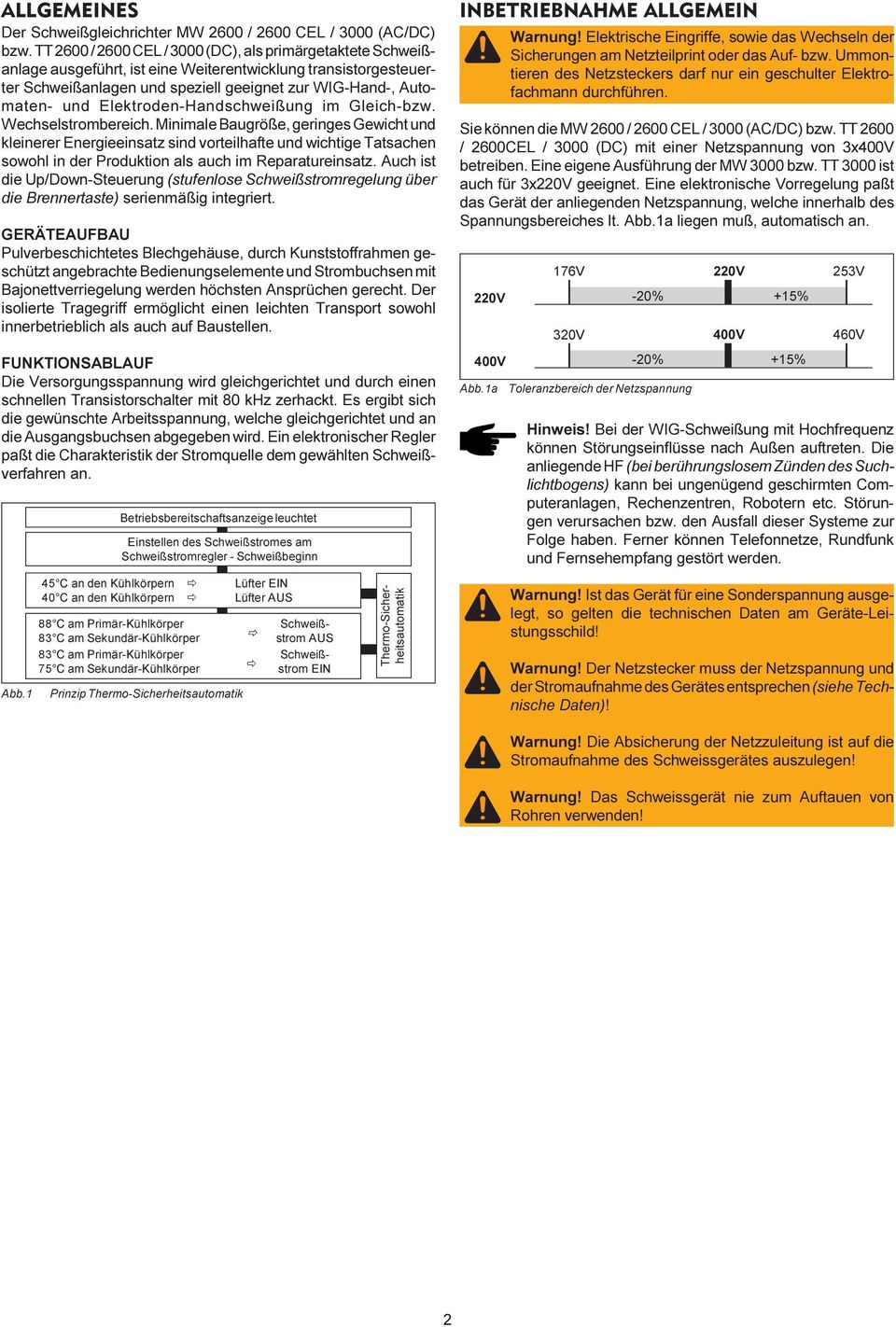
18 ALLGEMEINES Der Schweißgleichrichter MW 2600 / 2600 CEL / 3000 (AC/DC) bzw. TT 2600 / 2600 CEL / 3000 (DC), als primärgetaktete Schweißanlage ausgeführt, ist eine Weiterentwicklung transistorgesteuerter Schweißanlagen und speziell geeignet zur WIG-Hand-, Automaten- und Elektroden-Handschweißung im Gleich-bzw. Wechselstrombereich. Minimale Baugröße, geringes Gewicht und kleinerer Energieeinsatz sind vorteilhafte und wichtige Tatsachen sowohl in der Produktion als auch im Reparatureinsatz. Auch ist die Up/Down-Steuerung (stufenlose Schweißstromregelung über die Brennertaste) serienmäßig integriert. GERÄTEAUFBAU Pulverbeschichtetes Blechgehäuse, durch Kunststoffrahmen geschützt angebrachte Bedienungselemente und Strombuchsen mit Bajonettverriegelung werden höchsten Ansprüchen gerecht. Der isolierte Tragegriff ermöglicht einen leichten Transport sowohl innerbetrieblich als auch auf Baustellen. FUNKTIONSABLAUF Die Versorgungsspannung wird gleichgerichtet und durch einen schnellen Transistorschalter mit 80 khz zerhackt. Es ergibt sich die gewünschte Arbeitsspannung, welche gleichgerichtet und an die Ausgangsbuchsen abgegeben wird. Ein elektronischer Regler paßt die Charakteristik der Stromquelle dem gewählten Schweißverfahren an. Betriebsbereitschaftsanzeige leuchtet Einstellen des Schweißstromes am Schweißstromregler - Schweißbeginn 45 C an den Kühlkörpern Lüfter EIN 40 C an den Kühlkörpern Lüfter AUS 88 C am Primär-Kühlkörper 83 C am Sekundär-Kühlkörper 83 C am Primär-Kühlkörper 75 C am Sekundär-Kühlkörper Abb.1 Prinzip Thermo-Sicherheitsautomatik Schweißstrom AUS Schweißstrom EIN Thermo-Sicherheitsautomatik INBETRIEBNAHME ALLGEMEIN 220V 400V Abb.1a Warnung! Elektrische Eingriffe, sowie das Wechseln der Sicherungen am Netzteilprint oder das Auf- bzw. Ummontieren des Netzsteckers darf nur ein geschulter Elektrofachmann durchführen. Sie können die MW 2600 / 2600 CEL / 3000 (AC/DC) bzw. TT 2600 / 2600CEL / 3000 (DC) mit einer Netzspannung von 3x400V betreiben. Eine eigene Ausführung der MW 3000 bzw. TT 3000 ist auch für 3x220V geeignet. Eine elektronische Vorregelung paßt das Gerät der anliegenden Netzspannung, welche innerhalb des Spannungsbereiches lt. Abb.1a liegen muß, automatisch an. 176V 220V 253V -20% 320V 400V 460V -20% Toleranzbereich der Netzspannung +15% +15% Hinweis! Bei der WIG-Schweißung mit Hochfrequenz können Störungseinflüsse nach Außen auftreten. Die anliegende HF (bei berührungslosem Zünden des Suchlichtbogens) kann bei ungenügend geschirmten Computeranlagen, Rechenzentren, Robotern etc. Störungen verursachen bzw. den Ausfall dieser Systeme zur Folge haben. Ferner können Telefonnetze, Rundfunk und Fernsehempfang gestört werden. Warnung! Ist das Gerät für eine Sonderspannung ausgelegt, so gelten die technischen Daten am Geräte-Leistungsschild! Warnung! Der Netzstecker muss der Netzspannung und der Stromaufnahme des Gerätes entsprechen (siehe Technische Daten)! Warnung! Die Absicherung der Netzzuleitung ist auf die Stromaufnahme des Schweissgerätes auszulegen! Warnung! Das Schweissgerät nie zum Auftauen von Rohren verwenden! 2
19 BESCHREIBUNG DER BEDIENUNGSELEMENTE Abb.2 Frontplatte MAGIC WAVE 2600 / 2600 CEL / 3000 Abb. 3 Frontplatte TRANSTIG 2600 / 2600 CEL /
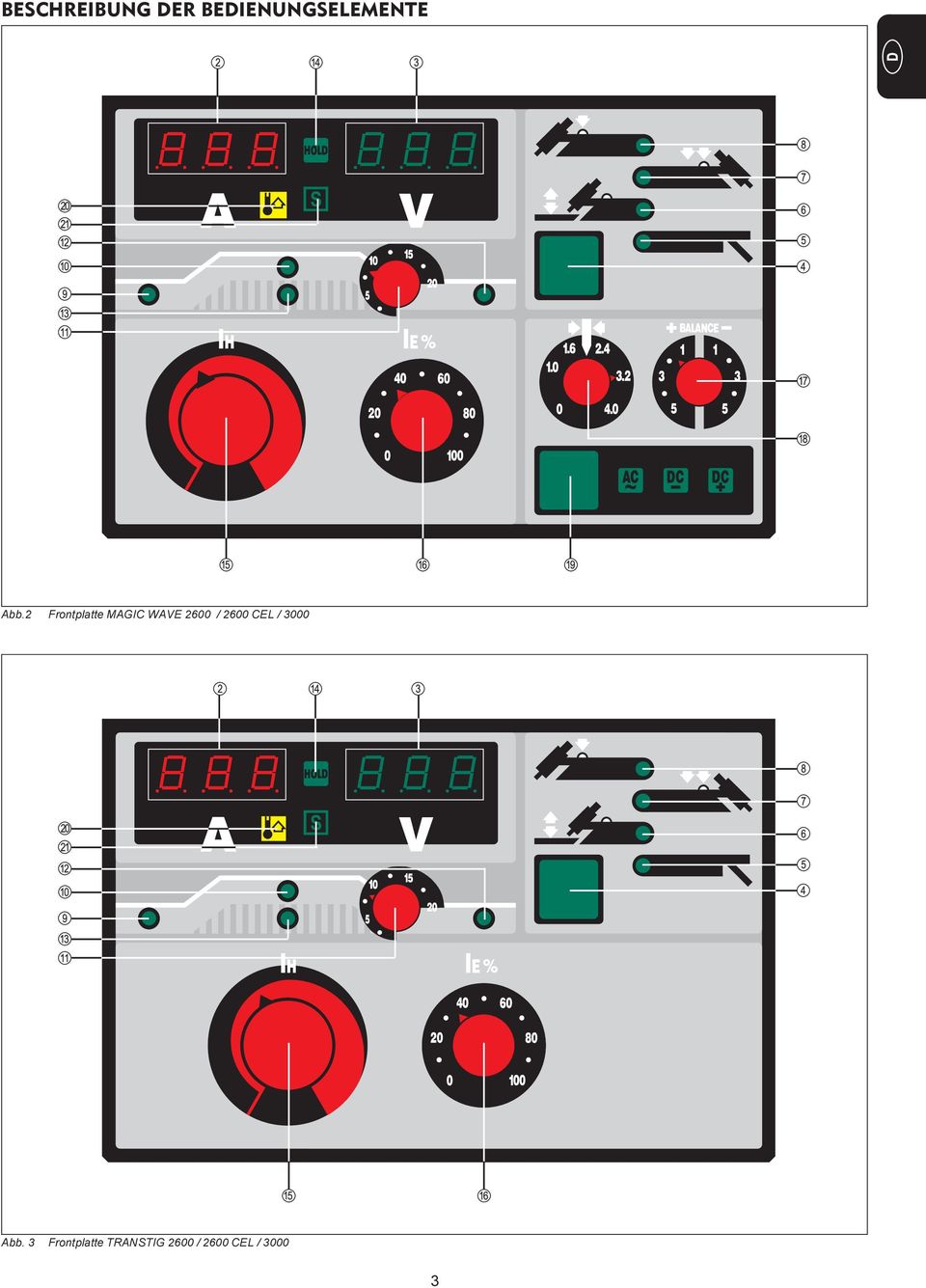
20 NETZ- HAUPTSCHALTER (siehe Abb.9) DIGITAL-AMPEREMETER - Anzeige des Hauptstromes Sollwert gewünschter Schweißstrom Istwert tatsächlicher Schweißstrom DIGITAL-VOLTMETER - Anzeige der Schweißspannung 3. Erneutes Zurückziehen und Halten der Brennertasterwippe - Schweißstrom sinkt mit der eingestellten Zeit (Down-Slope, Regler ) bis zum Wert des eingestellten Endkraterstromes I E ab (Regler, Endkraterfüllung) - LED leuchtet 4. Loslassen der Brennertasterwippe - Lichtbogen erlischt - intern eingestellte Gasnachströmzeit läuft ab FUNKTIONSWAHLTASTE a) 2-TAKTBETRIEB WIG-Schweißen mit b) 4-TAKTBETRIEB } HF-Zünden c) 2-TAKTBETRIEB + WIG-Schweißen mit } d) 4-TAKTBETRIEB + Berührungszünden - Lichtbogendynamik und Hotstart sind außer Betrieb - bei Fernregler TR 50mc, TR 51mc und TR 52mc erfolgt die Umschaltung auf die jeweilige Betriebsart automatisch - LED-Anzeigen od. bzw. + od. + leuchten I Zurückziehen und Halten der Brennertasterwippe Loslassen der Brennertasterwippe Zurückziehen und Halten der Brennertasterwippe Loslassen der Brennertasterwippe I H e) ELEKTRODEN-HANDSCHWEISSEN - LED-Anzeige leuchtet und Leerlaufspannung wird angezeigt - vorgegebene Werte für Dynamik und Hot-Start gelten - über Fernregler TPmc und internes Menü können die Parameter verändert werden LED-ANZEIGE FÜR E-HANDSCHWEISSBETRIEB - Anwahl über Funktionswahltaste - die LED-Anzeige für den Hauptstrom I H leuchtet nur während des Schweißvorganges - der Schweißstrom liegt an den Strombuchsen, - den Schweißstrom können Sie mit dem Hauptstromregler oder dem Regler des Fernreglers TPmc einstellen LED-ANZEIGE FÜR BERÜHRUNGSZÜNDEN - Anwahl über Funktionswahltaste - leuchtet in Verbindung mit LED oder - nach Eintasten und Werkstückberührung der Wolframelektrode erfolgt die Zündung des Lichtbogens - der bei Werkstückberührung fließende Kurzschlußstrom entspricht dem Minimumstrom Anwendung: Überall wo Hochfrequenz beim Zündvorgang Störungen verursacht LED-ANZEIGE FÜR 4-TAKTBETRIEB 4-Taktbetrieb - ohne Zwischenabsenkung - im Handschweiß- oder Automatenbetrieb für fehlerfreie Schweißverbindungen - einstellbare Parameter wie Gasvorströmung, Suchlichtbogen, Stromanstiegszeit, Hauptstrom, Stromabsenkzeit, Endkraterstrom und Gasnachströmzeit - in Programmebene "EBENE VOREINSTELLUNGEN ---" (Kapitel "Arbeiten mit den Programmebenen"), Parameter WIG, muß die Einstellung für SFS auf "OFF" stehen Abb. 4 I Zyklus-Start Gasvorströmzeit Zünden des Lichtbogens mit Suchlichtbogenstrom I S I S Stromanstieg über Up-Slope Schweißen mit eingestelltem Hauptstrom I H Stromabsenkung über Down-Slope Funktionsablauf 4-Taktbetrieb - ohne Zwischenabsenkung 4-Taktbetrieb - mit Zwischenabsenkung (Abb.4a) - Abruf über WIG-Brenner mit Doppeltaster-Funktion - Zwischenabsenkung auf den Absenkstrom I E : - Absenkmöglichkeit des Schweißstromes vom Haupt- auf den Absenkstrom I E und zurück, ohne den Schweißablauf zu unterbrechen - in Programmebene "EBENE VOREINSTELLUNGEN ---" (Kapitel Arbeiten mit den Programmebenen ), Parameter WIG, muß die Einstellung für SFS auf "OFF" stehen Zurückziehen und Halten der Brennertasterwippe Loslassen der Brennertasterwippe Vordrücken und Halten der Brennertasterwippe Loslassen der Brennertasterwippe Loslassen der Brennertasterwippe I E Endkraterstrom Erneutes Zurückziehen und Halten der Brennertasterwippe I S I H I E I H I E Schweißende Gasnachströmzeit t Funktionsablauf (Abb.4): 1. Zurückziehen und Halten der Brennertasterwippe - Gasvorströmzeit läuft ab - Lichtbogen zündet mit dem Wert des eingestellten Suchlichtbogenstromes I S (bei HF-Zünden: HF schaltet nach dem Zündvorgang selbsttätig ab) - LED-Anzeige leuchtet 2. Loslassen der Brennertasterwippe - Strom steigt mit eingestellter Zeit (Up-Slope) bis zum Wert des eingestellten Hauptstromes I H (Regler ) an. - LED-Anzeige leuchtet Zyklus-Start Gasvorströmzeit Zünden des Lichtbogens mit Suchlichtbogenstrom I S Stromanstieg über Up-Slope Schweißen mit eingestelltem Hauptstrom I H Stromabsenkung über Down-Slope Endkraterstrom Stromanstieg über Up-Slope Schweißen mit eingestelltem Hauptstrom I H Stromabsenkung über Down-Slope Endkraterstrom Schweißende Abb. 4a Funktionsablauf im 4-Taktbetrieb - Variante I - mit Zwischenabsenkung Gasnachströmzeit t 4
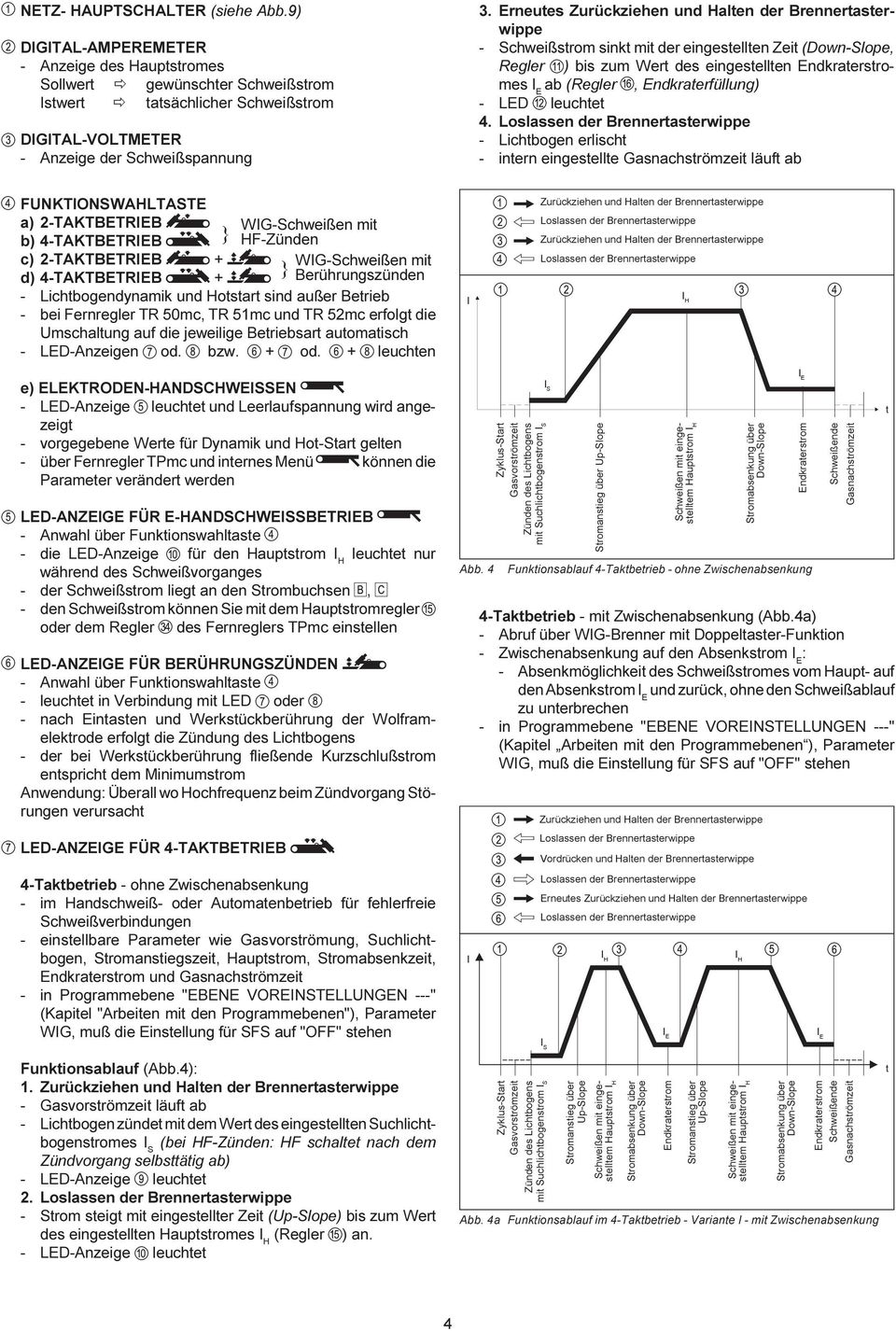
21 Wichtig! - Stromabsenkung ohne Schweißablaufunterbrechung kann nur bei aktiviertem Hauptstrom erfolgen - kein Zündvorgang bei irrtümlichem Vordrücken der Brennertasterwippe im Leerlauf Zurückziehen und Halten der Brennertasterwippe Loslassen der Brennertasterwippe Zurückziehen und Halten der Brennertasterwippe Loslassen der Brennertasterwippe Zurückziehen und Halten der Brennertasterwippe Spezial-4-Taktbetrieb - Variante I (Abb.5) - ermöglicht den Abruf des 4-Taktbetriebes mit WIG-Brennern ohne Doppeltaster-Funktion - Zwischenabsenkung auf den Absenkstrom I 3 (Einstellung siehe Kapitel Arbeiten mit den Programmebenen ) - Absenkmöglichkeit des Schweißstromes vom Haupt- auf den Absenkstrom I 3 und zurück, ohne den Schweißablauf zu unterbrechen - in Programmebene "EBENE VOREINSTELLUNGEN ---" (Kapitel Arbeiten mit den Programmebenen ), Parameter I3, kann der Absenkstrom I 3 in % vom Hauptstrom I H eingestellt werden - in Programmebene "EBENE VOREINSTELLUNGEN ---" (Kapitel Arbeiten mit den Programmebenen ), Parameter WIG, muß die Einstellung für SFS auf "1" stehen Zurückziehen und Halten der Brennertasterwippe Loslassen der Brennertasterwippe I Zyklus-Start Gasvorströmzeit I S Zünden des Lichtbogens mit Suchlichtbogenstrom I S Loslassen der Brennertasterwippe kurzes Vordrücken der Brennertasterwippe Stromanstieg über Up-Slope I H Schweißen mit eingestelltem Hauptstrom I H Stromabsenkung über Down-Slope Abb. 5a Funktionsablauf im Spezial-4-Taktbetrieb - Variante II I E Schweißen mit eingestelltem Absenkstrom Stromanstieg über Up-Slope I H Schweißen mit eingestelltem Hauptstrom I H Abb. mit Zwischenabsenkung Stromabsenkung über Down-Slope I E Endkraterstrom Schweißende Gasnachströmzeit t kurzes Drücken (Vordrücken) der Brennertasterwippe kurzes Drücken (Vordrücken) der Brennertasterwippe Zurückziehen und Halten der Brennertasterwippe Loslassen der Brennertasterwippe Zurückziehen und Halten der Brennertasterwippe Loslassen der Brennertasterwippe Vordrücken und Halten der Brennertasterwippe Loslassen der Brennertasterwippe I I H I H Zurückziehen und Halten der Brennertasterwippe Loslassen der Brennertasterwippe I 3 I I H I H I E I S t Abb. 5 Zyklus-Start Gasvorströmzeit Zünden des Lichtbogens mit Suchlichtbogenstrom I S Stromanstieg über Up-Slope Schweißen mit eingestelltem Hauptstrom I H Schweißen mit eingestelltem Absenkstrom I 3 (Setup) Schweißen mit eingestelltem Hauptstrom I H Abb. mit Zwischenabsenkung Funktionsablauf im Spezial-4-Taktbetrieb - Variante I Stromabsenkung über Down-Slope Endkraterstrom Schweißende Spezial-4-Taktbetrieb - Variante II / III / IV / V (Abb.5a/b/c/d) - ermöglicht den Abruf des 4-Taktbetriebes mit WIG-Brennern mit Doppeltaster-Funktion - in Programmebene "EBENE VOREINSTELLUNGEN ---" (Kapitel Arbeiten mit den Programmebenen ), Parameter WIG, die Einstellung für SFS - auf "2" stellen für Variante 2 - auf 3 stellen für Variante 3 - auf 4 stellen für Variante 4 - auf 5 stellen für Variante 5 Gasnachströmzeit Zyklus-Start Gasvorströmzeit I S Zünden des Lichtbogens mit Suchlichtbogenstrom I S Stromanstieg über Up-Slope Schweißen mit eingestelltem Hauptstrom I H Stromabsenkung über Down-Slope Abb. 5b Funktionsablauf im Spezial- 4-Taktbetrieb - Variante III I E Endkraterstrom Stromanstieg über Up-Slope Schweißen mit eingestelltem Hauptstrom I H Abb. mit Zwischenabsenkung Stromabsenkung über Down-Slope I E Endkraterstrom Schweißende Gasnachströmzeit t 5
22 I Zurückziehen und Halten der Brennertasterwippe Loslassen der Brennertasterwippe Vordrücken und Halten der Brennertasterwippe Loslassen der Brennertasterwippe Zurückziehen und Loslassen der Brennertasterwippe I H I H LED-ANZEIGE FÜR 2-TAKTBETRIEB 2-Taktbetrieb (Abb.6) - Abruf über WIG-Brennertasterwippe - hauptsächlich zum Heftschweißen verwendet - in Programmebene "EBENE VOREINSTELLUNGEN ---", Parameter WIG, muß die Einstellung für StS auf "OFF" stehen Zyklus-Start Gasvorströmzeit I S Zünden des Lichtbogens mit Suchlichtbogenstrom I S Stromanstieg über Up-Slope Schweißen mit eingestelltem Hauptstrom I H Stromabsenkung über Down-Slope Abb. 5c Funktionsablauf im Spezial- 4-Taktbetrieb - Variante IV I E Endkraterstrom Stromanstieg über Up-Slope Abb. mit Zwischenabsenkung Schweißen mit eingestelltem Hauptstrom I H Die Variante V (Abb. 5d) ermöglicht eine Erhöhung und Verringerung des Schweißstromes ohne Up / Down Brenner. Je länger die Brennertasterwippe während des Schweißens vorgedrückt wird, desto weiter erhöht sich der Schweißstrom (bis zum Maximum). Nach dem Loslassen der Brennertasterwippe bleibt der Schweißstrom konstant. Je länger die Brennertasterwippe erneut vorgedrückt wird, desto weiter verringert sich der Schweißstrom. Schweißende Gasnachströmzeit t I Funktionsablauf: 1. Zurückziehen und Halten der Brennertasterwippe - Gasvorströmzeit läuft ab - Lichtbogen zündet mit dem Wert des eingestellten Suchlichtbogenstromes I S (bei HF - Zünden: HF schaltet nach dem Zündvorgang selbsttätig ab) - nach dem Zündvorgang steigt der Schweißstrom über den intern eingestellten Up-Slope auf den Schweißstrom I H an - LED leuchtet 2. Loslassen der Brennertasterwippe - Lichtbogen erlischt (mit oder ohne Stromabsenkung) - intern eingestellte Gasnachströmzeit läuft ab Bei Verwendung des Fußfernreglers TR 52mc schaltet die Anlage automatisch auf 2-Taktbetrieb um. Zurückziehen und Halten der Brennertasterwippe Loslassen der Brennertasterwippe I H t Zurückziehen und Halten der Brennertasterwippe Loslassen der Brennertasterwippe Vordrücken und Halten der Brennertasterwippe Loslassen der Brennertasterwippe Vordrücken und Halten der Brennertasterwippe Loslassen der Brennertasterwippe Zurückziehen und Halten der Brennertasterwippe Loslassen der Brennertasterwippe Abb. 6 I I H I E I S t Zyklus-Start Gasvorströmzeit Zünden des Lichtbogens mit Suchlichtbogenstrom I S Stromanstieg über Up-Slope Schweißen mit eingestelltem Hauptstrom I H Stromanstieg bei vorgedrückter Brennertaste Schweißen mit erhöhtem Hauptsrom I H Stromabsenkung bei vorgedrückter Brennertaste Schweißen mit verringertem Hauptstrom I H Stromabsenkung über Down-Slope Zyklus-Start Gasvorströmzeit Zünden des Lichtbogens mit Suchlichtbogenstrom I S Endkraterstrom Schweißende Gasnachströmzeit Stromanstieg über Up-Slope Funktionsablauf 2-Taktbetrieb Schweißen mit eingestelltem Hauptstrom I H Schweißende über Down-Slope auf Endkraterstrom I E Gasnachströmzeit Abb. 5d Funktionsablauf im Spezial- 4-Taktbetrieb - Variante V 6
23 Spezial-2-Taktbetrieb (Abb.6a) - Abruf über WIG-Brennertasterwippe - hauptsächlich zum Heftschweißen verwendet - in Programmebene "EBENE VOREINSTELLUNGEN ---" (Kapitel Arbeiten mit den Programmebenen ), Parameter WIG, muß die Einstellung für StS auf "ON" stehen Funktionsablauf: 1. Zurückziehen und Halten der Brennertasterwippe - Gasvorströmzeit läuft ab - Lichtbogen zündet mit dem Wert des eingestellten Suchlichtbogenstromes I S (bei HF - Zünden: HF schaltet nach dem Zündvorgang selbsttätig ab) - Schweißstrom steigt ohne Up-Slope auf den Schweißstrom I H an - LED leuchtet 2. Loslassen der Brennertasterwippe - Lichtbogen erlischt (ohne Stromabsenkung) - intern eingestellte Gasnachströmzeit läuft ab Bei Verwendung des Fußfernreglers TR 52mc schaltet die Anlage automatisch auf 2-Taktbetrieb um. DOWN-SLOPE oder Strom-Absenkzeit: - stufenlos einstellbare Strom-Absenkgeschwindigkeit vom Hauptstrom auf den Endkraterstrom I E Einstellbereich: von 0,1 bis 20 Sekunden - Bei Betätigung des Down-Slope Potentiometers wird für 3 Sekunden der eingestellte Wert angezeigt z. B.: d S L 1.0 LED-ANZEIGE FÜR WIG-PULSSCHWEISSEN - Sobald der WIG-Pulsfernregler TR 50mc angeschlossen ist, blinkt die LED (Kapitel WIG-Pulsfernregler TR 50mc ) LED-ANZEIGE - ermöglicht eine nachträgliche Kontrolle der Schweißparameter - leuchtet nach Istwertspeicherung (Prozeßende) - Anzeige des Mittelwertes an den Digitalanzeigen, (vor Ende eines Schweißvorganges gemessene Werte für Schweißstrom und -spannung) - Funktion bei Verwenden des Fußfernreglers und bei Pulsen bis 20Hz nicht gegeben Möglichkeiten zum Löschen der HOLD-Funktion - Brennertasterwippe in der Schweißpause betätigen - Gerät aus- u. wiedereinschalten - Hauptstrom-Regler in Schweißpause verstellen - Funktionswahltaste umschalten - Stromart-Wahltaste umschalten - bei jedem neuen Schweißstart HAUPTSTROM-REGLER I H = Schweißstrom - stufenlose Einstellung im Bereich von 3-260/300 A - LED-Anzeige leuchtet (nur bei Betriebsart Elektrode) - digitales Amperemeter zeigt den Strom-Sollwert bereits im Leerlauf an, schaltet danach auf Istwert-Anzeige um Sollwert gewünschter Schweißstrom Istwert tatsächlicher Schweißstrom I Zurückziehen und Halten der Brennertasterwippe Loslassen der Brennertasterwippe I H ENDKRATERSTROM I E - nur im 4-Taktbetrieb möglich - prozentuelle Einstellung des Hauptstromes - Absenkung des Schweißstromes auf den Endkraterstrom über die Brennertasterwippe - LED-Anzeige leuchtet Zyklus-Start Gasvorströmzeit Zünden des Lichtbogens Schweißen mit eingestelltem Hauptstrom I H Schweißende Gasnachströmzeit t BALANCEREGLER (nur MW 2600 / 2600 CEL / 3000) - Funktion nur im AC-Bereich auf, u. gegeben - positive und negative Halbwelle können verändert werden - Anpassung an das jeweilige Schweißproblem (Optimierung von Reinigungs- und Einbrandverhältnis) - Optimierung der Kalottenbildung (Abb.7c) Abb. 6a Funktionsablauf Spezial-2-Taktbetrieb 7
24 Stromart AC ~ Abb.7 Einstellbeispiel: a) Balanceregler in Position "0" Einstellung neutral b) Balanceregler in Position "+5" positive Halbwelle länger als die negative Halbwelle, lange Reinigungsphase, geringere Einbrandtiefe Mehrbelastung der Wolframelektrode - Kalotte zu groß (Abb.7b) c) Balanceregler in Position "-5" negative Halbwelle länger als die positive Halbwelle, lange Einbrandphase, geringer Reinigungseffekt Unterbelastung der Wolframelektrode - keine Kalotte (Abb.7a) Strombelastung zu niedrig zu hoch richtig a) b) c) günstig für Wurzellagen und dünne Werkstücke Kalottenformen unterschiedlich belasteter Wolframelektroden im AC- Bereich 3. : Wechselstrom WIG-Schweißen von Aluminium und deren Legierungen, Alu-Bronze etc. a) Betriebsart WIG - Wechselstrom liegt an der Wolframelektrode - Led oder leuchtet b) Betriebsart E-Handschweißen - Wechselstrom liegt an der Stabelektrode - Led leuchtet Folgende Parameter sind vorgegeben: - Gasvorströmzeit... 0,4 Sek. - Suchlichtbogen Betriebsart DC... 36% des I H Betriebsart AC... 50% des I H - Up-Slope... 1,0 Sek. - Gasnachströmzeit stromabhängig Sek. - Frequenz Hz Sie können diese Parameter jedoch im Progammenü abändern. ÜBERTEMPERATUR-ANZEIGE leuchtet, - wenn das Gerät überlastet oder - die Temperatur am Primär- oder am Sekundärkühlkörper erreicht wurde (siehe Abb.1) EINSTELLREGLER für WOLFRAMELEKTRODEN- DURCHMESSER von 0-4,0mm a) AC-Betrieb: (nur MW 2600 / 2600CEL / 3000) - automatische Kalottenbildung an der Wolframelektrode; Brennertasterwippe vor Schweißbeginn kurz vordrücken, Schweißvorgang einleiten; ausgehend von einer spitzen oder stumpfen Wolframelektrode wird eine Kugel gebildet (am Regler voreingestellter Wert) - Brennertasterwippe nicht nach vor drücken - mit Regler können Sie den Zündstrom für den jeweiligen Wolfram- Elektrodendurchmesser einstellen b) DC-Betrieb: - Einstellen des Zündstromes für den jeweiligen Wolframelektrodendurchmesser Bei Betriebsart Elektrode ist der Einstellregler inaktiv. STROMART-WAHLTASTE / / (nur MW 2600 / 2600CEL / 3000) zur Vorwahl der gewünschten Stromart, sowie zum Umschalten der Polarität bei der WIG-, als auch bei der Stabelektroden- Handschweißung. Bei Betriebsart WIG ist gesperrt. Funktionsbeschreibung: 1. : Gleichstrom WIG-Schweißen von un-, niedrig- und hochlegierten Stählen, Sn- oder Cu-Bronzen, Kupfer usw. a) Betriebsart WIG - Minuspol liegt an der Wolframelektrode - Led od. leuchtet b) Betriebsart E-Handschweißen - Minuspol liegt an der Stabelektrode - Led leuchtet 2. : Gleichstrom Betriebsart E-Handschweißen - Pluspol liegt an der Stabelektrode - Led leuchtet LED-ANZEIGE S-ZEICHEN - leuchtet wenn die Überwachungsfunktion aktiv ist - LED-Anzeige signalisiert, daß die im Schweißstromkreis auftretende Wechselspannung von 48V nicht übersteigt WIG-BRENNERANSCHLUSS - zum Anschluß der Gas-Strom-Versorgung des Schweißbrenners bei gasgekühlten Anlagen - zum Anschluß der Wasser-Strom-Versorgung des Schweißbrenners bei wassergekühlten Anlagen STROMBUCHSE MIT BAJONETTVERSCHLUSS - als Massekabelanschluß bei der WIG-Schweißung - zum Anschluß des Handelektroden -bzw. des Massekabels bei der Elektrodenhandschweißung je nach Elektrodentype STROMBUCHSE MIT BAJONETTVERSCHLUSS - zum Anschluß des Handelektroden - bzw. des Massekabels bei der Elektrodenhandschweißung je nach Elektrodentype TRANSTIG MAGIC WAVE Abb.8 Ausführung mit Brenner-Zentralanschluß GWZ: Anschlüsse an der Geräte-Frontseite 8
25 TRANSTIG MAGIC WAVE Abb.9 Geräte-Rückseite BRENNERMONTAGE EINES WASSER- GEKÜHLTEN WIG-SCHWEISSBRENNERS Abb.8a Ausführung mit Fronius Brenner-Zentralanschluß F: Anschlüsse an der Geräte-Frontseite BRENNER-STEUERSTECKDOSE - Steuerstecker des Schweißbrenners einstecken und verriegeln Strom-, Wasseranschluß Steuerstecker Steuerleitung ANSCHLUSSBUCHSE F. FERNREGLERBETRIEB - Stecker des Fernreglerkabels seitenrichtig einstecken und mit Überwurfmutter fixieren - gewünschten Schweißstrom direkt am Fernregler einstellen - automatische Fernreglererkennung - bei Beschädigung des Fernreglerkabels gewährleistet die kurzschlußfeste Versorgungsspannung der Fernregler Schutz für die Elektronik GASANSCHLUSS FÜR BRENNER - bei Brenner-Zentralanschluß GWZ ANSCHLUSS FÜR WASSERRÜCKLAUF - bei Fronius Brenner-Zentralanschluß F ANSCHLUSS FÜR WASSERVORLAUF - nur bei wassergekühlten Anlagen GASANSCHLUSS - Anschlußmutter des Gasschlauches auf das Anschlußstück aufschrauben und festziehen GASPRÜFTASTE - zum stromlosen Prüfen und Einstellen des Gasdurchflusses - um am Druckminderer bei gedrückter Taste die benötigte Gasmenge einstellen zu können NETZKABEL MIT ZUGENTLASTUNG Wasseranschluß Gasanschluß Abb.10 Gas-, Stromanschluß Schlauchmuffe Ausführung mit Brenner-Zentralanschluß GWZ: Brenneranschluß wassergekühlt Wasseranschluß Wasseranschluß Steuerstecker Steuerleitung Schlauchmuffe Abb.10a Ausführung mit Fronius Brenner-Zentralanschluß F: Brenneranschluß wassergekühlt Ausführung mit Brenner-Zentralanschluß GWZ: - Gummischlauchmuffe des Schweißbrenners zurückziehen - Sechskantmutter (SW21, Strom-, Wasseranschluß) an geräteseitigen Brenneranschluß aufschrauben und festziehen - Gummimuffe über die Sechskantmutter nach vor schieben - Steuerstecker in Steckdose einstecken und verriegeln - Wasseranschluß-Rändelmutter auf das Anschlußstück des Wasservorlaufes aufschrauben und festziehen - Gasanschluß-Rändelmutter auf das Anschlußstück des Gasanschlusses aufschrauben und festziehen Wichtig! Technische Details und dgl. über den Brenner sowie dessen Montage, Pflege und Wartung entnehmen Sie der jeweiligen Brenner-Bedienungsanleitung. 9
26 Ausführung mit Fronius Brenner-Zentralanschluß F: - Bajonettstecker des Schweißbrenners am geräteseitigen Zentralanschluß des Schweißbrenners einsetzen und durch Drehen nach rechts verriegeln - Steuerstecker in Steckdose einstecken und verriegeln - Wasseranschlüsse an den Anschlußstücken Wasservorlauf und Wasserrücklauf anstecken KÜHLGERÄT FK 2600 / 2601 Wichtig! Genauere Hinweise über Montage und Inbetriebnahme des Kühlgerätes sind der Bedienungsanleitung FK 2600/2601 (Sach. Nr.: 42,0410,0490) zu entnehmen. Wichtig! Technische Details und dgl. über den Brenner sowie dessen Montage, Pflege und Wartung entnehmen Sie der jeweiligen Brenner-Bedienungsanleitung. BRENNERMONTAGE EINES GASGEKÜHLTEN WIG-SCHWEISSBRENNERS Steuerstecker Steuerleitung Gas,- Stromanschluß Schlauchmuffe Abb.10b Ausführung mit Brenner-Zentralanschluß GWZ: Brenneranschluß gasgekühlt Steuerstecker Steuerleitung Gas,- Stromanschluß Schlauchmuffe Abb.10c Ausführung mit Fronius Brenner-Zentralanschluß F: Brenneranschluß gasgekühlt Ausführung mit Brenner-Zentralanschluß GWZ: - Gasadapterstück (44,0001,0785) montieren - Gummischlauchmuffe des Schweißbrenners zurückziehen - Sechskantmutter (SW21, Gas-Stromanschluß) an geräteseitigen Brenneranschluß aufschrauben und festziehen - Gummimuffe über die Sechskantmutter nach vor schieben - Steuerstecker in Steckdose einstecken und verriegeln Wichtig! Technische Details und dgl. über den Brenner sowie dessen Montage, Pflege und Wartung entnehmen Sie der jeweiligen Brenner-Bedienungsanleitung. Ausführung mit Fronius Brenner-Zentralanschluß F: - Bajonettstecker des Schweißbrenners am geräteseitigen Zentralanschluß des Schweißbrenners einsetzen und durch Drehen nach rechts verriegeln - Steuerstecker in Steckdose einstecken und verriegeln Wichtig! Technische Details und dgl. über den Brenner sowie dessen Montage, Pflege und Wartung entnehmen Sie der jeweiligen Brenner-Bedienungsanleitung. 10
27 AUFSTELLBESTIMMUNGEN Schutzart IP 23 - Das Schweißgerät ist nach Schutzart IP23 geprüft, daß heißt: Schutz gegen Eindringen fester Fremdkörper größer Ø 12mm - Schutz gegen Sprühwasser bis zu einem Winkel von 60 zur Senkrechten Betrieb im Freien Sie können die Anlage gemäß ihrer Schutzart IP23 im Freien aufstellen und betreiben. Die eingebauten elektrischen Teile sind jedoch vor unmittelbarer Nässeeinwirkung zu schützen. (siehe Schutzart IP23) Kühlluft und Staub Die Anlage so aufstellen, daß die Kühlluft ungehindert durch die Luftschlitze ein- und austreten kann. Die Kühlluft gelangt über Luftschlitze in den Geräteinnenteil und strömt über inaktive Bauteile zum Lüftungsaustritt. Der Lüftungskanal stellt eine wesentliche Sicherheitseinrichtung dar. Eine vollelektronische Thermosicherheitsautomatik steuert den Kühlablauf (siehe Abb.1). Anfallender metallischer Staub (z.b. bei Schmirgelarbeiten) darf nicht direkt in die Anlage gesaugt werden. Standfestigkeit Die Schweißstromquelle kann mit einer Neigung von bis zu 15 aufgestellt werden! Bei einer Neigung größer 15 kann die Schweißstromquelle umfallen. ARBEITEN MIT DEN PROGRAMMEBENEN EINSTIEG IN DIE JEWEILIGE PROGRAMMEBENE - Gerät bei gedrückter Taste od. einschalten - Es erscheint --- Ebene Voreinstellungen - Brennertasterwippe solange drücken bis erscheint Ebene Voreinstellungen 2. P1 erscheint Ebene Service-Menü 3. P2 erscheint Ebene Codeschloß 4. P3 erscheint Ebene AC-Parameter - Taste od. loslassen EBENE VOREINSTELLUNGEN --- Mit Taste und die Parameter anwählen und mit der Brennertasterwippe deren Wert ändern. Parameter werden nur entsprechend der eingestellten Betriebsart (WIG/Elektrode) angezeigt. Parameter Betriebsart WIG DC - GAS Gasvorströmung 0-20s. - G-L Gasnachströmung bei I min 2,0-26s. - G-H Gasnachströmung bei I max 2,0-26s. - UPS Up-Slope 0,1-7s. - SCU Start Current - Suchlichtbogen 0-100% bei DC, 0-100% bei AC - I3 Absenkstrom 0-100% von I H - HFt Hochfrequenz - Wiederholzeit 0,01-0,4s - SCU Start-Current rel/abs - StS Spezial-2-Taktbetrieb ON/OFF - SFS Spezial-4-Taktbetrieb OFF/1-5 - C-C Kühlkreis-Dauerlauf AUT/OFF/ON - E-S Stromquellenabschaltung ON/OFF - PRO Programm - Abspeichern der eingestellten Parameter durch Drücken der Brennertasterwippe - FAC Factory - Aktivieren der von Fronius voreingestellten Parameter durch Drücken der Brennertasterwippe Parameter Betriebsart WIG AC - Wie in Betriebsart WIG DC - Punkt SCU Start Current Suchlichtbogen % Parameter Betriebsart Elektrode - Hti Hotstart Zeit 0,2-2s - HCU Hotstartstrom 0-100% - dyn Dynamik 0-200A - PRO Programm - Abspeichern der eingestellten Parameter durch Drücken der Brennertasterwippe - FAC Factory - Aktivieren der von Fronius voreingestellten Parameter durch Drücken der Brennertasterwippe Bei Elektrode-AC gilt die in Ebene 3 eingestellte Frequenz (Kurvenform ist bei Betriebsart "Elektrode-AC" Rechteck) vorgegebene Parameter des Fronius-Programmes (FAC) - E-S OFF - Hti 0,5s - GAS 0,4s - HCU 50% - G-L 5,0s - dyn 40A - G-H 15,0 - ACF 60Hz - UPS 1,0s - POS sin - SCU DC 29% - neg rec AC 50% - I3 50% - HFt 0,015 - SCU rel - StS OFF - SFS OFF - C-C Aut EBENE SERVICE-MENÜ P1 Service-Menü mit verschiedenen Testprogrammen EBENE CODESCHLOSS P2 Das Gerät ist mit einem elektronischen Codeschloß ausgerüstet. Fabriksmäßig ist das Codeschloß deaktiviert. Geänderte Zahlenkombinationen sollten Sie unbedingt schriftlich vermerken. Es kann nur ein dreistelliger Code vergeben werden. Bei Neugeräten ist der Code Vorgangsweise - in Ebene Codeschloß P2 einsteigen - am Display erscheint "Cod _?_" - aktuellen Code eingeben (bei Neugeräten ist Code 321) M mit Regler I H Ziffer einstellen M mit Taste od. Ziffer bestätigen M Vorgang zweimal wiederholen bis "Cod OFF" oder "Cod ON" am Display erscheint Weitere Vorgangsweise siehe unter: 2. Code ändern und aktivieren 3. Code deaktivieren 11
28 2. Code ändern und aktivieren a.) am Display ist "Cod OFF" zu lesen - mit Brennertasterwippe auf "Cod ON" stellen (weiter siehe Pkt 2b.) b.) am Display ist "Cod ON" zu lesen - mit Funktionstaste auf "CYC?" wechseln CYC... Zyklus, gibt an wie oft das Gerät eingeschaltet werden kann, ohne das eine Code-Eingabe erfolgen muß - mit Brennerwippe Anzahl der Zyklen einstellen - Funktionstaste drücken bis "Cod?--" am Display erscheint - neuen Zahlen-Code eingeben M mit Brennertasterwippe zwischen 0-9/A-H einstellen M mit Funktionstaste Ziffer bestätigen M Vorgang zweimal wiederholen bis neuer Code eingegeben ist - Wippe drücken - am Display erscheint "Cod _-_" - neuen Code zur Kontrolle nochmals eingeben M mit Regler I H Ziffer einstellen M mit Funktionstaste Ziffer bestätigen M Vorgang zweimal wiederholen bis Code eingegeben ist M bei dritter Quittierung erfolgt eine automatische Abspeicherung des Codes FERNREGLERBETRIEB ALLGEMEIN Eine Fernbedienung ist zweckmäßig, sobald Sie Einstellungen direkt vom Schweißplatz aus vornehmen möchten. Durch spezielle Fernreglerkabel in den Längen von 5m bzw. 10m ist der Fernregler mit der Stromquelle elektrisch verbunden. Folgende Fernreglertypen stehen zur Verfügung: - WIG- und E-Handfernregler (AC)... TR53mc - E-Hand- und WIG-Fernregler (DC)... TPmc - E-Hand- und WIG-Fernregler CEL (DC)... TPmc-CEL - WIG-Pulsfernregler (AC/DC)... TR50mc - WIG-Punktierfernregler (DC)... TR51mc - WIG-Fußfernregler (AC/DC)... TR52mc AC-FERNREGLER TR 53MC - spezieller Arbeitsplatzfernregler für den WIG-AC~ Schweißbetrieb - externer Einstellmöglichkeit für Schweißstrom I H AC~ Balance AC~ Frequenz Hinweis! Bei dreimaliger falscher Codeeingabe (ERR) schaltet die Anlage selbsttätig auf "LOC". Sie müssen die Maschine ausschalten und den gesamten Vorgang wiederholen! - Maschine ist schweißbereit 3. Code deaktivieren - am Display ist "Cod ON" zu lesen - mit Brennertasterwippe auf "Cod OFF" stellen - mit Taste od. auf "PRO" wechseln - durch Drücken der Wippe ist der aktuelle Code deaktiviert - Maschine ist schweißbereit Wichtig! Der Code ist ab nun wieder 321! Inbetriebnahme des Gerätes bei aktiviertem Code-Schloß - Netzhauptschalter einschalten - am Display erscheint die Aufforderung zur Eingabe der Code-Nummer ("Cod _?_") - mit Regler I H erste Ziffer der Kombination eingeben - mit Funktionstaste Ziffer quittieren - Vorgang noch zweimal wiederholen - Gerät ist schweißbereit EBENE AC-PARAMETER P3 (nur bei AC-Geräten) Mit Funktionswahltaste bzw. Wahltaste die Parameter anwählen und mit der Brennertasterwippe deren Wert ändern. - ACF AC-Frequenz (bei Elektrode und WIG) Hz - POS positive Halbwelle (tri, SIN, rec, OFF) nur bei WIG - neg negative Halbwelle (tri, SIN, rec, OFF) nur bei WIG - PRO Programm, Abspeichern der eingestellten Parameter durch Drücken der Brennertasterwippe [tri (=Dreieck), SIN (=Sinus), rec (=Rechteck)] - SYn Synchronfunktion (ON/OFF) Abb.11 AC-Fernregler TR 53mc HAUPTSTROMREGLER I H - stufenlose Schweißstrom-Einstellung - LED-Anzeige leuchtet nach Eintasten der Brennertasterwippe BALANCE-REGLER - zum Ändern der positiven und negativen Halbwelle im E-Hand- und WIG-AC~Bereich EINSTELLREGLER AC~ Lichtbogenfrequenz (Hz) - zum Ändern der Lichtbogenkonzentration Wichtig! Verwenden Sie den Fernregler TR53mc für die E-Handschweißung im AC~ oder DC Bereich, (Funktionswahltaste in Pos. ) so gelten für Hot-Start Strom, Hot-Start Zeit und Dynamik die im Gerät eingestellten Werte. Fernregleranschluß - Anschlußbuchse der Stromquelle mittels Fernreglerkabel mit Buchse des Handfernreglers elektrisch verbinden - Steckverbindungen seitenrichtig einstecken und Überwurfmuttern bis zum Anschlag aufschrauben - Funktionswahltaste in die für die Betriebsart richtige Position schalten 12
29 WIG-PULSFERNREGLER TR 50MC DUTY-CYCLE-REGLER % - Einstellregler für Puls-Pausenverhältnis = prozentuelles Verhältnis zwischen Pulsstromphase und Grundstromphase Einstellbeispiele: Duty-Cycle-Regler in Position "10" - kurze Pulsstromphase von 10% - lange Grundstromphase von 90% - geringe Wärmeeinbringung Duty-Cycle-Regler in Position "50" (siehe Abb.13) - Pulsstromphase und Grundstromphase betragen je 50% - mittlere Wärmeeinbringung Duty-Cycle-Regler in Position "90" - lange Pulsstromphase von 90% - kurze Grundstromphase von 10% - höchste Wärmeeinbringung Abb.12 WIG-Pulsfernregler TR 50 mc I f (Hz) Die zu Beginn der Schweißung eingestellte Stromstärke muß nicht für den gesamten Schweißvorgang von Vorteil sein. Bei zu geringer Stromstärke wird der Grundwerkstoff nicht genügend aufgeschmolzen; bei Überhitzung droht das flüssige Schmelzbad abzutropfen. Daher bedient man sich des pulsierenden Schweißstromes (z.b. beim Schweißen von Stahlrohren in Zwangslage). Ein verhältnismäßig niedriger Schweißstrom (Grundstrom I 2 ) erreicht durch steilen Anstieg einen deutlich höheren Wert (Impulsstrom I 1 ) und fällt je nach eingestellter Zeit (Duty-Cycle) wieder auf den Grundwert (Grundstrom I 2 ) ab. So werden beim Schweißvorgang kleinere Abschnitte der Schweißstelle schnell aufgeschmolzen. Auch erstarren diese schnell wieder. Der Nahtaufbau ist auf diese Weise wesentlich einfacher zu beherrschen. Auch beim Schweißen dünner Bleche wird diese Technik angewendet. Ein Schmelzpunkt überschneidet sich mit dem Nächsten - es entsteht ein gleichmäßig gezeichnetes Nahtbild. Wird mit der WIG-Pulstechnik von Hand geschweißt, erfolgt das Zusetzen des Schweißstabes in der Maximal-Stromphase (nur möglich im niedrigen Frequenzbereich von 0,25-5 Hz). Höhere Pulsfrequenzen werden meist im Automatenbetrieb angewandt und dienen vorwiegend der Stabilisierung des Lichtbogens. Beim Pulsfernregler TR 50mc sind zwei Betriebsarten möglich. - Impulsstromregulierung I 1 am Fernregler TR 50mc - Impulsstromverstellung I 1 mit Fußfernregler TR 52mc PULSSTROM-REGLER I 1 (Hauptstrom) - stufenlose Einstellmöglichkeit des Puls-Hauptstromes PULSFREQUENZ-REGLER f (Hz) - stufenlose Einstellmöglichkeit der Pulsfrequenz in Abhängigkeit des vorgewählten Frequenzbereiches mittels Wahlschalter. GRUNDSTROM-REGLER I 2 - Einstellung des Grundstromes I 2 erfolgt prozentuell vom eingestellten Wert des Pulsstromes I 1 I 1 50% 50% Duty-Cycle Abb.13 Einstellbeispiel Duty-Cycle auf Postition "50" FREQUENZBEREICHSSCHALTER BETRIEBSART: Pulsstromregulierung I 1 mit Fernregler - Anschlußbuchse der Stromquelle mittels Fernreglerkabel mit Buchse des Fernreglers elektrisch verbinden. - Steckverbindungen seitenrichtig einstecken und Überwurfmuttern bis zum Anschlag aufschrauben. - LED an der Stromquelle blinkt - mit Funktionswahltaste gewünschte Betriebsart einstellen - dazugehörige LED-Anzeige,, oder leuchtet - Frequenzbereich mittels Bereichsschalter vorwählen (0,2-2Hz / 2-20Hz / Hz / Hz) - Pulsstrom I 1 mit dem Einstellregler stufenlos einstellen - Grundstrom I 2 mit Einstellregler prozentuell vom Pulsstrom I 1 einstellen - Duty-Cycle mit Regler auswählen - Pulsfrequenzregler auf gewünschten Wert einstellen - Anzeige des Schweißstrommittelwertes am A-Display - Parameter für Down-Slope an der Stromquelle einstellen Die Pulsphase beginnt beim 4-Taktbetrieb im Up-Slope bereits nach dem Loslassen der Brennertaste. Wie aus Abb.14 ersichtlich, wird in der Absenkphase gepulst. Wichtig! Um während des Pulsbetriebes vom Haupt- auf den Endkraterstrom schalten zu können (ohne Unterbrechung des Schweißvorganges) verwenden Sie: - den 4-Taktbetrieb und einen FRONIUS WIG-Brenner mit Doppeltaster-Funktion - den Spezial-4-Taktbetrieb und einen handelüblichen WIG- Brenner Genauere Details zu 4-Taktbetrieb bzw. Spezial-4-Taktbetrieb befinden sich in dem Kapitel "Beschreibung der Bedienungselemente". I 2 t 13
30 I BETRIEBSART: Pulsstromreg. I 1 mit Fußregler TR 52mc Besonders von Vorteil beim WIG-Handschweißen: um den Puls-Schweißstrom während des Schweißvorganges verändern zu können (z.b. variable Materialstärke). - Anschlußbuchse der Stromquelle mittels Fernreglerkabel mit Buchse des Pulsfernreglers elektrisch verbinden - Pulsfernregler (Anschlußbuchse ) mit dem Fußfernregler (Buchse ) verbinden - Steckverbindungen seitenrichtig einstecken und Überwurfmuttern bis zum Anschlag aufschrauben - Anlage schaltet beim Anschließen des Fußfernreglers TR 52mc auf 2-Taktbetrieb - LED an der Stromquelle blinkt - mit Funktionswahltaste gewünschte Betriebsart einstellen - dazugehörige LED-Anzeige, oder leuchtet - Betriebsart Elektrode - LED - ist möglich - Anzeige des Schweißstrommittelwertes am A-Display (keine Hold-Funktion) - Zündvorgang durch leichtes Auftreten auf das Pedal einleiten - Suchlichtbogen, Pulsstromes I 1 und Endkraterstrom sind auch mit dem Fußpedal steuerbar - eingestellter Grundstrom I 2 am TR 50mc (Regler ) paßt sich prozentuell dem Pulsstrom I 1 an. - den Schweißstrom können Sie durch vollständiges Entlasten des Pedales abschalten, der Schweißvorgang ist unterbrochen - Gasnachströmzeit läuft ab Drücken und Halten der Brennertasterwippe Loslassen der Brennertasterwippe Drücken und Halten der Brennertasterwippe Loslassen der Brennertasterwippe I 1 f (Hz) WIG-FUSSFERNREGLER TR 52MC Abb.16 Fußfernregler TR 52mc Oft müssen Sie, bedingt durch komplizierte Werkstückformen, die Stromstärke während des Schweißens verändern (z.b. Reparatur von Werkzeugkanten, Ausbessern von Schnittwerkzeugen etc.). Für solche Arbeiten ist der Fußfernregler TR 52mc gedacht. Fernregleranschluß - Anschlußbuchse der Stromquelle mittels Fernreglerkabel mit Buchse des Fernreglers elektrisch verbinden (Steckverbindungen seitenrichtig einstecken und Überwurfmutter bis zum Anschlag aufschrauben) Funktionsbeschreibung - Anlage schaltet beim Anschließen des Fußfernreglers TR52mc automatisch auf 2-Taktbetrieb - mit Funktionswahltaste gewünschte Betriebsart wählen - dazugehörige LED-Anzeige, oder leuchtet - Betriebsart Elektrode (LED ) möglich - Anzeige des Schweißstrommittelwertes am A-Display (keine Hold-Funktion) - Gasvorströmzeit und Gasnachströmzeit direkt an der Stromquelle einstellen - Zündvorgang durch leichtes Auftreten auf das Pedal einleiten - Suchlichtbogen, Hauptstrom I H und Endkraterstrom sind mit dem Fußpedal steuerbar - Schweißstrom durch vollständiges Entlasten des Pedales abschalten - der Schweißvorgang ist unterbrochen; die Gasnachströmzeit läuft ab Abb.14 Zyklus-Start Gasvorströmzeit I S Zünden des Lichtbogens mit Suchlichtbogenstrom I S pulsierender Stromanstieg über Up-Slope Funktionsablauf im Pulsbetrieb mit TR 50mc (4-Takt) I 2 Schweißen im Pulsbetrieb I1, I2 / f / Duty Cycle Stromabsenkung mit Puls über Down-Slope I E Endkraterstrom Schweißende Gasnachströmzeit t Hauptstrombegrenzung Stellen Sie intern die Maximalstrombegrenzung des Hauptstromreglers I H ein. Der Schweißstrom überschreitet beim Durchtreten des Pedales den vorgewählten Wert nicht. Es steht immer der max. Pedalweg für den gewählten Strombereich zur Verfügung. Drücken des Fußpedals Schweißen "EIN" Stromänderung über Fußpedal Pedal entlastet Schweißen "AUS" Drücken des Fußpedals Schweißen "EIN" Fußpedal entlastet Schweißen "AUS" I I H I I 1 f (Hz) I 2 t Abb.15 Zyklus-Start Gasvorströmzeit Zünden des Lichtbogens mit Miinimalstrom pulsierender Stromanstieg regelbar mit Fußpedal Schweißen im Pulsbetrieb I 1 - I 2 pulsierende Stromabsenkung regelbar mit dem Fußpedal Funktionsablauf im Pulsbetrieb mit TR 52mc (2-Takt) Endkraterstrom Schweißende Gasnachströmzeit t Abb.17 Zyklus-Start Gasvorströmzeit Zünden des Lichtbogens mit Minimumstrom Stromanstieg regelbar mit Fußpedal Max. Schweißstrom begrenzt durch Hauptstromregler intern Stromabsenkung regelbar mit Fupedal verminderter Schweißstrom Funktionsablauf mit Fußfernregler TR 52mc erneuter Stromanstieg regelbar mit Fußpedal Endkraterstrom Schweißende Gasnachströmzeit 14
31 WIG-PUNKTIERFERNREGLER TR 51MC Das Schweißen rostfreier Konstruktionen im Dünnblechbereich ist bedingt durch starken Materialverzug oftmals nicht möglich. Hier kommt die Punktschweißung zur Anwendung. Ebenso können Verbindungsstellen, welche nur einseitig zugänglich sind, nach dem WIG-Punktverfahren problemlos bewältigen werden. I Drücken und Loslassen der Brennertasterwippe t H I H Wichtig! Aluminiumwerkstoffe lassen sich üblicherweise durch die WIG-Punktschweißung nicht - oder nur schlecht verbinden, da die Oxydhaut zwischen den Blechen im Schmelzbereich nicht entfernt wird. Zyklus-Start Gasvorströmzeit Zünden des Lichtbogens Stromanstieg über UP-Slope Punkten mit eingestelltem Schweißstrom I H in Verbindung mit Punktzeit t H Stromabsenkung über Down-Slope Schweißende Gasnachströmzeit t Abb.19 Funktionsablauf mit WIG-Punktierfernregler TR51mc FERNREGLER TP MC / TP MC-CEL Verwenden Sie diese Arbeitsplatzfernregler speziell für die Elektrodenhand- und WIG-DC-Schweißung. Abb.18 WIG-Punktierfernregler TR 51mc Fernregleranschluß - Anschlußbuchse der Stromquelle mittels Fernreglerkabel mit Buchse des Fernreglers elektrisch verbinden. - Steckverbindungen seitenrichtig einstecken und Überwurfmuttern bis zum Anschlag aufschrauben. Funktionsablauf - Anlage schaltet auf 2-Taktbetrieb - LED-Anzeige leuchtet - Stromabsenkzeit an der Stromquelle einstellen - spezielle Punktdüse verwenden (sitzt isoliert am Konus) - Wolframelektrode vom Düsenrand zurückgesetzt montieren (ca 2-3mm je nach Punktgröße) - Punktierstrom und -zeit am Fernregler einstellen - Brenner auf das Blech setzen und leichten Druck auf das Grundmaterial ausüben - Punktiervorgang durch Betätigen der Brennertasterwippe einleiten (Luftspalt vermeiden) Abb.20 Fernregler TP mc Der Punktiervorgang läuft wie folgt ab - Zurückziehen und Loslassen der Brennertasterwippe - Gasvorströmzeit läuft ab - Lichtbogen zündet mit Suchlichtbogenstrom - Strom steigt über den eingestellten Up-Slope auf den Wert des eingestellten Punktierstromes an (Regler ) - eingestellte Punktierzeit (0,1-8 Sec.) läuft ab (Regler ) - Strom sinkt in der eingestellten Zeit über den Down-Slope (Regler ) auf den Endkraterstrom ab - Gasnachströmzeit läuft ab Wichtig! Sie können den automatischen Punktierablauf durch erneutes Zurückziehen und Loslassen der Brennertasterwippe im Störfall unterbrechen. Abb.20a Fernregler TP mc-cel 15
32 SCHWEISS-STROMREGLER - stufenlose Einstellmöglichkeit des Schweißstromes DYNAMIKREGLER - beeinflußt die Kurzschlußstromstärke im Moment des Tropfenüberganges (Elektrode / Werkstück) HOT-START 100% 50 0 A Bei Skalenwert 0 WIG erhöht sich die Kurzschluß-Stromstärke im Moment des Tropfenüberganges nicht (weicher Lichtbogen). Anwendungsbereich: WIG-DC-Schweißung, Rutil-Elektroden, Kb-Elektroden im mittleren und oberen Stromstärkenbereich Hinweis! Kb-Elektroden neigen, wenn sie unterbelastet verschweißt werden, zum Festkleben am Werkstück. Bei Skalenwert 10 erhöht sich die Kurzschluß-Stromstärke im Moment des Tropfenüberganges erheblich (harter Lichtbogen). Anwendungsbereich: Kb-Elektroden (grobtropfig) sofern diese im unteren Strombereich verschweißt werden (Steignaht, Kantenauftragung, Wurzel usw.). Wichtig! Mit Erhöhung der Einstellwerte am Dynamikregler ergeben sich bei Rutil-, Kb- und Sonderelektroden folgende Merkmale: - gutes Zündverhalten - Verminderung von Schweißaussetzern - geringes Festbrennen - gute Wurzelerfassung - fallweise etwas mehr Spritzer - Gefahr des Durchfallens bei der Dünnblechschweißung Diese Symptome treffen für feintropfige Elektroden (Ti) eher nicht zu, da der Werkstoffübergang beinahe kurzschlußfrei erfolgt. V Abb.22 0 Zündphase mit HOT-START; Eingestellter Schweißstrom: 100A Wichtig! Der Hot-Start Gesamtstrom wird durch den Maximalstrom der Anlage begrenzt. POLWAHLSCHALTER (nur TP mc-cel) Umschaltmöglichkeit der Elektroden-Polarität. Wichtig! Priorität hat die am Fernregler angewählte Polung; vorausgesetzt, das Elektroden-Handkabel ist in Strombuchse eingesteckt. Wird ohne Fernregler gearbeitet, gelten jene Polaritäten, die mit Stromart-Wahltaste angewählt wurden. Wichtig! Der Polwahlschalter wird bei der Stromquelle TT 2600 / 2600 CEL / 3000 nicht unterstützt. CEL-Elektroden werden nur von der Stromquelle MW / TT 2600 CEL unterstützt. BEREICHSSCHALTER FÜR WIG- BZW. ELEKTRODE (nur TP mc-cel) Fernregleranschluß - Anschlußbuchse der Stromquelle mittels Fernreglerkabel mit Buchse des Handfernreglers elektrisch verbinden. - Steckverbindungen seitenrichtig einstecken und Überwurfmuttern bis zum Anschlag aufschrauben - Bereichsschalter in die für die Betriebsart richtige Position schalten Schweißen ohne Fernregler Die Parameter für Hot-Start und Dynamik sind im Gerät auf einen Mittelwert eingestellt. Wichtig! Wird der Fernregler TP mc-cel mit den Stromquellen MW 2600 CEL und TT 2600 CEL verwendet ändert sich die Ausgangscharakteristik (fallende Kennlinie). 1.0 t sec A DYNAMIKREGLER Abb.21 Beeinflussung der Konstantstromkennlinie durch den Dynamikregler im Kurzschlußmoment. Eingestellter Schweißstrom: 100 A HOT-START-EINSTELLREGLER - nur wirksam während der Zündphase der Elektrode - verbesserte Zündeigenschaften auch bei schwer zündbaren Elektroden - besseres Aufschmelzen des Grundmaterials in der Zündphase, daher weniger Kaltstellen - Vermeidung von Schlackeeinschlüssen - prozentuelle Addition zum eingestellten Schweißstrom 16
33 WIG-SCHWEISSEN MIT HOCHFREQUENZZÜNDUNG (HF) Warnung! Das eingesteckte Elekroden-Handkabel ist bei WIG-Schweißen spannungsführend wenn: - der Netzhauptschalter eingeschaltet ist - die Betriebsart auf oder geschaltet ist und über die Brennertaste Schweißstart gegeben wird Warnung! Achten Sie darauf, daß das nicht benützte Elektroden-Handkabel abmontiert bzw. so isoliert am Gerät befestigt ist, daß Mantelelektrode und Elektrodenhalter keine elektrisch leitenden oder geerdeten Teile berühren. ZÜNDEN DES LICHTBOGENS - bei abgeschaltetem Schweißstrom: Elektrode an Zündstelle aufsetzen, Brenner zurückneigen bis Gasdüse mit Rand auf Werkstück aufliegt und zwischen Elektrodenspitze und Werkstück 2 bis 3 mm Abstand bestehen (siehe Abb.24a) - Schutzblende schließen - Brennertaste betätigen - Lichtbogen zündet ohne Werkstückberührung (siehe Abb.24b) - Brenner in Normallage bringen (siehe Abb.24c) Vorteil: keine Elektroden- und Werkstückverunreinigung Wichtig! Hochfrequenz schaltet bei AC~ und DC nach dem Zündvorgang selbsttätig ab a) Gasdüse aufsetzen b) Berührungslose c) Lichtbogen gezündet HF-Zündung Abb.24 Zünden mit Hochfrequenz ZÜNDÜBERWACHUNG Wird vom Schweißer nach erfolglosem Zünden oder Abreißen des Lichtbogens der Steuerablauf (2-Takt/4-Takt) durch die Brennertaste nicht unterbrochen, kommt es durch ständiges Austreten des Schutzgases zu ungewolltem Gasverlust. In diesem Fall unterbricht die Überwachungssteuerung den Steuerablauf nach ca. 5 Sekunden selbsttätig. Ein erneuter Zündvorgang muß abermals über die Brennertaste eingeleitet werden. Abb.23 MW 2600 / 2600 CEL / 3000 bzw. TT 2600 / 2600 CEL / 3000 als WIG- Schweißanlage bestehend aus: Stromquelle mit Steuereinheit, Kühlgerät, Handschweißbrenner AW 42, Massekabel, Gasflasche mit Druckminderer (ohne Abb.) INBETRIEBNAHME - Schweißbrenner mit Wolframelektrode und Gasdüse bestükken (siehe jeweilige Brenner-Bedienungsanleitung) - Massekabel in Strombuchse einstecken und verriegeln - Gasschlauch an Anlage und Gasdruckminderer anschließen - Netzstecker einstecken - Netzhauptschalter einschalten - mit Funktionwahltaste auf oder schalten, LED bzw. leuchtet - Stromart mit Stromart-Wahltaste vorwählen (nur bei MW 2600 / 2600 CEL / 3000) - bei AC~ Betrieb: Balance und AC-Frequenz einstellen (nur MW 2600 / 2600 CEL / 3000) - falls nötig, Fernregler anschließen - Wahl der Schweißparameter vornehmen (Sollwertanzeige des Hauptstromes I H über Amperemeter ) - Gasflaschenventil durch Drehen nach links öffnen - Gasprüftaste auf der Geräterückseite drücken und gewünschte Gasmenge einstellen 17
34 WIG-SCHWEISSEN MIT BERÜHRUNGSZÜNDEN (OHNE HF) INBETRIEBNAHME - Schweißbrenner mit Wolframelektrode und Gasdüse bestükken (siehe Brenner-Bedienungsanleitung) - Massekabel in Strombuchse einstecken und verriegeln - Gasschlauch an Anlage und Gasdruckminderer anschließen - Netzstecker einstecken - Netzhauptschalter einschalten - mit Funktionswahltaste auf und oder und schalten, LED's u. bzw. u. leuchten - Stromart mit Stromart-Wahltaste vorwählen (nur bei MW 2600 / 2600 CEL / 3000) - falls nötig, Fernregler anschließen - Wahl der Schweißparameter vornehmen (Sollwertanzeige des Hauptstromes I H über A-Meter ) - Gasflaschenventil durch Drehen nach links öffnen - Gasprüftaste auf der Geräterückseite drücken und gewünschte Gasmenge einstellen WIG-SYNCHRONSCHWEISSEN AC - Nur bei MW2600 / 2600CEL / 3000 möglich - Aktivieren der Synchron-Schweißfunktion - Netz-Hauptschalter einschalten - In Programmebene 3 einsteigen (siehe Kapitel "Arbeiten mit den Programmebenen") Hinweis! Bei beiden Geräten muß die Phasenfolge gleich sein! ELEKTRODEN-HANDSCHWEISSEN ZÜNDEN DES LICHTBOGENS - bei abgeschaltetem Schweißstrom: Elektrode an Zündstelle aufsetzen, Brenner zurückneigen bis Gasdüse mit Rand am Werkstück aufliegt und zwischen Elektrodenspitze und Werkstück 2 bis 3 mm Abstand bestehen (siehe Abb.25a) - Schutzblende schließen - Brennertaste betätigen - Schutzgas strömt - Brenner über Düsenrand langsam aufrichten bis Elektrodenspitze das Werkstück berührt (siehe Abb.25b) - Lichtbogen zündet durch Abheben des Brenners - in Normallage schwenken (siehe Abb.25c) - Schweißvorgang einleiten a) Gasdüse aufsetzen b) Zünden durch Werkstückberührung c) Lichtbogen gezündet Abb.26 MW 2600 / 2600 CEL / 3000 bzw. TT 2600 / 2600 CEL / 3000 als E- Handschweißgerät bestehend aus: Stromquelle mit Steuereinheit, Kühlgerät, Handfernregler TPmc (wahlweise) u. Schweißkabeln Abb.25 Zünden mit Berührungszünden INBETRIEBNAHME - Schweißkabel laut Buchsenbezeichnung in Strombuchse einstecken und durch Drehung nach rechts verriegeln (Kabelquerschnitt 35-50mm 2 ) - Polarität je nach Elektrodentyp richtig wählen - Stromart-Wahltaste je nach Elektrodentype in richtige Position schalten; Polaritätsänderung erfolgt durch Drücken der Stromart-Wahltaste (AC~ / DC+ / DC- - nur bei MW 2600 / 2600 CEL / 3000) - Netzhauptschalter auf 1 schalten - Funktionswahltaste auf schalten, LED-Anzeige und Schweißstromanzeige leuchtet - Digital-Voltmeter zeigt Leerlaufspannung an - ev. Fernregler TPmc anschließen (Dynamic u. Hot-Start einstellen) - Schweißstrom vorwählen (Sollwertanzeige des Hauptstromes I H über A-Meter ) - Schweißvorgang einleiten Warnung! Die Wolframelektrode des montierten Schweißbrenners ist ständig spannungsführend, sobald Sie den Netzhauptschalter einschalten und auf Betriebsart schalten. Sie müssen den nicht benützten Schweißbrenner entweder abmontieren oder so isoliert am Gerät befestigen, daß die Wolframelektrode keine elektrisch leitenden oder geerdeten Teile berührt. 18
35 AUSTAUSCH DER ELEKTRONIK UTC-AC BZW. UTC-DC Warnung! Dieser Vorgang darf nur vom FRONIUS-Servicedienst bzw. geschultem Fachpersonal durchgeführt werden. - Gerät abschalten und Netzstecker ziehen! - Befestigungsschrauben entfernen und Elektronik-Einschubteil ausschwenken - Steckverbindung X2 lösen (Rückseite Steuerung UTC-AC bzw. UTC-DC) - neue Steuerung einsetzen - Steckverbindungen wieder richtig einstecken - Einschubteil anschrauben Warnung! Sie dürfen die Anlage erst in Betrieb nehmen, wenn der Elektronik-Einschub UTC-AC bzw. UTC-DC mit allen Befestigungsschrauben ordnungsgemäß am Gerät montiert ist. Für Folgeschäden an elektronischen Bauteilen, verursacht durch ungenügende Abschirmung der Hochfrequenz, wird keine Garantie übernommen! BESCHREIBUNG DER ERROR-NUMMERN Fehler wird vom Print UTI1A gemeldet: Err Thermofühler-Kurzschluß Err Thermofühler-Unterbrechung Err RAM-Zugriffs-Fehler Err sek. Überspannungs-Fehler Err Stromquellenabschaltung Err ADC Offset-Fehler Err ADC Gain-Fehler Err Kühlkreis-Fehler Err primär Überstrom-Fehler Err Versorgungsspannungs-Fehler (+5V, +15V) Err serieller Übertragungs-Fehler Err Leistungsteil-Fehler (nicht angesteckt) U-P... primär Über- od. Unterspannung Fehler wird vom Print UTMS1 gemeldet: Err Timer-Error (82C54) Err Isoll-Kompensation-Fehler Err RAM-Zugriffs-Fehler Err SEEPROM-Zugriffs-Fehler Err externer Fehler (nur bei Roboterbetrieb) Err ADC Offset-Fehler Err ADC Gain-Fehler Err serieller Übertragungs-Fehler Err Stack-Overflow X2 Abb. 27 Austausch des Einschubes PFLEGE UND WARTUNG Die MW 2600 / 2600 CEL / 3000 bzw. TT 2600 / 2600 CEL / 3000 benötigt unter normalen Arbeitsbedingungen ein Minimum an Pflege und Wartung. Sie müssen jedoch einige Punkte beachten, um die Schweißanlage über Jahre hindurch einsatzbereit zu halten. Warnung! Gerät abschalten und Netzstecker ziehen! - Gelegentlich Netzstecker und Netzkabel sowie Schweißbrenner und Masseverbindung auf Beschädigungen überprüfen - Ein- bis zweimal jährlich Geräteseitenteile abschrauben und Anlage mit trockener Preßluft ausblasen (Beschädigungsgefahr elektronischer Bauteile durch direktes Anblasen aus kurzer Distanz) 19
36 FEHLERSUCHE UND ABHILFE Warnung! Gerät darf nur von geschultem Fachpersonal geöffnet werden! FEHLER 1. GERÄT HAT KEINE FUNKTION Netzhauptschalter eingeschaltet, jeweilige Betriebszustands-Led leuchtet nicht, Digitalanzeigen leuchten nicht 2. KEIN EINTASTEN MIT BRENNER- TASTERWIPPE MÖGLICH Netzhauptschalter eingeschaltet, jeweilige Betriebszustands-Led leuchtet, Digitalanzeigen leuchten, Led-Anzeigen,, leuchten nicht beim Eintasten 3. KEIN SCHWEISSSTROM Netzhauptschalter eingeschaltet, jeweilige Betriebszustands-Led leuchtet, Digitalanzeigen leuchten, Led-Anzeigen,, leuchten beim Eintasten. HF u. Schutzgas sind vorhanden 4. KEIN SCHWEISSSTROM Netzhauptschalter eingeschaltet, jeweilige Betriebszustands-Led leuchtet, Digitalanzeigen u. zeigen Err O_t 5. LICHTBOGEN REISST BEI AC- WIG FALLWEISE AB 6. LICHTBOGEN REISST BEI E- HAND-SCHWEISSUNG FALLWEI- SE AB 7. KEIN SCHUTZGAS alle anderen Funktionen vorhanden 8. KEINE GASNACHSTRÖMUNG Wolframelektrode verfärbt sich nachdem Schweißende 9. LICHTBOGEN ZÜNDET SCHLECHT URSACHE Netzzuleitung unterbrochen, Netzstecker nicht eingesteckt Netzsicherung defekt Netzsteckdose oder -stecker defekt Brenner-Steuerstecker nicht eingesteckt oder Steckverbindung defekt Brennertasterwippe (Microschalter) oder Brenner-Steuerleitung defekt Power on Resetzeit (10 Sek.) nach dem Einschalten noch nicht abgelaufen Massekabel nicht angeschlossen Massekabel in falsche Strombuchse gesteckt Schweißbrenner defekt Steuerung UTC-AC (DC) defekt Kurzschluß im Schweißstromkreis bei EL- Betrieb (länger als 1sec) ED überschritten od. Lüfter defekt Kühlluftzufuhr unzureichend Leistungsteil stark verschmutzt Wolframelektrode ist unterbelastet zu hohe Brennspannung der Elektrode Gasflasche leer Gasdruckminderer defekt Gasschlauch nicht montiert oder schadhaft Schweißbrenner defekt Steuerung UTC-AC (DC) defekt Gasmagnetventil defekt Gasnachströmzeit zu kurz eingestellt Gasvorströmzeit zu kurz eingestellt Hochfrequenz zu schwach Bei DC: Wolframelektrode auflegiert oder Spitze beschädigt Bei AC: Wolframelektrode auflegiert oder Kalotte beschädigt, Nadeldurchmesser falsch eingestellt Wolframelektrode unterbelastet Gasdüse verschmutzt; HF springt über die Gasdüse auf das Werkstück über Gasdüse für den verwendeten Elektrodendurchmesser zu klein ABHILFE Netzzuleitung überprüfen - eventuell Netzspannung kontrollieren Sicherung wechseln defekte Teile austauschen Steuerstecker einstecken und verriegeln, Steckverbindung überprüfen, ggf. wechseln Brenner reparieren bzw. austauschen nach Einschalten des Netzhauptschalters ca. 10 Sek. warten, dann Schweißung beginnen Masseverbindung zum Werkstück herstellen Massekabel in Buchse einstecken Brenner wechseln UTC-AC (DC) tauschen Kurzschluß im Schweißstromkreis beheben Gerät abkühlen lassen, nicht ausschalten, Lüfterlauf kontrollieren für ausreichende Luftzufuhr sorgen Gerät mit trockener Preßluft ausblasen Elektrodendurchmesser der jeweiligen Stromstärke anpassen falls möglich Alternativelektrode verwenden Gasflasche wechseln Gasdruckminderer tauschen Gasschlauch montieren oder wechseln Brenner wechseln Steuerung UTC-AC (DC) tauschen Gerät zum Service Gasnachströmzeit über interne Programmparameter verlängern (Zeit ist von der Höhe des Schweißstromes abhängig) Gasvorströmzeit verlängern siehe Fehlersuchhilfe Punkt 10 Wolframelektrode neu anspitzen Wolframelektrode kürzen, neue Kalotte bilden, Nadeldurchmesser einstellen Elektrode der jeweiligen Stromstärke anpassen (Suchlichtbogenstrom muß ebenfalls dem Durchmesser entsprechen) neue keramische Gasdüse verwenden größere Gasdüse verwenden 20
37 FEHLER URSACHE ABHILFE 9. LICHTBOGEN ZÜNDET SCHLECHT (Fortsetzung) 10. HF ZU SCHWACH 11. FERNREGLER HAT KEINE FUNKTION (alle anderen Funktionen vorhanden) Schweißbrenner beschädigt: Brennerkörper, Schutzschlauch usw. schadhaft beschädigte Teile wechseln oder Brenner austauschen kein bzw. zu wenig Schutzgas siehe Fehlersuchhilfe Punkt 7 Fernreglerkabel falsch angeschlossen Fernreglerkabel seitenrichtig einstecken Fernregler- bzw. -kabel defekt Fernregler bzw. -kabel tauschen 10-polige Fernreglerbuchse defekt Fernreglerbuchse austauschen 12. KÜHLKREIS FK 2600 HAT KEINE FUNKTION. Betriebsbereitschaftsanzeige am Kühlkreis leuchtet nicht Sicherung F1 am Kühlkreisprint FK26 (Nr. 4,070,532) defekt Sicherung tauschen Warnung! Müssen Sicherungen ausgewechselt werden, sind diese durch gleiche Werte zu ersetzen. Bei Verwendung zu starker Sicherungen erlischt der Garantieanspruch nach eventuellen Folgeschäden! 21
38 TECHNISCHE DATEN MW 2600 MW 2600CEL MW 3000 MW 3000 Netzspannung +15 / -20%, Hz 3x400 V 3x400 V 3x220 V 3x400 V Netzabsicherung träge 16 A 16 A 20 A 16 A Scheinleistung bei 35 % ED ,7 kva % ED ,7 kva % ED 11,1 kva % ED 10,6 kva 10,4 kva 6,1 kva % ED ,8 kva 100 % ED 8,1 kva 8,1 kva 4,6 kva 9,7 kva Cos phi A 0,99 0,99 0,99 0, A 0,99 0, A ,99 0,99 Wirkungsgrad 86 % 83 % 83 % 85 % Schweißstrombereich DC A A A A AC A A A A Schweißstrom 35 % ED A --- (Einschaltdauer: 40 % ED A min bei +40 C) 50 % ED 260 A % ED 240 A 180 A 220 A % ED A 100 % ED 185 A 145 A 170 A 260 A genormte Arbeitsspannung WIG 10,1-20,4 V 10,1-30,4 V 10,1-22,0 V 10,1-22,0 V Elektrode 20,1-30,4 V 20,1-30,4 V 20,1-32,0 V 20,1-32,0 V max. Arbeitsspannung 40V 48V 42V 38V Leerlaufspannung 83 V DC 83 V DC 83 V DC 83 V DC Isolationsklasse F F F F Schutzart IP 23 IP 23 IP 23 IP 23 Kühlung AF AF AF AF Gewicht (ohne Kühlkreis) 33 kg 30 kg 34 kg 34 kg Prüfzeichen CE CE CE CE TT 2600 TT 2600CEL TT 3000 TT3000 Netzspannung +15 / -20%, Hz 3x400 V 3x400 V 3x220 V 3x400 V Netzabsicherung träge 16 A 16 A 20 A 16 A Scheinleistung bei 35 % ED ,7 kva % ED % ED 10,5 kva 10,7 kva 6,1 kva % ED ,8 kva 100 % ED 8,4 kva 9,2 kva 4,6 kva 9,7 kva Cos phi A 0,99 0,99 0,99 0, A 0,99 0, A ,99 0,99 Wirkungsgrad 86 % 89 % 85 % 89 % Schweißstrombereich DC A A A A AC Schweißstrom 35 % ED A --- (Einschaltdauer: 40 % ED min bei +40 C) 60 % ED 260 A 260 A 220 A % ED A 100 % ED 220 A 230 A 170 A 260 A genormte Arbeitsspannung WIG 10,1-20,4 V 10,1-20,4 V 10,1-22,0 V 10,1-22,0 V Elektrode 20,1-30,4 V 20,1-30,4 V 20,1-32,0 V 20,1-32,0 V max. Arbeitsspannung 38V 65V 42V 38V Leerlaufspannung 83 V DC 80 V DC 83 V DC 83 V DC Isolationsklasse F F F F Schutzart IP 23 IP 23 IP 23 IP 23 Kühlung AF AF AF AF Gewicht (ohne Kühlkreis) 28 kg 28 kg 28 kg 28 kg Prüfzeichen CE CE CE CE 22
39 Dear Reader Introduction Thankyou for choosing Fronius - and congratulations on your new, technically highgrade Fronius product! This instruction manual will help you get to know your new machine. Read the manual carefully and you will soon be familiar with all the many great features of your new Fronius product. This really is the best way to get the most out of all the advantages that your machine has to offer. Please also take special note of the safety rules - and observe them! In this way, you will help to ensure more safety at your workplace. And of course, if you treat your product carefully, this definitely helps to prolong its enduring quality and reliability - things which are both essential prerequisites for getting outstanding results. ud_fr_st_et_
40
41 Safety rules Danger! Danger! indicates an imminently hazardous situation which, if not avoided, will result in death or serious injury. This signal word is to be limited to the most extreme situations. This signal word is not used for property damage hazards unless personal injury risk appropriate to this level is also involved. Warning! Warning! indicates a potentially hazardous situation which, if not avoided, could result in death or serious injury. This signal word is not used for property damage hazards unless personal injury risk appropriate to this level is also involved. Caution! Caution! indicates a potentially hazardous situation which, if not avoided, may result in minor or moderate injury. It may also be used to alert alert against unsafe practices that may cause property damage. Note! Note! indicates a situation which implies a risk of impaired welding result and damage to the equipment. Important! Important! indicates practical hints and other useful special-information. It is no signal word for a harmful or dangerous situation. Whenever you see any of the symbols shown above, you must pay even closer attention to the contents of the manual! General remarks This equipment has been made in accordance with the state of the art and all recognised safety rules. Nevertheless, incorrect operation or misuse may still lead to danger for - the life and well-being of the operator or of third parties, - the equipment and other tangible assets belonging to the owner/operator, - efficient working with the equipment. All persons involved in any way with starting up, operating, servicing and maintaining the equipment must - be suitably qualified - know about welding and - read and follow exactly the instructions given in this manual. The instruction manual must be kept at the machine location at all times. In addition to the instruction manual, copies of both the generally applicable and the local accident prevention and environmental protection rules must be kept on hand, and of course observed in practice. All the safety instructions and danger warnings on the machine itself: - must be kept in a legible condition - must not be damaged I ud_fr_st_sv_
42 General remarks (continued) - must not be removed - must not be covered, pasted or painted over For information about where the safety instructions and danger warnings are located on the machine, please see the section of your machine s instruction manual headed General remarks. Any malfunctions which might impair machine safety must be eliminated immediately - meaning before the equipment is next switched on. It s your safety that s at stake! Utilisation for intended purpose only The power source may only be used for jobs as defined by the Intended purpose. The machine may ONLY be used for the welding processes stated on the rating plate. Utilisation for any other purpose, or in any other manner, shall be deemed to be "not in accordance with the intended purpose". The manufacturer shall not be liable for any damage resulting from such improper use. Utilisation in accordance with the intended purpose also comprises - complete reading and following of all the instructions given in this manual - complete reading and following of all the safety instructions and danger warnings - performing all stipulated inspection and servicing work. The appliance must never be used for the following: - Thawing pipes - Charging batteries/accumulators - Starting engines The machine is designed to be used in industrial and workshop environments. The manufacturer shall not be liable for any damage resulting from use of the machine in residential premises. Likewise Fronius will accept no liability for defective or faulty work results. Ambient conditions Operation or storage of the power source outside the stipulated range is deemed to be not in accordance with the intended use. The manufacturer shall not be liable for any damage resulting herefrom. Temperature range of ambient air: - when operating: - 10 C to + 40 C (14 F to 104 F) - when being transported or stored: - 25 C to + 55 C (-13 F to 131 F) Relative atmospheric humidity: - up to 50 % at 40 C (104 F) - up to 90 % at 20 C (68 F) Ambient air: Free of dust, acids, corrosive gases or substances etc. Elevation above sea level: Up to 2000 m (6500 ft) ud_fr_st_sv_ II
43 Obligations of owner/operator The owner/operator undertakes to ensure that the only persons allowed to work with the machine are persons who - are familiar with the basic regulations on workplace safety and accident prevention and who have been instructed in how to operate the machine - have read and understood the sections on safety rules and the warnings contained in this manual, and have confirmed as much with their signatures - be trained in such a way that meets with the requirements of the work results Regular checks must be performed to ensure that personnel are still working in a safety-conscious manner. Obligations of personnel Before starting work, all persons to be entrusted with carrying out work with (or on) the machine shall undertake - to observe the basic regulations on workplace safety and accident prevention - to read the sections on safety rules and the warnings contained in this manual, and to sign to confirm that they have understood these and will comply with them. Before leaving the workplace, personnel must ensure that there is no risk of injury or damage being caused during their absence. Protection for yourself and other persons When welding, you are exposed to many different hazards such as: - flying sparks and hot metal particles - arc radiation which could damage your eyes and skin - harmful electromagnetic fields which may put the lives of cardiac pacemaker users at risk - electrical hazards from mains and welding current - increased exposure to noise - noxious welding fumes and gases. Anybody working on the workpiece during welding must wear suitable protective clothing with the following characteristics: - flame-retardant - isolating and dry - must cover whole body, be undamaged and in good condition - protective helmet - trousers with no turn-ups III ud_fr_st_sv_
44 Protection for yourself and other persons (continued) Protective clothing also includes: - protecting your eyes and face from UV rays, heat and flying sparks with an appropriate safety shield containing appropriate regulation filter glass - wearing a pair of appropriate regulation goggles (with sideguards) behind the safety shield - wearing stout footwear that will also insulate even in wet conditions - protecting your hands by wearing appropriate gloves (electrically insulating, heat-proof) To lessen your exposure to noise and to protect your hearing against injury, wear ear-protectors! Keep other people - especially children - well away from the equipment and the welding operation while this is in progress. If there are still any other persons nearby during welding, you must - draw their attention to all the dangers (risk of being dazzled by the arc or injured by flying sparks, harmful welding fumes, high noise immission levels, possible hazards from mains or welding current...) - provide them with suitable protective equipment and/or - erect suitable protective partitions or curtains. Hazards from noxious gases and vapours The fumes given off during welding contain gases and vapors that are harmful to health. Welding fumes contain substances which may cause birth defects and cancers. Keep your head away from discharges of welding fumes and gases. Do not inhale any fumes or noxious gases that are given off. Extract all fumes and gases away from the workplace, using suitable means. Ensure a sufficient supply of fresh air. Where insufficient ventilation is available, use a respirator mask with an independent air supply. If you are not sure whether your fume-extraction system is sufficiently powerful, compare the measured pollutant emission values with the permitted threshold limit values. The harmfulness of the welding fumes will depend on e.g. the following components: - the metals used in and for the workpiece - the electrodes - coatings - cleaning and degreasing agents and the like For this reason, pay attention to the relevant Materials Safety Data Sheets and the information given by the manufacturer regarding the components listed above. Keep all flammable vapors (e.g. from solvents) well away from the arc radiation. ud_fr_st_sv_ IV
45 Hazards from flying sparks Flying sparks can cause fires and explosions! Never perform welding anywhere near combustible materials. Combustible materials must be at least 11 meters (35 feet) away from the arc, or else must be covered over with approved coverings. Have a suitable, approved fire extinguisher at the ready. Sparks and hot metal particles may also get into surrounding areas through small cracks and openings. Take suitable measures here to ensure that there is no risk of injury or fire. Do not perform welding in locations that are at risk from fire and/or explosion, or in enclosed tanks, barrels or pipes, unless these latter have been prepared for welding in accordance with the relevant national and international standards. Welding must NEVER be performed on containers that have had gases, fuels, mineral oils etc. stored in them. Even small traces of these substances left in the containers are a major explosion hazard. Hazards from mains and welding current An electric shock can be fatal. Every electric shock is hazardous to life. Do not touch any live parts, either inside or outside the machine. In MIG/MAG welding, the welding wire, the wire spool, the drive rollers and all metal parts having contact with the welding wire are also live. Always place the wirefeeder on an adequately insulated floor or base, or else use a suitable insulating wirefeeder holder. Ensure sufficient protection for yourself and for other people by means of a dry base or cover that provides adequate insulation against the ground/frame potential. The base or cover must completely cover the entire area between your body and the ground/frame potential. All cables and other leads must be firmly attached, undamaged, properly insulated and adequately dimensioned. Immediately replace any loose connections, scorched, damaged or underdimensioned cables or other leads. Do not loop any cables or other leads around your body or any part of your body. Never immerse the welding electrode (rod electrode, tungsten electrode, welding wire,...) in liquid in order to cool it, and never touch it when the power source is ON. Twice the open-circuit voltage of one single welding machine may occur between the welding electrodes of two welding machines. Touching the potentials of both electrodes simultaneously may be fatal. Have the mains and the machine supply leads checked regularly by a qualified electrician to ensure that the PE (protective earth) conductor is functioning correctly. Only run the machine on a mains network with a PE conductor, and plugged into a power outlet socket with a protective-conductor contact. V ud_fr_st_sv_
46 Hazards from mains and welding current (continued) If the machine is run on a mains network without a PE conductor and plugged into a power outlet socket without a protective-conductor contact, this counts as gross negligence and the manufacturer shall not be liable for any resulting damage. Wherever necessary, use suitable measures to ensure that the workpiece is sufficiently grounded (earthed). Switch off any appliances that are not in use. When working at great heights, wear a safety harness. Before doing any work on the machine, switch it off and unplug it from the mains. Put up a clearly legible and easy-to-understand warning sign to stop anybody inadvertently plugging the machine back into the mains and switching it back on again. After opening up the machine: - discharge any components that may be storing an electrical charge - ensure that all machine components are electrically dead. If work needs to be performed on any live parts, there must be a second person on hand to immediately switch off the machine at the main switch in an emergency. Stray welding currents If the following instructions are ignored, stray welding currents may occur. These can cause: - fires - overheating of components that are connected to the workpiece - destruction of PE conductors - damage to the machine and other electrical equipment Ensure that the workpiece clamp is tightly connected to the workpiece. Attach the workpiece clamp as close as possible to the area to be welded. On electrically conductive floors, the machine must be set up in such a way that it is sufficiently insulated from the floor. When using current supply distributors, twin head wire feeder fixtures etc., please note the following: The electrode on the unused welding torch/welding tongs is also current carrying. Please ensure that there is sufficient insulating storage for the unused welding torch/tongs. ud_fr_st_sv_ VI
47 EMC precautions It is the responsibility of the owner/operator to ensure that no electromagnetic interference is caused to electrical and electronic equipment. If electromagnetic interference is found to be occurring, the owner/operator is obliged to take all necessary measures to prevent this interference. Examine and evaluate any possible electromagnetic problems that may occur on equipment in the vicinity, and the degree of immunity of this equipment, in accordance with national and international regulations: - safety features - mains, signal and data-transmission leads - IT and telecoms equipment - measurement and calibration devices - the health of persons in the vicinity, e.g. users of heart pacemakers and hearing aids - users of heart pacemakers must take medical advice before going anywhere near welding equipment or welding workplaces Electromagnetic fields may cause as yet unknown damage to health. Ancillary measures for preventing EMC problems: a) Mains supply - If electromagnetic interference still occurs, despite the fact that the mains connection is in accordance with the regulations, take additional measures (e.g. use a suitable mains filter). b) Welding cables - Keep these as short as possible - Arrange them so that they run close together - Lay them well away from other leads. c) Equipotential bonding d) Workpiece grounding (earthing) - where necessary, run the connection to ground (earth) via suitable capacitors. e) Shielding, where necessary - Shield other equipment in the vicinity - Shield the entire welding installation. Particular danger spots Keep your hands, hair, clothing and tools well away from all moving parts, e.g.: - fans - toothed wheels - rollers - shafts - wire-spools and welding wires Do not put your fingers anywhere near the rotating toothed wheels of the wirefeed drive.0 Covers and sideguards may only be opened or removed for as long as is absolutely necessary to carry out maintenance and repair work. VII ud_fr_st_sv_
48 Particular danger spots (continued) While the machine is in use: - ensure that all the covers are closed and that all the sideguards are properly mounted and that all covers and sideguards are kept closed. When the welding wire emerges from the torch, there is a high risk of injury (the wire may pierce the welder s hand, injure his face and eyes...). For this reason, when feeder-inching etc., always hold the torch so that it is pointing away from your body (MIG/MAG power sources). Do not touch the workpiece during and after welding - risk of injury from burning! Slag may suddenly jump off workpieces as they cool. For this reason, continue to wear the regulation protective gear, and to ensure that other persons are suitably protected, when doing post-weld finishing on workpieces. Allow welding torches - and other items of equipment that are used at high operating temperatures - to cool down before doing any work on them. Special regulations apply to rooms at risk from fire and/or explosion. Observe all relevant national and international regulations. Risk of scalding from accidental discharge of hot coolant. Before unplugging the connectors for coolant forward flow and return flow, switch off the cooling unit. Power sources for use in spaces with increased electrical danger (e.g. boilers) must be identified by the (for safety ) mark. However, the power source should not be in such rooms. When hoisting the machines by crane, only use suitable Fronius-supplied lifting devices. - Attach the chains and/or ropes to all the hoisting points provided on the suitable lifting device. - The chains and/or ropes must be at an angle which is as close to the vertical as possible. - Remove the gas cylinder and the wirefeed unit (from MIG/MAG units). When hoisting the wirefeed unit by crane during welding, always use a suitable, insulating suspension arrangement (MIG/MAG units). If a machine is fitted with a carrying strap or carrying handle, remember that this strap is ONLY to be used for lifting and carrying the machine by hand. The carrying strap is NOT suitable for transporting the machine by crane, fork-lift truck or by any other mechanical hoisting device. Danger of colourless and odourless inert gas escaping unnoticed, when using an adapter for the inert gas protection. Seal the adapter thread for the inert gas connection using Teflon tape before assembly. ud_fr_st_sv_ VIII
49 Danger from shielding-gas cylinders Shielding-gas cylinders contain pressurized gas and may explode if they are damaged. As shielding-gas cylinders are an integral part of the overall welding outfit, they also have to be treated with great care. Protect shielding-gas cylinders containing compressed gas from excessive heat, mechanical impact, slag, naked flames, sparks and arcs. Mount the shielding-gas cylinders in the vertical and fasten them in such a way that they cannot fall over (i.e. as shown in the instruction manual). Keep shielding-gas cylinders well away from welding circuits (and, indeed, from any other electrical circuits). Never hang a welding torch on a shielding-gas cylinder. Never touch a shielding-gas cylinder with a welding electrode. Explosion hazard - never perform welding on a pressurized shielding-gas cylinder. Use only shielding-gas cylinders that are suitable for the application in question, together with matching, suitable accessories (pressure regulators, hoses and fittings,...). Only use shielding-gas cylinders and accessories that are in good condition. When opening the valve of a shielding-gas cylinder, always turn your face away from the outlet nozzle. Close the shielding-gas cylinder valve when no welding is being carried out. When the shielding-gas cylinder is not connected up, leave the cap in place on the shielding-gas cylinder valve. Observe the manufacturer s instructions and all relevant national and international rules applying to shielding-gas cylinders and accessories. Safety precautions at the installation site and when being transported A machine that topples over can easily kill someone! For this reason, always place the machine on an even, firm floor in such a way that it stands firmly. - An angle of inclination of up to 10 is permissible. Special regulations apply to rooms at risk from fire and/or explosion. Observe all relevant national and international regulations. By means of internal instructions and checks, ensure that the workplace and the area around it are always kept clean and tidy. The appliance must only be installed and operated in accordance with the protection type stated on the specifications plate. When installing the appliance, please ensure a clearance radius of 0.5 m (1.6ft.), so that cool air can circulate freely. When transporting the appliance, please ensure that the valid national and regional guidelines and accident protection regulations are followed. This applies in particular to guidelines in respect of dangers during transportation and carriage. IX ud_fr_st_sv_
50 Safety precautions at the installation site and when being transported (continued) Before transportation, completely drain any coolant and dismantle the following components: - Wire feed - Wire wound coil - Gas bottle Before commissioning and after transportation, a visual check for damage must be carried out. Any damage must be repaired by Fronius-trained service personnel before commissioning. Safety precautions in normal operation Only operate the machine if all of its protective features are fully functional. If any of the protective features are not fully functional, this endangers: - the life and well-being of the operator or other persons - the equipment and other tangible assets belonging to the owner/operator - efficient working with the equipment. Any safety features that are not fully functional must be put right before you switch on the machine. Never evade safety features and never put safety features out of order. Before switching on the machine, ensure that nobody can be endangered by your doing so. - At least once a week, check the machine for any damage that may be visible from the outside, and check that the safety features all function correctly. - Always fasten the shielding-gas cylinder firmly, and remove it altogether before hoisting the machine by crane. - Owing to its special properties (in terms of electrical conductivity, frostproofing, materials-compatibility, combustibility etc.), only Fronius coolant is suitable for use in our machines. - Only use suitable Fronius coolant. - Do not mix Fronius coolant with other coolants. - If any damage occurs in cases where other coolants have been used, the manufacturer shall not be liable for any such damage, and all warranty claims shall be null and void. - Under certain conditions, the coolant is flammable. Only transport the coolant in closed original containers, and keep it away from sources of ignition. - Used coolant must be disposed of properly in accordance with the relevant national and international regulations. A safety data sheet is available from your Fronius service centre. - Before starting welding - while the machine is still cool - check the coolant level. Preventive and corrective maintenance With parts sourced from other suppliers, there is no certainty that these parts will have been designed and manufactured to cope with the stressing and safety requirements that will be made of them. Use only original spares and wearing parts (this also applies to standard parts). Do not make any alterations, installations or modifications to the machine without getting permission from the manufacturer first. Replace immediately any components that are not in perfect condition. ud_fr_st_sv_ X
51 Preventive and corrective maintenance (continued) When ordering spare parts, please state the exact designation and the relevant part number, as given in the spare parts list. Please also quote the serial number of your machine. Safety inspection The owner/operator is obliged to have a safety inspection performed on the machine at least once every 12 months. Fronius also recommend the same (12-month) interval for regular calibration of power sources. A safety inspection, by a trained and certified electrician, is prescribed: - after any alterations - after any modifications or installations of additional components - following repairs, care and maintenance - at least every twelve months. Observe the relevant national and international standards and directives in connection with the safety inspection. More detailed information on safety inspections and calibration is available from your regional or national Fronius service centre, who will be pleased to provide you with copies of the necessary documents, standards and directives upon request. Safety markings Equipment with CE-markings fulfils the basic requirements of the Low- Voltage and Electromagnetic Compatibility Guideline (e.g. relevant product standards according to EN ).. Equipment marked with the CSA-Test Mark fulfils the requirements made in the relevant standards for Canada and the USA. Copyright Copyright to this instruction manual remains the property of Fronius International GmbH. The text and illustrations are all technically correct at the time of going to print. The right to effect modifications is reserved. The contents of the instruction manual shall not provide the basis for any claims whatever on the part of the purchaser. If you have any suggestions for improvement, or can point out to us any mistakes which you may have found in the manual, we should be most grateful for your comments. XI ud_fr_st_sv_
52 ud_fr_st_sv_ XII
53 TABLE OF CONTENTS General remarks... 2 Start-up - general notes... 2 Description of controls... 3 Assembling a water-cooled TIG torch... 9 Assembling a gas-cooled TIG torch Cooling unit FK 2600 / Setting-up instructions Working with the program levels Remote control operation general TR 53 MC A.C. remote control unit TR 50mc remote control pulsing unit TR 52mc remote control pedal unit TR 51mc remote control spot-welding unit TPmc remote control unit TIG welding with high-frequency ignition (HF) TIG welding with contact ignition (without HF) TIG synchronous welding AC Manual electrode welding Exchanging the UTC-AC resp. UTC-DC electronic module Care and maintenance Description of error numbers Troubleshooting guide Technical data Spare parts list Fronius Worldwide 1
54 GENERAL REMARKS The MW 2600 / 2600 CEL / 3000 (AC/DC) or TT 2600 / 2600 CEL / 3000 (DC) welding rectifier is designed as a primary transistorswitched welding machine. The product of further developmentwork on transistor-controlled welding machinery, it is especially well-suited to TIG manual, automated and manual electrode welding with both DC and AC. The unit s compact dimensions, low weight and very modest power consumption are real advantages in its favour, both in the production and repair fields. Furthermore, Up/Down control (continuous regulation of the welding current from the torch trigger) is also integrated as standard. MACHINE CONCEPT Features such as its powder-coated sheet-steel housing, the way its controls are protected by a plastic frame, and its bayonetlatching current sockets all testify to the high quality of its design. Thanks to its insulated carrying handle, the machine is easy to move around - both in the factory and out in the field. FUNCTIONAL SEQUENCE The voltage from the mains power supply is rectified. A rapid transistor switching device inverts this DC voltage using a frequency of 80 khz. The welding transformer produces the required working voltage, which is rectified and fed to the output sockets. An electronic controller adjusts the power-source characteristic to suit the pre-selected welding process. Operational readiness operator is lit up Welding current control set to required value Start of welding process 45 C on heat dissipator Cooling switches ON 40 C on heat dissipator Cooling switches OFF 88 C on primary heat dissipator 83 C on secondary heat dissipator 83 C on primary heat dissipator 75 C on secondary heat dissipator Welding current switches OFF Welding current switches ON Thermostatic cut-out system START-UP - GENERAL NOTES 220V 400V Fig.1a Warning! Electrical jobs of any kind, including changing the fuses on the power-supply board or fitting or re-fitting the mains plug, may only be carried out by a qualified electrician. You can run the MW 2600 / 2600 CEL / 3000 (AC/DC) or TT 2600 / 2600 CEL / 3000 (DC) on a mains voltage of 3x400V. A special version of the MW2600 is available for 3x220V. An upstream electronic feedback control automatically "tunes" the machine to the mains voltage supplied. This voltage must lie within the voltage tolerance range shown in Fig.1a. 176V 220V 253V -20% -20% Tolerance range of the mains voltage +15% 320V 400V 460V +15% Note! TIG welding using high frequency (HF) may cause external interference. The high frequency (used for contact-free ignition of the start-arc) can interfere with the operation of insufficiently shielded computer equipment, EDP centres, industrial robots etc., even causing these systems to break down completely. Also, TIG welding may interfere with telephone networks and with radio and TV reception. Warning! If the machine is designed for a special voltage, the technical data on the rating plate apply! Warning! The mains plugs must correspond to the mains voltage and current consumption of the machine (see Technical data)! Fig. 1 Principle of the thermostatic cut-out system Warning! The fuse protection of the mains supply lead must be sufficient for the current consumption of the welding machine! Warning! Never attempt to use the machine for thawing frozen pipes! 2
55 DESCRIPTION OF CONTROLS Fig.2 Front panel of the MAGIC WAVE 2600 / 2600 CEL / 3000 Fig. 3 Front panel of the TRANSTIG 2600 / 2600 CEL /
56 MAINS ON/OFF SWITCH (see Fig.9) DIGITAL-AMMETER - Indicator of the main current Command value desired welding current Actual value actual welding current DIGITAL-VOLTMETER - Indicator of the welding voltage FUNCTION BUTTON a) 2-step operation b) 4-step operation } c) 2-step operation + d) 4-step operation + contact ignition - Arc force control and hot-start devices are out of action - When the TR 50mc, TR 51mc and TR 52mc remote-control units are used, the system switches over to the operating mode in question automatically - LED indicators or resp. + or + lights up e) MANUAL ELECTRODE WELDING - LED indicator lights up and the digital voltmeter indicates the open-circuit voltage. - The welding characteristics are governed by the values for ARC FORCE and HOT-START which are fixed in the machine itself. - It is possible to influence these parameters from outside via the TPmc remote control unit and the inert menue at function selector switch position LED INDICATOR for manual electrode welding - Select via function button - LED indicator lights up (for main current I H ) only at welding - Welding current is present in the current sockets, - Welding current is either adjusted with the main current regulator, or via the dial on the TPmc remote control unit LED INDICATOR for contact ignition - Select via function button - Lights up together with either LED or LED - To ignite the arc, touch the workpiece with the tungsten electrode after pressing the torch trigger. - The short-circuit current flowing when contact is made between the electrode and the workpiece corresponds to the minimum current. Where to use contact ignition: Whenever the HF used in contact-free ignition would cause external interference. LED INDICATOR FOR 4-STEP MODE 4-step mode TIG-welding with HF-ignition 4-step mode - without intermediate lowering - In the manual or automatic welding modes, for flawless welding joints - Pre-settable parameters such as gas pre-flow, start arc, upslope time, main current, downslope time, crater-fill current and gas post-flow time - In the "PRESETTINGS LEVEL ---" program-level (see "Working with the program-levels"), parameter TIG, the setting for SFS must be set to "OFF" } TIG-welding with I 2. Release trigger - Welding current rises via the pre-set upslope to the value set on dial for the welding current I H - LED lights up 3. Pull back and hold the torch trigger once again - Welding current drops during the pre-set time (downslope, dial ) until it reaches the value set for the crater-fill current I E (dial, crater-filling) - LED lights up 4. Release the torch trigger - Arc goes out - The internally pre-set gas post-flow time elapses Fig. 4 I Start of cycle Gas pre-flow time Arc ignites with start-arc current I S Pull back and hold the torch trigger Release the torch trigger Pull back and hold the torch trigger Release the torch trigger I S Current rises via upslope I H Welding with pre-set main current I H Current drops via downslope Crater-fill current Functional sequence in 4-step mode - without intermediate lowering 4-step mode - with intermediate lowering (Fig.4a) - Activated from TIG torch with double-pushbutton function - Intermediate lowering down to reduced current I E : - Facility for lowering the welding current from the main current to the reduced current I E and back, without interrupting the welding sequence - In the "PRESETTINGS LEVEL ---" program-level (see "Working with the program-levels"), parameter TIG, the setting for SFS must be set to "OFF" Pull back and hold the torch trigger Release the torch trigger Push forward and hold the torch trigger Release the torch trigger Pull back and hold the torch trigger once again Release the torch trigger I S I H I E I H I E I E End of welding Gas post-flow time t t Functional sequence (Fig.4): 1. Pull back and hold the torch trigger - Gas pre-flow time elapses - Arc ignites at the pre-set value for start-arc current I S (with HF ignition: HF cuts out automatically after ignition) - LED indicator lights up Start of cycle Gas pre-flow time Arc ignites with start-arc current I S Current rises via upslope Welding with pre-set main current I H Current drops via downslope Crater-fill current Current rises via upslope Welding with pre-set main current I H Current drops via downslope Crater-fill End of welding current Gas post-flow time Fig. 4a Functional sequence in 4-step mode - Variant I - with intermediate lowering 4
57 I Important! - It is only possible to lower the current without interrupting the welding sequence if "Main current" is activated - If you accidentally push forward the torch trigger in in open circuit, no ignition will take place Special-4-step mode - Variant I (Fig.5) - Makes it possible to activate the 4-step mode from TIG torches that do not have the double-pushbutton function - Intermediate lowering down to the reduced current I 3 (to set this, see the section headed "Working with the programlevels") - Facility for lowering the welding current from the main current to the reduced current I 3 and back, without interrupting the welding sequence - In the "PRESETTINGS LEVEL ---" program level (see "Working with the program-levels"), Parameter I3, the reduced current I 3 can be set as a percentage of the main current I H - In the "PRESETTINGS LEVEL ---" program-level (see "Working with the program-levels"), parameter TIG, the setting for SFS must be set to "1" Pull back and hold the torch trigger Release the torch trigger Briefly press forward the torch trigger Briefly press forward the torch trigger Pull back and hold the torch trigger Release the torch trigger I H I H I Fig. 5a Start of cycle Gas pre-flow time I S Arc ignites with start-arc current I S Pull back and hold the torch trigger Release the torch trigger Pull back and hold the torch trigger Release the torch trigger Pull back and hold the torch trigger Release the torch trigger Briefly press forward the torch trigger Current rises via upslope I H Welding with pre-set main current I H Current drops via downslope Functional sequence in special 4-step mode - Variant II I E Welding with pre-set reduced current Current rises via upslope Push forward and hold the torch trigger Release the torch trigger Release the torch trigger I H Welding with pre-set main current I H Current drops via downslope Diagram showing intermediate lowering Pull back and hold the torch trigger Release the torch trigger Pull back and hold the torch trigger I E Crater-fill current End of welding Gas post-flow time t I 3 I I H I H I E I S t Fig. 5 Start of cycle Gas pre-flow time Arc ignites with start-arc current I S Current rises via upslope Welding with pre-set main current I H Welding with pre-set reduced current I 3 (set-up) Welding with pre-set main current I H Current drops via downslope Diagram showing intermediate lowering Functional sequence in special 4-step mode - Variant I Crater-fill End of welding current Gas post-flow time Start of cycle Gas pre-flow time I S Arc ignites with start-arc current I S Current rises via upslope Welding with pre-set main current I H Current drops via downslope I E Crater-fill current Current rises via upslope Welding with pre-set main current I H Current drops via downslope I E Crater-fill End of welding current Gas post-flow time t Special 4-step mode - Variants II / III / IV / V (Figs.5a/b/c/d) - Makes it possible to activate the 4-step mode from TIG torches with the double-pushbutton function - In the "PRESETTINGS LEVEL ---" program-level (see "Working with the program-levels"), parameter TIG, the setting for SFS must be set to - "2" for Variant 2 - "3" for Variant 3 - "4" for Variant 4 - "5" for Variant 5 Fig. 5b Diagram showing intermediate lowering Functional sequence in special 4-step mode - Variant III 5
58 I Fig. 5c Start of cycle Gas pre-flow time Pull back and hold the torch trigger Release the torch trigger Push forward and hold the torch trigger Release the torch trigger Pull back and release the torch trigger I S Arc ignites with start-arc current I S Current rises via upslope I H Welding with pre-set main current I H Current drops via downslope Functional sequence in special 4-step mode - Variant IV I E Crater-fill current Current rises via upslope I H Welding with pre-set main current I H Diagram showing intermediate lowering Variant V (Fig. 5d) allows the welder to raise and lower the welding current without an Up/Down torch. The longer the torch-trigger rocker switch is pushed forward during welding, the more the welding current is increased (up to maximum). End of welding Gas post-flow time t I LED INDICATOR FOR 2-STEP MODE 2-step mode (Fig.6) - is activated from TIG torch trigger - is mainly used for tack welding - In the "PRESETTINGS LEVEL ---" program-level, parameter TIG, the setting for StS must be set to "OFF" Functional sequence: 1. Pull back and hold the torch trigger - Gas pre-flow time elapses - Arc ignites at the pre-set value for start-arc current I S (with HF ignition: HF cuts out automatically after ignition) - After ignition, the welding current rises via the internally preset upslope to the welding-current value I H - LED lights up 2. Release the torch trigger - Arc goes out (with or without the current being lowered) - Internally pre-set gas post-flow time elapses When the remote-control pedal unit TR 52mc is used, the machine automatically switches over to 2-step mode. Pull back and hold the torch trigger Release the torch trigger I H After the welder releases the torch trigger, the welding current remains constant. The longer the torch trigger is pushed forward once again, the further the welding current is reduced. Pull back and hold the torch trigger Release the torch trigger Push forward and hold the torch trigger Release the torch trigger Push forward and hold the torch trigger Release the torch trigger Pull back and hold the torch trigger Release the torch trigger I I H I E I S t Start of cycle Gas pre-flow time Arc ignites with start-arc current I S Current rises via upslope Welding with pre-set main current I H Current-rise when torch trigger is pushed forward Welding with increased main current I H Current-drop when torch trigger is pushed forward Welding with decreased main current I H Current drops via downslope Crater-fill current Start of cycle Gas pre-flow time Arc ignites with startarc current I S Current rises via upslope Welding with pre-set main current I H End of welding Gas post-flow time End of welding, via downslope to crater-fill current I E Gas post-flow time t Fig. 6 Functional sequence in 2-step mode Fig. 5d Functional sequence in special 4-step mode - Variant V 6
59 Special 2-step mode (Fig.6a) - is activated from TIG torch trigger - is mainly used for tack welding - In the "PRESETTINGS LEVEL ---" program-level (see "Working with the program-levels"), parameter TIG, the setting for StS must be set to "ON" Functional sequence: 1. Pull back and hold the torch trigger - Gas pre-flow time elapses - Arc ignites at the pre-set value for start-arc current I S (with HF ignition: HF cuts out automatically after ignition) - Welding current rises, without upslope, to the weldingcurrent value I H - LED lights up 2. Release the torch trigger - Arc goes out (without the current being lowered) - The internally pre-set gas post-flow time elapses When the remote-control pedal unit TR 52mc is used, the machine automatically switches over to 2-step mode. DOWNSLOPE or current drop time: - Continuously adjustable current-lowering rate from main current to crater-fill current I E Adjusting range: from 0.1 to 20 seconds - When the downslope potentiometer is actuated, the pre-set value is indicated for 3 seconds e.g.: d S L 1.0 Pull back and hold the torch trigger Release the torch trigger LED INDICATOR FOR TIG PULSED-ARC WELDING - As soon as the TR 50mc TIG remote-control pulsing unit is connected up, the LED (see "TR 50mc TIG remote-control pulsing unit") starts to flash LED INDICATOR - enables retrospective verification of the welding parameters - lights up after actual values have been stored (end of process) - average value is indicated on the digital displays, (the values measured for welding current and voltage before the end of a welding operation) - function is not available when a remote-control pedal unit is being used, or when the arc is pulsed at 20Hz or below Possible ways of clearing the HOLD function - Actuate the torch trigger during the weld-off period - Switch the machine off and then back on again - Adjust the main-current dial during the weld-off period - Switch over the function selector button - Switch over the current-type selector button - Every time a new welding operation is started MAIN-CURRENT DIAL I H = welding current - Continuous adjustment throughout a 3-260/300 A range - LED indicator lights up (only in "Electrode" mode) - Digital ammeter indicates the command value for the current, already in open circuit, and then switches over to displaying the actual value Command value desired welding current Actual value actual welding current I I H CRATER-FILL CURRENT I E - Only possible in 4-step mode - Set as a percentage of the main current - Operator lowers the welding current down to the crater-fill current by pressing the torch trigger - LED indicator lights up Fig. 6a Start of cycle Gas pre-flow time Arc ignition Welding with pre-set main current I H Functional sequence in special2-step mode End of welding Gas post-flow time t BALANCE DIAL (only MW 2600 / 2600 CEL / 3000) - Only functions in the AC range in, and modes - Positive and negative half-waves can be changed - For better adaptation to the welding problem in question (optimisation of cleaning and penetration behaviour) - For optimised electrode cap-shaping (Fig.7c) 7
60 Examples of settings: a) Balance dial is in position "0" Neutral setting b) Balance dial is in position "+5" The positive half-waves are longer than the negative ones = long cleaning phase but reduced penetration depth; increased load on tungsten electrode - cap formed on electrode tip is too large (Fig.7b) c) Balance dial is in position "-5" The negative half-waves are longer than the positive ones = long penetration phase but reduced cleaning effect; tungsten electrode is underloaded - no cap formed on electrode tip (Fig. 7a) Type of current Fig.7 AC ~ Current load too low too high correct a) b) c) good for root passes and thin workpieces Shapes of formed on tungsten electrodes subjected to different loads in the AC range ADJUSTMENT DIAL FOR DIAMETER OF TUNGSTEN ELECTRODE (von 0-4,0mm) a) AC-operation: (only MW 2600 / 2600 CEL / 3000) For automatic formation of a spherical tip to the tungsten electrode. Before starting to weld, briefly push the torch trigger forward and then initiate the welding operation. A spherical tip is then formed on the - pointed or blunt - tungsten electrode, as determined by the electrode-diameter value set beforehand on dial. - If the torch trigger is not pushed forward, dial can be used to set the ignition current for the diameter of tungsten electrode in question. b) DC-operation: - Is used to set the ignition current for the diameter of tungsten electrode in question. When the machine is in the Electrode" modes, adjustment dial is inactive. SELECTOR BUTTON for TYPE OF CURRENT / / (only on MW 2600 / 2600 CEL / 3000) This is used for selecting the type of current required, and for reversing the polarity with both TIG and ROD ELECTRODE MANUAL WELDING. At TIG mode is locked. Functional description: 1. : Direct current TIG welding of unalloyed, low and high alloy steels, Sn or Cu bronzes, copper etc. a) TIG mode - Minus pole is on the tungsten electrode - Led or lights up b) MANUAL ELECTRODE mode - Minus pole is on the rod electrode - Led lights up 2. : Direct current Manual electrode welding - The plus pole is on the rod electrode - Led lights up 3. : Alternating current TIG welding of aluminium and its alloys, aluminium-bronze etc. a) TIG mode - Alternating current is on the tungsten electrode - Led or lights up b) MANUAL ELECTRODE mode - Alternating current is on the rod electrode - Led lights up The following parameters are laid down - Gas pre-flow time... 0,4 sec. - Start arc: 36 % of I H in DC mode... 36% of I H 50 % of I H in AC mode... 50% of I H - Up-slope... 1,0 sec. - Gas post-flow time sec. - Frequency Hz All parameters can be changed individually, via a program menu. OVERTEMPERATURE INDICATOR lights up - If the unit is overloaded - If the temperature has been reached on the primary heat sink, on the secondary heat sink (see Fig.1) MARK LED INDICATOR - lights up when the monitoring function is activated - this LED indicates that the AC voltage in the welding current circuit does not exceed 48 V TIG TORCH CONNECTION - for connecting the GAS + CURRENT supply for the welding torch at gas cooled units - for connecting the WATER + CURRENT supply for the welding torch at water cooled units SOCKET with bayonet coupling - as the earth cable connection point with TIG welding; - as the connection either for the manual electrode cable or the earth cable with manual electrode welding, depending on the type of electrode used. SOCKET with bayonet coupling - as the connection either for the manual electrode cable or the earth cable with manual electrode welding, depending on the type of electrode used. TRANSTIG MAGIC WAVE Fig.8 Design with central welding torch connection GWZ: Connection points on front of machine 8
61 TRANSTIG MAGIC WAVE Fig.9 Rear side of the machine ASSEMBLING A WATER-COOLED TIG TORCH Fig.8a Design with Fronius central welding-torch connection F: Connection points on front of machine Control plug Control cable TORCH CONTROL SOCKET - Plug in the control plug for the welding torch, and latch in place. CONNECTING SOCKET for remote control unit - Plug the remote control cable plug into the socket, the right way round, and tighten the swivel nut - The desired welding current is set on the remote control unit. - The machine automatically recognizes the fact that the remote control unit has been plugged in - The short-circuit-proof supply voltage to the remote control units protects the electronics in the event of any damage to the remote control cable. GAS CONNECTION FOR TORCH - for welding torch central connection GWZ CONNECTION FOR WATER RETURN-FLOW - for Fronius welding torch central connection F Water and current connection Water flow Gas hose Fig.10 Hose sleeve Design with central welding torch connection GWZ: Torch connection water-cooled Gas and current connection Control plug Control cable CONNECTION FOR WATER FORWARD-FLOW - Only on water-cooled machines GAS CONNECTION - Screw the terminal nut of the gas hose onto the connectionfitting and tighten it Water connection Water connection Hose sleeve GAS TEST BUTTON - For testing and adjusting the gas flow-rate with the current switched off - For setting the required gas flow-rate on the pressure regulator MAINS CABLE WITH STRAIN-RELIEF GRIP Fig.10a Design with Fronius welding torch central connection F: Torch connection water-cooled Design with central burner connection GWZ: - Pull back the tubular rubber sleeve of the torch - Screw the hexagon nut (width 21, current and water connection) to the torch connection-fitting on the machine, and tighten it. - Push the rubber sleeve back over the hex nut - Plug the control plug into socket and secure it - Screw the knurled nut of the water connection onto the water forward-flow connection-fitting, and tighten it - Screw the knurled nut of the gas connection onto the gas connection-fitting, and tighten it Important! Please see your torch s instruction manual for technical details on the torch and for information on torch assembly, care and maintenance. 9
62 Design with Fronius welding torch central connection F: - Insert welding torch with bayonet connection into the central connection on the equipment side of the welding torch and lock in place by turning to the right - Insert control plug in the socket and lock - Connect water connections to the connection pieces on the water feed and water return COOLING UNIT FK 2600 / 2601 Important! Please see your operating instructions FK 2600 / 2601 (article no.: 42,0410,0490) for information on MOUNTING and START-UP. Important! Please see your torch s instruction manual for technical details on the torch and for information on torch assembly, care and maintenance. ASSEMBLING A GAS-COOLED TIG TORCH Control plug Control lead Gas and current connection Fig.10b Hose sleeve Design with central burner connection GWZ: Torch connection gascooled Control plug Control lead Gas and current connection Fig.10c Hose sleeve Design with Fronius central welding torch connection F: Torch connection gas-cooled Design with central burner connection GWZ: - Mount the gas adapter (44,0001,0785) - Pull back the rubber sleeve from the rear of the torch - Screw the hexagon nut (width across = 21) of the gas+current connection onto the torch connector point on the machine and tighten firmly - Push the rubber sleeve back over the hexagon nut - Plug the control plug into socket and latch it Important! Please see your torch s instruction manual for technical details on the torch and for information on torch assembly, care and maintenance. Design with Fronius central welding torch connection F: - Insert welding torch bayonet connection in the central connection on the equipment side of the welding torch and lock in place by turning to the right - Insert control plug in the socket and lock in place Important! Please see your torch s instruction manual for technical details on the torch and for information on torch assembly, care and maintenance. 10
63 SETTING-UP INSTRUCTIONS DEGREE OF PROTECTION: IP23 The machine is tested to IP23, meaning that it is protected against: - penetration by solid bodies greater than diam. 12 mm - spray up to an angle of 60 to the vertical OPEN-AIR OPERATION As indicated by its protection category IP23, the machine may be set up and operated in the open air. However, the built-in electrical parts must be protected from direct wetting (see protection category IP23) COOLING AIR AND DUST Position the machine so that the cooling air can be drawn in freely through the louvers, and then be expelled unhindered. The cooling air passes through ventilating slits in the casing into the interior of the machine, where it cools inactive components in the ventilation channel before flowing out through the ventilation outlet. The ventilation channel has an important protective function. The following cooling cycle is automatically controlled by an electronic thermostatic cut-out system. (Fig. 1) Make sure that any metal dust caused by e. g. grinding work is not sucked into the machine by the cooling fan. STABILITY The power source can be stood on a surface with an inclination of up to 15! At inclinations above 15 there is a risk of the power source toppling over. WORKING WITH THE PROGRAM LEVELS ACCESSING THE RELEVANT PROGRAM LEVEL - With either button or pressed, switch on the machine appears "Presettings" level - Press and hold down the torch trigger until appears Presettings level 2. P1 appears Service menu level 3. P2 appears Code-lock level 4. P3 appears AC parameters level - Release button or PRESETTINGS LEVEL --- Use button or to select the parameters, and the torch trigger to change their values. Only the parameters for the operating mode that is set (TIG/ Electrode) are shown. Parameters for TIG DC operating mode - GAS Gas pre-flow 0-20 s. - G-L Gas post-flow at I min s. - G-H Gas post-flow at I max s. - UPS Upslope s. - SCU Start current - Start-arc 0-100% in DC, 0-100% in AC - I3 Reduced current 0-100% of I H - HFt High frequency - repetition time s - SCU Start current rel/abs - StS Special 2-step mode ON/OFF - SFS Special 4-step mode OFF/1-5 - C-C Continuous running of cooling unit AUT/OFF/ON - E-S Power-source cut-off ON/OFF - PRO Program - Pre-set parameters are stored by pressing the torch trigger - FAC Factory - The parameters pre-set by Fronius are activated by pressing the torch trigger Parameters for TIG operating mode AC - Like in TIG operation mode DC - Point SCU Start Current - Start arc % Parameters for electrode operating mode - Hti Hotstart time 0,2-2s - HCU Hotstart current 0-100% - dyn Arcforce dynamic 0-200A - PRO Program - For storing the parameters, once these have been set, by pressing the torch trigger - FAC Factory - For activating the parameters pre-set by Fronius, by pressing the torch trigger. In the "Electrode AC" mode, the applicable frequency is the one set in Level 3. (The waveform in "Electrode AC" is generally a square-wave one) Default parameters in the Fronius program (FAC) - E-S OFF - Hti 0.5s - GAS 0.4s - HCU 50% - G-L 5.0s - dyn 40A - G-H ACF 60Hz - UPS 1.0s - POS sin - SCU DC 29% - neg rec AC 50% - I3 50% - HFt SCU rel - StS OFF - SFS OFF - C-C Aut SERVICE-MENU LEVEL P1 Service-menu with various test programs LEVEL CODELOCK P2 The MW 2600 Fuzzy and TRANSTIG 2600CEL machines come with an electronic codelock. The codelock is not activated when the machines leave the factory. Whenever you change the numerical combination, keep a written note of it! Only a 3-digit code may be used. (On new machines, the code number is set to 321 ) 1. Procedure - Access "Codelock level P2" - "Cod _?_" appears on the display - Enter the present code (on new machines, this is 321) M Set the desired numbers with dial I H M Conform each numeral with button or M Repeat this procedure twice, until "Cod OFF" or "Cod ON" appears on the display From here, proceed as shown in: 2. Change and activate code 3. Deactivate code 11
64 2. Change and activate code a.) Display reads Cod OFF : - Using the torch trigger, switch to Cod ON (see Pt. 2b for further instructions) b.) Display reads Cod ON : - Use function button to change to CYC? CYC (cycle) indicates how often the unit can be switched on without the code having to be entered - Using the torch trigger, set the number of cycles - Press function button until Cod?--- appears on the display - Enter the new numerical code - Enter 0-9/A-H using the torch trigger - Confirm each numeral with function button - Repeat this procedure twice, until all 3 digits of the new code have been entered - Press the torch trigger - The display reads Cod _-_ - Re-enter the new code, for control purposes: Mset the desired numerals with dial I H Mconfirm each numeral with button Mrepeat this procedure twice, until the code has been entered Mthe third time you confirm, the code is automatically stored in the memory REMOTE CONTROL OPERATION GENERAL Remote control units are intended for use in situations where the welding parameters must be set directly from the welding workplace. The remote control unit is connected electrically to the power source by means of special cables 5 or 10 m in length. The following types of remote control unit are available: - TIG and manual electrode rem. con. unit (AC)... TR53mc - Manual electrode and TIG rem. con. unit (DC)... TPmc - Manual electrode a. TIG rem. con. unit CEL (DC). TPmcCEL - TIG pulsed-arc rem. control unit (AC/DC)... TR50mc - TIG spot-welding remote control unit (DC)... TR51mc - TIG remote-control pedal unit (AC/DC)... TR52mc TR 53 MC A.C. REMOTE CONTROL UNIT - Special workplace remote control unit for TIG AC welding - External setting facility for welding current I H, AC~ balance AC~ frequency. Note! If you enter the code incorrectly three times in a row (ERR), the machine will automatically switch to LOC. You must switch the machine off and repeat the entire procedure! - Machine is now ready for use 3. Deactivate code - Display reads Cod ON - Using the torch trigger, switch to Cod OFF - Press button or to shift to PRO - To deactivate the present code, press the torch trigger - Machine is now ready for use Important! From now on, the code is 321 again! Machine start-up when codelock is activated: - Switch on at the master switch. The display ( Cod _?_ ) now asks you to enter the code number - Enter the first numeral of the combination using dial I H - Confirm this numeral with function button - Repeat this procedure twice more - Machine is now ready for use AC PARAMETERS LEVEL P3 (only on AC machines) Use function button or selector button to select the parameters, and the torch trigger to change their values. - ACF AC-frequency Hz (in "Electrode" and TIG modes) - POS Positive half-wave (tri, SIN, rec, OFF) only in TIG mode - neg Negative half-wave (tri, SIN, rec, OFF) only in TIG mode - PRO (Program): For storing the parameters that have been set, by pressing the torch trigger. [tri (=triangle), SIN (=sinus), rec (=square wave)] - SYn Synchronous function (ON/OFF) Fig.11 TR 53 MC A.C. remote control unit MAIN CURRENT DIAL I H - Continuous adjustment of the welding current - LED indicator lights up after actuation of torch trigger BALANCE DIAL - For influencing the positive and negative half-waves in the manual-electrode and TIG AC~ ranges. ADJUSTMENT DIAL for AC~ arc frequency (Hz) - For changing the arc-concentration Important! Use TR 53mc remote control unit for manual electrode welding in the AC~ or DC ranges (function selector switch must be in pos. ). HOTSTART CURRENT, HOTSTART TIME and ARCFORCE DYNAMIC are be governed by the values set on the main machine. Connecting up the remote control unit - Link the connecting-socket on the power source with the socket on the remote control unit via the remote control cable. - Plug in the connectors the right way round, and screw the swivel nuts down as far as they will go. - Shift the function selector switch into the correct position for the operating mode required. 12
65 TR 50MC REMOTE CONTROL PULSING UNIT DUTY CYCLE DIAL % - Setting dial for pulse / interval relationship = this dial is for setting the relationship, in percentage terms, between the pulsing current phase and the background current phase. Setting-examples Duty cycle dial is in scale position 10, - Short pulsing current phase of 10 % - Long background current phase of 90 % - Low degree of heat impact. Duty cycle dial is in scale position 50, (see Fig.13) - Pulsing current phase and background current phase are equally long (each 50 %) - Means medium degree of heat impact. Duty cycle dial is in scale position 90, - Long pulsing current phase of 90 % - Short background current phase of 10 % - High degree of heat impact. I f (Hz) Fig.12 TR 50 mc remote control pulsing unit Since a pre-set amperage is not always ideal for the entire duration of a welding task, pulsating welding current is often used. For example, when welding pipes in cramped conditions, a change in amperage is often necessary. Should temperatures rise too high, there is a danger that liquid metal will begin to drop from the welding pool. Too low, and the workpiece material will not melt sufficiently. A relatively low welding current (background current I 2 ) rises via a steep up-slope to a considerably higher value (pulse current I 1 ) and drops again after a pre-set period (Duty-Cycle) to the basic setting (background current I 2 ), a process which repeats itself over and over again. During the welding process, small sections of the weld zone melt and solidify quickly. Welding a seam using this method is thus considerably easier to control. This technique is also used when welding thin sheet metal. Each fusion point overlaps the next, thus forming a neat and regular seam. When the TIG pulsing technique is used when welding by hand, the welding rod is applied at each current peak. (Only possible in the lowest frequency range, i.e. 0,25-5 Hz). Higher pulse frequencies are generally used in automatic welding applications and serve mainly to stabilize the welding arc. With the TR 50mc remote control pulsing unit two operational modes are possible: - Regulation of impulse current I 1 by TR 50mc remote control unit. - Adjustment of impulse current I 1 by means of the TR 52mc remote control pedal unit. PULSING CURRENT DIAL I 1 (main current) - For continuous adjustment of the pulsing / main current PULSE FREQUENCY DIAL f (Hz) - For continuous adjustment of the pulse frequency, depending on which frequency range has been preselected by switch. BACKGROUND CURRENT DIAL I 2 - The setting for the background current is made as a percentage of the value set for the pulsing current I 1 Fig.13 Example of a setting: Duty cycle on "50" position FREQUENCY RANGE SWITCH I 1 50% 50% Duty-Cycle OPERATING MODE: Regulation of pulse current I 1 using a remote control - Link the connecting socket on the power source and the remote-control unit socket electrically with the remote control cable. - Plug in the plug-in connections the right way round, and screw the coupling ring on as far as possible. - LED indicator blinks up on the power source - Set desired operating mode with function button - The appropriate LED-indicator,, or lights up - Pre-select the frequency range (0.2-2Hz, 2-20Hz, Hz, Hz) with the range switch. - The pulsing current I 1 is set continuously with setting dial - The setting for the background current I 2 is made as a percentage of the pulsing current I 1, with setting dial - To select the duty cycle use dial - Set the pulse frequency dial to the desired value. - Mean welding-current amperage is indicated on display A - The downslope parameter is set directly on the power source. In the 4-step operating mode, the pulse phase begins as soon as the operator releases the torch trigger in the up-slope. As can be seen in Fig. 14, pulsing also takes place in the down-slope. Important! If you wish to be able to switch from main current to crater-fill current while in pulsed-arc mode (without interrupting welding), use: - 4-step mode and a FRONIUS TIG torch with double controlswitch function, or: - special 4-step mode and a non-fronius TIG torch For more details on 4-step mode and Special 4-step mode, please refer to the section headed "Description of controls". I 2 t 13
66 OPERATING MODE: Regulation of pulse current I 1 using TR 52mc remote-control pedal unit - It is particularly advantageous with manual TIG welding in cases where it is necessary to alter the welding pulse current during the welding operation. (Where the welder is dealing with materials of different strengths, for example). - Link the connecting socket on the power source and the socket on the remote-control pulsing unit electrically with the remote control cable. - A remote control cable of the same type may be used for linking the remote-control pulsing unit (socket ) to the remote control pedal unit (socket ). - Plug in the pug-in connections the right way round, and screw the coupling ring on as far as possible. - When the TR 52mc remote-control pedal unit is connected, the machine automatically switches over to 2-step operation. - LED indicator blinks up on the power source - Set desired operating mode with function button - The appropriate LED indicator, or lights up - operating mode electrode (LED indicator ) is possible - The mean welding-current amperage is indicated on display A. - No "Hold" function - To initiate the ignition process, gently step on the pedal. - The level of the start arc current, the pulse current I 1 and the final crater current can also be controlled from the pedal. - The base current I 2 that is set using the dial on the TR 50mc is a constant percentage of the value of the pulse current I 1. - When the welder takes his foot right off the pedal, the welding current is switched off, thus interrupting the welding operation. - Gas post-flow time elapses. I Press and hold torch trigger Release torch trigger Press and hold torch trigger Release torch trigger I 1 f (Hz) TR 52MC REMOTE CONTROL PEDAL UNIT Fig.16 TR 52mc remote control pedal unit. Due to the fact that workpieces are often awkwardly shaped, it is often necessary to alter the amperage in the course of the welding operation. (e.g. repairing the edges of tools, improvements to cutting dies). The TR52mc pedal remotecontrol unit is designrd to be used for jobs such as these. Connecting the remote control unit: - Link the connecting socket on the power source and the socket on the remote-control unit electrically with the remote control cable. - Plug in the plug-in connections the right way round, and screw the coupling ring on as far as possible. Functional description: - When the TR 52mc remote-control pedal unit is connected, the machine automatically switches over to 2-step operation. - Set desired operating mode with function button - The appropriate LED indicator, or lights up - operating mode electrode (LED indicator ) is possible - The mean welding-current amperage is indicated on display A. - No "Hold" function - Gas pre-flow time and gas post-flow time are set directly at the power source. - To initiate the ignition process, gently step on the pedal. - The level of the start arc current, the main current I H and the final crater current can also be controlled from the pedal. - When the welder takes his foot right off the pedal, the welding current is switched off, thus interrupting the welding operation. Gas post-flow time elapses. Fig.14 Start of cycle Gas pre-flow time I S Arc ignition with startarc current I S Pulsed current rise via upslope I 2 Welding in pulsed-arc mode: I1, I2 / f / duty cycle Pulsed current drop via downslope Functional sequence in pulsed-arc mode, using TR 50mc (4-step) I E Crater-fill current End of welding Gas post-flow time t Limitation of main current If the maximum welding current value is set internally on the main current I H dial then the remote control pedal may be depressed to its full extent without the main welding current exceeding the pre-set value. This has the advantage that the selected current range is covered by one complete depression of the foot pedal. Press pedal Welding "ON" Change in current, controlled from pedal Release pedal Welding "OFF" Press pedal "Welding ON" Release pedal "Welding OFF" I I H I I 1 f (Hz) I 2 t Fig.15 Start of cycle Gas pre-flow time Arc ignition with minimum current Pulsed current rise, controlled from pedal Welding in pulsed-arc mode: I 1 - I 2 Pulsed current drop, controlled from pedal Crater-fill current End of welding Functional sequence in pulsed-arc mode, using TR52mc (2-step) Gas post-flow time t Fig.17 Start of cycle Gas pre-flow time Arc ignites with minimum current Current-rise, controlled from pedal Max. welding current limited by internal maincurrent dial Current-drop, controlled from pedal Crater-fill End of welding current Functional sequence using TR 52mc remote-control pedal unit Reduced welding current Current rises again, controlled from pedal Gas post-flow time 14
67 TR 51MC REMOTE CONTROL SPOT- WELDING UNIT Standard welding of thin sheet metal constructions in such a way that they do not rust is often not possible due to severe warping of the material. This is where spot welding comes into its own. Similarly, problem welds, such as joins which are only accessible from a single side, can easily be dealt with using the TIG spotwelding process. I Press/release the torch trigger t H I H Important! Aluminium materials are difficult or impossible to TIG spot-weld, as the oxide film between the metal sheets in the fusion zone is not removed. Start of cycle Gas pre-flow time Arc ignition Current-rise via up-slope Spot welding with preset welding current I H and spot time t H Current-drop via down-slope End of welding Gas post-flow time t Fig.19 Functional sequence with the TR 51mc remote control spot-welding unit TPMC REMOTE CONTROL UNIT This workplace remote control unit is intended for use in particular with manual electrode and TIG welding. Fig.18 TR 51mc remote control spot-welding unit Connecting the remote control unit: - Link the connecting socket on the power source and the socket on the remote-control unit electrically with the remote control cable. - Plug in the plug-in connections the right way round, and screw the coupling ring on as far as possible. Functional description: - The machine automatically switches over to 2-step operation - LED indicator lights up - The current drop time is set directly on the power source - A special - insulated - spot-welding nozzle is used, which is mounted on the cone. - Depending on the size of spot-weld required, mount the tungsten electrode approx. 2-3 mm back from the edge of the nozzle - Set spot-welding current and time on the remote-control unit. - Place the torch on the workpiece and gently press down onto the base material - To carry out the spot-weld actuate the torch trigger. (Make sure there is no air-gap!) Fig.20 TPmc remote control unit The automatic spot-welding sequence is as follows: - Pull back and release the torch trigger. - Gas pre-flow time elapses. - Arc ignites with start-arc current. - Current rises via the set up-slope to the spot-welding current value set on the dial. - The spot-welding time (0,1-8 sec.) set on the dial elapses. - The current drops via the down-slope (dial ) to the final crater current. - The gas post-flow time elapses. Important! In the event of any trouble, the welder can manually interrupt the automatic spot-welding sequence by pulling back and releasing the trigger again! Fig.20a Remote control unit TPmc CEL 15
68 WELDING CURRENT DIAL - For continuous adjustment of the welding current ARC FORCE CONTROL DIAL - Influences the short circuit amperage at the moment of drop transfer (from electrode to workpiece) HOT-START % A At scale setting "0" TIG there is no increase at all in the short circuit amperage at the moment of drop transfer (soft arc) Range of application: TIG-DC welding, welding using rutile electrodes (fine globules), basic sheathed electrodes in the medium and upper amperage ranges Fig t sec Ignition phase using HOT-START control. Welding current setting 100 A Note! When welded at low load, basic-sheathed electrodes tend to "GET STUCK" on the workpiece. At scale setting "10" there is a very considerable in-crease in amperage at the moment of drop transfer (hard arc). Range of application: Basic sheathed electrodes (coarseglobule), when these are to be welded in the lower amperage range (vertical-up seams, edge hardfacing welds, root welding etc.) Important! When the setting on the arc force control dial is adjusted upwards, the following may be observed when rutile, basic-sheathed or special electrodes are being used: - Easy ignition - Reduction in welding misfires - Less electrode burn-on - Good root penetration - Occasionally an increase in spattering - When welding thin sheet metal the danger of "burning through" increases With fine-globule electrodes (titanium) the above will not be observed, as metal transfer occurs without a short circuit being produced. V Important! The maximum setting for the HOT-START current is limited by the maximum circuit of the machine. POLE-CHANGING SWITCH (only for TP mc-cel) Electrode-polarity switchover facility. Important! The polarity set on the remote control unit has priority, provided that the manual electrode cable is plugged into the socket. If no remote-control unit is being used, the polarities selected with selector button apply. Important! The pole-changing switch is not supported on the TT 2600 / 2600 CEL / 3000 power source. CEL-electrodes are only supported on the MW 2600 CEL / TT 2600 CEL power sources. RANGE SWITCH for TIG and ELECTRODE (only for TP mc-cel) Connecting the remote control unit: - Use the remote control cable to create an electrical link between the connecting socket on the power source and the socket on the remote control unit. - Insert the plug-in connections into the correct sockets and screw the coupling ring on as far as possible. - Shift the function selector button into the right position for the operating mode in question Welding without a remote control unit: The parameters for Hot-Start and arc force are pre-set within the machine to average (mean) values Important! If the TPmc-CEL remote-control unit is used with the MW 2600 CEL and TT 2600 CEL power sources, the output characteristic changes (drooping curve) A ARC FORCE CONTROL DIAL Fig. 21 Effect of arc force control dial on constant-current characteristic at the moment of short circuiting. Welding current setting 100 A HOT-START control dial - Only effective in the electrode ignition phase - Improved ignition even with electrodes where ignition is normally more difficult - Improved melting of the base material in the ignition phase, meaning far fewer cold laps - Considerable reduction of slag inclusions - Is added to the set welding current value on a percentage basis 16
69 TIG WELDING WITH HIGH-FREQUENCY IGNITION (HF) Warning! At TIG welding, the manual electrode cable will always be live when: - the mains master switch is ON - the operating mode is in the or position and when the start welding signal has been given from the torch trigger. Warning! Make sure, when the manual electrode cable is not in use, that it is either disconnected from the machine or else fastened to the machine in such a way (insulated) that the electrode holder and the coated electrode cannot touch any electrically conductive or earthed parts. IGNITING THE ARC: - Make sure the welding current is switched off. Place the electrode on the weld at the point where the arc is to be ignited, tilt the torch backwards until the edge of the gas nozzle is resting on the workpiece, leaving a gap of between 2 and 3 mm between the tip of the electrode and the workpiece. Fig. 24a - Close your visor. - Switch on the welding current with the torch trigger - Arc ignites without touching the workpiece. Fig. 24b - Move the torch into the normal position. Fig. 24c Advantage: no contamination of either the electrode or the workpiece. Important! After ignition in AC~ and DC, the high frequency switches off automatically. a) Fig gas nozzle b) Contact-free c) Arc is ignited HF ignition Fig.24 Ignition with HF ignition Ignition monitoring: If, after fruitless attempts to ignite an arc or after an arc-interrupt, the welder forgets to stop the control sequence (2-step or 4-step) by means of the torch trigger, the shielding gas will continue to flow, leading to considerable wastage of gas. To prevent this, a monitoring function automatically interrupts the control sequence after approx. 5 sec. in such a case. When another attempt is made to ignite an arc, this must once again be initiated via the torch trigger. Fig.23 MW 2600 / 2600 CEL / 3000 or TT 2600 / 2600 CEL / 3000 as a TIG welding machine, consisting of: power source with control unit, cooling unit, AW 42 manual torch, earth cable and gas cylinder with pressure regulator (not illustrated). START UP - Fit the torch with a tungsten electrode and a gas nozzle (see the instruction manual for the torch concerned). - Plug the earth cable into the current socket and latch in place firmly. - Connect the gas hose to the machine and the gas pressure regulator. - Plug in the mains plug. - Switch on the mains master switch - Shift selector button into the or positions. LED or lights up. - Pre-select the type of current with the current-type selector switch (only on MW 2600 / 2600 CEL / 3000) - In AC~ mode: Set the balance and AC frequency (only on MW 2600 / 2600 CEL / 3000) - If necessary, connect a remote control unit - Select welding parameters (command value for main current I H is displayed on ammeter ). - Open the gas cylinder valve by turning it anticlockwise. - Press gas-test button on the rear of the machine, and set the required gas flow rate 17
70 TIG WELDING WITH CONTACT IGNITION (WITHOUT HF) START UP - Fit the torch with a tungsten electrode and a gas nozzle (see the instruction manual for the torch concerned). - Plug the earth cable into the current socket and latch in place firmly. - Connect the gas hose to the machine and the gas press. regulator. - Plug in the mains plug. - Switch on the mains master switch - Press selector button to the and or and positions. LED and resp. and lights up - Pre-select the type of current with the current-type selector switch (only on MW 2600 / 2600 CEL / 3000) - In AC~ mode: Set the balance and AC frequency (only on MW 2600 / 2600 CEL / 3000) - If necessary, connect a remote control unit - Select welding parameters (command value for main current I H is displayed on ammeter ). - Open the gas cylinder valve by turning it anticlockwise. - Press gas-test button on the rear of the machine, and set the required gas flow rate Igniting the arc: - Make sure the welding current is switched off. Place the electrode on the weld at the point where the arc is to be ignited, tilt the torch backwards until the edge of the gas nozzle is resting on the workpiece, leaving a gap of between 2 and 3 mm between the tip of the electrode and the workpiece. Fig. 25a - Close your visor. - Switch on the welding current with the torch trigger - shielding gas starts flowing - Resting the torch on the edge of the nozzle, gradually tilt it upwards until the tip of the electrode touches the workpiece. Fig. 25b - The arc ignites when the torch is raised - Move into the normal position. (Fig. 25c) - Start welding a) Fit gas nozzle Fig. 25 Ignition with contact ignition b) Touch workpiece to ignite arc c) Arc is ignited TIG SYNCHRONOUS WELDING AC - Only possible at MW 2600 / 2600 CEL - Activate the synchronous welding function - Switch on the mains master switch - Enter in program level 3 (see "Working with the program levels") Fig.26 Note! At both units the phase sequence must be synchronized! MANUAL ELECTRODE WELDING The MW 2600 / 2600 CEL / 3000 resp. TT 2600 / 2600 CEL / 3000 as a manual electrode welding machine, consisting of: power source with control unit, cooling unit, TPmc manual remote control unit (may be used optionally) and welding cables. START-UP - Plug the welding cable into the appropriate current socket (see symbols) and secure it by turning it clockwise. (Cable cross-sectional area mm 2 ) - Select the correct polarity for the type of electrode to be used. - Press the current selector button to the correct position for the type of electrode to be used. The polarity is not changed by plugging the welding cables into different sockets, but by selecting the appropriate setting (AC~ / DC+ / DC-) (only at MW 2600 / 2600 CEL / 3000) with the aid of the selector button. - Shift the mains master switch to "1". - Press the function button to the position. - The LED indicator and welding current indicator lights up. - Digital-Voltmeter indicates the open circuit voltage - Connect TPmc remote control unit if required (set arc force and Hot-Start) - Pre-select welding current (command value for main current I H is displayed on ammeter ) - Initiate the welding operation. Warning! The tungsten electrode on the mounted welding torch will always be live when the mains master switch is ON and the operating mode is in the position. Make sure, when the torch is not in use, that it is either disconnected from the machine or else fastened to the machine in such a way (insulated) that the tungsten electrode cannot touch any electrically conductive or earthed parts. 18
71 EXCHANGING THE UTC-AC RESP. UTC-DC ELECTRONIC MODULE Warning! This should only be carried out by a FRONIUS customer service technician or by trained specialist personnel. - Switch off the machine and pull out the plug first! - Unscrew the fixing screws and tilt out the electronic module - Undo plug-in connection X2 (at rear of UTC-AC resp. UTC-DC control unit) - Insert a new control module - Replace the plug-on connections correctly - Screw the slide-in module down firmly Warning! Do not start using the machine again unless the UTC-AC or UTC-DC electronic module has been correctly fastened to the machine with all fixing screws. No warranty claims will be accepted in respect of any damage caused to electronic components as a result of inadequate HF shielding! DESCRIPTION OF ERROR NUMBERS Error is reported by UTMS1 board: Err Timer error (82C54) Err I command-value compensation error Err RAM access error Err SEEPROM access error Err External error (only in robot operation) Err ADC offset error Err ADC gain error Err Serial transmission error Error is reported by UTI1A board: Err Temperature-sensor short circuit Err Break in temperature-sensor circuit Err RAM access error Err Secondary overvoltage error Err Power source cut-out Err ADC offset error Err ADC gain error Err Cooling-unit error Err Primary overcurrent error Err Supply voltage error (+5V, +15V) Err Serial transmission error Err Power-unit error (not plugged in) U-P... Primary overvoltage or undervoltage Err Stack-overflow X2 Fig. 27 Exchanging the electronic module CARE AND MAINTENANCE Under normal operating conditions, the MW 2600 / 2600 CEL / 3000 and TT 2600 / 2600 CEL / 3000 machines need only a minimum of care and maintenance. However, to ensure continued trouble-free operation of your machine for years to come, a certain amount of basic maintenance must be carried out. Warning! Switch off the machine and pull out the plug first! - Check the mains plug and mains cable, and the welding torch and earth connection, for signs of damage from time to time. - Once or twice a year, unscrew the welding machine casing and clean out the inside of the unit using dry compressed air (be careful - blowing compressed air directly onto electronic components from too close a distance may damage them!) 19
72 TROUBLESHOOTING GUIDE Warning! Machine may only be opened up by suitably qualified and skilled personnel! FAULT 1. MACHINE DOES NOT WORK Mains switch is ON, but relevant operating status LED and digital displays are not lit up 2. NO REACTION WHEN TORCH TRIGGER IS ACTUATED Mains switch is ON, relevant operating status LED and digital displays are lit up, but LED displays,, do not light up when trigger is pulled back 3. NO WELDING CURRENT Mains switch is ON, relevant operating status LED and digital displays are lit up, LED displays,, light up when the trigger is pulled back. HF and shielding gas are present 4. NO WELDING CURRENT Mains switch is ON, relevant operating status LED is lit up, digital displays and are showing ErrO_t 5. ARC SOMETIMES BREAKS (in AC-TIG) 6. ARC SOMETIMES BREAKS (in manual electrode) 7. NO SHIELDING GAS all other functions are OK 8. NO GAS POST-FLOW Tungsten electrode discolours after end of welding 9. POOR ARC IGNITION CAUSE Break in mains lead, Mains plug is not plugged in Mains fuse is faulty Mains power socket or plug is faulty Torch control plug is not plugged in, or the plug-in connection is faulty Torch switch (micro-switch) or torch control line is faulty The "Power ON" reset time after switch-on (10 sec) has not yet elapsed Earth cable is not connected Earth cable is plugged into wrong current socket Torch is faulty UTC control unit AC (DC) is faulty Short circuit in welding-current circuit in electrode welding mode (longer than 1 sec) Max. duty cycle has been exceeded or fan is faulty Cooling air-stream is insufficient Primary module is very dirty Tungsten electrode is underloaded Arc-drop voltage of electrode is too high Gas cylinder is empty Pressure regulator is defective Gas hose is not connected, or is faulty Welding torch is faulty UTC-AC (DC) control unit is defective Gas solenoid valve is defective Gas post-flow time is set too short Gas pre-flow time is set too short HF is too weak DC: Tungsten electrode is alloyed up, or pointed tip is damaged AC: Tungsten electrode is alloyed up, or domed tip is damaged Incorrect needle diameter has been set Tungsten electrode is underloaded Gas nozzle is dirty; HF jumps over the gas nozzle onto the workpiece Gas nozzle is too small for the diameter of tungsten electrode used Torch is damaged: torch body, protective hose etc. are faulty 10. HF IS TOO WEAK No shielding gas, or not enough REMEDY Check mains lead, and mains voltage if necessary Change the fuse Replace any faulty parts Plug in the control plug and secure it, check connection, replace if necessary Repair or replace torch After switching on the mains switch, wait for about 10 sec before starting to weld Clamp the earth cable to the workpiece Plug the earth cable into the secure it Change the torch socket and Change the UTC-AC (DC) Eliminate the short circuit in the welding-current circuit Allow the machine to cool, do not switch off, check working of fan Ensure adequate supply of cooling air Open up the machine and blast clean with dry compressed air Use a suitable diameter of electrode for the amperage in question Use an alternative electrode if possible Change the gas cylinder Change the regulator Connect the gas hose, replace faulty hose Replace the torch Change the UTC-AC (DC) control unit Call after-sales service Using internal program parameters, increase the gas post-flow time (depends on welding amperage) Increase gas pre-flow time See Pt. 10 below Sharpen tip of tungsten electrode Shorten the tungsten electrode and form a new dome at the tip Set correct needle diameter Use a suitable electrode for the amperage (also start-arc amperage) in question Use a new ceramic nozzle Use a bigger gas nozzle Replace the damaged parts or change the torch See Pt. 7 above 20
73 FAULT 11. REMOTE CONTROL UNIT DOES NOT WORK (all other functions are OK) 12. FK 2600 COOLING UNIT DOES NOT FUNCTION Operational readiness indicator on cooling unit is not lit up CAUSE Remote control cable is not properly connected Remote control unit or cable is faulty 10-pole remote control socket is faulty Fuse F1 on FK 26 cooling-unit board (No ) is faulty REMEDY Plug in the remote control cable the right way round, Change the remote control unit or cable Change the remote control socket Change the fuse Warning! Where fuses need to be changed, they must be replaced by fuses of the same rating. No warranty claims will be accepted in respect of damage caused by the use of too high a raiting of fuse! 21
74 TECHNICAL DATA MW 2600 MW 2600CEL MW 3000 MW3000 Mains voltage +15 / -20%, Hz 3x400 V 3x400 V 3x220 V 3x400 V Mains fuse protection (slow-blow) 16 A 16 A 20 A 16 A Apparent power at 35 % d.c ,7 kva % d.c ,7 kva % d.c. 11,1 kva % d.c. 10,6 kva 10,4 kva 6,1 kva % d.c ,8 kva 100 % d.c. 8,1 kva 8,1 kva 4,6 kva 9,7 kva Cos phi A 0,99 0,99 0,99 0, A 0,99 0, A ,99 0,99 Efficiency 86 % 83 % 83 % 85 % Welding current range DC3-260 A A A A AC5-260 A A A A Welding current 35 % d.c A --- (duty cycle: 40 % d.c A min at +40 C) 50 % d.c. 260 A % d.c. 240 A 180A 220 A % d.c A 100 % d.c. 185 A 145 A 170 A 260 A Operating voltage TIG 10,1-20,4 V 10,1-30,4 V 10,1-22,0 V 10,1-22,0 V standardized Electrode 20,1-30,4 V 20,1-30,4 V 20,1-32,0 V 20,1-32,0 V Operating voltage max. 40V 48V 42V 38V Open circuit voltage 83 V DC83 V DC83 V DC 83 V DC Insulation category F F F F Degree of protection IP 23 IP 23 IP 23 IP 23 Type of cooling AF AF AF AF Weight (without cooling unit) 73 lb 66 lb 75 lb 75 lb Approval marks CE CEC E C E C TT 2600 TT 2600CEL TT 3000 TT3000 Mains voltage +15 / -20%, Hz 3x400 V 3x400 V 3x220 V 3x400 V Mains fuse protection (slow-blow) 16 A 16 A 20 A 16 A Apparent power at 35 % d.c ,7 kva % d.c % d.c. 10,5 kva 10,7 kva 6,1 kva % d.c ,8 kva 100 % d.c. 8,4 kva 9,2 kva 4,6 kva 9,7 kva Cos phi A 0,99 0,99 0,99 0, A 0,99 0, A ,99 0,99 Efficiency 86 % 89 % 85 % 89 % Welding current range DC3-260 A A A A AC Welding current 35 % d.c A --- (duty cycle: 40 % d.c min at +40 C) 60 % d.c. 260 A 260 A 220 A % d.c A 100 % d.c. 220 A 230 A 170 A 260 A Operating voltage TIG 10,1-20,4 V 10,1-20,4 V 10,1-22,0 V 10,1-22,0 V standardized Electrode 20,1-30,4 V 20,1-30,4 V 20,1-32,0 V 20,1-32,0 V Operating voltage max. 38V 65V 42V 38V Open circuit voltage 83 V DC80 V DC83 V DC 83 V DC Insulation category F F F F Degree of protection IP 23 IP 23 IP 23 IP 23 Type of cooling AF AF AF AF Weight (without cooling unit) 62 lb 62 lb 62 lb 62 lb Approval marks E C EC E C E 22
75 Cher lecteur Introduction Nous vous remercions de votre confiance et vous félicitons d avoir acheté un produit de qualité supérieure de la maison Fronius. Les instructions suivantes vous aideront à vous familiariser avec le produit. En lisant attentivement les instructions de service suivante, vous découvrirez les multiples possibilités de votre produit Fronius. C est la seule manière d exploiter ses avantages de manière optimale. Prière d observer également les consignes de sécurité. Veillez à davantage de sécurité sur le lieu de travail. Une utilisation soigneuse du produit contribue à sa longévité et sa fiabilité. Ce sont des conditions essentielles pour obtenir des résultats excellentes. ud_fr_st_et_
76
77 Consignes de sécurité Danger! «Danger!» caractérise un péril immédiat. S y exposer entraîne la mort ou des blessures graves. Avertissement! «Avertissement» caractérise une situation pouvant s avérer dangereuse. S y exposer peut entraîner la mort et des blessures graves. Attention! «Attention!» caractérise une situation pouvant s avérer néfaste. S y exposer peut entraîner des blessures légères ou minimes ainsi que des dégâts matériels. Remarque! «Remarque» caractérise un danger entraîné par une gêne des conditions de travail et des dégâts possibles sur l équipement. Important! «Important» caractérise des conseils d utilisation et d autres informations particulièrement utiles. Ne signale pas de situation néfaste ou dangereuse. Dans le cas où vous rencontreriez l un des symboles représentés à la lecture du chapitre «Consignes de sécurité», vous devriez y porter une attention accrue. Généralités L appareil répond aux derniers développements techniques et satisfait à la réglementation généralement reconnue en matière de sécurité. En cas de fausse manoeuvre ou de mauvaise utilisation, elle présente toutefois certains risques - pour la santé et la vie de l utilisateur ou d un tiers, - pour la source de courant et pour d autres biens matériels de l exploitant, - liés à la qualité du travail effectué avec la source de courant. Toutes les personnes intervenant dans la mise en service, la manipulation et l entretien de la source de courant doivent - avoir la qualification requise, - avoir des connaissances suffisantes en soudure et - observer scrupuleusement les instructions de service. Les instructions de service doivent être conservées en permanence sur le lieu d utilisation de l appareil. En complément aux instructions de service, la réglementation généralement valable et la réglementation locale concernant la prévention d accidents et la protection de l environnement doivent à tout moment être disponibles et respectés. Toutes les consignes de sécurité et les avertissements de danger apposés sur l appareil - doivent rester lisibles - ne doivent pas être endommagés - ne doivent pas être retirés - ne doivent pas être recouverts, masqués par des autocollants ou peints. Vous trouverez les emplacements où figurent les consignes de sécurité et les avertissements de danger sur l appareil en consultant le chapitre «généralités» du manuel d instructions de ce dernier. I ud_fr_st_sv_
78 Généralités (suite) Tout dérangement pouvant nuire à la sécurité doit être éliminé avant de mettre en marche l appareil. Votre sécurité est en jeu! Uilisation conforme L appareil a été conçue exclusivement pour une utilisation de le cadre des travaux prévus. L appareil est exclusivement conçu pour les procédés de soudage indiqués sur la plaque signalétique. Toute autre utilisation est considérée comme non conforme. Le fabricant ne saurait par conséquent être tenu responsable des dégâts consécutifs. Font également partie de l utilisation conforme: - la lecture exhaustive et l observation de toutes les indications du manuel d instructions de service - la lecture exhaustive et le respect des consignes de sécurité et des avertissements de danger du manuel d instructions de service - le respect des travaux d inspection et d entretien Ne jamais utiliser l appareil pour les applications suivantes: - Dégel de tuyaux - Chargement de batteries/accumulateurs - Démarrage de moteurs L appareil est conçu pour le fonctionnement dans l industrie et l artisanat. Le fabricant ne saurait être tenu responsable des dommages consécutifs à l utilisation de l appareil dans une habitation. Fronius n endosse aucune responsabilité pour des résultats de travail laissant à désirer ou défectueux. Conditions environnementales La marche ou le stockage de l appareil en dehors de la zone indiquée est considéré comme impropre. Le fabricant ne saurait être tenu responsable de dommages en résultant. Plage de température de l air environnant: - pour le service: - 10 C à + 40 C (14 F à 104 F) - pour le transport et le stockage: - 25 C à + 55 C (-13 F à 131 F) Humidité de l air relative: - jusqu à 50 % à 40 C (104 F) - jusqu à 90 % à 20 C (68 F) L air environnant doit être dénué de poussières, d acide, de gaz ou de substances corrosives, etc. Altitude au-dessus du niveau de la mer: jusqu à 2000m (6500 ft) ud_fr_st_sv_ II
79 Obligations de l exploitant L exploitant s engage à n autoriser l utilisation de l appareil qu à des personnes - connaissant les prescriptions fondamentales concernant la sécurité du travail et la prévention d accidents et familiarisées avec la manipulation de l appareil - ayant lu et compris les avertissements figurant dans ces instructions de service, et l ayant confirmé en apposant leur signature. - ayant reçu une formation conforme aux exigences adressées par les résultats demandés Il convient de vérifier à intervalles réguliers que le personnel est conscient des consignes de sécurité pendant le travail. Obligations du personnel Toutes les personnes chargées de travailler avec l appareil s engagent à - respecter les prescriptions fondamentales en matière de sécurité du travail et de prévention des accidents, - lire le chapitre concernant la sécurité ainsi que les avertissements figurant dans les présentes instructions de service et à attester par leur signature qu ils les ont compris, ceci avant d entamer le travail. Avant de s éloigner du poste de travail, s assurer de l impossibilité de la survenue de dégâts matériels ou corporels pendant cette absence. Auto-protection et protection des personnes Vous vous exposez à de nombreux dangers pendant le soudage, comme par ex. - projection d étincelles et de pièces métalliques incandescentes - rayonnement de l arc lumineux nocif pour la peau et les yeux - champs éléctromagnétiques synonymes de danger de mort pour les porteurs de stimulateur cardiaque (pacemaker) - danger d électrocution en raison du courant secteur et de soudage - nuisance du bruit - fumée et gaz de soudage nocifs Les personnes travaillant sur la pièce à usiner pendant le soudage doivent porter des vêtements de protection présentant les caractéristiques suivantes: - difficilement inflammables - isolants et secs - couvrant l ensemble du corps, non endommagés et en bon état - casque de protection - pantalon sans ourlet III ud_fr_st_sv_
80 Auto-protection et protection des personnes (suite) Font entre autre partie des vêtements de protection: - Protégez les yeux et la face des rayons ultraviolets, de la chaleur et de la projection d étincelles en utilisant un écran de soudeur doté de verres filtrants réglementaires. - Porter des lunettes de protection conformes à la règlementation derrière l écran de soudeur - Portez des chaussures solides, isolantes. Ces chaussures doivent rester isolantes même dans un environnement humide - Protégez les mains par des gants appropriés (isolants électriques, protection thermique Porter un casque antibruit pour réduire les nuisances liées au bruit et pour éviter de vous endommager les tympans. Auto-protection et protection des personnes (suite) Tenir éloignées toutes personnes étrangères et surtout les enfants pendant la marche des appareils et le processus de soudage. S il y avait toutefois des personnes à proximité: - les informer de l ensemble des dangers (danger d éblouissement par l arc lumineux, danger de blessures par la projection d étincelles, gaz de fumée toxiques, danger lié au courant secteur ou de soudage,...) - mettre à leur disposition les moyens de protection adéquats ou - mettre en place des cloisons ou des rideaux de séparation. Risque provenant du dégagement de vapeurs et gaz nocifs La fumée dégagée pendant le soudage contient des gaz et des vapeurs toxiques. La fumée dégagée pendant le soudage contient des substances éventuellement tératogènes ou cancérogènes. Maintenir la tête à l écart de la fumée et des gaz de soudage. - ne pas respirer la fumée dégagée et les gaz toxiques - les évacuer du lieu de travail par des moyens appropriés. Veiller à un apport d air frais suffisant. En cas d aération insuffisante, porter un masque respiratoire alimenté en air. Quand on ignore si la puissance d aération est suffisante, comparer les valeurs d émission des substances toxiques aux valeurs seuil admissibles. Les composantes suivantes sont entre autres responsables du degré de toxicité de la fumée de soudage: - métaux employés pour la pièce à usiner - électrodes - revêtements - Détergents, solvants à dégraisser et autres Pour cette raison, tenir compte des fiches techniques sur la sécurité et des indications du fabricant des composants énumérés. Tenir les vapeurs inflammables (par ex. vapeurs de solvants) à l écart de la zone de rayonnement de l arc lumineux. ud_fr_st_sv_ IV
81 Risques provenant de la projection d étincelles La projection d étincelles peut causer des incendies et des explosions. Ne jamais souder à proximité de matériaux inflammables. Les matériaux inflammables doivent être éloignés d au moins 11 mètres (35 pieds) de l arc lumineux ou recouverts d une feuille homologuée. Garder des extincteurs appropriés à portée de main. Les étincelles et les pièces métalliques incandescentes peuvent parvenir dans la zone environnante à travers les fentes et ouvertures. Prendre des mesures appropriés pour pallier à tout danger de blessure et d incendie. Ne pas souder dans des zones menacées d incendie ou d explosion ou sur des réservoirs, barrils ou tuyaux fermés, à moins d avoir fait des préparatifs conformes aux normes nationales et internationales. Il est interdit de souder sur des réservoirs contenant ou ayant contenu des gaz, des carburants, des huiles minérales et substances analogues. Même des résidus de ces substances présentent un risque d explosion. Risques provenant du courant secteur et du courant de soudage Une décharge électrique peut avoir des conséquences graves. En principe, toute décharge peut être mortelle. Ne pas toucher les éléments conducteurs de tension à l intérieur et à l extérieur de l appareil. Pour le soudage MIG/MAG, le fil-électrode, la bobine, les rouleaux d entraînement et les pièces métalliques liés au fil-électrode sont conducteurs de tension. Toujours poser l unité d entraînement du fil-électrode sur un fond suffisamment isolé ou utiliser un logement isolant approprié pour l avance de fil. Veiller à une auto-protection et à la protection des personnes appropriées en mettant un support ou une feuille plastique secs, suffisament isolants face au potentiel de terre ou de masse. Le support ou la feuille plastique doit recouvrir l ensemble de la zone située entre le corps et le potentiel de terre ou de masse. Tous les câbles et lignes doivent être solides, intacts, isolés et présenter les dimensions suffisantes. Remplacer immédiatement les liaisons desserrées, les câbles et lignes grillés, endommagés ou sous-dimensionnés. Ne pas enrouler de câbles ou lignes autour du corps ou de membres. - ne jamais plonger dans l eau l électrode de soudage (électrode à baguette, électrode en tungstène, fil-électrode,...) pour la refroidir - ne jamais toucher l électrode quand la source de courant est allumée La double tension de marche à vide peut par exemple survenir entre les électrodes de soudage d un appareil. Toucher simultanément les potentiels des deux électrodes peut être mortel. V ud_fr_st_sv_
82 Risques provenant du courant secteur et du courant de soudage (suite) Faire vérifier régulièrement par un électricien professionnel le conducteur de terre de la ligne d alimentation secteur et la ligne d alimentation de l appareil. N exploiter l appareil que sur un réseau muni de conducteur de protection et une prise de courant avec contact de conducteur de protection. Est considéré comme négligence grave le fait d exploiter l appareil sur un réseau sans conducteur de protection ou une prise de courant sans contact de conducteur de protection. Le fabricant n est pas responsable des dommages consécutifs. Au besoin, veiller à une mise à terre suffisante de la pièce à usiner par des moyens appropriés. Mettre hors d état de marche les appareils non employés. Porter des courroies de sécurité pour le travail en hauteur. Mettre hors d état de marche l appareil et tirer la fiche secteur avant les travaux sur l appareil. Prévenir un branchement de la fiche secteur et une nouvelle mise en marche au moyen d un panneau d avertissement clair et bien lisible. Après avoir ouvert l appareil: - décharger tous les composants stockant des charges électriques - s assurer que toutes les composantes de l appareil sont hors tension. Au cas où des interventions sur des éléments sous tension seraient nécessaires, il est indispensable de faire appel à une seconde personne qui puisse, le cas échéant, couper l alimentation électrique. Courants de soudage vagabonds En cas de non-respect des indications ci-après, l apparition de courants de soudage vagabonds est possible. Cette dernière peut entraîner: - le danger d incendies - la surchauffe de composants liés à la pièce à usiner - la destruction des conducteurs de protection - l endommagement de l appareil et d autres installations électriques Veiller à une liaison solide de la pince à pièces usinées avec la pièce usinée Fixer la pince à pièces usinées le plus près possible de l emplacement à souder. Lorsque le fond est conducteur électriquement, mise en place, si possible, de l appareil de sorte à l isoler suffisamment. En cas d utilisation de distributeurs de courant, de logements à deux têtes, etc. observer ce qui suit: l électrode de la torche/du porte-électrode non utilisé est conductrice de potentiel également. Veillez à un stockage suffisamment isolant de la torche/du porte-électrode non utilisé. ud_fr_st_sv_ VI
83 Mesures EMV Veiller à ce que des pannes électromagnétiques ne surviennent pas sur les installations électriques et électroniques fait partie de la responsabilité de l exploitant. Quand on constate des pannes électromagnétiques, l exploitant est tenu de prendre des mesure pour les éliminer. Examiner et évaluer tout problème éventuel et la résistance aux pannes des installations à proximité en fonction des prescriptions nationales et internationales - Installations de sécurité - Lignes de réseau, de signalisation et de transmission des données - Installations informations et de télécommunications - Dispositifs pour mesurer et calibrer - La santé des personnes avoisinantes, par ex. les porteurs de pacemakers - Les porteurs de pacemakers doivent consulter leur médecin avant de séjourner à proximité immédiate du poste de travail de soudage Les champs électromagnétiques peuvent se répercuter négativement sur la santé et avoir des conséquences encore inconnues à ce jour. Mesures auxiliaires pour éviter les problèmes EMV a) Alimentation du réseau - Prendre des mesures supplémentaires (utiliser par ex. des filtres de réseau appropriés) quand des pannes électromagnétiques surviennent malgré le raccord au réseau conforme aux prescriptions. b) Lignes de soudage - doivent être aussi courtes que possible - doivent être posées à proximité les unes des autres - doivent être posées loin d autres lignes c) Egalisation de potentiel d) Mise à la terre de la pièce à usiner - le cas échéant, réaliser une liaison à la terre moyennant des condensateurs appropriés e) Protection, au besoin - protéger les autres installations environnantes - protéger l ensemble de l installation de soudage Zones particulièrement dangereuses Tenir les mains, les cheveux, les vêtements et les outils à l écart des pièces mobiles, comme par exemple: - ventilateurs - roues dentées - rouleaux - arbres - bobines de fil et fils-électrodes Ne jamais approcher les doigts des roues dentées du système d entraînement du fil lorsqu il est en fonctionnement. Les feuilles plastiques et les parties latérales ne doivent être retirées/ ouvertes que pendant la durée des travaux d entretien et de réparation. VII ud_fr_st_sv_
84 Zones particulièrement dangereuses (suite) Pendant la marche: - S assurer que tous les recouvrements soient fermés et l ensemble des parties latérales correctement montées. - Maintenir fermés tous les recouvrements et parties latérales. La sortie du fil-électrode du brûleur représente un danger élevé de blessures (perforation de la main, blessures du visage et des yeux,...). Pour cette raison, tenir toujours le brûleur éloigné du corps en enfilant le fil-électrode (appareils MIG/MAG). Ne pas toucher la pièce à usiner pendant et après le soudage - danger de brûlures! Des scories peuvent être projetées par les outils en cours de refroidissement. Pour cette raison, porter l équipement de sécurité conforme aux prescriptions même pendant les travaux ultérieurs et veiller à ce que les personnes séjournant à proximité soit protégées. Laisser refroidir les chalumeaux et les autres éléments de l équipement à haute température de service avant de travailler dessus. Dans les locaux exposés au risque d incendie ou d explosion, une réglementation particulière est applicable. Respecter la réglementation nationale et internationale qui s y rapporte. Les sources de courant destinées aux travaux dans des locaux à risques électriques accrus (p. ex. chaudières) doivent être pourvus du label (Safety). La source de courant ne doit toutefois pas être placée dans de telles pièces. Risque d ébouillantement par la sortie d agent réfrigérant. Mettre hors service l unité de refroidissement avant de débrancher les raccords pour l aller ou le retour d eau. N utiliser que des dispositifs de suspension de charge appropriées de Fronius pour le transport par grue d appareil. - Accrocher les chaînes ou élingues aux points prévus à cet effet du matériel de suspension des charges. - Les chaînes ou élingues doivent former l angle le plus petit possible d avec la verticale. - Retirer la bouteille de gaz et l unité d entraînement du fil (appareils MIG/ MAG). En cas d accrochage à une grue de l unité d entraînement du fil-électrode pendant le soudage, utiliser toujours un accrochage isolant pour l unité d entraînement du fil-électrode (appareils MIG-MAG). Si l appareil est équipé d une courroie de transport ou d une poignée, elle sert exclusivement au transport à la main. La courroie ne se prête pas au transport par grue, par chariot élévateur ou d autre outils de levage mécanique. Danger que du gaz protecteur incolore et inodore ne s échappe en cas d utilisation d un adaptateur sur le raccord à gaz protecteur. Etancher le filetage de l adaptateur destiné au raccord du gaz protecteur au moyen d une bande en Téflon avant le montage. ud_fr_st_sv_ VIII
85 Danger par les bonbonnes de gaz de protection Les bonbonnes de gaz de protection contiennent du gaz sous pression et peuvent exploser en cas d endommagement. Comme les bonbonnes de gaz de protection font partie de l équipement requis pour le soudage, il convient de les manipuler avec le plus grand soin. Protéger les bonbonnes de gaz de protection contenant du gaz densifié d un excès de chaleur, des coups, des scories, des flammes vives, des étincelles et des arcs lumineux. Monter les bonbonnes de gaz de protection à la verticale et les fixer conformément aux instructions pour éviter tout renversement. Tenir les bonbonnes de protection éloignées des circuits de soudage ou d autres circuits de courant électrique. Ne jamais accrocher un chalumeau à une bonbonne de gaz de protection. Ne jamais toucher une bonbonne de gaz de protection avec une électrode de soudage. Danger d explosion - ne jamais souder sur une bonbonne de gaz de protection sous pression. Employer toujours les bonbonnes de gaz de protection convenant à l application respective et les accessoires appropriés (régulateurs, flexibles et raccords,...). N utiliser que des bonbonnes de gaz de protection et des accessoires en bon état. Ecarter le visage de l échappement à chaque fois qu on ouvre une bouteille de gaz de protection. Fermer la bouteille une fois qu on a fini de souder. Laisser le capuchon sur la bonbonne de gaz de protection quand elle n est pas raccordée. Se conformer aux indications du fabricant et aux prescriptions nationales et internationales en matière de bonbonnes de gaz de protection et d accessoires. Mesures de sécurité sur le lieu d installation de l appareil et pendant le transport Le renversement de l appareil présente un grave danger! L appareil doit être installée sur un sol ferme et plat offrant suffisamment de stabilité. - Un angle d inclinaison de 10 au maximum est autorisé Dans les locaux exposés au risque d incendie ou d explosion, une réglementation particulière est applicable. Respecter la réglementation nationale et internationale qui s y rapporte. Assurer par des directives et des contrôles internes que l environnement du lieu de travail soit toujours propre et ordonné. N installer et n exploiter l appareil que conformément au type de protection indiqué sur la plaque signalétique. A l installation de l appareil, laisser un espace de 0,5 m (1,6 ft) tout autour, afin que l air de refroidissement puisse circuler. Pendant le transport de l appareil, veiller à ce que les directives nationales et régionales de prévention des accidents soient respectées, en particulier celles sur les risques pendant le transport. IX ud_fr_st_sv_
86 Mesures de sécurité sur le lieu d installation de l appareil et pendant le transport (suite) Avant de transporter l appareil, vidanger entièrement le fluide réfrigérant et démonter les composants suivants: - Dévidoir - Bobine de fil - Bouteille de gaz protecteur Avant la mise la mise en service suivant le transport, effectuer impérativement un contrôle visuel de l appareil, pour voir s il est endommagé. Faire réparer les dommages éventuels par des membres du personnel formés par Fronius. Mesures de sécurité en fonctionnement normal N utiliser l appareil que si tous les dispositifs de sécurité fonctionnent. En cas les dispositifs de sécurité ne fonctionnent pas, elle présente toutefois certains risques - pour la santé et la vie de l utilisateur ou d un tiers, - pour l appareil et pour d autres biens matériels de l exploitant, - liés à la qualité du travail effectué avec l appareil. Remettre en état de marche les dispositifs de sécurité défaillants avant la mise en marche de l appareil. Ne jamais contourner ou mettre hors d état de marche les dispositifs de sécurité. S assurer que personne n est menacé avant de mettre l appareil en marche. - Au moins une fois par semaine, vérifier si l appareil ne présente aucune détérioration détectable de l extérieur et contrôler le fonctionnement des dispositifs de sécurité. - Toujours bien fixer la bonbonne de gaz de protection et la retirer auparavant en cas de transport par grue - Seul le produit réfrigérant Fronius est approprié pour l utilisation dans nos appareils en raison de ses propriétés (conduction électrique, protection antigel, compatiblité avec la pièce à usiner, inflammabilité,...) - N utiliser que le produit réfrigérant commercialisé par Fronius. - Ne pas mélanger les produits réfrigérants Fronius à d autres produits réfrigérants - Si des dommages surviennent à l utilisation d autres produits réfrigérants, le fabricant ne saurait en être tenu responsable et l ensemble des droits à garantie expirent. - Dans certaines conditions, le produit réfrigérant est inflammable. Ne transporter le produit réfrigérant que dans des récipients d origine fermés et les tenir éloignés de sources d étincelles. - Mettre en décharge les produits réfrigérants usagés conformément aux prescriptions nationales. Votre point de service Fronius vous remettra une fiche de sécurité. - Une fois l installation refroidie, vérifier le niveau de produit réfrigérant avant de reprendre le soudage. Entretien et réparation Les pièces d autres fabricants n offrent pas les garanties de sécurité et de fonctionnement suffisantes. N utiliser que des pièces de rechange ou des pièces d usure d origine (s appliquer également aux pièces standardisées). Aucune modification, transformation ou montage ne peuvent être effectués sur l appareil sans l autorisation du constructeur. Remplacer immédiatement tout composant présentant un défaut quelconque. ud_fr_st_sv_ X
87 Entretien et réparation (suite) Pour toute commande, prière d indiquer la dénomination et le numéro de référence exacts, comme indiqués sur la liste des pièces de rechange, ainsi que le numéro de série de l appareil. Contrôle de sécurité Au moins une fois tous les douze mois, l exploitant est tenu de faire effectuer un contrôle de état par un électricien professionnel. Fronius recommande d effectuer cet étalonnage de sources de courant tous les 12 mois. Un contrôle de sécurité par un électricien agréé est obligatoire - suite à toute modification - après les travaux de transformation ou de montage - après les réparations, l entretien et la maintenance - au moins une fois par an. Se conformer aux normes et directives nationales et internationales pour le contrôle de sécurité. Votre centre de service Fronius vous fournira de plus amples informations sur le contrôle technique de sécurité et le calibrage. Il vous fournira les documents nécessaires sur demande, de même que les normes et directives correspondantes. Marquage de sécurité Les appreils avec le label CE satisfont aux exigences fondamentales de la directive en matière de basse tension et de compatibilité électromagnétique (Par ex. normes significatives en matière de produits de la série de normes EN ).. Les appareils avec le label CE satisfont aux exigences des normes correspondantes au Canada et aux Etats-Unis. Droits d auteur La société Fronius International GmbH est propriétaire des droits d auteurs sur ces instructions de service. Le texte et les figures correspondent à l état de la technique au moment de la mise sous presse. Sous réserve de modification. Le contenu des présentes instructions de service ne fondent aucun recours de la part de l acheteur. Nous sommes reconnaissants pour toute proposition d amélioration ou indication d erreurs figurant dans les instructions de service. XI ud_fr_st_sv_
88 ud_fr_st_sv_ XII
89 SOMMAIRE Généralités... 2 Mise en service généralités... 2 Description des éléments de commande... 3 Montage d'une torche de soudage Tig refroidie par l'eau... 9 Montage d'une torche de soudage Tig refroidie par gaz Appareil de refroidissement FK 2600 / Dispositions d installation Travail avec les niveaux de programme Service de télécommande général Commande à distance C.A. TR 53mc Commande à distance TIG pulse TR 50mc Commande à distance TIG à pedale TR 52mc Commande à dist. pour soudage par points TIG TR 51mc Commande à distance TPmc Soudage TIG à amorçage à haute fréquence (HF) Soudage TIG à amorçage par contact (sans HF) Soudage TIG synchrone C.A Soudage manuel à l électrode enrobée Remplacement de l'électronique UTC C.A./C.C Entretien Description des numéros d erreur Diagnostics de panne et remédes Caractéristiques techniques Liste de pièces de rechange Fronius Worldwide 1
90 GÉNÉRALITÉS Les redresseurs de soudage MW 2600 / 2600 CEL / 3000 (CA/CC) ou TT 2600 / 2600 CEL / 3000 (CC), modèles d'installation de soudage à hacheur primaire, sont des produits perfectionnés faisant suite aux installations de soudage à commande par transistors et sont spécialement conçus pour le soudage manuel TIG, le soudage par automate et le soudage manuel à l'électrode enrobée dans les plages de courant continu et de courant alternatif. Leur petite taille, leur poids réduit et leur faible consommation d'énergie sont des avantages considérables aussi bien pour la production que pour les réparations. La commande Up/Down y est également intégrée en série (réglage continu du courant de soudage par le biais de la gâchette du pistolet). CONSTRUCTION DE L'APPAREIL Le boîtier en tôle à revêtement par poudrage, les éléments de commande placés dans un cadre de plastique protecteur et les connecteurs avec verrouillage à baïonnette satisfont aux plus grandes exigences. La poignée isolée permet de le transporter facilement à l'intérieur de l'entreprise aussi bien que sur les chantiers. DÉROULEMENT DU FONCTIONNEMENT La tension d'alimentation est redressée. Moyennant un interrupteur à transistor rapide cette tension continue est hachée à une fréquence de 80 khz. La tension de travail désirée est produite par le transformateur de soudage et fournie de manière redressée et convertie par l onduleur aux douilles de sortie. Un régulateur électronique ou un inverseur transistorisé adapte la caractéristique de la source de courant au procédé de soudage présélectionné. Le témoin d ordre de marche est illuminé Réglage du courant de soudage au régulateur du courant de soudage - Début de soudage 45 C du corps de refroidissement Ventilation marche 40 C du corps de refroidissement Ventilation arrêt 88 C du corps de refroid. primaire Courant de 83 C du corps de refroid. secondaire soudage ARRÊT 83 C du corps de refroid. primaire Courant de soudage MARCHE 75 C du corps de refroid. secondaire Fig.1 Principe de la commande automatique à sécurité thermique Comm. automat. à séurité thermique MISE EN SERVICE GÉNÉRALITÉS 220V 400V Fig.1a Avertissement! Seul un électricien spécialiste est autorisé à réaliser les manipulations électriques et à changer les fusibles de la carte d'alimentation ou à monter et remonter la fiche secteur. Vous pouvez faire fonctionner les MW 2600 / 2600 CEL / 3000 (CA/ CC) ou TT 2600 / 2600 CEL / 3000 (CC) avec une tension d'alimentation de 3x400 V. Un modèle spécifique de la MW 3000 ou de la TT 3000 est également adapté au 3x220 V. Un préréglage électronique adapte automatiquement l'appareil à la tension d'alimentation connectée, celle-ci devant se trouver dans la plage de tension indiquée sur la figure 1a. 176V 220V 253V -20% 320V 400V 460V -20% Plage de tolérance de la tension de réseau +15% +15% Remarque! Le soudage TIG à haute fréquence peut causer des perturbations vers l'extérieur. La HF utilisée peut (pour l'amorçage sans contact de l'arc chercheur) entraîner des perturbations et avoir pour conséquence des pannes de système sur les ordinateurs, centres de calcul, robots, etc. au blindage insuffisant. En outre, les perturbations peuvent s'étendre aux réseaux téléphoniques et à la réception radio et télévisée. Avertissement! Si l'appareil est conçu pour une tension spéciale, les caractéristiques techniques valables sont celles indiquées sur la plaque signalétique de l'appareil! Avertissement! La prise secteur doit correspondre à la tension de secteur et à la consommation de courant de l'appareil (voir "Caractéristiques techniques")! Avertissement! La protection du câble d'alimentation secteurdoit être adaptée à la consommation de courant de la soudeuse! Avertissement! Ne jamais utiliser la soudeuse pour dégeler des tuyaux! 2
91 DESCRIPTION DES ÉLÉMENTS DE COMMANDE Fig.2 Plaque de front de la MAGIC WAVE 2600 / 2600 CEL / 3000 Fig. 3 Plaque de front de la TRANSTIG 2600 / 2600 CEL /
92 INTERRUPTEUR PRINCIPAL MARCHE/ARRÊT (voir fig.9) AMPEREMÈTRE NUMÉRIQUE - Affichage du courant principal Valeur théorique courant de soudage désiré Valeur effective courant de soudage effectif VOLTMÈTRE NUMÉRIQUE - Affichage de la tension de soudage TOUCHE DE MODE DE FONCTIONNEMENT pour a)fonct. à 2 temps } soudage TIG avec b)fonct. à 4 temps amorçage HF c)fonct. à 2 temps + } soudage TIG avec d)fonct. à 4 temps + amorçage par contact - Dynamique d arc électrique et aide à l amorçage sont hors service - Quand on utilise les commandes à distance TR50mc, TR51mc et TR52mc, la commutation au mode de fonctionnement correspondant se fait automatiquement - L'affichage DEL correspondante ou respectivement + ou + sont allumées e) SOUDAGE MANUEL À L ÉLECTRODE ENROBÉE - L affichage DEL est allumé et la tension de marche à vide est affichée. - Les caractéristiques de soudage sont les valeurs définies pour DYNAMIQUE et AIDE À L AMORÇAGE. - Les paramètres peuvent être modifiés par la commande à distance TPmc et le menu interne dans la position du sélecteur de mode de fonctionnement AFFICHAGE DEL pour soudage manuel à l électrode enrobée: - Sélectionner la touche de mode de fonctionnement - L affichage DEL pour courant principal I H s allume seulement au soudage - Courant de soudage est livré aux prises de courant, - Le courant de soudage peut être réglé soit par le régulateur de courant principal soit par le régulateur sur la commande à distance TPmc AFFICHAGE DEL d amorçage par contact - Sélectionner la touche de mode de fonctionnement - Allumé en connexion avec DEL ou - L amorçage de l arc se fait par le contact de la pièce à usiner avec l électrode en tungstène après l appui sur la gâchette du pistolet - Le courant de court circuit qui coule lors du contact avec la pièce à usiner correspond au courant minimum Utilisation: partout où la haute fréquence du processus d amorçage cause des perturbations à l extérieur. INDICATION DEL DU MODE DE FONCTIONNEMENT À 4 TEMPS Mode de fonctionnement à 4 temps - sans baisse temporaire - dans le mode de fonctionnement de soudage à la main ou de soudage automatique afin d obtenir des soudures sans défaut - paramètres réglables tels que prédébit de gaz, arc chercheur, temps d augmentation de courant, courant principal, temps de réduction de courant, courant de cratère final et postdébit de gaz - au niveau de programme "NIVEAU DE PRÉRÉGLAGES -- -" (chapitre "Travailler avec les niveaux de programme"), paramètres TIG, SFS doit être réglé sur "OFF" I Séquence de fonctionnement (fig. 4) : 1. Tirer et maintenir la bascule de la gâchette du pistolet - La période de prédébit du gaz se déroule - L'arc électrique s'amorce à la valeur réglée du courant d'arc chercheur I S (pour l'amorçage HF : la HF s'éteint automatiquement après l'amorçage) - L'indicateur DEL est allumé 2. Lâcher la bascule de la gâchette du pistolet - Le courant monte pendant la période réglée (Up-Slope) jusqu à la valeur du courant principal réglé I H (régulateur ). - L indication DEL est allumée 3. De nouveau retirer et maintenir retiré la bascule de la gâchette du pistolet - Le courant de soudage est réduit pendant la période réglée (Up-Slope, régulateur ) jusqu à la valeur de courant de cratère final régle I E (régulateur, remplissage du cratère final). - L indication DEL est allumée Fig Lâcher la bascule de la gâchette du pistolet - L arc électrique s éteint - La période de postdébit de gaz internement réglée se déroule Démarrage du cycle Temps de prédébit de gaz Amorçage de l'arc électrique au courant d'arc chercheur I S Tirer et maintenir la bascule de la gâchette du pistolet Lâcher la bascule de la gâchette du pistolet Tirer et maintenir la bascule de la gâchette du pistolet Lâcher la bascule de la gâchette du pistolet I S Augmentation de courant suivant up-slope Soudage au courant principal réglé I H Diminution de courant suivant down-slope Séquence de fonctionnement au mode à 4 temps - sans baisse temporaire I H Mode de fonctionnement à 4 temps - avec baisse temporaire (fig. 4a) - Appel par la torche TIG avec fonction à gâchette double - Baisse temporaire au courant réduit I E : - Possibilité de baisser le courant de soudage en le faisant passer du courant principal au courant réduit I E et retour sans interrompre la séquence de soudage - Au niveau de programme "NIVEAU DE PRÉRÉGLAGES -- -" (chapitre "Travail avec les niveaux de programme"), paramètre TIG, SFS doit être réglé sur "OFF" I E Courant de cratère final Fin du soudage Temps de postdébit de gaz t 4
93 I Tirer et maintenir la bascule de la gâchette du pistolet Lâcher la bascule de la gâchette du pistolet Pousser et maintenir la gâchette du pistolet Lâcher la bascule de la gâchette du pistolet Tirer et maintenir de nouveau la bascule de la gâchette du pistolet Lâcher la bascule de la gâchette du pistolet I H I H Mode de fonctionnement spécial à 4 temps - variantes II / III / IV / V (fig. 5a/b/c/d) - Permet l'appel du mode de fonctionnement à 4 temps avec les torches TIG avec fonction de gâchette double - Au niveau de programme "NIVEAU DE PRÉRÉGLAGES -- -" (chapitre Travail avec les niveaux de programme ), paramètre TIG, SFS doit être réglé - sur "2" pour la variante 2 - sur "3" pour la variante 3 - sur "4" pour la variante 4 - sur "5" pour la variante 5 Fig. 4a Démarrage du cycle Temps de prédébit de gaz I S Amorçage de l'arc électrique au courant d'arc chercheur I S Augmentation de courant suivant up-slope Soudage au courant principal réglé I H Diminution de courant suivant down-slope I E Courant de cratère final Augmentation de courant suivant up-slope Soudage au courant principal réglé I H Diminution de courant suivant down-slope Séquence de fonctionnement au mode 4 temps - variante I - avec baisse temporaire I E Courant de cratère final Fin du soudage Temps de postdébit de gaz t I Tirer et maintenir la bascule de la gâchette du pistolet Lâcher la bascule de la gâchette du pistolet Tirer et maintenir la bascule de la gâchette du pistolet Lâcher la bascule de la gâchette du pistolet Tirer et maintenir la bascule de la gâchette du pistolet Lâcher la bascule de la gâchette du pistolet Pousser brièvement la bascule de la gâchette du pistolet vers l'avant I H I H Important! - La réduction de courant sans interruption de la séquence de soudage n'est possible que lorsque le courant principal est activé - Pas d'amorçage si vous poussez par erreur la bascule de la gâchette du pistolet en marche à vide Mode de fonction. spécial à 4 temps - variante I (fig. 5) - Permet l'appel du mode de fonctionnement à 4 temps avec torches TIG sans fonction de gâchette double - Baisse temp. du courant au courant réduit I 3 (pour le réglage, voir le chapitre "Travail avec les niveaux de programme") - Possibilité de baisser le courant de soudage en le faisant passer du courant principal au courant réduit I 3 et retour sans interrompre la séquence de soudage - Au niveau de programme "NIVEAU DE PRÉRÉGLAGES -- -" (chapitre "Travail avec les niveaux de programme"), paramètre I3, vous pouvez régler le courant réduit I 3 en % du courant principal I H - Au niveau de programme "NIVEAU DE PRÉRÉGLAGES -- -" (chapitre "Travail avec les niveaux de programme"), paramètre TIG, SFS doit être réglé sur "1" Fig. 5a I Démarrage du cycle Temps de prédébit de gaz I S Amorçage de l'arc électrique au courant d'arc chercheur I S Augmentation de courant suivant up-slope Soudage au courant principal réglé I H Diminution de courant suivant down-slope I E Soudage au courant réduit réglé Augmentation de courant suivant up-slope Soudage au courant principal réglé I H Fig. avec baisse temporaire Diminution de courant suivant down-slope Séquence de fonctionnement au mode spécial à 4 temps - variante II Tirer et maintenir la bascule de la gâchette du pistolet Lâcher la bascule de la gâchette du pistolet Pousser et maintenir la bascule de la gâchette du pistolet Lâcher la bascule de la gâchette du pistolet Tirer et maintenir la bascule de la gâchette du pistolet Lâcher la bascule de la gâchette du pistolet I H I H Courant de cratère final I E Fin du soudage Temps de postdébit de gaz t Tirer et maintenir la bascule de la gâchette du pistolet Lâcher la bascule de la gâchette du pistolet Pousser brièvement (vers l'avant) la bascule de la gâchette du pistolet I E I E Pousser brièvement (vers l'avant) la bascule de la gâchette du pistole I S Tirer et maintenir la bascule de la gâchette du pistolet t I I S Lâcher la bascule de la gâchette du pistolet I H I H I 3 I E Démarrage du cycle Temps de prédébit de gaz Amorçage de l'arc électrique au courant d'arc chercheur I S Augmentation de courant suivant up-slope Soudage au courant principal réglé I H Diminution de courant suivant down-slope Courant de cratère final Augmentation de courant suivant up-slope Soudage au courant principal réglé I H Diminution de courant suivant down-slope Courant de cratère final Fin du soudage Temps de postdébit de gaz t Fig. avec baisse temporaire Fig. 5 Démarrage du cycle Temps de pédébit de gaz Amorçage de l'arc électrique au courant d'arc chercheur I S Augmentation de courant suivant up-slope Soudage au courant principal réglé I H Soudage au courant réduit réglé I 3 (setup) Soudage au courant principal réglé I H Fig. avec baisse temporaire Diminution de courant suivant down-slope Séquence de fonctionnement au mode spécial à 4 temps - variante I Courant de cratère final Fin du soudage Temps de postdébit de gaz Fig. 5b Séquence de fonctionnement au mode spécial à 4 temps - variante III 5
94 I Tirer et maintenir la bascule de la gâchette du pistolet Lâcher la bascule de la gâchette du pistolet Pousser et maintenir la bascule de la gâchette du pistolet Lâcher la bascule de la gâchette du pistolet Tirer et maintenir la bascule de la gâchette du pistolet I H I H AFFICHAGE DEL DU MODE DE FONCTIONNEMENT À 2 TEMPS Mode de fonctionnement à 2 temps (fig. 6) - Appel par la bascule de la gâchette du pistolet TIG - Est utilisé principalement pour le soudage de pointage - Au niveau de programme "NIVEAU DE PRÉRÉGLAGES -- -", paramètres TIG, StS doit être réglé sur "OFF" Fig. 5c Démarrage du cycle Temps de prédébit de gaz I S Amorçage de l'arc électrique au courant d'arc chercheur I S Augmentation de courant suivant up-slope Soudage au courant principal réglé I H Diminution de courant suivant down-slope I E Courant de cratère final Augmentation de courant suivant up-slope Soudage au courant principal réglé I H Fig. avec baisse temporaire Séquence de fonctionnement au mode spécial à 4 temps - variante IV La variante V (fig. 5d) permet d'augmenter et de réduire le courant de soudage sans torche Up / Down. Plus vous pousser la bascule de la gâchette du pistolet vers l'avant pendant le soudage et plus le courant de soudage augmente (jusqu'au maximum). Lorsque vous lâchez la bascule de la gâchette du pistolet le courant de soudage reste constant. Plus vous pousser à nouveau la bascule de la gâchette du pistolet vers l'avant et plus le courant de soudage diminue. Fin du soudage Temps de postdébit du gaz t I Séquence de fonctionnement : 1. Tirer et maintenir la bascule de la gâchette du pistolet - La période de prédébit de gaz s'écoule - L'arc électrique s'amorce à la valeur réglée pour le courant d'arc chercheur I S (avec l'amorçage HF : la HF s'éteint automatiquement après l'amorçage) - Après l'amorçage, le courant de soudage augmente suivant l'up-slope à réglage interne pour atteindre le courant de soudage I H - La DEL est allumée 2. Lâcher la bascule de la gâchette du pistolet - L'arc électrique s'éteint (avec ou sans baisse de courant) - La période de postdébit de gaz à réglage interne s'écoule Si vous utilisez la télécommande à pédale TR 52mc, l'installation passe automatiquement au mode de fonctionnement à 2 temps. Tirer et maintenir la bascule de la gâchette du pistolet Lâcher la bascule de la gâchette du pistolet I H t Tirer et maintenir la bascule de la gâchette du pistolet Lâcher la bascule de la gâchette du pistolet Pousser et maintenir la bascule de la gâchette du pistolet Lâcher la bascule de la gâchette du pistolet Pousser et maintenir la bascule de la gâchette du pistolet Lâcher la bascule de la gâchette du pistolet Tirer et maintenir la bascule de la gâchette du pistolet Lâcher la bascule de la gâchette du pistolet Fig. 6 I I H I E I S t Démarrage du cycle Temps de prédébit de gaz Amorçage de l'arc électrique au courant d'arc chercheur I S Augmentation de courant suivant up-slope Soudage au courant principal réglé I H Augmentation du courant en poussant gâchette de pistolet Soudage avec courant principal augmenté I H Baisse du courant en poussant la gâchette de pistolet Soudage avec courant principal réduit I H Diminution de courant suivant down-slope Courant de cratère final Fin du soudage Temps de postdébit de gaz Démarrage du cycle Temps de prédébit de gaz Amorçage de l'arc électrique au courant d'arc chercheur I S Augmentation de courant suivant up-slope Soudage au courant principal réglé I H Séquence de fonctionnement au mode à 2 temps Fin du soudage suivant down-slope au courant de cratère final I E Temps de postdébit de gaz Fig. 5d Séquence de fonctionnement au mode spécial à 4 temps - variantev 6
95 I Mode de fonctionnement spécial à 2 temps (fig. 6a) - Appel par la bascule de la gâchette du pistolet TIG - Est utilisé principalement pour le soudage de pointage - Au niveau de programme "NIVEAU DE PRÉRÉGLAGES -- -" (chapitre "Travail avec les niveaux de programme"), paramètre TIG, StS doit être réglé sur "ON" Séquence de fonctionnement : 1. Tirer et maintenir la bascule de la gâchette du pistolet - La période de prédébit de gaz s'écoule - L'arc électrique s'amorce à la valeur réglée pour le courant d'arc chercheur I S (pour l'amorçage HF : la HF s'éteint automatiquement après l'amorçage) - Le courant de soudage augmente au courant de soudage I H sans l'up-slope - La DEL est allumée 2. Lâcher la bascule de la gâchette du pistolet - L'arc électrique s'éteint (sans réduction du courant) - La période de postdébit de gaz à réglage interne s'écoule Si vous utilisez une télécommande à pédale TR 52mc, l'installation passe automatiquement au mode de fonctionnement à 2 temps. DOWN-SLOPE ou temps de diminution du courant : - Possibilité de réglage continu de la vitesse de diminution du courant passant du courant principal au courant de cratère final I E Plage de réglage : de 0,1 à 20 secondes - Si vous activez le potentiomètre du down-slope, la valeur réglée est affichée pendant 3 secondes Ex. : d S L 1.0 Tirer et maintenir la bascule de la gâchette du pistolet Lâcher la bascule de la gâchette du pistolet I H AFFICHAGE DEL POUR SOUDAGE TIG ÀARC PULSÉ - Dès que la commande à distance d impulsions TIG TR50mc est raccordée, la DEL clignote (chapitre "Commande à distance TG pulsé TR 50mc") AFFICHAGE DEL - Permet le contrôle postérieur des paramètres de soudage. - s allume après enregistrement de la valeur réelle (fin du processus) - La valeur moyenne est affichée sur les affichages numériques et. (des valeurs de courant de soudage et de tension de soudage mesurées avant la termination de la soudure) - La fonction est active dans chaque mode de fonctionnement (excepté télécommande à pédale, impulsions par télécommande à pédale et impulsions jusqu à 20Hz) Possibilités d effacement de la fonction HOLD - En actionnant la gâchette du pistolet dans la période d interruption du soudage - Déconnexion et reconnexion de l'appareil du soudage - Déréglage du régulateur de courant de soudage dans les temps de repos - Commutation de la touche de mode de fonctionnement - Commutation de la touche de sélection - Lors de chaque début de soudage RÉGULATEUR DE COURANT PRINCIPAL I H = courant de soudage: - Réglage continu de courant de soudage dans la gamme de 3-260/300A - Affichage DEL allumé (seulement dans les modes de fonctionnement d électrode) - L ampèremètre numérique indique la valeur de courant déjà en marche à vide et commute ensuite automatiquement à l affichage de valeur effective valeur théorique courant de soudage désiré valeur effective courant de soudage effectif Fig. 6a Démarrage du cycle Temps de prédébit de gaz Amorçage de l'arc électrique Soudage au courant principal réglé I H Séquence de fonctionnement au mode spécial à 2 temps Fin du soudage Temps de postdébit de gaz t COURANT DE CRATÈRE FINAL: I E - Seulement possible pendant le fonctionnement à 4 temps - Réglage en pourcentage du courant principal - La diminution du courant de soudage jusqu au courant de cratère final est introduite par la gâchette du pistolet - La lampe témoin DEL est allumée RÉGULATEUR DE BALANCE (seulement avec MW 2600 / 2600 CEL / 3000) - Actif seulement dans la zone C.A. sur / et. - Possibilité d influence sur la demi-onde positive et négative - L adaptation au problème de soudage correspondant (par optimisation des conditions de décrassage et de pénétration) - Optimisation de la formation de calottes (fig. 7c) 7
96 Exemple de réglage: a)régulateur de balance en position 0 Réglage neutre b) Régulateur de balance en position +5 à savoir la demi-onde positive est plus longue que la demionde négative = longue phase de décrassage - pénétration moins profonde - charge augmentée de l électrode en tungstène - calotte trop grande (fig. 7b) c) Régulateur de balance en position -5 à savoir demi-onde négative plus longue que la demi-onde positive = longue phase de pénétration - effet de décrassage réduit - sous-charge de l électrode en tungstène - pas de calotte (fig. 7a) Type de courant C.A. ~ ( ) Fig. 7 trop basse a) Charge de courant trop élevée correcte b) c) avantageux pour des passes de fond et des pièces à travailler minces Formes de calottes d électrodes en tungstène différemment chargées dans la zone C.A. RÉGULATEUR DU DIAMÈTRE DES ÉLECTRODES EN TUNGSTÈNE (de 0-4,0 mm) a)service à courant alternatif: (uniquement MW 2600 / 2600CEL / 3000) - Formation automatique de globes sur l électrode en tungstène. Avant de commencer le soudage pousser la bascule de la gâchette du pistolet en avant, ensuite commencer le soudage. En partant d une électrode en tungstène pointue ou obtuse un globe est formé suivant la valeur préréglée sur le régulateur. - Quand la bascule de la gâchette du pistolet n est pas poussée en avant, le courant d amorçage peut être réglé sur le régulateur pour correspondre au diamètre de l électrode en tungstène. b)service à courant direct: - Le courant d amorçage est réglé pour le diamètre de l électrode en tungstène de chaque cas. Le régulateur n est pas actif dans le mode de fonctionnement d électrode. TOUCHE DE SÉLECTION de TYPE DE COURANT / / (uniquement MW 2600 / 2600 CEL / 3000) C.C.+ Sert à la présélection du type de courant désiré et à la commutation de la polarité lors du soudage TIG et du soudage manuel d électrode en barre. A la mode de fonctionnement TIG est bloqué. 3. : (= courant alternatif ð soudage TIG d aluminium et ses alliages, bronze d aluminium, etc.) a) Mode de fonctionnement TIG - Courant alternatif sur l électrode en tungstène - DEL ou allumé b) Mode de fonctionnement soudage manuel l'électrode enrobée - Le courant alternatif se trouve sur l électrode en barre - DEL allumé Les paramètres suivants sont prédéfinis: - prédébit de gaz... 0,4 sec. - Arc chercheur Avec mode de fonctionnement CC... 36% du I H Avec mode de fonctionnement CA... 50% du I H - Up-Slope... 1,0 sec. - Postdébit de gaz dépendant du courant sec. - Fréquence Hz Tous les paramètres peuvent être modifiés individuellement par un menu de programme. AFFICHAGE DE TEMPÉRATURE EXCESSIVE allumé - Quand l appareil est surchargé ou - que la température a ét atteinte sur le refroidisseur primaire ou sur le refroidisseur secondaire (voir fig.1) AFFICHAGE DEL SIGNE - Allumé quand la fonction de surveillance est active - Affichage DEL signale que la tension CA dans le circuit de soudage ne dépasse pas 48V RACCORD DE LA TORCHE TIG - Sert au raccord de l alimentation de gaz-courant de la torche de soudage refroidie par gaz - Sert au raccord de l alimentation de gaz-courant de la torche de soudage refroidie par eau DOUILLE DE COURANT À JOINT À BAÏONNETTE - Sert de raccord du câble de mise à la masse lors de soudage TIG - Sert de raccord du câble porte-électrode ou du câble de mise à la masse lors du soudage manuel à l électrode enrobée suivant le type d électrode DOUILLE DE COURANT À JOINT À BAÏONNETTE - Sert de raccord du câble porte-électrode ou du câble de mise à la masse lors du soudage manuel à l électrode enrobée suivant le type d électrode Description fonctionnelle: 1. : (= courant continu ð soudage TIG d aciers non alliés, faiblement alliés ou haut alliés, bronzes Sn ou Cu, cuivre, etc.) a) Mode de fonctionnement TIG - Le pôle négatif se trouve sur l électrode en tungstène - DEL ou allumé b) Mode de fonctionnement soudage manuel à l'electrode enrobée - Le pôle négatif se trouve sur l électrode en barre - DEL allumé 2. : (= courant continu ð Mode de fonctionnement Soudage manuel à l'electrode) - Le pôle positif se trouve sur l électrode en barre - DEL allumé TRANSTIG MAGIC WAVE 8 Fig.8 Modèle avec raccord central de torche GWZ: Connexions sur le front des appareils
97 TRANSTIG MAGIC WAVE Fig.9 L'arrière de l'appareil MONTAGE D'UNE TORCHE DE SOUDAGE TIG REFROIDIE PAR L'EAU Fig.8a Modele avec raccord central de torche F: Connexions sur le front des appareils PRISE DE COMMANDE DE LA TORCHE - Brancher et verrouiller la prise de commande de la torche de soudage Raccord d'eau et de courant Fiche de commande Ligne de commande PRISE DE RACCORD POUR FONCTIONNEMENT À COMMANDE À DISTANCE: - Brancher du bon côté la fiche du câble de la commande à distance et la fixer par la collerette de fixation - Le réglage des paramètres de soudage désirés se fait directement sur la commande à distance correspondante. - Identification automatique de la commande à distance - La tension d alimentation de la commande à distance résistant aux courts-circuits garantit la protection des parties électroniques lors d un endommagement éventuel du câble de la commande à distance. RACCORD DE GAZ DE LA TORCHE - En cas de raccord central de torche GWZ RACCORD DE RETOUR D'EAU - En cas de raccord central torche F RACCORD D'AMENÉE D EAU - Seulement avec des installations refroidies par l eau RACCORD DE GAZ - Visser l écrou de raccord du tuyau flexible de gaz sur la pièce de raccord et le serrer GÂCHETTE DE VÉRIFICATION DE GAZ - Pour la vérification sans courant et le réglage du débit de gaz - Pour régler la quantité de gaz requise sur le détendeur de gaz avec gâchette appuyée CÂBLE DE RÉSEAU AVEC DÉCHARGE DE TRACTION Raccord d'eau Raccord de gaz Fig.10 Fig.10a Manchon de tuyau flexible Modèle avec raccord central de torche GWZ: Raccord de la torche refroidie par l'eau Raccord de gaz et de courant Raccord d'eau Raccord d'eau Fiche de commande Ligne de commande Manchon de tuyau flexible Modèle avec raccord central de torche F: Raccord de la torche refroidie par l'eau Modèle avec raccord central de torche GWZ: - Retirer le manchon du tuyau flexible en caoutchouc de la torche de soudage - Visser l écrou hexagonal (SW21, raccord de courant, d eau) sur le raccord de la torche du côté de l appareil et le serrer - Pousser le manchon en caoutchouc en avant sur l écrou hexagonal - Mettre la fiche de commande dans la prise et la verrouiller - Visser l écrou moleté du raccord d eau sur la pièce de raccord d'amenée d eau et le serrer - Visser l écrou moleté du raccord de gaz sur la pièce de raccord de gaz et le serrer Important! Nous vous prions de vous référer au mode d emploi de la torche correspondante pour les détails techniques etc. de la torche, son montage et son entretien. 9
98 Modèle avec raccord central de torche F: - Introduire le connecteur à accouplement à baïonnette dans le raccord central à torche de l'appareil et le verrouiller en tournant vers la droite - Ficher la fiche de commande dans la prise et la verrouiller - Ficher les raccords à eau dans les pièces de raccordement pour l'amenée d'eau et le retour d'eau APPAREIL DE REFROIDISSEMENT FK 2600 / 2601 Important! Nous vous prions de vous referer au mode d emploi de l'appareil de refroidissement FK 2600 / 2601 (Article no: 42,0410,0490) pour son montage et sa mise en service. Important! Nous vous prions de vous référer au mode d emploi de la torche correspondante pour les détails techniques etc. de la torche, son montage et son entretien. MONTAGE D'UNE TORCHE DE SOUDAGE TIG REFROIDIE PAR GAZ Fiche de commande Ligne de commande Raccord de gaz et de current Fig.10b Manchon de tuyau flexible Modèle avec raccord central de torche GWZ: Raccord de la torche refroidie par gaz Fiche de commande Ligne de commande Raccord de gaz et de current Manchon de tuyau flexible Fig.10c Modèle avec racord central F de torche: Raccord de la torche refroidie par gaz Modèle avec raccord central de torche GWZ: - Connecter l'adapteur de gaz (44,0001,0785) - Retirer le manchon de tuyau flexible en caoutchouc de la torche - Visser l écrou hexagonal (SW21, raccord de gaz et de courant) sur le raccord de la torche qui se trouve du côté de l appareil et le serrer. - Repousser vers l avant le manchon en caoutchouc sur l écrou hexagonal. - Brancher la fiche de commande dans la prise et la verrouiller Important! Nous vous prions de vous référer au mode d emploi de la torche correspondante pour les détails techniques etc. de la torche, son montage et son entretien. Modèle avec raccord central de torche F: - Introduire le connecteur à accouplement à baïonnette dans le raccord central de la torche de l'appareil et le verrouiller en tournant vers la droite - Ficher la fiche de commande dans la prise et la verrouiller Important! Nous vous prions de vous référer au mode d emploi de la torche correspondante pour les détails techniques etc. de la torche, son montage et son entretien. 10
99 DISPOSITIONS D INSTALLATION TYPE DE PROTECTION IP23 L appareil de soudage fut vérifié suivant le type de protection IP 23, ceci signifie: - Protection contre la pénétration de corps étrangers solides plus grand que ø12mm - Protection contre l eau projetée jusqu à un angle de 60 par rapport à la verticale UTILISATION EN PLEIN AIR Suivant son type de protection IP23 la soudeuse peut être installée et opérée en plein air. Néanmoins il faut protéger les parties électriques incorporées contre l effet direct de l humidité. (voir type de protection IP 23). AIR DE REFROIDISSEMENT ET POUSSIÈRE L appareil doit être installé de telle manière que l air de refroidissement puisse entrer et sortir librement par les fentes d air du boîtier de l appareil. Par des fentes de ventilation l'air de refroidissement est introduit dans l'intérieur de l'appareil et passe par des éléments de construction inactifs dans le canal de ventilation á la sortie de ventilation. Le canal de ventilation représente un dispositif de sécurité important. La séquence de refroidissement décrite ci-dessous (Fig.1) est commandée au-tomatiquement par une commande entièrement électronique à sécurité thermique. Il faut veiller à ce que la poussière métallique produite par exemple lors de travaux d abrasion ne soit pas aspirée directement par le ventilateur de la soudeuse. STABILITÉ La source de courant de soudage peut être installée jusqu à une pente de 15. Lors d une pente de plus de 15 la source de courant risque de tomber. TRAVAIL AVEC LES NIVEAUX DE PROGRAMME ACCÈS AUX NIVEAU DE PROGRAMME CORRESPONDANT - Connecter l appareil avec la touche ou appuyée - Affichage --- Niveau de préréglages - Appuyer sur la bascule de la gâchette du pistolet jusqu à ce que apparaisse niveau de préréglage 2. P1 apparaisse niveau du menu de service 3. P2 apparaisse niveau de serrure à code 4. P3 apparaisse niveau des paramètres CA - Lâcher la touche ou NIVEAU DE PRÉRÉGLAGES --- Sélectionner moyennant la touche ou et modifier la valeur moyennant la bascule de la gâchette du pistolet Les paramètres ne sont affichés que suivant le mode de fonctionnement (TIG/électrode) réglé. Paramètres Mode de fonctionnement TIG CC - GAS prédébit de gaz 0-20 s. - G-L postdébit de gaz pour I min 2,0-26 s. - G-H postdébit de gaz pour I max 2,0-26 s. - UPS up-slope 0,1-7 s. - SCU courant de démarrage - arc chercheur % pour CC, % pour CA - I3 courant réduit % de I H - HFt haute fréquence - temps périodique 0,01-0,4 s - SCU courant de démarrage rel/abs - StS mode de fonctionnement spécial à 2 temps ON/OFF - SFS mode de fonctionnement spécial à 4 temps OFF/1-5 - C-C circuit de refroidissement - serv. continu AUT/OFF/ON - E-S arrêt de la source de courant ON/OFF - PRO programme - enregistrement des paramètres réglés en appuyant sur la bascule de la gâchette du pistolet - FAC usine - activation des paramètres préréglés par Fronius en appuyant sur la bascule de la gâchette du pistolet Paramètres Mode de fonctionnement TIG CA - Comme à la mode de fonctionnement TIG CC - Seulement SCU Start Current Arc chercheur 0-100% Paramètres Mode de fonctionnement Electrode - Hti période de Hotstart 0,2-2s - HCU courant de Hotstart 0-100% - dyn dynamique 0-200A - PRO Programme - Mémorisation des paramètres réglés en poussant la gâchette du pistolet - FAC Factory - Activation des paramètres préréglés par Fronius en poussant la gâchette du pistolet Avec électrode AC la fréquence réglée au niveau 3 est valable. (La forme de la courbe avec une électrode AC est généralement rectangulaire). Paramètres du programme prédéfinis par Fronius (FAC) - E-S OFF - Hti 0,5 s - GAS 0,4 s - HCU 50 % - G-L 5,0 s - dyn 40 A - G-H 15,0- ACF 60Hz - UPS 1,0 s - POS sin - SCU CC 29 % - neg rec CA 50 % - I3 50 % - HFt 0,015 - SCU rel - StS OFF - SFS OFF - C-C Aut NIVEAU DE MENU DE SERVICE P1 Menu de service avec différents programmes de vérification. NIVEAU DE SERRURE-CODE P2 L'appareil est équipé d une serrure-code électronique. A l usine la serrure-code n est pas activée. Il faut absolument prendre note des changements de la combinaison de chiffres. On peut attribuer seulement un code à trois chiffres. Avec appareils nouveaux le code est Manière de procéder - Accéder au niveau de serrure à code P2 - Sur l écran d affichage apparaît Cod_?_ - Entrer le code actuel (avec appareils nouveaux le code est 321) - Régler le chiffre moyennant le régulateur I H - Confirmer le chiffre moyennant la touche ou - Répéter le processus deux fois jusqu à ce que Cod OFF ou Cod ON apparaisse sur l écran d affichage Pour la manière de procéder ultérieure voir les points suivants 2. Modifier et activer le code 3. Désactiver le code 11
100 2. Modifier et activer le code a.) Sur l écran d affichage on peut lire Cod OFF - Régler sur Cod ON moyennant la bascule de la gâchette du pistolet (pour la manière de procéder suivante voir pt. 2b) b.) Sur l écran d affichage on peut lire Cod ON - Passer à CYC? moyennant la touche de mode de fonctionnement. Le cycle CYC... indique, combien de fois l appareil était connecté sans devoir entrer un code - Régler le nombre de cycles moyennant la bascule de la gâchette du pistolet - Appuyer sur la touche de mode de fonctionnement jusqu à ce que Cod?-- apparaisse sur l écran d affichage - Entrer le nouveau code à chiffres M Régler entre 0-9/A-H moyennant la bascule de la gâchette du pistolet M Confirmer le chiffre moyennant la touche de mode de fonctionnement M Répéter le processus deux fois pour régler le nouveau code - Appuyer sur la bascule de la gâchette du pistolet - Sur l écran d affichage apparaît Cod _-_ - Entrer encore une fois le nouveau code en tant que contrôle M Régler le chiffre moyennant le régulateur I H M Confirmer le chiffre moyennant la touche de mode de fonctionnement M Répéter le processus deux fois pour régler le nouveau code M Lors de la troisième confirmation le code est automatiquement mémorisé Remarque! Quand un code erroné est entré trois fois (ERR), l installation passe automatiquement sur LOC. Vous devez déconnecter la machine et répéter tout le processus! - La machine et prête à souder SERVICE DE TÉLÉCOMMANDE GÉNÉRAL Une télécommande est utile partout où les paramètres de soudage doivent se régler directement au poste de travail. La commande à distance est connectée électriquement avec la source de courant par des câbles spéciaux de commande à distance dans les longueurs de 5m ou 10m Les suivants types de commandes à distance peuvent être choisis: - Commande à distance de TIG et soudage manuel à l'électrode enrobée (CA)... TR53mc - Commande à distance de soudage manuel à l'électrode enrobée et TIG (CC)...TPmc - Commande à distance de soudage manuel à l'électrode enrobée et CEL (DC)... TPmcCEL - Commande à distance d impulsions TIG (CA/CC). TR50mc - Commande à distance de pointage TIG (CC)... TR51mc - Commande à distance TIG à pédale (CA/CC)... TR52mc COMMANDE À DISTANCE C.A. TR 53MC - Commande à distance spéciale du lieu de travail pour le soudage TIG C.A. - Possibilité de réglage externe du courant de soudage I H, balance C.A. et fréquence C.A. 3. Désactiver le code - Sur l écran d affichage on peut lire Cod OFF - Passer à Cod OFF moyennant la bascule de la gâchette du pistolet - Passer à PRO moyennant la touche ou - Par l appui sur la bascule le code actuel est désactivé - La machine est prête à souder Important! A partir de maintenant le code est de nouveau 321! Fig.11 Commande à distance C.A. TR 53mc Mise en service de l appareil avec serrure à code activée - Connecter l interrupteur principal de service - sur l écran d affichage apparaît l invitation à entrer le numéro de code ( Cod _?_ ) - Entrer le premier chiffre de la combinaison moyennant le régulateur I H - Confirmer le chiffre moyennant la touche de mode de fonctionnement - Répéter le processus encore deux fois - L appareil est prêt à souder NIVEAU DE PARAMÈTRES CA P3 (seulement avec des appareils CA) Sélectionner les paramètres moyennant la touche de sélection de mode de fonctionnnement ou la touche de sélection et modifier leur valeur moyennant la bascule de la gâchette du pistolet. - ACF fréquence CA (avec électrode et TIG) Hz - POS demi-onde positive (tri, SIN, rec, OFF) seulement avec TIG - neg demi-onde negative (tri, SIN, rec, OFF) seulement avec TIG - PRO Programme, Mémorisation des paramètres réglés en poussant la gâchette du pistolet. [tri (=triangle), SIN (=sinus), rec (=rectangle)] - SYn Fonction de synchrone (ON/OFF) RÉGULATEUR DE COURANT PRINCIPAL I H - Réglage continu du courant de soudage - L affichage DEL est allumé après appui sur la gâchette de la torche RÉGULATEUR DE BALANCE - Modification de la demi-onde positive et négative dans la zone de soudage manuel à l électrode enrobée et TIG C.A. RÉGULATEUR de la fréquence de l arc CA~ (Hz) - Modification de la concentration de l'arc électrique Important! Utilisé la télécommande TR53mc pour le soudage manuel à l électrode enrobée (touche de mode de fonctionnement en position ). Les valeurs de Courant Hot-Start, de periode Hot-Start et de Dynamique réglées sur l appareil sont valables. Raccord de commande à distance - Raccorder la prise de raccord de la source de courant moyennant le câble de la commande à distance avec la prise de la commande à distance manuelle. - Brancher du bon côté les connexions embrochables et visser les collerettes de fixation jusqu à l arrêt. - Sélectionner par la touche de mode de fonctionnement la bonne position suivant le mode de fonctionnement 12
101 COMMANDE À DISTANCE TIG PULSE TR 50MC RÉGULATEUR DU DUTY-CYCLE % - Régulateur du rapport impulsion - intervalle - Le réglage du rapport proportionnel entre la phase de courant pulsé et celle de courant de base. Exemple de réglage: Le régulateur du Duty-Cycle est en position "10" - Courte phase de courant pulsé de 10% - Longue phase de courant de base de 90% - Peu d apport de chaleur Le régulateur du Duty-Cycle est en position "50" (fig.13) - La phase de courant pulsé et celle de courant de base s élèvent à 50% - Apport de chaleur moyen. Le régulateur du Duty-Cycle est en position "90" - Longue phase de courant pulsé de 90% - Courte phase de courant de base de 10% - Apport de chaleur maximum. I f (Hz) I 1 Fig.12 Commande à distance TIG pulse TR 50 mc Etant donné qu en pratique une intensité de courant de soudage initialement réglée n est pas toujours optimale pour toute la séquence de soudage. En cas d une intensité de courant trop basse le matériau de base n est pas suffisamment fondu lors de surchauffe le bain de soudage liquide risque de goutter. Ce pourquoi on utilise le courant de soudage pulsé (par exemple lors du soudage de tuyaux d acier en position) Un courant de soudage relativement bas (courant de base I 2 ) monte suivant une pente raide à une valeur nettement plus élevée (courant d impulsion I 1 ) et suivant la période réglée (Duty-Cycle) retombe à la valeur de base (courant de base I 2 ). Pendant le travail de soudage de petites sections du point de soudage sont fondues rapidement et ensuite se solidifient rapidement. Ainsi la constitution d une soudure est considérable-ment plus facile. Cette technique s utilise aussi pour le soudage de tôles minces. Les points de soudage s entrecoupent et produisent une apparence uniforme de la soudure. Lors du soudage manuel TIG pulsé la baguette d apport est ajoutée dans la phase de courant maximum (seulement possible dans la plage de fréquence basse de 0,25-5 Hz). Des fréquences pulsées plus élevées sont utilisées le plus souvent avec des automates et servent surtout à stabiliser l arc électrique de soudage. La commande à distance d impulsions TR 50mc permet deux modes de fonctionnement: - Réglage de courant pulsé I 1 sur la commande à distance TR 50mc - Réglage de courant pulsé I 1 sur la commande à distance à pédale TR 52mc RÉGULATEUR DE COURANT PULSE I 1 (courant principal) - Possibilité de réglage du courant principal pulsé RÉGULATEUR DE FRÉQUENCE PULSÉE f (Hz) - Possibilité de réglage continu de la fréquence pulsée en fonction de la plage de fréquences présélectionnée moyennant le sélecteur. RÉGULATEUR DE COURANT DE BASE I 2 - Le courant de base I 2 est réglé en pourcentage de la valeur réglée du courant pulsé I 1. 50% 50% Duty-Cycle Fig.13 Exemple de réglage du Duty-Cycle (facteur de service) sur position "50" SÉLECTEUR DE LA GAMME DE FRÉQUENCE MODE DE FONCTIONNEMENT: Réglage de courant pulsé I 1 sur la commande à distance - Connecter électriquement la prise de raccord de la source de courant avec la prise de la commande à distance moyennant le câble de commande à distance. - Brancher les fiches du bon côté et visser les collerettes de fixation jusqu à l arrêt - DEL sur la source de courant clignote - Régler le mode de service désiré par la touche de mode de fonctionnement - Le témoin DEL correspondant,, ou est allumé - Présélectionner la gamme de fréquence moyennant le sélecteur de gamme (0,2-2 Hz / 2-20 Hz / Hz/ Hz) - Le courant pulsé I 1 est réglé continument par le régulateur de min.-max. - Le courant de base I 2 est réglé en pourcentage du courant pulsé I 1 par le régulateur. - Le Duty-Cycle doit être réglé par le régulateur - Mettre le régulateur de fréquence pulsée sur la valeur désirée. - Affichage de la valeur moyenne de courant de soudage sur l affichage A. - Le paramètre de Down-Slope est réglé directement sur la source de courant. La phase de pulsation dans le mode de fonctionnement à 4temps commence déjà après avoir lâché la gâchette du pistolet en Up-Slope. Comme on peut voir dans fig. 14, le courant dans la phase de diminution est aussi pulsé. Important! Afin de pouvoir commuter du courant principal au courant de cratère final pendant le service de soudage par impulsion (sans interrompre le soudage) vous devez utiliser: - Le service à 4 temps et une torche TIG FRONIUS à fonction de gâchette double - Le service spécial à 4 temps et une torche TIG d utilisation courante Vous trouverez de plus amples détails sur le mode de fonctionement à 4 temps et le mode de fonctionement spécial à 4 temps au chapitre "Description des éléments de commande". I 2 t 13
102 MODE DE FONCTIONNEMENT: Réglage de courant pulsé I 1 sur la commande à distance à pedale TR 52mc Il est trés avantageuse particulièrement lors du soudage manuel TIG quand le courant de soudage pulsé doit être modifié pendant le soudage (p.ex. épaisseur de matière variable) - Connecter électriquement la prise de raccord de la source de courant avec la prise de la commande à distance moyennant le câble de commande à distance. Connecter la commande à distance de pulsations (prise de connexion ) avec la commande à distance à pédale (prise ). - Brancher les fiches du bon côté et visser les collerettes de fixation jusqu'à l'arrêt - Lors de la connexion de la commande à distance à pédale TR 52mc l installation commute automatiquement à fonctionnement à 2 temps. - DEL sur la source de courant clignote - Régler le mode de service désiré par la touche de mode de fonctionnement - Le témoin DEL correspondant, ou est allumé - mode de fonctionnement à l'électrode (DEL ) est possible - Affichage de la valeur moyenne de courant de soudage sur l'affichage A - pas de fonction Hold - L amorçage est initié par un léger appui sur la pédale - L arc électrique, le courant pulsé I 1 et le courant de cratère final peuvent aussi être réglées par la pédale. - Le courant de base I 2 réglé par le régulateur sur TR 50mc s adapte aussi proportionnellement au courant pulsé I 1. - Après avoir entièrement lâché la pédale, le courant de soudage est déconnecté et le soudage interrompu. - La prériode de postdébit de gaz s écoule. I I S Appuyer sur la bascule de la gâchette du pistolet et la maintenir appuyée Lacher la bascule de la gâchette du pistolet Appuyer sur la bascule de la gâchette du pistolet et la maintenir appuyée Lacher la bascule de la gâchette du pistolet I 1 I 2 f (Hz) I E COMMANDE À DISTANCE TIG À PEDALE TR 52MC Dû aux formes compliquées des pièces à travailler il est souvent requis de modifier l intensité de courant pendant le procédé de soudage. (la réparation des bords d outils, réparations d outils de découpage). Pour de tels travaux nous avons prévu la télécommande à pédale TR 52mc. Fig.16 Commande à distance à pedale TR 52mc Raccord de commande à distance - Relier électriquement la prise de la source de courant et la prise de la commande à distance avec pédale moyennant le câble de commande à distance. (Brancher les connexions enfichables du bon côté et visser les collerettes de fixation jusqu à l arrêt). Description fonctionelle: - Lors de la connexion de la commande à distance à pédale TR 52mc l installation commute automatiquement à fonctionnement à 2 temps. - Régler le mode de service désiré par la touche de mode de fonctionnement - Le témoin DEL correspondant, ou est allumé - la mode de fonctionnement d'électrode (DEL ) est possible - Affichage de la valeur moyenne de courant de soudage sur l'affichage A - pas de fonction Hold - Temps de prédébit et postdébit de gaz sont réglés directement sur la source de courant. - L amorçage est initié par un léger appui sur la pédale - L arc électrique, le courant pulsé I H et le courant de cratère final peuvent aussi être réglés par la pédale. - Après avoir entièrement lâché la pédale, le courant de soudage est déconnecté et le soudage interrompu. - La période de postdébit de gaz s écoule. Fig.14 Démarrage du cycle Prédébit de gaz Amorçage de l arc électrique au courant de l arc chercheur I S Augmentation de courant pulsé suivant Up-Slope Soudage par impulsion I 1 /I 2 /f/duty Cycle Réduction de courant pulse suivant Down-Slope Courant de cratère final Fin de soudage Séquence de fonction. de soudage par impulsion à TR50mc (4 temps) Postdébit de gaz t Limitation de courant principal: Si la limitation de courant maximum est réglée internement sur le régulateur de courant principal I H, le courant de soudage ne peut pas dépasser la valeur réglée, quand la pédale est appuyée au fond jusqu à l arrêt. L avantage est que toute la course de pédale est disponible pour la gamme de courant choisie. Appuyer sur la pédale soudage "MARCHE" Modification de courant moyennant la pédale Appuyer sur la pédale soudage "MARCHE" Lâcher la pédale soudage "ARRÊT" Lâcher la pédale soudage "ARRÊT" I I H I I 1 f (Hz) I 2 t Démarrage du cycle Prédébit de gaz Amorçage de l arc électrique à courant minimum Augmentation de courant pulsé réglable par pédale Soudage par impulsion I 1 - I 2 Réduction de courant pulsé réglable par pédale Courant de cratère final Fin de soudage Postdébit de gaz t Démarrage du cycle Prédébit de gaz Amorçage de l arc électrique à courant minimum Augmentation de courant réglable par pédale Courant de soudage maximum limité par le régulateur de courant principal interne Réduction de courant pulsé réglable par pédale Courant de soudage réduit Augmentation de courant réglable par pédale Courant de cratère final Fin de soudage Postdébit de gaz Fig.15 Séquence de fonction. de soudage par impulsion à TR50mc (2 temps) Fig.17 Séquence de fonctionnement à pédale TR52mc 14
103 COMMANDE À DISTANCE POUR SOUDAGE PAR POINTS TIG TR 51MC Dû au fort voilement du matériau il n est souvent pas possible de souder des constructions inoxydables à tôles minces. Dans ces cas on utilise le soudage par points. De même il est possible de souder sans problèmes par le procédé de pointage TIG des points de liaison qui ne sont accessibles que d un côté. I Appuyer sur la bascule de la gâchette du pistolet et la lâcher appuyée t H I H Important! Normalement il n'est pas possible de créer une bonne liaison entre des matériaux d'aluminium par soudage par points TIG, car la peau oxydée entre les tôles dans la zone de fusion n'est pas enlevée. Démarrage du cycle Prédébit de gaz Amorçage de l arc électrique Augmentation de courant suivant Up-Slope Pointage à courant de soudage réglé I H avec temps de pointage Z H. Diminution de courant suivant Down-Slope Fin de soudage Postdébit de gaz t Fig.19 Enchaînement de séquences en fonctionnement avec la commande à distance pour soudage par points TIG TR 51 mc. COMMANDE À DISTANCE TPMC Cette commande à distance du poste de travail est utilisée spécialement pour le soudage manuel à l électrode enrobée et le soudage TIG C.C. Fig.18 Commande à distance pour soudage par points TIG TR 51mc Raccord de commande à distance - Relier électriquement la prise de la source de courant et la prise de la commande à distance moyennant le câble de commande à distance. - Brancher les connexions enfichables du bon côté et visser les collerettes de fixation jusqu à l arrêt. Description fonctionnelle: - L'apparell commute à fonctionnement à 2 temps - Témoin DEL est allumé - La période de réduction de courant est réglée sur la source de courant - Utiliser une buse spéciale de pointage qui est attachée de manière isolée sur le cône. - Monter l électrode en tungstène suivant les dimensions du pointage à une distance de 2-3 mm du bord de la buse vers l intérieur - Régler le courant et le temps de pointage sur la commande à distance. - Mettre la torche avec la buse de pointage sur la tôle. Initier le pointage en appuyant légèrement sur le matériau de base et en actionnant la bascule de la gâchette du pistolet (éviter une fente d air). Fig.20 Commande à distancetpmc Le procédé de pointage se déroule comme suit: - Retirer et lâcher la bascule de la gâchette du pistolet - Période de prédébit s écoule - L arc électrique s amorçe à courant d arc chercheur - Le courant augmente suivant Up-Slope réglé jusqu à la valeur de courant de pointage réglé sur le régulateur - Le temps de pontage (0,1-8 sec.) s écoule (régulateur ) - Le courant est diminué dans la période réglée suivant Down- Slope (régulateur ) jusqu à la valeur de courant minimum de 3A et déconnecte. - La période de postdébit de gaz s écoule. Important! En retirant et lâchant de nouveau la bascule de la gâchette du pistolet le déroulement automatique de pointage peut être interrompu manuellement en cas de défaut! Fig.20a Commande à distance TPmc CEL 15
104 RÉGULATEUR DU COURANT DE SOUDAGE - Réglage continu du courant de soudage RÉGULATEUR DYNAMIQUE - Réglage de l intensité du court-circuit au moment de transfert de gouttes (électrode/pièce à travailler) À la valeur 0 TIG sur l échelle graduée l intensité du court circuit au moment de transfert de gouttes n est pas augmentée. (arc électrique souple) Champ d application: Soudage TIG C.C., Electrodes Rutil, Electrodes Kb dans la zone d intensités de courant moyennes et supérieures Remarque! Quand elles sont soudées à sous-charge les électrodes Kb ont une tendance à "Coller sur la pièce à travailler!" À la valeur 10 sur l échelle graduée l intensité du courtcircuit au moment de transfert de gouttes est augmentée considérablement (arc électrique dur) Champ d application: Electrodes Kb (à grosses gouttes), quand elles sons soudées dans la gamme de courant inférieure (soudure montante, couche de bord, racine, etc.) Important! Par l augmentation des valeurs réglées sur le régulateur de dynamique on reçoit les caractéristiques suivantes des électrodes Rutil, Kb ou électrodes spéciales: - Bon comportement d amorçage - Réduction de ratés de soudage - Collage réduit - Bonne prise de la racine - Parfois un peu plus de projections - Lors du soudage de tôles de faible épaisseur il y a le danger augmenté de traversée Lors de l utilisation d électrodes à fines gouttes (Ti), ces symptômes apparaissent moins, car le transfert de matière pendant le procédé de soudage se fait presque sans court-circuit. V RÉGULATEUR D AIDE À L AMORÇAGE HOT START - Seulement actif dans la phase d amorçage de l électrode - Amélioration des caractéristiques d amorçage aussi avec des électrodes d amorçage difficile - Fusion amélioré du matériau de base dans la phase d amorçage et par conséquent réduction de soudures froides - Inclusion de scories largement évitée - Est ajouté proportionnellement au courant de soudage réglé AIDE À L'AMORÇAGE Fig % A t sec Phase d aide à l amorçage HOT START; courant de soudage réglé: 100A Important! Le courant total d aide à l'amorçage HOT START est limité automatiquement par le courant de court-circuit COMMUTATEUR DE PÔLES (seulement pour TP mc-cel) permet la commutation de la polarité des électrodes Important! La polarité sélectionée sur la télécommande a la priorité, pourvo que le cable du porte-électrode se trouve dans la douille de courant positive. Si l'on travaille sans télécommande, valent les polarités la touche de sélection. Important! Le commutateur de pôles n'est pas assisté par la source de courant TT 2600 / 2600 CEL / De plus, electrodes CEL ne sont que en utilisant de la source de courant MW / TT 2600 CEL. COMMUTATEUR DE SENSIBILITÉ POUR TIG ET ÉLECTRODE (seulement pour TP mc-cel) Raccord de commande à distance: - Relier électriquement la prise de la source de courant et la prise de la commande à distance manuelle moyennant le câble de commande à distance. - Brancher les connexions enfichables du bon côté et visser les collerettes de fixation jusqu à l arrêt. - Sélectionner par la touche de mode de fonctionnement la bonne position suivant le mode de fonctionnement A Soudage sans commande à distance: Les paramètres d aide à l amorçage HOT START et DYNA- MIQUE sont réglés dans l appareil sur une valeur moyenne. Fig. 21 RÉGULATEUR DYNAMIQUE Réglage de la ligne caractéristique de courant constant par le régulateur dynamique au moment de court-circuit. Courant de soudage réglé: 100A Important! Quand on utilise la télécommande TPmc-CEL avec les sources de courant MAGIC WAVE 2600 CEL et TRANSTIG 2600 CEL, la caractéristique de départ est modifiée (caractéristique descendante). 16
105 SOUDAGE TIG À AMORÇAGE À HAUTE FRÉQUENCE (HF) Avertissement! Lors du soudage TIG le câble porteélectrode branché est sous tension, quand: - L interrupteur principal de mise en marche est connecté - Le mode de fonctionnement est mis sur ou et le soudage fut initié par la gâchette du pistolet. Avertissement! Il faut veiller à ce que le câble porte électrode non utilisé est enlevé ou bien attaché sur l appareil de manière si isolée que l électrode enrobée et le porteélectrode ne touchent pas des parties électroconductrices ou mises à la terre telles. AMORÇAGE DE L ARC ÉLECTRIQUE - Avec courant de soudage déconnecté il faut mettre l électrode sur le point d amorçage, incliner la torche vers l arrière jusqu à ce que le bord de la buse de gaz soit en contact avec la pièce à travailler et la distance entre la pointe de l électrode et la pièce à travailler soit de 2 à 3 mm (fig.24a) - Fermer l écran protecteur - Actionner la gâchette de la torche (fig.24b) - Mettre la torche en position normale (fig.24c) Avantage: pas de contamination de l électrode ou de la pièce à travailler. Important! Après l amorçage la fréquence élevée à C.A. et C.C. déconnecte automatiquement. a) positionnement de la buse de gaz b) amorçage de haute fréquence par contact avec la pièce à travailler c) arc amorçé Fig.24 Amorçage avec aide à l amorçage SURVEILLANCE D AMORÇAGE: Si le soudeur n'interrompt pas la séquence de commande (2 temps / 4 temps) par la gâchette du pistolet après un essai d amorçage sans succès ou la rupture de l arc électrique, le gaz de protection continue à sortir et il y a une perte de gaz indésirée. En ce cas la commande de surveillance interrompt la séquence de commande automatiquement après environ 5 secondes. Pour un nouvel essai d amorçage il faut actionner de nouveau la gâchette du pistolet. Fig.23 MW 2600 / 2600 CEL / 3000 ou TT 2600 / 2600 CEL / 3000 comme soudeuse TIG comprenant: source de courant avec unité de commande, refroidisseur, torche manuelle AW 42, câble de mise à la masse, bouteille de gaz avec détendeur (non représentée) MISE EN SERVICE - Equiper la torche d une électrode en tungstène et d une buse de gaz (voir les instrucions de service de la torche correspond.) - Brancher le câble de masse dans la prise de courant et le verrouiller - Relier le tuyau flexible de gaz de l installation avec le détendeur de gaz - Brancher la fiche de secteur - Connecter l interrupteur principal de mise en marche - Commuter à ou moyennant le touche, DEL ou allumée - Présélectionner le type de courant avec la touche de sélection du type de courant (uniquement sur MW 2600 / 2600 CEL / 3000) - En mode CA~ : régler la balance et la fréquence CA (uniquement sur MW 2600 / 2600 CEL / 3000) - Si nécessaire brancher la commande à distance - Sélectionner les paramètres de soudage (affichage des valeurs théoriques de courant principal I H par l ampèremètre ) - Ouvrir la valve de la bouteille à gaz en tournant à gauche. - Appuyer sur la touche de vérification de gaz sur le dos de l'appareil et réglér la quantité de gaz voulue. 17
106 SOUDAGE TIG À AMORÇAGE PAR CONTACT (SANS HF) MISE EN SERVICE - Equiper la torche d une électrode en tungstène et d une buse de gaz (voir les instructions de service de la torche) - Brancher le câble de masse dans la prise de courant et le verrouiller - Relier le tuyau flexible de gaz de l installation avec le déten-deur de gaz - Brancher la fiche de secteur - Connecter l interrupteur principal de mise en marche - Commuter à et ou et moyennant la touche de sélection, DEL et ou et allumées - Présélectionner le type de courant avec la touche de sélection du type de courant (uniquement sur MW 2600 / 2600 CEL / 3000) - Si nécessaire brancher la commande à distance - Sélectionner les paramètres de soudage (affichage des valeurs théoriques de courant principal I H par l ampèremètre ) - Ouvrir la valve de la bouteille à gaz en tournant à gauche. - Appuyer sur la touche de vérification de gaz sur le dos de l'appareil et réglér la quantité de gaz voulue AMORÇAGE DE L ARC ÉLECTRIQUE - Avec courant de soudage déconnecté il faut mettre l électrode sur le point d amorçage, incliner la torche vers l arrière jusqu à ce que le bord de la buse de gaz soit en contact avec la pièce à travailler et la distance entre la pointe de l électrode et la pièce à travailler soit de 2 à 3 mm (fig.25a) - Fermer l écran protecteur - Actionner la gâchette de la torche - gaz de protection passe - Redresser la torche sur le bord de la buse jusqu á ce que la pointe de l électrode touche la pièce à travailler (fig.25b) - L arc s amorçe en soulevant la torche - Tourner en position normale (fig.25c) - Effectuer le soudage a) positionnement de la buse de gaz Fig.25 Amorçage par contact b) amorçage par contact avec la pièce à travailler c) arc amorçé SOUDAGE TIG SYNCHRONE C.A. - Possible uniquement sur MW2600 / 2600CEL / Activer la fonction de soudage synchrone - Activer l'interrupteur principal d'alimentation secteur - Passer au niveau de programme 3 (voir chapitre "Travail avec les niveaux de programme") Remarque! A tous les deux appareils l'ordre de phase doit être synchronisé. SOUDAGE MANUEL À L ÉLECTRODE ENROBÉE Fig. 26 MW 2600 / 2600 CEL / 3000 ou TT 2600 / 2600 CEL / 3000 en tant qu appareil de soudage manuel comprenant: source de courant avec bloc de commande, appareil de refroidissement, commande à distance manuelle TPmc (option) et câbles de soudage MISE EN SERVICE - Brancher le câble de soudage dans la douille de courant suivant la désignation de la douille et verrouiller en tournant à droite (section transversale du câble: mm²) - Sélectionner correctement la polarité suivant le type d électrode - Sélectionner par la touche de sélection de type de courant la position correcte suivant le type d électrode. La polarité est changée en poussant la touche de sélection (C.A.~/C.C.+/ C.C.-) (seulement avec MW 2600 Fuzzy / 2600 CEL) - Mettre l interrupteur principal de secteur sur 1 - Sélectionner par la touche de mode de fonctionnement la position l affichage DEL et l affichage de courant de soudage sont allumés. - La voltmètre numerique indique la tension de marche à vide - Eventuellement brancher la commande à distance TPmc (régler dynamique et aide à l amorçage «hot start») - Présélectionner le courant de soudage (affichage de la valeur théorique du courant principal I H par l ampèremètre ) - Initier le procédé de soudage Avertissement! L électrode en tungstène de la torche montée est toujours sous tension, quand l interrupteur principal de mise en marche est connecté et le mode de fonctionnement est mis sur. Il faut veiller à ce que la torche non utilisée est démontée ou bien attachée sur l appareil de manière si isolée que l électrode en tungstène ne puisse toucher des parties électroconductrices ou mises à terre. 18
107 REMPLACEMENT DE L'ÉLECTRONIQUE UTC C.A./C.C. Avertissement! Ce procédé ne devrait être exécuté que par le service après-vente de Fronius ou par du personnel expert. - Déconnecter l appareil et retirer la prise de réseau! - Dévisser les vis de fixation et retirer le tiroir électronique. - Desserrer la connexion embrochable X2 (dos de la commande UTC-C.A. ou UTC-C.C.) - Installer la nouvelle commande Brancher correctement les connexions enfichables - Fixer le tiroir Avertissement! L installation ne doit être mise en service qu après avoir dûment monté sur l appareil le tiroir électronique UTC-C.A. ou UTC-C.C. avec tous les vis de fixation. D éventuels dommages consécutifs d éléments électroniques causés par blindage in-suffisant de haute fréquence ne sont pas couverts par garantie! DESCRIPTION DES NUMÉROS D ERREUR L'erreur est signalée par la carte UTI1A : Err Court-circuit de la sonde thermométrique Err Interruption de la sonde thermométrique Err Erreur d'accès à la mémoire RAM Err Erreur de surtension secondaire Err Arrêt de la source de courant Err Erreur d'offset ADC Err Erreur de gain ADC Err Erreur du circuit de refroidissement Err Erreur de surtension primaire Err Erreur de tension d'alimentation (+5 V, +15 V) Err Erreur de transmission sérielle Err Erreur de l'élément d'alimentation (pas branché) U-P... Surtension ou sous-tension primaires L'erreur est signalée par la carte UTMS1 : Err Erreur de timer (82C54) Err Erreur de compensation de I théorique Err Erreur d'accès à la mémoire RAM Err Erreur d'accès à la mémoire SEEPROM Err Erreur externe (uniquement en mode robot) Err Erreur d'offset ADC Err Erreur de gain ADC Err Erreur de transmission sérielle Err Stack overflow X2 Fig. 27 Remplacement du trioir électronique ENTRETIEN Dans des conditions de travail normales, la MW 2600 / 2600 CEL / 3000 ou TT 2600 / 2600 CEL / 3000 ne demande qu'un minimum d'entretien. Vous devez cependant observer certains points pour que votre soudeuse reste fonctionnelle pendant des années. Avertissement! Deconnecter l'appareil et retirer la prise de sécteur! - Vérifier de temps en temps la prise de secteur et le câble de secteur ainsi que la torche et la mise à la terre pour détecter d éventuels dommages. - Dévisser les parties latérales de l appareil une ou deux fois par an et purger l installation à l air comprimé sec - (danger d endommagement d éléments électroniques par soufflage à courte distance) 19
108 DIAGNOSTICS DE PANNE ET REMÉDES Avertissement! L'appareil ne doit être ouvert que par du personnel expert! SYMPTÔME 1. NON-FONCTIONNEMENT DE L'APPA- REIL Commutateur principal en position MARCHE, voyant de fonctionnement correspondant ne s'allume pas, affichages numériques ne sont pas allumés 2. PAS DE FONCTION LORS DE L'ACTIONNEMENT DE LA GÂCHETTE DU PISTOLET Commutateur principal en position MARCHE, Voyants DEL allumés Affichages numériques allumés Voyants DEL,, ne s'allument pas lors de l'actionnement de la gâchette du pistolet 3. PAS DE COURANT DE SOUDAGE Commutateur principal en position MARCHE, voyants DEL allumés, Affichages numériques allumés, voyants DEL,, s'allument lors de l'actionnement de la gâchette du pistolet Haute fréquence et gaz de protection actifs 4. PAS DE COURANT DE SOUDAGE Commutateur principal en position MARCHE, voyants DEL allumés, Affichages numériques et affichent ErrO_t 5. ARC S'INTERROMPT DE TEMPS EN TEMPS (avec soudage TIG CA) 6. ARC S'INTERROMPT DE TEMPS EN TEMPS (avec soudage manuel à l'électrode enrobée) 7. PAS DE GAZ DE PROTECTION Toutes les autres fonctions actives 8. PAS DE POSTDÉBIT DE GAZ L'électrode en tungstène change de couleur après la termination du soudage 9. MAUVAIS AMORÇAGE DE L'ARC 10. HAUTE FRÉQUENCE (HF) TROP FAIBLE 11. TÉLÉCOMMANDE SANS FONCTION (toutes les autres fonctions sont actives) DIAGNOSTIC Interruption de l'alimentation du réseau Prise réseau mâle n'est pas branchée Fusible de réseau défectueux Défaut de la prise réseau femelle ou de la prise réseau mâle Prise de commande de la torche n'est pas branchée ou défaut de prise embrochable Défaut de la gâchette du pistolet (microrupteur) ou de la conduite de commande de la torche Période de Power on Reset (10 secondes) après la mise en circuit ne s'est pas encore écoulée Câble de mise à la masse non branché Câble de mise à la masse branché dans la mauvaise douille de courant Défaut de la torche de soudage Défaut de la commande UTC-CA (CC) Court-circuit dans le circuit de courant de soudage lors de service d'électrode Dépassement du facteur de marche ou défaut du ventilateur Amenée d'air de refroidissement insuffisante Fort encrassement du bloc de puissance Charge trop réduite de l'électrode en tungstène Chute de tension dans l'arc de l'électrode trop élevée Bouteille à gaz vide Défaut de détendeur Mauvais branchement du tuyau de gaz flexible Défaut de la torche Défaut de la commande UTC-CA (CC) Défaut de la vanne magnétique de gaz Réglage trop court du postdébit de gaz Réglage trop court du postdébit de gaz Haute fréquence trop faible Avec CC: électrode en tungstène alliée ou pointe endommagée Avec CA: électrode en tungstène alliée ou calotte endommagée Mauvais réglage du diamètre de l'aiguille Charge trop réduite de l'électrode en tungstène Encrassement de la buse de gaz; HF jaillit sur la pièce à usiner en passant par la buse de gaz Buse de gaz trop petite pour le diamètre d'électrode utilisé Endommagement de la torche de soudage: défaut du corps de torche, de la gaine protectrice,... Pas de gaz de protection ou quantité insuffisante de gaz de protection Branchement mauvais du câble de la télécommande Défaut du câble de la télécommande ou défaut de la télécommande Défaut de la douille de la télécommande à 10 pôles REMÉDE Contrôler l'alimentation du réseau, éventuellement vérifier la tension de réseau Remplacer le fusible de réseau défectueux Remplacer les éléments défectueux Brancher la prise de commande et la verrouiller, contrôler la prise embrochable et si nécessaire remplacer Réparer ou remplacer la torche Attendre approx. 10 secondes après la mise en circuit de l'interrupteur principal de réseau, ensuite commencer le soudage Etablir la connexion à la masse de la pièce à usiner Brancher le câble de mise à la masse dans la douille et le verrouiller Remplacer la torche Echanger UTC-CA (CC) Eliminer le court-circuit dans le circuit de soudage Laisser refroidir l'appareil, ne pas déconnecter, vérifier la marche du ventilateur Assurer une amenée d'air suffisante Urger l'appareil par de l'air comprimé Adapter le diamètre de l'électrode à l'intensité de courant de chaque cas Si possible utiliser une électrode alternative Remplacer la bouteille à gaz Remplacer le détendeur Monter le tuyau de gaz flexible, remplacer le tuyau flexible défectueux Remplacer la torche Remplacer la commande UTC-CA (CC) Porter l'appareil au service après-vente Prolonger la période de postdébit de gaz par les paramètres de programme internes (la période dépend de l'intensité du courant de soudage) Prolonger le prédébit de gaz Voir diagnostics de panne et remèdes, point 10 Appointer de nouveau l'électrode en tungsténe Raccourcir l'électrode en tungstène, former une nouvelle calotte Régler le diamètre de l'aiguille Adapter l'électrode à l'intensité de courant correspondante (le courant de l'arc chercheur corresponde au diamètre) Utiliser une nouvelle buse de gaz en céramique Utiliser une buse de gaz plus grande Remplacer les parties endommagées ou échanger la torche Voir diagnostic de panne et remèdes point 7 Brancer le câble de la télécommande correctement à l'endroit et visser jusqu'à l'arrêt Remplacer le câble de la télécommande ou remplacer la télécommande Remplacer la douille de la télécommande 20
109 SYMPTÔME 12. LE CIRCUIT DE REFROIDISSEMENT FK 2600 EST SANS FONCTION Le témoin d'ordre de marche dans le circuit de refroidissement n'est pas illuminé DIAGNOSTIC Défaut du fusible F1 sur la plaquette à circuit de imprimés FK 26 no REMÉDE Remplacer le fusible Avertissement! S'il faut remplacer des fusibles, il faut les remplacer par des fusibles de même valeur sous peine d'annulation de garantie après d'eventuels dommages consecutifs à cause de l'utilisation de fusibles trop forts. 21
110 CARACTÉRISTIQUES TECHNIQUES MW 2600 MW 2600CEL MW 3000 MW 3000 Tension d'alimentation +15 / -20 %, Hz 3x400 V 3x400 V 3x220 V 3x400 V Fusible secteur à action retardée 16 A 16 A 20 A 16 A Puissance apparente pour 35 % FM* ,7 kva % FM* ,7 kva % FM* 11,1 kva % FM* 10,6 kva 10,4 kva 6,1 kva % FM* ,8 kva 100 % FM* 8,1 kva 8,1 kva 4,6 kva 9,7 kva Cos phi A 0,99 0,99 0,99 0, A 0,99 0, A ,99 0,99 Rendement 86 % 83 % 83 % 85 % Plage de courant de soudage CC A A A A CA A A A A Courant de soudage 35 % FM* A --- (allumé pendant 40 % FM* A min à +40 C) 50 % FM* 260 A % FM* 240 A 180 A 220 A % FM* A 100 % FM* 185 A 145 A 170 A 260 A Tension de travail standard TIG 10,1-20,4 V 10,1-30,4 V 10,1-22,0 V 10,1-22,0 V électrode 20,1-30,4 V 20,1-30,4 V 20,1-32,0 V 20,1-32,0 V Tension de travail max. 40 V 48 V 42 V 38 V Tension à vide 83 V CC 83 V CC 83 V CC 83 V CC Classe d'isolationf F F F Degré de protectionip 23 IP 23 IP 23 IP 23 Système de refroidissement AF AF AF AF Poids (sans circuit de refroidissement) 33 kg 30 kg 34 kg 34 kg Signe d'homologation CE CE CE CE TT 2600 TT 2600CEL TT 3000 TT3000 Tension d'alimentation +15 / -20 %, Hz 3x400 V 3x400 V 3x220 V 3x400 V Fusible secteur à action retardée 16 A 16 A 20 A 16 A Puissance apparente pour 35 % FM* ,7 kva % FM* % FM* 10,5 kva 10,7 kva 6,1 kva % FM* ,8 kva 100 % FM* 8,4 kva 9,2 kva 4,6 kva 9,7 kva Cos phi A 0,99 0,99 0,99 0, A 0,99 0, A ,99 0,99 Rendement 86 % 89 % 85 % 89 % Plage de courant de soudage CC A A A A CA Courant de soudage 35 % FM* A --- (allumé pendant 40 % FM* min à +40 C) 60 % FM* 260 A 260 A 220 A % FM* A 100 % FM* 220 A 230 A 170 A 260 A Tension de travail standard TIG 10,1-20,4 V 10,1-20,4 V 10,1-22,0 V 10,1-22,0 V électrode 20,1-30,4 V 20,1-30,4 V 20,1-32,0 V 20,1-32,0 V Tension de travail max. 38 V 65 V 42 V 38 V Tension à vide 83 V CC 80 V CC 83 V CC 83 V CC Classe d'isolationf F F F Degré de protectionip 23 IP 23 IP 23 IP 23 Système de refroidissement AF AF AF AF Poids (sans circuit de refroidissement) 28 kg 28 kg 28 kg 28 kg Signe d'homologation CE CE CE CE * Facteur de marche 22
111 D Ersatzteilliste GB Spare Parts List F Liste de pièces de rechange I Lista parti di ricambio E Lista de repuestos P Lista de peças sobresselentes NL Onderdelenlijst N Reservdelsliste CZ Seznam náhradních dílù RUS Ñïèñîê çàïàñíûõ àñòåé ud_fr_st_tb_
112 MagicWave 3000 G/W/Z 4,075,083 MagicWave 3000 G/W/E 4,075,083,001 MagicWave 2600 Cel G/W/Z 4,075,083,630 MagicWave 2600 Cel G/W/E 4,075,083,631 MagicWave 3000 G/F 4,075,083,636 MagicWave 3000 G/W/Z 3x220V 4,075,083,980 MagicWave 2600 G/W/Z 4,075,117 MagicWave 2600 G/W/E 4,075,117,001 MagicWave 2600 G/F 4,075,117,636 MagicWave 2600 Cel G/F 4,075,117,637 TransTig 2600 G/W/Z Cel 4,075,084 TransTig 2600 G/W/E Cel 4,075,084,001 TransTig 3000 G/W/Z 4,075,090 TransTig 3000 G/W/E 4,075,090,001 TransTig 3000 G/W/Z 3x220/230V 4,075,090,630 TransTig 3000 G/F 4,075,090,636 TransTig 2600 G/W/Z 4,075,118 TransTig 2600 G/W/E 4,075,118,001 TransTig 2600 G/F 4,075,118,636 TransTig 2600 Cel G/F 4,075,118,637 42,0407, ,0406, ,0200, ,0405, TT 32,0405, MW AM2,0200, TT AM2,0200, MW * gewünschte Länge angeben * Specify the length required * Indiquer la longueur désirée * Indicar la longitud deseada * Indicare la lunghezza desiderat * indicar o comprimento desejado 45,0200, ,0004, ,0004,0586-3x230V 12,0405, TT 12,0405, MW 12,0405, TT 12,0405, MW 42,0300, ,0300,1815-3x230V 42,0409, ,0406, ,0406,0137-3x230V 43,0002, ,0002,0257-3x230V 43,0002,0079 BE2,0200, TT BE2,0200, MW 43,0013, ,0407, ,0001, * 42,0409, MW/TT ,0409, MW/TT ,0409, MW/TT 2600 CEL 4,060,070 BP2,0200, TT BP2,0200, MW 43,0001, TT 43,0001, MW 42,0406, ,0406, ,0406,0324 Magic Wave / Trans Tig Ersatzteilliste / Spare parts list / Listes de pièces de rechange / Lista de repuestos / Lista de pecas sobresselentes / Lista dei Ricambi 1/3 el_fr_st_wi_
113 4,070,540 - NF316 4,070,529 - NF330-3x230V 43,0004,1491 NF 4,070,589 - UTI2A 4,070,612 - UTI2C-3x230V UTI 2 43,0004, ,0004, ,0004, ,0002, ,0002,0060-3x230V 41,0005, ,0005,0288-3x230V 42,0300, ,0400, ,0006, MW/TT ,0001, MW/TT ,0006, MW/TT 2600CEL 43,0001, MW/TT ,0001,1159,Z - MW/TT ,0001, MW/TT 2600 CEL 43,0001, MW/TT 3x230V 41,0009, ,0405,0131 4,070,507 - FU20 33,0005, ,0005, CEL 33,0005,4110-3x230V FU 20 4,070,708 - HF66 HF 66 43,0001, ,0003, ,0010, ,0010, CEL TTS8A 4,070,496 - TTS8A 33,0005, ,0001, ,0001, ,0001, ,0001, ,0001, ,0003,0145 Magic Wave / Trans Tig Ersatzteilliste / Spare parts list / Listes de pièces de rechange / Lista de repuestos / Lista de pecas sobresselentes / Lista dei Ricambi 2/3 el_fr_st_wi_
114 F 43,0004, ,0405, ,0401, ,0409, TT 42,0409, MW 42,0407, ,0407, ,0405, ,0405, BLACK 42,0405, RED 44,0001, ,0001, * 42,0404, ,0405,0056 4,100,423 43,0004, ,0407, ,0003,0040 Z 43,0004, ,0405, ,0401, ,0409, TT 32,0409, MW 42,0407, ,0001, ,0407, ,0001, * 43,0004, ,0001, ,0401, ,0407, ,0001, * 42,0001, ,0401, ,0404, ,0405, ,0407,0063 4,001,603 43,0003,0040 E 43,0004, ,0405, ,0004, ,0409, TT 32,0409, MW 42,0401, ,0407, ,0001, * 42,0407, ,0001, ,0001, ,0001, ,0003,0040 * gewünschte Länge angeben * Specify the length required * Indiquer la longueur désirée * Indicar la longitud deseada * Indicare la lunghezza desiderat * indicar o comprimento desejado Magic Wave / Trans Tig Ersatzteilliste / Spare parts list / Listes de pièces de rechange / Lista de repuestos / Lista de pecas sobresselentes / Lista dei Ricambi 3/3 el_fr_st_wi_
115 2 6,7,9,11 6,8,10, POS. BENENNUNG ARTICLE DENOMINATION 1 GEHÄUSE SW TR20MC CASE BLACK TR20MC CHASSIS NOIR TR20MC BE GRIFF SW TP3 HANDLE BLACK TP3 POIGNEE NOIRE TP3 BE DRUCK FRONTPL. TP-MC FRONT PANEL TP-MC PANNEAU FRONTAL TP-MC ANBAUGEHÄUSE STIFT STROMQU FR MOUNTING CASE PIN FR ELEMENT RAPPORT BROCHE STIFTKONTAKT C 1 CPC PIN CONTACT C 1 CPC CONTACT AIGUILLE C1 CPC WIDPOT 2K2 10 ABW 1 RESISTOR 2K2 10 ABW 1 RESISTANCE 2K2 10 ABW DREHKNOPF 31 schw 6mm ACHSE P TURNING KNOB D=31 BLACK 6MM P BOUTON TOURNANT NOIR DREHKNOPF 16 schw 6mm ACHSE P TURNING KNOB D=16 BLACK 6MM P BOUTON TOURNANT NOIR PFEILSCH 31 rot P ARROW-DISC FEED UNIT NEW BOUTON CRANTE MUTTERABD 16 rot P NUT-COVER 16 RED CAPOT ECROU ROUGE DECKEL 31 rot P COVER D=31 RED CACHE BOUTON ROUGE DECKEL 16 grau P COVER D=16 GREY P CACHE BOUTON GRIS 16 P HAFTMAGNET 63 M8 MAGNET D=63 MM AIMANT 63MM TP-MC Ersatzteilliste / Spare parts list / Listes de pièces de rechange / Lista de repuestos / Lista de pecas sobresselentes / Lista dei Ricambi 1/1 el_fr_st_fb_
116 2 4,7, ,9,12 5,8, ,9,12 POS. BENENNUNG ARTICLE DENOMINATION NR. INDEX NUM. 1 BODEN SW TP4-SP BOTTON BLACK TP4-SP BOUTON NOIR TP4-SP BE SCHUTZBÜGEL SW TP4-SP PROTECTION BOW BLACK TP4-SP PROTECTION ARC NOIRE BE DRUCK FRONTPL. TP-MC CEL FRONT PANEL TP-MC CEL PANNEAU FRONTAL TP-MC CEL DREHKNOPF 40 schw 6mm ACHSE P TURNING KNOB 40BLACK AXLE6MM P BOUTON A TOURNER NOIR DREHKNOPF 23 schw 6mm ACHSE P TURNING KNOB D=23 BLACK 6MM P BOUTON TOURNANT NOIR DREHKNOPF 16 schw 6mm ACHSE P TURNING KNOB D=16 BLACK 6MM P BOUTON TOURNANT NOIR DECKEL 40 rot P COVER 40 RED P CACHE BOUTON ROUGE 40 P DECKEL 23 rot P COVER D=23 RED P COUVERCLE 23 ROUGE P DECKEL 16 schw P COVER D=16 BLACK P CACHE BOUTON NOIR 16 P PFEILSCH 40 rot P ARROW-DISK 40 RED P BOUTON CRANTE ROUGE 40 P PFEILSCH 23 rot P ARROW-DISC D=23 RED DISQUE DE FLECHE ROUGE MUTTERABD 16 rot P NUT-COVER 16 RED CAPOT ECROU ROUGE WIDPOT 2K2 10 ABW 1 RESISTOR 2K2 10 ABW 1 RESISTANCE 2K2 10 ABW PRINT TP CEL PC-BOARD TP CEL CIRCUIT ELECTRONIQUE TP CEL HAFTMAGNET CLAMPING MAGNET ECROU MAGNETIQUE SCHALTKIPP 12146AK SWITCH TOGGLE 12146AK INTER A BASCULE 12146AK SCHALTDREH 12 4 ROTARY SWITCH 12 4 COMMUTATERU ROTATIF TP-MC CEL Ersatzteilliste / Spare parts list / Listes de pièces de rechange / Lista de repuestos / Lista de pecas sobresselentes / Lista dei Ricambi 1/1 el_fr_st_fb_
117 7 3,5,6,14 1 3,4,6, POS. BENENNUNG ARTICLE DENOMINATION NR. INDEX NUM. 1 GEHÄUSE SW TR16 CASE BLACK TR16 CHASSIS NOIR TR16 BE DRUCK FRONTPL. TR50 MC FRONT PANEL TR50 MC PANNEAU FRONTAL TR53 MC DREHKNOPF 16 schw 6mm ACHSE P TURNING KNOB D=16 BLACK 6MM P BOUTON TOURNANT NOIR DECKEL 16 grau P COVER D=16 GREY P CACHE BOUTON GRIS 16 P DECKEL 16 rot P COVER D=16 RED P CACHE BOUTON ROUGE 16 P MUTTERABD 16 rot P NUT-COVER 16 RED CAPOT ECROU ROUGE GRIFF SW TP3 HANDLE BLACK TP3 POIGNEE NOIRE TP3 BE ANBAUGEHÄUSE-BUCHSE STROMQU FR PLUG SOCKET WELD.UNIT SIDE PRISE FEMELLE REMOT CONTROL ANBAUGEHÄUSE STIFT STROMQU FR MOUNTING CASE PIN FR ELEMENT RAPPORT BROCHE PRINT TR 50 M PC-BOARD TR 50 MC CIRCUIT ELECTRONIQUE TR 50 M SCHALTDREH 12 1 ROTARY-SWITCH 12 1 CONTACTEUR ROTATIF BUCHSENKONTAKT C 1 CPC SOCKET-CONTACT C 1 CPC SUPPORT CONTACT C 1 CPC STIFTKONTAKT C 1 CPC PIN CONTACT C 1 CPC CONTACT AIGUILLE C1 CPC WIDPOT 2K2 5 POTENTIOMETER 2.2 kohm POTENTIOMETRE 2.2 KOHM TR50 MC Ersatzteilliste / Spare parts list / Listes de pièces de rechange / Lista de repuestos / Lista de pecas sobresselentes / Lista dei Ricambi 1/1 el_fr_st_fb_
118 2 4,7,8,9 4,5,6, POS. BENENNUNG ARTICLE DENOMINATION NR. INDEX NUM. 1 GEHÄUSE SW TR20MC CASE BLACK TR20MC CHASSIS NOIR TR20MC BE GRIFF SW TP3 HANDLE BLACK TP3 POIGNEE NOIRE TP3 BE PRINT TR 51 M PC-BOARD TR 51 M PLAQUETTE A CIRCUITS TR 51 M WIDPOT 2K2 5 POTENTIOMETER 2.2 kohm POTENTIOMETRE 2.2 KOHM DREHKNOPF 16 schw 6mm ACHSE P TURNING KNOB D=16 BLACK 6MM P BOUTON TOURNANT NOIR MUTTERABD 16 rot P NUT-COVER 16 RED CAPOT ECROU ROUGE DREHKNOPF 23 schw 6mm ACHSE P TURNING KNOB D=23 BLACK 6MM P BOUTON TOURNANT NOIR PFEILSCH 23 rot P ARROW-DISC D=23 RED DISQUE DE FLECHE ROUGE DECKEL 23 rot P COVER D=23 RED P COUVERCLE 23 ROUGE P DECKEL 16 grau P COVER D=16 GREY P CACHE BOUTON GRIS 16 P DRUCK FRONTPL. TR51 MC FRONT PENEL TR51 MC PANNEAU FRONTAL TR51 MC ANBAUGEHÄUSE STIFT STROMQU FR MOUNTING CASE PIN FR ELEMENT RAPPORT BROCHE STIFTKONTAKT C 1 CPC PIN CONTACT C 1 CPC CONTACT AIGUILLE C1 CPC HAFTMAGNET 63 M8 MAGNET D=63 MM AIMANT 63MM TR51 MC Ersatzteilliste / Spare parts list / Listes de pièces de rechange / Lista de repuestos / Lista de pecas sobresselentes / Lista dei Ricambi 1/1 el_fr_st_fb_
119 POS. BENENNUNG ARTICLE DENOMINATION NR. INDEX NUM. 1 GEHÄUSEMANTEL SW TR52-1 CASE BLACK TR52-1 BOITIER NOIR TR52-1 BE SCHUTZBÜGEL SW TR52-1 PROTECTION BOW BLACK TR52-1 ETRIER DE PROTECTION BE GEHÄUSEBODEN SW TR52-1 BOTTON BLACK TR52-1 BOUTON NOIR TR52/1 BE PEDAL SW TR52-1 PEDAL BLACK TR52-1 PEDALE NOIR TR52-1 BE PRINT TR 52 M PC-BOARD TR 52 M CIRCUIT ELECTRONIQUE TR 52 M SCHALTERHALTERUNG TR52-1 MOUNTING FOR SWITCH FIXATION DE INTERRUPTEUR ZAHNSTANGE TR/TM52-1 TOOTH RACK COMPL. CR LERE TR/TM FEDERDRUCK 17,5/12,5 75 2,5 COMPRESSIVE SPRING ,5 RESSORT DE COMPRESSION KLEBEET. TR52 MC ADHESIVE LABEL TR52MC ETIQUETTE ADHESIVE TR52 MC ZAHNRAD 18 1,0 20X10X20 TOOTHED WHEEL 18 T ROUE DENTEE 18 1,0 20X10X NADELHÜLSE HK0608 PIN-BEARING HK O6O8 DOUILLE D.AIGUILLE HK SCHALTMIKRO 10 1 MICRO SWITCH MICRO SWITCH FEDERBLATT ,6 PLATE-SPRING O,6X12X5O RESSORT 0,6X12X GUMMIMATTE SW 3x308x110 RUBBER SHEET BLACK TAPIS DE CAOUTCHOUC NOIR STECKDOSENGEHÄUSE EB 18 PLUG-HOUSING EB 18 LOGEMENT PRISE EB STECKEREINSATZ PLUG-INSERT PRISE INTERNE WIDPOT220K POTENTIOMETER 220 kohm POTENTIOMETRE 220 KOHM TR52 MC Ersatzteilliste / Spare parts list / Listes de pièces de rechange / Lista de repuestos / Lista de pecas sobresselentes / Lista dei Ricambi 1/1 el_fr_st_fb_
120 3 6,7,9,11 6,14,15,16 6,8,10, POS. BENENNUNG ARTICLE DENOMINATION NR. INDEX NUM. 1 GEHÄUSE SW TR20MC CASE BLACK TR20MC CHASSIS NOIR TR20MC BE DRUCK FRONTPL. TR53 MC FRONT PANEL TP53-MC PANNNEAU FRONTAL TP53-MC GRIFF SW TP3 HANDLE BLACK TP3 POIGNEE NOIRE TP3 BE STECKDOSENGEHÄUSE EB 18 PLUG-HOUSING EB 18 LOGEMENT PRISE EB STECKEREINSATZ PLUG-INSERT PRISE INTERNE WIDPOT 2K2 10 ABW 1 RESISTOR 2K2 10 ABW 1 RESISTANCE 2K2 10 ABW DREHKNOPF 31 schw 6mm ACHSE P TURNING KNOB D=31 BLACK 6MM P BOUTON TOURNANT NOIR DREHKNOPF 16 schw 6mm ACHSE P TURNING KNOB D=16 BLACK 6MM P BOUTON TOURNANT NOIR PFEILSCH 31 rot P ARROW-DISC FEED UNIT NEW BOUTON CRANTE MUTTERABD 16 schw P ARROW-DISC D=16 BLACK DISQUE DE FLECHE NOIR DECKEL 31 rot P COVER D=31 RED CACHE BOUTON ROUGE DECKEL 16 grau P COVER D=16 GREY P CACHE BOUTON GRIS 16 P HAFTMAGNET 63 M8 MAGNET D=63 MM AIMANT 63MM DREHKNOPF 16 gold 6mm ACHSE P TURNING KNOB 16 GOLD 6MM AXLE BOUTON TOURNANT NOIR DECKEL 16 gold P COVER 16 GOLD CACHE BOUTOU GRIS 16 P MUTTERABD 16 gold P ARROW-DISK 16 GOLD P CAPOT ECROU FERNREGLER TR53 MC Ersatzteilliste / Spare parts list / Listes de pièces de rechange / Lista de repuestos / Lista de pecas sobresselentes / Lista dei Ricambi 1/1 el_fr_st_fb_
121 Fronius Worldwide - A FRONIUS International GmbH 4600 Wels, Buxbaumstraße 2 Tel: +43/(0)7242/241-0, Fax: +43/(0)7242/ [email protected] D Goslar, Im Schleeke 108 Tel: +49/(0)5321/3413-0, Fax: +49/(0)5321/ Berlin, Josef-Orlopp-Straße Tel: +49/(0)30/ , Fax: +49/(0)30/ Wels, Buxbaumstraße 2 Tel: +43/(0)7242/241-0, Fax: +43/(0)7242/ Service: DW 307, 340, Ersatzteile: DW [email protected] 6020 Innsbruck, Amraserstraße 56 Tel: +43/(0)512/343275, Fax: +43/(0)512/ Salzburg, Lieferinger Hauptstraße 128 Tel: +43/(0)662/430763, Fax: +43/(0)662/ Brunn am Gebirge, Campus 21, Europaring F Tel: +43/(0)7242/241-0, Fax: +43/(0)7242/ Wien, Favoritner Gewerbering 25 Tel: +43/(0)7242/241-0, Fax: +43/(0)7242/ Wilhelm Zultner & Co Graz, Schmiedlstraße 7 Tel: +43/(0)316/6095-0, Fax: +43/(0)316/ Service: DW 325, Ersatzteile: DW [email protected] - Wilhelm Zultner & Co Klagenfurt, Fallegasse 3 Tel: +43/(0)463/ , Fax: +43/(0)463/ Service: DW 430, Ersatzteile: DW [email protected] Talkau, Dorfstraße 4 Tel: +49/(0)4156/8120-0, Fax: +49/(0)4156/ Leinfelden-Echterdingen (Stuttgart), Kolumbus-Straße 47 Tel: +49/(0)711/ , Fax: +49/(0)711/ Leipzig, Riesaer Straße Tel: +49/(0)341/ , Fax: +49/(0)341/ Kesselsdorf (Dresden), Zum alten Dessauer 13 Tel: +49/(0)35204/7899-0, Fax: +49/(0)35204/ Hefersweiler, Sonnenstraße 2 Tel: +49/(0)6363/993070, Fax: +49/(0)6363/ Rostock, Erich Schlesinger Straße 50 Tel: +49/(0)381/ , Fax: +49/(0)381/ München, Gmundner Straße 37a Tel: +49/(0)89/ , Fax: +49/(0)89/ Trostberg, Pechleraustraße 7 Tel: +49/(0)8621/8065-0, Fax: +49/(0)/8621/ Hengersberg, Donaustraße 31 Tel: +49/(0)9901/2008-0, Fax: +49/(0)9901/ Gebr. Ulmer GmbH & Co Dornbirn, Rathausplatz 4 Tel: +43/(0)5572/307, Fax: +43/(0)5572/ Service: DW 369, Ersatzteile: DW 369 F FRONIUS France SARL SENLIS CEDEX, 13 avenue Félix Louat - B.P.195 Tél: +33/(0)3/ , Fax: +33/(0)3/ [email protected] CH FRONIUS Schweiz AG 8153 Rümlang, Oberglatterstraße 11 Tel: +41/(0)1817/9944, Fax: +41/(0)1817/ [email protected] N FRONIUS Norge AS 3056 Solbergelva, P.O. BOX 32 Tel: +47/(0)32/232080, Fax: +47/(0)32 / [email protected] CZ FRONIUS Ceská republika s.r.o Praha 10, V Olsinách 1022/42 Tel: +420/(0)2/ , Fax: +420/(0)2/ [email protected] SK FRONIUS Svareci Technika spol. s.r.o Trnava, Priemyselná 1 Tel+ Fax: +421/(0)805/ [email protected] D Ceský Krumlov, Tovarni 170 Tel: +420/(0)337/712080, Fax: +420/(0)337/ FRONIUS Deutschland GmbH Kaiserslautern, Liebigstraße 15 Tel: +49/(0)631/ , Fax: +49/(0)631/ [email protected] UA FRONIUS Fackel GmbH Ukraine, Kiewskaya OBL.., S. Knjashitschi, Browarskogo R-NA Tel: +38/(0)44/ ; +38/(0)44/ Fax: +38/(0)44/ ; +38 /(0)44/ [email protected] Wendelstein, Wilhelm-Maisel-Straße 32 Tel: +49/(0)9129/2855-0, Fax: +49/(0)9129/ Köln Gremberghoven, Welserstraße 10 b Tel: +49/(0)2203/ , Fax: +49/(0)2203/ USA FRONIUS USA LLC Citation Drive, Brighton, Michigan Tel: 810/ , Fax: 810/ [email protected] Siegen, Alcher Straße 51 Tel: +49/(0)271/ , Fax: +49/(0)271/ Under you will find all addresses of our sales branches and partner firms! ud_fr_st_so_
Réserve Personnelle. Persönliche Reserve. Emprunter et épargner en fonction de vos besoins. Leihen und sparen je nach Bedarf
 crédit épargne Réserve Personnelle Emprunter et épargner en fonction de vos besoins Persönliche Reserve Leihen und sparen je nach Bedarf Réserve Personnelle Vous voulez disposer à tout moment des moyens
Commutateur clavier-écran-souris 2/4 ports DKVM-2/4. Guide d utilisation. Rév. 1.3
 Commutateur clavier-écran-souris 2/4 ports DKVM-2/4 Guide d utilisation Rév. 1.3 Table des matières Introduction...1 Fonctionnalités...2 Contenu de l emballage...2 Installation du matériel...3 Face avant...
Wie können meine Abschlüsse in Frankreich anerkannt werden?
 Wie können meine Abschlüsse in Frankreich anerkannt werden? Trotz der mittlerweile in Kraft getretenen europäischen Regelungen der beruflichen Anerkennung von Ausbildungen und Hochschuldiplomen, liegt
VKF Brandschutzanwendung Nr. 11109
 Vereinigung Kantonaler Feuerversicherungen Auskunft über die Anwendbarkeit gemäss den erischen Brandschutzvorschriften VKF Brandschutzanwendung Nr. 11109 Gruppe 302 Gesuchsteller Raumheizer für feste Brennstoffe
Parcage. Bases légales. Office des ponts et chaussées du canton de Berne. Tiefbauamt des Kantons Bern. Bau-, Verkehrsund Energiedirektion
 Tiefbauamt des Kantons Bern Bau-, Verkehrsund Energiedirektion Office des ponts et chaussées du canton de Berne Direction des travaux publics, des transports et de l'énergie Tâches spéciales Technique
Wandluftdurchlass WAVE-ARC Typ WA Diffuseur mural WAVE-ARC type WA
 Int. Modellschutz angem. / Prot. int. des mod. dép. Trox Hesco (Schweiz) AG Anwendung Der rechteckige Wandluftdurchlass WAVE-ARC, der mit dem Anschlusskasten eine Einheit bildet, kommt vorwiegend über
AUFZIEHSERVICE SERVICE DE LAMINAGE
 SEVICE DE LAMINAGE Gratis-Fax 0800 300 444 Telefon 071 913 94 94 Online bestellen www.wilerrahmen.ch 2015 359 SEVICE DE LAMINAGE 360 2015 Fax gratuit 0800 300 444 Téléphone 071 913 94 94 Commande en ligne
VDE Prüf- und Zertifizierungsinstitut Zeichengenehmigung
 VDE Prüf- und Zertifizierungsinstitut Ausweis-Nr. / Certificate No. 40033326 Blatt / page 2 Name und Sitz des Genehmigungs-Inhabers / Name and registered seat of the Certificate holder Enphase Energy,
Trittschallelemente. Lw*=16 db. Schall-Isostep HT-V: Allgemeines/Elément insonorisant Isostep HT-V, Généralités
 Schall-Isostep HT-V: Allgemeines/Elément insonorisant Isostep HT-V, Généralités Schallschutzelement für Treppenläufe/Elément insonorisant pour volées d escaliers Hohe Trittschallminderung Résistance élevée
Informatique pour Scientifiques I
 Informatique pour Scientifiques I Cours 6. - Introduction à la programmation - Elements de programmation dans Mathematica 28-11-06 Dr. Jean Hennebert 1 Plan Objectifs de ce cours: 1. Qu est-ce que la programmation?
Anmeldung / Inscription
 BERNEXPO AG Telefon +41 31 340 11 11 Suisse Public Fax +41 31 340 11 44 Mingerstrasse 6 E-Mail [email protected] Postfach Internet www.suissepublic.ch 3000 Bern 22 Anmeldung / Inscription Anmeldefrist
printed by www.klv.ch
 Zentralkommission für die Lehrabschlussprüfungen des Verkaufspersonals im Detailhandel Lehrabschlussprüfungen für Detailhandelsangestellte 2006 Französisch Leseverständnis und gelenkte Sprachproduktion
Feuille de données du système BASWAphon Base. Edition 2012 / 2
 Feuille de données du système BASWAphon Be Edition 2012 / 2 Sommaire 1 Application 2 Caractéristiques du système 3 Structure de montage du système 4 Epaisseurs du système 5 Poids du système 6 Valeurs d
Alarmsystem XMD-280 mit Funkanbindung
 DE FR Alarmsystem XMD-280 mit Funkanbindung Système d'alarme sans fil XMD-280 Bedienungsanleitung / Mode d emploi PX-3835-675 DE INHALTSVERZEICHNIS Ihr neues Alarmsystem XMD-280 mit Funkanbindung...4 Lieferumfang...4
Betriebsanleitung Programmierkabel PRKAB 560 Mode d emploi Câble de programmation PRKAB 560 Operating Instructions Programming cable PRKAB 560
 Betriebsanleitung Programmierkabel Câble de programmation Operating Instructions Programming cable B d-f-e 146 599-02 03.06 Camille Bauer AG Aargauerstrasse 7 CH-5610 Wohlen/Switzerland Telefon +41 56
Coin-System. Bedienungsanleitung Mode d emploi. Instruktions-Nr N d instruction 537 324.AA No. d istruzione
 Coin-System Bedienungsanleitung Mode d emploi Gerät erst nach dem Lesen dieser Anleitung in Betrieb nehmen! Ne mettre en marche l appareil qu une fois après avoir lu ce mode d emploi! Mettere in funzione
INTRANET: outil de Knowledge management au sein de l entreprise
 ARIEL RICHARD-ARLAUD INTRANET: outil de Knowledge management au sein de l entreprise Ariel Richard-Arlaud I. Le Knowledge management L avènement de la technologie INTERNET bouleverse les habitudes et mentalités:
Behandlung von in- und ausländischem Falschgeld (in Kurs stehende Banknoten und Münzen)
 März 2007 Behandlung von Falschgeld und falschen Edelmetall-Münzen und -Barren Traitement de la fausse monnaie, des fausses pièces de monnaie et des faux lingots en métal précieux Behandlung von in- und
1. Raison de la modification
 T Service Documentation Technicocommerciale Information Technique Rubrique F Les régulations Nouvelle version de programme de la carte SU : F1.4 P5253 JS F 67580 Mertzwiller N ITOE0117 26/09/2011 FR 1.
Mobiles Radio und mp3-player mit RGB-Lichteffekten
 Mobiles Radio und mp3-player mit RGB-Lichteffekten Lecteur MP3 & radio portable avec effets lumineux RVB Bedienungsanleitung / Mode d emploi DE FR ZX-1511-675 DE INHALTSVERZEICHNIS Ihr neues Mobiles Radio
Installationsanleitung und Kurz-Bedienungsanleitung Installation Guide and Short User s Guide Notice d'installation et notice d'utilisation succincte
 CMC III Analoger Differenzdrucksensor CMC III Analogue Differential Pressure Sensor Détecteur de pression différentielle analogique CMC III DK 7030.150 Installationsanleitung und Kurz-Bedienungsanleitung
Ä.?0ùä EPZ. Montageanleitung Mounting Instructions Instructions de montage EPZ 10202
 EDK10202EZ3.?0ù Ä.?0ùä EPZ Montageanleitung Mounting Instructions Instructions de montage EPZ 10202 Extension Board II für Drive PLC Extension Board II for Drive PLC Carte d extension II pour Drive PLC
On y va! A1. Hinweis für Testende. Einstufungstest. Testaufgaben 1 bis 18: 26 Punkte oder mehr u On y va! A1, Leçon 4
 On y va! A1 Einstufungstest Hinweis für Testende Dieser Test hilft Ihnen, neue Kursteilnehmer/innen mit Vorkenntnissen in Ihr Kurssystem einzustufen. Er besteht aus den Aufgabenblättern, einem gesonderten
Bedienungsanleitung Digitaler Kartenmesser ONLINE 1.
 Bedienungsanleitung Digitaler Kartenmesser ONLINE 1. Funktionen : Digitaler Entfernungsmesser für Landkarten Masstäbe von 1:100 bis 1:99.999.999 Taschenrechner Uhrzeitanzeige / Count Down Timer Thermometer
Rainshower System. Rainshower System
 27 032 27 418 27 174 Rainshower System Rainshower System D...1...1 I...5...5 N...9...9 GR...13 TR...17 BG...21 RO...25 GB...2...2 NL...6...6 FIN...10 CZ...14 SK...18 EST...22 CN...26 F...3...3 S...7...7
Französisch. Hören (B1) HUM 8. Mai 2015. Korrekturheft. Standardisierte kompetenzorientierte schriftliche Reifeprüfung / Reife- und Diplomprüfung
 Standardisierte kompetenzorientierte schriftliche Reifeprüfung / Reife- und Diplomprüfung HUM 8. Mai 01 Französisch Hören (B1) Korrekturheft Hinweise zur Korrektur Bei der Korrektur werden ausschließlich
Your Pirelli VDSL router has been preconfigured with the following settings:
 Important Information & Installation Instructions VDSL (Analog) Dear Netstream customer Your Pirelli VDSL router has been preconfigured with the following settings: LAN IP Adress of the Pirelli router:
Schnellverschlusskupplungen in Messing Accouplements rapides en laiton
 Schnellverschlusskupplungen in Messing Accouplements rapides en laiton Typ 02 M3, Schlauch 2-3 mm NW 1,5 Kv 0,053 181 Type 02 M3, tuyaux 2-3 mm DN 1,5 Kv 0.053 Typ 20 M5 1 /8, Schlauch 3 6 mm NW 2,7 Kv
Français - Système électronique de mise à niveau Manuel de montage
 Français - Système électronique de mise à niveau Manuel de montage 51 Table Des Matières Contenu de l emballage Page 52 Avant-propos Page 53 Le montage en 10 étapes 1 Montage des vérins Page 54 2 Montage
Products Solutions Services. W@M Enterprise Installationsanleitung Installation Guide Guide d installation
 Products Solutions Services W@M Enterprise Installationsanleitung Installation Guide Guide d installation 2 Endress+Hauser 1. Systemanforderungen 1.1. W@M Enterprise Server W@M Enterprise wird auf einem
IAN 100683 KFZ-LADEGERÄT MIT STARTHILFEFUNKTION ULG 12 A1
 KFZ-LADEGERÄT MIT STARTHILFEFUNKTION ULG 12 A1 KFZ-LADEGERÄT MIT STARTHILFEFUNKTION Bedienungs- und Sicherheitshinweise Originalbetriebsanleitung CHARGEUR DE BATTERIE POUR VOITURE AVEC FONCTION D AIDE
DÉPÔT À TAUX FIXE FESTGELDKONTO MIT FESTEM ZINSSATZ FIXED RATE DEPOSIT
 DÉPÔT À TAUX FIXE FESTGELDKONTO MIT FESTEM ZINSSATZ FIXED RATE DEPOSIT UN PLACEMENT SÛR À RENDEMENT GARANTI! Le Dépôt à taux fixe est un placement à durée déterminée sans risque, qui n est pas soumis à
SWISS MASTER SERIES D YVERDON-LES BAINS les 30 avril, 1er et 2 mai 2010. Exclusivement par Internet sur le site de Swiss Badminton
 -2- SWISS MASTER SERIES D YVERDON-LES BAINS les 30 avril, 1er et 2 mai 2010 Organisateur Directeur du tournoi Badminton Club Yverdon-les-Bains, www.badmintonyverdon.ch Rosalba Dumartheray, 078 711 66 92,
ist illegal. die ohne geregelten Aufenthalt in der Schweiz leben. Aucune Une campagne concernant toute la Suisse
 Keine Eine gesamtschweizerische Kampagne Hausarbeiterin für die Rechte von Hausarbeiterinnen, ist illegal. die ohne geregelten Aufenthalt in der Schweiz leben. Aucune Une campagne concernant toute la Suisse
Technische Bestellungen Commandes techniques
 Technische Bestellungen Commandes techniques Eingabefrist 31. Mai 2012 Délai de commande 31 mai 2012 Reg.Nr. Halle Stand Tel. Fax Den Dienstleistungskatalog erhalten Sie über www.sindex.ch/dienstleistungskatalog
FTP 400 A1. Pompe à eau immergée Traduction du mode d emploi d origine. Klarwasser-Tauchpumpe Originalbetriebsanleitung
 FTP 400 A1 Klarwasser-Tauchpumpe Originalbetriebsanleitung Pompe à eau immergée Traduction du mode d emploi d origine Pompa sommersa per acque chiare Traduzione delle istruzioni d uso originali Zuiver
VKF Brandschutzanwendung Nr. 20465
 Vereinigung Kantonaler Feuerversicherungen Auskunft über die Anwendbarkeit gemäss den Schweizerischen Brandschutzvorschriften VKF Brandschutzanwendung Nr. 20465 Gruppe 443 Gesuchsteller Abgasanlagen aus
Vorschlag für den Studienverlauf im Doppelmaster ICBS-LEA Programme d Etudes pour le double Master LEA-ICBS
 Vorschlag für den Studienverlauf im Doppelmaster ICBS-LEA Programme d Etudes pour le double Master LEA-ICBS 1. Semester = Wintersemester in Passau Semestre 1 = Semestre d Hiver/Semestre impair à Passau
Einstellbares Labornetzgerät BEDIENUNGSANLEITUNG Seite 4-24
 Einstellbares Labornetzgerät BEDIENUNGSANLEITUNG Seite 4-24 Programmable Laboratory Power Unit OPERATING INSTRUCTIONS Page 25-45 Alimentation de laboratoire programmable NOTICE D EMPLOI Page 46-66 Instelbaar
Installationsanleitung und Kurz-Bedienungsanleitung Installation Guide and Short User s Guide Notice d'installation et notice d'utilisation succincte
 CMC III Temperatur-/ Feuchtesensor CMC III Temperature/ Humidity Sensor Sonde de température/ détecteur d humidité CMC III DK 7030.111 Installationsanleitung und Kurz-Bedienungsanleitung Installation Guide
Medienmitteilung zur Konferenz Opendata.ch 2015 am 1. Juli an der Universität Bern
 Opendata.ch [email protected] 8000 Zürich 7. Juni 2015 Medienmitteilung zur Konferenz Opendata.ch 2015 am 1. Juli an der Universität Bern Communiqué de presse à propos de la conférence Opendata.ch/2015
LiPo-/LiFe-BALANCER-LADEGERÄT e4. LiPo/LiFe BALANCE CHARGER e4. CHARGEUR-ÉQUILIBREUR pour LiPo/LiFe «e4» LiPo-/LiFe-BALANCER-OPLADER e4
 LiPo-/LiFe-BALANCER-LADEGERÄT e4! BEDIENUNGSANLEITUNG SEITE 2-21 LiPo/LiFe BALANCE CHARGER e4 ( OPERATING INSTRUCTIONS PAGE 22-41 CHARGEUR-ÉQUILIBREUR pour LiPo/LiFe «e4» # NOTICE D EMPLOI PAGE 42-61 LiPo-/LiFe-BALANCER-OPLADER
Bedienungsanleitung Instruction manual Mode d emploi
 testo 512 Digital-Manometer Bedienungsanleitung Instruction manual Mode d emploi de en fr Inhalt Allgemeine Hinweise...2 1. Sicherheitshinweise...3 2. Bestimmungsgemäße Verwendung...4 3. Produktbeschreibung...5
VER- UND ENTSORGUNGSPRODUKTE PRODUITS D'APPROVISIONNEMENT ET D'ÉLIMINATION
 6 VER- UND ENTSORGUNGSPRODUKTE PRODUKTÜBERSICHT SOMMAIRE DES PRODUITS Seite Page Hakenwagen 8 Chariots à crochets Hakenwagen-Medidul 9 Chariots à crochets Médidul Wandhakenschiene 9 Glissières à crochets
Mikrowelle 700 W, 14 L. Microwave 700 W, 14 L. Micro-ondes 700 W, 14 L. Magnetron 700 W, 14 L. Bedienungsanleitung. Best.-Nr. 1301270 Seite 2-17
 Bedienungsanleitung Mikrowelle 700 W, 14 L Best.-Nr. 1301270 Seite 2-17 Operating Instructions Microwave 700 W, 14 L Item No. 1301270 Page 18-32 Notice d emploi Micro-ondes 700 W, 14 L N de commande 1301270
ROTINA 380 ROTINA 380 R
 ROTINA 380 ROTINA 380 R DE Bedienungsanleitung... 10 EN Operating Instructions... 46 FR Mode d'emploi... 81 IT Istruzioni per l'uso...119 Rev. 06 / 11.13 Andreas Hettich GmbH & Co. KG AB1701DEENFRIT A
FRAMTID GB DE FR IT OV9
 FRAMTID GB DE FR IT OV9 ENGLISH 4 DEUTSCH 18 FRANÇAIS 33 ITALIANO 54 ENGLISH 4 Contents Safety information 4 Product description 5 Before first use 6 Daily use 6 Cooking tables 10 Care and cleaning 10
Préserver les ressources, pérenniser les investissements, sécuriser l approvisionnement
 Préserver les ressources, pérenniser les investissements, sécuriser l approvisionnement Systèmes intelligents de surveillance et de détection de fuites sur les réseaux de distribution d eau potable Connaitre
Precautions. Keep this manual After reading this manual, please keep it for later reference.
 2 Precautions Location Using the unit in the following locations can result in a malfunction. In direct sunlight Locations of extreme temperature or humidity Excessively dusty or dirty locations Locations
SCHUTZ & PFLEGE für Ihr Haustier. SOINS & PROTECTION pour votre animal de compagnie
 Martec Pet Care Produkte sind im Fachhandel erhältlich. Sie haben ein Produkt nicht gefunden? Sie haben Fragen? Gerne helfen wir Ihnen weiter schreiben Sie eine E-Mail an: [email protected] Les produits
PX-3724-675 PSTN-ALARMANLAGE MIT FUNK & FESTNETZ-ANBINDUNG XMD-110 SYSTÈME D ALARME DOMESTIQUE RTC POUR CAPTEUR FILAIRE ET SANS FIL XMD-110
 PX-3724-675 PSTN-ALARMANLAGE MIT FUNK & FESTNETZ-ANBINDUNG XMD-110 SYSTÈME D ALARME DOMESTIQUE RTC POUR CAPTEUR FILAIRE ET SANS FIL XMD-110 PSTN-ALARMANLAGE MIT FUNK & FESTNETZ-ANBINDUNG XMD-110 SYSTÈME
Manuel d installation et de maintenance (serrures LR128 E)
 Manuel d installation et de maintenance (serrures LR128 E) Manuel comprenant : Installation de la gâche GV et GVR :............................................ page 2 Position et réglage du shunt - Cales
ASSEMBLYcomponents H 10. Grundplatte. Base plate. Plaque de base BEM 3 BEW 3. FP 3 Base plate 30001121 1,1kg BEM 6 BEM 6D BEW 6
 S ASSEMBLYcomponents Base plate FP H 10 Die Grundplatten sind aus Stahl 700 N/mm 2 hergestellt. Sie sind brüniert und beidseitig geschliffen. Die Passfedern werden mitgeliefert. Die SUHNER-Bearbeitungseinheiten
Lösungen Französisch (AHS) Lesen (B1)
 Lösungen Französisch (AHS) Lesen (B1) 8. Mai 2014 Hinweise zur Korrektur Bei der Korrektur werden ausschließlich die Antworten auf dem Antwortblatt berücksichtigt. Korrektur der Aufgaben Bitte kreuzen
Le vote électronique E -Voting. Kanton Luzern. www.lu.ch
 Le vote électronique E -Voting Kanton Luzern www.lu.ch 2 E-Voting Le projet innovant du canton de Lucerne À l automne 2000, la Confédération avait lancé un projet pilote de vote en ligne. Les essais réalisés
1-Kanal-Digitalrecorder. 1 Channel Digital Recorder. Enregistreur numérique à 1 canal. 1-kanaals digitale recorder
 CONRAD IM INTERNET http://www.conrad.com 100% Recycling- Papier. Chlorfrei gebleicht. 100% recycling paper. Bleached without chlorine. 100% papier recyclé. Blanchi sans chlore. Impressum Diese Bedienungsanleitung
PTB 14 ATEX 2023 X, IECEx PTB 14.0049X. Operating Instructions. Solenoid coil Type AC10 Magnetspule Typ AC10 Bobine magnétique Type AC10
 , IECEx PTB 14.0049X Solenoid coil Type AC10 Magnetspule Typ AC10 Bobine magnétique Type AC10 Device with II 2G/D Ex m approval Geräte mit II 2G/D Ex m Zulassung Appareils avec mode de protection II 2G/D
Inhaltsverzeichnis. Inhaltsverzeichnis 3
 DE Inhaltsverzeichnis NL Inhaltsverzeichnis... 3 Sicherheitshinweise... 5 Bestimmungsgemäßer Gebrauch... 5 Vorbereitung... 9 Gerät auspacken... 9 Batterie in die Fernbedienung einlegen... 9 Anschlüsse...
Solar-Funk-Armbanduhr. Bedienungsanleitung - Seite 1
 Solar-Funk-Armbanduhr im Fliegeruhren-Style Sehr geehrte Kundin, sehr geehrter Kunde, vielen Dank für den Kauf dieser solarbetriebenen Armbanduhr. Diese Armbanduhr nutzt die umweltfreundliche Energie der
Bedienungsanleitung / Mode d emploi
 DE FR 10,1"-Tablet-PC XWi10.twin mit IPS-Display und Windows 8.1 Tablette tactile 10,1" XWi10.twin avec écran IPS et Windows 8.1 Bedienungsanleitung / Mode d emploi PX-8873-675 DE INHALTSVERZEICHNIS /
CONTRAT D ABONNEMENT DUO/TRIO
 CONTRAT D ABONNEMENT DUO/TRIO CONTACT COMMERCIAL tous les prix sont ttc INFO CLIENT M. MME LANGUE PRÉFÉRÉE: LU NOM, PRÉNOM DE EN FR PT MATRICULE SOCIAL RUE ET NUMÉRO CODE POSTAL VILLE ÉTAGE/APPART. I N
Motorleistungssteigerung / Tuning moteurs
 Motorleistungssteigerung / Tuning s ugmentation de puissance Leistung BT entspr. ca. Puissance BT TV 8,0 % incluse Caddy, Caddy 4-Motion (Typ 2K) 1VD 246 1.9 TDI BJB 3VD 382 1VD5 02 1VD5 17 3VD7 25 a 3VD7
Acctiva 12-20 Acctiva 24-10 Acctiva 12/24-20
 / Battery Charging Systems / Welding Technology / Solar Electronics Acctiva 12-20 Acctiva 24-10 Acctiva 12/24-20 DE EN Bedienungsanleitung Batterieladegerät Operating Instructions Battery Charger FR Mode
Serveur de Communications Modulaire
 Serveur de Communications Modulaire NewPhone GmbH Birrfeldstrasse 21 CH-5507 Mellingen Switzerland Phone +41 56 481 70 00 Fax +41 56 481 70 07 email [email protected] Web www.newphone.ch Sirio est... modulaire
Videoüberwachung Surveillance vidéo
 René Koch AG Videoüberwachung Surveillance vidéo Video begleitet uns überall und wird kaum noch als Überwachung wahrgenommen. Freie Zufahrten, prompte Bedienung, effiziente Abläufe, bessere Produktequalität
pour faciliter vos opérations de transferts internationaux zur Erleichterung Ihrer Auslandsüberweisungen
 IBAN I C & IBAN & BIC, pour faciliter vos opérations de transferts internationaux zur Erleichterung Ihrer Auslandsüberweisungen POUR FACILITER VOS OPÉRATIONS DE TRANSFERTS INTERNATIONAUX La Commission
CONTRAT D ABONNEMENT DUO/TRIO
 CONTRAT D ABONNEMENT DUO/TRIO CONTACT COMMERCIAL tous les prix sont ttc INFO CLIENT M. MME LANGUE PRÉFÉRÉE: LU DE EN FR PT NOM, PRÉNOM MATRICULE SOCIAL RUE ET NUMÉRO CODE POSTAL VILLE ÉTAGE/APPART. I N
CMS. SMS Relay. CMS SMS Relay. CMS SMS Relay. CMS SMS Relay
 SMS Relay CMS CMS SMS Relay CMS SMS Relay CMS SMS Relay Gewährleistete Alarmierung bei Spannungsausfall vor Ort Freie Definition der Nachrichtentexte Zustandsabfrage aller Ein- und Ausgänge Benachrichtigung
RGB-LED-Steuergerät Seite 2-20. RGB-LED controller Page 21-39. Unité de commande pour DEL RVB Page 40-58. RGB-LED controller Pagina 59-77
 BEDIENUNGSANLEITUNG NOTICE D EMPLOI OPERATING INSTRUCTIONS GEBRUIKSAANWIJZING Version 09/11 RGB-LED-Steuergerät Seite 2-20 RGB-LED controller Page 21-39 Unité de commande pour DEL RVB Page 40-58 RGB-LED
AEMC MODEL 6555 C.A 655X FIRMWARE UPGRADE UTILITY UTILITAIRE DE MISE A NIVEAU DU MICROLOGICIEL DIENSTPROGRAMM FÜR FIRMWARE-AKTUALISIERUNG
 AEMC MODEL 6555 C.A 655X FIRMWARE UPGRADE UTILITY UTILITAIRE DE MISE A NIVEAU DU MICROLOGICIEL DIENSTPROGRAMM FÜR FIRMWARE-AKTUALISIERUNG English... page 2 Français... page 17 Deutsch...Seite 32 Loader
Application Guide ZyXEL ZyWALL SSL 10
 Application Guide ZyXEL 10 2009 Copyright by Studerus AG, 8603 Schwerzenbach Vers. 2.0/0905 Änderungen und Irrtümer vorbehalten. Sous réserve de modifi cations et d erreurs. Einsatzszenarien 10 (Seite
International address
 Type 6014 3/2-Way Solenoid Valve 3/2-Wege-Magnetventil Électrovanne à 3/2 voies Operating Instructions Bedienungsanleitung Manuel d utilisation Bürkert Fluid Control Systems Sales Center Christian-Bürkert-Str.
a) + Oui, une baguette et un beaujolais. b) + Des camemberts de Normandie? c) + C est un parfum? d) + S il vous plaît. Block 1
 Willkommen bei Couleurs de France. Damit Sie sich in den richtigen Kurs einstufen, bitten wir Sie, folgende Fragen genau durchzulesen und jeweils eine Antwort anzukreuzen. Beachten Sie dabei Folgendes:
Mobile GPS-Tracker GT-340 Traceur GPS GT-340. Bedienungsanleitung / Mode d emploi PX-3800-675 DE FR
 Mobile GPS-Tracker GT-340 Traceur GPS GT-340 Bedienungsanleitung / Mode d emploi DE FR PX-3800-675 DE Inhaltsverzeichnis / Sommaire INHALTSVERZEICHNIS / SOMMAIRE Wichtige Hinweise zu Beginn... 6 Wichtige
VOLTCRAFT. Kabeltester CT-5. Cable tester CT-5 OPERATING INSTRUCTIONS Seite 16-26. Testeur de câbles CT-5 NOTICE D EMLPOI Seite 27-38
 VOLTCRAFT Kabeltester CT-5 BEDIENUNGSANLEITUNG Seite 4-15 Cable tester CT-5 OPERATING INSTRUCTIONS Seite 16-26 Testeur de câbles CT-5 NOTICE D EMLPOI Seite 27-38 Best.-Nr. / Item-No. / N 0 de commande
Type 6027. Operating Instructions. www.burkert.com. Bedienungsanleitung Manuel d utilisation
 Type 6027 2/2-way solenoid valve 2/2-Wege-Magnetventil Électrovanne 2/2 voies Operating Instructions Bedienungsanleitung Manuel d utilisation Bürkert Fluid Control Systems Sales Center Christian-Bürkert-Str.
Brotbackautomat Machine à pain Macchina del pane Bread machine Broodbakautomaat
 Brotbackautomat Machine à pain Macchina del pane Bread machine Broodbakautomaat MICROMAXX MD 14752 Bedienungsanleitung Mode d mploi Istruzioni per l uso Instruction Manual Handleiding Inhalt 1. Zu dieser
Originalbetriebsanleitung. 2 Jahre Garantie 2 years. PowerRoll System. Guarantee. 2 ans de garantie. 2 jaar garantie D/GB/F/NL
 Originalbetriebsanleitung 2 Jahre Garantie 2 years Guarantee 2 ans de garantie PowerRoll System 2 jaar garantie D/GB/F/NL a 3 1 4 6 5 8 7 9 2 10 11 12 13 14 A A B B A C A PowerRoll System B 1 1 1 2 1 1
Lösungen Lesen Französisch (6j/B2) (AHS) HT 2012/13, 8. Mai 2013
 Lösungen Lesen Französisch (6j/B2) (AHS) HT 2012/13, 8. Mai 2013 Hinweise zur Korrektur Bei der Korrektur werden ausschließlich die Antworten auf dem Antwortblatt berücksichtigt. Korrektur der Aufgaben
Manual 315. Bedienungsanleitung User s Manual Manuel utilisateur
 Bedienungsanleitung User s Manual Manuel utilisateur Manual 315 HÜRNER SCHWEISSTECHNIK GmbH 35325 Mücke (Atzenhain) +49 (0)6401 91 27 0 +49 (0)6401 91 27 39 [email protected] http://www.huerner.de Version
With built-in 2.4 inch / 6,1 cm monitor mit integriertem 2.4 / 6,1 cm Monitor Avec écran 2.4 / 6,1 cm pouces intégré met 2.4 inch / 6,1 cm monitor
 WIRELESS REAR VIEW CAMERA SYSTEM WITH MIRROR DISPLAY & BLUETOOTH 2.1 HAND FREE SYSTEM KABELLOSES INNENSPIEGEL RÜCKFAHR- KAMERA-SYSTEM & BLUETOOTH 2.1 CAMERA DE RECUL SANS FILS & KIT MAIN-LIBRE BLUETOOTH
Fiche de Renseignements
 Centre Brill Bruch Lallange Jean Jaurès nenwisen Année scolaire 2012/2013 Année scolaire 2013/2014 Année scolaire 2014/2015 Coordonnées de l enfant / Persönliche Daten des Kindes No Client : Nom : Date
Base de données du radon en Suisse
 Base de données du radon en Suisse 1 Stratégie du programme radon Locaux d habitation et de séjour Secteurs de travail Valeurs légales: Bâtiments existants: 1000 Bq/m 3 (valeur limite) Bâtiments neufs
OPERATION MANUAL GEBRAUCHSANLEITUNG MANUEL D UTILISATION
 OPERATION MANUAL GEBRAUCHSANLEITUNG MANUEL D UTILISATION BX 250Ri / BX 500Ri English / Deutsch / Français Elinca S.A BX-Ri 01.07.2008 (73088) Table of contents English Introduction 2 Declaration of conformity,
Pure U bike 4.1. www.tunturi.com USER MANUAL...03-19 BETRIEBSANLEITUNG...20-37 MODE D'EMPLOI...38-56 HANDLEIDING...57-74
 Pure U bike 4.1 USER MANUAL...03-19 BETRIEBSANLEITUNG...20-37 MODE D'EMPLOI...38-56 HANDLEIDING...57-74 Serial number Seriennummer Numero de serie Serienummer www.tunturi.com Owner s manual Pure 4.1 GB
Register your product and get support at www.philips.com/welcome
 Register your product and get support at www.philips.com/welcome 4 www.philips.com/avent Philips Consumer Lifestyle BV Tussendiepen 4, 9206 AD Drachten, Netherlands Trademarks owned by the Philips Group.
Mediacast Setup. Mediacasting from UPnP compatible devices
 Models: dgimd13 Mediacast Setup Mediacasting from UPnP compatible devices Please read these instructions carefully prior to installation Important Note: This procedure was written in conjunction with an
D Deutsch Seite 3. Français page 42. Italiano pagina 82. English page 122
 Manual Digital TV D Deutsch Seite 3 F Français page 42 I Italiano pagina 82 E English page 122 Kapiteleinteilung 1. Einleitung 5 Über die Bedienungsanleitung 6 Smart Card 6 2. Die Fernbedienung 7 Überblick
8"-Tablet-PC XWI.8 3G mit IPS-Display, 3G und Windows 8.1
 DE FR 8"-Tablet-PC XWI.8 3G mit IPS-Display, 3G und Windows 8.1 Tablette tactile 8 XWI.8 3G avec écran IPS et Windows 8.1 Bedienungsanleitung / Mode d emploi PX-8872-675 DE INHALTSVERZEICHNIS/SOMMAIRE
Réponses aux questions
 Concours de projets d aménagement urbain Place des Augustins à Genève Prix Evariste Mertens 2014 Réponses aux questions Les questions sont retranscrites ici telles qu elles ont été posées, c est à dire
Statistiques d usage des applicateurs enregistrés auprès de PME-vital de juillet 2004 à janvier 2010
 Statistiques d usage des applicateurs enregistrés auprès de PME-vital de juillet 2004 à janvier 2010 Enregistrement Totale 3766 100.0% Entreprise 1382 36.7% Prestataire de services 689 18.3% Personne à
SERVICES EN LIGNE D'ADOBE CONTRAT
 SERVICES EN LIGNE D'ADOBE CONTRAT IMPORTANT VEUILLEZ LIRE ATTENTIVEMENT CE DOCUMENT AVANT D UTILISER LES APPLICATIONS HERBERGEES PAR ADOBE. EN CLIQUANT POUR ACCEPTER CE CONTRAT, VOUS ACCEPTEZ D'ETRE LIE
CONSERVATION DES DOCUMENTS ENJEUX JURIDIQUES Tour d horizon
 «Au cours des trois dernières décennies, l informatique a modifié le mode de traitement, d enregistrement et de conservation des données [1].» Bon an mal an, la législation s est adaptée à cette évolution.
185/55R15 1,4i 16V (74 kw) OE: Schrader 3007 21-5-21A/KE-17. Interio: ASC / ASS / CUS / Huf 2.4 / Huf 3.4 / SEC / SES / TTS / TTC
 500 / 500C 09/07-312 FL 515009 500 / 500C CHF 104,00 ET 40 185/55R15 1,4i 16V (74 kw) 21-5-21A/KE-17 500 / 500C 312 Seismo SO 605 35 4 98 lichtsilber-lackiert Interio IN 605 35 4 98 lichtsilber-lackiert
Free Trading. Summer promotion 2013. Valable jusqu au 30 septembre 2013 Gültig bis 30. september 2013
 Free Trading Summer promotion 2013 Valable jusqu au 30 septembre 2013 Gültig bis 30. september 2013 Avenue de Beauregard 11 CH-1700 Fribourg Tel: 026 304 13 40 Fax 026 304 13 49 Musée des grenouilles et
Bedienungsanleitung Operating instructions Notice d utilisation POWER PEAK INFINITY 2. No. 8294
 Bedienungsanleitung Operating instructions Notice d utilisation No. Bedienungsanleitung Bestell Nr. 1. Allgemeine Informationen Sehr geehrter Kunde, wir freuen uns, daß Sie sich für die AutomatikLadestation
Bedienungsanleitung user manual Mode d emploi
 Bedienungsanleitung user manual Mode d emploi Inhalt Deutsch Sicherheitshinweise...3 Gerätebeschreibung Systemvoraussetzungen...4 Geräteansicht...5 Bedienung...6 Begriffserklärung...7 Netzwerk einrichten
Gebrauchsanweisung Instruction for Use Instructions d utilisation
 Gebrauchsanweisung Instruction for Use Instructions d utilisation D GB F Druckminderer WegaMed Compact WegaMed Compact cylinder pressure regulator Régulateur-détendeur WegaMed compact DOPSMD50984-1XDE2
Spiral Wound Element Spiralwickelmodul Module à membrane spiralée. Quickstart. English Deutsch Français
 Type S-CUT Spiral Wound Element Spiralwickelmodul Module à membrane spiralée Quickstart English Deutsch Français We reserve the right to make technical changes without notice. Technische Änderungen vorbehalten.