
Thèse de doctorat Discipline : Mathématiques
|
|
|
- Marc Plamondon
- il y a 10 ans
- Total affichages :
Transcription
1 UNIVERSITE PARIS DIDEROT (Paris 7) École Doctorale Paris Centre Thèse de doctorat Discipline : Mathématiques présentée par Christophe PRANGE Analyse asymptotique et couches limites : quelques proèmes en homogénéisation et en mécanique des uides dirigée par David GÉRARD-VARET Soutenue le 5 juin 03 devant le jury composé de : M. Xavier BLANC Université Paris 7 Examinateur M me Virginie BONNAILLIE-NOËL ENS de Rennes Examinatrice M. Didier BRESCH Université de Savoie Examinateur M me Isabelle GALLAGHER Université Paris 7 Examinatrice M. David GÉRARD-VARET Université Paris 7 Directeur M. Claude LE BRIS École des Ponts Rapporteur Rapporteur absent lors de la soutenance : M. Carlos KENIG University of Chicago

2 ii Institut de Mathématiques de Jussieu Campus des Grands Moulins Bâtiment Sophie Germain 7503 Paris École Doctorale Paris Centre Case 88 4 place Jussieu 755 Paris cedex 05
3 Rien, comme la vue de l'eau, ne donne la vision des nombres. Victor Hugo, Les travailleurs de la mer iii

4 iv Résumé Cette thèse est consacrée à l'analyse asymptotique de quelques équations aux dérivées partielles. Les modèles étudiés sont issus de la science des matériaux composites, de la mécanique des uides géophysiques et de la mécanique des uides viscoélastiques. Leur point commun est de faire intervenir un petit paramètre qui peut traduire des oscillations à l'échelle microscopique (hétérogénéités des matériaux composites, rugosités en mécanique des uides), ou provenir d'un adimensionnement (nombre de Rossby, de Weissenberg). La proématique générale est de dériver des modèles limites, de montrer des résultats de convergence et (si possie) des estimations d'erreur entre une solution et son approximation. La présence d'un bord peut être la cause de singularités, ce qui conduit à étudier nement le comportement des solutions près du bord, dans une petite couche, la couche limite. Les deux axes de la thèse sont donc l'étude de proèmes de couches limites et la justication d'asymptotiques. Pour l'étude des proèmes de couches limites (caractère bien posé et asymptotique loin du bord) le leitmotiv de nos travaux est de s'aranchir au maximum d'hypothèses de structure (périodicité, quasipériodicité) sur les données du proème. Nous étudions la convergence loin du bord d'un correcteur de couche limite provenant de l'homogénéisation d'un système elliptique à coecients et donnée de Dirichlet oscillants (Chapitre 4). Nous démontrons le caractère bien posé du système de Stokes-Coriolis dans un demi-espace rugueux, pour un prol de rugosité arbitraire (Chapitre 5). Ce système est une version linéarisée du système des couches limites d'ekman pour les uides en rotation rapide. Le second axe comprend la démonstration d'estimations d'erreur en homogénéisation périodique et l'étude de la limite newtonienne de uides viscoélastiques. Nous étudions l'homogénéisation de systèmes elliptiques de type couche limite en domaines polygonaux convexes, et utilisons nos résultats pour étair un développement à l'ordre des valeurs propres d'un système elliptique à coecients oscillants (Chapitre 3). On s'intéresse enn à des modèles de uides viscoélastiques dans la limite de faie nombre de Weissenberg. Nous obtenons des résultats de convergence faie et forte vers le système de Navier-Stokes (Chapitre 6). Liste des travaux rassemés dans la thèse Chapitre 3 : article [Pra] à paraître dans Asymptotic Analysis. Chapitre 4 : article [Pra3] puié dans SIAM Journal on Mathematical Analysis. Chapitre 5 : article [DP3] en collaboration avec Anne-Laure Dalibard, soumis. Chapitre 6 : en collaboration avec Didier Bresch. Mots-clefs Analyse multi-échelles. Homogénéisation. Couches limites. Queue de couche limite. Systèmes elliptiques. Valeurs propres. Estimations d'erreur. Fluides tournants. Couche limite d'ekman. Rugosités. Estimations de Saint-Venant. Noyaux de Green et de Poisson. Théorie du potentiel. Operateur de Dirichlet to Neumann. Fluides viscoélastiques. Fluides nonnewtoniens. Nombre de Weissenberg. Limite newtonienne. Entropie Relative.
5 v Abstract Asymptotic Analysis and Boundary Layers: A Few Proems in Homogenization and Fluid Mechanics This thesis is devoted to the asymptotical analysis of several partial dierential equations. We study models from the science of composite materials, and from geophysical and viscoelastic uid mechanics. They all involve a small parameter, which may either represent oscillations at the microscopic scale (heterogeneities in composite materials, rugosities in uid mechanics), or a dimensionless parameter (Rossby or Weissenberg numbers). Generally speaking, our work is concerned with the derivation of limit models, with the proof of convergence results, and (if possie) of error estimates between a solution and its approximation. The presence of a boundary may cause singularities, which lead to a rened study of the behaviour of the solutions near the boundary, in a small layer, the boundary layer. Hence, the works gathered here focus on the one hand on boundary layer proems, and on the other hand on the mathematical justication of some asymptotics. The leitmotiv of our studies of boundary layer proems (well-posedness and asymptotics far away from the boundary) is to free ourselves from structure assumptions (periodicity, quasiperiodicity) on the data of the proem. We study the convergence far away from the boundary of a boundary layer corrector coming from the homogenization of an elliptic system with oscillating coecients and boundary data (Chapter 4). We show the well-posedness of the Stokes-Coriolis system in a rough half-space, for an arbitrary rugosity prole (Chapter 5). This system is a linearized version of the Ekman boundary layer system for highly rotating uids. The scope of our work on convergences is to prove error estimates in periodic homogenization and to investigate the newtonian limit of viscoelastic uids. We study the homogenization of boundary layer type elliptic systems in convex polygonal domains, and use our results to show a rst-order asymptotic expansion of the eigenvalues of an elliptic system with oscillating coecients (Chapter 3). We nally analyse models of viscoelastic uid ows in the low Weissenberg limit. We get weak and strong convergence results toward the Navier-Stokes system (Chapter 6). List of Preprints and Puications in the Thesis Chapter 3 : paper [Pra] to appear in Asymptotic Analysis. Chapter 4 : paper [Pra3] puished in SIAM Journal on Mathematical Analysis. Chapter 5 : paper [DP3], joint work with Anne-Laure Dalibard, submitted. Chapter 6 : joint work with Didier Bresch. Keywords Multiscale analysis. Homogenization. Boundary layers. Boundary layer tail. Elliptic systems. Eigenvalues. Error estimates. Rotating uids. Ekman boundary layer. Rugosity. Saint-Venant estimates. Green and Poisson kernels. Potential theory. Dirichlet to Neuman operator. Viscoelastic uids. Non-newtonian uid mechanics. Weissenberg number. Newtonian limit. Relative entropy.

6 vi

7 Tae des matières Outline of results. Analysis of boundary layer systems Asymptotics Introduction 3. Contexte Une histoire d'échelles Analyse multi-échelles et couches limites Couches limites Asymptotiques Homogenization of the eigenvalue proem Introduction Some error estimates Homogenization of boundary layer type systems A rst-order asymptotic expansion of the eigenvalues Asymptotic analysis of boundary layer correctors in homogenization Introduction Review of the rational and small divisors settings Poisson's integral representation of the variational solution Homogenization in the half-space Asymptotic expansion of Poisson's kernel Convergence towards a boundary layer tail Almost arbitrarily slow convergence Well-posedness of the Stokes-Coriolis system in a rough half-space 5. Introduction Presentation of a reduced system and main tools Estimates in the rough channel Uniqueness A Proof of Lemmas 5.4 and B Lemmas for the remainder terms C Fourier multipliers supported in low frequencies Newtonian limit for weakly viscoelastic uid ows Introduction Low Weissenberg limit for the corotational system Low Weissenberg limit for a FENE-P type uid: weak convergence A A remark on the newtonian limit for oscillating initial data vii

8 TABLE DES MATIÈRES 6.B Existence of weak solutions to the corotational system C Properties of F and H Biiography 9 viii

9 Chapter Outline of results Notice that this preliminary chapter is the translation (in English) of some parts of the Introduction, Chapter (in French). The works gathered in this thesis have in common to be devoted to the asymptotic analysis of partial dierential equations. We study models from material science and uid mechanics. To put it in a nutshell, the systems we analyse involve a parameter, an equation L u = 0, posed in a domain Ω R d (or (0, T ) Ω ), and come with boundary (and initial) conditions for u. The parameter may have a physical meaning (heterogeneities in composite materials, rugosities in uid mechanics, dimensionless parameters like the Rossby or the Weissenberg numbers), or a purely mathematical one (use of approximated solutions to prove existence results). The asymptotical analysis when 0 is motivated by physical, numerical and mathematical aspects. From a physical point of view, one has to derive limit models, valid in several régimes. From the point of view of the numerical analysis, one has to build approximated solutions, which capture the eect of the small scales without solving them explicitely. From the mathematical point of view, the goal is to address the following issues:. What is the limit system when 0?. Is this limit system well-posed? 3. Can we show a convergence result for u? 4. Can we rene the asymptotics of u? It may happen that the limit proem is incompatie with the boundary conditions for the original system. This leads to strong singularities in the vicinity of the boundary, and hence to the study of boundary layers. This preliminary chapter is divided into two parts, which correspond to our main concerns: Analysis of boundary layer systems In the Chapter 4 we analyse the behaviour, far away from the boundary, of a solution to a boundary layer system coming from the homogenization of elliptic systems with oscillating coecients and Dirichlet data. We treat a general case, with methods from potential theory.

10 Chapter : Outline of results In the Chapter 5 we prove the well-posedness of a linearized Ekman boundary layer system for an arbitrary rugosity prole. Asymptotics In the Chapter 3 we demonstrate error estimates in homogenization. In particular, we show a convergence rate for the homogenization of elliptic systems with oscillating coecients and Dirichlet data in some polygonal domains. Moreover, we estaish a rst-order asymptotic expansion for the eigenvalues of an elliptic system with oscillating coecients. The Chapter 6 gathers newly obtained results on the newtonian limit for some weakly viscoelastic uid ow models.. Analysis of boundary layer systems These works are devoted to the mathematical analysis of boundary layer type systems. Such systems arise from the study of the solutions u near the boundary Ω. Generally speaking, one faces three questions:. Is the boundary layer system well-posed?. Can we describe the behaviour far away from the boundary? 3. Is the boundary layer stae? We focus here only on the rst two questions. Our leitmotiv is to free ourselves from structure assumptions on the data, or on the boundary (such as periodicity, or quasiperiodicity). This raises a lot of mathematical issues. For example, boundary layer proems are posed in innite domains (typically half-space domains), while the data (and hence the solutions) do not decrease at space innity. It is hard to nd an appropriate functional framework, in order to construct these solutions of innite energy. This is especially the case, when one does not assume any structural property on the data. For the asymptotic behaviour far from the boundary, another proem linked with ergodicity appears. We address these issues relying on energy estimates, or on Saint-Venant estimates, when the functional framework makes the use of a Poincaré inequality possie, or on methods from potential theory (Green's and Poisson's kernels)... Asymptotic analysis of boundary layer correctors in homogenization (Chapter 4) This work corresponds to the paper [Pra3], puished in the SIAM Journal on Mathematical Analysis. We consider the elliptic sytem A(y) v = 0, v = v 0 (y), y n a > 0 y n a = 0, (.) posed in the half-space domain {y n a > 0} R d, where n S d. Notice that v = v (y) Ä R N, that v 0 = v 0 (y) R N is a periodic function of y, and that A = A αβ (y) M ä N R d is a family of smooth uniformly elliptic and periodic matrices indexed by α, β d. The system (.) comes from the analysis of boundary layers in periodic homogenization, i.e. systems with oscillating coecients and Dirichlet data ( A x ) u = 0, x Ω ). (.), x Ω u = ϕ ( x, x
11 Chapter : Outline of results Again, there are two important issues related to (.). Is the system well-posed? Can we describe the behaviour of v when y n? The latter is related to the homogenized limit of the oscillating Dirichlet data in (.). We distinguish between three cases for the analysis of (.): RAT n RQ d. This case has been analysed by numerous authors [MV97, AA99, Naz9]. DIV n / RQ d satisfying a small divisors assumption: there exists C, τ > 0, such that for all ξ Z d \ {0}, for all i =,... d, n i ξ C ξ d τ, (.3) where (n,... n d, n) is a orthogonal basis of R d. This case has been treated in [GVM]. NON DIV the general case n / RQ d without the small divisors assumption. This case is the purpose of our work in Chapter 4 and in the paper [Pra3]. Let us say some words about the RAT and DIV cases. Keep in mind that in both cases one can show the existence and uniqueness of a solution which decays rapidly when y n 0 (exponentially fast in the rational case) toward a boundary layer tail. When n RQ d (resp. n / RQ d ) one has a periodic (resp. quasiperiodic) setting. The existence follows from energy estimates. Note that this step does not rely on the small divisors assumption. The convergence far away from the boundary is obtained through a Saint- Venant estimate. When n / RQ d, the small divisors assumption (.3) is decisive and yields a convergence speed. What can be expected in the general case NON DIV? The quasiperiodicity of the Dirichlet data on the boundary y n a = 0 yields some ergodicity, which makes it reasonae to conjecture the convergence. However, without small divisors, the distance between the lattice Z d \ {0} and the hyperplane y n = 0 may be arbitrarily small. This indicates that fast convergence is not likely to take place. Assume now that a = 0 for the sake of simplicity. Our main point is to prove the convergence far away from the boundary; the existence of a variational solution v results from the work of Gérard-Varet and Masmoudi [GVM]. We have seen that we cannot use an energy method, through Saint-Venant estimates, in the general case. We resort instead to a potential theoretical approach. We represent v in terms of the Poisson kernel P = P (y, ỹ) M N (R) associated to the operator A(y) and to the domain {y n > 0}: v (y) = ỹ n=0 P (y, ỹ)v 0 (ỹ)dỹ. (.4) Our rst result addresses the asymptotics of the kernel P (y, ỹ) for y ỹ. Theorem A (Theorem 4.8, Chapter 4). There exists a function P exp = P exp (y, ỹ) M N (R), which is explicit, such that for all 0 < κ < d, for all y (resp. ỹ) satisfying y n > 0 (resp. ỹ n = 0), P (y, ỹ) = P exp (y, ỹ) + O Ç y ỹ +κ Following Avellaneda and Lin [AL9], by the change of variaes x = y, x = ỹ, with := / x x, the large scale asymptotic analysis of P (y, ỹ) boils down to an homogenization proem for the oscillating kernel P (x, x) = d P Å x, x 3 ã å.
![This case has been analysed by numerous authors [MV97, AA99, Naz9]. DIV n / RQ d satisfying a small divisors assumption: there exists C, τ > 0, such that for all ξ Z d \ {0}, for all i =,.](/docs-images/44/1900037/images/page_11.jpg ".. d, n i ξ C ξ d τ, (.3) where (n,... n d, n) is a orthogonal basis of R d. This case has been treated in [GVM]. NON DIV the general case n / RQ d without the small divisors assumption.")
12 Chapter : Outline of results for x x close to. We face this question using classical two-scale expansions and boundary layer correctors. Notice that we only use the latter in the vicinity of the boundary. To get an error estimate, we rely on the uniform (in ) local elliptic estimates of Avellaneda and Lin [AL87a]. The expression of P exp is explicit (see (4.64)) and exhibits quasiperiodicity in the variae ỹ. The exponent κ > 0 is essential in order to address the convergence y n in (.4). Theorem B (Theorems 4. and 4.3, Chapter 4). Assume that n / RQ d. Let v be the variational solution to (.) in the sense of Gérard-Varet and Masmoudi [GVM]. Then,. There exists V R N such that v (y) y n locally uniformly in the tangential variae.. The boundary layer tail V is independent of a. 3. Assume that n does not meet the small divisors assumption (.3). Take d =, N = and A = I. For all l > 0, there exists a smooth Dirichlet data v 0, such that the associated solution v tends to V slower than O Ä (y n) lä. The last point of the theorem remains true for n RQ d. The second is an important property of the case n / RQ d. The last point conrms our feeling about the meaning of the small divisors assumption (.3). It shows, in the particular case d =, N = and A = I that the latter is necessary to get the fast decay. In the general case, the same phenomenon leading to the counter-example should take place. Let us nally state, that for an abitrary n / RQ d such that NON DIV, the fact that the small divisors assumption is not satised does not allow, in our opinion, to construct an example of v 0 for which convergence is slower than O Ä ln nä, for instance. The proof of the theorem yields an explicit expression for V : see (4.68) in Chapter 4. This formula generalizes the one of Moskow and Vogelius [MV97, Proposition 6.6]. This explicit formula for V can be used for numerical computations... Well-posedness of the Stokes-Coriolis system in the half-space over a rough surface (Chapter 5) This work is joint with Anne-Laure Dalibard and corresponds to the paper [DP3]. The goal of the Chapter 5 is to study the Stokes-Coriolis system in the 3d setting with Dirichlet data u 0 in a space of innite energy of Sobolev regularity uloc V u + e 3 u + p = 0, y 3 > ω(y h ) u = 0, y 3 > ω(y h ) u(y h, ω(y h )) = u 0, y 3 = ω(y h ). (.5) The velocity of the uid in the boundary layer is denoted by u = u(y h, y 3 ) R 3, with y h R and y 3 > ω(y h ). Notice that the vector e 3 is a unit vector directing the y 3 axis. This system comes from the study of highly rotating uids in the linear régime in the vicinity of an horizontal rough bottom (typically the bottom of an ocean, or the Earth's core-mantle boundary). It is a linearized version of the so-called Ekman boundary layer system. The system (.5) only diers from the Stokes system by the term e 3 u, which 4

13 Chapter : Outline of results represents the Coriolis acceleration. We will see that this term is responsie for strong singularities at low tangential frequencies. We aim at freeing ourselves from any structure assumption (periodicity, quasiperiodicity) on the rugosity prole ω. The analysis of the linear system (.5) is a rst step in our project to study nonlinear Ekman boundary layers near arbitrary rough boundaries. Such studies are important from both a mathematical and a physical viewpoint. One encounters several diculties in the mathematical analysis of (.5):. The rst one is linked to the unboundedness of the domain {y 3 > ω(y h )} in every direction (no Poincaré inequality), to the innite energy of the data and of the solution, to the rough bottom (one cannot use the Fourier transform in the tangential direction at every height) and to the lack of structure. These proems have already been encountered by Gérard-Varet and Masmoudi in their study of the d Stokes system in a rough half-plane [GVM0].. The second type of diculties is due to the operator. Unlike the Stokes operator, we neither have an explicit formula nor an estimate of the kernel associated to the Stokes- Coriolis operator. Furthermore, the computation in Fourier space (for the tangential variae) exhibits singularities, which are not present for the Stokes operator. 3. We address the 3d case, not the d case as in [GVM0], which complicates our estimates. Let us describe the general idea for the proof. We divide our half-space in two domains: a rough channel 0 > y 3 > ω(y h ) bounded in the vertical direction, in which we can carry out energy estimates relying on a Poincaré inequality, and a at half-space y 3 > 0, in which the system can be studied thanks to the Fourier transform. The connection between the two domains is done via a transparent boundary condition on the interface y 3 = 0. This condition involves the Dirichlet to Neumann operator DN dened by 3 u + pe 3 y3 =0 = DN(u y3 =0). Following this scheme, we replace the study of (.5), by u + e 3 u + p = f, ω(y h ) < y 3 < 0 u = 0, ω(y h ) < y 3 < 0 u(y h, ω(y h )) = 0, y 3 = ω(y h ) 3 u + pe 3 y3 =0 = DN(u y3 =0) + F, where f and F are source terms coming from the lifting of the boundary data u 0. We then estimate the trunctated energy E k := y h <k 0 ω(y h ) u dy 3 dy h, which leads to a Saint-Venant estimate on E k : for all m > 0, for all k m, E k C ñ k + E k+m+ E k + k4 m 5 sup j m+k ô E j+m E j. j Note that this estimate of the energy of u in { y h < k, 0 > y 3 > ω(y h )} involves the large scales of u. This is due to the non-locality of the operator DN. We now briey describe how we face the second type of diculties. The singularities in low frequencies prevent us from working with Dirichlet data in H / uloc neither for the 5
14 Chapter : Outline of results existence in the half-space, nor for the denition of the Dirichlet to Neumann operator. Let us recall that H / ( uloc R ) is the space of functions uniformly locally in H /, i.e. / H := sup uloc (R ) H / (l+[0,] ). l Z The Dirichlet to Neumann operator is dened for elds v 0 H / uloc on the at bottom y 3 = 0 such that there exists a eld V h v 0,3 = h V h. (.6) We call K the space of such v 0. It plays a key role for the existence in the at half-space and the denition of DN. If v 0 is the trace on y 3 = 0 of the incompressie eld u, v 0,3 (y h ) = u 3 x3 =0(y h ) = 0 ω(y h ) 3 u 3 (y h, t)dt + u 0,3 (y h ) Ç 0 å = h u h (y h, t)dt h ω u 0,h + u 0,3. ω(y h ) In order to meet the condition (.6), we have to impose the existence of a eld U h = U h (y h ) R such that h ω u 0,h + u 0,3 = h U h. (.7) We emphasize that the reason for such a compatibility condition of the Dirichlet data and the roughness prole is the control of the low frequencies. Our main result is the well-posedness of (.5): Theorem C (Theorem 5., Chapter 5). Assume that ω W, ( R ), that u 0 Huloc ( R ) and that the compatibility condition (.7) is satised. Then there exists a unique weak solution u to (.5) such that for all a > 0, and for all m 4, sup u H ({y h l+[0,],ω(y h )<y 3 <a}) <, l Z m u <. l+[0,] sup l Z (.8a) (.8b) Our theorem has some similarities with the result [GVM, Proposition 6 and 0] on the d Stokes system for an arbitrary roughness. As a byproduct of our proof, we generalize this result to the 3d case: if u 0 Huloc ( R ), then there exists a unique weak solution to the Stokes system in y 3 > ω(y h ), such that for all a > 0 and m, the bounds (.8a) and (.8b) are satised. There is no need for an assumption like (.7) in this case. Notice also the fact that the a priori bound (.8b) is only true for m suciently large, which is peculiar to the Stokes-Coriolis system. The main interest of our theorem lies in the fact that nothing is prescribed on ω, appart from the regularity assumption and the boundedness. The counter-example in [GVM0, Proposition ] constructed for Laplace's equation shows that the question of the convergence far away from the boundary is not relevant for such proles without ergodicity properties. Treating arbitrary rugosity proles requires to understand the way the dierential operator acts on all tangential frequencies, which makes the diculty of such results. Notice that under a periodicity assumption on ω, the bad behaviour of the Stokes-Coriolis operator in low frequencies is ltered out because of the gap in the spectrum of periodic functions. Our theorem is a rst step toward the generalization of the work of Gérard-Varet [GV03] for the nonlinear Ekman system (i.e. (.5) with an additional inertial acceleration term u u) for a periodic prole ω. 6

15 Chapter : Outline of results. Asymptotics The starting point of every convergence result is a uniform a priori bound. These bounds make it possie: to get weak convergence via the Banach-Alaoglu theorem, to use two-scale convergence methods in periodic homogenization, to have strong convergence in a weaker norm through a Rellich injection. In the following, we encounter frequently two major proems. The rst one is linked to the lack of uniform a priori bounds (at least obvious ones) as for the boundary layer proem (.) u H (Ω) C. A convergence result for u therefore relies on a rened description of u thanks to the boundary layer correctors, such as v. The second proem is linked to the bad behaviour of weak convergence with respect to nonlinearities. Indeed, there might be resonances in a product of weakly convergent sequences, which either prevent the product of being weakly convergent, or are responsie for the fact that the limit of the product is not the product of the limits. This happens when passing to the limit in the product A ( x) u, or (in uid mechanics) in the product τ n W (u n ) (see below). In general it is not possie to pass to the weak limit in the product. In some situations, however, we can determine the limit using: the structure of the nonlinear term (compensated compactness methods, such as the div-curl lemma), the structure of the solution (two-scale asymptotic expansions, oscillating test function methods and two-scale convergence), the structure of the equation (defect measures and propagation of the compactness). Let us mention that for many applications, a weak convergent result is not satisfactory. A more substantial contribution is the proof of error estimates between a solution and its approximation. This is what we do in periodic homogenization, for example... Homogenization of the eigenvalue proem (Chapter 3) This work corresponds to the paper [Pra], to appear in Asymptotic Analysis. The main focus of the Chapter 6 is the homogenization of the eigenvalue proem ( A x ) v = λ v, x Ω v (.9) = 0, x Ω where Ω R is bounded and A is symmetric, i.e. for all α, β, i, j N, A αβ ij = A βα ji. We aim at deriving a rst-order asymptotic expansion for the eigenvalue λ l, when 0 and the mode l is xed. Such a study can be used to investigate the low frequency propagation of waves in periodic composite media (see [SV93]). One shows that λ l converges toward its homogenized limit λ 0 l, eigenvalue associated to the homogenized system A v 0 l = λ 0 l v0 l, x Ω v l 0 = 0, x Ω. (.0) This proem has been the topic of many works, which address, in particular, the question of error estimates between λ l and λ 0 l : see Kesavan [Kes79a, Kes79b], Jikov, Kozlov and Ole nik [JKO94], Allaire and Conca [AC98a], Kenig, Lin and Shen [KLSc, KLSa]. As underlined by Allaire and Amar [AA99], an improved approximation of λ l uses information on the boundary layers. 7

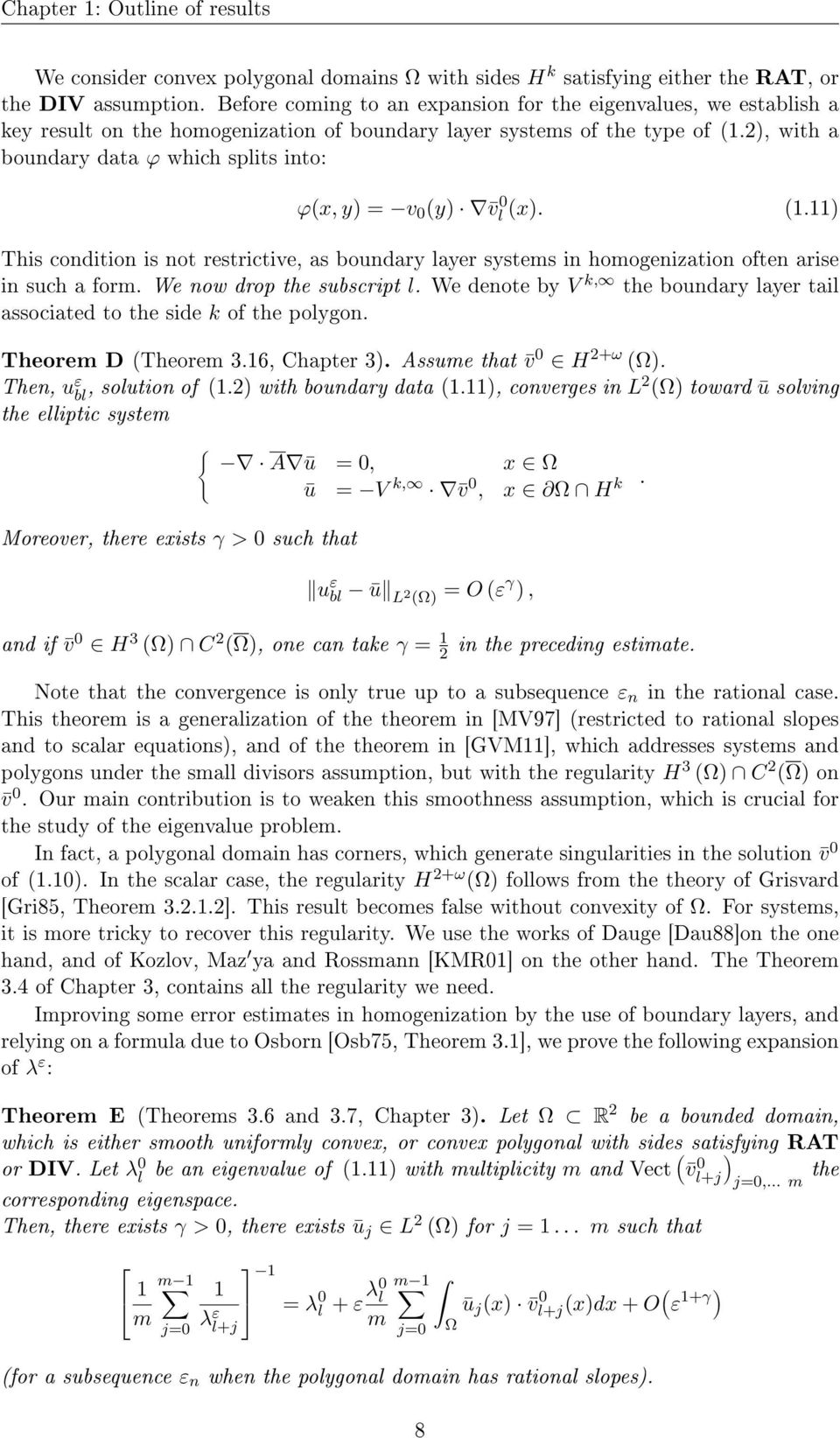
16 Chapter : Outline of results We consider convex polygonal domains Ω with sides H k satisfying either the RAT, or the DIV assumption. Before coming to an expansion for the eigenvalues, we estaish a key result on the homogenization of boundary layer systems of the type of (.), with a boundary data ϕ which splits into: ϕ(x, y) = v 0 (y) v 0 l (x). (.) This condition is not restrictive, as boundary layer systems in homogenization often arise in such a form. We now drop the subscript l. We denote by V k, the boundary layer tail associated to the side k of the polygon. Theorem D (Theorem 3.6, Chapter 3). Assume that v 0 H +ω (Ω). Then, u, solution of (.) with boundary data (.), converges in L (Ω) toward ū solving the elliptic system Moreover, there exists γ > 0 such that A ū = 0, x Ω ū = V k, v 0, x Ω H k. u ū L (Ω) = O (γ ), and if v 0 H 3 (Ω) C (Ω), one can take γ = in the preceding estimate. Note that the convergence is only true up to a subsequence n in the rational case. This theorem is a generalization of the theorem in [MV97] (restricted to rational slopes and to scalar equations), and of the theorem in [GVM], which addresses systems and polygons under the small divisors assumption, but with the regularity H 3 (Ω) C (Ω) on v 0. Our main contribution is to weaken this smoothness assumption, which is crucial for the study of the eigenvalue proem. In fact, a polygonal domain has corners, which generate singularities in the solution v 0 of (.0). In the scalar case, the regularity H +ω (Ω) follows from the theory of Grisvard [Gri85, Theorem 3...]. This result becomes false without convexity of Ω. For systems, it is more tricky to recover this regularity. We use the works of Dauge [Dau88]on the one hand, and of Kozlov, Maz ya and Rossmann [KMR0] on the other hand. The Theorem 3.4 of Chapter 3, contains all the regularity we need. Improving some error estimates in homogenization by the use of boundary layers, and relying on a formula due to Osborn [Osb75, Theorem 3.], we prove the following expansion of λ : Theorem E (Theorems 3.6 and 3.7, Chapter 3). Let Ω R be a bounded domain, which is either smooth uniformly convex, or convex polygonal with sides satisfying RAT or DIV. Let λ 0 l be an eigenvalue of (.) with multiplicity m and Vect Ä v ä l+j 0 the j=0,... m corresponding eigenspace. Then, there exists γ > 0, there exists ū j L (Ω) for j =... m such that m m j=0 λ l+j = λ 0 l + λ0 l m m j=0 ū j (x) v l+j(x)dx 0 + O Ä +γä Ω (for a subsequence n when the polygonal domain has rational slopes). 8
17 Chapter : Outline of results The rst-order correctors to the eigenvalues involve directly the solutions ū j of homogenized boundary layer systems. Moreover, one can replace the exponent γ by under the assumption Vect Ä v 0 l+j ä j=0,... m H3 (Ω) C (Ω). We note that this theorem improves the results of Moskow and Vogelius in three directions: more general domains, elliptic systems and better convergence rate (the formula of [MV97] is stated for a remainder o() instead of O ( +γ) ). Notice that the case of smooth domains is a consequence of the recent work of Gérard- Varet and Masmoudi [GVM] on the homogenization of (.). Besides, one can wonder if our newly obtained Theorem B could make it possie to extend such a result to arbitrary polygonal domains. Our feeling is that the very slow convergence without the small divisors assumption, does not make it possie to achieve a theorem such as Theorem D in this case. We nally stress that our work on error estimates in homogenization, and on the expansion for the eigenvalues opens the way to numerical analyses in the spirit of [SV06, SV08]... Newtonian limit for weakly viscoelastic uid ows (Chapter 6) Joint work with Didier Bresch This work is concerned with viscoelastic uid ows, which have an elastic behaviour in short times, and a viscous one in large times. Such non newtonian uids are ubiquitous: glaciers, Earth's mantle, dough, paint, solutions of polymers. They have a complex dynamic: like a ball made of the modelling clay Silly Putty, which bounces several times before spreading on the oor. Because of elasticity, viscoelastic uids remember their history, which means that the dynamic of the ow at a given time depends on the past. This is in strong constrast with newtonian uids (i.e. purely viscous uids). The viscoelastic relaxation time is roughly the time on which the ow remembers the past. The dimensionless number, which compares the viscoelastic relaxation time to a time scale relevant to the uid ow, is the Weissenberg (or Deborah number) We. The bigger We, the more important is the elasticity with respect to the viscosity. One of our purposes is to study the newtonian limit of some macroscopic models of viscoelastic uid ows, that is to say the limit We 0. The works presented here are a rst step toward a better understanding of the eect of a small amount of elasticity on the newtonian dynamic of a uid. The latter is one of our mid-term projects. All macro-macro models we consider here are the coupling of a momentum equation on the incompressie velocity u = u(t, x) R d and an equation for the symmetric stress tensor τ = τ(t, x) M d (R) (or a structure tensor A = A(t, x) M d (R), which has a microscopic meaning). In the sequel, we concentrate on two models: namely the corotational Johnson-Segalman model t u + u u ( ω) u + p = τ, u = 0, We ( t τ + u τ + τw (u) W (u)τ) + τ = ωd(u). (.) 9
![We note that this theorem improves the results of Moskow and Vogelius in three directions: more general domains, elliptic systems and better convergence rate (the formula of [MV97] is stated for a](/docs-images/44/1900037/images/page_17.jpg "remainder o() instead of O ( +γ) ). Notice that the case of smooth domains is a consequence of the recent work of Gérard- Varet and Masmoudi [GVM] on the homogenization of (.). Besides, one can wonder if our newly obtained Theorem B could make it possie to extend such a result to arbitrary polygonal domains.")
18 Chapter : Outline of results and the FENE-P model t u + u u ( ω) u + p = τ, u = 0, t A + u A ua A ( u) T + We τ A Tr A b Å = (b+d)ω A b We Tr A b ã I, = We I. (.3) Notice that these systems are posed in Ω R d a bounded domain, Ω = R d, or Ω = T d. We recall that u + ( u)t u ( u)t D(u) :=, W (u) :=. Moreover, we assume that u satises a noslip boundary condition on Ω. There is no condition for τ (nor A) on the boundary. We start from the initial conditions: u(0, ) := u 0, τ(0, ) := τ 0, A(0, ) := A 0. We consider only the case of Jerey uids, for which 0 < ω <, in the framework of global in time weak solutions. The case ω = turns out to be much more complicated (like Euler in comparison to Navier-Stokes). The existence of weak solutions to the corotational model (.) is due to Lions and Masmoudi [LM00]. The starting point of their result is the energy estimate ω u L (Ω) (T ) + ω( ω) T 0 u L (Ω) + We τ L (Ω) (T ) + T τ L (Ω) 0 ω u 0 L (Ω) + We τ 0 L (Ω). (.4) They intensively rely on the use of defect measures to pass to the limit in the product τ n W (u n ), where (u n, τ n ) is an approximated smooth solution to (.). Note that the regularity provided by (.4) is barely τ L ( (0, ); L ) and u L ( (0, ); L ). For the FENE-P model, an existence result has been achieved by Masmoudi [Mas], thanks to a relative entropy invented by Hu and Lelièvre [HL07]. The fundamental point is that the decay of the entropy u L (Ω) + + ω(b + d) b ω(b + d) b u 0 L (Ω) T (T ) + ( ω) u L (Ω) 0 ñ ln (det A) b ln We Ω T Tr A We Ä ä Tr A 0 + ω(b + d) b Ω We Ω ñ b Ç Tr(A) å b d Tr A b ln (det A 0 ) b ln Å + (b + d) ln + Tr Ä A ä b b + d ãô (T ) Ç Tr(A å Å 0) + (b + d) ln b ãô b b + d (.5) controls the L ( (0, ); L ) norm of τ. We come back to this point in detail in the Chapter 6. These existence theorems of global weak solutions make it possie to address the convergence We 0. Is it easy to see that the solutions of (.) converge formally to a solution of the Navier-Stokes system t u 0 + u 0 u 0 u 0 + p 0 = 0, Ω, u 0 = 0, Ω, u 0 = 0, Ω. 0 (.6)
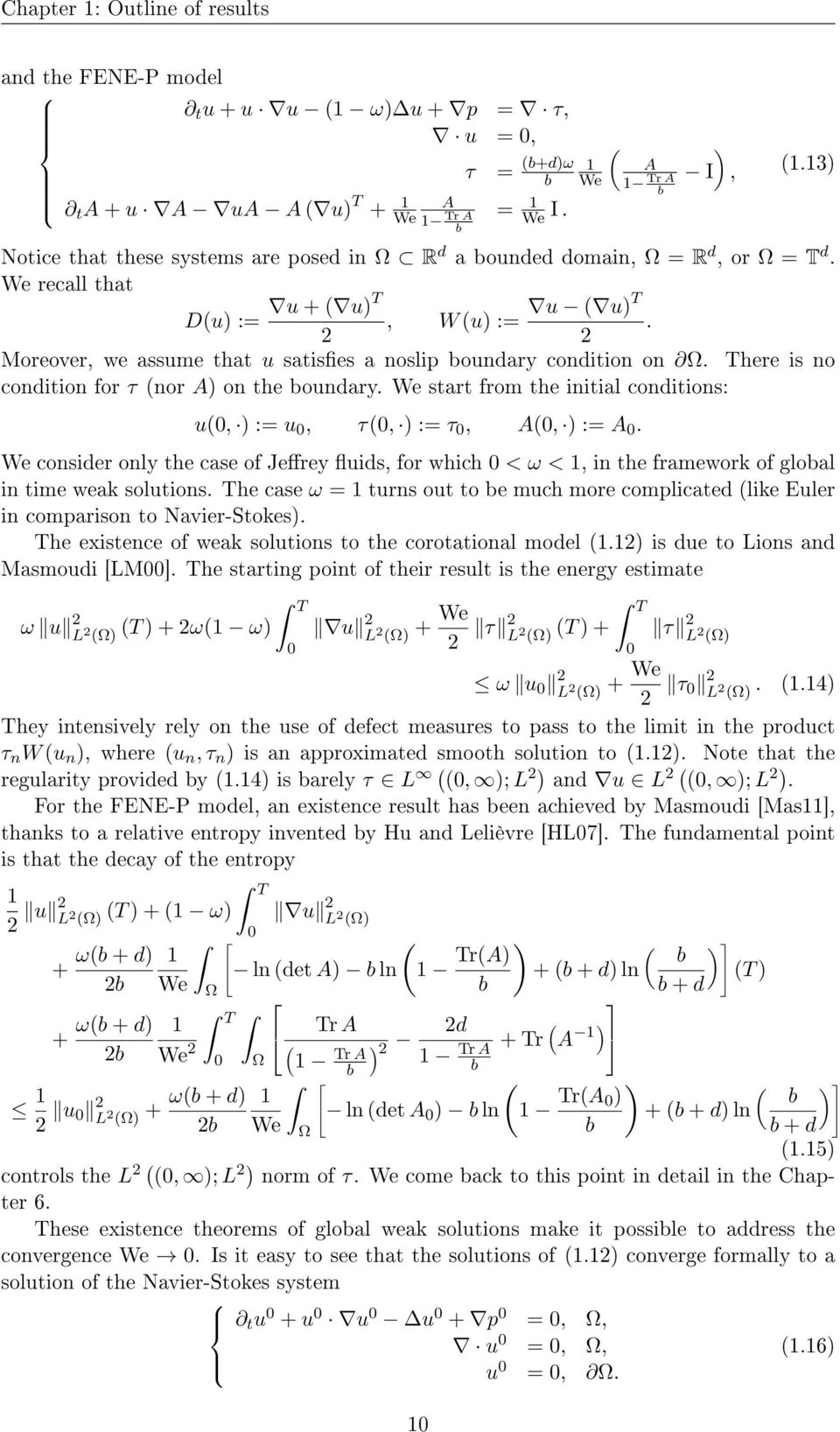
19 Chapter : Outline of results Notice that the noslip condition is compatie with the limit, so that no boundary layers are involved in this limit (at least at the leading order in We). That is why, we state our results for Ω a bounded domain, Ω = T d or Ω = R d without making any dierence. As far as we know, the only results concerning the newtonian limit of viscoelastic uid ows deal with strong solutions. Saut [Sau86] has investigated the case of Maxwell type uids (no dissipation term in the momentum equation) in the linear régime, and Molinet and Talhouk [MT08] the case of general Johnson-Segalman systems (including the corotational and the Oldroyd-B systems). For these models no energy of the type of (.4) is availae in general, so they rely on a splitting in low and high frequencies at a cut-o frequency depending on We. The mathematical justication of the formal asymptotics requires a priori bounds uniform in We. Some bounds, like the L ( (0, ); L ) bound on τ for (.), are not uniform in We. They were usefull for the Cauchy theory, but are useless for the newtonian limit. In some cases, we have to assume that initial data is well-prepared (in a sense to be made precise later on) in order to get uniform bounds. Let us briey describe the main results, we obtain in the Chapter 6. The rst theorem is concerned with the strong convergence in the corotational system (.). Theorem F (Theorem 6.3, Chapter 6). Let d =, 3, u 0 H 4,σ (Ω) independent of We and τ 0 L (Ω) L q (Ω), with < q 3. Notice that τ 0 may depend on We in the following sense: τ 0 L (Ω) = O(). Let also u L Ä (0, ); L,σä L Ä (0, ); Ḣä, and τ L Ä (0, ); L ä L loc ((0, ); L q ) be global weak solutions to (.5) in the sense of Lions and Masmoudi [LM00] associated to the initial data u 0 and τ 0. Then, there exists 0 < T < independent of We and u 0 L Ä (0, ); L,σä L Ä (0, ); Ḣä a global weak solution of (.6) associated to the initial data u 0, such that, in addition, u 0 belongs to L ( (0, T ); H 4) for all 0 < T < T. Moreover, for all 0 < T < T, sup 0<t<T Ç ωu(t, ) u 0 (t, ) t + ω( ω) Ä u u 0ä L + We 0 τ(t, ) τ 0 (t, ) L + t τ τ 0 L 0 L å = O Ä We ä. The proof of this theorem relies on the construction of an Ansatz for (u, τ) and on an energy estimate on the remainder. The scheme is analogous to relative entropy methods, used for example by Jourdain, Le Bris, Lelièvre and Otto [JLBLO06] in the study of the long-time behaviour of some polymeric uid ows. We return in some more details to the relative entropy method in the Chapter 6. For the FENE-P model, it is hard to get even a formal convergence result. However, it is clear that A converges (at least formally) to A 0 := a weak convergence result for well-prepared data. b b+d I. Hence, we manage to prove Theorem G (Proposition 6., Chapter 6). Let d =, 3. We consider a global weak solution (u, A, τ) of (.3) in the sense of Masmoudi [Mas]. Assume that u 0 L (Ω) = O(). Then:

20 Chapter : Outline of results Assume that initial data is ill-prepared in the sense that ï Å ã Å ln (det A 0 ) b ln + (b + d) ln Ω Tr A 0 b Then A tends to A 0 in L ( (0, ); L (Ω) ) and b b + d ãò = O (). A A 0 L ((0, );L (Ω)) = OÄ We ä. (.7) Assume furthermore that initial data is well-prepared namely Ω ï Å ln (det A 0 ) b ln Tr A 0 b Then we have the following improved convergences: ã Å + (b + d) ln b b + d A A 0 L = OÄ We ä, ((0, );L (Ω)) A A 0 L = O (We). ((0, );L (Ω)) ãò = O (We). (.8a) (.8b) Moreover, τ is bounded uniformly in L ((0, ) Ω), and u (resp. τ) converges in the sense of distributions toward u 0 (resp. ωd(u 0 )), where u 0 satises the Navier-Stokes system (.6). To get the strong convergences (.7), (.8a) and (.8b), we use the convexity of the entropy found by Hu and Lelièvre. Our next goal, which is work in progress, is to get the strong convergence of u and τ. An idea to get such results is to build an Ansatz for A, in the same spirit as we have done for the corotational system.

21 Chapitre Introduction Sommaire. Contexte Plan de l'introduction Une histoire d'échelles Matériaux composites Fluides géophysiques Fluides viscoélastiques Analyse multi-échelles et couches limites Homogénéisation et couches limites Une couche limite en géophysique : la couche d'ekman Couches limites Couches limites en homogénéisation Asymptotique de la couche limite : le cas général (Chapitre 4) Couches limites en mécanique des uides Caractère bien posé du système d'ekman linéarisé pour une rugosité quelconque (Chapitre 5) Asymptotiques Estimations d'erreur en homogénéisation Homogénéisation de la couche limite (Chapitre 3) Asymptotique des valeurs propres d'un système elliptique à coef- cients oscillants (Chapitre 3) Fluides faiement viscoélastiques (Chapitre 6) Contexte Cette thèse est consacrée à l'étude asymptotique de quelques équations aux dérivées partielles. Les modèles que l'on étudie sont issus de la science des matériaux et de la mécanique des uides. De façon schématique, les systèmes étudiés mettent en jeu un paramètre, une équation L u = 0, (.) posée dans un domaine Ω R d (ou (0, T ) Ω ), ainsi que des conditions sur le bord Ω (et éventuellement des conditions initiales) pour u. La généralité du système (.) masque bien-sûr la diversité des situations qu'il recouvre. Le petit paramètre peut avoir une signication physique ou purement mathématique. 3
22 Chapitre : Introduction Dans le premier cas, il peut traduire des oscillations à l'échelle microscopique, soit dans les propriétés du milieu (hétérogénéités des matériaux composites), soit dans la structure du bord (rugosités en mécanique des uides), ou provenir d'un adimensionnement. Dans le second cas, sa raison d'être peut être, par exemple, un processus de régularisation utilisé dans une démonstration d'existence de solutions. L'étude asymptotique de (.) dans la limite est motivée par des aspects physiques, numériques et mathématiques. Du point de vue de la physique, il s'agit de dériver des modèles limites valaes dans diérents régimes. Du point de vue numérique, l'enjeu est de capturer l'eet des petites échelles sans avoir à les résoudre explicitement, puisque souvent la taille du paramètre rend inopérant un calcul direct. Du point de vue mathématique, les questions qui se posent sont :. Quel est le système limite lorsque 0?. Ce système est-il bien posé? 3. Peut-on montrer un résultat de convergence pour u? 4. Peut-on raner l'asymptotique de u? La présence d'un bord peut compliquer considéraement le déroulement de ce programme. Le fait que le système limite puisse être incompatie avec les conditions aux limites imposées sur u est une des sources majeures de dicultés. À proximité du bord peuvent se développer de nombreuses singularités et instabilités. Il est donc crucial d'analyser nement le comportement des solutions u au voisinage du bord Ω dans une couche étroite, la couche limite. Plan de l'introduction La section. est dédiée à la présentation des modèles physiques étudiés dans ce travail. Elle est centrée sur la notion d'échelle, qui éclaire les analyses asymptotiques. La section.3 est consacrée à quelques asymptotiques formelles. On montre la nécessité de prendre en compte dans l'analyse des termes de couches limites. L'étude mathématique des couches limites est l'objet de la partie.4. Enn, la section.5 apporte des éléments d'analyse mathématique mis en uvre pour justier les asymptotiques formelles. On a essayé d'avoir des notations homogènes dans toute cette introduction. Elles diffèrent donc souvent des notations utilisées dans les chapitres correspondants.. Une histoire d'échelles Pour nous qui percevons les tremements de terre aectant la lithosphère, le manteau terrestre a l'apparence d'un solide élastique. À l'échelle des temps géologiques, des mouvements de convection responsaes de la tectonique des plaques, rapprochent le manteau terrestre d'un uide visqueux. Dans un autre domaine, l'extension géographique d'un vaste courant marin permanent comme le Gulf stream sur plusieurs milliers de kilomètres est sans commune mesure avec l'échelle spatiale des courants de marée, qui font subir à une particule d'eau un trajet de l'ordre de la dizaine de kilomètres. Ces deux exemples, cette thèse en contient bien d'autres, montrent que la question des échelles est omniprésente en physique. Gardons à l'esprit qu'elle concerne : l'échelle temporelle, ou le temps sur lequel les phénomènes sont observés (comportement en temps court et long des uides viscoélastiques), l'échelle spatiale, ou la taille du phénomène observé (hétéorogénéités des matériaux composites à l'échelle microscopique, rugosités en microuidique), 4
23 Chapitre : Introduction le régime physique, ou l'importance relative des diérents paramètres caractérisée par des nombres sans dimension (Reynolds, Rossby, Weissenberg...)... Matériaux composites Un matériau composite est un assemage de deux matériaux (un matériau matrice et un renfort) ou plus ayant des propriétés diérentes. Le matériau composé a des propriétés, que séparément les matériaux mis en commun n'ont pas (légèreté, rigidité), ce qui explique leur large utilisation dans l'industrie. Les composites peuvent exister à l'état naturel : bois (lignite, renfort en bre de cellulose), os (collagène, renforts en apatite). Cependant, la plupart des matériaux composites sont produits articiellement, dans une optique industrielle : bres de verre, bres de carbone, GLAss-REinforced et Kevlar utilisés en aéronautique, béton armé. De multiples structures sont possies : matériau stratié, avec des inclusions, tissé, en sandwich, en nid d'abeille. Les matériaux que l'on étudie dans cette thèse ont tous une structure périodique. Cette hypothèse ne couvre qu'une partie de la réalité physique, puisqu'il existe des composites ayant une structure non périodique (bois aggloméré, composites dentaires, epoxy granite), et qu'elle exclut la présence de défauts. Les matériaux composites présentent une structure multi-échelles : l'échelle macroscopique, qui est celle du solide considéré dans son intégralité, par exemple un pan de mur, l'échelle mésoscopique, intermédiaire, par exemple celle d'une maille de l'ossature métallique du béton armé, et l'échelle microscopique, qui est celle à laquelle on peut observer la structure de base d'assemage des matériaux, par exemple celle du granulat utilisé comme renfort dans la matrice de ciment. Pour notre modélisation, on ne va prendre en compte que deux échelles, l'échelle microscopique et l'échelle macroscopique. Appelons le rapport de ces deux échelles. Biensûr, l'échelle n'est microscopique que relativement à la taille macroscopique de l'objet. Les exemples ci-dessus montrent bien que la taille absolue des microstructures peut être très variae! Pour un composite en carbone époxy (matrice en résine époxy, renforts en bre de carbone), utilisé par exemple dans la fabrication des mâts et coques de voiliers de compétition, l'échelle microscopique liée à l'assemage des bres dans la matrice est de l'ordre de 5 µm, les échelles macroscopiques sont celles de l'épaisseur d'un panneau stratié, mm à cm, et de la longueur d'un voilier multicoques, 40 m (cf. [GRMC]). Ces valeurs donnent un paramètre variant de l'ordre de 0 3 à 0 5. L'échelle microscopique est celle à laquelle on peut observer les hétérogénéités. Les variations des propriétés au niveau de la structure de base, donc sur la distance, se traduisent par de fortes oscillations dans les propriétés du milieu. Vu de très loin, en revanche, la structure microscopique s'eace et le matériau paraît homogène. Équations de conservation en milieux hétérogènes L'étude mathématique des matériaux composites remonte aux années 70, avec la puication, notamment, de l'ouvrage de référence de Bensoussan, Lions et Papanicolaou [BLP78]. Un des modèles qui a été étudié intensivement, et sur lequel une partie de cette thèse est centrée (cf. Chapitres 3 et 4) est le système elliptique linéaire sous forme diver- 5
24 Chapitre : Introduction gence A ( x ) u = f, x Ω u = ϕ 0, x Ω, (.) posée dans un ouvert borné Ω R d. La famille de matrices A = A αβ (y) M N (R) indexée par α, β d représente les propriétés du milieu, u = u (x) R N est une inconnue vectorielle, f = f(x) R N est un terme source et ϕ 0 = ϕ 0 (x) R N. Les échelles microscopiques y := x et macroscopiques x Ω se lisent directement sur le système (.). C'est à l'échelle microscopique que varient les propriétés du matériau. N'étant intéressés que par l'analyse des structures périodiques, une hypothèse majeure est la périodicité de A en la variae microscopique y. Le système (.) représente des phénomènes stationnaires dans des matériaux hétérogènes, en régime linéaire. Il a de nombreuses interprétations physiques : Il modélise la répartition de la charge électrique. Dans ce cas, N =, u est le potentiel électrostatique, f la distribution de charges électriques, et A = γ I d la conductivité électrique (isotrope dans cet exemple). Il modélise la répartition de la température (équation de la chaleur). Dans ce cas u est une quantité scalaire (N = ), la température, f une source de chaleur et A = A(y) M d (R) la matrice de conductivité thermique. La condition de Dirichlet u = ϕ 0 impose une température sur le bord. Il modélise l'élasticité linéaire. Dans ce cas, d = ou 3, N = d, u est le vecteur déplacement, A est la matrice des coecients élastiques, f représente les forces volumiques, et ϕ 0 les forces surfaciques. De manière générale, le système (.) provient d'une équation de conservation sur un tenseur σ σ = f et d'une loi phénoménologique exprimant σ comme gradient d'une autre quantité u. Dans l'exemple de la chaleur σ est le vecteur densité de ux de chaleur, et la loi exprimant σ en fonction de u est la loi de Fourier σ = A Å x ã u. Propagation d'ondes basses fréquences en milieux hétérogènes Intéressons-nous à ces matériaux très hétérogènes à présent plutôt dans une perspective dynamique. L'équation des ondes, hyperbolique et linéaire, t u A ( x ) u = 0, x Ω u = 0, x Ω, (.3) est posée dans le domaine (0, ) Ω. Un enseme dénombrae de valeurs propres strictement positives 0 < λ 0... λ k... et une base orthonormée de L (Ω) de vecteurs propres vk sont associés à l'opérateur A ( x) et au domaine Ω : ( A x ) v k = λ k v k, x Ω vk = 0, x Ω. (.4) La solution de (.3) engendrée par les données initiales u (0, ) = u 0 et u (0, ) = u 0 indépendantes de, peut se développer sur la base de vecteurs propres : u (t, x) = k=0 c,± k v k(x) exp Ä ±i» λ k tä, 6
25 Chapitre : Introduction Pour tout k N, les coecients sont solutions du système i» λ k c,+ k c,+ k + c, i» λ k c, k = u 0, v k k = u 0, v k. (.5) Les nombres» λ k s'interprètent comme les fréquences propres du matériau. Supposons que la donnée initiale soit localisée en basses fréquences. Plus précisément, on suppose que les modes K sont négligeaes c,± k. k=k Comme l'opérateur est linéaire, les fréquences ne sont pas mélangées et la solution tronquée en basses fréquences fournit donc une approximation de u en norme L ( (0, ); L (Ω) ) : K u c,± k vk(x) exp Ä ±i» λ k tä. k=0 L ((0, );L (Ω)) La question principale peut s'énoncer ainsi : peut-on remplacer la solution tronquée en basses fréquences, qui présente toujours de fortes oscillations dans la limite 0, par une fonction non oscillante et garder une bonne approximation, au moins pour des temps courts? L'enjeu est de moyenner en un certain sens, ou d'homogénéiser, à la fois les vecteurs propres et les valeurs propres oscillants. Soit un mode 0 k < K xé. Si l'on sait démontrer v k = v 0 k + O L (), λ k = λ 0 k + O (), (.6a) (.6b) alors, pour c 0,± k solutions de (.5) avec λ 0 k (resp. v 0 k) à la place de λ k (resp. v k), c,± k vk exp Ä ±i» λ k tä c 0,± k v 0 k exp (» ) ±i λ 0 k t L (Ω) uniformément en t pour t, de sorte que c kv 0 k exp (±i» λ 0 k t ) est une bonne approximation du mode oscillant, en temps relativement long. Améliorer le développement (.6b) de la valeur propre λ k permet d'étendre la validité de l'approximation sur des temps plus longs. C'est l'un des objectifs du Chapitre 3. Sur ces questions, on peut également se référer aux introductions de [AA99, SV93], ainsi qu'à [SP80]... Fluides géophysiques Such motions are present on an enormous range of spatial and temporal scales, from the ephemeral utter of the softest breeze, to the massive and persistent oceanic and atmospheric current systems. (Pedlosky [Ped87, p. ]) Des courants océaniques tels que le Gulf Stream dans l'océan Atlantique, ou le Kuroshio sur la côte est du Japon transportent en continu des dizaines de Sverdrup ( Sverdrup = 0 6 m 3 s ) d'eaux relativement chaudes, des tropiques vers les latitudes élevées de l'hémisphère nord. Les répercussions sur le climat de cette circulation, qui tend à homogénéiser les températures, sont considéraes. D'autres courants se produisent à des échelles plus petites. À la diérence des deux exemples précédents qui sont des transports horizontaux, ils mettent en jeu des mouvements 7
26 Chapitre : Introduction d'eau verticaux : phénomènes de pompage ou d'upwelling sur la côte ouest du Pérou et du Chili. La remontée d'eaux froides chargées de nutriments fait de ces régions des zones propices à la pêche. Un des points communs de ces courants en particulier est qu'ils sont dus à la rotation de la Terre. D'autres uides géophysiques tels que l'atmosphère ou le noyau liquide de la Terre subissent ses eets. Pour une présentation de la physique des uides tournants, pas uniquement géophysiques, on renvoie le lecteur à [Gre69]. Pour un exposé centré sur les uides géophysiques, on peut se référer à [Ped87], en particulier aux chapitres et 4. Pour une introduction aux thématiques de l'océanographie, on pourra lire [Lac7]. Des uides en rotation rapide Reprenons la remarque de [CDGG06, p. ]. Une particule d'eau prise dans le Gulf Stream met environ 50 jours pour traverser l'atlantique et parcourir 5000 km. Pendant ce temps, la Terre tourne 50 fois. L'eet de la rotation de la Terre est donc sensie pour ce type d'écoulements caractérisés par leur grande extension spatiale L (plusieurs milliers de kilomètres) et leur vitesse relativement faie U (quelques mètres par seconde). Ainsi, la rotation terrestre ne peut être négligée lorsque la durée de l'écoulement (suivant une particule) est grande devant la durée d'une journée, c'est-à-dire L U Ω où Ω = 7, s est la fréquence de rotation de la Terre. Le paramètre pertinent apparaît être le nombre de Rossby déni par := U ΩL. Dans l'exemple précédent du Gulf Stream, est de l'odre de 0 3, ce qui montre que l'écoulement est fortement inuencé par la rotation. Dans le cas de l'anticyclone des Açores pour lequel U (resp. L) est de l'ordre de 0 ms (resp. 000 km), le nombre de Rossby vaut 0. Dans le noyau de fer liquide de la Terre, on peut trouver des valeurs de bien plus faies de l'ordre de 0 7 (cf. [Dor97, Appendice A]). Des uides à petit nombre de Rossby sont dits en rotation rapide. Comme le souligne Ekman [Ekm05] l'inuence de la rotation de la Terre sur les écoulements géophysiques a été comprise depuis longtemps, notamment par Hadley (cellules de Hadley pour la circulation atmosphérique tropicale), Coriolis et Ferrel (cellules de Ferrel pour les latitudes moyennes). Bjerknes [Bje0] a montré son importance par rapport à d'autres causes possies de mouvement telles que des diérences de densité. En première approximation, les uides que l'on considère sont des uides visqueux incompressies et en rotation rapide. Tous les autres eets dus à des diérences de température, de salinité... sont ignorés. Sous forme non adimensionnée, la dynamique de l'écoulement est régie par le système de Navier-Stokes-Coriolis (voir [Ped87, Chapitre ] pour une dérivation complète de ces équations) t u + u u + Ωe 3 u = p ρ + Φ + ν u + f, u = 0, (.7) où u = u (t, x ) est la vitesse, f est un terme de forçage soutenant l'écoulement, ν la viscosité du uide, ρ sa densité et e 3 est le vecteur directeur de l'axe de rotation de la 8
27 Chapitre : Introduction Terre (pôle sud/pôle nord). Outre les forces inertielles u u et visqueuses ν u, cette description prend en compte deux forces directement liées à la rotation : l'accélération de Coriolis Ωe 3 u, l'accélération centripète Φ qui dérive d'un potentiel. La force de Coriolis et l'accélération centripète sont des forces ctives, dont l'origine est le caractère non inertiel (ou non galiléen) du référentiel lié à la Terre. Donnons quelques ordres de grandeur. Le terme u u est d'ordre U /L ; la force de Coriolis Ωe 3 u est d'ordre ΩU. Le rapport entre accélération relative et accélération de Coriolis vaut donc U /L ΩU = U ΩL =. Le nombre de Rossby est donc une mesure de l'importance relative de ces deux forces. Pour des écoulements géophysiques à large échelle, l'accélération relative est négligeae devant l'accélération de Coriolis. Par ailleurs, la comparaison des forces de friction d'ordre νu/l à l'accélération de Coriolis conduit à introduire le nombre d'ekman E νu/l ΩU = ν =: E. ΩL En introduisant les quantités adimensionnées t = t U L, x = x L, la vitesse u(t, x) := u (t, x ) satisfait t u + u u E u + e 3 u + p = f u = 0. (.8) Le nouveau potentiel p représente la pression du uide ainsi que l'accélération centripète. Si l'on compare (.8) au système de Navier-Stokes il apparaît que le seul terme changeant la structure de l'équation est le terme antisymétrique e 3 u. La singularité montre la prépondérance de la force de Coriolis dans la balance des forces. Elle est à l'origine de nombreuses particularités des écoulements géophysiques à grande échelle. Dans tout ce qui suit, nous ne prenons pas en compte la courbure de la Terre dans le choix du domaine. Les conclusions ne seront jamais valaes au voisinage de l'équateur, puisqu'à l'équateur la force de Coriolis s'annule. D'autres mécanismes physiques sont à l' uvre dans les régions équatoriales. Pour simplier, nous considérons un domaine voisin des pôles, bien que les résultats puissent être étendus à des régions subpolaires, notamment aux latitudes moyennes 3060 degrés. La direction verticale du domaine coïncide donc avec l'axe de rotation de la Terre. Nos travaux sur ce sujet (cf. section.4.4 et Chapitre 5) sont dédiés à l'étude du système (.8) linéarisé. Bien-sûr le système linéaire ne capture pas toute la physique de l'écoulement. Cependant, la dynamique des uides tournants en régime linéaire est riche, et des phénomènes physiques intéressants sont liés à l'interaction entre les forces de Coriolis, les forces visqueuses et les rugosités des bords horizontaux. Viscosité turbulente Comparées aux forces de Coriolis et de pression, les forces de friction agissant sur les écoulements géophysiques à grande échelle sont faies. La persistance des grands courants marins ou systèmes de vents sur des temps très longs en témoigne. Pourtant, aussi faie soit-elle, l'interaction entre les forces de frottement et la force de Coriolis est à l'origine de phénomènes intéressants. 9
28 Chapitre : Introduction La dissipation d'énergie se fait à l'échelle moléculaire. Une des tâches majeures de la modélisation en mécanique des uides géophysiques est de comprendre comment l'écoulement principal nourrit les mouvements turbulents de taille plus petite. En d'autres termes, il s'agit de quantier la cascade d'énergie des grandes échelles aux petites échelles et in ne de représenter la dissipation en terme de la vitesse macroscopique. Il s'agit donc d'un proème d'homogénéisation très complexe, qui fait toujours l'objet de recherches actives : voir entre autre [DS] pour la modélisation de la turbulence en général. Une façon rudimentaire de tenir compte de l'existence de ces phénomènes dissipatifs et de fermer les équations du mouvement est de supposer l'existence d'une viscosité turbulente. Les forces de friction s'expriment alors sous la forme d'une viscosité anisotrope ν h h u ν v 3u où ν h (resp. ν v ) est une viscosité turbulente horizontale (resp. verticale). L'hypothèse d'isotropie du modèle (.7) est discutae (de même que la représentation de la cascade d'énergie par la viscosité turbulente), mais cruciale dans l'analyse mathématique du Chapitre 5. De plus, la détermination de la valeur de ces viscosités turbulentes empiriques est dicile. Pour l'océan et l'atmosphère on estime que ν v ν h (cf. [Ped87, Chapitre 4] pour des plages de valeurs de ν h et ν v ). La viscosité isotrope seme plus pertinente pour le noyau liquide de la Terre [Dor97, Appendice A]. Pour ce dernier E 0 5 = O ( ) et sauf indication contraire, on suppose dans la suite que le nombre d'ekman est de cet ordre : E. Quelques particularités des uides tournants (en régime linéaire) During the drift of the Fram, Nansen observed that the ice was not carried along in the direction in which the wind ew but that the ice drift deviated, on an average, 8 degrees to the right of the direction towards which the wind was owing. [...] [Nansen] arrived at the conclusion that the deviation of the ice drift must be ascribed to the eect of the rotation of the earth, which in the northern hemisphere tends to deect any moving body to the right. Nansen reasoned further that the ice would set the water directly underneath it in motion and that the water would then move to the right in relation to the ice drift [...]. Similar conditions could be expected in the open sea [...]. (Sverdrup [Sve50, p. 88]) Les deux termes dominants dans (.8) sont l'accélération de Coriolis et les forces de pression. À l'ordre principal en, ces deux forces sont donc en balance e 3 u 0 = p 0, (.9) ce qui constitue l'équilibre géostrophique. On peut lire de nombreuses propriétés de l'écoulement principal sur (.9) : direction des vents La direction du vent géostrophique est orthogonale au gradient de pression (ou encore tangente aux lignes isobares). colonnes de Taylor-Proudman De (.9) on déduit 0 = 3 p 0, u 0 = p 0, u 0 = p 0. Il s'ensuit d'une part que p 0 est indépendant de x 3, donc que u 0 et u 0 le sont aussi, et d'autre part que u 0 + u 0 = 0. Comme l'écoulement est incompressie, 3u 0 3 = 0, donc u 0 3 est indépendant de x 3. Une conclusion (partielle) est que l'écoulement dominant est bidimensionnel et est déterminé par sa valeur sur le bord inférieur ou supérieur du domaine. 0
29 Chapitre : Introduction La deuxième observation seme contredire certains faits : le fond des océans qui n'est pas plat doit forcer (au moins au voisinage du fond) une variation de la vitesse dans la direction verticale. De plus la circulation dans les océans n'est pas la même à toutes les profondeurs (courants de surface, courants profonds, zones d'upwelling). Ainsi l'équilibre géostrophique n'est valae que loin des bords, et près des bords horizontaux (fond et surface des océans...) l'asymptotique formelle doit être anée. Faisons une analyse sommaire de ce qui se passe au voisinage de la surface (supposée plate) d'un océan de profondeur innie sur lequel soue le vent. On se focalise sur une ne couche de taille O() près du bord supérieur, ce qui revient à ger la variae tangentielle x h : ũ = ũ(x h, z) := u(x h, z), p = p(x h, z) = p(x h, z). En analysant les ordres des termes dans (.8), on est amené à chercher une solution particulière ũ = ũ(z) et p = p(z) satisfaisant le système d'équations diérentielles pour z < 0, { d ũ dz ũ = 0 d ũ dz + ũ = 0. Loin du bord, pour z, on impose que ũ, ũ tendent vers 0. Le forçage par un vent dirigé selon la direction de x se traduit par la condition sur le bord z = 0 : Alors, d dz ũ(0) = 0, [ ( ũ (z) = T ) cos z sin [ ( ũ (z) = T ) cos z + sin d dz ũ(0) = T. ( )] z exp ( )] z exp ( ) ( z ) z. La solution ũ est la spirale d'ekman. Deux intégrations par parties donnent 0 ũ (z) = T, 0 ũ (z) = 0. Le transport moyen dans la direction du vent (direction de x ) est nul. En moyenne, sur toute la couche, le transport se fait dans la direction orthogonale à celle du vent. Juste sous la surface, ũ (0 ) = T = ũ (0 ), le transport du uide se fait dans une direction faisant un angle de 45 degrés avec celle du vent. Ces faits contre-intuitifs font partie des conclusions fondamentales d'ekman [Ekm05] et donnent une première explication aux observations de Nansen, rapportées par Sverdrup. Ce transport d'ekman par frottement du vent sur la surface est une conséquence de l'interaction des forces visqueuses et de Coriolis. Il s'agit d'un phénomène purement linéaire. Il apparaît donc que la viscosité est importante dans une ne couche de taille caractéristique au voisinage des bords horizontaux du domaine, la couche d'ekman, dans laquelle elle peut équilibrer la force de Coriolis. L'étude de cette couche, dans le régime linéaire, est l'objet du Chapitre 5. Topographie Flow in the benthic boundary layer may be inuenced indirectly by bottom features, such as sand waves, on a scale of tens or hundreds of metres [...]. (Bowden [Bow78, p. 6])
30 Chapitre : Introduction L'expérience quotidienne nous apprend que la surface terrestre, loin d'être plate, est composée de structures de tailles caractéristiques variaes. Ces rugosités peuvent être des vallées et des montagnes, des bâtiments, des forêts... qui ont un impact sur la circulation atmosphérique. La connaissance de la structure du fond des océans, en revanche, n'est pas si ancienne et remonte à la pose des premiers câes sous-marins. On doit à Heezen, Tharp et Ewing [HTE59] la première carte du fond de l'atlantique nord (voir aussi Heezen et Hollister [HH7]). L'étude de la bathymétrie fait apparaître un relief très riche (cf. [Lac7] Chapitre -IV) : vallées et canyons sous-marins qui entaillent le talus continental, plaines abyssales, dorsales. Ces dernières jouent un rôle hydrologique majeur puisqu'elles gênent les échanges entre les bassins. Enn, des travaux très récents [NLMSS0, LMNGLH06] mettent en évidence la transition brutale entre le noyau liquide de la Terre et le manteau, ainsi que des structures irrégulières à l'interface entre les deux milieux de taille caractéristique m. Les rugosités sont suscepties d'engendrer des instabilités et des phénomènes turbulents. Il est particulièrement important d'étudier leur impact lorsqu'elles sont de même taille caractéristique que la couche limite visqueuse, ou couche d'ekman. Ceci est notamment le cas à la frontière entre le noyau liquide de la Terre et le manteau. Pour l'océan profond, la couche limite d'ekman au voisinage du fond a une taille caractéristique de 0 m (cf. [Bow78, Tae ]). Les premiers travaux mathématiques ont étudié la couche limite visqueuse à proximité soit d'un bord plat (Grenier et Masmoudi [GM97]), soit d'un relief périodique (Gérardvaret [GV03]). Notre objectif dans le Chapitre 5 est de s'aranchir de cette hypothèse pour traiter des prols de rugosités sans structure. L'impact de ce type d'études est important, puisqu'il permet de mieux s'approcher de la réalité physique...3 Fluides viscoélastiques In essence, Newtonian uids are uids whose constituent particles are too small for their dynamics to interact substantially with the macroscopic motion. The Newtonian model becomes inadequate for uids which have a microstructure involving much larger scales than the atomic scale. (Renardy [Ren00, p. ]) Les bases de la théorie des uides viscoélastiques, ayant des propriétés élastiques en temps courts et se comportant comme des uides visqueux en temps longs, ont été jetées par Maxwell dans l'article [Max67]. Il y arme que tous les uides sont viscoélastiques, tout dépendant bien-sûr de l'échelle de temps que l'on considère! Les uides pour lesquels les propriétés élastiques sont observaes sont omniprésents : les liquides physiologiques (sang, salive), certains uides géophysiques (glaciers, manteau terrestre), en cuisine (mélange eau/maïzena, pâte levée), dans l'industrie (gels, mousses, solutions aqueuses de polymères, huiles silicones, peintures). Le paramètre déterminant le caractère viscoélastique d'un uide est le temps de relaxation viscoélastique séparant les régimes élastiques et visqueux. Pour l'eau ce temps est de l'ordre de 0 s, ce qui rend l'observation des propriétés élastiques impossie. De ce fait, l'eau est un uide purement visqueux. Pour des huiles silicones, le temps caractéristique des propriétés élastiques est de l'ordre d'une demi seconde. La glace se comporte élastiquement pendant quelques heures, le manteau terrestre sur des durées de l'ordre de 0 0 s (soit plusieurs centaines d'années!). Ces valeurs ne sont que des ordres de grandeurs, et la plupart des uides réels n'ont pas un temps de relaxation aussi bien déni. L'exemple d'une boule en pâte à modeler Silly Putty, qui peut rebondir plusieurs fois sur le sol comme une balle de ping-pong (comportement élastique) avant de s'étaler pendant plusieurs jours comme le ferait une goutte d'eau (comportement visqueux) met en évidence
31 Chapitre : Introduction la dynamique riche des uides viscoélastiques. Pour une introduction à la rhéophysique, et aux uides non-newtoniens en général, on pourra consulter le livre de Oswald [Osw05]. On pourra aussi se référer au livre de Renardy [Ren00], ainsi qu'au texte de Le Bris et Lelièvre [LBL09]. Quelques phénomènes contre-intuitifs Exposons brièvements quelques eets dus à l'élasticité. Ces eets sont surprenants, puisque nous sommes peu habitués à prêter attention aux propriétés élastiques des uides. On peut pourtant en faire souvent l'expérience. Le premier eet concerne un uide (une pâte levée par exemple) dans lequel plonge une tige cylindrique verticale (le pétrin d'un fouet électrique). Si l'on fait tourner cette tige rapidement sur elle-même, on observe la montée du uide le long de la tige. En l'absence d'élasticité, le uide s'écarterait de la tige en rotation sous l'eet de l'accélération centrifuge. Dans le uide viscoélastique, le cisaillement dû à la rotation rapide de la tige étire les molécules longues (par exemple les molécules de gluten), qui en retour exercent une force élastique tendant à les rapprocher de la tige. Le deuxième eet porte le nom de siphon sans tube. Dès que l'on sort un siphon d'un liquide newtonien (comme de l'eau), la colonne d'eau s'eondre sous son propre poids et le siphonnage s'interrompt. Dans un uide susamment viscoélastique, en revanche, l'eet continue même lorsque le siphon est hors du uide. L'élasticité est à nouveau fondamentale : les particules de uide sont étirées et la tension élastique sut à équilibrer l'eet de la pesanteur. Cet eet se produit aussi dans un pot de peinture, qui remplit à ras bord, s'écoule par un mince let. L'écoulement persiste, même lorsque le pot de peinture s'est partiellement vidé. Pour de nombreux autres eets, on peut voir le chapitre introductif de [Ren00]. L'élasticité peut avoir des eets stabilisants, ou conduire à de nouvelles instabilités : pour un lien entre les instabilités magnétohydrodynamiques et viscoélastiques voir [OP03]. La littérature physique est très riche : sur la turbulence des uides viscoélastiques [GS00, CK00, CBG0, AK0, Kel04], sur la réduction de la traînée [MCY03], et sur la réduction de la traînée en présence de rugosités [Vir70, YD0]. Ces questions ont des répercussions importantes sur certains processus industriels. Injecter quelques particules de polymères par million de particules d'eau sut à rendre un écoulement turbulent proche du laminaire et donc à diminuer la perte d'énergie de l'écoulement principal par dissipation vers les échelles plus petites. La compréhension mathématique de certains de ces phénomènes est un des objectifs de nos travaux futurs. Élasticité, viscosité, viscoélasticité En rhéophysique on exprime la contrainte τ (force surfacique ou volumique) en fonction des déformations du solide/liquide. Décrivons l'élasticité et la viscosité de manière schématique. Un solide élastique (en régime linéaire) soumis à une contrainte se déforme (i.e. ses constituants subissent un déplacement relativement les uns par rapport aux autres) de façon proportionnelle à la force (ou contrainte) appliquée. Ceci constitue la loi de Hooke. Pour un matériau isotrope, le rapport entre la contrainte et la déformation est le module élastique noté G. Si la contrainte est supprimée, le matériau retrouve sa conguration initiale, à condition de rester en-deçà de sa limite d'élasticité. Un solide élastique garde donc la mémoire de sa conguration initiale. Les phénomènes purement élastiques sont donc réversies. 3
32 Chapitre : Introduction La viscosité correspond à la réponse d'un uide à un gradient de vitesse. Une couche de uide rapide frottant sur une autre plus lente crée une contrainte de cisaillement. Cette contrainte (en régime linéaire) est proportionnelle au taux de cisaillement, ou gradient de vitesse, ce qui constitue la loi de Newton. Le facteur de proportionnalité est la viscosité dynamique η. Un uide purement visqueux, en d'autres termes un uide newtonien, n'a pas de mémoire. La viscosité introduit l'irréversiité. Une première approche très simple, mais éclairante, de la viscoélasticité est celle de Maxwell. Il fait l'hypothèse que les taux de déformations élastiques et visqueux du uide se superposent, conduisant à l'équation τ + G η τ = G î u + ( u ) T ó (.0) où désigne la dérivée temporelle, u est la vitesse du uide et D (u ) := u +( u ) T est le tenseur des déformations ; toutes les grandeurs étoilées sont dimensionnées. Le quotient λ := η/g a la dimension d'un temps ; c'est le temps de relaxation viscoélastique. Comme le souligne Renardy [Ren00, p. 4], ce temps est grosso modo le temps sur lequel le uide se souvient de son histoire. Quand λ, le uide est purement élastique ; quand λ, le uide est uniquement visqueux. La solution générale de (.0) est Å ã τ (t, x ) = exp t τ0 + G λ λ t 0 Ç exp t t å D (u ) (t )dt λ ce qui met en lumière le fait que les contraintes s'exerçant sur un uide à un instant t, tiennent compte de toute l'histoire de l'écoulement. Enn, les exemples de uides plus haut montrent que l'on peut ranger les uides viscoélastiques en deux catégories : les uides uniquement viscoélastiques, dits uides de Maxwell : glaciers, manteau terrestre, huiles silicones, pâtes levées ; les uides pour lesquels une réponse viscoélastique se superpose à une réponse newtonienne, dits uides de Jerey : dans cette catégorie se classent toutes les solutions aqueuses de polymères susamment diluées. Quelques modèles macro-macro L'étude de ces uides pose des questions complexes de modélisation multi-échelles. Il s'agit notamment de comprendre comment les microstructures, responsaes du comportement élastique, interagissent avec le mouvement macroscopique du uide (sur cette question voir [LBL]). Ici on considère des modèles ne mettant en jeu que des grandeurs macroscopiques du uide : modèles macro-macro. Présentons quelques modèles que nous étudions dans le Chapitre 6. Ils couplent une équation des moments sur le champ de vitesse macroscopique incompressie u, ρ ( t u + u u ) = p + τ + f, u = 0 et une équation sur τ. Le tenseur des contraintes macroscopique (matrice symétrique), est la somme d'une partie visqueuse due au solvant τs := η s D (u ), nulle dans le cas d'un uide de Maxwell et d'une partie viscoélastique τp. Cette dernière est solution d'une équation analogue à (.0), où la dérivée temporelle notée est remplacée par une loi diérentielle constitutive plus générale D t τ p + λ τ p = η p D (u ). 4
33 Chapitre : Introduction Pour être physiquement acceptae, la loi doit satisfaire une condition d'indiérence matérielle (principe d'objectivité). Beaucoup de lois sont de la forme D t τ := t τ +u τ +τ W (u ) W (u ) τ a [D (u ) τ + τ D (u )]+β (τ ), (.) où W (u ) = u ( u ) T, a et β est une fonction (non-linéaire). L'absence de non-linéarité (β = 0) correspond à la loi de Johnson-Segalman. Le cas a = (dérivée convectée inférieure) est peu réaliste physiquement. Deux cas particuliers sont très étudiés : Le cas a = (dérivée convectée supérieure) τ W (u ) W (u ) τ [D (u ) τ + τ D (u )] = u τ τ ( u ) T. Lorsque η s = 0 (resp. η s 0) il s'agit du Upper Convected Maxwell uid (resp. du modèle d'oldroyd-b). Ce modèle peut-être dérivé d'une description microscopique. Le cas a = 0 (modèle corotationnel). Les seules non-linéarités de ces modèles (β = 0) sont d'origine cinématique. Ils conduisent à des prédictions plus ou moins en accord avec les expériences. Pour être prédits (exemple du comportement rhéouidiant, c'est-à-dire diminution de la viscosité lorsque le taux de cisaillement augmente), certains phénomènes nécessitent de prendre en compte des non-linéarités du matériau. Parmi les nombreux modèles citons celui de Phan-Thien et Tanner avec β = α λ η p τ Tr τ, ou celui de Giesekus β = α λ η p τ. On trouve dans [Ren00, Chapter 3] ainsi que dans [TS95] une discussion de certains modèles. On pose η := η s + η p et ω := ηp η. Pour une vitesse (resp. taille) typique U (resp. L) de l'écoulement, on introduit les grandeurs adimensionnées Le nombre de Reynolds x = x L, t = U L t, u = u U, τ = U ηl τ. Re := ρul η est une mesure de l'importance des eets inertiels par rapport aux forces visqueuses. Le nombre de Weissenberg (ou nombre de Deborah) We := λu L compare le temps de relaxation viscoélastique à l'échelle de temps caractéristique de l'écoulement. Lorsque We, les phénomènes élastiques ne sont pas observaes. Sous forme adimensionnée, les modèles décrits ci-dessus s'écrivent Re ( t u + u u) ( ω) u + p = τ, u = 0, We Ä t τ + u τ + τw (u) W (u)τ a [D(u)τ + τd(u)] + β(τ) ä + τ = ωd(u). (.) Notons que cette modélisation n'englobe même pas tous les modèles macro-macro étudiés au Chapitre 6 (cf. modèle de FENE-P). Le but de nos travaux est l'étude de la limite newtonienne de certains uides viscoélastiques, i.e. la limite We 0 et Re = O() xé. 5
34 Chapitre : Introduction.3 Analyse multi-échelles et couches limites Présentons ici quelques développements formels permettant de dériver les équations satisfaites à la limite 0. Pour être pertinents, les termes des développements doivent tenir compte de la microstructure du proème (hétérogénéités ou rugosités), être compaties avec les conditions au bord. Pour ces raisons, on est souvent conduit à séparer la question de l'asymptotique en un proème à l'intérieur du domaine, et un proème au voisinage du bord..3. Homogénéisation et couches limites Il y a dans le système elliptique (.) à coecients oscillants deux échelles caractéristiques : l'échelle macroscopique x et l'échelle microscopique représentée par la variae rapide y = x. Pour prendre en compte la périodicité de la microstructure, on peut supposer le développement doue-échelle u = u 0 Å x, x ã + u Å x, x ã Å + u x, x ã +... les prols u i = u i (x, y) étant périodiques en la seconde variae. En injectant cet Ansatz dans le système (.3.) et en identiant les puissances de, on obtient de manière classique la cascade d'équations (cf. [BLP78, CD99]) y A(y) y u 0 = 0, y A(y) y u = x A(y) y u 0 + y A(y) x u 0, y A(y) y u i+ = F Ä u i, u i+ä.. Le cadre périodique permet de calculer explicitement les correcteurs. La première équation entraîne l'indépendance de u 0 par rapport à la variae y u 0 (x, y) := ū 0 (x). La deuxième permet par séparation des variaes x et y d'exprimer u en fonction de la solution χ = χ β (y) M N (R) d'un proème cellulaire auxiliaire Le correcteur à l'ordre est donc y A(y) y χ β = yα A αβ, u (x, y) = χ α (y) xα ū 0 + ū (x). T d χ β = 0. (.3) D'une condition de compatibilité sur la troisième équation découle que ū 0 est solution de A ū 0 = f, x Ω (.4) ū 0 = ϕ 0, x Ω où A := T d A αβ + A αγ yγ χ β. On a ainsi dérivé formellement l'équation homogénéisée. Notons que le système (.4) est elliptique. De plus les coecients de A ne sont pas simplement la moyenne des coecients de A, ce qui indique (si cette asymptotique formelle est la bonne!) des phénomènes non triviaux dans le passage à la limite. 6
35 Chapitre : Introduction À première vue, cette asymptotique formelle est très bonne à l'intérieur du domaine Ω : en ajoutant des correcteurs on a Å ã x A Ä u ū 0 u (x, y) u (x, y)... i u i (x, y) ä Ä = O L i ä. Dans le cas d'un domaine sans bord (le tore), une simple estimation d'énergie valide ce développement. Mais dans le cas d'un bord, un proème surgit. La trace du développement à l'ordre Å Å ã ã Å Å ã ã x x u ū 0 χ ū 0 + ū = χ ū Ω 0 + ū (.5) Ω est d'amplitude. De plus, elle est a priori fortement oscillante, et ces oscillations le long du bord n'ont pas de raison d'être périodiques en général. Tout dépend de la manière dont le bord Ω intersecte la microstructure périodique. Corriger cette erreur est un enjeu majeur de cette thèse. L'objectif est de mieux comprendre le comportement de u près du bord, ce qui nécessite d'introduire la couche limite u, corrigeant la partie oscillante de (.5). La couche limite est solution du système elliptique ( A x ) u, = 0, x Ω u, = χ ( x) ū 0, x Ω (.6) à coecients et donnée sur le bord oscillants. Trouver, même formellement, le système homogénéisé de (.6) est un proème bien plus dicile que celui de trouver la limite de u. La raison principale est que les oscillations le long du bord, non périodiques en général, forcent les oscillations de la solution u, au voisinage du bord. En faisant l'hypothèse que les fortes oscillations de u, se concentrent dans une couche, voisine du bord, de taille, on approche u, ( par v x, x). Comme le bord rompt la microstructure périodique, la périodicité par rapport à la variae rapide ne fait plus sens. Pour x 0 Ω, v = v (x 0, y) est alors formellement solution du système y A(y) y v = 0, y n(x 0 ) > cx 0 v = χ(y) ū 0, y n(x 0 ) = cx, (.7) 0 dans lequel x 0 est un paramètre et x n(x 0 ) c x0 = 0 est l'équation de la tangente à Ω en x 0. L'étude de (.7) est un proème clé dans l'homogénéisation du système de couche limite (.6)..3. Une couche limite en géophysique : la couche d'ekman Les motivations physiques évoquées plus haut pour l'étude mathématique du système des uides tournants (.8) dans un domaine à bords horizontaux rugueux sont particulièrement fortes. Il est notamment important de déterminer l'inuence sur l'écoulement des structures de taille comparae à celle de la couche limite visqueuse. On se place donc dans le domaine rugueux, non borné dans la direction tangentielle, Ω := ß (x h, x 3 ), x h R, ω Å ã xh < x 3 <. La fonction ω, bornée, est un prol de rugosité pour le moment complètement arbitraire. On impose une condition de non-glissement sur la vitesse u au niveau du bord rugueux. 7
36 Chapitre : Introduction Pour simplier, on ne se préoccupe que du bord inférieur ; les même questions se posent bien-sûr au niveau du bord x 3 =. Analysons formellement l'asymptotique du système de Navier-Stokes-Coriolis (.8) dans le domaine Ω. On a vu qu'à l'ordre principal on a l'équilibre géostrophique e 3 u 0 = p 0. Cette égalité impose la bidimensionnalité du champ de vitesses u 0, qui est incompatie avec la condition de non-glissement. Il faut donc corriger ce développement au moins au près du bord pour faire le lien entre la condition de non-glissement et l'écoulement géostrophique loin du bord. Les remarques physiques, en mettant en évidence l'existence d'une ne couche de uide dans laquelle les forces visqueuses balancent la force de Coriolis, renforcent cette idée. Développons suivant l'échelle macroscopique x et l'échelle microscopique y = x, en séparant termes intérieurs et termes de couche limite Å u = u 0 (t, x) + u 0 t, x, x ã Å p = p 0 (t, x) + p 0 t, x, x Å + ã + Å u (t, x) + u t, x, x ãã +... Å ãã p (t, x) + p +... Å t, x, x Alors, à l'intérieur du uide c'est-à-dire loin des bords, u 0 = ( u 0 h (t, x h), 0 ), où u 0 h = u 0 h (t, x h) R est une solution du système d'euler t u 0 + u 0 h u 0 + u + h p = 0, h u 0 = 0, dans R. Dans la couche limite, u = u (t, x, y) est solution du système d'ekman y u + u y u + e 3 u + y p = 0, y 3 > ω(y h ) y u = 0, y 3 > ω(y h ) (.8) u(y h, ω(y h )) = u 0 (t, x h ), y h R posé dans le demi-espace rugueux y 3 > ω(y h ). Notons que dans ce système, x h est un paramètre, et que la donnée sur le bord n'a donc pas de propriétés de décroissance. Elle corrige la trace de l'écoulement géostrophique u 0 sur le bord rugueux. Dans le cadre où le prol est périodique, on peut montrer que le terme u dans l'équation sur u 0 h est la source d'un phénomène de damping, traduisant la dissipation d'énergie dans la couche limite [GV03, GVD06]..4 Couches limites Cette partie est dédiée à l'analyse mathématique de systèmes de type couches limites. De façon générale, on se pose 3 questions :. Le proème est-il bien posé?. Peut-on décrire l'asymptotique loin du bord? 3. La couche limite est-elle stae? On se focalise ici exclusivement sur les deux premières. Pour la troisième, on renvoie le lecteur notamment à [Gre00, Rou0, GR0, DDG04, GR08, Rou04, MR08]. 8
37 Chapitre : Introduction Ces deux premières questions soulèvent de nombreuses dicultés. Par exemple, les proèmes de couches limites sont posés dans des domaines innis (typiquement des demiespaces), alors que les données (et donc les solutions) ne décroissent pas à l'inni. Pour construire ces solutions d'énergie innie, trouver le bon cadre fonctionnel est dicile, surtout en l'absence de propriétés structurales (périodicité, quasi-périodicité... ). Pour ce qui concerne l'asymptotique loin du bord, nous verrons qu'un autre proème, de type ergodique, apparaît. De manière schématique, on aborde les questions d'existence et d'asymptotique par : des méthodes d'énergie Notons que ces méthodes ne sont pas variationnelles stricto sensu, i.e. associées à la minimisation d'une énergie : en eet, les espaces considérés sont d'énergie innie. Elles reposent plutôt sur des estimations de Saint-Venant. De telles estimations sont possies lorsque le cadre fonctionnel permet de recourir à des inégalités de type Poincaré, soit parce que l'on dispose d'un peu de structure, comme dans les sections.4. et.4.3 (lorsque la rugosité est périodique ou quasi-périodique), soit, en l'absence de toute propriété structurale, parce que l'on peut se ramener à travailler dans un domaine borné (au moins dans une direction), par exemple via des conditions aux limites transparentes ; voir la section.4.4 et le Chapitre 5. Lorsque ces estimations échouent, on peut recourir à : des méthodes potentielles en représentant la solution grâce aux noyaux de Poisson et de Green. On s'appuie alors sur les propriétés asymptotiques des noyaux pour étudier la solution, comme dans la section.4. et le Chapitre Couches limites en homogénéisation On se concentre sur l'analyse du proème de couche limite A(y) v = 0, y n a > 0 v = v 0 (y), y n a = 0, (.9) posé dans le demi-espace {y n a > 0} R d dirigé par n S d. Les deux questions qui nous occupent sont d'une part l'existence et l'unicité d'une solution v à (.9), et d'autre part la convergence de v (y) lorsque y n. Ce dernier point est décisif. Le comportement de la couche limite loin du bord détermine en eet la donnée homogénéisée sur le bord Ω dans le système (.6) (voir la section.5. et le Chapitre 3). Le sytème (.9) est l'analogue du proème cellulaire (.3), avec des diérences majeures rendant son analyse bien plus compliquée. Le domaine est non borné, et la donnée sur le bord ne décroît pas. Le proème mathématique majeur que pose l'analyse de (.9) est la rupture du réseau périodique du fait du bord. L'enjeu essentiel est de comprendre l'interaction entre le bord et la microstructure périodique et de voir si des propriétés de structure sont préservées. Ces structures sont essentielles pour l'approche par estimations d'énergie. Celle-ci nécessite d'utiliser à un moment une inégalité de type Poincaré. Utiliser la structure du système, s'il y en a une, peut donner de la compacité, au moins dans une direction, et de ce fait fournir cette inégalité. Pour l'analyse de (.9), caractère bien posé et asymptotique, on distingue trois cas : RAT n est proportionnel à un vecteur à coordonnées rationnelles, i.e. n RQ d. Ce cas à été étudié par de nombreux auteurs, voir entre autres [MV97, AA99, Naz9]. DIV n / RQ d, et l'hypothèse de petits diviseurs suivante est satisfaite : il existe C, τ > 0, tels que pour tous ξ Z d \ {0}, pour tout i =,... d, n i ξ C ξ d τ, (.0) 9
38 Chapitre : Introduction où (n,... n d, n) est une base orthogonale de R d. Ce cas est l'objet de l'article [GVM]. NON DIV cas général n / RQ d sans hypothèse de petits diviseurs. Ce cas est le sujet du Chapitre 4 et de l'article [Pra3]. Pour la suite, faisons un changement de variae dans (.9) permettant de se ramener à un bord plat. Soit M M d (R) une matrice orthogonale envoyant e d (le d-ième vecteur de la base canonique de R d ) sur n. Faire le changement de variae z = M T y conduit à v(z) := v Ä M T y ä est solution de B(Mz) v = 0, zd > a v = v 0 (Mz), z d = a, (.) où B = B αβ M N (R) est une famille de matrices périodiques indexée par α, β d. Avant d'introduire les principaux résultats pour le cas général NON DIV dans la section.4. ci-dessous, revenons sur les deux premiers RAT et DIV. Structure périodique Dans le cas où n RQ d, on peut choisir M à coecients dans RQ d. Dès lors z B(Mz), z v 0 (M(z, a)) (.) sont périodiques, et on peut supposer sans perte de généralité que la période est égale à. Le cadre périodique simplie la preuve d'existence, mais encore plus l'analyse asymptotique. Étudions un cas particulier, où toutes les fonctions peuvent se calculer par développements en séries de Fourier dans la direction tangentielle : d = et B = I. L'utilisation des séries de Fourier est quelque peu trompeuse, puisque ce n'est pas l'approche à laquelle on recourt lorsque B n'est pas constant. Elle permet cependant de mettre en évidence le type de résultat que l'on attend, et certaines particularités. On suppose de plus n = e, ou ce qui revient au même M = I, de sorte que v = v(z, z ) R est solution de Alors, pour tout z = (z, z ) T (a, ), v = 0, z > a, v = v 0, z = a. (.3) v(z, z ) = ξ Z v 0 (ξ)e π ξ (z a) e iπξz. Il s'ensuit par égalité de Parseval que v(z, z ) v 0 (z, a)dz T L (T) ξ Z\{0} v 0 (ξ) e 4π ξ (z a) Ce 4π(z a). (.4) Il découle de (.4) la convergence exponentielle de v(z, z ) vers une constante, la queue de couche limite, loin du bord, i.e. lorsque z. De plus, la queue de couche limite T v 0(z, a)dz dépend de a, ou plutôt de la partie fractionnaire de a. Revenons brièvement à l'analyse générale du cas rationnel. Pour l'existence, on commence par relever la donnée de Dirichlet v 0 (M ) à l'aide d'une fonction ϕ Cc (R) : ṽ = v ϕ(z d )v 0 (M(z, 0)) est solution d'un système analogue à (.) avec condition sur le bord homogène et terme source à support compact en z d. On est alors conduit à résoudre 30
39 Chapitre : Introduction Ä le nouveau système en ṽ dans l'espace de Hilbert des fonctions Hloc T d (a, ) ä, nulles sur le bord, telles que a T d ṽ <. La convergence de la couche limite est ensuite déduite d'une estimation de Saint- Venant : pour tout k N, k > a, v L (T d (k+, )) C v L (T d (k,k+)). (.5) L'inégalité (.5), qui est une sorte d'inégalité de Gronwall discrète, donne immédiatement de la convergence exponentielle vers V,a R N, la queue de couche limite. Pour obtenir (.5), on combine l'estimation a priori ã Åv v(z, k + )dz T d L (T d (k+, )) v v(z, k + )dz T d H / (T d ) v v(z, z )dz T d H (T d (k,k+)) où la constante C est uniforme en k, avec l'inégalité de Poincaré-Wirtinger ã v v(z, z )dz Åv T d H (T d (k,k+)) v(z, z )dz. T d L (T d (k,k+)) Plus de détails sur le cas RAT sont donnés en section 4. du Chapitre 4. On renvoie également à [MV97, Appendix]. Notons que les même techniques peuvent permettre de traiter le cas d'une frontière rugueuse périodique. Une remarque importante est que l'estimation de Saint-Venant pour la convergence ci-dessus ne dépend que de la solution loin du bord. Il s'ensuit que ni la rugosité du bord, ni la condition sur le bord rugueux n'interviennent. Cependant, la rugosité impose la structure du proème. On revient sur des proèmes de rugosités aux sections.4.3 et.4.4 pour des modèles issus de la mécanique des uides. Structure quasi-périodique Lorsque n / RQ d, la périodicité (.) n'est plus vraie. La mise en uvre d'une démarche analogue à celle du cas rationnel repose sur l'observation suivante. Appelons N M d,d (R) la matrice des d premières colonnes de M. Il existe une famille de matrices B = B αβ (θ, t) M N (R), V 0 = V 0 (θ, t) R N, θ T d, t a, tels que pour tout z R d (a, ), B(Mz) = B(Nz +z d n) = B(Nz, z d ), v 0 (M(z, a)) = v 0 (Nz +an) = V 0 (Nz, a). (.6) Ainsi, les coecients B(M ) et la donnée sur le bord v 0 sont quasi-périodiques en z, c'està-dire qu'il existe Q M d,d (R) et F = F (θ) une fonction périodique en θ T d telles que v 0 (M(z, a)) = F (Qz ). L'idée consiste à utiliser cette structure, et à chercher v sous la forme v(z) = V (Nz, z d ), avec V = V (θ, t) R N solution de Ç N T å Ç θ N B(θ, t) T å θ V = 0, t > a t 3 t V = V 0, t = a. (.7)
40 Chapitre : Introduction Le gain réalisé en remplaçant (.) par (.7) est la périodicité dans la variae tangentielle θ T d. On paie ce bénéce par la perte ( de l'ellipticité de l'opérateur ( diérentiel. Par exemple en dimension d =, si n = 3 ),, alors N = n = ), 3 et N T θ = θ + 3 θ. Le gradient tordu N T θ ne contient donc pas les dérivées dans toutes les directions, ce qui entrave l'ellipticité. La périodicité en θ fournit un cadre fonctionnel naturel, celui des V tels que a T d Å N T θ V ã + t V dθdt <. L'existence découle alors d'une régularisation elliptique ι θ V et d'estimations uniformes en ι. On peut ensuite considérer des dérivées d'ordre supérieur, et étair que pour tout l 0, α N d, Å N T θ α + l+ θ α V ã dθdt <. (.8) a T d θ V L'existence d'une solution peut ainsi être étaie pour tout n / RQ d. En revanche, l'- analyse asymptotique reposant sur des estimations d'énergie (comme dans le cas rationnel ci-dessus), ne peut être conduite que sous l'hypothèse de petits diviseurs DIV. La convergence vers une queue de couche limite V R N est une conséquence d'une estimation de Saint-Venant sur F (T ) := T T d t Å N T θ V ã + t V dθdt. L'idée générale est la même que dans le cas rationnel. On doit néanmoins prendre garde au fait que N T θ est un gradient dégénéré. Le rôle clé de l'hypothèse de petits diviseurs est d'entraîner un type d'inégalité de Poincaré-Wirtinger avec ce gradient dégénéré : pour tout < p <, pour tout t > a, T d V (θ, t) V (θ, t)dθ Å dθ C p T d En eet, en posant V := V (θ, t) T d V (θ, t)dθ, on a T d V (θ, t) dθ Ñ V (ξ, t) ξ (d+τ) ξ Z d \{0} T d é p Ñ N T θ V (θ, t) dθ ã V (ξ, t) ξ d+τ p ξ Z d \{0} p. (.9) é p p Le premier facteur représente la norme de V (, t) dans un Sobolev homogène d'exposant négatif et peut être majoré grâce à l'hypothèse de petits diviseurs (.0) N T θ V (θ, t) L (T d ) = iπ V (ξ, t) N T ξ C V (ξ, t) ξ Z d \{0} ξ Z d \{0} ξ (d+τ). Le second facteur peut être borné grâce à l'estimation (.8) par une constante C p. Grâce à l'inégalité (.9), on peut étair pour tout < s < l'inégalité diérentielle F (T ) C s ( F (T ) ) s qui implique la convergence de V vers V dans L Ä T dä lorsque t, à la vitesse O (t m ) pour tout m R. La queue de couche limite V est indépendante de a. L'existence comme la convergence ont leur contrepartie pour v (resp. v ) solutions de (.) (resp. (.9)). On revient en détail sur le cas DIV à la section 4. du Chapitre 4. On renvoie à [GVM] pour la démonstration de ces résultats. 3.
41 Chapitre : Introduction.4. Asymptotique de la couche limite : le cas général (Chapitre 4) L'objectif de l'article [Pra3] puié dans SIAM Journal on Mathematical Analysis et reproduit dans le Chapitre 4, est d'étudier le comportement de v (y) pour y n en s'aranchissant de l'hypothèse de petits diviseurs (.0), i.e. pour n / RQ d quelconque. Insistons sur le fait que l'asymptotique de v loin du bord détermine la donnée sur le bord homogénéisée dans le système (.6), ce qui fait de cette question le proème majeur de l'homogénéisation des systèmes de type couche limite (voir la section.5. et le Chapitre 3). Dicultés : à quoi l'hypothèse de petits diviseurs sert-elle? L'hypothèse de petits diviseurs entraîne une inégalité de type Poincaré-Wirtinger (.9), sans laquelle l'approche par estimation de Saint-Venant est inopérante. De plus, l'hypothèse de petits diviseurs est utilisée de manière cruciale pour obtenir la convergence rapide vers la queue de couche limite. Cela apparaît nettement sur le système simplié où d =, B = I et a = 0. Pour tout t > 0, pour tout m N, à condition que v 0 soit assez régulière, V (θ, t) T V 0 (θ, 0)dθ = L (T ) t m Ct m Ct m ξ Z \{0} v 0 (ξ) t m e 4π n ξ t v 0 (ξ) ξ (+τ)m ( N ξ t) m e 4π n ξ t ξ Z \{0} v 0 (ξ) ξ Z \{0} ξ (+τ)m C m t m, de sorte que V (, t) converge vers v 0 (0) dans L ( T ), plus vite que n'importe quelle puissance de t. L'explication heuristique de cette convergence rapide est que l'hypothèse de petits diviseurs (.0) fournit une borne inférieure sur la distance entre le réseau Z d \ {0} et l'hyperplan y n = 0. De même, dans le cas rationnel, le trou spectral au voisinage des basses fréquences, ou encore le fait que le spectre d'une fonction périodique est discret, entraîne la convergence exponentielle (.4). Concluons ce point en indiquant que sans aucune hypothèse de structure sur la donnée v 0, il est illusoire de s'attendre à une convergence de v solution de v = 0, z > 0, v = v 0, z = 0. En eet, Gérard-Varet et Masmoudi construisent dans [GVM0, Proposition ] un exemple de v 0 pour lequel v(0, z ) n'a pas de limite quand z 0. Ils soulignent le lien entre la convergence de v loin du bord, et des propriétés d'ergodicité de v 0 sur le bord. Cette dernière propriété est cruciale dans notre travail sur l'asymptotique de la couche limite (.9) dans le cas général. Stratégie Dans le cas où n / RQ d est quelconque, on dispose encore du cadre quasi-périodique qui conduit au système (.7). L'existence de solutions à ce système et donc à (.9) (pour un théorème précis voir Theorem 4.5 dans le Chapitre 4) est vraie sans l'hypothèse de petits diviseurs. Focalisons-nous sur la convergence. Quitte à faire une translation de la variae, on se ramène au cas où a = 0. 33
42 Chapitre : Introduction À quoi peut-on s'attendre? La quasi-périodicité de la donnée de Dirichlet v 0 sur le bord y n = 0 fournit de l'ergodicité et permet d'envisager l'existence d'une limite pour v lorsque y n. En revanche l'absence de l'hypothèse de petits diviseurs, et donc le fait que l'hyperplan y n = 0 puisse être arbitrairement proche de Z d \ {0}, ne permet pas d'espérer une vitesse de convergence. L'idée fondamentale de l'article [Pra3] est de représenter la solution variationnelle v grâce au noyau de Poisson P = P (y, ỹ) M N (R) associé à l'opérateur A(y) et au domaine {y n > 0}, v (y) = ỹ n=0 P (y, ỹ)v 0 (ỹ)dỹ (.30) pour tout y R d tel que y n > 0, puis de développer P (y, ỹ) pour y ỹ y n. Suivant l'observation de [AL9, corollary p. 903], cette dernière question cache un proème d'homogénéisation des noyaux oscillants P (x, x) = d P Å x, x dans la limite 0 pour x x proche de. Le noyau de Poisson P est associé à l'opérateur A ( x) à coecients oscillants et au domaine {x n > 0}. Il s'exprime (cf. (4.43)) en terme de x G, où G = G (x, x) M N (R) est la fonction de Green associée aux même opérateur et domaine. Une tâche importante est de démontrer, à x xé, un développement de x G (x, x) pour 0 et 4 < x x < 4. La technique consiste à développer G selon la doue-échelle x et x. Les oscillations de ce développement sur le bord Γ(x, 4) \ Γ Å x, ã 4 ã := {y n = 0} B(x, 4) \ B Å x, ã, 4 conduisent à le corriger grâce à des termes de couche limite. Ainsi la diérence entre G et son développement, appelons-la R,x, satisfait un système elliptique du type { Ä ä A x R,x = F + F, x B(x, 4) \ B Ä x, ä 4 R,x = Φ, x Γ(x, 4) \ Γ Ä x, ä, 4 dans lequel les termes sources sont petits. L'outil crucial permettant d'estimer R,x est l'estimation locale sur le gradient due à Avellaneda et Lin [AL87a, lemma 0] (voir aussi Theorem 4.8 dans le Chapitre 4) : pour 0 < ν <, 0 < δ, R,x [ L (B(x,4)\B(x, 4)) C ν,δ R,x L (B(x,4)\B(x, 4)) ] + F + F L d+δ (B(x,4)\B(x, 4)) + Φ C,ν Γ(x,4)\Γ(x,. 4) Une des subtilités de l'estimation de R,x est que le terme source F dépend lui-même de termes de couches limites. Mais l'évaluation de ces termes ne nécessite pas de connaître leur comportement loin du bord, ce qui évite tout proème de circularité dans le raisonnement. On ne peut cependant s'appuyer que sur peu d'informations pour évaluer ce terme. Résultats de la thèse Dans l'article [Pra3], on démontre deux types de résultats : un développement de P (y, ỹ) dans la limite y ỹ, et un résultat relatif à l'asymptotique de v loin du bord. 34
43 Chapitre : Introduction Théorème A (Theorem 4.8, Chapter 4). Il existe une fonction P exp = P exp (y, ỹ) M N (R) dont l'expression est explicite, telle que pour tout 0 < κ < d, pour tout y (resp. ỹ) vériant y n > 0 (resp. ỹ n = 0), Ç å P (y, ỹ) = P exp (y, ỹ) + O y ỹ +κ. Ce théorème se situe dans la lignée des résultats de Avellaneda et Lin [AL9, corollaires p. 903 et 905], et sa démonstration emprunte leur méthode. Il est également à rapprocher des travaux de Sevost yanova [Sev8] et de Kozlov [Koz80]. La diérence (importante) réside dans le fait que ces résultats valent pour la fonction de Green associée au domaine R d. La présence du bord dans notre cas complique les estimations. Notre théorème ne peut être obtenu qu'en étudiant nement le comportement de G (x, x) pour x a proximité du bord Γ(x, 4) \ Γ Ä x, 4ä, ce qui revient à prendre en considération des termes de couche limite dans les développements. Notons que l'on se sert de ces correcteurs de couche limite uniquement près du bord. L'information de l'asymptotique loin du bord (qui est le but de notre étude) n'est donc pas requise. Signalons également les résultats de Avellaneda et Lin sur l'homogénéisation des fonctions de Poisson [AL89b], et ceux plus récents de Kenig, Lin et Shen [KLSb] sur les noyaux de Green, Poisson et Neumann d'un opérateur à coecients oscillants. L'objectif de ces travaux est de fournir un développement du noyau de Green (resp. Poisson, Neumann) dans un domaine borné Ω. Néanmoins, les développements obtenus laissent de côté l'homogénéisation de la couche limite. Elle seule contient toutes les oscillations et singularités de la solution près du bord, ce qui rend son analyse particulièrement ardue. L'expression de P exp est explicite (cf. (4.64)) et fait apparaître de la quasi-périodicité en la variae ỹ. L'exposant κ > 0 est essentiel pour mener à bien la convergence y n dans (.30). Théorème B (Theorems 4. et 4.3, Chapter 4). Supposons n / RQ d. Soit v la solution variationnelle de (.9). Alors,. Il existe V R N tel que v (y) y n localement uniformément en la variae tangentielle.. La queue de couche limite V est indépendante de a. 3. Supposons que n ne satisfait pas l'hypothèse de petits diviseurs (.0). Prenons d =, N = et A = I. Pour tout l > 0, il existe une donnée de Dirichlet v 0 régulière, telle que la solution v associée tende vers V plus lentement que O Ä (y n) lä. Le premier point du théorème reste valae pour n RQ d. Le deuxième est une particularité du cas n / RQ d, qui a son importance (voir la section.5. et le Chapitre 3). Le dernier point vient conrmer les remarques faites plus haut sur le rôle de l'hypothèse de petits diviseurs. Plus précisément, dans le cas particulier d =, N = et A = I on montre que cette hypothèse est nécessaire pour avoir une convergence rapide. Dans le cas général, le même phénomène à la source du contre-exemple doit se produire. Signalons enn que pour n / RQ d général tel que NON DIV, le fait que l'hypothèse de petits diviseurs n'est pas satisfaite ne permet pas, à notre avis, de construire un exemple de v 0 pour lequel la convergence soit plus lente que O Ä ln nä, par exemple. La démonstration du théorème fournit une expression explicite pour V : voir (4.68) dans le Chapitre 4. Cette expression généralise celle de Moskow et Vogelius [MV97, Proposition 6.6]. Étant donné l'importance des queues de couches limites dans l'homogénéisation 35 V
44 Chapitre : Introduction de (.6), l'expression explicite de V ouvre la voie à des études numériques dans l'esprit de [SV06]..4.3 Couches limites en mécanique des uides L'homogénéisation de microstructures hétérogènes est à rapprocher d'un autre proème : l'étude des frontières rugueuses en mécanique des uides. Il s'agit par exemple d'approcher le système de Navier-Stokes dans un canal rugueux, par un système de Navier- Stokes dans un canal à frontières plates. La question principale dans ce type de proème est : quelle condition homogénéisée sur le bord plat vient remplacer la condition sur le bord rugueux? Le but est de déterminer, si possie, la meilleure condition homogénéisée sur le bord. Dans la littérature, la condition homogénéisée porte le nom de loi de paroi, ou condition eective. Ce sujet intéresse les physiciens et les industriels (proèmes de microuidique, de réduction de la traînée, d'augmentation du glissement) : voir par exemple [GV08] et les références qui y sont citées, [LBS07] et [VY86]. Dans ce contexte, on est amené à étudier des proèmes de couches limites qui partagent des dicultés avec le système (.9). Le modèle de ce type de proèmes est le système de Stokes posé dans le demi-espace rugueux {y > ω(y )} R, u + p = 0, y > ω(y ) u = 0, y > ω(y ) u(y, ω(y )) = u 0 (y ), y R, (.3) où ω est typiquement une fonction Lipschitz bornée et u 0 est une donnée sans propriétés de décroissance. Comme pour les proèmes elliptiques de type couches limites, il y a un lien entre l'asymptotique de (.3) pour y et la condition sur le bord homogénéisée. L'analyse a d'abord été menée pour des structures déterministes périodiques : voir [APV98, AMPV98, JM0, JM03] et l'article de survol [Mik09]. Pour des rugosités aléatoires avec des propriétés d'ergodicité, on renvoie à [BGV08, GV09]. Les résultats pour des structures déterministes non périodiques sont récents [GVM0]. Comme dans le Théorème B, le leitmotiv est de s'aranchir au maximum d'hypothèses de structure. C'est ce que nous faisons au Chapitre 5, où nous étudions la couche limite d'ekman (linéarisée) pour un bord rugueux arbitraire. L'analyse de ce chapitre repose sur des outils introduits par Gérard-Varet et Masmoudi [GVM0] (et repris dans [DGV]) que nous présentons brièvement maintenant. L'étude de Gérard-Varet et Masmoudi [GVM0] envisage le proème (.3) sous plusieurs angles : caractère bien posé pour une rugosité ω quelconque ; asymptotique loin du bord pour une rugosité quasi-périodique (même presque-périodique). Ainsi que souligné ci-dessus, sans ergodicité, provenant d'une hypothèse de structure sur ω, on ne peut espérer démontrer la convergence vers une queue de couche limite. La question de l'asymptotique loin du bord est donc sans objet pour ω trop général. L'idée principale pour traiter le cas d'une frontière ω générale est de diviser le demi-plan y > ω(y ) en deux sous domaines : un canal borné dans la direction verticale 0 > y > ω(y ), dans lequel on dispose d'une inégalité de Poincaré permettant de mettre en uvre une approche variationnelle, et un demi-plan plat y > 0, dans lequel on peut étudier le système grâce à la transformée de Fourier dans la variae tangentielle. La connexion entre les deux sous-domaines se fait au travers d'une condition aux limites transparente sur le bord y = 0. 36
45 Chapitre : Introduction Les estimations d'énergie dans le canal, nécessitent de connaître la valeur de la donnée de Neumann u + pe sur le bord y = 0. Le calcul explicite en Fourier tangentiel dans le demi-espace y > 0 de la solution associée à la donnée de Dirichlet u y =0, permet de dénir un opérateur de Dirichlet to Neumann DN. L'opérateur DN permet de ramener la démonstration de l'existence d'une solution dans le demi-espace bosselé tout entier au canal bosselé 0 > y > ω(y ) au travers de la condition transparente u + pe y =0 = DN(u y =0). Une des dicultés principales est que u 0 n'a pas de propriétés de décroissance ; elle est uniformément localement dans H /, i.e. u 0 H / uloc := sup u 0 H / (k,k+) <. k Z On est donc conduit à travailler dans des espaces d'énergie innie uloc. Suivant Ladyºenskaja et Solonnikov [LS80] (canal borné avec conditions de Dirichlet sur les bords), le but dans le canal borné est de montrer, par estimations d'énergie, une inégalité de type Saint-Venant E k C Ä k ä + E k+ E k (.3) sur E k := k<y <k y >ω(y ) u dy dy. En eet, une telle inégalité (.3) permet d'obtenir par récurrence descendante une borne sur sup k Z k+ k y >ω(y ) u dy dy <. Notons qu'ici, la condition de Dirichlet sur le bord supérieur du canal est remplacée par la condition transparente. Elle est non-locale et l'estimation de Saint-Venant qui en découle est bien plus compliquée..4.4 Caractère bien posé du système d'ekman linéarisé pour une rugosité quelconque (Chapitre 5) Ce travail est en collaboration avec Anne-Laure Dalibard. L'objectif du papier [DP3], reproduit dans le Chapitre 5, est d'étudier le système de Stokes-Coriolis 3d avec donnée au bord u 0 dans un espace de régularité Sobolev uloc u + e 3 u + p = 0, y 3 > ω(y h ) u = 0, y 3 > ω(y h ) u(y h, ω(y h )) = u 0, y 3 = ω(y h ) (.33) en s'aranchissant de toute hypothèse de structure sur le prol de rugosité ω. Le système (.33) est en fait le linéarisé de (.8). Il s'agit d'une étape dans notre projet d'étudier les couches limites d'ekman non linéaires pour des fonds rugueux arbitraires. L'étude du proème linéaire (.33) pose de nombreuses dicultés mathématiques :. Le premier type de dicultés est lié au caractère non borné du domaine dans toutes les directions (absence d'inégalité de Poincaré), à l'énergie innie des fonctions avec lesquelles on travaille, au bord rugueux (entrave à l'utilisation de la transformée de Fourier dans la direction tangentielle à toutes les hauteurs) et à l'absence de 37
46 Chapitre : Introduction structure (périodique, quasi-périodique). Ces proèmes sont déjà présents dans le cas du système de Stokes étudié à la section.4.3, paragraphe Stokes dans un demiespace rugueux.. Le second type de dicultés est lié à la nature de l'opérateur. Contrairement au cas de l'opérateur de Stokes, nous n'avons pas d'expression explicite, ni d'estimation, du noyau associé à l'opérateur de Stokes-Coriolis. Par ailleurs, l'expression en Fourier de l'opérateur de Dirichlet to Neumann associé à Stokes-Coriolis n'est pas homogène d'ordre comme pour Stokes. Le développement en basses fréquences de DN fait apparaître des termes homogènes d'ordre et 0 qui sont particulièrement mauvais pour les estimations. 3. Enn, nous traitons le cas 3d et non d comme dans [GVM0], ce qui rend notamment la dérivation d'une estimation de Saint-Venant plus technique. Les dicultés du premier point s'abordent en recourant à la méthode de [GVM0, section ] décrite ci-dessus. Nous remplaçons l'étude du caractère bien posé de (.33) par l'étude du système (après relèvement de la condition de Dirichlet sur le bord oscillant) L'estimation de l'énergie u + e 3 u + p = f, ω(y h ) < y 3 < 0 u = 0, ω(y h ) < y 3 < 0 u(y h, ω(y h )) = 0, y 3 = ω(y h ) 3 u + pe 3 y3 =0 = DN(u y3 =0) + F. E k := y h <k 0 ω(y h ) u dy 3 dy h conduit à une inégalité de Saint-Venant sur E k : pour m > 0, pour k m, E k C ñ k + E k+m+ E k + k4 m 5 sup j m+k ô E j+m E j. j En raison du caratère non-local de l'opérateur DN, cette estimation à la diérence de (.3), fait intervenir les énergies E j de u pour j grand. Les dicultés du second point liées à la structure de l'opérateur de Stokes-Coriolis compliquent : la démonstration du caractère bien posé du proème de Stokes-Coriolis dans le demiespace plat, les estimations de l'opérateur DN. Donnons une idée des singularités associées aux basses fréquences tangentielles. Pour u solution du système de Stokes-Coriolis dans y 3 > 0 avec donnée au bord v 0, û 3 = û 3 (ξ, y 3 ) est solution de Ä ξ 3ä 3 û3 3 3û 3 = 0. L'équation caractéristique a 3 racines distinctes de parties réelles strictement négatives λ, λ, λ 3. Au voisinage de 0, La solution û 3 s'écrit alors λ ξ 3, λ e iπ/4, λ 3 e iπ/4. (.34) û 3 (ξ, y 3 ) = A (ξ) exp ( λ y 3 ) + A (ξ) exp ( λ y 3 ) + A 3 (ξ) exp ( λ 3 y 3 ) 38
47 Chapitre : Introduction où A k dépend de v 0. La dégénerescence de λ au voisinage de 0 entraîne la faie décroissance de û 3 dans la direction verticale. En hautes fréquences tangentielles, l'opérateur de Stokes-Coriolis se comporte comme l'opérateur de Stokes. En revanche, les singularités en basses fréquences ne permettent pas de travailler avec des données de Dirichlet H / uloc sur le bord plat (resp. sur le bord bosselé) pour l'existence dans le demi-espace plat (resp. bosselé). De plus pour la même raison, l'opérateur DN n'est pas bien déni sur H / uloc. Pour eacer ces singularités en basses fréquences, on considère des données de Dirichlet v 0 H / uloc sur le bord plat pour lesquelles il existe un champ V h tel que v 0,3 = h V h. (.35) Nous appelons cet espace K. Son rôle est clé pour l'existence dans le demi-espace plat et la dénition de DN. Si v 0 est la trace de u, solution de (.33), v 0,3 (y h ) = u 3 x3 =0(y h ) = 0 ω(y h ) 3 u 3 (y h, t)dt + u 0,3 (y h ) Ç 0 å = h u h (y h, t)dt h ω u 0,h + u 0,3. ω(y h ) Pour que (.35) soit satisfaite, on est conduit à imposer qu'il existe U h = U h (y h ) R telle que h ω u 0,h + u 0,3 = h U h. (.36) Notre résultat principal est le caractère bien posé de (.33) : Théorème C (Theorem 5., Chapter 5). Soit ω W, ( R ). Supposons que u 0 Huloc ( R ) et que la condition de compatibilité (.36) est satisfaite. Alors, il existe une unique solution faie u de (.33) telle que pour tout a > 0, et tout m 4, sup u H ({y h l+[0,],ω(y h )<y 3 <a}) <, l Z m u <. l+[0,] sup l Z (.37a) (.37b) Notre théorème s'apparente au résultat [GVM, Proposition 6 et 0] sur Stokes d pour une rugosité arbitraire. Comme sous produit de notre travail, on en obtient une généralisation au cas d = 3 : si u 0 Huloc ( R ), alors il existe une unique solution faie au système de Stokes posé dans y 3 > ω(y h ) telle que pour tout a > 0 et tout m, les bornes (.37a) et (.37b) soient satisfaites. La condition de compatibilité (.36) n'a pas de lieu d'être pour le système de Stokes. L'intérêt majeur de notre théorème réside dans l'absence d'hypothèses sur ω, autres que le caractère lipschitzien et borné. La démonstration de notre résultat met en évidence le mauvais comportement de l'opérateur de Stokes-Coriolis au voisinage des basses fréquences tangentielles. Dans le cas périodique, le trou spectral au voisinage des basses fréquences rend celles-ci invisies. Regarder des prols ω sans structure oige à comprendre l'action de l'opérateur diérentiel sur toutes les fréquences tangentielles. C'est ce qui fait la diculté de ce type de résultats. En particulier, le fait que (.37b) ne soit vrai que pour m 4 est une diérence avec le résultat sur Stokes, et est une conséquence de la dégénerescence de la valeur propre λ au voisinage de 0 (cf. (.34)). Également, la condition de compatibilité (.36) de la donnée de Dirichlet et du prol ω est également absente du théorème sur 39
48 Chapitre : Introduction Stokes. Sa raison d'être est la maîtrise des singularités en basses fréquences, propres à l'opérateur de Stokes-Coriolis. Notons enn que pour un bord plat ω = 0, (.36) se ramène à (.35). Cette condition de compatibilité est automatiquement vériée pour la donnée sur le bord du système de la couche limite d'ekman, puisque dans ce cas, u 0,3 = 0 et u 0,h ne dépend pas de y h. Le Théorème C va dans le sens d'une généralisation des travaux de Gérard-Varet [GV03] pour le système d'ekman non-linéaire (.8) mais limités à une rugosité périodique. Notre objectif est d'étudier le système d'ekman non-linéaire pour des rugosités arbitraires..5 Asymptotiques L'objectif de cette section est de présenter certaines techniques utilisées pour justier des asymptotiques formelles et des passages à la limite dans des EDP. La proématique est très générale. Dans le cadre de cette thèse, il peut s'agir : de démontrer des estimations d'erreur en homogénéisation, d'homogénéiser un système elliptique à coecients et donnée de Dirichlet oscillants (sur ces points cf. les sections.5.,.5.,.5.3 et le Chapitre 3), de passer à la limite dans une formulation variationnelle pour démontrer l'existence de solutions faies à un modèle mécanique des uides, de justier la limite newtonienne pour certains uides viscoélastiques (sur ces points cf. la section.5.4 et le Chapitre 6). L'ingrédient de base de la convergence est l'obtention de bornes uniformes. Celles-ci permettent en eet d'obtenir de la convergence faie via le théorème de Banach-Alaoglu [Bre05, Chapitre III], de mettre en uvre des techniques de convergence doue-échelle [All9] en homogénéisation périodique, et d'avoir de la convergence forte dans une norme plus faie par injection de Rellich [Bre05, Chapitre IX], [Ada75, Chapter 6] et [BCD, Theorem.68]. Dans la suite, on rencontre assez fréquemment deux proèmes majeurs. Le premier est lié à l'absence de bornes (du moins de bornes évidentes), comme pour le proème de couche limite (.6) u, H (Ω) C. Lorsque la compacité fait défaut, un espoir est d'obtenir de la compacité dans des normes plus faies. Ceci est possie pour la couche limite u,, grâce à une description ne de u, dans la limite 0 (cf. section 3.3.). Le second proème est lié au mauvais comportement de la convergence faie vis-à-vis des non-linéarités. En eet, un produit de suites faiement convergentes peut être le lieu de résonances dont l'eet est soit d'entraver la convergence faie du produit, soit d'empêcher que la limite faie du produit soit le produit des limites faies. Pour un exemple simple de cet eet prendre u n := sin ( x) : un (resp. u n) converge faiement vers 0 (resp. /) dans L (0, ). Dans des contextes moins triviaux, ce phénomène se produit par exemple en homogénéisation pour le passage à la limite dans A ( x) u (cf. section.5.) et en mécanique des uides pour le passage à la limite dans τ n W (u n ) (cf. section.5.4). Le passage à la limite dans un produit de suites faiement convergentes n'est pas possie en général. Dans certaines situations, on peut néanmoins déterminer la limite, en utilisant : la structure du produit ou du terme non-linéaire : techniques de compacité par compensation (dont le lemme div-rot) dues à Murat et Tartar [Mur78] (pour des développements récents voir [BCDM09, CDM]) ; 40
49 Chapitre : Introduction la structure de la solution : développements doue-échelle, méthode des fonctions test oscillantes inspirées par Tartar [Tar78] et [CD99, Chapter 8], convergence doueéchelle [All9, All93, AC98b]. Mentionnons aussi l'utilisation de mesures de défaut de convergence [Eva90] et de techniques de propagation de la compacité (utilisation intensive dans les articles [LM00, Mas], ainsi que dans le Chapitre 6). Pour un exposé des proématiques liées à la convergence faie, le livre de Evans [Eva90] est une bonne référence. Signalons enn que pour les applications, l'obtention d'un simple résultat de convergence n'est pas satisfaisant. Un apport plus conséquent consiste à fournir une estimation d'erreur entre la vraie solution et son approximation. C'est ce que nous nous attachons à faire ici dans le contexte de l'homogénéisation..5. Estimations d'erreur en homogénéisation La limite du système (.), à coecients oscillants mais donnée sur le bord non oscillante, est connue depuis les années 70 (voir notamment [BLP78]) : u converge dans L (Ω) vers ū 0 solution du proème elliptique à coecients homogènes A ū 0 = f, x Ω ū 0 = ϕ 0, x Ω. (.38) Quitte à relever ϕ 0 H / ( Ω) on peut intégrer la donnée de Dirichlet au terme source f et supposer dans la suite que ϕ 0 = 0. Comment montre-t-on la convergence de u solution de (.) lorsque 0? L'estimation a priori sur le système donne la borne u H 0 (Ω) C f H (Ω) (.39) uniforme en. La méthode des fonctions test oscillantes due à Tartar [Tar78] (voir aussi [CD99, Chapter 8] et [Eva90]) permet alors de montrer que u ū 0, dans H 0 (Ω) où ū 0 est solution de (.38). La notion conceptualisée par Allaire [All9, All93] et Nguetseng [Ngu89] de convergence doue-échelle, permet de voir que i.e. pour tout φ = φ(x, y) C 0 Ω u -scale ū 0, Ä Ω; C Ä T dää périodique en y, Å u (x)φ x, x ã dx 0 ū 0 (x)φ(x, y)dxdy. Ω T d Ce résultat est plus fort que la simple convergence de u vers ū 0 dans L (Ω). De plus, elle permet de montrer Å ã x u ū 0 χ ū 0 0, dans H (Ω). (.40) Ce résultat de convergence forte ne donne en revanche pas d'estimation d'erreur. Pour obtenir une telle estimation, l'idée est plutôt de considérer r, := u ū 0 χ Å ã Å ã x x ū 0 Γ ū 0, 4
50 Chapitre : Introduction qui satisfait le système elliptique A ( x ) r, = F ( x, x ), x Ω r, = χ ( x) ū 0 Γ ( x ) ū 0, x Ω. (.4) Il découle ensuite de l'estimation a priori sur le proème elliptique (.4) : r, Å H Ç C (Ω) F x, x ã Å ã Å ã å + x x H χ ū 0 + Γ ū 0 L (Ω) / ( Ω) C, à condition que ū 0 H 4 (Ω) (on ne cherche pas ici à minimiser la régularité en ū 0 ). On en déduit les estimations classiques de [BLP78] (voir aussi [CD99, Chapter 7]) Å ã x H ( ) ū 0 = O, (.4a) (Ω) u ū 0 χ u ū 0 ) L ( = O. (.4b) (Ω) ( ) La perte de O est due à la mauvaise approximation de u par les correcteurs intérieurs ū 0 et u, au voisinage du bord Ω. L'amélioration de (.4a) nécessite de comprendre le comportement singulier de u au voisinage du bord, capturé par le terme de couche limite u, à l'ordre solution de ( A x ) u, = 0, x Ω u, = χ ( x ) ū 0, x Ω. (.43) Les oscillations, non nécessairement périodiques, de χ ( x) le long du bord créent de forts gradients au voisinage de Ω responsaes de la borne ) u, ( = O H (Ω) (.44) et donc de l'absence de compacité dans H (Ω). Lorsque N = (équation scalaire), l'application du principe du maximum, donne une borne L sur u, : u, = O(), L (Ω) de sorte que (.4a) entraîne la borne (cf. [JKO94]) u u 0 L (Ω) = O (). Des bornes dans L p (Ω) sont démontrées dans l'article [AL87b]. Le cas vectoriel N > est bien plus compliqué, car le principe du maximum ne s'applique pas. L'obtention d'une borne dans L p n'a été possie que grâce à l'étude du noyau de Poisson oscillant P associé à l'opérateur A ( x) et au domaine Ω. Les bornes uniformes sur P démontrées par Avellaneda et Lin [AL87a, Theorem 3] conduisent à Å ã u, x L χ ū 0 = O() L p (Ω) p (Ω) pour tout < p, à condition que Ω soit assez régulière, i.e. C,α pour 0 < α. Ce résultat a récemment été étendu pour p = à des ouverts Ω Lipschitz par Kenig et Shen [KSb], mais sous hypothèse de symétrie de A. Kenig, Lin et Shen [KLSc, Theorem.], 4
51 Chapitre : Introduction ont même obtenu une borne sur u, uniforme en en norme H / (Ω). Dans ce papier, les auteurs étaissent également la borne u u 0 L (Ω) ln() +σ î f L (Ω) + ϕ 0 H ( Ω)ó. (.45) pour σ > 0. De nombreux autres travaux récents traitent des estimations d'erreur en homogénéisation périodique [KLS0, KSa, KLSb, HC0]. Aller plus loin que O() nécessite de prendre en compte des correcteurs intérieurs d'ordre dans le développement et un terme de couche limite à l'ordre (voir [MV97, Theorem.4] pour le cas scalaire, et section 3. Theorem 3.3 pour le cas N > ) : pour ω > 0, Å Å ã x u ū 0 χ ã ū 0 + u, C + ω L (Ω) ū 0 H +ω (Ω). (.46) En particulier, l'estimation (.46) met en lumière que l'identication de l'ordre dans l'approximation de u u ū 0 + ū nécessite d'étudier la convergence de u,, ou encore d'homogénéiser le proème de couche limite et d'obtenir, si possie, des estimations d'erreur..5. Homogénéisation de la couche limite (Chapitre 3) Of particular importance is the analysis of the behaviour of solutions near boundaries and, possiy, any associated boundary layers. Relatively little seems to be known about this proem. (Bensoussan, Lions et Papanicolaou [BLP78, p. xiii]) Un des objectifs de l'article [Pra] à paraître dans Asymptotic Analysis et reproduit dans le Chapitre 3 est l'homogénéisation du système elliptique, à coecients et donnée de Dirichlet oscillants ( A x ) u = 0, x Ω ), (.47), x Ω u = ϕ ( x, x dit proème de couche limite. Le cas particulier crucial où ϕ := χ ū 0, fait le lien avec u, ci-dessus. Cette analyse a été menée dans la cas scalaire par Moskow et Vogelius [MV97] pour des ouverts polygonaux convexes à pentes satisfaisant les hypothèses de rationnalité RAT et pour ū 0 H +ω (Ω). Elle a été étendue au cas vectoriel et aux ouverts polygonaux à pentes DIV par Gérard-Varet et Masmoudi sous hypothèse ū 0 H 3 (Ω) C (Ω). Notre objectif est de baisser la régularité requise sur ū 0 dans le cas DIV, ce qui est décisif pour obtenir un développement des valeurs propres à l'ordre (cf. section.5.3). Homogénéiser le système (.47) signie moyenner les coecients (ce qui est classique au vu de la section.5.) et la donnée de Dirichlet oscillante. Comme le souligne la citation, ce proème a une longue histoire. Les résultats obtenus dans l'article [Pra] n'ont été possies que grâce aux progrès récents de Gérard-Varet et Masmoudi [GVM]. Les dicultés principales sont de deux natures :. La borne (.44) est singulière et entraîne l'absence de compacité sur u dans H (Ω). Il en découle que les techniques de fonctions test oscillantes ou de convergence doueéchelle sont inopérantes pour déterminer la condition sur le bord homogénéisée. 43
52 Chapitre : Introduction. Le bord casse la structure périodique du proème. En eet, les oscillations de x Ω ϕ ( x, x ) n'ont pas de raison d'être périodiques en général, même si ϕ = ϕ(x, y) est périodique en y. Il en résulte que l'homogénéisation de (.47) est un proème d'homogénéisation non périodique. Par conséquent pour homogénéiser (.47), on doit faire appel à une description précise de u. On était une asymptotique du type Å u v x, x ã où v satisfait le système (.9). L'étude de v a été abordée en sections.4. et.4.. Prenons pour Ω R un ouvert convexe et polygonal, et pour ϕ la fonction à variaes lente et rapide séparées ϕ(x, y) = χ(y) ū 0. Supposons que les pentes des côtés H k satisfont DIV. L'idée générale pour homogénéiser le système (.47) est de séparer le proème de l'homogénéisation des coecients de celui de la donnée sur le bord. On commence par comparer u à ū solution de ( A x ) ū = 0, x Ω ū = V k, ū 0, x Ω H k, (.48) où V k, est la queue de couche limite du correcteur v k, solution de (.9), associé au côté H k et à la donnée sur le bord v 0 = χ(y). À noter que dans le cas RAT on n'a pas une queue de couche limite unique mais un continuum de points d'accumulations, ce qui oige à travailler sur une sous-suite n. L'estimation de r := u ū s'appuie sur l'estimation elliptique de Meyers [Mey63, GM99, MS] et requiert ū 0 H +ω (Ω). Ce raisonnement montre la nécessité de comprendre l'asymptotique de v loin du bord pour identier la donnée homogénéisée ϕ. Cette dernière est dénie par morceaux, sur chacun des côtés H k par ϕ := V,k ū 0. Grâce à la régularité sur ū 0, on peut voir que ϕ est au moins H / ( Ω). La dernière étape consiste à homogénéiser (.48) ce qui est tout à fait classique, mais requiert aussi de la régularité H +ω (Ω) sur ū 0 si l'on veut avoir un taux de convergence. Ce faisant, on démontre le théorème suivant : Théorème D (Theorem 3.6, Chapter 3). Soit Ω R un ouvert polygonal convexe, à pentes satisfaisant l'hypothèse de petits diviseurs (.0). Supposons ū 0 H +ω (Ω). Alors, u converge dans L (Ω) vers ū solution du système elliptique A ū = 0, x Ω ū = V k, ū 0, x Ω H k. De plus, il existe γ > 0 tel que u ū L (Ω) = O (γ ), et si ū 0 H 3 (Ω) C Ä Ω ä on peut prendre γ = dans l'estimation qui précède. On a bien-sûr un théorème analogue dans le cas des pentes rationnelles, à condition de remplacer la convergence 0 par la convergence sur une sous-suite n sur laquelle on a unicité de la queue de couche limite. On renvoie à [MV97] pour une description rigoureuse 44
53 Chapitre : Introduction de ces sous-suites. Par ailleurs, on doit pouvoir, en adaptant les idées du papier [GVM, section 3.4], démontrer un théorème similaire en dimension d = 3 pour des polyèdres convexes à normales satisfaisant RAT ou DIV. Ce théorème est une extension du résultat de Moskow et Vogelius [MV97, Theorem 4.]. Il l'améliore dans trois directions : Il traite des domaines polygonaux plus généraux, ce qui a été rendu possie par les travaux de Gérard-Varet et Masmoudi [GVM]. Il s'aranchit du cadre scalaire et traite les systèmes elliptiques. Il donne un taux de convergence, alors que le théorème de Moskow et Vogelius ne contient que la convergence dans L (Ω). Soulignons le fait que la régularité ū 0 est la régularité minimale que l'on puisse espérer, au vu en tout cas de la démonstration. Cette hypothèse est déjà présente dans [MV97]. Le Théorème D apporte plus généralement une réponse (partielle) à l'homogénéisation de systèmes elliptiques à donnée de Dirichlet oscillante. Il est à rapprocher du théorème de Gérard-Varet et Masmoudi [GVM, Theorem ] pour des ouverts réguliers uniformément convexes (typiquement le disque) où les auteurs démontrent l'existence d'une donnée sur le bord homogénéisée ϕ telle que u ū L = O (γ ), pour tout γ < (en dimension ). Leur résultat repose sur un argument d'approximation de Ω par des polygônes à pentes satisfaisant des hypothèses de petits diviseurs (.0), et des versions ranées des estimations de l'article [GVM]. Signalons aussi la série de papiers [LS, ASSa, ASSb] qui traite de systèmes elliptiques à donnée de Dirichlet oscillante mais coecients non oscillants. Dans ce cas, le proème d'homogénéisation est bien plus simple, et peut être abordé par l'analyse de Fourier. En dépit de ces avancées, l'homogénéisation de (.47) reste un proème dicile et ouvert en général. En particulier, malgré le Théorème B de cette introduction, il seme que l'absence de vitesse de convergence de v vers sa queue de couche limite, inhérente au cas général, entrave la démonstration d'un analogue du Théorème D pour des polygônes arbitraires. Concluons ce point en indiquant qu'il serait intéressant de généraliser ce type d'études à des systèmes elliptiques généraux non nécessairement sous forme divergence en s'appuyant sur les résultats de Avellaneda et Lin [AL89a]. Des travaux dans ce sens ont été menés par Barles, Da Lio, Lions et Souganidis [BDLLS08], et très récemment Choi et Kim ont étudié le proème de Neumann oscillant pour des opérateurs sous forme non divergence [CK3]..5.3 Asymptotique des valeurs propres d'un système elliptique à coef- cients oscillants (Chapitre 3) Cette étude de l'homogénéisation de u sous l'hypothèse de faie régularité ū 0 H +ω (Ω) nous permet d'aborder l'autre point de l'article [Pra], à paraître dans Asymptotic Analysis. La proématique est l'homogénéisation du proème aux valeurs propres ( A x ) v = λ v, x Ω v (.49) = 0, x Ω où Ω R et A est supposée symétrique, i.e. pour tous α, β, i, j N, A αβ ij = A βα ji. Plus précisément, il s'agit de déterminer l'asymptotique de λ k, quand 0 et le mode 45
54 Chapitre : Introduction k est xé. Ce proème a des applications, par exemple pour la propagation d'ondes basses fréquences en milieux hétérogènes (voir la section..). Les proèmes aux valeurs propres sont très étudiés dans le contexte de l'homogénéisation (propagation d'ondes, vibrations de systèmes uides-structure) : pour l'étude du spectre hautes fréquences voir par exemple [AC98b, AC98a, AF0, CZ00a], pour l'étude du spectre basses fréquences voir [SV93, SV95, MV97, MV98, CZ00b]. L'homogénéisation du proème aux valeurs propres ouvre également la voie à l'étude des eets des rugosités sur les instabilités hydrodynamiques. La limite de λ k, que cette valeur propre soit simple ou multliple est connue depuis longtemps (pour une référence, voir [AC98a, section ]) : λ 0 k λ 0 k valeur propre associée au proème homogénéisé A v 0 k = λ 0 k v0 k, x Ω v 0 k = 0, x Ω. (.50) Le but des travaux présentés ici est de généraliser le papier de Moskow et Vogelius [MV97], et d'améliorer leur développement des valeurs propres à l'ordre en : It should be extremely interesting to derive a similar representation formula for polygons with sides of irrational slopes or for smooth domains. In particular, it would be interesting to see if this leads to a single rst-order correction for any eigenvalue. (Moskow et Vogelius [MV97, p. 8889]) Comme le soulignent Allaire et Amar [AA99], les termes d'ordre du développement des valeurs propres λ k du spectre basses fréquences, et certaines parties du spectre hautes fréquences sont déterminés par les couches limites. Ce fait apparaît clairement sur la formule de [MV97, Theorem 3.6]. De nombreux travaux sont consacrés à l'asymptotique de λ k à l'ordre 0 et à des estimations d'erreur entre λ k et sa limite homogénéisée : Kesavan [Kes79a, Kes79b], Jikov, Kozlov et Ole nik [JKO94], Allaire et Conca [AC98a], Kenig, Lin et Shen [KLSc, KLSa]. Aller au delà d'une approximation en O() utilise nécessairement des informations sur le proème de couche limite. Dicultés et stratégie L'application du principe min-max [AC98a, Theorem.] conduit à la borne λ T k λ 0 T 0 L(L, k (Ω)) où T (resp. T 0 ) associe à la source f L (Ω) la solution u (resp. u 0 ) du proème elliptique à coecients oscillants (resp. homogénéisé). L'obtention d'un développement à reste en O ( +γ) passe par une formule ranée due à Osborn : cf. [Osb75, Theorem 3.] et (3.6) dans le Chapitre 3. Celle-ci met en jeu les opérateurs T et T 0, en restriction au sous-espace propre Vect Ä v ä k+j 0 associé à la valeur propre j=0,... m λ0 k =... λ0 k+m (de dimension nie m, mais pas forcément égale à en cas de multiplicité > ). Il faut donc avoir des approximations de termes du type u k+j = T Ä v k+jä 0 ( à l'ordre O +γ ), ce qui fait appel aux couches limites. On traite deux types de domaines : des domaines réguliers et des domaines polygonaux convexes à pentes rationnelles ou petits diviseurs. La source principale de dicultés dans ce dernier cas est l'irrégularité du domaine due à la présence des coins. En eet, les estimations d'erreur du Théorème D sur le proème de couche limite font appel à de la régularité 46
55 Chapitre : Introduction H +ω (Ω) sur v 0 k+j. Celle-ci n'est pas une conséquence de la théorie de régularité elliptique classique de Agmond, Douglis et Nirenberg [ADN59, ADN64]. Comme v 0 k+j H (Ω), il découle des résultats de Grisvard [Gri85, Theorem 3...], v 0 k+j H+ω (Ω) dans le cas scalaire N =. Ce résultat de régularité elliptique devient faux en l'absence de convexité sur Ω. Obtenir cette régularité dans le cas vectoriel N > est moins évident. Il faut faire appel à des résultats dus à Dauge [Dau88] d'une part et à Kozlov, Maz ya et Rossmann [KMR0] d'autre part pour obtenir la régularité H +ω (Ω) sur v 0 k+j. Le Théorème 3.4 du Chapitre 3 contient les résultats de régularité dont on a besoin. Résultat de la thèse On démontre le théorème : Théorème E (Theorems 3.6 et 3.7, Chapter 3). Soit Ω R un ouvert qui est soit régulier uniformément convexe, soit polygonal convexe à pentes satisfaisant RAT ou DIV. Soit λ 0 k une valeur propre de (.50) de multiplicité m et Vect Ä v ä k+j 0 le sous-espace propre j=0,... m associé. Alors, il existe γ > 0, il existe ū j L (Ω) pour j =... m tels que m m j=0 λ k+j = λ 0 k + λ0 k m m j=0 ū j(x) v k+j(x)dx 0 + O Ä +γä Ω (pour une sous-suite n lorsque le polygône a des pentes rationnelles). Les corrections des valeurs propres à l'ordre font directement intervenir les solutions ū j de proèmes de couches limites homogénéisés. De plus (cf. Theorem D) on peut remplacer l'exposant γ par sous hypothèse Vect Ä v 0 k+j ä j=0,... m H3 (Ω) C (Ω). Notons enn que ce théorème, de même que le Théorème D, représente une généralisation des résultats de Moskow et Vogelius dans trois directions : domaines polygonaux plus généraux, systèmes elliptiques et amélioration du reste (la formule de [MV97] est énoncée avecun reste o() au lieu de O ( +γ) ). Perspectives L'enseme de ces travaux sur l'homogénéisation de proèmes de couches limites et l'amélioration des estimations d'erreurs qu'ils permettent ouvre la voie à des études numériques. Le proème aux valeurs propres à coecients oscillants (.49) a déjà fait l'objet d'études ne recourant qu'à des correcteurs intérieurs : voir par exemple les travaux de Kesavan [Kes79a, Kes79b], et ceux de Engquist, Holst et Runborg [EHR] (homogénéisation numérique de l'équation des ondes (.3)). Pour optimiser les calculs d'approximations dans des milieux hétérogènes (valeurs propres... ), et capturer les oscillations près du bord, une piste est d'utiliser les correcteurs de couche limite, dans l'esprit des travaux de Versieux et Sarkis [SV06, SV08] (domaine Ω rectangulaire). La formule pour les queues de couches limites démontrée par Moskow et Vogelius [MV97] dans le cas de pentes rationnelles, et généralisée à des pentes quelconques par l'analyse du Chapitre 4 (équation (4.68)), rend possie le calcul des données du proème de couche limite homogénéisé. 47
56 Chapitre : Introduction Enn, l'enjeu principal de la suite de nos travaux est de s'aranchir du cadre de l'homogénéisation de microstructures périodiques. Ce sujet de recherche est très actif. Signalons des travaux concernant : le cadre faiement stochastique (périodique avec une petite perturbation stochastique) qui permet de prendre en compte des défauts dans une structure périodique [ALB0, LBT, ALB], le cadre stochastique continu ou discret [PV8, JKO94, BLBL07, BLBL06] et les travaux de Gloria et Otto [GO, GO] sur les estimations d'erreur en homogénéisation stochastique pour un opérateur elliptique discret. Dans ce cadre des questions nouvelles apparaissent, notamment sur le plan de l'approximation numérique. Les proèmes cellulaires pour les correcteurs intérieurs par exemple, ne sont pas posés dans le tore, mais dans l'espace entier (proématique de la troncature du proème). Sur toutes ces questions, on peut se référer à l'ouvrage récent de Anantharaman, Costaouec, Le Bris, Legoll et Thomines [ACLB + ]..5.4 Fluides faiement viscoélastiques (Chapitre 6) Ce travail est en collaboration avec Didier Bresch. Un de nos objectifs est l'étude de la limite We 0 de certains modèles uides viscoélastiques. Les travaux présentés ici constituent une première étape dans notre projet d'étudier mathématiquement les perturbations de la dynamique newtonienne d'un uide, induites par l'addition d'un peu d'élasticité. Dans la suite on considère deux modèles macro-macro de uides viscoélastiques. Le premier est le système (.) pour Re = O() xé t u + u u ( ω) u + p = τ, u = 0, We Ä t τ + u τ + τw (u) W (u)τ a [D(u)τ + τd(u)] + β(τ) ä + τ = ωd(u). (.5) Le deuxième modèle est le système de FENE-P t u + u u ( ω) u + p = τ, u = 0, t A + u A ua A ( u) T + We τ A Tr A b = (b+d)ω b Å A We Tr A b ã I, = We I, (.5) qui est la clôture d'un modèle microscopique approché. Le tenseur de structure A a une interprétation microscopique. Notons que ces systèmes sont posés dans Ω un ouvert borné de R d, Ω = R d ou Ω = T d, que u = u(t, x) R d, τ = τ(t, x) M d (R) et A = A(t, x) M d (R). On rappelle que D(u) := u + ( u)t, W (u) := u ( u)t On impose une condition de non-glissement sur la vitesse u sur le bord Ω. Il n'y a pas de condition sur le bord ni pour τ, ni pour A. On complète enn ce système avec des conditions initiales : u(0, ) := u 0, τ(0, ) := τ 0, A(0, ) := A
57 Chapitre : Introduction Pour une introduction à l'analyse mathématique de ces modèles, on pourra consulter l'article de survol récent de [Sau], qui contient une biiographie abondante. Dans la suite, on considère ces systèmes pour 0 < ω < (uides de Jerey) uniquement dans le cadre des solutions faies globales en temps. Existence de solutions faies Le point de départ de l'existence de solutions faies est l'obtention de bornes a priori sur la solution. Ces bornes peuvent provenir d'une estimation d'énergie ou d'une estimation d'entropie (ou d'énergie libre). Dans cette optique, signalons les progrès que permettent les résultats récents de Hu et Lelièvre [HL07]. Pour le modèle corotationnel ( β = 0 et a = 0), une simple estimation d'énergie a priori conduit à ω u L (Ω) (T ) + ω( ω) T 0 u L (Ω) + We T τ L (Ω) (T ) + τ L (Ω) 0 ω u 0 L (Ω) + We τ 0 L (Ω). (.53) Cette estimation est à la base du résultat d'existence de solutions faies pour le modèle corotationnel avec 0 < ω < dû à Lions et Masmoudi [LM00]. Dans l'optique d'étudier la limite newtonienne, nous avons repris au Chapitre 6 la preuve dans le cas d = en traçant la dépendance en We. Une des dicultés majeures de la démonstration est le passage à la limite sur une suite de solutions approchées (u n, τ n ). En eet (.53) ne donne qu'une borne sur u n (resp. τ n ) dans L ( (0, ); L ). Le produit u n u n (resp. u n τ n = (u n τ n )) ne pose pas de proème puisque l'on peut gagner de la compacité par injection de Rellich (ou utiliser un lemme div-rot pour le premier). En revanche τ n W (u n ) n'est a priori qu'un produit de suites faiement convergentes. Pour étudier la convergence de ce terme non-linéaire, on est conduit à introduire des mesures de défaut de convergence, qui quantient le défaut de convergence forte. En utilisant fortement la structure du système, on peut montrer que si les mesures de défaut sont nulles initialement, elles sont identiquement nulles, ce qui donne la convergence du produit τ n W (u n ) dans D. Qu'en est-il de l'existence de solutions faies pour les autres modèles de type (.5)? Chercher à obtenir une estimation d'énergie du type (.53) est voué à l'échec lorsque a 0. En eet, le terme corotationnel alors que Ω (τw (u) W (u)τ) : τ = 0, Ω (τd(u) + D(u)τ) : τ n'est ni nul, ni positif en général. Pour Oldroyd-B, ni l'estimation d'énergie obtenue en prenant la trace de l'équation sur τ u L (Ω) (T )+ Tr τ(t )+( ω) Ω T 0 u L (Ω) + We T 0 Ω Tr τ u 0 L (Ω) + Ω Tr τ 0, ni l'estimation d'entropie de [HL07] provenant de l'interprétation microscopique du modèle, ne sement fournir les contrôles susants sur τ pour étair l'existence de solutions faies. Il manque en particulier une borne L ( (0, ); L ) sur τ. Notons que pour certains 49
58 Chapitre : Introduction modèles non-linéaires avec β = ατ (Giesekus) ou β = ατ Tr τ (Phan-Thien et Tanner), la borne L ( (0, ); L ) sur τ est facile a obtenir. Ainsi Masmoudi [Mas] a pu démontrer l'existence de solutions faies pour ces modèles. Pour le modèle de FENE-P (.5), Masmoudi [Mas] a pu étair l'existence de solutions faies grâce à la décroissance d'une entropie relative inventée par Hu et Lelièvre [HL07]. Le point fondamental est que l'entropie relative u L (Ω) + + T (T ) + ( ω) 0 ñ ω(b + d) b ω(b + d) b u 0 L (Ω) We We Ω T 0 + ω(b + d) b u L (Ω) ln (det A) b ln Ç Tr(A) å b Å + (b + d) ln Tr A Ä ä Ω Tr A d Tr A + Tr Ä A ä b b ñ ln (det A 0 ) b ln We Ω b b + d ãô (T ) Ç Tr(A å Å 0) + (b + d) ln b ãô b b + d (.54) contrôle la norme L ( (0, ); L ) de τ. Nous revenons sur cette borne en détail au Chapitre 6. Limites newtoniennes Les résultats d'existence de solutions faies globales en temps ouvrent la voie à l'étude de la limite newtonienne, We 0. Formellement, il est facile de voir que les solutions du système corotationnel (.5) convergent vers des solutions u 0 du système de Navier-Stokes t u 0 + u 0 u 0 u 0 + p 0 = 0, Ω, u 0 = 0, Ω, u 0 = 0, Ω. (.55) Notons que la condition de non-glissement sur u est compatie avec le système de Navier- Stokes à la limite, de sorte que dans la limite We 0, il n'y a pas de singularités au voisinage de Ω, et donc pas de couches limites. Comme le bord n'introduit pas de complications, on énonce nos résultats indiéremment pour Ω un ouvert borné, Ω = T d ou Ω = R d. À notre connaissance, les seuls résultats s'intéressant à la limite newtonienne de uides viscoélastiques ont été obtenus dans le cadre de solutions fortes par Saut [Sau86] pour des uides de Maxwell (pas de diusion dans l'équation des moments) dans le régime linéaire et par Molinet et Talhouk [MT08] pour le système de Johnson-Segalman (.5) ( β = 0 et a quelconque). Dans ce dernier cas, pour a 0, il n'est pas possie de travailler avec des énergies (cf. ci-dessus). Leur analyse repose sur un découpage en hautes et basses fréquences (la fréquence de coupure dépendant de We). La justication mathématique des limites formelles pour des solutions faies passe par l'obtention de bornes a priori, uniformes en We. Certaines bornes, dont la borne L ( (0, ); L ) sur τ pour le système corotationnel (.5) déduite de (.53), ne sont pas uniformes en We. Elles ont été utiles pour la théorie de Cauchy, mais ne permettent pas d'aborder la limite newtonienne. Dans certains cas, il est nécessaire de supposer que les données initiales sont bien préparées (en un sens à préciser) pour obtenir l'uniformité des bornes. Décrivons brièvement les résultats les plus importants que nous obtenons au Chapitre 6. Le premier concerne la convergence forte dans le système corotationnel. 50
59 Chapitre : Introduction Théorème F (Theorem 6.3, Chapter 6). Soit d =, 3, u 0 H 4,σ (Ω) indépendant de We et τ 0 L (Ω) L q (Ω), avec < q 3. Remarquons que τ 0 peut dépendre de We de la façon suivante : τ 0 L (Ω) = O(). Soient aussi u L Ä (0, ); L,σä L Ä (0, ); Ḣä, and τ L Ä (0, ); L ä L loc ((0, ); L q ) des solutions globales faies à (.5) au sens de Lions et Masmoudi [LM00] associées aux données initiales u 0 et τ 0. Alors, il existe 0 < T < indépendant de We et u 0 L Ä (0, ); L,σä L Ä (0, ); Ḣä une solution globale de (.55) associée à la donnée initiale u 0 telle que, de plus, u 0 appartienne à L ( (0, T ); H 4) pour tout 0 < T < T. De plus, pour tout 0 < T < T, sup 0<t<T Ç ωu(t, ) u 0 (t, ) t + ω( ω) Ä u u 0ä L + We τ(t, ) τ 0 (t, ) 0 L + L t τ τ 0 0 L å = O Ä We ä. (.56) La clé pour obtenir un tel résultat de convergence est d'introduire des termes de correcteur pour u et τ puis d'estimer l'entropie relative (.56). La méthode est décrite au Chapitre 6 et se rapproche des techniques d'entropie relative ou d'énergie modulée introduites par Dafermos [Daf79] et Yau [Yau9]. Ces méthodes sont devenues un outil crucial et largement utilisé pour l'étude asymptotique de modèles cinétiques dans le contexte de l'hydrodynamique [LM0, GSR04] et de la limite quasi-neutre pour le système de Vlasov-Poisson [Bre00, HK]. Elles ont aussi été utilisées avec succès pour l'approximation des uides incompressies par des systèmes hyperboliques [BNP04, NR06] ; voir aussi [Tza05, LT] pour un exposé de la méthode générale, et l'utilisation des correcteurs. Mentionnons aussi l'utilisation des entropies relatives pour l'étude du comportement en temps long de certains modèles micro-macro de solutions de polymères, et la convergence à l'équilibre par Jourdain, Le Bris, Lelièvre and Otto [JLBLO06]. Pour le système de FENE-P (.5), la convergence (même formelle) n'est pas évidente. S'il apparaît que A converge (formellement) vers A 0 := b b+d I, la convergence de τ est moins claire en raison de la singularité / We dans la dénition de τ. Pour conclure, il est nécessaire d'avoir une borne sur τ uniforme en We. Pour le moment, nous n'obtenons qu'un résultat de convergence faie pour des données bien préparées. Théorème G (Proposition 6., Chapter 6). Soit d =, 3. Soit une solution globale faie (u, A, τ) de (.5) au sens de Masmoudi [Mas]. Supposons que u 0 L (Ω) = O(). Alors : Supposons les conditions initiales sont mal-préparées dans le sens Ω ï ln (det A 0 ) b ln Å Tr A 0 b ã + (b + d) ln Å ãò b b + d = O (). Alors, A tend vers A 0 dans L ( (0, ); L (Ω) ) et A A 0 L = OÄ We ä. (.57) ((0, );L (Ω)) Supposons de plus que les données initiales sont bien-préparées dans le sens ï Å ln (det A 0 ) b ln Tr A ã Å ãò 0 b + (b + d) ln = O (We). b b + d Ω 5
60 Chapitre : Introduction Alors, le taux de convergence de A est amélioré : A A 0 L = OÄ We ä, ((0, );L (Ω)) A A 0 L = O (We). ((0, );L (Ω)) (.58a) (.58b) De plus, τ est borné uniformément dans L ((0, ) Ω), et u (resp. τ) converge au sens des distributions vers u 0 (resp. ωd(u 0 )), où u 0 satisfait le système de Navier-Stokes (.55). Pour obtenir (.57), (.58a) et (.58b) on utilise la convexité de la fonctionnelle entropie et l'inégalité (.54). Des calculs pour obtenir la convergence forte de u et τ à l'aide d'estimations d'entropies relatives font l'objet d'un travail en cours. Une piste pour obtenir de tels résultats est de construire un Ansatz pour A, sur le principe de ce que nous avons fait sur le système corotationnel. 5
61 Chapter 3 First-order expansion for the Dirichlet eigenvalues of an elliptic system with oscillating coecients This chapter corresponds to the paper [Pra], to appear in Asymptotic Analysis. Contents 3. Introduction What is at stake? Diculties and strategy Outline of our results Organization of the paper Some error estimates Multiscale expansions Error estimates Homogenization of boundary layer type systems Smooth uniformly convex domains Convex polygonal domains How to compute the limit? Proof of theorem A rst-order asymptotic expansion of the eigenvalues Abstract This chapter is concerned with the homogenization of the Dirichlet eigenvalue proem, posed in a bounded domain Ω R, for a vectorial elliptic operator A ( ) with -periodic coecients. We analyse the asymptotics of the eigenvalues λ,k when 0, the mode k being xed. A rst-order asymptotic expansion is proved for λ,k in the case when Ω is either a smooth uniformly convex domain, or a convex polygonal domain with sides of slopes satisfying a small divisors assumption. Our results extend those of Moskow and Vogelius in [MV97] restricted to scalar operators and convex polygonal domains with sides of rational slopes. We take advantage of the recent progress due to Gérard-Varet and Masmoudi [GVM, GVM] in the homogenization of boundary layer type systems. 53
62 Chapter 3: Homogenization of the eigenvalue proem 3. Introduction This chapter is devoted to the homogenization of the Dirichlet eigenvalue proem Ä ä A x v = λ v, x Ω (3.) v = 0, x Ω posed in a planar domain Ω with periodic microstructure. Some reasons for the study of the asymptotical behaviour of the eigenvalues when the period 0 are expounded in [SV93]. Among physical motivations is the analysis of low frequency vibrations in periodic composite media. Signicant progress in the direction of a better understanding of the asymptotics of λ when 0 has been achieved rst by Santosa and Vogelius in [SV93] then by Moskow and Vogelius in [MV97] under weaker assumptions. Our work extends the results of [MV97] to the case of elliptic systems and more general domains Ω. Moreover, error estimates have been improved. Before entering into more details, let us state our mathematical framework. Let N N, N. Throughout this paper, Ω stands for a bounded open subset of R, v = v (x) R N and A = A αβ (y) M N (R) is a family of periodic functions of y T indexed by α, β. Therefore, taking advantage of Einstein's convention for summation: Ç ( x ) å A v Ç = xα i A αβ ij ( x ) xβ v j All along these lines, C > 0 denotes an arbitrary constant independant of. The main assumptions on A are: (A) ellipticity there exists λ > 0 such that for all ξ = ( ξ, ξ ) R N R N, for all y R, λξ α ξ α A αβ (y)ξ α ξ β λ ξ α ξ α ; (A) periodicity for all y R, for all h Z, A(y + h) = A(y); (A3) regularity A is supposed to belong to C (R ); (A4) symmetry for all α, β, for all i, j N, A αβ ij å. = A βα ji. Unless otherwise specied, we always assume (A),..., (A4). In a very classical fashion, boundedness of Ω and ellipticity of A imply, through Poincaré inequality and Lax Milgram lemma, that the linear mapping T : v (x) v 0( x, x f L (Ω) u H 0 (Ω), where u is the unique weak solution of (3.) with r.h.s. equal to f, is well dened, continuous and injective. If one composes T with the compact injection of H0 (Ω) in L (Ω), one gets a compact operator, again denoted by T, from L (Ω) in itself. Assumption (A4) tells that T is self-adjoint. From the previous considerations, we know that our eigenvalue proem (3.) is well posed. There exists a sequence of eigenvalues 0 < λ,0 λ,... λ,k k and a hilbertian basis (v,k ) of L (Ω) of corresponding eigenvectors. To tackle the issue of the asymptotical behaviour of (λ, v ) we deeply use the periodic structure of the proem at microscale contained in (A). We expand, at least formally, v and λ in powers of ) +... (3.) ) + v ( x, x ) + v ( x, x λ λ 0 + λ + λ +... (3.3) 54
63 Chapter 3: Homogenization of the eigenvalue proem where for all i N, v i = v i (x, y) is periodic in the y T variae. Plugging (3.) and (3.3) in (3.) and identifying the powers of yields that v 0 does not depend on y and that (λ 0, v 0 ) solves the homogenized eigenvalue proem A 0 v 0 = λ 0 v 0, x Ω v 0 = 0, x Ω. (3.4) As usual, the constant homogenized tensor A 0 = A 0,αβ M N (R) in (3.4) is given by A 0,αβ := A αβ (y)dy + T A αγ (y) yγ χ β (y)dy, T where the family χ = χ γ (y) M N (R), y T, solves the cell proem y A(y) y χ γ = yα A αγ, y T and T χ γ (y)dy = 0. (3.5) Note that A 0 fulls assumptions (A) and (A4), so there exists a sequence of eigenvalues 0 < λ 0,0 λ 0,... λ0,k k and a hilbertian basis (v 0,k ) of L (Ω) of corresponding eigenvectors. Let T 0 denote the operator similar to T with A 0 in place of A := A ( 3.. What is at stake? Let us now focus on the convergence properties of the eigenvalues λ,k when and the mode k is xed. The rst thing we know from [AC98a], among other papers, is that for all k N, (3.6) and that λ,k T λ 0,k T 0 L(L (Ω)) T in L Ä L (Ω) ä norm. Therefore, for all k N, 0 T 0 ). λ,k 0 λ 0,k no matter wether λ 0,k is simple or not. When N =, i.e. the system (3.) is a scalar equation, on condition that one has enough regularity on v 0,k (v 0,k H (Ω) is sucient) so that an estimate like v,k (x) v 0,k (x) v C 0,k H L (Ω) (Ω) (3.7) holds, one has in addition the error estimate λ,k λ 0,k Ck. (3.8) Estimate (3.8) is the starting point of the work of Moskow and Vogelius. Indeed, it leads to natural questions, such that:. What are the limit points of λ,k λ 0,k. Is there possiy one unique limit point? 3. What is the next term in the asymptotic expansion? 55? (3.9)
64 Chapter 3: Homogenization of the eigenvalue proem When it does not lead to any confusion, we shall now omit the exponent k: λ := λ,k (resp. λ 0 := λ 0,k ) v := v,k (resp. v 0 := v 0,k ). In [MV97], Moskow and Vogelius get an asymptotic formula for the eigenvalue λ of the scalar equation (N = ), valid up to the order in, provided that v 0 H (Ω), which is actually true for suciently smooth domains Ω (convex or C domains). They fully describe the rst-order corrections, i.e. the limit points of (3.9), in the case when Ω is a convex polygonal domain with sides of rational slopes. In this case there is a continuum of accumulation points for (3.9); an explicit description of the converging subsequences is to be found in [MV97], section 4. Theorem 3. (Moskow and Vogelius in [MV97]). Assume that Ω is a convex polygonal domain with sides of rational slopes and that N =. Assume furthermore that λ 0 is a simple eigenvalue. Then, for any sequence ( n ) tending to 0, there exists a subsequence, which we denote again by ( n ), and a boundary layer corrector ϑ L (Ω) solving an explicit homogenized elliptic boundary value proem (see (3.4)), such that λ n = λ 0 + n λ 0 ϑ (x)v 0 (x)dx + o( n ). (3.0) 3.. Diculties and strategy Ω One faces essentially two kind of diculties in proving a rst-order asymptotic expansion for the eigenvalues like (3.0): the rst is linked with the homogenization of boundary layer type systems, the second has to do with the regularity of solutions to elliptic systems in nonsmooth domains like polygons. We sketch how these diculties are addressed by Moskow and Vogelius and how we extend their results to the case of elliptic systems and more general polygonal or smooth domains Ω. Homogenization of boundary layer systems While v 0 solves (3.4) with a homogeneous Dirichlet boundary condition on Ω, v (, does not cancel in general on Ω. For this reason, the formal asymptotic expansion (3.) is inadequate to estaish a rst-order expansion for the eigenvalues. Boundary layers need to be taken into account. Considering where v i, v (x) v 0 (x) + solves ï v ( x, x ) ò ï + v, (x) + v ( x, x { Ä ä A x v i, = 0, x Ω v i, = v iä x, x ) ò + v, (x) +... ä, x Ω (3.) proves to be more relevant than (3.). Moreover, ϑ, appearing in (3.0), comes from the homogenization of an elliptic boundary layer system like (3.). The heart of the proof of theorem 3. is subsequently the homogenization of boundary layer type systems { Ä ä A x u = 0, x Ω u = ϕä x, x 56 ä, x Ω (3.) )
65 Chapter 3: Homogenization of the eigenvalue proem with ϕ = ϕ(x, y) := Φ(y)ϕ 0 (x), Φ being, unless stated otherwise, a smooth function on T and ϕ 0 H ( Ω). Compared to u solution of A Ä x ä u = f, x Ω u = ϕ 0, x Ω (3.3) whose homogenization is now a classical topic, the analysis of the asymptotics of u when 0 is complicated by the oscillating boundary data in (3.) for at least two reasons:. We lack uniform a priori estimates for u in H (Ω) norm. This is due to the fact that ϕ Ä ä x, x H = OÄ ä. ( Ω). The behaviour of the boundary layer along the boundary Ω deeply depends on the interaction between the periodic lattice and the boundary. Thus one can not expect in general periodicity of the boundary layer along the boundary. The proofs of Moskow and Vogelius intensively rely on a result due to Avellaneda and Lin, which addresses a priori estimates for elliptic equations in domains Ω with quite low regularity. Theorem 3. (Avellaneda and Lin in [AL87b] theorem 3). Assume that Ω is Lipschitz and satises a uniform exterior sphere condition. Assume furthermore that N =. Then, for all < p <, there exists C > 0 such that for all boundary data function ϕ Ä, ä L p ( Ω), there is a solution u Lp (Ω) of (3.) satisfying u ϕ C Ä, L p (Ω) ä L p ( Ω). (3.4) Its usefulness for our boundary layer system (3.) comes from the following simple remark: ϕ Ä, ä is bounded in L ( Ω) norm, but not in H ( Ω) norm. Consequently, u = L O(). An estimate similar to (3.4) holds also for elliptic systems, yet under (Ω) stronger regularity assumptions on Ω. Theorem 3.3 (Avellaneda and Lin in [AL87a] theorem 3). Let N be any positive integer. Assume that Ω is C,α with 0 < α. Then, the conclusion of theorem 3. remains true. This theorem can be applied when Ω is smooth, but due to its strong regularity assumption on Ω, it is useless in the case when Ω is a polygonal domain. A precise analysis of the boundary layer system is needed in this case. Beyond the results of Avellaneda and Lin, the analysis of (3.) has been carried out in the context of:. convex polygonal domains Ω, rst with edges of rational slopes by Moskow and Vogelius in [MV97], Allaire and Amar in [AA99] (scalar case), then with edges of slopes satisfying a generic small divisors assumption by Gérard-Varet and Masmoudi in [GVM];. smooth domains with uniformly convex boundary by Gérard-Varet and Masmoudi in the recent paper [GVM]. This recent progress in the homogenization of (3.), due to Gérard-Varet and Masmoudi, opens the way to our generalizations. 57
66 Chapter 3: Homogenization of the eigenvalue proem Regularity Besides the issue of the homogenization of boundary layer systems comes the proem of regularity. Regularity is required in order to carry out the energy estimates of the paper. Of course this is only a proem when Ω is a polygonal domain; if Ω is smooth, all functions we deal with belong to C (Ω). Assume now that Ω is a convex polygon. In the scalar case the results of Grisvard in [Gri85] (theorem 3...) and [Gri9] (section.7), recalled in [MV97], yield that v 0 H (Ω), because of convexity. We even know better. Indeed v 0 solves (3.4) with r.h.s. λ 0 v 0 H (Ω). Therefore, v 0 H +ω (Ω), with 0 < ω. This H +ω (Ω) regularity on v 0 appears to be the minimal regularity one has to assume in order to get a rst-order expansion like (3.0). It is a corollary of the work of Dauge [Dau88] on the one hand, and Kozlov, Maz'ya and Rossmann [KMR0] on the other hand, that the results of Grisvard extend to systems with constant coecients. More precisely: Theorem 3.4. Let N and u 0 H0 (Ω) be the unique solution of (3.4) with r.h.s. equal to f H (Ω). Assume that Ω is a convex polygonal domain.. If f H +ω (Ω) with 0 < ω < and ω, then u0 H +ω (Ω).. If f L (Ω), then u 0 H (Ω). 3. If f H (Ω), then there exists 0 < ω such that u 0 H +ω (Ω). Let us give a sketch of how to deduce such regularity statements from [Dau88] and [KMR0] (see these references for more details). We know from [Dau88] (see lemma 5.7) that for all s > 0, for all vertex x Ω {0 < Re(λ) < s} Sp L x is nite, where Sp L x denotes the spectrum of a pencil associated to our proem at vertex x. Besides, Kozlov, Maz'ya and Rossmann prove in [KMR0], theorem 8.6., that for strongly elliptic systems, with constant coecients, satisfying the symmetry assumption (A4), posed in the convex polygonal domain Ω, {0 Re(λ) } Sp L x = for all vertex x. This fact collapses if Ω has at least one angle π. Yet Ω being polygonal and convex, it follows from [Dau88], in particular paragraph 7.6, corollary 5.6 and theorem 5.5, that the operator L (s) : ( x ) u H s+ (Ω) H0 (Ω) A u H s (Ω) is a Fredholm operator for all 0 s satisfying {Re(λ) = s} Sp L x = for all vertex x Ω. At this point, one deduces that L (s) is a Fredholm operator for all 0 s, s. Moreover, there exists 0 < ω such that L(+ω) is a Fredholm operator. Let 0 s such that L (s) is a Fredholm operator and let f H s (Ω). Two situations are possie. If there is a vertex x Ω and λ {0 < Re(λ) < s} Sp L x, then theorem 5. in [Dau88] yields the existence of u 0 reg H +s (Ω), the regular part, and u 0 sing H+γ (Ω), the singular part, with 0 < γ < min λ {0<Re(λ)<s} Sp Lx Re(λ), such that x u 0 = u 0 sing + u 0 reg H +γ (Ω). 58
67 Chapter 3: Homogenization of the eigenvalue proem On the contrary, if for all vertex x, {0 < Re(λ) < s} Sp L x =, then u 0 = u 0 reg is in H +s (Ω). The two rst points of theorem 3.4 as well as the third now easily follow from the preceding results. Each point of theorem 3.4 plays a role in our reasoning. One can alternatively invoke weaker regularity results such as: Theorem 3.5 (Agranovich in [Agr07] theorem ). Assume that Ω is a Lipschitz domain. Let u H 0 (Ω) be the unique variational solution of (3.) with r.h.s. equal to f H (Ω). Assume furthermore that f H +ω (Ω) with 0 ω <. Then, u H +ω (Ω) Outline of our results This article answers relevant questions asked by Moskow and Vogelius. Quoting [MV97] (section 5): It should be extremely interesting to derive a similar representation formula for polygons with sides of irrational slopes or for smooth domains. In particular, it would be interesting to see if this leads to a single rst-order correction for any eigenvalue. We manage to free ourselves from the assumption N =. Our main results then sum up in the upcoming theorems. We treat separately two dierent classes of domains Ω: on the one hand very smooth domains, on the other hand convex polygonal domains. All the denitions we use are made rigourous later in the paper. Assume that λ 0 is an eigenvalue of order m. Let λ 0 = λ 0,k = λ 0,k+ =... = λ 0,k+m be the eigenvalues repeated with multiplicity. We call E λ 0 the nite-dimensional eigenspace associated to the eigenvalue λ 0. Note that the eigenvectors v 0,k,..., v 0,k+m form an orthogonal basis of E λ 0. Our rst theorem is concerned with smooth domains Ω. Theorem 3.6. Assume that Ω is a smooth C bounded domain with uniformly convex boundary. Then, for every 0 j m, there exists a unique ϑ j, L (Ω) such that for all 0 γ <, m m j=0 λ,k+j = λ 0 + λ0 m m j=0 Ω ϑ j,(x) v 0,k+j (x)dx + O Ä +γä. (3.5) The next theorem faces the same proem for convex polygonal domains Ω. Theorem 3.7. Assume that Ω is a convex polygonal domain with sides of slopes satisfying a generic small divisors assumption; see section Then for every 0 j m, there exists a unique ϑ j, L (Ω) and 0 < γ such that m m j=0 λ,k+j = λ 0 + λ0 m m j=0 59 Ω ϑ j,(x) v 0,k+j (x)dx + O Ä +γä. (3.6)
68 Chapter 3: Homogenization of the eigenvalue proem. If E λ 0 H 3 (Ω) C (Ω), then for every 0 j m, there exists a unique ϑ j, L (Ω) such that m m j=0 λ,k+j = λ 0 + λ0 m m j=0 Ω ϑ j,(x) v 0,k+j (x)dx + O Ä 3 ä. (3.7) We stress that theorem 3.7 has two parts. The rst point is a general result: due to the assumptions on A (in particular (A) and (A4)) and on Ω (polygonal and convex), the H +ω (Ω) regularity, with 0 < ω, needed on the eigenvectors for the proof, happens to be automatically fullled. The second part of the theorem states an optimal result in view of our proof, in terms of convergence rate, but needs to assume more regularity on the eigenfunctions. There is an analog of theorem 3.7 in the case of a convex polygon with sides of rational slopes, which improves theorem 3.. Estimate (3.6) (resp. (3.7)) still holds however up to the extraction of a subsequence ( n ). Throughout the paper, we indicate how to adapt the proofs to this case. When λ 0 is simple, (3.5), (3.6) and (3.7) yield the rst-order expansion λ = λ 0 + λ 0 Ω ϑ (x)v 0 (x)dx + o Ä +γä. valid for appropriate exponents γ. A consequence of these two theorems 3.6 and 3.7 is that the rst-order correction to the eigenvalue λ 0 is identied and unique. Furthermore, it appears in the course of the proof of theorem 3.7 that ϑ j, is a solution of an homogenized elliptic boundary value proem (see (3.43)), whose data can be made explicit. It thus opens the door to numerical computations. We expand this point in the section 3.3.3, indicate how to compute the data of the homogenized boundary layer proem, and refer to numerical studies Organization of the paper In section 3., we prove some corrector results for u solution of (3.3). Such estimates do exist in the litterature, but we focus on minimal regularity assumptions. In particular, we extend the bounds of [MV97] to elliptic systems (non necessarily symmetric) and get new ones, which are useful in the rest of the paper. Section 3.3 is devoted to the homogenization of boundary layer type systems. We analyse the convergence in L (Ω) of ϑ v, solution of (3.) with ϕ(x, y) := χ α (y) xα v 0 (x), in the two dierent settings: Ω is a smooth domain with uniformly convex boundary or a convex polygonal domain with the additional diophantine condition on the slopes. This work is the central step in the proof of theorems 3.6 and 3.7. The nal step is done in section 3.4, where a rst-order correction formula for λ, in terms of the limit of ϑ v, when 0, is obtained. 3. Some error estimates Let f H (Ω) and ϕ 0 H ( Ω). The solution u of A Ä x ä u = f, x Ω u = ϕ 0, x Ω (3.8) 60
69 Chapter 3: Homogenization of the eigenvalue proem exists, is unique in H (Ω) and converges strongly in L (Ω) towards u 0 H (Ω) solving the elliptic system A 0 u 0 = f, x Ω u 0 = ϕ 0, x Ω. (3.9) We focus here on estimates in norm showing how fast this convergence takes place. We do not need assumption (A4), i.e. the symmetry of A. 3.. Multiscale expansions Before coming to the estimates, let us recall some basic facts about multiscale expansions. In the same fashion as v (see (3.)), we expand u : u (x) u 0( x, x ) + u ( x, x ) + u ( x, x ) +... (3.0) Plugging (3.0) in (3.8) and identifying the powers of yields, at least formally,. that u 0 solves the homogenized system A 0 u 0 = f, x Ω u 0 = ϕ 0, x Ω,. that u = u (x, y) := χ α (y) xα u 0 (x) + ū (x) where χ α is the function dened in (3.5), 3. and that u = u (x, y) := Γ αβ (y) xα xβ u 0 (x) + χ α (y) xα ū (x) + ū (x) where Γ αβ solves y A(y) y Γ αβ = B αβ B αβ (y)dy, y T T with and B αβ := A αβ + A αγ yγ χ β + yγ Ä A γα χ βä. T Γ αβ (y)dy = 0 We always assume that ū = ū = 0. The rst-order correction u (, ) to u does not satisfy homogeneous Dirichlet boundary conditions on Ω. It is therefore responsie for a O term in the H (Ω) estimates ( ) involving u. In order to correct this, one introduces a boundary layer function ϑ u, solution of (3.) with ϕ(x, y) := u (x, y) = χ α (y) xα u 0 (x). Note that u (, ) + ϑ u, belongs to H0 (Ω). 3.. Error estimates We extend here the estimates of Moskow and Vogelius (cf. [MV97] section ) to systems. Proposition 3.8. Assume that u 0 H (Ω). Then u (x) u 0 (x) u Ä x, x ä ϑ u, (x) u C 0 H H (Ω) (Ω) (3.) for C > 0 independent of and u 0. 6
70 Chapter 3: Homogenization of the eigenvalue proem The proof relies on energy estimates on the error e := u (x) u 0 (x) u Ä x, x ä ϑ u, (x). It is a solution of the following system Ä ä A x e = r, x Ω e = 0, x Ω where ñ ( x ) ô ñ ( x ) r := f + A u 0 + A (3.) u ( x, x ) ô. (3.3) We intend to prove that the H (Ω) norm of e is of order by showing that the source term r in (3.) is of order in H (Ω). It is not clear, looking at (3.3), that the latter is true. To face this issue, we invoke the classic key lemma, which can be proved using Fourier series expansions: Lemma 3.9. Let v = Ç å v v C (T ; R ). Assume v = 0 and v = 0. T Ç å Then there exists ψ = ψ(y) R such that v = ψ ψ =. ψ Proof of proposition 3.8. Expanding the source term r yields r = ñ [ y A(y) y u ]( x, x [ + f + x A(y) x u 0]( x, x ) [ + x A(y) x u ]( x, x ) [ + y A(y) x u 0]( x, x ) ô (3.4) [ + ). x A(y) y u ]( x, x The leading idea is to get rid of terms of order 0 and in. We call ) [ + y A(y) x u ]( x, x ) and notice that v := A(y) y u + A(y) x u 0 y v = y A(y) x u 0 + y A(y) y u (x, y) = yα A αβ (y) xβ u 0 + y α Ä A αβ (y) yβ χ γ (y) ä xγ u 0 = 0 (3.5) because χ γ solves (3.5). Thus the order term in (3.4) cancels and it remains to handle the zeroth order term: f + [ x A(y) x u 0]( x, x ) [ + x A(y) y u ]( x, x [ ]( = f + x v x, x ) ) + [ + y A(y) x u ]( x, x [ y A(y) x u ]( x, x Here again, we take advantage of (3.5) and the denition of A 0 : on the one hand y Äv A 0 u 0ä = 0 6 ) ). (3.6)
71 Chapter 3: Homogenization of the eigenvalue proem and on the other hand T Ä v A 0 u 0ä = 0. It follows that one can apply lemma 3.9, component by component, and get a function ψ = ψ(x, y) R N such that v A 0 u 0 = y ψ. Due to the fact that v A 0 u 0 is a function of separated variaes x and y, ψ itself is and factors into ψ(x, y) = Ψ(y) u 0 (x). (3.7) The function Ψ = Ä Ψ α (y) ä α M N(R) is given by the lemma and is therefore of class C. As u 0 is assumed to be in H (Ω), ψ is in H (Ω) with respect to x. We set of regularity L (Ω) towards x, we compute and use this equality to simplify (3.6) f + [ ]( x v x, x w := x ψ y w = y x ψ = x y ψ = x v f ) + [ y A(y) x u ]( x, x Finally, using x w = 0 one obtains ) [ = ]( y w x, x ) + [ y A(y) x u ]( x, x [ ]( r = y w x, x ) ñ ( x ) + A x u ( x, x ) ô [ ]( = y w x, x ) [ ]( x w x, x ) ñ ( x ) ô ( + A x u x, x ) ñ ( = w x, x ) ô ñ ( x ) + A ). (3.8) x u ( x, x ) ô. (3.9) It remains to estimate the H (Ω) norm of r. The expression (3.9) is convenient for two reasons: it is a sum of two terms of order in and is written in divergence form. Moreover, w Ä, ä Ä ä as well as A x u Ä, ä belong to L (Ω) and we have A Ä w Ä, L u ä C 0 H (Ω) (Ω) ä x u Ä, ä L u C 0 H. (Ω) (Ω) Consequently, for all φ H0 (Ω), by Cauchy-Schwarz inequality H (Ω),H0 (Ω) ñ ( w x, x ) ô ñ + r ( x, x ), φ(x) Æ = ( = w x, x ) Ω C u 0 H φ (Ω) which concludes the proof. φ(x)dx H 0 (Ω) 63 ( x ) A x u ( x, x ) ô, φ(x) Ω ( x ) A x u ( x, x ) H (Ω),H0 (Ω) φ(x)dx
72 Chapter 3: Homogenization of the eigenvalue proem Corollary 3.0. Assume that u 0 H (Ω). Then u (x) u (x) 0 C L u 0 H. (3.30) (Ω) (Ω) Proof. By the triangular inequality, we get u (x) u 0 (x) L (Ω) u (x) u 0 (x) u Ä x, x ä ϑ u u, (x) + Ä ä x, x L ϑ H (Ω) + (Ω) u, (x). L (Ω) The estimate (3.30) now follows from (3.), the uniform boundedness of u Ä, ä in L (Ω) and from the bound ϑ ϑ u, H χ C Ä ä α x L (Ω) u, (Ω) xα u 0 (x) C H ( Ω) u 0 H (Ω). (3.3) From corollary 3.0, one easily gets a similar L (Ω) estimate under weaker assumptions on u 0. Corollary 3.. Assume that u 0 H +ω (Ω), with 0 ω. Then u (x) u (x) 0 C ω L u 0 H. (3.3) (Ω) +ω (Ω) Proof. A straightforward energy estimate on the elliptic system satised by u u 0 yields u (x) u 0 u (x) C (x) u 0 (x) L (Ω) H 0 (Ω) C u 0 H (Ω). (3.33) Inequality (3.3) now comes from interpolating (3.33) and (3.30). The main idea is to think of (3.33) (resp. (3.30)) as the statement that the linear operator u 0 u (x) u 0 (x) is bounded from H (Ω) to L (Ω) (resp. from H (Ω) to L (Ω)) and then to interpolate. We call now ϑ, u, the solution of (3.) with ϕ(x, y) := u (x, y), whose introduction is motivated by the same reasons as ϑ u,, and state the proposition: Proposition 3.. Assume that u 0 H 3 (Ω). Then u (x) u 0 (x) u Ä x, x ä ϑ u, (x) C 3 L (Ω) u 0 H 3 (Ω). (3.34) Proof. The proof of (3.34) relies on a global energy estimate found in [GVM], section 3.3: u (x) u 0 (x) u Ä x, x ä ϑ u, (x) u Ä x, x ä ϑ, u, (x) H = OÄ ä (3.35) (Ω) It requires u 0 H 3 (Ω) and it can be showned using the same ideas than those involved in (3.), the key being again lemma 3.9. Following the lines of [GVM] it becomes clear that the precised estimate u (x) u 0 (x) u Ä x, x ä ϑ u, (x) u Ä x, x ä ϑ, u, (x) H (Ω) C u 0 H 3 (Ω) 64
73 Chapter 3: Homogenization of the eigenvalue proem holds. It is nothing but a consequence of the way the involved functions factor in the product of a function depending only on y and of u 0 (cf. (3.7)). We conclude, applying the triangular inequality, that u (x) u 0 (x) u Ä x, x ä ϑ u, (x) L (Ω) u (x) u 0 (x) u Ä x, x ä ϑ u, (x) u Ä x, x ä ϑ, u, (x) H (Ω) + u Ä x, x ä L (Ω) + ϑ, u, (x) L (Ω). The estimate (3.34) now follows from (3.35), the uniform boundedness of u Ä, ä in L (Ω) and the (3.3)-like bound ϑ, u, H (Ω) C u 0 H 3 (Ω). We conclude this section focusing on a (3.34)-like estimate for u 0 satisfying a weaker assumption. Theorem 3.3. Assume u 0 H +ω (Ω), with 0 ω. Then u (x) u 0 (x) u Ä x, x ä ϑ u, (x) L (Ω) C+ ω u 0 H +ω (Ω). (3.36) As in the proof of corollary 3., estimate (3.) (resp. (3.34)) states that the linear operator u 0 u (x) u 0 (x) u Ä x, x ä ϑ u, (x) is bounded from H (Ω) to L (Ω) (resp. from H 3 (Ω) to L (Ω)). By interpolating between the two linear operators, one gets (3.36). All details can be found in [MV97] and apply without any change to the case N >. 3.3 Homogenization of boundary layer type systems Throughout this section we are interested in the homogenization of the boundary layer type system { Ä ä A x ϑ u, = 0, x Ω ϑ u, = χαä ä x xα u 0 (x), x Ω (3.37) that is in the study of the asymptotic behaviour of the sequence ϑ u, when tends to 0. This means we both look for a possie limit of the sequence and for estimates in norm of the speed of convergence. For all this section, we assume that u 0 solves (4.46), with f L (Ω) and ϕ 0 = 0. This is a crucial step in the proof of theorems 3.6 and 3.7. As explained in the introduction, there is no regularity issue when Ω is smooth. On the contrary, when Ω is a polygon, we concentrate on minimal regularity. That is why we give two convergence rates: the rst under the minimal assumption u 0 H +ω (Ω) with 0 < ω <, the second under the stronger regularity assumption u 0 H 3 (Ω) C (Ω), where we focus on improving the speed of convergence. For notational convenience, let us write in this section ϑ instead of ϑ u,. 65
74 Chapter 3: Homogenization of the eigenvalue proem 3.3. Smooth uniformly convex domains Assume that Ω R is a smooth (say C ) uniformly convex domain i.e. all principal curvatures are bounded from below; see [Bre05] section III.7 for another denition. The regularizing properties of elliptic operators in smooth domains yield that u 0 C (Ω) (see [ADN64] theorem 0.5). Therefore, the boundary data function ϕ(x, y) = u (x, y) = χ α (y) xα u 0 (x) is a smooth function. Note that we do not need assumption (A4), i.e. the symmetry of A. Theorem 3.4 (Gérard-Varet and Masmoudi in [GVM]). For all p < there exists ϕ L p ( Ω) such that ϑ converges in L (Ω) towards ϑ Lp (Ω) solution of A 0 ϑ = 0, x Ω ϑ = ϕ (x), x Ω. Moreover, for all 0 γ <, ϑ ϑ L (Ω) = OÄ γä. (3.38) We do not attempt to weaken the regularity assumption on Ω, which itself implies strong regularity on u 0. For details concerning the proof and relevant remarks, we refer to [GVM] Convex polygonal domains Let us assume Ω to be a bounded convex polygonal domain with M edges, supported by the lines K k of unitary inward normal n k S. Thus Ω = with c k R, and for all k M, M x, nk x > c k k= K k = x, n k x = c k. Beyond this rst assumption on Ω we require either (RAT) rationality for all k M, n k RQ (3.39) or (DIV) small divisors there exists C, l > 0 such that for all k M, ξ = (ξ, ξ ) Z \ {0}, P n k (ξ) C ξ l (3.40) where P n k is the orthogonal projector on nk. As Ω R, condition (3.40) boils down to ξ Z \ {0}, n k ξ C ξ l (3.4) where n k ξ := n k ξ + n k ξ. Note that a vector n R cannot satisfy both (3.39) and (3.40) or (3.4). Keeping in mind that ϑ solves (3.37), one has the following convergence theorems. Note that as soon as we invoke the regularity theorem 3.4 in the proofs, we need the symmetry assumption (A4) on A. 66
75 Chapter 3: Homogenization of the eigenvalue proem Theorem 3.5. Assume Ω satises (RAT). Assume furthermore that u 0 H +ω (Ω) with 0 < ω < (resp. u 0 H 3 (Ω) C (Ω)). Then for any sequence ( n ) tending to 0, there exists a subsequence, which we denote again by ( n ), and (V k,α, ) k M α L (Ω) towards ϑ solution of M N (R) M such that ϑ n solution of (3.) converges in A 0 ϑ = 0, x Ω ϑ = V k,α, xα u 0 (x), x Ω K k, for all k M. (3.4) Moreover, we have the following convergence rates:. if u 0 H +ω (Ω), then there exists 0 < γ < ω such that ϑ n ϑ = OÄ γ L (Ω) nä ;. if u 0 H 3 (Ω) C (Ω), then ϑ n ϑ = OÄ ä n. L (Ω) Theorem 3.6. Assume Ω satises (DIV). Assume furthermore that u 0 H +ω (Ω) with 0 < ω < (resp. u 0 H 3 (Ω) C (Ω)). Then there exists (V k,α, ) k M M N (R) M such that ϑ solution of (3.) converges α in L (Ω) towards ϑ solution of A 0 ϑ = 0, x Ω ϑ = V k,α, xα u 0 (x), x Ω K k, for all k M. (3.43) Moreover, we have the following convergence rates:. if u 0 H +ω (Ω), then there exists 0 < γ < ω such that. if u 0 H 3 (Ω) C (Ω), then ϑ ϑ ϑ ϑ L (Ω) = OÄ γä ; (3.44) L (Ω) = OÄ ä. (3.45) The only, but major, dierence between theorem 3.5 and 3.6 is that, in the small divisors case, convergence holds for the whole sequence, whereas in the rational case, convergence takes place up to the extraction of a subsequence ( n ), the constant matrices V k,α, depending on ( n ) How to compute the limit? The homogenized boundary layer corrector ϑ solving (3.43) can be computed as soon as one is ae to make explicit the boundary layer tails V k,α, M N (R). Let us shortly review the dierent settings: RAT The boundary layer tail V k,α, depends on the subsequence ( n ). However, given a subsequence ( n ) such that ϑ n converges, Moskow and Vogelius show an explicit formula for the boundary layer tail when N = : see formulae (4.6) and (4.7) in [MV97]. Their proofs in appendix 6 (propositions 6.3 and 6.6) rely on the periodic setting and on the fact that the equations are scalar. Numerical investigations have been carried out by Sarkis and Versieux in [SV06, SV08] using these formulae to compute the boundary layer tails in the case when Ω is a square. 67
76 Chapter 3: Homogenization of the eigenvalue proem DIV The boundary layer tail is shown to be unique (see theorem 3.7 below and the article [GVM]). The formulae of Moskow and Vogelius have been recently extended by the author to arbitrary polygons and arbitrary N : see formula (6.4) in [Pra3]. smooth In [GVM], Gérard-Varet and Masmoudi build the boundary data ϕ as a functional ϕ (x) = A (ϕ(x, ), A( ), n(x)), where n(x) is the inward normal to the boundary at x Ω. In section 3 therein, ϕ is constructed almost everywhere on Ω, at the points where n(x) satises the (DIV) assumption. This suggests to address the numerics by approximating the boundary by a polygonal with edges satifying the (DIV) assumption Proof of theorem 3.6 The proofs of theorems 3.5 and 3.6 follow the same steps. They dier mainly in one intermediate result, which explains why in the rational case, the convergence result is true only up to the extraction of a subsequence. Although we focus on the (DIV) assumption, we underline the dierence with assumption (RAT). Existence of the boundary layer tails Let us show the existence of the matrices V k,α,. Let k M and α. We are interested in the boundary layer prole in the vicinity of vertex k. Thus, introduce v k,α, solution of y A(y) y v k,α, = 0, y Ω k, v k,α, (3.46) = χ α (y), y Ω k, where Ω k, := y, n k y ck e := Ç 0 å to n k. > 0. Let M k M (R) be an orthogonal matrix, mapping The following theorem describes the prole of V k,α, := v k,α, (M k ). Theorem 3.7 (Gérard-Varet and Masmoudi in [GVM]). Assume that Ω satises (DIV). Then,. for all > 0, there exists V k,α, C ( R î c k, î ) ;. there exists a matrix V k,α, M N (R) (3.47) such that for all β N, for all m N, there is a constant C β,m > 0 satisfying for all > 0 and z > ck, ( + z ck m) sup z R β z Ä V k,α, (z, z ) V k,α, ä C β,m. (3.48) Remark 3.8. Note that (3.48) is true not only for m N but for m R, m > 0. Indeed, [m] denoting the integer part of m, we have z ck m < z ck [m]+, if z ck > z ck m, if z ck. 68
77 Chapter 3: Homogenization of the eigenvalue proem Remark 3.9. If we rewrite the second statement of theorem 3.7 in terms of v k,α, instead of V k,α, we get: for all β N, for all m N, there is a constant C β,m > 0 satisfying for all > 0 and y Ω k,, ( + y n k ck m) β y Ä v k,α, (y) V k,α, ä C β,m. (3.49) Remark 3.0. If instead of (DIV) we assume (RAT), the boundary layer tails V k,α, still exist. Furthermore, an equivalent of theorem 3.7 states: there exists a sequence ( n ) (here lies the main dierence between the two assumptions), a constant matrix V k,α, M N (R) such that for all m N, for all z > ck n, ( m ) + z ck Ä n sup z β V k,α, n (z, z ) V k,α, ä C β,m. z R The latter is sucient to get our results. However, Moskow and Vogelius in [MV97], as well as Allaire and Amar in [AA99] manage to prove an improved result under assumption (RAT): the convergence of the boundary layer towards its tail is exponential. Assume from now on that Ω satises (DIV). Let 0 < ω < be xed. The assumptions u 0 H +ω (Ω) with 0 < ω < and u 0 H 3 (Ω) C (Ω) are treated in parallel. In both cases, by Sobolev injection, u 0 C (Ω). Well-posedness of (3.43) It is enough to prove that the boundary function of (3.43) belongs to H ( Ω). One constructs a lifting φ of ϕ := V k,α, xα u 0 (x). There exists G = ( G, G ) M N (R) M N (R) such that φ = G α xα u 0. (3.50) Following [GVM], one can show: Proposition 3.. If u 0 H (Ω), then φ H (Ω). If u 0, in addition, belongs to H 3 (Ω), then φ belongs to H (Ω). Sketch of the proof of the estimates (3.44) and (3.45) Our strategy is to split the proem of estimating ϑ ϑ into three easier ones. For this purpose, we introduce ϑ, solution of A Ä x ä ϑ, = 0, x Ω ϑ, = V k,α, xα u 0 (x), x Ω K k, for all k M to get via the triangular inequality: ϑ ϑ ϑ, L (Ω) ϑ ϑ + L (Ω) ϑ,. L (Ω) (3.5) Note that ϑ, is well dened because of proposition 3.. The study of the rst term seems to be more classic as the boundary data function of (3.43) and (3.5) is not oscillating. The second term, on the contrary, requires a deep knowledge about the homogenization of boundary layer systems. 69
78 Chapter 3: Homogenization of the eigenvalue proem In fact ϑ ϑ, is the solution of (3.) with ϕ(x, y) = Ä χ α (y) V k,α, ä xα u 0 (x), for all x Ω K k, for all y R ; we call u, the dierence ϑ ϑ,. It comes from proposition 3. that ϕ dened like this is in H ( Ω). Let where v k,α, u, v k, := Ä v k,α, V k,α, ä xα u 0, (3.5) is dened by (3.46), and its tail V k,α, by theorem 3.7 (see (3.47)). We expect to be close to M k= v k, Ä, ä : u, M v k, Ä ä L (Ω) x, x L u (Ω) +, (x) M k= v k, Ä ä x, x L (Ω). k= The rest of the proof is thus devoted to estimate each of the terms in the r.h.s. of: ϑ ϑ ϑ, L (Ω) ϑ + M v k, Ä ä L (Ω) x, x L (Ω) k= + u, (x) M k= v k, Ä x, x First term in the r.h.s of (3.53) ä L (Ω). (3.53) We resort to corollary 3. to estimate this term. In order to get some convergence rate, we need to have a little more regularity on ϑ than ϑ H (Ω). According to proposition 3., the lifting φ of the boundary data of (3.43) belongs to H +ω (Ω) (resp. H (Ω)), provided that u 0 belongs to H +ω (Ω) (resp. H 3 (Ω)). Let us treat the two assumptions on u 0 separately. If u 0 H +ω (Ω), it follows from the rst point of theorem 3.4, that ϑ has H +γ (Ω) regularity for all γ such that 0 γ ω and γ. Therefore, ϑ, ϑ = OÄ γ ä L. (Ω) If u 0 H 3 (Ω), the second point of theorem 3.4 yields that ϑ H (Ω). Applying corollary 3.0 implies ϑ, ϑ = OÄ ä L. (Ω) Second term in the r.h.s of (3.53) By linearity of the equations, the boundary layer tail V k, (x) of v k, (x, ) is equal to V k, (x) = V k,α, xα u 0 (x) + V k,α, xα u 0 (x) = 0. We deduce from theorem 3.7: for all m N, there is a constant C m > 0 such that for all > 0, for all x Ω, Ç x n k c k m + m å v k, Ä x, x ä Cm. (3.54) The uniformity in x comes from the fact u 0 C (Ω) and from the boundedness of Ω. Proposition 3.. For all k M, Ä ä v k, x, x L (Ω) = OÄ ä, where we recall that v k, is dened by (3.5). 70
79 Chapter 3: Homogenization of the eigenvalue proem Proof. Let m N. From (3.54) we get where Ω := t M k Ω v k, Ä ä x, x C ) L (Ω) Ω ( + x nk c k m dx C Ω m ( ) du + um m Ç å 0 c k. Therefore, we have to focus on [0, [ ( ) du = m + um m For m > the integral is convergent and [0, [ Ä m + u m We immediately deduce that which yields the result. ä du [0,] m + [0, [ [, [ Ä m + u m u m v k, Ä ä x, x = O() L (Ω) ä du. du = O Ä m+ä. Remark 3.3. It is easy to adapt the proof of proposition 3. to get: for all k M, for all p, Ä ä v k, x, x L p(ω) = OÄ ä p. For p = it is (3.54) with m = 0; for p < the proof follows the lines of the case p =, except that one has to replace by p. In the same manner, it is very straightforward to deduce from (3.49) that for all p, for all β N d, for all m N, Third term in the r.h.s of (3.53) ( y β v k,α, Ä ä ) x V k,α, x n k c k m L m p (Ω) We proceed as usual by carrying out energy estimates on the error e := u, M (x) k= ( v k, x, x ), = O Ä p ä. (3.55) where we recall that v k, is dened by (3.5). The error solves the system A Ä x ä e = r, x Ω e = ϕ, x Ω where the source term Ç M ( x ) ( r := A x v k, x, x ) å + [ ]( x A(y) y v k, x, x ) k= (3.56) 7
80 Chapter 3: Homogenization of the eigenvalue proem and the piecewise dened boundary function Ç ϕ Ω K k := χ α( x) V å k,α, xα u 0 (x) M k = ( v k, x, x ) = We estimate separately r (cf. lemma 3.4) and ϕ (cf. lemma 3.5). Lemma 3.4. The source term r, dened by (3.56), is. of order O Ä γ ) in H (Ω) for all 0 < γ < ω if u0 H +ω (Ω);. of order O Ä ä in H (Ω) if u 0 C (Ω). M k k ( v k, x, x ). (3.57) Proof. Assume u 0 H +ω (Ω) (resp. u 0 C (Ω)). Let k M be xed and consider r,k := Ç ( x ) A x v k, ( x, x ) å + [ We focus on the rst term of r,k. For all φ H 0 (Ω), x A(y) y v k, Æ Ç ( x ) ( A x v k, x, x ) å, φ(x) H (Ω),H0 (Ω) Ç ( x ) ( = A x v k, x, x ) å φ(x)dx Ω A Ä ä x x v k, Ä ä x, x L φ (Ω) L (Ω) C x v k, Ä ä x, x L φ. (Ω) H 0 (Ω) At this point we need to estimate x v k, x v k, Ä xä ( x, = v k,β, Ä x, x ]( x, x ). ä L (Ω). As, according to (3.5), Äxä ) V k,β, xα xβ u 0, the idea is to bound the L (Ω) norm of this term using a Hölder inequality and (3.55). Doing so, one has to pay attention to the regularity of u 0, and to carefully choose the L p (Ω) spaces involved. If u 0 C (Ω), ( v k,β, Ä x ä ) V k,β, xα xβ u L(Ω) 0 v k,β, Ä x ä V k,β, L (Ω) xα xβ u 0 L (Ω). The assumption u 0 C (Ω) plays here the same role as u 0 C (Ω) for (3.54). Use (3.55) with p = to conclude. If u 0 H +ω (Ω), we cannot proceed as above because xα xβ u 0 does not belong to L (Ω). By the Sobolev injections, H ω (Ω) is continuously embedded in L q (Ω) for all q <. Yet ω x α xβ u 0 is in H ω (Ω). Take q < ω and q such that q + q =. Necessarily ω < q. Hölder's inequality yields ( v k,β, Ä x ä V k,β, ) xα xβ u 0 L(Ω) Apply now (3.55) with p = q to get x v k, v k,β, Ä x, x 7 Ä x ä V k,β, L q(ω) xα xβ u 0 L q (Ω). ä L (Ω) = OÄ q ä.
81 Chapter 3: Homogenization of the eigenvalue proem The second term of r,k needs to be treated dierently. The key ingredient is Hardy's inequality: for all φ H0 (Ω) φ(x) φ d(x, Ω) L L (Ω) (Ω) where d(x, Ω) is the distance from x to Ω. Let φ H0 (Ω). For all q, q such that q + =, q [ Ω ]( x, x ) φ(x)dx C yβ v k,γ, Ä ä x xα xγ u 0 (x) x nk c k φ(x) L (Ω) d(x, Ω) L (Ω) C yβ v k,γ, Ä ä x x n k c k xα xγ u 0 L φ. L q (Ω) q (Ω) L (Ω) x A(y) y v k, If u 0 H +ω (Ω), then take q < ω and apply (3.55) with p = q and m =. If u 0 C (Ω), then take q = and q = and apply (3.55) with p = and m =. Lemma 3.5. The boundary function ϕ, dened by (3.57), is. of order O Ä ω ) in W p,p ( Ω) for all p <, if +ω u0 H +ω (Ω);. of order O() in W p,p ( Ω) for all p <, if u 0 H 3 (Ω) C (Ω). Proof. First of all, using proposition 3. one notices that ϕ belongs to H ( Ω). As ϕ factors into V Ä ä u0 we immediatly get the very rough estimate ϕ = O Ä ä H ( Ω) which is far from being enough. We do not try further to get a bound in H ( Ω). We refer to [GVM] for the case when u 0 H 3 (Ω) C (Ω). If u 0 H +ω (Ω) the proof follows the same scheme, with dierences due to the weaker regularity assumption on u 0. Assume for the rest of the proof that u 0 H +ω (Ω). The edge estimate goes on as in the case u 0 H 3 (Ω) C (Ω) and one gets for all p <, m N ψϕ W p,p ( Ω) = OÄ mä where ψ is a smooth function on Ω compactly supported in Ω K k outside the vertices. Let us now focus on the estimate near a vertex O lying at the intersection of K and K. We introduce polar coordinates r = r(x) and θ = θ(x) centered at O and use a smooth function ψ on Ω compactly supported in a vicinity of O. Let p. The tame estimate fg Å ã f C L g g W p,p ( Ω) ( Ω) + L f W p,p ( Ω) ( Ω) W p,p ( Ω) (3.58) holds for all f, g L ( Ω) W p,p ( Ω). Taking advantage of the fact that H +ω (Ω) injects in C,ω (Ω), one knows u0 r L ( Ω). Besides, ω u0 r belongs to W,p (Ω) for all ω p < u0 +ω. Therefore r L ( Ω) W ω p,p ( Ω) for all p < +ω and (3.58) yields Ç ψr ψ ϕ C ω V Ä W L W p,p ( Ω) ä p ψ u0,p ( Ω) r ω ( Ω) + ψr ω V Ä å L W ä ψ u0 ( Ω) r ω p.,p ( Ω) 73
82 Chapter 3: Homogenization of the eigenvalue proem By estimating rst on Ω K then on Ω K one obtains for all p < Interpolating (3.59a) and (3.59b) gives ψr ω V Ä ä L ( Ω) = OÄ ωä ψr ω V Ä ä L p( Ω) = OÄ ω+ ä p ψr ω V Ä ä W,p( Ω) = OÄ ω + ä p. ψr ω V Ä W ψr ä p C ω V Ä ä p,p ( Ω) W,p ( Ω) ψr ω V Ä Finally, ψ ϕ = O Ä ωä which concludes our proof. W p,p ä p = OÄ ω + ä p. L p ( Ω) (3.59a) (3.59b) We conclude this section by expounding how to deduce a bound on e from the lemmas 3.4 and 3.5. We focus on the case when u 0 H +ω (Ω), as the reasoning is a little more subtle than in the case u 0 H 3 (Ω) C (Ω). It is very straightforward to adapt the proof in the latter case (see also [GVM]). Lemma 3.5 gives bounds for ϕ in W p,p ( Ω) for p <. As we lack an estimate in +ω H ( Ω), we cannot bound e in H (Ω). We thus have to use results on elliptic equations in divergence form and with source term in some W,p (Ω) space. Let us state a general theorem that suits to our framework (for references see below). Theorem 3.6 (Meyers). Let Ω R d be a Lipschitz domain, A = A αβ (y) M N (R) a family of C (Ω) functions. Assume the ellipticity of A. There exists a p 0 < such that for all f H (Ω) if u H0 (Ω) is a weak solution of A u = f in H (Ω) and if for all p 0 < p <, f W,p (Ω), then u W,p 0 (Ω) and there exists C(p) > 0, u f C(p) W. W,p 0 (Ω),p (Ω) Such an estimate originally appeared in the work of Meyers [Mey63], where the case of smooth C domains Ω and scalar equations is treated. It has been extended by Gallouet and Monier in [GM99] to domains Ω with Lipschitz boundary. In their recent survey article [MS], Maz'ya and Shaposhnikova give very general estimates working for Lipschitz domains Ω and systems of elliptic equations. Our theorem 3.6 happens to be a very special case of theorems and in [MS]. To make the link obvious take m =, l = N, a = 0; then s =, p W p m,a (Ω) = W,p (Ω) and Vp a (Ω) = W,p 0 (Ω). It is important to notice that p 0 (resp. C(p)) only depends on the coercivity constant of A (resp. on the coercivity constant of A and p). This makes the theorem applicae to our homogenization proem. We know from the proof of lemma 3.5 that ϕ p +ω W p,p ( Ω). Thus there exists a lifting φ of ϕ belonging to W,p (Ω) for all p φ ϕ C(p) W W,p (Ω) p,p ( Ω) with C(p) independent of, as usual. The dierence e φ H 0 (Ω) solves ( x ) ( x ) A (e φ ) = r + A φ =: F. 74 +ω such that
83 Chapter 3: Homogenization of the eigenvalue proem As F belongs to W,p (Ω) for p +ω, we have ï F r C(p) H ϕ + W W,p (Ω) (Ω) p,p ( Ω) ò. (3.60) Let p 0 < given by theorem 3.6. We can always diminish ω, so as to have p 0 < Then, for all p 0 < p, +ω e φ F C(p) W,p 0 (Ω). W,p (Ω) Let 0 < γ < ω. Then, it follows from (3.60) and from lemmas 3.4 and 3.5 that for all p 0 < p <, +ω F = OÄ γä. W,p (Ω) To get an L (Ω) estimate on e use the Sobolev injection of W,p (Ω) in L (Ω) and, once again, our W p,p ( Ω) bound on ϕ. 3.4 A rst-order asymptotic expansion of the eigenvalues This section is concerned with the nal step of the proof of theorems 3.6 and 3.7. Let E λ 0 be the nite-dimensional eigenspace associated to λ 0. From the ideas explained in the introduction, and in particular the third part of theorem 3.4, we know, in any case, that E λ 0 H +ω (Ω), with 0 < ω. When Ω is a smooth uniformly convex domain, we take ω =. We have recourse to the ideas involved in [MV97] to prove the asymptotic expansion of the eigenvalues. Moskow and Vogelius use abstract estimates due to Osborn in [Osb75]. We recall the estimate we need in terms of T and T 0. Assume that λ 0 is an eigenvalue of order m. Then, E λ 0 is m-dimensional. Let λ 0 = λ 0,k = λ 0,k+ =... = λ 0,k+m. The associated eigenvectors v 0,k,..., v 0,k+m form an orthogonal basis of E λ 0. Theorem 3.7 (Osborn in [Osb75]). There exists a constant C > 0 such that m λ 0 m j=0 λ,k+j m m j=0 +ω. (T T 0 )v 0,k+j, v 0,k+j C (T T 0 ) Eλ0, (3.6) where T and T 0 are seen as operators acting in L (Ω) and, denotes the scalar product in L (Ω). This theorem is a straightforward corollary of theorem 3. in [MV97]. Its proof really uses all properties of the operators T and T 0, among other things selfadjointness and compactness. The rst thing to do is to estimate (T T 0 ) Eλ 0. Let f E λ 0; we call u := T f and u 0 := T 0 f. We need to estimate u u 0 L. We can improve the bounds of (Ω) section 3., such as (3.30). Those bounds are not ( enough ) to deduce from (3.6) a rstorder asymptotic expansion of λ. The loss of O in estimate (3.30) is due to the bad bound of ϑ u, in H ( Ω): ϑ ϑ u, H χ C Ä ä α x L (Ω) u, (Ω) xα u 0 (x) C H u 0 H. ( Ω) (Ω) 75
84 Chapter 3: Homogenization of the eigenvalue proem If Ω is a smooth domain, (3.7) can be shown thanks to the results of Avellaneda and Lin. Theorem 3.3 yields indeed ϑ u, ϕ C L u Ä, L (Ω) ä C 0 H. ( Ω) (Ω) The assumption u 0 H (Ω) being clearly fullled as u 0 = T 0 f = f, it is easy to adapt λ the proof of corollary 3.0 to conclude that: 0 u u 0 u L C 0 u H C 0 H. (3.6) (Ω) (Ω) +ω (Ω) Assume now that Ω is a polygonal domain satisfying either (RAT) or (DIV). A uniform bound in of ϑ u, does not follow from the results of Avellaneda and Lin. The estimates of section 3. are sucient to get the convergence of the boundary layer in section 3.3, up to the extraction of a subsequence under assumption (RAT). Actually theorem 3.5 (resp. 3.6) implies that: there exists a sequence ( n ) such that ϑ n L u, (Ω) C u 0 H (resp. for all 0 <, ϑ L u C 0 +ω (Ω) u, H ). We conclude, as in the (Ω) +ω (Ω) case when Ω is smooth, that (3.6) holds. In order to avoid extracting subsequences we now omit the case of polygonal domains under assumption (RAT). It remains to bound u 0 H by L f. Taking advantage of the equivalence of +ω (Ω) (Ω) norms on the nite-dimensional space E λ 0 H +ω (Ω) H (Ω), there exists 0 < C such that for all w E λ 0, w w C L. (3.63) H +ω (Ω) (Ω) Therefore, combining (3.6) with (3.63), we get T f T 0 u f C 0 f H C L L (Ω) +ω (Ω) (Ω) which shows that (T T 0 ) Eλ0 C. Our nal goal is to prove (3.5), (3.6) and (3.7). The reasoning, in every case, follows the lines of [MV97]. Estimate (3.6) now sums up in: λ 0 m m j=0 λ,k+j = m m j=0 (T T 0 )v 0,k+j, v 0,k+j + O Ä ä. (3.64) Let us focus on m m j=0 (T T 0 )v 0,k+j, v 0,k+j and work on (T T 0 )v 0,k+j, v 0,k+j, j being xed in {0,..., m }. We call u,k+j := T v 0,k+j. This function solves (3.8). According to estimate (3.36) of theorem 3.3, as v 0,k+j H +ω (Ω), u,k+j (x) v λ 0,k+j (x) χ 0 λ α ( x) 0 xα v 0,k+j (x) + ϑ λ 0 v,k+j, (x) L = OÄ + ä ω, (Ω) where ϑ v,k+j, solves (3.37) with v 0,k+j instead of u 0. Cauchy-Schwarz inequality implies (T T 0 )v 0,k+j, v 0,k+j Å = Ω λ 0 v0,k+j (x) u (x)ã,k+j v 0,k+j (x)dx = Å ã x λ 0 χ α xα v 0,k+j (x) v 0,k+j (x)dx + Ω λ 0 ϑ v,k+j,(x) v 0,k+j (x)dx + O Ä + ä ω. Ω 76 (3.65)
85 Chapter 3: Homogenization of the eigenvalue proem We intend to show that the term involving χ α in (3.65) is of order O Ä + ä ω. In order to carry out integrations by parts, we introduce, for each α, a periodic C solution b α = b α (y) M N (R) to y b α = χ α, the Fredholm property being satised as T χ α (y)dy = 0. An integration by part gives λ 0 Å x χ α Ω = λ 0 ã xα v 0,k+j (x) v 0,k+j (x)dx = λ 0 Ω Å Å ãã x b α xα v 0,k+j (x) v 0,k+j (x)dx Å Å ãã x b α Ä xα v 0,k+j (x)v 0,k+j (x) ä dx Ω )) L Ä xα v 0,k+j (x)v 0,k+j (x) ä L (Ω) (Ω) C ( b α ( x C. We deduce from (3.64) and (3.65) that λ 0 m m j=0 λ,k+j = m = m m j=0 m j=0 (T T 0 )v 0,k+j, v 0,k+j + O Ä ä λ 0 ϑ v,k+j,(x) v 0,k+j (x)dx + O Ä + ä ω. Ω The results of section 3.3 now apply, in particular theorems 3.4, 3.5 (in this case up to the extraction of a subsequence) and 3.6, and yield that ϑ v,k+j, ϑ v,k+j, = OÄ γä L (Ω) for suitae exponents 0 < γ:. for all 0 γ <, when Ω is a smooth uniformly convex domain;. for all 0 γ < ω (resp. for γ = ), when Ω is a convex polygon satisfying either (RAT) or (DIV) and E λ 0 H +ω (Ω) (resp. E λ 0 H 3 (Ω) C (Ω)). Therefore, λ 0 m m j=0 λ,k+j = mλ 0 m j=0 Ω ϑ v,k+j,(x) v 0,k+j (x)dx + O Ä +γä, with γ given above; from the convergence of the eigenvalues λ,k+j towards λ 0,k+j, we deduce that m m j=0 λ,k+j = λ 0 + λ0 m m j=0 which achieves the proof of theorems 3.6 and 3.7. Acknowledgement Ω ϑ v,k+j,(x) v 0,k+j (x)dx + O Ä +γä, The research of this paper was supported by the Agence Nationale de la Recherche under the grant ANR-08-JCC-004 coordinated by David Gérard-Varet. The author would like to thank his PHD advisor David Gérard-Varet for bringing this subject to him. 77
86 Chapter 3: Homogenization of the eigenvalue proem 78
87 Chapter 4 Asymptotic analysis of boundary layer correctors in periodic homogenization This chapter corresponds to the paper [Pra3] puished in SIAM Journal on Mathematical Analysis. Contents 4. Introduction Some error estimates in homogenization Homogenization of boundary layer systems Outline of our results and strategy Organization of the paper Notations Review of the rational and small divisors settings Rational case Small divisors case Poisson's integral representation of the variational solution Estimates on Green's and Poisson's kernels Integral representation formula Homogenization proem Homogenization in the half-space Asymptotic expansion of Poisson's kernel Back to Green's kernel Homogenization of Poisson's kernel Convergence towards a boundary layer tail The convergence proof The boundary layer tail does not depend on a Almost arbitrarily slow convergence Abstract This chapter is devoted to the asymptotic analysis of boundary layers in periodic homogenization. We investigate the behaviour of the boundary layer corrector, dened in the half-space Ω n,a := {y n a > 0}, far away from the boundary and prove the convergence towards a constant vector eld, the boundary layer tail. This proem happens to 79
88 Chapter 4: Asymptotic analysis of boundary layer correctors in homogenization depend strongly on the way the boundary Ω n,a intersects the underlying microstructure. Our study complements the previous results obtained on the one hand for n RQ d, and on the other hand for n / RQ d satisfying a small divisors assumption. We tackle the case of arbitrary n / RQ d using ergodicity of the boundary layer along Ω n,a. Moreover, we get an asymptotic expansion of Poisson's kernel P = P (y, ỹ), associated to the elliptic operator A(y) and Ω n,a, for y ỹ. Finally, we show that, in general, convergence towards the boundary layer tail can be arbitrarily slow, which makes the general case very dierent from the rational or the small divisors one. 4. Introduction In this chapter we investigate the behaviour of v = v (y) R N, solving the elliptic system A(y) v = 0, y n a > 0 (4.) v = v 0 (y), y n a = 0 with periodically oscillating coecients and Dirichlet data, far away from the boundary of the half-space {y n a > 0} R d. Understanding these asymptotics is an important issue in the study of boundary layer correctors in periodic homogenization. Throughout this chapter, N, d, n S d is a given unit vector and a R. The Dirichlet data v 0 = v 0 (y) R N is dened for y R d ; so is the family of matrices A = A αβ (y) M N (R) indexed by α, β d. Small greek letters like α, β, γ, η usually denote integers belonging to {,... d}, whereas i, j, k stand for integers in {,... N}. Therefore, taking advantage of Einstein's convention: [ A(y) v ]i = y α ( A αβ ij (y) y β v,j ). The main assumptions on A are now (A) ellipticity there exists λ > 0 such that for every family ξ = ξ α R N indexed by α d, for all y R d, λξ α ξ α A αβ (y)ξ α ξ β λ ξ α ξ α ; (A) periodicity A is -periodic i.e. for all y R d, for all ξ Z d, A(y + ξ) = A(y); (A3) regularity A is supposed to belong to C Ä R dä. Moreover, we assume (B) periodicity v 0 is a -periodic function; (B) regularity v 0 is smooth. Before focusing on system (4.) itself, let us recall the main steps of the homogenization procedure leading to the study of v. We carry out our analysis on the elliptic system with Dirichlet boundary conditions ( A x ) u = f, x Ω u (4.) = 0, x Ω posed in a bounded Lipschitz domain Ω R d endowed with a periodic microstructure. This system may model, for instance, heat conduction (N = ), or linear elasticity (d = 80
89 Chapter 4: Asymptotic analysis of boundary layer correctors in homogenization or 3 and N = d) in a periodic composite medium. We are interested in the asymptotical behaviour of u, when 0. This proem is of particular importance when it comes to the numerical analysis of (4.). The oscillations at scale are too fast to be captured by classical methods. One therefore looks for an approximation of u, taking into account the small scales, without solving them explicitely. To gain an insight into these numerical issues, we refer to [SV06]; for a general overview of the homogenization theory see [BLP78] or [CD99]. 4.. Some error estimates in homogenization For a given source term f L (Ω), boundedness of Ω and ellipticity of A yield the existence and uniqueness of a weak solution u in H0 (Ω) to (4.). Moreover, we deduce from the a priori bound u H 0 (Ω) C f L (Ω), where C > 0 is a constant independent of, that up to the extraction of a subsequence, u converges weakly in H0 (Ω). A classical method to investigate this convergence is to have recourse to multiscale asymptotic expansions. We expand, at least formally, u in powers of Å u u 0 x, x ã Å + u x, x ã Å + u x, x ã +... (4.3) assuming that u i = u i (x, y) R N is -periodic with respect to the fast variae y. Plugging (4.3) into (4.), identifying the powers of and solving the cascade of equations then gives:. that u 0 does not depend on y and that it solves the homogenized system A 0 u 0 = f, x Ω u 0 = 0, x Ω where the constant homogenized tensor A 0 = A 0,αβ M N (R) is given by A 0,αβ := A αβ (y)dy + T d A αγ (y) yγ χ β (y)dy, T d and χ = χ β (y) M N (R) is the family, indexed by β {,... d}, of solutions to the cell proem y A(y) y χ β = yα A αβ, y T d ; (4.4) T d χ β (y)dy = 0. that for all x Ω and y T d, u (x, y) = χ α (y) xα u 0 (x) + ū (x); 3. and that for all x Ω and y T d, u (x, y) := Γ αβ (y) xα xβ u 0 (x) + χ α (y) xα ū (x) + ū (x), where Γ = Γ αβ (y) M N (R) is the family, indexed by α, β {,... d}, solving y A(y) y Γ αβ = B αβ and T d Γ αβ (y)dy = 0 T d B αβ (y)dy, y T d B αβ (y) := A αβ (y) + A αγ (y) yγ χ β (y) + yγ Ä A γα (y)χ β (y) ä. One can then carry out energy estimates on the error Å ã Å ã r, x x := u (x) u 0 (x) χ u 0 (x) Γ u 0 (x) 8,
90 Chapter 4: Asymptotic analysis of boundary layer correctors in homogenization solving the elliptic system ( A x ) r, = f, x Ω r, = g, x Ω. To bound r, one needs some regularity on u 0, say u 0 H 4 (Ω) (for rened estimates, involving lower regularity on u 0, see [MV97, Pra]). Under this coarse assumption and Å g H = x (Ω) χ f L (Ω) C u 0 H 4 (Ω) One can therefore show that r, H (Ω) C u u 0 χ and Å x ã u 0 H (Ω) ã Å ã x H u 0 Γ u 0 C (Ω) u 0 H 4 (Ω), which implies u 0 H 4 (Ω). r, Å ã x H H + (Ω) Γ u 0 C (Ω) u u 0 = OÄ ä L. (Ω) u 0 H 4 (Ω) (4.5) The latter estimate shows, that the zeroth-order term u 0 is a correct approximation of u. Estimate (4.5) is however limited by the trace on Ω of u (, ). Actually, the periodicity assumption of the ansatz (4.3) with respect to the microscopic variae y, is not compatie with the homogeneous Dirichlet condition on the boundary. In order to force the Dirichlet condition one introduces a boundary layer term u, := u, (x) RN at order in the expansion (4.3). More precisely, u, solves and the corrected Ansatz is ( A x ) u, = 0, x Ω u, = u ( x, x u u 0 (x) + Å ïu x, x ã ), x Ω (4.6) ò Å + u, + u x, x ã +... (4.7) Adding the boundary layer at rst-order improves (4.5): if u 0 H 4 (Ω), Å ã x u u 0 χ u 0 u, C H (Ω) u 0 H 4 (Ω). (4.8) However, such a trick remains useless as long as one is not ae to describe the asymptotics of u, when Homogenization of boundary layer systems As for (4.), the proem is to show that (4.6) can be in some sense homogenized. A few remarks are in order:. System (4.6) exhibits oscillations in the coecients as well as on the boundary.. The oscillations along Ω are not periodic in general. This can be expressed by the fact that the boundary breaks the periodic microstructure. 8
91 Chapter 4: Asymptotic analysis of boundary layer correctors in homogenization 3. The a priori bound on u, Å u, C u i x, x ã = O Ä ä H (Ω) does not provide a uniform bound in H (Ω). These issues make the homogenization of the boundary layer system (4.6) far more dicult than the homogenization of (4.). The results obtained in this direction are still partial. The rst step towards the asymptotic behaviour of u, is to get a priori bounds uniform in. If N =, the maximum principle furnishes a uniform bound in L (Ω) on u,. A way of investigating (4.6) in the case when N > is to represent u, in terms of the oscillating Poisson kernel associated to A ( x) and Ω. In the series of papers [AL87a, AL89b, AL9], Avellaneda and Lin manage to get estimates, uniform in, on these Green and Poisson kernels, as well as expansions valid in the limit 0 (for recent progress in this direction, see [KLSb]). One of the results of [AL87a] (see theorem 3) is the uniform bound, u C, for < p, valid under the assumption that Ω is L p (Ω) at least C,α, with 0 < α. Note that an L (Ω) bound on u, yields an H (ω) bound on the gradient, for ω Ω compactly supported in Ω (see [AA99, GVM]). The strong oscillations of u, are ltered out in the interior of the domain and concentrate near the boundary. Hence, the multiscale expansion is right up to the order in in the interior: Å ã x H u u 0 χ u 0 C (ω) u 0 H 4 (Ω). (4.9) However, to improve the asymptotics up to the boundary, one needs another approach. Namely, we seek after a -scale approximation of the boundary layer corrector u, Å v x, x ã. Take x 0 Ω a point at which there exists a tangent hyperplane directed by n := n(x 0 ) S d and assume that Ω is contained in {x n x 0 n 0}. Then plugging formally v into (4.6) gives at order y A(y) y v(x 0, y) = 0, y n n x 0 > 0 v(x 0, y) = χ(y) u 0 (x 0 ), y n n x 0 = 0. (4.0) The variae x 0 is nothing more than a parameter in this system. If Ω is convex, the boundary layer is approximated in the vicinity of each point x 0 of the boundary by a v x0 = v(x 0, ) solving (4.0). This formal idea has been made rigorous for polygonal convex bounded domains Ω R, for which only a nite number of correctors v k has to be considered, one for each edge K k. By linearity, v k factors into where for all α =,... d, v k,α v k (x, y) = v k,α (y) xα u 0 (x) = v k,α (y) M N (R) solves A(y) v k,α = 0, y n k a > 0 v k,α = χ α (y), y n k a = 0 with a := x n. Dropping the exponents k and α, we end up with (4.). (4.) 83
92 Chapter 4: Asymptotic analysis of boundary layer correctors in homogenization System (4.) is linear elliptic in divergence form. The main source of diculties one encounters is the lack of boundedness of the domain Ω n,a := {y n a > 0}. This complicates the existence theory, but even more the study of the asymptotical behaviour. Moreover, the analysis of (4.) depends, in a nontrivial manner, on the interaction between Ω n,a and the underlying lattice. So far, it has been carried out in two dierent contexts: (RAT) the rational case, i.e. n RQ d ; (DIV) the small divisors case, when there exists C, τ > 0 such that for all ξ Z d \ {0}, for all i =,... d, n i ξ C ξ d τ (4.) where (n,... n d, n) forms an orthogonal basis of R d. Assumption (4.) means that the distance from every point, except 0, of the lattice Z d, to the line {λn, λ R}, is in some sense bounded from below. Note that this condition, albeit generic, in the sense that it is satised for almost every n S d (for more quantitative results, see [GVM]), is not fullled by every vector n / RQ d. Let us explain why the description of the asymptotics of v far away from the boundary is a crucial step in the homogenization of (4.6). Roughly speaking, one proves in both contexts (RAT) and (DIV), that there exits a smooth v solving (4.) and that this solution converges very fast, when y n, towards a constant vector eld v R N, the boundary layer tail. For a polygonal domain Ω with edges satisfying for instance the small divisors assumption, we approximate u, by ū solution of Indeed, u, ū L u, (Ω) ū k A 0 ū = 0, x Ω ū = v k, u 0, x Ω K k. (4.3) î v k v k, ó u 0 L (Ω) + k î v k v k, ó u 0 L (Ω) and using the decay of the boundary layer correctors in the interior of Ω, one proves: Theorem 4. ([Pra], theorem 3.3). If u 0 H +ω (Ω), with ω > 0, then there exists κ > 0 such that u, ū L (Ω) = O (κ ). This shows that the oscillating Dirichlet data of (4.6) can be homogenized. The limit system (4.3) involves the tails of the boundary layer correctors. The corrector ū has been used to implement numerical shemes in [SV06]. More recently, the obtention of an 4.-like theorem for a smooth uniformly convex two-dimensional domain has been achieved in [GVM]. Again, it relies on the approximation of the domain by polygonals with edges satisfying the small divisors condition, emphasizing the key role of systems (4.). We devote section 4. of this manuscript to a review of the previous results obtained on (4.), with an emphasis on the techniques used in the small divisors case. Let us give an insight into these theorems: (RAT) Among the rich litterature about this case, we refer to [Naz9], [AA99] (lemma 4.4), [MV97] (appendix 6) and the references therein. A precise statement is given in theorem 4.4. It consists of two parts: existence there exists a variational solution v C Ä Ω n,a ä to (4.) (unique if appropriate decay of v is prescribed); 84
93 Chapter 4: Asymptotic analysis of boundary layer correctors in homogenization convergence there exists a constant vector, called boundary layer tail, v a, depending on a such that v (y) v a, and its derivatives tend to 0 exponentially fast when y n. (DIV) This case was treated in the recent paper [GVM] by Gérard-Varet and Masmoudi. A precise statement is given in theorem 4.5. It consists again of two parts: existence there exists a variational solution v C Ä ä Ω n,a to (4.) (unique if appropriate decay of v is prescribed); convergence there exists a boundary layer tail v independent of a such that v (y) v and its derivatives tend to 0 when y n, faster than any negative power of y n. The main dierence is that the boundary layer tail depends on a in the rational setting and not in the small divisors one, which implies that the homogenization theorem 4. is true up to the extraction of a subsequence n in the former. In both cases, one can come down to some periodic framework to prove the existence of a variational solution. Fast convergence follows from a St-Venant estimate. We come back to these points in detail in section Outline of our results and strategy Our goal is to analyse (4.) in the case when n / RQ d does not meet the small divisors assumption (4.). Again, one rst wonders if the system has a solution. This question can be investigated by methods analogous to those of [GVM]. Indeed, their well-posedness result does not rely on the small divisors assumption. The latter hypothesis is however essential to show the convergence towards the boundary layer tail in the work of Gérard- Varet and Masmoudi. We therefore have recourse to another approach based on an integral representation of the variational solution to (4.) by the mean of Poisson's kernel P = P (y, ỹ) M N (R) associated to A(y) and the domain Ω n,a. Basically, v (y) = P (y, ỹ)v 0 (ỹ)dỹ, Ω n,a for every y Ω n,a. At rst glance, if n = e d the d-th vector of the canonical basis of R d, if a = 0 and y = ( 0, ), > 0, then Å v 0, ã Å = P R d (0, ), (ỹ, 0)ã v 0 (ỹ, 0)dỹ = R d d P Å (0, ), ( x, 0) ã Å ã v 0 ( x, 0) d x. Examining the asymptotics of v far away from the boundary, requires subsequently to understand the behaviour of the oscillating kernel P Ä x d, x ä when 0, or equivalently the asymptotical comportment of P (y, ỹ), when y n and ỹ Ω n,0. This is done in section 4.5, relying on ideas and results of Avellaneda and Lin [AL87a, AL9]. We prove an expansion for P associated to the domain Ω n,0 for arbitrary n S d. To put it in a nutshell, one demonstrates that there exists κ > 0 such that for all y Ω n,0, for all ỹ Ω n,0, P (y, ỹ) P exp (y, ỹ) C y ỹ d +κ, where P exp = P exp (y, ỹ) is an explicit kernel, with ergodicity properties tangentially to the boundary. The precise statement of this key result is postponed to section 4.5: see theorem 85
94 Chapter 4: Asymptotic analysis of boundary layer correctors in homogenization 4.8. We have an explicit expression for the corrector terms. Although this expansion is stated (and proved) for the domain Ω n,0 it extends to Ω n,a by a simple translation. Studying the tail of v now boils down to examining the limit when y n of [P exp (y, ỹ)] v 0 (ỹ)dỹ + R(y, ỹ)v 0 (ỹ)dỹ Ω n,a Ω n,a C with rest R = R(y, ỹ) M N (R) satisfying R(y, ỹ). The rest integral tends to y ỹ 0. One takes advantage of the oscillations of d +κ v 0 on the boundary to show the convergence of the corrector integrals by the mean of an ergodic theorem. Doing so, we demonstrate the following theorem, which is the core of this paper: Theorem 4.. Assume that n / RQ d. Then,. there exists a unique solution v C Ä Ω n,a ä L (Ω n,a ) of (4.) satisfying v L ({y n t>0}) a t 0, n v L ({y n t=0}) dt <, (4.4b). and a boundary layer tail v R N, independent of a, such that v (y) y n v, locally uniformly in the tangential variae. Furthermore, one has an explicit expression for v (see (4.68)). (4.4a) The use of the ergodic theorem to prove the convergence does not yield any rate. One wonders therefore how fast convergence of v towards v is. A partial answer is given by the next theorem, whose proof is addressed in section 4.7: Theorem 4.3. Assume that d =, N =, A = I and that n / RQ does not satisfy (4.). Then for every l > 0, for all R > 0, there exists a smooth function v 0 and a sequence (t M ) M ]a, [ N such that:. (t M ) M is strictly increasing and tends to ;. the unique solution v of (4.), in the variational sense, converges towards v as y n and for all M N, for all y Ω n,0 B(0, R), v (y + t M n) v t l M. This result means that convergence can be as slow as we wish in some sense: for xed n / QR d which does not satisfy the small divisors assumption, for every power function t t l with l > 0 there exists a -periodic v 0 = v 0 (y) R, such that the solution v of v = 0, y n a > 0 v = v 0 (y), y n a = 0 converges slower to its tail than (y n) l when y n. The main obstruction preventing v from converging faster in general lies indeed in the fact that the distance between a given point ξ Z d \{0} and the line {λn, λ R} is not bounded from below. This is in big contrast with the small divisors case, where (4.) asserts the existence of a lower bound. It underlines the strong dependence of the boundary layer on the interaction between Ω n,a and Z d. 86
95 Chapter 4: Asymptotic analysis of boundary layer correctors in homogenization 4..4 Organization of the paper In this paper we address the proofs of theorems 4.8 (expansion of Poisson's kernel), 4. (convergence of the boundary layer corrector) and 4.3 (slow convergence). Section 4. is devoted to a review of the rational and small divisors settings. We insist on the existence proof in the non rational case and underline the role of the small divisors assumption in the asymptotic analysis. In section 4.3, some essential properties and estimates on Green and Poisson kernels associated to elliptic operators with periodic coecients are recalled. We prove a uniqueness theorem for (4.), which makes it possie to rely on Poisson's formula to represent the variational solution of (4.) and explain to what extent the description of the large scale asymptotics of Poisson's kernel P boils down to an homogenization proem. The latter is the focus of sections 4.4, where we study a dual proem, and 4.5 in which an asymptotic expansion of Poisson's kernel, for y n, is estaished (see theorem 4.8). This work is the central step in our proof of theorem 4.. The last step is done in section 4.6, where we prove on the one hand the convergence towards the boundary layer tail using theorem 4.8 and on the other hand the independence of v of a. Section 4.7 is concerned with the proof of theorem Notations The following notations apply for the rest of the paper. The half-space {y n a > 0} is denoted by Ω n,a and in the sequel, for any y Ω n,a and r > 0, D(y, r) := B(y, r) Ω n,a and Γ(y, r) := B(y, r) Ω n,a. The case when a = 0 is frequently used: Ω n,0 =: Ω n. For a function H = H(y, ỹ) depending on y, ỹ R d we may use the following notation:,α H := yα H (resp.,α H := ỹα H) for all α {,... d}. The vectors e,... e d represent the canonical basis of R d. The matrix M M d (R) is an orthogonal matrix such that Me d = n; N M d,d (R) is the matrix of the d rst columns of M. All along these lines, C > 0 denotes an arbitrary constant independent of. 4. Review of the rational and small divisors settings In this section we make a short review of the mathematical results on system (4.). We concentrate on giving precise statements for the theorems announced in the introduction (cf. section 4..) and insist much more on the small divisors case, whose existence part is useful to us. To determine the role of n, we make the change of variae z = M T y in (4.). One obtains that v(z) := v (Mz) solves B(Mz) v = 0, zd > a v = v 0 (Mz), z d = a. (4.5) The family of matrices B = B αβ (y) M N (R), indexed by α, β d, satises for every i, j {,... N}, B ij = MA ij M T. and is hence -periodic, elliptic and smooth. 4.. Rational case This case has been studied by many authors (see [Naz9, AA99, MV97]). The assumption n QR d simplies much the existence and convergence proof. Indeed, as n has 87
96 Chapter 4: Asymptotic analysis of boundary layer correctors in homogenization rational coordinates, one can choose an orthogonal matrix M with columns in RQ d sending e d on n. Subsequently, there exists a d-uplet of periods (L,... L d ) such that z B(Mz) and z v 0 (Mz) are (L,... L d )-periodic functions. Without loss of generality, let us assume that L =... = L d =. We can also x a = 0 for the moment. We come back later to this hypothesis. Then, lifting the Dirichlet data v 0 using ϕ Cc (R), compactly supported in [, ] such that 0 ϕ and ϕ on î, ó, yields that ṽ := v ϕ(zd )v 0 (M(z, 0)) solves B(Mz) ṽ = B(Mz) (ϕ(zd )v 0 (M(z, 0))), z d > 0 ṽ = 0, z d = 0. (4.6) An appropriateä frameworkäto write a variational formulation for (4.6) is the completion of the space Cc T d R Ä ä + with respect to the L T d R + of the gradient. The fact that the source term B(Mz) (ϕ(z d )v 0 (M(z, 0))) in (4.6) is compactly supported in the normal direction, allows to resort to a Poincaré inequality. We can prove the existence of a weak solution ṽ to (4.6) by the mean of the Lax-Milgram lemma. The existence part asserts that v L Ä ä T d R +. We aim at showing that v actually decays faster. The key observation is that for any k N, v (k) := v(z, z d + k) dened for z d > 0 solves B(Mz) v (k) = 0, z d > 0 v (k) = v 0 (Mz), z d = 0. Moreover, one has for all k N v L (T d ]k, [) = v (k) L (T d ]0, [). Hence, the St-Venant estimate [ ] v L (T d ]k+, [) C v L (T d ]k, [) v L (T d ]k+, [), (4.7) yields the exponential decay of v L (T d ]t, [), when t. The existence of the boundary layer tail v 0, R N comes from the fact that T d ]k,k+[ v(t)dt is a Cauchy sequence. The decay of higher order derivatives follows from elliptic regularity (see [ADN64]). This implies, through Sobolev injections, pointwise convergence of v(z, z d ) towards v 0, at an exponential rate. Let us come back to the assumption a = 0. Let a be any real number, v the associated solution of (4.5) and denote by ā = a [a] its fractional part. Then, v a = v( + ae d ) B (M(z + āed ) v a = 0, z d > 0 v a = v 0 (M(z + āe d )), z d = 0. If we now assume that N =, d = and that B(M ) is the constant identity matrix I, we can carry out Fourier analysis to compute the tail. We get that the tail v a, of v and v a is equal to v a, = 0 v 0 ( M(z, ā) ) dz, which depends on ā. Thus, the boundary layer tail is not independent of a in this rational setting. We now summarize the preceding results (forgetting about the assumptions L =... = L d = and a = 0) in the: 88
97 Chapter 4: Asymptotic analysis of boundary layer correctors in homogenization Theorem 4.4 (lemma p. 84 in [Naz9], lemma 4.4 in [AA99], appendix 6 in [MV97]). Assume that n RQ d. Then,. there exists a solution v C Ä R d [a, [ ä of (4.5), unique under the condition that for all R > 0 v L Ä ( R, R) d ]a, [ ä,. and κ > 0, v a, R N depending on a such that for all α N d, for all z = (z, z d ) R d ]a, [, e κ(z d a) z α ( v(z) v a, ) C α. (4.8) We conclude this section by a remark. It is concerned with the exponent κ = κ n in (4.8). In [NR00], the case of a two-dimensional layered media Ω n,0 is considered. It is shown that exponential convergence of v to 0, uniform in n RQ d, cannot be expected. Indeed, depending on n, κ n can be arbitrarily small. 4.. Small divisors case All the results we recall here stem from the original article [GVM] by Gérard-Varet and Masmoudi. The periodic framework in the rational case makes the study of (4.5) more simple for the main reason that it yields compactness in the horizontal direction. One can thus rely on Poincaré-Wirtinger inequalities, which are essential to prove the St- Venant estimate (4.7). In the non rational case, i.e. when n / QR d, one also attempts to recover a periodic setting. Note that for all z = (z, a) R d {a}, v 0 (M(z, a)) = v 0 (Nz + M(0, a)), where N M d,d (R) is the matrix of the d rst columns of M. Therefore, v 0 (M ) is quasiperiodic in z, i.e. there exists V 0 = V 0 (θ, t) R N dened for θ T d and t R such that for all z = (z, a) R d {a}, v 0 (M(z, a)) = V 0 (Nz, a). Similarly, there exists B = B(θ, t) such that for all z = (z, z d ) R d R, B (M(z, z d )) = B(Nz, z d ). Hence, one looks for a quasiperiodic solution of (4.5); for details concerning quasiperiodic functions the reader is referred to [JKO94], section 7.. Assume that there exists V = V (θ, t) R N dened for θ T d and t > a such that for all z = (z, z d ) R d ]a, [, v(z, z d ) = v ( M(z, z d ) ) = V (Nz, z d ). Now, if V solves Ç N T å Ç θ N B(θ, t) T å θ V = 0, t > a t t V = V 0, t = a, (4.9) then v = v(z, z d ) = V (Nz, z d ) solves (4.5). We focus now on system (4.9). We examine successively the existence of a solution and the convergence towards a constant vector eld. By making the change of unknown function, we have gained compactness in the horizontal direction, but lost ellipticity of the dierential operator. System (4.9) is however well-posed (see [GVM] proposition ): there exists a unique variational solution V C Ä T d ]a, [ ä such that for all l N, for all α N d, Ç å l t θ α N T θ = t L (T d ]a, [) T d a Å N T θ t l θ α V + 89 t l+ θ α V ã dθdt <. (4.0)
98 Chapter 4: Asymptotic analysis of boundary layer correctors in homogenization To compensate for the lack of ellipticity, one uses a regularization method. We add a corrective term ι θ to the operator. The regularized system is Ç N T å Ç θ N B(θ, t) T å θ V ι ι θ V ι = 0, t > a t t V ι = V 0, t = a. (4.) The regularizing term yields ellipticity of the dierential operator. Lifting the boundary data V 0 into a function compactly supported in the direction normal to the boundary, makes it possie, as in the rational case, to prove the existence of a variational solution V ι to (4.). Carrying out energy estimates on (4.) gives (4.0)-like a priori bounds on V ι, uniform in ι. Thanks to this compactness on the sequence (V ι ) ι>0, one can extract a subsequence, which converges weakly to V variational solution of (4.9) when ι 0. Uniqueness follows from the a priori bounds. An important point is that the justication of this well-posedness result does not resort to the small divisors assumption. We come to the asymptotical analysis far away from the boundary. Sobolev injections and the a priori bounds (4.0) yield pointwise convergence to 0 of N T θ V (θ, t), t V (θ, t) and their derivatives, when t, uniformly in θ T d. Let us investigate this convergence in more detail. Without loss of generality, we assume temporarily that a = 0. The idea is to estaish a St-Venant estimate on Ç N T θ case, we look at the quantity K(T ) := T d dened for T > 0. One proves that T t K(T ) C ( K (T ) ) å V. In the same spirit as in the rational Å N T θ V + t V ã dθdt Å T d V (θ, T ) dθ ã, (4.) with V (θ, T ) := V (θ, T ) T V (, T ). The stake is to control the second factor in the r.h.s. of (4.). The key argument d of [GVM] is a type of Poincaré-Wirtinger inequality implied by the small divisors assumption. Assume that n / RQ d satises (4.). Then, for all < p <, there exists C p > 0 such that V Å (θ, T ) dθ C p N T θ V (θ, T ) ã p dθ. (4.3) T d Note that the r.h.s. does not involve the L (T d ) norm of θ V, but the norm of the incomplete gradient N T θ V. We give a sketch of the reasoning leading to (4.3). The proof relies on Fourier analysis in the tangential variae. In order to emphasize the role of the small divisors assumption, let us give an equivalent statement of (4.): taking for n,... n d the d rst columns N M d,d (R) of M, (4.) becomes N T ξ T d C ξ d τ. (4.4) Let T > 0 be xed, < p < and p its conjugate Hölder exponent: p + p =. By Parceval's equality we can compute the L Ä T dä norm on the l.h.s. of (4.3) and then apply Hölder's inequality T d V (θ, T ) dθ Ñ V (ξ, T ) ξ (d+τ) ξ Z d \{0} 90 é p Ñ V (ξ, T ) ξ d+τ p ξ Z d \{0} é p.
99 Chapter 4: Asymptotic analysis of boundary layer correctors in homogenization For the rst factor in the r.h.s., which represents the norm of V (, T ) in an homogeneous Sobolev space with negative exponent, we have, using (4.4): N T θ V (θ, T ) L (T d ) = iπ V (ξ, T ) N T ξ C V (ξ, T ) ξ Z d \{0} ξ Z d \{0} ξ (d+τ). This bound and (4.0) imply in particular a control on V (, T ) Hs for all s 0. (T d ) Hence, one bounds the second factor by a constant independent of T. The bound (4.4), in combination with (4.), yields for every < p < the dierential inequality on K, K(T ) C p ( K (T )) p+ p from which we get the decay: for all T > 0, 0 K(T ) C p T p+ p. We do the same on higher order derivatives considering for s N, K s (T ) := 0 α +l s T d Å N T l T t θ α θ V + t l+ θ α V ã dθdt. The existence of a boundary layer tail follows from a procedure similar to the rational case. For arbitrary a R, one can prove (see proposition 5 in [GVM]) that the boundary layer tail does not depend on a. This fact is a characteristic of the non rational setting: Gérard-Varet and Masmoudi prove it under the small divisors assumption. Note that we manage to free ourselves from this assumption in section To summarize (see [GVM] propositions 4 and 5): if n / RQ d satises the small divisors assumption (4.4), then there exists a constant vector eld v R N, independent of a, such that for all m N, for all α N d, l N, for all t > a, sup ( + t a m ) θ α t l (V (θ, t) v ) C m,α. θ T d We end this section by a translation of the existence and convergence statement for V into a statement for v solution of (4.5). We recall that for all z = (z, z d ) R d ]a, [, v(z, z d ) = V (Nz, z d ). A solution v of (4.5) (or v of (4.)) built like this is called a variational solution. Theorem 4.5 ([GVM]). Assume that n / RQ d.. Then, there exists a solution v C Ä R d [a, [ ä of (4.5) satisfying v L (R d ]t, [) t 0 a zd v(, t) L (R d ) dt <. (4.5b) (4.5a). Moreover, if n satises the small divisors assumption (4.), then for all m N, for all α N d, for all z = (z, z d ) R d ]a, [, ( + z d a m ) α z (v(z) v ) C α,m. Estimates (4.5a) and (4.5b) rely on (4.0), but not on the small divisors assumption. Indeed, for every k N, N T θ V Hk (T d ]t, [) + tv Hk (T d ]t, [) t 0 9
100 Chapter 4: Asymptotic analysis of boundary layer correctors in homogenization which together with Sobolev's injection theorem yields (4.5a) for k suciently big. As t V Hk (T d ]a, [) t V H k θ (T d ) L t (]0, [) a similar reasoning leads to (4.5b). The a priori bounds (4.0), contain further information: for k 0 suciently large and k, Ç N T å Ç å θ k Ç V θ N T å θ t V H k +k (T d ]a, [) t t H k θ (T d ) L t (]a, [) Ç å k Ç C θ N T å θ V t C k v t L L θ (T d ) z (R d ) L L zd (]a, [) t (]a, [) We resort to the latter in section 4.5. with k = or.,. (4.6) 4.3 Poisson's integral representation of the variational solution One can always assume that a = 0. We do so for the rest of the paper (except in section 4.6.), even if it means to work with v a := v ( + an) instead of v solving (4.). The main advantage of this assumption is that the domain Ω n = {y n > 0} is invariant under the scaling y y for > 0. The purpose of this section (see in particular section 4.3.) is to prove uniqueness for the solution to (4.) in a larger class than that of [GVM]. This result (theorem 4.0 below) allows to represent the variational solution by the mean of Poisson's kernel Estimates on Green's and Poisson's kernels Let G = G (y, ỹ) M N (R) solving, for all ỹ Ω n, the elliptic system y A(y) y G (y, ỹ) = δ(y ỹ) I N, y n > 0 G(y, ỹ) = 0, y n = 0, (4.7) with source term δ( ỹ) (δ( ) is the Dirac distribution). The matrix G is called the Green kernel associated to the operator A(y) and to the domain Ω n. Its existence in Ω n is proved for d 3 in [HK07] (see theorem 4.), and for d = in [DK09] (see theorem.). Similarly, G = G (y, ỹ) M N (R) is the Green kernel associated to the transposed operator A (y) and the domain Ω n, A being the transpose of the tensor A dened for all α, β {,... d} and for all i, j {,... N} by (A ) αβ ij = A βα ji = Ä A βαä T ij. From the smoothness of A and local regularity estimates, it follows that G C (Ω n Ω n \ {y = ỹ}). Moreover, the following symmetry property holds: for all y, ỹ Ω n, G T (y, ỹ) = G (ỹ, y). 9
101 Chapter 4: Asymptotic analysis of boundary layer correctors in homogenization Using Green's kernel, one denes another function, the Poisson kernel P = P (x, x) M N (R): for all i, j {,... N}, for all y Ω n, ỹ Ω n, P ij (y, ỹ) := A αβ kj (ỹ) ỹ α G ik (y, ỹ)n β = (A ) βα jk (ỹ) ỹ α G ki(ỹ, y)n β = î A,βα (ỹ) ỹα G ó (ỹ, y)n β ji (4.8a) (4.8b) (4.8c) = [A (ỹ) ỹg (ỹ, y) n] T ij. (4.8d) The kernel P = P (y, ỹ) M N (R) is dened in the same way as G. If one considers Green's kernel G 0 = G 0 (y, ỹ) M N (R) associated to the constant coecients elliptic operator A 0 and to the domain Ω n, there exists C > 0 (see [ADN64] section 6 for a statement and [SW77] V.4. (Satz 3) for a proof) such that for all Λ, Λ N d, for all y, ỹ Ω n, y ỹ, Λ y Λ G 0 (y, ỹ) G 0 C (y, ỹ) y ỹ ỹ G0 (y, ỹ) C ( ln y ỹ + ), if d =, (4.9a) d, if d 3, (4.9b) C y ỹ d + Λ + Λ, if Λ + Λ. (4.9c) One has similar estimates on Poisson's kernel P 0 = P 0 (y, ỹ) M N (R) and its derivatives. Such bounds on Green's kernel and its derivatives are not known for operators with non constant coecients. Let us temporarily assume that neither (A) nor (A3) hold. We know then from [KK0] (see theorem 3.3) that under certain smoothness assumptions on the coecients there exists R max ]0, ] and C > 0, such that for all y, ỹ Ω n, y ỹ <R max implies G(y, ỹ) C. (4.30) y ỹ d If R max <, estimate (4.30) does not provide a control of G(y, ỹ) for y and ỹ far from each other. However, under the periodicity assumption (A), we have the following improved global bounds: Lemma 4.6 ([AL87a] theorem 3 and lemma, [GVM] lemma 6). There exists C > 0, such that. for all y, ỹ Ω n, y ỹ, and for all d, G(y, ỹ) C ( ln y ỹ + ), if d =, (4.3a) C G(y, ỹ) y ỹ d, if d 3, (4.3b) (y n) (ỹ n) G(y, ỹ) C y ỹ d, (4.3c) C y G(y, ỹ) y ỹ Ç å ỹ n (y n) (ỹ n) y G(y, ỹ) C + d y ỹ y ỹ d+ y ỹg(y, ỹ) d, (4.3d), (4.3e) C y ỹ d ; (4.3f) 93
102 Chapter 4: Asymptotic analysis of boundary layer correctors in homogenization. for all y Ω n, for all ỹ Ω n, for all d, P (y, ỹ) C y n y ỹ d, (4.3a) Ç y P (y, ỹ) C y ỹ d + y n å y ỹ d+. (4.3b) By continuity of G and its derivatives, up to the boundary, the estimates on Green's kernel naturally extend to y ỹ Ω n. These bounds are of constant use in our work: for a proof in the half-space see [GVM] (appendix A). The key argument is due to Avellaneda and Lin. The large scale description of G boils down to an homogenization proem. In the paper [AL87a], the authors face this homogenization proem under the periodicity assumption (A) and manage to get uniform local estimates on u = u (x) satisfying ( A x. (4.33) ) u = f, x D(0, ) u = g, x Γ(0, ) We recall the two local estimates useful in the sequel: Theorem 4.7 (local boundary estimate, [AL87a] lemma ). Let µ, δ be positive real numbers, µ <, F L d+δ (D(0, )) and g C 0, (Γ(0, )). Assume that f = F. There exists C > 0 such that for all > 0, if u belongs to L (D(0, )) and satises (4.33), then u C 0,µ (D(0, )) C î u L (D(0,)) + F L d+δ (D(0,)) + g C 0, (Γ(0,))ó. (4.34) Theorem 4.8 (local boundary gradient estimate, [AL87a] lemma 0). Let ν, δ be positive real numbers, ν <, f L d+δ (D(0, )) and g C,ν (Γ(0, )). There exists C > 0 such that for all > 0, if u belongs to L (D(0, )) and satises (4.33), then u L (D(0, )) C î u L (D(0,)) + f L d+δ (D(0,)) + g C,ν (Γ(0,))ó. (4.35) 4.3. Integral representation formula We aim at showing that the solution v of (4.) can be represented in terms of an integral formula involving Poisson's kernel. One of the main diculties arises from the fact that the Dirichlet data v 0 of (4.) is not compactly supported in the boundary. The function v = v(z) R N, such that for all z R d R +, v(z) := v (Mz), solves (4.5). Let us now recall what we consider as a solution of (4.5). In fact, we have two kinds of solutions. The rst corresponds to the variational construction in [GVM]: see section 4.., in particular theorem 4.5. Poisson's kernel P = P (y, ỹ) M N (R) associated to the domain Ω n and the operator A(y) makes it possie to dene a second function w = w (y) R N solving (4.). For all y Ω n, we dene w (y) by and w by for all z R d ]0, [, w (y) = ỹ n=0 P (y, ỹ)v 0 (ỹ)dỹ w(z) := w (Mz) = P (Mz, ỹ)v 0 (ỹ)dỹ = Ω n 94 z d =0 P (Mz, M z)v 0 (M z)d z.
103 Chapter 4: Asymptotic analysis of boundary layer correctors in homogenization Proposition 4.9. The function w belongs to C Ä R d [0, [ ä and satises (4.5). Furthermore, z w L (R d ]t, [) t 0, zd w L z d Ä R +, L z Ä R d ää. (4.36a) (4.36b) Let us give a sketch of how to deduce these properties from the bound on y P given in (4.3). For all z R d ]0, [, z w(z) z d =0 C C M T y P (Mz, M z)v 0 (M z) d z z d =0 Ñ R d C z d Ç å z z d + z d z z d+ d z R d ( z d + z z ) d Ñ ( + z z ) d + é z d ( z d + z z d+ ) é + ( + z z ) d+ from which one gets (4.36a) as well as (4.36b). Our goal is now to show that the variational solution and the Poisson solution coincide. Theorem 4.0. We have v = w. We work on the dierence u := v w, which is a C solution of B(Mz) u = 0, zd > 0 u = 0, z d = 0. Ä We intend to show that u is zero proceeding by duality. Let f Cc R d ]0, [ ä. We take U = U(z) R N the solution to the elliptic boundary value proem B (Mz) U = f, z d > 0 U = 0, z d = 0 given by Green's representation formula: for all z R d ]0, [, U(z) = z d >0 G (Mz, M z)f( z)d z. The bound (4.3c) on G and the bound (4.3d) on its rst-order derivative imply: Lemma 4.. There is C > 0 such that for suciently large z R d ]0, [, i.e. far enough from the support of f, z d U(z) C ( z d + z ) d U(z) C ( z d + z ) d d z d z,, (4.37a). (4.37b) 95
104 Chapter 4: Asymptotic analysis of boundary layer correctors in homogenization Moreover, thanks to (4.5b) and (4.36b), one manages to estimate u in L : there is C > 0, such that for all z R d ]0, [, u(z) zd 0 zd u(z, t) dt z d Å zd We now carry out integrations by parts: 0 zd u(z, t) ã dt Cz d. (4.38) u(z)f(z)dz = u(z) B (Mz) U(z)dz z d >0 z d >0 = B αβ (Mz) zβ u(z) zα U(z)dz z d >0 Ä = zα B αβ (Mz) zβ u(z) ä U(z)dz = 0. z d >0 To fully justify the preceding equalities we have to integrate by parts on the bounded domain [ R, R] d [0, R] and prove that the boundary integrals vanish in the limit R. We actually show that ([ R,R] d [0,R]) u (z) (B (Mz) U (z)) n(z)dz R 0, R [B (Mz) u (z)] n(z)u (z) dz 0. ([ R,R] d [0,R]) On the one hand, (4.38) together with (4.37b) yields ([ R,R] d [0,R]) u (z) (B (Mz) U (z)) n(z)dz C ([ R,R] d [0,R])\([ R,R] d {0}) z d (4.39a) (4.39b) z d dz C R d = C, R d R which gives (4.39a). On the other hand, it follows from (4.5a), (4.36a) and (4.37a) that and that [B (Mz) u (z)] n(z)u (z) dz [ R,R] d {R} C u ( z, R ) U ( z, R ) dz [ R,R] d R C u L [ R,R] d (R d ]R, [) dz (R + z ) d C u L (R d ]R, [) R 0 [B (Mz) u (z)] n(z)u (z) dz {R} [ R,R] d [0,R] z d C u L [ R,R] d (R d ]z d, [) dz [0,R] (R + z +... z d ) d... dz d z d C u L [,] d (R d ]Rz d, [) dz [0,] ( + z +... z d ) d... dz d 96
105 Chapter 4: Asymptotic analysis of boundary layer correctors in homogenization tend to 0 by dominated convergence, which yields (4.39b) and terminates the proof of theorem 4.0. For practical convenience, we have argued that v = w. Yet, theorem 4.0 proves that the variational solution v of (4.) equals the Poisson solution w. This allows to work, for the rest of the paper, with the solution v of (4.) satisfying (4.4a) and (4.4b), no matter whether this solution is constructed variationally or via Poisson's kernel. Thanks to the bound (4.3a), v is seen to be bounded on Ω n Homogenization proem Studying the tail of v, i.e. the limit when y n of v (y), boils down to describing the asymptotics of P (y, ỹ) for y far away from the boundary Ω n. One of the main focus of our paper is thus to expand P (y, ỹ) for y ỹ, where y Ω n and ỹ Ω n, i.e. to describe the large scale asymptotics of P. Let y Ω n, ỹ Ω n and := y ỹ. If y ỹ, then is a small parameter. Introducing the rescaled variaes x := y Ω n and x := ỹ Ω n yields x x =. Such a scaling transforms our initial question of the large scale asymptotic description of P into the study of P Ä x d, x ä for 0 and x x close to. Lemma 4.. Let > 0 and call G (resp. P ) the Green (resp. Poisson) kernel associated to the operator L = A ( x) and the domain Ωn. Then,. for all x, x Ω n, G (x, x) = Å x d G, x ã ; (4.40). for all x Ω n, x Ω n, P (x, x) = Å x d P, x ã. (4.4) Proof. This lemma follows easily from Green's integral representation formula. Let f Cc (Ω n ), u = u (x) R N the solution of ( A x ) u = f ( x), x n > 0 u = 0, x n = 0 and u = u(y) R N the solution of A(y) u = f, y n > 0 u = 0, y n = 0. For all x Ω n, Ω n G (x, x) f Å x ã Å ã x d x = u (x) = u Å ã Å x = G Ω n, ỹ x f(ỹ)dỹ = Ω n d G, x ã Å ã x f d x, which yields (4.40); (4.4) easily follows from analogous ideas. 97
106 Chapter 4: Asymptotic analysis of boundary layer correctors in homogenization It immediately follows from the denition of G, that for all x Ω n, G (, x) solves the system x A ( x) x G (x, x) = δ(x x) I N, x n > 0 G (x, x) = 0, x n = 0. (4.4) The Poisson kernel P satises: for all i, j {,... N}, for all x Ω n, x Ω n, Å ã Pij(x, x) = A αβ x kj xα G ik(x, x)n β Å ã = (A ) βα x xα G, = jk ï A,βα Å x ki ( x, x)n β ã ò xα G, ( x, x)n β ji (4.43a) (4.43b) (4.43c) ï Å ã ò x T = A x G, ( x, x) n. (4.43d) ij where G, is the Green kernel associated to the operator L, = A ( x ) and the domain Ω n. The estimates (4.3) and (4.3) can be rescaled. In particular, there exists C > 0 such that for all > 0, for all x, x Ω n, x x, for all d, G (x, x) C ( ln x x + ), if d = (see [AL87a] theorem 3 (ii)), (4.44a) G C (x, x) x x G (x n) ( x n) (x, x) C x G (x, x) and for all x Ω n, x Ω n, d, if d 3, (4.44b) x x d, (4.44c) C, x x d (4.44d) P (x, x) C x n Ç å x P (x, x) C x x d + x n x x d+ x x d, (4.44e). (4.44f) According to lemma 4., we now deal with highly oscillating kernels G and P, instead of looking at G and P. Hence the asymptotic description of G (resp. P) at large scales, is replaced by an homogenization proem on G (resp. P ). This fact, which has been stressed by Avellaneda and Lin (see [AL9] corollary on p. 903), is the cornerstone of our method. 4.4 Homogenization in the half-space This section is concerned with the asymptotics, for small, of u = u (x) R N solving ( A x ) u = f, x n > 0 u = 0, x n = 0. (4.45) The study of this dual homogenization proem is preparatory to the expansion of the Green and Poisson kernels in the next section. In the introduction, we dened the interior 98
107 Chapter 4: Asymptotic analysis of boundary layer correctors in homogenization and boundary layer correctors to u up to the order and reviewed some error estimates in the case of a bounded domain Ω. The purpose of this section is to show similar estimates, yet in the unbounded Ä ä domain Ω n. Let f Cc Ωn ; note that the support of f may intersect the boundary. We dene u 0 = u 0 (x) R N as the solution of A 0 u 0 = f, x n > 0 u 0 = 0, x n = 0, (4.46) u = u (x, y) R N by u (x, y) := χ α (y) xα u 0 (x), for all x Ω n and y T d, and u, = u, (x) RN as the Poisson solution to ( A x ) u, = 0, x n > 0 u, = u ( x, x ) = χ α ( x) xα u 0 (x), x n = 0. The variational solution u (resp. u 0 ) coincides with the solution given by Green's integral formula. Besides, u, u 0, as well as u, belong to C Ä ä Ω n, thanks to the smoothness of the boundary Ω n, using local regularity estimates from [ADN64]. The rest of this section is devoted to the proof of the following proposition: Proposition 4.3. Let r, := u (x) u 0 (x) χ α ( x) xα u 0 u, (x), and δ > 0. Then, there exists a constant C > 0, such that for all > 0, r, C f L (Ω n) W, d, (4.47a) +δ (Ω n) u, C f L (Ω n) W, d, (4.47b) +δ (Ω n) u u 0 L C f (Ω n) W, d. +δ (Ω n) system The proof of (4.47a) relies on estimates in L of r, where f = f (x) R N is given by f := f + A ( A x ) r, = f, x n > 0 r, = 0, x n = 0, (4.47c) solution of the following elliptic Å ã Å ã Å Å ã ã x x x u 0 + A χ α xα u 0 (x). The idea is to use the integral representation provided by Green's formula in order to bound r,. However, as such, f does not seem to be of order. Let us thus work on f to make its structure more explicit. Expanding f, we get for all x Ω n f (x) = î y A(y) x u 0 + y A(y) y u ó Å x, x ã + î f + x A(y) x u 0 + x A(y) y u + y A(y) x u ó Å x, x + î x A(y) x u ó Å x, x ã. ã (4.48) We aim to remove the terms of order and 0 in (4.48). The term of order easily cancels thanks to (4.4): y A(y) x u 0 + y A(y) y u = î yα (A αγ (y)) + yα Ä A αβ (y) yβ χ γ (y) äó xγ u 0 = 0. 99
108 Chapter 4: Asymptotic analysis of boundary layer correctors in homogenization For the term of order 0 in the r.h.s. of (4.48) î f + x A(y) x u 0 + x A(y) y u + y A(y) x u ó Å x, x ã = î f + x v + y A(y) x u ó Å x, x where v = v(x, y) := A(y) x u 0 + A(y) y u = A(y) [ x u 0 + y u ], we notice that As v A 0 u 0 factors into Φ u 0, with T d Ä v A 0 u 0ä = 0. Φ = Φ(y) := A(y) (I + y χ(y)) A(ỹ) (I + y χ(ỹ)) dỹ R N d, T d one can take advantage of the classical lemma: ã, (4.49) Lemma 4.4. There exists a smooth function Ψ = Ψ(y) R N d 3 such that for all y T d, Via lemma 4.4, (4.49) becomes Φ(y) = y Ψ(y). f + x v + y A(y) x u = x îv A 0 x u 0ó + y A(y) x u Subsequently, for all x Ω n, f (x) = î y ÄΨ(y) u 0äó Å x, x = î y ÄΨ(y) u 0äó Å x, x ã + î x ÄΨ(y) u 0äó Å x, x Å Å ã Å ã ã x x + A χ u 0 Å Å ã ã x Ψ u 0 + = Hence f = h + g, with Å ã x h = h (x) := Ψ g = g (x) := Ψ = x Ä y (Ψ(y)) u 0ä + y A(y) x u = y ÄΨ(y) u 0ä + Ψ(y) 3 u 0. ã Å Å ã Å ã ã x x + A χ u 0 ã Å ã x Ψ 3 u 0 Å Å ã Å ã ã Å ã x x x A χ u 0 Ψ 3 u 0. Å ã x u 0 + A Å x ã 3 u 0. The next lemma contains estimates on h and g for large x. Å ã x χ u 0, Lemma 4.5. There is a constant C > 0, such that for all x suciently large, for all > 0, h (x) C x d, g (x) C x d+. 00 (4.50a) (4.50b)
109 Chapter 4: Asymptotic analysis of boundary layer correctors in homogenization Proof. Let Λ N d, Λ 3, and R > 0 such that the support of f is included in B(0, R). It follows from (4.9) that for x large enough, which ends the proof. x Λ u 0 (x) Ω n C C x Λ G 0 (x, x) f( x) d x B(0,R) B(0,R) x x ( x R) d + Λ d x C ( x R) d + Λ = O d x d + Λ Ç x d + Λ These preliminaries being done, we now turn to the estimation of r,. Let x Ω n be xed. Green's formula yields r, (x) = G (x, x) ( h + g ) ( x)d x. Ω n (4.5) We concentrate on each term of the r.h.s. of (4.5) separately. The strategy in both cases is to split the integral in two parts:. for x close to x, one relies on Young inequalities to bound this part in L ;. for x far from x, one uses (4.50a) and (4.50b) to show that this part can be made arbitrarily small uniformly in x. Let R > 0 and assume for the moment d 3. An integration by parts G (x, x) h ( x)d x = ( x G ) (x, x)h ( x)d x, Ω n Ω n together with (4.44b) and (4.44d) gives r, C C (x) Ω n x x d h ( x) d x + Ω n x x d g ( x) d x C R d x x d B(0,R)(x x) h C ( x) d x + R d x x d B(0,R) h c(x x) ( x) d x C + x x d B(0,R)(x x) g C ( x) d x + x x d B(0,R) c(x x) g ( x) d x, R d where h (resp. g ) is the extension of h (resp. g ) to R d by 0 outside of Ω n. Let us rst concentrate ( ) on the terms involving h. First, it simply follows from lemma 4.5 that h ( x) is O x in a neighbourhood of. One can nd p, p such that d R d å, Therefore, p + p =, p > d d, and p >. x d B(0,R) c( x) Lp (R d ) R 0 0
110 Chapter 4: Asymptotic analysis of boundary layer correctors in homogenization and h is bounded uniformly in in L p Ä R dä. Thanks to Young's inequality, R d C x x d B(0,R) h c(x x) ( x) d x x d B(0,R) c( x) h L Lp (R d p ) (R d ) R 0 (4.5) uniformly in x Ω n. The r.h.s. of (4.5) can be made less than f W, for an d +δ (Ω n) R > 0 large enough. We now carry out the analysis of the integral on x x < R. An adequate choice of the exponents in Young's inequality leads to (4.47a). Indeed, for all q < d, d x d B(0,R) L Ä q R dä. From the condition = q + q on Young exponents, one deduces q > d. Yet, for all δ > 0, for all q := d + δ, thanks to elliptic regularity and Sobolev's injection h L C u 0 L C u 0 W q (Ω n) q, (Ω d n) +δ (Ω n) C u 0 W 3, d C f +δ (Ω n) W, d. +δ (Ω n) Young's inequality nally gives R d x x d B(0,R)(x x) h ( x) d x C f W, d. +δ (Ω n) The reasoning for g is almost the same, except for the exponents in Young's inequalities which have to be adapted. Let us briey indicate how to treat the case d =. Each term can be estimated as above, except the ones involving g. As before, we split the integral: G (x, x)g ( x)d x = G (x, x) D(0,R) (x x)g ( x)d x Ω n Ω n + G (x, x) D(0,R) c(x x)g ( x)d x. Ω n For x close to x we bound G by (4.44a) G (x, x) D(0,R) (x x)g ( x)d x C ( ln x x + ) B(0,R) (x x) g ( x)d x, Ω n R d and for x x > R we have recourse to (4.44c) instead of (4.44b) G (x, x) D(0,R) c(x x)g ( x)d x Ω n C x n x n R d x x D(0,R) c(x x) g ( x) d x Ç å (x x) n x n x n C R d x x + x x B(0,R) c(x x) g ( x) d x C R d x x B(0,R) c(x x) x g ( x) d x + R d x x B(0,R) c(x x) x g ( x) d x and estimate these terms, uniformly in x and, via Young's inequality. The bound (4.47a) on r, is shown. 0
111 Chapter 4: Asymptotic analysis of boundary layer correctors in homogenization As elliptic regularity and Sobolev injections imply Å χα ã xα u 0 L (Ω n) C u 0 W, d +δ (Ω n) C f W, d +δ (Ω n), it remains to estaish (4.47b) in order to prove (4.47c). Let x Ω n. Poisson's representation formula for u, yields u, (x) = From the bound (4.44e) on P, one gets Ω n P (x, x)χ α Å x ã xα u 0 ( x)d x. Å ã u, (x) P Ω (x, x) x χα xα u 0 ( x) n d x x n xα C x x d u 0 ( x) d x C C C C Ω n R d x d (x d + x x ) d Ä R d + x ä d u 0 L (Ω n) xα u 0 ( M ( x, 0 )) d x xα u 0 ( M (x x d x, 0 )) d x R d ( + x ) d d x u 0 W, d +δ (Ω n) C f W, d +δ (Ω n), with x := M T x. This estaishes (4.47a) and proposition Asymptotic expansion of Poisson's kernel We intend to get the asymptotics of P = P (x, x), dened by (4.43), for x in a neighbourhood of the boundary Ω n and x x close to. Our method is in three steps: Ä ä. homogenization of u solution of (4.45) for f Cc Ωn ;. expansion of G, thanks to a duality argument; 3. expansion of P via (4.43) and the expansion for G. The rst point has been the purpose of section 4.4. We now turn to the second point Back to Green's kernel Proposition 4.6. For all 0 < κ <, there exists d C κ > 0, such that for all > 0, for all x, x Ω n, 4 x x 4 implies G (x, x) G 0 (x, x) C κ κ. The idea of the proof is taken from [AL9]. We start from (4.47c) and proceed by a duality method to prove the estimate on the kernels. The key is as usual Green's representation formula. Let x Ω n and > 0 be xed for the rest of the proof. We look at σ,x := sup x Ω n 4 x x 4 G (x, x) G 0 (x, x). 03
112 Chapter 4: Asymptotic analysis of boundary layer correctors in homogenization The least upper bound σ,x is reached for at least one x,x, which may be on the boundary Ω n. From (4.44d), one obtains the existence of C > 0, independent of and x, such that for all x Ω n, 5 x x 5, Let ρ,x := Then: x G (x, x) + x G 0 (x, x) C. σ,x N C. One can always increase C, so that ρ,x < and Å B ( x,x, ρ,x ) B(x, 5) \ B x, ã. 5 Lemma 4.7. There exists i, j {,... N} such that for all x D ( x,x, ρ,x ), G ij(x, x) G 0 ij(x, x) σ,x N. Proof. By equivalence of norms in nite dimension, one can always assume that G (x, x) G 0 (x, x) = G ij(x, x) G 0 ij(x, x). i,j From G (x, x,x ) G 0 (x, x,x ) = σ,x, it comes the existence of i, j {,... N} such that G ij(x, x,x ) G 0 ij(x, x,x ) σ,x N. (4.53) The integers i, j are now xed such as (4.53) holds. Then, by the reverse triangle inequality 0 σ,x G N ij (x, x) G 0 ij(x, x) G ij(x, x,x ) G 0 ij(x, x,x ) G ij(x, x) G 0 ij(x, x) G ij(x, x,x ) G ij(x, x) + G 0 ij(x, x,x ) G 0 ij(x, x) ï x G L ( 5 x x 5) + x G 0 ò L ( 5 x x 5) x,x x and nally C ρ,x = σ,x N, G ij(x, x) G 0 ij(x, x) σ,x N. Take ϕ Cc (B( x,x, )), with 0 ϕ and ϕ on B Ä x,x, ä. Note that the support of ϕ may intersect the boundary Ω n. For ρ > 0, we dene ϕ ρ by ϕ ρ := ϕ Ä ρä (B ( x,x, ρ)); we have: C c ϕ ρ L (Ω n) C and ϕ ρ L (Ω n) C ρ. For ρ = ρ,x, the constants above do not depend on or x. Let i, j the integers given by lemma 4.7. The intermediate value theorem implies that G ij (x, x) G0 ij (x, x) has a constant sign on D ( x,x, ρ,x ). Up to the change of f in f in 04
113 Chapter 4: Asymptotic analysis of boundary layer correctors in homogenization what follows, one can always assume that G ij (x, x) G0 ij (x, x) 0, which automatically yields G ij(x, x) G 0 ij(x, x) σ,x N for all x D ( x,x, ρ,x ). We now carry out the duality argument. For this purpose, take f = f( x) := ϕ ρ,x ( x)e j, where e j is the j th vector of the canonical basis of R N and denote by u = u ( x) R N and u 0 = u 0 ( x) R N the solutions of (4.45) and (4.46) with r.h.s. f. We remind that f, u as well as u 0 depend on x. Thanks to Green's representation formula, î u (x) u 0 (x) ó = i îä G (x, x) G 0 (x, x) ä f( x) ó d x i Ω n î = G ij (x, x) G 0 ij(x, x) ó ϕ ρ,x( x)d x D( x,x,ρ,x) D( x,x, ρ,x D( x,x, ρ,x ) Yet, we know from (4.47c), an estimate of u u 0 : ) G ij(x, x) G 0 ij(x, x)d x σ,x d x Cρd+ N,x. u u 0 L C δ f (Ω n) W, d +δ (Ω n) ï ò ϕρ,x = C δ d + ϕρ,xl L +δ d (Ω n) +δ (Ω n) Putting together these bounds, we get d δ d+δ C δ ρ,x. Cρ d+,x î u (x) u 0 (x) ó i u (x) u 0 (x) u u 0 L (Ω n) d δ d+δ C δ ρ,x, which summarizes in C δ ρ d δ d+δ +d+,x = C δ ρ 4δ d+ d+δ,x for every δ > 0, with a constant C δ independent of and x. The inequalities σ,x C δ ρ,x C δ d+ d+δ 4δ contain the asymptotic expansion of G at zeroth order of proposition 4.6. One can follow the same reasoning as above, changing A in A, to obtain for all 0 < κ < d, for all x, x Ω n, 4 x x 4, G, (x, x) G,0 (x, x) C κ κ. (4.54) 4.5. Homogenization of Poisson's kernel Let 0 < < and x Ω n be xed. Assume that x is close to the boundary, say x n < 4 to x the ideas. According to (4.4), G, (, x) satises { x A Ä ä x x G, ( x, x) = 0, x D(x, 4) \ D Ä x, ä 4 G, ( x, x) = 0, x Γ(x, 4) \ Γ Ä x, ä 4 05
114 Chapter 4: Asymptotic analysis of boundary layer correctors in homogenization This leads to the idea that one can apply theorem 4.8 to an expansion of G, for which a local estimate in L is known. Doing so, one has to handle carefully the trace on Γ(x, 4) \ Γ Ä x, 4ä. Take for example Z,,x = Z,,x ( x) M N (R) dened for all x D(x, 4) \ D Ä x, 4ä by Z,,x ( x) := G, ( x, x) G,0 ( x, x) χ,α Å x Then, for all 0 < ν <, ã xα G,0 ( x, x) Γ,αβ Å x ã xα xβ G,0 ( x, x). Z,,x C,ν (Γ(x,4)\Γ(x, 4)) Å ã Å ã = x x χ,α xα G,0 ( x, x) + Γ,αβ xα xβ G,0 ( x, x) C,ν (Γ(x,4)\Γ(x, 4)) = O Ä νä which worsens our estimates. One way of getting around this diculty is again to introduce a boundary layer term in the expansion. This term has to cancel the trace on the boundary due to the rst-order term. For all γ {,... d}, let v,γ = v,γ (ỹ) M N (R) be the solution of ỹ A (ỹ) ỹv,γ = 0, ỹ Ω n v,γ = χ,γ (ỹ), ỹ Ω n in the sense of theorem 4.5 or proposition 4.9, both being identical according to theorem 4.0. Let us recall that χ,γ = χ,γ (y) M N (R) solves the system y A (y) y χ,γ = yα A,αγ, y T d T d χ,γ (y)dy = 0 Instead of Z,,x one focuses now on Z,,x Z,,x = Z,,x ( x) M N (R) such that. (4.55) Å ã Å ã x ( x) := G, ( x, x) G,0 ( x, x) χ,α xα G,0 ( x, x) v,γ x xγ G,0 ( x, x) Å ã Å ã Å ã x x Γ,αβ xα xβ G,0 ( x, x) χ,α v,β x xα xβ G,0 ( x, x) for all x D(x, 4) \ D Ä x, 4ä. The method is now similar to the one, which led to the estimate on r, : Z,,x satises A Ä ä x Z,,x = F + F, x D(x, 4) \ D Ä x, ä 4 Z,,x = Γ Ä ä,αβ x xα xβ G,0 ( x, x) ä xα xβ G,0 ( x, x), x Γ(x, 4) \ Γ Ä x, 4ä where χ,α Ä x ä v,β Å ã Å ã Å Å ã x x x F := x A x G,0 ( x, x) + x A x χ,α Å ã Å Å x x + x A x Γ,αβ Ä x ã xα G,0 ( x, x) ã ã xα xβ G,0 ( x, x) 06
115 Chapter 4: Asymptotic analysis of boundary layer correctors in homogenization and F := x A Å x ã Applying (4.35), one gets x v, ( x) + x A Å x [ Z,,x L (D(x,3)\D(x, 3)) C Z,,x L (D(x,4)\D(x, 4)) ã Å Å ã Å ã ã x x χ,α v,β x xα xβ G,0 ( x, x). (4.56) + F L d+δ (D(x,4)\D(x, 4)) + F L d+δ (D(x,4)\D(x, 4)) Å ã + x Γ,αβ xα xβ G,0 ( x, x) + χ,α Å x ã Å ã v,β x xα xβ G,0 ( x, x) C,ν (Γ(x,4)\Γ(x, 4)) ]. (4.57) From (4.54) and the boundedness of v,γ, one immediately obtains Z,,x ) L ( (D(x,4)\D(x, 4)) = O d. (4.58) Now, for 0 < ν <, Å ã Z,,x x C,ν (Γ(x,4)\Γ(x, 4)) = Γ,αβ xα xβ G,0 ( x, x) Å ã Å ã x +χ,α v,β x xα xβ G,0 ( x, x) C,ν (Γ(x,4)\Γ(x, 4)) = O Ä νä. (4.59) Expanding F in powers of, one notices that the terms of order and 0 in cancel and that for all x D(x, 4) \ D Ä x, ä 4 F ( x) = [ x A Ä (ỹ) x χ,α (ỹ) xα G,0 ( x, x) ä + x A Ä (ỹ) ỹ Γ,αβ (ỹ) xα xβ G,0 ( x, x) ä + ỹ A (ỹ) x Ä Γ,αβ (ỹ) xα xβ G,0 ( x, x) ä ] Å x, x + î x A (ỹ) x Ä Γ,αβ (ỹ) xα xβ G,0 ( x, x) äó Å x, x This demonstrates that F is O () in L Ä d+δ D (x, 4) \ D Ä x, 4ää. The source term F due to the boundary layer deserves more attention. The expansion of F in powers of is quite heavy. For the rst term in the r.h.s. of (4.56) we get Å ã Å Å ã ã x x A x v,γ x xγ G,0 ( x, x) Å ã Å ã x = ỹα A,αβ v,γ x xβ xγ G,0 ( x, x) Å ã Å ã x + A,αβ ỹβ v,γ x xα xγ G,0 ( x, x) Å ã Å ã x + A,αβ ỹα v,γ x xβ xγ G,0 ( x, x) Å ã Å ã x + A,α,β v,γ x xα xβ xγ G,0 ( x, x). 07 ã ã. (4.60a) (4.60b) (4.60c) (4.60d)
116 Chapter 4: Asymptotic analysis of boundary layer correctors in homogenization We write the second term in the r.h.s. of (4.56) as a sum of three terms x A Å x ã Å Å ã Å ã x x χ,γ v,η x ã xγ xη G,0 ( x, x) Å = T 0 x, x, x ã Å + T x, x, x ã Å + T x, x, x ã, with at order 0 Å T 0 x, x, x ã := î Ä ỹα A,αβ (ỹ) ỹβ χ,γ (ỹ) ä v,η (ỹ) ó Å ã x ã at order + î A,αβ (ỹ) ỹβ χ,γ (ỹ) ỹα v,η (ỹ) ó Å x + î ỹα Ä A,αβ (ỹ)χ,γ (ỹ) ä ỹβ v,η (ỹ) ó Å x xγ xη G,0 ( x, x) + î A,αβ (ỹ)χ,γ (ỹ) ỹα ỹβ v,η (ỹ) ó Å x Å T x, x, x ã := î A,αβ (ỹ) ỹβ χ,γ (ỹ)v,η (ỹ) ó Å ã x + î A,αβ (ỹ)χ,γ (ỹ) ỹβ v,η (ỹ) ó Å x + î ỹα Ä A,αβ (ỹ)χ,γ (ỹ) ä v,η (ỹ) ó Å x + î A,αβ (ỹ)χ,γ (ỹ) ỹα v,η (ỹ) ó Å x xγ xη G,0 ( x, x) ã (4.6a) (4.6b) xγ xη G,0 ( x, x) (4.6c) ã xα xγ xη G,0 ( x, x) ã xα xγ xη G,0 ( x, x) ã xγ xη G,0 ( x, x), (4.6d) (4.6e) (4.6f) xβ xγ xη G,0 ( x, x) (4.6g) ã xβ xγ xη G,0 ( x, x), (4.6h) and at order Å T x, x, x ã := î A,αβ (ỹ)χ,γ (ỹ)v,η (ỹ) ó Å ã x xα xβ xγ xη G,0 ( x, x). (4.6i) We intend to show that all these terms are O ( κ ), with κ > 0, in L Ä d+δ D (x, 4) \ D Ä x, 4ää. This seems tricky for some terms in the expansion above. Indeed, (4.60a) and (4.6a) are of order O(), as we do not know more than v,η L (Ω n ). However, the sum of (4.60a) and (4.6a) cancels thanks to the denition (4.55) of χ : î Ä ỹα A,αβ (ỹ) ỹβ χ,γ (ỹ) ä v,η (ỹ) ó Å ã x = î ỹα Ä A,αη (ỹ) ỹη χ,β (ỹ) ä v,γ xγ xη G,0 ( x, x) (ỹ) ó Å ã x = ỹα A,αβ Å x xβ xγ G,0 ( x, x) ã Å ã v,γ x xβ xγ G,0 ( x, x). For the remaining terms, we use either (4.6), if at least one derivative of v,η is involved, or (4.38) if not. Therefore we proceed in the same manner for (4.60b), (4.60c), (4.6b), (4.6c), (4.6d), (4.6f), (4.6h) on the one hand, and (4.60d), (4.6e), (4.6g), (4.6i) 08
117 Chapter 4: Asymptotic analysis of boundary layer correctors in homogenization on the other hand. Let us estimate (4.60b) in L Ä d+δ D (x, 4) \ D Ä x, 4ää : by (4.6) with k =, Å ã Å ã x A,αβ ỹβ v,γ x xα xγ G,0 ( x, x) L (D(x,4)\D(x, 4)) ( Å ã D(x,4)\D(x, 4) ỹv,γ x d x) ( 8 C sup ỹv,γ 0 ( z,... z d ) R d ( 8 C sup ỹv,γ 0 ( z,... z d ) R d ( and C 0 Å Å M z,... z d, ãã t ) dt Å Å M z,... z d, t ãã ) dt sup ỹv,γ (M ( z,... z d, t)) dt ( z,... z d ) R d Å ã Å ã x A,αβ ỹβ v,γ x xα xγ G,0 ( x, x) L (D(x,4)\D(x, 4)) = O() from which we get, by interpolation, Å ã x A,αβ ỹβ v,γ Å ã x xα xγ G,0 ( x, x) Å L d+δ (D(x,4)\D(x, 4)) = O ) (d+δ) C We have gained a positive power of for all corresponding terms listed above. In the other cases, the use of (4.38) deteriorates the exponent of in the estimate, though it remains positive. Let us bound (4.60d) in L Ä d+δ D (x, 4) \ D Ä x, 4ää : Å ã Å ã x A,α,β v,η x xα xβ xη G,0 ( x, x) C ( Hence we have shown Å ã x d+δ D(x,4)\D(x, 4) v,γ d x L d+δ (D(x,4)\D(x, 4)) Ñ 8 ) d+δ C F L d+δ (D(x,4)\D(x, 4)) = O Å 0 (d+δ) ã. é d+δ d+δ t dt This bound, with (4.58), (4.59), the estimate on F and (4.57), boils down to Z,,x ã. C. L (D(x,3)\D(x, 3)) Cκ (4.6) ( with a positive, albeit small, κ := min ν, (d+δ)). One can always take ν suciently small so that ν > (d+δ). As Z,,x is C up to the boundary Ω n, it follows from (4.43) and (4.6) that one can expand P (x, x). For all x D (x, 3) \ D Ä x, 3ä, Å P (x, x) P 0 x, x, x ã Å P x, x, x ã Å P x, x, x ã C κ, (4.63) with at order 0 î P 0 (x, x, ỹ) ó T := î A,αβ (ỹ) + A,αγ (ỹ) Ä ỹγ χ,β (ỹ) + ỹγ v,β (ỹ) äó xβ G,0 ( x, x)n α, 09
118 Chapter 4: Asymptotic analysis of boundary layer correctors in homogenization at order î P (x, x, ỹ) ó T := î A,αβ (ỹ) ( χ,γ (ỹ) + v,γ (ỹ) ) and at order + A,αη (ỹ) ỹη Γ,γβ (ỹ) + A,αη Ä (ỹ) yη χ,γ (ỹ)v,β (ỹ) ä (ỹ) ó xβ xγ G,0 ( x, x)n α, î P (x, x, ỹ) ó T := A,αβ (ỹ) [ Γ,γη (ỹ) + χ,γ (ỹ)v,η (ỹ) ] xβ xγ xη G,0 ( x, x)n α. For y Ω n, ỹ Ω n and := y ỹ, x := y and x := ỹ are such that x x =. Applying now (4.63) with x and x dened like this, and rescaling the estimate in the variaes y, ỹ using the scaling properties of P and G,0 (see lemma 4.), we nally have: Theorem 4.8. For all 0 < κ < d, there exists C κ > 0, such that for all y Ω n,0 and ỹ Ω n,0, P T (y, ỹ) A (ỹ) ỹg,0 (ỹ, y) n A (ỹ) ỹ Ä χ (ỹ) ỹg,0 (ỹ, y) ä n A Ä (ỹ) ỹ v (ỹ) ỹg,0 (ỹ, y) ä n A Ä (ỹ) ỹ Γ (ỹ) ỹg,0 (ỹ, y) ä n A Ä (ỹ) ỹ χ (ỹ)v(ỹ) ỹg,0 (ỹ, y) ä n 4.6 Convergence towards a boundary layer tail 4.6. The convergence proof C κ. (4.64) y ỹ d +κ It follows from theorem 4.0 that the variational solution v of (4.) in Ω n,0 (see section 4..) can be expressed by the mean of Poisson's kernel associated to A(y) and Ω n. Hence, by theorem 4.8, for all y Ω n, for all i {,... N}, v,i (y) = P ij (y, ỹ)v 0,j (ỹ)dỹ = Ω n = A jk(ỹ) ỹ Ω n [ G,0 (ỹ, y) + χ (ỹ) ỹg,0 (ỹ, y) Ω n P T ji(y, ỹ)v 0,j (ỹ)dỹ (4.65) + v(ỹ) ỹg,0 (ỹ, y) + Γ (ỹ) ỹg,0 (ỹ, y) ] +χ (ỹ)v(ỹ) ỹg,0 (ỹ, y) 0,j(ỹ)dỹ + ki R i (y, ỹ)dỹ Ω n where for all ỹ Ω n, R i (y, ỹ) C. The bound on the remainder R y ỹ d +κ i yields R i (y, ỹ)dỹ Ω n C dỹ Ω n y ỹ d +κ C C d z R d {0} z z d +κ (y n) κ d z R d ( + z ) d +κ C (y n) κ y n 0. where z := M T y. It remains to handle the other terms. The boundary function v 0 is quasiperiodic along the boundary Ω n albeit not periodic. This suggests to use the following lemma to take advantage of the ergodic properties related to the quasiperiodic setting. 0
119 Chapter 4: Asymptotic analysis of boundary layer correctors in homogenization Lemma 4.9 ([ ub74] theorem S.3). Let f = f(y) R be a quasiperiodic function on R d. Then, there exists M{f} R such that for all ϕ L Ä R dä, R d ϕ(y)f Å y ã dy 0 M{f} ϕ(y)dy. R d Let i, j {,... N} be xed. We focus on the convergence when y n of Ω n A jk(ỹ) ỹg,0 ki (ỹ, y) n v 0,j(ỹ)dỹ = Ω n A,αβ jk (ỹ) ỹβ G,0 ki (ỹ, y)n αv 0,j (ỹ)dỹ. For all R > 0, for all y = y + (y n)n Ω n with y Ω n B(0, R), taking z := M T y and > 0, we get := y n A,αβ (ỹ) ỹβ jk G,0 ki (ỹ, y)n αv 0,j (ỹ)dỹ Ω n = A,αβ jk (M z),β G,0 ki (M z, M(z, z d ))n α v 0,j (M z)d z R d {0} Ç = = A,αβ jk R d,β G,0 ki R d [ + R d Ç åå z M, 0 d,βg,0 ki ( M( z, 0), M(0, ) ) n α A,αβ jk,β G,0 ki Ç M( z å Ç Ç åå, 0), M(z, ) z n α v 0,j M, 0 d z Ç Ç åå Ç Ç åå z z M, 0 v 0,j M, 0 d z ( M( z, 0), M(z, ) ) (4.66),β G,0 ( ki M( z, 0), M(0, ) )] n α A,αβ jk Ç Ç åå Ç Ç åå z z M, 0 v 0,j M, 0 d z. Let us show that the second term in (4.66) tends to 0 when 0, uniformly in z B(0, R) R d. For suciently small such that R, î,β G,0 ki R d C CR C. sup R d u B(0,R) R d ( M( z, 0), M(z, ) ),β G,0 ( ki M( z, 0), M(0, ) ) ó Ç Ç åå Ç Ç åå n α A,αβ z z jk M, 0 v 0,j M, 0 d z G,0 ( M( z, 0), M(u, ) ) z d z sup u B(0,) C d z ( + z u ) d From the bound (4.3c), we get for all ỹ Ω n, G,0 (ỹ, y) C y n y ỹ d, which shows that,β G,0 ki ( M( z, 0), M(0, ) ) C. ( + z ) d
120 Chapter 4: Asymptotic analysis of boundary layer correctors in homogenization Hence,β G,0 ki (M( z, 0), M(0, )) L z Ä R d ä and one can apply lemma 4.9 to get the convergence of the rst term in (4.66):,β G,0 ki R d ( M( z, 0), M(0, ) ) n α A,αβ jk 0 Ωn R M Ç Ç åå Ç Ç åå z z M, 0 v 0,j M, 0 d z ỹ A,αβ jk (ỹ)v 0,j (ỹ)n α ỹβ G,0 ki (ỹ, n)dỹ. Ω n The reasoning is identical for A jk(ỹ) ỹ Ω n Ω n A jk(ỹ) ỹ î χ kl (ỹ) ỹg,0 li (ỹ, y) ó nv 0,j (ỹ)dỹ, î v,kl (ỹ) ỹg,0 li (ỹ, y) ó nv 0,j (ỹ)dỹ, (4.67a) (4.67b) as both terms involve just one derivative of G,0. For (4.67b), we notice that ỹ ỹβ v,γ (ỹ) is quasiperiodic on Ω n : we know from section 4.. that there is a unique smooth V γ = V γ (θ, t) R N, dened for θ T d and t 0, such that for all ỹ Ω n, v,γ (ỹ) = v,γ (M z) = V γ (N z, 0). The other terms in (4.65) involving strictly more than one derivative of G,0 tend to 0 when 0. Indeed, for all R > 0, for all y = y + (y n)n Ω n with y Ω n B(0, R), taking again z := M T y and := y n > 0, A,αβ jk Ω n = = R d {0} A,αβ jk R d (ỹ)χ,γ kl (ỹ) ỹ βγ G,0 li (ỹ, y)n α v 0,j (ỹ)dỹ A,αβ jk (M z)χ,γ kl (M z),βγg,0 li (M z, M(z, z d ))n α v 0,j (M z)d z Ç Ç åå Ç Ç åå z z M, 0 χ,γ kl M, 0,βγG,0 ( ki M( z, 0), M(z, ) ) Ç åå z n α v 0,j ÇM, 0 d z, which is easily shown to be of order O(). We proceed following the same method for the remaing terms. This demonstrates the convergence of the boundary layer towards a constant vector eld v, the boundary layer tail: for all y = y + (y n)n Ω n with y Ω n B(0, R), [ v (ỹ) y n v := ỹα G 0 (n, ỹ)dỹ M A βα (ỹ)v 0 (ỹ)n β Ω n +M ỹβ (χ,α ) T (ỹ)a βγ (ỹ)v 0 (ỹ)n γ + M { ỹβ Ä v,α ä T (ỹ)a βγ (ỹ)v 0 (ỹ)n γ } ] (4.68) locally uniformly in y. Moreover, (4.68) yields an explicit expression for v the means M { } on Ω n. in terms of
121 Chapter 4: Asymptotic analysis of boundary layer correctors in homogenization 4.6. The boundary layer tail does not depend on a In the preceding section we have shown the convergence of v dened in Ω n,a towards v a, when y n. It remains to show that v a, is independent of a in order to complete the proof of theorem 4.. The fact that n / RQ d is crucial. To do so, we generalize lemma 6 in [GVM]: Proposition 4.0. Assume that n / RQ d. Then, is Lipschitz continuous. a R v a, R N The proof in [GVM] relies on the small divisors assumption (4.) and energy estimates. We, instead, have recourse to Poisson's integral formula and estimates on Poisson's kernel. Let a, a R and ν := a a. We call G a (resp. P a ) the Green (resp. Poisson) kernel associated to A ( + an) and Ω n = Ω n,0. We dene analogously G a and P a. We also have the -versions G,a and G,a corresponding to the transposed operator (see section 4.3.). The following lemma is an adaptation of the results due to Avellaneda and Lin (see [AL87a]), Kenig and Shen (see [KSb] section ), and Gérard-Varet and Masmoudi (see [GVM] appendix A). Lemma 4.. Let 0 < µ <. There exists C > 0 such that for all y, ỹ Ω n, y ỹ, G a (y, ỹ) G a (y, ỹ) Cν y ỹ G a (y, ỹ) G a (y, ỹ) Cν (y n)µ (ỹ n) µ y ỹ d, if d 3, (4.69a) d +µ, for all d. (4.69b) Proof. The ideas for the proofs are in large part taken from the reference above. For (4.69a), we rely on a representation formula of G a (y, ỹ) G a (y, ỹ): G a (y, ỹ) G a (y, ỹ) =,α G a (y, ŷ) Ä A αβ (ŷ + na ) A αβ (ŷ + na) ä,β G a (ŷ, ỹ)dŷ. (4.70) Ω n This formula, which is proven in [HK07] (see corollary 3.5) for the domain R d, d 3, is a consequence of Green's representation formula. The proof of Hofmann and Kim extends to the domain Ω n. From (4.70) and (4.3d), one deduces that for all d 3, y, ỹ Ω n, y ỹ, G a (y, ỹ) G a (y, ỹ) Cν Ω n y ŷ d dŷ ỹ ŷ d Cν R d y ỹ ŷ d dŷ ŷ d Cν y ỹ d R d dŷ y ỹ y ỹ ŷ d ŷ d Cν y ỹ d. For (4.69b) we have recourse to the local boundary estimate (4.34). Assume that d 3. For given y, ỹ Ω n, y ỹ, we rst estaish the bound G a (y, ỹ) G a (y n) µ (y, ỹ) Cν y ỹ 3 d +µ. (4.7)
122 Chapter 4: Asymptotic analysis of boundary layer correctors in homogenization Let r := y ỹ. We distinguish between two cases. If y n r 3, then (4.7) follows directly from (4.69a). Assume that y n < r and let 3 ȳ Ω n such that y n = y ȳ. Then, from (4.7) it comes that G a (, ỹ) G a (, ỹ) satises Ä y A( + na) y G a (, ỹ) G a (, ỹ) ä = [A( + na) A( + na )] G a (, ỹ) in D ( ȳ, r ) 3 G a (, ỹ) G a (, ỹ) = 0 in Γ ( ȳ, r ) 3 Applying a rescaled version of (4.34), one gets using (4.69a) and (4.3d), G a (y, ỹ) G a (y, ỹ) = G a (, ỹ) G a y n µ (, ỹ) C 0,µ (D(ȳ, r 6)) r µ r µ ñ C G a (, ỹ) G a (, ỹ) r d L (D(ȳ, r 3)) + r [ A( + na) A( + na r d+δ ) ] G a (, ỹ) ï G a (, ỹ) G a (, ỹ) C Cν sup ŷ D(ȳ, r 3) y n µ Cν r d +µ, G a (y, ỹ) G a (ȳ, ỹ) Ä G a (y, ỹ) G a (ȳ, ỹ) ä d L d+δ (D(ȳ, r 3)) ô y n µ ò G L (D(ȳ, r 3)) + rν a y n µ (, ỹ) L (D(ȳ, r 3)) r µ y n µ ŷ ỹ d r µ + r sup ŷ ỹ d ŷ D(ȳ, r 3) ), ŷ ỹ > r r µ. (4.7) as for all ŷ D ( ȳ, r 3 6. This shows (4.7). We now turn to the proof of (4.69b) itself. If ỹ n r, then (4.69b) follows directly from (4.7). Assume that 3 ỹ n < r 3 and let ȳ Ω n such that ỹ n = ỹ ȳ. Applying a rescaled version of (4.34) to G,a (, y) G,a (, y) satisfying (4.7) with A (resp. G a, y, ỹ) replaced by A (resp. G,a, ỹ, y), one gets using (4.7), (4.3e), and for all ŷ D ( ȳ, r ) 3, ŷ y > r, 6 G a (y, ỹ) G a (y, ỹ) = G,a (ỹ, y) G,a (ỹ, y) ï ò G C,a (, y) G,a G (, y) L (D(ȳ, r 3)) + rν,a ỹ n µ (, y) L (D(ȳ, r 3)) r µ Cν sup G a (y, ŷ) G a y n ỹ n µ (y, ŷ) + r sup ŷ D(ȳ, r 3) ŷ D(ȳ, r ŷ y 3) d r µ (y n) µ (y n) µ (y n) µ ỹ n µ Cν sup + r sup ŷ y d +µ ŷ D(ȳ, r ŷ y 3) d +µ ŷ y µ r µ Cν ŷ D(ȳ, r 3) sup ŷ D(ȳ, r 3) Cν (y n)µ (ỹ n) µ y ỹ d +µ, (y n) µ + r sup ŷ y d +µ ŷ D(ȳ, r 3) (y n) µ ŷ y d +µ ỹ n µ r µ on condition that y n ŷ y, for all ŷ D ( ȳ, 3) r. If the latter is not true, i.e. if there is ŷ D ( ȳ, r ) 3 such that y n > ŷ y > r 6, then we apply the same reasoning as above 4
123 Chapter 4: Asymptotic analysis of boundary layer correctors in homogenization with A (resp. G a, y, ỹ) replaced by A (resp. G,a, ỹ, y) to get G a (y, ỹ) G a (y, ỹ) = G,a (ỹ, y) G,a (ỹ n) µ (ỹ, y) Cν y ỹ d +µ, (4.73) and deduce (4.69b) from (4.73) and y n > r 6. The two-dimensional bound follows from the three-dimensional one as explained in [GVM] and [AL87a]. Let us notice that proposition 4.0 implies that for all a, a R, v a, for ξ Z d, v ξ solving A(y) v ξ = 0, y n a + ξ n > 0 v ξ = v 0 (y), y n a + ξ n = 0 = v a,. Indeed, satises, by periodicity of the coecients and of the Dirichlet data, v ξ ( ) := v ( + ξ). Hence, v a ξ n, = v a,. As independence of v a, n / RQ d, the set {ξ n, ξ Z d } is dense in R. The of a follows now from the continuity of a v a,. The rest of this section is devoted to the proof of proposition 4.0. Let as before a, a R and ν := a a. Let v be the solution of (4.) and v the solution of (4.) in the domain Ω n,a instead of Ω n,a. Then v = v a ( an) (resp. v = v a ( a n)) where v a (resp. v a ) solves A(y + an) v a = 0, y n > 0 v a = v 0 (y + an), y n = 0 (4.74) (resp. (4.74) with a replaced by a ). Take ϕ Cc (R), compactly supported in [, ] such that 0 ϕ and ϕ on î, ó. Then ṽ a := v a ϕ(y n)v 0(y + na) (resp. ṽ a := va ϕ(y n)v 0(y + na )) solves A(y + an) ṽ a = A(y + na) (ϕ(y n)v 0 (y + na)), y n > 0 ṽ a (4.75) = 0, y n = 0 (resp. (4.75) with a replaced by a ). One important point is that the source term in (4.75) is compactly supported in the direction normal to the boundary. We now estimate v a (y) v a (y) = ṽ a (y) ṽ a (y) + ϕ(y n) [ v 0 (y + na) v 0 (y + na ) ] for all y Ω n. We have, ṽ(y) a ṽ a (y) = G a (y, ỹ) A(ỹ + na) (ϕ(ỹ n)v 0 (ỹ + na)) dỹ Ω n G a (y, ỹ) A(ỹ + na ) ( ϕ(ỹ n)v 0 (ỹ + na ) ) dỹ Ω n î = G a (y, ỹ) G a (y, ỹ) ó A(ỹ + na) (ϕ(ỹ n)v 0 (ỹ + na)) dỹ Ω n + G a (y, ỹ) [A(ỹ + na) A(ỹ + na ) ] (ϕ(ỹ n)v 0 (ỹ + na)) dỹ Ω n + (y, ỹ) A(ỹ + na ) ( ϕ(ỹ n) [ v 0 (ỹ + na) v 0 (ỹ + na ) ]) dỹ. Ω n G a 5 (4.76a) (4.76b) (4.76c)
124 Chapter 4: Asymptotic analysis of boundary layer correctors in homogenization We analyse the terms in r.h.s. separately. The rst, (4.76a) deserves more attention. By estimate (4.69b) and the usual change of variaes z = M T ỹ, for y n, î G a (y, ỹ) G a (y, ỹ) ó A(ỹ + na) (ϕ(ỹ n)v 0 (ỹ + na)) dỹ Ω n (y n) µ (ỹ n) µ Cν Ω n y ỹ d +µ A(ỹ + na) (ϕ(ỹ n)v 0(ỹ + na)) dỹ Cν (y n) µ î R d (y n ) + z d +µ d z ó Cν (y n) +µ du. R d [ + u ] d +µ We need, µ > for the integral to be convergent, and µ < for the r.h.s. to be bounded when y n. We now work with such a µ. For (4.76b), we rely on (4.3c): for y n, G a (y, ỹ) [A(ỹ + na) A(ỹ + na ) ] (ϕ(ỹ n)v 0 (ỹ + na)) dỹ Ω n Cν du R d [ + u ] d which is a convergent integral. For (4.76c), we argue analogously. We end with v(y) a v a (y) ṽ(y) a ṽ a (y) + ϕ(y n) v 0 (y + na) v 0 (y + na ) Cν, for y n, which proves proposition 4.0 letting y n. This concludes the proof of theorem Almost arbitrarily slow convergence We exhibit examples in dimension d = showing that in general the convergence of v towards its boundary layer tail v can be nearly arbitrarily slow. Let us, for the rest of this section, focus on the case when n / RQ. We take d =, N =, A = I and study the unique variational solution v of z v = 0, z > 0 v(z) = v 0 (Nz ), z = 0, where as usual N R is the rst column vector of an orthogonal matrix M sending e on n. From theorem 4.5 we know that v = v(z, z ) = V (Nz, z ), with V = V (θ, t) R, (θ, t) T R +, solving N θ V = t 0, t > 0 V (θ, t) = v 0 (θ), t = 0 Expanding v 0 in Fourier series yields for all θ T, v 0 (θ) = ξ Z v 0 (ξ)e iπξ θ, 6. (4.77)
125 Chapter 4: Asymptotic analysis of boundary layer correctors in homogenization where Ä v 0 (ξ) ä ξ l (Z; R). From (4.0), in particular t V L (T R + ), it comes for all (θ, t) T R +, V (θ, t) = ξ Z v 0 (ξ)e π N ξ t e iπξ θ. Parceval's equality V (θ, t) v 0 (0) = L (T ) ξ Z \{0} v 0 (ξ) together with Lebesgue's dominated convergence theorem prove that V (θ, t) v 0 (0) L (T ) t 0. e 4π N ξ t (4.78) As v 0 is a C function, its Fourier coecients Ä v 0 (ξ) ä go to zero when ξ, faster ξ than any negative power of ξ. It follows from this, for all α N, θ α (V (θ, t) v 0(0)) L (T ) t 0. (4.79) Using Sobolev's injections, one notices that (4.79) proves again the convergence of v towards the boundary layer tail v := v 0 (0). Assume for a moment that n satises the small divisors condition (4.). Let us come back to (4.78). For all m N, V (θ, t) v 0 (0) = L (T ) t m ξ Z \{0} = t m Ct m Ct m ξ Z \{0} v 0 (ξ) t m e 4π N ξ t v 0 (ξ) N ξ m ( N ξ t)m e 4π N ξ t v 0 (ξ) ξ (+τ)m ( N ξ t) m e 4π N ξ t ξ Z \{0} v 0 (ξ) ξ Z \{0} ξ (+τ)m C m t m, (4.80) the function t ( N ξ t) m e 4π N ξ t being bounded on R +. We have shown that V (, t) converges to v 0 (0) in L ( T ), faster than every negative power of t. Assume now that n / RQ does not verify (4.) and let l > 0. Hence there are points of the lattice Z, except 0, which are as close to the line N y = 0 as we wish. The sum in the r.h.s. of (4.78) does not necessarily keep the trace of the exponential behaviour of its terms. We show that the convergence is at least as slow as the convergence of t t l towards 0 at. In fact we aim at proving: Theorem 4.. Assume that n / RQ does not satisfy (4.). Then, for every l > 0, there exists a smooth v 0 and a strictly increasing sequence (t M ) M of positive real numbers, tending to, such that for all α N, for all M N \ {0}, θ α (V (θ, t M) v 0 (0)) L (T ) t l M, where V is the solution of (4.77) associated to v 0. 7
126 Chapter 4: Asymptotic analysis of boundary layer correctors in homogenization Let us insist on the fact that theorem 4. holds for any n / RQ, which does not satisfy the small divisors assumption. The idea of the proof is to choose a family Ä v 0 (ξ) ä ξ, whose support, that is the set of subscripts ξ Z such that v 0 (ξ) 0, is suciently close to the line N y = 0. We now construct a suitae sequence (ξ M ) M of Z \ {0}. The small divisors assumptions being not veried, for all M N \ {0}, there exists ξ Z \ {0} such that N ξ < M ξ M. (4.8) One can construct (ξ M ) recursively: ξ := argmin ξ Z \{0} ξ, ξ := argmin ξ Z \{0} N ξ < ξ ξ > ξ + N ξ < ξ ξ,..., ξ M := argmin ξ Z \{0} ξ M > ξ M + N ξ < M ξ M ξ, where argmin stands for a minimizor. The existence of a minimizor is ensured by (4.8). For ξ the reasoning is straightforward. Let us sketch the proof of the existence of ξ, which immediately applies, with minor modications, for all ξ M. We assume that for all ξ > ξ +, N ξ ξ. Then, for all M, N ξ ξ M ξ M. According to (4.8), this shows that there exists ξ Z \ {0}, ξ ξ +, such that, for all M, N ξ < M ξ M. For this ξ 0, N ξ = 0, which is incompatie with n / RQ. We have thus built a sequence (ξ M ) M of vectors of Z \ {0} satisfying:. ( ξ M ) M is strictly increasing;. for all M, ξ M M; 3. for all M, N ξ M < M ξ M M. We now come to the construction of v 0 keeping in mind that v 0 has to be smooth. For all ξ Z, we dene v 0 (ξ) := 0, if ξ ξ M, ξ M for all M M l ξ M Ml, if ξ = ξ M or ξ M. Thanks to the construction of the sequence (ξ M ) M, for all m N, v 0 (ξ) = O ( ξ m ). Thus v 0 dened like this is a C ( T ) function and V = V (θ, t) dened by for all θ T, for all t 0, V (θ, t) := M M l ξ M Ml e π N ξ M t cos(πξ M θ) is a smooth solution to (4.77). For all M, let t M := l M ξ M M π. The nal step in the proof of theorem 4. is to estimate α θ (V (θ, t M ) v 0 (0)) for α L (T ) N and M. Of course, in our example v 0 (0) = 0. Yet one is free to modify this coecient without changing anything to the nature of the proem. Let α N. By Lebegue's dominated convergence theorem, for all (θ, t) T R +, α θ V (θ, t) = M M l ξ M Ml (π) α ξ α Me π N ξ M t cos ( α ) (πξ M θ), and Parceval's inequality yields θ αv (θ, t) = M l ξ M Ml (π) α ξ L (T ) M α e 4π N ξ M t. (4.8) M 8
127 Chapter 4: Asymptotic analysis of boundary layer correctors in homogenization Due to our choice of sequence (ξ M ) M, in particular because of the second property of (ξ M ) listed above, there exists M (0), such that for all M M (0), ξ M, 0 and ξ M, 0, where ξ M = (ξ M,, ξ M, ); for all M M (0), ξm α = ξα M, ξα M,. Therefore, (4.8) yields for all t R +, θ αv (θ, t) M l ξ M Ml (π) α ξ L (T ) M α e 4π N ξm t M M (0) (4π) M M (0) M l ξ M Ml e 4π N ξm t l t l M M (0) Ç 4πt å l e 4π M ξ M M t, M ξ M M ä lt l M and for all M M (0), α θ V (θ, t M ) Ä e l L (T ) π, which proves theorem 4.. Theorem 4. prevents V (θ, t) from decaying fast towards v when t : in particular, (4.80) is impossie, in general, when n does not meet the small divisors assumption. However, theorem 4.3 cannot be deduced from theorem 4.. Let us turn to estimates in L norm for v. Uniformity in the tangential variae θ is replaced by local uniformity in z. Let R > 0. We slightly modify Ä v 0 (ξ) ä. As for all z ξ R, π ξ M N z < πr M ξ M M πr M < π 4, for all M M () suciently large, depending on R, we consider ṽ 0 dened by 0v(ξ) := Then, for all z R, for all t R +, 0, if ξ ξ M, ξ M for all M 0, if ξ = ξ M or ξ M for M < M (). M l ξ M Ml, if ξ = ξ M or ξ M for M M () v(z, t) = M l ξ M Ml e π N ξm t cos(πξ M Nz ) M M () Ç å l πt (π) l t l M ξ M M e π M ξ M M t M M () which demonstrates theorem 4.3 when evaluated in t = t M for M M (). Acknowledgement The author would like to thank his PHD advisor David Gérard-Varet for bringing this stimulating subject to him and for his useful remarks as well as advice. The research of this paper was supported by the Agence Nationale de la Recherche under the grant ANR-08-JCC-004 coordinated by David Gérard-Varet. 9
128 Chapter 4: Asymptotic analysis of boundary layer correctors in homogenization 0
129 Chapter 5 Well-posedness of the Stokes-Coriolis system in the half-space over a rough surface This chapter corresponds to the paper [DP3], submitted. Joint work with Anne-Laure Dalibard Contents 5. Introduction Presentation of a reduced system and main tools The Stokes-Coriolis system in a half-space The Dirichlet to Neumann operator for the Stokes-Coriolis system Presentation of the new system Strategy of the proof Estimates in the rough channel Induction Saint-Venant estimate Proof of the key lemmas Uniqueness A Proof of Lemmas 5.4 and A. Expansion of the eigenvalues λ k A. Expansion of A, A and A A.3 Low frequency expansion for L, L and L A.4 The Dirichlet to Neumann operator B Lemmas for the remainder terms C Fourier multipliers supported in low frequencies Abstract This chapter is devoted to the well-posedness of the stationary 3d Stokes- Coriolis system set in a half-space with rough bottom and Dirichlet data which does not decrease at space innity. Our system is a linearized version of the Ekman boundary layer system. We look for a solution of innite energy in a space of Sobolev regularity. Following an idea of Gérard-Varet and Masmoudi, the general strategy is to reduce the proem to a bumpy channel bounded in the vertical direction thanks a transparent boundary condition involving a Dirichlet to Neumann operator. Our analysis emphasizes some strong
130 Chapter 5: Well-posedness of the Stokes-Coriolis system in a rough half-space singularities of the Stokes-Coriolis operator at low tangential frequencies. One of the main features of our work lies in the denition of a Dirichlet to Neumann operator for the Stokes-Coriolis system with data in the Kato space H /. uloc 5. Introduction The goal of the present paper is to prove the existence and uniqueness of solutions to the Stokes-Coriolis system where (5.) u + e 3 u + p = 0 in Ω, div u = 0 in Ω, u Γ = u 0 Ω := {x R 3, x 3 > ω(x h )}, Γ = Ω = {x R 3, x 3 = ω(x h )} and ω : R R is a smooth bounded function. When ω has some structural properties, such as periodicity, existence and uniqueness of solutions are easy to prove: our aim here is to prove well-posedness when the function ω is arbitrary, say ω W, (R ), and when the boundary data u 0 is not square integrae. More precisely, we wish to work with u 0 in a space of innite energy of Sobolev regularity, such as Kato spaces. We refer to the end of this introduction for a denition of these uniformly locally Sobolev spaces L uloc, Hs uloc. The interest for such function spaces to study uid systems goes back to the papers by Lieumarié-Rieusset [LR99, LR0], in which existence is proved for weak solutions of the Navier-Stokes equations in R 3 with initial data in L uloc. These works fall into the analysis of uid ows with innite energy, which is an eld of intense research. Without being exhaustive, let us quote the works of: Cannon and Knightly [CK70], Giga, Inui and Matsui [GIM99], Solonnikov [Sol03], Bae and Jin [BJ] (local solutions), Giga, Matsui and Sawada [GMS0] (global solutions) on the nonstationary Navier-Stokes system in the whole space or in the half-space with initial data in L or in BUC (bounded uniformly continuous); Basson [Bas06], Maekawa and Terasawa [MT06] on local solutions of the nonstationary Navier-Stokes system in the whole space with initial data in L p spaces; uloc Giga and Miyakawa [GM89], Taylor [Tay9] (global solutions), Kato [Kat9] on local solutions to the nonstationary Navier-Stokes system, and Gala [Gal05] on global solutions to a quasi-geostrophic equation, with initial data in Morrey spaces; Gallagher and Planchon [GP0] on the nonstationary Navier-Stokes system in R with initial data in the homogeneous Besov space Ḃ/r r,q ; Giga and co-authors [GIM + 07] on the nonstationary Ekman system in R 3 + with initial ( data in the Besov space Ḃ0,,σ R ; L p (R + ) ), for < p < ; see also [GIMM06] (local solutions), [GIMS08] (global solutions) on the Navier-Stokes-Coriolis system in R 3 and the survey of Yoneda [Yon09] for initial data spaces containing almostperiodic functions; Konieczny and Yoneda [KY] on the stationary Navier-Stokes system in Fourier- Besov spaces. Despite this huge literature on initial value proems in uid mechanics in spaces of innite energy, we are not aware of such work concerning stationary systems and non homogeneous boundary value proems in R 3 +. Let us emphasize that the derivation of L bounds in
131 Chapter 5: Well-posedness of the Stokes-Coriolis system in a rough half-space stationary and time dependent settings are rather dierent: indeed, in a time dependent setting, boundedness of the solution at time t follows from boundedness of the initial data and of the associated semi-group. In a stationary setting, to the best of our knowledge, the only way to derive estimates without assuming any structure on the function ω is based on the arguments of Ladyzhenskaya and Solonnikov [LS80] (see also [GVM0] for the Stokes system in a bumped half plane). In the present case, our motivation comes from the asymptotic analysis of highly rotating uids near a rough boundary. Indeed, consider the system u + e 3 u + p = 0 in Ω, div u = 0 in Ω, u Γ = 0, u x3 = = (V h, 0), (5.) where Ω := {x R 3, ω(x h /) < x 3 < } and Γ := Ω \ {x 3 = }. Then it is expected that u is the sum of a two-dimensional interior ow (u int (x h ), 0) balancing the rotation with the pressure term and a boundary layer ow u BL (x/; x h ), located in the vicinity of the lower boundary. In this case, the equation satised by u BL is precisely (5.), with u 0 (y h ; x h ) = (u int (x h ), 0). Notice that x h is the macroscopic variae and is a parameter in the equation on u BL. The system (5.) models large-scale geophysical uid ows in the linear régime. In order to get a physical insight into the physics of rotating uids, we refer to the book by Greenspan [Gre69] (rotating uids in general, including an extensive study of the linear régime) and to the one by Pedlosky [Ped87] (focus on geophysical uids). In [Ekm05], Ekman analyses the eect of the interplay between viscous forces and the Coriolis acceleration on geophysical uid ows. For further remarks on the system (5.), we refer to the book [CDGG06, section 7] by Chemin, Desjardins, Gallagher and Grenier, and to [CDGG0], where a model with anisotropic viscosity is studied and an asymptotic expansion for u is obtained. Studying (5.) with an arbitrary function ω is more realistic from a physical point of view, and also allows us to bring to light some bad behaviours of the system at low horizontal frequencies, which are masked in a periodic setting. Our main result is the following. Theorem 5.. Let ω W, (R ), and let u 0,h H uloc (R ), u 0,3 H uloc (R ). Assume that there exists U h H / uloc (R ) such that u 0,3 h ω u 0,h = h U h. (5.3) Then there exists a unique solution u of (5.) such that a > 0, sup u H (((l+[0,] ) (,a)) Ω) <, l Z sup α u < l+[0,] l Z α N 3, α =q for some integer q suciently large, which does not depend on ω nor u 0 (say q 4). Let us comment on this theorem: 3
132 Chapter 5: Well-posedness of the Stokes-Coriolis system in a rough half-space Assumption (5.3) is a compatibility condition, which stems from singularities at low horizontal frequencies in the system. When the bottom is at, it merely becomes u 0,3 = h U h. Notice that this condition only bears on the normal component of the velocity at the boundary: in particular, if u 0 n Γ = 0, then (5.3) is satised. We also stress that (5.3) is satised in the framework of highly rotating uids near a rough boundary, since in this case u 0,3 = 0 and u 0,h is constant with respect to the microscopic variae. The singularities at low horizontal frequencies also account for the possie lack of integrability of the gradient far from the rough boundary: we were not ae to prove that sup l Z l+[0,] u < although this estimate is true for the Stokes system. In fact, looking closely at our proof, it seems that non-trivial cancellations should occur for such a result to hold in the Stokes-Coriolis case. Concerning the regularity assumptions on ω and u 0, it is classical to assume Lipschitz regularity on the boundary. The regularity required on u 0, however, may not be optimal, and stems in the present context from an explicit lifting of the boundary condition. It is possie that the regularity could be lowered if a dierent type of lifting were used. The same tools can be used to prove a similar result for the Stokes system in three dimensions (we recall that the paper [GVM0] is concerned with the Stokes system in two dimensions). In fact, the treatment of the Stokes system is easier, because the associated kernel is homogeneous and has no singularity at low frequencies. The results proved in Section 5. can be obtained thanks to the Green function associated with the Stokes system in three dimensions (see [Gal94]). On the other hand, the arguments of sections 5.3 and 5.4 of the present paper can be transposed as such to the Stokes system in 3d. The main novelties of these sections, which rely on careful energy estimates, are concerned with the higher dimensional space rather than with the presence of the rotation term (except for Lemma 5.3). The statement of Theorem 5. is very close to one of the main results of the paper [GVM0] by Gérard-Varet and Masmoudi, namely the well-posedness of the Stokes system in a bumped half-plane with boundary data in H / uloc (R). Of course, it shares the main diculties of [GVM0]: spaces of functions of innite energy, lack of a Poincaré inequality, irrelevancy of scalar tools (Harnack inequality, maximum principle) which do not apply to systems. But two additional proems are encountered when studying (5.):. First, (5.) is set in three dimensions, whereas the study of [GVM0] took place in d. This complicates the derivation of energy estimates. Indeed, the latter are based on the truncation method by Ladyzhenskaya and Solonnikov [LS80], which consists more or less in multiplying (5.) by χ k u, where χ k C 0 (Rd ) is a cut-o function in the horizontal variaes such that Supp χ k B k+ and χ k on B k, for k N. If d =, the size of the support of χ k is bounded, while it is unbounded when d = 3. This has a direct impact on the treatment of some commutator terms.. Somewhat more importantly, the kernel associated with the Stokes-Coriolis operator has a more complicated expression than the one associated with the Stokes operator (see [Gal94, Chapter IV] for the computation of the Green function associated to the Stokes system in the half-space). In the case of the Stokes-Coriolis operator, the kernel is not homogeneous, which prompts us to distinguish between high and low 4
133 Chapter 5: Well-posedness of the Stokes-Coriolis system in a rough half-space horizontal frequencies throughout the paper. Moreover, it exhibits strong singularities at low horizontal frequencies, which have repercussions on the whole proof and account for assumption (5.3). The proof of Theorem 5. follows the same general scheme as in [GVM0] (this scheme has also been successfully applied in [DGV] in the case of a Navier slip boundary condition on the rough bottom): we rst perform a thorough analysis of the Stokes-Coriolis system in R 3 +, and we dene the associated Dirichlet to Neumann operator for boundary data in H / uloc. In particular, we derive a representation formula for solutions of the Stokes- Coriolis system in R 3 +, based on a decomposition of the kernel which distinguishes high and low frequencies, and singular/regular terms. We also prove a similar representation formula for the Dirichlet to Neumann operator. Then, we derive an equivalent system to (5.), set in a domain which is bounded in x 3 and in which a transparent boundary condition is prescribed on the upper boundary. These two preliminary steps are performed in Section 5.. We then work with the equivalent system, for which we derive energy estimates in Huloc; this allows us to prove existence in Section 5.3. Eventually, we prove uniqueness in Section 5.4. An Appendix gathers several technical lemmas used throughout the paper. Notations We will be working with spaces of uniformly locally integrae functions, called Kato spaces, whose denition we now recall. For d N, p [, ), s > 0, we set L p uloc (Rd ) := {u L p loc (Rd ), sup k Z d u L p (k+(0,) d ) < }, H s uloc(r d ) := {u H s loc(r d ), sup k Z d u H s (k+(0,) d ) < }. We will also work in the domain Ω b := {x R 3, ω(x h ) < x 3 < 0}, assuming that ω takes values in (, 0). With a slight abuse of notation, we will write u L p uloc (Ωb ) := sup u L p (((k+[0,] ) (inf ω,0)) Ω b ), k Z u H s uloc (Ω b ) := sup u H s (((k+[0,] ) (inf ω,0)) Ω b ), k Z and Huloc s (Ωb ) = {u Hloc s (Ωb ), u H s uloc (Ω b ) < }, L p uloc (Ωb ) = {u L p loc (Ωb ), u L p uloc (Ωb ) < }. Throughout the proof, we will often use the notation q u, where q N, for the quantity α N d, α =q where d = or 3, depending on the context. α u, 5. Presentation of a reduced system and main tools Following an idea of David Gérard-Varet and Nader Masmoudi [GVM0], the rst step is to transform (5.) so as to work in a domain bounded in the vertical direction (rather than a half-space). This allows us eventually to use Poincaré inequalities, which are paramount in the proof. To that end, we introduce an articial at boundary above the rough surface Γ, and we replace the Stokes-Coriolis system in the half-space above the 5
134 Chapter 5: Well-posedness of the Stokes-Coriolis system in a rough half-space articial boundary by a transparent boundary condition, expressed in terms of a Dirichlet to Neumann operator. In the rest of the article, without loss of generality, we assume that sup ω =: α < 0 and inf ω, and we place the articial boundary at x 3 = 0. We set Ω b := {x R 3, ω(x h ) < x 3 < 0}, Σ := {x 3 = 0}. The Stokes-Coriolis system diers in several aspects from the Stokes system; in the present paper, the most crucial dierences are the lack of an explicit Green function, and the bad behaviour of the system at low horizontal frequencies. The main steps of the proof are as follows:. Prove existence and uniqueness of a solution of the Stokes-Coriolis system in a halfspace with a boundary data in H / (R );. Extend this well-posedness result to boundary data in H / uloc (R ); 3. Dene the Dirichlet to Neumann operator for functions in H / (R ), and extend it to functions in H / uloc (R ); 4. Dene an equivalent proem in Ω b, with a transparent boundary condition at Σ, and prove the equivalence between the proem in Ω b and the one in Ω; 5. Prove existence and uniqueness of solutions of the equivalent proem. Items -4 will be proved in the current section, and item 5 in sections 5.3 and The Stokes-Coriolis system in a half-space The rst step is to study the properties of the Stokes-Coriolis system in R 3 +, namely u + e 3 u + p = 0 in R 3 +, div u = 0 in R 3 +, u x3 =0 = v 0. (5.4) In order to prove the result of Theorem 5., we have to prove the existence and uniqueness of a solution u of the Stokes-Coriolis system in Hloc (R3 +) such that for some q N suciently large, sup l Z l+(0,) q u < However, the Green function for the Stokes-Coriolis is far from being explicit, and its Fourier transform, for instance, is much less well-behaved than the one of the Stokes system (which is merely the Poisson kernel). Therefore such a result is not so easy to prove. In particular, because of the singularities of the Fourier transform of the Green function at low frequencies, we are not ae to prove that sup l Z l+(0,) u <. We start by solving the system when v 0 H / (R ). We have the following result: Proposition 5.. Let v 0 H / (R ) 3 such that R ξ v 0,3(ξ) dξ <. (5.5) 6
135 Chapter 5: Well-posedness of the Stokes-Coriolis system in a rough half-space Then the system (5.4) admits a unique solution u Hloc (R3 +) such that u <. R 3 + Remark 5.3. The condition (5.5) stems from a singularity at low frequencies of the Stokes- Coriolis system, which we will encounter several times in the proof. Notice that (5.5) is satised in particular when v 0,3 = h V h for some V h H / (R ), which is sucient for further purposes. Proof. Uniqueness. Consider a solution whose gradient is in L (R 3 +) and with zero boundary data on x 3 = 0. Then, using the Poincaré inequality, we infer that a a u C a u <, 0 R 0 R and therefore we can take the Fourier transform of u in the horizontal variaes. Denoting by ξ R the Fourier variae associated with x h, we get and Eliminating the pressure, we obtain ( ξ 3 )û h + û h + iξ p = 0, ( ξ 3 )û p = 0, iξ û h + 3 û 3 = 0, û x3 =0 = 0. ( ξ 3) û 3 i 3 ξ û h = 0. (5.6) Taking the scalar product of the rst equation in (5.6) with (ξ, 0), and using the divergencefree condition, we are led to ( ξ 3) 3 û 3 3û 3 = 0. (5.7) Notice that the solutions of this equation have a slightly dierent nature when ξ 0 or when ξ = 0 (if ξ = 0, the associated characteristic polynomial has a multiple root at zero). Therefore, as in [GVM0] we introduce a function ϕ = ϕ(ξ) C 0 (R ) such that the support of ϕ does not contain zero. Then ϕû 3 satises the same equation as û 3, and vanishes in a neighbourhood of ξ = 0. For ξ 0, the solutions of (5.7) are linear combinations of exp( λ k x 3 ) (with coecients depending on ξ), where (λ k ) k 6 are the complex valued solutions of the equation (λ ξ ) 3 + λ = 0. (5.8) Notice that none of the roots of this equation is purely imaginary, and that if λ is a solution of (5.8), so are λ, λ and λ. Additionally (5.8) has exactly one real valued positive solution. Therefore, without loss of generality we assume that λ, λ, λ 3 have strictly positive real part, while λ 4, λ 5, λ 6 have strictly negative real part, and λ R, λ = λ 3, with I(λ ) > 0, I(λ 3 ) < 0. On the other hand, the integrability condition on the gradient becomes R 3 + ( ξ û(ξ, x 3 ) + 3 û(ξ, x 3 ) )dξ dx 3 <. 7
136 Chapter 5: Well-posedness of the Stokes-Coriolis system in a rough half-space We infer immediately that ϕû 3 is a linear combination of exp( λ k x 3 ) for k 3: there exist A k : R C 3 for k =,, 3 such that ϕ(ξ)û 3 (ξ, x 3 ) = Going back to (5.6), we also infer that Notice that by (5.8), ϕ(ξ)ξ û h (ξ, x 3 ) = i ϕ(ξ)ξ û h (ξ, x 3 ) = i 3 A k (ξ) exp( λ k (ξ)x 3 ). k= 3 λ k (ξ)a k (ξ) exp( λ k (ξ)x 3 ), k= 3 k= ( ξ λ k ) λ k A k (ξ) exp( λ k (ξ)x 3 ). (5.9) where ( ξ λ k ) λ k = λ k ξ λ k Thus the boundary condition û x3 =0 = 0 becomes M(ξ) Ö è A (ξ) A (ξ) A 3 (ξ) for k =,, 3. = 0, Ü ê M := We have the following lemma: Lemma 5.4. λ λ λ 3 ( ξ λ ) ( ξ λ ) ( ξ λ 3 ) λ λ det M = (λ λ )(λ λ 3 )(λ 3 λ )( ξ + λ + λ + λ 3 ). Since the proof of the result is a mere calculation, we have postponed it to Appendix 5.A. It is then clear that M is invertie for all ξ 0: indeed it is easily checked that all the roots of (5.8) are simple, and we recall that λ, λ, λ 3 have positive real part. We conclude that A = A = A 3 = 0, and thus ϕ(ξ)û(ξ, x 3 ) = 0 for all ϕ C 0 (R ) supported far from ξ = 0. Since û L (R (0, a)) 3 for all a > 0, we infer that û = 0. Existence. Now, given v 0 H / (R ), we dene u through its Fourier transform in the horizontal variae. It is enough to dene the Fourier transform for ξ 0, since it is square integrae in ξ. Following the calculations above, we dene coecients A, A, A 3 by the equation M(ξ) Ö è Ö A (ξ) A (ξ) = A 3 (ξ) v0,3 iξ v 0,h iξ v 0,h è λ 3. ξ 0. (5.0) As stated in Lemma 5.4, the matrix M is invertie, so that A, A, A 3 are well dened. We then set û 3 (ξ, x 3 ) := û h (ξ, x 3 ) := 3 A k (ξ) exp( λ k (ξ)x 3 ), k= i ξ Ç 3 A k (ξ) λ k (ξ)ξ + ( ξ λ å k ) ξ exp( λ k (ξ)x 3 ). λ k= k 8 (5.)
137 Chapter 5: Well-posedness of the Stokes-Coriolis system in a rough half-space We have to check that the corresponding solution is suciently integrae, namely R 3 + R 3 + ( ξ û h (ξ, x 3 ) + 3 û h (ξ, x 3 ) )dξ dx 3 <, ( ξ û 3 (ξ, x 3 ) + 3 û 3 (ξ, x 3 ) )dξ dx 3 <. (5.) Notice that by construction, 3 û 3 = iξ û h (divergence-free condition), so that we only have to check three conditions. To that end, we need to investigate the behaviour of λ k, A k for ξ close to zero and for ξ. We gather the results in the following lemma, whose proof is once again postponed to Appendix 5.A: Lemma 5.5. As ξ, we have where j = exp(iπ/3), so that Ö è A (ξ) A (ξ) = 3 A 3 (ξ) As ξ 0, we have λ = ξ ξ 3 + O ( ξ 5 3 ), λ = ξ j ( ) ξ 3 + O ξ 5 3, λ 3 = ξ j ) ξ 3 + O ( ξ 5 3, Ö è Ö j j j j As a consequence, for ξ close to zero, v 0,3 ξ /3 (iξ v 0,h ξ v 0,3 ) + O( v 0 ) ξ /3 iξ v 0,h + O( v 0 ) λ = ξ 3 + O Ä ξ 7ä, λ = e i π 4 + O Ä ξ ä, λ 3 = e i π 4 + O Ä ξ ä. è. (5.3) Ä A (ξ) = v 0,3 (ξ) iξ v0,h + iξ v ä 0,h + ξ v 0,3 + O( ξ v 0 (ξ) ), A (ξ) = Ä e iπ/4 iξ v 0,h + e iπ/4 (iξ v 0,h + ξ v 0,3 ) ä + O( ξ v 0 (ξ) ), (5.4) A 3 (ξ) = Ä e iπ/4 iξ v 0,h + e iπ/4 (iξ v 0,h + ξ v 0,3 ) ä + O( ξ v 0 (ξ) ). For all a, there exists a constant C a > 0 such that a ξ a = λk (ξ) + R(λ k (ξ)) C a, A(ξ) C a v 0 (ξ). We then decompose each integral in (5.) into three pieces, one on { ξ > a}, one on { ξ < a } and the last one on { ξ (a, a)}. All the integrals on {a ξ a} are bounded by C a a < ξ <a v 0 (ξ) dξ C a v 0 H / (R ). 9
138 Chapter 5: Well-posedness of the Stokes-Coriolis system in a rough half-space We thus focus on the two other pieces. We only treat the term R 3 + ξ û 3 (ξ, x 3 ) dξ dx 3, since the two other terms can be evaluated using similar arguments. On the set { ξ > a}, the diculty comes from the fact that the contributions of the three exponentials compensate one another; hence a rough estimate is not possie. In order to simplify the calculations, we introduce the following notation: we set so that Ö è A A A 3 B = A + A + A 3, B = A + j A + ja 3, B 3 = A + ja + j A 3, = 3 Ö è Ö è B j j B. j j B 3 (5.5) Hence we have A k = (B + α k B + α k B 3)/3, where α =, α = j, α 3 = j. Notice that α 3 k = and k α k = 0. According to Lemma 5.5, B = v 0,3, For all ξ R, ξ > a, we have B = ξ /3 (iξ v 0,h ξ v 0,3 ) + O( v 0 ), B 3 = ξ /3 iξ v 0,h + O( v 0 ). ξ û 3 (ξ, x 3 ) dx 3 = ξ 0 k,l 3 Using the asymptotic expansions in Lemma 5.5, we infer that λ k + λ = l ξ Therefore, we obtain for ξ ξ k,l 3 Ç A k Ā l λ k + λ = ξ l + α k + ᾱ l k,l 3 Hence, since v 0 H / (R ), we deduce that A k Ā l λ k + λ l. ξ 4/3 + O( ξ 8/3 ) A k Ā l Ç + α k + ᾱ l å. ξ 4/3 + O( ξ 8/3 ) = ξ Å B + ã (B B + B B ) ξ 4/3 + O( v 0 ) = O( ξ v 0 ). ξ >a 0 ξ û 3 dx 3 dξ < +. On the set ξ a, we can use a crude estimate: we have ξ a 0 ξ û 3 (ξ, x 3 ) dx 3 dξ C 30 3 k= ξ a ξ A k(ξ) R(λ k (ξ)) dξ. å
139 Chapter 5: Well-posedness of the Stokes-Coriolis system in a rough half-space Using the estimates of Lemma 5.5, we infer that ξ a C C ξ a ξ a 0 ξ û 3 (ξ, x 3 ) dx 3 dξ Ç ξ ( v 0,3 (ξ) + ξ v 0,h (ξ) ) å ξ 3 + ξ v 0 (ξ) Ç v0,3 (ξ) å + ξ v 0,h (ξ) dξ < ξ dξ thanks to the assumption (5.5) on v 0,3. In a similar way, we have ξ a 0 ξ a 0 ξ û h (ξ, x 3 ) dx 3 dξ C 3 û h (ξ, x 3 ) dx 3 dξ C ξ a ξ a Ç v0,3 (ξ) å + ξ v 0,h (ξ) ξ v 0 dξ. dξ, Gathering all the terms, we deduce that so that u L (R 3 +). R 3 + ( ξ û(ξ, x 3 ) + 3 û(ξ, x 3 ) )dξ dx 3 <, Remark 5.6. Notice that thanks to the exponential decay in Fourier space, for all p N with p, there exists a constant C p > 0 such that R p u C p v 0 H /. We now extend the denition of a solution to boundary data in H / uloc (R ). We introduce the sets { K := u H / uloc (R ), U h H / } uloc (R ), u = h U h, { K := u H / } uloc (R ) 3, u 3 K. In order to extend the denition of solutions to data which are only locally square integrae, we will rst derive a representation formula for v 0 H / (R ). We will prove that the formula still makes sense when v 0 K, and this will allow us to dene a solution with boundary data in K. To that end, let us introduce some notation. According to the proof of Proposition 5., there exists L, L, L 3 : R M 3 (C) and q, q, q 3 : R C 3 such that û(ξ, x 3 ) = p(ξ, x 3 ) = 3 L k (ξ)v 0 (ξ) exp( λ k (ξ)x 3 ), k= 3 k= For further reference, we state the following lemma: q k (ξ) v 0 (ξ) exp( λ k (ξ)x 3 ). (5.6) 3
140 Chapter 5: Well-posedness of the Stokes-Coriolis system in a rough half-space Lemma 5.7. For all k {,, 3}, for all ξ R, the following identities hold Ö è Ö Lk, L k, L k,3 iξ q k, iξ q k, iξ q k,3 è ( ξ λ k)l k + L k, L k, L k, iξ q k, iξ q k, iξ q k,3 λ k q k, λ k q k, λ k q k,3 = 0 and for j =,, 3, k =,, 3, iξ L k,j + iξ L k,j λ k L k,3j = 0. Proof. Let v 0 H / (R ) 3 such that v 0,3 = h V h for some V h H / (R ). Then, according to Proposition 5., the couple (u, p) dened by (5.6) is a solution of (5.4). Therefore it satises (5.6). Plugging the denition (5.6) into (5.6), we infer that for all x 3 > 0, where 3 R k= exp( λ k x 3 )A k (ξ)v 0 (ξ) dξ = 0, (5.7) A k := ( ξ λ k)l k + Ö è Lk, L k, L k,3 L k, L k, L k, Ö è iξ q k, iξ q k, iξ q k,3 iξ q k, iξ q k, iξ q k,3 λ k q k, λ k q k, λ k q k,3. Since (5.7) holds for all v 0, we obtain 3 exp( λ k x 3 )A k (ξ) = 0 ξ x 3, k= and since λ, λ, λ 3 are distinct for all ξ 0, we deduce eventually that A k (ξ) = 0 for all ξ and for all k. The second identity follows in a similar fashion from the divergence-free condition. Our goal is now to derive a representation formula for u, based on the formula satised by its Fourier transform, in such a way that the formula still makes sense when v 0 K. The crucial part is to understand the action of the pseudo-dierential operators Op(L k (ξ)φ(ξ)) on L uloc functions, where φ C0 (R ). To that end, we will need to decompose L k (ξ) for ξ close to zero into several terms. Lemma 5.5 provides asymptotic developments of L, L, L 3 and α, α, α 3 as ξ or ξ. In particular, we have, for ξ, L (ξ) = ξ Ö ξ (ξ ξ ) ξ (ξ + ξ ) i è ξ ξ (ξ ξ ) ξ (ξ + ξ ) i ξ i ξ (ξ ξ ) i ξ (ξ + ξ ) ξ + Ä O( ξ ) O( ξ ) O( ξ ) ä, â ì i( ξ + ξ ) i L (ξ) = ξ i(ξ + ξ ) i ξ i(ξ e iπ/4 ξ e iπ/4 ) i(ξ e iπ/4 + iξ e iπ/4 ) e iπ/4 + Ä O( ξ ) O( ξ ) O( ξ ) ä, 3 (5.8)
141 Chapter 5: Well-posedness of the Stokes-Coriolis system in a rough half-space â ì i(ξ + ξ ) i L 3 (ξ) = ξ i(ξ ξ ) i ξ i(ξ e iπ/4 ξ e iπ/4 ) i(ξ e iπ/4 + iξ e iπ/4 ) e iπ/4 + Ä O( ξ ) O( ξ ) O( ξ ) ä. The remainder terms are to be understood column-wise. Notice that the third column of L k, i.e. L k e 3, always acts on v 0,3 = iξ V h. We thus introduce the following notation: for k =,, 3, M k := (L k e L k e ) M 3, (C), and N k := il k e t 3 ξ M 3, (C). Mk (resp. Nk) denotes the 3 matrix whose coecients are the nonpolynomial and homogeneous terms of order one in M k (resp. N k ) for ξ close to zero. For instance, M := ξ We also set M rem k Ö ξ (ξ ξ ) ξ (ξ + ξ ) ξ (ξ ξ ) ξ (ξ + ξ ) 0 0 = M k M k, N rem k è, N := i ξ Ö ξ ξ ξ ξ ξ ξ 0 0 := N k N k, so that for ξ close to zero, M rem = O( ξ ), and for k =, 3, Mk rem = O(), k {,, 3}, N rem k = O( ξ ). There are polynomial terms of order one in M rem and N rem k è (resp. of order 0 and in M rem k for k =, 3) which account for the fact that the remainder terms are not O( ξ ). However, these polynomial terms do not introduce any singularity when there are dierentiated and thus, using the results of Appendix 5.B, we get, for any integer q, q ξ M k rem, q ξ N k rem = O( ξ q + ) for ξ. (5.9) Concerning the Fourier multipliers of order one Mk and Nk, we will rely on the following lemma, which is proved in Appendix 5.C: Lemma 5.8. There exists a constant C I such that for all i, j {, }, for any function g S(R ), for all ζ C0 (R ) and for all K > 0, Ç å ξi ξ j Op ξ ζ(ξ) g(x) ñ ô δ i,j = C I dy R x y 3 3(x i y i )(x j y j ) x y 5 (5.0) where ρ := F ζ S ( R ). ρ g(x) ρ g(y) ρ g(x) (x y) x y K, Denition 5.9. If L is a homogeneous, nonpolynomial function of order one in R, say then we dene, for ϕ W, (R ), where I[L]ϕ(x) := L(ξ) = i,j a ij ξ i ξ j ξ, a ij dyγ ij (x y) i,j R ϕ(x) ϕ(y) ϕ(x) (x y) x y K, Ç å δi,j γ i,j (x) = C I x 3 3x ix j x
142 Chapter 5: Well-posedness of the Stokes-Coriolis system in a rough half-space Remark 5.0. The value of the number K in the formula (5.0) and in Denition 5.9 is irrelevant, since for all ϕ W, (R ), for all 0 < K < K, R dyγ ij (x y) ϕ(x) (x y) K< x y K = 0 by symmetry arguments. We then have the following bound: Lemma 5.. Let ϕ W, (R ). Then for all i, j, ñ ô I ξi ξ j ϕ ξ L (R ) C ϕ / ϕ /. Remark 5.. We will often apply the above Lemma with ϕ = ρ g, where ρ C (R ) is such that ρ and ρ have bounded second order moments in L, and g L uloc (R ). In this case, we have ϕ C g L uloc ( + )ρ L (R ), Indeed, ρ g L sup x R Ç ϕ C g L uloc ( + ) ρ L (R ). å / Å R + x y 4 g(y) dy ( + x y 4 ) ρ(x y) dy R C g L uloc ( + )ρ L (R ). The L norm of ϕ is estimated exactly in the same manner, simply replacing ρ by ρ. Proof of Lemma 5.. We split the integral in (5.0) into three parts I ñ ξi ξ j ξ ô ϕ(x) = + x y K x y K x y K dyγ ij (x y) {ϕ(x) ϕ(y) ϕ(x) (x y)} ã / dyγ ij (x y)ϕ(x) (5.) dyγ ij (x y)ϕ(y) = A(x) + B(x) + C(x). Concerning the rst integral in (5.), Taylor's formula implies A(x) C ϕ L For the second and third integral in (5.), B(x) + C(x) C ϕ We infer that for all K > 0, ñ ô I ξi ξ j ϕ C ξ dy x y K x y CK ϕ. L x y K ( K ϕ dy x y 3 CK ϕ. ) + K ϕ. Optimizing in K (i.e. choosing K = ϕ / / ϕ / ), we obtain the desired inequality. 34
143 Chapter 5: Well-posedness of the Stokes-Coriolis system in a rough half-space For the remainder terms Mk rem use the following estimates:, N rem k as well as the high-frequency terms, we will Lemma 5.3 (Kernel estimates). Let φ C 0 (R ) such that φ(ξ) = for ξ. Dene ϕ HF (x h, x 3 ) := F ( 3 k=( φ)(ξ)l k (ξ) exp( λ k (ξ)x 3 ) ψ (x h, x 3 ) := F ( 3 k= ψ (x h, x 3 ) := F ( 3 k= φ(ξ)m rem k (ξ) exp( λ k (ξ)x 3 ) φ(ξ)n rem k (ξ) exp( λ k (ξ)x 3 ) Then the following estimates hold: for all q N, there exists c 0,q > 0, such that for all α, β > c 0,q, there exists C α,β,q > 0 such that q C α,β,q ϕ HF (x h, x 3 ) x h α + x 3 β ; for all α (0, /3), for all q N, there C α,q > 0 such that C α,q q ψ (x h, x 3 ) x h 3+q + x 3 α+ ; q 3 for all α (0, /3), for all q N, there exists C α,q > 0 such that ) ). ),, q ψ (x h, x 3 ) C α,q x h 3+q + x 3 α+. q 3 Proof. Let us rst derive the estimate on ϕ HF for q = 0. We seek to prove that there exists c 0 > 0 such that (α, β) (c 0, ), C α,β, ϕ HF (x h, x 3 ) C α,β x h α + x 3 β. (5.) To that end, it is enough to show that for α N and β > 0 with α, β c 0, Ä sup x3 β ϕ HF (, x 3 ) L (R ) + α ξ ϕ ä HF (, x 3 ) L (R ) <. x 3 >0 We recall that λ k (ξ) ξ for ξ. Moreover, using the estimates of Lemma 5.5, we infer that there exists γ R such that L k (ξ) = O( ξ γ ) for ξ. Hence 3 x 3 β ϕ HF (ξ, x 3 ) C φ(ξ) ξ γ x 3 β exp( R(λ k )x 3 ) k= 3 C φ(ξ) ξ γ β R(λ k )x 3 β exp( R(λ k )x 3 ) C β ξ γ β ξ. Hence for β large enough, for all x 3 > 0, k= x 3 β ϕ HF (, x 3 ) L (R ) C β. 35
144 Chapter 5: Well-posedness of the Stokes-Coriolis system in a rough half-space In a similar fashion, for α N, α, we have, as ξ (see Appendix 5.B) α L k (ξ) = O Ä ξ γ α ä, α (exp( λ k x 3 )) = O Ä ( ξ α x 3 + x 3 α ) exp( R(λ k )x 3 ) ä = O Ä ξ α ä. Moreover, we recall that ( φ) is supported in a ring of the type B R \ B for some R >. As a consequence, we obtain, for all α N with α, α ϕ HF (ξ, x 3 ) C α ξ γ α ξ, so that α ϕ HF (, x 3 ) L (R ) C α. Thus ϕ HF satises (5.) for q = 0. For q, the proof is the same, changing L k into ξ q λ k q L k with q + q = q. The estimates on ψ, ψ are similar. The main dierence lies in the degeneracy of λ near zero. For instance, in order to derive an L bound on x 3 α+q/3 q ψ, we look for an L x 3 (L ξ (R )) bound on x 3 α+q/3 ξ q ψ (ξ, x 3 ). We have 3 x 3 α+q/3 ξ q φ(ξ) Mk rem exp( λ k x 3 ) k= C x 3 α+q/3 ξ q 3 C ξ q 3 k= k= exp( R(λ k )x 3 ) Mk rem ξ R Rλ k (α+q/3) Mk rem ξ R C ξ q ( ξ 3α q + ) ξ R. The right-hand side is in L provided α < /3. We infer that x 3 α+q/3 q ψ (x) C α,q x α (0, /3). The other bound on ψ is derived in a similar way, using the fact that for ξ in a neighbourhood of zero. q ξ M rem = O( ξ q + ) We are now ready to state our representation formula: Proposition 5.4 (Representation formula). Let v 0 H / (R ) 3 such that v 0,3 = h V h for some V h H / (R ), and let u be the solution of (5.4). For all x R 3, let χ C 0 (R ) such that χ on B(x h, ). Let φ C 0 (R ) be a cut-o function as in Lemma 5.3, and let ϕ HF, ψ, ψ be the associated kernels. For k =,, 3, set f k (, x 3 ) := F (φ(ξ) exp( λ k x 3 )). 36
145 Chapter 5: Well-posedness of the Stokes-Coriolis system in a rough half-space Then ( 3 ( ) ) χv0,h u(x) = F (ξ) L k (ξ) exp( λ k x 3 ) (x) k= (χv h ) sup k Z k+[0,] I[Mk ]f k (, x 3 ) (( χ)v 0,h )(x) k= 3 I[N k ]f k (, x 3 ) (( χ)v h )(x) k= Ç å ( χ)v0,h + ϕ HF (x) (( χ)v h ) + ψ (( χ)v 0,h )(x) + ψ (( χ)v h )(x) As a consequence, for all a > 0, there exists a constant C a such that a u(x h, x 3 ) dx 3 dx h C a Å v 0 + V h H / uloc (R ) H / uloc (R ) Moreover, there exists q N such that q u(x h, x 3 ) dx 3 dx h C sup k Z k+[0,] ã. Å ã v 0 + V h. H / uloc (R ) H / uloc (R ) Remark 5.5. The integer q in the above proposition is explicit and does not depend on v 0. One can take q = 4 for instance. Proof. The proposition follows quite easily from the preceding lemmas. We have, according to Proposition 5., ( 3 ( ) ) χv0,h u(x) = F (ξ) L k (ξ) exp( λ k x 3 ) (x) k= (χv h )(ξ) Ñ Ñ é é 3 ( + F χ)v0,h (ξ) L k (ξ) exp( λ k x 3 ) (x). (( χ)v h )(ξ) k= In the latter term, the cut-o function φ is introduced, writing simply = φ + φ. We have, for the high-frequency term, Ñ Ñ é é 3 ( F χ)v0,h (ξ) ( φ(ξ))l k (ξ) exp( λ k x 3 ) k= (( χ)v h )(ξ) Ñ Ñ éé ( Ç = F χ)v0,h (ξ) ϕ HF (ξ, x 3 ) = ϕ HF (, x 3 ) (( χ)v h )(ξ) ( χ)v0,h (ξ) (( χ)v h )(ξ) Notice that h (( χ)v h ) = ( χ)v 0,3 h χ V h H / (R ). In the low frequency terms, we distinguish between the horizontal and the vertical components of v 0. Let us deal with the vertical component, which is slightly more complicated: since v 0,3 = h V h, we have F ( 3 k= φ(ξ)l k (ξ)e 3 h (( χ)v h )(ξ) exp( λ k x 3 ) = F ( 3 k= φ(ξ)l k (ξ)e 3 iξ ( χ)v h (ξ) exp( λ k x 3 ) ). ) å 37
146 Chapter 5: Well-posedness of the Stokes-Coriolis system in a rough half-space We recall that N k = il k e 3 t ξ, so that Then, by denition of ψ and f k, L k (ξ)e 3 iξ ( χ)v h (ξ) = N k (ξ) ( χ)v h (ξ). F ( 3 k= φ(ξ)n k (ξ) ( χ)v h (ξ) exp( λ k x 3 ) = F ( 3 k= φ(ξ)n k (ξ) ( χ)v h (ξ) exp( λ k x 3 ) = = +F ( 3 k= 3 k= 3 k= φ(ξ)n rem k (ξ) ( χ)v h (ξ) exp( λ k x 3 ) I î Nk ó Å fk (( χ) V h ) + F ψ (ξ, x 3 )( ã χ) V h (ξ) I î N k ó fk (( χ) V h ) + ψ (( χ) V h ). The representation formula follows. There remains to bound every term occurring in the representation formula. In order to derive bounds on (l + [0, ] ) R + for some l Z, we use the representation formula with a function χ l C0 (R ) such that χ l on l+[, ], and we assume that the derivatives of χ l are bounded uniformly in l (take for instance χ l = χ( + l) for some χ C0 ). According to Proposition 5., we have and similarly, a ( 3 0 F k= ( ) )) χl v 0,h (ξ) L k (ξ) exp( λ k x 3 (χ l V h ) ) ) ) L (R ) ) C a ( χ l v 0,h H + χ / l V h H + χ / l v 0,3 H / (R ) ã C a Å v 0 + V H / h H / uloc uloc ( 3 0 F k= C Å v 0 + V H / h H / uloc uloc Moreover, thanks to Remark 5.6, for any q, ( 3 q F k= C q Å v 0 + V H / h H / uloc uloc ( ) )) χl v 0,h (ξ) L k (ξ) exp( λ k x 3 (χ l V h ) ã. ( ) )) χl v 0,h (ξ) L k (ξ) exp( λ k x 3 (χ l V h ) ã.. We give in the next paragraph (see (5.3)) a proof of the inequality χ l v 0,h H / C v 0,h / H, uloc which is not entirely obvious since H / is a fractional Sobolev space. 38 L (R ) L (R ) dx 3 dx 3 dx 3
147 Chapter 5: Well-posedness of the Stokes-Coriolis system in a rough half-space We now address the bounds of the terms involving the kernels ϕ HF, ψ, ψ. According to Lemma 5.3, we have for instance, for all x 3 > 0, for all x h l+[0, ], for σ N, Ç å σ ( χl )v ϕ HF (y h, x 3 ) 0,h (x R (( χ l )V h ) h y h ) dy h C α,β, σ v 0 (x h y h ) y h y h α + x β dy h 3 +C α,β, σ V h (x h y h ) y h y h α + x β dy h 3 Ç v 0 (x h y h ) å / Ñ C V h L uloc + x β + C 3 R + y h γ dy h y h ã +γ β( C V h L uloc + x β α + C v 0 L inf Å, x ) uloc 3 3 é / + y h γ Ä yh α + x β ä dy h 3 for all γ > and for α, β > c 0 and suciently large. In particular the Ḣq bound uloc follows. The local bounds in L uloc near x 3 = 0 are immediate since the right-hand side is uniformly bounded in x 3. The treatment of the terms with ψ, ψ are analogous. Notice however that because of the slower decay of ψ, ψ in x 3, we only have a uniform bound in Ḣq ((l + [0, ] ) (, )) if q is large enough (q is sucient). There remains to bound the terms involving I[Mk ], I[N k ], using Lemma 5.8 and Remark 5.. We have for instance, for all x 3 > 0, I[Nk ]f k (( χ l )V h ) L (l+[0,] ) C V h L uloc Ä ( + )f k (, x 3 ) L (R ) + ( + ) hf k (, x 3 ) L (R )ä. Using the Plancherel formula, we infer ( + )f k (, x 3 ) L (R ) C φ(ξ) exp( λ k x 3 ) H (R ) C exp( λ k x 3 ) H (B R ) + C exp( µx 3 ), where R > is such that Supp φ B R and µ is a positive constant depending only on φ. We have, for k =,, 3, exp( λ k x 3 ) C Ä x 3 ξλ k + x 3 ξ λ k ä exp( λ k x 3 ). The asymptotic expansions in Lemma 5.5 together with the results of Appendix 5.B imply that for ξ in any neighbourhood of zero, λ = O( ξ ), λ = O( ξ ), λ k = O(), λ k = O( ξ ) for k =, 3. In particular, if k =, 3, since λ k is bounded away from zero in a neighbourhood of zero, 0 dx 3 exp( λ k x 3 ) H (B R ) <. On the other hand, the degeneracy of λ near ξ = 0 prevents us from obtaining the same result. Notice however that a 0 exp( λ x 3 ) H (B R ) C a 39
148 Chapter 5: Well-posedness of the Stokes-Coriolis system in a rough half-space for all a > 0, and 0 ξ q exp( λ x 3 ) L (B R ) < for q N large enough (q 4). Hence the Ḣq uloc bound follows. The representation formula, together with its associated estimates, now allows us to extend the notion of solution to locally integrae boundary data. Before stating the corresponding result, let us prove a technical lemma about some nice properties of operators of the type I [ ξi ξ j ξ ], which we will use repeatedly: Lemma 5.6. Let ϕ C 0 (R ). Then, for all g L uloc (R ), for all ρ C (R ) such that α ρ has bounded second order moments in L for 0 α, ñ ô ñ ô ξi ξ j ξi ξ j ϕi ρ g = gi ˇρ ϕ, R ξ R ξ ñ ô ñ ô ξi ξ j ξi ξ j ϕi ρ g = ϕi ρ g. R ξ R ξ Remark 5.7. Notice that the second formula merely states that in the sense of distributions. Ç I ñ ô å ξi ξ j ρ g = I ξ ñ ô ξi ξ j ρ g ξ Proof. The rst formula is a consequence of Fubini's theorem: indeed, = = y =x+t y ϕi R ñ ô ξi ξ j ρ g ξ R 6 dx dy dt γ ij (x y)g(t)ϕ(x) R 6 dx dy dtγ ij (y t)g(t)ϕ(x) Integrating with respect to x, we obtain = = ϕi R ñ ô ξi ξ j ρ g ξ ρ(x t) ρ(y t) ρ(x t) (x y) x y ρ(x t) ρ(x y ) ρ(x t) (y t) y t. dy dt γ ij (y t)g(t) ϕ ˇρ(t) ϕ ˇρ(y ) ϕ ˇρ(t) (t y ) y t R 4 ñ ô ξi ξ j dtg(t)i ϕ ˇρ. R ξ 40
149 Chapter 5: Well-posedness of the Stokes-Coriolis system in a rough half-space The second formula is then easily deduced from the rst one: using the fact that (x), we infer ˇρ(x) = ρ( x) = ρ R ϕi ñ ξi ξ j ξ ô ñ ô ξi ξ j ρ g = gi ˇρ ϕ R ξ ñ ô ξi ξ j = gi ˇρ ϕ R ξ ñ ô ξi ξ j = gi ρ ϕ R ξ ñ ô ξi ξ j = ϕi ρ g. R ξ We are now ready to state the main result of this section: Corollary 5.8. Let v 0 K. Then there exists a unique solution u of (5.4) such that u x3 =0 = v 0 and a a > 0, sup u(x h, x 3 ) dx 3 dx h <, k Z k+[0,] 0 (5.3) q N, q u(x h, x 3 ) dx 3 dx h <. sup k Z k+[0,] Remark 5.9. As in Proposition 5.4, the integer q in the two results above is explicit and does not depend on v 0 (one can take q = 4 for instance). Proof of Corollary 5.8. Uniqueness. Let u be a solution of (5.4) satisfying (5.3) and such that u x3 =0 = 0. We use the same type of proof as in Proposition 5. (see also [GVM0]). Using a Poincaré inequality near the boundary x 3 = 0, we have sup k Z k+[0,] 0 q u(x h, x 3 ) dx 3 dx h <. Hence u C(R +, S (R )) and we can take the Fourier transform of u with respect to the horizontal variae. The rest of the proof is identical to the one of Proposition 5.. The equations in (5.6) are meant in the sense of tempered distributions in x 3, and in the sense of distributions in x 3, which is enough to perform all calculations. Existence. For all x h R, let χ C 0 (R ) such that χ on B(x h, ). Then we set ( 3 ( ) ) χv0,h u(x) = F (ξ) L k (ξ) exp( λ k x 3 ) (x) k= (χv h ) I[Mk ]f k (, x 3 ) (( χ)v 0,h )(x) k= 3 I[N k ]f k (, x 3 ) (( χ)v h )(x) (5.4) k= Ç å ( χ)v0,h + ϕ HF (x) (( χ)v h ) + ψ (( χ)v 0,h )(x) + ψ (( χ)v h )(x). 4
150 Chapter 5: Well-posedness of the Stokes-Coriolis system in a rough half-space We rst claim that this formula does not depend on the choice of the function χ: indeed, let χ, χ C 0 (R ) such that χ i on B(x h, ). Then, since χ χ = 0 on B(x h, ) and χ χ is compactly supported, we may write 3 I[Mk ]f k (, x 3 ) ((χ χ )v 0,h ) + ψ ((χ χ )v 0,h ) k= ( 3 ) = F φ(ξ)m k (χ χ )v 0,h exp( λ k x 3 ) k= and 3 I[Nk ]f k (, x 3 ) ((χ χ )V h ) + ψ ((χ χ )V h ) k= ( 3 ) = F φ(ξ)n k (χ χ )V h exp( λ k x 3 ) k= = F ( 3 k= φ(ξ)l k e 3 F ( (χ χ )V h ) exp( λ k x 3 ) ). On the other hand, Ç å (χ χ ϕ HF )v 0,h ((χ χ )V h ) Ñ Ñ é é 3 = F (χ χ ( φ(ξ))l )v 0,h k exp( λ ((χ k x 3 ). χ )V h ) k= Gathering all the terms, we nd that the two denitions coincide. Moreover, u satises (5.3) (we refer to the proof of Proposition 5.4 for the derivation of such estimates: notice that the proof of Proposition 5.4 only uses local integrability properties of v 0 ). There remains to prove that u is a solution of the Stokes system, which is not completely trivial due to the complexity of the representation formula. We start by deriving a duality formula: we claim that for all η C 0 (R ) 3, for all x 3 > 0, R u(x h, x 3 ) η(x h ) dx h = ( 3 ) ( v 0,h (x h ) F t L k η(ξ)) exp( λ k x 3 ) R h k= ( 3 ) ( ) V h (x h ) F iξ t L k η(ξ) exp( λ k x 3 ). R 3 k= (5.5) To that end, in (5.4), we may choose a function χ C 0 (R ) such that χ on the set {x R, d(x, Supp η) }. 4
151 Chapter 5: Well-posedness of the Stokes-Coriolis system in a rough half-space We then transform every term in (5.4). We have, according to the Parseval formula = = ( 3 ( ) ) χv0,h F (ξ) L k (ξ) exp( λ k x 3 ) η R k= (χv h )(ξ) ( ) 3 χv0,h (ξ) (π) η(ξ) L k (ξ) exp( λ k x 3 ) dξ R k= (χv h )(ξ) ( 3 ) ( χv 0,h F t L k η(ξ)) exp( λ k x 3 ) R h k= ( 3 ) ( ) ( χ)v h F iξ t L k η(ξ) exp( λ k x 3 ). R 3 k= Using standard convolution results, we have ψ (( χ)v 0,h )η = ( χ)v t 0,h ˇψ η. R R The terms with ψ and ϕ HF are transformed using identical computations. Concerning the term with I[Mk ], we use Lemma 5.6, from which we infer that I î M ó [ tm ] k fk (( χ)v 0,h )η = ( χ)v 0,h I k ˇfk η. R R Notice also that by denition of M k, M k R ψ (( χ)v 0,h )η + and = = = M k. Therefore 3 I î M ó k fk (( χ)v 0,h )η k= R ( 3 ( χ)v 0,h F t Ä Lke R k= Lke äη ˇφ(ξ) exp( ˇλk x 3 ) 3 ψ (( χ)v h η + I î N ó k fk (( χ)v h )η R k= R ( 3 ) ( χ)v h F ξ tä ilke 3 äη ˇφ(ξ) exp( ˇλk x 3 ). R k= Now, we recall that if v 0 H / (R ) K is real-valued, then so is the solution u of (5.4). Therefore, in Fourier space, We infer in particular that û(, x 3 ) = ˇû(, x 3 ) x 3 > 0. 3 Ľ k exp( ˇλ k x 3 ) = k= Gathering all the terms, we obtain (5.5) L k exp( λ k x 3 ). k= ).
152 Chapter 5: Well-posedness of the Stokes-Coriolis system in a rough half-space Now, let ζ C0 (R (0, )) 3 such that ζ = 0, and η C0 (R (0, )). We seek to prove that u ( ζ e 3 ζ) = 0 (5.6) as well as Using (5.5), we infer that where = + R M k := ( ξ λ k) t M k + t M k According to Lemma 5.7, 0 R 3 + R 3 + u ( ζ e 3 ζ) u η = 0. (5.7) ( 3 ) v 0,h F M k (ξ)ζ(ξ) exp( λ k x 3 ) R k= ( 3 ) V h F N k (ξ)ζ(ξ) exp( λ k x 3 ), R M k = so that, since iξ ζ h + 3 ζ3 = 0, Integrating in x 3, we nd that Similar arguments lead to k= Ö 0 è 0 0 0, N k := ( ξ λ k) t N k + t N k Ç å iξ q k, iξ q k, λ k q k, iξ q k, iξ q k, λ k q k, M k (ξ)ζ(ξ, x 3 ) = ( 3 ζ3 λ k ζ3 ) 0 å Ç qk, q k, M k (ξ)ζ(ξ, x 3 ) exp( λ k x 3 )dx 3 = 0. ( 3 ) V h F N k (ξ)ζ(ξ, x 3 ) exp( λ k x 3 ) = 0 0 R k= and to the divergence-free condition (5.7).. Ö 0 è The Dirichlet to Neumann operator for the Stokes-Coriolis system We now dene the Dirichlet to Neumann operator for the Stokes-Coriolis system with boundary data in K. We start by deriving its expression for a boundary data v 0 H / (R ) satisfying (5.5), for which we consider the unique solution u of (5.4) in Ḣ (R 3 +). We recall that u is dened in Fourier space by (5.). The corresponding pressure term is given by p(ξ, x 3 ) = 3 k= A k (ξ) ξ λ k (ξ) λ k (ξ) 44 exp( λ k (ξ)x 3 ).
153 Chapter 5: Well-posedness of the Stokes-Coriolis system in a rough half-space The Dirichlet to Neumann operator is then dened by DN v 0 := 3 u x3 =0 + p x3 =0e 3. Consequently, in Fourier space, the Dirichlet to Neumann operator is given by ( 3 i ( λ ξ DN v 0 (ξ) = A k (ξ) k ξ + ( ξ λ k ) ξ ) ) ξ k= λ k =: M SC (ξ)v 0 (ξ), (5.8) where M SC M 3,3 (C). Using the notations of the previous paragraph, we have M SC = 3 λ k L k + e t 3 q k. k= Let us rst review a few useful properties of the Dirichlet to Neumann operator: Proposition 5.0. Behaviour at large frequencies: when ξ, M SC (ξ) = â ξ + ξ ξ ξ ξ ξ ξ ξ ξ iξ ξ + ξ ξ iξ iξ iξ ξ Behaviour at small frequencies: when ξ, M SC (ξ) = i(ξ ξ ) ξ i(ξ + ξ ) ξ ì + O( ξ /3 ). i(ξ + ξ ) ξ i(ξ ξ ) + O( ξ ). ξ ξ The horizontal part of the Dirichlet to Neumann operator, denoted by DN h, maps H / (R ) into H / (R ). Let φ C 0 (R ) such that φ(ξ) = for ξ. Then ( φ(d)) DN 3 : H / (R ) H / (R ), Dφ(D) DN 3, D φ(d) DN 3 : L (R ) L (R ), where, classically, a(d) denotes the operator dened in Fourier space by for a C(R ), u L (R ). a(d)u = a(ξ)û(ξ) Remark 5.. For ξ, the Dirichlet to Neumann operator for the Stokes-Coriolis system has the same expression, at main order, as the one of the Stokes system. This can be easily understood since at large frequencies, the rotation term in the system (5.6) can be neglected in front of ξ û, and therefore the system behaves roughly as the Stokes system. 45
154 Chapter 5: Well-posedness of the Stokes-Coriolis system in a rough half-space Proof. The rst two points follow from the expression (5.8) together with the asymptotic expansions in Lemma 5.5. Since they are lengthy but straightforward calculations, we postpone them to the Appendix 5.A. The horizontal part of the Dirichlet to Neumann operator satises DN h v 0 (ξ) = O( ξ v 0 (ξ) ) for ξ, DN h v 0 (ξ) = O( v 0 (ξ) ) for ξ. Therefore, if R ( + ξ ) / v 0 (ξ) dξ <, we deduce that Hence DN h : H / (R ) H / (R ). In a similar way, R ( + ξ ) / DN h v 0 (ξ) dξ <. DN 3 v 0 (ξ) = O( ξ v 0 (ξ) ) for ξ, so that if φ C0 (R ) is such that φ(ξ) = for ξ in a neighbourhood of zero, there exists a constant C such that ( φ(ξ)) DN 3 v 0 (ξ) C ξ v 0 (ξ) ξ R. Therefore ( φ(d)) DN 3 : H / (R ) H / (R ). The vertical part of the Dirichlet to Neumann operator, however, is singular at low frequencies. This is consistent with the singularity observed in L (ξ) for ξ close to zero. More precisely, for ξ close to zero, we have Consequently, for all ξ R DN 3 v 0 (ξ) = ξ v 0,3 + O( v 0 (ξ) ). ξφ(ξ) DN 3 v 0 (ξ) C v 0 (ξ). Following [GVM0], we now extend the denition of the Dirichlet to Neumann operator to functions which are not square integrae in R, but rather locally uniformly integrae. There are several dierences with [GVM0]: rst, the Fourier multiplier associated with DN is not homogeneous, even at the main order. Therefore its kernel (the inverse Fourier transform of the multiplier) is not homogeneous either, and, in general, does not have the same decay as the kernel of Stokes system. Moreover, the singular part of the Dirichlet to Neumann operator for low frequencies prevents us from dening DN on H / uloc. Hence we will dene DN on K only (see also Corollary 5.8). Let us briey recall the denition of the Dirichlet to Neumann operator for the Stokes system (see [GVM0]), which we denote by DN S. The Fourier multiplier of DN S is M S (ξ) := â ξ + ξ ξ ξ ξ ξ ξ ξ ξ iξ ξ + ξ ξ iξ iξ iξ ξ. In [GVM0], D. Gérard-Varet and N. Masmoudi consider the Stokes system in R + and not R 3 +, but this part of their proof does not depend on the dimension. 46 ì.
155 Chapter 5: Well-posedness of the Stokes-Coriolis system in a rough half-space The corresponding kernel, denoted by K S (i.e. the inverse Fourier transform of M S in S ) is homogeneous of order 3, and therefore K S (t) C t 3. Hence DN S is dened on H / uloc in the following way: for all ϕ C 0 (R ), let χ C 0 (R ) such that χ on the set {t R, d(t, Supp ϕ) }. Then DN S u, ϕ D,D := F (M S χu), ϕ H /,H / + R K S (( χ)u) ϕ. The assumption on χ ensures that there is no singularity in the last integral, while the decay of K S ensures its convergence. We wish to adopt a similar method here, but a few precautions must be taken because of the singularities at low frequencies, in the spirit of the representation formula (5.4). Hence, before dening the action of DN on K, let us decompose the Fourier multiplier associated with DN. We have M SC (ξ) = M S (ξ) + φ(ξ)(m SC M S )(ξ) + ( φ)(ξ)(m SC M S )(ξ). Concerning the third term, we have the following result, which is a straightforward consequence of Proposition 5.0 and Appendix 5.B: Lemma 5.. As ξ, there holds for α N, 0 α 3. α ξ (M SC M S )(ξ) = O ( ξ 3 α ) We deduce from Lemma 5. that α [( φ(ξ))(m SC M S )(ξ)] L (R ) for all α N with α = 3, so that it follows from lemma 5.35 that there exists a constant C > 0 such that F [( φ(ξ))(m SC M S )(ξ)] (t) C t 3. There remains to decompose φ(ξ)(m SC M S )(ξ). As in Proposition 5.4, the multipliers which are homogeneous of order one near ξ = 0 are treated separately. Note that since the last column and the last line of M SC act on horizontal divergences (see Proposition 5.3), we are interested in multipliers homogeneous of order zero in M SC,3i, M SC,i3 for i =,, and homogeneous of order in M SC,33. In the following, we set We decompose M SC M S near ξ = 0 as Ç å Ç å Mh 0 M h :=, M :=, 0 0 V := i Ç å ξ + ξ, V ξ ξ ξ := i Ç å ξ + ξ. ξ ξ ξ φ(ξ)(m SC M S )(ξ) = M + φ(ξ) Ç M V t V ξ å ( φ(ξ)) M + φ(ξ)m rem, where M M (C) only contains homogeneous and nonpolynomial terms of order one, and Mij rem contains either polynomial terms or remainder terms which are o( ξ ) for ξ close 47
156 Chapter 5: Well-posedness of the Stokes-Coriolis system in a rough half-space to zero if i, j. Looking closely at the expansions for λ k in a neighbourhood of zero (see (5.65)) and at the calculations in paragraph 5.A.4, we infer that Mij rem contains either polynomial terms or remainder terms of order O( ξ ) if i, j. We emphasize that the precise expression of M rem is not needed in the following, although it can be computed by pushing forward the expansions of Appendix 5.A. In a similar fashion, Mi,3 rem and M3,i rem contain constant terms and remainder terms of order O( ξ ) for i =,, M3,3 rem contains remainder terms of order O(). As a consequence, if we dene the low-frequency kernels : R M (C) for i 4 by K rem i Ç K rem := F Çφ M rem M rem åå M rem M rem å K rem := F Çφ Ç M rem 3 M rem 3, i Ä ξ ξ ä å, K3 rem := F Ä iφ(ξ)ξ Ä M3 rem M3 rem ää, åå Ç K4 rem := F φ(ξ)m33 rem we have, for i 4 (see Lemmas 5.33 and 5.36) We also set which also satises Ç ξ ξ ξ ξ ξ ξ K rem i (x h ) C x h 3 x h R. M rem HF := F ( ( φ) M + ( φ)(m SC M S ) ), M rem HF (x h ) C x h 3 x h R. There remains to dene the kernels homogeneous of order one besides M. We set M := V i Ä ξ ξ ä, M 3 := iξ t V, M 4 := Ç å ξ ξ ξ ξ ξ ξ ξ, so that M, M, M 3, M 4 are real valued matrices whose coecients are linear combinations of ξ iξ j ξ. In the end, we will work with the following decomposition for the matrix M SC, where the treatment of each of the terms has been explained above: M SC = M S + M + ( φ)(m SC M S M) + φ Ç M V t V ξ å + φm rem. We are now ready to extend the denition of the Dirichlet to Neumann operator to functions in K: in the spirit of Proposition 5.4-Corollary 5.8, we derive a representation formula for functions in K H / (R ) 3, which still makes sense for functions in K: Proposition 5.3. Let ϕ C0 ( R )3 such that ϕ 3 = h Φ h for some Φ h C0 ( R ). Let χ C0 (R ) such that χ on the set {x R, d(x, Supp ϕ Supp Φ h ) }. Let φ C 0 (R ξ ) such that φ(ξ) = if ξ, and let ρ := F φ. 48
157 Chapter 5: Well-posedness of the Stokes-Coriolis system in a rough half-space Let v 0 H / (R ) 3 such that v 0,3 = h V h. Then DN(v 0 ), ϕ D,D = DN S(v 0 ), ϕ D,D + R ϕ Mv0 + F ( ( φ) ( M SC M S M ) ) χv 0, ϕ H /,H / + ϕ MHF rem (( χ)v 0 ) R Ç Ç Ç åå Ç åå + ÆF φ M rem M V + χv0,h t V ξ iξ χv, ϕ h + ϕ h {I[M ](ρ ( χ)v 0,h ) + K rem (( χ)v 0,h )} R + ϕ h {I[M ](ρ ( χ)v h ) + K rem (( χ)v h )} R + Φ h {I[M 3 ](ρ ( χ)v 0,h ) + K3 rem (( χ)v 0,h )} R + Φ h {I[M 4 ](ρ ( χ)v h ) + K4 rem (( χ)v h )}. R H /,H / The above formula still makes sense when v 0 K, which allows us to extend the denition of DN to K. Remark 5.4. Notice that if v 0 K and ϕ K with ϕ 3 = h Φ h, and if ϕ, Φ h have compact support, then the right-hand side of the formula in Proposition 5.3 still makes sense. Therefore DN v 0 can be extended into a linear form on the set of functions in K with compact support. In this case, we will denote it by DN(v 0 ), ϕ, without specifying the functional spaces. The proof of the Proposition 5.3 is very close to the one of Proposition 5.4 and Corollary 5.8, and therefore we leave it to the reader. The goal is now to link the solution of the Stokes-Coriolis system in R 3 + with v 0 K and DN(v 0 ). This is done through the following lemma: Lemma 5.5. Let v 0 K, and let u be the unique solution of (5.4) with u x3 =0 = v 0, given by Corollary 5.8. Let ϕ C0 ( R 3 +) 3 such that ϕ = 0. Then u ϕ + e 3 u ϕ = DN(v 0 ), ϕ x3 =0. R 3 + R 3 + In particular, if v 0 K with v 0,3 = h V h and if v 0, V h have compact support, then Remark 5.6. If ϕ C 0 DN(v 0 ), v 0 0. Ä R 3 + ä 3 is such that ϕ = 0, then in particular ϕ 3 x3 =0(x h ) = = ϕ 3 (x h, z) dz h ϕ h (x h, z) = h Φ h for Φ h := 0 ϕ h (, z)dz C 0 (R ). In particular ϕ x3 =0 is a suitae test function for Proposition
158 Chapter 5: Well-posedness of the Stokes-Coriolis system in a rough half-space Proof. The proof relies on two duality formulas in the spirit of (5.5), one for the Stokes- Coriolis system and the other for the Dirichlet to Neumann operator. We claim that if v 0 K, then on the one hand u ϕ + e 3 u ϕ = v 0 F Ät MSC (ξ) ϕ x3 =0(ξ) ä (5.9) R 3 + R 3 + R and on the other hand, for any η C 0 (R ) 3 such that η 3 = h θ h for some θ h C 0 (R ), DN(v 0 ), η D,D = R v 0 F Ät MSC (ξ)η(ξ) ä. (5.30) Applying formula (5.30) with η = ϕ x3 =0 then yields the desired result. Once again, the proofs of (5.9), (5.30) are close to the one of (5.5). From (5.5), one has R 3 + e 3 u ϕ = u e 3 ϕ R 3 + ( = v 0 F R 0 Ö = v 0 F R 0 ) 3 exp( λ k x 3 ) t Lk e 3 ϕ k= 3 exp( λ k x 3 ) t Lk k= Ö 0 è 0 è 0 0 ϕ Moreover, we deduce from the representation formula for u and from Lemma 5.6 a representation formula for u: we have u(x) = F ( 3 k= exp( λ k x 3 )L k (ξ) + + ( χv0,h (χv h ) 3 I[Mk ] f k (, x 3 ) (( χ)v 0,h )(x) k= 3 k= + ϕ HF I[N k ] f k (, x 3 ) (( χ)v h )(x) Ç å ( χ)v0,h (ξ) (( χ)v h ) + ψ (( χ)v 0,h )(x) + ψ (( χ)v h )(x). ) Äiξ iξ λ k ä ) (x) Then, proceeding exactly as in the proof of Corollary 5.8, we infer that R 3 + u ϕ = ( 3 v 0 F R k= ( 3 v 0 F R Integrating by parts in x 3, we obtain 0 k= 0 0 ξ exp( λ k x 3 ) t Lk ϕ(ξ, x 3 )dx 3 ) λ k exp( λ k x 3 ) t Lk 3 ϕ(ξ, x 3 )dx 3 ) exp( λ k x 3 ) t Lk 3 ϕ(ξ, x 3 )dx 3 = λ k exp( λ k x 3 ) t Lk ϕ(ξ, x 3 )dx 3 t Lk ϕ x3 =0(ξ)
159 Chapter 5: Well-posedness of the Stokes-Coriolis system in a rough half-space Gathering the terms, we infer where R 3 + u ϕ + e 3 u ϕ = R ( ) 3 v 0 F exp( λ k x 3 ) t Pk ϕ R 0 k= ( 3 ) v 0 F λ t k Lk ϕ x3 =0, R k= Ö 0 è 0 P k := ( ξ λ k)l k L k Ö è iξ Ä ä = iξ qk, q k, q k,3 λ k according to Lemma 5.7. Therefore, since ϕ is divergence-free, we have è Ö qk, t Pk ϕ = ( 3 ϕ 3 + λ k ϕ 3 ) q k, q k,3, so that eventually, after integrating by parts once more in x 3, = = R 3 + u ϕ + R 3 + e 3 u ϕ Ö è 3 Ö qk, λ t k L k + q k, k= q k,3 v 0 F R v 0 F Ät ä MSC ϕ x3 =0. R è t e 3 ϕ x3 =0 The derivation of (5.30) is very similar to the one of (5.5) and therefore we skip its proof. We conclude this paragraph with some estimates on the Dirichlet to Neumann operator: Lemma 5.7. There exists a positive constant C such that the following property holds. Let ϕ C 0 (R ) 3 such that ϕ 3 = h Φ h for some Φ h C 0 (R ), and let v 0 K with v 0,3 = h V h. Let R and x 0 R such that Then DN(v 0 ), ϕ D,D Moreover, if v 0, V h H / (R ), then Supp ϕ Supp Φ h B(x 0, R). CR Ä ϕ H / (R ) + Φ h H / (R )ä Å v 0 H / uloc + V h H / uloc DN(v 0 ), ϕ D,D C Ä ϕ H / (R ) + Φ Ä h H / (R )ä v0 H / + V h H /ä. ã. 5
160 Chapter 5: Well-posedness of the Stokes-Coriolis system in a rough half-space Proof. The second inequality is classical and follows from the Fourier denition of the Dirichlet to Neumann operator. We therefore focus on the rst inequality, for which we use the representation formula of Proposition 5.3. We consider a truncation function χ such that χ on B(x 0, R + ) and χ 0 on B(x 0, R + ) c, and such that α χ C α, with C α independent of R, for all α N. We must evaluate three dierent types of term: Terms of the type K (( χ)v 0 ) ϕ, R where K is a matrix such that K(x) C x 3 for all x R (of course, we include in the present discussion all the variants involving V h and Φ h ). These terms are bounded by Terms of the type C R R t 3 χ(x t) v 0(x t) ϕ(x) dx dt Ç v 0 (x t) å / Ç C dx ϕ(x) R t t 3 dt t C v 0 L ϕ uloc L CR v 0 L uloc ϕ L. å / t 3 dt R ϕ h I[M](( χ)v 0,h ) ρ, where M is a matrix whose coecients are linear combinations of ξ i ξ j / ξ. Using Lemma 5. and Remark 5., these terms are bounded by C ϕ L v 0 L uloc ( + )ρ / L ( + ) ρ / L. Using Plancherel's Theorem, we have (up to a factor π) so that eventually ( + )ρ L = ( )φ L (R ) C, ( + ) ρ L = ( ) φ L (R ) C, ϕ h I[M](( χ)v 0,h ) ρ C ϕ L v 0 L CR v 0 R uloc L ϕ uloc L. Terms of the type F (M(ξ) χv 0 (ξ)), ϕ H /,H / and R ϕ Mv0 where M(ξ) is some kernel such that Op(M) : H / (R ) H / (R ) and M is a constant matrix. All these terms are bounded by C χv 0 H / (R ) ϕ H / (R ). In fact, the trickiest part of the Lemma is to prove that χv 0 H / (R ) CR v 0 / H. (5.3) uloc 5
161 Chapter 5: Well-posedness of the Stokes-Coriolis system in a rough half-space To that end, we recall that Clearly, χv 0 H / (R ) = χv 0 L (R ) + R R (χv 0 )(x) (χv 0 )(y) x y 3 dx dy. χv 0 L (R ) χ v 0 L (B(x 0,R+)) CR u L uloc. We then notice that the integrand of the second term is identically zero if x, y B(x 0, R + ) c. We then decompose the domain R R as R R = B(x 0, R) B(x 0, R) (B(x 0, R + ) \ B(x 0, R)) B(x 0, R) B(x 0, R) (B(x 0, R + ) \ B(x 0, R)) B(x 0, R + ) c B(x 0, R + ) c and we evaluate the corresponding integral on each of the subdomains. First, by denition of χ and of the H / uloc norm B(x 0,R) B(x 0,R) (χv 0 )(x) (χv 0 )(y) x y 3 dx dy = v 0 Ḣ / (B(x 0,R)) CR v 0. H / uloc Moreover, by symmetry arguments, it is easily checked that and = (B(x 0,R+)\B(x 0,R)) B(x 0,R) B(x 0,R) (B(x 0,R+)\B(x 0,R)) (B(x 0,R+)\B(x 0,R)) B(x 0,R) (B(x 0,R+)\B(x 0,R)) B(x 0,R) + (B(x 0,R+)\B(x 0,R)) B(x 0,R) (χv 0 )(x) (χv 0 )(y) x y 3 dx dy (χv 0 )(x) (χv 0 )(y) x y 3 dx dy, (χv 0 )(x) (χv 0 )(y) x y 3 dx dy χ(y) v 0(x) v 0 (y) x y 3 dx dy χ(x) χ(y) v 0 (x) x y 3 dx dy CR v 0 + C χ H / W, v 0 L (B(x 0,R+)\B(x 0,R)) uloc CR v 0. H / uloc z R+ Gathering all the terms, we obtain (5.3). This concludes the proof of the Lemma Presentation of the new system We now come to our main concern in this paper, which is to prove the existence of weak solutions to the linear system of rotating uids in the bumpy half-space (5.). There are two features which make this proem particularly dicult. Firstly, the fact that the bottom is now bumpy rather than at prevents us from the use of the Fourier transform in the tangential direction. Secondly, as the domain Ω is unbounded, it is not possie to rely on Poincaré type inequalities. We face this proem using an idea of [GVM0]. It 53 dz z
162 Chapter 5: Well-posedness of the Stokes-Coriolis system in a rough half-space consists in dening a proem equivalent to (5.) yet posed in the bounded channel Ω b, by the mean of a transparent boundary condition at the interface Σ = {x 3 = 0}, namely u + e 3 u + p = 0 in Ω b, div u = 0 in Ω b, u Γ = u 0, 3 u + pe 3 = DN(u x3 =0) on Σ. (5.3) In the system above and throughout the rest of the paper, we assume without any loss of generality that sup ω < 0, inf ω. Notice that thanks to assumption (5.3), we have 0 u 3 x3 =0(x h ) = u 0,3 (x h ) h u h (x h, z) dz ω(x h ) = u 0,3 (x h ) h ω u 0,h (x h ) h = h Ç 0 ω(x h ) U h (x h ) u h (x h, z) dz 0 ω(x h ) so that u 3 x3 =0 satises the assumptions of Proposition 5.3. Let us start by explaining the meaning of (5.3): u h (x h, z) dz Denition 5.8. A function u Huloc (Ωb ) is a solution of (5.3) if it satises Ä äthe bottom boundary condition u Γ = u 0 in the trace sense, and if, for all ϕ C0 Ωb such that ϕ = 0 and ϕ Γ = 0, there holds Ω b ( u ϕ + e 3 u ϕ) = DN(u x3 =0), ϕ x3 =0 D,D. å, Remark 5.9. Notice that if ϕ C 0 Ä Ωb ä is such that ϕ = 0 and ϕ Γ = 0, then 0 ϕ 3 x3 =0 = h Φ h, where Φ h (x h ) := ϕ h (x h, z)dz C0 (R ). ω(x h ) Therefore ϕ is an admissie test function for Proposition 5.3. We then have the following result, which is the Stokes-Coriolis equivalent of [GVM0, Proposition 9], and which follows easily from Lemma 5.5 and Corollary 5.8: Proposition Let u 0 L uloc (R ) satisfying (5.3), and assume that ω W, (R ). Let (u, p) be a solution of (5.) in Ω such that u Hloc (Ω) and a a > 0, sup ( u + u ) <, l Z l+[0,] ω(x h ) q u <, sup l Z l+[0,] for some q N, q. Then u Ω b is a solution of (5.3), and for x 3 > 0, u is given by (5.4), with v 0 := u x3 =0 K. 54
163 Chapter 5: Well-posedness of the Stokes-Coriolis system in a rough half-space Conversely, let u H uloc (Ωb ) be a solution of (5.3), and let v 0 := u x3 =0 K. Consider the function u + H loc (R3 +) dened by (5.4). Then, setting u(x) := u (x) if ω(x h ) < x 3 < 0, u + (x) if x 3 > 0, the function u Hloc (Ω) is such that a a > 0, sup l Z l+[0,] sup l Z ω(x h ) l+[0,] ( u + u ) <, for some q N suciently large, and is a solution of (5.). q u <, As a consequence, we work with the system (5.3) from now on. In order to have a homogeneous Poincaré inequality in Ω b, it is convenient to lift the boundary condition on Γ, so as to work with a homogeneous Dirichlet boundary condition. Therefore, we dene V = (V h, V 3 ) by V h := u 0,h, V 3 := u 0,3 h u 0,h (x 3 ω(x h )). Notice that V x3 =0 K thanks to (5.3), and that V is divergence free. By denition, the function ũ := u V x Ω b is a solution of where ũ + e 3 ũ + p = f in Ω b, div ũ = 0 in Ω b, (5.33) ũ Γ = 0, 3 ũ + pe 3 = DN(ũ x3 =0 ) + F, on Σ {0} f := V e 3 V = h V e 3 V, F := DN(V x3 =0) + 3 V x3 =0. Notice that thanks to the regularity assumptions on u 0 and ω, we have, for all l N and for all ϕ C 0 (Ωb ) 3 with Supp ϕ (( l, l) (, 0)) Ω b, f, ϕ D,D Cl( u 0,h H uloc + u 0,3 H uloc ) ϕ H (Ω b ). (5.34) where the constant C depends only on ω W,. In a similar fashion, if ϕ C 0 (R ) 3 is such that ϕ 3 = h Φ h for some Φ h C 0 (R ), and if Supp ϕ, Supp Φ h B(x 0, l), then according to Lemma 5.7, F, ϕ D,D Cl( u 0,h H uloc + u 0,3 H uloc + U h H / uloc 5..4 Strategy of the proof From now on, we drop the in (5.33) so as to lighten the notation. 55 ) Ä ϕ H / (R ) + Φ h H / (R )ä. (5.35)
164 Chapter 5: Well-posedness of the Stokes-Coriolis system in a rough half-space In order to prove the existence of solutions of (5.33) in Huloc (Ω), we truncate horizontally the domain Ω, and we derive uniform estimates on the solutions of the Stoke-Coriolis system in the truncated domains. More precisely, we introduce, for all n N, k N, Ω n := Ω b {x R 3, x n, x n}, Ω k,k+ := Ω k+ \ Ω k, Σ n := {(x h, 0) R 3, x n, x n}, Σ k,k+ := Σ k+ \ Σ k. We consider the Stokes-Coriolis system in Ω n, with homogeneous boundary conditions on the lateral boundaries u n + e 3 u n + p n = f, x Ω n u n = 0, x Ω n u n = 0, x Ω b \ Ω n 3 u n + p n e 3 x3 =0 = DN (u n x3 =0) + F, x Σ n. (5.36) Notice that the transparent boundary condition involving the Dirichlet to Neumann operator only makes sense if u n x3 =0 is dened on the whole plane Σ (and not merely on Σ n ), due to the non-locality of the operator DN. This accounts for the condition u n Ω b \Ω n = 0. Taking u n as a test function in (5.36), we get a rst energy estimate on u n u n L (Ω b ) = DN (u n x3 =0), u n x3 =0 } {{ } Cn Ñ 0 u n,h x3 =0 H / (Σ n) + 0 Cn u n H (Ω n), F, u n x3 =0 + f, u n (5.37) ω(x h ) u n,h (x h, z )dz H / (Σ n) é + Cn u n H (Ω n) where the constant C depends only on u 0 H uloc and ω W,. This implies, thanks to the Poincaré inequality, E n := u n u n C 0 n. (5.38) Ω The existence of u n in H (Ω b ) follows. Uniqueness is a consequence of equality (5.37) with F = 0 and f = 0. In order to prove the existence of u, we will derive Huloc estimates on u n, uniform with respect to n. Then, passing to the limit in (5.36) and in the estimates, we deduce the existence of a solution of (5.33) in Huloc (Ωb ). In order to obtain Huloc estimates on u n, we follow the strategy of Gérard-Varet and Masmoudi in [GVM0], which is inspired from the work of Ladyzhenskaya and Solonnikov [LS80]. We work with the energies E k := u n u n. (5.39) Ω k The goal is to prove an inequality of the type E k C Ä k + (E k+ E k ) ä, k {m,... n}, (5.40) where m N is a large, but xed integer (independent of n) and C is a constant depending only on ω W, and u 0,h H, u 0,3 uloc H, U h / uloc H. Then, by backwards induction on uloc k, we deduce that E k Ck k {m,... n} 56
165 Chapter 5: Well-posedness of the Stokes-Coriolis system in a rough half-space so that E m, in particular, is bounded, uniformly in n. Since the derivation of the energy estimates is invariant by translation in the horizontal variae, we infer that for all n N, where sup c C m (c (,0)) Ω b u n C C m := c, square of edge of length m contained in Σ n with vertices in Z. (5.4) Hence the uniform H uloc bound on u n is proved. As a consequence, by a diagonal argument, we can extract a subsequence Ä u ψ(n) än N such that u ψ(n) u weakly in H (Ω k ) and u ψ(n) x3 =0 u x3 =0 weakly in H / (Σ k ) for all k N. Of course, u is a solution of the Stokes-Coriolis system in Ω b, and u H uloc (Ωb ). Looking closely at the representation formula in Proposition 5.3, we infer that DN u ψ(n) x3 =0, ϕ D,D n DN u x3 =0, ϕ D,D for all admissie test functions ϕ. For instance, = + ϕmhf rem ( χ) Ä u ψ(n) x3 =0 u x3 =0 R dx dtϕ(x)mhf rem (x t)( χ) Ä u ψ(n) x3 =0 u x3 =0ä (t) R t k dx dtϕ(x)mhf rem (x t)( χ) Ä u ψ(n) x3 =0 u x3 =0ä (t). R t k For all k, the rst integral vanishes as n as a consequence of the weak convergence in L (Σ k ). As for the second integral, let R > 0 such that Supp ϕ B R, and let k R +. Then dx dtϕ(x)mhf rem (x t)(( χ) Ä u ψ(n) x3 =0 u x3 =0ä (t) R t k ( ) uψ(n) C dx dt ϕ(x) R t k x t 3 x3 =0(t) + u x3 =0(t) Ç å / Ç C dx ϕ(x) R t k x t 3 dt dt x t x t 3 ( u x 3 =0 + u ψ(n) x3 =0 ) Å ã Ç å / u x3 C =0 + supu L n x3 =0 dx ϕ(x) uloc L uloc R x t 3 dt n ä t k Å ã u x3 C =0 + supu L n x3 =0 ϕ uloc L L (k R) /. uloc n Hence the second integral vanishes as k uniformly in n. We infer that lim n R ϕm rem HF (( χ)(u ψ(n) x3 =0 u x3 =0) = 0. Therefore u is a solution of (5.33). The nal induction inequality we will be much more complicated than (5.40), and the proof will also be more involved than the one of [GVM0]. However, the general scheme will be very close to the one described above. 57 å /
166 Chapter 5: Well-posedness of the Stokes-Coriolis system in a rough half-space Concerning uniqueness of solutions of (5.33), we use the same type of energy estimates as above. Once again, we give in the present paragraph a very rough idea of the computations, and we refer to section 5.4 for all details. When f = 0 and F = 0, the energy estimates (5.40) become and therefore E k C(E k+ E k ), E k re k+ with r := C/( + C) (0, ). Hence, by induction, E r k E k Cr k k for all k, since u is assumed to be bounded in H uloc (Ωb ). Letting k, we deduce that E = 0. Since all estimates are invariant by translation in x h, we obtain that u = Estimates in the rough channel This section is devoted to the proof of energy estimates of the type (5.40) for solutions of the system (5.36), which eventually lead to the existence of a solution of (5.33). The goal is to prove that for some m suciently large (but independent of n), EÄ m is bounded uniformly in n, which automatically implies the boundedness of u n in H ä uloc Ω b. We reach this objective in two steps: We prove a Saint-Venant estimate: we claim that there exists a constant C > 0 uniform in n such that for all m N \ {0}, for all k N, k m, E k C ñ k + E k+m+ E k + k4 m 5 sup j m+k E j+m E j j ô. (5.4) The crucial fact is that C is independent of n, k and m. This estimate allows to deduce the bound in Huloc (Ω) via a non trivial induction argument. Let us rst explain the induction, assuming that (5.4) holds. The proof of (5.4) is postponed to the subsection Induction We aim at deducing from (5.4) that there exists m N \ {0}, C > 0 such that for all n N, u n u n C. (5.43) Ω m The proof of this uniform bound is divided into two points: Firstly, we deduce from (5.4), by downward induction on k, that there exist positive constants C, C 3, m 0, depending only on ω W, and u 0,h H, u 0,3 uloc H, U h / uloc H, uloc such that for all (k, m) such that k C 3 m and m m 0, E k C ñ k + m 3 + k4 m 5 sup j m+k E j+m E j j ô. (5.44) Let us insist on the fact that C and C 3 are independent of n, k, m. They will be adjusted in the course of the induction argument (see (5.49)). 58
167 Chapter 5: Well-posedness of the Stokes-Coriolis system in a rough half-space Secondly, we notice that (5.44) yields the bound we are looking for, choosing k = C 3 m + and m large enough. We thus start with the proof of (5.44), assuming that (5.4) holds. First, notice that thanks to (5.38), (5.44) is true for k n as soon as C C 0, remembering that u n = 0 on Ω b \Ω n. We then assume that (5.44) holds for n, n,... k+, where k is an integer such that k C 3 m (further conditions on C, C 3 will be derived at the end of the induction argument, see (5.48)). We prove (5.44) at the rank k by contradiction. Hence, assume that (5.44) does not hold at the rank k, so that E k > C ñ k + m 3 + k4 m 5 Then, the induction assumption implies sup j m+k ô E j+m E j. (5.45) j E k+m+ E k C ñ (k + m + ) k + (k + m + )4 k 4 m 5 C ñ k(m + ) + (m + ) + 80 k3 m 4 sup j k+m sup j k+m E j+m E j j ô E j+m E j j ô. (5.46) Above, we have used the following inequality, which holds for all k m (k + m + ) 4 k 4 = 4k 3 (m + ) + 6k (m + ) + 4k(m + ) 3 + (m + ) 4 8mk 3 + 6k 4m + 4k 8m 3 + 6m 4 80mk 3. Using (5.45), (5.4) and (5.46), we get < E k C ñ k + m 3 + k4 m 5 sup j k+m ô E j+m E j j C ñk + C k(m + ) + C (m + ) + Ç k 3 å 80C m 4 + k4 m 5 sup j k+m E j+m E j j (5.47) The constants C 0, C > 0 are xed and depend only on ω W, and u 0,h H uloc, u 0,3 H uloc, U h / H (cf. (5.38) for the denition of C 0 ). We choose m 0 >, C > C 0 and C 3 uloc depending only on C 0 and C so that k C3 m C (k + m 3 ) > C [ k + C k(m + ) + C (m + ) ] implies Ä ä and m m k 0 and C 4 k C 3 m 5 80C + k4 m 4 m. 5 (5.48) One can easily check that it suces to choose C, C 3 and m 0 so that C > max(c, C 0 ), (C C )C 3 > 80C C, m m 0, (C C + C )(m + ) < m 3. ô. (5.49) Plugging (5.48) into (5.47), we reach a contradiction. Therefore (5.44) is true at the rank k. By induction, (5.44) is proved for all m m 0 and for all k C 3 m. 59
168 Chapter 5: Well-posedness of the Stokes-Coriolis system in a rough half-space It follows from (5.44), choosing k = C 3 m +, that there exists a constant C > 0, depending only on C 0, C, C, C 3, and therefore only on ω W, and on Sobolev-Kato norms on u 0 and U h, such that for all m m 0, [ E m/ E C3 m + C m 3 + ] E j+m E j. (5.50) m j sup j C 3 m +m+ Let us now consider the set C m dened by (5.4) for an even integer m. As C m is nite, there exists a square c in C m, which maximizes un H (Ω c), c C m where Ω c = x Ω b, x h c. We then shift u n in such a manner that c is centered at 0. We call ũ n the shifted function. It is still compactly supported, yet not in Ω n but in Ω n, ũ n = u n Ω n Ω n and ũ n = u n. Ω m/ Ω c Analogously to E k, we dene E k. Since the arguments leading to the derivation of energy estimates are invariant by horizontal translation, and all constants depend only on Sobolev norms on u 0, U h and ω, we infer that (5.50) still holds when E k is replaced by E k. On the other hand, recall that E m/ maximizes ũ n H (Ω c) on the set of squares of edge length m. Moreover, in the set Σ j+m \ Σ j for j, there are at most 4(j + m)/m squares of edge length m. As a consequence, we have, for all j N, so that (5.50) written for ũ n becomes E j+m E j 4 j + m m E m/, E m/ C [m 3 + m ( sup + m j (C 3 +)m j C ïm 3 + ò m E m/. ) E m/ ] This estimate being uniform in m N provided m m 0, we can take m large enough and get E m/ C m3 C m, so that eventually there exists m N such that m3 sup u n H ((c (,0) Ω b )) C c C m C. m This means exactly that u n is uniformly bounded in Huloc (Ωb ). explained in paragraph Existence follows, as 5.3. Saint-Venant estimate This part is devoted to the proof of (5.4). We carry out a Saint-Venant estimate on the system (5.36), focusing on having constants uniform in n as explained in the section The preparatory work of the section 5.. and 5.. allows us to focus on very few 60
169 Chapter 5: Well-posedness of the Stokes-Coriolis system in a rough half-space issues. The main proem is the non-locality of the Dirichlet to Neumann operator, which at rst sight does not seem to be compatie with getting estimates independent of the size of the support of u n. Let n N \ {0} be xed. Let also ϕ C 0 (Ωb ) such that ϕ = 0, ϕ = 0 on Ω b \ Ω n, ϕ x3 =ω(x h ) = 0. (5.5) Remark 5.9 states that such a function ϕ is an appropriate test function for (5.36). In the spirit of Denition 5.8, we are led to the following weak formulation: u n ϕ + u n,h ϕ h Ω b Ω b = DN ( u n x3 =0 ), ϕ x3 =0 D,D F, ϕ x3 =0 D,D + f, ϕ D,D (5.5) Thanks to the representation formula for DN in Proposition 5.3, and to the estimates (5.34) for f and (5.35) for F, the weak formulation (5.5) still makes sense for ϕ H (Ω b ) satisfying (5.5). In the sequel we drop the subscripts n. Note that all constants appearing in the inequalities below are uniform in n. However, one should be aware that E k dened by (5.39) depends on n. Furthermore, we denote u x3 =0 by v 0. In order to estimate E k, we introduce a smooth cuto function χ k = χ k (y h ) supported in Σ k+ and identically equal to on Σ k. We carry out energy estimates on the system (5.36). Remember that a test function has to meet the conditions (5.5). We therefore choose Ç å ( ) ϕh ϕ = := ( χ k u h z Φ h h χ k ω(x h ) u h(x h, z )dz ) H (Ω b ), Ç å 0 = χ k u h χ k (x h ) z ω(x h ) u h(x h, z )dz which can be readily checked to satisfy (5.5). Notice that this choice of test function is dierent from the one of [GVM0], which is merely χ k u. Aside from being a suitae test function for (5.36), the function ϕ has the advantage of being divergence free, so that there will be no need to estimate commutator terms stemming from the pressure. Plugging ϕ in the weak formulation (5.5), we get Ç z å χ k u = u ( χ k ) u + u 3 h χ k (x h ) u h (x h, z )dz Ω Ω Ω ω(x h ) DN (v 0 ), ϕ x3 =0 F, ϕ x3 =0 + f, ϕ. (5.53) Before coming to the estimates, we state an easy bound on Φ h and ϕ Φ h H (Ω b ) + ϕ H / (Ω b ) + Φ h x3 =0 H / (R ) + ϕ x 3 =0 H / (R ) CE k+. (5.54) As we have recourse to Lemma 5.7 to estimate some terms in (5.53), we use (5.54) repeatedly in the sequel, sometimes with slight changes. We have to estimate each of the terms appearing in (5.53). The most dicult term is the one involving the Dirichlet to Neumann operator, because of the non-local feature of the latter: although v 0 is supported in Σ n, DN(v 0 ) is not in general. However, each term in (5.53), except DN (v 0 ), ϕ x3 =0, is local, and hence very easy to bound. Let us sketch 6
170 Chapter 5: Well-posedness of the Stokes-Coriolis system in a rough half-space the estimates of the local terms. For the rst term, we simply use the Cauchy-Schwarz and the Poincaré inequalities: ( u ( χ k ) u C u Ω Ω k,k+ ) ( Ω k,k+ u ) C (E k+ E k ). In the same fashion, using (5.54), we nd that the second term is bounded by Ç z å u 3 h χ k (x h ) u h (x h, z )dz dx h dz Ω ω(x h ) z u 3 h χ k (x h ) u h (x h, z ) dz dx h dz Ω ω(x h ) z + h u 3 h χ k (x h ) h u h (x h, z ) dz dx h dz Ω ω(x h ) + 3 u 3 h χ k (x h ) u h (x h, z) dx h dz Ω C (E k+ E k ). We nally bound the two last terms in (5.53) using (5.54), and (5.35) or (5.34): F, ϕ x3 =0 C(k + ) χ k u h H x3 =0 / (R ) + h Çχ åh 0 k u h (x h, z )dz ω(x h ) / (R ) ï ò C(k + ) E k+ + (E k+ E k ) C(k + )E / k+, f, ϕ (k + )E k+. The last term to handle is DN h (v 0 ), ϕ x3 =0. The issue of the non-locality of the Dirichlet to Neumann operator is already present for the Stokes system. Again, we attempt to adapt the ideas of [GVM0]. So as to handle the large scales of DN(v 0 ), we are led to introduce the auxiliary parameter m N, which appears in (5.4). We decompose v 0 into ( ) ( χ k v 0,h v 0 = ( 0 h χ k ω(x h ) u h(x h, z )dz ) + ( ( χ k+m ) v 0,h + ( h ( χ k+m ) 0 ω(x h ) u h(x h, z )dz ) ( (χ k+m χ k ) v 0,h h (χ k+m χ k ) 0 ω(x h ) u h(x h, z )dz ) ) The truncations on the vertical component of v 0 are put inside the horizontal divergence, in order to apply the Dirichlet to Neumann operator to functions in K. The term corresponding to the truncation of v 0 by χ k, namely ( ) Ç χ k v 0,h DN ( 0 h χ k ω(x h ) u h(x h, z )dz ), ( ) ( χ k v 0,h = DN ( 0 h χ k ω(x h ) u h(x h, z )dz ),. ϕ h x3 =0 h Φ h x3 =0 å ( χ k v 0,h 0 h χ k ω(x h ) u h(x h, z )dz ) is negative by positivity of the operator DN (see Lemma 5.5). For the term corresponding to the truncation by χ k+m χ k we resort to Lemma 5.7 and (5.54). This yields ( DN ) Ç ( (χ k+m χ k ) v 0,h h (χ k+m χ k ) 0 ω(x h ) u h(x h, z )dz ), C (E k+m+ E k ) E k+. 6 ϕ h x3 =0 h Φ h x3 =0 å ) )
171 Chapter 5: Well-posedness of the Stokes-Coriolis system in a rough half-space However, the estimate of Lemma 5.7 is not rened enough to address the large scales independently of n. For the term DN ( ) Ç ( ( χ k+m ) v 0,h h ( χ k+m ) 0 ω(x h ) u h(x h, z )dz ), ϕ h x3 =0 h Φ h x3 =0 we must have a closer look at the representation formula given in Proposition 5.3. Let ( ) Ç å ( χ k+m ) v 0,h ṽ 0 := ( h ( χ k+m ) ( χk+m ) v 0 ω(x h ) u h(x h, z )dz ) = 0,h. h Ṽh We take χ := χ k+ in the formula of Proposition 5.3. If m, Supp χ k+ Supp( χ k+m ) =, so that the formula of Proposition 5.3 becomes 3 DN ṽ 0, ϕ = ϕ x3 =0 K S ṽ 0 + ϕ x3 =0 M HF rem ṽ 0 R R + ϕ h x3 =0 {I[M ] (ρ ṽ 0,h ) + K rem ṽ 0,h } R + ϕ h x3 =0 I[M ] Ä ä ρ Ṽh + K rem Ṽh R + Φ h x3 =0 {I[M 3] (ρ ṽ 0,h ) + K3 rem ṽ 0,h } R + Φ h x3 =0 I[M 4 ] Ä ä ρ Ṽh + K rem 4 Ṽh. R Thus, we have two types of terms to estimate: On the one hand are the convolution terms with the kernels K S, MHF rem, and Ki rem for i 4, which all decay like x h. 3 On the other hand are the terms involving I[M i ] for i 4. For the rst ones, we rely on the following nontrivial estimate: Lemma 5.3. For all k m, ṽ0 3 L (Σ k+ ) C k 3 Ç m This estimate still holds with Ṽh in place of ṽ 0. For the second ones, we have recourse to: Lemma 5.3. For all k m, for all i, j, ñ ô I ξi ξ j (ρ ṽ 0,h ) ξ L (Σ k+ ) C k m 5 This estimate still holds with Ṽh in place of v 0,h. sup j k+m Ç å å E j+m E j. (5.55) j sup j k+m å E j+m E j. (5.56) j 3. Here, we use in a crucial (but hidden) way the fact that the zero order terms at low frequencies are constant. Indeed, such terms are local, so that R ϕ x3 =0 Mṽ0 = 0., 63
172 Chapter 5: Well-posedness of the Stokes-Coriolis system in a rough half-space We postpone the proofs of these two key lemmas to section Applying repeatedly Lemma 5.3 and Lemma 5.3 together with the estimates (5.54), we are nally led to the estimate E k C Ñ (k + )E k+ + (E k+ E k ) + E k+ (E k+m+ E k ) k Ç + E k+ sup for all k m. Now, since E k is increasing in k, we have E k+ E k + (E k+m+ E k ). m 5 j k+m Using Young's inequality, we infer that for all ν > 0, there exists a constant C ν such that E k νe k + C ν Ç E k+m+ E k + k4 m 5 sup j k+m å E j+m E j. j Choosing ν <, inequality (5.4) follows. Inequality (5.4) then follows easily from Young's inequality and from the fact that E k is increasing in k. E j+m E j j å é, Proof of the key lemmas It remains to estaish the estimates (5.55) and (5.56). The proofs are quite technical, but similar ideas and tools are used in the two proofs. Proof of Lemma 5.3. We use an idea of Gérard-Varet and Masmoudi (see [GVM0]) to treat the large scales: we decompose the set Σ \ Σ k+m as Σ \ Σ k+m = Σ k+m(j+) \ Σ k+mj. j= On every set Σ k+m(j+) \ Σ k+mj, we bound the L norm of ṽ 0 by E k+m(j+) E k+mj. Let us stress here a technical dierence with the work of Gérard-Varet and Masmoudi: since Σ has dimension two, the area of the set Σ k+m(j+) \ Σ k+mj is of order (k + mj)m. In particular, we expect E k+m(j+) E k+mj (k + mj)m u to grow with j. Thus we Huloc work with the quantity sup j k+m E j+m E j, j which we expect to be bounded uniformly in n, k, rather than with sup j k+m (E j+m E j ). Now, applying the Cauchy-Schwarz inequality yields for η > 0 Ç å dy Σ k+ R y t 3 ṽ0(t)dt C dy Σ k+ Σ\Σ k+m t ṽ 0 (t) dt y t 3+η Σ\Σk+m dt. t y t 3 η The role of the division by the t factor in the second integral is precisely to force the 64
173 Chapter 5: Well-posedness of the Stokes-Coriolis system in a rough half-space apparition of the quantities (E j+m E j )/j. More precisely, for y Σ k+ and m, Σ\Σk+m ṽ 0 (t) t y t 3 η dt = j= C C ṽ 0 (t) Σk+m(j+)\Σk+mj dt t y t 3 η (E k+m(j+) E k+mj ) (k + mj) mj + k y 3 η å E j+m E j sup j k+m j mj + k y j= 3 η Ç å j= Ç C η m m + k y η sup j k+m where x := max( x, x ) for x R. A simple rescaling yields = Σ k+ Σ + k Σ\Σ k+m Σ\Σ + m k E j+m E j j t y t 3+η dtdy m + k y η t y t 3+η + m k y η dtdy. Let us assume that k m and take η ó, î. We decompose Σ \ Σ + m as Σ \ Σ k Σ \ Σ + m. On the one hand, since t y C t y C( t k y ) C( t 3/), Σ + k Σ\Σ y t 3+η + m t k y η dtdy C Σ + k dy + m k y η. Decomposing Σ + into elementary annular regions of the type Σ r+dr \ Σ r, on which k y r, we infer that the right-hand side of the above inequality is bounded by C + k On the other hand, y Σ + k 0 r + m k r η dr C C η ÇÅ + m k ã η Σ + k Å C Å C k m k m implies + m Gathering these bounds leads to (5.55). + k 0 ã η å dr r + m Å m C η. k k y m, so k Σ \Σ + m k y t 3+η + m ã η dy Σ + k ã η X R m k X C k t k y Σ \Σ + m k dt t y 3+η η η dtdy dx X 3+η C η Å k m Proof of Lemma 5.3. As in the preceding proof, the overall strategy is to decompose ( χ k+m )v 0,h = (χ k+m(j+) χ k+mj )v 0,h. j= 65 ã 3.,
174 Chapter 5: Well-posedness of the Stokes-Coriolis system in a rough half-space In the course of the proof, we introduce some auxiliary parameters, whose meaning we explain. We cannot use Lemma 5. as such, because we will need a much ner estimate. We therefore rely on the splitting (5.) with K := m. An important property is the fact that ρ := F φ belongs to the Schwartz space S ( R ) of rapidly decreasing functions. As in the proof of Lemma 5., for K = m/ and x Σ k+, we have and for all α > 0, for all y Σ k++ m ρ ( χ k+m )v 0,h (y) A(x) Cm ρ (( χ k+m v 0,h )) L (Σ k++ m ), Ç Yet, on the one hand, for α >, Σ\Σ k+m, Σ\Σ k+m Σ\Σk+m v 0,h (t) t α dt = On the other hand, y Σ k++ m β > 0 Σ\Σ k+m C C Σ\Σ k+m ρ(y t) t α dt ( Å k + + m ρ(y t) v 0,h (t) dt ρ(y t) t α dt å / Ç v 0,h (t) j= Σk+m(j+)\Σk+mj t α dt Ç å E j+m E j sup j k+m j j= C Ç m (k + m) α sup j k+m v 0,h (t) å / Σ\Σ k+m t α dt. (k + mj) α å E j+m E j j and t Σ \ Σ k+m implies y t m ρ(y t) ( y t α + y α )dt ã α s m ρ(s) ds + s m., and for all ) ρ(s) s α ds. Now, since ρ S(R ), for all β > 0, α > 0 there exists a constant C α,β such that ( + s α ) ρ(s) ds C β m β. s m The role of auxiliary parameter β is to eat the powers of k in order to get a Saint-Venant estimate for which the induction procedure of section 5.3. works. Gathering the latter bounds, we obtain for k m A L (Σ k+ ) C β km β Ç sup j k+m å / E j+m E j. (5.57) j The second term in (5.) is even simpler to estimate. One ends up with B L (Σ k+ ) C β km β Ç 66 sup j k+m å / E j+m E j. (5.58) j
175 Chapter 5: Well-posedness of the Stokes-Coriolis system in a rough half-space Therefore A and B satisfy the desired estimate, since A L (Σ k+ ) Ck A L (Σ k+ ), B L (Σ k+ ) Ck B L (Σ k+ ). The last integral in (5.) is more intricate, because it is a convolution integral. Moreover, ρ ( χ k+m )v 0,h (y) is no longer supported in Σ \ Σ k+m. The idea is to invert the variaes y and t, i.e. to replace the kernel x y 3 by x t 3. Indeed, we have, for all x, y, t R, x y 3 x t 3 C y t x y x t 3 + C y t x y 3 x t. (5.59) We decompose the integral term accordingly. We obtain, using the fast decay of ρ, x y m/ C +C +C C +C x y m/ x y m/ x y m/ Σ\Σ k+m dt x y m/ dy x y 3 ρ (( χ k+m)v 0,h )(y) dy dt Σ\Σ k+m x t 3 ρ(y t) v 0,h(t) y t dy dt Σ\Σ k+m x y 3 x t ρ(y t) v 0,h(t) y t dy x y x t 3 ρ(y t) v 0,h(t) Σ\Σ k+m dt x t 3 v 0,h(t) y t dy x y 3 x t ρ(y t) v 0,h(t). Σ\Σ k+m dt The rst term in the right hand side above can be addressed thanks to Lemma 5.3. We focus on the second term. As above, we use the Cauchy-Schwarz inequality y t ρ(y t) v 0,h (t) dt Σ\Σ k+m x t y t ρ(y t) v 0,h (t) dt j= Σ k+m(j+) \Σ k+mj x t Ç å E m+j E ( j sup y t ρ(y t) t dt j k+m j k + mj x j= Σ k+m(j+) \Σ k+mj ). The idea is to use the fast decay of ρ so as to bound the integral over Σ k+m(j+) \ Σ k+mj. However, j= k+mj x =, so that we also need to recover some decay with respect to j in this integral. For t Σ k+m(j+) \ Σ k+mj, t x k + mj x 67 t k + mj x,
176 Chapter 5: Well-posedness of the Stokes-Coriolis system in a rough half-space so that for all η > 0, y t ρ(y t) t dt Σ k+m(j+) \Σ k+mj (k + mj x ) η y t ρ(y t) t +η dt Σ k+m(j+) \Σ k+mj C (k + mj x ) η y t ( y t +η + y +η ) ρ(y t) dt Σ k+m(j+) \Σ k+mj C η (k + mj x ) η ( + y x +η + x +η )). Summing in j, we have as before j= so that for 0 < η <, one nally obtains x y m Cm η Ç Cm 3 [ (k + mj x ) +η C η m(k + m x ) η dy + Σ\Σ k+m y t ρ(y t) x y 3 x t v 0,h(t) dt sup j k+m Å k mã E m+j E j j ] Ç sup j k+m å x y m E k+j E j j C η m +η [ x y 5 +η + x x y 3+η ] dy å. Gathering all the terms, and using one again the fact that we infer that for all k m, Lemma 5.3 is thus proved. 5.4 Uniqueness F L (Σ k+ ) Ck F L (Σ k+ ) F L (Σ k+ ), C L (Σ k+ ) C k 3 Ç m sup j k+m å E k+j E j. j This section is devoted to the proof of uniqueness of solutions of (5.33). Therefore we consider the system (5.33) with f = 0 and F = 0, and we intend to prove that the solution u is identically zero. Following the notations of the previous section, we set E k := u u. Ω k We can carry out the same estimates than those of paragraph 5.3. and get a constant C > 0 such that for all m N, for all k m, Ç å E k C E k+m+ E k + k4 E j+m E j m 5. (5.60) j 68 sup j k+m
177 Chapter 5: Well-posedness of the Stokes-Coriolis system in a rough half-space Let m a positive even integer and > 0 be xed. Analogously to paragraph 5.3., the set C m is dened by C m := c, square of edge of length m with vertices in Z. Note that the situation is not quite the same as in paragraph 5.3. since this set is innite. The values of E c := Ω c u, when c C m are bounded by m u H uloc (Ωb ), so the following supremum exists E m := sup c C m E c <, but may not be attained. Therefore for > 0, we choose a square c C m such that E m E c E m. As in paragraph 5.3., up to a shift we can always assume that c is centered in 0. From (5.60), we retrieve, for all m, k N with k m, E k C C + E k+m+ + C C + k 4 m 5 sup j k+m E j+m E j. j Again, the conclusion E k = 0 would be very easy to get if there were no second term in the right hand side taking into account the large scales due to the non local operator DN. An induction argument then implies that for all r N, Å ã r C E k E C + k+r(m+) + r r =0 Å C C + ã r + (k + r (m + )) 4 m 5 sup j k+m E j+m E j. j (5.6) Now, for κ := ln Ä C C +ä < 0 and for k N large enough, the function x exp(κ(x + ))(k + x(m + )) 4 is decreasing on (, ), so that r r =0 Å C ã r + (k + r (m + )) 4 C + m 5 Å ã r + C (k + r (m + )) 4 C r =0 + m 5 m 5 exp (κ(x + )) (k + x(m + )) 4 dx Å ã C k5 κk m 6 exp m + u ( + u) 4 du m+ k C k5 m 6 since k/(m + ) / as soon as k m. Therefore, we conclude from (5.6) for k = m that for all r N, Å ã r C E m E m E C + m+r(m+) + C m sup j m Å ã r C (r + ) (m + ) u C + Å C C + E j+m E j j H uloc + 4 C m sup j m ã r (r + ) (m + ) u H uloc + C m E m. j + m jm E m Since the constants are uniform in m, we have for m suciently large and for all > 0, ïå E m C C C + ã r (r + ) (m + ) + ò, which letting r and 0 gives E m = 0. The latter holds for all m large enough, and thus we have u = 0. 69
178 Chapter 5: Well-posedness of the Stokes-Coriolis system in a rough half-space Acknowledgements The authors wish to thank David Gérard-Varet for his helpful insights on the derivation of energy estimates. 5.A Proof of Lemmas 5.4 and 5.5 This section is devoted to the proofs of Lemma 5.4, which gives a formula for the determinant of M, and Lemma 5.5, containing the low and high frequency expansions of the main functions we work with, namely λ k and A k. As A, A, A 3 can be expressed in terms of the eigenvalues λ k solution to (5.8), it is essential to begin by stating some properties of the latter. Usual properties on the roots of polynomials entail that the eigenvalues satisfy R(λ k ) > 0 for k =,, 3, λ ]0, [, λ = λ 3, (λ λ λ 3 ) = ξ 6, λ λ λ 3 = ξ 3, ( ξ λ ) ( ξ λ ) ( ξ λ ) 3 = ξ, ( ξ λ k) λ k = λ k ξ λ k (5.6) and can be computed exactly λ (ξ) = ξ + λ (ξ) = ξ + j λ 3(ξ) = ξ + j Ö ξ + Ä ξ ä è Ö 3 7 Ö ξ + Ä ξ ä è Ö 3 7 j Ö ξ + Ä ξ ä è Ö 3 7 j ξ + Ä ξ ä è 3 7, (5.63a) ξ + Ä ξ ä è 3 7, (5.63b) ξ + Ä ξ ä è 3 7. (5.63c) 5.A. Expansion of the eigenvalues λ k The expansions below follow directly from the exact formulas (5.63). In high frequencies, that is for ξ, we have ( )) ( ) λ = ξ ξ O ( ξ 8 3, λ = ξ ξ 3 + O ξ 5 3 ( )) ( ) λ = ξ j ξ O ( ξ 8 3, λ = ξ j ξ 3 + O ξ 5 3 ( )) ( λ 3 = ξ j ξ O ( ξ 8 3, λ 3 = ξ j ξ 3 + O ξ , (5.64a), (5.64b) ). (5.64c)
179 Chapter 5: Well-posedness of the Stokes-Coriolis system in a rough half-space In low frequencies, that is for ξ, we have from which we deduce Ö ξ + Ä ξ ä è 3 7 Å ξ ã ï = Ö ξ + Ä ξ ä è 3 7 λ = i + 3 ξ 3 8 i ξ 4 + O( ξ 6 ), λ = e i π 4 λ 3 = i + 3 ξ i ξ 4 + O( ξ 6 ), λ 3 = e i π 4 Since λ λ λ 3 = ξ 3, we infer that 8 ξ 4 + O Ä ξ 8äò, = 3 3 ξ 8 ξ 4 + O Ä ξ 6ä, = ξ 8 ξ 4 + O Ä ξ 6ä, λ = ξ 3 + O( ξ 7 ). Ä 3 4 i ξ ξ 4 + O( ξ 6 ) ä, (5.65a) Ä i ξ ξ 4 + O( ξ 6 ) ä.(5.65b) 5.A. Expansion of A, A and A 3 Let us recall that A k = A k (ξ), k =,... 3, solve the linear system Ü ê Ö è Ö A λ λ λ 3 A = ( ξ λ ) ( ξ λ ) ( ξ λ 3) A 3 λ λ λ } {{ 3 } =:M(ξ) v0,3 iξ v 0,h iξ v 0,h The exact computation of A k is not necessary. For the record, note however that A k can be written in the form of a quotient A k = P (ξ, ξ, λ, λ, λ 3 ) Q ( ξ, λ, λ, λ 3 ) where P is a polynomial with complex coecients and è. (5.66) Q := det(m) = (λ λ ) (λ λ 3 ) (λ 3 λ ) ( ξ + λ + λ + λ 3 ). (5.67) This formula for det(m) is shown using the relations (5.6) ( det(m) = λ ξ λ ) ( 3 λ 3 ξ λ ( ) λ ξ λ ) ( 3 λ 3 ξ λ ) λ λ 3 λ λ 3 ( ξ λ ) ( λ ξ λ ) + λ λ λ = ξ Ä λ Ä λ λ 3ä λ Ä λ λ 3ä + λ3 Ä λ λ + λ λ 3 Ä λ 3 λ ä λ λ 3 Ä λ 3 λ ä + λ λ Ä λ λ = (λ λ ) (λ λ 3 ) (λ 3 λ ) ( ξ + λ + λ + λ 3 ). This proves (5.67), and thus lemma 5.4. We now concentrate on the expansions of M(ξ) for ξ and ξ. 7 ää ä
180 Chapter 5: Well-posedness of the Stokes-Coriolis system in a rough half-space High frequency expansion At high frequencies, it is convenient to work with the quantities B, B, B 3 introduced in (5.5). Indeed, inserting the expansions (5.64) into the system (5.0) yields B = v 0,3, ξ B ξ /3 B + O( ξ 5/3 A ) = iξ v 0,h, ξ /3 B 3 + O( ξ A ) = iξ v 0,h. Of course A and B are of the same order, so that the above system becomes B = v 0,3, B = ξ /3 ( ξ v 0,3 iξ v 0,h ) + O( ξ 4/3 B ), B 3 = i ξ /3 ξ v 0,h + O( ξ 4/3 B ). We infer immediately that B = O( ξ 4/3 v 0 ), and therefore the result of Lemma 5.5 follows. Low frequency expansion Hence, and At low frequencies, we invert M thanks to the adjugate matrix formula We have We deduce that ( ξ λ ) M (ξ) = det(m(ξ)) [Cof(M(ξ))]T. λ = eiπ ( + O( ξ )) e iπ/4 ( + O( ξ )) = e iπ/4 + O( ξ ) = M(ξ) = Ö Cof(M) = ( ξ λ 3) λ 3. O ( ξ 3) e i π 4 + O ( ξ ) e i π 4 + O ( ξ ) ξ + O ( ξ 5) e i π 4 + O ( ξ ) e i π 4 + O ( ξ ) Ö i ξ e i π 4 ξ e i π 4 i e i π 4 ξ e i π 4 + ξ i e i π 4 e i π 4 M (ξ) = ( ) i + ξ + O [Cof(M(ξ))] T ( ξ ) á [ ] ξ ξ = e i π [ ( 4 ξ i e i π 4 e i π [ ( 4 ξ i e i π 4 + ) ei π 4 e i π 4 7 ] ξ ] ) ξ + ei π 4 e i π 4 è + O Ä ξ ä. [ ] [ ξ ] [ ξ ] ξ ë è + O Ä ξ ä.
181 Chapter 5: Well-posedness of the Stokes-Coriolis system in a rough half-space Finally, A = Ç å ξ v 0,3 i Ä ξ + ξ ä v 0,h + O Ä ξ v 0 ä, (5.68a) A = ei π 4 ξ v 0,3 + ei π 4 ξ v0,h e i π 4 ξ v 0,h + O Ä ξ v 0 ä, (5.68b) A 3 = e i π 4 ξ v 0,3 e i π 4 ξ v0,h + ei π 4 ξ v 0,h + O Ä ξ v 0 ä. (5.68c) 5.A.3 Low frequency expansion for L, L and L 3 For the sake of completeness, we sketch the low frequency expansion of L in detail. We recall that Hence, for ξ, L (ξ) = Ç i L k (ξ) v 0 (ξ) = ξ ξ + O( ξ ) å Ä i ( i ξ ( λ k ξ + ( ξ λ k ) ) λ k ξ ) A k (ξ) (ξ ξ ) i (ξ + ξ ) ξ ä + O( ξ ) which yields (5.8). The calculations for L and L 3 are completely analogous. 5.A.4 The Dirichlet to Neumann operator Let us recall the expression of the operator DN in Fourier space: Ñ 3 i î( ÿdn(v 0 ξ ξ λ ) é ) = k ξ λ k ξó k= λ k + ξ λ k λ k ( ) Ñ i v0 = 3 (ξ)ξ 3 i î( iξ v ξ ξ λ k) ξ + ( ξ λ ) ó é h 0(ξ) + k ξ k= A k (5.69) ξ λ k λ k A k. (5.70) High frequency expansion Using the exact formula (5.70) for DN v 0 together with the expansions (5.64) and (5.3), we get for the high frequencies DN v 0 = ( i v0 3 (ξ)ξ iξ v 0 h (ξ) = Ñ ) + ξ v 0 h + ξ v 0 h ξ ξ + i v 0 3 ξ ξ v 0 3 iξ v 0 h ( i Ä ξ ( ξ 4/3 B 3 + O( ξ 4/3 v 0 ))ξ + ( ξ /3 B + O( ξ /3 v 0 ))ξ ä ) é ( ) + O ξ 3 v0. 73 ξ /3 B + O( ξ /3 v 0 ) (5.7)
182 Chapter 5: Well-posedness of the Stokes-Coriolis system in a rough half-space Low frequency expansion For ξ, using (5.69), (5.65) and (5.68) leads to DN h v 0 = i Ä ξ ξ iξ + O( ξ 3 ) ä Ä e ±iπ/4 ξ v 0,3 ± e ±iπ/4 ξ v 0,h e iπ/4 ξ v 0,h + O( ξ v 0 ) ä ± i ξ ξ = v 0,3 + ξ (5.7a) ( v 0,h + v 0,h ) + O( ξ v 0 ). (5.7b) For the vertical component of the operator DN, we have in low frequencies Ç å DN 3 v 0 = iξ v 0,h + ξ + O ( ξ ) A (ξ) Ä e i Ä π 4 + O ξ ää A (ξ) Ä e i Ä π 4 + O ξ ää A 3 (ξ) = v 0,3 i ξ v ξ v 0,h + ξ v 0,h 0,3 + O ( ξ v 0 ). (5.7c) ξ 5.B Lemmas for the remainder terms The goal of this section is to prove that the various remainder terms encountered throughout the paper decay like x 3. To that end, we introduce the algebra E := { f C([0, ), R), A R nite, r 0 > 0, f(r) = α A r α f α (r) r [0, r 0 ), We then have the following result: } where α A, f α : R R is analytic in B(0, r 0 ). (5.73) Lemma Let ϕ S (R ). Assume that Supp ϕ B(0, ), and that ϕ(ξ) = f( ξ ) for ξ in a neighbourhood of zero, with f E and f(r) = O(r α ) for some α >. Then ϕ L loc (R \ {0}) and there exists a constant C such that ϕ(x) C x 3 x R. Assume that Supp ϕ R \ B(0, ), and that ϕ(ξ) = f( ξ ) for ξ >, with f E and f(r) = O(r α ) for some α >. Then ϕ L loc (R \ {0}) and there exists a constant C such that ϕ(x) C x 3 x R. We prove the Lemma in several steps: we rst give some properties of the algebra E. We then compute the derivatives of order 3 of functions of the type f( ξ ) and f( ξ ). Eventually, we explain the link between the bounds in Fourier space and in the physical space. 74
183 Chapter 5: Well-posedness of the Stokes-Coriolis system in a rough half-space Properties of the algebra E Lemma E is stae by dierentiation. Let f E with f(r) = α A r α f α (r), and let α 0 R. Assume that for r in a neighbourhood of zero. Then Let f E, and let α 0 R such that for r in a neighbourhood of zero. Then for 0 < r. f(r) = O(r α 0 ) inf{α A, f α (0) 0} α 0. f(r) = O(r α 0 ) f (r) = O(r α 0 ) Proof. The rst point simply follows from the chain rule and the fact that if f α is analytic in B(0, r 0 ), then so is f α. Concerning the second point, notice that we can always choose the set A and the functions f α so that f(r) = r α f α (r) + + r αs f αs (r), where α < < α s and f αi is analytic in B(0, r 0 ) with f αi (0) 0. Therefore f(r) r α f α (0) as r 0, so that r α = O(r α 0 ). It follows that α α 0. Using the same expansion, we also obtain s f (r) = α i r αi f αi (r) + r α i f α i (r) = O(r α ). i= Since r α = O(r α 0 ), we infer eventually that f (r) = O(r α 0 ). Dierentiation formulas Now, since we wish to apply the preceding Lemma to functions of the type f( ξ ), or f( ξ ), where f E, we need to have dierentiation formulas for such functions. Tedious but easy computations yield, for ϕ C 3 (R), 3 ξ i f( ξ ) = + Ç 3 ξ3 i ξ 5 3 ξ å i ξ 3 f ( ξ ) Ç 3 ξ å i ξ ξ3 i ξ 4 f ( ξ ) + ξ3 i ξ 3 f (3) ( ξ ) 75
184 Chapter 5: Well-posedness of the Stokes-Coriolis system in a rough half-space and 3 ξ i f( ξ ) = + Ç 9 ξ å i ξ 5 ξ3 i ξ 7 f ( ξ ) Ç 3 ξ å i ξ 6 7 ξ3 i ξ 8 f ( ξ ) + ξ3 i ξ 9 f (3) ( ξ ) In particular, if ϕ : R R is such that ϕ(ξ) = f( ξ ) for ξ in a neighbourhood of zero, where f E is such that f(r) = O(r α ) for r close to zero, we infer that 3 ξ ϕ(ξ) + 3 ξ ϕ(ξ) = O( ξ α 3 ) for ξ. In a similar fashion, if ϕ(ξ) = f( ξ ) for ξ in a neighbourhood of zero, where f E is such that f(r) = O(r α ) for r close to zero, we infer that 3 ξ ϕ(ξ) + 3 ξ ϕ(ξ) = O Ä ξ 4 ( ξ ) α + ξ 5 ( ξ ) α ξ 6 ( ξ ) α 3ä = O( ξ α 3 ). Moments of order 3 in the physical space Lemma Let ϕ S (R ) such that ξ 3 ϕ, ξ 3 ϕ L ( R ). Then, for all x h R \ {0}, F (ϕ) (x h ) C C x h 3. Proof. The proof follows from the formula x α hf (ϕ) = if ( α ξ ϕ) for all α N such that α = 3. When ϕ S(R ), the formula is a consequence of standard properties of the Fourier transform. It is then extended to ϕ S (R ) by duality. The result of Lemma 5.33 then follows easily. There only remains to explain how we can apply it to the functions in the present paper. To that end, we rst notice that for all k {,, 3}, λ k is a function of ξ only, say λ k = f k ( ξ ). In a similar fashion, We then claim the following result: Lemma L k (ξ) = G 0 k( ξ ) + ξ G k( ξ ) + ξ G k( ξ ). For all k {,, 3}, j {0,, }, the functions f k, G j k, as well as all belong to E. For ξ in a neighbourhood of zero, r f k (r ), r G j k (r ) (5.74) M rem k = P k (ξ) + i,j, N rem k = Q k (ξ) + where P k, Q k are polynomials, and a ij for r close to zero. i,j, k, ci,j k 76 ξ i ξ j a ij k ( ξ ) + ξ b k( ξ ), ξ i ξ j c ij k ( ξ ) + ξ d k( ξ ), E, b k, d k E with b k (r), d k (r) = O(r)
185 Chapter 5: Well-posedness of the Stokes-Coriolis system in a rough half-space There exists a function m E such that for ξ. (M SC M S )(ξ) = m( ξ ) The lemma can be easily proved using the formulas (5.63) together with the Maclaurin series for functions of the type x ( + x) s for s R. 5.C Fourier multipliers supported in low frequencies This appendix is concerned with the proof of Lemma 5.8, which is a slight variant of a result by Droniou and Imbert [DI06] on integral formulas [ for the fractional laplacian. Notice that this corresponds to the operator ξ ] I[ ξ ] = I +ξ ( ξ. We recall that g S R ), ( R ) and ρ := F ζ S ( R ). Then, for all x R, ζ C 0 Ç å Ç å F ξi ξ j ξ ζ(ξ)ĝ(ξ) (x) = F F (ξ i ξ j ζ(ξ)ĝ(ξ)) (x). ξ As explained in [DI06], the function ξ is locally integrae in R and therefore belongs to S (R ). Its inverse Fourier transform is a radially symmetric distribution with homogeneity + =. Hence there exists a constant C I such that We infer that F Ç ξ å = C I x. Ç å F ξi ξ j ξ ζ(ξ)ĝ(ξ) (x) = C I ij(ρ g) = C I R x y ij(ρ g)(y)dy = C I R y ij(ρ g)(x + y)dy. The idea is to put the derivatives ij on the kernel y through integrations by parts. As ( ) such it is not possie to realize this idea. Indeed, y i y j (ρ g)(x + y) is not integrae in the vicinity of 0. In order to compensate for this lack of integrability, we consider an even function θ C0 ( R ) such that 0 θ and θ = on B(0, K), and we introduce the auxiliary function which satises U x (y) := ρ g(x + y) ρ g(x) θ(y) (y ) ρ g(x) for y close to 0. Then, for all y R, U x (y) C y, y U x (y) C y, (5.75) yi yj U x = yi yj ρ g(x + y) Ä yi yj θ ä (y )ρ g(x) Ä yj θ ä xi ρ g(x) ( yi θ) xj ρ g(x) where y Ä yi yj θ ä (y )ρ g(x) Ä yj θ ä xi ρ g(x) ( yi θ) xj ρ g(x) 77
186 Chapter 5: Well-posedness of the Stokes-Coriolis system in a rough half-space is an odd function. Therefore, for all > 0, < y < y ij(ρ g)(x + y)dy = y A rst integration by parts yields = = y y y = y y i yj ρ g(x + y)dy y y i yj U x (y)dy y y j U x (y)n i (y)dy + y = y y i yj U x (y)dy. y y j U x (y)n i (y)dy + y y i y 3 y j U x (y)dy. The rst boundary integral vanishes as 0 because of (5.75), and the second thanks to the fast decay of ρ g S ( R ). Another integration by parts leads to = where y y i y = 0 R y i y 3 y j U x (y)dy y 3 U x(y)n j (y)dy + Ç å yi yj U x (y)dy, y y = yi yj y = δ ij y 3 + 3y iy j y 5, Ç å y i y 3 U x(y)n j (y)dy + yi yj U x (y)dy y y y i yj y C y 3, and the boundary terms vanish because of (5.75) and the fast decay of U x. Therefore, for all x R, Ç å Ç å F ξi ξ j ξ ζ(ξ)ĝ(ξ) (x) = C I yi yj U x (y)dy R y Ç å = C I yi yj [ρ g(x + y) ρ g(x) θ(y) (y ) ρ g(x)] dy R y Ç å = C I yi yj [ρ g(x + y) ρ g(x) y ρ g(x)] dy B(0,K) y Ç å + C I yi yj [ρ g(x + y) ρ g(x)] dy R \B(0,K) y Ç å C I yi yj θ(y) (y ) ρ g(x)dy. R \B(0,K) y ( yi yj y The last integral is zero as y θ(y) of variaes by setting y = x + y, and we obtain ) y is odd. We then perform a last change Ç å F ξi ξ j ξ ζ(ξ)ĝ(ξ) (x) = γ ij (x y ) { ρ g(y ) ρ g(x) (y x) ρ g(x) } dy x y K γ ij (x y ) { ρ g(y ) ρ g(x) } dy. x y K This terminates the proof of Lemma
187 Chapter 6 Newtonian limit for weakly viscoelastic uid ows Joint work with Didier Bresch Contents 6. Introduction Macroscopic models of viscoelastic uid ows Outline of our results Organization of the paper Low Weissenberg limit for the corotational system Weak convergence Strong convergence Low Weissenberg limit for a FENE-P type uid: weak convergence A A remark on the newtonian limit for oscillating initial data A. Further a priori bounds for the corotational system A. Newtonian limit with defect measures in the initial data B Existence of weak solutions to the corotational system B. Approximate solutions B. Compactness C Properties of F and H Abstract This chapter addresses the low Weissenberg asymptotic analysis (newtonian limit) of some macroscopic models of viscoelastic uid ows in the framework of global weak solutions. It gathers a few preliminary results obtained in collaboration with Didier Bresch. Our mid-term goal is to have a better understanding of the eect of a small amount of elasticity on the dynamics of non-newtonian uid ows with weak regularity. We investigate the convergence of the corotational Johnsson-Segalman and the FENE-P models. Relying on a priori bounds coming from energy or free energy estimates, we rst study the weak convergence toward the Navier-Stokes system. We then turn to the main focus of our paper, i.e. the strong convergence. The novelty of our work is to address these issues thanks to relative entropy estimates, which ask for the introduction of some corrector terms. We obtain a convergence result for the corotational system. Using a similar relative entropy method and carrying out far more intricate calculations, we are about to obtain a similar result for the FENE-P system. This work is still in progress, and 79
188 Chapter 6: Newtonian limit for weakly viscoelastic uid ows will be submitted soon. We also take into account the presence of defect measures in the initial data, uniform with respect to the Weissenberg number, and prove that they do not perturb the newtonian limit of the corotational system. 6. Introduction This work is concerned with viscoelastic uid ows, which have an elastic behaviour in short times, and a viscous one in large times. Such non-newtonian uids are ubiquitous: glaciers, Earth's mantle, dough, paint, solutions of polymers. They have a complex dynamic. For instance, phenomena such as the rod climbing eect, the tubeless siphon eect and die swell can be observed in polymeric liquids. In order to get an insight into the physics of viscoelastic uid ows, the reader is refered to [Ren00, LBL09, Ott05, Osw05]. Because of elasticity, viscoelastic uids remember their history, which means that the dynamic of the ow at a given time depends on the past. This is in strong constrast with newtonian uids (i.e. purely viscous uids). The viscoelastic relaxation time is roughly the time on which the ow remembers the past. The dimensionless number, which compares the viscoelastic relaxation time to a time scale relevant to the uid ow, is the Weissenberg (or Deborah number) We. The bigger We, the more important is the elasticity with respect to the viscosity. The purpose of our paper is to face a proem raised by J.-C. Saut in his recent review article [Sau]: the mathematical study of the newtonian limit of models from nonnewtonian uid mechanics, that is to say the limit We 0. We focus on some macroscopic models of polymeric viscoelastic uid ows. The works presented here are a rst step toward a better understanding of the eect of a small amount of elasticity on the newtonian dynamic of a uid with weak regularity. 6.. Macroscopic models of viscoelastic uid ows All macro-macro models we consider here are the coupling of a momentum equation on the incompressie velocity u = u(t, x) R d and an equation for the symmetric stress tensor τ = τ(t, x) M d (R) (or a symmetric structure tensor A = A(t, x) M d (R), which has a microscopic meaning). In the sequel, we concentrate on two models: namely the corotational Johnson-Segalman model and the FENE-P model t u + u u ( ω) u + p = τ, u = 0, We ( t τ + u τ + τw (u) W (u)τ) + τ = ωd(u), t u + u u ( ω) u + p = τ, u = 0, t A + u A ua A ( u) T + We τ A Tr A b = (b+d)ω b Å A We Tr A b ã I, (6.) = We I. (6.) Notice that these systems are posed in Ω R d a bounded domain, Ω = R d or Ω = T d. We recall that D(u) := u+( u)t is the deformation tensor and that W (u) := u ( u)t is the vorticity tensor. The quantity t τ + u τ + τw (u) W (u)τ (resp. t A + u A ua A ( u) T ) is known as the corotational (resp. upper convected) derivative of τ (resp. A). 80
189 Chapter 6: Newtonian limit for weakly viscoelastic uid ows In addition, we assume that u satises a noslip boundary condition on Ω. There is no condition for τ (nor A) on the boundary. We start from the initial conditions: u(0, ) := u 0, τ(0, ) := τ 0, A(0, ) := A 0. We consider only the case of Jerey uids, for which 0 < ω <, in the framework of global in time weak solutions. The case ω = turns out to be much more complicated (like Euler in comparison to Navier-Stokes). Corotational model A simple a priori energy estimate on (6.) leads to ω u(t, ) L (Ω) + ω( ω) t 0 u L (Ω) + We τ(t, ) L (Ω) + t τ L (Ω) 0 ω u 0 L (Ω) + We τ 0 L (Ω). (6.3) This decay of energy is a consequence of the algebraic identity (τw (u) W (u)τ) : τ = 0. Although it is convenient from a mathematical viewpoint and greatly simplies the analysis of the system, (6.3) points out some drawbacks of the corotational model. Indeed, as underlined in [WH98], this decay of energy is not relevant from a physical viewpoint. Furthermore, as noticed in [Ren00, Chapter 3], the corotational model is unae to predict some behaviours, such as the rod climbing eect. The existence of weak solutions to the corotational model (6.) for d = or 3 is due to P.-L. Lions and N. Masmoudi [LM00]. The starting point of their analysis is the inequality (6.3). They intensively rely on the use of defect measures to pass to the limit in the product τ n W (u n ), where (u n, τ n ) is an approximated smooth solution to (6.). Note that the regularity provided by (6.3) is barely τ L ( (0, ); L ) and u L ( (0, ); L ). The key of the proof is the control of τ in L ((0, T ); L q ) for a q > and 0 < T <. The initial velocity eld is taken in the space I p,q W,q : for all < p, q < I p,q := { u 0 W,q ; L Å ã A q u 0 + A qe taq A } L p q u 0 < q 0 qdt where A q := P q is the Stokes operator with domain D(A q ) := u L q,σ ; u L q, u Ω = 0,, (6.4) P q being the Helmholtz projector on L q,σ with domain L q. The space L q,σ is the closure of the space {v C 0 (Ω) : v = 0} in Lq. For more properties about the space I p,q and the Stokes operator, we refer to [GS9]. In more details, their existence result reads: Result A (P.-L. Lions, N. Masmoudi). There exists a global weak solution (u, τ) of (6.) satisfying the energy inequality (6.3) such that for all 0 < T <, u L p ((0, T ); L q ) and τ C 0 ([0, ); L q ), provided that τ 0 L q and u 0 I p,q, for some < q < +, < p < +, if d =, and for some < q 3, < p, if d = 3. q q 3 8
190 Chapter 6: Newtonian limit for weakly viscoelastic uid ows FENE-P model This model is one of the many closure approximations of the microscopic FENE (Finite Extensie Nonlinear Elastic) dumbbel model (see [DLY05a, DLY05b]). Its low computational costs, compared to micro-macro models, and its acceptae predictions make it a widely used model for numerical simulation of viscoelastic uid ows. However, as pointed out in [Keu97], it does not capture all the physics of the microscopic model. Note that the parameter b in (6.) relates to the extensibility of the elastic dumbbels at the microscopic scale. The energy is replaced by a non-trivial free energy (or entropy), which has been known from physicists since the work of L. E. Wedgewood and R. B. Bird [WB88] (see also [WH98, Ott05]). D. Hu and T. Lelièvre in [HL07] have recently rediscovered this entropy and showed that it decays in time: u(t, ) L (Ω) + + ω(b + d) b ω(b + d) b u 0 L (Ω) t + ( ω) u L (Ω) 0 ñ ln (det A) b ln We Ω t Tr A We Ä ä Tr A 0 + ω(b + d) b Ω We Ω ñ b Ç Tr(A) å b d Tr A b ln (det A 0 ) b ln Å + (b + d) ln + Tr Ä A ä b b + d ãô (t) Ç Tr(A å Å 0) + (b + d) ln b ãô b b + d (6.5) Based on this decay, N. Masmoudi [Mas] has achieved an existence result for the system (6.). The fundamental point is that the decay of the entropy (6.5) yields a control of the L ((0, ) Ω) norm of τ. Result B (N. Masmoudi). Let d. Assume that u 0 L is a divergence free vector eld and that A 0 = A 0 (x) is a symmetric positive denite matrix with Tr A 0 < b and such that ï Å ln (det A 0 ) b ln Tr A ã Å ãò 0 b + (b + d) ln <. b b + d Ω Then, there exists a global weak solution (u, A, τ) to (6.) satisfying (6.5), such that u L Ä (0, ); L ä L Ä (0, ); Ḣä, A L ((0, ) Ω) and τ L ((0, ) Ω). 6.. Outline of our results The existence theorems of global weak solutions open the way to the asymptotic analysis at low Weissenberg number. From a formal perspective, it is easy to see that the velocity eld u of the non-newtonian uid model (6.) converges toward a solution u 0 of the Navier- Stokes system t u 0 + u 0 u 0 u 0 + p 0 = 0, Ω, u 0 = 0, Ω, u 0 = 0, Ω. (6.6) Notice that the noslip condition is compatie with the limit, so that no boundary layers are involved in this limit (at least at the leading order in We). That is why, we state our results for Ω a bounded domain, Ω = T d or Ω = R d without making any dierence. As far as we know, the newtonian limit of non-newtonian uids has only been studied in the context of strong solutions. First results in the direction of a better understanding of this limit have been reached by J.-C. Saut in [Sau86] for Maxwell type ows (no diusion 8
191 Chapter 6: Newtonian limit for weakly viscoelastic uid ows term in the momentum equation) in the linear régime. The only other result we are aware of is the one of L. Molinet and R. Talhouk [MT08] for strong solutions of Johnson-Segalman systems (including the corotational and the Oldroyd-B systems). For these models no energy of the type of (6.3) is availae in general, so they rely on a splitting in low and high frequencies at a cut-o frequency depending on We. The originality of our work is to address the newtonian limit in the framework of weak solutions relying only on energy (or free energy) methods. Thus our results do not ask for more smoothness than the natural regularity availae. The rst logical step in our study of the limit, is to investigate the weak convergence. For the corotational and the FENE-P models, we easily obtain the weak convergence toward the Navier-Stokes system. An estimate on a relative entropy involving higherorder corrector terms makes it then possie to achieve a strong convergence result on the corotational system. Using a similar relative entropy method and carrying out far more intricate calculations, we are about to obtain a similar result for the FENE-P system. This work is still in progress, and will be submitted soon. Newtonian limit: weak convergence The mathematical justication of the formal asymptotics requires a priori bounds uniform in We. Some bounds, like the L ( (0, ); L ) bound on τ for (6.), are not uniform in We. They were usefull for the Cauchy theory, but are useless for the newtonian limit. Notice that the initial data u 0, A 0 and τ 0 may depend on We. In order to get uniform bounds in We, we have to assume that initial data is well-prepared, in a sense to be made precise later on. We always start from data meeting the conditions of Result A or B leading to the existence of weak solutions. Our rst result is concerned with the weak convergence in the corotational system. Proposition 6.. Let d =, 3. Let (u, τ) be a weak solution of (6.) in the sense of Result A. Assume that u 0 L (Ω) + We τ 0 L (Ω) = O(). (6.7) Then, there exist u 0 L Ä (0, ); L,σä L Ä (0, ); Ḣä and τ 0 L Ä (0, ); L ä such that u (resp. τ) converges to u 0 (resp. τ 0 ) at least in the sense of distribution, where u 0 is a weak solution of the Navier-Stokes system (6.6) and τ 0 = ωd ( u 0). We turn to the weak convergence for the FENE-P model. It is formally clear that A converges to A 0 := b I. The key to the convergence of b+d u is a bound on τ in L ((0, ) Ω) uniform in We, deduced from the decay of the free energy (6.5). Proposition 6.. Let d =, 3. We consider a global weak solution (u, A, τ) of (6.) in the sense of Result B. Assume that u 0 L (Ω) = O(). Then we get several convergence results in the limit We 0. Assume that initial data is ill-prepared in the sense that Ω ï ln (det A 0 ) b ln Å Tr A 0 b ã + (b + d) ln Å ãò b b + d = O (). Then A tends to A 0 in L ( (0, ); L (Ω) ) and A A 0 L = OÄ We ä. (6.8) ((0, );L (Ω)) 83
192 Chapter 6: Newtonian limit for weakly viscoelastic uid ows Assume furthermore that initial data is well-prepared namely Ω ï Å ln (det A 0 ) b ln Tr A 0 b ã Å + (b + d) ln b b + d ãò = O (We). (6.9) Then we have the following improved convergences: A A 0 L = OÄ We ä, ((0, );L (Ω)) A A 0 L = O (We). ((0, );L (Ω)) (6.0a) (6.0b) Moreover, τ is bounded uniformly in L ((0, ) Ω), and u (resp. τ) converges in the sense of distributions toward u 0 (resp. ωd(u 0 )), where u 0 satises the Navier-Stokes system (6.6). Before coming to the strong convergence, let us state a slight generalization of Proposition 6. allowing to handle the case of oscillating initial data (u 0,n, τ 0,n ). For the sake of easiness, we temporarily consider initial data independent of We and treat only the case d =. We assume that u 0,n strongly converges in L (Ω) toward u 0, and that τ 0,n is equicontinuous in L (Ω). In particular, we do not assume that τ 0,n converges strongly in L (Ω). We then call (u n, τ n ) the associated weak solution of (6.), which satises the energy inequality (6.3). We show that passing to the limit on n introduces defect measures in the limit system. These defect measures are due to the oscillations of the initial data τ 0,n. We prove that they disappear in the limit We 0. Proposition 6. bis. Let d = and Ω = R. The result is in two points: Limit n. There exists u L Ä (0, ); L,σä L Ä (0, ); Ḣä, and τ L Ä (0, ); L ä, such that (u n, τ n ) tends to (u, τ) at least in the sense of distributions and (u, τ) satises the system t u + u u ( ω) u + p = τ ñ Ç u = 0 We t τ + u τ + τw (u) W (u) τ + δ åô δ + τ = ωd (u) with defect measures δ, L ( loc (0, ); L ). Limit We 0. There exists u 0 L Ä (0, ); L,σä L Ä (0, ); Ḣä and τ 0 L Ä (0, ); L ä, (6.) solving the Navier-Stokes system (6.6) in the sense of distributions and such that (u, τ) converges weakly toward ( u 0, τ 0). This result is quite distant from the main focus of our paper. It is a natural continuation of some techniques involved in the article [LM00]. We therefore postpone its proof to the Appendix 6.A. The main diculty is to get uniform in We a priori estimates on the defect measures δ and, so as to pass to the limit in (6.). 84
193 Chapter 6: Newtonian limit for weakly viscoelastic uid ows Newtonian limit: strong convergence Our strong convergence result follows from two steps: rst we build an Ansatz for u and τ, and then we compare this approximation to u and τ in an appropriate norm derived from the energy associated to the system. This is the leitmotiv of relative entropy (or modulated energy) methods. Since the pioneering work of C. Dafermos [Daf79] and of H.- T. Yau [Yau9], relative entropy methods have become a crucial and widely used tool in the study of asymptotic limits to kinetic models in the contex of hydrodynamics [LM0, GSR04] and of the quasineutral limit for the Vlasov-Poisson system [Bre00, HK]. They have also been successfully implemented in the approximation of incompressie uids by hyperbolic systems [BNP04, NR06]; see also [Tza05, LT] for an expository of the general method, which is close to ours, and the use of corrector terms. Let us also mention the use of relative entropies for the study of the long-time behavior of some micro-macro models for dilute solutions of polymers, and the convergence to equilibrium by B. Jourdain, C. Le Bris, T. Lelièvre and F. Otto [JLBLO06]. Relative entropy methods are also the key to the estimates of F. Otto and A. Tzavaras in [OT08]. The very rough idea is work with an energy e = e(u, A, τ) like the one in the left hand side of (6.3) (resp. (6.5)). Notice that e(u, A, τ) = e (u) + e (A) + e 3 (τ). The decisive point, is that the functions e i, for i =,... 3 are globally convex. Thus, one can make a Taylor expansion of e around say Ä ũ, Ã, τä, and get that the quantity E(u, A, τ) := e(u, A, τ) e Ä ũ, Ã, τä e Äũä Ä u ũ ä e ÄÃä Ä A à ä e 3 Ä τ ä Ä τ τ ä is positive and controls the norm of u ũ + αa à + β τ τ, with α, β 0, α = 0 (resp. β = 0) for the corotational (resp. for the FENE-P) model. The quantity E is called the relative entropy (or modulated energy). Its control grounds on an explicit computation of its total time derivative in order to estaish a Gronwall type inequality. These computations may be quite tricky (especially in the case of the FENE-P system), as they involve the algebraic structure of the equations of (6.) or (6.). This procedure yields an error estimate between u (resp. A, τ) and its approximation. The convergence result holds for solutions of (6.) or (6.) with very low regularity, typically weak solutions. However, in order to carry out the estimates of the relative entropies, we need quite a lot regularity on the proles of our Ansatz. Our theorem below handles the case of the corotational system. Theorem 6.3. Let d =, 3, u 0 H 4,σ (Ω) independent of We and τ 0 L (Ω) L q (Ω), with < q 3. Notice that τ 0 may depend on We in the following sense: τ0 L (Ω) = O(). Let also u L Ä (0, ); L,σä L Ä (0, ); Ḣä, and τ L Ä (0, ); L ä L loc ((0, ); L q ) be global weak solutions to (6.) in the sense of Result A associated to the initial data u 0 and τ 0. Then, there exists 0 < T < independent of We and u 0 L Ä (0, ); L,σä L Ä (0, ); Ḣä 85
194 Chapter 6: Newtonian limit for weakly viscoelastic uid ows a global weak solution of (6.6) associated to the initial data u 0, such that, in addition, u 0 belongs to L ( (0, T ); H 4) for all 0 < T < T. Moreover, for all 0 < T < T, sup 0<t<T Ç ωu(t, ) u 0 (t, ) t + ω( ω) Ä u u 0ä L + We τ(t, ) τ 0 (t, ) 0 L + L t τ τ 0 0 L å = O Ä We ä. (6.) Let us comment on this theorem: The proof is done in the case when Ω = R 3. It is not hard to adapt our arguments to the easier case Ω = R. Furthermore, as no boundary condition is prescribed on τ, and as u 0 = 0 can be imposed on the boundary for the limit velocity eld, there is no boundary layer in the limit We 0. Thus, our analysis extends straightforwardly to the case when Ω is a bounded domain. We assume that u 0 does not depend on We only in order to alleviate the proof. Of course, one can start from an initial data for u depending on We and get the convergence (6.) on condition that one assumes u(0, ) u 0 (0, ) = OÄ We ä. L (Ω) Our result does not require further regularity for (u, τ) than the natural regularity yielded by (6.3). However, it is quite demanding on the limit prole u 0. It might be possie to weaken the regularity requirements on the initial velocity eld. In particular, we do not take advantage of the regularizing eect of the Navier-Stokes equation, which yields u 0 L ( (0, T ); H 5), because we need the L bound in time. The regularity needed on u 0 in order to carry out the computations of the proof is the reason why the convergence result only holds as long as u 0 is remains suciently regular. Note that nothing is prescribed on the initial stress tensor τ 0, except the requirements to get a global weak solution to (6.). In other words, Theorem 6.3 is a convergence result for ill-prepared data τ 0. Our theorem complements the study of L. Molinet and R. Talhouk [MT08]. They manage to get a convergence result of strong solutions for ill-prepared data, in the case when the equation on τ has the additional term a (D(u)τ + τd(u)), with a. Our system (6.) corresponds to a = 0. In the general case, a 0, there is no known energy associated to the system. Hence their proof, unlike ours, relies on a cutting up of u and τ in low and high frequencies. This convergence result can be used, in the two-dimensional case, to prove the existence of global in time strong solutions to (6.) for We small enough. Of course, we would rely on the global existence of strong solutions to the Navier-Stokes system when d =. The proof of Theorem 6.3 serves as a guideline for our result on the FENE-P system, which is a work in progress Organization of the paper For the reader's convenience we devote the rst section of this paper (Section 6.) to the proof of the results concerning the corotational system. The proofs are easier in this case, and sheds some light on some features, which help to understand our analysis of the FENE-P system. We show the weak convergence of Proposition 6. in the Section 6.., 86
195 Chapter 6: Newtonian limit for weakly viscoelastic uid ows and the strong convergence of Theorem 6.3 in Section 6... In Section 6.3 we address the weak convergence result related to the FENE-P system, i.e. Proposition 6.. The proof of Proposition 6. bis is postponed to the Appendix 6.A. In this appendix, we also show rened L p ((0, T ); L q ) a priori estimates on the corotational system. These estimates are also the key for the existence of weak solutions to the corotational system. We recall in the Appendix 6.B some elements of the proof of Result A due to P.-L. Lions and N. Masmoudi, in the case d =. Finally, Appendix 6.C is concerned with auxiliary properties of the entropy (6.5). 6. Low Weissenberg limit for the corotational system We concentrate on the low Weissenberg asymptotic analysis of the corotational system (6.). The rst part of this section is devoted the weak convergence. In the second subsection, we show the strong convergence result of Theorem 6.3, relying on a relative entropy method. 6.. Weak convergence We carry out the proof of Proposition 6. in the case when Ω R d is a bounded domain and d =, 3. Our analysis extends straightforwardly to the case Ω = T d, and Ω = R d, as we only work with local in space bounds. Let (u, τ) be a sequence of weak solutions to (6.) satisfying the a priori bound (6.3). According to the assumption (6.7) on the initial data, we deduce that u is uniformly bounded in We in L Ä (0, ); L ä L Ä (0, ); Ḣä, τ u.b. in We in L Ä (0, ); L ä. Let us notice that the bound on τ in L ( (0, ); L ) is not uniform in We. Compactness As is usual, the former bounds imply the existence of u 0 L Ä (0, ); L,σä L Ä (0, ); Ḣä and τ 0 L Ä (0, ); L ä, such that the following convergences hold (extracting subsequences if necessary), for all 0 < T <, and u u 0 L Ä (0, T ); H ä, (6.3a) u(t, ) u 0 (t, ) L (Ω), (6.3b) u u 0 L Ä (0, ); L ä, (6.3c) u u 0 L Ä (0, ); L ä, (6.3d) τ τ 0 L Ä (0, ); L ä, (6.3e) τ(t, ) τ 0 (t, ) L (Ω), (6.3f) t u is uniformly bounded in L 4/d ( (0, T ); V ), where V is the dual of V := {v H0, v = 0}. For the latter bound we note that τ is bounded in L ( (0, T ); H ). The non-linear term is the only tricky one to estimate: for all ϕ σ Cc ((0, ); Cc,σ ), for all 0 < t < T, u u(t, ), ϕ σ (t, ) D,D u(t, ) d/ L u(t, ) d/ H ϕ σ (t, ) V. 87
196 Chapter 6: Newtonian limit for weakly viscoelastic uid ows Therefore, using the Aubin-Lions lemma [CF88], we get the strong convergence u u 0 L Ä (0, T ); L ä. (6.3g) Weak convergence of τ and u The simple observation leading to the convergence of τ is that ωd(u) τ = We ( t τ + u τ + τw (u) W (u)τ). The Weissenberg number in front of the right hand side makes the convergence follow directly from the bounds on u and τ above. The newtonian limit is therefore much more simple than passing to the limit on a sequence of approximated solutions, when proving the existence of weak solutions. We do not need rened convergence results for τ. For all ψ Cc ((0, ) Ω), Moreover, ωd (u) τ, ψ D,D = t τ + u τ + τw (u) W (u) τ, ψ D,D = We î τ, t ψ + u ψ L,L + τw (u) W (u) τ, ψ D,D ωd (u) τ, ψ D,D We 0 ωd Ä u 0ä τ 0, ψ D,D, ó We 0 0. which yields at the limit, τ 0 = ωd ( u 0). Let ϕ σ Cc ((0, ); Cc,σ ). The strong convergence of the velocity eld in L ( (0, T ); L ) allows to pass to the weak limit in the nonlinear term u u. Hence, we can pass to the limit in the momentum equation and get that u 0 satises t u 0 + u 0 u 0 ( ω) u 0, ϕ σ D = τ 0, ϕ,d σ D = ω u 0, ϕ,d σ. D,D It remains to apply De Rham's theorem (see for example [Sim03] for a rigorous statement) to ensure that u 0 is a weak solution to the Navier-Stokes system (6.6). Remark 6.4. We can pass to the limit in the inequality (6.3) assuming furthermore that We τ0 tends to zero in L. Then using that τ 0 = ωd(u 0 ) and the obtained weak convergences, we get the standard energy inequality related to the Navier-Stokes equations. 6.. Strong convergence Our goal is to give a proof of Theorem 6.3 stating the strong convergence of the velocity eld u and of the symmetric stress tensor τ of the uid ow solving (6.). Our modus operandi emphasizes in a simple case some features of the relative entropy method, which we also use for the strong convergence in the FENE-P system. To get the strong convergence, we expand u, p and τ in powers of We: u u 0 + We u, p p 0 + We p, τ τ 0 + We τ. Very formal computations yield, as expected, that the lower order term u 0 = u 0 (t, x) R 3 should solve the three-dimensional Navier-Stokes equation t u 0 + u 0 u 0 u 0 + p 0 = 0 u 0 = 0, (6.4) and that the stress tensor τ 0 = ωd(u 0 ). (6.5) 88
197 Chapter 6: Newtonian limit for weakly viscoelastic uid ows At rst order in We, we expect u = u (t, x) R 3 and the symmetric tensor τ = τ (t, x) R 3 to solve t u + u 0 u + u u 0 ( ω) u + p = τ u = 0 t τ 0 + u 0 τ 0 + τ 0 W (u 0 ) W (u 0 )τ 0 + τ = ωd(u ). (6.6) We aim at showing, in the case of Ω = R 3 that these expansions are in fact correct, as well for well-prepared as for ill-prepared data τ 0. The idea of the proof is classical and consists in using the relative entropy of the viscoelastic system. We proceed in two steps for the proof: rst we show the well-posedness of system (6.6), then we prove a Gronwall type inequality on the relative entropy. On the necessity of the rst-order correctors The rst-order correctors u and τ are needed to achieve our estimates, although there are transparent in the nal convergence result (6.). Indeed, if one stops the expansion of u and τ at order 0, we get the estimate: ω u(t, ) u 0 (t, ) t + ω( ω) Ä u u 0ä + We L 0 L τ(t, ) L t + τ ωd(u 0 ) We t 0 L τ 0 L ω ÄÄ u u 0 ä u 0ä Äu u 0ä 0 R 3 t ω 0 R 3 (τ ωd(u)) : D(u 0 ), (6.7) which does not seem to allow to conclude. In fact, the natural idea would be to bound t ω ÄÄ u u 0 ä u 0ä Äu u 0ä t 0 R 3 ω u 0 L u u 0, 0 L and to split the term ω t 0 R 3 (τ ωd(u)) D(u 0 ) = ω We can bound the latter by ω t 0 τ ωd(u 0 ) C ñ D(u 0 ) L t ν t 0 Ä τ ωd(u 0 ) ä D(u 0 ) R 3 t 4ω 0 R 3 Ä D(u 0 ) D(u) ä : D(u 0 ). t + 4Cω Ä u u 0ä L D(u 0 ) L 0 L τ ωd(u 0 ) t + ν Ä u u 0ä + t ô D(u 0 ) 0 L 0 L ν 0 L and absorb some terms for ν small in the left hand side of (6.7). Yet, the term ν t 0 D(u 0 ) remaining in the right hand side need not be small in the limit We L
198 Chapter 6: Newtonian limit for weakly viscoelastic uid ows Well-posedness of the proles We carry out an H m a priori estimate on (6.4) in the same fashion as was done in [Tem75] for the Euler system: there exists C > 0 such that, for m 3, for all t suciently small, u 0 (t, ) t + H m Hence, for all 0 < T < C 0 u 0 H m =: T, 0 u 0 (s, ) ds u 0 H m + C H m 0 u 0 (t, ) 3. H m u 0 L ((0,T );H m ) u 0 H m C 0T <. (6.8) Therefore, there exists a global weak solution u 0 C 0 ( [0, ); H ) L ( (0, ); L,σ) L Ä (0, ); Ḣä of (6.4), such that, for all 0 < T < T, u 0 L ((0, T ); H m ). This regularity for m = 4 is sucient for the rest of the computations. Note that an L ( (0, T ); H 4) bound on u 0 is not enough to us, so that we do not take advantage of the regularizing eect of (6.4) to weaken the assumption on the initial data u 0. From (6.6), one retrieves τ = ωd(u ) t τ 0 u 0 τ 0 τ 0 W (u 0 ) + W (u 0 )τ 0, (6.9) so that we can introduce it in the momentum equation at rst order: t u + u 0 u + u u 0 u + p = f u = 0. (6.0) We complement (6.0) with the initial data u (0, ) = 0. Using the equation satised by u 0, the source term may be written under the form f := t Ä τ 0 ä Äu 0 τ 0ä Äτ 0 W (u 0 ) ä + ÄW (u 0 )τ 0ä = ω Ä u 0 u 0ä + ω u 0 p 0 ω Äu 0 D(u 0 ) ä ω ÄD(u 0 )W (u 0 ) ä + ω ÄW (u 0 )D(u 0 ) ä = ω Ä u 0 u 0ä + ω u 0 + Äu 0 u 0ä ω Äu 0 D(u 0 ) ä ω ÄD(u 0 )W (u 0 ) ä + ω ÄW (u 0 )D(u 0 ) ä which is in L ( (0, T ); L ). Straightforward energy estimates on (6.0) show that a sequence of approximated solutions is bounded in L ( (0, T ); L ) L ( (0, T ); H ), which yields the existence of a weak solution u C 0 Ä [0, T ); H ä L Ä (0, T ); L,σä L Ä (0, T ); H ä. Using the regularity of u 0, we get the extra estimate u L ((0, T ); H ). Hence, one deduces from the latter, (6.9) and the equation satised by u 0, that τ L ( (0, T ); L ). Weak strong estimate We now turn to the estimation of the remainders U (r) := u u 0 We u (6.) 90
199 Chapter 6: Newtonian limit for weakly viscoelastic uid ows and τ τ 0. In order to carry out the computations below, we need the regularity on the proles u 0, u, τ 0 and τ we have assumed above. On the one hand t U (r) + U (r) u + u 0 U (r) ( ω) U (r) + Ä p p 0 We p ä which yields = We Ä u (u u 0 ) ä + Äτ τ 0 We τ ä, U (r) (t, ) t + ( ω) U (r) t + Ä U (r) u ä U (r) L 0 L 0 R 3 t Ä We u (u u 0 ) ä t U (r) 0 R 3 On the other hand t (τ τ 0 )+u (τ τ 0 )+ τ τ 0 which gives We 0 R 3 Ä τ τ 0 We τ ä : U (r). (6.) = (u u 0 ) τ 0 (τ τ 0 )W (u) τ 0 Ä W (u) W (u 0 ) ä + W (u)(τ τ 0 ) + Ä W (u) W (u 0 ) ä τ 0 + τ + ω DÄ U (r)ä, We t τ(t, ) τ 0 (t, ) + τ τ 0 L We = 0 L τ 0 ωd (u 0 ) L t + τ : Ä t τ τ 0ä ÄÄ u u 0 ä τ 0ä : Ä τ τ 0ä 0 R 3 0 R 3 t Ä + τ 0 W (u u 0 ) ä t : (τ τ 0 Ä ) + W (u 0 u)τ 0ä : Ä τ τ 0ä 0 R 3 0 R 3 + ω t U (r) : Ä τ τ 0ä. We 0 R 3 The linear combination ω(6.)+we(6.3) gives the energy equality ωu (r) (t, ) t + ω( ω) U (r) + We τ(t, ) τ 0 (t, ) t L L + τ τ 0 L 0 0 (6.3) L (6.4) We t τ 0 ωd (u 0 ) L ω Ä U (r) u ä U (r) 0 R 3 t Ä ω We u (u u 0 ) ä t U (r) + We τ : Ä τ τ 0ä 0 R 3 0 R 3 t ÄÄ We u u 0 ä τ 0ä : Ä t τ τ 0ä Ä + We τ 0 W (u u 0 ) ä : (τ τ 0 ) 0 R 3 0 R 3 t Ä + We W (u 0 u)τ 0ä : Ä t τ τ 0ä + 4ω We τ : U (r) 0 R 3 0 R 3 = We t τ 0 ωd (u 0 ) L + 0 (A + B + C + D + E + F + G). (6.5) We estimate each term of the right hand side of (6.5) separately. The goal is to split each term into a part which is suciently small to be absorbed by the left hand side of 9
200 Chapter 6: Newtonian limit for weakly viscoelastic uid ows (6.5), a part which is controlled through a Gronwall type inequality and remainder terms of order O(We). Let ν > 0. This parameter is going to be taken small independently of 0 < We < in the sequel. We have Ä A ω U (r) u 0ä U (r) + ω We Ä U (r) u ä U (r) R 3 R 3 ωu (r) L u 0 L U (r) U L + ω We (r) L u L U (r) L ων 3 4 U (r) u 0 L ν 3 L 4 U (r) 3 U + ω We (r) u L U (r) 3 L L ω U (r) u 0 4 ν 3 + 3ων U (r) L L L + ω U ν 3 We (r) u 4 + 3ων U L L We (r) L. The second term is of order O Ä We ä. Indeed, Ä B ω We u U (r)ä U (r) + ω Ä We u u ä U (r) R 3 R 3 = ω We Ä u u ä U (r) R 3 ω We u L u L U (r) L ω We 3 6 u u 3 U (r) L L L ω ν We u L u 3 + ων We U (r) L L. The third term is estimated in a simple way so is the last term C We τ L τ τ 0 L We τ L + We G ω τ ν We + L ω ν We U (r) L. For the fourth term, we rely again on a convexity inequality τ τ 0 L ; Ä D We U (r) τ 0ä : Ä τ τ 0ä + Ä We u τ 0ä : Ä τ τ 0ä R 3 R 3 WeU (r) L τ 0 L τ τ 0 L + We u τ 0 L τ τ 0 L We U (r) τ 0 + We τ τ 0 L L L + We u τ 0 + We τ τ 0 L L. L The next two terms are treated analogously: Ä E We τ 0 W Ä U (r)ää : Ä τ τ 0ä + Ä We τ 0 W (u ) ä : Ä τ τ 0ä R 3 R 3 We τ 0 L U (r) L τ τ 0 L + We τ 0 L u L τ τ 0 L τ 0 τ τ 0 We ν + We U (r) + We L L ν τ 0 u + We L L 9 L τ τ 0 L, L
201 Chapter 6: Newtonian limit for weakly viscoelastic uid ows and the same type of estimate holds for F. We deduce from these estimates that there exists a value of ν > 0, depending (among others) on ω and u 0 H 4 (Ω), but not on We, such that for all 0 < We <, ωu (r) (t, ) t + ω( ω) U (r) + We τ(t, ) τ 0 (t, ) L 0 L + τ τ 0 L 0 L We τ 0 ωd (u 0 ) L t Å u 0 4 τ + C ν + We 0 u ã Å + We 4 + ωu (r) + We τ τ 0 ã L 0 L L L L + ω t ν We u L u 3 + We t τ (6.6) 0 L 0 L t + We u τ 0 t + ω L L ν We τ t + We τ 0 u L. L L t The constant C ν depends on the choice of ν, on ω and again on u 0 H 4 (Ω), but is independent of We. Via Gronwall's lemma, we nally manage to control a relative entropy associated to the viscoelastic system (6.): for all 0 t T < T, ωu (r) (t, ) t + ω( ω) U (r) + We τ(t, ) τ 0 (t, ) L L + L ñ We τ 0 ωd (u 0 ) L ω ν τ 0 t ( ω u ν We L 0 u 3 L + We u τ 0 L + We τ 0 u L L L L ô t Å u exp Çt 0 4 τ + C ν + We 0 L τ L ) 0 t τ τ 0 0 L L + We u 4 L + ãå (6.7). This estimate shows the convergence statement (6.) of Theorem 6.3 in the modulated energy norm. 6.3 Low Weissenberg limit for a FENE-P type uid: weak convergence In this section, we focus on the low Weissenberg limit for global weak solutions of (6.) posed in a bounded domain Ω R d, in the torus Ω = T d or in R d. The free energy (6.5) is the fundamental tool for the mathematical analysis of the FENE-P system. It plays a role analogous to the energy (6.3) of the corotational system. However, due to its non-trivial form, it leads to intricate computations. 93
202 Chapter 6: Newtonian limit for weakly viscoelastic uid ows Because of its importance, we recall the result of D. Hu and T. Lelièvre [HL07] u(t, ) L (Ω) + + ω(b + d) b ω(b + d) b u 0 L (Ω) t + ( ω) u L (Ω) 0 ñ ln (det A) b ln We Ω t Tr A We Ä ä Tr A 0 + ω(b + d) b Ω We Ω ñ b Ç Tr(A) å b d Tr A b ln (det A 0 ) b ln Å + (b + d) ln + Tr Ä A ä b b + d ãô (t) Ç Tr(A å Å 0) + (b + d) ln b ãô b b + d (6.8) and give an outline of how this a priori estimate is derived. We work with regular solutions of (6.). The free energy estimate relies on the computation of the total time derivative of the left hand side of (6.8) using the formula: for any invertie matrix M = M(t) depending smoothly on t ( t + u ) (ln detm) = Tr Ä M ( t + u )M ä. (6.9) A simple energy estimate yields on the one hand, t t u(t, ) + ( ω) u(t, ) = τ : u + L u L 0 L 0 0 Ω = (b + d)ω t A : u We b 0 Ω Tr A + b u 0 L (6.30) On the other hand, using (6.9) and the equation on the structure tensor A, we have ( t + u ) ln (det A) = Å b( t + u ) ln Tr A b which boils down to Ω ï Å ln (det A) b ln ã d We Tr A b = D(u) : A Tr A b ã Å + (b + d) ln Tr A b t Tr A Ä We 0 Ω Tr A b ï + ln (det A 0 ) b ln Ω ä Å We TrÄ A ä, Tr A Ä ä We Tr A + b b b + d d Tr A Tr A 0 b b ãò (T ) = t 0 Ω + Tr Ä A ä ã + (b + d) ln Å d We Tr A, b D(u) : A Tr A b b b + d ãò (t). (6.3) The estimate (6.8) is seen to hold thanks to the linear combination (6.30)+ (b+d)ω We b (6.3). As for the asymptotic analysis of the corotational system, we rst investigate the weak convergence of u. The strong convergence is the truly tricky point, and is still in progress. Letting We go to 0 in (6.) yields formally that A converges toward A 0 := b b + d I. 94
203 Chapter 6: Newtonian limit for weakly viscoelastic uid ows In the rest of this section we handle the proof of Proposition 6.. The convergence of A toward A 0 comes directly from the entropy inequality (6.8). The main observations, which lead to such a convergence result, are that the functionals Å F : A ln (det A) b ln Tr A b Tr A H : A Ä ä Tr A d Tr A b b ã + (b + d) ln Å b b + d ã (6.3) + Tr Ä A ä (6.33) dened for appropriate symmetric positive denite matrices A with 0 < Tr A < b, have a global minimum at A = A 0 = b b+d I with value 0, are globally strictly convex, and thus yield a bound on A A 0. Hence, one can use the decay of the free energy to prove the estimates (6.8), (6.0a) and (6.0b). Notice that we also have the inequality 0 F G. For the reader's convenience, we give the proof of such properties in the two-dimensional case in the Appendix 6.C. We conclude, using these properties and the decay of the free energy that for all t > 0, 0 Ω A A 0 (t) C Ω ñ ln (det A) b ln Ç Tr(A) b å Å + (b + d) ln b b + d ãô (t) C We u 0 L (Ω) ω(b + d) + b and that 0 Ω t A A 0 0 Ω t C 0 Ω ñ Ç ln (det A 0 ) b ln Tr(A å Å ãô 0) b + (b + d) ln. b b + d Tr A Ä Tr A b ä d Tr A b + Tr Ä A ä (6.34) We u 0 L (Ω) ω(b + ) + We b Ω ñ Ç ln (det A 0 ) b ln Tr(A å Å ãô 0) b + (b + ) ln. b b + (6.35) The bounds (6.34) and (6.35) imply the estimates of Proposition 6.. It remains to estaish the convergence of u and τ. Assume now that initial data is well-prepared, i.e. that (6.9) is satised. We deduce a uniform L ( (0, ); L ) bound on τ from the convergence of A. Indeed, let us rewrite τ in the following way: τ = (b + d)ω b ñ We A Tr A b I ô = (b + d)ω b The rst term in the right hand side of (6.36) We A A 0 We A A0 Tr A0 b Tr A0 b Tr A Tr A 0 + A b Ä Tr A0 b ä Ä Tr A b ä. (6.36) is bounded in L ( (0, ); L ) uniformly in We, thanks to the convergence result (6.0b) for well-prepared data. For the second term, we notice that A is bounded in L ((0, ); L ) 95
204 Chapter 6: Newtonian limit for weakly viscoelastic uid ows by b and that (b + d)ω b We Tr A Tr A 0 Ä Tr A 0 b ä Ä Tr A b ä = (b + d)ω b [ Tr A We Tr A b Tr A0 Tr A0 b ] = Tr τ. This part is bounded thanks to the decay of the free energy. Indeed, using the inequality Tr A Tr Ä A ä d valid for the positive denite matrices A, we nd that the fourth term in the right hand side of (6.8) bounds the L ( (0, ); L ) norm of Tr τ: Tr A Ä ä Tr A d Tr A b b + Tr A Tr A Ä ä Tr A b d Tr A b äó î Ä Tr A d Tr A b Tr A Ä Tr A ä b î Ä äó Tr A d Tr A = b ñ b Ä Tr A b Tr A Tr A b b ä dô + d Tr A b (b + d) ω We (Tr τ). (6.37) It remains to see the convergence of τ and u. Assume that d =, 3. From (6.8), it comes that u is uniformly bounded in We in L ( (0, ); L ) and L Ä (0, ); Ḣä. Reasoning in the same manner as in Section 6.., we deduce from the uniform bound on τ in L ((0, ) Ω) the existence of u 0 L Ä (0, ); L,σä L Ä (0, ); Ḣä, such that u converges to u 0 in a fashion similar to (6.3). To see the weak convergence of τ, the idea is to use the equation on A in the system (6.): (b + d)ω î τ = t A + (ua) ua A ( u) T ó. (6.38) b The right hand side of (6.38) converges in the sense of distributions toward (b + d)ω b ï t A 0 + u 0 A 0 b b + d D Ä u 0äò = ωd Ä u 0ä. Finally, we can pass to the weak limit in the equation for u 0, and get that u 0 solves the Navier-Stokes system (6.6). Remark 6.5. Notice that if one further assumes (6.9) with o (We) instead of O (We), we can prove that u 0 satises the energy estimate associated to the Navier-Stokes system. 6.A A remark on the newtonian limit for oscillating initial data This appendix is devoted to the proof of Proposition 6. bis. Recall that we consider here only the domain Ω = R. We assume that the initial data τ 0,n is strongly oscillating in n (not in We). In our setting (see below), these oscillations introduce defect measures at the limit n. In order to handle these defect measures, we need rened a priori bounds on the solutions of (6.). Our analysis is close to the paper [LM00] by P.-L. Lions and N. Masmoudi, where the existence of weak solutions is proved. 96
205 Chapter 6: Newtonian limit for weakly viscoelastic uid ows 6.A. Further a priori bounds for the corotational system We complement the bound (6.3) by carrying out L p ((0, T ), L q ) estimates on the system (6.). In particular, these bounds are crucial for the Cauchy theory of weak solutions as developed in [LM00]. The proof of such estimates is divided into two parts. First, assuming an L p ((0, T ), L q ) estimate on τ, we prove a control on the velocity using the momentum equation. Then, using the equation on τ, we use a Gronwall lemma to show an L p ((0, T ), L q ) estimate on τ taking advantage of the estimate of the velocity in terms of τ. An L p ((0, T ); L q ) control of the velocity eld u through an L p ((0, T ); L q ) estimate on τ In order to estimate u in L p ((0, T ); L q ), we decompose u in a sum u = u + u + u 3, where u and u are the unique solutions to the Stokes system t u i ν u i + p i = f i u i = 0 u i (0, ) = 0 with f := u u, f := τ, and where u 3 is the unique solution to As u 0 belongs to I p,q for 4 q < and < p, (6.39) t u 3 ν u 3 + p 3 = 0 u 3 = 0. (6.40) u 3 (0, ) = u 0 q, q u 3 L p ((0,T );L q ) C u 0 Ip,q. (6.4) The second term u can be estimated by applying the nonstationary version of Cattabriga's estimate given in [GGS93] (see corollary 4. and estimate (.6)): u L p ((0,T );L q ) C τ L p ((0,T );L q ). (6.4) From (6.3), we conclude that u u is bounded in L r ((0, T ); L s ) for all r and s = r 3r. Hence, applying Theorem.8 from [GS9] and Sobolev's injection theorem, we get u Lr ((0,T );L s ) C u L r ((0,T );L s ) C u u L r ((0,T );L s ) C [r, s, u 0 L, τ 0 L ] with < r et s = s s = r r, so that u L q q ((0,T );L q ) C [ u 0 L, τ 0 L ]. (6.43) From (6.4), (6.4) and (6.43) we conclude that u q C τ L q ((0,T );L q q + C î u 0 ) L q ((0,T );L q ) L, u 0 Ip,q, τ 0 L with constants uniform in T and We. 97 ó, (6.44)
206 Chapter 6: Newtonian limit for weakly viscoelastic uid ows Extra L p ((0, T ); L q ) estimates on τ through a Gronwall estimate Let us now estimate τ L p ((0,T );L q ), for any 0 T, p q q Testing the equation on τ against τ τ q gives and 3 < q <. (6.45) q t τ q L q + (u τ) : τ τ q + τw (u) τ τ q W (u)τ : τ τ q + R R R We τ q Yet, it follows from the incompressibility of the velocity eld and Therefore, (u τ) : τ τ q = u α ( α τ βγ ) τ βγ τ q R R = u α R q α ( τ q ) = R α = ω We Ç τ q å u α = 0, q R D(u) : τ τ q. τw (u) : τ τ q = τ αγ W (u) γβ τ αβ τ q R R = ï ò τ αγ γ u β τ αβ τ q τ αγ γ u β τ αβ τ q = 0. R R q t τ q L q + Gronwall Lemma related to τ We τ q L q = ω D(u) : τ τ q ω We R We u L q τ q L q. (6.46) Letting Z := τ q L q, it follows from (6.46), which rewrites q t Z Z q q + We Z q ω We u L q, ) t (Z q + We Z q ω We u L q. A Gronwall-type argument yields for all t > 0, Å τ L q (t) = Z q (t) τ L q (0) exp t ã + ω We We On the one hand, for all 0 < t T, t Å ã s t u L q (s) exp ds 0 We L (0,T ) t 0 u L q (s) exp C We q u L q q ((0,T );L q ) C We q τ L q q ((0,T );L q ) + We q C î u 0 L, u 0 Ip,q, τ 0 L C We q T q q τ L ((0,T );L q ) + We q C î u 0 L, u 0 Ip,q, τ 0 L 98 Å ã s t ds. (6.47) We ó ó
207 Chapter 6: Newtonian limit for weakly viscoelastic uid ows which implies for T suciently small τ L ((0,T );L q ) ω Ä T We ä q q τ L q (0) + C î u 0 L, u 0 Ip,q, τ 0 L Å We q q ω Ä ä q T q We ó ã. (6.48) The latter yields a local in time a priori estimate on τ and then on u using the rst part: for all T > 0, and τ L ((0,T );L q (R )) C î T, We, u 0 L, u 0 Ip,q, τ 0 L, τ 0 L q ó (6.49) u q C î ó T, We, u 0 L q ((0,T );L q (R )) L, u 0 Ip,q, τ 0 L, τ 0 L q. (6.50) The explicit computation of the constants appearing in (6.49) and (6.50) is tedious. Note that they ow up exponentially fast when T or We 0. On the other hand, t Å ã s t u L q (s) exp ds 0 We and L (0,T ) T t Å ã s t u L q (s) exp ds 0 We from which we get by interpolation t Å ã s t u L q (s) exp ds 0 We 0 T Å ã s T u L q (s) exp dtds s We L (0,T ) q L q (0,T ) Combining this last inequality with (6.47) yields We u L ((0,T );L q ), We u L ((0,T );L q ) We u L q q ((0,T );L q ). q τ q We q τ L q ((0,T );L q ) L q (0) + ω u q, L q ((0,T );L q ) and for ω suciently small, thanks to (6.44), a bound τ q C î ó u 0 L q ((0, );L q ) L, u 0 Ip,q, τ 0 L, τ 0 L q (6.5) uniform in time and in We. Remark 6.6. The singularity in / We q q in the estimate (6.48) prevents us from obtaining a bound uniform in We in L loc ((0, ); Lq ). However, for xed We, we can use this bound. This explains why this bound is usefull for the proof of weak solutions, and not for the low Weissenberg asymptotic analysis. 6.A. Newtonian limit with defect measures in the initial data Let (u n, τ n ) be a sequence of weak solutions to (6.) associated to the initial conditions We assume that: u n (0, ) := u 0,n ( ), τ n (0, ) := τ 0,n ( ). 99
208 Chapter 6: Newtonian limit for weakly viscoelastic uid ows The sequence (u n, τ n ) satises (6.3) and the a priori bounds (6.49) and (6.50). Note that the energy bound (6.3) bounds u n (resp. τ n ) uniformly in n and We in the spaces L Ä (0, ); Ḣä, L ( (0, ); L ) (resp. L ( (0, ); L ) ). u 0,n converges strongly in L toward u 0. τ 0,n is equicontinuous in L, i.e. that sup τ 0,n M 0. (6.5) n τ 0,n M In particular, we do not assume that τ 0,n converges strongly in L, which allows the presence of defect measures initially. Defect measures We begin our analysis by making a change of unknown, underlining some special features of (6.) when d =. Following [CS, equation (5)], let us introduce the new unknowns a n := τ n, τ n,, b n := τ n,, c n := τ n, + τ n,. We compute (dropping for the moment the subscripts n) Ç τ τw (u) W (u)τ = ( u u ) (τ å τ ) ( u u ) (τ. τ ) ( u u ) τ ( u u ) Hence, the transport equation on τ n becomes t a n + u n a n b n curl u n + an We We ( u n, u n, ) t b n + u n b n + a n curl u n + bn We t c n + u n c n + cn We = ω We ( u n, + u n, ) = 0 = ω (6.53) where curl u n := u n, u n,. In particular c n is decoupled from a n and b n. Of course, the sequences (a n ), (b n ) and (c n ) inherit from the properties of (τ n ), and (a n ) (resp. (b n ), (c n )) satisfy the a priori bounds (6.3) and (6.49). The presence of defect measures in the initial data means that a 0,n a 0 + α 0 L Ä (0, T ); L q ä, (6.54a) b 0,n b 0 + β 0 L Ä (0, T ); L q ä. (6.54b) A way to quantify the possie loss of convergence in products of weakly converging sequences is to introduce defect measures. As a n is uniformly bounded in n in (u.b.) L Ä (0, T ); L q ä, b n u.b. in L Ä (0, T ); L q ä, a n curl u n u.b. in L q q b n curl u n u.b. in L q q ( u,n u,n ) a n u.b. in L q q Ä q ä (0, T ); L, Ä q ä (0, T ); L, Ä q ä (0, T ); L, ( u,n + u,n ) b n u.b. in L Ä (0, T ); L q ä, u n u.b. in L Ä (0, ); L ä, 00
209 Chapter 6: Newtonian limit for weakly viscoelastic uid ows Ä (0, ); L q ä Ä there exists α L q ä q loc (resp. β L loc (0, ); L, δ,, η, λ L µ [L ((0, ); L )] ) such that for all T > 0, a n a + α L Ä (0, T ); L q ä, q loc b n b + β L Ä (0, T ); L q ä, a n curl u n a curl u + δ L q Ä q ä q (0, T ); L, b n curl u n b curl u + L q Ä q ä q (0, T ); L, ( u,n u,n ) a n ( u u ) a + η L q Ä q ä q (0, T ); L, ( u,n + u,n ) b n ( u + u ) b + λ L q Ä q ä q (0, T ); L, u n u + µ [L ((0, ); L )]. Let us state a couple of straightforward properties on the defect measures: The measures α, β, µ are positive. For every bounded measurae set E (0, ) R, η(e)» µ(e)» α(e), δ(e)» µ(e)» α(e), λ(e)» µ(e)» β(e), (E)» µ(e)» β(e). Ä (0, ); L q ä, (6.55) Moreover, testing the momentum equation against u n then passing to the limit, and passing to the limit in the momentum equation then testing against u yields an equality between the terms appearing in the averaging process: Such an inequality implies in particular µ L loc Weak convergence analysis ( ω)µ + η + λ = 0. (6.56) Ä q ä (0, ); L q+. Our purpose is to pass to the limit on n, then on We. There are three steps:. We show the convergence of u n (resp. τ n ) toward u (resp. τ), and pass to the weak limit n in the system (6.).. We pass to the limit n in (6.3), in order to get a priori bounds on u and τ uniform in We. 3. We study the limit We 0, as in the Section 6... We will have recourse to the equicontinuity of τ n in L ( loc (0, ); L ) showed by P.-L. Lions and N. Masmoudi in [LM00]. First step Classical arguments yield the existence of u L Ä (0, ); L,σä L Ä (0, ); Ḣä and τ L Ä (0, ); L ä L loc ((0, ); L q ), satisfying the energy inequality (6.3) with a right hand side slightly modied to account for the fact that τ 0,n does not converge to τ 0 in L. Passing to the limit n in the system (6.) for (u n, τ n ), we get that (u, τ) solves t u + u u ( ω) u + p = τ Ç u = 0 t τ + u τ + τw (u) W (u) τ + δ å δ + We τ = ω We D (u) (6.57) in the sense of distributions. We focus now on the low Weissenberg limit in (6.57). 0
210 Chapter 6: Newtonian limit for weakly viscoelastic uid ows Second step We intend to let n in the energy estimate T ω u n L + ω( ω) u n L + We T 0 τ n L + τ n L 0 = ω u 0,n L + We τ 0,n L (6.58) so as to retrieve bounds on the defect measures δ and uniform in We. Assuming no defect measures initially (i.e. α 0 = β 0 = 0), we already know that (6.3) is satised at the limit. Nevertheless, in the presence of defect measures, using the inequalities u L ((0, );L ) u L ((0, );L ) τ L ((0, );L ) τ L ((0, );L ) lim inf n lim inf n lim inf n lim inf n u n L ((0, );L ), u n L ((0, );L ), τ n L ((0, );L ), τ n L ((0, );L ), is responsie for the loss of a lot of information. In particular, we lose all information on the defect measures propagation. The heart of the matter is to justify the following formal limit n in (6.58) T T ω u L + ω( ω) u L + ω( ω) + We τ L + We T R µ (α + 4β) + τ L + T (α + 4β) R 0 0 R = ω u 0 L + We τ 0 L + We 4 (α 0 + 4β 0 ). (6.59) R If the latter holds uniformly with respect to We, then we get uniform bounds on µ, α and β in L ( (0, ); L ), and by (6.55) η (µ + α), δ (µ + α), we bound η and δ uniformly in We in L ( (0, ); L ). The same holds of course for λ and as well. In order to show (6.59), we need to prove that µ, α and β belong to ( (0, ); L ). According to the results above, L loc α, β L Ä (0, ), L q ä and µ L loc Ä q ä (0, ), L (see (6.56)). However, these bounds are not uniform in We, and do not imply a L ( loc (0, ); L ) bound. Here a stronger result is needed on the sequence τ n : Result C (P.-L. Lions and N. Masmoudi). We assume (6.5), i.e. the equicontinuity of τ 0,n in L. Then, τ n is equicontinuous in L ( loc (0, ); L ), i.e. for all T > 0, sup n sup t (0,T ) τ n M τ n M 0. (6.60) We refer to [LM00] Section III.3 for details concerning the proof. Let us point out the main idea. It is to consider τ n as a solution of the linear system t τ n + u τ n + τ n W (u) W (u)τ n + We τ n = ωd(u) We τ n (0, ) = τ 0,n 0
211 Chapter 6: Newtonian limit for weakly viscoelastic uid ows with u xed, which yields an ane mapping K u : τ 0,n τ n depending on u. Yet, K u satises estimates independent of u. For R an auxilliary parameter, one then decomposes the initial data into τ 0,n = τ 0,n τ0,n <R + τ 0,n τ0,n R and bounds τ n M τ n τ n M Ä ä Ä K u τ0,n τ0,n <R + K u τ0,n τ0,n Rä. R The second integral is made small for R large thanks to (6.5). The rst is small in the limit M. Note that up to this point, we do not take care on the dependence on We. We deduce from (6.60), that a n curl u n a curl u, b n curl u n b curl u, ( u,n u,n ) a n ( u u ) a, ( u,n + u,n ) b n ( u + u ) b are equiintegrae in L ( loc (0, ); L ). Therefore, they converge weakly in L ( loc (0, ); L ), and their weak limits δ,, η and λ belong to L ( loc (0, ); L ). The defect measure µ is in ( (0, ); L ) because of the equality (6.56). L loc Final step We proceed exactly as in the Section 6..: from (6.58) we get the existence of u 0 L Ä (0, ); L,σä L Ä (0, ); Ḣä and τ 0 L Ä (0, ); L ä, such that convergences analogous to (6.3) hold. Passing to the limit We 0 in (6.57) leads to the fact that u 0 satises the Navier-Stokes system (6.6) in the weak sense. Remark 6.7. In order to pass to the limit in the energy equality (6.59), we assume moreover that We τ 0 tends to zero in L and that We(α 0 + 4β 0 ) tends to zero in L. Thus passing to the limit, using the sign of the defect measures and the obtained weak convergences, we recover the usual energy estimate for the Navier-Stokes system. 6.B Existence of weak solutions to the corotational system In this section we give some details about the proof, originally developped by P.-L. Lions and N. Masmoudi in [LM00], of the existence of global weak solutions to the corotational model (6.). We hope this section could be of interest for the reader who is interested in understanding the tools introduced by P.-L. Lions and N. Masmoudi. The proof of global existence to the FENE-P system is in some sense in the same spirit even if it is a little bit more tricky due to a more complex entropy a priori estimate, extra nonlinearities and a lack of equiintegrability. Througout this appendix, we restrict ourselves to the two dimensional setting d =. Our purpose is: To write the proof of the global existence result in a simpler situation, avoiding the technicalities of the dimension 3. To underline some special features of the two-dimensional situation. Furthermore, as our main concern in this paper is to study the asymptotics of the model when We 0, we take special care of keeping track of the dependence on We in the estimates. 03
212 Chapter 6: Newtonian limit for weakly viscoelastic uid ows We address the case of Ω = R. The analysis extends to Ω = T, and with small changes, when it comes to estimate the pressure, to a bounded domain Ω. We consider initial velocity elds in the space I p,q W,q dened by (6.4). We emphasize two points in the proof:. the construction of approximated solutions (u n, p n, τ n ) to (6.),. the compactness of weak solutions to (6.) satisfying the a priori bounds. The key point is the second. We skip the step which consists in passing to the limit in the equations for (u n, p n, τ n ). Indeed the truly tricky point in the latter, which is to pass to the limit in the product τ n W (u n ), rests on the compactness analysis. 6.B. Approximate solutions Our construction of approximate solutions by the mean of a truncation in Fourier space is very classical. We explain it for the sake of completeness. The second part in this section deals with the convergence properties of the sequence of approximate solutions. Construction For all n N, we dene the multipliers in Fourier space P (Leray projector) and J n (truncation in low frequencies): i.e. for all u L ( R ), P := F ñçi P(u) = Ç I d Let n N be xed, n. The spaces L,σ n Ç åå ô ξi ξ j ξ, J n := F î B(0,n) ó, Ç åå ξi ξ j ξ û and J n (u) = B(0,n) û. ( R ) and L ( n R ) are dened by L,σ Ä n R ä := u L Ä R ; R ä, u = J n u, u = 0 C Ä R ä, Ä R ä := τ L Ä R ; R L n symä, τ = Jn τ C Ä R ä. We consider u n = u n (t, x) R and τ n = τ n (t, x) M (R) solving the approximated system t u n + J n P (u n u n ) ( ω) u n = P ( τ n ) J n Pu n = u n. We ( t τ n + J n (u n τ n ) + J n (τ n W (u n )) J n (W (u n )τ n )) + τ n = ωd(u n ) J n τ n = τ n The Cauchy proem where t Ç un τ n å = F n Ç un τ n å, Ç un τ n å Ç å Ç å u0,n Jn u (0, ) = = 0 τ 0,n J n τ 0 L,σ n L n, F n : L,σ n L n L,σ n L Ç n å J n P (u u) + ( ω) u + P ( τ) (u, τ) J n (u τ) J n (τw (u)) + J n (W (u)τ) τ W + ωd(u) W 04 (6.6)
213 Chapter 6: Newtonian limit for weakly viscoelastic uid ows has a unique solution (u n, τ n ) C Ä ä [0, T ], L,σ n C ( [0, T ], L ) n locally in time. Indeed, the Cauchy-Lipschitz theorem applies as F is C, thus locally Lipschitz: Bernstein's inequality (see [BCD] Lemma.) yields, for all u, v L,σ n, J n P (u v) L (R ) u v L (R ) u L 4 (R ) v L 4 (R ) Cn 3 u L (R ) v L (R ). Therefore (u, v) J n P (u v) is bilinear and continuous on L,σ n ; the same holds for the other terms. A priori bounds and hints for the convergence It is easy to carry out the same computations as in Section 6.A. to see that (u n, τ n ) satises (6.3), (6.49) and (6.50). These bounds uniform in n are crucial at least for two reasons: The energy bound (6.3) and the ow-up condition for ordinary dierential equations imply that the approximate solutions (u n, τ n ) are globally dened. They yield some compactness properties on the solutions. It follows from the a priori bounds on (u n, τ n ) that there exists u L ( (0, ); L,σ) L Ä (0, ); Ḣä such that for all T, t > 0, extracting subsequences if necessary, and for all ϕ C c ( (0, ) R ), u n u L Ä (0, T ); H ä, (6.6a) u n (t, ) u(t, ) L, (6.6b) u n u L Ä (0, ); L ä, (6.6c) u n u L Ä (0, ); L ä, (6.6d) u n u L q q ((0, T ); L q ), (6.6e) ( t u n ) is uniformly bounded in L Ä (0, T ); H ä, (6.6f) ϕu n ϕu L Ä (0, T ); H ä, (6.6g) ϕu n ϕu L Ä (0, T ); L ä. (6.6h) There exists τ L ( (0, ); L ) L loc ((0, ); Lq ) such that for all T, t > 0, extracting subsequences if necessary, and for all ψ C c ( (0, ) R ), τ n τ L Ä (0, ); L ä, (6.63a) τ n (t, ) τ(t, ) L, (6.63b) τ n τ L Ä (0, ); L ä, (6.63c) τ n τ L ((0, T ); L q ) (6.63d) ( t τ n ) is uniformly bounded in L Ä (0, T ); H ä, (6.63e) ψτ n ψτ L Ä (0, T ); H ä. (6.63f) The strong convergence of the velocity eld u n makes it possie to pass to the limit in the nonlinear term u n u n. To see that (6.6h) holds, one can either apply directly the Aubin-Lions lemma, or resort to the Ascoli theorem. In the latter case, the convergence follows from: 05
214 Chapter 6: Newtonian limit for weakly viscoelastic uid ows the bound on u n in L ( (0, ); L ), which yields some strong compactness thanks to Rellich's theorem, together with the bound (6.6f), which allows to appeal to Ascoli's theorem. Let us expound these two points. Let ϕ Cc ( R+ R ). Then for all t (0, ), Rellich's compactness theorem [BCD] implies the relative compactness of the sequence ϕ(t, )u n (t, ) in the space H ( R ). This is for the rst point. In order to apply Ascoli's theorem, we have to see that the sequence ϕ(t, )u n (t, ) is equicontinuous in t. Let us prove (6.6f), i.e. that ϕ t u n is uniformly bounded in n in the space L ( (0, ); H ). Indeed, we have that and for all v H ( R ), ϕ t u n = ϕj n P (u n u n ) ( ω)ϕ u n + ϕp ( τ n ), (6.64) J n P (u n u n ), v H,H = ϕj np (u n u n ), (ϕv) H,H from which we infer the bound C u n L 4 (ϕv) L C u n L u n L v H, J n P (u n u n ) L ((0, );H ) u n L ((0, );L ) u n L ((0, );L ) ; the other terms in the right hand side of (6.64) are easier to handle; notice that τ n is uniformly bounded in n in L ( (0, ); H ). Finally, ϕ(t, )u n (t, ) ϕ(t, )u n (t, ) t ϕ t u n H t t ϕ t u n L ((0, );L ), t which is the equicontinuity we are looking for. Ascoli's theorem and a diagonal extraction yields the existence of u C 0 ( (0, ); H ) and (6.6g). It is worth noticing that these steps work for τ n, up to minor changes in the estimates: we use the local in time bound (6.49) on τ n to get for example ϕj n τ n W (u n ), v H,H R J n τ n W (u n )ϕv C τ n L q u n L ϕv q L q C τ n L q u n L ϕv H. This leads to (6.63e), the existence of τ C 0 ( (0, ); H ) and (6.63f). Thanks to the control of the derivatives of u n, we conclude for u n to the strong convergence in L ( (0, ); L ) : ϕ (u n u) L ((0, );L ) ϕ (u n u) L ((0, );H ) ϕ (u n u) L ((0, );H ) n 0. The troue with τ n is that we cannot proceed using this approach to show the strong convergence in L ( (0, ); L ). Indeed, we do not control any derivative of τ n. Hence, the best we can get using a naive approach, is the weak compactness of the sequence τ n. As the terms τ n W (u n ) and W (u n )τ n do not seem to have an evident div-curl structure, this weak compactness is not enough to pass to the limit in the product. The goal of the next section is to recover some strong convergence of τ n, but using far more elaborate methods. 06
215 Chapter 6: Newtonian limit for weakly viscoelastic uid ows 6.B. Compactness As emphasized in [LM00], the heart of the matter when proving the existence of weak solutions (u, τ) to (6.) is to pass to the limit in the product τ n W (u n ) (resp. W (u n )τ n ) of approximated weak solutions (u n, τ n ). Indeed, for such a sequence, W (u n ) (resp. τ n ) is only known to converge weakly toward W (u) (resp. τ). The convergence of the product requires therefore further investigations. Assume that (u n, τ n ) is a sequence of weak solutions to (6.) with initial data u 0,n L I p,q and τ 0,n L L q, satisfying the a priori bounds (6.3), (6.49) and (6.50). Following [CS] (see equation (5)), let us introduce the new unknowns a n := τ n, τ n,, b n := τ n,, c n := τ n, + τ n,. We compute (dropping for the moment the subscripts n) τw (u) W (u)τ = Ç å Ç å τ τ 0 u u τ τ u u 0 Ç å Ç 0 u u τ τ u u 0 τ τ Ç å τ ( u u ) τ ( u u ) å = τ ( u u ) τ ( u u ) Ç å τ ( u u ) τ ( u u ) τ ( u u ) τ ( u u ) Ç τ = ( u u ) (τ å τ ) ( u u ) (τ. τ ) ( u u ) τ ( u u ) Hence, the transport equation on τ n becomes t a n + u n a n b n curl u n + an We We ( u n, u n, ) t b n + u n b n + a n curl u n + bn We t c n + u n c n + cn We = ω We ( u n, + u n, ) = 0 = ω (6.65) where curl u n := u n, u n,. In particular c n is decoupled from a n and b n. Of course, the sequences (a n ), (b n ) and (c n ) inherit from the properties of (τ n ), and (a n ) (resp. (b n ), (c n )) satisfy the a priori bounds (6.3) and (6.49). Existence of a weak pressure and regularity We address the existence of the pressure p n associated to (u n, τ n ). Let T > 0. From the variational formulation of system (6.), we get that for all ϕ σ Cc ((0, ); Cc,σ ), t u n + u n u n ( ω) u n τ n, ϕ σ D,D = 0. (6.66) Yet, (u n ) is bounded in L ( (0, ); L ), so that ( t u n ) is bounded in W, ( (0, ); L ). Furthermore, let us show that u n u n ( ω) u n τ n L Ä (0, T ); H ä. 07
216 Chapter 6: Newtonian limit for weakly viscoelastic uid ows One immediately sees that u n (resp. τ n ) is bounded in L ( (0, T ); H ). Hence the only tricky term is the nonlinear one: for all ϕ Cc ( (0, ) R ), T u n u n, ϕ D,D = u n u n, ϕ D,D u n u n L (R ) ϕ H (R ) 0 T T u n L 4 (R ) ϕ H (R ) u n L (R ) u n H (R ) ϕ H (R ) 0 0 u n L (L ) u n L (H ) ϕ L (H ), which yields the conclusion. As a consequence t u n + u n u n ( ω) u n τ n is uniformly bounded in W, ( (0, T ); H ). This fact, (6.66) and De Rham's theorem (cf. Theorem 8.3 in [Sim03]) imply the existence of a sequence of pressures (p n ), uniformly bounded in W, ( (0, T ); L loc), satisfying p n = t u n u n u n + ( ω) u n + τ n W, Ä (0, T ); H ä, (6.67a) p n W, ((0,T );L (K)) C(K) tu n u n u n + ( ω) u n + τ n W, ((0,T );H ) for all K R. For all ϕ, ψ in C c ( (0, ) R ), t u n + u n u n ( ω) u n + p n τ n, ϕ D,D Æ t τ n + u n τ n + τ n W (u n ) W (u n )τ n + τ n ωd(u n ), ψ We ( (0, ), R ), as a test function in (6.68a): using the incom- Take ϕ = φ, with φ Cc pressibility condition, D,D (6.67b) = 0, (6.68a) = 0. (6.68b) 0 = t u n + u n u n ( ω) u n + p n τ n, φ D,D = (u n u n ) + p n ( τ n ), ϕ D,D, so that p n is a solution to p n = (u n u n ) ( τ n ) (6.69) in the sense of distributions. The right hand side belongs to L ( (0, T ); H ). Indeed, and ( τ n ) L Ä (0, T ); H ä (u n u n ) L Ä (0, T ); W,ä which injects in in L ( (0, T ); H ). To see this injection into a Sobolev space of negative exponent, use the fact that H = ( H0 ) and the classical Sobolev injection H W, : for all f W,, for all ϕ H0 W, 0, f, ϕ W,,W, 0 f W, ϕ W, 0 C f W, ϕ H 0, so f H and f H C f W,. Applying the regularity estimates of [Ne 67], we nally get that p n L Ä (0, T ); L ä. (6.70) We conclude from these estimates that for all T > 0, t u n = u n u n + ( ω) u n + τ n p n L Ä (0, T ); H ä. (6.7) 08
217 Chapter 6: Newtonian limit for weakly viscoelastic uid ows Defect measures It follows from the a priori bounds on (u n, τ n ) and the bound (6.70), that there exists ( (0, ); L ) such that the convergences u L ( (0, ); L,σ) L Ä (0, ); Ḣä, p L loc (6.6) hold, and for all T > 0, p n p L Ä (0, T ); L ä. Moreover, there exists a L ( (0, ); L ) L loc ((0, ); Lq ) such that for all T, t > 0, the convergences (6.63), with τ n (resp. τ) formally replaced by a n (resp. a), take place. The same type of convergences hold of course for (b n ) and (c n ). A way to quantify the possie loss of convergence in products of weakly converging sequences is to introduce defect measures. As a n is uniformly bounded in (u.b.) L Ä (0, T ); L q ä, b n u.b. in L Ä (0, T ); L q ä, a n curl u n u.b. in L q q b n curl u n u.b. in L q q ( u,n u,n ) a n u.b. in L q q Ä q ä (0, T ); L, Ä q ä (0, T ); L, Ä q ä (0, T ); L, ( u,n + u,n ) b n u.b. in L Ä (0, T ); L q ä, u n u.b. in L Ä (0, ); L ä, Ä there exists α L q ä Ä q ä q loc (0, ); L (resp. β L loc (0, ); L, δ,, η, λ L µ [L ((0, ); L )] ) such that for all T > 0, q loc Ä (0, ); L q ä, a n a + α L Ä (0, T ); L q ä, (6.7a) b n b + β L Ä (0, T ); L q ä, (6.7b) a n curl u n a curl u + δ b n curl u n b curl u + L q q L q q Ä (0, T ); L q Ä (0, T ); L q ( u,n u,n ) a n ( u u ) a + η L q Ä q q (0, T ); L ( u,n + u,n ) b n ( u + u ) b + λ L q q Let us state a couple of properties. ä, (6.7c) ä, (6.7d) ä, (6.7e) Ä (0, T ); L q ä, (6.7f) u n u + µ [L ((0, ); L )]. (6.7g) Lemma 6.8. The defect measures satisfy:. The measures α, β, µ are positive.. For every bounded measurae set E (0, ) R, η(e)» µ(e)» α(e), δ(e)» µ(e)» α(e), λ(e)» µ(e)» β(e), (E)» µ(e)» β(e). (6.73) Proof. We have a n a = a n + a a n a α L Ä (0, T ); L q ä. 09
218 Chapter 6: Newtonian limit for weakly viscoelastic uid ows Indeed L Ä (0, T ); L q ä = [L Ä ä] (0, T ); L q Ä q and for all v L (0, T ); L q ä q, a n a, v Ä L Ä L q ä,l L In the same way we get q q as for all v L ((0, T ); L ) ä = a n, av L (L q ),L Ä q ä L q n a, av L (L q ),L Ä b n b β L Ä (0, T ); L q ä, L q ä = a, v Ä q L u n u µ [L ((0, T ); L )], Ä L q ä,l q L q ä. u n u, v [L (L )],L (L ) = u n, uv L (L ),L (L ) n u, uv L (L ),L (L ) = u, v [L (L )],L (L ). This concludes the proof of the rst point. Let E (0, ) R be a bounded measurae set. Then, by inequality of Cauchy- Schwarz Å ( u,n u,n u + u ) (a n a) E C which yields, using the weak convergences (6.7a), E Å dη C E ã Å ã dα dµ E a n a E ã Å in the limit n. The same proof holds for the other inequalities. We proceed with the estimates for the defect measures. First estimate u n u E ã The approach consists in multiplying the equation on the velocity by u n and passing to the limit, passing to the limit in the equation on the velocity, and then multiplying by u. This way of doing yields an equality between the terms appearing in the averaging process. In this section, we aim at showing: ( ω)µ + η + λ = 0. (6.74) Ä (0, ); L q ä Such an inequality implies in particular µ L q+ loc. Let ϕ Cc ( (0, ) R ). Testing (6.68a) against u n ϕ yields 0 = t u n + u n u n ( ω) u n τ n + p n, u n ϕ L (H ),L (H ) Æ = t u n + u n u n ω u n + ( ω) u n (τ n u n ) + τ n : u n + (p n u n ), ϕ D,D (6.75) 0
219 Chapter 6: Newtonian limit for weakly viscoelastic uid ows and passing to the weak limit in (6.75) we get Æ t u + u u ω u + ( ω) u + ( ω)µ (τu) + τ : u + η + λ + (pu), ϕ Indeed, τ n : u n = τ n,αβ α u n,β = τ n, u n, + τ n, ( u n, + u n, ) + τ n, u n, D,D = (a n + c n ) u n, + b n ( u n, + u n, ) + ( a n + c n ) u n, = a n ( u n, u n, ) + b n ( u n, + u n, ). = 0. (6.76) The convergence of the nonlinear term u n u n is faced using the strong convergence (6.6h): we have un u n u u, ϕ D,D un Ä u n u ä, ϕ D,D (un + u) u, ϕ D,D ϕ un, u n u L (L ),L (L ) ϕ u +, u n u L (L ),L (L ), which tends to 0 when n. We turn to the second step. For all v L ( (0, T ); H ), passing to the limit in (6.68a) 0 = t u n + u n u n ( ω) u n + p n τ n, v L (H ),L (H ) n t u + u u ( ω) u + p τ, v L (H ),L (H ). (6.77) Taking v = ϕu L ( (0, T ); H ), we get Æ u t + u u ω u + ( ω) u Comparing (6.76) and (6.78) leads to which is nothing but (6.74). Second estimate (τu) + τ : u + (pu), ϕ ( ω)µ + η + λ, ϕ D,D = 0, Following the same scheme, we want to estimate γ := α + 4β L loc Ä (0, ); L q D,D = 0. (6.78) ä. (6.79)
220 Chapter 6: Newtonian limit for weakly viscoelastic uid ows Let ψ Cc ( (0, ) R ). The main source of diculties comes from the low regularity of a n (resp. b n ), which is not better than L loc ((0, ); Lq ). Hence it is not possie to proceed exactly as in the previous section: as such, it does not make sense to integrate u n a n against a n ψ. We need to have recourse to other types of arguments. Let n N. When the elds b n L loc ((0, ); Lq ) and u n L ( loc (0, ); W,q ) L ( (0, ); L ) are xed, we notice that a n L loc ((0, ); Lq ) is the unique renormalized solution to t a n + u n a n + a n We = ω We ( u n, u n, ) + b n curl u n =: f n ( q ) with source term f n in L q+ loc (0, ); Lloc. This is a consequence of Theorem II. in [DL89]. Indeed u L ( loc (0, ); W,q ) L ( loc (0, ); L ) u, so that + x L ( loc (0, ); L ). Furthermore, for q 4, q+ q + q = q+4 q and the product of f n with a n is well dened. We have from corollary II. in [DL89], that the equality t a n + u n a n + a n We = ω We ( u n, u n, ) a n + b n a n curl u n (6.80a) is true in the sense of distributions. The same holds if instead of a n, one looks at b n. We have t b n + u n b n + b n We = ω We ( u n, + u n, ) b n b na n curl u n. (6.80b) Passing to the limit in (6.80a)+4(6.80b) leads to Ä t a + 4 b ä + t (α + 4β) + Äu Ä a + 4 b ää + (u (α + 4β)) + a + 4 b We + α + 4β We = ω We [( u u ) a + η + ( u + u ) b + λ] (6.8) in the sense of D ( (0, ) R ). Passing to the limit in the system (6.65), we obtain that a L loc ((0, ); Lq ) is a weak solution to t a + u a + and that b L loc ((0, ); Lq ) is a weak solution to a We = ω We ( u u ) + b curl u + 4, t b + u b + b We = ω We ( u + u ) a curl u δ. The same arguments of [DL89] than those invoked for a n (resp. b n ) yield uniqueness for a and b, as well as the equalities in D ( (0, ) R ) : t a + u a + a We = ω We ( u u ) a + ba curl u + 4a, (6.8a) t b + u b + b We = ω We ( u + u ) b ba curl u δb. (6.8b) Hence, a + 4 b is a weak solution to Ä t a + 4 b ä + u Ä a + 4 b ä + a + 4 b We = ω We [( u u ) a + ( u + u ) b] + a δb. (6.83)
221 Chapter 6: Newtonian limit for weakly viscoelastic uid ows Subsequently, substracting (6.83) to (6.8), one nds that γ L loc by (6.79) is a weak solution to the damped transport equation with initial data Ä (0, ); L q ä dened tγ + u γ + γ η + λ = ω a + δb (6.84) We We γ 0 := γ(0, ) = α(0) + 4β(0) L q, a 0 (resp. b 0 ) being a weak limit in L q to a 0,n (resp. b 0,n ), extracting subsequences if necessary. Compactness: end of the argument The goal is to show that if the defect measure γ is initially zero, then it vanishes for all time. Using (6.73) in combination with (6.74), yields η + λ 0, Cγ, δ Cγ, and for all ψ C c ( (0, ) R ), such that ψ 0, a, ψ D,D C (0, ) R a γψ = C γ a, ψ D,D. This allows to control the right hand side of (6.84), and nally gives the inequality tγ + u γ C [ a + b ] γ, (6.85) with C independent of the Weissenberg number We, and which, of course, is to be understood in the distribution sense: for all ψ Cc ( (0, ) R ), ψ 0, tγ + u γ, ψ D,D C γ ( a + b ), ψ D,D. (6.86) Adapting the arguments of P.-L. Lions and N. Masmoudi in [LM00] and taking advantage of the sign of η+λ, we introduce the unique renormalized solution Υ C 0 ( (0, ); L ) of tυ + u Υ = C ( a + b ) (6.87) with initial value Υ(0, ) = 0. Note that Υ 0 a.e.. Therefore, exp( Υ) L loc ((0, ); L ) and γ := γ exp( Υ) L loc Ä q ä (0, ); L is non negative a.e.. We aim at showing that γ is a renormalized solution to t γ + u γ + γ 0, (6.88) We i.e. that for all admissie function ϑ C (R) such that ϑ 0, ϑ, ϑ ( + t ) are bounded on R and ϑ vanishes around 0, the following holds t ϑ ( γ) + u ϑ ( γ) + We γ ϑ ( γ) 0. In order to justify the application of the chain rule, we regularize γ, Υ, u: γ := ρ γ, Υ := ρ Υ, and u := ρ u, 3
222 Chapter 6: Newtonian limit for weakly viscoelastic uid ows with ρ being an approximate identity. Then, on the one hand Υ satises with tυ + u Υ = C ( a + b ) + r, r = u Υ ρ (u Υ) + Cρ ( a + b ) C ( a + b ). On the other hand, γ solves with tγ + u γ + We γ C ( a + b ) γ + r, r = u γ ρ (u γ) + Cρ (( a + b ) γ) C ( a + b ) γ. Hence, for ϑ as above t (ϑ (γ exp ( Υ ))) + u (ϑ (γ exp ( Υ ))) + ( ϑ (γ exp ( Υ ))γ exp ( Υ )) We ϑ (γ exp ( Υ )) exp ( Υ ) [ r γ r ]. (6.89) It remains to pass to the limit 0 in (6.89). The following convergences hold: γ (resp. Υ, u ) u (resp. Υ, u) a.e.. Moreover, the rest terms r and r tend to 0 in L ( loc (0, ) R ) and a.e.. Therefore, for all ψ Cc ( (0, ) R ), t (ϑ (γ exp ( Υ ))), ψ D,D = ϑ (γ exp ( Υ )), t ψ D,D = ϑ (γ exp ( Υ )) t ψ 0 t (ϑ (γ exp ( Υ))), ψ D,D (0, ) R by the dominated convergence theorem. Treating the other terms in a similar way yields nally (6.88). To conclude that γ(0, ) = 0 implies γ = 0, we mimic the proof of Theorem II. in [DL89]: for every M > 0, 0 (inf ( γ, M)) q 0 R Hence, γ = 0 a.e., from which we deduce γ = 0 a.e.. As a consequence, for ψ Cc ( (0, ) R ) such that ψ = in [0, ] B (0, ) and ψ = 0 outside [0, ] B (0, ), for all R > 0, a n a (0, ) R (0, ) R î an a ó Å ã ψ (0, ) R R (0, ) R î + an a ó Å ψ Å ãã. (6.90) R The second term in the right hand side of (6.90) can be made arbitrarily small when R as a n is bounded uniformly in L ( (0, ); L ). Then x R > 0. For this R, the rst integral tends to 0 when n because of (6.7a) and α = 0. We conclude that a n L ((0, );L ) a L ((0, );L ) and therefore n a n a L Ä (0, ); L ä. The same holds for b n, c n and thus for τ n. 4
223 Chapter 6: Newtonian limit for weakly viscoelastic uid ows 6.C Properties of F and H We sketch the calculations in the case when d =. The computations for d > are completely analogous, albeit heavier. Instead of working on A directly, we rather diagonalize A: A = P Ç λ 0 0 λ with P an orthogonal matrix. Notice that A = λ + λ, because A is symmetric. It is thus sucient to control the eigenvalues of A A 0 to get a control of A A 0. So, F becomes a function Å F : (x, y) R + B(0, b) ln x ln y b ln å P x + y b ã Å + (b + ) ln b b + where B(0, b) is the ball of radius b for the norm (x, y) = x + y. The rst-order derivatives are zero for x 0, y 0 such that x F(x, y) = x + b b (x + y) y F(x, y) = y + = (b + )x + y b x(b (x + y)), b (b + )y + x b = b (x + y) x(b (x + y)) (b + )x 0 + y 0 = b x 0 + (b + )y 0 = b i.e. x 0 = y 0 = b. For every b+ (x, y) R + B(0, b), the Hessian matrix of F containing the second-order derivatives at the point (x, y) is with caracteristic polynomial Ç x + = λ Ñ b + x Hess(F)(x, y) = (b (x+y)) b (b (x+y)) y + b (b (x+y)) b (b (x+y)) å Ç å b (b (x + y)) λ y + b (b (x + y)) λ b (b (x + y)) 4 ñ x + ô y + b (b (x + y)) λ + x y + b (b (x + y)) Yet the discriminant of (6.9) is equal to x 4 + y 4 x y + 4b (b (x + y)) 4 = and the two eigenvalues of the Hessian matrix are: λ + = x + y + b (b (x + y)) + λ = x + y + b (b (x + y)) é, ã, Å x + y ã. (6.9) Å x ã 4b y + 4 > 4b > 0, (b (x + y)) Ã Å x ã 4b y + (b (x + y)) 4 > b > 0, Ã Å x ã 4b y + (b (x + y)) 4. 5
224 Chapter 6: Newtonian limit for weakly viscoelastic uid ows Trace and determinant of the Hessian matrix being positive, we infer that its eigenvalues are positive. However, we need a lower bound on λ uniform in (x, y) R +, x + y < b: if y x, x + y + Ã Å b (b (x + y)) x ã y + x y + 4b (b (x + y)) 4 Ã Å b (b (x + y)) x ã y + 4b (b (x + y)) 4 + y b. The same trick for y < x shows that λ b. Thus the Hessian matrix is positive denite and F(x, y) F Ä x 0, y 0ä C Å x x 0 + y y 0 ã. (6.9) The latter (6.9) together with (6.8) implies for all t > 0, 0 Ω A A 0 (t) C Ω ñ Ç ln (det A) b ln Tr(A) å Å ãô b + (b + d) ln (t) b b + d C We u 0 L (Ω) ω(b + d) + b Doing the same type of calculations for Ω ñ Ç ln (det A 0 ) b ln Tr(A å Å ãô 0) b + (b + d) ln. b b + d H : (x, y) R + B(0, b) We have, for all (x, y) R + B(0, b), Ä x + y 4 ä x+y x+y b b + x + y. (6.93) x H(x, y) = y H(x, y) = 4 b Ä ä x+y + b b 4 b Ä ä x+y + b b x + y ä 3 x, Ä x+y b x + y ä 3 y Ä x+y b and these derivatives are zero at the point ( x 0, y 0) = Ä b we get where X := 4 b with caracteristic polynomial Hess(H)(x, y) = Ç X Y + x X 3 Y b+, b X Y X Y + y 3 Å ã + Å b b + 4 ã Å (x + y) and Y := b Å X Y + x 3 λ ã Å X Y + y 3 λ ã X b+ä. Dierentiating once more, å, x + y b ã 4. Y ï = λ x 3 + y 3 + X Y 6 ò λ + X Y Å x 3 + y 3 ã + 4 x 3 y 3. (6.94)
225 Chapter 6: Newtonian limit for weakly viscoelastic uid ows The discriminant of (6.94) is equal to Å 4 x 3 ã y 3 + 4X Y 0 and the two eigenvalues of the Hessian matrix are: λ + = x 3 + y 3 + X Y + Å x 3 y 3 ã + X Y > b, λ = x 3 + y 3 + X Y Å x 3 y 3 ã + X Y. Again, trace and determinant of the Hessian matrix being positive, we infer that its eigenvalues are positive. However, we need a lower bound on λ uniform in (x, y) R +, x + y < b: if y x, x 3 + y 3 + X Å Y x 3 ã y 3 + X Y x 3 y 3 + X Y Å x 3 y 3 ã + X Y + y 3 b > 0. The same trick for y < x shows that λ b. Thus the Hessian matrix is positive denite and H(x, y) H Ä x 0, y 0ä C Å x x 0 + y y 0 ã. (6.95) We conclude, using the decay of the free energy that for all t > 0, 0 t A A 0 0 Ω t C 0 Ω Tr A Ä Tr A b We u 0 L (Ω) ω(b + ) + We b Ω ä d Tr A b + Tr Ä A ä ñ Ç ln (det A 0 ) b ln Tr(A å Å ãô 0) b + (b + ) ln. b b + (6.96) The bounds (6.93) and (6.96) imply now the estimates of Proposition 6.. Remark 6.9 (On the limit b ). This is the limit of innitely extensie dumbbels. Unfortunately, we note that the constants above are not uniform in the parameter b. For instance, the constant C in (6.95) behaves like O Ä ä b. In (6.37), the bound also ows up when b. Therefore, we do not get, by these means, any information at the limit b, neither on A, nor on τ. This limit happens to be very important from a mathematical viewpoint. Indeed, it is straightforward to see that the formal limit is the Oldroyd-B system, for which no existence result of weak solutions is known. We plan to carry out further investigations on this question. 7
226 Chapter 6: Newtonian limit for weakly viscoelastic uid ows 8
227 Biiography [AA99] [AC98a] [AC98b] [ACLB + ] [Ada75] [ADN59] [ADN64] [AF0] [Agr07] [AK0] [AL87a] [AL87b] [AL89a] Grégoire Allaire and Micol Amar. Boundary layer tails in periodic homogenization. ESAIM Control Optim. Calc. Var., 4:0943, 999. Grégoire Allaire and Carlos Conca. Bloch wave homogenization and spectral asymptotic analysis. J. Math. Pures Appl. (9), 77():5308, 998. Grégoire Allaire and Carlos Conca. Boundary layers in the homogenization of a spectral proem in uid-solid structures. SIAM J. Math. Anal., 9(): (electronic), 998. A. Anantharaman, R. Costaouec, C. Le Bris, F. Legoll, and F. Thomines. Introduction to numerical stochastic homogenization and the related computational challenges: some recent developments. In Multiscale modeling and analysis for materials simulation, volume of Lect. Notes Ser. Inst. Math. Sci. Natl. Univ. Singap., pages 977. World Sci. Pu., Hackensack, NJ, 0. Robert A. Adams. Sobolev Spaces. Pure and Applied Mathematics. Academic Press, 975. S. Agmon, A. Douglis, and L. Nirenberg. Estimates near the boundary for solutions of elliptic partial dierential equations satisfying general boundary conditions. I. Comm. Pure Appl. Math., :6377, 959. S. Agmon, A. Douglis, and L. Nirenberg. Estimates near the boundary for solutions of elliptic partial dierential equations satisfying general boundary conditions. II. Comm. Pure Appl. Math., 7, 964. G. Allaire and L. Friz. Localization of high-frequency waves propagating in a locally periodic medium. Proc. Roy. Soc. Edinburgh Sect. A, 40(5):897 96, 00. M. S. Agranovich. On the theory of Dirichlet and Neumann proems for linear strongly elliptic systems with Lipschitz domains. Funktsional. Anal. i Prilozhen., 4(4):, 96, 007. Y. Amarouchene and H. Kellay. Polymers in d turbulence: suppression of large scale uctuation. Phys. Rev. Lett., 89, 00. Marco Avellaneda and Fang-Hua Lin. Compactness methods in the theory of homogenization. Comm. Pure Appl. Math, 40(6):803847, 987. Marco Avellaneda and Fang-Hua Lin. Homogenization of elliptic proems with L p boundary data. Appl. Math. Optim., 5():9307, 987. Marco Avellaneda and Fang-Hua Lin. Compactness methods in the theory of homogenization. II. Equations in nondivergence form. Comm. Pure Appl. Math., 4():397,
228 BIBLIOGRAPHY [AL89b] [AL9] Marco Avellaneda and Fang-Hua Lin. Homogenization of Poisson's kernel and applications to boundary control. J. Math. Pures Appl. (9), 68():9, 989. Marco Avellaneda and Fang-Hua Lin. L p bounds on singular integrals in homogenization. Comm. Pure Appl. Math., 44(8-9):89790, 99. [ALB0] Arnaud Anantharaman and Claude Le Bris. Homogénéisation d'un matériau périodique faiement perturbé aléatoirement. C. R. Math. Acad. Sci. Paris, 348(9-0):59534, 00. [ALB] [All9] [All93] [AMPV98] [APV98] [ASSa] [ASSb] [Bas06] [BCD] [BCDM09] [BDLLS08] [BGV08] [BJ] A. Anantharaman and C. Le Bris. Elements of mathematical foundations for numerical approaches for weakly random homogenization proems. Commun. Comput. Phys., (4):0343, 0. Grégoire Allaire. Homogenization and two-scale convergence. SIAM Jour. Math. Anal., 3(6):4858, November 99. Grégoire Allaire. Two scale convergence and homogenization of periodic structures. School on Homogenization ICTP, Trieste, September 993. Y. Achdou, B. Mohammadi, O. Pironneau, and F. Valentin. Domain decomposition & wall laws. In Recent developments in domain decomposition methods and ow proems (Kyoto, 996; Anacapri, 996), volume of GAKUTO Internat. Ser. Math. Sci. Appl., pages 4. Gakk otosho, Tokyo, 998. Yves Achdou, O. Pironneau, and F. Valentin. Eective boundary conditions for laminar ows over periodic rough boundaries. J. Comput. Phys., 47():878, 998. H. Aleksanyan, H. Shahgholian, and P. Sjölin. Applications of Fourier analysis in homogenization and boundary layer. ArXiv e-prints, May 0. H. Aleksanyan, P. Sjölin, and H. Shahgholian. Applications of Fourier Analysis in homogenization and boundary layer II. ArXiv e-prints, September 0. Arnaud Basson. Homogeneous statistical solutions and local energy inequality for 3D Navier-Stokes equations. Comm. Math. Phys., 66():735, 006. Hajer Bahouri, Jean-Yves Chemin, and Raphaël Danchin. Fourier analysis and nonlinear partial dierential equations, volume 343 of Grundlehren der Mathematischen Wissenschaften [Fundamental Principles of Mathematical Sciences]. Springer, Heidelberg, 0. M. Briane, J. Casado-Díaz, and F. Murat. The div-curl lemma trente ans après: an extension and an application to the G-convergence of unbounded monotone operators. J. Math. Pures Appl. (9), 9(5):476494, 009. G. Barles, F. Da Lio, P.-L. Lions, and P. E. Souganidis. Ergodic proems and periodic homogenization for fully nonlinear equations in half-space type domains with Neumann boundary conditions. Indiana Univ. Math. J., 57(5):355375, 008. Arnaud Basson and David Gérard-Varet. Wall laws for uid ows at a boundary with random roughness. Comm. Pure Appl. Math., 6(7):94 987, 008. Hyeong-Ohk Bae and Bum Ja Jin. Existence of strong mild solution of the Navier-Stokes equations in the half space with nondecaying initial data. J. Korean Math. Soc., 49():338, 0. 0
229 BIBLIOGRAPHY [Bje0] V. Bjerknes. Cirkulation relativ zu der Erde. Meteor. Z., pages 9708, 90. [BLBL06] Xavier Blanc, Claude Le Bris, and Pierre-Louis Lions. Une variante de la théorie de l'homogénéisation stochastique des opérateurs elliptiques. C. R. Math. Acad. Sci. Paris, 343(-):7774, 006. [BLBL07] X. Blanc, C. Le Bris, and P.-L. Lions. Stochastic homogenization and random lattices. J. Math. Pures Appl. (9), 88():3463, 007. [BLP78] Alain Bensoussan, Jacques Louis Lions, and George Papanicolaou. Asymptotic analysis for periodic structures, volume 5 of Studies in Mathematics and its Applications. North-Holland Puishing Co., Amsterdam, 978. [BNP04] Yann Brenier, Roberto Natalini, and Marjolaine Puel. On a relaxation approximation of the incompressie Navier-Stokes equations. Proc. Amer. Math. Soc., 3(4):008 (electronic), 004. [Bow78] K. F. Bowden. Physical proems of the benthic boundary layer. Geophysical Surveys, 3:5596, 978. [Bre00] Y. Brenier. Convergence of the Vlasov-Poisson system to the incompressie Euler equations. Comm. Partial Dierential Equations, 5(3-4):737754, 000. [Bre05] Haim Brezis. Analyse fonctionnelle, théorie et applications. Dunod, 005. [CBG0] J. R. Cressman, Q. Bailey, and W. I. Goldburg. Modication of a vortex street by a polymer additive. Phys. Fluids, 3:86787, 00. [CD99] Doina Cioranescu and Patrizia Donato. An Introduction to Homogenization. Oxford Lecture Series in Mathematics and its Applications. Oxford University Press, 999. [CDGG0] Jean-Yves Chemin, Benoît Desjardins, Isabelle Gallagher, and Emmanuel Grenier. Ekman boundary layers in rotating uids. ESAIM Control Optim. Calc. Var., 8:44466 (electronic), 00. A tribute to J. L. Lions. [CDGG06] J.-Y. Chemin, B. Desjardins, I. Gallagher, and E. Grenier. Mathematical geophysics, volume 3 of Oxford Lecture Series in Mathematics and its Applications. The Clarendon Press Oxford University Press, Oxford, 006. An introduction to rotating uids and the Navier-Stokes equations. [CDM] Sergio Conti, Georg Dolzmann, and Stefan Müller. The div-curl lemma for sequences whose divergence and curl are compact in W,. C. R. Math. Acad. Sci. Paris, 349(3-4):7578, 0. [CF88] Peter Constantin and Ciprian Foias. Navier-Stokes equations. Chicago Lectures in Mathematics. University of Chicago Press, Chicago, IL, 988. [CK70] J. R. Cannon and George H. Knightly. A note on the Cauchy proem for the Navier-Stokes equations. SIAM J. Appl. Math., 8:64644, 970. [CK00] O. Cadot and S. Kumar. Experimental characterization of viscoelastic effects on two- and three-dimensional shear instabilities. J. Fluid Mech., 46:57, 000. [CK3] S. Choi and I. Kim. Homogenization for nonlinear PDEs in general domains with oscillatory Neumann boundary data. ArXiv e-prints, February 03. [CS] Peter Constantin and Weiran Sun. Remarks on Oldroyd-B and related complex uid models. Commun. Math. Sci., 0(), 0.
230 BIBLIOGRAPHY [CZ00a] [CZ00b] [Daf79] [Dau88] [DDG04] [DGV] [DI06] [DK09] [DL89] [DLY05a] [DLY05b] [Dor97] [DP3] [DS] [EHR] [Ekm05] [Eva90] C. Castro and E. Zuazua. High frequency asymptotic analysis of a string with rapidly oscillating density. European J. Appl. Math., (6):5956, 000. Carlos Castro and Enrique Zuazua. Low frequency asymptotic analysis of a string with rapidly oscillating density. SIAM J. Appl. Math., 60(4):05 33 (electronic), 000. C. M. Dafermos. The second law of thermodynamics and stability. Arch. Rational Mech. Anal., 70():6779, 979. Monique Dauge. Elliptic boundary value proems on corner domains, volume 34 of Lecture Notes in Mathematics. Springer-Verlag, Berlin, 988. Smoothness and asymptotics of solutions. Benoît Desjardins, Emmanuel Dormy, and Emmanuel Grenier. Boundary layer instability at the top of the Earth's outer core. In Proceedings of the International Conference on Boundary and Interior LayersComputational and Asymptotic Methods (BAIL 00), volume 66, pages 33, 004. Anne-Laure Dalibard and David Gérard-Varet. Eective boundary condition at a rough surface starting from a slip condition. J. Dierential Equations, 5(): , 0. Jérôme Droniou and Cyril Imbert. Fractal rst-order partial dierential equations. Arch. Ration. Mech. Anal., 8():9933, 006. Hongjie Dong and Seick Kim. Green's matrices of second order elliptic systems with measurae coecients in two dimensional domains. Trans. Amer. Math. Soc., 36(6), 009. R. J. DiPerna and P.-L. Lions. Ordinary dierential equations, transport theory and Sobolev spaces. Invent. Math., 98(3):5547, 989. Qiang Du, Chun Liu, and Peng Yu. FENE dumbbell model and its several linear and nonlinear closure approximations. Multiscale Model. Simul., 4(3):70973 (electronic), 005. Qiang Du, Chun Liu, and Peng Yu. From micro to macro dynamics via a new closure approximation to the FENE model of polymeric uids. Multiscale Model. Simul., 3(4):89597 (electronic), 005. E. Dormy. Modélisation numérique de la dynamo terrestre. PhD thesis, Institut de Physique du Globe de Paris, 997. Anne-Laure Dalibard and Christophe Prange. Well-posedness of the Stokes- Coriolis system in the half-space over a rough surface. ArXiv e-prints, april 03. C. De Lellis and L. Székelyhidi, Jr. Dissipative Euler Flows and Onsager's Conjecture. ArXiv e-prints, May 0. Björn Engquist, Henrik Holst, and Olof Runborg. Multi-scale methods for wave propagation in heterogeneous media. Commun. Math. Sci., 9():33 56, 0. V. Ekman. On the inuence of the earth's rotation on ocean currents. Ark. Mat. Astr. Fys., (), 905. Lawrence C. Evans. Weak convergence methods for nonlinear partial dierential equations, volume 74 of CBMS Regional Conference Series in Mathematics. Puished for the Conference Board of the Mathematical Sciences, Washington, DC, 990.
231 BIBLIOGRAPHY [Gal94] [Gal05] [GGS93] [GIM99] [GIM + 07] [GIMM06] [GIMS08] Giovanni P. Galdi. An introduction to the mathematical theory of the Navier- Stokes equations. Vol. I, volume 38 of Springer Tracts in Natural Philosophy. Springer-Verlag, New York, 994. Linearized steady proems. Sadek Gala. Quasi-geostrophic equations with initial data in Banach spaces of local measures. Electron. J. Dierential Equations, 005. Mariko Giga, Yoshikazu Giga, and Hermann Sohr. L p estimates for the Stokes system. In Functional analysis and related topics, 99 (Kyoto), volume 540 of Lecture Notes in Math., pages Springer, Berlin, 993. Yoshikazu Giga, Katsuya Inui, and Shin'ya Matsui. On the Cauchy proem for the Navier-Stokes equations with nondecaying initial data. In Advances in uid dynamics, volume 4 of Quad. Mat., pages 768. Dept. Math., Seconda Univ. Napoli, Caserta, 999. Yoshikazu Giga, Katsuya Inui, Alex Mahalov, Shin'ya Matsui, and Jürgen Saal. Rotating Navier-Stokes equations in R 3 + with initial data nondecreasing at innity: the Ekman boundary layer proem. Arch. Ration. Mech. Anal., 86():774, 007. Yoshikazu Giga, Katsuya Inui, Alex Mahalov, and Shin'ya Matsui. Navier- Stokes equations in a rotating frame in R 3 with initial data nondecreasing at innity. Hokkaido Math. J., 35():3364, 006. Yoshikazu Giga, Katsuya Inui, Alex Mahalov, and Jürgen Saal. Uniform global solvability of the rotating Navier-Stokes equations for nondecaying initial data. Indiana Univ. Math. J., 57(6):77579, 008. [GM89] Yoshikazu Giga and Tetsuro Miyakawa. Navier-Stokes ow in R 3 with measures as initial vorticity and Morrey spaces. Comm. Partial Dierential Equations, 4(5):57768, 989. [GM97] [GM99] [GMS0] [GO] [GO] E. Grenier and N. Masmoudi. Ekman layers of rotating uids, the case of well prepared initial data. Comm. Partial Dierential Equations, (5-6):953975, 997. T. Gallouet and A. Monier. On the regularity of solutions to elliptic equations. Rend. Mat. Appl. (7), 9(4):47488 (000), 999. Y. Giga, S. Matsui, and O. Sawada. Global existence of two-dimensional Navier-Stokes ow with nondecaying initial velocity. J. Math. Fluid Mech., 3(3):3035, 00. Antoine Gloria and Felix Otto. An optimal variance estimate in stochastic homogenization of discrete elliptic equations. Ann. Probab., 39(3), 0. Antoine Gloria and Felix Otto. An optimal error estimate in stochastic homogenization of discrete elliptic equations. Ann. Appl. Probab., (): 8, 0. [GP0] Isabelle Gallagher and Fabrice Planchon. On global innite energy solutions to the Navier-Stokes equations in two dimensions. Arch. Ration. Mech. Anal., 6(4):307337, 00. [GR0] Emmanuel Grenier and Frédéric Rousset. Stability of one-dimensional [GR08] boundary layers by using Green's functions. Comm. Pure Appl. Math., 54():343385, 00. F. Gallaire and F. Rousset. Spectral stability implies nonlinear stability for incompressie boundary layers. Indiana Univ. Math. J., 57(4):959975,
232 BIBLIOGRAPHY [Gre69] H.P. Greenspan. The Theory of Rotating Fluids. Cambridge University Press, 969. [Gre00] Emmanuel Grenier. On the nonlinear instability of Euler and Prandtl equations. Comm. Pure Appl. Math., 53(9):06709, 000. [Gri85] P. Grisvard. Elliptic Proems in Non Smooth Domains. Monographs and Studies in Mathematics. Pitman, 985. [Gri9] P. Grisvard. Singularities in boundary value proems, volume of Recherches en Mathématiques Appliquées [Research in Applied Mathematics]. Masson, Paris, 99. [GRMC] L. Gornet, P. Rozycki, G. Marckmann, and P. Cartraud. Comportement mécanique des matériaux et des structures composites : modélisation de l'endommagement et de la rupture. Technical report, École Centrale de Nantes, 0. [GS9] Yoshikazu Giga and Hermann Sohr. Abstract L p estimates for the Cauchy proem with applications to the Navier-Stokes equations in exterior domains. J. Funct. Anal., 0():794, 99. [GS00] A. Groisman and V. Steinberg. Elastic turbulence in a polymer solution ow. Nature, 405:5355, 000. [GSR04] François Golse and Laure Saint-Raymond. The Navier-Stokes limit of the Boltzmann equation for bounded collision kernels. Invent. Math., 55():8 6, 004. [GV03] David Gérard-Varet. Highly rotating uids in rough domains. J. Math. [GV08] Pures Appl. (9), 8():453498, 003. David Gérard-Varet. Analyse et calcul des eets de rugosités sur les ecoulements. availae at [GV09] David Gérard-Varet. The Navier wall law at a boundary with random roughness. Comm. Math. Phys., 86():80, 009. [GVD06] D. Gérard-Varet and E. Dormy. Ekman layers near wavy boundaries. J. Fluid Mech., 565:534, 006. [GVM0] [GVM] [GVM] [HC0] [HH7] [HK07] [HK] David Gérard-Varet and Nader Masmoudi. Relevance of the slip condition for uid ows near an irregular boundary. Comm. Math. Phys., 95():99 37, 00. David Gérard-Varet and Nader Masmoudi. Homogenization in polygonal domains. J. Eur. Math. Soc., 3:477503, 0. David Gérard-Varet and Nader Masmoudi. Homogenization and boundary layers. Acta Math., 09():3378, 0. WenMing He and JunZhi Cui. Error estimate of the homogenization solution for elliptic proems with small periodic coecients on L (Ω). Sci. China Math., 53(5):35, 00. B. C. Heezen and C. D. Hollister. The Face of the Deep. Oxford Univ. Press, New York, 97. Steve Hofmann and Seick Kim. The Green function estimates for strongly elliptic systems of second order. Manuscripta Math., 4():397, 007. Daniel Han-Kwan. Quasineutral limit of the Vlasov-Poisson system with massless electrons. Comm. Partial Dierential Equations, 36(8):38545, 0. 4
233 BIBLIOGRAPHY [HL07] D. Hu and T. Lelièvre. New entropy estimates for Oldroyd-B and related models. Commun. Math. Sci., 5(4):90996, 007. [HTE59] B. C. Heezen, M. Tharp, and M. Ewing. The oors of the oceans. i: The north atlantic. Geol. Soc. Amer., (65), 959. Special Paper. [JKO94] V. V. Jikov, S. M. Kozlov, and O. A. Ole nik. Homogenization of dierential operators and integral functionals. Springer-Verlag, Berlin, 994. Translated from the Russian by G. A. Yosian [G. A. Iosif yan]. [JLBLO06] Benjamin Jourdain, Claude Le Bris, Tony Lelièvre, and Félix Otto. Longtime asymptotics of a multiscale model for polymeric uid ows. Arch. Ration. Mech. Anal., 8():9748, 006. [JM0] Willi Jäger and Andro Mikeli. On the roughness-induced eective boundary conditions for an incompressie viscous ow. J. Dierential Equations, 70():96, 00. [JM03] Willi Jäger and Andro Mikeli. Couette ows over a rough boundary and drag reduction. Comm. Math. Phys., 3(3):49455, 003. [Kat9] Tosio Kato. Strong solutions of the Navier-Stokes equation in Morrey spaces. Bol. Soc. Brasil. Mat. (N.S.), ():755, 99. [Kel04] H. Kellay. Polymers suppress the inverse transfers of energy and the enstrophy ux uctuations in two-dimensional turbulence. Phys. Rev. E, 70, 004. [Kes79a] Srinivasan Kesavan. Homogenization of elliptic eigenvalue proems. I. Appl. Math. Optim., 5():5367, 979. [Kes79b] Srinivasan Kesavan. Homogenization of elliptic eigenvalue proems. II. Appl. Math. Optim., 5(3):976, 979. [Keu97] R. Keunings. On the Peterlin approximation for nitely estensie dumbells. J. Non-Newtonian Fluid Mech., 68:8500, 997. [KK0] Kyungkeun Kang and Seick Kim. Global pointwise estimates for Green's matrix of second order elliptic systems. J. Dierential Equations, 49():64366, 00. [KLS0] C. E. Kenig, F. Lin, and Z. Shen. Homogenization of Elliptic Systems with Neumann Boundary Conditions. ArXiv e-prints, October 00. [KLSa] C. E. Kenig, F. Lin, and Z. Shen. Estimates of Eigenvalues and Eigenfunctions in Periodic Homogenization. ArXiv e-prints, September 0. [KLSb] C. E. Kenig, F. Lin, and Z. Shen. Homogenization of Green and Neumann Functions. ArXiv e-prints, January 0. [KLSc] Carlos E. Kenig, Fanghua Lin, and Zhongwei Shen. Convergence rates in L for elliptic homogenization proems. Arch. Ration. Mech. Anal., 03(3):009036, 0. [KMR0] V. A. Kozlov, V. G. Maz ya, and J. Rossmann. Spectral proems associated with corner singularities of solutions to elliptic equations, volume 85 of Mathematical Surveys and Monographs. American Mathematical Society, Providence, RI, 00. [Koz80] S. M. Kozlov. Asymptotic behavior of fundamental solutions of divergence second-order dierential equations. Mat. Sb. (N.S.), 3(55)((0)):30 33, 35,
234 BIBLIOGRAPHY [KSa] Carlos E. Kenig and Zhongwei Shen. Homogenization of elliptic boundary value proems in Lipschitz domains. Math. Ann., 350(4):86797, 0. [KSb] Carlos E. Kenig and Zhongwei Shen. Layer potential methods for elliptic homogenization proems. Comm. Pure Appl. Math., 64():44, 0. [KY] Paweª Konieczny and Tsuyoshi Yoneda. On dispersive eect of the Coriolis force for the stationary Navier-Stokes equations. J. Dierential Equations, 50(0): , 0. [Lac7] H. Lacombe. Les mouvements de la mer : courants, vagues et houle, marees. DOIN Éditeurs, Paris, 97. [LBL09] Claude Le Bris and Tony Lelièvre. Multiscale modelling of complex uids: a mathematical initiation. In Multiscale modeling and simulation in science, volume 66 of Lect. Notes Comput. Sci. Eng., pages Springer, Berlin, 009. [LBL] Claude Le Bris and Tony Lelièvre. Micro-macro models for viscoelastic uids: modelling, mathematics and numerics. Sci. China Math., 55(): , 0. [LBS07] E. Lauga, M. P. Brenner, and H. A. Stone. Microuidics: The no-slip boundary condition. In Handbook of Experimental Fluid Dynamics. Springer, 007. [LBT] Claude Le Bris and Florian Thomines. A reduced basis approach for some weakly stochastic multiscale proems. Chin. Ann. Math. Ser. B, 33(5):657 67, 0. [LM00] P. L. Lions and N. Masmoudi. Global solutions for some Oldroyd models of non-newtonian ows. Chinese Ann. Math. Ser. B, ():346, 000. [LM0] P.-L. Lions and N. Masmoudi. From the Boltzmann equations to the equations of incompressie uid mechanics. I, II. Arch. Ration. Mech. Anal., 58(3):7393, 95, 00. [LMNGLH06] J. L. Le Mouël, C. Narteau, M. Gre-Letz, and M. Holschneider. Dissipation at the core-mantle boundary on a small-scale topography. Journal of Geophysical Research,, 006. [LR99] Pierre Gilles Lemarié-Rieusset. Solutions faies d'énergie innie pour les équations de Navier-Stokes dans R 3. C. R. Acad. Sci. Paris Sér. I Math., 38():3338, 999. [LR0] P. G. Lemarié-Rieusset. Recent developments in the Navier-Stokes proem, volume 43 of Chapman & Hall/CRC Research Notes in Mathematics. Chapman & Hall/CRC, Boca Raton, FL, 00. [LS80] O. A. Ladyºenskaja and V. A. Solonnikov. Determination of solutions of boundary value proems for stationary Stokes and Navier-Stokes equations having an unbounded Dirichlet integral. Zap. Nauchn. Sem. Leningrad. Otdel. Mat. Inst. Steklov. (LOMI), 96:760, 308, 980. Boundary value proems of mathematical physics and related questions in the theory of functions,. [LS] K.-a. Lee and H. Shahgholian. Homogenization of the boundary value for the Dirichlet Proem. ArXiv e-prints, January 0. [LT] C. Lattanzio and A. E. Tzavaras. Relative entropy in diusive relaxation. SIAM J. Math. Anal., 0. (to appear). 6
235 BIBLIOGRAPHY [Mas] Nader Masmoudi. Global existence of weak solutions to macroscopic models of polymeric ows. J. Math. Pures Appl. (9), 96(5):5050, 0. [Max67] J. C. Maxwell. On the dynamical theory of gases. Philosophical Transactions of the Royal Society of London, 57:4988, 867. [MCY03] T. Min, H. Choi, and J. Y. Yoo. Maximum drag reduction in a turbulent channel ow by polymer additives. J. Fluid Mech., 49, 003. [Mey63] Norman G. Meyers. An L p -estimate for the gradient of solutions of second order elliptic divergence equations. Ann. Scuola Norm. Sup. Pisa, 7(3):8906, 963. [Mik09] Andro Mikeli. Rough boundaries and wall laws. In Qualitative properties of solutions to partial dierential equations, volume 5 of Jind rich Ne cas Cent. Math. Model. Lect. Notes, pages Matfyzpress, Prague, 009. [MR08] Nader Masmoudi and Frédéric Rousset. Stability of oscillating boundary layers in rotating uids. Ann. Sci. Éc. Norm. Supér. (4), 4(6):95500, 008. [MS] Vladimir Maz ya and Tatyana Shaposhnikova. Recent progress in elliptic equations and systems of arbitrary order with rough coecients in Lipschitz domains. Bull. Math. Sci., ():3377, 0. [MT06] Yasunori Maekawa and Yutaka Terasawa. The Navier-Stokes equations with initial data in uniformly local L p spaces. Dierential Integral Equations, 9(4):369400, 006. [MT08] Luc Molinet and Raafat Talhouk. Newtonian limit for weakly viscoelastic uid ows of Oldroyd type. SIAM J. Math. Anal., 39(5):577594, 008. [Mur78] François Murat. Compacité par compensation. Ann. Scuola Norm. Sup. Pisa Cl. Sci. (4), 5(3):489507, 978. [MV97] Shari Moskow and Michael Vogelius. First-order corrections to the homogenised eigenvalues of a periodic composite medium. A convergence proof. Proc. Roy. Soc. Edinburgh Sect. A, 7(6):6399, 997. [MV98] Shari Moskow and Michael Vogelius. First-order corrections to the homogenized eigenvalues of a periodic composite medium. The case of neumann boundary conditions. To appear in Indiana University Mathematics Journal, 998. [Naz9] S. A. Nazarov. Asymptotics of the solution of the Dirichlet proem for an equation with rapidly oscillating coecients in a rectangle. Mathematics of the USSR-Sbornik, 73():79, 99. [Ne 67] Jind ich Ne as. Les méthodes directes en théorie des équations elliptiques. Masson et Cie, Éditeurs, Paris, 967. [Ngu89] Gabriel Nguetseng. A general convergence result for a functional related to the theory of homogenization. SIAM J. Math. Anal., 0(3):60863, 989. [NLMSS0] C. Narteau, J. L. Le Mouël, E. Sepulveda, and M. Shnirman. On a small scale roughness of the core-mantle boundary. Earth and Planetary Science Letters, 9:4960, 00. [NR00] Maria Neuss-Radu. A result on the decay of the boundary layers in the homogenization theory. Asymptot. Anal., 3(3-4):3338,
236 BIBLIOGRAPHY [NR06] R. Natalini and F. Rousset. Convergence of a singular Euler-Poisson approximation of the incompressie Navier-Stokes equations. Proc. Amer. Math. Soc., 34(8):558, 006. [OP03] Gordon I. Ogilvie and Michael R. E. Proctor. On the relation between viscoelastic and magnetohydrodynamic ows and their instabilities. J. Fluid Mech., 476:389409, 003. [Osb75] John E. Osborn. Spectral approximation for compact operators. Math. Comput., 9:775, 975. [Osw05] Patrick Oswald. Rhéophysique, ou comment coule la matière. Collection Échelles. Belin, 005. [OT08] Felix Otto and Athanasios E. Tzavaras. Continuity of velocity gradients in suspensions of rod-like molecules. Comm. Math. Phys., 77(3):79758, 008. [Ott05] H. C. Ottinger. Beyond Equilibrium Thermodynamics. Wiley, 005. [Ped87] Joseph Pedlosky. Geophysical Fluid Dynamics. Springer, 987. [Pra] Christophe Prange. First-order expansion for the Dirichlet eigenvalues of an elliptic system with oscillating coecients. ArXiv e-prints, November 0. To appear in Asymptotic Analysis. [Pra3] Christophe Prange. Asymptotic analysis of boundary layer correctors in periodic homogenization. SIAM J. Math. Anal., 45():345387, 03. [PV8] G. C. Papanicolaou and S. R. S. Varadhan. Boundary value proems with rapidly oscillating random coecients. In Random elds, Vol. I, II (Esztergom, 979), volume 7 of Colloq. Math. Soc. János Bolyai, pages North-Holland, Amsterdam, 98. [Ren00] Michael Renardy. Mathematical analysis of viscoelastic ows, volume 73 of CBMS-NSF Regional Conference Series in Applied Mathematics. Society for Industrial and Applied Mathematics (SIAM), Philadelphia, PA, 000. [Rou0] Frédéric Rousset. Inviscid boundary conditions and stability of viscous boundary layers. Asymptot. Anal., 6(3-4):85306, 00. [Rou04] F. Rousset. Stability of large Ekman boundary layers in rotating uids. [Sau86] Arch. Ration. Mech. Anal., 7():345, 004. Jean-Claude Saut. Some remarks on the limit of viscoelastic uids as the relaxation time tends to zero. In Trends in applications of pure mathematics to mechanics (Bad Honnef, 985), volume 49 of Lecture Notes in Phys., pages Springer, Berlin, 986. [Sau] Jean-Claude Saut. Lectures on the mathematical theory of viscoelastic uids. Chinese-French Summer Research Institute Project on Stress Tensor Eects on Fluid Mechanics, February 0. [Sev8] [Sim03] E. V. Sevost yanova. Asymptotic expansion of the solution of a secondorder elliptic equation with periodic rapidly oscillating coecients. Mat. Sb. (N.S.), 5(57)():04, 39, 98. Jacques Simon. Équations de Navier-Stokes. Cours de DEA, Université de Clermont-Ferrand, 003. [Sol03] V. A. Solonnikov. On nonstationary Stokes proem and Navier-Stokes proem in a half-space with initial data nondecreasing at innity. J. Math. Sci. (N. Y.), 4(5):76740, 003. Function theory and applications. 8
237 BIBLIOGRAPHY [SP80] Enrique Sánchez-Palencia. Nonhomogeneous media and vibration theory, volume 7 of Lecture Notes in Physics. Springer-Verlag, Berlin, 980. [ ub74] M. A. ubin. Dierential and pseudodierential operators in spaces of almost periodic functions. Mat. Sb. (N.S.), 95(37):560587, 63, 974. [SV93] Fadil Santosa and Michael Vogelius. First-order corrections to the homogenized eigenvalues of a periodic composite medium. SIAM J. Appl. Math., 53(6):636668, 993. [SV95] Fadil Santosa and Michael Vogelius. Erratum to the paper: Firstorder corrections to the homogenized eigenvalues of a periodic composite medium [SIAM J. Appl. Math. 53 (993), no. 6, ; MR477 (94h:3588)]. SIAM J. Appl. Math., 55(3):864, 995. [SV06] Markus Sarkis and Henrique Versieux. Numerical boundary corrector for elliptic equations with rapidly oscillating periodic coecients. Comm. Numer. Methods Engrg., (6):577589, 006. [SV08] Marcus Sarkis and Henrique Versieux. Convergence analysis for the numerical boundary corrector for elliptic equations with rapidly oscillating coecients. SIAM J. Numer. Anal., 46():545576, 008. [Sve50] H. U. Sverdrup. Physical oceanography of the north polar sea. Arctic, 3(3):7886, 950. [SW77] Bert-Wolfgang Schulze and Günther Wildenhain. Methoden der Potentialtheorie für elliptische Dierentialgleichungen beliebiger Ordnung. Birkhäuser Verlag, Basel, 977. Lehrbücher und Monographien aus dem Gebiete der Exakten Wissenschaften: Mathematische Reihe, Band 60. [Tar78] L. Tartar. Quelques remarques sur l'homogénéisation. In H. Fujita, editor, Functional Analysis and Numerical Analysis, Proc. Japan-France Seminar 976, pages Japanese Society for the Promotion of Science, 978. [Tay9] Michael E. Taylor. Analysis on Morrey spaces and applications to Navier- Stokes and other evolution equations. Comm. Partial Dierential Equations, 7(9-0):407456, 99. [Tem75] Roger Temam. On the Euler equations of incompressie perfect uids. J. Functional Analysis, 0(), 975. [TS95] V. Tirtaatmadja and T. Sridhar. Comparison of constitutive equations for polymer solutions in uniaxial extension. J. Rheol., 39(6), 995. [Tza05] Athanasios E. Tzavaras. Relative entropy in hyperbolic relaxation. Commun. Math. Sci., 3():93, 005. [Vir70] P. S. Virk. Drag reduction in rough pipes. J. Fluid Mech., 45:546, 970. [VY86] Olga Vinogradova and Gleb Yakubov. Surface roughness and hydrodynamic boundary conditions. Phys. Rev. E, 73:479487, 986. [WB88] L. E. Wedgewood and Bird R. B. From molecular models to the solution of ow proems. Ind. Eng. Chem. Res., 7:3330, 988. [WH98] P. Wapperom and M. A. Hulsen. Thermodynamics of viscoelastic uids. J. Rheol., 4(5):99909, 998. [Yau9] Horng-Tzer Yau. Relative entropy and hydrodynamics of Ginzburg-Landau models. Lett. Math. Phys., ():6380, 99. 9
238 BIBLIOGRAPHY [YD0] [Yon09] Shu-Qing Yang and G. Dou. Turbulent drag reduction with polymer additive in rough pipes. Journal of Fluid Mechanics, 64:7994, 00. T. Yoneda. Global solvability of the navier-stokes equations in a rotating frame with spatially almost periodic data
Estimations de convexité pour des équations elliptiques nonlinéaires
 Estimations de convexité pour des équations elliptiques nonlinéaires et application à des problèmes de frontière libre Jean DOLBEAULT a, Régis MONNEAU b a Ceremade (UMR CNRS no. 7534), Université Paris
Projet de recherche. Anne-Laure Dalibard Concours CNRS N 01/05
 Projet de recherche Anne-Laure Dalibard Concours CNRS N 01/05 Dans les années à venir, je compte développer trois grands axes de recherche, classés ici par ordre décroissant d importance du temps que je
Modèles bi-dimensionnels de coques linéairement élastiques: Estimations de l écart entre leurs solutions.
 Problèmes mathématiques de la mécanique/mathematical problems in Mechanics Modèles bi-dimensionnels de coques linéairement élastiques: Estimations de l écart entre leurs solutions. Cristinel Mardare Laboratoire
Arithmetical properties of idempotents in group algebras
 Théorie des Groupes/Group Theory Arithmetical properties of idempotents in group algebras Max NEUNHÖFFER Lehrstuhl D für Mathematik, Templergraben 64, 52062 Aachen, Allemagne E-mail: [email protected]
Le passé composé. C'est le passé! Tout ça c'est du passé! That's the past! All that's in the past!
 > Le passé composé le passé composé C'est le passé! Tout ça c'est du passé! That's the past! All that's in the past! «Je suis vieux maintenant, et ma femme est vieille aussi. Nous n'avons pas eu d'enfants.
that the child(ren) was/were in need of protection under Part III of the Child and Family Services Act, and the court made an order on
 ONTARIO Court File Number at (Name of court) Court office address Applicant(s) (In most cases, the applicant will be a children s aid society.) Full legal name & address for service street & number, municipality,
APPENDIX 6 BONUS RING FORMAT
 #4 EN FRANÇAIS CI-DESSOUS Preamble and Justification This motion is being presented to the membership as an alternative format for clubs to use to encourage increased entries, both in areas where the exhibitor
Utiliser une WebCam. Micro-ordinateurs, informations, idées, trucs et astuces
 Micro-ordinateurs, informations, idées, trucs et astuces Utiliser une WebCam Auteur : François CHAUSSON Date : 8 février 2008 Référence : utiliser une WebCam.doc Préambule Voici quelques informations utiles
Dans une agence de location immobilière...
 > Dans une agence de location immobilière... In a property rental agency... dans, pour et depuis vocabulaire: «une location» et «une situation» Si vous voulez séjourner à Lyon, vous pouvez louer un appartement.
Instructions Mozilla Thunderbird Page 1
 Instructions Mozilla Thunderbird Page 1 Instructions Mozilla Thunderbird Ce manuel est écrit pour les utilisateurs qui font déjà configurer un compte de courrier électronique dans Mozilla Thunderbird et
Natixis Asset Management Response to the European Commission Green Paper on shadow banking
 European Commission DG MARKT Unit 02 Rue de Spa, 2 1049 Brussels Belgium [email protected] 14 th June 2012 Natixis Asset Management Response to the European Commission Green
0 h(s)ds et h [t = 1 [t, [ h, t IR +. Φ L 2 (IR + ) Φ sur U par
 Probabilités) Calculus on Fock space and a non-adapted quantum Itô formula Nicolas Privault Abstract - The aim of this note is to introduce a calculus on Fock space with its probabilistic interpretations,
If you understand the roles nouns (and their accompanying baggage) play in a sentence...
 If you understand the roles nouns (and their accompanying baggage) play in a sentence...... you can use pronouns with ease (words like lui, leur, le/la/les, eux and elles)...... understand complicated
1.The pronouns me, te, nous, and vous are object pronouns.
 1.The pronouns me, te, nous, and vous are object pronouns.! Marie t invite au théâtre?!! Oui, elle m invite au théâtre.! Elle te parle au téléphone?!! Oui, elle me parle au téléphone.! Le prof vous regarde?!!!
ONTARIO Court File Number. Form 17E: Trial Management Conference Brief. Date of trial management conference. Name of party filing this brief
 ONTARIO Court File Number at (Name of court) Court office address Form 17E: Trial Management Conference Brief Name of party filing this brief Date of trial management conference Applicant(s) Full legal
UML : Unified Modeling Language
 UML : Unified Modeling Language Recommended: UML distilled A brief guide to the standard Object Modeling Language Addison Wesley based on Frank Maurer lecture, Univ. of Calgary in french : uml.free.fr/index.html
BILAN du projet PEPS 1 EOLIN (Eolien LMI INSA)
 BILAN du projet PEPS 1 EOLIN (Eolien LMI INSA) Lab. de Math de l INSA de ROUEN FR CNRS 3335 et EA 3226 PLAN 1. Introduction 2. Bilan scientifique 3. Bilan financier 4. Conclusion 1 Introduction Le projet
Règlement sur le télémarketing et les centres d'appel. Call Centres Telemarketing Sales Regulation
 THE CONSUMER PROTECTION ACT (C.C.S.M. c. C200) Call Centres Telemarketing Sales Regulation LOI SUR LA PROTECTION DU CONSOMMATEUR (c. C200 de la C.P.L.M.) Règlement sur le télémarketing et les centres d'appel
Application Form/ Formulaire de demande
 Application Form/ Formulaire de demande Ecosystem Approaches to Health: Summer Workshop and Field school Approches écosystémiques de la santé: Atelier intensif et stage d été Please submit your application
Tex: The book of which I'm the author is an historical novel.
 page: pror3 1. dont, où, lequel 2. ce dont, ce + preposition + quoi A relative pronoun introduces a clause that explains or describes a previously mentioned noun. In instances where the relative pronoun
COUNCIL OF THE EUROPEAN UNION. Brussels, 18 September 2008 (19.09) (OR. fr) 13156/08 LIMITE PI 53
 COUNCIL OF THE EUROPEAN UNION Brussels, 18 September 2008 (19.09) (OR. fr) 13156/08 LIMITE PI 53 WORKING DOCUMENT from : Presidency to : delegations No prev. doc.: 12621/08 PI 44 Subject : Revised draft
I>~I.J 4j1.bJ1UlJ ~..;W:i 1U
 ~I ~~I ~ ~WI~I ~WI ~~'~.M ~ o~wj' js'~' ~ ~JA1ol..;l.:w I>~I.J 4j1.bJ1UlJ ~..;W:i 1U Exercice 1: Le modele TCP/IP est traditionnellement considere comme une pile de 5 couches. Pour chaque couche, expliquer
Guide d installation Deco Drain inc. DD200
 Guide d installation Deco Drain inc. DD200 Pour plus informations et pour télécharger les guides d installation en couleur, visitez notre site web. www.decodrain.com Soutien technique : Composez le : 514-946-8901
SCHOLARSHIP ANSTO FRENCH EMBASSY (SAFE) PROGRAM 2015-2 APPLICATION FORM
 SCHOLARSHIP ANSTO FRENCH EMBASSY (SAFE) PROGRAM 2015-2 APPLICATION FORM APPLICATION FORM / FORMULAIRE DE CANDIDATURE Note: If there is insufficient space to answer a question, please attach additional
Contents Windows 8.1... 2
 Workaround: Installation of IRIS Devices on Windows 8 Contents Windows 8.1... 2 English Français Windows 8... 13 English Français Windows 8.1 1. English Before installing an I.R.I.S. Device, we need to
Cheque Holding Policy Disclosure (Banks) Regulations. Règlement sur la communication de la politique de retenue de chèques (banques) CONSOLIDATION
 CANADA CONSOLIDATION CODIFICATION Cheque Holding Policy Disclosure (Banks) Regulations Règlement sur la communication de la politique de retenue de chèques (banques) SOR/2002-39 DORS/2002-39 Current to
AMENDMENT TO BILL 32 AMENDEMENT AU PROJET DE LOI 32
 THAT the proposed clause 6(1), as set out in Clause 6(1) of the Bill, be replaced with the following: Trustee to respond promptly 6(1) A trustee shall respond to a request as promptly as required in the
RÉSUMÉ DE THÈSE. L implantation des systèmes d'information (SI) organisationnels demeure une tâche difficile
 RÉSUMÉ DE THÈSE L implantation des systèmes d'information (SI) organisationnels demeure une tâche difficile avec des estimations de deux projets sur trois peinent à donner un résultat satisfaisant (Nelson,
English Q&A #1 Braille Services Requirement PPTC 144918. Q1. Would you like our proposal to be shipped or do you prefer an electronic submission?
 English Q&A #1 Braille Services Requirement PPTC 144918 Q1. Would you like our proposal to be shipped or do you prefer an electronic submission? A1. Passport Canada requests that bidders provide their
First Nations Assessment Inspection Regulations. Règlement sur l inspection aux fins d évaluation foncière des premières nations CONSOLIDATION
 CANADA CONSOLIDATION CODIFICATION First Nations Assessment Inspection Regulations Règlement sur l inspection aux fins d évaluation foncière des premières nations SOR/2007-242 DORS/2007-242 Current to September
Tammy: Something exceptional happened today. I met somebody legendary. Tex: Qui as-tu rencontré? Tex: Who did you meet?
 page: pro10 1. quelqu'un, quelque chose 2. chacun vs. aucun 3. more indefinite pronouns A pronoun replaces a noun which has been mentioned or is obvious from context. An indefinite pronoun refers to people
WEB page builder and server for SCADA applications usable from a WEB navigator
 Générateur de pages WEB et serveur pour supervision accessible à partir d un navigateur WEB WEB page builder and server for SCADA applications usable from a WEB navigator opyright 2007 IRAI Manual Manuel
Exemple PLS avec SAS
 Exemple PLS avec SAS This example, from Umetrics (1995), demonstrates different ways to examine a PLS model. The data come from the field of drug discovery. New drugs are developed from chemicals that
Editing and managing Systems engineering processes at Snecma
 Editing and managing Systems engineering processes at Snecma Atego workshop 2014-04-03 Ce document et les informations qu il contient sont la propriété de Ils ne doivent pas être copiés ni communiqués
Support Orders and Support Provisions (Banks and Authorized Foreign Banks) Regulations
 CANADA CONSOLIDATION CODIFICATION Support Orders and Support Provisions (Banks and Authorized Foreign Banks) Regulations Règlement sur les ordonnances alimentaires et les dispositions alimentaires (banques
Improving the breakdown of the Central Credit Register data by category of enterprises
 Improving the breakdown of the Central Credit Register data by category of enterprises Workshop on Integrated management of micro-databases Deepening business intelligence within central banks statistical
Once the installation is complete, you can delete the temporary Zip files..
 Sommaire Installation... 2 After the download... 2 From a CD... 2 Access codes... 2 DirectX Compatibility... 2 Using the program... 2 Structure... 4 Lier une structure à une autre... 4 Personnaliser une
Institut français des sciences et technologies des transports, de l aménagement
 Institut français des sciences et technologies des transports, de l aménagement et des réseaux Session 3 Big Data and IT in Transport: Applications, Implications, Limitations Jacques Ehrlich/IFSTTAR h/ifsttar
RULE 5 - SERVICE OF DOCUMENTS RÈGLE 5 SIGNIFICATION DE DOCUMENTS. Rule 5 / Règle 5
 RULE 5 - SERVICE OF DOCUMENTS General Rules for Manner of Service Notices of Application and Other Documents 5.01 (1) A notice of application or other document may be served personally, or by an alternative
Le No.1 de l économie d énergie pour patinoires.
 Le No.1 de l économie d énergie pour patinoires. Partner of REALice system Economie d énergie et une meilleure qualité de glace La 2ème génération améliorée du système REALice bien connu, est livré en
RISK-BASED TRANSPORTATION PLANNING PRACTICE: OVERALL METIIODOLOGY AND A CASE EXAMPLE"' RESUME
 RISK-BASED TRANSPORTATION PLANNING PRACTICE: OVERALL METIIODOLOGY AND A CASE EXAMPLE"' ERTUGRULALP BOVAR-CONCORD Etwiromnental, 2 Tippet Rd. Downsviel+) ON M3H 2V2 ABSTRACT We are faced with various types
GAME CONTENTS CONTENU DU JEU OBJECT OF THE GAME BUT DU JEU
 GAME CONTENTS 3 wooden animals: an elephant, a Polar bear and an African lion 1 Playing Board with two tree stumps, one red and one blue 1 Command Board double sided for two game levels (Green for normal
Credit Note and Debit Note Information (GST/ HST) Regulations
 CANADA CONSOLIDATION CODIFICATION Credit Note and Debit Note Information (GST/ HST) Regulations Règlement sur les renseignements à inclure dans les notes de crédit et les notes de débit (TPS/ TVH) SOR/91-44
Instructions pour mettre à jour un HFFv2 v1.x.yy v2.0.00
 Instructions pour mettre à jour un HFFv2 v1.x.yy v2.0.00 HFFv2 1. OBJET L accroissement de la taille de code sur la version 2.0.00 a nécessité une évolution du mapping de la flash. La conséquence de ce
RAPID 3.34 - Prenez le contrôle sur vos données
 RAPID 3.34 - Prenez le contrôle sur vos données Parmi les fonctions les plus demandées par nos utilisateurs, la navigation au clavier et la possibilité de disposer de champs supplémentaires arrivent aux
Scénarios économiques en assurance
 Motivation et plan du cours Galea & Associés ISFA - Université Lyon 1 [email protected] [email protected] 18 octobre 2013 Motivation Les nouveaux référentiels prudentiel et d'information nancière
THÈSE. présentée à TÉLÉCOM PARISTECH. pour obtenir le grade de. DOCTEUR de TÉLÉCOM PARISTECH. Mention Informatique et Réseaux. par.
 École Doctorale d Informatique, Télécommunications et Électronique de Paris THÈSE présentée à TÉLÉCOM PARISTECH pour obtenir le grade de DOCTEUR de TÉLÉCOM PARISTECH Mention Informatique et Réseaux par
Consultants en coûts - Cost Consultants
 Respecter l échéancier et le budget est-ce possible? On time, on budget is it possible? May, 2010 Consultants en coûts - Cost Consultants Boulletin/Newsletter Volume 8 Mai ( May),2010 1 866 694 6494 [email protected]
Forthcoming Database
 DISS.ETH NO. 15802 Forthcoming Database A Framework Approach for Data Visualization Applications A dissertation submitted to the SWISS FEDERAL INSTITUTE OF TECHNOLOGY ZURICH for the degree of Doctor of
accidents and repairs:
 accidents and repairs: putting the pieces together accidents et réparations : réunir le tout nobody can repair your Toyota like Toyota Unfortunately, accidents do happen. And the best way to restore your
Modélisation 3D par le modèle de turbulence k-ε standard de la position de la tête sur la force de résistance rencontrée par les nageurs.
 Modélisation 3D par le modèle de turbulence k-ε standard de la position de la tête sur la force de résistance rencontrée par les nageurs. H. ZAÏDI a, S. FOHANNO a, R. TAÏAR b, G. POLIDORI a a Laboratoire
Judge Group: P Title: Quel est meilleur: le compost ou le fertilisant chimique? Student(s): Emma O'Shea Grade: 6
 Project No.1114 Title: Quel est meilleur: le compost ou le fertilisant chimique? Level: Student(s): Emma O'Shea Grade: 6 This progect compares the results of compost, chemical fertilizer and normal earth
Principe de symétrisation pour la construction d un test adaptatif
 Principe de symétrisation pour la construction d un test adaptatif Cécile Durot 1 & Yves Rozenholc 2 1 UFR SEGMI, Université Paris Ouest Nanterre La Défense, France, [email protected] 2 Université
How to Login to Career Page
 How to Login to Career Page BASF Canada July 2013 To view this instruction manual in French, please scroll down to page 16 1 Job Postings How to Login/Create your Profile/Sign Up for Job Posting Notifications
Interest Rate for Customs Purposes Regulations. Règlement sur le taux d intérêt aux fins des douanes CONSOLIDATION CODIFICATION
 CANADA CONSOLIDATION CODIFICATION Interest Rate for Customs Purposes Regulations Règlement sur le taux d intérêt aux fins des douanes SOR/86-1121 DORS/86-1121 Current to August 4, 2015 À jour au 4 août
ANALYSE NUMERIQUE ET OPTIMISATION. Une introduction à la modélisation mathématique et à la simulation numérique
 1 ANALYSE NUMERIQUE ET OPTIMISATION Une introduction à la modélisation mathématique et à la simulation numérique G. ALLAIRE 28 Janvier 2014 CHAPITRE I Analyse numérique: amphis 1 à 12. Optimisation: amphis
Plan. Department of Informatics
 Plan 1. Application Servers 2. Servlets, JSP, JDBC 3. J2EE: Vue d ensemble 4. Distributed Programming 5. Enterprise JavaBeans 6. Enterprise JavaBeans: Special Topics 7. Prise de recul critique Enterprise
The new consumables catalogue from Medisoft is now updated. Please discover this full overview of all our consumables available to you.
 General information 120426_CCD_EN_FR Dear Partner, The new consumables catalogue from Medisoft is now updated. Please discover this full overview of all our consumables available to you. To assist navigation
IDENTITÉ DE L ÉTUDIANT / APPLICANT INFORMATION
 vice Direction des Partenariats Internationaux Pôle Mobilités Prrogrramme de bourrses Intterrnattiionalles en Mastterr (MIEM) Intterrnattiionall Mastterr Schollarrshiip Prrogrramme Sorrbonne Parriis Ciitté
INSTITUT MARITIME DE PREVENTION. For improvement in health and security at work. Created in 1992 Under the aegis of State and the ENIM
 INSTITUT MARITIME DE PREVENTION For improvement in health and security at work Created in 1992 Under the aegis of State and the ENIM Maritime fishing Shellfish-farming Sea transport 2005 Le pilier social
iqtool - Outil e-learning innovateur pour enseigner la Gestion de Qualité au niveau BAC+2
 iqtool - Outil e-learning innovateur pour enseigner la Gestion de Qualité au niveau BAC+2 134712-LLP-2007-HU-LEONARDO-LMP 1 Information sur le projet iqtool - Outil e-learning innovateur pour enseigner
Comprendre l impact de l utilisation des réseaux sociaux en entreprise SYNTHESE DES RESULTATS : EUROPE ET FRANCE
 Comprendre l impact de l utilisation des réseaux sociaux en entreprise SYNTHESE DES RESULTATS : EUROPE ET FRANCE 1 Objectifs de l étude Comprendre l impact des réseaux sociaux externes ( Facebook, LinkedIn,
www.machpro.fr : Machines Production a créé dès 1995, le site internet
 www.machpro.fr : www.machpro.fr Machines Production a créé dès 1995, le site internet www.machpro.fr destiné à fournir aux lecteurs de la revue et aux mécanautes un complément d'information utile et régulièrement
Lesson Plan Physical Descriptions. belle vieille grande petite grosse laide mignonne jolie. beau vieux grand petit gros laid mignon
 Lesson Plan Physical Descriptions Objective: Students will comprehend and describe the physical appearance of others. Vocabulary: Elle est Il est Elle/Il est Elle/Il a les cheveux belle vieille grande
JSIam Introduction talk. Philippe Gradt. Grenoble, March 6th 2015
 Introduction talk Philippe Gradt Grenoble, March 6th 2015 Introduction Invention Innovation Market validation is key. 1 Introduction Invention Innovation Market validation is key How to turn a product
REVISION DE LA DIRECTIVE ABUS DE MARCHE
 REVISION DE LA DIRECTIVE ABUS DE MARCHE Principaux changements attendus 1 Le contexte La directive Abus de marché a huit ans (2003) Régimes de sanctions disparates dans l Union Harmonisation nécessaire
Gestion des prestations Volontaire
 Gestion des prestations Volontaire Qu estce que l Income Management (Gestion des prestations)? La gestion des prestations est un moyen de vous aider à gérer votre argent pour couvrir vos nécessités et
Face Recognition Performance: Man vs. Machine
 1 Face Recognition Performance: Man vs. Machine Andy Adler Systems and Computer Engineering Carleton University, Ottawa, Canada Are these the same person? 2 3 Same person? Yes I have just demonstrated
Lamia Oukid, Ounas Asfari, Fadila Bentayeb, Nadjia Benblidia, Omar Boussaid. 14 Juin 2013
 Cube de textes et opérateur d'agrégation basé sur un modèle vectoriel adapté Text Cube Model and aggregation operator based on an adapted vector space model Lamia Oukid, Ounas Asfari, Fadila Bentayeb,
Expérience de Stern et Gerlach et décohérence: l'ordinateur quantique est-il vraiment possible?
 Expérience de Stern et Gerlach et décohérence: l'ordinateur quantique est-il vraiment possible? Michel Gondran 1 Alexandre Gondran 1 University Paris Dauphine Lamsade, Paris, France Ecole Nationale de
sur le réseau de distribution
 EDF-R&D Département MIRE et Département EFESE 1, avenue du Général de Gaulle 92141 Clamart Impact qualité du site photovoltaïque "Association Soleil Marguerite" sur le réseau de distribution Responsable
Démonstration de la conjecture de Dumont
 C. R. Acad. Sci. Paris, Ser. I 1 (005) 71 718 Théorie des nombres/combinatoire Démonstration de la conjecture de Dumont Bodo Lass http://france.elsevier.com/direct/crass1/ Institut Camille Jordan, UMR
BILL 203 PROJET DE LOI 203
 Bill 203 Private Member's Bill Projet de loi 203 Projet de loi d'un député 4 th Session, 40 th Legislature, Manitoba, 63 Elizabeth II, 2014 4 e session, 40 e législature, Manitoba, 63 Elizabeth II, 2014
Integrated Music Education: Challenges for Teaching and Teacher Training Presentation of a Book Project
 Integrated Music Education: Challenges for Teaching and Teacher Training Presentation of a Book Project L enseignement intégré de la musique: Un défi pour l enseignement et la formation des enseignants
Stéphane Lefebvre. CAE s Chief Financial Officer. CAE announces Government of Canada participation in Project Innovate.
 Stéphane Lefebvre CAE s Chief Financial Officer CAE announces Government of Canada participation in Project Innovate Montreal, Canada, February 27, 2014 Monsieur le ministre Lebel, Mesdames et messieurs,
MELTING POTES, LA SECTION INTERNATIONALE DU BELLASSO (Association étudiante de lʼensaparis-belleville) PRESENTE :
 MELTING POTES, LA SECTION INTERNATIONALE DU BELLASSO (Association étudiante de lʼensaparis-belleville) PRESENTE : Housing system est un service gratuit, qui vous propose de vous mettre en relation avec
Technologies quantiques & information quantique
 Technologies quantiques & information quantique Edouard Brainis (Dr.) Service OPERA, Faculté des sciences appliquées, Université libre de Bruxelles Email: [email protected] Séminaire V : Ordinateurs quantiques
MODERN LANGUAGES DEPARTMENT
 MODERN LANGUAGES DEPARTMENT Common Assessment Task 3 YEAR 9 Je m appelle Ma classe Mark 20 10 19 22 16 13 Total Effort Instructions For this extended piece of homework, you are going to learn and write
THE LAW SOCIETY OF UPPER CANADA BY-LAW 19 [HANDLING OF MONEY AND OTHER PROPERTY] MOTION TO BE MOVED AT THE MEETING OF CONVOCATION ON JANUARY 24, 2002
![THE LAW SOCIETY OF UPPER CANADA BY-LAW 19 [HANDLING OF MONEY AND OTHER PROPERTY] MOTION TO BE MOVED AT THE MEETING OF CONVOCATION ON JANUARY 24, 2002](/thumbs/19/276456.jpg "THE LAW SOCIETY OF UPPER CANADA BY-LAW 19 [HANDLING OF MONEY AND OTHER PROPERTY] MOTION TO BE MOVED AT THE MEETING OF CONVOCATION ON JANUARY 24, 2002") 2-aes THE LAW SOCIETY OF UPPER CANADA BY-LAW 19 [HANDLING OF MONEY AND OTHER PROPERTY] MOTION TO BE MOVED AT THE MEETING OF CONVOCATION ON JANUARY 24, 2002 MOVED BY SECONDED BY THAT By-Law 19 [Handling
2-aes THE LAW SOCIETY OF UPPER CANADA BY-LAW 19 [HANDLING OF MONEY AND OTHER PROPERTY] MOTION TO BE MOVED AT THE MEETING OF CONVOCATION ON JANUARY 24, 2002 MOVED BY SECONDED BY THAT By-Law 19 [Handling
Symétrie des solutions d équations semi-linéaires elliptiques
 Symétrie des solutions d équations semi-linéaires elliptiques Jean DOLBEAULT a, Patricio FELMER b a Ceremade (UMR CNRS no. 7534), Université Paris IX-Dauphine, Place de Lattre de Tassigny, 75775 Paris
FOURTH SESSION : "MRP & CRP"
 FOURTH SESSION : "MRP & CRP" Objectifs : Etre capable d analyser un plan directeur de fabrication (MPS). Pour cela il faut pouvoir : - exploser le plan en termes des différents composants, - Comprendre
CEST POUR MIEUX PLACER MES PDF
 CEST POUR MIEUX PLACER MES PDF ==> Download: CEST POUR MIEUX PLACER MES PDF CEST POUR MIEUX PLACER MES PDF - Are you searching for Cest Pour Mieux Placer Mes Books? Now, you will be happy that at this
COULEE D ALLIAGES METALLIQUES : MODELISATION DES STRUCTURES ET SEGREGATIONS CHIMIQUES
 Formation doctorale: Science et Génie des Matériaux OU Mécanique Numérique COULEE D ALLIAGES METALLIQUES : MODELISATION DES STRUCTURES ET SEGREGATIONS CHIMIQUES Contexte La figure ci-dessous donne une
Small Businesses support Senator Ringuette s bill to limit credit card acceptance fees
 For Immediate Release October 10, 2014 Small Businesses support Senator Ringuette s bill to limit credit card acceptance fees The Senate Standing Committee on Banking, Trade, and Commerce resumed hearings
An Ontology-Based Approach for Closed-Loop Product Lifecycle Management
 An Ontology-Based Approach for Closed-Loop Product Lifecycle Management THÈSE N O 4823 (2010) PRÉSENTÉE LE 15 OCTOBRE 2010 À LA FACULTÉ SCIENCES ET TECHNIQUES DE L'INGÉNIEUR LABORATOIRE DES OUTILS INFORMATIQUES
Logitech Tablet Keyboard for Windows 8, Windows RT and Android 3.0+ Setup Guide Guide d installation
 Logitech Tablet Keyboard for Windows 8, Windows RT and Android 3.0+ Setup Guide Guide d installation English.......................................... 3 Français.........................................
Filtrage stochastique non linéaire par la théorie de représentation des martingales
 Filtrage stochastique non linéaire par la théorie de représentation des martingales Adriana Climescu-Haulica Laboratoire de Modélisation et Calcul Institut d Informatique et Mathématiques Appliquées de
NORME INTERNATIONALE INTERNATIONAL STANDARD. Dispositifs à semiconducteurs Dispositifs discrets. Semiconductor devices Discrete devices
 NORME INTERNATIONALE INTERNATIONAL STANDARD CEI IEC 747-6-3 QC 750113 Première édition First edition 1993-11 Dispositifs à semiconducteurs Dispositifs discrets Partie 6: Thyristors Section trois Spécification
INDIVIDUALS AND LEGAL ENTITIES: If the dividends have not been paid yet, you may be eligible for the simplified procedure.
 Recipient s name 5001-EN For use by the foreign tax authority CALCULATION OF WITHHOLDING TAX ON DIVIDENDS Attachment to Form 5000 12816*01 INDIVIDUALS AND LEGAL ENTITIES: If the dividends have not been
Revision of hen1317-5: Technical improvements
 Revision of hen1317-5: Technical improvements Luca Felappi Franz M. Müller Project Leader Road Safety Consultant AC&CS-CRM Group GDTech S.A., Liège Science Park, rue des Chasseurs-Ardennais, 7, B-4031
3615 SELFIE. http://graffitiresearchlab.fr HOW-TO / GUIDE D'UTILISATION
 3615 SELFIE http://graffitiresearchlab.fr HOW-TO / GUIDE D'UTILISATION Hardware : Minitel Computer DIN FM545 45 connector (http://www.gotronic.fr/art-fiche-din-fm545-4747.htm) Cable Arduino compatible
INSERTION TECHNIQUES FOR JOB SHOP SCHEDULING
 INSERTION TECHNIQUES FOR JOB SHOP SCHEDULING ÉCOLE POLYTECHNIQUE FÉDÉRALE DE LAUSANNE POUR L'OBTENTION DU GRADE DE DOCTEUR ES SCIENCES PAR Tamas KIS Informaticien mathématicien diplômé de l'université
AUDIT COMMITTEE: TERMS OF REFERENCE
 AUDIT COMMITTEE: TERMS OF REFERENCE PURPOSE The Audit Committee (the Committee), assists the Board of Trustees to fulfill its oversight responsibilities to the Crown, as shareholder, for the following
Disclosure on Account Opening by Telephone Request (Trust and Loan Companies) Regulations
 CANADA CONSOLIDATION CODIFICATION Disclosure on Account Opening by Telephone Request (Trust and Loan Companies) Regulations Règlement sur la communication en cas de demande téléphonique d ouverture de
IPSAS 32 «Service concession arrangements» (SCA) Marie-Pierre Cordier Baudouin Griton, IPSAS Board
 IPSAS 32 «Service concession arrangements» (SCA) Marie-Pierre Cordier Baudouin Griton, IPSAS Board 1 L élaboration de la norme IPSAS 32 Objectif : traitement comptable des «service concession arrangements»
Practice Direction. Class Proceedings
 Effective Date: 2010/07/01 Number: PD - 5 Title: Practice Direction Class Proceedings Summary: This Practice Direction describes the procedure for requesting the assignment of a judge in a proceeding under
Package Contents. System Requirements. Before You Begin
 Package Contents DWA-125 Wireless 150 USB Adapter CD-ROM (contains software, drivers, and manual) Cradle If any of the above items are missing, please contact your reseller. System Requirements A computer
Photoactivatable Probes for Protein Labeling
 Photoactivatable Probes for Protein Labeling THÈSE N O 4660 (2010) PRÉSENTÉE LE 26 MARS 2010 À LA FACULTÉ SCIENCES DE BASE LABORATOIRE D'INGÉNIERIE DES PROTÉINES PROGRAMME DOCTORAL EN CHIMIE ET GÉNIE CHIMIQUE
Exercices sur SQL server 2000
 Exercices sur SQL server 2000 La diagramme de classe : Exercices sur SQL server 2000 Le modèle relationnel correspondant : 1 Créer les tables Clic-droit on Tables et choisir «New Table» Créer la table
Township of Russell: Recreation Master Plan Canton de Russell: Plan directeur de loisirs
 Township of Russell: Recreation Master Plan Canton de Russell: Plan directeur de loisirs Project Introduction and Stakeholder Consultation Introduction du projet et consultations publiques Agenda/Aperçu