
Halifax, Nova Scotia. Educator Pack
|
|
|
- Antonin Gagnon
- il y a 10 ans
- Total affichages :
Transcription
1 APRIL Halifax, Nova Scotia Educator Pack

2 IS A PROUD SPONSOR of the 2014

3 Table of Contents 4-7 Festival Schedule 9 Our Sponsors 10 Greetings 13 Box Office info 14 School Program Order Form 15 Welcome 16 Film Index 17 Curriculum Connections Index 18 Relevent Nova Scotia Specific Curriculum Outcomes 21 Shorts Lesson Plans 25 Features Lesson Plans 33 Programme Français 39 Materials & Resources Appendix 51 Extra Lessons 55 Glossary

4 FRIDAY, APRIL 4 - VF FILM SCHOOL 6:00-8:00 PM VF Film School Reception 120 minutes NSCAD Academy Building Ages SATURDAY, APRIL 5 - VF FILM SCHOOL 10:00-1:00 AM PM VF Film School: Story & Script NSCAD 4 hours Academy Building Ages :00-5:00 PM VF Film School: Pre-Production 4 hours NSCAD Academy Building Ages SUNDAY, APRIL 6 - VF FILM SCHOOL 10:00-2:00 AM PM VF Film School: Production NSCC Waterfront 4 hours Campus Ages :30-5:00 PM VF Film School: Editing 2.5 hours NSCAD Adademy Building Ages :00-6:00 PM VF Film School: Screening 60 minutes NSCAD Adademy Building Ages TUESDAY, APRIL 8 - TUESDAY SCHOOL PROGRAM: ELEMENTARY DAY 10:00 AM Elementary Shorts 2 74 minutes 10:15 AM Antboy 77 minutes 10:15 AM Movie Magic Visual Effects 75 minutes 10:30 AM Elementary Shorts 1 62 minutes 10:30 AM Playing it Up: Acting for Kids 75 minutes 12:00 PM International Documentaries 79 minutes 12:00 PM Movie Magic Visual Effects 75 minutes 12:15 PM Amazonia 83 minutes 12:15 PM Playing it Up: Acting for Kids 75 minutes LEGEND Cineplex Dartmouth Crossing Cineplex Dartmouth Crossing Cineplex Level Dartmouth Crossing Cineplex Dartmouth Crossing Cineplex Dartmouth Crossing Cineplex Dartmouth Crossing Cineplex Level Dartmouth Crossing Cineplex Dartmouth Crossing Cineplex Dartmouth Crossing Grades 4-6 Grades 4-5 Grades 3-7 Grades P - 3 Grades 5-7 Grades 4-12 Grades 3-7 Grades 4-12 Grades 5-7 Cineplex Level Dartmouth Crossing Cineplex Park Lane Cineplex Dartmouth Crossing Master Class (Various Locations) 4
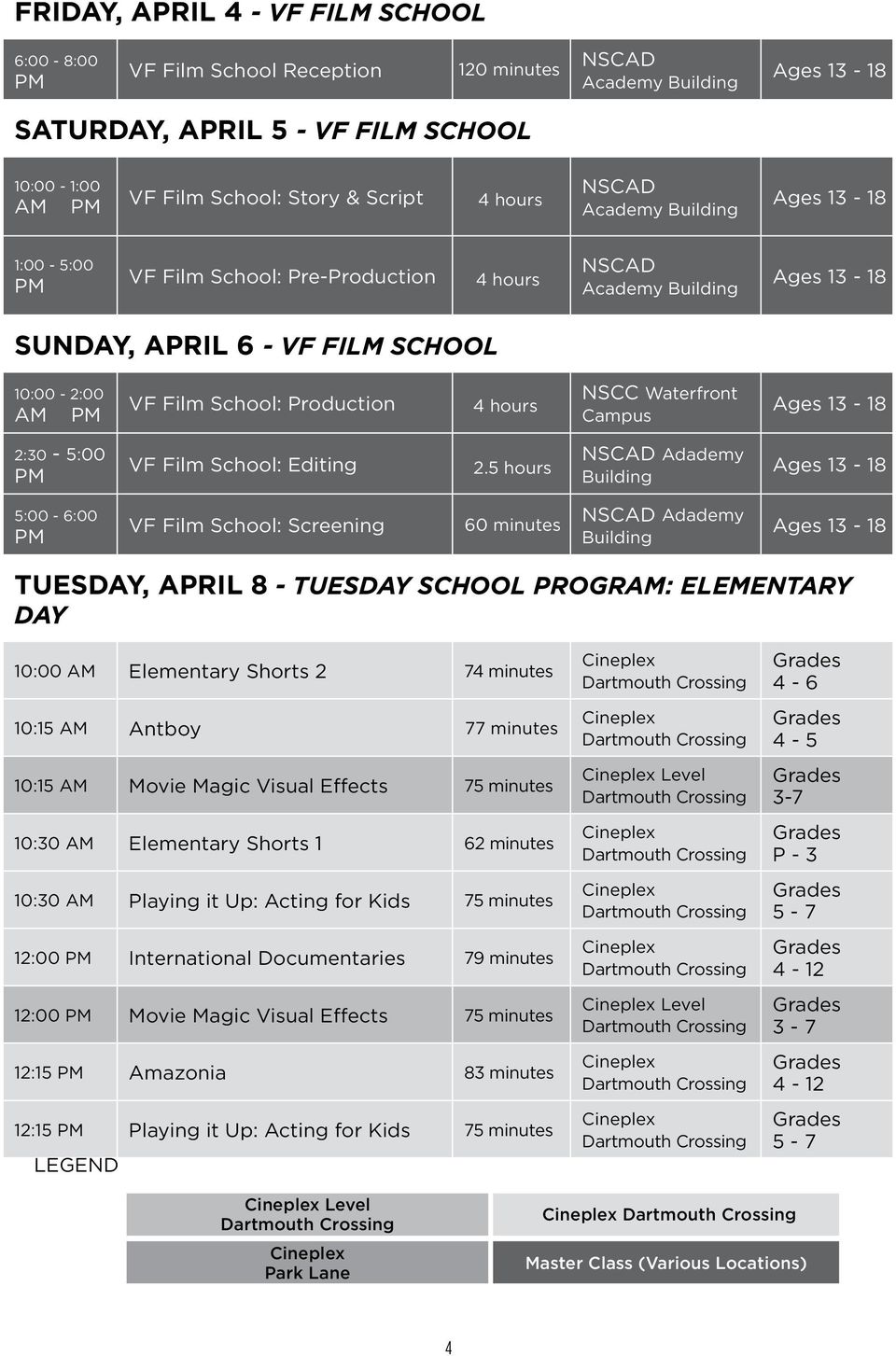
5 MERCREDI, 9 AVRIL - WEDNESDAY SCHOOL PROGRAM: PROGRAMME FRANÇAIS 10h00 Il était une fois les Boys 106 minutes 10h15 Belle et Sébastien 104 minutes Cineplex Dartmouth Crossing Cineplex Dartmouth Crossing 8e á la 12e 3e á la 6e 10h15 La Magic des effects Spéciceux au Cinema 75 minutes Cineplex Level Dartmouth Crossing 3e á la 7e 10h30 Ma maman est en amerique, elle a rencontre Buffalo Bill 75 minutes Cineplex Dartmouth Crossing Maternelle à la 3e 10h30 Atelier sur le documentaire 75 minutes Cineplex Level Dartmouth Crossing 5e á la 9e 12h00 La Magic des effects Spéciceux au Cinema 75 minutes Cineplex Level Dartmouth Crossing 3e á la 7e 12h10 Des morceaux de moi 89 minutes 12h15 Amazonia 83 minutes 12h15 Atelier sur le documentaire 75 minutes Cineplex Dartmouth Crossing Cineplex Dartmouth Crossing Cineplex Level Dartmouth Crossing 10e à la 12e 4e á la 12e 5e á la 9e 5
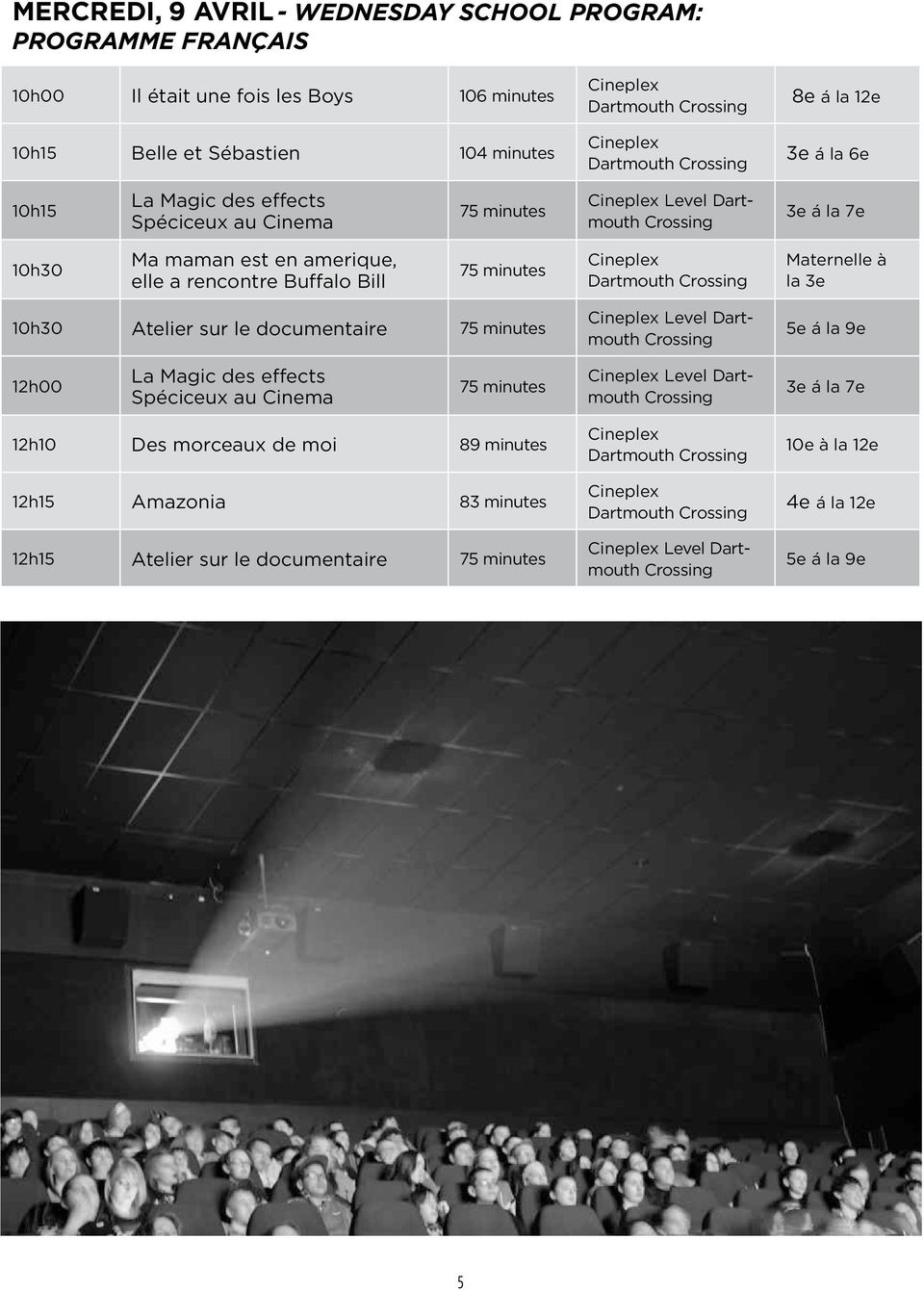
6 THURSDAY, APRIL 10 - THURSDAY SCHOOL PROGRAM: SECONDARY PROGRAM 10:00 AM Arctic Defenders 90 minutes 10:05 AM Junior High Shorts 85 minutes 10:10 AM High School Shorts 74 minutes 10:15 AM Special Effects Workshop 75 minutes Cineplex Dartmouth Crossing Cineplex Dartmouth Crossing Cineplex Dartmouth Crossing Cineplex Level Dartmouth Crossing Grades 7-12 Grades 7-9 Grades Grades :15 AM Environmental Documentaries 75 minutes Cineplex Dartmouth Crossing Grades :30 AM Game Development Workshop 75 minutes Cineplex Level Dartmouth Crossing Grades :00 AM Antarctica: A Year on Ice 92 minutes 12:10 AM Special Effects Workshop 75 minutes 12:10 AM Music for Mandela 82 minutes Cineplex Dartmouth Crossing Cineplex Level Dartmouth Crossing Cineplex Dartmouth Crossing Grades 9-12 Grades Grades :20 AM Game Development Workshop 75 minutes Cineplex Level Dartmouth Crossing Grades
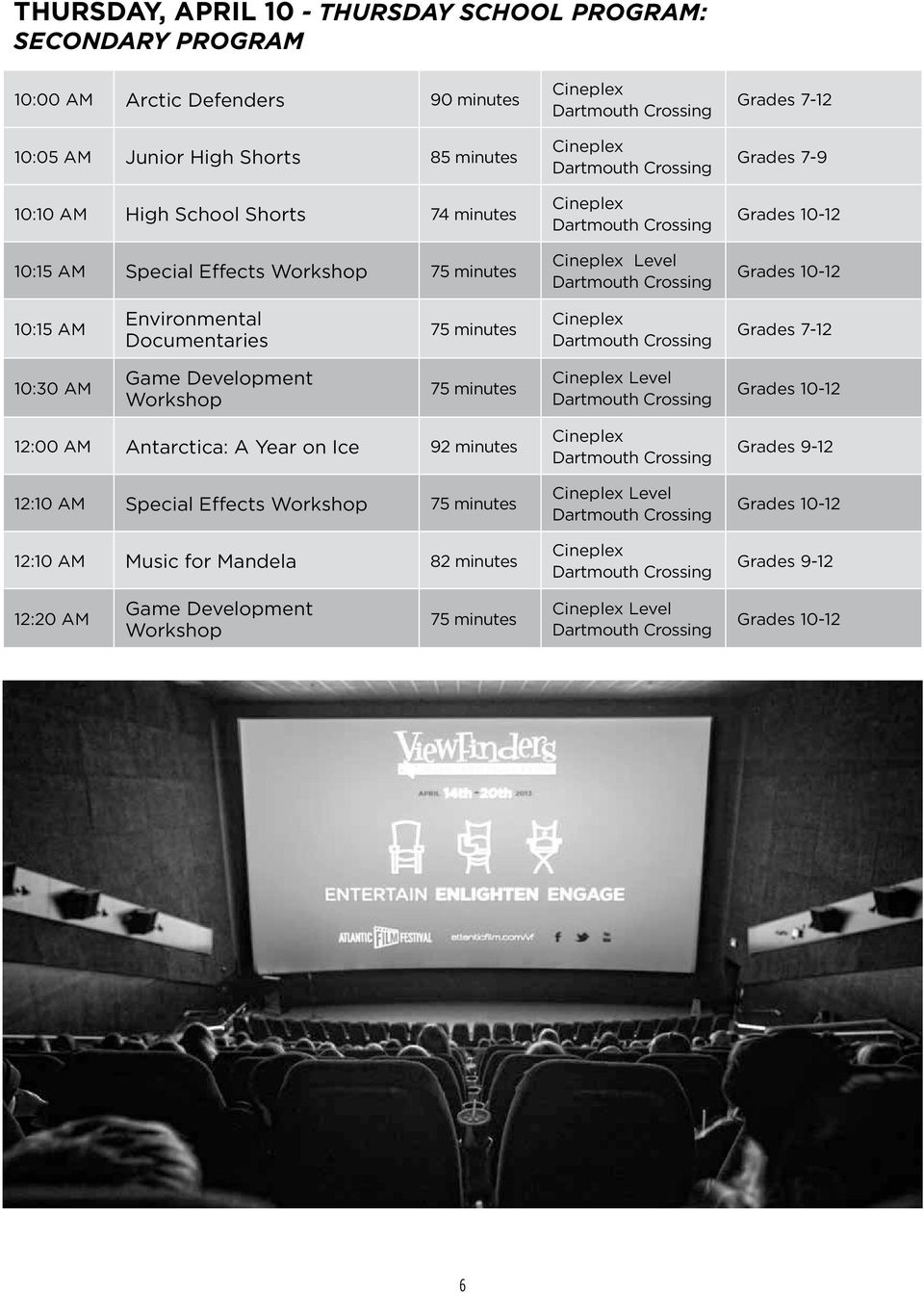
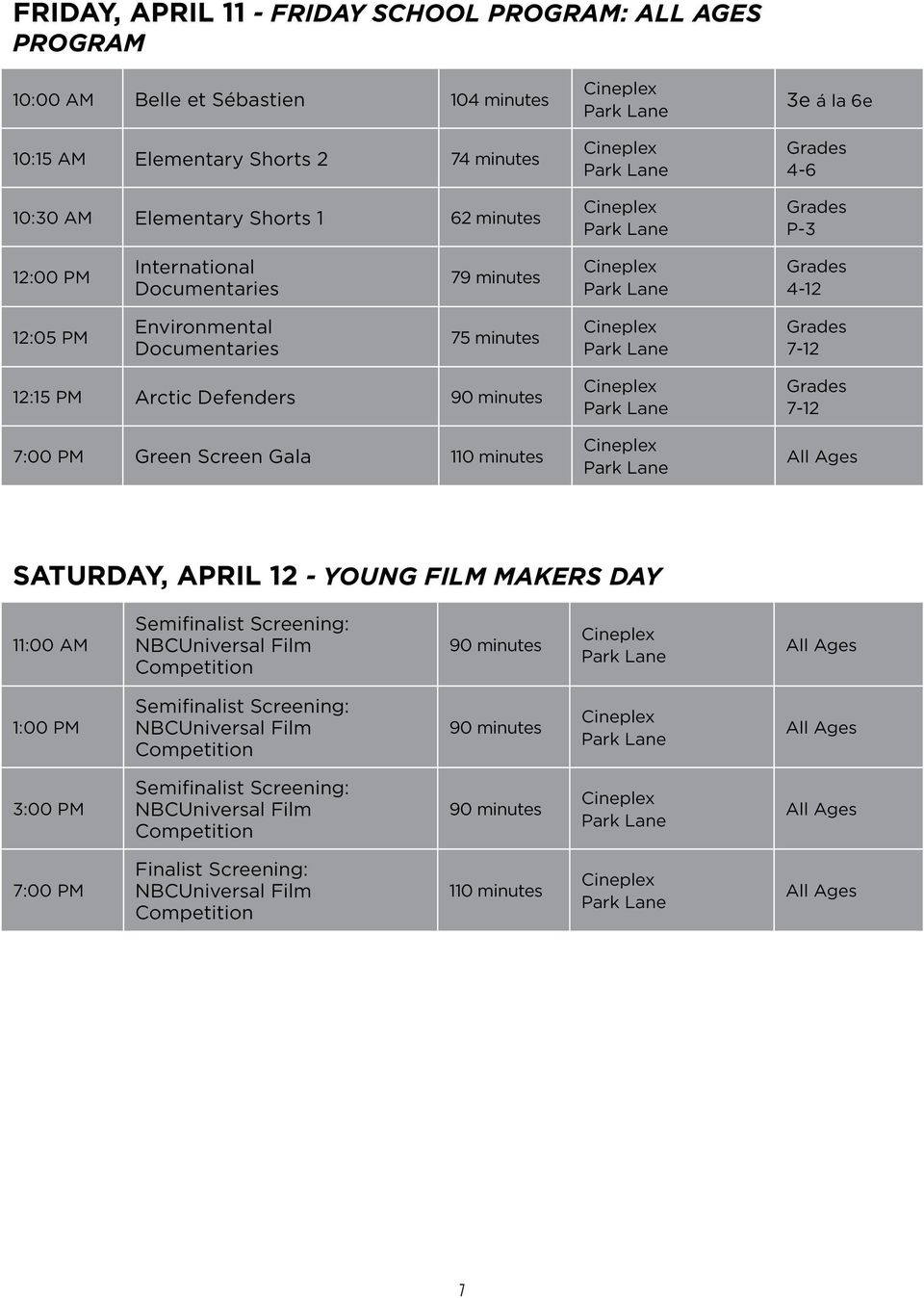
7 FRIDAY, APRIL 11 - FRIDAY SCHOOL PROGRAM: ALL AGES PROGRAM 10:00 AM Belle et Sébastien 104 minutes 10:15 AM Elementary Shorts 2 74 minutes 10:30 AM Elementary Shorts 1 62 minutes Cineplex Park Lane Cineplex Park Lane Cineplex Park Lane 3e á la 6e Grades 4-6 Grades P-3 12:00 PM International Documentaries 79 minutes Cineplex Park Lane Grades :05 PM Environmental Documentaries 75 minutes Cineplex Park Lane Grades :15 PM Arctic Defenders 90 minutes 7:00 PM Green Screen Gala 110 minutes Cineplex Park Lane Cineplex Park Lane Grades 7-12 All Ages SATURDAY, APRIL 12 - YOUNG FILM MAKERS DAY 11:00 AM Semifinalist Screening: NBCUniversal Film Competition 90 minutes Cineplex Park Lane All Ages 1:00 PM Semifinalist Screening: NBCUniversal Film Competition 90 minutes Cineplex Park Lane All Ages 3:00 PM Semifinalist Screening: NBCUniversal Film Competition 90 minutes Cineplex Park Lane All Ages 7:00 PM Finalist Screening: NBCUniversal Film Competition 110 minutes Cineplex Park Lane All Ages 7
8 SATURDAY MORNINGS at 9 SATURDAY MORNINGS at 9:55 cbc.ca/kids Kids
9 Our Sponsors The Atlantic Film Festival gratefully acknowledges the following organizations for their generous support, which makes ViewFinders: Atlantic Film Festival for Youth possible. FOUNDING PARTNERS PRESTIGE PARTNER PLATINUM PARTNERS GOVERNMENT PARTNERS GOLD PARTNERS SILVER PARTNERS BRONZE PARTNERS ViewFinders would like to acknowledge the generous donation of Margaret & David Fountain to the Atlantic Film Festival s endeavors. COMMUNITY PARTNERS Alliance Francaise La Turnée du Cinema Québécois Conseil Communautaire du Grand Havre CONTRIBUTING DIVISIONS OF THE NOVA SCOTIA DEPARTMENT OF EDUCATION Direction des services acadiens et de langue français English Program Services Programmes de français langue seconde Youth Pathways and Transitions 9

10 WELCOME TO VIEWFINDERS Great films introduce audiences to new ideas, places and ways of life. And because of this, films are inherently educational. They teach us about different cultures and different people, but also inform the way we see our community and ourselves. Not only a nod to the optical lens of a camera, our festival is called ViewFinders because we truly believe cinema can teach young people how to find themselves and their identity. Welcome to the 13th ViewFinders: Atlantic Film Festival for Youth. This festival would not be possible without the support of our government partners, sponsors and private donors. A special thank you also goes out to our friends within the education sector and especially our Teachers Advisory Committee (TAC). This body of educators watches every film that plays at ViewFinders, creating lesson plans that ensure the experience doesn t end when students leave the theatre, but continues into the classroom. In addition to a great daytime program of films from around the world, ViewFinders also celebrates the young Atlantic Canadians that have entered our filmmaking competitions. Congratulations on your achievement, directors. I truly hope this is just your first step in a long career with film. These youth-made films screen on April 11th and 12th, and I would encourage everyone to come and see this amazing display of talent. ViewFinders is a proud member of the Atlantic Film Festival family. It is a daily inspiration to work alongside such passionate colleagues and collaborators. Without this team of people, ViewFinders would not be possible; we work year round to share film with the people of Atlantic Canada. If you enjoy your experience at ViewFinders, please look for our other events for young people, families and film lovers. Jeff Parker, ViewFinders Manager I feel old. I know I m not that old I m only 34 but I m just saying that at this point a child could have gone from grade 5 to graduation in the time I ve been programming films for ViewFinders. I sincerely hope however that in that time between Justin Timberlake albums, ViewFinders has had the opportunity to live up to our tagline and Entertain, Enlighten and Engage the youth of Atlantic Canada as they ve grown up along with us. I know that you ll enjoy the amazing ViewFinders film program that I put together. Bear with me, I know it sounds a little conceited to call your own program amazing, but it s OK because I didn t make the films. I m just the lucky guy that has the opportunity to assemble the best film talent from around the world to bring home to ViewFinders. It s a ridiculous thing on the face of it to be a film programmer, to watch and curate films all day, but I take my job seriously and aside from piloting a giant robot in a war against monsters from the deep there is nothing else I d rather be doing. I d like to thank all of the amazing employees of the film festival, the educators that are so important to what we do, my incredible family and friends, and most importantly the kids that come out and enjoy this great festival that s so fun for me to program every year. To me ViewFinders is educational, but it s also a lot of fun. I hope you think so too. Mark Flindall, Programming Manager 10

11 A chosen career path in the arts is one of continuous learning, the artist begins as a novice and through practice and effort perfects their craft throughout their lifetime. Viewfinders: Atlantic Film Festival for Youth has a unique and special mandate. We provide an introduction to film as an experience for students of all ages. Beyond that however, we work to inspire that group of students who are discovering film in a different way, as an artistic calling. Through our workshops, productions and School Tours we engage with students at every phase of their development, a continuum if you will, from their first attempt at capturing a story they want to share to putting their finishing touches on their first fully realized film as a student, Viewfinders is both an instructor and mentor to these future Kubrick s and Spielberg s. Welcome to the 13th Annual Viewfinders: Atlantic Film Festival for Youth where over the course of the next week you will learn a lot but even more importantly you will experience and no doubt enjoy what our stellar Program Team have lined up for you. A big thanks to the incredible Atlantic Film Festival Team who work tirelessly all year to deliver world-class events to our audiences. Thanks also to our Board for their continuing partnership and support. To our Sponsors and Donors, we truly could not do this without you. To our Government Partners, thank you for supporting youth based filmmaking initiatives. Today s technology driven society dictates that we teach our young people the artistry and responsibility of the captured image more than ever. Last but certainly not least thanks to you our audience; we are here because you are there. See you at the movies, Wayne Carter, Executive Director 11
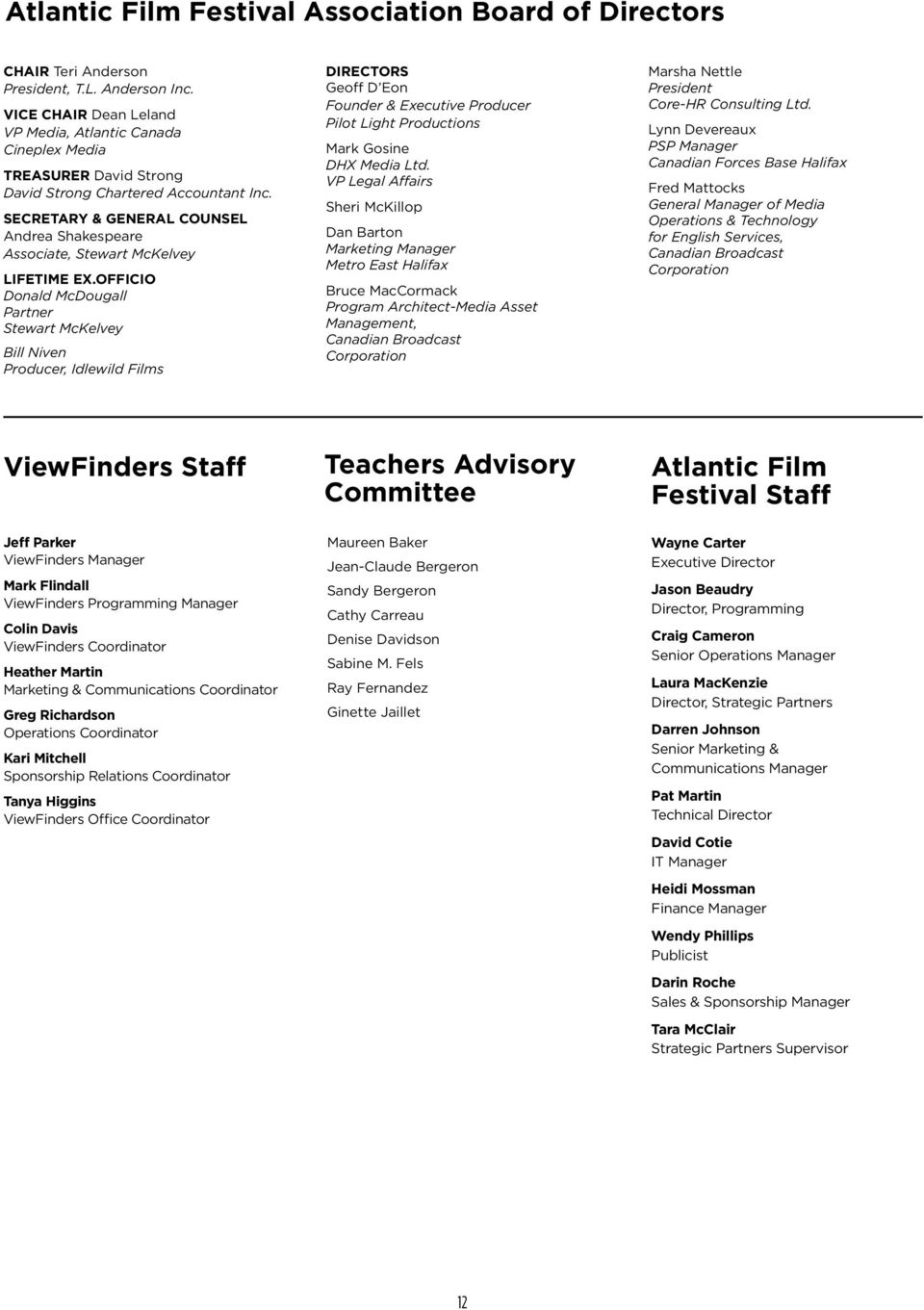
12 Atlantic Film Festival Association Board of Directors CHAIR Teri Anderson President, T.L. Anderson Inc. VICE CHAIR Dean Leland VP Media, Atlantic Canada Cineplex Media TREASURER David Strong David Strong Chartered Accountant Inc. SECRETARY & GENERAL COUNSEL Andrea Shakespeare Associate, Stewart McKelvey LIFETIME EX.OFFICIO Donald McDougall Partner Stewart McKelvey Bill Niven Producer, Idlewild Films DIRECTORS Geoff D Eon Founder & Executive Producer Pilot Light Productions Mark Gosine DHX Media Ltd. VP Legal Affairs Sheri McKillop Dan Barton Marketing Manager Metro East Halifax Bruce MacCormack Program Architect-Media Asset Management, Canadian Broadcast Corporation Marsha Nettle President Core-HR Consulting Ltd. Lynn Devereaux PSP Manager Canadian Forces Base Halifax Fred Mattocks General Manager of Media Operations & Technology for English Services, Canadian Broadcast Corporation ViewFinders Staff Jeff Parker ViewFinders Manager Mark Flindall ViewFinders Programming Manager Colin Davis ViewFinders Coordinator Heather Martin Marketing & Communications Coordinator Greg Richardson Operations Coordinator Kari Mitchell Sponsorship Relations Coordinator Tanya Higgins ViewFinders Office Coordinator Teachers Advisory Committee Maureen Baker Jean-Claude Bergeron Sandy Bergeron Cathy Carreau Denise Davidson Sabine M. Fels Ray Fernandez Ginette Jaillet Atlantic Film Festival Staff Wayne Carter Executive Director Jason Beaudry Director, Programming Craig Cameron Senior Operations Manager Laura MacKenzie Director, Strategic Partners Darren Johnson Senior Marketing & Communications Manager Pat Martin Technical Director David Cotie IT Manager Heidi Mossman Finance Manager Wendy Phillips Publicist Darin Roche Sales & Sponsorship Manager Tara McClair Strategic Partners Supervisor 12
13 To obtain tickets to ViewFinders school programs, screenings and workshops: BUY TICKETS FOR SCHOOL PROGRAM How to buy tickets for daytime school screenings, April Please refer to the School Program section of our Website, or page 12 of this guide, for the proper forms and resources. ONLINE atlanticfilm.com/vf BY PHONE ViewFinders Hotline IN PERSON 1471 Birmingham St, Halifax B3J 2J4 HOURS OF OPERATION March - April 4 (Monday to Friday) 9:30 AM - 4:30 PM PRICES PRICES (PER STUDENT) Screenings $8.00 Workshops $8.00 Full Day** $12.00 **Full Day = 2 Screenings or 1 Screening & 1 Workshop PLEASE NOTE -All School Program films are open to the general public. A box office will be set-up on-site for public ticket purchases up-to an hour prior to screening time. BUY TICKETS FOR FILM COMPETITION SCREENING ONLINE atlanticfilm.com/vf BY PHONE Ticketpro Hotline: IN-PERSON Cineplex Cinemas, Park Lane 5657 Spring Garden Road, Halifax Hours of operation Friday, April 11 6:00 PM 7:30 PM Saturday, April 12 9:00 AM 3:00 PM 6:00 PM 7:30 PM Sunday, April 12 6:00 PM 7:30 PM PRICES School Program: Screenings $8.00 Evening Screenings (after 6PM) $10.00 Matinees (before 6PM) $8.00 PLEASE NOTE: -No refunds or exchange on tickets - All ticket holders must be at the theatre at least 15 minutes prior to the start of the film. - Management reserves the right to refuse admission to latecomers. BUY TICKETS FOR VF FILM SCHOOL To reserve a spot for the VF Film School call: Price $35.00 For more information about the VF Film School, visit page 20 SCREENING & WORKSHOP LOCATIONS NSCAD Academy Building 1649 Brunswick Street, Halifax NSCC Waterfront Campus 80 Mawiomi Place, Dartmouth Empire Theatres Dartmouth Crossing 145 Shubie Drive, Dartmouth Crossing, Dartmouth Empire Theatres, Park Lane 5657 Spring Garden Road, Halifax 13

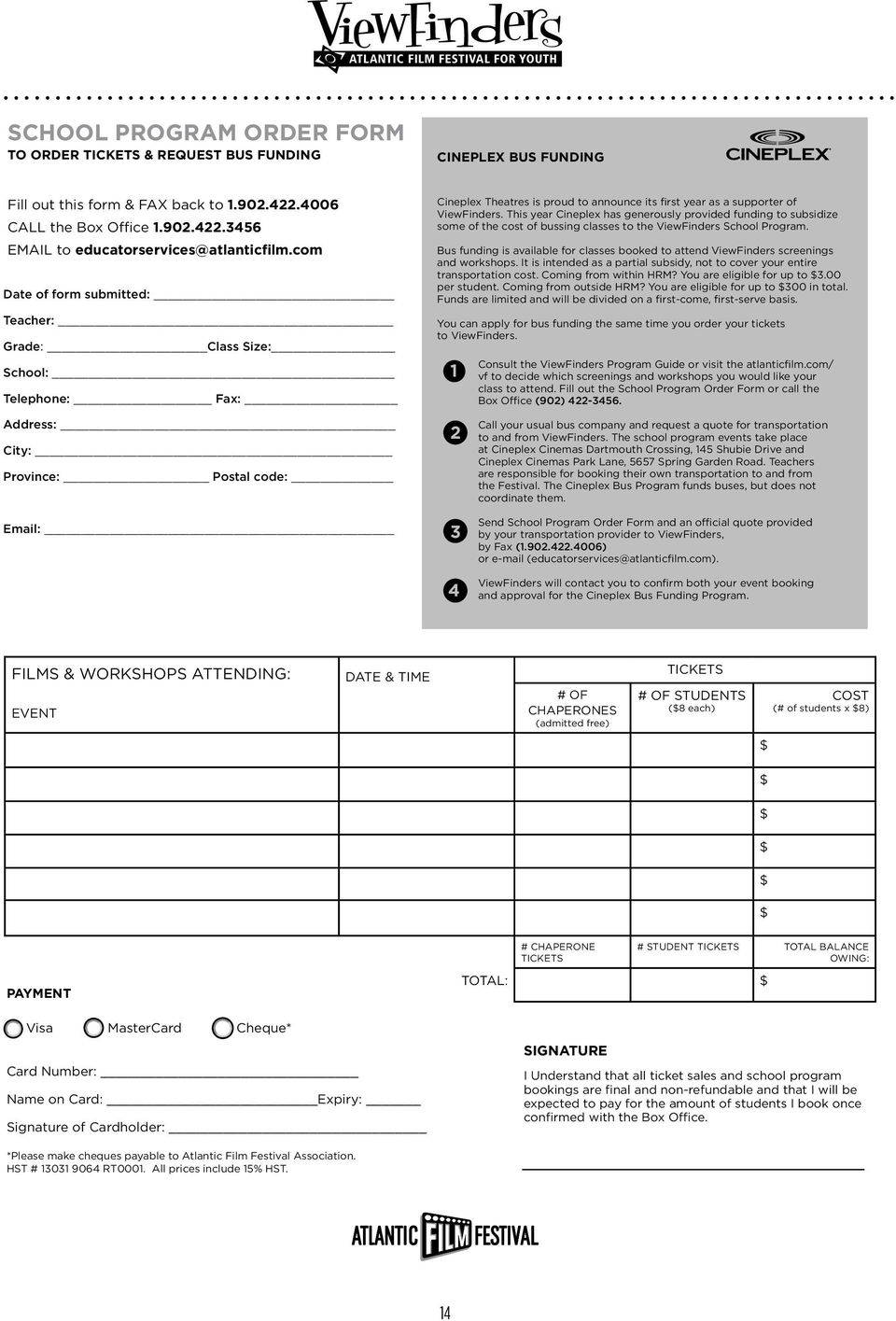
14 SCHOOL PROGRAM ORDER FORM TO ORDER TICKETS & REQUEST BUS FUNDING CINEPLEX BUS FUNDING Fill out this form & FAX back to CALL the Box Office to Date of form submitted: Teacher: Grade: Class Size: School: Telephone: Fax: Cineplex Theatres is proud to announce its first year as a supporter of ViewFinders. This year Cineplex has generously provided funding to subsidize some of the cost of bussing classes to the ViewFinders School Program. Bus funding is available for classes booked to attend ViewFinders screenings and workshops. It is intended as a partial subsidy, not to cover your entire transportation cost. Coming from within HRM? You are eligible for up to $3.00 per student. Coming from outside HRM? You are eligible for up to $300 in total. Funds are limited and will be divided on a first-come, first-serve basis. You can apply for bus funding the same time you order your tickets to ViewFinders. 1 Consult the ViewFinders Program Guide or visit the atlanticfilm.com/ vf to decide which screenings and workshops you would like your class to attend. Fill out the School Program Order Form or call the Box Office (902) Address: City: Province: Postal code: Call your usual bus company and request a quote for transportation to and from ViewFinders. The school program events take place at Cineplex Cinemas Dartmouth Crossing, 145 Shubie Drive and Cineplex Cinemas Park Lane, 5657 Spring Garden Road. Teachers are responsible for booking their own transportation to and from the Festival. The Cineplex Bus Program funds buses, but does not coordinate them. Send School Program Order Form and an official quote provided by your transportation provider to ViewFinders, by Fax ( ) or ([email protected]). ViewFinders will contact you to confirm both your event booking and approval for the Cineplex Bus Funding Program. FILMS & WORKSHOPS ATTENDING: EVENT DATE & TIME # OF CHAPERONES (admitted free) TICKETS # OF STUDENTS ($8 each) COST (# of students x $8) $ $ $ $ $ $ PAYMENT o Visa o MasterCard o Cheque* Card Number: Name on Card: Expiry: Signature of Cardholder: # CHAPERONE TICKETS SIGNATURE # STUDENT TICKETS TOTAL BALANCE OWING: TOTAL: $ I Understand that all ticket sales and school program bookings are final and non-refundable and that I will be expected to pay for the amount of students I book once confirmed with the Box Office. *Please make cheques payable to Atlantic Film Festival Association. HST # RT0001. All prices include 15% HST. 14
15 WELCOME TO VIEWFINDERS ViewFinders: Atlantic Film Festival for Youth is a five-day celebration of film, video and media geared towards youth ages ViewFinders includes a comprehensive school program complete with a guide for educators, as well as evening and weekend screenings and events for families and young adults. ViewFinders features films from around the world and includes a selection of films made by youth. The name of the festival comes from the part of the camera called the viewfinder which is the optical window that frames an image. It is our hope that the Festival inspires young people to find and broaden their own views of the world through hands-on media workshops, networking with professionals in the industry, and exposure to the large scope of cinema. How to Use this Curriculum Pack: A Note to Teachers Why teach Media Literacy? Media does more than entertain and divert us. Films, television and videos can bring us together in shared experiences and provide common reference points. As an educational tool, moving images provide opportunities for critical thinking strategies, dialogical reasoning, cross-media experiences, semiotics, and expose us to alternative points of view. By encouraging students to become active and critical viewers of film, video and television, we are providing them the skills to reflect, challenge and participate fully in our media-enriched culture. This curriculum pack is designed with the busy teacher in mind. Therefore, activities require minimal preparation time aside from reading, photocopying and preparing materials. After scanning the pre-screening and post-screening activities to determine suitability and materials required, teachers are encouraged to use the activity notes for quick glance reference in class. This pack contains the following: (1) an introduction; (2) a list of film titles; (3) pre-screening and post-screening activities for feature films and shorts programs; (4) an appendix of information and worksheets; and (5) a glossary of useful film terms. The guide also contains French language programs. In this guide, you will find the following: 1. Relevant Nova Scotia SCOs; 2. Pre-screening and post-screening activities that can be used with each feature film or short program; and 3. Suggested resources on related websites for student reference, research and supplementary use by teachers. 15
16 FILM INDEX ENGLISH PROGRAM Amazonia Grades 4-12 Curriculum Connections: Music, Film and Video Production, English Language Arts, Biology 11, Biology 12, Science 10, Global Geography, Visual Arts Antarctica: A Year on Ice Grades 9-12 Curriculum Connections: Science 10, Geology 12, Global Geography 12, English Language Arts, Film and Video Production, Options and Opportunities, Career Development Antboy Grades 4-5 Curriculum Connections: English Language Arts, Health, Science Arctic Defenders Grades 7-12 Curriculum Connections: Science 10, Biology 11, Global Geography 12, Canadian History, English Language Arts, Film and Video Production Music for Mandela Grades 9-12 Curriculum Connections: Music 9, Music 10, Music/Advanced Music, 11-12, Law 12, African Heritage: English 12, English Language Arts, Global History/Advanced Global History 12, Visual Arts, Dance 11 PROGRAMME FRANÇAIS Amazonia 4e à la 12e année Liens aux résultats d apprentissage et aux programmes d études: La musique, Biologie 11e, Biologie 12e, Sciences 10e, Géographie globale, Arts visuels Belle et Sébastien 3e à la 6e année Liens aux résultats d apprentissage et aux programmes d études: Littératie, DPS, Sciences humaines, Arts plastiques Des morceaux de moi 10e à la 12e année Liens aux résultats d apprentissage et aux programmes d études: Arts langagiers, Film et vidéo. It était une fois les boys 8e à la 12e année Liens aux résultats d apprentissage et aux programmes d études: Mode de vie sain, Arts langagiers, Mode de vie actif, Éducation physique, Multimédia Ma Maman est en Amérique, elle a rencontré Buffalo Bill M à la 6e année Liens aux résultats d apprentissage et aux programmes d études: Littératie, DPS, Arts plastiques 16

17 CURRICULUM CONNECTIONS INDEX ELEMENTARY GRADES English Language Arts Antboy French Language Arts Belle et Sébastien Ma Maman est en Amérique, elle a rencontré Buffalo Bill DPS Belle et Sébastien Ma Maman est en Amérique, elle a rencontré Buffalo Bill Healthy Living Antboy Belle et Sébastien Ma Maman est en Amérique, elle a rencontré Buffalo Bill Music Amazonia Science Antboy Social Studies Belle et Sébastien Visual Arts Belle et Sébastien Ma Maman est en Amérique, elle a rencontré Buffalo Bill JUNIOR HIGH English Language Arts Antarctica: A Year on Ice Arctic Defenders French Language Arts It était une fois boys Ma Maman est en Amérique, elle a rencontré Buffalo Bill Healthy Living It était une fois boys Ma Maman est en Amérique, elle a rencontré Buffalo Bill Multimedia It était une fois boys Music 9 Music for Mandela Physical Education It était une fois boys Visual Arts Amazonia Ma Maman est en Amérique, elle a rencontré Buffalo Bill HIGH SCHOOL African Heritage: English 12 Music for Mandela Biology 11 Amazonia Arctic Defenders Biology 12 Amazonia Canadian History Arctic Defenders Career Development Antarctica: A Year on Ice Dance 11 Music for Mandela English Language Arts Amazonia Antarctica: A Year on Ice Arctic Defenders Music for Mandela Film and Video Production Amazonia Antarctica: A Year on Ice Arctic Defenders Des morceaux de moi French Language Arts Des morceaux de moi It était une fois boys Geology 12 Antarctica: A Year on Ice Global Geography 12 Antarctica: A Year on Ice Arctic Defenders Global History/Advanced Global History 12 Music for Mandela Healthy Living It était une fois boys Law 12 Music for Mandela Multimedia It était une fois boys Music 10 Music for Mandela Music/Advanced Music Music for Mandela Options and Opportunities Antarctica: A Year on Ice Physical Education It était une fois boys Science 10 Amazonia Antarctica: A Year on Ice Arctic Defenders Visual Arts Music for Mandela 17

18 RELEVANT NOVA SCOTIA SPECIAL CURRICULUM OUTCOMES (SCOS) Through the ViewFinders curriculum, students will have opportunities to satisfy a large number of Nova Scotia SCOs, including: Grades K-3 Language Arts Students will engage in and respond to a variety of oral presentations and other texts Students will regard reading/viewing as sources of interest, enjoyment and information Students will recognize some basic types of texts (e.g., films, posters, true and imaginary texts) Students will begin to ask questions of text Students will begin to develop an understanding and respect for diversity Students will create and use familiar written and media texts (e.g., lists, personal narratives, retellings, messages, drawings, recounts, stories, records of observations, role-plays) Students will demonstrate a beginning/some awareness of audience and purpose or choose particular forms for specific audiences and purposes Students will interact with a variety of simple texts (e.g., pictures, videotapes, easy fiction and non-fiction), as well as human and community resources Students will realize that work to be shared with an audience needs editing Social Studies Students will demonstrate an understanding of equality, human dignity and justice Students will recognize that individuals and groups have differing perspectives on public issues Students will identify characteristics unique to one s self and other characteristics shared by all humans Students will identify groups to which they belong Students will give examples of how groups, institutions and media influence people Students will give examples of stereotypes, discrimination, and pressures to conform and how they affect an individual Students will give examples of how culture is transmitted Students will recognize and describe the interdependent nature of relationships Students will identify and describe examples of interactions among people, technology and the environment Visual Arts Students will express personal feelings, ideas and understandings through art-making Students will work individually and with others in the creative art-making process Students will examine and demonstrate an appreciation of artworks from diverse cultures Students will recognize that people create art for a variety of reasons Students will explore images using technology Students will celebrate, with pride and respect, their own artworks and those of others Students will share thoughts and ideas about artworks Students will recognize art as a way of expressing ideas of points of view Students will ask questions about works of art and respond to art in various ways Students will investigate the role of media in their lives Grades 4-7 Health Education Communicate needs and wants and express feelings in healthy ways Identify and demonstrate attitudes and behaviours that support healthy lifestyle choices Identify the causes and effects of positive and negative stress Define and demonstrate what it means to be a good friend Demonstrate and understanding that relationships entail both rights and responsibilities Identify positive and negative examples of peer influence in decision making Define citizenship in the context of school and community Demonstrate strategies for managing feelings associated with the physical and emotional changes in puberty Demonstrate an awareness of social rights and responsibilities at the school and in the community Examine the role of media in shaping and reinforcing lifestyle values and practices Language Arts Students will describe, share and discuss their personal reactions to texts Students will give reasons for their opinions about texts and types of texts and the work of authors and illustrators Students will identify examples of prejudice, stereotyping, or bias in oral language; recognize their negative effect on individuals and cultures; and attempt to use language that shows respect for all people Students will detect examples of prejudice, stereotyping or bias in oral language; recognize their negative effect on individuals and cultures; and attempt to use bias-free language Students will create written and media texts using a variety of forms Students will experiment with a combination of writing with other media to increase the impact of their presentations Students will demonstrate some awareness of audience and purpose Students will make choices about form for a specific audience/purpose Students will realize that work to be shared with an audience needs editing Students will question information presented in print and visual texts Students will use a personal knowledge base as a frame of reference Students will identify some different types of print and media texts Students will recognize some of their language conventions and text characteristics Students will recognize that these conventions and characteristics help them understand what they read and view Students will respond critically to texts Students will formulate questions as well as understandings Students will identify the point of view in a text and demonstrate an awareness of whose voices/positions are and are not being expressed Students will discuss the text from the perspective of their own realities and experiences 18
19 Social Studies Students will recognize how and why individuals and groups have different perspectives on public issues Students will describe the influences that shape personal identity Students will describe how groups, institutions and media influence people and society Students will use examples of material and non-material elements of culture to explain the concept of culture Students will explain how cultures meet human needs and wants in diverse ways Students will describe how perspectives influence the ways in which experiences are interpreted Students will discuss why and how stereotyping, discrimination and pressures to conform can emerge and how they affect an individual Students will describe how culture is preserved, modified and transmitted Students will describe the multicultural, multiracial and multiethnic character of Canadian society Visual Arts Students will express through art-making an awareness of the complexities in their world Students will work independently and collaboratively to apply learned skills Students will recognize art as a way of expressing cultural identity Students will discuss ideas and approaches with sensitivity and respect Students will perceive that there are many ways of perceiving and knowing Students will express through their artwork personal ideas and points of view Students will describe their responses to works of art Students will examine and discuss the effects of media on their lives and the lives of others Grades 8-12 Language Arts, Speaking and Listening Students will speak and listen to explore, extend, clarify and reflect on their thoughts, ideas, feelings and experiences Students will communicate information and ideas effectively and clearly, and to respond personally and critically Students will interact with sensitivity and respect, considering the situation, audience and purpose Language Arts, Reading and Viewing Students will select, read and view with understanding a range of literature, information, media and visual texts Students will interpret, select and combine information using a variety strategies, resources and technologies Students will respond personally and critically to a range of texts, applying their understanding of language form and genre Language Arts, Writing and Representing Students will use writing and other forms of representation to explore, clarify and reflect on their thoughts, feelings and experiences and to use their imaginations Students will create texts collaboratively and independently, using a variety of forms for a range of audiences and purposes Students will use a range of strategies to develop effective writing and other ways of representing and to enhance their clarity, precision and effectiveness Social Studies Grades 8-9 Students will identity some specific issues involving the rights, responsibilities, roles and status of individual citizens and groups in a local, national and global context Students will analyze and explain various perspectives on selected public issues Students will explore the factors that influence one s perceptions, attitudes, values and beliefs Students will analyze how individuals and formal and informal groups can influence each other Students will analyze how groups, institutions and media influence people and society Students will compare the way cultures meet human needs and wants Students will explain how and why perspectives influence the ways in which experiences are interpreted Students will demonstrate acceptance of self and others by considering alternative strategies for coping with situations that arise from conflicting values and beliefs Students will compare and analyze how culture is preserved, modified and transmitted Students will explain the concept of multiculturalism as it applies to race, ethnicity and national identity in Canadian society Students will analyze causes, consequences and possible solutions to universal human rights and other selected global issues Students will demonstrate an understanding that the interpretation of history reflects perspectives, frames of reference and biases Students will identify and analyze trends that may shape the future Social Studies Grades Students will evaluate public issues, taking into account multiple perspectives Students will evaluate group, institutional and media influences on people and society in both historical and contemporary settings Students will explain why cultures develop various expressions of material and non-material culture Students will analyze and explain the ways cultures address human needs and wants Students will evaluate the causes and consequences of differing worldviews Students will analyze cases and personal values regarding stereotyping, discrimination and conformity and how they affect individuals and groups Students will evaluate and propose possible solutions to issues resulting from interactions among individuals, groups and societies Students will evaluate causes, consequences and possible solutions to universal human rights and other selected global issues 19
20 AWESOME THINGS ARE HAPPENING. JOIN THE GREEN SCHOOLS MOVEMENT. GREENSCHOOLSNS.CA Want to learn more about saving energy? Download the Spot It! Game App at efficiencyns.ca/spotit Putting waste in the wrong place? Banana peels don t belong in French horns. They don t belong in garbage cans either. Almost half the garbage in Nova Scotia landfills is not garbage at all. It s organics and paper that should have been composted or recycled. We have to put our waste in the right place, to do right by our beautiful province.

21 SHORTS LESSON PLANS
22 ELEMENTARY SHORTS Elementary Shorts 1 (Grades: P 3) Please see pages of the ViewFinders Program Guide for film descriptions. Elementary Shorts 2 (Grades: 4 6) Warning: Some profanity (Weekend Dad) Please see page 29 of the ViewFinders Program Guide for film descriptions. International Documentaries (Grades: 4 12) Please see page 30 of the ViewFinders Program Guide for film descriptions. Pre-Screening Activities Make a list of the films in the shorts program you will attend. Brainstorm ideas with students using these titles. Have students share ideas about what they think the film might be about. Have students write a short description of the film based on each title. Give students the option of drawing a picture that would represent each film. Show students a clip from a television show or movie with the sound muted. Have students watch the scenes and write a short description of what they think is happening based on the interactions between the characters, the setting, and the visual effects used. After all students have written their descriptions, watch the clip again with the sound on. Ask students to share their impressions with the class and discuss the effect of sound on viewers. Have students listen to a clip from a film without seeing the images. Have students listen to the scenes and write a short description of what they think is happening based on what they hear. After all students have written their descriptions, watch the clip again with the sound on and allow students to see the film. Ask students to share their impressions with the class and discuss the effect of the images on viewers. Show your class the film titles and poster images from the guide. Have students write short predictions about the films based on these. Post-Screening Activities Discuss the short films in this program. Make a list of the films and brainstorm events in each. After students have had a class discussion about the films, have them choose one or two of the shorts and answer the following: What did you like about this film? Who was your favourite character? Why? Did you like the music in this film? How did the music affect the way you felt while you were watching the film? Have a class discussion about how we learn and understand everything by using our senses. Name the five senses: hearing, seeing, tasting, touching, and smelling. Discuss how using our senses help us to understand things in the classroom and school. Have a discussion about your trip to ViewFinders and the films you saw. Ask students to list the five senses and write a sentence to describe how they used each sense while attending the festival. Have students explore the school or classroom using their five senses. Take a walk and stop periodically to ask students to identify what they see, hear, feel, taste and smell. After returning to the classroom, have students write or draw an experience from their sense tour. Ask students to draw one character they saw in the films. Have them share their drawing and describe why they chose this character. Does the character have anything in common with them? Have students share similarities and differences between their lives and the lives of the characters in the film. Have students use clay to create a figure or object that represents something from one of the films they saw. 22
23 JUNIOR HIGH SHORTS Junior High Shorts (Grades: 7-9) Please see pages of the ViewFinders Program Guide for film descriptions. International Documentaries (Grades 4-12) Please see pages of the ViewFinders Program Guide for film descriptions. Environmental Documentaries (Grades 7-12) Please see page 40 of the ViewFinders Program Guide for film descriptions. Pre-Screening Activities View one or two short films with your class. Review the films using the Film Discussion Questions worksheet (Appendix). Ask students about the elements of the story, pivotal character, opposing character, conflict, goal, etc. Emphasize the story structure of the films. Have students write a synopsis for the films using their answers to the discussion questions. Have students share their synopses. Discuss the similarities between synopses. Have a class discussion about the predictability of many films. Ask students to look for predictable themes and scenes while attending ViewFinders. Give each student three pieces of paper or index cards. Have them write these headings on the cards: the name of a person (make sure it is not the name of someone they know), a wish to be granted, a magic object, an animal that can talk, something scary that might appear in a story, a trick someone might play, something good that might happen. Collect the cards and group them by heading. Have each student choose one card from each of the groups. Once all students have cards, ask them to write their own short film synopsis from the information they ve chosen. Have students share or display their synopses. List the film titles from this program on the board. Have students suggest what each film might be about, based on each title. Will it be a comedy? A drama? A documentary? Have students write a synopsis of one of the films after your class discussion. Post-Screening Activities Write a sample interview with a character from one of the films. Write at least ten questions that will give the character the opportunity to discuss his/her thoughts and feelings about his/ her role in the story. Present the interview as a newspaper or magazine article. Write a journal entry that one of the story s main characters might have kept before, during, or after the film s events. Remember that the character s thoughts and feelings are very important in a journal. Divide the class into groups of four. Brainstorm scenes from the films in the ViewFinders program. Assign each group the task of acting out a scene that tells the story of their favourite film in the program. Have the other groups try to guess which film they have chosen. Write the list of films from this program on the board. Ask students to discuss each film by recounting details of characters and events. Have students choose one character from a film and compare their life to that character s. Use the Venn diagram in the Appendix to guide their notes. Have students write two paragraphs describing the similarities and differences between their chosen character and themselves. Have a class discussion about your trip to ViewFinders. Tell students that even though they will be seeing films from Canada and other countries, each film will attempt to do the same thing. All films are meant to inform, to entertain, or both. Ask students to share examples of films they have seen and write their examples on the board. Have a discussion about each film. Ask students to share their ideas about what they think the films were trying to tell their audience. Discuss the persuasive element in many films. Ask students to identify films that were meant to persuade the viewer to think or act a certain way. Have students choose one thing they would like to persuade people to believe or do. Use the Storyboard Activity in the Appendix to have students illustrate and describe the idea they have chosen. Have students share ideas in small groups and with the class. 23
24 HIGH SCHOOL SHORTS High School Shorts 1 (Grades 10-12) Please see pages of the ViewFinders Program Guide for film descriptions. International Documentaries (Grades 4-12) Please see pages of the ViewFinders Program Guide for film descriptions. Environmental Documentaries (Grades 7-12) Please see page 40 of the ViewFinders Program Guide for film descriptions. Pre-Screening Activities Begin a discussion about film by asking students, Why do you choose to go to a movie? What attracts you? Give an example of a movie you saw recently. What expectations did you have for the movie? Did it meet your expectations? Continue this discussion by having students share examples of movies that have become blockbusters. Find one movie that most or all students are familiar with and ask the following questions: Why is this movie so popular? What makes it appealing to the viewer? Who is the movie intended to attract? Did the movie have a conflict and resolution to this conflict? Were the events in the movie true to life? Did this have an impact on its success? Did the movie s soundtrack have a great effect on its success? Did the movie popularize a band or song? If so, what effect has this had on you or students in this school? Make a list of the films you will see when you attend ViewFinders. Show students the Program Guide image attached to each film ( Ask students to predict the synopsis of each film using the titles and images. Have students save these and revisit them after attending the festival. Have a class discussion about what they think are the most important issues facing teens today. Ask the following questions: What are the most serious issues facing teens and young adults today? Are teenagers facing more difficult issues today than they did 20 years ago? Is life more complicated for teenagers today than it was 20 years ago? Why or why not? Do teenagers have more or fewer rights today than they had 20 years ago? If you were to choose the most important issue for teenagers today, what would it be? Divide your class into groups. Ask each group to choose what they feel is the most important issue for teenagers today. Using the Story Structure Worksheet in the Appendix, have students sketch their ideas for a film they could create. Post-Screening Activities Ask students to choose one film from the program and consider the following: What are the themes in this film? Are these themes that Nova Scotia high school students can relate to personally? Is this film effective in presenting the themes? Explain. Are characters portrayed accurately or are they exaggerated? Why do you think the filmmaker portrayed the characters in these ways? Are some characters stereotyped to make a statement? Are there characters in the film that mirror the experiences of students in this school? Do you think the filmmaker effectively conveyed his or her message through the characters? How could the theme be delivered differently by using different characters? Have students compare and contrast two of the films from the program. Use the Venn Diagram in the Appendix to gather ideas. Have students write a two-paragraph description of the similarities and differences in the films. Students may look at film style, format or content. Have students write a one-page review of one film in the program using the following guidelines (See Writing a Film Review in Extra Lessons): Begin with your impression of the film. Describe your impression of the film; including its theme and whether you feel it accomplished what it intended. Mention the title, director and main characters. Summarize the story. Were the actors effective? Describe how the main actors portrayed their roles. Identify any techniques that contributed to the strength of the film. Summarize your review by recommending or not recommending that people see the film. Recap your reasons. Have groups share their film idea with the class. Write each idea on the board. Have students pitch their ideas by explaining the events in their film. Allow students to question other groups. Have a class vote on which film would the best choice to develop. 24
25 FEATURES LESSON PLANS
26 AMAZONIA Grades 4-12 Curriculum Connections: Music, Film and Video Production, English Language Arts, Biology 11, Biology 12, Science 10, Global Geography, Visual Arts Warnings: N/A Please see page 26 of the ViewFinders Program Guide for further film details. Pre-Screening Activities In a jigsaw format ask students to research the Amazon addressing the following: Why is it called the rainforest? Find types of vegetation. What is the major contributor of deforestation? Discuss how. Select one ecosystem and describe how the deforestation is impacting it. Explain the main consequence to the western world if the Amazon undergoes much more deforestation? Describe what is being done to lessen the impact of deforestation. Investigate and present the art forms of the indigenous peoples of the Amazon Rainforest in Ecuador and/or Brazil. Note the affect music has on the documentary. Research the word Amazonia Watch a documentary about the Amazon: Post-Screening Activities Music How did the music affect the mood of Amazonia? Discuss the element of suspense. What instruments were used to create the mood and discuss their effectiveness? Watch a short video clip with the sound off. When the video has finished, compose a background piece of music that will create the mood for the video. Once you have finished, listen to the background music in the video to determine how it compares to your own. Film Video Production (Grade 4-9 students can tie this into the viewing General Curriculum Outcome for English Language Arts) In teams, discuss the cinematography in the documentary. Describe the techniques that were used to make Amazonia a compelling documentary. How did these techniques impact the tone and the mood of the documentary. How did they impact the viewer? How was colour used? Biology 11 and 12 and Science 10 The Amazon Rainforest has the largest biodiversity in the world. Explain and show examples. Debate: In some situations human encroachment can have a positive impact on ecosystems and wildlife. Research release programs that help animals in captivity reintegrate into their natural habitat. Discuss whether these programs are successful. How or how not? Global Geography Create a plan to promote environmental sustainability for the rainforest in relation to clear cutting and farming, keeping in mind that humans must continue to live there. Visual Arts Using an art form of your choosing, create a piece that is reflective of how the documentary impacted you and what you learned. 26
27 ANTARCTICA: A YEAR ON ICE Grades 9-12 Curriculum Connections: Science 10, Geology 12, Global Geography 12, English Language Arts, Film and Video Production, Options and Opportunities, Career Development Warnings: N/A Please see page 34 of the ViewFinders Program Guide for further film details. Overview This is the first film by Anthony Powell, who spent 10 years to make this award-winning documentary about Antarctica. The film gives an intimate glimpse into the life of the people who work in the Antarctic research stations, the working conditions during the busy summer months and how they cope with the isolation during lonely winters, which are marked by severe weather conditions and 24 hours of darkness. The film also offers stunning vistas of the frozen polar landscape, the Southern Lights, and the few species of animals who can survive on that remote continent. Background information More than 170 million years ago, Antarctica was part of the supercontinent Gondwana. Over time, Gondwana gradually broke apart and Antarctica as we know it today was formed around 25 million years ago. Antarctica is the earth s southernmost continent and contains the geographic South Pole. At 14.0 million square kilometres, it is about twice the size of Australia. About 98% of Antarctica is covered by an ice sheet averaging 1.6 km in thickness. With temperatures that reach extremes only very few cold adapted animals and organism can survive these harsh conditions, such a penguins and seals, algae, krill, tardigrades, rotifers, fungi and bacteria. Preservation and protection of this fragile eco-zone is an important task and the risk of unintentionally introducing non-native species from outside the region is a major concern. Antarctica has no indigenous population and there is no evidence that it was even seen by humans until the 19th century, even though myths and speculations about the existence of Terra Australis date back to antiquity. The name Antarctica has been attributed to a Scottish cartographer in 1890 and refers to land opposite to the Arctic. There are no permanent human residents in Antarctica, but anywhere from people reside throughout the year at the research stations which are scattered throughout the continent. Antarctica has no government, although various countries claim sovereignty in certain regions. The Antarctic treaty has been signed by 49 countries, and it prohibits military activity, mineral mining, nuclear explosions and nuclear waste disposal, but supports scientific research. In recent years there have been concerns over the potential adverse effects on the environment and the ecosystem caused by the influx of tourists. Researchers Geologist study plate tectonics, meteorites from outer space, and resources from the breakup of the supercontinent Gondwana. Glaciologists study the history and dynamics of floating ice, seasonal snow, glaciers, and ice sheets. Biologists study wildlife, the effects of harsh temperatures on human adaptation and survival strategies of variety of organisms. Medical physicians investigate the spread of viruses and the body s response to extreme seasonal temperatures. Astrophysicists study celestial domes and cosmic microwave background radiation. Winter Over Syndrome Symptoms: irritability, aggression, depression, insomnia and cognitive impairment such as forgetfulness and absentmindedness. It can also cause a mild fugue state knows as Antarctic stare or long eye which has also been observed among polar explorers Causes: increased work demands, social isolation, inability to disengage from stressful social situation due to the confinement in a tight space, lack of new stimuli, lack if sunlight, low Vitamin D levels and Polar T3 syndrome (the thyroid hormone T3 in the brain is re-assigned to the muscles of the body in an effort to protect it against the extreme cold) Southern lights, diamond dust and sun dogs Sun dog - a frequent atmospheric optical phenomenon in Antarctica, is a bright spot beside the true sun. Diamond dust - a ground level cloud composed of tiny ice crystals Southern lights or Aurora Australis - seen as a glow in the night sky near the South Pole. In northern latitudes the effect is known as northern lights or aurora borealis, named after aurora, the Roman goddess of dawn, and Boreas, the Greek name for the north wind Aurora a natural light display in the sky in the high latitudes of the Arctic and Antarctic regions created by the plasma-full solar winds that pass by the Earth caused by the collision of energetic charged particles with atoms in the thermosphere result from emissions of photons in the upper atmosphere, above 80 km, from ionized nitrogen molecules regaining an electron, and oxygen atoms and nitrogen molecules returning from an excited state to ground state. Auroras have different colours, which are a function of oxygen and nitrogen concentrations. At high altitudes oxygen red dominates, but green is the most common of all aurora colours. Ice cover and ice shelves Nearly all of Antarctica is covered by an ice sheet that is on average 1.6 km thick. Antarctica contains 90% of the world s ice, more than 70% of its fresh water. Most of the coastline of Antarctica consists of floating ice sheets. Ice shelves, which are floating ice fronts, cover 44% of the coastline. Melting or breakup of floating ice shelf may be caused by warm ocean currents, but this typically does not affect global sea levels and happens regularly as shelves grow. NASA researchers have confirmed that Antarctic snow is melting farther inland from the coats over time, melting at higher altitudes than ever and increasingly melting on Antarctica s largest ice shelf. 27
28 ANTARCTICA: A YEAR ON ICE Grades 9-12 (cont) Curriculum Connections: Science 10, Geology 12, Global Geography 12, English Language Arts, Film and Video Production, Options and Opportunities, Career Development Warnings: N/A Please see page 34 of the ViewFinders Program Guide for further film details. There is also evidence for widespread glacier retreat around the Antarctic Peninsula. Warmer temperatures are expected to lead to more snow, which would increase the amount of ice, offsetting approximately one third of the expected sea level rise from thermal expansion of the oceans. Researchers reported in December 2012 in Nature Geoscience that from , the average temperature at the mile high Byrd Station rose by 2.4 degrees Celsius, with warming fastest in winter and spring. The spot, which is in the heart of the West Antarctic Ice Sheet, is one of the fastest warming places on the earth. Antarctica climate coldest on Earth coldest naturally occurring temperature ever recorded on the surface of the earth: degrees Celsius highest temperature ever recorded in Antarctica was degrees Celsius extremely dry, averaging 166 mm of precipitation per year, but heavy snowfalls are not uncommon in the coastal region of the continent at the edge of the continent, strong katabatic winds off the polar plateau often blow at storm force Climate change The British Antarctic Survey has the following positions about climate change: Changes in climate have occurred in the upper atmosphere over Antarctica. The central and southern parts of the west coast of the Antarctic Peninsula have warmed by nearly 3 degrees Celsius. Antarctica seems to be both warming around the edges and cooling in the center at the same time, mainly around the South Pole. A possible explanation is that loss of UV absorbing ozone may have cooled the stratosphere and strengthened the polar vortex, a pattern of spinning winds around the South Pole. The polar vortex acts like an atmospheric barrier, preventing warmer coastal air from moving into the continent s interior. A stronger polar vortex might explain the cooling trend in the interior of Antarctica. Post-Screening Activities Which profession you have seen depicted in this film would interest you as a career? Discuss the factors that most likely contribute to the warming of the South Poles and to global climate change. What coping mechanism have the researchers developed to deal with the isolation? Why has tolerance been listed as one of the most important inter-personal qualities? How do those who live in the research station cope with Winter-Over Syndrome? Why are neither children nor pets allowed in the research stations of Antarctica? What would you miss most if you were away from friends and family over an extended period of time? How would you occupy yourself during your free time if you were to work in Antarctica? How would working in Antarctica compare to working and living on a submarine or in a space station? Compare and contrast the challenges of working in these challenging environments. Nothing left behind. Research and discuss the waste removal practices in Antarctica. Can you think of other locations where the same regulation might apply? Consider hiking expeditions, cave exploration, mountaineering, and other forms of recreation and tourism in environmentally fragile areas. Why is it important not to interfere with nature even under condition where one could save the life of an animal in distress? It s like living in Never Never land. Discuss this quote from the film. All relationships are intensified. Discuss this quote from the film. 28
29 ANTBOY Grades 4-5 Themes: Friendship, Individuality, Bullying, The Underdog Curriculum Connections: English Language Arts, Health, Science Warnings: N/A Please see page 26 of the ViewFinders Program Guide for further film details. Pre-Screening Activities This film is about a young boy named, Pelle, who becomes a superhero after being bitten by a special ant. Have a group of students research the characteristics of ants to predict the super powers Pelle develops. Anyboy s archrival is Fleaman. Have another group of students research fleas to come up with a list of powers the villain Fleaman will have. Students can share their findings and add to ideas in discussion. Have groups of students examine the features of comic books or graphic novels. Then discuss their findings and make a chart of features students discover. What types of characters are present (hero, sidekick, villain, romantic interest)? What are the characteristics of each type of character? What events does the plot include? What graphic features do the books include? After viewing the film, have a conversation about the comic book or graphic novel features that were present in the film. Was the use of these features effective within the movie and why? Visual effects are sometimes used when turning comics into movies. Fights or violence may not be shown on the screen and instead, onomatopoeia words are used over the whole screen in bright colourful speech bubbles. Explore a variety of onomatopoeia words and make poems using these words with big bold speech bubbles. Post-Screening Activities Antboy and Fleaman inspire the imagination of viewers to wonder what superpowers they would like to have. Have students create their own superhero or villain. Students can research an animal whose characteristics they will possess. Student superheroes can be represented in drawings or can be made out of modeling clay. The name of a superhero or villain is very important. Have students create a written piece representing their name in graphic lettering and explaining their powers. If time permits, have students present their characters to the class. If time is limited, characters could be set up for peers to enjoy in a gallery walk. Pelle is bullied and seems to lack the courage to do anything about his situation. When he discovers he has special powers, his life begins to turn around. Discuss with students what their fears are. Ask them to decide what superpowers would help them to overcome that fears. Have students design a picture of themselves with their superpower and include an explanation of why it would help them overcome their fear. Follow up this activity with a discussion of whether or not superpowers are needed to overcome fears. The Antboy movie is based on popular children s books by Danish author Kenneth Bøgh Andersen. As a class, make a list of books students are familiar with that have been turned into films. Discuss what the appeal to turning a book into a movie is. Choose a popular book from the classroom and together decide what key elements from the story would need to be included in the film. Consider which details can be left out and why. Create a film reel in small groups or as a whole class. Students could also act out their film version of the story and have it filmed. Pelle sees himself as invisible. He says he sees himself as a tiny ant in a giant hill. After he becomes friends with Wilhelm, his life takes a drastic turn. One of the film s themes is the power of friendship and the strength, bravery, and self-esteem that comes with having friends. As a class develop a definition of self-confidence. Ask students to explain where confidence comes from. Have students create short role-plays to illustrate the sources of self-confidence they have discussed. When Antboy becomes a famous for his heroic actions, he makes the front page of the newspaper. Have students discuss how life changes for people once they become famous. Choose a few examples of famous people and consider the positive and negative effects of fame on them. Have students work through the think, pair, share process to complete a t-chart of the positive and negative effects of fame on an individuals life. In follow up discussion of ideas, ask students to consider the different levels of fame. 29
30 ARCTIC DEFENDERS Grades 7-12 Curriculum Connections: Science 10, Biology 11, Global Geography 12, Canadian History, English Language Arts, Film and Video Production Warnings: N/A Please see page 34 of the ViewFinders Program Guide for further film details. Overview Arctic Defenders tells the remarkable story that began in 1968 with a radical Inuit movement in Canada, which would change the political landscape forever. It led to the largest land claim in western civilization, orchestrated by young visionary Inuit with a dream: the governance of their territory and the creation of Nunavut. Background Information The documentary, which is told by film maker John Walker, starts with archival footage which features the semi nomadic eco-centred Inuit as fishers and hunters harvesting lakes, seas, ice platforms and the tundra. With the more hospitable lands largely settled by Europeans there was a growing interest in the more peripheral territories, which were rich in fur and minerals. Missionaries and traders from the legendary Hudson Bay Company, accompanied by members of the Royal Canadian Mounted Police, began to move North and brought about massive changes in the Inuit way of life. In 1939 the Supreme Court of Canada declared that the Inuit should be considered Indians and were thus under the jurisdiction of the federal Government. Native customs were quickly worn down by the actions of the RCMP and the missionaries, who not only isolated the Inuit but also enforced Canadian criminal law on them which was very different from the moral code which they were used to. World War II and the Cold War made Arctic Canada strategically important which resulted in the construction of air bases and the Distant Early Warning Line in the 1940 and 50s. The High Arctic Relocation program was an initiative by the Canadian Government with the aim of protecting Canada s sovereignty in the Arctic, alleviating hunger and solving the Eskimo Problem. One of the relocations involved 17 families who were moved from Port Harrison in Northern Quebec to the barren landscape of Resolute and Grise Fjord. Over the next decade the nomadic migrations that had been the central feature of Arctic life had become a much smaller part of life in the north. Over the course of two generations, the Inuit, a once self sufficient people living in an extremely harsh environment, had transformed into a small impoverished minority, lacking the resources to sell to the larger economy but increasingly dependent on it for survival. In the 1960s the Canadian Government funded the establishment of government operated high schools in the Northwest territories, Northern Quebec and Labrador along with a residential school systems, which brought together young Inuit from across the Arctic in one place for the first time and exposed them to the rhetoric of civil and human rights of that generation. These discussions stimulated political activism and allowed the Inuit to emerge as a radical political force in the late 1960s and early 1970s, who pushed for respect for their unique culture and who formed new political associations resulting in the largest land claim in western civilization. In Canada the Constitution Act of 1982 named the Inuit as a distinctive group of Aboriginal Canadians who are not included under the First Nations or the Métis. Nomenclature Inuit is the Eastern Canadian Inuktitut and West Greenlandic Kalaallisut word for people. Inuit is a plural noun, the singular is Inuk. The term Eskimo was commonly used to include the Inuit, Aleut, Iñupiat, and Yupik peoples; however, the tem has been widely folk etymologized as meaning eater of raw meat, which is considered a slur among Canadian and Greenlandic Inuit. The Inuit are a group of culturally similar indigenous peoples inhabiting the Arctic. The Inuit are descendants of the Thule culture, who emerged from Western Alaska, after crossing from Siberia around 1000 CE. Currently they mainly live in regions of Greenland (est. population ), the United States (ca ) and Canada (ca ). Within Canada Inuit live in urban centres (such as Ottawa) and in Northern regions such as Nunavut and the Canadian Arctic and subarctic Nunavik in the Northern third of Quebec, Nunatsiavut and NunatuKavut in Labrador and the NorthWest Territories, particularly around the Arctic Ocean. Sovereignty the quality of having independent authority over a geographic area, such as a territory It can be found in a power to rule and make laws that rests on a political fact for which no pure legal definition can be provided. In theoretical terms, the idea of sovereignty has always necessitated a moral imperative on the entity exercising it. Territoriality Since 1925 Canada has claimed a portion of the Arctic between 60 degrees W and 141 degrees W longitude extending all the way to the North Pole. Claims that undersea geographic features are extensions of a country s continental shelf are used to support these claims. Foreign ships, both civilian and military, are allowed the right of innocent passage through the territorial waters subject to conditions in the United Nations Convention on the Law of the Sea. Right of innocent passage is not allowed in internal waters, i.e. enclosed bodies of water or waters landward of a chain of islands. The definitions of these, along with disagreements about the sector principle, have led to disagreements. This is especially important with the Northwest Passage. Canada asserts control of this passage as part of the Canadian Internal Waters because it is within 20 km of Canadian Islands; the US claims it is in international waters. Currently the ice and freezing temperatures make this a minor issue, but climate change will most likely make the passage more accessible to shipping, which is a concern to the Canadian Government and the inhabitants of this environmentally sensitive region. 30
31 ARCTIC DEFENDERS Grades 7-12 (cont) Curriculum Connections: Science 10, Biology 11, Global Geography 12, Canadian History, English Language Arts, Film and Video Production Warnings: N/A Please see page 34 of the ViewFinders Program Guide for further film details. Post-Screening Activities Film quote: We were sent to survive as human flag poles in the high arctic. Discuss this quote in the context of Canadian Sovereignty. Film quote: This is our homeland. Why do we have to lay claim to it? Discuss the concept of land ownership from the perspective of Western culture versus unit culture. Film quote: Authority of Nature. Discuss this concept in relationship to those who have lived and who currently live in the Arctic, past explorers and those who plan to visit the high arctic as tourists. Discuss the human traits of patience, perseverance and peacefulness and the importance of these traits in the history and lives of the Inuit. What role does Inuit youth play in the land negotiations with Canadian Government? What role do Inuit rangers play in securing the northern borders of Canada? What is sovereignty? Who is the guarantor of sovereignty in the high Arctic? How is it connected to land ownership, the military and the Inuit way of life? What challenges do you see for the future for the cultural survival of the Inuit? 31
32 MUSIC FOR MANDELA Grades 9-12 Curriculum Connections: Music 9, Music 10, Music/Advanced Music, 11-12, Law 12, African Heritage: English 12, English Language Arts, Global History/Advanced Global History 12, Visual Arts, Dance 11 Warnings: N/A Please see page 35 of the ViewFinders Program Guide for further film details. Pre-Screening Activities In 1987, Hugh Masekela released the tribute song to Nelson Mandela called Bring Him Back Home even though the mere mention of the name Mandela meant the song would be banned in his home country (YouTube, February 20, 2014) Listen to Bring Him Back Home. Research how this song pertains to Nelson Mandela and why it was written and performed. What do you think were the political and judicial ramifications for Masekela when he published Bring Him Back Home? Why do you think it was important to Masekela to publish Bring Him Back Home when there were personal risks? In your opinion, how does the music affect the song s message? Why? In a jigsaw format, teams view sections of the History website regarding Nelson Mandela and apartheid ( topics/apartheid), then present their learning to the whole class. Post-Screening Activities If you were representing Nelson Mandela in a court of law during his trial, what tenets of the Canadian Charter of Rights and Freedoms would you use in his defense? Explain how you would use them and why? Investigate another global event that has raised fundamental questions of justice and present your findings in a manner of your choosing (musical, poetry, visual arts, video, photo essay, etc.) Describe how apartheid has happened in the western world and toward whom. How did apartheid in South Africa and its termination bring about significant societal change? Discuss other world events or injustices that have brought about significant societal change. In The Book of Negroes, was the main character s treatment an example of apartheid? Why or why not? Compare Nelson Mandela to Martin Luther King. Music was an extremely powerful voice in releasing Nelson Mandela and abolishing apartheid. Explain why music was so powerful in bringing about societal/political change in South Africa. The South African government prohibited music that mentioned Nelson Mandela s name or honoured his fight for freedom. In your opinion, what other musical or other art forms have been or being prohibited in the western world. Describe the purpose behind their prohibition and give examples. Research the meaning of Pink Floyd s song We Don t Need No Education. Compose and perform a song that calls for a societal change and/or comments on a human condition. Research music compositions or songs that honoured Nelson Mandela. Present the music composition(s) and/or song(s) to the class and explain how, in your opinion, they honoured him. Present your own rendition of a song(s) that was composed for Nelson Mandela and his fight for freedom. Why was music so important to Mandela and what were his contributions to the arts for South Africa. Research the forms of dance the South Africans used to convey their opposition to their political injustices. Create and perform a dance that calls for a societal change. What does Mandela s quote, Skin colour is like the flowers of the garden mean to you and why? Using a form of visual arts, create an artwork that communicates a positive message about the human condition. Debate this quote, Without music, there is no societal change. 32
33 PROGRAMME FRANÇAIS
34 AMAZONIA 4e à la 12e année Liens aux résultats d apprentissage et aux programmes d études: La musique, Biologie 11e, Biologie 12e, Sciences 10e, Géographie globale, Arts visuels Avertissements : S/O Synopsis Amazonia est une odyssée au cœur même de la plus grande forêt tropicale au monde. À la suite d un accident d avion, Saï, un singe capucin né et élevé en captivité, se retrouve seul et perdu en pleine jungle amazonienne. Face à un monde totalement nouveau pour lui dans lequel la végétation dense recouvre tout, Saï doit retrouver son chemin et survivre aux multiples périls que la nature dresse devant lui. Une cinématographie superbe et des endroits à couper le souffle accompagnent Saï tout au long de son parcours riche en émotions et en découvertes où il apprendra finalement à se débrouiller par lui-même. Activités de pré-visionnement Sous forme de puzzle, demandez aux élèves de faire des recherches sur l Amazonie en se posant les questions suivantes : Pourquoi l appelle-t-on la forêt tropicale? Quels sont les types de végétation qu on y trouve? Quelle est la cause principale de la déforestation? Discutez et échangez sur les raisons possibles. Choisissez un écosystème et décrivez de quelles façons il est touché par la déforestation. Expliquez les conséquences principales qui toucheraient le monde occidental si l Amazonie devait subir davantage la déforestation? Décrivez ce qui est en train d être fait afin d amoindrir les effets de la déforestation. Faites des recherches et présentez les différentes formes artistiques des peuples indigènes de la forêt amazonienne en Équateur et/ou au Brésil. Remarquez l effet produit par la musique sur le documentaire. Faites des recherches sur le mot «Amazonie». Visionnez un documentaire sur l Amazonie : Activités de post-visionnement La musique De quelle façon la musique a-t-elle un effet sur l atmosphère du film dans «Amazonia»? Parler des différents éléments qui contribuent au suspens. Quels instruments ont été choisis pour créer cette ambiance? Est-ce un choix efficace? Échangez. Regardez un court extrait vidéo avec le son coupé. A la fin de la vidéo, composez un morceau de musique de fond qui donnera le ton, l ambiance de cette vidéo. Une fois terminé, écoutez la bande son originale de la vidéo et comparez-la avec celle que vous venez de composer. Production d un film vidéo (les élèves de la 4 e à la 9 e année peuvent raccrocher cette activité aux résultats d apprentissage du programme cadre général en langue anglaise) Par équipe, parlez de la cinématographie dans le documentaire. Décrivez les techniques utilisées pour faire de «Amazonia» un documentaire fascinant. De quelles façons ces techniques affectent le ton et l ambiance du documentaire? De quelles façons affectent-elles le spectateur? Comment la couleur a-telle été utilisée? Biologie 11e et 12 e et Sciences 10e La forêt amazonienne détient la plus vaste biodiversité au monde. Expliquez pourquoi et donnez des exemples. Participez à un débat: Dans certains cas, l empiètement de l humain peut avoir un effet positif sur les écosystèmes et la faune. Trouvez des résultats de recherches qui aident les animaux en captivité à réintégrer leur milieu naturel. Discutez de l efficacité de ces programmes. Rencontrent-ils le succès escompté ou non? Géographie globale Créer un plan qui ferait la promotion de la durabilité environnementale de la forêt tropicale en lien avec la déforestation et l agriculture, en gardant à l esprit que les humains doivent continuer de pouvoir y vivre. Arts visuels A partir du format artistique de votre choix, créez une œuvre qui reflètera la manière dont ce documentaire vous a touché et présentera ce que vous y avez appris. 34
35 BELLE ET SÉBASTIEN 3e à la 6e année Thèmes : l amitié, le courage, la nature, la famille, affronter la peur, l intimidation, la persécution Liens aux résultats d apprentissage et aux programmes d études: Littératie, DPS, Sciences humaines, Arts plastiques Avertissements : Belle est la proie de chasseurs qui tirent sur elle Synopsis Dans les Alpes où le sommet des montagnes perce les nuages, un paisible village coule des jours heureux jusqu à l arrivée des Nazis pendant la Seconde Guerre mondiale. C est là que Sébastien, garçon solitaire, va rencontrer et se lier d amitié avec Belle, chien sauvage. Suivez l odyssée d un garçon à la recherche de sa mère, d un vieillard à la recherche de son passé, d une jeune femme en quête d aventure et d un lieutenant allemand en quête de rémission. C est l histoire extraordinaire d un ingénieux petit garçon de six ans et de son chien qui tentent de contrecarrer l acharnement des Nazis à capturer les résistants français. Activités de pré-visionnement Belle et Sébastien est un long-métrage de Nicholas Vanier réadapté pour le cinéma en 2013 à partir de la série de romans du même nom de l auteure française Cécile Aubry. Cette série très populaire est adaptée en premier pour le cinéma et par la suite pour la télévision à partir de L œuvre de Cécile Aubry est un trésor qui traverse les âges. Ainsi, bien que le récit de Sébastien remonte à l hiver de 1943, les enfants sauront apprécier le film car les thèmes exploités sont toujours d actualité. Demandez aux enfants de nommer et de décrire des films ou des livres qu ils connaissent et dont le récit est situé à une époque antérieure. Expliquez aux élèves la signification du mot anachronisme. Animer une discussion avec les élèves au sujet des stratégies à utiliser pour représenter le passé dans un contexte littéraire contemporain. Comment savons-nous qu un récit se déroule dans le passé? Dame Nature est une figurante qui domine sur l écran. Elle nous saisit dès les premières images projetées et elle nous coupe le souffle. Voilà le ton du film. Demandez aux élèves comment la Nature peut être représentée comme un personnage dans un récit. Quelles sont les caractéristiques de la Nature? Comment pouvons-nous représenter la Nature dans un récit littéraire ou un récit cinématographique? Sébastien, âgé de 6 ans, apprend tant bien que mal à apprivoiser la Nature dans le cadre de la formation qu il reçoit de la part de César, ce vieillard qui «n est pas mon vrai grand-père» et qui promet que la maman de Sébastien lui reviendra un jour de l Amérique. Voilà la première de trois intrigues qui sont étroitement imbriquées dans le film. Ainsi, tandis que Sébastien s impatiente de cette promesse du retour de sa mère, une nouvelle amitié l interpelle et éveille en lui le courage d affronter ses plus grandes peurs. En effet, comment Sébastien peut-il convaincre César et les villageois de la véritable identité de «la bête» qui assomme les moutons du village? Comment Sébastien peut-il avoir confiance en Guillaume, le médecin qui fait entrer clandestinement des gens au village pendant la nuit? Qui sont les soldats allemands? Que font-ils au village? Comment les soldats se comportent-ils avec les villageois? Demandez aux élèves de noter des éléments de réponses à ces questions afin d y revenir après le visionnement du film. Demandez aux élèves de décrire le courage. Qu est-ce que le courage? Comment devient-on courageux/courageuse? Est-ce que nos amis/amies nous aident à avoir du courage? Comment? Activités de post-visionnement Lecture/écriture: Lisez aux élèves un chapitre du roman de Cécile Aubry, Belle et Sébastien. Demandez aux élèves de rédiger une comparaison. Comparez le chapitre du récit avec la scène correspondante du film. Effectuez un partage en plénière dans laquelle les élèves évaluent la précision des comparaisons de leurs camarades. Lecture/écriture: Écoutez Belle la chanson thème du film interprétée par ZAZ. Demandez aux élèves de rédiger une opinion. Pourquoi cette chanson est-elle appropriée comme chanson thème? Demandez aux élèves de rédiger un poème à partir du vocabulaire de la chanson. La Nature/arts plastiques: Discutez avec les élèves de comment la Nature est représentée dans le film. Quelles sont ses caractéristiques? Choisir une caractéristique et utiliser de la pâte à modeler pour la représenter. Comment faire pour représenter cette caractéristique? Les personnes peuvent-elles avoir des caractéristiques semblables? Le courage/dps: Guidez les élèves dans l élaboration d un modèle de type Frayer sur une affiche Bristol à partir du concept du courage. Affichez-la dans la classe et ajoutez-y des éléments de réponse à chaque jour pendant une semaine. Inspirez-vous des événements vécus pendant la semaine. Demandez aux élèves de réaliser une affiche sur du papier Bristol pour promouvoir le courage. L intimidation/sciences humaines: Demandez aux élèves de rédiger une saynète sur l intimidation où le personnage principal est un des soldats du film. Situez le récit à l époque de la Deuxième guerre mondiale. L amitié/dps: Animez une discussion au sujet de l amitié entre Sébastien et Belle. Pourquoi admirons-nous leur amitié? Comment pouvons-nous faire pour développer une telle amitié avec une autre personne? Pouvons-nous réellement avoir une amitié avec un animal? Pourquoi? La famille/dps: Animez une discussion au sujet de la famille de Sébastien. Qui fait partie de la famille de Sébastien? Quelle était la réaction de Sébastien lorsqu il a su le sort de sa Maman? Présentez aux élèves des types de compositions de familles. Quelles sont des caractéristiques de toutes les familles? Modèle de type Frayer : materiel/module-5/composantes-dun-concept-scientifiquemodele-de-frayer-png/ Bande annonce du film : watch?v=ujrkrsrnruy Chanson Belle interprétée par ZAZ : watch?v=kcggszy_bom 35
36 DES MORCEAUX DE MOI 10e à la 12e année Thèmes: l adolescence, les relations familiales, la sexualité, l amitié, l abandon, la maladie, le milieu ouvrier. Liens aux résultats d apprentissage et aux programmes d études: Arts langagiers, Film et vidéo. Avertissements : discussions explicites sur la sexualité, langage vulgaire, usage de marijuana et cigarette. Synopsis Raconté du point de vue d Erell, adolescente qui filme tout ce qui l entoure, le film montre un portrait intime d une famille déchirée: un père lunaire et vieux avant l âge, une mère qui souffre de la sclérose en plaques et par conséquence est devenue insupportable, et une sœur, disparue Il y a 4 ans sans un mot, qui décide de revenir. Pour Erell, sa caméra est son moyen de communiquer et de faire face à sa situation difficile. Au cours du film, on apprend de ses amis, de sa relation avec ses parents, surtout sa mère, et de l impact du retour de sa sœur. Activités de pré-visionnement Voici quelques pistes de questionnement ou suggestions de projets possibles en préparation au visionnement. (Certaines activités ici pourraient aussi être exploitées plus en profondeur en post visionnement). Sa caméra devient un outil indispensable pour Erell, non seulement pour faire face à ses problèmes familiaux mais aussi pour sortir de l ennui de son existence en milieu rural. Quels sont d autres moyens artistiques qui pourraient être thérapeutiques pour les jeunes? En vous servez-vous? Quel impact une maladie chronique peut-elle avoir sur la vie quotidienne d une famille? La disparition d un membre de la famille? Pensez à votre propre famille. Quelles sont les qualités les plus importantes en ce qui concerne les relations familiales? Quel rôle vos amis jouent-ils dans votre vie? Pourquoi ces relations sont-elles si importantes, surtout à l adolescence? Visionnez la bande-annonce officielle du film sur youtube.com Activités de post-visionnement Voici quelques pistes de questionnement ou possibilités de projets possibles à la suite du visionnement. Discutez de la signification du titre Des morceaux de moi. Le film a été très bien reçu à de divers festivals en Europe. L avez-vous aimé? Rédigez une courte critique en donnant vos impressions. Quelle scène du film vous a touché le plus? Pourquoi? Faites un portrait moral d un des personnages principaux du film ainsi qu une analyse de son comportement. Croyez-vous que le film soit réaliste? Expliquez. Après avoir vu le film, quel rôle sa caméra a-t-il joué dans la résolution de conflits familiaux? Selon vous, pourquoi sentaitelle le besoin de documenter les moments quotidiens de sa vie? 36
37 IT ÉTAIT UNE FOIS LES BOYS 8e à la 12e année Thèmes : sports, histoire du hockey, famille, les Canadiens de Montréal Liens aux résultats d apprentissage et aux programmes d études: Mode de vie sain, Arts langagiers, Mode de vie actif, Éducation physique, Multimédia Avertissements : langage blasphématoire, premier usage de marijuana, décès accidentel d un adolescent. Synopsis Il était une fois les boys est une comédie dramatique dont l action se déroule en décembre Rien ne va plus pour les Boys, une équipe de hockey amateur qui se prépare pour un tournoi de hockey bantam dans la paroisse montréalaise de Saint-Michel. Le tournoi s annonce difficile pour l équipe des AS composée d adolescents indisciplinés de 13 à 15 ans, dont Stan, Bob, Fern (le gardien de but), Marcel, Jean-Charles et Ben. Leurs performances médiocres sur la patinoire extérieure de la paroisse laissent présager une défaite humiliante lors du tournoi des Fêtes. L arrivée à l école et dans leur équipe de Méo, bagarreur et insolent, leur redonne un peu d espoir. Alors que leurs familles préparent les célébrations de Noël, que certains parents doivent régler des problèmes conjugaux ou de harcèlement sexuel au travail, les jeunes garçons devront développer une complicité inébranlable s ils veulent former une équipe capable d affronter même la meilleure équipe de la ligue. Au cours des vacances, les Boys vivent des incidents sentimentaux et un drame terrible qui les secouera profondément. Ensemble, ils devront apprendre à être solidaires. Et pas seulement sur la glace. Ces épreuves formatrices les uniront à jamais. Activités de pré-visionnement Voici quelques pistes de questionnement ou possibilités de projets possibles en préparation au visionnement. (Certaines activités ici suggérées pourraient aussi être exploitées plus en profondeur en post visionnement) : Le hockey, est-ce une histoire de compétition, de rivalité ou d esprit sportif? Donne au moins trois raisons pour expliquer ton point de vue Faire une recherche sur les années 67 au Québec et plus particulièrement à Montréal. (Expo 67, le rôle des femmes, la relation entre les francophones et les anglophones. Prévisionnez la bande-annonce du film à : com/watch?v=weqixghbe6s anglophones) Qu est-ce que vous pouvez découvrir à propos du rôle du hockey dans la société québécoise de l époque, et en particulier du culte du héros de l époque, Jean Béliveau? Cela existe-t-il encore aujourd hui? Comparez le culte du héros sportif adolescent et professionnel en ce qui concerne la nécessité de l esprit d équipe. Quel rôle joue les parents en ce qui concerne la confiance en soi, la motivation et l esprit sportifs pour les jeunes adolescents? Est-ce que l entraîneur et les amis ont plus d influence qu eux à cet âge? La violence est-elle un élément essentiel à l appréciation d un match de hockey? Quel était le cri de ralliement des Trois Mousquetaires? Qu estce que cela signifie encore en 2014? La pauvreté et une vie difficile rendent-elles plus pardonnables des comportements antisociaux? Développez en classe une grille d évaluation à 6 critères et quatre niveaux afin de pouvoir évaluer la qualité des films que vous verrez lors de votre visite au Festival du film ViewFinders. Soyez prêt à discuter des principales différences entre la vie de 1967 dans le monde et au Québec et la vôtre après le visionnement du film en vous concentrant sur les points suivants : L évolution de l équipement sportif La sécurité sur les routes Le sexisme sportif L importance de la religion et des prêtres. Le rôle de la famille Les fêtes du Réveillon de Noël La musique Les vêtements La chevelure. Les meubles Le style des maisons L état mondial (ex. : Vietnam dans les années 60) Activités de post-visionnement Voici quelques pistes de questionnement ou possibilités de projets possibles à la suite du visionnement : Comment le hockey ou tout autre sport contribue-t-il à développer une identité personnelle? Et une identité nationale? Le hockey représenté dans ce film correspond-il au hockey d aujourd hui? (Considérez le fait qu on joue sur une patinoire extérieure) Décrivez les qualités et les compétences qu un bon entraîneur devrait avoir pour une équipe sportive d adolescents. Doit-il être une étoile dans son sport, un sage, un modèle, un parent? Et le capitaine d une équipe. Créer un réseau narratif qui relie la vie des gens de ton entourage grâce à un sport. Peut-on inclure un sport tel que le hockey dans une étude sérieuse de l histoire du Canada? Explique ton point de vue à l aide d au moins trois arguments. Comparer ce film à d autres films sportifs. Qu ont-ils en commun et de différent? Tentez de décrire tous les clichés que vous avez vus dans ce film. Rendent-ils le film plus ou moins intéressant ou amusant? Faites une comparaison entre ce film et un autre film basés sur les sports, la compétition ou l esprit d équipe que vous auriez vu. Si vous avez vu le film La Guerre des tuques, discutez des thématiques semblables et différentes et comparez plus en profondeur les deux films. Comme les filles et les femmes ne sont pas très présentes dans ce film, quelles conclusions pouvez-vous tirer sur le rôle des filles et des femmes dans les années soixante? Si un étranger ne connaissant pas le Canada visionnait ce film quels trois éléments de la culture québécoise et canadienne pourrait-il en tirer? Comparer le profil d un héros sportif de l époque de vos parents ou de vos grands-parents avec celui d un héros sportif de votre époque? Comparer l attitude du fan de l époque à celle d un fan d aujourd hui? Décrivez ce que la fatalité signifie pour vous? À la suite de l accident de Ben, on entend dire que Dieu en aurait décidé ainsi? Écrire une critique du film en établissant votre propre système d évaluation et qualifier votre notation. Rédigez un court conte ayant pour titre : «La vie n est pas une partie de hockey» 37
38 MA MAMAN EST EN AMÉRIQUE, ELLE A RENCONTRÉ BUFFALO BILL M à la 6e année Thèmes : le récit comme outil dans l apprentissage, la fabulation, le deuil, la famille Liens aux résultats d apprentissage et aux programmes d études: Littératie, DPS, Arts plastiques Avertissements : La mort de la mère d un jeune enfant est le thème qui est traité dans ce film. À la fin du film, Jean, un enfant de 5 ans, apprend que le Père Noël n existe pas. Synopsis Adaptation de la célèbre bande dessinée de Jean Regnaud et Emile Bravo, Ma maman est en Amérique, elle a rencontré Buffalo Bill raconte l histoire de Jean, 6 ans, alors qu il va rentrer en première année. Il trépigne d impatience à l idée d apprendre à lire et à écrire mais, en attendant, il doit compter sur l aide de Michèle, sa voisine, pour lire les cartes postales qu il reçoit de sa mère. Elle lui écrit de partout dans le monde pour lui raconter ses folles aventures. Jean rêvasse au gré de ses histoires, mais aimerait qu elle revienne auprès de lui, de son petit frère Paul et de leur père. Ce film d animation touchant est la peinture subtile et délicate de l enfance qui se veut parfois difficile à travers le regard d un jeune garçon. Activités de pré-visionnement L animation Ma Maman est en Amérique, elle a rencontré Buffalo Bill est un long-métrage tiré de la bande dessinée autobiographique du même nom de l auteur français Jean Regnaud. Le récit traite un thème délicat, soit la mort de la mère d un jeune enfant. Ce récit est sobre, et au fur et à mesure qu il se développe, nous prenons conscience que le décès de la mère de Jean est un fait accompli, un sous-entendu dans le monde des adultes. Cependant, dans l univers de Jean, l absence de sa mère est l objet d une fabulation créée par les adultes. Or, le film trace la prise de conscience de l enfant qui doit maîtriser une réalité complexe et pénible au sujet de sa mère : le caractère factice du voyage de sa mère ainsi que les conséquences que la mort de sa mère a dans sa vie d enfant. Ainsi, Jean est un élève âgé de 5 ans qui entre à la Maternelle. La Maman de Jean est décédée mais il n a pas encore apprivoisé cette réalité. Jean croit que sa mère est partie en voyage aux Amériques et il attend impatiemment son retour. À l école, Jean doit annoncer quel est le métier de sa Maman. Quoi répondre? Animez une discussion en plénière au sujet des émotions que nous éprouvons lorsque Maman ou Papa est ailleurs pendant longtemps. Demandez aux élèves de se dessiner et d illustrer les émotions éprouvées par le départ d un parent. Animez une discussion en plénière au sujet des stratégies qui nous aident à trouver du réconfort. Demandez aux élèves de se dessiner en train de se réconforter. Enfin, demandez aux élèves de se dessiner lorsqu ils retrouvent un état d esprit serein et joyeux. Placez les dessins des élèves dans un petit carnet et les ranger afin de les utiliser à des moments propices. Les élèves peuvent se référer aux dessins dans leur carnet pendant le visionnement du film. Lequel de vos dessins correspond le mieux aux émotions de Jean à des moments précis dans le film? Hélas, les personnes adultes qui habitent le quotidien de Jean sont occupées par les aléas de la vie. Pourquoi Papa a-t-il embauché une «nounou», Yvette, pour s occuper d eux? Pourquoi Papa est-il toujours aussi joyeux lorsqu il interagit avec Yvette? Pourquoi Papa est-il parti au travail aussi souvent? Pourquoi «Sifflet», la nouvelle enseignante, est-elle toujours aussi sévère? Pourquoi Papa invite-il Françoise au repas de Noël? Pourquoi Maman tarde-t-elle à retourner à la maison? Demandez aux élèves de remarquer les émotions des personnages du film pendant les moments où Jean est triste. Retenez ces questions afin d animer une discussion en plénière après le visionnement du film. Animez une discussion avec les élèves au sujet du fait que les émotions des autres personnes peuvent différer des nôtres, en particulier lorsque nous sommes tristes. Pourquoi les autres personnes ne sont-elles pas tristes lorsque nous le sommes? Pourquoi n éprouvons-nous pas de la tristesse lorsque d autres personnes sont tristes? Est-ce que c est correct d être ainsi? Activités de post-visionnement Littératie/DPS: Réalisez une liste de mots qui sont associés à l expérience de la tristesse (par exemple : larmes, découragement, ennui). Accordez une place pour ce vocabulaire dans le mur de mots. Réalisez une liste d antonymes. Ajoutez ces antonymes au mur de mots. Animez un jeu de rôle où les élèves utilisent ces ensembles de vocabulaire. Demandez aux élèves d agir comme un mime pour communiquer les mêmes émotions. Littératie: Lisez aux élèves un récit informatif et un récit littéraire sur un même thème (par exemple: l hiver). Demandez aux élèves de rédiger une comparaison. Comment un fait dans un récit informatif est-il distincte d un fait dans un récit littéraire? Comment ces deux types de faits sont-ils semblables? Arts plastiques/dps: Choisissez 3 ou 4 événements typiques dans la vie d un enfant de votre groupe-classe (par exemple: un anniversaire de naissance, la perte d une dent, l arrivée d un nouveau bébé à la maison, un accident en vélo). Demandez à un groupe de 3 ou 4 élèves de peindre un visage pour chaque événement. Chaque visage doit révéler une émotion qui correspond à l événement en question. Demandez à chaque groupe de présenter ses 3 ou 4 visages. Les autres élèves devinent à quel événement correspond chaque peinture. Affichez les œuvres en fonction des événements. Bande annonce du film Ma Maman est en Amérique, elle a rencontré Buffalo Bill (2013): watch?v=we_ru5ndxi0 Lien Gallimard Jeunesse: A57299-ma_maman.html Extrait de la chanson Avec Buffalo Bill interprétée par Marc Lavoine: 38
39 Contents 40 VF Film School 41 How to Look at a Film 42 Film Discussion Questions 43 Story Structure Worksheet 44 How to Create A Storyboard 45 Venn Diagrams 46 Storyboards: 3-Frame Activity 47 Documentary Film Charts 48 Public Service Announcement 49 Web Links 51 Extra Lessons 55 Glossary MATERIAL & RESOURCES APPENDIX Materials to follow are available in French, for use by educators, on the ViewFinders website: atlanticfilm.com/vf
40 VF FILM SCHOOL Ages FRIDAY, APRIL 4 SATURDAY, APRIL 5 SUNDAY, APRIL 6 6:00 PM 8:00 PM 10:00 AM 5:00 PM 10:00 AM 6:00 PM New this year, the VF Film School is a weekend long education in movie-making, from script to screen and yes, there s a catch. Film School students will write, produce, edit and screen their films over the course of the weekend, but all films MUST include elements from a secret list of criteria, including props, a location and lines of dialogue. Asking participants to find creativity within limitations, this 48hrs filmmaking project will focus on teaching young people the basic stages of production and the proper path from idea to finished film. The weekend starts with an informal reception on Friday, where Film School students can meet and mingle with each other and the instructors. Jumping right into it on Saturday, students will write a short that they ll film over the course of the weekend. With script in hand, they ll begin the process of pre-production, storyboarding and making props. The next day, students will head across the harbour to the Nova Scotia Community College s Waterfront Campus to film their movies in NSCC s sound stage. Arriving back at the Academy Building, they ll edit their films. When show time comes around on Sunday evening, filmmakers are encouraged to invite their friends and family to share in the magic. Book now: COST: $35.00 Space is limited NOVA SCOTIA COLLEGE OF ART AND DESIGN ACADEMY BUILDING 1649 Brunswick St. Halifax NSCC WATERFRONT CAMPUS 80 Mawiomi Place Dartmouth Activity Sponsors: 40
41 HOW TO LOOK AT A FILM By Atlantic Film Festival Senior Programmer Ron Foley Macdonald Direct your eyes to a small or big screen. Listen closely to the sound emanating from the speakers attached. Pay strict attention; try to watch and hear all the aspects as you follow the story. THOSE ASPECTS INCLUDE: The type of film (drama, documentary a/k/a fiction or non-fiction) The genre (musical, history, comedy, western, contemporary problem play, romance, buddy film, war, martial arts, fish-outof-water tale, film noir, heist, urban crime thriller, action, art film, national film, chick flick...) Think of what you expect from those genres. Does the film live up to those expectations? Is it a cliché? Or does the film surpass or escape those expectations? EXAMINE every shot closely. Ask questions of every shot and sound choice: Where is the camera (eye level? down low? up high? Looking up or down?) Is the camera moving? If it is, why? Does the sound match the picture? Is there music? Does is support or go against the image? Are there sound effects? Did you notice them? Does the background setting look real? Can you tell if it s a set? Does the set art direction seem bright? Gloomy? Neutral? Where are the light sources for the image you re looking at? NOW MOVE from each shot to the larger scenes and sequences of film. Is the editing slow or fast? Do the images make sense when they are put together? Is the pacing of the story even or uneven? Are the events happening in the story building up towards something larger? THINK of the overall story arc of what you are watching and hearing. Is this a believable story? Does it have to be? What is the tone the filmmakers are reaching for? (Remote, direct, bemused...) What is the relationship between the storytellers and their story? (Are they passionately engaged? Are they delighted, angry, sad, or rueful?) What techniques or approaches should they use to tell their story cinematically? FILM IS KNOWN AS A TIME-BASED ART. Does the story proceed in a straight line? Are there flashbacks? Flash-forwards? IS the story being told from a single point-of-view or several? WHO was the film made for? WHEN & WHERE was it made? Are the actors under-playing or over-playing their roles? 41
42 FILM DISCUSSION QUESTIONS Becoming an educated viewer 1. What kind of film is it? (live action, animation, documentary) 2. In which genre does it belong: comedy, drama, tragedy, melodrama? 3. How would you describe the main character of this film? 4. What is the film s setting? (time and place) 5. What is the conflict? Is there person vs. person conflict? Is there person vs. nature/environment conflict? Is there person vs. herself/himself conflict? 6. What is the theme or main idea of the film? 7. What ideas is the filmmaker trying to communicate? 8. Does the film have a special message or purpose? 9. How do the wardrobe, setting, visuals, lighting, music and sound contribute to the telling of the story? 42
43 STORY STRUCTURE WORKSHEET Author s Names: Main Character s Name: Main Conflict/ Problem: PLOT: A Summary of Key Events Beginning of the Story The setting (time and place) of this story is The main character/s involved are Middle of the Story The main problem in this story is Five key events in this story are: End of the Story The story comes to a climax when The main problem is solved when 43
44 HOW TO CREATE A STORYBOARD What is a Film Storyboard? A storyboard illustrates the key events in a film s story on paper before a camera shoots it. It is a sequence of single panels/ film frames, showing those key events in sequence. A STORYBOARD refers to drawings of camera shots. A PANEL refers to an individual drawing on a storyboard. A FRAME is the smallest unit of a film, a single stopped picture image. A SHOT refers to the unit of film we see from the time the camera is turned on until it is turned off. A SEQUENCE / SCENE refers to a group of shots placed together. Plotting A Storyboard. The Process BEGINNING MIDDLE END Establishing Shot - Life is in Balance Introduces pivotal character Establishes setting Catalyst/Inciting Incident/Turning Point The thing that happens that gives your character a goal, desire, need, problem Introduces the opposing character or conflict Climax Pinch - the action the central character takes to get his/her goal, desire or solve his/her problem Crisis - Final confrontation between the pivotal character and the obstacle, (person, environment or himself) Resolution - Goal is achieved Denouement - all loose ends are tied up Identify key events in the story and decide how many panels will be used in your storyboard. Organize your story panels/ frames in sequence. Think carefully about the establishing shot (opening shot, used to set the scene) for your story. Choose different camera shots and angles for different panels (i.e. establishing shot, close-up, zoom out, long shot, following pan, tilted shot, freeze frame). The shots you choose should be appropriate, achieving the desired effect on the audience. Make sure that the picture story sequence on your storyboard flows smoothly from beginning to middle to end. Create smooth transitions for your camera shots and angles! The message (narration, text or dialogue) that appears with each frame should be written underneath or beside the frame on your storyboard. Describe the movements happening within each panel as well both on paper and verbally if you give a storyboard presentation to the class. Be sure to give your storyboard a title 44
45 VENN DIAGRAMS Venn Diagrams are a visual representation of the similarities and differences between concepts. Use this diagram to compare two things or ideas. List the characteristics of each, then put the characteristics in the circles with the things they have in common contained in the overlapping parts of the circles. 45
46 MY STORYBOARD Names: Title: Description Description Description 46
47 DOCUMENTARY FILM CHART Fill in this chart with the information requested and use the information for further investigation. What I knew about this topic before this documentary What I thought I would learn about this topic during this documentary What I learned about this topic from watching this documentary What I would like to learn more about after watching this documentary 47
48 PUBLIC SERVICE ANNOUNCEMENT (PSA) WORKSHEET What is a Public Service Announcement (PSA)? A PSA is a brief TV message that informs or educates the general public for the greater good of the community. PSAs often feature a famous person as a role model and spokesperson. Can you think of a PSA that you have seen on TV? Instructions Work in small groups of 2 or 3. Depending on which ViewFinders screening you attended, your PSA will focus on (1) a message to stop bullying, (2) a message to promote diversity, or (3) another topic assigned by your teacher. You will create a 30-second PSA for television. Part ONE - Group Discussion What could the main message of your PSA on be about? Brainstorm. Come up with as many ideas as possible! Decide. What will be the main message of your PSA? What specific message are you going to pass along to your audience? Who is the target audience for this PSA? What affect could it have on that audience? Who will speak in your PSA? What type of person/ role model will your target audience listen to? Why? Which famous actors, musicians or TV personalities would you choose to deliver your PSA message? When is the best time for your PSA to appear on TV? ( during what show/s? on what channel/s? what time of day? why?) Part TWO - The Planning Process The main message of this PSA is The target audience will be The best way to make a lasting impression and to get our message across to our target audience is Keeping your target audience in mind, complete the following statement to determine the main point or theme of your storyboard: After viewing our PSA on we want our audience to understand or feel Now that you ve chosen your audience and stated your main point, consider the following. In order to draw the audience in, your PSA needs an attention-getter. Our attention-getter is: Select appropriate visuals, actors or photos to match your main idea: VISUALS: ACTORS: PHOTOS: List the sounds, sound effects and music you will use to enhance your message: Important Points to Remember for Your PSA: Make sure your PSA message is no longer than 30 seconds. Edit it. Practice reading it out loud at a comfortable pace until it is 30 seconds long. Give your audience something to remember at the very end of your PSA! Your PSA message must be well written with a clear beginning, middle and end. Practice makes perfect. Practice! Practice! Practice! Practice before presenting your PSA to the class. PSA Storyboard Activity Now, create a storyboard for your PSA. Use the How to Create A Storyboard instruction sheet and storyboard worksheets or poster paper. (See Appendix) 48
49 WEB LINKS On Media Studies Center for Media Literacy Instructional Materials in Media Literacy Studies Media Awareness Network Ontario Media Literacy Origins of American Animation Storyboarding Animations sites Cartoon and animations sites Claymation sites Flipbook sites Point of View Persistence of Vision Youth Film Competitions Film Festivals Atlantic Canadian Film Organizations
50 5 STAR REVIEW. SPONSORS PARTNERS VOLUNTEERS TEACHERS FRIENDS On behalf of the Board of Directors and the staff of the Atlantic Film Festival and ViewFinders, we thank each and every one of you. You are all stars to us! School Tour In partnership with Telefilm Canada, we reach out across Atlantic Canada to bring the best of the Atlantic Film Festival and ViewFinders straight to communities and school-based youth audiences. From Yarmouth to Moncton and from Charlottetown to St. John's, our school tour showcases local youth-made films and offers young people a hands-on approach to film appreciation. If you are a teacher and want to talk about this even more, get in touch with Jeff Parker, the ViewFinders Coordinator: [email protected]
51 EXTRA LESSONS
52 WRITING A FILM REVIEW Film review writing should be persuasive. Writing should demonstrate a clearly stated position on the film. Use this sixparagraph outline to walk students through the process of film reviewing. Practice film writing with your class before your trip to ViewFinders so that students have had the experience before reviewing the film you will see. Paragraph 1: Offer your overall impression of the film while mentioning the movie s title, director and key actors. Paragraph 2: Summarize the plot of the film. Compare the film to others or make a link to a book or play. Paragraph 3: How did the actors portray key character roles? Did they fulfill any expectations viewers might have had? Paragraph 4: Were any particular film techniques used in key scenes? How did the film techniques and music enhance the setting and themes of the film? Paragraph 5: Address how well the film represents the themes intended by the filmmaker. Offer evidence for your opinion. Paragraph 6: Ending paragraph your last opportunity to convince the reader. Offer a suggestion that tells the reader to attend the film or not. For a more detailed description of film reviewing: MOVIE MATH Elementary and Middle/Junior High School Level The following ideas may be used with students before, during and after your visit to ViewFinders. You may have students do these math activities and keep them in a folder to be passed in after the last classroom activity has been completed. Pre-Screening Activity Use the ViewFinders website to have students find information about the Festival. Use the ViewFinders Program Guide to have students count: the number of feature films, the number of short films, the length of films, the number of workshops. Have students chart their numbers so that all information is located in the same place. Have students use these numbers to determine ratios and fractions of feature films to short films. Look at the times and dates of films in the guide. Have students do a scavenger hunt to find information about film lengths and number of principal characters listed in film descriptions. Have students count and record the number of films for grade three, grade eight and grade 10 students. Ask students to make predictions about how many seats there will be in the theatre, how much the concession prices will be, how many other students they will see during their trip. During and Post-Screening Activities Have students take their Math at the Movies folder to the theatre. Ask them to make predictions as soon as they arrive at the theatre. How many students do they see in the lobby? How many people are working as ticket sellers, ticket collectors, custodians and concession stand workers? How many students are in their theatre? How many can the theatre accommodate? Students may count or estimate. Have students record this information. When you arrive back at school, delegate to one student the task of contacting ViewFinders to find out the exact number of students in attendance during their film. Have students estimate how much one person spends at the concession stand. Multiply this number by the number of students they estimate will buy concessions that day. Have students read the concession menu. What is the most expensive item on the menu? What is the least expensive? What is the difference in price between these two items? In film, there are 24 frames per second. Use this site to find more information on filmmaking: Discuss this with students. Have students use this information to determine how many frames were used to create the film they saw. Multiply the number of seconds in their film by 24 to find the answer. If students attended a program of shorts, have them add all film lengths together. 52
53 MUSIC IN THE MOVIES How does music affect film scenes? In this assignment you will watch a film and listen carefully to the music being played during different scenes. You will then choose different scenes and describe the influence the music has on each scene. Use the following glossary to help you identify the type of music being played during scenes in the movie. Types of Music Acoustic - Created without the use of electricity. Ballad - A narrative, sentimental poem set to music. Blues - Growing out of spirituals and work songs, Blues usually feature simple chords and improvisation on vocals and instrumentation. Classical - Relating to European music during the latter half of the 18th and the early 19th centuries. Country - A very simple and traditional style, Country stems from European folk music and other sources, and has since taken on other influences such as blues, rock, etc. Electronica - A term representing any style of music made with electronic equipment. Folk - A down-to-earth style focusing on universal truths, often with traditional acoustic instrumentation and a simple melody. Hard - Genres with faster, louder, pounding beats. Hip-Hop - Four elements make up Hip-Hop: The MC, DJ, Breaks and Beats. Rhymes performed by the MC center around subjects relevant to daily life. Instrumental - Music without vocals. Metal - Heavy, distorted guitars with simple melodies and loud, brutal percussion. Pop - Has a catchy melody and relatively simple rhythm. Rock (Rock & Roll) - Pure Rock has a strong beat and a catchy melody backed by three or four chords. Smooth - Genres with a relatively constant tempo and volume. Soft - Lush, inoffensive and smooth, often very commercial. Movie Choice: Describe this movie in one or two sentences. Scene # Describe this scene What type of music was used in the scene? Was the music fast or slow? What effect did this have? What do you think the filmmaker wanted the audience to feel by using this music in this scene? What was it about this music that had the greatest effect on this scene? Were there words in the music? If so, did they say anything important about the movie? Do you think that this music was the best choice for this scene? Why or Why not? 53
54 FACT TO FILM: CREATING A DOCUMENTARY Documentary filmmaking requires a great deal of planning and preparation. Most documentaries have these things in common: interesting subject matter, interviews or narration, film making equipment, live location footage, still scenery shots, and music. Before you begin planning your documentary, ask yourself these questions: What message do you want your documentary to convey? What do you want your audience to take away from this film? Who will be the target audience and why is this message important to them? What images will work best to convey your message? Will you use interviews, narration, or a combination of both? What settings will you use as a backdrop to your film? Will you use still shots and what will they be? What type of music will strengthen or complement your message? What will sequence will your documentary be in? Using these questions, prepare a pitch to the class that describes your idea. Use the following headings to describe your documentary: Documentary message Why this topic is important to the audience The images that will be used to convey the message Interviews, narration or both? Sequence of events Ask for feedback and refine your idea. When you have developed your idea, use the Creating a Storyboard sheet in the Appendix 54
55 GLOSSARY
56 GLOSSARY Film Categories Animated feature A film longer than 60 minutes that uses a process that creates an illusion of movement by inter-cutting stills, using graphics with movable sections, using step-bystep changes, or control wire activation, as opposed to filming naturally-occurring action at a regular frame rate. Animated short A film shorter than 60 minutes that uses a process that creates an illusion of movement by inter-cutting stills, using graphics with movable sections, using step-bystep changes, or control wire activation, as opposed to filming naturally-occurring action at a regular frame rate. Documentary A film or TV program presenting facts and information, especially about a political, historical, or social issue. Live action short A fictional film of naturally occurring action that is shorter than 60 minutes. Live action feature A fictional film of naturally occurring action that is longer than 60 minutes. Camera Techniques, Distance and Angle Establishing shot Opening shot or sequence, frequently an exterior General View as an Extreme Long Shot (ELS). It s used to set the scene. Long shot (LS) Shot which shows all or most of a fairly large subject (for example: a person) and usually much of the surroundings. USE? Some documentaries with social themes favour keeping people in the longer shots. This technique establishes social circumstances rather than the individual as the focus of attention. Medium shot or mid-shot (MS) In this shot the subject/actor and setting occupy roughly equal areas in the frame. In the case of the standing actor, the lower frame passes through the waist. There is space for hand gestures to be seen. USE? Medium shots are used for the tight presentation of two or three actors. Close-up (CU) A picture which shows a fairly small part of the scene, such as a character s face, in great detail, so that it fills the screen. CUs distance the subject from a context. USE? Close-ups focus attention on a person s feelings or reactions, and are sometimes used in interviews to show people in a state of emotional excitement, grief or joy. In interviews, CUs may emphasize the interviewee s tension and suggest lying or guilt. In western cultures the space within about 24 inches (60 cm) is generally felt to be private space, and Big Close-Ups may be invasive. down at a character, making the viewer feel more powerful than the subject or creating a feeling of detachment. A low angle shot places the camera below the eye level of the character, exaggerating his or her importance. ViewpointThis refers to the apparent distance and angle from which the camera views and records the subject. Tilted shot When the camera is tilted on its axis so that normally vertical lines appear slanted to the left or right, ordinary expectations are frustrated. USE? Such shots are often used in mystery and suspense films to create a sense of unease in the viewer. Camera Techniques, Movement Zoom In zooming in the camera does not move. The lens is focused down from a long-shot to a close-up while the picture is still being shown. Gradually, the subject is magnified and attention is concentrated on details previously invisible as the shot tightens. USE? It may be used to surprise the viewer. Zooming out reveals more of the scene (perhaps the location or to whom he or she is speaking) as the shot widens. Zooming in rapidly brings not only the subject but also the background hurtling towards the viewer, which can be disconcerting. Following pan The camera swivels/turns to follow a moving subject. A space is left in front of the subject: i.e. the camera leads rather than trails the subject. A pan usually begins and ends with a few seconds of still picture to give greater impact. USE? The speed of a pan across a subject can be used to create a mood and to establish the viewer s relationship with the subject. Surveying pan The camera slowly searches the scene. USE? This type of pan may build to a climax or anticlimax. Hand-held camera A hand-held camera can produce a jerky, bouncy, unsteady image, which may create a sense of immediacy or chaos. Its use is a form of subjective treatment. Editing Techniques Freeze-frame This gives the image the appearance of a still photograph. This is not a naturalistic device. Flashback This provides a break in the chronology of a narrative where events from the past are disclosed to the viewer. Angle of shot This refers to the direction and height from which the camera films the scene. USE? Conventionally, factual subjects should be shot from eye-level only. In a high angle the camera is placed above the eye-level of the character and looks 56
57 Use of Sound Direct sound or live sound This may have a sense of freshness, spontaneity and authentic atmosphere; it may not be acoustically ideal. Studio sound Sound recorded in the studio to improve the sound quality and to eliminate unwanted background noise, e.g. dubbed dialogue. Sound bridge Adding to a film s continuity through the use of sound, by running sound i.e. narration, dialogue or music from one shot to another shot, which makes the action seem uninterrupted. Dubbed dialogue Post-recording the voice-track in the studio where actors match their dialogue to the on-screen lip movements. Not confined to foreign-language dubbing. Commentary/voice-over narration Commentary spoken offscreen over the shots shown. The voice-over can be used to: introduce particular parts of a programme add extra information not evident from the picture interpret the images for the audience from a particular point of view link parts of a sequence together USE? The commentary confers authority on a particular interpretation, particularly if the tone is moderate, assured and reasoned. In dramatic films, it may be the voice of one of the characters, unheard by the others. Sound effects (SFX) Any sound from any source other than dialogue, narration or music. USE? Dubbed-in sound effects can add to the illusion of reality, e.g. a stage-set door may be enhanced by adding the sound of a heavy door slamming or creaking. Music Music helps to establish the pace of the scene. USE? The rhythm of music usually dictates the rhythm of the cuts. The emotional colouring of the music also reinforces the mood of the scene. Conventionally, background music is not normally intended to be noticeable. It accelerates for a chase sequence and becomes louder to underscore a dramatically important action. Through repetition it can also link shots, scenes and sequences. Foreground music often finds its source within the screen events, e.g. from a radio, TV, stereo or musicians in the scene. Silence The juxtaposition of an image and silence can frustrate expectations, provoke odd, self-conscious responses, intensify our attention, make us apprehensive, or make us feel dissociated from reality. Graphics Text Titles appear at or near the start of the film. Their font style, size, colour, background, speed, and so on, together with the music, can establish expectations about the atmosphere and style of the film. USE? Additionally, captions are commonly used in news and documentaries to identify speakers, in documentaries, documentary dramas and dramatic narratives to indicate dates or locations. Subtitles at the bottom of the screen are usually used for translation or for the benefit of the hearing-impaired. Graphics Maps, graphs and diagrams are associated primarily with news, documentary and educational programs. Animation Creating an illusion of movement, by inter-cutting stills, using graphics with movable sections, using step-by-step changes, or control wire activation. Narrative Style Subjective treatment A subjective point of view involves treating the viewer as a participant. For example, when the camera is addressed directly or when it imitates the viewpoint or movement of a character, we are shown not only what a character sees but how s/he sees it. USE? A temporary firstperson use of camera as the character can be effective in conveying unusual states of mind or powerful experiences dreaming, remembering, or moving very fast. If overused, it can draw too much attention to the camera. Moving the camera (or zooming) is a subjective camera effect, especially if the movement is not gradual or smooth. Objective treatment An objective point of view involves treating the viewer as an observer. The viewer watches from an omniscient vantage point or privileged point of view. USE? An objective camera effect might involve keeping the camera still while the subject moves towards or away from it. Mise-en-scene Refers to all the elements or details of the scene placed before the camera. USE? A realistic technique where meaning is conveyed through the relationship of all things visible in a single shot. Composition is therefore extremely important. The way people stand and move in relation to each other is important. Long shots and long takes are characteristic. Talk to camera The sight of a person looking full face and talking directly at the camera establishes their authority or expert status with the audience. USE? Only certain people are normally allowed to do this, such as announcers, presenters, newsreaders, weather forecasters, interviewers, anchor-persons and key public figures. The words of ordinary people are normally mediated by an interviewer. In a film, talking to the camera clearly breaks out of naturalistic conventions, and the speaker may seem like an obtrusive narrator. 57
58 GLOSSARY (cont) Tone The mood or atmosphere of a film: ironic, comic, nostalgic, romantic, factual, and so on. Formats and Other Features Shot The basic unit of film a single piece of film without cuts. A shot is the moving picture seen from the time the camera is turned on until it is turned off. Shots are then strung together to form scenes and sequences. Scene A dramatic unit composed of a single shot or series of shots. A scene usually takes place in a continuous time period & setting and involves the same characters. Other Plot The main events of the story line. Set A place that is built/constructed to represent the setting of the film. Setting The time and place of the story. Sequence A dramatic unit composed of several scenes, all linked together by their emotional and narrative momentum. Genre Broad film categories, including: documentaries, animated shorts, live action shorts, animated features, live action features, etc. WE WANT TO SEE WHAT INSPIRES YOU. Enter NSCAD s #whereifindit contest for a chance to win a Macbook and a one-year subscription to Adobe Creative Cloud. NSCAD.CA/WHEREIFINDIT 58
59 Creativity for hire Applied Media & Communication Arts Digital Animation Graphic & Print Production Graphic Design Interactive & Motion Graphics Music Arts Music Business Photography Radio & Television Arts Recording Arts Screen Arts It takes a lot of behindthe-scenes roles in any film, video and media production and NSCC has programs to prepare you for them all. You learn in studio environments that use the latest industry software and equipment and from instructors who share their skills and industry experience to support the development of your craft. You also collaborate on productions with students in other related programs and are connected to industry through your work terms and major projects. So when you re ready to start work, you re well prepared to hit the ground running. 59
60 The PostMan Post-Production Studio is proud to be a sponsor of the ViewFinders Atlantic Film Festival for Youth. Congratulations to all of this year s filmmakers! 1533 BARRINGTON STREET, SUITE 202, HALIFAX, NS P
61 Make an impact that lasts long after the popcorn s gone. Proud supporters of the 13th ViewFinders: Atlantic Film Festival for Youth
62 GET TICKETS NO MATTER WHERE YOU ARE CINEPLEX ONLINE & MOBILE TICKETS. Save time. No service fees. Proud Sponsor of: Download the app or go to m.cineplex.com TM/ Cineplex Entertainment LP or used under license.
Application Form/ Formulaire de demande
 Application Form/ Formulaire de demande Ecosystem Approaches to Health: Summer Workshop and Field school Approches écosystémiques de la santé: Atelier intensif et stage d été Please submit your application
affichage en français Nom de l'employeur *: Lions Village of Greater Edmonton Society
 LIONS VILLAGE of Greater Edmonton Society affichage en français Informations sur l'employeur Nom de l'employeur *: Lions Village of Greater Edmonton Society Secteur d'activité de l'employeur *: Développement
Lesson Plan Physical Descriptions. belle vieille grande petite grosse laide mignonne jolie. beau vieux grand petit gros laid mignon
 Lesson Plan Physical Descriptions Objective: Students will comprehend and describe the physical appearance of others. Vocabulary: Elle est Il est Elle/Il est Elle/Il a les cheveux belle vieille grande
Le passé composé. C'est le passé! Tout ça c'est du passé! That's the past! All that's in the past!
 > Le passé composé le passé composé C'est le passé! Tout ça c'est du passé! That's the past! All that's in the past! «Je suis vieux maintenant, et ma femme est vieille aussi. Nous n'avons pas eu d'enfants.
that the child(ren) was/were in need of protection under Part III of the Child and Family Services Act, and the court made an order on
 ONTARIO Court File Number at (Name of court) Court office address Applicant(s) (In most cases, the applicant will be a children s aid society.) Full legal name & address for service street & number, municipality,
Comprendre l impact de l utilisation des réseaux sociaux en entreprise SYNTHESE DES RESULTATS : EUROPE ET FRANCE
 Comprendre l impact de l utilisation des réseaux sociaux en entreprise SYNTHESE DES RESULTATS : EUROPE ET FRANCE 1 Objectifs de l étude Comprendre l impact des réseaux sociaux externes ( Facebook, LinkedIn,
SCHOLARSHIP ANSTO FRENCH EMBASSY (SAFE) PROGRAM 2015-2 APPLICATION FORM
 SCHOLARSHIP ANSTO FRENCH EMBASSY (SAFE) PROGRAM 2015-2 APPLICATION FORM APPLICATION FORM / FORMULAIRE DE CANDIDATURE Note: If there is insufficient space to answer a question, please attach additional
Règlement sur le télémarketing et les centres d'appel. Call Centres Telemarketing Sales Regulation
 THE CONSUMER PROTECTION ACT (C.C.S.M. c. C200) Call Centres Telemarketing Sales Regulation LOI SUR LA PROTECTION DU CONSOMMATEUR (c. C200 de la C.P.L.M.) Règlement sur le télémarketing et les centres d'appel
Gestion des prestations Volontaire
 Gestion des prestations Volontaire Qu estce que l Income Management (Gestion des prestations)? La gestion des prestations est un moyen de vous aider à gérer votre argent pour couvrir vos nécessités et
Deadline(s): Assignment: in week 8 of block C Exam: in week 7 (oral exam) and in the exam week (written exam) of block D
 ICM STUDENT MANUAL French 2 JIC-FRE2.2V-12 Module Change Management and Media Research Study Year 2 1. Course overview Books: Français.com, niveau intermédiaire, livre d élève+ dvd- rom, 2ième édition,
Miroir de presse. International Recruitment Forum 9-10 mars 2015
 Miroir de presse International Recruitment Forum 9-10 mars 2015 Contenu 1. L Agefi, 9'510 ex., 02.03.2015 2. Market, online, 12.3.2015 3. Studyrama, online, 13.3.2015 4. Venture Magazine, online, 15.3.2015
EN UNE PAGE PLAN STRATÉGIQUE
 EN UNE PAGE PLAN STRATÉGIQUE PLAN STRATÉGIQUE EN UNE PAGE Nom de l entreprise Votre nom Date VALEUR PRINCIPALES/CROYANCES (Devrait/Devrait pas) RAISON (Pourquoi) OBJECTIFS (- AN) (Où) BUT ( AN) (Quoi)
RULE 5 - SERVICE OF DOCUMENTS RÈGLE 5 SIGNIFICATION DE DOCUMENTS. Rule 5 / Règle 5
 RULE 5 - SERVICE OF DOCUMENTS General Rules for Manner of Service Notices of Application and Other Documents 5.01 (1) A notice of application or other document may be served personally, or by an alternative
8. Cours virtuel Enjeux nordiques / Online Class Northern Issues Formulaire de demande de bourse / Fellowship Application Form
 F-8a-v1 1 / 7 8. Cours virtuel Enjeux nordiques / Online Class Northern Issues Formulaire de demande de bourse / Fellowship Application Form Nom de famille du candidat Langue de correspondance Français
Institut d Acclimatation et de Management interculturels Institute of Intercultural Management and Acclimatisation
 Institut d Acclimatation et de Management interculturels Institute of Intercultural Management and Acclimatisation www.terresneuves.com Institut d Acclimatation et de Management interculturels Dans un
Module Title: French 4
 CORK INSTITUTE OF TECHNOLOGY INSTITIÚID TEICNEOLAÍOCHTA CHORCAÍ Semester 2 Examinations 2010 Module Title: French 4 Module Code: LANG 6020 School: Business Programme Title: Bachelor of Business Stage 2
Dans une agence de location immobilière...
 > Dans une agence de location immobilière... In a property rental agency... dans, pour et depuis vocabulaire: «une location» et «une situation» Si vous voulez séjourner à Lyon, vous pouvez louer un appartement.
If you understand the roles nouns (and their accompanying baggage) play in a sentence...
 If you understand the roles nouns (and their accompanying baggage) play in a sentence...... you can use pronouns with ease (words like lui, leur, le/la/les, eux and elles)...... understand complicated
8th EUA-CDE Annual Meeting The Future of Doctoral Education Where do we go from here? An introduction to Doctoral Education
 8th EUA-CDE Annual Meeting The Future of Doctoral Education Where do we go from here? An introduction to Doctoral Education Dr. Paule Biaudet Institute of Doctoral Education University Pierre and Marie
MELTING POTES, LA SECTION INTERNATIONALE DU BELLASSO (Association étudiante de lʼensaparis-belleville) PRESENTE :
 MELTING POTES, LA SECTION INTERNATIONALE DU BELLASSO (Association étudiante de lʼensaparis-belleville) PRESENTE : Housing system est un service gratuit, qui vous propose de vous mettre en relation avec
UN PEU DE VOTRE CŒUR EST TOUJOURS À LYON... A PIECE OF YOUR HEART IS FOREVER IN LYON...
 UN PEU DE VOTRE CŒUR EST TOUJOURS À LYON... A PIECE OF YOUR HEART IS FOREVER IN LYON... Diplômé(e)s et futur(e)s diplômé(e)s, les moments passés sur le campus d EMLYON ne s oublient pas... Etre membre
English Q&A #1 Braille Services Requirement PPTC 144918. Q1. Would you like our proposal to be shipped or do you prefer an electronic submission?
 English Q&A #1 Braille Services Requirement PPTC 144918 Q1. Would you like our proposal to be shipped or do you prefer an electronic submission? A1. Passport Canada requests that bidders provide their
Instructions Mozilla Thunderbird Page 1
 Instructions Mozilla Thunderbird Page 1 Instructions Mozilla Thunderbird Ce manuel est écrit pour les utilisateurs qui font déjà configurer un compte de courrier électronique dans Mozilla Thunderbird et
FCM 2015 ANNUAL CONFERENCE AND TRADE SHOW Terms and Conditions for Delegates and Companions Shaw Convention Centre, Edmonton, AB June 5 8, 2015
 FCM 2015 ANNUAL CONFERENCE AND TRADE SHOW Terms and Conditions for Delegates and Companions Shaw Convention Centre, Edmonton, AB June 5 8, 2015 Early-bird registration Early-bird registration ends April
Syllabus Dossiers d études
 Syllabus Dossiers d études General Course Details: Course No.: IBU 4090 Title: Dossiers d études Language: French Credits: ECTS 5 (1,5 weekly contact hours) Level: Advanced (Bachelor 6 th semester) Sessions:
Integrated Music Education: Challenges for Teaching and Teacher Training Presentation of a Book Project
 Integrated Music Education: Challenges for Teaching and Teacher Training Presentation of a Book Project L enseignement intégré de la musique: Un défi pour l enseignement et la formation des enseignants
Nouveautés printemps 2013
 » English Se désinscrire de la liste Nouveautés printemps 2013 19 mars 2013 Dans ce Flash Info, vous trouverez une description des nouveautés et mises à jour des produits La Capitale pour le printemps
CONVENTION DE STAGE TYPE STANDART TRAINING CONTRACT
 CONVENTION DE STAGE TYPE STANDART TRAINING CONTRACT La présente convention a pour objet de définir les conditions dans lesquelles le stagiaire ci-après nommé sera accueilli dans l entreprise. This contract
ŒNOVIDEO. Demande d inscription. Festival International des Films documentaires sur la vigne et le vin. Madame, Monsieur,
 Demande d inscription Madame, Monsieur, Vous envisagez de participer au 22 e Festival International des films documentaires sur la Vigne et le vin en présentant vos œuvres et nous nous en réjouissons.
How to Login to Career Page
 How to Login to Career Page BASF Canada July 2013 To view this instruction manual in French, please scroll down to page 16 1 Job Postings How to Login/Create your Profile/Sign Up for Job Posting Notifications
AUDIT COMMITTEE: TERMS OF REFERENCE
 AUDIT COMMITTEE: TERMS OF REFERENCE PURPOSE The Audit Committee (the Committee), assists the Board of Trustees to fulfill its oversight responsibilities to the Crown, as shareholder, for the following
ETABLISSEMENT D ENSEIGNEMENT OU ORGANISME DE FORMATION / UNIVERSITY OR COLLEGE:
 8. Tripartite internship agreement La présente convention a pour objet de définir les conditions dans lesquelles le stagiaire ci-après nommé sera accueilli dans l entreprise. This contract defines the
Demande d inscription
 Demande d inscription Section Viti-Vini "Films Techniques & d'entreprise" du Festival international de films sur la vigne et le vin Oenovidéo Madame, Monsieur, Vous envisagez de participer à la Section
IDENTITÉ DE L ÉTUDIANT / APPLICANT INFORMATION
 vice Direction des Partenariats Internationaux Pôle Mobilités Prrogrramme de bourrses Intterrnattiionalles en Mastterr (MIEM) Intterrnattiionall Mastterr Schollarrshiip Prrogrramme Sorrbonne Parriis Ciitté
POLICY: FREE MILK PROGRAM CODE: CS-4
 POLICY: FREE MILK PROGRAM CODE: CS-4 Origin: Authority: Reference(s): Community Services Department Cafeteria Services and Nutrition Education Division Resolution #86-02-26-15B.1 POLICY STATEMENT All elementary
I. COORDONNÉES PERSONNELLES / PERSONAL DATA
 DOSSIER DE CANDIDATUREAPPLICATION FORM 2012 Please tick the admission session of your choice FévrierFebruary SeptembreSeptember MASTER OF ART (Mention the subject) MASTER OF SCIENCE (Mention the subject)
APPENDIX 6 BONUS RING FORMAT
 #4 EN FRANÇAIS CI-DESSOUS Preamble and Justification This motion is being presented to the membership as an alternative format for clubs to use to encourage increased entries, both in areas where the exhibitor
Yes, you Can. Travailler, oui c est possible! Work!
 Yes, you Can Travailler, oui c est possible! Work! Qu est-ce que le programme IPS? IPS (Individual Placement and Support) est un programme qui offre un suivi intensif individualisé à la recherche d emploi,
UNIVERSITE DE YAOUNDE II
 UNIVERSITE DE YAOUNDE II The UNIVERSITY OF YAOUNDE II INSTITUT DES RELATIONS INTERNATIONALES DU CAMEROUN INTERNATIONAL RELATIONS INSTITUTE OF CAMEROON B.P. 1637 YAOUNDE -CAMEROUN Tél. 22 31 03 05 Fax (237)
Quatre axes au service de la performance et des mutations Four lines serve the performance and changes
 Le Centre d Innovation des Technologies sans Contact-EuraRFID (CITC EuraRFID) est un acteur clé en matière de l Internet des Objets et de l Intelligence Ambiante. C est un centre de ressources, d expérimentations
CEPF FINAL PROJECT COMPLETION REPORT
 CEPF FINAL PROJECT COMPLETION REPORT I. BASIC DATA Organization Legal Name: Conservation International Madagascar Project Title (as stated in the grant agreement): Knowledge Management: Information & Monitoring.
French Continuers. Centre Number. Student Number. Total marks 80. Section I Pages 2 7
 Centre Number Student Number 2013 H I G H E R S C H O O L C E R T I F I C A T E E X A M I N A T I O N French Continuers Total marks 80 Section I Pages 2 7 General Instructions Reading time 10 minutes Working
The assessment of professional/vocational skills Le bilan de compétences professionnelles
 The assessment of professional/vocational skills Le bilan de compétences professionnelles 03/06/13 WHAT? QUOI? Subject Sujet The assessment of professional/vocational skills (3 hours) Bilan de compétences
UML : Unified Modeling Language
 UML : Unified Modeling Language Recommended: UML distilled A brief guide to the standard Object Modeling Language Addison Wesley based on Frank Maurer lecture, Univ. of Calgary in french : uml.free.fr/index.html
MODERN LANGUAGES DEPARTMENT
 MODERN LANGUAGES DEPARTMENT Common Assessment Task 3 YEAR 9 Je m appelle Ma classe Mark 20 10 19 22 16 13 Total Effort Instructions For this extended piece of homework, you are going to learn and write
BNP Paribas Personal Finance
 BNP Paribas Personal Finance Financially fragile loan holder prevention program CUSTOMERS IN DIFFICULTY: QUICKER IDENTIFICATION MEANS BETTER SUPPORT Brussels, December 12th 2014 Why BNPP PF has developed
2013 IIHF WORLD WOMEN S HOCKEY CHAMPIONSHIP
 2013 IIHF WORLD WOMEN S HOCKEY CHAMPIONSHIP Name Mailing address Phone Girl s Hockey Association 2011/ 12 Team Name Email TICKET PACKAGE Price/ Seat 100 Level (12 games, Lower Bowl) $ 289 200 Level (12
Natixis Asset Management Response to the European Commission Green Paper on shadow banking
 European Commission DG MARKT Unit 02 Rue de Spa, 2 1049 Brussels Belgium [email protected] 14 th June 2012 Natixis Asset Management Response to the European Commission Green
Compléter le formulaire «Demande de participation» et l envoyer aux bureaux de SGC* à l adresse suivante :
 FOIRE AUX QUESTIONS COMMENT ADHÉRER? Compléter le formulaire «Demande de participation» et l envoyer aux bureaux de SGC* à l adresse suivante : 275, boul des Braves Bureau 310 Terrebonne (Qc) J6W 3H6 La
RÉSUMÉ DE THÈSE. L implantation des systèmes d'information (SI) organisationnels demeure une tâche difficile
 RÉSUMÉ DE THÈSE L implantation des systèmes d'information (SI) organisationnels demeure une tâche difficile avec des estimations de deux projets sur trois peinent à donner un résultat satisfaisant (Nelson,
Francoise Lee. www.photoniquequebec.ca
 Francoise Lee De: Francoise Lee [[email protected]] Envoyé: 2008 年 11 月 17 日 星 期 一 14:39 À: 'Liste_RPQ' Objet: Bulletin #46 du RPQ /QPN Newsletter #46 No. 46 novembre 2008 No. 46 November
Contrôle d'accès Access control. Notice technique / Technical Manual
 p.1/18 Contrôle d'accès Access control INFX V2-AI Notice technique / Technical Manual p.2/18 Sommaire / Contents Remerciements... 3 Informations et recommandations... 4 Caractéristiques techniques... 5
Summer School * Campus d été *
 Agri-Cultures 2013 Summer School * Campus d été * French intensive courses and discovery of French culture and agriculture Français Langue Étrangère découverte de la culture et du monde agricole français
Frequently Asked Questions
 GS1 Canada-1WorldSync Partnership Frequently Asked Questions 1. What is the nature of the GS1 Canada-1WorldSync partnership? GS1 Canada has entered into a partnership agreement with 1WorldSync for the
Utiliser une WebCam. Micro-ordinateurs, informations, idées, trucs et astuces
 Micro-ordinateurs, informations, idées, trucs et astuces Utiliser une WebCam Auteur : François CHAUSSON Date : 8 février 2008 Référence : utiliser une WebCam.doc Préambule Voici quelques informations utiles
Exemple PLS avec SAS
 Exemple PLS avec SAS This example, from Umetrics (1995), demonstrates different ways to examine a PLS model. The data come from the field of drug discovery. New drugs are developed from chemicals that
The new consumables catalogue from Medisoft is now updated. Please discover this full overview of all our consumables available to you.
 General information 120426_CCD_EN_FR Dear Partner, The new consumables catalogue from Medisoft is now updated. Please discover this full overview of all our consumables available to you. To assist navigation
AIDE FINANCIÈRE POUR ATHLÈTES FINANCIAL ASSISTANCE FOR ATHLETES
 AIDE FINANCIÈRE POUR ATHLÈTES FINANCIAL ASSISTANCE FOR ATHLETES FORMULAIRE DE DEMANDE D AIDE / APPLICATION FORM Espace réservé pour l utilisation de la fondation This space reserved for foundation use
Package Contents. System Requirements. Before You Begin
 Package Contents DWA-125 Wireless 150 USB Adapter CD-ROM (contains software, drivers, and manual) Cradle If any of the above items are missing, please contact your reseller. System Requirements A computer
accidents and repairs:
 accidents and repairs: putting the pieces together accidents et réparations : réunir le tout nobody can repair your Toyota like Toyota Unfortunately, accidents do happen. And the best way to restore your
Sustainability Monitoring and Reporting: Tracking Your Community s Sustainability Performance
 Sustainability Monitoring and Reporting: Tracking Your Community s Sustainability Performance Thursday, February 11 th, 2011 FCM Sustainable Communities Conference, Victoria, BC The Agenda 1. Welcome and
We Generate. You Lead.
 www.contact-2-lead.com We Generate. You Lead. PROMOTE CONTACT 2 LEAD 1, Place de la Libération, 73000 Chambéry, France. 17/F i3 Building Asiatown, IT Park, Apas, Cebu City 6000, Philippines. HOW WE CAN
Le jeu d'apprentissage
 Le jeu d'apprentissage UK/07/LLP-LdV/TOI-009 1 Information sur le projet Titre: Code Projet: Le jeu d'apprentissage UK/07/LLP-LdV/TOI-009 Année: 2007 Type de Projet: Statut: Accroche marketing: Résumé:
THE EVOLUTION OF CONTENT CONSUMPTION ON MOBILE AND TABLETS
 THE EVOLUTION OF CONTENT CONSUMPTION ON MOBILE AND TABLETS OPPA investigated in March 2013 its members, in order to design a clear picture of the traffic on all devices, browsers and apps. One year later
SMALL CITY COMMERCE (EL PEQUEÑO COMERCIO DE LAS PEQUEÑAS CIUDADES)
 CIUDADES) ES/08/LLP-LdV/TOI/149019 1 Project Information Title: Project Number: SMALL CITY COMMERCE (EL PEQUEÑO COMERCIO DE LAS PEQUEÑAS CIUDADES) ES/08/LLP-LdV/TOI/149019 Year: 2008 Project Type: Status:
Le projet WIKIWATER The WIKIWATER project
 Le projet WIKIWATER The WIKIWATER project Eau et assainissement pour tous Water and sanitation for all Faire connaitre facilement les moyens techniques, financiers, éducatifs ou de gouvernance pour faciliter
COUNCIL OF THE EUROPEAN UNION. Brussels, 18 September 2008 (19.09) (OR. fr) 13156/08 LIMITE PI 53
 COUNCIL OF THE EUROPEAN UNION Brussels, 18 September 2008 (19.09) (OR. fr) 13156/08 LIMITE PI 53 WORKING DOCUMENT from : Presidency to : delegations No prev. doc.: 12621/08 PI 44 Subject : Revised draft
POSITION DESCRIPTION DESCRIPTION DE TRAVAIL
 Supervisor Titre du poste de la superviseure ou du superviseur : Coordinator, Communications & Political Action & Campaigns Coordonnatrice ou coordonnateur de la Section des communications et de l action
Institut français des sciences et technologies des transports, de l aménagement
 Institut français des sciences et technologies des transports, de l aménagement et des réseaux Session 3 Big Data and IT in Transport: Applications, Implications, Limitations Jacques Ehrlich/IFSTTAR h/ifsttar
AMENDMENT TO BILL 32 AMENDEMENT AU PROJET DE LOI 32
 THAT the proposed clause 6(1), as set out in Clause 6(1) of the Bill, be replaced with the following: Trustee to respond promptly 6(1) A trustee shall respond to a request as promptly as required in the
First Nations Assessment Inspection Regulations. Règlement sur l inspection aux fins d évaluation foncière des premières nations CONSOLIDATION
 CANADA CONSOLIDATION CODIFICATION First Nations Assessment Inspection Regulations Règlement sur l inspection aux fins d évaluation foncière des premières nations SOR/2007-242 DORS/2007-242 Current to September
GAME CONTENTS CONTENU DU JEU OBJECT OF THE GAME BUT DU JEU
 GAME CONTENTS 3 wooden animals: an elephant, a Polar bear and an African lion 1 Playing Board with two tree stumps, one red and one blue 1 Command Board double sided for two game levels (Green for normal
Support Orders and Support Provisions (Banks and Authorized Foreign Banks) Regulations
 CANADA CONSOLIDATION CODIFICATION Support Orders and Support Provisions (Banks and Authorized Foreign Banks) Regulations Règlement sur les ordonnances alimentaires et les dispositions alimentaires (banques
Academic Project. B2- Web Development. Resit Project. Version 1.0 Last update: 24/05/2013 Use: Students Author: Samuel CUELLA
 SUPINFO Academic Dept. Resit Project Academic Project B2- Web Development 2012-2013 Version 1.0 Last update: 24/05/2013 Use: Students Author: Samuel CUELLA Conditions d utilisations : SUPINFO International
Tex: The book of which I'm the author is an historical novel.
 page: pror3 1. dont, où, lequel 2. ce dont, ce + preposition + quoi A relative pronoun introduces a clause that explains or describes a previously mentioned noun. In instances where the relative pronoun
INSTRUCTIONS. Comment compléter le formulaire. How to complete this form. Instructions
 Instructions INSTRUCTIONS Objet du formulaire Ce formulaire vise à documenter l équivalence de stage d un candidat au permis de géologue par l obtention de diplômes de cycle supérieur. Une déclaration
APPENDIX 2. Provisions to be included in the contract between the Provider and the. Holder
 Page 1 APPENDIX 2 Provisions to be included in the contract between the Provider and the Obligations and rights of the Applicant / Holder Holder 1. The Applicant or Licensee acknowledges that it has read
Présentation par François Keller Fondateur et président de l Institut suisse de brainworking et M. Enga Luye, CEO Belair Biotech
 Présentation par François Keller Fondateur et président de l Institut suisse de brainworking et M. Enga Luye, CEO Belair Biotech Le dispositif L Institut suisse de brainworking (ISB) est une association
Quel temps fait-il chez toi?
 Quel temps fait-il chez toi? -------------------------------------------------------------------------------------------------------------------------------------- Teacher s note: We have prepared a teaching
«Rénovation des curricula de l enseignement supérieur - Kazakhstan»
 ESHA «Création de 4 Ecoles Supérieures Hôtelières d'application» R323_esha_FT_FF_sup_kaza_fr R323 : Fiche technique «formation des enseignants du supérieur» «Rénovation des curricula de l enseignement
Provide supervision and mentorship, on an ongoing basis, to staff and student interns.
 Manager, McGill Office of Sustainability, MR7256 Position Summary: McGill University seeks a Sustainability Manager to lead the McGill Office of Sustainability (MOOS). The Sustainability Manager will play
Lean approach on production lines Oct 9, 2014
 Oct 9, 2014 Dassault Mérignac 1 Emmanuel Théret Since sept. 2013 : Falcon 5X FAL production engineer 2011-2013 : chief project of 1st lean integration in Merignac plant 2010 : Falcon 7X FAL production
SOS! Parent Teens Acculturation Conflict in Immigrant Families
 Inclusive Leadership & Intercultural Management Training & Coaching SOS! Parent Teens Acculturation Conflict in Immigrant Families Best Practices that Foster Positive Family-School Learning Conditions,
PROJET DE LOI. An Act to Amend the Employment Standards Act. Loi modifiant la Loi sur les normes d emploi
 2nd Session, 57th Legislature New Brunswick 60-61 Elizabeth II, 2011-2012 2 e session, 57 e législature Nouveau-Brunswick 60-61 Elizabeth II, 2011-2012 BILL PROJET DE LOI 7 7 An Act to Amend the Employment
DOCUMENTATION - FRANCAIS... 2
 DOCUMENTATION MODULE SHOPDECORATION MODULE PRESTASHOP CREE PAR PRESTACREA INDEX : DOCUMENTATION - FRANCAIS... 2 INSTALLATION... 2 Installation automatique... 2 Installation manuelle... 2 Résolution des
Consultants en coûts - Cost Consultants
 Respecter l échéancier et le budget est-ce possible? On time, on budget is it possible? May, 2010 Consultants en coûts - Cost Consultants Boulletin/Newsletter Volume 8 Mai ( May),2010 1 866 694 6494 [email protected]
Provincial Mathematics Assessment at Grade 3 French Immersion. Sample Assessment
 Provincial Mathematics Assessment at Grade 3 French Immersion Sample Assessment 2011 PROVINCIAL ASSESSMENT PROGRAM Provincial Mathematics Assessment Program: Information Bulletin February, 2011 Department
Bourses d excellence pour les masters orientés vers la recherche
 Masters de Mathématiques à l'université Lille 1 Mathématiques Ingénierie Mathématique Mathématiques et Finances Bourses d excellence pour les masters orientés vers la recherche Mathématiques appliquées
Tammy: Something exceptional happened today. I met somebody legendary. Tex: Qui as-tu rencontré? Tex: Who did you meet?
 page: pro10 1. quelqu'un, quelque chose 2. chacun vs. aucun 3. more indefinite pronouns A pronoun replaces a noun which has been mentioned or is obvious from context. An indefinite pronoun refers to people
Cheque Holding Policy Disclosure (Banks) Regulations. Règlement sur la communication de la politique de retenue de chèques (banques) CONSOLIDATION
 CANADA CONSOLIDATION CODIFICATION Cheque Holding Policy Disclosure (Banks) Regulations Règlement sur la communication de la politique de retenue de chèques (banques) SOR/2002-39 DORS/2002-39 Current to
EU- Luxemburg- WHO Universal Health Coverage Partnership:
 EU- Luxemburg- WHO Universal Health Coverage Partnership: Supporting policy dialogue on national health policies, strategies and plans and universal coverage Year 2 Report Jan. 2013 - - Dec. 2013 [Version
Editing and managing Systems engineering processes at Snecma
 Editing and managing Systems engineering processes at Snecma Atego workshop 2014-04-03 Ce document et les informations qu il contient sont la propriété de Ils ne doivent pas être copiés ni communiqués
Township of Russell: Recreation Master Plan Canton de Russell: Plan directeur de loisirs
 Township of Russell: Recreation Master Plan Canton de Russell: Plan directeur de loisirs Project Introduction and Stakeholder Consultation Introduction du projet et consultations publiques Agenda/Aperçu
Loi sur la Semaine nationale du don de sang. National Blood Donor Week Act CODIFICATION CONSOLIDATION. S.C. 2008, c. 4 L.C. 2008, ch.
 CANADA CONSOLIDATION CODIFICATION National Blood Donor Week Act Loi sur la Semaine nationale du don de sang S.C. 2008, c. 4 L.C. 2008, ch. 4 Current to June 9, 2015 À jour au 9 juin 2015 Published by the
iqtool - Outil e-learning innovateur pour enseigner la Gestion de Qualité au niveau BAC+2
 iqtool - Outil e-learning innovateur pour enseigner la Gestion de Qualité au niveau BAC+2 134712-LLP-2007-HU-LEONARDO-LMP 1 Information sur le projet iqtool - Outil e-learning innovateur pour enseigner
Acce s aux applications informatiques Supply Chain Fournisseurs
 Acce s aux applications informatiques Supply Chain Fournisseurs Toujours plus de service pour vous ; rapide, pratique, sécurisé, écologique et gratuit! Vous vous connectez à notre site MESSIER BUGATTI
Master Développement Durable et Organisations Master s degree in Sustainable Development and Organizations Dossier de candidature Application Form
 Master Développement Durable et Organisations Master s degree in Sustainable Development and Organizations Dossier de candidature Application Form M / Mr Mme / Mrs Nom Last name... Nom de jeune fille Birth
http://www.international.umontreal.ca/echange/cap-udem/guide.html#finaliser
 Requisitos de conocimiento de idioma* CANADÁ Université de Montréal http://www.international.umontreal.ca/echange/cap-udem/guide.html#finaliser Une attestation de votre connaissance du français, si ce
Afin de valider votre inscription merci de bien veiller à :
 b Afin de valider votre inscription merci de bien veiller à : 1. Prendre connaissance du règlement, des critères de sélection et des dates limites d inscription de la manifestation. 2. Dater et signer
RAPID 3.34 - Prenez le contrôle sur vos données
 RAPID 3.34 - Prenez le contrôle sur vos données Parmi les fonctions les plus demandées par nos utilisateurs, la navigation au clavier et la possibilité de disposer de champs supplémentaires arrivent aux