
En partenariat avec/ In partnership with :
|
|
|
- Brian Lavergne
- il y a 10 ans
- Total affichages :
Transcription
1 L OICRM est un groupe de recherche interdisciplinaire, interuniversitaire et international qui travaille sur les thématiques générales de la création et de la recherche en musique. Ce groupe réunit des chercheurs et des étudiants québécois, canadiens et étrangers. OICRM is an interdisciplinary, interuniversity and international research group which aims to foster the development of research in musical creation and music. This group brings together researchers and students from Quebec, Canada and abroad. En partenariat avec/ In partnership with : 1

2 Table des matières / Table of contents Mot de bienvenue / Word of welcome... 3 Préambule / Preamble... 5 Comité organisateur / Organizing Committee... 7 Comité scientifique / Program Committee... 8 Remerciements / Acknowledgements... 9 Horaire / Schedule Résumés / Abstracts Tables rondes / Round tables Activités musicales / Musical activities Séminaires / Seminars. 125 Conférence / Conference Publications / Publications

3 Mot de bienvenue L Observatoire interdisciplinaire de création et de recherche en musique (OICRM) est heureux d accueillir la deuxième édition du colloque Analyser les processus de création musicale / Tracking the Creative Process in Music (TCPM). Après la réussite de l événement ayant eu lieu à Lille (France) en 2011, nous étions ravis de nous associer avec Nicolas Donin (Ircam), co-organisateur de la première édition, pour présenter un événement qui nous permettrait de poursuivre, en sol nord-américain, les réflexions entamées il y a deux ans. Les intérêts de recherche à l OICRM et l expérience du centre de recherche dans le domaine de la création musicale ont fait en sorte que ce défi lui revienne. Le programme du colloque reflète le foisonnement de la recherche dans le domaine du «processus créateur» que l on commence à mieux cerner grâce à l élargissement systématique et continu de la discipline musicologique au sein des institutions qui en soutiennent le développement à travers le monde. L OICRM est l un de ces carrefours de la recherche en musique et la tenue de TCPM en ses murs vient confirmer cet état de fait. Cependant, la réalisation d un tel événement ne pourrait se faire sans l aide essentielle de partenaires. Nous tenons ainsi à souligner l implication du CIRMMT et à en remercier les membres d avoir accepté de contribuer au colloque TCPM Cette collaboration toute naturelle, qui associe des chercheurs des facultés de musique respectives de l Université de Montréal et de l Université McGill, confirme l intérêt et l importance de créer une communauté de chercheurs solide tant au Québec qu à l international. Nous tenons aussi à remercier les membres du comité organisateur et du comité scientifique, tout comme Bertrand Scherrer qui a créé et géré la plateforme informatique du colloque, Caroline Marcoux-Gendron, la coordonnatrice de l événement, Ariane Couture et Liouba Bouscant, successivement coordonnatrices générales de l OICRM. Sans leur travail constant, le colloque n aurait pas pu voir le jour aussi aisément. Il ne nous reste qu à souhaiter un bon colloque à tous les participants et à nos collègues venus de loin un agréable séjour à Montréal. L équipe est à votre disposition tout au long de l événement. Jonathan Goldman et Michel Duchesneau 3
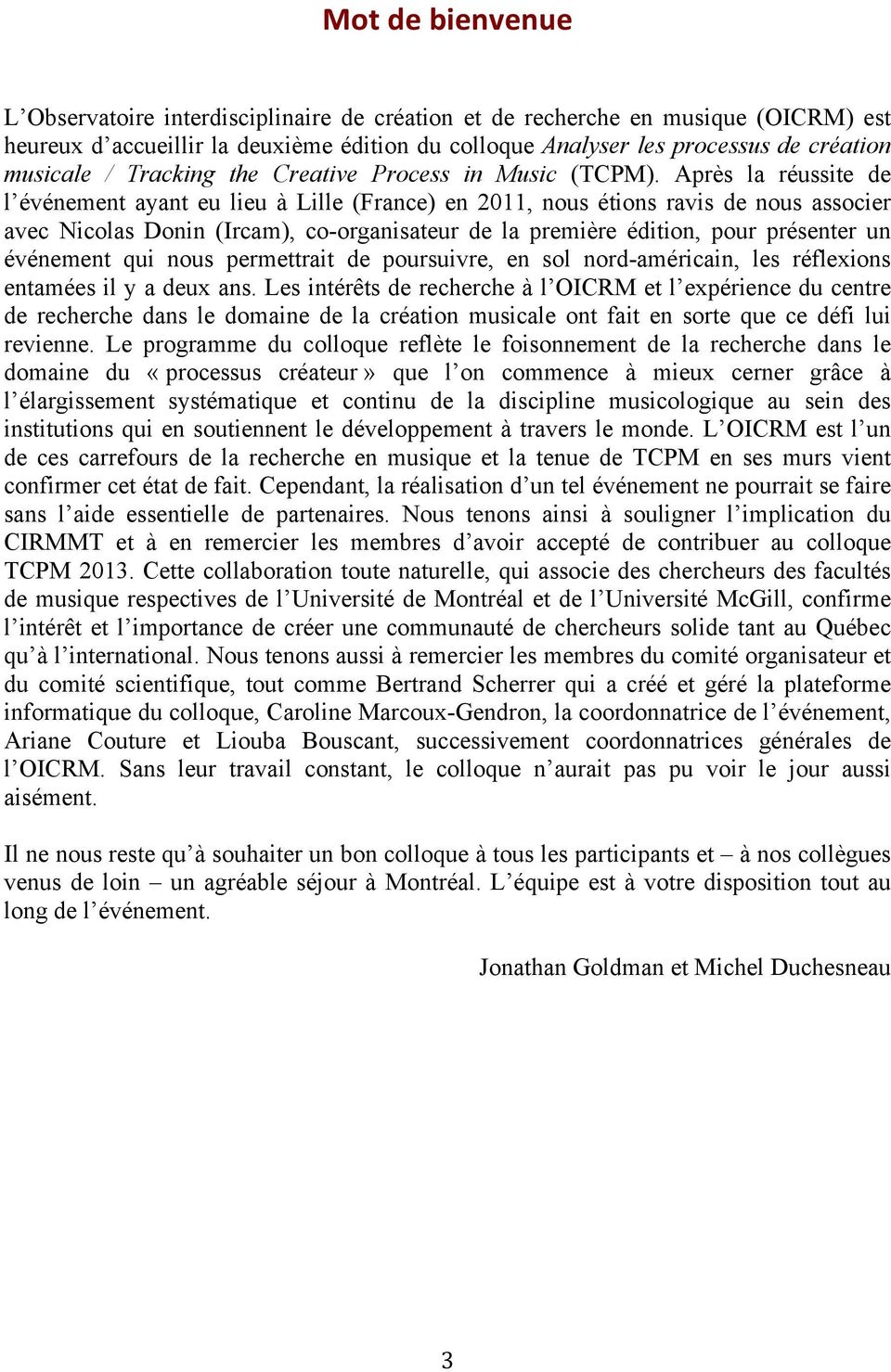
4 Word of welcome The Observatoire interdisciplinaire de création et de recherche en musique (OICRM) is delighted to host the second edition of the conference Tracking the Creative Process in Music (TCPM). After the success of the 2011 event in Lille (France), we were very pleased to collaborate with Nicolas Donin (Ircam), co-organiser of the first edition, in order to present an event that would allow us this time in North America to pursue intellectual avenues we began to explore two years ago. The research interests of the OICRM and its experience as a research centre devoted to musical creation make it a perfect fit for TCPM. The conference program reflects the current flourishing of research activity related to studies of the creative process that can be attributed to the systematic and continuous broadening of the musicological discipline within the institutions that support its development around the world. The OICRM stands as one of the international hubs of music research and the hosting of TCPM within its walls only confirms this fact. It would nevertheless be impossible to organize an event of this magnitude without the help of our partners. As such, we would like to highlight the involvement of CIRMMT and to thank its members for their many contributions to the TCPM 2013 conference. This very natural cooperation, that brings researchers from the Université de Montréal and McGill University together, confirms the importance of creating a solid community of researchers in Quebec and around the world. We would also like to thank the members of the organizing committee and the program committee, as well as Bertrand Scherrer, who built and maintained the conference s internet platform, Caroline Marcoux-Gendron, the coordinator of the event, Ariane Couture and Liouba Bouscant, respectively former and current general coordinators of the OICRM. Without their constant effort, this conference could never have come to pass. We wish you a good conference and to our colleagues from abroad a very pleasant stay in Montreal. The coordinating team will be at your disposal throughout the event. Jonathan Goldman and Michel Duchesneau 4

5 Préambule Ce colloque, dont la première édition organisée par Nicolas Donin et Vincent Tiffon s est tenue à Lille en 2011, rassemble les chercheurs qui s intéressent à la créativité artistique et à l étude des processus de la création musicale et sonore, passés et présents. Les chercheurs des diverses spécialités qui abordent cette problématique (histoire, analyse musicale, critique génétique, psychologie, sciences cognitives, sociologie, ethnomusicologie, anthropologie, etc.) sont ainsi invités, dans une perspective interdisciplinaire, à confronter et à mettre en relation les différentes méthodologies développées depuis une trentaine d années dans leurs domaines respectifs. Tous contribuent à leur façon à faire progresser la connaissance des procédés, techniques, savoirs et savoir-faire mis en œuvre par les musiciens dans leurs démarches de création. Avec les mutations épistémologiques advenues en musicologie à la fin du siècle dernier, la notion de «processus créateur» s est enrichie. On assiste en effet à un élargissement du champ d étude qui ne se limite plus à l œuvre écrite du compositeur de musique savante. Ce champ englobe maintenant l ensemble des répertoires musicaux contemporains (savants et populaires) ainsi que les dimensions orale, technologique et collaborative du processus de création en musique. On s intéresse par exemple à la fonction de l improvisation et du geste dans la démarche créatrice, aux dimensions collectives et collaboratives du travail artistique, à la redéfinition des rôles du compositeur et de l interprète, à l évolution du métier de réalisateur de studio et de réalisateur en informatique musicale, aux stratégies de documentation, transmission et remontage des œuvres mixtes et interactives, etc. La complexité et la multidimensionalité de ce champ d étude requièrent de nouveaux outils d analyse et de nouvelles méthodes de recherche, aux croisements entre musicologie analytique, sciences sociales et autres disciplines scientifiques entre enquête de terrain et expérimentation cognitive. Cet élargissement fournit aussi un contexte renouvelé aux études génétiques sur les œuvres et les compositeurs du canon musical occidental. En effet, qu elles soient basées sur des archives historiques ou sur des recueils de données empiriques, les études des processus de création musicale partagent toutes des exigences méthodologiques, un vocabulaire descriptif, et des modèles de l action créatrice. Ce colloque se veut donc un forum où peuvent se rencontrer les derniers résultats produits par la tradition bien établie des sketch studies, et les paradigmes complémentaires ou alternatifs nés d autres corpus et d autres approches. 5

6 Preamble This conference, whose first edition was organized by Nicolas Donin and Vincent Tiffon in Lille (France) in 2011, brings together researchers interested in artistic creativity and the study of processes of musical and sound creation of the past and present. Researchers working on this cluster of problems from a wide variety of specialities (history, music analysis, genetic criticism, psychology, cognitive sciences, sociology, ethnomusicology, anthropology, etc.) are invited to assess the different methodologies developed in last thirty years in their respective areas in an interdisciplinary perspective. Each approach contributes in its own way to the advancement of our understanding of the procedures, techniques, knowledge and know-how employed by musicians involved in creative projects. With the epistemological paradigm shifts that musicology underwent at the end of the last century, the notion of creative process has been enriched. Sketch studies has extended its scope beyond notated works of art music. Today this field includes all (learned and popular) contemporary musical repertories as well as the oral, technological and collaborative dimensions of the creative process in music. There is growing interest, for example, in the function of improvisation and of gesture in the creative process, in the collective and collaborative dimensions of artistic work, in the redefinition of the roles of the composer and the performer, in the evolution of the metier of the studio technician/producer/computer music designer and in the strategies of documentation, transmission and future performance of works for combined instrumental and electronic means as well as interactive works, etc. The complexity and the multidimensionality of this field of study requires new analytical tools and new research methods at the crossroads of analytical musicology, social science and other scientific disciplines between field work and cognitive experimentation. This broadening of the field also provides a new context for genetic studies of works and composers from the Western musical canon. Whether based on historical archives or on the collection of empirical data, studies of the creative process in music share many of the same methodological requirements, descriptive vocabulary and models of creative action. This conference therefore aims to be a forum in which the most recent results produced by the well established tradition of sketch studies can meet the complementary or alternative paradigms emerging from other repertoires or approaches. 6

7 Comité organisateur / Organizing Committee Nicolas Donin Michel Duchesneau Jonathan Goldman Catherine Guastavino Caroline Traube Liouba Bouscant Ariane Couture Caroline Marcoux-Gendron Bertrand Scherrer Ircam UdeM UdeM McGill UdeM UdeM UdeM UdeM McGill 7

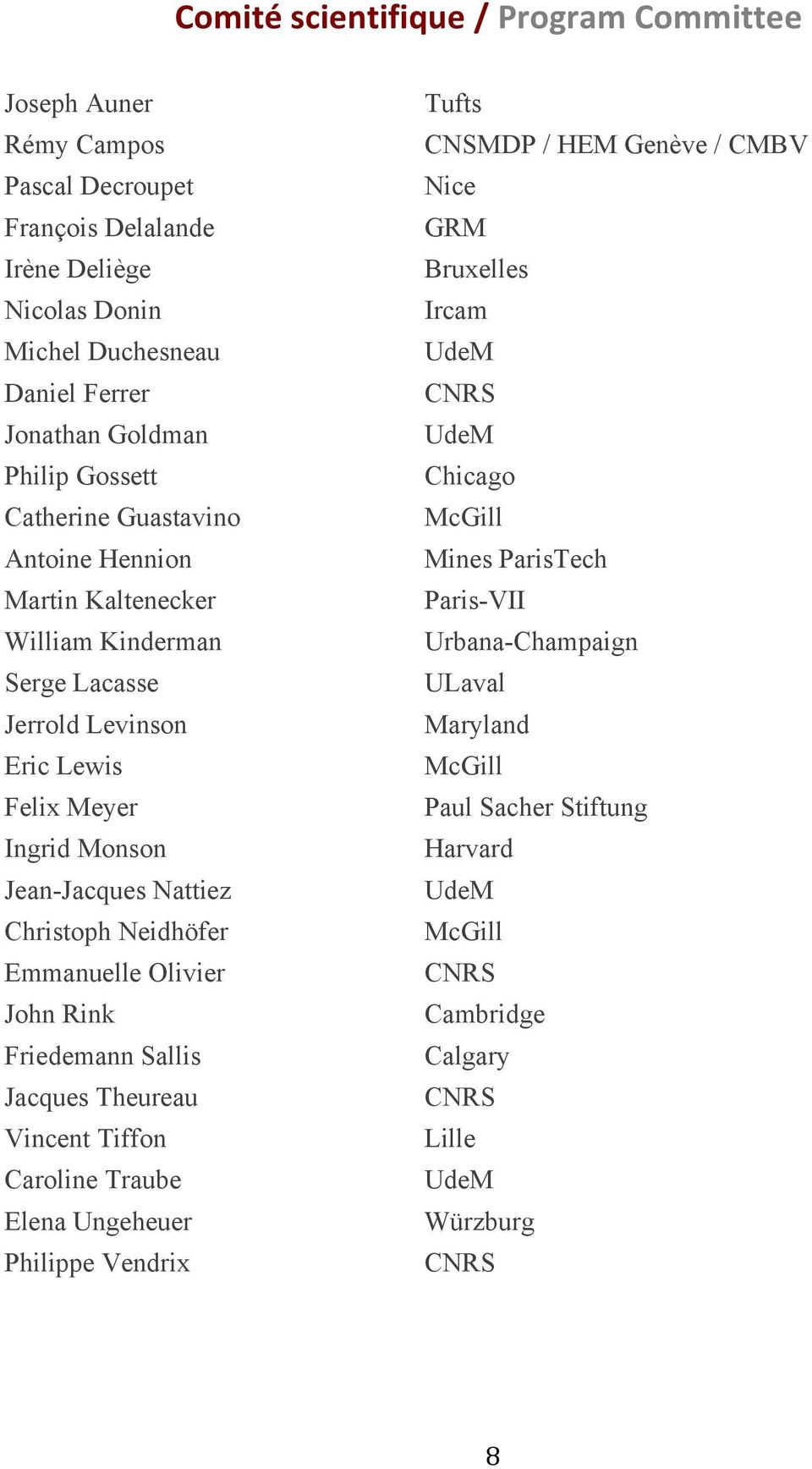
8 Comité scientifique / Program Committee Joseph Auner Rémy Campos Pascal Decroupet François Delalande Irène Deliège Nicolas Donin Michel Duchesneau Daniel Ferrer Jonathan Goldman Philip Gossett Catherine Guastavino Antoine Hennion Martin Kaltenecker William Kinderman Serge Lacasse Jerrold Levinson Eric Lewis Felix Meyer Ingrid Monson Jean-Jacques Nattiez Christoph Neidhöfer Emmanuelle Olivier John Rink Friedemann Sallis Jacques Theureau Vincent Tiffon Caroline Traube Elena Ungeheuer Philippe Vendrix Tufts CNSMDP / HEM Genève / CMBV Nice GRM Bruxelles Ircam UdeM CNRS UdeM Chicago McGill Mines ParisTech Paris-VII Urbana-Champaign ULaval Maryland McGill Paul Sacher Stiftung Harvard UdeM McGill CNRS Cambridge Calgary CNRS Lille UdeM Würzburg CNRS 8
9 Remerciements / Acknowledgements Alain Beauchesne, directeur de production du Nouvel Ensemble Moderne (NEM) Johanne Beaudin, directrice administrative, Faculté de musique Université de Montréal Magalie Beaudoin, agente de gestion financière, Faculté de musique Université de Montréal Madeleine Bédard, directrice aux affaires publiques et adjointe à la doyenne développement, Faculté de musique Université de Montréal Jacqui Bednar, Coordonnatrice administrative et adjointe aux événements, Center for Interdisciplinary Research in Music Media and Technology (CIRMMT) McGill University Yannick Bélanger, webmestre de l OICRM id fix communication Serge Cardinal, professeur agrégé, Département d histoire de l art et d études cinématographiques, et responsable du laboratoire La création sonore : cinéma, arts médiatiques, arts du son, OICRM Université de Montréal Sean Clarke, traducteur, Faculté de musique Université de Montréal Éric Deschênes, technicien en électroacoustique, Faculté de musique Université de Montréal Patrick Félix, technicien en électroacoustique, Faculté de musique Université de Montréal Normand Forget, directeur général du NEM François Gaudette, coordonnateur des services informatiques, Faculté de musique Université de Montréal Jason Milan Ghikadis, graphiste de l affiche officielle du colloque, Faculté de musique Université de Montréal Nathalie Godbout, technicienne à la production, Faculté de musique Université de Montréal Stephen Graham, responsable du service à la clientèle aux affaires publiques, Faculté de musique Université de Montréal Harold Kiliansky, gestion technique, CIRMMT McGill University Sophie Lavoie, webmestre de l OICRM id fix communication Philippe Leroux, compositeur et professeur agrégé, Schulich School of Music McGill University Fabrice Marandola, professeur adjoint, Schulich School of Music, et directeur adjoint et recherche artistique, CIRMMT McGill University 9
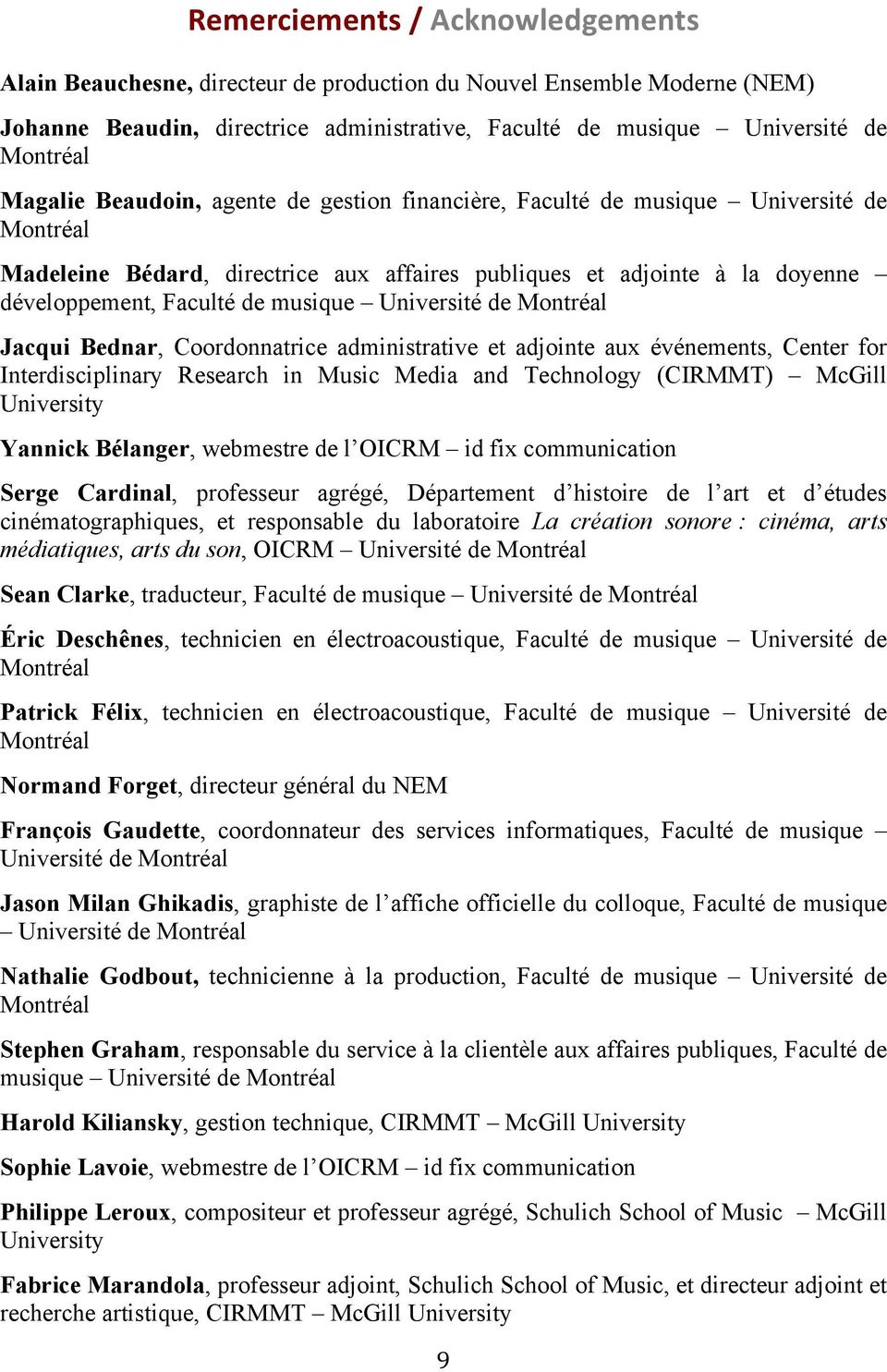
10 Samuelle Meunier, agente de secrétariat, Faculté de musique Université de Montréal Céline Pagé-Laniel, technicienne en administration, Faculté de musique Université de Montréal Carl Pelletier, responsable à la production, Faculté de musique Université de Montréal Stéphane Pilon, conseiller en communication aux affaires publiques, Faculté de musique Université de Montréal Jean-Simon Robert-Ouimet, traducteur indépendant Myke Roy, coordonnateur au secteur électroacoustique, Faculté de musique Université de Montréal Lorraine Vaillancourt, directrice artistique du NEM et merci à l équipe technique, aux placeurs et aux bénévoles! 10

11 Horaire / Schedule JEUDI 10 OCTOBRE 2013 MCGILL Lobby Tanna Schulich 8:00 Accueil et inscription/ Welcome and Registration Salle Tanna Schulich 8:45 Allocution inaugurale : Michel Duchesneau, Nicolas Donin, Jonathan Goldman Salle Tanna Schulich Salle A832 Voyages au bout de l esquisse I Journey to the Analyse assistée par ordinateur end of the sketch I Computer-assisted analysis Président de séance/session chair: Président de séance/session chair: Friedemann Sallis Pierre Michaud 9:15 Anton Bruckner s Particell Drafts Mario Aschauer 9:45 Unifying a Diverse Output: Audible Ramifications of Prose- Report Composition in the Music of Henry Brant Joel Hunt 10:15 Genèse et notation des modes de jeu dans Pression ( /2010) pour un violoncelliste d Helmut Lachenmann François-Xavier Féron Lobby Tanna Schulich 10:45 à 11:15 Pause/ Break Salle Tanna Schulich Questions théoriques Theoretical questions Président de séance/session chair: Jonathan Goldman 11:15 Y a-t-il de l universel dans les stratégies de composition des musiques de tradition orale? Nathalie Fernando, Jean-Jacques Nattiez L ethnomusicologie computationnelle au service des processus poïétiques : le cas des mélodies jouées au luth par les bardes karakalpaks d Asie centrale Frédéric Léotar Theory and Software for Tracing Musical Creativity in Composition Guerino Mazzola, Florian Thalmann La préservation par le remontage des œuvres : création d un langage de représentation des processus de production et de reproduction sonores Antoine Vincent, Alain Bonardi, Bruno Bachimont Salle A832 Créativité distribuée Distributed creativity Président de séance/session chair: Georgina Born Ouija : collaboration, improvisation and history Mark Doffman, Eric Clarke 11:45 Fully Dialectic Musical Creation: Adorno and Composition as Negation Murray Dineen Creative Tensions/Intentions in Artistic Experimentation David Gorton, Christopher Redgate 11
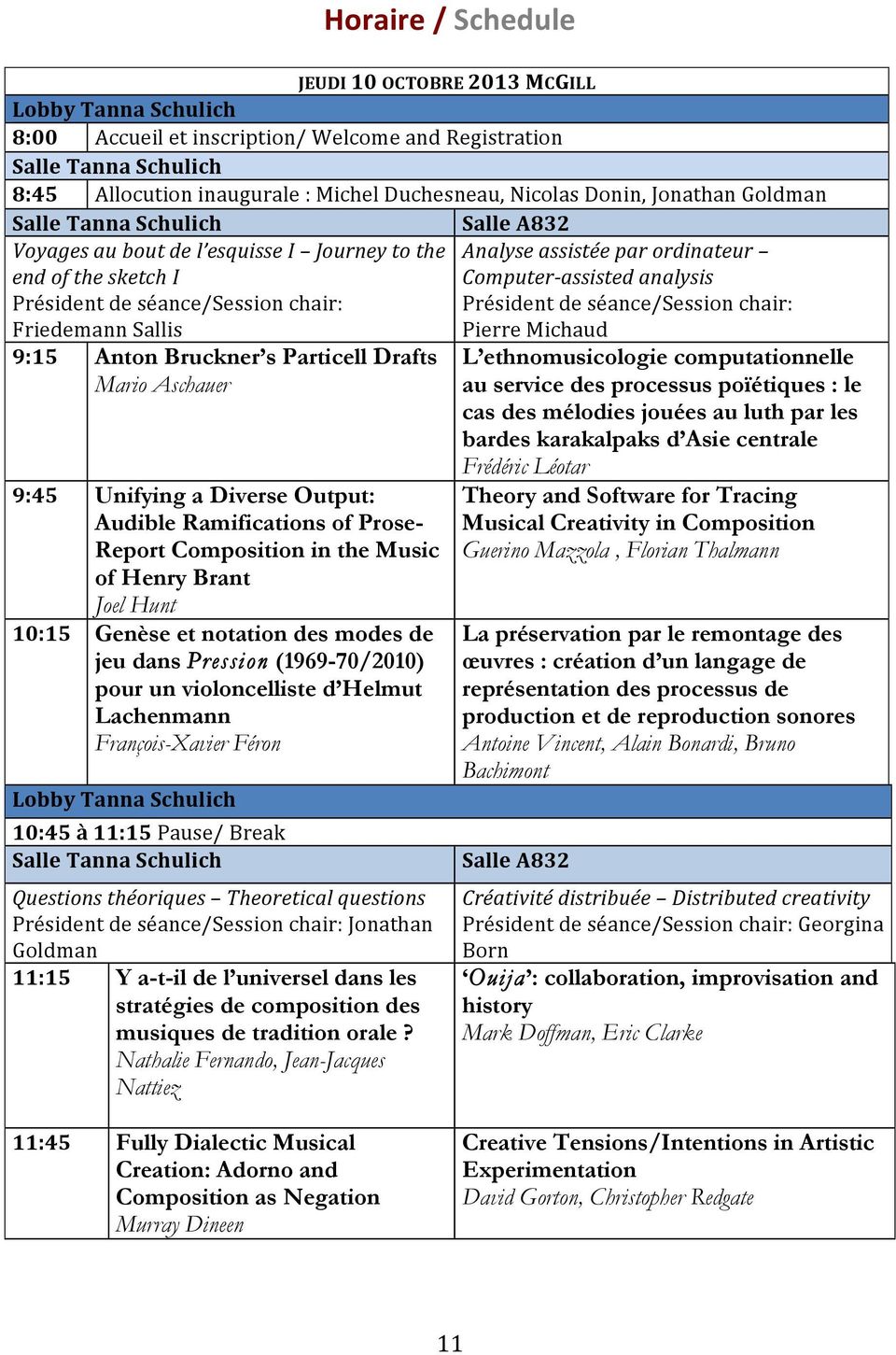
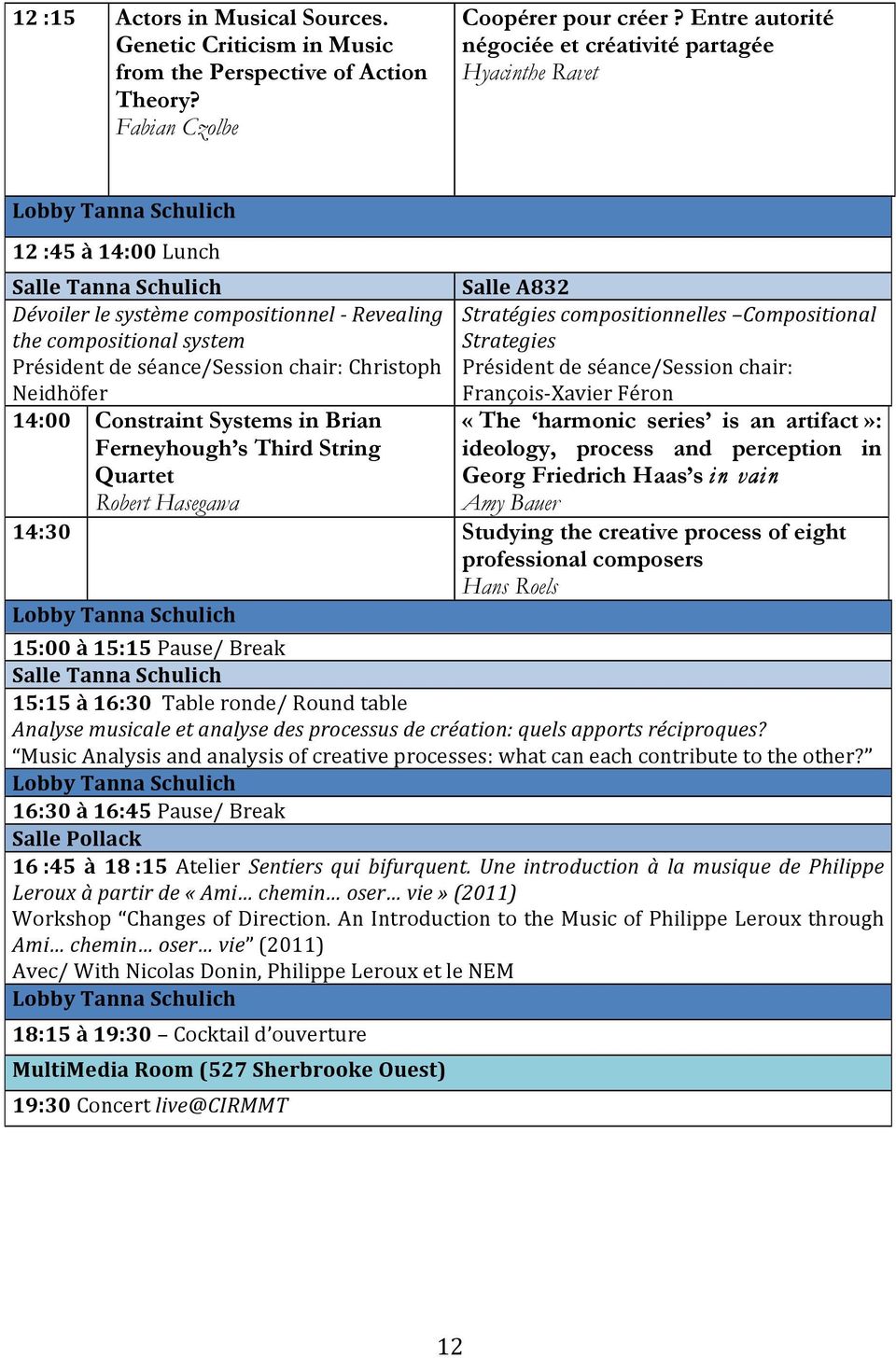
12 12 :15 Actors in Musical Sources. Genetic Criticism in Music from the Perspective of Action Theory? Fabian Czolbe Coopérer pour créer? Entre autorité négociée et créativité partagée Hyacinthe Ravet Lobby Tanna Schulich 12 :45 à 14:00 Lunch Salle Tanna Schulich Salle A832 Dévoiler le système compositionnel - Revealing the compositional system Président de séance/session chair: Christoph Neidhöfer Stratégies compositionnelles Compositional Strategies Président de séance/session chair: François- Xavier Féron 14:00 Constraint Systems in Brian Ferneyhough s Third String Quartet Robert Hasegawa «The harmonic series is an artifact»: ideology, process and perception in Georg Friedrich Haas s in vain Amy Bauer 14:30 Studying the creative process of eight professional composers Hans Roels Lobby Tanna Schulich 15:00 à 15:15 Pause/ Break Salle Tanna Schulich 15:15 à 16:30 Table ronde/ Round table Analyse musicale et analyse des processus de création: quels apports réciproques? Music Analysis and analysis of creative processes: what can each contribute to the other? Lobby Tanna Schulich 16:30 à 16:45 Pause/ Break Salle Pollack 16 :45 à 18 :15 Atelier Sentiers qui bifurquent. Une introduction à la musique de Philippe Leroux à partir de «Ami chemin oser vie» (2011) Workshop Changes of Direction. An Introduction to the Music of Philippe Leroux through Ami chemin oser vie (2011) Avec/ With Nicolas Donin, Philippe Leroux et le NEM Lobby Tanna Schulich 18:15 à 19:30 Cocktail d ouverture MultiMedia Room (527 Sherbrooke Ouest) 19:30 Concert live@cirmmt 12
13 VENDREDI 11 OCTOBRE 2013 UDEM Entrée principale 200 avenue Vincent d Indy 8:00 Accueil et inscription/ Welcome and Registration Salle Jean-Papineau-Couture (B-421) Salle Serge-Garant (B-484) Processus cognitifs Cognitive processes Président de séance/session chair: Nicolas Donin 9:00 Creative Music Processes as the Focus of Otto Laske s Cognitive Musicology Nico Schüler 9:30 Procédés rhétoriques de la synesthésie dans la musique revivaliste du Salento Flavia Gervasi Historicité et temporalité Historicity and temporality Président de séance/session chair: Jean- Jacques Nattiez Musical Composition, Performance, and the Textual Condition : The Case of Bruckner s Fourth Symphony Benjamin Korstvedt Remembering the Past in Light of the Future: Memory and Wagner s Creative Process Feng-Shu Lee 10:00 Jouer Lully à l Opéra de Paris en 1925 : entre patrimoine et création Camille Rondeau Pavillon A (Salle Claude-Champagne) 10:30 à 11:00 Pause/ Break Salle Jean-Papineau-Couture (B-421) Achever l inachevé Finishing the unfinished Président de séance/session chair: Pascal Decroupet 11:00 Schubert selon Berio, ou l art de la mise en abîme dans Rendering Mylène Gioffredo Salle Serge-Garant (B-484) Technologies transformatrices Transformative technologies Président de séance/session chair: Caroline Traube Le RIM Réalisateur en Informatique Musicale : émergence d une profession Laura Zattra 11:30 Realization, (Re)construction, Collaboration: a Continuum of Completions Michael Dias 12:00 Work in Progress as Idea and Form: Notations by Pierre Boulez Kristof Boucquet Pavillon A (Salle Claude-Champagne) 12:30 à 14:00 Lunch Documentation des processus créatifs pour la préservation et la dissémination des œuvres mixtes Guillaume Boutard, Fabrice Marandola Le studio d enregistrement comme lieu d expérimentation, outil créatif et vecteur d internationalisation. Stonetree Records et la paranda garifuna en Amérique centrale Ons Barnat 13

14 Salle Jean-Papineau-Couture (B-421) Travaux en cours : Analyses de sons fixés Work-in-progress: Analysing fixed sounds Président de séance/session chair: Vincent Tiffon 14:00 What do numbers tell us: the case of Giacinto Scelsi s archives Nicola Bernardini, Alessandra Carlotta Pellegrini 14:20 Tracking Creativity and Investigating Technology in Electroacoustic Music: Methods and perspectives of the TaCEM project Michael Clarke, Frédéric Dufeu, Peter Manning Pavillon A (Salle Claude-Champagne) 14:40 à 15:10 Pause/ Break Salle Serge-Garant (B-484) Travaux en cours : À la première personne du singulier Work-in-progress: First person singular Président de séance/session chair: Nicolas Donin Du rôle de l interprète-chercheur en création et re-création musicale Marie-Hélène Breault Transcription as composition: feedback in the artistic process from a composer s perspective James O Callaghan Salle Jean-Papineau-Couture (B-421) Salle Serge-Garant (B-484) Composer (avec/dans) la tradition Composing (with/in the) tradition Président de séance/session chair: Flavia Gervasi Friedemann Sallis 15:10 Une maison à Montréal/A House in Bali : L invention d une tradition balinaise chez Vivier, Evangelista, Rea et al. Jonathan Goldman 15:40 Where do short melodies come from? The creative process of melody-making in the Icelandic rímur tradition Ragnheidur Olafsdottir Salle Jean-Papineau-Couture (B-421) Voyages au bout de l esquisse II Journey to the end of the Sketch II Président de séance/session chair: Discarded Sketches for Mahler s Seventh Symphony Anna Stoll Knecht Épreuves, ébauches et variantes d auteur : les cas de Vol de nuit et Ulisse de Luigi Dallapiccola Luca Sala 16:10 à 17:25 Table ronde/ Round table La préservation des œuvres mixtes et électroacoustiques: enjeu interdisciplinaire Conservation of Electroacoustic and Mixed- media Works: an Interdisciplinary Process La Cinémathèque (335 Maisonneuve Est) 18 :15 Table ronde sur l installation Continental Divide de l artiste du son Christian Calon Soirée libre Suggestions d activités culturelles sur notre site Internet dans la section «Informations pratiques» 14

15 SAMEDI 12 OCTOBRE 2013 UDEM Entrée principale 200 avenue Vincent d Indy 8:00 Accueil et inscription / Welcome and Registration Salle Jean-Papineau-Couture (B-421) Salle Serge-Garant (B-484) Improvisations Improvisations Président de séance/session chair: Michel Duchesneau 9:00 Composition, Improvisation and Practical Creativities in the Music of the Instant Composers Pool Floris Schuiling 9:30 Capturer le geste de l improvisateur : à propos du processus de création de Fenêtre Ovale de Karl Naegelen Clément Canonne 10:00 L alternate take ou le jazzman au travail. Pour une approche génétique de l improvisation Martin Guerpin 15 Musique «plus» - Music plus Président de séance/session chair: Isabelle Héroux Creative process in video art: Bill Viola s Anthem Giacomo Albert Analyser un processus de création musicale au prisme d une «oreille de nageuse» «Entendre» et «écouter» en natation synchronisée Irina Kirchberg Dancing at the Crossroads: Creative Collaboration as Participatory Community Scholarship Christopher Smith, William Gelber Pavillon A (Salle Claude-Champagne) 10:30 à 11:00 Pause/ Break Salle Jean-Papineau-Couture (B-421) 11:00 à 12:15 Table ronde/ Round table Au-delà du compositeur? Créativité distribuée et rôles émergents dans le processus de création Beyond the Composer: Distributed Creativity and Emerging Roles in the Creative Process 12:15 à 12:30 L analyse des processus créateurs mise en film? Présentation d un webdocumentaire François-Xavier Féron Pavillon A (Salle Claude-Champagne) 12:30 à 14:00 Lunch Salle Jean-Papineau-Couture (B-421) Salle Serge-Garant (B-484) Performances de l interprète Performers and Performances Président de séance/session chair: Sylvain Caron Electroperspectives Electroperspectives Président de séance/session chair: Laura Zattra 14:00 Layers of creativity in composition, rehearsal and performance: Nicole Lizée and the Kronos Quartet Historical Performance Practice and Electro-Acoustic Music Joseph Auner Amanda Bayley, Nicole Lizée 14 :30 La création d une interprétation : étude pilote pour développer une méthodologie Isabelle Héroux, Marie-Soleil Fortier Pavillon A (Salle Claude-Champagne) 15 :00 à 15 :30 Pause/ Break

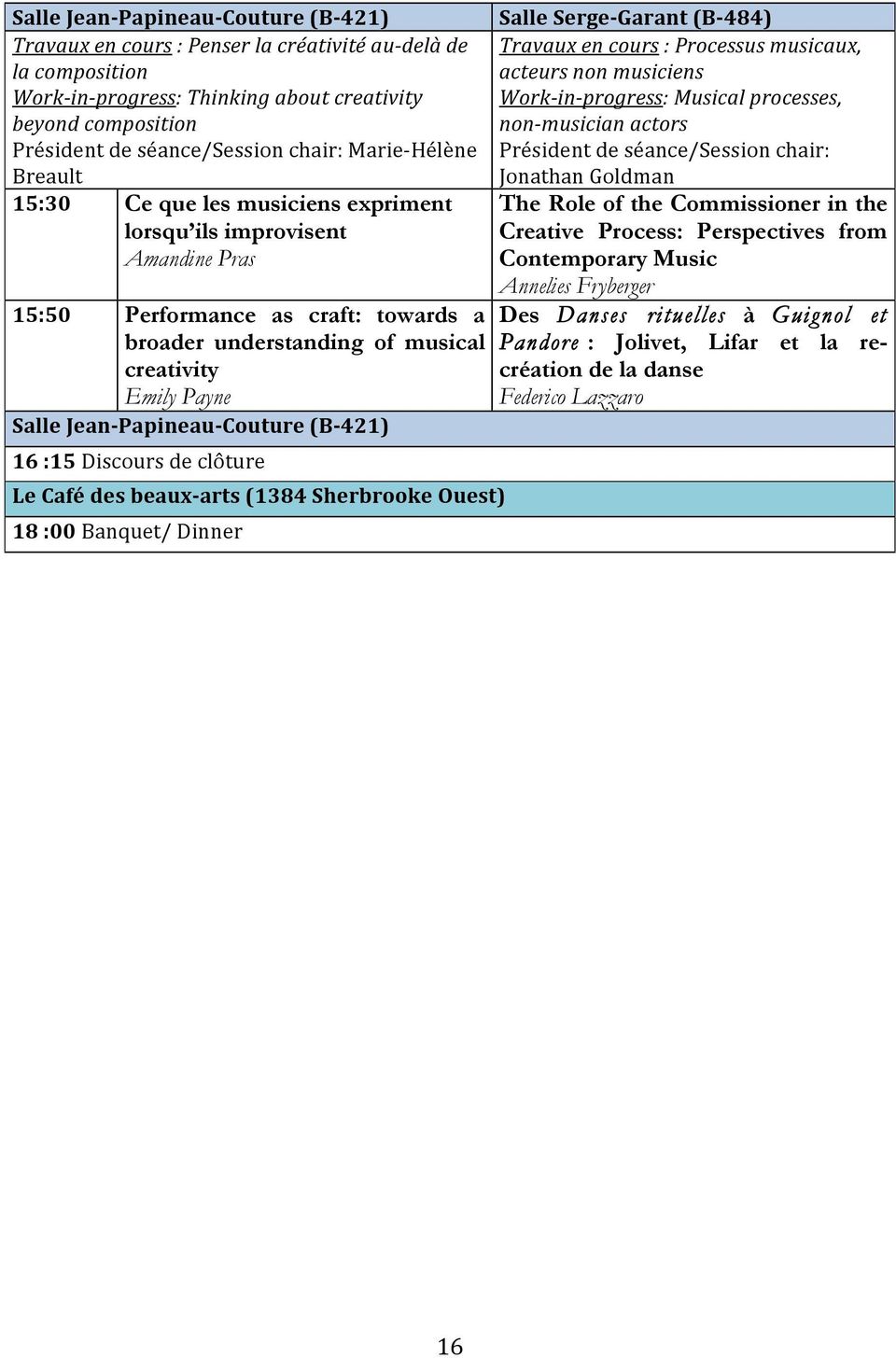
16 Salle Jean-Papineau-Couture (B-421) Salle Serge-Garant (B-484) Travaux en cours : Penser la créativité au-delà de la composition Work-in-progress: Thinking about creativity beyond composition Président de séance/session chair: Marie- Hélène Breault Jonathan Goldman 15:30 Ce que les musiciens expriment lorsqu ils improvisent Amandine Pras Annelies Fryberger 15:50 Performance as craft: towards a broader understanding of musical creativity Emily Payne Salle Jean-Papineau-Couture (B-421) 16 :15 Discours de clôture Le Café des beaux-arts (1384 Sherbrooke Ouest) 18 :00 Banquet/ Dinner Travaux en cours : Processus musicaux, acteurs non musiciens Work-in-progress: Musical processes, non-musician actors Président de séance/session chair: The Role of the Commissioner in the Creative Process: Perspectives from Contemporary Music Des Danses rituelles à Guignol et Pandore : Jolivet, Lifar et la recréation de la danse Federico Lazzaro 16
17 Résumés / Abstracts 17

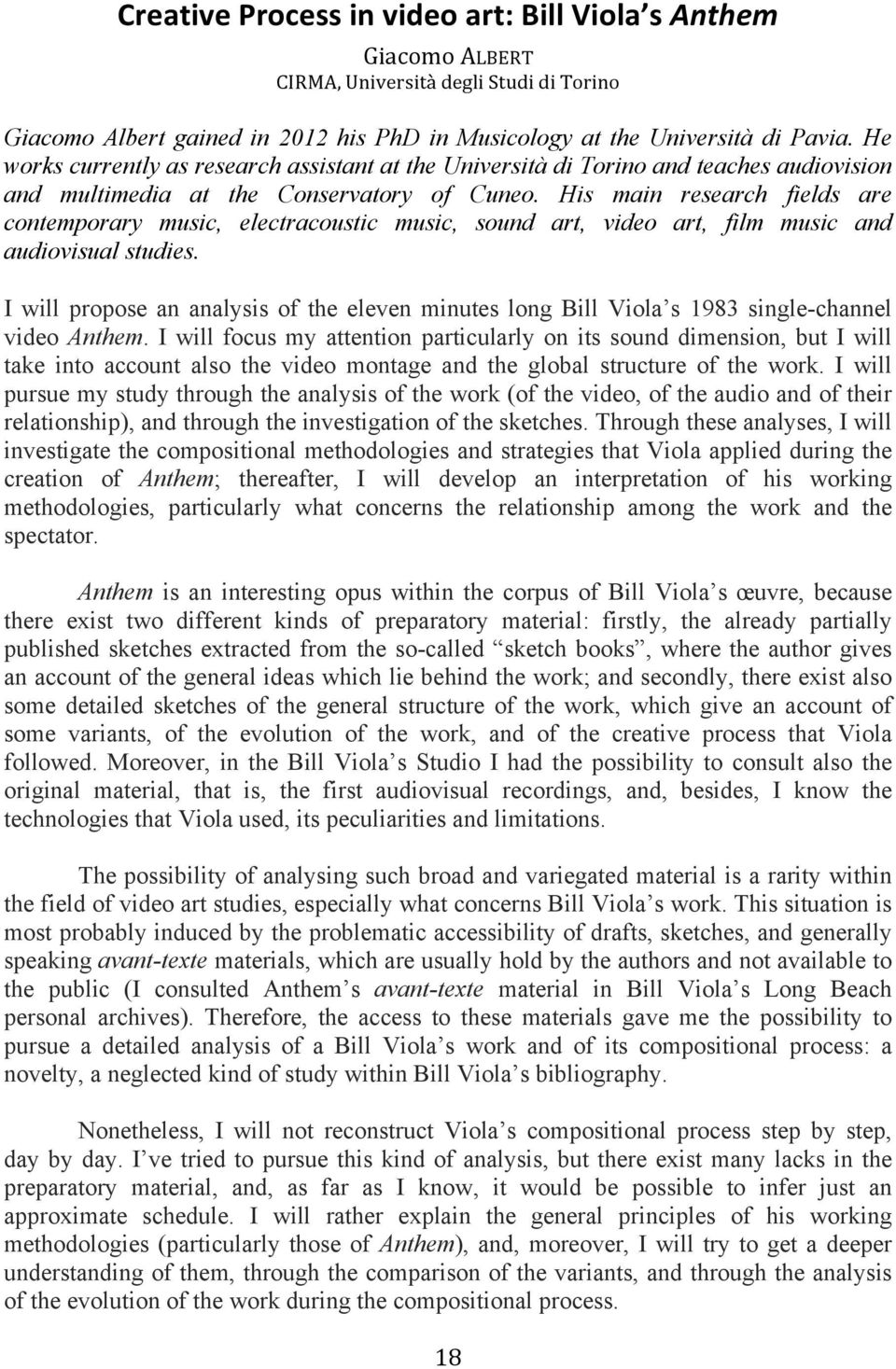
18 Creative Process in video art: Bill Viola s Anthem Giacomo ALBERT CIRMA, Università degli Studi di Torino Giacomo Albert gained in 2012 his PhD in Musicology at the Università di Pavia. He works currently as research assistant at the Università di Torino and teaches audiovision and multimedia at the Conservatory of Cuneo. His main research fields are contemporary music, electracoustic music, sound art, video art, film music and audiovisual studies. I will propose an analysis of the eleven minutes long Bill Viola s 1983 single-channel video Anthem. I will focus my attention particularly on its sound dimension, but I will take into account also the video montage and the global structure of the work. I will pursue my study through the analysis of the work (of the video, of the audio and of their relationship), and through the investigation of the sketches. Through these analyses, I will investigate the compositional methodologies and strategies that Viola applied during the creation of Anthem; thereafter, I will develop an interpretation of his working methodologies, particularly what concerns the relationship among the work and the spectator. Anthem is an interesting opus within the corpus of Bill Viola s œuvre, because there exist two different kinds of preparatory material: firstly, the already partially published sketches extracted from the so-called sketch books, where the author gives an account of the general ideas which lie behind the work; and secondly, there exist also some detailed sketches of the general structure of the work, which give an account of some variants, of the evolution of the work, and of the creative process that Viola followed. Moreover, in the Bill Viola s Studio I had the possibility to consult also the original material, that is, the first audiovisual recordings, and, besides, I know the technologies that Viola used, its peculiarities and limitations. The possibility of analysing such broad and variegated material is a rarity within the field of video art studies, especially what concerns Bill Viola s work. This situation is most probably induced by the problematic accessibility of drafts, sketches, and generally speaking avant-texte materials, which are usually hold by the authors and not available to the public (I consulted Anthem s avant-texte material in Bill Viola s Long Beach personal archives). Therefore, the access to these materials gave me the possibility to pursue a detailed analysis of a Bill Viola s work and of its compositional process: a novelty, a neglected kind of study within Bill Viola s bibliography. Nonetheless, I will not reconstruct Viola s compositional process step by step, day by day. I ve tried to pursue this kind of analysis, but there exist many lacks in the preparatory material, and, as far as I know, it would be possible to infer just an approximate schedule. I will rather explain the general principles of his working methodologies (particularly those of Anthem), and, moreover, I will try to get a deeper understanding of them, through the comparison of the variants, and through the analysis of the evolution of the work during the compositional process. 18
19 Bill Viola, in his writings and in his sketch books, has compared his audiovisual work Anthem to a tantric rite, the Chöd, which consists in celebrating one's own body's sacrifice, offering it to spirits and demons in a sacrificial banquet. The purpose of the rite is to reach transcendental wisdom, which can be achieved through the departure from one's individual ego, through the loss of identity, and through the world of appearances' loss of identity. The metaphor of the work of art as a rite of passage, aimed at the divestment from the Schein (appearance) and at the achievement of interior enlightenment through a more profound relationship with oneself, with one's most intimate and hidden memories and with one's "cultural archetypes", is actually applicable to several works of the US artist. In order to fulfil such a rite, Viola applies refined strategies with the aim of involving the audience, through a careful planning of the sounds and images. The report shall highlight some of these techniques, especially in regard to the audio dimension and its relationship with the multiple cognitive levels involved in the fruition of the work. I will firstly analyse the whole structure of the work: the themes and subjects of the images and their montage. Beside this, I ll show also the analysis of the sound dimension, how the different transpositions of the child s screams are organised in time, and how the video and sound structures fit together. By that way I ll deepen the study of Anthem s internal organisation and of its global time structure. Then, I ll show how Viola worked within these dimensions, through the analysis of the sketches of the montage and through the sketches and drafts of the sound s time/pitch organisation. I ll demonstrate the difference between the structural variants (for this purpose I will show a variant of the three last main sections of the video, from the climax the so-called Chöd to the coda ), and the local variants (I will particularly show four different internal organisations of the introduction ). By that way I will analyse the montage that Viola did, how does he work with the time, how does he manage the structures and how does he conceive the audiovisual relationship; moreover, I will try to argue why he chose to apply this structure for the composition of Anthem. At last, I ll also show the spectrograms of some sound excerpts: through these examples I ll highlight a kind of work that Bill Viola did, which we cannot find any trace of within the sketches. It s a micro-compositional sound technique, which concerns the timber dimension. It s a re-composition of a scream, so, of a human sound archetype. Confronting the different excerpts and fitting them within the whole structure of the single-channel video, I ll stress how this micro-compositional work has been thought following a coherent strategy, aimed at handling the emotional involvement of the audience. The evolution of the micro-compositional sound work supports the general Anthem s arch-like structure; but, in spite of challenging the representational knowledge of the onlooker, it acts on his emotions, through an immersive, non-mediated form of knowledge. In conclusion, I ll apply diverse methodologies, in order to analyse the multiple niveaux of the text and the different techniques and strategies that Viola used. The study of these techniques and of Viola s compositional process, discloses a deeper 19

20 understanding of the meaning of the work, of the way it relates to the onlooker, how does it affect him, and of the way in which the work constructs its experience. So, this study gives us a new interpretation of Viola s work, through the analysis of the artist creative process, a dimension of his work which has still not been taken into account by its bibliography. 20

21 Anton Bruckner s Particell Drafts Mario ASCHAUER Yale School of Music, New Haven / Austrian Academy of Sciences, Vienna Austrian scholar-performer Mario Aschauer is member of the editorial board of the New Schubert Edition. Currently he is a postdoctoral fellow at the Yale School of Music pursuing research for a book on Anton Bruckner s compositional procedures. He received his training as a conductor, musicologist and harpsichordist from Conservatories and Universities in Linz, Salzburg and Vienna. Anton Bruckner s preliminary manuscripts, now scattered in various libraries and music collections, may be grouped into three main categories: particell sketches and drafts, score drafts, and composition scores of smaller vocal works. From the very beginnings of Bruckner studies, scholars have taken a keen interest in these sources. A number of studies of Bruckner s compositional procedures have been undertaken on the basis of close readings of the drafts to individual works (e.g. Röthig 1978, Röder 1987, Sonntag 1987, Phillips 2002, Hermann 2008), and one scholarly monograph has been published on the manuscript draft sources from the Linz period (Hawkshaw 1984). However, the corpus of extant preliminary material as a whole comprising all genres in Bruckner s œuvre and all periods of his life remains uncatalogued and has never been the subject of a comparative examination that could yield broader insight into Bruckner s compositional practice. This paper is part of my multi-year project, generously funded by the Max Kade Foundation, that seeks to fill this lacuna in Bruckner research. Specifically, the project will result in the publication of an extensive catalogue of Bruckner s draft manuscript sources and a monograph on Bruckner s sketches and drafts. The paper focuses on one group of sources in this large corpus: Bruckner s particell drafts. It is based on manuscripts from the pre-linz period (A-SF), the Kitzler-Studienbuch, early particell drafts (today mainly in A-KR), and examples from the drafts for Symphonies no. 8 and 9. The paper shows that for the first forty years of his life, Bruckner composed all of his works even larger pieces such as the Requiem in full score. Bruckner probably learned this technique as early as his teens from Johann Baptist Weiß, his cousin and first teacher. It was only in , in the last months of the eight years since 1855 in which Bruckner took lessons from Simon Sechter and Otto Kitzler that the composer studied instrumentation and obtained new skills in work organization. In these months, Kitzler introduced Bruckner to a rigorous step-by-step system of compositional procedures drawn from J. C. Lobe s Lehrbuch der musikalischen Komposition. The system was comprised of three principal stages: first the sketching of the composition, then the preparation of a continuity draft in short score, and finally the transferral of the continuity draft onto a full orchestral score. Lobe s system for composition constituted a radical change in Bruckner s compositional method. Now the plan, realization, and elaboration of the composition, which had formerly occurred simultaneously, were disassociated into separate steps. 21
22 While still under the tutelage of Kitzler, Bruckner adopted and transformed Lobe s System into his own personal method and employed it in most of the Linz compositions and in early works such as the three masses and the Symphonies nos. 0, 1, and 2. My paper argues that the early particell drafts show remarkable similarities to manuscripts by Schubert, while they differ significantly from the working manuscripts of Bruckner s contemporaries such as his colleague in Vienna Franz Krenn. In the first half of the 1870s another major reorganization in Bruckner s compositional method occurred when the composer inspired by a still-to-be-identified source began using metrical numbers and modified the layout of his draft manuscripts. Despite all of his efforts to improve his working techniques, however, the particell draft was to remain a challenge for Bruckner for the rest of his life. On 16 August 1885 Bruckner wrote to Franz Schalk with some exasperation: So eben ist die Achte Sinf. fertig in der Scitze (leider.) [ I just finished the draft for the eighth symphony (unfortunately). ] 22
23 Historical Performance Practice and Electro- Acoustic Music Joseph AUNER Tufts University Prof. Music, Tufts. Publications include : Losing your Voice: Sampled Speech and Song, Throughout: Art and Culture Emerging with Ubiquitous Computing, ed, Ekman (Cambridge: MIT Press, 2012), and Sing it for me : Posthuman Ventriloquism in Recent Popular Music. Journal of the Royal Musical Association 128 (2003): With the accelerating process of technological change over the last hundred years, anyone coming to terms with electro-acoustic music is called upon to undertake a kind of genetic criticism that by necessity engages with a work s historical trajectory from the creative process in the studio to the present moment of performance or reception. We can see vivid evidence of this in the score for Kaija Saariaho s NoaNoa (1992), a piece for flute, prerecorded sounds, and real-time processing. Saariaho composed NoaNoa at Ircam using its extensive computer music resources for analyzing and modeling instrumental timbre, reverberation, and spatial effects. After a description of all the gear required for a performance (processors, controllers, a Midi interface, Max/MSP patches, and a Macintosh PowerPC with CD Rom drive [compatible with system 7.1 or higher ]), she writes: the technical information given above is correct as of September 1998, but the performer should contact the publisher for updates. Flutists interested in performing the work today must navigate their own path through the history of computer music processing and interfaces. The Chester Novello website provides downloadable software, as well as contact information for Saariaho s collaborator, the composer Jean Baptiste Barrière, and directions to a web page dealing with Max/MSP software. But the challenges in getting everything to work are clear in energetic and sometimes despairing online forums where musicians and engineers share problems and solutions. This is, of course, just the tip of the iceberg when it comes to the larger sphere of electro-acoustic music. A 2005 survey of over one hundred and sixty composers found that nearly half reported losing files they considered valuable due to hardware or software obsolescence. We were once accustomed to think of the Historical Performance Practice movement in terms of, for example, violinists efforts to play eighteenth-century works with what they regarded as an appropriate technique, period bow and strings, and even an instrument with the right varnish and glue. But in contrast to the decades or even centuries we use to measure technical changes with earlier musical technologies like the violin, with NoaNoa we see a composer compelled to indicate a specific month of composition; the implication is that whatever hardware and software she had originally employed could be obsolete by October. My essay explores some of the ramifications for composers, musicians, scholars, and listeners of the temporality of electro-acoustic sounds themselves, as well as of the 23
24 types of sonic manipulations characteristic of specific music technologies. The wide range of responses to this phenomenon from attempting to dislodge electro-acoustic from its original moment through processes of modernization, to a despairing or welcoming acceptance of the ways sounds and devices age resonate in surprising ways with the debates about authenticity and historical performance practice in early music that raged in the 1980s, with continuing repercussions down to the present day. Using the language of sustainability, modernization, and even the taboo, authenticity, a growing body of scholarship engages the practical and aesthetic issues involved with devising long-term technical solutions to prevent works electro-acoustic music from going silent. I draw on writings by composers engineers dealing with practical issues of performance, scholars and archivists, facing the challenges of how to preserve the works and their associated technological infrastructures, musicologists dealing with long debates about historical performance practice, and underlying issues from the philosophy of technology. Precisely those works and styles that are most bound up with cutting-edge technologies are the ones that become most quickly frozen in the moment of their conception as that edge inexorably advances; and this is as true of products of rarefied research institutions like Ircam as it is of the latest electronic dance music. The question of sounds becoming dated is thus also an issue even for Tape works that exist exclusively on some form of recording media, and which also are affected by changes in recording media, digital to analog conversion, amplification, and loudspeakers. I will consider such topics as what happens to a work when it is re-wired for the current state of technology? How much of the meaning and impact of a work like NoaNoa is bound up with the technologies themselves and how they were originally perceived? The challenge of how to keep a work from getting stuck in time is vividly exemplified by Boulez s 1984 computer music showpiece Répons. Should performers recreate the very characteristic sound of 1980s digital synthesis, or can the sound world of the work be reimagined with current processing. How can one preserve the impact of the piece now that the massive sound reinforce apparatus and supercomputer are no longer required? In the case of a work like Steve Reich s Violin Phase (1967), originally conceived of and performed with magnetic recording tape, how is the work changed by present-day performances with laptop software or digital looping devices? 24
25 Le studio d enregistrement comme lieu d expérimentation, outil créatif et vecteur d internationalisation. Stonetree Records et la paranda garifuna en Amérique centrale Ons BARNAT MCAM- OICRM, Université de Montréal Membre du MCAM et chercheur rattaché à l OICRM, Ons Barnat vient d obtenir sa thèse en ethnomusicologie à l Université de Montréal. Ses champs d intérêts touchent principalement à l étude des créolisations musicales ainsi qu au rôle du studio d enregistrement dans la fabrication des «musiques du monde». Cette conférence vise à offrir une présentation générale du phénomène de l enregistrement en studio de la paranda garifuna en Amérique centrale (Belize, Guatemala et Honduras), tout en ouvrant des pistes de réflexion sur l étude ethnomusicologique d un tel objet. En dernière instance, elle soulèvera quelques enjeux épistémologiques et méthodologiques liés aux problématiques qui sous-tendent la création actuelle de la paranda garifuna. À partir de l exemple de la «récupération», à des fins commerciales, d un genre musical «traditionnel» par un label indépendant centraméricain, il s agira de montrer comment un producteur de world music a su se servir du studio d enregistrement comme d un outil créatif susceptible de lui ouvrir les portes de l internationalisation. Utilisant le studio comme laboratoire expérimental, Ivan Duran est ainsi parvenu à réaliser des disques qui tout en atteignant un succès critique international allaient lui permettre d établir son label, Stonetree Records, en tant que standard pour l ensemble de l industrie musicale régionale. Genre né de la rencontre (imposée par l exil) au XIX e siècle entre les Garifunas et des populations hispaniques centraméricaines, la paranda connaît aujourd hui un regain d intérêt chez les acteurs de la production discographique locale. Depuis son apparition dans les studios d enregistrement, elle a évolué vers une forme modernisée, faisant appel à des instruments électriques et à des procédés de traitement du son caractéristiques des musiques «populaires». Devenue en 2000 (avec la compilation Paranda; Africa in Central America, produite par Stonetree Records et distribuée par Warner/Elektra) une «musique du monde» sur le marché discographique international, cette nouvelle forme de paranda connaît un succès conséquent dans les palmarès de world music popularité qui se déploie après coup chez les Garifunas centraméricains, qui redécouvrent un genre jusqu alors quasiment disparu dans sa version villageoise. Quel serait donc le rôle du studio d enregistrement dans le renouveau que vivrait aujourd hui la paranda garifuna en Amérique centrale? Et comment cet outil créatif a-til permis à Stonetree Records de «formater» cette musique afin de répondre aux attentes de consommateurs désormais répartis aux quatre coins de la planète? 25
26 En partant de la double hypothèse que le studio représente pour les acteurs en présence un véritable outil créatif d internationalisation (en plus d avoir permis, dans le cas spécifique de la paranda, de remettre au goût du jour un genre musical jusque-là tombé en désuétude et voué à une rapide extinction), cette présentation s attachera à mettre en évidence les différentes dynamiques qui sous-tendent les processus créatifs dans le cadre spécifique du studio d enregistrement. Les résultats proposés proviennent essentiellement de l analyse de matériau ethnographique collecté in situ pendant l enregistrement, en février-mars 2008, du nouvel album du parandero Aurelio Martinez (Laru Beya, produit par Stonetree Records et distribué par Real World Records/Sub Pop) sur une plage de la communauté garifuna de San Juan, au nord du Honduras. Gardant au centre de notre démarche l analyse de la relation de l homme à l objet musical qu il crée, le studio d enregistrement apparaît comme un véritable laboratoire expérimental au cœur duquel se produisent des interactions, fruits de relations de pouvoirs, dont les conséquences sur la création musicale sont mesurables grâce à la combinaison d analyses musicologiques et sociologiques. À partir du modèle récemment proposé par Eliot Bates (2010), il est donc possible de parvenir à une grille analytique applicable à tous les enregistrements en studio, qui connecterait les interactions sociales (aux niveaux micro, entre les acteurs du studio, et macro, entre les réseaux de maisons de disques et de producteurs, aussi bien locaux qu internationaux) aux arrangements musicaux en studio (produits directs de ces interactions) et aux techniques d ingénierie du son (dont la maîtrise représente un prérequis indispensable au contrôle sur la manipulation électronique des sons enregistrés). Au cœur d une telle démarche analytique, le recours central à l ethnographie du studio a permis de mieux cerner la dynamique vivante de performances et de créations musicales (qui sont cristallisées dans le résultat sonore final), dynamique qui résulte finalement de la rencontre entre des individus et la «machine» que représente le studio d enregistrement. Cette communication tentera donc de relever le défi de l application d une démarche ethnomusicologique à un phénomène actuel tel que l enregistrement en studio, à des fins commerciales, de genres musicaux «traditionnels» par des acteurs locaux phénomène qui, il y a fort à parier avec la diffusion mondiale des moyens techniques de réalisation de disques en studio, trouvera tôt ou tard sa pleine expansion dans des endroits du monde où seuls des ethnomusicologues pouvaient, jusque-là, se targuer d avoir pu mettre sur un quelconque support la «trace» matérielle de tel ou tel objet sonore. 26
27 «The harmonic series is an artifact»: ideology, process and perception in Georg Friedrich Haas s in vain Amy BAUER University of California, Irvine Amy Bauer is an Associate Professor of Music Theory at the University of California, Irvine. Her publications include Ligeti s Laments: Nostalgia, Exoticism and the Absolute (Aldershot: Ashgate, 2011), and articles in journals and edited collections on the music of Ligeti, Messiaen, modernist aesthetics, spectral music and contemporary musical theatre. The music of the Austrian composer Georg Friedrich Haas (b. 1953) is most often aligned with the spectralist school of composition, which draws its musical materials from the analysis of natural sounds and their changes over time. His varied output includes concerti, operas, homages and several dozen chamber works, yet most of his compositions display the three qualities Joshua Fineberg associated with spectral music: sound color as a central element of musical discourse, the subsumption of individual voices into a rich texture, and a resonant sonic image notable for a kind of acoustic glow. The orchestral works in vain (2000) and Hyperion (2006) move beyond this acoustic glow to incorporate optics as both a metaphoric and literal aspect of the composition in a way that recalls the light associations of Jour, Contre-jour and Le Noir de l Etoile by Gérard Grisey or Tristan Murail s 13 couleurs du soleil couchant. Although the sound and associations of his works identify Haas as a spectralist, all three composers have positioned themselves differently. Manifestos delivered by the founding members of l Itinéraire were unified less by method than by adherence to a spectral attitude. Grisey, for instance, extolled the living nature of the sound object, while Murail spoke of sound as a sensation, whose transformation demands a global approach to the act of composition. In contrast, Haas self-identifies as a microtonal composer whose compositional concerns are focused on harmonic alternatives to rather than extensions of the equaltempered system. His Five Theses on Microtonality (2001) appear to challenge accepted tenets of spectral ideology. For example, the first thesis decries the ideology of purity, and rejects those optical metaphors associated with the artifice of the harmonic series, while the second thesis extols the primacy of acoustic beating to human perception, and eschews spectral fusion in favor of friction. Bernhard Günther notes further genealogical and methodological differences between Haas and the spectralists, yet adds wryly that in Austria, isms are avoided more than equidistances. Hence the writings of Haas focus on microtonal events, and on the ad hoc constructions that feed his creative process. Written for 24 instruments and a spotlight, Haas in vain serves as a case study of his compositional methods. The music puts unique demands on performer, listener and 27
28 conductor: it is played as one 75-minute single movement largely in the dark, and relies on combinations of and transitions between vastly different harmonic collections. This paper focuses on three strategic juxtapositions central to Haas method: 1) tempered and non-tempered intonation, 2) pre-composed schemas and accidents of performance, and 3) the literal and metaphoric use of light. Drawing on metaphor theory and studies on perception, I analyze how the use of heterogeneous harmonic resources, extramusical associations, and the risks entailed by its performance practice force a convergence of nature and artifice in in vain. This convergence exposes paradoxes inherent in musical notions of the natural and the artificial, and challenges accepted connections between musical structure and human perception. 28
29 Layers of creativity in composition, rehearsal and performance: Nicole Lizée and the Kronos Quartet Amanda BAYLEY 1, Nicole LIZÉE 2 1Bath Spa University 2Composer Amanda Bayley is Professor of Music at Bath Spa University. She is editor of The Cambridge Companion to Bartók (Cambridge University Press, 2001) and Recorded Music: Performance, Culture, and Technology (Cambridge University Press, 2010) for which she received the Ruth A. Solie Award from the American Musicological Society in From 2007 to 2009 she led a collaborative research project with the Kreutzer Quartet and Michael Finnissy, one output from which was an interactive, multimedia, software DVD produced with Michael Clarke (University of Huddersfield) in This may be viewed at: Nicole Lizée (M. Mus. McGill 2001) is a Montreal-based composer, media artist and keyboardist. Her aesthetic is centered on the integration of unorthodox instruments and (often malfunctioning) technology within new classical concert music settings, including turntables, vintage arcade consoles, stylophones, reel-to-reel machines and corrupted karaoke tapes. She is a Civitella Ranieri Fellow (2010), has been awarded and shortlisted for several prizes (Prix Opus, Canada Council Robert Fleming Prize, International Rostrum of Composers, Jules-Léger Prize). Conventional approaches to composition and performance are challenged when electronic music intersects with acoustic. These different genres are brought together in a novel way through the layers of creativity employed by the composer, Nicole Lizée, when she works with the pioneering electronic sounds of Delia Derbyshire from the 1960s. Lizée s manipulation of Derbyshire s materials make unusual and challenging demands on the players who have to adopt more creative roles to play unfamiliar electronic instruments as well as their familiar acoustic ones. Video extracts of the Kronos Quartet discussing and playing Lizée s, The Golden Age of the Radiophonic Workshop (Fibre-Optic Flowers) (2012) in rehearsal, will reveal the layers of creativity that evolve through composer-performer and co-performer dialogues. Constructed as a layered soundscape, Lizée s work emphasizes intricate melodies, harmonies, rhythmic layers, and electronic effects evocative of Derbyshire s music. Lizée deconstructs a three-second audio sample of the Dr Who theme, which is in turn deconstructed by the Quartet, taking a quick snippet of the bass line and creating a new work with it. Her intention is to allude to the extremely well-known theme subliminally, with the Quartet performing new material written to harness the spirit of the original. The track contains hiss, warping, washed out sonorities to heighten this effect. In this case (and in much of the work) the Quartet is emulating electronic sonorities with the aim of creating a beat matching/juggling scenario with all four players initiating the machines (actual and metaphorical) and then complimenting the resulting loops and textures with amplified strings. Each player is required to be the controller of a machine, with a specific set-up to operate the machine at certain moments in the piece. 29
30 The unusual blend of acoustic and electronic sounds raises interesting questions about notation for repeat performances. Notation is often the common ground and starting point from which composer-performer collaborations develop: for composed traditions it tends to be questions surrounding the interpretation of the notation that trigger discussions and negotiations in rehearsal, and which subsequently determine its direction. In this context, however, the role of notation shifts towards the successful realization of acoustic emulation of electronica, tech, machina, and glitch, which will be explored from both the composer s and the players perspectives. Whilst the composer s priority is for the players to be in simpatico with the aesthetics and conceptual intentions behind the piece, the players concerns focus on how the piece should sound, how to find the right way of producing those sounds, and how to play machine rhythms rather than body rhythms. The notational perspective gives way to the historical, which takes on a new meaning, continuing Lizée s fascination with the notion of musical hauntology and the residual perception of music. The musical elements of the piece could be construed as the hazy, faded and twisted remnants of the Radiophonic Workshop of the 1960s. To achieve this, archaic pieces of music technology are integrated and presented through the gauze of echoes, reverberation, and tape and turntable techniques, as well as through imitations of this technology as played by the strings. Lizée s conception of Fibre-Optic Flowers is both a distillation and an expansion of one or several memories of music that are irrevocably altered by the impermanence of the mind. The interaction of live musicians with lost, forgotten, or dead relics that she chooses to re-contextualize and revive in her works is central to their realization. 30
31 What do numbers tell us: the case of Giacinto Scelsi's archives Nicola BERNARDINI ALESSANDRA CARLOTTA PELLEGRINI Fondazione Isabella Scelsi, Rome Nicola Bernardini is coordinating the digital recovery and archiving of composer Giacinto Scelsi's tape collection for the Fondazione Isabella Scelsi. Alessandra Carlotta Pellegrini is a musicologist and the scientific director of the Fondazione Isabella Scelsi (Roma) with which she collaborates since the year Numbers and quantities are not usually held in high consideration in musicological studies, as the mainstream opinion can hardly map the meaning of the creative processes of composers to sheer numbers. While the latter difficulty is indeed a real one, there are cases in which numbers are the only objective information available to researchers, and it is therefore necessary to see what it is possible to extract from them to understand the creative trajectories of a composer. One of the advantages of this approach is the possibility of automating data mining to a large extent, thus allowing the extraction of relevant data from large corpora. An interesting example is provided by the work of italian composer Giacinto Scelsi ( ), who has disseminated throughout his whole life a considerable amount of myths, legends and magnetic tapes which supposedly contain the secrets of his creative processes. Separating mystified truths from objective facts is particularly difficult in the case of Scelsi because of a number of different reasons mystification is deeply entrenched in most materials concerning him and his production and the existence of objective data (such as reliable dates or names or relationships) is rare. This is one of the cases in which appropriately used numerical approaches can help establishing some form of truth about a composer's life and creative output. The digital transfer process of the tapes residing in Scelsi's private archive was initiated by the Fondazione Isabella Scelsi in 2006 and has currently reached tape n.329, which is slightly less that half of what is supposed to be the whole legacy of the composer. This is still a work in progress but many researchers have used it already for projects that have produced to date several significant results. Among these, a few lists of "relevant fragments" have been compiled by experts of Scelsi's music by manually listening to each and every tape, and these lists are often used by researchers as references for further research. However, while extremely useful these lists provide some information on an fairly limited compass of tapes and fragments: most of the tapes carry materials that are yet to be discovered/assessed/understood. Times are ripe, then, to begin a quantity-driven investigation within the tape archive in order to extract further information from it - information that is not immediately evident because it is difficult to obtain with other approaches. The methodologies followed in this analysis span from plain counting and evaluating relevant quantities (such as n. of recognized works, n. of duplicates, n. of occurrences of words in tape box annotations, etc.) to slightly more sophisticated statistical and numerical analysis techniques (such as clustering fragments by T-testing, 31
32 ANOVA monitoring of data sets, running music information retrieval similarity tests among fragments, etc.) on the available tape data. The quantitative data extracted from this processing is then analyzed from a musicological perspective to try to make sense out of it and possibly provide requirements for further data extraction. This paper will illustrate some among the possible investigation paths and propose viable research projects for the next future. 32
33 Work in Progress as Idea and Form: Notations by Pierre Boulez Kristof BOUCQUET Department of Musicology, University of Leuven Kristof Boucquet studied history and musicology at the University of Leuven (Belgium). His main research topics include the history and analysis of twentieth-century music, music historiography and music aesthetics. As a postdoctoral research fellow in the Musicology Department of the University of Leuven, he is currently working on a project concerning the interaction of music history with analysis in twentieth-century music. In April 1995, Pierre Boulez ended his last lecture at the Collège de France with an intriguing and altogether provisional conclusion, subjected to doubt: the work can only be the fragment of an imaginary whole. Boulez s lecture, entitled L œuvre: tout ou fragment, surveyed the history of musical form with respect to the dialectical forces of integration and fragmentation, and with special attention to the twentieth-century idea of open form. In the recent past, the concept of open or mobile form in Boulez s own creative output has been the subject of many studies, especially with reference to his Third Piano Sonata. These studies, however, are almost always concerned with the level of the singular work or individual composition and its use of different types of aleatoric procedures. Less attention has been devoted to the idea of openness at a much higher level of Boulez s musical thought, namely the interpretation of his œuvre in its entirety as a work in progress and the implications of this idea for musical form. Although the term work in progress is mostly used for individual compositions which are in the process of elaboration or which remain at different stages of (in)completeness (again with the Third Piano Sonata as typical example), it can also refer to other forms of creative practice. One of these is the resistance of a musical problem to its definitive solution, causing it to migrate from one work to the other (even if these works in themselves seem formally closed or finished); another is the return to a musical idea, many years after its initial conception, in order to explore undeveloped potentialities which, in correlation with the continued evolution of musical technique, have only now become apparent. In this paper, I will concentrate on this last meaning of work in progress, focussing on one specific example, the Notations in their versions for piano and orchestra. In a first step, I will consider the aesthetic aspects of the notion of a work in progress in reference to modernist poetry and literature. Although a discussion of Stéphane Mallarmé s unfinished project of Le Livre is indispensable here, as Boulez s most important source of inspiration, I will also briefly discuss other literary expressions of this concept. One example is the publication history of James Joyce s Finnegans Wake, which first appeared as a series of fragments under the heading Work in Progress during a period of fifteen years and as such had already a rich reception history long before the final version was published in monographic form in Apart from Mallarmé and Joyce, several observations on art and poetics in Paul Valéry s Cahiers 33
34 (which themselves also qualify as work in progress ) will prove helpful in the clarification of this concept. In a second step, Boulez s own ideas of a musical work in progress will be studied on the basis of his theoretical writings, including the Collège de France-lectures and several smaller articles (such as Fragment: entre l inachevé et le fini, published in 2008 in connection with the Louvre exhibition Œuvre: fragment, supervised by Boulez). These writings will provide insight into the compositional aspects of this concept and will be approached with the aid of the oppositional pairs developed by Boulez himself, such as fragment and totality, or open and closed. In particular, the Boulezian images of the work as spiral or as mosaic will be investigated with respect to their provenance and meaning. Finally, I will discuss some of the compositional implications of the work in progress through a comparison of Boulez s Notations in their versions for piano (1945) and orchestra (from 1978 onwards). Building on earlier scholarly work regarding the first Notation, I will analyse and compare aspects of the third Notation in order to demonstrate how a musical idea, even after its apparent conclusion, is capable of further development and unfolding. This analysis will reveal some of the compositional decisions and formal ramifications of the work in progress, showing how in Boulez s musical thought the work as an independent and closed form is not necessarily in contradiction with the fragment as part of a continually evolving whole. 34
35 Documentation des processus créatifs pour la préservation et la dissémination des œuvres mixtes Guillaume BOUTARD, Fabrice MARANDOLA School of Information Studies, McGill University, Canada Centre for Interdisciplinary Research on Music Media and Technology (CIRMMT) Guillaume Boutard intègre l Ircam en tant qu ingénieur où il travaillera de 2001 à 2009 sur divers projets de recherches touchant notamment à l archivage du répertoire des musiques mixtes. En 2013, ce membre du CIRMMT obtient son doctorat de l université McGill sur la thématique de la préservation des musiques contemporaines dans leur lien avec les technologies électroacoustiques. Il commence actuellement un post-doctorat à la Faculté de musique de l Université de Montréal. Fabrice Marandola est professeur de percussion et de musique contemporaine à l École de Musique Schulich de l Université McGill à Montréal. Ancien étudiant de Jacques Delécluse et Jean Geoffroy, il a obtenu le Premier Prix du Conservatoire National Supérieur de Musique et de Danse de Paris, où il a également enseigné dans le département de pédagogie de 2002 à Ancien professeur de percussion dans les conservatoires de Angers et de Grenoble (France), il a été professeur invité à l École de Musique Crane de la State University of New-York à Potsdam (USA). Fabrice Marandola est Directeur adjoint - Recherche artistique du CIRMMT La littérature a montré l intérêt d intégrer les processus créatifs comme support de la documentation des œuvres de musique mixte pour parvenir à la pérennité du dispositif électronique (Boutard & Guastavino, sous presse). Ces recherches se basent sur l assomption que la technologie est un agent actif des processus créatifs. En conséquence, l intelligibilité des archives des œuvres mixtes est tributaire de l incorporation des processus créatifs liés aux systèmes technologiques dans les politiques de documentation. Si nous disposons maintenant de cadres conceptuels, il nous reste à spécifier les principes méthodiques et méthodologiques qui nous permettront de mettre en œuvre l état de l art de la recherche dans des politiques de documentation. Par la systématisation de ces processus, nous proposons de fournir un cadre pratique et reproductible à la pratique documentaire afin de nous confronter aux enjeux indissociables de dissémination et de préservation des œuvres mixtes en temps réel. Nous proposons donc, dans cette communication, de présenter les enjeux et les méthodes du projet DiP-CoRE (Documentation, Dissemination and Preservation of Compositions with Real-time Electronics). Le projet Dip-CoRE est construit autour de la création de trois œuvres pour percussions, voix et électronique en collaboration avec l ensemble Sixtrum. Il s articule autour de la production qui aboutira à la création des œuvres en mai Les buts affichés du projet sont : 1- Encourager des productions multiples d œuvres existantes de musique mixte avec un cadre pédagogique pour les instrumentistes, amateurs ou professionnels. 35
36 2- Diffuser la musique mixte avec électronique vers un public large au travers d enregistrements enrichis de documents relatifs aux processus créatifs. 3- Fournir un cadre méthodique de documentation qui garantisse sa propre pérennité, c est-à-dire un cadre permettant son assimilation par des documentalistes et archivistes. La pérennité de la documentation devient ainsi garante de la pérennité du repertoire qu elle informe. Dans le cadre de cette présentation, nous nous concentrerons sur le premier et le troisième de ces points dans leur lien avec le processus créatif impliquant tous les acteurs de la production : compositeur, ingénieurs et instrumentistes. Si Boutard et Guastavino (sous presse), dans leur modèle conceptuel, prennent en compte l interaction entre compositeurs, chercheurs et réalisateurs en informatique musicale pendant la création du dispositif technologique de traitement du signal, nous nous limitons d abord, dans le cadre du projet DiP-CoRE, aux phases de travail a posteriori de la phase principale de conception pour nous concentrer sur les phases de mise en pratique du dispositif autour des processus créatifs impliquant outre les compositeurs, les instrumentistes, les ingénieurs, et l éventuel régisseur en informatique musicale. Pendant que l étude de Boutard et Guastavino (sous presse) intégrait tous les acteurs identifiés par Zattra (2006), notre méthode se réfère aussi aux propositions de Féron et Boutard (soumis) en termes de modélisation de l activité concentrée autour de l utilisation du dispositif électronique. Si la collecte principale de données sera effectuée pendant ces phases de production, elle n empêchera pas l intégration de documents de travail (dans la mesure ou leur provenance puisse être établie) constitués lors des phases créatives précédant celles engagées dans le projet DiP-CoRE. Dans le cadre de ce projet, nous effectuerons plusieurs phases de collecte sous la forme d enregistrements audio/vidéo, de schémas et de textes, avec la volonté d interférer au minimum avec les processus de production. Les entrevues avec les différents participants seront bâties sur des grilles définies à partir de nos précédentes recherches (Boutard & Guastavino, sous presse ; Féron & Boutard, soumis). Pour les questions d interactions homme/machine, particulièrement sujettes à des problématiques de préservation, nous avons établi un processus méthodologique spécifique. Nous proposons, en marge des données vidéo de type observation, de procéder à des captations de remise en situation. Ce travail de remise en situation se situe dans la suite des recherches effectuées dans divers domaines convergents comme l étude du travail de composition (Donin & Theureau, 2006) ou de la préservation du logiciel (Yahiaoui et al., 2011). Les données primaires collectées seront éditées sous la direction d un panel d experts pour fournir les données secondaires qui seront mises à contribution dans une phase finale de collecte de données basée sur le travail de Clot et Faïta (2000) sur les principes de l auto-confrontation croisée. Les documents seront présentés aux participants (instrumentistes, compositeur, et potentiellement régisseur en informatique musicale) qui seront amenés à commenter leur action et à discuter entre eux. Cette pratique permettra de faire apparaître toute l épaisseur de l activité au travers de ce qui est fait, mais également de «ce qui ne s est pas fait, ce qu on voudrait faire, ce qu il 36
37 faudrait faire, ce qu on aurait pu faire, ce qui est à refaire et même ce qu on fait sans vouloir le faire» (Clot & Faïta, p. 35). Les documents générés seront ensuite formatés pour répondre aux standards de préservation des informations numériques afin de correspondre aux exigences de dépôts standardisés. Par là même, nous permettrons à de futures collectes de données, effectuées aux cours de productions ultérieures des œuvres, de se relier organiquement et d enrichir le spectre de la documentation pour fournir une meilleure intelligibilité des artéfacts numériques et une meilleure dissémination du répertoire. Le projet Dip-CoRE est financé par le programme Connexion du Conseil de recherches en sciences humaines (CRSH). 37
38 Du rôle de l interprète- chercheur en création et re- création musicale Marie- Hélène BREAULT Matralab, Concordia University Musicienne polyvalente, Marie-Hélène Breault est active aussi bien comme interprète (flûtiste à la SMCQ et l ECM), directrice artistique (Erreur de type 27), que chercheure et compositrice. Elle détient un Prix avec grande distinction du Conservatoire du Québec, un Artist Diploma de Yale University ainsi que deux doctorats, en interprétation ( ) et en musicologie ( ) de l Université de Montréal. Elle a récemment terminé une thèse portant sur le rôle de l interprète-chercheur en création et re-création musicale, sous la direction de Michel Duchesneau et Caroline Traube. Une bourse du Fonds québécois de recherche sur la société et la culture lui permet actuellement de mener un stage post-doctoral en recherche-création au sein de Matralab (Concordia University). Sous la supervision du compositeur et metteur en scène Sandeep Bhagwati, ses recherches sont consacrées à l adaptation et à la création musicale de modes créatifs issus du théâtre. Cette communication adresse une question centrale dans le domaine de la recherchecréation en musique : quels rôles l interprète-chercheur occupe-t-il aujourd hui dans le processus de création et de re-création (ou interprétation) des œuvres musicales? Pour y répondre, l auteure examine le processus de création et de re-création de deux œuvres mixtes théâtralisées faisant partie de son répertoire, soit Kathinkas Gesang als Luzifers Requiem für Flöte und elektronische Musik ( ) de Karlheinz Stockhausen et La Machi, rituel pour flûtes, voix, électroniques et regards ( ) d Analía Llugdar. Les processus créateurs de ces œuvres sont caractérisés par un haut niveau d engagement de l interprète, de la genèse de l œuvre à la finalisation de la partition et de la bande électroacoustique. Alors que Kathinkas Gesang scelle le pacte collaboratif entre Karlheinz Stockhausen et Kathinka Pasveer, l inspiratrice de l œuvre et l une des principales interprètes de Licht ( ), le processus de création de La Machi est quant à lui marqué par diverses interactions entre la compositrice Analía Llugdar, la metteure en scène Alice Ronfard et l auteure. L improvisation à des fins créatrices y joue en outre un rôle important. Compte tenu de l existence d éléments dramatiques dans les œuvres étudiées et de la présence d une metteure en scène dans le processus de création de La Machi, des modèles théoriques provenant aussi bien du domaine théâtral que du domaine musical sont convoqués. Le premier modèle est celui des «arts à deux temps» d Henri Gouhier (Gouhier, 1989). L auteur utilise cette expression pour parler des formes artistiques qui présentent un premier temps de création et un second temps de re-création, comme la danse, la musique et le théâtre. Le premier temps est ainsi celui du texte et de son auteur, tandis que le second temps est celui de la représentation du texte et il appartient donc, par 38
39 le fait même, au metteur en scène et aux acteurs. 1 Gouhier distingue les formes à deux temps de la peinture et de la sculpture, qui sont, elles, à un temps. Le second modèle convoqué est celui de la tripartition sémiologique d après Molino-Nattiez. Il comprend trois objets distincts, soit les processus poïétiques (conception de l œuvre), les processus esthésiques (réception de l œuvre) et l œuvre dans sa réalité matérielle, c est-à-dire la trace physique résultant du processus poïétique. Molino nomme ces trois objets niveau poïétique, niveau esthésique et niveau neutre. Trois types d analyse leur correspondent : l analyse poïétique, l analyse esthésique et l analyse des configurations immanentes de l œuvre (la trace), ou l analyse du niveau neutre. Cette communication s intéresse principalement au rôle de l interprète dans le premier temps de l œuvre ou dans le processus poïétique, autrement dit, avant que la partition et le support électroacoustique (la trace) ne soient achevés. Elle touchera cependant aussi au rôle de l interprète dans le processus de re-création survenant dans le second temps de l œuvre. Voici les principaux objectifs poursuivis : analyser la nature des activités de l interprète dans le cadre des processus créateurs de Kathinkas Gesang et de La Machi; évaluer l impact de l engagement de l interprète dans le processus poïétique sur la production de la trace (partition et bande électroacoustique); comprendre la fonction de l improvisation de l interprète dans le processus de création sur l organisation finale du matériau sonore et musical dans les œuvres étudiées. Les recherches présentées dans cette communication s inspirent de l heuristique, telle que définie par le spécialiste des méthodes d analyse qualitative Pierre Paillé. Celuici affirme que «ce type de recherche part du principe que nous ne pouvons réellement connaître un phénomène qu à partir de nos catégories propres d analyse, lesquelles dérivent de notre expérience personnelle de la réalité». Paillé indique aussi que «[l]a première étape de toute recherche s impose ainsi comme la recherche au niveau de sa propre expérience, avant d aller vers celle des autres» (Bianquis-Gasser, I., et al., 2009, p. 218). Dans les limites de ce cadre, divers outils spécifiques sont sollicités, notamment la rédaction et l auto-analyse d écrits de travail, la consultation d ouvrages de référence sur l œuvre de Stockhausen et de documents d archives, de même que l analyse herméneutique. Cette communication permettra de présenter une taxinomie des activités de l interprète dans le processus de création et de re-création musicale. Elle permettra d identifier trois grandes sphères d action et six rôles-types. Une première sphère la technique comprend les rôles-types du conseiller technique en instrumentation et de l éditeur-arrangeur. L interprète détient habituellement une expertise technique qui n est pas à la portée du compositeur, mais 1 Par analogie avec la musique, le premier temps appartient en général au compositeur et le second temps, au chef d orchestre et aux musiciens. 39
40 qu il peut néanmoins partager. Alors que le conseiller technique en instrumentation œuvre la plupart du temps en amont de la fixation de l œuvre, l éditeur-arrangeur agit une fois que la partition est terminée, ou du moins, avancée, en venant en quelque sorte «compléter» le travail notationnel du compositeur. Une deuxième sphère l essence de l œuvre comprend les rôles-types de la muse, de l herméneute et du scénariste de concert. Le rôle-type de la muse est déterminé par l inspiration que le compositeur ressent face à l interprète. Le compositeur écrit l œuvre spécialement pour l interprète, l imprégnant ainsi d une signature particulière, inspirée des caractéristiques les plus marquantes de son jeu. Le rôle-type actif de l herméneute concerne la capacité de l interprète à saisir ce qu il y a au-delà du texte musical auquel il se confronte. Ce rôle concerne d abord l interprète en re-création musicale. Cependant, l exercice de reconstruction herméneutique pratiqué par l interprète de musiques nouvelles est important car il questionne la focalisation sur la dimension technique typique de l interprétation de ces musiques. Le rôle-type du scénariste de concert est inspiré de la conception du concert selon Stockhausen, qui est marquée par le désir d intégrer la dimension visuelle à la dimension sonore et de travailler aussi bien les pièces que les transitions entre celles-ci. Il a aussi émergé suite au travail scénique effectué par l auteure dans la pièce La Machi d Analía Llugdar. Enfin, une troisième sphère la structuration du matériau sonore et musical comprend le rôle-type de l improvisateur. Celui-ci implique un engagement de l interprète dans des activités de nature conceptuelle qui concernent l œuvre et les matériaux qui la composent. On touche ici aux limites du concept d interprétation puisque l interprète prend part à une activité de nature compositionnelle, du moins si par «composition» on entend une «organisation dans le temps et dans l espace du matériau sonore ou musical» et si l on considère l improvisation comme une forme de «composition en direct». En terminant, outre l identification de ces sphères d action et rôles-types, les recherches présentées apporteront aussi un éclairage nouveau sur la dimension sociale de la création chez Stockhausen, plus spécifiquement dans le cadre de Licht. Elles permettront également d évaluer la pertinence de l application de modèles théoriques du théâtre à la musique. Enfin, la perspective méthodologique choisie générera un type de savoir prenant en compte la pratique et l expérience du chercheur-créateur. 40
41 Capturer le geste de l improvisateur : à propos du processus de création de Fenêtre Ovale de Karl Naegelen Clément CANONNE Centre Georges Chevrier, Université de Bourgogne Clément Canonne est Maître de conférences en Musicologie à l Université de Bourgogne. Ses travaux portent principalement sur les pratiques d improvisation collective libre. L objectif de son projet de recherche actuel, intitulé «Improvisation et Processus de Création» est de tenter d éclairer les processus de création musicale au prisme de l improvisation en croisant de multiples approches disciplinaires. Notre communication s inscrit dans un projet de recherche plus général visant à comprendre et à identifier les rôles et fonctions que peut tenir l improvisation dans le processus compositionnel. Une porte d entrée évidente pour un tel projet est de se pencher sur le phénomène de la comprovisation, néologisme forgé pour désigner un spectre très large d œuvres, qui vont de pièces reposant sur l assemblage d improvisations préalablement enregistrées aux compositions faisant spécifiquement appel aux capacités d improvisation de leurs interprètes, en une dialectique entre éléments composés (que ce soit sous la forme d un dispositif informatique interactif de type architecture de patchs Max-Msp ou d une partition cadrant formes et matériaux de l œuvre) et éléments improvisés (par un soliste ou par un ensemble). Ces explorations visant à faire cohabiter composition et improvisation au sein d une même œuvre sont loin d être un épiphénomène dans le domaine de la création contemporaine, et soulèvent une multitude de nouvelles questions dont commencent à s emparer tant les chercheurs que les praticiens. Notre communication sera centrée sur l œuvre Fenêtre Ovale (2010) du compositeur Karl Naegelen (né en 1979), qui a été conçue en collaboration étroite avec un duo de musiciens s exprimant dans le champ de l improvisation libre, Joris Rühl (clarinette) et Ève Risser (piano). Le choix de cette œuvre s explique par la grande singularité de son processus compositionnel : bien que l improvisation soit au cœur de ce projet musical, elle n affleure jamais explicitement à la surface de l œuvre. La partition ne comporte aucune incitation explicite à l improvisation et même si elle été composée pour être interprétée au premier chef par les deux musiciens déjà mentionnés, le compositeur envisage tout à fait que son œuvre puisse être jouée par n importe quel duo clarinette/piano. La confrontation de l improvisation et de la composition ne se joue donc pas dans le moment de la restitution de l œuvre (ce qui est souvent le cas des œuvres comprovisées) mais en amont de la performance, lors de la gestation et de l élaboration même de l œuvre. C est donc l étude du processus de création de Fenêtre Ovale qui nous permettra non seulement d étudier les divers phénomènes de distribution de créativité qui peuvent être à l œuvre dans un tel projet collectif, mais aussi de comprendre comment se produit cette opération d absorption de l improvisation par l écriture, opération qui ne saurait se réduire à une simple tentative d improvisation simulée, pour reprendre l expression parfois mal comprise d André Hodeir. 41
42 Il s agit donc ici de reconstruire un processus de création, avec l aide essentielle du compositeur et des improvisateurs impliqués. Cette reconstitution s appuie sur un dossier génétique, fourni par le compositeur et les improvisateurs (dossier comportant les esquisses préparatoires, les différents états du manuscrit, mais également les enregistrements d improvisations réalisées dans la phase préparatoire du projet), complété de données ethnographiques (entretiens avec les improvisateurs et le compositeur ; séances de verbalisation avec le compositeur tantôt à partir des esquisses, tantôt à partir des enregistrements sonores). Ces données sont également confrontées aux enregistrements effectués par ailleurs par le duo d improvisateurs. Ce travail devrait nous permettre de pointer les problèmes principaux posés par ce type de collaboration : Comment s opère le partage de l autorité entre compositeur et improvisateurs dans le processus de création de l œuvre? Comment les musiciens sont-ils mis à contribution en tant qu improvisateurs (c est-à-dire, d une certaine manière, en tant que créateurs concurrents de musique, et pas seulement en tant qu instrumentistes) dans le processus de création de l œuvre? Peut-on mettre à jour une certaine systématicité dans la manière dont s effectuent les opérations de distribution de la créativité au sein de ce singulier trio? Quels sont les problèmes spécifiques que se doit de résoudre le compositeur dans un tel projet? En particulier, comment résoudre la tension entre le rapport à la matière sonore extrêmement idiosyncrasique qui caractérise le jeu des improvisateurs et l exigence de reproductibilité que suppose le passage par la notation? Et comment susciter par l écriture (que ce soit par un va-et-vient constant entre détermination et indétermination des paramètres ou par la constitution d alliages sonores particulièrement instables) ce sentiment improvisé qui se trouve, à bien des égards, élevé ici au rang de paradigme? Ce que l on voudrait montrer, c est que le processus de création de Fenêtre Ovale nous donne à voir in fine la capture du geste de l improvisateur, dans sa dimension à la fois instrumentale (la mise en corps d un rapport idiosyncrasique à l instrument), musicale (la mise en temps de ces éléments idiosyncrasiques) et interactionnelle (la relation entre des processus de production parallèles et en relation de détermination réciproque). À cet égard, le processus de composition de l œuvre peut se comprendre comme découverte, explicitation, puis analyse de ces gestes, avant qu ils ne soient fixés puis intégrés à l univers propre du compositeur. 42
43 Tracking Creativity and Investigating Technology in Electroacoustic Music: Methods and perspectives of the TaCEM project Michael CLARKE, Frédéric DUFEU, Peter MANNING CeReNeM, University of Huddersfield; Durham University Michael Clarke is Director of Research for the School of Music, Humanities and Media at the University of Huddersfield. He is active as a composer, analyst and programmer for music. In recent years he has developed a new approach to the analysis of electroacoustic music called Interactive Aural Analysis. Frédéric Dufeu is Research Assistant in Music Technology at the University of Huddersfield and is part of the TaCEM research project initiated by Michael Clarke and Peter Manning. Peter Manning studied music at the University of Durham, completing a doctorate on electroacoustic music. He became studio director in 1980, and his electroacoustic works have been widely performed both in the UK and abroad. His academic research embraces the evolution of electroacoustic music from its birth to the present day. For more than sixty years, the actors of electroacoustic music have been embracing information technology under a wide range of creative approaches and aesthetic outputs. Tracking the creative process in this field may involve an in-depth study of technologies, their uses, and their interactions with the compositional activity. How far has technology had an important impact on the musical creativity of electroacoustic composers? Based at the University of Huddersfield and Durham University and funded by the Arts and Humanities Research Council (AHRC), the TaCEM research project (Technology and Creativity in Electroacoustic Music) aims at exploring this question on the basis of a series of case studies. As part of this project, this paper will analyse the issues involved in tracking creativity in works where technology plays a major role in the formation of the music. It will discuss the approaches and methods being proposed so as to fully incorporate the technical aspects into a broader musicological study and the innovative use of software to facilitate this. In this matter, the TaCEM project calls for both historical and analytical disciplines. In regards to the history of electroacoustic music, studying the poietic strategies involved in established works from the repertoire faces preservation issues. As the technologies used for composing, conserving, and playing the works may increasingly become difficult to access if not entirely obsolete, an important attention must be paid to the existence and readability of various types of sources documenting the creative acts. On the analytical side, electroacoustic music raises the question of representing musical elements, processes, and structures for which traditional notation often proves irrelevant. Besides, the diversity of creative methods and results from one 43
44 composer or one individual work to another tends to invalidate attempts for global and unified analytical approaches, although some transversal typologies for production, materials, and perception can be efficiently used for particular sets of cases. As part of the criteria for selecting the works to be studied within the TaCEM project, the theories behind and the models for the considered creative processes have been evaluated so as to cover a representative range of several approaches. Amongst aesthetics including computer music, the acousmatic tradition and live electronics, different techniques and their associated methods must be investigated: analogue electronics, digital synthesis with frequency modulation, spectral analysis and resynthesis, real-time processing of instrumental sound sources, and score following for synchronizing an electroacoustic part to the gestures of one or several performers. These techniques may have existed prior to the actual writing of the works; they may as well have been directly created and developed by the composers and their collaborators for musical purposes. In this latter case, technological developments and their scientific contributions can be considered as being fully integrated to the creative processes themselves, leading to a questioning of transdisciplinary approaches both for composition and musicology. By initiating an in-depth study of the relationships between technology and creative processes for eight established works from the electroacoustic repertoire, the main goals of the TaCEM project are an improved knowledge of these works and of the compositional methods typically used in this artistic field, as well as the development of relevant analytical concepts and tools for the understanding of a kind of music which finds its primary source in sound rather than on paper. In this matter, the project aims at pursuing the concept of Interactive Aural Analysis initiated by the first author of this proposal and principle investigator of the project. This approach, which finds its roots in stating the limits of textual and diagrammatical resources for the musicology of soundbased music, uses software to emphasize the aural and allow interactive engagement with music and the techniques used to produce it. Within the TaCEM project, a large software development will allow for an indepth interactive engagement with the considered compositional processes. Using a reconstruction of the most significant techniques used in the original works and a set of tools dedicated to aural analysis, the user will be able to investigate the case studies by exploring its associated tools, thus actually experimenting with the creative process. A book will detail the background and aims of the overall project and present, for each of the eight works, underlying issues and research findings including its historical context, the methodologies raised, and a study of the creative processes involved and resulting aesthetics. Although such an approach to the analysis of electroacoustic music is primarily aimed at musicologists, it leads to the consideration of its dissemination to a wider audience of non-specialists of the field or scholars. Offering interactive access to compositional tools will, it is hoped, significantly contribute to the knowledge and understanding of the creative processes involved in a repertoire for which the creative dimension of technology can be extended from the composer s studio to the listener s workspace. 44
45 Actors in Musical Sources. Genetic Criticism in Music from the Perspective of Action Theory? Fabian CZOLBE Berlin Until 2008 Fabian Czolbe studied musicology, history of art and philosophy in Berlin. Afterwards he got a Ph.D. scholarship of the Deutsche Forschungsgemeinschaft in the research training group Notational Iconicity and completed his Ph.D. in 2011 with the thesis about Sketch Studies in the Context of Notational Iconicity he got a postdoc grant, teaches in the Institute of Musicology and Media Studies at Umboldt-Universität zu Berlin and works as well as dramatic adviser for contemporary musical theatre. Creative processes in music often go along with a specific use of notation notations in manifold forms like the traditional five-staff-notation, graphical notations, mathematical or physical notations, diagrams, etc. As musicologists, we investigate these material artifacts in the context of sketch studies in order to trace the compositional genesis. In my point of view one can draw far more conclusions from a single sketch or note than simply confirm the fact that it is a primary source. By focusing on material and operative aspects of notation in a modified way one can find different plausible arguments for an individual model of the creative process. What rather makes this approach interesting for research concerned with the creative process in music and in other forms of art is in my opinion to embed these investigation into the context of action theory. Today, sketch studies are a well-established, and open a wide horizon to questions concerning musical analysis, chronologically development of an œuvre and finally the genetic process. Particularly regarding to contemporary and electroacoustic music, sketches have become more and more important, and of course we can see a specific modification of methodologies in the context of musical sources. There is a different preconfiguration of the writing material the five-staff-system; specific signs and symbols, like clefs or accidentals, form the writing material in a individual way. Additionally we will find a completely different image in the case of contemporary or electroacoustic music, which make use of graphical elements, different colors and writing tools, mathematical or physical notations, diagrams, etc. Facing the elaborated philological approaches in musicology, one can observe a paradigmatic shift away from the analysis of the finished work towards the process of the work genesis on the basis of sketch studies in the last decade. The approaches of Appel and Kinderman can be regarded as an experiment to readopt a philological approach to musicology: the critique génétique. In their notion of genetic criticism they argue for a wider notion of source material in relation to the analysis or profound interpretation of the genetic process. This approach expand the teleological perspective in sketch studies concentrating on the target-oriented path from the first musical sketch to the complete work. It shows the manifold interdependences and the complexity of compositional processes. 45
46 In my talk I will present a similar complexity based on a single sketch, and I ll elaborate how the sketch can be a multilayered object of investigation in itself. In front of some specific sketches I will discuss an analytical or better to say interpretative strategy between material dimensions of the sketch and notational conditions. Such an approach in the context of Notational Iconicity reveals various correlations between the specific materialization of one notation and their use as well as their creation. This also includes the question of aesthetic dimensions of musical notation as well as the operability of one notational system. That is to say, that one should also focus on possible processes and possible operations within medial and systemic conditions of a notation based on their aesthetic and their functional capability. From this point of research we leave the philological perspective and try to embed the material features in artistic, or better, in compositional strategies. Therefore, this approach is guided on the one hand by terms of action theory like intention, ambition, trying, gambling or acting, and on the other hand it is an investigation in the context of the individual artistic practice as well as aesthetic concepts of the composer. By using concepts of action theory as a link between musical philology and the compositional process we can mark notational conditions for the use of notations in creative processes. That means to point out the value of notation as Denkzeug for creative action. 46
47 Realization, (Re)construction, Collaboration: a Continuum of Completions Michael DIAS University of Victoria Dias s PhD dissertation applies the theoretical framework and methodology of genetic criticism to the study of the creative process in the works of Quebecois composer, Jacques Hétu. His musicological interests include performance practice in the guitar and lute repertoires in addition to sketch study and the philosophy and aesthetics of music. Musical completions (here defined as works that are left in an incomplete state by one person and finished through the compositional acts of another person) have been common in the canon of Western classical music since the early 19 th Century. This is surprising considering the negative bias toward the act of completion in the small amount of existent scholarly criticism regarding this subject. The fact that these works are so often dismissed belies an implicit operating theoretical framework in musicological scholarship that does not adequately reflect recent advances in the study of the creative process. This paper examines the act of completion by asking: Are all completions of unfinished works equal in their ontological status? If not, what criteria should be used to ontologically differentiate completions? The nature of the act of completion in three works is compared: the author s unpublished completion of Jacques Hétu s Prélude II and two completions of Schubert s sketch fragments for a tenth symphony (D.936a), one by Luciano Berio and one by Schubert scholar, Brian Newbould. In 1997, Hétu ( ) donated a number of compositional sketches, drafts, and autograph fair copies to Library and Archives Canada. The manuscripts relating to Hétu s Suite pour guitare, Op. 41 (1986), contain a fragmentary sketch for an unpublished movement entitled Prélude II. It is shown that, while this manuscript contains only musical fragments, the clear beginning, ending and developmental functions associated with the existent material allow one to realize the work without the addition of extraneous material. This is compared to Newbould s 1981 completion, Schubert: Symphony No. 10 in D Major, for which the completer, in order to reconstruct the work, inferred the harmonic implications and the orchestration of the sketch material and imposed a formal structure (which included composing a small amount of new material for transitional passages). In contrast, Berio s completion of the same Schubert sketch fragments, Rendering ( ) for orchestra, does not attempt to finish the work as the composer would have. Rather, Rendering highlights the fragmentary nature of the sketch material. The sketch fragments are presented in Schubertian orchestration, juxtaposed with material that is distinctly un-schubertian. Prélude II, Newbould s Schubert: Symphony No. 10 in D major, and Berio s Rendering, each the result of highly divergent acts of completion, can be ontologically positioned within a proposed continuum of three categories of completions (respectively): realizations, (re)constructions, and collaborations. The term continuum is meant 47
48 to leave open the possibility for works that may straddle two or more categories. This endeavor to categorize acts of completions builds on Robert S. Winter s approach in a 1991 article. However, the proposed categories eschew the finalist criteria implicit in Winter s approach (finalism is here defined as the teleological position which deems the production of a text within the creative process to only have relevance with regard to the final text). While Winter offers three categories of completions based on the degree of musical continuity in the original sketches and the degree of speculation needed to complete these works as the original composer would have (two finalist criteria), the operating criterion for the proposed continuum of categories is based on theoretical concepts drawn from the movement of French literary criticism known as critique génétique, or genetic criticism. These include foundational anti-teleological conceptions of the creative process proposed by Jean Bellemin-Nöel (1982) as well as more recent conceptions of authorial intention as acts on the page advocated by Sally Bushell (2009). Following Bushell s nuanced conceptions of intention, the proposed continuum of categories has as its operating criterion the degree of imposed intention. The more the completer imposes an intention that diverges from the intentional acts on the page, the higher the degree of imposed intention. The resulting categorization scheme allows for the engagement with the often paradoxical poetics of musical completions which can lead to fascinating areas of scholarship. 48
49 Fully Dialectic Musical Creation: Adorno and Composition as Negation Murray DINEEN University of Ottawa Murray Dineen is a Professor of Music Theory at the University of Ottawa. He has published on subjects from Adorno to Zarlino. A book, Friendly Remainders : Essays in Music Criticism after Adorno was published in 2011 by McGill Queens University Press. Descriptions of his work can be found at and In this paper I shall describe and apply two theoretical models borrowed from Adorno to describe musical creation, with reference in particular to the music of Beethoven and of Schoenberg. The two models can be described with the terms product of negation and hinge [Germ. Scharnier ] of negation. While the former has been the subject of commentary, the latter has generally not been noted in the scholarly literature, and neither has been exhaustively applied to music analysis and criticism. This paper, then, builds upon previous studies of Adorno s thought alongside new insights, and applies these in new and profitable ways. We observe the former in Adorno s thought on dialectics in his Negative Dialectics. Knowledge is attained as a dialectic residue left over when a thing does not fully correspond to its concept. Thus Adorno says of negative dialectics : Its name says to begin with no more than that objects do not go into their concept, that these produce a contradiction with the traditional norm of adequacy. 1 Dialectical conception (the nonidentical as opposed to identity thought ) presupposes the identity of object to thing in such a manner that the result cannot be adequate concept and thing be equivalent in the normal sense. The hinge appears in the form of a sentence construction throughout Adorno s written work. A thesis is stated then followed immediately by a contradiction. For example, Adorno describes Wagner thus: In Wagner unceasing change both an asset and a liability ends in constant sameness. This is already embodied in his most striking musical material. For chromaticism the principle par excellence of dynamics, of unceasing transition, of going further is in itself nonqualitative, undifferentiated... 2 The hinge could be said to lie in the first sentence at the word ends : the concept of change is flipped to become sameness. The hinge is repeated in the third sentence: chromaticism is initially associated with dynamics, which in Adorno means distinction the parts are to be distinguished according to their various dynamics. But Adorno flips the sense again: chromaticism is not dynamic at all but rather undifferentiated. Extrapolating from these two models of thought, let us say in essence that dialectic 1 My translation. Adorno, Negative Dialektik, Adorno, Essays on Music,
50 musical creation occurs when a composer s conception contradicts itself in the act of composition, and thus the actual musical work stands as an artifact of that contradiction. Adopting this position, we can come to an understanding of Beethoven s late style works similar to Adorno s understanding that through Beethoven s creative process he composed works that contradict the very norms they establish as exemplars. Thus Beethoven s compositional process was a twofold operation carried out simultaneously: composition as simultaneous critique. The paper is structured thus: the beginning introduces terms borrowed from Adorno, primarily the two terms discussed above. These terms are applied to the analysis of musical creation individually. The terms are then linked in a constellate concept, that of negation as dialectic creation. Finally, this constellate concept is applied to the description and analysis of musical works, primarily Schoenberg s Suite for Piano, op.25, which was an exemplary dialectic work in its own right, quite above and beyond Schoenberg s conception of it. The paper draws primarily upon writings by Adorno, notably Negative Dialectics, Aesthetic Theory, the Dialect of Enlightenment, the Berg, Mahler, and Wagner monographs, and the essay on Schoenberg in Prisms. It refers as well to Hegel, primarily the Phenomenology of Spirit. And it takes up thoughts raised in the Adorno literature, especially by writers such as Max Paddison, Lydia Goehr, and Brian O Connor. It relies upon the following Adorno quotations in particular. The first of these establishes the notion that there is no exact fit between a thing and its concept in the realm of music, Schoenberg s music being notable in this regard: The more [Schoenberg s music] gives its listeners, the less it offers them. It requires the listener spontaneously to compose its inner movement and demands of him not mere contemplation but praxis. The hinge locates itself firmly at the comma in the sentence: more giving, hinge, less offering. This is a new conception of leisure, of relaxation as work, one that contradicts the norm of associating listening to music with relief from exertion and with pleasure. Applied extensively, this leisure as work conception would revise our understanding of music in general, producing a new conception of the musical commodity and its creation. Composers are no longer creating work for listening, but instead like Adorno s Mahler a creating music that carries a critical component with it in negation, music that requires of its listener as complimentary ability at critical thinking based in negation. The backdrop for Adorno's concept of negation as addressed in this paper is Marxist, as the following quotation would suggest: It has been asked what the cement is which still holds the world of commodities together. The answer is that this transfer of the use-value of consumption goods to their exchange-value contributes to a general order in which eventually every pleasure which emancipates itself from exchange-value takes on subversive features. The hinge is readily apparent in the last sentence, which transforms pleasure into a subversive thing, not in the puritan sense, but rather as being exceptional to assessment as exchange-value, thus not measured by capital. In terms of musical creation, this establishes severe criteria: any appeal to pleasures not capable of measurement through the rationales of capital shall be construed as subversion. 50
51 Ouija : collaboration, improvisation and history Mark DOFFMAN, Eric CLARKE Faculty of Music, University of Oxford Eric Clarke and Mark Doffman are engaged in a three-year research project, Creative Practice in Contemporary Concert Music, part of the AHRC funded Centre for Musical Performance as Creative Practice. See for further information. This paper examines the collaboration between the composer, Jeremy Thurlow, and violinist, Peter Sheppard Skaerved, as they worked on Thurlow s piece, Ouija, leading to a first performance in May In the paper, we outline our aims for the project, the methodological approaches that informed this exploration of the collaboration between the composer and performer and set out some of the key findings from the study. The broad aim of this work is to shed light on the detail of the creative process as it is manifest in discursive exchanges between participants and within the textual and improvised output of rehearsals and performances. The study however looks not only to the immediate circumstances of collaboration but also to the tacit natural histories of the collaborators themselves the backgrounds, assumptions and influences that they bring with them to the project. Ouija was conceived as a piece for solo violin and interacting sound files. It involves improvisatory input on the part of the performer but to quite different degrees in the various sections of the work. The aesthetic of the piece as explicitly stated by the composer was to give the performer a considerable amount of expressive and interpretative latitude. It is in this domain of interpretative licence that the history and influences of the violinist s background and preoccupations has their impact, expressed through a network of associations with previous violinists (Jelly D Aranyi and Paganini for example) and their associated compositional contexts (among them, Bartok, Bach, and Berg). It is through this complex interweaving of history and the present creative moment that the collaboration develops. The research questions that have guided our analysis of this collaborative interaction are as follows: In what ways is the realisation of this piece the outcome of a collaborative effort between composer and performer? ; How can we understand the interanimation of social and material factors with the creative interplay between performer and composer? ; In what ways do processes inside the room intertwine with histories and preoccupations that the musicians bring with them from outside the room? ; How can the outcomes of these interactions be investigated? 51
52 The method involved the collection of video and audio data from rehearsals and performances, as well as interviews with the participants. Two lengthy rehearsal sessions (which constituted the entirety of the work s collaborative preparation) and three public performances were recorded on a Sony camcorder and a digital audio recorder. The subsequent analysis involved quantitative analysis of the soloist s playing in rehearsal and performance using Praat and Sonic Visualiser, and a thematic interactional analysis of the discursive interaction between the musicians during rehearsal. This allowed us to understand the ways in which the immediate interaction between the musicians, and their musical histories, intersect over the life of the project. The collaboration takes place within the framework and conventions of a cultural form (contemporary music) that engages certain well-understood roles and working processes ( composer and performer ). It is the tracing of change over the course of rehearsals and performances that allows us the opportunity to assess collaborative emergence - the contingent and unpredictable character of this sort of collaboration. Quantitative and qualitative analyses of the large body of data generated by the project are used to explore: - Performance strategies that emerge in relation to sections with distinct improvisatory requirements. Conventionally notated Partially notated Improvised - The relationship between emergent strategies and prior conceptions, and their entanglement in the resulting performances. - The relationship between verbal elaboration and practical experimentation (playing in both the specifically musical and more general sense of the word) The paper will present key findings focusing on particular episodes in the collaboration that engage with the research agenda outlined above. 52
53 Y a- t- il de l universel dans les stratégies de compositon des musiques de tradition orale? Nathalie FERNANDO et Jean-Jacques NATTIEZ Faculté de musique, Université de Montréal Nathalie Fernando est professeure agrégée de l Université de Montréal à la Faculté de musique et au département d anthropologie de la FAS. Directrice du laboratoire de Musicologie Comparée et Anthropologie de la Musique (MCAM) de l OICRM, elle est titulaire d une chaire de recherche du Canada en ethnomusicologie, spécialiste des musiques d Afrique centrale. Professeur émérite de musicologie, Jean-Jacques Nattiez est considéré comme un pionnier de la sémiologie musicale. Auteur d une dizaine d ouvrages traduits en plusieurs langues et de plus de 200 articles et disques ethnomusicologiques, il est deux fois récipiendaire du Grand prix international du disque. Nattiez est docteur honoris causa des Universités de Iasi et de Bucarest en Roumanie. Notre communication repose sur l analyse comparative de musiques de traditions orales issues de cultures et d époques différentes, toutes deux prises dans des répertoires de musique vocale. Il s agit en premier lieu d un chant de l ethnie Ouldémé (du Nord- Cameroun), exécuté par les femmes lors des travaux quotidiens du matin, et d un hymne grégorien reporté dans les travaux de Ferretti (1938). La mise en comparaison de ces chants appartenant à des univers culturels et historiques très différents se justifie dans un contexte analytique prenant en compte l oralité au sein de laquelle ils sont pensés et créés. Les processus qui conduisent à leur élaboration respective montrent des propriétés communes qu il convient d examiner dans une perspective musicale et anthropologique. Ceci implique de dégager des structures musicales élaborées au niveau cognitif et entrant directement en jeu au niveau de la performance. Les objectifs de cette conférence sont de montrer comment il est possible, à partir de la transcription d un chant à moudre du Nord-Cameroun exécuté par des femmes qui tiennent à tour de rôle la partie de soliste et de répons, de faire apparaître quel est le stock de motifs à partir duquel ce chant est exécuté. La musique de cette région repose en effet sur des ostinati à variations qui laissent à l interprète une certaine liberté d interprétation mélodique et rythmique, limitée toutefois par les conditions nécessaires à l identification de la pièce au sein d un répertoire spécifique. Il ne s agit pas d improvisation libre mais d une construction qui fait appel à des modèles mentaux. C est le processus qui consiste à élaborer ces variations et les entités de références que nous souhaiterions mettre au jour à travers notre analyse. Les motifs en question sont mis en évidence grâce à la technique paradigmatique qui est appliquée non seulement à des unités de plusieurs notes (selon la proposition initiale de Nicolas Ruwet), mais à des notes isolées (comme l a montré Annie Labussière 53
54 dans une analyse du solo de cor anglais du Tristan de Wagner). L examen des paradigmes ainsi obtenus, d abord en considérant indifféremment et la partie de soliste et la partie de répons, puis en les séparant, permet de mettre le doigt sur les stratégies cognitives à l œuvre dans le processus poïétique qui sous-tend cette exécution. Les premiers résultats obtenus tendent à montrer que les liens entre les différentes unités, notes structurales et phrases ainsi mises en évidence font intervenir les ressources de la mémoire à court terme et de la mémoire à long terme. Les musiciennes puisent en effet dans les phrases immédiatement. Il ressort de cet examen que les échelles dégagées par le musicologue occidental ne sauraient constituer les unités émiques à partir desquelles les chanteuses exécutent l œuvre. Un parallèle sera établi avec l analyse des antiennes grégoriennes naguère proposée par Paolo Ferretti et dont on démontrera le caractère à la fois paradigmatique, distributionnel et proto-génératif. 54
55 Genèse et notation des modes de jeu dans Pression ( /2010) pour un violoncelliste d Helmut Lachenmann François- Xavier FÉRON Ircam Équipe Analyse des Pratiques Musicales François-Xavier Féron est titulaire d un master en acoustique musicale (Paris VI-Ircam) et d un doctorat en musicologie (Paris IV). Associé depuis 2009 à l équipe Analyse des Pratiques Musicales (Ircam-CNRS), il a participé aux projets ANR MuTeC ( ) et GEMME ( ) qui visent à documenter respectivement les processus créateurs et la notion de geste dans la musique contemporaine ( Si la question du geste en musique apparaît dans les années 1960 comme une préoccupation commune à plusieurs compositeurs, c est sans doute chez Helmut Lachenmann (né en 1935) qu elle devient un élément central du processus créateur. Dans Pression (1969), œuvre dédiée au violoncelliste Werner Traube, le compositeur recourt à un nouveau système notationnel dans lequel il n indique pas les sons mais les actions que l interprète doit accomplir. Ces actions donnent naissance à des modes de jeu inhabituels invitant les interprètes et auditeurs à re-découvrir le violoncelle. En nous intéressant à la genèse de ces modes de jeu, nous nous penchons de manière plus générale sur les fondements de la «musique concrète instrumentale», une des innovations les plus remarquables dans la musique de la seconde moitié du XX e siècle. Cette étude qui est menée dans le cadre du projet de recherche GEMME (Geste musical : modèles et expériences) cherche à appréhender non seulement le processus de création de l œuvre elle-même mais aussi la genèse du système notationnel qui permet de rendre compte des différents modes de jeu. Le compositeur indique sur la partition les actions que doit effectuer l interprète avec chacune de ses mains (queue de note orientée respectivement vers le haut et vers le bas pour désigner ce que font la main droite et la main gauche). La première version de la partition écrite exclusivement en allemand comporte plusieurs zones d incertitude pouvant conduire à des erreurs d interprétation. En 2010, une nouvelle version écrite en allemand et en anglais a été réalisée de manière à ce que l œuvre puisse être abordée sans avoir besoin nécessairement de travailler avec le compositeur ou des instrumentistes qui auraient travaillé avec lui. Dans la préface de cette nouvelle édition, Lachenmann précise qu il ne s agit pas d une révision de l œuvre mais plutôt d une reformulation dans laquelle il a amélioré le système notationnel. La notice a été considérablement développée, donnant par exemple des explications sur les différentes clefs : la «clef de chevalet» associée à un système de lignes horizontales permet de se repérer sur le corps de l instrument, du haut de la touche (ligne la plus basse) au cordier (ligne la plus haute) ; la «clef de cordes» utilisée pour des gestes à effectuer entre le chevalet et le cordier permet de repérer les cordes sur lesquelles des gestes doivent être effectués En s affranchissant ainsi de la notation traditionnelle, Lachenmann réussit à transcrire un monde sonore atypique mettant en exergue une myriade de modes de jeux totalement inédits. Plusieurs questions se posent alors : est-ce le geste instrumental ou la 55
56 recherche de nouvelles sonorités qui est au cœur du processus compositionnel? Lachenmann travaillait-il avec des instrumentistes, à l instar de Luciano Berio, pour inventer et développer ces nouveaux modes de jeu? Comment les a-t-il mis en place? Qu est-ce qui l a incité à reprendre l œuvre et comment s est déroulé le processus de réécriture? Quelles sont les principales différences entre les deux versions de la partition? Pour répondre à ces questions, nous nous sommes appuyés, d une part, sur l analyse des deux versions éditées de la partition et des sources génétiques conservées dans la collection Helmut Lachenmann à la Fondation Paul Sacher (Bâle, Suisse). Nous avons, d autre part, pu rencontrer le violoncelliste Lucas Fels qui a collaboré de manière étroite avec le compositeur pour la réalisation de la nouvelle version : cet entretien nous a aidé à mieux comprendre les enjeux de certains gestes instrumentaux et la difficulté de les noter avec précision. Enfin, une attention particulière a été accordée à trois œuvres Trio fluido (1967), tema (1968), Notturno (Musik für Julia) ( ) dans lesquelles Lachenmann met en place progressivement plusieurs nouveaux modes de jeu aux instruments à cordes qui seront repris dans Pression. Au cours de cette communication, nous nous focaliserons donc sur la genèse de Pression et plus particulièrement de ses modes de jeu. Après avoir souligné la place essentielle de l œuvre dans le développement de la «musique instrumentale concrète», nous proposerons une typologie des modes de jeu en fonction des gestes instrumentaux qui leur donnent naissance (frottement, pincement, frappe). 56
57 The Role of the Commissioner in the Creative Process: Perspectives from Contemporary Music Annelies FRYBERGER CRAL, EHESS Annelies Fryberger is in her first year of PhD studies at the EHESS in Paris, France, under the co-direction of Nicolas Donin (Ircam/CNRS) and Esteban Buch (CRAL/CNRS). She is conducting comparative research (France/USA) in contemporary composition, wherein she looks specifically at the funding structures underlying the field and their influence on composers creative processes. Contemporary classical music composers are in constant dialogue with commissioners. Their creative work is often instigated by a commissioning process, initiated either by the composer herself or the commissioner. Even so, these negotiations are often elided, or discussed briefly at best, in studies of the creative process. The study presented here aims to delve into this aspect of the creative process, to see how the interaction with a commissioner affects the creative work of composers of contemporary music. This research draws on sociological literature on music as well as scholarship in the field of genetic criticism, and presents results based on an original corpus of interviews with composers in France and the United States. The methodology for this study is based on semi-structured interviews in two parts: the first begins with how contact was made with the commissioner and retraces the steps up to the premiere of the piece, and in the second, the composer is asked to compare the premiere of the piece with the ideal performance he had in mind. The goal was to understand how the composer integrated the interaction with the commissioner into her creative process, and how the specifics of the final performance situation informed this process. The composers interviewed were of different nationalities, but all were living (or had lived for a long time) in France or the US at the time of interview. Initially, the idea was to compare how composers handled the commissioning process differently in France and the United States, but it quickly became clear that such a comparison was not relevant for highly visible composers whose careers are distinctly international. A more pertinent comparison is to be made between composers with an international career and those who work only in their home country, as well as between composers just starting their career and those more firmly situated, at least in terms of how the commissioning process affects their creative work. Several different aspects became apparent over the course of the study. The most striking is that a lack of explicit restrictions does not rule out implicit ones, often selfimposed by the composer, but which exist in function of his understanding of the identity of the commissioner. This changes based on the balance of power between the composer and the commissioner: a greenhorn composer often does not feel comfortable negotiating or questioning explicit or implicit restrictions, while more advanced composers are in a position not necessarily to negotiate terms, but to choose commissions which fit with artistic projects they have already designed. In addition, explicit restrictions are typically 57
58 not seen as restrictions; they would be better called conventions, in the Beckerian sense, as they structure the work of composers, but are seen simply as the way things are done rather than explicit restrictions on the creative license of the composer. Among these, we find restrictions regarding instrumentation, the specifics of the ensemble/musician who is to give the premiere, and most significantly, the convention of imposing a duration for the piece commissioned. Imposing a duration on a piece from the outset has a tremendous impact on the way the composer approaches his work, especially regarding formal choices, but this has gone truly unnoticed in creative process studies in this field. This study also showed that aesthetic choices are influenced by the composer s perception of the commissioner; without the commissioner explicitly requesting it, some composers adjusted their aesthetics to fit a tradition or model represented by the commissioning individual or institution. Thus, one is obliged to take this interaction into account, among all the other factors present in the creative process, if one wishes to better understand the genesis of a given work. And given that a commissioning process is involved in the majority of works played currently by contemporary music ensembles 1, one must face the fact that the commissioning process is important for understanding both the creative work of composers and the structure of the field itself, both in terms of its aesthetic rifts and the specificities of this market. The intent here is to better understand the way the composer views this interaction: her view of the commissioner and the commission is often skewed, but it is this skewed vision that underlies her work. This interaction often does not leave extensive written tracks, aside from a contract which is sparing in details, and thus to understand how this interaction informs the composer s creative process, one is obliged to analyze verbal accounts, with all the bias and performative aspects inherent to them. This is thus a micro-level study of how funding institutions and individuals shape the field of new music, not through grand declarations of intent or policy changes, but through interactions between individuals and the subtle shifts that result. 1 Just one example: for their season, more than 60% of the works played by the Ensemble Intercontemporain (Paris) were the result of a commissioning process (though not necessarily by the ensemble itself), with more than 56% for the International Contemporary Ensemble (ICE New York) for the same season. 58
59 Procédés rhétoriques de la synesthésie dans la musique revivaliste du Salento Flavia GERVASI MCAM- OICRM, Université de Montréal Titulaire d un doctorat en musicologie de l Université de Montréal (UdeM) sur l expérience esthétique de deux groupes de chanteurs (paysans et revivalistes) du sud de l Italie (Salento), Flavia Gervasi a poursuivi ses recherches sur la phonostylistique de la voix revivaliste dans le cadre d un stage post-doctoral à l Université Laval. Elle a ensuite été accueillie comme post-doctorante au département d Anthropologie de l UdeM (MCAM-OICRM). Depuis août 2013, elle agit comme professeure adjointe à la Faculté de musique de l UdeM. Le Salento est un territoire de la région des Pouilles (au sud de l Italie) consacré jusqu aux années 1960 à l agriculture et caractérisé par une grande richesse de chants de tradition orale. Les pratiques musicales paysannes rebondissent actuellement grâce à un revivalisme diffus. Les protagonistes de ce phénomène sont des chanteurs et des musiciens qui, à travers la mise en spectacle de ces pratiques, satisfont un désir croissant d affirmation de leur propre identité culturelle et artistique. Les formes contemporaines d actualisation de ces répertoires traditionnels se voient adaptées, cependant, aux exigences performatives des nouveaux contextes de production : les concerts, les projets discographiques, les festivals, etc. Il est fort probable ainsi que l horizon esthétique des acteurs musicaux lui-même se reconstitue sur la base des nouveaux interlocuteurs, fonctions, finalités et contextes de production, en modifiant la praxis vocale des anciens chants paysans, qui se voit associée dans le contexte actuel à des arrangements musicaux. Les chanteurs du revivalisme contemporain vivent en fait une sorte de double citoyenneté temporelle, mais aussi musicale : ils sont à la fois salentini descendant d une tradition rurale à laquelle ils se sentent culturellement attachés, et musiciens de leur propre temps, dont ils absorbent les langages et les goûts. Autrement dit, ils sont au cœur d une démarche culturelle que l on pourrait qualifier de «diasporique» qui, au lieu de se concrétiser dans l espace, est vécue dans le temps. C est pourquoi, on a l impression que la production musicale des revivalistes n est ni purement locale, ni exclusivement globale, ni entièrement traditionnelle, ni proprement innovante. De même, leur statut n est ni celui de chanteur paysan, ni celui de chanteur professionnel. Il est alors intéressant d étudier comment ils arrivent à relier leur musique au monde et à la culture rurale d où leur répertoire découle, bien que cette musique réponde à des stratégies de création plus proche des circuits et des mécanismes de consommation. Le propos général de cette communication est d observer les logiques de création musicale permettant au chanteur et au musicien revivaliste d acquérir une certaine reconnaissance au sein de l univers des musiques du monde, dans lequel il s inscrit, en tant qu héritier de la tradition vocale paysanne de sa propre région (le Salento). Pour répondre à cette question, il est nécessaire d aborder la pratique vocale, voire musicale revivaliste comme une sorte d expérience synesthétique. Dans leurs arrangements et 59
60 surtout dans le travail en studio, les chanteurs et les musiciens revivalistes agissent sur les sons afin de recréer la perception des espaces et des bruits du travail agricole. Grâce à des sons stylisés et à l emphase portée sur certaines techniques d émission de la voix, ils reconstituent l environnement au sein duquel le chant paysan était exécuté. Ils appliquent une sorte de fragmentation des traits vocaux qui constituent l ensemble de la pratique vocale paysanne, afin de pouvoir ensuite reconstituer des sons (en studio) qui puissent renvoyer à des images (d autrefois). Le résultat de ce travail de création musicale par la synesthésie est une réification du monde sonore rural : les chanteurs et les musiciens produisent des sons stylisés, qui sont des véritables connecteurs sensoriels à travers lesquels renvoyer les auditeurs à une dimension visuelle et physique des espaces et des sonorités propres à la vie agricole. Ils relient leur musique actuelle au monde paysan en évoquant et en reproduisant les ambiances et les espaces dans la dimension sonore. 60
61 Schubert selon Berio, ou l art de la mise en abîme dans Rendering Mylène GIOFFREDO Schulich School of Music, McGill University Mylène Gioffredo a entamé son doctorat en septembre 2012 en Music Theory à l Université McGill suite à l obtention de son Master à l Université de Nice (France) en septembre Spécialiste du XX e siècle, combinant à la fois un profil d historienne et d analyste musicale, c est autour des enjeux des multiculturalismes dans la musique du XX e siècle que s articule son projet de thèse. Si Rendering ( ) a bien été composée à partir des esquisses de ce qu aurait dû être la 10 e Symphonie de Schubert, il n en demeure pas moins que cette œuvre est bien plus qu une élaboration philologique. Présentée par Luciano Berio comme une restauration artistique, les esquisses de Schubert servent de matériau de base à partir duquel le compositeur italien a développé un tissu musical «schubertien». N ayant pas pour dessein de construire une œuvre qui n a jamais existé, il a fait le choix de cultiver l état fragmentaire de cette œuvre, voire de mettre en exergue cet état (Metzer, 2000), en intercalant un «tissu de liaison», à la fois texture musicale contrastante et manifestement représentative du langage musical de Berio, traversé par des lambeaux de citations de pièces tardives de Schubert. D autres, avant Berio, se sont intéressés à ces esquisses. Après l identification de ce lot par Ernst Hilmar 1978, plusieurs publications d envergure musicologique s ensuivirent : soit à l état fragmentaire (Gülke, 1982 ; Moser, 1982) ou alors complétées par un spécialiste du langage schubertien (Newbould, 1980 ; Bartholomée, 1981). Bien que Berio n ait pas tout à fait suivi le même chemin que ses prédécesseurs, certains de ses choix leur sont plus ou moins directement liés. D ailleurs, que ce soit chez les spécialistes de Schubert (Hinrichsen, 2002; Byrne Bodley 2008) ou ceux de Berio (Gartmann, 1995; Metzer, 2000), Rendering est généralement étudiée de façon à souligner le contraste entre les «constructions» philologiques et la proposition artistique qu offre Rendering. Perspective d étude quelque peu soufflée par le compositeur luimême, les travaux d analyse se concentrent essentiellement sur un catalogue des interventions de Berio dans le canevas schubertien (modification de la forme, réorganisation et fragmentation du matériau, découpe ou étirement de certaines zones, utilisation d esquisses clairement rejetées et, geste opposé, omission d esquisses validées) ou sur celui des citations de Schubert dans le «tissu de liaison» où se développe le langage musical du compositeur. Cependant, si Gartmann et Hinrichsen proposent quelques éléments d analyse permettant un début de compréhension de l imbrication des langages distincts de ces deux compositeurs, pour autant cela ne permet pas de saisir la logique des choix effectués par Berio. Bien que l identification de ces choix compositionnels soit essentielle pour une première approche, que nous disent-ils sur leur raison d être? Quels processus compositionnels régissent l ensemble de l œuvre? 61
62 Tout en m appuyant sur les différents résultats déjà donnés par ces études, je propose une nouvelle lecture de l œuvre qui s appuiera à la fois sur un travail historiographique, analytique et philologique. Composer à partir d un matériau préexistant n était pas une nouveauté pour Berio. Que ce soit à partir de ses propres œuvres (Sequenze-Chemins) ou celles d autres compositeurs (Sinfonia, III), l «art du commentaire» (Osmond-Smith, 1991) était une pratique habituelle chez le compositeur. Loin d être un geste neutre, tout commentaire musical prend, chez Berio, une valeur analytique : «le commentaire le plus profitable pour une symphonie ou une autre œuvre a toujours été une autre symphonie ou une autre œuvre» (Berio, 1981,120). Prenant pour point de départ cette idée de base quelque peu développée par Osmond-Smith (Omsond- Smith, 1991), je montrerai comment l ensemble des choix compositionnels de Berio et donc le processus compositionnel de Rendering est une véritable mise en abîme des caractéristiques du langage schubertien. Prenant le contre-pied des travaux jusqu à présent publiés, le point de départ de cette étude est l analyse des «tissus de liaison», autrement dit le langage musical de Berio per se. Plus que d être des supports à citations, chacun de ces tissus présente une caractéristique harmonique particulière répondant à un principe compositionnel typique du compositeur italien. Certains étant plus hermétiques que d autres à l approche analytique, je m appuierai sur l étude des esquisses existantes de l œuvre conservées à la Fondation Paul Sacher ainsi que sur une étude comparative entre la version intermédiaire de l œuvre, en date de 1989 et ne présentant que deux mouvements et la version finale, et celle datée de 1990, aujourd hui connue. Une fois certains aspects caractéristiques de ces «tissus de liaison» dévoilés, un travail de contextualisation sera effectué. Un premier niveau de contextualisation se situera au niveau de l œuvre même. On s intéressera aux connexions existantes entre les éléments musicaux mis en avant par Berio dans «son propre espace musical» et le reste de l œuvre. Si on évoquera les possibles influences qu ont pu avoir les esquisses de Schubert sur la conception de ces «tissus de liaison», on posera également la question inverse : est-ce que les choix effectués par Berio lors de son travail d orchestration des fragments de la 10 e Symphonie ne sont pas régis par des principes décelés dans l étude des «tissus de liaison»? Un second niveau de contextualisation se situera au niveau de l œuvre de Schubert et la réception de ce dernier. On constatera, par exemple, des analogies avec des observations formulées par Adorno (Adorno, 1928 réédité en 1964) et Dahlhaus (Dahlhaus, 1978) dans Rendering. En effet, les «tissus de liaison», commentaires de Berio, font à la fois écho à l esthétique du «pot-pourri» (œuvre à l aspect fragmenté), à la plasticité temporelle, voire à un certain statisme (par opposition à l aspect téléologique des œuvres beethoveniennes) ainsi qu à la notion du souvenir relevé par ces deux auteurs. Basée à la fois sur des lectures dont aurait pu avoir connaissance Berio lors de la composition de Rendering, mais aussi les résultats de travaux plus récents qui mettent en avant des éléments que le compositeur italien aurait pu avoir pressenti à travers son approche de l Œuvre schubertienne, cette contextualisation permettra de dépasser le cadre souvent limitatif de la 10 e Symphonie. 62
63 À la lumière de toutes ces nouvelles considérations, la question de la forme et des choix organisationnels effectués par Berio sera abordée. Hinrichsen ayant déjà effectué un travail comparatif minutieux entre la symphonie présente dans les esquisses et l organisation offerte par Berio, il sera question de la «raison d être» de ces choix : quel est le principe organisationnel de la macrostructure? C est une réflexion autour de l esthétique du dialogue musical qui clôturera cette présentation. À la différence des autres œuvres de Berio, Rendering est la première pièce construite à partir d un matériel musical «non abouti». Ainsi, au lieu de composer «sur» une œuvre complète comme il l a fait maintes fois, Berio a composé à «quatre mains» avec Schubert, malgré le siècle et demi qui les sépare, travaillant directement à l intérieur du matériau commenté, c est-à-dire à l intérieur même du processus compositionnel de ce dernier. D ailleurs, Rendering possède bien une double paternité puisqu attribuée à «Schubert-Berio» et, comme Bério était soucieux de respecter la pensée musicale de Schubert, il a fait imprimer la transcription des esquisses au bas de la partition de l œuvre. Cette dualité inhérente à l œuvre pose une question fondamentale à propos de son identité même : existe-t-elle seulement dans la confrontation des deux mondes musicaux ou est-il possible de l entendre comme une totalité? 63
64 Une maison à Montréal/A House in Bali : L invention d une tradition balinaise chez Vivier, Evangelista, Rea et al. Jonathan GOLDMAN Faculté de musique, Université de Montréal Spécialiste du modernisme musical de l après-guerre et rédacteur en chef de la revue Circuit, musiques contemporaines, Jonathan Goldman est professeur agrégé de musicologie à la Faculté de Musique de l Université de Montréal après avoir enseigné à l Université de Victoria (Colombie-Britannique). Son ouvrage The Musical Language of Pierre Boulez: Writings and Compositions est paru aux Cambridge University Press en Au Québec, à partir des années 1970, bon nombre de compositeurs de musique contemporaine se passionnent pour la musique des orchestres gamelan des îles de Bali et Java. Des compositeurs tels José Evangelista (1943), John Rea (1944), Walter Boudreau (1947) et le plus illustre membre de cette génération, Claude Vivier ( ), ont produit un corpus considérable d œuvres inspirées par la structure et les sonorités du répertoire du gamelan entre le milieu des années 1970 et celui des années 1990, parmi lesquelles se trouvent Pulau Dewata (1977) de Vivier, Ô Bali (1989) d Evangelista ou Le matin des magiciens (1996) de Boudreau, à l instar de leur prédécesseur de renom, le compositeur natif de Montréal Colin McPhee ( ), auteur du récit autobiographique A House in Bali. Tous ont voyagé dans cette région en y faisant des séjours plus ou moins longs, Evangelista ayant même agi à titre de compositeur en résidence à l Académie de musique de Yogyakarta (Indonésie) en Une trace sonore de cette mouvance se trouve sur le disque compact «Bali à Montréal» 2 qu a réalisé le Nouvel Ensemble Moderne (NEM) sous la direction de Lorraine Vaillancourt en Il existe à ce jour très peu de recherches sur les origines, motivations, essor et impacts de ce chapitre pourtant capital dans l évolution de la musique de création au Québec, et aucune n étudie cette musique à l aide d une grille théorique sensible à la logique des emprunts et à l éthique de la collaboration interculturelle qui s y observe. La communication que je propose vise à ouvrir un chantier plus vaste sur cette musique en se penchant dans un premier temps sur quelques procédés techniques qui constituent de forts marqueurs de «balinéïté» chez ces compositeurs québécois et qui sont au cœur du processus de création de ces œuvres nécessairement hybrides. Cette communication montrera comment l «invention» de la musique balinaise chez certains compositeurs se trouve au cœur même de leur processus de création tout au long du dernier quart du vingtième siècle. Dans un premier temps, nous nous attarderons sur la question de la délimitation du corpus, car bien des œuvres relevant d une pensée musicale inspirée de la culture 1 Vaulchier, Alix de, Evangelista, José», Encyclopédie de la musique au Canada, 2 Ummus 104,
65 balinaise n affichent pas cette descendance à même leurs titres 3. Si certaines œuvres annoncent leur inspiration balinaise dans leur titre (Ô Bali, Pulau dewata - nom autochtone de l île de Bali-, ou les titres de diverses œuvres commandées par le Evergreen Gamelan Ensemble de Toronto), d autres s inspirent plus discrètement de cet héritage (Over Time (1987) ou Reception and Offering Music (1975) de Rea, Shiraz (1977) de Vivier, Clos de vie (1983) d Evangelista, etc. Après avoir établi un répertoire d œuvres d inspiration balinaise, nous nous pencherons sur quelques techniques d inspiration balinaise mises en œuvre dans ce corpus. Ces éléments de langage auraient été appris par contact direct avec la musique balinaise, ou filtrés à travers des ouvrages ethnomusicologiques courants à l époque 4. L enjeu de ce projet de recherche consistera en l identification de techniques (explicites ou pas) adaptées de la musique balinaise qui sont explorées (ou exploitées) chez des compositeurs québécois de cette période. Il s agit de retracer comment un trait observé dans une musique traditionnelle devient procédé technique dans une œuvre d un autre répertoire. Nous nous atterderons sur une de ces techniques porteuses d une forte marque d identité balinaise : la technique de la mélodie imbriquée, associée aux deux termes de pantjer et d imbal, c est-à-dire les deux principales façons par lesquelles les deux grands sarons (xylophones) varient une mélodie énoncée par le petit saron dans le gamelan traditionnel 5. Parfois, cette technique a pour effet de créer l illusion de voix multiples virtuelles qui se recomposent avec d autres voix, comme c est le cas dans Ô Bali d Evangelista. En confrontant l utilisation de la mélodie imbriquée comme élément du langage musical chez trois compositeurs différents (dans Pulau Dewata de Vivier, Clos de vie d Evangelista et Reception and Offering Music de Rea), cette présentation risquera quelques hypothèses sur les conséquences durables de cet emprunt non-occidental sur les processus de création de ces compositeurs. En suivant l usage de Kofi Agawu qui insiste sur l «invention du rythme africain» chez des ethnologues, cette conférence, qui s appuiera sur des entretiens avec les compositeurs concernés, des recherches aux archives et de l analyse musicale, se concentrera sur les éléments constitutifs de cette «invention» d une tradition balinaise chez des compositeurs montréalais. 6 3 De même que, dans un autre corpus contemporain avec les œuvres «Québéco-balinaises», Martin Scherzinger a montré que chez Steve Reich, les emprunts africains s observent autant dans ses œuvres de la période de la phase music (Piano Phase, Violin Phase, etc.) qui précèdent le voyage de celui-ci en Afrique, que dans ses œuvres ultérieures qui se réclament explicitement d une influence ouest-africaine (comme c est le cas pour Drumming). Voir Scherzinger, «Curious Intersections, Uncommon Magic», p Par ex., Hood et Susilo, Music of the Venerable Dark Cloud ou Colin McPhee, Music in Bali. 5 Hood et Susilo, Music of the Venerable Dark Cloud, p Troisième chapitre de Kofi Agawu, Representing African Music, p ; dans son utilisation du mot «invention», Agawu fait explicitement référence à l ouvrage de Hobsbawm et Ranger, The Invention of Tradition. 65
66 Creative Tensions/Intentions in Artistic Experimentation David GORTON, Christopher REDGATE Royal Academy of Music, University of London The music of David Gorton (recipient of the 2001 Royal Philharmonic Society Composition Prize) is sometimes characterized by a fascination with alternative tuning systems and virtuosic gestures, and at other times reveals in simple tranquillity. He is Associate Head of Research at the Royal Academy of Music in London, and in October 2012 was a Visiting Researcher at the Orpheus Institute in Ghent. Website: Christopher Redgate is the designer of the Howarth-Redgate oboe and has specialised in the performance of contemporary oboe music since the late 1970s. His performing career has taken him to many parts of the world; he broadcasts regularly and has recorded extensively. He is the Evelyn Barbirolli Research Fellow at the Royal Academy of Music in London. Website: In November 2011 the instrument manufacturer Howarth of London launched an oboe of significant new design and capability, and the first major overhaul of the key-work in around one hundred years. Designed by Christopher Redgate in collaboration with Howarths, the new instrument is a response to the most technically demanding music written for the oboe in recent years, much of it written for Redgate himself. Works such as Michael Finnissy s Greatest Hits of All Time and Pavasiya, Roger Redgate s Quintet for oboe and strings and Ausgangspunkte, and David Gorton s Erinnerungsspiel and Schmetterlingsspiel have challenged the oboe s standardized capabilities through the use of an extreme high (altissimo) register, microtones, and rapid multiphonic passages. While retaining the core features recognisable to any oboe player, the new instrument has a vastly increased microtonal and multiphonic capability, alongside an increased stability in the altissimo register. It exists as an invitation and challenge to composers to explore new territory and pioneer writing for this new instrument. Composers who have already taken up this challenge include Brian Ferneyhough, Michael Finnissy, Richard Barrett, Edwin Roxburgh, Sam Hayden, and Dorothy Ker. This presentation traces the development of one of the first pieces to be completed for the new instrument, David Gorton s Austerity Measures II for Howarth-Redgate oboe and string quartet. Following on from other presentations given at The (Re)Sounding Experiment Seminar (Orpheus Instituut, Ghent) and the Performance Studies Network Second International Conference (University of Cambridge), it will examine the processes by which the results of artistic experimentation pervade the acts of composition and interpretation, becoming crystallized into score and performance practice. With the first performance scheduled to take place in June 2013, particular attention will be given to the rehearsal process leading up to the premiere with an examination of the expressive possibilities embedded within the experimental contexts of the new instrument, newly discovered sonorities, and aleatoric aspects of the composition. While the emphasis remains on the evaluation of composer and performer strategies situated within the field of artistic research and experimentation, the methodologies required to access and 66
67 analyse the collaborative process are drawn from a gradually increasing stock of collaborative case studies and the broader fields of empirical musicology and autobiographical ethnography. Questions regarding new sonorities, performance control, interpretation, improvisation, ensemble coordination, embodied knowledge, and virtuosity are located within the processes of experimentation, collaboration, composition, and performance, across an extended time frame. The creative process for Austerity Measures II began in February 2012 when Gorton and Redgate worked together in a series of experimental workshops over a period of two weeks. The focus of the experiments was the search for new multiphonics that are only available on the new instrument. Fingering combinations were tested systematically, and when new multiphonics were found slight variants in the fingering were explored to see if multiphonic trills were possible, or to see if the sounding multiphonic could be manipulated. As a result a subcategory of unstable multiphonics was discovered and developed on the new oboe, many of which have beating characteristics and can be varied significantly through subtle changes in the embouchure or through small transitional movements of the fingers on the keys. The workshop sessions were characterised by a tension in the separate approaches of the composer and performer: the composer s interest in unstable sonorities contrasted with the performer s instinct for secure and reliable production; and the performer s wish to discover and catalogue as many new multiphonics as possible conflicted with the composer s reductive approach, rejecting everything that did not conform to an emerging aesthetic concept. Yet the contrasts in approach resulted in the co-creation of a substantial body of proto-materials for the new composition, a new subclass of multiphonics, a new performance practice on the oboe, and an increased catalogue of multiphonics. The composition was completed in October 2012 with the oboe part consisting almost entirely of strings of the unstable multiphonics that had been developed in February. The multiphonics are notated using an adapted version of the system invented by Christopher Redgate and Paul Archbold. This is a tablature style notation in which groups of note-heads represent fingerings on the keys rather than resultant sounds. Rhythmic indications are mostly omitted from the oboe part, with the pacing of materials controlled by the use of barlines that represent the passing of approximately twenty seconds of clock-time, and a system of cues from the first violin that maintains a loose but essential degree of ensemble coordination. Each performance of the piece will therefore vary significantly, both in the sounding of the oboe part (a wide variety of sounding results is accessible with each notated fingering), and in the interactions between the oboe and the string parts. The notation therefore represents part composition, part framework for improvisation, part document of the experimental process. It activates of a series of new interpretational and expressive negotiations with every successive performance. 67
68 L alternate take ou le jazzman au travail. Pour une approche génétique de l improvisation Martin GUERPIN OICRM, Université de Montreal OMF, Université Paris- Sorbonne Doctorant et enseignant au Pôle Jazz du Conservatoire de Région de Paris, Martin Guerpin travaille sur les interactions entre jazz et musique savante dans la France de l entre-deux-guerres. Il s intéresse également à l improvisation, aux compétences qu elle met en jeu et au rôle qu y joue la mémoire. Cette communication propose de définir une approche génétique de l improvisation. Celle-ci consiste à faire apparaître, grâce à l étude de différentes versions d improvisations sur un même morceau, un travail de l improvisateur lié à une mémoire critique. Une telle approche s inscrit dans le prolongement des ouvrages fondateurs de Paul Berliner (Berliner 1994) et d Ingrid Monson (Monson 1996) qui déplacèrent les questionnements sur l improvisation du «quoi?» vers le «comment?» à partir d enquêtes ethnographiques menées auprès de musiciens de jazz. Ces travaux mirent en évidence la dimension processuelle de l improvisation à travers, d une part, l importance des interactions musicales, culturelles et sociales qu elle met en œuvre (Monson 1996) et, d autre part, les processus d apprentissage de l improvisation ainsi que sa dimension «précomposée» par un vocabulaire mélodique, harmonique et rythmique patiemment acquis par un jazzman au cours de sa carrière (Berliner 1994). Aussi intéressantes soient-elles, ces approches laissent dans l ombre toute une partie du travail de l improvisateur. Est-il possible, en partant du présupposé selon lequel ce travail ne se limite pas à l acquisition d un vocabulaire rythmique et harmonique, de mettre en évidence, sur un morceau donné, un processus de sélection, de mémorisation et de réemploi d éléments musicaux d une version d une improvisation à la suivante? Cette question ouvre la voie à une génétique de l improvisation qu il s agira tout d abord de circonscrire avec précision à partir d entretiens réalisés avec des musiciens de jazz professionnels, qui pratiquent régulièrement l improvisation. Une première difficulté est posée par les sources : l étude génétique de l improvisation implique de disposer de plusieurs versions réalisées dans un laps de temps relativement court (celui d une séance de studio, d une répétition, ou encore celui d une tournée de concerts pendant laquelle le même programme est joué plusieurs fois par semaine). À ce titre, les alternate takes (les prises enregistrées d un morceau qui n ont pas été retenues pour figurer sur un disque) constituent une source privilégiée pour éclairer cette facette encore peu étudiée du travail des improvisateurs. Les alternate takes, les faux départs et la master take (la prise retenue pour figurer sur un album publié) d un 68
69 même morceau peuvent ainsi en former le dossier génétique. Il s agit toutefois de s assurer au préalable que les différentes prises étudiées soient bien ordonnées chronologiquement. Le statut des alternate takes constitue un second point délicat. Considérer ces prises comme des «brouillons phonographiques» serait oublier qu elles n obéissent pas à une logique semblable à celle des «brouillons» littéraires tels que les décrit Daniel Ferrer (Ferrer 2011). Si des processus de correction, ou même d amélioration peuvent être repérés d une version à l autre d une improvisation, la master take ne peut être considérée sans précautions comme l équivalent de l état final d une œuvre littéraire. Dans bien des cas en effet, la master take n est pas la dernière version enregistrée, et son choix relève parfois moins de l improvisateur lui-même que de son producteur. Il s agit donc de donner un sens aux modifications apportées par les musiciens d une version à l autre de l improvisation, sans pour autant adopter une perspective téléologique. Les différentes versions ne seront donc pas analysées de manière rétrospective, à l aune de celle retenue pour figurer sur l album. Elles seront au contraire considérées par rapport aux précédentes. En effet, chacune des nouvelles versions d une improvisation sera envisagée comme un prolongement d une écoute critique portée sur une version précédente et comme une performance entièrement nouvelle. Afin d illustrer cette approche de l improvisation, deux dossiers génétiques feront l objet d une attention particulière : ceux de «Flamenco Sketches» (Miles Davis, Kind of Blue, 1959) et de «Giant Steps» (John Coltrane, Giant Steps, 1959), qui contiennent respectivement cinq et sept alternate takes enregistrées en moins d une heure. Dans ces deux cas, la récurrence des points communs relevés d une prise à l autre révèle un projet, un ensemble d idées directrices qui orientent les décisions musicales de l improvisateur. Ce projet a partie liée avec ce que l on définira comme la situation d improvisation. Dans «Giant Steps», tout se passe comme si, dans ses improvisations, John Coltrane travaillait à saturer chaque chorus de longues phrases en croches. L analyse des alternate takes fait apparaître ce travail. Dans «Flamenco Sketches», l improvisateur doit toutefois signaler en temps réel aux musiciens de la section rythmique qu il souhaite passer d un mode à l autre. Les différents états de l improvisation de Miles Davis témoignent d une utilisation de plus en plus efficace du silence et de notes clés afin d indiquer à ses partenaires le passage d un mode à l autre. De plus, la succession des alternate takes fait apparaître un processus de cristallisation autour d un motif mélodique qui, d abord apparu au détour d une phrase, prend une importance plus grande à chaque nouvelle prise. Un recours raisonné à la démarche et aux outils de la génétique littéraire permet ainsi d approcher une dimension de l improvisation liée à une mémoire critique. 69
70 Constraint Systems in Brian Ferneyhough s Third String Quartet Robert HASEGAWA Schulich School of Music, McGill University Music theorist and composer Robert Hasegawa joined the faculty of McGill University in 2012, after teaching for several years at the Eastman School of Music. His research interests include the French spectralist composers Gérard Grisey and Tristan Murail, transformational theory, electroacoustic music, and the history of music theory. [email protected]. Website: The music of Brian Ferneyhough is often characterized as a kind of hyper-serialism, a late twentieth-century offshoot of the Darmstadt school as exemplified by Boulez and Stockhausen. As a result, many misapprehensions about mid-century European serialism have found their way into the discourse on Ferneyhough s music. Erling Guldbrandsen has recently argued that scholars have mischaracterized serialism in Boulez s music as a guarantor of unity, coherence, and logic: he calls this the control model of serialism. Under this model, serial procedures are employed methodically to ensure control of the compositional process and structural unity in the final work. This model is of questionable utility even for the serial works of Schoenberg and Webern, and is still more problematic when applied to the music of Boulez or Ferneyhough. In contrast to the control model, their works are better represented by what we might call the process model : serial procedures no longer serve to provide works with structural unity, but simply to transform material in a variety of ways during the process of composition. The progressive application of different procedures often separates the final result from its origin, destroying any logical relation between them. While imperceptible in the final score, serial procedures are essential to the compositional process, creating a conceptual ecology within which the composer can make meaningful decisions. Constraint systems, Ferneyhough writes, are one of the most powerful tools available to the composer for the projection of musical meaning. For a specific example of how Ferneyhough uses constraint systems, I turn to his Third String Quartet (1987). The quartet is among the last works to be completed before Ferneyhough s adoption of computer-aided composition tools, and its genesis is amply documented in sketches held by the Paul Sacher Stiftung in Basel. Through an examination of these sketches and analysis of the final score, we can observe how Ferneyhough s struggle with a particularly demanding compositional constraint shapes the work. The Third String Quartet marks the beginning of Ferneyhough s ongoing fascination with the unease created by a mismatch between certain types of musical material and the timespans in which they unfold. This concern continues in more recent works like Les Froissements d ailes de Gabriel (the second section of the 2004 opera Shadowtime), which Ferneyhough describes as consisting of 128 sections, each one just slightly too short : the particular quality of the material in each section is allotted a 70
71 timespan not adequate to the time required to understand it. In the first movement of the Third String Quartet, a similar unease is a direct result of the central compositional constraint. After composing the first part of the movement as a succession of Texture Types in relatively free temporal succession, Ferneyhough forces the second part of the movement to reprise the events of the first, reflected in a negative mirror. After the central point of reflection, each of the sectional divisions is mirrored in retrograde, keeping roughly the same temporal proportions. The negative mirror is realized through the arbitrary replacement of each Texture Type by its complement on a list arranged in order of the initial appearances of each Type: Type 1 is replaced by Type 23, Type 2 by Type 22, and so on. Due to these arbitrary replacements, Types which are suited to quick gestures may be forced to occupy a long timespan better suited for material with developmental tendencies or on the other hand, material which requires substantial time to unfold may need to be packed into a single eighth note. Ferneyhough points obliquely to this process in his 1996 article, but my study of sketch materials in the Paul Sacher Stiftung allows a much more detailed understanding of the piece. Important sketch materials include a list of the twenty-three Texture Types, a schematic diagram of their deployment in the piece, and a photocopy of the final score labeled with Texture Type numbers. Study of these materials makes possible a complete reconstruction of the negative mirror process in the first movement. Understanding the workings of this constraint system highlights the inappropriateness of the control model for the understanding of Ferneyhough s music, and the value of focusing instead on the interaction of compositional procedures and creative intuition. Ferneyhough does not use systematic processes to produce structural unity in the final work, but rather as prompts to action, which force him to find solutions to the specific problems they create. It is tempting to conclude that Ferneyhough s music succeeds not because of his systems and processes, but in spite of them: that his strength as a composer is his creative imagination, his ability to intuitively negotiate the complex demands placed on him by his constraint systems. This would underestimate, however, the essential role of these systems in making creativity possible by forcing the composer to explore new and unexpected paths. 71
72 La création d une interprétation : étude pilote pour développer une méthodologie Isabelle HÉROUX, Marie- Soleil FORTIER Faculté des arts, Département de musique, Université du Québec à Montréal Isabelle Héroux est professeure au Département de musique et Marie-Soleil Fortier, doctorante de la Faculté des arts de l UQAM. Ayant une double formation d interprète et de chercheur, elles combinent une pratique professionnelle aussi bien dans la recherche que dans l interprétation. Elles sont membres de l OICRM (GRePIM). En psychologie cognitive, plusieurs recherches auprès de musiciens experts ont permis de définir ce qui constitue des répétitions efficaces (Parncuttt and McPherson, 2002; Jørgensen and Lehmann 1997), d identifier le rôle et les éléments constituant l expressivité (A. Friberg & Umberto Battel, 2002, Juslin et Sloboda, 2010) et de décrire les étapes de travail d une œuvre (Chaffin et al, 2003, Sloboda. 2005). Rares sont celles qui abordent le travail de l interprétation musicale sous l angle d un processus de création. En effet, la créativité des interprètes a plutôt été étudiée en situation de performance (Rink 1995, Clarke 2011, Dogantan-Dack, 2012), lors de prestations en concerts ou d enregistrements. Pourtant, comprendre comment s effectue au jour le jour le travail de création d une interprétation est essentiel pour former les futurs musiciens dont le jeu sera jugé, en partie, sur son originalité. Dans cette étude exploratoire, nous avons développé une méthodologie permettant d identifier à quel moment et sous quelle forme se présente le processus de création dans le travail d une œuvre. Ainsi, un des chercheurs, aussi concertiste, a enregistré et analysé son travail d une pièce afin d en identifier les différentes étapes dans une perspective de recherche-création (Bruneau, 2007). La collecte de données a été réalisée, dans un premier temps, grâce à l enregistrement des répétitions avec verbalisation, jumelé avec la réponse à un questionnaire réflexif. L analyse qualitative du contenu de la première collecte de données a révélé la présence d étapes précises, confirmant les quatre étapes de travail identifiées par Chaffin et al (2003) - Scouting-it-out, Section-by-section, Gray stage and Maintenance et la formation d une image globale de l œuvre. De plus, nous avons identifié la présence d une phase que nous avons nommée «appropriation artistique» (Héroux, et Fortier 2012) et que nous avons étudiée par la suite. Ainsi, dans un deuxième temps, nous avons réalisé des entretiens selon une technique de rappel stimulé inspirée de l entretien d autoconfrontation (Theureau, 2010). Plusieurs variantes de cette technique ont été utilisées par des chercheurs en analyse ergonomique du travail (Clot, 2004), en éducation (Tochon, 1996; Trudel, Haughian, & Gilbert, 1996; Yvon & Garon, 2006) et en musique (Theureau & Donin, 2005). En accord avec Theureau (2010), afin d aider le sujet à se resituer, nous avons respecté plusieurs règles établies par Vermersch (1994) dans sa technique d entretien d explicitation. Le tout a été analysé par théorisation ancrée (Paillé, 1994), ce qui nous a permis d expliciter cette phase d «appropriation artistique» chez notre sujet, d un point de vue phénoménologique. 72
73 Cette étape «d appropriation artistique» est apparue alors qu une certaine maîtrise de l œuvre a été acquise par notre sujet et que l image formelle de l œuvre semblait fixée, soit après l étape du Gray Stage et avant celle de Maintenance, identifiées par Chaffin et Al (2003). «L appropriation artistique», chez notre sujet, est caractérisée par une recherche de sentiment de justesse ou d authenticité dans l interprétation et par le recours à des supports extramusicaux. Ces supports extramusicaux sont au nombre de trois, soit l analogie sensible (ex. la grisaille pour définir le son d un accord), l analogie narrative (ex. le développement d un dialogue pour exprimer une idée musicale) et les silences habités (moment sans jeu, où l intention musicale est présente) qui permettent à l interprète de rattacher le sens abstrait du texte musical à des éléments inspirés de son vécu pour ressentir émotivement la musique, pour incarner le sens. Selon Lubar (2011), les métaphores personnelles font appel à un processus créatif d association entre des émotions passées, souvent non conceptualisées, et une tâche à accomplir (ici, interpréter la musique), sans lien évident, pour donner un sens plus personnel, nouveau, ici au matériau musical. Or, selon Damasio (2010, Bosse, Jonker M, Treur 2008), l émotion se manifeste dans le corps par des changements mesurables (tonus musculaire, accélération du pouls, sécrétion d hormones) et la simple remémoration de concepts peut provoquer des émotions. Ainsi, nous pouvons émettre l hypothèse que les supports extramusicaux servent à induire une adaptation émotive (et donc physique) chez l interprète, lui permettant de donner un sens personnel au matériau musical, de favoriser un résultat sonore convaincant, et de maintenir l inspiration et la concentration lors du jeu, contribuant ainsi au sentiment de justesse dans l interprétation. La méthodologie développée a permis d identifier, pour notre sujet, une étape d «appropriation artistique» qui pourrait être un élément important du processus de création présent dans le travail d une interprétation musicale. Cette étape permettrait de donner un caractère unique à l interprétation par l utilisation d analogies et de métaphores (Lubart, 2011), ce qui favoriserait le ressenti d émotions (Damasio 2010, Bosse, Jonker M, Treur 2008) et ainsi la création d une adaptation physique du musicien au caractère de la pièce à interpréter. Cependant, comme on peut généraliser ces résultats, il serait important de reproduire l expérience avec d autres musiciens pour vérifier la présence d une telle phase et d analyser son contenu, ce que permet la méthodologie développée dans cette étude exploratoire. 73
74 Unifying a Diverse Output: Audible Ramifications of Prose- Report Composition in the Music of Henry Brant Joel HUNT University of California, Santa Barbara Joel Hunt is an Associate Instructor of Music Theory and Ph.D. candidate at the University of California, Santa Barbara. His dissertation focuses on the evolution of Henry Brant s compositional process, incorporating sketch study and analysis. He has presented his research at the Paul Sacher Foundation Colloquium, at the West Coast Conference of Music Theory and Analysis, and at the Canadian University Music Society Conference. Henry Brant was a tremendously versatile composer. His mature (post-1945) compositions exemplify an incomparable diversity of style, genre, form, texture and timbre. From piece to piece, section to section, and often in multilayered overlapping blocks, Brant employed disparate compositional techniques. As such, his compositions are exceedingly difficult to discuss. Due to their multifarious nature, they resist generalization. As a result, scholars have been unable to conclusively define Brant s unique compositional identity. Some have focused on his use of space, but many of his compositions from this period are not spatial. Others have drawn attention to the polystylistic nature of his work, but again, much of his mature music is not polystylistic. How, then, can we characterize such a diverse output? Which musical elements, if any, remain constant from piece to piece? Are there any identifiable characteristics that may unify Brant s mature music? A study of Brant s sketch material, housed at the Paul Sacher Foundation in Basel, Switzerland, reveals a common thread running through all of his mature compositions. The sketches indicate that Brant used the same compositional procedure, prose-report composition, for nearly every piece he composed after Prose-report composition featured a methodical preplanning system in text. It allowed him to rationalize and expedite the final compositional act, virtually eliminating the need for drafts and edits, while abolishing his reliance on the piano as a compositional tool. In the following paper, I will examine Henry Brant s use of prose-report composition and show how the procedure contributes audibly to the final product, thereby unifying many seemingly unrelated works from his mature period. I will argue that the sectional nature of the procedure consistently yields music with structural characteristics that are identifiably Brantian. Prose-report composition consists of three distinct stages. In stage one, Brant brainstorms on lined paper, organizing his thoughts in a series of text units. Each text unit contains the compositional parameters for a particular block of music. In stage two, Brant transfers text units to cards, summarizing, elaborating, and clarifying his ideas in the process. The cards allow him to rearrange text units in various orderings, stratifications, and partially overlapping juxtapositions. Once he determines the final configuration of text units, and subsequently, the final configuration of block sections for the composition, 74
75 he numbers and tapes the cards together. In stage three, Brant spontaneously composes each block of music according to the parameters outlined in the previous two stages. He typically uses separate sheets of manuscript paper that fit only the necessary instruments for a given block. With these separate blocks of manuscript, Brant configures the entire composition before preparing the final score. Although the sketches for nearly all of Brant s mature compositions show evidence of prose-report composition, my argument is not that his use of the procedure alone serves to unify his mature output; it is that the procedure has audible ramifications that are unifying. That is, while much of Brant s mature music sounds invariably dissimilar on the surface, the sectional nature of the compositional procedure is always audible in the large-scale structure of the music. Thus, in light of prose-report composition, we can more accurately characterize Brant s mature music, and clarify his unique compositional identity. 75
76 Analyser un processus de création musicale au prisme d une «oreille de nageuse» - - «Entendre» et «écouter» en natation synchronisée Irina KIRCHBERG Observatoire Musical Français (OMF), Université Paris- Sorbonne Irina Kirchberg a été chargée de cours en Sociologie de la musique à l Université Paris III Sorbonne-nouvelle (département de Médiation Culturelle) et à l Université Paris- Sorbonne (UFR de Musique et Musicologie). Elle a co-organisé (avec Alexandre Robert), en Mai 2013, une journée d étude intitulée: «Faire l art. Analyser les processus de création artistique» à l Université Paris-Sorbonne dont les actes sont à paraître. Ses recherches portent sur la compréhension du processus de création musicale dans le cadre sportif de la Natation Synchronisée. A quel point la thématique de l écoute peut-elle nous aider à approfondir la réflexion sur les processus de création musicale? Après avoir eu l occasion d analyser, lors du colloque TCMP 2011, l évolution du corpus génétique de la musique du ballet de Natation Synchronisée «Le Vent» au regard de ses modifications chorégraphiques successives, nous nous demanderons pour cette édition 2013 comment la notion d écoute peut venir étayer une plongée dans la genèse des compositions proposées pour les ballets de Natation Synchronisée. Dans cette discipline artistique et sportive, le «faire la musique» est-il altéré, guidé, orienté par une façon d écouter la musique dont les caractéristiques seraient spécifiques? A partir d un matériau constitué sur la base d une enquête de terrain réalisée à l Institut National du Sport et de la Performance avec l équipe de France de Natation Synchronisée, d une analyse documentaire (portant sur les règlements internationaux mais également sur les publications réalisées depuis 1996 dans Natation magazine) et d une analyse stylistique de l ensemble des musiques créées pour l équipe de France depuis 1994, il s agira de montrer que les musiques des ballets de Natation Synchronisée sont créées par les entraîneures et le musicien de cette équipe à l aune d une «oreille de nageuse» prenant acte d un contexte athlétique particulier. Quelles opportunités et quelles contraintes acoustiques portent en elles ces situations de compétition au cours desquelles la musique est diffusée dans l architecture particulière des piscines? Comment ces créateurs anticipent-ils la modification de la célérité du son et la perte de propagation par amortissement qui affectent les sons lors lorsque ceux-ci sont diffusés sous l eau? Ces acteurs prennent-ils en considération les réactions du système auditif de nageuses (oscillant entre l immersion complète, partielle ou nulle) lors de la réalisation de ces chorégraphies aquatiques? Sur la base des témoignages des entraîneures et du musicien recueillis lors d entretiens d explicitation et/ou de remises en situation par les traces matérielles et à partir d exemples tirés d analyse musicale des maquettes successives produites par l équipe de France, nous montrerons, dans la première partie de cette communication, à quel point la texture 76
77 sonore des musiques de Natation Synchronisée (et plus particulièrement les choix d orchestration opérés lors de la production de ces musiques) répond aux exigences d une perception auditive altérée par l acoustique de ces lieux de création particuliers. L influence d une «écoute» conventionnelle enseignée aux nageuses durant leurs entraînements et mise en œuvre tout au long de leur carrière sportive sera au cœur de la seconde partie de notre développement. Au-delà d un «entendre» athlétiquement contraint, nous montrerons que ce que nous nommons «oreille de nageuse» relève également d une disposition à une «écoute sportive» uniformisée devant permettre aux nageuses de déclencher leurs actions motrices simultanément, d homogénéiser la dynamique imprimée à leurs gestes et d interpréter la musique de façon similaire. Les collages, les arrangements, les reprises et les compositions que réalisent les acteurs de ce monde sportif tendent à rendre cette écoute notoire (Szendy, P., 2001) afin de «faire entendre» aux juges des qualités sportives. Il s agit, pour ces créateurs, de mettre en relief auditivement la conformité réglementaire de la temporalité des figures, leur puissance, leur caractère acrobatique ou artistique à partir d associations musichorégraphiques conventionnelles dont la portée symbolique est partagée. Nous verrons que cette oreille «socialisée» sert d étalon de mesure aux qualités du matériau sonore et vise à réaliser une mise en scène musicale du corps dont la responsabilité dans le processus créateur est indéniable. Alors que dans ce processus de création, la musique est agie par l oreille et modelée pour permettre aux nageuses de «musiquer» (Rouget, D., 1980), elle devient, par cette action, musique agissante guidant, en elle-même, les auditeurs vers ce qui a été retenu musicalement pour faire sens dans la chorégraphie. Postuler que la création musicale constitue l aboutissement d une appropriation «par l oreille» du matériau sonore engage à étudier cette façon d entendre la musique «en gestes» et à indiquer l influence, sur le matériau musical, de cette référenciation à des corps en mouvements. Les «patrons pour oreilles» (Campos, R., 2003) façonnés par les entraîneures et mis en œuvre au cours des séances d entraînement (partitions rythmiques, séances de chant, comptes musicalisés) seront un point d arrimage pour notre réflexion. L écoute liant dans une activité similaire mais dont les modalités et les finalités sont différentes le musicien, les nageuses et les spectateurs sera conçue non plus comme une simple réception (si active et habitée soit-elle) mais aussi comme une activité socialement construite (Kaltenecker, M., 2011) dont l étude est essentielle à la compréhension du processus de création musicale. 77
78 Musical Composition, Performance, and the Textual Condition : The Case of Bruckner s Fourth Symphony Benjamin KORSTVEDT Clark University (Worcester, Massachusetts) Benjamin Korstvedt is Professor of Music at Clark University. He is now completing a comprehensive study and new edition of the manuscript sources of Bruckner s Fourth Symphony that will be published as part of the Neue Bruckner Ausgabe. He has also written about the ideology of Bruckner editing from the Third Reich to the present. In the world of classical music a romantic notion of musical creation has long held sway. According to this view, the essence of the creative process occurs in the imaginative fantasy of the composer as the entire work appears illuminated as if by a flash of lightning, as Paul Hindemith once wrote. The true moment of musical creation is thus seen to precede the actual inscription of the music. The realities involved in bringing the work to publication and performance are thus considered almost necessarily to entail a fall from the work s original perfection to an imperfect textual state. One result of this ideology has been the desire of modern critical editors to produce Urtext editions that recapture a work s original purity by freeing it of ostensibly extraneous textual elements that have become attached to it following its first creation. It has also fed a parallel impulse that became prevalent in classical music performance in the twentieth century, as many performers came to regard the faithful, objective reproduction of the composer s Urtext as their highest goal. These tendencies proved particularly important, and particularly problematic, in the reception of the symphonies of Anton Bruckner ( ). Bruckner s symphonies underwent unusually long processes of composition and revision, and as twentiethcentury scholars discovered, the texts of the symphonies that were eventually published in the 1880s and 1890s differed in a variety of ways from those of Bruckner s earlier manuscript scores. During the mid-twentieth century a general consensus emerged that the versions of the symphonies published in the previous century were corruptions of Bruckner s authentic texts. As a result, textual and interpretive matters were firmly framed in terms of authenticity and inauthenticity, as the choice between presenting Bruckner s Urtext as he intended or refracted through questionable interpretive filters applied by others. In this talk, I will construct matters differently. I begin by regarding textuality as a matter of inscription and articulation by which the musical work emerges as a material text. The phases of this process that occur after the initial conception of the work are of particular significance, for it is only by entering into the fullness of the textual condition, passing through a scene of complex dialogue and interchange, of texting and testing (Jerome McGann) that a text can be brought to full realization. This process of dialogue and testing is especially important for musical texts, in which textual accretions often emerge from and relate to the actual performance of a score, which is always an 78
79 intersubjective process. Seen in this way, much of what has usually been regarded as textual contamination in the early published texts of many of Bruckner s works (which Urtext editions attempt to purge) may instead be read positively in ways that accept these elements as essential to textual condition of these works, even when this means revising common notions of the primacy of the Urtext. My specific focus will be on Bruckner s Fourth Symphony, and my explication will draw upon my intensive study of the sources of this symphony. This symphony had the most prolonged and intricate compositional process of any of the composer s works. As I will show, the later stages of this process did involve some collaboration and testing as Bruckner sought and observed responses from various musicians. Although this led many twentieth-century critics and scholars to dismiss this score as corrupt, the evidence does not suggest that the final text, which the composer clearly accepted and chose to publish, does not reflect his wishes. Indeed to reject this text not only contradicts the composer s own actions, but obviates the vivid set of instructions of how the music is to be performed (richly detailed tempo markings, articulations, and phrasing) found only in this score. My talk will conclude by considering some particularly telling examples, drawn from historical and modern recordings of the symphony, that show how interpretations of the score have changed radically since the 1930s and 1940s, both as a result of the increasing dominance of Urtext editions and the changing ethos of classical performance. Older performances must have been remarkably different from recent performances, often volatile, dramatic, and expressively wrought in ways that are no longer to be heard. My contention is not primarily that old recordings are more authentic in any simple sense, but that they respond to the text of Bruckner s symphony in ways that are now quite forgotten. Evaluating performances of different generations as well as the different editions of the symphony can reveal something significant about changing attitudes to the relationship of text, creation, and reproduction in performance. 79
80 Les Danses rituelles à Guignol et Pandore : Jolivet, Lifar et la re- création de la danse Federico LAZZARO Faculté de musique, Université de Montréal F. Lazzaro s est intéressé au processus de création musicale du point de vue de la philologie (collaboration à l édition critique du Sigismondo de Rossini), des esquisses (Arthur Lourié), de la poétique guidant la re-écriture d une œuvre du passé (l Orfeo de Monteverdi au XX e siècle), et du retracement des liens entre poétique explicite et effective dans la musique française de l entre-deux-guerres (PhD Université de Pavie). Le ballet Guignol et Pandore (1943) est un exemple révélateur du nouveau rapport de collaboration entre compositeur et chorégraphe théorisé par Serge Lifar dans son Manifeste du chorégraphe (1935). Lifar y affirmait la nécessité pour le ballet contemporain d un retour aux sources, c est-à-dire d un retour à la danse : «[le] ballet - musical ou non - doit naître de ses propres origines, et non de la musique». D après lui, dans le ballet contemporain, les exigences de la danse notamment la régularité rythmique avaient perdu leur centralité en faveur de la nouvelle importance accordée à la musique. La solution de Lifar est provocatrice : c est au chorégraphe d écrire la partition rythmique du ballet (devenant, ainsi, un «choréauteur»); au compositeur est confiée une tâche ultérieure, celle consistant à remplir de notes ce schéma rythmique donné, afin d en amplifier l émotion. Dans une optique d étude génétique, Guignol et Pandore permet de se focaliser sur la question de la collaboration entre deux artistes sur un projet, même quand la documentation paraît mince. En fait, il n existe pas de traces documentaires de la collaboration entre Lifar et Jolivet (ni esquisses, ni lettres). Cependant, grâce à la présence importante d auto-emprunts de Jolivet, et à la lumière des déclarations de poétique du chorégraphe, il est possible de remonter au rôle du «choréauteur» dans la composition de la musique. Pour écrire la musique du ballet, Jolivet adapta certains passages des Danses rituelles ainsi que d autres œuvres, en plus d écrire de nouveaux morceaux, dans lesquels il est évident qu il a suivi une «partition rythmique» composée par Lifar. Certains critiques reconnurent sans doute ce procédé de création à deux soumis aux exigences du chorégraphe : «La partition de Jolivet», peut-on lire dans Le Spectateur du 5 juillet 1948, «contient beaucoup d accents rythmiques et très peu de musique, ce qui devient de plus en plus l idéal suprême de la chorégraphie moderne. Le compositeur remplit ici sa modeste mission avec la plus parfaite abnégation». L analyse comparée des Danses rituelles et de leur adaptation pour le ballet Guignol et Pandore est révélatrice quant à la différence entre l idée de la danse qui inspirait Jolivet et Lifar. Le compositeur, intéressé à l exploration d un nouveau langage musical, écrit des «danses» qui sont à l opposé de la conception de Lifar : loin d être conçues comme remplissage sonore d un schéma rythmique régulier (idée de variation 80
81 sur un ostinato), les Danses rituelles sont, au contraire, descriptibles comme des métamorphoses continuelles d une idée rythmique de base (idée de variation d un ostinato). Pourtant, pour les inclure dans le ballet, il les transforme en «trahissant» leur conception originale. Mon analyse montre les modifications par lesquelles les «danses indansables» de Jolivet purent devenir des danses appropriées à un ballet selon la conception de Lifar. Un des enjeux de la collaboration créative entre Lifar et Jolivet se révèle donc être une adaptation-trahison de sa propre poétique de la part du compositeur. De surcroît, la question de la redéfinition sémantique des auto-emprunts émerge. Pour le ballet, Jolivet a employé : des pièces déjà conçues en tant qu œuvres instrumentales (les Danses rituelles); des parties extraites d une autre œuvre scénique (le ballet Les Quatres vérités), et déjà réutilisées pour une œuvre instrumentale (la Symphonie de danses); une partie d une œuvre instrumentale qui, à l origine, avait été composée comme musique de scène (la Petite suite). Évidemment, les différentes sphères dramatiques apportent des changements dans la perception de certains gestes musicaux. Si, pour le renouveau du langage poursuivi par le compositeur dans les années 1930, les titres sont des moyens privilégiés pour diriger les attentes de l auditeur et activer la perception de certains gestes comme étant doués d une connotation, lorsque la même musique est réutilisée dans un contexte sémantique différent (par exemple, un ballet), ces connotations changent, ce qui peut aller exactement contre la poétique qui en avait inspiré la composition. Dans ce sens, la réécriture des Danses rituelles visant à aller dans la direction des demandes de Lifar n est pas une adaptation neutre, mais plutôt une véritable négation des principes compositionnels inspirant les pièces originales pour se plier aux exigences du «choréauteur». 81
82 Remembering the Past in Light of the Future: Memory and Wagner s Creative Process Feng- Shu LEE Department of Music, Tunghai University Feng-Shu Lee received her Ph.D. in music history and theory from the University of Chicago in Her dissertation explores the evolution of the ending of Wagner s Ring in relation to the evolution of the rest of the work. She is currently an Assistant Professor at Tunghai University. The evolving function of memory played a crucial role in Wagner s creative process. This is particularly true in the case of the Ring, the evolution of which was as complex as it was lengthy ( ). Although Wagner initially conceived of the project as a single drama, he later expanded it into a cycle. In the limited scope of its Ur-form, the Ring was filled with retrospective narration, background information introducing crucial events in the ancient past. Such exposition remained in the cyclic form of the Ring. However, Wagner later revised these narrations extensively, endowing them with a different function in the work s new context. The characters recollections now include vaguer information, yet they create climaxes absent in the scenes Ur-forms. By telling less and showing more, Wagner highlights the power of memory, creating the needed dramatic suspense and foreshadowing the events yet to come. During Wagner s creative process in music, which both followed and overlapped his creative process in text, memory continued to serve as a driving force for his reconception of the Ring. Such leitmotivs as the Götterdämmerung motive and the Welterbschaft motive project conflicting interpretations of the prophecy of the end of the world. The motives Wagner chose and revised become not only the characters remembrance of the prophecy, but also their commentary on it as well as their interpretation of the future. Viewed in this light, memory does not appear merely as a passive reflection of the past. Rather, the act of remembering functions as a driving force of the work. Viewed in conjunction with Wagner s creative processes in text and in music, memory functioned in an even more significant way in the Ring s evolution. The two processes overlapped chronologically, with one having an intriguing impact on the other. For example, in Siegfried III/2, Siegfried meets Wotan on his way to awaken Brünnhilde. In Wagner s earlier textual drafts, he portrayed this encounter as a friendly meeting. He later revised this scene heavily, turning it into a violent conflict, in which Siegfried splinters Wotan s spear. The defeated god exits with a clear premonition of the twilight of the gods (or the Götter-Ende) the vision of Loge the fire god, whom Wotan will see next when the gods are consumed by fire. Soon Wagner revised this scene once again, deleting Wotan s reference to the Götter-Ende. However, his musical drafts of the scene convey precisely the message of the deleted text: the Götterdämmerung motive occurs when Wotan s spear is broken. Wagner s decision to let the motive pick up the meaning of the deleted text creates a significant link between the textual and musical evolution of 82
83 the Ring. What he seems to sacrifice in his visual description of the Götter-Ende is not really cast away, but transformed into an aural description of the same idea. I will start with a quick overview of Wagner s creative processes in text and music during the Ring s evolution. I will complement my overview with a list of all documented stages of Wagner s major revisions. I will continue with a critical assessment of the following scenes: the riddle game between Mime and the Wanderer (Siefgried I/3), the Norns scene, the Waltraute scene, and Siegfried s death scene (Götterdämmerung prologue, I/4, III/2). Rich with the characters recollection of ancient evens, these scenes Ur-forms underwent drastic revisions when Wagner expanded the Ring into a cycle. I will show how Wagner s revisions reduced the concrete piece of information involved in each retrospective narration, and how he explored the revised scenes potential to create dramatic suspense. I conclude by examining Wagner s revision of Siegfried s encounter with Wotan (Siegfried III/2). I will demonstrate how Wagner translates his earlier conception of the drama into his musical construction of it. My approach adds a new aspect to the discussion of Wagner s creative process, which in recent scholarship in musicology is limited to the decisions and revisions he made within individual process. My discussion also offers new insight on the peculiar challenges Wagner faced while negotiating between his dual roles as a dramatist and a composer. 83
84 L ethnomusicologie computationnelle au service des processus poïétiques : le cas des mélodies jouées au luth par les bardes karakalpaks d Asie centrale Frédéric LÉOTAR MCAM, Université de Montréal Frédéric Léotar est un ethnomusicologue spécialisé dans l analyse des musiques de tradition populaire (Asie centrale et Sibérie méridionale). Pour ce faire, Docteur Léotar a développé des outils méthodologiques afin de comprendre leur systématique et les liens que l analyse permet d établir entre musique, contexte et valeurs qui lui sont associées par les musiciens. Cette communication traite d une procédure mise en place afin d analyser un répertoire de pièces musicales de tradition orale et savante joué au luth par les bardes karakalpaks d Asie centrale. Elle est le fruit d une collaboration entre un ethnomusicologue (Frédéric Léotar) et un ingénieur (Martin Hermant) afin de résoudre la difficulté que représente l analyse de mélodies complexes jouées sur un instrument à deux cordes. Afin de pouvoir analyser le répertoire en question, une captation des voix séparées est nécessaire. Or, résoudre un tel problème relève de questions qui se posent à la fois en termes technologiques, ergonomiques, acoustiques et gestuels, avant même de procéder à une quelconque analyse. La discipline principale de ce sujet de recherche est l ethnomusicologie, même si la procédure mise en place est le fruit d une approche interdisciplinaire dans la conception et la réalisation du projet. L ingénieur a été sollicité pour résoudre la dimension technique du problème soulevé par l ethnomusicologue, tout en prenant en considération les paramètres liés à la conception acoustique de l instrument et au jeu traditionnel du luth par les musiciens. Étant donné que le projet vise à résoudre des problèmes relatifs à l analyse de pièces musicales par l intermédiaire d une captation et d un traitement informatique des données, le domaine de recherche dont il est question ici peut être qualifié d ethnomusicologie computationnelle. Les deux phases du projet dont il est question dans cette communication (captation des voix, traitement informatique des données) s inscrivent dans la théorie sémiologique de la tripartition en musique (Molino-Nattiez). À ce stade-ci, elle part du niveau neutre pour remonter aux processus créatifs (poïétique inductive). Autrement dit, l analyse des processus créatifs des pièces musicales se fera à partir de données objectivées par traitement informatique. Ceci étant dit, les résultats de l analyse ouvrent également la voie, dans une phase ultérieure, à une exploration de la poïétique externe et du pôle esthésique. L objectif de cette étude est d analyser les pièces les plus représentatives d un corpus de mélodies instrumentales à partir d une détection en termes de motifs. Une fois les motifs caractérisés, nous tentons alors de répondre à la question suivante : À quels 84
85 niveaux formels et selon quelles modalités l agencement des motifs est-il constitutif de mélodies qui diffèrent par le titre, la forme et le style? Y a-t-il un nombre récurrent de motifs ou des modalités de transformation qui se retrouvent d une pièce à l autre? Et une telle caractérisation pourrait-elle permettre à terme de créer des «faux» motifs grâce à l outil informatique dans le but de les proposer aux tenants de la tradition? Une telle phase de validation viserait alors à raffiner notre connaissance des processus créatifs impliqués au niveau de la conception et de la réalisation des mélodies. La méthodologie employée dans cette recherche s articule en deux phases. Tout d abord, une phase de captation des mélodies déclinée en : conception et essais en laboratoire, puis captation sur le terrain. Quant à l analyse des données, elle est réalisée via un logiciel spécialement conçu pour le projet (baqsy). Parmi les fonctionnalités de ce logiciel qui se distingue par le fait qu il est paramétrable à des fins d analyse, nous utilisons un logarithme de détection des motifs en fonction de leur récurrence et de leur variabilité. Cet outil est utilisé non seulement à l intérieur d une mélodie mais également à l ensemble du corpus pour déterminer, d une pièce à l autre, dans quelle mesure certains motifs réapparaissent et selon quel seuil de variabilité. Les résultats de cette étude proposent de répondre à des questions de trois ordres pouvant être formulées comme suit : Comment enregistrer les voix séparées des instruments à cordes? Pourquoi enregistrer les voix séparées? Et enfin, en quoi les résultats analytiques obtenus ont-ils des implications d ordre anthropologique? Concernant l aspect technologique du projet, il en résulte non seulement une procédure de captation originale et adaptable aux autres cordophones, mais également un logiciel susceptible d être utilisé pour d autres répertoires et dans d autres contextes. D un point de vue méthodologique, la mise en commun d une expertise informatique et ethnomusicologique débouche sur une analyse qui intègre un aspect souvent sous-estimé des études ethnomusicologiques, à savoir la prise en compte de valeurs statistiques gérées par ordinateur. Enfin, nous sommes convaincu que les résultats obtenus (technologiques, méthodologiques et analytiques) sont de nature à mieux interroger et comprendre les aspects cognitifs associés à la production d un fait musical d un point de vue conceptuel, esthétique et perceptuel. 85
86 Theory and Software for Tracing Musical Creativity in Composition Guerino MAZZOLA, Florian THALMANN School of Music, University of Minnesota Guerino Mazzola habilitated in mathematics and in computational science at the University of Zürich. Visiting Professor at the Ecole Normale Supérieure in Paris. Since 2007 Professor at the University of Minnesota. He developed a Mathematical Music Theory, and composition/analysis/performance software Presto and Rubato. Florian Thalmann has a master in Computer Science and is presently getting his PhD in Music Theory at the University of Minnesota. For publications, please refer to Tracing the creative process in musical composition is a double challenge: it first asks for a theory that models creative processes, especially dealing with musical compositions, and second, it requires analytical tools that record the compositional process and make it accessible to scientific investigations. In this paper we present an approach to both components. The theoretical approach has been developed and described in recent publications (Mazzola, Park & Thalmann, 2011 ; Mazzola & Park, 2012) and refers to a semiotic model of creativity, whereas the analytical tool is realized in form of a software, a new process-sensitive version of the BigBang rubette, implemented by one of the authors (Florian Thalmann), a component for computer-aided composition in the Rubato Composer software environment (Mazzola & Thalmann, 2008, 2010, 2011). We discuss the theory, present the software and concrete examples, among others: Beethoven s six variations in op. 109, Boulez s structures pour piano, as well as compositions generated by BigBang. On the heuristic level for the composer and analyst, the model of creative processes which we want to discuss is based on the following sequence of seven steps: 1. Exhibiting the open question 2. Identifying the semiotic context 3. Finding the question s critical sign or concept in the semiotic context 4. Identifying the concept s walls 5. Opening the walls 6. Displaying extended wall perspectives 7. Evaluating the extended walls In this model, creativity implies the solution of the open question stated in the initial step, and which must be tested in the last step. The contextual condition guarantees that creativity is not performed in empty space, it is not a formal procedure as suggested by David Cope (Uhde, 1974), but generates new signs with respect to a given meaningful 86
87 universe of signs. The critical action here is the identification of the critical sign s walls, its boundaries which define the famous box, which creativity would open and extend. This model has been successfully discussed in (Mazzola, Park & Thalmann, 2011) for many general examples, such as Einstein s annus mirabilis 1905 when he created the special relativity theory, or Spencer Silver s discovery of 3M s ingenuous Post-It in Relating more specifically to musical creativity in composition, we shall discuss the creative architecture of Ludwig van Beethoven s six variations in the third movement of op. 109 in the light of our model, our analysis being confirmed by Jürgen Uhde s (1974) and William Kinderman s (2003) prestigious analyses of op Relating more concretely to the Big Bang rubette, we shall then describe the creative analysis of Pierre Boulez s structures pour piano I, a computer-aided creative reconstruction of that composition in the sense of Jean-Jacques Nattiez s paradigmatic theme (1975) and of what Boulez calls analyse créatrice in (1989), starting from György Ligeti s famous analysis (1958). In compositional practice, the creative process tends to vanish. Neither the composer s memory nor the recorded or written traces are sufficiently precise for further analysis. The second part of this paper demonstrates a practical solution of this problem, a new version of the BigBang rubette in the Rubato Composer software. It unites insights from transformational theory (Lewin, 1987 ; Mazzola & Andreatta, 2006), music informatics (Mazzola & Andreatta, 2006), and cognitive embodiment science (Mazzola, Lubet & De Novellis, 2012) by implementing a system of communication between the three musico-ontological levels of embodiment (facts, processes, and gestures). A composition, traditionally seen as a definite fact, is reinterpreted as a result of a dynamic process which in turn is enabled to be created and visualized on a gestural level. The composition can thus be represented on any of the three levels. BigBang implements standardized translation procedures that mediate between these representations and arbitrarily translate gestural into processual compositions, processual into factual ones, and vice versa. More specifically, BigBang enables composers to draw, manipulate, and transform musical objects represented as points in concept spaces and thereby automatically keeps track of the underlying creative process. Any step of generation, operation, and transformation performed on a gestural input level is recorded on a processual level and visualized in form of arrows of a transformational diagram representing the entire composition. Composers can thus not only interact with their music on an immediate gestural level, but analyze their own compositional process on a more abstract level, and even interact with this process by manipulating the diagram in the spirit of Boulezian analyse créatrice. If they decide to revise earlier compositional decisions, those can directly be altered, removed from the process, or even inserted at another logical location. Most importantly in the context of this paper, BigBang can visualize the entire 87
88 compositional process in animation, i.e. generate a movie of the transformational evolution of a composition. This tool is of great benefit for the analysis of the creative process in music. The analyst can trace back to those moments in the creative process where the walls of critical concept boxes were opened. 88
89 Transcription as composition: feedback in the artistic process from a composer s perspective James O CALLAGHAN CIRMMT, Schulich School of Music, McGill University James O Callaghan is a composer and sound artist based in Montréal. He is currently engaged in artistic residencies with the National Youth Orchestra of Canada and the PRIM Centre / Codes d accès. His recent research, covering mixed music and music and ecology, is supported by SSHRC and the BC Arts Council, and has been presented at various conferences and published in Organised Sound. This paper concerns the role of feedback as a part of the artistic process in the composition of music. Of particular focus is the use of computer-assisted analysis of recordings and its subsequent transcription for instruments, and how this process interacts with intuitive compositional decisions. The paper takes the perspective of an autoethnographic analysis, examining a composer s concerns and process in his own work, particularly concerning the transcription of environmental sounds for acoustic instruments. The major portion of the essay will concern the composition of three works by the author: an electroacoustic, orchestral, and mixed (orchestral + electroacoustic) work composed simultaneously, bearing the same basic materials and form, and duration, Isomorphia, Isomorphic, and Isomorph. A discussion of the compositional process of these works will investigate the notion of feedback in computer-assisted composition, the exchange of information and aesthetic impulses between different media, and the transcription process as a means of generating musical material. Beginning with a historical and conceptual overview of computer-assisted composition, I will very briefly attempt to compare my own work and observations to previous work in this area. The notion of the computer as co-composer or assistant has been a prevailing idea in computer music for some time, and is highlighted in the approaches detailed by Koenig (1991) and Truax (1986). In particular, I will describe in detail the idea of feedback, which in this context refers to an exchange between a composer and his or her use of a computer-assisted compositional process. From this perspective, I will attempt to deconstruct the poietic path of a compositional idea: its implementation into a system, the results of the systematic process, and the composer s final extrapolations and modifications from the results. How the decision-making process interacts with computer analysis will be of particular focus. I will then apply these more general concepts to the idea of transcription as composition. In brief, I will present my own approach to transcribing field recordings and other environmental sounds, with special interest in preserving their referential capacity. I will present the challenges endemic to such a process, including the complex process involved in choosing between approaches which emulate the source sound more closely, and those which extrapolate and extend musical material abstracted from the source sound. I will propose that the interaction between these two approaches is a powerful means of developing musical form, and illustrate this with examples from my own work, 89
90 as well as Gerard Grisey s Partiels (1975), Jonathan Harvey s Speakings (2008), and Peter Ablinger s Quadraturen III series ( ). The major focus of the paper will be detailing the Isomorphia project, a largescale compositional and research project, whose focus is the use of field recordings as compositional material, transformation of materials according to morphological and semantic comparisons, the computer-assisted orchestration of these materials, and the transformation between electroacoustic source materials and their instrumental analogues. It involves the composition of three separate, but intimately related compositions in three different media: an acousmatic piece, an instrumental orchestral piece, and finally a mixed piece. The acousmatic and instrumental pieces were composed simultaneously; allowing the materials and compositional methods applied in both media to influence one another. The final mixed version incorporates elements from both, acting as a synthesis between its two antecedents. The title, Isomorphia, borrowed from biology, meaning same form, reflects the compositional process of creating three pieces using the same materials and structure in different media. The source materials for the project are various field recordings, especially environmental sounds and vocalisations of non-human animals and industrial sounds of human production. The electroacoustic piece employs various kinds of transformations between these sounds, and manipulations of them. The orchestral piece is a transcription of the electroacoustic source materials, and in many areas, their arrangement in the electroacoustic piece. Thus, the initial endeavour was an attempt to make an instrumental transcription or copy of the electroacoustic piece, using a variety of software-assisted analysis and orchestration techniques. However, from the beginning it was assumed that the analysis and transcription process would yield musically interesting results, deviated strongly in verisimilitude from the original electroacoustic sounds. These deviations were seized as opportunities, recursively informing the construction of the electroacoustic piece. As such, the two media strongly influenced one another; my different aesthetic tendencies and working methods in each blended into the other and resulted in a very different approach from my normal compositional practices in either medium. The tension between attempts at accurate transcription and the sometimes contradictory intuitive creative responses to the process will be highlighted in this discussion. 90
91 Where do short melodies come from? The creative process of melody- making in the Icelandic rímur tradition Ragnheidur OLAFSDOTTIR Independent researcher Doctor of Music from the Australian National University (2011). Studied Norwegian folk music at the University of Oslo and music education at the Teachers College in Iceland. I am interested in the voice and in the singing performance, as well as the creative processes of music making, or how melodies come to the melody makers. [email protected] In the course of my study of the Icelandic rímur tradition, which is basically storytelling in versified form, or epic poetry, performed vocally by intoning short melodies, I came across comments about music making and institutional practices that I find very interesting. Rímur are regarded as part of Iceland s literary heritage, the verses are documented in written manuscripts with the oldest one dating from around 1380, but the melodies were transmitted orally until the beginning of the 20 th century. The members of the Iðunn Society of Intoners and Versifiers, which was my case study, were reluctant to admit that they made melodies as well as verses. The conduct of the Iðunn Society suggested that the process of melody making was not understood by the members, at the same level as the versification, which is deeply rooted in Icelandic literary heritage and well known by the general population. Also, the regulations of the Society suggested a sacrosanct status of the melodies. The main aim of the Society was to make sure these melodies would not be lost. No changes were allowed and members who wanted to experiment with the melodies by arranging them for musical instruments were expelled from the Society. My study of the 200 melodies recorded by the Iðunn Society in reveals a number of identical and similar melodies, in spite of efforts of the melody committee to prevent this. The final number of melodies is not 200, but closer to 180, depending on definitions. I found that the reasons why the repetitions were not weeded out were complex. The power structure and loyalty issues within the Society may be one, the connection between verse and melody another, and the intonation -style the third. It seems clear that the verse and the melody are closely connected in this vocal tradition, however, it is not yet completely clear how to pinpoint the exact connections. Historically, performers used their own melodies, or maybe even only one melody that was adjusted to the shifting meter/prosody of the verses of rímur, which could be numerous. The Iðunn Society changed the tradition in many ways, not least by teaching and using a great number of melodies to perform single stanzas, where the original tradition was based on using one or only few melodies to perform a whole rímur, a story told in verses. 91
92 The focal point of this study is to identify the connections between prosody/meter and melody, how this affects the performance, the intonation (kveðandi) of the melody, and to explain what happens when these short melodies are composed. In addition to the analyses of audio recordings I will use my own compositional practice to investigate the underlying structures and processes. My study is based on archival material, audio recordings as well as interviews with members and non-members of the Iðunn Society of Intoners and Versifiers, founded in Reykjavík, Iceland in It builds on general theories of ethnomusicology, musical analyses, and sources from history, sociology and anthropology. I used quantitative, musical analyses to demonstrate a number of ways to examine the 200 melodies from the Iðunn Society and compared them with 250 melodies, published 30 years before Iðunn made their recordings. The results of the musical analyses show not only differences (and biases) between the two sources, but also similarities that indicate a common denominator for the rímur tradition as such. The historical and the musical analyses come together, showing how the Iðunn Society shaped the rímur tradition, and the structures of the rímur melodies. Not surprisingly, both books contain a large number of tetrachordbased melodies. Keeping in mind that tetrameter is the most common measurement in the rímur prosody I claim that there is a direct connection between the meter and the melody structure. This study intends to establish these connections, and show how the text and the prosody connect to the melody. 92
93 Performance as craft: towards a broader understanding of musical creativity Emily PAYNE Faculty of Music, University of Oxford Emily Payne holds a BMus in clarinet performance from the Royal Welsh College of Music and Drama and an MMus in Advanced Musical Studies (Performance Studies) from Royal Holloway, University of London. She is currently pursuing a Doctorate at the University of Oxford, undertaking a project that examines the creative processes of performance, with a particular focus on clarinettists. In this paper I present outline findings of my doctoral research, which investigates the nature of creativity in the performance of notated music, with a particular focus on clarinettists. My initial research has identified a tendency in the literature to focus on improvisation as a locus for creativity, and to emphasise the innovative, revelatory qualities of creativity, rather than the perhaps more prosaic and pragmatic processes associated with performing notated music. This perpetuates a tension between the perceived creative opportunities afforded by improvisation and notated music, an issue that has been observed by Nicholas Cook ([2004] 2007). In response to this, my work examines how musicians construct notions of creativity in relation to their practice, with the aim of addressing the following key research questions: What might it mean to be creative in the performance of notated music? How might performers experience opportunities for creativity across different contexts? How might performers constructions of creativity complement or challenge the perceived creative affordances of notated music? The theoretical issues raised by these questions are explored through the project s case studies, in which I document and analyse various performance contexts where professional clarinettists prepare and perform new music. The methodology employed is broadly ethnographic in approach, using as its foundation qualitative data collected through thematic analysis of semi-structured interviews (undertaken with the data analysis software nvivo), alongside detailed analysis of audiovisual footage of rehearsals and performances. This approach draws on the work of Paul Archbold (2011), Amanda Bayley (2009; 2011) and Eric Clarke et al. (2005). The wider aim of the project is to examine more closely the relationship between notation and performance, and to develop a broader model of creativity based on the collaborative processes of performance that has the potential to account for the latent dimensions of music-making that thus far have received less attention in current scholarship. The structure of this paper is two-fold. First, I interrogate the term creativity in musical performance, and seek to demonstrate that performative creativity has been too 93
94 readily connected to non-conformity, to the detriment of the more practical notion of craft. This division perpetuates a further binary: the perceived creative affordances of improvisation and notated performance. I propose that a diametrically opposed reading of these two activities is rather narrow, and that instead, the performance of both notated and improvised music is a much more mixed economy. Salient to this framework is the work of John Dewey (1934) and Richard Sennett (2008) among others. Against this backdrop I present narratives from performers drawn from semistructured interviews, in order to examine how their understandings of creativity in performance are constructed, and how they present their practice according to different contexts. I discuss my current fieldwork, in which I document clarinettists working across a range of performance situations rehearsals, recording sessions and performances and in several different collaborative contexts, which include clarinet and piano duo, clarinet quintet, and solo clarinet in close dialogue with the composer. Initial findings of my research are outlined, which suggest that a characterisation of creativity that focuses on non-conformity might be misplaced and problematic, and that the practical yet skilful dimensions of performance as craft as suggested by Richard Sennett (2008) might be a more useful reading. The engagement between the practitioner and a tradition entails a synthesis of action, perception and prior experience. Creativity in notated performance can therefore encompass proactive yet pragmatic interactions with musical material: problem-solving, and the development of skill through repetition. I propose the metaphor of the performer as craftsman rather than creative agent as a more persuasive and richer representation. 94
95 Ce que les musiciens expriment lorsqu ils improvisent Amandine PRAS Centre pour la Recherche Interdisciplinaire en Musique Média et Technologie (CIRMMT) Amandine Pras effectue un stage postdoctoral à Columbia sous la supervision de Georges Lewis et enseigne les pratiques du studio à la New York University. Elle a complété sa thèse de doctorat en août 2012 sur les pratiques de direction artistique des séances d enregistrement à McGill et au CIRMMT sous la supervision de Catherine Guastavino. Ses intérêts de recherche incluent l improvisation, la musicologie de l interprétation, l évaluation de la qualité sonore des technologies audio, et l analyse des pratiques artistiques audio-visuelles. Diplômée de la Formation Supérieure des Métiers du Son du CNSMD de Paris, Amandine poursuit sa carrière dans la production musicale en tant que réalisatrice d enregistrements musicaux. Cette proposition vise à présenter les premiers résultats d une étude basée sur l expérience émotionnelle et spirituelle des musiciens lorsqu ils improvisent une musique qu ils considèrent authentique. Il s agit d une étude en cours sur l improvisation musicale qui s inscrit dans la discipline récente de l analyse des pratiques artistiques, et se distingue des méthodes couramment utilisées en musicologie de l interprétation pour associer des critères d expressivité à des paramètres techniques comme le tempo, l articulation, le vibrato, le timbre, etc., ainsi que toutes les combinaisons possibles entre ces différentes variables. Nous concentrons notre investigation sur l authenticité de la prestation musicale, qui résulte d une focalisation sur l identité et la singularité des artistes. D après Gingras et al., l individualité musicale est communiquée plus efficacement lors d une prestation expressive, ce qui nous amène à questionner ce qui est exprimé lors de la création d une musique authentique. La communication inclura l analyse d entretiens individuels avec des improvisateurs renommés de la scène newyorkaise mise en parallèle avec des enregistrements musicaux de ces mêmes improvisateurs. Il existe différentes sortes d improvisations musicales, et pour cette première étude, nous nous intéressons à l improvisation non idiomatique, connue sous les noms d improvisation libre, d improvisation totale, ou encore d improvisation générative, où la mission des musiciens consiste à maintenir leur liberté et à exprimer pleinement leur identité. De nos jours, l improvisation libre fait partie de la scène expérimentale et d avant-garde (scène connue sous le nom de musique actuelle au Québec). Toutefois, ses origines socioculturelles sont diverses. Lewis a identifié deux traditions nord-américaines issues de l après Seconde Guerre mondiale : 1) la tradition désignée par free jazz, soit une extension du jazz qui est motivée, à l origine, par un combat collectif pour les droits de la communauté afro-américaine ; 2) la tradition influencée par la scène européenne qui prend sa source dans les concepts de création du futurisme et dans les philosophies orientales, par exemple le zen bouddhiste pour John Cage. Dans notre investigation sur ce que les musiciens expriment à travers l improvisation libre, nous prendrons en compte les différentes cultures et traditions des improvisateurs, dans le but d apprécier dans quelle mesure leur expression se rapporte à des fondements individuels ou collectifs, et à quel 95
96 point elle s articule de façon consciente ou inconsciente. Nous avons recruté des improvisateurs professionnels reconnus sur la scène internationale de l improvisation libre et sélectionnés pour représenter différentes cultures et générations à New York, ville qui englobe la plus nombreuse et active communauté d improvisateurs au monde. De plus, les deux traditions explicitées par Lewis y sont équitablement représentées, leur côtoiement géographique tendant à rapprocher ces deux concepts de création. Notre étude comporte des entretiens semidirigés, des séances d enregistrement et des séances d écoute commentée de ces enregistrements pour permettre aux improvisateurs de décrire leur pratique selon différentes perspectives. Aussi, des extraits de ces enregistrements donneront aux participants du colloque l occasion d établir un lien entre les descriptions verbales et l identité musicale des improvisateurs. En ce qui concerne les entretiens, nous reprenons la méthodologie utilisée pour investiguer le processus créatif de direction artistique des séances d enregistrements (étude présentée au 1 er colloque Analyser les processus de création musicale en 2011), soit une méthodologie basée sur l analyse des descriptions verbales d experts dans le domaine étudié. Le guide d entretiens inclut des questions générales sur les motivations des musiciens à improviser librement, combinées avec des questions de situation telles que «Pensez à l une de vos improvisations récentes particulièrement authentique, décrivez comment vous vous sentiez pendant et juste après la prestation.» Puis, nous avons enregistré les improvisateurs en solo et nous avons organisé, quelques semaines plus tard, des séances d écoute pendant lesquelles nous leur demandions de sélectionner les passages qu ils considèrent authentiques et de nous expliquer comment ils effectuent cette sélection. Les entretiens semi-dirigés et les séances d écoute commentée ont été enregistrés et entièrement transcrits pour êtres analysés selon la technique de comparaison constante de la théorie Grounded qui permet 1) d identifier les concepts émergents dans l analyse des descriptions verbales, 2) d expliciter d éventuels consensus entre les improvisateurs, et 3) d établir des relations entre les résultats des différentes parties de l étude, par exemple entre les données des entretiens et celles des séances d écoute commentée. Lors de la communication, nous présenterons la première partie de cette étude qui est effectuée à l Université Columbia de New York sous la supervision de Prof. Georges Lewis avec le financement de stage postdoctoral du Fonds de recherche du Québec - Société et Culture. Elle comprendra 3 entretiens individuels, enregistrements et séances d écoute commentée. Les résultats de ces premiers entretiens nous permettront de discuter la méthodologie choisie pour rendre compte de l expérience émotionnelle et spirituelle des musiciens lorsqu ils improvisent une musique qu ils considèrent authentique, et au besoin d adapter notre guide d entretiens afin de poursuivre notre étude avec plus d improvisateurs. La suite de cette étude visera à établir un lien entre l expression des musiciens et l appréciation de la musique par les auditeurs pour mieux comprendre ce qui est communiqué lors d une prestation musicale. Dans son ensemble, cette investigation auprès d improvisateurs renommés fournira des informations utiles pour les professeurs de musique et pour les professionnels de la thérapie par l art qui utilisent couramment l improvisation dans leur pratique. 96
97 Coopérer pour créer? Entre autorité négociée et créativité partagée Hyacinthe RAVET Observatoire Musical Français, Université Paris- Sorbonne Sociologue et musicologue, Hyacinthe Ravet est Maître de conférences à l Université Paris-Sorbonne. Auteure de Musiciennes. Enquête sur les femmes et la musique (Paris, Autrement, 2011), elle consacre ses recherches à la sociologie de la musique, aux processus de création artistique et à l analyse des rapports de genre. Un chef et un ensemble de musiciens, instrumentistes d orchestre et/ou chanteurs travaillent à élaborer l interprétation d une œuvre. Le sens commun y voit généralement le choix d un chef et la mise en œuvre de son projet interprétatif que les musiciens se doivent d exécuter bon gré mal gré. Cette situation de travail en commun est bien entendu plus complexe ; elle repose sur un ensemble d interactions multiformes, verbales et gestuelles, explicites et implicites, mobilisant aussi bien des temps de coopération que de négociation entre l ensemble des participants. Dans ce jeu à plusieurs voix, celle du chef se fait entendre de manière prépondérante et donne une direction fondamentale au processus de (re)création. Pour autant, chaque musicien tient une part de responsabilité créative, aussi ténue soit-elle, qu il soit soliste ou bien voix parmi d autres au sein d un collectif, en tant que choriste, tuttiste ou musicien du rang. Et parfois, cette responsabilité devient primordiale. C est précisément la part de création/interprétation apportée par chaque participant à l activité musicale, sa marge d action qui m intéresse, tout autant que les formes d autorité, la manière dont le chef interagit avec les musiciens et celle dont les musiciens interagissent entre eux, dans le quotidien ordinaire des répétitions et le moment d exception du concert. Cette communication repose sur un ensemble d observations que j ai réalisées durant plusieurs années auprès de chefs et de musiciens : Claire Gibault montant un programme de concert en 2005 à Bologne avec le Mozart Orchestra ; Claudio Abbado enregistrant des airs de Mozart avec ce même orchestre et des solistes chanteurs lyriques pour la Deutsche Grammophon en 2005 à Bologne ; Claire Gibault dirigeant une production de Pollicino de Hans Werner Henze au théâtre du Châtelet à Paris en 2005 ; Laurence Equilbey élaborant un programme de Choralkantaten de Felix Mendelssohn avec le chœur de chambre Accentus et l orchestre baroque Concerto Köln donné en concert à la Cité de la musique à Paris en 2006 ; Debora Waldman dirigeant l orchestre Lamoureux pour la Marche slave de Tchaïkovski au sein d un programme monté par le chef Yutaka Sado au Théâtre des Champs Elysée à Paris en S y ajoutent des entretiens approfondis menés avec ces chefs mais aussi des observations systématiques plus anciennes de répétitions et de concerts avec l Orchestre National de l Opéra de Paris, l Orchestre de Bretagne et l Orchestre National de Lille. La recherche s appuie ainsi sur l analyse du travail du chef et des interactions entre chef et musiciens, complétée par une analyse de la situation replacée dans le 97
98 contexte plus général du champ orchestral. Concrètement, l investigation associe donc différents types de matériaux et d analyses, éclairés les uns par les autres : 1/ notes de terrain consignées sur le journal d observation ; 2/ enregistrement filmé d une séquence musicale qui est répétée (rushs vidéo de répétitions de Claire Gibault avec le Mozart Orchestra de Bologne) ; 3/ annotations sur partitions portées au fil des répétitions (observation du travail de Laurence Equilbey) et partitions annotées (de Claire Gibault) ; 4/ entretiens avec les chefs observés pour saisir le point de vue des participants sur la situation ; 5/ archives et données d ensemble sur la place des chefs femmes dans la profession. L articulation de la diversité de matériaux recueillis repose sur l éclairage conjoint des faits concrètement observés et des propos tenus par les chefs, à partir du point de vue de ces derniers. Associant une analyse de type ethnographique (micro-sociologique) et la contextualisation dans un espace social et musical plus large (méso et macro musicosociologique), cette étude se donne pour objectif de saisir des dynamiques à l œuvre dans le travail interprétatif. La mise en place de l interprétation n apparaît pas comme une lecture fixée à l avance d une œuvre bien dessinée mais se fait plutôt work in progress ; à partir d un (éventuel) projet interprétatif élaboré par le chef, une interprétation naît d un travail d écoute conjointe entre chef et musiciens et de propositions mutuelles, implicites autant qu explicites, à la faveur d une situation particulière prenant place dans un champ artistique structuré. Dans ce type d action collective concertée, l autorité portée par le chef se négocie entre tous les participants à l action. Diffractée et amplifiée par chaque membre du collectif, une créativité naît du partage des énergies et de leur conjonction. A la croisée de la musicologie et de la sociologie, cette sociologie des processus créateurs en musique repose sur les théories de la création musicale comme action collective, celles de l action musicienne, tout comme elle fait largement écho aux travaux musicologiques sur les processus de composition et d interprétation. Dans cette communication, j entends précisément me pencher sur la manière dont on peut saisir la créativité qui surgit entre les participants à l action. Si le rôle du chef est incontestable, comment contribuent concrètement les musiciens à l élaboration créative? Par quels canaux? Sur quel mode? Selon quelle temporalité? Comment l appréhender? On verra qu il faut ainsi passer par une étude des modes d interaction et de relation entre chefs et musiciens, par une analyse des rapports de pouvoir à l œuvre au sein du collectif pour saisir des voies parfois ténues de collaboration et de proposition de la part des musiciens. Le temps dans lequel s inscrit l interaction joue un rôle essentiel, tant les processus créateurs résultent d une sédimentation : dans les corps musiciens, dans le travail effectué en co-présence, dans la durée de la vie d un groupe. Ce n est que par une plongée très concrète dans les activités routinières du quotidien, mises en perspective d une séance à l autre, d un chef et/ou d un ensemble à l autre, qu on peut appréhender cette activité d interprétation et renseigner plus généralement les processus créateurs collectifs. 98
99 Studying the creative process of eight professional composers Hans ROELS School of Arts, University College Ghent and the Orpheus Institute, Ghent Hans Roels is a composer and artistic researcher. Currently he is working on a Ph.D. in the School of Arts, University College Ghent, Belgium where he teaches live electronic music. Since 2010 he also works as a researcher in the Orpheus Research Centre in Music (ORCiM). More info: During the past 10 years a number of empirical studies on the creative process of living, professional composers within a real-world, naturalistic setting have been conducted. These studies demonstrate a wide range of compositional approaches and cognitive processes applied by the studied composers. However the number of empirical studies in a naturalistic setting that focus on more than one professional composer is limited. Together with the lack of a standard method for creativity research in music composition, this limits the comparability of study results. In the presented study the creative processes of a group of eight individual composers are described in detail. The main research questions of this study are: Which composition problems and composition strategies can be detected in polyphonic composition? Is a primal idea present and how does it develop during the following creative process? How does the given task function within the creative process? Which decisions and actions cause the composer to end the composition of a work? Which compositional constraints appear during the creative process? Is music performance (by the composer or other musicians) and/or sound production (in sequencers or notation software) present during the creative process and what is its function? Can an experiment with a common task for a group of composers lead to a comparison of the concepts and strategies of individual composers? In eight composers were requested to compose a short composition for this study. All contacted composers write contemporary-classical or experimental music and have substantial professional experience. Between November 2011 and July 2012 these composers were interviewed, a first time in between the end of the composition process and the performance of the short compositions and a second time after the first performance. 99
100 The design of this study and the data collection method consist of: a naturalistic setting: the composers could compose at home or anywhere they wished and they could do this in a manner of own preference. As we are talking about the setting of a professional composer of contemporary classical music, the rehearsals and the first performance are also considered as a part of this setting. a common task: the composition commission in this study contained an open-ended composition task on contemporary polyphony, as a common starting point to study the individual trajectories of the composers. data-rich approach & computer-data collection: before the composers started composing, they were asked to archive their preparatory (composition) material. When they finished the composition, the researcher assisted the composers to retrieve backup files with previous versions from their computer. Most of the correspondence between the researcher and the composers happened via which also enabled an easy storage of these messages. The rehearsals (with remarks made by the composers and performers) were also recorded. interviews: these were semi-structured, contained a set of prepared questions but with room for additional questions. The first interview was done as soon as possible after the composer had finished his composition. After the verbatim transcription of the interviews was finished in 2012, the analysis started and should be finished by mid In general it is based on: triangulation of the different data; creation of a mapping (or time line) of the compositional process and its stages through this triangulation; the coding of the interviews and other text data to detect both emic and etic (based on the prepared questions) procedures and paradigms of the composers. First the individual processes will be analyzed, then emerging common themes will be examined. This paper will be based on the results of the above study. First an in-depth description of the creative process of two composers of this study will be given, followed by common and general results from the whole group of composers. The latter part will be preceded by an overview of the biographical and career data, the different sources and the timing of the creative process for each composer. The general results will stress the common composition strategies and constraints, the differences and similarities in the attitude towards the task and the differences and similarities in the stages of the creative process based on the mapping of this process. The findings of this study will be compared to existing models on the creative process in music composition and this paper will end with a discussion of the pros and cons of a group study in a naturalistic setting. At what point do the different paradigms, styles and available data per composer make intracomposer comparisons meaningless? 100
101 Jouer Lully à l Opéra de Paris en 1925 : entre patrimoine et création Camille RONDEAU École Normale Supérieure, Conservatoire National Supérieur de Musique et de Danse de Paris Après un baccalauréat en musicologie à l Université de Montréal, Camille Rondeau termine en 2013 un master de recherche à l Université Paris-Sorbonne sous la direction de Raphaëlle Legrand. Elle prépare le prix d histoire de la musique du CNSM dans la classe de Rémy Campos, parallèlement à sa dernière année d études d arts et lettres à l École Normale Supérieure et à sa pratique du chant baroque. C est lors de la soirée gala célébrant le cinquantenaire du Palais Garnier, en janvier 1925, qu une œuvre lyrique et chorégraphique complète de Jean-Baptiste Lully est portée sur la scène de l Opéra de Paris pour la première fois depuis la fin du XVIII e siècle. Pour ces représentations du Triomphe de l Amour, la chorégraphie est réglée par Léo Staats, tandis que Maxime Dethomas dessine les costumes et décors, André Caplet assurant la direction musicale. À la tête de l orchestre lors des répétitions et représentations, il réorchestre aussi la partition originale pour les effectifs de l Opéra et y ajoute bon nombre d indications et de commentaires. Le manuscrit autographe rend compte d un travail progressif de coupures et d adaptation du livret, dont il est possible de retracer l évolution via des ratures, des paperolles et une pagination remaniée à plusieurs reprises. En plus de cette partition autographe, les nombreuses sources issues de la production de ce spectacle et conservées à la Bibliothèque de l Opéra de Paris permettent de s interroger sur les stratégies de Caplet dans la préparation de l interprétation d une œuvre aussi éloignée du répertoire courant de l institution. La comparaison de ce matériel de production et des sources se rapportant aux représentations de 1681 permet de repérer quels documents étaient connus et exploités par l équipe, comment ils ont été traités, et quelles altérations ont été apportées à la partition de Lully. Il est essentiel de tenir compte des antécédents de l Opéra en matière d interprétation d œuvres anciennes en entier ou sous forme de pots-pourris, notamment les quelques Concerts Anciens mis en scène pendant la Première Guerre mondiale, au tout début du mandat de Jacques Rouché, en gardant en tête le caractère à la fois patriotique et pédagogique des représentations de cette époque. Rouché étant resté directeur de l Opéra jusqu en 1945, son intérêt pour le répertoire historique a sans doute encouragé les reprises de Castor et Pollux de Rameau à partir de 1918, et du Triomphe de l Amour. Outre l expérience musicale et le bagage esthétique de Caplet, intimement liés au répertoire moderne via son étroite collaboration avec Debussy, et les motivations patrimoniales qui présidaient à l initiation du projet, son travail a été déterminé par des contraintes pratiques et matérielles liées au contexte de production, mais aussi par les conventions en vigueur au sein de l institution. S il est clair que son orchestration a pour but premier d adapter la partition à cinq parties de Lully à l orchestre post-romantique de 101
102 l Opéra et à ses particularités organologiques tout en conservant l essentiel du matériau harmonique et contrapuntique, le langage musical même est en quelque sorte «traduit». De très nombreuses indications de phrasé, d articulation, de dynamique, de tempo et de caractère rendent le texte musical lisible et accessible en très peu de répétitions à des musiciens et chanteurs n ayant pratiquement aucune expérience du style du XVII e siècle et des conventions qui y présidaient. L observation de ce travail d interprétation préliminaire à l exécution musicale à proprement parler permet de distinguer ce que Caplet comprenait de la notation de Lully, ce qu il a délibérément laissé de côté et ce qui relève d ajouts spontanés. Pour compléter cette étude principalement centrée sur la partition de Caplet, il a été essentiel de se pencher aussi sur le travail du chorégraphe et du scénographe, et de leur traitement des sources anciennes à disposition. Il s avère que la chorégraphie semble avoir peu dérogé aux pratiques traditionnelles du ballet, quoique certains témoignages journalistiques aient rapporté avoir été témoins d une véritable entreprise de reconstitution du ballet du temps de Louis XIV. En revanche, les croquis de Dethomas témoignent dans l ensemble d un réel effort de retrouver le style des costumes de scène du XVII e siècle, bien qu ils laissent voir de nombreux anachronismes aujourd hui flagrants et conservent plusieurs traits caractéristiques du style des années Ce n est donc pas par un souci d authenticité historique qu était motivée l équipe de l Opéra : les mouvements d interprétation historiquement informée sur des instruments d époque en étant à peine à leurs premiers pas, on ne pouvait s attendre à retrouver en 1925 une telle démarche dans une grande institution aux pratiques bien établies comme l Opéra. Il apparaît donc qu on ait voulu rendre hommage à Lully en transformant sa partition pour la rendre aussi praticable à ses exécutants qu agréable à son public, en mettant à son service le savoir-faire et le goût d un musicien moderne qui sache en produire un matériel adapté à l institution qui l accueillait. Cette production du Triomphe de l Amour témoigne d une démarche d interprétation où les artistes ont pris une grande liberté pour construire à partir de documents d archives un spectacle qui réponde aux goûts et aux préoccupations du jour tout en s enracinant dans une histoire à célébrer. 102
103 Épreuves, ébauches et variantes d auteur : les cas de Vol de nuit et Ulisse de Luigi Dallapiccola Luca SALA Laboratoire CRIHAM, Université de Poitiers Awarded two fellowships at the Jagiellonian University of Kraków for a research project on Mieczysław Karłowicz s work, Luca Sala gained a Ph.D. from Poitiers University. His findings on musical aesthetics within European Modernism has been published in various international journals and books and he is currently working on the monograph Luigi Dallapiccola: Politics, Text and the Musical Thought (in preparation). He was recently invited to contribute to the articles on Dallapiccola and Karłowicz in Oxford Bibliographies Online (OUP). Dans les œuvres de Luigi Dallapiccola, le travail sur le texte a toujours anticipé celui sur le matériel musical en ébauche et, en général, la réalisation de la structure sonore et de l architecture musicale est nécessairement mise en place lors de la finalisation du parcours narratif que le livret, par sa nature, entraîne avec lui. Comment Dallapiccola donne-t-il corps à ses intuitions les plus intimes dans ses ouvrages? Dans la mesure où ses œuvres apparaissent comme un véritable et complexe laboratoire de recherche où les correspondances se croisent, les subtils glissements qu on trouve souvent dans la reformulation de citations littéraires se rapportent à toutes les étapes de la rédaction des livrets par le compositeur lui-même. L ensemble de ces données nous montre, au plan «caché» de l intertextualité, une corrélation renouvelée entre l usage de la source littéraire d origine et le produit musical. Une relation qui mènera forcément à l exigence d une rédaction personnelle du livret qui vient d être élaboré, opération évidemment nécessaire pour essayer de croiser les multiples intentions de manipulation du sujet opératique, de sorte à accomplir un profond re-morcellement du système de la dramaturgie musicale, et à s éloigner de la source de référence pour mettre en œuvre un texte complètement renouvelé. C est ce que nous allons essayer de montrer en prenant en considération deux opéras, œuvres parmi les plus importantes de la production artistique du compositeur italien, qui diffèrent de plusieurs années, délimitant quasiment le cercle entier de la vie artistique de Dallapiccola : Vol de nuit ( ) et Ulisse ( ). Ainsi que nous l indique l artiste luimême : «[...] après de longues années de méditations, le livret a, enfin, éclaté... Un Ulysse! (Prologue en trois morceaux, premier Acte en cinq scènes, deuxième Acte en trois scènes, Épilogue). Dans un opéra de telle envergure, j espère pouvoir donner le meilleur de moi-même ; mais combien d années de travail un tel opéra demandera-t-il? Et c est justement pour cela que je ne peux pas entrer en pourparlers concernant sa création avant d être bien avancé dans le travail» (lettre inédite, proprieté Luca Sala). Dans le cas du tout premier opéra de Dallapiccola, Vol de nuit ( ), on peut, à partir de l étude des esquisses, noter que les papiers qui constituent l ébauche originaire [1935, autographe n. 48 (LD.LI.7)] ont été travaillés de sorte à pouvoir mettre en scène une idée déjà précise de structure dramaturgique, et il va de soi que cette 103
104 manipulation des scènes conçue par rapport au roman originel de Saint-Exupéry ne peut pas ne pas revenir à la fois à l idée musicale et à la fonction démiurgique de la globalité des textes choisis. Nous allons étudier cette source encore peu connue actuellement, une véritable toute première ébauche dramaturgique, rédigée quelques années avant les débuts de la composition, et qui constitue un premier canevas de structuration textuelle. De façon analogue, on peut trouver des correspondances similaires dans le Prologue d Ulisse ( ). Nous avons vu que, tout comme dans Vol de nuit, la mise en scène musicale a été effectuée des années après la formulation définitive du livret, ce dernier conçu et réalisé, comme d habitude, par Dallapiccola lui-même. Une telle étude nous a permis de conclure que l ensemble de la structure du récit de Vol de nuit trouve son origine au moment de l ébauche dramaturgique, ainsi qu on l aperçoit dans l analyse de cette dernière, même si le cadre narratif retranscrit est la plupart du temps plutôt conforme à celui que l on trouve dans le récit exupérien, et qui sera maintenu jusqu à la rédaction finale. Une étude attentive de cette esquisse nous a donc amené à observer les procédés de lente construction de la partition du texte par rapport aux prémices de l idée musicale, permettant ainsi de la considérer d ailleurs comme une esquisse où réside le noyau de la pensée dramatique. En ce qui concerne Ulisse, nous pouvons également voir que le travail complexe opéré pendant trois ans sur le texte aboutit dans la constitution d un livret se révélant être le résultat d un constant dépouillement des structures sémantiques qui seront prêtes à être «mises» et reformulées en musique. En conclusion, l étude des ébauches et des variantes d auteur nous a aidé à mieux comprendre les démarches de la genèse de deux œuvres parmi les plus importantes de la production théâtrale de Luigi Dallapiccola. Est ici à l œuvre une véritable fusion entre texte et musique ; on a pu ainsi souligner les rapports de correspondances internes et, par conséquent, poser la question de leur naissance, dans une perspective de rhétorique structurelle et de dramaturgie musicale. Ainsi, ces éléments nous ont permis de mieux éclairer les opérations clefs du processus créatif de Luigi Dallapiccola. 104
105 Composition, Improvisation and Practical Creativities in the Music of the Instant Composers Pool Floris SCHUILING CMPCP, University of Cambridge Floris Schuiling is a doctoral student at the University of Cambridge, working under the supervision of Nicholas Cook. For his PhD, he investigates the performance practice of the Instant Composers Pool, combining ethnographic methods of observation and interviews with close listening, close watching and musical analysis. In this paper I will present some preliminary results from my ethnographic study of the Dutch improvising collective the Instant Composers Pool (ICP). The ICP is one of the oldest performing groups in improvised music, founded in 1967 by Misha Mengelberg, Han Bennink and Willem Breuker. The question I want to consider concerns the role of composition within improvised musical performance. Jazz and improvised music have been a primary example of creativity in performance and have been a significant inspiration in the shift from product-focused to process-focused research in creativity. They drew attention to aspects that were often neglected in studies of composed music, such as performance, interaction between musicians, and the distribution and emergence of creativity over time. Much research in jazz emphasises the music s independence from notation or other pre-given agreements and protocols as a condition for the importance of these aspects. However, improvisation over chord changes is usually taken as a given and I suggest that the significance of such and other frameworks has been underestimated. The ICP is a suitable case study for this question. Mengelberg, their unofficial leader, was trained as a music theorist and composer, and the improvisations of the group are not opposed to compositions, but happily embrace them. Their repertoire includes chord changes, fully notated compositions, indeterminate and graphic scores, as well as combinations of these. The musicians treat these pieces as found objects to be used in new and creative ways in every performance. Since this question is essentially about the role of objects in human behaviour, I draw not only on creativity research and music studies, but also on the field of material culture. Bruno Latour and other people inspired by actor-network theory have often argued for the inclusion of material objects in analyses of social behaviour. Besides this, I use Richard Sennett s ideas on craftsmanship in order to attend to the use of these objects in practice. I will connect these approaches to the ideas of distributed creativity and emergence in improvised performance to argue that creativity emerges not only between people but also between people and the objects that they use, and that the concept of distribution should thus be considered to stretch beyond human beings. Even though the image of the solitary genius has successfully been replaced with that of a distributed mind, creativity is still thought to be primarily in the head. 105
106 Because of my focus on physical behaviour, my question cannot be answered by the usual methods of jazz studies, which include close listening and interviews. Instead, I use close listening and watching of video recordings made during fieldwork as well as interviews aided by video recall. As I will show, the interactive processes that are often emphasised in improvised performance are in no way diminished by the use of notated music in the practice of the ICP. Rather, different forms of creative interaction are constituted partly by the use of different pieces. These pieces are not only a common point of reference, but they assign roles to musicians, group them, challenge them and provide them with ideas. As such, they do not impose uniformity on the music, but contribute to the heterogeneity of creative possibilities. This means that the freedom and collaboration in free improvisation is not greater than in the performance of composed music, but rather of a different kind as Pamela Burnard has argued, perhaps it is more fruitful to think of creativities instead of creativity. This implies that we should rethink the pride of place we have given to improvised music in terms of creativity. I hope that my suggestion of considering scores as material objects will help in this reconceptualisation, also beyond the field of improvisation studies. 106
107 Creative Music Processes as the Focus of Otto Laske s Cognitive Musicology Nico SCHÜLER School of Music, Texas State University Dr. Nico Schüler is Professor of Music Theory and Musicology at Texas State University. His main research interests are interdisciplinary aspects of modern music, computer applications in music, methods and methodology of music research, and music theory pedagogy. He is the editor of the book series «Methodology of Music Research», and he is currently preparing a three-volume edition of writings by Otto Laske. The main focus of Otto Laske s Cognitive Musicology are creative processes: specifically processes of musical composition, and musical processes in general. As such, Laske s musicological research is hardly to separate from his artistic work as a composer and poet. However, although well-known as the founder of Cognitive Musicology, Laske s work is not yet widely disseminated. This conference paper will give an introduction to Laske s Cognitive Musicology, specifically to his research on musical processes. For Laske, musical processes can be simulated procedurally via computer programs. The output of these computer programs can be compared to traditional musical processes and, thus, be verified or falsified. The center piece of his research on musical processes is the compositional process: Laske was one of the first to write composition programs in the realm of Artificial Intelligence, for the specific purpose of simulating traditional compositional processes. This conference paper will reflect on the procedural presentation of musical knowledge that Laske developed. As a philosopher, Laske s interest in musical processes is an epistemological problem: musical activity becomes the beginning of musical communication processes. With his research on expert systems, Laske understood that there are much more flexible systems possible to represent musical knowledge than those provided by traditional musicology; this insight led him to expand his methodological approaches to search for a theory of musicality in general. It is the goal of this Cognitive Musicology to develop models of musical intelligence that are supported by empirical research. Such methodology is the result of Laske s studies in musicology, linguistics, psychology, computer science, and artificial intelligence. More specifically, one of Laske s early essays (1971a) was fundamental in the early development of his theories: On Problems of a Performance Model for Music. It is a methodological paper on the application of the theory of automata to the problems of musical communication. The automaton is defined as a formal language that is based on an alphabet and on rules; it produces symbols that can be part of a final state within the language. Such communication is based upon two different kinds of knowledge: (1) knowledge that relates to the structure of the automaton, which is called competence ; and (2) knowledge that relates to the manner in which such competence is being used, 107
108 which is called performance. The latter kind of knowledge, thus, relates to the process of communication. With such distinction, Laske tried to develop a theory of musical communication that aims at the process of using musical competence. While it is the goal of such automaton (a computer program for composition) to produce with limited, welldefined rules an unlimited number of output, it is the goal of the theory of such automata to examine the process of the production of such output (e.g., musical structures, compositions, or parts of compositions). This production of unlimited output is creativity. Laske s early essay (1971a) is not only based on Chomsky s theories, but also on those by George A. Miller (on structures on behavior) and those by Pierre Schaeffer (acoulogie). Listening is a complex process that entails mental imagination and representation, and, therefore, problem solving. Thus, the initial focus on the acousmatic led Laske to go much beyond Schaeffer s types and classes of objets sonores and his speculations on the process of listening; as a result, Laske provided the basis for the development of theories of musical problem solving and, eventually, a theory of musicality. Laske recognized that the acoulogical model of listening as Pierre Schaeffer had developed it was neither formal (i.e., investigating only the order and function of parts of musical activities) nor explicit (i.e., instructions that would enable the generation of the musical activity); however, Schaeffer s model made use of competence. The lack of this model was that it did not distinguish between competence and performance. Schaeffer, as expressed in his acoulogical model, assumed that musical creativity relies on performance, not on competence. It was Laske s achievement to realize the relationship between performance and competence, and that the three main components of competence syntactical, sonological, and semantical should not be ignored or misconstrued. While Schaeffer s two types of recognition entendre and comprendre were acousmatical, abstracting from sound production and from sound sources and thus dealing with independent structures independently of their physical measurability (Laske 1971b, 36), Laske s search for musicality was sonological in nature, showing the relationship between sound objects and possible syntactical configurations. Laske s model went beyond the pure acoulogical one in that it was concerned with the relationship between the acoustical, sonic, and syntactical realms of music. Thus, Laske s sonological research contained references to grammatical components that Schaeffer s acoulogie ignored. This paper will summarize the development of Laske s theories on creative processes in music and recognize them as early contributions to a field that could benefit from revisiting and further developing Laske s work. Such a discussion might also contribute to the understanding of theories, for example, by Ron Roozendaal on psychological analysis of music composition (1992, 1993) and by Stéphane Roy on functional analysis of electronic music (2003). 108
109 Dancing at the Crossroads: Creative Collaboration as Participatory Community Scholarship Christopher SMITH, William GELBER Vernacular Music Center, Texas Tech University Christopher Smith is Associate Professor and Chair of Musicology/Ethnomusicology and director of the Vernacular Music Center at the Texas Tech University School of Music. His scholarly monograph The Creolization of American Culture: William Sidney Mount and the Roots of Blackface Minstrelsy (Illinois; September 2013) has been described as a dazzling addition to the literature on American popular music and its history. He records and tours internationally with Altramar medieval music ensemble, Last Night s Fun, and the Juke Band. He is also a former nightclub bouncer, carpenter, lobster fisherman, and oil-rig roughneck, and a published poet. Bill Gelber is an Associate Professor and the Director of Theatre in the Department of Theatre and Dance at Texas Tech University where he teaches acting, directing, theory, and period styles, including Shakespeare and his contemporaries. He has a Ph.D. in Theatre History from the University of Texas at Austin, where he studied with Oscar Brockett; an M.F.A. in Directing (also from U.T.); an M.Ed. in Curriculum and Instruction from Texas A&M University; and a B.A. in Drama from the University of Houston. He is the director of over fifty productions from a variety of genres, and has also acted in plays, commercials, and industrials. This project develops a strategic model for theorizing campus/community connections through the participatory arts. It focuses around an interdisciplinary pilot project: a multimedia theatrical property, Dancing at the Crossroads: Magic, Myths, and Transformation (2013) which takes as its narrative the meetings between European and African traditions that lie at the historical roots of American popular culture. A Celebration of Anglo- Celtic and African American Dance in the New World, its historical and expressive language(s) of music, song, and movement are based in the creole traditions of immigrant North America and in the marginalized and subaltern community identities from which those traditions emerged. In Dancing at the Crossroads, practitioners and audiences engage in the participatory processes of creating, preparing, and sharing vernacular performance which embodies a community s knowledge and values. We seek an engaged and emergent scholarship which tracks the creative processes of a team of working artists, maps the dynamics of their musical/theatrical collaborative processes, and documents both the mechanics and the philosophical implications of a community s creative artwork. Our analysis of Dancing at the Crossroad s process echoes the principles of Devised Theatre, a topic of growing interest to both theatre scholars and practitioners, which investigates interdisciplinarity between improvisation and composition, and between the various performative and visual arts, in order to create new works from the ground up. In our application of Devised Theatre s principles, the Crossroads topic is 109
110 examined dramaturgically and mined for both the inspiration and organizing principles it provides for mythic narrative its philosophical conceptions and practical strategies provide a medium for working artists to improvise, theorize, and investigate their own roles as co-creators and co-interpreters. Drawing additionally upon ethnomusicology, folklore, music pedagogy, historiography, and performance analysis, and documenting the process of composition, arrangement, casting, rehearsal and production both the artistic dialogues that articulate expressive goals and the strategies and tactics which bring those goals to life we develop a model, philosophical basis, educational materials, and set of practical strategies for communities collaborative performances that can be replicated and implemented in other settings. 110
111 Discarded Sketches for Mahler s Seventh Symphony Anna STOLL KNECHT New York University Currently completing her dissertation on Mahler s compositional process in the Seventh Symphony (New York University, exp. August 2013), she obtained a Diploma of Music Theory from the Conservatory of Music of Geneva (2005), and her M.A. at the University of Geneva with a Thesis on Henri Dutilleux (2006). Her publications include an article on Mahler s Seventh (Rethinking Mahler, ed. J. Barham, OUP, forthcoming). The Seventh Symphony, completed in 1905, was often considered Mahler s problem child, described as the most ambiguous and the least unified of his symphonies 1. The problem of the Seventh has been mainly attributed to a supposedly weak Finale, and to the absence of a narrative thread, or inner program, that would justify putting these five movements together as a symphony 2. I seek new answers to some of the questions asked by this puzzling work by approaching it from the perspective of its conception, for a careful examination of the remaining traces of Mahler s compositional process provides new leads for a reinterpretation of the work. Little is known about the composition of this symphony. We have only two indications from Mahler s hand: a date on the full score draft of the first movement 3, and a letter written to his wife Alma in There, Mahler recalls his struggle to finish the Seventh during the summer of 1905, after having completed two of the middle movements the Nachtmusiken sometime before, presumably in Apparently, his compositional block was solved as soon as the dotted rhythm of the introduction to the first movement came to his mind (while he was on a boat), and this rhythmic idea enabled him to compose the first, third and fifth movements in four weeks 5. It seems that Mahler was eager to convey a unified compositional history of the Seventh: once he had stepped into the boat, everything [he] thought, saw and felt was doing ta tatata tatata 6. This rhythmic cell is the first sound we hear in the 1 Donald Mitchell, Discovering Mahler. Writings on Mahler, (Woodbridge and Rochester: Boydell Press, 2007), 394. See also Henry Louis De La Grange and John Williamson in The Seventh Symphony of Gustav Mahler: A Symposium, ed. James Zychowicz (Cinncinnati: University of Cincinnati, 1990), 13ff and 27ff. 2 Although the work is more often performed today than it was fifty years ago, the view that the Seventh is Mahler s most perplexing work remains strong. See Hefling, From Wunderhorn to Rückert and the middle-period symphonies, The Cambridge Companion to Mahler, ed. J. Barham (Cambridge: Cambridge University Press, 2007), Maiernigg 15. August 1905 / Septima finita. Partitur for the first movement, New York Public Library, Library of Performing Arts, Bruno Walter Collection (JOB 85-5). 4 Alma Mahler, Gustav Mahler: Memories and Letters, ed. Donald Mitchell, trans. Basil Creighton (New York: Viking Press, 1996), Two other accounts, Alma s Memories and the writings of the Swiss critic William Ritter, seem to confirm this story except that they do not mention the preexistence of the Nachtmusiken. 6 William Ritter Chevalier de Gustav Mahler: Ecrits, Correspondance, Documents, ed. Claude Meylan (Peter Lang, Bern, 2000),
112 symphony, and the idea that three whole movements grew from this Ur-rhythm implies a strong internal unity. Therefore, even if Mahler started the Seventh in the middle in 1904, he corrected this chronological oddity (according to Donald Mitchell) 7 by focusing, in his narrative, on the idea that a year later he wrote three movements in one burst, inspired by a single motive 8. The compositional materials for the Seventh seem to cover a more complex and fragmented story. Compared to its immediate predecessors the Fifth and Sixth symphonies, we have access to a significant number of sketches and drafts for the Seventh. The diversity of these materials grants us access to various stages of the compositional process, from early sketches jotted down in a sketchbook, to a copyist score with corrections from Mahler s hand. These documents show a particular characteristic, compared to sketches for other works: in several cases, they are filled with fragments of unidentified music, which did not end up in any of Mahler s known works. This paper will focus on two of these manuscript sources. The first, known as Mahler s last sketchbook, mainly displays unused material, as well as sketches used in the Seventh, Sixth and Ninth symphonies. The second is a group of five separate leaves, belonging to the Moldenhauer collection in Munich, which contain sketches for the first movement of the Sixth, for the Seventh s second and last movements, and again some unidentified material. These two sources have been previously described by Stephen Hefling (1997) and Edward Reilly (2000), but both scholars concentrated on the music that Mahler ultimately chose to include in his symphonies, leaving aside unused material. A detailed analysis of this unfinished music throws new light on the relationship between the Sixth and Seventh symphonies. If the two Nachtmusiken from the Seventh were probably composed the same summer the Sixth was completed (1904), a comparative study of the sketchbook and the Moldenhauer sketches allows to draw strong connections between the outer movements of the Sixth and Seventh. Furthermore, some of these connections are made through unused music, which suggests that Mahler tried to include in the Seventh materials that he chose not to use in the Sixth. This sharing of common, unfinished music invites us to rethink both works in a new perspective. Finally, the rejected music found in both sources emphasizes the relationship between the Seventh and Wagner s Die Meistersinger von Nürnberg. While Mahler s 7 Mitchell, Chronology, in Gustav Mahler. Facsimile of the Seventh Symphony, eds. Donald Mitchell and Edward Reilly (Amsterdam: Rosbeek publishers, 1995), 20. This compositional history has been considered unusual for two main reasons. First, Mahler generally concentrated on one work at a time; and it seems that, in the summer of 1904, he was at work on both the Sixth and the Seventh symphonies (without mentioning the composition of the second and fifth Kindertotenlieder); second, Mahler usually started with the frame of the work, and not with the inner movements. While this may be true in some cases, Mitchell forgets that the compositional history of the Sixth is similar to that of the Seventh s, since there too he completed the inner movements before the outer ones. See also Stephen Helfing, Ihm in die Lieder zu blicken : Mahler s Seventh Symphony sketchbook, in Mahler Studies (Cambridge: Cambridge University Press, 1997), This myth is carried by Hans F. Redlich, among others, in the preface to the Eulenburg edition of the score (1962): The creative process takes its starting point from a funeral march-like, sombre introduction in a minor key (iii). 112
113 allusion to Meistersinger in the Finale has been pointed out since the symphony s first performance in 1908, its function and broader implications have not been explored in depth. Discarded sketches for the Finale show that Wagner s opera played a crucial role in the making of the Seventh. These Wagnerian references raise fundamental questions about Mahler s own cultural identity, as an Austrian Jew deeply rooted in German culture, who later converted to Catholicism. The sketches for the Seventh provide a unique opportunity to study a significant amount of music that Mahler chose not to include in his current work, but that he, nevertheless, considered worth preserving. Exploring these unborn thoughts, as he once called them, may deeply enrich our view of the finished work, and potentially provoke new questions about Mahler s compositional choices in this problematic symphony. 113
114 La préservation par le remontage des œuvres : création d un langage de représentation des processus de production et de reproduction sonores Antoine VINCENT 1,3, Alain BONARDI 2,3, Bruno BACHIMONT 1 1 Laboratoire Heudiasyc UMR 7253 CNRS, Université de Technologie de Compiègne 2 Laboratoire CICM EA 1572, Université Paris 8 3 Institut de Coordination en Acoustique / Musique Antoine Vincent termine une thèse à l Université de Technologie de Compiègne, au sein du laboratoire Heudiasyc, sous la direction de Bruno Bachimont, et, à l Ircam, dirigée par Alain Bonardi. Il travaille sur la création d un langage qui permet de modéliser les processus des productions sonores, utilisé dans un environnement développé dans le cadre du projet Gamelan ( Les pratiques de composition évoluent avec les technologies du moment selon une double influence. Ainsi, au cours du temps, des œuvres musicales sont créées, une majorité disparaîtra au profit de certaines qui, au prix d adaptations, perdureront durant plusieurs siècles. Pour ces dernières, le savoir-faire permettant leur reproductibilité se transmet de génération en génération : la musique jusqu au siècle dernier était transmise en utilisant la partition, substrat culturel de référence car jouissant d une stabilité sans égale dans le temps, permettant de s abstraire du son et de le retrouver grâce à une organologie certes en mouvement mais organisée selon le modèle vocal SATB. Durant ce dernier siècle, le compositeur a fait évoluer sa pratique, notamment avec l utilisation de l électronique, puis du numérique : des notes, nous sommes passés à une composition de sons. De cette évolution naît un problème de préservation et notamment de rejouabilité empêchant une nouvelle interprétation de l œuvre : nous perdons l écriture musicale abstraite, car sans notes, nous n avons plus de partition, et nous perdons aussi le savoir et savoir-faire autour des instruments, car il n existe pas d organologie des instruments modernes (Lemouton, Ciavarella, & Bonardi, 2009) et le conservatoire n est pas encore capable, à quelques exceptions près, de transmettre des notions d orchestration et d instrumentation numériques. Notre objectif de préservation est d assurer la rejouabilité de l œuvre, la dimension interprétative en situation de concert étant essentielle. Nous ne souhaitons pas remettre en cause la nécessité de l actualiser comme tout autre document numérique (Borghoff, Rodig, Scheffcyk, & Schmitz, 2006 ; Gladney, 2007), mais nous souhaitons accompagner au mieux les processus de migration qui restent la référence en matière de préservation (Bonardi & Barthelémy, 2008). Ainsi, notre objet de recherche n est pas une nouvelle manière d abstraire la musique des conditions de restitution mais les conditions de possibilité d une bonne mise à jour perpétuelle des œuvres, c est-à-dire dans le respect de leur authenticité. Pour ce faire, nous nous proposons d aider à documenter la création d une œuvre avec dispositif numérique en offrant une représentation des données de l œuvre et surtout de ses productions pour chaque itération de son cycle de vie. 114
115 Notre idée concerne le développement d un langage formel de représentation des processus de production et de reproduction d une œuvre sonore pour pouvoir la consulter et récupérer les informations extraites directement des processus créatifs nécessaires à sa mise à jour. À travers notre langage, nous ne cherchons pas à nous occuper de la morphologie du son mais plutôt de la manière dont il est produit ; ainsi, à la différence de la partition qui cherche à décrire la musique, nous souhaitons décrire les procédures qui permettent de produire les sons. Ce langage est à la base de l environnement développé au sein du projet Gamelan, qui contient entre autres un outil de suivi de production permettant d alimenter une modélisation de représentation de la production d une œuvre musicale sur outil numérique, ainsi que des interfaces d ajout et de consultation de données offrant la possibilité de compléter et de naviguer au sein de la représentation quasiment génétique d une œuvre. Pour développer le langage, nous avons commencé par élaborer un lexique et un ensemble de règles syntaxiques. La difficulté est de déterminer un vocabulaire qui soit commun à la fois au domaine de la représentation des connaissances et au monde de la musicologie, tout en prenant en compte le fait qu il existe une multitude de processus de production d une œuvre sonore, cette dernière pouvant être qualifiée de prototype. Nous nous sommes donc limités aux pratiques de production des trois partenaires du projet Gamelan : l Ircam, l INA-GRM et EMI Music. Ces briques de base du langage, réalisées sous la forme de l ontologie DiMPO (Digital Musical Production Ontology), et élaborées dans le respect des principes différentiels entre chaque concept proposé permettent de justifier et d expliquer la place de chaque terme dans la taxinomie (Bachimont, 2007), permet la modélisation des processus créatifs (Vincent, Bachimont, & Bonardi, 2012). Définir le modèle n est pas suffisant, encore faut-il définir son utilisation correcte : nous reprenons l idée de design pattern, utilisée notamment en informatique, et nous parlons de patrons de création. Chaque patron permet de représenter une part du processus de production et indique la suite des actes de création que nous souhaitons récupérer et injecter dans la modélisation. Ils servent aussi de base à l élaboration de requêtes permettant l extraction des informations. Nous avons élaboré une liste de patrons génériques, fonctionnant sur plusieurs types de production sonore ; mais ceux-ci ne permettant pas de gérer des informations réellement porteuses de sens (à cause de la transversalité visée), il est en général important de décliner les patrons pour un type de production donnée et d ainsi avoir des informations sémantiquement intéressantes. Le langage ainsi développé, de façon itérative en mettant à jour notre modèle à chaque fois que nous avons l opportunité d intervenir directement sur un processus de création ou de recréation, est intégré au sein de l environnement développé actuellement : dernière étape d évaluation, permettant de tester en condition réelle la portée des travaux en matière de préservation, du point de vue des spécialistes. Nous testons plusieurs cas d usage représentatifs des problèmes de préservation des partenaires, notamment le suivi automatique de montage d œuvres sous séquenceur ou l utilisation de logiciel en temps réel. À l issue de cette phase, nous saurons évaluer la portée du langage et la qualité des informations représentées et de celles que nous pouvons retrouver à partir du modèle en vue d étudier et de comprendre l œuvre musicale et une partie des intentionnalités originelles du compositeur. 115
116 Du point de vue de l ingénierie des connaissances, ce langage permet de lier à la fois le cycle de vie d une œuvre musicale et celui des différentes productions qui la composent. Pour le versant musical, cette approche permet de structurer les informations en les récupérant à la source, c est-à-dire au moment même de leur création, ce qui permet d estimer que nous avons alors un maximum d information doublé d une part d objectivité. Le modèle semble valide pour les types de productions étudiées, car nous travaillons en collaboration avec des spécialistes (compositeurs, musicologues, RIM, etc.), et devrait fonctionner avec d autres. Pour la modélisation des actes de création, les patrons de haut niveau permettent de traquer la généricité des types de production, qui sont donc probablement compatibles avec d autres types, mais il est nécessaire de les spécialiser pour obtenir des informations factuelles. Actuellement, le modèle évolue encore, en fonction des utilisations et de son intégration dans l environnement ; il est actuellement testé sur différents scénarios d utilisation afin d évaluer son potentiel. Nous sommes constamment à la recherche de nouveaux utilisateurs afin d améliorer notre modèle, mais nos premières évaluations sont positives, dans le sens où nous sommes capables d étudier un processus de production à partir d un suivi mêlant capture automatique et ajout manuel ; il reste encore à déterminer l impact réel dans le cas de la préservation des œuvres. Nous espérons promouvoir cette démarche auprès des musicologues lors d investigations sur les œuvres, et que notre travail permettra d influencer la création d un modèle de stockage visant une conservation efficace des artefacts liés à la production d une œuvre sonore. 116
117 Le RIM Réalisateur en Informatique Musicale : émergence d une profession Laura ZATTRA Università di Padova, Dipartimento dei Beni Culturali Laboratoire STMS (Ircam- CNRS- UPMC), équipe Analyse des pratiques musicales Après un doctorat sur l'interaction musique-science-technologie à l'ircam et au CSC (Padoue) (Sorbonne Trento), elle a publié de nombreux travaux sur l histoire, la philologie et l'analyse des processus de création de la musique électroacoustique. Elle a conduit des recherche sur les compositeurs John Chowning, Agostino Di Scipio, Luigi Nono, Angelo Paccagnini, Teresa Rampazzi et Renata Zatti et actuellement sur les Réalisateurs en Informatique Musicale. En 2012, elle a rejoint l équipe Analyse des pratiques musicales comme chercheuse invitée CNRS (INS2I). Si la naissance d un métier ne peut être que rarement datée avec précision, elle commence lorsque quelqu un, dans le cadre d une activité spontanée apparue à l intérieur d une chaîne de création/production, décide de se consacrer entièrement à cette activité. L occupation change ainsi son statut d occupation toute simple (l habilité à faire quelque chose qui permet d avoir un emploi et de gagner de l argent) pour devenir une profession (un réseau d alliances de personnes pratiquant le même métier et ayant les mêmes compétences). La caractéristique clé est l autonomie : «les membres d une profession ont réussi à se faire reconnaître comme les seuls dont les connaissances et l expérience permettent de décider ce qu il faut faire dans une situation donnée, et de juger, en fin de compte, si ce qui a été fait a été bien fait» (Becker 2009, 10). Ma proposition présente une réflexion autour de l identité, du savoir-faire et des fonctions du métier émergent de RIM (Réalisateur en informatique musicale), le plus proche collaborateur d un compositeur accueilli en résidence dans un laboratoire de recherche ou en studio de création, pour y créer une œuvre utilisant des ressources technologiques et informatiques. La naissance de cette activité remonte à une période où la computer music, après avoir fait la démonstration de la validité esthétique de l utilisation de l ordinateur en musique, devient l objet d une démarche de recherche systématique. C est à partir des années 1970 que les studios offrent aux compositeurs la possibilité de travailler avec les informaticiens pendant le temps même de leur activité créatrice. Le RIM montre au compositeur les capacités de tel ou tel outil, lui communique les résultats les plus récents de la recherche informatique, traduit ses idées artistiques dans un langage admissible par l ordinateur et réalise les opérations techniques permettant la concrétisation de ces idées et leur finalisation au sein d une œuvre musicale. Au cours des années 1960 et 1970, dans la plupart des centres européens et américains qu ils fussent dévolus à la musique analogique ou à la computer music la collaboration était généralement informelle (les assistants étaient souvent des chercheurs, 117
118 des techniciens du centre ou des compositeurs-informaticiens qui décidaient d offrir leur compétence aux autres compositeurs). C est l Ircam (Institut de Recherche et Coordination Acoustique/Musique) qui, dès sa première année d activité en 1977, semble avoir officialisé la fonction spécifique d assistant musical ou tuteur. Pour P.- M. Menger, qui y mène une enquête sociologique au début des années 1980, la «création [y apparaît] comme action collective : le compositeur, l ingénieur et le tuteur» (Menger 1989, 129). Ce dernier constitue alors le médiateur au sein d un processus de composition vu comme «un véritable travail d équipe» (Duchez 1991, 74). Ma réflexion part d un double constat. Le premier est qu à l heure actuelle, audelà de ces caractérisations très générales présentes dans la littérature, et malgré la présence continuelle de cette activité dans l histoire de la production de computer music, les témoignages et les études musicologiques restent assez rares ; les acteurs eux-mêmes l ont constaté avec amertume : «le fait est que le public, dans son ensemble, ignore l existence de l implication d un assistant musical dans la création musicale contemporaine» (Poletti et al. 2002, 243). C est pourquoi je propose de documenter ce savoir-faire. Le deuxième est qu à partir de 2007, une série d initiatives a été menée pour valoriser et enseigner ce métier : 1) un colloque, organisé par l Ircam en 2007, qui a utilisé pour la première fois le nom de RIM au lieu d assistant musical ou tuteur (Journées professionnelles sur le métier de réalisateur en informatique musicale, 2007) ; 1 2) l institution très récente, à l Université Jean Monnet de Saint-Etienne, d un «Master II Professionnel Réalisateur en Informatique Musicale ; 2 3) l institution de cours de formation supérieure aux métiers du son aux Conservatoires supérieur de musique de Paris, Lyon et à la Haute École de Musique de Genève, qui forment de plus en plus des gens qui opèrent en tant que RIM. Tout porte à croire que les acteurs sont entrés dans une phase d auto-reconnaissance de leur profession. Je présenterai les résultats partiels d un projet de recherche plus vaste visant en général à étudier l émergence de ce métier et sa concrétisation socioprofessionnelle, plus en particulier à documenter son histoire, l histoire du nom (Zattra 2013), le savoir-faire de la profession, son évolution, des cas spécifiques et significatifs de collaboration RIMcompositeur. La recherche croise les approches traditionnelles (analyse des sources bibliographiques et recherche d archive) en incluant les méthodes d enquête en sciences humaines et sociales (études de terrain et techniques d interview, étude des cas). Dans cette analyse spécifique, je mettrai tout d abord en évidence la définition du métier et de ses tâches, à partir d une recherche bibliographique des études qui restent assez rares (Menger 1989, Szendy 1996, Ungeheuer et al. 2002, Poletti-Mays-Faia 2002 entre autres, et certains passages de la transcription des enregistrements du colloque Journées professionnelles sur le métier de RIM). 1 Le titre en anglais du colloque était Professional-level meeting on the profession of computer music designer, titre à noter pour la traduction du terme RIM : Computer Music Designer, utilisé en anglais depuis lors. Le programme du colloque est téléchargeable au lien suivant: 2 Lien du site : 118
119 Je présenterai ensuite la définition et la perception du métier qui résultent de la lecture des documents présents dans les archives sensibles de l Ircam dans la période (notamment les procès-verbaux des conseils d administration et de l assemblée générale, les rapports et les projets d activité). Je montrerai les résultats obtenus à partir d un sondage anonyme qui inclut des questions spécifiques proposées aux RIMs sur la perception de leur rôle, de leurs fonctions et de leur identité (30 réponses reçues jusqu à présent) 3. La démonstration que les RIMs sont dans une phase d auto-reconnaissance peut être facilement faite en ne citant qu un exemple : parmi les réponses, 47% déclarent être très souhaitable que le travail de RIM soit reconnu comme métier dans un ordre professionnel spécifique (sur une échelle de 1 pas important du tout à 5 très important, 47% ont répondu 5, 22%, 4 et 19 %, 3). Je présenterai enfin l examen de 10 entretiens réalisés auprès de six RIM (8 travaillant à l Ircam et 2 en Italie), qui avaient pour but de mettre en perspectives temporelle et professionnelle leur travail et d analyser la perception qu ils ont de leur métier (selon la méthodologie de Demazière 2003). Par exemple, dans le corpus d entretiens de RIMs travaillant surtout à l Ircam (parmi ceux-ci, 3 ont également participé au sondage anonyme en déclarant leur identité) 4, les termes utilisés pour parler de leur identité professionnelle sont extrêmement divers : «concepteur sonore ; réalisateur artistique ou directeur artistique ; un prisme qui porte la recherche aux compositeurs mais ça reste une collaboration artistique ; quelqu un qui peut aussi bien retravailler un patch que le compositeur a déjà esquissé, ou enseigner l informatique (même enseigner au compositeur comment on allume l ordinateur!) ou produire des sons ; ce que j aime dans ce métier c est que je peux faire beaucoup de choses différentes ; un producer». La recherche que je présente fait partie du courant d études sur les professions qui émergent avec l introduction ou un changement important dans l utilisation des nouvelles technologies particulièrement pour ce qui m intéresse en musique (pour un travail similaire voir : Pras-Guastavino-Lavoie 2013). Les résultats sont dérivés d une collecte de données brutes (documents divers, transcriptions, sondage) ; l analyse finale (qui n est qu au début) cherche à formaliser des catégories et l évolution de cette nouvelle profession (Paillé 1994). Je conclurai qu à l heure actuelle, la recherche a démontré que le RIM se trouve dans une phase historique de passage : d une part, il y a l idée d avoir un rôle bien défini dans la division du travail artistique-musical (Fourmentraux 2011, 66), d autre part, il y a le désir de vouloir faire partie d une collaboration sur un pied d égalité. 3 L invitation au sondage a été envoyée par courriel électronique à une liste de 150 RIM obtenue à partir du site («base de documentation sur la musique contemporaine») et à partir des connaissances personnelles et des membres de l équipe de recherche APM - Analyse des pratiques musicales de l Ircam (je remercie Samuel Goldszmidt du Centre de Ressources Ircam pour l aide informatique). 4 Le sondage laissait aux participants le choix de rester anonymes ou d indiquer un identifiant. 119
120 Tables rondes / Round tables Table ronde 1 / Round table 1 Analyse musicale et analyse des processus de création : quels apports réciproques? Music Analysis and analysis of creative processes: what can each contribute to the other? Si l analyse musicale est, selon le mot souvent repris de Ian Bent, «la résolution d une structure musicale en éléments constitutifs relativement plus simples, et la recherche des fonctions de ces éléments à l intérieur de cette structure», se trouve-t-elle en relation de symbiose ou d antinomie avec l analyse des processus de création? Les deux approches font référence à une grande variété de procédés, techniques, savoirs engagés par les musiciens dans leurs œuvres, mais l'analyse musicale privilégie traditionnellement l'œuvre achevée (le produit), là où l'analyse génétique met l'accent sur les avatars de sa genèse (le processus). Les interventions de cette table ronde exploreront ce que l ensemble des méthodologies regroupées dans ce colloque sous l étiquette d «analyse des processus de création» peuvent apporter à la discipline de l analyse musicale et vice versa. If music analysis is, according to Ian Bent s oft-quoted definition, the interpretation of structures in music, together with their resolution into relatively simpler constituent elements, and the investigation of the relevant functions of those elements, is it in a symbiotic or antagonistic relationship with the analysis of creative processes? Both approaches make reference to a wide variety of procedures, techniques and knowledge applied by musicians in their works, but music analysis traditionally gives pride of place to the finished work (the product) whereas critique génétique emphasizes the traces of its genesis (the process). This round table will explore the ways in which some of the methodologies categorized in this conference as analysis of creative processes could make a positive contribution to the discipline of music analysis and vice-versa. Coordonnateur et animateur / Moderator Jonathan Goldman (Université de Montréal) Participants Amy Bauer (University of California, Irvine) Pascal Decroupet (Université de Nice Sophia Antipolis) Robert Hasegawa (Université McGill) François-Hugues Leclair (Université de Montréal) Jean-Jacques Nattiez (Université de Montréal) 120
121 Table ronde 2 / Round table 2 La préservation des œuvres mixtes et électroacoustiques: enjeu interdisciplinaire Conservation of Electroacoustic and Mixed-media Works: an Interdisciplinary Process Cette table ronde rassemblera cinq intervenants de différentes disciplines afin de développer une réflexion collective sur la problématique de la pérennité des œuvres mixtes et électroacoustiques, avec une emphase particulière sur les enjeux interdisciplinaires. Elle permettra d aborder les nombreuses questions qui traversent la problématique de la préservation de ce répertoire selon plusieurs axes. C est tout d abord la préservation dans son lien au processus créatif et à l intelligibilité des œuvres qui nous intéresse : quelles sont les intersections possibles et souhaitables entre la musicologie des processus créateurs et la préservation du répertoire? Ceci nous amène aussi à la représentation des différents acteurs du domaine, compositeurs mais aussi instrumentistes, réalisateurs/régisseurs en informatique musicale : comment prendre en compte les différentes parties prenantes dans les questions de préservation? C est ensuite la préservation dans sa relation aux structures organisationnelles qui reste un enjeu majeur, avec tout d abord le contexte pédagogique : comment la pédagogie peut-elle servir la préservation et sur quelles bases? C est, enfin, le rôle des éditeurs et des étiquettes de musique qui pourra être questionné : pouvons-nous proposer, dans un futur proche, des dépôts numériques institutionnels partagés et adaptés à ce répertoire? This roundtable will bring together five experts from different disciplines to collectively reflect on the challenges surrounding sustainability and electroacoustic works, with an emphasis on interdisciplinary issues. It will approach the many issues involved in the preservation of this repertoire from a variety of angles. The ways in which preservation relates to the creative process and a work s intelligibility is a primary concern. What are the possible and desirable intersections between the study of the creative process and the preservation of this repertoire? This also leads us to reflect on the role of different actors in this field, not just composers, but also instrumentalists and sound designers: how can these different stakeholders be taken into account when it comes to preservation? The question of how preservation relates to organisational structures remains a major challenge, particularly in a pedagogical context: what can pedagogy bring to this issue? Finally, the role of publishers and music labels must also be explored: could we propose, in the near future, institution-based shared digital repositories that are adapted to this repertoire? Coordonnateur et animateur / Moderator Guillaume Boutard (Université de Montréal) Participants Joseph Auner (Tufts University) Fabrice Marandola (Université McGill CIRMMT) Pierre Michaud (Université de Montréal) Laura Zattra (Ircam-CNRS-UPMC) 121
122 Table-ronde 3 / Round table 3 Au-delà du compositeur? Créativité distribuée et rôles émergents dans le processus de création Beyond the Composer: Distributed Creativity and Emerging Roles in the Creative Process La recherche sur la créativité musicale, qu'elle soit historique ou empirique, s'intéresse de plus en plus au collectif, après s'être focalisée si longtemps sur les individus. A travers de nouveaux objets comme le processus de création dans la musique populaire ou la redécouverte des intermédiaires entre création et technologies (ingénieurs du son, réalisateurs en informatique musicale), la musicologie génétique devient capable de concevoir la créativité comme une caractéristique non plus seulement d'individus concentrant en eux tous les talents, mais aussi une qualité «distribuée» entre différents acteurs, et émergeant d'une situation ou d'une interaction. Nous explorerons les approches récentes qui témoignent de cette évolution dans plusieurs branches des savoirs musicologiques. Research into musical creativity, whether historical or empirical, has begun to explore the collective, after having long been focused on individuals. Through new objects such as creative processes in popular music, or the rediscovery of intermediaries between composition and technologies (sound engineers, computer music producers, etc.), genetic musicology is becoming able to conceive of creativity not only as a characteristic of individuals in whom all talents are concentrated, but also as a distributed quality shared between different actors and emerging from a situation or from an interaction. This round table discussion will explore recent approaches that attest to this evolution of several branches of musicological research. Coordonnateur et animateur / Moderator Nicolas Donin (Ircam) Participants Eric Clarke (Université d Oxford) Amandine Pras (CIRMMT) Friedemann Sallis (Université de Calgary) Vincent Tiffon (Université Lille-Nord de France) Caroline Traube (Université de Montréal) 122
123 Activités musicales / Musical activities Atelier Sentiers qui bifurquent. Une introduction à la musique de Philippe Leroux à partir de «Ami chemin oser vie» (2011) Workshop Changes of Direction. An Introduction to the Music of Philippe Leroux through Ami chemin oser vie Jeudi 10 octobre / Thursday, October 10, h45 / 4:45 pm Salle Pollack, 555 Sherbrooke Ouest / Pollack Hall, 555 Sherbrooke Street W. Avec/With Nicolas Donin, Philippe Leroux et les musiciens du/and the musicians of the Nouvel Ensemble Moderne (NEM) Cet atelier consiste en une conversation publique entre Philippe Leroux et le musicologue Nicolas Donin, avec la participation du NEM sous deux formes. Des extraits musicaux illustreront les propos de Leroux et Donin, puis une exécution intégrale de l'œuvre sera proposée à la fin de l'atelier. This workshop is a public conversation between the composer Philippe Leroux and the musicologist Nicolas Donin. Musical extracts will be presented by the NEM throughout the discussion, and a performance of the entire work will conclude the workshop. 123
124 Concert d ouverture de la saison live@cirmmt: Of drawings, human capacitance and dance Inaugural concert of live@cirmmt season : Of drawings, human capacitance and dance Jeudi 10 octobre / Thursday, October 10, h30 / 7 :30 pm Salle Multimedia, 527 Sherbrooke Ouest / Music Multimedia Room, 527 Sherbrooke Street W. Programme / Program Ouvre la nuit (2010) de/by Brice Gatinet Pour deux saxophones et percussion / For two saxophones and percussion Léo Guiollot, percussion; Ida Toninato, saxophone baryton / baritone saxophone; Louis Philippe Bonin, saxophone ténor / tenor saxophone Six Drawings by Randall (2012) de/by David Adamcyk and Diego Espinosa Première canadienne/ Canadian premiere Pour ballon, électronique et projections / For balloon, live electronics and projections Diego Espinosa, interprète/performer 150uF (2013) de/by Hugo Morales World premiere / Création Pour mains, pieds, langue, capacitance humaine et conductivité électrique / For hands, feet, tongue, human capacitance and electrical conduction Diego Espinosa, interprète/performer New Work (2013) de/by Juan Sebastian Lach Lau World premiere / Création Pour multi-percussion et électronique / For solo multi-percussion and live electronics Diego Espinosa, interprète/performer Inside_Dream (2013) de/by Ida Toninato Pour deux danseurs, violoncelle, saxophone et électronique/ For two dancers, cello, saxophone and electronics Ida Toninato, saxophone; Jason Shipley-Holmes, chorégraphie et danse / choreography and dance; Ana Dall'Ara Majek, électronique / electronics; Jean- Christophe Lizotte, violoncelle / cello; Valeria Galluccio, danse / dance 124
125 Séminaires / Seminars Analyser les processus de la création musicale / Tracking the Creative Process in Music Observatoire interdisciplinaire de création et de recherche en musique Faculté de musique Université de Montréal MUL 6227 Septembre Décembre 2013 Professeur/ Professor: Jonathan Goldman Invités/ Guest lecturers: Pascal Decroupet (Université de Nice Sophia Antipolis), Friedemann Sallis (Université de Calgary), François-Xavier Féron (Ircam/CNRS), Nathalie Fernando (Université de Montréal), John Rea (McGill), Guillaume Boutard (post-doctorant, Université de Montréal), Marie-Hélène Breault (post-doctorante, Université Concordia). Le séminaire, en conjonction avec le colloque international «Analyser les processus de création en musique (TCPM2013)», porte sur la créativité artistique et l étude des processus de la création musicale et sonore, passés et présents. Il a pour objectif d offrir des pistes de réflexion sur les procédés, techniques, savoirs et savoir-faire mis en œuvre par les musiciens dans leurs démarches de création. Cette problématique sera abordée de façon interdisciplinaire, faisant appel à diverses disciplines dont l histoire, l analyse musicale, la critique génétique, la psychologie, les sciences cognitives, la sociologie et l ethnomusicologie. Au cours de ce séminaire, les étudiants exploreront un champ qui ne se limite pas nécessairement à l œuvre écrite du compositeur de musique savante, mais qui englobe l ensemble des répertoires musicaux contemporains (savants et populaires) ainsi que les dimensions orale, technologique et collaborative du processus de création en musique. This seminar, in conjunction with the international conference "Tracking the Creative Process in Music (TCPM2013)", deals with artistic activity and the study of creative processes in music and sound art of the past and present. The aim of this seminar is to reflect on the processes, techniques, knowledge and abilities that musicians use in their creative activities. This theme will be studied in an interdisciplinary perspective that includes history, music theory, critique génétique, psychology, cognitive science, sociology and ethnomusicology. Over the course of the term, students will explore a field that is not limited to notated compositions but also embraces all forms of contemporary music-making as well as exploring the oral, technological and collaborative aspects of musical creation today. 125
126 Séminaire de musique mixte / Mixed Music Seminar Faculté de musique Université de Montréal MTE 6220 Septembre - Décembre 2013 Professeur/ Professor: Pierre Michaud Invité / Guest lecturer: Vincent Tiffon (Université Lille-Nord de France) Conçu à la fois pour les interprètes et pour les compositeurs, ce séminaire a pour but de présenter un contenu équilibré entre la théorie et la pratique de la musique mixte. L esprit de collaboration entre interprètes et compositeurs est encouragé grâce à la création d équipes de travail et de tables rondes. Ce séminaire mise principalement sur l apprentissage des stratégies favorisant la création et l interprétation de la musique mixte. Plusieurs sujets seront abordés au cours de la session tels que la mise en contexte historique de la discipline, l analyse de la musique mixte, la question de sa pérennité, la collaboration compositeur-interprète et l avenir de la discipline. Un volet pratique sera aussi assuré par un survol technologique et une prise en main des logiciels, équipements de sonorisation et de captation. Conceived for both performers and composers, this seminar strikes a balance between the theory and practice of mixed music. Collaboration between performers and composers will be encouraged through the creation of workgroups and roundtable discussions. The seminar focuses primarily on learning strategies for the creation and performance of mixed music. Numerous subjects will be touched on throughout the semester, such as the historical context of the discipline; the analysis of mixed music; the issue of sustainability; the performer-composer collaboration process; and the future of the discipline. There will also be a practical component to the seminar in the form of a technological overview and an introduction to pertinent software, sound systems and recording equipment. 126
127 Conférence / Conference Analyser les processus de création musicale (...chez Stefano Gervasoni) Tracking the Creative Process in (Stefano Gervasoni s) Music Conférenciers/ Speakers: Nicolas Donin & François-Xavier Féron Mardi 15 octobre / Tuesday, October 15, h / 12:00 Salle A-832, New Music Building, 527 Sherbrooke Ouest / Room A-832, New Music Building, 527 Sherbrooke Street W. À quoi ressemble le travail créatif des compositeurs, jour après jour, voire mesure après mesure? Si nous en savons beaucoup au sujet des œuvres et des techniques de composition, il en va autrement de l activité elle-même. Comme le prouvent plusieurs communications du colloque «Analyser les processus de création musicale», il existe un intérêt grandissant pour le développement de méthodologies de recherche permettant de questionner les aspects pratique et cognitif de la composition musicale. Nous présenterons quelques exemples de méthodologies et de résultats issus de notre récent travail sur Gramigna de Stefano Gervasoni (2009-). Le processus créateur de Gramigna a été retracé non seulement grâce à un examen rétrospectif des manuscrits (brouillons, esquisses, etc.), mais également grâce à une collecte des données au cours du travail de l artiste. Les résultats nous permettent de questionner plusieurs aspects de la cognition compositionnelle, par exemple : la production et l utilisation de règles, les modalités de révision de la partition en cours de rédaction, les décisions relatives à l arrêt ou à la réutilisation d un procédé d écriture, etc. What does the day-to-day, or bar-to-bar, creative labour of composers look like? We know a lot about musical pieces and compositional techniques, but not so much about the activity of music composition. As various papers from the Tracking the Creative Process in Music conference show, there is a growing interest in finding appropriate methodologies to question the practical as well as cognitive aspects of this activity. We will discuss samples of the methodologies and results displayed in our recent work on Stefano Gervasoni and the composition of Gramigna (2009- ). The creative process of Gramigna was documented not only via retrospective monitoring based on a close reading of drafts and sketches, but through data collection during composition as well. The resulting data is highly suited to questioning various aspects of compositional cognition, for example: generation and use of rules, filling in the score in course of writing, decisions about ending or restarting a process, etc. 127
128 Publications / Publications «Préservation du patrimoine culturel contemporain» (Circuit, vol. 23, no 2, 2013) Un numéro qui explore les enjeux de la préservation de cette partie de notre patrimoine culturel contemporain qui consiste en des œuvres musicales avec dispositif électronique. Les enjeux de la migration d une plateforme à une autre y sont explorés dans le but d étudier plus généralement les processus de transmission et de conservation. This issue explores the challenge posed by the preservation of an important part of our contemporary cultural heritage, namely musical works with an electronic component. The issues associated with migration from one technological platform to another are explored in order to study in more general terms the process of transference and conservation. Théories de la composition musicale au XXe siècle volumes 1 et 2 Le XXe siècle musical n a eu de cesse de renouveler les langages, les techniques d écriture et les technologies, mais aussi d en interroger les principes, voire d en prescrire les règles. Comme Baudelaire l avait annoncé, avec la modernité naît l exigence de l artiste raisonnant son art et découvrant les lois en vertu desquelles il crée. Nourris d expériences littéraires ou plastiques, de concepts philosophiques et des avancées de la science, les compositeurs du siècle dernier nous ont légué nombre de livres, d articles, d entretiens, de manifestes, de lettres et de documents divers témoignant de leurs recherches. Ils y traitent de la musique et de ses fondements, ainsi que de leurs œuvres déjà écrites ou encore en devenir. La plupart de leurs propositions théoriques ont déjà fait l objet de discussions spécialisées mais il n en existait à ce jour aucun panorama synthétique. Théories de la composition musicale au XXe siècle entend combler cette lacune. Rédigé par les meilleurs spécialistes, reliant les idées aux faits historiques et aux partitions, ce livre de référence présente 67 chapitres introduisant à des corpus d écrits de compositeurs et à des notions théoriques qui ont profondément influencé la musique occidentale tout au long du siècle passé. 128
129 The twentieth century was an era of constant renewal of musical languages, compositional techniques and technologies, but also one in which basic principles were constantly questioned and new rules proposed. True to Baudelaire s prediction, modernity was born of the artist s need to reflect on his art and to discover the laws by virtue of which he creates. Inspired by experiences in literature and the visual arts, by philosophical concepts and the claims of science, the composers of the last century bequeathed a large quantity of books, articles, interviews, manifestos, letters and other documents that attest to their research. These documents deal with the foundations of music in general, as well as the works these composers had already composed or were in the process of composing. Most of their individual theoretical proposals have already been discussed by specialists, but no panoramic synthesis has existed until now. Théories de la composition musicale au XXe siècle is an attempt to fill this gap. Written by the most noted specialists, relating ideas to historical context and musical scores, this reference work contains 67 chapters that offer an introduction to composers writings and to theoretical notions that profoundly influenced western music over the course of the past century. Revue de musicologie, vol. 98, no 1, 2012 Le nouveau numéro de la Revue de musicologie est un volume thématique, regroupant des articles issus du colloque Tracking the Creative Process in Music (TCPM2011) qui s est tenu du 29 septembre au 1er octobre 2011 à Lille. Le choix des contributions a été opéré par Anne-Sylvie Barthel-Calvet (Université de Metz) et Vincent Tiffon (Université de Lille). Le volume est introduit par un article de Nicolas Donin («Vers une musicologie des processus créateurs), qui brosse un état d une approche en pleine évolution. Les articles des deux conférenciers invités au colloque de Lille William Kinderman et Pascal Decroupet encadrent une sélection représentative de la pluralité des approches et des objets dont les présentations du premier colloque Tracking the Creative Process in Music avaient fait montre. Comme l écrit Nicolas Donin dans son introduction : «Ces articles présentent un large continuum de tendances 129
130 significatives, tant au plan théorique qu à celui des types de sujets abordés : analyses d œuvres, d ateliers ou de pratiques ; approches génétiques, ethnographiques ou philosophiques; musiques populaires ou savantes, d aujourd hui ou des XIX e et XX e siècles, instrumentale ou électroacoustiques. Cette grande diversité est-elle un risque ou un défi? Aux lecteurs d en juger.» The new issue of the Revue de musicologie is a thematic volume that assembles articles that resulted from the conference Tracking the Creative Process in Music (TCPM2011) held in Lille (France) from 29 September to 1 October The choice of contributions was made by Anne-Sylvie Barthel-Calvet (Université de Metz) and Vincent Tiffon (Université de Lille). The volume begins with an introduction by Nicolas Donin («Towards a musicology of creative processes») that surveys the contours of a constantly evolving approach. The articles of the keynote speakers at the conference, William Kinderman and Pascal Decroupet are placed at either ends of a representative selection of the diversity of approaches and objects that characterized the talks presented at the first edition of the TCPM conference. As Nicolas Donin writes in his introduction, These articles represent a broad continuum of significant trends, both in terms of theoretical approaches and the types of subjects discussed: analysis of works, of composers workshops or of practices; genetic, ethnographic or philosophical approaches; popular or learned musics, music from today or from the 19 th and 20 th century, instrumental or electroacoustic repertories. Is this great diversity a risk or a challenge? The reader will be the judge. 130
Application Form/ Formulaire de demande
 Application Form/ Formulaire de demande Ecosystem Approaches to Health: Summer Workshop and Field school Approches écosystémiques de la santé: Atelier intensif et stage d été Please submit your application
COUNCIL OF THE EUROPEAN UNION. Brussels, 18 September 2008 (19.09) (OR. fr) 13156/08 LIMITE PI 53
 COUNCIL OF THE EUROPEAN UNION Brussels, 18 September 2008 (19.09) (OR. fr) 13156/08 LIMITE PI 53 WORKING DOCUMENT from : Presidency to : delegations No prev. doc.: 12621/08 PI 44 Subject : Revised draft
RÉSUMÉ DE THÈSE. L implantation des systèmes d'information (SI) organisationnels demeure une tâche difficile
 RÉSUMÉ DE THÈSE L implantation des systèmes d'information (SI) organisationnels demeure une tâche difficile avec des estimations de deux projets sur trois peinent à donner un résultat satisfaisant (Nelson,
Integrated Music Education: Challenges for Teaching and Teacher Training Presentation of a Book Project
 Integrated Music Education: Challenges for Teaching and Teacher Training Presentation of a Book Project L enseignement intégré de la musique: Un défi pour l enseignement et la formation des enseignants
Le passé composé. C'est le passé! Tout ça c'est du passé! That's the past! All that's in the past!
 > Le passé composé le passé composé C'est le passé! Tout ça c'est du passé! That's the past! All that's in the past! «Je suis vieux maintenant, et ma femme est vieille aussi. Nous n'avons pas eu d'enfants.
Francoise Lee. www.photoniquequebec.ca
 Francoise Lee De: Francoise Lee [[email protected]] Envoyé: 2008 年 11 月 17 日 星 期 一 14:39 À: 'Liste_RPQ' Objet: Bulletin #46 du RPQ /QPN Newsletter #46 No. 46 novembre 2008 No. 46 November
Instructions Mozilla Thunderbird Page 1
 Instructions Mozilla Thunderbird Page 1 Instructions Mozilla Thunderbird Ce manuel est écrit pour les utilisateurs qui font déjà configurer un compte de courrier électronique dans Mozilla Thunderbird et
Deadline(s): Assignment: in week 8 of block C Exam: in week 7 (oral exam) and in the exam week (written exam) of block D
 ICM STUDENT MANUAL French 2 JIC-FRE2.2V-12 Module Change Management and Media Research Study Year 2 1. Course overview Books: Français.com, niveau intermédiaire, livre d élève+ dvd- rom, 2ième édition,
Quatre axes au service de la performance et des mutations Four lines serve the performance and changes
 Le Centre d Innovation des Technologies sans Contact-EuraRFID (CITC EuraRFID) est un acteur clé en matière de l Internet des Objets et de l Intelligence Ambiante. C est un centre de ressources, d expérimentations
Editing and managing Systems engineering processes at Snecma
 Editing and managing Systems engineering processes at Snecma Atego workshop 2014-04-03 Ce document et les informations qu il contient sont la propriété de Ils ne doivent pas être copiés ni communiqués
Lesson Plan Physical Descriptions. belle vieille grande petite grosse laide mignonne jolie. beau vieux grand petit gros laid mignon
 Lesson Plan Physical Descriptions Objective: Students will comprehend and describe the physical appearance of others. Vocabulary: Elle est Il est Elle/Il est Elle/Il a les cheveux belle vieille grande
Module Title: French 4
 CORK INSTITUTE OF TECHNOLOGY INSTITIÚID TEICNEOLAÍOCHTA CHORCAÍ Semester 2 Examinations 2010 Module Title: French 4 Module Code: LANG 6020 School: Business Programme Title: Bachelor of Business Stage 2
1.The pronouns me, te, nous, and vous are object pronouns.
 1.The pronouns me, te, nous, and vous are object pronouns.! Marie t invite au théâtre?!! Oui, elle m invite au théâtre.! Elle te parle au téléphone?!! Oui, elle me parle au téléphone.! Le prof vous regarde?!!!
RETHINKING JACQUES ELLUL AND THE TECHNOLOGICAL SOCIETY IN THE 21ST CENTURY REPENSER JACQUES ELLUL ET LA SOCIETE TECHNICIENNE AU 21EME SIECLE
 CALL FOR PAPERS / APPEL A COMMUNICATIONS RETHINKING JACQUES ELLUL AND THE TECHNOLOGICAL SOCIETY IN THE 21ST CENTURY REPENSER JACQUES ELLUL ET LA SOCIETE TECHNICIENNE AU 21EME SIECLE The Conference Rethinking
APPENDIX 2. Provisions to be included in the contract between the Provider and the. Holder
 Page 1 APPENDIX 2 Provisions to be included in the contract between the Provider and the Obligations and rights of the Applicant / Holder Holder 1. The Applicant or Licensee acknowledges that it has read
Forthcoming Database
 DISS.ETH NO. 15802 Forthcoming Database A Framework Approach for Data Visualization Applications A dissertation submitted to the SWISS FEDERAL INSTITUTE OF TECHNOLOGY ZURICH for the degree of Doctor of
APPENDIX 6 BONUS RING FORMAT
 #4 EN FRANÇAIS CI-DESSOUS Preamble and Justification This motion is being presented to the membership as an alternative format for clubs to use to encourage increased entries, both in areas where the exhibitor
Must Today s Risk Be Tomorrow s Disaster? The Use of Knowledge in Disaster Risk Reduction
 Must Today s Risk Be Tomorrow s Disaster? The Use of Knowledge in Disaster Risk Reduction Website: https://dce.yorku.ca/crhn/ Submission information: 11th Annual Canadian Risk and Hazards Network Symposium
La solution idéale de personnalisation interactive sur internet
 FACTORY121 Product Configurator (summary) La solution idéale de personnalisation interactive sur internet FACTORY121 cité comme référence en «Mass Customization» au MIT et sur «mass-customization.de» Specifications
Comprendre l impact de l utilisation des réseaux sociaux en entreprise SYNTHESE DES RESULTATS : EUROPE ET FRANCE
 Comprendre l impact de l utilisation des réseaux sociaux en entreprise SYNTHESE DES RESULTATS : EUROPE ET FRANCE 1 Objectifs de l étude Comprendre l impact des réseaux sociaux externes ( Facebook, LinkedIn,
IDENTITÉ DE L ÉTUDIANT / APPLICANT INFORMATION
 vice Direction des Partenariats Internationaux Pôle Mobilités Prrogrramme de bourrses Intterrnattiionalles en Mastterr (MIEM) Intterrnattiionall Mastterr Schollarrshiip Prrogrramme Sorrbonne Parriis Ciitté
MODERN LANGUAGES DEPARTMENT
 MODERN LANGUAGES DEPARTMENT Common Assessment Task 3 YEAR 9 Je m appelle Ma classe Mark 20 10 19 22 16 13 Total Effort Instructions For this extended piece of homework, you are going to learn and write
CEPF FINAL PROJECT COMPLETION REPORT
 CEPF FINAL PROJECT COMPLETION REPORT I. BASIC DATA Organization Legal Name: Conservation International Madagascar Project Title (as stated in the grant agreement): Knowledge Management: Information & Monitoring.
that the child(ren) was/were in need of protection under Part III of the Child and Family Services Act, and the court made an order on
 ONTARIO Court File Number at (Name of court) Court office address Applicant(s) (In most cases, the applicant will be a children s aid society.) Full legal name & address for service street & number, municipality,
Marie Curie Individual Fellowships. Jean Provost Marie Curie Postdoctoral Fellow, Institut Langevin, ESCPI, INSERM, France
 Marie Curie Individual Fellowships Jean Provost Marie Curie Postdoctoral Fellow, Institut Langevin, ESCPI, INSERM, France Deux Soumissions de Projet Marie Curie International Incoming Fellowship Finance
Nouveautés printemps 2013
 » English Se désinscrire de la liste Nouveautés printemps 2013 19 mars 2013 Dans ce Flash Info, vous trouverez une description des nouveautés et mises à jour des produits La Capitale pour le printemps
Présentation par François Keller Fondateur et président de l Institut suisse de brainworking et M. Enga Luye, CEO Belair Biotech
 Présentation par François Keller Fondateur et président de l Institut suisse de brainworking et M. Enga Luye, CEO Belair Biotech Le dispositif L Institut suisse de brainworking (ISB) est une association
POSITION DESCRIPTION DESCRIPTION DE TRAVAIL
 Supervisor Titre du poste de la superviseure ou du superviseur : Coordinator, Communications & Political Action & Campaigns Coordonnatrice ou coordonnateur de la Section des communications et de l action
Instaurer un dialogue entre chercheurs et CÉR: pourquoi? Me Emmanuelle Lévesque Centre de génomique et politiques Université McGill
 Instaurer un dialogue entre chercheurs et CÉR: pourquoi? Me Emmanuelle Lévesque Centre de génomique et politiques Université McGill Perceptions de perte de confiance dans la littérature récente: des exemples
ETABLISSEMENT D ENSEIGNEMENT OU ORGANISME DE FORMATION / UNIVERSITY OR COLLEGE:
 8. Tripartite internship agreement La présente convention a pour objet de définir les conditions dans lesquelles le stagiaire ci-après nommé sera accueilli dans l entreprise. This contract defines the
Frequently Asked Questions
 GS1 Canada-1WorldSync Partnership Frequently Asked Questions 1. What is the nature of the GS1 Canada-1WorldSync partnership? GS1 Canada has entered into a partnership agreement with 1WorldSync for the
UML : Unified Modeling Language
 UML : Unified Modeling Language Recommended: UML distilled A brief guide to the standard Object Modeling Language Addison Wesley based on Frank Maurer lecture, Univ. of Calgary in french : uml.free.fr/index.html
I. COORDONNÉES PERSONNELLES / PERSONAL DATA
 DOSSIER DE CANDIDATUREAPPLICATION FORM 2012 Please tick the admission session of your choice FévrierFebruary SeptembreSeptember MASTER OF ART (Mention the subject) MASTER OF SCIENCE (Mention the subject)
affichage en français Nom de l'employeur *: Lions Village of Greater Edmonton Society
 LIONS VILLAGE of Greater Edmonton Society affichage en français Informations sur l'employeur Nom de l'employeur *: Lions Village of Greater Edmonton Society Secteur d'activité de l'employeur *: Développement
CONVENTION DE STAGE TYPE STANDART TRAINING CONTRACT
 CONVENTION DE STAGE TYPE STANDART TRAINING CONTRACT La présente convention a pour objet de définir les conditions dans lesquelles le stagiaire ci-après nommé sera accueilli dans l entreprise. This contract
SCHOLARSHIP ANSTO FRENCH EMBASSY (SAFE) PROGRAM 2015-2 APPLICATION FORM
 SCHOLARSHIP ANSTO FRENCH EMBASSY (SAFE) PROGRAM 2015-2 APPLICATION FORM APPLICATION FORM / FORMULAIRE DE CANDIDATURE Note: If there is insufficient space to answer a question, please attach additional
8. Cours virtuel Enjeux nordiques / Online Class Northern Issues Formulaire de demande de bourse / Fellowship Application Form
 F-8a-v1 1 / 7 8. Cours virtuel Enjeux nordiques / Online Class Northern Issues Formulaire de demande de bourse / Fellowship Application Form Nom de famille du candidat Langue de correspondance Français
Utiliser une WebCam. Micro-ordinateurs, informations, idées, trucs et astuces
 Micro-ordinateurs, informations, idées, trucs et astuces Utiliser une WebCam Auteur : François CHAUSSON Date : 8 février 2008 Référence : utiliser une WebCam.doc Préambule Voici quelques informations utiles
iqtool - Outil e-learning innovateur pour enseigner la Gestion de Qualité au niveau BAC+2
 iqtool - Outil e-learning innovateur pour enseigner la Gestion de Qualité au niveau BAC+2 134712-LLP-2007-HU-LEONARDO-LMP 1 Information sur le projet iqtool - Outil e-learning innovateur pour enseigner
UNIVERSITE LYON 3 (JEAN MOULIN) Référence GALAXIE : 4140
 UNIVERSITE LYON 3 (JEAN MOULIN) Référence GALAXIE : 4140 Numéro dans le SI local : Référence GESUP : 0202 Corps : Professeur des universités Article : 51 Chaire : Non Section 1 : 01-Droit privé et sciences
Provide supervision and mentorship, on an ongoing basis, to staff and student interns.
 Manager, McGill Office of Sustainability, MR7256 Position Summary: McGill University seeks a Sustainability Manager to lead the McGill Office of Sustainability (MOOS). The Sustainability Manager will play
Elégance et raffinement Elegance & sophistication
 Elégance et raffinement Elegance & sophistication La Maison Bricard Bricard, a House of excellence Quand l artisanat, dans la plus grande tradition française, s allie à l art de la création, c est la naissance
How to Login to Career Page
 How to Login to Career Page BASF Canada July 2013 To view this instruction manual in French, please scroll down to page 16 1 Job Postings How to Login/Create your Profile/Sign Up for Job Posting Notifications
Township of Russell: Recreation Master Plan Canton de Russell: Plan directeur de loisirs
 Township of Russell: Recreation Master Plan Canton de Russell: Plan directeur de loisirs Project Introduction and Stakeholder Consultation Introduction du projet et consultations publiques Agenda/Aperçu
Exemple PLS avec SAS
 Exemple PLS avec SAS This example, from Umetrics (1995), demonstrates different ways to examine a PLS model. The data come from the field of drug discovery. New drugs are developed from chemicals that
The UNITECH Advantage. Copyright UNITECH International Society 2011. All rights reserved. Page 1
 The UNITECH Advantage Copyright UNITECH International Society 2011. All rights reserved. Page 1 Two key aspects of UNITECH Distinctive by being selective Standing out while fitting in The Wide and Varied
Bourses d excellence pour les masters orientés vers la recherche
 Masters de Mathématiques à l'université Lille 1 Mathématiques Ingénierie Mathématique Mathématiques et Finances Bourses d excellence pour les masters orientés vers la recherche Mathématiques appliquées
EU- Luxemburg- WHO Universal Health Coverage Partnership:
 EU- Luxemburg- WHO Universal Health Coverage Partnership: Supporting policy dialogue on national health policies, strategies and plans and universal coverage Year 2 Report Jan. 2013 - - Dec. 2013 [Version
Institut d Acclimatation et de Management interculturels Institute of Intercultural Management and Acclimatisation
 Institut d Acclimatation et de Management interculturels Institute of Intercultural Management and Acclimatisation www.terresneuves.com Institut d Acclimatation et de Management interculturels Dans un
L OBSERVATOIRE DE LA BIOLOGIE DE SYNTHESE SYNTHETIC BIOLOGY OBSERVATORY
 L OBSERVATOIRE DE LA BIOLOGIE DE SYNTHESE Un outil au service du dialogue entre sciences et société SYNTHETIC BIOLOGY OBSERVATORY A resource to foster dialogue between sciences and society Solène Margerit,
The new consumables catalogue from Medisoft is now updated. Please discover this full overview of all our consumables available to you.
 General information 120426_CCD_EN_FR Dear Partner, The new consumables catalogue from Medisoft is now updated. Please discover this full overview of all our consumables available to you. To assist navigation
NORME INTERNATIONALE INTERNATIONAL STANDARD. Dispositifs à semiconducteurs Dispositifs discrets. Semiconductor devices Discrete devices
 NORME INTERNATIONALE INTERNATIONAL STANDARD CEI IEC 747-6-3 QC 750113 Première édition First edition 1993-11 Dispositifs à semiconducteurs Dispositifs discrets Partie 6: Thyristors Section trois Spécification
UNIVERSITE DE YAOUNDE II
 UNIVERSITE DE YAOUNDE II The UNIVERSITY OF YAOUNDE II INSTITUT DES RELATIONS INTERNATIONALES DU CAMEROUN INTERNATIONAL RELATIONS INSTITUTE OF CAMEROON B.P. 1637 YAOUNDE -CAMEROUN Tél. 22 31 03 05 Fax (237)
MEMORANDUM POUR UNE DEMANDE DE BOURSE DE RECHERCHE DOCTORALE DE LA FONDATION MARTINE AUBLET
 MEMORANDUM POUR UNE DEMANDE DE BOURSE DE RECHERCHE DOCTORALE DE LA FONDATION MARTINE AUBLET ATTENTION : Tout formulaire de candidature qui présentera des erreurs ou anomalies dans le remplissage des champs
Discours du Ministre Tassarajen Pillay Chedumbrum. Ministre des Technologies de l'information et de la Communication (TIC) Worshop on Dot.
 Discours du Ministre Tassarajen Pillay Chedumbrum Ministre des Technologies de l'information et de la Communication (TIC) Worshop on Dot.Mu Date: Jeudi 12 Avril 2012 L heure: 9h15 Venue: Conference Room,
Dans une agence de location immobilière...
 > Dans une agence de location immobilière... In a property rental agency... dans, pour et depuis vocabulaire: «une location» et «une situation» Si vous voulez séjourner à Lyon, vous pouvez louer un appartement.
First Nations Assessment Inspection Regulations. Règlement sur l inspection aux fins d évaluation foncière des premières nations CONSOLIDATION
 CANADA CONSOLIDATION CODIFICATION First Nations Assessment Inspection Regulations Règlement sur l inspection aux fins d évaluation foncière des premières nations SOR/2007-242 DORS/2007-242 Current to September
RAPID 3.34 - Prenez le contrôle sur vos données
 RAPID 3.34 - Prenez le contrôle sur vos données Parmi les fonctions les plus demandées par nos utilisateurs, la navigation au clavier et la possibilité de disposer de champs supplémentaires arrivent aux
Contrôle d'accès Access control. Notice technique / Technical Manual
 p.1/18 Contrôle d'accès Access control INFX V2-AI Notice technique / Technical Manual p.2/18 Sommaire / Contents Remerciements... 3 Informations et recommandations... 4 Caractéristiques techniques... 5
THE EVOLUTION OF CONTENT CONSUMPTION ON MOBILE AND TABLETS
 THE EVOLUTION OF CONTENT CONSUMPTION ON MOBILE AND TABLETS OPPA investigated in March 2013 its members, in order to design a clear picture of the traffic on all devices, browsers and apps. One year later
CETTE FOIS CEST DIFFERENT PDF
 CETTE FOIS CEST DIFFERENT PDF ==> Download: CETTE FOIS CEST DIFFERENT PDF CETTE FOIS CEST DIFFERENT PDF - Are you searching for Cette Fois Cest Different Books? Now, you will be happy that at this time
Consultation Report / Rapport de consultation REGDOC-2.3.3, Periodic Safety Reviews / Bilans périodiques de la sûreté
 Consultation Report / Rapport de consultation REGDOC-2.3.3, Periodic Safety Reviews / Bilans périodiques de la sûreté Introduction Regulatory document REGDOC-2.3.3, Periodic Safety Reviews, sets out the
Natixis Asset Management Response to the European Commission Green Paper on shadow banking
 European Commission DG MARKT Unit 02 Rue de Spa, 2 1049 Brussels Belgium [email protected] 14 th June 2012 Natixis Asset Management Response to the European Commission Green
Afin de valider votre inscription merci de bien veiller à :
 b Afin de valider votre inscription merci de bien veiller à : 1. Prendre connaissance du règlement, des critères de sélection et des dates limites d inscription de la manifestation. 2. Dater et signer
Syllabus Dossiers d études
 Syllabus Dossiers d études General Course Details: Course No.: IBU 4090 Title: Dossiers d études Language: French Credits: ECTS 5 (1,5 weekly contact hours) Level: Advanced (Bachelor 6 th semester) Sessions:
Formulaire d inscription (form also available in English) Mission commerciale en Floride. Coordonnées
 Formulaire d inscription (form also available in English) Mission commerciale en Floride Mission commerciale Du 29 septembre au 2 octobre 2015 Veuillez remplir un formulaire par participant Coordonnées
Rountable conference on the revision of meat inspection Presentation of the outcome of the Lyon conference
 Rountable conference on the revision of meat inspection Presentation of the outcome of the Lyon conference Brussels 18 May 2010- Dr Pascale GILLI-DUNOYER General Directorate for Food Ministry of Food,
Agile&:&de&quoi&s agit0il&?&
 Association Nationale des Directeurs des Systèmes d Information &:&de&quoi&s agit0il&?& Pierre Delort, Président, Association Nationale des DSI http://www.andsi.fr/tag/delort/ Document confidentiel Ne
Support Orders and Support Provisions (Banks and Authorized Foreign Banks) Regulations
 CANADA CONSOLIDATION CODIFICATION Support Orders and Support Provisions (Banks and Authorized Foreign Banks) Regulations Règlement sur les ordonnances alimentaires et les dispositions alimentaires (banques
Règlement sur le télémarketing et les centres d'appel. Call Centres Telemarketing Sales Regulation
 THE CONSUMER PROTECTION ACT (C.C.S.M. c. C200) Call Centres Telemarketing Sales Regulation LOI SUR LA PROTECTION DU CONSOMMATEUR (c. C200 de la C.P.L.M.) Règlement sur le télémarketing et les centres d'appel
Consultants en coûts - Cost Consultants
 Respecter l échéancier et le budget est-ce possible? On time, on budget is it possible? May, 2010 Consultants en coûts - Cost Consultants Boulletin/Newsletter Volume 8 Mai ( May),2010 1 866 694 6494 [email protected]
MELTING POTES, LA SECTION INTERNATIONALE DU BELLASSO (Association étudiante de lʼensaparis-belleville) PRESENTE :
 MELTING POTES, LA SECTION INTERNATIONALE DU BELLASSO (Association étudiante de lʼensaparis-belleville) PRESENTE : Housing system est un service gratuit, qui vous propose de vous mettre en relation avec
Package Contents. System Requirements. Before You Begin
 Package Contents DWA-125 Wireless 150 USB Adapter CD-ROM (contains software, drivers, and manual) Cradle If any of the above items are missing, please contact your reseller. System Requirements A computer
Appointment or Deployment of Alternates Regulations. Règlement sur la nomination ou la mutation de remplaçants CONSOLIDATION CODIFICATION
 CANADA CONSOLIDATION CODIFICATION Appointment or Deployment of Alternates Regulations Règlement sur la nomination ou la mutation de remplaçants SOR/2012-83 DORS/2012-83 Current to August 30, 2015 À jour
Mon Service Public - Case study and Mapping to SAML/Liberty specifications. Gaël Gourmelen - France Telecom 23/04/2007
 Mon Service Public - Case study and Mapping to SAML/Liberty specifications Gaël Gourmelen - France Telecom 23/04/2007 Agenda Brief presentation of the "Mon Service Public" project (main features) Detailed
Notice Technique / Technical Manual
 Contrôle d accès Access control Encodeur USB Mifare ENCOD-USB-AI Notice Technique / Technical Manual SOMMAIRE p.2/10 Sommaire Remerciements... 3 Informations et recommandations... 4 Caractéristiques techniques...
This is a preview - click here to buy the full publication NORME INTERNATIONALE INTERNATIONAL STAN DARD. Telecontrol equipment and systems
 NORME INTERNATIONALE INTERNATIONAL STAN DARD CEI IEC 870-3 Première édition First edition 1989-03 Matériels et systèmes de téléconduite Troisième partie: Interfaces (caractéristiques électriques) Telecontrol
CLIM/GTP/27/8 ANNEX III/ANNEXE III. Category 1 New indications/ 1 re catégorie Nouvelles indications
 ANNEX III/ANNEXE III PROPOSALS FOR CHANGES TO THE NINTH EDITION OF THE NICE CLASSIFICATION CONCERNING AMUSEMENT APPARATUS OR APPARATUS FOR GAMES/ PROPOSITIONS DE CHANGEMENTS À APPORTER À LA NEUVIÈME ÉDITION
AXES MANAGEMENT CONSULTING. Le partage des valeurs, la recherche de la performance. Sharing values, improving performance
 AXES MANAGEMENT CONSULTING Le partage des valeurs, la recherche de la performance Sharing values, improving performance Abeille (apis) : les abeilles facilitent la pollinisation en passant d une fleur
SMALL CITY COMMERCE (EL PEQUEÑO COMERCIO DE LAS PEQUEÑAS CIUDADES)
 CIUDADES) ES/08/LLP-LdV/TOI/149019 1 Project Information Title: Project Number: SMALL CITY COMMERCE (EL PEQUEÑO COMERCIO DE LAS PEQUEÑAS CIUDADES) ES/08/LLP-LdV/TOI/149019 Year: 2008 Project Type: Status:
Dan Bar-On. Dialog as a means of dealing with conflicts Le dialogue comme modèle pour surmonter les conflits
 Dan Bar-On Dialog as a means of dealing with conflicts Le dialogue comme modèle pour surmonter les conflits Imbuto asbl - Memos AEPCSM International Peace Camp Rwanda 12-27.12.2005 Apprendre des expériences
Tex: The book of which I'm the author is an historical novel.
 page: pror3 1. dont, où, lequel 2. ce dont, ce + preposition + quoi A relative pronoun introduces a clause that explains or describes a previously mentioned noun. In instances where the relative pronoun
Discours de Eric Lemieux Sommet Aéro Financement Palais des congrès, 4 décembre 2013
 Discours de Eric Lemieux Sommet Aéro Financement Palais des congrès, 4 décembre 2013 Bonjour Mesdames et Messieurs, Je suis très heureux d être avec vous aujourd hui pour ce Sommet AéroFinancement organisé
WEST AFRICA INTERNET GOVERNACE FIFTH GLOBAL INTERNET GOVERNACE FORUM. 14th to 17th Septembre 2010 VILNIUS, LITHUANIA. Participants REPORT
 WEST AFRICA INTERNET GOVERNACE FIFTH GLOBAL INTERNET GOVERNACE FORUM 14th to 17th Septembre 2010 VILNIUS, LITHUANIA Participants REPORT Introduction : The fifth Global forum on internet governance was
FCM 2015 ANNUAL CONFERENCE AND TRADE SHOW Terms and Conditions for Delegates and Companions Shaw Convention Centre, Edmonton, AB June 5 8, 2015
 FCM 2015 ANNUAL CONFERENCE AND TRADE SHOW Terms and Conditions for Delegates and Companions Shaw Convention Centre, Edmonton, AB June 5 8, 2015 Early-bird registration Early-bird registration ends April
AUDIT COMMITTEE: TERMS OF REFERENCE
 AUDIT COMMITTEE: TERMS OF REFERENCE PURPOSE The Audit Committee (the Committee), assists the Board of Trustees to fulfill its oversight responsibilities to the Crown, as shareholder, for the following
A GLOBAL VISION OF INFORMATION SYSTEM
 A GLOBAL VISION OF INFORMATION SYSTEM Camille ROSENTHAL-SABROUX Professor University Paris Dauphine Tél. : 01 44 05 47 24 Fax : 01 44 05 40 91 [email protected] http://www.lamsade.dauphine.fr
GAME CONTENTS CONTENU DU JEU OBJECT OF THE GAME BUT DU JEU
 GAME CONTENTS 3 wooden animals: an elephant, a Polar bear and an African lion 1 Playing Board with two tree stumps, one red and one blue 1 Command Board double sided for two game levels (Green for normal
Tier 1 / Tier 2 relations: Are the roles changing?
 Tier 1 / Tier 2 relations: Are the roles changing? Alexandre Loire A.L.F.A Project Manager July, 5th 2007 1. Changes to roles in customer/supplier relations a - Distribution Channels Activities End customer
RULE 5 - SERVICE OF DOCUMENTS RÈGLE 5 SIGNIFICATION DE DOCUMENTS. Rule 5 / Règle 5
 RULE 5 - SERVICE OF DOCUMENTS General Rules for Manner of Service Notices of Application and Other Documents 5.01 (1) A notice of application or other document may be served personally, or by an alternative
Sub-Saharan African G-WADI
 Sub-Saharan African G-WADI Regional chapter of the Global network on Water and Development Information for Arid Lands Prof. Cheikh B. Gaye G-WADI Workshop 20-21 April 2010 Dakar, Senegal 35 participants
INSTRUCTIONS. Comment compléter le formulaire. How to complete this form. Instructions
 Instructions INSTRUCTIONS Objet du formulaire Ce formulaire vise à documenter l équivalence de stage d un candidat au permis de géologue par l obtention de diplômes de cycle supérieur. Une déclaration
Summer School * Campus d été *
 Agri-Cultures 2013 Summer School * Campus d été * French intensive courses and discovery of French culture and agriculture Français Langue Étrangère découverte de la culture et du monde agricole français
ADHEFILM : tronçonnage. ADHEFILM : cutting off. ADHECAL : fabrication. ADHECAL : manufacturing.
 LA MAÎTRISE D UN MÉTIER Depuis plus de 20 ans, ADHETEC construit sa réputation sur la qualité de ses films adhésifs. Par la maîtrise de notre métier, nous apportons à vos applications la force d une offre
UN PEU DE VOTRE CŒUR EST TOUJOURS À LYON... A PIECE OF YOUR HEART IS FOREVER IN LYON...
 UN PEU DE VOTRE CŒUR EST TOUJOURS À LYON... A PIECE OF YOUR HEART IS FOREVER IN LYON... Diplômé(e)s et futur(e)s diplômé(e)s, les moments passés sur le campus d EMLYON ne s oublient pas... Etre membre
Miroir de presse. International Recruitment Forum 9-10 mars 2015
 Miroir de presse International Recruitment Forum 9-10 mars 2015 Contenu 1. L Agefi, 9'510 ex., 02.03.2015 2. Market, online, 12.3.2015 3. Studyrama, online, 13.3.2015 4. Venture Magazine, online, 15.3.2015
Cheque Holding Policy Disclosure (Banks) Regulations. Règlement sur la communication de la politique de retenue de chèques (banques) CONSOLIDATION
 CANADA CONSOLIDATION CODIFICATION Cheque Holding Policy Disclosure (Banks) Regulations Règlement sur la communication de la politique de retenue de chèques (banques) SOR/2002-39 DORS/2002-39 Current to
THÈSE. présentée à TÉLÉCOM PARISTECH. pour obtenir le grade de. DOCTEUR de TÉLÉCOM PARISTECH. Mention Informatique et Réseaux. par.
 École Doctorale d Informatique, Télécommunications et Électronique de Paris THÈSE présentée à TÉLÉCOM PARISTECH pour obtenir le grade de DOCTEUR de TÉLÉCOM PARISTECH Mention Informatique et Réseaux par