
SOMMAIRE. Le mot du Directeur p 1
|
|
|
- Charlotte Morency
- il y a 10 ans
- Total affichages :
Transcription
1

2

3 SOMMAIRE Le mot du Directeur p 1 Bilan de janvier 2008 au 30 juin 2013 p 3 Organisation du laboratoire P 5 Infrastructures, équipements et compétences rénovés p 9 Le personnel SPMS p 10 Budget, financement, dépenses p 15 Statistiques de la production scientifique p 17 Gestion des ressources humaines p 18 Equipements principaux du laboratoire p 19 Hygiène et sécurité p 21 Rapport d activité des opérations scientifiques p 25 OS1 Matériaux fonctionnels pour l énergie p 29 OS2 Matériaux diélectriques pour composants électroactifs p 47 OS3 Matériaux modèles et molécules pharmaceutiques p 65 OS4 Matériaux et technologies de l hydrogène p 85 Projets et perspectives p 97 Contexte et identité de SPMS p 99 Réorganisation du laboratoire p 101 Orientations scientifiques de chaque axe p 104 Stratégie de communication p 114 Stratégie de développement vers l entreprise p 115 Ressources humaines p 116 Production scientifique p 117 Publications dans revues avec comité de lecture p 123 Conférences invitées p 140 Communications avec actes (dont posters, actes de congrès et p 151 communications orales) Autres conférences invitées p 166 Séminaires au laboratoire p 167 Séminaires donnés à l extérieur p 171 Participation ouvrages p 173 Thèses p 175 Post doctorants p 178 Valorisation p 179 Responsabilités p 182

4

5 1 Le mot du Directeur En janvier 1999 l Ecole Centrale de Paris, en concertation avec le CNRS, a souhaité créer un pôle d excellence dans le domaine de la physique-chimie de la matière condensée afin notamment de regrouper et d améliorer la visibilité de son activité dans ce domaine. Il a donc été créé l Unité Mixte de Recherche 8580 dépendant au CNRS du département Sciences Chimiques: le Laboratoire Structures, Propriétés, Modélisation des Solides (SPMS), à partir de deux unités de recherche associées au C.N.R.S. (URA), le «Laboratoire de chimie-physique du solide» dirigé par G. Calvarin, le «Laboratoire de physico-chimie moléculaire» dirigé par N.Q. Dao, et une équipe de recherche ECP, «Structures électroniques et modélisation des milieux denses» dirigée par P. Becker. SPMS a été dirigé par G. Calvarin jusqu en février 2002, date à laquelle j en ai été nommé directeur, puis renouvelé en février 2006 et en janvier 2010, et ce jusqu à la fin de mon dernier mandat fin janvier Le laboratoire dépend au CNRS de l Institut des Sciences Chimiques et de la section 15 : Chimie des matériaux, nanomatériaux et procédés. Il est fortement impliqué dans l école doctorale de l ECP «Sciences pour l Ingénieur» et dans les nouveaux cursus de Masters pour lequel il est responsable de la spécialité «Matériaux et Nano-objets» en association avec Paris VI. Il a de plus reçu pour mission d être leader pour l enseignement de la physique à l ECP : le directeur du Département Physique ainsi que le responsable de l option de 3 ème année de l ECP intitulée «Physique et Applications» sont des enseignants-chercheurs de SPMS. Il a su trouver sa place dans la structuration devenue extrêmement complexe de la recherche française riche en floraison de pôles d excellence et regroupements de toutes natures : Labex, Equipex, RTRA, DIM, équipes mixtes, LRC, GDR etc etc le tout dans la perspective à courte échéance du déménagement de l ECP sur le plateau de Saclay et la fusion avec SupElec, impliquant des changements profonds en particulier du point de vue des Ecoles Doctorales et de la structuration de l enseignement en Départements. Cette dernière partie, à l heure où ces lignes sont écrites, est toujours en gestation et l ensemble des chercheurs de SPMS sont tous impliqués dans les innombrables discussions et réunions associées. Ce déménagement sur le plateau de Saclay implique bien entendu aussi la construction de nouveaux bâtiments et donc aussi la création d un nouveau centre de recherche de l ECP : il s agit donc à la fois d un problème de génie civil mais aussi de tenir compte des évolutions plus ou moins prévisibles du périmètre au sens surfacique mais aussi scientifique de ce que sera le laboratoire dans l avenir. SPMS a élaboré les plans du «futur» laboratoire avec le cabinet d architectes en charge, mais les aspects «génie civil» et «perspectives scientifiques» liés à ce transfert sont toujours d actualités et restent toujours très chronophages. Heureusement SPMS travaille depuis très longtemps avec les laboratoires du plateau de Saclay : pour mention, à travers son implication de longue date sur les deux Grands Instruments de diffraction du plateau, à savoir le synchrotron Soleil et le LLB associé au réacteur Orphée du CEA, mais aussi son équipe mixte avec le CEA devenue depuis 2011 LRC (laboratoire de recherche commun), et aussi sa collaboration privilégiée avec l UMR Thales, sans mentionner ses nombreuses autres collaborations
6 avec d autres laboratoires du CEA (Iramis) et de l Université d Orsay (ICMMO..). L ensemble de ces collaborations qui ont donné lieu à une production scientifique commune abondante ; ainsi il ne s agira pas pour nous d une mutation mais plutôt d un approfondissement de relations avec des partenaires connus et d autres encore à venir. 2 Dans la période écoulée SPMS a reçu deux signaux forts du CNRS : l embauche d une jeune Chargée de Recherche, Ingrid Canero, et le passage en tant que Directeur de Recherche de Guido Baldinozzi, responsable du LRC. Même si la situation en termes de population chercheurs et ITA reste préoccupante, notamment à cause de la forte diminution du nombre d enseignant-chercheurs de l ECP, elle nous parait maintenant non critique et nous donne confiance en l avenir. SPMS a su aussi parfaitement s adapter à la mutation des modes de financement de la recherche publique française, devenue eux aussi d une lisibilité loin d être cristalline. Il suffit de regarder la partie budgétaire de ce rapport pour constater que nous sommes très présents sur tous ces financements qui sont apparus ou se sont renforcés depuis le dernier contrat : ANR, Equipex, Sesame, DIM (CNano, Oxymore), projets européens STREP et network of excellence, ex-anvar, Institut Carnot, ADEME, PRES-Université Sud etc dont le total est en très forte hausse. Beaucoup de choses restent à faire ou à améliorer, mais au moment proche de quitter mes fonctions et de redevenir «simple» chercheur, je suis persuadé que mon successeur, Guilhem Dezanneau, trouvera dans la perspective du déménagement à Saclay, l énergie suffisante pour aborder avec succès tous les problèmes auxquels il sera confronté Il pourra compter sur mon aide de la même façon que j ai reçue celle de mon prédécesseur.

7 3 BILAN Janvier 2008 au 30 JUIN 2013
8 4

9 5 Organisation du laboratoire Durant cette période l organisation scientifique du laboratoire a été basée sur l existence de 4 opérations scientifiques (OS) et ce rapport d activité est présenté sur cette base. Chaque opération comprend des chercheurs et enseignants-chercheurs permanents, des doctorants et post-docs et des collaborateurs, c'est-à-dire des chercheurs ou enseignants-chercheurs d autres organismes qui contribuent pour un temps supérieur à un équivalent-trimestre par an de façon permanente aux recherches du laboratoire, et pour lesquels il existe une convention signée entre les deux organismes. L ensemble du personnel technique est par contre organisé en services communs. Le règlement intérieur des laboratoires du CNRS est appliqué, avec quelques aménagements liés à l implantation sur le site de l ECP et la présence de personnels des 2 organismes de tutelle. Le laboratoire est doté d un conseil de laboratoire, constitué de membres élus, nommés et responsables d OS qui se réunit une fois par mois : il est chargé d aider le directeur à toutes décisions prises concernant tant la politique scientifique, la politique de recrutement, l organisation, le budget. Tous les mois un compte-rendu est diffusé à l ensemble du personnel. Nouveauté de ce contrat, un Conseil scientifique formé de l ensemble des chercheurs permanents se tient très régulièrement afin de discuter de points divers tels que les candidatures de doctorants et post-docs, les investissements lourds, l évolution de la structure opérationnelle, les embauches à prévoir etc. Autre nouveauté, tous les ans se tient la journée des doctorants de SPMS qui permet des échanges et des conseils sur l avancement des travaux de thèses en cours. Des séminaires de chercheurs extérieurs, ainsi que des séminaires donnés par les chercheurs des différentes OS sont régulièrement organisés et ouverts à tous les membres du Centre de recherche et sont renseignés sur le site WEB du laboratoire : (un nouveau site est en cours de construction avec une prévision d ouverture en 2014).

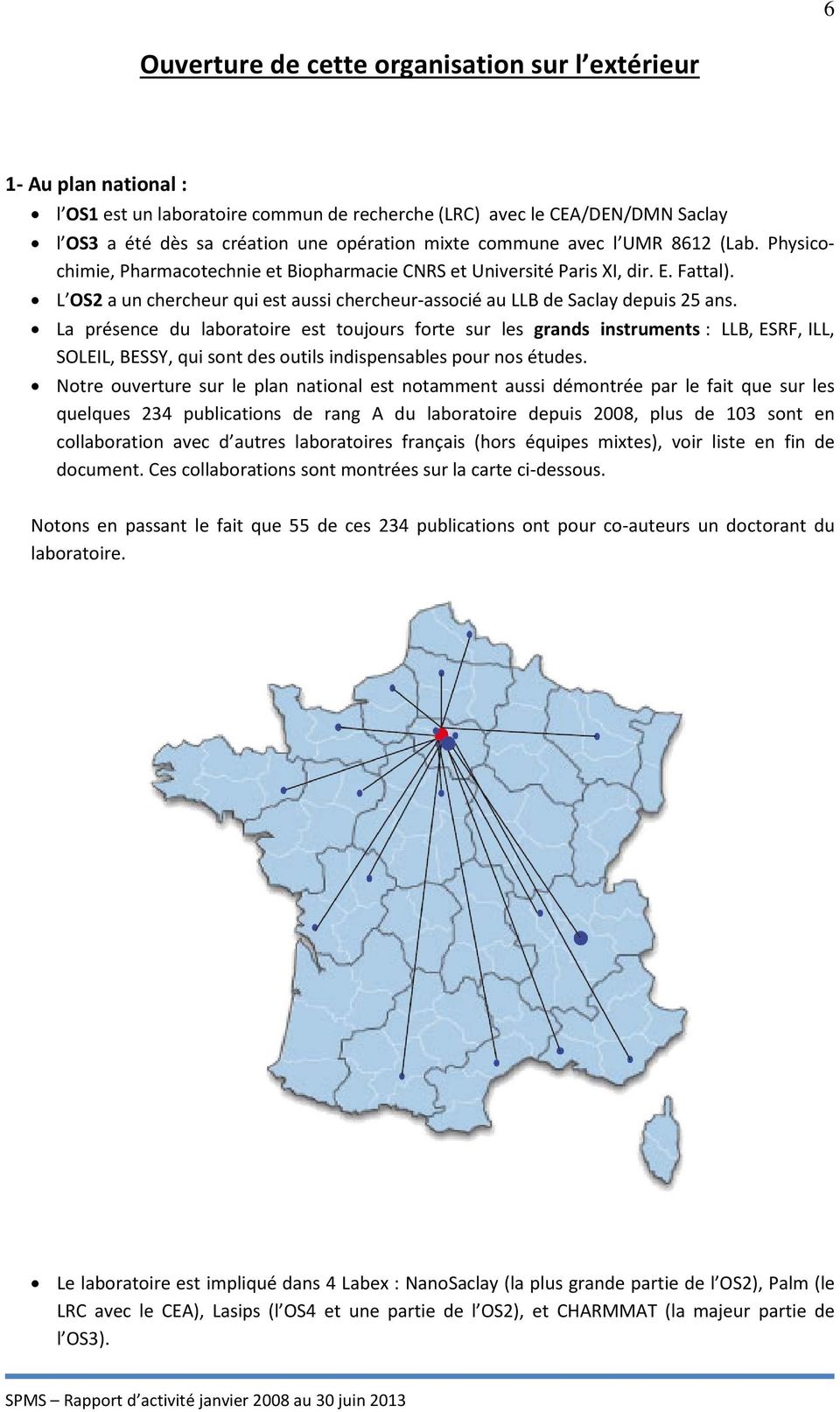
10 6 Ouverture de cette organisation sur l extérieur 1- Au plan national : l OS1 est un laboratoire commun de recherche (LRC) avec le CEA/DEN/DMN Saclay l OS3 a été dès sa création une opération mixte commune avec l UMR 8612 (Lab. Physicochimie, Pharmacotechnie et Biopharmacie CNRS et Université Paris XI, dir. E. Fattal). L OS2 a un chercheur qui est aussi chercheur-associé au LLB de Saclay depuis 25 ans. La présence du laboratoire est toujours forte sur les grands instruments : LLB, ESRF, ILL, SOLEIL, BESSY, qui sont des outils indispensables pour nos études. Notre ouverture sur le plan national est notamment aussi démontrée par le fait que sur les quelques 234 publications de rang A du laboratoire depuis 2008, plus de 103 sont en collaboration avec d autres laboratoires français (hors équipes mixtes), voir liste en fin de document. Ces collaborations sont montrées sur la carte ci-dessous. Notons en passant le fait que 55 de ces 234 publications ont pour co-auteurs un doctorant du laboratoire. Le laboratoire est impliqué dans 4 Labex : NanoSaclay (la plus grande partie de l OS2), Palm (le LRC avec le CEA), Lasips (l OS4 et une partie de l OS2), et CHARMMAT (la majeur partie de l OS3).
11 7 Les chercheurs du laboratoire participent à 6 GDR : GDR Pamir (Physique et applications de la matière sous irradiation) GDR Matériaux multiferroïques GDR ModMat (Modélisation des matériaux) GDR Spark Plasma Sintering GDR CoDFT (Approches semi-empiriques à la Théorie de la Fonctionnelle de la Densité et au-delà) GDR PACS (Piles à combustibles et Systèmes) Avec en particulier des accords formalisés : LSI Palaiseau, UMR 7642 Projet Solnac C Nano : LCMC, UMR 7574 et SCM, UMR 3299, France Laboratoire Léon Brillouin, UMR 12 CEA Saclay, France UM de Physique CNRS Thalès, Palaiseau, France Laboratoire Conditions Extrêmes et Matériaux : Haute température et irradiation, Orléans, France Minatec, LETI/CEA, Grenoble, France Service de Physique et chimie des surfaces et interfaces, IRAMIS/CEA, Saclay, France Université de Okayama, Japon JSPS, Japon 21th COE, Japon Departement of Physics, Faculty of Advances sciences & engineering, Waseda Univ., Tokyo, Japon Tokyo Institute of Technology, Yokohama, Japon JASRI, Japan Synchrotron Radiation Institute, Japon NSF-CNRS Physics department and Institute for nanoscience & engineering, Univ. of Arkansas, Fayetteville, USA Chinese Science Council, Chine Ioffe physical-technical Institute of the Russian Academy of Sciences, St Petersburg, Russie Nanotechnology chair, Faculty of Physics, Southern Federal University, Rostov-on-Don, Russie Jozef Stefan Institute, Ljubljana, Slovenie Microelectronics and materials physics laboratories, University of Oulu, Oulun Yliopisto, Finlande Institute of Electrical and Information Engineering, University of Kiel, Allemagne Institute for Materials Science, University of Duisburg-Essen, Duisburg, Allemagne PAI Pavle-Savic Partenariats industriels privilégiés : A partir des travaux de recherche du laboratoire ou avec un appui important de sa part, 4 startup ont été créées ou se sont développées : NanoE, Emulsar, AgoraEnergy, MegaWave. Cela est

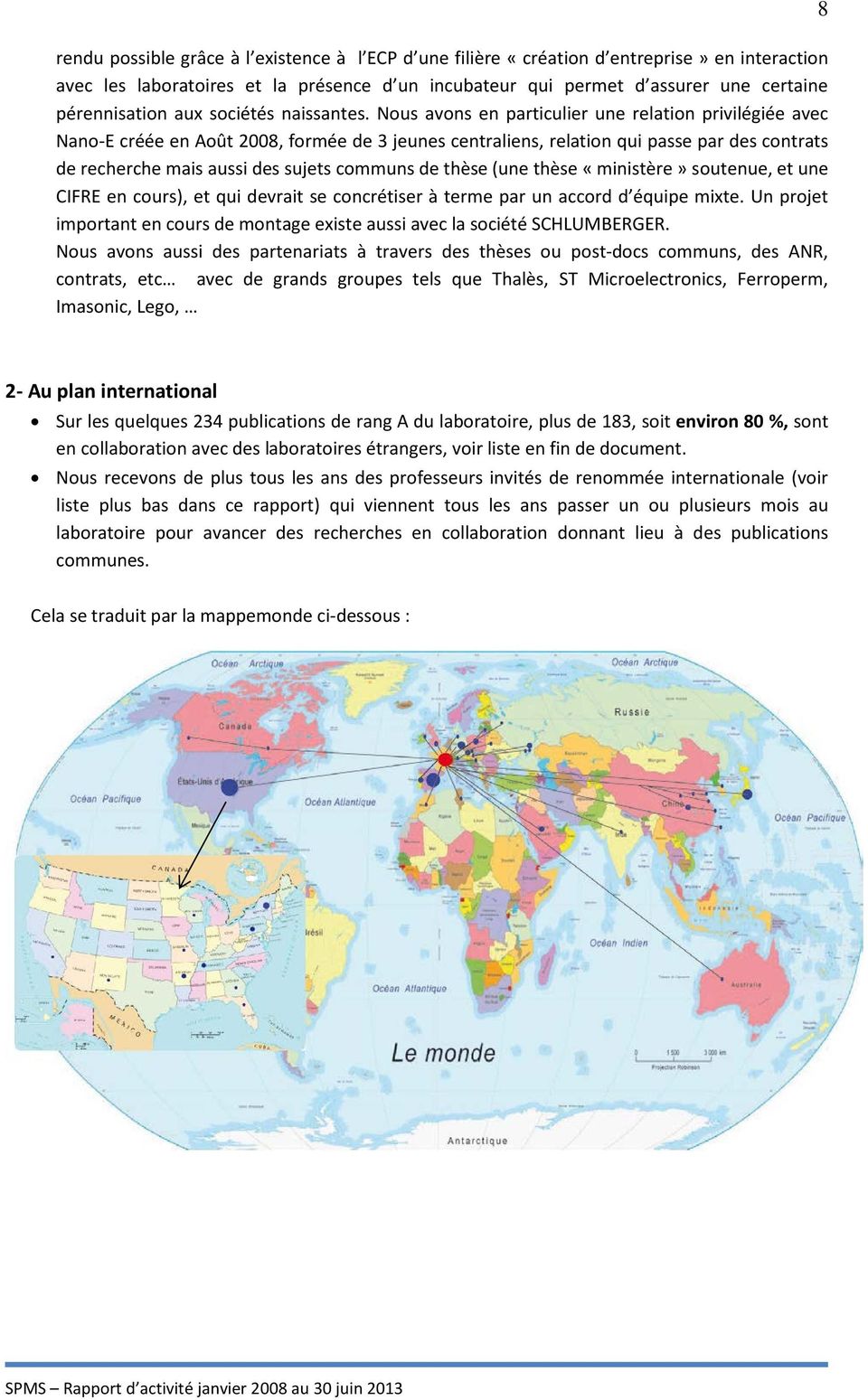
12 rendu possible grâce à l existence à l ECP d une filière «création d entreprise» en interaction avec les laboratoires et la présence d un incubateur qui permet d assurer une certaine pérennisation aux sociétés naissantes. Nous avons en particulier une relation privilégiée avec Nano-E créée en Août 2008, formée de 3 jeunes centraliens, relation qui passe par des contrats de recherche mais aussi des sujets communs de thèse (une thèse «ministère» soutenue, et une CIFRE en cours), et qui devrait se concrétiser à terme par un accord d équipe mixte. Un projet important en cours de montage existe aussi avec la société SCHLUMBERGER. Nous avons aussi des partenariats à travers des thèses ou post-docs communs, des ANR, contrats, etc avec de grands groupes tels que Thalès, ST Microelectronics, Ferroperm, Imasonic, Lego, 8 2- Au plan international Sur les quelques 234 publications de rang A du laboratoire, plus de 183, soit environ 80 %, sont en collaboration avec des laboratoires étrangers, voir liste en fin de document. Nous recevons de plus tous les ans des professeurs invités de renommée internationale (voir liste plus bas dans ce rapport) qui viennent tous les ans passer un ou plusieurs mois au laboratoire pour avancer des recherches en collaboration donnant lieu à des publications communes. Cela se traduit par la mappemonde ci-dessous :
13 9 Infrastructures, équipements et compétences rénovés Le laboratoire est implanté et regroupé depuis septembre 2007 dans des locaux complètement neufs, financés par l ECP pour un montant total de 600k. Le centre de diffraction regroupe les appareillages RX de l unité et a pour vocation d être un service commun du Centre de Recherche de l ECP. Une partie importante des résultats originaux du laboratoire «repose» sur ce type d installation permettant de la diffraction haute résolution dans une grande gamme d environnements-échantillons. Depuis plusieurs années, son potentiel a augmenté grâce à l achat d une deuxième anode tournante, multipliant par deux les possibilités du centre. De plus, il vient juste de s équiper (septembre 2013) d un nouveau diffractomètre pour les études hautes résolutions de densité électronique. De très nombreuses équipes françaises et étrangères viennent régulièrement travailler chez nous, expliquant pour une part importante nos nombreuses publications communes. Outre les activités de diffraction, il convient de noter que nous avons considérablement développé ces dernières années nos activités de synthèses, ainsi que les mesures physiques électriques. On peut aussi noter que le laboratoire est partenairefondateur de la plate-forme de frittage «Spark Plasma Sintering» du CNRS implantée à Thiais, ainsi que du GDR associé. Cette nouvelle technique nous permet d obtenir des céramiques de densité et de qualité exceptionnelle.

14 10 Le Personnel de SPMS Evolution par rapport au contrat précédent Au 30 juin 2013 le personnel compte 55 personnes : 25 permanents à savoir 12 enseignantschercheurs/chercheurs et 13 I.T.A.(dont 3 CDD), et 30 non-permanents, à savoir 16 thésards, 10 collaborateurs, et 4 post-docs. Sur les 12 enseignants-chercheurs/chercheurs permanents, 4 appartiennent au CNRS, 8 à l ECP; sur Les 13 I.T.A., 3 appartiennent au CNRS, 10 appartiennent à l ECP. Par rapport à la fin du contrat précédent (2008) où le personnel comptait 57 personnes : 28 permanents à savoir 14 enseignants-chercheurs/chercheurs et 14 ITA (dont 2 en CDD), et 29 nonpermanents, à savoir 18 thésards, 8 collaborateurs et 3 post-docs, l ensemble du personnel est légèrement plus faible. La répartition au 30 juin 2013 est la suivante : 4 Chercheurs CNRS BALDINOZZI Gianguido DR2 OS1 S 15 CANERO-INFANTE Ingrid CR2 OS2 S 15 DEZANNEAU Guilhem CR1 + HDR OS4 S 15 KIAT Jean-Michel DR2 + HDR OS2 S 15 Par rapport au contrat précédent : 1 chercheur a été embauché, 1 a obtenu son HDR et un 3 ième est passé DR2. 8 Enseignants-chercheurs CORTONA Pietro PR2 + HDR OS3 28 DAMMAK Hichem PR2 + HDR OS2 puis OS3 28 DKHIL Brahim MC OS2 33 GILLET Jean-Michel PR2 + HDR OS3 28 JANOLIN Pierre-Eymeric MC OS2 28 JOUAN Michel PR2 + HDR 33 KORNEV Igor PR1 + HDR OS2 28 SPASOJEVIC-DE-BIRE Anne PR2 + HDR OS3 31 Par rapport au contrat précédent, 2 enseignants ont quitté le laboratoire, un est en éméritat. On peut donc regretter le manque d embauche durant le contrat qui se finit Au total donc 2 chercheurs/enseignants-chercheurs en moins par rapport au contrat précédent.

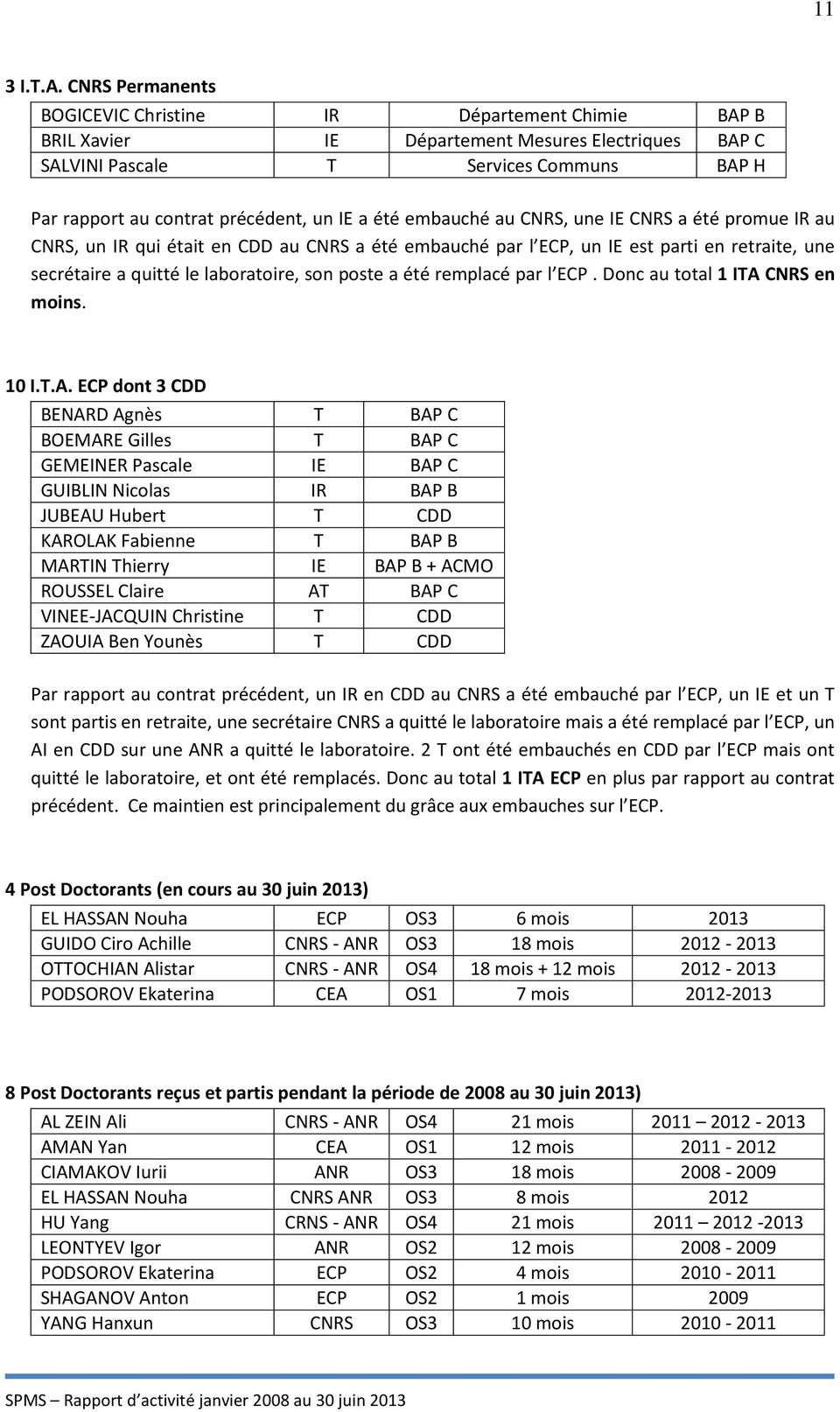
15 11 3 I.T.A. CNRS Permanents BOGICEVIC Christine IR Département Chimie BAP B BRIL Xavier IE Département Mesures Electriques BAP C SALVINI Pascale T Services Communs BAP H Par rapport au contrat précédent, un IE a été embauché au CNRS, une IE CNRS a été promue IR au CNRS, un IR qui était en CDD au CNRS a été embauché par l ECP, un IE est parti en retraite, une secrétaire a quitté le laboratoire, son poste a été remplacé par l ECP. Donc au total 1 ITA CNRS en moins. 10 I.T.A. ECP dont 3 CDD BENARD Agnès T BAP C BOEMARE Gilles T BAP C GEMEINER Pascale IE BAP C GUIBLIN Nicolas IR BAP B JUBEAU Hubert T CDD KAROLAK Fabienne T BAP B MARTIN Thierry IE BAP B + ACMO ROUSSEL Claire AT BAP C VINEE-JACQUIN Christine T CDD ZAOUIA Ben Younès T CDD Par rapport au contrat précédent, un IR en CDD au CNRS a été embauché par l ECP, un IE et un T sont partis en retraite, une secrétaire CNRS a quitté le laboratoire mais a été remplacé par l ECP, un AI en CDD sur une ANR a quitté le laboratoire. 2 T ont été embauchés en CDD par l ECP mais ont quitté le laboratoire, et ont été remplacés. Donc au total 1 ITA ECP en plus par rapport au contrat précédent. Ce maintien est principalement du grâce aux embauches sur l ECP. 4 Post Doctorants (en cours au 30 juin 2013) EL HASSAN Nouha ECP OS3 6 mois 2013 GUIDO Ciro Achille CNRS - ANR OS3 18 mois OTTOCHIAN Alistar CNRS - ANR OS4 18 mois + 12 mois PODSOROV Ekaterina CEA OS1 7 mois Post Doctorants reçus et partis pendant la période de 2008 au 30 juin 2013) AL ZEIN Ali CNRS - ANR OS4 21 mois AMAN Yan CEA OS1 12 mois CIAMAKOV Iurii ANR OS3 18 mois EL HASSAN Nouha CNRS ANR OS3 8 mois 2012 HU Yang CRNS - ANR OS4 21 mois LEONTYEV Igor ANR OS2 12 mois PODSOROV Ekaterina ECP OS2 4 mois SHAGANOV Anton ECP OS2 1 mois 2009 YANG Hanxun CNRS OS3 10 mois
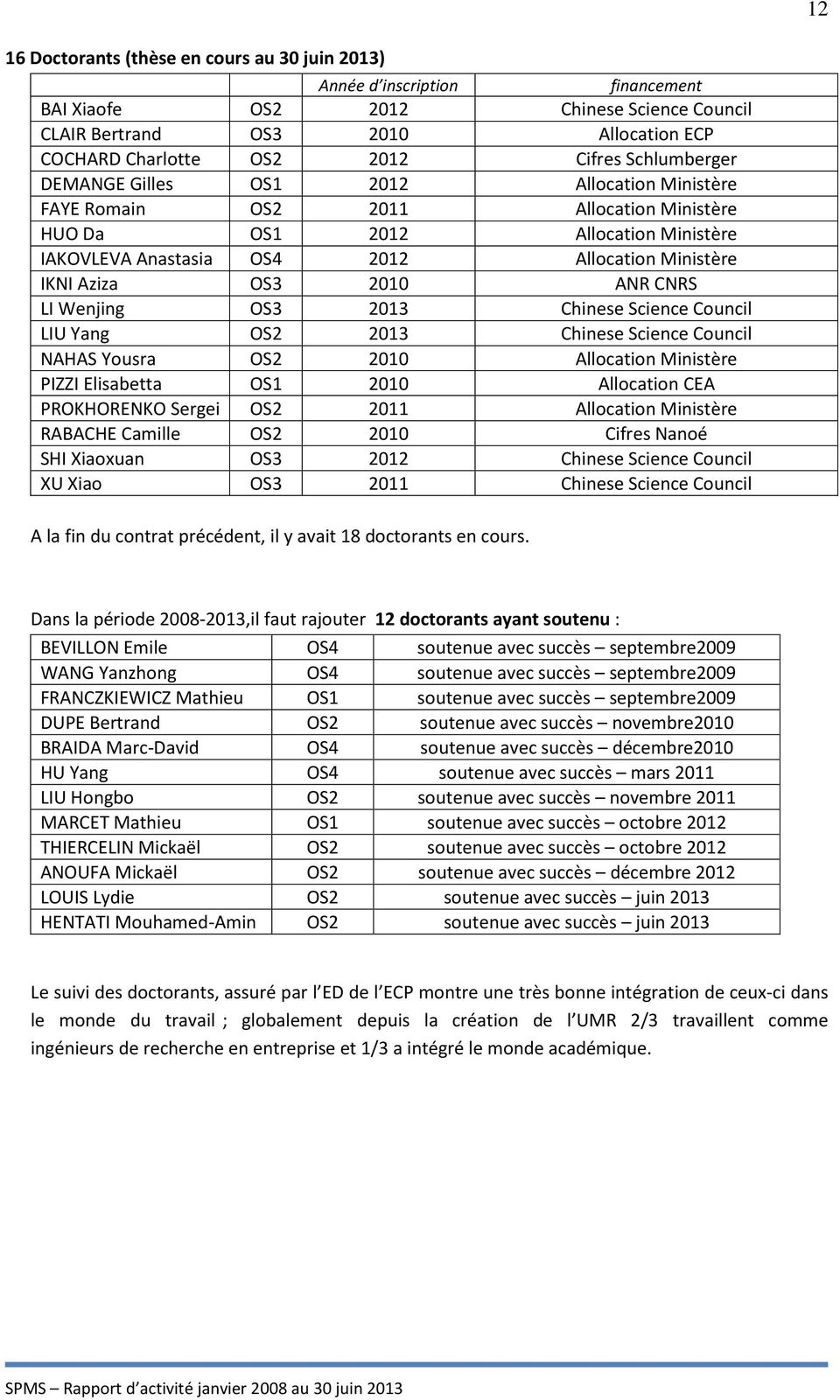
16 12 16 Doctorants (thèse en cours au 30 juin 2013) Année d inscription financement BAI Xiaofe OS Chinese Science Council CLAIR Bertrand OS Allocation ECP COCHARD Charlotte OS Cifres Schlumberger DEMANGE Gilles OS Allocation Ministère FAYE Romain OS Allocation Ministère HUO Da OS Allocation Ministère IAKOVLEVA Anastasia OS Allocation Ministère IKNI Aziza OS ANR CNRS LI Wenjing OS Chinese Science Council LIU Yang OS Chinese Science Council NAHAS Yousra OS Allocation Ministère PIZZI Elisabetta OS Allocation CEA PROKHORENKO Sergei OS Allocation Ministère RABACHE Camille OS Cifres Nanoé SHI Xiaoxuan OS Chinese Science Council XU Xiao OS Chinese Science Council A la fin du contrat précédent, il y avait 18 doctorants en cours. Dans la période ,il faut rajouter 12 doctorants ayant soutenu : BEVILLON Emile OS4 soutenue avec succès septembre2009 WANG Yanzhong OS4 soutenue avec succès septembre2009 FRANCZKIEWICZ Mathieu OS1 soutenue avec succès septembre2009 DUPE Bertrand OS2 soutenue avec succès novembre2010 BRAIDA Marc-David OS4 soutenue avec succès décembre2010 HU Yang OS4 soutenue avec succès mars 2011 LIU Hongbo OS2 soutenue avec succès novembre 2011 MARCET Mathieu OS1 soutenue avec succès octobre 2012 THIERCELIN Mickaël OS2 soutenue avec succès octobre 2012 ANOUFA Mickaël OS2 soutenue avec succès décembre 2012 LOUIS Lydie OS2 soutenue avec succès juin 2013 HENTATI Mouhamed-Amin OS2 soutenue avec succès juin 2013 Le suivi des doctorants, assuré par l ED de l ECP montre une très bonne intégration de ceux-ci dans le monde du travail ; globalement depuis la création de l UMR 2/3 travaillent comme ingénieurs de recherche en entreprise et 1/3 a intégré le monde académique.
17 10 Collaborateurs Il s agit de chercheurs d autres organismes qui consacrent un temps supérieur à un équivalenttrimestre par an de façon permanente aux recherches du laboratoire et pour lesquels existent une convention signée des différents organismes de tutelles. GENESTE Grégory OS4 Ingénieur CEA / DAM GEIGER Sandrine OS3 puis OS2 MdeC PXI Opération mixte UMR 8612 GHERMANI Nour-Eddine OS3 PU PXI Opération mixte UMR 8612 GOSSET Dominique OS1 IR CEA-équipe mixte CEA/DEN/DMN Saclay HAYOUN Marc OS2 puis OS3 CEA HAUMONT Raphaël OS2 U Paris Sud XI LAVEUGLE Elodie OS2 IR Thalès LUNEVILLE Laurence OS1 IR CEA-équipe mixte CEA/DEN/DMN Saclay THI Mai Phan OS2 IR Thalès SIMEONE David OS1 CEA Par rapport au contrat précédent, ce nombre est passé de 8 à 13, et un quatorzième est en cours de négociation (avec la start-up NanoE) Chercheurs Emérites BECKER Pierre ECP+HDR Professeur Emérite NGUYEN Quy Dao CNRS+HDR Directeur de Recherche DR1 Emerite 13 Professeurs Invités accueillis de 2008 au 30 juin 2013 A la liste du personnel doit être ajouté un certain nombre de chercheurs invités, généralement sur financement de l ECP. Nous listons ci-dessous uniquement ceux qui ont eu une présence supérieure ou égale à 1 mois au laboratoire durant le contrat quadriennal précédent. BELLAICHE Laurent BOSNAKOVIC Naka BOUHMAIDA Nouzha CHO Art KHOKLIN Andreï LUPASCU Doru NOVAKOVIC Sladjana PERTSEV NikolaÏ Université d Arkansas (USA) Institut of Nuclear Sciences Belgrade (Serbie) Université de Marrakech- Semlalia (Maroc) Université de Corée-Séoul (Corée) Université d Aveiro (Portugal) Universitat Duisburg- Essen (Allemagne) Institut of Nuclear Sciences-Belgrade (Serbie) Academy of Sciences St Pertersburg (Russie) OS2 2 mois mois/an 2009,2010,2011,2012 OS3 1 mois mois 2011 OS3 1 mois 2009 OS3 3 mois 2013 OS2 2 mois 2012 OS2 4 mois 2013 OS3 2 mois/an 2008,2009,2010,2011 OS2 1 mois/an 2009,2010,2011

18 SICKAFUS Kurt SUSANTA Kumur TYUNINA Marina UESU Yoshiaki YOKOTA Hiroko ZHANG Wei Laboratoire National de Los Alamos (USA) Institut of Sciences- Bangalore (Inde) Université d Oulu (Finlande) Université de Waseda (Japon) Université de Chiba (Japon) Ecole Centrale Pekin (Chine) 14 OS1 1 mois/an 2008,2010,2011 OS3 6 mois 2011 OS2 1 mois/an 2010,2011 OS2 2 mois 2011 OS2 1 mois 2011 OS3 1 mois/an 2011,2012 Par rapport au contrat précédent 5 professeurs invités de plus. La pyramide des âges concernant le personnel permanent est la suivante : 5 4,5 4 3,5 3 2,5 2 1,5 1 0, à à à à et + ITA Chercheurs et Enseignants Chercheurs Cette pyramide montre une distribution à peu près équilibrée entre 30 et 50 ans, tant pour les ITA que pour les enseignants-chercheurs. La situation en terme de chercheurs CNRS reste préoccupante : malgré l embauche d un CR fin 2012, il ne reste plus que 4 chercheurs CNRS, suite aux départs en retraite alors que début 2001 ce chiffre était de 9, et à la création de SPMS de 10. Comme dans de nombreux laboratoires, ces derniers ont un poids particulier en terme d encadrement d équipe, encadrement de thésards/postdocs (environ 50 %), montage de projets, publications (participation à environ 30 % des articles publiés), gestion de la recherche, etc

19 15 Budget, financement, dépenses Evolution du budget L évolution des crédits (hors salaires) est représentée sur le graphe suivant : Evolution crédits Montant prévision fin 2013 CNRS Carnot ANVAR excep CNRS ANR Contrat - Europe Mi-lourd ECP ECP CNRS Année Rajoutons pour faire un bilan consolidé, qu en 2011 il y avait concernant le CNRS et l ECP en terme de salaire, et en (CNRS) et (ECP). L évolution montre notamment : 1- Une augmentation globale du montant total de crédits. Cette augmentation vient de l augmentation très forte de nos financements de type ANR 2- Une diminution régulière des crédits de fonctionnement CNRS qui ne représentent maintenant qu un vingtième de nos crédits (hors salaires) en En particulier l embauche d un CR augmentant de manière globale le nombre de chercheurs CNRS ne s est traduit par aucune augmentation, ce malgré notre demande répétée. Les crédits de fonctionnement venant de l ECP restent stables.

20 3- L existence de crédits mi-lourd ECP (malheureusement très exceptionnels dans le cas du CNRS) permet une gestion à moyen terme des gros équipements ; c est grâce à ces crédits que le financement global de gros équipements peut être fait La fluctuation énorme des crédits suivant que les années sont bonnes ou moins bonnes en terme d ANR, ce qui ne permet absolument pas de faire une gestion globale à moyen terme, sans parler du long terme Financement obtenu par les OS dans le cadre de contrat, ANR, projets etc. Ici sont indiqués les montants des contrats, projets européens, ANRs, etc obtenus par les différentes opérations scientifiques, ceci pour la période , , , , , ,00 OS4 OS3 OS2 OS ,00 0,

21 17 Statistiques de la Production scientifique L évolution de la production scientifique, présentée en fin de rapport pour le contrat 2008 au 30 juin 2013 est représentée ci-dessous depuis la date de création de SPMS, avec le nombre de chercheurs publiant correspondants : La production scientifique du 1er janvier 2008 au 30 juin 2013 consolide les résultats obtenus lors du contrat précédent, car elle est globalement stable malgré la diminution du nombre d enseignantschercheurs. Durant la période de janvier 2008 au 30 juin 2013, il y a eu 234 publications, 140 conférences invitées et 164 communications, alors que dans le précédent rapport, il y avait 160 publications, 68 conférences invitées et 146 communications. Sur ces 234 publications, 55 ont pour co-auteur un doctorant du laboratoire et sur 164 communications, 57 ont pour co-auteur un doctorant du laboratoire. Cette progression par rapport au contrat marquait une forte augmentation malgé, là encore, la diminution du nombre des chercheurs. Globalement, on peut dire que depuis sa création SPMS publie 2 fois plus avec 2 fois moins de personnes. On trouvera à la fin de ce rapport le détail de cette production ainsi que d autres aspects de valorisation, contrats, brevets etc. La répartition par opérations scientifiques est montrée plus loin.
22 18 Gestion des Ressources humaines En accord avec les suggestions du Groupe Ressources Humaines de l'ecole Centrale Paris et des recommandations faites par le CNRS, nous avons mis en place au cours du plan en cours un certain nombre d'outils destinés à améliorer la gestion des ressources humaines, tant sur le plan des recrutements que sur le plan des performances individuelles et du suivi des personnes et de leur carrière. Les outils qui ont été développés et mis en place sont les suivants : 1- Entretiens individuels : L'ensemble du personnel permanent, chercheurs, enseignants-chercheurs et ITA réalise annuellement un entretien individuel avec le directeur d'unité. Cet entretien permet d'une part de suivre l'évolution de carrière d'une personne et d'anticiper les éventuels points de blocage. Il permet également de définir des grilles d'objectifs, les indicateurs de validation de ces objectifs et de définir les éventuels moyens à disposition ou de prévoir pour y parvenir les besoins de formation, missions de longue durée, etc Un résumé factuel de ces entretiens est effectué dans des fichiers de type excell, dont une partie est transmise à la direction de l ECP, l autre restant aux mains du directeur de laboratoire. 2- Recrutement et suivi des thésards : Une procédure standardisée des thésards est désormais en place où un entretien individuel est réalisé, avant tout recrutement par l'ecole Doctorale, en présence du futur directeur de thèse et de membres extérieurs au laboratoire. La mise en place d'un suivi des thésards est actuellement en cours de réflexion. Cette gestion se fait en étroite collaboration avec l'ecole Doctorale de l'ecp. 3- Recrutement et conseil de laboratoire/scientifique : L'aspect recrutement de personnel est de manière récurrente discuté au conseil de laboratoire et au conseil scientifique, ce tant pour les chercheurs ou enseignant-chercheurs que pour les ITA. Cette approche permet d'avoir une vision complète et équilibrée des besoins du laboratoire, d'anticiper les recrutements de membres permanents et d'éventuellement préparer au mieux ces recrutements par un recrutement préalable sous forme de CDD. 4- Formation permanente : Tous les ans, les membres du laboratoire effectuent des formations soit dans le cadre de la formation permanente du CNRS, soit via l ECP ou par des organismes extérieurs.
23 19 Equipements principaux du laboratoire Introduction Le nombre d équipements est en considérable augmentation par rapport au contrat précédent, notamment dans le domaine des mesures électriques. Dans le cadre de l imagerie multi échelle, on signale l achat d un microscope à forces atomiques (PFM), ainsi que la participation dans un projet Equipex au sein de l Ecole Centrale Paris qui a abouti à l achat d un ensemble d équipement pour la microscopie électronique à transmission. L achat d un diffractomètre RX (de type 4-cercles) pour étude haute résolution de la densité électronique est finalisé et devrait être livré en fin d année Microscopies : Microscope Olympus en lumière polarisée, avec système d acquisition en temps réel par caméra CCD, équipé en température (80K-900K), Microscope à forces atomiques BRUKER-Veeco Multimode 8, avec électronique Nanoscope V, incluant les modules de piézo-réponse, boîte d accès aux signaux et de quantification de la réponse mécanique. Système d application de tension-détection synchrone piloté par ordinateur (générateur de functions NF1965, lockin SRS 844 RF, oscillateur numérique HP), Microscope électronique en transmission FEI Titan Cubed G Alignement de 3 tensions d accélération (80, 200 et 300kV) d une cathode X-FEG, colonne dotée d un correcteur sonde Cs DCOR pour l imagerie en balayage (STEM), d un biprisme et module d analyse pour l holographie, d une caméra CCD et un module de spectroscopie de perte d électrons (EELS) GATAN Enfinium 300, de quatre détecteurs pour l imagerie de rayonnement X (EDX) Super-X contrôlés par logiciel BRUKER. Porte-échantillons pour la tomographie ainsi que les modules d analyse, Microscope électronique par photoémission X-PEEM NanoESCA, dans le cadre du projet MesoXope porté par le laboratoire SPCSI-CEA Saclay, pour la caractérisation et imagerie chimique et électronique des surfaces. 2- Elaboration, traitement d échantillons : Bâti de dépôt de couches minces par ablation laser pulsé. Enceinte à haute vide, équipé d un laser pulsé Nd-YAG (Continuum Powerlite DLS 8010, quadruplé en fréquence - UV), d un chauffage Thermocoax, d un pyromètre haute température Keller CellaTemp PA 20 AF 2, équipement pour réaliser la diffraction à incidence rasante d électrons à haute énergie à haute pression (RHEED-Specs RHD-NAP), mécanisation et motorisation des cibles via interface Arduino-Labview.
24 3- Diffraction : 3 Diffractomètres haute résolution sur 2 anodes tournantes RIGAKU RA-HF18 de 18 kw de puissance Diffractomètre monocristal avec caméra CCD SIEMENS SMART CCD 1K Diffractomètre poudre 2 cercles Bruker D2 Phaser (possibilité de mesures par fluorescence X) Chambres pour monocristal : Weissenberg, Buerger, Laue, équipée d une image plate Équipements en température : Cryostat à azote ( K) Oxford Cryosystems 600 Series Cryostream Cooler Four ( K) Bruker High Temperature System HT-1 Four ( K) Rigaku 2311, équipé pour les champs électriques Four ( K) Rigaku 2311 Cryofour à azote ( K) TBT l Air Liquide, équipé pour les champs électriques Cryostat à hélium (4-300 K) l Air Liquide, équipé pour les champs électriques Displex (4-450 K) ARS 204 Détecteur bidimensionnel imxpad S Spectroscopies : Spectromètre Labram, Horiba, simple monochromateur, équipé d un laser He-Ne (632.8nm) et d une cellule en température Linkam (80K-870K) Spectromètre T64000, Horiba, triple monochromateur, équipé d un laser argon doublé en fréquence (utilisation standard nm 488 nm nm nm et 257 nm), d un laser He-Cd (325 nm), et d une cellule en température Linkam (80K-870K). 5- Mesures thermiques : Banc de mesure TG/DSC jusqu'à une température de 1600 K Banc de mesure DSC pour la gamme K Banc de mesure TG/DSC pour la gamme K avec possibilité de travail sous champ 6- Mesures électriques : Voltmètres, nanoampèremètres, multimètres Impédancemètres (HP 4192, Agilent 4294A, Wayne Kerr ) pour des gammes de fréquences de 20Hz à 110MHz Pour les mesures d'hystérésis : Système Aixacct pour couche minces; montage HV dans l'huile silicone pour échantillons massifs. 5 Bancs de mesure en fonction de la température (température ambiante C) et de la pression partiale en oxygène po 2 et en eau ph 2 O: mesures 4 points DC/AC, Van der Pauw, impédance complexe. Tous ces équipements sont en service commun et sont pour la totalité sous la responsabilité d un I.T.A.
25 21 Hygiène et sécurité 1- Bilan des accidents et incidents survenus dans l unité et mesures prises : Plusieurs incidents ou accidents n entrainant pas d arrêt de travail ont été inscrits au registre Hygiène et Sécurité du laboratoire. 2- Identification et analyse des risques spécifiques rencontrés dans l unité : Le laboratoire dispose d un document unique d évaluation des risques (DUER) mis à jour annuellement. Il y est mentionné les différents risques rencontrés dans l unité. On peut les résumer par : Les rayonnements ionisants : présence de générateur de rayons X, La chimie, L utilisation d azote et d hélium liquide, Les bouteilles de gaz : neutres, toxiques, explosifs, Les lasers, Les machines-outils, L utilisation d équipements sous pression. 3- Dispositions mises en œuvre en fonction des risques. Priorités retenues : Pour chacun des risques identifiés, le laboratoire a mis en œuvre les mesures de préventions d usage. Risque Générateur de rayons X Chimie Azote et hélium liquide Bouteilles de gaz Laser Machines-outils Hautes pressions Mise en oeuvre Confinement, dosimètre, zonage, contrôles périodiques obligatoires par un organisme agréé, formations des utilisateurs par la PCR E.P.I., sorbonnes contrôlées périodiquement, armoires ventilées, local de stockage des produits dangereux, gestion des déchets Gants, ventilation, détection d oxygène Local dédié, supports muraux, détection spécifique, armoire ventilée, chariot de transport adapté SAS d entrée, témoin lumineux de fonctionnement, lunettes adaptées, formation obligatoire des utilisateurs E.P.I., conformité, accès limité Cage de protection A l entrée de chaque laboratoire, une fiche réflexe d intervention (modèle ECP) reprend : les risques liés aux installations, aux produits, aux gaz, les recommandations, les protections individuelles et collectives. De plus, notre laboratoire dispose d un local gaz, d un local produits dangereux intérieur, tous les deux reliés au réseau d alarmes de l Ecole.
26 22 4- Fonctionnement des structures d hygiène et de sécurité propres à l unité (Assistant de prévention, comité hygiène, sécurité, conditions de travail, personne compétente en radioprotection ) : Il existe au sein de l Ecole Centrale un Conseiller de Prévention (anciennement nommé Ingénieur Sécurité), une Personne Compétente en Radioprotection (PCR) ainsi qu un Comité Hygiène, Sécurité, Conditions de Travail (CHSCT). Le laboratoire SPMS de ce fait en bénéficie directement. Il est aussi toujours possible aussi de faire appel au Service Hygiène et Sécurité de la DR05. Le laboratoire dispose d un Assistant de Prévention (AP), de trois Sauveteurs Secouristes du Travail, de deux agents formés Habilitation Electrique, d Equipiers de Première Intervention, d une Personne Compétente en Radioprotection (PCR) et de personnes formées Manipulation des Extincteurs. Un registre d hygiène et de sécurité est accessible à l ensemble du personnel. Chaque mois, lors du conseil de laboratoire un point est fait par l Assistant de Prévention ce qui permet de faire un tour d horizon des problèmes liés à l hygiène et à la sécurité. Par la suite, des solutions sont proposées et des priorités d action définies. L Assistant de Prévention du laboratoire est en charge de veiller à leur application. La politique d hygiène et de sécurité du laboratoire est basée sur 3 axes prioritaires : l information et la prévention, les travaux de sécurité, la gestion des produits chimiques et des matières dangereuses. Au laboratoire, la prévention passe par une information et une vigilance au quotidien. Un certain nombre de documents sont à disposition (fiches de toxicité, documents INRS, ). Dans un même temps, des tests d alarme et d évacuation sont organisés par les Services de l Ecole. Ils prennent aussi en charge les visites périodiques de contrôle des installations (extincteurs, installations électriques, climatisation, sorbonnes, générateurs de RX, ). Elles sont réalisées conformément à la législation, soit par des contrats de maintenance, soit par des organismes agréés. Le dernier point concerne l utilisation, le stockage et l élimination des produits chimiques. Pour l utilisation, le personnel doit se tenir au courant des règles à respecter et se responsabiliser. Des procédures sont à mettre en place dans ce domaine (encadrement des stagiaires, formations, manipulation en fonction de la toxicité du produit, prévention). En ce qui concerne l élimination, un accord avec l Ecole nous permet de bénéficier du circuit de collecte et d élimination des déchets. 5- Dispositions mises en œuvre pour la formation des personnels et notamment des nouveaux entrants (y compris stagiaires, doctorants ). En matière de prévention, nous nous préoccupons de l accueil des nouveaux entrants par une information générale (visite du laboratoire, organisation des secours, etc ) et des informations spécifiques sur les différents risques rencontrés au laboratoire (chimie, RX, ) en fonction des besoins de chacun.
27 23 Il est impératif de diffuser l information à toutes les personnes que nous accueillons : chercheurs et personnels techniques permanents, doctorants, stagiaires. A son arrivée, chaque personne reçoit un ensemble de documents : livret d accueil, manuel de sécurité, notes de service liées à la sécurité. Elle doit aussi se présenter à l assistant de prévention. L ensemble des personnes présentes dans l unité peuvent accéder ou participent régulièrement à des formations (manipulation des extincteurs, secourisme, nouvel entrant, formations spécifiques liées au poste de travail, ). Pour finir : Le laboratoire est régulièrement soumis à des visites conjointes de préventions des deux tutelles de rattachement : l Ecole Centrale et la DR5 du CNRS (juin 2009, février 2013). Les conclusions et recommandations des comptes rendus sont analysées par le directeur de l unité et l assistant de prévention afin de mettre en place des mesures correctives.
28 24
29 25 RAPPORT D ACTIVITE DES OPERATIONS SCIENTIFIQUES Après une courte présentation générale des opérations scientifiques, on trouvera pour chacune d elles une présentation spécifique et une présentation par fiches de quelques faits et thèmes marquants. Pour chaque fiche, sont indiquées les collaborations attenantes, les thèses/post-docs associés et les publications internationales associées, numérotées d après la liste en fin de rapport ; l examen de cette liste montre d ailleurs de nombreuses publications afférentes à d autres sujets non présentés ici.
30 26
31 27 Les chercheurs et enseignants-chercheurs sont regroupés dans 4 Opérations Scientifiques (OS) suivant le découpage ci-dessous : Rappelons que les ITA/ITARF sont eux rattachés à des Services Communs. Par contre les doctorants, post-doctorants et chercheurs associés émargent à chaque OS. Le tableau ci-dessous regroupe le personnel globalisé durant le contrat, avec leur «status» au 31 septembre OS1 Matériaux fonctionnels pour l Energie OS2 Matériaux pour la Micro-électronique Resp. G. Baldinozzi (DR) I.Kornev (Pr.) puis B. Dkhil (MdC) Cherch. H. Dammak (Pr., puis OS3) I.Kornev (Pr.) J.M.Kiat (DR) P.E. Janolin (MdC) I. Canero (CR) Cherch. Asso. D. Siméone (CEA) D. Gosset (CEA) L. Luneville, (CEA) Doct. En cours : 3 Soutenus : 2 Post- En cours : 1 Doc Partis : 1 M.P.Thi (Thales) puis départ E. Laveugle (Thales) puis départ S. Geiger (MdC Pharma) M. Ayoun (CEA) puis OS3 R. Haumont (MdC ICCMMO) En cours : 8 Soutenus : 6 En cours : 0 Partis : 3 OS3 Matériaux Modèles d Intérêt Pharmaceutique N.Ghermani(Pr-Pharma Ch.Ass.)puis P.Cortona(Pr.) J.M. Gillet (Pr.) A. Spasojevic-de-Biré (Pr.) P.Becker (Pr.) H. Dammak (Pr.) N.Ghermani (Pr-Pharma) S. Geiger (MdC Pharma ) puis OS2 M. Ayoun (CEA) En cours : 5 Soutenus : 0 En cours : 2 Partis : 3 OS4 Matériaux et technologies de l hydrogène G. Dezanneau (CR) G. Geneste (MdC) puis (CEA-Ch.Ass.) G. Geneste (CEA) En cours : 0 Soutenus : 4 En cours : 1 Partis : 2
32 La répartition du total des publications sur cette période, par opération scientifique est la suivante : 28 Nombre de publications par OS - de 2008 au 30 juin OS1 OS2 OS3 OS4 Autres La colonne «autres» concernent des publications n entrant pas dans le cadre des OS.
33 29 OS1 Matériaux fonctionnels pour l énergie
34 30
35 The functional properties of ceramics result from a subtle balance between their local properties at the atomic scale (chemical composition, crystal structure) and their microstructures at the micrometer scale (grain size, dislocation density, interfaces). The immediate environment of the atoms at the atomic scale controls the thermodynamic properties of solids (cohesive energy, melting temperature,...) while the microstructure, affecting the distribution of defects and their interactions, is responsible for changing the laws of behavior of these materials (thermal conductivity, tensile stress,...) and thus, their behavior at the macroscopic scale. These two scales are not disconnected and the need to study their coupling is fundamental to understanding the behavior of materials under irradiation. Indeed, during the irradiation, elastic collisions produced by the slowing down of neutrons in the crystal and electronic energy deposition due to the recoil of the fission products, affect the cohesion of the crystal at the atomic scale and generate complex distributions of defects. In addition, the diffusion of these defects, enhanced by irradiation, alters drastically the microstructure of these solids at the nanoscale, leading to significant changes in their behavior. The kinetics of the spatial redistribution of defects produced by irradiation may generate complex structures and microstructures responsible for drastic changes in the properties of materials. The understanding of these kinetic phenomena can be used to predict the behavior of materials meeting the safety conditions required by the nuclear industry. The CARMEN group (Characterization of Materials for Nuclear Energy) consists of four permanent researchers from CEA and CNRS. Our purpose is to understand the physical mechanisms occurring in irradiated materials, to propose ways to develop radiation resistant ceramic materials and, more generally, to improve their functionality. The interesting materials are complex: grain boundaries, impurities, and point defects, native or produced during the exploitation; they have many interfaces that must be modeled for determining their properties. The role of those interfaces is even more important in nanostructured materials, which currently seem to be promising radiation-resistant materials. Over the past four years, we focused on these interfaces and their evolution under extreme conditions. We are particularly interested in: Bulk compounds: Subject to different irradiation, the materials undergo severe structural changes: ferroelastic phase transitions in ZrO 2, amorphization in SiC, nucleation and dissolution (ODS alloys) modifying the phase diagram at equilibrium. It is therefore important to develop of experimental tools to measure the structural changes after irradiation and/or chemical reactions (oxidation). The determination of the mechanisms requires a precise knowledge of the structures of the phase boundary compositions (often crystalline), which can be refined by the Rietveld method, but also of the intermediate phases, because their structural features tell us a lot about the material. The total scattering method (and the pair distribution function analysis) is then useful to understand those changes. The study of UO 2+x system illustrates the complementarity of these approaches to solve these structures and model the characteristics of the defect clusters using neutron scattering data measured at ILL. Nanocrystalline layers: Unlike the neutron irradiation that modifies bulk samples, ion beams used to simulate in-reactor irradiation, without inducing any residual radioactivity, only affect the topmost layers of a sample (typically a few tens of nm depth). The grazing incidence diffraction is the most adapted technique that provides simultaneous information on the structure, the microdeformations and the size of the inhomogeneities. During the ANR AliXMaI project we have designed two optimized diffractometers for such a measure on irradiated materials: the former optimized for low energy irradiations (in house) and the latter for fast data collections on Irrsud beamline at Ganil. In addition, we have developed, in collaboration with the Institute Néel Grenoble, a Rietveld software, optimized for the analysis of diffraction patterns measured at glancing incidence (Xnd). This work has allowed us to study the behavior of selected systems after irradiation: pyrochlores (storage arrays), nanocrystalline SiC 31
36 32 (material for generation IV),... In addition, this setup is also well suited to study the structure, microstructure, and the kinetics of nanostructured thin films. The analysis of mesoporous layers was the object of the Solnac project (funded by C'nano IdF), a joint collaboration with the Radiolysis laboratory (SIS2M, UMR 3299) and the LCMC (UMR 7574) at UPMC and College de France. This approach is currently part of a collaborative project with ICSM Marcoule, funded by GnR Needs. Interfaces: Radiation and the changes of the chemical potential are responsible for accelerating the diffusion of species across an interface (interstitials, vacancies, or more complex defects). The study of the changes of these interfaces is an effective way to shed light on the mechanisms involved. X-ray reflectivity (specular and off-specular XRR) and small angle scattering (SAXS) signals are very sensitive to those changes. Our interest is currently focused on two systems: the amorphization of SiC, induced by ion irradiation at low energy, a collaboration with ESRF and Oak Ridge National laboratory, was studied by SAXS; ion mixing at a Cr/Si interface studied by XRR, a collaboration with Thales (TRT), IPNL (UMR 5822), LLB (UMR 12) and LSI (UMR 7642). Part of this project (Instrumat), also with LLB and LSI, was funded by Triangle de la Physique. The expertise and the results obtained by the group have allowed: Being part of Labex Palm (Physics: atoms, light, materials) of Paris-Saclay University. The group is represented in theme 2 (slow and emerging dynamics in non-equilibrium systems) hat gathers together experimenters, theorists and numerical analysts working on systems with poor organization (glasses, granular media, turbulent fluids, ). Being part of GNR Matinex (now NEEDS) and GDR Pamir. These structures regroup the activities of the community studying nuclear materials. Also, we were involved as experts and workpackage leaders in the GN3 of the ANCRE (National Alliance for Research Coordination on Energy). Teaching to students of ENSTA (Statistical Physics), of ECP ( Materials for Energy and Order, disorder and symmetry ), and to the School Surfn organized by GnR MATINEX. Participating to the technical panels on the radiation phenomena of OECD and of the IAEA on the concept of primary damage induced by irradiation. To organize scientific symposia on irradiated materials at MRS conferences in 2009, 2010 and 2012 in Boston, at SFP in Montpellier in 2012, and at E-MRS 2014 in Strasbourg.
37 Application of the Rietveld method in glancing incidence: application to the study of thin films and simulation of radiation damage D. Simeone, G. Baldinozzi, D. Gosset 33 Collaborations J.F. Berar (Institut Néel, Grenoble) S. Bouffard (CAEN/CIMAP) ANR Blanc Project Alix-Mai (11/ /2010) Références : ACL1, ACL22, ACL25, ACL26, ACL160[4], ACL195[3], ACL196, ACL221[4], ACL222 The X-ray diffraction proves an invaluable tool for determining the structure and microstructure of materials. This technique does not require a long time for sample preparation, it is non-destructive to the sample, and provides access to the deformation field and their fluctuations [1]. This technique was used for a long time in the LRC CARMEN to probe samples irradiated by ion beams (typically at 2 MeV) simulating neutron irradiation [2] areas. This technique was recently applied by the team members to study the deformation fields in mesoporous materials [3]. Using a X-ray diffraction setup, grazing incidence allows to control the thickness probed by X-rays in a material by changing the angle of the impinging beam,, α i,, which is at most equal to half the Bragg angle in the case of conventional diffraction (Bragg Brentano setup). It is then possible to probe by this method thicknesses ranging from a few nanometers to a few microns. The main difficulty of this diffraction technique lies in the fact that the use of an incident beam of parallel photons and asymmetry setup (α i α 2 θ / 2) leads to complex optical aberrations. Such aberrations should be perfectly known to extract reliable information about the structure and microstructure of the material surveyed. Figure 1: Variation of the position of the Bragg peaks based on the depth probed. These diffraction patterns were collected on a sample of mesoporous ceria at depths from 4 nanometers to 150 nanometers (black = 150 nm, 85 nm = red, green = 47 nm, blue = 35 nm, 27 nm = turquoise, purple = 11 nm, blue = 4 nm) So we focused to measure, understand and model the main optical aberrations associated with this particular arrangement. Such aberrations are of three types: An angular shift needing a reliable procedure for the positioning of the sample A broadening of the Bragg peaks associated with the parallel beam Changes of the intensities of Bragg peaks due to the reflectivity of the surface of the sample
38 34 Figure 2: Rietveld refinement (red curve) on two diffraction patterns collected on the mesoporous ceria at grazing incidence for two separate incidence α i angles (1 for the top curve and 0.2 for the bottom one). As expected, reducing the grazing incidence leads to an increased air scattering and produces an increase in the continuous background (green curve). The diffraction patterns are well modeled as evidenced by the flatness of the relative error (blue curve), confirming the accuracy of our corrections. We conducted a modeling of these three causes of errors and made precise experiments to validate this model [4]. Figure 1 shows an example of the impact of poor positioning of the sample on the position of the Bragg peaks. This effect is by far the main cause of error in the measurement of the deformation field in terms of the depth probed in a sample. All these aberrations were modeled and incorporated into a Rietveld refinement program Xnd (collaboration Néel institute). From this work, it is possible to make a Rietveld refinement with such geometry as shown in Fig. 2. Modeling these aberrations, it is possible to extract information on the structure (position of atoms) and the microstructure (lattice parameter and micro strain) as a function of the thickness probed as summarized in Table 1 [4]. This methodological work has demonstrated that precise information on the structure and microstructure of materials could be extracted by Rietveld refinement of diffraction patterns collected at glancing incidence. This work shows that it is possible to determine the evolution of the atomic positions, strain fields, micro deformation and diffracting domain sizes (grain size) to depths ranging from a few microns to a few nanometers. It thus becomes possible to measure strain fields and to obtain information on the structure of both thin films, whose study is expanding, and irradiated layers by ions of low and high kinetic energy to simulate the radiation damage produced in nuclear reactors. Table 1 Variations of the lattice parameter a, the size of the coherent diffraction domains D and E micro stress obtained from the Rietveld refinement of diffraction patterns as a function of penetration depth z. The standard deviations of these values are given in parentheses. To validate the quality of refinement, R Bragg and R wp are also indicated α( ) z(nm) a(nm) D(nm) e (%) RBragg(%) Rwp(% (3) 15.8(2) 0.06(1) (2) 15.3(2) 0.4(1) (2) 15.3(2) 0.04(1) (3) 15.7(2) 0.04(1) (3) 16.1(3) 0.05(1) (5) 15.9(2) (6) AUTRES REFERENCES [1] Brunel, M. & de Bergevin, F. Acta Cryst. A42, , 1986 ; Colombi, P., Zanola, P., Bontempi, E., Roberti, R., Gelfi, M. Depero, L. E., J. Appl. Cryst. 39, , 2006 [2] Simeone, D., Gosset D., Chevarier, A. (2002). J. Nucl. Mater. 300,
39 Simulation of primary damage caused by radiation: fragmentation of a displacement cascade in subcascades 35 L. Luneville, D. Simeone Collaborations : Post doctorant W. Weber (Oak Ridge), Y. Serruys (SRMP/JaNnus) E. Podzorov Références : ACL23, ACL150, ACL161[8] In a nuclear reactor, the kinetic energy of the neutrons is characterized by its neutron spectrum (neutrons / cm 2 / s / ev) and extends from a few millielectron volts (thermalized neutrons) to a few tens of millions of electron volts (fission neutrons), which determines the spectrum of the recoil energy of the atoms set in motion during the irradiation. For example, a 1 MeV neutron transmits an average energy of 35 kev to an iron atom in a block of iron [1]. This iron atom displaces about 500 iron atoms before stopping: the atomic displacements (also called primary damage) will be the first stage of the damage of the material [2]. Many studies begun in the 1960s, to simulate this phase of binary collisions from universal models (called Binary Collision Approximation models or BCA). [3] To obtain an estimate of the primary damage, BCA programs are proving to be reliable and inexpensive computing time tools. SRIM, a program [4], is widely used for example to define the depth of penetration of ions into an amorphous material. Such a program does not describe the effect of a stream of particles having an energy distribution, as the neutron flux of a reactor. Another commonly used program, SPECTER [5], calculates, in the nuclear collisions isotropic model, the primary damage in a reactor and the number of atoms displaced in the primary phase of the displacement cascade. But, it does not have this information in the case of an ion beam. We must also mention the MARLOWE program, which allows modeling materials taking into account the effects of channeling and is therefore more suited to the irradiation of single crystals by ion beams. The slow particles in a material induce a heterogeneous distribution of defects, creating complex microstructures. Indeed, when the energy of a particle decreases in a collision with an atom in the target, to reach some tens of kev, the distance between two shocks is very small and there is a high concentration of atomic displacements localized in a small volume, called sub-cascade or peak displacement [6,7]. When the kinetic energy of the particles is less than a hundred electron volts, there is a quasi-melting of this zone. This step is the thermal peak and corresponds to the end of the displacement cascade. Collisions between atoms can thus no longer be described by binary collisions and escape any analytical treatment. In particular, there is the analysis by molecular dynamics simulations carried out by the recombination of a large number of defects or otherwise segregation in small clusters, leading to numbers of actual defects very different from those estimated by previous global approaches. Only the numerical simulation provides a representative description of this step. Thus, the molecular dynamics can qualitatively describe the number of displaced atoms and defects actually produced during the displacement peak. However making such simulations is very expensive. Analysis of displacement cascades produced with high ion kinetic energy (a few hundred kev) have clearly shown that for a very energetic incident particle, the damage is distributed in areas of very heterogeneous defect densities, it is can then be defined as independent sub-cascades. Recent studies have shown that the displacement cascade has a fractal nature. In other words, the spatial density of damage
40 36 produced within a displacement cascade is far from uniform, which explains the fractal nature [6]. Figure 1: Breakdown of a cascade of displacements characteristic R (E) size whose magnitude is a few hundred nanometers in different sub-cascades (black ellipses) almost independent of size of ten nanometers Figure 1 shows such a mapping of the decomposition of a cascade into sub-cascades [8]. A particle of energy E of the order of tens of kev will generate an impact in an area of the characteristic size R(E), a computable quantity by the model of binary collisions, of the order of a few hundred nanometers. Each particle set in motion then follows a path computable by binary collisions (solid line). When the energy of the moving particle falls below a threshold energy, the density of defects created locally increases due to the decrease in the average distance between successive shocks. This therefore defines a heavily damaged sub-volume (black ellipses) where only the Molecular Dynamics is able to describe the number and type of defects formed. The characteristic dimension of the sub-cascades is of the order of tens of nanometers. The distribution of sub-cascades is more unevenly distributed within the cascade, with a non-zero recovery rate. It appears that the energy threshold below which one can define the sub-cascades depends only on the material and the type of incident particle. This determination is complex but very important because it allows to link the binary collision approach and Molecular Dynamics. Indeed, when the sub-cascades do not overlap, a simple summation of the effects of each sub-cascade described by MD simulations is sufficient to calculate the number of defects in a displacement cascade. The advantage of this description is fundamental in that it allows the description of the damage simply by calculating the sub-cascades, requiring dimensions of calculation cells strongly reduced. AUTRES REFERENCES [1] M. Robinson, J. Nucl. Mat. 216, [2] G. Martin, P. Bellon, Solid State Physics 53-54, 1, 1997 [3] J. Lindhard, V. Nielsen, M. Schraff, Kgl. Dan. Vid. Mat. Fys. Medd 36,1, 1968 [4] J. Ziegler, J. Biersack, U. Littmark, The stopping power and range of ions in solids, Pergamon, 1985 [5] L. Greenwood, R. Smither, SPECTER: Neutron damage calculation for materials irradiations, ANL/FPP/TM-187 (1985) [6] D. Simeone, L. Luneville, Phys. Rev. E 82, , 2010 [7] D. Simeone, L. Luneville, Euro. Phys. Let. 83, 56002, 2008
41 37 Study of ion diffusion caused by the irradiation in a two-layer Cr / (100) Si by X-ray reflectometry L. Luneville, D. Simeone, D. Gosset Collaborations C. Deranlot (Thales), L. Largeau (CNRS), F. Ott (LLB), A. Traverse, N. Moncoffre (IPNL), D. Gorse (LSI) RTRA- Triangle de la Physique Project Instrumat (2012) Post doctorant Y. Aman Références : ACL149 The slowdown of ions in the materials leads to the ejection of atoms from their equilibrium sites. This mechanism of atomic jumps occurrs mainly in displacement sub-cascades. This very inhomogeneous distribution of the atoms leads to a diffusion process called "ballistic" because it occurs in a displacement cascade and is independent of the substrate temperature considered. [1] This ballistic diffusion also allows the development of specific compounds at the nanoscale. The mechanism and the intensity of the ballistic diffusion, however, are very difficult to assess and are the key parameters, however, to understand and predict the evolution of interfaces and the long-term nanostructure stability in materials [2]. The main problem in the study of ion mixing is because retro diffusion analysis (RBS), widely used to measure the effect of ion mixing, has a spatial resolution as a function of the depth (z direction in Figure 1) of the order of tens of nanometers. Such a resolution degrades with the depth probed and does not precisely describe the chemical and physical phenomena occurring within a few nanometers across thin layers. In addition, this technique does not provide information in the lateral dimensions (Oxy) [3]. The development of powerful X-ray sources (mirror Goebel, ) and fast detectors helped to spread the technique of X-ray reflectometry, previously mostly limited to large instruments. This technique (XRR) allows estimating the composition profile with a constant resolution as a function of depth [4]. This resolution is only determined by the maximum angular range that the detector can measure and therefore by the intensity of the impinging beam. In addition, the off-specular scattering also lets probe the concentration profiles in the lateral plane (Oxy). Ion incident x y Figure 1: Schematic representation of an ion irradiation on a bilayer material. The ion flux is incident parallel to the direction Oz. The plane (Oxy) is normal to this direction So this technique is an ideal tool for studying ion mixing induced by irradiation. Figure 2: Evolution of reflectometry signals collected on different samples of Cr / (100)Si irradiated by 80 kev krypton ions at different fluences. Kiessig fringes are visible on the graph. In addition, the dynamics of the new detector (funded by RTRA) in our laboratory can collect a signal on six decades (similar results to XRR measurement were obtained z
42 38 at the ESRF). So we followed X-ray reflectometry at our laboratory on a polycrystalline chromium layer (20 nm) deposited on a Si wafer (100) irradiated by 80 kev krypton ions [5,6]. Figure 2 shows the different reflectometry curves obtained. From these curves, it is possible to determine the evolution of the different profiles of chromium and silicon as a function of the fluence as shown in Figure 3. This methodology was validated by EDX performed on thin cross sections cut from the layered material. We can clearly show that inter diffusion of chromium in silicon induced by irradiation did not lead to the creation of CrSi as it was previously believed, but to the creation of a compound Cr / Si with a stoichiometry which evolves as a function of the depth, with boundary phases Cr 5 Si 3 and CrSi 2. It is interesting to note that these phases are present in the phase diagram of the compound Cr / Si at thermodynamic equilibrium. Figure 3: Comparison of concentrations of silicon as a function of depth in the different samples obtained from XRR and EDX performed on thin sections cut by FIB. There is a very good agreement between the profiles measured by XRR and EDX REFERENCES [1] Y. Cheng, Mater. Sci. Rep. 5, 45, 1990 [2] R. Averback and T. D. de la Rubbia, Solid State Phys. 51, 281, 1997 [3] Daillant, J. & Gibaud, A. X-ray and Neutron Reflectivity: Principles and Applications. Berlin, Heidelberg: Springer, 1999 [4] A. Traverse, M. Le Boité, L. Névot, B. Paro, J. Como, Appl. Phys. Lett. 51, 1901, 1987 [5] L. Luneville, C. Deranlot, F. Largeau, A. Traverse, D. Simeone, Mesure des premières étapes de nucléation et de croissance dans des couches minces Cr/Si par réflectométrie X:, 13 e Journées de la matière condensée, session MC17, Montpellier, aôut 2012 [6] L. Luneville, C. Deranlot, F. Largeau, A. Traverse, D. Simeone, First stages of ion beam mixing followed by XRR, soumis à Applied Physics Letters.
43 39 Transport properties of the oxide UO 2 + x (pure or doped) G. Baldinozzi, D. Simeone Collaborations : Ph. D. Ph. Garcia (CEA Cadarache) E. Pizzi Références : ACL101[2], ACL118, ACL154[1], ACL165, ACL200 Uranium dioxide is an interesting model system for understanding the behavior of nuclear fuel oxides. In particular, the properties of atomic transport essential to the understanding of the microstructural evolution of the material at all stages of the cycle are still poorly understood. In general, the analysis of these properties as a function of temperature and oxygen partial pressure is used to evaluate the nature and concentration of point defects and their charge state. In addition, it is possible to determine basic information such as mechanisms and barriers to migration or the formation energies of the defects responsible for the atomic motions. These values can then be used to assess the adequacy of electronic structure calculations, which, because of strong electronic correlations in these systems require the use of methods from "beyond" of the DFT (DFT + U in particular). [1] Therefore, in close collaboration with the department of studies of the fuel, CEA DEC, the laboratory is involved in the joint measurement, that is to say on the same batch of samples, of highly complementary properties: electrical conductivity, the selfdiffusion and chemical oxygen diffusion. These measurements are performed by controlling the oxygen partial pressure during the experiment. Thus, the characterization of selfdiffusion of oxygen and electrical properties of samples containing different concentrations of impurities, has allowed us to show the existence of a mechanism of interstitial diffusion type [2]. The comparison with the results of electronic structure calculations indicate that it is probably a mechanism of indirect type. By a study at low oxygen partial pressures we also assessed at ~ 0.7 ev [1], the sum of the energies of formation and migration of interstitial oxygen. Thus, analyzing the effects of the presence of impurities or oxygen partial pressure, it was possible to explain the dispersion of two to three orders of magnitude found in the literature [1] (see Figure 1). Figure 1: Self-diffusion coefficients of oxygen in UO 2 close to the stoichiometry: evidence of impurity effects and the need to control the oxygen partial pressure. Within the Ph. D. thesis of E. Pizzi, we tried to extend the thermodynamic conditions of the study. We firstly developed a defect model to reproduce both the electrical properties of the material and its deviation from stoichiometry [3]. Then, we have developed materials with concentrations of trivalent cations (p-doping) of about 0.2 at%. This allows to change the equilibria so only vacancies are involved in the migration mechanism at lower oxygen partial pressures. Our studies at the higher oxygen activities show a transition from a regime of point defects to a regime dominated by aggregate defects. These very recent works are being analyzed and linked to structural studies of higher uranium oxides.
44 AUTRES REFERENCES [3] «A review of oxygen self-diffusion properties in uranium dioxide», P. Garcia et al. DIMAT conference, 3-9 July 2011, Dijon. 40
45 41 Oxidation mechanisms in the system UO 2 + x G. Baldinozzi, D Simeone Collaborations L. Desgranges (CEA, Cadarache), H. E. Fisher (ILL,Grenoble), P. Simon (CNRS, Orléans) Références : ACL60[3], ACL81[3], ACL85[7], ACL145[4], ACL165, ACL194[5], ACL223 The development of nuclear power plants, meeting the safety standards imposed by increasingly restrictive regulations, requires a precise knowledge of the behavior of nuclear fuel in operating, in transient, in accidental, and in storage conditions. However, the development and qualification of new fuels are long processes that span decades. For several decades, the engineering of these systems was based on empirical data without effectively including the underlying physical mechanisms. This reflects the complexity of the challenge, not only because these materials are radioactive, but also their properties are very sensitive to the chemical composition (which changes during their life) and to the chemical potential of oxygen. In addition, they are very reactive and sensitive to changes in temperature. At present, the thermochemical and thermophysical behavior of these systems cannot be predicted by numerical techniques because some details of the electronic structure of actinides are still poorly understood. Even the problem of oxidation of UO 2, apparently simple, is a major challenge due to the complexity of the structures involved, their variety and complexity. Oxidation is probably the most serious risk that must be taken into account in the dry storage scenario. The UO 2 + x system is a set of phases with quite different characteristics, ranging from fluorite structures, with an increasing number of point defects in those crystal lattices where the defects can order up in more complex motifs, to structures where crystallographic planes are reconstructed via shear mechanisms (reconstructive phase transitions). During oxidation at T <600 C, UO 2 undergoes successive morphotropic transformations, with the progressive formation of β U 4 O 9, U 3 O 7 and U 3 O 8 [1,2]. The neutron diffraction study of the isothermal kinetics of these changes (Fig. 1) was performed by neutron diffraction at ILL: X- ray diffraction (laboratory or synchrotron) is not very sensitive to the ordering of the defects present in the oxygen sublattice of these compounds. We have highlighted the structural and microstructural changes in this system and determined the kinetic laws of these transformations [3]. For example, at 210 C (Fig. 1), UO 2 is completely converted into U 3 O 7 after 10 hours and the U 3 O 8 phase characterized by a swelling volume of more than 30% begins to appear after 17h. The appearance of this phase is detrimental to the integrity of the fuel rods and waste management. Figure 1 Kinetics of isothermal oxidation of UO 2 at 210 C. Neutron diffraction patterns measured with the diffractometer D2b the ILL, Grenoble. Detailed knowledge of the three-dimensional structure of solids at the atomic level is a prerequisite for understanding and predicting the properties of materials. Diffraction techniques are able to provide the positions of the atoms (eg the Rietveld method for powder diffraction). However, when the solid is not perfectly periodic, the number of coordinates that describes the system is rapidly increasing
46 42 (lowering of symmetry, super cells, etc.). Beyond the complexity of the model (the volume of the conventional cell of some of these phases is > Å 3 ) it is also the problem of the interpretation of the model (how to extract the relevant information) and its robustness compared to the very large number of parameters involved its definition; depending on the type of disorder (massively disordered phase, glassy, aperiodic, etc.) the techniques best adapted to these systems can be implemented, able to tell us about the important details of these structures (the longrange periodicity, the distribution of first neighbors, local symmetries,...). Among these techniques, the method based on the analysis of the pair distribution function (PDF) can provide information on the qualitative and quantitative differences between local structure and long-range order [3]. The use of PDF and Rietveld analysis allowed us to show that the incorporation of oxygen at intermediate temperatures results in the rapid formation of clusters, sets of 12 oxygen atoms arranged to form a cuboctahedron. Figure 2: Experience chamber of D4 diffractometer at ILL used to study the PDF of the oxides of uranium. The vanadium sample holder was modified to ensure its air-tightness and the safety of the experience up to T <900 C. These complex defect clusters vary in number (12 in β 4 O 9 and 16 in U 3 O 7 ) and have different local symmetries in each phase: almost perfectly regular in the β U 4 O 9 but distorted in α-u 4 O 9 and rotated about a fourfold axis in 3 O 7.. We have shown that the local structure of these objects in the deformed configurations [4,5] foresees the topology of U 3 O 8 bonds, a phase characterized by a rearrangement of the crystal planes and that can be described by a mechanism similar to martensitic transition observed in other compounds [6]. Figure 3. Model for an antiphase boundary between two ferroelastic domains in 3 O 7 [6]. The information on the structure at the atomic scale has been included in a new model for the kinetics of oxidation that makes use of two different diffusion coefficients for oxygen in U 4 O 9 and U 3 O 7 phases. In this model, the appearance of the phase U 3 O 8 is a function of the oxygen potential of the ambient atmosphere, but also of the initial stress state of the sample. This model provides a reliable criterion for defining reliable safety conditions for the dry storage of spent fuel. [7] AUTRES REFERENCES [1] R.J. McEachern and P. Taylor, J. Nucl. Mat. 254: , 1998 [2] R. I. Cooper and B. T. M. Willis, Acta Crystallogr., A60: , 2004 [3] G. Baldinozzi, L. Desgranges, and G. Rousseau. Neutron diffraction study of the structural changes occurring during the low temperature oxidation of UO 2. In Materials Research Needs to Advance Nuclear Energy, volume 1215 of Mat. Res. Soc. Proceedings, pages 55 60, [6] G. Baldinozzi, L. Desgranges, D. Simeone, D. Gosset, and L. Luneville. Structural features in fluorite compounds relevant for nuclear applications. In Material Challenges in Current and Future Nuclear Tech- nologies, volume 1383 of Mat. Res. Soc. Proceedings, pages 35 40, 2012
47 43 Structure and properties of materials with complex architecture: application to mesoporous thin films. G. Baldinozzi, D. Gosset, D Simeone Collaborations C. Laberty-Robert, C. Sanchez (LCMC, Collège de France) C nano IDF Project Solnac (6/ /2011) Références : ACL195[1], ACL199[4] Recent advances in the synthesis of nanostructured materials have led to the development of materials with typical crystallite sizes ranging from a few nanometers to hundreds of nanometers, with a very narrow dispersion from the average size. It has been shown that the known functional properties of these materials are modified and often improved. Currently, we find these nanomaterials in many fields (catalysis, membranes, electrolytes, sensors, pollution control,...). A key point to understand these behaviors, and predict their evolution in working conditions, is based on the development of methods capable of correlating and expanding our knowledge of the impact of point defects, extended interfaces, and microstructures at the mesoscopic and macroscopic scales relevant for the applications. is expected that the bulk properties of the material play a lesser role for the benefit of properties related to surfaces and interfaces of the material. These interfaces are a nonmarginal fraction of the studied system for crystallite sizes approaching the nanometer. Diffraction techniques are able to quantify functional properties (mobility of interfaces, surface tension,...) non-destructively and insitu, so in situations representing the conditions of use. We can therefore answer the question whether the mesoporous systems are a simple assembly of nanoparticles or if specific behaviors are related to their architectures. By studying X-ray [1] glancing incidence diffraction patterns (Fig. 1) of mesoporous layers of Ce 0.9 Gd 0.1 O 1.95, we believe we have obtained relevant information on the kinetics (and thermodynamics) of the growth of nanocrystals within these mesoporous architectures. Figure 1. X-ray glancing incidence diffraction patterns of mesoporous Ce 0.9 Gd 0.1 O 1.95 thin-films after annealing at various temperatures. At present, the optimization approach of mesoporous materials is still largely based on extrapolation of properties of known materials whose grain size is of the order of a few micrometers. When the grain size decreases, it Figure 2. This modified Arrhenius law [2] provides an estimate of the enthalpy of interface migration during the nancrystal growth Q m ~ 1.4 ev in mesoporous layers of Ce 0.9 Gd 0.1 O 1.95 and in mesoporous composite films of Ce 0.9 Gd 0.1 O NiO used as electrode material in fuel cells.
48 44 The study of the annealed mesoporous layers (Fig. 2) allowed us to demonstrate that the mechanism of growth of the crystallites constituting the film was only driven by the curvature of the surfaces of these crystallites [2] which is an important result in view of controlling the microstructure of these systems. Moreover (Fig. 3), diffraction also provides (for the first time) direct in-situ measurement of the surface tension of the particles in the mesoporous medium (approximately 4 Nm -1 for this compound). In fact, as long as the mesoporous architecture does not collapse, the crystallites that compose the film behave as independent grains of powder where only the curvature of the surface determines the stress state in nanocrystals [3]. We have been able to use this technique in other systems, such as mesoporous hematite [4]. surface stress) allows us to model the evolution of contacts between grains and thus study the progressive destabilization of mesoporous architecture during the crystal growth. In fact, one can show that, when the mesoporous architecture is stable, the product between the microstrain and the crystallite size does not depend on the size of the nanocrystals (Fig. 4). Above a given temperature (i.e. a crystal size limit), the mesoporous structure begins to collapse, and this is accompanied by a rapid increase of the microstrain. We are therefore able to measure the precursory phenomena to the catastrophic collapse of these systems and thus understand and model the changes in the contacts between crystallites. Figure 4. Evolution of the microstrain in the nanocrystals of Ce 0.9 Gd 0.1 O 1.95 as a function of the annealing temperature in a mesoporous layer [1]. The SEM images show that the increase in microstrain is correlated to the early stages of the collapse of the mesoporous architecture. Figure 3. Evolution of the elastic deformation as a function of the inverse of the dimension of the crystallites forming the mesoporous layer [1]. The linear law shows us that only the capillary forces due to the curvature of the surface are at the origin of this effect. The analysis of the variation of the deformation within the grains (microstrain - for example related to the anisotropy of the These studies by X-ray diffraction at glancing incidence allow understanding the thermal behavior of these mesoporous materials. We were able to predict the failure of these systems and to provide useful information to maintain their structural properties and their complex architectures in severe physical and chemical conditions (oxidation, oxide-reducing medium, temperature, irradiation). AUTRES REFERENCES [2] H.V. Atkinson, Acta metall., 36: 469, 1988; R. Shuttleworth, Proc. Phys Soc. A, 63: 444, 1950; L. C. Chen & F. Spaepen, J. Appl. Phys., 69: 679, 1991; J. E. Burke & D. Turnbull, Progress in Metal Physics, 3: 220, [3] G. Baldinozzi, D. Simeone, D. Gosset, and M. Dutheil. Neutron diffraction study of the size-induced tetra- gonal to monoclinic phase transition in zirconia nanocrystals. Phys. Rev. Lett., 90(21): , 2003.
49 Microstructural evolution under irradiation and thermal annealing of nanocrystalline silicon carbide D. Gosset 45 Collaborations GNR Matinex Y. Lecomte, I. Monnet, N. Herlin, CEA-DSM-IRAMIS L. Thomé, CNRS, CSNSM, Références : ACL224 Under the Generation IV International Forum, several projects of reactors operating at high temperatures are considered. In this framework, materials other than traditional metal alloys must be considered. In particular, composite SiC-SiCf [1] or nanostructured materials [2] are considered to form the architecture of the fuel elements in such reactors. In addition, SiC fibers are composed of nanoscale grains. It is therefore necessary to study these nanostructured materials in terms of their behavior under irradiation. To this purpose, SiC nanopowders were prepared by laser pyrolysis at IRAMIS / SPAM / LFP then sintered at the laboratory at 1900 C at 200 MPa for 1 h. This treatment leads to grain growth, which increases the size from the initial nm to nm. The analysis of the XRD patterns shows a well-crystallized material, made of a highly faulted 3C structure (β polytype). TEM observations confirm this analysis: they show a uniform grain size well crystallized, with a high density of twins or stacking faults in the direction (111) c. neutron irradiation damage (ballistic shocks). In this case, the thickness of the damaged layers is about 500 nm, and the implantation peak occurs at about 650 nm. For the structural analysis, it is crucial to use X-ray diffraction with an asymmetric configuration at very low incidence (glancing, 0.4 ). These analyses were carried out on our diffractometer following the glancing incidence methodology. To analyze the stability of defects resulting from irradiation, the samples were then annealed at increasing temperatures. These nanoscale samples were then compared to materials with micrometric structure but hexagonal structure (α polytype) undergoing the same treatment (irradiation and annealing). Figure 1. Nanoscale microstructure of the sintered samples. The samples were irradiated at room temperature with 4 MeV Au ions in Aramis installation at CSNSM (Jannus), to simulate the Figure 2. XRD patterns of irradiated and annealed
50 46 samples. The crystalline residue / cm ² from the underlying massive undamaged. The results can be summarized as follows [3,4]: Under irradiation, we observe the amorphization of both materials, and at the same rate as a function of fluence But, after annealing, the micrometric crystals recover a crystal structure at a lower temperature than the nanocrystalline ones. These results can be interpreted on the basis of the characteristics of the materials. The resulting amorphization disorder affects the tetrahedra Si-C4 forming the structure [5]. Strongly covalent bonds lead to a damage that remains localized within the size of displacement cascades and it is therefore not sensitive to the microstructure or polytype. On the other hand, the annealing of these defects follows two different mechanisms. In micrometer size grains crystalline planes reconstruct starting from undamaged regions in a same grain [6], located below the implanted depth, and leading to very faulted regions, for annealing temperatures below 800 C. In nanoscale grains, nucleation and growth of a crystalline phase [7] starts above 1000 C. The recrystallization starts in the amorphous region, leading to nanocrystals of the β polytype with orientations and characteristics that can be different from the arrangements in the pristine grains. This shows that in this material, at room temperature, the grain size does not induce relatively new behaviors to damage resistance under irradiation. But things are different in the temperature range of interest for Generation IV reactors, that is to say, in the range C, where a change in the annealing mechanism takes place. REFERENCES [1] K. Morishita, S. Ochiai, H. Okuda, H. Nakayama, M. Sato, Comp. Interfaces 12, 693 [2] Krstic, V.D., Theor. Appl. Fract. Mech. 45, [3] D. Gosset, L. Luneville, G. Baldinozzi, D. Simeone, A. Audren, Y. Leconte, MRS Proc. 2010, 1215, V16-45 [4] D. Gosset, A. Audren, Y. Leconte, L. Thomé, I. Monnet, N. Herlin-Boime, Progress in Nuclear Energy 57 (2012) 52 [5] Gao, F., Chen, D., Wang, H., Weber, W.J., Phys. Rev. B 81, [6] M. Satoh et al., J. Appl. Phys (2001) 1986 [7] L.L. Snead et al., Nucl. Instr. Meth. Phys. Res. B-141 (1998)
51 47 OS2 Matériaux Diélectriques pour Composants électroactifs
52 48
53 Ferroic materials exhibit an exceptionally broad range of versatile functionalities (ferroelectric, elastic, magnetic, ) with various internal states (permittivity, polarization, magnetization, strain,..) that can be tuned in a non-volatile or quasi-stable manner by an electric, magnetic, optical, mechanical or other external sources. As a result, ferroic materials are essential components in a wide range of applications especially in microelectronics (but can also answer medical concerns). Research in this field is very active all over the world as it may completely reshape the frontiers of tomorrow s electronics. Indeed, there is a strong demand from both academic and industrial sides. The needs are to strengthen our knowledge on these materials in order to better understand the physical/chemical mechanisms involved when these materials are reduced to nanoscale or are subjected to external stimuli (temperature, mechanical stress, chemical environment, electric field, ) and to be able to integrate them in practical devices with improved performances. Our scientific objectives are therefore: (a) to investigate and explore novel functional and multifunctional materials; typically oxides: this is what we have done by studying multiferroics which simultaneously combine polarization and magnetization, (b) to better understand the mechanisms involved when downscaling : this is what we have done when we considered nanoparticles, nanowires or thin films, (c) to study interfaces which may be the siege of unexpected properties or help to couple two different constituents : this is what we did by considering core-shell structures, superlattices or domain walls, (d) to go toward real applications by reaching out to industrial partners (start-up NANOE, Thales, Schlumberger, ) To achieve these objectives, we are collaborating with the best experts in the field at national and international levels. As a matter of fact, during this period we had several invited professors spending one/two month per year in the laboratory and a six month sabbatical stay. We also succeeded in recruiting several PhD students from different financial sources in order to guarantee a continuous activity of these research topics. The funding of our activity comes from various sources including ANRs, ECP, CNRS, RTRA Triangle de la Physique, C NANO, CIFRE contracts, EquipEx, SESAME, European contract, Moreover we are also very active in several committees (Labex NanoSaclay, Triangle de la Physique, GDR multiferro, International conferences or schools, ). We have also organized several conferences, workshops or schools, some as chairman. Finally, we are also strongly implied in the teaching at ECP as the head of the Physics Option is in our group, we are involved in the Doctoral School and several of us are responsible of courses. 49
54 50
55 51 RELAXORS AND MORPHOTROPIC PHASE BOUNDARY J.M. Kiat Collaborations Univ. of Arkansas, LMGP Grenoble Inst of Techn., ICMMO Univ. Paris-Sud, ESRF, LLB, Waseda Univ, Univ of Aveiro, Oak Ridge NL, ICMM Madrid, JSI Slovenia, Thalès TRT References : ACL 7, 8, 11, 12, 16, 20, 29, 30, 31, 35, 45, 46, 48, 62, 73, 82, 83, 84, 88, 93, 105, 106, 108, 109, 111, 112, 126, 128, 134, 146, 173, 191, 201, 205, 229 Relaxors as PbMg 1/3 Nb 2/3 O 3 (PMN), the model relaxor material, are characterized by an extremely large magnitude of dielectric permittivity over a broad temperature range having logarithmicallywide frequency dispersion. When diluted with ferroelectrics like PbTiO 3 (PT), they exhibit giant piezoelectric responses, especially at the so-called morphotropic phase boundary (MPB), which is of interest for extremely wide applications in all brunches of life, science and technology. However, the understanding of the colossal dielectric response of relaxors and the nature of the MPB are still debated. The source for the main properties of relaxors is usually related to the polar nano regions (PNR s) while the MPB is associated to the existence of a bridging monoclinic symmetry and/or alternatively to a phase coexistence at the nanoscale. We have studied a wide range of systems including lead-based and lead-free compounds, as single crystals, powders, ceramics, nanoparticles, thin films or superlattices. We were enabling to evidence several new features which enhance our knowledge on these still enigmatic compounds and place relaxors as part of the big family of inhomogeneous condensed matter systems. Among them, we have shown: 1) the existence of an overlooked and peculiar critical temperature Figure: Phase field modelling of domain structure evolution as a function of disorder strength. 3) the possibility to control and tune the electromechanical and dielectric properties by designing appropriate architectures or using an external electric field Figure: (Left) A state with four-rhombohedral domains is induced by applying an electric field along [001] direction, the piezoelectric properties are enhanced in this configuration; (right) the highest dielectric constant can be obtained by designing PbSc 1/2 Nb 1/2 O 3 /PT superlattices with 20% PT while in bulk the maximum value is achieved with 43% PT. 4) the role of ordering and the effect of doping and/or solid solutions in lead-free systems Figure: Acoustic emission signal versus temperature for PMN and PbZn 1/3 Nb 2/3 O 3 (PZN) evidencing an intermediate and same T* temperature in addition to the well-known Burns temperature T B in the high temperature cubic phase. 2) the key role played by disorder/order Figure: (left) Table showing the critical temperatures of K x Na 1-x O 3 around its MPB at 50/50 composition. (right) Role of Li-doping on making KTaO 3 relaxor.
56 52
57 53 FERROICS AT NANOSIZES J.M. Kiat Collaborations Univ. of Arkansas, LLB, Univ. Montpellier, ICMM Madrid, JSI Slovenia, EPFL Lausanne, Start-up NanoE, LETI Grenoble, ST-Microelectronics References: ACL 29, 30, 31, 48, 51, 58, 66, 87, 91, 95, 105, 108, 137, 182, 187, 197, 201, 202, 204, 211, 212, 214 The reduction of sizes in ferroic materials is the subject of many fundamental and applied researches, both being motivated by an increasing number of industrial applications including multilayer ceramic capacitors, actuators, MEMS etc. Indeed decreasing the thickness of such devices for their integration in microelectronic systems below micron requires a better knowledge of the mechanical and electrical boundary conditions which drastically affect the physical properties. In addition to these unavoidable conditions, extrinsic effects including internal strains, vacancies, dead layers, core-shell structure, etc. make the investigation of such nanostructures much more complicated. We have synthesized by various routes all kinds of nanoparticles, nanowires, nanotubes, etc. and used them to build nanostructured ceramics or nanocomposites, or to induce by artificial coating new core-shell structures. Therefore, by a continuous dialogue between experiment and modeling we revealed several new features including: 1) the possibility to tune the polarization direction dry atmosphere. 2) the key role played by the shape of the particle and the shell artificially grown around it Figure: (Left) TEM images showing a BaTiO 3 nanoparticle with a shell of SiO 2 (size and ratio core-shell are controllable); (right) polarization versus electric field showing the change of energy storage depending on the particle shape and the ratio between the ferroelectric core and the dielectric shell. 3) the way to design novel topological structures with original properties P P Figure: Nanocomposite of BaTiO 3 nanowires embedded within SrTiO 3 matrix showing zig-zag structures and nonaxisymmetric vortex cores due to vortex and anti-vortex interactions. 4) the opportunity offered to investigate other properties like photocatalysis Figure: (Top left) Polarization rotation in the cubic unit cell by decreasing the grain size in PbMg 1/3 Nb 2/3 O 3-20%PbTiO 3 ; (1) from 4μm to 400nm, (2) from 400 to 250nm, (3) from 250 to 150nm (4) from 150 to 100nm; (bottom left) change of the ground state (and thus the polarization direction) in KNbO 3 when passing from bulk (left) to nanowire (right). (Top right) Polarization P in BaTiO 3 ultrathin film is pointing upwards in water and (bottom right) downwards in Figure: (left) Photodegradation efficiencies of Rhodamine-B versus reaction time for different BiFeO 3 particles shape (right) made with KOH concentrations (from top) of 6M, 10M and 16M
58 54
59 55 FERROIC HETEROSTRUCTURES P.E. Janolin Collaborations Ioffe Institute Saint-Petersbourg, Waseda University Tokyo, CRISMAT, UM de Physique CNRS-Thales, University of Arkansas, Université Paris-Sud, Osaka Prefecture University, ICMAB Barcelona, Inst. of Physics ASCR Prague, Jozef Stefan Institute Ljubljana References: ACL 11, 45, 48, 61, 83, 107, 131, 152, 162, 170, 171, 174,185, 228 Heterostructures are a very versatile architecture to induce novel properties in ferroic materials. Indeed, the physics of thin films has proven to be a very rich playground to engineer properties. This can be achieved through strain, interface or thickness. Such a playground may be extended to superlattices to engineer properties that are better than the sum of those from the superlattice constituents or even to create new ones. Building up on our understanding of strain-engineering, we have investigated effects of pseudo-composition, both experimentally and theoretically. In addition, it is possible to mechanically bind two constituents having different properties. This is especially useful to induce strain-mediated properties, such as magnetoelectricity. Here are some illustrations: Figure 2: A model describing the effect of pseudocomposition in superlattices has been established for Pb(Zr 0.5 Ti 0.5 )O 3 -PbTiO 3 superlattices. We unexpectedly revealed that above a critical percentage of PbTiO 3, the Pb(Zr 0.5 Ti 0.5 )O 3 layer ceases to be ferroelectric. Figure 3: A giant strain-mediated magnetoelectric voltage coefficient can be obtained for a device composed of a ferroelectric thin film deposited on a piezomagnetic substrate (left). Depending on the screening of the depolarizing field, the strain for which the magnetoelectric voltage coefficient occurs is shifted (right), which offers new paths for tuning magnetoelectric properties. Figure 1: (Top) Magnetic properties in hexagonal YbFeO 3 thin films. An electronically-induced ferroelectric phase is expected at low temperature. (Bottom) A transition from a Fermi liquid to an incoherent, weakly localized transport mechanism is revealed in the transport properties of SrVO 3 [1u.c.]/LaVO 3 [6u.c.] superlattices (left), concomitant with a structural phase transition from a monoclinic phase to tetragonal one (right). Figure 4: Design of superlattices with modified dielectric properties. X-ray diffraction technique is revealed as a powerful technique to investigate structural transition in various heterostructures. (Left) Diffraction pattern of PbSc 1/2 Nb 1/2 O 3 /PbTiO 3 superlattice evidenced by welldefined satellite peaks and (right) dielectric constant vs frequency for various superlattices showing enhanced properties far from the morphotropic phase boundary concentration as observed for bulk.
60 56
61 BIFEO 3 BULK: STILL PROPERTIES TO BE EXPLAINED AND EXPLORED 57 I. Canero Infante Collaborations LMGP Grenoble Institute of Technology, ICMMO Univ. Paris- Sud, ESRF, IMMM Univ. Maine, Univ. of Arkansas Univ. of Cambridge, ICN Univ. Autónoma Barcelona, Max Planck Halle, KAERI Daejeon, ICMM Madrid, JSI Slovenia, State Univ. BNL New-York References: ACL 24, 42, 53, 54, 68, 77, 79, 80, 98, 123, 124, 147, 179, 180, 183, 203 Multiferroics that display simultaneously magnetic, polar, and elastic order parameters are gaining much attention due to their fascinating fundamental physics as well as their considerable application potential. Among them, BiFeO 3 (BFO) is intensively studied because both ferroelectric and magnetic orders coexist at room temperature. Below the Curie temperature T C 1100K, BFO is described by the rhombohedral R3c space group, which allows antiphase octahedral tilting and ionic displacements from the centrosymmetric positions about and along the same [111] cubic-like direction. Bulk BFO is also a G-type antiferromagnet (AFM) with a cycloidal spin modulation below the Néel temperature T N 640K. Despite tremendous effort devoted to the study of BFO as film form, several properties remain to be better understood or explored. Among our studies we have shown for instance: 1) the difficulties to study such system because of the effect of Bi volatility and the close energies of the pure BFO phase with some parasitic phases, Figure : (left) Relative change of the reciprocal lattice vector versus temperature probing the bulk (blue open symbols) and the topmost surface (red solid symbols) using grazing incidence diffraction on BFO single crystal, (right) discharge current anomalies at 140K and 200K on pristine samples attributed to the topmost surface. 3) the pressure induced phase instabilities showing its potential for strain-engineering in thin films and revealing that BFO does not enter under pressure in an expected cubic phase Figure: 2011 s temperature-pressure phase diagram revealed using x-ray synchrotron diffraction and Raman spectroscopy data. Figure: unit cell parameters versus temperature revealing T N antiferromagnetic-paramagnetic transition and T C ferroelectric-paraelectric transition. Rietveld refinements based on X-ray data suggest a paraelectric phase of monoclinic symmetry. Note however the difficulty to reveal the exact symmetry because of both the complex study of oxygen tilts using x-rays and the Bi volatility inducing sample decomposition. 2) the existence of a skin-layer which has its own phase diagram, 4) the possibility to use light to induce coherent acoustic phonons and thus deformations Figure: (left) Brillouin oscillations collected along a [110]- pseudocubic direction of BFO single crystal excited using femtosecond laser pulses (right) Fast Fourier Transform revealing the three acoustic modes (transverse modes TA GHz, TA2 20GHz, and longitudinal one LA 36GHz)
62 58
63 59 OXYGEN TILTS IN FERROICS P.E. Janolin Collaborations Univ. Montpellier, CRISMAT Caen, UMPhy CNRS-Thales, Univ Arkansas Références : ACL 12, 16, 24, 39, 42, 54, 89, 94, 97, 120, 121, 126, 140, 141, 142, 146, 147, 153, 170, 172, 174, 178, 203, 205, 206, 211, 212 Oxides of ABO 3 perovskite structure constitute a rich platform to investigate ferroic properties. Indeed depending on the selected A and/or B cations, they display various functional properties like (anti)-ferroelectricity, (anti)- ferromagnetism or multiferroicity. Moreover, such structure allows either for solid solutions by gradually changing A and/or B cations or epitaxial heterostructures with sharp interfaces. Beyond A and B cations, all these perovskite oxides can be seen as an oxygen octahedra network with cations located at interstices. This structural feature is actually crucial and has a dramatic influence on the properties of perovskite oxides, mainly as it alters for instance the B-O-B angles and B-O bond lengths. In addition, this structural degree of freedom is a very efficient mean to accommodate strain by tilting or rotating the oxygen octahedra. This new knowledge opens the path towards oxygen octahedra engineering. Among our studies we have shown for instance: 1) the impact of size effect on oxygen tilting or rotation 2) the competition between tilts and polarization Figure: Polarization as a function of compressive misfit strain in BiFeO 3 film in case of Cc phase i.e. with tilts (left) and Cm phase i.e. without tilts (right). The tilts prevent the polarization amplitude to increase (green triangles), while without tilts (Cm phase), it is continuously enhanced. 3) the role of strain on tilting systems Figure: Antiferrodistorsive order parameter ϕ angle versus temperature in the quantum paraelectric SrTiO 3 for bulk (triangle symbols) and particles (circles symbols). ϕ angle is related to the oxygen octahedral tilting along [001]-direction. Using a core-shell model, it was suggested a progressive decoupling of octahedra tilts with spontaneous strain (primary order parameter) when size is reduced. In contrast to bulk, the tilts persist up to 70K above the 105K bulk value while the spontaneous strain vanishes at lower temperature. Figure: Diffraction patterns of a 73 nm-thick LaVO 3 film deposited on SrTiO 3 showing half-order superstructure peaks produced by in-phase octahedral rotations which are absent in bulk. Instead of (along a and c) and (along b) in the bulk, the V-O-V bond angles are of and ( along in- and out-of-plane directions). 4) the interaction between defects and oxygen tilts Figure: Scenario in EuTiO 3 of in-plane (red arrow) polarization induced by oxygen tiltings
64 60
65 61 MODELLING IN FERROICS I. Kornev Collaborations Univ Arkansas, Ioffe Institute, Darmstadt TU, Univ. Rostov-on-Don Références : ACL 8, 12, 16, 18, 19, 24, 38, 39, 40, 41, 43, 51, 54, 55, 61, 66, 70, 77, 78, 79, 87, 88, 89, 92, 94, 95, 106, 107, 108, 110, 128, 135, 141, 142, 153, 166, 170, 172, 185, 187, 203, 205, 214, 227, 229 Exploring, understanding and designing ferroic properties require more and more the use of modelling tools. In case of perovskite structure oxides, these tools have demonstrated their powerfulness to predict novel properties and to reveal microscopic mechanisms behind these properties. Ferroic properties and their nanostructures depend strongly on the chemical arrangement, the electrical and mechanical boundary conditions or external constraints including temperature, pressure or electric or magnetic field. All these aspects can be taken into account in modelling approaches. Several computation methods are available in the group including phenomenological approach, ab initio and first-principles-based effective Hamiltonians. Among our results, we succeed to reveal: 1) the real nature of phase transitions 2) the correspondence between hydrostatic pressure and chemical doping Figure: Pressure phase stability in case of Na 1/2 Bi 1/2 TiO 3 relaxor. This sequence corresponds to that obtained by doping with big and small ions on the A-site. 3) the role of strain-mediated effect Figure: Magnetoelectric voltage coefficient of a multiferroic hybrid constituted by a ~5nm-thick PZT coupled to a ferromagnetic substrate subjected to a magnetic field applied along various directions 4) the intimate properties in nanostructures Figure: Local modes (or polarization), antiferrodistorsive modes (or tilts) and dielectric susceptibility as a function of temperature in case of the multiferroics BiFeO 3. The ferroelectric transition at 1100K is a peculiar trigger-type transition corresponding to a collaborative coupling between polarization and oxygen tilts. Figure: DFT calculation of the electronic structure at a BiFeO 3 vortex core. (left) Density of states at the vortex core; (right) scheme of the dipoles (or local modes) arrangement forming the vortex.
66 62
67 63 FERROELECTRIC POLYMERS B. Dkhil Collaborations Shanghai Institute of Technical Physics, Institute of Acoustics Beijing Reference: ACL 38, 63, 71, 99, 116, 230 Ferroelectric thin films are essential components in a wide variety of applications including sensors and actuators, non-volatile memories, tunable microwave circuits or radiofrequency devices. Among ferroelectric materials, ferroelectric polymers are especially attractive because of their high electric energy density, huge electrocaloric properties or giant electromechanical responses associated with high flexibility, low cost, ease production and integrability with silicon technology. Presently, PVDF and copolymers are the most investigated because of their particularly optimised properties. The P(VDF-TrFE) copolymers exist mainly in the ferroelectric β- and paraelectric α-crystalline phases. Depending on the processing techniques and conditions, film properties and especially the dielectric relaxation processes associated with the chain motions, the interinteractions and intra-interactions, may be substantially different within the β-crystalline and α-crystalline and/or amorphous regions. Our investigations of such ferroelectric polymers allow revealing several features, including: 1) giant electrocaloric effects pyroelectric coefficient of P(VDF-TrFE) films with various u misfit strain. 3) the key role played by the electrodes Figure: Dielectric constant (left) and losses (right) for P(VDF-TrFE) copolymer film deposited on Al (top) and on LaNiO 3 (LNO) (bottom) electrodes. 4) the possibility to obtain various phase transformations depending on the copolymer used Figure: Polarization P determined from P-Electric field loops and adiabatic temperature change ΔT vs temperature at different electric field values in (left) P(VDF-TrFE) and (right) P(VDF-TrFE-CFE) copolymers. 2) the possibility to design the pyroelectric coefficient by using adequate misfit-strain Figure: (Left) First-order phase transition evidenced by changes of the Raman spectroscopy modes in a P(VDF-TrFE) copolymer (Right) Phase transition evidenced by X-ray diffraction technique for P(VDF- TrFE) copolymer, while such transition is absent in P(VDF-TrFE-CFE) copolymers. Figure: Temperature dependence of the
68 64
69 65 OS3 Matériaux modèles et molécules pharmaceutiques
70 66
71 67 General presentation The object of our research is the study of the electronic structures and, more generally, of a variety of properties of molecular and solid-state systems by ab initio or molecular dynamics methods on the theoretical ground, and by high-resolution X-rays diffraction by the experimental point of view. The main feature of our research is the focus on the methodological developments. Working out new calculations schemes or approximations, methods to improve and complete the interpretation of experimental data, or to take into account effects neglected in previous studies, is a central aim of our research activity. We work in strong interaction with other research groups in the near environment. We are actually a mixed unit, including researchers of our Laboratory and of the Pharmacy Faculty of the Paris-Sud University. Thus, part of our research is in common with that Faculty and molecules having pharmacological interest are one of the most important objects of our studies. Furthermore, other subjects (thermoelectric materials, non photochemical laser induced nucleation (NPLIN)) are treated in collaboration with researchers from the EM2C ECP Laboratory. Research in density-functional theory (DFT) is done with ENSCP (École Nationale Supérieure de Chimie de Paris) and CEA-DAM colleagues, while applications of the methods developed for the simultaneous analysis of different kinds of experimental data are carried out in collaboration with the CEA-Saclay Léon Brillouin Laboratory, and molecular dynamics studies are performed in collaboration with École Polytechnique. Our research comprises a variety of subjects spanning from purely theoretical ones, such as the development of new functionals in DFT, to the experimental study of molecules of pharmacological interest. Details about the most representative ones are given (although not exhaustively) in the specific forms. In this introduction, we limit ourselves to the description of some general features. - DFT research. DFT is an extremely powerful tool for predicting, explaining and understanding the material properties, but the result accuracy strongly depends on the exchange-correlation energy functional, the only quantity that in such a theory must be treated in an approximate way. Approximate functionals can be classified in different classes, having different levels of complexity and/or sophistication. There are local and semi-local functionals, which are fast, easy to implement and give sufficiently accurate results for many purposes, but fail in predicting some properties such as, for example, the barrier heights for chemical reactions. Hybrid (global and/or range-separated) functionals give, in general, better results, but they require a longer computing time. Finally, the so-called double hybrids, treating part of the correlation energy at the MP2 level, are still more computer time demanding. Thus, the aim is to derive new exchangecorrelation density functionals having improved performances and to make them available to the scientific community by their implementation in some currently used electronic structure computational code. Our research in this field (see the corresponding form) has been mostly performed in the framework of the Dinf DFT ANR project (December 2010 December 2013), which involve, in addition to the ECP, ENSCP, and CEA-DAM teams, also a research group of the Claude Bernard University of Lyon. - Simultaneous analysis of different types of experimental data. Different experiments performed on the same system, such as high resolution X-rays diffraction, Compton profiles measurements, or polarized neutron diffraction, provide complementary information about the system and allow one to access properties such as the 1D density-matrix of the system. Our group has elaborated a reliable strategy for combining those different data into a unique refinement model inspired from the Hansen-Coppens multipoles on pseudoatoms construction. In the framework of the CEDA ANR project (involving, in addition to the already mentioned CEA-Saclay group, teams of the CRM2 Laboratory in Nancy and of the Claude Bernard University of Lyon) specific programs performing such a simultaneous analysis have been developed. Examples of applications, performed in strong collaborations with the Sakurai team in Japan, are described in the specific form.
72 - Quantum Thermal Bath. Molecular Dynamics (MD) is a powerful numerical simulation technique to study the properties of condensed matter. It has been taken for granted that its use is limited to large temperatures since it is based on classical mechanics. In collaboration with two teams at EM2C (ECP) and at LSI (Ecole Polytechnique), we proposed a universal quantum thermal bath to account for quantum statistics while using standard MD. The QTB-MD technique is an approximate approach that yields accurate results and save at least two orders of magnitude of computation time compared to the well-known PIMD method based on the path integral formalism of Feynmann. In collaboration with a team of the Pierre and Marie Curie University in Paris, we have implemented the general method in the ABINIT band-structure computational code and the first applications have confirmed that the quantum effects are accurately described (see the corresponding form) IR optical properties of oxide nanoparticles. The optical and thermal properties of metal NPs have been widely studied whereas mechanisms carried out in insulator or semiconductor NPs remain open questions. In the case of metals, the macroscopic approach (continuous media) has often been successfully used to explain the properties of NPs. In collaboration with a team at EM2C (ECP), we have recently shown that in the case of an oxide, this approach is inadequate and must be supplemented by modeling at the atomic scale. - Crystallization and high-resolution diffraction. High-resolution X-rays diffraction is a technique that some members of our group have contributed to develop and have used in a lot of studies, in particular of reactivity of molecules of pharmacological (i.e. paracetamol, carbamazepine, polymorphs of piracetam ) or biological interest (polyoxovanadates). During the last few years, another subject has attracted our interest: the non photochemical laser induced nucleation (NPLIN). This is a new technique to control the nucleation, which is presently used by only a few groups in the world. In practice, laser beam intensity and polarization are used in order to induce and enhance the nucleation, and to control the polymorphic form. This research has been started with the financial support of the ANR NPLIN-4-drug, which involve, in addition to the ECP SPMS and EM2C groups, and to the Pharmacy Faculty group, also a group of the Pharmacy Faculty of the Paris-Descartes University. The device for the NPLIN experiments has been constructed in our laboratory and is operational. Several groups of polymorphic drugs have been tested successfully.
73 NEW FUNCTIONALS IN DENSITY FUNCTIONAL THEORY (DFT): THEO- RY, TESTS, AND APPLICATIONS. Pietro Cortona Collaborations Adamo and coworkers (École Nationale Supérieur de Chimie de Paris), H. Chermette and coworkers (Université de Lyon), B. Amadon and M. Torrent (CEA-DAM) Theses V. Tognetti (ENSCP), E. Brémond (ENSCP), D. Pilard-Bousquet (ENSCP) Post-Doc C. A. Guido (ECP) References : [1] ACL9 ; [2] ACL28 ; [3] S. Ragot and P. Cortona, J. Chem. Phys., 121, 7671 (2004) ; [4] ACL86 ; [5] ACL67 ; [6] ACL47 ; [7] ACL103 ; [8] ACL186 ; [9] ACL168 ; [10] ACL169 ; [11] ACL220 ; [12] C. A. Guido, P. Cortona, B. Mennucci, and C. Adamo, J. Chem. Theory Comput. 9, (2013) 69 Introduction. Ab initio methods are, nowadays, a powerful predictive tool for studies of material properties. In many circumstances they can profitably replace experiments, especially when the latter are too expensive or too difficult to do. Most ab initio calculations are done in the framework of the densityfunctional theory (DFT), in particular when the system of interest is not very simple. In such a case, the use of DFT becomes actually mandatory. A key point of any DFT calculations is the choice of the exchange-correlation functional to be used. This is in fact the only quantity which needs to be approximated, and the accuracy of the results crucially depends on the quality of the chosen functional. The aim of this research is to elaborate and to test improved approximations of the exchangecorrelation energy functional. The starting point: the TCA and RevTCA functionals. In 2008, Tognetti, Cortona, and Adamo published two papers reporting two new correlation functionals [1,2], which were obtained by including in the local Ragot-Cortona (RC) functional [3] a term depending on the reduced density gradient. Both these functionals belong to the generalized-gradient approximation (GGA) class and are parameterfree. The first one [1], known as TCA correlation functional, combined with the Perdew- Burke-Ernzerhof (PBE) exchange, gave very good results for a variety of molecular properties, including atomization energies (see Table I), barrier heights, and hydrogen bond lengths and dissociation energies. The improvement with respect to the standard PBE exchangecorrelation was remarkable and, in the case of hydrogen bonds, the accuracy was similar to the one of a hybrid functional such as PBE0 [1,4]. The second one (RevTCA) [2] was obtained by modifying the TCA correlation in order to satisfy one more exact property of the correlation functional. In this second paper we also proposed a modified version of the PBE exchange (ModPBE). The combination of ModPBE with RevTCA gave further improvements of the atomization energies (Table I) and barriers heights, but the good accuracy for the hydrogen bonds was lost. Table I. Mean absolute errors (kcal/mole) for the atomization energies of the G2-1 and G2 sets. G2-1 (55 molecules) G2 (148 molecules) PBE TCA RevTCA Further tests of the TCA and RevTCA functionals were performed in 2009/2010, including agostic bonds [5], barriers for pericyclic and cycloaddition reactions [6], radicals [7]. The results we obtained were good, sometimes indeed excellent [6].
74 70 The Dinf-DFT ANR project. The work begun with the RC, TCA, and RevTCA functionals was continued in the framework of the Dinf-DFT project, which started at the end of 2010 in collaboration with the three research groups mentioned above. The aim of the project was to develop new functionals belonging to the various classes (GGAs, global and rangeseparated hybrids, double hybrids), to test and to implement them in some currently used computational codes. Part of the accomplishments of this project will be briefly described below. Here, it is worth noticing that the functionals mentioned above and the GRAC functional discussed below have been implemented in the LIBXC library of exchangecorrelation functionals, which is accessible to many very popular computational codes (ABINIT, BigDFT, CP2K, Octopus, etc.), while the implementation in the ADF code is ongoing. The gradient-regulated connection (GRAC) approach [8]. The aim of this research was to construct a GGA functional having performances similar to those of ModPBE- RevTCA for iono-covalent systems and of PBE- TCA for hydrogen bonds and other weakly interacting systems. This was accomplished working on the exchange part of the functional and using the fact that small values of the reduced gradient are important for the first class of systems, while large values are mainly important for the second class. The GRAC exchange is a smooth connection of our ModPBE exchange functional with the PW91 one by mean of the Fermi function. The combination of the GRAC exchange with the RevTCA correlation displayed the desired properties. Hybrid functionals [9]. Global, rangeseparated, and range-separated global hybrids were constructed for the PBE and ModPBE exchange and, combined with the TCA and RevTCA correlation, were tested on a variety of molecular properties, including excited states. The range-separated global hybrid that we called LC-TCA0 showed performances especially good, similar to those of the best hybrid functionals that can be found in the literature. Parameter-free global hybrids [10,11]. In a famous paper (J. Chem. Phys. 105, 9982 (1996)), Perdew, Ernzerhof, and Burke (PEB) suggested that 0.25 is a theoretical mixing coefficient for global hybrid. Their approach was especially successful when applied to the construction of a global hybrid based on the PBE GGA functional. The resulting PBE0 hybrid is indeed (after B3LYP) the most popular global hybrid for molecular applications. I slightly modified the model on which the PEB suggestion was based [10]. Furthermore, I established a clearer relation with the perturbation theory than in the PEB paper. As a result, I found that there are four coefficients which can be considered theoretical on the same footing. Using the first of these coefficient (1/3) to construct a PBE-based hybrid [11] (that we called PBE0-1/3), we found a general improvement with respect to PBE0 for a variety of molecular properties (atomization energies, barrier heights (see Table II), bond lengths and dissociation energies of hydrogen-bonded complexes, charge transfer and rydberg excitation states). Table II. Mean absolute errors (kcal/mole) for the activation barriers of some chemical reactions. HT = hydrogen transfer; HAT = heavy atom transfer; NS = nucleofilic substitutions; UA = unimolecular and association H T HAT NS UA B3LYP PBE PBE0-1/ Molecular excited states [12]. Molecular excitation energies are usually calculated by the time-dependent density functional theory (TDDFT). It is well known that localized excitations (known as valence excitations) are reasonably well described by the currently used functionals, while these functionals fail for charge-transfer (CT) or Rydberg excitations. On the other hand, the nature (valence, CT ou Rydberg) of a given excitation is not necessarily known a priori, thus a coefficient giving a description of the excitation nature and/or a piece of information about what accuracy that can be expected from a given functional can be extremely useful. Our research on the excited states had mainly two aims. The first one was to extend our tests of the PBE0-1/3
75 71 functionals: indeed we found that, among the global hybrids, this functional is the most effective one for a simultaneous description of all kinds of excitations. The second aim was to introduce a new descriptor of the excitations, which has not the drawbacks of those that can be found in the literature. Our descriptor (called r) can be interpreted as a holeelectron distance, is very effective in classifying the excitations and allowed us to establish a threshold (around 2 Å) beyond that global hybrids with a moderate percentage of exact exchange ( 33%) are expected to give large errors.
76 72
77 SIMULATION AND MODELLING OF QUANTUM EFFECTS BY CLASSICAL MECHANICS H. Dammak 73 Collaborations PostDoc Y. Chalopin (EM2C UPR 288, ECP), M. Hayoun (LSI UMR 7642, CEA/Polytechnique) (J. J. Greffet (LCF UMR 8501, Institut Optique), F. Finocchi (INSP UMR 7588, UPMC) E. Antoshchenkova References: ACL72a, ACL151, ACL192, ACL213 Quantum thermal bath for MD simulations: Molecular Dynamics (MD) is a powerful numerical simulation technique to study the properties of condensed matter. It has been taken for granted that its use is limited to large temperatures since it is based on classical mechanics. We proposed a universal quantum thermal bath (QTB) to account for quantum statistics while using standard MD. The approach consists in adding to the equations of motion, a gaussian random force and a dissipative force both acting on each degree of freedom of the simulated system. The effective frictional coefficient of the dissipative force is related to the power spectral density of the random force through the quantum mechanical fluctuation-dissipation theorem. normal pressure. Isotope effects in LiH and LiD : We implemented the QTB in the parallel version of the ABINIT code, widely used by the scientific community, in order to study isotope effects in LiH and LiD crystals. The experimental isotopic shift in the lattice parameter is well reproduced, showing the adequacy of the QTB for describing such effects. QTB-MD within DFT-GGA reproduces the experimental isotopic shift in pressure with the correct slope, in contrast to the quasiharmonic approximation, which fails at high pressures. The discrepancy between the two methods demonstrates the importance of anharmonic contributions which are well taken into account by QTB-MD. Temperature dependence of the heat capacity per molecule. The QTB values agree with the experimental data. The standard MD simulation gives reliable values only at temperatures higher than the Debye one (940 K). As an example, we show that the technique allows to reproduce experimental data of lattice expansion and heat capacity at low temperatures for the MgO crystal. We show that QTB-MD allows to derive the selfdiffusion coefficient of nonsuperfluid helium whereas standard MD predicts a solid phase at Isotopic shift in lattice parameter, a = a a LiD (T=0K), for both 7 LiH and 7 LiD, versus T. Perspective: The QTB-MD technique is an approximate approach that yields accurate results and save at least two orders of
78 74 magnitude of computation time compared to the well-known PIMD method based on the path integral formalism of Feynmann. We are working to extend the scope of the QTB method for systems with a strongly anharmonic interatomic potential in order to study position disorder of the hydrogen atom (hydrogen bonding) or proton diffusion in materials for fuel cells for example.
79 75 SEEKING FOR THERMOELECTRIC MATERIALS WITH IMPROVED PERFORMANCES: THEORETICAL APPROACHES P. Cortona Collaborations S. Volz (ECP-Laboratoire EM2C), Y. Chumacov (Academy of Sciences of Moldova), and the research teams of the NANOTEG European project (see below Thesis S. Xiong (ECP-EM2C) Post-doc K. Termentzidis (ECP-EM2C), O. Pokropyvnyy (ECP- EM2C) References : [1ACL207 ; [2] ACL198 ; [3] ACL219 ; [4] ACL208 ; [5] ACL209 Introduction. Ideal thermoelectric materials should have a large Seebeck coefficient, a high carrier mobility, and a low thermal conductivity. Their effectiveness is usually quantified by the dimensionless figure of merit ZT, defined by ZT=S 2 σt/λ, where S is the Seebeck coefficient, σ is the electrical conductivity, T is the temperature, and λ is the sum of lattice and electronic thermal conductivities. Greater is the ZT value of a given material, better this material is for thermoelectric applications. Bismuth tellurides, vanadium oxides, or skutterudites are known to be good materials for this kind of applications. Furthermore, their properties can be improved by the controlled inclusion of defects (substitutions, interstitials) or by nanostructuration (thin films, superlattices). The aim of this research is to explore, by mean of theoretical approaches (ab initio calculations and/or molecular dynamics), the various ways of increasing the thermoelectric effectiveness of these materials. dynamics (computational code: LAMMPS) and by ab initio calculations performed by SIESTA. In the molecular dynamics case, the aim was to determine the dependence of the thermal conductivity on the defect concentration. Superlattices, consisting of various layers with different kinds of defects, were also considered. It was found that the vacancies are more effective than the antisite defects in order to reduce the thermal conductivity. In particular, 4% of Te vacancies gives rise to a decrease of 70% of the thermal conductivity (60% with 5% of Bi vacancies). The analysis of the band structures calculated by SIESTA allowed us to verify that Bi antisite and vacancy defects give rise to a p-type semiconductor, while by Te defects one obtains a n-type semiconductor. The analysis of the densities of states (see figure) shows that high values of the Seebeck coefficient should be expected in the case of antisite and vacancy Bi defects. The opposite is obtained in the case of Te defects. The NANOTEG European project. This work was done in the context of a project involving 14 teams in 6 European countries. The complete list of the partners, which includes both industrial and academic teams, as well as the detailed description of the project, can be found on the website: Methods and results, an example 1 : Bi 2 Te 3 - based systems [1-3]. The effects on Bi 2 Te 3 of various kinds of defects (Bi and Te antisite; Bi and Te vacancies) with different concentrations were studied by non-equilibrium molecular Figure 1. Density of states of Bi 2 Te 3 with different kinds of defects. 1 Results have also been obtained for skutterudites with Ce or Yb interstitials (SIESTA calculations) and for V 2 O 5 with various kinds of interstitials: Li, Na, Mg, Ca, Cr, Ti [4, 5] (ABINIT and BolzTrap calculations). Part of these results are still unpublished.
80 76
81 77 IR ABSORPTION OF MgO NANOPARTICLES H. Dammak Collaborations Y. Chalopin (EM2C UPR 288, ECP), M. Hayoun (LSI UMR 7642, CEA/Polytechnique) (J. J. Greffet (LCF UMR 8501, Institut Optique) References: ACL158, ACL 184 Size-dependent infrared properties of MgO nanoparticles with evidence of screening effect: The number of areas impacted by nanotechnologies has significantly expanded in recent years. The optical and thermal properties of metal nanoparticles (NPs) have been widely studied whereas mechanisms carried out in insulator or semiconductor NPs remain open questions. In the case of metals, the macroscopic approach (continuous media) has often been successfully used to explain the properties of NPs. We have recently shown that in the case of an oxide (MgO), this approach is inadequate and must be supplemented by modeling at the atomic scale. and the THz modes are volume modes. An important result is that IR absorption does not occur predominantly through the polariton mode due to screening effects. A corresponding screening length-scale has been identified, which is equal to a single monatomic layer. It leads to an enhanced surface absorption mechanism that cannot be accounted for by a macroscopic approach based on bulk dielectric constant. Interaction model between an electromagnetic wave and a nanoparticle : Application to IR spectroscopy: We develop a model to describe the interaction of a dielectric nanoparticle with an electromagnetic wave. The thermal interaction with the radiation is modeled by coupling the ions with the electric field and including a radiation reaction force. This model has allowed us to explain the origin of absorption enhancement in MgO nanoparticles. Figure 2 shows that the screening effect of the surface may be important so that the absorbed energy is distributed mainly in one atomic layer. Fig. 1: Imaginary part of the MgO nanoparticles polarisability per volume unit as a function of frequency derived from MD simulations at 300 K. The spectrum shows two principle bands which evolve when the NP size increases. We have investigated the infrared (IR) absorption properties of MgO nanoparticles (NPs) with the means of molecular dynamics simulations. Several effects have been observed: for sizes below 1 nm, the particle is essentially a large molecule with discrete levels. For sizes between 1 and 5 nm, we observed a size dependence of the absorption spectrum. We find that (Fig. 1) the resonance at f T ~ 16 THz corresponds to edge modes, the f L ~ 18 THz resonance is a pure surface mode, Fig. 2: Square modulus of the time Fourier transform of atomic velocities at f L = 18 THz excitation for the cubic NP of 1000 atoms. For sake of clarity, two of the six faces are shifted from their original location. Perspective: It is interesting to evidence these size effects on other compounds giving NPs having different symmetry and/or shapes. The aim is to highlight behaviors and generic effects that may vary depending on the size and symmetry of NPs.
82 78
83 79 QUANTUM COMPUTATION AND MODELLING IN CONNECTION WITH X-RAYS AND NEUTRON SCATTERING EXPERIMENTS J.M Gillet Collaborations B. Gillon (Laboratoire Leon Brillouin, CEA-Saclay), D. Luneau (LMI, Université Claude Bernard, Lyon) N. Claiser, M. Souhasou, C. Lecomte (CRM2, Université de Lorraine, Nancy), Y. Sakurai (Spring8, Hyogo, Japon), T. Koritzanszky (Chemistry dept, Middle Tennessee State university) References: [ACL127 ] [ACL159),[ACL193] Quantum Modelling in momentum space: The superconducting nature of cuprate compounds depends heavily on the doping level and mechanism. While it has long been established that holes predominantly enter the oxygen 2p orbitals in the underdoped (UD) cuprate, the orbital characters of overdoped (OD) compounds still needs to be clarified. Based on neutron and X-ray scattering and optical spectroscopies studies, we decided to investigate a possible change in the oxygen 2p orbital character in the OD region for single crystalline samples of La2- xsrxcuo4(lsco) with four different hole concentrations, x=0.0, 0.08, 0.15, and Inelastic incoherent X-rays scattering in the so-called Compton regime (high momentum and energy transfer) allows for a reconstruction of the electron density in momentum space. It has little sensitivity to disorder or surface structure and is therefore well adapted to such type of compounds with substitution disorder. The electron density in momentum space is the squared modulus of the momentum-space wave function. It thus possesses the same directional symmetry as the corresponding charge density and turns out to be a pertinent tool for imaging the angular dependence of wave functions. In layered cuprates, the d orbitals of Cu hybridize with properly symmetrized combinations of p orbitals on nearest-neighbor oxygen atoms. In order to emphasize a change in orbital population upon the transition from UD to OD regime, differences 2D-electron momentum densities were reconstructed from Compton scattering data. It was observed that difference between the xop (x=0.15) and heavily OD (x=0.30) samples displays a markedly different feature from that in the UD region between the nondoped (x=0.0) and xop(x=0.15) samples. Experimental difference 2D-EMDs inla 2-x Sr x CuO 4 between two hole doping concentrations.(a)underdoped: nondoped (x=0.0) minus optimal doped (x=0.15), (b)overdoped: optical doped (x=0.15) minus heavily overdoped (x=0.30). The white square represents the first Brillouin zone. a.u.: atomic units.. Using a simple comparison with the symmetry of 2D-EMD from model orbitals, these images indicate that, although holes in the UD region primarily populate the O 2px/y orbitals, the character of doped holes in the OD region is very different in that these holes mostly enter Cu eg orbitals. The present result demonstrates that holes in the Cu eg orbital are newly induced in the OD region. The coexistence of two types of holes either in the O 2px/y or Cu eg orbital may cause electronic phase separation, as the Cu-holes locally destroy the superconductivity and degrade the incommensurate antiferromagnetic correlation in the OD region. Spin resolved probability density in position space Following our previous works on possible combination of experimental data within a unique
84 80 model refinement, the present research project focused on investigations of spin and charge densities in bridged bi-metallic compounds with anti-ferromagnetic interactions. X-rays high resolution diffraction is known to give accurate charge density distribution in crystals while polarized neutron diffraction is a unique means to recover the magnetization distribution in a crystalline unit cell. Both methods make use of similar types of models but, until recently, could not be combined to give a satisfactory result. In particular, the lack of a proper refinement strategy was identified as a major obstacle. On this occasion (and with the support of ANR grant), a new electron density model refinement program was developed in order to allow for a merging of polarized neutron and high resolution x-ray diffraction data. The program is based on a on a spin-split model of the electron density using a decomposition in pseudo-atoms similar to the celebrated Hansen-Coppens model for charge distribution. For the first test compound, a Cu-Mn amino bridged ferromagnetic chain, it was possible to obtain, with the same model, both a high resolution charge density distribution and a spin magnetization electron distribution with unprecedented accuracy. (b) Spin-density map with quadrupoles Contours are at 0.01 x 2 n (n=0,...,12) Positive:red lines, negative:blue dashed line. Spin up (majority) and down (minority) valence electron densities from ab-initio quantum computation (left) and from joint refinement of the spin-slit model of pseudo-atoms (right). The density distributions are represented in the Cu-N 1 -O 1 plane a) spin up (red) ; b) spin down (blue) ; contours 0.01 x 2 n (n=0,12) In a second step, a di-copper molecular magnet with an end-to-end azido bridge (Cu 2 L 2 (N 3 ) 2 (L=1,1,1-trifluoro-7- ((dimethylamino)-4-methyl-5-aza-3-hepten-2- onato))) was studied. A joint refinement of the spin-split pseudo atoms model yielded the first spin polarized electron density distribution in position space. Comparison with our quantum abinitio results showed the very good quality of the electron behaviour recovered from the combined polarized neutron and x-ray diffraction experiments. Perspective: Both work reported here open up new possibilities for merging momentum and position space information within a unique model for studying the quantum behaviour of chemical bonds in phase space, from a one electron perspective, through a detailed description of the one electron reduced density matrix (1-RDM) or Wigner function. (a)static deformation charge density map. Contours are 0.05.
85 NON PHOTOCHEMICAL LASER INDUCED NUCLEATION. APPLICATION TO PHARMACEUTICAL COMPOUNDS A. Spasojevic de Biré Collaborations P. Scouflaire, Y. Chalopin (EM2C, ECP), S. Veesler (CINAM), P. Espeau, Y Corvis (PCIM, Paris V) PhD A. Ikni, B. Clair, W. Li Post doc H. Yang References : INV98, INV Non Photochemical LASER Induced Nucleation (NPLIN) is a technique that allows one to control nucleation. This technique makes use of a LASER beam intensity (532 nm, 7ns, 10Hz) to induce and enhance nucleation, as well as of LASER polarization (circular, linear) to control the polymorphic form. The new polymorph found, which could not crystallize without the external pulsed electric field delivered by the LASER beam, could be more stable or more soluble and then would be used for approval. The fact that one can have polymorphs on demand by using a same solution would be very promising at least in the manufacturing process if it works on chiral molecules. This method has been, accidentally discovered by Garetz. A few groups in the world use this method. In the context of the ANR NPLIN-4-drug (dec 2010 nov 2013) we have developed a controlled high throughput NPLIN and crystallization new experimental set-up (figure 1). All drugs, which are, not fluorescent at 532 nm, not photochemical reactive and soluble in solvent which is also not fluorescent and not photoreactive, could be suitable for NPLIN. We are actually working on carbamazepine, sulfathiazole, paracetamol, piracetam, piroxicam, cetirizine, and planed to work on stearic acid, lidocaine, progesterone, aspirin, metaxalone, 10,11-dihydrocarbamazipine, indometacine, nimesulide and tolbutamide. The methodology involved is based on 6 steps described on figure 2. Steps 4 & 5 are presented in the next page. Step 6 is performed at Paris V.
86 82
87 83 ELECTRON DENSITY AND ELECTROSTATIC PROPERTIES OF COORDINATION COMPOUNDS AND DRUG. HIGH RESOLUTION X-RAY DIFFRACTION AND QUANTUM CALCULATIONS. APPLICATION TO POLYMORPHISM A. Spasojevic de Biré, N.E. Ghermani, J.M. Gillet Collaborations PhD Post-doc S. Novakovic (Vinca, Serbia), N. Bosnjakovic-Pavlovic (Univ. Belgrade, Serbia), Y. Wei (Tsinghua, China), C. Jelsch (CRM2), J-P Djukic (Univ. Strasbourg) X. Shi, X. Xu N. El Hassan References : ACL218, ACL133, ACL144, ACL119 Using a well-known methodology (combined experimental and theoretical electron density and electrostatic properties determination) we have focused our research on two different types of compounds: - compounds for which our methodology could give some insight to the understanding of their chemical properties. i) insight into the subtility of the metal-metal bond on a syn-facial Cr-Mn compound (figure 1) ii) understanding the influence of the organic functionalization of polyoxovanadate compounds (figure 2). This research is the continuation of our work on decavanadates and is conduct by one PhD. - drugs which exhibits polymorphism. In the last years, we have already published on paracetamol, piracetam (figure 3) and carbamazepine (figure 4). We are actually working piroxicam, sulfathiazole. For other drugs, or other polymorphs of the mentioned compounds, we are working on crystallization step. The main insight of these works is the experimental energy interaction determination compared to the theoretical one. figure 2 figure 1 figure 3 figure 4
88 84
89 85 OS4 Matériaux et technologies de l hydrogène
90 86
91 87 Context There is a wide consensus in saying that Energy challenges will suppose a diversification of energy sources and a wider use of renewable energies due to climate warming. Hydrogen technologies are then expected to occupy a central place, thanks to the very attractive fuel cells technology that allows producing electricity with water as only emission. Nevertheless, many progresses have to be done in order to make this technology competitive within the actual system widely based on fossile resources. The stake is of first importance and implies wide research efforts in order to have as soon as possible clean, safe and affordable hydrogen technologies. Well beyond the fuel cell technology, other hydrogen tehcnologies appear as promising for a hydrogen-based economy. These are for instance the electrolysis cells (which can be seen as a fuel cell used in a reverse mode) or the watter splitting technologies. We situate our activity in the fundamental research on innovative solutions for such technologies. Objective and methods The objective of the team Materials for hydrogen technologies" is : - to find breakthrough materials that would help a massive use of the hydrogen vector for energy purpose. Our main activity concerns the lowering of Solid Oxide Fuel Cells working temperature around C. Indeed, the working temperature of actual fuel Cells, around C, induces an additional cost and an acceleration of device degradation. The team works on the formulation and preparation of materials presenting enhanced transport properties. For electrolytes, these materials present anion or proton conduction, while, for electrodes, a mixed electron-ion conduction is needed. After the formulation step, we study these materials from the experimental and theoretical point of view. - to provide a multi-scale description of ion diffusion/exchange properties and mechanisms. This approach is based on the coupling of theoretical calculations and experimental characterisation. We evaluate, by ab initio calculations based on the density functional theory (DFT), the behaviour of substituting and charge carrier atoms at the atomic scale. This helps proposing adequate substitutions for a given structure and also gives a better understanding of the transport mechanisms of moving atoms. For instance, activation energies can readily be determined by such approach and then compared to experimental results. - to propose and test potentially "high risk-high impact" ideas for hydrogen technologies. Our culture on functional oxides helps us proposing elegant solutions to assist transport or reaction mechanisms. We thus aim to explore several ideas related to hydrogen technologies. These ideas are in the field of ion transport, photo-electrolysis, photocatalysis. Our multi-disciplinary and multi-scale approach, combining experience and theory, is without any doubt one the main strength of the team. Indeed, in all these subjects, we try to have the widest vision of the scientific theme from materials preparation till device testing, without omitting the fundamental understanding of properties at an atomic scale either by means of local probes or by ab initio modelling.
92 88 This approach allowed us obtaining several ANR projects, some of them directly related with our actual main focussing, other being at the frontier betwen the OS4 and the OS2 teams. - ANR NanOxyDesign ( ): Design of Nanostructured Functional Oxides - ANR FerroEnergy ( ): Conversion pyroélectrique colloïdale - ANR Surffer ( ): Surfaces ferroélectriques - ANR IDEA-MAT ( ): Diffusion et échange ionique pour le design de matériaux avancés pour l énergie. At the international levels, a European ERANET-RUS project ("PROTON") has been obtained involving important actors in the field such the University of Oslo and the University of Oural. Other EU projects have been proposed in particular within the JTI on hydrogen technolgoies but without success at the moment. As a whole, the activity of OS4 has represented around 40% of the external sources of funding for the laboratory during the last 4 years.
93 89 New proton conductors for fuel cells Y. Wang, M.D. Braida, G. Dezanneau Collaborations F. Peiró (Univ. Barcelona - Spain), R. Haugsrud (Univ. Oslo - Norway) References: ACL130, ACL156, ACL157, ACL167, ACL216 Introduction The team "Materials for hydrogen technologies" has been working on the formulation of new proton conductors. The objective was to develop materials having a significant proton conduction at temperatures of C and a good chemical stability in high H 2 O or CO 2 pressure. We focussed on two families : the first one is based on the perovskite compound BaSnO 3, the second one is based on rare-earth containing ternary oxides with fluorite-derived structures. Doped BaSnO 3 proton conductors This study was realized during Yanzhong Wang's PhD work. BaSn 1-x M x O 3-x/2 (M=La, Nd, Gd,...) compounds were synthesized by soft chemistry routes and further sintered to obtain dense pellets. We studied the structural, physical-chemical and transport properties of these materials. We showed that dopant atoms essentially locate on B-site when dopant radius is close to Sn cation radius while, for bigger dopant, some partial substitution on A-site has been observed by XRD analysis, confirming simulations results. Figure. Water uptake in BaSn 0.75 M 0.25 O 3-d The materials present water uptake at low temperature in humid atmosphere, with an hydration enthalpy smaller than that observed in doped Barium zirconate, indicating a lower de-hydration temperature. Figure. Bulk conductivity in BaSn 1-x Y x O 3-x/2 under dry/wet Ar: x = 0.05 (, ), (, ), 0.25 (, ),0.375 (, ). Impedance spectroscopy measurements in humid atmosphere show a significant contribution of protonic species at low temperature, in good agreement with water uptake measurement. The best dopants for oxygen and proton conductivity were In and Y, the ions having the smaller size mismatch with the host Sn ions. These materials present a very high stability at high H 2 O and CO 2 partial pressure. As a resume, these materials are good proton conductors at intermediate temperature. Their actual properties are slightly below those of most famous barium zirconates or barium cerates, but these could be improved by playing on microstructure. Besides, their high stability makes them suitable for robust devices applications. RE 3 NbO 7 (RE = La, Nd, Gd, Y, Er...) proton conductors RE 3 NbO 7 compounds with RE = La, Nd, Gd, Y, Er... have been studied during the PhD work of M.-D. Braida. Nanopowders were synthesized by a combustion route and then sintered at high temperature. XRD data analysis indicates that RE 3 NbO 7 compounds evolve from a weberite-type compound for big rare-earths toward a fully disordered fluorite
94 90 structure for small RE cations (Y, Er,...). The differences between the two structural types have important consequences on oxygen ion and proton conductivity. Indeed, oxygen conductivity increases as the rare-earth ion size diminishes, in agreement with the fact that weberite-like structures do not contain intrinsic oxygen vacancies while disordered fluorite structure present 1 oxygen vacancy per 8 oxygen sites. Associated to this, the water uptake at low temperature in humid conditions increases significantly as we pass from a weberite to a fluorite structure. that these compounds were very stable in both oxidizing and reducing atmospheres and at high H 2 O and CO 2 pressures. RE 6 MoO 12 proton/electron conductors In parallel to niobate compounds, we focused on rare-earth molybdate ternary oxides with formula RE 6-x MoO 12-3/2x (RE = La, Gd, Y, Er,...). By quenching the samples after sintering, we could stabilize the high temperature disordered fluorite phase at room temperature. We showed by XRD that the structure was indeed of fluorite-type. We studied the transport properties of these compounds as a function of po 2 and ph 2 O. Figure. Total conductivity as a function of po 2 for RE 3 NbO 7 compounds (RE = La, Gd, Y, Lu, Yb) A proton conductivity is observed at low temperature for fluorite-like compounds in humid conditions. Both oxygen and proton conductivities remain nevertheless low despite the high amount of oxygen vacancies. By performing advanced TEM characterization, we showed that an ordering of oxygen vacancies occurs at the nanoscale, impeding then a high oxygen conductivity and to incorporate water at low temperature. Figure. Ordering of oxygen vacancies as evidenced by TEM for different zone axes in Lu 3 NbO 7 The strategy consisting in decreasing the number of oxygen vacancies to limit this oxygen vacancy ordering has allowed increasing the oxygen and proton conductivity by 1 order of magnitude. Finally, we proved Figure. Total conductivity of La 5.5 MoO as a function of po 2 for T = 500 ( ), 600 ( ), 700 ( ), 800 C ( ). These compounds all present a protonic conductivity at low temperature, which is supported by thermogravimetry measurements indicating a water uptake in the same conditions. Nevertheless, these compounds are easily reduced and become electron-conducting in H 2 -containg atmosphere. This makes these materials not suitable for electrolyte applications but could represent an interesting property for semi-permeable membranes. Conclusion We were able over the last years to propose new proton conductors. Despite these materials have proton conduction properties lower than the best actual proton conductors, they constitute an interesting work field for the understanding of proton conduction mechanisms and for formulating new compositions. Besides, the compounds studied present a very high stability in H 2 O and CO 2 containing atmosphere, making them more suitable for novel application such as high temperature electrolysis. Finally, the acquired knowledge allows us proposing some orientation for the development of more efficient devices.
95 91 New materials for SOFC cathodes Y. Hu, G. Dezanneau Collaborations A. Tarancón (IREC - Spain), T. Norby (Univ. Oslo - Norway), A. Zuev (Univ. Ekaterinbourg - Russia) Références : ACL143, ACL215 Introduction We recently focused on the development of mixed electron/ion conductors for applications as Solid Oxide Fuel Cells cathode materials. Our objective was first to propose new compositions and then to develop original tools for the characterization of oxygen diffusion coefficients in these compounds. GdBaCo 2-x M x O 5+d (M = Ni, Fe) family The compound GdBaCo 2 O 5+δ was presented some years ago as a promising cathode material for fuel cells. Our objective was to provide a complete description of the influence of doping on cobalt site on structural, physical-chemical and electrochemical properties. This was the object of the PhD thesis of Yang Hu. All compounds GdBaCo 2-x M x O 5+d with M = Ni, Fe, were synthesized by a chemical route based on a pecchini-derived process. We first studied the influence of dopant on structural properties and showed that Ni doping does not alter the symmetry of the pristine compound, while Fedoping leads to more relevant structural changes due to changes in oxygen stoichiometry. By XRD in situ measurements combined with DSC, we were able to determine the evolution of structural properties as a function of temperature. We showed that Ni doping lowers the HT phase transition by inducing a faster oxygen release and by inducing disorder on B- site. We also demonstrated that Ni or Fe-doping allows diminishing slightly the thermal expansion coefficient, making it more compatible with standard electrolyte materials. After depositing porous electrodes by spraying on Gd-doped Ceria substrates, we measured symmetrical cells by impedance spectroscopy and showed that these materials present very good electrochemical performance. In the case of Ni dopant for x = 0.3, an area specific resistance of 0.25 Ω.cm 2 was obtained at a temperature as low as 625 C. Figure. Area Specific resistance (ASR) of GdBaCo 2- xni x O 5+δ electrodes with x = 0.0, 0.3, 0.6 Further studies are currently being done to understand how Ni or Fe-doping affect oxygen diffusion and exchange coefficients. Figure. Evolution of cell parameters as a function of temperature for pure GdBaCo 2 O 5+δ La 2-x Sr x CoO 4-d family We recently studied the La 2-x Sr x CoO 4-d series of compounds. Our interest was based on a
96 92 previous study showing that Ruddlesden- Popper cobaltites could present oxygen exchange and diffusion coefficients even better than those of the analogous rare-earth nickelates. La 2-x Sr x CoO 4-d (x = 0.9, 1.0, 1.1) compounds with Ruddlesden-Popper K2NiF4-type structure have been investigated as potential cathode materials for IT-SOFC application. Materials have been prepared by citrate-nitrate combustion method. Structural evolution analysed by XRD shows a shortened Co-O-Co bond length within the perovskite layer as Sr substitution increases, while the interlayer distance at the same time increases. An oxygen stoichiometry close to 4 has been found for all compositions at room temperature. Thermal expansion coefficients have been obtained from temperature-dependent XRD analysis and show large values (> K -1 ) compared to the currently utilized electrolyte materials. Electrochemical characterisation has been performed by means of impedance spectroscopy on symmetric cells with CGO electrolyte. Pure electrodes have a high Area Specific Resistance, probably due to limited oxygen ion diffusion. By using composite electrode (50 wt.% CGO), an Area Specific Resistance of 0.25 Ω.cm 2 is obtained at approximately 700 C for all the three compounds suggesting promising electrochemical properties for IT-SOFCs. The possibility to design new cathode materials has been renewed by the deeper knowledge acquired on mixed ion-electron transport mechanisms. Further developments concern the design of mixed proton-electron cathode materials for proton conducting fuel cells. Figure. Arrhenius plots of the Area Specific Resistance of electrodes for pure LaSrCoO 4 and composite (50 wt.% La 2-x Sr x CoO 4-50 wt.% CGO) material Conclusion
97 93 Nano-structured ion conductors Y. Wang, M.-D. Braida, C. Bogicevic, F. Karolak, G. Dezanneau Collaborations A. Tarancón (IREC - Spain), C. Estournès (CIRIMAT - France) Références : ACL32, ACL157, ACL177 Introduction The possibility to tune the ionic conduction by playing on microstructure has been driven by previous works on the so-called space charge region observed close to grain boundaries. Taking benefit from our experience of nanopowder synthesis and shaping by Spark Plasma Sintering, we studied in several cases the influence of nanostructure on transport properties. We also decided to apply the acquired knowledge on the development of target materials for micro-fuel cells deposition. Nanostructured ion conductors This study started during the NANOMAT- SOFC ANR project and was pursued during the NanOxyDesign project. The objective was to determine whether the nanostructuration of ceramics would favour the oxide ion or proton conduction. Several materials were studied being either ion conductors (yttria-stabilised zirconia, lanthanum silicate apatites) or proton conductors (Y-doped BaZrO 3 and BaSnO 3, Y 3 NbO 7 ). We showed that SPS method was very well suited for the preparation of nanostructured ceramics. Indeed, whatever the composition, dense ceramics were obtained with grain size ranging from few tens to few hundreds of nanometers. After impedance spectroscopy measurements, the ion conduction of nanostructured ceramics was found in all cases to be smaller or equal to that of microstructured ceramics. Thus, grain boundaries were shown to act more as barriers for ion diffusion rather than fast pathways. Figure: SPS-sintered La 9.33 Si 6 O 26 apatite ceramic Pinhole-free YSZ self-supported membranes for micro solid oxide fuel cell applications More recently, we have shown that the use of Spark Plasma Sintering allows preparing optimised targets for Pulsed Laser Deposition. Indeed, in the framework of a collaboration with A. Tarancón's group at the Research Institute on Energy of Catalonia (IREC), we obtained yttria-stabilised zirconia targets particularly interesting for micro-fuel cells applications. Indeed, Yttria-stabilized zirconia thin films for micro-sofcs were grown by pulsed laser deposition onto silicon-based micro-fabricated substrates. In order to obtain pinhole-free membranes, the influence of the microstructure of the target on the ejection of particulates to the film was studied. Targets with different contents of yttria (3 mol% Y 2 O 3 : ZrO 2 and 8 mol% Y 2 O 3 : ZrO 2 ) and fabricated by different sintering methods (conventional sintering and spark plasma sintering) were evaluated. Microstructural and electrical properties of targets and deposited membranes were evaluated concluding that the use of targets with smaller yttria content and grain size, with expected better mechanical properties, drastically reduces the particulates in the membranes without significant effect on the resistance. 3 mol% Y 2 O 3 :ZrO 2 targets prepared by spark plasma sintering have been
98 94 proven to provide almost pinhole-free membranes. Figure. Optical images of auto-membranes of yttria-stablised zirconia prepared by PLD with different targets: (a) classically sintered 8YSZ, (b) SPS-sintered 8YSZ, (c) SPS-sintered 3YSZ. Conclusion If the playing on microstructure to increase ion conductivity has been largely unsuccessful in electrolyte materials, this possibility remains interesting in composite materials or in materials for electrodes. Besides, the knowledge acquired in the development of dense nanostructured materials allow us defining efficient strategies for obtaining dense samples for further iostope exchange or relaxation measurements. Other topics also concern the development of functional oxides (ferroelectric, piezoelectric) through the optimisation of the microstructure.
99 95 Modeling of ion conduction mechanisms A. Ottochian (post-doc), A. Iakovleva, J. Hermet (CEA/DAM), G. Dezanneau Collaborations G. Geneste (CEA/DAM), O. Hernandez (ISCR), J. Gale (Univ. Perth - Australia) Références : ACL65, ACL122, ACL129, ACL113, ACL175, ACL176, ACL181, ACL188 Introduction We recently decided to dedicate more time on the simulations of materials for fuel cells. This willing was motivated by the absence of renown specialists at the national level in this field and by the possibility to combine these theoretical calculations to experimental proofs in particular through advanced diffraction analyses. Oxide ion or mixed O 2- /e - conductors As mentioned previously, GdBaCo 2 O 5+d compound was presented as a promising cathode material for Solid Oxide Fuel Cells. While anisotropic diffusion was expected from the crystalline structure with A-site ordering, actually little was known about oxygen diffusion mechanisms in these compounds. By performing molecular dynamics simulations based on classical potentials, we were the first to reveal the nature and confirm the 2D character of oxygen diffusion in these compounds. We also showed that the increase of cation radius on rare-earth site favours the oxygen diffusion, this being at expand of the material stability. More recently, we combined advanced neutron diffraction analyses with molecular dynamics simulations to identify more precisely the oxygen diffusion mechanisms. We showed that oxygen vacancies in both RE and Co-planes were necessary to allow for a long range diffusion. Oxygen diffusion pathways were determined by the maximum entropy method applied to diffraction data and by integrating oxygen atoms positions during MD simulations. Both methods show very similar results, confirming the validity of the approach for understanding ion diffusion mechanisms. DFT modeling of proton conductors The modeling of proton conductors through DFT calculations was settled at SPMS by G. Geneste. The collaboration with this researcher has continued after he left the laboratory to join CEA/DAM. The first study on barium stannates has been realized by E. Bévillon during his PhD work. Figure. Diffusion pathways in NdBaCo 2 O 5+x as determined by (a) Neutron diffraciton (MEM analysis) and (b) Molecular Dynamics Through DFT calculations, we determined the intrinsic properties of BaSnO 3 compound and studied which dopant would lead to smaller proton-dopant association and then to enhanced proton conduction. These calculations confirm that Y and In would be among the best dopant atoms for this material. Following this study of hydration, we also investigated the process of oxidation, i.e. of oxygen incorporation in acceptor-doped perovskites such as BaSnO 3 and BaZrO 3. This process is found exothermic within DFT calculations performed on these two compounds doped with various elements (Ga, In, Sc, Y). A model has been proposed to explain why the p-type conductivity related to the incorporation of oxygen is observed at high temperature.jessica Hermet (PhD student at CEA/DAM) has been doing her work on the study of BaCeO 3 proton conductors. We showed by DFT calculations that the energy landscape for both oxygen vacancies and interstitial protons in this material with
100 96 orthorhombic symmetry is extremely complex and that the important distortion favours some inter-octahedral jumps of protons, which are not possible in cubic perovskite such as doped BaZrO 3. This inter-octahedral jumps allows explaining the high conductivity observed in BaCeO 3 based proton conductors. More recently, a specific Kinetic Monte Carlo code, that uses as input data the parameters determined at the ab initio level (energy barriers for proton hoppings and reorientations), has been developed by us, which allows determining the most probable proton pathways and the diffusion at larger scale. Efforts are currently made on the implementation of the Path Integral method to determine the influence of the quantum nature of the proton on diffusion properties. Molecular Dynamics of proton conductors More recently, we started a new collaboration with Prof. J. Gale from Perth University in Australia. The objective of this collaboration is to apply the recently developed "reactive forcefield" to the molecular dynamics simulations of proton conductors. This new kind of simulations has been applied to Y- doped BaZrO 3. In these simulations, potentials have been entirely fitted to DFT calculations. We applied this new method to study the influence of strain in Y-doped BaZrO 3. Indeed, Strain has been proposed as a potential tool to increase the oxygen ion conduction in oxides. Here, we studied by means of classical molecular dynamics the influence of isostatic and biaxial strain on the proton conductivity of yttrium-doped barium zirconate. Compressive isostatic pressure is shown to favour proton diffusion by diminishing the oxygen-oxygen distance without affecting the symmetry. For moderate biaxial strain, a similar effect is observed i.e. a slight increase of proton conductivity occurs under compressive strain. High biaxial compressive/negative strain leads to a decrease in proton diffusion by inducing a symmetry breaking that results in a strong localisation of protons far away from the B cations. Figure. Proton density maps obtained at T = 2000K in the case of isostatic pressure at -10, 0, and 10 GPa. (a) scheme of the perovskite structure and identification of the representation planes (b) Proton density maps in plane n 1 (c) Proton density maps in plane n 2. (note: only proton density is presented). Conclusion We aim to develop significantly our expertise in the modelling of materials for fuel cells. We consider that our association and complementarity with G. Geneste (CEA/DAM) makes us very attractive for potentials partners in France and establishes a renown taskforce at the international level. Further developments in the field will concern: multiscale modelling (DFT Kinetic Monte Carlo), DFT-based potential development, proton conductors, electrode reactions.
101 97 PROJETS ET PERSPECTIVES
102 98
103 99 Contexte et identité de SPMS Objectifs et mise en oeuvre Sur le plan local, le rapprochement des écoles Centrale et Supélec, rapprochement qui aboutira à la création d'une nouvelle école en 2014, constitue la principale nouveauté du prochain contrat. Cette nouvelle école CentraleSupélec, à terme localisée complètement sur le plateau de Saclay, regroupe des entités et personnels de statut, fonctionnement, thématiques et sensibilités extrêmement divers. Si une homogénéisation sera nécessairement opérée lors du rapprochement, la singularité et l'identité du laboratoire SPMS doivent être réaffirmées puisque celles-ci font la force de SPMS au sein de l'ecp et du CNRS, et permettront d'assurer la visibilité de SPMS sur le plateau de Saclay. A l'échelle du plateau de Saclay, la création de "Schools" d'enseignement, de départements de recherche, d'ecoles Doctorales, de réseaux de recherche, la présence de différents Labex... suppose d'avoir une réflexion concernant la stratégie d'existence, d'affichage et de visibilité du laboratoire dans toutes ces entités. Sur le plan national et international, le caractère mouvant et multiple des interlocuteurs et acteurs de la recherche impose également de repenser le mode d'action et d'affichage du laboratoire pour le rendre plus visible et attractif. Enfin, à ce même niveau i.e. France et Europe, les modes de financement évoluent vers une recherche plus concurrentielle et plus tournée vers les grands enjeux de demain et vers l'entreprise. Dans ce contexte, il devient important de réaffirmer l'identité et les spécificités de SPMS : - Notre laboratoire se situe à l'interface entre plusieurs disciplines que sont la physique, la chimie et les sciences pour l'ingénieur, - Notre laboratoire revendique une approche fondamentale autour de problématiques de sciences des matériaux très fortement liées aux enjeux de demain (énergie, électronique, santé,... ), - Notre laboratoire est ouvert naturellement sur l'international avec plus de 80% des travaux publiés en collaboration avec des laboratoires extérieurs. Objectifs Sur la base du contexte et de l'identité de SPMS mentionnés ci-dessus, nos objectifs pour le prochain contrat sont: Adapter l'organisation et la visibilité de SPMS à ce nouveau contexte local, national et international Réussir notre déménagement vers le plateau de Saclay Renforcer et réaffirmer nos points forts sur le plan scientifique Augmenter notre attractivité auprès des entreprises Mise en oeuvre Les objectifs mentionnés ci-dessus seront atteints via un certain nombre d'actions que nous réalisons dès maintenant afin de les rendre efficaces rapidement. La réorganisation du laboratoire, basée essentiellement sur une refonte en axes de recherche, La définition d orientations scientifiques qui vont consolider nos points forts, La mise en place d une stratégie de communication destinée à augmenter l impact de nos
104 travaux, L instauration d une stratégie de développement vers les entreprises, vouée à renforcer nos liens existants et à créer une dynamique pour faciliter cette ouverture, Une politique de recrutement et de promotions, là encore clairement établie pour asseoir nos points forts. 100
105 101 Réorganisation du laboratoire Afin de nous adapter à notre nouvel environnement de recherche, nous avons choisi de réorganiser le laboratoire. Cette réorganisation inclut La nomination de nouveaux directeur (G. Dezanneau) et directeur adjoint (P. cortona), l'organisation en 3 axes de recherche et le choix délibéré d'apparaître et d'être évalués désormais comme une seule équipe (déclinée en 3 axes), la création d'un conseil technique. Figure : Organisation scientifique du laboratoire en 3 axes 1- Axe 1 : Matériaux fonctionnels pour l'énergie Cet axe de recherche étudie et propose de nouveaux matériaux pour applications énergétiques, plus spécifiquement pour le nucléaire et les technologies de l hydrogène. Cet axe inclut le Laboratoire de Recherche Conventionné CARMEN (École Centrale Paris, CNRS et CEA) qui s intéresse aux propriétés de matériaux céramiques à l équilibre et hors équilibre thermodynamique. Cette équipe mixte étudie également l influence des conditions d élaboration sur les propriétés des matériaux et la dégradation de ces propriétés induite par le vieillissement en milieu extrême, de première importance pour les applications nucléaires. Cet axe comprend également une activité autour des «matériaux et technologies de l hydrogène», dont l objectif est de trouver les matériaux de rupture qui permettront un fonctionnement des piles à combustible à oxyde solide à plus basse température ou la production propre d H 2 par
106 photolyse. Une activité importante concerne la mesure des propriétés de transport (impédance, complexe, conductivité, relaxation) sous température et atmosphère contrôlées et la modélisation de ces mêmes propriétés de transport à l'échelle de l'atome Axe 2 : Ferroïques avancés Cet axe de recherche s intéresse à des oxydes fonctionnels dont les propriétés sont gouvernées par la polarisation électrique, l élasticité mécanique, l aimantation magnétique et le couplage entre ces grandeurs dites ferroiques. Notre objectif est : de concevoir et développer de nouveaux matériaux à différentes échelles (cristaux, céramiques, couches minces, nanofils, nanocomposites, hétérostructures ), d étudier de nouvelles fonctionnalités en vue d applications potentielles dans l électronique (mémoires ferroélectriques, filtres acoustiques, électronique de spin...), l énergie (récupération d énergie mécanique, stockage électrique, photovoltaïque ), le pétrole (capteurs-actionneurs dans les puits de pétrole) ou encore le vivant via des prothèses biomécaniques, de mieux comprendre les mécanismes microscopiques (couplage électromécanique, magnétoélectrique, photoélectrique ) mis en jeu dans ces fonctionnalités afin d optimiser les propriétés et d en prédire le comportement. Cette recherche s appuie sur des méthodes et outils à la pointe de la technologie, depuis la fabrication et la nanostructuration des matériaux jusqu'à leur modélisation en passant par une large gamme de techniques de caractérisation. 3- Axe 3 : Structures, électroniques, Modélisations et simulations L objectif scientifique de cet axe est le développement de méthodes innovantes aussi bien dans le domaine de la théorie que de l expérience. Les thèmes de choix des recherches théoriques concerne le développement de nouvelles fonctionnelles dans le cadre de la théorie de la fonctionnelle de la densité (DFT) et la prise en compte des effets quantiques en dynamique moléculaire. Du point de vue expérimental, on peut mentionner la nucléation induite par laser (NPLIN), sans oublier les méthodes développées pour l analyse conjointe de données expérimentales provenant d expériences de nature différente. Il s agit d une opération mixte (Centrale Paris, Faculté de Pharmacie de Paris-Sud) : pour cette raison, l étude des interactions cibles biologiques principes actifs a toujours occupé une place importante. Néanmoins, d autres systèmes ont été considérés : mentionnons, par exemple, les matériaux thermoélectriques, les oxydes (éventuellement sous pression) ou encore les surfaces Cette réorganisation en 3 axes permettra de répondre à plusieurs demandes de l'aeres lors de la dernière évaluation (en particulier celle concernant le regroupement demandé entre OS1 et OS4), d'assurer une meilleure visibilité de nos activités, de ré-équilibrer les différentes activités au sein d'ensembles de taille comparable. Cette réorganisation est déjà une réalité puisque plusieurs séminaires/réunions ont été organisés au sein de ces axes. Notons également que des séminaires inter-axes ont également eu lieu facilitant la perméabilité entre axes. Enfin, en parallèle du conseil scientifique déjà existant et dont le rôle est circonscrit aux enjeux scientifiques/stratégiques (appartenance Labex/Dpts/schools ; achats mi-lourds ; choix des candidats de thèse...), nous souhaitons mettre en place un conseil technique. Ce conseil sera essentiellement constitué d'ita et aura pour but de structurer la circulation des informations techniques (mini-cours),
107 de coordonner les demandes/achats autour de mêmes besoins (température, gaz, ), d'assurer des formation en interne, d organiser la mobilisation de compétences autour d un projet demandé par un chercheur, de faire remonter les infos/demandes/ soucis des ITAs (tant que ceux-ci concernent plusieurs personnes). 103
108 104 Orientations scientifiques de chaque axe Dans cette partie, les responsables d'axe ont défini en accord avec la direction du laboratoire et les enseignants-chercheurs participant, les orientations scientifiques pour les prochaines années. Ces orientations souhaitent comme indiqué dans les objectifs renforcer et réaffirmer nos points forts. 1- Axe 1 : Matériaux fonctionnels pour l'énergie : Cet axe est composé de 2 grandes thématiques : l'une constituant le LRC CARMEN autour des matériaux pour le nucléaire, l'autre autour des matériaux pour les technologies de l'hydrogène Thème 1 : Matériaux pour le nucléaire Céramiques denses soumises à l irradiation Le LRC CARMEN envisage une action dans le domaine du comportement des céramiques sous irradiation, afin de structurer et développer les outils permettant d'optimiser les matériaux céramiques susceptibles d'être employés dans les réacteurs nucléaires de nouvelle conception, prévus pour fonctionner à haute température. Nos résultats actuels montrent bien l'importance de la microstructure et de la nanochimie des matériaux sur leurs propriétés, et, par conséquent le rôle important des conditions opératoires mises en œuvre pour les élaborer, mais aussi celui des conditions d'usage, au cours desquelles ces deux paramètres peuvent fortement évoluer. Dans tous les cas, les gradients de potentiels thermodynamiques (gradients de température, de potentiel électrique, de contrainte, de potentiel chimique,...) sont à l'origine de cette évolution. Aussi est-il important d'étudier quantitativement leur influence sur le comportement des matériaux nanostructurés. De façon très pragmatique, pour ce qui concerne les matériaux de structure, il est indispensable de découvrir les mécanismes clefs en mesure de rendre ces matériaux résistants à la dégradation dans des conditions extrêmes de radiation, température, contrainte et environnement chimique. Notre objectif consiste à développer des méthodes d'analyse basées sur l'analyse des données de diffraction capables de qualifier et quantifier les interactions des interfaces avec les défauts produits par l'irradiation pour établir leur effet sur les propriétés des matériaux. Dans ce contexte, l'émergence de nouveaux concepts dans le design de matériaux nanostructurés et multicouches, s'appuyant sur les techniques propres aux nanosciences et à la capacité de l'irradiation à contrôler les interfaces produites, est un point clef pour mettre au point des nouveaux matériaux à très haute performance. En effet, plusieurs faits expérimentaux montrent que le contrôle des nanostructures, des défauts complexes et des dopages peuvent créer des puits pour les défauts induits par l'irradiation et contribuer à la mise au point de matériaux extrêmement résistants à l'irradiation. La compréhension des mécanismes physico chimiques responsables de cette «résistance accrue» est un problème scientifique très vaste mais indispensable pour résoudre les challenges techniques liés au design et à la fabrication de matériaux massifs nanostructurés avec les techniques développées pour manipuler les matériaux à l'échelle nanométrique. Céramiques mésoporeuses Le développement de nouvelles formes de stockage de radionucléides par des processus à l'échelle nanométrique (comme les matériaux mésoporeux, les nanocomposites et/ou les agrégats multiphasiques), en alternative à la substitution atomique dans les matrices
109 105 céramiques actuellement étudiées, nécessite connaissance une plus profonde des structures et du comportement des matériaux hôtes des actinides et des produits de fission à l'échelle nanométrique. Un point clef pour appréhender ces comportements repose sur la mise au point de méthodes capables de corréler et élargir nos connaissances des phénomènes aux interfaces aux propriétés des échelles mésoscopiques et macroscopiques pertinentes aux applications. Par exemple, des nouvelles possibilités émergent des nanosciences et permettent d'envisager des éléments de combustibles nanostructurés permettant de séparer sélectivement les produits de fission des actinides. Dans ce contexte, le contrôle des interfaces est primordial. Les nano pores devraient êtres construits avec des propriétés physiques et chimiques spécifiques de manière à piéger de façon sélective les éléments ciblés pour minimiser la nécessité de traitements ultérieurs. Au cours des vingt dernières années, les progrès de la chimie des matériaux ont été très importants. Les matrices actuelles sont très résistantes à l'irradiation, mais les types de radionucléides qui peuvent y être incorporés et immobilisés sont souvent très limités et leur synthèse nécessite de très hautes températures incompatibles avec des radionucléides volatiles. En particulier, le développement des matériaux nanostructurés composites et des matériaux mésoporeux permet un très large éventail de possibilités pour encapsuler les déchets nucléaires. L'emploi de ces matériaux pour immobiliser les radionucléides est très attrayant puisque ces matériaux peuvent incorporer un très large éventail d'espèces chimiques au sein de leur porosité. Ces matériaux mésoporeux offrent des solutions très intéressantes par rapport aux approches conventionnelles qui font appel à l'incorporation de radionucléides sur des sites cristallographiques particuliers au sein de la matrice céramique. Toutefois, l'évolution des interfaces de ces matériaux sous irradiation reste encore largement incomprise. Cette action fédère différentes équipes de l ICSM (UMR 5257) et de LCMC (UMR 7574). L'irradiation des matériaux (partenariat avec les plateformes d'irradiation Jannus à Saclay et IRRSUD du CIMAP) Les accélérateurs d'ions, tel JANNUS (plateforme expérimentale CEA-CNRS) et IRRSUD (plateforme CEA-CNRS du GANIL) apparaissent comme un outil puissant pour irradier les matériaux et donc en modifier leurs interfaces de manière contrôlée. Pour mieux contrôler les modifications des interfaces induites par des particules incidentes, il est nécessaire à la fois de comparer l'impact de diverses irradiations (neutrons, électrons et ions) sur ces matériaux et de mieux décrire la répartition spatiale des dommages. Afin de mieux cerner ces mécanismes élémentaires, nous envisageons de réaliser des expériences analytiques faisant varier d'une manière précise les paramètres de contrôle (choix des particules, énergie, flux et température lors de l'irradiation). Ces études analytiques, alliant des variations importantes des valeurs des paramètres de contrôle associées à des mesures précises de la structure cristalline des solides sur une grande échelle doivent permettre de mieux comprendre la chimie et la physique associées aux modifications des interfaces nanostructurées induites par l'irradiation. La caractérisation des matériaux sur grands instruments (SOLEIL, ESRF et ILL) L'équipe CARMEN a mis au point l'analyse, par la technique de diffraction en incidence rasante des échantillons irradiés par des ions. L'analyse Rietveld des diagrammes nous permet de réaliser de nombreuses études qui montrent clairement une perte progressive de l'ordre à longue distance aboutissant à la nanostructuration des matériaux sous irradiation. Toutefois, l'analyse Rietveld ne permet d'accéder qu'à une information moyenne mais elle ne peut décrire précisément les zones fortement perturbées par les cascades de déplacement et, en particulier, la nature des interfaces produites sous irradiation. La microscopie électronique, quant à elle, est certainement capable d'identifier les caractéristiques de ces interfaces, mais elle devient pratiquement inutile si le nombre de ces interfaces devient trop important, comme c'est souvent le cas dans les matériaux irradiés.
110 106 Par analogie avec les travaux réalisés en diffraction sur les amorphes, il nous semble que des techniques basées sur l'approche du total scattering (mesure de la PDF) présentent un avantage substantiel par rapport à la microscopie électronique car elles permettent d'obtenir une information précise sur les positions atomiques sur des volumes dont la taille est analogue à celle des cascades de déplacement (et notamment sur les interfaces). Dans ce contexte, nous aimerions explorer les potentialités de cette méthode. L'origine de cette technique se trouve dans l'étude des matériaux amorphes (liquides ou verres) et elle constitue donc un moyen pour étudier quantitativement les structures des phases irradiées en prenant en compte le caractère inhomogène dû aux interfaces dans les matériaux irradiés. Bien que conceptuellement simple, la technique de la PDF nécessite l'acquisition de données de haute qualité statistique (sur synchrotron ou avec des sources de neutrons) car il faut mesurer une portion très conséquente de l'espace réciproque Thème 2 : Matériaux et technologies de l hydrogène Formulation de nouveaux matériaux Nous souhaitons continuer notre activité autour du développement de nouvelles formulations de matériaux pour les technologies de l hydrogène. Plusieurs pistes de travail seront explorées parmi lesquelles : - le développement de conducteurs protoniques fonctionnant à haute pression partielle d eau: En effet, si les meilleurs conducteurs protoniques actuels fonctionnent autour de ph 2 O = 1 atm, il serait souhaitable pour les applications de pouvoir travailler jusqu à des pressions de l ordre de 10 bars. Dans ce cas, plusieurs matériaux jusqu alors délaissés redeviennent intéressants car cette forte pression d eau permet d assurer une conduction protonique à plus haute température et d utiliser des matériaux aux meilleures propriétés mécaniques (comme ceux les niobates ou titanates par exemple). - Le développement de nouveaux matériaux de cathode : Nous avons développé au cours des dernières années des compétences pointues dans la caractérisation des propriétés de diffusion et d échange d oxygène de matériaux conducteurs mixtes. Il s agira d approfondir cette approche en l appliquant à de nouveaux matériaux d électrodes. Nous nous sommes récemment intéressés aux cobaltites (REBaCo 2 O 5+x, Ca 3 Co 4 O 9, LaSrCoO 4 ) et avons montré qu un choix pertinent de substitutions permettait d optimiser les propriétés du matériau (conduction électronique et ionique, propriétés mécaniques) pour l application comme électrode. Nous pensons continuer dans cette voie en proposant de nouvelles compositions. - Le développement de matériaux pour la photocatalyse de l eau basés sur des matériaux ferroélectriques : cette activité s inscrit dans la continuation du projet Surffer pour lequel nous avons regardé le couplage entre la nature polaire d une surface et sa réactivité chimique. Compte-tenu de nos travaux sur BaTiO 3 sous forme nanométrique montrant une activité faible, il semble plus pertinent de s orienter vers des matériaux présentant un gap plus faible. Il pourra s agir de matériaux à faible gap tels que BiFeO 3 ou de matériaux pour lesquels la création de défauts ponctuels (en particulier V O.. ) induit une diminution de ce gap. Modélisation des matériaux pour l'énergie Les acteurs de la modélisation qui s'intéressent aux problématiques de conduction ionique (H +, O 2- ) dans les oxydes restent peu nombreux. De par notre connaissance de ces problématiques et nos compétences acquises récemment sur de nouvelles méthodes de modélisation, nous pensons pouvoir jouer un rôle important dans la communauté
111 107 scientifique française sur ces sujets. Nous croyons donc que notre singularité et de ce fait notre attractivité se jouera précisément dans le domaine de la modélisation des matériaux pour piles à combustible ou électrolyse. Au cours des prochaines années, nous souhaitons travailler sur le développement de potentiels classiques obtenus à partir de données DFT. C'est une activité en plein essor. Il s'agit de proposer des potentiels d interactions interatomiques analytiques qui conservent une précision proche de celle des calculs DFT (puisque ceux-ci sont paramétrés sur ces mêmes calculs) tout en permettant le traitement de systèmes avec plusieurs milliers voire millions d'atomes. Nos premiers résultats montrent que le développement conjoint des méthodes de type DFT et des outils d optimisation des potentiels permettent d espérer de grandes avancées dans le traitement multi-échelle des conducteurs ioniques au cours des prochaines années. Ces avancées devraient permettre ainsi de traiter la diffusion des ions (O 2 -, H + ) au sein de nanoparticules, de polycristaux (le caractère bloquant des joints de grains reste un problème du point de vue de l application) voie d une pile complète pour peu que des potentiels dits réactifs soient employés. Pour ces modélisations, nous avons mis en place plusieurs collaborations extrêmement fructueuses, avec Grégory Geneste (DEA/DAM) sur la diffusion du proton au sein de conducteurs protoniques à partir de calculs DFT, avec Mathieu Salanne (UPMC) sur le développement de nouveaux modèles d ions polarisables ou avec le professeur Julian Gale (université de Perth, Australie) sur l emploi de la méthode de EVB pour le traitement classique du proton. Nous pensons que cette orientation scientifique vers la modélisation multi-échelle des matériaux conducteurs ioniques devrait nous positionner comme un partenaire de choix au sein de la communauté. 2- Axe 2 : Ferroïques avancés : Le fil directeur de l axe a toujours été et sera de nouveau la grandeur «polarisation électrique». Notre objectif consiste à regarder expérimentalement comme théoriquement comment cette polarisation : - se comporte en fonction de sollicitations externes (qui peuvent être simultanées) comme la température, le champ électrique, la pression, les contraintes épitaxiales, les effets de surface ou plus récemment les effets d une excitation lumineuse - s organise avec l ordre et le désordre chimique, avec les effets de tailles, les effets de champ dépolarisant, la proximité de paroi de domaines ou la présence de défauts - se couple avec d autre grandeur comme l élasticité mécanique, l aimantation magnétique dans les multiferroiques ou le champ électromagnétique dans les photo-ferroélectriques. Ces dernières années, nous avons fait un effort tout particulier de recherche car les ferroélectriques sont de plus en plus considérés dans des communautés de plus en plus variées (spintronique, supraconduteurs, ) ce qui pose des questions nouvelles sur les effets piézoélectriques, de charges ou de barrière tunnel des ferroélectriques. Ces problématiques concernent beaucoup des acteurs du plateau de Saclay et comme nous sommes sur la région Ilede-France un des acteurs majeurs ayant des compétences et savoir-faire sur les ferroélectriques,
112 nous avons été très sollicités. Cette forte activité et ce dynamisme local ne fait que s accroitre surtout depuis qu il a été démontré des propriétés remarquables de photovoltaïcité, de photostriction ou de photocatalyse dans les ferroélectriques. De tous nouveaux pans de recherches s ouvrent donc à nous et nécessitent des besoins supplémentaires. Par ailleurs, nous sommes aussi moteurs (porteur de projet) dans la structuration future de l Université Paris-Saclay au travers de l Institut des Oxydes électroniques qui rassemble plus de 100 chercheurs et enseignantschercheurs du plateau de Saclay. Dans cet institut, les ferroélectriques joueront un rôle clé! 108 Jusque là, notre démarche scientifique nous a déjà permis de mieux comprendre un certain nombre de mécanismes microscopiques et de mettre en évidence de nouveaux phénomènes dans les ferroélectriques classiques, les relaxeurs et piézoélectriques à réponse géante, les paraélectriques quantiques ou plus récemment les multiferroïques intrinsèques ou hybrides. Bien qu à caractère académique avec de fortes collaborations nationales comme internationales de haut niveau, notre recherche s inscrit aussi dans une démarche d ouverture vers des partenaires industriels. Nous avons notamment récemment initié une collaboration avec la compagnie Schlumberger (avec une bourse de thèse CIFRE) qui nous espérons va servir de germe pour la création d une chaire incluant les matériaux piézoélectriques. Dans ce contexte, les futures activités de l axe vont bien évidemment se baser sur notre riche acquis de savoir-faire et de compétences, nos fortes et fructueuses collaborations en particulier avec des laboratoires du plateau de Saclay (ce qui sera de bonne augure pour notre future implantation sur le plateau), et sur nos relations privilégiées avec certains partenaires industriels, mais aussi et surtout sur les résultats scientifiques déjà obtenus. Notre objectif est donc de poursuivre et développer les thèmes actuels de recherche tout en étendant notre approche à l étude de nouvelles propriétés basées utilisant la polarisation telles que les effets photo-induits ou les effets électro-caloriques. Notre activité sera donc organisée autour de 3 thèmes Thème 1. Design de ferroïques : Nous développerons le design de matériaux multiferroïques nanocomposites avec une connectivité contrôlée, soit pour découvrir de nouveaux phénomènes à l interface entre les constituants, soit pour améliorer ou induire des couplages entre ces constituants. Nous souhaitons également explorer l effet du désordre ou de l ordre local dans les propriétés de relaxeurs ou de matériaux à piézoélectricité géante de manière à augmenter les performances de ces composés, et enfin nous souhaitons faire croitre de nouveaux nano-objets ou hétérostructures pour explorer et mieux comprendre l effet de réduction de taille ou d interfaces. Approche: Pour atteindre ces objectifs nous ferons un effort tout particulier sur le développement de nouveaux outils numériques basés sur l hamiltonien effectif et sur la mise en place de nouvelles voies d élaboration ou de nanostructuration Thème 2. Multiferroïques : Au sein de ce thème, nous souhaitons explorer le couplage entre les propriétés d élasticité, de polarisation et d aimantation pour aboutir à une meilleure compréhension des mécanismes associés à la multiferroïcité et en particulier aux propriétés magnétoélectriques. Nous étudierons également de nouveaux multiferroïques, en particulier ceux basés sur des matériaux antiferroélectriques plutôt que ferroélectriques. Nous pensons que ce type de
113 109 systèmes pourrait recéler une multitude de phénomènes et effets nouveaux. Finalement, nous développerons notre connaissance des multiferroïques hybrides où la propriété recherchée est contrôlée par le jeu des contraintes. Approche: Ces objectifs seront réalisés via un contrôle actif des états de contraintes (par exemple à l aide de substrats piézoélectriques) et grâce à une attention toute particulière portée aux multiferroïques à base d antiferroélectriques, pour lesquels nous pourrions être pionniers dans le domaine Thème 3. FerroEnergie : Dans ce thème, nous souhaitons continuer et étendre notre expertise des matériaux piézoélectriques (avec ou sans Plomb) et élargir notre savoir sur les propriétés issues de la structuration type «core-shell» pour notamment des applications en tant que supercondensateurs. Par ailleurs, nous souhaitons lancer et à terme assoir de nouvelles activités sur les électrocaloriques (incluant les antiferroélectriques, les polymères ferroélectriques, ) et sur les effets de la lumière sur les ferroélectriques et les multiferroiques avec un rgard particulier aux propriétés telles que la photostriction, la photovoltaïcité ou la photocatalyse. Approche : Ce thème est très ambitieux et demande de nouveaux outils de caractérisation tels que la spectroscopie locale UV-visible ou des mesures électrocaloriques que nous tâcheront de développer. Nous étudierons plus précisément le rôle des parois de domaines, des interfaces et des défauts ponctuels tels que les lacunes d oxygène. 3- Axe 3 : Structures électroniques, Modélisations et simulations : 3.1. Thème 1. Modélisation quantique : Perspectives en DFT Les recherches que nous avons menées dans le domaine de la théorie de la fonctionnelle de la densité (DFT) nous ont permis de développer plusieurs fonctionnelles qui se sont avérées très compétitives par rapport aux autres fonctionnelles du même type déjà existant en littérature : TCA, RevTCA et GRAC-RevTCA dans le domaine des fonctionnelles de type GGA (generalized-gradient approximation) ; PBE0-1/3 parmi les hybrides globales ; LC-TCA0, une fonctionnelle hybride globale avec séparation de portée. Toutes ces fonctionnelles ont été testées en utilisant des benchmarks standard de la chimie quantique. Ces recherches pourront être poursuivies selon plusieurs directions : a) Mis à part un premier travail dans lequel étaient reportés des résultats pour des solides très simples obtenus en utilisant le programme GAUSSIAN, le domaine des tests et des applications à la physique des solides est encore vierge. Les fonctionnelles de type GGA ont été implémentées dans la libxc, une librairie de fonctionnelles d échange et corrélation accessible à des nombreux programmes de calcul de la structure électronique, parmi lesquels on trouve ABINIT. La vérification de l implémentation est actuellement en cours. De même, l implémentation dans ABINIT des fonctionnelles hybrides est en cours (notamment l optimisation du programme, des premiers calculs sur des simples systèmes test ayant déjà été effectués). Une fois ces vérifications effectuées, on pourra envisager des nombreuses applications dans le domaine de la physique des solides.
114 110 b) La fonctionnelle PBE0-1/3 est la première qui a été construite sur la base d un article (P. Cortona, J. Chem. Phys. 136, (2012)) dans lequel il a été montré qu on peut donner une justification théorique de plusieurs coefficients de mélange pour des hybrides globales, 1/3 étant précisément un de ces coefficients. D ores et déjà il est clair qu en construisant la fonctionnelle TCA0-1/3 on obtiendrait des résultats de très bonne qualité et des résultats préliminaires montrent qu il en est de même pour une hybride fondée sur GRAC-RevTCA en utilisant 0.2, un autre coefficient théorique. La construction, le test et la comparaison des performances d hybrides fondées sur des fonctionnelles GGA différentes et en utilisant les coefficients de mélange théoriques est une piste qui mérite certainement d être suivie. c) Les bons résultats obtenus par des fonctionnelles telles que TCA ou PBE0-1/3 lors des tests menés sur des systèmes présentant des liaisons hydrogène font espérer des applications en biophysique ou à des systèmes d intérêt pharmacologique. Des applications à de tels systèmes ont démarré en collaboration avec le prof. Art Cho (Université de Corée), un expert de ces domaines. d) L étude des états excités de systèmes moléculaires par la TD-DFT (time-dependent DFT), notamment dans le cas de transitions caractérisées par un transfert de charge, nous a amenés à introduire un indicateur permettant d une part de caractériser la transition (excitation de type «valence» ou «charge transfert»), d autre part d avoir a priori une information à propos de la confiance que l on peut faire à une fonctionnelle donnée lors de l évaluation des énergies de transition. La généralisation de cet indicateur afin d inclure les excitations de type «Rydberg» est en cours. En outre, il semble y avoir une corrélation importante entre les valeurs prises par l indicateur et le paramètre qui détermine la portée de l interaction dans les hybrides à séparation de portée. Cette corrélation sera analysée en détail afin d obtenir des hybrides à séparation de portée sans paramètres ajustés. Affinement joints d un modèle quantique Notre but ultime est la construction d'une méthode robuste et du programme de calcul relatif qui permettent la reconstruction de la matrice densité réduite à un électron (1- RDM). A présent, il n'y a aucune expérience qui, sans d'autres apports, puisse fournir les informations suffisantes à une reconstruction fiable de la 1-RDM. Nous sommes cependant convaincus que cela peut se faire au moyen d'une combinaison adéquate d'expériences dans l'espace des positions et des impulsions. Les résultats que nous avons obtenus dans le passé montrent que ce but est à la fois réaliste (comme il a été montré sur des systèmes simples aussi bien par nous que par d'autres groupes) et utile. La 1-RDM est la seule quantité nécessaire au calcul des valeurs de n'importe quelle observable électronique, comme, par exemple, l'énergie cinétique et l'énergie d'interaction électrons-noyau. Dans le cas de l'énergie totale, le théorème du viriel peut fournir la partie manquante.
115 111 Figure. Densités d'électrons Spin up (rouge) et down (blue) obtenues par affinement conjoint du model "spin-slit" de pseudo-atomes (droite). Les densités sont représentées dans le plan Cu-N1- O1. a) spin up (red); b) spin down (blue); contours 0.01 x 2n (n=0,12) Par conséquent, il est essentiel de construire une méthode robuste permettant de prendre en compte simultanément les résultats d'une grande variété d'expériences. A ce jour, des modèles existent seulement pour des données obtenues dans l'espace des positions ou des impulsions séparemment. Ils ont été utilisés dans de nombreux cas: les modèle de Hansen- Coppens pour la reconstruction de densité d'électrons dans l'espace des positions, le modèle de Sakai,Hansen, Reiter, Gillet, Kontrym-Snadz pour la distribution dans l'espace des impulsions. Figure. Différence de densité d'impulsion électronique reconstruite à partir des données expérimentales pour La 2-x Sr x CuO 4 avec deux différentes concentrations de vacances. (a) Sous-dopé: pas de dopage (x=0.0) moins dopage optimal (x=0.15). (Sur-dopé: dopage optique (x=0.15) moins fort sur-dopage (x=0.30) Le carré blanc représente la première zone de Brillouin. a.u. = unités atomiques. La matrice densité n'est pas nécessairement la quantité la mieux adaptée à l'analyse des résultats d'expérience dans l'espace des positions et des impulsions. Nous sommes en train d'explorer des modèles similaires pour les fonctions de Wigner ou de Moyal. Une fois qu'un tel modèle sera construit et testé sur des données obtenus par diffraction X haute résolution et par diffusion Compton, nous avons le projet de l'étendre afin d'inclure
116 112 des données de diffusion de neutrons polarisés, de diffraction d'électron par la technique de la "convergent beam electron diffraction" e-γ -e anihilation de positrons et même inclure spectre RMN et XANES Thème 2. Simulations atomiques : La technique QTB-MD que nous avons mis au point est une approche approximative des phénomènes quantiques qui permet d obtenir des résultats très satisfaisants et de diminuer par au moins deux ordres de grandeur le temps de calcul par rapport à la méthode bien connue, la PIMD qui est basée sur le formalisme des intégrales de chemin de Feynman. Nous travaillons actuellement pour étendre le champ d'application de la méthode QTB pour les systèmes ayant un potentiel interatomique fortement anharmonique afin d'étudier le désordre en position de l'atome d'hydrogène (liaison hydrogène) ou la diffusion des protons dans les matériaux pour piles à combustible, par exemple. Nous envisageons de continuer l étude des propriétés de matériaux oxydes de tailles nanométrique. L objectif est l étude des effets de taille sur les propriétés diélectriques et optiques de NPs d oxydes en fonction de la température et de la fréquence. En particulier, les propriétés diélectriques pilotent d une part l échauffement par l absorption d un rayonnement et d autre part l interaction de van der Waals entre NPs et entre une NP et une surface. Le but est de mettre en évidence (i) des comportements et des effets génériques pouvant varier selon la taille et la symétrie des NPs, (ii) et un effet d atténuation ou d exaltation des propriétés diélectriques, d absorption IR Thème 3. Cristallisation et diffraction haute résolution : applications aux molécules actives : Le thème «Cristallisation et diffraction haute résolution : applications aux molécules actives» est concentré sur l étude du polymorphisme dans les composés organiques. D un côté, nous avons implémenté une nouvelle méthode de Nucléation induite par laser nonphotochimique, qui permet la cristallisation choisie de différents polymorphes. D un autre côté, nous avons développé une approche fondamentale pour l étude du polymorphisme, qui combine la diffraction haute-résolution et les calculs ab initio ((X.Shi, doctorant, nov 2012 oct 2015). Cette approche mixte permet d étudier les conséquences du polymorphisme sur les propriétés physiques et chimiques des molécules, en particulier celles concernant l application pharmaceutique. Cette partie expérimentale est complètement opérationnelle, avec en particulier l acquisition à SPMS d un nouveau diffractomètre 4-cercles. L évolution de cette thématique s opèrera via plusieurs interactions et collaborations : - Collaboration avec Dr. Robert Pansu à l Ecole Normale Supérieure de Cachan, qui consiste à adapter l appareil NPLIN pour une mesure in situ de la cristallisation par fluorescence. Cet outil devrait permettre d analyser des solutions super-saturées avant et après l exposition laser. L intensité et la polarisation du laser sont en effet susceptibles d influencer l aggrégation des molécules (menant ensuite à la cristallisation) et l existence et la forme de ces aggrégats affectent l anisotropie et la durée de vie en fluorescence. Ce travail devrait aboutir à une meilleure compréhension des mécanismes sous-jacents à NPLIN et permettre un meilleur contrôle du polymorphisme et de la taille des nanoparticules. (these de W. Li, ; Projet ECP-IDA 2013) - Collaboration avec Y. Chalopin du laboratoire EM2C de l ECP pour la simulation des phénomènes NPLIN : 1. simulation par dynamique moléculaire (classique ou DFT) en
117 113 solution et sous champ de la cristallisation ou de l orientation des molécules, 2. calcul de l énergie de cohésion des clusters par calculs ab initio. - Dans un futur proche, nous allons également commencer une collaboration avec Prof. S. Price de l University College of London autour de la prédiction théorique des structures cristallines. Outre ces études dédiées à la compréhension du mécanisme de NPLIN et du polymorphisme dans les matériaux organiques, nous allons développer notre savoir faire autour de la haute résolution pour répondre à des problématiques avancées en chimie organique : - Continuation de notre étude sur les polyoxovanadates (collaboration P. Yongge Wei, Univ Tsinghua, Beijing, China, et D. Krstic, Faculty of medecine, Belgrade Serbia) avec le doctorant X. Xu (nov 2011 oct 2014) - nouvelle collaboration avec Dr. D. Prim (UVSQ) et J. Farjon (ICMO, U-Psud) sur l étude par haute resolution et calculs ab initio couplée avec des mesures RMN de matériaux catalytiques (projet Labex CHARMMMAT).
118 114 Stratégie de communication Une réflexion est actuellement en cours destinée à augmenter la visibilité et l'impact des travaux réalisés au laboratoire. Cette réflexion est mue par le constat que les outils de communication actuels sont un élément clef pour renforcer cet impact. Cette stratégie de communication s'appuie d'une part sur la refonte du site web du laboratoire. Cette refonte s'opère sur la base d'une trame fournie par l'ecp destinée à homogénéiser les espaces des laboratoires de l'ecole. La nouvelle page du laboratoire permettra : une communication renouvelée et modernisée du laboratoire, un accès facilité aux travaux du laboratoire via l'actualisation continue des articles publiés, une identification homogénéisée et précise des compétences et sujets de recherche de chacun (en particulier des non permanents pour lesquels un affichage professionnel de leur activité revêt une grande importance), un accès facilité aux entreprises désireuses de découvrir et d'employer les compétences du laboratoire. D'un autre côté, nous croyons que les outils actuels nous permettent d'aller au delà de l'usage usuel de la page web. Les pistes de réflexion actuelles concernent la création de liens RSS "SPMS" pour avoir une information automatique des références des travaux du laboratoire, l'envoi sur liste de diffusion des articles de SPMS sous forme dématérialisée, la création d'une page SPMS sur les réseaux sociaux dédiés à la recherche (Academia, researchgate,...).
119 115 Stratégie de développement vers l'entreprise Nous avons souhaité réaffirmer une identité clairement tournée vers les aspects fondamentaux de la science des matériaux. Cependant, nous savons également que les thématiques sur lesquelles nous travaillons (énergie, électronique, santé) s'inscrivent de plein dans les enjeux du 21 ième siècle. Aussi, au regard de l'évolution de la recherche (et de ses financements) et du potentiel du laboratoire en termes de compétences techniques et connaissance scientifiques, nous considérons important de développer les échanges entre le laboratoire et le monde industriel. Cela passe par le développement d'accords ponctuels bi-latéraux entre le laboratoire et des partenaires industriels ciblés mais aussi par la mise en place d'outils facilitant cette ouverture. Parmi les actions à entreprendre au cours des prochaines années: Consolider les échanges avec la start-up NanoE en signant un accord de collaboration avec cette entreprise et en facilitant l'accès d'un ingénieur de NanoE au sein du laboratoire. Créer un espace pour Schlumberger au sein du laboratoire avec pour objectif de développer des projets innovants communs. L'idée est d'aller vers des projets exploratoires non réalisables par Schlumberger sur leur site. Ainsi, Schlumberger par Martin Luling y voit "la possibilité de développer une gamme d'activités plus importantes et plus variées autour de nos projets d'innovation avec leurs budgets propres". Cet espace sera accessible en libre accès à plusieurs ingénieurs identifiés de Schlumberger et permettra la mise à disposition d'outils de tests électroniques pointus et de l'expertise des chercheurs. Le fonctionnement sera décliné en projets, impliquant idéalement des élèves de l'école. Le cadre formel d une telle collaboration n est pas encore défini ; il est probable qu il s agisse in fine dune chaire industrielle. Créer une plateforme de caractérisation tournée vers les entreprises incluant le Centre de diffraction et le pôle de mesures électriques. La mise en place d une telle plateforme suppose un travail d évaluation des coûts, tarification des services, page web,... Cette plateforme une fois mise en place sera accessible par la page web du laboratoire et devrait permettre d'assurer une source de financement intéressante pour la maintenance de nos appareils. Elle permettra aussi d'initier des collaborations, à même de déboucher ensuite sur des contrats industriels ou des projets ANR/européens
120 116 Ressources Humaines Nos priorités sont en termes de ressources humaines supplémentaires : L'embauche d'un maitre de conférences sur une thématique proche de l axe 1 "Matériaux fonctionnels pour l'énergie". Cet enseignant-chercheur aura pour rôle l'étude des propriétés de transport d'oxydes fonctionnels à haute température (conduction électronique, conduction ionique, diffusion,...), ce pour les applications énergétiques (matériaux pour le nucléaire, matériaux pour piles à combustible) L'embauche d'un maitre de conférences en modélisation. L'enseignant-chercheur viendra renforcer l'axe 3 à forte composante en modélisation. Sa venue permettra d'amener du sang neuf sur cet axe. Son profil de recherche sera centré autour des développements méthodologiques multiéchelles depuis la modélisation Ab Initio à l échelle atomique jusqu'aux systèmes de plusieurs centaines de nanomètres. L'embauche d'un AI (via l'ecp) pour le centre de diffraction. Le centre de diffraction, au coeur de notre activité, implique actuellement un Ingénieur de Recherche ECP et un technicien en CDD. La pérennisation de ce technicien sur un poste permanent permettra d'assurer une meilleure maintenance et de renforcer la compétitivité de nos équipements de diffraction, ceux-ci étant utilisés à 100% et à flux tendu. L'embauche d'un IE (via le CNRS) pour les nouvelles techniques d'imagerie de la matière. Plusieurs appareillages de premier plan ont été acquis récemment par l'ecp ou le laboratoire SPMS, destinés à l'imagerie à l'échelle nanométrique tels que le STEM, le PFM. L'embauche d'un IE sur cette thématique permettra au laboratoire SPMS d'avoir un accès permanent à ces techniques de haute technicité. L embauche d un chargé de recherche CNRS à moyen terme dont le profil sera à définir sur la base des besoins du laboratoire et tenant compte des embauches e maîtres de conférences couronnées de succès. Notre politique de ressources humaines va évidemment bien au delà des "simples" embauches puisque nos priorités concernent également le passage de G. Dezanneau comme Directeur de Recherche le passage de B. Dkhil comme professeur des universités (après le passage de son habilitation) le passage d'a. Bénard comme AI sur concours interne l'obtention de l'habilitation à diriger les recherches pour I. Cañero et P.-E. Janolin
121 117 PRODUCTION SCIENTIFIQUE
122 118
123 119 Liste des Laboratoires français co-auteurs de nos publications CEA DEN DEC, St Paul-les-Durance, CEA Inst Liten DTNM L2CE, Grenoble, CEA Saclay, DSM IRAMIS SPAM, Gif-sur-Yvette, CEA, DAM, DIF, Arpajon, CEA, LETI, MINATEC, Grenoble, CEA/DEN/DANS/DMN/SRMP/CE Saclay, Gif-sur-Yvette, CEMES CNRS, UPR 8011, Toulouse, CEMHTI, CNRS UPR 3079, Orléans 2, 45071, Gif sur Yvette, CEN Saclay, CCEA DSM IRAMIS SPEC GMOB, Vitry, Centre d études de chimie métallurgique, CNRS UPR 2801, Vitry, Centre des Matériaux Pierre Marie Fourt, UMR CNRS 7633, Mines ParisTech, Evry, CNRS, Institut des Sciences chimiques Seine Amont, Thiais, CNRS, Institut Neel, Grenoble 9, Collège de France, Lab Chimie Mat Condensee Paris, UMR UPMC CNRS 7574, Paris, CRISMAT, CNRS UMR 6508, ENSICAEN, Caen, CRM2, Cristallographie résonance magnétique et modélisation UMR CNRS 7036, Nancy Université, Faculté des Sciences et Technologies, Institut J. Barriol, Vandoeuvre-lès-Nancy, DEN DEC SESC LLCC, CEA CADARACHE, ST Paul-les-Durance, DEN DMN SRMA LA2M MFE, CEA SACLAY, Gif-sur-Yvette, DSM/IRAMIS/SIS2M UMR 3299-CNRS/LRad, Sce interdisciplinaire système moléculaires & Matériaux, CEN Saclay, Gif-sur-Yvette, ESRF, Grenoble, ESRF Beamline ID01, Grenoble European Synchrotron Radiation Facility (ESRF), Grenoble, Groupe de Physique des Matériaux, UMR CNRS 6634, Université de Rouen, St Etienne du Rouvray, IM2NP CNRS Université Aix-Marseille, Marseille, Institut Charles Gerhardt Montpellier (ICGM) UMR 5253 CNRS-UM2-ENSCM-UM1, Equipe C2M, Université Montpellier II, Montpellier, Institut de sciences analytiques, Lab.de Chimie Physique Théorique, Université Lyon1,UMR 5280 Villeurbanne,69 Institut des Molécules et matériaux du Mans UMR CNRS 6283, Université du Maine, Le Mans, Institut des nanosciences de Paris, UPMC, UMP CNRS 7588, Paris Institut des sciences chimiques de Rennes, Equipe Chimie du Solide et du matériau, UMR 6226 CNRS Institut Laue Langevin, Rennes, Institut Max Von Laue Paul Langevin, Grenoble, Institut Parisien de Chimie Moléculaire, Université Pierre et Marie Curie, UMR CNRS 7201 Paris, 75252, Institut Pprime, UPR 3346 CNRS-Université de Poitiers-ENSMA, SP2MI, Futuroscope-Chasseneuil, Institut universitaire de France, Bld St Michel, Paris Laboratoire Charles Fabry, Institut d optique, Université Paris Sud, CNRS, Palaiseau, Laboratoire CRISMAT, Normandie Université, ENSICAEN, UMR 6508 CNRS, Caen, Lab. d élaboration, Analyse chimique et ingénierie des matériaux (LEACIM), Université de La Rochelle Lab. d électrochimie,chimie des Interfaces& Modélisation pour l Energie,UMR 7575,Chimie ParisTech,Paris Laboratoire d Energie moléculaire et macroscopique, Combustion (EM2C) UPR CNRS 288,Chatenay-Malaby, 92 Lab. de Cristallographie, Résonnance Magnétique et Modélisations, UMR CNRS 7036, Institut Jean Barriol, Université de Nancy,54000 Laboratoire de mécanique des sols, structures et matériaux, Ecole Centrale Paris, Chatenay-Malabry 92 Laboratoire de Physico-Chimie de l Etat solide, ICMMO, CNRS UMR 8182, Université Paris sud XI, Orsay, Laboratoire de Physique de la matière condensée, Université de Picardie Jules Verne, Amiens, Laboratoire de Physique des Solides, Université Paris-Sud,Orsay Lab.de Physique Pharmaceutique UMR CNRS 8612,Université Paris Sud 11 Fac.de Pharmacie,Chatenay- Malabry,92 Laboratoire de réactivité et chimie des solides UPJV, Hellemmes-Lille, Laboratoire des matériaux et du génie physique, CNRS, Grenoble institute of technology, MINATEC, Grenoble, 3 Laboratoire L. Brillouin, CEA/CNRS UMR12, Gif-sur-Yvette, Laboratoire Nanocomposites et Matériaux multifonctionnels, Thales Research & Technology-France,Palaiseau,91 Laboratoire National des champs magnétiques intenses, CNRS-UJF-UPS- INSA 25, Grenoble, Laboratoire national des Champs magnétiques intenses, UPR CNRS 3228, Université J.Fournier, Grenoble, LEMTA UMR 7563 CNRS, Université de Loraine, Vandoeuvre les Nancy, Matériaux fonctionnels pour l Energie, CEA, CNRS, CEA/DEN/DMN/SRMA, Gif-sur-Yvette, PPSM, UMR CNRS 8531, Institut d Alembert (IFR121, FR 3242, Ecole Normale Supérieure de Cachan SIMaP, St Martin d Hères SpLine (BM25) ESRF, Grenoble, 38 Swiss-Norwegian Beam Lines at ESRF, Grenoble, 38043
124 120 Synchrotron Soleil, St Aubin, Gif-sur-Yvette, Thales Underwater systems, Sophia Antinolis, Unité Mixte de Physique CNRS/Thalès (campus de l Ecole Polythnique), Palaiseau, Université d Evry-Val d Essone, Evry, Université de Grenoble, Grenoble 9, Université de Lyon(IPNL), Villeurbanne, Université de Montpellier 2, Laboratoire Charles Coulomb UMR 5221, Montpellier, Université Grenoble 1, Lab Chimie et Biol Met, CNRS, CEA, Grenoble, Université Mixte de Physique CNRS/Thalès, Campus de Polytechnique, Palaiseau, Université Paris 11 CNRS, UMR 8502, Phys Solides Lab, Orsay, Université Paris 11 CNRS, UMR 8622, IEF, Orsay, Université Paris 11 UMR CNRS IN2P3 8609, CSNSM, Orsay Liste des Laboratoires étrangers co-auteurs de nos publications Conway Institute of Biomolecular and Biomedical Research, University College, Dublin, Irlande Departemnt of Physics, Waseda University, Shinjuku-ku, Tokyo, Japon Department of Chemistry, School of Science, University of Tokyo, Hongo, Bunkyo-ku, Tokyo, Japon Department of physical science, Osaka prefecture University, Sakai, Japon Department of physics, Okayama university, Okayama, Japon Department of Physics, Waseda University Okubo, Shinjuku-hu, Tokyo, Japon Faculty of Science, Yamagata University, Yamagata, Japon Institute of multidisciplinary research for advance materials, Tohuku University, Sendai, Japon Materials and structures laboratory, Tokyo institute of technolody, Yokohama, Japon University of Tokyo, Deparment of Engineering, Bunkyo-ku, Tokyo, Japon Faculty of physics, Vilnius university, Lithuanie Laboratoire des Sciences des Matériaux (LSM) Université Cadi Ayyad, Faculté des Sciences Semlalia, Marrakech, Maroc Institute of applied physics of the academy of sciences of Moldova, Akademicheskaya, Moldavie Department of surface engineering and Materials characterization, AGH, Krakow, Pologne Faculty of Energy and Fuels, AGH University of science and technology, Krakow, Pologne Faculty of materials science and ceramics, Krakow, Pologne Department of ceramics and glass engineering & CICECO, University of Aveiro, Portugal Department of Mechanical engineering & TEMA, University of Aveiro, Portugal Department of physics, Charles University, Prague, République Tcheque Institut of Physics ASCR, République Tcheque Institute of Physics, Academy of Sciences of the Szech Republic Na Slovance, République Tcheque A.F. Loffe Physico-Technical Institute, Russian Academy of sciences, St Petersburg, Russie Azov-Black sea state AgroEngineering Academy, Zernograd, Russie Faculty of physics, Southern Federal University, Rostov-on-Don, Russie Polytechnical University, Radiophysical science and engineering Faculty, St Petersburg, Russie Research Institute of physics of Southern Federal University, Rostov-on-Don, Russie South Rusian state technical university, Novocherkassk, Russie Southern Scientific Center, Russian Academy of Sciences, Rostov-on-Don, Russie Faculty of Physical chemistry, University of Belgrade, Serbie Jozef Stefan institute, Ljublhana, Slovenie Electronic ceramics Department, Jozef Stefan Institute, Ljubljana, Slovenie Ceramics laboratory, Swiss Federal Institute of Technology (EPFL), Lausanne, Suisse Département de Physique de la Matière condensée, Université de Genève, Suisse Department of materials science and engineering, National Chiao Tung University, Hsinchu, Taiwan Faculty of Science and technology, MESA, Institute for nanotechnology, University of Twente, Enschede, The Netherlands Laboratoire de l Etat Solide, Faculté des Sciences, Sfax, Tunisie Laboratoire des Matériaux Ferroélectriques, Faculté des Sciences de Sfax, Tunisie ISIS Science Division, Rutherford Appleton Laboratory, Oxfordshire, U.J. Institute of semiconductor Physics, National Academy of Science of Ukraine, Kiev, Ukraine Department of Earth sciences, University of Cambridge, United Kingdom Department of physics, Cavendish Laboratory, Cambridge University, United Kingdom The Center for nanophase materials sciences, Oak Ridge National laboratory, Oak Ridge, USA Institute for nanoscience and engineering and Physics Department, University of Arkansas, Fayetteville, USA Arkansas Physics department, Université of Arkansas, USA Arkansas Department of Physics, University of South Florida, Tempa, USA Floride Departement of Materials science and engineering, The Pennsylvania State University, University Park, USA Pennsylvanie
125 121 Department of materials science and engineering and Department of Physics, University of California, Berckeley, USA Californie Physics department, Augusta Technical College, Augusta, USA Giorgie Department of Physics, Astronomy and materials science, Missouri state University, Springfield, USA Missouri Condensed Matter Physics and materials sciences department, New York, USA Department of Chemistry, State University of New York, USA Department of materials science and engineering, Cornell University, New York, USA Department of materials science and engineering, Cornell University, New York, USA School of applied and engineering physics, Cornell University, New York, USA Kavli Institute at Cornell for Nanoscale Science, New York, USA Materials science and technology division, Los Alamos national laboratory, Los Alamos, USA Nouveau Mexique Department of materials science and engineering, Pennsylvania State University, University Park, USA Pennesylvanie Department of materials science and engineering, the university of Tenessee, Knoxville, USA Tenessee The Center for Nanophase materials sciences, Oak Ridge National Laboratory, Oak Ridge, USA Tennessee Department of materials science and engineering, University of Wisconsin, Madison, USA Wisconsin Fachgebiet Materialmodellierung, Institut für Materialwissenschaft, Technische Universität Darmstadt, Allemagne Helmholtz-Zentrum Berlin für Materialien und energie Gmbh, Berlin, Allemagne Institut für Mikrostrukturforschung, Forshungzzentrum Jülich, Allemagne Max Plank institute for microstructural physics, Saale, Allemagne MICROPELT Gmbh, Halle, Allemagne Peter Grünberg Institut, Quanten-Theorie der materialien, Juelich and Jara, Allemagne Department of Physics and Astronomy, King Saud University, Riyadh, Arabie Saoudite Physics Department, Umm Al-Qura University, Makkah, Arabie Saoudite School of materials science and engineering, University of New South Wales, Sydney, Australie Department of Chemistry and 4D LABS, Simon Fraser University, Burnaby, British Colombia, Canada Canadian center for electron Microscopy, Brockhouse Institute for materials research, McMaster University, Hamilton, Ontario, Canada College of materials Science and engineering, Quingdao university of science and technology, Qingdao, Chine Electronic materials research Laboratory, Key Laboratory of Ministry of Education, Xi an Jiaotong University, Xi an, Chine National Laboratory for Infrared Physics, Shanghai Institute of Technical Physics, Chinese Academy of Sciences, Shanghai, Chine Physics department, Nanjing university of aeronautics and astronautrics, Nanjing, Chine School of materials science and engineering, North University of China, Taiyuan, Chine School of nuclear science ant technology, Lanzhou university, Lanzhou, Chine State key laboratory of solidification processing, School of materials science and engineering, Northwestern Polytechnical university, Xi an, Chine Korea atomic enegy research institute (KAERI), Daejeon, Coree Centro Universitario de la Defensa, Saragosse, Espagne CIN2, CSIS/ICN, Research Center in nanoscience and Nanotechnology, Barcelone, Espagne Departement of Applied Physics, Universitat Politecnica de Catalunya, Jordi Girona, Barcelone, Espagne Department de Quimica Inordanica, Instituto de Ciencia Molecular (ICMOL), Universitat de Valencia, Espegne Department Fisica Aplicada i Optica, Universitat de Barcelona, Espagne ICREA and CIN2 (CSIC-ICN), Universitat Autonoma de Barcelona, Espagne IMB-CNM (CSIC), Institute of Microelectronics of Barcelona, National Center of Microelectronics, Barcelone, Espagne Inorganic chemistry department, Unisersidad complutense de Madrid (UCM), Espagne Institut de Ciencia de Materials de Barcelona (ICMAB-CSIC), Barcelone, Espagne Instituto de Ciencia de Materiales de Madrid ICMM-CSIS, Madrid, Espagne Instituto universitatio de Investigacion en Nanociencia de Aragon (INA), Zaragoza, espagne IREC, Catalonia Institute for Energy research, Department of advanced materials for energy applications, Barcelone, Espagne LENS, MIND-In2UB, Electronics Department, Universitat de Barcelone, Espagne M2E/XaRMAE/IREC, Department of Advanced materials for energy applications, Catalonia Institute for Research (IREC), Espagne MIND/XaRMAE/IN2UB, Departement of Electronics, University of Barselona, Marti i Franques, Barcelone, Espagne Institute of Physics, Sachivalaya Marg, Bhubaneswar, Inde Materials research center, Indian institute of science, Bangalore, Inde
126 122
127 123 PUBLICATIONS DANS REVUES AVEC COMITES DE LECTURE Légende T : doctorant P.Doc : post-doctorant C : collaborateur 2008 ACL 1 OS1 D. GOSSET (C), M. DOLLĖ (P.Doc), D. SIMEONE (C), G. BALDINOZZI Structural evolution of zirconium carbide under ion irradiation Journal of Nuclear Materials, 373, Pages : Feb ACL 2 OS1 S. SURBLE (P.Doc), G. BALDINOZZI, M. DOLLĖ (P.Doc) Defect thermodynamic and transport properties of nanocrystalline Gd-doped ceria Ionics, 14, Pages : 33-36, Feb ACL 3 OS4 E. BEVILLON (T), A. CHESNAUD (P), Y.Z. WANG (T), G. DEZANNEAU, G. GENESTE Theoretical and experimental study of the structural, dynamical and dielectric properties of perovskite BaSnO3 Journal of Physics-Condensed Matter 20, Art. N , April ACL 4 OS3 S. SREDIC, M. DAVIDOVIC, A. SPASOJEVIC - DE BIRÉ, U. MIOC, M. TODOROVIC, D. SEGAN, D. JOVANOVIC, G. POLIZOS, P. PISSIS Inorganic-inorganic nanocomposite. Surface and conductive properties Journal of Physics and Chemistry of Solids, 69, (2008) ACL 5 T-Q. NGUYEN (T), E. DA SILVA, Q.D. NGUYEN, M. JOUAN New Raman Spectrometer Using a Digital Micromirror Device and Photomultiplier Tube Detector for Rapid On-Line Industrial Analysis. Part. I : Description of the Prototype and Preliminary Results Applied Spectroscopy, Volume 62, Number 3, Pages : Mar 2008 ACL 6 T-Q. NGUYEN (T), M. JOUAN, Q-D. NGUYEN, E. DA SILVA, A. P. DUONG New Raman spectrometer using a Digital Micromirror Device and a PMT for rapid on-line industrial analysis. Part II: Choice of the analytical methods. Applied Spectroscopy, Pages : , 62, Mar 2008 ACL 7 OS2 P-E JANOLIN (T), J-M KIAT, C. MALIBERT (C), S. ASANUMA, Y. UESU Role of polar Nano Regions and Strains in PSN films Applied Physics Letters 92, Art. N Feb ACL 8 OS4 G. GENESTE, E. BOUSQUET and P. GHOSEZ New Insight into the Concept of Ferroelectric Correlation Volume Journal of Computationand Theorical Nanoscience, volume 5, Pages : April 2008 ACL 9 OS3 V. TOGNETTI, P. CORTONA, C. ADAMO A new parameter-free correlation functional based on an average atomic reduced density gradient analysis Journal of Chemical Physics 128, Art. N Jan ACL 10 OS3 J. D ANGELO, G. MORGANT, N-E GHERMANI (C), D. DESMAËLE, B. FRAISSE, F. BONHOMME(P.Doc), E. DICHI, M. SGHAIER, Y. LI, Y. JOURNAUX, and J. R.J. SORENSON Crystal structures and physico-chemical properties of Zn(II) and Co(II) tetraaqua(3-nitro-4- hydroxybenzoato) complexes : Their anticonvulsant activities as well as related (5-nitrosalicylato)- metal complexes Polyhedron, Volume 27, Issue 2, 2008, Pages ACL 11 OS2 S. ASANUMA, Y. UESU, C. MALIBERT (C), J-M. KIAT Structural and dielectric characterizations of relaxor/ferroelectric superlattice films Pb(Sc1/2Nb1/2)O3/PbTiO3 fabricated on a single-lattice scale Journal of applied physics 103, Art. N May
128 ACL 12 OS2 G. GENESTE(T), J-M. KIAT Ground state of Ca-doped strontium titanate : Ferroelectricity versus polar nanoregions Physical Review B 77, Art. N (2008) ACL 13 OS4 É. BÉVILLON (T), G. GENESTE Hydration properties of BaSn0.875M0.125O3 d substituted by large dopants (M=In, Y, Gd, and Sm) from first principles Physical Review B 2008, 77, ACL 14 OS4 A. MORATA, A. CHESNAUD, A. TARANCON, S. ESTRADÉ, F. PEIRÓ, JR.R. MORANTE, G. DEZANNEAU A versatile and low-toxicity route for the production of electroceramic oxide nanopowders European Journal of Inorganic Chemistry, 6, Pages : Feb ACL 15 M. GIOT, A. PAUTRAT, G. ANDRÉ, D. SAUREL, M. HERVIEU, J. RODRIGUEZ-CARVAJAL Magnetic states and spin-glass properties in Bi0.67Ca0.33MnO3 : Macroscopic ac measurements and neutron scattering Physical Review B 77, Art. N (2008) ACL 16 OS2 G. GENESTE, J.-M. KIAT, C. MALIBERT (C) First-principles calculations of quantum paraelectric La1/2Na1/2TiO3 in the virtual-crystal approximation: Structural and dynamical properties Physical Review B 77, Art. N Feb ACL 17 OS4 A. MORATA, J.P. VIRICELLE, A. TARANCÓN, G. DEZANNEAU, C. PIJOLAT, F. PEIRO AND J.R. MORANTE Development and characterisation of a screen-printed mixed potential gas sensor Sensors and Actuators B: Chemical, Volume 130, Issue 1, Pages Mar ACL 18 OS2 VB. SHIROKOV, TI. YUZYUK, B. DKHIL Phenomenological description of phase transitions in thin BaTiO3 films Physics of the Solid State, 50, Pages : May 2008 ACL 19 OS2 YI. GOLOVKO, VM. MUKHORTOV, YI. YUZYUK, B. DKHIL Structural phase transitions in nanosized ferroelectric barium strontium titanate Physics of the Solid State, 50, Pages Mar ACL 20 OS2 T. DELAUNAY, E. LE CLEZIO, M. GUENNOU (T), H. DAMMAK, M. PHAM. THI (C), G. FEUILLARD Full tensorial characterization of PZN-12%PT single crystal by resonant ultrasound spectroscopy IEE Transactions on Ultrasonics Ferroelectrics and Frequency Control, 55, Pages : ,Feb ACL 21 OS2 Y. RABINOVITCH (T), C. BOGICEVIC, F. KAROLAK, H. DAMMAK Freeze-dried nanometric neodymium-doped YAG powders transparent ceramics Journal of Materials Processing Technology, 199, Pages : , April ACL 22 OS1 G. BALDINOZZI, D. SIMEONE (C), D. GOSSET (C), L. THOMÉ, L. MAZÉROLLES, M. DOLLĖ (P), S. SURBLÉ (P) Why ion irradiation daoes not lead to the same structural changes in normal spinels ZnAl 2 O 4, MgAl 2 O 4 and MgCr 2 O 4? Nuclear Instruments & Methods B 266, Pages : (2008) ACL 23 OS1 L. LUNÉVILLE (C), D. SIMEONE (C), G. BALDINOZZI Description of high energy collision cascades within the multifractal theory framework. Nuclear Instruments & Methods B 266 Pages : (2008) ACL 24 OS2 IA. KORVEV, S. LISENKOV, R. HAUMONT, B. DKHIL, L. BELLAICHE Finite-temperature properties of multiferroic BiFeO3 Physical Review Letters, 99, (2008) ACL 25 OS1 D. SIMEONE (C), G. BALDINOZZI, D. GOSSET (C), S. LE CAËR, L. MAZEROLLES, I. MONNET, S. BOUFFARD Effect of the energy deposition modes on the structural stability of pure zirconia Nuclear Instruments & Methods B 266 Pages : (2008) ACL 26 OS1 D. GOSSET (C), M. DOLLÉ (P), D. SIMEONE (C), G. BALDINOZZI, L. THOMÉ Structural behaviour of nearly stoichiometric ZrC under ion irradiation. Nuclear Instruments & Methods B Pages : (2008) 124
129 ACL 27 OS1 S. SURBLÉ (P.Doc), G. BALDINOZZI, D. SIMEONE (C), D. GOSSET(C), L. THOMÉ Impact of disorder on ionic charge in spinel compounds: can random electric fields drastically change the stable defect concentration in ionic compounds? Nuclear Instruments & Methods B 266 Pages : (2008) ACL 28 OS3 V. TOGNETTI, P. CORTONA, C. ADAMO Increasing physical constraints and improving performances in a parameter-free GGA functional Chemical Physics Letters, 460, 536, Mai 2008 ACL 29 OS2 J. CARREAUD (T), C. BOGICEVIC, B.DKHIL, J-M. KIAT Dielectric evidences of Core-shell-like effects in nanosized relaxor PbMg1/3Nb2/3O3 (PMN) Applied Physics Letters, 92, Art. n , 2008 ACL 30 OS2 R. JIMENEZ, H. AMORIN, J. RICOTE, J. CARREAUD (T), J-M. KIAT, B. DKHIL, J. HOLC, M. KOSEC, M. ALGUERÓ Effect of grain size on the transition between ferroelectric and relaxor states in 0.8Pb (Mg1Õ3Nb2Õ3)O3-0.2PbTiO3 ceramics) Physical Review B 78, Art. n , 2008 ACL 31 OS2 J. BANYS, R. GRIGALAITIS, M. IVANOV, J. CARREAUD (T), J-M. KIAT Dielectric behaviour of a nanograin PMN Powders Integrated Ferroelectrics, 99, 132, 2008 ACL 32 OS4 A. CHESNAUD (P), G. DEZANNEAU, C. ESTOURNES, C. BOGICEVIC, F. KAROLAK, S. GEIGER (C), G. GENESTE Densification enhancement and transport properties of La9.33+xSi6O26+3x/2 oxy-apatite compounds obtained by freeze-drying. Conventional and Spark Plasma Solid State Ionics, (2008) ACL 33 OS4 E. BEVILLON (T), G. GENESTE, A. CHESNAUD (P), Y.Z. WANG (T), G. DEZANNEAU Ab initio Study of lanthanum-doped BaSnO3 proton conductor Solid State Ionics, Accepté pour publication (2008) ACL 34 OS3 N. BOUHMAIDA and N-E. GHERMANI (C) Advances in electric field and atomic surface properties from experimental electron densities Physical Chemistry Chemical, (2008) ACL 35 OS2 M. GUENNOU(T), H. DAMMAK, M. PHAM-PHI 2T Domain-engineered Piezoelectric single Crystals : Calculations and Application to PZN-2% PT Poled Along Journal of Applied Physics, 104, (2008) ACL 36 OS1 G. BERNARD-GRANGER, C. GUIZARD, S. SURBLE, G. BALDINOZZI, A. ADDAD Spark plasma sintering of a com-mercially available granulated zirconia powder-ii. Microstructure after sintering and ionic conductivity ACTA Materialia? 56 (17) (2008) ACL 37 OS1 N. HALEM, L. CIENIEK, J. JUSINSKI, G. BALDINOZZI, C. PETOT, G. PETOT-ERVAS The effect cao coatings on the oxidation behaviour of polycrystalline nickel between 800 and 1200 C Materials Science Forum, , (2008) ACL 38 OS2 P. F. LIU(T), X. J. MENG, J. H. CHU, G. GENESTE(C), B. DKHIL Effect of in-plane misfit strains on dielectric and pyroelectric response of polyvinylidene fluoridetrifluoroethylene ferroelectric polymer J. Appl. Phys. 105, 11, (2009) ACL 39 OS2 H. BEA, B. DUPE(T), S. FUSIL, R. MATTANA, E. JACQUET, B. WAROT-FONROSE, F. WILHELM, A. ROGALEV, S. PETIT, V. CROS, F. PETRO, K. BOUZEHOUANE, G. GENESTE(C), B. DKHIL, S. LISENKOV, I. PONOMAREVA, L. BELLAICHE, M. BIBES, A. BARTHELEMY. Evidence for Room-Temperature Multiferroicity in a Compound with a Giant Axial Ratio Phys. Rev. Lett. 102, 21, (2009)
130 ACL 40 OS2 G. GENESTE(C) Local free energy in the paraelectric phase of barium titanate Phys. Rev. B 79, (2009) ACL 41 OS2 G. GENESTE(C) Landau free energy of ferroelectric crystals by thermodynamic integration Phys. Rev. B 79, 14, (2009) ACL 42 OS2 R. HAUMONT(C), P. BOUVIER, A. PASHKIN, K. RABIA, S. FRANK, B. DKHIL, W. A. CRICHTON, C. A. KUNTSCHER, J. KREISEL Effect of high pressure on multiferroic BiFeO 3 Phys. Rev. B 79, (2009) ACL 43 OS2 V. B. SHIROKOV, YU. I. YUZYUK, B. DKHIL, V. V. LEMANOV Phenomenological theory of phase transitions in epitaxial Ba x Sr 1 x TiO 3 thin films Phys. Rev. B 79, 18, (2009) ACL 44 OS2 S. SAHA, D. V. S MUTHU, S. SINGH, B. DKHIL, R. SURYANARAYANAN, G. DHALENNE, H. K. POSWAL, S. KARMAKAR, M. SURINDER SHARMA, A. REVCOLEVSCHI, A. K. SOOD Low-temperature and high-pressure Raman and x-ray studies of pyrochlore Tb 2 Ti 2 O 7 : Phonon anomalies and possible phase transition Phys. Rev. B 79, 13, (2009) ACL 45 OS2 W. PENG, N. LEMÉE, M. KARKUT, B. DKHIL, V. V. SHVARTSMAN, P. BORISOV, W. KLEEMANN, J. HOLC, M. KOSEC, R. BLINC Spin-lattice coupling in multiferroic Pb(Fe 1/2 Nb 1/2 )O 3 thin films Appl. Phys. Lett. 94, 1, (2009) ACL 46 OS2 J. TELLIER, B. MALIC, B. DKHIL, D. JENKO, J. CILENSEK, M. KOSEC Crystal structure and phase transitions of sodium potassium niobate perovskites Solid State Sciences, 11, 2, (2009) ACL 47 OS3 V. TOGNETTI, P. CORTONA, C. ADAMO Activation enthalpies of pericyclic reactions : the performances of some recently proposed functionals Theoretical Chem. Accounts, 122, (2009) ACL 48 OS2 P. E. JANOLIN Strain on ferroelectric thin film, exemple of Pb(Zr 1-x Ti x )O 3 J. Matter. Sci. 44, 19, (2009) ACL 49 OS2 H. YOKOTA, R. HAUMONT(C), J.M. KIAT, H. MATSUURA, AND Y. UESU Second harmonic generation microscopic observations of a multiferroic BiFeO 3 single crystal Appl. Phys. Lett. 95, (2009) ACL 50 OS1 L. QUEMARD, L. DESGRANGES, V. BOUINEAU, M. PIJOLAT, G. BALDINOZZI et al. On the origin of the sigmoid shape in the UO2 oxidation weight gain curves J. Europ. Ceram. Soc. 29, 13, (2009) ACL 51 OS2 G. GENESTE(C), B. DKHIL Adsorption and dissociation of H2O on in-plane-polarized BaTiO3(001) surfaces and their relation to ferroelectricity Phys. Rev. B 79, 23, (2009) ACL 52 OS3 N. BOUHMAIDA, F. BONHOMME(P.Doc), B. GUILLOT, C. JELSCH, N.E.GHERMANI(C) Charge density and electrostatic potential analyses in paracetamol Acta Cryst. B 65, 363 (2009) ACL 53 OS2 H. YOKOTA, R. HAUMONT(C), S. KAWADO, J.M. KIAT, C. MALIBERT, Y. UESU SHG Microscope Observations of Domain Structures in Multiferroic BiFeO3 Ferroel. 379, 1, 401 ( 2009) ACL 54 OS2 I. KORNEV, L. BELLAICHE Nature of the ferroelectric phase transition in multiferroic BiFeO3 from first principles Phys. Rev. B 79, (2009) 126
131 ACL 55 OS2 E. ALMAHMOUD, I. KORNEV, L. BELLAICHE Critical Behavior in Ferroelectrics from First Principles Phys. Rev. Letters, 102, (2009) ACL 56 OS2 G. GENESTE(C), M. HAYOUN, F. FINOCCHI, J. MORILLO Competing mechanisms in the atomic diffusion of a MgO admolecule on the MgO(001) surface J. Phys. Cond. Matt., 21, 31, (2009) ACL 57 OS3 V. TOGNETTI, C. ADAMO, P. CORTONA New Correlation Functionals In DFT: Theory And Tests Theory and applications of Comput. Chem (2009) ACL 58 OS2 B. GUIGUES (T), X. H. ZHU, J. SOBOTKA, N. GUIBLIN, E. DEFAŸ, B. DKHIL Self-organized (Ba0.7, Sr0.3)TiO3 nanocomposite with improved figure of merit Appl. Phys. Lett. 95, (2009) ACL 59 E. VENNAT, C. BOGICEVIC, J.M. FLEUREAU, M. DEGRANGE Demineralized dentin 3D porosity and pore size distribution using mercury porosimetry Dental Materials 25, (2009) ACL 60 OS1 L. DESGRANGES, G. BALDINOZZI, G. ROUSSEAU, J.-C. NIEPCE, G. CALVARIN Neutron Diffraction Study of the in Situ Oxidation of UO2 Inorg. Chem., 48, (2009) ACL 61 OS2 N. A. Pertsev, H. Kohlstedt, B. Dkhil Strong enhancement of the direct magnetoelectric effect in strained ferroelectric-ferromagnetic thinfilm heterostructures Phys. Rev. B 80, (2009) ACL 62 OS2 B. DKHIL, P. GEMEINER, A. AL BARAKATY, L. BELLAICHE, E. DUL KIN, E. MOJAEV, M. ROTH Intermediate temperature scale T * in lead-based relaxor systems Phys. Rev. B 80, (2009) ACL 63 OS2 P.F. LIU (T), P. GEMEINER, H. SHEN, X. J. MENG, J. H. CHU, S. GEIGER(C), N. GUIBLIN, B. DKHIL Structural and dielectric properties of ferroelectric poly(vinylidene fluoride-trifluoroethylene) thin films with different bottom electrodes Appl. Phys (2009) ACL 64 OS3 P. BERNAUD, A. CEPPI, B. FOURNIER, P. MORENTON, J.M. GILLET The synchrotron radiation beamline as a pedagogical tool in engineering shools and universities J. Jap. Soc. for Synchrotron Rad. Res., 22 (3), (2009) ACL 65 OS4 YZ. WANG(T), E. BEVILLON (T), A. CHESNAUD A, G. GENESTE(C), G. DEZANNEAU Atomistic Simulation of Pure and Doped BaSnO3 J. of Phys. Chem. C, 113, 47, (2009) ACL 66 OS2 J. SHIN, V.B. NASCIMENTO, G. GENESTE(C), J. RUNDGREN, E.W. PLUMMER, B. DKHIL, S.V. KALININ, A.P. BADDORF Atomistic Screening Mechanism of Ferroelectric Surfaces: An In Situ Study of the Polar Phase in Ultrathin BaTiO3 Films Exposed to H2O Nano Letters 9, 11, 3720 (2009) ACL 67 OS3 V.TOGNETTI, L. JOUBERT, P. CORTONA, C. ADAMO Toward a combined DFT/QTAIM description of agostic bonds: the critical case of a Nb(III) complex J. Phys. Chem. A, 113, 44, (2009) ACL 68 OS2 J. CHAIGNEAU (T), R. HAUMONT, J.M. KIAT Ferroelectric order stability in the Bi 1-x Pb x FeO 3 solid solution. Phys.Rev B., 80, (2009) ACL 69 OS3 N. BOSNJAKOVIC-PAVLOVIC(T), A. SPASOJEVIC-DE BIRE, I. TOMAZ, N. BOUHMAIDA, F. AVECILLA, U.B. MIOC, J.C. PESSOA, N.E. GHERMANI(C) Electronic Properties of a Cytosine Decavanadate: Toward a Better Understanding of Chemical and Biological Properties of Decavanadates Inorganic Chemistry, 48, 20, (2009) 127
132 ACL 70 OS2 G.GENESTE(C) Free energies of ferroelectric crystals from a microscopic approach Computer Physics Communications 181, (2009) ACL 71 OS2 P. F. LIU(T), P. GEMEINER, X. J. MENG, J. H. CHU, S. GEIGER(C), B. DKHIL The Debye-like relaxation mechanism in poly(vinylidene fluoride-trifluoroethylene) ferroelectric polymers J. Appl. Phys. 106, (2009) ACL 72 OS2 X. J. MENG, B. DKHIL, P. F. LIU(T), J. L. WANG, J. L. SUN, J. H. CHU Threshold fields in the dc bias dependence of dielectric responses of relaxor ferroelectric terpolymer films J. Appl. Phys. 106, (2009) ACL72a OS2 H. DAMMAK, Y.CHALOPIN, M. LAROCHE, M. HAYOUN, JJ GREFFET Quantum Thermal Bath for Molecular Dynamics Simulation Phys. Rev. Let. 103, 19, (2009) ACL 73 OS2 P.J. LIU, H.Q. FAN, L. FANG, X.L. CHEN, H.DAMMAK, M.P. THI(C) Effects of Na/K evaporation on electrical properties and intrinsic defects in Na0.5K0.5NbO3 ceramics Mat.Chem. and Phys. 117, 1, (2009) ACL 74 V.Y. SON, M. JOUAN, N.X. SANG, et al. Growth and Structure of Zinc Oxide Nanostructured Layer Obtained by Spray Pyrolysis Phys. and Eng. of New Mat., 127, 171 ( 2009) ACL 75 N.H. SON, M. JOUAN, et al. Influence of Different Post-treatments on the Physical Properties of Sprayed Zinc Oxide Thin Films Phys. and Eng. of New Mat., 127, 177 ( 2009). ACL 76 OS3 D. KRSTIC, M. COLOVIC, N. BOSNJAKOVIC-PAVLOVIC, A. SPASOJEVIC-DE BIRÉ, V. VASIC Influence of Decavanadate on Rat Synaptic Plasma Membrane ATPases Activity General Physiology and Biophysics, 28, (2009) ACL 77 OS2 S. LISENKOV, I. KORNEV, L. BELLAICHE Properties of multiferroic BiFeO3 under high magnetic fields from first principles Phys. Rev. B.79, 1, (2009) ACL 78 OS2 E. ALMAHMOUD, I. KORNEV, L. BELLAICHE Critical Behavior in Ferroelectrics from First Principles Phys. Rev. Lett. 102, 10, (2009) ACL 79 OS2 S. LISENKOV, I. KORNEV, L. BELLAICHE Erratum: Properties of multiferroic BiFeO3 under high magnetic fields from first principles Phys. Rev. B.79, 21, (2009) ACL 80 OS2 H. YOKOTA, R. HAUMONT(C), J.M. KIAT, H. MATSUURA, Y. UESU Second harmonic generation microscopic observations of a multiferroic BiFeO3 single crystal Appl. Phys. Lett. 95, (2009) ACL 81 OS1 L. DESGRANDES, G. BALDINOZZI Oxygen Lattice Distortions and U Oxidation States in UO2+x Fluorite Structures Scientific Basis for Nuclear Waste Management XXXII, 1124, (2009) ACL 82 OS2 J. KREISEL, B. NOHEDA, B. DKHIL Phase transitions and ferroelectrics: revival and the future in the field Phase Transitions, 82, 9, (2009) ACL 83 OS2 Y. UESU, S. ASANUMA, C. MALIBERT, J.M. KIAT et al. Relaxor/Ferrolectric Super-Lattice Films Fabricated on the Single Lattice Scale. Ferroelectrics, 390, (2009) ACL 84 OS2 M. GUENNOU, H. DAMMAK, P. DJEMIA, P. MOCH, M. PHAM-THI Electromechanical properties of single domain PZN-12 %PT measured by three different methods Sold State Sciences, 1293 (2009) 128
133 ACL 85 OS1 L. QUEMARD, L. DESGRANGES, V. BOUINEAU, M. PIJOTAT, G. BALDINOZZI, N. MILLOT, J.C. NIEPCE, A.POULESQUEN On the origin of the sigmoid shape in the UO2 oxidation weight gain curves J. European Ceramic Soc., 29(13), (2009) ACL 86 OS3 V. TOGNETTI, C. ADAMO, P. CORTONA Density-functional calculations for large systems : can GGA functional be competitive with hybrid functional? Interdisciplinary Sciences : Computational Life Sciences, (2010) ACL 87 OS2 E. ALMAHMOUD, I. KORNEV, L. BELLAICHE Dependence of Curie temperature on the thickness of an ultrathin ferroelectric film Phys. Rev. B.81, 6, (2010) ACL 88 OS2 S. BIN-OMRAN, I. KORNEV, I. PONOMAREVA, L. BELLAICHE Diffuse phase transitions in ferroelectric ultrathin films from first principles Phys. Rev. B.81, 9, (2010) ACL 89 OS2 D. ALBRECHT(T), S. LISENKOV, REN WEI, D. RAHMEDOV, I. KORNEV, L. BELLAICHE Ferromagnetism in multiferroic BiFeO3 films: A first-principles-based study Phys. Rev. B.81, 14, (2010) ACL 90 OS3 N. BOSNJAKOVIC-PAVLOVIC, A. SPASOJEVIC-DE BIRÉ Cytosine - cytosinium dimer behavior in a co-crystal with a decavanadate anion as a function of the température Journal of Physical Chemistry A., 144, 39, (2010) ACL 91 OS2 I.N. LEONTYEV(P.Doc), V.E. GUTERMAN, E.B. PAKHOMOVA, P.E. TIMOSHENKO, A.V. GUTERMAN, I.N. ZAKHARCHENKO, G.P. PETIN, B. DKHIL XRD and electrochemical investigation of particle size effects in platinum-cobalt cathode electrocatalysts for oxygen reduction J. Alloys Compd. 500, 2, 241 (2010) ACL 92 OS2 I.C. INFANTE, S. LISENKOV, B. DUPE(T), M. BIBES, S. FUSIL, E. JACQUET, G. GENESTE(C), S. PETIT, A. COURTIAL, J. JURASZEK, L. BELLAICHE, A. BARTHELEMY, B. DKHIL. Bridging multiferroic phase transitions by epitaxial strain in BiFeO3 Phys. Rev. Lett. 105, 5, (2010) ACL 93 OS2 H. URSIC, M. HROVAT, J. HOLC, J. TELLIER, S. DRNOVSEK, N. GUIBLIN, B. DKHIL, M. KOSEC Influence of the substrate on the phase composition and electrical properties of 0.65 PMN-0.35PT thick films J. Eur. Ceram. Soc. 30, 10, (2010) ACL 94 OS2 B. DUPE(T), I.C. INFANTE, G. GENESTE(C), P.E. JANOLIN, M. BIBES, A. BARTHELEMY, S. LISENKOV, L. BELLAICHE, S. RAVY, B. DKHIL Competing phases in BiFeO3 thin films under compressive epitaxial strain Phys. Rev. B 81, 14, (2010) ACL 95 OS2 L. LOUIS(T), P. GEMEINER, I. PONOMAREVA, L. BELLAICHE, G. GENESTE(C), W. MA, N. SETTER, B. DKHIL Low-symmetry phases in ferroelectric nanowires Nano Lett. 10, 4, (2010) ACL 96 OS2 I.N. LEONTYEV(P.Doc), O.E. FESENKO, N.G. LEONTYEV, B. DKHIL Ferroelectric BaTiO3 single crystal under superstrong electric fields up to 55 Mv/m : A Comparative experimental and theoretical study Appl. Phys. Lett. 96, 14, (2010) ACL 97 OS2 H. TOUPET, F. LE MARREC, C. LICHTENSTEIGER, B. DKHIL, M.G. KARKUT Evidence for a first-order transition from monoclinic to monoclinic phase in BiFeO3 thin films Phys. Rev. B 81, 14, R (2010)
134 ACL 98 OS2 J. WEI, R. HAUMONT(C), R. JARRIER, P. BERHTET, B. DKHIL Nonmagnetic Fe-site doping of BiFeO3 multiferroic ceramics Appl. Phys. Lett. 96, 10, (2010) ACL 99 OS2 P.F. LUI(T), J.L. WANG, X.J. MENG, J. YANG, J.L. SUN, J.H. CHU, B. DKHIL Huge electrocaloric effect in Langmuir-Blodgett ferroelectric polymer thin films New Journal of Physics 12, (2010) ACL 100 OS1 V. CHAMARD, M. DOLLE, G. BALDINOZZI et al. Strain analysis by inversion of coherent Bragg X-ray diffraction intensity: the illumination problem Journal of Modern Optics, vol. 57, 9, (2010) ACL 101 OS1 P. GARCIA, M. FRACZKIEWICZ, C. DAVOISNE, G. CARLOT, B. PASQUET, G. BALDINOZZI, D. SIMEONE(C), C.PETOT Oxygen diffusion in relation to p-type doping in uranium dioxide Journal of Nuclear Materials, 400, 2, (2010) ACL 102 OS1 M.N. DE NOIRFONTAINE, G. BALDINOZZI, M.G. BARTHES-LABROUSSE et al. High Temperature Oxidation of the Al3Mg2 Complex Metallic Alloy Oxidation of Metals, 73, 1-2, (2010) ACL 103 OS3 V. TOGNETT, P. CORTONA, C. ADAMO Assessing the Performances of Some Recently Proposed Density Functionals for the Description of Bond Involving Organic Radicals International Journal of Quantum Chemistry, 110, 12, (2010) ACL 104 OS3 N. BOUHMAIDA, MA. MEDEZ-ROJAS, A. PEREZ-BENITEZ, G. MERINO, B. FRAISSE, N.E. GHERMANI(C) Experimental Electron Density Study of Tetrakis-mu-(acetylsalicylate) dicopper (II) : a Polymeric Structure with Cu center dot center dot Cu Short Contacts Inorganic Chemistry, 49, 14, (2010) ACL 105 OS2 K. ALLIAT, M.P. THI(C), H. DAMMAK, C. BOGICEVIC, A. ALBAREDA, M. DOISY Grain size effect on electromechanical properties and non-linear response of dense nano and microstructured PIN-PT ceramics Journal of Europ. Ceramic Society, 30, 9, (2010) ACL 106 OS2 G. GENESTE(C), JM. KIAT, H. YOKOTA, Y. UESU, F. PORCHER Polar clusters in impurity-doped quantum paraelectric K1-xLixTaO(3) Phys. Rev. B, 81, 14, (2010) ACL 107 OS2 N.A. PERTSEV, P.E. JANOLIN, J.M. KIAT, Y. UESU Enhancing permittivity of ferroelectric superlattices via composition tuning Phys. Rev. B, 81, (2010) ACL 108 OS2 J.M. KIAT, C. BOGICEVIC, F. KAROLAK, G. DEZANNEAU, N. GUIBLIN, W. REN, L. BELLAICHE, R. HAUMONT(C) Low-symmetry phases and loss of relaxation in nanosized lead scandium niobate Phys. Rev. B, 81, 4, (2010) ACL 109 OS2 M.A. HENTATI, M. GUENNOU, H. DAMMAK, H. KHEMAKHEM, M.P. THI(C) Intrinsic effect of Mn doping in PZN-12%PT single crystals Journal of applied Physics, 107, 6, (2010) ACL 110 OS2 G. GENESTE(C) Free energies of ferroelectric crystals from a microscopic approach Computer Physics Communications, 181, 4, (2010) ACL 111 OS2 M.X. WANG, H. DAMMAK, P. GAUCHER, B. ELOUADI Phase transition and piezoelectric response under electric field in PMN-PT crystals Journal of Electroceramics, 24, 1, (2010) ACL 112 OS2 A. KHOLKIN, D. KISELEV, I. BDIKIN, A. STERNBRG, B. DKHIL, S. JESSE, O. OVCHINNIKOV, S. KALININ Mapping Disorder in Polycrystalline Relaxors : A Piezoresponse Force Microscopy Approach Materials letter, 3, (2010) 130
135 131 ACL 113 OS4 ACL 114 ACL 115 ACL 116 OS2 ACL 117 OS1 ACL 118 OS1 ACL 119 OS3 ACL 120 OS2 J. HERMET(T), G. GENESTE(C), G. DEZANNEAU Molecular dynamics simulations of oxygen diffusion in GdBaCo205.5 Appl. Phys. Lett. 97, (2010) N. QUY DAO, T. HOA MAI, J.P. SILVESTRE, A. COUSSON, G. REVEL, V. XUAN QUANG X.ray and neutron studies of natural and neutron irradiated Topaz PRO-Gem-Geo-Mat, (2010) N. QUY DAO The Raman atlas and its use in Mineralogy and Gemmology PRO-Gem-Geo-Mat, (2010) P.F. LUI, X.J. MENG, J.L. WANG, J.H. CHU, P. GEMEINER, S. GEIGER(C), B. DKHIL Structure Change of Poly (Vinylidene Fluoride-Trifluoroethylene) Ferroelctric Thin Films on Diffenrent Electrodes Ferroelectrics, 405, , (2010) S. AUTIER-LAURENT, O. PLANTEVIN, P. LECOEUR, B. DECAMPS, A. GENTILS, C. BACHELET, O. KAITASOV, G. BALDINOZZI Tailoring strain in the SrTiO3 compound by low-energy He+irradiation. EPL, , (2010) P. GARCIA, M. FRACZKIEWICZ, C. DAVOISNE, G. CARLOT, B. PASQUET, G. BALDINOZZI, D. SIMEONE(C), C. PETOT Oxygen diffusion and Electrical Conductivity Measurements in Uranium Dioxide Defect and Diffusion Forum, 297, (2010) N. BOSNJAKOVIC-PAVLOVIC, A. SPASOJEVIC-DE-BIRÉ Cytosine-Cytosinium Dimer Behavior in a Cocrystal with a Decavanadate Anion as a Function of the temperature Journal of Physical Chemistry A, 114, (2010) I.N. LEONTYEV(P.Doc), A.S. ANOKIN, Yu.I.YUZYUK, I.GOLOVKO, V.M. MUKHORTOV, D.Y. CHERNYSHOV, V.P. DIMITRIEV, P.E. JANOLIN, B. DKHIL, M. EL-MARSSI Thin Ferroelectric Nd-Doped BiFeO 3 Films with Orthorhombic Structure Bulletin of Russian Academy of Sciences Physics, 74, 8 (2010) 2011 ACL 121 OS2 H. LIU(T), B. DKHIL A brief review on the model antiferroelectric PbZrO3 perovskite-like material Z. Kristallogr. 226, (2011) ACL 122 OS4 A. TARANCON, A. MORATA, F. PEIRO, G. DEZANNEAU A molecular Dynamics Study on the Oxygen Diffusion in Doped Fluorites : The effect of the Dopant Distribution Fuell Cells 11, N 1, (2011) ACL 123 OS2 R. KUNDU, P. MISHRA, B.R. SEKHAR, J. CHAIGNEAU, R. HAUMONT(C), R. SURYANARAYANAN, J.M. KIAT Electronic structure of Bi1-xPbxFeO3 from phtoelectron spectroscopic studies Solid State Communications 151, (2011) ACL 124 OS2 H. MATSUURA, H. YOKOTA, R. HAUMONT(C), J.M. KIAT, Y. UESU SHG Microscope Observations of Domain Structures of Multiferroic BiFEo3 Single Crystal Ferroelectrics, 410, (2011) ACL 125 OS1 S. SURBLE, D. GOSSET, M. DOLLE, G. BALDINOZZI, S. URVOY Rapidly synthesis of nanocrystalline MgIn 2 O 4 spinel using combustion and solid state chemistry Solid State Sci, 13, (2011)
136 ACL 126 OS2 R.HAUMONT(C), R. SAINT-MARTIN, J. CHAIGNEAU, M. DEVANT, J. HERMET(T), B. NEELA SEKHAR, Y. UESU, M. ITHO, J.M. KIAT Growth of quantum paraelectric LA 1/2 NA 1/2 TiO 3 single crystals using optical floating zone technique Journal of Crystal Growth, 321, (2011) ACL 127 OS3 Y. SAKURA, M. ITOU, B. BARBIELLINI, P.E. MIJNARENDS, R.S. MARKIEWICZ, S. KAPRZYK, J.M. GILLET, S. WAKIMOTO, M. FUJITA, S. BASAK, Y. JUI WANG, W. AL-SAWAI, H. LIN, A. BANSIL, K. YAMADA Imaging Doped Holes in a Cuprate superconductor with high-resolution compton scattering Science, 332, 6030, (2011) ACL 128 OS2 G. GENESTE(C), J.M. KIAT, H. YOKOTA, Y. UESU Dielectric relaxation in Li-doped KTaO 3 studied by kinetic Monte Carlo Phys.Rev.B, 83, (2011) ACL 129 OS4 E. BEVILLON(T), G. DEZANNEAU, G. GENESTE(C) Oxygen incorporation in acceptor-doped perovskites Phys.Rev.B, 83, (2011) ACL 130 OS4 Y. WANG(T), A. CHESNAUD, E. BEVILON(T), J. YANG, G. DEZANNEAU Synthesis, structure and protonic conduction of BaSn M O 3- (M=Sc, Y, In and Gd) International Journal of Hydrogen Energy 36, (2011) ACL 131 OS2 A. DAVID, R. FRESARD, PH. BOULLAY, U. LUDERS, P.E. JANOLIN Structural transition in LaVO3/SrVO3 superlattices and its influence on transport properties Applied Physics Letters 98, (2011) ACL 132 N. NASREDDINE, K. JARRAYA, I. LEDOUX-RAK, N. GUIBLIN, T. MHIRI X-ray single-crystal analysis of Na 2 H[(P 0.52 As 0.48 )O 4 ].7H 2 O X.ray Structure Analysis Online 27 (2011) ACL 133 OS3 M.H. CHAMBRIER, N. BOUHMAIDA, F. BONHOMME, S. LEBEGUE, J.M.GILLET, C. JELSCH, N.E. GHERMANI(C) Electron and Electrostatic Properties of Three Crystal Forms of Piracetam Crystal Growth & Design, 2011, 11 (6), ACL 134 OS2 A. KHOLKIN, A. MOROSOVSKA, D.A. KISELEV, I.K. BDIKIN, B.T. RODRIGUEZ, P. WU, A.A. BOKOV, V.G. YE, B. DKHIL, L. Q. CHEN, M. KOSEC, S.V. KALININ Surface DomainStructures and Mesoscopic Phase Transition in Relaxor Ferroelectrics Adv. Func. Mat., 1977 (2011) ACL 135 OS2 B. DUPE(T), S. PROSANDEEV, G. GENESTE(C), B. DKHIL, L. BELLAICHE BiFeO 3 Films under Tensile Epitaxial Strain from First Principles Phys. Rev. Letters, 106, (2011) ACL 136 OS2 F. LE MARREC, H. TOUPET, C. LICHTENSEIGER, B. DKHIL, M.G. KARKUT Ferroic phase transition sequence in epitaxial BiFeO 3 thin films Phase transition 84, 453 (2011) ACL 137 OS2 I.N. LEONTEYV, S.V. BELENOV, V.E. GUTERMAN, P. HAGHI-ASHTIANI, A.P.SHAGANOV, B. DKHIL Catalytic activity of carbon supported Pt nano-electrocatalysts. Why reducing the size of Pt nanoparticles is not always beneficient. J. Phys. Chem. C 115, 5429 (2011) ACL 138 OS3 P. CORTONA, M. MEBARKI Cu20 behavior under pressure : an ab initio study J. Phys. : Condens. Matter 23, (2011) ACL 139 OS2 J. HLINKA, E. SIMON, C. BOGICEVIC, K. KAROLAK, P.E. JANOLIN Geometric resonances in far-infrared reflectance spectra of PbTiO 3 ceramics Phys.Rev. B 84, (2011) ACL 140 OS2 I.N. LEONTYEV, Yu.I. YUZYUK, P.E. JANOLIN, M. EL-MARSSI, D. CHERNYSHOV, V. DMITRIEV, YU.I. GOLOVKO, V.M. MUKHORTOV, B.DKHIL Orthorhombic polar Nd-doped BiFeO 3 thin film on MgO substrate J. Phys. : Condens, 23, (2011) 132
137 ACL 141 OS2 S. PROSANDEEV, I. KORNEV, L. BELLAICHE Phase Transitions in Epitaxial (-110) BiFeO(3) Films from first Principles Phys.Rev. Letters, 107,11, (2011) ACL 142 OS3 S. PROSANDEEV, I. KORNEV, L. BELLAICHE Magnetoelectricity in BiFeO(3) films : First-Principles-based computations and phenomenology Phys.Rev. B 83, 2, (2011) ACL 143 OS4 A. KULKA, Y. HU(P.Doc), G. DEZANNEAU, J. MOLENDA Investigation of GdBaCo 2-x Fe x O 5.5- AS A Cathode Material for intermediate temperature solid oxide Fuel Cells Functional Materials Letters, 4,2, (2011) ACL 144 OS3 N. BOSNJAKOVIC-PAVLOVIC, J. PREVOST, A. SPASOJEVIC-DE-BIRÉ Crystallographic Statistical Study of Decavanadate Anion Based-Structures : Toward a prediction of Noncovalent Interactions Crystal Growth & Design, 11, (2011) ACL 145 OS1 L. DESGRANGES, G. BALDINOZZI, D. SIMEONE(C), H.E. FISCHER Refinement of the alpha α-u 4 O 9 Crystalline structure : New insight into the U 4 O 9 U 3 O 8 Transformation Inorganic Chemistry, 50, 13, (2011) ACL 146 G. FRAYSSE, A. AL ZEIN, J. HAINES, J. ROUQUETTE, V. BORNAND, P. PAPET, C. BOGICEVIC, S. HULL Competing order parameters in the Pb(Zr 1-x Ti x )O 3 solid solution at high pressure Phys.Rev. B 84, (2011) ACL 147 OS2 M. GUENNOU, P. BOUVIER, G.S. CHEN, B. DKHIL, R. HAUMONT(C), G. GARBARINO, J. KREISEL Multiple high-pressure phase transitions in BiFeO 3 Pys.Rev B 84, (2011) ACL 148 OS2 E. PARDO, C. TRAIN, G. GONTARD, K. BOUBEKEUR, O. FABELO, H. LIU(T), B. DKHIL, F. LLORET, K. NAKAGAWA, H. TOKORO, S. OHKOSHI, M. VERDAGUER High proton conduction in a chiral ferromagnetic metal-organic quartz-like framework J. Am. Chem. Soc. 133, (2011) ACL 149 OS1 D. SIMEONE(C), D. GOSSET(C), L. LUNEVILLE(C), G. BALDINOZZI, N. MONCOFFRE, C. DERANLOT Study of Ion Beam Mixing by x ray relectometry Mater.Res.Soc.Symp.Proc (2011) ACL 150 OS1 L. LUNEVILLE(C), D. SIMEONE(C), G. BALDINOZZI, D. GOSSET(C) Displacement cascade decomposition within the Binary Collision Approximation Mater.Res.Soc.Symp.Proc (2011) ACL 151 OS2 H. DAMMAK, M. HAYOUN, Y. CHALOPIN Quantum Thermal Bath for Molecular dynamics Simulation, reply Phys. Rev. Letters, 107, (2011) ACL 152 OS2 S. ESTRADE, J.M. REBLED, M.G. WALLS, F. DE LA PENA, C. COLLIEX, R. CORDOBA, I.C. INFANTE, G. HERRANZ, F. SANCHEZ, J. FONTCUBERTA, F. PEIRO Effect of the capping on the local Mn exidation state in buried (001) and (110) SrTiO3/La2/3MnO3 interfaces J. Appl. Phys. 110, (2011) ACL 153 OS2 I.C. INFANTE, J. JURASZEK, S. FUSIL, B. DUPE(T), P. GEMEINER, O. DIEGUEZ, F. PAILLOUX, S. JOUEN, E. JACQUET, G. GENESTE(C), J.PACAUD, J. INIGUEZ, L. BELLAICHE, A. BARTHELEMY, B. DKHIL, M.BIBES Multeferroic Phase Transition near room temperature in BiFeO 3 films Phys. Rev. Lett, 107, (2011) ACL 154 OS1 B. DORADO, P. GARCIA, G. CARLOT, C. DAVOISNE, M. FRACZKIEWICZ, B. PASQUET, M. FREYSS, C. VALOT, G. BALDINOZZI, D. SIMEONE(C), M. BERTOLUS First-principles calculation and experimental study of oxygen diffusion in uranium dioxide Phys. Rev. Lett, 83, 3, (2011) 133
138 134 ACL 155 OS2 L. LIU(T), M. WU, Y. HUANG, L. FANG, H. FAN, H. DAMMAK, M.P. THI Effect of mechanical activation on the structure and ferroelectric property of Na 0.5 K 0.5 NbO 3 Mat. Res. Bulletin 46, (2011) ACL 156 OS4 Y. WANG(T), A. CHESNAUD, E. BEVILLON(T), J. YANG, G. DEZANNEAU Influence of ZnO additive on the properties of Y-doped BaSnO 3 proton conductor Mat. Science & Engineering B, 176 (2011) ACL 157 OS4 Y. WANG(T), A. CHESNAUD, E. BEVILLON(T), G. DEZANNEAU, J. YANG Synthesis and electrical properties of nanostructured Ba 2 SnYO 5.5 proton conductor Ceramics International 37 (2011) ACL 158 OS2 Y. CHALOPIN, H. DAMMAK, M. LAROCHE, M. HAYOUN, J.J. GREFFET Radiative heat transfer from a black body to dielectric nanoparticles Phys. Rev. B84, (2011) ACL 159 OS3 M. DEUTSCH, N. CLAISER, J.M. GILLET, C. LECOMTE, H. SAKIYAMA, K. TONE, M. SOUHASSOU d-orbital orientation in a dimer cobalt complex : link to magnetic properties? Acta Cryst, B67, (2011) ACL 160 OS1 D. SIMEONE(C), G. BALDINOZZI, D. GOSSET, G. ZALSZER, J.F. BERAR Rietveld refinements performed on mesoporous ceria layer at grazing incidence Journal of Applied Crystallography, 44, (2011) ACL 161 OS1 L. LUNEVILLE(C), D. SIMEONE(C), W. WEBER Study of the fragmentation of a displacement cascade into subcascades within the Binary Collision Approximation framework J. of Nucl. Mat 415(1) 55 (2011) 2012 ACL 162 OS2 H. IIDA, T. KOIZUMI, Y. UESU, K. KOHN, N. IKEDA, S. MORI, R. HAUMONT(C), P.E. JANOLIN, J.M. KIAT, M. FUKUNAGA, Y. NODA Ferroelectricity and Ferrimagnetism of Hexagonal YbFeO 3 thin films J. Phys. Soc. Jpn. 81, (2012) ACL 163 OS2 L.J. LIU, Y.M. HUANG, Y.H. I, L. FANG, H. DAMMAK, H.Q. FAN, M.P. THI Orthorhombic to tetragonal structural phase transition in Na0.5k0.5nbO3-based ceramics Materials Letters 58, (2012) ACL 164 OS3 Kh. JARRAYA, N. GUIBLIN, N.E. GHERMANI(C), T. MHIRI Decomposition behavio of the NaH 2 (PO 4 ) 0.48 (AsO 4 ) 0.52 H 2 o compound above room tempoerature shown by the study of Raman X-ray powder and ac-conductivity Materials Science and Engineering 28, (2012) ACL 165 OS1 L. DESGRANGES, L. BALDINOZZI, P. RUELLO, C. PETOT Is UO 2 irradiation resistance due to its unusual high temperature behaviour? Journal of Nuclear Materials 420, (2012) ACL 166 OS2 N. BALKE, B. WINCHESTER, W. REN, Y. HAO CHU, A.N. MOROZOVSKA, E. A.ELISEEV, M. HUIJBEN, K. ASUDEVAN, P. MAKSYMOVYCH, J. BRITSON, S. JESSE, I. KORNEV, R. RAMESH, L. BELLAICHE, L.Q. CHEN,S. V. KALININ Enhanced electric conductivity at ferroelectric vortex cores in BiFeO3 Nature Physics, 8, (2012) ACL 167 OS4 Y. WANG(T), A. CHESNAUD(P.Doc), E. BEVILLON(T), G. DEZANNEAU Properties of Y-doped BaSnO 3 proton conductors Solid state ionics 214, (2012) ACL 168 OS3 J. HERMET(T), P. CORTONA, C. ADAMO New range-separated hybrids based on the TCA density functional Chemical Physics Letters , (2012)
139 135 ACL 169 OS3 P. CORTONA Note : Theoretical mixing coefficients for hybrid functionals The Journal of Chemical Physics 136, (2012) ACL 170 OS2 P.E. JANOLIN, N. PERTSEV, D. SICHUGA, L. BELLAICHE Giant direct magnetoelectric effect in strained multiferroic heterostructures Phys. Rev. B 85, (R) (2012) ACL 171 OS2 E. LANGENBERG, I. FINA, P. GEMEINER, B. DKHIL, L. FABREGA, M. VARELA, J. FONTCUBERTA Ferroelectric phase transition in strained multiferroic (Bi 0.9 La 0.1 ) 2 NiMnO 6 thin films Appl. Phys.Letters 100, (2012) ACL 172 OS3 C. DAUMONT, W. REN, I.C. INFANTE, S. LISENKOV, J. ALIBE, C. CARRETERO, S. FUSIL, E. JACQUET, T. BOUVET, F. BOUAMRANE, S. PROSANDEEV, G. GENESTE(C), B. DKHIL, L. BELLAICHE, A. BARTHELEMY, M. BIBES Strain dependence of polarization and piezolectric response in epitaxial BiFeO 3 thin films J. Phys. Condens. Matter 24, (2012) ACL 173 OS2 H. BOUYANFIF, M. EL MARSSI, N. LEMEE, F. LE MARREC, M.G. KARKUT, B. DKHIL, YU.I. YUZYUK A comparative Raman study of 0.65(PbMg 1/3 Nb 2/3 º 3 )-0.35(PbTiO 3 ) single crystal and thin film Eur.Phys. J. B 85,35 (2012) ACL 174 OS2 S. KAMBA, V. GOIAN, M. ORLITA, D. NUZHNYY, J.H. LEE, D.G. SCHLOM, K.Z. RUSHCHANSKII, M. LEZAIC, T. BIROL, C.J. FENNIE, P. GEMEINER, B. DKHIL, V. BOTVUM, M. KEMPA, J. HLINKA, J. PETZELT Magnetodielectric effect and phonon properties of compressively strainer EuTiO 3 thin films deposited on (001)(LaAIO 3 ) (SrAI 1/2 Ta 1/2 º 3 ) 0.71 Phys.Rev.B 85, (2012) ACL 175 OS4 G. DEZANNEAU, J.HERMET(T), B. DUPE(T) Effects of biaxial strain on bulk 8% yttria-stabilised zirconia ion conduction through molecular dynamics Inter.Journal of Hydrogène Energy, 37, (2012) ACL 176 OS4 J. HERMET(T), B. DUPE(T), G. DEZANNEAU Simulations of REBaCO 2 O 5.5 (RE=GD,La, Y) cathode materials through energy minimisation and molecular dynamics Solid State Ionics 216 (2012) ACL 177 OS4 I. GARBAYO, G. DEZANNEAU, C. BOGICEVIC, J. SANTISO, I. GRACIA, N. SABATE, A. TARANCON Pinhole-free YSZ self-supported membranes for micro solid oxide fuelcell applications Solid Stage Ionics 216 (2012) ACL 178 OS2 H. ROTELLA, U. LUDERS, P.E. JANOLIN, V.H. DAO, D. CHATEIGNER, R. FEYERHERM, E. DUDZIK, W. PRELLIER Octahedral tilting in strained La VO 3 thin films Phys. Rev. B 85, (2012) ACL 179 OS2 R. JARRIER(T), X. MARTI, J. HERRERO-ALBILLOS, P. FERRER, R. HAUMONT(C), P. GEMEINER, G. GENESTE(C), P. BERTHET, T. SCHULLI, P. CEVC, R. BLINC, STANISLAUS S. WONG, T.J. PARK, M. ALEXE, M.A. CARPENTER,J.F. SCOTT, G. CATALAN, B. DKHIL Surface phase transitions in BiFeO 3 below room temperature Phys.Rev. B 85, (2012) ACL 180 OS2 P. RUELLO, T. PEZERIL, S. AVANESYAN, G. VAUDEL, V. GUSEV, I.C. INFANTE, B. DKHIL Photoexcitation of gigahertz longitudinal and shear acoustic waves in BiFeO 3 multiferroic single crystal Applied Phys.Letters 100, (2012) ACL 181 OS4 J. HERMET(T), F. BOTTIN, G. DEZANNEAU, G. GENESTE(C) Thermodynamics of hydration and oxidation in the proton conductor Gd-doped barium cerate from density functional theory calculations Phys.Rev. B 85, (2012)
140 ACL 182 OS2 I. LEONTYEV, A. KURIGANOVA, Y. KUDRYAVSEV, B. DKHIL, N. SMIRNOVA New life of a forgotten method : Electrochemical route toward highly efficient Pt/C catalysts for low-temperature fuel cells Applied Catalysis A:General (2012) ACL 183 OS2 J. WEI, R. HAUMONT(C), R. JARRIER(T), P. BERTHET, B. DKHIL High-temperature ferroic phase transitions and paraelectric cubic phase in multiferroic Bi 0.95+δ Fe 0.9 Zr Journal of Applied physics 111, (2012) ACL 184 OS2 Y. CHALOPIN, H. DAMMAK, M. HAYOUN, M. BESBES, J.J. GREFFET Size-dependent infrared properties of MgO nanoparticles with evidence of screening effect Applied Phys. Letters 100, (2012) ACL 185 OS2 N.A. PERTSEV, S. PROKHORENKO(T), B. DKHIL Giant magnetocapacitance of strained ferroelectric-ferromagnetic hybrids Phys. Rev. B 85, (2012) ACL 186 OS3 E. BREMOND, D. PILARD, I. CIOFINI, H. CHERMETTE, C. ADAMO, P. CORTONA Generalized gradient exchange functionals based on the gradient-regulated connection : a new member of the TCA family Theor.Chem.Acc 131, 1184 (2012) ACL 187 OS2 L. LOUIS(T), I. KORNEV, G. GENESTE(C), B. DKHIL, L. BELLAICHE Novel complex phenomena in ferroelectric nanocomposites J. Phys. Condens.Matter 24(2012) ACL 188 OS4 Y. HU(P.Doc), O. HERNANDEZ, T. BROUX, M. BAHOUT, J. HERMET(T), A. OTTOCHIAN(P.Doc), C. RITTER, G. GENESTE(C), G. DEZANNEAU Oxygen diffusion mechanism in the mixed ion-electron conductor NdBaCo 2 O 5+X J. Mater. Chem. 2012, 22, ACL 189 OS2 E. PARDO, C. TRAIN, H. LIU(T), L.M. CHAMOREAU, B. DKHIL, K. BOUBEKEUR, F. LLORET, K. NAKATANI, H. TOKORO, S.I. OHKOSHI, M. VERDAGUER Multiferroics by Rational Design : Implementing Ferroelectricity in Molecule-Based Magnets Angew. Chem. Int. 2012, 51, ACL 190 OS2 L. LIU, H.Q. FAN, L. FANG, H. DAMMAK, M.P. THI Dielectric characteristic of nanocrystalline Na0.5KO.Nb03 ceramic green body J. Electroceramics, 28, (2012) 144 ACL 191 OS2 K.R.S. P. MEHER, C. BOGICEVIC, P.E. JANOLIN, K.B.R. VARMA Synthesis dependent characteristics of Sr 1-x Mn x TiO 3 (x=0.03, 0.05, 0.07 and 0.09) Journal of Solid State Chemistry 192 (2012) ACL 192 OS2 H. DAMMAK, E. ANTOSHCHENKOVA(P.Doc), M. HAYOUN, F. FINOCCHI Isotop effects in lithium hybride and lithium deuteride crystals by molecular dynamics simulations J. Phys. Condens.Matter 24 (2012) ACL 193 OS3 M. DEUTSCH, N. CLAISSER, S. PILLET, Y. CHUMAKOV, P. BECKER, J.M. GILLET, B. GILLON, C. LECOMTE, M. SOUHASSOU Experimental determination of spin-dependent electron density by joint refinement of X-ray and polarized neutron diffraction data Acta. Cryst. (2012) A68, ACL 194 OS1 L. DESGRANGES, G. BALDINOZZI, P. SIMON, G. GUIMBRETIERE, A. CANIZARES Raman spectrum of U : a new interpretation of damage lines in UO2 Journal of raman spectroscopy, (2012) 43-3, ACL 195 OS1 G. BALDINOZZI, G. MULLER, C. LABERTY-ROBERT, D. GOSSET(C), D. SIMEONE(C), C. SANCHEZ Probing properties, stability and performances of hierarchical mesoporous materials with nanoscale interfaces Journal of physical chemistry (2012) 116, 14,
141 ACL 196 OS1 Y.H. LI, B.P. UBERUAGA, C. JIANG, S. CHOUDHURY, J.A. VALDEZ, M.K. PATEL, J. WON, Y.Q. wang, M. TANG, D.J. SAFARIK, D.D. BYLER, J.L. McCELLAN, I.O. USUOV, T. HARTMANN, G. BALDINOZZI, K.E. SICKAFUS Role of antisite disorder on preamorphization swelling in titanate pyrochlore Phys.Rev. Lett. (2012) 108, 19, ACL 197 OS2 J. WEI, H. LI, S. MAO, C. ZHANG, Z. XU, B. DKHIL Effect of particle morphology on the photocatalytic activity of BiFeO 3 microcrystallites Mater Electron (2012) 23, ACL 198 K. TERMENTZIDIS, A. POKHOPIVNY, S.Y. XIONG, Y. CHUMAKOV, P. CORTONA, S. VOLZ Structural engineering of vacancy defected bismuth tellurides for thermo-electric applications EPJ Web of conferences (2012) 33, ACL 199 OS1 W. HAMD, S. COBO, J. FIZE, G. BALDINOZZI, W. SCHWARTZ, M. REYMERMIER, A. PEREIRA, M. FONTECAVE, V. ARTERO, C. LABERTY-ROBERT, C. SANCHEZ Mesoprous alpha-fe203 thin films synthesized via the sol-gel process for light-driven water oxidation Physical chemistry chemical physics (2012) 14, 38, ACL 200 OS1 L. DESGRANGES, G. BALDINOZZI, P. RUELLO, C. PETOT How polarons can enhance UO 2 irradiation resistance? Nuclear instruments and methods in physics research B 277 (2012) ACL 201 OS2 M. IVANOV, J. BANYS, C. BOGICEVIC, J.M. KIAT Size Effects on dielectric properties of nanograin PSN Ceramics Ferroelectrics, 429, (2012) ACL 202 OS2 P. XU, Y. YANG, S.D. BARBER, M.L. ACKERMAN, J.K. SCHOELZ, D. QI, I. KORNEV, L. DONG, L. BELLAICHE, S. BARRAZA-LOPEZ, P.M. THIBADO Atomic control of strain in freestanding graphen Phys.Rev. B 85, (R) (2012) ACL 203 OS2 L. BELLAICHE, Z. GUI, I. KORNEV A simple law governing coupled magnetic orders in perovskites J. Phys. Condens. Matter 24, (6pp) (2012) ACL 204 OS2 J. WEI, C. ZHANG, S. MAO, Z. XU, B. DKHIL Structure evolution and photocatalytic activity in BiFeO 3 powders synthesized by hydrothermal decomposition of metal-edta complexes J. Mater SCI : Mater Electron 23, (2012) ACL 205 OS2 M. GROTING, I. KORNEV, B. DKHIL, K. ALBE Pressure-induced phase transitions and structure of chemicaly ordered nanoregions in the leadfree relaxor ferroelectric Na 1/2 Bi 1/2 Tio 3 Phys.Rev. B 86, (2012) ACL 206 OS2 H. IIDA, T. KOIZUMI, Y. UESU, K. KOHN, N. IKEDA, S. MORI, R. HAUMONT(C), P.E. JANOLIN, J.M. KIAT, M. FUKUNAGA, Y. NODA Ferroelectricity and Ferrimagnetism of Hexagonal YbFeO3 thin films Journal of the Physical Society of Japan 81, (2012) ACL 207 OS3 K. TERMENTZIDIS, A. POKROPIVNY, M. WODA, S.Y. XIONG, Y. CHUMAKOV, P. CORTONA, S. VOLZ Structure impact on the thermal and electronic properties of bismuth telluride by ab initio and molecular dynamics calculations Journal of Physics : Conference Series, 395, (2012) ACL 208 OS3 Y. CHUMAKOV, J.R. SANTOS, I. FERREIRA, K. TERMENTZIDIS, A. POKROPIVNY, S.Y. XIONG, P. CORTONA, S. VOLZ Thermoelectric transport in V 2 O 5 thin films Journal of Physics : Conference Series, 395, (2012) 137
142 ACL 209 OS3 Y. CHUMAKOV, S.Y. XIONG, J.R. SANTOS, I. FERREIRA, K. TERMENTZIDIS, A. POKROPIVNY, P. CORTONA, S. VOLZ Ab initio calculations and measurements of thermoelectric properties of V 2 O 5 films Journal of Electronic Materials, on line : DOI /s (2012) ACL 210 OS3 F. LABAT, E. BREMOND, P. CORTONA, C. ADAMO Assessing modern GGA functionals Journal of Molecular Modeling, on line : DOI /s (2012) 2013 ACL 211 OS2 J.M. KIAT, C. BOGICEVIC, P. GEMEINER, A. AL ZEIN(P.Doc), F. KAROLAK, N. GUIBLIN, F. PORCHER, B. HEHLEN, Ll. YEDRA, S. ESTRADE, F. PEIRO, R. HAUMONT(C) Structural investigation of strontium titanate nanoparticles and the core-shell model Phys.Rev.B 87, (2013) ACL 212 OS2 B. HEHLEN, A. AL ZEIN(P.Doc), C. BOGICEVIC, P. GEMEINER, J.M. KIAT Soft-mode dynamics in micrograin and nanograin ceramics of strontium titanate observed by hyper- Raman scattering Phys.Rev. B 87, (2013) ACL 213 OS2 G. GENESTE(C), H.DAMMAK, M. HAYOUN(C), M. THIERCELIN(T) Low-temperature anharmonicity of barium titanate : A path-integral molecular-dynamics study Phys.Rev. B 87, (2013) ACL 214 OS2 M. ANOUFA(T), J.M. KIAT, I. KORNEV, C. BOGICEVIC Energy harvesting in core-shell ferroelectric ceramics : Theoretical approach and practical conclusions Journal of Applied Physics 113, (2013) ACL 215 OS4 Y. HU(P.Doc), Y. BOUFFANAIS, L. ALMAR, A. MORATA, A. TARANCON, G. DEZANNEAU La 2-x Sr x CoO 4-δ (x=0.9, 1.0, 1.1) Ruddlesden-Popper-type layered cobaltites as cathode materials for IT- SOFC application Int. Journal of hydrogen Energy 38, (2013) ACL 216 OS4 L. LOPEZ-CONESA, J.M. REBLED, M.H. CHAMBRIER, K. BOULAHYA, J.M. GONZALEZ-CALBET, M.D. BRAIDA(T), G. DEZANNEAU, S. ESTRADE, F. PEIRO Local structure of rare earth niobates (RE 3 NbO 7,RE=Y,Er,Yb,Lu) for proton conduction applications Fuel Cells 13, 1, (2013) ACL 217 OS4 J. HERMET(T), M. TORRENT, F. BOTTIN, G. DEZANNEAU, G. GENESTE(C) Hydrogen diffusion in the protonic conductor BaCe 1-x Gd x O 3-x/2 from density functional theory Phys.Rev. B 87, (2013) ACL 218 OS3 N. EL HASSAN(P.Doc), A. IKNI(T), J.M. GILLET, A. SPASOJEVIC-DE-BIRÉ, N.E. GHERMANI(C) Electron Properties of Carbamazepine Drug in Form III Crystl Growth & Design in 2013 ACL 219 OS3 K. TERMENTZIDIS, A. POKROPIVNY, M. WODA, S.Y. XIONG, Y. CHUMAKOV, P. CORTONA, S. VOLZ Large thermal conductivity decrease in point defective Bi 2 Te 3 bulk materials and superlattices Journal of Applied Physics, 113, (2013) ACL 220 OS3 C.A. GUIDO(P.Doc), E. BREMOND, C. ADAMO, P. CORTONA Communication : One third : A new recipe for the PBEO pparadigm The Journal of Chemical Physics, 138, (2013) ACL 221 OS1 D. SIMEONE(C), G. BALDINOZZI, D. GOSSET(C), S. LE CAER, J.F. B ERAR Grazing incidence x-ray diffraction for the study of plycrystalline layers Thin Solid Films, 530, 9-13 (2013) ACL 222 OS1 D. SIMEONE(C), D. GOSSET(C), G. BALDINOZZI A preferred orientation correction to describe a fiber texture under glancing incidence J. Appl. Crystallogr. 46, (2013) ACL 223 OS1 D.A. ANDERSSON, G. BALDINOZZI, L. DESGRANGES, D.R. CONRADSON, S.D. CONRADSON Density functionaltheory calculations of UO2 oxidation : evolution of UO2+x, U409-y, U307 and U308 Inorg.Chem 52, (2013) 138
143 ACL 224 OS1 D.GOSSET(C), C. COLIN, A. JANKOWIAK, Th. VANDENBERGHE, N. LOCHET X-Ray diffraction study of the effect of Hight-temperature heat treatment on the microstructural stabiliity of third-generation SiC fibers J.Am.Ceram.Soc. 1-7 (2013) ACL 225 OS3 C.A. GUIDO(P.Doc), S. KNECHT, J. KONGSTED, B. MENNUCCI Benchmarking Time-Dependent density fuctional theory for excited state geometries of organic molecules in gas-phase and in solution Journal of Chemical Theory and Computation 9, (2013) ACL 226 OS2 T. NAGATA, Y. FUKADA, M. KAWAI, J. KANO, T. KAMBE, E. DUDZIK, R. FEYERHERM, P.E. JANOLIN, J.M. KIAT, N. IKEDA Nonlinear Electric Conductivity of charge ordered system Rfe 2 O 4 (R=Lu, Yb) Ferroelectrics, 442, 45-49, 2013 ACL 227 OS2 D. SANDO, A. AGBELELE, D. RAHMEDOV, J. LIU, P. ROVILLAIN, C. TOULOUSE, I.C. INFANTE, A.P.PYATAKOV, S.FUSIL, E. JACQUET, C. CARRETERO, C. DERANLOT, S. LISENKOV, D. WANG, J.M. LE BRETON, M.CAZAYOUS, A. SACUTO, J. JURASZEK, A.K. ZVEZDIN, L. BELLAICHE, B. DKHIL, A. BARTHELEMY, M. BIBES Crafting the magnonic and spintronic response of BiFeO 3 films by epitaxial strain Nature Materials, NMAT 3629, 2013 ACL 228 OS2 D. PETTI, E. ALBISETTI, H. REICHLOVA, J. GAZQUEZ, M. VARELA, M. MOLINA-RUIZ, A.F. LOPEANDIA, K. OLEJNIK, V. NOVAK, I. FINA, B. DKHIL, J. HAYAKAWA, X. MARTI, J. WUNDERLICH, T. JUNGWIRTH, R.BERTACCO Storing magnetic information in IrMn/MgO/Ta tunnel junctions via field-cooling Applied Physics letters 102, , 2013 ACL 229 OS2 S. PROSANDEEV, D. WANG, A.R. AKBARZADEH, B. DKHIL, L. BELLAICHE Fiels-induced percolation of polar nanoregions in relaxor ferroelectrics Physical Review Letters, 110, , 2013 ACL 230 OS2 D. GUO, X. CHEN, X. CHU, F. ZENG, Y. BAI, J. CAO, B. DKHIL In situ observation of the nanocrystal growth and their piezoelectric performance change in P(VDF- TrFE) films by hot stage piezoresponse force microscopy Journal of Applied Physics 113, , 2013 ACL 231 OS2 M.A. HENTATI(T), H. DAMMAK, H. KHEMAKHEM, M.P. THI Dielectric properties and phase transitions of [001], [110] and [111] oriented Pb(Zn 1/3 Nb 2/3 )O 3-6%PbTiO 3 single chrystals Journal of Applied Physics 113, , 2013 ACL 232 OS2 M. TYUNINA, J. LEVOSKA, P.E. JANOLIN, A. DEJNEKA Low temperature relaxor state induces by epitaxial compression in PbSc0.5Nb0.503 films Phys.Rev B 87, , 2013 ACL 233 OS3 D.D. PHAM, E. FATTAL, N.E. GHERMANI, N. GUIBLIN, N. TSAPIS Formulation of pyrazinamide-loaded large porous particules for the pulmonary route : Avoiding crystal growth using excipient International Journal of Pharmaceutics 454, (2013) Plus n ACL72a = 234 publications 139
144 140 CONFERENCES INVITEES 2008 INV 1 OS2 I. KORNEV, S. LISENKOV, R. HAUMONT, B. DKHIL, L. BELLAICHE Finite-temperature properties of multiferroïc BiFeO3 from first principales Workshop on ferroelectricity, Williamsburg (USA) Février 2008 INV 2 OS2 B. DKHIL Workshop on MPB Darmstart, mars 2008 INV 3 OS2 R. HAUMONT, B. DKHIL, J. KREISSEL, P. BOUVIER, I. KORNEV, S. LISENKOV, L. BELLAICHE Temperature-pressure instability stabilities of the multiferroïc BiFeO3 European Materials Research Society, Strasbourg, Mai 2008 INV 4 OS4 G. DEZANNEAU Stratégies d amélioration des matériaux pour Piles à combustibles, Colloque 3M Céramiques et énergies Institut National des Sciences & Techniques Nucléaires, Gif-sur-Yvette, 2-3 juin 2008 INV 5 OS4 G. DEZANNEAU Journées annuelles de la Société Française de Métallurgie et des Matériaux Paris, 4-6 juin 2008 INV 6 OS4 M-D BRAIDA (T), A. MORATA, A. TARASCON, A. CHESNAUD (T), F. PEIRO, G. DEZANNEAU Fuel Cell Forum : Proton conduction in Re3NbO7 oxides Lucerne (Switzerland) 30/6-4/ INV 7 OS2 B. DKHIL Multiferroics : basics and more exotics European School MultiFerroïc (ESMF) 2008, Barcelone (Espagne), Septembre 2008 INV 8 OS2 E. BÉVILLON (T) Etude théorique du matériau BaSnO3 en tant que matériau conducteur protonique Conférence SF2M (Société Française de Métallurgie et de Matériaux) Paris, 4-6 juin 2008 INV 9 OS3 A. SPASOJEVIC-de-BIRĖ, N. BOSNJAKOVIC-PAVLOVIC (T), N-E. GHERMANI (C), Crystallographic statistical studies of the decavanadate anion : toward a prediction of the noncovalent interactions 6 th International Vanadium Symposium, Lisbonne (Portugal), Juillet 2008 INV 10 OS2 J-M. KIAT Size and strain effects in nanostructured relaxor and morphotropic compounds 21th International Union of Crystallographer Congres, Osaka, Août 2008 INV 11 OS3 P. BECKER, Jean-Michel GILLET Electronic behaviour of materials from combined X Ray, polarized neutron diffraction and Compton scattering 21th IUCr Conference, Osaka (USA), Août 2008 INV 12 OS1 G. BALDINOZZI Session 8 : Fluorites : Radiation Effects I Chair Session Chairman, Boston (USA), 4 décembre 2008 INV 13 OS2 B. DUPÉ (T) School on Multiferroics 2 nd European School on Multiferroics (ESMF-2) Catalonia (Espagne), septembre 2008 INV 14 OS3 N-E. GHERMANI (C), N. BOSNJAKOVIC-PAVLOVIC (T), I. TOMAZ, N. BOUHMAIDA, F. AVECILLA, A. SPASOJEVIC-de-BIRĖ, U. MIOC, J-C. PESSOA Structural and electrostatic properties of a decavanadate-cytosine co-crystallized complex 6 th International Vanadium Symposium, Lisbonne (Portugal), Juillet 2008
145 INV 15 OS4 M-D. BRAIDA (T), A. MORATA, A. TARANCON, A. CHESNAUD (P), F. PEIRO, G. DEZANNEAU Proton conductivity in RE3Nb07 oxides SOFC forum, Lucerne (Suisse), 30 june - 4 july 2008 INV 16 OS4 YZ. WANG (T), A. CHESNAUD (P), E. BEVILLON (T), G. GENESTE, G. DEZANNEAU Synthesis, Structural Study and Conduction of Y-doped-BaSnO3 17SOFC forum, Lucerne (Suisse), 30 june - 4 july 2008 INV 17 OS3 P. CORTONA New correlation functionals in DFT : theory and tests, International Conference on the Theory and Applications of Computational Chemistry in 2008, Shanghai (Chine), septembre 2008 INV 18 OS3 P. CORTONA Semi-empirical LCAO method : a predictive tool for surface electronic structure studies Workshop on surface Diffraction and Spectroscopic methods for Nanoscience, Trieste (Italie), 3-4 octobre 2008 INV 19 OS3 V. TOGNETTI, P. CORTONA, C. ADAMO New correlation functionals for DFT calculations VI Congres of the International Society for Theoretical Chemical Physics, Vancouver (Canada), juillet 2008 INV 20 OS3 P. CORTONA A Combined QM and MM simulations of Solid-material properties 1st Chinese-French Workshop in Theoretical Chemistry, Abbaye of Royaumont, 6-11 novembre INV 21 OS2 B. DKHIL Understanding ferroelectric relaxors : a multiscale approach International Symposium Piezoresponse Force Microscopy and Nanoscale Phenomena in Polar Materials, Aveiro (Portugal), Juin 2009 INV 22 OS2 B. DKHIL Ferroelectric relaxors : inhomogeneous systems with competing states at a nanoscale Villa conference on oxide heterostructures, St Thomas Island (USA), Sept INV 23 OS2 B. DKHIL Epitaxial strain in ferroelectrics and multiferroics 3rd European School on Multiferroics, Groningen (Pays-Bas), sept 2009 INV 24 OS2 J.M. KIAT Relaxation diélectrique et phases morphotropiques dans les nanopoudres 8ème Colloque Rayons X et Matière, Orsay 8-11 décembre 2009 INV 25 OS1 D. SIMEONE(C), G. BALDINOZZI, D. GOSSET, L. LUNEVILLE Can We Describe Phase Transition under Irradiation in Insulators within the Random Phase Approximation Framework? MRS FALL Meeting 2009, symposium V, Boston, 30 Novembre-5 décembre 2009 INV 26 OS3 J-M GILLET, M. SOUHASSOU, Y. CIUMACOV, B. GILLON, N. CLAISER, S. PILLET, C. LECOMTE, P. BECKER, P. CORTONA, D. LUNEAU, A. BORTA, E. JEANNEAU New progress in convergence of spin, charge and momentum Densities Analysis. Sagamore conf. on charge, spin and momentum densities, Santa-Fé (USA) 2-7 th August INV 27 OS3 P.BECKER Scattering and Diffraction Processes 20 th International School on Physics and Chemistry of Condensed Matter (Pologne), juillet 2009 INV 28 OS3 P.BECKER Charge, Spin and Momentum Desnities: a crucial information to master condensed matter behaviour 20th International School on Physics and Chemistry of Condensed Matter (Pologne), juillet 2009
146 INV 29 OS3 P.BECKER De la densité de charge à la matrice densité : quelques possibles approches Atelier International sur la Densité Electronique, Marrakech, sept 2009 INV 30 OS3 P.BECKER Interface between material science and design (Chief Guest of Honour) Design Annual Conference, IIT Kanpur (India), Avril 2009 INV 31 OS3 P. CORTONA Density-functional calculations for large systems: can GGA functionals be competitive with hybrid functional? International Conference on Computational and Systems Biology (iccsb2009), 9-11 Octobre, Shanghai (Chine) INV 32 OS2 B. DKHIL, P. GEMEINER, A. AL-BARAKAY, L. BELLAICHE, E. DUL KIN, E. MOJAEV, M. ROTH New temperature scale t* in relaxors and other oxides with extraordinary properties IMF-ISAF-2009: International Meeting on ferroelectricity and IEEE international symposium on the applications of ferroelectrics, Xi'an (Chine) Aout 2009 INV 33 OS2 A. L. KHOLKIN, I. K. BDIKIN, D. A KISELEV, B. DKHIL Nanoscale Imaging And Polarization Dynamics In Relaxor Ferroelectrics. MRS Boston (USA), avril 2009 INV 34 OS2 I. KORNEV, S. PROSANDEEV, B.K. LAI, I. NAUMOV, I. PONOMERAVA, L. BELLAICHE First Principles Multiscale Computational Modeling of Ferroelectric Nanostructures Nanosystem Engineering and Biophotonics (NEBO'09) international conference - Ecole Normale Superieure de Cachan, March 30-April 1, 2009 INV 35 OS2 L. BELLAICHE, I. KORNEV, S. LISENKOV, I. PONOMAREVA, S. PROSANDEEV, D. RAHMEDOV, D. SICHUGA Discovery of original phenomena in ferroelectrics, ferromagnetics and multiferroics from atomistic simulations Villa Conference on Complex Oxide Heterostructures (VC-COH); St. Thomas, USVI, Sept , 2009 INV 36 OS3 A. SPASOJEVIC-DE BIRE, S. NOVAKOVIC, N. BOSNJAKOVIC-PAVLOVIC La densité électronique : un outil pour étudier les composés contenant des métaux de transition Atelier International sur l Analyse de la Densité Electronique obtenue à partir de la Diffraction des rayons X Haute resolution, Marrakech, octobre INV 37 OS2 L. BELLAICHE, I. KORNEV, S. LISENKOV, I. PONOMAREVA, D. SICHUGA Discovery of original phenomena in ferroelectrics and multiferroics from first principles Workshop on Fundamental Physics of Ferroelectrics; Williamsburg, Virginia, February, 08-11, INV 38 OS2 B. DUPE(T), I. PONOMAREVA, L. BELLAICHE, G. GENESTE(C), H. BEA, J. ALLIBE, E. JACQUET, M. BIBES, A. BARTHELEMY, B. DKHIL Temperature phase dependence in thin films BiFeO3 : a combined theoretical and experimental approach Journée de la Matière condensée 2009, Strasbourg. INV 39 OS2 B. DUPE(T), I.C. INFANTE, S. LISENKOV, I. PONOMAREVA, L. BELLAICHE, G. GENESTE(C), H. BEA, S.FUSIL, J. ALLIBE, E. JACQUET, M. BIBES, A. BARTHELEMY, B. DKHIL Properties of epitaxial BiFeO3 thin films : a combined theoretical and experimental approach. Fondamental Physics of Ferroelectrics 2009, Williamsburg (USA) INV 40 OS2 H. DAMMAK Mn doped PZN-PT single crystals and fine grain ceramics of PIN-PT for underwater and medical acoustic transducers Second International Meeting on Materials for Electronic Applications IMMEA 2009, Hammamed (Tunisie), 8-10 mai 2009 INV 41 D. SIMEONE(C), G. BALDINOZZI, D. GOSSET(C), L. LUNEVILLE(C), L. MAZEROLLES Can we describe phase transition in insulators within the landau PT theory framework? MRS Fall Meeting 2009, symposium V, Boston (USA) 30 nov-4 déc
147 INV 42 OS3 M. SOUHASSOU, M. DEUTSCH, S. PILLET, N. CLAISER, C. LECOMTE, J.M. GILLET, Y. CHUMAKOV(T), P. BECKER, P. CORTONA, B. GILLON, A. COUSSON, D. LUNEAU, A. BORTA, G. PILET, E. JEANNEAU, V. DRUTA Join charge and spin density refinement International workshop on Single Crystal Diffraction with polarized neutrons (FLIPPER2010), janvier 2010, Grenoble INV 43 OS2 D. ALBRECHT(T), L. BELLAICHE, I. KORNEV, S. LISENKOV, I. PONOMAREVA, S. PROSANDEEV, D. RAHMEDOV, W. REN, D. SICHUGA, D. WANG Antiferrodistortive-induced phenomena in ferroelectrics and multiferroics 2010 Workshop on Advances in the Fundamental Physics of Ferroelectrics and Related Materials; Aspen, Colorado, January February 5, 2010 INV 44 OS2 J.M. KIAT, C. BOGICEVIC, W. REN, L. BELLAICHE, R. HAUMONT, B. DHKIL, J. CARREAUD(T) Relaxors and morphotropic compounds : what happens when size is reduced? Fundamental Physics of Ferroelectrics, Aspen Colorado (USA), février 2010 INV 45 OS2 I.C. INFANTE, S. LISENKOV, B. DUPE(T), M. BIBES, S. FUSIL, E. JACQUET, G. GENESTE(C), S. PETIT, L. BELLAICHE, A. BARTHELEMY, B. DKHIL Effet de la contrainte epitaxiale sur les transitions de phase du multiferroique BIFEO3 Colloque Louis Néel, 31 mars au 2 avril 2010 INV 46 OS2 L. BELLAICHE, A. AKBARZADEH, D. ALBRECHT(T), I. KORNEV, S. LISENKOV I. PONOMAREVA, S. PROSANDEEV, D. RAHMEDOV, W. REN, D. SICHUGA Discovery of Original Phenomena in Low-dimensional Ferroelectrics and Multiferroics 2010 MRS Spring Meeting; San Francisco, California, April 5-9, 2010 INV 47 OS2 I. KORNEV, L. BELLAICHE, S. LISENKOV, B. DKHIL Effective Hamiltonian Approach to Multiferroics Thery of Magnetoelectrics : Fundamentals and Applications, Lausanne, May 26,2010 INV 48 OS2 I.C. INFANTE, B. DUPE(T), S. LISENKOV, I. PONOMAREVA, L. BELLAICHE, P.E. JANOLIN, G. GENESTE(C), B. DKHIL, S. PETIT, A. COURTIAL, J. JURASZEK, S. RAVY, H. BEA, S. FUSIL, J. ALLIBE, E. JACQUET, B. BIBES, A. BARTHELEMY Strain tuning multiferroic BiFeO3 film phases and transitions San Juan (Puerto Rico - USA). June 2010 INV 49 OS4 M.D. BRAIDA(T), S. ESTRADE, F. PEIRO, G. DEZANNEAU Understanding of proton conduction in fluorite-like materials EMRS Spring Meeting, Strasbourg, 10 juin 2010 INV 50 OS3 P. CORTONA Density-Functional Theory : a tool in Drug Discovery, a Bridge between Quantum Chemistry and Biology BIT s 2 nd Annual World Congress of BioSoft, Dalian (Chine), 2010 INV 51 OS2 B. DUPE(T), I.C. INFANTE, P.E. JANOLIN, S. LISENKOV, S. FUSIL, I. PONOMAREVA, S. RAVY, L. BELLAICHE, G. GENESTE(C), H. BEA, K. BOUZEHOUANE, B. WAROT-FONROSE, E. JACQUET, M. BIBES, A. BARTHELEMY, B. DKHIL Unusual behaviours in the model multiferroic BiFeo3 under strain effects 7 th Asian Meeting on Ferroelectricity & 7 th Asian Meeting on ElectroCeramics, june 28 th July 1 st 2010 INV 52 OS3 B. BILLON, Y. CHUMAKOV(T), M. SOUHASSOU, M. DEUTSCH, N. CLAISER, S. PILLET, C. LECOMTE, JM. GILLET, P. BECKER, P. CORTONA, D. LUNEAU, A. BORTA, O. IASCO, E. JEANNEAU, G. PILLET Recent Progress in joint spin, charge and momentum densities refinements Gordon Conference on Electron Distribution & Chemical Bonding, juillet 2010, Mont Holyoke College, South Hadley, Massachussetts, USA
148 INV 53 OS3 M. DEUTSCH, N. CLAISER, M. SOUHASSOU, C. LECOMTE, J.M. GILLET, P. BECKER, P. CORTONA, B. GILLON, Y. CHUMAKOV(T), A. COUSSON, D. LUNEAU, A. BORTA, E. JEANNEAU Charge and spin densities joint refinement : first tests Gordon Conf.on Electron Distrib.&Chemical Bonding, juil 2010, Mount Holyoke College, Massachusssetts (USA) INV 54 OS3 A. SPASOJEVIC DE BIRE, N.E. GHERMANI(C) Electrostatic potential as an experimental or a theoretical tool for a better understanding of drug interactions 2 nd International Conference on Computational and Systems Biology, Hangzou (China), oct.2010 INV 55 OS3 P. CORTONA New hybrid functional for density-functional electronic-structure calculations International conference on Computational and Systems Biology, Hangzhou, Chine, 22-24octobre2010 INV 56 OS3 J.M. GILLET, Y. CHUMAKOV(T), P. CORTONA, P. BECKER, M. SOUHASSOU, N. CLAISER, M. DEUTSCH, S. PILLET, C. LECOMTE, B. GUILLON, D. LUNEAU, A. BORTA, O. IASCO Charge, Spin and momentum Densities simultaneous refinement. From the method to the code European Cristallography meeting, Darmstadt (Allemagne), 29 août 2 septembre 2010 INV 57 OS3 Y. CHUMAKOV(T), J.M. GILLET, P. CORTONA, P. BECKER, M. SOUHASSOU, N. CLAISER, M. DEUTSCH, S. PILLET, C. LECOMTE, B. GUILLON, D. LUNEAU, A. BORTA, O. IASCO Affinements joints de densités électroniques. Pour une convergence des points de vue Colloque de l AFC Strasbourg, 7-10 juillet 2010 INV 58 OS3 N.E. GHERMANI(C), N. BOUHMAIDA, J.M. GILLET Reactivity of molecules through their Electrostatic Properties European Cristallography Meeting ECM26, Darmstadt (Germany), 29 août-2 septembre 2010 INV 59 OS2 J.M. KIAT Size effect in ferroelectric and relaxors compounds 10 th Russia/CIS /Baltic/Japan symposium on Ferroelectricity, Yokohama (Japon), juin 2010 INV 60 OS2 J. CHAIGNEAU(T), R. HAUMONT(C), J.M. KIAT Ferroelectric and magnetic instabilities of the multiferroic (BiPb) FeO3 10 th Russia/CIS /Baltic/Japan symposium on Ferroelectricity, Yokohama (Japon), juin 2010 INV 61 OS2 B. DKHIL Novel and original features on the model multiferroic BiFeO3 under strain effects CIMTEC, Montecatini Terme (Italy) été 2010 INV 62 OS2 B. DKHIL Multiferroic BiFeO3 : a model system for competing tilt and polar instabilities in perovskites Structural and ferroelectric phase transitions, Telc (Czech Republic), May 2010 INV 63 OS2 H. TOUPET, F. LE MARREC, C. LICHTENSTEIGER, B. DKHIL, M.G. KARKUT The Monoclinic alpha Monoclinic beta First Order phase Transition in BiFeO3 thin films CIMTEC, Montecatini Terme (Italy), May 2010 INV 64 OS2 K. RABIA, A. PASHKIN, S. FRANK, R. HAUMONT(C), P. BOUVIER, B. DKHIL, W.A. CRICHTON, J. KREISEL, C.A. KUNTSCHER Pressure-induced phase transitions in the multiferroic perovskite BiFeO3 Pressure effects on Materials, UC Santa Barbara (USA), August 2010 INV 65 OS2 B. DUPE(T), I.C. INFANTE, P.E. JANOLIN, S. LISENKOV, S. FUSIL, I. PONOMAREVA, S. RAVY, L. BELLAICHE, G. GENESTE(C), H. BEA, K. BOUZEHOUANE, B. WAROT-FONROSE, E. JACQUET, M. BIBES, A. BARTHELEMY, B. DKHIL Unusual behaviours in the model multiferroic BiFeO3 under strain effects Asian Meeting on Ferroelectrics 2010, Jeju (South Korea) INV 66 OS2 B. DUPE(T), I.C. INFANTE, P.E. JANOLIN, S. LISENKOV, S. FUSIL, I. PONOMAREVA, S. RAVY, L. BELLAICHE, G. GENESTE(C), H. BEA, K. BOUZEHOUANE, B. WAROT-FONROSE, E. JACQUET, M. BIBES, A. BARTHELEMY, B. DKHIL Unusual behaviours in the model multiferroic BiFeO3 under strain effects 19 th International Symposium on the Applications of Ferroelectrics, été 2010, Edimburg (Scotland) 144
149 INV 67 OS2 B. DUPE(T), I.C. INFANTE, S. LISENKOV, I.N. LEONTYEV, H. TOUPET, M. BIBES, S. FUSIL, E. JACQUET, P-E JANOLIN, G. GENESTE(C), F. LE MARREC, L. BELLAICHE, A. BARTHELEMY, B. DKHIL Oxygen tilts and polar shifts competition in the model multiferroic BiFeO3 EMRS Warsaw (Poland), sept INV 68 OS2 A. BARTASYTE, B. DKHIL, J. KREISEL, J. CHEVREUL, S. MARGUERON, J. SANTISO, O. CHAIX-PLUCHERY, L. RAPENNE-HOMAND, C. JIMENEZ, A. ABRUTIS, F. WEISS Domain state transformations and phase transitions in epitaxial PbTiO3 thin films EMRS Warsaw (Poland) sept 2010 INV 69 OS2 H. TOUPET, F. LE MARREC, C. LICHTENSTEIGER, B. DKHIL, M.G. KARKUT Evidence for a Monoclinic alpha-monoclinic beta first-order Transition in BiFeO3 thin films EMRS Warsaw (Poland) sept 2010 INV 70 OS2 P.F. LIU(T), X.J. MENG, P. GEMEINER, G. GENESTE(C), N. GUIBLIN, J.H. CHU, B. DKHIL Dielectric and electrocaloric properties of PVDF-based ferroelectric thin films International Conference on Electroactive Polymer : Materials and Devices, Surujkund (India) November 21-26, 2010 INV 71 OS3 N. GHERMANI(C) Electrostatic Properties and Molecular Reactivity : Application to Pharmaceutical Copounds 1 st North African Conference NACC1, Casablance (Morocco), Nov INV 72 OS3 P. CORTONA New functional, greater accuracy : some recent advances in DFT calculations 2 nd Christmas Workshop on Condensed Matter Physics. Gênes (Italie) 23 déc 2010 INV 73 OS1 G. BALDINOZZI, D. SIMEONE(C), D. GOSSET(C), Y. ZHANG Modelling the structural changes in irradiated SiC using X-Ray diffraction Materials Research Society Fall Meeting 2010, Boston (USA) INV 74 OS2 J.M. KIAT, C. BOGICEVIC, W. REN, L. BELLAICHE, R. HAUMONT(C), B. DHKIL, J. CARREAUD Relaxors and morphotropic compounds : what happens when size is reduce? Fundamental Physics of Ferroelectrics, Aspen Colorado (USA), février INV 75 OS2 B. DKHIL When polar shifts and oxygen tilts meet together : the case of the model multiferroic BiFeO 3 Fondamental Physics of Ferroelectrics and Related Materials. Gaithersburg (USA),31 janvier 2011 INV 76 OS2 B. DKHIL Multiple phase transitions in multiferroic BiFeO 3 : Competing tilt and polar instabilities under pressures up to 55 GPa Fondamental Physics of Ferroelectrics and Related Materials. Gaithersburg (USA),1 er février 2011 INV 77 OS3 P. CORTONA Towards greater accuracy in DFT calculations : from GGA to hybrid functionals First International Symposium on Computational Sciences, Shanghai (CHINE) avril 2011 INV 78 OS4 J. HERMET, G. DEZANNEAU, B. DUPE, I. CANERO-INFANTE, G. GENESTE Diffusion mechanisms in new oxide ion conducting materials through classical molecular dynamics 7th Petite Workshop on the Defect Chemical Nature of Energy Materials, Storaas, Kongsberg (Norway), March 14-17,2011 INV 79 OS2 F. LE MARREC, H. TOUPET, C. LICHTENSTEIGER, B. DKHIL, M. KARKUT Ferroic Phase Transition Sequence in Epitaxial BiFeO3 Thin Films 2011 MRS Spring Meeting, San Francisco (USA), April 2011 INV 80 OS3 J.M. GILLET, N. EL HASSAN, N. GUIBLIN, F. AGNELY, N.E. GHERMANI(C) Electrostatic Properties of Cholesterol 2 nd French ENSC-Schrödinger Meeting & Workshop ENS Cachan(France)10-11 mai 2011
150 INV 81 OS2 I.C. INFANTE, S. FUSIL, C. DAUMONT, E. JACQUET, M. BIBES, A.BARTHELEMY, B. DUPE, G. GENESTE(C), P. GEMEINER, P.E. JANOLIN, B. DKHIL, A. COURTIAL, J. JURASZEK, S. PETIT, A. BATAILLE, S. RAVY, S.LISENKOV, I. PONOMAREVA, L. BELLAICHE, J. INIGUEZ Using strain to tune phases and transition BiFeO3 E-MRS Nice May 2011 INV 82 OS2 P. GEMEINER, G. BALDINOZZI, J.M. KIAT, E. DUL KIN, E. ROTH, S.B. VAKHRUSHEV, L. BELLAICHE, S.A. PROSANDEEV, B. DKHIL Origin and Nature of the Critical High Temperatures TBums and T* in Relaxors : Similarities with Other Inhomogeneous Systems European Meeting on Ferroelectricity, Bordeaux juin 2011 INV 83 OS2 F. LE MARREC, H. TOUPET, C. LICHTENSTEIGER, B. DKHIL, M.G. KARKUT The Ferroic Phase Sequence and Monoclinic a Monoclicien β First Order Phase Transition in Epitaxial BiFeO3 Thin Films European Meeting on Ferroelectricity, Bordeaux juin 2011 INV 84 OS2 Y. UESU, H. LIDA, T. KOIZUMI, K. KOHN, S. MORI, R. HAUMONT(C), J.M. KIAT Strong SHG signals Coupled with Magnetic Orderings in Ferroelectric/Ferrimagnetic Hexagonal YbFeO3 Thin Films European Meeting on Ferroelectricity, Bordeaux juin 2011 INV 85 OS2 P.E. JANOLIN, J.M. KIAT, B. DKHIL, I. KORNEV, N. PERTSEV, L. BELLAICHE, Y. UESU, A. BATAILLE, J. KREISEL, P. BOUVIER, P.A.THOMAS Stress effect on relaxor ISAF PFM, 26 juillet 2011, Vancouver (Canada) INV 86 OS3 P. BECKER Combining charge, spin, momentum densities : what can be gained? Electron density out of equilibrium Congrès Canadien de Chimie, Montréal (Canada), Juin 2011 INV 87 OS3 P. BECKER Joint densities and density matrices refinement. First attempts and results Congrès International de cristallographie, Madrid (Espagne), Août 2011 INV 88 OS2 H. DAMMAK, M. LAROCHE, M. HAYOUN, J.J. GREFFET, Y. CHALOPIN Computer modeling of quantum effects by ustin classical mechanics CPMD Meeting, Barcelone (Espagne) 4-9 septembre 2011 INV 89 OS3 A. SPASOJEVIC-DE-BIRÉ Crystallographic statistical studies of the decavanadate anion : toward a prediction of the noncovalent interactions ; a bridge between charge density studies and biological activities. X-ray and neutron scattering for solving structures and modeling charge density. The last 40 years. Colloquium in honor of P. Becker, Courcelles-de-Touraine (France) septembre 2011 INV 90 OS3 P. CORTONA Subsystem density-functional theory : a tool for the calculation of electronic and structural properties X-ray and neutron scattering for solving structures and modeling charge density. The last 40 years. Colloquium in honor of P. Becker, Courcelles-de-Touraine (France) septembre INV 91 OS2 S. PROSANDEEV, W. REN, L. BELLAICHE, B. DUPE(T), B. DKHIL, I. KORNEV, G. GENESTE(C), Z. CHEN, Z.L. LUO, Y.QI, C.W. HUANG, L. YOU, C. GAO, T. WU, J. WANG, P. YANG, T. SRITHARAN, L. CHEN Novel properties in BiFeO3 films Workshop on fundamental physics of ferroelectrics and related materials Argone (USA) Janvier 2012 INV 92 OS2 L. BELLAICHE, B. DKHIL, G. GENESTE(C), I. KORNEV, L. LOUIS(T), S. PROSANDEEV, W. REN Binding of Electric vortices with electric antivortices in ferroelectrics and multiferroics Workshop on fundamental physics of ferroelectrics and related materials Argonne (USA) janvier 2012
151 INV 93 OS3 N. DEUTSCH, N. CLAISER, M. SOUHASSOU, B. GILLON, Y. CIUMACOV, S. PILLET, C. LECOMTE, P. CORTONA, P.BECKER, J.M. GILLET, D. LUNEAU, A. BORTHA A joint modelisation of X-Ray and neutron diffraction data application to magnetic molecular materials Laue centennial meeting Nancy (France) mars 2012 INV 94 OS2 M. GROTING, S. HAYN, I. KORNEV, B. DKHIL, K. ALBE Comparison of hydrostatic and chemical pressure in lead-free Na 0.5 Bi 0.5 TiO 3 -based materials studied by first-principles method Annual meeting of the DPG and DPG spring meeting Berlin (Allemagne) Mars 2012 INV 95 OS3 K. TERMENTZIDIS, A. POKROPIVNY, S.Y. XIONG, Y. CHUMAKOV, P. CORTONA, S. VOLZ Structural engineering of vacancy defected bismuth tellurides for thermo-electric applications 2 nd European energy conference, avril 2012, Maastricht (Pays-Bas) INV 96 OS3 A. SPASOJEVIC-DE BIRÉ NPLIN : a new experimental device for LASER induced nucleation XIX Congrès de la Société Serbe de Cristallographie Beloj Crkvi (SERBIE) 31 mai au 2 juin 2012 INV 97 OS2 D. SANDO, A. AGBELELE, C. DAUMONT, J. JURASZEK, M. CAZAYOUS, I.C. INFANTE, W. REN, S. LISENKOV, C.CARRETERO, L. BELLAICHE, B. DKHIL, A. BARTHELEMY, M. BIBES Strain engineering of multiferroic phase transitions and order parameters in BiFeO3 Frontiers in electronic materials : correlation effects and memristive phenomena Aachen (Allemagne) Juin 2012 INV 98 OS2 Y. UESU, H. IIDA, T. KOIZUMI, K. KOHN, H. YOKOTA, M. FUKUNAGA, Y. NODA, R. HAUMONT(C), J.M. KIAT New ferroelectric phases induced by magnetic orderings in hexagonal YbFeO 3 thin films 15 th European Conference on Composite Materials (ECCM15), Venise (Italie), juin 2012 INV 99 OS2 J.M. KIAT, C. BOGICEVIC, P. GEMEINER, F. KAROLAK, N. GUILBLIN, F. PORCHER, A. AL ZEIN (P.Doc), B. HEHLEN, R. HAUMONT(C) Quantum paraelectric and relaxor compounds at nanosizes 15 th European Conference on Composite Materials (ECCM15), Venise (Italie), juin 2012 INV 100 OS2 A. AL ZEIN(P.Doc), B. HEHLEN, J. HLINKA, G. DEZANNEAU, J.M. KIAT Lattice vibrations of ferroelectric relaxors and nanoparticles investigated by hyper-raman scattering 15 th European Conference on Composite Materials (ECCM15), Venise (Italie), juin 2012 INV 101 OS3 A. SPASOJEVIC-DE-BIRÉ Electron and electrostatic properties of organometallic compounds : 15 years of collaboration Ecole Centrale Paris Vinca Institute and University of Belgrade 1er colloque franco-serbe, Paris (France) 11 juin 2012 INV 102 OS2 I.C. INFANTE, B. DUPE, G. GNENESTE(C), P. GEMEINER, P.E. JANOLIN, S. FUSIL, E. JACQUET, M. BIBES, A.BARTHELEMY, S. LISENKOV, L. BELLAICHE, O. DIEGUEZ, J. INIGUEZ, J.PACAUD, F. PAILLOUX, J. JURASCEK, A.BATAILLE, S. RAVY, B. DKHIL Competing phases, transitions through strain in multiferroic BiFeO3 films ISAF-ECAPD-PFM 2012 Aveiro (Portugal), 9-13 juillet 2012 INV 103 OS3 J.M. GILLET, P. MORENTON, P. BERNAUD, B. FOURNIER, L. CARRIERE The synchrotron x-ray beamline design course in the curriculum of Ecole Centrale Paris Education seminar Okayama (Japon) juillet 2012 INV 104 OS3 M. DEUTSCH, N. CLAISER, J. CARVAJAL, C. LECOMTE, B. GILLON, J.M. GILLET, D. LUNEAU, M. SOUHASSOU Joint charge and spin densities refinement Polarized Neutron for Condensed Matter Investigations Saclay (France) Juillet 2012 INV 105 OS2 R. FAYE, H. LIU, I. JANKOWSKA-SUMARA, G. BOEMARE, N. GUIBLIN, X. BRIL, B. ROMAN, B. DKHIL, P.E. JANOLIN PbzrO 3 : Discussion on the existence of ferroelectric phase between the AFE and the PE phase European conference on the applications of polar dielectrics (ECAPD), University of Aveiro (Portugal) 9-13 juillet
152 INV 106 OS2 H. DAMMAK, M. HENTATI(T), M. THIERCELIN(T), M. PHAM THI, M. HAYOUN, G. GENESTE(C) Electromechanical properties of perovskite single crystals at cryogenic temperatures 6 th Euromean Workshop on Piezoelectri Materials (EWPM12), Montpellier (France) juillet 2012 INV 107 OS2 J.M. KIAT, C. BOGICEVIC, P. GEMEINER, F. KAROLAK, N. GUIBLIN, F. PORCHER, A. AL ZEIN(P.Doc), B. HEHLEN, R. HAUMONT(C) Quantum paraelectric and relaxor compounds at nanosizes 6 th European Workshop on Piezoelectri Materials (EWPM12), Montpellier (France),11-13 juillet 2012 INV 108 OS3 J.M. GILLET, B. BARBIELLINI What do theotericians have to tell experimentalists, and vice versa? Sagamore XV Conference on charge, Spin and Momentum densities HOKAIDO (Japon) July 2012 INV 109 OS3 J.M. GILLET, P. BECKER, P. CORTONA, M. SOUHASSOU, B. GILLON, C. LECOMTE, Y. SAKURAI, A. BANSIL, B.BARBIELLINI, M. DEUTSCH, N. CLAISER, S. PILLET, A. FOUGERON, M. ESSID X-Ray and Neutron scattering at the heart of quantum chemistry Physics department seminar Okayama university (Japon) Juillet 2012 INV 110 OS3 K. TERMENTZIDIS, M. WODA, A. POKROPIVNY, Y. CHUMAKOV, S.Y. XIONG, P. CORTONA, S. VOLZ Thermoelectric properties of bismuth telluride superstructures and superlattices with antisite and vacancy defects The 31st international and 10th European conference on thermoelectric (ICT/ECT 2012) - Aalborg (Danemark) 9-12 juillet 2012 INV 111 OS3 J.M. GILLET, P. BECKER, P. CORTONA, M. SOUHASSOU, B. GILLON, Y. SAKURAI, A. BANSIL, B. BARBIELLINI, M.DEUTSCH, S. PILLET, A. FOUGERON, M. ESSID Combining X Rays and neutrons scattering methods for quantum physics anc chemistry of solids Eramus Mundus-Beam seminar Okyama (Japon) Août 2012 INV 112 OS3 N.E. GHERMANI(C), N. EL HASSAN(P.Doc), J.M. GILLET, N. GUIBLIN, A. SPASOJEVIC-DE-BIRÉ Electron properties of pharmaceutical molecules European Crystallography meeting Bergen (Norway) August 2012 INV 113 OS3 P. CORTONA The Gradient-regulated connection : a way towards improved GGA functional International Symposium on Computational Sciences (ISCS2012) Shanghai (Chine) août 2012 INV 114 OS2 D. SANDO, A. AGBELELE, C. DAUMONT, J. JURASZEK, M. CAZAYOUS, I.C. INFANTE, W. REN, S. LISENKOV, C. CARRETERO, L. BELLAICHE, A. BARTHELEMY, M. BIBES, B. DKHIL Strain control of ferroic orders and their critical temperatures in BiFeO 3 International materials research congress Cancun (Mexique) Août 2012 INV 115 OS2 I.C. INFANTE Phase stability and transitions through strain and growth in multiferroic BiFeO3 films IMRS 2012, Cancun (MEXIQUE) août 2012 INV 116 OS1 L. LUNEVILLE(C), C. DERANLOT, F. LARGEAU, A. TRAVERSE, D. SIMEONE(C) Mesure des premières étapes de nucléation et de croissance dans des couches minces Cr/Si par réflectométriesx 13 ème Journées de la Matière condensée, session MC17, Montpellier août 2012 INV 117 OS2 D. SANDO, A. AGBELELE, C. DAUMONT, J. JURASZEK, M. CAZAYOUS, I.C. INFANTE, W. REN, S. LISENKOV, C.CARRETERO, L. BELLAICHE, B. DKHIL, A. BARTHELEMY, M. BIBES Putting a strain on BiFeO3 Magnetoelectric phenomena and devices at the royal society Londres (Angleterre) septembre 2012 INV 118 OS3 K. TERMENTZIDIS, A. POKROPIVNY, M. WODA, S.Y. XIONG, Y. CHUMAKOV, P. CORTONA, S. VOLZ Structure impact on the thermal and electronic properties of bismuth telluride by ab-initio and molecular dynamics calculations 6 th European thermal science conference (Eurotherm 2012), 4-7 septembre 2012, Poitiers (France) INV 119 OS3 P. BECKER, J.M. GILLET Charge, spin and momentum densities : impact from high resolution and time resolved scattering High Resolution XRay diffraction and imaging, XTOP12 St Petersburg (Russie) 18 septembre
153 INV 120 OS3 Y. CHUMAKOV, J.R. SANTOS, I. FERREIRA, K. TERMENTZIDIS, A. POKROPIVNY, S.Y. XIONG, P. CORTONA, S. VOLZ Thermoelectric transport in V2O5 thin films 6 th European thermal science conference (Eurotherm 2012), 4-7 septembre 2012, Poitiers (France) INV 121 OS1 D. SIMEONE(C), L. LUNEVILLE(C), Y. SERRUYS Does DPA a good estimator for radiation damages in solids Radiation meeting on DPA cross section, Vienne(Autriche) 1er-5 octobre 2012 INV 122 OS2 D. SANDO, A. AGBELELE, M. CAZAYOUS, I.C. INFANTE, D. RAHMEDOV, W. REN, A.P. PYATAKOV, J.JURASZEK, S.FUSIL, E. JACQUET, C. CARRETERO, S. LISENKOV, A.K. ZVEZDIN, L. BELLAICHE, B. DKHIL, A. BARTHELEMY, M.BIBES Tuning magnetism by epitaxial strain in BiFeO3 thin films MRS Fall Meeting Boston (USA) Novembre 2012 INV 123 OS1 D.A. ANDERSOSON, G. BALDINOZZI, L. DSGRANGES, S. CONRADSON, M. TONKS, P. MILLET, B. UBRERUAGA, C. STANEK Density functional theory calculations of UO2 oxidation and diffusion of fission gases in UO2±x MRS Fall Meeting Boston (USA) novembre 2012 INV 124 OS2 P.F. LIU(T), X.J. MENG, P. GEMEINER, G. GENESTE, N. GUIBLIN, J.H. CHU, B. DKHIL Ferroelectric relaxor thin film polymers and their properties International conference on electroactive polymers : Materials and devices Varanasi (Inde) Novembre2012 INV 125 OS2 B. DKHIL Polar and chemical order/disorder in relaxor-based compounds International workshop on ferroelectric relaxors Edesheim (Allemagne) Novembre 2012 INV 126 OS3 A. SPASOJEVIC-DE-BIRÉ NPLIN : a new experimental device for LASER induced nucleation 2012 Collaborative Conference on Crystal Growth, Orlando (USA) décembre 2012 INV 127 OS2 B. DKHIL Strain and stress in the model multiferroic BiFeO3 International workshop and symposium on emerging frontiers in multiferroics and electronic metamaterials Pattaya (Thaïlande) Decembre 2012 INV 128 OS2 D. SANDO, A. AGBELELE,M CAZAYOUS, I.C. INFANTE, D. RAHMEDOV, W. REN, A.P. PYATAKOV, J.JURASZEK, S.FUSIL, E. JACQUET, C.CARRETERO, S.LISENKOV, A.K.ZVEZDIN, L.BELLAICHE,A. BAETHELEMY, M.BIBES,B.DKHIL Strain control of ferroic arrangements and phase transitions in BiFeO3 Asian meeting on ferreoelectrics Pattaya (Thaïlande) Decembre 2012 INV 129 OS1 G. BALDINOZZI, D. SIMEONE(C), D. GOSSET(C), L. LUNEVILLE(C), L. DESGRANGES, P. GARCIA, S. BOUFFARD, I. MONNET, P. LECOEUR, O. PLANTEVIN, H.E. FISCHER, T. HANSEN, N. MONCOFFRE Radiation effects in ceramics : Ceramics dislike strain, sot hey react to adapt. In radiation effects and materials development workshop Menai, NSW, Australia, fevrier/mars 2012 INV 130 OS1 D. SIMEONE(C), L. LUNEVILLE(C), G. BALDINOZZI An attempt to handle the nanopatterming of materials created under ion beam mixing In Symp. HH. Advances in Materials for Nuclear Energy, Materials Research society Fall Meeting, Boston, USA nov INV 131 OS3 M. DEUTSCH, B. GILLON, N. CLAISER, J.M. GILLET, C. LECOMTE, D. LUNEAU, M. SOUHASSOU Spin-resolved electron densities from joint refinement of XRD and PND data for a molecular Cu dinuclear complex Flipper 2013 International workshop on single-crystal diffraction with polarized neutrons Grenoble (France) janvier 2013
154 INV 132 OS2 B. DKHIL Ferroïc arrangements and phase transformations in BiFeO 3 controlled by strain Fundamental physics of ferroelectrics and related materials 2013 Ames, IA (USA) janvier 2013 INV 133 OS2 A.R. AKBARZADEH, A. AL-BARAKATY, L. BELLAICHE, B. DKHIL, G. GENESTE(C), J. INIGUEZ, I. KORNEV, L.LOUIS(T), S. PROSANDEEV, D. RAHMEDOV, W. REN, M. STENGEL, E. WALTER, D. WANG, X.H.YAN, Y. YANG Peculiar inhomogeneous states in ferroelectrics and multiferroics Fundamental physics of ferroelectrics and related materials 2013 Ames, IA (USA) janvier 2013 INV 134 OS3 P. BECKER Developing Indo-French projects on X Rays and their applications, related to the international year of Crystallography 2014 Vibrant Gujarat, International conference, Ahmedabad (Inde), 13 janvier 2013 INV 135 OS3 P. BECKER From electronic and magnetic distributions to molecular movies Indian Institute of Technology, Gandhinagar, Gujarat (Inde) 6 février 2013 INV 136 OS2 M. CAZAYOUS, P. ROVILAIN, J. JURASZEK, A.K. ZVEZDIN, L. BELLAICHE, B. DKHIL, A. BARTHELEMY, M. BIBES Engineering the magnonic and spintronic response of BiFeO$_(3)$ films by epitaxial strain APS March Meeting, Baltimore, Maryland (USA) mars 2013 INV 137 OS1 G. BALDINOZZI, L. DESGRANGES, D.A. ANDERSSON, P. GARCIA, B. DORADO, D. SIMEONE(C) Structural features in uranium oxides with fluorite-related structures In Symp. M. Basic research on ionic-covalent materials for nuclear applications EMRS Spring meeting, Strasbourg mai 2013 INV 138 OS2 C. HUBAULT, I.C.INFANTE, A. BOULLE, N. BOUDE, C. DAVOISNES, L. DUPONT, V. DEMANGE, A. PERRIN, M.G. KARKUT, N. LEMEE Domain engineering in the tricolour ferroelectric PbTiO 3 /SrTiO 3 /PbZr 0.2 TI 0.8 O 3 superlattices EMRS 2013 SPRING MEETING, Strasbourg (France) mai 2013 INV 139 OS2 D. SANDO, A. AGBELELE, D. RAHMEDOV, J. LIU, P. ROVILLAIN, C. TOULOUSE, I.C. INFANTE, A.P. PYATAKOV, S. FUSIIL, E. JACQUET, C. CARRETERO, C. DERANLOT, S. LISENKOV, D. WANG, J.LE BRETON, M. CAZAYOUS, A. SACUTO, J. JURASZEK, A.K. ZVEZDIN, L. BELLAICHE, A. BARTHELEMY, M. BIBES, B. DKHIL BiFeO3 thin films : a fantastic playground for tuning ferroic proerties EMRS 2013 SPRING MEETING, Strasbourg (France) mai 2013 INV 140 OS3 A. SPASOJEVIC, A. IKNI(T), N. EL HASSAN(P.Doc), B. CLAIR(T), P. SCOUFLAIRE, J.M. GILLET, N.E.GHERMANI(C) From photochemical and non-photochemical nucleation induced by LASER to experimental and theoretical interaction energies determination : Carbamazepine III a complete study Congrès Serbe de la Société de Cristallographie, Belgrade (Serbie) 11 au 16 juin
155 151 COMMUNICATIONS AVEC ACTES (dont posters, actes de congrès et communications orales) 2008 CA 1 OS2 P-E JANOLIN (T), B-K LAI, Y. YUZYUK, L. BELLAICHE, B. DKHIL Thickness-controlled structure of ferroelectric thin films Workshop on ferroelectricity, Février 2008 CA 2 OS2 L. LOUIS (T), I. PONOMEREVA, L. BELLAICHE, G. GENESTE, B. DKHIL Investigation of BaTiO3 Nanowires and Nanocomposited from First Principles Worshop on ferroelectricity, Février 2008 CA 3 OS2 H. CAILLIEREZ-TOUPET, F. LE MARREC, V.V. SHVARTSMAN, N. LEMEE, W. KLEEMAN, B. DKHIL, M.G. KARKUT A Thickness Dependent Study of Epitaxial BiFeO3 Films European Materials Research Society, Strasbourg, Mai 2008 CA 4 OS1 N. HALEM, L. CIENIEK, J. KUSINSKI, G. BALDIBNOZZI, C.PETOT The effect of CaO coatings on the oxidation behaviour of polycrystalline nickel between 800 and 1200C 7 th International Symposium on High temperature corrosion and protection of Materials, Les Embiez(France), mai 2008 CA 5 OS2 B. GUIGUES (T), E. DEFAY, G. LE RHUN, M. AID, P. ANCEY, B. DKHIL Influence of deposition methods on dielectric and structural parameters of Ba0.7Sr0.3TiO3 thin films International Symposium Integrated Ferroelectrics (ISIF), Singapour, Juin 2008 CA 6 OS1 G. BALDINOZZI, D. SIMEONE(C), D. GOSSET(C), L. LUNEVILLE(C), S. SURBLE Irradiation induced structural transformations in normal spinels, potential materials for nuclear waste management Workshop Alcatel-Lucent, Bell Labs, Princeton University, Supelec, Ecole Centrale Paris, Orsay (France) juin 2008 CA 7 OS3 N. BOSNJAKOVIC-PAVLOVIC (T), A. SPASOJEVIC-de-BIRĖ, N. BOUHMAIDA, J. U. PESSOA, U. MIOC, N-E. GHERMAINI (C) Prediction of non-covalent interactions generated by a decavanadate anion. The use of two experimental electrostatic studies 5 th European Charge Density Meeting, Gravedona (Italie), Juin 2008 CA 8 OS1 S. SURBLE, G. BALDINOZZI, D. SIMEONE(C), D. GOSSET(C) Evolution des charges ioniques dans les matériaux céramiques avancées pour le nucléaire : application au cas des spinelles Journées annuelles SF2M Paris (France) juin 2008 CA 9 OS1 D. GOSSET(C), D. SIMEONE(C), G. BALDINOZZI, L. LUNEVILLE, S. SURBLE Evolution microstructurale de céramiques sous irradiation Colloque «Matériaux, Mécanique, Microstructures», INSTN, Saclay (France) juin 2008 CA 10 OS1 D. GOSSET(C), M. DOLLE, D. SIMEONE(C), G. BALDINOZZI Structural behaviour of nearly stoichiometric zrc under ion irradiation Journées annuelles SF2M Paris (France) juin 2008 CA 11 OS1 A. AUDREN, I. MONNET, D. GOSSET(C), Y. LECOMTE, X. PORTIER, L. THOME, F. GARRIDO, A. BENYAGOUB, M. LEVALOIS, N. HERLIN-BOIME, C. REYNAUD Effects of electronic and nuclear interactions in SiC. Swift heavy ions in matter, Lyon (France) 2-5 juin 2008
156 CA 12 OS3 M. COLOVIC, V. VASIC, N. BOSNJAKOVIC-PAVLOVIC (T), A. SPASOJEVIC-de-BIRĖ Decavanadate effect on rat synaptic plasma membrane Na+/K+-ATPase activity 6 th International Vanadium Symposium, Lisbonne (Portugal), juillet 2008 CA 13 OS3 D. KRSTIC, V. VASIC, N. BOSNJAKOVIC-PAVLOVIC (T), A. SPASOJEVIC-de-BIRĖ Inhibition of rat synaptic plasma membrane Ca2+-ATPase activity by decavanadate 6 th International Vanadium Symposium, Lisbonne (Portugal), juillet 2008 CA 14 OS4 Y-Z. WANG (T), A. CHESNAUD (P), E. BEVILLON (T), G. GENESTE, G. DEZANNEAU Synthesis, structural study and proton conduction of Y-doped BaSnO3 8th European Sofc Forum, Lucerne (Switzerland) 30/06-04/07/2008 CA 15 OS4 M-D. BRAIDA(T), A. MORATA, A. TARASCON, F. PEIRO, G. DEZANNEAU Proton Conduction in Re3Nb07 Oxides 8th European Sofc Forum, Lucerne (Switzerland) 30/06-04/07/2008 CA 16 OS2 M. GUENNOU (T) Electromechanical properties of 2T domain-engineered PZN-12PT single crystals : calculations and experiments European Workshop on Piezoelectric Materials 2008 (EWPM), Montpellier, 17 juillet 2008 CA 17 OS3 N. BOUHMAIDA, N-E. GHERMANI (C) Charges and forces in molecules 15th conference of the Serbian Crystallographic Society, Donji Milanovac (Serbie), 29 juin 1er juil 2008 CA 18 OS3 A. SPASOJEVIC-de-BIRĖ Experimental electronic and electrostatic properties of some potent drugs. A tool for a better understanding the drug biological targets interactions 2 nd colloque franco-chinois pour les sciences de l ingénieur, Ecole Centrale Paris, mai 2008 CA 19 OS1 G. BALDINOZZI, D. SIMEONE, D. GOSSET, G. PETOT-ERVAS, C. PETOT Ionic Conductivity in Nanocrystalline Gd Doped Ceria 2008 MRS Fall Meeting, Boston (USA), 29 novembre 5 décembre 2008 CA 20 OS1 L. DESGRANGES, G. BALDINOZZI Oxygen Lattice Distortions and U Oxidation State in UO2+x Fluorite Structures 2008 MRS Fall Meeting, Boston (USA), 29 novembre 5 décembre CA 21 OS2 B. DUPE(T), I.C. INFANTE, S. LISENKOV, I. PONOMAREVA, L. BELLAICHE, G. GENESTE(C), H. BEA, S. FUSIL, J. ALLIBE, E. JACQUET, M. BIBES, A. BARTHÉLÉMY, B. DKHIL Properties of epitaxial BiFeO 3 thin films: A combined theoretical and experimental approach Workshop on the Fundamental Physics of Ferroelectrics, Williamsburg (USA), Fev CA 22 OS2 B. DKHIL, P. GEMEINER, A. AL-BARAKATY, L. BELLAICHE, E. DUL KIN, E. MOJAEV, M. ROTH T* in relaxors and other systems Workshop on the Fundamental Physics of Ferroelectrics, Williamsburg (USA), Fev CA 23 OS2 H. YOKOTA, R. HAUMONT(C), J.M. KIAT, Y. MATSUURA AND Y. UESU SHG Microscope Observations of Multiferroic single crystal BiFeO3 Workshop on the Fundamental Physics of Ferroelectrics, Williamsburg (USA), Fev CA 24 OS1 G. BALDINOZZI, D. SIMEONE(C), D. GOSSET(C), M. DOLLE, G. PETOT-ERVAS Ionic conductivity in nanocrystalline Gd doped ceria In structure/property Relationships in Fluorite-Derivative Compounds, vol 1122 of Mar.Res.Soc. Proceedings 06.02, 2009 CA 25 OS1 L. DESGRANGES, G. BALDINOZZI Oxygen Lattice distorsions and U Oxidation states in UO(2+x) fluorites structures In scientific basis for nuclear waste management XXXII, vol 1124Mat.Res.Soc.Proceedings, ,2009
157 CA 26 OS2 P.-E.JANOLIN, J. KREISEL, P. BOUVIER, I. KORNEV, L. BELLAICHE, B. DKHIL High-pressure on ferroelectrics: structural changes and new phenomena IMF-ISAF-2009: International Meeting on ferroelectricity and IEEE international symposium on the applications of ferroelectrics (Xi'an, Chine, Aout 2009) CA 27 OS2 R. HAUMONT(C), B. DKHIL, J. KREISEL, P. BOUVIER, I. A. KORNEV, S. LISENKOV, L. BELLAICHE Temperature-pressure instabilities of the ferroelectric BiFeo3 IMF-ISAF-2009: International Meeting on ferroelectricity and IEEE international symposium on the applications of ferroelectrics (Xi'an, Chine, Aout 2009) CA 28 OS2 I.N. LEONTYEV(T), P.-E. JANOLIN, YU.I. GOLOVKO, V.M. MUKHORTOV, YU.I. YUZYUK, B. DKHIL Multiferroic nd-doped bifeo 3 thin film with orthorombic-like symmetry IMF-ISAF-2009: International Meeting on ferroelectricity and IEEE international symposium on the applications of ferroelectrics (Xi'an, Chine, Aout 2009) CA 29 OS2 I. C. INFANTE, B. DUPE(T), S. LISENKOV, I. PONOMAREVA, L. BELLAICHE, P.-E. JANOLIN, G. GENESTE(C), P. GEMEINER, B. DKHIL,H. BEA, S. FUSIL, J. ALLIBE, E. JACQUET, M. BIBES, A. BARTHELEMY Effect of epitaxial strain and temperature on structural and multiferroic properties of BiFeo3 thin films: theory and experiments IMF-ISAF-2009: International Meeting on ferroelectricity and IEEE international symposium on the applications of ferroelectrics (Xi'an, Chine, Aout 2009) CA 30 OS2 L. LOUIS(T), P. GEMEINER, I. PONOMAREVA, L. BELLAICHE, G. GENESTE(C), W. MA, N. SETTER, B. DKHIL Low-symmetry phases in ferroelectric nanowires International Meeting on Ferroelectricity International Symposium on Applications of Ferroelectrics, Xi an (Chine) août 2009 CA 31 OS2 I. C. INFANTE, B. DUPE(T), S. LISENKOV, I. PONOMAREVA, L. BELLAICHE, G. GENESTE(C), P.-E. JANOLIN, B. DKHIL, S. PETIT, H. BEA, S. FUSIL, J. ALLIBE, K. BOUZEHOUANE, E. JACQUET, M. BIBES, A.BARTHELEMY Role of epitaxial strain and temperature on structural and multiferroic properties of BiFeO3 thin film: Theory and experiments GDR Multiferroics. June Paris France CA 32 OS2 I. C. INFANTE, H. BÉA, S. FUSIL, J. ALLIBE, E. JACQUET, M. BIBES, A. BARTHÉLÉMY, B. DUPÉ(T), G. GENESTE(C), P. GEMEINER, B. DKHIL, S. LISENKOV, I. PONOMAREVA, L. BELLAICHE Role of epitaxial strain and temperature on structural and multiferroic properties of BiFeO3 thin film: Theory and experiments E-MRS-June 2009 Strasbourg - France CA 33 OS2 W. PENG, N. LEMEE, J-L. DELLIS, M. G. KARKUT, P. CEVC, J. HOLC, M. KOSEC, R. BLINC, B. DKHIL, V. V. SHVARTSMAN, P. BORISOV, W. KLEEMANN Spin-lattice coupling in 0.8 Pb(Fe1/2Nb1/2)O3-0.2Pb(Mg1/2W1/2)O3 Magnetoelectric Relaxor Thin Films E-MRS June 2009 Strasbourg France CA 34 OS2 P.BOUVIER, R.HAUMONT(C), M.GUENNOU, B.DKHIL, W.A.CRICHTON, J.KREISEL Effect of high pressure on multiferroic BiFeO3 47th EHPRG International Conference, Paris(France), 6-11 September 2009 CA 35 OS4 M.-D. BRAIDA(T), A. TARANCON, A. MORATA, F. PEIRO, G. GENESTE(C), G. DEZANNEAU Défauts et conduction protonique au sein de Re 3 NbO 7 (RE=La, Nd, Gd, Er, Y) GDR PACTE-ITSOFC, Tours, 8-10 juin 2009 CA 36 OS4 Y. WANG(T), A. CHESNAUD, E. BEVILLON(T), G. GENESTE(C), G. DEZANNEAU Synthesis and transport properties of the proton conductor BaSn 1-x Y x O 3-d (x= ) GDR PACTE-ITSOFC, Tours, 8-10 juin 2009 CA 37 OS4 M.-D. BRAIDA(T), A. CHESNAUD, G. DEZANNEAU, R. HAUGSRUD, T. NORBY Gadolinium molybdates : new proton conductors based on fluorite-like structure SSI-17, 17th conference on Solid State Ionics, 28 june- 3 july 2009, Toronto, Canada 153
158 CA 38 OS2 J. BANYS, R. GRIGALAITIS, M. IVANOV, J. CARREAUD(T), J.M. KIAT Vanishing of correlations between polar nanoregions in nanograin PMN ceramics evidenced from the distribution of relaxation times. 6th Workshop "Advanced Functional Characterization of Nanostructured Materials" February, ICMM-CSIC (Madrid, Spain), (2009) CA 39 OS2 I.C. INFANTE, B. DUPE(T), S. LISENKOV, I. PONOMAREVA, L. BELLAICHE, P.E. JANOLIN, G. GENESTE(C), P. GEMEINER, B. DKHIL, H. BEA, S. FUSIL, J. ALLIBE, E. JACQUET, M. BIBES, A. BARTHELEMY Role of epitaxial strain and temperature on structural and multiferroic properties of BiFeO 3 thin film: Theory and experiments International Meeting of Ferroelectricity (IMF-12) and IEEE International Symposium on the Applications of Ferroelectrics (ISAF-18), X ian (China). August 2009 CA 40 OS2 R. JARRIER, R. HAUMONT(C), G. GENESTE(C), P. BERTHET, B. DKHIL Theoritical and experimental investigations on BiFeO3 GDR MICOS, Aspect, Nov 2009 CA 41 OS2 P.E. JANOLIN, B. DKHIL, F. LE MARREC Strain effect on ferroelectric thin films Conf NEBO2009: Nanosystem Engineering and Biophotonics (30 mars au 1 avril 2009) CA 42 OS2 I. KORNEV, S. PROSANDEEV, BO-KUAI LAI, I. NAUMOV, I. PONOMERAVA AND L. BELLAICHE First Principles Multiscale Computational Modeling of Ferroelectric Nanostructures Conf NEBO2009: Nanosystem Engineering and Biophotonics (30 mars au 1 avril 2009) CA 43 OS3 P. CORTONA, V. TOGNETTI, C. ADAMO Activation enthalpies of pericyclic reactions: when generalized-gradient approximations (GGA) work better than hybrid functionals 13th International Conference on the Applications of Density Functional Theory in Chemistry and Physics, Lyon, 31 août - 4 septembre 2009 CA 44 OS3 V. TOGNETTI, P. CORTONA, C. ADAMO New DFT correlation functionals: Developments and tests 13th International Conference on the Applications of Density Functional Theory in Chemistry and Physics, Lyon, 31 août - 4 septembre 2009 CA 45 OS3 A. SPASOJEVIĆ-DE BIRÉ, P. SCOUFLAIRE, G. GENESTE(C), B.A. GARETZ Non Photochemical Light Induced Nucleation. A new crystallization method implemented at ECP Open day CPOS, London (UK), 1 er mars 2009 CA 46 OS3 N. BOSNJAKOVIC-PAVLOVIC(T), A. SPASOJEVIC-DE BIRE, N. BOUHMAIDA, J. COSTA PESSOA, U. MIOC, N.E. GHERMANI(C) Prediction of non-covalent interactions generated by a decavanadate anion. The use of two experimental electrostatic studies Open day CPOS, London (UK), 1 er mars 2009 CA 47 OS3 S. NOVAKOVIC, G. BOGDANOVIC, B. DRAKULIC, A. SPASOJEVIC-DE BIRE, I. JURANIC Charge density of (E)-4(2,4-diisopropylphenyl)-4-oxo-2Butenoic Acid 25 th European Crystallographic Meeting, Istambul (Turquie), août 2009 CA 48 A. SPASOJEVIC-DE BIRE, N.E. GHERMANI(C) Electrostatic potential as an experimental or a theoretical tool for a better understanding of drug interactions AsCA 09: Joint Conference of the Asian Crystallographic Association and Chinese Crystallographic Society, Beijing, China Oct. 22nd 25th 2009 CA 49 OS3 D. MIRET, J. ABER, B. GARETZ, P. SCOUFLAIRE, A. SPASOJEVIC-DE BIRE Non Photochemical Light Induced Nucleation. A tool to crystallize polymorphs on demand? Application to carbamazepine. AsCA 09: Joint Conference of the Asian Crystallographic Association and Chinese Crystallographic Society, Beijing, China Oct. 22nd 25th
159 CA 50 OS2 H. LIU(T), P. GEMEINER, B. DKHIL Investigation of new multiferroic materials based on lead zirconate ceramics IMF-ISAF-2009, Xi'an(China), 23-27,August 2009 CA 51 OS4 Y.HU(T), M.GIOT, E.ELKAIM, G.DEZANNEAU Study of GdBaCo 2-X M X O 5.5+d (M=Ni, Fe; X=0.1,0.2, ) as new SOFCs cathode materials IUPAC2009: 42 nd International Union of Pure and Applied Chemistry, Glasgow (UK), August 2009 CA 52 OS1 G. BALDINOZZI, L. DESGRANGES, G. ROUSSEAU Neutron diffraction study of the structural changes occurring during the low temperature oxidation of UO2. MRS FALL Meeting 2009, symposium V, Boston, 30 Novembre-5 décembre 2009 CA 53 OS1 L. LUNEVILLE(C), D. SIMEONE(C), D. GOSSET(C), G. BALDINOZZI, Y. SERRUYS How to Simulate the Microstructure Induced by a Nuclear Reactor with an Ion Beam Facility : DART MRS FALL Meeting 2009, symposium V, Boston, 30 Novembre-4 décembre 2009 CA 54 OS1 D. GOSSET(C), L. LUNEVILLE(C), G. BALDINOZZI, D. SIMEONE(C), A. AUDREN, Y. LECONTE Behaviour of Nanocrystalline Silicon Carbibe under Low Energy Heavy Ion Irradiation MRS FALL Meeting 2009, symposium V, Boston, 30 Novembre-4 décembre 2009 CA 55 OS1 D. SIMEONE(C), D. GOSSET(C), G. BALDINOZZI Displacement Cascades Fragmentation in Ion Beam Experiments MRS FALL Meeting 2009, symposium R, Boston, 30 Novembre-3 décembre 2009 CA 56 OS1 D. GOSSET(C), L. LUNEVILLE(C), G. BALDINOZZI Study of Ion Beam Mixing by XRR MRS FALL Meeting 2009, symposium R, Boston, 30 Novembre-3 décembre 2009 CA 57 OS1 G. BALDINOZZI, D. SIMEONE(C), D. GOSSET(C), L. LUNEVILLE(C),M.-G. BARTHES, P. DONNADIEU, M. DE BOISSIEU, S. BRÜHNE, N. MONCOFFRE GIXRD and TEM analysis of the structural and microstructural modifications induced in MgZn2 Laves phase by low energy ion irradiation MRS FALL Meeting 2009, symposium V, Boston, 30 Novembre-5 décembre 2009 CA 58 OS1 D. GOSSET(C), D. SIMEONE(C), G. BALDINOZZI, L. THOMÉ, Y. LECONTE Behaviour of Nanocrystalline Silicon Carbide Under Low Energy Heavy Ion Irradiation MRS FALL Meeting 2009, symposium V, Boston, 30 Novembre-5 décembre 2009 CA 59 OS2 P.E.JANOLIN, L. BELLAICHE Temperature-misfit strain phase diagram of relaxor PSN thin films IMF-ISAF-2009: International Meeting on ferroelectricity and IEEE international symposium on the applications of ferroelectrics (Xi'an, Chine, Aout 2009) CA 60 OS3 V. TOGNETTI, C. ADAMO, P. CORTONA Nouvelles fonctionnelles de corrélation en DFT : théorie et tests Réunion générale du GDR-DFT++, Dourdan, 3-6 février 2009 CA 61 OS2 P.-E. JANOLIN, B. DKHIL, F. LE MARREC Fairly unusual phase sequence in ferroelectric thin films International Symposium Nanoscale phenomena in polar materials PFM 2009 (Aveiro, Portugal, Juin 2009) CA 62 OS2 Y. UESU, S. ASANUMA, J.M. KIAT, C. MALIBERT Frustrations created by artificial super-lattices Meeting on frustrated system, Université d Osaka (Japon), novembre 2009 CA 63 OS2 H. MATSUURA, H. YOKOTA, R. HAUMONT(C), J.M. KIAT, Y. UESU SHG Microscope Observations of Domain Structures of Multiferroic BiFeO3 Single Crystal Meeting on frustrated system, Université d Osaka (Japon), novembre 2009 CA 64 OS2 L. LOUIS(T), P. GEMEINER, I. PONOMAREV, G. GENESTE(C), W. MA, N. SETTER, L. BELLAICHE, B. DKHIL Ferroelectric nanowires International meeting on ferrroelectricicy, Xian (China), Aug
160 CA 65 OS1 A. QUENTIN, I. MONNET, D. GOSSET(C), D. SIMEONE(C), C. TRAUTMANN, L. HERVE, S. BOUFFARD Comparison of microstructural changes in ZnAI2O4 spinel under ion irradiation in the electronic and in the nuclear energy loss regime Radiation effects in insulators-2009, Padova (Italie)30 août-4septembre 2009 CA 66 OS2 I.N. LEONTYEV(P.Doc), A.S. ANOKHIN, Y.I. YUZYUK, Y.I. GOLOVKO, V.M. MUKHORTOV, D. CHERNYSHOV, V. DMITRIEV, P.E. JANOLIN, B. DKHIL, M. EL-MARSSI Ferroelectric Nd-Dopped BiFeO3 thin films with Orthorhombic Structure XII International interdisciplinary symposium Order, disorder and properties of oxides (ODPO-12) septembre 2009 CA 67 OS2 I.N. LEONTYEV(P.Doc), S.V. BELENOV, R. REVENKO, B. DKHIL, V.E. GUTERMAN Utilization XRD for shape determination and unusual size effect of ORR activity in carbon supported Pt/C electrocatalysts XXI Symposium Modern chemical physics, 25 september-6 october 2009 CA 68 OS3 D. MIRET, J. ABER, B. GARETZ, P. SCOUFLAIRE, A. SPASOJEVIC-DE BIRE Non Photochemical Light Induced Nucleation. A tool to crystallize polymorphs on demand Application to carbamazepine. AsCA-09 Joint Conference of the Asian Crystallographic Association and Chinese Crystallographic Society, Beijing, China Oct. 22nd -25th 2009 CA 69 OS3 A. SPASOJEVIC-DE BIRE, N. BOSNJAKOVIC-PAVLOVIC Crystallographic statistical studies of the decavanadate anion: toward a prediction of the noncovalent interactions.» AsCA-09 Joint Conference of the Asian Crystallographic Association and Chinese Crystallographic Society, Beijing, China Oct. 22nd -25th 2009 CA 70 OS3 S.B. NOVAKOVICI, G.A. BOGDANOVIC, B.J. DRAKULIC, A. SPASOJEVIC-DE BIRE, I.O. JURANIC Electronic and topological poperties of the non-covalent interactions in derivative of benzoylacrylic acid Humboldt conference on non-convalent interactions, Vrsac (Ser) octobre CA 51 OS3 N.E. GHERMANI(C), N. BOUHMAIDA, JM. GILLET Reactivity of Molecules through their Electrostatic Properties European Cristallography Meeting ECM26, Darmstadt(Germany), 29 août-2 sept 2010 CA 52 OS3 A.SPASOJEVIC-DE BIRE, N.E. GHERMANI(C) Electrostatic potential as an experimental or a theoretical tool for a better understanding of drug interactions 2nd International Conference on Computational and Systems Biology, Hangzhou (China) oct 2010 CA 53 OS2 P.E. JANOLIN, B. DKHIL, Y. YUZYUK, B.K. LAI, L. BELLAICHE Thickness-induced morphotropic regions ISAF-ECAPD, Edimbourg (Ecosse), 2010 CA 54 OS2 H. LIU(T), P. GEMEINER, R. HAUMONT(C), B. DKHIL Pb(Fe2/3W1/3)O3-PbZrO3 Solid solution : a novel Multiferroic with adjustable degrees of freedom ISAF-ECAPD, Edimbourg (Ecosse), 2010 CA 55 OS1 G. BALDINOZZI, D. GOSSET(C), D. SIMEONE(C) Structure and local order in nanomaterials with complex architectures Journées bilan C Nano Ile de France, Ecole Centrale Paris, 15 mars 2010 CA 56 OS2 B.DUPE(T), I.C. INFANTE, P.E. JANOLIN, S. FUSIL, S. LISENKOV, I. PONOMAREVA, S. RAVY, L. BELLAICHE, G. GENESTE(C), H. BEA, K. BOUZEHOUANE, B. WAROT-FONROSE, E. JACQUET, M. BIBES, A. BARTHELEMY, B. DKHIL Phase Competition in BiFeO3 thin films on compressive strain : A combined theoretical and experimental approach ISAF-ECAPD, Edimbourg (Ecosse),
161 CA 57 OS2 M. GUENNOU, P. BOUVIER, R. HAUMONT(C), B. DKHIL, W.A. CRICHTON, J. KREISEL Pressure-induced phase transitions in multiferroic BiFeO3 EMRS Warsaw (Poland), sept 2010 CA 58 OS2 M. THIERCELIN(T), H. DAMMAK, M.P. THI(C) Electromechanical properties of PMN-PT and PZT at cryogenic temperatures 19 th International Symposium on the Applications of Ferroelectrics, Edinburg (Ecosse), 9-12 août 2010 CA 59 OS2 R. HAUMONT(C), M. DEVANT, J. HERMET, R. SAINT MARTIN, J.M. KIAT, Y. UESU, M. ITOH Growth of Quantum Paraelectric LaNaTiO3 10 th Russia/CIS /Baltic/Japan symposium on Ferroelectricity, Yokohama (Japon), juin 2010 CA 60 OS2 J. CHAIGNEAU(T), R. HAUMONT(C), G. ANDRE, J.M. KIAT Ferroemectric and magnetic instabilities of the multiferroic (BiPb) FeO3 10th Russia/CIS/Baltic/Japan symposium on Ferroelectricity,Yokohama(Japon), juin 2010 CA 61 OS2 G. GENESTE(C), J.M. KIAT Quantum paraelectrics : structural aspects in relation with doping-induced ferroelectricity and polar nano regions Fundamental Physics of Ferroelectrics, Aspen Colorado (USA), février 2010 CA 62 OS2 Y. UESU, H. IIDA, T. KOIZUMU, N. IKEDA, K. KOHN, R. HAUMONT(C), J.M. KIAT Thin film stabilized multi-ferroic hexagonal YbFeO3 ISAF-ECAPD, Edinburgh (Ecosse), avril 2010 CA 63 OS3 J. PREVOST, N. BONJAKOVIC-PAVLOVIC, A. SPASOJEVIC DE BIRE Crystallographic statistical studies of the decavanadate anion: toward a prediction of the non-covalent interactions XVII Conference of Serbian Crystallographic Society, Ivajnica (Ser), juin 2010 CA 64 OS3 J. PREVOST, H. YANG(T), F. DUMAS, P. SCOUFLAIRE, A. SPASOJEVIC DE BIRE Non Photochemical Light Induced Nucleation. A tool to crystallize polymorphs on demand Application to carbamazepine XVII Conference of Serbian Crystallographic Society, Ivajnica (Ser), juin 2010 CA 65 OS3 J. PREVOST, S. NOVAKOVIC, N. GUIBLIN, P. FERTEY, J-P. DJUKIC, A. SPASOJEVIC DE BIRE Two polymorphs of a syn-facial [Tricarbonyl(-6; -1-benzyl) chromium] manganesetricarbonyl complex. A shorter Cr-Mn distance induced from the crystal packing XVII Conference of Serbian Crystallographic Society, Ivajnica (Ser), juin 2010 CA 66 OS1 D. SIMEONE(C), D. GOSSET, L. LUNEVILLE(C), G. BALDINOZZI Study of Ion Beam Mixing by XRR Materials Research Society Fall Meeting 2010, Boston (USA) CA 67 OS1 L. LUNEVILLE(C), D. SIMEONE(C), D. GOSSET, G. BALDINOZZI Displacement Cascades Fragmentation in Ion Beam Experiments Materials Research Society Fall Meeting 2010, Boston (USA) CA 68 OS3 D. LUNEAU, A. BORTA, B. GILLON, A. GUKASOV, Y. CHUMAKOV(T), H. SAKIYAMA, M. MIKURIYA, M. DEUTSCH, N. CLAISER, N. SOUHASSOU, C. LECOMTE, JM. GILLET, P. BECKER On the track of molecular magnetic anisotropy: a polarized neutron diffraction approach 12th International Conference on Molecule Base Magnets (ICMM2010) 8-12 octobre 2010, Pekin, Chine CA 69 OS1 A. AUDREN, A. BENYAGOUB, I. MONNET, Y. LECOMTE, X. PORTIER, L. THOME, F. GARRIDO, D. GOSSET, G. BALDINOZZI, D. SIMEONE(C) Effets des interactions électroniques et nucléaires dans des céramiques SiC conventionnelles et nanostructures irradiées aux ions lourds Matériaux 2010, Symp 3 : Enjeux matériaux pour les réacteurs nucléaires de génération IV, Nantes octobre 2010 CA 70 OS1 E. PIZZI, P. GARCIA, E. RIGLET-MARTIAL, S. MAILLARD, D. SIMEONE(C), G. BALDINOZZI A thermodynamic model based on electrical conductivity measurements of uranium dioxide Nuclear Matérials 2010, Karlsruhe, 4-7 octobre
162 CA 71 OS1 G. BALDINOZZI, L. DESGRANGES, G. ROUSSEAU Neutron diffraction study of structural changes occurring during the low temperature oxidation of UO2 In Materials research needs to advance nuclear energy, vol 1215 Mat.Res.Soc.Proceedings, 55-60,2010 CA 72 OS1 G. BALDINOZZI, M. DOLLE, J. KUSINSKI, C. PETOT, G. PETOT-ERVAS Transport properties of nanocrystalline and microcistalline Gd-doped ceria. INZYNIERIA Materialowa? Vol31, , 2010 CA 73 OS1 D. GOSSET(C), L. LUNEVILLE(C), G. BALDINOZZI, D. SIMEONE(C), A. AUDREN, Y. LECONTE Behaviour of nanocrystalline silicon carbide under low energy heavy ion irradiation Material research needs to advance nuclear energy, vol1215 of Mat.Res.Soc.Proceedings, ,2010 CA 74 OS1 L. LUNEVILLE(C), D.SIMEONE(C), G.BALDINOZZI, D.GOSSET(C), Y. SERRUYS How to simulate the microstructure induced by a nuclear reactor with an ion beam facility Material Research needs to advance nuclear energy, vol1215, Mat.Res.Soc.Proceedings, , 2010 CA 75 OS1 D. SIMEONE(C), G. BALDINOZZI, D. GOSSET(C), L. LUNEVILLE(C), L. MAZEROLLES Can we describe phase transition in insulators within the landau PT theory framework? Materials research needs to advance nuclear energy, vol 1215, 3-10, CA 76 OS1 G. BALDINOZZI, D. SIMEONE(C), D. GOSSET(C), Y. ZHANG, W.J. WEBER Etude par diffraction/diffusion de rayons X du sic irradié par des ions Journée bilan 2010 du GNR MATINEX, Limoges (France) janvier 2011 CA 77 OS2 M. GROTING, I. KORNEV, B. DKHIL, K. ALBE First-principles study of the lead-free perovskite Na 1/2 Bi 1/2 TiO 3 : relative phase stabilities and local structure Fondamental Physics of Ferroelectrics and Related Materials. Gaithersburg (USA), 31 janvier 2011 CA 78 OS2 L. LOUIS(T), G. GENESTE(C), B. DKHIL, L. BELLAICHE Nanocomposite ferroelectrics from first principles Fondamental Physics of Ferroelectrics and Related Materials. Gaithersburg (USA),1 er février 2011 CA 79 OS2 H. LIDA, T. KOIZUMI, Y. UESU, K. KOHN, N. IKEDA, S. MORI, R. HAUMONT(C), J.M. KIAT Strong SHG signals observed in ferroelectric/ferromagnetic hexagonal YbFeO3 thin films coupled with magnetic ordering Waseda Workshop on multiferroic compounds, Tokyo (JAPON) janvier 2011 CA 80 OS2 I. C. INFANTE Strain tuning functional properties of oxide thin films 7 th Petite Workshop on the Defect Chemical Nature of Energy Materials, Storaas, Kongsberg, Norvège, février 2011 CA 81 OS3 A. SPOSOJEVIC-DE BIRE, J. PREVOST, N. BOSNJAKOVIC-PAVLOVIC Crystallographic statistical studies of the decavanadate anion : toward a prediction of the non-covalent interactions CPOSS meeting, London (Grande-Bretagne), 30 mars 2011 CA 82 OS3 B. CLAIR(T), A. IKNI(T), H. YANG(P.Doc), F. DUMAS, P. SCOUFLAIRE, A. SPOSOJEVIC-DE BIRE Non Photochemical Light Induced Nucleation. A tool to crystallize polymorphs on demand? CPOSS meeting, London (Grande-Bretagne), 30 mars 2011 CA 83 OS1 G. BALDINOZZI, D. GOSSET(C), D. SIMEONE(C), S. LECAER, C. LABERTY-ROBERT, C. SANCHEZ, G.MULLER Nanograin growth in mesoporous thin films Journées Bilan C nano Ile de France, Université P. & M. Curie, Paris (France) mars 2011 CA 84 OS2 I. C. INFANTE, M. BIBES, B. DUPE, A. COURTIAL, G. GENESTE(C), S. FUSIL, J. JURASZEK, S. LISENKOV, L. BELLAICHE, B. DKHIL, A. BARTHELEMY Strain-tuning Ferroic Order Parameters in BiFeO MRS Spring Meeting, San Francisco, April 2011
163 CA 85 OS3 A. IKNI(T), B. CLAIR(T), H. YANG(T), F. DUMAS, P. SCOUFLAIRE, A. SPASOJEVIC DE BIRE Non Photochemical Light Induced Nucleation. A tool to crystallize polymorps on demand? Application to carbamazepine IV Congrès Algérien de Cristallographie, mai 2011, Kenchela (Algérie) CA 86 OS1 D. GOSSET(C), A. AUDREN, Y. LECOMTE, L. THOME, I. MONNET, N. HERLIN-BOIME Structural irradiation damage and recovery in nanometric silicon cardide E-MRS meeting, Nice (France) mai 2011 CA 87 OS1 C. GRYGIEL, I. MONNET, A. QUENTIN, H. LEBIUS, T. MADI, J.M. RAMILLON, S. GUILLOUS, D. LELIVRE, D.LEVAVASSEUR, S. BOUFFARD, G. BALDINOZZI, D. SIMEONE(C), D. GOSSET(C) In situ X-Ray diffraction for ionic-covalent material study under study under swift heavy ion irradiation E-MRS Spring 2011 & Bilateral Energy conference symposium : L Basic research on ionic-covalent materials for nuclear applications, Nice (France) 9-13 mai 2011 CA 88 OS2 M. ANOUFA(T), C. BOGICEVIC, I. KORNEV, F. KAROLAK, J.M. KIAT First principles and experimental study of nanodots embedded in a dielectric media EMF 2011 European Meeting on Ferroelectricity, Bordeaux, juin 2011 CA 89 OS2 I. C. INFANTE, J. JURASZEK, G. GENESTE(C), P. GEMEINER, P.E. JANOLIN, B.DKHIL, B. DUPE, S. FUSIL, E. JACQUET, M. BIBES, A. BARTHELEMY, S. JAOUEN, J. PACAUD, F. PAILLOUX, S. RAVY, O. DIEGUEZ, J. INIGUEZ, L.BELLAICHE Unusual features in multiferroic BiFeO3 films EMF 2011 European Meeting on Ferroelectricity, Bordeaux, juin 2011 CA 90 OS2 B. HEHLEN, A. AL-ZEIN, J. ROUQUETTE, J. HLINKA The soft mode of PbMg 1/3 Nb 2/3 O 3 investigated by hyper-raman scattering European Meeting on Ferroelectricity (EMF) 2011, June 26-July, Bordeaux, France CA 91 OS2 J.M. KIAT, P.E. JANOLIN, R. HAUMONT(C), N.A. PERTSEV, Y. UESU, C. BOGICEVIC, W. REN, L.BELLAICHE, A. BATAILLE Low symmetre ground states in relation with relaxation, Size/Strain effects and antiferrodistorsion in lead scandium niobate (PSN) EMF 2011 European Meeting on Ferroelectricity, Bordeaux, juin 2011 CA 92 OS2 H. LIU(T), P. GEMEINER, R. HAUMONT(C), B. DKHIL A Novel Multiferroic Solid Solution : Pb(Fe 2/3 W 1/3 )O 3 -PbZrO 3 European Meeting on Ferroelectricity (EMF) 2011, June 26-July, Bordeaux, France CA 93 OS2 R. JARRIER(T), R. HAUMONT(C), P. BERTHET, G. GENESTE(C), B. DKHIL Influence of Oxygen Stoichiometry on the Physical Property of Multiferroïc BiFeO3 European Meeting on Ferroelectricity (EMF) 2011, June 26-July, Bordeaux, France CA 94 OS2 B. DUPE(T), I.C. INFANTE, S. LISENKOV, H. TOUPET, M. BIBES, S. FUSIL, E.JACQUET, P.E. JANOLIN, G. GENESTE(C), F. LE MARREC, L. BELLAICHE, A. BARTHELEMY, B. DKHIl Unusual Features in Multiferroic BiFeO3 Thin Films European Meeting on Ferroelectricity (EMF) 2011, June 26-July, Bordeaux, France CA 95 OS2 M. GROTING(C), I. KORNEV, B. DKHIL, K. ALBE First-Principles Study of the Lead-Free Perovskite Na 1/2 Bi 1/2 TiO 3 : Relative Phase Stabilities and Local Structure European Meeting on Ferroelectricity (EMF) 2011, June 26-July, Bordeaux, France CA 96 OS2 M. IVANOV, M. KINKA, S. RUDYS, C. BOGICEVIC, J.M. KIAT Size Effects on Dielectric Properties of Nanograin PSN Ceramics European Meeting on Ferroelectricity (EMF) 2011, June 26-July, Bordeaux, France CA 97 OS2 G.GENESTE(C), J.M. KIAT, H. YOKOTA, Y. UESU, F. PORCHER Structural properties and dielectric relaxation in Li-doped KtaO 3 studied by ab-initio and Kinetic Monte Carlo The 20th IEEE International Symposium on Applications of Ferroelectrics, Vancouver (CANADA), juillet
164 CA 98 OS2 M. ANOUFA(T), J.M. KIAT, C. BOGICEVIC, P. GEMEINER, F. KAROLAK, I. KORNEV, F. PORCHER Nano-particles, nano-ceramics and nanocomposites of ferroelectric, relaxors and quantum-paraelectric perovskites The 20th IEEE International Symposium on Applications of Ferroelectrics, Vancouver (CANADA), juillet 2011 CA 99 Y. UESU, H. LIDA, T. KOIZUMI, K. KOHN, T. IKADA, S.MOR, R. HAUMONT(C), J.M. KIAT Ferroelectricity and ferrimagnetism of thin-film stabilized hexagona YbFeo 3 The 20th IEEE International Symposium on Applications of Ferroelectrics, Vancouver (CANADA), juillet 2011 CA 100 OS3 J. HERMET(T), P. CORTONA, C. ADAMO New hybrid functionals for density-functional electronic structure calculations Ninth Congress of the World Association of Theoretical and Computational Chemists, Santiago de Compostela (ESPAGNE) juillet 2011 CA 101 OS2 I. C. INFANTE, B. DUPE, G. GENESTE(C), P. GEMEINER, P.E. JANOLIN, B.DKHIL Strain tuning multiferroic BiFeO3 film phases and transitions films The 20 th IEEE International Symposium on Applications of Ferroelectrics, Vancouver (Canada),juil.2011 CA 102 OS2 I. C. INFANTE, G. GENESTE(C), P. GEMEINER, P.E. JANOLIN, B. DKHIL, B.DUPE, S. FUSIL, M. BIBES, A. BARTHELEMY, S. JAOUEN, J. JURASZEK, J.PACAUD, F. PAILLOUX, S. RAVY, O. DIEGUEZ, J. INIGUEZ, L. BELLAICHE Near room temperature multiferroic transitions in BiFeO3 ISIF 2011 International Symposium on Integrated Functionalities, Cambridge (Royaume Uni), août 2011 CA 103 OS3 P. CORTONA, J. HERMET(T), C. ADAMO New hybrid functional for density-functional electronic structure calculations 14 th International Density-Functional Theory Conference, Athènes (Grèce), 29 août-2 septembre 2011 CA 104 OS2 I.C. INFANTE, B. DUPE, G. GENESTE(C), P. GEMEINER, P.E. JANOLIN, B. DKHIL, S. FUSIL, E. JACQUET, M. BIBES, A. BARTHELEMY, S. JAOUEN, J. JURASZEK, S. RAVY, L. BELLAICHE, O. DIEGUEZ, J. INIGUEZ, J. PACAUD, F. PAILLOUX Using strain to pilot multiferroic phases and transitions on BiFeO3 films E-MRS Fall 2011 Conference, Varsovie (Pologne), septembre 2011 CA 105 OS1 G. MULLER, G. BALDINOZZI, R.N. VANIER, A. RINGUEDE, C. LABERTY-ROBERT, C. SANCHEZ Optimization of Micro-SOFC Performance through the Control of the Architecture Using a Low Cost Process MRS Fall Meeting 2011, Symposium C, Boston (USA), 27 novembre-2 décembre 2011 CA 106 OS1 D. SIMEONE(C), G. BALDINOZZI, J.F. BERAR, D. GOSSET(C) Probing Strain and Microstrain in Nanostructured Thin Layers MRS Fall Meeting 2011, Symposium SS, Boston (USA), 27 novembre-2 décembre 2011 CA 107 OS1 L. LUNEVILLE(C), D. SIMEONE(C), G. BALDINOZZI, D. GOSSET(C) Displacement cascade decomposition within the Binary Collision Approximation MRS Online Proceedings library, 1298, , 2011 CA 108 OS1 D. SIMEONE(C), D. GOSSET(C), L. LUNEVILLE(C), G. BALDINOZZI, N. MONCOFFRE, C. DERANLOT Study of Ion Beam Mixing by x ray reflectometry MRS Online Proceedings library, 1298, , 2011 CA 109 OS1 L. DESGRANGES, G. BALDINOZZI, P. RUELLO, C. PETOT Is UO2 irradiation resistance due to its high temperature bahaviour? E-MRS Spring 2011 & Bilateral Energy Conference Symposium L, Nice, May 9-13,2011 CA 110 OS1 D. SIMEONE(C), G. BALDINOZZI, D. GOSSET(C), S. LECAER, J.F. BERAR Grazing incidence diffraction for the study of polycrystalline layers Size and Strain VI, Presqu ile de Gien (France) october 2011 CA 111 OS1 G. BALDINOZZI, D. SIMEONE(C), D. GOSSET(C), L. LUNEVILLE(C), L. DESGRANGES Structural Features in Fluorite Compounds Relevant for Nuclear Applications MRS Fall Meeting211 symposium A, Boston (USA), 27 novembre-2 décembre
165 CA 112 OS1 G. MULLER, G. BALDINOZZI, R.N. VANIER, A. RINGUEDE, C. LABERTY-ROBERT, C. SANCHEZ Optimisation of Micro-SOFC Performance through the Control of the Architecture Using a low cost Process MRS Fall Meeting 2011, symposium C : in situ studies of solid-oxide fuel-cell materials, Boston (USA) 27 nov-2 déc 2011 CA 113 OS1 D. SIMEONE(C), G. BALDINOZZI, J.F. BERAR, D. GOSSET(C) Probin strain and microstrain in nanostructured thin layers MRS Fall Meeting 2011, symposium SS : Properties and processes at the nanoscale-nanomechanics of material behavior, Boston (USA) 27 nov-2 déc 2011 CA 114 OS3 A. SPASOJEVIC-DE-BIRE, A. IKNI(T), B. CLAIR(T), F. DUMAS, P. SCOUFLARE Non photochemical Light induced nucleation (NPLIN). A tool to crystallize polymorphs on demand? Application to carbamazepine. GFCC-2011, Paris novembre 2011 CA 115 OS2 J. IWASAKI, Y. UESU, P.E. JANOLIN, H. IIDA, J.M. KIAT, H. YOKOTA, R. HAUMONT(C) Synthèse of (Pb-Sn-Ti)0 3 thin films by PLD method and their structural and ferroelectric properties The 20 th IEEE International Symposium on Applications of Ferroelectrics Vancouver (Canada) juillet 2011 CA 116 OS2 P. GEMEINER, G. BALDINOZZI, J.M. KIAT, E. DUL KIN, E. MOJAEV, M. ROTH, S.B. VAKHRUSHEV, L. BELLAICHE, S.A. PROSANDEEV, B. DKHIL The critical high temperatures TBurns and T* in relaxors : origin and nature The 20 th IEEE International Symposium on Applications of Ferroelectrics Vancouver (Canada) Juillet 2011 CA 117 OS2 G. MULLER, G. BALDINOZZI, A. RINGUEDE, C. ROBERT-LABERTY, C. SANCHEZ Design, Synthesis, Structural and Textural Characterization, and Electrical Properties of Mesoporous thin films anode for micro-sofc 220 th ECS Meeting, Boston (USA) 9-14 octobre 2011 CA 118 OS2 B.P. UERUAGA, Y. LI, C. LIANG, S. CHOUDHURY, J. VALDEZ, M. PATEL, J. WON, Y. WANG, M. TANG, D.SAFARIK, D. DYLER, K. McCLELLAN, I. USOV, T. HARTMANN, G. BALDINOZZI, K. SICKAFUS The role of antisite disorder on Pre-Amorphization swelling in titane Pyrochlores MRS Fall Meeting 2011, Symposium A : Material challenges in current and future nuclear technologies, Boston (USA) 27 novenmbre-2 décembre CA 119 OS3 S. NOVAKOVIC, A. SPASOJEVIC-DE-BIRE, P. PERTEY, SHI X(T), N. GUIBLIN, C. GATTI, J.P. DJUKIC Electron density study of a syn-facial Cr-Mn compound. Toward the understanding of the subtility of an heterometalic bond. SUM-12, Saclay janvier 2012 CA 120 OS1 G. BALDINOZZI, D. SIMEONE(C), D. GOSSET(C), L. LUNEVILLE(C), D. GORSE-POMONTI, L. DESGRANGES, P. GARCIA, S. BOUFFARD, I. MONNET, Y. ZHANG Evolutions structurales et microstructurales dans les matériaux du nucléaire Journée bilan 2011 du GNR MATINEX, Lyon (France) 1-3 février 2012 CA 121 OS1 G. BALDINOZZI, D. GOSSET(C), D. SIMEONE(C), C. LABERTY-ROBERT, C. SANCHEZ, G. MULLER, S. LECAER Structure & ordre local dans les nanomatériaux à architecture complexe (SOLNAC) Journées bilan C nano Ile de France, Université de Paris 7, Paris (France) 6 février 2012 CA 122 OS3 B. CLAIR(T), A. IKNI(T), P. SCOUFLAIRE, S. VEESLER, A. SPASOJEVIC-DE-BIRE A method to probe NPLIN on glycine and histidine : a new path to understand nucleation CPOSS meeting, London (UK) - 2 avril 2012 CA 123 OS3 A. IKNI(T), A. SPASOJEVIC-DE-BIRE, P. SCOUFFLAIRE, B. CLAIR(T), S. VEESLER Non photochemical light induced nucleation (NPLIN). Application to carbamazepine (CBZ) CPOSS meeting, London (UK) - 2 avril 2012
166 CA 124 OS3 N. EL HASSAN, A. SPASOJEVIC-DE-BIRE, J.M. GILLET, N.E. GHERMANI, P. ESPEAU, Y. CORVIC, C. ALZINA High resolution X-Ray diffraction, ab initio calculations and thermodynamic measurements to go insight the polymorphism of drugs. Application to paracetamol and piracetam CPOSS meeting, London (UK) - 2 avril 2012 CA 125 OS3 A. SPASOJEVIC-DE-BIRE, P. SCOUFLAIRE, A. IKNI(T), B. CLAIR(T), E. JEAN-BART, J. BEAUNIER, F. SAIG, Y. LE TENO Photochemical Light induced nucleation CPOSS meeting, London (UK) - 2 avril 2012 CA 126 OS3 X. XU(T), N. BOSNJAKOVIC-PAVLOVIC, D. KRSTIC, M. COLOVIC, V. VASIC, P. WU, Y.WEI, A. SPASOJEVIC-DE-BIRE Crystal structures and Na+/K+ATP-ase inhibition properties of functionalized hexavanadate : a new series with promising properties XIX Congrès de la Société Serbe de Cristallographie Beloj Crkvi (SERBIE) 31 mai au 2 juin 2012 CA 127 OS3 N. EL HASSAN, A. SPASOJEVIC-DE-BIRE, J.M. GILLET, N.E. GHERMANI, P. ESPEAU, Y. CORVIS, C. ALZINAC High resoution X-Ray diffraction, ab initio calculations and thermodynamic measurements to go inside the polymorphism of drugs. Application to piracetam Serbian crystallographic association Belgrade (Serbie) mai 2012 CA 128 OS3 S. NOVAKOVIC, X. SHI(T), P. FERTEY, N. GUIBLIN, C. GATTI, J.P. DJUKIC, A. SPASOJEVIC-DE-BIRE Electron density study of a syn-facial Cr-Mn compound. Toward the understanding of the subtility of an heterometalic bond XIX Congrès de la Société Serbe de Cristallographie Beloj Crkvi (SERBIE) 31 mai au 2 juin 2012 CA 129 OS3 N. EL HASSAN, A. SPASOJEVIC-DE-BIRE, J.M. GILLET, N.E. GHERMANI, P. ESPEAU, Y. CORVIS, C. ALZINA High resolution X-ray diffraction, ab initio calculations and thermodynamic measurements to go insight the polymorphism of drugs. Application to piracetam XIX Congrès de la Société Serbe de Cristallographie Beloj Crkvi (SERBIE) 31 mai au 2 juin 2012 CA130 OS3 X. XU, N. BOSNJAKOVIC-PAVLOVIC, S. NOVAKOVIC, A. SPASOJEVIC-DE-BIRE Non covalent interactions, a combined, approach using high resolution diffraction experiment, ab initio calculation, CSD analysis and molecular interaction fiels determination. Application so small organic molecules XIX Congrès de la Société Serbe de Cristallographie Beloj Crkvi (SERBIE) 31 mai au 2 juin 2012 CA 131 OS3 A. IKNI(T), A. MENDRE, W. LI, G. BOGDANOVIC, A. SPASOJEVIC-DE-BIRE Could we easily determine the crystal packing type (dimer, 1D, 2D, 3D)? Application to small organic molecules. XIX Congrès de la Société Serbe de Cristallographie Beloj Crkvi (SERBIE) 31 mai au 2 juin 2012 CA 132 OS3 B. CLAIR(T), A. IKNI(T), P. SCOUFLAIRE, A. SPASOJEVIC-DE-BIRE NPLIN of glycine and carbamazepine XIX Congrès de la Société Serbe de Cristallographie Beloj Crkvi (SERBIE) 31 mai au 2 juin 2012 CA 133 OS2 C. RABACHE(T), G. BOUCHET, G. DE CALAN, C. BOGICEVIC, J.M. KIAT Microstructural and mechanical properties of alumina-based (ZTA) composites for industrial production ECCM15, Venise (Italie), juin 2012 CA 134 OS2 H. DAMMAK Thermal interaction between dielectric nanomaterials and planck radiation 13ème journées de la Matière condensée de la SFP, Montpellier, 27 au 31 aoüt 2012 CA 135 OS2 C. COCHARD(T), O. GUESDES, B. FROELICH, C. BOGICEVIC, X. BRIL, N. GUIBLIN, P.E. JANOLIN PYN-PT / dielectric and structural study ISAF, Aveiro (Portugal) juillet 2012 CA 136 OS2 C. COCHARD(T), O. GUESDES, B. FROELICH, C. BOGICEVIC, X. BRIL, N. GUIBLIN, P.E. JANOLIN PYN-PT / dielectric and structural study EMRS12, Varsovie (Pologne) 17 au 21 septembre
167 CA 137 OS2 P.E. JANOLIN, N.A. PERTSEV, L. BELLAICHE, D. SICHUGA Giant magnetoelectric effect in strained multiferroic heterostructures The 21 st IEEE International Symposium on applications of ferroelectrics, 11 th European Conference on Application of Polar Dielectrics, International Symposium on Piezoresponse Force Microscopy, Aveiro (Portugal) Juillet 2012 CA 138 OS1 L. DESGRANGES, G. BALDINOZZI Comment caractériser un défaut compliqué dans une structure simple : à la découverte du cuboctaèdre dans UO2 13 ème journées de la matière condensée, session MC17, Montpellier (France) août 2012 CA 139 OS2 P.E. JANOLIN, N.A. PERTSEV, L. BELLAICHE, D. SICHUGA 1st-principle based description of couplings in strained multiferroic heterostructures EMRS 2012, Varsovie (Pologne) 17 au 21 septembre 2012 CA 140 OS3 N.E. GHERMANI, N. EL HASSAN(P.Doc), J.M. GILLET, N. GUIBLIN, A. SPASOJEVIC-DE-BIRE Electron properties of pharmaceutical molecules European Crystallographic meeting, ECM 27, Bergen (Norvège) 2-7 août 2012 CA 141 OS3 N.E. GHERMANI, N. EL HASSAN(P.Doc), J.M. GILLET, N. GUIBLIN, A. SPASOJEVIC-DE-BIRE High resolution crystallography of small molecules : is it the future of pharmaceutical research? 20 th SC-XRD users Meeting (Allemagne) septembre 2012 CA 142 OS3 A. SPASOJEVIC-DE-BIRE, A. IKNI(T), B. CLAIR(T), N. GUIBLIN, I. KORNEV, X. SHI, J. LONG, H. YANG, W. LI, A. MENDRE, P. SOUFLAIRE, E. JEAN-BART, J. BEAUNIER, F. SAIAG, P. ESPEAU, Y. CORNIS, C. ALZINA, N.E. GHERMANI, N. EL HASSAN(P.Doc), F. DUMAS, S. VEESLER, Z. HAMMADI Non photochemical light induced nucleation Journées nationales en nanosciences et nanotechnologies, Strasbourg (France) 7-9 novembre 2012 CA 143 OS1 G. BALDINOZZI, L. DESGRANGES, D. SIMEONE(C), C.PETOT Polarons as intriguing buildingblocks of the enhanced radiation resistance in UO2 In Symp. HH. Advances in materials for nuclear energy, Materials research society Fall Meeting, Boston(USA), novembre 2012 CA 144 OS1 D. GOSSET(C), A. JANKOWIAK, T. VANDENBERGHE, M. MZXEL, C. COLIN, N. LOCHET, L. LUNEVILLE(C) Effect of high temperature heat treatment on the microstructure and mechanical properties of third generation SiC In Symp. HH. Advances in Materials for Nuclear Energy, Materials Research Society Fall Meeting, Boston(USA) novembre 2012 CA 145 OS1 L. LUNEVILLE, L. LARGEAU, C. DERANLOT, N. MONCOFFRE, Y. SERRUYS, G. BALDINOZZI, D. SIMEONE(C) Nano-structuration of Cr/Si layers induced by ion beam mixing In Symp. HH. Advances in Materials for Nuclear Energy, Materials research society fall meeting, Boston (USA) novembre 2012 CA 146 OS1 G. MULLER, A. RINGUEDE, G. BALDINOZZI, C. SANCHEZ, C. LABERTY-ROBERT Designing micro-sofc de vices through the sol-gel process? In Symp. I. Functional Materials for solid oxide fuel cells, Materials research Society Fall Meeting, Boston (USA) novembre 2012 CA 147 OS3 A. IKNI(T), B. CLAIR(T), P. SOUFLAIRE, A. SPASOJEVIC-DE-BIRE Non photochemical light induced nucleation of carbamazepine in polar protic and aprotic solvents Collaborative conference on crystal growth, Orlando (USA) décembre 2012 CA 148 OS3 B. CLAIR(T), A. IKNI(T), P. SCOUFLAIRE, A. SPASOJEVIC-DE-BIRE Understanding photophysical effects : NPLIN on glycine and L glutamic acid Collaborative conference on crystal growth, Orlando (USA) décembre 2012 CA 149 OS1 G. BALDINOZZI, L. DESGRANGES, D. SIMEONE(C), D. GOSSET(C), L. LUNEVILLE(C) Structural features in fluorite compounds relevant for nuclear applications. Material charllenges in current and futue nuclear technologies, vol 1383 of Mat.Res.Soc.Proceedings, 35-40,
168 CA 150 OS1 G. BALDINOZZI, D. SIMEONE(C), D. GOSSET(C), J.F. BEAR Probing strain and microstrain in nanostructured thin layers Properties and processes at the nanoscale nanomechanics of material behavior, vol 1424 of Mat.Res.Soc. Proceedings, pages , CA 151 OS2 M. GROTING, I. KORNEV, B. DKHIL, K. ALBE Lead-free relaxor ferroelectric Na1/2Bi1/2Ti03 : on the stability and ferroic properties of chemically ordered nanoregions Fundamental physics of ferroelectrics and related materials 2013 Ames, IA (USA) janvier 2013 CA 152 OS2 L. LOUIS(T), I. KORNEV, G. GENESTE(C), B. DKHIL, L. BELLAICHE Novel complex phenomena in ferroelectric nanocomposites Fundamental physics of ferroelectrics and related materials 2013 Ames, IA (USA) janvier 2013 CA 153 OS1 D. GOSSET(C), J.M. ESCLEINE, A. MICHAUX Neutron absorber materials in fast reactors : behavior under irradiation and perspectives IEAE FR13 Meeting, IAEA-TECDOC, Paris (France) 4-7 mars 2013 CA 154 OS1 X. DESCHANELS, S. DOURDAIN, J. CAUSSE, S. LECAER, D. SIMEONE(C) Radiation damages on mesoporous silica. Symp. M: Basic research on ionic-covalent materials for nuclear applications. EMRS Spring meeting, Strasbourg, mai 2013 CA 155 OS1 D. SIMEONE(C), D. GOSSET(C), G. SCOL, D. CRACIUN, N. STEFAN, V. CRACIUN The impact of the elaboration of the microstructure of material submitted to harsh environments : behavior of Sic under irradiation. In Symp. G : Alternative approaches of SiC and related wide bandgap materials in light emitting and solar cell applications EMRS Spring meeting, Strasbourg, mai 2013 CA 156 OS2 I. FINA, N. DIX, J.M. REBLED, P. GEMEINER, X. MARTI, S. ESTRADE, F. PEIRO, B. DKHIL, F. SANCHEZ, L. FABREGA, J. FONTCUBERTA Large direct magnetoelectric effect in ferroelectric ferromagnetic epitaxial heterostructures thanks to appropriate architecture selection E-MRS 2013 SPRING MEETING, Strasbourg (France) mai 2013 CA 157 OS2 C. RABACHE(T), G. BOUCHET, G. DE CALAN, J.M. KIAT, N. GUIBLIN, F. PORCHER Stability of t-zr02 particles in alumina-zirconia composites : a fundamental study for applicative properties 13 th International conference of the European Ceramics Society Limoges (France) Juin 2013 CA 158 OS1 D. GORSE-POMONTI, N.L. DO, N. BERERD, N. MONCOFFRE, G. BALDINOZZI Titanium and zirconium oxidation under argon irradiation in the low MeV range Advances in Materials for nuclear Energy, vol 1514 of Mat.Res.Soc.Proceeding, , 2013 CA 159 OS1 L. LUNEVILLE(C), L. LARGEAU, C. DERANLOT, N. MONCOFFRE, Y. SERRUYS, F. OTT, G. BALDINOZZI, D.SIMEONE(C) Nanostructuration of Cr/Si layers induced by ion beam mixing Advandes in Materials for Nuclear Energy, vol 1514, Mat. Res.Soc.Proceedings, , 2013 CA 160 OS1 D. GOSSET(C), A. JANKOWIAK, T. VANDENBERGHE, M. MAXEL, C. COLIN, N. LOCHET, L. LUNEVILLE(C) Effect of high temperature heat treatment on the microstructure and mechanical properties of third generation SiC fibers Advances in Materials for Nuclear energy, vol 1514 of MAT.Res.Soc.Proceeding, , 2013 CA 161 OS1 D. SIMEONE(C), G. BALDINOZZI, D. GOSSET(C), G. DEMANDE, Y. ZHANG, L. LUNEVILLE(C) An attempt to handle the nanopatterning of materials created under ion beam mixing Advances in Materials for nuclear energy, vol 1514 of Mat.Res.Soc.Proceeding, (2013) CA 162 OS3 C.A. GUIDO(P.Doc), P. CORTONA Understanding molecular excitations character made simple TDDFT Conference, Nantes, avril 2013 (France)
169 CA 163 OS3 X. XU(T), N. BOSNJAKOVIC-PAVLOVIC, S. NOVAKOVIC, J.M. GILLET, Y. WE, N.E. GHERMANI(C), A.SPASOJEVIC DE BIRE Experimental and theoretical charge density study of a functionnalized hexavanadate Congrès serbe de la Société de cristallographie, Belgrade (Serbie) 11 au 18 juin 2013 CA 164 OS3 X. SHI(T), N. EL HASSAN(P.Doc), N.E. GHERMANI(C), A. SPASOJEVIC DE BIRE Preliminary experimental results on charge density of piroxicam Congrès serbe de la Société de cristallographie, Belgrade (Serbie) 11 au 18 juin
170 166 AUTRES CONFERENCES INVITEES 2010 A.INV1 OS3 P. BECKER The French vision, through the international and industry/academy strategie Global Summit on Higher education and partnership, Delhi, February 2010 A.INV2 OS3 J.M. GILLET Le project CEDA, analyse conjointe d expériences de diffusion pour une détermination de la densité de charge et de spin dans les espaces position et impulsion Congrès de l Association Française de Cristallographie, Strasbourg, 7-10 juillet A.INV3 OS3 A.SPASOJEVIC-DE-BIRE Ecole Centrale Pékin : une formation unique pour des ingénieurs chinois biculturels Journées des hydrocarbures, Paris (France) octobre 2012 A.INV4 OS3 A. SPASOJEVIC-DE-BIRE Ecole Centrale Pékin : One team, one vision in a sino-french partnership Exploring difference-transnational Education-Models, Drivers and Challenges Ninth conference in the International Dialogue on Education (ID-E) Berlin Series, Tuesday, Embassy of Canada, Berlin (Allemagne) 23 octobre 2012 A.INV5 OS3 A. SPASOJEVIC-DE-BIRE Ecole Centrale Pékin : a multicultural engineering education in the context of a sino-french partnership FISITA, Beijing (Chine) novembre 2012 A.INV6 Q.D. NGUYEN L Université au Musée : Témoins d une époque, les mots vietnamiens d origine française 40 ème anniversaire et année croisée VN /F et 50 ème anniversaire de la coopération Fr/De, dans le cadre des coopérations avec le Vietnam Musée Cernuschi Paris (France) novembre A.INV7 A.INV8 A.INV9 Q.D. NGUYEN Conférence sur le Vietnam dans le cadre de la préparation de campus international en Asie 40 ème anniversaire et année croisée VN /F et 50 ème anniversaire de la coopération Fr/De, dans le cadre des coopérations avec le Vietnam Campus Barreau Paris (France) mars 2013 Q.D. NGUYEN Formation Franco-Allemande dans l enseignement supérieur et la recherche : quelle valeur ajoutée pour l emploi des jeunes 40 ème anniversaire et année croisée VN /F et 50 ème anniversaire de la coopération Fr/De, dans le cadre des coopérations avec le Vietnam Ambassade d Allemagne Paris (France) avril 2013 Q.D. NGUYEN Les transferts scientifiques entre l Allemagne et la France en sciences naturelles et physiques. Bilan et perspectives. 40 ème anniversaire et année croisée VN /F et 50 ème anniversaire de la coopération Fr/De, dans le cadre des coopérations avec le Vietnam Institut de France Paris (France) avril 2013
171 167 SEMINAIRES AU LABORATOIRE 2008 S 1 S 2 S 3 Darko KAPOR (invité de A. Spasojevic) Condensed matter research at the Department of Physics, Novi Sad Le 1er février 2008 Tomasz WESOLOWSKI - université de Genève (Suisse) (invité de Pietro Cortona) One-electyron equations for embedded orbitals : challenge for the theory and recent applications in computer modelling of complex materials le 14 mai 2008 Guru ROW (invite de P. Becker) Intra and inter molecular interactions involving organic fluorine in molecular crystals Le 2 juillet S 4 S 5 S 6 S 7 S 8 S 9 S 10 S 11 S 12 S 13 Jean-Claude Bocquet Laboratoire LGI "Sciences es système : système entreprise/système produit." 07 Octobre Cafes Sciences de l'ecole Doctorale de l'ecp Marina Tyunina Université d Oulou (Finlande) "Dielectric measurements on ferroelectric thin films." 18 mai Salle de réunion SPMS D. Briand IMT / EPFL (Suisse) "On the challenges of materials integration in Microsystems based power sources 4 juin Salle de réunion SPMS A. Carretero ICMAB (Espagne) "Croissance et etude de nanofils d oxydes fonctionnels" 2 juillet Salle de réunion SPMS Journée des thésards de SPMS 21 octobre 2010 F. Bielsa - Laboratoire National de Métrologie et d'essais "La balance du watt : détermination de la constante de Planck " 29 octobre Salle de conférences (DR) KRS. Preethi Meher Indian Institute of Science, Bangalore (Inde) - Materials Reseach Centre "Structural dielectric and magnetic characterization of double perovskites" 18 novembre Salle de conférences (DR) X. LI - Institut de céramiques de Shanghai (Chine) "Research Progress in the Resistance Switching of Transition Metal Oxides for FRAM Application" 19 novembre Salle de conférences (DR) H. LUO - Institut de céramiques de Shanghai (Chine) " Investigation of lead-free piezoelectric Na1/2Bi1/2TiO3-BaTiO3 (NBBT) single crystals" 19 novembre Salle de conférences (DR) B. HEHLEN Université de Montpellier Laboratoire des verres " Application of Hyper Raman to relaxor" 30 novembre Salle de réunion SPMS
172 S 14 S 15 S 16 S 17 S 18 S 19 S 20 S 21 S 22 S 23 S 24 Pr ITO Institut of Technology de Tokyo New Ferroelectric and Ferromagnetic Materials and Isotope Enrichment Effects 3 février Salle de réunion SPMS Pr ART CHO - Korea University Department of Bioinformatics Quantum Mechanical Calculations in Drug Discovery 3 février Salle de réunion SPMS J. HENN Université de Bayreuth Laboratoire de Christallographie " Data and Model Quality in Charge Density Studies" 10 février Salle de réunion LGI A. CHRONEOS Université de Cambridge " Défauts dans les matériaux pour applications énergétiques" 7 mars Salle de réunion SPMS Pr TRULS NORBY Université d Oslo " Dopants and defects and their notation in inherently defective oxides" 23 mars Salle de réunion SPMS M. BAHOUT Université de Rennes "High-temperature redox chemistry of potential SOFC electrode materials monitored by in situ neutron diffraction and XANES under H 2 and O 2 flow" 4 mai Salle de réunion SPMS Zhang WEI Ecole Centrale Pékin "Nanocarbones fluorés : de la synthèse aux applications industrielles" 28 septembre Salle de réunion SPMS Pascal RUELLO Université du Mans "Photo-génération de phonons acoustiques cohérents dans les composés piézoélectriques par impulsion laser femtoseconde" 20 octobre Salle de réunion SPMS Danjela KRSTIC & Mirjana COLOVIC MSTD Serbie "ATPases activity and inhibition" 16 novembre Salle de réunion SPMS Xu XIAO Doctorant SPMS "New neonicotinoids Analogues with Tetrahydropyrimidine Fixed cis-configuration : Design, Insecticidal Activities and molecular docking" 16 novembre Salle de réunion SPMS Pierre BECKER Densités d électrons : de la cohésion de la matière au cinéma moléculaire 25 octobre 2011 Salle de conférence (DR) 2012 S 25 S 26 S 27 Wojcieh SZUSZKIEWICZ Institut de Physique de l Académie des Sciences de Pologne "Temperature evolution of (Pb, Cd)Te solid solution structure" 7 février Salle de réunion SPMS Guido CIRO Post Doc (dynamique moléculaire Ab-initio) Univ. De Lausane (Suisse) Effets de solvant sur les chromophores, le tout traité par la TD-DFT (time-dependent density-functional theory) 22 février 2012 salle de réunion SPMS Olivier COPIE - Post Doc CRISMAT Caen Gaz électronique bidimensionnel à base de titanate de stronium : propriétés d interface ou de surface. 5 mars Salle de réunion SPMS
173 169 S 28 S 29 S 30 S 31 S 32 S 33 S 34 S 35 Nikolay PERTSEV Académie des Sciences de St Petersburg (Russie) Magnetization dynamics in epitaxial ferromagnetic films : Dramatic effects of lattice strains and voltage control via ferroelectric substrate. 18 avril 2012 salle de reunion SPMS Pr IKEDA Université d Okayama (Japon) Composés du type LuFeO4, YbFeO4, etc.. qui présentent des transitions d ordre de charge, magnétiques, ferroélectriques 19 avril 2012 salle de réunion de la DR Nouha EL HASSAN Etude des Processus de photoiexcitation et de phtoionisation dans les ions multichargés High resolution X-ray diffraction, ab initio calculations and thermodynamic measurements to to insight the polymorphism of drugs. Application to piracetam. 11 mai 2012 salle de réunion SPMS Pr Duong Ngoc Nguyen Hanoi University of Science and Technology Design et caractérisation des matériaux en film mince pour l optoélectronique et le photovoltaïque 13 juin 2012 salle de réunion SPMS Carlo ADAMO Ecole Nationale Supérieure de Chimie de Paris Charge transport in poly-imidazole membranes : a fresh appraisal of the Grotthuss mechanism 1er octobre 2012 salle de réunion SPMS D. TSVETKOV Ural university "Defect structure and related properties of double perovskites REBaCo2-xFexO6-d (RE=Pr, Gd, x=o, O.2) " Octobre 2012 salle de réunion SPMS O. COPIE Laboratoire de cristallographie et science des matériaux (CRISMAT / ENSICAEN) "Emergences de nouvelles propriétés à l interface de matériaux oxydes" 15 novembre 2012 salle de conférences (DR) W. SZUSKIEWICZ Institut de Physique de l Académie des Sciences de Pologne «Neutron scattering studies of magnetic semiconductor superlattices» 11 décembre 2012 salle de réunion SPMS 2013 S 36 S 37 S 38 S 39 S 40 Samuel MARGUERON Laboratoire Matériaux Optiques, Photonique et Système de l Université de Lorraine et Supélec Metz Mesures des contraintes par diffusion raman dans les films minces ferroelectriques 23 avril 2013 salle de réunion SPMS Arnaud FOUCHET Groupe d Etude de la matière condensée de l UVSQ Couches minces d orthoferrite antiferromagnétique canté (SmFeO3) : haute température s de Néel et de réorientation de spin ainsi que sur la transition métal-isolant par réduction de dimensionnalité dans le SrVO3 25 avril 2013 Salle de réunion SPMS Bertrand CLAIR Laboratoire SPMS Un point sur les techniques de photonucleation ; La photocristallisation : enjeux et hypothèses 24 janvier 2013 salle de réunion SPMS Hichem DAMMAK Laboratoire SPMS Propriétés d absorption de Nanoparticules dans le domaine IR : Polarisabilité Modèle d interaction avec une onde EM 14 février 2013 salle de réunion SPMS Guilhem DEZANNEAU et Alistar OTTOCHIAN Laboratoire SPMS Diffusion mechanisms in oxygen and proton ion conductors through molecular dynamics 28 mars 2013 salle de reunion SPMS
174 170 S 41 S 42 S 43 Ciro Achille GUIDO Laboratoire SPMS On the metric of charge tansfer molecular excitations : a simple chemical descriptor 19 avril 2013 Salle de conférence (DR) Doru C. LUPASCU - University of Duisburg-Essen Several aspects of particular PhD-theses performed in our laboratory and some more general talks about principal research directions in both institutions 13 et 14 juin 2013 salle de conference (DR) Paula VILARINHO Université d Aveiro (Portugal) Piezoelectrics and Tissue Engineering : perspectives for new relations 27 juin 2013 salle de reunion SPMS
175 171 SEMINAIRES DONNES A L EXTERIEUR 2008 SE 1 OS2 M. GUENNOU(T) Domain engineering in piezoelectric PZN-XPT single crystals Schlumberger, le 26 février 2008 SE 2 OS2 M. GUENNOU(T) Modifications des proprieties électromécaniques de monocristaux piézoélectriques PZN-XPT : ingénierie des domains Villetaneuse, le 3 avril 2008 SE 3 OS2 H. DAMMAK Ingenierie des domains dans les cristaux piézolélectriques Laboratoire des Matériaux ferroélectriques, Sfax (Tunisie), le 12 mars SE 4 OS2 JM. KIAT Effet de taille dans les composés relaxeurs et les phases morphotropiques ICMMO, Orsay, mai 2010 SE 5 OS2 H. DAMMAK Un thermostat quantique pour la dynamique moléculaire CEA DAM, Bruyère le Châtel, 25 mai 2010 SE 6 OS2 H. DAMMAK Comment simuler des comportements quantiques en utilisant la mécanique classique? JSNUM 2010, 16ème édition des journées de simulation numérique, Paris, 7-11 juin 2010 SE 7 OS2 JM. KIAT Downscaling of ferroelectric and relaxor particles : dielectric and structural properties at nanosizess Compagnie MUROTA, Yasu (Japon), mai 2010 SE 8 OS2 B. DKHIL Giant piezoelectricity of how to convert efficiently mechanical energy to electricity Schlumberger, Clamart, février 2010 SE 9 OS2 B. DKHIL Ferroic nanostructures ICMAB, Barcelone (Espagne) mai 2010 SE 10 OS2 B. DKHIL Ferroics at nanoscale Université de Limoges,mars 2010 SE 11 OS2 B. DKHIL BiFeO3 : a model system for polar and tilt competing EPFL, Lausanne (Suisse), novembre 2010 SE 12 OS2 P.E. JANOLIN Transitions de phase dans les couches minces ferroélectriques pérovskites : dépasser le pseudocubique Laboratoire CRISMAT CNRS-ENSICAEN, Caen, septembre 2010 SE 13 OS2 P.E. JANOLIN How ferroelectrics handle stress and pressure Dép.Physique Théorique & Appliquée, Sce Physique de la Matière Condensée CEA-DAM, Bruyère le Chatel, octobre 2010
176 172 SE 14 OS2 I. CANERO INFANTE How strain drives phases and functionalities on BiFeO 3 Laboratoire CRISMAT, Caen, 14 décembre SE 15 OS3 A. SPASOJEVIC Le Projet ECPk, retour d Expérience Réunion annuelle de la CTI, Atelier international, Neuilly/Seine, 7 février 2011 SE 16 OS2 I. C. INFANTE Multiferroic BiFeO3thin films : a complex interplay of phases, transitions and strain Institut P, Poitiers, 19 octobre 2011 SE 17 OS2 P.E. JANOLIN, C. COCHARD(T) Smart materials : functional oxides for piezo sensors Schlumberger s Workshop on Sensors, Paris octobre 2011 SE 18 OS2 P.E. JANOLIN Structures, properties and modeling of perovskite a brief overview Institue of physics, Polish Academy of Sciences, Varsovie (Pologne) décembre SE 19 OS2 H. DAMMAK Electromechanical properties of perovskite single crystals at cryogenic temperatures 6th European Workshop on Piezoelectric Materials, Montpellier, juillet 2012 SE 20 OS2 H. DAMMAK Planck or Quantum Thermostats for Molecular Dynamics Simulation Laboratoire des Solides irradiés, Ecole Polytechnique, 17 septembre 2012 SE 21 OS2 P.E. JANOLIN The twist and turns of perovskites Department of dielectrics, Institute of Physics, Czech Academy of Science Pragues 8 novembre SE 22 OS2 J.M. KIAT Core-shell structure of ferroelectrtic materials Tokyo Institute of Technology, Yokohama (Japon) avril 2013 SE 23 OS2 B. DKHIL Artificial multiferroic NanoComposites : Towards magnetoelectric Materials-by-Design Mid-Term Review Meeting, Ankara (Turquie) avril 2013 SE 24 OS2 B. DKHIL What can we expect from ferroelectrics interacting with light Université de Lisbonne (Portugal) Mai 2013 SE 25 OS2 I.C. INFANTE BIfEo3 a fantastic playground for tuning ferroic properties Institut des molécules et matériaux du Mans, Université du Maine juin 2013
177 173 PARTICIPATION OUVRAGES 2010 OUV 1 OS1 G. BALDINOZZI, K.L. SMITH, Y. YASUDA, Y. ZHANG Book : Materials Research Needs to Advance Nuclear Energy, edited by G. Mater. Res. Soc. Symp. Proc., 1215 (2010) OUV 2 N. QUY DAO Book : Provenance and properties of Gems and Geo-Materials PRO-Gem-Geo-Mat (2010) OUV 3 OS1 G. BALDINOZZI, Y. ZHANG, K.L. SMITH, K. YASUDA Book : Materials research needs to advance nuclear energy Materials Res.Soc.Symp Proceeding, vol Warrendale, PA, (2010) ISBN OUV 4 OS2 P.E. JANOLIN Effet des Contraintes sur les couches minces Book : EGEM Dielectriques ferroélectriques intégrées sur silicium Chap (2011) OUV 5 OS2 G. LE RHUN, B. DKHIL, P. GEMEINER Caractérisation psysico-chimique et électrique Book : EGEM Dielectriques ferroélectriques intégrées sur silicium Chap (2011) OUV 6 OS2 B. GUIGUES(T) Capacités variables ferroélectriques Book : EGEM Dielectriques ferroélectriques intégrées sur silicium Chap (2011) OUV 7 OS3 P. BECKER, B. GILLON Magnetization densities in material sciences Book:Modern charge density anlysis (C.Gatti), ed. Springer Verlag (2011) OUV 8 OS1 M. SAMARAS, C. CHUN FU, T. SANG BYUN, M. STAN, T. OGAWA, A. MOTTA, D. SIMEONE(C), R. SMITH, L. WANG, X. ZHANG, O. KRAFT, M. DEMKOWICZ, M. LI Book : Advanced Materials for Applications in Extreme Environments Mater.Res.Soc.Symp.Proc (2011) OUV 9 OS2 J.M. KIAT Book : Relaxation diélectrique et phases morphotropiques dans les nanomatériaux Rayons X et matière: RX 2009 Ed. P. GOUDEAU, R. GUINEBRETIERE, R. HERMES Science publication (2011) 2012 OUV 10 OUV 11 Q.D. NGUYEN, M. JOUAN, Q.H. NGUYEN Book : Remoteand in Situ Raman analyses using optical fibers Spectroscopy & its applications, edited by V.M. DANG, Q.D. NGUYEN, X.Q. VU, H. TOMOKATSU, N.M.KHAIDUKOV, N. TRANG Vietnam (2012) T.Q. NGUYEN, E. DA SILVA, M. JOUAN, Q.D. NGUYEN Book : A new raman spectrometer using a digital micromirror device and a photomultiplier tube detection for rapid on-line industrial analysis Spectroscopy and its appliations, edited by V.M. DANG, Q.D. NGUYEN, X.Q. VU, H. TOMOKATSU, N.M.KHAIDUKOV, N. TRANG Vietnam (2012)
178 OUV 12 Q.D. NGUYEN, M. JOUAN, T.H. MAI Book : Caracterisations des topazes vietnamiennes par les techniques spectroscopiques Spectroscopy and its appliations, edited by V.M. DANG, Q.D. NGUYEN, X.Q. VU, H. TOMOKATSU, N.M.KHAIDUKOV, N. TRANG Vietnam (2012) OUV 13 T.N. TRAN, P. GEMEINER, Q.D. NGUYEN Book : Determination de la composition chimique de 413 calculs urinaires vietnamiens par la spectrometrie de diffusion Raman Spectroscopy and its appliations, edited by V.M. DANG, Q.D. NGUYEN, X.Q. VU, H. TOMOKATSU, N.M.KHAIDUKOV, N. TRANG Vietnam (2012) OUV 14 OS3 J.M. GILLET, T. KORITSANSKY Book : Past, Present and Future of charge density and density matrix refinements Modern charge dentisy analysis, Ed. C. Gatti & P. Macchi pub. Springer, Chap 5, (2012) OUV 15 OS3 J.M. GILLET Book : Local models for joint position and momentum density strudies Modern charge dentisy analysis, Ed. C. Gatti & P. Macchi pub. Springer, Chap 7, (2012) OUV 16 OS3 P. BECKER, B. GILLON Book : Magnetization densities in material science Modern charge dentisy analysis, Ed. C. Gatti & P. Macchi pub. Springer, Chap 8, (2012) OUV 17 OS3 P. CORTONA Book : Recent progress towards improved exchange-correlation density functionals Theoretical & computational developments in modern density fucntional theory, Ed. A.K. Roy Nova Publishers, Chap. 2 (2012) OUV 18 OS3 J. HERMET(T), C. ADAMO, P. CORTONA Book : Towards a greater accuracy in DFT calculations : from GGA to hybrid functionals Quantum simulations of materials and biological systems J. Zend, ed. Springer (2012) (au 30 juin : 0)
179 175 THESES SOUTENUES T 1 OS4 Emile BĖVILLON Etude théorique des matériaux conducteurs protoniques BaSnO3 Soutenue avec succès - septembre 2009 T 2 OS4 Yanzhong WANG Etude de l'influence de la microstructure sur les propriétés de transport de céramiques nanostructurées Soutenue avec succès - septembre 2009 T 3 OS1 Mathieu FRACZKIEWIICZ Influence du Cr sur les propriétés thermomécaniques du dioxyde d'uranium Soutenue avec succès - septembre 2009 T 4 OS2 Bertrand DUPĖ Nouveaux matériaux multiferroïques pour les nouvelles applications de la microélectronique Soutenue avec succès - novembre 2010 T 5 OS4 Marc-David BRAIDA Nouveau matériaux et concepts pour piles à combustible SOFC Soutenue avec succès - décembre 2010 T 6 OS4 Yang HU Study of GdBaCo 2-x M x O 5+δ (M=N, Fe ; x=0,0.1, 0.2, ) as new cathode materials for IT-SOFC application Soutenue avec succès - 25 mars 2011 T 7 OS2 LIU Hongbo Etude de nouveaux matériaux multiferroïques avec coexistance multiple d instabilités ferroïques et structurales Soutenue avec succès 4 novembre 2011 T 8 OS1 MARCET Mathieu Etude de la fracturation mécanique de la structure à haut taux de combustion des combustibles irradiés (RIM) en traitement thermique Soutenue avec succès 07 octobre 2012 T 9 OS2 THIERCELIN Mickaël Piezoélectrique cryogéniques pour actuateur dans l espace et Matériaux sans plamb pour transducteurs acoustiques Soutenue avec succès 27 octobre 2012 T 10 OS2 ANOUFA Mickaël Nanocomposites et effets de dimensionnalité pour le stockage de l énergie Soutenue avec succès - 19 décembre 2012 T 11 OS2 LOUIS Lydie Modélisation et étude de nanotubes ferroélectriques de type BaTiO3 Soutenue avec succès 25 juin 2013, en association avec l Université de Fayetteville, Arkansas T 12 OS2 HENTATI Mouhamed-Amin Effets des inhomogénéités locales et des contraintes extérieures sur les propriétés diélectriques et structurales des monocristaux PZN-x%PT Soutenue avec succès 15 juin 2013
180 176 THESES EN COURS T 13 OS2 NAHAS Yousra Gauge theory for relaxor ferroelectrics Prévue 10 juillet 2013 T 14 OS1 PIZZI Elisabetta Influence de la pression partielle d oxygène sur les concentrations en défauts et sur la diffusion de l oxygène dans l UO 2+X Prévue 2013 T 15 OS2 RABACHE Camille Elaboration, Caractérisation et étude Microstructurale des Nanocomposites Alumin-Zorcone (ATZ et ZTA) Prévue 2013, en association avec la Sté NANOE T 16 OS3 IKNI Aziza Non photochemical Light Induced Nucleation : Applications aux composes pharmaceutiques Prévue en novembre 2013 T 17 OS3 CLAIR Bertrand Non photochemical Light Induced Nucleation : Compréhension du mécanisme, approche expérimentale et théorique Prévue fin 2013 T 18 OS2 FAYE Romain Mn Ge Te comme nouvel Archeotype de materiaux multifonctionnels Prévue 2014 T 19 OS2 PROKHORENKO Sergey Multiscale Modeling of multiferroic nanocomposites Prévue 2014 T 20 OS2 COCHARD Charlotte Transduction acoustique pour des applications downhole : recherche des hauts coefficients piézolélectriques à haute température Prévue 2014 T 21 OS3 XU Xiao Charge density studies on functionalized polyoxovanadate of potent biological properties Prévue 2014 T 22 OS1 DEMANGE Gilles Etude et modélisation des mécanismes élémentaires d irradiation dans les matériaux : approche de type L Prévue 2015 T 23 OS1 HUD Da Etude des mécanismes de diffusion à l échelle atomique dans les pyrochlores Prévue 2015 T 24 OS2 Anastasia IAKOVLEVA Etude de matériaux conducteurs protoniques pour cellules d électrolyse haute température Prévue 2015 T 25 OS2 Xiaofai BAI Matériaux multiferroïques à la nano-échelle Prévue 2015 T 26 OS3 Xianxuan SHU Propriétés électroniques et électrostatiques de quelques composés organiques présentant un polymorphisme Prévue 2015
181 177 T 27 OS2 Yang LIU Multiferroïques hybrides sur substrat piézoélectrique Prévue 2017 T 28 OS3 Wenjing LI Nucléation induite par lumière laser pulsée. Application aux composés pharmaceutiques Prévue 2016
182 178 POST DOCTORANTS RECUS ET PARTIS PENDANT LA PERIODE DE 2008 AU 30 JUIN 2013 AL ZEIN Ali CNRS - OS4 21 mois ANR AMAN Yan CEA OS1 12 mois CIAMAKOV Iurii ANR OS3 18 mois EL HASSAN Nouha CNRS OS3 8 mois 2012 ANR HU Yang CRNS - OS4 21 mois ANR LEONTYEV Igor ANR OS2 12 mois PODSOROV Ekaterina ECP OS2 4 mois SHAGANOV Anton ECP OS2 1 mois 2009 YANG Hanxun CNRS OS3 10 mois POST DOCTORANTS PRESENTS AU 30 JUIN 2013 EL HASSAN Nouha ECP OS3 6 mois 2013 GUIDO Ciro Achille CNRS - OS3 18 mois ANR OTTOCHIAN Alistar CNRS - OS4 18 mois + 12 mois ANR PODSOROV Ekaterina CEA OS1 7 mois
183 179 VALORISATION : CONTRATS COURANT SUR LES ANNEES 2010, 2011, 2012, 2013 (et suivantes) Par année de signature (HT et incluant les frais de gestion) (en gras : les contrats en cours) OS2 THALES durée 36 mois - 05/01/2009 au 04/01/2012 Les piezo électriques cryogéniques pour actuateur dans l espace et matériaux sans plomb pour transducteurs accoustiques Hichem DAMMAK Montant : euros OS2 LHOTELLIER durée 1 mois - Février à mars 2010 Mesure de stoechiométrie sur 14 échantillons de céramique Jean-Michel KIAT Montant : 8372 euros OS2 NANOE durée 36 mois - 02/02/2009 au 01/02/2012 Etude des différents modes de synthèse de nanoparticules et impact sur le contrôle de la qualité des nanopoudres et des céramiques obtenues Jean-Michel KIAT, Christine BOGICEVIC Montant : euros OS2 NANOE POUDRES durée 24 mois - 01/01/2009 au 31/12/2010 Synthèse des nanopoudres Jean-Michel KIAT, Christine BOGICEVIC Montant : euros OS2 E.R.C.THALES / ECP 48 mois - 01/01/2009 AU 31/12/2013 Transducteurs Hautes Performances pour Sonar et Application spatiale Hichem DAMMAK, Pierre-Eymeric JANOLIN, Jean-Michel KIAT Montant : 7972,36 euros OS2 ANR Blanc durée 48 mois - 06/11/2006 au 05/11/2010 Investigation of pressure on perovskites Brahim DHKIL Montant : Euros OS1 ANR Blanc durée 48 mois - 06/11/2006 au 05/11/2010 Stabilité structurale des céramiques soumises à de fortes excitations électroniques analyse en ligne sur Irrsud par diffraction des rayons X-Alix-mai Guido BALDINOZZI Montant : ,52 euros OS3 ANR Blanc durée 36 mois - 18/11/2007 au 17/11/2010 CEDA Convergence of electron spin charge and momentum densities analisies Jean-Michel GILLET Montant : 96260,06 euros OS2 NANO BRACHET durée 36 mois du 02/02/2009 au 01/02/2012 Etudes de différents modes de synthèse de nanoparticules et impact sur le contrôle de la qualité des nanopoudres et des céramiques obtenues Jean-Michel KIAT Montant : euros OS2 NANO RABACHE durée 36 mois du 01/09/2010 au 31/08/2013 Elaboration, caractérisation et étude microstructurale des nanocomposites alumine-zircone (ZTA et ATZ) Jean-Michel KIAT Montant : euros
184 180 OS4 ANR Blanc durée 36 mois - 15/10/2010 au 14/10/2013 Projet NanoOxyDesign Guilhem DEZANNEAU Montant : euros OS4 ANR Blanc durée 36 mois - 13/10/2010 au 12/10/2013 Projet Surffer Guilhem DEZANNEAU Montant : euros OS3 ANR durée 36 mois - 20/12/2010 au 19/12/2013 Projet Dinf DFT Pietro CORTONA Montant : euros OS3 ANR P2N NPLIN-4-DRUG Durée 36 mois - 01/12/2010 au 30/11/2013 Anne SPASOJEVIC DE BIRE Montant : euros OS4 ANR FERRO ENERGY durée 36 mois - 1/1/2011 au 31/12/2013 Conversion pyroélectrique colloïdale Guilhem DEZANNEAU Montant : euros OS2 NANOE POUDRES durée 36 mois - 01/09/2010 au 31/08/2013 Nanocomposites pour proprétés mécaniques Jean-Michel KIAT, Christine BOGICEVIC Montant : euros OS4 PRES UNIV. PARIS SUD durée 12 mois - 13/09/2010 au 12/09/2011 Contrôle des propriétés d oxydes fonctionnels nanostructurés Guilhem DEZANNEAU Montant : euros OS2 MOCA durée 36 mois - 15/11/2010 au 14/11/2013 Couches minces biélectriques monocrystalines pour capacités intégrées Brahim DKHIL Montant : euros OS2 SCHLUMBERGER 121 durée 12 mois - 01/01/2010 au 31/12/2010 Expertise dans le domaine des matériaux Ferroélectrique Pierre-Eymeric JANOLIN Montant : euros OS1 SOL-NAC durée 36 mois - 01/01/2009 au 31/12/2011 Guido BALDINOZZI Montant : euros OS2 IDD durée 1 mois du 15/06/2011 au 14/07/2011 Caractérisations physiques d une pommade à base de mupirocine Jean-Michel KIAT Montant : 2000 euros OS3 CNRS MSTD Serbie durée 24 mois - 01/06/2011 au 30/05/2013 Anne SPASOJEVIC-DE-BIRE Montant : euros OS2 ANR Blanc MOBILOBS durée 36 mois - 01/11/2011 au 31/10/2014 Brahim DKHIL Montant : euros OS2 SLB durée 2 mois du 11/10/2011 au 10/12/2011 Innovation project : High temperature piezoelectrique material Pierre-Eymeric JANOLIN Montant : euros
185 OS1 12 CARMEN 2012 Guido BALDINOZZI Montant : euros PEPS 106 PTI 2012 durée 1 an Guilhem DEZANNEAU et Pietro CORTONA Montant : 4000 euros OS1 INSTRUMAT 2012 Guido BALDINOZZI Montant : euros OS4 ANR Blanc IDEAMAT durée 36 mois 2012 à 2015 Diffusion et échange ionique pour le design de matériaux avancés pour l énergie Guilhem DEZANNEAU Montant euros, ADIONICS durée 6 mois du 01/04/2012 au 30/09/2012 Ingénierie moléculaire appliquée au dessalement de l eau Jean-Michel GILLET Montant : 6350 euros OS2 SCHLUMBERGER durée 36 mois du 01/04/2012 au 31/03/2015 Recherche de matériaux à hauts coefficients piézoélectriques en utilisation à hautes températures pour la transduction acoustique dans des applications de fond de puits Pierre-Eymeric JANOLIN Montant : euros OS4 ERANET/RUS PROTON durée 2 ans 2012 à 2014 Contrat européen Guilhem DEZANNEAU Montant : euros OS2 ERANET/RUS PROJECT durée 2 ans 2012 à 2014 Contrat européen Igor KORNEV Montant : euros OS3 Convention Institut Gallien-ECP 2013 Diffraction des rayons X sur monocristal Anne SPASOJEVIC Montant : euros 181
186 182 RESPONSABILITES Pierre BECKER Expert à la Commission Européenne : Marie Curie FP6 - NEST People FP7 (ERG/IRG, IAPP, CO-FUND, ITN) Responsable développement relations ECP Inde Membre du Comité de Progrès de l E.C.P. Responsable d un réseau Intercontinental «Sciences and Technology» à travers IFCU Pilote au MESR, atelier France Inde, «Matériaux et Nanotechnologies, en vue de définir une stratégie sur 10 ans de coopération Guido BALDINOZZI Co-organisateur du Scientific symposia on irradiated materials at MRS Conferences in 2009, 2010, 2012 Pietro CORTONA Membre du Comité Editorial Interdisciplinary Sciences : Computational Life Sciences Membre du Comité Editorial de Handbook of Research on Computational and Systems Biology Membre du Comité Scientifique de International Conference on Computational and Systems Biology Membre du Conseil du laboratoire Hichem DAMMAK Membre élu du Conseil de laboratoire Responsable de la spécialité «Nanosciences» du master M2 à l E.C.P. Directeur du programme Master de l E.C.P. «Sciences pour l Ingénieur» Guilhem DEZANNEAU Membre élu du Conseil du laboratoire Responsable de Communication du laboratoire Co-responsable de la thématique «nanomatériaux» au sein du GDR Spark Plasma Sintering Directeur adjoint du laboratoire Brahim DKHIL Membre du Conseil du laboratoire Co-organisateur d une école européenne multiferroïque ESMF 2007 Responsable du congrès «Matériaux pour l énergie optique» Jean-Michel GILLET Responsable du département physique de l E.C.P. Membre élu du Conseil de laboratoire Membre de la commission de spécialistes Université Nancy-Section 28 Responsable pour l E.C.P. du Magistère de physique de l Université Paris Sud. Animateur de l Equipe d Accompagnement et de Support de l Enseignement (EASE) ECP Responsable de la physique du cycle ingénieur de l E.C.P. Pékin et enseignant du cours «Physique quantique et statistique» Responsable pédagogique pour la physique de l épreuve nationale commune des TIPE Porteur du projet «VideoManip» Responsable du cours de physique de socle commun E.C.P. «Physique quantique et Statistique» Responsable du cours E.C.P. «Conception Intégrée d une ligne de lumière synchrotron» Michel JOUAN Responsable pédagogique «3Chimie» pour les TIPE Responsable, côté français, d un programme de coopération d échange avec le Vietnam Jean-Michel KIAT Membre du Conseil et du Comité de la Recherche de l E.C.P. Chercheur associé au L.L.B. Membre du Steering Comitee de l European Meeting of Ferroelectricity Expert pour le Department of Energy, USA Co-organisateur des Journées de la Neutronique 2014 Igor KORNEV Responsable de l option Physique et Application
187 183 Quy Dao NGUYEN Anne SPASOJEVIC Christine BOGICEVIC Pascale GEMEINER Agnès BENARD Ingrid CANERO INFANTE Thierry MARTIN Pascale SALVINI Pierre-Eymeric JANOLIN Responsable de l Antenne CNRS au Vietnam Responsable de la convention d échanges : recherche spectroscopie et minéralogiques des pierres précieuses de la région de Luc Yen. Responsable du laboratoire International Associé «spectrométrie Appliquée» avec le laboratoire des Matériaux de l Académie des Sciences et des Technologies du Vietnam Co-Président de «The first International Workshop on Spectrocopy and its applications held in Nha Trang (Vietnam) from oct 3-7, 2011 Membre élu du Conseil du laboratoire Responsable pédagogiques pour les élèves de l E.C.P. Coordinatrice de l activité projet (L3) à l ECP Pékin (Chine) Coordinatrice du Mastère Spécialisé en Génie des Systèmes Industriels délocalisé à Belgrade (Serbie), et responsable des stages. Membre élue du Conseil d Administration de l E.C.P. Membre élue du Conseil de la Recherche de l E.C.P. Vice-présidente puis présidente du Conseil du Collège du Corps Enseignant de l E.C.P. Directrice des études de l Ecole Centrale Pékin. Présidente de jury ITA CNRS Membre du Conseil du laboratoire Membre de la commission Paritaire de l Etablissement Membre expert de jury ITA CNRS Membre du Conseil du laboratoire Membre du Conseil du laboratoire Membre du Conseil du laboratoire Membre du Conseil du laboratoire Membre du Conseil du laboratoire Chargé de mission de l Ecole Doctorale Responsable des activités expérimentales de l Option Physique et Applications Organisateur des Cafés Sciences de l Ecole Centrale Paris Membre élu du Comité Technique Co-organisateur des Journées de la Neutronique 2014
Bourses d excellence pour les masters orientés vers la recherche
 Masters de Mathématiques à l'université Lille 1 Mathématiques Ingénierie Mathématique Mathématiques et Finances Bourses d excellence pour les masters orientés vers la recherche Mathématiques appliquées
Exemple PLS avec SAS
 Exemple PLS avec SAS This example, from Umetrics (1995), demonstrates different ways to examine a PLS model. The data come from the field of drug discovery. New drugs are developed from chemicals that
COULEE D ALLIAGES METALLIQUES : MODELISATION DES STRUCTURES ET SEGREGATIONS CHIMIQUES
 Formation doctorale: Science et Génie des Matériaux OU Mécanique Numérique COULEE D ALLIAGES METALLIQUES : MODELISATION DES STRUCTURES ET SEGREGATIONS CHIMIQUES Contexte La figure ci-dessous donne une
Instructions Mozilla Thunderbird Page 1
 Instructions Mozilla Thunderbird Page 1 Instructions Mozilla Thunderbird Ce manuel est écrit pour les utilisateurs qui font déjà configurer un compte de courrier électronique dans Mozilla Thunderbird et
Application Form/ Formulaire de demande
 Application Form/ Formulaire de demande Ecosystem Approaches to Health: Summer Workshop and Field school Approches écosystémiques de la santé: Atelier intensif et stage d été Please submit your application
Forthcoming Database
 DISS.ETH NO. 15802 Forthcoming Database A Framework Approach for Data Visualization Applications A dissertation submitted to the SWISS FEDERAL INSTITUTE OF TECHNOLOGY ZURICH for the degree of Doctor of
Plateforme Technologique Innovante. Innovation Center for equipment& materials
 Plateforme Technologique Innovante Innovation Center for equipment& materials Le Besoin Centre indépendant d évaluation des nouveaux produits, procédés et services liés à la fabrication des Micro-Nanotechnologies
IPANEMA PATRIMEX @ IPANEMA ANCIENT MATERIALS RESEARCH PLATFORM. L. Bertrand, M. Thoury, S. Schöder IPANEMA USR3461 CNRS/MCC
 IPANEMA ARCHAEOLOGY CONSERVATION SCIENCES PALAEONTOLOGY PALAEO-ENVIRONMENTS ANCIENT MATERIALS RESEARCH PLATFORM PATRIMEX @ IPANEMA L. Bertrand, M. Thoury, S. Schöder IPANEMA USR3461 CNRS/MCC Centre national
THÈSE. présentée à TÉLÉCOM PARISTECH. pour obtenir le grade de. DOCTEUR de TÉLÉCOM PARISTECH. Mention Informatique et Réseaux. par.
 École Doctorale d Informatique, Télécommunications et Électronique de Paris THÈSE présentée à TÉLÉCOM PARISTECH pour obtenir le grade de DOCTEUR de TÉLÉCOM PARISTECH Mention Informatique et Réseaux par
Quatre axes au service de la performance et des mutations Four lines serve the performance and changes
 Le Centre d Innovation des Technologies sans Contact-EuraRFID (CITC EuraRFID) est un acteur clé en matière de l Internet des Objets et de l Intelligence Ambiante. C est un centre de ressources, d expérimentations
NORME INTERNATIONALE INTERNATIONAL STANDARD. Dispositifs à semiconducteurs Dispositifs discrets. Semiconductor devices Discrete devices
 NORME INTERNATIONALE INTERNATIONAL STANDARD CEI IEC 747-6-3 QC 750113 Première édition First edition 1993-11 Dispositifs à semiconducteurs Dispositifs discrets Partie 6: Thyristors Section trois Spécification
Revision of hen1317-5: Technical improvements
 Revision of hen1317-5: Technical improvements Luca Felappi Franz M. Müller Project Leader Road Safety Consultant AC&CS-CRM Group GDTech S.A., Liège Science Park, rue des Chasseurs-Ardennais, 7, B-4031
COUNCIL OF THE EUROPEAN UNION. Brussels, 18 September 2008 (19.09) (OR. fr) 13156/08 LIMITE PI 53
 COUNCIL OF THE EUROPEAN UNION Brussels, 18 September 2008 (19.09) (OR. fr) 13156/08 LIMITE PI 53 WORKING DOCUMENT from : Presidency to : delegations No prev. doc.: 12621/08 PI 44 Subject : Revised draft
Photoactivatable Probes for Protein Labeling
 Photoactivatable Probes for Protein Labeling THÈSE N O 4660 (2010) PRÉSENTÉE LE 26 MARS 2010 À LA FACULTÉ SCIENCES DE BASE LABORATOIRE D'INGÉNIERIE DES PROTÉINES PROGRAMME DOCTORAL EN CHIMIE ET GÉNIE CHIMIQUE
Institut français des sciences et technologies des transports, de l aménagement
 Institut français des sciences et technologies des transports, de l aménagement et des réseaux Session 3 Big Data and IT in Transport: Applications, Implications, Limitations Jacques Ehrlich/IFSTTAR h/ifsttar
Joints de grains : couplage entre modélisation et microscopie électronique haute résolution
 Joints de grains : couplage entre modélisation et microscopie électronique haute résolution Frédéric Lançon, Damien Caliste, Jean Luc Rouvière Lab. de simulation atomistique (L_Sim), Inac/SP2M, CEA, Grenoble,
APPENDIX 6 BONUS RING FORMAT
 #4 EN FRANÇAIS CI-DESSOUS Preamble and Justification This motion is being presented to the membership as an alternative format for clubs to use to encourage increased entries, both in areas where the exhibitor
sur le réseau de distribution
 EDF-R&D Département MIRE et Département EFESE 1, avenue du Général de Gaulle 92141 Clamart Impact qualité du site photovoltaïque "Association Soleil Marguerite" sur le réseau de distribution Responsable
Qualité de la conception de tests logiciels : plate-forme de conception et processus de test
 Ecole Doctorale en Sciences de l Ingénieur de l ECP Formation doctorale en Génie Industriel Qualité de la conception de tests logiciels : plate-forme de conception et processus de test Quality of the design
Le passé composé. C'est le passé! Tout ça c'est du passé! That's the past! All that's in the past!
 > Le passé composé le passé composé C'est le passé! Tout ça c'est du passé! That's the past! All that's in the past! «Je suis vieux maintenant, et ma femme est vieille aussi. Nous n'avons pas eu d'enfants.
First Nations Assessment Inspection Regulations. Règlement sur l inspection aux fins d évaluation foncière des premières nations CONSOLIDATION
 CANADA CONSOLIDATION CODIFICATION First Nations Assessment Inspection Regulations Règlement sur l inspection aux fins d évaluation foncière des premières nations SOR/2007-242 DORS/2007-242 Current to September
UNIVERSITE LYON 3 (JEAN MOULIN) Référence GALAXIE : 4140
 UNIVERSITE LYON 3 (JEAN MOULIN) Référence GALAXIE : 4140 Numéro dans le SI local : Référence GESUP : 0202 Corps : Professeur des universités Article : 51 Chaire : Non Section 1 : 01-Droit privé et sciences
Improving the breakdown of the Central Credit Register data by category of enterprises
 Improving the breakdown of the Central Credit Register data by category of enterprises Workshop on Integrated management of micro-databases Deepening business intelligence within central banks statistical
Présentation par François Keller Fondateur et président de l Institut suisse de brainworking et M. Enga Luye, CEO Belair Biotech
 Présentation par François Keller Fondateur et président de l Institut suisse de brainworking et M. Enga Luye, CEO Belair Biotech Le dispositif L Institut suisse de brainworking (ISB) est une association
Eléments de statistique
 Eléments de statistique L. Wehenkel Cours du 9/12/2014 Méthodes multivariées; applications & recherche Quelques méthodes d analyse multivariée NB: illustration sur base de la BD résultats de probas en
ETABLISSEMENT D ENSEIGNEMENT OU ORGANISME DE FORMATION / UNIVERSITY OR COLLEGE:
 8. Tripartite internship agreement La présente convention a pour objet de définir les conditions dans lesquelles le stagiaire ci-après nommé sera accueilli dans l entreprise. This contract defines the
Mines Nantes 20/05/2014. Institut Mines-Telecom : a national network 12 Engineering Graduate schools & 1 Business school. 2 Institut Mines-Télécom
 Mines Nantes Graduate School of Engineering FRANCE [email protected] Institut Mines-Telecom : a national network 12 Engineering Graduate schools & 1 Business school 13 000 students 3 900
Poste: 62 MCF 209. Profil court : Ingénierie environnementale, caractérisation et traitement des déchets, boues, sédiments et sols pollués
 Poste: 62 MCF 209 Profil court : Ingénierie environnementale, caractérisation et traitement des déchets, boues, sédiments et sols pollués Sections : 62 & 32 Enseignement : Profil : Génie des Procédés Le
Laboratoire de Photophysique et de Photochimie Supra- et Macromoléculaires (UMR 8531)
 Unité Mixte du CNRS (UMR8531) Institut de Chimie Directeur : Keitaro NAKATANI (PU ENS Cachan) Courrier électronique : [email protected] http://www.ppsm.ens-cachan.fr Problématique générale :
SMALL CITY COMMERCE (EL PEQUEÑO COMERCIO DE LAS PEQUEÑAS CIUDADES)
 CIUDADES) ES/08/LLP-LdV/TOI/149019 1 Project Information Title: Project Number: SMALL CITY COMMERCE (EL PEQUEÑO COMERCIO DE LAS PEQUEÑAS CIUDADES) ES/08/LLP-LdV/TOI/149019 Year: 2008 Project Type: Status:
Stéphane Lefebvre. CAE s Chief Financial Officer. CAE announces Government of Canada participation in Project Innovate.
 Stéphane Lefebvre CAE s Chief Financial Officer CAE announces Government of Canada participation in Project Innovate Montreal, Canada, February 27, 2014 Monsieur le ministre Lebel, Mesdames et messieurs,
APPENDIX 2. Provisions to be included in the contract between the Provider and the. Holder
 Page 1 APPENDIX 2 Provisions to be included in the contract between the Provider and the Obligations and rights of the Applicant / Holder Holder 1. The Applicant or Licensee acknowledges that it has read
RÉSUMÉ DE THÈSE. L implantation des systèmes d'information (SI) organisationnels demeure une tâche difficile
 RÉSUMÉ DE THÈSE L implantation des systèmes d'information (SI) organisationnels demeure une tâche difficile avec des estimations de deux projets sur trois peinent à donner un résultat satisfaisant (Nelson,
Archived Content. Contenu archivé
 ARCHIVED - Archiving Content ARCHIVÉE - Contenu archivé Archived Content Contenu archivé Information identified as archived is provided for reference, research or recordkeeping purposes. It is not subject
Tailored-Potential Pyramidal Quantum Dot Heterostructures
 Tailored-Potential Pyramidal Quantum Dot Heterostructures THÈSE N O 4786 (2010) PRÉSENTÉE LE 27 AOÛT 2010 À LA FACULTÉ SCIENCES DE BASE LABORATOIRE DE PHYSIQUE DES NANOSTRUCTURES PROGRAMME DOCTORAL EN
iqtool - Outil e-learning innovateur pour enseigner la Gestion de Qualité au niveau BAC+2
 iqtool - Outil e-learning innovateur pour enseigner la Gestion de Qualité au niveau BAC+2 134712-LLP-2007-HU-LEONARDO-LMP 1 Information sur le projet iqtool - Outil e-learning innovateur pour enseigner
Laboratory accredited by the French Home Office (official gazette date February 5 th, 1959, modified) Valid five years from August 27 th, 2013
 CLASSIFICATION REPORT OF REACTION TO FIRE PERFORMANCE IN ACCORDANCE WITH THE EUROPEAN STANDARD EN 350-+A: 203 and in compliance with the French Home Office Regulation dated November 2 st, 2002 concerning
UNIVERSITY OF MALTA FACULTY OF ARTS. French as Main Area in an ordinary Bachelor s Degree
 French Programme of Studies (for courses commencing October 2009 and later) YEAR ONE (2009/10) Year (These units start in and continue in.) FRE1001 Linguistique théorique 1 4 credits Non Compensatable
Frequently Asked Questions
 GS1 Canada-1WorldSync Partnership Frequently Asked Questions 1. What is the nature of the GS1 Canada-1WorldSync partnership? GS1 Canada has entered into a partnership agreement with 1WorldSync for the
POLICY: FREE MILK PROGRAM CODE: CS-4
 POLICY: FREE MILK PROGRAM CODE: CS-4 Origin: Authority: Reference(s): Community Services Department Cafeteria Services and Nutrition Education Division Resolution #86-02-26-15B.1 POLICY STATEMENT All elementary
Discours du Ministre Tassarajen Pillay Chedumbrum. Ministre des Technologies de l'information et de la Communication (TIC) Worshop on Dot.
 Discours du Ministre Tassarajen Pillay Chedumbrum Ministre des Technologies de l'information et de la Communication (TIC) Worshop on Dot.Mu Date: Jeudi 12 Avril 2012 L heure: 9h15 Venue: Conference Room,
RAPID 3.34 - Prenez le contrôle sur vos données
 RAPID 3.34 - Prenez le contrôle sur vos données Parmi les fonctions les plus demandées par nos utilisateurs, la navigation au clavier et la possibilité de disposer de champs supplémentaires arrivent aux
COPYRIGHT Danish Standards. NOT FOR COMMERCIAL USE OR REPRODUCTION. DS/EN 61303:1997
 COPYRIGHT Danish Standards. NOT FOR COMMERCIAL USE OR REPRODUCTION. DS/EN 61303:1997 COPYRIGHT Danish Standards. NOT FOR COMMERCIAL USE OR REPRODUCTION. DS/EN 61303:1997 COPYRIGHT Danish Standards. NOT
IDENTITÉ DE L ÉTUDIANT / APPLICANT INFORMATION
 vice Direction des Partenariats Internationaux Pôle Mobilités Prrogrramme de bourrses Intterrnattiionalles en Mastterr (MIEM) Intterrnattiionall Mastterr Schollarrshiip Prrogrramme Sorrbonne Parriis Ciitté
SCHOLARSHIP ANSTO FRENCH EMBASSY (SAFE) PROGRAM 2015-2 APPLICATION FORM
 SCHOLARSHIP ANSTO FRENCH EMBASSY (SAFE) PROGRAM 2015-2 APPLICATION FORM APPLICATION FORM / FORMULAIRE DE CANDIDATURE Note: If there is insufficient space to answer a question, please attach additional
L Institut National des Sciences Mathématique et de leurs. Premiers éléments d un bilan à deux ans.
 L Institut National des Sciences Mathématique et de leurs Interactions (INSMI) : Premiers éléments d un bilan à deux ans. 1. Mise en place de l INSMI Au CNRS, l année 2009 a été une année de transition
BNP Paribas Personal Finance
 BNP Paribas Personal Finance Financially fragile loan holder prevention program CUSTOMERS IN DIFFICULTY: QUICKER IDENTIFICATION MEANS BETTER SUPPORT Brussels, December 12th 2014 Why BNPP PF has developed
Les lières. MSc in Electronics and Information Technology Engineering. Ingénieur civil. en informatique. MSc in Architectural Engineering
 Ingénieur civil Ingénieur civil Les lières MSc in Electronics and Information Technology Engineering MSc in Architectural Engineering MSc in Civil Engineering MSc in Electromechanical Engineering MSc
REMOTE DATA ACQUISITION OF EMBEDDED SYSTEMS USING INTERNET TECHNOLOGIES: A ROLE-BASED GENERIC SYSTEM SPECIFICATION
 REMOTE DATA ACQUISITION OF EMBEDDED SYSTEMS USING INTERNET TECHNOLOGIES: A ROLE-BASED GENERIC SYSTEM SPECIFICATION THÈSE N O 2388 (2001) PRÉSENTÉE AU DÉPARTEMENT D'INFORMATIQUE ÉCOLE POLYTECHNIQUE FÉDÉRALE
«Rénovation des curricula de l enseignement supérieur - Kazakhstan»
 ESHA «Création de 4 Ecoles Supérieures Hôtelières d'application» R323_esha_FT_FF_sup_kaza_fr R323 : Fiche technique «formation des enseignants du supérieur» «Rénovation des curricula de l enseignement
CONVENTION DE STAGE TYPE STANDART TRAINING CONTRACT
 CONVENTION DE STAGE TYPE STANDART TRAINING CONTRACT La présente convention a pour objet de définir les conditions dans lesquelles le stagiaire ci-après nommé sera accueilli dans l entreprise. This contract
Natixis Asset Management Response to the European Commission Green Paper on shadow banking
 European Commission DG MARKT Unit 02 Rue de Spa, 2 1049 Brussels Belgium [email protected] 14 th June 2012 Natixis Asset Management Response to the European Commission Green
WEB page builder and server for SCADA applications usable from a WEB navigator
 Générateur de pages WEB et serveur pour supervision accessible à partir d un navigateur WEB WEB page builder and server for SCADA applications usable from a WEB navigator opyright 2007 IRAI Manual Manuel
The new consumables catalogue from Medisoft is now updated. Please discover this full overview of all our consumables available to you.
 General information 120426_CCD_EN_FR Dear Partner, The new consumables catalogue from Medisoft is now updated. Please discover this full overview of all our consumables available to you. To assist navigation
Deadline(s): Assignment: in week 8 of block C Exam: in week 7 (oral exam) and in the exam week (written exam) of block D
 ICM STUDENT MANUAL French 2 JIC-FRE2.2V-12 Module Change Management and Media Research Study Year 2 1. Course overview Books: Français.com, niveau intermédiaire, livre d élève+ dvd- rom, 2ième édition,
Paxton. ins-20605. Net2 desktop reader USB
 Paxton ins-20605 Net2 desktop reader USB 1 3 2 4 1 2 Desktop Reader The desktop reader is designed to sit next to the PC. It is used for adding tokens to a Net2 system and also for identifying lost cards.
Université de XY University of XY. Faculté XY Faculty of XY
 Université de XY University of XY Faculté XY Faculty of XY Le présent supplément au diplôme suit le modèle élaboré par la Commission européenne, le Conseil d'europe et l'unesco/cepes. Le supplément vise
Support Orders and Support Provisions (Banks and Authorized Foreign Banks) Regulations
 CANADA CONSOLIDATION CODIFICATION Support Orders and Support Provisions (Banks and Authorized Foreign Banks) Regulations Règlement sur les ordonnances alimentaires et les dispositions alimentaires (banques
ADHEFILM : tronçonnage. ADHEFILM : cutting off. ADHECAL : fabrication. ADHECAL : manufacturing.
 LA MAÎTRISE D UN MÉTIER Depuis plus de 20 ans, ADHETEC construit sa réputation sur la qualité de ses films adhésifs. Par la maîtrise de notre métier, nous apportons à vos applications la force d une offre
L PRESENTATION GENERALE SCPIO
 L PRESENTATION GENERALE SCPIO Nom : DEPARTEMENT PLATEFORME TECHNOLOGIQUE Sigle: CEA / DRT / LETI / DPTS SILICUIM Etablissement : CEA Grenoble Adresse : 7 rue des Martyrs Site Web : 804 GRENOBLE Cedex 9
Folio Case User s Guide
 Fujitsu America, Inc. Folio Case User s Guide I N S T R U C T I O N S This Folio Case is a stylish, lightweight case for protecting your Tablet PC. Elastic Strap Pen Holder Card Holders/ Easel Stops Figure
Nouveautés printemps 2013
 » English Se désinscrire de la liste Nouveautés printemps 2013 19 mars 2013 Dans ce Flash Info, vous trouverez une description des nouveautés et mises à jour des produits La Capitale pour le printemps
INSTITUT MARITIME DE PREVENTION. For improvement in health and security at work. Created in 1992 Under the aegis of State and the ENIM
 INSTITUT MARITIME DE PREVENTION For improvement in health and security at work Created in 1992 Under the aegis of State and the ENIM Maritime fishing Shellfish-farming Sea transport 2005 Le pilier social
AUDIT COMMITTEE: TERMS OF REFERENCE
 AUDIT COMMITTEE: TERMS OF REFERENCE PURPOSE The Audit Committee (the Committee), assists the Board of Trustees to fulfill its oversight responsibilities to the Crown, as shareholder, for the following
Comprendre l impact de l utilisation des réseaux sociaux en entreprise SYNTHESE DES RESULTATS : EUROPE ET FRANCE
 Comprendre l impact de l utilisation des réseaux sociaux en entreprise SYNTHESE DES RESULTATS : EUROPE ET FRANCE 1 Objectifs de l étude Comprendre l impact des réseaux sociaux externes ( Facebook, LinkedIn,
Interest Rate for Customs Purposes Regulations. Règlement sur le taux d intérêt aux fins des douanes CONSOLIDATION CODIFICATION
 CANADA CONSOLIDATION CODIFICATION Interest Rate for Customs Purposes Regulations Règlement sur le taux d intérêt aux fins des douanes SOR/86-1121 DORS/86-1121 Current to August 4, 2015 À jour au 4 août
Master Ingénierie Nucléaire Master of Science Nuclear Energy
 Master Ingénierie Nucléaire Master of Science Nuclear Energy Frederico Garrido et Bertrand Reynier Université Paris-Sud, Orsay Campus Ecole Nationale Supérieure des Techniques Avancées ParisTech [email protected]
Travailler ensemble : Coopération, Collaboration, Coordination
 Travailler ensemble : Coopération, Collaboration, Coordination Emmeric DUPONT Comment travailler dans un environnement de plus en plus irrationnel complexe et contraint? 20 ans de la SCM, Paris, 11-12
Cloud Computing: de la technologie à l usage final. Patrick CRASSON Oracle Thomas RULMONT WDC/CloudSphere Thibault van der Auwermeulen Expopolis
 Cloud Computing: de la technologie à l usage final Patrick CRASSON Oracle Thomas RULMONT WDC/CloudSphere Thibault van der Auwermeulen Expopolis ADOPTION DU CLOUD COMPUTING Craintes, moteurs, attentes et
RULE 5 - SERVICE OF DOCUMENTS RÈGLE 5 SIGNIFICATION DE DOCUMENTS. Rule 5 / Règle 5
 RULE 5 - SERVICE OF DOCUMENTS General Rules for Manner of Service Notices of Application and Other Documents 5.01 (1) A notice of application or other document may be served personally, or by an alternative
Francoise Lee. www.photoniquequebec.ca
 Francoise Lee De: Francoise Lee [[email protected]] Envoyé: 2008 年 11 月 17 日 星 期 一 14:39 À: 'Liste_RPQ' Objet: Bulletin #46 du RPQ /QPN Newsletter #46 No. 46 novembre 2008 No. 46 November
CEPF FINAL PROJECT COMPLETION REPORT
 CEPF FINAL PROJECT COMPLETION REPORT I. BASIC DATA Organization Legal Name: Conservation International Madagascar Project Title (as stated in the grant agreement): Knowledge Management: Information & Monitoring.
Judge Group: P Title: Quel est meilleur: le compost ou le fertilisant chimique? Student(s): Emma O'Shea Grade: 6
 Project No.1114 Title: Quel est meilleur: le compost ou le fertilisant chimique? Level: Student(s): Emma O'Shea Grade: 6 This progect compares the results of compost, chemical fertilizer and normal earth
Rapport de l AERES sur la structure fédérative :
 Section des Unités de recherche Rapport de l AERES sur la structure fédérative : Fédération Lumière Matière LUMAT sous tutelle des établissements et organismes : Université Paris-Sud Institut d Optique
Analysis of Water Transport in Polymer Electrolyte Fuel Cells using Neutron Imaging
 DISS. ETH NO. 20548 Analysis of Water Transport in Polymer Electrolyte Fuel Cells using Neutron Imaging A dissertation submitted to ETH ZURICH for the degree of Doctor of Sciences presented by Pierre Oberholzer
Mon métier, mon parcours
 Mon métier, mon parcours Les métiers de la Physique Le domaine Sciences, Technologies, Santé Alexis, chargé de recherche diplômé d un Master Physique du rayonnement et de la matière et d un Doctorat en
MEMORANDUM POUR UNE DEMANDE DE BOURSE DE RECHERCHE DOCTORALE DE LA FONDATION MARTINE AUBLET
 MEMORANDUM POUR UNE DEMANDE DE BOURSE DE RECHERCHE DOCTORALE DE LA FONDATION MARTINE AUBLET ATTENTION : Tout formulaire de candidature qui présentera des erreurs ou anomalies dans le remplissage des champs
MEMORANDUM POUR UNE DEMANDE DE BOURSE DE RECHERCHE DOCTORALE DE LA FONDATION MARTINE AUBLET
 MEMORANDUM POUR UNE DEMANDE DE BOURSE DE RECHERCHE DOCTORALE DE LA FONDATION MARTINE AUBLET ATTENTION : Tout formulaire de candidature qui présentera des erreurs ou anomalies dans le remplissage des champs
that the child(ren) was/were in need of protection under Part III of the Child and Family Services Act, and the court made an order on
 ONTARIO Court File Number at (Name of court) Court office address Applicant(s) (In most cases, the applicant will be a children s aid society.) Full legal name & address for service street & number, municipality,
Les contraintes de financement des PME en Afrique : le rôle des registres de crédit
 Les contraintes de financement des PME en Afrique : le rôle des registres de crédit Ondel ansek Kay Sommaire Il ressort du débat sur le développement économique de l Afrique subsaharienne (ASS) que les
LADIES IN MOBILITY. LIVE TWEET Innovative City
 LIVE TWEET Innovative City 1. LadiesinMobility @LadiesMobility19 Juin In Smart Cities, we should create a collaborative model #smartcity #icc2013 2. LadiesinMobility @LadiesMobility19 Juin Cities like
Design and Realization of Fiber. Monitoring Applications
 Design and Realization of Fiber Integrated Grating Taps for Performance Monitoring Applications THÈSE N O 3882 (2007) PRÉSENTÉE le 24 août 2007 À LA FACULTÉ DES SCIENCES ET TECHNIQUES DE L'INGÉNIEUR LABORATOIRE
Rapport d évaluation du master
 Section des Formations et des diplômes Rapport d évaluation du master Physique fondamentale et appliquée de l ENS Cahan Vague E 2015-2019 Campagne d évaluation 2013-2014 Section des Formations et des diplômes
L. Obert, T. Lascar, A. Adam
 Améliorer la consolidation des tubérosités grâce au système OMS (Offset Modular System) et l autogreffe Improving tuberosity consolidation using the OMS system (Offset Modular System) L. Obert, T. Lascar,
Notice Technique / Technical Manual
 Contrôle d accès Access control Encodeur USB Mifare ENCOD-USB-AI Notice Technique / Technical Manual SOMMAIRE p.2/10 Sommaire Remerciements... 3 Informations et recommandations... 4 Caractéristiques techniques...
PRESENTATION. CRM Paris - 19/21 rue Hélène Boucher - ZA Chartres Est - Jardins d'entreprises - 28 630 GELLAINVILLE
 PRESENTATION Spécialités Chimiques Distribution entreprise créée en 1997, a répondu à cette époque à la demande du grand chimiquier HOECHTS (CLARIANT) pour distribuer différents ingrédients en petites
INSTITUT D OPTIQUE GRADUATE SCHOOL
 INTÉGREZ LA LUMIÈRE INSTITUT D OPTIQUE GRADUATE SCHOOL UNE GRANDE ÉCOLE SCIENTIFIQUE TROIS DIPLÔMES POUR FORMER AU MEILLEUR NIVEAU INTERNATIONAL en partenariat avec les universités de Paris-Saclay, Saint-Étienne
MANAGEMENT SOFTWARE FOR STEEL CONSTRUCTION
 Ficep Group Company MANAGEMENT SOFTWARE FOR STEEL CONSTRUCTION KEEP ADVANCING " Reach your expectations " ABOUT US For 25 years, Steel Projects has developed software for the steel fabrication industry.
The space to start! Managed by
 The space to start! Managed by ESA Business Incubation Centers (ESA BICs) : un programme de soutien à la création d entreprises L Agence Spatiale Européenne (ESA) dispose d un programme de transfert de
I. COORDONNÉES PERSONNELLES / PERSONAL DATA
 DOSSIER DE CANDIDATUREAPPLICATION FORM 2012 Please tick the admission session of your choice FévrierFebruary SeptembreSeptember MASTER OF ART (Mention the subject) MASTER OF SCIENCE (Mention the subject)
Plan Vert de l industrie touristique montréalaise 21 février 2014
 Plan Vert de l industrie touristique montréalaise 21 février 2014 Historique de la démarche 2009 2011 Comité vert de l industrie touristique Plan Vert 2010-2013 Comité vert interne à Tourisme Montréal
Editing and managing Systems engineering processes at Snecma
 Editing and managing Systems engineering processes at Snecma Atego workshop 2014-04-03 Ce document et les informations qu il contient sont la propriété de Ils ne doivent pas être copiés ni communiqués
Networking Solutions. Worldwide VSAT Maintenance VSAT dans le Monde Entretien. Satellite Communications Les Communications par Satellite
 www.dcs-eg.com DCS TELECOM SAE is an Egyptian based Information Technology System Integrator company specializes in tailored solutions and integrated advanced systems, while also excelling at consulting
Contrôle d'accès Access control. Notice technique / Technical Manual
 p.1/18 Contrôle d'accès Access control INFX V2-AI Notice technique / Technical Manual p.2/18 Sommaire / Contents Remerciements... 3 Informations et recommandations... 4 Caractéristiques techniques... 5
TABLE DES MATIERES A OBJET PROCEDURE DE CONNEXION
 1 12 rue Denis Papin 37300 JOUE LES TOURS Tel: 02.47.68.34.00 Fax: 02.47.68.35.48 www.herve consultants.net contacts@herve consultants.net TABLE DES MATIERES A Objet...1 B Les équipements et pré-requis...2
François Louesse Comment rédiger un bon projet de R&D européen? Bien choisir son programme
 François Louesse Comment rédiger un bon projet de R&D européen? Bien choisir son programme Bien choisir son programme européen de R,D&I Principes généraux des programmes européens Les différentes opportunités
NEW Fin Fan / Air cooled condenser cleaning
 Air cooled Condensers ( ACC ) Cleaning Air Cooled heat exchangers ( Finfan) Cleaning Cleaning Services Permanente installation NEW Fin Fan / Air cooled condenser cleaning New and revolutionnary high pressure
UNIVERSITE DE BREST Référence GALAXIE : 4201
 UNIVERSITE DE BREST Référence GALAXIE : 4201 Numéro dans le SI local : 6300MCF0617 Référence GESUP : 0617 Corps : Maître de conférences Article : 26-I-1 Chaire : Non Section 1 : 63-Génie électrique, électronique,
IPSAS 32 «Service concession arrangements» (SCA) Marie-Pierre Cordier Baudouin Griton, IPSAS Board
 IPSAS 32 «Service concession arrangements» (SCA) Marie-Pierre Cordier Baudouin Griton, IPSAS Board 1 L élaboration de la norme IPSAS 32 Objectif : traitement comptable des «service concession arrangements»