
REVUE JURIDIQUE POLYNÉSIENNE
|
|
|
- Simon Tassé
- il y a 10 ans
- Total affichages :
Transcription
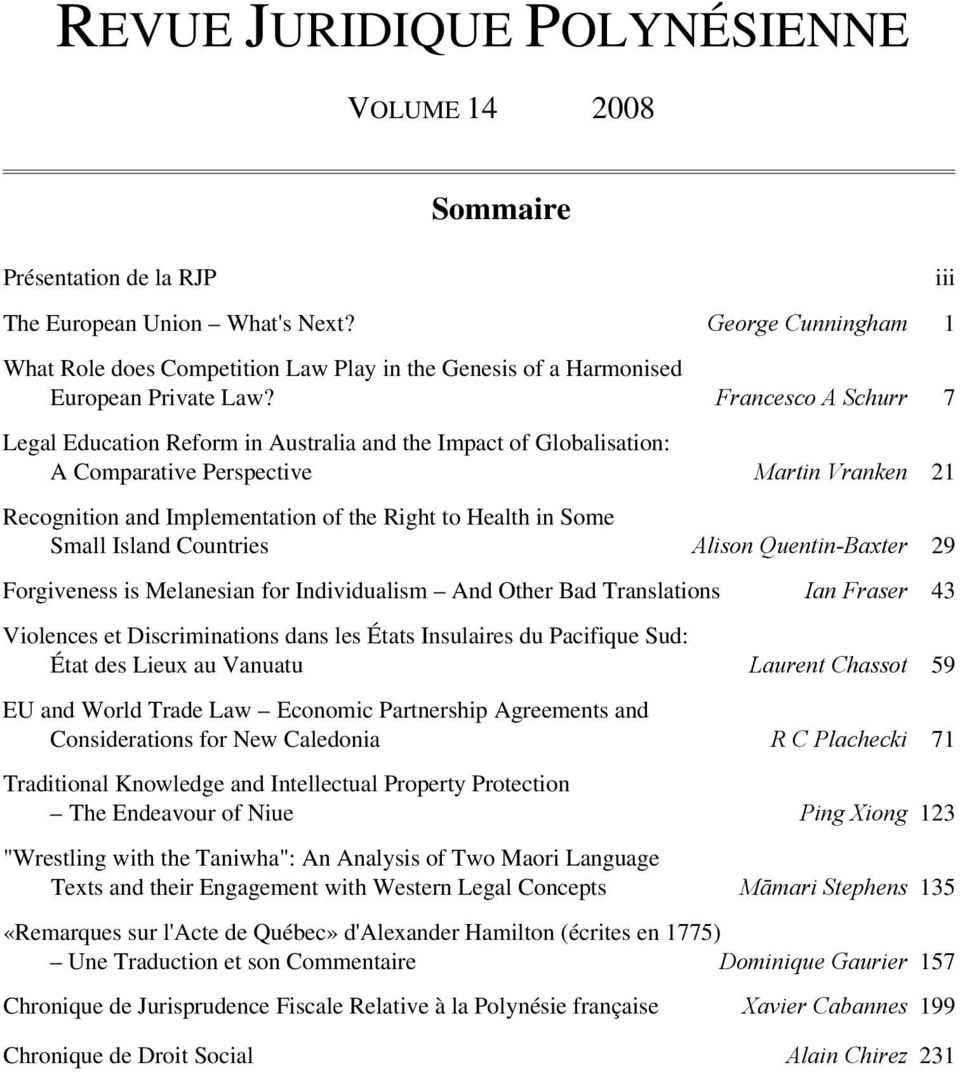
1 REVUE JURIDIQUE POLYNÉSIENNE VOLUME Présentation de la RJP Sommaire The European Union What's Next? George Cunningham 1 What Role does Competition Law Play in the Genesis of a Harmonised European Private Law? Francesco A Schurr 7 Legal Education Reform in Australia and the Impact of Globalisation: A Comparative Perspective Martin Vranken 21 Recognition and Implementation of the Right to Health in Some Small Island Countries Alison Quentin-Baxter 29 Forgiveness is Melanesian for Individualism And Other Bad Translations Ian Fraser 43 Violences et Discriminations dans les États Insulaires du Pacifique Sud: État des Lieux au Vanuatu Laurent Chassot 59 EU and World Trade Law Economic Partnership Agreements and Considerations for New Caledonia R C Plachecki 71 Traditional Knowledge and Intellectual Property Protection The Endeavour of Niue Ping Xiong 123 "Wrestling with the Taniwha": An Analysis of Two Maori Language Texts and their Engagement with Western Legal Concepts Māmari Stephens 135 «Remarques sur l'acte de Québec» d'alexander Hamilton (écrites en 1775) Une Traduction et son Commentaire Dominique Gaurier 157 Chronique de Jurisprudence Fiscale Relative à la Polynésie française Xavier Cabannes 199 Chronique de Droit Social Alain Chirez 231 iii
2 (2008) 14 REVUE JURIDIQUE POLYNÉSIENNE ii

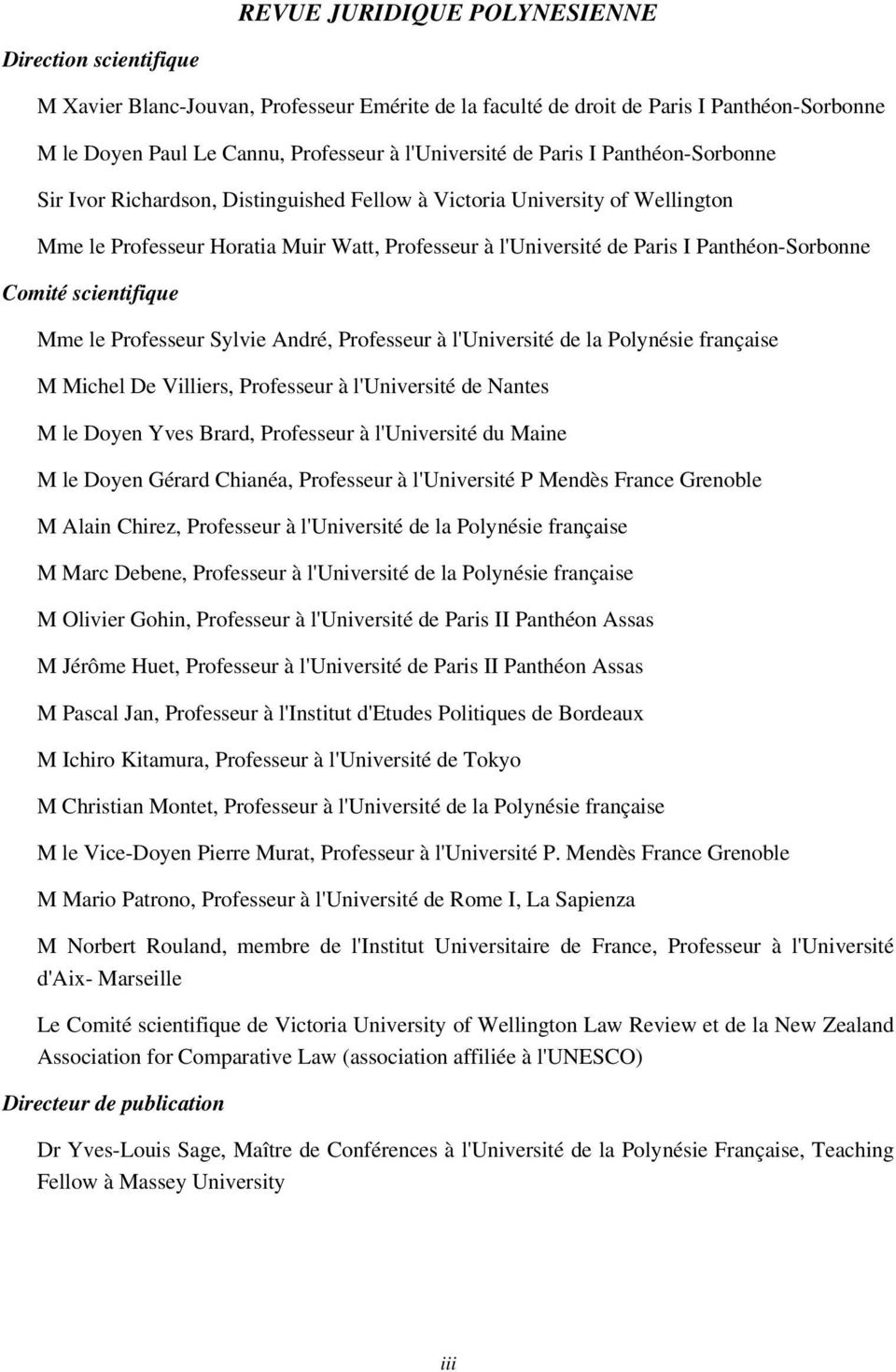
3 REVUE JURIDIQUE POLYNESIENNE Direction scientifique M Xavier Blanc-Jouvan, Professeur Emérite de la faculté de droit de Paris I Panthéon-Sorbonne M le Doyen Paul Le Cannu, Professeur à l'université de Paris I Panthéon-Sorbonne Sir Ivor Richardson, Distinguished Fellow à Victoria University of Wellington Mme le Professeur Horatia Muir Watt, Professeur à l'université de Paris I Panthéon-Sorbonne Comité scientifique Mme le Professeur Sylvie André, Professeur à l'université de la Polynésie française M Michel De Villiers, Professeur à l'université de Nantes M le Doyen Yves Brard, Professeur à l'université du Maine M le Doyen Gérard Chianéa, Professeur à l'université P Mendès France Grenoble M Alain Chirez, Professeur à l'université de la Polynésie française M Marc Debene, Professeur à l'université de la Polynésie française M Olivier Gohin, Professeur à l'université de Paris II Panthéon Assas M Jérôme Huet, Professeur à l'université de Paris II Panthéon Assas M Pascal Jan, Professeur à l'institut d'etudes Politiques de Bordeaux M Ichiro Kitamura, Professeur à l'université de Tokyo M Christian Montet, Professeur à l'université de la Polynésie française M le Vice-Doyen Pierre Murat, Professeur à l'université P. Mendès France Grenoble M Mario Patrono, Professeur à l'université de Rome I, La Sapienza M Norbert Rouland, membre de l'institut Universitaire de France, Professeur à l'université d'aix- Marseille Le Comité scientifique de Victoria University of Wellington Law Review et de la New Zealand Association for Comparative Law (association affiliée à l'unesco) Directeur de publication Dr Yves-Louis Sage, Maître de Conférences à l'université de la Polynésie Française, Teaching Fellow à Massey University iii
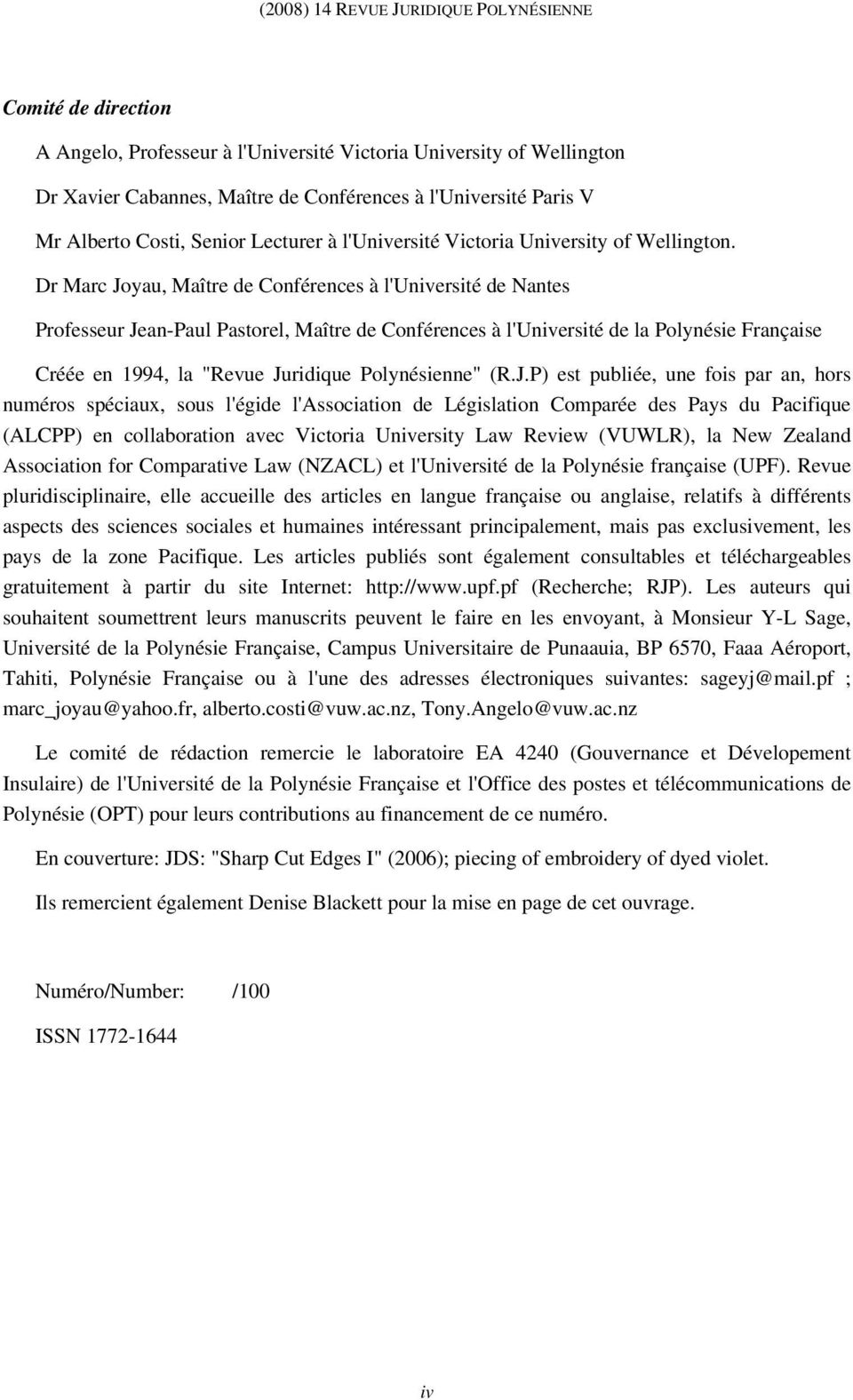
4 (2008) 14 REVUE JURIDIQUE POLYNÉSIENNE Comité de direction A Angelo, Professeur à l'université Victoria University of Wellington Dr Xavier Cabannes, Maître de Conférences à l'université Paris V Mr Alberto Costi, Senior Lecturer à l'université Victoria University of Wellington. Dr Marc Joyau, Maître de Conférences à l'université de Nantes Professeur Jean-Paul Pastorel, Maître de Conférences à l'université de la Polynésie Française Créée en 1994, la "Revue Juridique Polynésienne" (R.J.P) est publiée, une fois par an, hors numéros spéciaux, sous l'égide l'association de Législation Comparée des Pays du Pacifique (ALCPP) en collaboration avec Victoria University Law Review (VUWLR), la New Zealand Association for Comparative Law (NZACL) et l'université de la Polynésie française (UPF). Revue pluridisciplinaire, elle accueille des articles en langue française ou anglaise, relatifs à différents aspects des sciences sociales et humaines intéressant principalement, mais pas exclusivement, les pays de la zone Pacifique. Les articles publiés sont également consultables et téléchargeables gratuitement à partir du site Internet: (Recherche; RJP). Les auteurs qui souhaitent soumettrent leurs manuscrits peuvent le faire en les envoyant, à Monsieur Y-L Sage, Université de la Polynésie Française, Campus Universitaire de Punaauia, BP 6570, Faaa Aéroport, Tahiti, Polynésie Française ou à l'une des adresses électroniques suivantes: [email protected] ; [email protected], [email protected], [email protected] Le comité de rédaction remercie le laboratoire EA 4240 (Gouvernance et Dévelopement Insulaire) de l'université de la Polynésie Française et l'office des postes et télécommunications de Polynésie (OPT) pour leurs contributions au financement de ce numéro. En couverture: JDS: "Sharp Cut Edges I" (2006); piecing of embroidery of dyed violet. Ils remercient également Denise Blackett pour la mise en page de cet ouvrage. Numéro/Number: /100 ISSN iv
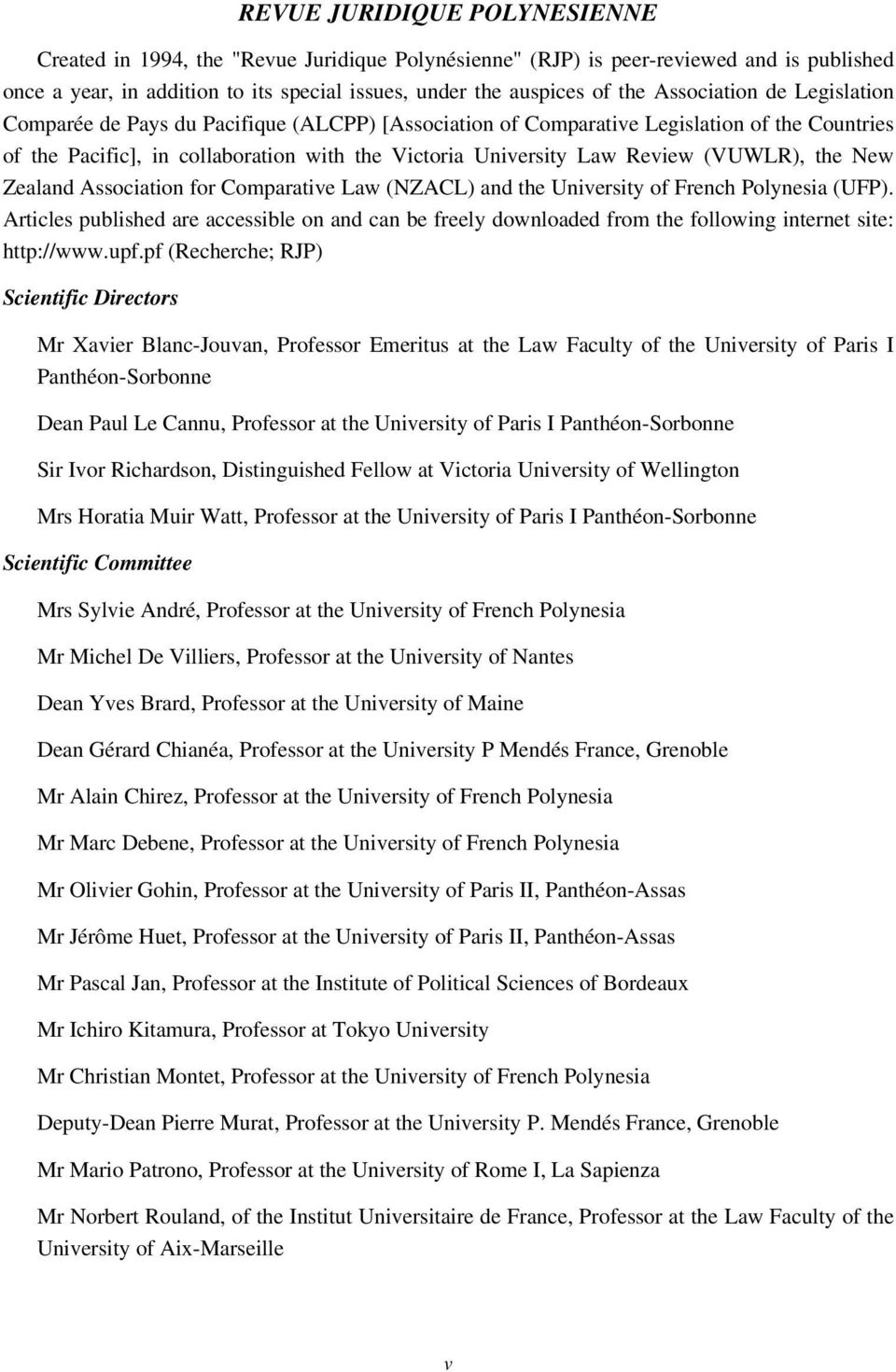
5 REVUE JURIDIQUE POLYNESIENNE Created in 1994, the "Revue Juridique Polynésienne" (RJP) is peer-reviewed and is published once a year, in addition to its special issues, under the auspices of the Association de Legislation Comparée de Pays du Pacifique (ALCPP) [Association of Comparative Legislation of the Countries of the Pacific], in collaboration with the Victoria University Law Review (VUWLR), the New Zealand Association for Comparative Law (NZACL) and the University of French Polynesia (UFP). Articles published are accessible on and can be freely downloaded from the following internet site: (Recherche; RJP) Scientific Directors Mr Xavier Blanc-Jouvan, Professor Emeritus at the Law Faculty of the University of Paris I Panthéon-Sorbonne Dean Paul Le Cannu, Professor at the University of Paris I Panthéon-Sorbonne Sir Ivor Richardson, Distinguished Fellow at Victoria University of Wellington Mrs Horatia Muir Watt, Professor at the University of Paris I Panthéon-Sorbonne Scientific Committee Mrs Sylvie André, Professor at the University of French Polynesia Mr Michel De Villiers, Professor at the University of Nantes Dean Yves Brard, Professor at the University of Maine Dean Gérard Chianéa, Professor at the University P Mendés France, Grenoble Mr Alain Chirez, Professor at the University of French Polynesia Mr Marc Debene, Professor at the University of French Polynesia Mr Olivier Gohin, Professor at the University of Paris II, Panthéon-Assas Mr Jérôme Huet, Professor at the University of Paris II, Panthéon-Assas Mr Pascal Jan, Professor at the Institute of Political Sciences of Bordeaux Mr Ichiro Kitamura, Professor at Tokyo University Mr Christian Montet, Professor at the University of French Polynesia Deputy-Dean Pierre Murat, Professor at the University P. Mendés France, Grenoble Mr Mario Patrono, Professor at the University of Rome I, La Sapienza Mr Norbert Rouland, of the Institut Universitaire de France, Professor at the Law Faculty of the University of Aix-Marseille v
6 (2008) 14 REVUE JURIDIQUE POLYNÉSIENNE Editor-in-Chief Dr Yves-Louis Sage, Maître de Conférences at the University of French Polynesia, Teaching Fellow at Massey University EDITORIAL COMMITTEE Professor Anthony Angelo, Professor at Victoria University of Wellington Faculty of Law Dr Xavier Cabannes, Maître de Conférences at the University of Paris V Mr Alberto Costi, Senior Lecturer at Victoria University of Wellington Dr Marc Joyau, Maître de Conférences at the University of Nantes Prof Jean-Paul Pastorel, Maître de Conférences à l'université de la Polynésie Française The Editors wish to express their gratitude and appreciation to Laboratoire EA4240 (Governance et Développement Insulaire) (University of French Polynesia) and the OPT of Polynesia for their valuable financial contributions. They also wish to thank Denise Blackett for the typesetting and formatting of this book. Cover credit: JDC: JDS: "Sharp Cut Edges I" (2006); piecing of embroidery of dyed violet. vi
7 1 THE EUROPEAN UNION WHAT'S NEXT? George Cunningham * This talk was delivered in the Victoria University of Wellington Law School on 1 November 2007 under the joint auspices of the New Zealand Centre for Public Law and of the New Zealand Association for Comparative Law. It is a fitting way to mark the end of the EU jubilee year. Cet article représente le texte d une conférence donnée à la faculté de droit de Victoria University of Wellington, le 1 e novembre 2007 par M. George Cunningham, Chargé d Affaires à la Commission Européenne en Nouvelle-Zélande. Cette conférence a été organisée sous les auspices du New Zealand Centre for Public Law et de la New Zealand Association for Comparative Law. L auteur y a exposé les grandes lignes des futurs développements que devrait connaître l Union Européenne. Many thanks to the Faculty of Law at Victoria University and the NZ Association for Comparative Law for having invited me. It is really wonderful to be here. This is a happy occasion as it is my first talk here in New Zealand, having only arrived in your pleasant land just over a month ago. Oftentimes, I like to give talks which stimulate debate and add a bit of my personal analysis. This occasion will be no different. I hope that will make it interesting. We have just had the European Union's 50th anniversary celebrated with many events worldwide, including in New Zealand. In our discussions about what to call this talk, someone suggested "European Union: the next 50 years". Although that was a very visionary suggestion, I believe it does not easily fit in with the realities of our modern times right now. In a speech in Cape Town, South Africa in June 1966, Robert F Kennedy said, "There is a Chinese curse which says, "May he live in interesting times". The popularity of this "Chinese curse" * Chargé d'affaires ai, European Commission Delegation to New Zealand. Mr Cunningham has been an EC official for many years. He took up his New Zealand post in September 2007 having previously served in Brussels, New York and Nicosia. He was coordinator for the EU's bilateral trade relations with the USA
8 2 (2008) 14 REVUE JURIDIQUE POLYNÉSIENNE has puzzled Chinese scholars, who have in fact as it turns out only heard it from Americans. The origin of this phrase might be related to the Chinese proverb, "It's better to be a dog in a peaceful time than be a man in a chaotic period". Whatever the origin, it is certainly true we live in interesting times right now. In a previous guise, as coordinator for EU-US bilateral trade relations, I had on many occasions delivered talks to both EU and US audiences, explaining (and surprising) them that although the US is perhaps unique in the world in terms of hard power the EU and US economies were of the same magnitude. By working together, with the multilateral interest also at heart, I used to say, we could make a constructive, positive difference in the world. However a change is occurring. The EU is growing in terms of member countries. The euro is on the rise. There is an economic slowdown in particular in the US economy because of the subprime mortgage crisis. The outcome is that based on current exchange rates the size of the EU economy has out-stripped that of the US economy. And this may continue for some time. When I was serving the European Commission in New York in 2000, the euro had only just been launched. The exchange rate had drifted downwards below parity rate against the US dollar, bumping along at merely US$0.84: 1 Euro. By contrast, now it has reached the giddy heights of almost US$ 1.45: 1 Euro. Attending a New York party at a time the euro had reached rock bottom, a billionaire asked me if I believed it was the right time to invest in euros. I said absolutely. He took my advice and did it. He died around the time the two currencies reached back to parity again. He did not live long enough to see the real fortune that he would have made. There are many other global trends of note that are changing the way the world is functioning, not least the rise of the so-called BRICs (Brazil, Russia, India and China), as well as other emerging economies. Now that the relative certainties of the second half of the 20th century are well-behind us, we need to adapt and face this brave new world together. We are indeed living in interesting times. And New Zealand - despite geographic distance from other countries is by no means isolated from what is happening in this globalised, shrinking world. And that is why it is particularly important for New Zealanders like the rest of us to work together to try to harness as much as possible this ongoing, unstoppable globalisation for our benefit. In these turbulent times, it is difficult perhaps to predict too far ahead what may happen and certainly not 50 years ahead. Nevertheless the European Union is evolving and has a clear programme about what it wishes to achieve. First of all, it is important to remember the EU's global soft power is quite substantial. Just three quick facts:

9 THE EUROPEAN UNION WHAT'S NEXT? 3 As mentioned previously, the EU is now the world's biggest economy with a GDP of NZ$ 22 trillion. It is the world's biggest trader, accounting for 20% of global imports and exports. It is also the world's largest donor, providing around 55% of the world's development assistance. There are many themes that one can pick about the EU and its future, but let me concentrate briefly on four: enlargement, climate change, freedom of movement of people within the EU and changes to the way the EU is run. Concerning enlargement, the EU is certainly very popular among its neighbours. Many countries want to join it. We have now 27 Member States. Almost a half billion people. Negotiations are in progress for Turkey and Croatia to join. Other countries of former Yugoslavia have agreed a roadmap towards a European destiny. There are no geographic limits set for enlargements. However we have to be a bit more careful. EU citizens have become more cautious about the current enterprise. Polls show, for instance, some resistance from the public in some countries to Turkey's becoming a member. Nevertheless, the EU has given a clear undertaking to Turkey that it should be a member once it has fulfilled all the criteria to join. The success of the 2004 big bang enlargement of 10 new Member States can now be more clearly seen. The influx of over half a million Poles into the UK since their country joined the EU in 2004 has not led to tensions there. Indeed a recent Home Office study has reportedly said Polish workers have produced a benefit to the UK economy of an estimated 9 billion euros in the past year alone. And for those in the regions most immediately around us, we have a special European Neighbourhood Policy which embraces countries further to the east in Europe and the Mediterranean in a comprehensive programme to create more stability and prosperity. Concerning the free movement of people, we are making advances there as well. Membership of the so-called Schengen countries now stands at 15, including even Iceland and Norway which are not members of the EU. Just next month, there will be a another great leap forward as a further nine new EU Member States (Czech Republic, Estonia, Hungary, Latvia, Lithuania, Malta, Poland, Slovakia and Slovenia) will abolish their internal land and sea borders between them and the current 15 members of Schengen. The same will happen for air borders by March This will lead to the expansion of the Schengen area to 3,600 million km 2 and should certainly make it easier for New Zealanders traveling to Europe for their Overseas Experience to cross borders.
10 4 (2008) 14 REVUE JURIDIQUE POLYNÉSIENNE On climate change, the UN Bali Conference is coming fast upon us. The EU hopes that international climate talks in Bali during the first half of December will establish a roadmap that will lead to commitments from all developed countries to cut their greenhouse gas emissions by 30% by 2020, compared to 1990 levels. The EU has unilaterally already agreed to cut its gas emissions by 20% during this period, agreement or not. The recent announcement of an International Climate Action Partnership which aims to coordinate and share information on existing regional cap-and-trade initiatives within Europe, New Zealand, various US states and Canada is very welcome. Such a forum could act as a driver for increased compatibility and potential linkage of regional carbon markets, which could ultimately lead to the creation of a wider, international carbon market. In 2008, the EU will assess the adaptation of its public policies to the new realities of climate change. A wide range of EU policies such as agriculture, fisheries, biodiversity, energy, industry and tourism will need to be adjusted. Particular attention will be given to the greening of the transport sector. There will also be a strategic energy review. Final among my four themes is changes to the way the EU is run. A new reform treaty has been agreed. Those reforms are expected to start taking shape in 2009 if all goes well with the ratification process in the 27 Member States, all of whom must ratify the Treaty. Some of the key changes are as follows: The creation of an EU Presidency (of the Council) for a two-and-a-half year term. This replaces the rather short six-monthly Presidency rotation among Member States that happens now, and will allow for better continuity; the creation of the post of High Representative of the EU for Foreign Affairs and Security Policy effectively a Foreign Minister for Europe; a single legal personality for the EU; an exit clause, which will for the first time permit members to leave the EU; a stronger role for national parliaments; A double majority rule for decision-making based on the votes of 55% of member states combined with a total of 65% of the EU's population to pass legislation by qualified majority from 2014; extending qualified majority voting to another 40 policy areas, thereby easing decisionmaking within an enlarged EU. The creation of an EU High Representative for Foreign Affairs and Security Policy is expected to impact on the diplomatic functions of the EU worldwide and lead to the formation of an European External Action Service.
11 THE EUROPEAN UNION WHAT'S NEXT? 5 This is just a flavour of what is going on. There are many other developments in the pipeline. For instance, the increasing number of countries that are readying themselves to join an expanding eurozone. Or our forthcoming summit with African Heads of State and Government this December to move that relationship forward even further. One of the fun things about working for the European Union is that there is continuous evolution. Setbacks, when they do happen, usually, eventually, get resolved. Finally, how about New Zealand's relations with the EU? Well, first of all, they've never been better. There are currently no trade disputes between us a clean slate in the only area of potential friction. And let us not exaggerate the importance of this area, given how we have so much in common on all other fronts. New Zealand is valuable and valued by the EU. It punches above its weight in the international arena, particularly on trade matters. It assumes significant leadership in the Doha Round. Its position in the Asia-Pacific region gives the EU a close friend in the region which is the engine of economic growth for the whole world. And its lamb and other important food products grace the tables of Europeans across the whole EU and not just in the UK. The new Joint Declaration on relations and cooperation between the EU and NZ signed on 21 September this year has taken the relationship further. The aim there is to negotiate and conclude a full air services agreement by the end of 2008; a new Science and Technology Cooperation Agreement which we hope will be ready in the first half of 2008; and continued work towards a Wine Agreement and a Customs Cooperation Agreement. We will also enhance our cooperation on climate change, including support for the post-2012 international framework and carbon market; have new annual trade talks (back-to-back with more traditional agricultural talks); look for practical cooperation in the areas of investment promotion, regulatory and competition policy approaches; more educational cooperation; increased coordination in the Pacific region; and closer cooperation on counter-terrorism. This year alone has seen Prime Minister Helen Clark and Foreign Minister Winston Peters engage actively Europe through extensive visits there. And in return, our External Affairs Commissioner Benita Ferrero-Waldner and other senior officials have also made their journeys this year to New Zealand. It is through partnerships such as these that the European Union is creating a web of friends throughout the world. And none does it feel closer to in terms of shared values than New Zealand. Thank you for having me here, both in your country, and as my audience this evening.

12

13 7 WHAT ROLE DOES COMPETITION LAW PLAY IN THE GENESIS OF A HARMONISED EUROPEAN PRIVATE LAW? Francesco A Schurr * The goal of this article is to assess the relevance of competition law for the development of European private law in general and for European contract law in particular. In the current debate on the harmonisation of European private law the role of competition law has been either completely neglected or at least underrated. The case law proves that the provisions of competition law contained in the Treaty establishing the European Community and in various pieces of secondary Community legislation have had a strong impact on the legal relationship between private persons and thus on the reality of contract law in Europe. In the interpretation of the current competition law provisions the European Court of Justice and the Court of First Instance have employed the principle of direct application of EC law on private persons. This paper points out how this case law serves as a catalyst for the harmonisation of private law. The topic covered by this paper can be used as a guide to determine whether EC law is part of the civil law tradition or of the common law tradition. La fin de cet article est d'évaluer la pertinence du droit de la concurrence pour l'évolution du droit privé européen en général et en particulier le droit européen des contrats. Dans la discussion actuelle relatif à l'harmonisation du droit privé européen le rôle de la loi sur la concurrence a été complètement négligé, ou au moins sous-estimé. La jurisprudence manifeste que les dispositions du droit de la concurrence contenues dans le Traité instituant la Communauté Européenne et dans de diverses parties de la législation communautaire secondaire ont eu un fort impact sur la relation juridique entre personnes privées, et donc sur la réalité du droit des contrats en Europe. Pour l'interprétation de la législation communautaire actuelle sur la concurrence les jugements de la Cour de Justice et du Tribunal de Première Instance ont suivi le principe de l'application directe du * Associate Professor for Private Law and Comparative Law at the University of Innsbruck/Austria. Visiting Lecturer, Victoria University of Wellington.
14 8 (2008) 14 REVUE JURIDIQUE POLYNÉSIENNE droit communautaire sur les personnes privées. Cet article souligne comment cette jurisprudence sert comme un catalyseur pour l'harmonisation du droit privé. Le sujet de cet article peut être utilisé comme paramètre fondamental pour connaître si le droit communautaire est plutôt de la tradition de droit civil ou de la tradition du common law. I INTRODUCTION Competition law deals with the relationship between private persons. Therefore it needs to be appreciated as a fundamental driving force in the process of Europeanisation of private law. It is surprising that in the current discussion regarding the harmonisation of private law 1 and especially of contract law little attention has been paid to the enormous influence of competition law, whereas other fields, such as consumer law 2 or comparative law 3 have been at the centre of the debate. 4 From the very beginning of the European integration process, therefore already in the post-war era, the European economic constitution was build on the idea of creating an area of free competition between undertakings headquartered in different member states. 5 Easy access to the market and especially the equal opportunities to participate in the game of the market are considered as a cornerstone of the European economic constitution. The protection of free competition is based on the existence and the enforcement of legal rules that are applicable between private persons and public authorities (public law approach) as well as between two or more private persons (private law approach). 6 Hence these rules of competition law have been essential for the Europeanisation of private law. 1 On the process of private law harmonisation in general see eg Walter van Gerven "Bringing (Private) Laws closer to each other at European Level" in Fabrizio Cafaggi (ed) The Institutional Framework of European Private Law (University Press, Oxford, 2006) This topic has been discussed by the author previously, see Francesco A Schurr "The relevance of the European consumer protection law for the development of the European contract law" in Tony Angelo (ed) The Pacific and Europe: The 50th Jubilee of the European Communities (RJP Hors série 2007) On this topic see eg Klaus Peter Berger "Harmonisation of European Contract Law The Influence of Comparative Law" (2001) 50 ICLQ The joint influence of consumer law and competition law has been addressed by Albertina Albors-Llorens "Consumer Law, Competition Law and the Europeanization of Private Law" in Fabrizio Cafaggi (ed) The Institutional Framework of European Private Law (University Press, Oxford, 2006) 245, On this topic see Armin Hatje "The Economic Constitution" in Armin von Bogdandy and Jürgen Bast (eds) Principles of European Constitutional Law (Hart Publishing, Portland, 2006) 587 ss. 6 The distinction between private law and public law plays a major role in the European legal tradition: On this issue in comparison to the US legal system see Ralf Michaels and Nils Jansen "Private Law beyond the State? Europeanization, Globalisation, Privatization" 54 Am J Comp L 843.
15 EUROPEAN COMPETITION LAW AND PRIVATE LAW HARMONISATION 9 There are various other policy fields contained in the Treaties and in various pieces of secondary EC legislation that contribute indirectly to the functioning of competition in the common market and thus fall into the category of "peripheral parts" of competition law. Those fields of law (such as consumer protection law 7 ) have an enormous relevance for the process of private law approximation. However it needs to be noted that most of these fields of EC policy have developed at a much later stage, 8 whereas the "central part" of competition law has been from the very beginning a prerequisite for the realisation of the fundamental freedoms: the free movement of goods, the free movement of services as well as the freedom of establishment, the free movement of persons including the free movement of workers, and the free movement of capital. This "central part" is composed of the provisions of articles 81 and following of the European Community Treaty (ECT) and of a set of rules contained in various pieces of secondary legislation focusing on procedural and substantive issues of competition law. 9 The statutory law belonging to this category not only regulates the behaviour of the private market players, but also focuses directly on the public interest by promoting and preserving the functioning of the game of competition. According to our definition the "peripheral parts" of competition law embrace all those fields of the acquis communautaire that without addressing directly the competition between undertakings create equal market conditions through harmonisation, approximation or unification of law and thus contribute to eliminating the distortion of competition. Especially those pieces of legislation created to protect the weaker party to the contract, such as consumer law directives, directives that protect the commercial agent, belong to this category. This article intends to explain some essential aspects of the "central part" of EC competition law and to outline their impact on the process of harmonisation of private law through the decision making of the European Court of Justice (ECJ) and the Court of First Instance (CFI). When these courts had to give an interpretation of pieces of legislation belonging to the "central part" of EC competition law, they often set new standards that are vital for the private law harmonisation On the various methodologies of consumer protection in the present acquis communautaire, see Hannes Unberath and Angus Johnston "The double-headed approach of the ECJ concerning consumer protection" (2007) 44 CML Rev See Albertina Albors-Llorens "Consumer Law, Competition Law and the Europeanization of Private Law" in Fabrizio Cafaggi (ed) The Institutional Framework of European Private Law (University Press, Oxford, 2006) For example, Regulation 139/2004, OJ 2004 L 24/1; Regulation 1/2003 OJ 2004 L 1/1. 10 On the ECJ's role in the harmonisation of private law in general see Angus Johnston and Hannes Unberath "Law at, to or from the Centre? The European Court of Justice and the Harmonisation of Private Law in the European Union" in Fabrizio Cafaggi (ed) The Institutional Framework of European Private Law (University Press, Oxford, 2006) 149.
16 10 (2008) 14 REVUE JURIDIQUE POLYNÉSIENNE Furthermore the article will expose a cross-influence between the "central part" and the "peripheral parts" of competition law and identify situations of overlap. II DIRECT RESTRICTION OF CONTRACTUAL FREEDOM A Banned Relationships between Undertakings Article 81 (1) ECT addresses collusive behaviour of businesses: all agreements between undertakings which affect the trade between member states and which have as their object or effect the prevention, restriction or distortion of competition within the common market, are prohibited. Decisions by associations of undertakings and concerted practices are also prohibited if they have the abovementioned impact on the common market. 11 Apart from this general provision, article 81 (1) ECT mentions some circumstances where the behaviour of businesses has a particularly negative impact on the common market, eg when businesses fix directly or indirectly purchase or selling prices or any other trading conditions or when they limit or control production, markets, technical development, or investment. The European legislation emphasises that undertakings should refrain particularly from these forms of behaviour. Article 81 (1) ECT refers as well to the practices of sharing markets or sources of supply and of applying dissimilar conditions to equivalent transactions with other trading parties, thereby placing them at a competitive disadvantage. In addition to that the European legislator made it clear that it is prohibited to make the conclusion of contracts subject to acceptance by the other parties of supplementary obligations which, by their nature or according to commercial usage, have no connection with the subject of such contracts. Horizontal agreements between competing undertakings are always at risk of being void under article 81 (1) ECT. 12 This is less obvious when undertakings conclude agreements vertically; at a first glance article 81 (1) ECT does not seem to be applicable to vertical relationships and leaves this form of collusive behaviour uncovered. The ECJ started filling this normative gap in the early days of its competition law related case law 13 and has emphasised on various occasions that article 81 (1) 11 Rotbero Nazzini "Article 81 EC between time present and time past: a normative critique of "restriction of competition" in EU law" (2006) 43 CML Rev See Francisco Enrique González Díaz "Horizontal Co-operation Agreements" in Jonathan Faull and Ali Nikpay (ed) The EC Law of Competition (2 ed, University Press, Oxford, 2007) Cases 56 and 58/64 Consten and Grundig v Commission [1966] ECR 299.
17 EUROPEAN COMPETITION LAW AND PRIVATE LAW HARMONISATION 11 ECT is applicable to relationships between various members in the chain of marketing of goods and services. 14 B Consequences of the Direct Nullity Principle in Competition Law and in General Contract Law According to article 81 (2) ECT all these prohibited agreements or decisions are automatically void. In Société Technique Minière (LTM) v Maschinenbau Ulm GmbH (MBU) 15 the ECJ made it clear that the automatic nullity of an agreement within the meaning of article 81 (2) ECT applies only to those parts of the agreement affected by the prohibition. Only when it appears that those parts cannot be separated from the agreement itself, can the whole agreement be regarded as void. The ECJ tried to reduce the impact of competition law on the contractual freedom of the parties by stating that other contractual provisions which are not affected by the prohibition of article 81 (1) ECT should not be void. In this decision related to the "central part" of competition law, the ECJ has strongly influenced the general private law of all the member states. The decision dealt with the nullity of the whole contract as compared to the partial nullity of single contract terms and has given a guideline for the general treatment of contract terms that are contrary to mandatory legal provisions. Thus article 81 ECT restricts the contractual freedom of the parties in a way similar to various pieces of secondary legislation belonging to the "peripheral part". 16 According to article 6 of this Directive unfair terms in a contract concluded with a consumer by a seller or supplier are not binding on the consumer; apart from that, the contract continues to bind the parties if it is capable of continuing in existence without the unfair terms. Therefore it is evident that the above sources belonging to the "central part" of competition law as well as to its "peripheral part" are a major contribution to the harmonisation of contract law in Europe. III INDIRECT RESTRICTION OF CONTRACTUAL FREEDOM THE PROTECTION OF THE WEAKER PARTY TO THE CONTRACT At first glance the impact of article 82 ECT on contractual relationships between businesses seems harder to prove as this provision focuses mostly on unilateral behaviour that hinders competition between businesses in the common market. 14 On the history of the application of art 81 ECT to vertical agreements, see Mario Filipponi and Luc Peeperkorn and Donncadh Woods "Vertical Agreements" in Jonathan Faull and Ali Nikpay (ed) The EC Law of Competition (2 ed, University Press, Oxford, 2007) 1129, Case 56/65 Société Technique Minière (LTM) v Maschinenbau Ulm GmbH (MBU) [1966] ECR An example would be unfair terms in consumer contracts. Directive 93/13, OJ 1993 L 095/29.
18 12 (2008) 14 REVUE JURIDIQUE POLYNÉSIENNE A The Concept of Abuse of a Dominant Position Article 82 (1) ECT is one of the essential pillars within the "central part" of European competition law. According to this provision any abuse of a dominant position within the common market or in a substantial part of it is prohibited as incompatible with the common market in so far as it may affect trade between member states. In the last five years an intense political and scholarly debate relating to the burden of proof has taken place; it has been discussed whether it should be sufficient for the Commission, the main executive body for EC competition law, to prove that the behaviour under review is likely to distort market competition. Under this circumstance the dominant undertaking should have a chance to prove that its conduct is objectively necessary or justified. 17 In article 82 (1) ECT the European legislator has further specified some crucial cases of abuse (eg when an undertaking imposes directly or indirectly unfair purchase or selling prices or other unfair trading conditions, or when it limits production, markets or technical development to the prejudice of customers and users). Article 82 (1) ECT has a strong impact on the development of harmonisation of European contract law: for example abusive clauses are often included in contracts between dominant companies and economically weaker parties (such as consumers or distributors). Therefore it is vital for this research to take into account the protection of the weaker contract party as an essential way for the "central part" of competition law to penetrate into the development of private law harmonisation. B Trends in European Statutory Law and Overlaps with Competition Case Law The architecture of article 82 (1) ECT resembles various provisions of secondary EC law that belong to the category of "peripheral parts" of competition law. In this area there are various provisions that are focused on the protection of the weaker party in the contract from abuse of power through the stronger party. EU law considers persons belonging to this target group (eg the consumer, the commercial agent) as persons that are extremely vulnerable in the conclusion and in the performance of contracts. In the EC legislation of recent decades and in the legislation of EU member states a strong emphasis has been put on the protection of the weaker parties to the contract. This trend can be explained not only by the legislator's intention to promote the social role of private law in Europe, See DG Competition discussion paper on the application of Article 82, comm/competition/antitrust/art82/discpaper2005.pdf; for a summary of the scholarly debate, see Roberto Nazzini "The wood began to move: an essay on consumer welfare, evidence and burden of proof in Article 82 EC cases" (2006) 31 E L Rev On this topic see eg Ugo Mattei and Fernanda Nicola "A social dimension in European Private Law? The Call for Setting a Progressive Agenda" (2006) 41 New Eng L Rev 1.

19 EUROPEAN COMPETITION LAW AND PRIVATE LAW HARMONISATION 13 but also by the need to avoid situations where competition between undertakings is distorted because those headquartered in member states with a low level of protection are privileged, since they have to fear little or no sanction when dealing with the weaker party of the contract. Therefore the provisions protecting vulnerable market players can be defined clearly as "peripheral parts" of competition law. The idea of preventing a business from abusing its power is present in article 82 (1) ECT as well as in the "peripheral parts" that are designed to protect the weaker party of the contract. This article will now focus on two essential examples of cross-influence and legal overlap between the "central part" and "peripheral parts" of competition law. 1 Overlap in the field of pricing Price fixing has been addressed by the European legislator in provisions belonging to the "peripheral parts" of competition law. 19 According to article 6 of the Directive on commercial agents, a commercial agent is entitled to the remuneration that commercial agents are customarily allowed in the place where the activities are carried on. 20 If there is no such customary practice, a commercial agent is entitled to reasonable remuneration taking into account all the aspects of the transaction. Article 6 is focused primarily on the protection of the weaker party to the contract, and therefore on the legal standing of the commercial agent. One of the means of protection is by granting the commercial agent an adequate remuneration. Thus the system of protection contained in article 6 of the Directive on commercial agents is similar to that established by article 82 (1) ECT. The latter provision states that an undertaking abuses its market power if, directly or indirectly, it fixes unfair prices. Article 6 of the Directive is intended to prevent undertakings abusing the bargaining power that they have vis-à-vis the commercial agents they cooperate with. Both provisions heavily restrict the bargaining freedom of undertakings in a very similar way. Hence future case law will be able to rely on the possibility of cross-influences between the "central part" and "peripheral parts" of competition law whenever there is a need to evaluate the necessity to restrict contractual freedom related to price fixing. 2 Overlap in the field of contract terms The "central part" of competition law has had a strong impact on the freedom to negotiate and to use certain conditions in a contract. The case law has based the restriction of various contract terms on article 82 (2) ECT and thus addressed only the target group of undertakings which have a 19 Directive 86/653, OJ 1986 L 382/ This provision is applicable only in the absence of any agreement on this matter between the parties, and without prejudice to the application of the compulsory provisions of the member states concerning the level of remuneration.
20 14 (2008) 14 REVUE JURIDIQUE POLYNÉSIENNE dominant position. In United Brands 21 the ECJ had to decide on the (un)fairness of several clauses used by the applicant in contractual relations with its distributors. Certain market players, such as small distributors and consumers, are particularly vulnerable when entering into contractual relationships with large undertakings, as these are normally dominant in relation to their counterpart in the conclusion of the contract. 22 The establishment of standards of fairness in the legal context of the "central part" of competition law followed similar patterns of legal thinking to that applied by the European legislator in the field of "peripheral parts" of competition law, such as consumer law. One example is the Directive on unfair terms in consumer contracts 23. According to article 3 of this Directive a contractual term which has not been individually negotiated is unfair if, contrary to the requirement of good faith, it causes a significant imbalance in the parties' rights and obligations arising under the contract. The restriction on contractual freedom is justified in the "central part" of competition law by the objective fact of a dominant market position, and therefore has an absolute parameter. In contrast to that the statutory provisions belonging to the "peripheral parts" of competition law, such as article 3 of the Directive on unfair terms in consumer contracts, restrict contractual freedom because of the relatively unequal relation between the parties. Here the restriction can be justified by subjective qualities of the parties, and the fact that large undertakings have a high level of experience and therefore the counterpart is in a relatively weaker position and needs to be protected. IV THE RIGHT TO CLAIM DAMAGES Generally speaking EC law is effective directly on individuals. Therefore it has been a main focus of the EC legislator and of the ECJ to make sure that individuals can enforce their rights under EC law before the national courts. This idea of decentralisation has been the motivation for facilitating direct enforcement in the "central part" of competition law. The direct enforceability of essential provisions belonging to the "central part" of competition law has led to the EU-wide approximation of an issue of contract law that traditionally is extremely controversial: Among the legal systems of the EU member states there are traditionally different approaches towards the right of a contract party to claim damages from the other party to the contract. 21 Case 27/76 United Brands v Commission [1978] ECR Albertina Albors-Llorens "Consumer Law, Competition Law and the Europeanization of Private Law" in Fabrizio Cafaggi (ed) The Institutional Framework of European Private Law (University Press, Oxford, 2006) 245, Directive 93/13, OJ 1993 L 095/29.

21 EUROPEAN COMPETITION LAW AND PRIVATE LAW HARMONISATION 15 The House of Lords considered private litigation for breaches of competition law in Garden Cottage Foods v The Milk Marketing Board. 24 The defendant in this case had excluded the plaintiff from the number of distributors of butter. Even though the House of Lords denied injunctive relief, the majority of the House of Lords affirmed that there would be the possibility of bringing a claim alleging the infringement of article 81 or 82 ECT. 25 In Gibbs Mew plc v Gemmell the Court of Appeal held that, as a party to an illegal contract prohibited by article 81 ECT, the claimant was not entitled to a remedy in damages. 26 In this case the Court of Appeal unfortunately did not refer the case to the ECJ, as it recognised just the public law approach of protecting competitors and consumers the traditional goal of the rules belonging to the "central part" of competition law. The Court of Appeal did not take into consideration the protection of the weaker party of an agreement that infringes mandatory EC competition law. According to this argumentation the parties to an agreement are the cause of the restriction on competition and therefore cannot be regarded as victims entitled to claim damages. In the landmark decision Courage Ltd v Bernard Crehan and Bernard Crehan v Courage Ltd and Others 27 the ECJ restricted the power of the national legislators in the field of damages. According to the ECJ any national rule under which a party to an agreement which is in breach of article 81(1) ECT is barred from claiming damages for loss caused by performance of that contract on the sole ground that the claimant is a party to that contract, is contrary to article 81 (1) ECT. This judgment is one example of the enormous contribution of the ECJ to the Europeanisation of the general private law. The background of this case was that under English law a party to an illegal agreement generally cannot claim damages from the other contracting party. 28 This principle had to be overridden in order to allow the private enforcement of the "central part" of competition law. Courage Ltd v Bernard Crehan and Bernard Crehan v Courage Ltd and Others approximated English contract law to other legal systems in Europe. 29 The ECJ applied the principle of direct effect of EC law consistently and thus came to the conclusion that article 81 or 82 ECT and the 24 Case Garden Cottage Foods v The Milk Marketing Board [1984] AC On this case see eg Barry J Rodger and Angus MacCulloch Competition Law and Policy in the EC and UK (3 ed, Cavendish, London, 2004) Case Gibbs Mew plc v Gemmell [1998] EuLR 588; [1998] EWCA Civ 1262; [1999] 1 EGLR Case C-453/99 Courage Ltd v Bernard Crehan and Bernard Crehan v Courage Ltd and Others [2001] ECR I Case Gibbs Mew plc v Gemmell [1998] EuLR 588; see also Tinsley v Milligan [1994] 1 AC 340; see Barry J Rodger and Angus MacCulloch Competition Law and Policy in the EC and UK (3 ed, Cavendish, London, 2004) On the impact of this case on German law, see Wolfgang Weiss "Verbot wettbewerbsbeschränkender Maßnahmen" in Christan Callies and Matthias Ruffert (eds) Das Verfassungsrecht der Europäischen Union (3 ed, Beck, München, 2007) 81 EGV, No 149.
22 16 (2008) 14 REVUE JURIDIQUE POLYNÉSIENNE provisions of secondary law can be used in national litigation between parties to an agreement. These provisions can be used to claim damages based on the infringement of these provisions or as a defence to a breach of contract claim. 30 This decision of the ECJ has had a harmonising effect within the member states as well as between the EU and the US. The interpretation of article 81 ECT contained in Courage Ltd v Bernard Crehan and Bernard Crehan v Courage Ltd and Others brought EC competition law in line with US anti-trust law. In fact the US Supreme Court had previously held in Perma Life Mufflers Inc v International Parts Corporation 31 that the economically weaker party to an illegal anti-competitive agreement can claim damages from the economically stronger party. The application of the provisions belonging to the "central part" of competition law on the relationship between private parties is significantly influencing the current private law of EU member states and thus contributes to the Europeanisation of private law. This influence is particularly strong due to the fact that the ECJ and the CFI have consistently followed the principle of direct application. V CONCLUSION: EUROPEANISATION OF PRIVATE LAW THROUGH CASE LAW RATHER THAN STATUTORY LAW? Generally speaking a very large amount of the statutory law contained in the acquis communautaire is somehow focused on the establishment of equal market conditions for all market players. Thus the avoidance of distortion of competition is the rationale behind almost all pieces of EC legislation, no matter whether they address competition law directly ("central part" of competition law) or they influence competition indirectly ("peripheral parts" of competition law). Typical questions of contract law (such as price fixing, unfair contract terms, the right to claim damages between parties of the contract) have been regulated by a large amount of statutory law falling into the category of the "peripheral parts" of competition law (especially by consumer law). The ECJ significantly contributed to the establishment of a common European standard within these fields of contract law. This happened not only in the case law where statutory rules of contract law, consumer law, and labour law had to be interpreted by the court. On various occasions where the ECJ had to apply provisions of statutory law belonging to the "central part" of competition law, it created new legal standards applicable beyond the limits of this "central part". The legal findings contained in the latter case law are not always in line with the substance of the contract law provisions belonging to the "peripheral part". The difference depends on the fact that the "central 30 Barry J Rodger and Angus MacCulloch Competition Law and Policy in the EC and UK (3 ed, Cavendish, London, 2004) Perma Life Mufflers Inc v International Parts Corporation (1968) 392 US 134.
23 EUROPEAN COMPETITION LAW AND PRIVATE LAW HARMONISATION 17 part" of competition law is focused primarily on the protection of public interest objectives (especially the promotion and preservation of free competition). In the political and scholarly discussion regarding the necessity of a faster and more effective Europeanisation of European private law, in particular of the law of contracts, the question needs to be raised whether it is useful to rely on the technique of harmonisation through statutory law. As mentioned in this paper the European legislator has been very active recently, enacting a large number of pieces of statutory law which address directly the harmonisation of central issues of contract law. These pieces of legislation can be criticised as being too far from the reality of the market. In fact many of these provisions have been imposed artificially by the EC legislator without having been tested in any jurisdiction. In the constitutional system of the EU it is possible to enact law that harmonises contract law only if there is a legal basis in the ECT enabling the legislator to do so. If there is no legal basis, the European legislator has no power to act and thus cannot set any measure of harmonisation of private law. In contrast the ECJ has the legal capacity to contribute to the Europeanisation of private law without any restrictions imposed by the constitutional framework of the EU, whenever there are cases that need to be decided. This difference between the statutory law approach and the case law approach is vital for the scholarly and political debate on how the process of Europeanisation of private law should continue. The pieces of statutory legislation dealing with contract law and other fields of private law often lack the systematic approach necessary for the creation of a properly harmonised contract law. This results from the fact that the legal basis contained in the treaty does not allow the legislator to address issues not absolutely necessary for the economic and political goals defined in the ECT. At the moment there is no legal basis in the ECT that could enable the European legislator to enact a piece of legislation covering all fields of contract law systematically. This will change little even after the entry into force of the Treaty of Lisbon. 32 Should the constitutional framework of the EU enable the European legislator at some stage to enact a code that systematically rules all parts of private law, many pieces of statutory law belonging to the category of "peripheral part" of competition law will serve as tools for the realisation of this project. 33 In the debate related to the legal nature of EC law this fact is often used as a strong argument: The existence of those pieces of legislation rather proves the setting of EC law within the civil law than the common law tradition. 32 Treaty of Lisbon amending the Treaty on European Union and the Treaty establishing the European Community, signed at Lisbon, 13 December 2007, OJ 2007 C 306/1; at the end of March of 2008 France, Slovenia, Hungary, Romania and Bulgaria had ratified the Treaty of Lisbon. 33 On the Common Frame of Reference (CFR) and the toolbox principle, see Tony Ridge "Contract Law Will a Euro-Code oust English Law?" 31 Commw L Bull 53, 55 ss.
24 18 (2008) 14 REVUE JURIDIQUE POLYNÉSIENNE As mentioned, the rules of the "peripheral parts" of contract law have been created with the goal of protecting the weaker party of the contract such as the consumer. From the perspective of competition law these "peripheral parts" are intended to harmonise the legal standing of the weaker party of the contract in order to create equal market conditions. Therefore all EC provisions harmonising the protection standards of weak market players (such as eg commercial agents) are merely a by-product of the internal market. 34 Harmonisation is necessary since different standards of protection of the weaker party hinder the free movement of goods, the free movement of services as well as the freedom of establishment, the free movement of persons including the free movement of workers and the free movement of capital. On the other hand the pieces of legislation that directly approach the various problems of competition between businesses and that belong to the "central part" of competition law, offer fertile soil for the cultivation of a harmonised private law, and especially contract law, through case law. This phenomenon is definitely proof of the fact that EC law as such is not only part of the civil law tradition, but also part of the common law world. The strategy applied by the ECJ and the CFI of harmonising private law when interpreting existing statutory law is preferable to harmonisation through legislation. The law is harmonised only in the fields that are crucial from the perspective of the market players and thus require measures of approximation. A superfluous harmonisation, such as the creation of an overall codification of contract law, could therefore be avoided. 35 In addition to these arguments it needs to be considered that the ECJ has the ability to establish a systematic construction of contract law, as the court is not restricted in its law making capacities by any legal basis contained in the ECT. A last question that needs to be raised is whether "regulatory competition" is really undesirable for the process of Europeanisation of private law. During recent decades economic circumstances and the lack of a full harmonisation of essential legal standards in the EU have forced member states to compete with each other in the creation of legislation to attract and retain economic resources. This phenomenon is widely known as "competition between jurisdictions" or "regulatory competition". 36 For instance the existing unequal standards of protection of particularly vulnerable contract parties have lead to competitive advantages for member states with low protection standards. Those member states generally attract and retain more economic resources than those with a high level of protection. This phenomenon automatically forces the member states' legislators to adjust their national legislation to the standards of those member states whose legislation is more 34 See Hannes Unberath and Angus Johnston "The double-headed approach of the ECJ concerning consumer protection" (2007) 44 CML Rev 1237, On this issue see the critical analysis of the current attempts of harmonisation through statutory law, Tony Ridge "Contract Law Will a Euro-Code oust English Law?" 31 Comm L Bull 53, On this topic see eg Catherine Barnard and Simon Deakin "Market Access and Regulatory Competition" in JHH Weiler (ed) Jean Monnet Working Paper 9/01
25 EUROPEAN COMPETITION LAW AND PRIVATE LAW HARMONISATION 19 successful in the free competition between jurisdictions. The reason why regulatory competition can be regarded as undesirable is the inherent risk of a race to the bottom of standards, a phenomenon that is known from the law governing the incorporation of US companies, the so called "Delaware effect". 37 There is one essential positive side effect of regulatory competition that needs to be mentioned. Regulatory competition helps to generate a large amount of case law necessary for the Europeanisation of private law through the courts. Members of the business community that compete with each other in the market often use the courtroom as a battlefield. In the proceedings the parties often argue about legal divergences in the member states' jurisdictions that lead to competitive disadvantages. If the Europeanisation of contract law proceeds predominantly on the above mentioned "Common Law road" then regulatory competition will help to generate a sufficient body of case law that will give the ECJ the chance to build up a European private law. Through case law it will be possible to obtain a set of rules that has previously been tested by market players and that were not imposed artificially on them by the Brussels legislator. This is the key advantage of the "Common Law approach" in the Europeanisation of private law. It is therefore arguable that the "civil law strategy" will lose much of its current relevance in the near future if the ECJ continues its strong activity of private law harmonisation. 37 On this issue see for example Simon Deakin "Legal Diversity and Regulatory Competition: Which Model for Europe?" (2006) 12 European L J 440, 444.
26 20 (2008) 14 REVUE JURIDIQUE POLYNÉSIENNE
27 21 LEGAL EDUCATION REFORM IN AUSTRALIA AND THE IMPACT OF GLOBALISATION: A COMPARATIVE PERSPECTIVE Martin Vranken * The emphasis on internationalisation of the Australian economy shows no signs of abating. This state of affairs is not without repercussions for its legal system. Internationalisation has now also started to affect legal education in Australia. This short article focuses on the proclaimed European dimension of the Australian globalisation debate. Special attention is paid to the introduction of the so-called "Melbourne model" in the aftermath of the Bologna Declaration. It would seem that policy makers in both the northern and southern hemispheres have entered a brave new world the contours of which remain imprecise. Le processus d internationalisation de l économie australienne est en constante progression et ne manque pas d influencer le système légal australien ainsi que la manière dont le droit est aujourd hui enseigné dans ce pays. Ce bref article s intéresse aux conséquences inférées par la mise en oeuvre en Australie de méthodes d enseignement qui empruntent largement à celles qui sont en vigueur en Europe. L auteur analyse la portée de la méthode dite de «Melbourne», qui directement inspirée des préceptes posés par la Déclaration de Bologne, a pour objectif affiché de permettre une uniformisation des enseignements universitaires y compris celui du droit, afin de permettre une plus grande mobilité des juristes australiens. Au terme de son analyse, l auteur sans remettre totalement en cause le bien-fondé de pareille méthode, reste néanmoins réservé sur ses bénéfices à court terme dans la mesure où selon lui, elle n a pour seul objectif que de tendre vers une harmonisation des méthodes d enseignement et non pas vers leur véritable unification. * PhD (Leuven), LLM (Yale), Associate Professor and Reader, Faculty of Law, University of Melbourne. This paper was completed in I would like to express my gratitude to Professors Othmar Vanachter and Danny Pieters for their insightful observations during my visit at the Catholic University of Leuven (Belgium) in July 2007.
28 22 (2008) 14 REVUE JURIDIQUE POLYNÉSIENNE I INTRODUCTION Comparativists face an uphill battle. The practical relevance of their discipline is not always apparent. The need to proceed with such caution as to avoid stepping on culturally sensitive toes can be demoralising at times. 1 Even so, legal systems may benefit greatly from the occasional comparison with one another. This is particularly true when grappling with domestic law reform. How else can one find out about international trends? How better to establish whether any proposed reforms domestically go with or against the grain internationally? Knowledge of foreign law then is an invaluable guide in assisting domestic law reform without, of course, ever dictating or controlling it. 2 The benefits of the comparative approach need not be restricted to substantive law. Rather they can extend to the process of legal education itself. On 19 June 1999 representatives of (initially 29) European governments signed a joint statement that has since become known as the Bologna declaration. The stated objectives of the signatories are the establishment of "a European area of higher education" and the promotion of "the European system of higher education" world-wide by To this effect the various education ministers have committed to co-ordinate existing national policies and, in particular, to adopt a system of easily readable and comparable degrees based on two main cycles, undergraduate (bachelor) and graduate (master and/or doctorate). Completion of the first cycle requires study for three years or more and is meant to provide an appropriate level of qualification relevant to the European labour market. Access to the second cycle is dependent on the successful completion of first cycle studies. Student mobility is to be promoted further by the establishment of transferable credits for subjects undertaken. In April 2006 the Australian federal government released its response to the Bologna declaration by way of a discussion paper entitled The Bologna Process and Australia: Next Steps. The stated purpose of the paper is to reflect on the significance of Bologna for Australia, including any possible Australian responses to the creation of an integrated European higher education area. The paper postulates that the Bologna process presents both opportunities and challenges for Australia's relationship with Europe as well as with Asia. In particular, it expresses concern about the risk of losing some of the current 32,000 enrolments by European students at Australian institutions to "more attractive" destinations elsewhere. In this regard, the paper stresses the importance of 1 Most outspoken about the limits of the comparative method is Pierre Legrand "The Impossibility of Legal Transplants" (1997) 4 Maastricht Journal of European and Comparative Law 111; see also "European Legal Systems are not Converging" (1996) 45 ICLQ That is also what Otto Kahn Freund meant when he warned about the dangers of "transplantability" in his classic "On Uses and Misuses of Comparative Law" (1974) 37 MLR 1. 3 The full text of the Bologna declaration can be found at
29 LEGAL EDUCATION REFORM IN AUSTRALIA 23 developing an "effective multilateral dialogue with Australia's key Asian education partners about future directions in higher education". 4 In May 2006 the council of Australia's university presidents, the Australian Vice-Chancellors' Committee (AVCC), published its own response to the government's discussion paper. 5 The AVCC acknowledges the importance of understanding the changes occurring in Europe and the need to consider the implications for Australia. But the paper warns against assuming too readily that "full compatibility with the Bologna Process is the only option". The Australian government then is urged not to throw out the proverbial baby with the bathwater in that: 6 Any engagement by Australia with Europe through the Bologna Process must not result in a diminution of the diversity of the Australian university system its collaboration and cooperation with countries around the world especially those in the Asia-Pacific region, nor in any approximation to a one-size fits all approach. The discussion below looks at the experience to date as regards legal education reform in both Europe and Australia with special reference to the Catholic University of Leuven (Belgium) and the University of Melbourne. Both tertiary institutions represent the author's former and current alma mater. Both claim to have adopted a pro-active stance to legal education reform for purposes of the twenty-first century. II LEGAL EDUCATION REFORM IN EUROPE Implementation of the Bologna "model" for higher education in Europe has started to affect curriculum development in some 45 participating countries. Not surprisingly perhaps, especially given the non-legally binding nature of the Bologna declaration itself, no uniform scheme has emerged so far. In fact, some variations can be expected to continue to exist between countries and even between individual universities within countries. Rather than adopting a tabula rasa approach, which would have meant starting afresh completely, it appears that each educational institution is making an attempt at revamping its pre-existing modus operandi as best as possible. A case in point is the Catholic University of Leuven in Belgium. Leuven is one of the traditional, established centres for higher education in continental Europe. Founded in 1425, the roots of its University are squarely in medieval times. In the pre-bologna era a law degree at Leuven typically consisted of five years' study over two cycles. During a first period of two years, the focus was on acquiring general background skills deemed necessary to succeed as 4 Australian Government, Department of Education, Science and Training, (2006) The Bologna Process and Australia: Next Steps (text available on 5 Australian Vice-Chancellors' Committee, (2006) AVCC Response to Discussion Paper on The Bologna Process and Australia: Next Steps (text available on 6 Ibid.
30 24 (2008) 14 REVUE JURIDIQUE POLYNÉSIENNE a law student. Subjects compulsorily undertaken during the first cycle ranged from philosophy, psychology and sociology to logics and even economics. This broad focus on, in essence, non-law subjects made perfect sense in the Belgian context. University entrance in that country is generally open to anyone with high school qualifications. No special law-school admission test applies. In these circumstances the early years of university study were meant to be more in the nature of acclimatisation and intellectual leveling among students. At the end of this first cycle, a nonprofessional degree of Candidate in Law (Kandidaat in de rechten/candidat en droit) was awarded. It gave access to the second cycle, comprising three years of law study proper and dominated by compulsory subjects but with some scope for studying electives towards the end of the degree. Upon completion of this second cycle, the degree of Licentiate in Law (Licentiaat in de rechten/ Licence en droit) was awarded. At Leuven only a handful of students traditionally were encouraged to undertake further postgraduate studies for a Master, let alone a Doctorate in law. Typically, students tended to go abroad (usually to the UK or USA) for their Master's degree whereas doctoral studies were undertaken at the home university under the direct supervision, effectively a form of tutelage, of a full professor in the chosen area of specialisation. Restructuring of the law degree in the wake of the Bologna declaration prima facie has resulted in a reduction of the time required to obtain a professional law degree. The new Bachelor degree (Bachelor in de rechten/bachelier en droit) is henceforth obtained after only three years' study. That may be one year longer than the old (non-professional) Candidate in Law degree, but it also is a full year shorter than study for the old Licentiate in Law. A further two years of study now leads to the new Master degree (Meester in de rechten/mâitre en droit) being awarded. In principle, a Bachelor degree suffices to enter the labour market for all but the traditional "gown" professions at the bar or the bench. It can be speculated, though, that on-going competition among law graduates will result in a Master degree de facto becoming the new professional requirement. In any event, the contents of the new "Ba-Ma" programme continues to be fairly prescriptive, especially in the Bachelor degree where only six out of 180 study points have been set aside for electives - to be undertaken during the second year of study. The situation changes somewhat in the Master degree where students must choose their subjects by reference to one out of six majors. The first Bachelor-in-law degrees at Leuven were awarded in July There exists a remarkable similarity between the list of actual subjects offered before and after Bologna. In terms of their contents, however, a careful restructuring of all subjects on offer may very well result in the European dimension of each subject obtaining greater prominence henceforth. Query, though, how the Leuven "translation" of the Bologna model is likely to fit with the situation in neighbouring Holland where a Master degree can be obtained after just one additional year of study. If, as some Belgian commentators suggest, the new degree structure fosters international student mobility especially at the Master level, Leuven students may be tempted to undertake their Master study in the Netherlands. These students thus effectively end up graduating one year ahead
31 LEGAL EDUCATION REFORM IN AUSTRALIA 25 of their fellow students who elect to undertake all of their law study in Belgium! Only time can tell how Belgian employers will respond. III LEGAL EDUCATION REFORM IN AUSTRALIA A Antecedents in Asia The focus on a multi-cycle, undergraduate-graduate approach to education in the Bologna declaration resembles somewhat the educational system in the USA where undergraduate college attendance is followed by graduate professional training at university. The American JD programme has become a direct source of reference for the efforts at legal education reform by several countries in Asia. Japan was the first Asian nation to move towards a graduate law school model. Under discussion since 1999, enabling legislation was passed by the Diet in December 2002 and took effect in The Japanese graduate model is non-exclusive: it co-exists with undergraduate legal education based on European models in place for over a century. 7 A US style law school system is expected to commence in South Korea from 2008 onwards. Another country contemplating the move to a JD system along American lines is Taiwan. 8 B The "Melbourne Model" The higher education environment in Australia is in a state of flux. Changes in the domestic environment include a steady decline in public funding for student places, greater reliance on student fees and more intense competition for the best students. Internationally, the emergence of a global market for higher education, in particular, has been identified as a further trigger for change. 9 In response to these evolving environmental factors, the University of Melbourne developed a strategy known as "Growing Esteem". 10 The so-called "Melbourne model" arguably constitutes its most pivotal component. The "Melbourne model" stands for curriculum reform aimed at aligning teaching at the University of Melbourne with "the best of European and Asian practice and North American 7 Masahiko Omura, Satoru Osanai, Malcolm Smith "Japan's New Legal Education System: Towards International Legal Education? (2006) 20 Journal of Japanese Law 39, Chang-fa Lo "Possible Reform for Legal Education in Taiwan: A Refined 'JD System'?" (2006) 1 Asian Journal of Comparative Law 1 art 7. 9 Peter McPhee The Melbourne Model: New Generation Undergraduate Degrees. Summary Statement of Presentation at AAGE Graduate Recruitment Conference 2006 (text available on Professor McPhee is vice-chancellor (academic) at the University of Melbourne. 10 See the University of Melbourne's own "Growing Esteem" website at index.html.
32 26 (2008) 14 REVUE JURIDIQUE POLYNÉSIENNE traditions". 11 From 2008 onwards six "new generation" undergraduate ("bachelor") degrees, each three years in duration, are created in the fields of arts, bioscience, commerce, environments, music and science. Completion of an undergraduate degree at a sufficiently high level of distinction becomes the stepping stone for a further three year period of professional study at the graduate ("master") level. Nine "new generation" degrees cover such wide-ranging yet hands-on fields as Master of Animal Science, Master of Architecture, Master of Forest Science, Master of Nursing, Master of Property and Construction, Master of Public Policy and Management, Master of Social Work, Master of Teaching, and Master of Urban Horticulture. The tenth "new generation" professional graduate degree is the Juris Doctor in law. 1 Access to law study under the Melbourne model From 2008 the new JD becomes the sole option for students wishing to study towards a law degree at the University of Melbourne. Admission depends on the applicant's results in a newly established law school admission test. In the past, access to university study including law depended primarily on exam results achieved during the final years of high school. While interpretation of the test scores is a matter for the Melbourne law school itself, the new admission test is the same LSAT (Law School Admission Test) required for those seeking to be admitted to law study in North America. It may be recalled that the LSAT is administered by the LSAC (Law School Admission Council), a non-profit organisation whose members comprise some 200 law schools in the U S and Canada. Aspiring JD students at the University of Melbourne are referred to the web site of the LSAC. 12 They are expected to register for the LSAT (an application fee applies) and sit the test, in Melbourne or elsewhere, before they lodge their application for admission to the Melbourne JD. In addition to LSAT scores, a newly established Melbourne law school admission committee will take into account each applicant's grade point average on the basis of all tertiary study undertaken, whether at the University of Melbourne or elsewhere, with all subjects weighted independently of year level or discipline. Finally, as the new type of law student is no longer simply a high school leaver, all applicants are required to provide a statement about their personal circumstances, including any work and life experience. For the time being, the University of Melbourne is the only academic institution in the country to go down the above road. Other universities within the Melbourne region and elsewhere in the country have adopted a wait-and-see approach. As a result high school graduates wishing to study law continue to have plenty of opportunities in the immediate future. Of course, that in turn means that Melbourne risks losing out, unless it somehow can persuade 18-year olds to postpone their law studies by a minimum of three years. To this end the brightest school leavers are being offered a 11 This quote has been taken from the web site of the University of Melbourne at unimelb.edu.au/courses/melbmodel/. 12 LSAC.org Homepage.
33 LEGAL EDUCATION REFORM IN AUSTRALIA 27 guaranteed place of sorts in the JD programme early, provided they do well required is a minimum average of Second Class Honours or H2A in their undergraduate university degree. 2 Structure of the new JD degree The structure of the new law degree requires students to undertake 24 subjects comprising 17 compulsory and seven optional subjects. The list of compulsory subjects reflects the results of an earlier review followed by a decision to semesterise the LLB curriculum so as to bring the LLB in line with a former, small-scale (in term of student numbers) graduate law degree (also known, with the benefit of hindsight somewhat confusingly, as JD) that briefly operated side-by-side with the undergraduate law degree at Melbourne. The new JD programme starts with the introductory subject of Legal Method and Reasoning and this is followed by Principles of Public Law (taught separately from the later year subjects of Constitutional Law and Administrative Law), Obligations (taught separately from Torts and Contracts), Dispute Resolution (again, taught separately from Remedies), Criminal Law and Procedure, Property, Corporations Law, Legal Theory, Trusts, Evidence and Proof, Legal Ethics and Legal Research. All, except for Legal Method and Reasoning which is to be taught intensively at the start of the JD degree, continue to be one semester in length. The benefits of semesterisation, in allowing for flexibility in international exchanges for both incoming and outbound students, are thus preserved. The optional programme has been organised around a series of subject groupings that are meant to assist students in deciding whether to pursue depth and/or breadth in their study of electives. The official grouping headings are Asian law, corporate and commercial law, criminal law and justice, dispute resolution, indigenous issues in law, intellectual property, media and information technology law, interdisciplinary law, international and comparative law, labour law, law and the family, legal theory, land and resources law, public law and taxation law. None are meant to be mutually exclusive. IV IN CONCLUSION Australian students love to travel overseas and law students are no exception. International exchanges with academic institutions in Asia, Europe and the USA are increasingly popular opportunities to spend a semester or so away. Once graduated and having entered the workforce, there may be less occasion for this to occur. Some of the larger law firms (Mallesons Stephen Jaques or Minter Ellison, for instance) have offices outside of Australia, and self-proclaimed global law firms such as Clifford Chance or Linklaters, while they may have no offices in Australia as such, are equally well known for employing Australian law graduates whether in London or elsewhere. This situation is unlikely to change in the near future. Whether the recent educational reforms in Europe and Australia will prove an effective boost for the internationalisation of law and law study remains to be seen. The jury is still out. Be this as it
34 28 (2008) 14 REVUE JURIDIQUE POLYNÉSIENNE may, it must be borne in mind that, even in Europe, the overall goal of the Bologna reforms is harmonisation rather than unification. Differences between legal education institutions are therefore bound to continue to exist well into the future. Once this is accepted, the reputation of individual institutions may come into play more than ever before. No doubt the law schools of Leuven and Melbourne count on it.
35 29 RECOGNITION AND IMPLEMENTATION OF THE RIGHT TO HEALTH IN SOME SMALL ISLAND COUNTRIES Alison Quentin-Baxter * The right to health and the delivery of health needs in small island countries is addressed in this paper. The difficulties of providing health services are explored in relation to the Marshall Islands, Niue and St Helena against their specific constitutional backgrounds. L auteur s intéresse au sort des Petits Etats Insulaires, comme Niue, les Iles Marshall ou St Hélène en matière de santé publique. Ces trois entités sont confrontées à des difficultés communes tenant essentiellement à l absence d une autosuffisance économique, situation qui les contraint à maintenir des liens encore étroits avec leur ancienne ou actuelle, puissance tutélaire. Ainsi, leurs populations qui bénéficient toutes d un droit à la santé pourtant reconnu spécifiquement par leurs textes fondamentaux respectifs restent encore beaucoup dépendantes des moyens matériels et humains qui lui seront octroyés par des pays tiers. I INTRODUCTION I happen to have worked as a constitutional adviser in three of the smallest and most isolated island countries on the planet. They are "countries" because each has its own constitution and system of government with responsibility for all, or almost all, aspects of their people's wellbeing. Their collective experience in providing adequate health care for their populations will, I think, be * DCNZM, QSO, LLD (Hon), LLB. This is an edited version of a paper delivered at a joint meeting of the International Association for Humanitarian Medicine Brock Chisholm (IAHM) and Humanitarian Medical Assistance Japan (HuMA), which was held in Tokyo, Japan, in January An abridged version of the paper will be published in a forthcoming issue of the Journal of Humanitarian Medicine, published quarterly by IAHM, a professional, non-profit, non-governmental, multidisciplinary organisation, which, among other things, provides medical, surgical, nursing and rehabilitation care to patients in or from developing countries deficient in the necessary specialised expertise, mobilises hospitals and health specialists in developed countries to receive and treat such patients free of charge, and promotes the concept of health as a human right.
36 30 (2008) 14 REVUE JURIDIQUE POLYNÉSIENNE of interest to the members of the International Association for Humanitarian Medicine and Humanitarian Medical Assistance Japan. That experience illustrates quite vividly both the problems and the possible solutions for countries that are unable to be self-sufficient. It shows what might be done in and for other countries in the same situation. II THE THREE ISLAND COUNTRIES The three island countries are Niue in the South Pacific, the Republic of the Marshall Islands in the North Pacific, and St Helena in the South Atlantic. Niue is a single island in the form of an uplifted coral atoll. It is about 400 miles south-east of Samoa, 760 miles west of Fiji and 1,500 miles north-east of New Zealand. It has the largest land area of the three, 100 square miles, and the smallest population, 1516 at the last census in Niueans are Western Polynesians. When the Cook Islands and Niue became a New Zealand colony in 1901 their peoples became British subjects and later New Zealand citizens. Niue's population was never more than about 5,000. Since the building of an airport in the early 1970s, its people have taken advantage of the open door to New Zealand in ever increasing numbers. The Marshall Islands consists of two chains of 29 coral atolls and five low islands stretching several hundred miles from north to south, across more than 800,000 square miles of ocean. The total land area is 70 square miles. In 2000, the population was estimated to be 52,671, up from about 36, years earlier. The people are Micronesians. The capital, Majuro, is about 2,300 miles south-west of Honolulu and 1,900 miles south east of Guam. Because of the prevailing south-east trade winds, the people of the Marshall Islands traditionally had an affinity with those of Nauru and Kiribati to the south-west. If they sailed further west and north to the Caroline Islands, it was too difficult to get back. In the era of colonisation, the Marshall Islands had a chequered experience. The first contact was with the Spanish who colonised the Philippine Islands to the south-west. Then, in the late 19 th century, they became a German colony. After the First World War, they became a Japanese Mandated Territory. The cultural legacy of those episodes is still apparent in the German and Japanese names of certain families and the dietary preference for rice as the main carbohydrate. In the Second World War, many atolls and islands saw bitter fighting. After the war, the Marshall Islands, together with the Caroline Islands, Kosrae, the Northern Marianas and Palau, were brought together as the Trust Territory of the Pacific Islands, a United Nations Strategic Trust administered by the United States of America. St Helena is another single island. It is the top of a mountain rising steeply from the South Atlantic just north of the Tropic of Capricorn, about 1,000 miles west of Namibia and 2000 miles east of Brazil. The population is about 4,000. When first discovered by Portuguese sailors in 1502, the island was uninhabited. Subsequently it was visited also by English and Dutch ships, and became an important victualling station on the sailing ship route round the Cape of Good Hope to India and the Far East. St Helena was administered by the East India Company from 1673 until
37 RECOGNITION AND IMPLEMENTATION OF THE RIGHT TO HEALTH IN SOME SMALL ISLAND COUNTRIES , when it became a British colony. The island was settled mainly by people from England, Africa, China and the Indian subcontinent. Subsequent intermarriage has produced a homogeneous population of English-speaking people who call themselves "Saints". They are British citizens with the right to live and work in the United Kingdom or in other European Union countries. None of the three islands or island groups is large enough or sufficiently rich in resources to be economically viable, except at a subsistence level. All three are therefore committed to maintaining a close relationship with their former, or in the case of St Helena, the present administering power. Niue and the Republic of the Marshall Islands (RMI) are now states, 1 in relationships of free association with New Zealand 2 and with the United States 3 respectively. Under those relationships, the partner state does not have any constitutional power to intervene in the conduct of the associated state's internal or external affairs, but it does provide ongoing material support. 4 In accordance with the wishes of a majority of its people, St Helena remains a British colony. Its legislature is largely elected. 5 The Governor exercises the island's executive authority, and, in most cases, must act in 1 Because there are constitutional elements in the relationship between Niue and New Zealand, including its people's New Zealand citizenship, Niue is described as a "self-governing State", rather than an independent one: Niue Constitution Act 1974 (NZ), s 3. It is, however, a full member of some of the United Nations Specialised Agencies, including the World Health Organization. In its Compact of Free Association, as Amended, with the United States of America (see fn 3 below) the people of the Republic of the Marshall Islands are also described as "self-governing" (Art I, s 111), but as a member of the United Nations since 1991, as well as of some of the Specialised Agencies, including WHO, the RMI is regarded as independent. 2 The relationship of free association between Niue and New Zealand rests on their mutual consent. It has not been formally spelt out, but its terms can be deduced from the provisions of the Niue Constitution Act 1974 (NZ), the Constitution itself (for the English text, see the Second Schedule to the Niue Constitution Act as amended by the Niue Assembly), other relevant documents and the conduct of the parties. 3 The original Compact of Free Association between the Government of the United States of America and the Governments of the Marshall Islands and the Federated States of Micronesia entered into force on 21 October Certain provisions, notably those concerning grant assistance, were expressed as coming to an end on the fifteenth anniversary of its effective date. On 30 April 2003 a Compact of Free Association as Amended was signed by representatives of the Governments of the United States of America and the Government of the Republic of the Marshall Islands. It entered into force on 17 December 2003: See the Compact of Free Association Amendments Act 2003, Public Law , 108 th Congress, Title I. For the text of the Compact as amended, see idem, Title II, s 201(b). 4 A relationship of free association involves a greater degree of commitment on the one hand and forbearance on the other than is usual in relations between states. As well as having this quantitative element, it also depends on the qualitative element of a mutual commitment to shared values. The free association relationship between the partner states does not affect the relations of the associated state with other members of the international community. See Alison Quentin-Baxter "The Constitutions of Niue and the Marshall Islands: Common traits and points of difference" in Pacific Constitutions, Peter Sack (ed) Law Department, Research School of Social Sciences, Australian National University, Canberra, 1982, 97, The St Helena Constitution Order 1988, Schedule 1, The Constitution of St Helena, s 15.
38 32 (2008) 14 REVUE JURIDIQUE POLYNÉSIENNE accordance with the advice of the Executive Council (ExCo). 6 Most members of that body are elected members of the legislature. 7 The United Kingdom Government retains an overall responsibility. As the administering authority, it has the obligation, under the United Nations Charter, to ensure the political, economic, social and educational advancement of the people of the territory. 8 III THE RIGHT TO HEALTH UNDER THE CONSTITUTIONS AND OTHER LAWS OF THE THREE ISLANDS The Constitutions of both Niue and the Republic of the Marshall Islands provide that the Cabinet is responsible for establishing and maintaining such hospitals and other institutions and for providing such other services as it considers necessary for the public health. 9 The provisions reflect the fact that the Constitutions transferred executive authority from the administering power to the people's elected representatives. In the Marshall Islands, the Constitution also provides that the Government of the Republic recognises the right of the people to health care, education, and legal services and the obligation to take every step reasonable and necessary to provide those services. 10 The proposal to include such a right came from the floor of the Constitutional Convention that was drawing up the Constitution. On the Bill of Rights, the Convention was advised by Professor Laurence Tribe of Harvard University Law School, as well as by me. I was worried that the Government of the RMI, always likely to be under financial pressure, might be faced with lawsuits claiming that it had not done enough to implement the rights concerned. 11 Professor Tribe explained that a constitutional right to health care and other services would not permit the courts to delve too deeply into the budgetary processes of the executive or the legislature. As long as the Government, acting in good faith, was attempting to honour the stated rights, they were unlikely to intervene. If the Government needed any further encouragement to implement the right to health, that would have to come from the political process. There is no express provision in the Constitution of St Helena about health care, but the Governor must establish Committees of the Legislative Council (LegCo) "for such general or special purposes as in his judgment would be most suitably regulated and managed by means of a 6 Idem, s Idem, ss 5, 22 and Article Constitution of Niue, fn 2 above, s 61(1); Constitution of the Republic of the Marshall Islands, Art V, s 1(3)(g). 10 As to the enforcement of constitutional rights through the courts, see Constitution of the Republic of the Marshall Islands, Art II, s Art II, s 18(2).
39 RECOGNITION AND IMPLEMENTATION OF THE RIGHT TO HEALTH IN SOME SMALL ISLAND COUNTRIES 33 committee". 12 The committees include senior officials, as well as LegCo members. Ever since they were first introduced, one of them has always had the responsibility for public health. 13 At present, neither the Constitution of St Helena nor that of Niue contains a Bill of Rights, 14 and, even if it were to do so, it might not include a right to health. But that does not leave their peoples without such a right. The Government of Niue, acting in its own right since selfgovernment, and the United Kingdom Government in respect of St Helena, are bound by the provisions of the relevant human rights treaties. These include the International Covenant on Economic, Social and Cultural Rights of That Covenant recognises the right of everyone to the enjoyment of the highest attainable standard of physical and mental health. 15 That right is to be achieved progressively, to the maximum of available resources. 16 The international treaty obligations bearing on the right to health are not part of the domestic law of either Niue or St Helena, or, for that matter, the Marshall Islands. They do, however, provide standards for making health policy. The international treaties may also be reflected in the content of the substantial body of domestic law in each of the three countries for the protection and promotion of public health. In interpreting and applying that law, the courts will take relevant treaties into account. In each country, a named office-holder or body has a clear statutory responsibility to provide such health services as are required. 17 Obviously, however, they have to work within the limits of the funds voted by their legislatures or available from other sources. 12 Section 23(1). 13 At the moment, this is the Public Health and Social Services Committee: government/excouncil.htm. 14 The St Helena Court of Appeal has held that the Human Rights Act 1998(UK) is in force in St Helena as part of its law, "so far as applicable and suitable to local circumstances": English Law Application Ordinances 1987 and 1999 (SH), s Article 12(1). Article 12(2) spells out that the realisation of this right requires: the reduction of infant mortality and the healthy development of the child; the improvement of environmental and industrial hygiene; the prevention, treatment and control of epidemic, endemic, occupational and other diseases; and the assurance to all of medical services. Art 12 as a whole builds on Art 25 of the Universal Declaration of Human Rights. The rights declared in that document were originally thought of as persuasive but nonbinding because the Declaration is in the form of a resolution of the UN General Assembly. Now, however, they are generally recognised as having the force of customary international law. 16 Article 2(1). The Government of Niue became bound by the Covenant by virtue of its signature and ratification by the Government of New Zealand at a time when New Zealand was still responsible for Niue's international relations. The United Kingdom Government is a party to the Covenant in respect of itself and its dependent territories, including St Helena. 17 Niue Act 1966 (NZ), s 23A; Public Health, Safety and Welfare Act (RMI), s 3; Public Health Ordinance (SH), s 3.
40 34 (2008) 14 REVUE JURIDIQUE POLYNÉSIENNE Each country is in receipt of substantial budgetary and other support from its partner state, as well as from other States and international organisations. The New Zealand Government recognises "a continuing responsibility to provide necessary economic and administrative assistance to Niue". 18 The United States Government has undertaken to provide grant and Federal Programme assistance in the agreed fields to the Republic of the Marshall Islands for a further period of 20 years from 17 December These fields include the health care sector as a priority, along with education. The objective is to "support and improve the delivery of preventive, curative and environmental care and develop the human, financial, and material resources necessary for the Republic of the Marshall Islands to perform these services". 19 The United Kingdom Government provides budgetary and other assistance to St Helena through the Department for Overseas Development. Its policy is to regard the reasonable assistance needs of the Overseas Territories as a "first call" on its development programmeme. 20 That, then, is the legal and political framework for tackling the health needs and challenges arising in each island country, and finding the economic and human resources with which to do so. IV THE HEALTH NEEDS AND CHALLENGES Each of the three countries is faced with the public health problems that arise from its geography, the demography of its population, and their people's history, culture and stage of development. In identifying the relevant issues, I have been greatly helped by a Report of the Ministry of Health in the RMI for Fiscal Year This long document gives a full picture of the health services provided to the people of the Marshall Islands in that and earlier years, and sets out aspirations for the future. 21 I have also had the benefit of discussions with two knowledgeable 18 Niue Constitution Act 1974 (NZ), s Compact of Free Association, as Amended, fn 3 above, Title Two, Grant Assistance, s 211(a). There is also provision for the establishment of a Trust Fund so that income from the Fund can take the place of grant assistance when that form of assistance comes to an end: Idem, s 216. It is doubtful, however, whether income from the fund will be sufficient for this purpose: United States Government Accountability Office, Testimony before the Committee on Energy and Natural Resources, US Senate, Statement of David B Gootnick, Director International Affairs and Trade, September 25, 2007, GAO T, White Paper on International Development, Eliminating World Poverty: A Challenge for the 21 st Century, Cm 3789, para The report is available on the Internet: +the+marshall+islands+ministry+of+health+annual+report+for+2006&btng=google+search&meta=t.
41 RECOGNITION AND IMPLEMENTATION OF THE RIGHT TO HEALTH IN SOME SMALL ISLAND COUNTRIES 35 Niueans, Mrs Sisilia Talagi, Niue High Commissioner to New Zealand, 22 and Dr Colin Tukuitonga, Chief Executive of the NZ Ministry of Pacific Island Affairs. 23 Prior to this Dr First, the demography. Because of emigration, St Helena and Niue each have a declining population, and St Helena has an aging one, putting a strain on the resources available for the care of the elderly. Some Saints go offshore temporarily, to work in Ascension Island, the Falkland Islands or the UK, leaving their children behind with family or friends. But absences tend to stretch out longer than originally planned. This can lead to social disruption among the children left behind. 24 Migration from Niue is mainly to New Zealand or Australia, tends to be of whole families, and permanent rather than temporary. It has led to skill shortages in Niue, and increasing difficulty in achieving economies of scale. The Marshall Islands has a rapidly increasing population. As people move away from their own land in search of jobs, the problems of urbanisation, unemployment and poverty increase. Next, the lifestyle and environmental factors. In the Marshall Islands and Niue the people have abandoned their former subsistence economy, with its reliance on catching fish for protein and planting the traditional food sources such as coconut palms, taro and breadfruit. Instead, they are dependent on a money economy and imported foodstuffs. Diabetes is the single greatest risk to health. In St Helena, the clearing of the original forest has led to severe erosion and the remaining soil is not as fertile as it was once. So that island, too, now imports most of its food. Approximately one third of all deaths are associated with either high blood pressure and/or diabetes, and the immediate cause of death is dominated by cardiac disease. 25 Another serious health risk is peculiar to the Marshall Islands. From 1946 to 1958, the United States carried out 66 atmospheric nuclear weapons tests at Bikini and Enewetak Atolls. In 22 Mrs Talagi was formerly the Secretary to the Government of Niue, and, as such, the permanent head of the Niue Public Service and the chief administrative officer of the Government of Niue. 23 Before taking up his present position, Dr Tukuitonga helped to establish the Department of Maori and Pacific Health at the Faculty of Medical and Health Services at the University of Auckland, was head of the office for the Surveillance and Prevention of Chronic Diseases at the World Health Organization in Geneva, an Advisor to the Secretariat of the Pacific Community on Health Issues, and Director of Public Health and Medical Officer of Health for New Zealand. Early in his career, he was Director of Health in Niue. 24 St Helena Public Health and Social Services Department, Saint Helena Herald, 10 October 2007: 25 Government of Saint Helena Public Health Department, Official Government Website: The same source notes that a number of medical conditions are unique to the island. The doctors are often struck by the frequency with which they see otherwise rare conditions. 'Hereditary Angioneurotic Oedema' and 'Systemic Lupus Erythematosis' are both relatively common.
42 36 (2008) 14 REVUE JURIDIQUE POLYNÉSIENNE September 2004, the United States National Cancer Institute published a report estimating that the nuclear testing programme during those years will cause about 500 additional cancer cases among Marshallese, about a 9% increase in the number that would otherwise have occurred. 26 About onehalf of the radiation related cancers are yet to develop or be diagnosed. 27 The study did not extend to the radiation-based risk of other serious diseases. 28 In ongoing negotiations with the Government of the United States about redressing the consequences of the nuclear weapons testing programme in the Marshall Islands, the Government of the RMI points out that it created profound disruption to human health and the environment, as well as to the economy, culture and political system and virtually every aspect of life. Some atolls remain contaminated and their populations have been relocated, sometimes more than once. 29 Generally speaking, tropical diseases are not a major problem in any of the three countries, though dengue fever is endemic in Niue. Climate change, however, creates major risks of harm to public health or the health infrastructure, or even worse. First, the vectors of disease, such as mosquitoes, may move into new areas. Already, malaria is occurring in parts of Melanesia, in the Western Pacific, where it was not present earlier. Secondly, there may be an adverse effect on the quality and supply of water. St Helena depends on natural streams and springs, and already has a Water Authority with the responsibilities and powers necessary to develop, control, conserve and distribute fairly the water resources of the island, whether for domestic, industrial or farming purposes. 30 In Majuro, the capital of the RMI, the airport runway and hard standing areas are used as a rain water catchment, but storage facilities are limited. When I was working there at this time of year, which is the dry season, the taps used to be turned on only for an hour a day, between 6am and 7am. Niue has a good water supply in the 26 Estimation of the Baseline Number of Cancers Among Marshallese and the Number of Cancers Attributable to Exposure to Fallout from Nuclear Weapons Testing Conducted in the Marshall Islands, prepared by the Division of Cancer Epidemiology and Genetics, National Cancer Institute, Department of Health and Human Services, prepared for the Senate Committee on Energy and Natural Resources, September 2004, Idem, 14. The Institute emphasised, however, that the assumption of proportionality between radiation dose and radiation-related cancer risk, which has been shown to hold reasonably well at lower doses, cannot be assumed to hold at the extremely high radiation doses to the thyroid gland and the colon estimated for the populations of the neighbouring atolls of Rongelap and Alinginae who were not evacuated beforehand. The excess numbers of cancers estimated for those populations should not be taken at its face value but should be treated as a crude upper limit. 28 Idem, Senate Energy Committee Hearing, Testimony of the Marshall Islands Minister Witten Philippo, 5 November 2007: 30 Water Ordinance, Cap 55, s 6.
43 RECOGNITION AND IMPLEMENTATION OF THE RIGHT TO HEALTH IN SOME SMALL ISLAND COUNTRIES 37 form of a reservoir of rain water that has seeped through the porous coral and is prevented from mingling with the surrounding sea water by a natural lens. But rising sea levels could lead to the contamination of this valuable fresh water supply. Thirdly, there could be an increase in the frequency and severity of natural disasters. St Helena seems to be relatively safe, but, at least once in its long history, the capital, Jamestown, situated in a steep, narrow valley, suffered damage from a flash flood. It could be at risk again. Not long after self-government in the RMI, which took effect on 1 May 1979, Majuro Atoll suffered a mysterious wave storm, possibly caused by a tsunami. There was no wind, but the waves breaking on the surrounding reef were so huge that, at high tide, they flowed right through the administrative centre, and spilled into the lagoon on the other side of the islet, carrying with them everything movable. That included houses that had not been tied down on their foundations. This continued for a fortnight. The effect of the large waves was all the greater because the town centre had developed around the wartime airstrip on the windward side of the island, in contrast to the traditional settlement which was on the leeward side. That settlement was not affected. Niue is in the cyclone zone from about November to March. From time to time it has suffered disastrously. The worst damage has been caused by the mountainous seas. As recently as 2004, a severe cyclone destroyed some parts of the capital, Alofi, including the hospital which had been built on the cliff edge. Earlier, in a 1990 cyclone, the hospital had been badly damaged. At that time the Niueans urged the New Zealand Government to move it to a site further away from the sea, but, on the grounds of cost, that advice was not followed. Since the 2004 cyclone, however, the New Zealand Government has funded the total rebuilding of the hospital on higher ground. The French Government has supplied equipment. Natural disasters such as these do not usually cause injury or loss of life, though that can happen. The main risk is the destruction of infrastructure and the interruption of communications. Niue, for example, cannot afford to stockpile supplies of essential pharmaceuticals, so any loss of air services creates problems. The greatest risk of all is to the low-lying atolls of the Marshall Islands. It is hard to imagine any land territory more fragile than an atoll. From the air, it looks like a string of green beads floating on the ocean. In Majuro, for example, the highest point is only 6 feet above sea level. If that level rises significantly, many atolls will simply disappear. Finally, in this section, I would like to say something about the communications linking each country with the outside world. Those govern the ability to bring in specialised medical services and needed supplies, and to send out patients referred offshore, especially in a medical emergency. The RMI has a good air service with daily flights east to Hawaii or west to Guam. When the wave storm struck, the United States disaster assistance services flew in the necessary personnel and supplies and set up a tent city. That was needed for about a year. Since the early 1970s, Niue has also had a good airport. Services have at times been a problem, but, generally there is a weekly flight to and from Auckland, and sometimes to other Pacific
44 38 (2008) 14 REVUE JURIDIQUE POLYNÉSIENNE destinations as well. To deal with a medical emergency, NZAID funds mercy flights, either by the RNZAF or by a private contractor. St Helena is the least well off in terms of communications. The steep and broken terrain makes it difficult to build an airport capable of taking aircraft large enough to make the long over-ocean flight without any alternative landing place. An airport is now planned, but there has been a delay in finding a suitable contractor. Meantime, the only regular communication is by sea, using the island's own ship, the RMS St Helena. The ship carries both passengers and cargo. The regular route connects with Ascension Island, two days' sailing to the north, and Capetown, 5 days' sailing to the south-east. From Ascension Island, the RAF makes scheduled flights to England and to the Falkland Islands. This year, the ship is also visiting Walvis Bay in Namibia, from which air connections are available, but even that port is two or three days away. At Jamestown, and also at Georgetown in Ascension Island, where the ship has to anchor in the open roadstead, the transfer between shore and ship can be difficult in rough weather. If a medical emergency arises when the RMS St Helena is not in St Helena or expected soon, the only possibility is to get on the radio and see if there is a container ship anywhere near that might be willing to come by and pick up a passenger. Those then are the challenges. Next I will look at how they are met. V MEETING THE HEALTH NEEDS There are Government-run hospitals in Alofi in Niue, in Jamestown in St Helena and in Majuro and Ebeye 31 in the Marshall Islands, and clinics in the rural areas of St Helena and the outer islands of the RMI. Medical care, including the cost of prescription medicines, is either free or highly subsidised. It therefore accounts for a significant proportion of total public expenditure. For the most part, all three countries rely on expatriate doctors, but, to the extent possible, their governments provide access to training opportunities for their own people and encourage them to work in their own countries. Low local salary levels in comparison with what people could earn offshore, even in unskilled work, are the main reason for recruitment and retention problems where these occur. For more than a hundred years, the Fiji School of Medicine has trained doctors, nurses and other health professionals from all over the Pacific. A majority of the doctors and nurses in Niue graduate from there. It is the policy of the RMI to train Marshallese citizens to fill health care positions, so far as possible. Eighty-two percent are now filled by Marshallese. In St Helena, all the doctors and the 31 Ebeye is an islet of Kwajalein Atoll, the site of the agreed US Military operations in the RMI. The population of Ebeye comprises people from other parts of Kwajalein Atoll that are now leased to the US, and also people from other atolls and islands in the Marshalls who are employed by the US military or by civilian contractors. It is said to have a population density greater than that of Kowloon in Hong Kong.
45 RECOGNITION AND IMPLEMENTATION OF THE RIGHT TO HEALTH IN SOME SMALL ISLAND COUNTRIES 39 Nurse Tutor are expatriates, but other posts are filled by locally-trained staff. Nursing training in St Helena is supported by the School of Nursing and Midwifery at Queens University, Belfast, Northern Ireland, under a Nurse Education Link. Among other things, this has provided a new nursing curriculum for the island and online modules that are accessed by students who are unable to come to Belfast. 32 Because of the high cost of offshore referrals, the RMI is trying to build up the range of diagnostic and treatment services that can be provided onshore. It is employing more doctors and other health professionals with specialised qualifications and purchasing more sophisticated capital equipment. This increasing onshore capacity is supplemented by the visits of consultants with additional specializations. In St Helena, too, there are regular visits from health professionals with specializations not otherwise available on-island. A 1998 conference on telemedicine in the Pacific, in which a doctor from the RMI participated, recognised that medical practitioners in small island countries often operate in relative isolation, dealing with diverse care needs, many of which arise infrequently because of the small populations served. The use of telemedicine can allow: nurses to consult doctors on medical cases when doctors are not available at the site doctors to consult one another on case management doctors to consult external specialists on case management. Modern technology allows the Internet transmission of digital colour images of patients, patient data and x-ray images, together with a written medical report. Use of the Internet significantly reduces the cost, compared with that of telephone bills in the pre-internet era. The same technology also has an important role in referrals offshore. The conference adopted an action plan for integrating methods and resources for distance consultation. 33 Despite these various ways of enhancing the onshore delivery of health care, offshore referrals still have an important role. In conjunction with its funders, St Helena has arrangements for medical referrals to hospitals and specialists in England and in South Africa. Similarly, the RMI has long standing referral arrangements with hospitals and other treatment providers in Hawaii and on the West Coast of the United States. More recently, because of the cost-savings involved, it is referring patients to health care providers in the Philippines. All the health care issues I have just identified are equally relevant for Niue. The Niue Government and its partner, the Government of New Zealand, have sought to tackle them in a coordinated and comprehensive way. The Niue Department of Health has entered into a 32 See 33 See
46 40 (2008) 14 REVUE JURIDIQUE POLYNÉSIENNE Development Partnership Arrangement with Niue's main funder, NZAID, and Counties-Manukau District Health Board. 34 The Health Board is responsible for providing health services to the residents of the Counties-Manukau District, in the south Auckland region of New Zealand. Many Niuean and other Pacific Island families have settled in that region. The Health Board therefore has recognised expertise in designing and delivering health care for Pacific peoples. The tripartite arrangement was made under the umbrella of an earlier arrangement between the Government of New Zealand and the Government of Niue, under which all New Zealand government departments would give stronger support to their counterparts in Niue. 35 As a Crownowned entity, Counties-Manukau District Health Board has undertaken the following responsibilities in respect of Niue: to support and cooperate with the Niue Department of Health in enhancing the capacity of the Niuean health service; to act as the central point of contact for both the New Zealand Government and the Government of Niue on Niuean health and health system matters; for this purpose, to establish a regular formal system of communication with the Niue Department of Health and NZAID; to take the initiative in putting forward annual funding requests in the form of a detailed work plan and budget; to engage in annual talks with the other two parties, about November each year, on what will be required in the next calendar year and how those requirements will be met; to appoint a liaison officer to manage the Health Board's relationship with the Niue Department of Health and NZAID. By 15 December in each year, the parties are required to have met and agreed the Programmeme Plan and budget for the following year. The Health Board must then provide the agreed services, in Niue or New Zealand. Subject to an appropriation by the New Zealand Parliament, NZAID must pay for those services in accordance with the agreed budget. The arrangement is working well. Counties-Manukau District Health Board is involved in the provision of health care to the people of Niue in a number of practical ways. The Government of Niue is able to exercise autonomy and participate actively in the development of health services for its own population, even though it is not the funder or the provider of the services concerned. In the 34 The arrangement came into force on 1 January 2005 and expires on 31 December 2007, but the parties may agree to extend it for up to two more years. 35 Halavaka ke he Monuina Arrangement between the Government of New Zealand and the Government of Niue for a Programme of Strengthened Cooperation,
47 RECOGNITION AND IMPLEMENTATION OF THE RIGHT TO HEALTH IN SOME SMALL ISLAND COUNTRIES 41 field of health care, inequalities have been reduced as between New Zealand citizens in Niue and New Zealand citizens in New Zealand. VI CONCLUSION The right of the peoples of Niue, the Marshall Islands and St Helena to the highest possible standard of health care is taken seriously by their own governments and those of their partner states. Their experience is proof, if that is needed, that, in the wake of the colonial era, not all political entities can realistically find within their own borders sufficient material and human resources to provide their people with an adequate standard of health care. All three island countries are fortunate in having partner states that are willing to provide the outside support on which they depend. For that reason, their peoples are not to be counted among the poorest of the poor. But governments and government agencies are not robots that can work without human involvement. The health care arrangements in each of the three small island countries still depend on their own people and others willing to live there, people in their partner states, and in other provider countries with enough foresight, determination, and sometimes generosity of spirit to make those arrangements work well. For that reason, their cooperative arrangements can be seen as inspirational. There are many other countries, in the Pacific and further afield, where health care resources are limited, many of them without the kind of support that St Helena, Niue and the RMI can count upon. But some of the practical solutions the three counties have put in place may be feasible elsewhere, with or without adaptations. Partnerships are the key partnerships between and among a variety of people and bodies: governments, their departments and other agencies, public and private health care providers and teaching institutions, and other organisations, whether national or international, governmental or non-governmental. Such partnerships, however, do not just happen. They are born of human ingenuity and goodwill and can grow and flourish only with the benefit of human insights and dedication.
48 42 (2008) 14 REVUE JURIDIQUE POLYNÉSIENNE
49 43 FORGIVENESS IS MELANESIAN FOR INDIVIDUALISM AND OTHER BAD TRANSLATIONS Ian Fraser * Melanesia famously has a plethora of languages and cultural groups. A refrain since the various independence dates of Papua New Guinea, Solomon Islands, and Vanuatu has been that the multiplicity of customs frustrates any ambitious effort to legislate or otherwise formally recognise the legal elements of custom. This paper proposes a reconsideration of one of the few unifying customary features said to apply to Melanesia generally, and to distinguish it from "the West", or at least the cultures of the countries which were once colonial powers and remain culturally influential. The peoples of Melanesia are said to be communitarian as distinguished from individualistic peoples. It is here proposed that this distinction is misleading. Il est d usage de soutenir que Mélanésie se singularise par la multiplicité des groupes ethniques qui la composent et par l extrême variété des langues qui y sont parlées. On ajoute bien souvent aussi, que depuis l accession à l indépendance de la Papouasie-Nouvelle-Guinée, des îles Solomon et du Vanuatu, la multiplicité des coutumes en vigueur, forment un obstacle à la reconnaissance de celles-ci en tant que normes juridiques à part entière. En fait, des caractéristiques communes à l ensemble des règles coutumières existent dans toute la Mélanésie. L un de ces points de convergences est l opposition que l on fait entre les cultures traditionnelles et les modèles importés par les anciennes puissances coloniales, modèles dont l influence reste encore maintenant très forte. Or, si l organisation sociétale du peuple mélanésien est généralement présentée comme fondamentalement communautaire par opposition à une organisation occidentale empreinte d individualisme, l auteur soutient qu une telle assomption est non seulement réductrice, mais aussi infondée. The peoples of Melanesia are said not to be "individualist", in a sense that creates a distinction between them and the cultures of the developed English-speaking world. The term for what they are * Senior Lecturer in Law, University of the South Pacific, Port Vila.
50 44 (2008) 14 REVUE JURIDIQUE POLYNÉSIENNE might be collectivist, or communitarian, or just group-oriented; but in any event, what they are not is what the formerly colonial cultures are, and that is individualist. The distinction could be and is said to operate across the spectrum of social activities, from work and business to art to law and governance to family life. This paper concerns all of those, but the emphasis will be on matters that the largely adopted formal law of Melanesia treats as public affairs: law and governance. In this comment, it is proposed that this individualist/communitarian distinction is misleading. This is done not on the ground that it is simplistic or shallow or misses the nuances of lived culture and personality; of course it is open to such critique, as is any other generalisation about culture large enough to be useful. We must be clear when we are discussing patterns of how a population behaves as opposed to characteristics of actual persons or particular relationships. Rather, I propose that it is misleading because, in the admittedly broad sense of such generalisations, it is backwards. Melanesian peoples, relative to societies in the West, are precisely more individualistic. Now even in a broad sense, when assertions must tend to the fuzzy, we must allow for two sources of particularly crucial fuzz. One is on the Melanesian side of the distinction. There is the literal individualism of giving one's personal interests priority, and there is the extended individualism of prioritising one's extended family. It might be fair to treat the latter wantokism as constituting a kind of individualism. But this would defy received understandings of what these terms mean, and it is not what I mean to argue. I will accept as individualism the desire to gain advantage for oneself and one's immediate household but not the larger, kin chauvinism referred to as wantokism. In public affairs, an orientation to the interests of one's household, as opposed to those of the community or nation, is functional individualism. The other is on the Western side. The contrary to individual could be associations, or society, or community or state. State is not like the other terms, being not only structured and empowered by the ultimately coercive legal system, and comprehending the legal system itself, but in being objectified as a single entity. Indeed as a person, in law. It might be fair to treat orientation to the interests of government as compatible with being individualist. In a deep way that carries a valid and important point, to which I will return. But I will accept the deference to state interests as a contrary to individualism, for in societies which have developed their own governments in form and in function governments do represent collective interest to members of society. Of course the state in Melanesia has relatively foreign origins, indeed its continuing characteristics are largely foreign, so here, this representativeness is problematic. It is this that explains much of the apparent paradox of individualism in a village-based society in the early 21 st century.
51 INDIVIDUALISM IN MELANESIAN SOCIETIES 45 I THE COMPARISON Even allowing for a certain fuzziness of conceptual definition, this subject, whether Melanesian culture is more or less "individualistic" than the culture of the West, is difficult to analyse. The problem most disconcerting is not in the relevant concepts, nor is it in the fabled diversity behind the convenient term "Melanesian". The key problem is causation. When can we say that this or that phenomenon is due to individualism, or to some contrary? The problem is not eased much by making it categorical: When can we say that this or that phenomenon is an aspect of individualism or some contrary? To describe the comparison intended, I will draw out some salient examples. II CRIME CONTROL Compared to Western jurisdictions, Melanesia seems "soft on crime". Offences are committed to wide public knowledge and never prosecuted; prisoners are loosely confined and pardons are relatively common. Crimes by men in high political office, in particular, are not only generally unpunished by the criminal justice system, they are unpunished by the electorate too, even when criminal convictions have resulted. In this sphere the reversed comparison seems undeniable, and simple. The community-oriented purpose of the criminal law is clear in Western societies, among the public and in legal doctrine. Police are visibly and practically present almost everywhere, and policing is a perennially important political issue. Although rehabilitation of the offending individuals is always a legitimate concern, and the interests of individual victims always a matter of debate, the priority of the common good in both directions is unquestioned. Offenders will be removed from the community even when rehabilitation is acknowledged to be unlikely, and prosecutions will be undertaken even without the victims' cooperation if the offenders appear dangerous to the public at large. And of course a great deal of the "crime", drugs prohibition, is not based on individuals' complaints at all. By contrast, the police are not very apparent in Melanesian societies, and literally absent in most rural areas. Even in towns they are notoriously slow to appear when summoned, and as organisations police have always been underfunded and neglected even in comparison to other government agencies. 1 Prosecution services (primarily police responsibilities in all jurisdictions) are likewise neglected and likewise notoriously slow and unreliable. Sentencing usually features the argument on behalf of the prisoner that he has made some form of custom settlement with the victim, and indeed these are common and effective in reducing sentences. Prosecution of victimless 1 The colloquial complaint is that the police, when contacted, say they have no truck or no petrol to attend the crime scene; and this seems often to be true. Complaints by police of unpaid salaries and benefits, and unfit housing, have been frequently upheld by courts in PNG, the Solomons, and Vanuatu, and constitute an important source of political instability in all three jurisdictions.
52 46 (2008) 14 REVUE JURIDIQUE POLYNÉSIENNE crime is rare, although the same range of these is on the books as in Western societies (indeed the "books" are the criminal laws of those societies adopted at independence). And although law and order is a topic of great public discussion, it does not appear as an issue to affect the political career of any leaders or political parties. But the comparison is not so simple. The criminal justice systems of the West are indeed harsh in principle; offenders are removed from society and assigned to prisons with little regard for their own improvement, the priority clearly being the good of the community. But the process of determining guilt is deeply characterised by regard for the individual accused. This often works to the accused's benefit, as in the basic presumption of innocence and the constitutional or Common Law rights and privileges concerning the use of evidence against the accused at trial. On some points it does not necessarily benefit the accused, however, as in the acceptance of guilty pleas and plea-bargains and the way procedural rights secure information but not psychological support. Individualism in framing these procedures assists individuals who are capable of asserting their self-interest, but only traps the weak or confused. Rights to information about the charges or to refuse searches and seizures serve some kinds of individuals more than others indeed, the system's very reliance upon rights that must be asserted, as opposed to rules restricting government action, serves some kinds of individuals more than others. It should be acknowledged that what the law of criminal process respects, in the West, is a value of individualism more than actual individuals. That individualism is nonetheless undeniable too, complicating the picture of community ruthlessly ridding itself of the actual individuals who trouble it. And that individualism, of course, is also one of the dominant motifs in the celebratory rhetoric of Western liberal liberties. It was thus adopted along with the rest of the constitutional heritage of legal institutions and texts by the independent Melanesian states. So in comparing the West and Melanesia on this score there is a commonality; the contrast appears only in the respective practices. The contrasting practice in Melanesia relating to crime complicates the picture of tolerant and forgiving individualism on its side, too, just as the individualism of due process complicates the Western picture. For what characterises police powers as actually exercised in Melanesian jurisdictions is not just police inefficacy in apprehending and prosecuting offenders, it is also police brutality with the prisoners they do hold. Police beatings of suspects are routine in all three countries, even the famously pacific Vanuatu. Prosecution of police officers for this is rare, and there is no public record of discipline within a force for it. The public is uniformly aware; even law students typically find it strange that technically, such violence is unlawful. It has never been a political issue, as though people find it either inevitable or, perhaps regretfully, necessary. The similarity of this attitude to the way public opinion in the West seems to regard the pains of imprisonment is striking.
53 INDIVIDUALISM IN MELANESIAN SOCIETIES 47 The ready acceptance, even legitimation, of police brutality could be taken as a sign of orientation away from individual interests, toward a tougher, public-interest stand: the bashing as punishment for deviance. Certainly the rhetoric of discourse both public and private on this issue, when it occurs, features the same "law and order" terms as in the West. Forgiveness of criminal deviance is not what it appears; it is, rather, an expression of individualism. III SOCIAL MORES When we notice that contraceptives are freely available in the West, we will with some confidence say that this is due to or an aspect of individualism as a general attitude. People should be allowed to do what they like in such matters of intimate relationship and privacy. 2 Of course there remain many people opposed to this choice, as is at least one collective manifestation of group identity, but that opposition is relegated, with little debate, to the private sphere. So when we notice that contraceptives are not freely, or even widely, available in Melanesian societies, to what may we plausibly attribute that as effect or as aspect? The answer seems to be beliefs, beliefs about the proper place and role of sexual relations. These are almost always expressed in religious terms. 3 The beliefs are collective, to be sure, in the sense of embodying collective feeling and in the sense of advocated by collective institutions. But they are also individual. There does not seem a way to attribute a practice so supported to either individualism or to a collectivist impulse, at least not any obvious way. There is, however, an observation to be made of this example, relevant to the individualism issue. What is different in the West is the private/public distinction. This distinction is notoriously problematic in legal debates within the West, mostly because there is no objective way to draw the distinction objective in the sense of compelled by logic, or by factors beyond "contingent" human views. It is unstable, precarious, even incoherent. But these critiques concern the drawing of it in a given application. The very idea of it is universally known and acknowledged. It is characteristic, indeed distinctive, of liberalism, and constitutes the liberal way of dealing with matters morally contentious but within an individual's control; and every strand of Western mainstream values is "liberal" to this extent. 2 This reasoning is formalised as constitutional law in the USA: Griswold v Connecticut 381 US 479 (1965), holding that such choices are within the sense of "liberty" as guaranteed in the Bill of Rights. Carried further in the subsequent Roe v Wade 410 U.S. 113 (1973), this was the reasoning for holding a choice about abortion to be likewise within constitutional "liberty". 3 That is, formalised in religious terms, as opposed to the American formalisation in constitutional terms. But this opposition is less neat when one takes account of the fact that a basis of the legal order in Christianity is part of each Melanesian (and Polynesian and Micronesian) constitution. Constitutional and religious arguments are not mutually exclusive in the insular Pacific, even in the law.
54 48 (2008) 14 REVUE JURIDIQUE POLYNÉSIENNE Intense commitment to a vision of the good intense enough that opposition seems to be evil cannot be accommodated by the law, as a source of law, if there is not near-universal agreement on what amounts to "good". This becomes only more pressing in a democratic context. So matters provoking such commitment, where consensus is lacking, are assigned by liberal law to the private sphere. That is, the law does accommodate them, but by expelling them from itself, from the sphere of legal regulation the "public" sphere. So the ease of access to contraceptives might indicate widespread individualism it is a choice like others, which like others should be made by individuals rather than society or it might be part of the general Western strategy for avoiding the conflict of ideological incompatibles, the Enlightenment heritage, of dealing with intense ideological antagonism by avoidance. And this strategy is a communal impulse. Why do we do that, in the West? In the contraceptives example, it obviously expands the scope of individual choice, to the benefit of many individuals opting for recreational sex; but by the same token it frustrates individuals whose ideal preference is for a society where fornication, if not absent, is at least formally condemned. That looks individualist, assuming a privilege for individual concerns about one's "own" life. But then it also seems to conduce to social peace, plausibly the point of the private/public strategy. Moreover it is to society's benefit, especially a welfare society's benefit, that unwanted children are prevented from appearing. 4 So are we being individualist when we allow the sale over the counter, to anyone, of condoms? And in Melanesia, if the reluctance to allow such open distribution is a consequence of beliefs about sex and religion (or beliefs about sex put in religious terms), and the beliefs are widely held, how can we say this is individualist individual convictions in the aggregate or collective individuals deferring to communities or community leaders? We would have to sort out which religious justifications are genuinely held on an individual scale, widely, and which are asserted by leaders and, perhaps for other reasons, submitted to by the people. We would indeed have to operationalise that concept of "genuine", distinguishing it from submission to authority, in a context where submission to authority is part of even the explicit belief system. To top it off, it is to society's benefit in at least the short term that such deference be common to the extent peace is a high social benefit, which it certainly is thought to be in Melanesian cultures (and Pacific culture generally). We might take normative deference to be the Pacific way of dealing with potentially morally intense issues, corresponding to the Enlightenment avoidance strategy of liberal societies. 4 To say nothing of AIDS; note the serious consideration, and growing practice, of distributing condoms in prisons, where promoting individual liberty is assuredly not the point.
55 INDIVIDUALISM IN MELANESIAN SOCIETIES 49 Relative social conservatism in Melanesia, that is, does not so clearly reflect a relative communalism. IV "CIVIL SOCIETY" Recently adopted by aid and development organisations as the most promising avenue to good governance and effective democracy, the representation of groups and special interests within society in formal, voluntary organisations "civil society" does offer a contrast between the West and Melanesia. The agents of politics in the West include many kinds of such groups, sometimes working with government agencies, sometimes against them, and sometimes quite apart from them. Trade unions, chambers of commerce and more specialised business groups, sports leagues, residents associations, groups with overtly political aims like environmental advocates and anti-corruption groups, educational and charity organisations, churches and church coalitions, youth groups, women's associations, groups promoting the interests of the handicapped or ethnic identities all operate politically to organise and publicise preferences and issues. They structure how people interact politically beyond the political parties, and interact with government both as lobbies and as ways for government to consult and secure public opinion. Although unions and business groups traditionally tended to associate with political parties of the left and right respectively, even forming the support bases of such parties in some jurisdictions, other "non-state actors" typically maintain a distance from particular parties. The significance of civil society for the argument here is how it channels individual opinion and preferences into collective action, within the overall collectivity of the polity, and even as it allows particular individuals to provide distinct allegiances to different political agents. Western political leaders outside the state structure are representatives rather than heroes or champions, matching the formal status of politicians as representatives, and bureaucrats as servants of the public. Leadership is a collective quality: the prominent voices of civil society for their memberships like the politicians embodying their parties, and the bureaucrats their powers delegated by legislation. NGOs matter to the extent they draw public support. Melanesian "civil society" is different from this in three main ways. It is first of all relatively sparse (provoking the plans for its elaboration as a means of development). There are not so many groups, they do not draw support as widely or deeply, and they do not participate as routinely in political developments and debates. Secondly, they are not as stable; indeed they are markedly unstable, characterised much more by the personal relations among their leaders than by the aggregate will of the people they formally represent. Finally, they, or rather their leaders, are typically associated very closely with the leading figures of parliamentary politics. Overall they do not serve nearly so well as ways of connecting individual citizens to government decisions and actions; they do not mobilise individuals politically, to the extent their counterparts do in the West.
56 50 (2008) 14 REVUE JURIDIQUE POLYNÉSIENNE Indeed they tend to be vehicles for particular individuals to mobilise personal support, and to access, for personal use, funds provided by other agencies governmental and foreign. 5 In this they are very like statutory bodies and quangos, used in the same way by the leaders of parliamentary politics. So where Western politics maintains a collectivising tendency even outside the bounds of party politics, Melanesian politics retains its character as an arena for personal careers, within football associations and women's groups as much as within Parliament. I will suggest that this is due, again, to the institutional forms involved and how they fit with Melanesian culture for like Parliament, football associations and women's groups are very distinctly "introduced" forms, consciously imported into societies which knew only unitary political forms: families and villages. This explains the exceptional status of the churches, which are not only much more integrated into popular culture than any other introduced Western organisational form, but more importantly are themselves unitary in Melanesia. Churches do not associate people across their other allegiances, as they generally do in the English-speaking West. Rather they are villages at prayer, a given village usually adhering to a single denomination; Melanesian religious allegiance simply tracks the general political allegiances, much as linguistic identity does. However, it must be acknowledged that this phenomenon, naturally, cannot continue so neatly in Melanesian towns and that since the 1990s new churches (foreign-based pentecostal for the most part) are splitting religious allegiances even in many villages. The relative weakness of "civil society" in Melanesia indeed reflects a weak state, but the relatively strong civil society in the West betokens not a greater individualism, but a more comfortable communalism. V LEADERSHIP A striking contrast between Western societies and Melanesia is in leadership. In Western political, economic, and social activities politics and business as well as voluntary associations institutions are structured so as to promote decision. Leadership is concentrated, and it is effective, in the sense that people lower in hierarchies both public and private do as they are instructed and, between the points in time constitutionally assigned for the purpose, they generally do not challenge incumbent leadership. One does often not read of, say, litigation concerning the legality of a football league's steering committee's motions, or factions of political parties denying the legitimacy of the party's executive's decisions. And Cabinet members 5 Subscriptions and donations by individual citizens are not important revenues for civil society groups in Melanesia with the notable exception of churches.
57 INDIVIDUALISM IN MELANESIAN SOCIETIES 51 amongst themselves, or ministers and their departments, are rarely at public loggerheads (for long). The dissenting or disadvantaged individuals involved seem to defer to the organisation's need for solidarity. In Melanesia, on the other hand, such splitting disputes are rather common, and generally attributed by participants to personality conflicts. The disputes are sometimes fatal to the organisation, but never to the personalities' careers. The contrast I am proposing Western communal thinking, Melanesian individualism seems clear. But traditional Melanesian leadership operated with objectives intrinsically individual the success of a particular big man which did not necessarily have serious consequences for the collectivity. The village would have other big men. With the arrival two or several generations ago of elections to a national parliament, 6 and the possibility of national "civil society" organisations attracting foreign funds and providing exposure useful for political careers, this changed. The formal objectives became intrinsically collective indeed national and the actions of these organisations did have serious consequences for the nation, especially the actions of government. But they are operated, even used, in the traditional individualist style. Does this manifest a hardy indigenous individualist political culture? Or does it manifest a disconnect between indigenous political culture and the "new" forms of association, still widely considered foreign (or "introduced", or even "white-man's")? If the latter, then the point is not individualism, it is the failing struggle of real community politics whatever its position on an individualist-collectivist spectrum to realise itself in these foreign forms. Perhaps too many people just find it too difficult to understand how to make their preferences felt. Perhaps too little political support is translatable into the terms of the modern government and the modern organisations. An example to watch in this regard is the push by Vanuatu's President to have the constitution amended to provide for Presidential election. The Solomons and PNG retain a Governor-General, and Vanuatu, like Fiji, has a Presidency which functions like a Westminster monarch and is selected by the legislature. In all the jurisdictions, then, the head of state is essentially a figurehead and does not directly represent the voters' choice. President Mataskelekele is urging that Vanuatu's President be chosen by nation-wide election. He would then be the only government figure elected by the whole nation the popular mandate of the Prime Minister, as in any Westminster-based system, is only his victory in his own constituency and the support of a majority of other MPs. In a system with very many significant political parties, none ever dominating, this means a voter can never be confident that the leader of the party he or she votes for, even if it does as well as hoped, will 6 In the 1960s in PNG, with a sovereign parliament following in 1975; and 1978 and 1980 respectively for the Solomon Islands and Vanuatu, with independence. Fiji, whose political culture is only tentatively to be placed with these as "Melanesian", began elections in the 1960s and achieved independence in 1970.
58 52 (2008) 14 REVUE JURIDIQUE POLYNÉSIENNE become Prime Minister will lead the country. The same situation obtains in the Solomons and PNG (although not in Fiji, where the party system is relatively very simple). Such a President could be a leader in a form no other figure has a simple one, analogous to a chief in most traditions. He would be head of the state, as before, but also head of the nation. Comparison with American and French Presidencies would be unavoidable, whatever the formal limits to his powers set by the constitution. He would be in a real sense above politics, since in Melanesian countries the term "politics" essentially means parliamentary manoeuvring. If the foreign character of formal politics is what allows politicians to behave so individualistically, the course of such a presidency should offer a contrast useful to observers. What looms in each of these matters is the question of institutional form, the models of organisation, official and unofficial, in which individualist and collectivist impulses express themselves in Melanesia. VI LOSING IN TRANSLATION It is hard to say "I like you" in French, when one is learning French. There is no word meaning, simply, to like. Nor is there one for to love. Instead there is aimer, which means either and both, and possibly neither precisely, depending on how and with what modifier it is used. So je t'aime is what a lover would say. Je vous aime is what a very warm student might say to a teacher (vous being more distant than the tu in t'aime). And je t'aime bien is what a friend would say, although its literal meaning is "I love/like you well". One can appreciate how English-speakers communicating in French might come across in misleading ways. Without making too much of the sheer linguistic difficulties, I would suggest that a difficulty of a similar sort explains much of the seeming individualism in Melanesian politics and society. The translation is not simply from one culture, or cluster of cultures, to another. It is the way Melanesian peoples are shifting from traditional lives to more modern ones, through the Westernmodelled institutions they have adopted, or that have been adopted for them, first by the colonial powers in the transition to independence and then by the successor political elites. Individualist practice is favoured not so much because individualism impregnates the institutions, but because of how those institutions fit with Melanesian cultures. The central point is ambiguity: ambiguity in what Melanesians do with the institutions their societies have adopted. Where the political culture looks for something meaning "to like" or "to love", it finds only aimer, so to speak. The institutions, in particular the forms for doing politics and making law, are inapt for the culture. And they are especially inapt for expressing collective ideas and preferences. That is, there are few Melanesian communities able to handle the "new" institutions, from the voting franchise to commercial leases, with much facility, whereas there are a great many
59 INDIVIDUALISM IN MELANESIAN SOCIETIES 53 Melanesian individuals able to deal very well with them. So the individual-communal tension within Melanesian societies, the social mobility within fixed forms that combines egalitarianism with deference is broken. Political entrepreneurs, in government and outside it, are able to act freely in ways they could rarely manage in the West, with the same institutional forms, because in the West communities too make themselves felt through these forms. The grasp with which the individual in Melanesia is constrained by his community is loosened, even broken, within the adopted institutions. Not only is the apparent extent of individualism exaggerated, then, but its reality is promoted, as politics and other interactions carried on within or using these institutions affects the larger culture. And this is not the "individualism" of the Western tradition, which the institutions are meant or acknowledged to promote. That individualism occurs with a community or collective pressure very effective in those institutions and forms. This modern Melanesian individualism has the run of those institutions, very little touched by communal concerns at all. Individualism, so to speak, escapes the communities, through the modern communal institutions. It does so along three salient channels. One is what I shall call, crudely enough, "village culture". Its relevant features are the avoidance of confrontation and the low level of information about the outside world. The second is "Christian culture", ideas and practices now largely assimilated into that traditional culture but traceable to Christianity as introduced to Melanesia. The last is "state culture", the general pattern of interaction between communities, including villages, and the state. All the channels drain the communal pressures on individualism which operate in traditional Melanesian societies, as individuals take up powers and roles offered by the adopted institutions. VII VILLAGE CULTURE The external media can suggest a violent picture of Melanesian culture. But the more striking reality is peacefulness. "Harmony" is universally the most highly valued condition, and this is not just rhetoric; even law-school exams are peppered with why-can't-we-all-just-get-along reactions to disputes. People speak softly, compared to Western counterparts, and resentment and even mere disagreement are expressed as gossip and absence far more than to the face. There is, in short, a marked reluctance to confront marked in relation to Western ways. This is reflected in customary law, in which the main sanction is reconciliation: payment by the party in the wrong to the wronged of an amount agreed by both sides. The amounts do not reflect the extent of damage or loss, in the way compensation does in Western law although the term "compensation" is universally used. This compensation represents a bargain, a level one side is
60 54 (2008) 14 REVUE JURIDIQUE POLYNÉSIENNE prepared to pay and the other to accept. The goal is appeasement and harmony, rather than indemnity (as in Western civil law) or deterrence (as in Western criminal law). 7 In one sense this justice system is collective-oriented. Individual claims or disputes become family ones, and are then dealt with according to collective feelings (and means). The system is capable of disregarding individual interests and preferences, notably where the wronged individual is personally of little influence (rapes often lead to "reconciliation settlements" between families, which notoriously ignore the victim's personal losses and prospects). However, notice what drives such a system: it is the ability of the wronged "party" to drive a bargain, rather than vindicate a right. Now this in itself need not conduce to individualism, or communalism. But in a social context where modern institutions like schools, businesses, and especially government permit people to aggrandise power and wealth, on an individual basis, at levels far higher than any available within the village, it means those individuals can break free of customary law's constraints even within the customary law's terms. That is, to perform acts in violation of custom, the empowered individual need not physically escape the village, nor need he openly defy tradition. He can avoid settlements by refusing offers or demanding payments, without thereby explicitly "breaking the law"; and he can pay off those he wrongs at little effective cost to himself. In the traditional order, Melanesian society could maintain control of individual deviancy while being rather easy-going, since ultimately the individual could only gain power and collect wealth through the cooperation of others in the village. An individual depended on extended family to pay not only any compensation settlements his activities might make necessary, but the ceremonial payments of a normal life, like those for marriage and the deaths of relatives. And he gained prominence, and power, by organising others to aid him do the same things that everyone did grow crops, make artefacts, raise pigs. "Power" and "wealth" meant, essentially, the cooperation and support of neighbours. With the modern institutions this linkage, even identity, is broken. Power may be gained through government; wealth may be gained through schools and government. In addition, there is a feature of the dynamics of economic activities within the village context. To the traditional system of farming, hunting, fishing, and home manufacture, modernity has added "projects". With them comes a moral hazard which fosters individualism. Ostensibly community projects like the improvement of aid posts or schools, or the construction of facilities for processing crops or seafood, or the improvement of water supplies, are subject to 7 The "parties" are actually the families of the individuals in the dispute, although for minor disturbances and violations of custom chiefs may fine individual offenders.
61 INDIVIDUALISM IN MELANESIAN SOCIETIES 55 what economists call a "moral hazard". Doing the wrong thing does not necessarily result in less reward. The version of this applicable in Melanesia arises from the way projects are financed. The money is not clearly from the community. It is either literally from outside, aid in some form, or it is from the government, its character as borrowing on the people's credit or sales revenue from selling the people's resources obscured, indeed disguised, as people do see it as "from" the government. Even the taxes that people do pay are obscured, as they are indirect: duties and sales taxes within the prices of goods. So the prospect of government money being wasted does not dismay people as much as if it were clearly their money being wasted. The waste is of other people's money money belonging to the aid donors or to "the government". This lack of anxiety for how public money is spent is part of the moral hazard. And the money wasted or lost can be replaced almost any time, when for whatever reason the donors or the government decide to spend it. The point is not that the money comes easily or often. The point is that it can come, and at any time, because what makes it come is not the structural needs of the community or the community's political or economic significance to the country, or a communal decision at village level, but the inscrutable decisions of aid agencies and the political fortunes of relevant politicians. This is the other part of the moral hazard, for it cheapens the value of the community undertaking the hard work of pulling together sacrifice to achieve some project: as much can be achieved, at any time, when suddenly a grant or loan or gift comes through from the outside. The effect is to weaken communal resentment when such money is wasted, even when it is stolen, by deviant individuals. Projects get hijacked to the service of particular individuals; individuals embezzle development funds; opportunities to improve the collective life or prospects are lost, yet little is done about it. Little is done, most notably, as an aspect of the reluctance to confront. Harmony being so critical to village life, confrontation is avoided whenever possible. For village "projects" in particular, this is fed by three factors making it easier for individuals to get away with anti-social acts. One is the absence of routine procedures for dealing with misbehaviour which could be effective against resistance from the malefactor. If the individual is prepared to bear up under the gossip, and defy (or pay off) the chief's fines, and the community as a whole is not prepared to resort to the alternative to these measures violence then there is little in the way of lawsuits or licence retractions or even police prosecutions to stop him. Secondly, there is the nature of what the community loses when an individual hijacks a project. This is opportunity opportunities to improve life, not to preserve it. The village economy is essentially subsistence; villagers grow their own food and build their own homes. They do not need
62 56 (2008) 14 REVUE JURIDIQUE POLYNÉSIENNE projects to get by. When a project collapses because an individual has taken its money or individual disputes have derailed the management, the community does not clearly see lost wealth or the threat of destitution; rather, it sees loss of opportunity for improvement. Perhaps that just does not seem bad enough given the other disincentives to oppose community interest to individual will. Finally, the ways that agencies of both donor organisations and government make their decisions are opaque to most rural people, who lack even rudimentary media coverage of such things. What seems often to happen is that a particularly energetic, well-connected, or lucky individual brings in a project or subvention. This only reinforces the paradoxically individualoriented nature of community projects. When the project goes bad, it is often perceived more as a loss for the individual who "brought" it than as a loss for the community. VIII CHRISTIAN CULTURE Christianity has been compatible with both strong individualism and strong communitarianism in various contexts. I do not mean to argue here that the conversion of the islands had to favour individualism, but I do suggest that Christianity reinforced the existing tendency to avoid confrontation. Forgiveness offers a religious approval for seeing good in a person despite the person's actions, for failing to attribute bad conduct to bad character for, finally, not acting on another's fault. This aspect of Christianity thus fits well with the established disposition in village social life to deal with aggressive or anti-social individuals peaceably, even to the point of evident failure to stop the anti-social behaviour. When results are not achieved when the forgiven individual acts badly again this is, to a significant extent, only what God intends the people to tolerate. At the village level, this seems compatible with the element of pre-christian religious thinking that has survived the great conversions: sorcery. A person who repeatedly or emphatically displays serious social aggression is dealt with by classifying him or her as a sorcerer or a victim of sorcery. In this way the reality of people inherently disposed to act anti-socially is denied. Perhaps Christian forbearance does play an important part in village life, and perhaps it does not. But the natural fit of it does seem to extend to national politics. Based on how people describe their motivations, it is an important element in the way Melanesian politicians' careers seem little affected by allegations, non-judicial findings such as Ombudsman's reports and newspaper investigations, and even criminal convictions, revealing corruption and abuse of powers. The politicians are forgiven, and allowed another chance. As with sorcery, this obscures the reality of anti-social individuals here by insisting that, deep down, they are properly social; their anti-social acts are but momentary back-sliding. This makes it difficult, of course, to screen out such people from politics. It also makes it difficult to institute reforms to the procedures and institutions
63 INDIVIDUALISM IN MELANESIAN SOCIETIES 57 of politics which would allow for self-aggrandisement 8 since reform is generally thought of as primarily a matter of attitudes. In the result, individuals willing to defy social norms of cooperation and honesty find their way more open than the ubiquitous invocations of harmony and good faith might suggest. IX STATE CULTURE The outstanding feature of the state in modern Melanesia is its remoteness from almost all people. The disconnection or at least lack of connection between the populace and the government is important for present purposes not by promoting individualism, but by impeding its contrary. The state's remoteness unfits it for embodying or even reflecting community will. The remoteness is a product of two kinds of factors. One is the history and associated culture of government in Melanesia. The other, partly the consequence of that, is the small and shrinking material capacities of present governments. The first government of modern form the first "state" in these islands was colonial. Like any state it suppressed warfare on the part of the authorities it dominated; unlike most states, it itself engaged in no warfare against other like states. Modern government brought peace to Melanesia, in the sense of an absence of organised political violence pitting community against community. In much of rural Melanesia, this was virtually all that "guvman" brought, but the people of many areas were also introduced to schools, clinics, and road connections that is, services. The upshot is that the colonial time did not promote identification with government among the ordinary people. Villages were no longer military units, and so were less demanding as political communities, while the proto-national state was, at most, a source of services. But for individual political entrepreneurs, the colonial regime offered opportunities of advancement and wealth, through the civil service via the education system. Government in colonial times could be used by individuals, and provided services of benefit to communities, but it could not be influenced by communities except, to limited and not always legitimate extents, by their prominent individuals. It did not engage community feelings or attachment, neither aggregating village identities nor replacing them. When the franchise came, first for assemblies and then for sovereign parliaments, benefits were attainable by community action by organising sufficiently to place a local son in Parliament but these benefits were not essential. They were useful, of course, but they were not necessary, for the economy remained basically subsistence. As described above they represented opportunities for development more than the maintenance of an accustomed standard of living. 8 In the nature of the US Constitution's "checks and balances".
64 58 (2008) 14 REVUE JURIDIQUE POLYNÉSIENNE And despite some experiments with poll taxes, the new independent state did not engage communities by imposing taxes either. This was a state unlike the state of Western experience neither essential nor aggressive. Thus it did not conduce to "national" identification or even community involvement with national politics. The new governments inspired, practically, neither communal commitment nor communal resistance. 9 In more recent times, since the 1980s, this historical lack of salience in political culture of the state as embodiment of communal sentiment has been reinforced by the material performance of what "state" there is. The educational and health services and the transport infrastructure (and, especially in PNG, law enforcement) have declined, in quality and in extent. More than ever, the state is an entity existing separately from the villages in which people live, located away in the capital town. Moreover, with independence the structure and operations of the state did not change. Melanesian traditions and ways of doing politics did not inform the organisation of the new governments. Government is organised as it was in colonial times and proceeds as it did then. And although it operates informally in Tok Pisin or Bislama, the linguae francae, it continues to operate formally in English, and remains oriented to the metropolitan models. Indeed some of the actual staff are still foreign, especially at the higher levels of legal services. The demands and ways of Melanesian governments are still easier to understand, and use, for foreigners of the anglophone West than they are for the people the governments serve and represent. X UNACCUSTOMED INDIVIDUALISM All this goes to show no more than that it is misleading to think of Melanesian cultures as communitarian where the Western "we" are individualist. What distinguishes the political cultures and general cultures where politics or the law is involved in the two areas is much more obvious: it is through "our" institutions that Melanesians, both as individuals and as communities, must operate politically. Because of the misfit of these institutions to Melanesian societies, a kind of individualism, taking advantage of unaccustomed institutional openings, thrives. 9 In this the Melanesian states were not like most other post-colonial regimes of the British Empire, eg Malaysia or the African states.
65 59 VIOLENCES ET DISCRIMINATIONS DANS LES ÉTATS INSULAIRES DU PACIFIQUE SUD: ÉTAT DES LIEUX AU VANUATU Laurent Chassot * Une des critiques majeures adressée à la coutume porte sur les violences et la discrimination non dissimulée subies par les femmes au quotidien. Cette responsabilisation de la coutume est-elle fondée? Quelle part de responsabilité jouent les traditions dans cette rupture avec le droit international et ses normes? Les auteurs s'accordent pour affirmer que seul un accès rapide à la justice pourra enfin garantir et protéger les droits constitutionnels des femmes. On touche ici à un véritable problème «public et politique» qui porte sur une violation caractérisée des droits de l'homme. Même s'il semble établi que l'influence extérieure a joué une part considérable dans l'approche sexiste des sociétés mélanésiennes, la volonté de faire changer les mentalités doit s'appuyer sur la rigueur des normes internationales, alliée, en amont, à un travail de terrain, mené par les associations, les institutions, les individus. One of the major criticisms regarding customary law concerns violence and discrimination against women. Is this assertion justified? How far are the customs and traditions involved inconsistent with international law principles? Authors agree that only by favouring faster access to justice will constitutional rights be guaranteed. There is a fundamental "public and political" policy issue grounded on a violation of human rights. The role of the colonisation and its consequences are doubtless responsible for the conservative approach of Melanesian societies, but it is now time to involve the actors of the South Pacific region in order to change mentalities. The application of international norms in connection with fieldwork by associations and individuals is here promoted as the only way to a brighter future. L'exception culturelle des pays pris dans leur diversité a favorisé la prise en compte des spécificités dans les structures constitutionnelles des Etats du Pacifique Sud. Mais coutume et dispositions constitutionnelles soulèvent inévitablement des problématiques majeures sur des * ATER à l'université de Paris I Panthéon Sorbonne.
66 60 (2008) 14 REVUE JURIDIQUE POLYNÉSIENNE questions aussi variées que l'égalité, la non-discrimination ou encore la notion de dignité humaine. La garantie du respect de ces droits fondamentaux a souvent été remise en question ces dernières années dans la région Pacifique. Le Vanuatu n'échappe pas à cette règle. Situé au sud-ouest de la région et composé de plus de 80 îles et îlots, le territoire habitable s'étend sur une superficie de 12,900 km², soit la moitié de la Corse, pour une zone économique exclusive totale de près de 680,000 km². Ancienne colonie francoanglaise, le pays est indépendant depuis 1980 et s'appuie uniquement sur une économie touristique alliée à une aide internationale massive. Une particularité reste propre au Vanuatu et à la région dans son ensemble: le rôle et la place encore considérables occupés par la coutume aujourd'hui. Or, le processus coutumier semble remettre en question le caractère inaliénable des droits de l'homme, et met à mal la rhétorique qui consacre son caractère universel. La réalité quotidienne des pays mélanésiens marginalise la femme, en l'écartant des sphères sociales, économiques et politiques, de la discussion à la prise de décision 1. Cette exclusion se retrouve à tous les échelons de la structure sociale, et prends une dimension nationale. La sous-représentation féminine est une donnée qu'on ne peut ignorer car elle influe directement sur la société mélanésienne dans son ensemble, et la situation des femmes vécue au quotidien en particulier. L'analyse des pratiques traditionnelles soulève un débat de fond, notamment sur le rôle de la femme dans la société vanuataise. En considérant la place essentielle qu'elles occupent dans la vie communautaire depuis toujours, il est difficile d'appréhender les raisons qui légitiment les violences dont les femmes sont victimes au quotidien, et les raisons qui justifient ces pratiques. Bien sûr, il en est de même dans les sociétés occidentales ou dans les sociétés plurielles comme à Nouméa, où les violences contre les femmes affectent toutes les ethnies et toutes les classes sociales. Mais la particularité du Vanuatu tient au difficile accès à la justice doublé d'une interprétation erronée du droit coutumier qui fragilisent un peu plus un pays tourné vers le 21 e siècle. La Cour suprême a ainsi dû se prononcer à plusieurs reprises sur la question de l'égalité hommes/femmes afin de rappeler les principes constitutionnels 2. L'introspection vise à dénoncer ces violences, et à proposer des solutions viables afin de faire prendre conscience aux hommes et aux femmes de la gravité de ces actes pour y mettre un terme définitif. La femme est déconsidérée, exploitée et censurée alors qu'elle maintient l'équilibre d'une société mélanésienne dépassée par l'économie de marché et la globalisation. Elle est victime d'une véritable entrave à un accès à l'éducation, à la formation ou encore à l'emploi dans la vie 1 I Fraser "Human Rights v Custom in the Pacific: Struggle, Adaptation or Game?" Passage of Change (Collection Pandanus, 2003) Public Prosecutor v Kota ( ) 2 Van LR 661. Suite à l'enlèvement et la séquestration d'une jeune fille par des hommes de son village parce qu'elle souhaitait quitter son mari, le juge Downing souligna que «la femme est considérée comme un simple bien, entraînant une violation fondamentale des droits mentionnés dans la Constitution, et notamment l'art 5(1) sur la liberté d'aller et venir».
67 VIOLENCES ET DISCRIMINATIONS 61 économique, sociale, politique et culturelle de son pays. Privée de ses droits fondamentaux, le silence qu'on lui impose pour des raisons à la fois culturelles et coutumières est-il en adéquation avec les réalités sociales du pays? Les violences faites aux femmes se sont multipliées ces dernières années, et la société institutionnalisée ne remet pas en question la négation de la démocratie vécue tous les jours par chaque femme du Vanuatu. Qu'elle émane des institutions de l'etat (police, justice) ou des institutions informelles (ONGs, Eglises, chefferie), la réponse aux violences dont les femmes sont victimes est pleinement insatisfaisante. La légitime égalité des droits garantie par la Constitution leur a été refusée jusque là, et occulte ainsi leur épanouissement social et/ou intellectuel. I LES FACTEURS SOCIOCULTURELS DE DISCRIMINATION À L'ÉGARD DES FEMMES Quel a été l'impact des premiers contacts d'origine européenne sur la société mélanésienne? L'influence extérieure considérable, portée sur une période de temps réduite, a peut-être joué un rôle non négligeable dans la perte de repères d'une société du type de celle du Vanuatu 3. Quelle était la place et le traitement fait à la femme dans la société traditionnelle, comparé à ce qu'il est aujourd'hui? Quelle interaction peut-on établir entre coutume et violence? A cet égard, comment améliorer la communication, l'information, la diffusion de notions aussi fondamentales que l'égalité des droits de l'homme et de la femme? II LES INFLUENCES EXTÉRIEURES La colonisation a introduit un nouveau mode de vie, de la façon de travailler à celle de s'habiller, de se nourrir, dans les croyances religieuses, les valeurs et les attitudes. Progressivement, l'attrait pour le monde extérieur a incité les insulaires à migrer vers les zones urbanisées, délaissant leur rôle au village, au sein de la communauté. Le départ non programmé des hommes a été inexorablement supporté par les femmes dans toutes les sphères d'activité journalières: travail de récolte, plantation et entretien des jardins, auxquelles se sont ajoutées toutes les obligations afférentes à la famille (disputes, tensions intergénérationnelles, etc.). A ce labeur quotidien se sont progressivement juxtaposées de nouvelles tâches ménagères, qui n'existaient pas jusqu'alors. L'introduction de biens matériels nouveaux, tels que la vaisselle, le tissu et le coton pour les vêtements, un habitat plus moderne, a entraîné une multiplication des tâches domestiques. Enfin, la ferveur religieuse substantielle qui a découlé de la colonisation et de l'influence du christianisme, défenseur des valeurs traditionnelles et «de la domination des mâles», n'ont pas joué en faveur de l'égalité des sexes. Associées à l'introduction de la scolarisation des enfants, toutes ces responsabilités nouvelles ont placé la femme à un rang bien inférieur à celui de l'homme, la 3 Sur la question de l'influence de la colonisation dans la région du Pacifique, lire l'article d'yves louis Sage paru à la Revue Juridique Polynésienne, «Emergence et évolution du droit dans les petits Etats insulaires du Pacifique Sud anglophone», vol 1 hors série, 2001.
68 62 (2008) 14 REVUE JURIDIQUE POLYNÉSIENNE réduisant à une activité domestique considérable, compte tenu de sa charge de travail journalière. En réalité, l'ordre chrétien s'est insinué dans le cadre de l'ordre traditionnel, et a permis d'œuvrer en faveur d'une plus grande égalité. Il a permis de développer la scolarisation, l'éducation, par l'intermédiaire des bonnes sœurs notamment. Mais cet aspect de l'influence religieuse a été occulté par les populations mélanésiennes qui n'ont gardé à l'esprit que la vision dichotomique entre l'homme et la femme. L'arrivée des missions au début des années 1850 va sérieusement écorner les croyances ancestrales. Le révérend John Geddy est le premier à s'installer au Vanuatu, sur l'île d'aneityum, où il résidera jusqu'à sa mort en Le christianisme, au même titre que les normes occidentales issues de la colonisation, s'est progressivement fondu dans le système traditionnel du pays. De par la multiplicité des chefferies en vigueur dans chaque île, colons et missionnaires ont favorisé la mise en place d'un système plus centralisé, afin de pouvoir désigner un interlocuteur unique. Cette démarche s'est alors faite au détriment de la chefferie originelle, en brouillant considérablement la hiérarchie des chefs, le choix étant plus rationnel (capacité à s'exprimer en anglais ou en français, pacifisme, servitude, etc.) que légitime (descendance, respect, reconnaissance). La conversion au culte chrétien impliquait la négation des pouvoirs divins que les chefs revendiquaient jusqu'alors. Cette remise en cause brutale de leurs attributions divines supposées n'a pas été sans générer de nombreux conflits dans un premier temps. Plus de 90% de la population sera d'obédience chrétienne au début du 20 e siècle, à peine quelques dizaines d'années après l'installation des missionnaires, ce qui témoigne de la vigueur du prosélytisme mis en place à travers l'archipel. L'impact religieux a permis d'enrayer les guerres tribales, et de mettre un terme à des pratiques aussi archaïques que le cannibalisme dans certaines parties reculées des îles. En favorisant la culture ou l'enseignement de type occidental, le travail a été progressivement catégorisé, avec d'un côté celui des hommes, et de l'autre celui des femmes. Alors que les épouses des missionnaires apprenaient aux jeunes filles indigènes à cuisiner, coudre ou encore s'occuper des enfants, les hommes étaient orientés vers le travail manuel, l'interprétation des textes religieux, la lecture. Marquée par une lourde tradition de domination masculine, en limitant l'accès au pastorat ou à la prêtrise aux seuls hommes, l'idéologie chrétienne a façonné l'image de la femme. Et cette place est manifestement subordonnée à celle de l'homme. A la lecture des textes religieux, la femme est définie comme devant se soumettre à l'autorité de l'homme à l'intérieur de la maison ou de l'église. L'ordination des femmes n'est pas reconnue par le catholicisme notamment, et leur place est exclusivement associée à l'éducation des enfants et la bonne gestion de la maison. III STRUCTURE SOCIALE ET COUTUME, VECTEURS DE DISCRIMINATIONS? A chaque fois que la question de l'égalité des sexes a été soulevée dans le débat public, la notion de coutume est venue justifier la différence de traitement qui était faite entre les genres. Sous couvert de la coutume, les chefs réfutent toute égalité de statut, de manière laconique. En s'appuyant sur la tradition, on relève les postulats de départ suivants:
69 VIOLENCES ET DISCRIMINATIONS 63 le Vanuatu est une société communautaire dans laquelle chaque membre de la famille, du village, de la communauté travaille en harmonie pour permettre de faciliter les intérêts collectifs du groupe, et également individuels dans une moindre mesure; les pratiques socio-culturelles sont encadrées par la coutume, la famille élargie étant le référent social. L'assistance mutuelle des membres entre eux est ici une philosophie; les enfants sont considérés comme un maillon indispensable à la pérennité du groupe: ils sont le gage à la fois de la sécurité des anciens pour les années à venir, et de la translation des terres aux générations futures 4 ; enfin, la femme est le pilier central de la société, sa fonction étant aussi variée que l'entretien et l'éducation des enfants, les tâches domestiques, alimentaires, le support psychologique de la famille, les soins prodigués aux anciens, le travail aux champs, et toute forme de tâche requise dans la vie de tous les jours. «Les hommes prennent les décisions importantes, les femmes n'ont pas leur place en politique» 5. Cette déclaration témoigne bien de la vision archaïque empreinte de l'héritage culturel du pays. Pour autant, toutes les recherches menées sur l'origine de la violence semblent écarter, ou à tout le moins modérer, l'argument tiré de la coutume, celle-ci condamnant toute forme d'intolérance et de brutalité. En effet, une analyse plus approfondie des pratiques traditionnelles du Vanuatu révèle une interprétation erronée de la place accordée à la femme au sein des communautés locales. Bien avant l'arrivée des colons, les femmes disposaient d'un système de grades au même titre que les hommes dans de nombreuses îles (Malekula, Pentecôte, etc.). La chefferie n'était donc pas réservée qu'aux hommes, de même que les femmes exerçaient un véritable rôle de co-décision au sein de la communauté, avec un partage des tâches sur les questions domestiques. L'ascendance religieuse, l'évolution des mentalités alliées à une méconnaissance de la coutume ont progressivement tendu vers plus de domination masculine, ce qui a induit une aggravation de la violence à l'égard des femmes. 6 In the small scale societies of Vanuatu, as in any other indigenous culture, everybody is basically related to one another. A woman walking down the road meets a man, he is never just a man. He's a father, a grandfather, an uncle, a cousin, a son [...]. 4 S Farran "Land in Vanuatu: Moving Forward Looking Backward" (2002) Revue Juridique Polynésienne, vol 2 hors série, 213 à Chef Lenelgau, ancien Président de la République du Vanuatu Daily Post, en date du 23 avril L Bolton Gender Development and Discrimination (2000). A review of legislation in Vanuatu Development Bulletin, March 2000 S Farran,
70 64 (2008) 14 REVUE JURIDIQUE POLYNÉSIENNE Avant que naisse la notion d'unité nationale associée à celle d'etat moderne, les indigènes vanuatais s'identifiaient principalement à un groupe communautaire, réparti sur une zone géographique de l'île, aux contours indéterminés et imprécis, mais tenue pour sacrée. L'unité politico-sociale était le Nasara ou Nakamal, lieu de réunion, de concertation et de pouvoir de la chefferie. Le groupe en tant qu'entité s'est maintenu à l'échelle insulaire parce que l'etat moderne n'a pas su, mais surtout n'a pas pu s'implanter sur l'ensemble du territoire, compte-tenu de l'immensité de la zone géographique que couvre l'archipel. Chaque clan, chaque tribu possède un système de chefferie, vecteur de cohérence et d'équilibre du groupe. La société mélanésienne reste marquée par des traditions encore très présentes. Le rang de chef s'acquiert au cours d'une vie marquée par les épreuves, que l'on ait hérité du titre ou bien qu'il s'obtienne au travers de cérémonies de grades. Il faut démontrer une capacité à écouter, faite de personnalité, de charisme et/ou d'autorité naturelle. Tous les membres d'une communauté donnée sont liés au groupe, et chacun est tenu à un rôle pour garantir l'unité et l'effectivité de la micro-société dans laquelle ils évoluent. Dès leur plus jeune âge, les enfants grandissent dans un cadre prédéterminé, où chacun tient son rôle et assume ses responsabilités, aussi bien dans la sphère publique que dans le cadre privé. On distingue d'un côté l'éducation des garçons, et de l'autre celle des filles. Ainsi, les jeunes garçons préparent le kava et s'occupent de toutes les tâches liées à la bonne tenue des réunions au Nasara. Ils assistent les anciens, en écoutant les conseils tout au long de leur parcours initiatique pour devenir des hommes. Les filles sont, elles, élevées par les femmes, et s'occupent de toutes les tâches ménagères et des nécessités liées à la survie du groupe. Chaque entité joue cependant une fonction complémentaire et d'une importance identique. L'équilibre se maintient selon une structure complexe basée sur l'échange, au cours des différents événements qui rythment la vie, de la naissance, à la circoncision, en passant par le mariage, les cérémonies de grades ou les funérailles. Ainsi, à l'occasion d'un décès, la participation de la communauté à la cérémonie, par l'octroi de dons et de cadeaux notamment, s'assimile à une dette de la famille vis-à-vis des autres membres. Celle-ci se perpétue tout au long de la vie et renforce le tissu sociétal, et par là l'appréhension globale d'une communauté donnée. On retrouve les notions de valeur et de respect dans toutes les langues et au sein de toutes les communautés de l'archipel, quelque soit la relation, le statut, l'âge, mais elles prennent une dimension particulière dans le Pacifique Sud tant le respect incarne l'équilibre, l'identité mélanésienne. Quelles sont les solutions qui s'offrent aux femmes dans ce contexte particulier d'un pays où l'interprétation parfois erronée des coutumes, un accès limité à l'éducation associé à une méconnaissance du droit ont conduit à cette situation injuste? IV ANALYSE ET PERSPECTIVES JURIDIQUES: L'ENGAGEMENT EN FAVEUR DES DROITS DE L'HOMME La discrimination avérée à l'égard des femmes gangrène l'ensemble des secteurs de la vie sociale, politique et culturelle de l'ancienne colonie des Nouvelles-Hébrides. Le professeur I. Jalal la définit comme «le fait de traiter les gens de manière distincte à raison de leur sexe, de leur race, de
71 VIOLENCES ET DISCRIMINATIONS 65 leur religion, de leurs opinions politiques, etc. [ ] La discrimination pourra être positive ou négative selon qu'elle favorise ou au contraire entrave les droits d'un groupe d'individus déterminé» 7. Quant à la discrimination sexuelle, elle se fonde sur une caractéristique propre à la femme, réelle ou supposée. Elle peut être directe en ce sens qu'elle est faite à une femme en raison de la nature même du sexe de l'individu, ou au contraire indirecte quand elle privilégiera les droits des hommes au détriment de ceux des femmes. Elle traduit une altération de l'égalité des chances et des choix dont les femmes devraient bénéficier 8. Bien qu'il soit acquis que le droit coutumier soustende une certaine forme de discrimination, le système légal semble incapable de corriger ces pratiques quand il ne les occulte pas purement et simplement. C'est l'affirmation progressive de la hiérarchie entre l'homme et la femme qui a évolué vers une forme d'oppression puis de contrainte physique et/ou morale. La violence domestique s'entend de toute forme de violence perpétrée au sein de la famille. Phénomène qui touche l'ensemble des pays, sans distinguer entre les clivages culturels, raciaux ou religieux, il découle d'une véritable volonté d'entretenir l'inégalité des relations. La violence pourra provenir du mari, du petit ami ou de tout autre membre de la famille entendue au sens large. Elle va prendre différentes formes telles que l'agression physique, l'abus sexuel, le viol, les menaces ou encore l'intimidation. Les violences psychologiques peuvent se traduire par un dénigrement de la femme dans sa valeur en tant qu'individu (contrôle constant, harcèlement, chantage, menaces). Les violences verbales prendront la forme d'humiliations par des messages de mépris, d'intimidation et des propos racistes ou sexistes. Les violences physiques sont les plus fréquentes. Elles visent à atteindre l'autre dans son intégrité physique (gifles, coups, etc.). Les violences sexuelles sont des actes sexuels forcés, par des menaces ou des pressions. Le viol est une des infractions les plus courantes au Vanuatu, et représente plus de 30% des délits à caractère sexuel répertoriés chaque année. Enfin, la privation de liberté ou de ressources financières est également une forme de violence courante. Une femme sur quatre serait victime de violences au Vanuatu, et les institutions semblent incapables d'enrayer ces pratiques répétées et assimilées dans le quotidien des insulaires. V LES ENJEUX ACTUELS OU LE RÔLE DU POUVOIR LÉGISLATIF La Convention des Nations Unies sur «l'élimination de toutes formes de discrimination à l'égard des femmes» 9, entrée en vigueur le 3 septembre 1981, et ratifiée par le Vanuatu en 1993, définit 7 R Tor (2004) Rapport du département des affaires féminines «Gender, Kastom and Domestic Violence» La polygamie est l'illustration parfaite de la discrimination directe reconnue dans le processus coutumier, parce que cette pratique acceptée dans de nombreuses sociétés traditionnelles permet aux hommes d'avoir plusieurs épouses quand celles-ci n'ont pas la possibilité de s'unir à plusieurs hommes. Au Vanuatu, la polygamie a progressivement décliné au cours des dernières décennies et ne subsiste que dans de rares villages reculés. 9 Reconnue sous le sigle CEDAW.
72 66 (2008) 14 REVUE JURIDIQUE POLYNÉSIENNE l'expression "discrimination à l'égard des femmes" comme «toute distinction, exclusion ou restriction fondée sur le sexe qui a pour effet ou pour but de compromettre ou de détruire la reconnaissance, la jouissance, l'exercice par les femmes, quel que soit leur état matrimonial, sur la base de l'égalité de l'homme et de la femmes, des droits et libertés fondamentales dans les domaines politique, économique, social, culturel et civil ou dans tout autre domaine» 10. Le principe de non discrimination est repris à l'article 5(1) de la Constitution du Vanuatu. «La République de Vanuatu reconnaît que [ ] sont accordés à toutes personnes, quels que soient sa race, son lieu d'origine, ses croyances religieuses ou traditionnelles, ses opinions politiques, sa langue ou son sexe, les droits fondamentaux et libertés individuelles suivants: la vie, la liberté, [ ] un traitement égal devant la loi, etc.». Le droit ambitionne de renforcer l'égalité hommes/femmes, et a prévu des mesures législatives en ce sens. Si la violence à l'égard des femmes n'est pas spécifiquement visée par une loi, l'article 107 du code pénal du Vanuatu prévoit expressément le délit d'assault 11. «No person shall commit intentional assault on the body of another person. Penalty: a) If no physical damage is caused, imprisonment for 3 months; b) If damage of a temporary nature is caused, imprisonment for 6 months; c) If damage of a permanent nature is caused, imprisonment for 5 years; d) If the damage so caused results in death, imprisonment for 10 years». A cet égard, on peut considérer que le système judiciaire a assimilé les violences conjugales à de simples questions domestiques, alors qu'il apparaît aujourd'hui essentiel de lui consacrer une place à part entière dans le code pénal. Il est paradoxal de constater que les violences volontaires entre deux personnes dans le cadre d'une rixe sont plus sévèrement réprimées que si elles sont le fait d'un mari violent qui bat sa femme. Dans la pratique, la législation semble trop floue et imprécise pour être suivie d'effets. Les influences socio-économiques tendent également à interférer sur cette pseudoégalité. L'interprétation patriarcale du droit écrit comme du droit coutumier, combinée aux pressions politiques et culturelles du pays, agissent sur les habitants «comme un miroir qui renvoie l'image d'une société irrémédiablement dominée par les hommes». (Care, 2003) 10 Article premier de la Convention sur l'élimination de toutes les formes de discrimination à l'égard des femmes, résolution 34/120 du 18 décembre Le terme anglais assault est entendu de manière large, et englobe toute forme d'agression physique ou morale.
73 VIOLENCES ET DISCRIMINATIONS 67 Les dépôts de plainte adressés aux commissariats de police n'entraînent pas toujours l'ouverture d'une information judiciaire, pour différentes raisons (intervention des chefs qui détournent le différend vers les tribunaux coutumiers, violences domestiques courantes des policiers dans leur cadre de vie personnel, liens de parenté avec l'époux présumé être l'auteur des violences). Un projet de loi sur la protection de la famille a été rédigé en 1998 pour garantir un véritable cadre légal à la défense des femmes. Ce texte ambitieux n'était initialement que la matérialisation à l'échelle nationale des dispositions de la CEDAW. Après plusieurs consultations menées au travers des îles par les associations féminines et les ONGs, le projet fut soumis aux députés lors de la première session parlementaire en 2004, mais finalement repoussé pour des raisons obscures. A ce jour, aucun parti politique ne soutient le projet, soumis au vote des parlementaires à chaque session. La volonté affichée de promouvoir le rôle des femmes dans la société et d'œuvrer en faveur de leur participation pleine et entière sur toutes les questions ayant trait aux affaires politiques ou domestiques menace directement le statut d'hommes politiques et de chefs coutumiers des députés. Les hommes bénéficient aujourd'hui d'une vie plus confortable que celle qu'ont pu endurer leurs parents et grands-parents, parce que le développement des outils, des moyens de production ou des moyens de transports ont considérablement simplifié le travail dans les champs. Aussi souhaitent-ils maintenir cette situation de fait où la majorité des contraintes qu'impose la vie en société repose uniquement sur la femme. Les institutions informelles telles que les ONGs ont progressivement pris le relais des juges, face à la paralysie avérée du système judiciaire. Créé en 1992, le Vanuatu Women's Centre (VWC) est un centre d'écoute, d'accueil et d'aide aux victimes. Il joue un rôle associatif depuis maintenant 15 ans, en offrant un refuge et une structure adaptée aux femmes démunies. Le VWC s'appuie à la fois sur la prévention et une politique proactive d'aide aux victimes. Il exige notamment l'application de la législation existante, en l'assortissant des sanctions adaptées afin de lutter contre les impunités. Enfin, il se mobilise en articulant sa démarche sur l'éducation et la formation des jeunes. Le VWC compte aujourd'hui 15 centres à travers l'archipel. Il s'agira pour la majorité de points d'accueil mobiles qui se déplacent d'îles en îles, afin de couvrir l'ensemble du territoire. 400 femmes environ franchissent les portes du centre chaque année, et les chiffres traduisent bien une prise de conscience progressive des droits des femmes aujourd'hui. En 1993, le centre avait recensé près de 180 cas de violences domestiques, viols et autres abus sexuels. Ce nombre est passé à plus de 850 en Les données statistiques sont à la fois vecteurs d'inquiétude et d'espoir. En effet, l'augmentation des plaintes est préoccupante, sans compter qu'elle ne révèle que la partie immergée de l'iceberg. La majorité des jeunes femmes ne disposent d'aucun accès au Centre des femmes, uniquement situé en zone urbaine tout au long de l'année. La dénonciation des violences dont une femme peut être la victime quotidienne est encore très rare, marquée par la peur, la honte, ou simplement l'impuissance. Les femmes sont conditionnées pour accepter la situation de violence perpétuelle dans laquelle elles vivent, mais également dissuadées de dénoncer cette situation à leur proche ou d'autres personnes. Il s'agit là d'un phénomène universel, mais de quel recours, de quelles ressources disposent-elles pour
74 68 (2008) 14 REVUE JURIDIQUE POLYNÉSIENNE ne serait-ce que prendre conscience de ces réalités? Dans une autre perspective, on peut considérer que cette augmentation substantielle des plaintes révèle une prise de conscience par les femmes de leur situation, de l'injustice qu'elles subissent au quotidien. L'information est aujourd'hui relayée, l'accès à l'éducation facilité, bien que limité, et cette découverte des inégalités et des violences imposées créée une résistance plus forte chaque jour. Entre 1988 et 2002, la police a traité plus de dossiers portant sur des agressions et violences, et environ 500 dépôts de plaintes pour viol ont été enregistrés. VI UN DROIT INTERNATIONAL PLUS EXIGEANT CHAQUE JOUR Il faut entreprendre un travail d'information et de prévention, afin d'impliquer chaque citoyen pris individuellement dans l'élaboration et le vote des lois, de manière directe et transparente. C'est cette dynamique participative associée à une volonté politique qui permettra d'instaurer durablement la notion d'égalité des sexes, avant de servir peut-être de modèle pour les autres Etats de la région du Pacifique Sud 12. A cet égard, sanctionner les actes de violence domestique doit devenir une priorité, afin d'offrir une protection efficace aux victimes et de faire prendre conscience aux auteurs de la gravité de leur geste. L'information passe par une sensibilisation des citoyens indigènes, et une communication objective de l'ensemble des délits punissables, du local vers le global. Doivent être encouragés: une aide judiciaire en faveur des victimes, qui doivent notamment pouvoir bénéficier de conseils juridiques gratuits par le truchement du bureau du Public Solicitor; la création de centres de soutien psychologique, par l'intermédiaire du VWC et du VNCW 13. C'est en soutenant financièrement les associations que l'on pourra étendre leur influence; un renforcement des mesures de protection sociale, en identifiant les problèmes des couples, et en éduquant les jeunes aux notions aussi importantes que la sexualité, les rapports conjugaux, les liens du mariage, par la scolarisation notamment; parce que les mariages font l'objet d'une cérémonie religieuse avant d'être prononcés devant les chefs coutumiers, il faut procéder à un encadrement du mariage à un double niveau. D'une part, il faut encourager les prêtres et le personnel ecclésiastique qui prononcent le mariage religieux à tenir des réunions pré-maritales avec les futurs époux, qui permettront de définir les tenants et les aboutissants d'un tel engagement. D'autre part, en associant les chefs coutumiers qui supervisent le mariage traditionnel à prendre part à ces réunions, afin 12 I Fraser "Legal theory in Melanesia: Pluralism? Dualism? Pluralism long Dualism?" (1999) 3 J of South Pac Law. 13 Vanuatu National Council of Women.
75 VIOLENCES ET DISCRIMINATIONS 69 d'informer les couples sur des questions aussi variées que le planning familial, la sexualité ou encore la gestion financière de la future entité familiale; pourquoi ne pas préconiser une action parallèle en faveur de la restauration des conceptions originelles de la société vanuataise en matière de position de la femme 14? La question du libre consentement des femmes, des conséquences du mariage (notamment compte-tenu de la disparité institutionnelle entre les sexes), ou encore des motifs et de la procédure de divorce sont autant d'inégalités flagrantes qui vont à l'encontre des droits de l'homme les plus élémentaires. Ces pratiques sont désormais inconciliables avec les dispositions constitutionnelles du pays et doivent faire l'objet de changements majeurs. Le mode de vie traditionnel, la culture comme les coutumes du Vanuatu ont progressivement évolué au gré des influences extérieures, et doivent s'adapter aux nouvelles exigences internationales. La notion de famille élargie en tant que fondement du système communautaire a été bouleversée, et une redéfinition du système est aujourd'hui souhaitable qui prenne en compte la culture dans une «société ouverte et démocratique fondée sur la dignité humaine, l'égalité et la liberté» 15. VII CONCLUSION Le problème des violences à l'encontre des femmes n'est pas propre au Vanuatu et à ses coutumes. Le pays est effectivement écartelé entre deux mondes ou deux espaces mentaux tant en son sein que vis à vis du monde extérieur. D'un côté, la sphère gouvernementale, occidentalisée, caractérisée par les idéologies et les principes démocratiques, auxquels les citoyens indigènes adhèrent selon les règles de la citoyenneté et de la nationalité du pays. Mais d'un autre, il existe un monde encore traditionnel dominé par les règles de la réciprocité et de l'échange, où chaque membre de la communauté est uni par des liens de parenté indéfectibles, et la chefferie est toute puissante. Au Vanuatu comme dans la majorité des nations du Pacifique, certains personnes se sont adaptées à ces deux mondes, d'autres n'en connaissent qu'un. D'autres encore n'en connaissent plus aucun, comme la jeunesse désœuvrée des squats de Port-Vila. Chaque système va placer sur les populations des devoirs et des obligations inconciliables, «où s'opposent à la fois l'intégrité des personnes et l'intégrité des cultures indigènes du Pacifique» 16. Bien que les chefs se défendent de privilégier les hommes au détriment des femmes, de nombreux différends ont mis à mal l'égalité des sexes perçue par la coutume. «Les raisons historiques traduisent le malaise né d'une altération de la coutume originelle» J Vanderlinden «Le Juriste et la Coutume: un couple impossible» Centre Scientifique et Médical de l'université Libre de Bruxelles, 1988). 15 R T Nhlapo «Démocratisation et droits de la femme dans la Constitution sud-africaine: le problème du droit coutumier africain» (2004) 17 et s. 16 S Farran "Human Rights in the Pacific Region: Challenges and Solutions" 2005 Lawasia Journal 39 à J C Care "Issues in Contemporary Customary Law" (University of South Pacific, 2003).
76 70 (2008) 14 REVUE JURIDIQUE POLYNÉSIENNE La règle de droit consacre désormais les concepts anglo-saxons de natural justice, fairness, reasonableness et due process repris dans la Constitution du pays. Les juges peuvent également s'appuyer sur les normes de droit international pour fonder leurs décisions. Mais cette accès à la justice sur le papier des décisions judiciaires n'est et ne sera jamais qu'un leurre, tant les contraintes traditionnelles (machisme, autoritarisme naturel, etc.), matérielles (dépendance financière liée au travail dans les jardins, communautarisme exacerbé) ou encore géographiques (moyens de transports inexistants, distances considérables entre les îles) limitent l'accès à l'information ou à l'éducation dès que l'on s'éloigne de la capitale. Tout ceci ne relève-t-il pas d'un vœux pieux? Les intentions sont louables, mais où trouver les intervenants et les financements pour ce faire?
77 71 EU AND WORLD TRADE LAW ECONOMIC PARTNERSHIP AGREEMENTS AND CONSIDERATIONS FOR NEW CALEDONIA R C Plachecki * This paper concerns international and regional integration and in particular, it addresses how regional integration is a positive first step for countries in the Pacific to conform to international demands. The trade preferences that are currently available to ACP states and the liberalisation of trade in the Pacific promoted by the Cotonou Agreement are considered as is the proposed comprehensive EPA between the EU and the Pacific region. The paper discusses the potential relevance of the EU/ACP trade arrangements to New Caledonia and argues that it would be in New Caledonia's interests to become actively involved in the EPA negotiations with the prospect of joining the Pacific EPA. The paper then addresses whether there is any constitutional impediment to New Caledonia's increased participation in the EPA negotiations or membership of a free trade agreement. The conclusion is that New Caledonia should be more actively involved in the Pacific region by fully participating in the EPA negotiations as a potential member of the Pacific Group. Les accords commerciaux entre la Nouvelle-Calédonie et l Union Européenne viennent à expiration en Cet article s intéresse au bénéfice que pourrait d ores et déjà retirer la Nouvelle- Calédonie de participer au processus de négociations entre les pays ACP et l Union Européenne dans la perspective de pouvoir bénéficier du régime des EPA. I INTRODUCTION New Caledonia 1 as an overseas territory (OCT) of France, 2 presents unique issues concerning free trade. Although not a WTO member, New Caledonia's trading arrangements with the European * LLM, Barrister and Solicitor of the High Court of New Zealand. This paper was substantially drafted in and accordingly the research is reflective of that date save the updating to take account of the 2008 CPA deadline that was missed by several ACP states. There is limited data on the 2008 situation (namely the development and nature of the so-called 'Interim' Economic Partnership Agreements).
78 72 (2008) 14 REVUE JURIDIQUE POLYNÉSIENNE Union (EU) have been subject to WTO influence. And, being an OCT of France, there are certain expectations from third countries that New Caledonia comply with international trade rules and objectives. The EU is supportive of international trade liberalisation and therefore has been fostering the OCT into the world market. 3 Consequently, the current trade arrangement between OCT and the EU, which provides the OCT with non-reciprocal trade preferences is temporary only. 4 Like the OCT, many African, Caribbean, and Pacific (ACP) countries currently benefit from non-reciprocal preferential treatment from the EU. The trade regime between the ACP states and the EU was regulated by the Cotonou Partnership Agreement (CPA) and in effect still is until 'Interim' Economic Partnership Agreements are superseded with binding final Economic Partnership Agreements (EPAs). 5 The CPA is a descendant of the Lomé IV Convention. 6 Since 1975, Lomé had provided a framework for trade, aid, and political relations between the EU and 78 ACP 1 New Caledonia is situated 1,500km north-east of New Zealand (and therefore effectively New Zealand's closest foreign neighbour). The population estimates are between 220,000 and 235,000 (2005 statistics). Its main resources are minerals. New Caledonia is not independent. The political and administrative structures of New Caledonia are set out in the Nouméa Accord, signed in May 1998 between the Government of France, the pro-independence Front de libération national kanak socialiste and the integrationist Rassemblement pour la Calédonie dans la République. For further information about geopolitical and economic issues see, New Caledonia: Yesterday, Today, and Tomorrow < otagofps/pdfs/deckker.pdf> (last accessed 18 November 2006). See also, UNGA "New Caledonia" (29 March 2005) Working Paper prepared by the Secretariat A/AC.109/2005/ It is a territory of France now called a "pays" (country). However, there is some debate on its exact status. See below, Part IV,B,1. The Treaty Establishing the European Community (25 March 1957) 298 UNTS 3 (EC Treaty) Part Four (art 182) and annex II together refer to New Caledonia as being one of the EU's Overseas Countries and Territories (OCT). An OCT is defined in art of the EC Treaty. And, in relation to the OCT trade regime, New Caledonia is listed as an OCT to which it applies: Council Decision (EEC) 2001/822 Overseas Association Decision [2001] OJ L 314, annex IA. 3 Council Decision (EEC) 2001/822 Overseas Association Decision [2001] OJ L 314, art The OTC/EU trade arrangement contains a sunset clause. The current trade regime will therefore need to be reviewed/replaced in See Council Decision (EEC) 2001/822 Overseas Association Decision [2001] OJ L 314, art Partnership Agreement Between the Members of the African, Caribbean and Pacific Group of States of the One Part, and the European Community and its Member States, of the Other Part signed on 23 June 2000 (CPA). 6 Lomé I was successor to Yaoundé II. The Yaoundé Agreement of July 1963 lasted until 1969; Yaoundé II followed and ended in The first Lomé Convention came into force in April 1976; The Convention was renegotiated and renewed three times. The subsequent agreements were: Lomé II (January February 1985); Lomé III (which came into force in March 1985 (trade provisions) and May 1986 (aid) and expired in 1990); Lomé IV (December ).
79 EPAS AND NEW CALEDONIA 73 countries. 7 The CPA, signed on 23 June 2000 in Benin, emphasised the move away from treating aid as the main instrument of development cooperation to focus instead on trade. 8 The CPA and now the 'Interim' EPAs, like the OCT arrangement, provide transitory trade arrangements and generally promote the liberalisation of trade. More particularly, the current preferential arrangements available to ACP states by the EU have been deemed WTO-inconsistent. 9 Thus, negotiations for free trade agreements (the final EPAs) are currently underway. Although originally to be negotiated by 2008, an extension of time was granted for the ACP states to enter binding EPA's. The 'Interim' agreements have been introduced until the conclusion of a comprehensive EPA. While trade liberalisation has benefits, it is first desirable for both the OCT and the ACP states to be regionally integrated. 10 The paper therefore discusses the EU/ACP trade arrangement and its potential relevance to New Caledonia. Given the scheduled demise of New Caledonia's current trade regime with the EU in 2012, the paper concludes that New Caledonia should become actively involved in EU/ACP negotiations with the prospect of joining the Pacific EPA. 11 This way, the benefits of regional integration and global trade liberalisation objectives can become a reality. Inevitably, it is in New Caledonia's interests to have a voice in trade negotiations that directly or indirectly affect its market the EPA therefore will have ramifications for New Caledonia, whether or not it becomes a party. II TRADE LIBERALISATION THROUGH REGIONAL INTEGRATION A Internationalisation No country weak or strong "can escape the pressures of globalisation". 12 The WTO 13 has a major influence on freeing trade in the international context by promoting the worldwide 7 Welcome to the DTI's Website for Europe & World Trade < (last accessed 20 August 2006). This paper is concerned with the Pacific countries. See below, n 38 for a list of the countries that form part of the Pacific ACP group. 8 9 Jane Kelsey "A People's Guide to the Pacific's Economic Partnership Agreement" (World Council of Churches, Suva, March 2005) 13. This report is available at < (last accessed 2 February 2007). The CPA was concluded for a 20-year period ( ) and, among other things; it regulates trade and cooperation between the EU and ACP states. The CPA deals with areas other than trade. For example it has a comprehensive political dimension (covering topics such as human rights). This paper is only concerned with its trade provisions. See below, Part III, A 1 and For example an enlarged production base enables small states to better overcome their vulnerabilities to ultimately compete in the world market. See below Part II, B. 11 This is because the EU/ACP relations affect the South Pacific region generally. 12 EU Trade Commissioner, Pascal Lamy "ACP/EU Joint Ministerial Trade Committee" (2003 JMTC Address, St Lucia, 1 March 2003) 2.
80 74 (2008) 14 REVUE JURIDIQUE POLYNÉSIENNE liberali sation of trade through its policies and rules. 14 Although globalisation entails risks for less developed countries, it also offers opportunities. 15 No country simply experiences globalisation passively, nor can any country base its domestic strategies on permanent protection from it. Rather [countries] must become pro-active. [Countries] have to do all in [their] power to maximize the benefits deriving from globalisation and must do everything to address the dark side of globalisation which tends, if not properly harnessed, to make the big stronger and the small weaker. The WTO supports the comparative advantage theory which is predicated on the belief that if each country exports the product of what it can do best, this increases efficiency overall and accordingly long-term financial benefits are gained domestically. 16 Generally speaking, the notion of free trade at the international level becomes a reality when countries conform to the main objectives of the WTO Most Favoured Nation Treatment (MFN) which requires equally favourable treatment of imports from all WTO members; 17 and National Treatment (NT) which requires equally favourable treatment of imports as compared to domestic products. 18 The WTO supports the view that economic prosperity at the domestic level is achieved through the internationalisation of markets. WTO initiatives have a global impact even on non-wto members. 19 However, those countries less prominent in the world market struggle to meet all the consequential demands from the international community. The WTO is largely influenced by the large developed states, which are the main players in international organisations. Those main players are often quite unaware of the vulnerabilities and local conditions (such as the extent of and lack of human and economic 13 There are currently 139 WTO members. Apart from the size of the WTO (which, in itself, suggests the WTO has a global impact), it has ramifications for non-wto members. An exchange of preferential treatment between the WTO-member and non-wto members may give rise to a violation by the WTO member of the MFN treatment obligation of the WTO agreement the very situation which gave rise to the demise of the ACP preferences by the EU (discussed in this paper). See generally, Won-Mog Choi "Legal Problems of Making Regional Trade Agreements with Non-WTO-Member States" (2005) 8 J Int'l Econ L For example the Most Favoured Nation Treatment and National Treatment principles. 15 EU Trade Commissioner, Pascal Lamy "ACP/EU Joint Ministerial Trade Committee" (2003 JMTC Address, St Lucia, 1 March 2003) For further information on the evolution of international trade theory and policy see, Michael Trebilcock and Robert Howse The Regulation of International Trade (2ed, Routledge, New York, 1999) Ch 1, General Agreement on Tariffs and Trade (GATT) (1 January 1948) 55 UNTS 194, art I. 18 GATT (1 January 1948) 55 UNTS 194, art III. 19 WTO Pacific Islands Forum Secretary General Ministerial Conference Fourth (WT/MIN(01)/ST/29, Doha, 2001). Session
81 EPAS AND NEW CALEDONIA 75 resources) of smaller countries such as the Pacific island countries (PIC). The concept of regional integration has therefore become an important ideal for less developed countries such as those in the South Pacific. If the PIC are united as a region then they have a better chance of strengthening their economies than were they to compete on an individual basis in the world market. Regional integration provides the platform for ultimate integration into the global economy. B Regionalisation Regional integration is of the utmost importance to alleviating the natural handicaps of smallness and vulnerability. Regional integration will enlarge the production base, allow more rational exploration of resources, improve specialisation and increase attractiveness for investment. 20 Regional integration encourages countries to network and share responsibility in achieving international goals. 21 This shared responsibility means countries can more effectively voice their concerns and vulnerabilities to the international community and in turn goals, such as trade liberalisation, have a better chance of eventuating. 22 Given the rapid proliferation of preferential trading arrangements within and outside the Pacific region, regional integration will help raise the less influential countries' capacity in trade negotiations and policy analysis. 23 The Pacific office 20 EU Trade Commissioner, Pascal Lamy "ACP/EU Joint Ministerial Trade Committee" (2003 JMTC Address, St Lucia, 1 March 2003) Shared responsibility is a positive way to achieve global goals. An analogy can be made with the responses PICs have made in responding to United Nations initiatives. The members of the Pacific Islands Forum (PIF) worked together to devise counter-terrorism model laws to be put in place by PIC and the Forum provides assistance to help improve their infrastructure. The same approach of shared responsibility through regionalisation could assist, for example, the reform of legislation and policy analysis to reflect WTO objectives. The PIF could develop strategies to increase human and economic resources that align with the development of free trade. See Rebekah Plachecki "Beyond the Southern Cross International Counter- Terrorism Initiatives from a Pacific Perspective" (2006) 12 RJP 55, A particular example of shared representation is the Pacific WTO Office in Geneva: see EU-ACP: Pacific Islands Get Permanent Representation to WTO < (last accessed 1 November 2006). Other specific reasons for regional integration are contained in the Council Decision (EEC) 2001/822 Overseas Association Decision [2001] OJ L 314, art 16. For example regional integration can foster the gradual integration of the OCT into the world economy, accelerate economic cooperation, and promote the free movement of persons, goods, and services. For a scholarly article see, The Pacific Island Nations: Towards Shared Representation < (last accessed 31 August 2006). See, A Study on Regional Integration and Trade: Emerging Policy Issues for Selected Developing Member Countries < (last accessed 24 December 2006). See also above, n 22.
82 76 (2008) 14 REVUE JURIDIQUE POLYNÉSIENNE based in Geneva is one example of how the countries of the South Pacific can a have a stronger impact in multilateral trade negotiations than were they to negotiate independently. 24 Regional integration can lead to ultimate integration into the world market and "WTO agreements recognise that regional arrangements and closer economic integration can benefit countries." 25 Further, the EU has argued that regional integration not only makes sense organisationally, but would benefit countries more than were they to interact bilaterally with the EU. 26 The EU sees itself as a regional role model that should have impact on other regions. 27 C Examples In recent years the South Pacific has been a hive of regional activity. 28 Although the CPA and the EPA are the focus of this paper, it is relevant to note other Pacific agreements and organisations mentioned in this Part. This is because, generally speaking, they support the trend to liberalise markets through regional integration. For example the Pacific Island Countries Trade Agreement (PICTA) is a regional trade agreement which provides for the gradual establishment of a free trade area among members of the Pacific Islands Forum (PIF); 29 the PIFF30 is concerned with developing 24 Many of the PIC could not afford to have their own office in Geneva. An office representing the entire region is cost-effective. 25 Regionalism: friends or rivals? < (last accessed 24 December 2006). 26 Governance, Capacity and Legitimacy: EPAs, EBA and the European Union's Pacific Regionalism after Cotonou < otagofps/fps%2005/fps2004/pdfs/holland_koloamatangi.pdf> (last accessed 24 November 2006). 27 See, Governance, Capacity and Legitimacy: EPAs, EBA and the European Union's Pacific Regionalism after Cotonou < (last accessed 24 November 2006). See also, Tony Angelo and Rebekah Plachecki "The Pacific and Europe 50 year Jubilee of the European Communities" (2007) 38 VUWLR See, Geoff Leane and Barbara von Tigerstrom (ed) International Law Issues in the South Pacific (Ashgate, 2005) PICTA came into force in 2003 and trading under PICTA was scheduled to begin in The PIF is a regional body that deals with various political and economic issues in the Pacific. Its mission is "to work in support of Forum member governments, to enhance the economic and social well-being of the people of the South Pacific by fostering cooperation between governments and between international agencies, and by representing the interests of Forum members in ways agreed by the Forum:" Pacific Islands Forum Secretariat < (last accessed 2 February 2007). Further information about the PIF can be obtained at: Pacific Islands Forum Secretariat Website < (last accessed 22 November 2006). 30 Australia, the Cook Islands, the Federated States of Micronesia, Fiji, Kiribati, Nauru, New Zealand, Niue, Palau, Papua New Guinea, the Marshall Islands, Samoa, Solomon Islands, Tonga, Tuvalu, and Vanuatu are all members. New Caledonia became an observer in 1999 and an associate member in French Polynesia is an associate member; Tokelau and Timor-Leste are observers.
83 EPAS AND NEW CALEDONIA 77 international trade to improve the quality of life in the Pacific region; the Pacific Agreement on Closer Economic Relations (PACER) provides a framework for trade negotiations in the Pacific region; 31 and regional economic integration is supported by the Pacific Plan. 32 Furthermore, New Zealand and Australia as the larger developed nations in the Pacific have assumed responsibility for many PIC. Regional trade agreements therefore already exist between certain PIC and Australia and New Zealand. For example, the South Pacific Regional Trade and Economic Cooperation Agreement (SPARTECA), in force since 1981, provides "for non-reciprocal duty free access to New Zealand and Australian markets for products" from members of the PIF. 33 Finally, the CPA and now the 'Interim' EPAs between the EU and countries of the Pacific region are further steppingstones toward free trade in the Pacific and trade liberalisation. 34 The CPA provided a framework for the development of a free trade agreement, which is still being negotiated via the Pacific EPA. 35 III FROM CPA TO EPA This Part considers EU/ACP trade relations which have led to the development of EPAs. It will consider the WTO-incompatible trade preferences available to ACP states and how the WTO has played a major role in the imminent demise of those preferences. It also addresses how the change to EPAs will affect ACP states and more particularly, the Pacific states of the ACP group. This Part is divided into two sub-parts: The first is concerned with the CPA; the second discusses the Pacific EPA. 31 Leane and von Tigerstrom, above n 28, "The Pacific Plan was endorsed by Leaders at the Pacific Islands Forum meeting in October It is a 'living' document ensuring flexibility so that the Vision of the Leaders and the goal of regional integration extend far into the future. This revised version of the Pacific Plan follows decisions taken by Leaders at the Forum meeting in October 2006 where they welcomed the considerable progress made in implementing the Pacific Plan, noted the key challenges that need to be overcome in order for the Plan to continue to be effectively implemented, and agreed on a number of key commitments in order to move the Plan forward": Pacific Islands Forum Secretariat "The Pacific Plan for Strengthening" (25 October 2006). Available at: < (last accessed 2 February 2007). 33 This Agreement is distinguishable from Free Trade Agreements (FTAs) such as the FTA between Australia and New Zealand. See also PACER which provides a legal framework for future negotiations of FTAs between certain PIC and Australia and New Zealand. The Pacific Agreement on Closer Economic Relations (PACER) (18 August 2001) is available at: Pacific Islands Forum Secretariat < (last accessed 2 February 2007). 34 There will be one EPA for each region. The focus of this paper is on the EPA for the Pacific region. 35 CPA arts
84 78 (2008) 14 REVUE JURIDIQUE POLYNÉSIENNE A The CPA 1 WTO-Incompatible Trade Preferences The Lomé IV trade preferences incorporated into the CPA 36 were incompatible with WTO rules and accordingly scheduled to be abolished by The CPA, which superseded Lomé IV, allowed ACP states 38 to maintain the trade preferences from the EU but only until WTO-compatible EPAs were devised. It therefore provided a transitory trade arrangement until However, because the deadline was missed by several states, 'Interim' EPAs have been introduced adding yet another tier to the process for the removal of trade preferences. Although several of the ACP states are not WTO members, the EU must comply with WTO rules in the trade arrangements it makes with them. Countries within the EU are WTO members and therefore the WTO binds any of its members which enter into regional trade agreements on goods and/or services with another state regardless of whether that other state is a WTO member or not. 39 Until the final EPAs come into force, ACP countries maintain tariff preferences, which "grant an advantage to ACP products imported into Europe in relation to competing products from other countries." 40 The preferences are not reciprocal. Therefore, ACP countries are "not obliged to offer special access to EU products in their own markets, and are able to restrict their entry by taxing them." 41 These preferences contradict the principle of non-discrimination under article I of GATT. 42 Although there are exceptions to this GATT principle, none of them applies to the 36 CPA art 36(3). 37 Title II of the CPA provided for a transitional trade arrangement between the EU and ACP states. From 2002 until 31 December 2007, the parties were required to negotiate new trading agreements EPAs. See CPA art 37(1). Effectively, Title II of the CPA was intended to become redundant once the EPAs were in force from The Pacific Group of the ACP states includes 14 countries: the Cook Islands, the Federated States of Micronesia, Fiji, Kiribati, Nauru, Niue, Palau, Papua New Guinea, Republic of the Marshall Islands, Samoa, Solomon Islands, Tonga, Tuvalu, and Vanuatu. 39 "A People's Guide to the Pacific's Economic Partnership Agreement", above n 8, 29. See the wording of GATT 1947 art I in Appendix 3 (particularly the words: "any other country"). Based on GATT article I, a WTO member may be subjected to challenge by another WTO member if it offers more preferential trade arrangements to other countries (whether or not they are WTO members). More particular issues arise in the context of GATT art XXIV, see below, Part III, A, 3, (a) where a Free Trade Agreement contains both WTO and non-wto signatories. 40 Cotonou Infokit From Lomé to Cotonou <www. (last accessed 10 August 2006). There are some specific arrangements for example in regard to manufactured and processed products and tropical products. 41 Cotonou Infokit From Lomé to Cotonou <www. (last accessed 10 August 2006). 42 This is the MFN principle. See Appendix 2.
85 EPAS AND NEW CALEDONIA 79 preferential trading arrangements between the EU and the ACP states. Special arrangements may only be permitted under the following reservations: They can be reciprocal in accordance with article XXIV of GATT. The trading arrangement between the EU/ACP states as mentioned, is nonreciprocal. Alternatively, they may be granted by a developed country to developing countries (or to LDC) in accordance with the 'Enabling Clause' permitting special and differential treatment of developing countries. 43 The Enabling Clause was established as an indirect 44 response to the recommendations of the United Nations Conference Trade and Development (UNCTD). The UNCTD hoped to establish: 45 a mutually acceptable system of generalized, non-reciprocal and non-discriminatory preferences beneficial to developing countries in order to increase the export earnings, to promote the industrialization, and to accelerate the rates of economic growth of these countries. The 'Enabling Clause' applies as part of GATT 1994 under the WTO. 46 However, there has been some debate whether the Enabling Clause requires that special treatment must be made available to all developing countries. For the time being, EC-Tariff Preferences 47 suggests that the answer is no. That case provided insight on the relationship between the Enabling Clause and GATT 1994 article I. 48 The Appellate Body in EC-Tariff Preferences ruled that the Enabling Clause, as the 43 Differential and More Favourable Treatment Reciprocity and Fuller Participation of Developing Countries (Enabling Clause) (28 November 1979) L/4903. The Enabling Clause "allows derogations to the mostfavored nation (non-discrimination) treatment in favour of developing countries. In particular, its paragraph 2(c) permits preferential arrangements among developing countries in goods trade.": Differential and more favourable treatment reciprocity and fuller participation of developing countries < english/docs_e/legal_e/enabling1979_e.htm> (last accessed 2 February 2007). Further general information can be found in: Mitsuo Matsushita, Thomas J Schoenbaum and Petros C Mavroidis The World Trade Organization Law, Practice, and Policy (2ed, Oxford University Press, New York, 2005) The word 'indirect' is used because the direct response was the granting of a waiver in 1971 under GATT 1947 art XXV:5. The Enabling Clause replaced the waiver and provides a permanent legal solution to allow for trade preferences. 45 Lorand Bartels "The WTO Enabling Clause and Positive Conditionality in the European Community's GSP Program" (2003) 6 J Int'l Econ L 507, 512 (emphasis in original). 46 See Appendix European Communities Conditions for the Granting of Tariff Preferences to Developing Countries (EC- Tariff Preferences) (7 April 2004) WT/DS246/AB/R (AB). In this case, India argued that the special arrangements to combat drug production and trafficking under the EC Council Regulation No. 2501/2001 violated GATT 1994 art I.1 despite the provisions of the Enabling Clause. 48 For clarity it should be noted that GATT 1994 and GATT 1947 are compatible. GATT 1994 confirms that after the establishment of the WTO, the GATT 1947 continues to apply. Hence, the MFN (GATT 1947 art I) is an integral part of GATT 1994.
86 80 (2008) 14 REVUE JURIDIQUE POLYNÉSIENNE more specific rule, prevails over the GATT article I. 49 However, the instances in which a country cannot offer preferences to all developing countries are limited. The EC-Tariff Preferences case suggests that a country could validly have a scheme that was tailored to the needs of all similarly situated countries. 50 In theory, this could exclude some developing countries. Nevertheless, this paper proceeds on the assumption that even after this case, the WTO would still find the Lomé IV trade preferences in breach of the GATT. This is because the benefits extend to all and only ACP developing countries. Thus, whether the developing country is part of the ACP group is the sole determining factor (and not whether the country has similar economic development challenges or similar production possibilities) to benefit from the preferences. 2 The WTO Waiver The question therefore arises what the legal basis was for the continuance of the Lomé IV trade preferences in the absence of WTO compliance. Responding to this issue was largely due to the EC Bananas 51 decision which confirmed the EC had trading arrangements with ACP countries which were incompatible with WTO rules. In that case, the issue was whether the Lomé preferences for ACP banana products violated the GATT. Although the original complaint to the GATT was unsuccessful, 52 when the WTO was established in 1995 a subsequent complaint to the WTO led to a decision that the EC were in breach of the GATT. It was this ruling that prompted the EC to obtain a temporary waiver from the WTO until the Lomé IV trade preferences were removed. This waiver was granted on 14 November 2001 pursuant to GATT article IX(3) and continued until 31 December The waiver allowed the EU temporarily to grant preferential treatment to products from ACP countries without being required to grant the same preferential treatment to 49 EC - Tariff Preferences (7 April 2004) WT/DS246/AB/R paras (AB). The Appellate Body upheld the Panels decision. See, EC - Conditions for the Granting of Tariff Preferences to Developing Countries (1 December 2003) WT/DS246/R (Panel) para EC - Tariff Preferences (7 April 2004) WT/DS246/AB/R paras and 180 (AB). 51 European Communities Regime for the Importation, Sale and Distribution of Bananas (22 May 1997) WT/DS27/4/USA (Panel). 52 This was because the EC "had been able to block any such findings under the old GATT dispute system, which gave it a power of veto. That veto was removed when the WTO was created in 1995": "A People's Guide to the Pacific's Economic Partnership Agreement", above n 8, European Communities the ACP-EC Partnership Agreement Decision of 14 November 2001 < (last accessed 20 August 2006). Note that the waiver contains some special requirements for the trade of bananas in the annex. Before 2008, the new tariff regime takes effect; members of the CPA will conduct a consultation process of which the ACP states will be informed of the EC intentions concerning the rebinding of the EC tariff of bananas. Article IX(3) GATT provides that: "In exceptional circumstances, the Ministerial Conference may decide to waive an obligation imposed on a Member by this Agreement or any of the Multilateral Trade Agreements, provided that any such decision shall be taken by three fourths of the Members unless otherwise provided for in this paragraph."
87 EPAS AND NEW CALEDONIA 81 similar products of other WTO members. However, the waiver has restrictions - it only applied temporarily and it did not waive all WTO principles only the MFN one. 54 It should be noted that the EC-Bananas decision was made while the Lome IV Convention was in force. Thus, following the EC-Bananas decision and the WTO's granting of the waiver, new trade arrangements under the CPA came into force. The CPA provided for a transitory trade regime, which corresponded with the waiver requirements and the Panel's decision. 55 Accordingly, although the Lomé IV trade preferences continued under the CPA they were only temporarily available and therefore consistent with the WTO waiver. 3 WTO Compatibility The CPA actively encouraged the ACP countries to comply with WTO objectives. This is evidenced throughout the CPA. For example, the Preamble confirms generally that the commitments within the framework of the WTO were significant to the conclusion of the agreement. Also, one of the CPA's aims was to integrate ACP countries into the global economy. This too is consistent with trade liberalisation ideals. To achieve this long-term goal, regional integration and cooperation is promoted. 56 Finally, and more particularly, the CPA expressly provided that the new trade framework between the EU and ACP states will be WTO compatible: 57 Economic and trade cooperation shall be implemented in full conformity with the provisions of the WTO, including special and differential treatment, taking account of the Parties' mutual interests and their respective levels of development. [T]he parties agree to conclude new WTO compatible trading arrangements, removing progressively barriers to trade between them and enhancing cooperation in all areas relevant to trade. 54 European Communities the ACP-EC Partnership Agreement Decision of 14 November 2001 < (last accessed 20 August 2006). See also, Abou Abass "The Cotonou Trade Regime and WTO Law" (2004) 10 European Law Journal 439, It is interesting to note that negotiations for the CPA and the signing of the CPA occurred before the waiver was granted the negotiations started in September 1998 (COM(97)537 final of 29 October 1997 "Guidelines for the negotiation of new cooperation agreements with the African, Caribbean and Pacific countries"); and the CPA was signed on 23 June However, the coming into force of the CPA followed the waiver. The CPA came into force on 1 April It seems that the EU argued for the waiver (the deadline originally being 31 December 2007) to fit with what had been negotiated in the development of the CPA. See, The Cotonou Agreement < =478> (last accessed 11 February 2007). 56 CPA art 28(a). See also CPA arts 29(d) and CPA arts 34(4) and 36. It should be noted that the reference to special and differential treatment in this article would offer options to ACP states that are not free trade arrangements but are nevertheless WTOcompatible. See below, Part III, A, 3, (b).
88 82 (2008) 14 REVUE JURIDIQUE POLYNÉSIENNE The CPA arrangements were to be superseded in 2008 by the WTO compatible trading arrangements referred to as EPAs. However, it became clear that not all ACP states would realistically be able to negotiate before the deadline. Now that 'Interim' EPAs 58 have been introduced countries that did not agree to binding EPAs (such as those of the Pacific) have further time but must commit themselves to eliminate trade restrictions such as export subsidies within an acceptable time frame. Although, certain ACP states may continue to have preferences post 31 December 2007, the 'Interim' EPAs are consistent with WTO rules as they establish binding commitments for countries to eventually remove trade barriers. They will gradually be replaced by full comprehensive EPAs. Such final EPAs are currently still being negotiated and will effectively be the implementation of the CPA's trade provisions. (a) (i) GATT article XXIV Objective The idea behind the change from the Lomé Convention to EPAs is free trade. 59 [T]he way to strengthen the participation of ACP countries in the global economy was to embrace (reciprocal) free trade. Opening their markets and allowing unrestricted foreign investment offered the ACP greater opportunities for growth than continuing to rely on non-reciprocal tariff preferences. Accordingly, the EPA will progressively remove the barriers to trade between the EU and the PIC pursuant to article XXIV of the GATT. 60 (ii) Legality Article XXIV of the GATT allows WTO members to enter into free trade agreements subject to restrictions. Article XXIV requires parties to a free trade agreement to "remove the tariffs on substantially all trade between them, normally within 10 years." 61 The Pacific EPA will in effect 58 Their purpose was to prevent trade disruption although they have also created policy space for the ACP regions who, free of devisive deadlines and the threat of legal challenges to non-ldc market access, can be certain they are approaching EPA negotiations on their own terms: <trade.ec.europa.eu/ doclib/html/ htm> 59 "A People's Guide to the Pacific's Economic Partnership Agreement", above n 8, 19. For greater detail on the EU perspective, see: European Commission "Green Paper on Relations between the European Union and the ACP Countries on the Eve of the 21 st Century" (20 November 1996, Brussels) available at < (last accessed 2 February 2007). 60 Welcome to the DTI's Website for Europe & World Trade < (last accessed 20 August 2006). See CPA art 36(1)-(2). 61 "A People's Guide to the Pacific's Economic Partnership Agreement", above n 8, 28.
89 EPAS AND NEW CALEDONIA 83 provide for a free trade agreement (FTA) and therefore it must be reciprocal in accordance with Article XXIV. However, complex issues arise where the FTA includes non-wto members. One scholar has discussed this particular issue and doubts whether a FTA that includes non-wtomember signatories is exempt from MFN requirements under GATT article I. This is because the wording of article XXIV refers to "contracting parties". If this view is accepted, new complications arise as to legality of the proposed EPA. As will be discussed shortly, the structure of the proposed EPA will be to have an annex on goods which PIC may choose to sign. Thus, article XXIV will only apply to the PIC that do sign the goods annex (which is effectively an FTA) with the EU. So far two non-wto members of the Pacific group 62 have expressed an interest in signing this FTA. Accordingly, if these countries do wish to join, and subsequent other non-wto members such as New Caledonia, then it seems that approval by the WTO under paragraph 10 of the GATT article XXIV may be necessary: 63 [I]f an [FTA] comprises even one single state not a member to the GATT, it must either obtain approval under paragraph 10 of Article XXIV in order to entertain some degree of flexibility in meeting conditions stipulated in the article, or receive a waiver from GATT obligations. In the absence of such approval the EPA may be subject to challenge and, ironically, have to comply with GATT article I. 64 (b) Other WTO compatible options The CPA and the 'Interim' EPAs take into account that not all ACP countries are in a position to benefit from a free trade agreement. Accordingly, while the EPA annex on goods will be reciprocal 65 and consistent with article XXIV of the GATT, there are other options available to LDC and developing countries that are WTO-compatible. Therefore, ACP states must consider whether a trading regime under the EPA is the most appropriate option. The alternatives to the EPA for LDC and developing countries will now be addressed. It should be noted that the CPA 62 Vanuatu and Samoa. Other interested countries were Fiji, Solomon Islands, PNG, and Tonga. Minutes of the PACP Trade Ministers Meeting, Nadi, June See also Jane Kelsey "The Pacific's EPA Negotiations with the European Union" (2007) 38 VUWLR 79, Won-Mog Choi "Legal Problems of Making Regional Trade Agreements with Non-WTO-Member States" (2005) 8 J Int'l Econ L 825, Further discussion on this issue can be found in "Legal Problems of Making Regional Trade Agreements with Non-WTO-Member States" above n 63, See, Jane Kelsey "Free Trade Agreements Boon or Bane?: Through the Lens of PACER" (2006) 37 VUWLR 391, 392; and "A People's Guide to the Pacific's Economic Partnership Agreement", above n 8, 28.
90 84 (2008) 14 REVUE JURIDIQUE POLYNÉSIENNE distinguishes LDC from developing countries. 66 And, it acknowledges that even developing countries are at different levels of development. 67 (i) LDCs A GSP scheme is a preferential tariff system extended by a developed country to developing countries (including LDCs). It allows reduced MFN tariffs or duty-free entry of eligible products exported by the developing countries to the markets of developed countries. Under the Enabling Clause, tariff preferences granted by developed countries must not discriminate among developing countries. However, there is an exception to this non-discrimination principle a developed country may provide more generous preferences to all least-developed countries than those offered to the developing countries. 68 Thus, the EU may grant preferential treatment solely to all LDCs and still be in compliance with WTO obligations. At the time the CPA was drafted, the EU had in mind a special regime for LDCs. This is reflected in article 37(9) of the CPA: 69 The Community will start by the year 2000, a process which by the end of multilateral trade negotiations and at the latest 2005 will allow duty free access for essentially all products from all LDC building on the level of the existing trade provisions of the Fourth ACP-EC Convention and which will simplify and review the rules of origin, including cumulation provisions, that apply to their exports. The EU has therefore (since the drafting of the CPA) altered its trading regime to allow duty free access for essentially all products from all LDC pursuant to this article. The process began in The new regime avoids the problem of WTO inconsistency "by extending unilateral EU trade preferences to all LDC, including those that are not members of the ACP group." 70 Consequently, the EC has adopted a regime that provides zero-duty access for all products except arms from the LDC. 71 This arrangement is consistent with the Enabling Clause. 66 CPA arts 29(b) and 35(3). 67 See CPA art Differential and More Favourable Treatment Reciprocity and Fuller Participation of Developing Countries (Enabling Clause) (28 November 1979) L/4903. See also, The Status of Trade Preferences in WTO < (last accessed 2 February 2007). 69 CPA art 37(9). 70 The Status of Trade Preferences in WTO < (last accessed 1 September 2006). 71 EC Council Regulation No 2501/2001. See also, The Status of Trade Preferences in WTO < (last accessed 1 September 2006). This is known as the 'Everything but Arms (EBA)' arrangement.
91 EPAS AND NEW CALEDONIA 85 ACP states that are LDC, therefore have the choice to either maintain the status quo (and benefit from EBA), or be party to an EPA. The CPA foresees that LDC which have decided not to conclude EPAs: 72 will continue to benefit from non-reciprocal preferential tariff treatment, which means that the future trade regime between a LDC regional group member and the EC could be different from the regime applicable to trade relations between the latter and the other (non-ldc) members of the same grouping. (ii) Developing Countries The CPA provided that ACP countries that are non-ldc, which decide that they are not in a position to sign EPAs, will be able to benefit from another trade regime that will govern their relations with the EC. Developing ACP states have three options available they can become party to an EPA, benefit from the General System of Preferences (GSP), or may seek an alternative framework. However, what those other 'alternative' arrangements might be remains unclear. The chances of another alternative framework (that is neither an EPA nor falls into the GSP category, but is nevertheless WTO-compatible) being developed is slim hence that option has not yet been taken up by the ACP states. A GSP is WTO-compatible if it is in accordance with the Enabling Clause. 73 Such arrangement does not necessarily have to benefit all developing countries. 74 However, the determining factor of which developing countries could benefit from the arrangement cannot be solely based on whether they form part of the ACP group as that would render the regime discriminatory. Therefore, the current GSP offered by the EU, benefits developing countries regardless of whether they form part of a particular geographical group. 75 It should also be noted that a GSP is unilaterally devised by the developed country offering the preference (here the EU), and any amendment or withdrawal of the benefits are at the discretion of the developed country "The Cotonou Trade Regime and WTO Law", above n 54, Agreement on Differential and More Favorable Treatment, Reciprocity and Fuller Participation of Developing Countries (the Enabling Clause) Decision of 28 November 1979 (L/4903). 74 The EC Tariff Preferences case suggests that a country could validly have a scheme that was tailored to the needs of all similarly situated countries. In theory this could exclude some developing countries. See above, Part III, A, "A new GSP regulation, the third of the 10-year cycle, (Council Regulation (EEC) 2501/2001 as last amended by Council Regulation (EEC) 2211/2003) implements the current scheme from 1 January 2002 to 31 December New guidelines for the next 10-year cycle are currently being prepared": The European Union's GSP < (last accessed 11 February 2007). 76 "A People's Guide to the Pacific's Economic Partnership Agreement", above n 8, 27. See also, Mitsuo Matsushita, Thomas J Schoenbaum and Petros C Mavroidis The World Trade Organization Law, Practice, and Policy (2ed, Oxford University Press, New York, 2005) 774.
92 86 (2008) 14 REVUE JURIDIQUE POLYNÉSIENNE B The Pacific EPA Because of the strong emphasis on regional integration under the CPA, 77 the ACP countries were divided by region and each region is negotiating its own EPA if they have not already done so. 78 The aims and objectives of economic trade cooperation between the EU and the Pacific region include: 79 Enabling the Pacific ACP States to play a full part in international trade, to manage the challenges of globalisation and to adapt progressively to new conditions of international trade in a manner and at a pace conductive to overall economic and social development; enhancing the production, supply and trading capacity of the Pacific ACP States as well as their capacity to attract investment; supporting regional economic initiatives in the Pacific ACP region; creating a new trading dynamic between the Pacific ACP States and the EU; strengthening the trade and investment policies of the Pacific ACP States; and improving the capacity of the Pacific ACP States to handle all issues related to trade. Because goods and most agricultural products from ACP countries already enter the EU duty free, the EPA will not have much effect on the EU imports from ACP states. 80 It is "the ACP States that will have to remove their tariffs on substantially all trade with the EU within a finite period." 81 It should be noted that the EU's continuance of external relations with the Pacific was addressed in 2006 "Communication from the Commission to the European Council of June 2006." The EU is committed to the long-term support of initiatives that increase development and multilateralism particularly those which concern the ACP group See below Part IV,A,2. Regionalisation is a fundamental principle of the CPA: CPA art It should also be noted that the section in the CPA on economic trade cooperation covers a number of areas. It first has a chapter on new trading arrangements - EPAs. Then, there are separate chapters on: trade in services; trade-related areas of competition policy, intellectual property rights, technical standards and certification, quarantine-type measures, trade and environment, trade and labour standards, and consumer protection; and special provision for cooperation on fisheries and food security. This paper is primarily concerned with the chapter concerning EPAs. 79 Pacific ACP EC EPA Negotiations Joint Road Map 10 September 2004 < docs/gen_docs/pacificacp-ecepanegotiations.pdf> (last accessed 1 September 2006). 80 Except of course the OCT of the EU which may be indirectly affected. See below, Part IV. 81 "A People's Guide to the Pacific's Economic Partnership Agreement", above n 8, Commission of the European Communities (Brussels, COM (2006) 278 final) Communication from the Commission to the European Council of June 2006 Europe in the World Some Practical Proposals for Greater Coherence, Effectiveness and Visibility < euw_com06_278_en.pdf> (last accessed 24 December 2006).
93 EPAS AND NEW CALEDONIA 87 The new Development Strategy and comprehensive policies towards Africa, the Caribbean, and the Pacific, demonstrates the EU's major role in support of the Millennium Development Goals and effective multilateralism, in the context of globalisation. This communication, which addressed specifically the EU's future external relations, confirms the EU's interest in PIC which may have been doubted given the main trading region is Africa. 83 The countries which have decided to negotiate an EPA with the EU as part of the Pacific region are: the Cook Islands, the Federated States of Micronesia, Fiji, Kiribati, the Republic of the Marshall Islands, Nauru, Niue, Palau, Papua New Guinea, Samoa, Solomon Islands, Tonga, Tuvalu and Vanuatu. 84 It is notable that any formal involvement of the French territories has been denied by the EU. 85 Thus, New Caledonia for example, has not appeared individually in the negotiations. 1 Structure The EPA negotiation process was originally divided into two stages but now there is a third tier with the introduction of 'Interim' EPAs. The first stage, which began in October 2004 and ended in December 2006, dealt mainly with finding solutions to substantive issues 86 and the second stage (January 2007 to 31 December 2007) was intended to finalise those findings in a binding text. Many of the ACP states missed the deadline and now the 'Interim' EPAs allow further time for those countries to agree on final trading arrangements. The EPA between the EU and Pacific region will obviously involve reciprocal free trade between parties who are not in the LDC category. 87 Therefore, it becomes a relevant enquiry whether all PIC are ready for a reciprocal relationship with the EU. If the answer is no, would that mean not all PIC should participate in the EPA? 83 "When the EU released its Green Paper reviewing the Lomé Convention in 1996 its underlying concern was to refocus its attention and resources on Africa, where it competes with the US for influence, and minimize its obligations to the Caribbean and Pacific." Jane Kelsey "Regionalism: An Opportunity or an Imposition on Fiji" (Workshop on Globalisation and Challenges to Fiji's Diplomacy, Lautoka, June 2006) The LDCs have preferred to pursue the EPA as opposed to the EBA option. It is unclear exactly why that is so but it may be that there is a fear that they might lose access to EDF money if they do not retain a formal special link with the EU. Or, maybe they are hoping for the proposed EPA two-tier structure to be accepted by the EU in which not all countries will have to comply with GATT art XXIV. This is explained in Part III, B, This is discussed below in Part V. 86 Such as the principles, scope, and content of the EPA, "rules to cover special and different treatment, financing of adjustment, rules of origin, sanitary and phytosanitary rules, framework agreement on services, development aspects of services, fisheries, trade-related issues, [and] investment and promotion": "A People's Guide to the Pacific's Economic Partnership Agreement", above n 8, Unless of course they choose to opt out and instead benefit from the EU's existing GSP. See above, Part III, A, 3, (b).
94 88 (2008) 14 REVUE JURIDIQUE POLYNÉSIENNE In answering this question it must be noted that while the PIC share many characteristics, they are at different levels in economic capacity. Some PIC are categorised as LDC; 88 others as developing countries. 89 Some have more trade exports than others. 90 Therefore the answer is no - not all PIC have the capacity to implement commitments to reciprocal free trade. In order to deal with the different peculiarities of each PIC, it has been proposed that the EPA should be structured to accommodate all PIC. This can be achieved by the EPA involving a master agreement and a series of subsidiary agreements. 91 This is what the PIC have proposed to the EU. Flexibility would be built into the broadly agreed framework of the EPA to allow each PIC to "adjust the pattern and schedules of implementation consistent with their national circumstances, while pursuing the objective of regional integration." 92 This master agreement would not contain any specific commitments to reciprocal free trade in goods. 93 Therefore compliance with Article XXIV GATT is not necessary. That commitment would be contained in the separate subsidiary agreement on trade in goods which is the focus of this paper. 94 Only PIC that are ready to implement commitments to reciprocal free trade in goods would join that agreement. 95 However this structure is subject to acceptance by the EU. Even if the EU agreed, issues for PIC still arise such as whether the master agreement should exclude anything that could fall within the ambit of the subsidiary agreements Of the PIC who are WTO members only Solomon Islands is a LDC. However, Samoa and Vanuatu (which are in the accession process) have been categorised as LDCs. 89 Of the PIC who are WTO members, Fiji and PNG are categorised as developing countries. 90 For example Niue's exports in 2006 totaled about US$200,000 (see Niue Exports < niue/exports.html> (last accessed 2 February 2007)). Compare Fiji: in 2005 its exports were about US$700,000,000 (see Fiji < (last accessed 2 February 2007). 91 The Way Forward < (last accessed 1 August 2006). 92 Pacific ACP EC EPA Negotiations Joint Road Map 10 September 2004 < docs/gen_docs/pacificacp-ecepanegotiations.pdf> (last accessed 1 September 2006). 93 The Way Forward < (last accessed 1 August 2006). 94 The Way Forward < (last accessed 1 August 2006). 95 Countries which have expressed interested in signing the goods annex are Fiji, Samoa, Solomon Islands, PNG, Tonga and Vanuatu. Minutes of the PACP Trade Ministers Meeting, Nadi, June See also Jane Kelsey "The Pacific's EPA Negotiations with the European Union" (2007) 38 VUWLR 79, For example, Fiji would have an interest in protecting its sugar. And, assuming New Caledonia's potential involvement, it would have an interest in protecting its nickel industry. See below, Part IV.
95 EPAS AND NEW CALEDONIA 89 2 Coverage The coverage of the EPA will be broad. Fishing, agriculture, tourism, investment, trade facilitation, trade promotion as well as trade in goods and services are areas that have been subject to the EPA negotiations. 97 Every topic that the agreement will potentially include requires careful negotiation by PIC. However the most critical issue has concerned 'goods': 98 The EU interpreted the Cotonou Agreement to mean that EPAs must cover trade in goods. Pacific ACP states had ample reason to be cautious about a deal that would replace their one-way preferential access into the European market with reciprocal access to their own. PIC with exports destined for the EU must consider how the EPA annex on goods (as a free trade agreement) will require them to make tariff adjustments so as to conform to GATT article XXIV. PIC therefore, are currently in the process of negotiating with the EU to develop an EPA that is suited to its needs. In light of the proposed EPA and the current negotiations, the next Part of this paper discusses particular considerations for New Caledonia. IV CONSIDERATIONS FOR NEW CALEDONIA As an OCT, New Caledonia has an interesting status in the trade world. It is constitutionally and internationally a territory of France, but geographically part of the Pacific region. New Caledonia is not traditionally considered a PIC and therefore does not form part of the ACP group in terms of the CPA nor the EPA negotiations. Its trade regime with the EU is separate to that of the ACP states. However, the EU has expressed that its trade arrangements with the OCT should in principle have identical rules to those of the ACP states. 99 The EU supports both the integration of the ACP states and the integration of the OCT into the world economy. New Caledonia shares many of the geographical characteristics of the Pacific states. 100 From an international perspective it is small in size and population. 101 However, unlike many of the 97 See, State Play in Pacific Negotiations < 20negotiations%20oct% pdf> (last accessed 11 January 2007). 98 And hence has been the focus of this paper. "Regionalism: An Opportunity or an Imposition on Fiji", above n 83, Commission Regulation (EEC) 2304/2002 implementing Council Decision 2001/822/EC on the Association of the Overseas Countries and Territories with the European Community (Overseas Association Decision) [2002] OJ L 348, Preamble. See below, Part IV,A, It is surrounded by water and has a warm climate. It is relatively isolated which makes the country less threatening to other countries. Terrorism has been much less of a concern for PIC and New Caledonia than for example environmental and economic development concerns. Like many PIC a main resource in New Caledonia is fish. It is also, like Fiji, the Cook Islands and French Polynesia, attractive to tourists. 101 See above n 1.
96 90 (2008) 14 REVUE JURIDIQUE POLYNÉSIENNE PIC, 102 New Caledonia's economy is currently secure. In fact, it is the third largest economy in the Pacific. 103 Nevertheless, the country's inability to be self-sufficient let alone competitive cannot be ignored. 104 Apart from nickel (which accounts for 90 per cent of New Caledonia's export earnings) New Caledonia's other industries are very small and the country depends heavily on imported products. 105 Like the PIC, New Caledonia benefits from non-reciprocal preferential treatment from the EU and it has barriers to trade in place to protect its domestic industry. 106 The EU is New Caledonia's main trading partner both in terms of imports 107 and exports. 108 And, as an OCT, New Caledonia also receives aid from the EU via the Economic Development Fund (EDF). 109 Accordingly, the EU is an important link for New Caledonia for both aid and trade. This Part will consider how the EU/ACP trade arrangements are relevant to New Caledonia's trade future. It finds that there are positive reasons for New Caledonia's increased involvement in 102 As at 2003 the GDP per capita of PIC (of the ACP group) was as follows: Cook Islands (US$7,332); Fiji (US$2,762); Kiribati (US$781); Marshall Islands (US$1,600); Nauru (US$3,465); Niue (US$3,600); Papua New Guinea (US$577); Samoa (US$1,807); Solomon Islands (US$568); Tonga (US$1,626); Tuvalu (US$2,285); and Vanuatu (US$1,140). 103 Behind Australia and New Zealand. The island has a GDP per capita of US$14,128: Accordingly, it would not be a LDC in WTO terms. Statistics (as at 2001) were produced by the Worldbank; Available at < (last accessed 22 November 2006). 104 The reason New Caledonia is arguably unable to be self-sufficient is because even though it has a large nickel industry, its GDP figure includes subventions from France. In absence of the French subventions, the GDP figure would be lower. See, < (last accessed 11 February 2007). 105 See Appendix It was only in 1982 that income tax was introduced. Previous to this the only tax received by the government was by way of customs duty. 107 Sixty per cent of New Caledonia's imports come from the EU: Fiche Pays N Caledonia < (last accessed 22 November 2006). 108 Forty-one per cent of New Caledonia's exports are destined for the EU; 25 per cent go to Japan; 10 per cent to South Korea; eight per cent to Australia, and 16 per cent to other countries. Facts were obtained from: Fiche Pays N Caledonia < 20.pdf> (last accessed 22 November 2006). 109 The EU provides financial aid to ACP states through the 9 th EDF. Aid from the EU to ACP states was formerly part of the Lomé conventions since 1975 (see above Part I). The current official document for the regulation of the fund is: Council Decision (EEC) of 12 July 2002/647 Rules of Procedure of the European Development Fund Committee [2002] OJ L 212. For allocation of EDF money under the current 9 th EDF (due to expire in 2007 and will be replaced by the 10 th EDF), see Council Decision (EEC) 2001/822 Overseas Association Decision [2001] OJ L 314, annex II A.
97 EPAS AND NEW CALEDONIA 91 EU/ACP trade relations. Increased involvement could be either by New Caledonia as part of the EU or as part of the ACP Pacific group. A Conformity with WTO Objectives A positive reason for New Caledonia's involvement in the EPA negotiations is because the EPA will conform to WTO objectives. New Caledonia's current preferential trade regime with the EU is non-reciprocal and expires in Given the worldwide erosion of trade preferences and the evolution of free trade, for New Caledonia, closer participation in the EPA negotiations is desirable. This would allow New Caledonia to be better integrated into the Pacific region. Ultimate integration into the world market therefore becomes a genuine and realistic goal. 111 This sub-part will first discuss why the expiry of New Caledonia's current trade regime with the EU is a positive reason for its active participation in the EPA negotiations; and second, how regional integration (and therefore ultimate integration into the world market) is a feature of both the OCT trade regime and the CPA. 1 Expiry of the OCT trade regime Although France signed the CPA, 112 the OCT do not fall within the EU custom union. 113 Therefore, special trade arrangements apply for New Caledonia (and other OCT) notwithstanding the CPA. This is consistent with Part Four of the EC Treaty - which makes special allowances for the OCT of the European signatories of the Treaty. 114 The segregation of the OCT markets from those of the EU must necessarily be taken into account in the application of the CPA. However, 110 Council Decision (EEC) 2001/822 Overseas Association Decision [2001] OJ L 314, art Although New Caledonia, would not want to give up trade preferences, the EU (which gives the preferences) actively supports trade liberalisation and is trying to prepare the OCT for integration into the world market. See Council Decision (EEC) 2001/822 Overseas Association Decision [2001] OJ L 314, arts 12 and 16(2). 112 This is confirmed in art 92 of the CPA: Subject to the special provisions regarding the relations between the ACP States and the French overseas departments provided for therein, [that is, Part Four of the EC Treaty and the Council Decision (EEC) 2001/822 Overseas Association Decision [2001] OJ L 314] this Agreement shall apply, on the one hand, to the territories in which the Treaty establishing the European Community is applied and under the conditions laid down in that Treaty and, on the other hand, to the territories of the ACP States. Two Bills ratifying the CPA and the EDF were unanimously adopted by the Senate on February 2002 and National Assembly on 21 February Council Decision (EEC) 2001/822 Overseas Association Decision [2001] OJ L 314, preamble para 6. Therefore, despite a Member State of the EU (that is not an OCT) being a WTO member, its OCT is not automatically included. Ie France is a WTO member but New Caledonia is not. 114 Part Four of the EC Treaty provides for a special relationship between the EU and OCT. For example the OCT are formally not part of the EU customs union.
98 92 (2008) 14 REVUE JURIDIQUE POLYNÉSIENNE what equally must be considered is that Part Four of the EC Treaty should not be used to completely subvert common EU standards. 115 (a) Trade preferences under the OCT trade regime Similarly to the PIC under the CPA, the OCT benefit from an advantageous trade regime. The EU Decision of 2001 governs the current OCT trade regime. 116 Like the CPA for PIC, the OCT trade regime allows for non-reciprocal arrangements. That is, products originating in the OCT imported into the EU are not subject to import duties or quantative restrictions, but products originating in the EU are subject to the import duties established by the OCT. The preferential measures are found in article 40 of the Council Decision: 117 In view of the present development needs of the OCTs, the authorities of the OCTs may retain or introduce, in respect of imports of products originating in the Community, such customs duties or quantitative restrictions as they consider necessary. (a) (b) (c) The trade arrangements applied to the Community by the OCTs may not give rise to any discrimination between Member States nor be less favorable than most-favoured-nation treatment. Notwithstanding specific provisions of this Decision, the Community shall not discriminate between OCTs in the field of trade. The provisions of (a) shall not preclude a country or territory from granting certain other OCTs or other developing countries more favorable treatment than that accorded to the Community. Although this preferential treatment is granted to countries based on whether they are an OCT, the OCT regime is an 'internal' trade arrangement and is therefore not discriminatory under WTO principles. Unlike the external trade arrangement the EU had with the ACP states, justification for the OCT regime's continuance did not require a WTO waiver This proposition is based on an analogy to the decision: CJCE, 22 novembre 2001, Royaume des Pays-Bas contre Conseil de l'union européenne, aff C-110/97, Rec 2001, The conclusion of that decision was that Part four must be taken into account in the application of EU law to OCT. However, other EU principles must equally be taken into account. Part Four could not be used to subvert the EU Common Agriculture Policy. 116 Council Decision (EEC) 2001/822 Overseas Association Decision [2001] OJ L 314, art Council Decision (EEC) 2001/822 Overseas Association Decision [2001] OJ L 314, art 40(1) and (2). 118 Some might dispute this. See below, Part IVB for arguments under GATT art XXIV:12.
99 EPAS AND NEW CALEDONIA 93 (b) Replacement/Renewal of trade regime Like the CPA, the OCT trade regime provides only for a temporary arrangement. 119 It contains a 'sunset clause' 120 and is due to expire in Its replacement is uncertain. However, it is a reasonable prediction that a new trade regime will reflect the trade regime of the EU and ACP states. WTO objectives are becoming more predominant in relations between WTO and non-wto members. 121 To support this proposition, it should be noted that the EU actively supports the integration of the OCT into the world economy. This is clearly expressed in article 16(2) and implied in article 12 of the Council Decision, 122 and the Commission Regulation implementing the Council Decision states in the preamble that "[in] order to facilitate regional cooperation and integration between OCT and ACP countries, identical rules in principle should apply." 123 Furthermore in respect of services, the WTO framework is relevant to the implementation of the Council Decision Rules. 124 A contextual interpretation therefore suggests that WTO influence is great and there is no guarantee that non-reciprocal arrangements will extend beyond 31 December The replacement trade regime for OCT in 2012 might take a number of forms: the status quo (that is, another OCT regime); the GSP (that has been unilaterally composed by the EU 125 ); the Pacific EPA The Decision will remain in force until 31 December The Decision was implemented in the Commission Regulation (EEC) 2304/2002 of 20 December 2002; and Corrigendum to the Commission Regulation (EEC) 2304/2002 of 20 December Article 63 of the Decision makes it clear that the Decision is applicable until 31 December Jane Kelsey discusses WTO-compatibility in respect of PACER and notes that WTO compliance extends to both WTO and non-wto members. See "Free Trade Agreements Boon or Bane?: Through the Lens of PACER", above n 65, The implication in article 12 is from the trade development aims increasing self-reliance of the OCT. 123 Commission Regulation (EEC) 2304/2002 Implementing Council Decision 2001/822/EC on the Association of the Overseas Countries and Territories with the European Community [2002] OJ L 384, para See, Council Decision (EEC) 2001/822 Overseas Association Decision [2001] OJ L 314, art 44. For example, the OCTs cannot discriminate among countries in respect of their provision of services: Council Decision (EEC) 2001/822 Overseas Association Decision [2001] OJ L 314, art 45(2)(b). 125 New Caledonia can be merely associated in any future discussions. See below, Part IV, A 1(e); and Nouméa Accord art For those countries in the Pacific region. Other OCT for example those in the Caribbean might raise a similar argument for the replacement of the OCT trade with the Caribbean EPA.
100 94 (2008) 14 REVUE JURIDIQUE POLYNÉSIENNE Given the demise of the OCT regime, the EU's general support for the involvement of the OCT in the EPA negotiations is not surprising: 127 It will come as no surprise that the Commission encourages OCT's to proceed in the direction of more regional integration, among others through EPAs, especially given the erosion of the trade regime applicable to OCT's due to the progressive liberalization of international trade. Indeed, there is added value for OCT's in exploring and effectively making use of the advantages of regional trade integration. New Caledonia's eligibility for involvement in the EPA negotiations should therefore be considered. (c) New OCT regime for New Caledonia The Pacific EPA will indirectly impact on any new OCT regime. 128 This is because the current trade preferences between the EU and OCT might no longer be tenable were the PIC to expect unrestricted access to the EU's OCT under the EPA. 129 The OCT therefore ought to be voicing their opinion and concerns while the EPA negotiations are in progress. 130 Although New Caledonia is one of the world's largest producers of nickel, 131 and the country does not currently face the same economic challenges as most PIC, its integration into the world market needs careful consideration. New Caledonia consistently runs a trade deficit. 132 Liberalisation of its trading regime would mean it would have to compete in the world market. It will face the same problems as other PIC imports will overwhelm the local producers. This is a concern whether the imports are from a PIC such as Fiji or from an EU member. While the country may be able to survive through its tourism and production of nickel, there is no level playing field 127 Closure by DG DEV < (last accessed 25 November 2006). 128 The EPAs of other regions will also have impact. 129 The PIC would not be successful in arguing this in respect the current CPA trade arrangements because there are special conditions for the OCTs CPA art 92. The CPA is subject to special provisions that apply to the OCT. However, the move to EPAs might suggest a change. The future EPA trade arrangement will be reciprocal. The PIC which sign the annex on goods will be expected to open their markets to the EC. Thus, it seems that the PIC, may expect the same of the OCT by virtue of their status within the EU. Fiji as a potential signatory to the EPA FTA would have an interest in making this argument given the increased trade with New Caledonia in recent years. See below n, Fiji's exports to New Caledonia are increasing. New Caledonia therefore would have a strong interest in voicing its concerns to the PIC particularly Fiji. See below, n Behind Russia and Canada. 132 New Caledonia < (last accessed 20 November 2006).
101 EPAS AND NEW CALEDONIA 95 on the international scale. If local industries are unable to compete, there may be an increase in unemployment. Whether New Caledonia's concerns would be adequately catered for by the EU in a new OCT trade regime remains uncertain. There exits a disparity of power between OCT and the EU. In respect of New Caledonia, although there is a special provision in the Agreement signed at Nouméa on 5 May 1998 (Noumèa Accord) 133 allowing New Caledonia to be associated in discussions concerning the re-negotiation of an OCT agreement, association is different to full participation. 134 To a large extent New Caledonia must rely on France. (d) EPA for New Caledonia Ideally, New Caledonia should become formally involved in the EPA negotiations with the prospect of joining the EPA as a potential member of the Pacific group. If the EPA were to replace the OCT regime for New Caledonia, then both the interests of the EU and New Caledonia could be addressed. Liberalisation of trade will be a predominant feature of the EPA. Simultaneously, trade vulnerabilities can be taken into account. 135 New Caledonia's economic position can be voiced with other PIC who also lack exports. Importantly, the EU does not have the power to impose an EPA unilaterally. The CPA (which has regulated the development of the EPA) fosters a relationship of partnership in which cooperation between the EU and ACP states is based on the principle of equality Published in the Journal Officiel of the French Republic on 27 May See the GSP scheme - set out in EC Council Regulation No 2501/2001. See also, "A People's Guide to the Pacific's Economic Partnership Agreement", above n 8, 22. Other disadvantages result from the limited life of the scheme requiring "periodical renewal, heavy administrative requirements and more often a lack of awareness of the availability of the preferences among Government trade officials and private sector representatives": Bonapas Onguglo and Taisuke Ito "Challenges and Opportunities in Multilateral and Regional Trade Policy Environment for Commodity-Based Development of Pacific Island Countries" (Regional Workshop on the Constraints, Challenges and Prospects for Commodity-Based Development in the Pacific Island Countries, Fiji, September 2001) "[F]or the purposes of implementing the objectives of the partnership, the ACP States shall determine the development strategies for their economies and societies in all sovereignty and with due regard for the essential elements described in Article 9; the partnership shall encourage ownership of the development strategies by the countries and populations concerned": CPA art 2. However, how the EU will agree to address the vulnerabilities remains uncertain. One issue of on-going debate is special arrangements for Fiji's sugar exports. Fiji wants an arrangement that will not trigger GATT art XXIV compliance. See above Part III, B, 1 and above n 99. See also "Regionalism: An Opportunity or an Imposition on Fiji", above n 83, 4; and "A People's Guide to the Pacific's Economic Partnership Agreement", above n 8, CPA art 2. It should be noted that the provision has been subject of some debate. Jane Kelsey for example, doubts whether true equality can exist between a powerful region (the EU) and small vulnerable states (PIC). See, "A People's Guide to the Pacific's Economic Partnership Agreement", above n 8, 37.
102 96 (2008) 14 REVUE JURIDIQUE POLYNÉSIENNE (e) GSP for New Caledonia Given the uncertainty of continued non-reciprocal trade preferences, if New Caledonia is not actively involved in EPA negotiations then it may eventually find itself in a difficult position. Supposing the current OCT trade preferences were ended from 2012, the EU's GSP might be the only realistic option left for New Caledonia. The GSP is a WTO-approved system that allows a 'developed' country (the EU) to grant preferences to 'developing' countries on a non-discriminatory basis. 137 The kind and extent of preferences that the developed country gives under a GSP is discretionary and can be withdrawn unilaterally. 138 Rather than a relationship of partnership, which the EPA entails, benefiting from a GSP means the EU will have a superior status to New Caledonia in the trade relationship. (f) Summary The EU is supportive of the gradual removal of trade preferences whether or not the beneficiaries are WTO members. The OCT trade regime is an example of such influence. The EU's development strategies for OCT seek to avoid the marginalisation of those countries by the effects of globalisation. 139 Toute action de ce type a pour objectif d'éviter la marginalisation des territoires concernés que ce soit économiquement, socialement ou plus généralement culturelle. De ce point de vue, le régime d'association des PTOM à la Communauté a pour objectif essentiel d'essayer d'éviter autant que se peut une telle marginalisation. New Caledonia would benefit from active participation in the re-negotiation of its trade arrangements with the EU and increased economic ties with the PIC. It is desirable that New Caledonia should be involved in the EPA negotiations regardless of what form its future trade arrangement with the EU might have whether it be another OCT regime or an EPA Regional Integration As the trend to liberalise trade has become a live issue, regional integration has equally become an important ideal for countries with less substantial markets. The formal involvement of New 137 "A People's Guide to the Pacific's Economic Partnership Agreement", above n 8, 19. See above, Part III, A, 3, (b). 138 "A People's Guide to the Pacific's Economic Partnership Agreement", above n 8, Charles-Etienne Gudin "Le Statut Communautaire de la Polynésie Française" in Le Pacific et L'Europe (2007) Revue Juridique Polynésienne (Vol VII, Hors Série) 65, 74: It is the object of all actions of this kind to avoid the marginalisation of the territories involved whether economically, socially, or more generally culturally. From this point of view, the regime of association of the OCT has the primary objective of seeking to avoid such marginalisation as much as possible." (Author's translation.) 140 Whether it can become involved in the EPA negotiations is addressed below in Part V.
103 EPAS AND NEW CALEDONIA 97 Caledonia in the Pacific EPA negotiations would be a positive first step to assist the country to ultimately integrate into the world market. 141 The legal basis to support the integration of New Caledonia into the Pacific region is therefore relevant. (a) Legal basis Regional integration is expressly supported in both the current OCT regime 142 and the CPA. 143 In the context of these agreements, it does not appear as a right but rather as a 'vision' yet to be tested. 144 However, for the reasons pointed out in Part II, this paper acknowledges the potential benefits of regional integration. Although 'regional integration' might be argued as idealistic rhetoric, 145 because trade liberalisation has become a reality, it is proposed that the PIC and the OCT should unite in a common endeavour as opposed to 'fighting the tide'. The EU Trade Commissioner supported this perspective in his statement to the Joint Ministerial Trade Committee: 146 [Regional integration] requires a common vision for the appropriate pooling of sovereignty, the definition of solidarity mechanisms, the building of markets. We ourselves in Europe have experienced this with plenty of ups and downs along the way. Nevertheless there is no alternative. Regional integration is a core feature of the OCT trade regime appearing in the preamble to the Commission Regulation and in article 16 of the Council Decision. Particularly, cooperation with ACP states is encouraged. 147 The objectives of cooperation are to: Integration into the world market is what the EU envisions for the OCT. Trade liberalistion is an unavoidable consequence for New Caledonia if the trade preferences by the EU are removed. 142 Council Decision (EEC) 2001/822 Overseas Association Decision [2001] OJ L 314, art CPA arts 2 and In respect of the Pacific there are few studies. Kelsey has pointed this out in her paper: "Regionalism: An Opportunity or an Imposition on Fiji", above n 83, 1. Kelsey criticises the concept of regionalism. 145 "Regionalism: An Opportunity or an Imposition on Fiji", above n 83, EU Trade Commissioner, Pascal Lamy "ACP/EU Joint Ministerial Trade Committee" (2003 JMTC Address, St Lucia, 1 March 2003) 3. For information on the Joint Ministerial Trade Committee see below Part V, A, 2, (b). 147 This is implied in the preamble to the Council Regulation (EEC) 2304/2002 Implementing Council Decision 2001/822/EC on the Association of the Overseas Countries and Territories with the European Community [2002] OJ L 348. And, expressed in Council Decision (EEC) 2001/822 Overseas Association Decision [2001] OJ L 314, art Council Decision (EEC) 2001/822 Overseas Association Decision [2001] OJ L 314, art 16.
104 98 (2008) 14 REVUE JURIDIQUE POLYNÉSIENNE (a) (b) (c) (d) (e) foster the gradual integration of the OCT's into the world economy; accelerate economic cooperation and development within the regions of the OCT and between them and the regions of the ACP States; promote the free movement of persons, goods, services, capital, labour and technology; accelerate economic diversification and the coordination and harmonisation of regional and subregional cooperation policies; promote and foster inter-oct and intra-oct trade as well as trade with the most remote regions, ACP States or other third countries. Moreover, regional integration was also reflected in the CPA. Differentiation and regionalisation were two fundamental principles of the CPA. 149 Regional cooperation and integration is reinforced in article 28. Notable is the particular reference to the OCT: Cooperation shall provide effective assistance to achieve the objectives and priorities which the ACP States have set themselves in the context of regional and sub-regional cooperation and integration, including inter-regional and intra-acp cooperation. Regional Cooperation can also involve Overseas Countries and Territories (OCT's) and outermost regions. In this context cooperation support shall aim to: (a) (b) (c) (d) (e) foster the gradual integration of the ACP States into the world economy; accelerate economic cooperation and development both within and between the regions of the ACP States; promote the free movement of persons, goods, services, capital, labour and technology among ACP countries; accelerate diversification of the economies of the ACP States; and coordination and harmonisation of regional and sub-regional cooperation policies; and promote and expand inter and intra-acp trade and with third countries. The provisions of the CPA are strikingly similar to the OCT regime - closer association of the OCT with neighbouring countries is encouraged. However, if the objectives that were set out in the CPA and OCT regime are to eventuate, there must be transparency in terms of EU-ACP/OCT relations. Remaining an 'outsider' to the ACP group (although geographically within the Pacific region) may be a disincentive for PICs to form close ties with New Caledonia. And equally, from New Caledonia's perspective, integration is restrictive if it must constantly rely on France to 149 CPA art 2.
105 EPAS AND NEW CALEDONIA 99 formally interact with Pacific states on its behalf. Allowing New Caledonia to participate with its neighbours in the EPA negotiations is a first step to harmonisation in the South Pacific. (b) Evidence of New Caledonia's current participation in the Pacific region Leaving aside the Pacific EPA negotiations, New Caledonia's affiliation with other Pacific agreements and organisations suggests 'regional integration' is a genuine goal. New Caledonia's increased integration into the Pacific region is confirmed by the following examples: New Caledonia is a long-standing member of the Pacific Community, 150 initial steps have been taken to associate New Caledonia more closely with the PIFF151 and, New Caledonia is currently developing regional integration instruments within the Pacific region 152 (for example it is strengthening ties with PICTA). 153 In addition to the closer legal involvement of New Caledonia with PIC, in more practical terms, trade between Fiji and New Caledonia, and New Caledonia's imports from Australia, are increasing See, New Caledonia Country Brief July 2006 < caledonia_brief.html> (last accessed 20 November 2006) and SPC < (last accessed 20 November 2006). The Pacific Community is the former South Pacific Community (SPC). Information can be obtained at SPC < (last accessed 11 February 2007). 151 See Steve Thomas "EUphoria in the Pacific? Regional Economic Partnership Agreements Implications for the Pacific" (New Zealand Asia Pacific European Studies Association Conference, Christchurch, 9-11 September 2004) 25. New Caledonia became an Observer to the PIF in 1999 and in 2006 it applied for the new PIF category of Associate Member: New Caledonia Country Brief July 2006 < (last accessed 20 November 2006). 152 EC OCT Forum December < en.htm> (last accessed 20 November 2006). 153 EC OCT Forum December < en.htm> (last accessed 20 November 2006). New Caledonia may well wish to join PICTA. Whether it could join without French input or participation is a complex matter of French constitutional law and is beyond the scope of this paper. 154 For information about the growing trade relationship with Fiji see, < default.asp?contentid=589> (Last accessed 20 November 2006). Fiji's current export items to New Caledonia include prepared food stuffs, beverages, spirits, tobacco, textiles, paper etc: Fiji Stands Trade & Investment News < (last accessed 20 November 2006). "According to Fiji Foreign Minister Kaliopate Tavola, Fiji's exports to New Caledonia have grown by almost 60 per cent since 2002." < default.asp?contentid=589> (last accessed 20 November 2006). In regard to trade between Australia and New Caledonia see, New Caledonia Country Brief July 2006 < new_caledonia/new_caledonia_brief.html> (last accessed 20 November 2006) and SPC < (last accessed 20 November 2006).
106 100 (2008) 14 REVUE JURIDIQUE POLYNÉSIENNE Finally, the Government of New Caledonia has expressed its desire to: 155 Mieux appréhender les enjeux économiques et sociaux de la région Pacifique, Se doter de méthodes et d'outils pour négocier des accords commerciaux avec les pays voisins, Participer au développement de sa région et contribuer au développement des relations entre les pays de sa région et l'union européenne [and to support] Meilleure intégration de la NC dans la région Pacifique [et] Contribution à la politique de coopération de l'union européenne dans la région Pacifique. This again implies support for the integration of New Caledonia into the Pacific region. (c) Summary For regional integration to reach its full potential, New Caledonia's formal inclusion in EPA negotiations should be encouraged. Both the OCT regime and the CPA have encouraged cooperation between OCT and the ACP States. New Caledonia already has a close network with PIC via the Pacific Community and the PIF and various other regional arrangements. WTO objectives can be promoted through regionalisation. It is foreseeable that the EPA will prepare the countries for integration into the world market. Given both the OCT regime and the CPA have been subject to WTO influence New Caledonia should form stronger ties with its Pacific neighbours. Transparent interaction is best achieved through New Caledonia joining with the PIC of the ACP Group. B Conformity with WTO Rules GATT article XXIV:12 affects the territories of WTO members. This sub-part considers GATT article XXIV:12 and the responsibility of France and/or the EU in respect of New Caledonia. As mentioned earlier in this Part, New Caledonia benefits from a non-reciprocal preferential trade arrangement with the EU because it is an internal part of an EU member. The arrangement is analogous to the preferential treatment ACP States had under the CPA. Part III of this paper has pointed out that the trade preferences offered by the EU to the ACP states were incompatible with WTO rules as they violated the MFN principle. Unless the EU offers an arrangement that falls within scope of the Enabling Clause, a preferential arrangement must meet the requirements of GATT XXIV that is, it must be reciprocal. The EU has an obligation to comply with WTO rules regardless of whether the beneficiaries are WTO members or not. Although the arrangements under the OCT regime and the CPA are substantively similar, the relationship of the parties to the CPA is 155 Gouvernement of Nouvelle-Calédonie "La politique d'intégration régionale de la Nouvelle-Calédonie : développement et perspectives" (Séminaire sur les APE : Bruxelles, juin 2005). "To better understand the economic and social issues in the region; acquire skills and procedures to negotiate commercial agreements with neighbouring countries; to participate in the development of its region and to contribute to the development of relations between the countries of the region and the EU [and to support] better integration of New Caledonia into the Pacific region and contribution to the EU cooperation policy for the Pacific region" (Author's translation).
107 EPAS AND NEW CALEDONIA 101 different to that of the OCT regime. The CPA was an agreement between states. Therefore it provided an external trade arrangement. In comparison, the OCT regime applies to non-states. The OCT fall within the realm of the EU. Thus, as noted earlier, the agreement is internal. However, whether such arrangement can disregard WTO rules completely or whether it simply allows more flexibility in terms of its framework becomes a relevant enquiry. GATT article XXIV:12 sheds some light on the issue. The Understanding on the Interpretation of Article XXIV of the GATT 1994 provides that: 156 Each Member is fully responsible under GATT 1994 for the observance of all provisions of GATT 1994, and shall take such reasonable measures as may be available to it to ensure such observance by regional and local governments and authorities within its territory. Although there has been no case directly on the interpretation of the 1994 article, 157 its ambiguity has prompted scholarly debate. 158 Given the changing notion of sovereignty over recent years, the interpretation of the article makes interesting discussion. GATT article XXIV:12 provides yet another reason for New Caledonia's closer involvement with a WTO-compatible EPA. 1 Status of New Caledonia Article XXIV:12 is often referred to as a "federal clause". 159 This is because, inter alia, it addresses the distribution of power in federal systems. 160 However, article XXIV:12 is not limited to federations by its wording and thus could apply to an OCT. The status of New Caledonia is interesting. Although New Caledonia has been defined as an OCT throughout this paper it should be noted that: 161 [f]ollowing the ratification of the Nouméa Accord by the people of the Territory and the codification of its provisions into French Law, New Caledonia is no longer considered an Overseas Territory. Instead, 156 Understanding on the Interpretation of Article XXIV of the GATT 1994 art XXIV: There have been cases but they were in respect of GATT Much of this debate has concerned the federal systems of the United States or the Canadian provinces. See for example: John Jackson Sovereignty, the WTO, and Changing Fundamentals of International Law (Cambridge, United Kingdom, 2006) 128; Edward Hayes "Changing Notions of Sovereignty and Federalism in the International Economic System: A Reassessment of WTO Regulation of Federal States and the Regional and Local Governments within their Territories" (2004) 25 NW J Int'l & Business This is probably because the scholarly debate has concerned primarily federal systems such as Canada, the USA, the EU, and Australia. See Edward Hayes "Changing Notions of Sovereignty and Federalism in the International Economic System: A Reassessment of WTO Regulation of Federal States and the Regional and Local Governments within their Territories" (2004) 25 NW J Int'l & Business 1, A federation is a union of a number of partially self-governing states or regions united by a central, or federal, government. See, Hogg P W Constitutional Law of Canada (Thomson, Toronto, 2004) UNGA "New Caledonia" (29 March 2005) Working Paper prepared by the Secretariat A/AC.109/2005/13 5.
108 102 (2008) 14 REVUE JURIDIQUE POLYNÉSIENNE the Government of France describes it as a community sui generis, which has institutions designed for it alone to which certain non-revocable powers of State will gradually be transferred. From a constitutional law perspective, defining the status of New Caledonia has been difficult. A 'community sui generis' means a community of a specific or unique kind. Thus, it is a description of New Caledonia's position within France and not a generally accepted 'status' in constitutional/international law. One comment has admitted that following the Nouméa Accord: 162 no-one has been able to suggest a legal category which would allow New Caledonia to be described as "the new institutional structure". At the most theory has identified the fact that New Caledonia is "less than a federated state within a federation". Whatever the exact constitutional status of New Caledonia, it is not a federated state, 163 but is a 'sub-national' entity - it has a special place in the EU structure (the EU continues to categorise it as an OCT); until independence it is a part of France and has a regional government within France. With the establishment of the EU, a two-tier legal system evolved. The EU Council is the ultimate body setting legal requirements and minimum standards for its members to observe. 164 Below that are the national legal systems of each sovereign state. The OCT form a third tier in the EU structure. Accordingly, the EC and France may have potential responsibility under GATT article XXIV:12 because they are WTO signatories. This paper focuses on France as the signatory which has responsibility for New Caledonia, given the specific derogation in Part IV of the EC Treaty of the OCT from the Common Market. 2 Analysis of GATT Article XXIV:12 Sub-national states are not direct signatories of the WTO or the GATT. 165 Therefore the threshold for a sub-national's compliance with GATT is not the same as that of a direct signatory. In fact the obligation is not on the sub-national entity at all; it is on the signatory. The Understanding 162 See below Part V. 163 France is a unitary state. See art I of the French Constitution of 4 October "The EU is a WTO member in its own right as are each of its 15 member States making 16 WTO members altogether. While the member States coordinate their position in Brussels and Geneva, the European Commission alone speaks for the EU and its members at almost all WTO meetings and in almost all WTO affairs. For this reason, in most issues, WTO materials refer to the "EU", or the legally-official "EC": European Union or Communities? < communities_e.htm> (last accessed 11 January 2007). 165 With the exception of the EU States within the EU. This paper does not address the EU's responsibility for EU 'states'. The paper is only concerned with New Caledonia which is a sub-national non-signatory to the WTO. Michael Trebilcock The Regulation of International Trade (3ed Routledge, New York, 2003) 36.
109 EPAS AND NEW CALEDONIA 103 on the Interpretation of Article XXIV of the GATT 1994 makes this clear the onus is on "[e]ach Member". 166 The way the article is framed, it creates both an obligation 167 for the signatory - it "reaffirms nation/state responsibility for acts omissions of its component government units"; and it provides an exception for the WTO member that is, where the issue falls in the ambit of the constitutional prerogative of the sub-national, the responsibility of the signatory might be limited. 168 It is clear what the obligation imposed by article XXIV:12 is not; it clearly falls short of imposing on a signatory the full implementation of GATT in a sub-national entity. 169 However, it is ambiguous as to what the scope of the obligation is. GATT article XXIV:12 leaves open the question of what constitutes "reasonable measures" that is, when a signatory might be exempted from the obligation imposed by the article. 170 Obviously the article requires a balancing of the inherent tension between supranational regulation (such as in the EU) and nation sovereignty (such as France vis a vis New Caledonia). To some extent, cases which interpreted GATT 1947, have assisted but have not completely resolved the ambiguity. The WTO Panel in Canada-Measures Affecting the Sale of Gold Coins 171 concluded that in respect of the 'reasonable measures' exception: Understanding on the Interpretation of Article XXIV of the GATT 1994, art XXIV: Such obligation is consistent with customary international law. "As a general rule, customary international law imposes responsibility on federal nation/states for acts or omissions of their component governmental units, that violate international obligations of the nation/states." Edward Hayes "Changing Notions of Sovereignty and Federalism in the International Economic System: A Reassessment of WTO Regulation of Federal States and the Regional and Local Governments within their Territories" (2004) 25 NW J Int'l & Business 1, 20. Vienna Convention on the Law of Treaties (27 January 1980) 1155 UNTS "Changing Notions of Sovereignty and Federalism in the International Economic System: A Reassessment of WTO Regulation of Federal States and the Regional and Local Governments within their Territories", above n 159, Import, Distribution and Sale of Alcoholic Drinks by Canadian Provincial Marketing Agencies (Canada Alcohol I), adopted 22 March 1988, BISD 35S/37; and Canada Import, Distribution and Sale of Certain Alcoholic Drinks by Provincial Marketing Agencies (Canada Alcohol II), adopted 18 February 1992, BISD 39/27, para Understanding on the Interpretation of Article XXIV of the GATT 1994, art XXIV:12. See, "Changing Notions of Sovereignty and Federalism in the International Economic System: A Reassessment of WTO Regulation of Federal States and the Regional and Local Governments within their Territories", above n 159, Canada-Measures Affecting the Sale of Gold Coins (17 September 1985) L/ Ibid, 15.
110 104 (2008) 14 REVUE JURIDIQUE POLYNÉSIENNE [a]rticle XXIV:12 applies only to those measures taken at the regional or local level which the federal government cannot control because they fall outside its jurisdiction under the constitutional distribution of competence. Further, the Panel considered that: 173 as an exception to a general principle of law favouring certain contracting parties, Article XXIV:12 should be interpreted in a way that meets the constitutional difficulties which federal States may have in ensuring the observance of the provisions of the [GATT] by local governments, while minimizing the danger that such difficulties lead to imbalances in the rights and obligations of contracting parties. Only an interpretation according to which Article XXIV:12 does not limit the applicability of the provisions of the [GATT] but merely limits the obligations of federal States to secure their implementation would achieve this aim. Also: 174 in determining which measures to secure the observance of the provisions of the [GATT] are 'reasonable' within the meaning of Article:12, the consequences of their non-observance by the local government for trade relations with other contracting parties are to be weighed against the domestic difficulties of securing observance. Canada Alcohol II 175 interpreted "reasonable measures" narrowly. The Panel in that case ruled that a federal government must take "serious, persistent and convincing efforts" to secure compliance by sub-national authorities Application to New Caledonia The GATT does not suggest that France should impose requirements on New Caledonia to remove trade barriers to force compliance with MFN objectives. To do so would be ironic because it is the OCT regime (devised and authorised by the EU) that is potentially WTO-incompatible. The OCT regime has in principle put New Caledonia outside WTO requirements. The EU and France as WTO members created the discriminatory treatment to OCT, not the other way around. France therefore may have responsibility under GATT article XXIV:12 for New Caledonia. France could be in breach of its obligations if, constitutionally, external trade relations remain within its prerogative. French constitutional law makes clear that the 'external trade' power is shared 173 Ibid, 17 (emphasis in original). 174 Canada Measures Affecting the Sale of Gold Coins (17 September 1985) L/5863 (Panel) Canada Import, Distribution and Sale of Certain Alcoholic Drinks by Provincial Marketing Agencies (Canada Alcohol II) (18 February 1992) BISD 39/27 (GATT). 176 Canada Alcohol II (18 February 1992) BISD 39/27 para 5.37 (GATT).
111 EPAS AND NEW CALEDONIA 105 between France and New Caledonia. 177 Therefore the lack of complete autonomy of New Caledonia suggests that intervention by France (to ensure GATT compliance) is not unreasonable. In theory, France could be subject to challenge by a WTO member. 178 The legality of the OCT regime therefore ought to be revisited in light of this argument. New Caledonia's closer participation with the WTO-compatible EPA should be encouraged. C Other Potential Independence The Nouméa Accord establishes a framework for the transfer of powers from France to New Caledonia the ultimate step is full sovereignty. 179 The Noumea Accord committed France to conduct as many as three referenda between 2013 and 2018 on whether New Caledonia should assume complete sovereignty and become fully independent. 180 Pending a majority vote, France has acknowledged that it is "appropriate that New Caledonia achieve complete emancipation." 181 If New Caledonia were to become independent then it would no longer be an OCT 182 and therefore whether it can continue to benefit from the OCT trade regime is a relevant enquiry. Article 61 of the current OCT regime provides that: If an OCT becomes independent: (a) (b) the arrangements provided for in this Decision may continue to apply provisionally to that country or territory under conditions laid down by the Council; the Council, acting unanimously on a proposal from the Commission, shall decide on any necessary adjustments to this Decision 177 Nouméa Accord art See below, Part V,A, Based on the fact that France allows New Caledonia to benefit from a non-reciprocal preferential trade arrangement that is only available to the OCT. However, whether the challenge would be accepted by the WTO requires a detailed analysis of the GATT and French constitutional law. That is beyond the scope of this paper. Instead this paper has simply pointed out that such a challenge is, in theory, a possibility to provide another reason to support New Caledonia's potential involvement with the Pacific EPA. 179 See Nouméa Accord preamble, arts 3 and New Caledonia Country Brief July 2006 < brief.html> (last accessed 20 November 2006). 181 Nouméa Accord art Although constitutional lawyers have disputed the status of New Caledonia as an OCT after the Nouméa Accord was implemented (see above Part IV,B,1), international law and in particular, for the purposes of this paper, the EU still categorises a non-independent 'part' of a country as an OCT. Notwithstanding the Nouméa Accord, New Caledonia is listed as an OCT in the Council Decision (EEC) 2001/822 Overseas Association Decision [2001] OJ L 314 and in the EC Treaty Part Four.
112 106 (2008) 14 REVUE JURIDIQUE POLYNÉSIENNE Accordingly, New Caledonia could in theory continue to benefit for a time, from the current OCT trade regime if it became independent. However, New Caledonia's poll is not scheduled until after the expiry of the OCT regime. 183 Whether the replacement OCT regime would include a provision similar to the above mentioned article 61 is uncertain. Assuming that it did, continuance of New Caledonia in the OCT trade regime is 'permissible' but not guaranteed. The OCT regime merely says that it "may continue to apply provisionally." 184 The Council therefore has the discretion to unilaterally alter or terminate the application of the trade arrangements to New Caledonia after it becomes independent. Additionally, if New Caledonia did become independent then its trade relationship with the EU becomes 'external' the EU have a relationship with another 'State' therefore requiring WTOcompatible arrangements. 185 The legality of article 61 is debatable if the status quo is maintained. Since, the OCT receive non-reciprocal trade preferences (outside the scope of the Enabling Clause) those arrangements would have to be adjusted. 186 Accordingly, if New Caledonia is moving to decolonisation, the uncertainty of its trade future with the EU as an OCT is another reason for New Caledonia's increased participation in the negotiations for an EPA which would be WTO-consistent. V INCREASING NEW CALEDONIA'S INVOLVEMENT Increasing New Caledonia's involvement in EPA negotiations is desirable. As noted in Part IV, this increased involvement might be for New Caledonia to be formally involved in the EU/ACP negotiations with the prospect of joining the EPA as part of the Pacific Group. Or, it might simply increase its voice in the EPA negotiations but remain part of the EU. The former option is more desirable. Whether there is any constitutional impediment to New Caledonia's external trade capacity therefore becomes a relevant inquiry. International support for New Caledonia's involvement in the EPA negotiations is addressed in the second sub-part. 183 OCT regime expires in New Caledonia's poll will be any time from Independence before that date would require a constitutional amendment. 184 Council Decision (EEC) 2001/822 Overseas Association Decision [2001] OJ L 314, art See above, Part III, A Or given to all WTO members as well to be compliant with GATT 1947 art I.
113 EPAS AND NEW CALEDONIA 107 A External Trade Capacity 1 Domestic Constitutional Law Because New Caledonia is a territory of France, it is subject to the French Constitution 187 which provides that the development of New Caledonia shall be as set out in the Nouméa Accord. 188 The Nouméa Accord was implemented into the Organic Law of In that regard: 190 the participants at the January 2002 meeting of the signatories of the Nouméa Accord agreed on the importance of developing trade and other relations with the larger actors in the Pacific region (Australia and New Zealand), as well as with other island States, and of building on existing links with regional organizations. Another concern expressed was the need to establish better links with the European Union, given its political, commercial and financial importance. The Nouméa Accord (and the consequent Organic Law) 191 establishes a timetable for New Caledonia to eventually assume full responsibility for government affairs and to have a poll for potential independence. Powers transferred to New Caledonia under the Nouméa Accord are as follows: 192 some were transferred at the start of implementation of the new political organisation in 2000 (existing powers); 193 some were transferred in 2004 and others will be transferred in 2009; 194 some will be 187 EC law applies to New Caledonia to the degree that it is an integral part of the French Republic. EC arrangements are subject to French constitutional law. See, CJCE, 10 octobre 1978, Hansen, aff 148/77:Rec 1978, 1787 and, Charles-Etienne Gudin "Le Statut Communautaire de la Polynésie Française", above n 139, See French Constitution of 4 October 1958 arts 72, 76, and 77. It should be noted that the reason a 1998 agreement (the Nouméa Accord) appears in the 1958 Constitution is because there was a constitutional amendment the constitutional reform of 28 March Organic Law of 19 March 1999 (Loi organique relative à la Nouvelle-Calédonie, #99-209, 19 March 1999, published in the Journal Officiel on 21 March 1999). 190 UNGA "New Caledonia" (29 March 2005) Working Paper prepared by the Secretariat A/AC.109/2005/ May Nouméa Accord art Economic affairs, industrial relations and external trade (this paper argues shortly that external trade has a narrow meaning. See Nouméa Accord art These powers appear in the Nouméa Accord under "Powers to be transferred at a second stage" in article They include civil registration rules, policing and security regulations for domestic air and sea traffic, drawing up of rules and implementation of measures for civil defence, accounting and financial regulations, civil and commercial law, fundamental principles governing land and real property rights, legislation on delinquent and endangered children, rules for administration of communes, administrative control over local government entities and their public corporations, secondary education, and regulations pertaining to private school teachers under contract.
114 108 (2008) 14 REVUE JURIDIQUE POLYNÉSIENNE shared between the State [France] and New Caledonia; 195 and others, termed 'reserved powers', cannot be transferred to New Caledonia until independence. 196 A referendum for independence could be at any time between 2013 and The ultimate is full sovereignty which may or may not eventuate depending on the result of the referendum. 198 It should be noted that once a power is transferred to New Caledonia, it "may not revert to the State, reflecting the principle of irreversibility governing these arrangements." 199 Nevertheless, this does not mean that France loses its sovereignty in this respect. 200 This is because "a constitutional law which makes another constitutional law can also unmake it." 201 The irreversible nature of the transfer of power to New Caledonia "is purely a political affirmation, a moral undertaking, and nothing prevents this sovereign constituent power from going back on that undertaking." 202 It is now relevant to determine whether the power for New Caledonia to become party to an EPA and/or join in EPA negotiations has been transferred by France. Of particular relevance in the Nouméa Accord are its 'shared powers' provisions concerning international and regional relations in article (a) (b) International relations remain the responsibility of the State [France]. The latter will take New Caledonia's specific interests into account in international negotiations conducted by France and will associate it to the discussions. New Caledonia will be entitled to become a member or associate member of certain international organizations, depending on their constitutions (Pacific international organisations, United Nations Organisation, UNESCO, ILO, etc) 195 International and regional relations, regulation making power regarding aliens, broadcasting, right to information concerning law and order, mining regulations, international air services, tertiary education and scientific research: See Nouméa Accord art The reserved powers include justice, law and order, defence and currency and external affairs: See Nouméa Accord art See, New Caledonia Country Brief July 2006 < caledonia_brief.html> (last accessed 20 November 2006) and Nouméa Accord art See, New Caledonia Country Brief July 2006 < new_caledonia_brief.html> (last accessed 20 November 2006). 199 Nouméa Accord Preamble. 200 Sage Y-L "Shared Sovereignty" in Kennedy Graham (ed) Models of Regional Governance (Canterbury University Press, Christchurch, 2008). 201 Luchaìre "La réserve constitutionnelle de réciprocité" (1999) RDP Unless of course New Caledonia becomes independent. 203 Note that the provision does not list the powers in alphabetical order as this paper has done. This paper has inserted 'letters' for easy reference.
115 EPAS AND NEW CALEDONIA 109 (c) (d) (e) (f) (g) (a) New Caledonia will be entitled to have representation in countries of the Pacific region and with the above mentioned organizations and in European Union. It will be entitled to enter into agreements with these countries within its areas of responsibility. It will be associated with the re-negotiation of the Europe-OCT Association Decision. Training will be initiated to prepare New Caledonians for exercising responsibilities in the sphere of international relations. Relations between New Caledonia and the Territory of the Islands of Wallis and Futuna will be addressed in a separate agreement. The State's services will be organised separately in New Caledonia and in this Territory. Power to become a party It appears that New Caledonia might have the power to become party to an EPA if the EPA concerns an area of New Caledonia's responsibility paragraph (d). Article of the Nouméa Accord makes clear that the list is exhaustive of areas of responsibility. The list includes 'external trade' and this power was assumed by New Caledonia in Because external trade appears in a list, to determine its scope, it should be read alongside the other areas of responsibility. The other areas of responsibility include: aliens' right to work; external communications; navigation and international shipping services; environment; employment law; vocational training; customary mediation in sentencing; setting of penalties for breaches of the laws of the country; rules for the administration of the Provinces; curriculum content for primary schools and teacher training/inspection; and the public maritime zone transferred to the provinces. It is notable that the areas are 'inward' focused. Therefore, although 'external trade' is mentioned it should not be interpreted broadly to include power to enter an international free trade agreement for instance. An example of what would fall in scope of an external trade agreement pursuant to article would instead be something along the lines of the Trade and Economic Relations Arrangement signed by the governments of Australia and New Caledonia in This Agreement provides a framework for expanding bilateral trade and investment flows. It is therefore 204 The principle of transfer will apply as soon as the institutions provided for this Accord have been set up [2000]: this decision will be implemented during the Congress's first term, in respect of the following powers: External trade, including import regulations and approval of foreign investments: Nouméa Accord art See also, New Caledonia Country Brief July 2006 < /new_caledonia/new_caledonia_brief.html> (last accessed 20 November 2006). 205 Trade and Economic Relations Arrangements (8 March 2002). Recent talks pursuant to the Agreement in 2005 included New Caledonia's willingness to explore options for reduction of duties. See, New Caledonia Country Brief July 2006 < (last accessed 20 November 2006).
116 110 (2008) 14 REVUE JURIDIQUE POLYNÉSIENNE an international agreement concerning external trade but is of very modest significance in comparison with a free trade agreement. Additionally, article provides that "external trade, including import regulations and approval of foreign investments" are New Caledonia's areas of responsibility. Whether those particular examples of what might be considered 'external trade' imply some limitation in the interpretation of 'external trade' is debatable. Although the word 'including' in article 3.1.1, should be read as 'such as, but not limited to', 206 again the examples imply a limited scope to 'external trade'. Article of the Nouméa Accord has yet further limitations New Caledonia can only enter agreements with countries of the Pacific region and the EU. 207 And, even if New Caledonia has the power to enter an international agreement within an area of responsibility with the Pacific or EU, that power is not absolute - it is 'shared' with France. 208 "Among the powers which suggest that there is a sharing of sovereignty is the power of international relations." 209 This reflects the notion of shared sovereignty as mentioned in the preamble to the Nouméa Accord: "The sharing of responsibilities between the State and New Caledonia will signify shared sovereignty." 210 The Nouméa Accord therefore builds on the idea that although France might restrict New Caledonia's powers, New Caledonia retains sovereignty. 211 The nature of the exercise of the powers matters less than that the entity at the sub-state level can "be involved" in these "matters". For this reason, although the signing of international treaties could be denied by France to New Caledonia "shared sovereignty" is not excluded. Implicit is that article does not authorise New Caledonia to enter into international agreements irrespective of its relationship with France. Instead, New Caledonia might initiate its desire to become a party to a trade agreement but, in conjunction with France. Article of the Nouméa Accord suggests a general framework for the relationship between New Caledonia and France but does not itself suggest the full autonomy of New Caledonia. Conventionally the 'royal power' remains until New Caledonia becomes fully independent. 212 Until there is a successful 'yes' 206 This is consistent with the French version. 207 This is because of the words 'these countries'. 208 See "Shared Sovereignty", above n Ibid. 210 Nouméa Accord Preamble. 211 "Shared Sovereignty", above n Norbert Rouland "L'Etat francais et le pluralisme. Histoire politique des institutions publiques de 476 à 1792, Odile Jacob (1995) 67.
117 EPAS AND NEW CALEDONIA 111 vote for independence, New Caledonia does not have full autonomy. 213 During the interim, New Caledonia cannot enter a free trade agreement as an independent state. The EPA will provide for a free trade agreement between the Pacific countries and the EU. 214 Accordingly, based on the above analysis, New Caledonia cannot itself become an independent signatory to the EPA. However, if France is a party then New Caledonia might have some rights and obligations pursuant to the agreement as part of France. The CPA which was signed by France has a similar effect. It indirectly applies to New Caledonia. 215 This paper proposes that ideally France should remove the constitutional impediment by allowing New Caledonia to become party to the EPA as an independent member. If that proposal is rejected, then New Caledonia should nevertheless fully participate in the EPA negotiations as either a potential member of the Pacific group (if it becomes independent) or as an OCT of France but with an independent representative from New Caledonia. 216 (b) Power to formally negotiate Leaving aside New Caledonia's becoming party to the EPA as a member of the ACP group, New Caledonia might benefit from simply being actively involved in the negotiations. The real question is not whether it should join the negotiation sessions, but rather, and more particularly, to what extent it can be involved and have an impact on the development of the EPA. Obviously, it would benefit from having a formal role and being able to voice its concerns and interests. Article paragraph (d) of the Nouméa Accord is therefore relevant. The article provides that New Caledonia may become a member of certain organisations depending on their constitutions. Whether New Caledonia has the capacity to be formally involved in the EPA negotiations is a matter for international law that is, the institutions established under the CPA regulate whether or not New Caledonia is eligible to participate fully. 2 International constitutional law The EU has supported the potential involvement of OCT in the EPA process. 217 Therefore, the EU should make allowances for the OCT to be involved in meetings that concern the EPAs. 213 Which could be from For commentary on 'external relations' powers from a generic and structural sense see, Jean Pères "La Nouvelle Répartition des Compétences entre l'etat et la Polynésie Françoise" (2004) 10 RJP Because it is part of France. See CPA art Relying on France to voice its issues and concerns is inadequate. Therefore, a representative from New Caledonia who has knowledge of the local conditions is likely to best promote New Caledonia's interests. 217 Closure by DG DEV < (last accessed 25 November 2006). See below Part V, B and below, n 231.
118 112 (2008) 14 REVUE JURIDIQUE POLYNÉSIENNE (a) The ACP-EU Joint Parliamentary Assembly This body is established under article 17 of the CPA. The role of the Joint Parliamentary Assembly as a consultative body is to: 218 promote democratic processes through dialogue and consultation; facilitate greater understanding between the peoples of the European Union and those of the ACP States and raise public awareness of development issues; discuss issues pertaining to development and the ACP-EU Partnership; and adopt resolutions and make recommendations to the Council of Ministers with a view to achieving the objectives of [the CPA]. The ACP-EU Joint Parliamentary Assembly meets regularly to discuss issues in relation to the CPA. It is not a 'trade specific' body and therefore although its sessions could involve discussions on the EPA, detailed issues might be left to the Joint Ministerial Trade Committee. However, if the OCT such as New Caledonia are going to be either directly or indirectly affected by its recommendations or resolutions, they should have some involvement. The ACP-EU Joint Parliamentary Assembly Rules of Procedure, were adopted in 2003 in accordance with article 17 (4) of the CPA. It is clear that those rules allow certain countries to be observers in its sessions who are not (yet) signatories to the CPA. 219 New Caledonia might fall into this category as a potential signatory. 220 Or, it might simply rely on its OCT status to participate as an observer. The EU has expressed in the Council Decision that OCT may be observers in sessions of the ACP-EU Joint Parliamentary Assembly. 221 However, 'observer' status is restrictive. Although, observers may attend the sessions, full participation and voting is prohibited The Council of Ministers is established under art 15 of the CPA. The functions of the Council of Ministers are to: "(a) conduct the political dialogue; (b) adopt the policy and take the decisions necessary for the implementation of the provisions of [the CPA], in particular as regards development strategies in the specific areas provided for by [the CPA] or any other area that should prove relevant, and as regards procedures; (c) examine and resolve any issue liable to impede the effective and efficient implementation of [the CPA] or present an obstacle to achieving its objectives; (d) ensure the smooth functioning of the consultation mechanisms It may make decisions that are binding on the Parties and frame resolutions, recommendations and opinions. It shall examine and take into consideration resolutions and recommendations adopted by the Joint Parliamentary Assembly": CPA art 15(2)-(3). 219 New Caledonia might fall into this category as a potential signatory, or it might simply rely on its OCT status and the expressed authorisation for it to participate as an observer in accordance with the Council Decision. 220 That is likely to be rejected as New Caledonia has constitutional restrictions from France until independence. See above, Part V,A, Council Decision (EEC) 2001/822 Overseas Association Decision [2001] OJ L 314, art The ACP-EU Joint Parliamentary Assembly Rules of Procedure (adopted on 3 April 2003 and revised on 25 November 2004) art 4.
119 EPAS AND NEW CALEDONIA 113 Therefore, in terms of matters relating to the EPA negotiations, New Caledonia may receive information by attending the sessions but it cannot make any formal response. (b) The Joint Ministerial Trade Committee The Joint Ministerial Trade Committee is a 'trade' specific body. It has been established in accordance with article 38 of the CPA. 223 The Ministerial Trade Committee shall pay special attention to current multilateral trade negotiations and shall examine the impact of the wider liberalisation initiatives on ACP-EC trade and the development of ACP economies. It shall make any necessary recommendations with a view to preserving the benefits of the ACP-EC trading arrangements. The Ministerial Trade Committee shall meet at least once a year. Its rules of procedure shall be laid down by the Council of Ministers. It shall be composed of representatives of the ACP States and of the Community. The Council of Ministers decided in 2005 the rules of procedure to regulate the Joint ACP-EC Ministerial Trade Committee. 224 Importantly, article 12 of the Rules states that: 225 [t]he Trade Committee shall make recommendations on all trade issues, including issues relating to economic partnership agreements by mutual agreement between the parties. The participants of the Committee are set out in article 1 of the Rules. Article 1 provides that: 226 [t]he Joint Ministerial Trade Committee shall be composed, on the one hand, of a minister from each Member State of the European Community and a member of the Commission of the European Communities and, on the other hand, on a parity basis, of ministers from the ACP States. It is clear that there is a "representative from each Member State" 227 of the EU. New Caledonia and the other OCTs are not 'states' and were not independent signatories to the CPA. Implicit therefore is that the French Minister acts as a representative for both France and its OCT. It is notable though, that an interested non-member or representative of a regional organisation (such as the PIF) might attend its meetings. Article 5 of the Rules provides that: The Trade Committee may, by agreement between the parties, invite non-members to attend its meetings. [And,] [r]epresentatives of regional or sub-regional organizations of the ACP engaged in an 223 CPA art Decision No 2/2005 of the ACP-EC Council of Ministers of 8 March 2005 concerning the Rules of Procedure of the Joint ACP-EC Ministerial Trade Committee (2005/298/EC). 225 Above n 224, art Above n 224, art Ibid.
120 114 (2008) 14 REVUE JURIDIQUE POLYNÉSIENNE economic integration process may attend the meeting as observers, subject to prior approval by the Trade Committee. Therefore New Caledonia might attend as a non-member. However, it is not completely correct to refer to the OCT as 'non-members' as they do form part of the EU. It is ironic that a true nonmember (for instance New Zealand) might attend but New Caledonia which is indirectly affected by France signing the CPA should be excluded. Thus, 'non-member' should not have a literal and narrow reading. Instead, the implication should be drawn that OCT might be invited to attend the Committees meetings. Alternatively, or additionally, New Caledonia might benefit from a representative of the PIF attending the meetings. New Caledonia is an associate member of the PIF and thus could obtain information concerning the negotiations through this avenue. However, like the Joint Parliamentary Assembly, New Caledonia's involvement is restricted. It may attend the meetings but there is no right to actively participate. And, if a PIF representative were to attend, then he or she would be merely there to observe. 3 Summary There are constitutional impediments preventing New Caledonia from fully participating in the EPA negotiations. New Caledonia is not completely autonomous. The Nouméa Accord sets out the powers that New Caledonia has. This sub-part has found that entering a free trade agreement is not one of them. However, New Caledonia might become involved in the negotiations. Yet, to the extent that New Caledonia has a voice impacting on the development of an EPA, is not yet permitted. The EU have not authorised the full participation of OCT in the formal EPA negotiation process. Consequently, the negotiations which began in 2004 have to date not included New Caledonia (or other OCT). B Support for Involvement This paper proposes that New Caledonia should participate in the EPA negotiations. Therefore, ways should be found to involve interested OCT in the EPA process. The responsibilities for doing so are shared between "the Commission, EU Member States, the OCT themselves and even ACP countries." 228 However, given the EPA is currently being negotiated, the issue must be addressed promptly. 229 It should be noted that France has already expressed its general support for EPA initiatives. 230 Also, the EPA Seminar in Brussels, June 2005 positively discussed the 228 EC OCT Forum December < en.htm> (last accessed 20 November 2006). 229 The EPA negotiation process was originally divided into two stages see above Part III, B, C Stanbrook President of OCTA Speech < (last accessed 25 November 2006).
121 EPAS AND NEW CALEDONIA 115 potential involvement of OCT in the EPA process. As pointed out earlier, it was noted in the closing session that: 231 It will come as no surprise that the Commission encourages OCT's to proceed in the direction of more regional integration, among others through EPAs, especially given the erosion of the trade regime applicable to OCT's due to the progressive liberalization of international trade. Indeed, there is added value for OCT's in exploring and effectively making use of the advantages of regional trade integration. PIC have shown a general interest in forming trade relations with New Caledonia. In respect of another proposed free trade agreement the Forum Island Countries Free Trade Agreement, 232 the PIC have indicated a firm interest in extending the agreement to include the French and United States Pacific territories. 233 Further the OCT were invited by the Pacific ACP states to attend the EPA ministerial opening in Finally, there has been interest from New Caledonia itself. 235 New Caledonia asked whether it could contribute to the future Communication on the EU's relations with the Pacific. New Caledonia is developing regional integration instruments within its region It pointed to the need of improved communication on EPAs with a view to enabling OCTs to face common challenges related to the harmonious development of their respective regions. In this context, New Caledonia requested to be associated to the EPA negotiations as silent observer, even though full participation in the negotiations is ruled out by the EC Treaty. OCT involvement in EPA negotiations would allow them to adapt their position within their region in view of the progressive erosion of OCT trade preferences. There appears to be a general consensus for New Caledonia's increased participation in the EPA negotiations by the EC, France, PIC, and New Caledonia itself. Accordingly, the legal impediments preventing New Caledonia formal involvement in the negotiations ought to be dealt with as a matter 231 Closure by DG DEV < (last accessed 25 November 2006). See above Part IV, A, 1, (b). 232 For information on this agreement, see, Robert Scollay Regional Trade Agreements and Developing Countries: The Case of the Pacific Islands' Proposed Free Trade Agreement (United Nations Publication, Geneva, 2001) New Caledonia, French Polynesia, Wallis and Futuna; Guam, Commonwealth of the Northern Mariana Islands, and American Samoa. See, Scollay, above n 232, See Africa, Caribbean, Pacific Regional Negotiations of Economic Partnership Agreements < (last accessed 11 January 2007). 235 EC-OCT Forum 2005 < (last accessed 13 October 2006).
122 116 (2008) 14 REVUE JURIDIQUE POLYNÉSIENNE of priority. The first step might be for the EC to reform its rules of procedure relating to the EPA negotiation process. VI CONCLUSION This paper has considered the impact of trade liberalisation on the regional trade arrangements in place between the EU and the ACP states and the implications and consequences for New Caledonia as an OCT within the Pacific. The WTO and its rules and objectives have had a major influence on regional trade arrangements whether they involve WTO members or not. This has been seen in this paper in the discussion of the CPA and the OCT trade regime. The CPA provided a transitory trade arrangement for EPAs that comply with GATT article XXIV to come into force. The paper has found that the current trade regime between the EU and the OCT is similar to the CPA. Both the CPA and OCT regime were intended to be temporary and have been subjected to trade liberalisation pressures. The EU has encouraged the increasing of selfreliance of the OCT/ACP states and their ultimate integration into the world market. Importantly, the EU has clearly expressed the view that the OCT trade regime and the trade regime for ACP countries should eventually have identical rules. Thus, it is appropriate for the OCT in the Pacific region, that the EPA replace the OCT trade regime. Accordingly, New Caledonia should be involved in the current EPA negotiations. However, if OCT such as New Caledonia were denied an independent status in an EPA, the paper has argued that they should still become involved in the negotiation process. This is because France's obligations as an EPA signatory will indirectly affect New Caledonia. Both the CPA and the OCT regime have supported the ultimate goal of trade liberalisation, however, the benefits of trade liberalisation are not immediate. Particularly for the less developed countries, liberalisation could be disastrous if their economies are not weaned gradually. Regional integration has been identified an important first step. The increased contact and exchange of information between OCT and PIC therefore ought to be promoted. The paper has pointed out that the benefits of regional integration can eventuate through the formal involvement of interested OCT in the EPA negotiations. Namely, the EPA will attract external traders and investors to New Caledonia and New Caledonia will penetrate international markets more effectively. Apart from the general objective to liberalise trade, GATT article XXIV:12 has been identified as another reason for the involvement of New Caledonia with the Pacific EPA. Given New Caledonia's semi-autonomous status, external trade matters to some extent fall within the prerogative of France. The conclusion is that France should initiate a WTO compatible trade framework for New Caledonia. This can be achieved through its transition from the OCT regime to the Pacific EPA.
123 EPAS AND NEW CALEDONIA 117 Finally, and quite a separate matter is that, as well as facing an end to its current trade regime in December 2011, New Caledonia could face an end to its relationship with France and become independent pursuant to the Nouméa Accord. New Caledonia is in a development process both constitutionally and economically. Accordingly, from a political perspective, the incentive for its formal involvement in the EPA process is increased. In addition to the political perspective, potential independence of an OCT also has legal consequences. This paper has argued that if New Caledonia were to continue to benefit from the OCT regime after independence, the trade arrangements become 'external'. Thus, any WTO-incompatible trade preferences must be eliminated. There are several reasons to suggest that New Caledonia's increased participation in the Pacific EPA negotiations as a potential signatory is desirable. This paper has identified the constitutional barriers (both internal and international) preventing this proposal from taking effect. These constitutional legal impediments ought to be removed. Given the general support for New Caledonia's increased participation in the Pacific region, particularly by the EU, New Caledonia should not continue to be excluded from the EPA negotiations. New Caledonia should be more actively involved in the Pacific region by fully participating in the EPA negotiations as a potential member of the Pacific Group. Eventually, when New Caledonia's trade regime expires on 31 December 2011 France should cooperate with New Caledonia to make New Caledonia's independent membership of the EPA possible. During the interim, the EU should authorise the formal participation of interested OCT in the negotiations as a preparatory step. In short, this proposal has the following consequence: OCT regime to EPA; regional integration to trade liberalisation; and non-reciprocal preferential trade arrangements to WTO-compatible free trade agreements.
124 118 (2008) 14 REVUE JURIDIQUE POLYNÉSIENNE APPENDIX 1: NEW CALEDONIA FACTS AND FIGURES 236 OCT ACP member LDC WTO member PIF PICTA member PACER member GDP per capita GSP beneficiary Export (to EU) YES NO NO NO Associate Member NO NO US$14,128 YES 93% Minerals 7% Other Import (from EU) Vehicles 24% Aircraft 9% Chemicals 13% Machinery 33% Other 21% Imports into EU France 139,118,000 (55.8%) Spain 70,820,000 (28.4%) Italy 24,587,000 (9.9%) Belgium 12,253,000 (4.8%) Exports from EU France 584,208,000 (82%) Germany 37,402,000 (5.2%) Italy 23,598,000 (3.3%) UK 16,313,000 (2.3%) Belgium 15,820,000 (2.2%) Spain 14,590,000 (2%) Netherlands 8,444,000 (1.2%) 236 Information concerning imports and exports (as at 2001) was obtained at < development/oct/docs/statistics%20trade%202004%20.pdf> (last accessed 22 November 2006).
125 EPAS AND NEW CALEDONIA 119 APPENDIX 2: RELEVANT PROVISIONS A WTO Agreements 1 GATT Article I With respect to customs duties and charges of any kind imposed on or in connection with importation or exportation or imposed on the international transfer of payments for imports or exports, and with respect to the method of levying such duties and charges, and with respect to all rules and formalities in connection with importation and exportation, and with respect to all matters referred to in paragraphs 2 and 4 of Article III, any advantage, favour, privilege or immunity granted by any contracting party to any product originating in or destined for any other country shall be accorded immediately and unconditionally to the like product originating in or destined for the territories of all other contracting parties. 2 Enabling Clause DIFFERENTIAL AND MORE FAVOURABLE TREATMENT RECIPROCITY AND FULLER PARTICIPATION OF DEVELOPING COUNTRIES Decision of 28 November 1979 (L/4903) Following negotiations within the framework of the Multilateral Trade Negotiations, the CONTRACTING PARTIES decide as follows: 1. Notwithstanding the provisions of Article I of the General Agreement, contracting parties may accord differential and more favourable treatment to developing countries, 237 without according such treatment to other contracting parties. 2. The provisions of paragraph 1 apply to the following: 238 (a) (b) Preferential tariff treatment accorded by developed contracting parties to products originating in developing countries in accordance with the Generalized System of Preferences, 239 Differential and more favourable treatment with respect to the provisions of the General Agreement concerning non-tariff measures governed by the provisions of instruments multilaterally negotiated under the auspices of the GATT; 237 The words "developing countries" are used to refer also to developing territories. 238 It would remain open for the contracting parties to consider on an ad hoc basis under the GATT provisions for joint action any proposals for differential and more favourable treatment not falling within the scope of this paragraph. 239 As described in the Decision of the contracting parties of 25 June 1971, relating to the establishment of "generalized, non-reciprocal and non discriminatory preferences beneficial to the developing countries" (BISD 18S/24).
126 120 (2008) 14 REVUE JURIDIQUE POLYNÉSIENNE (c) (d) Regional or global arrangements entered into amongst less-developed contracting parties for the mutual reduction or elimination of tariffs and, in accordance with criteria or conditions which may be prescribed by the CONTRACTING PARTIES, for the mutual reduction or elimination of nontariff measures, on products imported from one another; Special treatment on the least developed among the developing countries in the context of any general or specific measures in favour of developing countries. 3. Any differential and more favourable treatment provided under this clause: (a) (b) (c) shall be designed to facilitate and promote the trade of developing countries and not to raise barriers to or create undue difficulties for the trade of any other contracting parties; shall not constitute an impediment to the reduction or elimination of tariffs and other restrictions to trade on a most-favoured-nation basis; shall in the case of such treatment accorded by developed contracting parties to developing countries be designed and, if necessary, modified, to respond positively to the development, financial and trade needs of developing countries. 4. Any contracting party taking action to introduce an arrangement pursuant to paragraphs 1, 2 and 3 above or subsequently taking action to introduce modification or withdrawal of the differential and more favourable treatment so provided shall: 240 (a) (b) notify the CONTRACTING PARTIES and furnish them with all the information they may deem appropriate relating to such action; afford adequate opportunity for prompt consultations at the request of any interested contracting party with respect to any difficulty or matter that may arise. The CONTRACTING PARTIES shall, if requested to do so by such contracting party, consult with all contracting parties concerned with respect to the matter with a view to reaching solutions satisfactory to all such contracting parties. 5. The developed countries do not expect reciprocity for commitments made by them in trade negotiations to reduce or remove tariffs and other barriers to the trade of developing countries, i.e., the developed countries do not expect the developing countries, in the course of trade negotiations, to make contributions which are inconsistent with their individual development, financial and trade needs. Developed contracting parties shall therefore not seek, neither shall less-developed contracting parties be required to make, concessions that are inconsistent with the latter's development, financial and trade needs. 6. Having regard to the special economic difficulties and the particular development, financial and trade needs of the least-developed countries, the developed countries shall exercise the utmost restraint in seeking any concessions or contributions for commitments made by them to reduce or remove tariffs and other barriers to the 240 Nothing in these provisions shall affect the rights of contracting parties under the General Agreement.
127 EPAS AND NEW CALEDONIA 121 trade of such countries, and the least-developed countries shall not be expected to make concessions or contributions that are inconsistent with the recognition of their particular situation and problems. 7. The concessions and contributions made and the obligations assumed by developed and less-developed contracting parties under the provisions of the General Agreement should promote the basic objectives of the Agreement, including those embodied in the Preamble and in Article XXXVI. Less-developed contracting parties expect that their capacity to make contributions or negotiated concessions or take other mutually agreed action under the provisions and procedures of the General Agreement would improve with the progressive development of their economies and improvement in their trade situation and they would accordingly expect to participate more fully in the framework of rights and obligations under the General Agreement. 8. Particular account shall be taken of the serious difficulty of the least-developed countries in making concessions and contributions in view of their special economic situation and their development, financial and trade needs. 9. The contracting parties will collaborate in arrangements for review of the operation of these provisions, bearing in mind the need for individual and joint efforts by contracting parties to meet the development needs of developing countries and the objectives of the General Agreement. B Cotonou Partnership Agreement 1 CPA Article 28 Cooperation shall provide effective assistance to achieve the objectives and priorities which the ACP States have set themselves in the context of regional and sub-regional cooperation and integration, including interregional and intra-acp cooperation. Regional Cooperation can also involve Overseas Countries and Territories (OCTs) and outermost regions 2 CPA Article Economic and trade cooperation shall aim at fostering the smooth and gradual integration of the ACP States into the world economy, with due regard for their political choices and development priorities, thereby promoting their sustainable development and contributing to poverty eradication in the ACP countries. 2. The ultimate objective of economic and trade cooperation is to enable the ACP States to play a full part in international trade. In this context, particular regard shall be had to the need for the ACP States to participate actively in multilateral trade negotiations. Given the current level of development of the ACP countries, economic and trade cooperation shall be directed at enabling the ACP States to manage the challenges of globalization and to adapt progressively to new conditions of international trade thereby facilitating their transition to the liberalised global economy. 3. To this end economic and trade cooperation shall aim at enhancing the production, supply and trading capacity of the ACP countries as well as their capacity to attract investment. It shall further aim at creating a new trading dynamic between the Parties, at strengthening the ACP countries trade and investment policies and at improving the ACP countries' capacity to handle all issues related to trade.
128 122 (2008) 14 REVUE JURIDIQUE POLYNÉSIENNE 4. Economic and trade cooperation shall be implemented in full conformity with the provisions of the WTO, including special and differential treatment, taking into account of the Parties' mutual interests and their respective levels of development. 3 CPA Article Economic and trade cooperation shall be based on a true, strengthened and strategic partnership. It shall further be based on a comprehensive approach which builds on the strengths and achievements of the previous ACP-EC Conventions, using all means available to achieve the objectives set out above by addressing supply and demand side constraints. In this context, particular regard shall be had to trade development measures as a means of enhancing ACP States' competitiveness. Appropriate weight shall therefore be given to trade development within the ACP States' development strategies, which the community shall support. 2. Economic and trade cooperation shall build on regional integration initiatives of ACP States, bearing in mind that regional integration is a key instrument for the integration of ACP countries into the world economy. 3. Economic and trade cooperation shall take account of the different needs and levels of development of the ACP countries and regions. In this context, the Parties reaffirm their attachment to ensuring special and differential treatment for all ACP countries and to maintaining special treatment for ACP LDCs and taking due account of the vulnerability of small, landlocked and island countries. 4 CPA Article the Parties agree to conclude new World Trade Organization (WTO) compatible trading arrangements, removing progressively barriers to trade between them and enhancing cooperation in all areas relevant to trade. 2. The Parties agree that the new trading arrangements shall be introduced gradually and recognize the need, therefore, for a preparatory period. 3. In order to facilitate the transition to the new trading arrangements, the non-reciprocal trade preferences applied under the Fourth ACP-EC Convention shall be maintained during the preparatory period for all ACP countries, under the conditions defined in Annex V to this Agreement. 4. In this context, the Parties reaffirm the importance of the commodity protocols, attached to Annex V of this Agreement. They agree on the need to review them in the context of the new trading arrangements, in particular as regards their compatibility with WTO rules, with a view to safeguarding the benefits derived therefrom, bearing in mind the special legal status of the Sugar Protocol. 5 CPA Article Economic partnership agreements shall be negotiated during the preparatory period which shall end by 31 December 2007 at the latest. Formal negotiations of the new trading arrangements shall start in September 2002 and the new trading arrangements shall enter into force by 1 January 2008, unless earlier dates are agreed between the Parties.
129 123 TRADITIONAL KNOWLEDGE AND INTELLECTUAL PROPERTY PROTECTION THE ENDEAVOUR OF NIUE Ping Xiong This paper identifies briefly the special features of traditional knowledge, its relationship with current intellectual property protection, and then considers the particular initiatives being considered by Niue for the protection of its traditional knowledge for the generations to come. The Niue initiatives include use of the Model Law for the Protection of Traditional Knowledge and Expressions of Culture approved at the Pacific Island Forum Ministers Meeting in Cet article expose brièvement les relations qui peuvent exister entre la nécessaire conservation des valeurs ancestrales traditionnelles et les concepts relatifs à la protection des droits intellectuels. Prenant l exemple de Niue, cet article analyse les mesures prises par les autorités de ce territoire, qui ont repris les préceptes posés par le droit international public, principes consacrés en 2003 par une décision du Forum du Pacifique, pour assurer au bénéfice des générations futures la conservation et la transmission des valeurs ancestrales de leur communauté. I TRADITIONAL KNOWLEDGE AND CURRENT IP PROTECTION SYSTEM A Features It is difficult to define traditional knowledge (TK), but it can be said to be knowledge associated with the environment or the long-standing traditions and practices of certain regional, indigenous, or local communities. 1 P Xiong, PhD candidate in law at Victoria University of Wellington, and Law Tutor in the School of Accounting and Commercial Law of Victoria University of Wellington. She is participating in the law-making project for the protection of traditional culture in Niue. 1 Graham Dutfield "Legal and Economic Aspects of Traditional Knowledge" in Keith E Maskus & Jerome H Reichman (eds) International Public Goods and Transfer of Technology Under a Globalized Intellectual Property Regime (Cambridge University Press, Cambridge, 2005) 495,
130 124 (2008) 14 REVUE JURIDIQUE POLYNÉSIENNE Traditional knowledge has been said to be 2 a body of knowledge built by a group of people through generations living in close contact with nature. It includes a system of classification, a set of empirical observations about the local environment, and a system of self-management that governs resource use. It is the ways and means used "by individuals or communities to identify and improve genetic resources over time, including processes related to their extraction from nature and their preparation for human usage." 3 It is broad enough to encompass all forms of information, learning, tradition, lore, practices, myths, symbols, religious beliefs, forms of healing, farming practices, technologies, land utilisation, handcraft, and so on, originating in and practised by a community. It includes the wisdom, knowledge, and teachings of these communities. 4 The traditional knowledge of indigenous peoples has unique features. It is typically unwritten and has been passed down orally for generations from person to person. 5 Some forms of traditional knowledge are expressed through stories, legends, folklore, rituals, songs, and laws. Other forms of traditional knowledge are often expressed through different means. The owner of traditional knowledge can be a whole tribe or community or a clan or individual. In addition, because traditional knowledge is passed down orally and exists as practice and custom, sometimes it is hard to identify its owner. 6 B Problems There are aspects of traditional knowledge that are incompatible with intellectual property protection. The first problem is the public domain issue. Intellectual property protection creates a kind of monopoly to restrict trade practice in order to encourage investment, and this has positive economic social and cultural consequences. According to this system, anything in the public domain is excluded from protection and things are free for use by anyone if they are not under intellectual property protection. Traditional knowledge of indigenous people, such as knowledge of the medical properties of plants, forms of healing or systems of construction developed informally by communities over time, can be regarded as having entered the public domain because it has usually existed for 2 M Johnson "Research on Traditional Environmental Knowledge: Its Development and Its Role" in M Johnson (ed) Lore: Capturing Traditional Knowledge Environmental Knowledge (IDRC, Ottawa, 1992) 3, Thomas Cottier and Marion Panizzon "Legal Perspective on Traditional Knowledge: The Case for Intellectual Property Protection" in Keith E Maskus & Jerome H Reichman (eds) International Public Goods and Transfer of Technology Under a Globalized Intellectual Property Regime (Cambridge University Press, Cambridge, 2005) 565, WIPO, available at: (last accessed on 5 April 2008). 5 Above n 2, Above n 1,
131 NIUE TRADITIONAL KNOWLEDGE AND INTELLECTUAL PROPERTY PROTECTION 125 generations and is shared among the people. Therefore, it is difficult to protect traditional knowledge under the current intellectual property system. 7 Another problem is that the intellectual property system involves disclosure of information in order to get protection. Even if an indigenous people might wish to register patents on its traditional knowledge, it may be culturally inappropriate to record such knowledge in writing. 8 II INTERNATIONAL CONTEXT A Treaties The protection of traditional knowledge is gaining more and more international interest and support. This interest and support involves respect for the cultural and spiritual values of the traditional knowledge, the preservation of biodiversity, the recognition of social and economic benefits, and fairness and equity in sharing in the economic benefits from exploitation of traditional knowledge. As a result, many international regimes have established obligations or guidelines for the protection of traditional knowledge. Key examples are: in the regime of environmental protection, the Convention on Biological Diversity; in intellectual property, in the Trade-Related Aspects of Intellectual Property Rights (TRIPS); and in human rights, in the UN Declaration on the Rights of Indigenous Peoples. 1 Convention on Biological Diversity The Convention on Biological Diversity, signed at the United Nations Conference on Environment and Development in 1992, was the first international environmental convention to develop measures for the use and protection of traditional knowledge, related to the conservation and sustainable use of biodiversity. It requires the protection of traditional knowledge of "indigenous and local communities". 9 7 See above n 3, Susy Frankel and Geoff McLay Intellectual Property in New Zealand (LexisNexis Butterworths, Wellington, 2002) Article 8: "In-situ Conservation: Each Contracting Party shall, as far as possible and as appropriate: (a)... (j) Subject to its national legislation, respect, preserve and maintain knowledge, innovations and practices of indigenous and local communities embodying traditional lifestyles relevant for the conservation and sustainable use of biological diversity and promote their wider application with the approval and involvement of the holders of such knowledge, innovations and practices and encourage the equitable sharing of the benefits arising from the utilization of such knowledge, innovations and practices." Article 10: "Sustainable Use of Components of Biological Diversity: Each Contracting Party shall, as far as possible and as appropriate: (a)... (c) Protect and encourage customary use of biological resources in accordance with traditional cultural practices that are compatible with conservation or sustainable use requirements."
132 126 (2008) 14 REVUE JURIDIQUE POLYNÉSIENNE 2 TRIPS Article 27.3(b) of TRIPS sets out conditions under which certain biological materials or intellectual innovations may be excluded from patenting, and it provides: Members may also exclude from patentability: (b) plants and animals other than micro-organisms, and essentially biological processes for the production of plants or animals other than non-biological and microbiological processes. However, Members shall provide for the protection of plant varieties either by patents or by an effective sui generis system or by any combination thereof. The provisions of this subparagraph shall be reviewed four years after the date of entry into force of the WTO Agreement. In the TRIPS-related Doha Declaration of 2001, paragraph 19 expanded the review to article 27 and the rest of TRIPS to include the relationship between TRIPS and the UN Convention on Biological Diversity and the protection of traditional knowledge and folklore Human Rights The international human rights regime has established protection for traditional knowledge, and some human rights bodies argue that the protection of traditional knowledge is one of the fundamental rights of human beings. On 13 September 2007 the UN General Assembly adopted the UN Declaration on the Rights of Indigenous Peoples. Article 11 of the Declaration provides: 1. Indigenous peoples have the right to practise and revitalize their cultural traditions and customs. This includes the right to maintain, protect and develop the past, present and future manifestations of their cultures, such as archaeological and historical sites, artefacts, designs, ceremonies, technologies and visual and performing arts and literature. 2. States shall provide redress through effective mechanisms, which may include restitution, developed in conjunction with indigenous peoples, with respect to their cultural, intellectual, religious and spiritual property taken without their free, prior and informed consent or in violation of their laws, traditions and customs. And Article 31 of the Declaration provides: 10 "We instruct the Council for TRIPS, in pursuing its work programme including under the review of Article 27.3(b), the review of the implementation of the TRIPS Agreement under Article 71.1 and the work foreseen pursuant to paragraph 12 of this declaration, to examine, inter alia, the relationship between the TRIPS Agreement and the Convention on Biological Diversity, the protection of traditional knowledge and folklore, and other relevant new developments raised by members pursuant to Article In undertaking this work, the TRIPS Council shall be guided by the objectives and principles set out in Articles 7 and 8 of the TRIPS Agreement and shall take fully into account the development dimension." DOHA WTO MINISTERIAL 2001: MINISTERIAL DECLARATION (14 November 2001) WT/MIN(01)/DEC/1 para 19.
133 NIUE TRADITIONAL KNOWLEDGE AND INTELLECTUAL PROPERTY PROTECTION Indigenous peoples have the right to maintain, control, protect and develop their cultural heritage, traditional knowledge and traditional cultural expressions, as well as the manifestations of their sciences, technologies and cultures, including human and genetic resources, seeds, medicines, knowledge of the properties of fauna and flora, oral traditions, literatures, designs, sports and traditional games and visual and performing arts. They also have the right to maintain, control, protect and develop their intellectual property over such cultural heritage, traditional knowledge, and traditional cultural expressions. 2. In conjunction with indigenous peoples, States shall take effective measures to recognize and protect the exercise of these rights. B Protection through a Sui Generis System Protection for TK has been included in various international regimes, and various countries have protected TK through their own policies. 11 International intellectual property protection regimes try to harmonise the protection of traditional knowledge under current IP law. This has been mainly through (i) sui generis laws, (ii) patent laws with protection of a sui generis nature, and (iii) regulatory systems relating to intellectual property-type protection. 12 Whether or not these practices are effective, they indicate that a sui generis system is probably necessary to deal with the protection of traditional knowledge. As intellectual property protection gives incentives for innovation and promotes the participation and sharing of scientific and artistic creations for a more innovative society, traditional knowledge owners should be encouraged to participate in this process. 13 On the other hand, due to the features of traditional knowledge, the participation and sharing of traditional knowledge by others may be unfair for the traditional knowledge owners. In such circumstances, a sui generis system should be created to meet the competing interests and a trade-off should be made between interests of traditional knowledge owners and the intellectual property rights protection. C The Model Law for the Protection of Traditional Knowledge and Expressions of Culture 14 The protection of traditional knowledge calls for international cooperation, and some model laws have been developed for that purpose. Of particular relevance for the South Pacific and for Niue is the 11 For example, Thailand has an Act on Protection and Promotion of Traditional Thai Medicinal Intelligence; Portugal has Decree Law No 118/2002 Establishing a Legal Regime for the Registration, Conservation, Legal Safeguarding and Transfer of Autochthonous Plant Material as well as Associated Knowledge; China has the Patent Law of 2000 to protect traditional Chinese medicine. 12 See WIPO, available at: (last accessed on 5 April, 2008). 13 See Lionel Bently and Brad Sherman Intellectual Property Law (Oxford University Press, New York, 2004) 328; The World Intellectual Property Organization (WIPO) Intellectual Property Reading Material (WIPO, Geneva, 1995) (WIPO Publication No. 476 (E)) See WIPO, available at (last accessed on 5 April 2008).
134 128 (2008) 14 REVUE JURIDIQUE POLYNÉSIENNE Model Law for the Protection of Traditional Knowledge and Expressions of Culture (Model Law), which was developed under WIPO auspices by Professor Kanwal Puri and Dr Clark Peteru in This Model Law was received by the Pacific Islands Forum Ministers, however, it did not become the subject of a Forum resolution. The Model Law is expressly stated to be for use at the national level; it had no vocation for international use. 15 That use between countries of the Pacific was left to the relevant Pacific regional organisations to develop. The key regional organisation in the Pacific is the Pacific Islands Forum and its latest strategic statement is the Pacific Plan In Appendix A of that Plan (which deals with the Implementation Strategy ) under the general rubric of Sustainable Development, Item 11 has the objective for to have "Recognised and protected cultural values, identities and traditional knowledge". In the "Milestones" column, it is stated that "further analysis is required" but that a report might possibly be made to the Forum in The 2007 Annual Report on Progress with the Pacific Plan 17 has no mention of the Model Law or of traditional knowledge or of cultural protection. The key chapters of the Model Law deal with Traditional Cultural Rights, Moral Rights, Obtaining Prior and Informed Consent from Traditional Owners (including application procedures, and authorised user agreements), and designation of a Cultural Authority. This is the Model Law that is under active consideration by the Government of Niue for implementation in Niue. III THE ENDEAVOUR OF NIUE Niue is a small South Pacific country with a land area of 269 square kilometres and, of the approximately 20,000 Niueans in the world, only about 1,500 are living on the island. 18 The people there can be categorised as an indigenous people 19 and they live a life which still has substantial 15 Above n 14, the Background statement. 16 See (last accessed on 12 June 2008). 17 See %20-% pdf (last accessed on 12 June 2008). 18 See Niue website: and (last accessed on 5 April 2008). 19 According to the UN, "There are an estimated 300 million indigenous people in more than 70 countries worldwide. Indigenous peoples [footnote omitted] are the inheritors and practitioners of unique cultures and ways of relating to other people and to the environment. Indigenous peoples have retained social, cultural, economic and political characteristics that are distinct from those of the dominant societies in which they live." See (last accessed on 5 April 2008).
135 NIUE TRADITIONAL KNOWLEDGE AND INTELLECTUAL PROPERTY PROTECTION 129 traditional cultural influence. The people of Niue have their own traditional knowledge, and that traditional knowledge is a very important part of their life for subsistence and cultural identification reasons. 20 Niue offers intellectual property protection on the basis of the patent, trade marks, design and copyright laws of New Zealand. 21 In addition to the current intellectual property laws, Niue has its own Archives Act, Niue Cultural Council Act and, at the administrative level, a Language Commission, and a Culture Heritage Unit called Tāoga Niue. 22 Against this background, Niue needs to find its own way to meet the competing interests of traditional knowledge protection and intellectual property protection. There is a government commitment to formalise, by statute, the status of the Language Commission and the Tāoga Niue, and it is in this context that steps are being considered which will make special provision for the identification, recording, and protection in perpetuity, of important aspects of Niue traditional knowledge. In order to meet the considerations of both the protection of intellectual property and the protection of traditional knowledge under the international framework, the Niue government has indicated that it wishes to establish a sui generis system to suit its own situation. The endeavour is represented in the drafting of two related laws to protect Niue traditional culture and traditional knowledge. These drafts are a Niue Language Commission Bill to protect the Niue language, and a Tāoga Niue Bill to protect the traditional culture and knowledge of Niue. These laws, especially the Tāoga Niue Bill, will give particular attention to the protection of Niue traditional knowledge, and create a sui generis system for the protection of traditional knowledge. Features of the law would be a registration system for the identification and disclosure of the traditional knowledge voluntarily by the Niue government and individuals, a requirement (using the Model Law for the Protection of Traditional Knowledge and Expressions of Culture) 23 of prior and informed consent of traditional owners to use traditional knowledge, and a dispute resolution system to deal with disputes as to the identity of the traditional owners. 20 Above n 3, 566, the author points out that interest in the protection of TK is rooted in the goal of promoting social, economic, and ecological development of rural areas. 21 See Niue Act 1966, s 737: "A copyright, design, patent, or trademark protected by New Zealand law shall be accorded the same protection by the courts of Niue as that available in New Zealand under the laws of New Zealand for the time being in force". 22 "Tāoga" means the cultural heritage and treasures of Niue, as represented in its diverse sectors by Vagahau Niue, Arts and Crafts, History, Environment, Customs and Traditions, Heritage Assets, and the Cultural Bridge to people of Niue descent abroad. Vagahau Niue is the language of Niue. 23 See WIPO, available at: (last accessed on 5 April 2008).
136 130 (2008) 14 REVUE JURIDIQUE POLYNÉSIENNE A Registration The first aspect of the endeavour of Niue is to introduce a registration system through Tāoga Niue, Niue's Department of Cultural Affairs. Tāoga Niue will be responsible for collecting data on traditional knowledge, for identifying the traditional owners and promoting registration by government and owners of traditional knowledge or items of cultural significance. The registration is conducted basically in two ways. The first and main way is on the initiative of Tāoga Niue. It will start to register Niue's traditional knowledge and to identify the traditional owners. This process will be done by Tāoga Niue in consultation with a separate and independent Advisory Council, which will consist of experts from diverse areas of cultural affairs. The second way will be through individual voluntary application, which encourages the traditional owners to disclose their traditional knowledge. Registration can serve to identify the traditional objects and traditional knowledge of Niue and the traditional owners. Registration is therefore an administrative measure to protect the traditional knowledge of Niue. The registration system can have advantages in the protection of the traditional knowledge of Niue (a) (b) (c) (d) (e) Registration helps to create an information database of Niue traditional knowledge and can constitute evidence Niue traditional knowledge. This information can help prevent perceived abuses of traditional knowledge such as 'biopiracy" or "bioprospecting". 24 This prior art can also deny patent protection or invalidate a prevailing patent under the intellectual property system, because "novelty" or "no prior disclosure" is one of the criteria for granting a patent and any prior art will mean this criterion cannot be satisfied. 25 Registration can identify the traditional knowledge owners. Registration can help to promote the conclusion of prior and informed consent agreements. Registration system can help to gather and accumulate the knowledge owned by the indigenous people in Niue and prevent the knowledge from becoming lost over generations. Registration may also have negative aspects. Because registration requires disclosure, some who own traditional knowledge will be reluctant to register for fear that others will copy their traditional knowledge. Furthermore, some kinds of disclosure of traditional knowledge are regarded as offensive 24 The labels 'biopiracy" or "bioprospecting" refer to the creation of a new synthetic product from extracting the active ingredient of the native plants by using the indigenous people's knowledge. See Susy Frankel and Geoff McLay Intellectual Property in New Zealand (LexisNexis Butterworths, Wellington, 2002) See above n 24, 113.
137 NIUE TRADITIONAL KNOWLEDGE AND INTELLECTUAL PROPERTY PROTECTION 131 to traditional owners' customs or values. The disclosure of traditional knowledge may mean more disputes as to the ownership of the traditional knowledge. B Prior and Informed Consent Although the disclosure of traditional knowledge will preclude patent protection for the traditional knowledge owners, that does not mean that the traditional owners will not be protected by the disclosure. The endeavour of Niue is to provide for the protection of traditional knowledge owners' rights through a system of a prior and informed consent. For this Niue may adopt the Model Law for the Protection of Traditional Knowledge and Expressions of Culture Law with minor changes to adapt it to the Niue situation. This Model Law has significant features: (a) (b) (c) (d) The recognition in perpetuity of the right of traditional knowledge owners. 26 This recognition meets the indications of the human rights regime. It recognises the inalienability of the rights, but it also deals with the relationship with the prevailing intellectual property right by giving effect to those intellectual property laws. 27 It strikes a balance of rights and obligations between the traditional owners and users. For example, if agreement has been reached between the user and any claimed traditional owners, users can be protected from any lawsuits in case of dispute as to the identity of the traditional owner. 28 The prior and informed consent system will vest in Tāoga Niue the power to take charge of applications for the use of traditional knowledge and to publish and supervise the applications. This administrative examination and approval procedure can manage the proper use of traditional knowledge for non-customary use. By its supervision, the administrative body can ensure that non-customary use of the traditional knowledge will not be offensive to the culture and custom of Niue. Taoga Niue can also exercise its authority to ensure the proper use of the traditional knowledge to promote biodiversity for sustainable development of the environment. The recording of the applications can serve as formal evidence in case of dispute between traditional owners and other users. Through arrangements of prior and informed consent of traditional owners, sharing of traditional knowledge will be promoted and ultimately benefit the whole world. C Dispute Resolution The proposed Niue system has a unique dispute resolution system. A panel, the Advisory Council, will resolve any dispute arising from claims of traditional knowledge by using customary laws or 26 See s 8 of the Model Law. 27 See ss 9 and 10 of the Model Law. 28 See s 31 of the Model Law.
138 132 (2008) 14 REVUE JURIDIQUE POLYNÉSIENNE practice. The members of the Advisory Council will be a group of independent cultural affairs experts. 29 This dispute resolution system is similar to an arbitration system, since the decision would be final and could be conducted in a non-public way at the request the disputants. This system has certain advantages. Firstly, the members of the Advisory Council are experts in cultural affairs and the experts are independent of the government. Secondly, because this panel is the final decision-making authority, it ensures predictability, stability and enforceability of decisions on traditional knowledge. Thirdly, because this panel can, at the request of the disputants, hear a dispute in confidence, it will encourage traditional knowledge owners to resolve disputes through this panel without worrying that the traditional knowledge will be disclosed. Finally, the use of customary law and practice suits the situation of Niue and will help the resolution of the disputes. 30 Niue has very few people, so the proposed dispute resolution system seems to be well suited to the circumstances of Niue. However, it is not perfect. The dispute resolution system is similar to arbitration, but it also has administrative features since the disputants have no right to choose their own arbitrators and must accept the jurisdiction of the Advisory Council. The draft law does not give detailed rules for the Advisory Council on how to arbitrate a dispute, and this may leave some loopholes in the system. 31 A decision made by the Advisory Council is not appealable. IV CONCLUDING THOUGHTS The establishment of the traditional knowledge protection system and the work done in Niue is a good example of an attempt to protect traditional knowledge. However, even if implemented the protection of traditional knowledge will be only a territorial endeavour of Niue: there will still be a long way to go for a good protection of the traditional knowledge owners. A good system for the protection of traditional knowledge relies on cooperation of all of international society; only with international cooperation can the protection of traditional knowledge be fully achieved. As the saying goes, "Rome was not built in a day", and it is true that the protection of traditional knowledge at the international level cannot be achieved in one day. This will depend on the efforts of each indigenous peoples group, community or country to find its own way to protect TK, and to promote common understanding in the world. 29 The proposed Tāoga Niue Bill s 8 (2) provides the composition of the Advisory Council. 30 Antony Taubman "Saving the Village: Conserving Jurisprudential Diversity in the International Protection of Traditional Knowledge" in Keith E Maskus & Jerome H Reichman (eds) International Public Goods and Transfer of Technology Under a Globalized Intellectual Property Regime (Cambridge University Press, Cambridge, 2005) 521, Taubman's view is that customary laws and protocols should be recognised to govern traditional knowledge without creating an intellectual property right. 31 Such as the avoidance of conflict of interest in the Advisory Council in a specific dispute. The Act would however give Cabinet the power to make regulations and allow the Advisory Council to make rules for its own procedure.
139 NIUE TRADITIONAL KNOWLEDGE AND INTELLECTUAL PROPERTY PROTECTION 133 International intellectual property protection underwent territorial, regional and global stages. 32 It started on a country by country basis; next there was more bilateralism and regionalism such as Paris Convention and Berne Convention, and finally the more global understanding reflected in the TRIPS. Traditional knowledge protection will have to undergo this process to reach a better international status. Niue is a small country, and its influence in the protection of traditional knowledge may be limited. However, with the small step of Niue in the creation of a sui generis system, it is hoped that a bigger step in the protection of traditional knowledge, to bilateralism, 33 to regionalism 34 and to globalisation, will ultimately be taken. 32 John Braithwaite and Peter Drahos Global Business Regulations (Cambridge University Press, Cambridge, 2000) 59, For example, Niue could establish a bilateral treaty with New Zealand or a neighbouring country for the protection of traditional knowledge. 34 For example, the Pacific Islands Forum can be used to promote a regional agreement.
140 134 (2008) 14 REVUE JURIDIQUE POLYNÉSIENNE
141 135 "WRESTLING WITH THE TANIWHA": AN ANALYSIS OF TWO MAORI LANGUAGE TEXTS AND THEIR ENGAGEMENT WITH WESTERN LEGAL CONCEPTS Māmari Stephens * Māori people have wrestled with the taniwha of the Western legal tradition since its official arrival in the early 19 th century. 1 Legal history reveals Māori people have been far from passive victims of this taniwha. Clues about the nature of the engagement between Māori thinking and Western notions of law can also be found in the Māori language itself. In particular, this paper argues that the Māori language has been developing a special terminology or vocabulary with a special purpose, pertaining to Western legal concepts ("legal Māori terminology"). The nature and extent of that terminology warrants further exploration. 2 S inscrivant dans le mouvement plus général de résistance contre le processus de colonisation, les vives critiques exprimées dès le XIXe siècle, par le people maori à l encontre des préceptes de la tradition légale occidentale, lesquels ont souvent été perçus comme une manifestation diabolique (taniwha en maori), sont un phénomène ancien. * Te Rarawa, Lecturer, Faculty of Law Victoria University of Wellington, coordinator and research partner in the Legal Māori Project. My thanks go to Professor Tony Angelo and Professor Paul Nation for their assistance and feedback in the preparation of this paper. Any inaccuracies or defects, are, of course, my own. Ka rere atu taku mihi mahana ki a kōrua. 1 In this sense the term taniwha refers to a formidable and fabulous water denizen, often a guardian figure, but also an adversary perhaps a relative of Leviathan? 2 Obviously using the term "legal terminology" to refer to Western legal concepts invites the supposition that only Western ideas are "legal" ideas. Ultimately "legal terminology" in Māori is that terminology pertaining to Māori law as well as to Western law. For the purpose of this paper, however, the term "legal Māori terminology" has a narrower application, largely to avoid clumsy phrases such as "terminology in the Māori language pertaining to Western legal concepts".
142 136 (2008) 14 REVUE JURIDIQUE POLYNÉSIENNE Comme l auteur nous le rappelle, l histoire du droit néo-zélandais établi sans conteste, que ce mouvement de résistance a été méthodiquement organisé principalement à travers les traductions en maori des concepts juridiques de la common law permettant ainsi l émergence et le développement d une terminologie juridique ("legal Māori terminology") spécialement adaptée aux concepts maoris. I INTRODUCTION The existence of a legal Māori terminology is important, not least because of a widespread presumption that there is no such terminology. Anecdotally, it appears Māori speaking practitioners who wish to engage in such discourse often "make up" their terminology, in the absence of a commonly known legal Māori terminology. 3 Students who submit their assignments in the Māori language at the Law Faculty at Victoria University are expected to provide their own terminology to ensure the marker can understand the language used, again on the presumption that there is no shared terminology available. 4 However, the fact that there is no widely disseminated legal Māori terminology does not mean that no such terminology exists. There are quite literally thousands and thousands of pages of publicly available and printed Māori language documents discussing, translating and interpreting Western legal concepts. 5 Most of this material derives from the 19 th century, but a significant amount of it is contemporary. To illustrate this point, some examples of relevant 19 th century printed documents include: 6 dozens of Acts and Bills that were translated into Māori in the 19 th century in whole or in part; hundreds of Crown-Māori agreements, most of which are written in Māori and many of which remain almost unknown, and the Māori language text unexamined; 7 Nga Korero Paremete, the collected Māori translations of the speeches of Māori members of Parliament; The Māori Kōtahitanga Parliament proceedings of the 1890s; 3 Chief Judge Joe Williams, Māori Land Court, personal communication December 2006, Alex Hope, partner, Till Henderson Law personal communication 27 November For useful discussion on the presence and use of the Māori language in government and Parliament see Phil Parkinson "Strangers in the House": The Maori Language in Government and the Maori Language in Parliament [2001] VUWLR 45; (2001) 32 VUWLR All this material is currently available from the Alexander Turnbull Library and the National Archives. These items are described in Parkinson, P and Griffith P, Books in Māori, : an annotated bibliography (Reed, Auckland, 2004). 7 The information for these statements comes from RP Boast "Recognising Multi-Textualism: Rethinking New Zealand's Legal History" (2006) 37 VUWLR
143 WRESTLING WITH THE TANIWHA 137 Te Kahiti o Niu Tireni: I taia i runga i te Mana o te Kawanatanga ( ) The official government organ to communicate with Māori from 1865; even Anglican Synod proceedings, from the Waiapu Diocese which provide examples of legal language from Canon Law. Contemporary sources are nowhere near as extensive, but include Government websites (many of which now contain significant amounts of Māori language material explaining legislation and procedures), Māori Affairs select committee proceedings, and printed transcripts of Māori Land Court proceedings carried out in Māori. Buried in all that text, historical or contemporary, is a legal Māori terminology waiting to be collated and examined. The nature of that terminology and its engagement with Western legal concepts remains largely unexplored. A To Identify and Explore Legal Māori Terminology There are a number of reasons to identify and explore legal Māori terminology. An obvious reason is a pedagogical one. If a legal terminology can be identified suitable for modern use, learners of the language can concentrate their efforts on learning those terms in order to achieve proficiency in discourse about Western law, within the common legal system in any number of given contexts in the Māori language. 8 The lack of a widely disseminated legal Māori terminology may discourage others from speaking the Māori language when discussing or writing about legal issues. Furthermore there is no guarantee that other speakers will understand those who use the Māori language to discuss matters pertaining to the common legal system. 9 The identification and examination of legal Māori terminology can also give us a tool of analysis with which to identify the nature of change in the Māori lexicon in a specific subject area. If, for example there was an identifiable legal Māori terminology in existence in 1873 to do with (what was then called) Native land law, how might that terminology have changed by 2008 in the same subject? What types of terms are used? Borrowings? Neologisms? Are new meanings added to familiar words? Has the proportion of technical terms to non-technical terms changed significantly? Has Māori developed more technicality in this regard? 10 If there has been a change, what might have precipitated that change? 8 TM Chung and P Nation "Technical vocabulary in specialised texts" (2003) Vol 15, No 2 Reading in a Foreign Language 103, The term "common legal system" is here used to denote the legal system utilised by and applicable to all New Zealanders, excluding reference to a Māori system of laws. 10 Increasing technicality in the lexicon of te reo Māori has already been identified as problematic in the science and mathematics field. Such comments have been made without specific lexical analysis however. See G Stewart "Science in the Māori Medium Curriculum: Assessment of policy outcomes in Pūtaiao education" 2007 Conference presentation before the Philosophy of Education Society of Australasia. See also G Stewart Kaupapa Māori Science (Unpublished EdD Thesis, University of Waikato, 2007).
144 138 (2008) 14 REVUE JURIDIQUE POLYNÉSIENNE A third reason to investigate legal Māori terminology and its development is the insight into New Zealand legal history that such study will provide. In a very real sense New Zealand legal history is a bilingual legal history. Māori engagement with the Crown and government at central and provincial level was, as it is today, substantial, ongoing and documented. In the 19 th century debates and challenges about Western law and its impact on Māori took place in Māori and the formalisation of relationships between Māori and the Crown took place in Māori. How did the Māori speaking officials and the Māori with whom they negotiated conceptualise the ideas they were dealing with? How might that conceptualisation have changed over time, and how might the language they used reflect that change? What was the vocabulary they used? The study of legal Māori terminology can serve, in part at least, to answer some of those questions. To illustrate what information might be derived from the identification and study of legal Māori terminology the second part of this paper describes a small study looking at vocabulary differences in two short texts from two different centuries. This type of study, borrowing from the disciplines of applied linguistics, terminological study and lexicography, may be a useful starting point not only in ascertaining Māori engagement with Western legal concepts, but also for analysing long term language shift as demonstrated in the development of legal Māori terminology. B Some Context Despite the bestowal of the rank of "official language" upon Māori by the passage of the 1987 Māori Language Act, the use of Māori in any legal context is usually rare. Outside of the Māori Land Court and the Waitangi Tribunal, the use of the Māori language in the New Zealand courts can still provide a cause for headlines. 11 In the 17 th century, the following observation was made about the necessity to exclude the use of ordinary English in the law courts of England: it was not thought fit nor convenient, to publish either those or any of the statutes enacted in those days in the vulgar tongue, lest the unlearned by bare reading without right understanding might suck out errors, and trusting in their conceit, might endamage themselves, and sometimes fall into destruction. The famous jurist Sir Edward Coke was here defending the earlier use of arcane 'Law French' centuries after ordinary French had died out in common parlance in England. Perhaps a similar reluctance exists today in accepting the use of Māori language to describe and denote Western legal concepts. The business and drama of law is carried out almost exclusively in the English language, although proceedings in the Māori Land Court may frequently be carried out in the Māori language if the judge speaks Māori. The Māori language has been described by Chief Judge Joe Williams as an "ordinary" language of that Court. 13 Māori may also be heard before the Waitangi Tribunal, 11 Edward Gay "Iti asks for evidence at trial to be given in Maori" New Zealand Herald Wednesday March 05, Co Rep xl (Butterworths, London, 1826). 13 Personal communication, December 2006.
145 WRESTLING WITH THE TANIWHA 139 particularly in the provision of claimant evidence. Whether such evidence is then subject to analysis and examination very much depends on the Māori speaking skills of counsel and individual tribunal members. Of course Coke's reference to "the vulgar tongue" merely reflected the fact that English was, by the 14 th and 15 th centuries, the language of common parlance in England. Māori cannot be said to be the language of common parlance throughout New Zealand, notwithstanding its legal status. Arguably it cannot even be said to be the ordinary language of the Māori. The 2006 survey He Tirohanga ki te reo Māori indicates that significantly less than a quarter of all adult Māori are proficient in reading, writing, speaking or listening to, Māori. 14 These figures represent a significant improvement on previous figures and recent growth give cause for great hope. But it cannot yet be said that Māori is, in any way, safe as the mother tongue of future generations. One obvious way to seek to ensure the future of any language is to ensure that it is spoken in as many domains as possible, and to that end in recent years there has been a number of Māori language dictionaries published in an attempt to disseminate vocabulary and to give learners the necessary linguistic tools for independent language learning. There has been considerable work done in developing new words to include in the Māori lexicon for use in modern life, often under the auspices of Te Taurawhiri i te reo Māori (The Māori Language Commission), the Ministry of Education and Te Puni Kōkiri (the Ministry for Māori Development) and within academia. 15 Much work, for example, has been done in creating new terms in the study of the sciences and mathematics. But it may be possible to argue that, where new terms are coined ad hoc and too rapidly the new terminology can impede learning objectives rather than enhance them. 16 However, analysing terms that already exist in the target language may be a useful way to measure change in that language and how that language copes with concepts generated elsewhere. With language revitalisation in mind, work has (only) just begun at the Legal Māori Project, based at the Law Faculty of Victoria University of Wellington, on compiling a corpus of historical and contemporary texts written in the Māori language that are either legal instruments, translated 14 Te Puni Kōkiri Te Tirohanga ki te Reo Māori the Māori Language Survey Fact Sheet July See for example Te Reo Pangarau: a Maori language Dictionary of Mathematics (Ministry of Education, Wellington, 2004). Other specialist dictionaries include a business dictionary:taking care of Business: Business terms in Aotearoa, He Papakupu Pakihi: English-Maori Business Directory (Aotahi, Te Kuiti, 2005). 16 A 2007 report on the pass rates of Māori-medium students sitting NCEA examinations and assessment in te reo Māori has shown that ¾ of students being assessed in te reo Māori did not achieve the required standard. In view of this result (albeit derived from a small sample of 1317 Māori language exam scripts ), questions are now being asked about the te reo Māori science lexicon that has been developed and whether the resources used in developing the lexicon could have been better utilised. See G Stewart "Science in the Māori Medium Curriculum: Assessment of policy outcomes in Pūtaiao education" 2007 Conference presentation before the Philosophy of Education Society of Australasia.
146 140 (2008) 14 REVUE JURIDIQUE POLYNÉSIENNE versions of legal instruments or can be identified as "legal Māori texts" in some other way. From this corpus researchers at the Legal Māori Project will identify a legal Māori lexicon that will be based on robust frequency data. This lexicon will comprise a legal Māori terminology that will be the basis of a legal Māori dictionary. 17 Of course, Māori has a sophisticated terminology to describe traditional Māori legal concepts, usually referred to in English as "customary concepts". 18 Much recent work has been done on analysing Māori customary concepts and how those concepts have been expressed in the common legal system. 19 As Professor Richard Benton has observed: 20 The words themselves have not sprung spontaneously from the earth or sky. Many have long histories, and are the product of centuries of refinement and transformation, much of which has taken place in far distant lands. Their etymology and the lexicographical framework in which it is embedded give us a guide to the intellectual history of Māori social and legal thought. Of course the same is also true of terms used within the English language to denote concepts indigenous to, or adopted by, the Western legal tradition. Such terms cannot fit immediately or easily into a Māori language context, or at least, that is the common assumption. As yet, little appears to have been written about how the Māori language expresses Western legal concepts. However evidence that the Māori language has been engaging with Western legal concepts dates from at least as early as 1820 when the Lord's Prayer (with its ideas of "kingdom" and "trespasses") was translated and disseminated in Māori along with the first written Māori grammar. 21 I believe an enquiry into this engagement would be a fruitful one. If words, as Professor Benton states, and the "etymology and the lexicographical framework" in which they appear, guide us to an understanding of the intellectual history of Māori social and legal thought, perhaps a study of words 17 The Legal Māori Project was established at the Law Faculty of Victoria University in early Customary Māori legal concepts have been investigated by the FRST funded work undertaken by Te Mātāhauāriki Institute based at Waikato University in developing Te Mātāpunenga which has collated the historical uses and meanings of selected terms and concepts from Maori customary law. 19 See for example Dr Nin Tomas Key Concepts of Tikanga Maori (Maori Custom Law) and their use as Regulators of Human Relationships to Natural Resources in Tai Tokerau, Past and Present (Unpublished PhD thesis, University of Auckland, 2006). See also publications of Te Matahauariki Research Institute 20 "Lexicography, Law and Transformation of New Zealand Jurisprudence" paper presented at the International Invitational Symposium on Concepts in Polynesian Customary Law' sponsored by Te Mātāhauariki Institute, University of Waikato 12 October 2004, page Thomas Kendall Samuel Lee A Grammar and Vocabulary of the Language of New Zealand (London Missionary Society, London, 1820). Text available at KenGramm.html.
147 WRESTLING WITH THE TANIWHA 141 specifically imbued with meaning related to the common legal system might tell us a great deal about the relationship between Māori and that system. II THE IDENTIFICATION OF LEGAL MĀORI TERMS To support the argument that the Māori language has a terminology of western legal concepts that should be researched and developed, the next part of this paper will examine, in a very limited way, the nature and development of what may be identified as some examples of legal Māori terminology. This part of the paper shows that it is possible (although problematic) to identify legal Māori terminology, and some analysis of how those words have developed can be shown to at least raise further interesting questions that warrant further study. Prior to the arrival of Pākehā the Māori language had no terms to denote Western legal concepts, although some of the existing legal terms in Māori may well have been co-opted fairly quickly to express such concepts. How has the lexicon of Māori adapted to these concepts? I recently undertook a small, statistically invalid study in order to begin working out how to identify legal Māori terminology, to investigate the nature of such terminology, and how that terminology appears to have been created over the past 134 years. I borrowed some ideas from the study of terminology within the field of applied linguistics in the design of this study. The study of terminology is a fairly recent branch of linguistic study as is the discipline of legal linguistics or the specific study of legal language. 22 A The Texts In 1873 the Maori language newspaper Te Waka Maori o Niu Tirani published an explanation and summary of the new Native Land Act "He Whakamaramatanga i te Ture Whenua Maori 1873" ("Text A") was published in Vol 19, No 16 at page 140. Text A is 439 words in length. Land Information New Zealand (LINZ) currently publishes, on its website, a Māori language explanation of current Māori land law. 23 "He aha te whenua Māori?" ("Text B") is 496 words in length. Both pieces sought to explain to a general Māori speaking audience the intricacies of Māori land law. For the purpose of my study I took a page of Māori language text from each publication in order to identify and extract from those excerpts the terms used in Māori to describe essentially western legal concepts (see Appendices A and B). Obviously these are short texts, therefore any data to be derived from them can only be suggestive, and in no way conclusive. 22 Heikki Mattila Comparative Legal Linguistics (Ashgate, Aldershot, England, 2006) (date of last access 9 May 2008).
148 142 (2008) 14 REVUE JURIDIQUE POLYNÉSIENNE B A Methodology It is difficult to discuss the creation of legal terminology without first being clear about how to identify and recognise that terminology. At its base, terminology, or technical vocabulary is vocabulary for a special purpose that forms part of a system of subject knowledge. 24 Such terminology might have special characteristics that mark it out from the general vocabulary of a natural language. Those special characteristics might include the shape of the word, how it fits into a sentence or specialised meanings accruing to a word in context. Methods of identifying technical vocabulary include: enabling specialists in a given area (by way of textbooks perhaps or some other medium) to identify the technical terms in that area; 2. using a technical dictionary compiled by specialists as the reference for determining the technicality of terms; 3. using computer software to identify terms that occur frequently in specialist technical texts. New Zealand does not have a comprehensive legal Māori dictionary to assist with the identification of Māori legal terminology. The Ngata English-Māori and Te Matatiki dictionaries contain a number of legal terms, and Te Taurawhiri-i-te-reo Māori disseminated a list of (largely procedural) Māori words and phrases as a translation aid in Parliamentary translators use their own glossary of legal terms to translate speeches for Parliament when required. None of these lists is comprehensive and few speakers may be aware that such lists exist at all. The New Zealand Legal Words and Phrases database run by LexisNexis provides links to cases and statutes dealing with a limited number of Māori concepts, but not with Māori interpretations of Western legal concepts. In the absence of access to specialists and an existing legal Māori dictionary the Legal Māori Project will employ method 3 identified above, by compiling a corpus of legal Māori texts, from which lists of frequent terms will be generated to determine the basis of a legal Māori lexicon. However, frequency lists will only tell part of the story. Much legal terminology is, notwithstanding its specialised usage, designed to refer, after all, to all aspects of daily life. Unlike an anatomy or a mathematics text that contains "strictly" specialist terms with a special purpose; much legal language also contains words from ordinary language, the meanings of which are precisely defined 24 TM Chung, P Nation "Identifying technical vocabulary" (2004) 32 System 251, 252. In this paper "terminology" and "technical vocabulary" are terms used interchangeably to describe the same type of vocabulary. 25 See generally TM Chung, P Nation "Identifying technical vocabulary" (2004) 32 System Note the labels "terminology" and "technical vocabulary" are interchangeable in this paper.
149 WRESTLING WITH THE TANIWHA 143 or even divergent from that common language. 26 In short, much legal terminology may be indistinguishable from a general vocabulary. In 2004 Chung and Nation of the School of Linguistics and Applied Language Studies at Victoria University of Wellington developed another method of identifying technical vocabulary that may be useful identifying legal Māori vocabulary. They developed a rating scale to determine the relative technicality of terms. The basic idea behind rating system is to ask whether a given word has a meaning that would be considered "technical", depending on the specialist subject area. The focus is on the nature of the relationship between the meaning and the subject. If there is a close relationship, the words can be considered technical. Conversely, if there is no relationship or merely a weak one the word can be considered non-technical. 27 One of the difficulties in trying to ascertain the technicality of terms associated with Western law is that it can be difficult to see such law as a "technical" area at all. Concepts of Western law pervade the lives of those of us who live in the Western milieu. At certain levels that language of law can be very complex and incomprehensible to non-lawyers. On the other hand many terms that refer and belong only to the subject of law are well known in the public arena, belying the technicality of such terms. In short, just because many people might understand a term does not mean it cannot be technical. However, while many people may have an understanding of the technical meaning of a legal term, few lay people would have the full understanding of such a term. C A Rating Scale In order to be able to identify legal Maori vocabulary and track the changes that might have occurred in each text I adapted a rating scale to be applied to Texts A and B, borrowing heavily from Chung and Nation's work. Further research will reveal amendments that may need to be made to this scale but it can provide a starting point for exploration of legal Māori terminology. In order to determine which of the words (if any) in both texts could be considered technical legal terms, each word in each text was rated according to the rating scale set out below. Category One: This category contains words with no particular relationship with Western legal concepts. These words are mainly function words, including pronouns, tense markers etc, and are independent of the subject matter at hand. (te, nga, ratou, (the (singular); the (plural), them) Category Two: This category contains content words and phrases that have at least one meaning that minimally related to Western legal concepts. Such words and phrases may be used in a context that involves discussion of Western legal matters but would not need independent explanation. These words would not need to be described in a legal glossary or legal dictionary. (timata, hoatu, tamariki, mate, whakarerekē, begin, give, children, death, die, change) 26 Mattila, above n 22, TM Chung, P Nation "Identifying technical vocabulary" (2004) 32 System 251, 253.
150 144 (2008) 14 REVUE JURIDIQUE POLYNÉSIENNE Category Three: This category contains words and phrases that have at least one meaning that is closely related to Western legal concepts. Words may have some restriction of usage. Specific phrases included in this category have at least one meaning is strongly related to Western legal concepts often when each unit in the phrase is expressed in a particular order. These words and phrases would need to have an entry in a glossary of legal terms to ensure the technical meanings of such words and phrases are appropriately understood in context. (wāhi, hoko, tika, whenua Māori, share, sell, fair, Māori land) Category Four: This category contains words and phrases that have only one meaning, and that meaning is specific and peculiar to Western legal concepts. These words and phrases may be generally known but even in a general context the meaning of the word or phrase will be specific to Western legal concepts. Words in this category would need to be recorded in a legal glossary to ensure their legal meaning is appropriately understood in context. Phrases in this category require a specific order and would probably need to be recorded in a legal glossary with each unit of the phrase in that order to ensure their legal meaning is appropriately understood in context. (Ture, Karaati Karauna, Te Kooti Whenua Māori, whenua Māori korehere, law, Crown Grant, The Māori (Native) Land Court, freehold Māori land.) D Problems in Applying the Scale One immediate issue that arose in the application of the rating scale was the whether it is appropriate to apply the scale to an historical text, where the rater may only be likely to understand a technical word in terms of modern understandings of what a technical legal term may be. As the rater, I also did not have enough information to know if some terms would be exclusively technical (and therefore Category 4 terms) or not. When in doubt about its exclusive use I placed such terms in Category 3. As we gather more data about the language in such historical texts it will be possible to be surer about the rating of such terms, but there remains a danger of interpreting texts anachronistically. There may be ways of refining the rating scale to control for this risk, but it is outside the scope of this paper to have considered this issue further. One of the important characteristics of Māori is the importance of the phrase. 28 I made a number of attempts at applying the rating scale on different, widely spaced occasions to Texts A and B, each time finding that I rated the texts slightly differently on each occasion. This discovery was problematic as in order for a rating scale to be successful, it must be able to be applied consistently, and it must be possible to train others to apply the scale. I came to realise however that one of the main reasons for the inconsistency in my own application of the rating scale was my own inconsistency in dealing with phrases, particularly in regard to noun modifiers and prepositional 28 See Winifred Bauer The Reed Reference Grammar of Māori (Reed, Auckland, 1997) Bruce Biggs Let's learn Maori: a Guide to the Study of the Māori Language (Rev ed, AH and AW Reed, Wellington, 1973).
151 WRESTLING WITH THE TANIWHA 145 phrases. On earlier applications of the scale I rated words differently, without full regard for the placement of the word within a phrase and the relationship of that word to the other words in the phrase. One difficulty I encountered was in trying to determine, for example, if the word "whenua" (land, placenta) could, on its own, be considered a technical term, to mean "land as defined within land legislation" or some other such technical meaning. I concluded eventually that the term whenua as used in both texts was not technical if the term occurred alone. I would not need to consult a legal dictionary if I were to come across the term whenua in a text. On the other hand, if I saw the noun phrase "whenua Māori" ("Māori land") I might need to consult a dictionary or a specialist, as "whenua Māori" has a specific legal meaning pertaining to the Māori land legislation in addition to a more general meaning. Text B includes the following phrase: "whakamāramatanga a-ture". This is a noun phrase including the noun ("whakamāramatanga") and a modifying noun phrase ("ā-ture"). 29 In combination the complete phrase can be translated as "legal definition" or "legal explanation". "Whakamāramatanga" alone is not a technical term and would be rated as Category 2. The modifying noun phrase "a-ture", which contains a Category 4 word (ture [Western] law), derives its meaning in conjunction with the noun. In conjunction the phrase can only have a meaning connected to Western legal concepts, and this phrase would not be used to communicate any other non-legal meaning. Therefore all elements of this phrase must be categorised as Category 4; they cannot be rated separately. However, most phrases are not so intimately joined as that example, and perhaps the greatest problem in applying the rating scale was in determining when all words of a phrase should be rated together, or determining when all words of a phrase could be "disaggregated" and rated separately. Some noun phrases only had particular technical meaning in a particular combination. For example, Text B also includes the following phrase: "whenua Māori korehere". Literally this phrase means Māori land that is unencumbered. "Korehere" can translated in English as "freehold". The English term "freehold" is a technical term in its own right, and does not require the word "land" to impart that technical meaning. In the Māori phrase however, neither "whenua" (land), "Māori", nor "korehere" (unencumbered, unbound) have technical meanings in and of themselves. In combination, however, the phrase is an exclusively technical one and all components of the phrase have to be categorised accordingly in Category 4, as the phrase is really only used in a technical sense to mean "freehold Māori land". Obviously not all phrases including a Category 4 word would require a Category 4 rating to be given to all constituents of the phrase. Some phrases can be broken up and each constituent rated 29 It is not clear if -ā- is a preposition, but it performs a linking function between the noun and the modifying noun. (See Bauer, ibid, ).
152 146 (2008) 14 REVUE JURIDIQUE POLYNÉSIENNE separately. The noun phrase "ture hou" from Text A has a technical noun (ture, law) and a modifier (hou, new). This phrase ("new law") would not require explanation in a legal dictionary so each constituent of that phrase can be rated separately. "Ture" would remain in Category 4, while "hou" is a Category 2 word. In view of the above it appears at this stage, and without yet being repeated in any other studies, that technicality in Māori can be bestowed within individual words but also by the creation of particular phrases that have technical meaning although the individual constituents of those phrases may not, on their own, have a specific technical meaning. Of course, there are individual words that can be identified as technical, but the importance of the phrase cannot be underestimated. In view of this characteristic the rating scale, as adapted from Chung and Nation's work, also took the construction of technical phrases into account. E Application of the Scale Figure 1 shows the raw percentages of words that comprised terms within both texts I identified as belonging to Categories 2-4. All words and phrases were categorised according to the rating scale and then the total number of words used to comprise each term in each category was counted up and expressed as a percentage of the total number of words in each text (thereby controlling for the length of each text). Figure 1: Technical Ratings Exclusive technical 40 Non-exclusive technical Non-technical content In the first instance it is useful to note that there were terms that could be identified as exclusively technical (Category 4) in Text A and in Text B. As can be seen there was an increase between the texts in the use of exclusive technical terms, an increase also in the occurrence of non-
153 WRESTLING WITH THE TANIWHA 147 exclusive technical terms (Category 3) and a corresponding decrease in the use of non-technical content words (Categories 2 and 1 combined). Of course the numbers are too small to be statistically significant but suggest that further explorations of texts in this way may yield some interesting and significant results. Figure 2 shows the overall comparison between the occurrence of "non-technical terms" (Categories 1 & 2 combined) and technical terms (Categories 3 & 4 combined). As can be seen an increase overall from % can be seen in the overall use of technical terms from the 1873 text to the 2008 text. Figure 2: Overall Technicality Technical (Cats 3 & 4 combined) Non Technical (Cats 1 & 2 combined) F Conclusion The study suggests a method for identifying technical vocabulary in Māori that relies on a system of rating words and phrases in regard to the connections of those words and phrases with technical "Western" legal meaning. The rating scale proposed in this paper requires further development to alleviate potential issues. Nevertheless the application of the scale to two Māori language texts widely separated in time, but dealing with similar content suggests some avenues for future research. It seems based on this very small and non-representative sample that there has been some increase in the percentage of technical terminology used across the two pieces of text. The later piece showed that there are now more Māori terms in use that are mainly used with an identifiable legal meaning, even if that meaning is not the only meaning available. It would be interesting if these results could be repeated using much larger text samples. If such a result could be repeated then relevant questions arise that might deserve some further investigation. In particular, what might have motivated such change in the technicality of language, if such change can indeed be demonstrated to be significant? What effect does context have? Text B
154 148 (2008) 14 REVUE JURIDIQUE POLYNÉSIENNE was taken from a Government services website, and does not necessarily reflect reader demand for the language. What might this difference in context mean for the language, and of course for the concepts themselves? III THE ORIGIN AND DEVELOPMENT OF LEGAL MĀORI TERMS "Technicality" alone is one question, and identifying such terminology can give a useful basis for further questions about the nature and distribution of such terminology. I also decided to reexamine the texts looking this time for how the individual terms themselves were created. Ascertaining the distribution and total occurrences of different types of terms only tells part of the picture. Once I had categorised terms for their "technicality" according to the rating scale I also categorised those terms according to how they had been formed or co-opted to communicate legal meaning. Mattila described three main ways of ascribing legal meaning: a word already in existence in ordinary, everyday language or in another specialised context is given a new specialised or broader meaning; 2. a neologism in the ordinary language is created; or 3. a word is borrowed from a foreign language. A A Further Rating Exercise The individual terms originally identified as Category 3 and 4 were placed into a further three categories: Category A: Pre-existing words and phrases given new technical meaning ("Old form, new meaning") An example of this category in the 1873 piece was the use of the ordinary word "whakarite" to denote "[Court] order". A further example in the 1873 text was the use of "whakatūturu" to denote the idea of "binding" or formalising an agreement in the Court. These words and phrases did not contain any borrowed word. Category B: New words or new fixed combinations of words given new technical meaning ("New form, new meaning") Some examples of this category of term in Text A were the titles such as "Te Kooti Whenua Māori" (The Native Land Court"), and "Te Ture Whenua Māori" (The Native Land Act" as fixed combinations of words, with technical meaning, that did not exist precolonisation. Some phrases in this category appear to have fixed meanings in the text, but more evidence would be required to confirm if this really was the case. Some of the terms in Text B were not formal titles, but included particular legal categories under Māori land legislation, for example "whenua Māori korehere" (freehold Māori land). These words are separately ordinary but fixed in 30 Mattila, above n 22, 113.
155 WRESTLING WITH THE TANIWHA 149 this combination create an exclusive technical term that did not exist pre-colonisation. These words and phrases could include words that were well-established borrowings (such as "kooti"). Category C: Words or phrases borrowed from other languages ("borrowed"). Text A gives us many examples, one of the most instructive being "Karauna karaati" (Crown Grant). Text B also utilised common borrowings also present in the 1873 text such as "Karauna" (Crown), "Kooti" (Court) and of course the term "ture" (law, derived from the Hebrew term Torah) which imported the Western idea of written law; initially the religious laws taught by missionaries, later to include laws disseminated and created by the Governor, and later, Parliament. 31 These words and phrases contained only borrowed elements. Text A contained a total of 33 individual terms (not repeated) that were rated either in Category 3 or Category 4. These terms were formed more often by adding new legal technical meanings to pre-existing words and phrases, or by borrowing words and phrases direct from English (usually). Text b contained a total of 31 individual terms. Again, giving new meanings to old forms was the most common way of expressing legal meaning, but the role of borrowed terms has shrunk markedly. Only 4 separate borrowed terms feature in Text B in 2008, whereas 10 separate borrowed terms are used in Text A. Figure 3 shows that, at least as between Texts A and B, there has been some significant change in how terms are given legal meaning. Figure 3: Term Creation (%) Category A: old form - new meaning Category B: new form - new meaning Category C: borrowed Metge in Māori Customs and Values in New Zealand Law (New Zealand Law Commission, Wellington, 2001) Study Paper 9, 15 n 93.
156 150 (2008) 14 REVUE JURIDIQUE POLYNÉSIENNE B Tracking Changes The legal terminology in the 1873 text appears less formal than in the 2008 text. In some respect this aspect is likely to have been influenced by a lack of categorisation in the relevant legislation. By 2008 the English terms such as "owner", "Māori Land", "General Land", and "Customary Land" were all specifically defined in Te Ture Whenua Māori 1993 and appear to be reflected directly in the Māori language description of those categories in Text B. Arguably this level of categorisation had not yet occurred in the 1873 legislation. The declining use of borrowings probably reflects language policy (particularly in Te Taura Whiri i te Reo Māori) since the early 1990s, whereby borrowed terms are eschewed in favour of terms that utilise traditional words instead. 32 Bearing that in mind, some examples of change in terminology are provided below. 1 "Karauna Karaati"/"Whakahei Ātanga Karaati" An example of the change in emphasis can be seen by the terms used in each text to denote the concept "Crown Grant". In Text A the term was "Karauna Karaati", a borrowed term (Category C). In Text B the term used was "Whakahei Ātanga Karauna" (Category B). I found it very difficult to determine a translation for this later term, as the term does not appear to be commonly known. Whakahei is a verbal form "to grant" while ātanga has been used in recent years to mean a type of "interface" which may be the intended meaning here. It is beyond the scope of this paper but it might be interesting to question why such a form is being used and whether it is in common usage. 2 "Pukapuka whai taketanga"/"ingoa" In Text A the term used to describe the concept of "title" to land was expressed by "Pukapuka whai taketanga" (Category B), or 'writing/paper establishing authority'. In Text B this idea was rendered simply as "ingoa" (Category A). "Ingoa" is used commonly to mean "name" or "title", but is less known to include the technical meaning of "title to land". The word "ingoa" does not impart the same level of technical meaning that the 1873 term does. There seems to be an inconsistency between the use of a highly specialised phrase "Whakahei Ātanga Karauna" to denote "Crown Grant" and "ingoa" to denote [land] title. 3 "Whenua Māori" While the title of the 1873 Act refers to Native Land, the term "whenua Māori" does not occur again in Text A, except in the term "te Kooti Whenua Māori", again probably reflecting the existing law that provided for less categorisation of Māori land as compared to the current regime. The phrase "ngā whenua a ngā Māori" does occur ("the lands of the Māori") as does "te Māori nāna te 32 See R Harlow "Covert Attitudes to Māori" in International Journal of Society and Language (2005) 133, 136 ff.
157 WRESTLING WITH THE TANIWHA 151 whenua" the Māori who owns the land". These constructions also suggest the proposition that the phrase "whenua Māori" as a complete and concrete legal category of land is less commonly understood in 1873 than in In Text B other categories of land are added that stem directly from the current Ture Whenua Māori 1993, including: Whenua Māori korehere freehold Māori Land Whenua Māori tuku iho customary Māori land Whenua whānui General land (land not owned by Māori for the purpose of the legislation) 4 "Rangatira" Of some note also is the common use of the traditional word "rangatira" to denote landowners and ownership. Rangatira is a traditional term used to denote chiefliness, high status, aristocracy, even high leadership. The term does not appear in the 1873 text, suggesting that Text A seems to rely on showing ownership of land through the use of possessive constructions. In Text B the following terms appear: Rangatiratanga: ownership (of Māori land) Rangatiratanga tuku iho whenua: ownership of Customary Māori Land Rangatira Māori: Māori owners (of Māori land) It is probable that the use of the term "rangatira" in these senses again reflect the English language of Te Ture Whenua Māori/The Māori Land Act The Act defines "owners" at s170, and it is likely that the usual Māori grammatical constructions used to denote ownership has been deemed to be insufficient at least by the drafters of the website to carry the legal definition. It is beyond the scope of this paper, but it would be useful to explore that presumption further. What, for example, are the implications of setting aside a grammatical construction expressing specific ownership in favour of the non-traditional use of a traditional term to express specific ownership? To what extent do these usages reflect common and contemporary understanding of the legal ideas of land ownership? C Conclusion As the texts used in the study set out in this paper are unrepresentative and much more work needs to be done to be confident of any suggested trends the above points are merely observations. Nevertheless, particularly when both texts were rated a second time to determine how such terms were formed some more insights could be gained. Particularly, it appeared that, unsurprisingly, the use of borrowings has markedly decreased, but the use of "fixed" new phrases with new meanings has increased, possibly at the expense of the use of more traditional expressions, as was suggested by the use of "rangatira" to express the idea of ownership, rather than the use of a possessive
158 152 (2008) 14 REVUE JURIDIQUE POLYNÉSIENNE structure to impart the same idea. Again, further research is needed to determine if what has been suggested in this study is actually borne out in other texts. IV OVERALL CONCLUSION This paper puts forward the proposition that te reo Māori has developed, over the years since colonisation began, a legal Māori terminology. The sheer amount of Māori language material stored in archival documents that use the Māori language to describe and critique Western law alone makes this proposition viable. The study in this paper is under-developed, nevertheless it suggests, at the very least, some avenues for further exploration of the Māori language to identify and glean a better understanding of that terminology. The study also usefully shows some of the potential difficulties that such research may encounter. Ultimately research into the development of a legal Māori terminology, will lead to greater understanding of the nature of the engagement between the Māori people and the common legal system. The work to be carried out by the Legal Māori Project at the Law Faculty of Victoria University in collating and analysing legal Māori texts and a legal Māori vocabulary deriving from those texts will be a useful and robust data source for such an exploration. APPENDIX A: TEXT A 33 HE WHAKAMARAMATANGA I TE TURE WHENUA MAORI, (HE MEA TUHI NA TE ROIA.) HE Ture hou tenei mo nga whenua a nga Maori, hei te tuatahi o nga ra o Hanuere i tera tau te mana ai. I taua ra ka mate katoa nga Ture tawhito, a ka timata ai te tikanga hou o te mahi i roto i te Kooti Whenua Maori. Te take i whakaturia ai te ture hou he mea kua kite te Kawanatanga i runga i etahi meatanga i tuhituhia ai nga ingoa o nga tangata i roto i nga Karauna karaati kua hokoa te whenua i muri e aua tangata kua puritia nga moni ma ratou anake, kaore i hoatu etahi ki etahi atu tangata e tika ana kia i hoatu ma ratou etahi. Tetahi take kei nga mea kua tuhituhia nga ingoa o nga tangata ki roto ki te Karauna karaati, no te matenga o tetahi o ratou kua riro atu tona wahi ki etahi tangata kua tuhituhia ano hoki o ratou ingoa ki roto ki taua karaati a kaore rawa he wahi i riro i nga tamariki o te tangata kua mate ra. Na, e ki ana te Ture hou, ki te mate tetahi tangata me riro i ona tamariki te wahi o to ratou matua ka mate ra; e ki ana hoki te ture hou, me tuhituhi ki roto ki te pukapuka whai taketanga ki te whenua nga ingoa katoa o nga tangata katoa e whai tikanga ana ki te whenua. Na, e kore tenei e taea te hoko i te whenua i muri i te tuara o te tangata, a ka whi-whi katoa nga tangata, tena tangata me tena tangata, ki nga moni e tika aua mana o te utu o te whenua. I te takiwa e takoto ake nei e kore te tangata Maori e tuku pukapuka here mo tona whenua i runga i te ruritanga (ara he mokete, he aha atu) ; 33 Te Waka Maori o Niu Tirani vol 19, no 16, page 140. Note: no macrons in the original text.
159 WRESTLING WITH THE TANIWHA 153 engari ma te Kooti e whakarite kia ruritia te whenua, a ma te Maori nana te whenua e utu te ruritanga ki a te Kuini ki tetahi wahi whenua hei whakarite mo te moni. Kei nga hokonga whenua mo nga riihitanga whenua katoa ka haere te Maori raua ko te Pakeha ki te aroaro o te Kooti, mo ka rite ta raua korero, a ma te Kooti e whakatuturu ta raua korero (mehemea i tika) i te ra e whiti ana i te aroaro o nga tangata katoa. Te tikanga o tenei he mea kia kore e mahia hunatia te mahi. Ko tenei ka ata whakaatu au ki a koutou nga wahi i roto i taua Ture. [English version] AN EXPOSITION OF "THE NATIVE LAND ACT, 1873." (By A LEGAL GENTLEMAN.) This is a now law about the land belonging to the Natives; and it will come into force on the first of January in the next year. On that day all the old law will be dead, and the new system of doing business in the Native Land Court will be begun. The reason of the new law is, that the Government has ascertained that in many cases where the names of men have been written in the Crown grants, these men have afterwards sold the land and kept the money, giving none of the money to others who ought to have had some of it. Another reason is, that where the names of men have been written in the Crown grant, when one of them dies the other men whoso names were also written in the grant got the dead man's share, and the children of the dead man got nothing. Now the new law says that the children of any Native who dies will get the share of their parent. And also the new law says that the name of every man who has any claim to land shall be written in the title. So that no land can be sold behind anyone's back, and every man will be able to get his proper share of the money paid for the land. In future, no Native will have to give any writing over his land for survey, but the Court will order the survey to be made, and the Native can pay the Queen for the survey by giving her land instead of money. In all cases of sale of land or lease of land, the Native and European, when they have made the bargain, must go to the Court; and the Court will bind the bargain (if it be a fair one) in the day time and in public before all men. This is to avoid all secret transactions. I will now explain the different parts of the Act more fully to you.
160 154 (2008) 14 REVUE JURIDIQUE POLYNÉSIENNE He aha te whenua Māori? APPENDIX B: TEXT B 34 Kua takatūria te whakamohio i roto i te wahanga nei hei āwhina i a koe kia marama ai koe ki te tikanga ō te kupu, whenua Māori. Heoi ano, he mahi pōauau, he mea hangarau te whakamārama i nga kupu nei, na reira hīnei tetahi whakamāramatanga i raro i te ture, mau. Kei raro atu nei, kei te Tunga ō te Whenua te whakamāramatanga a-ture. Ki te hiahia koe kia whakamāramatia atu te tunga ō to whenua, me whakapā atu ki tetahi e ngaio ana ki te whenua. Ki te kore koe e tino mōhio mehemea he whenua Māori te whenua kei te ketungia e koe, me whakapā atu ki Te Kooti Whenua Māori a-rohe, e tika ana, kia tirohia ai e rātou. Whenua Māori: He whakamāramatanga a-ture - Tekione 129 (ss 1&2) Te Ture Whenua I Pēhea te Whenua i Noho ai hei Whenua Māori Korehere (mai i tona tunga Whenua Māori Tuku Iho) E rua nga huarahi i noho ai te whenua hei whenua Māori korehere: Tuatahi, i waiho e te Karauna he whenua ki te taha mo te Māori mai i te whenua Māori tuku iho i hokonatia ra ki te Karauna, hei nohanga mo tauiwi i Aotearoa. I whakaheia ki ētahi Māori takitahi he Whakahei ātanga Karauna mo te rangatiratanga ō aua momo whenua Tuarua, i tūhuratiā e Te Kooti Whenua Māori te rangatiratanga ō te whenua Māori i tuku iho kaore ano i wehengia, a, ka whakatūria (piki atu) ki te 10 nga Māori ki roto hei pupuru rangatiratanga ō te whenua. Na Te Kooti Whenua Māori te rangatiratanga ō te whenua i whakamana, a, na te Karauna te ingoa i whakaheia. Te Koronga Na te hiahia ō te Karauna ki te neke i ta te Māori tikanga ō te rangatiratanga tuku iho whenua, ki ta Tauiwi tikanga ō te rangatiratanga, koira te take i puta ake ai te ko rongo mo tēnei mahi. I peneitia tēnei kia tino mōhiotia ai (e te tangata ō tauiwi e whai tirohanga ana) kei a wai te rangatiratanga ō te whenua. A, na ēnei mahi, ka pakari mai te hunga e hiahia ana ki te hoko whenua i te mea, e mahi ana rātou i te taha ō nga rangatira no rātou te whenua, e ai ana ki te ture. I te rangi nei, 1.5 miriona heketea ō te whenua Māori kei te toe, ara, te toenga ō aua Whakahei ātanga Karauna i te tīmatanga kaore ano te rangatiratanga kia hokona ki te hunga tauiwi, kaore ano rānei kia takahuria e ōna rangatira Māori hei whenua whānui i raro ō te Karauna. Te tono ki a Toi tu te Whenua Whakawhiwhia ai e Tekione 129 te huhua ō nga momo tunga whenua rerekē. Ki te tirohanga a Toi tu te Whenua, ma te rehitatanga anake ō tetahi Whakatau a Te Kooti Whenua Māori e taea ai te whakarerekē i te tunga ō te whenua mai i te whenua Māori korehere ki te whenua whānui Note: macrons in the original text.
161 WRESTLING WITH THE TANIWHA 155 What is Maori Land? The information in this section has been prepared to help you understand what the term "Maori land" means. Defining Maori land, however, is complex and technical and requires a legal definition. The legal definition is stated below under Status of Land. If you require an interpretation of the status of your land we suggest you contact a land professional. If you are unsure about whether the land you are researching is Maori land or not, contact the appropriate Maori Land Court District to check. Maori land: A legal definition - Section 129 (ss 1&2) Te Ture Whenua Maori Act 1993 How Land Became Maori Freehold Land (from its Maori Customary Land status) Maori freehold land came into being in two ways: Firstly, the Crown set aside land for Maori from the Maori customary land that it purchased for the settlement of New Zealand. Specific Maori individuals were granted Crown Grants for joint ownership of such land; Secondly, the Maori Land Court investigated ownership of Maori customary land that had not been alienated and appointed (up to) ten Maori individuals into joint ownership. Ownership of the land was confirmed by the Maori Land Court and title was granted by the Crown. The Purpose The purpose of this activity was that the Crown wished to move from the Maori practice of joint customary ownership to the European practice of individual ownership. The reason for this was to make land ownership more certain (from a settler perspective) and this provided confidence that prospective purchasers were dealing with the legal owners of the land. The 1.3 million hectares of Maori land that remain today are the remainder of those original Crown Grants that have not been sold to non-maori ownership or have not been converted to general land by its Maori owners. Application to LINZ Section 129 provides for a number of different types of status of land. From a LINZ point of view, the status of land will only change from Maori freehold land to general land upon registration of an Order of the Maori Land Court.
162 156 (2008) 14 REVUE JURIDIQUE POLYNÉSIENNE
163 157 «REMARQUES SUR L'ACTE DE QUEBEC» D'ALEXANDER HAMILTON (ÉCRITES EN 1775) UNE TRADUCTION ET SON COMMENTAIRE 1 Dominique Gaurier * Alexander Hamilton, jeune révolutionnaire américain qui combat pour la liberté des colonies anglaises d'amérique du Nord, critique l'acte de Québec promulgué par le roi de Grande-Bretagne. Il semble être fermement opposé aux libertés que le roi allait concéder à la population francophone du Canada, reprochant la liberté religieuse donnée aux catholiques et le rétablissement des lois françaises telles qu'elles étaient pratiquées dans l'ancienne colonie française. L'article présente quelques commentaires historiques sur la lutte que durent mener les francophones contre une anglicisation forcée, avec l'aide bienvenue et intelligente de l'autorité locale anglaise, surtout certains gouverneurs, ouvrant ainsi la voie à une communauté multiculturelle comme la vit aujourd'hui le Canada. Alexander Hamilton, a young American revolutionary, fighting for the freedom of the English colonies in North America, criticised the Act of Quebec promulgated by the King of Great Britain. A stern opponent of the liberties conceded by the King to the Canadian French-speaking population, he disapproved of the religious freedom granted to the Catholics and the reestablishment of the French law, which was previously in force in the former French colony. This article comments upon the struggle of the first Canadian French-speaking population while resisting the forced anglicisation process, which paved the way for the multicultural Canada of today. 1 Le texte a été repris de l'édition des œuvres d'alexander Hamilton données par Henry Cabot Lodge en 1904, sous le titre The Works of Alexander Hamilton, Haskell House Publishers Ltd, New York en 12 volumes et rééditées par la même maison d'édition en Publié sous le titre «Remarks on the Quebec Bill», il se trouve dans le volume 1, pp * Université de Nantes CDMO EA 1165.
164 158 (2008) 14 REVUE JURIDIQUE POLYNÉSIENNE I INTRODUCTION Pourquoi proposer cette vue d'un Américain du Nord, qui s'engage tout juste dans le combat contre l'angleterre qui allait conduire, une décennie plus tard, à l'indépendance des Etats-Unis? La réponse est aisée: ces remarques proviennent justement d'un Américain du Nord, citoyen d'un pays qui s'engage dans une guerre pour se libérer de la tutelle que l'angleterre fait peser sur les colons d'amérique du Nord, alors que, de l'autre côté de la frontière, par-delà les grands lacs, la province du Canada était tombée, quelques années plus tôt, aux mains des Anglais qui en chassaient définitivement les Français. Ce fut le traité de Paris, en 1763, qui scella cette défaite française et la conquête anglaise de ces «quelques arpents de neige», tant dédaignés par Voltaire et, surtout, sans que le royaume ne s'en émeuve outre mesure, lui qui n'avait guère su mener une véritable politique de peuplement, que ce soit là ou ailleurs, à la différence de l'angleterre. L'auteur de ces remarques n'est autre que l'un des pères de la Constitution des Etats-Unis: Alexander Hamilton, né le 11 janvier 1757 dans l'île de Nevis, dans les Antilles britanniques, mourut d'un duel qu'il avait eu la veille avec Aaron Burr 2 à Weehawken le 12 juillet Hamilton s'était rendu dans les colonies américaines à quinze ans dans le but d'y chercher fortune. Alors que débutait la Révolution américaine, il se trouvait dans le King's College de New York. Il abandonna ses études pour s'engager dans l'armée et il y servit tout le temps que dura la guerre menée contre la Grande-Bretagne. Il fit partie de l'état-major du général Washington; il témoigna d'un vraie valeur 2 Avec celui d'arnold, le nom d'aaron Burr avait été adoré autant qu'il fut honni par la suite. En effet, à l'occasion de l'achat de la Louisiane, une conspiration naquit dans le but de dissoudre l'union: ce nouveau grand territoire ne permettrait-il en effet pas, une fois découpé en Etats florissants, en liaison avec l'ouest et le Sud à dominer et gouverner l'est? Il fallait alors démembrer l'union et constituer une Confédération de la Nouvelle-Angleterre. Alors que les leaders de ce mouvement voulaient gagner à leur cause New-York, qui était démocrate, il leur fallait trouver un membre mécontent de ce parti. Ce fut Aaron Burr, vice-président, qui se trouvait au sein d'une violente bataille politique, dont il avait compris qu'il allait la perdre. Sondé par les fédéralistes qui lui découvrirent leur projet de désunion, ils lui offrirent de le soutenir lors des prochaines élections, si ce dernier acceptait de leur livrer l'etat de New-York. Mais, Burr trouva sur son chemin Hamilton qui, tout en trouvant que la démocratie était un mal, était très en faveur de l'union. Hamilton publia dans les journaux ses opinions, dont l'influence fut nette chez bon nombre des électeurs qui rejetèrent Burr. Ce dernier, qui rendait Hamilton responsable de sa défaite, le provoqua en duel: le 11 juillet 1804, le seul coup de feu tiré fit mouche et la balle tirée par Burr traversa le corps d'hamilton qui s'écroula. Il mourait le lendemain. Mais Burr eut à faire face à un retournement de situation: l'etat de New-York, scandalisé par le cynisme de Burr, qui semble s'être entraîné au tir de pistolet bien avant le duel, vit en lui un meurtrier, non un duelliste soucieux de laver son honneur. Burr s'enfuit, cherchant encore à rallier, dans le cours de sa fuite, des partisans pour établir une nation indépendante dont il serait le chef, avec le soutien de la Grande-Bretagne. Alerté de ce complot, Jefferson ordonna l'arrestation de Burr, qui fut conduit en Virginie, en 1807, pour y être jugé devant la Cour d'assises fédérale, présidée par le grand Chief Justice John Marshall, qui n'aimait guère Jefferson. Remarquable avocat lui-même, bien asssisté de juristes non moins remarquables, comme Edmund Randolph, ancien membre du Cabinet de Washington, et Luther Martin de l'etat du Maryland, Burr réussit à échapper à toute condamnation, grâce au soutien objectif du juge Marshall. cf sur tous ces faits Helson (Henry William) Histoire des Etats-Unis (Payot, Partis 1930)
165 «REMARQUES SUR L'ACTE DE QUEBEC» D'ALEXANDER HAMILTON 159 militaire. La guerre prit fin alors qu'il était encore adolescent et il ne trouva plus l'occasion de témoigner de sa valeur militaire. Il fit quelque temps partie du Congrès de la Confédération américaine, contre le dysfonctionnement de laquelle il ne cessa, à travers ses écrits, de pester pour promouvoir plutôt le projet d'une Fédération forte. C'est ce qui l'a conduit à participer de près à l'élaboration de la constitution fédérale américaine, comme en témoignent les Notes of Debates in the Federal Convention of 1787 laissées par James Madison, l'un des futurs présidents de Etats-Unis entre 1809 et Le jeune Madison, lui-même, s'était d'ailleurs fort bien préparé intellectuellement pour affronter cette Convention, dont il devint même l'un des leaders presque naturel, ayant notamment beaucoup lu les œuvres de philosophie politique et d'histoire, mais aussi par la perception toujours intelligente qu'il avait des questions qui venaient en débat. Ce fut à l'occasion des débats sur la Constitution fédérale qu'avec James Madison et John Jay, Alexander Hamilton déploya de vrais talents pour se faire l'éducateur de la frange cultivée des Etats- Unis avec la publication en 1787 du Fédéraliste, ouvrage qui devait se faire l'ardent soutien de la Constitution fédérale. 4 Hamilton y prit sans nul doute la plus grande part, à côté de Madison et de Jay, qui quant à lui, n'intervint qu'occasionnellement. 3 James Madison ( ) se fit remarquer en combattant fermement la proposition d'établir une religion dominante aux Etats-Unis en Elu à la quasi-unanimité à la Présidence en 1809, il déclara la guerre à la Grande-Bretagne en 1812; réélu en 1813, il continua cette guerre et signa alors le traité du 24 décembre 1814 qui fixait la frontière Nord des Etats-Unis au lac Hudson et au lac Supérieur. Quittant la Présidence en 1817, il se retirait en Virginie, son pays natal et s'y fit le protecteur des sciences: c'est lui qui créa l'université de Virginie. Lors de la Convention qui se réunit à Philadelphie entre le 17 mai et le 16 septembre 1787 pour discuter le projet de Constitution fédérale, la Convention élut William Jackson comme secrétaire officiel des débats. Mais, d'autres membres prirent aussi leurs propres notes à titre privé. A côté des rapports officiels pris par Jackson, publiées sous le titre de Journal of the Convention dès 1819, huit autres séries de notes, souvent fragmentaires, sont connues, celles de Luther Martin, qui accompagnaient l'édition du Journal de Jackson, puis celles de Robert Yates, de William Pierce, Rufus King, William Patterson, Alexander Hamilton, James Mac Henry et John Lansing. Madison refusa jusqu'à sa mort la publication des note qu'il avait prises, malgré les lacunes de celles laissées par Jackson, Martin et Yates qui avaient été publiées de son vivant. Il est aussi probable que Madison entendait remanier et rendre plus parfaites ces notes avant de les publier, ainsi qu'en témoigne une Préface laissée dans ses papiers et qui date de la fin de sa vie. Les Notes aujourd'hui publiées ont été reprises de l'édition qu'en avait faite en 1927 à Washington C C Tansill; elles ont été rééditées avec un introduction d'adrienne Koch, W W Norton and Company Ltd, New York/London La collection des articles publiés sous le nom de Le Fédéraliste fut très tôt publiée en traduction française, dès 1792 à Paris chez Buisson, dans la traduction de Trudaine de La Sablière en 2 volumes. Gaston Jèze en avait refait la traduction complète, publiée en 1957 et reprise aux éditions Economica, Paris 1988, avec une préface d'andré Tunc, qui est un spécialiste du droit des Etats-Unis. On trouve la version intégrale du Fédéraliste, rédigée en 1787 dans l'édition américaine précitée, aux volumes 11 et 12 de l'édition précitée note 1.
166 160 (2008) 14 REVUE JURIDIQUE POLYNÉSIENNE Après l'accession à l'indépendance, Alexander Hamilton devint membre du premier Cabinet présidentiel créé par Washington, institution que la Constitution ne prévoyait d'ailleurs pas, 5 mais dont elle laissait en fait les dispositions au Congrès. Ce fut donc lors de la première séance du Congrès que trois départements furent institués, qui en fait ne faisaient que continuer ceux qui existaient antérieurement sous le régime confédéral, mais avec de nouvelles dénominations: pour les affaires étrangères, le chef devint secrétaire d'etat, pour le département des finances, secrétaire du Trésor et pour la guerre, il garda son nom de secrétaire à la Guerre. 6 Alexandre Hamilton devint alors secrétaire du Trésor et son premier travail fut de trouver les compromis nécessaires qui permettraient de rembourser les dettes contractées à l'occasion de la guerre d'indépendance. Dans le rapport qu'il adressa au Congrès, il montrait que la dette publique était haute de 54 millions de dollars, dont douze millions dus à des créanciers étrangers, principalement la France d'ailleurs. Par ailleurs, les Etats avaient eux-mêmes été contraints de lever des troupes à leurs frais pour combattre les Anglais; si une partie de ces dettes avait été remboursée, restaient encore 21 millions de dollars qu'hamilton proposa de rajouter à la dette nationale, suggérant ainsi que le gouvernement national les prennent à sa charge. 7 Fort habilement, malgré des oppositions nées de la crainte que certains des Etats qui avaient transféré leurs dettes au gouvernement ne se placent du même coup dans une situation de vasselage en perdant leur souveraineté et leur privilège, la classe riche répondit favorablement aux attentes d'hamilton et s'attacha au gouvernement national. Il faut bien avouer que ce dernier était fort peu soucieux des droits des Etats et de leur souveraineté et n'avait de cesse de fortifier et centraliser le gouvernement fédéral. Hamilton fut également en première ligne pour la détermination de l'emplacement de la capitale. Le but était en effet de trouver un site qui rendît possible d'échapper à toute situation de dépendance, donc hors de tout Etat et gouvernée par le seul Congrès. D'aucuns la voulaient dans le Sud, d'autres dans le Nord, Jefferson se déclarant pour le Sud. Hamilton quant à lui ne défendait aucune préférence et se souciait essentiellement de consolider les dettes. C'est ce qui le poussa à proposer à Jefferson, n échange de l'installation de la capitale dans le Sud, de favoriser la consolidation des dettes des Etats, ce que Jefferson accepta. Rapidement, comme chacun avait un fort parti dans le Congrès, ce dernier adopta les dettes des Etats et choisit le site de la capitale sur les rives du 5 Il faut remarquer que les ministres étaient censés être seulement des chefs de départements; c'est la coutume qui en fit aussi des conseillers du Président. 6 Un Attorney général fut un peu plus tard rajouté, devenant ainsi le quatrième membre du Cabinet qui, peu à peu, au fur et à mesure des besoins, s'étoffa encore de membres nouveaux, en 1798, un secrétaire à la Marine, en 1829 une direction générale des Postes, en 1849 le secrétaire de l'intérieur, en 1889 celui de l'agriculture et en 1903 celui du Commerce et du Travail. L'actuel Cabinet comprend donc dix membres. 7 Cf notamment dans The Works of Alexander Hamilton, op cit, plusieurs textes s'échelonnant de 1790 à 1792 sur toutes ces questions dans le volume 2,
167 «REMARQUES SUR L'ACTE DE QUEBEC» D'ALEXANDER HAMILTON 161 Potomac. 8 Hamilton réussit également à faire voter une loi d'émission d'obligations qui transformaient la dette publique en titres de rente et obtenait en outre que les bons du trésor non payés seraient remboursés à leur valeur d'émission. Ces bons avaient été donnés au lieu d'argent comptant aux citoyens qui avaient fourni l'armée et avaient servi comme soldats. Hamilton avait à l'occasion su convaincre qu'il était nécessaire d'établir le crédit national sur une base qui serait forte, voire inattaquable, outre qu'il fallait aussi apprendre aux vieux soldats à ne plus se défier du gouvernement, certains ayant vendu leurs bons à perte par manque de confiance dans le gouvernement. C'est enfin lui qui institua «l'excise», c'est-à-dire les contributions indirectes qui se fondèrent principalement sur les distilleries d'alcool, et fonda la Banque des Etats-Unis, à partir d'un capital de dix millions de dollars, dont un tiers serait souscrit par le gouvernement et le reste par le peuple, par le biais d'actions de 400 dollars. Hamilton réussit à faire passer ces mesures avant de s'opposer à l'autre grand personnage de son temps, qui était Jefferson, qui longtemps tenta de faire interpréter le plan financier d'hamilton comme une marche vers la monarchie. Ce dernier remportait à la longue une victoire définitive contre le premier en détruisant définitivement le parti fédéraliste, qui visait un type de gouvernement fortement centralisé et qui pouvait favoriser une forme de gouvernement de type aristocratique. En fait, parvenu à la Présidence, Jefferson sut reconnaître à terme la qualité de l'œuvre de son rival: il conserva l'intégrité nationale, mais y infusa une démocratie qui interdit tout retour à un pouvoir de type aristocratique. Jefferson donna à son nouveau parti le nom de «Républicains», qu'il ne faut toutefois pas entendre comme étant le parti des anti-fédéralistes. Le coup de maître de Jefferson fut aussi de se concilier Madison qui devint un ami politique et intime. Sans aller plus loin dans nos investigations biographiques, le personnage étant bien connu et suffisamment renommé dans l'histoire des Etats-Unis, arrêtons-nous maintenant au petit texte dont la traduction va suivre. Ces Remarks furent rédigées en 1775, donc dans l'année qui suivit la promulgation de l'acte de Québec par la Couronne britannique. Texte écrit par un très jeune homme, il se ressent de la fougue 8 D'abord installé à New York en 1789, quelques mois plus tard le gouvernement se transféra à Philadelphie, alors la plus grosse ville de l'union. Il y resta jusqu'à l'automne 1800, où Washington inaugura son premier Président avec Jefferson, alors que la ville était encore un désert urbanistique, avec seulement une maison en pleins champs pour le Président et un Capitole inachevé. On sait que le plan en fut globalement conçu par un major français, L'Enfant. La ville se développa lentement, si bien qu'au bout de huit ans, le Congrès pensait regagner Philadelphie. Mais, avec le développement de la nation et les améliorations qui ne cessaient de se produire dans la ville, elle put accéder au rang de véritable capitale, désormais dotée des équipements indispensables. Sur la capitale américaine Washington, on peut renvoyer au très intéressant ouvrage de Miller (Iris), Washington in Maps (Rizzoli International Publications Inc, New York, 2006).
168 162 (2008) 14 REVUE JURIDIQUE POLYNÉSIENNE très anti-anglaise du jeune colon américain contre ce qu'il estime être des emprises inadmissibles de la Couronne britannique sur les colonies. Le roi de cette époque était George III. Ce dernier est traditionnellement tenu pour être le véritable responsable de la révolution américaine. 9 Bornonsnous à rappeler quelques faits: l'union qui présidait entre la mère métropolitaine si belle et sa fille coloniale plus belle encore devait céder la place à une méfiance accrues des colonies américaines, soucieuses d'autonomie et inquiètes pour la santé de leur commerce, durement taxé en juin 1767 par les lois Townshend qui frappaient d'un droit d'importation le thé, le verre, le papier, le plomb, ainsi que d'autres articles importés des colonies. Le revenu ainsi gagné permettrait à la Couronne d'assurer la rémunération des gouverneurs royaux et des autres fonctionnaires de la Couronne. Or, les coloniaux avaient toujours insisté pour payer eux-mêmes leurs gouverneurs, ce qui assurait aussi leur responsabilité devant les assemblées respectives des colonies. Par ailleurs Townshend, Chancelier de l'echiquier, avait conseillé de révoquer toutes les chartes coloniales, de gouverner les colonies depuis Londres et aussi d'abolir les frontières coloniales, dans le but de montrer aux colonies qui était le maître et dans la plus totale méconnaissance des sentiments des coloniaux américains. Contentons-nous de dire que tout cela ne manqua pas de susciter de fortes réactions de la part des coloniaux. Mais, les marchands anglais eux-mêmes étaient fort mécontents de ces taxes qu'ils auraient bien voulu voir supprimer. Mais le roi George III s'obstina et maintint la taxe sur le thé. Dès lors, les Américains refusèrent d'acheter le leur en Angleterre et le firent venir en fraude de Hollande, malgré un astucieux arrangement des Anglais qui rendait leur thé moins cher en Amérique qu'il ne l'était en Angleterre. On connaît la suite: plusieurs vaisseaux anglais firent l'objet, dès leur arrivée dans les ports américains, de violentes réactions; si le thé avait pu être débarqué, il restait pourrir dans les entrepôts; ailleurs, les bateaux ne purent même pas aborder, comme à Philadelphie. Enfin, alors que dans le port de Boston, trois navires étaient à l'ancre, les habitants, n'ayant pu obtenir le renvoi des cargaisons de thé à Londres, une troupe d'hommes, déguisée en Indiens Mohawks, escalada les navires et précipita les cargaisons dans l'eau. L'Angleterre, abasourdie devant un telle audace, se résolut à humilier une bonne fois les Américains et George III fit voter, coup sur coup, quatre lois fort brutales: la première fermait le port de Boston au commerce international; la seconde annulait la charte du Massachussetts et passait la colonie sous le gouvernement direct de la Couronne; la troisième transférait ceux qui étaient en rapport avec les émeutes hors des colonies pour y être jugés et la quatrième déclarait légal le cantonnement des troupes dans n'importe quelle agglomération du Massachussetts. A cela se rajouta le fameux Acte de Québec de 1774, qui forme le sujet de notre texte d'alexander Hamilton. Outre les observations que fait Hamilton sur certaines de ses dispositions, cet 9 Il ne peut être question de reprendre ici un débat jamais terminé. On se contente de renvoyer à un fort intéressant petit ouvrage très complet qui retrace ce que sont les origines de la Révolution américaine, Knollenberg (Bernard), Origins of the American Revolution (Collier Books, New York, 1961).
169 «REMARQUES SUR L'ACTE DE QUEBEC» D'ALEXANDER HAMILTON 163 Acte étendait la province de Québec, nouveau nom donné à l'ancien Canada, de telle sorte qu'elle englobe dorénavant tout le territoire situé à l'ouest des monts Alleghanys, et au Nord du fleuve Ohio jusqu'au Mississipi. On pensait donc que cela empêcherait les pionniers de s'établir dans le district de l'ohio et que l'on gagnerait ainsi les bonnes grâces des catholiques, anciens Canadiens français. Le nouveau Québec voyait ainsi ses frontières portées jusqu'à la Nouvelle-Angleterre, à la province de New-York, à la Pennsylvanie. On comprend mieux ainsi les inquiétudes des colons américains engagés dès lors dans la lutte pour leur indépendance. En 1775, Benjamin Franklin n'avait-il pas soumis au ministère un projet de pacification des colonies, demandant notamment la révocation de l'acte de Québec et l'instauration d'un gouvernement libre au Canada? A quoi réponse lui fut donnée par le ministère que cette loi ne pouvait être modifiée de manière à réduire la province à ses anciennes limites. Force est de constater que cet Acte était en effet en contradiction avec la Proclamation royale du mois d'octobre 1763, qui avait en sens inverse, considérablement réduit les frontières du Canada, en excluant la vallée de l'ohio, les pays d'en-haut, le lac Champlain, l'île d'anticosti et le Labrador. Le texte qui va suivre est l'exact contemporain de la lutte que les Américains engageaient pour leur indépendance et l'on comprend que le jeune Alexander Hamilton, avec une vraie fougue, se soit attaché à stigmatiser une loi qui lui parut n'être que la confirmation de la volonté despotique anglaise à l'encontre des colonies américaines, si proches de terres désormais contrôlées fortement par la Couronne britannique. Néanmoins, il est intéressant de constater que les critiques qu'il formule contre cet Acte portent justement sur les deux points que les Canadiens de langue française n'avaient eu de cesse de faire valoir auprès de la Couronne britannique? Cette dernière en effet, dans un premier temps, ne s'était guère montrée très favorable à la population vaincue de la colonie, qu'elle avait un temps espéré noyer et assimiler au sein de nouveaux venus de langue anglaise. Mais, l'attitude anglaise devait bientôt changer, pour laisser place à un plus grand réalisme et vrai sens politique. Laissons-lui maintenant la parole, pour reprendre, sous forme de commentaire à la suite du texte, les deux éléments qui constituent le fond de ce texte: le droit et la religion. ***
170 164 (2008) 14 REVUE JURIDIQUE POLYNÉSIENNE II LE TEXTE N I Conformément à ma promesse faite au public 10 et dans le but de délivrer la vérité du travestissement trompeur dont elle a été vêtue, je vais proposer maintenant quelques remarques sur la loi intitulée «Loi pour faire une disposition plus efficace quant au gouvernement de la province de Québec en Amérique du Nord» 11 par quoi, je l'espère, il apparaîtra clairement qu'un pouvoir arbitraire et sa grosse machine, la religion papiste, sont, virtuellement fait, établis dans cette province. Pendant que le Canada était sous la domination de la France, les lois et les coutumes françaises y étaient en vigueur, qui sont réglées conformément au génie et à la nature d'une constitution despotique et qui exposent les vies et les propriétés des sujets au pillage continuel de la méchanceté et de l'avarice des autorités. Mais, quand elle tomba sous la domination de la Grande-Bretagne, ces lois si hostiles au bonheur de la société donnèrent bien sûr place à l'influence plus douce des lois anglaises, et Sa Majesté, par une proclamation, 12 promit à tous ceux qui s'y établiraient une pleine jouissance des droits de sujets britanniques. En violation de cette promesse, l'acte déclare devant 10 Hamilton écrivit pour le Journal de Holt pendant quelque temps avant de publier ses réponses au Fermier sous le titre The Farmer refuted ou «Le fermier réfuté», parues en 1775 également, pour s'opposer aux vues supposées provenir d'un fermier de Westchester, elles-mêmes publiées sous le titre A View of the Controversy between Great Britain and her Colonies, including a Mode of determining the present Disputes, finally and effectually ou «Une vision de la controverse entre la Grande-Bretagne et ses colonies, comprenant une façon de mettre fin définitivement et efficacement aux présentes disputes». Son premier article dans ce Journal avait concerné la destruction du thé à Boston, la fameuse Tea Party qui déclencha la lutte pour l'indépendance. Durant l'année 1775, il continua d'écrire pour les journaux. Il gagna localement quelque réputation après la publication des opuscules du Fermier. La promesse à laquelle il fait ici allusion renvoie sans doute à une parole donnée à ce même Journal d'aborder cette question. Il faut bien dire que l'acte de Québec avait tout pour être odieux aux populations des colonies de l'amérique, notamment par le fait de la liberté accordée aux catholiques du Canada. C'était là un sujet propre à susciter une opposition encore plus grande à la politique anglaise qui dévoilait par là des méthodes jugées pour le moins arbitraires quant aux affaires coloniales. 11 Le titre originale en anglais est «An Act for making more effectual provision for the government of the province of Quebec in North America», qui fut voté par le Parlement anglais en juin 1774 ainsi qu'on l'a vu dans le propos introductif. Cf Shortt (Adam) et Doughty (Arthur G) Documents relatifs à l'histoire constitutionnelle du Canada (J-L Taché King's Printer, Ottawa, 1921) Le texte contient un préambule et dix-huit paragraphes. Nous nous référons aussi à la version anglaise, donnée par le même imprimeur, mais en Il s'agit ici de la fameuse Proclamation royale du 7 octobre 1763 qui, on le sait, pourvoyait à l'administration des nouveaux territoires conquis: le Québec, nouveau nom donné à la province du Canada, voyait ses frontières considérablement réduites, comme on l'a vu plus haut dans l'introduction. De plus, pour sauvegarder le commerce des fourrures et préserver aussi les territoires de chasse des Indiens, elle créait également dans les régions de l'ouest, un vaste territoire neutre dont étaient dès lors exclus les colons, au grand détriment des résidents des Treize Colonies.
171 «REMARQUES SUR L'ACTE DE QUEBEC» D'ALEXANDER HAMILTON 165 nous: «Que ladite proclamation et la commission, sous l'autorité de laquelle le gouvernement de ladite province est à présent administré, soient révoquées par les présentes, et elles le sont, annulées et rendues nulles à partir et depuis le premier jour de mai 1775». Cette abolition des privilèges stipulés par la proclamation ne fut pas infligée comme une pénalité pour quelque crime par lequel une déchéance a été encourue, mais seulement sur la prétention que la présente forme de gouvernement a été trouvée inapplicable, par expérience, à l'état et aux circonstances de la province. Je n'ai jamais entendu parler de quelque compte-rendu satisfaisant concernant le fondement de cette prétention, car il n'appert point que le peuple du Canada, en général, ait jamais exprimé un mécontentement de leur nouvel établissement ou sollicité une restauration de l'ancien. Ils étaient, sans nul doute, les juges les plus appropriés de la chose et devaient avoir été consultés en totalité avant que le changement n'intervînt. Si nous pouvons créditer la tendance générale de l'information que nous avons eue au regard de l'humeur des Canadiens, nous devons conclure qu'ils sont opposés à la réglementation présente du Parlement et avaient plutôt continué sous la forme de gouvernement instituée par la Proclamation royale. Quoi qu'il en soit, les lois françaises sont de nouveau ravivées. Il est disposé: «Que dans toutes matières de controverse relatives à la propriété et aux droits civils, on devra avoir recours aux lois du Canada comme règles pour la décision de ces mêmes [choses]; et toutes les causes qui devront être établies par après dans quelqu'une des cours de justice, devront, pour ce qui regarde une telle propriété ou de tels droits, être décidées conformément aux dites lois et coutumes du Canada, jusqu'à ce qu'elles soient modifiées et changées par quelque ordonnance qui devront, de temps en temps, être accordées dans ladite province par le Gouverneur, Lieutenant-Gouverneur ou Commandant en chef pour le temps présent, par et avec l'avis et le consentement du Conseil législatif de la même [province]». Ainsi, les anciennes lois du Canada sont restaurées, exposées aux changements et ajouts tels qu'il sera jugé nécessaire par le Gouverneur et le Conseil; et, comme les deux, l'un et l'autre, doivent être nommés par le roi selon son plaisir, ils seront ses créatures et entièrement sujets à sa volonté qui devient, par là, la source fondamentale du droit; et la propriété et les droits civils des Canadiens en deviennent entièrement dépendants, parce que le pouvoir transmis de modifier et changer par de nouvelles ordonnances est indéfini et sans limite. Si cela ne rend pas le roi roi absolu au Canada, je ne suis pas à court de mots pour quelque idée tolérable d'autorité absolue que j'ai toujours pensée consister, en ce qui intéresse un monarque, dans le pouvoir de gouverner son peuple en accord avec l'ordre de son propre vouloir. Dans le cas présent, il devait seulement informer le Gouverneur et le Conseil quelles lois il choisirait de voir passer et de ce que leur position assurera leur soumission. Il est de plus disposé: «Que rien du contenu de l'acte, ne devra s'étendre ou être interprété pour étendre, pour prévenir ou empêcher Sa Majesté, ses héritiers et successeurs, d'ériger, établir et nommer de temps en temps telles cours à juridiction criminelle, civile et ecclésiastique, dans et pour ladite province de Québec, et de nommer de temps à autre leurs juges et officiers, que Sa Majesté, ses héritiers et successeurs penseront nécessaires pour les circonstances de ladite province».
172 166 (2008) 14 REVUE JURIDIQUE POLYNÉSIENNE Ici, c'est un pouvoir de la plus extraordinaire et la plus dangereuse qui est accordé. Il doit y avoir une fin à toute liberté quand un prince est en possession d'une si exorbitante prérogative qu'elle lui permet, à plaisir, d'instituer les cours de juridiction criminelle, civile et ecclésiastique les plus injustes, les plus cruelles et les plus oppressives, et de nommer des juges et officiers temporaires, qu'il peut déplacer et changer aussi souvent qu'il lui plaît. Car, qu'est-ce qui peut concerner, de façon plus proche, la sécurité et le bonheur des sujets, que la sage économie, la constitution équitable de ces cours dans lesquelles les procès pour la vie, la liberté, la propriété et la religion doivent être menés? Cela s'accorderait-il jamais avec les desseins d'un ministre ambitieux et mauvais, que nous pouvons voir l'érection d'une inquisition au Canada et que la tyrannie des prêtres trouve en Amérique un sol aussi propice qu'elle l'a toujours en Espagne et au Portugal. Mais, dans le but de jeter un voile complaisant sur la nature arbitraire de l'acte, et pour gagner les esprits des Canadiens, il est édicté: «Que, considérant que la certitude et l'indulgence du droit criminel de l'angleterre et les bénéfices et avantages qui résultent de son usage ont été perceptiblement ressentis par les habitants par une expérience de plus de neuf années, en conséquence, le même [droit criminel] sera administré et observé comme droit dans la province de Québec, à l'exclusion de toute règle de droit criminel qui prévalait ou pouvait prévaloir dans ladite province avant l'an 1764». Comme c'est «de la bonté des lois criminelles que dépend principalement la liberté du sujet», 13 cela aurait été un important privilège, s'il n'avait pas été rendu incertain et détourné par la partie ultérieure du même article, qui les rend «sujettes à tels modifications et amendements que le Gouverneur, Lieutenant-Gouverneur et Commandant en chef pour le temps présent, par et avec l'avis et le consentement du Conseil législatif de la même [province], seront l'occasion d'y faire de temps à autre». 13 Hamilton renvoie ici à un aphorisme de Montesquieu, mais sous une forme qui n'est pas celle de Montesquieu et qu'hamilton a quelque peu transformé. On lit en effet dans L'esprit des lois XX, ii: «C'est donc de la bonté des lois criminelles que dépend principalement le bonheur des citoyens». Cf De l'esprit des lois, vol 1 (Garnier-Flammarion, Paris, 1979) 328. On comprend mal la raison de cette modification importante, notamment par la substitution du mot «liberté» au mot «bonheur», d'autant que la Constitution américaine de 1787 porte clairement cette idée de bonheur qu'elle doit permettre à une société désormais libérée de la tyrannie et, partant, en route vers le bonheur. De plus, l'emploi du terme de «sujet» au lieu de celui de «citoyen» s'explique-t-il par le contexte politique du Canada, mais aussi celui des futurs Etats-Unis, qui étaient à l'époque encore un groupement de colonies anglaises, donc gouvernées par un roi et sans «citoyens», mais avec seulement des «sujets»? C'est ce qui nous a semblé être le plus probable. La Constitution américaine elle-même, dans son Préambule, ne fait-elle pas valoir de façon plus générale cette aspiration au bonheur: «Nous, le Peuple des Etats-Unis, afin de former une plus parfaire union, d'établir la justice, de maintenir la tranquillité domestique, de pourvoir à la défense commune, de faire fleurir la félicité générale et d'assurer les biens précieux de la liberté à nous-mêmes et à notre postérité», traduction reprise d'un ouvrage intitulé La Grande Charte d'angleterre, Ouvrage suivi de la Constitution des Treize Etats-Unis de l'amérique, Chez Debarle, Paris An II de la République, 102.
173 «REMARQUES SUR L'ACTE DE QUEBEC» D'ALEXANDER HAMILTON 167 Sous la notion de modifications et d'amendements nécessaires, le roi par l'intermédiaire de ses créatures, le Gouverneur et le Conseil, peut façonner de manière entièrement nouvelle les lois criminelles du Canada et les rendre utiles pour les vues les plus tyranniques. De telle sorte que, à cet égard aussi, le principe d'un pouvoir arbitraire, qui est le cœur de l'acte, est uniformément maintenu et préservé, dans toute sa force, sans la moindre réduction réelle et efficace. On a démenti, avec la plus évidente absurdité, que le droit à un procès par jurys soit pris aux Canadiens. Il est dit que le corps législatif provincial du Canada peut les introduire dès que cela lui plaît et il est attendu qu'ils le seront «aussitôt que les habitants le souhaitent» ou «que la situation du pays les admettra». Un droit civil est ce que les lois et la constitution ont conféré en réalité, non ce qui peut être dérivé de la bonté et de la bienfaisance futures de ceux qui sont au pouvoir. La possibilité que le corps législatif du Canada puisse par après introduire les procès par jurys n'implique point pour le peuple d'en jouir. Car, dans le même sens, on peut dire que les habitants de la France, ou de l'espagne, ont un droit au procès par jurys, parce qu'il est également dans le pouvoir de leurs corps législatifs de les établir. En conséquence, du fait qu'il est évident qu'un système de lois françaises a été établi dans la province de Québec et qu'un pouvoir illimité a été dévolu au roi de modifier et de changer ces lois, tout comme de constituer de semblables cours de compétence criminelle, civile et ecclésiastique et d'introduire une telle forme de droit criminel qu'il jugera nécessaire; je le dis, du fait que tout ceci se déduit de la lettre expresse de l'acte, ou en d'autres termes, du fait que tous les pouvoirs, législatif, exécutif et judiciaire, sont finalement et effectivement, bien que non immédiatement, placés dans le roi, il ne peut y avoir place pour douter de ce qu'un gouvernement arbitraire a été réellement institué dans toute la vaste région, maintenant comprise dans la province de Québec. N II Après avoir considéré la nature de cette loi en rapport avec le gouvernement civil, j'en viens à l'examiner au regard de la religion et à tenter de montrer que l'eglise de Rome a maintenant la sanction d'un établissement légal dans la province de Québec. Pour le faire de façon plus satisfaisante, je demande l'autorisation d'adopter la définition d'une religion établie donnée par un certain écrivain qui a pris de grandes peines pour montrer le contraire. «Une religion établie, dit-il, est une religion que l'autorité civile s'engage non seulement à protéger, mais à soutenir». Cet Acte prend une disposition efficace non seulement pour la protection, mais pour le soutien permanent du papisme, comme cela est manifeste dans l'article suivant: «Et, pour la sécurité la plus complète et la tranquillité des esprits des habitants de ladite province, il est par les présentes déclaré que les sujets de Sa Majesté professant la religion de l'eglise de Rome, de et dans ladite province de Québec, peuvent jouir du livre exercice de la religion de l'eglise de Rome, sous la suprématie du roi, ( ) et que le clergé de ladite Eglise peut conserver, percevoir et jouir de ses dus et redevances accoutumés ( )».
174 168 (2008) 14 REVUE JURIDIQUE POLYNÉSIENNE Ceci est présenté comme une simple permission [faite] au clergé de jouir des émoluments habituels de leurs fonctions, et non en tant que disposition légale pour leur maintien. On peut mettre beaucoup d'insistance sur le mot «peut», qui est communément mis en italique. Mais, bien que la phraséologie soit ingénieuse, il est cependant facile de percevoir que cela a le même effet que si cela avait été plus manifeste et emphatique. Le clergé «peut conserver, percevoir et jouir de ses dus et redevances accoutumés». Il le peut si cela lui plaît.. C'est de son choix et cela doit dépendre de sa volonté; et, en conséquence, il doit y avoir une obligation correspondante [pesant] sur ses paroissiens de se conformer à cette volonté et de payer ces dus quand ils en sont requis. Ce dont le droit nous permet de façon inconditionnelle de jouir, personne ne peut légalement nous le retirer. Cela devient notre propriété et nous pouvons faire respecter notre droit à cela. Si le corps législatif de cette colonie devait décréter que le clergé des différentes dénominations puisse conserver, percevoir et jouir des dîmes de leurs congrégations respectives, nous trouverions bientôt que cela aurait la même efficacité que si l'on avait décrété que les diverses congrégations paieraient les dîmes à leur clergé respectif. Car, autrement, le corps législatif pourrait conférer un droit qui n'avait pas d'obligation corrélative et qui doit donc être annulé et sans effet. Mais cela est contradictoire et impossible. «Les dîmes dans le Canada, est-il dit, sont la propriété de l'eglise Romaine; et, autoriser une église tolérée à jouir de sa propre propriété est tellement proche de l'idée d'un établissement». Mais je serais heureux de savoir, en premier lieu, comment des dîmes ne peuvent être la propriété que d'une église établie. Et ensuite, comment en sont-elles venues à être la propriété de l'eglise Romaine au Canada, durant le temps intermédiaire entre la reddition de cette province aux Anglais et la passation de cet Acte? Rien ne peut être censé être ma propriété à quoi je n'ai point un droit parfait et sans contrôle de par les lois. Si une église n'a pas un droit similaire aux dîmes, elle ne peut pas avoir de propriété sur elles; et si elle l'a, il est évident que les lois doivent avoir pris des dispositions pour son maintien, ou, en d'autres termes, doit l'avoir établie. Avant la reddition du Canada, la religion catholique y était établie par les lois de la France; et les dîmes étaient, à ce compte, la propriété légale de l'eglise de Rome et ne pouvaient être supprimées par les laïcs, bien que toujours tant disposés à le faire. Mais, après la reddition, ces circonstances ont pris un nouveau tour. Les lois françaises n'étant plus en vigueur, l'établissement de l'eglise Romaine a cessé, bien sûr, et avec lui, la propriété qu'elle avait auparavant sur les dîmes. Il est vrai que le clergé peut avoir continué à les recevoir et à jouir de leurs dus accoutumés, des dîmes et autres avantages, mais ils n'étaient pas, pour tout cela, la propriété de l'église, parce qu'elle avait perdu son droit légal à les obtenir, et il était à la discrétion des laïcs de les supprimer s'ils avaient jugé approprié ou de les diminuer, ou de les mettre sur un pied plus modéré. Leur concours volontaire était nécessaire pour donner à leurs prêtres un droit à les leur demander comme auparavant. Mais, par ce dernier Acte, cette matière est remise dans sa position antérieure. Les dîmes sont maintenant devenues la propriété de l'église, comme auparavant, du fait qu'elle a de nouveau un titre légal pour les avoir, et le consentement conditionnel de la population est mis de
175 «REMARQUES SUR L'ACTE DE QUEBEC» D'ALEXANDER HAMILTON 169 côté. Ainsi, nous voyons que cet Acte ne permet pas, en fait, à une église tolérée de jouir «de sa propre propriété», mais il lui donne une propriété réelle et légale sur ce qu'elle tenait antérieurement de la bonté et de la libéralité de ses professants et qu'ils pouvaient supprimer ou réduire à plaisir; et c'est cela, dans le sens le plus propre, qui la convertit en un établissement. La différence caractéristique entre une religion tolérée et une religion établie consiste en ceci: en ce qui concerne le maintien de la première, le droit est passif et sans disposition, la laissant à ceux qui la professent de faire autant, ou aussi peu, de dispositions qu'ils le jugeront opportun; et de modifier ou de changer cette disposition, comme leurs circonstances peuvent le requérir. C'est de cette manière que les Presbytériens et autres sectes sont tolérés en Angleterre. On leur permet de pratiquer leur religion sans molestation et de maintenir leur clergé comme ils le pensent approprié. Ceux-ci sont entièrement dépendants de leurs congrégations et ne peuvent réclamer plus qu'elles le prescrivent et se contentent de contribuer. Mais, en ce qui regarde le maintien de la seconde, le droit est actif et dispose. Certaines redevances précises (dîmes, etc) sont légalement annexées à la fonction cléricale, sans dépendre de la contribution libérale des gens; ce qui est exactement le cas avec les prêtres canadiens; et donc, aucun homme raisonnable, impartial, ne doutera que la religion de l'eglise de Rome est établie au Canada. Tandis que les dîmes étaient le libre, bien que coutumier, don des gens, comme c'était le cas avant la passation de l'acte en question, l'eglise Romaine était seulement dans une situation de tolérance; mais, quand la loi en vint à en prendre connaissance et, en décidant de son existence permanente, détruisit la libre association des gens, elle continua alors la nature d'un établissement qui avait été enlevé à l'époque de la capitulation. Par rapport à la religion protestante, on a souvent affirmé qu'une large disposition avait été faite par l'acte pour son futur établissement; pour le prouver, l'écrivain mentionné ci-dessus a cité un article tronqué de la manière suivante: «Il est décidé, dit-il, que Sa Majesté, ses héritiers et successeurs peuvent prendre telles dispositions des dus ou redevances accoutumés pour l'encouragement de la religion protestante et pour l'entretien d'un clergé protestant, comme il ou ils le penseront, de temps à autre, nécessaire et expédient». Cela doit soulever un mélange de colère et de dédain que d'observer les pitoyables ruses auxquelles une administration qui conçoit et ses complices sont conduits dans le but de celer l'énormité de ses mesures. Cet article en son entier, dans son interprétation véritable et originale, est dépourvu de signification et il fut inséré à l'évidence sans autre fin que de tromper, de par l'aspect d'une considération prévoyante pour la religion protestante. L'Acte déclare en premier: «Que les sujets de Sa Majesté qui professent la religion de l'eglise de Rome puissent avoir et jouir du libre exercice de leur religion; et que le clergé de ladite église puisse conserver, recevoir et jouir des dus et redevances accoutumés». Suit alors cet article: «Pourvu néanmoins qu'il soit loisible à Sa Majesté, ses héritiers et successeurs, de prendre telle disposition, en dehors de ce qui reste desdits dus et redevances accoutumés, pour l'encouragement de la religion protestante, pour l'entretien et le soutien d'un clergé protestant dans ladite province, comme il ou ils le jugeront, de temps à autre, nécessaire et expédient».
176 170 (2008) 14 REVUE JURIDIQUE POLYNÉSIENNE Nous voyons ainsi que le clergé Romain doit avoir, conserver et jouir de leurs dus et redevances accoutumés et le restant, le solde, doivent être consacrés à l'encouragement de la religion protestante; mais, quand ils ont obtenu leurs dus habituels, j'imagine que cela embarrassera l'administration de produire ce restant, ou ce solde, par quelque effort de chimie politique. Supposez pour le moment que A ait fait un règlement réel de 100 livres à B et que, par un acte subséquent, il ait déclaré que B continuerait de conserver et de jouir de son indemnité annuelle et accoutumée, et que le restant de cette indemnité serait donné à C; il est évident que C n'aurait rien, du fait qu'il n'y aurait aucun restant, quel qu'il soit. Le cas en question est exactement parallèle et analogue. Les prêtres Romains doivent avoir leurs dus et redevances accoutumés et le restant desdits dus et redevances doit être consacré à l'encouragement de la religion protestante. Dans la citation énoncée ci-dessus, il y a un gouffre béant, les mots «le restant de» étant astucieusement omis pour donner au passage quelque signification qu'il ne possède pas en lui-même. Avec cet amendement, le sens doit être que Sa Majesté peut affecter la portion des revenus du clergé Romain qu'elle penserait approprié au soutien et à l'entretien des églises protestantes. Mais, en accord avec les termes réels de l'acte, il ne peut consacrer que le restant, ou le solde, de tels revenus à ce propos qui, comme je l'ai déjà montré, n'est rien. De telle sorte que la disposition, qui semble être en faveur de la religion protestante, est entièrement verbale et illusoire. Quel excellent encouragement cela doit être qui découlera de cette source! Mais ce n'est pas tout. La disposition eût-elle été faite pour être appliquée à la discrétion de Sa Majesté, je considérerais encore cet Acte comme une violation des droits des Anglais sur un point du plus délicat et du plus capital intérêt. Nul Anglais protestant ne consentirait à laisser le libre exercice de sa religion dépendre du seul plaisir de quelque homme, quelque grand et haut placé [qu'il soit]. Le privilège de rendre un culte à la Divinité à la façon que sa conscience le commande, qui est l'un des plus chers dont il jouit, doit dans ce cas être rendu incertain et précaire. C'est cependant là la situation malheureuse à laquelle les habitants protestants du Canada sont maintenant réduits. La volonté du roi doit donner loi à leurs consciences. Il est en son pouvoir de les conserver pour toujours [comme étant] dépossédés de toutes les immunités religieuses et il y a trop de raison d'appréhender que les mêmes motifs qui ont inspiré l'acte, le conduiraient à leur donner aussi peu d'encouragement futur que possible. J'imagine que cela apparaîtra clairement de ce qui a été présenté, [à savoir] que la religion Catholique Romaine, au lieu d'être tolérée, comme cela a été stipulé dans le traité de paix, 14 est établie de par le dernier Acte et que la religion protestante a été laissée entièrement démunie et sans soutien au Canada. Mais, s'il y avait quelqu'un qui pense que la complaisance concédée ne s'étendait pas à un établissement parfait et qu'il pouvait se justifier par les termes du traité et la conduite 14 Il s'agit bien évidemment du Traité de Paris de février 1763, dans son article 4. Lorsque que Murray fut nommé Gouverneur du Canada, le secrétaire d'etat Egremont lui précisa, en août 1763, dans quelles limites cette liberté de religion devait être exercée. cf notre commentaire à la suite du texte.
177 «REMARQUES SUR L'ACTE DE QUEBEC» D'ALEXANDER HAMILTON 171 ultérieure des Canadiens, et s'ils étaient aussi en peine de percevoir la nature dangereuse de l'acte au regard des autres colonies, je solliciterais leur plus ample attention sur les considérations suivantes. Quoique justifiable, cet Acte peut être en rapport avec la province de Québec, dans ses anciennes limites, il ne peut être défendu par le moindre prétexte plausible, quand on le considère comme annexant une telle étendue sans limite de nouveau territoire vis-à-vis de l'ancien. Si une forme libre de gouvernement avait «été trouvée par l'expérience être inapplicable à l'état et aux circonstances de la province» et si «une tolérance moins généreuse- quoiqu'elle pût accomplir la lettre des articles du traité - n'avait pas répondu aux attentes des Canadiens, ou n'avait pas laissé sur leur esprit des impressions favorables de la justice et de l'honneur britanniques», - si ces raisons sont admises comme vraies et faisaient droit à leur plus grand poids, elles prouvent seulement qu'il pourrait être juste et politique de mettre la province de Québec, seule, dans ses premières frontières pour les circonstances du gouvernement civil et religieux qui sont établies par cet Acte. Mais, quand on demande pourquoi a aussi été ajoutée l'immense région qui entoure toutes ces colonies au regard de cette province et a placé la totalité sous les mêmes institutions d'exception, à la fois civile et religieuse, les avocats en faveur d'une administration doivent être confondus et réduits au silence. Cet Acte développe les noirs desseins du gouvernement plus pleinement que quelque autre chose qu'il ait faite et montre qu'il a formé un projet systématique de pouvoir absolu. La politique actuelle de cela est évidemment celle-ci: en donnant une sanction légale aux dus accoutumés des prêtres, on avait l'intention de les intéresser au compte de l'administration; et par les moyens de domination qu'ils possèdent sur les esprits des laïcs, avec l'air de bonne volonté envers leur religion pour prévenir tout mécontentement qui pourrait arriver de la perte de leurs droits civils et pour les apaiser quant aux grands desseins en vue - en premier, l'assujettissement des colonies et par la suite, celui de la Grande-Bretagne elle-même. Il était nécessaire de rejeter une telle séduction pour leur faire accepter les exactions de ce pouvoir qui a été remis au roi et que l'urgence des temps peut requérir à un degré très étendu. La future politique de cela demande une attention particulière. La nature de son gouvernement civil mettra par la suite un arrêt aux émigrations provenant des autres parties de l'empire britannique ça et là et de tous les autres pays libres. Les avantages prééminents assurés à la religion catholique Romaine décourageront les colons protestants, de quelque nation [qu'ils soient]; à ce compte, le province ne sera peuplée et habitée par personne, si ce ne sont des Papistes. Si une clémence et une modération sont observées dans l'administration des lois, les avantages naturels de ce jeune pays, jointes à l'indulgence accordée à leur religion, attireront des foules d'émigrants de tous les Etats catholiques d'europe et ces colonies, dans le cours du temps se trouveront entourées de multitudes innombrables de voisins, mécontents d'elles, à la fois en raison d'une différence de religion et de gouvernement. Combien dangereuse serait leur situation, que tout homme de bon sens en juge! Qu'est-ce qui peut dire la corruption du Parlement britannique, en une langue plus claire que cet Acte, qui investit le roi d'un pouvoir absolu sur un petit monde (si je peux me permettre cette
178 172 (2008) 14 REVUE JURIDIQUE POLYNÉSIENNE expression), faire une disposition plus large en faveur de la religion papiste et laisser les protestants dans une situation si dépendante et désavantageuse, qu'il se trouve comme n'avoir point d'autres sujets dans cette partie de son domaine que catholiques Romains, qui, en raison de leur dévouement implicite envers leurs prêtres et la révérence extrême qu'ils portent à ceux qui approuvent et favorisent leur religion, seront les instruments volontaires de l'ambition et seront prêts, en tout temps, à seconder les desseins oppressifs de l'administration à l'encontre des autres parties de l'empire. De là, pendant que nos oreilles sont abasourdies des sombres bruits du républicanisme de la Nouvelle-Angleterre, de la bigoterie et de l'intolérance, il nous incombe d'être sur nos gardes contre les ruses décevantes de ceux qui nous persuaderaient que nous n'avons rien à craindre de l'intervention de l'acte de Québec. Nous le considérerions comme étant plein de dangers pour nousmêmes et comme menaçant de la ruine notre postérité. Ne supportons donc point d'être terrifiés à la perspective d'un Scylla imaginaire et fictif; et par ce moyen, d'être aveugles envers un Charybde réel et destructeur. *** III COMMENTAIRE: LE DROIT ET LA RELIGION AU QUEBEC, DE LA CONQUETE A LA FIN DU SIECLE (1791) Les craintes qu'exprime dans ses Remarques Alexander Hamilton portent sur deux domaines, qui semblent lui tenir fortement à cœur, tout autant qu'ils tenaient au cœur des Canadiens de langue française, devenus sujets britanniques. Il s'agit d'une part du pouvoir que s'est arrogé à ses yeux le roi anglais de poser le droit et d'instituer les cours de justice, d'autre part de ce que ce même roi a accordé à la religion catholique romaine, si aimablement qualifiée de «papiste» par Hamilton, à savoir la perception, comme sous le régime français, de ses revenus accoutumés, ce qui équivaut pour notre auteur à un «établissement» tout à fait officiel de cette dernière confession, au détriment des églises protestantes, tant établies comme l'eglise anglicane l'était dans l'angleterre, que non établies, mais libres de leurs cultes, comme les autres églises que l'on peut globalement rattacher aux divers courants des Dissenters anglais, généralement presbytériennes, c'est-à-dire avec une organisation propre à chaque communauté, qui s'étaient réfugiés dans les colonies d'amérique. Il n'est pas inutile de donner quelques éclaircissements sur ces deux dossiers, non pas tant à des Canadiens souvent très au fait de leur histoire, qu'aux Français qui ont le génie d'ignorer celle des autres peuples que le destin a éloigné d'eux.
179 «REMARQUES SUR L'ACTE DE QUEBEC» D'ALEXANDER HAMILTON 173 A Le Québec et la Volonté du Maintien de son Droit Propre Après la capitulation de Montréal qui se produisit en 1760, 15 la Grande-Bretagne institua sur la région un régime d'occupation militaire: le Canada restait divisé, comme sous le régime français, en trois Gouvernements, celui de Québec avec le général James Murray, de Montréal avec le général Thomas Gage et de Trois-Rivières avec le général Ralph Burton. Le 22 septembre 1760, le gouverneur général Amherst émit une proclamation qui donnait à connaître les nouvelles dispositions concernant l'administration militaire. Pour ce qui nous intéresse, à savoir la question du droit et des cours de justice, cette proclamation maintenait les capitaines de milice dans leur rôle d'intermédiaire entre les autorités et le peuple, mais aussi les autorisait à juger les querelles entre les habitants en ces termes: 16 Que pour terminer autant qu'il sera possible touts différens qui pourraient survenir entre les habitants, à l'amiable, lesdits gouverneurs sont enjoints d'autoriser l'officier de la milice Commandant dans chaque paroisse ou District, d'écouter toutes plaintes, et si elles sont de nature qu'il puisse les terminer, qu'il ait à le faire avec toute la droiture et justice qu'il convient, s'il n'en peut prononcer pour lors, il doit renvoyer les parties devant l'officier des troupes Commandant dans son District, qui sera pareillement autorisé de décider entr'eux, si le cas n'est pas assez grave pour exiger qu'il soit remis devant le Gouverneur même, qui dans ce cas, comme dans tout autre, fera rendre justice où elle est due. Cependant, rien n'était dit des lois qui devaient dorénavant gouverner le droit, sans doute parce que devenus des sujets anglais, les Canadiens devenaient aussi participants du pouvoir législatif. Les généraux gouverneurs des trois gouvernements, afin de se faire comprendre des habitats, avaient 15 Cette capitulation se produisit quelques mois après celle de la ville de Québec en Les conditions de cette capitulation comportent 55 articles: le général Amherst refusa les honneurs de la guerre aux troupes et aux milices du Canada, mais aux yeux de l'intendant Bigot, qui en avait préparé le projet, approuvé par le conseil, le prestige des militaires passait derrière le sort des Canadiens et c'est le 8 septembre qu'il la signa. Aux yeux du chanoine Lionel Groulx, le grand historien du Canada français, cette capitulation est restée «le texte le plus clair, le plus solide où nos revendications se sont appuyées», cf Groulx (Lionel) Les lendemains de la conquête (Montréal, 1920) 20. Pour le texte entier de la capitulation de Montréal, qui fut en fait celle du Canada français tout entier, cf Shortt et Doughty, Documents relatifs... op cit n 11, On peut en voir aussi des extraits en français dans le Manuel publié par Fregault (Guy) et Trudel (Marcel) Histoire du Canada par les textes (Fides, Montréal et Paris, 1963) t 1 ( ) Il faut aussi consulter l'ouvrage de Chapais (Thomas) Cours d'histoire du Canada (rééd. Editions du Boréal express, Montréal/Trois-Rivières, 1972) t 1 ( ) Cet auteur est d'autant plus intéressant qu'il tranche avec Garneau et Groulx en ce qu'il se définissait lui-même comme un conservateur «de tradition et de conviction». Il semble avoir manifesté une forte admiration pour les institutions britanniques, tout en s'attachant à retracer la reconquête progressive par les Canadiens français de leurs droits: la charte de 1774 est saluée pour avoir été à ses yeux la naissance du Bas-Canada et plus tard, celle de la province de Québec. 16 Texte repris de Fregault (G) et Trudel (M) Histoire du Canada op cit n 15, t 1,
180 174 (2008) 14 REVUE JURIDIQUE POLYNÉSIENNE pris le soin de recruter des secrétaires suisses francophones, qui furent Louis Gramahé à Québec, J Bruyère aux Trois-Rivières et G Mathurin à Montréal. Murray avait ainsi établi à Québec dès le 31 octobre un Conseil militaire, composé de sept officiers de l'armée qui n'avaient aucune connaissances des lois françaises, pour décider des affaires civils et criminelles les plus importantes; ce Conseil siégeait deux fois par semaine, Murray se réservant par ailleurs les autres affaires, jugées sans appel par lui-même, ou bien abandonnées aux commandants militaires. Toutefois, deux hommes de loi canadiens, nommés procureurs généraux et commissaires près du tribunal établi dans Québec ville. Le premier, Jacques Belcourt de La Fontaine sur la rive droite su Saint-Laurent, était un ancien membre du Conseil supérieur disparu 17 et le second, François-Joseph Cugnet, seigneur de Saint-Etienne sur la rive gauche, qui fut par ailleurs l'auteur du seul traité écrit sur le système seigneurial de Canada français. Gage à Montréal fut plus prudent: il autorisa les capitaines de paroisse à terminer en premier ressort, avec appel au commandant militaire du lieu ou à lui-même, les différends, comme le suggérait la proclamation d'amherst. L'année suivante, le 13 octobre 1761, il divisait son gouvernement en cinq districts, une Chambre de justice étant instituée au sein de chacun d'eux, composée d'officiers de la milice au nombre de sept au plus et cinq au moins; ceux-ci avaient charge de tenir audience tous les quinze jours, avec appel formé devant l'un des trois Conseils de guerre établis l'un à Montréal, l'autre à Varennes sur la rive Sud et le dernier à Saint-Sulpice sur la rive Nord. Un appel final était encore possible de ces Conseils à lui-même, qui par ailleurs se gardait le droit de confirmer les sentences en matière criminelle, de les modifier ou de les remettre en totalité. Ici, les Canadiens avaient part à l'administration de la justice, contrairement à Québec. Aux Trois-Rivières, ce fut à peu près le même système que celui de Québec qui fut adopté. Il ne fait aucun doute qu'un tel régime constituait une violation des capitulations qui garantissaient les droits et les privilèges de sujets anglais aux Canadiens, sans pouvoir notamment les soustraire à leurs juges naturels sans leur consentement. Ce régime militaire fut maintenu durant quatre années, du 8 septembre 1760 au 10 août Equivalent des Conseils d'artois ou de Perpignan, le Conseil supérieur de Québec fut créé sous le régime français par un Edit du mois d'avril 1663, ce Conseil était qualifié de «souverain», c'est-à-dire qu'il exerçait une justice en appel, tant en matière civile que criminelle. Cf Edits, ordonnances royaux, déclarations et arrêts du Conseil d'etat du Roi concernant le Canada (De la presse à vapeur de E R Fréchette, Québec, 1854) t 1, Ce Conseil souverain cessa ses activités dès les premières attaques anglaises contre Québec. Il existe une collection publiée de ses décisions sous le titre Jugements et délibérations du Conseil souverain de la Nouvelle-France, Imprimerie A Côté et Cie, Québec en 6 gros volumes in-4, qui s'étendent du 18 septembre 1663 au 22 décembre On ne sait pas dire si la collection s'est poursuivie, car nous n'avons jamais vu que ces six volumes cités.
181 «REMARQUES SUR L'ACTE DE QUEBEC» D'ALEXANDER HAMILTON 175 Le roi George III allait aggraver la situation dans les instructions qu'il délivra au nouveau Gouverneur de la province nouvellement constitué de Québec, le général James Murray, le 7 décembre De sa seule autorité, sans en référer au Parlement, il abolit les lois françaises dont la population avait continuer de se servir. La finalité de cette disposition visait à favoriser une immigration anglophone dans la province de Québec. Ce qui est curieux, c'est que notre Alexander Hamilton, si prompt à incriminer la tyrannie anglaise, pas plus d'ailleurs que ses contemporains d'angleterre, reste muet à l'égard de cette violation de la Constitution anglaise qu'il se plaît ailleurs à stigmatiser. Il se trouva même un écrivain anglais de Montréal, John Fleming, pour qualifier ce geste absolument anticonstitutionnel «d'acte de bienfaisance et de haute politique». 18 Le nouveau Gouverneur donna, le 17 septembre 1764, une ordonnance qui organisait en conséquence des cours civiles, au sein desquelles on jugerait selon les lois d'angleterre, bien qu'il permît aux juges des cours inférieures de ne pas s'en tenir rigoureusement aux lois anglaises. 19 C'est ainsi que fut instituée une cour supérieure civile et criminelle sous le nom de King's Bench ou «Cour du Banc du roi», présidée par le Chief Judge ou Juge en chef. Au-dessous, une cour inférieure appelée Common Pleas ou «Cour des plaids communs»; les deux cours, réglées sur celles de l'angleterre, avaient ainsi pour mission de juger selon les lois anglaises, excepté dans les causes pendantes entre les Canadiens et commencées avant le premier octobre Le Conseil du Gouverneur en nommerait les membres à la majorité de ses membres, avec confirmation de la Couronne. Ce Conseil devait aussi servir comme instance d'appel supérieur, sous le contrôle du Conseil privé du roi. On peut citer les points fondamentaux de cette ordonnance: 20 Qu'une cour supérieure de judicature ou Cour du Banc du Roi sera établie dans cette province, ayant son siège dans la ville de Québec, qu'elle y tiendra des termes deux fois par année, savoir: le premier terme appelé de la Saint-Hilaire, qui commencera le vingt et un janvier, et le second appelé terme de la Trinité, qui commencera le vingt et unième jour de juin. Le Juge en chef de Sa Majesté présidera cette cour avec pouvoir et autorité d'entendre et de juger toutes les causes civiles et criminelles suivant les lois d'angleterre et conformément aux ordonnances de cette province ( ). 18 Repris de ses Political Annals of Lower Canada, cité in Garneau (F-X) Histoire du Canada (Editions de l'arbre, Montréal, 1945) t VI, 84. Cf également Chapais (Th) Cours d'histoire du Canada (rééd Fides, Montréal). 19 Le texte de cette ordonnance est publié dans Shortt et Doughty, Documents relating... op cit n 11, L'ouvrage de Fregault (G) et Trudel (M) Histoire du Canada op cit n 15, en donne quelques extraits en français, t 1, Articles repris de Fregault (G) et Trudel (M), loc cit n 19, note 18.
182 176 (2008) 14 REVUE JURIDIQUE POLYNÉSIENNE Dans les procès instruits devant cette Cour, tous les sujets de Sa Majesté, dans cette colonie, devront être appelés sans distinction à remplir la charge de jurés ( ). Et attendu qu'une cour de judicature inférieure, ou Cour des Plaids communs est aussi jugée nécessaire et opportune, il est de plus ordonné et déclaré par l'autorité précitée q'une cour de justice inférieure ou Cour des Plaids communs est par les présentes établie avec pouvoir et autorité de juger toutes les contestations au sujet d'une valeur excédant dix louis, avec droit d'appel pour chaque partie, de cette Cour à la Cour supérieure ou Cour du Banc du Roi si le montant de la contestation est de vingt louis ou plus. Tous les procès instruits devant cette Cour pourront être décidés au moyen de jurés, sil l'une ou l'autre partie le demande ( ). Tout cela se calque très exactement sur les usages judiciaires anglais, fort éloignés des usages français pratiqués dans l'ancienne colonie avant la conquête anglaise. Le modèle anglais était principalement accusatoire, alors que le modèle français avait évolué vers un modèle inquisitoire, qui donnait au juge un véritable pouvoir sur l'ensemble de la procédure, depuis son point de départ. La différence était surtout beaucoup plus marquée en matière criminelle, car le droit criminel français admettait encore au XVIII e siècle l'usage de la torture dans la recherche des preuves 21, ce que le droit criminel anglais ne connaissait absolument pas. Non seulement ce texte, mais aussi l'agressivité assez patente de la minorité anglaise à l'encontre de la langue, des lois et des coutumes françaises, incitèrent les anciens Canadiens français à présenter une pétition au roi. Signée de quatre-vingt-quinze personnes, membres du clergé, nobles et bourgeois, elle faisait surtout valoir que la barrière de la langue constituait un vrai obstacle pour tenter de comprendre des textes que personne n'avait expliqués; elle se terminait par cette supplication: 22 Nous supplions Sa Majesté avec la plus sincère et la plus respectueuse soumission de confirmer la Justice, qui a été établie pour délibération du Gouverneur et du Conseil pour les François, ainsy que les Jurés et tous autres de diverses Professions, de conserver les Notaires et Avocats dans leurs Fonctions, de nous permettre de rédiger nos Affaires de famille en notre Langue et de suivre nos Coutumes, tant 21 L'ordonnance criminelle du mois d'août 1670 comporte en effet un titre XIX consacré aux Jugemens et verbaux de torture, dont l'article premier dispose que cette dernière est utilisée en cas de crime qui mérite la peine de mort, quand les juges l'ordonnent pour conduire à un aveu de l'accusé en cas d'insuffisance de preuve, aveu qui constituait la preuve parfaite. Cf Serpillon (F) Code criminel ou Commentaire sur l'ordonnance de 1670 (Chez les frères Peresse, Lyon, 1784) t 2, p 161 et suivantes. Rappelons que depuis la parution du traité Des délits et des peines de Beccaria, la question de la légitimité de la torture était posée et, bien qu'elle conservât quelques farouches partisans, comme Muyart de Vouglans, l'esprit du temps était largement favorable à sa suppression. 22 On en trouvera le texte complet dans Shortt et Doughty, Documents relating... op cit n 11, , ainsi qu'une version très abrégée dans Fregault (G) et Trudel (M), Histoire du Canada, op cit n 15, t 1, 136.
183 «REMARQUES SUR L'ACTE DE QUEBEC» D'ALEXANDER HAMILTON 177 qu'elles ne seront point Contraires au Bien général de la Colonie, et que nous ayons en notre Langue une Loy promulguée et des Ordres de Votre Majesté, dont nous nous déclarons, avec le plus inviolable Respect, les plus fidèles Sujets. Alors que le Parlement anglais, sous prétexte que la dernière guerre avait considérablement accru sa dette, envisageait de taxer les colonies sans le consentement de leurs assemblées locales, avec le fameux Stamp Act de 1765, toutes les anciennes colonies protestèrent avec véhémence, à l'exception du Canada et de la Nouvelle-Ecosse, l'ancienne Acadie, qui semblent s'être contentées d'une résistance passive. Cette attitude, face à la crainte de la forte opposition des colonies américaines, décida l'angleterre à suivre une attitude moins oppressive au Canada. Tout en modifiant ses instructions, le gouvernement changea les administrateurs: Murray était rappelé en 1766, remplacé par le brigadier général Guy Carleton, le futur Lord Dorchester, un nouveau Juge en chef était nommé, William Hey ainsi qu'un nouveau procureur général, un huguenot réfugié en Angleterre d'origine française, Francis Masères. Dès son arrivée, Carleton se débarrassa des favoris de Murray. Par ailleurs, les ministres anglais avaient renvoyé les plaintes des anciens Canadiens français à l'attorney General et au Solicitor General, Yorke et Grey qui, en attendant leur rapport, proposèrent tout suite que le roi désavoue l'ordonnance de 1764; une autre ordonnance donnait aux Canadiens le droit d'être jurés 23 dans certains cas et d'agir aussi comme procureurs et avocats avec des restrictions particulières. Yorke et Grey rendirent leur rapport au roi le 14 avril 1766, avec des données considérablement plus favorables aux Canadiens. Sans en reprendre l'ensemble des propositions, 24 ils insistaient tout particulièrement sur la violence qu'avait constitué un changement brutal des lois et des usages, notamment quant aux règles qui régissent la propriété, les aliénations et le transport des biens, les règles des successions et les manières de contracter, concluant que: 25 les Anglais qui achètent des biens en Canada peuvent et doivent se conformer aux lois qui y régissent la propriété, comme ils le feraient dans certaines parties du Royaume ou dans d'autres possessions de la Couronne. Les juges anglais envoyés d'ici peuvent facilement, avec l'aide des gens de loi et d'autres Canadiens éclairés, se mettre au fait des lois locales et décider d'après les coutumes du pays, comme on décide d'après la coutume de Normandie les affaires au Jersey et au Guernesey. 23 Une ordonnance modificatrice, en date également du 17 septembre 1764, ordonnait que les jurys, dans toutes les causes civiles entre sujets britanniques, seraient exclusivement composés d sujets nés britanniques, mais que pour les causes entre Canadiens, les jurys seraient composés exclusivement de Canadiens. cf Fregault (G) et Trudel (M) Histoire du Canada op cit n 15, t 1, On renvoie pour ces dernières à Garneau (F-X) Histoire du Canada, op cit n 18, t VI, pp Extrait du Report regarding the Civil Government of Quebec, 14 April 1766, cité in Garneau (F-X), op cit n 24, t VI,
184 178 (2008) 14 REVUE JURIDIQUE POLYNÉSIENNE Reste que ces avis ne furent point suivis et en 1767, la Couronne demanda à Carleton de charger son Conseil de mener une enquête sur l'administration de la justice. Soulignant à nouveau les nombreux défauts du système et, surtout, la très grande confusion dans le système des lois en vigueur, l'enquête du Conseil ne fit jamais qu'embarrasser plus le pouvoir en reprenant des propositions déjà faites, notamment celle de diviser la province en trois districts, avec un juge institué dans chacun d'eux, auquel serait joint un assesseur canadien pour expliquer la loi; étaient aussi proposées quatre possibilités: soit de réaliser un Code approprié au Canada et d'abolir toute autre loi, soit de rétablir les anciennes lois françaises, mais en y ajoutant les parties du droit criminel anglais les plus favorables à la liberté des sujets, soit de maintenir les seules lois anglaises, soit en dernier lieu, une sorte de moyen terme, en adoptant les lois anglaises en y joignant certaines des anciennes coutumes locales nécessitées par les circonstances. Carleton n'approuva cependant aucun des ces projets et se remit à la tâche pour rendre un rapport, en 1769, qui soit plus conforme aux vœux des Canadiens: il y recommandait la conservation des lois criminelles anglaises et le rétablissement des lois civiles françaises en vigueur avant la conquête. De leur côté le Chief Judge Hey et l'attorney General Masères envisageaient de ne conserver les anciennes lois qu'au regard des tenures, des aliénations, des douaires, de la succession immobilière et de partage des biens en cas de succession sans testament. Tous ces rapports parvinrent en Angleterre et ils furent renvoyés, avec les pétitions des Canadiens en 1770 par le Conseil d'etat, à une commission spéciale dont les lords commissaires furent d'avis de confier à l'avocat du roi ou Advocate General, au procureur général ou Attorney General, et au Solicitor General la rédaction d'un Code civil et d'un Code criminel qui soient tous deux propres au pays. James Mariott était cet Advocate General, cependant que Edward Thurlow était Attorney General et sir Alexander Wedderburn Solicitor General, avant de devenir Chancelier d'angleterre sous le nom de Lord Loughborough. Ces trois personnages rendirent leurs rapports en 1772 et Le rapport du premier, Mariott, est plutôt hostile, mais cette hostilité est cependant retenue par des considérations de prudence et de nécessité: il fallait conserver le droit criminel anglais, mais tolérer l'usage de la langue française et promulguer dans les deux langues les actes publics. Tout en observant que l'on devait respecter la propriété et les lois qui la régissaient avant la conquête, comme la capitulation de Montréal y obligeait, 26 néanmoins le Parlement pouvait changer ces 26 C'est en effet l'article 42 de la Capitulation de Montréal, qui équivaut à celle de Canada tout entier, qui envisageait ce maintien en ces termes: «Les françois et Canadiens Continuëront d'estre Gouvernés Suivant La Coutume de Paris et les Loix et usages Etablis pour ce pays ( )». Les commentaires faits en marge de cette demande par les négociateurs britanniques se bornent à relever: «Répondu par les Article précédens et particulièrement le dernier», signifiant grosso modo que la demande était acceptée, avec exception faite pour les Acadiens, dont on sait qu'ils avaient déjà fait l'objet de mesures particulièrement sévères de déportation dès 1755, le fameux «Grand dérangement», suivies d'autres en Cf Fregault (G) et Trudel (M) Histoire du Canada op cit n 15, t 1, 113.
185 «REMARQUES SUR L'ACTE DE QUEBEC» D'ALEXANDER HAMILTON 179 mêmes lois. S'il était admis que l'on pouvait maintenir la Coutume de Paris, elle devrait dorénavant s'appeler Coutume du Canada, de façon à effacer toute idée d'attachement à la France, quitte même à en assimiler une partie au sein de la loi anglaise. 27 Pour le Solicitor General Wedderburn, nettement plus modéré, tout en soulignant qu'il serait imprudent d'accorder une assemblée élective aux Canadiens, il reconnaissait que la Grande- Bretagne avait une obligation de leur assurer un gouvernement équitable. Comme le régime militaire, qui avait été établi après 1763 n'était pas fait pour durer, il faudrait créer un conseil, avec le pouvoir de faire des ordonnances pour gouverner le pays, mais sans droit d'instituer des taxes, droit réservé au Parlement. Par ailleurs, comme les anciens habitants risquent d'être longtemps en plus grand nombre que les nouveaux colons anglais, il est nécessaire de leur reconnaître le droit de jouir de leurs anciennes lois, notamment pour tout ce qui gouverne les propriétés acquises sous ces lois, sinon, ces propriétés ne deviendraient que des possessions personnelles. 28 Edward Thurlow, Attorney General, bien que plutôt conservateur et peu favorable aux libertés des colonies, s'avéra soutenir un point de vue assez mesuré; il se borna surtout à indiquer les principes à suivre si l'on voulait toucher aux lois du pays, recommandant ainsi de ne point toucher aux lois anciennes qui fondaient les propriétés des Canadiens. Point n'est besoin de poursuivre des raisons de nécessité idéale, comme celles de «ceux qui demandent l'assimilation du pays conquis en fait de lois et de gouvernement ( ) ou encore afin de satisfaire ls espérances déraisonnables de cette poignée d'anglais que le hasard conduit en Canada et qui croient trouver là les lois particulières des lieux d'où ils viennent». 29 L'agitation des colonies américaines faisait craindre à l'angleterre une perte possible de l'ensemble de ses possessions en Amérique du Nord et cela conduisit la métropole à ajourner sa décision jusqu'en C'est, sans nul doute, la Révolution américaine des colonies des Etats-Unis qui força la Couronne à laisser aux Canadiens leurs institutions et leurs lois, ne serait-ce que pour Pour ce qui est de la Coutume de Paris, dans sa dernière rédaction de 1580, c'est l'ordonnance intéressant l'etablissement de la Compagnie des Indes occidentales du mois de mai 1664 qui pose dans son article 33 que les juges qui y sont établis se conformeront «à la Coutume de la prévôté et vicomté de Paris sans que l'on y puisse introduire aucune coutume pour éviter la diversité». cf Edits et ordonnances royaux op cit n 17, t 1, Cf Plan of a Code of Laws for the Province of Quebec reported by the Advocate General, James Mariott, London 1774, cité in Garneau (F-X), op cit n 18, t VI, Ce qui veut dire en d'autres termes, que la propriété foncière ou real property n'y serait pas reconnue selon les termes du droit anglais, mais seulement une personal property, sans aucune des garanties assurant à la terre autre chose qu'un simple droit à la possession. cf Report of Solicitor General Alex. Wedderburn, Dec 6 th 1772, cité in Garneau (F-X) Histoire du Canada op cit n 18, t VI, Cf Report of Attorney General, Edward Thurlow, 22 Jan 1773, cité in Garneau (F-X), op cit n 18, t VI,
186 180 (2008) 14 REVUE JURIDIQUE POLYNÉSIENNE conserver sur le continent au moins une province à elle. 30 En 1767, Carleton fit, à plusieurs reprises, part de ses inquiétudes face à la volonté de noyer les nouveaux sujets dans un flot d'immigrants britanniques, 31 renouvelant un pu plus tard sa condamnation du régime anglais. 32 Le Gouverneur se montrait ainsi nettement favorable à l'égard des Canadiens. Aussi, pour garantir le maintien de la Coutume de Paris, avait-il témoigné du désir de la voir rédigée de façon plus intelligible en faisant appel à trois légistes canadiens, François-Joseph Cugnet, seigneur de Saint-Etienne, qui est aussi l'auteur d'un remarquable Précis des Coutumes de Paris au temps du gouvernement français, le notaire Pierre-Louis Deschenaux et l'abbé Colomban-Sébastien Pressart, du séminaire de Québec. Ce travail, qui fut révisé par Mariott, Thurlow et Wedderburn, incluait également les ordonnances criminelles des rois de France et la jurisprudence en la matière. Le tout fut publié à Londres, tant en langue anglaise qu'en français en 1772 et Les Canadiens, longtemps durent combattre les préjugés que les protestants leur témoignaient. De son côté, le parti protestant, un œil sur ce qui se passait dans les colonies américaines, avait bien conscience que si l'on voulait s'attacher le Canada, il fallait accorder aux Canadiens de langue française tous les privilèges d'hommes libres. De leur côté, alors que les autorités impériales se préparaient à modifier le gouvernement de la colonie, soixante-quinze Canadiens signèrent un mémoire dans lequel ils exposaient leurs attentes au roi et à ses ministres en décembre 1773: ils sollicitaient le rétablissement des lois françaises, l'abolition du serment du Test et le retour aux anciennes frontières. Ils demandaient aussi que ne leur soit pas imposée de Chambre d'assemblée. 33 Le mémoire fut présenté au roi en février 1774 et le Parlement britannique adoptait en juin 1774 le fameux Acte de Québec. Sans doute, ne faut-il pas penser, ce qui serait aller trop loin, que ce mémoire ait pesé sur les parlementaires anglais; néanmoins, la confrontation des deux documents montre que l'acte répondait assez exactement aux attentes des Canadiens. 30 Chapais, comme Jean-Charles Bonnenfant in Thomas Chapais (Classiques canadiens, Fides, Montréal, 1957) affirment que la Révolution américaine aurait peu influencé le vote de l'acte de Québec. Or, il est assez unanimement reconnu aujourd'hui que l'agitation des Treize colonies américaines entre 1765 et 1768 a au contraire fortement influencé la politique de Londres qui, dès cette époque, jeta les fondements de ce qui devait devenir l'acte de Québec. En effet, tant les écrits de Carleton que certains mémoires présentés par les Canadiens à cette époque fournissent les grandes lignes de cette loi. 31 Voir sa lettre adressée au secrétaire d'etat du 25 novembre 1767 dans Fregault (G) et Trudel (M), op cit, t 1, Egalement Shortt and Doughty Documents relating... op cit n 11, Voir une autre lettre du 24 décembre 1767, adressée au même, in Fregault (G) et Trudel (M), idem, et dans Shortt and Doughty Documents relating... op cit n 11, Un court extrait en est donné dans Fregault (G) et Trudel (M), op cit, t 1, Le texte complet peut se lire dans Shortt and Doughty Documents relating... op cit n 11, 493 et ss.
187 «REMARQUES SUR L'ACTE DE QUEBEC» D'ALEXANDER HAMILTON 181 En tout cas, le roi George III donna son assentiment le 22 juin et c'est là une date importante pour la colonie, puisque les Canadiens obtenaient à peu près les anciennes frontières de la Nouvelle- France (à l'exception du lac Champlain), le rétablissement des lois civiles françaises, 34 la liberté de leur religion, sur laquelle nous reviendrons par la suite, mais aussi un Conseil plus nombreux, dont ils pourront désormais faire partie. C'est ici que nous arrêtons notre panorama. 35 C'est là pour l'historien Thomas Chapais, l'acte de renaissance de ce qui deviendra plus tard la province de Québec, ou de véritable reconquête de leurs droits par les Canadiens. Relevons seulement que la question du rétablissement des lois françaises était d'une très grande importance, d'autant que le régime des propriétés foncières était au Canada très différent de celui qui s'était développé en Angleterre. En effet, c'est à l'occasion d'une charte adressée au marquis de La Roche en 1598 que le régime seigneurial des terres fut introduit dans le Canada français, où il devait se maintenir jusqu'en On a déjà dit que la coutume qui prévalait alors était celle de Paris. Reste que ce régime seigneurial canadien n'avait que des rapports lointains avec celui qui était en vigueur dans la métropole française. Notamment, la terre, appelée cependant «fief noble» pour la différencier de la roture, n'était pas exclusivement réservée à la noblesse et n'anoblissait en aucun cas son propriétaire; une telle terre était en général désignée comme «fief et seigneurie», ce qui était le plus commun; à tel point que, lors de la conquête par les Anglais, en 1763, la plupart des seigneuries se trouvaient dans les mains de roturiers. Sans entrer dans le détail du régime canadien, disons qu'il n'instaurait pas une féodalité comme elle avait pu exister dans la France métropolitaine, dès lors que c'est un individu qui reçoit une large portion de terre avec le titre de «seigneur», mais à la condition expresse de concéder des terres à ceux qui en demandent. L'Etat avait entièrement prévu pour lui une série de devoirs et de droits dans des limites tracées minutieusement, ne laissant finalement rien au caprice des seigneurs ou des tenanciers censitaires: le «seigneur» y apparaît en 34 On verra ainsi paraître, à différentes époques, et notamment au début du XIX e siècle, de petits ouvrages destinés à aider les juges qui avaient à connaître les affaires entre Canadiens et leur faciliter l'accès aux lois françaises. A ce type, appartient l'ouvrage de Justin MacCarthy, intitulé Dictionnaire de l'ancien Droit du Canada ou Compilation des Edits, Déclarations royaux et Arrêts du Conseil d'etat des Roix de France concernant le Canada (Chez John Neilson, Québec, 1809). L'ouvrage, dédié à l'honorable Juge en chef Jonathan Sewel, président du Conseil exécutif et du Conseil législatif de la province du Bas-Canada, a été judicieusement réédité par Réédition-Québec, Montréal Il n'est peut-être pas inutile de rappeler que le Bas-Canada se dotera, dans la seconde moitié du XIX e siècle d'un Code civil, proche du modèle français, mais dans lequel fut aussi inclus le droit des Trusts qui répugne encore tant aux juristes civilistes français qui ne sauraient admettre que puisse exister un patrimoine d'affectation au nom d'une forme de «sacro-sainte» unité du patrimoine. Ce Code avait été préparé par une commission pour être promulgue en Depuis lors, la belle Province a complètement revu et modernisé sa codification avec la promulgation d'un nouveau Code civil, appelé Code civil du Québec, dont la réforme avait été entreprise dès Une première partie en était déjà parue dès 1980, sur le plan jugé prioritaire par le gouvernement du Québec qu'était le droit familial. Il fut complété par la suite pour être finalement adopté à l'unanimité le 18 décembre Pour l'historique de cette réforme, on se contente de renvoyer aux Commentaires du ministre de la Justice (Publications du Québec, Québec, 1993) t 1, v-ix.
188 182 (2008) 14 REVUE JURIDIQUE POLYNÉSIENNE effet comme lié par contrat vis-à-vis de l'etat, de même qu'il l'est lui-même vis-à-vis des censitaires. 36 On nous pardonnera d'avoir été peut-être trop diserts sur ces rappels, mais il s'agit là d'une histoire généralement peu connue, en dehors du petit monde des spécialistes, dans notre France contemporaine; aussi avait-on jugé bon d'y procéder. 37 Que reproche alors Alexander Hamilton à cela? Quels arguments met-il en avant? Il ne fait aucun doute en tout cas, que l'arrière-fond de la revendication des colonies américaines en révolte contre la Couronne britannique explique ce qui pourrait passer pour une mauvaise foi d'hamilton aux yeux d'un Canadien contemporain: Hamilton semble en effet ne se préoccuper en rien des aspirations de ces derniers et n'est conduit à apprécier l'acte de Québec que de son seul point de vue, à savoir un désir d'émancipation qui ira croissant jusqu'à ce que s'accomplisse la rupture totale avec la métropole britannique. Faut-il le lui reprocher? Sans doute pas, mais au moins fallait-il le remarquer. Reproche est ainsi fait d'avoir révoqué les dispositions prises sous le régime militaire qui garantissait aux colons britanniques venus s'établir dans les régions soumises, les mêmes droits et privilèges que tout sujet britannique, et donc d'avoir rétabli les lois françaises antérieures. Ces lois ne sont cependant pas le fruit de la douceur anglaise, mais du despotisme français, plus soucieux d'attenter tant aux vies qu'aux biens des sujets par une méchanceté et une rapacité peu communes. Une telle image présente l'avantage de retranscrire l'idée que l'on se faisait, de l'autre côté de l'atlantique, du régime monarchique français; image que n'étaient pas loin de ressentir eux-mêmes aussi les philosophes des «lumières». Une telle approche vient se heurter de front avec le souhait des Canadiens de revenir à un système qu'ils jugeaient plus adapté à leurs façons d'être, en tout cas de loin beaucoup plus simple que le Landlaw anglais, d'une extrême complexité et qui organisait la propriété foncière à la façon d'un mille-feuilles, avant que n'interviennent les salutaires réformes de 1925 qui le simplifièrent singulièrement. Il n'est que de consulter mes ouvrages anciens de droit anglais, à commencer par les 36 Pour de plus amples informations sur le régime seigneurial canadien, on renvoie à la petite brochure, très claire, faite par Trudel (Marcel) Le régime seigneurial (La Société historique du Canada - Brochure historique n 6, Ottawa, 1983). Pour percevoir les évolutions d'un système qui ne resta pas figé dans le temps, également Munro (WB) The Seignorial System in Canada: A Study in French Colonial Policy (Cambridge, Mass, 1907) et aussi Wallot (J-P) «Le régime seigneurial et son abolition au Canada», in Canadian Historical Review, L 4 (déc 1969) Ce travail nous a été facilité par un échange de chaire que nous avions fait avec un collègue canadien, alors enseignant dans la section de «droit civil» de l'université d'ottawa, qui nous avait chargé de développer le système français établi au Canada et son rétablissement à partir de Ce collègue prépare d'ailleurs une histoire du droit québécois qui promet d'être passionnante. Il a par ailleurs déjà édité un manuel fort bien fait: Morin (Michel) Introduction historique au droit romain, au droit français et au droit anglais (Editions Thémis, Montréal, 2004).
189 «REMARQUES SUR L'ACTE DE QUEBEC» D'ALEXANDER HAMILTON 183 grands auteurs comme Glanvill, 38 Bracton, 39 Littleton, 40 mais aussi Blackstone 41 ou encore au début du XIX e, Cruise avec son volumineux Digest of the Laws of England respecting Real Property, 42 pour se rendre compte de la très grande complexité du système anglais, qui conserva longtemps les traits qu'avait imposé sur la propriété foncière le régime féodal anglais. A cet égard, il ne fait aucun doute que le système canadien était plus simple et beaucoup plus lisible pour les nouveaux sujets britanniques qu'étaient devenus les Canadiens de langue française. On peut douter que le jeune Hamilton ait exactement perçu cela, lui qui n'était certainement pas éduqué pour devenir un juriste et qui, partant, ne connaissait très certainement pas grand-chose au droit foncier, tant anglais que français d'ailleurs. Ce qui ne l'empêche cependant pas de s'appuyer sur une prétendue opposition dont les Canadiens auraient fait preuve à l'égard de cette loi du roi George III qui les autorisait à se gouverner selon leurs lois traditionnelles! Mais il semble plutôt porter là les revendications des sujets anglais, ce qui a un côté assez paradoxal, à l'encontre de pratiques qui leur paraissent plutôt freiner leur installation. Sans doute, peut-on parier que les colons britanniques qui s'étaient installés dans les territoires conquis n'étaient pas de très chauds partisans de devoir se soumettre à des règles de droit privé qu'ils ne connaissaient guère et qui leur semblaient, pour le moins, tout aussi «barbares» que les lois anglaises avaient pu le paraître aux Canadiens devenus sujets de la Couronne. Si donc une opposition s'est manifestée, elle n'émanait en tout cas pas des Canadiens, qui n'avaient eu de cesse de réclamer le retour à leurs lois traditionnelles. L'argument prétendu par Hamilton ne s'appuie donc aucunement sur le souhait de la population de langue française, qu'il ne semble pas même considérer ou connaître. S'il avait poussé un peu plus loin ses investigations, il se serait rapidement rendu compte de son erreur d'appréciation. D'ailleurs, bon nombre de petits pamphlets, publiés encore au XIX e siècle, s'inscrivent dans la suite logique des revendications, qui n'ont jamais cessé; ce fut là une spécificité des Canadiens de langue française, comme ces Moyens de conserver nos institutions, notre langue et nos lois publiés par Joseph-François Perrault en 38 L'ouvrage attribué à Ranulph de Glanvill a été repris par Houard dans ses Traités sur les coutumes anglonormandes (Chez Saillant, Nyon et Valade, Paris, 1776) vol 1, Bracton, De legibus et consuetudinibus Angliæ (ed George E Woodbine, translated by Samuel E Thorne, rééd William S Hein et Co, Inc, Buffalo/New-York, 1997) 4 vol. 40 Littleton's Tenures (in French and English, by TE Tomlins, S Sweet, London, 1841, rééd. The Lawbook- Exchange, Ltd, Clark New Jersey, 2006). Cet ouvrage constitue la base du commentaire qu'en fera par la suite Edward COKE, dans ses Institutes, dont les deux premiers volumes de Commentaires sur Littleton constituent la First Part (rééd Professional Books Ltd, Abingdon Oxon, 1985). 41 Blackstone Commentaries upon the Laws of England (4 vol, rééd. Professional Books Ltd, Abingdon Oxon) Cruise (William) A Digest of The Laws of England respecting Real Property (Butterworth and Son, London, 1818) 7 vol.
190 184 (2008) 14 REVUE JURIDIQUE POLYNÉSIENNE 1832, 43 ou encore la Lettre à l'honorable Edward Bowen, Ecuyer, Un des Juges de la Cour du Banc du Roi de Sa Majesté pour le District de Québec publiée par «un Etudiant en droit» qui se révèle être Augustin-Norbert Morin ( ) et qui devint plus tard juge à la Cour supérieure en 1855, pour réclamer avec insistance les droits de la langue française dans le droit, alors que le juge destinataire de la lettre n'acceptait devant sa Cour que les brefs rédigés en langue anglaise. 44 Mais, quand on lit la suite de son propos, on se rend vite compte que là n'est finalement point du tout son angle de vue: ce qu'hamilton entend surtout souligner, et par là même bien évidemment contester, vise essentiellement la manière dont la Couronne anglaise lui paraît avoir procédé; une telle manière est à ses yeux riche de risques éventuels pour les colonies américaines, voire directement menaçante pour ces mêmes colonies. Sans doute, la Couronne anglaise a-t-elle préservé le maintien du droit criminel anglais dont une expérience de neuf années a permis aux Canadiens d'apprécier les avantages, à notre avis en partie indiscutables, par rapport au droit criminel tel qu'il était administré dans le royaume de France jusqu'à la fin de l'ancien régime. Le procès par jury, même s'il n'était pas sans défaut, comme il ne l'est d'ailleurs toujours pas, valait considérablement mieux qu'une procédure restée secrète, sans offrir à l'accusé de vrais moyens de défense dès lors qu'il n'était informé ni des charges portées contre lui, ni des témoins qui le chargeaient; la procédure criminelle française était ainsi conduite par le seul juge, qui était aussi le maître des débats judiciaires lors de l'audience, sans reconnaître un droit véritable à la défense; 45 c'est surtout le recours à la torture qui s'avérait de plus en plus scandaleux aux yeux de l'élite cultivée, surtout depuis la parution de l'ouvrage de Beccaria Cette brochure de 31 pages avait été éditée par l'imprimerie Frechette et Cie à Québec; elle se termine par une proposition de réforme de la Cour d'appel de Québec, servie par «des conseillers exécutifs étrangers à nos institutions, à notre langue et à nos lois» (cf. p. 20) et qui devrait dès lors être dirigée par deux juges en chef, celui de la province et celui de Montréal, assistés du procureur, de l'avocat général ou du solliciteur général quand ils n'ont pas déjà été parties aux causes. L'auteur de cette brochure, J-F Perrault ( ) avait été admis au barreau en 1790; devenu clerc au tribunal de paix de Québec, il termina sa carrière comme protonotaire de cette ville. La brochure a été réédité par Réédition-Québec en Cette brochure de 16 pages fut imprimée par James Lane à Montréal en 1825 et a été également rééditée par Réédition-Québec en Rappelons que ce ne fut que tardivement que l'avocat put accompagner son client tout au long du procès, à la fon du XIX e siècle, et plus tardivement encore qu'il put l'assister aussi lors de l'instruction, voire de garantir une assistance au moment de l'enquête policière, puisque cette dernière mesure remonte seulement à la fin des années 80 du XX e siècle! 46 Et pourtant, même en cette fin de XVIII e siècle, il se trouvait encore des auteurs pour en défendre la pratique et combattre les opinions de Beccaria: comme on l'a déjà relevé dans la note 20 supra, l'auteur des Loix criminelles de France dans leur ordre naturel (Chez Labois et Laporte, Paris, 1783) Muyart de Vouglans, joignait à la fin de son ouvrage une Réfutation du traité Des délits et des peines dans laquelle il entreprenait de justifier le bien-fondé la procédure inquisitoire à la française, dans laquelle rien ne lui paraissait devoir être remis en question. cf op cit,
191 «REMARQUES SUR L'ACTE DE QUEBEC» D'ALEXANDER HAMILTON 185 Hamilton reprend Montesquieu, quitte à le déformer un peu, pour souligner que c'est «de la bonté des lois criminelles que dépend principalement la liberté du sujet». Bornons-nous à signaler que ce n'est que tardivement que le roi Louis XVI supprima la question préparatoire, infligée à un accusé pour en obtenir les aveux par une déclaration du 24 août 1780 et la question préalable, c'est-à-dire celle qui précédait l'exécution du criminel pour le contraindre une dernière fois à dénoncer d'éventuels complices, par un édit du 8 mai 1788, mais que le gouvernement ne put jamais imposer aux Parlements! A cet égard, même si la sévérité des peines du droit anglais n'avait rien à envier à celles du droit criminel français, la procédure du jury, orale et publique, présentait un avantage certain sur la procédure française, restée écrite et secrète, comme imitée de son lointain modèle qu'était celui du tribunal de l'inquisition. C'est donc encore sous ce même angle d'un droit criminel que le roi pourrait modifier à sa guise par l'intermédiaire de ses commis, que sont le Gouverneur et le Conseil législatif, que la critique est envisagée. Ce qui se produit au Canada est peut-être le signe avant-coureur de ce qui pourrait fort bien se produire dans les colonies américaines; à tous d'y prendre garde en gardant bien en tête de telles menaces, porteuses d'un avenir auquel n'aspirent point nos révoltés. Le roi George paraît ainsi à notre jeune auteur pouvoir être qualifié de roi absolu, une forme de despote donc, puisqu'il délègue au Gouverneur et au Conseil législatif le pouvoir de changer les lois du Canada, alors que c'est lui-même qui nomme et ce Gouverneur et les membres du Conseil législatif. En somme, aux yeux de notre auteur, tout est ramené au seul pouvoir du roi en ultime ressort. La question était alors très sensible dans les colonies américaines: les assemblées des différentes colonies n'avaient en effet jamais été consultées au sujet des taxes que la Couronne voulait imposer aux colonies; seul le Parlement anglais, sans consulter ces assemblées, avait édicté la norme; or, et c'est là l'un des reproches fondamentaux adressés par les révoltés américains à la Couronne britannique, nul ne peut être imposé sans son consentement. Ces assemblées coloniales étaient élues, ou du moins représentaient essentiellement les propriétaires des différentes colonies, et elles seules étaient à même d'imposer de nouvelles taxes. D'où la crainte que le Conseil législatif du Canada, nommé par le roi, ne devienne son instrument, soumis à son entier caprice. Ce Conseil, tel que l'acte de Québec l'établissait, était en effet composé de dix-sept membres au moins et vingt-trois au plus, catholiques ou protestants, mais nommés par la Couronne. Il avait charge, en lien avec le Gouverneur, au nom du roi et sous son veto, des ordonnances et règlements pour la police et le gouvernement du pays, mais, et c'est là un élément important qui permet de mieux saisir l'opposition de Hamilton à l'institution, sans pouvoir d'imposer aucune contribution, si ce n'est pour l'entretien des routes et des édifices publics. Le privilège que se réservait le roi d'instituer les tribunaux, de quelque ordre qu'ils soient, était bien un signe patent de despotisme. Reste que la situation juridique instaurée par l'acte de Québec ne devait pas demeurer totalement en l'état, puisque, à peine seize années plus tard, le gouvernement impérial songea à modifier l'administration de la colonie canadienne (acte de 1791).
192 186 (2008) 14 REVUE JURIDIQUE POLYNÉSIENNE Si l'acte de Québec passa à l'unanimité le filtre de la Chambre des Lords, l'opposition fut cependant beaucoup plus ferme devant les Communes, notamment avec Burke, Thomas Townshend et le colonel Barré. La plupart s'élevèrent non seulement contre le rétablissement des lois françaises, mais surtout contre le libre exercice reconnu à la religion catholique. Ce furent, de façon assez paradoxale, les amis de la cause américaine au Parlement britannique qui demandèrent avec le plus de force l'asservissement politique des Canadiens de langue française. On en retrouve le très net écho dans la seconde partie des «Remarques» d'alexander Hamilton. B La Religion Catholique et les Canadiens Il est en tout cas un fait certain: la religion catholique, dont le roi autorisait le libre exercice, fut à coup sûr l'une des raisons principales qui fit que l'angleterre ne donna pas au Canada de chambre élective, à côté de la crainte qu'elle avait de voir les Canadiens rejoindre la cause des colonies voisines en révolte. S'il pouvait y avoir cette crainte, elle était sans doute mal fondée, car les Canadiens français avent été par trop étrillés pour pouvoir croire en une possible et prochaine libération. La résignation semble avoir partagée par l'ensemble d'une population qui entendait uniquement pouvoir retrouver l'usage libre de ses valeurs. La place du catholicisme au Canada a longtemps été essentielle: c'est lui, qui jusqu'à la «révolution tranquille» des années 1960, 47 avait dominé l'ensemble de la vie publique, de l'enseignement au monde de l'assistance et des hôpitaux. La «révolution tranquille» se mit en marche quand, en instituant en 1964 un ministère de l'education, le gouvernement de l'actuelle province de Québec s'engageait dans la voie d'une sécularisation de l'enseignement, conduisant par la suite à séculariser les services hospitaliers et les services sociaux, rejetant désormais le poids considérable que l'eglise avait jusqu'alors conservé sur une société canadienne rurale, mais devenue peu à peu urbaine, pour le réduire à peu de choses. Les ordres religieux, qui, longtemps, avaient constitué un facteur de promotion sociale, notamment pour les femmes, perdaient de façon dramatique leurs effectifs, face à un Etat de plus en plus présent dans des secteurs autrefois soutenus exclusivement par un clergé catholique resté si longtemps 47 Cf sous la direction de Brown (Graig) Histoire générale du Canada (Editions du Boréal, Montréal, 1988) Malgré son qualificatif de «tranquille», il semble que des membres du clergé qui entendaient conserver la tenue de leur ordre aient dû subir des quolibets, voire quelques violences de la part de certains fanatiques de la sécularisation. La sottise est toujours la même partout et, bien que ne partageant pas cette confession, nous ne pouvons que nous inquiéter de tels comportements. Tel est le témoignage que nous avions reçu d'une religieuse de l'ordre enseignant des Ursulines de Québec, lors de notre premier séjour en 1988 dans la belle province, alors que nous visitions le musée consacré à Marie de l'incarnation, fondatrice de l'ecole au XVII e siècle, qui subsiste encore de nos jours, et à Madame de La Pelletrie, qui fut longtemps son soutien, dans l'enceinte de l'ecole.
193 «REMARQUES SUR L'ACTE DE QUEBEC» D'ALEXANDER HAMILTON 187 prépondérant dans le monde canadien francophone. C'est justement l'acte de Québec qui avait garanti cette prépondérance catholique sur le monde canadien francophone. Quoi que l'on puisse penser du pouvoir de contrôle exercé sur les mentalités canadiennes par le clergé catholique, il faut lui reconnaître aussi que c'est grâce à lui que la langue française a pu aussi se maintenir dans un monde devenu essentiellement anglophone. Mais, qui dit francophone ne dit pas nécessairement Français, ce que nos concitoyens de France ont souvent bien du mal à comprendre face à un Canadien francophone: ce dernier réagit totalement en Américain du Nord, avec un décalage très fort de la sensibilité, voire aussi dans l'ordre du discours, par rapport aux nôtres, restés franco-français et plutôt nombrilistes. C'est aussi une telle attitude de notre part qui fait que nous ne regardons pas le français tel qu'il se parle ailleurs qu'en France et qui, par son inventivité, mais en dehors de la censure académique, nous fournirait matière à faire évoluer notre langue, sans la conserver dans le formol de l'institution vénérable, mais néanmoins quelque peu cacochyme et aux relents d'hospice pour personnes âgées s'amusant autour d'un dictionnaire, créée par Richelieu. Pour en revenir aux critiques d'alexandre Hamilton contre le catholicisme, toute la seconde partie de son texte y est consacrée. Il voit en effet dans l'acte de Québec le promoteur d'un «établissement» de la religion catholique au Canada. Il est tout à fait évident que l'esprit des colons américains des colonies en révolte, qui très majoritairement appartenaient aux différentes confessions protestantes, souvent organisées autour des communautés locales d'eglise, donc d'esprit presbytérien, même si l'on pouvait aussi trouver des représentants appartenants à l'eglise anglicane, Eglise «établie» du royaume d'angleterre dont le roi était le chef et dont le Parlement anglais faisait les lois, ne pouvait que s'opposer à au rétablissement du «papisme», vu comme un ver dans le fruit. Replaçons-nous au moment de la capitulation, comme nous l'avions fait pour le droit. Ce sont les articles 27 à 35 de la capitulation de Montréal en 1760 qui intéressent les questions religieuses. L'Angleterre accorde aux vaincus le libre exercice de leur religion, même si la dîme est remise à la volonté du roi; 48 par ailleurs, à la demande de laisser le roi de France nommer l'évêque de la colonie, il est bien évident que la Couronne anglaise répondit négativement. 49 Le roi se réserve également le droit de refuser ou d'accorder la possibilité aux communautés de Récollets et de Jésuites de conserver leurs privilèges, d'être exemptées, comme les communautés de femmes l'étaient, du logement des gens de guerre et de nommer à certaines cures et missions. 50 En dernier lieu, les prêtres étaient confirmés dans leurs possessions et ceux qui désiraient regagner la métropole se voyaient accorder le passage sur les vaisseaux anglais, avec permission de vendre les biens-fonds 48 Les annotations en marge, faites aux demandes des Français vaincus, relèvent sur l'article 27: «Accordé pour le Libre Exercise de leur Religion. L'Obligation de payer la Dixme aux Prestres dependra de la Volonté du Roy». cf Fregault (G) et Trudel (M) Histoire du Canada op cit n 15, Voir l'article 30, avec en marge un laconique «Refusé», op cit, Voir l'article 33, op cit, 109.
194 188 (2008) 14 REVUE JURIDIQUE POLYNÉSIENNE et meubles possédés au Canada, tant aux Français qu'aux Anglais et de rapatrier le produit des ventes ainsi faites. 51 Alors que le général Amherst établissait le régime militaire dès le 22 septembre 1760, le secrétaire d'etat de Grande-Bretagne Burton adressait le 12 décembre une lettre à Amherst, qui exprimait le désir du roi que l'on ne se moque point des Canadiens vaincus «en leur rappelant d'une façon peu généreuse cette infériorité à laquelle le sort des armes les a réduit, ou en faisant des remarques insultantes sur leur langage, leurs habillemens, leurs modes, leurs coutumes et leurs pays, ou des réflexions peu charitables et peu chrétiennes sur la religion qu'ils professent». 52 Il faut aussi relever que, tant que dura le régime militaire, les nouveaux sujets de la Couronne ne furent tenus qu'au serment de fidélité et d'allégeance, sans donc de véritables conséquences sur la question religieuse. Le traité de Paris, en 1763 dans son article 4, vient confirmer le libre culte pour les catholiques, avec cependant une restriction ainsi libellée «en tant que le permettent les loix de la Grande- Bretagne» 53 et ce fut donc le secrétaire d'etat Egremont qui, en août 1763, vint préciser les limites de cette liberté. Pour lui, s'il s'agissait d'éviter toute friction inutile «qui pourrait faire naître sans raison la moindre crainte ou la moindre aversion dans le cœur des nouveaux sujets de Sa Majesté», ces lois anglaises, rappelait-il aussi, «n'admettent absolument pas de hiérarchie papale dans aucune possession appartenant à la couronne de la Grande-Bretagne et ne peuvent que tolérer l'exercice de cette religion». 54 Lorsque Murray fut nommé Gouverneur de la nouvelle province de Québec en novembre 1763, les instructions qui lui furent adressées ne firent que reprendre ces données relatives à la religion catholique; cependant, le paragraphe 32 lui faisait interdiction d'admettre «aucune juridiction ecclésiastique émanant du siège de Rome ni aucune juridiction ecclésiastique étrangère dans la province» Voir les articles 34 et 35, op cit, Cf Fregault (G) et Trudel (M) Histoire du Canada op cit n 15, t 1, 122. Il faut remarquer que la copie que Amherst avait envoyée aux trois Gouverneurs du Canada évoquait les «Errors of that Mistaken Religion, which they Unhappily profess». Aussi, aux Trois-Rivières, le grand vicaire refusa-t-il de la lire lors du prône et de l'envoyer à ses curés. Il écrivit donc à ce personnage pour protester et ce dernier s'excusa, puis admit une correction du texte qui ne maintint dans la traduction que «la religion qu'ils professent». 53 Cf Fregault (G) et Trudel (M) Histoire du Canada t 1, op cit n 15, Cf l'extrait présenté en français dans ce même ouvrage cité à la note précédente, Pour le texte complet en langue anglaise, cf Shortt et Doughty Documents relating op cit n 11, 142 et ss. 55 Repris des extraits donnés en français par Fregault (G) et Trudel (M) Histoire du Canada t 1, op cit n 15, 128.
195 «REMARQUES SUR L'ACTE DE QUEBEC» D'ALEXANDER HAMILTON 189 A partir de 1764, tout fonctionnaire fut astreint de prêter le serment du Test 56 qui emportait à la fois abjuration du Pape, abjuration des descendants de Jacques II, le dernier roi Stuart lui-même catholique, ainsi qu'une déclaration contre la transsubstantiation et contre le culte des saints et de la Vierge. 57 Il est bien évident que nul Canadien ne pouvait prêter un tel serment qui l'aurait contraint à se renier soi-même. Aussi les catholiques furent-ils, en principe, exclus de toute charge publique. Cependant, Murray, comme son successeur Carleton, face au trop petit nombre des Anglais présents dans le pays, qui de plus n'offraient pas les compétences exigées, firent appel à des Canadiens sans exiger d'eux le serment du Test. Il faut dire que Murray eut fort à faire avec son entourage: tous les fonctionnaires étaient Anglais et protestants, et les nouveaux venus Anglais entendaient voir respecter les droits qu'ils avaient dans leur pays d'origine; ils étaient donc d'accord pour voir refuser aux Canadiens 56 Fregault (G) et Trudel (M), Histoire du Canada t 1, op cit n 15, , donne en langue française les formules de ces différents serments. 57 C'est là ce qui rapproche l'eglise anglicane des courants historiques du protestantisme, luthérien et calviniste. Reste que cette même Eglise anglicane se scinda assez rapidement en deux courants principaux: celui dit de la High Church, qui tout en s'étant coupé de la confession romaine, en garda bon nombre des rituels, les hiérarchies ecclésiastiques et les vêtements liturgiques, à côté de celui dit de la Low Church, plus proche de certains courants non rattachés à l'eglise anglicane et surtout, moins axé sur la reproduction des rituels, mais sans rupture avec la High Church, comme le courant qu'anima au XVIII e John Wesley, le courant méthodiste, qui finit par se séparer en 1784 de l'eglise anglicane. Cf sur John Wesley, Louis (J) John Wesley. Un anglican sans frontières (Presses Universitaires de Nancy, Nancy, 1991). A l'heure où l'œcuménisme semble animer bon nombre de courants chrétiens soucieux de se rapprocher les uns des autres, même si le chemin sera long à parcourir, l'eglise anglicane tendance High Church elle-même a été, dans la première moitié du XIX e siècle, agitée de courants «catholicisants», tel le courant dit d'oxford. Ce mouvement défendit la catholicité de l'eglise anglicane et l'idée de succession apostolique; l'eglise anglicane leur apparaissait comme une sorte de via media entre la Rome moderne et le protestantisme contemporain. Mais certains poussèrent plus loin leur analyse, tel Newman qui entendit dégager les lignes d'un anglicanisme rénové fondé sur la tradition des premiers siècles et favorable à la vie sacramentelle, ainsi qu'à l'autorité doctrinale de l'eglise. La voie était brève qui menait ce dernier au catholicisme qu'il intégrait en Cette «conversion» ébranla fortement la confession anglicane, mais le mouvement n'en continua pas moins, entreprenant une réforme liturgique et introduisant des cérémonies marquant un net retour aux doctrines romaines: pratique de la confession, culte des saints et de la Vierge, messe pour les morts. Même si le passage de nombreux clercs et laïcs au catholicisme valut au mouvement une franche hostilité, la High Church n'en resta pas moins durablement marquée, comme certaines paroisses anglicanes peuvent l'être encore de nos jours. Nous n'en voulons pour exemple que la pratique cultuelle exercée dans le «séminaire» anglican de Llandaff et dans la très belle cathédrale du même évêché du Pays de Galles. Il y a là de quoi dérouter singulièrement un calviniste de la tradition continentale Cf Fuchs (Catherine), «Oxford (Mouvement d')» in Encyclopédie du protestantisme (Cerf/Labor et Fides, Paris, 1995)
196 190 (2008) 14 REVUE JURIDIQUE POLYNÉSIENNE catholiques les avantages politiques qu'ils voulaient pour eux-mêmes. Par ailleurs, la reconnaissance du catholicisme, garantie par le traité, n'était jamais à leurs yeux qu'une convention illusoire qui pouvait être violée sans déshonneur. Après le rappel de Murray en Angleterre, qui semblait par trop favorable aux Canadiens, l'offensive protestante ne cessa point et certains allèrent jusqu'à formuler, comme le firent les jurés à Québec, un acte d'accusation générale contre les habitants, fondé en fait sur le simple fait qu'ils étaient «papistes». 58 Cette mise hors la loi du catholicisme qui prévalait en Angleterre, réclamée par les Anglais, en tant que nouveaux colons installés au Canada, interdisait à tout catholique de pouvoir acquérir par achat une propriété, les excluait de l'administration, de l'armée, de la marine, bref de toute la vie publique. En Angleterre, ce ne fut qu'en 1778 que le Roman Catholic relief Act 59 commença à détruire cet édifice d'exclusion, destruction qui ne s'acheva qu'en Mais cela fut difficile: en effet, alors que la proposition de Sir George Saville, qui était membre du parti whig, avait été adoptée par les deux chambres à une forte majorité, la rue en conçut les pires craintes et des quartiers de Londres étaient ainsi livrés aux flammes, alors que des émeutiers encerclaient le Parlement; pendant plusieurs jours, les Gordon riots, 61 agitèrent la capitale aux cris de «no popery». Si les clauses du traité de 1763 n'avaient pas garanti le libre exercice de la religion catholique «autant que le permettaient les lois d'angleterre», il êut été à craindre que les dispositions du code pénal anglais, violemment anti-catholique, eussent joué également au Canada. Reste que la doctrine anglaise fut rappelée par Lord North à la Chambre des Communes en 1774: «Il est indubitable que les lois de la Grande-Bretagne permettent dans toutes les colonies le très libre et très complet exercice de toute religion différente de celle que professe l'eglise 58 Cf Presentments of the Grand Jury of Quebec, 10 th October 1764, cité in Garneau (F-X) Histoire du Canada, t VI, op cit n 18, Cf également Shortt and Doughty, Documents relating... op cit n 15, , qui assignent à ce document la date du 16 octobre, et non du Cf MAY (Thomas Erskine) Constitutional History of England (Longmans, Green and Cie, London, 1912) t III, chap XII, C'est le duc de Wellington, tout nouveau premier ministre, qui fit voter par le Parlement l'émancipation des catholiques. Appartenant au groupe whig, Wellington dut s'incliner devant l'habileté de Daniel O'Connell qui s'était rallié les masses irlandaises, alors qu'élu député du comté de Clare en 1828, ce dernier était empêché de prendre son siège en tant que catholique. La loi ôtait la presque totalité des restrictions qui avaient été imposées aux catholiques, tant relatives aux droits civiques qu'au droit de posséder des terres e d'accéder à des fonctions officielles. 61 Les Gordon riots, qui se déroulèrent en 1780, prennent leur nom de Lord George Gordon, qui avait pris la tête du mouvement fanatique.
197 «REMARQUES SUR L'ACTE DE QUEBEC» D'ALEXANDER HAMILTON 191 d'angleterre. Notre code pénal ne s'étend pas aux colonies. Il me paraît évident que nous ne devons pas l'étendre au Canada». 62 Entra en scène alors un personnage quelque peu ambigu, né de parents protestants émigrés au Canada, qui est Lord Masères. Alors qu'il avait fortement soutenu des revendications des Canadiens en matière de conservation de leurs institutions juridiques, il s'avéra sur le plan religieux, un farouche partisan des pétitionnaires protestants, qui lui faisaient part de leur désir de voir réduire le camp catholique. Masères était précieux à cet égard, car proche du pouvoir royal, puisqu'il était retourné à Londres et avait été fait baron de l'échiquier. Dans les Considérations sur l'opportunité d'un Acte du Parlement pour régler les difficultés survenues dans la province de Québec, rédigées sans doute peu avant qu'il ne revienne comme Attorney General de la province de Québec au mois de mars 1766, Masères faisait déjà valoir que la capitulation avait admis la profession du culte catholique «en tant que le permettent les Loix de la Grande-Bretagne. Ces derniers mots 'en tant que le permettent les Loix de la Grande-Bretagne' rendent la stipulation, prise dans son ensemble, bien douteuse en faveur de cette tolérance, car il peut être valablement soutenu que les Loix de la Grande-Bretagne ne permettent nullement l'exercice de la religion catholique. En effet, ces mos semblent indiquer d'abord qu'à l'heure actuelle, il existe une certaine tolérance de la religion catholique dans quelques parties des possessions britanniques, en vertu des lois de la Grande- Bretagne. Et si telle est leur signification, ils ne comportent pas pour cela le droit d'accorder cette tolérance, puisque cette religion présentement n'est tolérée en aucune façon par les lois de la Grande-Bretagne dans quelque partie que ce soit des possessions britanniques». 63 De plus, en 1774, Masères, qui parlait au nom des pétitionnaires qui voulaient voir exclure les catholiques du conseil législatif prévu par l'acte de Québec, revenait à la charge en adressant un courrier à Dartmouth, qui voyait dans une assemblée uniquement composée de protestants, indépendante du gouverneur et uniquement révocable par le roi en son conseil, une bien meilleure chose pour la province qu'une assemblée, établie pour les sept ou huit années à venir, dans laquelle des catholiques seraient aussi admis. 64 Lord Dartmouth, qui était le secrétaire d'etat pour les colonies, présenta devant la Chambre des Lords, le 2 mai 1774 le projet de l'acte, et, on le sait déjà, cet Acte suscitait bien des craintes dans les colonies américaines. Benjamin Franklin n'avait-il pas déjà proposé au ministère un projet de pacification des colonies, en demandant la révocation de l'acte nouvellement promulgué, qui notamment conservait aux catholiques les droits que la capitulation leur avait assurés sur le plan 62 Cf Cavendish (Henry) Debates of the House of Commons in the year 1774 on the Bill for Making more Effectual Provision (ie le projet de l'acte de Québec) (Wright (J), Ridgeway, Piccadilly, London, 1839) Cf Shortt et Doughty Documents constitutionnels t I, , version anglaise in Documents relating op cit n 11, t I, Cf Shortt and Doughty Documents relating op cit n 11, t. I, 487.
198 192 (2008) 14 REVUE JURIDIQUE POLYNÉSIENNE religieux et qui les dispensait donc du serment du Test? Il rejoignait ainsi les demandes des farouches opposants au libre exercice de la religion catholique, voulant une chambre représentative qui excluait les catholiques. Hamilton se montre bien, dans son texte, comme un témoin de cette crainte religieuse, face au catholicisme, jugé sanguinaire et gros de dangers. Tout cela était finalement bien contradictoire, finalement: tout en appelant à une plus grande liberté face à la couronne, il était reproché à cette dernière d'avoir respecté ses engagements quant à la liberté religieuse des Canadiens. Cependant, c'est la crainte de voir les Canadiens catholiques rejoindre la cause des révoltés américains qui empêcha à la fois la couronne d'accorder une chambre élective, mais aussi qui poussa à leur laisser leurs anciennes lois et leur traditionnelle pratique religieuse. La ville de Londres tenta bien, à travers une adresse au roi, de le pousser à refuser sa sanction, parce que l'acte renversait à leurs yeux les principes fondamentaux de la constitution britannique, notamment en autorisant une religion idolâtre et sanguinaire. Les deux camps en présence, protestants et catholiques, s'attachèrent à défendre leurs positions réciproques et Masères crut bon de devoir répondre longuement à une lettre anonyme, signée «Le patriote canadien» dans les deux volumes qu'il publia en 1775 et 1776, sous le titre An Account of the Proceedings of the British and other Protestant Inhabitants of the Province of Quebec; Additional Papers concerning the Province of Quebec; pour une fois, il y prit la défense de ses compatriotes, tant quant au rétablissement du droit français, qu'à l'égard de la religion. Il souligne en effet, en des termes forts: 65 ( ) le point qui choque davantage les citoyens envieux dans les Actes du Parlement dont ils voudraient obtenir la révocation. Le voici, ce point, qu'ils vous cachent, mais qui se révèle malgré eux. L'un de ces Actes, non seulement vous permet le libre exercice de la religion catholique, mais il vous dispense de serments qui y sont contraires; et par là, il vous ouvre une porte aux emplois et aux charges de la province. Voilà qui les révolte! voilà ce qui leur fait dire dans les papiers publiés publics que c'est un 'acte détestable, abominable, lequel autorise une religion sanguinaire, qui répand partout l'impiété, le meurtre, la rébellion!' Ces expressions violentes nous arquent leur caractère, et le chagrin qu'ils ont de n'avoir point une assemblée, dont ils se proposaient de vous exclure, en exigeant de vous des serments que votre religion ne vous aurait pas permis de prêter comme ils ont fait à la Grenade. On avait cependant bien pensé soumettre à la couronne celui que les documents officiels, longtemps, nommèrent le Superintendant of the Romish church, à savoir l'évêque de Québec, ainsi que l'ensemble de son clergé. C'est le cas notamment dans une recommandation faite par les Lords commissaires pour le commerce et les plantations, en date du 10 juillet 1769; ils y proposaient en effet que [notre traduction]: Cité in Garneau (F-X) Histoire du Canada op cit n 18, t VI, Cf Shortt and Doughty Documents relating... op cit n 11, t I,
199 «REMARQUES SUR L'ACTE DE QUEBEC» D'ALEXANDER HAMILTON 193 [T]roisièmement, le Surintendant ne devra déployer aucune pompe ou magnificence extérieure attachée à la dignité épiscopale dans les pays catholiques; il ne pourra pendre lui-même connaissance, ni nommer d'autres personnes pour prendre connaissance de quelques causes de nature civile, criminelle ou ecclésiastique, excepté dans de tels cas regardant la conduite du clergé inférieur dans des matières religieuses; et dans ces cas, il ne pourra exercer une quelconque autorité ou juridiction sans le consentement et l'approbation du Gouverneur; ledit Surintendant ne doit pas user d'autres pouvoirs que ceux que le Gouverneur et le Conseil croiront absolument nécessaires à l'exercice de la religion catholique romaine par les nouveaux sujets de Sa Majesté. Quatrièmement, ledit Surintendant ne fera aucune nouvelle réglementation au regard des affaires ecclésiastiques, autres que celles qui seront nécessaires pour ce qui a été ci-devant dit et il ne devra faire ou établir de règlements au regard de l'eglise romaine et aucune personne, nommée à des bénéfices ecclésiastiques au sein de l'eglise romaine à l'intérieur de ladite Province de Québec, sans le consentement et l'autorisation du Gouverneur ou du Commandant en chef. Suivent ainsi six propositions qui auraient sans doute eu des conséquences fort dommageables pour l'eglise catholique, si le roi les avait suivies et strictement appliquées. Le 6 décembre 1772 encore, le Solicitor General Wedderburn disait qu'il fallait que [notre traduction]: 67 [T]ous les règlements sur le chef de la religion doivent être fait dans le but d'assurer au peuple l'exercice de son culte et à la couronne, un juste contrôle sur le clergé. Le premier exige qu'il y ait une déclaration que tous les sujets du Canada peuvent professer librement leur religion sans être troublés dans son exercice ou être sujet à quelque pénalité à ce titre, et aussi qu'il y ait un établissement approprié de clercs paroissiaux pour exécuter les offices de la religion. La présente situation du clergé au Canada est très favorable pour établir le pouvoir de la couronne sur l'eglise. Il a été établi dans les rapports qui viennent des officiers de votre Majesté au Canada que très peu ont un droit fixe à leurs bénéfices, mais qu'ils sont généralement gardés dans un état de dépendance qu'ils désapprouvent, par rapport à la personne qui rend sur elle d'agir comme évêque, qui, pour préserver sa propre autorité, nomme seulement de façon temporaire des curés pour officier dans les différents bénéfices ( ) Toutes les présentations qui appartiennent soit à des pasteurs laïcs soit à la couronne, ainsi que le droit sur les deux doit être immédiatement exercé en respectant dûment les inclinations des paroissiens sur la nomination d'un prêtre. L'autorisation du Gouverneur devrait, dans tous les cas, être le titre pour un bénéfice et le jugement des cours temporelles, le seul moyen de les prendre». En d'autres termes, l'évêque devient un simple «faiseur de prêtres», sous le seul regard de la couronne et de ses fonctionnaires. 67 Cf Shortt and Doughty Documents relating... op cit n 11, t I, 428.
200 194 (2008) 14 REVUE JURIDIQUE POLYNÉSIENNE Malgré l'acte de Québec, les instructions que le roi George III envoyait au Gouverneur Carleton en 1775 continueront de contenir les prescriptions les plus rigoureuses [notre traduction]: 68 C'est notre volonté et notre plaisir que, premièrement, tous les appels à quelque juridiction ecclésiastique étrangère (il faut lire, tout appel à Rome) ou toute correspondance avec elle, de quelque nature ou espèce qu'elle soit, soit absolument interdit sous de très sévères pénalités. Deuxièmement, que nul pouvoir épiscopal ou vicarial ne soit exercé à l'intérieur de notre dite Province par quelque personne professant la religion de l'eglise de Rome, mais seulement ceux qui sont essentiellement et indispensablement nécessaires au libre exercice de la religion romaine; et dans ces cas, pas sans une autorisation et permission venant de vous, sous le sceau de notre dite Province, tant que dure notre volonté et notre plaisir ( ); et nulle personne quelle qu'elle soit ne doit se voir conférer les ordres sacrés ou avoir le cure des âmes sans avoir et obtenir d'abord de vous une autorisation à ce titre. Cette menace de suprématie de la couronne sur l'eglise catholique canadienne pesa longtemps. Elle devait ressurgir de temps en temps, mais toutes les tentatives échouèrent et la menace ne se réalisa jamais dans les faits. D'ailleurs, Carleton lui-même, le destinataire des instructions que l'on vient juste de citer, semble avoir manifesté son intention de ne pas les suivre. Ainsi, le 17 juillet 1774, une note du sous-secrétaire d'etat Pownall adressée à Lord Dartmouth faisait valoir que «le général Carleton est parti Il exprime le désir d'être livré à lui-même autant que possible à l'égard des arrangements ecclésiastiques; il ne s'oppose pas à ce que, dans ses instructions, le gouvernement énonce ses vues et ses propositions à ce sujet, mais à l'exception de l'ordre des Jésuites, il désapprouve la suppression des communautés religieuses et demande qu'on lui accorde la liberté d'agir dans une affaire aussi délicate» 69. Les évêques de Québec conservèrent leur titre, sans jamais accepter de se faire appeler des Surintendants of the Romish church. Non seulement, ma perpétuité de l'épiscopat fut assurée, mais elle se renforça par la pratique consistant à nommer un coadjuteur, certes agréé par le représentant du roi, mais en tout cas confirmé par des bulles du Saint-Siège. Tant et si bien, qu'en 1810, le Gouverneur Graig signalait, non sans amertume que «l'acte de Québec, tout en accordant aux habitats le libre exercice de leur religion, ajoutait qu'elle serait sujette à la suprématie du roi, telle qu'établie par le Statute de la première année du règne d'elizabeth; mais on n'a eu aucun égard ni à cette réserve, ni à aucun des articles des instructions royales». 70 De fait, l'acte de Québec avait bel et bien prévu en termes précis que «pour la sécurité la plus complète et la tranquillité des esprits des habitants de ladite province, il est par les présentes déclaré que les sujets de Sa Majesté professant la religion de l'eglise de Rome, de et dans ladite province de Québec, peuvent jouir du libre exercice de la religion de l'eglise de Rome, sous la suprématie du roi qui s'étend, tel que déclaré et établi par un acte voté dans la première année du règne de la reine 68 Cf Shortt and Doughty Documents relating... op cit n 11, t II, Cité in Chapais (Thomas) Cours d'histoire du Canada op cit n 18, t 1 ( ) en note, Cité in Chapais (Thomas) Cours d'histoire du Canada op cit n 18, t 1 ( )
201 «REMARQUES SUR L'ACTE DE QUEBEC» D'ALEXANDER HAMILTON 195 Elizabeth, 71 sur tous les territoires et possessions qui appartenaient alors ou devaient appartenir par la suite à la couronne impériale de ce royaume». 72 Néanmoins, Carleton avait déjà cherché à calmer les angoisses de Mgr Briand face à cette disposition, lui faisant valoir qu'il n'avait rien à craindre, car le roi n'userait jamais de ce pouvoir et qu'il admettait fort bien que le pape puisse être le supérieur de l'évêque. Il avait cependant bien fallu que le roi compose avec des parlementaires anglais, beaucoup moins enclins à se montrer généreux, d'où l'insertion de l'article en question, un article qui resta bel et bien lettre morte. Ce même évêque sut montrer toute sa reconnaissance au régime anglais, puisque Mgr Briand, le 22 mai 1775, avait appelé les catholiques à servir la cause de l'angleterre, sans trop de succès cependant, mais en des termes forts: «Une troupe de sujets révoltés contre leur souverain légitime, qui est en même temps le nôtre, vient de faire une irruption dans cette province, moins dans l'espérance de s'y pouvoir soutenir que dans la vue de nous entraîner dans leur révolte, ou du moins de nous engager à ne pas nous opposer à leur pernicieux dessein. La bonté singulière et la douceur avec laquelle nous avons été gouvernés de la part de Sa Très Gracieuse Majesté le roi George III, depuis que, par le sort des armes, nous avons été soumis à son empire, les faveurs récentes dont il vient de nous combler, en nous rendant l'usage de nos lois, le libre exercice de notre religion, et en nous faisant participer à tous les privilèges et avantages des sujets britanniques, suffiraient sans doute pour exciter votre reconnaissance et votre zèle à soutenir les intérêts de la couronne et de la Grande-Bretagne. Mais des motifs encore plus pressants doivent parler à votre cœur pour le moment présent. Vos serments, votre religion, vous imposent une obligation indispensable de défendre de tout votre pouvoir votre patrie et votre vie. Fermez donc, chers Canadiens, les oreilles et n'écoutez pas les séditieux qui cherchent à vous rendre malheureux et à étouffer dans vos cœurs les sentiments de soumission à vos légitimes supérieurs que l'éducation et la religion y avaient gravés. Portez-vous avec joie à tout ce qui vous sera commandé de la part d'un gouverneur bienfaisant, qui n'a d'autres vues que vos intérêts et votre bonheur. Il ne s'agit pas de porter la guerre dans les provinces éloignées: on vous demande seulement un coup de main pour repousser l'ennemi et empêcher l'invasion dont cette province est menacée. La voix de la religion et celle de vos intérêts se trouvent ici réunies et nous assurent de votre zèle à défendre nos frontières et nos possessions» 73. A défaut d'avoir pu vraiment éveiller une forte réaction, on peut voir ici confirmer que l'entreprise de séduction de la couronne britannique avait parfaitement réussi auprès des plus hautes instances catholiques d'alors. De fait, désormais, malgré quelques attaques récurrentes de fanatiques religieux, le catholicisme bénéficia d'une grande liberté, à tel point qu'il encadra fermement, jusque dans les années soixante du XX e siècle, la société canadienne francophone. 71 Souligné par nous. 72 Cf Shortt et Doughty, version française, op cit, t I, 554, version anglaise, Cité in Garneau (F-X) Histoire du Canada op cit n 18, t VI,
202 196 (2008) 14 REVUE JURIDIQUE POLYNÉSIENNE Il est cependant tout à fait évident que notre Hamilton ne pouvait percevoir cette future évolution, ou même la pressentir: il ne s'attache qu'à une seule et même revendication, qui voit la couronne britannique exercer à ses yeux un véritable despotisme, presque en pleine complicité avec la papauté romaine, alors que les colonies de la Nouvelle-Angleterre s'agitaient pour accéder à l'indépendance. Il ne pouvait comprendre que la politique anglaise avait finalement joué très finement et de façon très politique au Canada, avec beaucoup plus d'habileté qu'elle ne le fit avec les autres colonies américaines. Si la fidélité envers la couronne fut encore incertaine lors de la révolte américaine, puisque l'on vit les armées tenter de séduire les Canadiens qui hésitèrent à vraiment prendre parti pour la révolte entre 1775 et 1777, certains se laissant un moment séduire cependant, néanmoins la fidélité des populations catholiques et francophones du Canada envers la couronne britannique fut nettement plus déclarée lors de la crise de 1812, qui vit les Etats-Unis attaquer le Canada pour tenter d'y imposer leur vision de l'émancipation, guerre qui devait être perdue par les premiers, qui n'avaient pas bien pris la mesure que se trouvaient au Canada des anglophones, restés fidèles à la couronne et qui avaient fui les colonies devenues indépendantes, mais aussi des francophones, que la couronne avait fort sagement su maintenir dans leurs usages juridiques et religieux et s'attacher ainsi très fortement. Il faut beaucoup féliciter l'admirable prudence des différents gouverneurs du Canada. Tous n'ont pas été très habiles, mais d'autres ont su se montrer moins partisans et plus justes vis-à-vis des populations francophones, sachant résister tant à un cabinet anglais, très éloigné géographiquement, trop même pour bien comprendre l'état d'esprit des populations de la nouvelle colonie, qu'aux sirènes des anglophones installés depuis peu au Québec, revanchards à souhait. Ainsi, le nouveau Gouverneur, choisi pour succéder au maladroit Sir James Craig, 74 Sir George Prevost, un ancien militaire d'origine suisse, qui arrivait à Québec en septembre 1811, était un homme beaucoup plus modéré d'un meilleur bon sens. Il s'attacha à reconquérir les faveurs d'un clergé catholique malmené par le Gouverneur précédent, et c'est ainsi, d'ailleurs, que Mgr Plessis profita de l'occasion pour faire reconnaître pleinement l'autorité et l'existence légale d'un évêque catholique au Canada. L'évêque anglican ne put s'opposer à ce que satisfaction soit donnée aux demandes de Mgr Plessis. C'est aussi en 1813, c'est-à-dire en plein milieu de la guerre américaine, que Lord Bathurst jugea bon de restituer au Superintendant of the Romish church son nom d'évêque catholique de Québec. Sans même songer à la crainte qu'une fois la crise terminée, leur soit envoyé un nouveau Craig, les Canadiens catholiques et francophones servirent fidèlement, sans défection aucune. La politique menée par le Gouverneur Prevost se justifiait pleinement du même coup. Lorsque la lutte cessa, après que les armées du Canada eussent repoussé les troupes américaine, la paix étant signée le 1 er 74 Les relations que Craig entretenait avec la hiérarchie catholique étaient pour le moins très tendues, comme en témoigne le long passage qu'y consacre dans son Cours d'histoire du Canada Thomas Chapais, cf op cit n 18, t 2, où il rapporte l'échange que Mgr Plessis eut avec la Gouverneur Craig,
203 «REMARQUES SUR L'ACTE DE QUEBEC» D'ALEXANDER HAMILTON 197 mars 1815, la Chambre d'assemblée, par la bouche de son Président, Louis-Joseph Papineau, 75 en présentant la loi des subsides, reconnut pleinement que «Les évènements de la dernière guerre ont resserré les liens qui unissaient la Grande-Bretagne et les Canadas. Ces provinces lui ont été conservées dans des circonstances particulièrement difficiles. A la déclaration de la Guerre, ce pays était sans Troupes et sans Argent, et Votre Excellence, à la tête d'un Peuple, en qui, disait-on, l'habitude de plus d'un demi-siècle de repos avoit détruit tout esprit militaire. Au-dessus de ces préjugés, vous avez su trouver dans le dévouement de ce Peuple brave et fidèle, quoique injustement calomnié, des ressources pour déjouer les projets de Conquête d'un Ennemi nombreux et plein de confiance. Des renforts sont ensuite venus, et le sang des enfants du Canada a coulé, mêlé à celui des braves Troupes envoyées à sa défense. Enfin des preuves multipliées et de l'efficacité de la Puissante Protection de la Mère Patrie, et de l'inviolable fidélité de ses Colons, sont devenues pour ceux-ci de nouveaux Tîtres en vertu desquels ils prétendent à la conservation et au libre exercice de tous les avantages que leur assurent la Constitution et les Lois existantes». 76 IV CONCLUSION Ce sont finalement deux visions de l'histoire qui s'opposent à travers ce texte de Hamilton: une vision qui ne devait pas tarder à devenir presque messianique, celle d'une nation, constitutionnellement instituée pour le bonheur des siens, mais appelée à montrer aux autres quelles étaient les voies à emprunter pour y accéder, malgré eux, pourrait-on dire; celle d'une nation anglaise, ou plutôt d'une communauté britannique qui, si elle a manqué le coche avec ses colonies américaines, a su maintenir et favoriser l'émergence d'une nation canadienne, qui n'est pas aussi idyllique qu'on peut l'entrevoir de l'extérieur, mais qui n'est pas peuplée de Français restés fidèles et aspirant à rejoindre la nation de France: ils sont devenus des Américains à part entière, francophones sans doute, à l'instar des Acadiens de la Nouvelle-Ecosse ou de la Louisiane, plus au Sud, qui ont néanmoins conservé une forme de complicité avec notre pays de Liliput, tel qu'il peut 75 Louis-Joseph Papineau ( ), dont la maison natale existe encore dans le vieux Montréal, se révéla d'un fort «britannisme», admiratif de la Constitution anglaise et fier de son statut de sujet britannique en tant que Canadien, tout en restant cependant critique au regard des institutions. Il s'attaque notamment, comme l'avaient fait les colons des Etats-Unis avant leur rupture avec la couronne, au système fiscal appliqué à la colonie sur les bois importés et les produits manufacturés exportés par l'angleterre. Les revendications se poursuivront par la contestation de la liste civile e du droit de l'assemblée de contrôler les subsides et les dépenses coloniales, ainsi que par la demande d'une séparation entre pouvoir législatif et pouvoir judiciaire. C'ests ans doute pour s'opposer au projet d'union fait en 1822 que Papineau et la Parti canadien, devenu Parti patriote en Dans la décennie des années 1830, une nouvelle revendication apparaît, à tendance nettement républicaine, pour l'électivité des instituions civiques, et surtout, celle des membres du Conseil législatif, jusqu'alors nommés. En 1834, 92 Résolutions ainsi exprimées seront au point de départ d'une escalade qui devait mener vers la révolte de Papineau prenait un parti très net contre la crédibilité démocratiques des oligarques britanniques, notamment en pourfendant les fonctionnaires impliqués dans des scandales importants. cf Louis-Joseph Papineau. Un demi-siècle de combats, interventions publiques, choix de textes et présentation Lamode (Yvan) et Larin (Claude) (Fides, Montréal, 1998) Avant-propos, Cf Louis-Joseph Papineau op cit n 75,
204 198 (2008) 14 REVUE JURIDIQUE POLYNÉSIENNE être vu du côté de l'immensité du Canada. Le Canada est un pays totalement américain dans ses réactions et ses modes de vie, que l'on soit anglophone ou francophone, mais avec un certain charme resté britannique. Sans doute ne faut-il pas idéaliser cette «bonne entente», qui reste souvent de surface et n'a pas été sans provoquer des ruades, comme la révolte des Patriotes de 1837, ou encore plus récemment, l'agitation terroriste des années soixante-dix du XX e siècle, adjointe à la revendication d'un Québec indépendant. Quand on visite la grande cité de Montréal, les quartiers anglophones se distinguent toujours assez nettement des quartiers francophones, longtemps restés pauvres jusque dans les années soixante, dont l'auteur canadien Michel Tremblay a laissé un tableau à la fois ironique, attractif, parfois même désopilant, en tout cas fort bien fait et attachant, 77 alors que les quartiers «bobos» francophones, notamment à Outremont, se développent du fait d'un accroissement de richesses des milieux francophones. Hormis le centre du vieux Montréal, qui conserve quelques traces du passé français, c'est cependant bel et bien une ville américaine à laquelle nous avons affaire, de façon beaucoup plus marquée que pour Québec ou Trois-Rivières, restées plus traditionnelles à cet égard. 77 Cf les divers titres des Chroniques du Plateau Mont-Royal, toutes publiées dans la collection de poche de la Bibliothèque québecoise, 5 volumes parus.
205 199 CHRONIQUE DE JURISPRUDENCE FISCALE RELATIVE A LA POLYNESIE FRANÇAISE ANNÉE Chronique dirigée par Xavier Cabannes, Maître de conférences à l'université Paris 5. Avec la participation de Jacques Buisson, Professeur à l'université Paris 5; Bernard Poujade, Professeur à l'université Paris 5, Avocat à la Cour; Jean-François Boudet, Maître de conférences à l'université Paris 5; Justin Kissangoula, Maître de conférences à l'université Paris 5; Céline Viessant, Maître de conférences à l'université Aix-Marseille III et Alexandra Cabannes, Professional Support Lawyer, Linklaters LLP, Luxembourg. I JURIDICTIONS CONSTITUTIONNELLE ET ADMINISTRATIVES Pour la troisième livraison de cette chronique annuelle, la sélection opérée porte sur une décision du Conseil constitutionnel, sur trois arrêts du Conseil d'etat et deux arrêts de la cour administrative d'appel de Paris, ainsi que sur quatre jugements du tribunal administratif de la Polynésie française. A Conseil constitutionnel et Conseil d Etat * Conseil constitutionnel, 3 mai 2007, décision n LOM, Compétences fiscales en Polynésie française - Conseil d'etat, 12 janvier 2007, M. Flosse, Polynésie française, Mme Bopp du Pont (n , , ) Mots-clefs: Compétence fiscale de la Polynésie - Mission d'intérêt général - Service de sécuritéincendie-sauvetage - Taxe d'aéroport C'est le thème de la souveraineté fiscale qui est au cœur de ces deux décisions rendues l'une par le Conseil d'etat, l'autre par le Conseil constitutionnel. La souveraineté fiscale est sans nul doute l'un des éléments les plus importants parmi ceux qui caractérisent la souveraineté de l'etat. L'Etat, en tant que souverain, a certes le pouvoir de restreindre sa compétence fiscale propre, en en transférant tout ou partie à un tiers, telle l'union européenne, ou à l'une de ses composantes, telle une collectivité territoriale. Il n'empêche que le transfert de sa propre compétence fiscale ne peut jamais être absolu et total pour la simple raison que l'etat reste le garant des fonctions régaliennes, 1 Certaines espèces en marge du domaine fiscal ont été retenues en raison des conséquences qu'elles peuvent avoir en matière fiscale.
206 200 (2008) 14 REVUE JURIDIQUE POLYNESIÉNNE fonctions dominées et animées par l'intérêt général. C'est ce que viennent de rappeler ces deux importantes décisions, qui se sont succédées dans le temps. La «taxe d'aéroport» a été instaurée par la loi de finances pour 1999 et rendue applicable en métropole comme dans les DOM à compter du 1 er juillet Elle a été codifiée à l'article 1609 quatervicies du CGI. Cette taxe, dont les bénéficiaires sont les exploitants d'aérodromes, est due par les entreprises de transport aérien et s'ajoute au prix acquitté par le client. Elle est «affectée au financement des services sécurité-incendie-sauvetage, de lutte contre le péril aviaire, de sûreté et des mesures effectuées dans le cadre des contrôles environnementaux». La taxe d'aéroport n'ayant pas été rendue applicable dans les collectivités d'outre-mer (COM) pour des raisons diverses, notamment de procédure, le financement des services précités a été assuré en Polynésie française par des subventions du budget de l'etat, qui ont représenté plus de 22 millions d'euros entre 1999 et Le gouvernement de la République française a alors décidé d'instituer la taxe d'aéroport, en l'adaptant, sur les aéroports internationaux de Tahiti-Faa'a et de Nouméa-La-Tontouta. A cet effet, il a pris l'ordonnance n du 26 avril 2006, portant adaptation en Polynésie française et en Nouvelle-Calédonie de l'article 1609 quatervicies du CGI. Cette procédure d'ordonnance, prévue à l'article 74-1 de la Constitution, est la procédure normale d'extension aux COM des dispositions de nature législative en vigueur en métropole. Il convient de préciser que ces ordonnances doivent être ratifiées par le Parlement dans un délai de 18 mois. La légalité de cette ordonnance a été contestée devant le Conseil d'etat par la voie du recours pour excés de pouvoir. Ce recours, introduit d'abord par la procédure du référé-suspension, et qui a fait l'objet d'une décision de rejet (Conseil d'etat, 6 juillet 2006, , Président de la Polynésie française, cette Revue, 2007, n 13, page 204, obs Conan), a donné lieu, sur le fond, à la présente décision (Conseil d'etat, 12 janvier 2007, M Flosse, Polynésie française, Mme Bopp du Pont, n , , ), elle aussi de rejet. L'argumentation essentielle des requérants portait sur l'incompétence du gouvernement français pour instituer en Polynésie française la taxe d'aéroport. Cette argumentation n'a pas été retenue. Le raisonnement, présenté par le commissaire du gouvernement, Mme Mitjaville (conclusions Mitjaville, DF 2007, comm 435), et suivi par le Conseil d'etat, peut être présenté de la manière qui suit. En premier lieu, la loi organique du 27 février 2004 portant statut d'autonomie de la Polynésie française a prévu que cette collectivité exerce la compétence fiscale. Mais cette compétence ne concerne que les impositions instituées au profit de la Polynésie française, en tant que COM, ou, dans les cas prévus par la loi organique, au profit d'autres collectivités de la Polynésie française. En
207 CHRONIQUE DE JURISPRUDENCE FISCALE 201 conséquence, cette compétence fiscale ne peut s'exercer ni sur les aérodromes appartenant à l'etat, ni sur leurs exploitants, dès lors qu'ils relèvent d'une compétence étatique. En second lieu, en matière de police et de sécurité concernant l'aviation civile, l'etat est seul compétent pour fixer les règles applicables sur l'ensemble des aérodromes de Polynésie française et pour contrôler leur application (article 14 de la loi organique). Il en résulte nécessairement que seul l'etat peut édicter des règles permettant de disposer des ressources nécessaires à l'exercice de ces missions, et donc instituer une taxe, ou étendre à la Polynésie française une taxe existant en métropole, en l'adaptant éventuellement, conformément à l'article 74-1 de la Constitution. Or, l'objet de la taxe d'aéroport litigieuse est précisément de contribuer à l'amélioration de la sécurité aérienne. Dans ces conditions, force est de constater que ladite taxe est conforme tant à la Constitution qu'à la loi organique. En outre, l'ordonnance attaquée ne méconnaît pas le principe d'égalité. En effet, son champ d'application est limité aux aérodromes appartenant à l'etat dont le trafic embarqué ou débarqué s'élève à plus de «unités de trafic» (une unité de trafic correspondant à 1000 passagers, ou à 100 tonnes de fret ou à 100 tonnes de courrier). Ce seuil n'est dépassé que par le seul aéroport international de Tahiti Faa'a. Dès lors que les autres aérodromes du territoire accueillent essentiellement des vols intérieurs ou ont un trafic nettement moins important, ils sont dans une situation différente de l'aéroport de Tahiti Faa'a, ce qui permet de leur appliquer un traitement différent, qui conduit en l'espèce à les exclure du champ d'application de la taxe. Compte tenu de l'ensemble de ces éléments, le Conseil d'etat décide que la taxe d'aéroport, telle qu'étendue à la Polynésie française, est parfaitement légale. A la suite de cette décision, dont il convient de rappeler qu'elle a été prise le 12 janvier 2007, le Parlement a ratifié l'ordonnance litigieuse le 21 février Tel fut l'objet de la loi n , portant dispositions statutaires et institutionnelles relatives à l'outre-mer, en son article 20-I- 29. Mais les détracteurs de la taxe, loin de s'incliner, ont profité de l'opportunité offerte par l'article 12 de la loi organique de 2004, qui permet au Président de la Polynésie française de saisir le Conseil constitutionnel, pour obtenir le déclassement de ladite loi en tant qu'elle serait intervenue dans une matière relevant de la seule compétence de la Polynésie française. Le Conseil constitutionnel, saisi le 2 avril 2007, a rendu sa décision le 3 mai 2007 (Décision LOM, Compétences fiscales en Polynésie française: AJDA, note Schoettl, 2007, page 1076). Le Conseil constitutionnel rappelle tout d'abord que si l'article 13 de la Déclaration des droits de l'homme et du citoyen de 1789 «n'interdit pas de faire supporter, pour un motif d'intérêt général, des charges particulières à certaines catégories de personnes, il ne doit pas en résulter de rupture caractérisée de l'égalité devant les charges publiques». Puis, il considère que l'interprétation de la loi organique de 2004 selon laquelle il serait interdit «à l'etat d'instituer des taxes destinées à être perçues à l'occasion de l'exécution des missions
208 202 (2008) 14 REVUE JURIDIQUE POLYNESIÉNNE d'intérêt général qui lui incombent dans le cadre de ses compétences en Polynésie française», conduit à une rupture caractérisée de l'égalité devant les charges publiques. En effet, une telle interprétation conduit à ce que «le coût de l'exercice de ces missions ne pourrait être supporté que par les contribuables ne résidant pas en Polynésie française». En conséquence, l'article 20-I-29 de la loi du 21 février 2007 a eu pour objet non seulement de permettre à l'etat de disposer d'une partie des redevances nécessaires à l'exercice de sa mission de police et de sécurité qui demeure à sa charge exclusive, mais aussi de tendre à l'égalité des citoyens devant les charges publiques. Par suite, contrairement aux prétentions du Président de la Polynésie française, le législateur n'est pas intervenu dans une matière ressortissant à la compétence de la Polynésie française. Ainsi s'achève le feuilleton juridique polynésien de la taxe d'aéroport, feuilleton en trois épisodes: juge des référés, Conseil d'etat statuant au fond, enfin Conseil constitutionnel. En résumé, la taxe d'aéroport est une imposition mise à la charge des entreprises de transport aérien public, affectée à la sécurité des aérodromes et perçue au profit de leurs exploitants, qui, en raison des buts qu'elle poursuit (sécurité et police), ne peut qu'être instaurée par l'etat. Le transfert par l'etat de sa compétence fiscale au profit d'une autre collectivité n'est donc jamais total, ni absolu; un tel transfert ne peut qu'être partiel, puisque, pour assurer ses fonctions régaliennes, l'etat ne peut s'interdire de prélever des impôts. L'Etat quel qu'il soit, classique, moderne ou post-moderne, reste bien toujours un Etat. Jacques Buisson *** * Conseil d'etat, 22 février 2007, Société civile Immobilière Caroline (n ) Mots-clefs: Bloc de légalité polynésienne - Langue - Loi du pays - Plus-values immobilières - Unité de la République Il est de plus en plus acquis que les territoires ultra-marins sont un véritable laboratoire où se teste l'élasticité, l'adaptabilité et la viabilité des institutions et des principes de la République française, laquelle est confrontée à une double fragmentation, interne - par le phénomène de «décentralisation à la française» - et externe - par l'option communautaire. En effet, et pour ne porter le focal que sur le phénomène de dilution interne, que reste-t-il encore des principes d'unité et d'indivisibilité de la République sachant par exemple que depuis la loi organique n du 27 avril 2004, la Polynésie française bénéficie d'un statut d'autonomie, pour ne pas tout simplement parler d'un statut «à la carte», c'est-à-dire d'institutions et de compétences tenant compte de ses «intérêts propres, de ses spécificités géographiques et de l'identité de sa population» et donc de l'appellation de pays d'outre-mer au sein de la République avec toutes les conséquences juridico-administratives impliquées?
209 CHRONIQUE DE JURISPRUDENCE FISCALE 203 Par sa décision ici commentée du 22 février 2007, Société civile immobilière Caroline, le Conseil d'etat répond à cette question en posant le principe que l'utilisation exclusive de la langue française au sein des institutions politico-administratives de la République est le symbole de l'unité, de la continuité et sans doute aussi de la pérennité de la République française. Les faits de l'espèce sont les suivants. La société civile immobilière Caroline a déféré au Conseil d'etat la «loi du pays» n LP/APF du 23 novembre 2006 relative à l'impôt sur les plusvalues immobilières afin qu'elle la déclare comme étant non seulement non-conforme au «bloc de légalité» tel qu'il est défini à l'article 176-III de la loi organique n du 27 février 2004 portant statut d'autonomie de la Polynésie française mais aussi non-promulguable au Journal officiel de la Polynésie française. Il convient de noter qu'aux termes de l'article 176 de la loi organique déjà citée du 27 février 2004, il revient effectivement au Conseil d'etat, sur saisine d'un certain nombre d'autorités dûment désignées, de se prononcer, dans des délais impartis, sur la conformité des «lois du pays» au regard de la Constitution, des lois organiques, des engagements internationaux et des principes généraux du droit ( )». Et s'il constate qu'un acte prévu à l'article 140 dénommé «loi du pays» contient une disposition contraire au «bloc de la légalité polynésienne», et inséparable de l'ensemble de la «loi du pays», celle-ci ne peut être promulguée. Au regard de cette procédure qui n'est pas sans rappeler celle par laquelle le Conseil constitutionnel effectue son contrôle de la constitutionnalité des lois dans le cadre notamment de l'article 61 de la Constitution de 1958, la question de la compétence à agir de la Société civile immobilière Caroline aurait pu se poser. Le Conseil d'etat ne se l'est en tout cas pas posé et sans qu'il soit besoin d'examiner les autres moyens de la requête, a décidé que «la loi du pays» contestée est illégale et ne peut être promulguée au motif qu'il ressort des pièces du dossier que ladite «loi du pays» a été adoptée au cours d'une séance où le vice-président de la Polynésie française, également ministre des finances de la Polynésie française, a présenté le projet de «loi du pays» et répondu aux questions des représentants exclusivement en tahitien, tout en se refusant à s'exprimer en français, contrairement à la demande de plusieurs représentants qui alléguaient leur incompréhension du tahitien; que dès lors, la procédure d'adoption de la «loi du pays» du 23 novembre 2006 est entachée d'une irrégularité qui, dans les circonstances de l'espèce et au regard des dispositions pertinentes, présente un caractère substantiel. Pour aboutir à cette solution, le Conseil d'etat a visé les dispositions non seulement de l'article 57 de la loi organique du 27 février 2004 portant statut d'autonomie de la Polynésie française mentionnant que «le français est la langue officielle de la Polynésie française. Son usage s'impose aux personnes morales de droit public et aux personnes de droit privé dans l'exercice d'une mission de service public ainsi qu'aux usagers dans leurs relations avec les administrations et services
210 204 (2008) 14 REVUE JURIDIQUE POLYNESIÉNNE publics ( )», mais aussi et surtout de l'article 2 de la Constitution du 4 octobre 1958 aux termes duquel «la langue de la République est le français ( )». Le Conseil d'etat étant un adepte reconnu de l'économie des moyens, cette mobilisation des ressources constitutionnelles met, en tout état de cause, en évidence l'importance de cet arrêt. Ou pour le dire autrement, si le Conseil d'etat voulait indiquer à certains représentants politiques polynésiens mais aussi affirmer, du Haut de son Palais Royal, à tous les polynésiens - mais pas seulement - que malgré son statut de laboratoire constitutionnel et institutionnel, la Polynésie demeure française, au sens d'appartenance à la République française, il ne s'y serait pas pris autrement. En ce sens, cette décision n'est pas sans en rappeler une autre du 9 mai 1991 (n DC) par laquelle le Conseil constitutionnel a soutenu, du Haut de l'aile Montpensier du même Palais Royal, qu'il n'y a qu'un peuple français inclusif des corses dont l'identité insulaire est tout sauf constitutive d'un «peuple corse» qui serait distinct du concept juridique du «peuple français» qui a valeur constitutionnelle. Dans les deux cas, il s'agit d'indiquer aux représentants politiques insulaires que les statuts dérogatoires reconnus textuellement ne doivent pas les pousser à franchir certaines limites ou à s'affranchir des principes constitutifs de l'identité constitutionnelle de la République française. Dans le cas de la Corse, c'est la revendication de l'existence d'un «peuple corse» distinct du «peuple français» qui risquait de porter atteinte aux principes constitutifs de cette identité constitutionnelle de la France. Dans le cas de la Polynésie française, c'est l'utilisation de la langue tahitienne exclusive de la langue française qui fragiliserait cette identité, combien même l'allégation de certains représentants de la Polynésie française de leur incompréhension du tahitien qui est la langue des polynésiens dont l'identité d'abord, les spécificités géographiques ensuite ont été reconnues et consacrées constitutionnellement. Cette décision du Conseil d'etat peut s'autoriser d'autres décisions déjà rendues par lui en la matière. Il s'agit tout particulièrement de son fameux arrêt du 29 novembre 2002 rendu à propos des «établissements Diwan» dont le protocole signé avec les pouvoirs publics prévoyait la mise œuvre de la méthode dite par «immersion», dans laquelle «le breton est la langue de vie, de travail et de communication de tous les élèves et de tous les personnels de l'établissement», faisant ainsi du breton «la langue principale, mais non exclusive d'enseignement» dans les écoles et établissements «langues régionales» qui font partie de l'enseignement public et fixent les modalités de «l'enseignement immersif en langue régionale». Après avoir mobilisé les mêmes ressources constitutionnelles que dans l'arrêt ici commenté mais aussi législatives, le Conseil d'etat a annulé ce protocole au motif qu' «en faisant du breton la langue principale d'enseignement et de communication dans ces établissements, ces dispositions vont au-delà des nécessités de l'apprentissage d'une langue régionale ( )».
211 CHRONIQUE DE JURISPRUDENCE FISCALE 205 Le Conseil d'etat n'interdit l'usage public ni du breton, ni du corse encore moins du tahitien, ou du créole ou d'autres langues régionales et ultramarines, à condition que cet usage public ne soit ni principal, ni exclusif. Le Conseil d'etat interdit d'autant moins l'utilisation minoritaire et minorée des langues régionales et ultramarines qu'il se félicite de l'apport des langues étrangères au vocabulaire français. C'est ainsi qu'il a, dans son arrêt du 11 juin 2003, Association «Avenir de la langue française», rejeté les requêtes de cette association qui lui demandait d'annuler les articles 2 et 5 du décret du 8 avril 2002 en tant qu'ils désignent par le terme de langue anglaise master l'un des grades universitaires français au motif qu' «en substituant au néologisme mastaire, utilisé dans un premier temps, mais susceptible de prêter à confusion avec d'autres dénominations voisines, le terme master, d'origine anglaise, mais internationalement reconnu et adopté par la plupart des Etats européens, les auteurs des décrets attaqués n'ont pas, en l'espèce, méconnu les dispositions de l'article 2 de la Constitution, ni celles de l'article 1 er de la loi du 4 août 1994, sachant de surcroit que le pouvoir réglementaire poursuivait l'objectif d'harmonisation des diplômes européens». Pourtant, dans l'un et l'autre cas, d'autres ressources constitutionnelles ou au moins européennes, voire internationales auraient pu être utilisées pour aboutir aux solutions inverses. Pour ne s'en tenir qu'aux virtualités constitutionnelles mobilisables pour contester la solution retenue par le Conseil d'etat, il y a d'abord la décision du Conseil constitutionnel du 29 juillet 1994 (n DC) relative au contrôle de la loi relative à l'emploi de la langue française. Le Conseil constitutionnel y motive qu' «( ) il incombe au législateur d'opérer la conciliation nécessaire entre les dispositions d'ordre constitutionnel - à savoir l'article 2 de la Constitution déjà citée - et la liberté de communication et d'expression proclamée par l'article 11 de la Déclaration de 1789; que cette liberté implique le droit pour chacun de choisir les termes jugés par lui les mieux appropriés à l'expression de sa pensée; que la langue française évolue, comme toute langue vivante, en intégrant dans le vocabulaire usuel des termes de diverses sources, qu'il s'agisse d'expressions issues de langues régionales, de vocables dits populaires, ou de mots étrangers». Il ajoutait qu' «il était loisible au législateur d'imposer dans les cas et conditions qu'il a prévus l'usage de la langue française, ce qui n'exclut pas l'utilisation de traductions». Il y a ensuite la décision du 15 juin 1999 (n DC) relative à question de la ratification ou non par la France de la Charte européenne des langues régionales ou minoritaires. Le Conseil y souligne que la ratification de cet instrument européen devait être précédée d'une révision de la constitution au motif que la Charte, «en ce qu'elle confère des droits spécifiques à des «groupes» de locuteurs de langues régionales ou minoritaires, à l'intérieur de «territoires» dans lesquels ces langues sont pratiquées, porte atteinte au principe constitutionnel d'indivisibilité de la République, outre l'égalité devant la loi et l'unicité du peuple français». Il ressort de ces décisions du Conseil constitutionnel que c'est l'usage collectif et principal d'une langue régionale, ultramarine ou minoritaire dans la vie publique qui est proscrit par la Constitution et non point la pratique personnelle et occasionnelle d'une langue régionale ou minoritaire dans l'espace public.
212 206 (2008) 14 REVUE JURIDIQUE POLYNESIÉNNE Les circonstances de l'espèce, seules, permettent de justifier la décision rendue par le Conseil d'etat, même en admettant l'hypothèse que son contrôle de constitutionnalité des «lois du pays» exercé au regard du «bloc de la légalité polynésienne» est concurrent de celui qu'effectue le Conseil constitutionnel au regard du bloc de constitutionnalité. S'agissant du vice-président de la Polynésie française, également ministre des finances de la Polynésie française qui a présenté le projet de «loi du pays» et répondu aux questions des représentants exclusivement en tahitien, et s'est refusé à s'exprimer en français, il fallait absolument éviter le «butterfly effect». Autant alors le dire, c'est plus un cri, une sorte d' «appel à la résistance», autre signe distinctif de l'identité constitutionnelle de la République française, que lance ici le Conseil d'etat. Toute la question est de savoir si tous les Républicains, sensibles au cri sourd du pays qu'on enchaîne, sauront l'entendre! Justin Kissangoula * Conseil d'etat, 30 mai 2007, M. René Hoffer c/ Assemblée territoriale de Polynésie française (n ) Mots-clefs: Compétence - Droits de douane - Egalité devant les charges publiques - Importation - Véhicules automobiles Si la loi organique n du 6 septembre 1984 portant statut du territoire de la Polynésie française a conféré à cette dernière un statut d'autonomie permettant aux autorités du territoire d'adopter des délibérations et des actes immédiatement exécutoires après transmission au Hautcommissaire, le Conseil d'état exerce un contrôle juridictionnel sur les actes de l'assemblée délibérante. Ainsi, a-t-il été saisi, à plusieurs reprises, de délibérations adoptées en matière fiscale et, notamment, la délibération n AT du 24 août 1995 portant aménagement du régime fiscal des véhicules automobiles importés destinés aux entrepreneurs de taxis qui a donné lieu à l'arrêt du 30 mai Dans cette affaire, la délibération en cause, adoptée par l'assemblée territoriale de la Polynésie française, comprenait un article 1er qui prévoyait l'exonération à l'importation du paiement du droit de douanes et du droit fiscal d'entrée pour les voitures de tourismes et autres véhicules automobiles principalement conçus pour le transport de personnes (plus précisément les véhicules automobiles repris à la codification du tarif des douanes), neufs ou rénovés et destinés à la profession d'entrepreneur de taxis. M René Hoffer, entrepreneur de voitures de remise, saisit le tribunal administratif de Papeete d'une requête tendant, au principal, à l'annulation de la délibération du 24 août A l'appui de sa requête, il invoquait, d'une part, le moyen tiré de l'incompétence de l'assemblée territoriale pour adopter de telles mesures d'exonération et, d'autre part, les moyen tirés de ce que l'exonération des seuls entrepreneurs de taxis créait une discrimination par rapport aux entrepreneurs de voitures de ***
213 CHRONIQUE DE JURISPRUDENCE FISCALE 207 remise et portait atteinte au principe d'égalité devant les charges publiques ainsi qu'au principe de la liberté du commerce et de l'industrie. Enfin, M Hoffer invoquait des moyens tirés d'un détournement supposé de pouvoir, de la méconnaissance d'engagements internationaux et de l'article 1 er du Code des douanes. Le tribunal administratif de Papeete rejeta sa demande d'annulation de la délibération n AT du 24 août 1995 dans un arrêt du 3 décembre M Hoffer fit appel de ce jugement auprès de la cour administrative d'appel de Paris pour demander son annulation ainsi que l'annulation de la délibération n AT de l'assemblée territoriale de Polynésie française du 24 août La cour administrative d'appel rejeta, également, sa demande dans un arrêt du 9 juillet Elle estimait que les professions d'entrepreneur de taxis et d'entrepreneur de voitures de remise ne se trouvaient pas placées dans la même situation et que le moyen tiré de l'atteinte au principe d'égalité n'était donc pas fondé. De même, elle précisait que l'assemblée territoriale de Polynésie française était tout à fait compétente pour mettre en place une telle exonération. Enfin, elle rejetait les autres motifs invoqués par M Hoffer estimant que la délibération du 24 août 1995 n'était pas constitutive d'un détournement de pouvoir et ne méconnaissait ni l'accord général sur les tarifs douaniers et le commerce (GATT), ni l'accord de Marrakech instituant l'organisation mondiale du commerce, ni même l'article 1 er du Code des douanes. M Hoffer a alors saisi le Conseil d'etat lui demandant d'annuler l'arrêt de la cour administrative d'appel du 9 juillet 2002 et la délibération de l'assemblée territoriale de Polynésie française du 24 août 1995 pour excès de pouvoir. Devant le Conseil d'etat, M Hoffer reprenait les moyens invoqués devant la cour administrative d'appel. Le Conseil d'etat, dans un arrêt du 30 mai 2007, va annuler l'arrêt de la cour administrative d'appel de Paris du 9 juillet 2002 estimant que cette dernière a commis une erreur de droit en ne recherchant pas une éventuelle disproportion entre la différence de situation et la différence de traitement. Mais statuant au fond, il va rejeter la requête de M Hoffer. Cette affaire a amené le Conseil d'etat à se prononcer sur la légalité interne et la légalité externe de la délibération de l'assemblée territoriale de la Polynésie française. Concernant la légalité externe, le Conseil d'etat s'est attaché à vérifier que l'assemblé territoriale était compétente pour mettre en œuvre une exonération des droits de douane et du droit fiscal d'entrée. Concernant la légalité interne, le Conseil d'etat devait s'assurer du respect des normes supérieures constituées par les dispositions législatives contenues dans l'article 1 er du Code des douanes, les principes généraux du droit (égalité et liberté du commerce et de l'industrie) et les accords internationaux ainsi que de la réalité du détournement de pouvoir allégué par M Hoffer.
214 208 (2008) 14 REVUE JURIDIQUE POLYNESIÉNNE Le Conseil d'etat s'est donc prononcé sur la compétence de l'assemblée territoriale de Polynésie française pour mettre en œuvre l'exonération des véhicules automobiles importés destinés à la profession d'entrepreneur de taxis. A l'époque où la délibération du 24 août 1995 a été adoptée, le statut du territoire de la Polynésie française était régi par la loi organique n du 6 septembre 1984 (JORF, 7 septembre 1984, page 2831) qui a été modifiée par la loi n du 12 juillet 1990 (JORF, 14 juillet 1990, page 8319) puis abrogée par la loi organique n du 12 avril 1996 portant statut d'autonomie de la Polynésie française (JORF, 12 avril 1996, page 5695), elle-même abrogée par la loi organique n du 27 février 2004 portant statut d'autonomie de la Polynésie française (JORF, 2 mars 2004, page 4183). La loi organique de 1984 s'attachait, notamment, à répartir les compétences entre l'etat et les autorités territoriales et entre les différentes institutions de la Polynésie française, répartition complétée par les lois organiques ultérieures. La loi organique du 6 septembre 1984 et celles adoptées par la suite ont conféré à l'assemblée territoriale de Polynésie française une compétence générale et à l'etat des compétences d'attribution. Cela devait permettre au territoire polynésien, à travers les actes de l'assemblée de la Polynésie française et de sa commission permanente, de définir ses propres règles dans la plupart des domaines, y compris dans les matières qui, en métropole et dans les départements d'outre-mer, relèvent du législateur. Ainsi, l'article 2 de la loi organique de 1984 précisait que les autorités du territoire étaient compétentes dans toutes les matières non réservées à l'etat et l'article 3 de cette même loi énumérait les compétences détenues par l'etat, ce dernier intervenant essentiellement dans le cadre de ses missions de souveraineté (relations extérieures, contrôle de l'entrée et du séjour des étrangers, dessertes maritime et aérienne entre la Polynésie et les autres parties du territoire de la République, etc.). Ce dernier article conservait, également, à l'etat sa compétence en matière de relations financières avec l'étranger et de commerce extérieur, excluant toutefois «les restrictions quantitatives à l'importation, le programme annuel d'importation et les autorisations préalables aux projets d'investissement directs étrangers». Il découle de ces dispositions que la fiscalité ne faisait pas partie des matières énumérées dont la compétence était attribuée à l'etat. De fait, les autorités polynésiennes disposaient donc d'une plénitude de compétence dans le domaine fiscal quand bien même il relève de la compétence du législateur sur le territoire métropolitain et les départements d'outre-mer. En outre, même si la fiscalité peut être considérée comme entrant dans la notion de «relations financières avec l'étranger» inscrite dans la liste des compétences étatiques fixée à l'article 3 de la loi organique de 1984, ce dernier exclut toute compétence de l'etat dès lors qu'il s'agit d'établir des restrictions quantitatives à l'importation. Or, les droits de douanes et le droit fiscal d'entrée perçus sur les véhicules automobiles visés par la délibération du 24 août 1995 peuvent être assimilés à des
215 CHRONIQUE DE JURISPRUDENCE FISCALE 209 restrictions quantitatives à l'importation dans la mesure où ils sont perçus lors de l'entrée sur le territoire polynésien des produits provenant de métropole, des départements d'outre-mer ou d'etats étrangers et peuvent enchérir le coût des importations sur le territoire polynésien. Le Conseil d'etat s'était prononcé à plusieurs reprises sur la répartition des compétences fiscales entre l'etat et les autorités du territoire de la Polynésie française. Il avait, notamment, eu l'occasion de rappeler qu'en vertu des dispositions combinées des articles 2, 3 et 62 de la loi du 6 septembre 1984, l'assemblée territoriale de Polynésie française était seule compétente pour fixer l'assiette, le taux et les modalités de recouvrement des impositions territoriales mais que le Gouvernement de la République était en revanche compétent pour fixer les règles relatives à la réclamation préalable en matière fiscale dans la mesure où de telles règles faisaient partie du contentieux de l'impôt et n'étaient pas détachables de la procédure administrative contentieuse (CE, avis, sect, 6 mai 1996, n , M Taata, Rec, page 143). L'arrêt du 30 mai 2007 se situe dans la continuité de cette jurisprudence puisque la haute juridiction administrative a conclu de l'examen des dispositions précitées que la décision d'exonérer les véhicules automobiles importés par les entrepreneurs de taxis du paiement du droit de douanes et du droit fiscal d'entrée relevait bien de la compétence des autorités territoriales de la Polynésie française. En outre, pour renforcer son argumentation tendant à démontrer que seul l'etat était compétent pour décider de l'exonération, M Hoffer invoquait la méconnaissance de l'article 1er du Code des douanes qui définit le territoire douanier de la France. Le Conseil d'etat va préciser que, dans la mesure où cet article ne mentionne pas le territoire et les eaux territoriales de la Polynésie française, il n'était pas de nature à déterminer l'autorité compétente pour fixer les droits de douane et taxes d'effet équivalent à un droit de douane pour les marchandises à l'importation en Polynésie française. Concernant la répartition des compétences entre les institutions de la Polynésie française, l'article 62 de la loi organique de 1984 conférait une compétence générale à l'assemblée territoriale de la Polynésie française et une compétence d'attribution au conseil des ministres et au Président du gouvernement du territoire. Concernant la fiscalité, l'article 29 de la loi organique prévoyait que le conseil des ministres était compétent pour décider de suspendre ou de réduire, à titre provisoire, tous droits fiscaux d'entrée et de sortie, tous droits indirects frappant les articles à la production, à la circulation ou à la consommation en cas de circonstances exceptionnelles, cette suspension ou réduction devant être ratifiée par l'assemblée territoriale sous peine de cesser de s'appliquer. Or, contrairement à ce que soutenait M Hoffer, le Conseil d'etat va déduire de la lecture de ces dispositions que l'exonération des marchandises à l'importation du paiement du droit de douanes et du droit fiscal d'entrée ne pouvait relever que de l'assemblée territoriale et non du gouvernement de la Polynésie française puisque la possibilité laissée à ce dernier de suspendre ou réduire provisoirement les droits fiscaux d'entrée et de sortie et l'ensemble des droits indirects ne pouvait être utilisée que dans des circonstances exceptionnelles. Or, l'exonération accordée par la
216 210 (2008) 14 REVUE JURIDIQUE POLYNESIÉNNE délibération aux entrepreneurs de taxis n'était ni provisoire, ni liée à la survenue de circonstances exceptionnelles mais découlait d'une volonté politique visant expressément à aider cette catégorie de personnes lors de l'importation d'un véhicule. Au-delà des moyens relatifs à l'incompétence de l'assemblée territoriale de Polynésie française, le requérant invoquait, également, l'atteinte à deux principes fondamentaux du droit fiscal: la liberté du commerce et de l'industrie et le principe d'égalité devant les charges publiques. Concernant le principe de la liberté du commerce et de l'industrie, le Conseil d'etat se contente d'affirmer que la différence de taxation selon la destination des véhicules à l'exercice de la profession d'entrepreneur de taxis ou à celui de la profession d'entrepreneur de voitures de remise n'est pas de nature à lui porter atteinte. En effet, l'exonération mise en œuvre par l'assemblée territoriale au seul profit des entrepreneurs de taxis n'est pas de nature à limiter l'exercice de la profession d'entrepreneur de voitures de remise. L'atteinte à ce principe est, d'ailleurs, rarement admise par le Conseil (voir, par exemple, CE, 3 avril 2006, n , Société SEGC et autres, cette Revue, 2007, page 200, obs Buisson: à propos de l'interdiction de répercuter de quelque manière que ce soit sur le prix payé par la clientèle une taxe d'urbanisme commercial due par les entreprises exploitant en Polynésie française un ou plusieurs magasins de commerce de détail dont l'implantation est soumise à autorisation administrative et dont la surface de vente unitaire est égale ou supérieure à 300 mètres carrés, le Conseil a jugé que les dispositions en cause n'avaient ni pour objet ni pour effet d'entraîner un blocage des prix mais de faire supporter le montant de cette taxe aux entreprises assujetties et qu'elles ne portaient pas une atteinte excessive au libre exercice du commerce et de l'industrie). Concernant le principe d'égalité devant les charges publiques, le Conseil d'etat confirme sa jurisprudence antérieure, le Conseil constitutionnel ayant adopté les mêmes positions. Notons, au préalable, que le requérant invoque une atteinte au principe d'égalité devant les charges publiques. Or, tant le juge constitutionnel (Conseil constitutionnel, 28 décembre 1990, n DC, Loi de finances pour 1991, Rec, page 95, RJF 1991, n 213) que le juge administratif (CE, Ass, 30 juin 1995, n , Gouvernement du territoire de la Polynésie française, Rec, page 280, RJF 1995, n 1004 et pages , chronique G Goulard) utilisent le principe d'égalité devant les charges publiques lorsqu'ils apprécient le respect du principe d'égalité par rapport à plusieurs impôts formant un ensemble homogène. Ainsi, la haute juridiction administrative ne reprend pas la référence à l'égalité devant les charges publiques et se contente de souligner que la délibération contestée a respecté les exigences inhérentes au principe d'égalité, sans autre précision. Au-delà de cette remarque, le Conseil d'etat sanctionne, dans un premier temps, la cour administrative d'appel de Paris parce qu'elle s'est bornée à constater que les entrepreneurs de taxis et ceux de voitures de remise ne se trouvaient pas placés dans la même situation sans rechercher si la différence de traitement n'était pas disproportionnée par rapport à la différence de situation.
217 CHRONIQUE DE JURISPRUDENCE FISCALE 211 Dès lors qu'ils sont saisis de moyens tirés de la méconnaissance du principe d'égalité, le juge administratif, comme le juge constitutionnel, recherche traditionnellement s'il existe une identité de situation. Puis, s'il constate que les personnes se trouvent dans des situations identiques, il s'attache à la différence de traitement et détermine si elle porte ou non atteinte au principe d'égalité (CE, Ass, 22 février 1974, n , Association des maires de France, Rec., page 136; pour le Conseil constitutionnel, voir par exemple la décision n DC, 30 décembre 1996, Loi de finances pour 1997, Rec, page 145). Si les situations sont différentes, il admet la différence de traitement fiscal (CE, 10 novembre 1976, n , Flutet et autres, Rec, page 480. Pour le Conseil constitutionnel, voir, par exemple, la décision du 31 décembre 1981, n DC, Troisième loi de finances rectificative pour 1981, Rec, page 48). Toutefois, le Conseil d'etat, confirmant un arrêt d'assemblée du 28 juin 2002 (CE, Ass 28 juin 2002, req n , Villemain, Rec, page 229) rappelle que même si la situation de deux catégories juridiques est différente, il appartient au juge de vérifier que la différence de traitement fiscal n'ait pas manifestement disproportionnée par rapport aux différences de situation. Or, la cour administrative d'appel s'en tenant à la différence de situation, n'avait pas opéré cette vérification. Dans un second temps, le Conseil, statuant au fond, constate que les entrepreneurs de taxis et les entrepreneurs de voitures de remise ne relèvent pas de la même réglementation: les premiers sont soumis à une tarification fixée par arrêtée en conseil des ministres alors que pour les seconds les tarifs sont fixés librement et à l'avance dans le cadre d'un contrat passé avec leurs clients. Une fois la différence de situation constatée, le Conseil d'etat s'attache à vérifier que la différence de traitement n'est pas disproportionnée par rapport à la différence de situation. Dès lors, il se réfère aux critères traditionnels permettant de déterminer si la différence de traitement est conforme au principe d'égalité devant l'impôt. Ainsi, il constate que la mise en place d'une exonération ne bénéficiant qu'au seul entrepreneur de taxis est en rapport avec l'objet de la loi (voir, également, sur ce critère, Conseil constitutionnel, 29 décembre 1983, n DC, Loi de finances pour 1984, Rec, page 67) qui consiste à encourager le renouvellement et l'amélioration de la qualité du parc des véhicules de taxis de la Polynésie française. Il juge, ensuite, que les conditions de formation des prix des prestations des entrepreneurs de taxis, d'une part, et des entrepreneurs de voitures de remise, d'autres part, sont telles qu'elles justifient une différence de traitement «manifestement proportionnée» par rapport à la différence qui sépare les deux professions. En dernier lieu, M Hoffer invoquait la méconnaissance d'accords internationaux, en l'espèce l'accord général sur les tarifs douaniers et le commerce signé à Genève le 30 octobre 1947 et l'accord instituant l'organisation mondiale du commerce signé à Marrakech le 15 avril Considérant que ces accords n'étaient pas d'effet direct, le Conseil d'etat a jugé qu'ils ne pouvaient pas être utilement invoqués à l'appui d'un recours pour excès de pouvoir, y compris à l'égard d'un acte réglementaire.
218 212 (2008) 14 REVUE JURIDIQUE POLYNESIÉNNE Cet arrêt du 30 mai 2007 ne déroge donc pas à la jurisprudence traditionnelle du Conseil d'etat tant au niveau de la répartition des compétences entre l'etat et le territoire de la Polynésie française et entre l'assemblée territoriale et le gouvernement de Polynésie qu'au niveau de l'application du principe d'égalité. Céline Viessant B Cour administrative d appel * Cour administrative d'appel de Paris, 7 juin 2007, Territoire de la Polynésie (n 04PA03411) Mots clefs: Atteinte à la liberté d'entreprendre - Télécommunications - Service de rétroappel international Cette affaire est apparemment complexe d'abord sur un plan technique car elle a trait à une activité liée à la téléphonie, exploitant un service de télécommunication appelé procédure de rappel ou «call-back», qui consiste en la mise en relation d'un utilisateur avec un correspondant par un dispositif de rappel qui permet à cet utilisateur de s'affranchir du paiement à l'opérateur l'ayant mis en relation avec le dispositif de rappel, de la communication obtenue. En effet, la procédure utilise de bout en bout les lignes d'opérateurs extérieurs reliées à l'opérateur local, et dans le territoire, les lignes de l'opérateur local. Cette utilisation est facturée par l'opérateur local aux opérateurs extérieurs qui eux facturent l'opérateur de rappel. La procédure de rappel est donc l'exploitation d'une simple activité commerciale d'un service utilisant les réseaux des opérateurs en place en achetant les minutes consommées. L'assemblée de la Polynésie Française a adopté, dans sa séance du 12 juin 2003, une délibération APF, portant dispositions relatives aux Livres II et III du Code des postes et télécommunications en Polynésie Française et une délibération APF, instituant un droit d'accès en contrepartie de l'obtention des autorisations conférant la qualité d'opérateur de télécommunication. Plus particulièrement, l'article D de la délibération APF du 12 juin 2003 dispose que «dans les conditions prévues par les dispositions du présent Code, les autorisations d'établir et d'exploiter un réseau ouvert au public ou de fourniture d'un service de télécommunication sont accordées par arrêté pris en Conseil des Ministres. Elles sont accordées, sous réserve: - de contraintes techniques inhérentes à la disponibilité des fréquences; - de la capacité technique ou financière du pétitionnaire à faire face durablement aux obligations résultant des conditions d'exercice de son activité; - des causes d'incapacité, d'incompatibilité ou d'interdiction d'exercice, telles que définies à l'article D 214-5; - des prescriptions en vigueur en matière de défense et de sécurité publique; et dans le respect des prescriptions définies à l'article D 212-1».
219 CHRONIQUE DE JURISPRUDENCE FISCALE 213 Par ailleurs, la délibération APF du 12 juin 2003, instituant un droit d'accès en contrepartie des autorisations conférant la qualité d'opérateur de télécommunication, a fixé le montant du droit d'accès forfaitaire annuel, au titre de la fourniture du service de procédure de «call-back», à quarante millions de francs pacifiques ( FCP). La société requérante a donc déféré à la censure du tribunal administratif de Papeete les articles D et D ) de la délibération APF du 12 juin 2003 et de la délibération APF du 12 juin Par un jugement en date du 15 juin 2004, le tribunal administratif de Papeete a annulé l'article D de la délibération portant dispositions relatives aux livres II et III du Code des postes et télécommunications et l'article 1 er de la délibération instituant un droit d'accès en contrepartie de l'obtention des autorisations conférant la qualité d'opérateur de télécommunication en tant qu'ils concernent la fourniture de service de procédure de rappel, autrement dénommé «call-back», que la cour administrative d'appel de Paris vient de confirmer. La cour administrative d'appel a estimé que la thèse du territoire, selon laquelle à la date d'édiction des décisions contestées le régime des télécommunications se caractériserait par l'existence d'un monopole public au profit de l'office territorial des postes et télécommunications (OPT) qui rendrait illégal les prestations de service du type «call-back», n'était pas exacte. Le commissaire du gouvernement a suivi l'analyse de la société qui, même si le droit communautaire dérivé et la jurisprudence de la CJCE ne valent pas pour les TOM (CE, 17 mai 2002, n , Hoffer et autres), avait fait valoir que les prestations de service du type du «call-back» échappent au monopole. La Cour de justice des communautés européennes a rappelé que le «call-back» est un service à valeur ajoutée et un service de téléphonie vocale qui échappe à tout monopole (CJCE, 16 octobre 2001, Commission c/ République portugaise, C-429/99) et a donc sanctionné le Portugal pour avoir soumis à droits exclusifs cette activité. La Commission avait saisi la Cour de Justice des Communautés européennes estimant que le système de rappel est un service dont l'objet est d'inverser le trafic sur le réseau téléphonique public des opérateurs de réseau téléphonique commuté. Ce service consiste à réacheminer les appels des réseaux publics commutés afin qu'ils bénéficient des meilleurs tarifs disponibles. Selon elle, le système de rappel est un service d'acheminement et de tarification offert en plus du service de téléphonie vocale. Il ne saurait être considéré comme un substitut de ce service, dans la mesure où il ne comprend pas le transport direct de la voix, qui est laissé à l'opérateur du réseau public. La Cour de Justice des Communautés européennes a rappelé que l'article 2, 2, de la directive 90/388, telle que modifiée par la directive 96/19, dispose: «Les Etats membres prennent les mesures nécessaires afin de garantir à toute entreprise le droit de fournir les services de télécommunications
220 214 (2008) 14 REVUE JURIDIQUE POLYNESIÉNNE visés au 1 ou de mettre en place et d'exploiter les réseaux visés au 1. Sans préjudice de l'article 3 quater et de l'article 4, 3, les Etats membres peuvent maintenir des droits spéciaux et exclusifs jusqu'au 1 er janvier 1998 pour la téléphonie vocale et la fourniture de réseaux publics de télécommunications. Les Etats membres prennent toutefois les mesures nécessaires pour faire en sorte que toutes les restrictions subsistantes à la fourniture de services de télécommunications autres que la téléphonie vocale sur des réseaux mis en place par le prestataire du service de télécommunications, sur des infrastructures fournies par des tiers et au moyen d'un usage partagé de réseaux, installations et sites, soient levées le 1 er juillet 1996 au plus tard, les mesures correspondantes devant être notifiées à la Commission à cette même date». Le service au regard du droit communautaire est donc dépourvu de lien avec le monopole et la possibilité d'interdiction de la libre prestation des services de rappel est sujette à caution. Le «call-back» a donné lieu à des prises de position en droit interne puisque dans sa décision 2001-D-46 du 23 juillet 2001 relative à des pratiques mises en oeuvre par la société France Télécom à l'occasion d'une offre sur mesure conclue en 1999, le Conseil de la concurrence a rappelé la liberté des prestations de service de rappel. Il a en effet considéré «que la structure de la concurrence relative aux appels nationaux à l'extérieur du département est différente de celle relative aux appels internationaux; que, s'agissant des appels internationaux, une concurrence s'était déjà instaurée, dans les faits, depuis 1995, grâce notamment à l'émergence des procédés de "reroutage international" et de "call-back", ainsi qu'à la possibilité donnée aux opérateurs de télécommunications d'utiliser les liaisons louées de l'opérateur public ou d'établir leurs propres infrastructures; qu'en revanche, la libéralisation totale de la téléphonie vocale n'a été rendue effective que le 1 er janvier 1998, par la loi du 26 juillet 1996, laquelle a, par ailleurs, affirmé le principe du maintien d'un service public des télécommunications; qu'il est, de fait, fréquent que les entreprises distinguent, dans leurs cahiers des charges, les deux catégories d'appels; qu'ainsi, la société BT, actionnaire de la société Cegetel, avait obtenu le contrat de communications internationales de la société Renault en 1997; que le niveau de prix de chacune des prestations présente également des différences importantes; que le croisement de l'offre et de la demande des "grands comptes" pour les prestations de téléphonie longue distance nationales, d'une part, et internationales, d'autre part, constitue donc des marchés distincts». Le gouvernement, dans une réponse ministérielle, indique quant à lui que tout système d'autorisation préalable ou de déclaration lui semble exclu pour le «call-back». En effet, Monsieur Didier Julia avait appelé l'attention du ministre de l'industrie, des postes et télécommunications et du commerce extérieur sur la nouvelle tarification du service téléphonique en Ile-de-France, et plus particulièrement pour le département de Seine-et-Marne dans laquelle il faisait allusion au «call-back» (JOAN, 9 janvier 1995, page 205). Il soulignait: «alors que cette réforme devait constituer une étape importante du réaménagement de la tarification téléphonique et s'inscrire dans une politique générale de baisse des tarifs et de
221 CHRONIQUE DE JURISPRUDENCE FISCALE 215 modernisation de leurs structures, il lui signale que les municipalités et les industriels observent que l'administration des PTT vient de classer les secteurs de Fontainebleau, Provins et Coulommiers en zone où l'appel téléphonique est plus onéreux que dans le reste de l'ile-de-france. En effet, il paraît tout à fait normal que les communications entre Fontainebleau et Paris coûtent 7 fois plus cher que les communications interurbaines à l'intérieur de Paris, que le prix de la communication Fontainebleau-Paris coûte 85% du prix de la communication pour Marseille. Il lui signale, d'autre part, le cas d'entreprises importantes, notamment une entreprise de production de films qui s'établit à Fontainebleau et qui est obligée de conclure un contrat avec une société américaine de service téléphonique internationale puisqu'en passant par New York, la communication coûte 0,40 F/mn à toute heure, alors que la communication par les télécommunications françaises s'élève à 1,92 F/mn. Alors que le marché mondial s'engage dans un processus de libéralisation, la situation protégée du marché français est tout à fait préjudiciable à nos entreprises. Il lui demande quelles mesures il envisage de prendre afin d'apporter une solution à ce problème». Le ministre lui a répondu que: «les zones locales élargies a permis de multiplier respectivement par 5, 7 et 11 le nombre d'abonnés susceptibles d'être appelés au tarif local à partir des circonscriptions de Fontainebleau, Coulommiers et Provins, et procure bien une réduction sur l'ensemble des communications émises à partir de ces circonscriptions. Par ailleurs, la réforme tarifaire du 15 janvier 1994 n'a en rien modifié la tarification des communications émises de ces circonscriptions à destination de Paris, la cadence d'impulsion étant toujours fixée à une unité télécom toutes des vingt-quatre secondes. Un bilan détaillé des effets de la réforme va être réalisé et publié prochainement. Le deuxième point évoqué par l'honorable parlementaire concerne le «callback» ou service de rappel automatique. Ce service est considéré comme entrant dans la catégorie des services dits "à valeur ajoutée" qui sont ouverts à la concurrence et ne requièrent ni autorisation, ni même déclaration». S'appuyant sur ce faisceau d'indices, la cour administrative d'appel a conclu que le «call-back» était qualifié à tort de «service de télécommunication» par l'article D du Code des postes et télécommunications, en ce qu'il n'est qu'un service à valeur ajoutée d'acheminement et de tarification offert en plus du service de téléphonie vocale, et ne saurait être considéré comme un substitut de ce service notamment dans la mesure où il ne comprend pas le transport de la voix; qu'il ne faisait ainsi pas partie du monopole public des télécommunications confié par l'etat à l'opt. La cour administrative d'appel a dans un second temps recherché si la réglementation de cette activité était justifiée par des considérations d'intérêt général. Mais il a estimé que l'autorisation préalable portait une atteinte excessive au principe de la liberté d'entreprendre; car elle n'était justifiée ni par les contraintes spécifiques liées à l'exercice de l'activité de service public de l'opérateur public local en Polynésie française ni par le préjudice économique dont se prévaut le territoire, dès lors qu'il n'est pas contesté que l'utilisation initiale du réseau local ne génère pas de communication vocale et que, comme l'a jugé à bon droit le tribunal, la société BD Multimédia est astreinte à payer le coût de l'appel «entrant» à l'opérateur public local
222 216 (2008) 14 REVUE JURIDIQUE POLYNESIÉNNE et utilise ainsi les installations existantes dans des conditions identiques à celles qui sont imposées aux clients extérieurs désirant joindre un correspondant en Polynésie française. Le droit d'accès découlant de l'autorisation illégale était en conséquence illégal. Bernard Poujade * Cour administrative d'appel de Paris, 23 octobre 2007, Territoire de la Polynésie française c/ Sté d'entreprise Générale de Travaux (n 04PA01124) Mots clefs: Acte d'engagement - Marché de travaux publics - Sujétion imprévue - Taxe sur la valeur ajoutée *** La SEGT avait conclu, le 31 octobre 1997, avec le territoire de la Polynésie française un marché relatif au gros œuvre de la construction du collège de Hao, suite à un appel d'offres du 13 juin Elle a exécuté ces travaux mais elle contestait le décompte général et définitif établi par le territoire. La SEGT demandait à titre principal la condamnation du territoire au paiement d'une somme compensant la TVA instaurée le 1 er janvier La délibération APF du 11 février 1997 a assujetti à la TVA les livraisons de biens et les prestations de services effectuées à titre onéreux par un assujetti. Cette délibération précise que les dispositions relatives à la TVA «entrent en vigueur à compter du 1 er janvier 1998 et sont applicables à toutes les opérations imposables dont l'exigibilité intervient à compter de cette date. Toutefois, la TVA n'est pas exigible à raison des paiements effectués à compter du 1 er janvier 1998 et afférents à des prestations de services totalement achevées à cette date». A la date du 1 er janvier 1998, les prestations en cause n'étaient pas achevées Le règlement du prix du marché est d'ailleurs intervenu après le 1 er janvier Comme le rappelle en l'espèce la cour administrative d'appel de Paris, «le marché a été signé le 31 octobre 1997 [et] l'acte d'engagement précisait que le montant du marché incluait "l'ensemble des taxes, frais et droits en vigueur sur le territoire de la Polynésie française pendant la durée totale du chantier"». La TVA a donc été instaurée avant la signature du marché. Comme l'avait soulignait le tribunal administratif, «si aucune des stipulations [du document contractuel] n'a apporté de précisions quant à l'assujettissement particulier de l'opération à la TVA ( ), il ne saurait en résulter que le prix ainsi fixé devait s'entendre comme réservant l'addition de la taxe dont la société serait redevable» (jugement du 2 décembre 2003, n , Sté d'entreprise Générale de Travaux (SEGT) c/ Territoire de la Polynésie française, accessible sur < Aussi, la cour administrative d'appel juge infondée, comme le tribunal administratif, la demande de la SEGT tendant à ce que le prix soit augmenté du montant de la TVA. La cour précise que «ce changement de circonstances ne peut être regardé comme une sujétion imprévue». Il va de soi que l'entrée en vigueur de la TVA étant acquise de principe (pour le 1 er
223 CHRONIQUE DE JURISPRUDENCE FISCALE 217 janvier 1998) au jour de la signature du marché (le 31 octobre 1997), les prix indiqués (devant être acquittés postérieurement au 1 er janvier 1998) incluaient, sauf stipulations contraires, la TVA. Cependant, à notre sens, la référence par la cour à une «sujétion imprévue» est quelque peu surprenante. Selon une solution jurisprudentielle largement consacrée, les sujétions imprévues sont des «difficultés matérielles rencontrées lors de l'exécution du marché, présentant un caractère exceptionnel, imprévisible lors de la conclusion du contrat et dont la cause est extérieure aux parties» (CE, 30 juillet 2003, Commune de Lens, AJDA 2003, page 1727, note Dreyfus). La sujétion imprévue est donc «une difficulté matérielle absolument anormale: nature du sous-sol, nappe d'eau mais aussi phénomènes météorologiques exceptionnels (en particulier des pluies violentes et prolongées) dont l'administration n'est pas la cause» (Philippe Godfrin et Michel Degoffe, Droit administratif des biens, Sirey, 8 ème édition, 2007, page 303). Aussi, si la TVA avait été créée après la signature du marché (ce qui n'est pas ici le cas) tout en s'appliquant à celui-ci, il aurait été extrêmement complexe d'analyser cette situation, déséquilibrant financièrement le marché, comme une «sujétion imprévue» Dans de telles circonstances, le recours à la «théorie du fait du prince» nous paraîtrait aussi compromis. En l'espèce la mesure déséquilibrant financièrement le contrat est bien le fait de l'un des cocontractants qui agit en vertu de pouvoirs autres que ceux qu'il tient du contrat. Cette théorie permet d'ouvrir droit à réparation si la mesure porte atteinte à un élément essentiel du contrat. Toutefois, «quand il s'agit de mesures générales, la responsabilité est difficilement admise: ces mesures qui affectent toute catégorie de personnes font partie des aléas normaux du contrat» (Laurent Richer, Droit des contrats administratifs, LGDJ, 4 ème édition, 2004, page 276). Il en va ainsi de la création ou de l'augmentation d'un impôt Xavier Cabannes C Tribunal administratif * Tribunal administratif de la Polynésie française, 13 mars 2007, SA Interoute c/ Polynésie française (n ) Mots clefs: Augmentation de capital - Délai - Exonération - Impôt sur les sociétés - Preuve - Programme d'investissement - Régime fiscal privilégié Voilà une affaire comme l'existence de régimes fiscaux privilégiés d'exonération sait en produire La SA Interoute a souscrit le 12 août 2005 à l'augmentation de capital de la SARL Bitupac, à hauteur de 22,8 millions de francs CFP. La SARL Bitupac avait réalisé le 8 juin 2005 un programme d'investissement agréé au titre du régime fiscal de l'aide fiscale à l'exploitation prévu par le titre II de la troisième partie («Incitations fiscales à l'investissement») du Code territorial des impôts. Il s'agissait de l'acquisition d'une station d'enrobage semi-mobile. Le 4 octobre 2005, la SA Interoute demandait à la Polynésie à bénéficier, au titre de son exercice clos en 2005, du régime fiscal privilégié d'exonération de l'impôt sur les sociétés, prévu par les articles et suivants du Code territorial des impôts, à raison de sa prise de participation au capital de la SARL Bitupac en août En effet, selon l'article du Code territorial des impôts, «sont considérés comme
224 218 (2008) 14 REVUE JURIDIQUE POLYNESIÉNNE financements éligibles» à ce dispositif, notamment, «les souscriptions d'actions ou de parts en numéraires effectuées lors de la constitution ou de l'augmentation du capital de la société s'engageant à réaliser le projet». Le 16 décembre 2005, l'administration demandait à la SA Interoute de fournir «tout document attestant l'apport par [ladite] société à la société Bitupac, ayant permis à cette dernière la réalisation de projet agréé au titre de l'aide fiscale à l'exploitation». Le 26 janvier 2006 la SA Interoute a adressé à l'administration l'attestation demandée. Le 30 mai 2006, la SA Interoute a reçu notification d'une décision en date du 23 mai 2006 rejetant sa demande du 4 octobre Selon l'administration (services du vice-président de la Polynésie, ministre du tourisme, de l'économie, des finances et du budget), l'apport étant intervenu après l'achèvement du programme d'investissement concerné ne peut être regardé comme ayant concouru à son financement. Selon l'article du Code territorial des impôts, «les bénéfices réalisés par les entreprises soumises à l'impôt sur les bénéfices des sociétés peuvent être affranchis dudit impôt, dans la mesure où ces bénéfices participent au financement d'un programme d'investissement ayant obtenu un agrément ( ). L'octroi de cette exonération est subordonné à l'engagement pris par le bénéficiaire de les réinvestir dans un programme d'investissement agréé. La demande qui a pour objet l'exonération de l'impôt sur les bénéfices réinvestis doit être présentée au service des contributions au plus tard six mois après la date limite de dépôt de la déclaration de l'exercice dont les bénéfices sont affectés au financement des investissements. Cette demande doit obligatoirement faire référence à la décision d'agrément du programme d'investissement dans lequel les bénéfices doivent être réinvestis et être accompagnée d'un document attestant de l'investissement réalisé. Toutefois, si aucune réponse n'est fournie au demandeur après un délai de quatre mois à compter du dépôt de la demande, l'exonération est implicitement accordée». La SA Interoute demande l'annulation de la décision de rejet du 23 mai La requérante estime que cette décision lui a été notifiée tardivement. Le dossier de demande d'exonération a été complet seulement, selon le jugement, le «26 janvier 2006, date à laquelle la société requérante a adressé à la Polynésie l'attestation [datée du 13 janvier 2006] demandée» par l'administration le 16 décembre On peut d'ailleurs ici s'interroger sur le flottement des dates constaté entre la rédaction du jugement et les conclusions du commissaire du gouvernement. Selon ces dernières, «aucune régularisation de la demande n'est intervenue avant le 23 janvier 2006, puisque l'attestation manquante a été fournie le 20 janvier, et qu'elle a été établie à la date du 13 janvier 2006». Toujours est-il que le délai de quatre mois, prévu par l'article du Code territorial des impôts, au-delà duquel l'exonération est implicitement accordée a commencé à courir dès que le dossier a été complet (26 janvier 2006) et non au jour de la demande (4 octobre 2005). La décision de refus de l'administration a été notifiée le 30 mai 2006 quelques jours trop tard donc. En effet, une décision implicite d'acceptation de la demande était née le 26 mai Suivant les conclusions du commissaire du gouvernement (les conclusions de Mme Lubrano, ainsi que le jugement, sont accessibles sur < le tribunal a jugé que la
225 CHRONIQUE DE JURISPRUDENCE FISCALE 219 décision de refus notifiée le 30 mai 2006 doit être considérée comme une décision de retrait d'une décision implicite d'acceptation créant un droit acquis au profit de la SA Interoute: l'administration pouvait toujours légalement rapporter cette dernière pour illégalité (nous retrouvons ici la procédure du retrait d'une décision administrative implicite illégale créatrice de droit). Encore fallait-il que cette décision soit illégale. En l'espèce, l'administration contestait que la souscription, le 12 août 2005, à l'augmentation de capital puisse contribuer à un programme d'investissement réalisé le 8 juin Une telle argumentation semble fragile. En effet, cet apport de capitaux a pu permettre, comme le soutenaient tant la SARL Bitupac que la SA Interoute, à la SARL Bitupac de faire face à des engagements financiers («crédits-relais» par exemple) souscrits dans le cadre de l'investissement concerné. Encore fallait-il le prouver. Pour prouver que la souscription par la SA Introute a permis de contribuer au financement de l'investissement, aucun justificatif probant n'a été fourni à l'appui du dossier. Seul a été fournie une attestation établie le 13 janvier 2006 par la SARL Bitupac. Si la société, demandant à bénéficier du régime fiscal privilégié de l'article du Code territorial des impôts, doit prouver que sa prise de participation avait pour objet de financer l'investissement en cause, le juge doit, quant à lui, apprécier si la preuve a été apportée. Or, en l'espèce, l'attestation de la SARL Bitupac ne constituait pas un justificatif probant. Aussi, la souscription à l'augmentation de capital par la SA Interoute ne pouvait être regardée comme lui ouvrant droit à l'exonération prévue à l'article du Code territorial des impôts. Pour le tribunal administratif, la décision implicite étant de ce fait illégale, l'administration pouvait la retirer par sa décision du 30 mai Si, sur le fond, la solution à laquelle arrive le tribunal administratif (illégalité de la décision implicite) nous semble acceptable, en revanche sur la forme ce jugement laisse un sentiment de malaise. Selon les termes mêmes du jugement, la décision de l'administration, datée du 23 mai 2006, «a rejeté» la demande du 4 octobre 2005 de la SA Interoute. Cette décision explicite de rejet en date du 23 mai 2006 pouvait-elle être considérée comme une décision de retrait de la décision implicite intervenue le 26 mai 2006? Pouvait-on considérer cette décision, rejetant explicitement une demande, comme retirant en réalité une décision implicite qui n'existait pas encore à la date de sa propre rédaction? Selon nous, la décision du 23 mai 2006 était une réponse négative à la demande du 4 octobre Réponse négative notifiée trop tard. Pour retirer la décision implicite intervenue le 26 mai 2006, ce qui était possible, cette décision implicite étant certainement illégale, l'administration aurait dû prendre une nouvelle décision; c'est-à-dire une réelle décision de retrait de la décision du 26 mai Mais évidemment on nous objectera, certainement à raison, que la décision explicite n'a produit effet qu'à sa date de notification (30 mai 2006) et que ce n'est qu'à cette date de prise d'effet qu'il faut considérer ladite décision. Aussi, la décision explicite a pu retirer la décision implicite du 26 mai La logique est ainsi sauve mais le sentiment de malaise que peut éprouver le justiciable devant une telle décision subsistera Il aura du mal à comprendre que l'administration ne lui ait pas simplement répondu négativement avant le 26 mai 2006 plutôt que de laisser naître une décision implicite, alors que la réponse négative explicite était prête, pour la retirer seulement quelques jours après! Il aura l'impression que les subtilités du droit administratif permettent toujours à l'administration de s'en tirer à bon compte, alors même qu'il pourrait voir dans
226 220 (2008) 14 REVUE JURIDIQUE POLYNESIÉNNE la notification du 30 mai 2006, d'une décision datée du 23 mai 2006, la manifestation d'une mauvaise gestion dans le temps du dossier: quasi-suspension des activités de l'administration -mais aussi des autres secteurs d'activité- en cette période: le 25 mai était un jeudi férié (Ascension) suivi inéluctablement d'un vendredi au ralenti et d'un week-end Xavier Cabannes * Tribunal administratif de la Polynésie française, 17 avril 2007, EURL Luigi c/ Commune de Moorea (n ) *** Mots clefs: Délibération abrogée -Taxe sur l'affichage publicitaire Ce jugement du tribunal administratif de la Polynésie française, éclairé par les conclusions de Mme Lubrano (les conclusions du commissaire du gouvernement, ainsi que le jugement, sont accessibles sur < a le mérite, une fois de plus, de rappeler quelques bases essentielles Le maire de la commune de Moorea, par courrier du 18 janvier 2006, réclamait, à l'eurl Luigi, le paiement de la taxe sur l'affichage publicitaire, au titre de l'année La gérante de la société a contesté auprès du maire, début février 2006, la régularité de la taxe qui lui avait été notifiée. Par un courrier du 12 mai 2006, la commune a refusé de faire droit à la demande de la gérante de la société. En premier lieu, il apparaît que la décision du 18 janvier 2006, par laquelle le maire de Moorea a demandé à l'eurl Luigi de payer une cotisation au titre de la taxe sur l'affichage publicitaire, manquait d'une base légale. En effet, cette décision était légalement fondée sur une délibération du 1 er février Cette délibération du 1 er février 2002 avait modifié une délibération du 25 janvier 1984 portant institution de la taxe sur les panneaux et affiches. Or, la délibération du 25 janvier 1984 avait été abrogée par une délibération du 2 septembre La délibération du 1 er février 2002 visant et modifiant la délibération du 25 janvier 1984, abrogée en 1994, et non celle du 2 septembre 1994, était entachée d'illégalité et ne pouvait donc fonder légalement la décision du 18 janvier 2006 En second lieu, on ne peut qu'être abasourdi par le non respect des règles les plus élémentaires de procédure par le maire de Moorea. En effet, par sa réponse du 12 mai 2006, il a informé la requérante que la somme due par l'eurl Luigi a été directement prélevée chez un notaire sur le produit d'une vente immobilière faite par la gérante de la société! Il appartient à la gérante de la société de se tourner vers le juge judiciaire pour obtenir restitution de la somme (dont on peut espérer qu'elle sera spontanée) et réparation de l'éventuel préjudice subi. On ne peut d'ailleurs qu'espérer que le juge sanctionnera un tel comportement à la hussarde (d'ailleurs, le juge civil se montre extrêmement rigoureux dans le contrôle de la mise en œuvre des procédures de recouvrement forcé -voir, par exemple en ce qui concerne l'avis à tiers détenteur, les observations cidessous à propos de l'arrêt de la cour d'appel de Papeete du 19 avril 2007). On peut en outre, s'étonner de voir un notaire, officier ministériel, accepter de cautionner de tels agissements La
227 CHRONIQUE DE JURISPRUDENCE FISCALE 221 volonté d'alimenter les caisses d'une collectivité ne peut certainement pas se faire dans l'ignorance des procédures existantes! Xavier Cabannes * Tribunal administratif de la Polynésie Française, 26 juin 2007, EURL Black Pearl Gem Compagny (n ) Mots-clefs: Article du Code territorial des impôts - Bijou - Détaxe - Exportation - «Régime intérieur» - Taxe sur la valeur ajoutée (rappel) *** La commercialisation de perles noires et de bijoux précieux n'est pas exempte de la question fiscale. Tel est certainement le rappel principal du jugement du tribunal administratif de Papeete. En effet, lorsque l'étranger ou le non-résident polynésien achète un bijou en Polynésie française, il le paie hors TVA (sur présentation de son passeport et de son billet de retour pour son pays). A son départ de Tahiti, tout acheteur doit en principe faire tamponner sa facture par un agent des douanes, attestant par la même de la réalité de l'exportation (régime de «bordereau de détaxe»). En cas d'impossibilité pour ces clients de respecter leurs obligations déclaratives à la sortie du territoire, le vendeur consigne le montant de la taxe exigible. Cette formalité est indispensable pour le commerçant: ce dernier est dès lors exonéré de la TVA sur ces exportations. Dans le cas contraire, les marchandises concernées sont regardées comme vendues sur le marché intérieur (et non exportées). Le problème devient délicat quand l'entreprise doit justifier des ventes à l'exportation à l'administration fiscale et qu'elle ne détient aucun bordereau de détaxe. Tel est le cas en l'espèce: installée à Moorea, la société Black Pearl Compagny exerce une activité de vente de bijoux et perles noires, notamment à l'exportation. Elle a fait l'objet d'une vérification de sa comptabilité portant en matière de TVA sur l'exercice A l'issue de ce contrôle, l'administration fiscale lui demande de justifier les ventes de bijoux à l'exportation et de lui fournir les bordereaux de détaxe visés par le service des douanes y afférent. La société n'obtempère pas. Les services fiscaux lui rappellent en conséquence la TVA pour des ventes faites sans bordereau de détaxe. La société Black Pearl Compagny conteste cette imposition et saisit alors le juge administratif de première instance. Au soutien de sa demande, la requérante met en cause la régularité de la procédure et invoque le fait que les agents du service des douanes ne sont présents qu'occasionnellement lors du départ des navires de certaines îles des archipels de la Polynésie. Le tribunal administratif de la Polynésie française rejette sa demande le 26 juin Il fait surtout remarquer que «la société requérante a délibérément pris le risque de ne pas consigner auprès de ses clients le montant de la taxe exigible». On pourrait regretter sur le fond ce jugement et acceptait les moyens invoqués par la société (en particulier l'indisponibilité des douaniers). Mais la pratique en matière de vente en détaxe oblige les seuls vendeurs à consigner la TVA à leurs clients et à ne la rembourser que lorsque ceux-ci ont justifié avoir accompli les formalités de sortie du territoire. En l'absence de bordereau de détaxe dûment visé dans les six mois qui suivent la transaction, la TVA est encaissée par le vendeur et peut être restituée au fisc. Dans ce cas, l'indisponibilité des douaniers ne préjudicie qu'à l'acheteur. On comprend alors mieux que la société imprudente ait accepté de dégrever les pénalités afférentes à
228 222 (2008) 14 REVUE JURIDIQUE POLYNESIÉNNE son redressement et soit seulement assujettie, par ce jugement, au rappel de la TVA litigieuse. Jean-François Boudet * Tribunal administratif de la Polynésie française, 10 juillet 2007, SARL Tien Hing c/ Polynésie française (n ) Mots clefs: Crédit de taxe sur la valeur ajoutée - Doctrine administrative - Remboursement *** Cette affaire permet de rappeler un point essentiel concernant le bénéfice de la garantie instituée par l'article du Code territorial des impôts. Cet article dispose: «Il ne sera procédé à aucun rehaussement d'imposition si la cause du rehaussement poursuivi par l'administration est un différent sur l'appréciation d'une situation de fait au regard d'un texte fiscal par un redevable de bonne foi et s'il est démontré que l'interprétation faite par le contribuable a été formellement admise par l'administration». On reconnaît là, à quelques mots près, la formulation de l'article L 80 A, alinéa 1 er, du LPF (disposition sur laquelle nous ne pouvons revenir dans le cadre de cette chronique jurisprudentielle, tant le sujet est vaste ). Comme le rappelle le tribunal, l'article du Code territorial des impôts n'est applicable - classiquement- qu'au rehaussement d'une imposition primitive précédemment mise en recouvrement. Cette disposition ne trouve donc pas à s'appliquer lorsque, comme en l'espèce, le contribuable souhaite se prévaloir d'une réponse de l'administration alors que l'on se trouve, non pas dans un cas où l'administration rehausse une imposition antérieure mais, dans le cadre d'une affaire liée à une demande de remboursement de crédit de taxe sur la valeur ajoutée (voir, par exemple, CAA Lyon, 6 juillet 2006, André: DF 2006, comm. 825, concl Gimenez; il en va de même en matière de demande de restitution de la taxe sur la valeur ajoutée, CAA Lyon, 29 juin 1993: DF 1994, comm. 361, concl Chanel). Xavier Cabannes II JURIDICTIONS CIVILES Pour cette troisième livraison de la chronique fiscale, seconde à consacrer une place aux juridictions civiles après la première chronique (volume 12, 2006), ont été retenus un arrêt de la Cour de cassation 2 et un arrêt de la cour d'appel de Papeete. A Cour de cassation * Cour de cassation, 3 ème civ, 6 décembre 2006, Teraihaora c/ Costa (n ) Mots-clefs: Article 1840 A CGI - Enregistrement - Immeuble - Nullité - Promesse unilatérale de vente 2 Cet arrêt rendu au mois de décembre 2006, et dont la diffusion a été assurée alors que la «chronique 2006» était déjà livrée, a été intégré à cette chronique.
229 CHRONIQUE DE JURISPRUDENCE FISCALE 223 La troisième chambre civile de la Cour de cassation a décidé, le 6 décembre 2006, que l'article 1840 A du Code général des impôts (CGI), devenu l'article du Code civil, n'est pas applicable à la Polynésie française (Bull. inf., 1 er avril 2007, n 703 et DF 2007, comm. 313). En l'espèce, Madame Tchong a consenti à Monsieur Teraihaora une promesse de vente portant sur une parcelle de terre située à Moorea. Par acte sous seing privé, Monsieur Teraihaora s'est substitué Madame Costa dans le bénéfice de la moitié indivise de cette promesse de vente. Monsieur Teraihaora a, par la suite, vendu la parcelle à un tiers en violation de son engagement envers Madame Costa. Cette dernière demande donc réparation du préjudice subi. La cour d'appel ayant fait droit à la demande de Madame Costa, Monsieur Teraihaora s'est pourvu en cassation. Il invoque notamment à l'appui de sa demande le principe mentionné à l'article 1840 A du CGI en vertu duquel: «est nulle et de nul effet la promesse unilatérale afférente à un immeuble, un droit immobilier ( ) si elle n'est pas constatée par un acte authentique ou sous seing-privé enregistré dans le délai de 10 jours à compter de la date de son acceptation par le bénéficiaire». Le demandeur poursuit en invoquant que la convention de substitution conclue entre lui et Madame Costa constituait une promesse unilatérale de vente et qu'ainsi son défaut d'enregistrement aurait dû conduire la cour d'appel à en prononcer la nullité en application de l'article 1840 A du CGI. La Cour de cassation décide que l'article 1840 A du CGI n'est pas applicable à la Polynésie française. En premier lieu, nous nous intéresserons au champ d'application de l'article 1840 A du CGI, puis en second lieu, nous tenterons d'expliquer l'inapplicabilité de ce texte à la Polynésie française. Il est utile de rappeler que les dispositions de l'article 1840 A du CGI relatives à l'enregistrement de certaines promesses unilatérales de vente ont été abrogées par l'ordonnance n du 7 décembre 2005 pour être transférées dans un nouvel article du Code civil. Il en résulte que la sanction fiscale de l'article 1840A du CGI a été remplacée par une nullité civile. Par conséquent, les solutions retenues sous l'article 1840 A du CGI sont transposables au nouvel article du Code civil. D'une manière générale, l'enregistrement n'est pas une condition de validité des actes. Toutefois, par exception, certains textes peuvent subordonner la validité ou l'opposabilité de certains actes à leur enregistrement, comme par exemple certaines promesses unilatérales de vente, pour lesquelles la formalité de l'enregistrement constitue une condition de validité. Ainsi, l'article 1840 A du CGI subordonne, à peine de nullité, la validité des promesses unilatérales de vente portant sur des immeubles, droits immobiliers et les autres biens limitativement énumérés à leur constatation soit par un acte authentique, soit par un acte sous seing privé, mais à la condition dans ce dernier cas, qu'elles soient enregistrées dans les 10 jours de leur acceptation par le bénéficiaire. Cette même règle s'applique également aux cessions de ces promesses (Documentation de base du 10 septembre 1996, 7 A 13, n 4).
230 224 (2008) 14 REVUE JURIDIQUE POLYNESIÉNNE D'une part, les dispositions de l'article 1840 A du CGI sont des dispositions d'interprétation stricte. Ainsi sont exclues de son champ d'application, les simples offres générales de vente ou les promesses synallagmatiques de vente. D'autre part, l'article 1840 A du CGI énumère limitativement les biens concernés (immeuble par nature ou destination, droit présentant un caractère immobilier, fonds de commerce, droit à un bail portant sur tout ou partie d'un immeuble, titres de sociétés transparentes visés à l'article 1655 du CGI, titres des sociétés visées à l'article 728 du CGI, c'est-à-dire actions ou parts de sociétés autres que les sociétés transparentes conférant à leurs possesseurs le droit à la jouissance d'immeubles ou de fractions d'immeuble). Toutefois, la délimitation du champ d'application de l'article 1840 A du CGI peut, dans certains cas, poser un certain nombre de difficultés. Il s'agit notamment des hypothèses dans lesquelles la convention litigieuse présente des similitudes ou ambiguïtés avec la promesse unilatérale de vente. Le juge devra alors se prononcer sur l'applicabilité de l'article 1840 A du CGI et qualifier le contrat afin de déterminer s'il s'agit d'une promesse unilatérale de vente ou non. En outre, il est fréquent que les promesses unilatérales de vente soient conclues au profit d'un bénéficiaire déterminé ou de toute autre personne qu'il choisirait de se substituer. Il faut bien distinguer dans cette hypothèse la promesse unilatérale de vente initiale comportant la faculté de substitution d'un tiers acquéreur de la convention qui acte de la substitution. D'une part, au terme d'une jurisprudence établie, le fait qu'une telle clause de substitution soit envisagée dans une promesse unilatérale de vente n'est pas de nature à écarter l'application de l'article 1840 A du CGI. En effet, une telle clause n'a pas pour effet de retirer à la promesse ellemême son caractère unilatéral et de la dispenser de l'obligation d'enregistrement. La promesse unilatérale de vente doit donc être enregistrée dans les 10 jours de son acceptation sous peine de nullité (Cass., 3 ème civ, 4 juin 1971, n , Peyromaure de Bord c/ Sekler et Cass, 3 ème civ, 27 mai 1987, n , Société Cermin c/ Lecourt). D'autre part, la Cour de cassation a décidé, d'une manière très claire, que la faculté de substitution d'un tiers au bénéficiaire, prévue dans une promesse unilatérale de vente, n'a pas le caractère d'une cession. Par conséquent, elle n'entre pas dans le champ d'application de l'article 1840 A du CGI et n'est donc pas soumise à enregistrement (Cass., 3 ème civ, 19 mars 1997, n , Bec c/ Nieddu; Voir aussi, Cass, 3 ème civ., 17 avril 1984, n , Plaideur c/ Saul). Toutefois, cette position n'a pas toujours été celle retenue par l'administration fiscale. En effet, quant à la question de savoir si la substitution d'un tiers au bénéficiaire d'une promesse unilatérale de vente constituait une cession de cette promesse au sens de l'article 1840 A CGI, l'administration avait considéré qu'il s'agissait d'une question devant être appréciée au cas par cas. Elle préconisait donc, afin d'écarter tout risque de nullité, de procéder à l'enregistrement de la convention de substitution (Rép. min. JOAN 4 mai 1992, page 2045, Q n 55278). Cette position, qui n'a pas été
231 CHRONIQUE DE JURISPRUDENCE FISCALE 225 reprise dans la documentation de base du 10 septembre 1996 (précitée), semble désormais devoir être écartée. En l'espèce, il n'est pas clairement précisé si la promesse de vente initiale conclue entre Madame Tchong et Monsieur Teraihaora comportait une faculté de substitution, ni si d'ailleurs il s'agissait d'une promesse unilatérale ou pas. Néanmoins, en partant du postulat qu'il s'agissait d'une promesse unilatérale (voir l'expression employée par les magistrats «Mme. Tchong a consenti à M. Teraihaora une promesse de vente») qui comportait une faculté de substitution, il va sans dire que la convention de substitution signée entre Monsieur Teraihaora et Madame Costa au vu de la jurisprudence de 1997, ne devait pas être soumise au formalisme de l'art A du CGI. En effet, cette convention ne s'analyse pas en une cession de la promesse initiale. Seule la cession de cette promesse constatée par acte sous seing privé doit être enregistrée dans les 10 jours (délai qui court à compter de la date de la cession). Toutefois, la Cour de cassation n'a pas eu à se prononcer sur ce point, puisqu'elle a retenu, pour rejeter le pourvoi, que l'article 1840 A du CGI n'est pas applicable à la Polynésie française. Ainsi, en second lieu, il faut ici se placer sur un terrain différent mais bien connu qui a trait à la fois à l'applicabilité des lois de métropole à la Polynésie française et à la répartition des compétences entre l'etat et le territoire de la Polynésie française. Concernant l'applicabilité des lois à la Polynésie française, il faut rappeler qu'il s'agit d'une question soumise au principe de spécialité législative. Ce principe signifie que les lois et règlements de métropole ne sont pas applicables de plein droit dans les territoires d'outre-mer. La portée de ce principe, à la lecture des conclusions de Monsieur Schwartz (RDP 1994, page 559), sur un arrêt (Territoire de la Polynésie française) du Conseil d'etat du 10 janvier 1994, avait déjà été affirmée par l'assemblée du contentieux le 9 février 1990 (Elections municipales de Lifou, conclusions Tuot, RFDA 1991, page 602). Il découle de ce principe que «faute pour un texte législatif ou pour un règlement autonome de mentionner expressément son applicabilité dans les territoires d'outre-mer, le texte ne peut y trouver application». Ce principe doit être entendu strictement ce qui implique que même en présence d'une modification d'un texte applicable en ces territoires, il doit être expressément précisé que la modification s'applique à ces territoires. Thierry Tuot, dans ses conclusions précitées, relevait, pour savoir si un texte modificatif est applicable dans les territoires d'outre-mer, qu' «une loi, pour être modificative, n'en est pas moins une loi: pour s'appliquer à un territoire d'outre-mer, elle doit le dire expressément». Toutefois, il y a plusieurs exceptions à ce principe qui font que certaines lois sont applicables de plein droit dans les territoires d'outre-mer. Il s'agit des lois dites de «souverainetés». Cette catégorie regroupe: les textes fondateurs de l'organisation de l'etat, les principes essentiels de la République, les conventions internationales, les règles statutaires et enfin, les textes régissant les Cours suprêmes. Cette catégorie a été modifiée par l'article 7 de la loi organique n du 27 février 2004 portant redéfinition du statut d'autonomie de la Polynésie française. Toutefois, la catégorie des
232 226 (2008) 14 REVUE JURIDIQUE POLYNESIÉNNE lois de souveraineté ne comprend ni les lois fiscales, ni les lois civiles. Or, notre espèce relève d'une disposition fiscale devenue une disposition civile. Enfin, se pose également la question classique de la répartition des compétences entre l'etat et le territoire de la Polynésie française (Yves Brard, «Autonomie interne et sources du droit en Polynésie française», AJDA 1992, page 544). Ainsi, aux termes de la loi organique n du 27 février 2004, prise en son article 140, font partie notamment des domaines pour lesquels l'assemblée du territoire de la Polynésie française peut élaborer des «lois de pays»: le droit civil, l'assiette, le taux et les modalités de recouvrement des impositions de toutes natures, les règles relatives à la déclaration des transferts entre vifs de propriétés foncières situées en Polynésie française... Il reste donc à savoir si le Code territorial des impôts ne prévoit pas de dispositions similaires à celles de l'article 1840 A du CGI. Or, à notre connaissance la réponse est négative. Il s'ensuit que la Cour de cassation ne pouvait donc que rejeter le pourvoi formé par M. Teraihaora au motif de l'inapplicabilité de l'article 1840 A du CGI à la Polynésie française. En effet, ni l'ordonnance n du 7 décembre 2005, abrogeant l'article 1840 A du CGI, ni le nouvel article du Code civil ne précisent être expressément applicables à la Polynésie française. Alexandra Cabannes 3 B Cour d'appel * Cour d'appel de Papeete, 19 avril 2007, Niger c/ Polynésie française et Trésorier-payeur général de la Polynésie française (n ) Mots clefs: Avis à tiers détenteur - Délai - Notification - Preuve Voilà une affaire tristement banale qui permet néanmoins au juge civil de rappeler quelques principes et règles de base. Le 16 septembre 2004, le payeur de la Polynésie française a délivré un avis à tiers détenteur à l'office des Postes et Télécommunications (OPT), teneur du compte courant postal de Mme Niger (ci-après la demanderesse). Il s'agissait, par cette procédure de recouvrement forcé, d'obtenir le paiement d'impositions directes dues au titre des années 1994 à L'avis à tiers détenteur, rappelons-le, est adressé par le comptable responsable du recouvrement à toute personne qui détient des sommes saisissables et qui appartiennent ou qui doivent revenir au redevable ayant refusé d'acquitter l'impôt. L'avis à tiers détenteur ne peut porter que sur des deniers et non sur des biens mobiliers (pour la métropole, les règles encadrant cette procédure sont posées aux articles L. 262 et suivants du LPF). L'article 3-II de l'ordonnance n du 8 juillet 1998 (portant actualisation et adaptation des règles relatives aux garanties de recouvrement et à la procédure contentieuse en matière d'impôts en 3 Les opinions émises par l'auteur n'engagent pas la structure à laquelle il appartient.
233 CHRONIQUE DE JURISPRUDENCE FISCALE 227 Polynésie française) dispose que «l'avis à tiers détenteur a pour effet d'affecter, dès réception, les sommes dont le versement est ainsi demandé au paiement des impositions privilégiées, quelle que soit la date à laquelle les créances même conditionnelles ou à terme que le redevable possède à l'encontre du tiers détenteur deviennent effectivement exigibles» (on reconnaît ici la formulation de l'article L. 263 du LPF). Le destinataire de l'avis à tiers détenteur doit donc la somme litigieuse et ce dans la limite de sa propre dette envers le redevable de l'impôt (par exemple: Cass com, 7 janvier 2004, Sté Citi: Bull. civ IV, n 7, RJF 2004, n 424). Si le tiers qui s'est vu délivrer l'avis s'abstient d'y déférer, sans raison valable, il pourra être poursuivi personnellement sur ses biens propres (par exemple: Cass, avis, 7 mars 1997, Receveur principal de Saint-Jean-de-Maurienne: RJF 1997, n 626; voir cependant les importantes précisions apportées par la chambre mixte de la Cour de cassation, 26 janvier 2007, SCI Groupe Guiry, Bull. inf., avril 2007, page 43, rapport Falcone, page 45, avis Gouttes, page 55. Lorsque le tiers conteste être le débiteur du contribuable en cause, il appartient à l'administration poursuivante, demanderesse à l'instance devant le juge judiciaire de l'exécution, de supporter le poids de la charge de l'allégation, puis celle de la preuve -conformément aux articles 6 et 9 du nouveau Code de procédure civile et 1315 du Code civil; il lui appartient d'apporter la preuve que le tiers détenteur doit être déclaré débiteur du montant de l'obligation objet de la mesure fiscale d'exécution). Le 4 octobre 2004, la demanderesse sollicitait, par courrier recommandé, auprès du trésorierpayeur général, l'annulation de l'avis à tiers détenteur en cause. Début novembre 2004, la demanderesse a fait assigner devant le tribunal civil de première instance de Papeete le territoire de la Polynésie française, le trésorier-payeur général de la Polynésie française et l'opt afin de voir prononcer l'annulation de l'avis à tiers détenteur. La demanderesse prétendait ne pas avoir reçu notification régulière de cet avis. Par jugement du 10 mai 2006, le tribunal civil a déclaré la demanderesse irrecevable en son action. Selon le jugement, elle ne justifiait pas d'une décision du trésorier-payeur général lui faisant grief; or, l'article 10 de l'ordonnance n du 8 juillet 1998 dispose: «Les contestations relatives au recouvrement des impôts, taxes, redevances et sommes quelconques dont la perception incombe aux comptables publics doivent être adressées au trésorier-payeur général. Les contestations ne peuvent porter que: soit sur la régularité en la forme de l'acte; soit sur l'existence de l'obligation de payer, sur le montant de la dette compte tenu des paiements effectués, sur l'exigibilité de la somme réclamée, ou sur tout autre motif ne remettant pas en cause l'assiette et le calcul de l'impôt. Les recours contre les décisions prises par le trésorier-payeur général sur ces contestations sont portés, dans le premier cas, devant le juge de l'exécution, dans le second cas, devant le juge de l'impôt ( )». Toute opposition portée directement devant le tribunal est donc irrecevable (voir par exemple, pour deux décisions de principe, CE, 28 janvier 1983: DF 1983, comm 1380, concl. Rivière et Cass com, 25 octobre 1972: Bull. civ IV, n 265). La Cour de cassation considère néanmoins que le contribuable doit avoir été informé par l'acte de poursuite des modalités et des délais dont il dispose
234 228 (2008) 14 REVUE JURIDIQUE POLYNESIÉNNE pour contester les poursuites (Cass, avis, 14 mai 2001, Deltour: RJF 2001, n 1451). Dans le cas contraire l'irrecevabilité ne peut pas être relevée et opposée au demandeur (par exemple: Cass com, 4 juin 2002, Le Bail: Bull civ IV, n 99, RJF 2002, n 1320, ou encore, Cass com, 31 mars 2004, Montaignac: RJF 2004, n 939). Cette disposition, applicable à la Polynésie française, est largement inspirée de l'article L. 281 du LPF qui dispose que «les contestations relatives au recouvrement des impôts, taxes, redevances et sommes quelconques dont la perception incombe aux comptables publics compétents mentionnés à l'article L. 252 doivent être adressées à l'administration dont dépend le comptable qui exerce les poursuites. Les contestations ne peuvent porter que: soit sur la régularité en la forme de l'acte; soit sur l'existence de l'obligation de payer, sur le montant de la dette compte tenu des paiements effectués, sur l'exigibilité de la somme réclamée, ou sur tout autre motif ne remettant pas en cause l'assiette et le calcul de l'impôt. Les recours contre les décisions prises par l'administration sur ces contestations sont portés, dans le premier cas, devant le juge de l'exécution, dans le second cas, devant le juge de l'impôt». L'article R du LPF précise que cette demande doit être adressée, en fonction du comptable chargé du recouvrement, au trésorier-payeur général (recouvrement par un comptable du Trésor), au Directeur des services fiscaux (recouvrement par un comptable de la DGI) ou au Directeur régional des douanes et droits indirects (recouvrement par un comptable de la DGDDI). La demanderesse a interjeté appel du jugement du 10 mai 2006; elle lui reprochait d'avoir déclaré sa requête irrecevable alors qu'il avait été produit un courrier du payeur de la Polynésie française en date du 24 septembre Dans ce courrier, le payeur refusait, selon la demanderesse la mainlevée de l'avis à tiers détenteur. Cependant, le courrier du payeur en date du 24 septembre 2004 ne saurait être regardé comme une réponse à la demande envoyée au trésorier-payeur général le 4 octobre 2004 et reçu par ses services le 8 octobre. En réalité, le payeur, par son courrier du 24 septembre, répondait à une demande de mainlevée fondée sur la prescription, alors que la demande du 4 octobre tendait à l'annulation de l'avis à tiers détenteur pour non respect des règles de forme. Le trésorier-payeur général, quant à lui, n'a jamais répondu par courrier à la demande du 4 octobre N'ayant pas répondu dans un délai de deux mois (délai rappelé au tribunal civil de première instance par le trésorier-payeur général), le silence gardé par le trésorier-payeur général vaut refus implicite. Certes, la demanderesse avait introduit son action devant le tribunal civil de première instance avant l'expiration du délai accordé au trésorier-payeur général pour répondre à la demande du 4 octobre Cependant, au jour du jugement (le 10 mai 2006), la demanderesse était bien en possession d'une réponse implicite de refus (et ce depuis le 8 décembre 2004). Aussi, la cause de l'irrecevabilité avait disparu (c'est là une solution classique). L'action de la demanderesse était donc recevable: la cour d'appel infirme donc le jugement du tribunal civil.
235 CHRONIQUE DE JURISPRUDENCE FISCALE 229 La demanderesse arguait du fait que l'avis à tiers détenteur ne lui avait jamais été notifié. Or, selon une solution classique (non propre à la Polynésie), l'avis doit être notifié au contribuable sous peine de nullité (voir par exemple: Cass com, 13 novembre 1973: Bull. civ IV, n 326, DF 1974, comm 11). La notification peut être faite par tout moyen, mais l'administration doit en apporter la preuve. En l'espèce, l'avis aurait été notifié verbalement à la demanderesse, le 21 septembre 2004, par un inspecteur du Trésor en présence d'un contrôleur du Trésor. La seule preuve de cette notification consistait en attestations établies par les deux agents du Trésor, le 14 septembre 2006 (soit deux ans après l'hypothétique notification verbale). Il n'existait ni récépissé ni émargement de la part de l'intéressée. La cour d'appel, rappelant que nul ne peut se constituer une preuve à luimême (sur le fondement traditionnel, même si elle ne le précise pas, de l'article 1315 du Code civil), juge donc que la procédure de recouvrement fondée sur l'avis à tiers détenteur du 16 septembre 2004 est entachée de nullité. La cour d'appel de Papeete a donc jugé dans un premier temps que l'action de la demanderesse est recevable pour déclarer dans un second temps la procédure de recouvrement nulle en raison de l'absence de preuve de notification de l'avis à tiers détenteur. A notre sens, d'ailleurs, cette absence de preuve de notification entachant de nullité la procédure de recouvrement se suffisait à elle seule. En effet, la demanderesse, n'ayant pas (jusqu'à preuve du contraire) reçu notification de l'avis à tiers détenteur, n'a pu être informée, par cet acte, des modalités et délais dont elle disposait pour contester les poursuites. Aussi, le fait, dans de telles circonstances, de saisir prématurément (ou même directement) le tribunal est une irrecevabilité qui ne peut être relevée (Cass com, 4 juin 2002, précité). Rappelons enfin que, l'avis à tiers détenteur qui n'a pas été notifié au débiteur étant entaché de nullité, le comptable qui a reçu indûment des sommes suite à cette procédure doit les restituer (Cass com., 18 juin 1996, Sté TMC: Bull civ IV, n 181, DF 1996, comm 1127). Xavier Cabannes
236 230 (2008) 14 REVUE JURIDIQUE POLYNESIÉNNE
237 231 CHRONIQUE DE DROIT SOCIAL Sous la direction d'alain Chirez * I DOCTRINE Les Ruptures Dangereuses De la même façon qu'il existe des liaisons dangereuses, il existe des ruptures qui le sont tout autant. Dangereuses d'abord pour celui qui prend l'initiative des mises en œuvre stratégiques car le résultat final peut s'avérer inverse de celui souhaité (ainsi, par exemple, la transaction signée avant la notification de la lettre de licenciement est nulle). Le stratégie déployée peut s'avérer dangereuse aussi pour la partie adverse (ainsi par exemple, la fausse qualification de faute grave qui pénalisera, en cas de rétablissement de la vérité, non seulement l'employeur qui risque un redressement, mais également le salarié qui verra les sommes allouées soumises à l'impôt et à retenues). Pendant très longtemps, le droit du travail, qui se trouvait dans le giron du droit civil, empruntait à cette dernière branche du droit, ses caractères propres: le procès était un peu la chose des parties, la qualification, celle que donnaient les contractants, et le juge ne s'immisçait pas trop, au fond, dans la cuisine des parties au contrat. Dans une certaine limite, les parties peuvent quand même toujours sculpter la réalité à leur guise, alors que par ailleurs, la Cour de Cassation affirme de la façon la plus solennelle que la volonté est impuissante à soustraire un travailleur à un statut nécessairement déterminé par les conditions effectives de travail. Une telle situation n'est cependant pas bien gênante dès lors qu'elle ne frustre les intérêts de quiconque, et en particulier de la collectivité. Les parties doivent pouvoir attribuer au motif reconnu de rupture la portée voulue. Il en résulte ainsi que je l'avais fait observer dans un article relatif aux ruptures déviantes, que le juge n'a pas la possibilité, «sans heurter l'autorité de la chose jugée attachée à la transaction, de trancher le litige que cette transaction avait pour objet de clore, en se livrant à l'examen des éléments de faits et de preuves» (Cass soc 24 fév 2004). Il reste que, la jurisprudence récente traduirait peut-être un mouvement de balancier en sens inverse. On veut dire ici qu'on assiste peut-être à un renforcement du pouvoir du juge qui bat en * Professeur Agrégé des Universités, Université de Polynésie Française, Avocat au Barreau de Grasse.
238 232 (2008) 14 REVUE JURIDIQUE POLYNÉSIENNE brèche l'autonomie de la volonté caractéristique, dans une certaine mesure du droit classique des contrats. Il y a une indéniable contractualisation des ruptures, c'est à dire une tendance à faire accepter la rupture comme on a fait accepter le contrat, alors que l'une et l'autre situation traduisent souvent un pouvoir assez unilatéral (Cf notamment Alain Supiot). Le phénomène n'est pas propre d'ailleurs au droit du travail puisqu'on assiste aussi à une contractualisation des ruptures en droit de la famille (Cf la prestation de Sophie Calle à la Biennale de Venise au Pavillon français actuellement, autour de son livre Ruptures). Et sur cette contractualisation de la rupture en droit du travail, le juge exerce, me semble t-il, un contrôle de plus en plus poussé. C'est la raison pour laquelle aussi bien les DRH que les salariés risquent d'avoir certaines surprises, tant il existe, dans les stratégies utilisées, de mauvaises direction d'une part (1 ère partie) et des voies sans issue d'autre part (2 ème partie). II LES MAUVAISES DIRECTIONS A Erreur de Qualification 1 L'aiguillage faussement disciplinaire Il n'est pas rare que l'on trouve des lettres de licenciement pour faute grave reposant sur une insuffisance professionnelle ou une insuffisance de résultat. Il faut ici rappeler que l'insuffisance professionnelle est, en principe, non fautive. Cette solution a été posée dans un arrêt Ivars/Société Tricard du 5 juin L'insuffisance professionnelle qui se distingue ainsi de la faute se définit comme une «incapacité durable et objective non fautive d'un salarié à accomplir normalement et correctement la prestation de travail pour laquelle il a été embauché» (Cf JY Frouin, Inaptitude et perte d'emploi, Droit Ouvrier 2006 p. 105 et svtes et spéc. p. 106). Une telle solution n'est d'ailleurs pas illogique. En principe, le salarié est simplement tenu d'une obligation de moyens et l'insuffisance professionnelle, comme l'inaptitude physique du salarié qui «fait ce qu'il peut» ne relève pas de sa faute au sens classique du terme. La Cour de Cassation a cependant nuancé sa jurisprudence précédente en introduisant une variable dans cette affirmation catégorique voulant que l'insuffisance professionnelle ne constitue pas une faute. Dans une décision du 17 février 2004 (Juris Soc UIMM n 690 p 342) elle a réservé le cas de «la mauvaise volonté délibérée du salarié». Autrement dit, l'insuffisance professionnelle devient une faute lorsque le salarié le fait exprès. Sous cette réserve, il sera évidemment dangereux pour le rédacteur de la lettre de licenciement pour faute grave, de faire reposer celle-ci sur l'insuffisance professionnelle. Dans le geste de plume par lequel le juge dira qu'il n'y a pas faute grave, et même pas faute du tout, et dans la foulée, le licenciement pourra bien se trouver privé de fondement. Plusieurs conventions collectives exigent
239 CHRONIQUE DE DROIT SOCIAL 233 par exemple que le licenciement pour insuffisance professionnelle soit précédé de lettre de mise en garde, ce qui n'est pas le cas dans la matière disciplinaire. On fera bien de se garder de ce type d'erreur. De la même façon, on sait que les faits relevant de la vie personnelle peuvent constituer une cause de licenciement s'il y a trouble objectif au fonctionnement de l'entreprise, mais ne constituent pas une faute. Il faut veiller à ne pas se situer sur le terrain disciplinaire, dans un tel cas. Exemple: un stockiste est licencié pour faute grave après le vol d'enjoliveurs commis sur le véhicule d'un collègue garé à l'extérieur. Licenciement injustifié dit la Cour de Cassation car les faits imputés au salarié relevaient de sa vie personnelle et ne constituaient pas une faute (Cass soc 19 sept 2007, n ) A vrai dire, le danger existe surtout en cas de dispositions conventionnelles qui prévoient une procédure à respecter, qu'il s'agisse de la convocation d'un conseil de discipline ou d'un certain nombre d'avertissement avant le licenciement. Ainsi, dans certaines conventions d'entreprise (cf par exemple l'accord entreprise de Schneider Automation) existe cet article 700: sanctions procédure: «tout licenciement individuel pour motif professionnel, sauf cas de faute grave ou de faute lourde, ne peut intervenir qu'après deux avertissements notifiés par écrit et portés au dossier de l'intéressé». Si l'employeur considère que l'insuffisance professionnelle est une faute grave, parce que c'est, selon lui, délibérément que le salarié n'effectue plus correctement ses prestations, il n'y aura pas d'avertissements notifiés. La procédure sera donc viciée et comme la Cour de Cassation considère que le non respect d'une disposition conventionnelle de ce type constitue pour le salarié une garantie de fonds et non de forme, on va, ipso facto, vers un licenciement sans cause réelle ni sérieuse. Dans le même ordre d'idée, on rappellera la distinction entre l'erreur et la faute qui n'est d'ailleurs pas propre au droit du travail mais qu'on trouve également dans le domaine médical. La diligence exigible du salarié est, à défaut de clause particulière, une diligence normale. Dans ce standard de normalité, il y a place pour une marge d'erreur humaine. Le caractère d'ordre public de la non responsabilité du salarié, sauf faute lourde, est, à cet égard, assez parlant. Aux termes de la jurisprudence, on constate que l'erreur, pour être fautive, doit être commise dans le cadre des diligences habituellement liées aux fonctions du salarié d'une part, et doit être sérieusement nuisible aux intérêts de l'entreprise d'autre part. 2 L'aiguillage faussement extra-disciplinaire La Cour de Cassation a adopté récemment une notion extensive de la sanction en décidant, dans un arrêt du 6 mars 2007, que de simples reproches adressés au salarié pour des faits estimés fautifs constituent des sanctions. Cette position n'est pas complètement nouvelle puisque la Cour de Cassation avait déjà qualifié en 1998 et en 2001 (Cass soc 2 avril 1998 n ; Cass soc 13 nov. 2001, Bull civ V n 344) de sanction la lettre de l'employeur reprochant au salarié un comportement
240 234 (2008) 14 REVUE JURIDIQUE POLYNÉSIENNE fautif. Dans l'arrêt rendu en 2007, la Cour de Cassation retient la même solution s'agissant d'un courrier électronique. Elle accorde ainsi la même valeur au courrier dématérialisé qu'au courrier sous forme de papier. La position adoptée par la Cour de Cassation est assez gênante car, en application de la règle non bis in idem, le reproche formulé dans le courrier litigieux interdit ensuite à l'employeur de prononcer ultérieurement une autre sanction, notamment un licenciement pour les mêmes faits en dehors bien entendu de toute réitération. Autrement dit, il faut être particulièrement prudent avec les reproches écrits. Il faut se borner à constater la non réalisation d'une prestation de travail ou à formuler le souhait que l'intéressé fournisse à l'avenir des prestations plus conformes à ce qu'on est en droit d'attendre, sans manifester d'aucune façon une quelconque volonté de sanctionner des faits fautifs. L'arrêt du 6 mars 2007 est intéressant puisqu'on assimile les courriels à des reproches écrits alors qu'on sait qu'aux termes de l'article L , la sanction est une mesure prise par l'employeur, autre que les observations verbales. Les courriels ne sont pas des observations verbales. Dont acte. (Incidemment, il faut aussi être prudent avec les reproches verbaux car, «manque gravement à ses obligations, l'employeur qui porte atteinte à l'intégrité physique ou morale de son salarié». En l'espèce, l'employeur avait traité sa secrétaire de «gourde» et lorsque celle-ci avait voulu savoir pourquoi, il avait jeté son siège dans le couloir. (Cass soc 30 oct n ). B Les Utilisations Dévoyées (Les Clauses de Mobilité notamment) Même si le contrat de travail n'en finit pas d'échapper à son déclin, suivant la belle formule de Monsieur Jeammaud, ses prescriptions restent très actives. Ainsi, la clause de mobilité par laquelle l'employeur se réserve la possibilité de modifier le lieu de travail connaît un franc succès. Elle est actuellement utilisée par certains pour éviter d'avoir à recourir à la procédure, complexe et peu valorisante pour l'entreprise, du licenciement économique. Le syllogisme juridique utilisé par certains employeurs soucieux de recomposer leurs effectifs en sélectionnant les salariés licenciables est assez efficace: - les clauses du contrat de travail doivent être exécutées à peine d'indiscipline gravement fautive. - les inexécutions individuelles délibérées ne confèrent pas une nature économique aux licenciements qui les sanctionnent; ceux-ci restent disciplinaires. - le refus par un groupe de salariés tenus par des clauses de mobilité de rejoindre une affectation désignée constitue, pour chacun, une faute grave. Effectivement, le refus par le salarié d'exécuter une clause de mobilité a souvent été analysé comme une violation délibérée de ses obligations, une indiscipline caractérisée (Cass soc , sem Soc Lamy n 564).
241 CHRONIQUE DE DROIT SOCIAL 235 La jurisprudence est parfois sévère puisqu'elle estime que l'employeur peut même faire jouer la clause de mobilité à l'issue d'un congé maternité (Cass soc , n "Lorsqu'une clause de mobilité est incluse dans un contrat de travail, le changement d'affectation du salarié ne constitue pas une modification du contrat, mais un simple changement des conditions de travail, et le refus du salarié de rejoindre sa nouvelle affectation constitue en principe une faute grave"). Le salarié qui refuse la mobilité instituée par la clause se voit donc, en principe, privé des indemnités de préavis et licenciement. La définition des différents types de licenciement est suffisamment peu précise et certaines directions en profitent: "en dépit de leurs différences formelles et en raison du flou qui entoure la définition des motifs légaux de licenciement, les frontières entre ces différentes catégories juridiques s'estompent et le recours à l'une ou l'autre semble, dans certains cas, répondre plus à des stratégies gestionnaires de l'employeur qu'à des causes objectivement différentes" (MT Pignoni, Patrick Zouary, DO, 2003 p 516). On pourrait ainsi sanctionner la volonté frondeuse de sédentarité de salariés appartenant à des unités importantes qui délocalisent, sans mettre en œuvre un plan social dont la judiciarisation est sources d'aléas. Ce dévoiement de la procédure de licenciement nous paraît illégal pour les raisons suivantes: - En premier lieu, on peut soutenir que le licenciement dont s'agit est, en réalité, effectué par l'employeur pour un motif non inhérent à la personne du salarié, résultant le plus souvent d'une transformation ou suppression d'emploi pour les motifs prévus par la loi et la jurisprudence (difficultés économiques, mutations technologiques, sauvegarde de la compétitivité ). C'est donc bien un licenciement économique. Lorsque l'effectif à déplacer (puis licencier) porte sur dix salariés au moins sur 30 jours, le plan de sauvegarde de l'emploi devrait alors être mis en œuvre dans les entreprises employant 50 salariés au moins. L'utilisation du pouvoir disciplinaire constitue donc bien ici un détournement de pouvoir de la part de l'employeur qui ne devrait pas se situer sur ce terrain, mais sur le registre économique. Il n'y a d'ailleurs pas de raison pour changer de registre suivant qu'il y a ou non une clause de mobilité dans le contrat. (le changement de secteur géographique peut relever, lui, en cas de refus du salarié du droit du licenciement économique). La mobilité enjointe à une collectivité de salariés relève du registre des mesures de nature à affecter le volume ou la structure des effectifs. On se situe donc bien dans le domaine économique. Le détournement des procédures constitue un manquement à la loyauté que les parties sont réciproquement en droit d'attendre, même à l'occasion de la rupture. (Sur l'obligation de loyauté lors de la rupture Cf A Chirez, Sem. Soc Lamy 8 dé p 5). On sait que sur l'employeur aussi pèse "une obligation de fidélité envers les membres de l'entreprise qui joue ( ) en cas de réorganisation de celle-ci " (J Savatier, droit Soc 1993 p 123). - En second lieu, le juge conserve son pouvoir d'appréciation sur la mise en œuvre de la clause de mobilité. Sur ce point, une jurisprudence bien connue peut secourir le salarié "mobilisé".
242 236 (2008) 14 REVUE JURIDIQUE POLYNÉSIENNE Tout d'abord, il a toujours été admis que celle-ci peut être abusive, si elle est dictée par l'intention de nuire, intempestive ou hâtive dans sa mise en œuvre (nouvelle affectation annoncée par télégramme 24 h avant sa prise d'effet par exemple). L'usage de la clause doit être loyale et conforme à l'intérêt de l'entreprise (Cass soc n , Legrand; cf encore récemment Cass soc 2 juillet 2003 n D). Sa mise en application ne doit pas, par ailleurs, constituer une sanction disciplinaire déguisée, ce qui constitue là encore un détournement de procédure. Il est de fausses promotions par mutation qui constituent, on le sait, de vraies placardisations. On peut soutenir que l'utilisation dévoyée consomme le détournement du droit de sa fonction sociale au sens où l'entendait Josserand. La technique de l'abus de droit qui oblige le salarié à une démarche probatoire difficile (la charge de la preuve de l'abus lui incombe) nous paraît cependant dépassée. La jurisprudence actuelle confronte en effet le pouvoir de direction par le droit au refus du salarié lorsque la clause porterait une atteinte trop caractérisée à sa situation personnelle, sans utilité légitime véritable pour l'entreprise. Ainsi, pour que le salarié soit tenu de changer de résidence familiale ce qui est le cas le plus fréquent lorsqu'on met en œuvre une clause de mobilité-, il faut que ce changement soit "indispensable aux intérêts légitimes de l'entreprise, et proportionné, compte tenu de l'emploi occupé et du travail demandé, au but recherché". C'est le fameux arrêt Spileers du 12 janvier 1999 (D 1999, JP 335, Dt Soc 1999, 287) rendu notamment au visa de l'article 8 de la Convention européenne de sauvegarde des droits de l'homme qui protège le droit au respect du domicile, lequel inclus le libre choix du domicile personnel et familial. Les normes plus générales de finalité et de proportionnalité posées par l'article L rendent le salarié créancier de justifications. Cette solution ne serait qu'une application particulière d'une obligation civile plus générale de motivation chaque fois qu'une partie peut exercer un droit unilatéralement. Le pouvoir de direction n'est plus discrétionnaire, surtout dans sa branche relative aux personnes. Ainsi, lorsque l'employeur ne s'explique pas, à propos de la mutation d'un conducteur d'engins d'un chantier à un autre, lorsque le chantier sur lequel le salarié était affecté n'était pas terminé, que les autres salariés poursuivaient leur tâche sans changement et que le propre engin du salarié muté était conduit par un autre salarié (CA Toulouse, 4 ème Ch Soc , Dauzals / Gundoli). Les civilistes ont "découvert" récemment le principe de cohérence dans le droit du contrat. Le droit du travail est, quant à lui, depuis longtemps amené à utiliser ce concept sans le dire (on songe à l'utilisation fréquente du standard voisin de "raisonnable").
243 CHRONIQUE DE DROIT SOCIAL 237 La mise en œuvre de la clause de mobilité ne doit plus seulement se faire de façon non abusive, mais, nous semble t-il, cohérente. Cette exigence implique, au fond, que le maniement de la clause se fasse dans l'intérêt de l'entreprise, mais aussi sans contredire d'autres sources du droit, plus favorables au salarié, ou non modifiable sans son accord. Ainsi, une salariée a pu valablement s'opposer à un changement d'affectation lui faisant perdre le bénéfice de la convention collective de son entreprise d'origine parce que la mention de cette convention collective figurait dans une disposition expresse de son contrat (Cass soc , Dt soc 1999 p. 305). Il ne semble pas y avoir lieu ici de faire la distinction (comme pour le lieu de travail) entre les mentions strictement informatives et les dispositions qui engagent, puisque la mention de la convention collective qui figure seulement sur le bulletin de salaire peut être revendiquée par le salariée. Plus récemment, la Cour de cassation, à l'occasion d'un transfert de contrat comportant une clause de mobilité, a dit la qualification de faute grave injustifiée, à propos d'une salariée qui avait d'abord accepté puis refusé sa nouvelle affectation, la Cour d'appel n'ayant pas recherché si les modifications apportées par le nouvel employeur n'affectaient pas également la durée du travail et la répartition hebdomadaire en vigueur avant le changement d'employeur (Cass soc , JSL n 137, ). On peut également rattacher à cette exigence de cohérence le principe selon lequel pour être applicable, la clause de mobilité ne doit pas être sujette à interprétation. Le juge pourra être amené, le cas échéant, à vérifier si les parties se sont accordées sur l'étendue de la clause. Il a été ainsi jugé que ne constituait pas une clause valable de mobilité la clause prévoyant que le lieu d'exécution du contrat situé dans une ville précise pourra s'accomplir en France, voire à l'etranger. Cette clause ne permet pas à l'employeur de muter le salarié sans que cette modification puisse être considérée comme touchant un élément essentiel du contrat. De même, faute par les parties d'avoir convenu dans une telle clause les limites dans lesquelles devaient s'organiser les modalités de changement de lieu de travail, le salarié n'était pas tenu (Cass soc ). C'est aussi au nom de cette exigence de cohérence que le salarié peut refuser la mobilité qui n'est pas assortie des moyens permettant d'exécuter cette obligation. Il y a un manquement à ce principe de cohérence dans un tel comportement contradictoire de l'employeur. Ce devoir de cohérence mis en œuvre par le juge ces dernières années vaut aussi pour le choix des procédures de licenciement. Le contrat de travail doit être exécuté on pourrait ajouter, et rompu- de bonne foi, aux termes du nouvel article L L'utilisation dévoyée des clauses de mobilité contredit cette exigence élémentaire et s'inscrit dans la dérive émergente de l'évitement des plans sociaux par les licenciements personnels "moins visibles que les licenciements économiques ( ) ils préserveraient l'image de l'entreprise et seraient "indolores" pour le corps social. Ils permettraient de procéder à des licenciements plus sélectifs"
244 238 (2008) 14 REVUE JURIDIQUE POLYNÉSIENNE (Les nouveaux usages du licenciement pour motif personnel, Dares, Premières synthèses, article précité, Dt Ouvrier 2003 p 511 et svtes et spec p 512). La mise en œuvre de la clause de mobilité pour éviter le plan social ne repose pas sur le "motif objectif" sur lequel doit reposer la mutation (Cass soc n ). Le droit du licenciement connaît bien la sanction (symbolique) du non respect des procédures. Si l'on veut enrayer la montée des faux licenciements personnels, il faut appréhender le détournement des procédures par la sanction appropriée du licenciement sans cause réelle ni sérieuse, non seulement parce que le motif personnel invoqué est faux mais aussi comme une violation de garanties de fonds (comme dans les procédures conventionnelles non respectées); l'employeur, en court-circuitant la procédure de licenciement économique, prive bien le salarié ou une collectivité de salariés, de garanties de ce type. L'utilisation frauduleuse des clauses de mobilité est toutefois le fait d'un employeur soucieux de respecter les apparences par un minimum de forme procédurale. Le déménagement de l'entreprise, sans préavis ni consultation, nous entraîne dans un autre monde Il reste que l'usage de la clause de mobilité géographique à des fins disciplinaires est parfois tentant pour certains DRH. On dira cependant que la Cour de Cassation, dans un arrêt qui n'a pas eu beaucoup de publicité, en date du 16 décembre 2005, a dit que: «la Cour d'appel qui a retenu qu'il résultait de la lettre de licenciement que sous le couvert de la mise en œuvre de la clause de mobilité prévue au contrat de travail de la salariée, la décision de l'employeur qui alléguait l'échec de l'intéressée dans les fonctions auxquelles elle avait été promue quelques mois auparavant, devait s'analyser comme une rétrogradation, a pu décider dès lors, que la salariée était en droit de refuser une telle proposition». Je pense que l'on peut aller plus loin et soutenir, -c'est une proposition que je formule à titre de principe général- que tout détournement de procédure est une faute de l'employeur qui rend la sanction inopérante. Jean Mouly estime lui aussi que «l'utilisation de la clause de mobilité, dans un but disciplinaire, constitue un détournement de pouvoir car, cette clause est faite pour faciliter l'exercice du pouvoir de direction et non pas du pouvoir disciplinaire». Quoiqu'il en soit, on mesurera la distance parcourue entre l'arrêt du 16 décembre 2005 que nous venons d'évoquer, et l'arrêt rendu par la chambre sociale le 11 juillet 2001 qui énonçait textuellement ce qui suit: «attendu cependant que la mise en œuvre d'une clause de mobilité n'entraîne pas de modification du contrat de travail; que même si le déplacement du salarié a le caractère d'une mesure disciplinaire, il ne constitue pas un abus dès lors que l'employeur peut invoquer une faute du salarié».
245 CHRONIQUE DE DROIT SOCIAL 239 C Les Qualifications Volontairement Fausses: La Construction Transactionnelle de la Faute Grave Le maquillage de salaire ou accessoires de salaire, comme le préavis, en dommages et intérêts, est intéressant, tant pour l'employeur qui ne paie pas de charges sociales sur ces indemnités, que pour le salarié qui ne paie pas d'impôts sur les sommes à caractère indemnitaire. Il n'est pas rare que les parties désireuses de se séparer le fasse sur la base d'une faute grave figurant dans la lettre de licenciement, c'est à dire d'une faute du 3 ème degré dans l'échelle, rendant en principe impossible la poursuite de la relation de travail, même pendant la durée limitée du préavis, alors que la réalité est beaucoup plus bénigne, celle d'une insuffisance professionnelle ou d'une mésentente par exemple. On l'a vu, la disqualification peut entraîner le licenciement sans cause réelle ni sérieuse (cf essentiellement à propos de l'insuffisance professionnelle. Ainsi, la Cour de Cassation, après avoir énoncé que le licenciement pour faute grave a nécessairement un caractère disciplinaire et que l'insuffisance professionnelle ne présente pas un caractère fautif, a censuré la Cour d'appel qui, après avoir écarté la faute grave, avait retenu que le reproche de l'insuffisance professionnelle invoquée à l'égard d'un salarié était établie et justifiait son licenciement pour une cause réelle et sérieuse, sans avoir caractérisé aucune faute à la charge du salarié (Cass soc 9 mai 2000, Bull civ V n 170). En réalité, depuis l'arrêt de la chambre sociale du 6 avril 1999, (n ), le juge peut restituer aux faits énoncés dans la lettre de licenciement, leur véritable qualification. Si la lettre de licenciement se fonde sur la mésentente ou l'insuffisance professionnelle pour valider la faute grave, le risque de requalification existe. On sait que l'existence d'une transaction est conditionnée par la présence de concessions réciproques et dans son dernier état, la jurisprudence exige qu'il y ait un aléa sur le différend qui oppose les parties. Si l'issue de ce différend ne fait aucun doute, il n'y a pas d'aléa et celui qui renonce à son action peut l'avoir fait sans cause (Cass soc 24 mai 2006, Bull civ V n 189, confirmé encore récemment par Cass soc 15 nov 2007 n D). La faute grave constitue une qualification assez objective puisque c'est la seule faute que contrôle la Cour de Cassation. Si la faute grave est invalidée, on peut se poser la question de savoir si la transaction ne peut pas être elle-même annulée sur le fondement d'une fausse cause, avec toutes les conséquences que cela entraîne... En tout cas, certains conseils des prud'hommes, saisis d'une demande d'homologation d'une transaction devant le bureau de conciliation, n'homologuent pas systématiquement m'a-t-on fait observer.
246 240 (2008) 14 REVUE JURIDIQUE POLYNÉSIENNE III LES VOIES SANS ISSUE A L'enveloppe Vide et la Transaction Nulle L'arrêt du 24 janvier 2007 (Dalloz 2007 n 32 p. 2268) statue précisément, à propos de la validité d'une transaction en liaison avec la notification du licenciement. On sait que la jurisprudence exige à présent qu'avant de conclure la transaction, le salarié ait eu connaissance effective du motif du licenciement (Cass soc 14 juin 2006, Dalloz 2006 IR 1771). La validité de la transaction est donc tout à fait logiquement, soumise à une signature postérieure à la réception par le salarié de la lettre de licenciement (en dernier lieu, Cass soc 24 janv n ). Cette solution vise à garantir l'utilisation de la transaction, non comme mode de rupture du contrat de travail, mais comme règlement amiable des conséquences conflictuelles d'une rupture déjà intervenue et définitive. Pour appliquer ces principes, il n'est pas rare, en pratique, que l'initiateur de la rupture envoie une enveloppe avec une page blanche sous pli recommandé pour authentifier la lettre de réception. Lors de l'entretien avec le salarié, il lui remet en main propre une lettre de licenciement antidatée et lui fait signer la transaction. Dans l'espèce jugée par la Cour de Cassation, le salarié a fait constater par l'huissier l'envoi de la page vierge lors de la réception à la poste. Le salarié agit en justice et la Cour de Cassation a jugé que la notification du licenciement ne pouvait résulter que de l'envoi d'une lettre RAR, cette notification s'entendant «d'un faire savoir dans les formes légales, sans palliatif possible». Autrement dit, l'envoi d'une feuille blanche est traité comme un licenciement verbal qui est sanctionné par un licenciement sans cause réelle ni sérieuse en raison de l'absence de motivation. On voit à quel point la confiance qu'on a éliminée des motifs de licenciement reste néanmoins une constante du droit de la négociation! Il faut vraiment avoir confiance dans le salarié ou son conseil pour jouer à ce genre de jeu! Sur cette question, cf Le Monde Economie du 25 sept 2007 s'agissant de l'employé de la société Decathlon. On peut rappeler les faits. En 2000, la société Decathlon décide de licencier pour faute avec transaction l'un de ses employés en utilisant la technique de la feuille blanche, mais sans le préciser à l'intéressé qui est cependant alerté par des fuites. Le salarié fait ouvrir l'enveloppe en présence d'un huissier et signe ultérieurement la transaction qui prévoit d'ailleurs une indemnité transactionnelle dérisoire (1500 ). Le Conseil de Prud'hommes en 2001, puis la Cour d'appel en 2005, maintiennent le licenciement à la condition qui l'employeur apporte la preuve des griefs invoqués dans la lettre de rupture, mais annule la transaction, condamnant ainsi l'employeur à rembourser la somme. La Cour de Cassation, dans sa décision du 24 janvier 2007 a donné raison au salarié en rappelant que «ne constitue pas la notification d'un licenciement l'envoi d'une feuille blanche et qu'il ne peut être supplée par la remise en main propre d'une lettre».
247 CHRONIQUE DE DROIT SOCIAL 241 On peut, ici encore, aller plus loin. Dans quelle mesure, l'organisation de cette mascarade, ajoutée à la demande d'homologation devant un juge conciliateur pour obtenir une ordonnance, ne s'apparente pas à une forme d'escroquerie ou jugement? On peut certainement répondre par la négative car le procès, même prud'homal, reste encore un peu, en droit privé, la «chose» des parties. Mais, on est vraiment ici, «à la limite»... Tout ceci plaide, en tout cas, pour l'émergence d'une nouvelle exigence: des formes plus adaptées à la rupture consensuelle et certainement une prise en charge des Assedic pour une rupture de cette nature, et non pas seulement consécutivement à un licenciement B L'invocation d'un Motif Illicite dans la Lettre de Licenciement On sait l'importance de la rédaction de la lettre de licenciement. C'est le fonds de commerce de nombreux cabinets que le contentieux de la rédaction. Il ne s'agit pas d'évoquer ce point bien connu ici, mais en revanche, d'attirer l'attention sur un arrêt récent (Cass soc 26 sept 2007, n , Revue de Droit du travail, nov 2007 p. 652) sur la réintégration qui implique nécessairement la nullité du licenciement. On sait que par le passé, la réintégration était une sanction mal aimée du droit du licenciement. Les choses ont évolué. La réintégration est aujourd'hui la conséquence nécessaire de la nullité. L'arrêt rendu est important car, même si ce n'est pas expressément affirmé, le seul fait d'invoquer un motif licite dans la lettre de licenciement suffit à entraîner la nullité de celui-ci. Déjà, il est communément admis que «toute violation des libertés et droits fondamentaux appelle à la nullité réintégration» (Mazeaud, Droit du travail (Montchrétien, 5 ème éd, 2006) 392). Il s'agissait en l'espèce d'un licenciement d'un directeur de CAT qui avait témoigné de mauvais traitements à une personne accueillie dans l'établissement. Le texte de l'article L du Code de l'action sociale et des familles prévoit que l'employeur ne peut prendre ce fait en considération pour licencier et le texte dit: «le juge peut ordonner la réintégration». Or, la décision a effectivement été celle de réintégrer et la Cour de Cassation a dit que cette décision impliquait la nullité et a condamné l'employeur au versement d'une indemnité égale à la rémunération qu'aurait perçu le salarié jusqu'à la date de sa renonciation à la réintégration. Il faut donc être particulièrement vigilant et savoir que, jusqu'à présent, la nullité entraînait la réintégration, mais qu'à présent, la réintégration implique nécessairement la nullité, avec toutes les conséquences que cela comporte.
248 242 (2008) 14 REVUE JURIDIQUE POLYNÉSIENNE C Les Démissions 1 La démission sans réserve Dans trois arrêts importants du 9 mai 2007, la Cour de Cassation a clarifié sa position à propos de la prise d'acte. La démission qui intervient sans réserve, alors qu'aucun litige n'oppose l'employeur au salarié, ne peut s'analyser en une prise d'acte de la rupture. Dans chacune des affaires tranchées par la Cour de Cassation, les salariés avaient présenté leur démission à leur employeur respectif puis saisi la juridiction prud'homale d'une demande en requalification de leur démission en licenciement sans cause réelle ni sérieuse en raison d'un non paiement d'heures supplémentaires. Les lettres de démission ne faisaient état d'aucun grief précis. Chacun des salariés avait obtenu gain de cause en appel, les juges du fond estimant que le non paiement des heures supplémentaires constitue de la part de l'employeur un manquement à ses obligations, de nature à mettre à sa charge la responsabilité de la rupture. Dans les trois arrêts rendus par la Cour de Cassation, la motivation strictement la même est la suivante: «attendu que la démission est un acte unilatéral par lequel le salarié manifeste de façon claire et non équivoque sa volonté de mettre fin au contrat de travail; que lorsque le salarié, sans invoquer un vice du consentement de nature à entraîner l'annulation de sa démission, remet en cause celle-ci en raison de fait ou manquement imputable à son employeur, le juge doit, s'il résulte de circonstances antérieures ou contemporaines de la démission à la date à laquelle elle a été donnée, que celle-ci était équivoque, l'analyser en une prise d'acte de la rupture qui produit les effets d'un licenciement sans cause réelle ni sérieuse si les faits invoqués la justifiaient, ou dans le cas contraire, d'une démission». Autrement dit, on redéfinit la démission par rapport à la prise d'acte. La démission supposant une manifestation de volonté claire et non équivoque, elle ne peut s'analyser en prise d'acte que s'il apparaît que la volonté de démissionner était affectée d'équivoque, mais la démission n'est pas équivoque lorsqu'elle intervient sans réserve aucune, et en particulier qu'aucune lettre de réclamation ne l'a précédée. 2 La résiliation refusée par le juge et requalifiée en démission par la Cour d'appel: position de la Cour de Cassation Ici encore, il faut se méfier des idées toutes faites. Par son arrêt rendu le 26 septembre 2007, au sujet des effets de la demande de résiliation judiciaire formulée par le salarié, la Cour de cassation réaffirme le principe de faveur qui protège le salarié en droit du travail.
249 CHRONIQUE DE DROIT SOCIAL 243 La cour casse l'arrêt rendu par la Cour d'appel de GRENOBLE pour avoir prononcé la résiliation judiciaire du contrat aux torts du salarié et pour lui avoir fait produire les effets d'une démission, à l'image des effets de la prise d'acte de la rupture. La cour casse mais substitue aux motifs de la Cour d'appel, ceux qu'elle estime applicable en l'espèce: la Cour d'appel n'aurait pas dû prononcer la résiliation judiciaire du contrat. La Haute juridiction considère que le salarié ne peut qu'être débouté de sa demande de résiliation judiciaire. Il me semble que lorsque la cour énonce: «Casse et annule, mais seulement en ce qu 'il a prononcé la résiliation du contrat de travail de M. X... et dit qu'elle produira les effets d'une démission, l'arrêt rendu le 19 octobre »., elle conteste tant le prononcé de la résiliation judiciaire que la détermination de ses effets. Ainsi, contrairement à la situation de l'employeur, dont la demande de résiliation judiciaire sera considérée comme un licenciement dépourvu de cause réelle et sérieuse (Cass soc 5 juillet 2005; Cass soc 3 novembre 2005; Cass soc 29 juin 2005), celle du salarié est bien plus enviable puisque s'il est débouté de sa demande de résiliation judiciaire, son contrat de travail n'en supporte aucune conséquence. Cette position adoptée par la cour de cassation n'est qu'une confirmation d'une décision déjà rendue dans ce sens le 19 octobre L'employeur, quand il veut rompre, a non seulement le droit, mais aussi l'obligation, de résilier unilatéralement le contrat de travail par le licenciement. La demande de résiliation judiciaire s'analyse, pour sa part, en licenciement sans cause réelle et sérieuse. 2. Le salarié a le droit de rompre unilatéralement le contrat de travail par la démission: seule sa démission claire et non équivoque peut lui imputer la rupture. La demande de résiliation judiciaire infondée est simplement rejetée, sans autre conséquence. D La Rupture sans Motif du CNE On connaît les errements du CNE qualifié par certains auteurs, non pas de contrat nouvelle embauche mais de contrat nouvelles embûches. Le Conseil d'etat a jugé l'ordonnance créant le CNE valable au regard de la convention 158 de l'oit qui autorise l'absence de motif et de procédure de licenciement pendant une période devant être d'une durée raisonnable (Conseil d'etat 19 oct 2005 n , , , et ). Le 28 avril 2006, le Conseil de Prud'hommes de Longjumeau à cependant déclaré un CNE contraire à cette convention. La compétence de la Cour d'appel de Paris saisie du contentieux, a été contestée sur le fondement de la nature d'acte administratif réglementaire de l'ordonnance créant le CNE. Cependant, le tribunal des conflits, saisi par le Garde des Sceaux, a jugé que le juge judiciaire, et non pas administratif était compétent (Tribunal des conflits, 19 mars 2007 n 3622). La Cour d'appel
250 244 (2008) 14 REVUE JURIDIQUE POLYNÉSIENNE de Paris a, dès lors qu'elle pouvait statuer, confirmé sur le principe la décision rendue par le Conseil de Prud'hommes de Longjumeau. Elle a requalifié le CNE en contrat de travail à durée indéterminée de droit commun et a condamné l'employeur à de dommages et intérêts pour licenciement abusif. La Cour d'appel considère que pendant deux ans, le CNE prive le salarié de l'essentiel de ses droits, le plaçant dans une situation qui lui impose de prouver l'abus de la rupture de son contrat comparable à celle qui existait avant la loi du 13 juillet Cette régression prive selon la Cour les salariés des garanties d'exercice de leur droit au travail. En conséquence, la Cour d'appel a estimé que le délai de deux ans pendant lesquels l'employeur n'a pas à motiver la rupture, ni à respecter de procédure, n'était pas un délai raisonnable au regard de la convention 158 de l'oit. La Cour d'appel de Bordeaux a d'ailleurs, de son côté, jugé la même chose (Cour d'appel de Bordeaux, 18 juin 2007, n ). La question de la validité du CNE va donc échoir à la Cour de Cassation. On conviendra qu'en attendant que la Cour de Cassation ait statué, la prudence est requise. On peut d'ailleurs penser que la messe est dite dans la mesure où, dans son rapport du 6 novembre 2007, l'oit a estimé, en ce qui concerne la conformité du contrat nouvelle embauche qu'il ne peut être valablement rompu «en l'absence d'un motif valable». Le comité chargé d'examiner la réclamation déposée par la CGT-FO le 25 août 2005, invite le gouvernement, en consultation avec les partenaires sociaux, à prendre toutes les mesures nécessaires pour garantir que les exclusions de la protection prévue par la législation mettant en œuvre la convention n 158, soient pleinement conformes à ces dispositions, en assurant que conformément à cette convention, ce contrat ne puisse en aucun cas être rompu en l'absence d'un motif valable. Il n'est pas sans intérêt de terminer sur cette question de raisonnable. En dernière analyse, ces standards, le principe de cohérence, le principe de faveur, ou la bonne foi, sont des concepts qui laissent une certaine latitude au juge et en définitive, ce recours au juge, toujours possible, constitue certainement un des mécanismes d'alerte qui évitent les dérapages. A propos de la bonne foi, on doit rappeler l'arrêt récent du 24 janvier 2007, Negri c/ Omnium de gestion, qui, à propos d'une mutation refusée à une salariée après congé parental, invitait l'employeur «à expliquer les raisons objectives qui s'opposaient à ce que l'un des postes disponibles dans la région d'avignon soit proposé à la salariée, contrainte de changer de domicile pour des raisons familiales sérieuses». La raison impose qu'on explique de telles décisions. Le concept de raisonnable est de plus en plus utilisé en droit du travail comme en témoigne le récent arrêt du 13 juin 2007 rendu par la Cour de Cassation à propos de la clause de non concurrence. La Haute juridiction précise que «en l'absence de fixation par le contrat de travail ou la convention collective des modalités de renonciation au bénéfice de la clause de non concurrence, l'employeur doit notifier dans un délai raisonnable, qu'il renonce à l'application de cette clause», ou encore l'exigence du délai raisonnable posé par la Cour Européenne des droits de l'homme (cf 9 janv. 2007).
251 CHRONIQUE DE DROIT SOCIAL 245 Les travaillistes connaissent aussi, on le sait, le délai de prévenance raisonnable dans la dénonciation des usages. Il n'est, ni raisonnable, ni cohérent, de détourner la force obligatoire du contrat pour «faire du disciplinaire» ou de confondre à plaisir les genres: ce qui est unilatéral comme les usages ou le règlement intérieur sont du domaine du pouvoir de direction, ce qui est du domaine du contrat est bilatéral et requiert le consensus. La raison et la bonne foi constituent ainsi les guides permettant, autant que faire se peut, si on les suit et écoute, d'éviter les écueils des ruptures dangereuses. IV JURISPRUDENCE A Cour d'appel de Papeete, Chambre sociale; Plusieurs arrêts du 19 octobre 2006 rendus dans la cause opposant la Polynésie Française à différents salariés; Arrêt Bambridge c/ CPS et Polynésie Française du 5 avril Les contrats dits de cabinet auront décidément fait couler beaucoup d'encre juridique en Polynésie Française 1. Plusieurs décisions ont été rendues par la chambre sociale de la Cour d'appel de Papeete à propos de la qualification de la rupture de ce type de convention. En substance, la Polynésie Française, qualifiait de cas de force majeure, la fin des fonctions du Président ou du Ministre auquel était lié le membre du cabinet, tandis que le salarié y voyait précisément, quant à lui, un licenciement. La chambre sociale de la Cour d'appel retient, le plus souvent, dans la rupture intervenue, l'initiative de l'employeur. Il l'analyse en un licenciement en rejetant deux arguments: 1. En premier lieu, dit-elle, il n'y a pas force majeure dans la cessation d'un mandat politique. En effet, reprenant l'expression des premiers juges, la Cour d'appel, dans sa série de décisions retient que «elle n'est pas imprévisible puisque dans une démocratie, tout gouvernement est, par essence, éphémère». Elle n'est pas non plus irrésistible ni extérieure à l'employeur, poursuit la Cour, puisqu'elle peut provenir d'une démission ou être la résultante des actions du gouvernement. On ne peut que souscrire au deuxième volet de ce premier argument relatif à l'irrésistibilité; en revanche, il nous paraît que, pour intéressante que soit l'allusion à l'essence éphémère d'un gouvernement démocratique, celle-ci n'était pas véritablement nécessaire. Non pas que les 1 Voir A Chirez et A Moyrand "Etrange nature des contrats dits de cabinets: Commentaire de l'arrêt de la Chambre sociale de la Cour de Cassation du 23 février 2005" (2007) 13 RJP 103. Chronique de jurisprudence sociale.
252 246 (2008) 14 REVUE JURIDIQUE POLYNÉSIENNE démocraties se caractérisent par la stabilité, mais bien plutôt en considération des caractères requis pour la force majeure. En effet, la condition de l'imprévisibilité semble de plus en plus superfétatoire dans le domaine de la force majeure, aussi bien en droit du travail qu'en droit civil. Suivant la jurisprudence sociale «la force majeure permettant à l'employeur de s'exonérer de tout ou partie de ses obligations nées de la rupture du contrat de travail, s'entend de la survenance d'un événement extérieur irrésistible ayant pour effet de rendre impossible la poursuite du contrat de travail». (Cass soc 12 fév 2003 n , Bull civ V n 50). Il s'agissait en l'espèce d'un cyclone qui avait détruit 70 % de l'exploitation. Les techniques météo permettent de prévoir parfois, à court terme, ce genre d'événement climatique et, effectivement, la force majeure a été retenue. (cf dans le même sens, Cass soc 31 mai 2005 n ; Cass soc 11 juil 2006 n ). La Cour d'appel, suivant en cela le juge des référés, avait, préalablement à cette discussion, rejeté l'argument contractuel, décidant non écrite une clause du contrat prévoyant que la fin des fonctions du Président ou du Ministre «constituait un cas de force majeure, entraînant la rupture immédiate du contrat, sans préavis ni indemnité, autre que celle de congés payés». En effet, selon le juge des référés, le contrat de travail ne pouvait, à l'évidence, déroger aux dispositions légales (loi du 17 juillet 1986) prévoyant une procédure de licenciement ni aux délibérations prises pour son application. C'est une évidence travailliste, ainsi qu'une conséquence immédiate de l'ordre public qui caractérise la matière. Il est certain que, même si la liberté de stipulation est grande, on ne peut pas tout faire au moyen de clauses contractuelles. D'une part, on ne peut pas aller à l'encontre de textes d'ordre public puisque protecteurs. L'ordre public en droit du travail est d'abord un ordre public de protection. D'autre part, on ne peut surtout pas priver le juge de son pouvoir d'appréciation en décidant que telle circonstance doit être analysée comme un cas de force majeure ou une faute grave. On ne peut pas davantage faire échapper un salarié au statut qui est nécessairement le sien, comme l'a jugé à plusieurs reprises la Cour de Cassation. La volonté n'est pas toute puissante. S'il est contractuellement possible d'atténuer ou de supprimer le caractère libératoire de la force majeure, par exemple, au moyen d'une clause qui accorde un préavis ou une indemnité de licenciement à un salarié en cas de rupture «pour quelque cause que ce soit» (Cass soc 27 mai 1962, Bull Civ V n 469), on ne peut, en revanche, décider contractuellement de l'existence d'une situation, qu'il s'agisse de force majeure ou d'un autre événement comme le point de départ d'un contrat de travail, par exemple.
253 CHRONIQUE DE DROIT SOCIAL 247 Le droit du contrat de travail s'est par ailleurs, soumis, ces dernières années, au contrôle du juge à la demande du législateur lui-même (Art L 120-2). Les décisions qui ont ainsi décidé l'absence de force majeure et analysé la rupture comme un licenciement méritent donc d'être approuvées. 2. On peut être plus réservé, en second lieu, sur la décision rendue par la même juridiction dans l'affaire Bambridge le 5 avril Dans ce litige, la Cour d'appel retient que Maïana Bambridge qui exerçait sur le fondement d'un acte sous seing privé du 24 octobre 1997 les fonctions de directrice de la CPS, s'est vue privée de travail du fait d'un arrêté du 29 juillet 2004, et a ainsi été licenciée. Dans la même décision, la Cour estime que «l'arrêté du Conseil des ministres mettant fin à ses fonctions pour des raisons liées à l'intérêt du service, est extérieur à l'employeur et que celui-ci n'aurait pu l'éviter». Pour la Cour d'appel de Papeete, le jugement attaqué doit être confirmé en ce qu'il a dit que «les conditions requises pour constituer un cas de force majeure sont réunies». Une telle décision rend l'analyste perplexe. En effet, ou il y a licenciement, ou il y a rupture pour cas de force majeure, mais certainement pas licenciement pour force majeure. On peut tout d'abord douter de l'existence de la force majeure constituée par la décision du Conseil des ministres, laquelle en cas de changement de gouvernement n'est pas plus imprévisible pour les postes à discrétion que pour des collaborateurs de cabinet qui occupent des postes moins sensibles. Sauf à admettre un droit à différentes vitesses, -un droit de classe aurait dit les marxistesen raison des fonctions occupées. On peut ensuite contester la qualification de la rupture elle-même. Le licenciement implique en effet un acte de volonté, la force majeure entraînant, quant à elle, bien plutôt une prise d'acte. Dans cette dernière hypothèse, la volonté de l'employeur se borne à constater l'existence d'un fait extérieur et irrésistible qui l'empêche d'accomplir son obligation de fournir du travail au salarié. Et le mécanisme de la rupture repose sur cet état de fait dans lequel la volonté est passive car impuissante. Au fond, la rupture pour cas de force majeure ressemblerait plus à un fait qu'à un acte juridique. Or, le licenciement est l'acte juridique unilatéral par excellence. Cette analyse n'empêche certes pas que ce soit l'employeur qui prenne l'initiative de la rupture et donc que la procédure doive être respectée (Cass soc 5 avril 2006, n pourvoi ), même si l'on utilise, dans les textes ou la jurisprudence, le vocable de procédure de licenciement. B Arrêt du 2 novembre 2006 Cour d'appel de Papeete chambre sociale Affaire SARL D'Architecture IIHI / PAOLI L'arrêt ci-dessus rapporté statue sur l'intéressante question de la contrepartie pécuniaire de la clause de non concurrence en Polynésie Française.
254 248 (2008) 14 REVUE JURIDIQUE POLYNÉSIENNE «En raison de la législation de la Polynésie Française, le jugement attaqué doit être infirmé en ce qu'il a jugé nulle la clause de non concurrence en l'absence de contrepartie financière», décide la chambre sociale dans cette décision du 2 novembre Le raisonnement des conseillers repose essentiellement sur l'absence de mention relative à la contrepartie pécuniaire dans la délibération du 16 janvier 1991 modifiée par la délibération APF du 7 novembre 2002, «bien qu'elle soit intervenue après le revirement de jurisprudence de la Chambre sociale de la Cour de Cassation qui, par arrêt du 10 juillet 2002 a imposé une telle contrepartie financière». Pour intéressante que soit la thèse de la volonté délibérée du législateur d'exclure toute contrepartie en raison de la date de délibération (7 nov. 2002), postérieure au revirement de la jurisprudence de la chambre sociale (10 juil. 2002) et silencieuse sur la question, l'argumentation n'est pas convaincante. Elle se fonde notamment sur une très grande réactivité du législateur polynésien, censé avoir intégré toute la jurisprudence sociale dès le prononcé des décisions qui la constituent. C'est un bel exemple de fiction juridique. Ensuite, les raisons qui militent en faveur d'une solution plus équitable pour le salarié sont solides. La Cour d'appel de Papeete, chambre sociale, avait d'ailleurs rendu une décision en sens inverse le 30 septembre On doit tout d'abord faire observer que la condition de contrepartie pécuniaire ne résulte d'aucun texte législatif et décider qu'elle est exigible et constitue une condition de validité de la clause ne se heurte donc pas aux principes de spécialité législative applicables en Polynésie Française 2. Ensuite, les règles habituelles d'interprétation plaident davantage pour l'exigibilité de cette contrepartie. En effet, lorsqu'un texte local de droit du travail est ambigu ou lacunaire, l'interprétation se fait ordinairement avec une logique unificatrice lorsqu'aucun principe supérieur ne s'y oppose. Le vœu qui a longtemps prévalu, conformément au rapport du Président de la République précédent l'adoption de l'ordonnance du 24 juin 1998 portant modernisation du droit du travail, 2 Sur la question de la spécialité législative, voir Y Brard "Autonomie interne et source du droit en Polynésie française" AJDA septembre 1992, 553: du même auteur Nouvelle Calédonie et Polynésie française: "Les lois du pays": De la spécialité législative au partage du pouvoir législatif Les Petites Affiches 6 juin 2001, 112, p1-2 et RJP, Contemporary Challenges in the Pacific: Towards a New Consensus, Vol , S Levine, A Powles and Y-L Sage (eds) 49.
255 CHRONIQUE DE DROIT SOCIAL 249 n'était-il pas de «réduire l'écart entre les règles fondamentales du droit du travail applicables dans les départements français et celles en vigueur en Polynésie Française?» 3. Et puis, le silence de la délibération du 7 novembre 2002 ne lie pas le juge polynésien plus qu'il n'a lié le juge métropolitain. Le silence ou l'obscurité de la loi est précisément le domaine de prédilection du juge qui doit, dans ce cas, obligatoirement statuer. Le silence de la délibération n'est pas un silence éloquent. A défaut de précision sur la contrepartie pécuniaire dans la délibération, le juge du travail a les coudées franches car rien dans l'essence du droit du travail polynésien ou ses principes ne vient heurter l'exigence posée d'une nécessaire indemnisation. Comme nous l'avions déjà fait observer, même si le droit du travail polynésien est un droit de compromis ayant vocation à régir des relations de travail dans de très petites entreprises (S Drollet, op cit p 519 n 1095) et qu'il apparaît même, de ci de là, moins favorable aux salariés, voire globalement plus libéral que le droit métropolitain, il serait absurde de tirer des directives d'interprétation à partir de données aussi contingentes. L'ordre public social est fait, en Polynésie Française comme en Métropole, d'un savant dosage de pouvoir de direction et d'un principe de protection du salarié. L'idée de progrès social constitue une ligne de force qui traverse et irrigue le droit du travail polynésien et inspire ses interprètes. La solution retenue par la chambre sociale de la Cour d'appel de Papeete dans cette décision du 2 novembre 2006 heurte l'idée de justice commutative, prônée déjà par Esmein en 1934 qui est «de faire de l'existence d'une contrepartie, une condition de validité de l'engagement». Il peut aussi être soutenu, sur le fondement civiliste de la cause, que l'obligation de non concurrence sans contrepartie est inefficace, même si pour certains (J. Mestre, RTD Civ 1997 p. 419), c'est l'ensemble des obligations que souscrit l'employeur dans le contrat de travail qui sert de cause à l'engagement du salarié. La solution retenue par la même Cour d'appel de Papeete le 30 septembre 2004 paraissait plus équitable. 3 En cela, l'ordonnance du 24 juin 1998 répond aux objectifs de sécurité juridique, d'accessibilité et d'intelligibilité de la loi qui devaient être posés par le Conseil Constitutionnel dans sa décision n DC du 16 décembre Sur les conséquences de l'introduction de ces principes dans le droit applicable en Polynésie française et notamment sur le principe de spécialité législative, voir Y-L Sage, la méthode de codification à droit constant: Sa mise en œuvre dans l'élaboration du nouveau code de commerce et ses conséquences sur le droit applicable en Polynésie française RJP vol 8, 153 et s.
256 250 (2008) 14 REVUE JURIDIQUE POLYNÉSIENNE Certes, la Cour de Cassation peut bien régulièrement rappeler que «l'équité n'est pas une source de droit» (Cass soc 14 déc 1996, Bull Civ V n 421) personne ne doute sérieusement que l'équité, ce puissant moteur de justice, inspire le droit sans le dire. Or, on peut soutenir qu'il est inéquitable qu'un salarié (qui a, par ailleurs, constitutionnellement le devoir de travailler) puisse se voir interdire toute activité dans sa spécialité pendant un an sans contrepartie, sauf à s'exiler. Enfin, comme nous l'avions souligné dans notre commentaire de l'arrêt précité de la chambre sociale du 30 septembre 2004, «le salarié acquiert de nos jours une titularité sur l'emploi lui conférant des prérogatives proches de celles d'un propriétaire» (en ce sens, Xavier Lagarde, Aspects Civilistes des relations individuelles de travail, Revue Trimestrielle de droit civil 2002 p. 435). Certes, il ne s'agit que d'une tendance, mais qui mérite d'être prise en considération. Dans ce contexte, la valorisation pécuniaire de la clause de non concurrence trouve sa place, de même qu'elle répond à la cohérence des principes d'équilibre mis en place ces dernières années dans le droit de la relation individuelle de travail. La contrepartie pécuniaire de la clause de non concurrence est, en particulier, conforme à ce principe de proportionnalité si souvent mis en œuvre ces dernières années. Ce n'est pas l'un des moindres mérites de la décision commentée, en tout cas, que de permettre la discussion autour de questions aussi fondamentales du droit du travail. C Arrêt du 7 septembre 2006 Cour d'appel de Papeete chambre sociale Affaire JABAL / SARL WAN AIR La décision du 7 septembre 2006 rendue par la Chambre sociale de la Cour d'appel de Papeete est intéressante car elle traduit bien la subsistance incompressible de certains motifs subjectifs de licenciement, par delà l'objectivation du droit de la rupture individuelle. En substituant la notion de cause à celle de faute, le législateur avait amené une partie de la doctrine à dire que les motifs subjectifs ou passe-partout devaient disparaître (Lyon-Caen et Bonetête, Droit social, 1973, p 473 et svtes, spéc p 497). Effectivement, le plus visible d'entre les motifs subjectifs, la perte de confiance, a commencé à disparaître du paysage judiciaire social avec un arrêt de principe du 29 novembre 1990 décidant «qu'un licenciement pour une cause inhérente à la personne doit être fondé sur des éléments objectifs. La perte de confiance alléguée par l'employeur ne constitue pas, en soi, un motif de licenciement». Le désaccord avec la politique de l'entreprise bouteille à l'encre de nombreuses transactions et la mésentente sont restées longtemps à l'écart de ce mouvement général d'émancipation de la cause s'éloignant de la théorie des humeurs vers une causalité plus objective.
257 CHRONIQUE DE DROIT SOCIAL 251 Le désaccord d'un cadre avec sa direction, notamment quant aux grandes options de l'entreprise, s'il est profond, peut mettre en péril les intérêts de l'entreprise et légitimer lui aussi le licenciement (Cass soc 16 Janv 1992; Cass soc 6 nov 1984, Bull civ V, p 306 n 410). Il faut cependant que ce désaccord porte sur des éléments essentiels de la relation de travail (par exemple sur des points essentiels du plan d'action commerciale: Cass soc 14 juin 1989, RJS n 743, ou encore sur les méthodes de gestion: Cf la jurisprudence citée in, RJS nov 1994 p 737). Il faut encore que le désaccord soit persistant et systématique. La jurisprudence relève à cet égard des expressions, telles l'existence "d'un état de tension persistant" (Cass soc 19 juin 1985, Bull. civ V p 247 n 344) ou encore "un conflit institutionnel grave et prolongé" (CA Paris, 11 juil 1984). Si l'incompatibilité d'humeur ne constitue pas une cause suffisamment précise, la mésentente entre salariés peut, quant à elle, depuis longtemps, constituer une cause de licenciement lorsqu'elle perturbe de façon caractérisée la bonne marche de l'entreprise (Cass soc 5 janv 1984, jurisprudence sociale n 451). Il en va de même de la mésentente avec l'employeur (Aff Renard / Le foyer rémois, Cass soc 28 juin 1976, Bull civ V n 385, p 317). Elle constitue toujours un motif permettant la rupture. A partir de l'année 2001, la Cour de cassation a cependant clairement manifesté sa volonté de contrôler l'imputabilité de cette mésentente. Elle résume ainsi la situation: "la mésentente entre un salarié et toute ou partie du personnel ne peut constituer une cause de licenciement que si elle repose objectivement sur des faits imputables au salarié concerné" (Cass soc 27 nov 2001, n ). Dans la présente espèce, la mésentente était patente. Il s'agissait d'une tension dangereuse entre pilote et copilote de la SARL WAN AIR. Le motif était avéré et caractérisé. Dès lors que cette mésentente persistante était imputable au pilote et perturbait la bonne marche de l'entreprise, le licenciement ne pouvait être que justifié. Au fond, ce motif subjectif persistant pourrait bien s'inscrire dans la notion de trouble objectif qui connaît un certain regain d'actualité en droit de la relation de travail. Ce concept, cher au doyen Philippe Waquet, transcende la distinction des griefs subjectifs ou objectifs. La mésentente peut d'ailleurs être fautive (on songe au harcèlement) ou non fautive (inhérente par exemple à des problèmes personnels du salarié et dans ce cas, ne peut caractériser une faute disciplinaire). La mésentente, compte tenu des fonctions exercées crée bien, quoiqu'il en soit, un trouble caractérisé au sein de l'entreprise. Ce motif de licenciement, réaffirmé avec force ici, constitue en tout cas la démonstration de l'impossibilité d'exclure à toute fin, toute considération personnelle dans la relation de travail. Comment pourrait-il en être autrement alors que l'exécution du contrat de travail implique à la fois de la bonne volonté et un accord minimum.
258 252 (2008) 14 REVUE JURIDIQUE POLYNÉSIENNE Peut-être est-ce là une conséquence d'une autre exigence, celle de la bonne foi qui, par delà sa mention récente dans les textes métropolitains, irrigue depuis toujours ce contrat particulier.
Natixis Asset Management Response to the European Commission Green Paper on shadow banking
 European Commission DG MARKT Unit 02 Rue de Spa, 2 1049 Brussels Belgium [email protected] 14 th June 2012 Natixis Asset Management Response to the European Commission Green
COUNCIL OF THE EUROPEAN UNION. Brussels, 18 September 2008 (19.09) (OR. fr) 13156/08 LIMITE PI 53
 COUNCIL OF THE EUROPEAN UNION Brussels, 18 September 2008 (19.09) (OR. fr) 13156/08 LIMITE PI 53 WORKING DOCUMENT from : Presidency to : delegations No prev. doc.: 12621/08 PI 44 Subject : Revised draft
Public and European Business Law - Droit public et européen des affaires. Master I Law Level
 Public and European Business Law - Droit public et européen des affaires Stéphane de La Rosa Master I Law Level Delivered Lectures Jean Monnet Chair «Droit de l Union Européenne et Mutations de l intégration
Application Form/ Formulaire de demande
 Application Form/ Formulaire de demande Ecosystem Approaches to Health: Summer Workshop and Field school Approches écosystémiques de la santé: Atelier intensif et stage d été Please submit your application
Le passé composé. C'est le passé! Tout ça c'est du passé! That's the past! All that's in the past!
 > Le passé composé le passé composé C'est le passé! Tout ça c'est du passé! That's the past! All that's in the past! «Je suis vieux maintenant, et ma femme est vieille aussi. Nous n'avons pas eu d'enfants.
Improving the breakdown of the Central Credit Register data by category of enterprises
 Improving the breakdown of the Central Credit Register data by category of enterprises Workshop on Integrated management of micro-databases Deepening business intelligence within central banks statistical
PIB : Définition : mesure de l activité économique réalisée à l échelle d une nation sur une période donnée.
 PIB : Définition : mesure de l activité économique réalisée à l échelle d une nation sur une période donnée. Il y a trois approches possibles du produit intérieur brut : Optique de la production Optique
ONTARIO Court File Number. Form 17E: Trial Management Conference Brief. Date of trial management conference. Name of party filing this brief
 ONTARIO Court File Number at (Name of court) Court office address Form 17E: Trial Management Conference Brief Name of party filing this brief Date of trial management conference Applicant(s) Full legal
Comprendre l impact de l utilisation des réseaux sociaux en entreprise SYNTHESE DES RESULTATS : EUROPE ET FRANCE
 Comprendre l impact de l utilisation des réseaux sociaux en entreprise SYNTHESE DES RESULTATS : EUROPE ET FRANCE 1 Objectifs de l étude Comprendre l impact des réseaux sociaux externes ( Facebook, LinkedIn,
First Nations Assessment Inspection Regulations. Règlement sur l inspection aux fins d évaluation foncière des premières nations CONSOLIDATION
 CANADA CONSOLIDATION CODIFICATION First Nations Assessment Inspection Regulations Règlement sur l inspection aux fins d évaluation foncière des premières nations SOR/2007-242 DORS/2007-242 Current to September
Dans une agence de location immobilière...
 > Dans une agence de location immobilière... In a property rental agency... dans, pour et depuis vocabulaire: «une location» et «une situation» Si vous voulez séjourner à Lyon, vous pouvez louer un appartement.
WEST AFRICA INTERNET GOVERNACE FIFTH GLOBAL INTERNET GOVERNACE FORUM. 14th to 17th Septembre 2010 VILNIUS, LITHUANIA. Participants REPORT
 WEST AFRICA INTERNET GOVERNACE FIFTH GLOBAL INTERNET GOVERNACE FORUM 14th to 17th Septembre 2010 VILNIUS, LITHUANIA Participants REPORT Introduction : The fifth Global forum on internet governance was
that the child(ren) was/were in need of protection under Part III of the Child and Family Services Act, and the court made an order on
 ONTARIO Court File Number at (Name of court) Court office address Applicant(s) (In most cases, the applicant will be a children s aid society.) Full legal name & address for service street & number, municipality,
Small Businesses support Senator Ringuette s bill to limit credit card acceptance fees
 For Immediate Release October 10, 2014 Small Businesses support Senator Ringuette s bill to limit credit card acceptance fees The Senate Standing Committee on Banking, Trade, and Commerce resumed hearings
Tier 1 / Tier 2 relations: Are the roles changing?
 Tier 1 / Tier 2 relations: Are the roles changing? Alexandre Loire A.L.F.A Project Manager July, 5th 2007 1. Changes to roles in customer/supplier relations a - Distribution Channels Activities End customer
Francoise Lee. www.photoniquequebec.ca
 Francoise Lee De: Francoise Lee [[email protected]] Envoyé: 2008 年 11 月 17 日 星 期 一 14:39 À: 'Liste_RPQ' Objet: Bulletin #46 du RPQ /QPN Newsletter #46 No. 46 novembre 2008 No. 46 November
Gestion des prestations Volontaire
 Gestion des prestations Volontaire Qu estce que l Income Management (Gestion des prestations)? La gestion des prestations est un moyen de vous aider à gérer votre argent pour couvrir vos nécessités et
The assessment of professional/vocational skills Le bilan de compétences professionnelles
 The assessment of professional/vocational skills Le bilan de compétences professionnelles 03/06/13 WHAT? QUOI? Subject Sujet The assessment of professional/vocational skills (3 hours) Bilan de compétences
Le projet WIKIWATER The WIKIWATER project
 Le projet WIKIWATER The WIKIWATER project Eau et assainissement pour tous Water and sanitation for all Faire connaitre facilement les moyens techniques, financiers, éducatifs ou de gouvernance pour faciliter
Règlement sur le télémarketing et les centres d'appel. Call Centres Telemarketing Sales Regulation
 THE CONSUMER PROTECTION ACT (C.C.S.M. c. C200) Call Centres Telemarketing Sales Regulation LOI SUR LA PROTECTION DU CONSOMMATEUR (c. C200 de la C.P.L.M.) Règlement sur le télémarketing et les centres d'appel
Nouveautés printemps 2013
 » English Se désinscrire de la liste Nouveautés printemps 2013 19 mars 2013 Dans ce Flash Info, vous trouverez une description des nouveautés et mises à jour des produits La Capitale pour le printemps
Consultants en coûts - Cost Consultants
 Respecter l échéancier et le budget est-ce possible? On time, on budget is it possible? May, 2010 Consultants en coûts - Cost Consultants Boulletin/Newsletter Volume 8 Mai ( May),2010 1 866 694 6494 [email protected]
INDIVIDUALS AND LEGAL ENTITIES: If the dividends have not been paid yet, you may be eligible for the simplified procedure.
 Recipient s name 5001-EN For use by the foreign tax authority CALCULATION OF WITHHOLDING TAX ON DIVIDENDS Attachment to Form 5000 12816*01 INDIVIDUALS AND LEGAL ENTITIES: If the dividends have not been
BNP Paribas Personal Finance
 BNP Paribas Personal Finance Financially fragile loan holder prevention program CUSTOMERS IN DIFFICULTY: QUICKER IDENTIFICATION MEANS BETTER SUPPORT Brussels, December 12th 2014 Why BNPP PF has developed
IPSAS 32 «Service concession arrangements» (SCA) Marie-Pierre Cordier Baudouin Griton, IPSAS Board
 IPSAS 32 «Service concession arrangements» (SCA) Marie-Pierre Cordier Baudouin Griton, IPSAS Board 1 L élaboration de la norme IPSAS 32 Objectif : traitement comptable des «service concession arrangements»
Discours de Eric Lemieux Sommet Aéro Financement Palais des congrès, 4 décembre 2013
 Discours de Eric Lemieux Sommet Aéro Financement Palais des congrès, 4 décembre 2013 Bonjour Mesdames et Messieurs, Je suis très heureux d être avec vous aujourd hui pour ce Sommet AéroFinancement organisé
APPENDIX 6 BONUS RING FORMAT
 #4 EN FRANÇAIS CI-DESSOUS Preamble and Justification This motion is being presented to the membership as an alternative format for clubs to use to encourage increased entries, both in areas where the exhibitor
IDENTITÉ DE L ÉTUDIANT / APPLICANT INFORMATION
 vice Direction des Partenariats Internationaux Pôle Mobilités Prrogrramme de bourrses Intterrnattiionalles en Mastterr (MIEM) Intterrnattiionall Mastterr Schollarrshiip Prrogrramme Sorrbonne Parriis Ciitté
Sub-Saharan African G-WADI
 Sub-Saharan African G-WADI Regional chapter of the Global network on Water and Development Information for Arid Lands Prof. Cheikh B. Gaye G-WADI Workshop 20-21 April 2010 Dakar, Senegal 35 participants
INVESTMENT REGULATIONS R-090-2001 In force October 1, 2001. RÈGLEMENT SUR LES INVESTISSEMENTS R-090-2001 En vigueur le 1 er octobre 2001
 FINANCIAL ADMINISTRATION ACT INVESTMENT REGULATIONS R-090-2001 In force October 1, 2001 LOI SUR LA GESTION DES FINANCES PUBLIQUES RÈGLEMENT SUR LES INVESTISSEMENTS R-090-2001 En vigueur le 1 er octobre
If you understand the roles nouns (and their accompanying baggage) play in a sentence...
 If you understand the roles nouns (and their accompanying baggage) play in a sentence...... you can use pronouns with ease (words like lui, leur, le/la/les, eux and elles)...... understand complicated
CEPF FINAL PROJECT COMPLETION REPORT
 CEPF FINAL PROJECT COMPLETION REPORT I. BASIC DATA Organization Legal Name: Conservation International Madagascar Project Title (as stated in the grant agreement): Knowledge Management: Information & Monitoring.
RETHINKING JACQUES ELLUL AND THE TECHNOLOGICAL SOCIETY IN THE 21ST CENTURY REPENSER JACQUES ELLUL ET LA SOCIETE TECHNICIENNE AU 21EME SIECLE
 CALL FOR PAPERS / APPEL A COMMUNICATIONS RETHINKING JACQUES ELLUL AND THE TECHNOLOGICAL SOCIETY IN THE 21ST CENTURY REPENSER JACQUES ELLUL ET LA SOCIETE TECHNICIENNE AU 21EME SIECLE The Conference Rethinking
APPENDIX 2. Provisions to be included in the contract between the Provider and the. Holder
 Page 1 APPENDIX 2 Provisions to be included in the contract between the Provider and the Obligations and rights of the Applicant / Holder Holder 1. The Applicant or Licensee acknowledges that it has read
DOCUMENTATION MODULE BLOCKCATEGORIESCUSTOM Module crée par Prestacrea - Version : 2.0
 DOCUMENTATION MODULE BLOCKCATEGORIESCUSTOM Module crée par Prestacrea - Version : 2.0 INDEX : DOCUMENTATION - FRANCAIS... 2 1. INSTALLATION... 2 2. CONFIGURATION... 2 3. LICENCE ET COPYRIGHT... 3 4. MISES
Working Group on Implementation of UNGCP Meeting
 United Nations Guidelines on Consumer Protection Working Group on Implementation of UNGCP Meeting 24 March 2014 10 a.m. and 3.00 p.m. (Geneva time) SUMMARY OF THE MEETING Participants: - Chair: Permanent
Loi sur la Semaine nationale du don de sang. National Blood Donor Week Act CODIFICATION CONSOLIDATION. S.C. 2008, c. 4 L.C. 2008, ch.
 CANADA CONSOLIDATION CODIFICATION National Blood Donor Week Act Loi sur la Semaine nationale du don de sang S.C. 2008, c. 4 L.C. 2008, ch. 4 Current to June 9, 2015 À jour au 9 juin 2015 Published by the
The impacts of m-payment on financial services Novembre 2011
 The impacts of m-payment on financial services Novembre 2011 3rd largest European postal operator by turnover The most diversified European postal operator with 3 business lines 2010 Turnover Mail 52%
Name Use (Affiliates of Banks or Bank Holding Companies) Regulations
 CANADA CONSOLIDATION CODIFICATION Name Use (Affiliates of Banks or Bank Holding Companies) Regulations Règlement sur l utilisation de la dénomination sociale (entités du même groupe qu une banque ou société
Cheque Holding Policy Disclosure (Banks) Regulations. Règlement sur la communication de la politique de retenue de chèques (banques) CONSOLIDATION
 CANADA CONSOLIDATION CODIFICATION Cheque Holding Policy Disclosure (Banks) Regulations Règlement sur la communication de la politique de retenue de chèques (banques) SOR/2002-39 DORS/2002-39 Current to
THE OUAGADOUGOU RECOMMENDATIONS INTERNET INFRASTRUCTURE FOR AN AFRICAN DIGITAL ECONOMY 5-7 MARCH 2012
 THE OUAGADOUGOU RECOMMENDATIONS INTERNET INFRASTRUCTURE FOR AN AFRICAN DIGITAL ECONOMY 5-7 MARCH 2012 We, the participants, assembled in Ouagadougou, Burkina Faso, from 5-7 March 2012, for the meeting
Calculation of Interest Regulations. Règlement sur le calcul des intérêts CONSOLIDATION CODIFICATION. Current to August 4, 2015 À jour au 4 août 2015
 CANADA CONSOLIDATION CODIFICATION Calculation of Interest Regulations Règlement sur le calcul des intérêts SOR/87-631 DORS/87-631 Current to August 4, 2015 À jour au 4 août 2015 Published by the Minister
Form of Deeds Relating to Certain Successions of Cree and Naskapi Beneficiaries Regulations
 CANADA CONSOLIDATION CODIFICATION Form of Deeds Relating to Certain Successions of Cree and Naskapi Beneficiaries Regulations Règlement sur la forme des actes relatifs à certaines successions de bénéficiaires
DOCUMENTATION - FRANCAIS... 2
 DOCUMENTATION MODULE SHOPDECORATION MODULE PRESTASHOP CREE PAR PRESTACREA INDEX : DOCUMENTATION - FRANCAIS... 2 INSTALLATION... 2 Installation automatique... 2 Installation manuelle... 2 Résolution des
AIDE FINANCIÈRE POUR ATHLÈTES FINANCIAL ASSISTANCE FOR ATHLETES
 AIDE FINANCIÈRE POUR ATHLÈTES FINANCIAL ASSISTANCE FOR ATHLETES FORMULAIRE DE DEMANDE D AIDE / APPLICATION FORM Espace réservé pour l utilisation de la fondation This space reserved for foundation use
OUVRIR UN COMPTE CLIENT PRIVÉ
 OUVRIR UN COMPTE CLIENT PRIVÉ LISTE DE VERIFICATION Pour éviter tous retards dans le traitement de votre application pour l ouverture d un compte avec Oxford Markets ( OM, l Entreprise ) Veuillez suivre
CONVENTION DE STAGE TYPE STANDART TRAINING CONTRACT
 CONVENTION DE STAGE TYPE STANDART TRAINING CONTRACT La présente convention a pour objet de définir les conditions dans lesquelles le stagiaire ci-après nommé sera accueilli dans l entreprise. This contract
Instructions Mozilla Thunderbird Page 1
 Instructions Mozilla Thunderbird Page 1 Instructions Mozilla Thunderbird Ce manuel est écrit pour les utilisateurs qui font déjà configurer un compte de courrier électronique dans Mozilla Thunderbird et
SMALL CITY COMMERCE (EL PEQUEÑO COMERCIO DE LAS PEQUEÑAS CIUDADES)
 CIUDADES) ES/08/LLP-LdV/TOI/149019 1 Project Information Title: Project Number: SMALL CITY COMMERCE (EL PEQUEÑO COMERCIO DE LAS PEQUEÑAS CIUDADES) ES/08/LLP-LdV/TOI/149019 Year: 2008 Project Type: Status:
RULE 5 - SERVICE OF DOCUMENTS RÈGLE 5 SIGNIFICATION DE DOCUMENTS. Rule 5 / Règle 5
 RULE 5 - SERVICE OF DOCUMENTS General Rules for Manner of Service Notices of Application and Other Documents 5.01 (1) A notice of application or other document may be served personally, or by an alternative
Support Orders and Support Provisions (Banks and Authorized Foreign Banks) Regulations
 CANADA CONSOLIDATION CODIFICATION Support Orders and Support Provisions (Banks and Authorized Foreign Banks) Regulations Règlement sur les ordonnances alimentaires et les dispositions alimentaires (banques
MELTING POTES, LA SECTION INTERNATIONALE DU BELLASSO (Association étudiante de lʼensaparis-belleville) PRESENTE :
 MELTING POTES, LA SECTION INTERNATIONALE DU BELLASSO (Association étudiante de lʼensaparis-belleville) PRESENTE : Housing system est un service gratuit, qui vous propose de vous mettre en relation avec
Credit Note and Debit Note Information (GST/ HST) Regulations
 CANADA CONSOLIDATION CODIFICATION Credit Note and Debit Note Information (GST/ HST) Regulations Règlement sur les renseignements à inclure dans les notes de crédit et les notes de débit (TPS/ TVH) SOR/91-44
Interest Rate for Customs Purposes Regulations. Règlement sur le taux d intérêt aux fins des douanes CONSOLIDATION CODIFICATION
 CANADA CONSOLIDATION CODIFICATION Interest Rate for Customs Purposes Regulations Règlement sur le taux d intérêt aux fins des douanes SOR/86-1121 DORS/86-1121 Current to August 4, 2015 À jour au 4 août
EU- Luxemburg- WHO Universal Health Coverage Partnership:
 EU- Luxemburg- WHO Universal Health Coverage Partnership: Supporting policy dialogue on national health policies, strategies and plans and universal coverage Year 2 Report Jan. 2013 - - Dec. 2013 [Version
Deadline(s): Assignment: in week 8 of block C Exam: in week 7 (oral exam) and in the exam week (written exam) of block D
 ICM STUDENT MANUAL French 2 JIC-FRE2.2V-12 Module Change Management and Media Research Study Year 2 1. Course overview Books: Français.com, niveau intermédiaire, livre d élève+ dvd- rom, 2ième édition,
ETABLISSEMENT D ENSEIGNEMENT OU ORGANISME DE FORMATION / UNIVERSITY OR COLLEGE:
 8. Tripartite internship agreement La présente convention a pour objet de définir les conditions dans lesquelles le stagiaire ci-après nommé sera accueilli dans l entreprise. This contract defines the
AUDIT COMMITTEE: TERMS OF REFERENCE
 AUDIT COMMITTEE: TERMS OF REFERENCE PURPOSE The Audit Committee (the Committee), assists the Board of Trustees to fulfill its oversight responsibilities to the Crown, as shareholder, for the following
PROJET DE LOI. An Act to Amend the Employment Standards Act. Loi modifiant la Loi sur les normes d emploi
 2nd Session, 57th Legislature New Brunswick 60-61 Elizabeth II, 2011-2012 2 e session, 57 e législature Nouveau-Brunswick 60-61 Elizabeth II, 2011-2012 BILL PROJET DE LOI 7 7 An Act to Amend the Employment
How to Login to Career Page
 How to Login to Career Page BASF Canada July 2013 To view this instruction manual in French, please scroll down to page 16 1 Job Postings How to Login/Create your Profile/Sign Up for Job Posting Notifications
Présentation par François Keller Fondateur et président de l Institut suisse de brainworking et M. Enga Luye, CEO Belair Biotech
 Présentation par François Keller Fondateur et président de l Institut suisse de brainworking et M. Enga Luye, CEO Belair Biotech Le dispositif L Institut suisse de brainworking (ISB) est une association
Rountable conference on the revision of meat inspection Presentation of the outcome of the Lyon conference
 Rountable conference on the revision of meat inspection Presentation of the outcome of the Lyon conference Brussels 18 May 2010- Dr Pascale GILLI-DUNOYER General Directorate for Food Ministry of Food,
EN UNE PAGE PLAN STRATÉGIQUE
 EN UNE PAGE PLAN STRATÉGIQUE PLAN STRATÉGIQUE EN UNE PAGE Nom de l entreprise Votre nom Date VALEUR PRINCIPALES/CROYANCES (Devrait/Devrait pas) RAISON (Pourquoi) OBJECTIFS (- AN) (Où) BUT ( AN) (Quoi)
Contents Windows 8.1... 2
 Workaround: Installation of IRIS Devices on Windows 8 Contents Windows 8.1... 2 English Français Windows 8... 13 English Français Windows 8.1 1. English Before installing an I.R.I.S. Device, we need to
Discours du Ministre Tassarajen Pillay Chedumbrum. Ministre des Technologies de l'information et de la Communication (TIC) Worshop on Dot.
 Discours du Ministre Tassarajen Pillay Chedumbrum Ministre des Technologies de l'information et de la Communication (TIC) Worshop on Dot.Mu Date: Jeudi 12 Avril 2012 L heure: 9h15 Venue: Conference Room,
Quatre axes au service de la performance et des mutations Four lines serve the performance and changes
 Le Centre d Innovation des Technologies sans Contact-EuraRFID (CITC EuraRFID) est un acteur clé en matière de l Internet des Objets et de l Intelligence Ambiante. C est un centre de ressources, d expérimentations
Import Allocation Regulations. Règlement sur les autorisations d importation CONSOLIDATION CODIFICATION
 CANADA CONSOLIDATION CODIFICATION Import Allocation Regulations Règlement sur les autorisations d importation SOR/95-36 DORS/95-36 Current to May 17, 2011 À jour au 1 er 17 mai 2011 Published by the Minister
Contrôle d'accès Access control. Notice technique / Technical Manual
 p.1/18 Contrôle d'accès Access control INFX V2-AI Notice technique / Technical Manual p.2/18 Sommaire / Contents Remerciements... 3 Informations et recommandations... 4 Caractéristiques techniques... 5
Academic Project. B2- Web Development. Resit Project. Version 1.0 Last update: 24/05/2013 Use: Students Author: Samuel CUELLA
 SUPINFO Academic Dept. Resit Project Academic Project B2- Web Development 2012-2013 Version 1.0 Last update: 24/05/2013 Use: Students Author: Samuel CUELLA Conditions d utilisations : SUPINFO International
Bill 12 Projet de loi 12
 1ST SESSION, 41ST LEGISLATURE, ONTARIO 63 ELIZABETH II, 2014 1 re SESSION, 41 e LÉGISLATURE, ONTARIO 63 ELIZABETH II, 2014 Bill 12 Projet de loi 12 An Act to amend the Employment Standards Act, 2000 with
Bureau 17 septembre 2013 à 18h00 GSD 211. Board September 17, 2013 at 6:00 PM GSD 211 ITEM. Appel à l ordre : 18h10. 1 Call to Order: 6:10 pm
 Procès verbal Bureau 17 septembre 2013 à 18h00 GSD 211 Appel à l ordre : 18h10 Présent.e.s: Interne, vie étudiante, externe, affaires universitaires, finances, Najib Khan, Nicholas Jobidon, coordonnateur
Frequently Asked Questions
 GS1 Canada-1WorldSync Partnership Frequently Asked Questions 1. What is the nature of the GS1 Canada-1WorldSync partnership? GS1 Canada has entered into a partnership agreement with 1WorldSync for the
Editing and managing Systems engineering processes at Snecma
 Editing and managing Systems engineering processes at Snecma Atego workshop 2014-04-03 Ce document et les informations qu il contient sont la propriété de Ils ne doivent pas être copiés ni communiqués
Mon Service Public - Case study and Mapping to SAML/Liberty specifications. Gaël Gourmelen - France Telecom 23/04/2007
 Mon Service Public - Case study and Mapping to SAML/Liberty specifications Gaël Gourmelen - France Telecom 23/04/2007 Agenda Brief presentation of the "Mon Service Public" project (main features) Detailed
Sustainability Monitoring and Reporting: Tracking Your Community s Sustainability Performance
 Sustainability Monitoring and Reporting: Tracking Your Community s Sustainability Performance Thursday, February 11 th, 2011 FCM Sustainable Communities Conference, Victoria, BC The Agenda 1. Welcome and
Archived Content. Contenu archivé
 ARCHIVED - Archiving Content ARCHIVÉE - Contenu archivé Archived Content Contenu archivé Information identified as archived is provided for reference, research or recordkeeping purposes. It is not subject
Loi sur la remise de certaines dettes liées à l aide publique au développement. Forgiveness of Certain Official Development Assistance Debts Act
 CANADA CONSOLIDATION CODIFICATION Forgiveness of Certain Official Development Assistance Debts Act Loi sur la remise de certaines dettes liées à l aide publique au développement S.C. 1987, c. 27 L.C. 1987,
Un système KYC robuste et sa valeur ajoutée commerciale
 MY JOURNEY BEGAN AT 19, WHEN I LANDED IN THE COLDEST PLACE I D EVER EXPERIENCED. MAJID AL-NASSAR BUSINESS OWNER AND PROPERTY INVESTOR. EVERY JOURNEY IS UNIQUE. Un système KYC robuste et sa valeur ajoutée
Tammy: Something exceptional happened today. I met somebody legendary. Tex: Qui as-tu rencontré? Tex: Who did you meet?
 page: pro10 1. quelqu'un, quelque chose 2. chacun vs. aucun 3. more indefinite pronouns A pronoun replaces a noun which has been mentioned or is obvious from context. An indefinite pronoun refers to people
Créé par Goldfing & Pblabla Créé le 02/05/2006 09:49:00. Guide pour la déclaration d impôt
 Créé par Goldfing & Pblabla Créé le 02/05/2006 09:49:00 Guide pour la déclaration d impôt Disclaimer Le présent document ne se substitue, en aucun cas, aux notices que l'on trouve sur le site des impôts
La solution idéale de personnalisation interactive sur internet
 FACTORY121 Product Configurator (summary) La solution idéale de personnalisation interactive sur internet FACTORY121 cité comme référence en «Mass Customization» au MIT et sur «mass-customization.de» Specifications
iqtool - Outil e-learning innovateur pour enseigner la Gestion de Qualité au niveau BAC+2
 iqtool - Outil e-learning innovateur pour enseigner la Gestion de Qualité au niveau BAC+2 134712-LLP-2007-HU-LEONARDO-LMP 1 Information sur le projet iqtool - Outil e-learning innovateur pour enseigner
Township of Russell: Recreation Master Plan Canton de Russell: Plan directeur de loisirs
 Township of Russell: Recreation Master Plan Canton de Russell: Plan directeur de loisirs Project Introduction and Stakeholder Consultation Introduction du projet et consultations publiques Agenda/Aperçu
UN PEU DE VOTRE CŒUR EST TOUJOURS À LYON... A PIECE OF YOUR HEART IS FOREVER IN LYON...
 UN PEU DE VOTRE CŒUR EST TOUJOURS À LYON... A PIECE OF YOUR HEART IS FOREVER IN LYON... Diplômé(e)s et futur(e)s diplômé(e)s, les moments passés sur le campus d EMLYON ne s oublient pas... Etre membre
NORME INTERNATIONALE INTERNATIONAL STANDARD. Dispositifs à semiconducteurs Dispositifs discrets. Semiconductor devices Discrete devices
 NORME INTERNATIONALE INTERNATIONAL STANDARD CEI IEC 747-6-3 QC 750113 Première édition First edition 1993-11 Dispositifs à semiconducteurs Dispositifs discrets Partie 6: Thyristors Section trois Spécification
UNIVERSITE DE YAOUNDE II
 UNIVERSITE DE YAOUNDE II The UNIVERSITY OF YAOUNDE II INSTITUT DES RELATIONS INTERNATIONALES DU CAMEROUN INTERNATIONAL RELATIONS INSTITUTE OF CAMEROON B.P. 1637 YAOUNDE -CAMEROUN Tél. 22 31 03 05 Fax (237)
POLICY: FREE MILK PROGRAM CODE: CS-4
 POLICY: FREE MILK PROGRAM CODE: CS-4 Origin: Authority: Reference(s): Community Services Department Cafeteria Services and Nutrition Education Division Resolution #86-02-26-15B.1 POLICY STATEMENT All elementary
Institut d Acclimatation et de Management interculturels Institute of Intercultural Management and Acclimatisation
 Institut d Acclimatation et de Management interculturels Institute of Intercultural Management and Acclimatisation www.terresneuves.com Institut d Acclimatation et de Management interculturels Dans un
Saint-Gobain Group Suppliers Charter
 Saint-Gobain Group Suppliers Charter Having signed up to the UN s Global Compact, the Group has, since 2003, formalized its values through the General Principles of Conduct and Action applicable to all
Eléments de statistique
 Eléments de statistique L. Wehenkel Cours du 9/12/2014 Méthodes multivariées; applications & recherche Quelques méthodes d analyse multivariée NB: illustration sur base de la BD résultats de probas en
Conseillère : Stephanie Penwarden
 REPORT OF THE FINANCE AND BY-LAWS AND REGULATIONS RESOLUTIONS COMMITTEE To the 6 th NATIONAL CAPITAL REGION TRIENNIAL CONVENTION of the PUBLIC SERVICE ALLIANCE OF CANADA May 9-11, 2014 HÔTEL LAC LEAMY,
SCHOLARSHIP ANSTO FRENCH EMBASSY (SAFE) PROGRAM 2015-2 APPLICATION FORM
 SCHOLARSHIP ANSTO FRENCH EMBASSY (SAFE) PROGRAM 2015-2 APPLICATION FORM APPLICATION FORM / FORMULAIRE DE CANDIDATURE Note: If there is insufficient space to answer a question, please attach additional
Statement of the European Council of Medical Orders on telemedicine
 Statement of the European Council of Medical Orders on telemedicine The CEOM statement on telemedicine was formally adopted by its participating organisations during the CEOM plenary meeting held in Bari
Module Title: French 4
 CORK INSTITUTE OF TECHNOLOGY INSTITIÚID TEICNEOLAÍOCHTA CHORCAÍ Semester 2 Examinations 2010 Module Title: French 4 Module Code: LANG 6020 School: Business Programme Title: Bachelor of Business Stage 2
Forthcoming Database
 DISS.ETH NO. 15802 Forthcoming Database A Framework Approach for Data Visualization Applications A dissertation submitted to the SWISS FEDERAL INSTITUTE OF TECHNOLOGY ZURICH for the degree of Doctor of
PAR RINOX INC BY RINOX INC PROGRAMME D INSTALLATEUR INSTALLER PROGRAM
 PAR RINOX INC BY RINOX INC PROGRAMME D INSTALLATEUR INSTALLER PROGRAM DEVENEZ UN RINOXPERT DÈS AUJOURD HUI! BECOME A RINOXPERT NOW OPTIMISER VOS VENTES INCREASE YOUR SALES VISIBILITÉ & AVANTAGES VISIBILITY
Loi sur l aide financière à la Banque Commerciale du Canada. Canadian Commercial Bank Financial Assistance Act CODIFICATION CONSOLIDATION
 CANADA CONSOLIDATION CODIFICATION Canadian Commercial Bank Financial Assistance Act Loi sur l aide financière à la Banque Commerciale du Canada S.C. 1985, c. 9 S.C. 1985, ch. 9 Current to September 10,
Utiliser une WebCam. Micro-ordinateurs, informations, idées, trucs et astuces
 Micro-ordinateurs, informations, idées, trucs et astuces Utiliser une WebCam Auteur : François CHAUSSON Date : 8 février 2008 Référence : utiliser une WebCam.doc Préambule Voici quelques informations utiles
Stéphane Lefebvre. CAE s Chief Financial Officer. CAE announces Government of Canada participation in Project Innovate.
 Stéphane Lefebvre CAE s Chief Financial Officer CAE announces Government of Canada participation in Project Innovate Montreal, Canada, February 27, 2014 Monsieur le ministre Lebel, Mesdames et messieurs,
Stratégie DataCenters Société Générale Enjeux, objectifs et rôle d un partenaire comme Data4
 Stratégie DataCenters Société Générale Enjeux, objectifs et rôle d un partenaire comme Data4 Stéphane MARCHINI Responsable Global des services DataCenters Espace Grande Arche Paris La Défense SG figures